PSEB 10th Class Welcome Life Notes Chapter 7 Decision Making

This PSEB 10th Class Welcome Life Notes Chapter 7 Decision Making will help you in revision during exams.

PSEB 10th Class Welcome Life Notes Chapter 7 Decision Making

→ This chapter starts with the issue of selecting a career and which career one should adopt.

→ In fact, people are always confused about which profession or career they need to pursue with which they get more money and at the same time it must be interesting.

→ Many children are under the pressure of parents that which career they need to adopt whether they like it or not. This is wrong.

→ We should adopt only the career that we feel like doing.

→ We must not come under pressure.

→ At the same time, parents should take into account the wishes of their children.

→ They should be told about the pros and cons of each profession so that they can make the right decision.

→ Everyone should have the ability of decisions make.

→ Even though we make different decisions at different times, sometimes it takes so much time to make that decision that it becomes less important.

PSEB 10th Class Welcome Life Notes Chapter 7 Decision Making

→ So, the right decisions must be made at the right time.

→ We can develop our personality with good qualities.

→ This will not bring us bad thoughts and will bring us good qualities.

→ The person must also have full self-confidence to cope with difficult situations.

→ One needs to use common sense in every aspect of his life.

→ This way we don’t get caught up in difficult situations and all the problems are solved easily.

→ There are many occasions in life when it becomes quite difficult to make a decision about any problem. In such a situation, common sense is useful.

→ Everyone should have the ability of common sense and the skill to use it at the right time. It makes our life easy.

PSEB 10th Class Welcome Life Notes Chapter 6 Managing Emotions

This PSEB 10th Class Welcome Life Notes Chapter 6 Managing Emotions will help you in revision during exams.

PSEB 10th Class Welcome Life Notes Chapter 6 Managing Emotions

→ Everyone has a lot of emotions such as happiness, sadness, restlessness, nervousness, scaredness, etc.

→ It is a must to keep control of these emotions or they can prove to be detrimental.

→ If we do not control our emotions, we will make a mistake that we will later regret.

→ If we develop a sense of self-reflection in ourselves, we can become better citizens.

→ Such emotions play a very important role in our lives.

→ We must keep a balance of Our emotions and express them only to a certain extent.

→ We have some positive and some negative emotions and they need to be properly coordinated.

PSEB 10th Class Welcome Life Notes Chapter 6 Managing Emotions

→ There should be more inclined towards positive emotions by getting rid of negative emotions.

→ There must be a tendency to hang around among friends and it is always there.

→ This allows us to get closer to them and share a lot of our feelings with them.

→ Doing so can help a person avoid problems such as depression or stress.

→ Many people like to write diaries and this is a very good habit.

→ In the diary, we can write the good or bad moments of our daily lives.

→ This diary later becomes a valuable document of our lives.

PSEB 10th Class Welcome Life Notes Chapter 5 Creative Thinking

This PSEB 10th Class Welcome Life Notes Chapter 5 Creative Thinking will help you in revision during exams.

PSEB 10th Class Welcome Life Notes Chapter 5 Creative Thinking

→ This world is very beautiful but it depends upon one’s perspective that how one looks at a particular thing.

→ If we want to find goodness, everything is good or if we want to search for bad, everything is bad.

→ We keep a lot of expectations from others and think that they will complete our expectations.

PSEB 10th Class Welcome Life Notes Chapter 5 Creative Thinking

→ If the expectation is good, it will definitely be fulfilled.

→ In this way, we will fulfill each other’s expectations and will remain happy.

→ We must cooperate with each other.

→ We must spend time with others and cooperate in every possible manner.

→ It increases love and cooperation and we can work happily.

→ Family, school, and society always progress with the mutual cooperation of members.

→ If their members will not help each other, they will not do progress and will move on the way of destruction.

→ We must give respect and time to our elders.

→ With this, they will not feel lonely.

→ We must listen to their past experiences so that we must not repeat the mistakes which they may have done.

→ Everyone has the ability to understand things.

→ Life cannot be complete without understanding.

→ To play games, to communicate with others, to live in society, we need understanding.

PSEB 10th Class Welcome Life Notes Chapter 5 Creative Thinking

→ It is also important to have a creative mindset.

→ It means a wish within an individual to do something new.

→ Those who have such capability, contribute to social progress.

→ It helps in the development of self and also, brings social prestige for the person.

PSEB 10th Class Welcome Life Notes Chapter 4 Empathy

This PSEB 10th Class Welcome Life Notes Chapter 4 Empathy will help you in revision during exams.

PSEB 10th Class Welcome Life Notes Chapter 4 Empathy

→ We live in society and while living in society, we treat others with respect. This is because we have the quality of sensitivity.

→ There are two different words-pain and sympathy.

→ Pain means one’s own pain and sympathy means to understand the collective pain of all.

→ At home, children often complain that parents love their siblings more than they do to them.

PSEB 10th Class Welcome Life Notes Chapter 4 Empathy

→ At School, boys often complain that why a girl is made monitor of the class.

→ Things like this are indicative of our lack of gender sensitivity.

→ Our parents often do different works at home.

→ We must help our parents with their work.

→ It helps in our personality development.

→ Everyone has some desires in their life.

→ We must keep limited desires to get these fulfilled easily otherwise life becomes full of contentment.

→ Even if the desires in life are less, we should also keep in mind the social rules while fulfilling these desires.

→ There are some critical issues in family and society that need to be carefully resolved.

→ It is not possible for everyone to solve such critical issues.

→ So, it is important to understand the wisdom and delicacy of the occasion. For example religious or linguistic issues.

→ Sensitive issues cannot be solved forcefully.

→ That’s why, we need to know the basic reason for the issue, talk to the concerned parties and try to solve the issues.

→ Every individual in this world is of distinctive personality.

PSEB 10th Class Welcome Life Notes Chapter 4 Empathy

→ Just as we are all different from each other in appearance, so too is the personality of each individual is different.

→ We have to accept everyone according to their distinctive personality.

→ Although we are different from each other, still we learn a lot from each other.

→ Friends are of great importance in student life.

→ No matter how many friends we make in life, no one can replace our school friends.

→ While living in society, we want to change in society, but we want the change according to our will which is not possible.

→ Its solution is that we should accept others as they are.

→ It will help in solving many of our social problems.

PSEB 10th Class Welcome Life Notes Chapter 3 Inter-Personal Relationship

This PSEB 10th Class Welcome Life Notes Chapter 3 Inter-Personal Relationship will help you in revision during exams.

PSEB 10th Class Welcome Life Notes Chapter 3 Inter-Personal Relationship

→ This chapter starts with a small play that tells us to respect our elders.

→ The play starts with the conversation between grandmother and her grandson (Romi) which shows eternal love and sympathy between them both.

→ Then enters the daughter-in-law (Simran) who wants to keep her son (Romi) away from his grandmother.

PSEB 10th Class Welcome Life Notes Chapter 3 Inter-Personal Relationship

→ Then grandmother’s Son (Karanbir Singh Brar) comes in front and his wife (Simran) tells him that her mother-in-law is provoking Romi against his mother (Simran).

→ She asks Karanbir either should send his mother to an old age home or she will move out of her house to go to her own mother’s house.

→ Finally, grandmother comes and says to her son Karanbir to send her to old age home as she can’t live here.

→ On one side Karanbir sends his mother to an old age home and on the other side Simran threatens her brother to take care of the mother or she will take the mother to her home.

→ The scene changes after six months when Karanbir receives her mother’s call to meet her.

→ Karanbir and Simran think that it is her last time and that’s why they both agree to meet her.

→ At the old age home, a grandmother tells her son Karanbir to donate two fans and a fridge to an old age home as people are facing a lot of problems over there. Karanbir agrees to donate the things.

→ At this moment, the manager of the old age home comes recognizes Karanbir and tells him that thirty-five years ago, his father Hardev Singh adopted him from here only.

→ If he could not have adopted him, he could have been bigger somewhere.

→ After listening to the manager, Karanbir and Simran realized that they have done wrong with their mother.

→ They say sorry to her and take her to their home.

PSEB 10th Class Welcome Life Notes Chapter 3 Inter-Personal Relationship

→ This short play tells us that we must not misbehave with our elders.

→ Instead, we should respect them and take blessings from them.

→ There is a social limitation of every relationship and we must care about such limitations.

→ All the relationships are important and while keeping their importance in mind, we must remain their limits.

→ There should be love and intensity in close and far relationships.

→ That’s why one should live within the limits of relationships.

→ One builds many kinds of relationships in life. Some relationships last a lifetime and some break down along the way. Some relationships just stay in the heart.

→ Imagine if we need to leave a relationship, we should keep a few things in mind.

PSEB 10th Class Welcome Life Notes Chapter 3 Inter-Personal Relationship

→ We should say thanks to each other, share phone numbers, etc.

→ We must behave well with the children and this good behaviour becomes an identity of our personality.

PSEB 10th Class Welcome Life Notes Chapter 2 Critical Thinking

This PSEB 10th Class Welcome Life Notes Chapter 2 Critical Thinking will help you in revision during exams.

PSEB 10th Class Welcome Life Notes Chapter 2 Critical Thinking

→ For centuries, there has been discrimination between boys and girls in our society.

→ Boys are considered superior to girls and the major reason for this is the male-dominated society.

→ In modem times, science and technology have largely eliminated this gender discrimination.

→ Although this discrimination is reduced still this discrimination still prevails in many areas.

PSEB 10th Class Welcome Life Notes Chapter 2 Critical Thinking

→ We have many examples in history which show that when required, females have shown great courage.

→ This also shows us certain qualities in females such as courage, helping others, etc.

→ While living in a society, we must oppose every type of discrimination and try to bring equality in society.

→ We must use time wisely and not misuse it.

→ If we do not value time today, tomorrow will not value us.

→ It is a must for us to make a timetable and live life according to it.

→ It will bring discipline into our lives and we will be able to do everything at the right time.

→ We must use social media in a better way.

→ We must get good knowledge and only devote that much time to social media which is required.

→ For entertainment, we can use other means as well except social media.

→ We must use mobile, the internet, and other means of communication in a constructive way.

→ They provide us with very good material to study.

→ By using them in a proper way, we can create a better personality.

PSEB 10th Class Welcome Life Notes Chapter 2 Critical Thinking

→ It is a must for every student to use them in a constructive way.

→ There is a lot of negativity spread around us.

→ We must avoid any kind of negativity and must try to adapt and spread positivity.

→ At the same time, we must avoid the misconceptions that exist in society.

→ We must use our discretion and mind to avoid misconceptions and try to remove them from society.

PSEB 10th Class Welcome Life Notes Chapter 1 Self-Awareness and Self Discipline

This PSEB 10th Class Welcome Life Notes Chapter 1 Self-Awareness and Self Discipline will help you in revision during exams.

PSEB 10th Class Welcome Life Notes Chapter 1 Self-Awareness and Self Discipline

→ Every individual is having some talent and this talent can be of any type.

→ There is definitely a need to polish the talent which an individual possesses and it can be polished through repeated practice.

→ To become a master of any work, repeated practice is a must.

→ Without practice, no one can do any work in a proper way.

→ That’s why practice is one of the means to polish someone’s talent.

PSEB 10th Class Welcome Life Notes Chapter 1 Self-Awareness and Self Discipline

→ Humans and their nature, both are changeable.

→ The way in which change comes in nature, in the same way, the nature of an individual also changes with time.

→ An individual must be of flexible attitude and must welcome every change.

→ A person with a rigid attitude cannot remain happy and make others unhappy as well.

→ A person with a rigid attitude cannot handle his relationships well.

→ He cannot hear his criticism. An individual must develop quality within himself of listening to his criticism and must change that aspect of his life for which he is being criticized.

→ An open-minded individual accepts every change with an open heart and does progress in life.

→ Open-minded person adapts himself according to the changed situation and does progress.

→ If we have adopted modem technology, it is because of our open-mindedness.

→ An individual must not be of rigid attitude.

→ Instead, he must be of flexible nature.

→ If something is going wrong around us, we must try to improve it so that our future generations do not have that problem.

PSEB 10th Class Welcome Life Notes Chapter 1 Self-Awareness and Self Discipline

→ Everyone must work to become responsible citizenship and must accept everything that comes in his way.

→ The most important thing is for the person to see his tendency.

→ A person should work in the same field in which he is inclined otherwise he will not be able to do any work properly.

→ After seeing the trends, he should work hard in that field.

→ In this way, he will become aware of the career to come.

PSEB 10th Class SST Notes Civics Chapter 1 Features of the Indian Constitution

This PSEB 10th Class Social Science Notes Civics Chapter 1 Features of the Indian Constitution will help you in revision during exams.

PSEB 10th Class Social Science Notes Civics Chapter 1 Features of the Indian Constitution

→ Constitution (Meaning): A Constitution is a document of basic laws according to which the government of a country functions. The new Constitution of India came into force on 26th January 1950.

→ The preamble of the Indian Constitution. India is a Sovereign, Socialist, Secular, and Democratic Republic.

→ Features of the Constitution:

  • Written
  • Long and detailed
  • Fundamental Rights
  • Fundamental Duties
  • Distribution of powers between the centre and states
  • Directive Principles
  • Parliamentary form of government.

→ Federal Features: According to it, powers’ are divided between Union and the States.

PSEB 10th Class SST Notes Civics Chapter 1 Features of the Indian Constitution

→ Important Fundamental Rights:

  • Right to Equality
  • Right to Freedom
  • Right against Exploitation
  • Right to Constitutional Remedies.

→ Federal in form hut unitary in spirit: Federal having two sets of government

  • Central and states governments.
  • Written Constitution
  • Unitary India is the Union of States
  • Single citizenship
  • Centre can proclaim an emergency and can assume all powers of states.

→ National Unity and Integrity: It means feelings of oneness in all the people of the country. Integrity means one nation and all states are its integral parts.

→ Parliamentary form of government: The Prime Minister is the real head of the country. The President is the nominal head.

→ A Welfare State: It takes measures to improve the standard of living of the people. The directive principles aim to achieve this object.

PSEB 7th Class Maths MCQ Chapter 5 Lines and Angles

Punjab State Board PSEB 7th Class Maths Book Solutions Chapter 5 Lines and Angles MCQ Questions with Answers.

PSEB 7th Class Maths Chapter 5 Lines and Angles MCQ Questions

Multiple Choice Questions :

Question 1.
If a line intersects three lines, tell the number of intersecting point:
(a) 1
(b) 2
(c) 3
(d) A
Answer:
(c) 3

Question 2.
A line has :
(a) Two ends
(b) One end
(c) No end
(d) None of these
Answer:
(c) No end

Question 3.
The complementary angle of 45° is :
(a) 45°
(b) 135°
(c) 90°
(d) 180°
Answer:
(a) 45°

Question 4.
Supplementary angle of 100° is :
(a) 80°
(b) 100°
(c) 90°
(d) 180°
Answer:
(d) 180°

PSEB 7th Class Maths MCQ Chapter 5 Lines and Angles

Fill in the blanks :

Question 1.
It two angles are complementary, then the sum of their measures is
Answer:
90°

Question 2.
If two angles are supplementary, then the sum of their measures is
Answer:
180°

Question 3.
The angle which is equal to its complement is
Answer:
45°

Question 4.
The angle which is equal to its supplement is
Answer:
90°

Question 5.
If two adjacent angles are supplementary they form a
Answer:
linear pair

PSEB 7th Class Maths MCQ Chapter 5 Lines and Angles

Write True/False for the following :

Question 1.
Two acute angles can be complementary. (True/False)
Answer:
True

Question 2.
Two obtuse angles can be supplementary. (True/False)
Answer:
False

Question 3.
The complement of a right angle is also a right angle. (True/False)
Answer:
False

Question 4.
Adjacent angle can be complementary. (True/False)
Answer:
False

Question 5.
Complementry angles are always adjacent. (True/False)
Answer:
False

PSEB 9th Class Science Notes Chapter 1 Matter in Our Surroundings

This PSEB 9th Class Science Notes Chapter 1 Matter in Our Surroundings will help you in revision during exams.

PSEB 9th Class Science Notes Chapter 1 Matter in Our Surroundings

→ Matter: It is anything that occupies space, has mass, and can be judged by any one or more of the known five physical senses.

→ Early Indian philosophers classified matter into five basic elements called Panch Tatva. These are air, earth, fire, sky, and water.

→ Modern-day scientists have classified matter on the basis of its physical properties and chemical nature.

→ The matter is made up of extremely small particles and there are vacant spaces in them.

→ Particles of matter are always in motion and have kinetic energy.

→ The speed of particles increases with the increase in temperature.

PSEB 9th Class Science Notes Chapter 1 Matter in Our Surroundings

→ The mixing up of particles of different substances is called diffusion.

→ All matter is made up of a large number of extremely small particles called molecules.

→ The material represents a particular kind of matter.

→ Material can be homogeneous or heterogeneous.

→ Homogeneous material is a material that has a uniform composition throughout. It consists of a single phase.

→ Heterogeneous material is a material that does not have a uniform composition throughout. It consists of two or more phases.

→ The substance is a homogeneous material that is made up of only one kind of atom or material. (Substance always refers to pure substance).

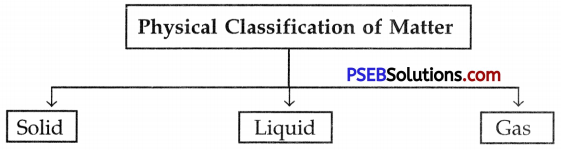
→ Based upon its physical state, there are three states of matter, i.e. solid, liquid, and gas.

→ There are two new states of matter. These are plasma and Bose-Einstein condensate.

→ Solid: It is that state of matter which has a definite mass, volume, and shape.

→ Liquid: It is that state of matter which has a definite mass and volume but has no definite shape.

PSEB 9th Class Science Notes Chapter 1 Matter in Our Surroundings

→ Gas: It is that state of matter which has a definite mass but has neither definite shape nor definite volume.

→ The forces of attraction between the particles are maximum in solids, intermediate in liquids, and maximum in gases.

→ The vacant spaces between the constituent particles and kinetic energy of particles are minimum in the case of solids, intermediate in liquids, and maximum in gases.

→ The arrangement of constituent particles is most ordered in the case of solids, in the case of liquids the layers can slip over each other while in the case of gases, there is no order, particles can move randomly.

→ The different states of matter are interconverted by changing temperature or pressure or both.

→ Melting point is the temperature at which solid changes into a liquid state.

→ The boiling point is the temperature at which a liquid changes into vapour under atmospheric pressure. At boiling point, vapour pressure of the liquid is equal to atmospheric pressure.

→ Boiling is a bulk phenomenon as it involves the whole of the liquid.

→ The rate of evaporation depends upon the surface area, temperature, humidity, and wind speed.

→ The slow passing out of molecules of a liquid into a gaseous state at a temperature below its boiling point is called evaporation.

→ Evaporation causes cooling. It is a surface phenomenon.

PSEB 9th Class Science Notes Chapter 1 Matter in Our Surroundings

→ Boiling is a fast process whereas evaporation is a slow process.

→ Sublimation is the process due to which a solid directly changes into the gaseous state on heating and a gaseous state directly changes into a solid-state on cooling without changing into the liquid state.

→ Vapour is a substance that exists in the gaseous state at a temperature lower than the boiling point of its liquid state.
PSEB 9th Class Science Notes Chapter 1 Matter in Our Surroundings

→ Temperature on Kelvin scale = 273 + Temperature on centigrade scale. (T K = 273 + t°C) Water freezes at 0°C or 273 K.

→ Water boils at 100°C or 373 K.

→ Units of Latent heat of fusion are kJ/kg or kcal/kg

→ Units of Latent heat of vaporisation are kJ/kg or kcal/kg

→ \(\frac{F-32}{9}=\frac{C}{5}\)
F = Temperature on Fahrenhiet scale.
C = Temperature on Centigrade scale.

Some measurable quantities and their units are:

Quantity Unit Symbol
Temperature kelvin K
Length metre m
Mass kilogram kg
Weight newton N
Volume cubic metre m3
Density kilogram per cubic metre Kg m-3
Pressure pascal Pa

→ Matter: It is anything that occupies space, has mass, and can be judged by any one or more of the known five physical senses.

→ Panch Tatva: Indian philosophers classified matter into our basic elements called Panch Tatva. These are air, earth, fire, sky, and water.

→ Diffusion: It is the property of the mixing of particles of two or more substances.

→ Solid: It is that state of matter which has a definite mass, volume, and shape.

→ Liquid: It is that state of matter which has a definite mass and volume but has no definite shape.

→ Gas: It is that state of matter which has a definite mass but has neither definite shape nor definite volume.

→ Density: It is the mass per unit volume of a substance.

→ Melting point: It is the temperature at which solid changes into the liquid state.

PSEB 9th Class Science Notes Chapter 1 Matter in Our Surroundings

→ Fusion: It is the process of conversion of a solid into a liquid.

→ Solidification or freezing: It is the process of conversion of a liquid into a solid.

→ Sublimation: It is the process due to which a solid directly changes into the gaseous state on heating and a gaseous state directly changes into the solid state on cooling without changing into a liquid state.

→ Latent heat of fusion is the amount of heat energy required to change 1 kg of solid into liquid at its melting point.

→ Latent heat of vaporisation is the amount of heat energy required to change 1 kg of a liquid to gas at atmospheric pressure and at its boiling point.

→ Boiling is a bulk phenomenon as it involves the whole of the liquid.

→ Boiling point: It is the temperature at which a liquid changes into vapour under atmospheric pressure.

→ Evaporation: The slow passing out of molecules of a liquid into a gaseous state at a temperature below its boiling point.

→ Dry Ice: Solid carbon dioxide is called dry ice.

→ Freezing point: It is the temperature at which a liquid substance changes into a solid substance.

→ Liquified Petroleum Gas (LPG): When butane is subjected to the action of high pressure, it is liquid to give LPG which is used as a fuel.

PSEB 9th Class Science Notes Chapter 1 Matter in Our Surroundings

→ Compressed Natural Gas (CNG): When natural gas is subjected to the action of high pressure it gets liquified to give CNG which is used as a fuel for automobiles.

→ Vapour: It is a substance that exists in the gaseous state at a temperature lower than the boiling point of its liquid state.
