
PSEB 11th Class Political Science Solutions Chapter 24 The Union Executive-President, Vice-President, Council of Ministers and Prime Minister

Punjab State Board PSEB 11th Class Political Science Book Solutions Chapter 24 The Union Executive-President, Vice-President, Council of Ministers and Prime Minister Textbook Exercise Questions and Answers.

PSEB Solutions for Class 11 Political Science Chapter 24 The Union Executive-President, Vice-President, Council of Ministers and Prime Minister

Long Answer Type Questions

Question 1.
Discuss the qualifications, mode of election and procedure for impeachment of the President of India.
Or
How is the President of India elected?
Answer:
Since India is a Republic, the President of India is elected by the people in an indirect manner for a fixed time. As to what method should be adopted for the election of the President, there was no unanimity of opinion in the Constituent Assembly. One suggestion was that the President should be directly elected by the people.

It will not only be in consonance with the democratic principles but it will also make the President the direct representative of the people. This proposal was rejected on the ground that such a method will unnecessarily convulse the nation, particularly when he was being made the nominal head of the State. The other proposal was that the President should be elected only by the members of the Union Parliament.

This proposal was equally rejected because in that case the President would become a puppet in the hands of the majority party. That would rob him of all his appearance of independence and dignity. In order to uphold the federal principle, it was finally agreed that the States should also be given a share in the election of the President.

Qualifications:
The Constitution prescribes the following qualifications for a presidential candidate-

  • He should be a citizen of India.
  • He must have completed the age of 35 years.
  • He must be qualified to be elected as a member of the Lok Sabha.
  • He must not hold any office of profit under the Government of India or any State Government or local authority.However, this provision is not applicable to a person who holds the office of the President, Vice-President, Governors and Ministers of the Central and State Government.
  • He cannot at the same time be a member of the Parliament or a member of State Legislature; his seat will be deemed to have been vacated on the date he assumes his office as President.
  • According to Presidential and Vice-Presidential Elections Act, the candidate for the office of president must deposit Rs. 15,000 as security.
  • The name of the candidate for the office of President must be proposed by 50 electors and seconded by 50 electors.

Method of Election:
Following are the features of the election of the President of India-

1. President elected by an Electoral College:
The President of India is elected by an electoral college consisting of the elected members of the Lok Sabha, the elected members of the Rajya Sabha and the elected members of the State Legislative Assemblies.

2. System of Proportional Representation:
The election of the President is held in accordance with the system of proportional representation by means of the single transferable vote.

3. Uniformity of Representation:
According to the Constitution, as far as possible, there is to be maintained uniformity of representation of the different States at the presidential election and parity between the States as a whole and the Union. In other words, in the election of the President, the principle of ‘One member- One-vote’ had not been and could not be adopted. In different States different ratios prevail between the population and the number of legislators.

The Constituencies in the different States are unequal in the matter of population. For example, in one State it may be one representative for every 50,000 of the population while in another the proportion may be one to 75,000 or more. Thus since the States differ in their population, the strength of the elected members of the State Legislative Assemblies also differs. Then, the total strength of the elected members of the State Legislative Assemblies is far greater than that of the elected members of both the Houses of Parliament. That being so, the problem was to ensure that the votes cast will have a value in proportion to the population that the votes represented.

4. Procedure of determining the votes of the Members of the State Assembly:
Article 55(4) of the Constitution lays down the procedure of determining the votes of the member of the State Assembly, which is as follows:

PSEB 11th Class Political Science Solutions Chapter 24 The Union Executive-President, Vice-President, Council of Ministers and Prime Minister 1
If the remainder is less than 500, it is ignored.
If it is more than 500, then the vote of each member shall be further increased by one.
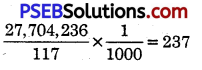
For example, in 2017 population of Punjab was 27,704,236 and the Legislative Assembly of Punjab consists of 117 members. Hence each member was entitled to cast 237 votes:
PSEB 11th Class Political Science Solutions Chapter 24 The Union Executive-President, Vice-President, Council of Ministers and Prime Minister 2
5. Procedure of determining the votes of the Members of the Parliament:
The Constitution lays down the following procedure of determining the votes of the member of Parliament.

PSEB 11th Class Political Science Solutions Chapter 24 The Union Executive-President, Vice-President, Council of Ministers and Prime Minister 3
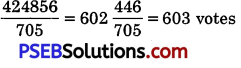
Fraction exceeding one-half being counted as one. Let us explain this formula also by taking an example. Suppose the total number of votes assigned to the elected members of all the State Legislative Assemblies is 424856 and the total strength of elected members of the Parliament is 705. Now to obtain the number of votes which elected member of the Parliament will have at the election of the President:
PSEB 11th Class Political Science Solutions Chapter 24 The Union Executive-President, Vice-President, Council of Ministers and Prime Minister 4
In the presidential election in July 2017, the number of votes of each member of the Parliament entitled to vote was 708.
Total votes of the elected member of State Assemblies = 5,49,495
No. of elected members of the Parliament = 776 (Lok Sabha 543 + Rajya Sabha 233)
No. of votes of each member of the Parliament = \(\frac {5,49,495 }{776}\) = 708
Total votes of the members of the Parliament = 708 x 776 = 5,49,408
Total votes of the electoral college = 5,49,495 + 5,49,408 = 10,98,903

6. Vacant Seats in Electoral College:
The President of India, as said, is elected by an electoral college. Now the question arises if the electoral college is not complete, how to proceed with the election of the President. Our Constitution was not clear on this point. To remove this flaw 11th Amendment (1961) was made in the Constitution.
According to this amendment, the election of the President or the Vice-President cannot be challenged on the ground of any vacancy in the electoral college for whatever reason among the members of the electoral college electing him.

7. Method of Fixing the Quota:
Under the system of Proportional Representation a candidate to be elected, must secure the necessary quota of votes. The quota is determined by the following formula:

PSEB 11th Class Political Science Solutions Chapter 24 The Union Executive-President, Vice-President, Council of Ministers and Prime Minister 5
Suppose the total number of valid votes polled at the presidential election is 8,00,000. Applying the above-mentioned formula, the quota shall be:
\(\frac {800000}{1+1}\) + 1 = 4,00,001
In order to be elected, the candidate must secure 4,00,001 votes-an absolute majority of votes. If the first counting does not give any candidate the quota of votes, the candidate who got the least number of votes is eliminated and his votes transferred to the remaining candidates on the basis of the preferences shown. The process is repeated until one candidate gets the requisite number of votes. Let us explain the system in detail.

Assuming that there are four candidates and the total number of valid votes cast are 15,000.
To be declared elected President, a candidate must secure a minimum of 7501 votes. Now suppose the first preference votes secured by the four candidates are as follows:
A—5250
B—4800
C—2700
D—2250
Since the candidate D gets the least number of votes, hence he is eliminated. Now the second preference votes on his 2250 ballot papers shall be counted.
Suppose A gets 300, B gets 1050 and C gets 900.

Now the total votes of A are 5250 + 300 = 5550, of B are 4800 + 1050 = 5800 and of C are 2700 + 900 = 3600. It means even now no candidate is securing the requisite quota of 7501 votes.

Now candidate C shall be eliminated because he got the least number of votes. Now third preference votes on the 3600 votes of C shall be counted. In the third preference suppose A gets 1700 and B gets 1900.
Now the total votes of A are 5550 + 1700 = 7250
Total votes of B are = 5850 + 1900 = 7750

According to the Proportional Representation system, B shall be declared President. The system proves the doctrine that candidate B is preferred by a numerically large number of electors than candidate A. It may be recalled that the election of Mr. V. V. Giri was decided in the Second Count. “It made the people realise the significance of the system of proportional represenataion by means of single transferable vote.”

So far fifteen presidential elections have been held in India:

  1. First election was held in 1952 and Dr. Rajendra Prasad was elected.
  2. Second election was held in 1957 and again Dr. Rajendra Prasad was elected.
  3. Third election was held in 1962 and Dr. Radhakrishnan was elected.
  4. Fourth election was held in 1967 and Dr. Zakin Hussain was elected.
  5. Fifth election was held in 1969 and Shri V. V. Giri was elected.
  6. Sixth election was held in 1974 and Shri Fakhruddin Ali Ahmed was elected.
  7. In July, 1977, for the first time, Shri Sanjiva Reddy was nominated by a consensus of all paries and was elected unopposed.
  8. Eighth election was held in July, 1982 and Congress (I) candidate Giani Zail Singh was elected and opposition candidiate Justice Khanna was defeated.
  9. Ninth Presidential election was held in July, 1987 and Congress (I) candidate R. Venkataraman was elected and opposition candidate Justice V. R. Krishna Iyer was defeated.
  10. Tenth Presidential election was held in July, 1992 and Congress (I) candidate Dr. Shankar Dyal Sharma was elected and opposition candidate was defeated.
  11. Eleventh Presidential election was held in July 1997. Joint candidate of United Front and Congress Mr. K. R. Narayanan supported by BJP and others was elected and Mr. T. N. Seshan was defeated. Mr. K. R. Narayanan secured 94.97 per cent of the votes.
  12. Twelfth Presidential election was held in July, 2002. Joint candidate of rulling National Democratic Alliance Dr. A.P. J. Abdul Kalam supported by Indian National Congress, Bahujan Samaj Party, Samajvadi Party, Janata Dal and others was elected and Capt. Lakshmi Sahgal, the opposition candidate supported by Communist Parties was defeated.
  13. 13th Presidential election was held in July 2007, joint candidate of United Progressive Alliance Mrs. Pratibha Devi Singh Patil was elected and Independent Candidate Mr. Bhairon Singh Shekhawat was defeated.
  14. 14th Presidential election was held in July 2012. Candidate of UPA and Supported by S.P., B.S.P., Janata Dal (U) and Shiv Seva, Mr. Pranab Mukherjee was elected and independent candidate Mr. P.A. Sangma was defeated.
  15. 15th Presidential election was held in July 2017. Candidate of N.D.A. Sh. Ram Nath Kovind was elected and U.P.A. candidate Smt. Meera Kumar was defeated.

The election of the President is conducted by the Chief Election Commissioner. He issues the notification and fixes dates for nomination, scrutiny of nomination and withdrawal of candidature. Only those eligible to vote in the election of the President, i.e. elected members of Parliament and elected members of the State Legislative Assemblies can propose a candidate for election. The Chief Election Commissioner counts the votes cast and declares the result.

The validity of the election of the President can be challenged by the electors only. The election of the President can be challenged only after the completion of the election, i.e., after a candidate is declared to be elected to the office of the President. If a petition is allowed before such election, it would involve the non-compliance with the mandatory provisions of Art. 62 which says that an election to fill a vacancy caused by the expiration of the term of the office of the President shall be completed before the expiration of the term.

Oath of the President:
Before entering upon his office, the President elected or any person acting as President for discharging the functions of President, is required to take an oath in the presence of the Chief Justice, or in his absence, the senior-most judge of the Supreme Court available.

Tenure:
The President is elected for a period of five years. The period of five years begins from the day he enters upon his office. The President is eligible for re-election.

Removal by Impeachment:
The President can be removed from office by impeachment only. The Constitution lays down a detailed procedure for the impeachment of the President. He can be impeached “for violation of the Constitution”.

When a President is to be impeached for the violation of the Constitution, the charges can be prepared by either House of the Parliament. In other words, the impeachment charged may be initiated by the Lok Sabha or the Rajya Sabha. (in the United States of America, this right belongs exclusively to the Lower House, i.e., the House of Representatives). But no such charge is to be preferred unless the proposal to prefer such a charge is contained in a resolution which has been moved after at least 14 days’ notice in writing signed by not less than one-fourth of the total number of members of the House.

The resolution must be passed by a two-third majority of the total membership of the House. If passed by the requisite majority in one house, it is sent to the other House for investigation. The other House is empowered to entrust this job of investigation to a court or tribunal.

However, the resolution had got to be passed by the other house by a two-third majority of the total membership of this House. If the other House also passes the resolution by a two-third majority of the total membership of this House, then it means the charge is proved and the President is removed from his office from the ‘date’ (word ‘time has not been used’) on which the investigating House passes the resolution.

However, the President has the right to be heard and defended when the charges against him are being investigated. He may defend himself in person or through his council. One thing to be noted here is that there is no provision for suspension of the President under impeachment. He continues to hold his office during the period of investigation.

Salary and Allowances:
The President of India gets a salary of Rs. 5,00,000 per month and an official residence (called Rashtrapati Bhavan in New Delhi) free of rent. In addition to the salary, the President also gets handsome allowances of various kinds as determined by Parliament. According to the President’s Pension Act, a person who ceases to hold office as President, either by expiration of his term of office or by resignation, is entitled to a monthly pension of Rs. 2,50,000. The Government may also allow him a free medical aid as was done in the case of Dr. Rajendra Prasad.

The salary and other allowances of the President are charged on the Consolidated Fund of India. According to Art. 59 (4), the emoluments and allowances of the President shall not be diminished during his term of office.

PSEB 11th Class Political Science Solutions Chapter 24 The Union Executive-President, Vice-President, Council of Ministers and Prime Minister

Question 2.
Describe the powers of the President of India
Or
Discuss the executive and judicial powers of the President.
Or
Explain the powers of the President of India other than emergency powers.
Answer:
The Constitution of India establishes a federal form of government.
According to Art. 53, the executive powers of the Union have been vested in the President which shall be exercised by him directly or through officers subordinate to him in accordance with the Constitution. However, India being a parliamentary form of government, the President is only a nominal head and the working executive is the Council of Ministers headed by the Prime Minister.
The powers of the President can be divided into two categories-
(A) Powers in normal times and
(B) Emergency powers.

(A) POWERS IN NORMAL TIMES:
During normal times the President exercises four types of powers:
1. Executive Powers
2. Legislative Powers
3. Financial Powers
4. Judicial Powers.

1. Executive Powers:
The President is the Chief Executive or Head of the State. According to Art. 53 (1) of the Constitution, the executive powers of the Union have been vested in the President. He may exercise these powers himself or get them exercised through officers subordinate to him.

(i) Appointments:
The President is authorised to make a number of appointments. He appoints the Prime Minister and the other Ministers on the advice of the Prime Minister, the Attorney General, the Comptroller and the Auditor General, Judges of the Supreme Court and the High Courts, the Chairman and Members of Joint Public Service Commission, the Chairman and members of Joint Public Service Commission, the Election Commission, Finance Commission, the Official

Language Commission and Commission for the Scheduled Castes, Tribes, Backward Classes, etc. He also appoints the State Governors, Lt. Governors and Chief Commissioners of the Union Territories. He also sends and receives diplomatic representatives. He makes rule for the convenient transaction of business of the Government of India and allocates this business among the Ministers. Under Art. 78, the Prime Minister is bound to communicate to the President all decisions of the Cabinet relating to administration and such proposals for legislation as the President may call for.

(ii) Military Powers:
The President is the Supreme Commander of the Defence Forces, but the exercise of military powers of the President is regulated by the Parliament. The President cannot declare war or deploy forces without the sanction of the Parliament or in anticipation of the sanction by the Parliament.

(iii) Power Relating to Foreign Affairs:
The President has extensive diplomatic powers. He represents his country in international affairs. He appoints Indian representatives to foreign countries and also receives diplomatic representatives of other States which have been recognised by Parliament.

(iv) Power of Direction, Control and Co-ordination:
The President has the power of direction, control and co-ordination of the work in the States. He can issue directions to the States for the compliance of Union laws. In particular, he can direct a State or States to construct and maintain communications of national or military importance and for the protection of railways. He can establish an Inter-State council to advise him upon co-ordination of policy and settlement of disputes between the States.

(v) Administration of Union Territories:
Art. 239 provides that every Union Territory shall be administered by the President acting through an administrator. The administrator, given any designation by the President, is appointed by the President. The President may appoint the Governor of a State as the administrator of an adjoining Union Territory. When the Governor is discharging the duties of the administrator he shall exercise his functions as administrator independently of his Council of Ministers.

The Parliament by law can establish democratic institutions in the Union Territories. The President can make regulations for the peace, progress and good government of the Union Territory of the Andaman and Nicobar Islands and the Laccadive, Minicoy and Amindivi Islands. The regulations made by the President have the same effect as an act of Parliament. The President is also competent to repeal or amend, through such regulations, any existing Act dealing with the administration of these Islands.

(vi) Informative Powers:
The President had a right to ask for information with regard to the decision of the Council of Ministers. The Prime Minister is required to keep in touch with the President for this purpose.

(vii) Sending back the decision of the Council of Ministers for reconsideration:
Under 44th amendment the President is empowered to send back the decision of the Council of Ministers for reconsideration, but if the council of Ministers repeats the decision, then the President is bound to accept the decision.

(viii)Link between the Centre and States:
The President is the link between the centre and the states. He is the executive head both of the union and of the federation.

2. Legislative Powers:
The President enjoys many legislative powers. He is a part of the Parliament. Besides the Lok Sabha and Rajya Sabha, the President is also a part of the Parliament. The legislative powers of the President are provided by Article 123.

(i) Power to Summon:
Prorogue and Dissolve the Parliament. The President can convene, prorogue and dissolve the Parliament. He can order fresh elections to the Lok Sabha on the recommendation of the Prime Minister. He must call the session of the Parliament within 6 months.

(ii) Address to the Parliament:
He can address the two Houses of the Parliament jointly or he may address them independently. The first session of the Parliament after the General elections is inaugurated by the President. He also addresses the first session of the Parliament every year. In his address the President explains the policy of the Government to the House.

(iii) Nominates the Members of the Parliament:
He nominates 12 persons to the Rajya Sabha. These persons must have distinguished themselves in the fields of art, literature, science and social service. He can nominate two persons of the Anglo-Indian community to the Lok Sabha if he feels that the community has not got adequate representation.

(iv) Assent on Bills:
No bill passed by the Parliament can become an Act without the assent of the President. He can reject an ordinary bill only once and when passed for the second time, the President is to give his assent.

(v) He gives approval to many bills passed by the State Legislatures.

(vi) Joint Session:
He can call a joint session of the two Houses of the Parliament. If the two Chambers differ on an ordinary bill, only then he calls a joint session.

(vii) Power to Send Messages: He can send messages to any House from time to time.

(viii)Ordinance:
During the intervals of the sessions of the Parliament he can issue ordinances. These ordinances have the force of laws. The ordinance is put before the Parliament as soon as it meets. The Parliament has the authority to reject the ordinance. It can be withdrawn by the President also. If it is neither rejected by the Parliament nor withdrawn by the President, it will automatically end six weeks after the first meeting of the Parliament. On Sept. 22, 1980 the President promulgated the National Security Ordinance to enable the government to detain any person to prevent him from acting against the defence or security of the country.

(ix) Constitutional Amendment Bill:
A Constitutional Amendment Bill is finally sent to the President for his assent. The President is bound to give his assent to the Constitutional Amendment Bilk

3. Financial Powers:
The financial powers of the President as mentioned in the Constitution are as follows:

(i) It is the duty of the President to place the Budget for the current year before the Parliament. It is to be presented before the beginning of the financial year. Normally the budget is presented to the Parliament by the Finance Minister on behalf of the President.

(ii) Money Bills can only be introduced in the Parliament on the recommendation of the President.

(iii) The President has full control over the contingency fund and he can spend it according to his sweet will.

(iv) He distributes the share of income tax among the States.

(v) He appoints Finance Commission. 15th Finance Commission was appointed on 27 Nov.- 2017 in the Chairmanship of Sh.N.K. Singh.

4. Judicial Powers:
The President has some judicial power also. It is provided by Article 122 of the Constitution.

  • The President appoints the judges and the chief justice to the Supreme Court and the State High Courts.
  • The President cannot be sured in any court of India in connection with any matter concerning his office.
  • He has the power to pardon, reprieve and commute punishment.

(B) EMERGENCY POWERS
Besides powers in normal times the President of India has Emergency Powers as well. The President enjoys three types of emergency powers:
1. Emergency due to external aggression or armed rebellion.
2. Emergency arising out of failure of the constitutional machinery a State.
3. Financial emergency.

For detailed study of Emergency Powers:
1. Emergency arising out of external aggression or Armed Rebellion:
According to Art. 352 if the President is satisfied that a grave emergency exists whereby the security of India or any part of India is threatened by war, external aggression or armed rebellion, he may proclaim a state of emergency. Under 59th amendment in Punjab emergency can be declared on the ground of internal disturbances. The President can declare emergency even before the actual occurrence of war, external aggression or armed rebellion.

But in the 44th Amendment it is provided that the President shall not issue a proclamation of Emergency unless the decision of the Cabinet that such a proclamation may be issued has been communicated to him in writing. According to 42nd Amendment, President can declare emergency in the whole of India or in such part of the territory there of as may be specified in the proclamation. Such a Proclamation may be revoked by a consequent proclamation. If the proclamation has not been approved within one month by both the Houses of Parliament by two-thirds of the majority of the members present and voting, it will become ineffective. If such a

proclamation is issued at a time when the Lok Sabha has been dissolved or the dissolution of the Lok Sabha takes place during the period of one month, and if the Rajya Sabha has approved the proclamation within one month, but it had not been approved by the Lok Sabha, the proclamation shall cease to operate at the expiration of 30 days from the date on which the Lok Sabha sits after its reconstitution. However, if within 30 days the Lok Sabha approves the proclamation, it continues.

After approval of the Parliament emergency continues till the President revokes it by a subsequent proclamation. But it is provided in the 44th Amendment that for the continuance of the emergency, approval by resolution of both Houses would be required every six months. Provision is also made in the 44th Amendment that the proclamation of Emergency would cease to be opeative whenever a resolution to that effect is adopted by the Lok Sabha by a simple majority of the members of the House present and voting.

Ever since the operation of the Constitution (Jan. 26, 1950), such an emergency has been declared three times. First, when India was attacked by China in October, 1962 and second when all of a sudden, Pakistan attacked India on December 3, 1971. Third time internal emergency was declared on 26th June, 1975 and this emergency was-removed on 21st March, 1977 whereas external emergency declared in 1971 was lifted on 27th March, 1977.

Effects of this Proclamation:
1. The most significant effect of this proclamation is that the federal form of the Constitution is converted into unitary form of government. The authority of the Centre is increased till the emergency lasts. It should be remembered the State Governments do not cease to function. They continue, to function as before under normal conditions. But the Centre gets the authority to give directions to the States as the manner in which the executive power of the States is to be exercised. The legislative power of the Centre is also widened.

2. Parliament will have the power to make laws for the whole or part of India with respect to any of the matters given in the State List. Laws so made by Parliament shall cease to operate six months after the Proclamation of Emergency has come to an end.

3. The President, may by an order, modify the provisions relating to distribution of revenues between the Union and the States.

4. The Fundamental Rights given under Art. 19 (six freedoms) are automatically suspended throughout the country. The suspension of Art. 19 continues until the proclamation of emergency ends. However, under 59th Amendment this right can be suspended when emergency is declared in Punjab.

5. The President by order can also suspend the right to move the courts to enforce any Fundamental Rights. All proceedings pending in any court for the enforcement of the rights so mentioned may remain suspended for the period during which Proclamation is in force or for such short period as may be specified in the order. But according to 44th Amendmenl the enforcement of the right to life and personal liberty under Article 21 cannot be suspended. The order so made may extend to the whole or to any part of the territory of India. However, the order of the

parliament is required to be laid before each House of Parliament “as soon as may be after it is made.” And what is the definition of ‘as soon as may be’, the constitution does not fix any time limit for the order to be laid before Parliament.

2. Emergency arising out of the failure of constitutional machinery in a State. (Art. 356):
The second type of emergncy powers given to the President deal with the failure of constitutional machinery in the State. If the President, either on the receipt of a report from the Governor of a State or otherwise, is satisfied that a situation has arisen in which the Government of the State cannot be carried on in accordance with the provisions of the Constitution, the President can proclaim emergency in that state.

In May, 1994, the Supreme Court had declared that dismissal of a state government by the President under Article 356 of the Constitution is open to judicial scrutiny. The apex Court had held that presidential proclamation under Article 356 could be challenged only on the ground that the exercise of power was malafide or based on wholly extraneous and irrelevant grounds.

Any proclamation made under Art. 356 may be revoked or varied by a subsequent Proclamation. The Proclamation issued by the President is required to be laid before each House of Parliament and it ceases to operate after the expiry of two months unless before the expiration of that period it has been approved by resolutions of both Houses of Parliament. If approved by Parliament, the Proclamation, remains in force for six months after the parliamentary approval. The duration of the proclamation can be extended for six months at a time and the maximum period is one year.

According to 44th Amendment, a resolution with respect to the continuance in force of a Proclamation under the article for any period beyond the expiration of one year from the date of issue of such proclamation shall not be passed by either House of Parliament unless a Proclamation of Emergency is in operation at the time of the passing of such resolution and the Election Commission certifies that the continuance in force of the proclamation under the Article during the period specified in such resolution is necessary on account of difficulties in holding elections to the Legislative Assembly of the State concerned.

Under 59th Amendment in Punjab President’s rule can be extended up-to three years. Under 64th Amendment President’s rule in Punjab was extended six months more beyond three years. By 68th amendment President’s rule in Punjab can be extended up-to 5 years.

Effects of this Proclamation:
(i) The President can assume to himself all or any of the functions of the State or he may vest all or any of those functions in the Governor or any other executive authority.

(ii) The President can suspend or dissolve the State Legislative Assembly. He may declare that the powers of the State Legislature shall be exercisable by or under the authority of Parliament. However, Parliament will be competent to confer that power on the President and also authorise him to delegate those powers to anybody he thinks fit. .

(iii) The President can make any other incidental or consequential provisions necessary to give effect to the object of the Proclamation.

(iv) If the Lok Sabha is not in session then the President sanctions the expenditure from the consolidated fund of the State.

President’s rule has been promulgated almost 121 times in states since the enforcement of the Constitution. Almost all the States have been, at one time or the other, been put under President’s Rule.

3. Financial Emergency (Art. 360):
If the President is satisfied that a situation has arisen whereby the financial stability or credit of India or any part of it is threatened, he may declare a Financial Emergency under Art. 360 of the Constitution. Such a Proclamation may be revoked by a subsequent Proclamation. The proclamation has to be laid before each House of Parliament.

It ceases to operate at the expiration of two months unless it is approved earlier by a resolution of both Houses of Parliament. The Proclamation in this case also should be approved by Parliament as in the other two cases of emergency. Like the Proclamation of war-emergency, Financial Emergency also continues for an indefinite period. Fortunately, this kind of Emergency has not been declared so far.

Effects of this Proclamation:
(i) During the Financial emergency, the executive authority of the union shall extend to the giving of directions to any State to observe such canons of financial property as may be specified in the direction or any other directions which the President may deem necessary for this purpose.

(ii) The President can ask a State to reduce salaries and allowances of all or any class of public servants connected with the affairs of a State.

(iii) The President can give direction to a State to reserve all Money Bills for the consideration of the President after they have been passed by the State Legislature.

(iv) The President shall be competent to issue directions for the reduction of salaries and allowances of all or any class of persons serving in connection with the affairs of the Union including the judges of the Supreme Court and the High Courts.

Criticism:
Evidently the Constitution gives the President very drastic powers to deal with Emergency. Emergency powers of the President were criticised within and outside the Constituent Assembly. It has been said that these powers are not compatible with democracy. When the provisions relating to Emergency powers were passed, Sh. H. V. Kamath, member of the Constituent Assembly, declared, “ It is a day of shame and sorrow, God save the Indian people.”

Sh. K. T. Shah described Article 359, which empowers the President to suspend the right to seek enforcement of fundamental rights “as the grand final and crowning glory of this chapter of reaction and retrogression.” The power to abrogate fundamental rights of citizens during Emergencies can easily be abused for depriving the people of their liberty and imposing a totalitarian rule on the country.

According to H. V. Kamath, “ There is no parallel to the chapter of Emergency in any Constitution of democratic countries of the world”. He further said,, “I fear that by the single chapter we are seeking to lay the foundation of a totalitarian State, a police State, State completely opposed to all the ideas and principles that we have held aloft during the last few decades, a State where the rights and liberties of millions of innocent men and women will be in continuous jeopardy, a State where if there be peace it will be the peace of the grave and the void of the desert. I only pray to God that He may grant us wisdom, wisdom to avert any such catastrophe, grant us fortitude and courage.”

Another point of criticism is that during Emergency federal structure is changed into unitary one. T. T. Krishnamachari said, “The Constitution of India is designed to work as a federal system in normal times and as a unitary system in war and other emergencies.” Moreover, ruling party at the Centre by using Article 356 can declare President’s rule in a particular State simply because some other party is ruling the State. Article 356 was misused when nine state governments were dismissed on 30th April 1977 and in Feb 1980.

Justification of Emergency Powers. Emergency powers of the President are defended on the ground that Strong Centre is needed for security of the country. V. N. Shukla writes, “ These provisions may appear to be harsh, particularly in a constitution which professes to be built upon an edifice of fundamental rights and democracy. But the provisions may be studied in the light of India’s past history. India has had her inglorious days whenever the Central power was weak.

It is well that the Constitution guards against the forces of disintegration. Events may take place threatening the very existence of the State, together with all that is desired to remain basic and immutable will be swept away.” Country’s security is more important than the federal system. In the words of Dr. Ambedkar, “ It is only the Centre which can work for the common purpose and for the general interest of the country as a whole. Herein lies the justification of giving to the Centre overriding power to be used in the Emergency.”

It is not possible for the President to become a dictator. In India there exists a parliamentary form of Government. The essence of parliamentary form of Government is that the Head of the State is a nominal head. It is the Council of Ministers which is the real executive.

According to 44th Amendment, an Emergency can be proclaimed only on the basis of written advice tendered by the cabinet. In addition a Proclamation of Emergency must be approved by the two Houses of parliament by two-thirds majority within a period of one month.

As a further check against the misuse of the emergency powers and to put the right to life and liberty on a secure footing, it is provided in 44th Amendment Act that the power to suspend the right to move the court for the enforcement of a fundamental right cannot be exercised in respect of the fundamental right to life and liberty.

According to 44th Amendment the provisions of Article 19 will become suspended only in the case of a proclamation of Emergency issued on the ground of war or external aggression and not in the case of a Proclamation of Emergency issued on the ground of armed rebellion. Moreover, if the President tries to become a despot, he will be impeached by the Parliament.

There is no question of autocracy under any circumstances. Only State autonomy may suffer temporarily.” Sh. Amar Nandi rightly remarked that the power conferred on the central executive to meet national emergencies is, so as to say, a loaded gun which can be used both to protect and to destroy the liberty of citizens. The gun must be used, therefore, with extreme caution.

Position of the President:
What exactly is the position of the President in the Indian Constitution? Different writers have taken different and sometimes radical views. A lay man who reads the provisions of the Constitution may literally interpret them and come to the conclusion that he has been armed with drastic powers. His Emergency Power “is a bottomless well of dictatorial possibilities”. Under Art. 53 of the Constitution,
“The Executive power of the Union shall be vested in the President and shall be exercised by him either directly or through officers subordinate to him in accordance with the Constitution.”

It means the President can use the executive powers himself. Under Art. 74 of the Constitution there shall be a Council of Ministers to aid and advise the President in the exercise of his functions. But nowhere it had been stated that the President shall be bound to act in accordance with the advice of the Council of Ministers. Then, the President of India can dissolve Parliament, issue ordinances, declare emergency and can take into his hands the administration of the whole of the country. Being the Supreme Commander of all the forces he can establish his personal rule with the help of the armed forces of the country.

But this is a legal view. And the fact is a legal truth, may be a political untruth. In India, there exists parliamentary form of government. The essence of the parliamentary form of government is that the Head of the State is a titular head, a constitutional head. His powers are formal. It is the Council of Ministers which is the real functionary.

By 42nd amendment even legal position of the President has changed. Under this amendment he was bound to accept the advice of the Council of Ministers. But according to 44th Amendment the President may require the Council of Ministers to reconsider any advice tendered by them and that the President shall act in accordance with the advice tendered after such reconsideration, Thus, the critics argue that the position of the Indian President is one of honour and dignity but not of power.

Commenting upon the position of the President, Dr. Ambedkar had himself said in the Constituent Assembly: “The President occupies the same position as the King under the British Constitution. He is the head of the State but not of the Executive. He represents the nation but does not rule the nation.” To quote him again: “The President of the Indian Union will be generally bound by the advice of ministers.

He can do nothing contrary to their advice nor can he do anything without their advice.” According to late Pt. Nehru, “We have not given our President any real power but we have made his position one of great authority and dignity’. Expressing his views on the position of the President, Sh. Morarji Desai said, “It is wrong to think that our President is vested with any real power of rulership; in normal times he has none, under the Constitution he is merely a constitutional head, very much like the British King.”

However, all the critics do not subscribe to the view that the President under the Constitution is only a figure head. These critics draw our attention to the Weimar Constitution of Germany. The Weimar Constitution was based on thoroughly democratic lines. Yet it gave rise to a dictator, Hitler who trampled under his feet all the democratic principles of the Constitution. Similarly, Dr. Ambedkar himself used the words “ generally bound”. It shows that the President is not a rubber stamp, he is not a puppet in the hands of the Council of Ministers.

The Constitution allows him opportunities when he can use his discretion. For example, he can use his discretion in the appointment of the Prime Minister when no political party gets absolute majority in the Lok Sabha. After all, the President is a promoted politician. As Jennings has said, “He cannot be expected to play the same role of impartiality as is expected from the British Monarch.”

Under Art. 78 of the Constitution, it shall be the duty of the Prime Minister to communicate to the President all decisions of the Council of Ministers relating to the administration of the affairs of the Union and proposals for legislation, to furnish such information ralting to the administration to the affairs of the Union and proposals for legislation as the President may call for Under Art. Ill the President can use his veto power also.

His emergency powers are so sweeping that, as H. V. Kamath feared, he can lay the foundation of a totalitarian State, a police State…. In his address delivered on the occasion of the laying of the foundation stone of the Indian Law Institute, New Delhi in November, 1960, President Rajendra Prasad urged the Institute to make a study of the powers and functions of the President and find out to what extent they differed from those of the King of England.

He was doubtful that the position of the President is like the position of the British Monarch. He clearly pointed out that because the conditions in India were different from those in England, “ It may not be desirable to treat ourselves so strictly bound by the interpretations which have been given from time to time to expressions in England.”

His successor Dr. Radhakrishnan also expressed publicly similar views. While speaking in the civic reception at Kanpur, he said, “Jpdia was suffering because sufficient care had not been taken to explain our position abroad.” Dr. Radhakrishnan was criticising the foreign policy of the country. At the time of the assumption of his office the President has to take the oath to protect, preserve and defend the Constitution and to devote himself to the service and well-being of the people of India. No wonder, he may veto a Bill which in spirit, runs counter to the Directive Principles of State Policy.

Conclusion:
The conclusion is clear. The President is not a rubber-stamp under the Constitution. Accroding to B. Shiva Rao, the President is more than a figure-head. Even President Giri agreed to this view when he said that the country needed a “really independent and strong President who could see things straight and do justice well without fear or favour.” In his election campaign he clearly said, “If elected he would not be a sleeping partner, nor a rubber stamp

He would be an active partner within the four walls of the Constituion.” Thus, a fairly large section of the educated public opinion in the country feels that the president has a share in the actual government of the country. Even Dr. Radhakrishnan on the the day of his retirement indirectly hinted on such a role of the President when he said, “The President symbolizes national purpose and national unity and can be a great influence for stability and progress.”

The real position of the President depends upon his relationship with the Council of Ministers and, to a great extent, upon his personality. It he is a man of dynamic personality, he will have an edge over the Council of Ministers.

PSEB 11th Class Political Science Solutions Chapter 24 The Union Executive-President, Vice-President, Council of Ministers and Prime Minister

Question 3.
Explain emergency powers of the President.
Or
Discuss the emergency powers of the President of India. Do you agree with the view that the President can become a dictator by exercising them?
Answer:
Besides powers in normal times the President of India has Emergency Powers as well. The President can use the emergency powers even when there is the likelihood of an emergency.
1. Emergency due to external aggression or armed rebellion.
2. Emergency arising out of the failure of the constitutional machinery in the States.
3. Financial emergency.

1. Emergency arising out of external aggression or Armed Rebellion:
According to Art. 352 if the President is satisfied that a grave emergency exists whereby the security of India or any part of India is threatened by war, external aggression or armed rebellion, he may proclaim a state of emergency. Under 59th amendment in Punjab emergency can be declared on the ground of internal disturbances. The President can declare emergency even before the actual occurrence of war, external aggression or armed rebellion.

But in the 44th Amendment it is provided that the President shall not issue a proclamation of Emergency unless the decision of the Cabinet that such a proclamation may be issued has been communicated to him in writing. According to 42nd Amendment, President can declare emergency in the whole of India or in such part of the territory there of as may be specified in the proclamation. Such a Proclamation may be revoked by a consequent proclamation. If the proclamation has not been approved within one month by both the Houses of Parliament by two-thirds of the majority of the members present and voting, it will become ineffective. If such a

proclamation is issued at a time when the Lok Sabha has been dissolved or the dissolution of the Lok Sabha takes place during the period of one month, and if the Rajya Sabha has approved the proclamation within one month, but it had not been approved by the Lok Sabha, the proclamation shall cease to operate at the expiration of 30 days from the date on which the Lok Sabha sits after its reconstitution. However, if within 30 days the Lok Sabha approves the proclamation, it continues.

After approval of the Parliament emergency continues till the President revokes it by a subsequent proclamation. But it is provided in the 44th Amendment that for the continuance of the emergency, approval by resolution of both Houses would be required every six months. Provision is also made in the 44th Amendment that the proclamation of Emergency would cease to be operative whenever a resolution to that effect is adopted by the Lok Sabha by a simple majority of the members of the House present and voting.

Ever since the operation of the Constitution (Jan. 26, 1950), such an emergency has been declared three times. First, when India was attacked by China in October, 1962 and second when all of a sudden, Pakistan attacked India on December 3, 1971. Third time internal emergency was declared on 26th June, 1975 and this emergency was-removed on 21st March, 1977 whereas external emergency declared in 1971 was lifted on 27th March, 1977.

Effects of this Proclamation:
1. The most significant effect of this proclamation is that the federal form of the Constitution is converted into unitary form of government. The authority of the Center is increased till the emergency lasts. It should be remembered the State Governments do not cease to function. They continue, to function as before under normal conditions. But the Center gets the authority to give directions to the States as the manner in which the executive power of the States is to be exercised. The legislative power of the Center is also widened.

2. Parliament will have the power to make laws for the whole or part of India with respect to any of the matters given in the State List. Laws so made by Parliament shall cease to operate six months after the Proclamation of Emergency has come to an end.

3. The President, may by an order, modify the provisions relating to distribution of revenues between the Union and the States.

4. The Fundamental Rights given under Art. 19 (six freedoms) are automatically suspended throughout the country. The suspension of Art. 19 continues until the proclamation of emergency ends. However, under 59th Amendment this right can be suspended when emergency is declared in Punjab.

5. The President by order can also suspend the right to move the courts to enforce any Fundamental Rights. All proceedings pending in any court for the enforcement of the rights so mentioned may remain suspended for the period during which Proclamation is in force or for such short period as may be specified in the order. But according to 44th Amendmenl the enforcement of the right to life and personal liberty under Article 21 cannot be suspended. The order so made may extend to the whole or to any part of the territory of India. However, the order of the

parliament is required to be laid before each House of Parliament “as soon as may be after it is made.” And what is the definition of ‘as soon as may be’, the constitution does not fix any time limit for the order to be laid before Parliament.

2. Emergency arising out of the failure of constitutional machinery in a State. (Art. 356):
The second type of emergency powers given to the President deal with the failure of constitutional machinery in the State. If the President, either on the receipt of a report from the Governor of a State or otherwise, is satisfied that a situation has arisen in which the Government of the State cannot be carried on in accordance with the provisions of the Constitution, the President can proclaim emergency in that state.

In May, 1994, the Supreme Court had declared that dismissal of a state government by the President under Article 356 of the Constitution is open to judicial scrutiny. The apex Court had held that presidential proclamation under Article 356 could be challenged only on the ground that the exercise of power was malafide or based on wholly extraneous and irrelevant grounds.

Any proclamation made under Art. 356 may be revoked or varied by a subsequent Proclamation. The Proclamation issued by the President is required to be laid before each House of Parliament and it ceases to operate after the expiry of two months unless before the expiration of that period it has been approved by resolutions of both Houses of Parliament. If approved by Parliament, the Proclamation, remains in force for six months after the parliamentary approval. The duration of the proclamation can be extended for six months at a time and the maximum period is one year.

According to 44th Amendment, a resolution with respect to the continuance in force of a Proclamation under the article for any period beyond the expiration of one year from the date of issue of such proclamation shall not be passed by either House of Parliament unless a Proclamation of Emergency is in operation at the time of the passing of such resolution and the Election Commission certifies that the continuance in force of the proclamation under the Article during the period specified in such resolution is necessary on account of difficulties in holding elections to the Legislative Assembly of the State concerned.

Under 59th Amendment in Punjab President’s rule can be extended upto three years. Under 64th Amendment President’s rule in Punjab was extended six months more beyond three years. By 68th amendment President’s rule in Punjab can be extended up-to 5 years.

Effects of this Proclamation:
(i) The President can assume to himself all or any of the functions of the State or he may vest all or any of those functions in the Governor or any other executive authority.

(ii) The President can suspend or dissolve the State Legislative Assembly. He may declare that the powers of the State Legislature shall be exercisable by or under the authority of Parliament. However, Parliament will be competent to confer that power on the President and also authorize him to delegate those powers to anybody he thinks fit.

(iii) The President can make any other incidental or consequential provisions necessary to give effect to the object of the Proclamation.

(iv) If the Lok Sabha is not in session then the President sanctions the expenditure from the consolidated fund of the State.

President’s rule has been promulgated almost 121 times in states since the enforcement of the Constitution. Almost all the States have been, at one time or the other, been put under President’s Rule.

3. Financial Emergency (Art. 360):
If the President is satisfied that a situation has arisen whereby the financial stability or credit of India or any part of it is threatened, he may declare a Financial Emergency under Art. 360 of the Constitution. Such a Proclamation may be revoked by a subsequent Proclamation. The proclamation has to be laid before each House of Parliament.

It ceases to operate at the expiration of two months unless it is approved earlier by a resolution of both Houses of Parliament. The Proclamation in this case also should be approved by Parliament as in the other two cases of emergency. Like the Proclamation of war-emergency, Financial Emergency also continues for an indefinite period. Fortunately, this kind of Emergency has not been declared so far.

Effects of this Proclamation:
(i) During the Financial emergency, the executive authority of the union shall extend to the giving of directions to any State to observe such canons of financial property as may be specified in the direction or any other directions which the President may deem necessary for this purpose.

(ii) The President can ask a State to reduce salaries and allowances of all or any class of public servants connected with the affairs of a State.

(iii) The President can give direction to a State to reserve all Money Bills for the consideration of the President after they have been passed by the State Legislature.

(iv) The President shall be competent to issue directions for the reduction of salaries and allowances of all or any class of persons serving in connection with the affairs of the Union including the judges of the Supreme Court and the High Courts.

Criticism:
Evidently the Constitution gives the President very drastic powers to deal with Emergency. Emergency powers of the President were criticised within and outside the Constituent Assembly. It has been said that these powers are not compatible with democracy. When the provisions relating to Emergency powers were passed, Sh. H. V. Kamath, member of the Constituent Assembly, declared, “ It is a day of shame and sorrow, God save the Indian people.”

Sh. K. T. Shah described Article 359, which empowers the President to suspend the right to seek enforcement of fundamental rights “as the grand final and crowning glory of this chapter of reaction and retrogression.” The power to abrogate fundamental rights of citizens during Emergencies can easily be abused for depriving the people of their liberty and imposing a totalitarian rule on the country.

According to H. V. Kamath, “ There is no parallel to the chapter of Emergency in any Constitution of democratic countries of the world”. He further said,, “I fear that by the single chapter we are seeking to lay the foundation of a totalitarian State, a police State, State completely opposed to all the ideas and principles that we have held aloft during the last few decades, a State where the rights and liberties of millions of innocent men and women will be in continuous jeopardy, a State where if there be peace it will be the peace of the grave and the void of the desert. I only pray to God that He may grant us wisdom, wisdom to avert any such catastrophe, grant us fortitude and courage.”

Another point of criticism is that during Emergency federal structure is changed into unitary one. T. T. Krishnamachari said, “The Constitution of India is designed to work as a federal system in normal times and as a unitary system in war and other emergencies.” Moreover, ruling party at the Centre by using Article 356 can declare President’s rule in a particular State simply because some other party is ruling the State. Article 356 was misused when nine state governments were dismissed on 30th April 1977 and in Feb 1980.

Justification of Emergency Powers. Emergency powers of the President are defended on the ground that Strong Centre is needed for security of the country. V. N. Shukla writes, “ These provisions may appear to be harsh, particularly in a constitution which professes to be built upon an edifice of fundamental rights and democracy. But the provisions may be studied in the light of India’s past history. India has had her inglorious days whenever the Central power was weak.

It is well that the Constitution guards against the forces of disintegration. Events may take place threatening the very existence of the State, together with all that is desired to remain basic and immutable will be swept away.” Country’s security is more important than the federal system. In the words of Dr. Ambedkar, “ It is only the Centre which can work for the common purpose and for the general interest of the country as a whole. Herein lies the justification of giving to the Centre overriding power to be used in the Emergency.”

It is not possible for the President to become a dictator. In India there exists a parliamentary form of Government. The essence of parliamentary form of Government is that the Head of the State is a nominal head. It is the Council of Ministers which is the real executive.

According to 44th Amendment, an Emergency can be proclaimed only on the basis of written advice tendered by the cabinet. In addition a Proclamation of Emergency must be approved by the two Houses of parliament by two-thirds majority within a period of one month. As a further check against the misuse of the emergency powers and to put the right to life and liberty on a secure footing, it is provided in 44th Amendment Act that the power to suspend the right to move the court for the enforcement of a fundamental right cannot be exercised in respect of the fundamental right to life and liberty.

According to 44th Amendment the provisions of Article 19 will become suspended only in the case of a proclamation of Emergency issued on the ground of war or external aggression and not in the case of a Proclamation of Emergency issued on the ground of armed rebellion. Moreover, if the President tries to become a despot, he will be impeached by the Parliament.

Conclusion:
We can conclude safely that it is not possible for the President to become a dictator. No doubt suspension of rights of the citizens is against democratic system but rights of the individual are not more important than the security of the State. To quote K. Santhanam, “The net result of Article 356 is that when there is a proclamation the State Government may come to be temporarily merged with the Government of the Union.

There is no question of autocracy under any circumstances. Only State autonomy may suffer temporarily.” Sh. Amar Nandi rightly remarked that the power conferred on the central executive to meet national emergencies is, so as to say, a loaded gun which can be used both to protect and to destroy the liberty of citizens. The gun must be used, therefore, with extreme caution.

PSEB 11th Class Political Science Solutions Chapter 24 The Union Executive-President, Vice-President, Council of Ministers and Prime Minister

Question 4.
Discuss the election, powers and functions of the Vice-President of India.
Or
Write a short note on the Vice-President of India.
Answer:
Article 63 of the Constitution lays down that there shall be a Vice-President of India. Like the President of India, the Vice-President is also elected indirectly by the people. Whenever the office of the President falls vacant due to the death, resignation or removal of the President, the Vice-President acts for him. However, he acts for limited period only.

Qualifications:
A candidate for the office of the Vice-President must possess the following qualifications:
1. He should be a citizen of India.

2. He should have completed the age of 35 years.

3. He should be eligible to be elected as a member of the Rajya Sabha.

4. He must not hold any office of profit under any Government—Centre, State of Local. For purposes of this provision, the Constitution lays down that the offices of the President or Vice- President, Governor of a State or Ministers of the Union or State Governments, shall not be considered places of profit.

5. The Vice- President cannot be a member of either House of Parliament or of a State Legislature. If he is a member of either of these Houses at the time when he is elected as Vice- President, his seat in that Legislature is declared vacant from the date he takes over as Vice-President.

6. The name of the candidate for the office of Vice-President must be proposed and seconded by at least 20 electors each.

Election:
The Vice-President of India is elected by an electoral college consisting of the members of both Houses of Parliament in accordance with the system of proportional representation by means of the single transferable vote and the voting at such election shall be by secret ballot. The two Houses need not sit together for this purpose. (The Eleventh Amendment).

It is significant to note that in the election of the Vice-President the nominated members of both the Houses have the right to vote while in the election of the President only the elected members of Parliament are eligible to vote. According to the Eleventh Amedment (1961) of the constitution the election of the President or Vice-President is not to be questioned on the ground that there was a vacancy in the Electoral College.

In August 2017. Sh. Venkaiah Naidu candidate of National Democratic Alliance was elected Vice¬President of India. Sh. Venkaiah Naidu defeated United Progressive Alliance candidate Sh. Gopal Krishna Gandhi. Sh. Venkaiah Naidu secured 516 votes while Sh. Gopal Krishna Gandhi secured 244 votes.

Term:
The Vice-President is elected for a term of five years. The period of five years starts from the date on which he enters upon his office. He is eligible for re-election. The Vice-President may resign his office by writing to the President before the expiry of five years. In 1969 when the Acting President V.V. Giri resigned, he addressed his letter of resignation to the President. This he had done on the advice of the Attorney-General. The office of the Vice-President may also fall vacant either on the death of the Vice-President or when he has been removed from office by impeachment.

Removal by Impeachment:
The Vice-President can be removed from office by impeachment. He can be removed from office if a resolution to that effect is passed by the Rajya Sabha by a majority of its then members and if the resolution is approved by the Lok Sabha. Fourteen days’ notice is necessary for moving such a resolution.

Salary:
As Vice-President of India, he gets no salary. The Vice-President is the ex-officio Chairman of the Rajya Sabha and he receives- a salary of Rs. 4,00,000 per month. He is also entitled to the use of offical residence. When the Vice-President acts as President, he has all the privileges, powes and immunities of the President. According to Vice¬President Pension Act, a person who ceases to hold office as Vice-President, either by expiration of his term of office or by resignation, is entitled to a monthly pension of Rs. 2,00,000.

Functions:
The duties of the Vice-President are two-fold: 1. He is the ex-officio Chairman of the Rajya Sabha and 2. He acts for the President when the office of the President is vacant. Even when the President is ill or otherwise unable to perform the duties of his office, the Vice-President acts for him.

As Vice-President. In the absence of the President or during casual vacancy in the office of the President, the Vice-President shall perform all the functions of the President. If the President is unable to discharge his functions owing to absence, illness or any other cause, the Vice-President will discharge his functions until the date on which the President resumes his duties. Under such circumstances:

  1. The Vice-President performs the duties of the President.
  2. The Vice-President has the authority to exercise all the powers concerning the office of the President.
  3. He can remain for a period of 6 months in the office of the President in the case of President’s resignation, death and removal from office. He cannot continue in the office of the President more than this period.
  4. He makes arrangement for the election of the new President within a period of six months. The new President must be elected within this period.
  5. The Vice-President can himself contest for Presidentship of the country.

The office of the Vice-President is next to the office of the President of the country. But the Vice-President has no functions to perform as the President of the country. He has the functions to perform only in the absence of the President. It is only an office of pride and honour.

As Chairman of Rajya Sabha. The Vice-President is the ex-officio Chairman of Rajya Sabha. That means that being the Vice-President of the country he is the Chairman of the Rajya Sabha. He is to perform various functions in this capacity as the Chairman of the Rajya Sabha and they are given as follows:

  1. He presides over the meetings of the Rajya Sabha.
  2. He maintains decorum and decency in the House.
  3. He allots time to the members to speak.
  4. He is not a member of the Rajya Sabha. Therefore, he is not entitled to cast his vote but in case of a tie he makes use of his casting vote.

The Vice-President cannot perside over the meeting of the Rajya Sabha when:

  • He is acting as the President of the country and
  • When the Rajya Sabha is considering charges against him.

Position of the Vice-President:
The office of the Vice-President is not of any great importance. No doubt his office is next to the office of the President of India but he does not exercise any powers. The American Vice-President enjoys the remaining tenure of the President in case of President’s death or resignation or removal but in India under such circumstances the Vice-President works only as the acting President till the newly elected President joins.

As acting President the Vice-President will enjoy all the privileges and powers of the President. When a vacancy is caused, new President is to be elected within 6 months. The office of the Vice-President is not of great importance. But we will have to admit this that much depends upon the personality of the person who becomes the Vice-President. A person with a wonderful personality can become a very useful part of administration.

PSEB 11th Class Political Science Solutions Chapter 24 The Union Executive-President, Vice-President, Council of Ministers and Prime Minister

Question 5.
What do you know of the composition, powers and functions of the Union Council of Ministers?
Answer:
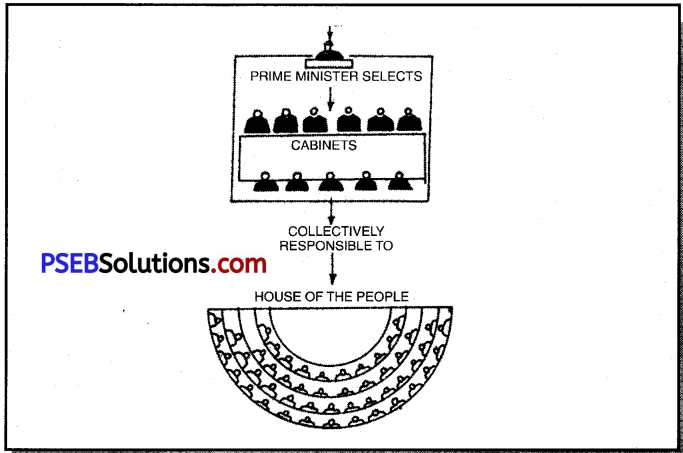
The Constitution of India provides for parliamentary government in the country. At the Centre as well as in the States there is parliamentary government. The President is only the nominal head of the State. He exercises his powers on the advice of the Council of Ministers. It is written in the Constitution that there will be a Council of Ministers headed by the Prime Minister to aid and advise the President. In fact all the powers of the President are actually exercised by the ministers. The Council of Ministers takes decisions and the President can give them a piece of advice. The ministers run the administration according to their sweet will. It is why the parliamentary system of Government is called the Cabinet Government.

Composition:
The only provision made in the constitution for the formation of the Council of Ministers is that the President appoints the Prime Minister and the other ministers are appointed by him with the consultation of the latter. But the fact is that the President does not appoint, the Prime Minister of his own sweet will. Normally the leader of the majority party in the Lok Sabha is made the Prime Minister and all other ministers are appointed by the President on the recommendation of the Prime Minister. The President cannot make any change in the list of ministers.

It is again the Prime Minister who distributes portfolios among the ministers. The ministers are taken out of the members of the legislature. If any outsider is appointed a minister, he must become the member of the legislature within 6 months. In Feb. 1988, Prime Minister Rajiv Gandhi reorganized his Council of Ministers and there were 60 members in the Council of Ministers. In the Constitution, 91st Amendment Act provides that the total number of ministers including the Prime Minister, shall not exceed 15% of the total number of members of the Lok Sabha.
PSEB 11th Class Political Science Solutions Chapter 24 The Union Executive-President, Vice-President, Council of Ministers and Prime Minister 6

In May 2019, there were 57 members in the Council of Ministers. It included 24 cabinet ministers, 24 ministers of state and 9 ministers having independent charge.

Term of Office:
It is written in the Constitution that the ministers will remain in the office during the pleasure of the President, It means that the President can remove the ministers from office whenever he likes. But it is not so. If the majority of the members of the Lok Sabha supports the Council of Ministers, it will continue to remain in office and the President cannot remove it. The ministers remain in office so far as they enjoy the confidence of the members of the Lok Sabha.

Salary:
The Constitution of India lays down that the salaries, allowances, etc. of the ministers shall be decided by the Parliament. The ministers are entitled to a salary, daily allowances and constituency allowances at the same rate as the members of Parliament.

Powers and Functions Of The Cabinet:
The Cabinet is the real ruler of the country. All the executive authority of the President is exercised by the cabinet. Following are the powers and functions of the Cabinet:

1. Determination of National Policy:
The polity of the nation is formulated by the Cabinet. After taking office the Cabinet is to formulate its internal and external policy according to which it is to run the administration of the State. It is the Government which is responsible for internal peace and order, and freedom from external aggression and better living of the people of the country. It has, therefore, to formulate policies in a way that they are helpful for the people of the country at large.

2. Control over Administration:
The administration of the country is to be run by the ministers. Every member of the Council of Ministers has one or more departments under his charge and he has to look after its working and administration. No doubt, it is the civil servants who carry on the administration but this administration has to be within the framework of the policies laid down by the Council of Ministers. Departmental administration has to be run by the civil servants but it is the minister who is responsible for the smooth running of the administration.

3. Foreign Relations:
It is the function of the Cabinet to maintain relations with other countries. These relations are established according to the policies laid down by the Cabinet. The ambassadors to foreign countries are appointed on the advice of the cabinet. The correspondence with other countries is done of course in the name of the President but actually it is the Cabinet who performs this function. It is the Cabinet which enters into treaties with other countries.

4. Legislative Powers: In a Parliamentary Government there is a close relationship between the Cabinet and the legislature. It enjoys many legislative powers.

  1. The ministers are taken from among the members of the Parliament and they have a big share in law-making.
  2. The President convenes the meetings of the Parliament on the advice of the Council of Ministers.
  3. The Cabinet prepares the programme of the session.
  4. The ministers introduce the bills in the House and see them through. Most of the bills in a Parliamentary Government are introduced in the Parliament by the ministers. They explain the policy and the purpose of the bills to the Parliament.
  5. Laws in the Parliament are framed in accordance with the wishes of the Cabinet. As the ministers belong to the majority party so they are sure of the support of the members to their bills.
  6. The President issues ordinances on the advice of the ministers.

5. Financial Powers: The Cabinet enjoys many financial powers:

  1. The budget is prepared by the Finance Minister in consultation with other ministers.
  2. It is the ministers who suggest an increase, decrease or abolition in the taxes. Money bills can only be introduced by the ministers.

6. Appointments:
Important appointments are made only on the advice of the ministers. For example, the appointments of Governors, Ambassadors and members of the Union Public Service Commission are made on the recommendations of the ministers.

7. Administrative Justice:
The ministers also exercise judicial powers. They are to decide many administrative matters. They are to give a decision in administrative matters and decisions of the ministers are final. While deciding cases the ministers have the right to adopt judicial methods like all other courts.

Conclusion:
The above mentioned powers and functions of the Cabinet clearly explain that the administration of the State is run according to the wishes of the Cabinet. It can run the administration in a way it likes. It is rightly said that the ‘Cabinet is the steering wheel of the ship of the State’. It is said that the British Cabinet has become the virtual dictator, the State and the Parliament have become subservient to it.

PSEB 11th Class Political Science Solutions Chapter 24 The Union Executive-President, Vice-President, Council of Ministers and Prime Minister

Question 6.
Distinguish between the Cabinet and the Council of Ministers.
Answer:
There are some differences between the Cabinet and the Council of Ministers. This distinction must be clarified. The Cabinet is a part of the Council of Ministers and the real authority is enjoyed by it.

Council of Ministers:
The Council of Ministers consists of the following types of ministers:
1. Cabinet Ministers:
These are the most important ministers. They control the important departments of administration. They frame policies and decide all other important matters, They are generally 25 to 30 in number. It is these ministers who form the Cabinet. All the powers of the Council of Ministers are exercised according to the wishes of the Cabinet.

2. State Ministers:
The State Ministers also head some departments. But they are not entitled to participate in the meetings of the Cabinet. They can be invited to attend the meetings of the Cabinet when some special issue or the issue concerning their department is to be discussed.

3. Deputy Ministers: The Deputy Ministers are appointed to assist the Cabinet ministers and the State ministers in the performance of their functions. The Deputy Minister is not the head of any department. The Deputy Ministers are appointed almost in each department.

4. Parliament Secretaries:
The Parliamentary Secretaries are not minister and they are not members of the Council of Ministers. Parliamentary Secretaries are not appointed by the President. They are appointed by the Prime Minister. They have no independent powers or functions. They assist the ministers to whom they are attached to do their parliamentary work. They have no control over the administrative departments. They are, infact, probationers under training and may hope to rise to higher ranks if they make good.

5. Deputy Prime Minister:
Neither the Constitution nor any of the Union laws provide for the office of the Deputy Prime Minister. It is the sole discretion of the Prime Minister to bestow the rank and the status of Deputy Prime Minister on any number of members of the Cabinet. Sardar Vallabh Bhai Patel was given the status and rank of Deputy Prime Minister in the Council of Minister headed by Late Pt. Jawaharlal Nehru.

Similarly in the Cabinet headed by Late Mrs. Indira Gandhi, Mr. Morarji Desai was ranked as Deputy Prime Minister of the country. The rank and status’of Deputy Prime Minister was conferred on Sarvashri Charan Singh and Jagjivan Ram in the Council of Ministers headed by Sh. Morarji Desai.

In the Ministery headed by Sh. V.P. Singh, Ch. Devi Lai was sworn in as the Deputy Prime Minister of the country. In June, 2002, Mr. Lai Krishan Adwani sworn in as the Deputy Prime Minister of India in the ministry of Mr. Atal Behari Vajpayee. The office of the Deputy Prime Minister carries neither special responsibilites nor special privileges.

The Council of Ministers consists different types of ministers. Their number is near about 65. But the Cabinet consists of only the Cabinet ministers and all important decisions are taken by them. Whatever decisions are taken by the Cabinet all the ministers are to abide by them. All the members of the Council of Ministers are to carry out those decisions.

PSEB 11th Class Political Science Solutions Chapter 24 The Union Executive-President, Vice-President, Council of Ministers and Prime Minister

Question 7.
What are the main features of the Cabinet System in India?
Answer:
In India the parliamentary system of government has been adopted. The Council of Ministers exercises all the powers of the President. It performs its functions on the basis of the following principles:

1. President a Constitutional Head:
The first important feature of the parliamentary system of government is that the Head of State enjoys only nominal powers. The entire administration of the State is run in the name of the President but in reality it is the Cabinet which is responsible for running the administration of the State. The President takes all the decisions on the advice of the Prime Minister.

The Prime Minister is the head of the government whereas the President is the head of the State. The President cannot participate in the meetings of the Cabinet and he is kept out of the Cabinet. The President appoints the Prime Minister, but he must appoint the leader of the majority party as the Prime Minister of India. He does not interfere in the formation, meetings and the decisions of the Cabinet.

2. Close relationship between the Cabinet and Parliament:
There is a very close relationship between the Cabinet and the Parliament. The Cabinet is formed from among the members of the Parliament. If any outsider is appointed a minister he must become the member of the Parliament within six months otherwise he will have to quit the office.

3. Leadership of the Cabinet:
The Cabinet performs its functions under the control and guidance of the Prime Minister. The appointments of the ministers are made by the President on the advice of the Prime Minister. The Prime Minister presides over the meetings of the Cabinet. He can remove any minister from office. He also co-ordinates the working of the ministry.

4. Political Homogeneity:
The members of the Cabinet hold the same view point because they belong to the same political party. The Cabinet works like a unit. Therefore, all the members of the. Cabinet must agree with one another. If the ministers are taken from different political parties, they will never agree over policy matters because each political party would like to implement its own policy. It is very necessary that the ministers should be taken from the same party so that administration could be run smoothly.

5. Cabinet works as a Team:
The Cabinet works as a team. The members of the Cabinet swim and sink together. They perform their functions in consultation with one another. All the ministers are individually as well as collectively responsibly for their work. No-confidence motion against a particular minister means a no-confidence motion against the entire ministry and the entire ministry is to resign. The resignation of the Prime Minister means the resignation of the entire ministry. All the ministers are to abide by the decisions taken by the Cabinet. All the ministers remain in office or lose office together.

6. Leadership of the Prime Minister:
Indian Cabinet works under the leadership of the Prime Minister. According to Art. 74, there shall be a Council of Ministers with the Prime Minister at its head to aid and advise the President in the exercise of his functions. Ministers are appointed by the President on the advice of the Prime Minister. Portfolios are distributed by the Prime Minister and he has the power to change the portfolios of the ministers.

He presides over the meetings of the Cabinet. In case of disagreement between a minister and the Prime Minister, the minister will have to resign. No person can remain in the Cabinet against the wishes of the Prime Minister. The resignation of the Prime Minister means the resignation of the whole Council of Ministers.

7. Prime Minister’s right to get the Lok Sabha dissolved:
Another feature of the Indian Cabinet system is that the Prime Minister can advise the president to dissolve the Lok Sabha. On Feb. 6, 2004 the President Dr. A.P.J. Adbul Kalam dissolved the Lok Sabha on the advice of the Prime Minister Atal Behari Vajpayee.

8. Secrecy:
Cabinet keeps the proceedings of its meetings absolutely secret. No minister can convey to anybody the decisions taken by the ministry and the discussion which took place while taking the decisions. The decisions can be announced by the concerned minister at the proper time.

9. Ministerial Responsibility:
The ministers cannot exercise their powers in an arbitrary manner. They are responsible for their actions and policies to the legistature. The members of the Parliament can ask them questions and supplementary questions and they are to answer them on the floor of the House. In case, the Parliament loses confidence in the ministers, they will have to resign. The Parliament can indicate its lack of no-confidence over the ministry by passing a no-confidence resolution. Even if the Parliament passes a no-confidence motion against one minister the entire ministry is to resign.

PSEB 11th Class Political Science Solutions Chapter 24 The Union Executive-President, Vice-President, Council of Ministers and Prime Minister

Question 8.
How is the Prime Minister appointed? Discuss his powers and functions.
Or
Discuss the position of the Prime Minister.
Answer:
The Prime Minister is the most important and powerful functionary of the State. He can be called the ruler of the State. The Prime Minister is the head of the Council of Ministers and all the powers of the President are actually exercisd by the Prime Minister. He can rule the country in a way which he thinks the best. He is the architect of the fate of State. The Government can do nothing against his will.

Appointment:
The Prime Minister is appointed by the President but while doing so the President is not having a free hand. Only that person can be appointed to the office of Prime Minister who is the leader of majority party in the Lok Sabha. After the general election the President invites the leader of the party which has gained majority in the Lok Sabha to form the Government.

In Dec. 1984, Mr. Rajiv Gandhi was appointed Prime Minister because he was the leader of the majority party (Congress I) in the Lok Sabha. If no political party gets an absolute majority in the Lok Sabha even then the President is not free to appoint anybody the Prime Minister. Under such circumstances only that person will be invited to form the Government who can seek the co-operation of the majority of members in the Lok Sabha.

After the 17th Lok Sabha election held in April-May, 2019, Sh Narender Modi was appointed as the Prime Minister.
Term of Office. The Prime Minister does not have a fixed tenure of offfice. He remains in office so long as he enjoys the support of the majority party. If the majority of members of the Lok Sabha loses confidence in the Prime Minister, he is to resign the office. On 11th April, 1997 Prime Minister H.D. Deve Gowda resigned because his resolution of vote of confidence was rejected by the majority members of the Lok Sabha.

Salary and Allowances. The Prime Minister gets the same salary and allowances which are paid to members of Parliament. He also receives a constituency allowance like other M.Ps. He is also entitled to free official residence, free travels, medical facilities, etc.

Powers And Functions Of The Prime Minister:
The Prime Minister enjoys vast powers which have made his office very important and powerful. His powers and functions are given as follows:
1. Prime Minisiter and the Cabinet:
The Prime Minister is the maker of the Cabinet. The Cabinet has no existence without the Prime Minister. He can make or unmake a Cabinet. The Cabinet performs all its functions under the control and guidance of the Prime Minister. Therefore, he is called “the keystone of the Cabinet arch” or “shining moon among the stars”. He enjoys the following powers in connection with the Cabinet:

(i) Formation of the Council of Ministers:
His first duty after assuming office is the formation of the Council of Ministers. He prepares a list of ministers according to his sweet will. He has a free hand in the selection of ministers. Nobody can be appointed a minister against the wishes of the Prime Minister. Number of Council of Ministers depends upon him. In the Constitution, 91st Amendment Act provides that the total number of ministers including the Prime Minister, shall not exceed 15% of the total number of members of the Lok Sabha. In May 2019, there were 57 members in the Council of Ministers.

(ii) Distribution of Portfolios:
The Prime Minitser distributes work among the ministers. He decides what department is to be allotted to a particular . minister. He controls the working of the departments of his ministers. If the Prime Minister is not satisfied with the working of a department, he can change the department of that minister. He distributes particular departments to ministers in such a way that they can run the departments quite efficiently. He also co-ordinates the working of different departments.

(iii) Removal of the Minister:
The ministers remain in office during the pleasure of the Prime Minister. If the Prime Minister is not satisfied with the working of a minister or the minister does nto run the department in accordance with wishes of the Prime Minister, he can ask him to quit the office and can appoint someone else in his place. In June, 1978 Prime Minister Morarji Desai asked Home Minister Char an Singh and Mr. Raj Narayan to resign from the cabinet and Mr. Charan Singh and Raj Narayan submitted their resignations.

On 1st August, 1990 the Prime Minitser V.P. Singh sacked his Deputy Prime Minister, Mr. Devi Lai, from the Council of Ministers. On April 20, 1998 Prime Minister Vajpayee sacked Communication Minister Buta Singh because he refused to resign. The Prime Minister can make changes in the Cabinet whenever he likes. With the resignation of the Prime Minister the entire ministry falls.

(iv) Leadership of the Cabinet:
The Prime Minister is the leader of the Cabinet. The Cabinet functions under the conrol of the Prime Minister. He can call the meetings of Cabinet whenever he likes. The Prime Minister prepares the agenda of the meeting as well as controls it. He presides over the Cabinet meetings. All the decisions in Cabinet meetings are taken according to the wishes of the council of ministers.

2. Link between the President and the Cabinet:
The Prime Minister is the link between the President and the Cabinet. It is the duty of the Prime Minister to convey the decisions of the Cabinet to the President. No minister can discuss a particular problem with the President without the permission of the Prime Minister. The President can demand information from the Prime Minister regarding the working of administration. The Cabinet can discuss any issue with the President only through the Prime Minister.

3. Leadership of the Cabinet in the Parliament:
The Prime Minister leads the Cabinet in the Parliament. The ministers answer the questions put to them by the members of the Parliament. Whenever a minister is in difficulty, the Prime Minister helps him. The Prime Minster explains the policy and decisions of the Cabinet to the Parliament. All important statements on behalf of the Cabinet are made by the Prime Minister in the Parliament.

4. Principal adviser of the President:
The Prime Minister is the chief adviser of the President. The President seeks the advice of the Prime Minister in all matters of the state. The Prime Minister informs the President regarding all the decisions taken by the Cabinet. If the President requires any information regarding the administration of any department, he would demand such an information from the Prime Minister.

5. Appointments:
All the important appointments in the State are made.by the Prime Minister. The President makes appointments of the State Governors, Ambassadors and members of the Union Pubilc Service Cmmission only on the advice of the Prime Minister. The President cannot make any such appointment of his own accord.

6. Leader of the Parliament:
The Prime Minister is also the leader of the House. Out of the two Houses the position of Lok Sabha is of great importance and the Prime Minister is the leader of the Lok Sabha. The Parliament always depends upon the policy and guidance of the Prime Minister for facing any problem. All the important decisions in the Parliament are taken according to the wishes of the Prime Minister. He can get any law passed by the parliament because he is the leader of the majority party. He can get the Lok Sabha dissolved.

7. Leader of Nation:
The Prime Minister is also the leader of the nation. The President is the head of the State and the Prime Minister is the head of the Government. Gveneral election means the election of the Prime Minister. Each poiltical party has its leader already and the people vote for the party whose leader they want to see as the Prime Minister of the country. During emergency the people have always high hopes on the Prime Minister and they always act upon his advice. His office has become more important for his being the leader of the nation. He is always supported by public and with the help of the public he can do things which he likes.

Position of the Prime Minister:
An analysis of the powers of the Prime Minister proves that “he is the pivot of the whole system of government.” He occupies a position of exceptional authority. K.T. Shah observed in the Constituent Assembly, “This Constitution concentrates so much power and influence in the hands of the Prime Minister that there is every danger to apprehend that the Prime Minister may become a dictator if he chooses to do so.” N.V. Gadgil, former Governor of Punjab said, “The Prime Minister is invested with formidable power and influence unless he be a genuine democrat by nature, he is very likely to become a dictator.”

In the words of Nehru, ‘The Prime Minister is the linchpin of the government.” While the President is the nominal head, the Prime Minister is the real head. The powers of the President are in reality exercised by the Council of Ministers, But the Prime Minister is the head of the Council of Ministers. Without him, the ministers have no entity. To quote Laski, ‘The Prime Minister is central to the formation of the Council of Ministes, central to its birth and central to its death.” For his appointment, he is not dependent upon the favour of the President.

It is his right to form the Council of Ministers because he commands the confidence of the Lok Sabha. In the words of A.C. Dash, “The Indian Prime Minister like the German Chancellor is superior to the entire Cabinet, for under the Constitution he is declared to be the head of Council of Ministers and all other Ministers are appointed and probably will be dismissed on his advice.” The Prime Minister forms the Cabinet and he is its life breath.

He is the leader of the Parliament and the nation and the principal adviser of the President. The decisions of the Cabinet are virtually the decisions of the Prime Minister. There is hardly any elected functionary in the world comparable to the Prime Minister of India. Backed by a stable and substantial majority in the Lok Sabha, he is more powerful than even the President of the United States of America.

However, the Prime Minister’s supremacy is not due entirely to the powers which belong to his office. Much depends upon his personality. If he is a man of dynamic prsonality he will be able to dominate the political scene. A fickle minded person will never be able to impress. Ideally, the Prime Minister should have a personality which earns him not only the loyalty of his own party but also a measure of considerable respect from the opposition.

Mr. Nehru who held the office of the Prime Minister nearly eighteen years, possessed an unparalleld personality. He was an institution. In the words of Norman D. Palmer, “Important and able men have held ministerial posts but with the exception of Vallabhbhai Patel, who served as Deputy Prime Minister until his death in 1950, no one has really shared Nehru’s authority.” Prime Minister Lai Bahadur Shastri gave his country brilliant leadership in terms of war and peace and gave up his life in quest for peace. He served his country with his life.

He did not possess the external symbols of greatness yet he rose to great heights. Though short in stature there was more iron in his soul than appeared on the surface. The manner in which Morarji Desai was relieved of the Finance Department by Prime Minister Indira Gandhi, highlights the fact that not even the ‘tallest’ among the Prime Minister’s colleagues can measure upto the stature of the Prime Minister. After the election of 1971 and 1980, Prime Minister Indira Gandhi was considered the source of all power. According to Ashok Mehta, “Our Cabinet form of Government has come to a near Presidential regime.”

According to Frank Morris, “Mrs. Gandhi was not only the undisputed leader of the Congress Party, but it was her party and she could dominate it in a way which none else had done. She was free to choose her colleagues who were her agents or assistants and in her presence trembled and obeyed.” In the words of Greame C. Moodie, “For many the Prime Minister is the part of the government and at times, may become the personification of the political nation.” Mr. Rajiv Gandhi was very powerful because like Mrs. Indira Gandhi he was also the president of the Congress (I).

The position of the Prime Minister also depends upon the support of his party. Without his party he is nothing. He must maintain close contact with party opinion. His aloofness, reserve and indifference militates against sound leadership. He must rely on co-operation, not coercion. He is to lead the party and not drive it. The manner in which Pt. Nehru had to bow before the party demand on the removal of Mr. Krishna Menon in 1962 proves that there are limits beyond which the Prime Minister cannot carry the party.

To conclude, powerful as he may be, no particular Prime Minister is indispensable, irremovable, or omnipotent. “He is not Caesar, he is not an unchangeable oracle, his views are not dooms; he is always on suffrance and its germs are whether he can render indubitably useful services. At any time a rival may supplant him.” The essence of the powers of the Prime Minister lies in a united Cabinet, a united Parliament and united people.

PSEB 11th Class Political Science Solutions Chapter 24 The Union Executive-President, Vice-President, Council of Ministers and Prime Minister

Short Answer Type Questions 

Question 1.
How is the President of India elected?
Answer:
The President is the head of the state. He is elected indirectly by an electoral college. Elected members of both the Houses of Parliament and elected members of legislative assemblies of the States constitute the electoral college. The nominated members of the Parliament and the assemblies do not take part in the election. The voting is held on’ the basis of proportional representation by the single transferable vote system. Only an Indian citizen, who has attained the age of 35 years, and whose name has been proposed and seconded by a definite number of the electors, can contest election.

Question 2.
Explain in brief the composition of the Electoral College constituted for the election of the President.
Answer:
According to Article 54 of Indian Constitution, the President shall be elected indirectly by an electoral college consisting of the elected members of the union and state legislatures in accordance with the principle of proportional representation with single transferable vote system.

Question 3.
Describe the formula by which the value of the vote of the members of State Legislative Assembly is determined.
Answer:
Article 55 (4) of the Constitution lays down the procedure of determining the votes of the members of the State Assembly, which is as follows:

PSEB 11th Class Political Science Solutions Chapter 24 The Union Executive-President, Vice-President, Council of Ministers and Prime Minister 7
If the remainder is less than 500, it is ignored.
If it is more than 500, then the vote of each member shall be further increased by one.

PSEB 11th Class Political Science Solutions Chapter 24 The Union Executive-President, Vice-President, Council of Ministers and Prime Minister

Question 4.
Describe the procedure of determining the value of votes of the members of the Parliament.
Answer:
The constitution lays down the following procedure of determining the votes of the members of Parliament.

PSEB 11th Class Political Science Solutions Chapter 24 The Union Executive-President, Vice-President, Council of Ministers and Prime Minister 8
Fraction exceeding one-half being counted as one.

Question 5.
Describe the tenure of the President.
Or
Discuss in brief the removal of the President.
Answer:
The President is elected for a period of five years. But he can be removed from his office before the expiry date. The President can be removed from office by impeachment only. The Constitution lays down a detailed procedure for the impeachment of the President. He can be impeached “for violation of the Constitution.” When a President is to be impeached for the violation of the Constitution, the charges can be prepared by either House of the Parliament.

But no such charge is to be preferred unless the proposal to prefer such a charge is contained in a resolution which has been moved after at least 14 days notice in writing signed by not less than one-fourth of the total number of members of the House. The resolution must be passed by a two-thirds majority of the total number of members of the House. If passed by the requisite majority in one house, it is sent to the other House for investigation. If the other House also passes the resolution by a two- thirds majority of the total membership of this House, then it means the charge is proved and the President is removed from his office.

Question 6.
Describe the method of fixing the quota for the election of the President.
Answer:
Under the system of Proportional Representation, a candidate to be elected must secure the necessary quota of votes. The quota is determined by the following formula:

PSEB 11th Class Political Science Solutions Chapter 24 The Union Executive-President, Vice-President, Council of Ministers and Prime Minister 9
Suppose the total number of valid votes polled at the Presidential election is 8,00,000. Applying the above-mentioned formula, the quota shall be
\(\frac {8,00,000}{1+1}\) +1 = 4,00,001

PSEB 11th Class Political Science Solutions Chapter 24 The Union Executive-President, Vice-President, Council of Ministers and Prime Minister

Question 7.
Describe the salary and allowances of the President.
Answer:
The President of India gets a salary of Rs. 5,00,000 per month and an official residence (called Rashtrapati Bhavan in New Delhi) free of rent. In addition to the salary, the President also gets handsome allowances of various kinds as determined by Parliament. According to the President’s Pension Act, a person who ceases to hold office as President, either by expiration of his term of office or by resignation, is entitled to a monthly pension of Rs. 2,50,000. The Government may also allow him a free medical aid as was done in the case of Dr. Rajendra Prasad.

The salary and other allowances of the President are charged on the Consolidated Fund of India. According to Art. 59 (4), the emoluments and allowances of the President shall not be diminished during his term of office.

Question 8.
Describe any four executive powers of the President.
Answer:
Following are the executive powers of the President:

  1. All executive functions of the Union (central) government are performed in the name of the President.
  2. He appoints the Governors, Chief Justice and other judges of the Supreme Court and the High Courts.
  3. He appoints the Attorney General of India and the members and Chairman of the Union Public Service Commission.
  4. He is the supreme commander of the armed forces.

Question 9.
Mention four legislative powers of the President.
Answer:
Following are the legislative powers of the President:

  1. He can address both the Houses of the Parliament and can send messages to either house at any time.
  2. He can summon any House of the Parliament at any time.
  3. He can dissolve the Lok Sabha.
  4. He nominates two members of the Anglo-Indian community to the Lok Sabha.

PSEB 11th Class Political Science Solutions Chapter 24 The Union Executive-President, Vice-President, Council of Ministers and Prime Minister

Question 10.
Describe financial powers of the President.
Answer:

  1. It is the duty of the President to place the Budget for the current year before the Parliament. It is to be presented before the beginning of the financial year. Normally the budget is presented to the Parliament by the
  2. Finance Minister on behalf of the President.
  3. Money Bill can only be introduced in the Parliament on the recommendation of the President.
  4. The President has full control over the contingency fund and he can spend it according to his sweet will. He distributes the share of income tax among the States.

Question 11.
Describe judicial powers of the President.
Answer:
The President has some judicial powers also. It is provided by Article 122 of the Constitution.

  • The President appoints the judges and the chief justices to the Supreme Court and the State High Courts.
  • The President cannot be sued in any court of India in connection with any matter concerning his office.
  • He has power to pardon, reprieve and commute punishment.
  • The President can seek the advice of the supreme court of India over any legal matter or a bill of Republic Importance.

Question 12.
What do you know about the emergency powers of the President?
Ans.
The President can declare emergency in three special circumstances :
1. If the President thinks that the security of the country is threatened by a war or external aggression or armed rebellion threatening the integrity of India, he can declare an emergency for the whole of India or any part of it. But the advice should come from the Council of Ministers in writing.

2. In case of the failure of the constitutional machinery in a state or states, the President can take over the entire work of the executive and dissolve or suspend the state assembly.

3. If the President thinks that there is an economic situation in which the financial stability or the credit of India is threatened, he can declare a financial emergency.

PSEB 11th Class Political Science Solutions Chapter 24 The Union Executive-President, Vice-President, Council of Ministers and Prime Minister

Question 13.
Discuss about the power of the President to issue an ordinance.
Answer:
During the intervals of the sessions of the Parliament he can issue ordinance. These ordinances have the force of laws. The ordinance is put before the Parliament as soon as it meets. The Parliament has the authority to reject the ordinance. It can be withdrawn by the President also. If it is neither rejected by the Parliament nor withdrawn by the President, it will automatically end six weeks after the first meeting of the Parliament.

Question 14.
Discuss in brief about various emergencies provided in the Constitution of India.
Answer:
There are three types of emergencies provided into the Constitution of India. These are:

  • National Emergency (Article 352) or Emergency arising out of external aggression or armed rebellion.
  • Emergency arising out of the failure of constitutional machinery in a state (Art. 356).
  • Financial Emergency (Art. 360).

Question 15.
What do you understand by National Emergency?
Answer:
According to Art. 352, if the President is satisfied that a grave emergency exists whereby the security of India or any part of India is threatened by war, external aggression or armed rebellion, he may proclaim a state of emergency. But the President can declare such type of emergency if the cabinet decision that such a proclamation may be made has been communicated to him in writing.

PSEB 11th Class Political Science Solutions Chapter 24 The Union Executive-President, Vice-President, Council of Ministers and Prime Minister

Question 16.
Under which condition the Constitutional Emergency is imposed?
Answer:
According to article 356, if the President, either on the receipt of a report from the Governor of a State or otherwise, is satisfied that a situation has arisen in which the Government of the State cannot be carried on in accordance with the provisions of the Constitution, the President can proclaim emergency in that state.

Question 17.
What is the Financial Emergency?
Answer:
According to Article 360, if the President is satisfied that a situation has arisen whereby the financial stability or credit of India or any part of it is threatened, he may declare a Financial Emergency under Article 360 of the constitution. Such a Proclamation may be revoked by a subsequent Proclamation. The Proclamation has to be laid before each House of-Parliament.

It ceases to operate at the expiration of two months unless it is approved earlier by a resolution of both the Houses of Parliament. The Proclamation in this cases should also be approved by Parliament as in the other two cases of emergency. Like the Proclamation of war-emergency, Financial Emergency also continues for an indefinite period. Fortunately, this kind of Emergency has not been declared, so far.

Question 18.
Describe any four points of criticism against the emergency powers of the President.
Answer:
Different persons criticised the emergency powers of the President on different grounds. Following are the points of criticisms against the emergency powers of the President:’

  • Possibility of misuse of emergency powers.
  • Emergency powers are undemocratic.
  • Emergency proclamation is beyond judicial control.
  • Emergency powers can crush the rights and liberties of the individuals.

Question 19.
Describe the justification of emergency powers.
Answer:

  • Historical experiences reveal that emergency powers are necessary to face national crisis.
  • National security is more important than that of the individual liberty.
  • It is the responsibility of the centre to maintain the unity and integrity of the nation.
  • President is a constitutional head.

PSEB 11th Class Political Science Solutions Chapter 24 The Union Executive-President, Vice-President, Council of Ministers and Prime Minister

Question 20.
Is it possible for the President of India to be a dictator?
Answer:
Emergency powers of the President indicate that he can be a dictator. But it is not possible for the President to become a dictator because:

  1. In India there exists a Parliamentary form of Government. In this system the President is a constitutional head and his role is nominal.
  2. According to 44th Amendment an Emergency can be proclaimed only on the basis of written advice tendered by the cabinet and the advice of the council of ministers is binding on the President.
  3. If President tries to misuse his powers, he can be removed by impeachment.
  4. President’s rule can’t be imposed at the Centre level.

Question 21.
Describe the election method of the Vice-President of India.
Answer:
The Vice-President of India is elected by an electoral college consisting of the members of both Houses of Parliament in accordance with the system of proportional representation by means of the single transferable vote and the voting at such election shall be by secret ballot. The two Houses need not sit together for this purpose.

It is significant to note that in the election of the Vice-President the nominated members of both the Houses have the right to vote while in the election of the President only the elected members of Parliament are eligible to vote.

PSEB 11th Class Political Science Solutions Chapter 24 The Union Executive-President, Vice-President, Council of Ministers and Prime Minister

Question 22.
Describe in brief the functions of the Vice-President.
Answer:
The duties of the Vice-President are two-fold:1. He is the ex-officio Chairman of the Rajya Sabha and 2. he acts for the President when the office of the President is vacant. Even when the President is ill or otherwise unable to perform the duties of his office, the Vice-President acts for him.

As Vice-President. In the absence of the President or during casual vacancy in the office of the President, the Vice-President shall perform all the functions of the President. If the President is unable to discharge his functions owing to absence, illness or any other cause, the Vice-President will discharge his functions until the date on which the President resumes his duties.

As Chairman of Rajya Sabha. The Vice-president is the ex-officio Chairman of Rajya Sabha, that means that by being the Vice-President of the country, he is the Chairman of the Rajya Sabha. He is to perform various functions in his capacity as the Chairman of the Rajya Sabha and they are given as follows:

  • He presides over the meetings of the Rajya Sabha.
  • He maintains decorum and decency in the House.
  • He allots time to the members to speak.

Question 23.
Describe any four qualifications to become a member of Union Council of Ministers.
Answer:

  • He must be a citizen of India.
  • He must not hold any office of profit under the Government of India or the Government of any State.
  • He must possess such other qualifications as may be prescribed by the Parliament.
  • No person can be a member of both Houses of Parliament. In case he becomes, he must vacate one of the two seats. Likewise, one person cannot be a member of a House of Parliament and of a State Legislature simultaneously.

Question 24.
How is the Council of Ministers at the centre formed?
Answer:
After the general elections the various parties in the Parliament elect their leaders. The President invites the leader of the majority party and appoints him the Prime Minister. The Prime Minister selects other ministers and sends their names to the President. The President appoints them as ministers. He cannot make any change in the list given to him by the Prime Minister. It might happen that no party has a majority in the Lok Sabha. In such a situation the President invites the leader of the coalition of many parties and appoints him Prime Minister.

The Prime Minister and other ministers have to take oath of loyalty to the Constitution before they assume office.

PSEB 11th Class Political Science Solutions Chapter 24 The Union Executive-President, Vice-President, Council of Ministers and Prime Minister

Question 25.
Give four features of the Cabinet System in India.
Ans.
1. Nominal Head of the State:
The first important feature of the Cabinet system in India is that the President enjoys only nominal powers. The President is a constitutional head of the State.

2. Close Relations Between the Executive and the Legislature:
There is a close relationship between the Cabinet and the Parliament. All the ministers are members of one or the other house of Parliament. They attend the meetings of Parliament, participate in debates and move the bills in the Parliament.

3. Leadership of the Prime Minister:
The Cabinet works under the control and guidance of the Prime Minister. He is the head of the Council of Ministers. He presides over the meetings of the Cabinet and determines the agenda of the meetings.

4. Collective Responsibility:
The Indian Cabinet is responsible to the Lok Sabha. It remains in office so long as it enjoys the confidence of the Lok Sabha. The moment it loses the majority of the members in the house, it has to quit office.

Question 26.
Distinguish between the Cabinet and the Council of Ministers.
Ans.

  1. In the Constitution the words ‘Council of Ministers’ are used and not the word ‘Cabinet’.
  2. The Cabinet is a part of the Council of Ministers. The Council of Ministers consist of all types of ministers. Their number is about 70. But the cabinet consists of only the cabinet ministers. The cabinet consists of about 25 members.
  3. Cabinet is more important than the Council of Ministers. All decisions of the cabinet are to be carried out by the members of the Council of Ministers.
  4. The cabinet ministers get higher salaries than other ministers.

Question 27.
Discuss various types of Ministers in Union Council of Ministers.
Answer:
The Council of Ministers consists of all the ministers. There are four categories of ministers in-India :
1. Cabinet Ministers:
These are the most important ministers. They control the important departments of administration. They frame policies and decide all other important matters. They are generally 20 to 25 in number. It is these ministers who form the Cabinet. All the powers of the Council of Ministers are exercised according to the wishes of the Cabinet.

2. State Ministers:
The state ministers are also head of some departments. But they are not entitled to participate in the meetings of the Cabinet. They can be invited to attend the meetings of the Cabinet when some special issue or the issue concerning their departments is to be discussed.

3. Deputy Ministers:
The Deputy Ministers are appointed to assist the Cabinet ministers and the State ministers in the performance of their functions. A Deputy Minister is not the head of any department. The Deputy Ministers are appointed almost in each department.

4. Parliament Secretaries: Parliament Secretaries are appointed to assist the ministers in the Parliament. They are not the ministers.

PSEB 11th Class Political Science Solutions Chapter 24 The Union Executive-President, Vice-President, Council of Ministers and Prime Minister

Question 28.
Discuss any four functions of Council of Ministers.
Ans.
1. Determination of National Policy:
The policy of the Nation is formulated by the Cabinet. After taking office, the Cabinet is to formulate its internal and external policy according to which it is to run the administration of the State.

2. Control over Administration:
The administration of the country is to be run by the ministers. Every member of the Council of Ministers has one or more departments under his charge and he has to look after its working and administration.

3. Foreign Relations:
It is the function of the Cabinet to maintain relations with other countries. These relations are established according to the policies laid down by the Cabinet.

4. Cabinet give a decision in administrative matters.

Question 29.
How is the Prime Minister of India appointed?
Answer:
The President appoints the Prime Minister. He invites the leader of the majority party in the Lok Sabha and appoints him the Prime Minister. If no single party has a majority, many parties may form a coalition to make a majority and elect a leader. Then the leader of the coalition will be appointed as the Prime Minister. After 17th Lok Sabha election in April-May 2019, President appointed Sh. Narender Modi, leader of the National Democratic Alliance as Prime Minister.

Question 30.
What are the functions of Prime Minister?
Answer:
The Prime Minister enjoys vast powers which have made his office very important and powerful. His powers and functions are as ahead:

  1. The first function of the Prime Minister is the formation of Council of Ministers. He has a free hand in the selection of ministers. Number of Council of Ministers depends upon him.
  2. The Prime Minister distributes portfolios among the ministers.
  3. The ministers remain in office during the pleasure of the Prime Minister. The Prime Minister can make changes in the Council of Ministers whenever he likes.
  4. Prime Minister is the leader of the Cabinet. The Cabinet functions under the control of the Prime Minister.

Question 31.
Write down the names of present President, Vice-President and Prime Minister of India.
Answer:
Name of Post – Name of Person

  • President – Sh. Ram Nath Kovind
  • Vice President – Sh. Venkaiah Naidu
  • Prime Minister – Sh. Narendra Modi

PSEB 11th Class Political Science Solutions Chapter 24 The Union Executive-President, Vice-President, Council of Ministers and Prime Minister

Question 32.
Write down the salary of President and Vice-President.
Answer:
Name of Post – Salary (Monthly)

  • President – Rs. 5,00,000
  • Vice-President – Rs. 4,00,000

Very Short Type Questions

Question 1.
How is the President of India elected?
Answer:
The President is elected indirectly by an electoral college. Elected members of both the Houses of Parliament and elected members of legislative assemblies of the States constitute the electoral college. The voting is held on the basis of proportional representation by the single transferable vote system.

Question 2.
Describe the tenure of the President.
Answer:
The President is elected for a period of five years. But he can be removed from his office before the expiry date. The President can be removed from office by impeachment only. The Constitution lays down a detailed procedure for the impeachment of the President. He can be impeached “for violation of the Constitution.”

Question 3.
Describe the salary and allowances of the President.
Answer:
The President of India gets a salary of Rs. 5,00,000 per month. According to the President’s Pension Act, a person who ceases to hold office as President, either by expiration of his term of office or by resignation, is entitled to a monthly pension of Rs. 2,50,000.

PSEB 11th Class Political Science Solutions Chapter 24 The Union Executive-President, Vice-President, Council of Ministers and Prime Minister

Question 4.
Write any two privileges of the President.
Answer:

  • The President of India is not answerable to any court for the exercise of his constitutional rights and powers.
  • No criminal proceeding can be launched against him during his term.

Question 5.
Describe any two executive powers of the President.
Answer:
Following are the executive powers of the President:

  • All executive functions of the Union (central) government are performed in the name of the President.
  • He appoints the Governors, Chief Justice and other judges of the Supreme Court and the High Courts.

Question 6.
Mention two legislative powers of the President.
Answer:
Following are the legislative powers of the President:

  • He can address both the Houses of the Parliament and can send messages to either house at any time.
  • He can summon any House of the Parliament at any time.

Question 7.
Explain financial powers of the President.
Answer:

  • It is the duty of the President to place the Budget for the current year before the Parliament. It is to be presented before the beginning of the financial year. Normally the budget is presented to the Parliament by the
  • Finance Minister on behalf of the President.
  • Money Bill can only be introduced in the Parliament on the recommendation of the President.

Question 8.
Describe judicial powers of the President.
Answer:
The President has some judicial powers also. It is provided by Article 122 of the Constitution.

  • The President appoints the judges and . the chief justices to the Supreme Court and the State High Courts.
  • The President cannot be sued in any court of India in connection with any matter concerning his office.

PSEB 11th Class Political Science Solutions Chapter 24 The Union Executive-President, Vice-President, Council of Ministers and Prime Minister

Question 9.
Discuss in brief about various emergencies provided in the Constitution of India.
Answer:
There are three types of emergencies provided into the Constitution of India. These are:

  • National Emergency (Article 352) or Emergency arising out of external aggression or armed rebellion.
  • Emergency arising out of the failure of constitutional machinery in a state (Art. 356).
  • Financial Emergency (Art. 360).

Question 10.
What do you understand by National Emergency?
Answer:
According to Art. 352, if the President is satisfied that a grave emergency exists whereby the security of India or any part of India is threatened by war, external aggression or armed rebellion, he may proclaim a state of emergency.

Question 11.
Under which condition the Constitutional Emergency is imposed?
Answer:
According to article 356, if the President, either on the receipt of a report from the Governor of a State or otherwise, is satisfied that a situation has arisen in which the Government of the State cannot b,e carried on in accordance with the provisions of the Constitution, the President can proclaim emergency in that state.

Question 12.
What is the Financial Emergency?
Answer:
According to Article 360, if the President is satisfied that a situation has arisen whereby the financial stability or credit of India or any part of it is threatened, he may declare a Financial Emergency under Article 360 of the constitution. Such a Proclamation may be revoked by a subsequent Proclamation.

PSEB 11th Class Political Science Solutions Chapter 24 The Union Executive-President, Vice-President, Council of Ministers and Prime Minister

Question 13.
Explain any two points of criticism against the emergency powers of the President.
Answer:
Different persons criticised the emergency powers of the President on different grounds. Following are the points of criticisms against the emergency powers of the President:

  • Possibility of misuse of emergency powers.
  • Emergency powers are undemocratic.

Question 14.
Describe the justification of emergency powers.
Answer:

  • Historical experiences reveal that emergency powers are necessary to face national crisis.
  • National security is more important than that of the individual liberty.

Question 15.
Is it possible for the President of India to be a dictator?
Answer:
It is not possible for the President to become a dictator because:

  1. In India there exists a Parliamentary form of Government. In this system the President is a constitutional head and his role is nominal.
  2. According to 44th Amendment an Emergency can be proclaimed only on the basis of written advice tendered by the cabinet and the advice of the council of ministers is binding on the President.

Question 16.
Describe the election method of the Vice-President of India.
Answer:
The Vice-President of India is elected by an electoral college consisting of the members of both Houses of Parliament in accordance with the system of proportional representation by means of the single transferable vote and the voting at such election shall be by secret ballot. The two Houses need not sit together for this purpose.

PSEB 11th Class Political Science Solutions Chapter 24 The Union Executive-President, Vice-President, Council of Ministers and Prime Minister

Question 17.
Describe the term of the Vice-President.
Answer:
The Vice-President is elected for a term of five years. The period of five years starts from the date on which he enters his office. He is eligible for re-election. The Vice¬President may resign his office by writing to the President before the expiry of five years. Vice-President can be removed from office by impeachment.

Question 18.
Describe about the salary of the Vice-President.
Answer:
The Vice-President is the ex-officio Chairman of the Rajya Sabha and he receives a salary of Rs. 4,00,000 per month. When the Vice-President acts as President, he has all the privileges, powers and immunities of the President. After retirement Vice-President is entitled to a monthly pension of Rs. 2,00,000.

Question 19.
Describe in brief the functions of the Vice-President.
Answer:
The duties of the Vice-President are two-fold:

  1. He is the ex-officio Chairman of the Rajya Sabha and
  2. he acts for the President when the office of the President is vacant. Even when the President is ill or otherwise unable to perform the duties of his office, the Vice-President acts for him.

Question 20.
Discuss any two qualifications to become a member of Union Council of Ministers.
Answer:

  • He must be a citizen of India.
  • He must not hold any office of profit under the Government of India or the Government of any State.

PSEB 11th Class Political Science Solutions Chapter 24 The Union Executive-President, Vice-President, Council of Ministers and Prime Minister

Question 21.
How is the Council of Ministers at the centre formed?
Answer:
After the general elections the various parties in the Parliament elect their leaders. The President invites the leader of the majority party and appoints him the Prime Minister. The Prime Minister selects other ministers and sends their names to the President. The President appoints them as ministers.

Question 22.
Give two features of the Cabinet System in India.
Answer:

  1. Nominal Head of the State: The first important feature of the Cabinet system in India is that the President enjoys only nominal powers. The President is a constitutional head of the State.
  2. Close Relations Between the Executive and the Legislature: There is a close relationship between the Cabinet and the Parliament.

Question 23.
Distinguish between the Cabinet and the Council of Ministers.
Answer:

  • In the Constitution the words ‘Council of Ministers’ are used and not the word ‘Cabinet’.
  • The Cabinet is a part of the Council of Ministers. The Council of Ministers consist of all types of ministers. Their number is about 70. But the cabinet consists of only the cabinet ministers. The cabinet consists of about 25 members.

Question 24.
Mention any two functions of Council of Ministers.
Answer:

  1. Determination of National Policy: The pohcy of the Nation is formulated by the Cabinet. After taking office, the Cabinet is to formulate its internal and external pohcy according to which it is to run the administration of the State.
  2. Control over Administration: The administration of the country is to be run by the ministers. Every member of the Council of Ministers has one or more departments under his charge and he has to look after its working and administration.

Question 25.
How is the Prime Minister of India appointed?
Answer:
The President appoints the Prime Minister. He invites the leader of the majority party in the Lok Sabha and appoints him the Prime Minister. If no single party has a majority, many parties may form a coalition to make a majority and elect a leader. Then the leader of the coalition will be appointed as the Prime Minister.

Question 26.
What are the functions of Prime Minister?
Answer:
The Prime Minister enjoys vast powers which have made his office very important and powerful. His powers and functions are as follows:

  • The first function of the Prime Minister is the formation of Council of Ministers. He has a free hand in the selection of ministers. Number of Council of Ministers depends upon him.
  • The Prime Minister distributes portfolios among the ministers.

PSEB 11th Class Political Science Solutions Chapter 24 The Union Executive-President, Vice-President, Council of Ministers and Prime Minister

One Word to One Sentence Answer Type Questions

Question 1.
What is the term of the Prime Minister?
Answer:
The Prime Minister does not have a fixed tenure of office. He remains in office so long as he enjoys .the support of the majority party.

Question 2.
Mention any one power of the Prime Minister.
Answer:
The first and significant duty o$ the Prime Minister is the formation of the Council of Ministers.

Question 3.
Who is the leader of the Cabinet?
Answer:
The Prime Minister is the leader of the Cabinet.

Question 4.
Who was the first Prime Minister of India?
Answer:
Pt. Jawahar Lal Nehru was the first Prime Minister of India.

Question 5.
Who is the link between the Council of Ministers and the President? Answer:The Prime Minister is the link between the Council of Ministers and the President.

PSEB 11th Class Political Science Solutions Chapter 24 The Union Executive-President, Vice-President, Council of Ministers and Prime Minister

Fill in the blanks

1. The …………… of India is head of the state.
Answer:
President

2. Minimum age needed for the President is …………… .
Answer:
35 years

3. The term of office of the Indian President is …………… .
Answer:
Five years

4. Sh …………… appointed Prime Minister after 17th Lok Sabha.
Answer:
Narendra Modi.

PSEB 11th Class Political Science Solutions Chapter 24 The Union Executive-President, Vice-President, Council of Ministers and Prime Minister

True or False statement

1. President is the head of the state.
Answer:
True.

2. Prime Minister is the head of the state.
Answer:
False

3. The tenure of the Cabinet is 10 years.
Answer:
False

4. Prime Minister form the Council of Minsters.
Answer:
True.

5. Prime Minister is the Chief Co-ordinator in the Cabinet.
Answer:
True.

PSEB 11th Class Political Science Solutions Chapter 24 The Union Executive-President, Vice-President, Council of Ministers and Prime Minister

Choose The Correct Answer

Question 1.
Who will administer the oath of office to the person who is to take over as President?
(A) Chief Justice of High Court
(B) Vice-President
(C) Chief Justice of India
(D) Speaker.
Answer:
(C) Chief Justice of India

Question 2.
The Cabinet is responsible to the
(A) Prime Minister
(B) President
(C) Parliament
(D) Speaker.
Answer:
(C) Parliament

Question 3.
The Prime Minister is appointed by the:
(A) President
(B) Parliament
(C) Cabinet
(D) Supreme Court.
Answer:
(A) President

PSEB 11th Class Political Science Solutions Chapter 24 The Union Executive-President, Vice-President, Council of Ministers and Prime Minister

Question 4.
The President of India is elected by:
(A) The Parliament
(B) The Assemblies
(C) The People
(D) The Electoral College.
Answer:
(D) The Electoral College.

Question 5.
The term of office of the Indian President is:
(A) 3 years
(B) 5 years
(C) 2 years
(D) 4 years.
Answer:
(B) 5 years

Question 6.
Minimum age needed for president is:
(A) 25 years
(B) 30 years
(C) 21 years
(D) 35 years.
Answer:
(D) 35 years.

PSEB 11th Class Political Science Solutions Chapter 24 The Union Executive-President, Vice-President, Council of Ministers and Prime Minister

Question 7.
The tenure of the Prime Minister is:
(A) 5 yeafrs
(B) 6 years
(C) 4 years
(D) Not fixed.
Answer:
(D) Not fixed.

Question 8.
The Prime Minister presides over:
(A) Lok Sabha
(B) Rajya Sabha
(C) Cabinet
(D) Parliament.
Answer:
(C) Cabinet


PSEB 11th Class Political Science Solutions Chapter 17 Preamble to the Indian Constitution

Punjab State Board PSEB 11th Class Political Science Book Solutions Chapter 17 Preamble to the Indian Constitution Textbook Exercise Questions and Answers.

PSEB Solutions for Class 11 Political Science Chapter 17 Preamble to the Indian Constitution

Long Answer Type Questions

Question 1.
Write a critical note on the Preamble to the Indian Constitution.
Or
What are the guiding principles mentioned in the Preamble to the Indian Constitution? Discuss briefly.
Or
India is a Sovereign, Socialist, Secular, Democratic Republic. Explain.
Answer:
It has been considered essential, and advisable also, that every written Constitution should have a preamble. The preamble to a Constitution mirrors the spirit of Constitution. The Indian Constitution also begins with a preamble. Strictly speaking, the preamble does not constitute a part of the Constitution. That does not, however, mitigate its importance. The Preamble serves the purpose of a window through which we peep into the intentions of the makers of the Constitution.

In short, the preamble is a summary of the objectives and the basic philosophy of a Constitution. It helps in the interpretation of the Constitution. Commenting upon its significance former Chief Justice Subba Rao of the Supreme Court said, ‘The objective sought to be achieved by the constitution is declared in sonorous terms in the preamble. It contains, in a nutshell, its ideals and its aspirations. The preamble is not a platitude but the mode of its realisation as worked out in detail in the Constitution.” Thus, the preamble to the Indian Constitution helps us in understanding the basic philosophy of the Indian Constitution.

The preamble serves another purpose. It enables the people to assess and evaluate the preformance of the Government in the light of the objectives laid down in the Preamble. Any Government, which slacks down or becomes indifferent towards the fulfilment of the aspirations incorporated in the preamble runs the risk of being ousted from office. It keeps the Government thus on its toes.

Preamble to the Indian Constitution:
The Constitution of India begins with the preamble. It runs as under:
“We, the people of India, having solemnly resolved to constitute India into a Sovereign, Socialist, Secular, Democratic, Republic and to secure to all its citizens:

  • JUSTICE, social, economic and political
  • LIBERTY of thought, expression, belief, faith and worship
  • EQUALITY of status and of opportunity ; and to promote among them all
  • FRATERNITY assuming the dignity of the individual and the unity and integrity of the Nation

In our Constituent Assembly, this twenty-sixth day of November, 1949, do hereby adopt, enact and give to ourselves this Constitution”: Amendment to the Preamble. The forty-second Amendment put into force with effect from 18th December, 1976, amended the Preamble to include the words “Socialist and Secular.” So, in its amended form the preamble declares India to be a Sovereign, Socialist, Secular, Democratic and Republic. The addition of these two new adjectives has transformed the very character and spirit of the Constitution.
For the words “Unity of the Nation” the words “Unity and Integrity of the Nation” are substituted.

Significance:
In the words of M.V. Pylee, “The preamble to the constitution is one of the best of its kind ever drafted. Both in ideas and ideals and in expression it is unrivalled. It embodies the spirit of the constitution, the determination of Indian people to unite themselves in a common adventure of building up a new and independent nation which will ensure the triumph of Justice, equality and fraternity.” The Preamble to the Constitution throws light on three very important matters:
1. The source of authority,
2. the nature of the Indian polity and
3. the objectives of the Constitution.

1. Source of Constitutional Authority:
The Preamble expresses in a very clear language that people are the ultimate source of all authority. It is the people who have adopted and enacted the Constitution; it is the people who have given this Constitution to themselves.” Though the Indian Constitution does not contain any independent Article (The Constitution of Ireland by Art. 6 and the Tenth Amendment of the American Constitution) declaring that all authority flows from the people, yet the Preamble emphasises the ultimate sovereignty of the people.

In other words, the Constitution of India which came into effect on Jan. 26, 1950, has not been imposed upon us. The people of India in their sovereign capacity have adopted the Constitution for themselves. They have framed a Constitution which fulfils the aims and aspirations of the people. “The Constitution is for the people, the people are not for the Constitution.” Some critics, however, challenge the view that the Constitution has been framed by the people themselves.

They argue that the Constituent Assembly which framed this Constitution was not a truly representative body as it was not elected on the basis of universal adult franchise. Nor was it elected directly by the people. Moreover, the draft of Constitution was not referred to the people for their acceptance or rejection. However, we do not agree with the critics. After all the first and subsequent general elections have been held on the basis of direct and universal adult franchise. Had the representatives of the people no faith in the Constitution they would have surely changed it. Thus, the unmistakable implication is that the people are the ultimate source of all authority. The Constitution originates from the people of India and is promulgated in the name of the people of India.

2. Nature of Indian Polity:
In the second place, the Preamble proclaims that the people of India have resolved to constitute India into a‘Sovereign Socialist Secular Democratic Republic. These are few features of the Indian Political System.
(i) India is a Sovereign State.
(ii) India is a Socialist State.
(iii) India is a Secular State.
(iv) India is a Democratic State.
(v) India is a Republican State.

(i) India is a Sovereign State:
It means that now, after the promulgation of the Constitution, India is not subject to any foreign rule. India is now a . sovereign State, internally as well as externally. No other country can compel India to follow or not to follow a particular policy. We can now make any law, remaining of course within the limits imposed by our own Constitution.

We can also amend our Constitution in accordance with the procedure laid down in the Constitution. Some people are of the view that sovereignty is not absolute because of India’s membership of the Commonwealth of Nations. This, however, is not correct. India is a member of the Commonwealth of Nations according to her own free will. There is no constitutional binding. Commonwealth of Nations is not a super state.

Pt. Jawahar Lai Nehru said on 10th May, 1949, “It must be remarked that the Commonwealth is not a super-state in any sense of the term. We have agreed to consider the king as the symbolic head of this free association. But the king has no function attached to that status in the Commonwealth. So far as the Constitution of India is concerned, the king has no place and we shall owe no allegiance to him.”

(ii) India is a Socialist State:
By 42nd amendment act word ‘Socialist’ is inserted in the Preamble to the Constitution. Mr. Swaran Singh, the Chairman of the Congress Committee for constitutional changes, said that the proposed decision to inscribe ‘Socialism’ in the Preamble to the Constitution shows the nation’s resolve to work for a new “socio-economic revolution”.

The former Defence Minister said, “Socialism was the target the country had set for itself. Not only the majority party, but several other political organisations also were committed to this concept.” Smt. Indira Gandhi’s Government adopted 20-point programme to implement Socialism. Janata Government was committed to Gandhian Socialism and various steps were taken to implement Gandhian Socialism. Present government is committed to Socialism and is trying to implement 20- point programme.

(iii) India is a Secular State:
By inserting the word “Secular” in the Preamble to the Constitution by 42nd amendment, India is declared a secular state in clear words. Such a system is adopted in the Constitution that India is made secular state without any doubt. In the words of Smith, “The Secular State is important to the future of Indian Democracy itself. It stands or falls as basic and inseparable comment of modem liberal democracy.” By “Secularism” Mr. Swaran Singh explained, “We do not mean that we are against any religion. On the contrary, it symbolises our respect for all the religions and desire to treat them at par.”

(iv) India is a Democratic State:
The Indian polity is based on democratic principles. The people elect their representatives who use the sovereign authority on behalf of the people. The government is of the people and for the people. The represenatives are elected periodically by the people.

(v) India is a Republican State:
The word ‘Republic’ means that-the head of the State shall be an elected one for a fixed tenure. In the Indian Constitution there is no room for a hereditary monarch like the one in England. At the time of the assumption of office the President has to take an oath “To devote himself to the service and well-being of the people of India.” In the event of the violation of the Constitution the President can be impeached and removed from the office. Hence the Indian President is accountable to the people. However, the devices of direct democracy—Initiative, Referendum or Recall— are not available in the Indian Constitution.

3. Objectives of the Constitution:
In the third place, the Preamble defines the objectives to be achieved. They are:
(i) Justice:
The object of the Constitution is that all the citizens of India should get justice in every sphere of life. In the preamble the Idea of achieving Social, Economic and Political Justice for all citizens has been mentioned. To achieve Social, Economic and Political Justice provisions have been mentioned in the Constitution.

Social Justice:
The very incorporation of the term Social Justice in the Constitution made it clear that it is the duty of the state to work positively against discrimination existing in Indian society on the basis of baste, community, race or religion. The state is expected to work for creating an environment in which a more reasonable attitude towards social relations is cultivated. To achieve social justice, right to equality is mentioned in Part III of the Constitution.

The Right to Equality forbids any discrimination on the basis of religion, race, caste, sex, place of birth or any of them. But the state has a right to make special provision for the upliftment of the backward classes, women and children. Article 17 abolishes untouchability and its practice in any form is forbidden. All the citizens of India, irrespective of their caste and creed, have an equal access to public place.
Article 23 bans exploitation like ‘Begaar’ and similar other forms of forced labour. Article 24 prohibits the employment of children below the age of 14 in any factory, mine etc.

Economic Justice:
Economic Justice is ensured to people by the Directive Principles of State Policy. They ensure that no discimination would be made between persons on the basis of their economic standing. Article 39 calls upon the state to direct its policy to ensure that the citizens, men and women equally, have the right to an adequate means of livelihood and that there is equal pay for equal work for both men and women.The material resources of the country should be so distributed as to subserve the common good.

Political Justice:
Political Justice means that all the citizens should enjoy equal political rights. In other words, citizens should have the right to participate in the government. There is adult franchise and right to contest election. All citizens are treated equal before the law and all are given equal rights.

(ii) Liberty:
The Constitution aims not merely at securing justice to the people of the country but also liberty, without which human personality cannot be expected to develop fully. The citizens of India have been guaranteed a number of freedoms by the Constitution. Part III of the Constitution deals with the Fundamental Rights of the citizens. Some of the very important freedoms have been mentioned in the Preamble also. They are liberty of thought, freedom to express one’s views, belief and worship. The Preamble hates the idea of standardisation of ideas, desire of uniformity. Similarly, none can be compelled to follow a particular religion. “State dictated morality is no morality.”

(iii) Equality:
It has been rightly said that “Men are bom and reamin free and equal in rights.” The Preamble ensures equality of all in the eyes of law. Liberty and equality go hand in hand. Equality does not mean that all persons are equal in every respect. The positive concept of equality is that all persons should be given equal opportunities to rise and develop. Equality means that “among equals the law should be equal and should-be equally administered, that like should be treated alike.”

No person is to be deprived of his life and liberty unless he has violated a law in existence. And he is to be deprived of his life and liberty in accordance with law. In short, law is not the respector of personalities. Whatever may be the social status of person, he is subject to law. There can be no discrimination between one citizen and another on the basis of religion, language, caste, class, sex etc.

(iv) Fraternity:
The Preamble to the Constitution lays special stress upon the promotion of fellow-feeling among the people of India. Unless the people become a community of interests, their cohesion into one nation is not possible. The separatist tendencies, so systematically nursed by the alien rule, had resulted into an orgy of loot and murder. The makers of the Constitution had not forgotten the shocks due to the partition of the country. Unity of the country and consolidation of the nation were of paramount necessity. Hence every effort was made to achieve the desired end. One such step was the provision of single citizenship in the country.

(v) Integrity:
The inclusion of the term integrity expressed “our determination to put an end to separatist tendencies.” Effort was made to make people feel at home in every part of India from whichever state or region they might come. “Thus the Preamble reflects the aims and objectives of the new nation-a living, vital and progressive nation,” The makers of the Constitution aimed at the establishment of a society free from hunger, misery, starvation and exploitation a society where each stands for all and all for each.

The Preamble, though not a legal part of the Constitution, yet it is an integral part of the Constitution. It helps in explaining the various articles of the Constitution. “It is a key to open the mind of the makers.” Hence its importance.

PSEB 11th Class Political Science Solutions Chapter 17 Preamble to the Indian Constitution

Short Answer Type Questions

Question 1.
Write a short note on the Necessity of Preamble in a Constitution.
Or
What do you mean by the term Preamble?
Answer:
It is considered essential that every written constitution should possess a preamble. The preamble contains the basic ideas and philosophical postulates of a purpose of a window through which we peep into the indentions of the maters of the constitution. It enables the people to assess and evaluate the performance of the government in the light of the objectives laid down in the preamble.

Question 2.
What is the nature of state according to the Preamble?
Answer:
The nature of the state according to the preamble is as under:

  • India is a Sovereign state
  • India is a Democratic state
  • India is a Secular state
  • India is a Socialist state and
  • India is a Republic.

Question 3.
Discuss the objectives of our Constitution as embodied in the Preamble.
Answer:
Following are the objectives of our constitution as given in the Preamble.

  • Justice-social, political and economic.
  • Liberty of thought, expression, belief, faith and worship,
  • Equality of status and opportunity, and
  • Fraternity assuring the dignity of the individual and the Unity of the Nation.

PSEB 11th Class Political Science Solutions Chapter 17 Preamble to the Indian Constitution

Question 4.
Explain the term Republic.
Answer:
The word ‘Repubbc’ means that the head of the state shall be an elected one for a fixed tenure. India is Republic. The President of India is indirectly elected by the representatives of the people for a period of five years. He can even be impeached and removed from office before the expiry of five years. Any citizen of India fulfilling required qualifications can contest the election of the President of India. He may be the follower of any religion. In India politics has been separated from religion. Thus the Indian repubbc is a democratic repubbc.

Question 5.
Explain the term Fraternity.
Answer:
The dictionary meaning of the term Fraternity is “brotherhood’. Without fraternity, liberty and equality are meaningless. It was the main slogan of the French revolution. The Preamble of the Indian Constitution lays special stress upon the promotion of fellow feeling among the people of India.

Unless the people become a community of interests, their cohesion into the nation is not possible. The separatist tendencies ; so systematically nursed by the alien rule, had resulted into an orgy of loot and murder. The makers of the constitution had not forgotten the shocks due to the partition of the country. Unity of the country and consolidation of the nation were of paramount necessity. Hence every effort was made to achieve the desired end.

Question 6.
What do you mean by Social and Economic Justice?
Answer:
In the preamble the idea of achieveing Social and Economic Justice for all citizens has been mentioned. Social Justice means that all the people living in society are equal. The people should not be treated discriminately on the basis of caste, religion, colour and sex. All the people should have equal opportunities to develop their personalities. All should have equal facilities to use public places, religious places and the places of entertainment. The State should adopt the policy of untouchability and interests of the minorities should be safeguarded.

Economic Justice means that no discrimination should be made between persons on the basis of their economic status. Equal opportunities should be provided to all citizens to acquire wealth and use it for their living.

PSEB 11th Class Political Science Solutions Chapter 17 Preamble to the Indian Constitution

Question 7.
Write short note on Objective Resolution of 1947.
Answer:
The first session of the Constituent Assembly was held on Dec. 9, 1946. On Dec. 13, 1946, Pt. Jawahar Lal Nehru moved his Objective Resolution. Some of the important provisions of the Objective Resolution were as follow:
1. This Constituent Assembly declares its firm and solemn resolve to proclaim India as an Independent Sovereign Republic and to draw up for the future governance a Costitution;

2. Wherein all power and authority of the sovereign Independent India, its Constituent parts and organs of government, are derived from the people

3. Wherein shall be guaranteed and secured to all the people of India, Justice-social, economic and political, equality of status, of opportunity, and before the law; freedom of thought, expression, belief, faith, worship, vocation, association and action, subject to law and public morality; and

4. Wherein adequate safeguards shall be provided for minorities, backward and tribal areas and depressed and other classes. The Objective Resolution gave expression to the ideals and aspirations of the people of India.

Question 8.
Write down the meaning of Secular mentioned in the Preamble of Indian Constitution.
Answer:
By inserting the word “Secular” in the Preamble of the Constitution by 42nd amendment, India is declared a secular state in clear words. Such a system is adopted in the Constitution that India is made secular state without any doubt. Right to freedom of religion has been granted to all persons residing in India under Art. 25-28 of Indian Constitution.

According to this right, all persons are equally entitled to freedom of conscience and the right to profess, practise and propagate religion. State has no religion of its own. The state shows full neutrality in the religious matters. All this shows that India is a Secular State.

PSEB 11th Class Political Science Solutions Chapter 17 Preamble to the Indian Constitution

Very Short Answer Type Questions

Question 1.
What do you mean by the term Preamble?
Answer:
It is considered essential that every written constitution should possess a preamble. The preamble contains the basic ideas and philosophical postulates of a constitution. The preamble to a constitution mirrors the spirit of constitution. The Indian constitution also begins with a preamble. Preamble is essential because it serves the purpose of a window through which we peep into the intentions of the makers of the constitution.

Question 2.
Discuss the objectives of our Constitution as embodied in the Preample.
Answer:
Following are the objectives of our constitution as given in the Preamble.

  • Justice-social, political and economic.
  • Liberty of thought, expression, belief, faith and worship,
  • Equality of status and opportunity, and
  • Fraternity assuring the dignity of the individual and the Unity of the Nation.

Question 3.
Explain the term Republic.
Answer:
The word ‘Republic’ means that the head of the state shall be an elected one for a fixed tenure. India is Republic. The President of India is indirectly elected by the representatives of the people for a period of five years. He can even be impeached and removed from office before the expiry of five years.

Question 4.
Explain the term Fraternity.
Answer:
The dictionary meaning of the term Fraternity is “brotherhood’. Without fraternity, liberty and equality are meaningless. It was the main slogan of the French revolution. The Preamble of the Indian Constitution lays special stress upon the promotion of fellow¬feeling among the people of India. Unless the people become a community of interests, their cohesion into the nation is not possible.

PSEB 11th Class Political Science Solutions Chapter 17 Preamble to the Indian Constitution

One Word to One Sentence Answer Type Questions

Question 1.
Which two important words were incorporated in the Preamble of the Indian Constitution through the 42nd amendment?
Answer:

  1. Socialist
  2. Secular.

Question 2.
Which three aspects of the Indian Constitution are reflected in the Preamble?
Answer:

  1. What is the source of Constitutional power?
  2. What is the nature of Indian Political System?
  3. What are the objectives of the Constitution?

Question 3.
Mention any one feature of Indian Political System.
Answer:
India is a sovereign democrats republic.

Question 4.
Write down any one objective of the Indian constitution mentioned in the Preamble.
Answer:
All citizens of India should get justice.

Question 5.
How is India a Republic?
Answer:
In India, the head of the executive is President who is indirectly elected by an electoral college for a period of five years. So India is a Republic.

PSEB 11th Class Political Science Solutions Chapter 17 Preamble to the Indian Constitution

Question 6.
Who has called the Preamble to Indian Constitution as the ‘Political Horoscope’? Was he a member of Constituent Assembly?
Answer:
K.M. Munshi called the Preamble as the political horoscope. He was member of the Constituent Assembly.

Question 7.
What was India declared in the Original Preamble of the Indian Constitution?
Answer:
The Original (Unamended) Preamble of the Indian Constitution declared India as a Sovereign, Democratic, Republic.

Question 8.
Mention the kinds of Justipe included in the Preamble of the Constitution.
Answer:
The object of the Constitution is that all the citizens of India should get Justice in every sphere of life. In the preamble the idea of achieving Social, Economic and Political Justice for all has been mentioned.

PSEB 11th Class Political Science Solutions Chapter 17 Preamble to the Indian Constitution

Fill in the blanks

1. The …………………… is a summary of the objective and the basic Philosophy of a Constitution.
Answer:
Preamble

2. The Indian …………………… begins with a Preamble.
Answer:
Constitution

3. The preamble is based on the ‘Objective Resolution’ moved by …………………… on Dec. 9, 1946.
Answer:
Pt. Jawahar Lai Nehru

4. The preamble Proclaims India is a Sovereign, Socialist, Secular, Democratic …………………… state.
Answer:
Republic

5. The preamble assures the people of India Justice-social …………………… and potitical.
Answer:
Economic.

PSEB 11th Class Political Science Solutions Chapter 17 Preamble to the Indian Constitution

True or False statement

1. The preamble helps us in understanding the basic philosophy of the Indian Constitution.
Answer:
True

2. The preamble expresses in a very clear language that foreigner are the ultimate source of all authority.
Answer:
False

3. India is a Sovereign State.
Answer:
True

4. India is a Secular State.
Answer:
True

5. India is not a Republican State.
Answer:
False

PSEB 11th Class Political Science Solutions Chapter 17 Preamble to the Indian Constitution

Choose The Correct Answer

Question 1.
Preamble of Indian Constitution begins with these words:
(A) People’s Sovereignty
(B) Republic of India
(C) Democratic India
(D) We the people of India.
Answer:
(D) We the people of India.

Question 2.
Which amendment of the Constitution added the Words ‘Socialist’ and ‘ Secular* in the Preamble?
(A) 44th amendment
(B) 42nd amendment
(C) 46th amendment
(D) 50th amendment.
Answer:
(B) 42nd amendment

Question 3.
What is the meaning of: ‘We, the people of India’?
(A) That the people of India are direct rulers of the country
(B) That the ultimate sovereignty is vested with the people
(C) None of these.
Answer:
(B) That the ultimate sovereignty is vested with the people

Question 4.
Which of the following statement is correct?
(A) India is a Sovereign, Socialist, Republic
(B) India is a Sovereign, Democratic, Monarchic state
(C) India is a. Sovereign, Democratic Republic.
(D) India is a .Sovereign, Social, Secular, Democratic Republic.
Answer:
(D) India is a .Sovereign, Social, Secular, Democratic Republic.

PSEB 11th Class Political Science Solutions Chapter 17 Preamble to the Indian Constitution

Question 5.
Who called Preamble ‘Political Horoscope’?
(A) K.M. Munshi
(B) Pt. Jawahar Lai Nehru
(C) Dr. Ambedkar
(D) Dr. Rajendra Prasad.
Answer:
(A) K.M. Munshi

Question 6.
Objectives of the Constitution is:
(A) Justice
(B) Liberty
(C) Equality
(D) All the above.
Answer:
(D) All the above.

PSEB 11th Class Political Science Solutions Chapter 16 Organs of Government: Judiciary

Punjab State Board PSEB 11th Class Political Science Book Solutions Chapter 16 Organs of Government: Judiciary Textbook Exercise Questions and Answers.

PSEB Solutions for Class 11 Political Science Chapter 16 Organs of Government: Judiciary

Long Answer Type Questions

Question 1.
What are the different ways in which the Judiciary is organised?
Answer:
There are three methods of organizing the judiciary which are as under:
1. Election by the people.
2. Election by the legislature.
3. Appointment by the executive.

1. Election by the People:
Under this method the judges like the members of the legislature and the executive are elected by the people. In some States of U.S.A. and Switzerland this method has been adopted. But this method is considered as defective. A popularly elected judge can never remain independent, impartial and honest. Laski says that of all the methods of appointment of judges, the method of popular election of judges is the most defective.

Firstly, the people are not wise enough to judge the qualities of a person whom they elect, to be the judge. Secondly, the judges will be elected on the basis of political parties. Thirdly, he cannot perform his duties sincerely because he will do everything to secure his re-election. Fourthly, to get elected he will make use of so many corrupt practices. A judge elected through popular election cannot deliver the goods properly.

2. Election by the Legislature:
In certain States the judges are elected by the legislature of the State. This system prevails in Russia, Switzerland and certain States of U.SAL. The judges elected this way cannot be impartial and honest. The judges will remain under the influence of the political parties. This method is also not without defects.

3. Appointment by the Executive:
Appointment by the executive is most common and most satisfactory method for the choice of the judges. It prevails in Great Britain, dominions as well as the federal government of U.S.A. and some states of U.SA. and in India also. Though political considerations play a part in making the selection, But once appointed the judges are independent and are not under the influence of the executive. The method makes way for the independence of the judiciary.

The executive is considered to be best qualified agency for the appointment of trained and skilled lawyers to the post of the judges. The executive should appoint the judges in consultation with the Chief Justice or the Public Service Commission. A judge who is appointed on the basis of merit will always be impartial and independent. He will not do anything under pressure.

PSEB 11th Class Political Science Solutions Chapter 16 Organs of Government: Judiciary

Question 2.
Discuss the importance and functions of Judiciary in a modern state.
Or
Describe in brief the functions of the Judiciary.
Answer:
Judiciary is the third organ of the government. This organ is no less important than the other two. Its function is to do justice. The judiciary punishes all those people who break the law. It decides the disputes which arise between the State and the citizens. Peace in the State can only be established if the disputes of the people are decided peacefully. The judiciary plays a very important role in maintaining peace in the State.

Importance of Judiciary:
Justice is the very foundation of the State. Without the judicial organ there can be no State worth the name. Its function is to interpret the laws, to apply them to individual cases of the criminals, to defend the innocent. Protection of the rights of citizens is impossible without the courts of law. In the words of Lord Bryce, “There is no better test of excellence of a government than the efficiency of its judicial system.” The judiciary is rightly called the shield of innocence and the guardian of civil rights.

In the modem State the judiciary plays an important role. In dictatorship the judiciary is subordinate to the executive. In the past also the executive branch of the government controlled the judicial branch. In Cuba even now-a-days the judiciary renders every possible assistance to the executive and those who challenge the authority of the executive are punished by the judiciary. But in a democratic State the judiciary enjoys a different place.

It punishes the law breakers and does not permit the legislature and the executive to misuse the powers. It saves the people from the excesses of the government. An individual can move the court if the executive does something wrong to him. J.R. Marriott is of the view that justice delayed is justice denied. If the justice is delayed and the justice is not really done to the people, then the life and property of the people cannot be safe. According to Gamer, “We cannot imagine a State in the absence of judiciary.”

Functions Of Judiciary:
The main function of the judiciary is to decide all those disputes which come before it. Besides deciding disputes, the judiciary is to perform so many other functions also. All those functions are given as below:

1. Decision of Disputes:
The judiciary applies the existing law to individual cases. It is not concerned with the question whether the existing law is good or bad, just or unjust, so long as it is on the statute book, the judiciary will punish those who break it. The cases which come before the judges are normally of two kinds-civil and criminal.

The appeals against the decisions of the lower courts can be made to the higher courts. Military courts deal with those persons who are guilty of the breach of military discipline. The cases of the labour are settled by the labour tribunals. The judiciary decides cases according to the law of the land. When a person is accused of violating any provision of law, he is usually brought before one of the courts. The judges hear the evidence, and decide whether he is guilty or not.

2. Interpretation of Laws:
The laws are framed by the legislature and are enforced by the executive. Sometimes the people are not clear about the meaning of certain provisions of the laws. Each word denotes so many meanings and everybody interprets those words in such a way as it suits his own interests.

Such terms, clauses and words are to be interpreted by the judiciary. The interpretation given by the judiciary is always considered to be the correct and a just one. This interpretation of the law is accepted all over the country. The judiciary also interprets the Constitution of the State. While interpreting the Constitution the judiciary keeps in view the objects for which the legislature had made a particular provision.

3. Making of Laws:
If the law is not clear or the law does not cover the case, the judges have to decide the meaning of the law or create new law. The decision given by the High Court is binding on lower courts when dealing with similar cases. The judges add flesh and blood to the dry bones of law by their interpretations and judgments.

The U.S. Supreme Court has done a lot in this respect. It has removed all the flaws and filled all the gaps of the original Constitution. In certain cases the judge is guided by his common sense and tries to arrive at a fair judgement. Such a judgement serves as a precedent for other judges. It is called: a judge-made law.

4. Protection of Fundamental Rights of the Citizens:
In the modem democratic States, the citizens are granted many fundamental rights. These rights are very essential for the development of an individual personality. These fundamental rights are to be protected so that the executive or the legislature may not violate them.

Fundamental rights can only be Properly protected by the judiciary. If the legislature in India makes a law which is opposed to fundamental rights or the executive issues an order which is a sheer violation of the fundamental rights of the citizens, the judiciary can reject such an order. It is the sacred duty of the judiciary to safeguard the fundamental rights of the people.

5. Protection of the Constitution:
Judiciary sometimes acts as the guardian of the Constitution. In the States having rigid Constitution, the different legislative bodies in the State are working within the constitutional limit. In the States having rigid and a federal Constitution the judiciary possesses the right to declare an act of the legislature or the executive as unconstitutional or ultravires, if it is beyond the authority of the legislature or the executive. The power belongs to the Supreme Courts of U.S.A. and India.

6. Advisory Functions:
The courts in some countries give advisory opinion when requested to do so by the interested persons or by the executive or the legislature. In England the practice to request a court to give a declaratory judgement is very common. The Crown sometimes asks the judicial committee of the Privy Council to give its advisory opinion upon questions of law.

In India the President may ask the opinion of the Supreme Court on the question of law. The heads of the department can also seek the advice of the judges on some great political issues having some legal implications. The advisory opinion of the judges is however not binding on them.

7. Other Functions:
Judiciary also performs such functions as are not strictly judicial in character but they are performed by the courts on grounds of economy and convenience. It appoints receivers of bankrupt bodies, manages the estates of deceased persons, appoints guardians and trustees, naturalises aliens, grants certain licences, performs marriages and appoints certain officials. In India the Chief Justice of the Supreme Court administers the oath of the office to the President of India. In certain States the judges hold investigations into certain matters.

Sidgwick says, “In determining a nation’s rank in political civilization no test is more decisive than the degree in which justice as defined by a law is actually realised in its judicial administration.”

PSEB 11th Class Political Science Solutions Chapter 16 Organs of Government: Judiciary

Question 3.
What is meant by Independence of Judiciary? How can it be secured?
Answer:
Meaning of Independence of Judiciary:
Judiciary is an important organ of the government. Its main function is to apply the existing laws to the individual cases and to administer justice. Protection of the rights of the people is not possible without courts of law. It is very essential that there should be a judicial department to ascertain and decide rights, to punish crimes, and to protect the innocent from injury. The judiciary in a civilized State must be independent.

Independence of judiciary means that it should be efficient, honest and impartial in giving its judgement. It should be free from any outside control of the executive or the legislature. The judge should be free to decide cases according to law in a bold and fearless manner. He should be granted independence of judicial tenure so that he should be able to administer justice with impartiality and according to law.

Importance:
Independence of judiciary is essential in every civilized State as only then justice can be given and individual rights can be safeguarded from their violation by government officers. Without an independent judiciary, efficient and impartial justice is impossible. In case the judges are partial and timid, peace and order situation in the State will dome to the lowest ebb. The life and liberty of each individual will not be safe.

An impartial judiciary can provide right and speedy justice. Justice delayed means justice denied. In the absence of independent judiciary, individual liberty is in danger. Judiciary is to act as the guardian of the law and rights of the people. It is to protect rights from encroachment by private individuals or by the government and this can be possible only if the judiciary enjoys independence. Moreover, the only way to fight against executive high-handedness and interference is through an independent judiciary.

The judiciary must be free from the control of the legislature and the executive. In the absence of independent judiciary the Constitution would become a plaything in the hands of contending parties in countries with a rigid Constitution such as U.S.A. or India. The judiciary plays the role of the guardian of the Constitution.

It declares illegal any law passed by the legislature or any order issued by executive if it goes against some provisions of the Constitution. It keeps the executive and the legislature within their proper limits. According to the U.S. President Taft, the judiciary should remain impartial in all matters whether it is between the minority community and the majority community or between the strong and the weak.

Factors Which Establish Independence Of Judiciary:
1. Appointment of Judges:
Only those judges can remain independent who are appointed on the basis of merit. If the appointments of the judges are made unjustly or on recommendation, the judiciary can never remain independent. The judge will always remain under the influence of the appointing authority. There are three methods for making appointments of the judges:
(i) Election by the people.
(ii) Election by the legislature.
(iii) Appointment by the executive.

(i) Some people are of the opinion that the judges like the members of the legislature and the executive should also be elected by the people. In some States of U.S.A. and Switzerland this method has been adopted. But this method is considered defective. A popularly elected judge can never remain independent, impartial and honest.

(ii) In certain States the judges are elected by the legislature of the State. This system prevails in Russia, Switzerland and certain States of U.S.A. The judges elected in this way cannot be impartial and honest. The judges will remain under the influence of the political parties. This method is also not without defects.

(iii) Appointment by the executive is most common and most satisfactory method for the choice of the judges. It prevails in Great Britain and the British dominions as well as in the federal government of U.S.A. and some States of U.S.A. and in India also.

2. Security of Service:
The judges can remain independent only when they enjoy – security of service. The judges should not be afraid of losing their job. They should feel quite safe about their post. If any other organ has the right to remove a judge from the post, the judge cannot remain impartial and Just.

A judge won’t be able to deliver a decision against that person or persons who has/have the authority to remove the judge. No judge would like to put his job at stake. Therefore the judge would not be removed from the post so far as he is performing his duties honestly and sincerely. The executive should not be given the power to remove judges. But it does not mean that a judge can do whatever he likes, and his services cannot be terminated before he reaches the age of retirement.

This may lead to the misuse of authority by the judge. The method of removal of judges should be difficult. The judges of the Supreme Court of India can be removed only if both the Houses of the Parliament pass a resolution by a two-thirds majority. The judiciary can remain independent only if the method of the removal of the judges is not an easy one.

3. Tenure of Office:
The tenure of office of the judges should be sufficiently long. Almost in all the countries the tenure of the office of the judges is longer as compared to that of other government servants. There are so many reasons for the same. If the judges are appointed for a short period they cannot be honest. They will try to amass more and more wealth during this short span of time because they are not sure whether they will be able or not to earn their livelihood after the retirement. A long tenure is also good because a judge gains experience and comes to know about the technicalities of law. An experienced judge will do better justice. In U.S.A. a judge can continue on the post till life. In India the judges of the supreme court retires at the age of sixty-five.

4. Good Salary:
The judges should be paid a very handsome salary and then only they can remain impartial and honest. Financial difficulties may make a judge corrupt. If the judges are not paid decently they won’t be able to meet their needs properly. With a meagre salary the judges cannot maintain a good standard of living. The judges are to decide cases involving huge amounts and in such cases they can be tempted to accept bribe. If the judges accept illegal gratification, they cannot remain impartial. At present the Chief Justice of India is paid a salary of Rs. 2,80,000 per month and other Judges Rs. 2,50,000 per month.

5. Free from Economic Worries:
Besides giving good salary to the judges, two more things should be taken notice of. Their salary should be safe and secure. So far as the judge is in service his salary should not be reduced. The judges should be paid pension after retirement so that they are not worried about their livelihood after the retirement. If the judges are not given old age pension then they may use corrupt means to amass wealth for the old age. The economic condition of the judge should be quite sound so that he is never worried about his economic lot. If the judge is free from economic worries he will never go corrupt.

6. Qualifications:
For maintaining the independence of judiciary it is quite essential that the judges should be appointed on merit. The appointment of the judges should be based on certain definite qualifications. The judges should have a thorough knowledge of law. If the knowledge of law for the appointment of judges is not made compulsory, then people not having the knowledge of law may be appointed for the job.

We cannot expect justice from such judges. In India only that person can become the judge of the Supreme Court who either has served as a High Court Judge for a period of five years or has been an advocate of the High Court for a period of 10 years or is a distinguished jurist in the eyes of the President of India. Experience tells us that only the experienced advocates become good judges.

7. Separation from the executive:
The judiciary should be kept free from the influence of the executive. The judiciary should enjoy the power of performing functions which concern the executive. If the judiciary is under the executive or both the judicial and executive powers are in the same hands then the judges cannot remain impartial.

PSEB 11th Class Political Science Solutions Chapter 16 Organs of Government: Judiciary

Short Answer Type Questions

Question 1.
Which method do you think is the best for the appointment of the Judges?
Answer:
Among various methods of appointment of judges appointment by the executive is most common and most satisfactory method for the choice of the judges. It prevails in Great Britain, dominions as well as the federal government of U.S.A. and some states of U.S.A. and in India also.

Though political considerations play a part in making the selection, when once appointed the judges are independent and are not under the influence of the executive. The method makes way for the independence of the judiciary. The executive is considered to be best qualified agency for the appointment of trained and skilled lawyers to the post of the judges. The executive should appoint the judges in consultation with the Chief Justice or the Public Service Commission. A judge who is appointed on the basis of merit will always be impartial and independent. He will not do anything under pressure.

Question 2.
Explain the main functions of the Judiciary.
Answer:
The main important functions of the Judiciary are as follow:
1. Decision of Disputes:
The main function of judiciary is to decide disputes of the citizens. It decides all those cases which are brought before it. The cases which come before the judges are normally of two kinds-civil and criminal.

2. Interpretation of Laws: The judiciary interprets the law and interpretation given by the judiciary is final.

3. Advisory Functions:
In certain countries the judiciary performs advisory functions also. The President of India can seek the advice of the supreme court in any matter, but the executive is not bound to abide by the advice of the judiciary.

4. Protection of Fundamental Rights:
It is the sacred duty of the judiciary to safeguard the fundamental rights of the people. If the legislature makes a law which is opposed to fundamental rights of the citizens or the executive issues an order against fundamental rights, the judiciary can such an order.

PSEB 11th Class Political Science Solutions Chapter 16 Organs of Government: Judiciary

Question 3.
What is the meaning of Independence of Judiciary?
Answer:
The judiciary in a civilised State must be independent. Independence of judiciary means that it should be efficient, honest and control of executive or the legislature. The judge should be free to decide cases according to law in a bold and fearless manner. He should be granted independence of judicial tenure so that he should be able to administer justice with impartiality and according to law.

Question 4.
Discuss the factors which establish Independence of Judiciary.
Answer:
The following factors are essential for establishing an independent judiciary in a state:
1. Appointment of Judges:
There are three methods for making appointments of the judges. But the appointment by the executive is most common and most satisfactory method for the choice of the judges. Only those judges can remain independent who are appointed on the basis of merit.

2. Security of Service:
The judges can remain independent only when they enjoy security of service. The Judges should not be afraid of losing their job. They should feel quite safe about their post.

3. Tenure of Office:
The tenure of office of the judges should be sufficiently long. If the judges are appointed for a short period they cannot be honest. A long tenure is good for better justice.

4. Good Salary:
The judges should be paid a very handsome salary and then only they can remain impartial and honest. Financial difficulties may make a judge corrupt.

5. Qualifications:
For maintaining the independence of judiciary it is quite essential that the judges should be appointed on merit. The judges should have a thorough knowledge of law. Experience tells that only the experienced advocates become good judges.

Question 5.
Discuss .the relationship between Judiciary and Executive.
Answer:
Though in many democratic countries Judiciary is separated from the executive, yet there is a close relation between the two. In India, U.S.A. U.K. etc. judges are appointed by the executive. In some countries the executive is permitted to consult judges and seek advisory opinion of the Courts on constitutional questions. In India, the President has power to consult the Supreme Court. Chief executive is generally exempted from the jurisdiction of the Court so long as he remains in office.

But the subordinates of the chief executive are not exempted from the jurisdiction of the judiciary. Because the chief executive has to carry on administration largely through the subordinates, the judiciary has indirectly a large measure of control on the activities of the executive. In certain countries executive is given the prerogative of pardon. In India, the President has a power to grant pardon. Neither the executive should be given supreme authority nor the executive should be controlled by the Judiciary.

PSEB 11th Class Political Science Solutions Chapter 16 Organs of Government: Judiciary

Question 6.
Discuss the relationship of Judiciary and Legislature.
Answer:
The main function of the legislature is to make laws and the judiciary interprets and applies-these laws to specific cases. But sometimes one usurps the functions of the other, and as such has some controlling influence on its activities. In certain countries the judiciary.possesses the right to declare an act of the legislature as unconstitutional or ultravires, if it is beyond the authority of the legislature. In U.S.A. and in India, Judiciary is really the guardian of the Constitution.

Moreover, the judiciary by its interpretation of law and constitution creates new law. The interpretation given by the judiciary is always considered to be correct and just one. In almost all the states the legislature enjoys certain judicial functions. In India and in U.S A. judges can be impeached by the legislature. In Canada even the divorce cases ar,e heard by the legislature. In Switzerland, the parliament enjoys the right of pardoning criminals.

Very Short Answer Type Questions

Question 1.
Explain the main functions of the Judiciary.
Answer:
1. Decision of Disputes:
The main function of judiciary is to decide disputes of the citizens. It decides all those cases which are brought before it. The cases which come before the judges are normally of two kinds-civil and criminal.

2. Interpretation of laws: The judiciary interprets the law and interpretation given by the judiciary is final.

Question 2.
What is the meaning of Independence of Judiciary?
Answer:
The judiciary in a civilised State must be independent. Independence of judiciary means that it should be efficient, honest and control of executive or the legislature. The judge should be free to decide cases according to law in a bold and fearless manner.

PSEB 11th Class Political Science Solutions Chapter 16 Organs of Government: Judiciary

Question 3.
Discuss any two factors which establish Independence of Judiciary.
Answer:
The following factors are essential for establishing an independent judiciary in a state:
1. Appointment of Judges: There are three methods for making appointments of the judges. But the appointment by the executive is most common and most satisfactory method for the choice of the judges.

2. Security of Service: The judges can remain independent only when they enjoy security of service. The Judges should not be afraid of losing their job. They should feel quite safe about their post.

One Word to One Sentence Answer Type Questions

Question 1.
Write down any one function of Judiciary.
Answer:
The main function of Judiciary is to decide disputes of the citizens.

Fill in the blanks:

1. The …………………….. interprets the Constitution of the state.
Answer:
Judiciary.

True or False statement:

1. Independent Judiciary is important to make democracy successful.
Answer:
True.

Choose The Correct Answer

Question 1.
In which of the following state Judiciary is having power of Judicial Review?
(A) China
(B) U.S.A.
(B) England
(D) Japan.
Answer:
(B) U.S.A.

PSEB 11th Class Political Science Solutions Chapter 16 Organs of Government: Judiciary

Question 2.
In which of the Allowing state Judiciary is Independent:
(A) China
(B) North Korea
(C) India
(D) Iraq.
Answer:
(C) India

PSEB 11th Class Political Science Solutions Chapter 15 Organs of Government: Legislature

Punjab State Board PSEB 11th Class Political Science Book Solutions Chapter 15 Organs of Government: Legislature Textbook Exercise Questions and Answers.

PSEB Solutions for Class 11 Political Science Chapter 15 Organs of Government: Legislature

Long Answer Type Questions

Question 1.
What is the Legislature? Discuss its main functions.
Or
Describe the functions of the Legislature in a modern democratic state?
Or
Discuss the functions of Legislature.
Answer:
The Government has three organs-the legislature, the executive and the judiciary. The legislature is more important than the executive and the judiciary. The legislature is a very important branch of Government because it is through the legislature that will of the people is expressed.

It is a forum for the discussion of various matters affecting the life of the people and, therefore, if it is to be truly representative of the will of the people, it must consist of a large number of persons representing all classes, sections and interests. Since modern democracies are representative, the legislature must be so composed that it reflects the will of the people correctly and represents fully the views of citizens, who are the ultimate masters in a democracy.

Legislature is that organ of the State which enjoys the power of making and amending laws. In the modern age of democracy the legislature is manned by the elected representatives of the people and these representatives always act in accordance with the wishes of the people. In fact the people govern over themselves through their representatives. This organ is considered the most important organ of the Government.

The main reason for this is that it is manned by the representatives of the people. The legislature frames laws and all the functions of the Government are framed with the help of laws. This organ of the Government formulates and expresses the will of the State. The other two- organs are meant to enforce the will of the State. This organ is important because it imposes taxes on the people and gives the authority to the executive to collect them. This way in all the States the legislature plays a very important role.

Functions of the Legislature:
Legislatures in modern State do not perform identical functions. Everywhere they pass laws, determine the ways of raising and spending public revenues, and discuss matters of public importance. Almost everywhere they have some power of amending the Constitution. Some Legislature, as in Switzerland and India, have elective functions. The Upper Houses of some states for example England have judicial functions. Some share in executive functions, the consent of the Senate is necessary in the U.S.A. for the appointment of officers and the making of treaties. In the modem democratic State, legislature performs the ahead functions:

1. Legislative Functions:
]The legislature makes laws, alters them, amends them and repeals them. It enacts such laws as satisfy the interests and demands of people. Such laws are passed after they are carefully considered by the various members of the House representing various shades of opinion. It has also the right to amend or alter the constitution according to a procedure laid down in it. In the past the laws were framed on the basis of social and religious customs and traditions.

The Kings in the past were guided by these customs and traditions in the governance of the State. The will of the King was to be the law for the people in certain cases but now-a-days it is the legislature which makes laws. Keeping in view the problems which are facing the country, the legislature makes the laws. It makes laws to improve the lot of the people.

2. Control over Finance:
The national finance is controlled by the legislature in all the democratic States. All taxes imposed upon the people or the money spent by the Government must have the sanction of the legislature. In a Parliamentary Government the Government must present the budget to Hie legislature and obtain its sanction for the taxes it proposes to impose and the expenditure it wishes to undertake.

In the past the British King summoned the Parliament only at a time when he felt the need of imposing new taxes. But in the modem age the Parliament passes the annual budget. Now-a-days no Government can impose any tax without the sanction of the legislature. The legislature has the authority to reduce, alter and even abolish the existing taxes. As the legislature controls the strings of the purse, so it controls the administration also because one who holds the purse holds the affairs.

3. Constituent Functions:
Some legislatures, such as the ‘British Parliament, can pass any law they like including those which affect the constitution of the country. They are called sovereign law-making bodies because they enjoy unlimited powers in the sphere of law-making. Others like American Congress have limited powers.

They cannot by themselves amend the Constitution. In almost all the countries the legislatures to some extent enjoy the power of amending the Constitution of ! the State. The administration of the State should be run according to the provisions of the Constitution. The members of the legislature amend the Constitution in accordance with the wishes of the people.

4. Control over the Executive:
In a democracy the legislature is considered the most important organ of Government, because it is given the powers to exercise control over the executive. In a Parliamentary Government the members of the executive are responsible to the legislature for all their functions and policies. The members of the legislature ask questions to the ministers regarding the working of administration and they must answer these questions.

The legislature can seek the removal of Cabinet by passing a vote of non-confidence against them. This way the ministry always functions in accordance with the wishes of the legislature. In a Presidential Government also the legislature exercises some degree of control over executive. While passing the budget the legislature can impose restrictions on the functioning of the Government. The approval of the Senate is essential for all the appointments which the President of U.S.A. makes. This way in all the forms of Government the executive cannot be given a free hand or to do whatever it likes. It is to function within certain limitations.

5. Judicial Functions:
In almost all the States the legislature enjoys certain judicial functions. The British House of Lords is the final court of appeal in the country. In India the Parliament can make an appeal to the President or the Vice-President through a resolution passed by the legislature. The legislature can pass a resolution to seek the removal of the judges. In Canada the divorce cases are heard by the legislature. In Switzerland the Parliament enjoys the right of pardoning criminals.

6. Electoral Functions:
The legislatures are to perform many electoral functions in most of the States. In India both the legislatures of the States and the Centre jointly elect the President of India. The Vice-President of India is elected by both the Houses of the Legislature (Union Parliament). In Switzerland the members of the Federal Council and the members of the Federal Tribunal are elected by the legislature. In U.S.A. also under certain special circumstances the President and the Vice-President are elected by the Congress. In India, the State legislatures elect the members of the Upper House of the Union Parliament.

7. Legislature redress the grievances of the People:
Legislature also redress the grievances of the people. People have many complaints against the administration and it is the duty of the members of the legislature to bring complaints of the people before the legislature, so that legislature can redress the grievances of the people.

8. Miscellaneous Functions:
Legislature performs many miscellaneous functions. In the democratic countries war is declared with the approval of the legislature. In India declaration of the Emergency by the President is approved by the Parliament within two months.

Conclusion:
We can say that the function of the legislature is not only to frame laws but it performs various other functions also. The legislature is to assist other organs also according to the need of the time.

PSEB 11th Class Political Science Solutions Chapter 15 Organs of Government: Legislature

Question 2.
What is a Bi-cameral Legislature? Give its merits and demerits.
Or
Explain the merits and demerits of the Bi-cameral System.
Or
Examine critically the advantages and disadvantages of the Bi-cameral system.
Answer:
In ancient times legislatures did not play any important role because the kings enjoyed absolute powers and their commands were laws for the people. But in the modern democratic age the legislature represents the people and so it plays a significant role in the State. The legislature consists of the elected representatives of the people and it frames laws in accordance with the wishes of the people.

Organization:
The organization of the legislature can be of two types. A legislature can consist of one house as well as of two houses. A legislature having one house is called Unicameral legislature and a legislature having two houses is called Bicameral legislature. Where there is only one chamber, it consists of the representatives of the people and is called the popular house. Where there are two house of the legislature, the popular house is called the Lower House and the other chamber is called the Upper House.

The members of the Lower House are elected by the people in each country but the methods of electing the members of the second house are different in different countries. In England most of the members of the second house are hereditary. In Canada the members of the second house are nominated for life. In India the members of the Rajya Sabha are elected by the 1 State legislatures. Some members of Rajya Sabha are also nominated by the President of India. In America the members of the Senate are elected directly by the people.

Controversy over Bicameralism:
Scholars hold different opinions over the issue . whether a second house should exist or not. Even now-a-days some people hold the view- t point that the existence of a second chamber is useless. But in most of the States there exist two chamber legislatures. The second chamber has its merits as well as demerits and they are explained as follows:

Arguments In Favor of Second House:
The writers who support the existence of a second chamber have put forward the following arguments:—
1. Second chamber checks the despotism of a single chamber:
If the legislative power is centralized in one House, such a House is likely to become despotic. Just as an individual is tempted to act as a despot and some check is necessary, similarly the Upper House maintains a check on the Lower Chamber and keeps up a balance of power.

It serves as a meeting place for the conservative and progressive elements. When the power of making laws is in the hands of one Chamber, it can misuse its authority. But the Second Chamber prevents the Lower Chamber from becoming dictatorial. It prevents such bills which are not in the best interests of the country. According to Lecky, the Second Chamber exercises a “controlling, modifying, retarding and studying influence” upon the laws of the Lower Chamber.

2. It is a revisory chamber:
The law should be framed after a thorough and deep consideration so that it may further the interests of the general masses. If the law is not framed by taking in view the various points concerning it, it may harm some section of the society. The Lower House has enough work to do and the time at its disposal is very short. The majority party in the legislature may pass the laws in haste in order to put its policies and programmes into practice speedily.

It may harm the interests of general public. Sometimes the opposition parties do not get enough time to express their opinions on a particular issue. Sometimes the members of the Lower House are swayed and overpowered by fiery speakers and they pass the bills in haste. The Upper House is essential to serve as a check on hasty, rash and ill-considered legislation passed by the Lower Chamber. The Upper House makes provisions for revision and second thought.

As such it serves a great purpose and adds to the utility and efficiency of the laws. According to Bluntschli, “It is clear that four eyes see better than two especially when a subject may be considered from different stand points.”

3. Second House relieves the Lower House of a Part of its Work:
The Upper House is essential because it reduces the work of the Lower Chamber. It can attend to more important functions very carefully. There are so many bills which are of non-controversial nature and they need not to be discussed and debated thoroughly. The modern State is a welfare State and hence the legislature is always over-burdened with work and it cannot cope with the rush of work. A single chamber legislature cannot do legislative business speedily and efficiently. If one chamber is overburdened with work it cannot discuss the bill in detail.

4. Existence of a Second Chamber is more Democratic:
The existence of a Second Chamber is very much in accordance with the democratic principles. The consideration of a bill by the second Chamber affords sufficient time to the people to think over the bill and express their real public opinion. The bill framed this way will command more obedience because it is based upon the public opinion, which is essential in democracy. Some writers are of the opinion that if the Upper Chamber agrees with the Lower Chamber, it is superfluous and if it disagrees with it, it is mischievous. But this argument does not hold ground.

With the existence of Second Chamber the legislature can in a better way take into consideration public opinion. If the Second Chamber agrees With the Lower Chamber over a particular law, then decidedly it would be a good law and if it disagrees then there is a scope for giving a second thought to it. In the words of Dr. Finer, “If the two assemblies agree so much the better for our belief in the wisdom and justice of the law, if they disagree it is time for the people to reconsider their attitude.”

5. Second Chamber represents the Units in a Federation:
Some writers are of the opinion that the existence of a Second Chamber is essential in a federation. A federation is a union of semi-independent States. If there is a bicameral legislature, the Lower House may represent the people as a whole and the Upper House may represent the units of a federation. Without giving representation to the unit it is not possible to satisfy them.

The Lower Chamber in a federation is supposed to represent the national interests whereas the Upper Chamber gives representation to the local and specific interests of the units. In U.S.A. each State sends two representatives to the Senate and in Switzerland also each Canton sends two representatives to the Upper House of the Federal legislature.

6. It provides for Representation of Minorities and Special Interests:
The Upper Chamber can be used for giving representation to special interests and minorities which cannot get adequate representation in the Lower Chamber. The bi-cameral legislature gives due protection to some important minorities and interests which do not get representation through election. Sometimes very suitable candidates are not elected in the election. In the absence of such seasoned parliamentarians and scholars the nation is a loser. Their views can be very useful over the problems under discussion in the legislature.

These much needed persons, can find a ready place in the Second Chamber. The House of Lords in Britain has in it besides others, the big business magnates, directors of big companies and big landlords. The President of India has the power to nominate twelve persons to the Second chamber who have distinguished themselves in the field of art, literature, science and social service. The scholars, artists and scientists may not like to contest elections and hence by becoming the member of the Second Chamber they can be useful to the nation.

7. Debates of high quality in the Second Chamber:
Another merit of the Second Chamber is that debates in it are of a very high quality. It has been observed that the quality and standard of speeches in the Second chamber is comparatively better than that of the Lower Chamber. The main reason for this is that the members of the Lower Chamber are always overburdened with work. They are to make speeches in accordance with the wishes of the voters. No member can go against the directives and instructions of his political party.

Therefore, the members of the Lower chamber cannot freely express their view-point. On the other hand, the Upper Chamber is composed of experienced politicians and statesmen. The House of Lords in Britain is manned by retired Governors, Governor-Generals, administrators and diplomats of high repute. Besides this representatives of wealthier classes also sit in this chamber. Whatever these members say is always based on their rich experience.

They participate in the proceedings of the House after full preparation. In England and America there is complete freedom of speech in the Second Chamber. The members of the Lower House are very rarely fully well prepared. Moreover, in the Lower Chamber the members cannot go on speaking as long as they wish.

8. Second Chamber is more Stable:
Almost in all the countries the Upper Chamber is a permanent chamber which cannot be dissolved. Most of the members of the House of Lords are hereditary peers. In Canada the members of the Upper House are nominated for life. In India 1/3 members of the Rajya Sabha retire after every two years and this way each member remains in office for a period of six years.

In America also a member of the Senate remains in office for a period of six years. This way the members of the Upper Chamber are never worried about their re¬election. The members of the Lower Chamber are always worried about their re¬election. In this Chamber there is the possibility of the continuity of policy.

9. Historical Support:
The history of the world supports the existence of a Second Chamber. Almost all the legislatures are bicameral. In India, England, Canada, Switzerland, Japan, Russia, America, France and Australia Second Chambers have been established. Leacock says, “Unicameral system has been tried and found wanting.” Marriott says, “Experience has been in favour of two chambers, and it is not wise to disregard the lessons of history.” Whatever may be the system of government in any State, but the system of bi-cameral legislature has always been adopted.

Arguments Against Second Chamber:
Many scholars are of the view that a Second Chamber is not Tit all essential. They think that a Second Chamber does not serve any purpose. They put forward the following arguments:
1. Public opinion can be one and not two:
In a democracy the legislature always functions in accordance with public opinion. People always have one opinion about an issue or a problem. There cannot be two opinions about a problem at the same time. The people either support an issue or oppose it. A single chamber can well express the public opinion and this can be efficiently done by the Lower Chamber because it is the representative chamber of the masses.

Now-a-days sovereignty resides in the people and the people make use of their sovereign power through the legislature. As sovereignty cannot be divided similarly it is not proper to divide the institution which makes use of sovereign power. According to Abbe Sieyes, “The law is the will of the people, the people cannot at the same time have two different wills on the same subject, therefore, the legislative body which represents ought to be essential one.”

2. Second chamber is either mischievous or superfluous:
If the Second Chamber agrees with the Lower Chamber it is useless and if it disagrees with the Lower Chamber it is mischievous. The lower chamber represents public opinion and not the Second Chamber. French writer Abbey Sieyes says, “If the Second Chamber disagrees with the first it is mischievous, if it agrees it is superfluous.” The Second Chamber in Britain supports this view-point.

The Conservative Party has always been in majority in the House of Lords and it has been observed that the Conservative Party in the House of Lords always supported the measures of Conservative Party in the House of Commons. But when the Labour Party or the Liberal Party gained majority in the House of Commons, the Lords always rejected their progressive measures. It becomes quite clear from these things that a Second Chamber is useless.

3. Possibility of deadlocks
Another defect of the Upper Chamber is that it gives rise to deadlocks. Deadlocks are bound to occur between the two chambers especially in States like Russia and Switzerland where both the chambers possess co-equal powers. Such deadlocks greatly hinder the progress of the legislature which is made for the welfare of the whole society. Sometimes very essential laws are not passed due to deadlock. Benjamin Franklin has compared Bicameral legislature with a cart with a horse hitched to each end and both pulling.in opposite directions.

4. Difficulty in organisation of Second chamber:
There is no ideal method of composing a Second Chamber. The House of Lords in Britain is based on the hereditary system and this Chamber represents no one except the few who just by accident are bom in the families of peers. The Canadian Senate is composed of nominated persons. In U.S.A., each State elects two members to the Senate. The Rajya Sabha of India is composed of members who are elected from all the States on population basis by means of a single transferable vote by the method of proportional representation. Thus no single method has been adopted for composing a Second Chamber.

5. No hill is passed in a hurry:
Second Chamber is not even essential for checking hasty legislation. This provision of hasty legislation can be best provided by making a provision in the Constitution that bills before they are finally passed must be thoroughly thrashed in the committees or might be referred to the interest or classes affected.

Whether a country has a uni-cameral system of legislature, or a bi-cameral system of legislature, a bill is thoroughly well discussed in the Chamber where it is introduced. It is to pass through so many stages before it becomes a law. There are three readings of the bill in England and India.

The bill is referred to a committee which scrutinizes it clause by clause and item by item arid expresses its matured opinion about the bill. The bill does not become law after it is passed by the legislature. In some States the head of the State enjoys the power of rejecting the bill if he finds something wrong with it. The head of the State can ask the legislature to reconsider the bill. Under these circumstances there is very little or no need of a Second Chamber.

6. Second chamber is not essential in a federation:
Even in a federation there is a very little or even no need of a Second Chamber. It is the experience of today that members of the Second Chamber vote often on party lines rather than on behalf of the component States which have sent them in the Chamber. They care more for their own party than their States. The Supreme Court can protect the interests of the States better than the Upper Chamber. The members of the Second Chamber now-a-days are guided and’controlled by political parties which also control the Lower House.

7. Second chamber increases the State expenses:
The existence of a Second Chamber results in the increase of State’s expenses. It is an unnecessary charge or burden on the State’s finances and so it should be dispensed with. The Second House in a legislature is a luxury. The payment of salaries to the members of the Second House is a mere wastage of money in the modem days of economy. All this money spent on the Second Chamber can be utilized for national reconstruction. Thus Bicameralism is an unnecessary expense and heavy tax on the masses.

8. It is difficult to define the powers of the second chamber:
It is not an easy job to define the powers of the Lower Chamber. If the Second Chamber is given less powers as compared to the Lower Chamber, then it will only be the Chamber representing minorities and hence it will have no importance. If the two Chambers are given equal powers, then it will lead to disputes and deadlocks. The powers allotted to Second Chamber vary from country to country.

9. Second chamber cannot stop the despotism of the Lower House:
It is wrong to say that the Second Chamber is a check on the despotism of the Lower Chamber. In the modem age of democracy the real authority resides in the hands of the representatives of the people and these representatives occupy their seats in the Lower Chamber. In most of the countries the Lower Chambers enjoy more powers as compared to the Upper Chambers. In India, and Canada etc. the Second Chamber can never become a hinderance in the way of Lower Chamber.

The finances of the state are also controlled by the Lower Chamber. In countries where Parliamentary system of government prevails, the Lower Chamber also controls the executive. The Lower Chamber can seek the removal of the executive whenever it so desires. This way the Lower Chamber is more important than the Upper Chamber. The Lower Chamber can afford to be despotic.

Conclusion:
In the end we can say that the merits of the bicameral legislature are far greater than its demerits. A Second Chamber is useful for the reasons that have been discussed above. It facilitates the burden of the Lower Chamber. The creation of a Second Chamber is though somewhat expensive, yet it has checked the hasty, rash and ill- considered legislation of the Lower Chamber. It is due to this fact that modem tendency is in favour of having a bicameral legislature. Sir Henry Maine says, “Almost any Second Chamber is better than none, on the ground that a well constituted Second Chamber provides not a rival infallibility but an additional security.”

PSEB 11th Class Political Science Solutions Chapter 15 Organs of Government: Legislature

Question 3.
Give arguments in favor of Unicameral legislature.
Answer:
Unicameral legislature exists in China and in many states of India. Many scholars are of the opinion that Unicameral legislature is better than the Bicameral legislature. Following arguments are given in favor of Unicameral legislature:

  1. Unicameral legislature glorifies unity of the state.
  2. People always have one opinion about an issue or a problem. A single chamber can well express the public opinion and this can be efficiently done by the Lower House because it is the representative of the people.
  3. The legislature should be unicameral because a law is the expression of the will of the people and people do not have two wills at the same time.
  4. Unicameral legislature is the true mirror of the national mind. Members are directly elected by the people,
  5. Unicameral legislature saves the expenditure. The payment of salaries to the members of the Second House is a mere wastage of money in the modem days of economy.
  6. Minorities and special interests can be given representation in the Lower House. In India the President can nominate two Anglo-Indians to the Lok Sabha if he feels that they have not got adequate representation.
  7. Unicameral legislature is better than bi-cameral because it is easy to fix the responsibility.
  8. Unicameral legislature is better than bi-cameral because bi-cameral system leads to rivalry, deadlocks and delay.
  9. In a Unicameral system progressive laws are passed because members elected by the people are generally progressive and liberal, whereas members of the second chamber are generally Conservative.
  10. In a Unicameral system laws are passed without any delay. If there are two Houses, Second Chamber unnecessarily delays the bills.
  11. Unicameral legislature is better because it saves from the unnecessary headache of evolving a satisfactory method of election to the Second Chamber.

PSEB 11th Class Political Science Solutions Chapter 15 Organs of Government: Legislature

Short Answer Type Questions

Question 1.
What are the different organs of the government and what are their functions? .
Answer:
There are three organs of the Governments-1. Legislature, 2. Executive, 3. Judiciary. The main function of the Legislature is the formation of laws. Executive runs the government according to these laws. It enforces the law. The main function of judiciary is to settle disputes of the people according to the laws made by legislature. Disputes arising among the people and those arising between the people and the government are all settled by judiciary. It also gives protection to the fundamental rights of the people and the constitution of the country.

Question 2.
What do you understand by Separation of Powers?
Answer:
The theory of the separation of powers means that legislative, executive and judicial powers of government should be distributed among different organs of government and each organ should exercise them separately and independently. The powers of each organs should be limited to its own sphere.

Within its own sphere each organ should be supreme and independent and no organ has any claim or right to encroach upon the work and functions of the other. The legislature should make the laws, the judge should interpret them and the executive enforce them. The theory of separation of powers is famous in the name of French Scholar Montesquieu.

Question 3.
What do you mean by legislature?
Answer:
By legislature we mean that organ of government which makes laws, alters, them, amends them and repeals them. It is, infact, a very important organ of government. It is through this organ that the will of the people is expressed. It is a forum for the discussion of various matters affecting the life of the people. The representatives of the people belonging to all classes, sections and interests constitute the legislature. In a democracy the legislature is the most effective organ while it loses its significance under dictatorship.

PSEB 11th Class Political Science Solutions Chapter 15 Organs of Government: Legislature

Question 4.
What are the different types of legislature? Illustrate your answer with suitable examples.
Answer:
In all democratic countries of the world legislature exist to make laws. There can be two types of legislature-Bicameral and Unicameral. When the legislature consists of two Chambers (Houses), it is known as Bicameral legislature. When there is only one House of the legislature, then it is known as Unicameral legislature.

In almost all the big countries like U.S.A.- India, France, Switzerland, Canada, U.K. etc. there is bicameral system of legislature. The British Parliament consists of House of Lords and House of Commons whereas Indian Parliament consists of Lok Sabha and Rajya Sabha. But there are some countries like China, Nepal, Portugal, Turkey, Bulgaria etc., where there is a single House of the legislature.

Question 5.
Upper House is permanent in the Bi-cameral Legislature. How?
Answer:
In India, England, U.S.A. etc. Upper House is permanent. The House of Lords in Britain is heredatary. The members of Canada are nominated for whole life. In India one- third members of the Upper House (Rajya Sabha) retire after every two years and in palce of them new members are elected. Rajya Sabha is a permanent House whereas Lok Sabha’s tenure is 5 years and it can be dissolved earlier by the President on the advice of the Prime Minister. In U.S.A. One-third of the members of Senate (Upper Chamber) retire after every two years whereas the life of the Lower House in U.S.A. is only two years.

Question 6.
Discuss any four merits of Bi-cameral Legislative system.
Answer:
1. It prevents hasty and ill considered Legislation: The Upper chamber is essential to serve as a check on hasty, rash and ill-considered legislation passed by the Lower chamber.

2. It checks despotism of the Lower House:
The Second Chamber prevent the Lower chamber from becoming dictatorial. It prevents such bills which are not in the best interests of the country.

3. Division of Work: The second chamber of legislature is essential because it reduces the work of the Lower chamber.

4. More Stable:
Lower House of the Legislature can be dissolved before its expiry term but Upper chamber is a permanent House and it can’t be dissolved.

Question 7.
Give four arguments in favour of unicameral Legislature.
Answer:
Following, arguments are given in, favour of Unicameral legislature:
1. Unicameral legislature glorifies unity of the state.

2. People always have one opinion about an issue or a problem. A single chamber can well express the public opinion and this can be efficiently done by the Lower House because it is the representative of the people.

3. The legislature should be unicameral because a law is the expression of the will of the people and people do not have two wills at the same time.

4. Unicameral legislature is the true mirror of the national mind. Members are directly elected by the people.

PSEB 11th Class Political Science Solutions Chapter 15 Organs of Government: Legislature

Question 8.
Explain the main functions of the Legislature.
Answer:
In a modern democratic state legislature performs many functions which are as follow:
1. Law Making:
The most important function of the legislature is to enact laws. It makes laws, alters them, amends them and repeals them. The legislature enacts those which satisfy the interest and demands of people. It makes laws to improve the lot of the people.

2. Control Over Finance:
The national finance is controlled by the legislature in all the democratic states. All taxes imposed upon the people, or the money spent by the government must have the sanction of the legislature. The legislature has the authority to reduce, latter and even abolish the existing taxes. Budget is passed by the legislature.

3. Amendment in the Constitution:
In a democratic state constitution is amended by the legislature. In England Parliament has a power to amend constitution by simple majority.

4. Judicial Functions:
In almost all the states the legislature enjoys certain judicial functions. The British House of Lords is the final court of appeal in the country. In India the Parliament can make an appeal to the President or the Vice-president through a resolution passed by the legislature.

Question 9.
Write a short note on Delegated legislation.
Answer:
Delegated legislation are those rules which are enacted by the administrative agencies under the law of legislature. These rules have the same validity as the laws. Delegated legislation means the exercise of minor legislative power by subordinate authority and bodies in pursuance of statutory authority given by the parliament itself. Delegated legislation has resulted in increasing the powers of the executive at the cost of legislature.

Question 10.
Write short note on Referendum.
Answer:
The method of referendum gives the final authority to the people to accept or reject the law passed by the legislature. If the legislature passes a law which is not in accordance with the wishes of the people can stop the execution of such a law. The system prevailing in Switzerland is that the opinion of the people is sought before the execution of laws. Referendum is of two types in Switzerland-
(1) Compulsory Referendum and
(2) Optional Referendum.
Important laws are referred to the people before they are executed and people cast their votes in favour of or against the law. If the majority of the cantons and the majority of the voters favour the law, it is enforced, otherwise rejected. In the case of optional referendum it entirely depends upon the will of the legislature whether to refer it to the voters or not. This practice is followed in the case of ordinary laws. If 50,000 voters demand that the law should be referred to the voters of their opinion then it is to be referred to them for their verdict. Such a law can be enforced only if the majority favors it.

PSEB 11th Class Political Science Solutions Chapter 15 Organs of Government: Legislature

Question 11.
Write short note on Initiative.
Answer:
This device gives the power of the voters to get the law passed in accordance with their wishes. If a specified number of voters demands the making of a particular law, the legislature cannot reject it of its own. If the legislature makes a law according to the demand of the people, it is good, and if the legislature does not agree to the veiw-point of the voters, then view-point of the entire electorate is sought.

If the majority of the voters favours the law, then it is to be passed by the legislature. In Switzerland 1,00,000 voters have the right to demand the making of law. They can demand the complete or partial amendment of the constitution. If the legislature does not accept their demand then the matter is referred to the entire populace. If the majority of the voters favour the issue, the legislature is bound to make that law and make amendment in the Constitution.

Very Short Answer Type Questions

Question 1.
What are the different organs of the government and what are their functions?
Answer:
There are three organs of the Governments—1. Legislature, 2. Executive, 3. Judiciary. The main function of the Legislature is the formation of laws. Executive runs the government according to these laws. It enforces the law. The main function of judiciary is to settle disputes of the people according to the laws made by legislature.

Question 2.
What do you mean by legislature?
Answer:
By legislature we mean that organ of government which makes laws, alters, them, amends them and repeals them. It is, infact, a very important organ of government. It is through this organ that the will of the people is expressed. It is a forum for the discussion of various matters affecting the life of the people.

Question 3.
What are the different types of legislature? Illustrate your answer with suitable examples.
Answer:
Inwall democratic countries of the world legislature exist to make laws. There can be two types of legislature—Bicameral and Unicameral. When the legislature consists of two Chambers (Houses), it is known as Bicameral legislature. When there is only one House of the legislature, then it is known as Unicameral legislature.

Question 4.
Give two arguments in favour of unicameral Legislature.
Answer:
Following arguments are given in favour of Unicameral legislature:
1. Unicameral legislature glorifies unity of the state.

2. People always have one opinion about an issue or a problem. A single chamber can well express the public opinion and this can be efficiently done by the Lower House because it is the representative of the people.

Question 5.
Explain the main functions of the Legislature.
Answer:
In a modem democratic state legislature performs many functions which are as ahead:
1. Law Making:
The most important function of the legislature is to enact laws. It makes laws, alters them, amends them and repeals them. The legislature enacts those which satisfy the interest and demands of people. It makes laws to improve the lot of the people.

2. Control Over Finance: The national finance is controlled by the legislature in all the democratic states.

PSEB 11th Class Political Science Solutions Chapter 15 Organs of Government: Legislature

One Word to One Sentence Answer Type Questions

Question 1.
Name the three organs of government.
Answer:

  1. Legislature
  2. Executive
  3. Judiciary.

Question 2.
What is the Bi-Cameral Legislature?
Answer:
Legislature, consists of two chambers, it is known as Bi-Cameral Legislature

Fill in the blanks

1. The ………………. makes law, alters them, amends them and repeats them.
Answer:
Legislature

2. In India, U.S.A. and U.K., exist ………………. legislature.
Answer:
Bi-Cameral

True or False statement

1. In India there is a Uni-Cameral legislature.
Answer:
False

2. In case of real executive, the executive powers are controlled by legislature.
Answer:
False

PSEB 11th Class Political Science Solutions Chapter 15 Organs of Government: Legislature

Choose The Correct Answer

Question 1.
Bi-Cameral Legislature is essential in a:
(A) Federation
(B) Unitary System
(C) Monarchy
(D) Aristocracy.
Answer:
(A) Federation

Question 2.
Which of the following is not function of the Legislature?
(A) To enact laws
(B) Control over finance
(C) To amend the constitution
(D) Recruitment in the Army.
Answer:
(D) Recruitment in the Army.

PSEB 11th Class Political Science Solutions Chapter 14 Organs of Government: Executive

Punjab State Board PSEB 11th Class Political Science Book Solutions Chapter 14 Organs of Government: Executive Textbook Exercise Questions and Answers.

PSEB Solutions for Class 11 Political Science Chapter 14 Organs of Government: Executive

Long Answer Type Questions

Question 1.
Define the term “Executive” and discuss its various forms.
Or
Distinguish between the following:
(а) Single and Plural Executive.
(b) Nominal and Real Executive.
(c) Hereditary and Elected Executive.
Answer:
Executive is that organ of the government, which enforces the will of the state expressed in the form of laws. In this sense, the executive includes all those officials from the head of the State down to the common policeman and clerks who are concerned with the administration of public affairs. It is the second branch of the Government’s machine and exercises wide powers over the people in the country.

There is a tendency to refer to the executive itself as the government, so great is the importance of this organ of government. The executive is entrusted with the execution of the will of the State. The legislature makes laws and the executive is charged with the responsibility of giving effect to these laws. In the narrowest sense the term executive refers only to that small body which exercises supreme authority in the State. According to Gilchrist, “The executive is that branch of government which carries out or executes the will of the people as formulated in law.”

According to Gettell, “In its broadest sense the executive department consists of all government officials except those acting in legislature and judicial capacity. It includes all the agencies of the government that are concerned with the execution of state’s will as expressed in terms of law.” In the widest sense of the term the executive refers to government officials concerned with the execution of State policies and programmes.

The executive has to give effect to laws passed by the legislature and is required to take quick action and prompt decisions. It must work efficiently and hence it is essential that such executive control should be concentrated in the hands of a small body of persons possessing unity, adequate power and sometimes secrecy of the produce.

Different Kinds of Executive. There are various kinds of executive:
1. Real and Nominal Executive:
In the case of real executive the executive powers are actually controlled and exercised by the real executive, as the President of U.S.A. or the Cabinet in England. The President of the U.S.A. is the real effective executive head of the State. The British Cabinet enjoys supreme authority in the country and the Queen simply reigns and does not rule.

In the case of nominal executive the executive powers are vested in the head of the state but in practice those powers are exercised by the prime minister and the cabinet. In India President is a nominal executive. The administration s carried on in his name but not by him. The government officers carry on the administration in the name of the head of the executive.

2. Single and Plural Executive:
The executive is single when the final authority is concentrated in the hands of a single person. In U.S.A. and India the executive is single because , the U.S.A. President and the Indian Prime Minister have a position of ascendancy among their colleagues. The control in plural executive less not with one person but with a council of several persons, for example, in Switzerland, the real executive powers are shared equally by all the ministers. The President of the Council is only one among the equals and not first among the equals.

3. Parliamentary and Presidential Executive:
In a parliamentary type of executive the head of the State is a nominal one and the real authority is vested with the council of ministers. The members of the real executive are the members of the legislature and for their ill actions and policies they are responsible to the legislature. In case the legislature loses confidence over the real executive, the real executive is to resign. In a Presidential-type of Govt, the President is the real effective head of the State. The executive is independent of the control of the legislature. In U.S.A. the President is elected for a fixed term. Neither the President and nor his secretaries are the members of the U.S. Congress.

4. Hereditary and Elective Executive:
The executive of a state may be either hereditary or elective. In England the monarch, who is legally speaking, the chief executive, is a hereditary chief. The value of a hereditary executive is that it is the keeper of national tradition. But hereditary executive is considered to be the legacy of the past and unrelated to a democratic polity. Where executive is elected, the election may take different forms ranging from direct election by the people to indirect election by the legislature.

The principle of direct election by the people is followed in some States of South America and also in the election of State governors in the United States. In India President is elected by an electoral college consisting of elected members of the Parliament and elected members of State Legislature Assembly. In U.S.A. President is elected by an electoral college but in practice election has become almost direct.

5. Dictatorial and Constitutional Executive:
If the source of the powers of the executive is the Constitution, the executive is called constitutional. In almost all the democratic countries, there exists a constitutional executive. If the source of the powers of the executive is the physical force and there is no limit to the authority of the executive this type of executive is called Dictatorial executive.

6. Appointive or Nominative Executive:
There can be appointive or nominative executive also. The governors in India and the Governor General in Canada, Australia, New Zealand etc., are the examples of this type of executive.

7. Political and Permanent Executive:
These are two parts of the same executive. The part of the executive which holds office on the basis of its belonging to the majority party in the legislati re is called the Political Executive. The part of the executive which holds office on the basis of its education or qualifications is called the Permanent executive.

PSEB 11th Class Political Science Solutions Chapter 14 Organs of Government: Executive

Question 2.
Discuss judicial and legislative functions of the executive.
Or
Discuss the main functions of the Executive.
Answer:
The main function of the executive is to enforce the laws and to run the administration of the state. The modem executive is to perform so many functions besides the execution of laws.
Following are the main functions of the executive:
1. Administrative Functions:
The main function of the executive is to direct and supervise the execution of law. To achieve this end, the executive performs various functions such as appointment, transfer and dismissal of heads of the departments and of the subordinate officials. It formulates the general policy of the states and controls the public administration. It maintains law and order in the State. One or more than one department are controlled by a minister and he is responsible for the efficient administration of the department.

Each department enforces the laws which concern its working. The executive is to see that all the laws are properly obeyed and respected and those who break the laws are punished. The object of the punishment is to reform the criminal. The executive also issues decrees, proclamations and white papers. It controls the various departments-industrial, educational, financial—which deal with the various aspects of government policies.

2. Appointments:
All major appointments are made by the Executive. In India, the Executive appoints Judges of the Supreme Court and High Courts of the various states, ambassadors, Chairman and members of the Union Public Service Commission, Attorney-General, Chiefs of Army, Air Force and Navy, Governors etc. In U.S.A. all major appointments are made by the President with the approval of the Senate. The executive also enjoys the power of removal.

3. Military Functions:
Military functions consist in exercising supreme command over the army, navy and air force. The Indian President is the supreme commander of the armed forces. The executive appoints officers to the armed forces and some countries, it has the right to declare war.

To secure obedience to the laws of the State, to maintain peace and to defend the country against the foreign attack is the responsibility of the executive. Executive is responsible for the preservation of perfect peace and security in the country. It has to keep internal peace, by putting down all those factors which disturb the peace of the country. In some countries the executive has the authority to declare war.

4. Foreign or Diplomatic Relations:
The foreign affairs of the country are also conducted by the executive. It makes treaties with other nations, sends representatives and ambassadors to them, and receives diplomatic representatives from other countries. It enters into trade treaties. It declares war and peace and signs the treaties in that connection. It controls all foreign relations but in certain matters it has to seek the approval of the legislature. It sends representatives to conferences of Big powers. It also corresponds with other countries.

5. Legislative Functions:
In the modern State the executive has a share in law-making. Normally it is the business of the legislature to make laws. Usually it is the executive which recommends what laws the legislature should pass. In U.S.A., the President sends messages to the legislature for making legislature proposals. In States where there is parliamentary form of government, the Cabinet is the part of the legislature and introduces and pilots all bills. If it is the executive which summons, adjourns prorogues and even dissolves the legislature and calls for new elections as in Britain.

The Cabinet in the sphere of law-making guides and directs public policy. In all the democratic countries the executive normally introduces majority of the bills in the legislature. The executive head of the State has usually the power of the veto over laws passed by the legislature. He can issue ordinances which are as valid as other laws. The executive also has the power of delegated legislation.

6. Financial Functions:
In the parliamentary-type of government the budget is introduced by the minister. The budget is prepared by the council of ministers. It is the executive which proposes new taxation, or decreases taxes, abolishes taxes and reduces taxes. The executive demands money from the legislature.

7. Judicial Functions:
The executive organises effective judicial system so that offences against law may be duly punished. The executive appoints judges. The executive head of the State enjoys the power of pardon, amnesty and of commuting punishment. Mercy petitions on behalf of convicted criminals are sometimes made to the executive head who may grant pardons.

PSEB 11th Class Political Science Solutions Chapter 14 Organs of Government: Executive

Short Answer Type Questions

Question 1.
What are the different organs of the government and what are their functions? .
Answer:
There are three organs of the Governments-1. Legislature, 2. Executive, 3. Judiciary. The main function of the Legislature is the formation of laws. Executive runs the government according to these laws. It enforces the law. The main function of judiciary is to settle disputes of the people according to the laws made by legislature. Disputes arising among the people and those arising between the people and the government are all settled by judiciary. It also gives protection to the fundamental rights of the people and the constitution of the country.

Question 2.
What do you understand by Separation of Powers?
Answer:
The theory of the separation of powers means that legislative, executive and judicial powers of government should be distributed among different organs of government and each organ should exercise them separately and independently. The powers of each organs should be limited to its own sphere.

Within its own sphere each organ should be supreme and independent and no organ has any claim or right to encroach upon the work and functions of the other. The legislature should make the laws, the judge should interpret them and the executive enforce them. The theory of separation of powers is famous in the name of French Scholar Montesquieu.

Question 3.
Write short note on Plebiscite.
Answer:
Plebiscite is a device by which certain question is submitted to popular vote. The method of plebiscite is used in case of political questions. Plebiscite was taken on the issue of Goa’a merger with Maharashtra in our country. Pakistan demands that there should be plebiscite on the Kashmir issue, whether the people of Kashmir want remain in India or they want to side with Pakistan. In 1935, it was through the method of plebiscite that Saar was integrated into Germany.

PSEB 11th Class Political Science Solutions Chapter 14 Organs of Government: Executive

Question 4.
Write short note on Recall:
Answer:
This method gives the power to the voters to recall their representative even before the expiry of his term. They can elect a new representative. This method is applied against those representatives of the people who do not work in the best interests of the public. In most of the countries the representatives of the people are elected for a fixed term and after their election, the voters have no control over them.

The representatives may do whatever they like and the public cannot exercise any control over them. But through the method of recall, a fixed number of voters can manage to recall their representatives. This way the voters control the activities of their representatives. They cannot go against the wishes of the electorate. This system prevails in some States of U.S.A. and Switzerland.

Question 5.
What is Executive?
Answer:
Executive is that organ of the government which enforces the wi-fi of the legislature expressed in the form of laws. The Legislature makes laws and the executive is charged with responsibility of giving effect to these laws. Besides it keeps law and order in the country. It also protects the life and property of the people and maintains internal peace by putting down all those factors that disturb the peace of the country. In fact, it is executive that runs the administration of the country. In other words, it is a government in itself.

Question 6.
Explain four functions of the Executive.
Answer:
Three main functions of the executive are as follow:
1. Administrative Functions:
The main function of the executive is to direct and supervise the execution of law. It formulates the general policy of the state and controls the public administration. It maintains law and order in the State.

2. Military Functions:
Military functions consist in exercising supreme command over the army, navy and air force. The Executive appoints officers to the armed forces and in some countries, it has the right to declare war.

Very Short Answer Type Questions

Question 1.
What are the different organs of the government and what are their functions?
Answer:
There are three organs of the Governments-1. Legislature, 2. Executive, 3. Judiciary. The main function of the Legislature is the formation of laws. Executive runs the government according to these laws. It enforces the law. The main function of judiciary is to settle disputes of the people according to the laws made by legislature.

PSEB 11th Class Political Science Solutions Chapter 14 Organs of Government: Executive

Question 2.
What do you understand by Executive?
Answer:
Executive is that organ of the government which enforces the will of the legislature expressed in the form of laws. The Legislature makes laws and the executive is charged with responsibility of giving effect to these laws. Besides it keeps law and order in the country.

Question 3.
Explain two functions of the Executive.
Answer:
Three main functions of the executive are as follow:
1. Administrative Functions:
The main function of the executive is to direct and supervise the execution of law. It formulates the general policy of the state and controls the public administration. It maintains law and order in the State.

2. Military Functions: The Executive appoints officers to the armed forces and in some countries, it has the right to declare war.

One Word to One Sentence Answer Type Questions

Question 1.
Name the three organs of government.
Answer:
1. Legislature
2. Executive
3. Judiciary.

Question 2.
Which is the supreme law making body in a state?
Answer:
Parliament is the Supreme Law making body of state.

Question 3.
Give one advantage of direct popular election of the Chief Executive.
Answer:
Direct popular election creats an interest in public affairs on the part of the masses.

PSEB 11th Class Political Science Solutions Chapter 14 Organs of Government: Executive

Fill in the blank

1. The main functions of the ………….. is to enforce the laws and to the administration.
Answer:
Executive

True or False statement

1. In a Parliamentary form of govt, legislature is superior to the Executive.
Answer:
True

2. Indian President is a real executive.
Answer:
False

Choose The Correct Answer

Question 1.
Which one of the following is the necessary condition for good executive?
(A) Prompt decisions during emergency
(B) Honest performance of duties
(C) No undue delay in administrative affairs
(D) None of the above.
Answer:
(C) No undue delay in administrative affairs

PSEB 11th Class Political Science Solutions Chapter 14 Organs of Government: Executive

Question 2.
Which one of the following executive the laws:
(A) Judiciary
(B) Executive
(C) Legislature
(D) None of these.
Answer:
(D) None of these.

PSEB 11th Class Political Science Solutions Chapter 21 Directive Principles of State Policy

Punjab State Board PSEB 11th Class Political Science Book Solutions Chapter 21 Directive Principles of State Policy Textbook Exercise Questions and Answers.

PSEB Solutions for Class 11 Political Science Chapter 21 Directive Principles of State Policy

Long Answer Type Questions

Question 1.
Enumerate the Directive Principles given in the constitution.
Or
Explain the Directive Principles as embodied in the Indian Constitution.
Answer:
The inclusion of the Directive Principles of State Policy in Part IV (Arts. 36-51) of the Constitution is one of the significant features of the Indian Constitution. Dr. Ambedkar described them as a ‘novel feature’ of the Constitution of India. The makers of the Indian constitution were influenced by the provisions of the Irish Constitution of 1937.

The principles embodied in Part IV are in the nature of directions, instructions or recommendations to the various governments, and government agencies (including even village panchayats) to be followed as fundamental in the governance of the country. “It shall be the duty of the State to apply these principles in making laws.”

These principles guide the path which will lead the people of India to achieve the noble ideals which the Preamble of the Constitution proclaims : “Justice, social, economic and political; Liberty, Equality and Fraternity.” It should be noted that these principles are not justiciable though they have been declared fundamental in the governance of the country.

Directive Principles can be divided into four categories:
1. Socialistic and Economic Principles,
2. Gandhian Principles,
3. Liberal Principles and
4. Principles Relating to International Peace and Security.

1. Socialistic and Economic Principles:
The bulk of the directive principles aim at the establishment of a service State as opposed to a merely policy State. The principles aiming at the establishment of a Welfare State in India are as under:
(1) Article 38 provides that the State shall strive to promote the welfare of the people by securing and protecting a social order in which justice, social, economic and political shall inform all the institutions of national life.

(2) Article 39 calls upon the State to direct its policy towards securing:

  • that the citizens, men and women equally have the right to an adequate means of livelihood.
  • that there is equal pay for equal work for both men and women.
  • that the ownership and control of the material resources of the community are so distributed as to subserve the common good.
  • that the operation of the economic system does not result in the concentration of wealth and means of production to the common detriment.
  • that the health and strength of workers, men and women and the tender age of children are not abused and that citizens are not forced to enter vocations unsuitable to their age.
  • that the childhood and youth are protected against exploitation and moral and material abandonment.

(3) Articles 41 and 42 provide that the State shall made effective provision for securing the right to work, to education and the public assistance in cases of unemployment, old age, sickness, disablement and of undeserved want and to provide just and humane conditions of work and maternity relief.

(4) Article 43 provides that the State shall endeavour to secure a living wage and decent conditions of work so as to ensure to the workers sufficient leisure and enjoyment of social and cultural opportunities.

2. Gandhian Principles:
Some of the Directive Principles are in accordance with Gandhian way of life. They are:

  • The State shall organise village panahayats and endow them with such powers and authority as may be necessary to enable them to function as units of self-government.
  • The State shall endeavour to promote cottage industries on individual and co-operative basis in small areas.
  • The State shall promote with special care the educational and economic interests of the weaker sections of the people and Scheduled Tribes in order to protect them form social injustice and forms of exploitation.
  • The State shall take steps to secure the improvement of public health and to bring about prohibition of the consumption except for medical purposes, of intoxicating drinks and of drugs which are injurious to health.
  • The State shall take steps to organise agriculture and animal husbandry on modern and scientific lines.
  • The State shall take steps for preserving and improving the needs and for prohibition and protection from slaughter of cows and other milch cattle.

3. Liberal Principles:
In this category are included those principles which are of a general and of liberal character. These include:

  • A uniform civil code throughout the territory of India.
  • To bring abut the separation of judiciary from the executive.
  • To provide, within ten years from the commencement of the Constitution, free and compulsory education to all children up to the age of 14 years.
  • To raise the level of nutrition and the standard of living of the people and the improvement of the public health.
  • The state shall protect every monument or place or object of artistic or historic interest, declared by Parliament by law to be of national importance, from spoliation, disfigurement, destruction, removal, disposal or export, as the case may be.

4. Principles Relating to International Peace and Security:
Article 51 raises the obligations of the state to a still higher level, from the national to the international.

  • The state shall endeavour to promote international peace and security.
  • The state will maintain just and honourable relations between nations.
  • The state will foster respect for international law and treaty obligation.
  • The state will encourage settlement of international disputes byarbitration. The state is, thus, expected by the framers of the Constitution not only to take the form of a welfare state, but also to play a certain kind of role in world affairs, a role based on the quest for peace, justice, harmony and amity.

42nd Amendment Act and Directive Principles:
By 42nd amendment following principles are inserted in the Directive Principles of State Policy.
(i) The State shall ensure that children are given opportunities and facilities to develop in a healthy manner and in conditions of freedom and dignity and that childhood and youth are protected against exploitation and against moral abandonment.

(ii) The state shall ensure that the operation of the legal system promotes justice, on the basis of equal opportunity, and shall, in particular, provide free legal aid by suitable legislation or schemes or in any other way, to ensure that opportunities for securing justice are not denied to any citizen by reason of economic and other disabilities.

(iii) The state shall take steps, by suitable legislation or in any other way, to secure the participation of workers in the management of undertakings, establishments or other organizations engaged in any industry.

(iv) The state shall endeavour to protect and improve the environment and to safeguard the forests and wild life in the country.

44th Amendment and Directive Principles:
Forty-fourth Amendment inserted a new directive in Article 38. It provided for removal of inequalities in income. The state shall, in particular, strive to minimise the inequalities in income and endeavour to eliminate inequalities in status, facilities and opportunities, not amongst individuals but also amongst groups of people residing on different areas or engaged in different vocations.

PSEB 11th Class Political Science Solutions Chapter 21 Directive Principles of State Policy

Question 2.
Discuss in brief the objects of Directive Principles.
Answer:
Part IV of the Constitution can rightly be called an essay written on the Preamble to the Constitution of India.
1. The Directive Principles aim at the realisation of social and economic freedom without which political freedom has no meaning at all. The principles, to quote Joshi, ‘constitute a very comprehensive’ political, social and economic programme for a modern democratic state.

2. Article 38 declares that the state shall strive to promote the welfare of the people by securing and protecting as effectively as it may a social order in which justice, social, economic and political shall inform all the institutions of the national life.

3. Art, 37 declares these principles to be ‘fundamental in the governance of the country’ and it shall be the duty of the state to apply these principles in making laws.

4. Speaking about the purpose of this Chapter Ambedkar said : “In enacting this part of the Constitution, the Assembly is giving certain directions to the future legislature and the future executive to show in what maiu °r they are to exercise the legislative and the executive power they will have. Surely it is not the intention to introduce in this part these principles as mere pious declarations.

It is the intention of this Assembly that in future both the legislature and the executive should not merely pay lip-service to these principles but that they should be made the basis of all legislative and executive action that may be taken thereafter in the matter of the governance of the country. The principles set forth the humanitarian socialist precepts that were and are the aims of the Indian social revolution.” In short, the principles recognize the ideal of service state in place of the regulatory state.

5. According to Dr. A. C. Kapoor, ‘These directive principles are intended to lay down in general terms the object which the framers of the constitution desired, the government at the Centre and in the states, should pursue in guiding the destiny of the nation. They are in the nature of affirmative instructions of government to direct their activities to do certain things and thereby promote the realizations of the high ideals set forth in the Preamble to Constitution.”

In the words of former Chief Justice K. Subba Rao, “In Part IV of the Constitution the Directive Principles of the state policy are laid down. It enjoins it to bring about a social order in which justice-social, economic and political shall inform all the institutions of national life. It directs it to work for an egalitarian society where there is no concentration of wealth, where there is plenty, where there is equal opportunity for all to education, to work, to livelihood and where there is social Justice.”

According to Dr. J.C. Joshi, “While Part III of Fundamental Rights lays down the foundations of political democracy in the country, Part IV contains a set of positive directions spelling out the charter of social and economic democracy.” Prof. B. K. Gokhale has rightly said that, “In brief they aim at the establishment of a welfare state in which justice, liberty and equality prevail and people are happy and prosperous.” The principles serve the purpose of a manifesto for political parties of India. Whichever party may come into power, it must follow the path shown in Part IV of the Constitution.

PSEB 11th Class Political Science Solutions Chapter 21 Directive Principles of State Policy

Question 3.
Explain briefly the grounds on which Directive Principles are criticised.
Or
The Directive Principles of State Policy do not matter. (Jennings). Discuss critically.
Answer:
The Directive Principles have been attacked from several quarters as the most misleading and superfluous features of the Indian Constitution. Commenting upon the futility of the Principles, Prof. K. T. Shah said, ‘The Directive Principles of State Policy are like a cheque payable by the bank at its convenience.” Mr. Nassiruddin, a member of the Constituent Assembly, thought that “the principles are no better than the new year’s resolutions which are broken on the second of January.” In short, the critics consider this Chapter the sleeping beauty of the Constitution. The chapter has been criticised on the basis of the following points :

1. Lack of Legal Force:
The Chapter on the Directive Principles has been criticised by the critics mainly on the ground that there is no legal force behind it. What cannot be made legally binding should not have been contained in the Constitution.

The government can very conveniently ignore them. None can compel the government to implement them. The people cannot seek the help of the Court to direct the state to enforce them as it obtains in the case of fundamental rights. As one writer has said : “Non justiciable and abstract directive principles which may be safely ignored by the legislatures do not enchance the true prestige of a written Constitution but these principles are declared fundamental in the governance of the country in spite of the fact they cannot be enforced by any court.”

2. Vague and Indefinite:
Most of the principles are vague and indefinite. The wisdom of some of these principles is open to serious doubt. It should be remembered that Directive Principles are not eternal and that they change from time to time. Man is a changing animal, so should the Principles be. Then, though the purpose of the inclusion of these Principles in the Constitution has been the establishment of a Welfare State in India, some important matters have been completely left out. For example, no Principle lays down in clear terms as to what should be the relationship between the workers and the capitalists.

3. Retard the Progressive Character of the Constitution:
By making these Principles eternal truths, immutable for all times to come, the Constitution has put the legislature in a very embarrassing position. It is not essential that these principles will provide a panacea for all the social and economic ills of the society. Every generation has its own problems and every problem needs a relative solution. In this age of atomic and hydrogen era, nothing can be taken for granted. It will be very harmful to fetter the progressive character of the Constitution.

4. Self-imposed Directions are Meaningless:
Directions are given by a superior to an inferior. But it looks funny and meaningless that a sovereign nation should issue directions to itself.

5. Constitutional Conflict:
Mr. K. Santhanam says that these principles may lead to conflict between President and the Prime Minister. He says, what happens if the P. M. of India ignores these instructions. The President may impose penal dissolution on the ground that since these are fundamental in the governance of the country, the P. M. or his ministry has got no right to ignore them. As such these principles may lead to conflict between the P. M. and the President.

6. Brake on the wheels of National Progress:
Dr. Jennings said that the ideals embodied in the chapter may not simply become outmoded and antiquated in the next century. They might act as citadels of reactions as well and thus clog national progress.

7. Means to implement Directive Principles not mentioned:
Directive Principles are like an end but to achieve the end no reference is made to the means. Means are not mentioned through which the Directive Principles have to be implemented.

8. Unrealistic and Impracticable Principles:
Most of the Directive Principles are unreaslistic and impracticable. For example, the enforcement of Prohibition and the maintenance of just and honourable relations with other countries of the world are impracticable principles.

9. Moral Principles: The Directive Principles are nothing more than mere moral principles.

PSEB 11th Class Political Science Solutions Chapter 21 Directive Principles of State Policy

Question 4.
What is the importance of the chapter on Directive Principles of State Policy in our constitution?
Or
Give a brief account of those Directive Principles of State Policy which reflect the country’s economic policies.
Or
Examine the importance of Directive Principles of State Policy.
Answer:
Despite the hostile criticism levelled against the Principles, the Chapter remains “one of the most cardinal, important and creative Chapters of this Constitution.” They don’t lose value by the fact that they lack legal force. By not making these Principles Justiciable, the makers of the Constitution did the right thing. Had they done so, they would have made the Principles rigid. It was not desirable for a living, vital and progressive nation. After all there can be honest difference of opinion to achieve the ideals set forth in the Constituent Assembly.

Dr. Ambedkar said : “We have left enough room for the people of different ways to persuade the electorate that it is the best way of searching economic democracy : the fullest opportunity to act in the way in which they want to act.” There is, thus, scope for flexibility for the realisation of these ideals. If they provide impetus for the conservatives, they equally restrain the radicals. They thus keep the Constitution on an even keel. .

1. Guidelines for the Government:
These principles guide each government regarding the internal and external policy of the state. Whatsoever government comes to power, it must act according to the guidelines provided by these principles. Any party may form the government, it is not to bother about the aims and objects of its administration because Directive Principles place before the government clear cut aims and ideals. By following these lines India can attain the required end.

2. Declaration of Ideal of the Welfare State:
The Directive Principles stand for a welfare state. These principles help in the realisation of the ideals of social justice and economic democracy. When the state translates these principles into reality, India can justly claim to be a welfare state.

3. Barometer for assessing the achievements of the government:
The directive principles are an important instrument in the hands of the people to judge the achievements of the government. In democracy the people govern through their representatives. They elect their representatives and they speak and act on behalf of the public. The representatives of the people try to promote the welfare of the people.

The people keep a strict watch over the activities of the government and keep on reminding the government abput its aims and objects. These directive principles serve as the measuring rod of attainments of the government. If the government acts on the lines provided by these principles, it is considered as a good government and if the government flouts these principles, it is considered a bad government.

4. Support of Public Opinion:
There is no legal force behind the directive principles of state policy. But there is the force of public opinion behind these principles. With the help of these principles a Welfare State can be established in India. These principles can help in the promotion of social and political lot of he people. In a democracy the people want the government to make their lives happy and prosperous.

The government which does not show due regards to these principles falls in the estimation of the people and in the next election it may not be able to capture the votes of the people. The people will vote for a government which runs its administration on the lines suggested by directive principles of state policy. The government, therefore, tries its utmost to implement these principles.

5. Important Place in the World:
These principles aim at the progress of man’s life. They aim at bringing a good name to India in the world. These principles can help in the establishment of a welfare state in India. These principles stress the need of maintaining friendly relations with other countries of the world and aim at the maintenance of world peace.

For all its efforts in the field of maintenance of world peace and other fields, India is very much respected by all other countries of the world. In oct. 2010, India was elected the member of the Security Council for the Seventh time for the period of 2-years between January 2011 to December 2012. India has also stood for world peace and, therefore, these principles can be called the very basis of Indian culture.

6. Helpful in making fundamental rights a success:
Keeping in view one more thing, the Directive Principles of State Policy cannot be called meaningless. We can make the best use of fundemantal rights only when the Directive Principles of state policy are implemented. A person may be given the right to vote, but if he is not free from his economic worries he is sure to sell his vote. The fundamental rights go side by side with the directive principles. Moreover, the executive is to be separated from the judiciary if justice is to be had. The success of fundamental rights depends upon the application of Directive Principles of state policy.

7. Guideline for the Judiciary:
No doubt, the Directive Principles cannot override the provisions contained in Chapter III, yet they have been helpful to the judiciary in determining the actual scope of the Fundamental Rights. In some of the decisions, the Supreme Court has made a direct reference to these principles.

In Nashirwar Vs. State of Madhya Pradesh, the Supreme Court held there is no fundamental right to carry on the trade of liquor, because of the reasons of public morality and public interest, etc. The Supreme Court referred to the directive principles contained in Article 47. Similarly in the State of Bihar Vs. Kameshwar Singh, the Supreme Court held that the abolition of Zamindari had legitimate ‘public purposes’.

No doubt the Directive Principles of state policy have no legal force behind them but even then their inclusion in the Constitution is not meaningless. Dr. Ambedkar had remarked that these Principles would be considered fundamental in the governance of the country. Those who are called upon to govern the state, must attach due importance to these principles.

These Principles serve as the guideline for the government and no government should ignore these principles. These principles serve as a constant reminder to the politicians and the inhabitants of the country that the framers of the Constitution had placed very high moral ideals before all of them.

PSEB 11th Class Political Science Solutions Chapter 21 Directive Principles of State Policy

Question 5.
Examine the relationship between fundamental rights and directive principles.
Or
Compare the judgement of the Supreme Court on the relationship between the Directive Principles and the Fundamental Rights.
Answer:
The Indian Bill of Rights has been included in Part III of the Constitution. It lays down the foundation of political democracy in the country. But political democracy is hollow if it is not accompanied by economic democarcy. Surplus and starvation cannot go together. Part IV of the Constitution deals with the Directive Principles. The aim of the Directive Principles is the establishment of Welfare state opposed to the Police state. By passing the Karachi Resolution in 1931, the Congress Party had committed itself to a programme of social and economic changes on the advent of independence. Hence the incorporation of the Principles in Part IV of the Constitution.

Difference between Directive Principles and Fundamental Rights :
The two differ in their nature and extent.
1. Fundamental Rights are justiciable, Directive Principles are not:
Directive Principles, though declared ‘fundamental in the governance of the country’ are not justiciable. In other words, the state cannot be sued in any court of law in case they are ‘violated’ or not implemented. The right to Constitutional Remedies, as enshrined in Art. 32 of the Constitution, covers Part III and not Part IV of the Constitution. They, thus, lack legal force. They confer no legal rights and create no legal remedies.

The Fundamental Rights, on the other hand, are enforceable by the courts. They are congnizable. The judiciary has been empowered to issue orders, directions and writs for the enforcement of the fundamental rights. But no such legal status has been conferred on the Principles. The Constitution clearly lays down that the Directive Principles “shall not be enforceable by any court.”

2. Fundamental Rights are Mandatory, while Directive Principles are Optional:
It is mandatory for the government to enforce Fundamental Rights. But Directive Principles are just like optional directive principles. It is for this reason that Prof. K. T. Shah depreciated the directive principles as ‘pious wishes’ and mere window dressing for the social revolution of the country.

3. Fundamental Rights are negative to prohibit the Government from doing certain things, the Directive Principles are affirmative instructions to the Government to do certain things:
The Directive Principles are of the nature of general directions to the State to frame its policy in accordance with the spirit of these principles. The principles contain certain ideas and ideals which the new nation has put before it. The fundamental rights are of the nature of ‘don’ts’. They are intended to curb the arbitrariness of Government.

For example, the Constitution prohibits the state to discrimate one citizen against the other on the ground of caste, class, sex, creed, language, religion, etc. Similarly, the state cannot deprive any person of his property save by authority of law’. The directives, on the other hand, are intended to serve as a chart for the Governments to follow. The state ‘shall strive for’ realisation of these principles. The principles are, thus, recommendatory and not mandatory.

4. Fundamental Rights Concern the Individual, while Directive Principles the Society:
Fundamental Rights are concerned with the individual whereas Directive Principles concern the entire society in which the individual is but a component.

5. Difference in Aim:
The aim of Fundamental Rights is political democracy but that of Directive Principles is Economic Democracy.

6. Fundamental Rights have already been attained but Directive Principles are not yet fully enforced,

7. In case of Conflict which of the two will get importance ? Before the passing of 25th and 42nd Amendments, Directive Principles were subsidiary to Fundamental Rights. In case of conflict between the two, the courts had to uphold the Fundamental Rights. No doubt, the Constitution enjoins upon the state to make its laws in accordance with the Principles. But while doing so, the state cannot harm the provision contained in Part III of the Constitution.

But the 25th Amendment Act changed the relations between directive principles and fundamental rights. The 25th Amendment lays down : “Notwithstanding anything contained in Art. 13, no law given effect to the policy of the state towards securing the principles specified in clause (B) or clause (C) of Art. 39 shall be deemed to be void on the ground that it is inconsistent with or takes away or abridges any of the rights conferred by Arts. 14 and 19 or Art. 31 and no law containing a declaration that it is for giving effect to such policy shall be called in question in any Court on the ground that it does not give effect to such policy.”

But by Section 4 of the 42nd Amendment Act, 1976, protection has been extended to legislation for implementation of any of the Directive enurmerated in Part IV. The effect of this amendment is far-reaching as it tends to give a primacy to the Directive Principles. It is not open now to any court to challenge any law based on Directive Principles, even though inconsistent with certain Fundamental Rights. In other words, as D.D. Basu puts it, “A law giving effect to any of the Directive shall be immune from attack of unconstitutionality on the ground of contravention of Arts. 14, 19 and 31.

Outside these three Fundamental Rights, however, the pre-1976 decisions shall continue to apply.” But on 9th May, 1980, the Supreme Court struck down section 4 of the 42nd Amendment Act amending 31 C giving primacy to Directive Principles of State Policy over fundamental rights. The Court held that Section 4 of the 42nd Amendment Act amending 31-C was beyond the amending power of Parliament and was void since it damages the basic total exclusion of challenge in Court of law on grounds that it takes away or abridges fundamental rights under Article 14 or Article 19 if the law was for giving effect to Directive Principles.

PSEB 11th Class Political Science Solutions Chapter 21 Directive Principles of State Policy

Question 6.
Explain to what exent the Directive Principles of State Policy have helped India to become a welfare state.
Answer:
The ideal of the welfare state is embodied in the Directive Principles given in the Indian Constitution. Prof. B. K. Gokhale has rightly said that, “In brief Directive Principles aim at the establishment of welfare state in which justice, liberty and equality prevail and people are happy and prosperous.” Directive Principles’ contribution to welfare state is as follows :

1. Article 38 provides that the state shall strive to promote the welfare of the people by securing and protecting a social order in which justice, social, economic and political, shall inform all the institutions of national life.

2. State should frame its policies in such a way as to ensure adequate means of livelihood to all. The state should ensure that health and strength of workers, men and women and the tender age of children are not abused and the citizens are not forced to enter vocation unsuitable to their age.

3. Directive Principles provided that the ownership and control of the material resources of the community are so distributed as to subserve the common good.

4. The state shall made effective provision for securing the right of work, to education and the public assistance in cases of unemployment, old age, sickness, disablement and of undeserved want and to provide just and humane conditions of work and maternity relief.

5. The state will create conditions for well-being and advancement of the individuals.

6. The state shall promote with special care the educational and economic interests of the weaker sections of the people and the Scheduled tribes in order to protect them from social injustice and forms of exploitation.

7. The state shall take steps for decentralisation of power. Judiciary will be separated from the executive.

PSEB 11th Class Political Science Solutions Chapter 21 Directive Principles of State Policy

Question 7.
Discuss the Directive Principles of State Policy laid down in our Constitution. What are the sanctions behind them ?
Answer:
Directive Principles given in the Constitution.
The inclusion of the Directive Principles of State Policy in Part IV (Arts. 36-51) of the Constitution is one of the significant features of the Indian Constitution. Dr. Ambedkar described them as a ‘novel feature’ of the Constitution of India. The makers of the Indian constitution were influenced by the provisions of the Irish Constitution of 1937.

The principles embodied in Part IV are in the nature of directions, instructions or recommendations to the various governments, and government agencies (including even village panchayats) to be followed as fundamental in the governance of the country. “It shall be the duty of the State to apply these principles in making laws.”

These principles guide the path which will lead the people of India to achieve the noble ideals which the Preamble of the Constitution proclaims : “Justice, social, economic and political; Liberty, Equality and Fraternity.” It should be noted that these principles are not justiciable though they have been declared fundamental in the governance of the country.

Directive Principles can be divided into four categories :
1. Socialistic and Economic Principles,
2. Gandhian Principles,
3. Liberal Principles and
4. Principles Relating to International Peace and Secutiry.

1. Socialistic and Economic Principles:
The bulk of the directive principles aim at the establishment of a service State as opposed to a merely policy State. The principles aiming at the establishment of a Welfare State in India are as under :
(1) Article 38 provides that the State shall strive to promote the welfare of the people by securing and protecting a social order in which justice, social, economic and political shall inform all the institutions of national life.

(2) Article 39 calls upon the State to direct its policy towards securing:

  • that the citizens, men and women equally have the right to an adequate means of livelihood.
  • that there is equal pay for equal work for both men and women.
  • that the ownership and control of the material resources of the community are so distributed as to subserve the common good.
  • that the operation of the economic system does not result in the concentration of wealth and means of production to the common detriment.
  • that the health and strength of workers, men and women and the tender age of children are not abused and that citizens are not forced to enter vocations unsuitable to their age.
  • that the childhood and youth are protected against exploitation and moral and material abandonment.

(3) Articles 41 and 42 provide that the State shall made effective provision for securing the right to work, to education and the public assistance in cases of unemployment, old age, sickness, disablement and of undeserved want and to provide just and humane conditions of work and maternity relief.

(4) Article 43 provides that the State shall endeavour to secure a living wage and decent conditions of work so as to ensure to the workers sufficient leisure and enjoyment of social and cultural opportunities.

2. Gandhian Principles:
Some of the Directive Principles are in accordance with Gandhian way of life. They are:

  • The State shall organise village panahayats and endow them with such powers and authority as may be necessary to enable them to function as units of self-government.
  • The State shall endeavour to promote cottage industries on individual and co-operative basis in small areas.
  • The State shall promote with special care the educational and economic interests of the weaker sections of the people and Scheduled Tribes in order to protect them form social injustice and forms of exploitation.
  • The State shall take steps to secure the improvement of public health and to bring about prohibition of the consumption except for medical purposes, of intoxicating drinks and of drugs which are injurious to health.
  • The State shall take steps to organise agriculture and animal husbandry on modern and scientific lines.
  • The State shall take steps for preserving and improving the needs and for prohibition and protection from slaughter of cows and other milch cattle.

3. Liberal Principles:
In this category are included those principles which are of a general and of liberal character. These include :

  • A uniform civil code throughout the territory of India.
  • To bring abut the separation of judiciary from the executive.
  • To provide, within ten years from the commencement of the Constitution, free and compulsory education to all children up to the age of 14 years.
  • To raise the level of nutrition and the standard of living of the people and the improvement of the public health.
  • The state shall protect every monument or place or object of artistic or historic interest, declared by Parliament by law to be of national importance, from spoliation, disfigurement, destruction, removal, disposal or export, as the case may be.

4. Principles Relating to International Peace and Security:
Article 51 raises the obligations of the state to a still higher level, from the national to the international.

  • The state shall endeavour to promote international peace and security.
  • The state will maintain just and honourable relations between nations.
  • The state will foster respect for international law and treaty obligation.
  • The state will encourage settlement of international disputes byarbitration. The state is, thus, expected by the framers of the Constitution not only to take the form of a welfare state, but also to play a certain kind of role in world affairs, a role based on the quest for peace, justice, harmony and amity.

42nd Amendment Act and Directive Principles:
By 42nd amendment following principles are inserted in the Directive Principles of State Policy.

(i) The State shall ensure that children are given opportunities and facilities to develop in a healthy manner and in conditions of freedom and dignity and that childhood and youth are protected against exploitation and against moral abandonment.

(ii) The state shall ensure that the operation of the legal system promotes justice, on the basis of equal opportunity, and shall, in particular, provide free legal aid by suitable legislation or schemes or in any other way, to ensure that opportunities for securing justice are not denied to any citizen by reason of economic and other disabilities.

(iii) The state shall take steps, by suitable legislation or in any other way, to secure the participation of workers in the management of undertakings, establishments or other organizations engaged in any industry.

(iv) The state shall endeavour to protect and improve the environment and to safeguard the forests and wild life in the country.

44th Amendment and Directive Principles:
Forty-fourth Amendment inserted a new directive in Article 38. It provided for removal of inequalities in income. The state shall, in particular, strive to minimise the inequalities in income and endeavour to eliminate inequalities in status, facilities and opportunities, not amongst individuals but also amongst groups of people residing on different areas or engaged in different vocations.

Sanctions behind the Directive Principles of State Policy. Although there is no sanction of law behind these Principles, ‘yet they have to be obeyed because behind them is the authority of public opinion, “a bigger and more powerful tribunal.” In the last analysis, a real sanction behind all laws is the public opinion, Same is true of the Directive Principles.

Like the conventions of the English Constitution they are the code of honour, the conscience of the nation. The masses are in favour of these Principles because they stand for the establishment of a Welfare State. In the words of Justice Kania, ‘The Directive Principles represent not the temporary will of a majority but the deliberate wisdom of nation exercised while setting the paramount and permanent law of the country.

In democracy, the rulers rule by suffrance i.e. authority is a trust. And any abuse of this authority on the part of the Government will make the public opinion hostile. The Government will certainly forfeit the confidence of the people if it deviates from Part IV of the Constitution. There shall be no hope of its coming into power if it fails to implement these Principles. None can discount the force of public opinion in democracy.

It is the active, propelling factor. The distinguishing feature of democracy is that government authority is built, controlled and conditioned by the force of an active public opinion. No government responsible to the people can afford to pay lip-service to these principles. “A little shift in public opinion may convert the majority of today into the minority of tomorrow.” All governments, even the most despotic one, ultimately rest on the consent of the people.

PSEB 11th Class Political Science Solutions Chapter 21 Directive Principles of State Policy

Question 8.
How far and in what manner the Directive Principles have been implemented in India ? Discuss.
Answer:
Opinions differ on how far the Directive Principles of State Policy have been implemented in actual practice. But it is absurd to claim that all these principles have been completely translated into action. On the contrary, it is equally wrong to allege, as was done by a Communist member of the Lok Sabha in 1958 that “these solemn declarations were not ‘directives’ but only ‘decoratives in the Constitution’.

The main objective of the Five-Year Plans has been to achieve a balanced economic development and to raise living standards. The plans are so designed as to result “not only in appreciable increase in national income and employment, but also in greater equality in incomes and wealth.”
Following steps have been taken to implement the Directive Principles as far as possible under existing conditions.

  1. Zamindari system has been abolished in almost all the states.
  2. Most states have passed laws prohibiting cow slaughter.
  3. Exploitation has been prohibited.
  4. In majority of the states Judiciary is separated from the executive.
  5. Various measures have been taken to promote the welfare of Scheduled Tribes and Scheduled Castes and to advance the educational and economic interests of weaker and backward sections of tlte people.
  6. Various steps have been taken to raise the standard of living of the people.
  7. Means of production are no longer completely in the hands of private sector. Key industries have been nationalised.
  8. New and mechanised means of agriculture are being adopted.
  9. Various measures have been adopted to promote small scale and cottage industries.
  10. Panchayati Raj is established in almost in all the states.
  11. Community Projects have been started to develop villages.
  12. Steps have been taken for prohibition.
  13. Women are given equal rights with men.
  14. The enactment of the Hindu Marriage Act (1955) and the Hindu Succession Act (1956) are important landmarks on the road to the development of a Uniform Civil Code.
  15. Main aim of the 25th Amendment is the implementation of the Directive Principles.
  16. Free and compulsory education has been introduced in many States.
  17. Indian government has tried to establish friendly relations with neighbouring states.
  18. India has followed the policy of non-alignment and has played a very important role in maintaining world peace.
  19. Prime Minister Sh. Narender Modi has adopted many measures to implement the Directive Principles.
  20. In Jan 2019, the central government givens 10% Reservation for Economically weaker sections in upper caste.

PSEB 11th Class Political Science Solutions Chapter 21 Directive Principles of State Policy

Short Answer Type Questions

Question 1.
Explain the nature of Directive Principles of State Policy as mentioned in the Constitution of’India.
Answer:
Article-37 exhibits the nature of directive principles. Article-37 of the Constitution clearly lays down that the directive principles are not justiciable, yet these principles are nevertheless fundamental in the governance of the country. It shall be the duty of the State to implement directive principles. Thus, it is clear that the directive principles are not enforceable, yet they are to be regarded as fundamental principles in the governance of the country.

Another words, directive principles guide the government in the formulation of policies. The directive principles are intended to be kept in mind both by the legislature in enacting laws and by the executive in enforcing the law. These are unenforceable directives through which the constituent assembly tried as Dr. Ambedkar put it. ‘To give certain direction to the future legislature and the future executive to show in what manner.

They are to exercise the power they will have.” These directive principles are mostly in the nature of moral precepts and economic maxims, having no legal force. The directive principles specify the aims and objectives of the Constitution of India which are to be seemed by the state through future policy making and legislation.

Question 2.
What are the main aims of the Directive Principles?
Answer:

  1. Most important aim of the Directive Principles is to establish social and economic democracy. They aim at the realisation df social and economic freedom without which political freedom has no meaning at all.
  2. Directive Principles guide the state legislature and executive in the governance of the country.
  3. These Principles aim at the establishment of a welfare state in which justice, liberty and equality prevail and people are happy and prosperous.
  4. These principles serve the purpose of a manifesto for all the political parties of India. Whichever party may come into power, it must freed the path shown by Directive Principles.

PSEB 11th Class Political Science Solutions Chapter 21 Directive Principles of State Policy

Question 3.
Mention any five directive principles given in the Constitution.
Answer:

  • The state shall strive to promote the welfare of the people.
  • The state shall endeavour to secure a living wage and decent conditions of work.
  • The state shall take steps to establish a uniform Civil Code throughout the country.
  • The state shall endeavour to promote international peace and security.
  • The state shall take steps to separate the judiciary from the executive.

Question 4.
State any four Directive Principles of State Policy which lay down the foundation of a Socialist Society in India.
Answer:
The bulk of the directive principle aims at the establishment of a Socialist Society in India. Most of the socialistic principles are contained in Article 38, 39, 41, 42 and 43.

  1. The State shall strive to promote the welfare of the people by securing and protecting a social order in which justice-4 social, economic and political shall inform all the institution of national life.
  2. The State shall provide adequate means of livelihood to all citizens, men as well as women.
  3. The State shall try to secure equitable distribution of material resources of the community with a view to ensure common good.
  4. The State shall endeavour to secure a living wage and decent conditions of work so as to ensure to the workers sufficient leisure and enjoyment of social-cultural opportunities.

Question 5.
Explain in brief the Gandhian principles as provided in the Directive Principles of the State Policy.
Answer:
Some of the Directive Principles are in accordance with Gandhian Ideology. They are as follows:

  • The State shall organise village panchayats to enable them to function as units of Self-governments.
  • The State shall endeavour to promote cottage industries on individual and co¬operative basis in small areas.
  • The State shall promote with special care the educational and economic interests of the weaker sections of the people and Scheduled Tribes in order to protect them from social injustice and forms of exploitation.
  • The State shall take steps to secure the improvement of public health and to bring about prohibition of the consumption except for medical purposes, of intoxicating drinks and of drugs which are injurious to health.

PSEB 11th Class Political Science Solutions Chapter 21 Directive Principles of State Policy

Question 6.
Describe four Directive Principles relating to International peace and security.
Answer:
Article 51 raises the obligations of the state to a still higher level, from the national to the international.

  • The state shall endeavour to promote international peace and security.
  • The state will maintain just and honourable relations between nations.
  • The State will foster respect for international law and treaty obligation.
  • The state will encourage settlement of international disputes by arbitration.

Question 7.
Describe any four Liberal Principles as provided in the Directive Principles of State Policy.
Answer:
In this category are included those principles which are of a general and of liberal character. These include:

  • A uniform civil code throughout the territory of India.
  • To bring about the separation of judiciary from the executive.
  • To provide, within ten years from the commencement of the Constitution, free and Compulsory education to all children up to the age of 14 years.
  • To raise the level of nutrition and the standard of living of the people and the improvement of the public health.

Question 8.
What do you understand by the statement that Directive Principles are non-justiciable?
Answer:
Directive Principles, though declared ‘fundamental in the governance of the country’ are not justiciable. It means that the State cannot be sued in any court of law in case directive principles are violated or not implemented. The right to Constitutional remedies, as enshrined in Article-32 of the Constitution covers fundamental rights and not directive principles. .Thus, directive principles lack legal force. They confer no legal rights and create no legal remedies. They are not enforceable by the courts.

Question 9.
Justify that Directive Principles have gone a long way in establishing a Welfare State in India.
Or
How do the Directive Principles of State Policy help in the establishment of a Welfare State?
Answer:
The purpose of incorporating directive principles of State Policy in the Constitution is to make India a Welfare State. Prof. B.K. Gokhale has rightly said that “In brief they aim at the establishment of a Welfare State ” The directive principles which render welfare character to the Indian state may be summed up as under:

  • The State shall try to secure the welfare of the people by securing and protecting a social order.
  • The State shall provide adequate means of livelihood to all citizen men as well as wopien.
  • The State shall provide equal pay for equal work for both men and women.
  • The State shall secure right to work, to education and to public assistance in cases of unemployment, old age, sickness, etc.

PSEB 11th Class Political Science Solutions Chapter 21 Directive Principles of State Policy

Question 10.
Write any four Directive Principles of State Policy that have been implemented.
Answer:
The Directive Principles are not just pious wishes. Many of these principles have already been implemented. For instance:

  1. Untouchability, the age-old curse of the Indian society, has been made an offence punishable by law and a number of laws have been enacted for this purpose.
  2. Panchayats have been established in the remotest villages of our country and they have been vested with adequate powers to ensure their functioning as units of self-government.
  3. For the promotion of cottage industries the Government has established several boards, viz., All India
  4. Handloom Board, All India Khadi and Village Industries Board, etc.
    Steps like reservation of seats in educational institutions and posts in services have been taken to promote the interest of Scheduled castes and Scheduled tribes.

Question 11.
State any four points of difference between the Fundamental Rights and the Directive Principles.
Answer:
The following are the four main points of different between the Fundamental Rights and the Directive Principles:
1. Fundamental rights are like negative injunctions asking the state not do this or that, but the directive principles are like positive directions that the state should follow in order to establish the desired social and economic order.

2. The fundamental rights are justiciable, but the directives are not enforceable by courts.

3. The underlying object of the fundamental rights is to establish political democracy in India, while the purpose of directive principles is the establishment of economic democracy in our country.

4. The directive principles are in many cases of a wider scope than the fundamental, rights. The directive principles contained in Article 39 (b) and (c) enjoy precedence over the fundamental rights contained in Articles 14 and 19. The fundamental rights contained in other Articles enjoy primary over all the directive principles.

PSEB 11th Class Political Science Solutions Chapter 21 Directive Principles of State Policy

Question 12.
Explain briefly four main grounds on which Directive Principles are criticised.
Answer:
The Directive Principles have been attacked from several quarters as the most misleading and superfluous features of the Indian Constitution.

1.Lack of Legal Force. The Chapter of the Directive Principles has been carried down by the critics mainly on the ground that there is no legal force behind it. What cannot, be made legal binding should not have been contained in the Constitution.

2. Vague and Indefinite. Most of the Principles are vague and indefinite. The wisdom of some of these principles is open to serious doubt.

3. Self-imposed Directions are Meaningless. Directions are given by a superior to an inferior. But it looks funny and meaningless that a sovereign nation should issue directions to itself.

4. Means to implement Directive Principles not mentioned. Directive principles are like an end but to achieve the end no reference is made to the means. Means are not mentioned through which the Directive Principles have to be implemented.

Question 13.
Describe in brief the importance of Directive Principles.
Answer:
1. Guidelines for the Government. These principles guide each government regarding the internal and external policy of the state.

2. Declaration of Ideal of the Welfare State. The Directive Principles stand for a welfare state. These principles help in the relation of the ideals of social justice and economic democracy. When the state translates these principles into reality, India can justly claim to be a welfare state.

3. Barometer for Assessing the achievements of the Government, The directive principles are an important instrument in the hands of the people to judge the achievements of the government.

PSEB 11th Class Political Science Solutions Chapter 21 Directive Principles of State Policy

Very Short Answer Type Questions

Question 1.
What are the main aims of the Directive Principles?
Answer:

  1. Most important aim of the Directive Principles is to establish social and economic democracy. They aim at the realisation of social and economic freedom without which political freedom has no meaning at all.
  2. Directive Principles guide the state legislature and executive in the governance of the country.

Question 2.
Discuss any two directive principles given in the Constitution.
Answer:

  • The state shall strive to promote the welfare of the people.
  • The state shall endeavour to secure a living wage and decent conditions of work.

Question 3.
State any two Directive Principles of State Policy which lay down the foundation of a Socialist Society in India.
Answer:

  • The State shall strive to promote the welfare of the people by securing and protecting a social order in which justice-4social, economic and political shall inform all the institution of national life.
  • The State shall provide adequate means of livelihood to all citizens, men as well as women.

Question 4.
Explain any two Gandhian principles as provided in the Directive Principles of the State Policy.
Answer:

  • The State shall organise village panchayats to enable them to function as units of Self-governments.
  • The State shall endeavour to promote cottage industries on individual and co-operative basis in small areas.

PSEB 11th Class Political Science Solutions Chapter 21 Directive Principles of State Policy

Question 5.
Explain any two Directive Principles relating to International peace and security.
Answer:
Article 51 raises the obligations of the state to a still higher level, from the national to the international.

  • The state shall endeavour to promote international peace and security.
  • The state will maintain just and honourable relations between nations.

Question 6.
Describe any two Liberal Principles as provided in the Directive Principles of State Policy.
Answer:
In this category are included those principles which are of a general and of liberal character. These include:

  • A uniform civil code throughout the territory of India.
  • To bring about the separation of judiciary from the executive.

Question 7.
What do you understand by the statement that Directive Principles are non-justiciable?
Answer:
Directive Principles, though declared ‘fundamental in the governance of the country’ are not justiciable. It means that the State cannot be sued in any court of law in case directive principles are violated or not implemented.

Question 8.
How do the Directive Principles of State Policy help in the establishment of a Welfare State?
Answer:
The directive principles which render welfare character to the Indian state may be summed up as under:

  • The State shall try to secure the welfare of the people by securing and protecting a social order.
  • The State shall provide adequate means of livelihood to all citizen men as well as women.

PSEB 11th Class Political Science Solutions Chapter 21 Directive Principles of State Policy

Question 9.
Write any two Directive Principles of State Policy that have been implemented.
Answer:
The Directive Principles are not just pious wishes. Many of these principles have already been implemented. For instance:

  1. Untouchability, the age-old curse of the Indian society, has been made an offence punishable by law and a number of laws have been enacted for this purpose.
  2. Panchayats have been established in the remotest villages of our country and they have been vested with adequate powers to ensure their functioning as units of self-government.

Question 10.
Explain any two points of difference between the Fundamental Rights and the Directive Principles.
Answer:
The following are the four main points of different between the Fundamental Rights and the Directive Principles: .Fundamental rights are like negative injunctions asking the state not do this or that, but the directive principles are like positive directions that the state should follow in order to establish the desired social and economic order.

  1. The fundamental rights are justiciable, but the directives are not enforceable by courts.

Question 11.
Explain briefly two main grounds on which Directive Principles are criticised.
Answer:

Lack of legal force:
The Chapter of the Directive Principles has been carried down by the critics mainly on the ground that there is no legal force behind it. What cannot be made legal binding should not have been contained in the Constitution.

Vague and Indefinite: Most of the Principles are vague and indefinite. The wisdom of some of these principles is open to serious doubt.

PSEB 11th Class Political Science Solutions Chapter 21 Directive Principles of State Policy

Question 12.
Describe in brief the importance of Directive Principles.
Answer:

  1. Guidelines for the government. These principles guide each government regarding the internal and external policy of the state.
  2. Declaration of Ideal of the Welfare State. The Directive Principles stand for a welfare state. These principles help in the relation of the ideals of social justice and economic democracy.

One Word to One Sentence Answer Type Questions

Question 1.
Mention any one Directive Principle concerning the welfare of children.
Answer:
Within ten years from the enforcement of the constitution, the state will make provision for free and compulsory education for children up-to fourteen years of age.

Question 2.
In which part of the Indian Constitution and in which Articles, the Directive Principles of State Policy have been mentioned?
Answer:
Directive Principles of State Policy have been mentioned in the With part of the Indian Constitution from Art. 36 to Art 51.

Question 3.
Mention any one Socialistic Directive Principle.
Answer:
The state will provide the means of livelihood to all

Question 4.
Mention any one directive principle concerning social welfare.
Answer:
The state will create such a social order in which all the citizens will get social, economic and political rights in every sphere of national life.

PSEB 11th Class Political Science Solutions Chapter 21 Directive Principles of State Policy

Question 5.
Mention any one economic Directive Principle.
Answer:
The state will create such a social system in which the ownership and distribution of the physical and material resources of the country will be such as to achieve the interest of the common people.

Question 6.
Mention the one Directive Principle of State Policy which was incorporated in the Indian Constitution through the 42nd Amendment.
Answer:
By a proper law or any other method, the state will try for the objective that labourers get opportunities to participate in any business concerning industries and other such institutions.

Question 7.
Directive Principles are not justiciable. What do you mean by this statement?
Answer:
There is no legal sanction behind the Directive Principles.

Question 8.
Discuss the source of Directive Principles.
Answer:
The Irish Constitution.

Question 9.
What is the relevance of the Directive Principles of State Policy?
Answer:
Directive Principles are torch-bearer for the ruling party.

PSEB 11th Class Political Science Solutions Chapter 21 Directive Principles of State Policy

Question 10.
Write down any one Directive Principle concerning welfare of women.
Answer:
Men and women should get an equal salary.

Fill in the blanks

1. The Directive Principles of State Policy are enumerated in …………… of the Indian Constitution, under Article 36 to 51.
Answer:
Part-IV

2. The Constitution makes borrowed the idea of Directive Principles from the …………… Constitution.
Answer:
Irish

3. By …………… Amendment some New Directive Principles are also included in the Constitution.
Answer:
42nd

4. Directive Principles are fundamental in the …………… of the country.
Answer:
Governance

5. Fundamental Rights are justiciable while …………… of state policy are non-justiciable.
Answer:
Directive Principle.

PSEB 11th Class Political Science Solutions Chapter 21 Directive Principles of State Policy

True or False Statement

1. Dr. Ambedkar described Directive Principles as a novel feature’ of the Constitution
Answer:
True

2. A uniform civil code throughout the territory of India as regarded the Gandhian principles.
Answer:
False.

3. The main object of the Directive principles is the establishment of welfare Gate.
Answer:
True

4. Directive Principles did not sepre the purpose of manifesto for political parties of India.
Answer:
False.

5. There is a legal force behind the Directive Principles.
Answer:
False.

PSEB 11th Class Political Science Solutions Chapter 21 Directive Principles of State Policy

Choose The Correct Answer

Question 1.
Who said, “The Directive Principles of State Policy are like a cheque payable by the Bank at its convenience”?
(A) M.C. Chagla
(B) Nassirudin
(C) J.C. John
(D) KT. Shah.
Answer:
(B) Nassirudin

Question 2.
Framers of the Indian Costitution borrowed the idea of Directive Principles of the State from the Constitution of:
(A) England
(B) U.S. A.
(C) Ireland
(D) France.
Answer:
(C) Ireland

Question 3.
The purpose of Inclusion of Directive Principles in the Constitution is:
(A) To establish Political Democracy
(B) To establish Social Democracy
(C) To establish Social and Economic Democracy
(D) None of these.
Answer:
(C) To establish Social and Economic Democracy

PSEB 11th Class Political Science Solutions Chapter 21 Directive Principles of State Policy

Question 4.
Directive Principles of State Policy are mentioned under Articles:
(A) 14 to 32
(B) 19 to 22 .
(C) 12 to 34
(D) 36 to 51.
Answer:
(D) 36 to 51.

Question 5.
The nature of Directive Principles of State Policy is:
(A) Negative
(B) Positive
(C) Both Negative and Positive
(D) Neither Negative nor Positive.
Answer:
(B) Positive

PSEB 11th Class Political Science Solutions Chapter 20 Fundamental Duties

Punjab State Board PSEB 11th Class Political Science Book Solutions Chapter 20 Fundamental Duties Textbook Exercise Questions and Answers.

PSEB Solutions for Class 11 Political Science Chapter 20 Fundamental Duties

Long Answer Type Questions

Question 1.
Critically evaluate the Fundamental duties given in the Indian Constitution.
Answer:
By 42nd amendment after Part IV of the Constitution, Part IV-A is inserted in the Constitution which lays down fundamental duties of the Citizens. The fundamental duties are intended to serve as a constant reminder to every citizen that while the Constitution specially conferred upon him certain fundamental rights, equally the citizens are also required to observe certain basic norms of democratic conduct and democratic behaviour.

For the first time a set of 10 Fundamental Duties of citizens has been enumerated. One more fundamental duty was incorporated in Part 4 A of 51 A by the 86th Amendment made in Dec, 2002. Part IV A of 11 Fundamental Duties is by far the most fundamental and very important for every generation, present as well as future:

  1. It is the duty of every citizen to abide by the Constitution and respect its ideals and institutions, the National Flag and the National Anthem.
  2. It is the duty of every citizen to cherish and follow the noble ideals which inspired our national struggle for freedom.
  3. It is the duty of every citizen to uphold and protect sovereignty, unity and integrity of India.
  4. It is the duty of every citizen to defend the country and render national service when called upon to do so.
  5. It is the duty of every citizen to promote harmony and the spirit of common brotherhood amongst all the people of India transcending religious, linguistic and regional or sectional diversities to renounce practices derogatory to the dignity of women.
  6. It is the duty of every citizen to value and preserve the rich heritage of its composite culture.
  7. It is the duty of every citizen to protect and improve the natural environment including forests, lakes, rivers and wild life and to have compassion for living creatures.
  8. It is the duty of every citizen to develop the scientific temper, humanism and the spirit of inquiry and reform.
  9. It is the duty of every citizen to safeguard public property and to abjure violence.
  10. It is the duty of every citizen to strive towards excellence in all spheres of individual and collective activity so that the nation constantly rises to higher levels of endeavour and achievements.
  11. To provide facilities of education to children by their parents.

Evaluation of Fundamental Duties. Inclusion of Fundamental Duties in the Constitution is a progressive step:
By inserting Fundamental Duties, 42nd Amendment has removed one of the biggest drawbacks of the Constitution. No country can develop unless its citizens pay more attention towards duties rather than towards rights. Mahatma Gandhi defined right “as duty well performed”.

The new chapter on Fundamental Duties, according to H.R. Gokhale, the then Law Minister of India, is the palm embodying noble ideals, rhythm, harmony with the impress of the hand of Prime Minister.” Addressing a seminar attended by the teachers on Sept. 5, 1976, the then Prime Minister Mrs. Gandhi said, “The inclusion of the chapter on Fundamental Duties in the Constitution will ultimately bring a change in the outlook and psychology of the people. So a peaceful revolution can be brought in the country with the performance of these duties by heart.”

But on the other hand, fundamental duties have been criticised and healthy criticism is made by Mr. Bhupesh Gupta in a Communist Party Publication. According to him, the Committee (Swarn Singh Committee) has not critically examined as to why the duties are implied or arise from the Constitution and existing statutory laws including the duties of the government have not been duly observed.

Why, for instance, the monopolists could get away with their calculated defiance of the duty not to indulge in economic activities and other business practices that lead to the concentration of wealth and means of production to the common detriment? The implied duty under Article 39 (c) of the Constitution has been most cynically flouted. Or, how could the landlords escape their duty to respect the land ceiling laws? Why again despite many laws in favour of secularism and against communalism, the communal forces could grow so menacingly strong?

Some Duties are Vague. Another point of criticism is that some fundamental duties are vague and it is not possible for an average man to understand them. For example, the duties pertaining to upholding the noble ideals of the freedom struggle or the development of a “scientific temper and humanism and spirit of enquiry and reform” are not understood by ordinary citizens.

Lack of Legal Force. Another drawback of fundamental duties lies in their incorporation in Part IV of the Constitution. Without appropriate legal sanctions fundamental duties are mere pious wishes.

We conclude with the remarks of Bhupesh Gupta that the rights and duties of the citizens, fundamental or otherwise, must necessarily be such as would constantly strengthen the position of the toiling masses against the vested interests and reactions as well as their struggle for a better life and social progress. Whether the issue is one of rights or of duties, the correct answer can be found only from this popular and democratic approach.

PSEB 11th Class Political Science Solutions Chapter 20 Fundamental Duties

Question 2.
Explain why the Fundamental Duties have been given an important place in the Indian Constitution?
Or
Assess the importance of Fundamental Duties in Indian Constitution. Is the status of Fundamental Duties the same as that of Fundamental Rights?
Answer:
The Indian Constitution in its original form did not contain fundamental duties of citizens. The fundamental duties were added in the Indian Constitution in 1976 through Forty-second Consitution Amendment Act. This forty second amendment added Article 51-A in the Consitution which contains ten fundamental duties for the Indian citizen.

The inclusion of fundamental duties in the Consitution itself bears testimony of the fact that fundamental duties have been given an important place in the Indian Consitution. The reasons there of are given below.
1. Inclusion of fundamental duties in the Constitution is a progressive step:
By inserting fundamental duties, 42nd Amendment has removed one of the biggest drawbacks of the Constitution. No country can develop unless its citizens pay more attention towards duties rather than towards rights. The proponents of the 42nd Amendment wanted to emphasise the dictum of Dharmashastras that ‘Your duty is your right’.

2. The fundamental duties are incorporated in the Constitution to develop a sense of nationalism and patriotic feelings among the citizens.

3. The fundamental duties help the citizens to follow a code of conduct that would strengthen the nation, protect its sovereignty and integrity.

4. The fundamental duties help the state in performing its diverse duties.

5. The fundamental duties promote ideals of harmony, unity, common brotherhood and religious tolerance.

6. The fundamental duties strive for excellence in individual and collective activities.

7. The fundamental duties have been given an important place in the Constitution because they inculcate a sense of social responsibility
among the citizens.

In brief, we can say that the purpose of giving to the fundamental duties an important place in the Consititution is to make the Indian citizens conscious of their individual and national reponsibilties. The status of fundamental duties is not the same as that of fundamental rights. Fundamental rights are justiciable whereas fundamental duties are not.

PSEB 11th Class Political Science Solutions Chapter 20 Fundamental Duties

Short Answer Type Questions

Question 1.
Mention any four fundamental duties of the Indian citizen.
Answer:

  • It is a fundamental duty of every citizen to abide by the constitution and respect its ideals and institutions, the National Flag and National Anthem.
  • It is a duty of every citizen to uphold and protect the sovereignty, unity and integrity of India.
  • It is a duty of every citizen to defend the country and render national service when called upon to do so.
  • It is a fundamental duty of every citizen to safeguard public property and to abjure violence.

Question 2.
Why the Fundamental Duties have been given an important place in the Indian Constitution.
Answer:
By 42nd amendment Part IV A is inserted in the Constitution which lays down fundamental duties of the citizens. Fundamental duties have been given an important place in the Indian Constitution due to following reasons:

1. Inclusion of fundamental duties in the Constitution is a progressive step. By inserting fundamental duties, 42nd Amendment has removed one of the biggest drawbacks of the Constitution. No country can develop unless its citizens pay more attention towards duties rather than towards rights. The proponents of the 42nd Amendment wanted to emphasise the dictum of Dharmashastras that ‘your duty is your right.

2. The fundamental duties are incorporated in the Constitution to develop a sense of nationalism and patriotic feelings among the citizens.

3. The fundamental duties help the citizens to follow a code of conduct that would strengthen the nation, protect its sovereignty and integrity.

4. The fundamental duties help the state in performing its diverse duties.

PSEB 11th Class Political Science Solutions Chapter 20 Fundamental Duties

Question 3.
Explain briefly the significance of fundamental duties.
Answer:
1. In the original constitution fundamental duties were not mentioned in the Constitution. Hence the citizens were conscious about their fundamental rights and not about their duties. Thus, by inserting fundamental duties in the constitution an important defect of the constitution is removed.

2. Inclusion of fundamental duties in the Constitution is in accordance with the modern view. According to modern view, rights and duties go side by side.

3. Fundamental duties included in the Constitution are not controversial. These duties are in accordance with the Indian culture.

4. Fundamental duties are having moral value.

Very Short Answer Type Questions

Question 1.
Point out any two fundamental duties of the Indian citizen.
Answer:

  • It is a fundamental duty of every citizen to abide by the constitution and respect its ideals and institutions, the National Flag and National Anthem.
  • It is a duty of every citizen to uphold and protect the sovereignty, unity and integrity of India.

Question 2.
What is our duty towards the ideals and institutions, National Flag and National Anthem?
Answer:
It is the duty of every citizen of India to obey the supreme law of the land as enshrined in the constitution. It is our duty to have respect towards national ideals and institutions and the symbols of national sovereignty and unity. Every citizen of the country should respect the National Flag and National Anthem.

PSEB 11th Class Political Science Solutions Chapter 20 Fundamental Duties

Question 3.
Explain briefly the significance of fundamental duties.
Answer:
1. In the original constitution fundamental duties were not mentioned in the Constitution. Hence the citizens were conscious about their fundamental rights and not about their duties. Thus, by inserting fundamental duties in the constitution an important defect of the constitution is removed.

2. Inclusion of fundamental duties in the Constitution is in accordance with the modem view. According to modern view, rights and duties go side by side.

One Word to One Sentence Answer Type Questions

Question 1.
What is meant by Fundamental Duties?
Answer:
The duties of citizens, which have been mentioned in the constitution, are called Fundamental Duties,

Question 2.
Mention any one Fundamental Duty included in the constitution.
Answer:
To honour the constitution, national flag and national song.

Question 3.
Mention any one drawback of Fundamental Duty incorporated in the Indian Constitution.
Answer:
No provision has been made to enforce Fundamental Duties.

PSEB 11th Class Political Science Solutions Chapter 20 Fundamental Duties

Question 4.
How many Fundamental Duties were incluued earlier in the con¬stitution?
Answer:
10 Fundamental Duties were included earlier (in 1976) in the constitution.

Question 5.
At present, how many Fundamental Duties are mentioned in the Indian Constitution?
Answer:
At present, 11 Fundamental Duties are mentioned in the Indian Constitution.

Fill in the blanks

1. Fundamental duties have been added in the Constitution by …………… amendment.
Answer:
42nd

2. …………… is inserted in the Constitution which lays down eleven Fundamental Duties.
Answer:
Part IV-A

3. The Indian …………… in its original form did not contain Fundamental Duties of citizens.
Answer:
Constitution

4. There is no …………… sanction behind Fundamental Duties.
Answer:
Legal

5. One duty is added by …………… amendment of the Constitution.
Answer:
86th.

PSEB 11th Class Political Science Solutions Chapter 20 Fundamental Duties

True or False statement

1. There are 11 Fundamental Duties incorporated in the Constitution.
Answer:
True

2. One of the Fundamental duties is that it is the duty of every citizen to safeguard public property and to adjure violence.
Answer:
True

3. Inclusion of fundamental duties in the Constitution is not a progressive step.
Answer:
False

4. Critic said that some fundamental duties are vague.
Answer:
True

PSEB 11th Class Political Science Solutions Chapter 20 Fundamental Duties

Choose The Correct Answer

Question 1. Fundamental duties of the citizens were added in the Constitution by the following amendment:
(A) 42nd
(B) 44th
(C) 45th
(D) 73rd.
Answer:
(A) 42nd

Question 2.
Fundamental duties are contained in the following part of the constitution:
(A) Part-I
(B) Part-IV
(C) Part-IV-A
(D) Part-VI.
Answer:
(C) Part-IV-A

Question 3.
In Indian Constitution, there are:
(A) 9 Fundamental Duties
(B) 10 Fundamental Duties
(C) 11 Fundamental Duties
(D) None of these.
Answer:
(C) 11 Fundamental Duties

PSEB 11th Class Political Science Solutions Chapter 20 Fundamental Duties

Question 4.
In Part IV-A of the Constitution, how many Fundamental Duties are mentioned?
(A) Eleven
(B) Nine
(C) Seven
(D) Six.
Answer:
(A) Eleven

Question 5.
Fundamental Duties were incorporated in the Indian Constitution in the year:
(A) 1976
(B) 1977
(C) 1978
(D) 1979.
Answer:
(A) 1976

PSEB 11th Class Political Science Solutions Chapter 19 Fundamental Rights

Punjab State Board PSEB 11th Class Political Science Book Solutions Chapter 19 Fundamental Rights Textbook Exercise Questions and Answers.

PSEB Solutions for Class 11 Political Science Chapter 19 Fundamental Rights

Long Answer Type Questions

Question 1.
Discuss the Nature of Fundamental Rights as mentioned in our Constitution.
Answer:
Part III (Arts. 14 to 32) of the Indian Constitution contains the list of fundamental rights. These fundamental rights can broadly be divided into three categories. First, rights granted exclusively to the citizens of India; Second rights granted to all persons residing in India irrespective of the fact whether they are the citizens of India or not; Third, rights granted to a group of citizens.

The Constitution of India does not merely contain the bill of rights, they are not simply paper rights. These rights have been made justifiable . i. e. there is force of law behind them. The courts have been entrusted with responsibility to enforce them when and where they have been violated. They are thus the props of the Indian democracy.

Features or Nature of Fundamental Rights:
The following are the salient features of the Fundamental Rights contained in the Indian Constitution :
1. All Citizens are equally entitled to the Fundamental Rights:
The Constitution unequivocally declares that rights contained in Part III of the Constitution are to be enjoyed by all the citizens of India.These rights are not meant for any particular caste, class, religion or the residents of a province. There can be no discrimination.

2. Fundamental Rights are not absolute:
Another significant feature of these rights is that they are not absolute. The Constitution of India imposes direct restrictions on these rights. It also empowers the Government to impose reasonable restriction’s on the enjoyment of these rights. Thus the Constitution empowers the government to put reasonable restrictions on the fundamental rights in the interest of the sovereignty and integrity of India, security of the State, friendly relations with foreign States, decency or morality. Reasonable restrictions can also be put on the fundamental rights in the interest of the general public or for the protection of the interests of any Scheduled Tribes.

3. Fundamental Rights place certain limitations on the State also:
The theory of fundamental rights implies limited government. Accordingly, fundamental rights impose restrictions on the State as well. For example, the State cannot discriminate against citizens on ground of caste, class, race, sex, religion, place of birth, place of residence, etc. Similarly, citizens cannot be deprived of the right to equality before law. Again, there is the right to equality of opportunity in public employment to all the citizens.

4. Fundamental Rights can be suspended:
Another significant feature about the fundamental rights is that they can be restricted or suspended as the circumstances demand.

5. Fundamental Rights are Justifiably:
The judiciary has been vested with the responsibility to act as the guardian of these rights. The right to move the Supreme Court for the enforcement of Fundamental Rights is itself a guaranteed right as provided for in Art. 32 of the Constitution. Thus, whenever the State (as defined in Part III of the Constitution) or any other authority encroaches upon the rights of a person, the latter can move the Supreme Court and the High Courts for the enforcement of his rights.

The Supreme Court and the High Courts are empowered to issue “Directions or order or writs whichever may be appropriate” for the enforcement of the rights. The Judiciary is thus the protector and the guarantor of Fundamental Rights.

6. No Natural and Unenumerated Rights in the Indian Constitution:
The Indian Bill of Rights is not based on the theory of natural rights. The theory of natural rights insists that there are certain rights of man which he possessed even before the State itself came into existence. The Constitution of India does not recognize such a proposition. Our fundamental rights have been specified in Part III of the Constitution. A right which has not been enumerated in Part III is not a fundamental right.

7. They can be amended:
Fundamental Rights can be amended by the procedure given in Art. 368. According to this Article, only Parliament is competent to amend the provisions of the fundamental rights with two-third majority of the total membership of the Parliament.

8. Special Constitutional Provision for the Enforcement of Fundamental Rights:
Another important feature of Fundamental Rights in India is that there is a special constitutional provision for their enforcement. The right to move the Supreme Court for the enforcement of Fundamental Rights is provided in Article 32 of the Constitution.

PSEB 11th Class Political Science Solutions Chapter 19 Fundamental Rights

Question 2.
Explain briefly the scheme of Fundamental Rights as contained in the Indian Constitution.
Or
Explain in brief the fundamental rights enshrined in the Indian Constitution.
Answer:
The fundamental rights enumerated in the Indian Constitution are the most elaborate in the world. The Constitution of India provides for Fundamental Rights by developing a complete and separate Part (Part III) and classifies them under six categories. Six Fundamental Rights are as follows:

1. Right to Equality Arts. 14-18.
2. Right to Liberty, Arts. 19-22.
3. Right against Exploitation, Arts. 23-24.
4. Right to Freedom of Religion, Arts. 25-28.
5. Cultural and Educational Rights, Arts. 29-30.
6. Right to Constitutional Remedies. Arts. 32.

1. Right to Equality (Articles 14 to 18):
The Constitution declares all the citizens of India to be equal in the eyes of law. Law provides equal protection to all. Right to equality does not mean absolute equality. Nor does it imply that all should be entitled to identity of treatment and income. The positive concept of equality is that special privileges of all kinds should be abolished. There should be no difference between a man and a man on the ground of birth, wealth, caste, class, creed, religion, language, etc. Right to equality is the cornerstone of domocracy.

2. Right to Freedom (Articles 19 to 22):
Articles 19-22 of the Constitution gurantee to the the citizens Rights to Freedom. Article 19 guarantees six freedoms viz. (1) Right to Freedom of Speech and Expression ; (2) Right to Assemble peacefully and without arms ; (3) Right to form Associations ; (4) Right to move freely throughout the territory of India ; (5) Right to reside and settle in any part of the territory of India, and (6) Right to practise any profession. Articles 20 to 22 guarantee personal liberty.

3. Right against Exploitation (Articles 23-24):
The Constitution of India recognises the dignity of the individual and protects him against any form of exploitation either by the State or by the privileged classes in the society. Art. 23 provides that traffic in human beings and begaar (forced labour) and similar other forms of forced labour are prohibited.

Art. 24 prohibits the employment of children below the age of 14 in any factory, mine or any other hazardous (dangerous) employment.

4. Right to Freedom of Religion (Articles 25-28):
Articles 25-28 deal with the right to freedom of religion, Right to freedom of religion has been guaranteed to all persons, residing in India. Art. 25 provides that subject to public order, morality and health, all persons are equally entitled to freedom of concience and the right to profess, practise and propagate religion.

Art 28. prohibits imparting of religious instruction in any educational institution wholly maintained out of State funds.

5. Cultural and Educational Rights. (Articles 29 and 30):
Under Articles 29 and 30, the Constitution guarantees certain cultrual and educational rights. No citizen shall be denied admission into any educational institution maintained by the State receiving aid out of State funds on grounds only of religion, race, caste, language or any of them.

Art. 29 protects the interests of the minorities in India.

Art. 30 provides that all minorities, whether based on religion or language, shall have the right to establish and administer educational institutions of their choice.

6. Right to Constitutional Remedies. (Article 32):
Art. 32 guarantees the right to move the Supreme Court by appropriate proceedings for the enforcement of the rights conferred by part III of the Constitution. Under Art. 226, the High Courts have also been empowered to issue order, directions and writs for the enforcement of fundamental rights. The. judiciary can set aside laws and executive orders if they are violative of the fundamental rights.

PSEB 11th Class Political Science Solutions Chapter 19 Fundamental Rights

Question 3.
Discuss the right to equality as given in the Constitution.
Or
Discuss the provisions relating to the Right to Equality as mentioned in the Indian Constitution.
Answer:
The Constitution declares all the citizens of India to be equal in the eyes of law. Law provides equal protection to all. Right to equality does not mean absolute equality. Nor does it imply that all should be entitled to indentity of treatment and income. The positive concept of equality is that special privileges of all kinds should be abolished. There should be no difference between a man and a man on the grounds of birth, wealth, caste, class, creed, religion, language, etc. Right to equality is the cornerstone of democracy. The right to equality is covered mainly by Articles 14-18. The right to equality means:

1. Equality Before Law:
Article 14 of the Constitution guarantees all persons equality before the law and equal protection of law within the territory of India. There can be no discrimination between one citizen and another on the basis of caste, class, creed, sex or any of them. This ensures the Rule of Law in the country.

2. No Discrimination:
Art. 15 provides that the State shall not discriminate against any citizen on grounds only of religion, race, caste, sex, place of birth or any of them. The same Article provides that all the citizens shall have access to shops, public restaurants, hotels and places of public entertainment, the use of wells, tanks, bathing ghats, roads, etc. However, nothing in this Article shall prevent the State from making any special provisions for women and children.

3. Equality of Opportunity:
Art. 16 guarantees equality of opportunties for all citizens in matters relating to employment or appointment to any office under the State. No citizen shall, on grounds only of religion, race, caste, sex, descent, place of birth, residence or any of them, be ineligible for, or discriminated against, in respect of any employment or office under the State. It means appointments shall be made on the basis of merit and not on extraneous considerations. The State has, however, the authority to make reservation of posts in favour of any backward class of citizens which is not adequately represented in the public services.

4. Abolition of Untouchability:
Untouchability has been a bane of the Indian society. Social justice is impossible to achieve where untouchability is practised in any form. Article 17 abolishes untouchability and its practice in any form is forbidden. All the citizens of India, irrespective of their caste and creed, have an equal access to public places, like parks, hotels, places of entertainment, roads and the use of wells, tanks, bathing ghats, etc.

5. Abolition of Titles:
Art. 18 provides that no title, not being a military or academic distinction, shall be conferred by the State. Clause (2) of the Article prohibits citizens of India from accepting any title from any Foreign State. Clause (3) of the Article forbids aliens who hold any office of profit or trust under the State, from accepting without the consent of the President any title from any foreign State. They can, however, accept title from any foreign State relinquishing the posts they held under the State.

PSEB 11th Class Political Science Solutions Chapter 19 Fundamental Rights

Question 4.
Discuss right to Freedom as given in the Constitution.
Or
Explain the Right to Freedom..How can it be suspended?
Or
Mention the six freedoms guaranteed under Article 19 of Indian Constitution. Discuss any one of them.
Answer:
Articles 19-22 of the Constitution guarantee to the citizen Right to Freedom. Article 19 is the most important as it guarantees seven freedoms, viz.

  • Right to Freedom of Speech and Expression:
  • Right to Assemble peacefully and without arms:
  • Right to form Associations or Unions:
  • Right to move freely throughout the territory of India:
  • Right to reside and settle in any part of the territory of India:
  • Right to acquire, hold and dispose of property.
  • Right to practise any profession or to carry on any occupation trade or business. But 44th amendment omitted sub-clause (f) of clause (1) of Article 19 which guarantees to citizens the right to acquire, hold and dispose of property. Hence there are six freedoms guaranteed by Article 19.

Let it be repeated that none of these rights is absolute. Art. 19 can be divided into two parts. Clause (1) deals with the six freedoms guaranteed to the citizens and Clauses (2) to (61 refer to restrictions which can be put by the State. The makers of the Constitution did not like the idea of giving powers to the Supreme Court to determine the scope of these freedoms. Hence, the Constitution places direct restrictions on the enjoyment of these freedoms.

The Constitution also empowers the State to put restrictions on these freedoms. The restrictions should be reasonable and should be in public interest. The Constitution guarantees the freedom of speech and expression. But the State can put restrictions on the use of this right in the interests of the sovereignty and integrity of India, the security of the State, friendly relations with foreign States, public order, decency or morality or incitement to offense.

The citizens have the Constitutional right to organise meetings, but such meetings have not only’ to be peaceable and without arms but the State has been given the power of operating any law or making a new law imposing it in the interests of the sovereignty and integrity of India or public order. In other words, if the state has a reasonable fear that a particular assembly might lead to a breach of peace or be prejudicial to the sovereignty or integrity of India, it can prohibit it. The citizens have the right to form associations or Unions but the state has the right to impose reasonable restrictions on them in the interest of the soverigntv or integrity of India or public order.

Similarly, right to move freely throughout the territory of India can be restricted in public interest. The Constitution guarantees the right to practise any profession or to carry on any occupation, trade or business. But the State can prescribe professional or technical qualifications. It is lawful to carry on, by a corporation owned or controlled by the State, any trade, business industry or service to the exclusion, complete or partial, of citizens or otherwise. It is under this provision that the net of public sector is ever spreading.

Personal Liberty. Articles 20-22 aim at protecting the individual’s life and personal liberty. Art. 20 lays down:

(i) No person shall be convicted of any offense except for violation of a law in force at the time of the commission of the act charged as offense;

(ii) No person shall be subjected to a penalty greater than that which might have been inflicted under the law in force at the time of the commission of the offense;

(iii) No person shall be prosecuted and punished for the same offense more than once;

(iv) No person accused of any offense shall be compelled to be a witness against himself;

(v) Art. 21. provides that no person shall be deprived of his life or personal liberty except according to procedure established by law. It means a person cannot be deprived of his life or personal liberty in an arbitrary manner. The procedure is to be established by law;

(vi) The State shall not deny to any person equality before the law or the equal protection of the laws within the territory of India; and

(vii) No person can be arrested in any arbitrary manner, nor can he be detained for an indefinite period. Art. 22 provides that whenever a person has been detained, he must be informed, as soon as may be, of the grounds for such arrest, Secondly, the detained person shall have the right to consult and be defended by a lawyer of his own choice. Thirdly, he must be produced before the nearest magistrate within a period of 24 hours of such arrest.

Right to Education:
In Dec, 2002 the 86th Amendment was passed. According to this Amendment free and compulsory education became the Fundamental Right. According to this Amendment, the state shall provide free and compulsory education to all children of the age of six to fourteen years in such manner as the state may, by law, determine.

Preventive Detention:
Right to life or personal liberty is very important, no doubt. But Art. 22 provides for Preventive Detention also. Art. 22 (2) provides that every person who is arrested and detained in custody shall be produced before the nearest magistrate within a period of 24 hours of such arrest. However, according to Art. 23 (3) this provision shall not be applicable on (a) enemy aliens and (b) persons held in custody under a law providing for preventive detention.

Both the Centre as well as the States can make such laws. The Union Parliament has the exclusive authority to enact laws providing for preventive detention for reasons connected with defence, foreign affairs or the security of the Union. A State Legislature can also pass laws providing for preventive detention for reasons connected with the security of the state; the maintenance of public order or the supplies and services essential to the community.

Least the Government should abuse its power, the Constitution provides some safeguards to persons arrested under the Preventive Detention law. The safeguards are:
1. Normally no person can be held under preventive detention for more than three months;

2. A person detained under preventive detention shall, as soon as possible, be informed of the grounds of the detention. However, the detaining authority can decline to disclose the facts in public interests;

3. The detained person shall have the right to defend himself by a counsel of his own choice;

4. The detained person can be held for more than three months only if an Advisory Board, consisting of persons who have been or are qualified to be appointed as judges of a High Court, after reviewing the case, is satisfied that there is sufficient reason for his detention beyond three months.

5. If the Advisory Board does not find any valid reason for the arrest the Government is bound to release the detenu. In England, it is not so. The Home Secretary is not bound by the recommendation of the Advisory Board.

In 1950 the Parliament passed the Preventive Detention Act. Originally this Act was passed for one year but was extended year after year till 1969. In 1971 the Maintenance of Internal Security Act (MISA) was enacted more or less on the same lines. In December, 1980, the Parliament passed the National Security Act providing for preventive detentions.

PSEB 11th Class Political Science Solutions Chapter 19 Fundamental Rights

Question 5.
Discuss Right to Freedom of Religion.
Or
Describe the provisions made in the Indian Constitution to ensure the freedom of religion and establishment of Secular State in India.
Answer:
Articles 25-28 deal with the right to freedom of religion. Right to freedom of religion has been guaranteed to all persons residing in India. Art. 25 provides that subject to public order, morality and health, all persons are equally entitled to freedom of conscience and the right to profess, practise and propagate religion. In the words of Pylee, “The word propagate does not find a place in any other Constitution where it deals with religious freedom.”

One thing, however, must be noted. The Indian Constitution uses the word ‘propagate’ and not ‘convert’. Art. 25 permits the State to regulate economic, financial or other secular activities which may be associated with religious practice. The State may also provide for social welfare and reform or the throwing open of Hindu religious institutions of a public character to all classes and sections of Hindus. The Sikhs have been allowed to wear turban and carry kirpans.

Article 26 provides that subject to public order, morality and health, every religious demonination shall have the right
(i) to establish and maintain institutions for religious and charitable purposes;

(ii) to manage its own affairs in matters of religion;

(iii) to own and acquire movable and immovable properpty; and

(iv) to administer such property in accordance with law. Art. 27 provides that no person shall be compelled to pay taxes the proceeds of which are specifically appropriated in payment of expenses for the promotion or maintenance of any particular religion or religious denomination.

Art. 28 prohibits imparting of religious instruction in any educational institution wholly maintained out of State funds. But this prohibition shall not apply to any educational institution which is established under any endowment or trust which requires that religious instruction should be imparted in such institution, even if that educational institution happens to be administered by the States.

The provision relating to the religious freedom clearly shows that ours is a Secular i State. The State has no religion of its own. The State is neither religious, nor irreligious, nor anti- religious. The State observes complete neutrality in religious matters. It is ‘ clearly laid down that the State shall not, in granting aid to educational institutions, discriminate against any educational institution on the ground of religion, Similarly for getting employment under the State, the State is not to bother about the religion of the candidate.

PSEB 11th Class Political Science Solutions Chapter 19 Fundamental Rights

Question 6.
How are the Fundamental Rights protected by the Right to Constitutional Remedies?
Or
Describe the Right to Constitutional Remedies. Examine its importance.
Or
Discuss the Fundamental Right to Constitutional Remedies.
Answer:
The Constitution of India does not merely declare a list of rights. A mere declaration of fundamental rights is meaningless unless there is an effective machinery for their enforcement. Art. 32, “the very soul of the Constitution and the very heart of it” guarantees the right to move the Supreme Court by appropriate proceedings for the v enforcement of the rights conferred by Part III of the Constitution.

The Supreme Court has been vested with the special jurisdiction and responsibility in the matter of the enforcement of Fundamental Rights. In the exercise of this jurisdiction, the Supreme Court is empowered to issue orders, directions and writs in the nature of Habeas Corpus, Mandamus, Prohibition, Quo Warranto and Certiorari, whichever may be appropriate. This power of the Supreme Court is not exclusive but is concurrent with that of the High Courts. Under Art. 226, the High Courts have also been empowered to issue orders, directions and writs for the enforcement of fundamental rights.

The judiciary can set aside laws and executive orders if they are violative of the fundamental rights. It is the duty of the judiciary to enforce the rights of the individual. Articles 13, 22 and 225 are the props of the Indian democracy. It is with the help of these Articles that rights of the individual are guaranteed. It should be noted that the Supreme Court will not entertain any application under Art. 32 unless the matter falls within the scope of any of the fundemantal rights guaranteed in Part III of the Constitution.

For the enforcement of fundamental rights, the Supreme Court can issue the following directions or orders or writs.
1. The Writ of Habeas Corpus:
Writ of Habeas Corpus is the most valuable writ for personal liberty. ‘Habeas Corpus’ means ‘Let us have the body’. A person when arrested moves the Court for the issue or writ of Habeas Corpus. It is an order by a Court to the detaining authority to produce the arrested person before it so that it may examine whether the person has been lawfully detained or not. If the Court is convinced that the person is illegally detained, it can issue orders for his release.

2. The Writ of Mandamus:
‘Mandamus’ is a Latin word which means ‘We command’. Mandamus is an order from a superior court to a lower court or tribunal or public authority to perform an act, which falls within its duty. It is issued to secure the performance of public duties and to enforce private rights withheld by public authorities. In short, it is a writ issued to a public official to do a thing which is a part of his official duty but which he has so far failed to do. This writ cannot be claimed as a matter of right. It is the discretionary power of the court to issue such writs.

3. The Writ of Quo-Warranto:
The word ‘Quo-Warranto’ literally means ‘by what warrants’. It is a writ issued with a view to restraining a person from acting in a public office to which he is not entitled. The writ of quo-warranto is used to prevent illegal assumption of any public office or usurpation of any public office by anybody. For example, a person of 60 years is appointed to fill a public office whereas the retirement age is 55. Now the appropriate High Court has a right to issue a writ of quo-warranto against that person and declare the office vacant.

4. The Writ of Prohibition:
Writ of Prohibition means to forbid or to stop and it is popularly known as ‘Stay Orders’. This writ is issued when a lower court or body tries to transgrees the limits of powers vested in it. It is a writ issued by a superior Court to a lower Court or a tribunal forbidding it to perform an act outside its jurisdiction. After the issue of this writ proceedings in the lower Court come to stay.

5. The Writ of Certiorari:
Literally, Certiorari means to be Certified. The writ of certiorari is issued by the Superior Court to some inferior court or tribunal to transfer the matter to it or to some other superior authority for proper consideration.

PSEB 11th Class Political Science Solutions Chapter 19 Fundamental Rights

Question 7.
Explain why are the fundamental rights essential for the growth and development of the citizens.
Answer:
There is a great importance of the fundamental rights given in the Indian Constitution. The importance of Fundamental Rights may be summed up as under.

1. Greats conditions for better life:
The Fundamental Rights provide conditions for a better life of the individual. It is wrong to think that the restrictions put on fundamental rights have made them meaningless or valueless. These restrictions ensure a climate wherein all can develop their personality according to their genius. The fundamental rights ensure the fullest physical mental and moral development of every citizen and provide those basic freedoms and conditions which alone can make life worth living.

2. Check on the arbitrariness of the Govt:
The fundamental rights safeguard the individuals against any excesses of the state authority. They ensure the liberty of individual by putting restrictions on the arbitrariness of the Government. The jurisdiction of executive and legislature has been clearly laid down in the Constitution. The judiciary has been vested with the responsibility to act the protector and the guardian of the rights of the people. While deciding the famous Golak Nath Case, the Supreme Court observed that these rights are immutable and transcendental in character. They cannot be abridged or abrogated. Dr. Ambedkar said that the fundamental rights are the “heart and soul of Constitution”.

3. Protect the Interests of the Minorities:
The Fundamental Rights protect the interests of the minorities. The Fundamental Rights protect the language, script, culture and educational institutions of the minorities. Minorities have the right to establish and administer educational institutions of their choice.

4. Source and Inspiration of Reform:
According to K.M. Pannikar, the Fundamental Rights in India have been the source and inspiration of the Reform Legislation as under the aegis ‘The Indian Parliament has been active in the matter of social legislation whether it be called by the Hindu code or by another name.” The other Constitutions also contain impressive bill of rights but in no other Constitutions “the expression positive or negative rights has provided so much impetus towards charging and rebuilding society for the common good.”

5. Create conditions for the development of the personality of the individual:
The fundamental rights motivate the individuals to develop their potential to the fullest extent. The fundamental rights ensure the welfare and enrichment of the individual personality.

6. Establishment of secular State:
The Constitution of India has made India a Secular State. Right to Freedom of religion ensures the positive aspect of secularism and it gives to the people the right to freely adopt and propagate any religion.

PSEB 11th Class Political Science Solutions Chapter 19 Fundamental Rights

Short Answer Type Questions

Question 1.
What is meant by the term ‘Fundamental Rights’?
Answer:
Legal rights mentioned in the Constitution are called Fundamental Rights. Such rights are beyond the Parliament’s power of amendment. In India, Japan, U.S.A., France, etc. citizens enjoy Funadmental Rights. Part III of the Indian Constitution embodies Fundamental Rights. Fundamental Rights are justiciable.

Question 2.
Mention any four salient features of the Fundamental Rights contained in the Indian Constitution.
Answer:

  • All citizens are equally entitled to the Fundamental Rights. These rights are not meant for any particular caste, class, religion or the residents of a province.
  • Fundamental Rights are not absolute. The Constitution of India imposes direct restrictions on these rights.
  • Fundamental Rights place certain limitations on the state also.
  • Fundamental Rights can be restricted or suspended as the circumstances demand.

Question 3.
Describe the four Fundamental Rights of Indian citizens.
Answer:
Fundamental rights of citizens are described in the third part of the Indian Constitution. The citizens enjoyed seven Fundamental Rights before 44th Amendment, but now six rights exist.
1. Right to Equality:
The Indian citizens enjoy the right to equality. No citizen can be discriminated against the other in the name of religion, caste, colour, creed and sex. All the citizens are euqal before law.

2. Rights to Freedom:
The citizens are given the right to freedom of speech, freedom of expression, freedom to assemble peacefully to consider some problem freedom to adopt any profession and right to personal liberty.

3. Right to Freedom of Religion:
The citizens enjoy the right to freedom of religion. Each individual is free to believe in any religion and worship any God.

4. Right to Freedom of Culture and Education:
The Constitution provides the right to freedom of cultural and education. Every race and community enjoy the right to have their own language, script, culture and literature. People are free to develop and expand them.

PSEB 11th Class Political Science Solutions Chapter 19 Fundamental Rights

Question 4.
Briefly explain ‘Right to Equality’ as given in the Constitution.
Answer:
The right to equality is covered mainly by Articles 14-18.

  1. Article-14 of the Constitution guarantees all persons equality before the law and equal protection of law within the territory of India.
  2. Art.-15 provides that the state shall not discriminate against any citizen on grounds only of religion, race, caste, sex, place of birth or any of them.
  3. Art.-16 guarantees equality of opportunities for all citizens in matters relating to employment or appointment to any office under the state.
  4. Art.-17 abolishes untouchability and its practice in any form is forbidden.
  5. Art.-18 provides that no title, not being a military or academic distinction shall be conferred by the state.

Question 5.
What do you mean by ‘Equality of Opportunity’?
Answer:
Art. 16 guarantees equality of opportunities for all citizens in matters relating to employment or appointment to any office under the State. No citizen shall, on grounds only of religion, race caste, sex, descent, place of birth, residence or any of them, be ineligible for, or discriminated against, in respect of any employment or office under the State.

It means appointments shall be made on the basis of merit and not on extraneous considerations. The State, has however, the authority to make reservation of posts in favour of any backward class of citizens which is not adequately represented in the public services.

Question 6.
Mention the rights regarding freedom granted in Article-19 of our Constitution. Which of the rights has been taken away from this Article.
Answer:
Article 19-22 to the Constitution guarantee to the citizens right to freedom. Article-19 guarantees six freedoms viz.

  1. The freedom to speech and expression.
  2. The freedom to assemble peacefully and without arms.
  3. The freedom to form associations.
  4. The. freedom to move anywhere in the country.
  5. The freedom to reside and settle down.
  6. The freedom to adopt any profession or occupation.

None of these rights is absolute. It may be pointed out that the original constitution provided for right to aquire, hold and dispose of property, but this right was deleted by 44 Amendment. Thus from June, 1979 the right to property ceased to exit to be a fundamental right.

PSEB 11th Class Political Science Solutions Chapter 19 Fundamental Rights

Question 7.
Explain the right to personal liberty.
Answer:
Article-20 to 22 aims at protecting the individual’s life and personal liberty. Article-20 lays down:

  1. No person shall be convicted of any offence except for violation of a law in force at the time of the commission of the act charged as offence.
    No person shall be subjected to a penalty greater than that which might have been inflicted under the law in
  2. force at the time of the commission of the offence.
  3. No person shall be prosecuted and punished for the same offence more than once;
  4. No person accused of any offence shall be compelled to be a witness against himself;
  5. Article-21 provides that no person shall be deprived of his personal liberty except procedure established by law.
  6. No person can be arrested in an arbitrary manner. Nor can he be detained for an indefinite period.

Question 8.
What do you understand by Right against Exploitation?
Answer:
The Constitution of India recognises the dignity of the individual and protect him against any form of exploitation either by the State or by the privileged classes in the society. Act 23 provides that traffic in human beings and begaar (forced labour) and similar other form of forced labour are prohibited. This article prohibits the employment of children below the age of 14 in factory, mine or other hazardous employment.

Question 9.
What do you understand by Right to Freedom of Religion?
Answer:
Article 25-28 deal with the right to freedom of religion. Right to freedom of religion has been guaranteed to all persons residing in India.

Art. 25 provides that subject ot public order, morality and health, all persons are equally entitled to freedom of conscience and the right to profess, practise and propagate religion.

Article. 26 provides that subject to public order, morality and health, every religious denomination shall have the right

  • to establish and maintain institutions for religious and charitable purposes;
  • to manage its own affairs in matters of religion;
  • to own and acquire movable and immovable property; and
  • to administer such property in accordance with law.

Art. 27 provides that no person shall be compelled to pay taxes the proceeds of which are specifically appropriated in payment of expenses for the promotion or maintenance of any particular religion or religious domination. Art. 28 prohibits imparting of religious instruction in any educational institution wholly maintained out of state funds.

PSEB 11th Class Political Science Solutions Chapter 19 Fundamental Rights

Question 10.
What do you understand by Cultural and Educational Rights?
Or
Mention any two Fundamental Rights which Constitution confers on minorities.
Answer:
Article-29 and 30 guarantees certain cultural and educational rights to the minorities:
1. Article-29 provides that any section of the citizens presiding in the territory of India or any part thereof having a distinct language, script or culture of its own shall have the right to conserve the same.

2. Article-30 provides that all minorities, whether based on religion or languages shall have the right to establish and administer educational institutions of their choice. The State shall not in granting aid to educational institutions, discriminate against any educational institution on the ground that it is under the management of a minority.

Question 11.
Explain briefly the Right to Property.
Answer:
The Constitution originally provided for right to property in its Articles 19 and 31. Article 19 guarantees to every citizen the right to acquire, hold and dispose of property subject to reasonable restrictions. Article 31 guarantees the right of private property and the right to enjoy and dispose of property. But 44th Amendment omitted right to property from the category of fundamental rights and made the same right a legal right.

Right to property was deleted from the fundamental rights because the right to property created obstacle in the goal of the achievement of socialist pattern of society. The word ‘Compensation’ was a great stumbling block. The Supreme Court struck down the Anti- Zamindari Laws. Hence by 44th Amendment, Right to Property was deleted.

PSEB 11th Class Political Science Solutions Chapter 19 Fundamental Rights

Question 12.
Identify any two situations in which the fundamental rights can be restricted.
Answer:
Following are the two situations in which the fundamental rights can be restricted.
1. Suspension of Fundamental Rights:
When the President declares emergency under Article-352, Fundamental Rights given under Article-19 (Six freedoms) are automatically suspended throughout the country. These suspensions of fundamental rights continuous until the proclamation of emergency ends. By another order President can suspend any or all the rights conferred by Part-Ill.

2. Suspension of the Right to Move the Court:
During the proclamation of emergency under Article-352, the President can suspend the right to move the courts to enforce any other fundamental rights. All proceedings pending in any court for the enforcement of the rights may remain suspended for the period during which proclamation is enforced or for such short period as may be specified in the order. But the right to move the court for the enforcement of the right to life and personal liberty under Article-20 and 21 cannot be suspended.

Question 13.
What do you understand by Right to Constitutional Remedies?
Answer:
Right to Constitutional remedies is a protector right of the fundamental rights of the citizens. Article 32 guarantees the right to move the Supreme Court for the enforcement of fundamental rights. The Supreme Court has been vested with the special jurisdiction and responsibility in the matter of the enforcement of fundamental rights.

In the exercise of this Jurisdiction, the Supreme Court is empowered to issue orders, directions and writs in the nature of Habeas Corps, Mandamus etc. Under Art. 226 the High Courts have also been empowered to issue orders, directions and writs for the enforcement of fundamental rights.

PSEB 11th Class Political Science Solutions Chapter 19 Fundamental Rights

Question 14.
What is meant by a Writ of Habeas Corpus.
Answer:
Writ of Habeas Corpus is the most valuable writ for personal liberty, ‘Habeas Corpus means ‘Let us have the body’. A person when arrested moves the Court for the issue of writ of Habeas Corpus. It is an order by a Court to the detaining authority to produce the arrested person before it so that it may examine whether the person has been lawfully detained or not. If the Court is convinced that the person is illegally detained, it can issue orders for release.

Question 15.
What is meant by a Writ of Mandamus?
Answer:
“Mandamus’ is a Latin word which means “We command’. Mandamus is an order from a superior court to lower court or tribunal or public authority to perform an act, which falls within its duty. It is issued to secure the performance of public duties and to enforce private rights withheld by public authorities. The Supreme Court and the High Courts are empowered to issue writ of Mandamus.

Question 16.
Explain the meaning of Writ of Quo-warranto.
Answer:
The writ of quo-warranto is used to prevent illegal assumption of any public office or usurpation of any public office by anybody. For example, a person of 60 years is appointed to fill a pubbc office whereas the retirement age is 55. Now the appropriate High Court has a right to issue a writ of quo-warranto against that person and declare that office vacant.

Question 17.
Explain the term Writ of Prohibition.
Answer:
Writ of Prohibition means to forbid or to stop and it is popularly known as ‘Stay order’. This writ is issued when a lower court or body tires to transgress the limits of powers vested in it. It is a writ issued by a superior court to a lower court or a tribunal forbidding it to perform an act outside its jurisdiction. After the issue of this writ proceedings in the lower court come to stay.

PSEB 11th Class Political Science Solutions Chapter 19 Fundamental Rights

Question 18.
Mention any four points against Fundamental Rights.
Answer:
Fundamental Rights are criticised on following grounds:

  • There are too much limitations on Fundamental Rights.
  • Preventive Detention prohibits personal liberty.
  • Language of Fundamental Rights is difficult and not clear.
  • Rights can be suspended during emergency.

Question 19.
Discuss the importance of Fundamental Rights.
Or
Mention any four points in favour of Fundamental Rights.
Answer:

  • Fundamental Rights create necessary condition for the development of personality of citizens.
  • Fundamental Rights check the despotism of the government.
  • Fundamental Rights establish social equality.
  • Fundamental Rights are the foundation stones of Indian democracy.

Question 20.
Write a short note on the importance of Fundamental Rights.
Answer:
There is a great importance of the fundamental rights given in the Indian Constitution. It is wrong to think that the restrictions put on fundamental rights have made them meaningless or valueless. These restrictions ensure a climate wherein all can develop their personality according to their genius. The fundamental rights ensure the fullest physical, mental and moral development of every citizen and provide those basic freedoms and conditions which alone can make life worth living.

The fundamental rights safeguard the individuals against any excesses of the state authority. They ensure the liberty of individual by putting restrictions on the arbitrariness of the Government. The jurisdiction of executive and legislature has been clearly laid down in the Constitution. The judiciary has been vested with the responsibility to act the protector and the guardian of the rights of the people.

Question 21.
Write a note on “Right to Education”.
Answer:
Right to education is a Funadmental Right. In Dec. 2002 the 86th Amendment was passed. According to this Amendment free and compulsory education become Fundamental Rights. According to this Amendment ‘The state shall provide free and compulsory education to all children of the age of six to fourteen years in such manner as the state may, by law, determine.

Question 22.
Write down the various limits on Right to Liberty.
Answer:
Right to Liberty can be limited on accounts of the following:

  • Sovereignty and national integrity of India.
  • Security of the country.
  • Contempt of courts.
  • To maintain law and order.
  • Encouragement to violence and crime.

PSEB 11th Class Political Science Solutions Chapter 19 Fundamental Rights

Very Short Answer Type Questions

Question 1.
What is meant by ‘Fundamental Rights’?
Answer:
Legal rights mentioned in the Constitution are called Fundamental Rights. Such rights are beyond the Parliament’s power of amendment. In India, Japan, U.S.A., France, etc. citizens enjoy Fundamental Rights.

Question 2.
Discuss any two salient features of the Fundamental Rights contained;in the Indian Constitution.
Answer:

  • All citizens are equally entitled to the Fundamental Rights. These rights are not meant for any particular caste, class, religion or the residents of a province.
  • Fundamental Rights are not absolute. The Constitution of India imposes direct restrictions on these rights.

Question 3.
Describe the two Fundamental Rights of Indian citizens.
Answer:

  1. Right to Equality: The Indian citizens enjoy the right to equality. No citizen can be discriminated against the other in the name of religion, caste, colour, creed and sex. All the citizens are euqal before law.
  2. Rights to Freedom: The citizens are given the right to freedom of speech, , freedom of expression, freedom to assemble peacefully to consider some problem, freedom to adopt any profession and right to personal liberty.

Question 4.
What do you understand by Right against Exploitation?
Answer:
Act 23 provides that traffic in human beings and begaar (forced labour) and; sirtiilar other form of forced labour are prohibited. This article prohibits the employment of children below the age of 14 in factory, mine or other hazardous employment.

PSEB 11th Class Political Science Solutions Chapter 19 Fundamental Rights

Question 5.
What do you understand by Right to Freedom of Religion?
Answer:
Article 25-28 deal with the right to freedom of religion. Right to freedom of religion has been guaranteed to all persons residing in India.

Question 6.
What do you understand by Cultural and Educational Rights?
Answer:
Article-29 and 30 guarantees certain cultural and educational rights to the minorities:

  1. Article-29 provides that any section of the citizens presiding in the territory of, India or any part thereof having a distinct language, script or culture of its own i shall have the right to conserve the same.
  2. Article-30 provides that all minorities, whether based on religion or languages shall have the right to establish and administer educational institutions of their choice.

Question 7.
What do you understand by Right to Constitutional Remedies?
Answer:
Right to Constitutional remedies is a protector right of the fundamental rights of the citizens. Article 32 guarantees the right to move the Supreme Court for the enforcement of fundamental rights. The Supreme Court has been vested with the special jurisdiction and responsibility in the matter of the enforcement of fundamental rights.

Question 8.
Explain any two points against Fundamental Rights.
Answer:
Fundamental Rights are criticised on following grounds:

  • There are too much limitations on Fundamental Rights.
  • Preventive Detention prohibits personal liberty.

PSEB 11th Class Political Science Solutions Chapter 19 Fundamental Rights

Question 9.
Mention any two points in favour of Fundamental Rights.
Answer:

Fundamental Rights creat necessary condition for the development of personality of citizens.
Fundamental Rights check the despotism of the government.

Question 10.
Write a note on “Right to Education”.
Answer:
Right to education is a Funadmental Right. In Dec. 2002 the 86th Amendment was passed. According to this Amendment ‘The state shall provide free and compulsory education to all children of the age of six to fourteen years in such manner as the state may, by law, determine.

One Word to One Sentence Answer Type Questions

Question 1.
What do you mean by Fundamental Rights?
Answer:
Those legal rights which are mentioned in the Constitution are called as Fundamental Rights.

Question 2.
In which part of the Constitution have the Fundamental Rights been described?
Answer:
The Fundamental Rights have been described in the third chapter of the Indian Constitution.

Question 3.
Write down any one feature of the Fundamental Rights given in the Indian constitution.
Answer:
Fundamental Rights are for all the citizens.

PSEB 11th Class Political Science Solutions Chapter 19 Fundamental Rights

Question 4.
Why have the Fundamental Rights been mentioned in the Constitution?
Answer:
The Fundamental Rights of the citizens have been mentioned in the Indian constitution so that they may be guaranteed to all the citizens without any kind of discrimination.

Question 5.
How many Fundamental Rights are mentioned in Constitution in these days?
Answer:
These days the citizens are given six kinds of Fundamental Rights.

Question 6.
Mention any one right given under the Right to Equality.
Answer:
In Art. 14 of the Constitution, the words like “Equality before Law” and “Equal Protection of Law” have been used side by side.

Question 7.
Mention any one fundamental right given by the Constitution to minorities.
Answer:
According to Art. 30, all minorities whether religious ’ linguistic, have the right to establish and manage educational institution as they wish.

PSEB 11th Class Political Science Solutions Chapter 19 Fundamental Rights

Question 8.
Explain the principle, ‘Equality before law.
Answer:
Equality before law means that all are equal before law and no one enjoys any privilege.

Fill in The Blanks

1. Right granted by the Constitution are called …………………. Right.
Answer:
Fundamental

2. …………………. of the Indian Constitution deals with the fundamental rights.
Answer:
Part-III

3. All …………………. are equally entitled to Fundamental Rights.
Answer:
Citizens

4. Fundamental Rights are of …………………. and negative nature both.
Answer:
Positive

5. Article …………………. deals with the Fundamental Rights.
Answer:
12 to 35.

PSEB 11th Class Political Science Solutions Chapter 19 Fundamental Rights

True or False statement

1. Fundamental Rights are the integral part of the Constitution.
Answer:
True

2. Fundamental Rights are absolute.
Answer:
False.

3. Fundamental Rights are not justiciable
Answer:
False.

4. Fundamental Rights can be amended.
Answer:
True

5. Article 14 to 18 are related to Right to freedom.
Answer:
False.

PSEB 11th Class Political Science Solutions Chapter 19 Fundamental Rights

Choose the correct Answer

Question 1.
At present there are:
(A) 8 Fundamental Rights
(B) 5 Fundamental Rights
(C) 7 Fundamental Rights
(D) 6 Fundamental Rights.
Answer:
(D) 6 Fundamental Rights.

Question 2.
Article 19 guarantees:
(A) Six Freedoms
(B) Seven Freedoms
(C) Five Freedoms
(D) Four Freedoms.
Answer:
(A) Six Freedoms

Question 3.
Right to Property has been taken out of list of Fundamental Rights by:
(A) 42nd Amendment
(B) 45th Amendment
(C) 44th Amendment
(D) 43rd Amendment
Answer:
(C) 44th Amendment

PSEB 11th Class Political Science Solutions Chapter 19 Fundamental Rights

Question 4.
Which of the following is not a Fundamental Rights?
(A) Right to Equality
(B) Right to Property
(C) Right to Freedom
(D) Right against Exploitation.
Answer:
(B) Right to Property

Question 5.
By which amendment, Fundamental Duties were included In the Constitution?
(A) 44th Amendment
(B) 43rd Amendment
(C) 42nd Amendment
(D) 45th Amendment.
Answer:
(C) 42nd Amendment

PSEB 11th Class Political Science Solutions Chapter 11 Form of Governments: Democratic and Authoritarian (Dictatorial)

Punjab State Board PSEB 11th Class Political Science Book Solutions Chapter 11 Form of Governments: Democratic and Authoritarian (Dictatorial) Textbook Exercise Questions and Answers.

PSEB Solutions for Class 11 Political Science Chapter 11 Form of Governments: Democratic and Authoritarian (Dictatorial)

Long Answer Type Questions

Question 1.
What do you understand by the term democracy? Discuss with one illustration each, six of its characteristic features.
Answer:
Modem age is an age of democracy. In majority of the countries of the world, democracy is adopted. The term ‘Democracy’ is derived from the Greek words demos and krates, the former meaning the people and the latter ‘power’. Democracy thus mean ‘power of the people’ or ‘rule of the multitude.’

Democracy means that the Govemmentof the State is to be run by the people. People will have a share in the administration of the State. Aristotle has called this type of Government as polity and in his view this is the best type of Government.

  1. According to Dicey,” Democracy is a Government in which the governing body is comparatively a large fraction of entire nation.”
  2. According to Prof. Seeley “Democracy is a Government in which everyone has a share.”
  3. According to Lord Bryce, The word democracy, ever since the time of Herodotus has been used to denote that form of government in which the ruling power of State is legally vested not in a particular elass but in the members of the community as a whole.”
  4. According to Abraham Lincoln, Democracy is a Government of the people, by the people, and for the people.” Of all the definitions of democracy, the one given by Lincoln is considered to be the best.

In Democracy the sovereignty resides in the people and the people either directly or indirectly govern over themselves. The administration is run to promote public welfare.

Characteristics Of Democracy:
The characteristics or fundamental principles of the democracy are as follows:
1. Sovereignty of People:
Sovereignty resides in the people and the administration is run in accordance with the wishes of the people.

According to Austin Renney, The principle of popular sovereignty requires the basis of governmental decision making power to be vested in all the members of the community and not any particular person or ruling class.”

2. Rule of People: The administration is run by the people either directly or indirectly.

3. Interest of People: The administration is run in the best interests of the people.

4. Right of Participation: Democracy has its fundamental principle that every citizen has the right to take part in day to day affairs of the state.

5. A Majority Rule:
The significant principle of democracy is that it is a majority rule and decisions are taken by majority of votes. The party which gets file majority is allowed to rule. In the parliament all decisions are taken by majority of votes.

6. Universal Franchise: Another principle of democracy is that every citizen is given the right to vote without any discrimination.

7. Right to Criticise the Govermnefat:
One of the important principle of democracy is that the people are given the right to criticise the Government.

8. Share in the Administration: Everybody has a share in the administration.

9. Equality: Everybody enjoys the right of equality and liberty. All the people are equal in the eyes of law.

10. Fraternity: It is another fundamental assumption of democracy. It deals with dignity of the individual.

11. Rule of Law: Nobody is above the laws of the State.

12. Fundamental Rights: In a democracy citizens enjoy Fundamental Rights which are protected by the Judiciary.

13. Justice: Everybody gets impartial justice.

14. Change in Government according to Time:
Democracy provides for a change in Government according to constitutional principles, and it is against any change by violent or revolutionary means.

15. Freedom of Thought, Speech and Expression:
Democracy is characterised by freedom of thought and expression. In democracy, every one is free to think and express his views.

16. Independent and Healthy Public Opinion: The democratic government functions on the principle of independent and healthy public opinion.

PSEB 11th Class Political Science Solutions Chapter 11 Form of Governments: Democratic and Authoritarian (Dictatorial)

Question 2.
Define Democracy? What are its merits and demerits?
Or .
Discuss the merits of a democratic form of government.
Answer:
Definitions of Democracy:

Modem age is an age of democracy. In majority of the countries of the world, democracy is adopted. The term ‘Democracy’ is derived from the Greek words demos and krates, the former meaning the people and the latter ‘power’. Democracy thus mean ‘power of the people’ or ‘rule of the multitude.’

Democracy means that the Govemmentof the State is to be run by the people. People will have a share in the administration of the State. Aristotle has called this type of Government as polity and in his view this is the best type of Government.

  1. According to Dicey,” Democracy is a Government in which the governing body is comparatively a large fraction of entire nation.”
  2. According to Prof. Seeley “Democracy is a Government in which everyone has a share.”
  3. According to Lord Bryce, The word democracy, ever since the time of Herodotus has been used to denote that form of government in which the ruling power of State is legally vested not in a particular elass but in the members of the community as a whole.”
  4. According to Abraham Lincoln, Democracy is a Government of the people, by the people, and for the people.” Of all the definitions of democracy, the one given by Lincoln is considered to be the best.

In Democracy the sovereignty resides in the people and the people either directly or indirectly govern over themselves. The administration is run to promote public welfare.

Characteristics Of Democracy:
The characteristics or fundamental principles of the democracy are as follows:
1. Sovereignty of People:
Sovereignty resides in the people and the administration is run in accordance with the wishes of the people.

According to Austin Renney, The principle of popular sovereignty requires the basis of governmental decision making power to be vested in all the members of the community and not any particular person or ruling class.”

2. Rule of People: The administration is run by the people either directly or indirectly.

3. Interest of People: The administration is run in the best interests of the people.

4. Right of Participation: Democracy has its fundamental principle that every citizen has the right to take part in day to day affairs of the state.

5. A Majority Rule:
The significant principle of democracy is that it is a majority rule and decisions are taken by majority of votes. The party which gets file majority is allowed to rule. In the parliament all decisions are taken by majority of votes.

6. Universal Franchise: Another principle of democracy is that every citizen is given the right to vote without any discrimination.

7. Right to Criticise the Govermnefat:
One of the important principle of democracy is that the people are given the right to criticise the Government.

8. Share in the Administration: Everybody has a share in the administration.

9. Equality: Everybody enjoys the right of equality and liberty. All the people are equal in the eyes of law.

10. Fraternity: It is another fundamental assumption of democracy. It deals with dignity of the individual.

11. Rule of Law: Nobody is above the laws of the State.

12. Fundamental Rights: In a democracy citizens enjoy Fundamental Rights which are protected by the Judiciary.

13. Justice: Everybody gets impartial justice.

14. Change in Government according to Time:
Democracy provides for a change in Government according to constitutional principles, and it is against any change by violent or revolutionary means.

15. Freedom of Thought, Speech and Expression:
Democracy is characterised by freedom of thought and expression. In democracy, every one is free to think and express his views.

16. Independent and Healthy Public Opinion: The democratic government functions on the principle of independent and healthy public opinion.

Merits Of Democracy:
Following are the main merits of democracy:
1. It is a Government of the People:
As compared to the monarchical car aristocratic forms of Government, democracy is indeed the best form of Government. The monarch or the aristocracy may be good and look after the interests of their people well but in so far as both these forms of Government exclude the majority of the people from the administration of their own State and in so far as democracy ensures such people’s participation, democracy must necessarily be termed as superior. Democracy is a Government by the people themselves. In this form of Government every step is taken in the best interests of the people.

2. Equality:
It is the best form of Government because it puts the supreme controlling power in the hands of the whole community. It recognizes the natural rights of man in the street and raises him high on the peak of political glory. Moreover, democracy ensures the equality of political rights. All people possess equal opportunities to participate in the affairs of Government. Everybody has the opportunity to progress in life.

3. Liberty:
The democratic form of Government enables us to reconcile the liberty of the people with the authority of the State. Obedience to law is liberty only when the law is expression of the will-of the people and conforms to their wishes. But this is possible only under a democracy.

In this System of Government people enjoy more liberty as compared to monarchy and aristocracy. People enjoy the freedom of speech and expression, religion and worship and the freedom of movement and correspondence. They are free to assemble together, to form a procession, to hold a public meeting and to criticise the policies and actions of the government. The newspaper enjoys a greater degree of freedom in the expression of public view-point.

4. Freedom of Expression:
Another good point of democracy is that freedom of expression is guaranteed to the citizens.

5. It is based on public opinion:
It is the only form of government which is more . popular in the modem world because it rests on the consent of the people. The people feel that the laws in democratic Governments are self-made and self- enforced. By the force of the public opinion, it possesses a valuable and easier 1 instrument to keep the government on the right path.

The mass of people is given an opportunity to take part in government. At the time of elections, national policies are freely discussed and debated. The representatives of the people frame the laws in accordance with the wishes of the people. If the representatives violate public opinion, the people may not vote for them in the next election.

6. Stable and Responsible Government:
A democratic Government is always stable and responsible. It avoids revolutions because the people themselves are the makers and the breakers of laws and governments. Moreover, it possesses the easier means through their elected legislature to change and mould the laws to meet their immediate needs.

The government in a democratic State runs the administration in accordance with the wishes of the people. If they feel that a particular Government does not cany out their wishes, they can replace it by another through peaceful and constitutional meAnswer: The Government for all its actions and policies is responsible to the people. If the people indicate a lack of confidence over the government, the government will have to resign.

7. A Liberal Government:
One of the strong point of democracy is that it is a liberal Government because reforms can be brought about in it. It makes as possible to introduce various social, political and economic reforms as to the needs of time.

8. A Useful form of Government:
Democratic form of government is the most useful form of government because in this type of government, rulers are the elected representatives of the public.

9. Best Government during Emergency: The protagonists of democracy holds that in the time of Emergency, democratic government is the best government.

10. No Possibility of Revolutions:
The democratic Government rests on the hopes and wishes of the people. It changes with the change in the attitude of the people. The elected representatives of the people runs the administration of the State. The party which is favoured by the voters at the polls forms the Government and it carries out the wishes of the people. People can change the Government whenever they so desire. Therefore, the democratic government changes with the change in times. Thus there is less chance of revolution in a democracy.

11. Political Education:
Democratic Government gives political education to the people. In a democracy the institutions of local self-government are established in large number. The election to the local self-government institutions and to the legislature are held very frequently. During the elections the political parties explain their view-point to the public regarding the problems facing the country.

In the legislature the executive is responsible to it for all its actions and policies. The executive is to answer the questions and supplementary questions is put to it by the members of the legislature. The proceedings of the legislature are read by the people in the newspapers. Moreover, every voter casts his vote after a thorough consideration and after weighing the programme of each political party. People have got the right to criticise the Government. The entire procedure gives the people political education.

12. Willing Obedience of Laws:
There is very little possibility on the part of the people for breaking or violating the laws of the State. The people very willingly obey the laws of the State. In Monarchical and Aristocratic type of Government laws are not framed on the will of the people. Their force is needed for rendering obedience to laws. But in a democracy, the people themselves make laws and they cannot afford to break the law themselves. They are morally bound to obey the laws of the State. Moreover, all the laws in a democracy are framed in the best interests of the people.

13. The Lesson of Citizenship: Another important aspect of democracy is that it teaches us the lesson of citizenship. It creates social and economic consciousness in citizens.

14. Development of Human Personality: Another important merit of democracy . is that individuals develop a sense of freedom in themselves because they become i well aware of their rights, duties and interests. Therefore the proper development of one’s personality is possible only in the democratic form of government.

15. It upholds Human Dignity. Democracy has the strong point because it upholds human dignity. The individual enjoy all rights and liberties in democracy which 1 uphold his dignity.

16. National Unity and Patriotism:
The democratic form of government increases the spirit qf national unity and patriotism in the people. It induces in the common man a great love for his country. The people feel that they are part and parcel of the government. They feel that if the government is weak, they will remain weak and the country will remain weak.

According to J.S. Mill, “Democracy strengthens the love of country because citizens feel that the government is their own creation and the magistrates are their servants rather than their masters. It promotes A patriotism by making the citizens feel that they .are an integral part of the government and the welfare of the State is their welfare”.

17. Character Building:
Democracy is a live, active school for character building. As Bryce said, the manhood of the individual is dignified by his political enfranchisement and he usually raised to higher level by the sense of duty which it throws Upon him. As the people participate in -the operation of the government, it imparts to them a sense of dignity and responsibility and stimulates their whole mental make-up.

18. It is based upon three Important Pillars:One of the important point on the credit side is that it is based upon three pillars of equality, liberty and fraternity.

19. Reforms:
Democratic government is the best type of government for introducing reforms in the society. This type of government introduces various reforms in the economic, social and political fields of the life of the citizens of the State.

Demerits Of Democracy:
Democracy is not without its defects and weakness. The critics of democracy put forward the following arguments against it:
1. Government of the Ignorant and Incompetent:
It is said that a democratic government is a government by the incompetent and the ignorant. Democracy is based on the theory that an ordinary man possesses sufficient intelligence to decide public affairs. But the common man is neither politically intelligent nor sufficiently educated.

He does not possess the capacity to understand the problems of a modem community. The masses are normally passive and incapable of common aim. Sir Henry Maine described the democratic government as the government by ignorant and unintellectual which is detrimental to modem civilization. Most of the people in the government are ignorant and incompetent and hence such a government cannot promote public interests in a better way.

2. It gives more importance to Quantity rather than to Quality:
This type of government attaches more importance to quantity than to quality. The working of administration requires special knowledge and ability which the ordinary persons can never possess. It is based on the assumption that all men are equal, that one man is as good as another. So the common man feels that there is no necessity for employing experts or men possessing special qualifications. But it requires great skill to run an administration.

And if amateurs or ordinary men are placed incharge of government, its efficiency is bound to suffer. The equality of man is a myth for all .men are not bom equal. All men, therefore, are not capable of taking part in government of the country. In democracy, on the election day a wise man and a fool are on the same level. Democracy merely counts votes and does not weigh or consider them. It puts all emphasis on quantity and not on quality.

3. Administration is an Art:
Administration is an art and everybody cannot be the master of this art. It is the business of experts to make a law and everybody cannot learn the art of the law making. It is after a long experience that a man becomes perfect in this art. But it is not essential that either the elected persons or the electors should be educated in a democratic form of government. It seems very strange that to get an ordinary clerkship one should be educated to a certain degree but to become a minister one may be even uneducated. How can an uneducated minister run the department of education?

4. It is a Government of the Rich:
The democratic government is criticised on the point that in theory it is a government by the common man but actually it is a , government by the rich. In a democracy elections are held to elect representatives but money is the most potent factor to win an election. The candidates spend lakhs of rupees to win an election. The poor man cannot afford to spend this much amount on elections and hence his right to contest elections becomes meaningless.

5. It is more Expensive:
Democratic government is wasteful and expensive. Party members spend huge amounts of money in order to get themselves elected to the legislature. In the government itself the need to consult various individuals and institutions means further expenditure. Most of it is necessary and therefore wasteful. Lacs of rupees which are spent on elections can be used for public welfare works. Heavy expenditure defeats the very purpose of democracy. Much money is spent on the payment of the salary of the representative and other officials.

6. Bad effects of Political Parties:
The existence of political parties is quite essential in a democracy because in democracy the government is run by one or the other party. But the parties have a bad effect on the daily life of the people. They badly influence the moral and political life of the people.

Each party makes use of all the undesirable and other means in order to get its candidates elected. The parties befool or exploit the people in the name of religion, caste and language etc. In order to get their votes, they make false promises with the people. The parties relegate the interests of the people and the nation to the background and try to promote the party interests. The parties are a danger to the unity of the nation.

7. Most of the people do not take interest in the election:
It has been observed that most of the people do not take interest in elections. Some people make politics as their profession and do nothing except befooling people. During elections the candidates discuss the problems of the State with the people and take their votes.

According to Gamer such like people always have some influence over the public. Those who are shrewd, tactful and active, manage to win the election. In legislature only a few representatives participate in the debates and discussion, and others are simply silent listeners. In this way even in democracy only a few persons govern the country.

8. Dictatorship of the Majority:
The majority party may not work in the interest of all the people. It can equally be selfish and not take into account the wishes and the interests of the majority. The majority party may thus develop despotic tendencies which are harmful to the developments of human personality. It may not secure equal opportunities and freedom to all and rule in its selfish interest.

The very essence of democracy, providing opportunities for every man to be himself in his best, is thus not realised. The majority party may become a dictator and it may curtail the liberty of the individuals. The majority party sometimes does not tolerate the view-points of the opposition.

9. No Possibility of Progress of Civilisation and Culture:
The progress of art, literature, science, civilization and culture is not possible in a democracy. In a democracy all the individuals are considered equal. A scientist or a renowned man of letters is in no way considered better than an ordinary man. In a monarchical type of government art and literature are patronised by the members of the royal family. In Aristocracy, even effort is made for the promotion of culture and civilization. According to Trietzschke, in a democracy literature, science and art do not make progress.

10. Hostile to Liberty:
According to critics democracy is hostile to the spirit of liberty. The ordinary man neither desires freedom for himself nor tolerates it for others. To place supreme power in the hands of the common people is to place it in the hands of those who have no understanding of the spiritual value of liberty and lack the necessary character for vindicating liberty.

11. Unstable and Weak Government:
Stability and continuity of policies in the administration are not ensured in a democratic form of government. Since one party tries to displace the other which is in power by securing more votes at the election by any methods, there will frequently be changes in government. No party, therefore, is secure in its position.

Further when the opposition party comes to power by obtaining large number of votes: it would try to undo the policies of its predecessor in the government. Every representative, to maintain his popularity will try to place something on the statute book. Hasty all ill-digested legislation is passed. Democratic government, therefore, is neither constant, steady nor stable.

12. Biological Arguments:
Democracy has come to be criticised on biological grounds. According to Faguet, democracy is a biological misfit or biological monstrosity.

13. Psychological Arguments:
The Psychologists have also criticised democracy. They have shown that the individual is not guided by reason or conscious thinking but by-irrational and unconscious motivations.

14. Democracy is Ethically Wrong:
Democracy is ethically wrong because it emphasises on numbers while only a few have the requisite judgement, understanding and moral strength to abide by the right ideals and standards.

15. Evil of Party System:
The working of democracy has brought in its wake all the evils of party politics. The rigidity of the party system is responsible for the destruction of the liberty and the individuality of the people.

16. From Administrative Point pf View:
From the view point of administration democracy has proved to be the most inefficient Government. Red-tapism, favouritism, political influence, nepotism and corruption are the order of the day in democracy.

Conclusion:
Democracy has merits and demerits, but not withstanding its demerits, it is considered the best form of government now-a-days. It is the only form of government where people enjoy liberty, equality and have the right to criticise the wrong actions of the government. People can develop their personality to the full only in such a form of government. According to J.S. Mitt, “Giving full weight to all that appeared to me well against the arguments of democracy, I unhesitatingly give my decision in its favour.”

C.D. Bums observes, “No one denies that existing representative assemblies are defective, but even if an automobile does not work well, it is foolish to go back into farm cart, however romantic.” Democracy is a human institution and its failings are the failings of human beings. Moreover, democracy has never claimed pn its own behalf that it is a panacea for all ills.

PSEB 11th Class Political Science Solutions Chapter 11 Form of Governments: Democratic and Authoritarian (Dictatorial)

Question 3.
Distinguish between the Direct and Indirect Democracy and explain the institutions of Direct Democracy.
Answer:
Democracy is a government of the people, for the people and by the people. Power is not vested in a single individual but it is shared by all. Everybody has a share in this form of government. The democratic government stands for the welfare of all. The laws are framed keeping in view the opinion of the public. It is the age of democracy. In 1 the past democracy was prevalent in India, Greek City States and Rome. Democracy is of two types:

1. Direct Democracy:
Direct democracy is the real or true democracy. In such a system of government the people directly participate in the government of the
country. The entire population forms an assembly for the purpose of making laws. People discuss the problems of the State and control the State machinery. The system prevailed in the past in India, Rome and Greek city States. The population of States used to be very less in those days and very few people enjoyed the rights of citizenship. It was possible for the people to assemble at a particular place for t the purpose of law-making.

2. Indirect or Representative Democracy:
But now a days the system of direct democracy cannot be practised easily. We have big nation states these days. The I population of the States runs into crores. Every citizen is granted equal rights. It is impossible for all the people of the State to assemble at one place in order to make laws. People participate in law-making indirectly. People elect some representatives and these representatives act according to the wishes of the people.

Their main aim is to promote the welfare of the people. They frame laws for the s State and run the administration for the best interests of the people. The entire country is divided into equal electoral constituencies and from each constituency one representative is elected. The representatives are elected for a fixed period and after the expiry of their term fresh elections are held. Ibis system prevails in almost all the countries of the world today.

Institutions Of Direct Democracy:
It is not possible to practise direct democracy completely in the present age. But some devices have been used in certain countries in order to remove the defects of indirect i democracy. Switzerland is famous for the use of these democratic devices. Switzerland
has been called the home of direct democracy. These devices empower the citizen to get certain laws passed by the Legislature and to reject certain laws already passed by the legislature.

Panchayati Raj is a type of chrect democracy. In certain Cantons of Switzerland all the people assemble at one place in order to frame laws. They also appoint government officials. But it is difficult to practise this method in the whole of the country. Modem , devices of direct democracy are practised in some countries. These devices are Initiative,
Referendum, Recall and Plebiscite. They are briefly described as ahead:

1. Initiative. The device gives the power to the voters to get the laws passed in accordance with their wishes. If a specified number of voters demands the making of a particular law, the legislature cannot reject of its own. If the legislature makes a law according to the demand of the people, it is good and if the legislature does not agree with the view-point of the voters, then view-point of the entire electorate is sought.

If the majority voters favours the law, then it is to be passed by the legislature. In Switzerland, one lakh voters have the right to demand and making of a law. They can demand the complete or partial amendment of the Constitution. If the legislature does not accept their demand, then the matter is referred to the entire populace. If the majority of the voters favours the issue the legislature is bound to make that law and make amendment in the Constitution.

2. Referendum:
The method of referendum gives the final authority to the people to accept or reject the laws passed by the legislature. If the legislature passes a law which is not in accordance with the wishes of the people, the people can stop the execution of such a law. The system prevailing in Switzerland is that the opinion of the people is sought before the execution of laws. Referendum is of two types in Switzerland
(1) Compulsory Referendum and
(2) Optional Referendum.

Important laws are referred to the people before they are executed and people cast their votes in favour or against the law. If the majority of the cantons and the majority of the voters favour the law, it is enforced, otherwise it is rejected. In the case of optional referendum it entirely depends upon the will of the legislature whether to refer it to the voters or not. This practice is followed in the case of ordinary laws. If 50,000 voters demand that the law should be referred to the voters for their opinion then it is to be referred to them for their verdict. Such a law can be enforced only if the majority favours it.

3. Recall:
This method gives the power to the voters to recall their representatives even before the expiry of his term. They can elect a new representative. This method is applied against those representatives of the people who do not work in the best interests of the public. In most of the countries the representatives of the people are elected for a fixed term and after their election, file voters have no control over them.

The representatives may do whatever they like and the public cannot exercise any control over them. But through the method of recall, a fixed number of voters can manage to recall their representatives. This way the voters control file activities of their representatives. They cannot go against the wishes of the electorate. This system prevails in some States of U.S.A. and Switzerland.

4. Plebiscite:
The method of Plebiscite is used in case of political questions and public opinion of laws is called referendum. Pakistan demands that there should be plebiscite on the Kashmir issue, whether the people of Kashmir want to remain in India or want to go to Pakistan. In 1935, it was through the method of Plebiscite that Saar was integrated into Germany.

PSEB 11th Class Political Science Solutions Chapter 11 Form of Governments: Democratic and Authoritarian (Dictatorial)

Question 4.
Discuss the conditons that are essential for a successful democracy.
Or
What are the conditions necessary for the successful functioning of democracy? In your opinion how far do they exist in India?
Answer:
Believing the cause of democracy to be just as against all other forms of government, it is necessary to lay down some definite conditions which are essential for . the successful working of democracy. The success of democracy depends upon the active participation and co-operation of the people in the administration of the State. People will co-operate with the government only when they realize their responsibilities and try to discharge them properly. In order that democracy may work successfully in any State, there are certain conditions which must be satisfied.

1. Faith in Fundamental Democratic Principles:
For the success of democracy, it is necessary that there should be inculcation of faith in certain fundamental democratic principles.

2. Enlightened Citizenship:
Enlightened citizenship is the first condition for the success of democracy. If the people of a country lack the quality of deep thinking, they will never be politically conscious. They will not be performing their duties properly and there the democracy will never be a success.

Every individual in a democracy must, be prepared to perform his duties in a sincere manner. The conferment of the right to vote on a citizen implies that he has the duty to vote and must perform it intelligently. Likewise he must perform his other duties. It is not only the government officials who should be honest, impartial, just and efficient but the citizens should also realize their full responsibility towards the State. The citizens should remain alert and protect their rights. If their rights are violated, they should raise their voice against it.

3. Education:
‘The citizens should participate in governmental work in an intelligent way. This is possible only when the bulk of population is educated. By education we do not mean only book learning, butan intelligence “elevated by honour, purified by sympathy and stimulated by a sense of duty to the community.” Education makes people responsible and responsive. It helps men to choose the right and reject the wrong, be it an argument, a policy or a person.

Democracy means government by discussion and debate, but there cannot be any fruitful debate or ‘ discussion amongst people who are illiterate., and ignorant. Education sharpens the human intellect and enables men to think and decide on the right lines. It is only the educated electorate that will elect the right type of persons to government, ‘persons’ who will adopt the right type of policies to promote the maximum of public good.

4. Local Self-Government:
It is quite essential for the success of democracy that the administration should be a decentralized one. Bryce observes that without the
existence of local self-government institutions, people cannot develop the spirit of independence. Panchayats, municipal committees, Zila Parishads etc. give training of governing over themselves. Slowly and gradually every individual acquires the quality ofgoveming his country.

This way the people develop political consciousness and start taking interest in their own problems. If the membership of a local self¬government institution is made compulsory for becoming a member of the legislature, then only able and capable persons would be elected to the legislature.

5. Protection of Fundamental Rights:
In a democratic State people are granted various fundamental rights, with the help of which they can participate in the administration of the State and this would help in the development of their personality. These rights should be protected by the Constitution so that no administrator violates them. Fundamental rights help in the development of individual personality.

6. Economic Equality and Security:
Economic equality and security is also an essential condition for the success of democracy. It is remarked that extremeness of wealth and poverty militate against the spirit of democracy. Moreover, citizens cannot enjoy political equality in the absence of economic equality.

If there is too much gulf between the rich and the poor, democracy becomes a misnomer only. For example, in U. S. A. and India democracy exists only for the rich people because it is they who control the government on account of their immense wealth. Thus an equal distribution of wealth which checks the capitalist to exploit the labour class, is an essential condition for the success of democracy.

7. Freedom of Press:
Democracy cannot flourish best without the freedom of press. This is essential both to keep the government always on its right path by pointing out defects and to form the public opinion for the welfare of the whole society. A free and an independent pressexposes the arbitrary activities of government when it behaves undemocratically.

On the other hand, it enables the government to shape its policy in accordance with the public opinion. One of the shortcomings of present democracy and the cause of its decline is the absence of an independent and free press. The government should not impose restrictions on newspapers. The newspapers help in conveying to the government the views of the people.

8. Toleration:
Spirit of toleration in the people is most essential for the success of democracy. The working of modem party system is such that it requires a great spirit of toleration for the differences of opinion. Though this toleration can never be absolute, but still the active wdrkers and leaders of political parties must patiently tolerate the attacks of their rival parties.

All citizens should be open and broadminded and must be ready for conviction. Thus the citizens must possess a spirit of national character and national habits which .provide equal opportunities to all for successful working of democratic system of government.

9. Well-organized Political Parties:
Political parties occupy an important place in a democracy. These political parties should be well organized and should be based on political or economic grounds. If the political parties are based on religion or language or caste, they create disunity in the people. The people must posses a strong sense of solidarity and univy in order to make democracy a successful form of government.

A society tom by religious and caste differences will not be able to show that unity, harmony and like mindedness which compel people to sacrifice their selfish interests for the sake of national interests. Well-organized political parties extend political education to the people. They make a constructive criticism of the policies of the government. They express their views on general problems of the State and this way help in making democracy a success.

10. Sound Public Opinion:
For the successful working of democracy, it is necessary that there should be a sound public opinion, a sensitive social conscience and an effective general will.

11. Peace and Order:
It is essential for the success of democracy that there should be perfect peace and order in the State. Democracy can never be a success in the presence of disputes, disorder and revolts. This type of administration cannot be successful if there are wars and disorder.

12. Independence of Judiciary:
An independent Judiciary plays an important role in making democracy successful. An independent judiciary protects the individual liberty in a better way and people can make use of their rights quite finely.

13. Written Constitution:
A written Constitution makes democracy more successful because its violation can be declared all at once as unconstitutional by the Supreme Court of the country. But if the Constitution is unwritten, the government can change the provisions according to its own selfish interest after ignoring the wishes of the people.

14. No Centralisation of Power: For the success of democracy there should be no Centralisation of powers.
15. Free and Fair Elections: Free and fair elections are the important conditions for the successful working of- democracy.

Are these conditions available in India?
Is there a suitable atmosphere in India for the success of Democracy? This question is t confronting people here. Though Democracy was established in India from 1947, yet many people opine that it is not proper for India. Those who doubt the success of Democracy in India believe that the country doesn’t possess adequate atmosphere for the same. India, lacks following conditions:

1. Lack of Enlightened Citizenship: The citizens of India don’t take interest in administration and moreover they don’t abide by their rights and duties honestly.

2. Illiterate Citizens: Most of the citizens in India are illiterate and rough. So they under the influence of clever leaders, wrongly cast their votes and elect misfit representative.

3. Lack of High Moral Standard: The citizens of India don’t possess high moral standard. Every work can be done by bribe and recommendation.

4. Economic Inequality: The wealth of the country is centred in few people’s hands. As a result thousands of people are unemployed and can’t get two square meals a day. The poor man sells his vote.

5. Social Inequality: Untouchability is all powerful in India even today.

6. Multi-Party System: Many parties are present in India and every day a new . party comes into existence. Many parties are organised on religious basis and some parties believe in using violent means.

All these factors show that future of Democracy in India is not bright. Therefore, some people are of the view that Democracy in India should be abolished and Dictatorship should be established in its place.

No doubt all those conditions are not present in India which are essential for the successful working of democracy. But our government right from the very beginning started making efforts for creating an atmosphere which is essential for the success of democracy. The government made efforts to spread education and in this field tremendous progress has been made so far.

Efforts are being made to establish a socialist society so that economic and social equality may come to stay on in the country. People are now conscious of their rights and duties. They are developing national character now. We can say that at present proper atmosphere for the proper functioning of democracy does not exist in the country but all out efforts are being made to create a proper atmosphere.

PSEB 11th Class Political Science Solutions Chapter 11 Form of Governments: Democratic and Authoritarian (Dictatorial)

Question 5.
What is dictatorship? What are its features?
Answer:
Though modern age is considered to be an age of democracy, but the fact remains that it is becoming an age of dictatorship. It is quite true that democracy is indispensable for bright future, but dictatorship is found in many countries of the world. Latin America, Africa and several countries in Asia have dictatorial rule. Dictatorial government is most primitive because ancient Rome and Greece had this system.

But the word ‘dictatorship’ came into use only after the First World War. Throughout the course of history, powerful men haji often come on the scene and dominated the administration of government. Some of these had even enjoyed the support of public opinion and got full obedience in times of war and other emergencies. But the modem dictatorship is quite different from the ancient one. Modem dictatorship is the result of the First World War. Dictatorship means the rule of one powerful man without any regard for the wishes of the people.

It prevailed in so many modem States after the First World War. For example Italy came under the heels of Fascist leader Mussolini in 1922. The economic dislocation of Germany made Hitler the virtual dictator of the country. In Yugoslavia, King Alexander dismissed the Parliament and suspended the Constitution. In Rumania, King Carol established his royal dictatorship in 1931. Besides these States, Hungary, Bulgaria, Turkey, Spain and Poland also came under the sway of such dictators.

U. S. S. R. witnessed another kind of dictatorship i.e., dictatorship of the Proletariat. Dictatorship in other countries of the world may be termed as the dictatorship of the capitalist class over the workers for exploitation. But the common feature between both these kinds of dictatorships is the rule of one person or a single group and existence of only one party in the State.

According to Ford, “Dictatorship is the assumption of extra legal authority by the Head of the state.”

According to Alfred, Dictatorship is the government of one man who has not primarily obtained his position by inheritance, but by either force or consent and normally by a combination of both. He must possess absolute sovereignty, that is all political power must ultimately emanate from his will and it must be unlimited in scope. It must be exercised more or less frequently in an arbitrary manner by decree rather than by law, and finally it must not be limited in duration to any other authority for such restrictions would be incompatible with absolute rule.”

The analysis of Alfred’s definition of dictatorship leads to following conclusions:

  1. It is a one-man rule.
  2. It is a combination of force and consent.
  3. The dictator enjoys unlimited powers.
  4. The dictator owes responsibility to none.
  5. The dictator rules over the country in an arbitrary manner by decree and not by law.
  6. The tenure of dictatorship is not fixed.

Characteristics Of Dictatorship:
Keeping in view the definitions of dictatorship we come to know that it .has the following characteristics:
1. Based on Physical Strength:
Dictatorship is a Government by the powerful man who has a right to exercise authority because of his superior physical force.

2. Arbitrary Rule:
Dictatorship is an arbitrary rule. Hie dictator runs the Government according to his. own sweet will and the other people have no right to participate in the Government. The dictator is not responsible to any other authority for all his actions and policies.

3. Absolute Powers:
The dictator does not exercise authority in accordance with the provisions of any Constitution. He commands law for the people and they 1 must obey his commands.

4. Term not Fixed: The tenure of office of a dictator is not fixed. He remains in i office so far as he can maintain his authority.

5. Either No Party or One Party System:
In a dictatorship either there is no party or there exists only one party. During the dictatorship of Ayub Khan and , Yahaya Khan in Pakistan there existed no political party. In China and in other communist countries there exists only one political party, i.e., the communist party.

6. Totalitarian State:
In dictatorship the concept of a totalitarian State is generally adopted. According to this view-point the State is concerned with all the aspects of individual’s like and it can interfere in the fives of the individuals whenever it thinks necessary. People are considered the means and the State an end. The people exist for the State and not the State for the people.

7. No Rights:
In a dictatorship rights are not given to the citizens. They are not allowed to express their opinion or criticise, and those who venture to do so are sent to Concentration Camps or slave labour camps or liquidated. Only those rights which are allowed by the dictator can be enjoyed by the people.

8. Control over Means of Communication:
All agencies of public opinion and means of communication are controlled and censored by the State.

9. Wide Gulf between Dictator and People:
In a dictatorship, there is a wide gulf between the dictator and the people and there is no distinction between state and government.

PSEB 11th Class Political Science Solutions Chapter 11 Form of Governments: Democratic and Authoritarian (Dictatorial)

Question 6.
Discuss the merits and demerits of dictatorship.
Answer:
Merits Of Dictatorship:
Following are the merits of dictatorship:
1. Strong Administration:
The administration under a dictator is always very strong. The dictator suppresses disorder and opposition with a strong hand and he gives his country a strong government which can perform its functions well. Nobody under a dictatorial type of regime can dare disobey the orders of government and anybody violating the laws is severely punished.

The people obey the laws not because they like them but because they are afraid of punishment. Whatever the dictator does, he does it according to his own will. In such a system of government, corruption, favouritism and nepotism are rooted out speedily.

2. Administration becomes Stable and Efficient:
The administration under a dictator is always stable and efficient. The administration is not responsible to the public and the dictator remains in office till his death. There is no change in administration and the same policy continues for long. The dictator spares no effort to make administration efficient for he knows that the people will continue to support him as long as he carries on the administration efficiently.

History knows that dictators successfully solved the problems which the democratic governments could not. In dictatorship the judiciary co-operates with the administration and it never gives a decision against the government. AH the citizens and the officials are always afraid of the dictator’s strong rule and they never do anything wrong.

3. Useful in Emergency:
Dictatorial government is very useful in emergencies and crises. The dictator organizes, a strong army in order to establish a strong and stable government. He requires the establishment of a strong and powerful army in order to make himself strong. The dictator always rules with the help of a strong military force and he makes the people obey laws through the fear of punishment.

The major portion of the income of the country is spent on the military. All the big officers of the government are from the army and the administration is normally run from the military point of- view. In this system of government the cases are decided very speedily. The dictator does not feel the need of taking the advice of anybody for making a decision. He always sticks to his decision and never changes the decision under pressure. Under such circumstances the country can face emergencies and crises successfully.

4. Progress:
In this form of government the nation makes tremendous progress. The State becomes self-sufficient and there is no scarcity of anything. The country makes progress in all the fields of life. The problems which are not easily solved in a parliamentary form of government?are speedily solved by a dictator. The prices of essential goods are not made to shoot up.

Art, literature and agriculture progress under a dictator. Corruption is rooted out completely. The people develop? the spirit of patriotism and they are always ready to sacrifice their lot for the country. Individual has no importance and he is sacrificed at the alter of the State.

5. Prestige in the International Field:
A dictator makes his country strong and increases its power and prestige in the; international field. The country becomes self-sufficient and its military power increases. The country gets an important place in the international field, and it is all because of its military strength. No I other country can easily attack the country where there is dictatorship. A country ruled by a dictator is always counted as a first rate power.

6. National Solidarity. In dictatorship the individuals are completely subordinated to the authority of the dictator. The people do not enjoy the right to freedom of speech and expression. These rights to some extent are deterimental to the unity of the nation. The dictators generally create an atmosphere of war. All this helps in the development of patriotic feelings and national solidarity.

7. Less Expensive:
Dictatorship is less expensive whereas democratic government\is very costly. In dictatorship one does not find the costly luxuries of insecure and superfluous posts, particularly committees, sub-committees and commissions.

Demerits Of Dictatorship:
1. Despotic Government:
A dictator is an absolute ruler of the State. The dictator is not responsible to anybody for his actions and policies. His will is law for the people. People cannot expect justice at the hands of the ruler. The orders of the dictator are laws for the people. They may or may not like the laws but they render obedience to them. Atrocities are committed over the people and their wishes are not respected by the dictator. .

2. It attaches no importance to the individual:
In dictatorship the individual is not attached any importance.The State is an end and the individual is a means to achieve that end. The individual fives for the State and it is not the State which is to exist for the individual. The individual can he sacrificed for the progress, safety and security of the State.

It is the sacred duty of the individual to obey the laws of the State. The orders of the State are the orders of the dictator. It is expected that the individual will always remain loyal to the State. The individual is expected to sacrifice himself at the altar of the State.

3. No individual Liberty to the People:
Individuals are not granted civil liberties and other rights in dictatorship. Everybody, of course, is provided two times meals in this form of government but he is denied the freedom of speech and expression and the freedom to criticise the government. The individuals cannot express their opinions freely and they are not permitted to criticise the wrongs of the government.

People cannot organize themselves politically and they cannot even agitate against the government. The freedom of expression is even denied to newspapers. The newspapers cannot publish news against the government. Man does not live by bread alone, he requires so many other things which are essential for the development of his personality. The individual cannot develop his personality to the full if he does not breathe in a free atmosphere. He must enjoy some rights and should live in a free atmosphere. He gains confidence if he is. permitted to live in such an atmosphere.

4. Government is Unstable:
The government under a dictator is unstable, because it is not based on the will of the people. The dictator rules with the help of force and he gets his orders obeyed by the people by the use of force. If the dictator fails to maintain a strong military, he may not be able to continue in office for long because any other powerful person may replace him.

The people can also raise the standard of revolt against the dictator if his rule is not just and he commits atrocities on the people. It is an admitted fact that anything which is based on force cannot last long, because the people cannot tolerate unjust rule for long.

5. Problem of Successor of the Dictators:
There is a defect in this system of government that there is no definite method of appointing a successor to the dictator. It is not essential that the son of a dictator would be as able and powerful as his father. It has been observed that after the death of the dictator, there is a struggle amongst his party members to capture authority and sometimes it so happens that there is a great blood-shed to capture power.

6. War is Natural:
In dictatorship war is considered natural and essential and battles are fought against other countries in order to attain glory. A dictator always talks in terms of war in order to divert the attention of the people from political and economic problems of the country. The dictator fights battles in order to extend his territories. However, strong and powerful country may be, the war results in a big loss even to that country. War affects badly the economic condition of the country. War disturbs the peace of the world. In a war thousands of people lay down their lives.

PSEB 11th Class Political Science Solutions Chapter 11 Form of Governments: Democratic and Authoritarian (Dictatorial)

Question 7.
Distinguish between the democracy and dictatorship.
Or
If you were to choose between democracy and dictatorship which one would you prefer? Give arguments to support your answer.
Or
Distinguish between democratic government and authoritarian government.
Answer:
Though modem age is considered to be an age of democracy, but the fact remains that it is becoming an age of dictatorship. It is quite true that democracy is indispensable for bright future, but dictatorship is found in, many countries of the world. Latin America, Africa and several countries in Asia have dictatorial rule. Dictatorship is completely opposite to democracy. If I am asked to choose one of the two then my preference is for democracy. Without any doubt democracy is the best form of government and it is very clear from the comparison between democracy and dictatorship.

Democracy Dictatorship
1. Govt, of the People: Democracy is a government of the people, by the people and for the people. In a democracy the people rule the country either directly or indirectly. Democracy is a government by the people themselves. 1.Govt, of One Man or One Party: In dictatorship the powers of the government are concentrated in the hands of one person or one party. In dictatorship people have no participation in government.
2. Based on Public Opinion: Democracy is based on public opinion. It rests on the consent of the people. 2. Based on Force: Dictatorship is based on force. Dictators run the government on the basis of force.
3. Govt, can be changed by Peaceful Methods: Democratic government can be changed by the people whenever they so desire. Government is changed by peaceful methods e.g. by election. 3. Govt, can be changed by Revolution: Dictatorship cannot be changed by peaceful methods because no elections are held. Govt, can be changed by revolution only.
4. Development of the Personality of the Individual: In a democracy the aim of the government is to develop the personality of the individual. The state is a mean, while individual is an end. 4. Development of the State: In dictatorship importance is given to the state and not to the individual. The end of the state is development of the state. The state is the end, while individual is the means.
5. Importance to Individual Liberty: In democracy liberty and rights are given to the citizens. 5. No Liberty and No Rights: In dictatorship rights are not given to the citizens.
6. Based on Equality: Democracy is based on equality and it ensures the equality of rights. Everybody is equal before law and everybody has the opportunity to progress in life 6. No Importance to Equality: In dictatorship no importance is given to the principle of equality. Some persons are considered superior and everybody is not given the right to participate.
7. Belief in Peace: Democracy believes in peace and it is against violence and war. 7. Belief in War and Violence: Dictatorship believes in war and violence.
8. Against Imperialism: Democracy is against imperialism and it believes that every nation has the right to freedom. 8. Belief in Imperialism: Dictators believe in the policy of expansion. In dictatorship slogan is given ‘Expand or Perish.’
9. Decision by Discussion: In democracy decisions are taken after lot of discussion. 9. No Importance to Discussion: In dictatorship no importance is given to discussion. Decisions are taken by the dictator without any discussion.
10. Right to Criticise the Govt: In democracy people have the right to criticise the government. 10. No Right to Criticise the Govt: In dictatorship people have no right to criticise the government.
11.Existence of Political Parties a Necessity: In democracy the existence of political parties are essential. Democratic government cannot work successfully without political parties. 11. No Political Party or one Party: In dictatorship either there is no political party or there is only one political party. In China there is only one political party.
12. Distinction between State and Govt: In democracy distinction is maintained between  State and Govt. 12. No Distinction between State and Govt: In dictatorship no distinction is maintained between State and Govt.
13. Responsibility of the Government: In democracy government is responsible to the people. If the people indicate a lack of confidence over the government, the government will have to resign. 13. Irresponsible Govt: In authoritarian system government is not responsible to the people or to the legislature.

PSEB 11th Class Political Science Solutions Chapter 11 Form of Governments: Democratic and Authoritarian (Dictatorial)

Short Answer Type Questions

Question 1.
Explain the meaning of democracy.
Answer:
The term democracy is derived from the Greek words—demos and krates, the former meaning ‘the people’ and the latter ‘power’. Democracy thus means ‘power of the people’ or *rule of the multitude’. Democracy means that the government of the state is to be run by the people. People will have a share in the administration of the state. Aristotle has called this type of Government as polity and in his view this is the best type of Government.

According to Dicey, “Democracy is a government in which the governing body is comparatively a large fraction of entire nation.” According to Seeley, “Democracy is a Government in which everyone has a share. According to Abraham Lincoln, “Democracy is a government of the people, by the people and for the people.”

Question 2.
Explain the fundamental principles of democracy.
Answer:
Democray is based on the following fundamental principles :

  1. Sovereignty resides in the people and administration is run in accordance with the wishes of the people.
  2. The administration is run by the people either directly or indirectly.
  3. Everybody has a share in the administration.
  4. In a democracy, citizens enjoy Fundamental Rights.

Question 3.
What are the merits of democracy?
Answer:

  1. As compared to monarchial or aristocratic governments, democracy is indeed the best form of government.
  2. It is the only form of government which is more popular in the modem world because it rests on the consent of the public opinion.
  3. Democratic Government gives political education to the people.
  4. A democratic govt, is always stable and responsible.

PSEB 11th Class Political Science Solutions Chapter 11 Form of Governments: Democratic and Authoritarian (Dictatorial)

Question 4.
What are the demerits of democracy?
Answer:

  1. It is said that a democratic govt, is a government by the incompetent and the ignorant.
  2. It gives more importance to quantity rather than to quality.
  3. Democratic government is wasteful and expensive.
  4. There is no possibility of progress of civilisation and culture in democratic government.

Question 5.
Discuss four conditions that are essential for a successful democracy.
Answer:
1. Enlightened Citizenship:
Enlightened citizenship is the first condition for the success of democracy. Every individual in a democracy must be prepared to perform his duties in a sincere manner.

2. Education:
The citizens should participate in governmental work in an intelligent way. This is possible only when the bulk of population is educated. Education makes people responsible and responsive.

3. Local Self-Government:
It is quite essential for the success of democracy that the administration should be a decentralized one. Bryce observes that without the existence of local self-government institutions, people cannot develop the spirit of independence.

4. Fundamental Rights should be protected by the Constitution so that no administrator violates them.

PSEB 11th Class Political Science Solutions Chapter 11 Form of Governments: Democratic and Authoritarian (Dictatorial)

Question 6.
Define dictatorship.
Answer:
Dictatorship means the rule of one powerful man without any regard for the wishes of the people.
According to Ford, “Dictatorship is the assumption of extra legal authority by the Head of the state.”

According to Alfred, ‘Dictatorship is the government of one man who has not primarily obtained his position by inheritance, but by either force or consent and normally by a combination of both. He must possess absolute sovereignty, that is all political power must ultimately emanate from his will and it must be unlimited in scope. It must be exercised more or less frequently in an arbitrary manner by decree rather than by law, and finally it must not be limited in duration to any other authority for such restrictions would be incqmpatible with absolute rule.”

Question 7.
What are the main features of Dictatorship?
Answer:

  1. Dictatorship is a government by the powerful man who has a right to exercise authority because of his superior physical force.
  2. Dictatorship is an arbitrary rule. The dictator run the govt, according to his own sweet will.
  3. The tenure of office of dictator is not fixed. He remains in office so far as he can maintain his authority.
  4. In a dictatorship either there is no party or there exists only one party.

Question 8.
What, are the merits of dictatorship?
Answer:

  1. Strong Administration. The administration under a dictator is always very strong. The dictator suppresses disorder and opposition with a strong hand.
  2. Administration becomes stable and efficient. The administration is not responsible to the public and dictator remains in office till his death.
  3. Useful in Emergency. Dictatorial govt, is very useful in emergencies and crises. He requires the establishment of a strong and powerful army in order to make strong and stable govt.
  4. Progress. In this form of govt, the nation makes tremendous progress.

Question 9.
Make a brief distinction between democracy and dictatorship.
Or
Bring out distinction between democratic and authoritarian government.
Answer:

  • Democracy is the rule of people while dictatorship is rule of one man or one party.
  • Democracy is based on public opinion, while dictatorship is based on force.
  • In democracy government can be changed by peaceful methods, while in dictatorship government can be changed only by revolution.
  • Democracy emphasises on individual rights and freedom, while in dictatorship no rights and freedom.

Question 10.
What is Direct Democracy?
Answer:
In direct democracy people directly participate in the government of the country. The entire population forms an assembly for the purpose of making laws. People discuss the problems of the state and control the state machinery. But it is not possible to practise : direct democracy completely in the present age. Modem devices of direct democracy are Initiative, Referendum, Recall and Plebiscite.

PSEB 11th Class Political Science Solutions Chapter 11 Form of Governments: Democratic and Authoritarian (Dictatorial)

Question 11.
What do you understand by direct democratic devices? Mention one device of direct democracy.
Answer:
Direet democracy is the real or true democracy. In such a system of government the people directly participate in the government of the country. The system prevailed in the jpast in India, Rome and Greek City States. The population of States used to be very less in tljpse days and very few people enjoyed the rights of citizenship. It was possible for the people to assemble at a particular, place for the purpose of law making in those times.

But it is not possible to practise direct democracy completely in the present age. But some devices have been used in certain countries to remove the defects of indirect democracy. Switzerland is famous for the use of these democracy devices. These devices are-Initiative, Referendum, Recall and Plesbiscite.

Question 12.
Distinguish between Direct and Indirect democracy with examples.
Answer:
Democracy is of two types-Direct democracy and Indirect democracy. Following are the differences between
the two :

  1. In direct democracy people participate in law-making, while in indirect democracy people indirectly participate in the government.
  2. In direct democracy people directly participate in law-making, while in indirect democrcy participation in law-making is indirect.
  3. Selection of magistrates is directly in indirect democracy, while in direct democracy selection of magistrates is indirectly.
  4. In direct democracy the institutions of initiative, referendum and recall exist, but no initiative and referendum in direct democracy.

Very Short Answer Type Questions

Question 1.
Explain the meaning of democracy.
Answer:
The term democracy is derived from the Greek words-demos and krates, the former meaning ‘the people’ and the latter ‘power’. Democracy thus means ‘power of the people’ or ‘rule of the multitude’. Democracy means that the government of the state is to be run by the people.

Question 2.
Define Democracy.
Answer:
According to Dicey, “Democracy is a government in which the governing body is comparatively a large fraction of entire nation.” According to Abraham Lincoln, “Democracy is a government of the people, by the people and for the people.”

PSEB 11th Class Political Science Solutions Chapter 11 Form of Governments: Democratic and Authoritarian (Dictatorial)

Question 3.
Explain the fundamental principles of democracy.
Answer:
Democray is based on the following fundamental principles :

  • Sovereignty resides in the people and administration is run in accordance with the wishes of the people.
  • The administration is run by the people either directly or indirectly.

Question 4.
Discuss the merits of democracy?
Answer:

  • As compared to monarchial or aristocratic governments, democracy is indeed the best form of government.
  • It is the only form of government which is more popular in the modern world because it rests on the consent of the public opinion.

Question 5.
Discuss the demerits of democracy?
Answer:

  • It is said that a democratic govt, is a government by the incompetent and the ignorant.
  • It gives more importance to quantity rather than to quality.

Question 6.
Define dictatorship.
Answer:
Dictatorship means the rule of one powerful man without any regard for the wishes of the people.
According to Ford, ‘Dictatorship is the assumption of extra legal authority by the Head of the state.”

PSEB 11th Class Political Science Solutions Chapter 11 Form of Governments: Democratic and Authoritarian (Dictatorial)

Question 7.
What are the main features of Dictatorship?
Answer:

  • Dictatorship is a government by the powerful man who-has a right to exercise authority because of his superior physical force.
  • Dictatorship is an arbitrary rule. The dictator run the govt, according to his own sweet will.

Question 8.
What are the merits of dictatorship?
Answer:

  1. Strong Administration: The administration under a dictator is always very strong. The dictator suppresses disorder and opposition with a strong hand.
  2. Administration becomes Stable and Efficient: The administration is not responsible to the public and dictator remains in office till his death.

Question 9.
Make a brief distinction between democracy and dictatorship.
Answer:

  • Democracy is the rule of people while dictatorship is rule of one man or one party.
  • Democracy is based on public opinion, while dictatorship is based on force.

PSEB 11th Class Political Science Solutions Chapter 11 Form of Governments: Democratic and Authoritarian (Dictatorial)

One Word to One Sentence Answer Type Questions

Question 1.
Explain any one factors which determine the form of government.
Answer:
Size of the population determines the form of government.

Question 2.
Mention the basis of Aristole in classification of state.
Answer:

  1. Number of persons
  2. The end or aim of the government.

Question 3.
Give one definition of Democracy.
Answer:
According to Abraham Lincoln,“Democracy is a government of the people, by the people and for the people.”

Question 4.
Explain any one basic principles of democracy.
Answer:
The administration is run by the people either directly or undirectly.

Question 5.
Write down any one feature of dictatorship.
Answer:
Dictatorship is a Government by the powerful man who had right to exercise authority because of his superior physical force.

PSEB 11th Class Political Science Solutions Chapter 11 Form of Governments: Democratic and Authoritarian (Dictatorial)

Question 6.
Write down any one demerits of dictatorship.
Answer:
Individuals are not granted civil liberties and other rights in dictatorship.

Fill in the blanks

1. Aristotle has classified the state on the basis of ………………… of persons in whom the sovereign power is vested.
Answer:
Number

2. In ………………… Democracy thf people directly participate in the government of the country.
Answer:
Direct

3. Indirect democracy is also called as ………………… democracy.
Answer:
Representative

4. The administration under a ………………… is always very strong.
Answer:
Dictator

5. The dictator is not ………………… to any body for his action, policies.
Answer:
Responsible.

PSEB 11th Class Political Science Solutions Chapter 11 Form of Governments: Democratic and Authoritarian (Dictatorial)

True or False statement:

1. Federal government is suitable for big states and unitory governments for small states.
Answer:
True

2. According to Lincoln,“Democracy is a government in which everyone had a share.
Answer:
False

3. Enlightened citizenship is the first condition for the success of democracy.
Answer:
True

4. Democracy is of five types.
Answer:
False

5. Democracy based on public opinion while dictatorship based on force.
Answer:
True

PSEB 11th Class Political Science Solutions Chapter 11 Form of Governments: Democratic and Authoritarian (Dictatorial)

Choose The Correct Answer

Question 1.
The term democracy is derived from which of the following Greek words :
(A) Demos and Cratia
(B) Casta
(C) Famulus
(D) Pocta.
Answer:
(A) Demos and Cratia

Question 2.
“Democracy is a government of the people, for the people and by the people.”
(A) AB. Hal
(B) Abraham Lincoln
(C) Aristotle
(D) Herodotus.
Answer:
(B) Abraham Lincoln

Question 3.
Which of the following is the basis of democracy?
(A) Equality
(B) Liberty
(C) Fraternity
(D) All of the above.
Answer:
(D) All of the above.

PSEB 11th Class Political Science Solutions Chapter 11 Form of Governments: Democratic and Authoritarian (Dictatorial)

Question 4.
Which of the following is the feature of dictatorship?
(A) It is based on equality
(B) It is based on public opinion
(C) The dictator enjoys unlimited powers
(D) It ifr based on rule of law.
Answer:
(C) The dictator enjoys unlimited powers

Question 5.
Which one of following is merit of dictatorship?
(A) Strong Administration
(B) Weak Government
(C) No Individual Liberty
(D) Less Expensive.
Answer:
(A) Strong Administration

PSEB 11th Class Political Science Solutions Chapter 13 Form of Governments: Unitary and Federal

Punjab State Board PSEB 11th Class Political Science Book Solutions Chapter 13 Form of Governments: Unitary and Federal Textbook Exercise Questions and Answers.

PSEB Solutions for Class 11 Political Science Chapter 13 Form of Governments: Unitary and Federal

Long Answer Type Questions

Question 1.
Discuss the meaning and features of Unitary government.
Answer:
In the modern age there are big States and each State is divided into many units or provinces. In ancient India, the State was divided into many provinces. Each State was governed by a Governor or a Subedar and he was responsible for the smooth running of the administration of that State. Now-a-days we find two types of Governments in each State:
1. Central Government and
2. Provincial Government.

On the basis of- relationship between the centre and the provincial governments, there can be two types of governments-unitary government and federal government.

Meaning of Unitary Government:
The whole power of the State is concentrated in the hands of the central government from which the local governments derive their existence and powers. Under this system, the Constitution does not divide the powers between the central government and the local governments.

But for administrative convenience, the State is divided into a number of local areas which are placed under local authorities. They exercise powers within limits set by the central government which is responsible for the government of the people. The local governments are merely the agents of the central government and are subject to its control. In this type of government the entire country is ruled from one seat or authority. The definitions of Unitary government are given below:

1. According to Garner, “Unitary government is that system where the whole power of government is conferred by the Constitution upon a single central organ or organs from which the local governments derive whatever authority or autonomy they may possess and their very existence.”

2. According to Strong, “A Unitary State is one organised under a single Central Government.”

3. According to Dicey, “Unitary Government is the habitual exercise of supreme legislative authority by one Central power.”

Features of the Unitary Government:

On the basis of the definitions given above, we come to know about the following features of the unitary types of government: .
1. Single Administration:
The entire authority of administration is vested in the central government. The central government is all powerful and it can make any, law it likes.

2. No Division of Powers: The Constitution does not divide the powers between the Centre and the States.

3. Powers of Local govts, are not Original:
The existence of local government depends upon the will of the central government. The central government allots power to the local governments and it can take them back if it so desires.

4. Written or Unwritten Constitution:
The Constitution of Japan and India is written whereas Constitution of England is unwritten. The Constitution can be written as well as unwritten.

5. Flexible or Rigid Constitution. The Constitution can be flexible as well as rigid.

6. Parliament Supreme. In a unitary government parliament is supreme. In England there is supremacy of the Parliament.

7. Single Citizenship: The citizens are given single citizenship.

8. Judiciary Not Supreme:
The Judiciary is not considered as the supreme authority and it is not given the right to reject a law passed by the Parliament. Unitary governments exist in Great Britain, France, Japan, China etc.

Merits Of Unitary Government:
Following are the merits of a unitary government:
1. Strong Administration:
In a unitary type of government the administration is quite strong. All the powers are concentrated in the hands of central government and it can enforce the laws strongly in all the parts of the State. No State can dare revolt against the central authority because the States are always at the mercy of the central government. The disputes between the Centre and the States very rarely arise.

2. Uniformity of Administration:
The main advantage of unitary government is that there is uniformity of administration. Such uniformity in legislation and administration enables the central government to act quickly, promptly and vigorously in all matters. There is no duplication of functions and authorities. Thus waste and unnecessary expenditure is avoided. Both in external and internal matters, such a government can speak with one voice and follow a consistent policy. In a federal type of State the units make their own ties but in a unitary State, it is the central government which is the fountain head of all authority.

3. Administration is Simple and Flexible:
The unitary government had the advantage of flexibility and simplicity. There is no multiplicity of law issued by different authorities which it is difficult for a common man to understand. There is no need of a rigid and written Constitution. In a monarchical system of government there is never a Constitution and the entire authority rests with the king.

In a unitary type of government also the central government exercises supreme power and it can use all the powers according to his own sweet will. As the Constitution is flexible so it can be changed with the change of time. The British Constitution is very flexible. The Parliament can change it wholly or partially by an ordinary majority.

4. Less expensive Government:
The unitary type of government is less expensive. There is only one central legislature which frames laws for the entire country. This central government runs the administration of the whole country. This way quite a less amount is spent on the administration of the State. The money which is spent on State legislatures and executives is saved.

5. Useful in Time of Emergency:
The unitary type of government is very useful in time of emergency. As the central government controls the entire administration so it can well face the situation during emergency. It can take quick decisions and implement them speedily. It is not essential that the central government should seek the advice of the States. The central government can successfully face an emergency because it possesses wide powers.

6. National Unity:
In a unitary State there is greater degree of national unity. All the citizens are governed by the same laws of the land and the same government governs all the people. People do not develop the spirit of provincialism because the States are not given powers. The people of different States do not have ill-will against each other.

7. Single Citizenship:
In a federal type State there can be double citizenship as in case of U.S.A. Double citizenship results in the division of loyalty and the individuals loves only his own State and not the other States. In a unitary type of State there is only single citizenship and every individual is a citizen of the whole State and not of a province. This way his loyalty is not divided and he remains loyal to the country.

8. Suitable for Small States:
A unitary type of government is most suitable for small States. It is not good to divide a State with a small territory into small States. If in each small State a Government is established, it will be a very expensive proposition.

Demerits Of Unitary Government:
1. Central government becomes despotic:
The main objection to this type of government is the danger that the central government may take for itself all important powers delegating very insignificant functions to the local units. In the hands of people who are power drunk, such powers may lead to the creation of a despotic State.

2. It is harmful for big States:
Unitary government is not suitable to a country with a large size and with a population with varied cultural interests, different political standards, ideals and levels of economic achievement. The problems of these different areas requiring different treatment and uniform treatment may not be desirable.

3. It cannot fulfil local needs:
Each State or each locality has its own needs. The central government cannot fulfil the particular needs of a State or a locality. The central government makes laws which are applicable in all provinces. It does not make separate laws for a particular State. A particular law may not suit all the States.

4. Administration become inefficient:
In a unitary government it is the central government which is to bear the entire responsibility. National and provincial issues are to be handled by the central government. The central government becomes over-burdened with work and it loses its efficiency. Even the national problems are not tackled properly.

5. People do not get political education:
People do not receive political education even in a unitary type of government. The entire administration of the State is run by the officials of the central government and the people do not participate in the administration of the State. There are not frequent elections and the people have no opportunity to make use of their votes frequently. In a unitary type of government it is the bureaucracy which reigns supreme.

Conclusion:
The unitary government has its merits and demerits. In some countries this system of government is very suitable and in some countries it does not bear fruit. Some of its principles are desirable but they are not practicable. There is a unitary type of government in Britain but at the same time local government have also been established in the country. The unitary form of governments is not very popular these days because it cannot be a success in big States.

PSEB 11th Class Political Science Solutions Chapter 13 Form of Governments: Unitary and Federal

Question 2.
What do you understand by Federation? Discuss its characteristics.
Answer:
The federal system of government has its origin in U. S. A. when after independence some independent States formed a federal type of government. Subjects of national importance were-given to the central or federal government and subjects of local importance were given to the local governments.

According to Hamilton, Federation is an association of States that form new ones. Indian federation has not come into existence by the union of interdependent States. The federation in India has come into existence by the integration of independent States into the British provinces.

According to Prof. Garner, “Federal government is a system in which the totality of government powers is divided and distributed by the national Constitution or the organic act of Parliament creating it, between central government and the government of the individual States or other territorial sub-division of which the federation is composed.” According to JelKnek.” A federal State is a sovereign state formed out of several states.”

According to Montesquieu, “Federal government is a convention by which several similar states agree to become members of a large one.”
According to Dicey, “It is a political contrivance intended to reconcile national unity with maintenance of state’s rights.”

Essential Features Of Federation:
Following are the essential features of a federal type of government-
1. Division of Powers,
2. Written Constitution,
3. Rigid Constitution,
4. Supremacy of the Constitution and
5. Independent Judiciary.

1. Division of Powers:
The powers of the government in a federation are distributed between the centre and the States. Matters of national importance which require uniformity of legislation and administration, such as defense, foreign affairs, coin and currency, railway, post and telegraphs customs, etc. are put under the control of the federal government.

Subjects of local importance like health, education, industries, law and order, jails, justice and works of public welfare etc. are controlled by the States or units. There is one government for national affairs and a number of local governments for local affairs. Generally the Constitution gives three list of subjects. Subjects on which state authorities can legislate (state list); subjects on which the centre is competent to legislate (federal list); and subjects on which both the centre and the units might legislate (concurrent list).

2. Written Constitution:
A written Constitution is essential in a federation in the sense that both the centre and states should be definite about their sphere of action. In an unwritten Constitution, the distribution of powers is not definite and it leads to disputes between the centre and the States.

3. Rigid Constitution:
The Constitution should be rigid so that it is not easily changed by impatient hands. The amending procedure is invariably more difficult than the enactment of ordinary laws. In almost all federal states, amendments require favourable action by the federal government and a large majority of the states.

4. Supremacy of the Constitution:
In a federal type of government it is the Constitution which distributes the powers between the Centre and the States. Therefore it is essential, that the supremacy of the Constitution should be maintained. Both the Centre and the States should run the administration in accordance with the provisions of the Constitution and should not violate any of the provisions.

5. Independent Judiciary:
The presence of an independent and powerful judiciary is most essential in a federation. It is the business of the Supreme Court to see whether or not the Constitution is being faithfully acted upon by the Centre and the units. The Supreme Court serves as the guarctum of the Constitution. It has the special function of interpreting it and deciding all disputes that may arise with reference to the Constitution.

Other Features:
The above-mentioned features are essential for the formation of the Federation. Besides these features there are certain other features but they are not found in all the federations. .

1. Double Citizenship:
Some people are of the opinion that the presence of double citizenship is also essential in a Federation. An individual is citizen of his state as well as he is a citizen of the Central Government. In America there exists double citizenship. In India there exists only single citizenship.

2. Bicameralism:
Some people are of the opinion that the legislature in a federation should be bicameral. The units should get equal representation in a Upper chamber of the Parliament. In America and Switzerland the States have been given equal representation in the Second Chamber of the Parliament but in India it is not so.

PSEB 11th Class Political Science Solutions Chapter 13 Form of Governments: Unitary and Federal

Question 3.
Discuss the merits and demerits of Federal Government.
Answer:
Merits of Federal Government. Following are the merits of federation:
1. National Unity and Local Autonomy:
A federation combines the spirit of nationalism with the zeal for localism. People do not mind certain powers being enjoyed by the Central government if they are able to enjoy a big share in the control of their own affairs. They thus get political training in managing their own affairs.

Local initiative is encouraged and people naturally come to realize their responsibilities to the State. The component States keep their separate entity and enjoy complete sovereignty in their own affairs. Thus a federation affords the benefit of both the centralized as well as the local government.

2. Efficiency in Administration:
The administration of a federal type of State is always very efficient. There is a division of work between the Centre and the States. The central government is not over-burdened with work. The central government can control matters of national importance quite efficiently and State governments can handle the local affairs.

The States are left free to deal with the State subjects and central government is not to bother much about the administration of the States. It is only a federation that the component states together with their citizens can get the best opportunity to improve the conditions
because being on the spot, they can find a better solution than the central government situated at far-off distance.

3. Central Government cannot become Despotic:
The powers in a federation are rigidly distributed between the central and State governments and hence there is no danger of central government becoming dominant and despotic and overriding the liberties of people. The federation creates conditions whereby people can enjoy their freedom without difficulty and this is always safeguarded by the Constitution and the Supreme Court.

4. It is useful for Big States and Small as well:
The federal type of government is very useful both for the big States and the small states as well as small States by merging themselves into a federation become strong. They enjoy defence advantages such as large army, navy and air force. For this advantage they are not to sacrifice much.

The central government also becomes strong by the merger in it of so many small States. The federation is economically advantageous. The States are not to maintain many departments and it is the central government which shoulders the entire responsibility.

5. Political Education:
The federal type of government provides political education to the people. In a federation local matters are put under control of local citizens. This stimulates interest in public matters and gives them efficient training in matters of administration. The citizens are thus prepared, for higher responsibilities in political and administrative work.

6. Interest in Local Affairs:
People start taking interest in local affairs in a federal type of government. Local problems are to be dealt by the people themselves and this way they develop interest in matters of local concern. People think that they have a share in the government and the government is their own. They become politically conscious and share responsibility of administration.

7. A step towards world State:
A federal type of government is a step towards the establishment of a world State. Peace can be maintained in the world only if there is a world government. When some States can form a federation then world federation can also be formed. A world State would usher a new era in the world.

Disadvantages Of Federal Government:
We must not overestimate the merits of a federation because there are some main defects in this form of government. The defects are as follows:
1. Weak Government:
A fedreal type of government is weak in the conduct of internal as well as external affairs. The division of powers between the central government and the State governments always results into a conflict of legislation and administration between the two governments. In the conduct of foreign affairs, the federal government possesses an inherent weakness which is not to be found in a unitary type of government. Such a defect exists because the governments of component. States always interfere in the administration of the central government and put great difficulties with regard to the performance of international obligations.

2. Threat to National Unity:
If has been observed that in a federation there is always a threat to national urpty. In certain federations the people are given double citizenship. An individual is a citizen of the State and at the same time he is a citizen of the component unit in which he resides. It is difficult to maintain national unity under such circumstances. An individual owes loyalty to the central as well as his State Government.

This divided loyalty is not always desirable. People generally are more loyal to their units than to the State. People demand the creation of new units on the basis of language, religion and other things. Federation creates so many local and selfish interest by dividing the component States into different groups as a result of which the whole of the national solidarity and unity is destroyed.

3. Possibility of Revolt:
There is always a danger in a federation of the revolt by the States against the central government. The component units have their own governments and they run the administration as it suits them. If there is a difference of opinion between the Centre and the States over a particular issue, the States can arise the banner of revolt against the Centre. It is possible that the federating units on account of their grievances against the centre may form themselves into groups and factions. If this happens the federation would become a scene of hell and its dissolution might take place any moment. In 1991 U. S. S. R. disintegrated into Fifteen Republics.

4. Expensive Government:
There is a multiplicity of government in a federation. There is central government and there are State governments. Such multiplication of authorities is always expensive. People have to pay the taxes imposed by the central as well as the State government. Elections are held to the central as well as the State legislature and this is a very expensive proposition. The candidates also spend a huge amount of money in the elections. It is a misuse of public money.

5. Constitution does not change with the time:
The Constitution in a federation does not keep pace with the times. The Constitution in a federal State is always very rigid and it cannot be changed easily. With the passage of time the Constitution becomes out-dated and it fails to satisfy the people.

6. No Uniformity of Administration:
The federal State suffers from the defect that there is no uniformity of administration in the whole of the country. Each state makes laws according to its needs. Each State imposes its own taxes. In all the component units the people are governed by different sets of laws. The taxes of different articles vary from State to State. Moreover, in such a system of government, people develop the spirit of provincialism.

7. Double Citizenship is Harmful:
In a federal type of State the citizens are granted double citizenship. But double citizenship is harmful to the interests of the state. A citizen is to remain loyal to two sets of governments. No citizen can loyally perform his duties and” responsibilities towards the central and state governments. Generally the people are more loyal to their units as compared to the central government.

PSEB 11th Class Political Science Solutions Chapter 13 Form of Governments: Unitary and Federal

Question 4.
Distinguish between unitary and federal forms of government.
Answer:
On the basis of relationship of the units with the central government, the government is divided into two ways-Unitary government and federal government. In a unitary type of government the supreme authority is vested in the central government but in a federal government the authority is divided between the centre and the states. Sir John Seeley did not consider that there was any vital difference between the unitary and federal states. To him there was no difference in ‘kind’ between them. But Merriott declares that the distinction is one of kind and not merely of degree. Following are the main points of differences between the two types of government.

1. Firstly, in a unitary government there is a concentration of powers in the central government, whereas in a federal government powers are divided between the Centre and the Units.

2. Secondly, in a unitary government the units are created for administrative convenience and they are mere parts or agents of the central government, whereas in a federation the units possess their own entities. In a federation the units derive their powers from the constitution and not from the central government and for their existence the units do not depend upon the central government.

3. Thirdly, in a unitary government there is a single government in the country, while in a federation there is double set of government-one at the centre and the others in the units. Federation makes provision for separate legislatures and executives for the centre as well as the units. But in a unitary government there is one legislature and one executive for the whole country.

4. Fourthly, a unitary state is unity while .a Federal state is only a union, not a unity.

5. Fifthly, a federal constitution generally is the outcome of a government by which the constituent units create a new state for common purposes while retaining autonomous powers for themselves. Hence, such a constitution can be altered through a special method of amendment. But the constitution of a unitary government is not the outcome of a treaty. Hence the procedure of amendment is simple.

6. Sixthly, in a unitary government it is not essential that the constitution should be in a written form. British constitution is unwritten. But in a federation it is essential that the constitution should be in a written form. The constitution of U. S. A. and India are written one.

7. Seventhly, in a unitary government there is a single citizenship, whereas in a federation generally there is a double citizenship. In U. S. A. and in Switzerland citizens enjoy double citizenship.

8. Eighthly, in a unitary government the constitution may or may not be rigid. For example the constitution of England is flexible whereas the constitution of Japan is rigid. But in a federation the constitution is rigid.

9. Ninthly, in a unitary government it is not necessary that the judiciary should be supreme and independent. In England judiciary is not supreme, there is supremacy of parliament. But in a federation judiciary is supreme and independent.

PSEB 11th Class Political Science Solutions Chapter 13 Form of Governments: Unitary and Federal

Short Answer Type Questions

Question 1.
What do you understand by Unitary Government?
Answer:
Unitary form of government is a system of administration in which all the powers of the state are vested with the central government. The centre sets up administrative units and grants some powers for the convenience of administration. The powers of these units solely depend on the Centre which can reduce or enhance their powers as the circumstances demand. The Central government is fully empowered to alter the boundaries of these units. In short, the very existence of these units is dependent upon the Centre.

Question 2.
Define a Federation.
Answer:
According to Hamilton, “ Federation is an association of States that form new once.” Indian federation has not come into existence by the union of independent States. The federation in India has come into existence by the integration of independent States into the British provinces.

According to Prof. Garner, “Federal Government is a system in which the totality of governmental powers is divided and distributed by the national Constitution or the organic act of Parliament creating it, between central government and the government of the individual States or other territorial sub-division of which the federation is composed.” According to Jellinek, “A federal state is a sovereign state formed out of several states.”

Question 3.
Discuss the main features of the Unitary government.
Answer:
Following are the main features of the unitary form of government:

  • All the powers of the states are concentrated in the hands of the central government.
  • The constitution does not distribute the powers between the central government and the local governments.
  • The local governments are merely the agents of the central government and are subject to its control.
  • The entire state is ruled from one seat of authority.

PSEB 11th Class Political Science Solutions Chapter 13 Form of Governments: Unitary and Federal

Question 4.
What do you mean by Federal type of Government?
Answer:
The word ‘Federation comes from the Latin word ‘Feodus’which means “agreement”. The federal government is a type of agreement by which many states with similar objectives, decide to become the members of a bigger unit. Under federal type of government, all the states that form federation enter into a government.

The first example of this type of federation is of America. These 13 states entered into an agreement after freedom and formed a federation. Under the agreement they granted all matters of national importance to the federal government and retained the local subjects with them. Federation is always formed by independent states. In India, the federation did not come into being as a result of independent states. Federation has been formed by provinces and states and the powers of both have been fully defined.

Question 5.
Describe the merits of Unitary government.
Answer:
Following are the merits of a unitary form of government:

  1. In this type of government the administration is quite strong. The disputes between the Centre and the states rarely arise.
  2. The main advantage of this government is that there is uniformity of administration. Such uniformity enables the government to act quickly and promptly.
  3. The unitary government has the advantage of flexibility. As the constitution is flexible, it can be changed with the change of time.
  4. This type of government is less expensive. The money which is spent on State legislature and executives is saved.

Question 6.
What are the demerits of a unitary government?
Answer:
Following are the demerits of a unitary government:

  • This form of government leads to the creation of despotic state.
  • It is not suitable to a country with a large size and population with different cultural interests.
  • It cannot fulfil the particular needs of a state or a locality.
  • In this type of government the central government becomes overburdened with work and it loses its efficiency.

PSEB 11th Class Political Science Solutions Chapter 13 Form of Governments: Unitary and Federal

Question 7.
What are the essential features of federal type of government?
Answer:

  1. Written Constitution: A written constitution is essential in a federation in the sense that both the centre and the states should be definite about their sphere of action.
  2. Division of Powers: The powers of the government in a federation are distributed between the centre and the states.
  3. Independent Judiciary: The presence of an independent and powerful judiciary is most essential in a federation.
  4. Bi-cameralism: Some people are of the opinion that the legislature in a federation should be bi-cameral.

Question 8.
What is the difference between the Unitary and federal forms of government?
Answer:
1. In unitary form of government, there is one central government for the whole state. But in federation, there are two types of government-central government and the state governments.

2. The constitution may be written or unwritten in unitary form of government, but there is definitely a written form of constitution in a federation.

3. In a unitary form of government, the citizens have single citizenship, but in a federal government, they have dual citizenship. .

4. In Federal Government the powers of the state are distributed between the centre and the state governments. But in unitary form of government they are vested with the centre only.

Question 9.
Mention the merits of a Federation.
Answer:
A federal government has following advantages:

  • A federation develops the spirit of nationalism. It also affords the benefits of the local government.
  • The administration of a federal government is always very efficient. The central government can control the matters of national importance efficiently and the state government can handle the local affairs.
  • In a federation the central government cannot become despotic.
  • This type of government is useful for the big states and the small states as well.

PSEB 11th Class Political Science Solutions Chapter 13 Form of Governments: Unitary and Federal

Question 10.
What are the demerits of Federal Government?
Answer:

  • A federal type of government is weak in the conduct of internal as well as external affairs.
  • The division of powers between the central govt, and the state governments always results in a conflict of legislation and administration between the two governments.
  • It has been observed that in a federation there is always a threat to national unity.
  • There is always a danger of the revolt by the states against the central government.

Very Short Answer Type Questions

Question 1.
What do you understand by Unitary Government?
Answer:
Unitary form of government is a system of administration in which all the powers of the state are vested with the central government. The centre sets up administrative units and grants some powers for the convenience of administration.

Question 2.
Define a Federation.
Answer:
According to Hamilton, “ Federation is an association of States that form new once.” Indian federation has not come into existence by the union of independent States. * The federation in India has come into existence by the integration of independent States into the British provinces.

Question 3.
Explain the main features of the Unitary government.
Answer:
Following are the main features of the unitary form of government:

  • All the powers of the states are concentrated in the hands of the central government.
  • The constitution does not distribute the powers between the central government and the local governments.

Question 4.
What do you mean by Federal type of Government?
Answer:
The word ‘Federation comes from the Latin word ‘Feodus’ which means “agreement”. The federal government is a type of agreement by which many states with similar objectives, decide to become the members of a bigger unit.. Under federal type of government, all the states that form federation enter into a government.

PSEB 11th Class Political Science Solutions Chapter 13 Form of Governments: Unitary and Federal

Question 5.
Explain the merits of Unitary government.
Answer:
Following are the merits of a unitary form of government:

  • In this type of government the administration is quite strong. The disputes between the Centre and the states rarely arise.
  • The main advantage of this government is that there is uniformity of administration. Such uniformity enables the government to act quickly and promptly.

Question 6.
Discuss the demerits of a unitary government.
Answer:
Following are the demerits of a unitary government:

  • This form of government leads to the creation of despotic state.
  • It is not suitable to a country with a large size and population with different cultural interests.

Question 7.
What are the essential features of federal type of government?
Answer:

  1. Written Constitution: A written constitution is essential in a federation in the sense that both the centre and the states should be definite about their sphere of action.
  2. Division of Powers: The powers of the government in a federation are distributed between the centre and the states.

Question 8.
What is the difference between the Unitary and federal forms of government?
Answer:

  1. In unitary form of government there is one central government for the whole state. But in federation, there are two types of government-central government and the state governments.
  2. The constitution may be written or unwritten in unitary form of government, but there is definitely a written form of constitution in a federation.

Question 9.
Discuss the merits of a Federation.
Answer:
A federal government has following advantages:

  • A federation develops the spirit of nationalism. It also affords the benefits of the local government.
  • The administration of a federal government is always very efficient. The central government can control the matters of national importance efficiently and the state government can handle the local affairs.

PSEB 11th Class Political Science Solutions Chapter 13 Form of Governments: Unitary and Federal

Question 10.
Discuss the demerits of Federal Government.
Answer:

  • A federal type of government is weak in the conduct of internal as well as external affairs.
  • The division of powers between the central govt, and the state governments always results in a conflict of legislation and administration between the two governments.

Question 11.
Write the names of three modern states having federal form of government.
Answer:

  1. U.S.A.
  2. India
  3. Switzerland.

Question 12.
Write the names of four modern states having unitary form of government.
Answer:

  1. U.K.
  2. Japan
  3. China
  4. Bangla Desh.

PSEB 11th Class Political Science Solutions Chapter 13 Form of Governments: Unitary and Federal

One Word to One Sentence Answer Type Questions

Question 1.
Mention any one feature of Unitary Government.
Answer:
The Constitution does not divide the powers between the Centre and the States.

Question 2.
Mention any one demerit of Unitary Government.
Answer:
In a Unitary System Central government becomes despotic.

Question 3.
Write down any one merit of Federal Government.
Answer:
The administrator of a federal type of state is always very efficient.

Question 4.
Write down any one demerit of Federal Government.
Answer:
A Federal type of government is weak in the conduct of internal as well as external.

PSEB 11th Class Political Science Solutions Chapter 13 Form of Governments: Unitary and Federal

Fill in the blanks:

1. In a Unitary type of government the administration is quite …………………… .
Answer:
Strong

2. A …………………… Constitution is essential in a federation.
Answer:
Written

3. In a federal type of state the citizens are granted …………………… citizenship.
Answer:
Double.

True or False Statement

1. According to strong, A Unitary state is one organised under a single central govt.
Answer:
True

2. Unitary government is a Expensive government.
Answer:
False

3. The presence of a federal sentiment is very necessary for the successful working.
Answer:
True

PSEB 11th Class Political Science Solutions Chapter 13 Form of Governments: Unitary and Federal

Choose The Correct Answer

Question 1.
Unitary form of government is found in:
(A) U.S.A.
(B) Switzerland
(C) U.K.
(D) India.
Answer:
(C) U.K.

Question 2.
Federal form of government is found in:
(A) India
(B) Japan
(C) U.K.
(D) Nepal.
Answer:
(A) India