PSEB 6th Class English Creative Writing

Punjab State Board PSEB 6th Class English Book Solutions English Creative Writing Exercise Questions and Answers, Notes.

PSEB 6th Class English Creative Writing

Write atleast ten sentences about the given pictures:

PSEB 6th Class English Composition Creative Writing 1
This is a small village. lt is neat and clean. We can see some huts here and there. These are made of mud and straw. The roofs of the huts are slanting. A small number of people live in this village. Women wear simple clothes like sari. The village is pollution free. A woman is there with a broom in her hand. They collect the garbage and put it in a big basket. A child is sitting under a tree and watching all this. A small girl going somewhere with her mother.

PSEB 6th Class English Creative Writing

2.
PSEB 6th Class English Composition Creative Writing 2
This is a public park. There are trees and plants all around. It is surrounded by a wall. In one part of the park, there is a funny house. This open house is a kind of game for the children. Many children have come to enjoy this game. They go up into it from one side. They come out of it from the other side. They come out slipping on a slide. There is a woman to take care of the playing children. She helps the children to play.

3.
PSEB 6th Class English Composition Creative Writing 3
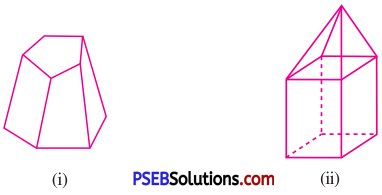
This is a zoo. This is a small world of wild and animals. It is like a mini forest. There is a big gate to enter it. Many people visit it daily. They have to buy tickets. Here, they see lions, tigers, monkeys etc. Lions and tigers are kept in cages. Monkeys move freely from tree to tree. Children seeing the playful monkeys. We can also see some elephants. A visit to a zoo is a happy experience
4.
PSEB 6th Class English Composition Creative Writing 4
This is a railway platform. A long train has just arrived. It is standing on the platform. It is standing on the platform. Some passengers are going to board it. Two children are sitting under a tree. There are plates of white marble on the floor. Three people are cleaning them. So the floor is shining. At some distance big buildings can be seen. A tree over looks the train. Thus the scene is very beautiful. Train will leave the station any time. The platform will look deserted.

5.
PSEB 6th Class English Composition Creative Writing 5
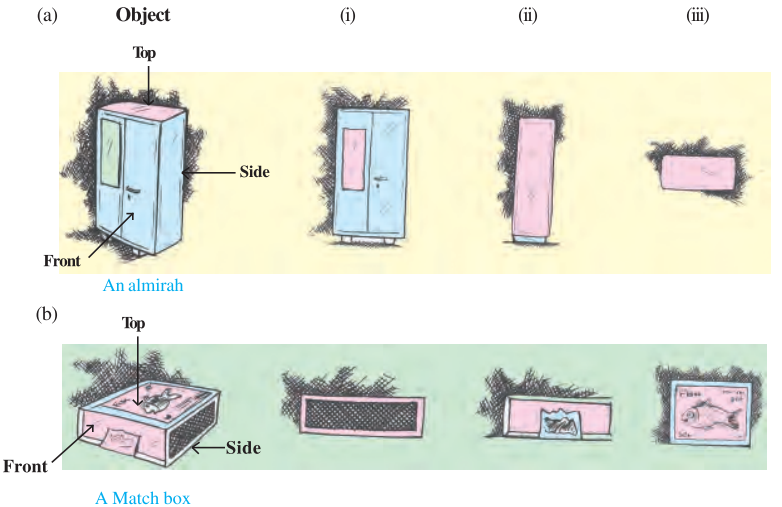
This is a bus stands A couple is waiting for their bus. They are sitting on a long bench. They have their luggage with them. A man is reading a newspaper. Another man is sitting idly. A bus is standing at its stopage. It is ready to leave. A man and his son are going to board it. Two other persons are also sitting there. We can see their backs. Thus the bits stand presents a lovely look.
PSEB 6th Class English Creative Writing

6.
PSEB 6th Class English Composition Creative Writing 6
This is a large park. Trees are tall and green. There is a small pond. Some ducks are swimming in it. A boy and a girl have come for a picnic. They are watching the ducks. The girl is sitting but the boy is standing. They have a mat before them. Some eatables are lying on the mat. A little bird is sitting near the mat. Green grass and blooming flowers look very charming.

7.
PSEB 6th Class English Composition Creative Writing 7
This is a village scene. Some huts can be seen at a distance. Two persons are going to their village. They are going on foot. A bullock cart is going on the road. It is loaded with straw. A man is sitting on the heap (%r) of straw. There is a big tree near the road. It has a platform around it. Some children are playing under the tree. They are playing football.

8.
PSEB 6th Class English Composition Creative Writing 8
Here is a small girl. She is wearing a lovely/funny dress. She loves birds and animals. She is surrounded by them. A duck is looking at her. She has a parrot like bird in one hand. A pigeon is sitting on her shoulder. A stag is standing near her. It has long curly horns. We can also see a hare and a squirrel in the picture.

PSEB 6th Class English Composition Creative Writing

9.
PSEB 6th Class English Composition Creative Writing 9
This is a sweet home. It is not very big. lt has a bed and some chairs. The window is covered with a curtain. Some clothes are hanging at the back of the bed. On the bed, a boy and a girl are sitting with an old man. The old man seems to be their grandfather. He loves his grand children very much. He has one arm round the boy’s neck. In his other hand, he is holding a book. He is telling something to his grand children.

PSEB 6th Class English Grammar Pronouns

Punjab State Board PSEB 6th Class English Book Solutions English Grammar Pronouns Exercise Questions and Answers, Notes.

PSEB 6th Class English Grammar Pronouns

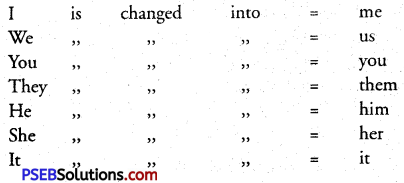
A pronoun is a word used in place of a noun.
संज्ञा (Noun) के स्थान पर प्रयोग किए जाने वाले शब्द को अंग्रेज़ी में Pronoun कहते है।
PSEB 6th Class English Grammar Pronouns 1

The words they, she, he and it are used in place of Nouns. They are Pronouns.
There are three main kinds of Pronoun:

  1. Personal Pronouns. (पुरुषवचक सर्वनाम)
  2. Demonstrative Pronouns (संकेतवाचक सर्वनाम)
  3. Interrogative Pronouns (प्रश्नवाचक सर्वनाम)

PSEB 6th Class English Grammar Pronouns

I. Personal Pronouns Pronouns used for persons are called Personal Pronouns; as-
1, we, you, he, they, me, our, etc.
There are three kinds of Personal Pronouns.
PSEB 6th Class English Grammar Pronouns 2
1. Pronouns of the First Person:

Singular Plural
I we
my, mine our, ours
me us
myself ourselves

2. Pronouns of the Second Person:

Singular Plural
you you
your, yours your, yours
yourself yourselves

3. Pronouns of the Third Person:

Singular Plural
he, she, it they
him, her, it them
his, her, its their, theirs
himself, herself, itself themselves

Points to Remember:
याद रखने योग्य बातें:

  1. He, his, him, himself are Pronouns of Masculine Gender. (पुरुषवचक लिंग)
  2. She, her, hers, herself are Pronouns of Feminine Gender. (स्त्रीरीवाचक लिंग)
  3. It, its, itself are Pronouns of Neuter Gender. (नपुंसक लिंग).
    We can use “It for little babies and lifeless things.
  4. All Plural Pronouns are Pronouns of Common Gender (सामान्य लिंग). They can be used for both masculine and feminine genders.

Use of Personal Pronouns

1. I, we, he, she and they are used as Subject.

2. Me, us, him, her and them are used as Object.

Subject Verb Object
I him. know
We them. know
He her. knows
She me. knows
They us. know

PSEB 6th Class English Grammar Pronouns

3. My, mine, our, ours, your, yours, his, her, hers, its and theirs are used to express ownership.

This is my book. This book is mine.
That is her pen. That pen is hers.
This is our school. This school is ours.

4. We never use an apostrophe (‘) with the personal pronouns.

Incorrect Correct
Your’s sincerely/faithfully Yours sincerely/faithfully
This school of our’s. This school of ours.
That picture of her’s. That picture of hers.

5. Personal Pronouns used to express emphasis are called Emphatic Pronouns; as-
1. I did it myself.
2. We did it ourselves.
3. You did it yourself.
4. He did it himself.
5. She did it herself.
6. They did it themselves.

6. Emphatic pronouns are never used as a Subject.

Incorrect Correct
Myself did it. I myself did it.
Yourself did it. You yourself did it.
Himself did it. He himself did it.

Exercises (Solved)

I. Rewrite each sentence using a suitable pronoun in place of the Noun in bold type:

1. Neha is not here.
Neha has gone to see her mother.

2. “The Panchtantra’ has many stories.
‘The Panchtantra’ is a good book.

3. Where is Anu’s school?
How does Anu go to school?

4. Karan has high fever.
Karan will not go to school today.
5. I have invited Micky and Joy.
Micky and Joy are my friends.

6. Yash ans Rahul are very happy.
Yash and Rahul are going on a picnic.

7. My aunt bought me a computer.
The computer cost my aunt a lot.

8. Simran gave her parents a gift.
The gift was liked by her parents.
Hints:
1. She has gone to see her mother.
2. It ia a good book.
3. How does she go to school ?
4. He will not go to school today.
5. They are my friends.
6. They are going on a picnic.
7. It cost her a lot.
8. The gift was liked by them.

PSEB 6th Class English Grammar Pronouns

II. Choose the correct Pronoun to fill in each blank:

1. That horse is ………… (our / ours)
2. This is ……….. pen, not mine. (your / yours)
3. The horse fell and broke ………. leg. (its / it)
4. Here is your book; take ………….. away. (it / its)
5. The girls were tired; ………. are resting. (they / them)
Hints:
1. ours
2. your
3. its
4. it
5. they.

III. Choose a suitable Pronoun for each blank:

(myself, yourself, himself, itself, themselves)
1. He …………. did all this.
2. I will do this …………
3. You should take care of …………..
4. They ………… admitted their fault.
5. The town …………… is not very large.
Hints:
1. himself
2. myself
3. yourself
4. themselves
5. itself

2. Demonstrative Pronouns

Pronouns used to point to some object or objects are called Demonstrative Pronouns; as-
PSEB 6th Class English Grammar Pronouns 3
The words this, these, that, those are used to point to some object or objects. We call them Demonstrative Pronouns.

Exercise (Solved)

Choose the correct Demonstrative Pronoun to fill in each blank:

1. ……… is not my fault. (This / These)
2. Are ……….. your books ? (that / those)
3. ……….. are very tasty sweets. (This / These)
4. Was …………. a costly hotel ? (that / those)
Hints:
1. This
2. those
3. These
4. that

3. Interrogative Pronouns

Pronouns used to ask questions are called Interrogative Pronouns; as-
PSEB 6th Class English Grammar Pronouns 4
1. Who is he?
2. What is your name?
3. Which is your school ?
4. Whose books are these ?
5. Whom did you tell the story?
The pronouns who, what, which, whose, whom have been used to ask questions. These are Interrogative Pronouns.

PSEB 6th Class English Grammar Pronouns

Exercise (Solved)

Fill in each blank with a suitable Interrogative Pronoun:

PSEB 6th Class English Grammar Pronouns 5
1. What are you doing?
2. ………… did they invite ?
3. ………… did the teacher say ?
4. …………. of these is your pen ?
5. …………. visited you yesterday ?
6. …………… is the price of this table ?
7. ………… does this book belong to ?
8. ………. is better, honour or riches ?
Hints:
2. Whom
3. What
4. Which
5. Who
6. What
7. Who
8. Which.

Miscellaneous Exercises

I. Rewrite each sentence, changing the Nouns and Pronouns into their plural form. Make other necessary changes also:

PSEB 6th Class English Grammar Pronouns 6
1. I love my sister.
2. That is her doll.
3. This is my book.
4. He is flying a kite.
5. She is a good girl.
6. He gave me his book.
7. I did this work myself.
8. You are my dear friend.
9. She was playing with her doll.
Hints:
1. We love our sisters.
2. Those are their dolls.
3. These are our books.
4. They are flying kites.
5. They are good girls.
6. They gave us their books.
7. We did this work ourselves.
8. You are our dear friends.
9. They were playing with their dolls.

II. Fill in the blanks with suitable Pronouns:

PSEB 6th Class English Grammar Pronouns 7
1. ………… is Reema’s doll.
2. ………… is a girl from Goa.
3. ………… are ripe mangoes.
4. …………. has taken my ball ?
5. ………… have done our best.
6. ……….. do you want to eat ?
7. …………. gave you that knife ?
8. …………. of your cows was ill ?
9. She will do this work …………..
Hints:
1. This/That
2. She
3. These/Those
4. Who
5. We
6. What
7. Who
8. Which
9. herself.

PSEB 6th Class English Grammar Pronouns

III. Say what kind of Pronoun each of the underlined words is:

1. That is my book. (Demonstrative)
2. This is their house. (Personal)
3. Who teaches you English ? (Interrogative)
4. What are you doing here ? (Interrogative)
5. She is not like her sister. (Personal)
6. You have been very kind. (Personal)
7. It is a book åbout animals. (Personal)
8. These are all fresh flowers. (Demonstrative)
9. Which of these is your bike ? (Interrogative)
10. We are students of class six. (Personal)

IV. Choose the correct Pronoun to fill in each blank:

1. This is ………… pen. (she, her, hers)
2. This pen is ………….. (she, her, hers)
3. I am ………… sincerely. (you, your, yours)
4. Anita has hurt ………… (she, her, herself)
5. He did this work ………. (myself, himself)
6. I looked at ………….. in the mirror. (my, mine, myself)
7. ………. shall finish this work today. (We, Us, our)
8. The teacher asked ……. a question. (he, him, his)
Hints:
1. her
2. hers
3. yours
4. herself
5. himself
6. myself
7. We
8. him.

V. Choose the correct Pronoun for each blank:

1. We love ……….. motherland. (our / his)
2. She is as wise as ………… am. (me/I)
3. He has gifted ………….. a watch. (me / mine)
4. This watch is better than …………. (yours / your)
5. This book of stories is for ……….. (she / her)
6. This house belongs to ………… father. (my / me)
7. Lalit is as gentle as ………….. brother is. (he / his)
8. This family is not as poor as ……….. are. (us / we)
Hints:
1. our
2. I
3. me
4. yours
5. her
6. my
7. his
8. we

PSEB 8th Class Maths Solutions Chapter 11 Mensuration Ex 11.3

Punjab State Board PSEB 8th Class Maths Book Solutions Chapter 11 Mensuration Ex 11.3 Textbook Exercise Questions and Answers.

PSEB Solutions for Class 8 Maths Chapter 11 Mensuration Ex 11.3

1. There are two cuboidal boxes as shown in the figures. Which box requires the lesser amount of material to make?
PSEB 8th Class Maths Solutions Chapter 11 Mensuration Ex 11.3 1
Solution:
For 1st cuboidal box:
length (l) = 60 cm, breadth (b) = 40 cm and height (h) = 50 cm
Total surface area of a cuboid
= 2 (lb + bh + lh)
= 2 [(60 × 40) + (40 × 50) + (50 × 60)]
= 2 (2400 + 2000 + 3000)
= 2(7400)
= 14,800 cm2

For 2nd cuboidal box:
l = b = h = 50 cm
Total surface area of a cuboid
= 2 (lb + bh + lh)
= 2 [(50 × 50) + (50 × 50) + (50 × 50)]
= 2(2500 + 2500 + 2500)
= 2 × 7500
= 15,000 cm2
As, total surface area of cuboid (a) is less, so the box (a) requires the less amount of material to make.

PSEB 8th Class Maths Solutions Chapter 11 Mensuration Ex 11.3

2. A suitcase with measures 80 cm × 48 cm × 24 cm is to be covered with a tarpaulin cloth. How many metres of tarpaulin of width 96 cm is required to cover 100 such suitcases?
Solution:
Let us find total surface area of a suitcase (cuboidal in shape).
length (l) = 80 cm, breadth (b) = 48 cm and height (h) = 24 cm
∴ Total surface area of a suitcase = 2 (lb + bh + lh)
= 2 [(80 × 48) + (48 × 24) + (24 × 80)]
= 2(3840 + 1152 + 1920)
= 2 (6912)
= 13,824 cm2
Total surface area of such 100 suitcases = 13,824 × 100
= 13,82,400 cm2
Area of 1 metre trapezium
= length × breadth
= 100 × 96 = 9600 cm2
Tarpaulin required to cover 100 suitcases = \(\frac{1382400}{9600}\) = 144 metres
Hence, 144 m tarpaulin is required to cover 100 suitcases.

3. Find the side of a cube whose surface area is 600 cm2.
Solution:
Let the side of the cube be x cm
Total surface area of a cube = 6x2
Total surface area of the cube = 600 cm2 (Given)
∴ 6x2 = 600
∴ x2 = \(\frac {600}{6}\)
∴ x2 = 100
∴ x2 = 102
∴ x = 10
Hence, the side of the cube is 10 cm.

4. Rukhsar painted the outside of the cabinet of measure 1 m × 2 m × 1.5 m. How much surface area did she cover if she painted all except the bottom of the cabinet.
PSEB 8th Class Maths Solutions Chapter 11 Mensuration Ex 11.3 2
Solution:
For given cabinet:
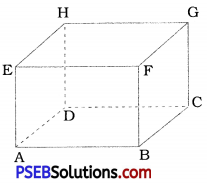
length (l) = 2 m, breadth (b) = 1 m and height (h) = 1.5 m
Total surface area of the cabinet
= 2 (lb + bh + lh)
= 2 [(2 × 1) + (1 × 1.5) + (2 × 1.5)]
= 2 (2 + 1.5 + 3)
= 2(6.5) = 13 m2
She has not painted bottom. So subtract area of bottom from total surface area of the cabinet.
Area of bottom = l × b = 2 × 1 = 2m2
∴ Painted surface area = (13 – 2) m2 = 11 m2
Hence, she has painted 11 m2 area of a cabinet.

PSEB 8th Class Maths Solutions Chapter 11 Mensuration Ex 11.3

5. Daniel is painting the walls and ceiling of a cuboidal hall with length, breadth and height of 15 m, 10 m and 7 m respectively. From each can of paint 100 m2 of area is painted. How many cans of paint will she need to paint the room?
Solution:
For given wall:
length (l) = 15 m, breadth (b) = 10 m and height (h) = 7 m
∴ Area to be painted
= Area of 4 walls + Area of ceiling
= [2 (l + b) × h] + l × b
= [2(15 + 10) × 7] + 15 × 10
= [2(25) × 7] + 150
= 350 + 150 = 500 m2
Now, one can of paint covers 100 m2 area.
∴ Number of paint cans needed
= \(\frac{\text { Area to be painted }}{\text { Area painted by one can }}=\frac{500 \mathrm{~m}^{2}}{100 \mathrm{~m}^{2}}\)
Hence, 5 cans of paint will be needed.

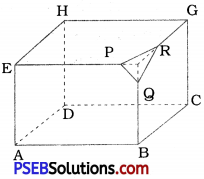
6. Describe how the two figures given are alike and how they are different. Which box has larger lateral surface area?
PSEB 8th Class Maths Solutions Chapter 11 Mensuration Ex 11.3 3
Solution:
Here, figure (i) is cylinder and figure (ii) is cube.
Similarity: Both have the same height.
Difference: One is the cylinder and the other is a cube.
For cylinder:
Radius = \(\frac{\text { diameter }}{2}=\frac{7}{2}\) = cm
Height = 7 cm
∴ Lateral (curved) surface area of cylinder
= 2πrh
= 2 × \(\frac{22}{7} \times \frac{7}{2}\) × 7
= 22 × 7 = 154 cm2

For given cube:
side = 7 cm
Lateral surface area of the cube
= 4l2 = 4 × 72
= 4 × 49 = 196 cm2
Hence, cubical box has a larger area.

PSEB 8th Class Maths Solutions Chapter 11 Mensuration Ex 11.3

7. A closed cylindrical tank of radius 7 m and height 3 m is made from a sheet of metal. How much sheet of metal is required?
Solution:
For given cylindrical tank:
radius (r) = 7 m, height (h) = 3 m
Total surface area of tank
= 2πr (r + h)
= 2 × \(\frac {22}{7}\) × 7(7 + 3)
= 44(10) = 440 m2
Hence, 440 m2 sheet of metal is required.

8. The lateral surface area of a hollow cylinder is 4224 cm2. It is cut along its height and formed a rectangular sheet of width 33 cm. Find the perimeter of rectangular sheet?
Solution:
Lateral surface area of a hollow cylinder = 4224 cm2 (Given)
Let length of a rectangular sheet made from hollow cylinder be l cm.
∴ l × b = 4224
∴ 1 × 33 = 4224
∴ l = \(\frac {4224}{33}\) = 128 cm
∴ Length of rectangular sheet =128 cm

Perimeter of rectangular sheet
= 2 (l + b)
= 2 (128 + 33)
= 2 (161) = 322 cm
Hence, perimeter of rectangular sheet is 322 cm.

9. A road roller takes 750 complete revolutions to move once over to level a road. Find the area of the road levelled if the diameter of a road roller is 84 cm and length is 1 m.
Solution:
Shape of road roller is cylindrical.
PSEB 8th Class Maths Solutions Chapter 11 Mensuration Ex 11.3 4
For given cylinder:
Radius (r) = \(\frac{\text { diameter }}{2}\) = \(\frac {84}{2}\) = 42cm
length (height) (h) = 1 m = 100 cm
∴ Curved surface area of a roller
= 2 πrh
= 2 × \(\frac {22}{7}\) × 42 × 100
= 26,400 cm2
Roller covers area of 26,400 cm2 in 1 revolution.
∴ Area of covered by roller in 750 revolutions
= 26400 × 750 cm2
= \(\frac{26400 \times 750}{100 \times 100}\) m2
= 1980 m2
Hence, area of road levelled is 1980 m2.

PSEB 8th Class Maths Solutions Chapter 11 Mensuration Ex 11.3

10. A company packages its milk powder in cylindrical container whose base has a diameter of 14 cm and height 20 cm.
PSEB 8th Class Maths Solutions Chapter 11 Mensuration Ex 11.3 5
Company places a lable around the surface of the container (as shown in the figure). If the lable is placed 2 cm from top and bottom, what is the area of the label.
Solution:
For given cylindrical container:
radius (r) = \(\frac {diameter}{2}\) = \(\frac {14}{2}\) = 7 cm
height (h) = 20 cm
Now, label is placed 2 cm away from top and bottom.
∴ Height of label = (20 – 2 – 2) cm
= (20 – 4) cm = 16 cm
For label:
radius (r) = 7 cm, height (h) = 16 cm
∴ Area of cylindrical label = 2πrh
= 2 × \(\frac {22}{7}\) × 7 × 16
= 44 × 16
= 704 cm2
Hence, area of the label is 704 cm2.

PSEB 6th Class English Bar Graph Reading Comprehension

Punjab State Board PSEB 6th Class English Book Solutions English Bar Graph Reading Comprehension Exercise Questions and Answers, Notes.

PSEB 6th Class English Bar Graph Reading Comprehension

Bar Graph द्वारा विभिन्न प्रकार के आंकड़ों को दंडों (Bars) की सहायता से दर्शाया जाता है। इससे आंकड़ों को समझना, उनका तुलनात्मक अध्ययन करना, उनकी बढ़ती या घटती प्रवृत्ति (Upwards & Downward trends) की जानकारी प्राप्त करना बहुत ही सरल हो जाता है।

How to Read a Bar Graph?

किसी Bar Graph को पढ़ना बहुत ही सरल है। इसके लिए निम्नलिखित विधि अपनाएं।
1. X-Axis अर्थात् क्षैतिज/लेटवीं (Horizontal) line आंकड़ों से जुड़ी items दर्शाती है।
2. Y-Axis अर्थात् लम्बवत् अथवा खड़ी (Vertical) line उनसे संबंधित आंकड़े बताती है। इस रेखा पर सुविधाजनक ढंग से आंकड़ों का विभाजन दिया होता है।
3. इसे पढ़ने के लिए item पर बने दण्ड के ऊपरी तल को सीधी रेखा द्वारा खड़ी लाइन से जोड़ें। वहां दिया गया आंकड़ा ही उसी item की value बताएगा।

PSEB 6th Class English Bar Graph Reading Comprehension

Some Important Bar Graphs

1. Study the following Bar graphs and write a short paragraph on each about what it informs.
PSEB 6th Class English Bar Graph Reading Comprehension 1

Paragraph – The graph shows the number of books sold during four months. It is from January to April. In January only two books were sold. In Feb, the number increased. It was three. In March too the equal number of books was sold. April recorded the maximum sale. In this month six books were sold. Thus, the total number of books sold during four months was twelve.

(ii) Total Number of Students in a School
PSEB 6th Class English Bar Graph Reading Comprehension 2
Paragraph – The graph shows the number of students in a school in different years. Their number was maximum (600) in 2002. It was least in 2004 only after two years. It means something must have gone wrong with the school as 500 students left the school.

The school was also popular with the student in 1998 when its strength was 550. Then its strength went on falling for two years. On the whole, the school was a popular one till 2002.

(iii) Number of Corona (Covid-19) Patients in Punjab
PSEB 6th Class English Bar Graph Reading Comprehension 3
Paragraph – The graph informs us about number of Corona (Covid-19) patients in Punjab. In April 2020, it spread very rapidly. Within a week, from April 5 to April 12 the number of Corona patients became six fold. The most alarming phase was April 5 to April 8 when the number jumped from 10 to 40. After that the spread lost its furry and only 20 more patients were added to it during the next four days. On April 12, the total number of patients was 60. The government is of the view that it was the result of the voilation of safety measures. For safey, people must keep distance and use masks. Above all, they should stay at home.

PSEB 6th Class English Bar Graph Reading Comprehension

(iv) Read the Bar graph and write down a paragraph on it.
PSEB 6th Class English Bar Graph Reading Comprehension 4
Paragraph – Our government buys wheat from the farmers every year. It is called Buffer stock. It is used in crisis. It is increasing year by year. In 1998 it was only 15 thousand tonnes. It jumped to 25 thousand tonnes next year. During 2002 purchase of wheat was maximum. It also shows the increase in wheat production. The production in 2000 reduced. And, so was the purchase. The next year also saw the same trend of production and purchase.

2. Observe this bar graph which is showing the sale of shirts in a ready-made shop from Monday to Saturday.
PSEB 6th Class English Bar Graph Reading Comprehension 5
Now answer the following questions:
(a) What information does the above bar graph give ?
(b) On which day were the maximum number of shirts sold ? How many shirts were sold that day ?
(c) On which day were the minimum number of shirts sold ?
(d) How many shirts were sold on Thursday ?
Answers:
(a) This bar graph tells us the number of shirts sold in a ready-made shop from Monday to Saturday.
(b) On Saturday the maximum number of shirts were sold. Sixty shirts were sold that day.
(c) On Tuesday, the number of shirts sold was the minimum. It was only ten.
(d) On Thursday thirty-five shirts were sold.
The graph also shows the sale went in increasing after Wednesday.

Now write answers in form of a paragraph.
This bar graph tells us the number of shirts sold in a ready made shop from Monday to Saturday. On Saturday, the maximum number of shirts were sold. Sixty shirts were sold on that day. On Tuesday the number of shirts sold was the minimum. It was only ten. On Thursday, thirty five shirts were sold. The graph also shows the sale went in increasing after Wednesday.

3. Observe this bar graph which shows the marks obtained by Aziz in monthly tests in different subjects.
PSEB 6th Class English Bar Graph Reading Comprehension 6
Answer the given questions:
(a) What information does the bar graph give ?
(b) Name the subject in which Aziz scored maximum marks.
(c) Name the subject in which he has scored minimum marks. (d). State the name of the subjects and marks obtained in each of them.
Answers:
(a) This graph informs us about the marks obtained by Aziz in different subjects in monthly tests.
(b) He scored maximum marks in Hindi. He got 80 marks in this subject.
(c) In Social Studies he scored minimum marks. He obtained only forty marks.
(d) The other subjects were English, Mathematics and Science. In these three subjects he obtained 60,70 and 50 marks respectively
Thus we observe that Aziz is poor in Science and Social Studies.

PSEB 6th Class English Bar Graph Reading Comprehension

Now write these answers in the form of a short paragraph.
This pargraph informs us about the marks obtaied by Aziz-in different subjects in monthly tests. He scored maximum marks in Hindi. He got 80 marks in this subject. In Social Studies, he scored minimum marks. He obtained only forty marks. The other subjects were English, Mathematics and Science. In these three subjects he obtained 60,70 and 50 marks respectively. Thus we observe that Aziz is poor in Science and Social Studies.

4. Study the following Bar graph and write 7-8 sentences on each about the information it gives. You can also take the help of the given table.
PSEB 6th Class English Bar Graph Reading Comprehension 7
Answer:
(a) The graph tells us about the choice of students for different fruits. The fruits were Banana, Orange, Apple and Guava. Some students made their choice for more than one fruit.
(b) Eight students liked Banana, five students Apple and four students Guava.
(c) Only three students made their choice for orange. As such orange got least number of votes.
(d) Thus Banana was the choice of maximum number of students. Apple and Guava got the second and third position respectively in this choice making contest.

5. Study the given Bar graph carefully and write few sentences on the information it provides.
PSEB 6th Class English Bar Graph Reading Comprehension 8
(a) This bar graph shows the population of India in different census years from 1951 to 2001. The census in India takes place every 10 years. (b) We observe that our population is increasing continuously. (Par).
(c) It was only 36 crores in 1951. It touched the figure 102 crores in 2001.
(d) Thus 76 crore people were added to our population in 50 years only.
(e) It was the maximum increase in population between 1991-2001. The period between 1951-1961 saw the minimum addition.

PSEB 6th Class English Bar Graph Reading Comprehension

6. Study the given Bar graph carefully and write a short paragraph on the information it provides.
Runs Scored by a Harmanpreet Kaur in a five O.D.I. matches series.
PSEB 6th Class English Bar Graph Reading Comprehension 9
Paragraph – This bar graphs represents the runs scored by Harmanpreet Kaur in five O.D.I. matches. She began with 35 runs in the first match. In the second match she scored 55 runs. She gave her best performance in the third match by scoring 70 runs. Then she lost her nature torch of the game audience. In fourth match she could score only 10 runs. And in the last match. she made no score as she went for a duck. Thus she failed to impress the audience in the last two matches. On the whole, she scored 170 runs in the series.

PSEB 10th Class Maths Solutions Chapter 14 Statistics Ex 14.4

Punjab State Board PSEB 10th Class Maths Book Solutions Chapter 14 Statistics Ex 14.4 Textbook Exercise Questions and Answers.

PSEB Solutions for Class 10 Maths Chapter 14 Statistics Ex 14.4

Question 1.
The following distribution gives the daily income of 50 workers of a factory.

PSEB 10th Class Maths Solutions Chapter 14 Statistics Ex 14.4 1

Convert the distribution above to a less than type cumulative frequency distribution and draw its ogive.

Solution:

PSEB 10th Class Maths Solutions Chapter 14 Statistics Ex 14.4 2

Now, by drawing the points on the graph
i.e. (120, 12); (140, 26); (160, 34); (180, 40); (200, 50).
We get graph of less than type cumulative frequency.

Scale chosen:
On x-axis 10 units = Rs. 10
On y-axis 10 units = 5 workers.

PSEB 10th Class Maths Solutions Chapter 14 Statistics Ex 14.4 3

PSEB Solutions PSEB 10th Class Maths Solutions Chapter 14 Statistics Ex 14.4

Question 2.
During the medial check up of 35 students of a class, their weights were recorded as follows:

PSEB 10th Class Maths Solutions Chapter 14 Statistics Ex 14.4 4

Draw a less than type ogive for the given data. Hence obtain the median weight from the graph and verWy the result by using the formula.
Solution:

PSEB 10th Class Maths Solutions Chapter 14 Statistics Ex 14.4 5

Now, By drawing the points on the graph i.e., (38, 0); (40, 3); (42, 5); (44, 9); (46, 14); (48, 28) ; (50, 32) ; (52, 35) we get graph of less than type cumulative frequency.

PSEB Solutions PSEB 10th Class Maths Solutions Chapter 14 Statistics Ex 14.4

Scale Chosen:
On x-axis, 10 units = 2 kg
On y-axis units = 5 students

PSEB 10th Class Maths Solutions Chapter 14 Statistics Ex 14.4 6

From above graph, it is clear that
Median = 46.5 kg ; which lies in class interval 46 – 48.
Now, in the given table
\(\Sigma f_{i}\) = n = 35

∴ \(\frac{n}{2}=\frac{35}{2}\) = 17.5 ; which lies in the interval 46 – 48.

∴ Median class = 46 – 48
So, l = 46; n = 35; f = 14; cf = 14 and h = 2

Using formula, Median = l + \(\left\{\frac{\frac{n}{2}-c f}{f}\right\}\) × h

Median = 46 + \(\left\{\frac{\frac{35}{2}-14}{14}\right\}\) × 2

= 46 + \(\left\{\frac{\frac{35-28}{2}}{14}\right\}\)

= 46 + \(\frac{7}{2} \times \frac{1}{14}\) = 46 + \(\frac{1}{2}\)

= 46 + 0.5 = 46.5
From above discussion and graph; it is clear that median is same in both cases. Hence, Median weight of students is 46.5 kg.

PSEB Solutions PSEB 10th Class Maths Solutions Chapter 14 Statistics Ex 14.4

Question 3.
The following table gives production yield per hectare of wheat of 1(X) farms of a village.

PSEB 10th Class Maths Solutions Chapter 14 Statistics Ex 14.4 7

Change the distribution to a more than type distribution, and draw its ogive.

Solution:

PSEB 10th Class Maths Solutions Chapter 14 Statistics Ex 14.4 8

Now, by drawing the points on the graph i.e. (50, 100); (55, 98); (60, 90); (65, 78); (70, 54); (75, 16)
we get graph of more than type cumulative frequency.

Scale chosen:
On x-axis 10 units = 5 kg/ha
On y-axis 10 units = 10 forms

PSEB 10th Class Maths Solutions Chapter 14 Statistics Ex 14.4 9

PSEB 10th Class Maths Solutions Chapter 14 Statistics Ex 14.3

Punjab State Board PSEB 10th Class Maths Book Solutions Chapter Statistics Ex 14.3 Textbook Exercise Questions and Answers.

PSEB Solutions for Class 10 Maths Chapter 14 Statistics Ex 14.3

Question 1.
The following frequency distribution gives the monthly consumption of electricity of 68 consumers of a locality. Find the median, mean and mode of the data and compare them.

PSEB 10th Class Maths Solutions Chapter 14 Statistics Ex 14.3 1

Solution:

PSEB 10th Class Maths Solutions Chapter 14 Statistics Ex 14.3 2

Here, \(\Sigma f_{i}\) = 68 then \(\frac{n}{2}=\frac{68}{2}\) = 34
Which lies in interval 125 – 145
Median class = 125 – 145
So, l = 125; n = 68; f = 20; çf = 22 and h = 20

Using formula, Median = l + \(\left[\frac{\frac{n}{2}-c f}{f}\right]\) × h

= 125 + \(\left\{\frac{\frac{68}{2}-22}{20}\right\}\) × 20

=125+ \(\frac{34-22}{20}\) × 20

= 125 + 12 = 137

PSEB Solutions PSEB 10th Class Maths Solutions Chapter 14 Statistics Ex 14.3

For mean:

PSEB 10th Class Maths Solutions Chapter 14 Statistics Ex 14.3 3

From above data, assumed mean (a) = 135
Width of class (h) = 20
∴ \(\bar{u}=\frac{\Sigma f_{i} u_{i}}{\Sigma f_{i}}=\frac{7}{68}\) = 0.102
Using formula, Mean \((\overline{\mathrm{X}})=a+h \bar{u}\)
\(\overline{\mathrm{X}}\) = 135 + 20 (0.102)
= 135 + 2.04 = 137.04.

For Mode:
In the given data,
Maximum frequency is 20 and it correspond to 125 – 145.
∴ Modal class = 125 – 145
So l = 125; f1 = 20; f0 = 13; f2 = 14and h = 20
Using formula, Mode = l + \(\left(\frac{f_{1}-f_{0}}{2 f_{1}-f_{0}-f_{2}}\right)\) × h

Mode = 125 + \(\left(\frac{20-13}{2(20)-13-14}\right)\) × 20

= 125 + \(\frac{7}{40-27}\) × 20

= 125 + \(\frac{140}{13}\)
= 125 + 10.76923
= 125 + 10.77 = 135.77.
Hence. median, mean and mode of given data is 137 units: 137.04 units and 135.77 units.

PSEB Solutions PSEB 10th Class Maths Solutions Chapter 14 Statistics Ex 14.3

Question 2.
If the median of the distribution given below is 28.5, find the values of x and y.

PSEB 10th Class Maths Solutions Chapter 14 Statistics Ex 14.3 4

Solution:

PSEB 10th Class Maths Solutions Chapter 14 Statistics Ex 14.3 5

In thegiven data, \(\Sigma f_{i}\) = n = 60
∴ \(\frac{n}{2}=\frac{60}{2}\) = 30
Also, median of the distribution = 28.5 ………….(Given)
which lies in the class interval 20 – 30
Median class = 20 – 30
So, l = 20; f = 20; cf = 5 + x; h = 10
From table, it is clear that 45 + x + y = 60
x + y = 60 – 45 = 15
or x + y = 15 ……………….(1)
Now, using formula, Median = l + {\(\left\{\frac{\frac{n}{2}-c f}{f}\right\}\)

28.5 = 2o + \(\left\{\frac{30-(5+x)}{20}\right\}\)

or 28.5 = 20 + \(\frac{30-5-x}{2}\)

or 28.5 = \(\)

or 2(28.5) = 65 – x
or 57.0 = 65 – x
or x = 65 – 57 = 8
∴ x = 8
Substitute this value of x in (1), we get
8 + y = 15
Hence, values of x and y is 8 and 7.

PSEB Solutions PSEB 10th Class Maths Solutions Chapter 14 Statistics Ex 14.3

Question 3.
A life insurance agent found the following data for distribution of ages of 100 policy holders. Calculate the median age, if policies are only given to persons having age 18 years onwards but less than 60 years.

PSEB 10th Class Maths Solutions Chapter 14 Statistics Ex 14.3 6

Solution:

PSEB 10th Class Maths Solutions Chapter 14 Statistics Ex 14.3 7

Here, \(\Sigma f_{i}\) = n = 100
then, \(\frac{n}{2}=\frac{100}{2}\) = 50, which lies in the interval 35 – 40
∴ Median class = 35 – 40
So, l = 35; n = 100; f = 33; cf = 45 and h = 5
Using formula, Median = l + \(\left\{\frac{\frac{n}{2}-c f}{f}\right\}\) × h

= 35 + \(\left\{\frac{\frac{100}{2}-45}{33}\right\}\) × 5

= 35 + \(\frac{50-45}{33}\) × 5

= 35 + \(\frac{25}{33}\)
= 35 + 0.7575 = 35 + 0.76 (approx.) = 35.76
Hence, median age of given data is 35.76 years.

PSEB Solutions PSEB 10th Class Maths Solutions Chapter 14 Statistics Ex 14.3

Question 4.
The lengths of 40 leaves of a plant are measured correct to the nearest millimetre, and the data obtained is represented in the following table:

PSEB 10th Class Maths Solutions Chapter 14 Statistics Ex 14.3 8

Find the median length of the leaves.
Solution:
Since the frequency distribution is not continuous, so firstly we shall make it continuous.

PSEB 10th Class Maths Solutions Chapter 14 Statistics Ex 14.3 9

Here, \(\Sigma f_{i}\) = n = 40
then, \(\frac{n}{2}=\frac{40}{2}\) = 20, which lies in the interval 144.5 – 153.5
∴ Median class = 144.5 – 153.5
So, l = 144.5; f = 12; cf = 17; h = 9
Using formula, Median = l + \(\left\{\frac{\frac{n}{2}-c f}{f}\right\}\) × h

Median = 144.5 + \(\left\{\frac{20-17}{12}\right\}\) × 9

= 144.5 + \(\frac{3 \times 9}{12}\)
= 144.5 + 225 = 146.75
Hence, median length of the leaves is 146.75 mm.

PSEB Solutions PSEB 10th Class Maths Solutions Chapter 14 Statistics Ex 14.3

Question 5.
The following table gives the distribution of the life time of 400 neon lamps:

PSEB 10th Class Maths Solutions Chapter 14 Statistics Ex 14.3 10

Find the median life time of a lamp.

Solution:

PSEB 10th Class Maths Solutions Chapter 14 Statistics Ex 14.3 11

Here, \(\Sigma f_{i}\) = n = 400
∴ \(\frac{n}{2}=\frac{400}{2}\) = 200; which lies in the interval 3000 – 3500.
∴ Median class = 3000 – 3500
So, l = 3000; n = 400; f = 86; cf = 130 and h = 500
Using formula, Median = l + \(\left\{\frac{\frac{n}{2}-c f}{f}\right\}\) × h

Median = 3000 + \(\left\{\frac{\frac{400}{2}-130}{86}\right\}\) × 500

= 3000 + \(\left(\frac{200-130}{86}\right)\) × 500

= 3000 + \(\frac{70 \times 500}{86}\) + 406.9767441

= 3000 + 406.98 (approx.) = 3406.98
Hence, median life time of a lamp is 3406.98 hours.

PSEB Solutions PSEB 10th Class Maths Solutions Chapter 14 Statistics Ex 14.3

Question 6.
100 surnames were randomly picked up from a local telephone directory and the frequency distribution of the number of letters in the English alphabets in the surnames was obtained as follows:

PSEB 10th Class Maths Solutions Chapter 14 Statistics Ex 14.3 12

Determine the median number of letters in the surnames. Find the mean number of letters in the surnames ? Also, find the modal size of the surnames.
Solution.
For Median:

PSEB 10th Class Maths Solutions Chapter 14 Statistics Ex 14.3 13

Here, Here, \(\Sigma f_{i}\) = n = 100
∴ \(\frac{n}{2}=\frac{100}{2}\) = 50, which lies in interval 7 – 10.
∴ Median class = 7 – 10
So, l = 7; n = 100; f = 40; cf = 36 and h = 3
Using formula, Median = l + \(\left\{\frac{\frac{n}{2}-c f}{f}\right\}\) × h

Median = 7 + \(\left\{\frac{\frac{100}{2}-36}{40}\right\}\) × 3

= 7 + \(\left\{\frac{50-36}{40}\right\}\) × 3

= 7 + \(\frac{14 \times 3}{40}\)

= 7 + \(\frac{21}{20}\) = 7 + 1.05 = 8.05
Hence, the median of letters in the surnames is 8.05.

For Mean:

PSEB 10th Class Maths Solutions Chapter 14 Statistics Ex 14.3 14

From above data, Assumed Mean (a) = 8.5
Width of class (h) = 3
∴ \(\bar{u}=\frac{\Sigma f_{i} u_{i}}{\Sigma f_{i}}=\bar{u}=\frac{-6}{100}\) = – 0.06

Using formula, Mean \((\overline{\mathrm{X}})=a+h \bar{u}\)
\(\bar{X}\) = 8.5 + 3 (- 0.06) = 8.5 – 0.18 = 8.32
Hence, mean number of letters in the surnames is 8.32.

For Modal:
In the given data Maximum frequency is 44 and it corresponds to interval 7 — 10
∴ Modal class = 7 – 10
So l = 7; f1 = 40; f0 = 30; f2 = 16 and h = 3
Using formula, Mode = l + \(\left(\frac{f_{1}-f_{0}}{2 f_{1}-f_{0}-f_{2}}\right)\) × h

Mode = 7 + \(\left(\frac{40-30}{2(40)-30-16}\right)\) × 3

= 7 + \(\frac{10}{80-46}\) × 3

= 7 + \(\frac{30}{34}\) = 7 + 0.882352941

= 7 + 0.88 (approx.) = 7.88.
Hence. modal size of the surnames is 7.88 letters.

PSEB Solutions PSEB 10th Class Maths Solutions Chapter 14 Statistics Ex 14.3

Question 7.
The distribution below gives the weights of 30 students of a class. Find the median weight of the students.

PSEB 10th Class Maths Solutions Chapter 14 Statistics Ex 14.3 15

Solution:

PSEB 10th Class Maths Solutions Chapter 14 Statistics Ex 14.3 16

Here, \(\Sigma f_{i}\) = n = 30
∴ \(\frac{n}{2}=\frac{30}{2}\) = 15; which lies in the interval 55 – 60.
∴ Median class = 55 – 60
So, l = 55; n = 30; f = 6; cf = 13 and h = 5
Using formula, Median = l + \(\left\{\frac{\frac{n}{2}-c f}{f}\right\}\) × h

Median = 55 + \(\left\{\frac{\frac{30}{2}-13}{6}\right\}\) × 5

= 55 + \(\left\{\frac{15-13}{6}\right\}\) × 5

= 55 + \(\frac{2 \times 5}{6}\)

= 55 + \(\frac{5}{3}\) = 55 + 1.66666
= 55 + 1.67 (approx.) = 56.67
Hence, median weight of the students are 56.67 kg.

PSEB 6th Class English Reading Comprehension Conversation / Dialogue Based

Punjab State Board PSEB 6th Class English Book Solutions English Reading Comprehension Conversation / Dialogue Based Exercise Questions and Answers, Notes.

PSEB 6th Class English Reading Comprehension Conversation / Dialogue Based

Read the following conversation carefully and answer the questions that follow:

1. Anil : Hello Nimmy, how are you?
Nimmy : Hey Anil, I’m good and how are you doing ?
Anil : Well, I’m quiet bored this vacation. Let us join some dance classes.
Nimmy : That sounds great. I’ll ask my parents and let you know tommorow.
Anil : Sure then we’ll go and fix the timings at Bollywood Dance Centre.
Nimmy : Alright and what about holidays homework ?
Anil : I have finished my work and what about you ?
Nimmy : I will finish it in a day or two.
Anil : Great, see you tomorrow. Bye !
Nimmy : Bye.

1. How Is Anil feeling during the vacation ?
(a) happy
(b) bored
(c) energetic
(d) sad.
Answer:
(b) bored.

2. Whom does Nipimy want to ask about dance classes ?
(a) her brother
(b) her sister
(c) her parents
(d) her friend
Answer:
(c) her parents.

PSEB 6th Class English Reading Comprehension Conversation / Dialogue Based

3. Which dance centre do Anil and Nimmy wish to join ?
(a) New Centre
(b) Bollywood Dance Centre
(c) Modem Dance Centre
(d) High Heels Centre.
Answer:
(b) Bollywood Dance Centre

4. Has Anil finished his holidays homework?
(a) no
(b) yes
(c) partially
(d) not at all.
Answer:
(b) yes.

5. Nimmy is planning to finish her work:
(a) tomorrow
(b) in a day or two
(c) in a week
(d) in ten days.
Answer:
(b) in a day or two.

2. All friends of Neha come to the party at 6 o’clock in the evening in their best party clothes. Then the teacher enters the room.)

Children : Good evening, madam.
Teacher : Good evening, children. (To Neha) God bless you,
Neha! Here is a birthday gift for you. Have a nice time.
Neha : Thank you, madam.
Mother : Children come here. Now Neha is going to cut the cake.
Chidren : Happy birthday to Neha.
Uncle : Sony, I am late. Happy birthday Neha. Here is a gift for you, a packet of books!
Neha : Thank you, uncle. Thank you very much. That is the nicest gift I have ever received.
Father : Children now have a piece of cake and sweets. Here are small presents for all of you.
(Neha’s mother gives the presents to the children.)
Children : Thank you, uncle, Thank you, aunt for nice gifts.
Neha : Thank you, everyone. Thanks for my birthday presents.

1. Whose birthday party is it ?
(a) Teacher’s
(b) Neha’s
(c) Uncle’s
(d) Father’s
Answer:
(b) Neha’s.

2. Who comes late to the party ?
(a) Neha’s father
(b) Neha’s teacher
(c) Neha’s friends
(d) Neha’s uncle.
Answer:
(d) Neha’s uncle.

3. Uncle brings ……….. as a birthday gift.
(a) cake
(b) some sweets
(c) a packet of books
(d) a beautiful dress.
Answer:
(c) a packet of books

4. Neha’s mother gives children at the end of the party.
(a) small presents
(b) some books
(c) a piece of cake
(d) nothing.
Answer:
(a) small presents.

5. Children are asked to have a piece of cake and ……………
(a) fruit
(b) biscuits
(c) coffee
(d) sweets.
Answer:
(d) sweets.

3. Teacher : Good morning children ! I have some good news for you. We are going to a fair at Ropar tomorrow.
Raj : How are we going ?
Teacher : We shall take a bus to Ropar.
Gurudev : When shall we leave ?
Teacher : We shall leave at 9 o’clock in the morning.
Harpreet : Who will go with us ?
Teacher : Mr. Shanna and Mrs. Singh will go with us.
Mini : Will there be something to eat ?
Teacher : Oh yes, there will be lots of things to eat and many different games to play.
Raj : I will go on the merry-go-round.
Rani : I will go on the giant-wheel.
Ali : Will there be some rides too ?
Teacher : Oh yes ! There will be elephant, camel and hore rides. Some of you may enjoy these rides. You will have a lot of fun.
Nina : What other things shall we see at the fair ?

1. A fair is going to be held at
(a) Amritsar
(b) Patiala
(c) Ropar
(d) Chandigarh.
Answer:
(c) Ropar.

PSEB 6th Class English Reading Comprehension Conversation / Dialogue Based

2. Mr. Sharma and ……………. will go with the students.
(a) Mrs. Singh
(b) Mrs. Sharma
(c) Mr. Singh
(d) All the three.
Answer:
(a) Mrs. Singh.

3. Raj wishes to enjoy ……………..
(a) the merry-go-round
(b) the giant-wheel
(c) slides
(d) swings.
Answer:
(a) the merry-go-round.

4. At the fair, the students can enjoy …………..
(a) elephant rides
(b) camel rides
(c) horse rides
(d) all these.
Answer:
(d) all these.

5. The party will leave at……………. in the morning.
(a) 7 o’clock
(b) 9 o’clock
(c) 8 o’clock
(d) 10 o’clock
Answer:
(b) 9 o’clock.

Or
The party will go to Ropar
(a) by train
(b) on bicycles
(c) by bus
(d) on foot.
Answer:
(c) by bus.

4. The sun is out. It is early morning. Amrit and Harpreet are still sleeping.

Mother : Wake up children ! It is six o’clock. You will be late for school.
Amrit is still sleeping but Harpreet is quickly getting up. He is going to the bathroom to brash his teeth and wash his face,
Harpreet : Wake up Amrit, we will be late for school! Look I am washing my face and brushing my teeth.
Amrit : What’s the time ?
Harpreet : It is half past six.
Amrit : Please let me sleep a little longer. Wake me up at half past seven.
Mother : Now get up Amrit. It is seven o’clock. Look Harpreet is finishing his breakfast and dressing for school.
Harpreet : I am leaving for school, it is eight o’ clock. You are late Amrit. You know the school starts at half past eight.

1. It is morning but the children are still ……………….
(a) reading
(b) playing
(c) talking
(d) sleeping.
Answer:
(d) sleeping.

2. Mother wakes up the children at ………………
(a) six o’clock
(b) seven o’clock
(c) eight o’clock
(d) nine o’clock
Answer:
(a) six o’clock.

PSEB 6th Class English Reading Comprehension Conversation / Dialogue Based

3. Mother wakes up Amrit and Harpreet because they can be late for
(a) breakfast
(b) school
(c) office
(d) library.
Answer:
(b) school.

4. Harpreet leaves for school at………….
(a) 7 o’clock
(b) half past seven
(c) 8 o’clock
(d) half past eight.
Answer:
(c) 8 o’clock.

5. The school starts at…………………….
(a) eight o’clock
(b) half past eight
(c) seven o’clock
(d) half past seven.
Answer:
(b) half past eight.

5. Neera : Hello Amar ! Where did you go this weekend ?
Amar : I had gone to Amritsar with my mother.
Neera : How lovely ! What did you see there ?
Amar : We visited Sri Darbar Sahib. It is also called the Golden Temple.
Neera : Isn’t it beautiful ?
Amar : Oh yes ! It is very beautiful. The temple is covered in gold. It shines brightly as the sunlight falls on it. We bathed in the holy tank.
Neera : Are there some other places to see ?
Amar: Yes, we also visited the Durgiana Mandir and the Jallianwala Bagh.
Neera : Were there many shops ?
Amar : Yes, there were ! Some shops were big and some small. We bought many things from the market.-
Neera : I will also go there next week with my grandfather.

1. Amar had gone to Amritsar with ……………..
(a) his friends
(b) Neera
(c) his mother
(d) parents.
Answer:
(c) his mother.

2. In Amritsar Amar visited ……………..
(a) Sri Darbar Sahib
(b) Durgiana Mandir
(c) Jalianwala Bagh
(d) All the above.
Answer:
(d) All the above.

3. Sri Darbar Sahib is also called ……………
(a) the Golden Temple
(b) the Durgiana Mandir
(c) the Jalianwala Temple
(d) None of these.
Answer:
(a) the Golden Temple

4. Neera will go to Amritsar with her
(a) parents
(b) brother and sister
(c) grandfather
(d) grandmother.
Answer:
(c) grandfather.

5. At Amritsar, Amar and his mother bathed in
(a) a lake
(b) a canal
(c) the holy tank
(d) a river.
Answer:
(c) the holy tank.

6. Lion (showing a lot of interest): Do you store food in your stomach ?

Camel : No, I don’t. I store it in my hump. I eat a lot of food at one time. Then I don’t need to eat for a fortnight.
Lion : That’s interesting. But what do you eat ?
Camel : I eat leaves, but there are no trees in a desert.
Lion : What do you eat there ?
Camel : There are thorny bushes in the desert. I eat the thorns. The thorns don’t prick my thick tongue.
Lion : How funny!
Camel : Mr. King of die Forest, please come with me to the desert.
Lion : No, I’d better not. I can’t walk on burning sand. I can’t store food and water and I can’t eat thorns. Good-bye and good luck, Mr Ship of the Desert.

1. The camel can live without eating (food) for …………….
(a) a week
(b) A fortnight
(c) a mo nth
(d) three days.
Answer:
(b) a fortnight.

PSEB 6th Class English Reading Comprehension Conversation / Dialogue Based

2. The camel stores food in its ………….
(a) stomach
(b) belley
(c) hump
(d) month.
Answer:
(c) hump.

3. In deserts the camel eats ……………
(a) thorns
(b) green grass
(c) small plants
(d) fallen fruit
Answer:
(a) thorns.

4. Who is Mr King of the Forest in the passage?
(a) elephant
(b) camel
(c) lion
(d) none of these.
Answer:
(c) Lion.

5. Mr. Ship of the desert is……………….
(a) camel
(b) lion
(c) burning sand
(d) camel’s hump.
Answer:
(a) camel.

PSEB 6th Class English Reading Comprehension Picture / Poster Based

Punjab State Board PSEB 6th Class English Book Solutions English Reading Comprehension Picture / Poster Based Exercise Questions and Answers, Notes.

PSEB 6th Class English Reading Comprehension Picture / Poster Based

Look at the picture carefully and answer the questions that follow

1.
PSEB 6th Class English Reading Comprehension Picture Poster Based 1

(i) The weather is …………….
(a) sunny
(b) snowy
(c) clear
(d) rainy.
Answer:
(d) rainy.

(ii) There are …………. puddles in the picture.
(a) three
(b) four
(c) two
(d) one.
Answer:
(c) two.

PSEB 6th Class English Reading Comprehension Picture / Poster Based

(iii) There are……………… children in the picture.
(a) two
(b) five
(c) three
(d) four.
Answer:
(d) four.

(iv) A ……………. is hiding under a leaf.
(a) snail
(b) frog
(c) bird
(d) fish.
Answer:
(b) frog.

(v) We use umbrellas to save ourselves from …………..
(a) clouds
(b) puddles
(c) trees
(d) rain.
Answer:
(d) rain.

2.
PSEB 6th Class English Reading Comprehension Picture Poster Based 2

(i) There are …………….. plants under the tree.
(a) thorny
(b) flower
(c) fruit
(d) dry.
Answer:
(b) flower.

(ii) There are…………… huts in the picture.
(a) two
(b) three
(c) many
(d) few
Answer:
(a) two.

(iii) A river flows under the …………
(a) trees
(b) plants
(c) bridge
(d) hills.
Answer:
(c) bridge.

(iv) The weather is ……………….
(a) sunny
(b) snowy
(c) clear
(d) rainy.
Answer:
(c) clear.

(v) It is a …………………. area.
(a) sandy
(b) sea-side
(c) forest
(d) hilly.
Answer:
(d) hilly.

3.
PSEB 6th Class English Reading Comprehension Picture Poster Based 3

Two children are ………… in their kitchen garden.
(a) walking
(b) working
(c) playing
(d) running.
Answer:
(b) working.

PSEB 6th Class English Reading Comprehension Picture / Poster Based

(ii) They are ………… plants.
(a) watering
(b) growing
(c) cleaning
(d) manuring.
Answer:
(a) watering.

(iii) The day is …………..
(a) snowy
(b) cloudy
(c) sunny
(d) rainy.
Answer:
(c) sunny

(iv) A ……………. is flying under a tall tree.
(a) bird
(b) butterfly
(c) fly
(d) kite.
Answer:
(b) butterfly.

(v ) The flowers in the picture look very …………….
(a) faded
(b) beautiful
(c) ugly
(d) muddy.
Answer:
(b) beautiful.

4.
PSEB 6th Class English Reading Comprehension Picture Poster Based 4

(i) This is a big
(a) school office
(b) consumer store
(c) booking office
(d) library.
Answer:
(d) library.

(ii) Books are lying on the
(a) shelves
(b) roof
(c) tables
(d) floor.
Answer:
(a) shelves.

(iii) In a library, there are books on different ………….
(a) religions
(b) jobs
(c) subjects
(d) problems
Answer:
(c) subjects.

(iv) The reading of books gives us ……………
(a) health
(b) wealth
(c) property
(d) knowledge
Answer:
(d) knowledge.

(v) This library can be given the name of ……………
(a) Entertaining Hut
(b) Knowledge Garden
(c) Knowledge Show
(d) None of these.
Answer:
(b) Knowledge Garden.

5.
PSEB 6th Class English Reading Comprehension Picture Poster Based 5

(i) The atmosphere in the picture is ………….
(a) dirty
(b) pretty
(c) lovely
(d) charming.
Answer:
(a) dirty.

(ii) We can see a large …………… of garbage.
(a) basket
(b) dustbin
(c) heap
(d) sack.
Answer:
(c) heap

PSEB 6th Class English Reading Comprehension Picture / Poster Based

(iii) Many young ………….. are collecting the garbage.
(a) girls
(b) men and women
(c) persons
(d) women
Answer:
(c) persons

(iv) They will …………… it outside the city.
(a) dump
(b) throw
(c) sell
(d) display.
Answer:
(a) dump

(v) At a little distance we can see …………….
(a) a car
(b) a bus
(c) a jeep
(d) an e-rickshaw.
Answer:
(b) a bus.

6.
PSEB 6th Class English Reading Comprehension Picture Poster Based 6

(i) The weather is …………..
(a) hot
(b) warm
(c) rainy
(d) snowy.
Answer:
(d) snowy.

(ii) There are …………….. children in die picture.
(a) two
(b) three
(c) four
(d) five
Answer:
(a) four

(iii) A dog is running ………….. a boy lying on the snow.
(a) after
(b) towards
(c) near
(d) under
Answer:
(b) towards

(iv) The tree in the picture is a…………….. tree.
(a) Christmas
(b) Diwali
(c) Mango
(d) Neem
Answer:
(a) Christmas.

PSEB 6th Class English Reading Comprehension Picture / Poster Based

(v) A girl is putting a cap on ……………….
(a) the dog
(b) the tree
(c) a snow man
(d) his friend
Answer:
(c) a snow man.

PSEB 6th Class English Grammar Verbs

Punjab State Board PSEB 6th Class English Book Solutions English Grammar Verbs Exercise Questions and Answers, Notes.

PSEB 6th Class English Grammar Verbs

A Verb is an action word. It tells us something about a person or thing.
Verb एक क्रिया शब्द है। यह हमें किसी व्यक्ति या वस्तु के बारे में कुछ बताता है।

A Verb tells us-
1. What a person or thing is; as-

  • The rose is red.
  • The mouse was dead.
  • Camels are useful animals.

PSEB 6th Class English Grammar Verbs 1

PSEB 6th Class English Grammar Verbs

2. What a person or thing has; as-

  • A week has seven days.
  • Monkeys have long tails.
  • They had a good day yesterday.

PSEB 6th Class English Grammar Verbs 2

3. What a person or thing does; as-

  • She made a doll.
  • He is writing a poem.
  • The sun rises in the east.

PSEB 6th Class English Grammar Verbs 3

Parts of a Verb क्रिया के भाग

A Verb in English can have two parts:
1. The Main (Primary) (मुख्य) Verb.
2. The Auxiliary (Helping) (सहायक) Verb.

1. The Main Verb tells us ‘what happened or ‘what the situation is’. The main verb can have four different forms:
(i) V1 (go) or the root form.
(ii) V2 (went) or the past form.
(iii) V3 (gone) or the past participle form.
(iv) V1-ing (going) or the present participle form.

2. The Auxiliary Verb helps the Main Verb to complete its meaning. It helps the Main Verb to form a Tense, or to form Negatives and Questions.
सहायक क्रिया Main verb (मख्य क्रिया) के अर्थ को पूरा करने में सहायता करती है। यह काल (Tense), नकारात्मक कथनों अथवा प्रश्नों के निर्माण में मुख्य क्रिया की सहायता करती है।

The following verbs are often used as Auxiliary Verbs:

  • is, am, are, was, were.
  • has, have, had.
  • do, does, did.
  • will, would, shall, should.
  • can, could, may, might, must, etc.

Exercises (Solved)

I. Underline the Verbs in the following sentences:

PSEB 6th Class English Grammar Verbs 4
1. I live in Delhi.
2. The lion roars.
3. It is raining outside.
4. I have two brothers.
5. Rina gave me a flower.
6. A cobbler mends shoes.
7. I will give you my book.
8. The driver was cleaning the car.
Hints:
1. live
2. roars
3. is raining
4. have
5. gave
6. mends
7. will give
8. was cleaning

PSEB 6th Class English Grammar Verbs

II. Fill in the blanks with appropriate Auxiliaries:

PSEB 6th Class English Grammar Verbs 5
1. …………… I come in, sir ?
2. I ………….. finished my work.
3. You …………… pay your debts.
4. We …………… help our friends.
5. I ………….. solve this question.
6. You ……………. sit on this bench.
7. Anyone ……………. make mistakes.
8. He ………….. not telling the truth.
Hints:
1. May
2. have
3. must
4. shall
5. can
6. can
7. can
8. is

Three Forms (Conjuction) of the verb

PSEB 6th Class English Grammar Verbs 6
PSEB 6th Class English Grammar Verbs 7
PSEB 6th Class English Grammar Verbs 8
PSEB 6th Class English Grammar Verbs 9
PSEB 6th Class English Grammar Verbs 10
PSEB 6th Class English Grammar Verbs 11
PSEB 6th Class English Grammar Verbs 12

PSEB 6th Class English Grammar Verbs

Exercises (Solved)

I. Conjugate the following Verbs:

build, fall, rise, speak, teach, weep, ruin, look, sleep, learn, study, throw, weave, forget, destroy
Answer:

Present Past Past Participle
build built built
fall fell fallen
rise rose risen
speak spoke spoken
teach taught taught
weep wept wept
ruin ruined ruined
look looked looked
sleep slept slept
learn learnt learnt
study studied studied
throw threw thrown
weave wove woven
forget forgot forgotten
destroy destroyed destroyed

II. Give the present participle form of the following Verbs:

1. sit
2. die
3. sink
4. fight
5. catch
6. tie
7. run
8. bite
9. shine
10. apply
11. hit
12. live
13. swim
14. writer
15. begin
Hints:
1. sitting
2. dying
3. sinking
4. fighting
5. catching
6. tying
7. running
8. biting
9. shining
10. applying
11. hitting
12. living
13. swimming
14. writing
15. beginning.

PSEB 6th Class English Grammar Verbs

Note : 1. Verb की Present participle form verb के साथ ‘ing’ जोड़ने से बनती है।
2. कुछ verbs में ‘ing’ जोड़ते समय उनके अंतिम अक्षर अक्षरों में कुछ फेरबदल भी करना पड़ता है।

PSEB 6th Class English Grammar Preposition

Punjab State Board PSEB 6th Class English Book Solutions English Grammar Preposition Exercise Questions and Answers, Notes.

PSEB 6th Class English Grammar Preposition

A Preposition is a word used before a Noun or Pronoun to indicate place, direction, source; as-
on, in, at, under, upon, into, from.
In the following pictures, study the different positions of the cat.
PSEB 6th Class English Grammar Preposition 1

The italicized words show the position of the cat. We call them prepositions. Some other Propositions of common use are-
of, near, to, after, with, during, off, down, by, above, before, between, at, from, for, among, below, without

PSEB 6th Class English Grammar Preposition

Use of Some Prepositions

1. On, Upon.
On indicates position of rest on something.
Upon indicates motion.

  • The books are on the table.
  • The cat jumped upon the wall.

PSEB 6th Class English Grammar Preposition 2

2. In, Into.
In expresses position of rest inside something.
Into indicates motion towards the inside of something.

  • Meera was sitting in her room.
  • Neha went Into the room.

3. At, In, On
At is used for a point of time.
On is used with days and dates.
In is used with months and years.

  • My brother came here at eight.
  • I met my friend at 5 o’clock.
  • India got freedom in 1947.
  • I shall go to Mumbai on Monday.
  • His birthday falls on 15 Nov.
  • He went to Ludhiana in May.

PSEB 6th Class English Grammar Preposition 3

Note some other uses of ‘at’ and ‘in’.

  • At dawn / noon / night
  • In the morning
  • In the evening
  • In the afternoon

4. At, In
At is used with names of small villages and towns.
In is used with names of big cities and states.

  • I was bom at Rampur.
  • My uncle lives in Delhi.

5. Between, Among.
‘Between’ is used for two persons, places or things.
‘Among’ is used for more than two persons, places or things.

  • The two brothers divided their property between themselves.
  • The three brothers quarrelled among themselves.

PSEB 6th Class English Grammar Preposition

Exercises (Solved)

I. Underline the prepositions in the following sentences:

PSEB 6th Class English Grammar Preposition 4

1. She sat beside me.
2. Rani is afraid of her teacher.
3. The bird flew over the trees.
4. The dog ran after the mouse.
5. The sky and clouds are above us.
6. The river flows under the bridge.
7. December comes after November.
8. There is a big well behind his house.
9. She brought a beautiful dress for me.
10. I went with my friend to see a movie.
Hints:
2. of
3. over
4. after
5. above
6. under
7. after
8. behind
9. for
10. with, to.

II. Fill in the blanks with a suitable preposition from the box:

of, on, for, near, into, at, by, after, from, with
1. I am fond …………… music.
2. Look …………… the blackboard.
3. I am waiting …………… the bus.
4. The policeman ran …………… the thief.
5. Keep the books …………… the shelf.
6. What is Ludhiana famous …………… ?
7. We are proud …………… our country.
8. My ball has fallen …………… the well.
9. Are you coming …………… road or rail ?
10. I went …………… my Mends for a picnic.
11. There is a temple …………… the hospital.
12. Tony cleaned the floor …………… a broom.
13. The girls are waiting …………… the station.
14. My Mend’s house is far …………… our house.
15. She lives …………… her parents.

PSEB 6th Class English Grammar Preposition 5
Hints:
1. of
2. at
3. for
4. after
5. on
6. for
7. of
8. into
9. by
10. with
11. near
12. with
13. at
14. from
15. with.

PSEB 6th Class English Grammar Preposition

III. Write what you see in this picture. Use a suitable preposition in each one of your sentences; as-

PSEB 6th Class English Grammar Preposition 6
Mrs. Raj and Mrs. Rani are sitting on a bench.
Tony is trying to get at the apple.
Some birds are flying in the sky.
A crow is sitting on the branch of a tree.
A dog is running after a ball.
Neha is reading a book under a tree.
Sonu and Anu are waiting for the fancy ball to come down.