A Hole in the Fence Question Answer Class 7 English Solutions Chapter 7 PSEB Solutions

Punjab State Board PSEB 7th Class English Book Solutions Chapter 7 A Hole in the Fence Textbook Exercise Questions and Answers.

Class 7th English Solutions Chapter 7 A Hole in the Fence Question Answers

A Hole in the Fence Class 7 Questions and Answers

Activity 1.

Look up the following words/phrases in a dictionary. You should seek the following information about the words and put them in your WORDS notebook.
1. Meaning of the word as used in the story (adjective/noun/verb, etc.)
2. Pronunciation (The teacher may refer to the dictionary or the mobile phone for correct pronunciation.)
3. Spellings

fence advised control hammer accept
decrease discover temper scar wound

Vocabulary Expansion

Activity 2

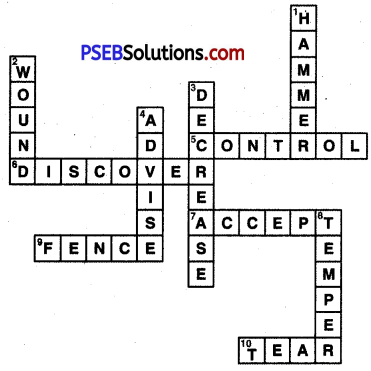
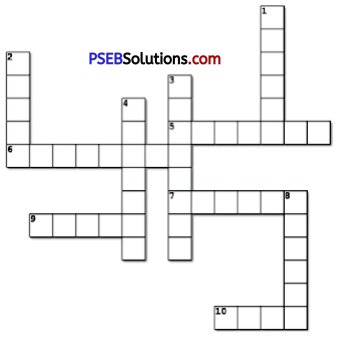
Solve the crossword puzzle given below. Read the hints (meanings) for the words given under ‘Across’ and ‘Down’. The words are from the story.
PSEB 7th Class English Solutions Chapter 7 A Hole in the Fence 1
Answer:
PSEB 7th Class English Solutions Chapter 7 A Hole in the Fence 2
Across →
5. able to manage
6. find something new
8. to take something
9. barrier
10. a mark on the skin

Down ↓
1. hit something hard
2. a tear in the skin
3. become lesser or smaller
4. guiding someone
5. a state of being angry or calm

PSEB 7th Class English Solutions Chapter 7 A Hole in the Fence

Activity 3.

Answer the following questions as briefly as you can.

Question 1.
Why did the boy have no friends ?
लड़के के दोस्त क्यों नहीं थे ?
Answer:
The boy had no friends because he always used a bad language in a fit of anger.

Question 2.
Why were his parents worried ?
उसके माता-पिता क्यों चिंतित थे ?
Answer:
His parents were worried because he had a bad temper.

Question 3.
Whạt task did his father give him to do ?
उसके पिता ने उसे कौन-सा कार्य करने को दिया ?
Answer:
His father gave him a bag of nails and hammer and said, “Every time you lose your temper you must hammer a nail into the back of the fence.

Question 4.
How did it help the boy ?
इसने लड़के की मदद कैसे की ?
Answer:
By hammering nails, he discovered that it was easier to control the anger than to drove nails.

Question 5.
What did his father tell him after he had taken out all the nails ?
जब लड़के ने सभी कील निकाल दिए तो पिता ने उस बच्चे को क्या बताया ?
Answer:
The father told him that a wound given with the words is as bad as the one given with a knife.

Question 6.
What is the moral of the story?
कहानी से क्या शिक्षा मिलती है ?
Answer:
We should be polite to others and use kind words.

Activity 4.

Write ‘True’ or ‘False’ in the space given against each statement.

1. The boy had many friends. — (False)
2. He had a habit of using bad language. — (True)
3. His mother came up with a plan to help him. — (False)
4. The boy hammered nine nails into the fence on his first day — (False)
5. The boy never learned to control his temper — (False)

PSEB 7th Class English Solutions Chapter 7 A Hole in the Fence

Activity 5

Select the correct option and fill it in the given blank.

Question 1.
The little boy was …………………. by other boys.
(a) popular
(b) liked
(c) disliked.
Answer:
(c) disliked.

Question 2.
The boy had no friends because ………….
(a) he used bad language
(b) he bullied other boys
(c) he would hit small boys.
Answer:
(a) he used bad language

Question 3.
His father thought of a/an …..
(a) advice to give him
(b) task to give him
(c) reason for his behaviour.
Answer:
(a) advice to give him

Question 4.
The father asked the boy to … whenever he felt angry.
(a) count from 1-10
(b) drive a nail into the fence
(c) pull out a nail from the fence.
Answer:
(b) drive a nail into the fence

Question 5.
The father was able to …. ….. him a lesson about good behaviour.
(a) show
(b) teach
(c) make.
Answer:
(b) teach.

Learning Language

Sentence and its Types

Read the following sentences or groups of words.
1. Amit is a good actor.
2. Where are you going?
3. Seema works very hard.
4. What a beautiful day!
5. Chandigarh is the capital of Punjab.
Please note that all these sentences:
1. begin with capital letters
2. end with a full stop (.), a question mark (?) or an exclamation mark (!)
Notice that these groups of words make complete sense.
Sentence शब्दों का सार्यक समूह होता है।
Now, read the following group of words:
pot flowers The are in
इस शब्द समूह का कोई अर्थ नहीं है।
Now read the same words in another order :
The flowers are in the pot.
यह शब्द समूह पूरा अर्थ देता है | इसलिए यह राक sentence है

PSEB 7th Class English Solutions Chapter 7 A Hole in the Fence

Activity 6.

Rearrange the following groups of words and punctuate to make meaningful sentences

Question 1.
ferocious lions animals are.
Answer:
Lions are ferocious animals.

Question 2.
love grandparents a my me lot.
Answer:
Grandparents love me a lot.

Question 3.
is my best Rajan friend.
Answer:
Rajan is my best friend.

Question 4.
Mercury system in is the hottest the planet solar.
Answer:
Mercury is the hottest planet in the solar system.

Question 5.
is the Ganges sacred a river.
Answer:
The ganges is a sacred river.

Activity 7

Make meaningful sentences by using the following words.

1. building – This is a tall building.
2. chair – The chair is made of wood.
3. dance – She likes to dance.
4. walk – Morning walk is good for health.
5. dictionary – I have an English, Punjabi dictionary.

Types of Sentences.

Sentences are of four types: Declarative, Interrogative, Imperative and Exclamatory.

1. Declarative sentences tell something or make a statement. A full stop (.) is used at the end of such sentence.
2. Interrogative ये वाक्य कोई प्रशन पूछते है | इनके अन्त question mark (?) “INT GIRI
3. Imperative : These sentences are either requests or commands. They tell someone to do something. They also end with a full stop.
4. Exclamatory : These sentences show a feeling and exclamation mark (!) mark is used at the end of such sentence.

Activity 8

Identify the type of sentence and write it in the given space.

1. Will the guests be late ? — Interrogative
2. She scored a century. — Declarative
3. I have completed my work. — Declarative
4. Read this book now. — Imperative
5. The trip was exciting ! — Exclamatory
6. Who went to Delhi ? — Interrogative
7. Shut the door. — Imperative
8. What a cute dog ! — Exclamatory
9. Butter is better than jam. — Declarative
10. Brush your teeth. — Imperative I

Activity 9

Identify each type of sentence and explain your answer.

1. The students went on an educational trip.
Type : Declarative.
Reason : It is a statement.

2. Shall we go to the Thunder Zone Theme Park ?
Type : Interrogative.
Reason : It asks a question.

PSEB 7th Class English Solutions Chapter 7 A Hole in the Fence

3. We must try to be on our best behaviour for the next two months.
Type : Declarative
Reason : It is a statement.

4. The dog ate the biscuit.
Type : Declarative.
Reason : It is a statement.

5. Wow, I have won the lottery !
Type : Exclamatory
Reason : This shows a feeling and uses an exclamation mark at the end.

6. How far away is the park from the school ?
Type : Interrogative
Reason : It asks a question and has a question mark at the end.

7. Let’s go back soon or we will miss the train !.
Type : Exclamatory
Reason : This gives a suggestion and warning.

8. Stop asking questions.
Type : Imperative
Reason : It gives a command.

9. Let’s go to the party!
Type : Exclamatory
Reason : It gives a suggestion.

10. The students wondered why they were going to the amusement park.
Type : Declarative.
Reason : It is a statement.

Learning to Listen

Activity 10

Listen to your teacher’s instructions on how to grow a plant. Try to write as you listen. After 5 minutes, your teacher will speak again. Complete your activity while listening to the process the second time.
You will need
1. seeds of your choice such as pumpkin seeds, sunflower seeds, lima beans or pinto beans
2. good quality soil
3. a container to hold the soil and your seeds
4. water
5. light and heat Now write all the steps with their description in the grid given below.
Description de Take some seeds of pumpkin or sunflower Use good quality soil. Take a container to hold the soil and seeds. Water the soil and the seeds.
Put the container in the open for light and heat. Learning to Speak
Answer:

Steps Description
1. Take some seeds of pumpkin or sunflower
2. Use good quality soil.
3. Take a container to hold the soil and seeds.
4. Water the soil and the seeds.
5. Put the container in the open for light and heat.

Activity 11 (Pairwork) 

Based on your listening activity and your notes in the grid above, discuss with your partner the process of how a seed becomes a plant. You can also take hints from the diagram given below.
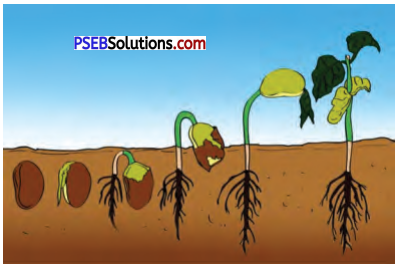
PSEB 7th Class English Solutions Chapter 7 A Hole in the Fence 3
Answer:
1. Fill the container with soil.
2. Plant the seeds in the soil.
3. Keep the container at a warm place. Sunlight is good but try to avoid too much direct sunlight. A window sill is a good spot.
4. Keep the soil moist by watering it every day.
5. Be careful not to use too much water.
6. Record your observations as the seeds germinate and seedlings begin to sprout from the seeds.

PSEB 7th Class English Solutions Chapter 7 A Hole in the Fence

Learning to Write

Personal Letters

Letters written to one’s parents, relatives and friends are called personal letters.

Format of Personal Letters

1. The Heading (your address and date):
13 Mall Road Ludhiana
15 June 20_ _
2. The Salutation: Dear Anu, Dear Daddy, Dear Brother, etc.
3. The Body: whatever your want to tell
4. The Ending: (For parents and siblings) Yours affectionately/
Your affectionate son; Yours lovingly/Your loving son ;
(For friends or known)Yours sincerely

Specimen of a Personal Letter

Write a letter to your friend inviting him to attend the wedding party of your elder brother.
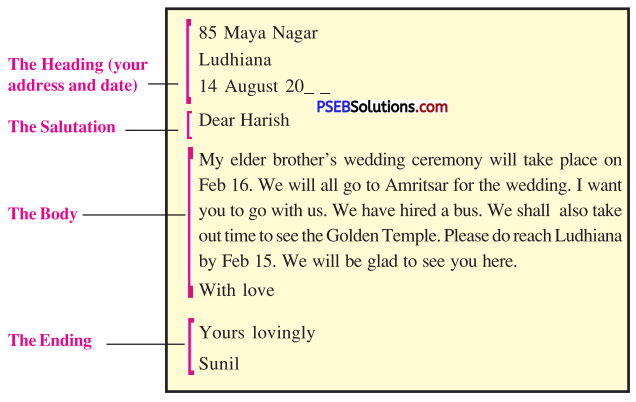
PSEB 7th Class English Solutions Chapter 7 A Hole in the Fence 4

Activity 12.

Imagine that you are Neeraj. Write a letter to your cousin telling him/her how you helped a friend used to overcome his habit of using bad language. You may share with your friend the idea you used to stop him from using bad language.
Answer:
105 The Mall,
Amritsar,
June, 20, 2020.
Dear Navjot,
I received your letter yesterday. I want to tell you about a friend of mine who had a bad temper. He used bad words even in his routine talks. This bad habit earned him a bad name. No one liked to talk to him. So I hit upon a plan to reform him. Whenever he used a bad word, I objected to it and made him to say ‘sorry’. Gradually, he got tired of his sorries. He began to control his speech. Within a week, he was speaking a kindly and softly. It was a great change which made both of us happy and surprised.
Your loving brother
Neeraj

Learning to Use Language

Activity 13

Look at the picture given below. In the given space, describe what is happening in the picture.
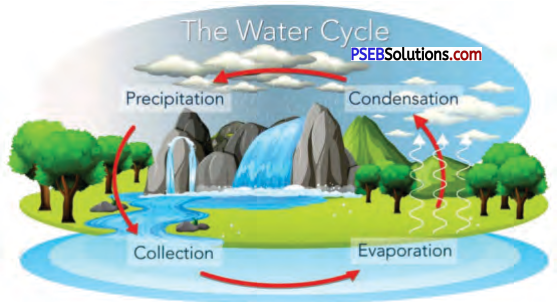
PSEB 7th Class English Solutions Chapter 7 A Hole in the Fence 5
Water-Cycle
The picture shows the water-cycle in nature. Water in oceans, ponds, rivers and other water evaporates due to heat. The vapour gets mixed with the air. The air becomes light and goes up. Clouds are formed.

PSEB 7th Class English Solutions Chapter 7 A Hole in the Fence

Trees cool down the clouds and the vapour get condensed into water drops, hailstones etc. They being heavy drop down on earth. It is called precipitation. All this is water. It flows down on the ground and get collected in the water bodies again. Hence, the completion of the cycle.

Comprehension Of Passages

Read the following passages carefully and answers the questions that follow each :

(1) Once there was a little boy who lived with his parents in a small village. His parents were worried because he had a bad temper. He had no friends because he always used bad language in a fit of anger. His parents advised him many times to control his anger but he did not pay attention.

The father kept thinking and then he got an idea. The next day, his father gave him a bag of nails and a hammer. He said to him, “Every time you lose your temper, you must hammer a nail into the back of the fence.” The boy accepted the task happily.

1. Why were the boy’s parents worried ?
लड़के के माता-पिता चिंतित क्यों थे ?

2. What task did his father gave him ?
उसके पिता ने उसे क्या काम करने को दिया ?

3. Choose true and false statements and write them in your note book.
(a) The boy refused to do the job.
(b) His boy lived in a small village ?

PSEB 7th Class English Solutions Chapter 7 A Hole in the Fence

4. Complete the sentences according to the meaning of the passage.
(a) He always used bad language in ………..
(b) Her father gave him a ………….. and a hammer.

5. Match the words with their meanings.

(a) temper idea
(b) accepted agreed to
nature.

Answer:
1. The boy’s Parents were worried because he had a bad temper.
2. His father asked him to hammer a nail into the back of the fence every time he lost his temper.
3.
(a) False
(b) True.
4.
(a) He always used bad language in a fit of angers.
(b) His father gave him a bag of nails and a hammer.
5.
(a) temper – nature
(b) accepted – agreed to

(2) Every time, the boy felt angry, he ran to the fence and drove a nail into it. The first day, the boy had driven thirty nails into the fence. After a few days, the number of nails started decreasing. Over the next few weeks, he discovered that it was easier to control his anger than to drive those nails into the fence. Finally, the day came when the boy did not lose his temper at all.

He had not hammered any nail into the fence. He told his father about it. The father gave him one more task to do. He asked the boy to pull out one nail for each day that he was able to hold his temper. The days passed and the little boy was finally able to tell his father that all the nails were gone.

1. How many nails did the boy push into the fence the first day?
पहले दिन लड़के ने दीवार में कितने कील गाड़े ?

2. What did the boy discover after a few weeks?
कुछ सप्ताह बाद लड़के को क्या पता चला ।।

3. Choose true and false statements and write them in your notebook.
(a) The boy could not control his anger?
(b) Pulling out of a nail meant no anger.

PSEB 7th Class English Solutions Chapter 7 A Hole in the Fence

4. Complete the sentence according to the meaning of the passage.
(a) The boy finally told his father that ………. were gone.
(b) After a few day, the number of nails

5. Match the words with their meaning.

(a) discovered control
(b) hold realized
push

Answer:
1. The first day, the boy pushed thirty nails into the fence.
2. He discovered that it was easier to control his anger than to drive nails into the fence.
3.
(a) False
(b) True.
4.
(a) The boy finally told his father that all the nails were gone.
(b) After a few days the number of nails started decreasing
5.
(a) discovered-realized
(b) hold-control

(3) The father led the little boy to the fence. He said, “You have done well, my son. Now, look at these holes in the fence. The fence will never be the same again.” The boy looked at his father and said, “I did it because you asked me to.

“I know”, said the father, “when you say things in anger, they leave a scar just like this one. You can put a knife in a man and draw it out. It won’t matter how many times you say you are sorry, the wound will always be there. A wound given with your words is as bad as the one given with a knife.”

1. What did the father show his son ?
पिता ने अपने पुत्र को क्या दिखाया ?

2. What lesson did the father teach his son ?
पिता ने अपने पुत्र को क्या सबक दिया ?

3. Choose true and false statements and write them in your note book.
(a) The fence will never be the same again.
(b) The father led to little boy to school.

4. Complete the sentence according to the meaning of the passage.
(a) When you say things in …………., they …………. a scar.
(b) The wound will ………….

PSEB 7th Class English Solutions Chapter 7 A Hole in the Fence

5. Match the words with their meanings :

(a) wound mark
(b) Scar bad words
Injury

Answer:
1. The father showed holes in the fence to his son.
2. The father tought his son that a wound given with words is as a bad as the one given with
a knife.
3.
(a) True
(b) False.
4.
(a) When you say things in anger, they leave a scar.
(b) The wounds will always be there.
5.
(a) wound-injury
(b) scar –mark

Use Of Words/Phrases In Sentences

1. Pay attention (listen to)—
Pay attention to what I say.
मैं जो कहता हूँ उसकी ओर ध्यान दो।

2. Scar (mask, spot)
Hammer this nail into the door.
यह कील दरवाजे में गाड़ दो।

3. Hammer (v) (Push)
Hammer this nail into the door.
यह कील दरवाजे में गाड़ दो।

4. Decrease (lesser)
His pain decreased after some time.
उसकी दर्द कुछ देर बाद कम हो गई।

5. Hold (Contol, put a check on –
Hold your tongue.
अपनी जुबान सम्भालो।

6. Control (hold)
Try to control your anger.
अपने गुस्से पर काबू पाने की कोशिश करो।

7. To say sorry (to regret) —
You must say sorry when you misbehave.
गंदा व्यवहार करने पर तुम्हें खेद जताना चाहिए।

8. Accept (acknowledge)
you must accept your mistake.
तुम्हें अपनी गलती स्वीकार कर लेनी चाहिए।

9. Advise (to suggest) —
I advised him to work hard.
मैंने उसे परिश्रम करने का सुझाव दिया।

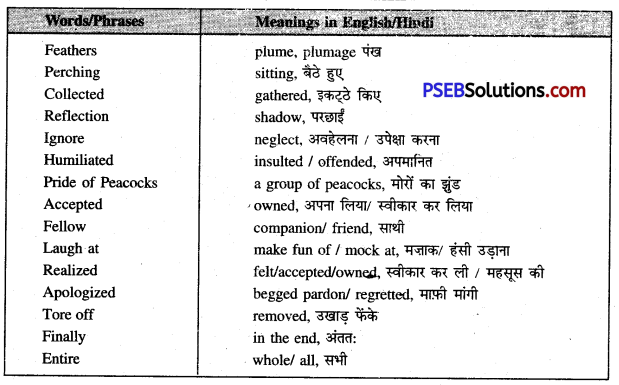
Word Meaning.
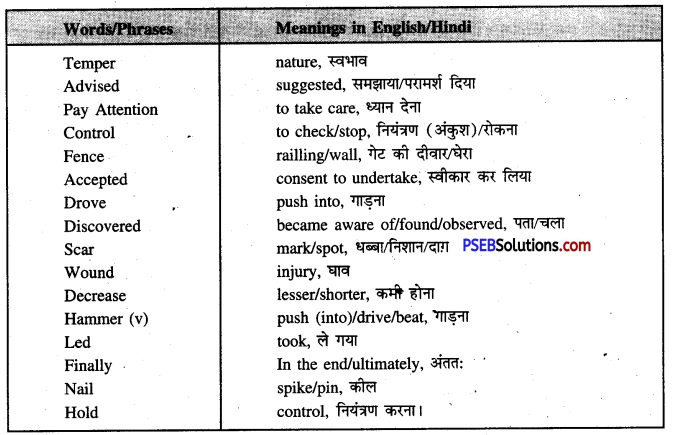
PSEB 7th Class English Solutions Chapter 7 A Hole in the Fence 6

A Hole in the Fence Summary in Hindi

Once there was ………………. nails were gone.

एक बार एक छोटा-सा लड़का था जो अपने माता-पिता के साथ एक छोटे से गाँव में रहता था। उसके माता पिता उसके बुरे स्वभाव के कारण चिंतित थे। उसका कोई मित्र नहीं था क्योंकि वह क्रोध में आकर अभद्र भाषा का प्रयोग करता था। उसके माता-पिता ने उसे क्रोध पर अंकुश लगाने के लिए बहुत बार समझाया।

PSEB 7th Class English Solutions Chapter 7 A Hole in the Fence

परन्तु वह कोई ध्यान नहीं देता था। पिता निरंतर सोचते रहते थे और तभी उन्हें एक विचार सूझा। अगले दिन उसके पिता ने उसे कीलों का एक थैला और हथौड़ा दिया। उन्होंने उससे कहा, “जितनी बार भी तुम्हें क्रोध आये तुम बाड़ (गेट की दीवार) के पीछे कील लगा देना।” बच्चे ने यह काम खुशी-खुशी स्वीकार कर लिया। जब भी बच्चे को क्रोध आता वह गेट की दीवार की ओर भाग कर जाता और उसमें एक कील गाड़ देता।

पहले दिन बच्चे ने चार दीवारी में तीस कील गाड़े। कुछ दिनों बाद कीलों की संख्या कम होने लगी। अगले कुछ सप्ताह में उसने अनुभव किया कि क्रोध पर नियंत्रण पाना कील गाड़ने से अधिक आसान था। अन्ततः एक दिन ऐसा आया जब बच्चे को बिल्कुल भी क्रोध नहीं आया। उसने दीवार में कोई भी कील नहीं गाड़ा था।

उसने इसके बारे में अपने पिता को बताया। उसके पिता ने उसे एक और काम करने के लिए दिया। उन्होंने कहा जिस किसी दिन तुम क्रोध पर काबू रखो, उस दिन एक कील निकाल लेना। दिन बीतते गए और छोटा लड़का अपने पिता की आखिरकार यह बताने के योग्य हो गया कि सभी कील निकल गए हैं। .

The father led ………….. words be kind !

पिता छोटे लड़के को दीवार की ओर ले गए। उन्होंने कहा, “मेरे बच्चे, तुमने बहुत अच्छा काम किया है। अब, दीवार में सुराखों को देखो। यह दीवार कभी-भी पहले जैसी नहीं हो सकती।” लड़के ने अपने पिता को देखा और कहा, “मैंने यह काम इसलिए किया क्योंकि आपने मुझे ऐसा करने को कहा था।” पिता ने कहा, “मैं जानता हूँ। जब तुम क्रोध में होते तो तुम जो कुछ भी कहते हो, वह इसी तरह निशान छोड़ जाता है।

तुम एक आदमी को चाकू मार दो और बाहर निकाल लो। इससे कोई फ़र्क नहीं पड़ेगा कि तुमने उससे कितनी बार माफ़ी मांगी, क्योंकि घाव सदा वहीं रहेगा। शब्दों से दिए गए घाव उतने ही बुरे हैं जितने कि चाकू से दिए गए घाव।” क्या आपको नहीं लगता, कि पिता ने लड़के को एक अच्छा उपदेश दिया ? मित्रों और प्रिय दोस्तों का हमारे जीवन में बहुत महत्त्व है जैसे कि तुम हमारे लिए हो। वे तुम्हें मुस्कराहट तथा हंसी देते हैं। यदि तुम अपने मित्रों को खोना नहीं चाहते तो अपने शब्दों का चुनाव सावधानीपूर्वक करो। आपके शब्द विनम्र होने चाहिएं।

PSEB 7th Class English Solutions Chapter 7 A Hole in the Fence

Retranslation Of Isolated Sentences :

1. His parents were worried because he had a bad temper. — उसके माता-पिता उसके बुरे स्वभाव के कारण चिंतित थे।
2. They advised him many times to control his anger. — उन्होंने उसे अपने क्रोध पर अंकुश लगाने के लिए कई बार समझाया।
3. He got an idea. — उन्हें (उसे) एक विचार सूझा।
4. The boy accepted the task happily. — लड़के ने वह काम खुशी-खुशी स्वीकार कर लिया।
5. The number of nails started decreasing. — कीलों की संख्या घटने लगी।
6. It was easier to control the anger. — क्रोध पर नियंत्रण पाना अधिक आसान था।
7. The father gave him one more task to do. — पिता ने उसे एक और काम करने को दिया।
8. I did it because you asked me to. — मैंने यह काम इसलिए किया क्योंकि आपने मुझे ऐसा करने के लिए कहा।
9. A wound given with your words is as bad as the one given with knife. — शब्दों से दिया गया घाव उतना ही बुरा है जितना कि चाकू से दिया गया घाव।
10. They make you smile and laugh. — वे तुम्हें मुस्कराहट और हंसी प्रदान करते हैं।
11. Let your words be kind. — आपके शब्द विनम्र होने चाहिएं।

English Guide for Class 7 PSEB Prose
The Peacock and the Crow Question Answer Class 6 English Solutions Chapter 4 PSEB Solutions

Punjab State Board PSEB 6th Class English Book Solutions Chapter 4 The Peacock and the Crow Exercise Questions and Answers.

Class 6th English Solutions Chapter 4 The Peacock and the Crow Question Answers

The Peacock and the Crow Class 6 Questions and Answers

Activity 1.

Look up the following words in a dictionary. You should seek the following information about the words and put them in your WORDS notebook.

1. Meaning of the word as used in the lesson (Adjective / Noun / Verb etc.).
2. Pronunciation (The teacher may refer to the dictionary or the mobile phone for correct pronunciation).
3. Spellings

feathers perching collected
reflection ignoring humiliated
accepted realized apologized

PSEB 6th Class English Solutions Chapter 4 The Peacock and the Crow

Vocabulary Expansion

Activity 2.

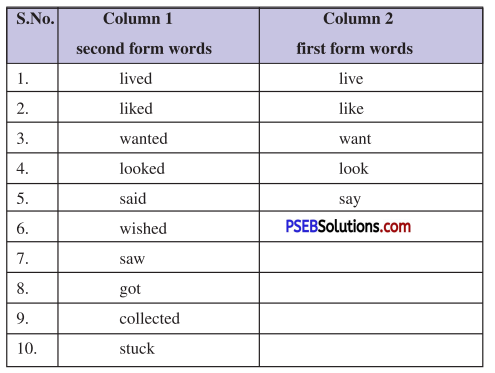
Look at the following pairs of words. They have the same meaning but different forms. Column 1 has the second form and column 2 has the first form. Fill up blank spaces in Column 2 with the first form of the given words. A few have been done for you.
PSEB 6th Class English Solutions Chapter 4 The Peacock and the Crow 1
PSEB 6th Class English Solutions Chapter 4 The Peacock and the Crow 2
Answer:

S.No. Column 1
second form words
Column 2
first form words
1. lived live
2. liked like
3. wanted want
4. looked look
5. said say
6. wished wish
7. saw see
8. got get
9. collected collect
10. stuck stick
11. flew fly
12. felt feel
13. started start
14. accepted accept
15. thought think

Learning to Read and Comprehend

Activity 3.

Read and write answers.

Question 1.
What did the crow not like about himself ?
कौए को अपनी क्या चीज़ पसंद नहीं थी ?
Answer:
The crow did not like his black feathers.

PSEB 6th Class English Solutions Chapter 4 The Peacock and the Crow

Question 2.
Who did he want to be like? Why ?
वह किस जैसा बनना चाहता था और क्यों ?
Answer:
He wanted to be like a peacock because a peacock is a beautiful bird.

Question 3.
What did he say to the other crows ?
उसने अन्य कौओं से क्या कहा?
Answer:
He told the other crows that he did not belong to them. He asked them to stay away from him.

Question 4.
What did the crow see on the ground ?.
कौए ने धरती पर क्या देखा?
Answer:
The crow saw many peacock feathers on the ground.

Question 5.
What did he do with the peacock feathers ?
उसने मोर के पंखों का क्या किया?
Answer:
He stuck them into his wings, his tail and on this head.

PSEB 6th Class English Solutions Chapter 4 The Peacock and the Crow

Activity 4.

1 Who said to whom ?

1. “You look so dull and plain. Look how beautiful the peacocks are.”
2. “Look at my beautiful feathers. I don’t belong to you anymore. So, stay away from me”.
3. “Peacock feathers will not make you a peacock.”
4. “We should accept ourselves the way we are.”
5. “You will not be able to fly properly with these stuck on your body”.
Answer:
1. The crow to his fellow crows.
2. The crow to his fellow crows.
3. The peacocks to the crow.
4. The old wise crow to the crow.
5. The old wise crow to the crow.

Activity 5.

Complete the sentences in the following blanks.

1. One day perching on his tree,
Hints : …………….. the crow saw many peacock feathers on the ground.

2. The crow flew to the river to
Hints : …………….. see his reflection.

3. The peacocks knew that
Hints : …………..he was not one among them. He was a crow.

4. He tore off the entire peacock feathers
Hints : ………………. that were stuck to his feathers.

5. Then, he went to his friends
Hints : …………… and apologized for insulting them.
नोट : विद्यार्थी पूरा वाक्य लिखें।

PSEB 6th Class English Solutions Chapter 4 The Peacock and the Crow

Learning Language

Preposition

A preposition is a word placed before a Noun or Pronoun to indicate place, direction.
किसी Noun या Pronoun से पहले प्रयोग होने वाला शब्द, जो स्थान दिशा आदि दर्शाता है को Preposition कहते है|
on in, into, upon, between, among, under, in front of, beside, behind, आदि शब्द Prepositions है।
PSEB 6th Class English Solutions Chapter 4 The Peacock and the Crow 3
Punctuation
In this lesson, we will continue with punctuation and concentrate on Full stop, Comma, Question Mark and Exclamation mark.
1. The full ( . ) stop is used in the following cases (स्थितियों) :
(a) to mark the end of an assertive or imperative sentence such as :
(i) The baby is sleeping. (assertive or positive)
(ii) Don’t make a noise here. (imperative-order or request)
(b) to mark the abbreviations such as M.A., P.M.
(c) to mark the initials such as Mr. J.D. Kohli, Mrs. B. Sharma

2. The comma (,) is used in the following cases :
(a) to separate words from each other :
1. She is a tall, pretty and gentle girl.
2. Meera has pens, pencils papers and books.
3. We do our work neatly, quickly and correctly.
4. My brother was born on Friday, March 26, 1984.
A comma is generally not used before ‘and’.
प्रायः ‘and’ से पहले comma तही लगया जात |

PSEB 6th Class English Solutions Chapter 4 The Peacock and the Crow

3. Question Mark (?) is used at the end of a question.

1. What is your name?
2. Do you have an umbrella ?
3. She is beautiful, isn’t She ?
4. Did Saawan go to Mumbai ?

4. Exclamation mark (!) is used to show shock, surprise or happiness, sadness, etc.
1. What a lovely place !
2. She is beautiful !
3. Wow!
4. Oh!
4. Hurray!

Activity 6.

Put comma, fullstops, capitals, question marks in the sentences given below wherever required.
1. my name is ali and i come form malerkotla
2. my favourite color is blue what is yours
3. i have a dog its name is caesar
4. my sisters name is manju she is sixty four.
5. my phone number is 260086 ·
6. her uncle hemant is from gurdaspur in punjab
7. i am not from chandigarh, i am from ludhiana in punjab
8. kumar is from australia he lives in melbourne
9. do you like tea or coffee
10. please get biscuits vegetables fruits and some nuts from the market
Answer:
1. My name is Ali and I come from Malerkotla.
2. My favourite color is blue. What is yours?
3. I have a dog. Its name is Caesar.
4. My sister’s name is Manju. She is sixty four.
5. My phone number is 260086.
6. Her uncle, Hemant is from Gurdaspur in Punjab.
7. I am not from Chandigarh; I am from Ludhiana in Punjab.
8. Kumar is from Australia. He lives in Melbourne.
9. Do you like tea or coffee ?
10. Please get biscuits, vegetables, fruits and some nuts from the market.

PSEB 6th Class English Solutions Chapter 4 The Peacock and the Crow

Reading a short Passage

Activity 7.

Read the following story.
Self Realisation A lioness died soon after giving birth to a cub. A mother sheep saw the cub and felt pity for it. She raised the cub among her lambs. However, the naughty lambs made fun of him for his different looks. The cub felt sad about this.

One day, a lion attacked the herd. He was surprised to see the cub running away with the herd. He caught the cub and roared angrily. “Why are you running with the sheep ?” he asked the cub. The cub was scared. He said, “Please don’t kill me. I am a very young lamb.”‘

The lion dragged the cub to a river. “Look at your reflection,”he roared. The cub was surprised. He realized that he was not a sheep but a mighty lion. He became so happy that he started roaring like a lion. One should keep trying to realize one’s worth and hidden skills. Success lies in knowing yourself like the young cub.

1. Answer the following

1. Who raised the cub ?
2. Why was the cub not happy ?
3. What did the cub do on seeing the lion ?
4. What did the lion do?
5. What did the cub see in the river ?

PSEB 6th Class English Solutions Chapter 4 The Peacock and the Crow 4
Answer:
1. A mother sheep raised the cub.
2. The cub was not happy because the naughty lambs made fun of him.
3. He started running with the herd of sheep.
4. The lion caught the cub and asked him why he was running.
5. The cub saw his reflection in the river.

PSEB 6th Class English Solutions Chapter 4 The Peacock and the Crow

2. Fill in the blanks using a word from the passage.
1. The cub realized that it was not a …………….. but a ……………
2. We should try to realize our …………….. and ……………… skills.
3. One should keep ……………. to realize one’s …………….. and hidden ……………
Answer:
1. sheep, mighty lion,
2. worth, hidden,
3. trying, skills.

3. Choose the correct option :

Question 1.
The cub saw his reflection and realized that it was a ………
(a) lion
(b) tiger
(c) sheep
(d) wolf
Answer:
(a) lion

Question 2.
The lion caught the cub. What did he say to the cub ?
(a) Why are you running with the sheep ?
(b) Please don’t kill me.
(c) I am a very young lamb.
(d) You are a lion.
Answer:
(a) Why are you running with the sheep ?

Learning to Listen

Activity 8.

Dictation of words
The teacher will give students dictation of 10 words from the text. Students will write them in their notebooks.
Note : Do it yourself.

Learning to Speak

Activity 9 (Pairwork)

Speak the words used for dictation aloud with proper pronunciation.
Note : Do it yourself. Learning to Write

Activity 10.

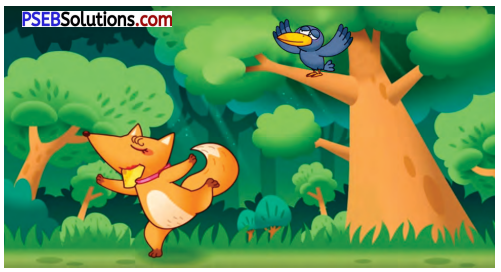
Look at the picture given below and describe it in your words.
For the description, you may use the following words / phrases.
1. forest
2. trees
3. crow
4. fox
5. a piece of
6. cheese
Answer:
This is a lovely forest. There are many tall trees in it. A crow is sitting in a tree. He has a piece of cheese in its beak. There is a fox under the tree. It wants to get that piece. It will flatter the crow to sing. When the crow opens its beak, the piece of cheese will fall down. The fox will take it away to eat.

PSEB 6th Class English Solutions Chapter 4 The Peacock and the Crow

Comprehension Of Passages

Read the given passages and answer the Questions that follow each :

(1) Once there lived a crow who did not like his black feathers. He wanted to be like a peacock because the colourful feathers of the peacock looked very beautiful. “You look so dull and plain. Look how beautiful the peacocks are. I wish I were a peacock.” he would say to other crows.
PSEB 6th Class English Solutions Chapter 4 The Peacock and the Crow 5
One day, perching on his tree, the crow saw many peacock feathers on the ground. The feathers looked very beautiful. Seeing those peacock feathers, he got an idea. He collected all the feathers and stuck them into his wings and the tail. He also put a few on his head to look like a peacock. He flew to a river to see his reflection.

(i) Why did the crow want to be like a peacock ?
कौआ मोर जैसा क्यों बनना चाहता था ?

(ii) What did he do with the peacock feathers ?
उसने मोर के पंखों का क्या किया ?

(iii) Choose true or false statements and write them in your answer book :
(a) The crow had beautiful feathers.
(b) The feathers of a peacock are colourful.

(iv) Complete the following sentences according to the meaning of the passage :
(a) The crow saw many peacock feathers ——-
(b) He collected all the feathers and ——- wings.
Or
Match the words with their meanings :

(a) perch sleep
(b) reflection sit
shadow

Answer:
(i) The crow wanted to be like a peacock because the colourful feathers of the peacock looked very beautiful.
(ii) He stuck the peacock feathers to his body.
(iii)
(a) False
(b) True.
(iv)
(a) The crow saw many peacock feathers on the ground.
(b) He collected all the feathers and stuck them into his wings.
Or.
(a) perch — sit
(b) reflection — shadow

PSEB 6th Class English Solutions Chapter 4 The Peacock and the Crow

(2) “Now I am also as beautiful as a peacock,” he said to himself. He thought that now he should live among the peacocks. So, he went to join the pride of peacocks but peacocks laughed at him. They did not accept him. The peacocks knew that he was not one among them.

He was a crow. “Peacock feathers will not make you a peacock,” they said to him.Sad and feeling insulted, he thought that his crow friends would be happy to see his new feathers. He returned to his fellow crows. None of his fellow crows accepted him.

They did not want him back because he had insulted them earlier. They also knew that he had been insulted by the peacocks. They also started laughing at him. They looked at his feathers and laughed at his face.

(i) Why did the crow think of living among the peacocks ?
कौए ने मोरों के बीच रहने की क्यों सोची ?

(ii) Why did his fellow crows not want him back ?
उसके साथी कौए उसकी वापिसी क्यों नहीं चाहते थे ?

(iii) Choose true or false statements and write them in your answer book :
(a) Peacock feathers will make a crow peacock.
(b) The fellow crows laughed at the crow when he came back.

(iv) Complete the following sentences according to the meaning of the passage :
(a) None of his fellow crows ………
(b) They looked at his feathers and …………
Or
Match the words with their meanings :

(a) Accept make fun
(b) Laugh at to be happy
own

Answer:
(i) The crow thought so because he thought that he was as beautiful as a peacock.
(ii) His fellow crows did not want him back because he had insulted them earlier.
(iii)
(a) False
(b) True
(iv)
(a) None of his fellow crows accepted him.
(b) They looked at his feathers and laughed at his face.
Or
(a) Accept — own
(b) Laugh at — make fun

PSEB 6th Class English Solutions Chapter 4 The Peacock and the Crow

(3) Then, an old and wise crow came and told him, “We should accept ourselves the way we are. Don’t try to copy others, blindly. Peacock feathers are good for peacocks only. For crows the peacock feathers are heavy. You will not be able to fly properly with these stuck on your body. I hope you have learnt your lesson.”

The crow realized his mistake. Though he thought that he was looking handsome, he found it difficult to fly properly. He tore off the entire peacock feathers that were stuck to his feathers. He accepted his plain self. Then, he went to his friends and apologized for insulting them. They accepted him and became friends again. The crow was finally happy.

(i) What was the advise of the wise crow ? Write two sentences.
बुद्धिमान कौए की क्या शिक्षा थी ? दो वाक्य लिखें।

(ii) Why did the crow tear off his peacock feathers ?
कौए ने अपने मोर पंख क्यों उखाड़ फेंके ?

(iii) Choose true or false statements and write them in your answer book :
(a) The crow thought that he was looking handsome.
(b) The crow found it easy to fly properly.

(iv) Complete the following sentences according to the meaning of the passage.
(a) He accepted his ……………..
(b) They accepted him and ………..
Or
Match the words with their meanings :

(a) realized insulted
(b) tore off removed
accepted

Answer:
(i) His advise was : We should accept ourselves as we are. Don’t try to copy others.
(ii) He tore off his peacock feathers because he realized his mistake. He could not fly properly with peacock feathers.
(iii)
(a) True
(b) False
(iv)
(a) He accepted his plain self.
(b) They accepted him and became friends again.
Or
(a) realized – accepted
(b) tore off – removed.

PSEB 6th Class English Solutions Chapter 4 The Peacock and the Crow

Use Of Words/Phrases In Sentences

1. Apologise (say sorry) —
He apologised for his mistake.
उसने अपनी गलती पर खेद व्यक्त किया।

2. Laugh at (make fun) —
Don’t laugh at the poor.
गरीबों का मज़ाक मत उड़ाओ।

3. Accept (own/acknowledge) —
He accepted his mistake.
उसने अपनी गलती स्वीकार कर.ली।

4. Feathers (wings) —
The peacock has beautiful feathers.
मोर के पंख सुंदर होते हैं।

5. Ignore (neglect) —
Don’t ignore your studies.
अपनी पढ़ाई की उपेक्षा मत करो।

6. Perch (sit) —
Many sparrows are perching on the ground.
धरती पर बहुत सी चिड़ियां बैठी हैं।

7. Feel proud (take pride in) —
Don’t feel proud of your riches.
अपनी अमीरी पर अहंकार मत करो।

8. Entire (whole ) —
The entire hall was full.
पूरा हाल भरा हुआ था।

9. Realize (feel) —
She soon realized her mistake.
उसे जल्दी ही अपनी गल्ती का अहसास हो गया।

PSEB 6th Class English Solutions Chapter 4 The Peacock and the Crow

10. Handsome (pretty) —
My elder brother is very handsome.
मेरा बड़ा भाई बहुत सुंदर है।

Word Meanings:

PSEB 6th Class English Solutions Chapter 4 The Peacock and the Crow 6

The Peacock and the Crow Summary in Hindi

Once there lived …………………. was a crow.

एक बार एक कौआ था जिसे अपने काले पंख अच्छे नहीं लगते थे। वह मोर जैसा बनना चाहता था क्योंकि उसे मोर के रंग-बिरंगे पंख बहुत ही सुंदर लगते थे। वह दूसरे कौओं से कहता, “तुम बहुत ही नीरस और साधारण दिखते हो। देखो मोर कितने सुंदर हैं। काश मैं मोर होता।” एक दिन कौआ अपने पेड़ की शाखा पर बैठा था तभी उसने बहुत से मोर पंख ज़मीन पर पड़े देखे। पंख बहुत ही सुंदर लग रहे थे।

मोर के पंखों को देखकर उसे एक विचार सूझा। उसने सारे पंखों को इकट्ठा किया और उसे अपने पंखों तथा पूंछ पर लगा लिया। उसने कुछ पंख अपने सिर पर भी लगा लिए ताकि वह मोर जैसा दिखाई दे। वह अपनी परछाई देखने के लिए नदी की ओर उड़ चला। उसने खुशी से कहा, “वाह! अब मैं मोर जैसा सुंदर दिखता हूँ।”उसने अपने आप से कहा, “अब मैं मोर जितना सुंदर हूँ।”

उसने सोचा कि अब उसे मोरों के साथ रहना चाहिए। इसलिए वह मोरों के झुंड में शामिल होने के लिए चला गया परन्तु मोर उस पर हंसने लगे। उन्होंने उसे अपनाया नहीं। मोर जानते थे कि वह उनके जैसा नहीं है। वह एक कौआ है।

PSEB 6th Class English Solutions Chapter 4 The Peacock and the Crow

Peacock feathers ………………. was finally happy.

उन्होंने उससे कहा, “मोर पंख तुम्हें मोर नहीं बना देंगे।” उदासी और अपमान (शर्मिंदगी) से भर कर उसने सोचा कि उसके कौए दोस्त उसके नए पंखों को देखकर खुश होंगे। वह अपने साथी कौओं के पास वापिस आ गया। उसके साथी कौओं में से किसी ने भी उसे अपना स्वीकार नहीं किया। वह नहीं चाहते थे कि वह वापिस आए क्योंकि वह पहले उनकी बेइज्जती कर चुका था। वे यह भी जानते थे कि मोरों ने उसकी बेइज्जती की हैं।

उन्होंने भी उस पर हंसना शुरु कर दिया। उन्होंने उसके पंखों को देखा और उसके सामने उसका मजाक उड़ाने लगे। तभी एक बुद्धिमान बूढ़ा कौआ आ गया और उसे कहां, “हम जैसे हैं हमें अपने आप को वैसा ही स्वीकार करना चाहिए। आँख मूंद कर दूसरों की नकल मत करो। मौरो के पंख केवल मोरों के लिए ही अच्छे हैं। कौओं के लिए मोर पंख भारी हैं।

उन्हें अपने शरीर पर लगा कर तुम ठीक ढंग से नहीं उड़ सकते। मुझे आशा है कि तुम्हें अपना सबक मिल चुका है।” कौए ने अपनी गलती स्वीकार कर ली। यद्यपि वह सोचता था कि वह सुन्दर दिख रहा है फिर भी उसके लिए उड़ पाना कठिन था। उसने अपने पंखों पर लगे सभी मोर पंख उखाड़ फेंके।

उसने अपने आपको साधारण (सादा) रूप में स्वीकर कर लिया। तब वह अपने मित्रों के पास गया और उनसे अपने द्वारा की गई बेइज्जती के लिए माफी मांगी। उन्होंने उसे अपना लिया और वे मित्र बन गए। अंततः कौआ खुश हो गया ।

Retranslation Of Isolated Sentences

1. He wanted to be like a peacock. — वह मोर जैसे दिखाई देना चाहता था।
2. You look so dull and plain. — तुम बहुत ही नीरस और साधारण दिखते हों।
3. The crow saw many peacock feathers on the ground. — कौए ने बहुत सारे मोर पंख ज़मीन पर पड़े देखे।
4. I look as beautiful as a peacock. — मैं मोर की तरह सुंदर लगता हूँ।
5. I don’t belong to you any more. — अब मेरा तुमसे कोई (संबंध) नाता नहीं है।
6. Peacock feathers will not make you a peacock. — मोर पंख तुम्हें मोर नहीं बना देंगे।
7. He returned to his fellow crows. — वह अपने साथी कौओं के पास वापिस आ गया।
8. We should accept ourselves the way we are. — हम जैसे हैं हमें अपने आपको वैसा ही स्वीकार कर लेना चाहिए।
9. I hope you have learnt your lesson. — मुझे आशा है कि तुम्हें अपना सबक मिल चुका है।
10. The crow realized his mistake. — कौए ने अपनी गलती मान ली।
11. The crow was finally happy.– अंतत: कौआ खुश हो गया।

English Class 6 Solutions PSEB Prose

The Hunter and the Deer Question Answer Class 7 English Solutions Poem Chapter 2 PSEB Solutions

Punjab State Board PSEB 7th Class English Book Solutions Poem 2 The Hunter and the Deer Textbook Exercise Questions and Answers.

Class 7th English Solutions Poem Chapter 2 The Hunter and the Deer Question Answers

The Hunter and the Deer Class 7 Questions and Answers

Activity 1.

1. Meaning of the word as used in the poem (adjective/noun/verb, etc.)
2. Pronunciation (The teacher may refer to the dictionary or the mobile phone for correct pronunciation.)
3. Spellings :

Journey plea buck
doe fawn beast

Vocabulary Expansion

Activity 2.

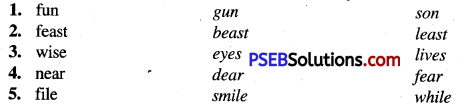
Pick up words from the poem that match the rhyme of the following words.
PSEB 7th Class English Solutions Poem 2 The Hunter and the Deer 3

Activity 3.

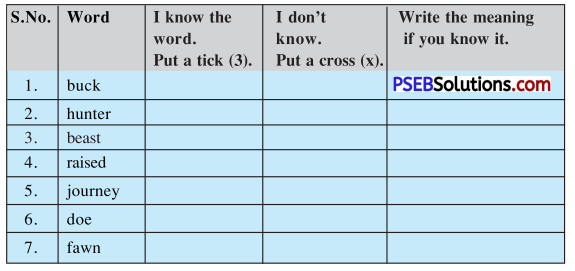
Read the words in the following table and do as directed.
PSEB 7th Class English Solutions Poem 2 The Hunter and the Deer 1
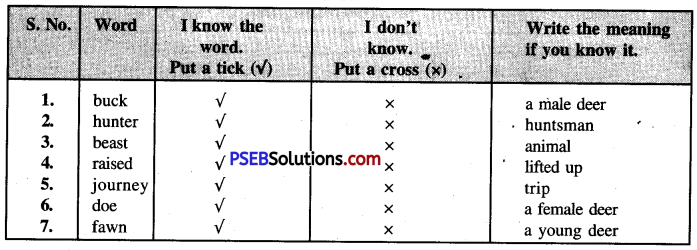
Answer:
PSEB 7th Class English Solutions Poem 2 The Hunter and the Deer 2

PSEB 7th Class English Solutions Poem 2 The Hunter and the Deer

Activity 4

Read the poem and select the appropriate option to fill in the given blanks.

Question 1.
The hunter went on a journey to find some …………………..
(a) deer meat
(b) dog meat
(c) horse meat
Answer:
(a) deer meat

Question 2.
The hunter found …………………
(a) a dog
(b) a buck
(c) a bear
Answer:
(b) a buck

Question 3.
The other word for a male deer is ………..
(a) doe
(b) fawn
(c) buck
Answer:
(c) buck

Question 4.
The poet thought that the buck was begging for ………
(a) the fawn’s life
(b) his own life
(c) the doe’s life
Answer:
(b) his own life

PSEB 7th Class English Solutions Poem 2 The Hunter and the Deer

Question 5.
A female deer is called a ………
(a) doe
(b) fawn
(c) buck
Answer:
(a) doe

Question 6.
A young deer is called a …………
(a) doe
(b) fawn
(c) buck
Answer:
(b) fawn

Question 7.
The hunter remembered what he came for and raised his ……….
(a) hand
(b) gun
(c) head
Answer:
(b) gun

Question 8.
A …….. came out of nowhere.
(a) doe
(b) fawn
(c) buck
Answer:
(b) fawn

Question 9.
The hunter felt that he could not the buck.
(a) kill
(b) raise
(c) look at
Answer:
(a) kill

Question 10.
The hunter gathered__for feeding the deer.
(a) fruits
(b) leaves
(c) nuts.
Answer:
(c) nuts.

Activity 5.

Write answers to the following questions.

Question 1.
What did the hunter want to eat ?
शिकारी क्या खाना चाहता था ?
Answer:
The hunter wanted to eat some deer meat.

Question 2.
What did the hunter see ?
शिकारी ने क्या देखा ?
Answer:
The hunter saw a buck.

PSEB 7th Class English Solutions Poem 2 The Hunter and the Deer

Question 3.
Why did the hunter not kill the buck ?
शिकारी ने हिरण को क्यों नहीं मारा ?
Answer:
The hunter did not kill the buck because he saw a plea of mercy in his eyes. He begged for his life.

Question 4.
What did the hunter do ?
शिकारी ने क्या किया ?
Answer:
The hunter gathered some nuts and fed the buck.

Question 5.
How did the buck feel after eating nuts ?
नट्स खा कर हिरण ने कैसा महसूस किया ?
Answer:
After eating nuts, the buck felt himself out of fear.

Activity 6.

Explain the following statements in your own words.

1. And if he killed the buck he’d feel like a beast.
2. And something grew in him.
3. And he felt the deer’s lack of fear.
Answer:
1. Killing is a beastly act.
2. A feeling of mercy arose in him.
3. He felt that the deer had lost his fear.

Learning Language

Determiners

Let us look at the following sentences :

1. The rabbit found its hole.
2. I ate the vanilla cake in the evening.
3. The metal cans are recyclable.

PSEB 7th Class English Solutions Poem 2 The Hunter and the Deer 6

The italicized words above are determiners.
Determiners are words like ‘the’, ‘an’, ‘this’ or ‘some that always come before a noun or before any other adjectives used for the noun.

PSEB 7th Class English Solutions Poem 2 The Hunter and the Deer

There are four different types of determiners in English :
(1) Articles
(2) Demonstratives
(3) Quantifiers and
(4) Possessives.

1. Articles बहुत ही महत्त्वपूर्ण Determiners हैं। ये तीन हैं-a, an, तथा the. इनका प्रयोग Singular nouns gent Adjectives on the IT Articles are among the most common of the determiners. There are three singular articles: ‘a’, ‘an’, and ‘the’. Articles specify (or determine) which noun the speaker is referring to. ‘A’ and ‘an’ are indefinite articles. They are used when you are talking about a general version of the noun.
For example:
1. A cat is a cute animal.
2. An eagle can see the ground from the sky.

‘A’ is used before words that begin with the sound of a consonant such as ‘p’, ‘l’, ‘d’, ‘s’, and ‘an’ is used before words beginning with the sound of a vowel such
as ‘a’, ‘e’, ‘i’, o’, ‘u’.
Examples : Consonant sound
1. a cat
2. a pan.
3. a European :
4. a cow
5. a hen
PSEB 7th Class English Solutions Poem 2 The Hunter and the Deer 7
Examples : Vowel sound
1. an apple
2. an honest man
3. an umbrella
4. an hour
5. an egg
PSEB 7th Class English Solutions Poem 2 The Hunter and the Deer 8

“The’ is a definite article. It is used before a specific noun, as-
1. He went to the best restaurant in the city.
2. The kitten is meowing too loudly.
Here the speaker is talking about a particular (विशेष) kitten and a particular restaurant.

PSEB 7th Class English Solutions Poem 2 The Hunter and the Deer

Activity 7.

In the following sentences, choose one of the three options and put a tick on the right one.
1. I have a/an/the/good idea.
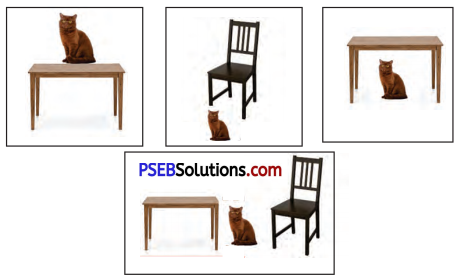
2. That is a/an/the/interesting toy!
3. I have kept the bag in alan/the/cupboard.
4. Do the Sharmas have a/an/the/blue car ?
5. The water in a/an/the/river is dirty.
6. He had a/an/the/piece of chocolate.
7. I like to eat a/an/the/egg everyday.
8. She has a/an/the/good habit of brushing her teeth twice a day.

PSEB 7th Class English Solutions Poem 2 The Hunter and the Deer 9

9. Raghav likes to walk in a/an/the/rain.
10. Radha plays a/an/the game of chess everyday.
Answer:
1. a
2. an
3. the
4. a
5. the
6. a
7. an
8. the
9. the
10. the.

2. Demonstrative adjectives : are also used as determiners in English. They are – “this”, “that, “these’ and ‘those’. Demonstratives are used in a situation in which the speaker can point to an item.
PSEB 7th Class English Solutions Poem 2 The Hunter and the Deer 10
For example:
1. Do you want this piece of cake ?
2. I don’t want to watch that movie.
3. These black grapes are sour.
4. He wanted to hire those boys for the job.
“This’ and ‘these’ point to the items close to us; “that and those’ refer to items far away. Note also “this’ and ‘that are singular while these’ and ‘those’ are plural.

PSEB 7th Class English Solutions Poem 2 The Hunter and the Deer

Activity 8.

Let us help Richard describe his office.
PSEB 7th Class English Solutions Poem 2 The Hunter and the Deer 11

Write ‘this’ or ‘these for things that are near him, and that’ or ‘those’ for things that are not near him. One has been done for you.
1. This laptop is new.
2. ………….. wooden cabinet is for his papers.
3. ………….. books are about business.
4. ………….. computer is also new.
5. ………….. dustbin is very good
6. ……….. curtains are very old.
7. ………… plant is beautiful.
8. …………… wooden horses are nice.
9. …………. cage does not have a real bird.
10. ……….. drawers need repair.
Answer:
2. This
3. These
4. This
5. That
6. These
7. That
8. These
9. This
10. These.

3. Quantifiers: Quantifiers are determiners that indicate how much or how little of the noun is being talked about. They include words such as ‘all’, “a few’, and many’.
For example :
1. She read all the books.
2. She liked all the sweets equally.
3. A few children like beans, so the school canteen stopped serving beans to them.
4. Many kittens are taught to hunt by their mothers.

PSEB 7th Class English Solutions Poem 2 The Hunter and the Deer

Activity 9.

In the following sentences choose one of the options and put a tick on the right one.

PSEB 7th Class English Solutions Poem 2 The Hunter and the Deer 12

1. There are only ……………… bananas left in the box.
(a) a few
(b) a little

2. We need ……………. butter for this cake.
(a) a few
(b) a little

3. There are only ……….. days left to give the reports.
(a) a few
(b) a little

4. I bought …………. apples from this shop.
(a) a few
(b) a little

5. …………….. people live in your city ?
(a) How much
(b) How many

6. …………… water is there in the sea ?
(a) How much .
(b) How many

7. We need …………… bananas.
(a) some
(b) any

8. You can’t buy …………….. oranges in this shop.
(a) some
(b) any

9. There is a bus ……………… 2 hours.
(a) each
(b) every

10. We enjoyed …………….. minute of our holidays.
(a) each
(b) every
Answer:
1. (a) a few
2. (b) a little
3. (a) a few
4. (a) a few
5. (b) How many
6. (a) How much
7. (a) some
8. (b) any
9. (b) every
10. (a) each.

4. Possessive Adjectives: When talking about a noun that belongs to someone or something, we use possessive adjectives to show ownership. Possessive adjectives include ‘my’, ‘your’, ‘his’, ‘her’, ‘its’, ‘our’ and their’. For example :
1. Where is your mother ?
2. The dog growled and showed its teeth.
3. My best friend loves cats.
4. Which one is his car ?
5. Speaking the truth is her best quality.
6. In the autumn season, trees shed their leaves.
7. It’s our house.
The possessive adjective (determiner) comes before the noun.

Activity 10

Complete the following letter written by Ashok to Deepak. Fill in the correct possessive adjectives.

Hello Deepak
…….1. ….. name is Ashok. This is ……. 2……….. friend Satish. He is thirteen years old …….. 3. ……. sister is nine. They have got a pet. ……. 4. ……. pet is a dog. …… 5. ……. name is Caesar. Satish and I go to the same school. There are 600 boys and girls in ……. 6. ……. school. Satish’s class teacher’s name is Mrs. Sharma. She has got a pet, too. ……. 7. ……. pet is a cat. Our class teacher is Mr. Gupta. I like ……. 8……… lessons. He has three dogs. The dogs love to play in …….. 9. ……. garden. Now I have a question for you. What is ……. 10. ……. pet ?
Yours
Ashok

PSEB 7th Class English Solutions Poem 2 The Hunter and the Deer 13
Answer:
1. My
2. my
3. His
4. Their
5. His/Its
6. our
7. Her
8. his
9. his/their
10. your.

PSEB 7th Class English Solutions Poem 2 The Hunter and the Deer

Learning to Listen

Activity 11.

Your teacher will speak five words. You will listen to him/her carefully and write the words in the space provided. Thereafter, you will write three rhyming words for each in the space given under each word. An example is given :

Example Word Light
fight
kite
white

PSEB 7th Class English Solutions Poem 2 The Hunter and the Deer 14

नोट – कृपया अपने अध्यापक से अन्य शब्द लेकर rhyming words लिखने का अभ्यास करें। हमने यहां अपनी ओर से ये शब्द दिए हैं।

S.No. Word 1
hit
Word 2
book
Word 3
sing
Word 4
peep
Word 5 behind
1. hit shook ring deep find
2. sit took bring sleep kind
3. fit hook king keep bind

Learning to Speak (Pairwork)

Kindness to other people and animals is very important for human beings. We must be kind to others. In our life, many people have been kind to us. Do you remember any kind act done to you by your neighbour, friend, mother, uncle or a stranger ?

Activity 12.

Tell your partner about how someone was kind to you/how you were kind to someone (a human being/an animal).
Some useful words/phrases

1. my neighbour/friend
2. kindness
3. sympathy
4. virtue
5. made me smile
6. generosity
7. greatest gift
8. won my heart
9. I can’t forget
Answer:
Yesterday it was very cold. I saw an old and weak beggar by the roadside. He was poorly clothed and was shivering badly. But I was in full winter dress, i.e., all woollen. I had a blanket too. I took it off and put it on the beggar. His body stopped shaking soon. Had I not given him the blanket, he would have surely died. He blessed and blessed me. It made me smile. I felt great within me. Really the acts of kindness fetch true happiness. Sympathy is divine.

PSEB 7th Class English Solutions Poem 2 The Hunter and the Deer

Learning to Write

Application

Study the following format of writing an application for fee concession.

Addressed to
The Principal [Name of the school]
[Address]
[Date]
Subject
Subject : Application for Fee Concession
Salutation
Sir/Madam
Body of Application
I beg to say that I am a student of class 7 in this school. I am a good student. I always stand 1st in the class. My parents are poor. They are unable to pay full fees. Therefore, I request you to kindly grant me a concession in my fee. I shall be very thankful to you.
Closing
Thanking you
Yours obediently
[Your Name]
[Class and section] [Roll No.]

Activity 13

Write an application to your Principal requesting him/her to grant you sick leave for three days.

The Headmaster
SD High School
Sangrur
Sir
I beg to say that I am a student of VIIth class. I am ill. My whole body is aching. So I cannot come to school. Kindly grant me leave for three days.
I shall be thankful to you for this kind act.
Yours obediently
XYZ
February 19, 20……

Learning to Use Language

Read the following example of a four line poem.

My Home
My home is a brick house
Where it’s warm and safe to be ;
I wish all the world’s children
Could be lucky, like me. — Trevor Harvey

PSEB 7th Class English Solutions Poem 2 The Hunter and the Deer 15

Activity 14.

Use some of the following words/phrases or any other you like to write your own four line poem.

I, see, blue, violet, red, rainbow, colours, flowers, evening, breeze, trees, swaying, dance

Look ! A colourful garland in the sky,
A beautiful rainbow, necklace of a bride.
After the rain all fresh and gay,
Among dancing flowers, she wears it with pride.

PSEB 7th Class English Solutions Poem 2 The Hunter and the Deer

Stanzas For Comprehension

Read the following stanzas carefully and answer the questions that follow each :

(1) The Hunter and the Deer
The Hunter went on a journey
To find some deer meat
He saw a buck and looked into his eyes
He saw a plea, the buck begging for his life
A doe and a fawn came from behind
Needing the buck in their lives.

1. What did the hunter see in the buck’s eye ?
शिकारी ने हिरण की आंखों में क्या देखा ?

2. Who needed the buck in their lives?
जीवन में हिरण की ज़रूरत किसे थी ?

3. Name the poem and the poet ?
कविता और कवि का नाम बताएं।
Answer:
1. The hunter saw an appeal of mercy for life in the buck’s eyes.
2. His family members, the doe and the fawn, needed the buck in their lives.
3. The name of the poem is ‘The hunter and the Deer’. Its poet is anonymous

(2) The hunter knew what he came for and raised his gun
But out of nowhere, he saw the buck’s son
It was cute, to say the least
And if he killed the buck he’d feel like a beast
The hunter looked at the deer again
And something grew in him.

1. How did the buck’s son look ?
हिरण का पुत्र कैसा लगता था ?

2. What feeling arrested the hunter ?
शिकारी के मन में क्या भावना आई ?

3. What is the central idea of the poem ?
कविता का केंद्रीय भाव क्या है ?
Answer:
1. The buck’s son looked very cute.
2. He felt that if he killed the buck, he would be no better than an animal.
3. Mercy and pity for animals is the central idea of the poem. Having pity on the weak and innocent is a great virtue. The art of kindness gives real happiness.

(3) He gathered some nuts and fed the deer
And he felt the deer’s lack of fear
He smiled a great big smile
He stayed with the deer for a while
And he went home feeling great

1. How did he feed the deer ?
उसने हिरण को भोजन कैसे कराया ?

2. Why did he smile a big smile ?
वह खुल कर क्यों मुस्कराया ?

3. Write the rhyming words in the Stanza. Two or three pairs.
पद्य में से लय वाले शब्द लिखें। दो या तीन जोड़े।
Answer:
1. He collected some nuts and fed the deer.
2. He smiled a big smile to see the buck without fear.
3. deer – fear; smile – while.

PSEB 7th Class English Solutions Poem 2 The Hunter and the Deer

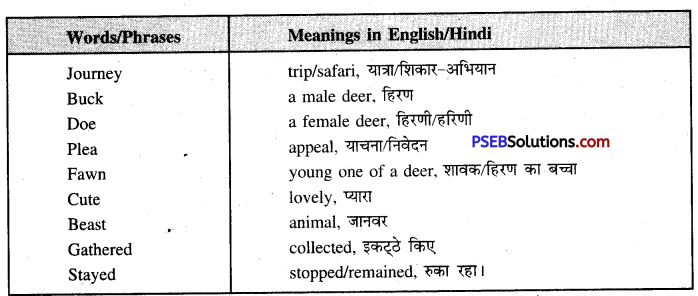
Word Meanings
PSEB 7th Class English Solutions Poem 2 The Hunter and the Deer 16

The Hunter and the Deer Summary in Hindi

यह कविता पशुओं के प्रति दया और प्रेम का व्यवहार करने का पाठ पढ़ाती है। एक शिकारी हिरण का मांस प्राप्त करने के लिए वन में शिकार करने गया। उसने एक हिरण को देखा और उसे मारना चाहा। परंतु उसने उसकी आँखों में अपनी याचना के भाव देखे जो जिंदगी की भीख मांग रहे थे। इतने में एक हिरणी और उसका बच्चा भी आ गए। वे चाहते थे कि शिकारी हिरण को उनकी खातिर छोड़ दे। शिकारी तो शिकार के लिए आया था।

इसलिए उसने अपनी बंदूक उठाई। तभी हिरण का बच्चा (पुत्र) आगे आ गया जो बहुत ही प्यारा था। उसे देखकर शिकारी के विचार बदल गए। उसने सोचा कि किसी की जान लेना तो जानवरों का काम है। अत: उसने कुछ नट्स इकट्ठे करके हिरण को खिलाए। हिरण खुश हो गया और उसका डर जाता रहा। परंतु दयावान शिकारी उससे भी अधिक प्रसन्न था क्योंकि उसने नेकी का एक महान् कार्य किया था।

My English Companion for Class 7 PSEB Solutions Poetry

I am Happy with Who I am Question Answer Class 6 English Solutions Poem Chapter 4 PSEB Solutions

Punjab State Board PSEB 6th Class English Book Solutions Poem 4 I am Happy with Who I am Textbook Exercise Questions and Answers.

Class 6th English Solutions Poem Chapter 4 I am Happy with Who I am Question Answers

I am Happy with Who I am Class 6 Questions and Answers

Activity 1.

Look up the following words in a dictionary. You should seek the following information about the words and put them in your WORDS notebook.
1. Meaning of the word as used in the lesson (Adjective/Noun/Verb, etc.)
2. Pronunciation (The teacher may refer to the dictionary or the mobile phone for correct pronunciation.)
3. Spellings

mirror index finger confident
precious being matter

PSEB 6th Class English Solutions Poem 4 I am Happy with Who I am

Activity 2.

Pick up words from the text that match the rhyme of the following words.
1. me, see, be
2. mirror, finger, matter, better, colour.

Activity 3.

Read the following words and use them in meaningful sentences.
1. Precious Life is precious.
2. Confident-I am confident of me.

Learning to Read and Comprehend

Activity 4.

Read the poem and answer the following question :

Question.
What does the poet see in the mirror ?
कवि शीशे में क्या देखता है ?
Answer:
She sees herself
(a) looking back at her.
(b) showing the index finger.
(c) saying no one can be like her.

PSEB 6th Class English Solutions Poem 4 I am Happy with Who I am

Activity 5.

Question.
Make a list of the things that the poet says about herself.
कवि द्वारा अपने बारे में कही गई बातों की सूची बनाओ।
Answer:
(a) I believe in myself, my being, my size, my shape, my colour.
(b) I am happy with who I am.
(c) I am unique and precious.

Activity 6.

Use of ‘is’, ‘am’, ‘are’. Look at these sentences :
1. I am honest.
2. They are working hard.
3. He is reading a newspaper.
4. You are very intelligent.
The words in bold – ‘is’, ‘am’ ‘are’, are helping verbs.
is, am, are here found
PSEB 6th Class English Solutions Poem 4 I am Happy with Who I am 1
1. ‘am’ is used with ‘I’.
I am doing my work.

2. ‘is’ is used with singular subjects.
She is my best friend
Rohit is singing a song.

PSEB 6th Class English Solutions Poem 4 I am Happy with Who I am 2

3. “are’ is used with ‘you’ and plural subjects.
You are very beautiful.
Anu and Neha are good friends.

Learning to Listen

Activity 7 (Pair Work)

The teacher will choose simple pictures of trees, flowers, hut, etc. for the students. Sit with your partner facing another side. Your partner will describe a picture. The sister will give one student a simple photograph and the other a blank piece of paper. The first student will describe in detail the photograph, while the second student will try to draw it on the paper :

Students can use phrases as
1. I am going to describe a/an….
2. It is red/blue/green ….
3. The __ is very big/small/shady/tall ….
The teacher will collect all the photos and the drawings and select the drawing that is closest to the verbal description. The teacher will show the photo to the students and tell them why she/ he has chosen that picture.

PSEB 6th Class English Solutions Poem 4 I am Happy with Who I am

Learning to Speak
Note : Do it yourself in the classsroom with help of your teacher.

Activity 8.

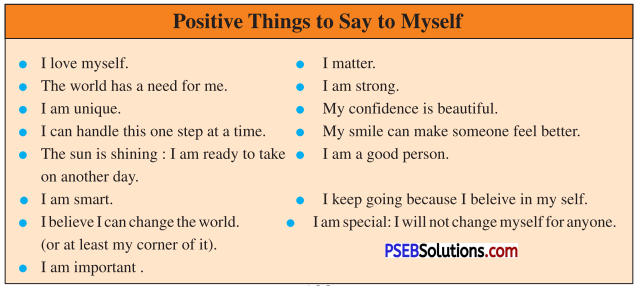
Our parents love us. They say the best things to us. Do we love ourselves ? Do you think we should believe in ourselves ? Yes ! We must if we want to give our best to other people, we must think that we are good. We must think that we can do it. Now, look at the chart given below. Read it carefully. Animal parents also love their children. Now get into pairs. Say all the sentences in the chart to your partner, Take turns in speaking. When you have finished saying to your partner, say all the sentences to yourself. Remember to add YES before each sentence.

Positive Things To Say To Myself

PSEB 6th Class English Solutions Poem 4 I am Happy with Who I am 4
Answer:
1. Yes, I love myself
2. Yes, I mother
3. Yes.

Learning to Write

Activity 9.

Write a short paragraph on ‘What I like about myself’. You may use the sentences given in the chart for guidance.

“What I like about myself

60-70 words.

I am a precious gift of God to my parents. God has given me many positive things. I am strong. I am smart. I have a kind heart. I am helpful. I am loving and caring. I keep going because I believe in myself. My confidence is great. I face every difficulty boldly. On the whole, I am a good person. I am unique as no one is there like me. The whole world needs me because I can make it better. Thus, I am special. I will not change myself for anyone.

PSEB 6th Class English Solutions Poem 4 I am Happy with Who I am

Learning to Use Language

Activity 10.

Complete the following worksheet.
My Name : X
My age : 10 years
My height : 5 feet
My colour : fair
My hair : black and curly
My hobby : painting
My favourite Book : Grandma stories
My favourite Sport : hockey
My dream : to become a scientist

PSEB 6th Class English Solutions Poem 4 I am Happy with Who I am 3

Share your sheet with your partner. Are your answers the same ? Are they different ? In what ways are you both different from each other ? The beginning is given :
Answer:
Our names are different. My name is X. His/her name is Y. Our age is different. My age is 10 years. His/her age is 11 years. Our heights are different. My height is 5 feet. His/her height is 5 feet 2 inches. Our colours are different. My colour is fair. His/her colour is little brown. Our hair are different. My hair is black and curly. His/her hair is black and plain. Our hobbies are different. My hobby is painting. His/her hobby is reading books. Our favourite books are also different. My favourite book is ‘Grandma Stories’ whereas his/her favourite book is ‘Animal Stories’. We like to play different games. My favourite game is hockey. But his/her favourite game is Kabaddi.

Comprehension Of Stanzas

Read stanzas given below and answer the questions that follow each :

(1) I often look into the mirror
And I like what I see,
I see myself looking back at me
Showing the index finger.
Saying no one can be like me.

1. What does the poet often look into ?
कवि प्रायः किस चीज़ में देखता है ?

2. What does he/she see in it ?
इसमें वह क्या देखता/देखती है ?

3. Which finger does the figure show ?
आकृति में कौन सी उंगली दिखती है ?

PSEB 6th Class English Solutions Poem 4 I am Happy with Who I am

What does it tell the poet ?
वह कवि को क्या बताती है ?
Or
Name the poem and the poet.
कविता और कवि का नाम बताएं।
Answer:
1. He/she often looks into the mirror.
2. He/she sees himself/herself looking back at him/her.
3. The figure shows the index finger. (astant)
4. It tells the poet that none can be like him/her.
Or
The name of the poem ‘I’m happy with who I am and that of the poet is Vandana Lunyal.

(2) I’m unique, the mirror tells me
I’m precious, I matter
The world has a need of me
If I smile and make it better
Saying no one can be like me.

1. What does the mirror tell the poet ? Mention any two things.
शीशा कवि को क्या बताता है ? कोई दो बातें लिखें।

2. Who needs him/her ?
उसकी ज़रूरत किसे है ?

3. How can he/she make the world better?
वह संसार को कैसे बेहतर बना सकता/सकती है ?

4. Pick out the word from the stanza that means ‘no one can be like me’.
Or
Which word in the stanza rhymes with ‘matter’?
Answer:
1. The mirror tells the poet that he/she is precious and that he/she matters.
2. The world needs him/her.
3. He/she can make the world better with his/her smiles.
4. ‘unique’
or
‘better’.

PSEB 6th Class English Solutions Poem 4 I am Happy with Who I am

(3) Be confident, says the mirror
Whatever you are, be happy.
I believe in myself, my being
My size, my shape, my colour
I’m happy with who I am !

1. What does the mirror say to the poet ?
शीशा कवि से क्या कहता है ?

2. Name two things he/she believes in ?
उसे अपनी किन चीज़ों में विश्वास है ? कोई दो लिखें।

3. What is the poet happy with ?
कवि किस बात से खुश (संतुष्ट) है ?

4. Name the poem and the poet ?
कविता तथा कवि का नाम बताएं।
Or
Complete the given sentence :
I ………….myself.
Answer:
1. The mirror asks the poet to be confident. He/she should be happy with whatever he/she is.
2. He/She believes in his/her shape and size.
3. The poet is happy with who he/she is.
4. The name of the poem is ‘I’m Happy with who I am. Its poet is Vandana Lunyal.
Or
I believe in myself.

Word Meanings
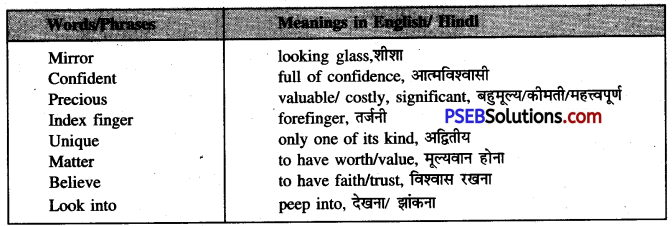
PSEB 6th Class English Solutions Poem 4 I am Happy with Who I am 5

I am Happy with Who I am Poem Summary in English

I am Happy with Who I am Summary in English

This three stanza poem gives us a lot of a self confidence. It inspires us to believe firmly in what we are. The poet sees into mirror and sees his/her reflection. It tells him/her that he/she is unique. No one is like him/her in the world.

To he/she is precious because the world needs him/her. He/she should be proud of his/her size, colour shape and everything of his/hers. He/She should be happy of whatever he/she is, His/her smiles can makes the world better place to live in.

PSEB 6th Class English Solutions Poem 4 I am Happy with Who I am

I am Happy with Who I am Summary in Hindi

कविता यह संदेश देती है कि व्यक्ति जैसा भी हो उसे उसी में खुश रहना चाहिए। कवि को शीशे में अपना चेहरा देखना अच्छा लगता है। उसका चेहरा उसकी ओर देख रहा होता है और अपनी तर्जनी से इशारा करते हुए कहता है कि कवि जैसा और कोई नहीं हो सकता। वह कवि को बताता है कि वह अद्वितीय है और संसार के लिए मूल्यवान है।

वह अपनी मुस्कान से संसार को बेहतर बना सकता है। शीशा कवि से कहता है कि वह अपने आप पर विश्वास रखे और जैसा है, उसी में खुश रहे। कवि उत्साहित होकर कहता है कि उसे स्वयं में विश्वास है। उसे अपने आकार, आकृति तथा रंग पर मान है। इसलिए वह जैसा भी है, उसी में खुश है।

Class 6th English Book Solutions PSEB Poetry

Rent for Water Question Answer Class 7 English Solutions Chapter 1 PSEB Solutions

Punjab State Board PSEB 7th Class English Book Solutions Chapter 1 Rent for Water Textbook Exercise Questions and Answers.

Class 7th English Solutions Chapter 1 Rent for Water Question Answers

Rent for Water Class 7 Questions and Answers

Activity 1.

Look up the following words in a dictionary. You should seek the following information about the words and put them in your WORDS notebook.
1. Meaning of the word as used in the chapter (adjective/noun/verb, etc.)
2. Pronunciation (The teacher may refer to the dictionary or the mobile phone for correct pronunciation.)
3. Spellings

arguing draw bowing pleaded justice

नोट :-
1. विद्यार्थी Lesson के आरंभ में दिए गए Word-Meanings पढ़ें।
2. Pronunciation के लिए अपने अध्यापक से निर्देश लें।
3. दिए गए शब्दों की Spellings याद करें और इन्हें बार-बार सीखने का अभ्यास करें।

PSEB 7th Class English Solutions Chapter 1 Rent for Water

Vocabulary Expansion

1. draw water (to take out water from a well)
I am thirsty. — Please let me draw water from your well.

2. Your Majesty (respectful words used when talking to or about a king or a queen)
(i) “Your Majesty ! I am a poor farmer. Please help me.”
(ii) His Majesty will soon arrive at the palace.

3. get justice (to be treated justly)
(i) People go to the court to get justice.
(ii) The farmer understood that he will get justice in the court.

4. instead of (in place of)
(i) There were green small lanes instead of busy streets.
(ii) There were big trees instead of tall buildings.
(iii) I think I will have tea instead of coffee today.

Activity 2.

Insert instead of in the following sentences, wherever needed :

1. Today, I will have butter jam on my bread.
2. By mistake, Sahib went to the railway station airport to pick up his friend.
3. I want to buy Samsung mobile Apple.
4. I wore blue socks red.
5. Rajinder had fresh cream custard.
Answer:
1. Today I will have butter instead of jam on my bread.
2. By mistake, Sahib went to the railway station instead of airport to pick up his friend.
3. I want to buy Samsung mobile instead of Apple.
4. I wore blue socks instead of red.
5. Rajinder had fresh cream instead of custard.

PSEB 7th Class English Solutions Chapter 1 Rent for Water

Learning to Read and Comprehend

Activity 3.

Answer the following questions :

Question 1.
Why did the farmer buy the well ?
किसान ने कुआँ क्यों खरीदा ?
Answer:
The farmer bought the well to water his fields.

Question 2.
Who did he buy it from ?
उसने इसे किससे खरीदा ?
Answer:
He bought it from his neighbour.

Question 3.
What was the argument between the farnier and his neighbour about ?
किसान और उसके पड़ोसी के बीच किस बात का झगड़ा था ?
Answer:
The argument between the two was about the water in the well. The farmer wanted to take out water. But his neighbour would not allow him.

Question 4.
Where did they go to solve the issue ?
इस मामले को सुलझाने के लिए वे कहां गए ?
Answer:
They went to the court of King Krishna Dev Rai.

Question 5.
What did the king do to solve their case ?
राजा ने उनके मामले को सुलझाने के लिए क्या किया ?
Answer:
The king asked the wisest minister of his court Tenali Raman to solve the case.

Question 6.
How did Tenali Raman solve the case ?
तेनाली रमन ने मामले को किस प्रकार सुलझाया ?
Answer:
He solved the case by doing justice to the farmer. He asked the neighbour to pay rent for his water in the farmer’s well.

PSEB 7th Class English Solutions Chapter 1 Rent for Water

Activity 4.

Read and answer the questions that follow :

1. The farmer bought the well so that he could water his fields.
Who is ‘he’ in the sentence ? ……………….

2. ‘I have sold you the well, not the water, so you cannot draw the water from it.’
What does ‘it’ mean in the sentence ? ……………….

3. They went to the court of King Krishna Dev Rai.
Who are ‘they’ in the sentence ? ……………….

4. He was listening to the complaints of the people of his Kingdom.
Who is ‘he’ in the sentence ? ……………….

5. I bought a well from him to water my fields.
Who is ‘him’ in the sentence ? ……………….
Answer:
1. The farmer
2. well
3. The farmer and his neighbour
4. King Krishna Dev Rai
5. The neighbour.

Activity 5.

Read the sentences taken from the story. Answer the questions that follow in the given blanks.

Question 1.
They decided to take the issue to the king.
What was the issue ?
Answer:
The problem of water in the well.

Question 2.
Why are you looking sad ?
Who was looking sad and why ?
Answer:
The farmer was looking sad because his neighbour would not let him take out water from the well.

PSEB 7th Class English Solutions Chapter 1 Rent for Water

Question 3.
I want justice, Your Majesty!
What was the farmer’s argument ?
Answer:
The farmer’s argument was that he had paid for the well so the water in the well was his.

Question 4.
Tenali Raman had solved this tricky situation.
How did Tenali Raman solve the problem ?
Answer:
He solved the case by doing justice to the farmer. He asked the neighbour to pay rent for his water in the farmer’s well.

PSEB 7th Class English Solutions Chapter 1 Rent for Water

Learning Language

The Noun : Revision
A noun is the name of a person, place, animal, thing, etc.
किसी व्यक्ति, स्थान, पशु, वस्तु आदि के नाम को Noun कहते हैं।
Let us look at some sentences.

  • Divyam is a good dancer.
  • New York is a big city.
  • Animals are important for the existence of human beings.

The words in bold are nouns. They are the names of a person, place, animal or a thing.

PSEB 7th Class English Solutions Chapter 1 Rent for Water 1

Nouns के प्रकार – The ‘thing’ mentioned above may be concrete (a bag, a pencil, a pen – something that we can taste sight see and touch) or abstract (peace, honesty, goodness – something that we can only feel but cannot see or touch).

नोट:
1. जिन वस्तुओं को हम देख तथा छू सकते हैं उनके नाम Concrete Nouns कहलाते हैं।
2. जिन वस्तुओं को हम छू या देख नहीं सकते केवल अनुभव कर सकते हैं, उनके नाम Abstract Nouns कहलाते हैं।

Look at the picture given below :
PSEB 7th Class English Solutions Chapter 1 Rent for Water 2
In the picture above, the word “glee’ is an Abstract Noun. “The dog?, ‘the ball”, “the grass’ and ‘the sky’ that we can see are Concrete Nouns.

Examples (उदाहरण) of Concrete Nouns
1. people (जनसाधारण) — (man, woman, dentist, teacher)
2. animals (जानवर) — (cat, dog, bird, eagle)
3. objects (वस्तुएां) — (book, pencil, pen, blanket)
4. places and geographical features (स्थान तथा भौगोलिक विशेषतएां) — (mountain, valley, Punjab, India)

Examples ( उदाहरण ) of Abstract Nouns
1. qualities and characteristics — (beauty, kindness, wisdom)
2. emotions and states of mind — (love, happiness, anger)
3. concepts and ideas — (justice, freedom, truth)
4. events and processes — (progress, Friday, Diwali)

Collective Nouns are words that describe a group of people, animals or things.

bunch bevy class commitee  litter

PSEB 7th Class English Solutions Chapter 1 Rent for Water 3

PSEB 7th Class English Solutions Chapter 1 Rent for Water 4

A particular type of Collective Nouns is called “Nouns of Assembly’. These are phrases that describe a group of animals, such as
‘Nouns of Assembly’
1. a pride of lions
2. a murder of crows
But sometimes people also make up funny or clever new ones such as
‘Nouns of Assembly’ एक विशेष प्रकार के Collective Noun होते हैं | ये प्रायः पशुओं के समूह को व्यक्त करते है, जैसे
3. a blister of shoes
4. a forest of books

PSEB 7th Class English Solutions Chapter 1 Rent for Water

Activity 6

Read the sentences below and underline the Concrete Nouns and encircle the Abstract Nouns.

C = Concrete, A = Abstract.

1. I felt pain when the surgeon put stitches on my arm.
2. I fell in love with that little puppy.
3. After lunch, Seema went to the market.
4. My mom will pick me up from school every week.
5. The kitten jumped upon the table and ate the cake.
6. Sanya’s childhood was painful.
7. I have full trust in my maid.
8. She is planting flowers in the garden.
9. That girl is very beautiful.
10. A dog is a loyal animal.
नोट : शेष विद्यार्थी Hints के अनुसार स्वयं करें।
Answer:
2. love (A), puppy (C)
3. lunch (C), Seema (C), market (C)
4. mom (C), school (C), week (A)
5. kitten (C), table (C), cake (C)
6. Sanya (C), childhood (A)
7. trust (A), maid (C)
8. flowers (C), garden (C)
9. girl (C), beautiful (A)
10. dog (C), animal (C).

Activity 7

Given below are two boxes. Match the words in box 1 with their collective nouns in box 2. (The teacher can also convert it into a group game by cutting out the word labels in both the boxes and asking the students to match them.)
PSEB 7th Class English Solutions Chapter 1 Rent for Water 5

नोट :-Box 1 के शब्दों का Box 2 के Collective Nouns से मेल कराएं।
Answer:
1. an army – of frogs
2. a colony – of rabbits
3. a herd – of cattle
4. a litter – of puppies
5. a bouquet – of flowers
6. a deck – of cards
7. a lounge – of lizards
8. a range – of mountains
9. a bunch – of grapes
10. a fleet -of ships
11. a pack – of wolves
12. a school – of fish
13. a company – of actors
14. a flock – of birds
15. a swarm of bees
16. a pride of lions

PSEB 7th Class English Solutions Chapter 1 Rent for Water

Learning to Listen

Activity 8

The teacher will read a story twice. You must number the sentences given below as the events happen in the story. You will mark the sequence in the space given after each sentence. Number one has been done for you.
Answer:
1. Ram said that the mango tree was his; while Sham said he owned it. (2)
2. Birbal understood- the situation. (4)
3. Unable to find a way out, they decided to ask Birbal for help. (3)
4. Upon hearing Birbal, Ram nodded and said he agreed to the suggestion (5)
5. He said, “The tree belongs to Sham because the very thought of cutting it down troubled him.” (8)
6. Someone who has cared for it for three years won’t cut it down. (9)
7. He told the brothers to remove all the mangoes, share them between the two brothers and then cut the tree in two equal halves. (5)
8. Birbal found out who the real owner of the tree was. However, Sham pled not to cut the tree for he had nurtured it for three whole years. (7)
9. Once, two brothers, Ram and Sham, were fighting over the ownership of a mango tree. (1)

Learning to Speak

Activity 9

Look at the words given below. They are commonly mispronounced. Learn to pronounce them well. Repeat the words after your teacher.
(The teacher must check the pronunciation before teaching.)

PSEB 7th Class English Solutions Chapter 1 Rent for Water 6

1. clothes – क्लोद्ज़
2. monkey – माँकि
3. picture – पिक्च्अ
4. bury – बरि
5. dengue – डेंगू
6. donkey – डंकी
7. village – विल्जि
8. heart – हॉट
9. tomb – टाँब
10. Wednesday – वेड्ज़डे
11. women – वुमेन्
12. develop – डिवेल्प
13. plumber – प्लम्ब्अ
14. truth – टूथ
15. coupon – कूपन

PSEB 7th Class English Solutions Chapter 1 Rent for Water

Learning to Write

Activity 10.

Look at the picture given below. Describe the picture in your own words in the given space. You can use the following words to describe the picture.

park children playing trees green slides seesaw clouds sky

PSEB 7th Class English Solutions Chapter 1 Rent for Water 7

This is a lovely park. There are two tall trees with green leaves. Near them there are some little plants and small trees. Many children have come. They are having fun in their own way. Some are playing. A child is walking with his father. Two girls are going up and down on a sea-saw. Some boys are enjoying themselves on slides. The weather is fine. Some clouds are sailing in the sky. The scene is lively and fresh.

Word-meanings : Enjoying-आनंद उठा रहे, Lively-जीवित, Weather-मौसम, Sailing-चल रहे।

Learning to Use Language

Activity 11

Giving Directions Read the following phrases :

1. Go straight ….. सीधे जाइए।
2. Take a right/left turn ……. दाएं/बाएं मुड़ जाएं।
3. Turn left/right …………….. बाएं/दाएं मुड़िए।
4. Go along the road……….सड़क के साथ-साथ चलते जाएं।
5. Go down this street …….. इस गली/ सड़क में (पर) जाएँ
6. Walk down ……….. पैदल चलते जाएं।
7. Next to the …………………. इसके आगे
8. Go past. ……………… (वहाँ से) गुजर जाएां
9. Until you come to the …………… जब तक आप (वहां तक) पहुंच नहीं जाते।
10. For about 1 kilometre …………. लगभग 1 कि०मी० तक
11. About three buildings away …. लगभग तीन भवन आगे

Study the following road map of Malad Mumbai. Give directions to Nanika standing on the Palm Court side of the Link Road to reach Goregaon Railway Station using the above mentioned phrases.
PSEB 7th Class English Solutions Chapter 1 Rent for Water 8
Answer:
1. Take the Link Road.
2. Go along it till you reach Chincholi Bunder Road.
3. Turn to the left and then to the right.
4. At a little distance, you will see a flyover bridge. Cross it and you are at Goregaon Railway Station.

Comprehension Of Passages

Read the given passages and answer the questions that follow each :

(1) Once upon time a man sold his well to a farmer. The farmer bought the well so that he could water his fields. The next day when the farmer went to draw water from that well, the man did not allow him to draw the water from it. He said, “I have sold you the well not the water, so you cannot draw the water from it.” They started arguing. When they could not solve the problem, they decided to take the issue to the king. They went to the court of King Krishna Dev Rai.

King Krishna Dev Rai was sitting in his courtroom. He was listening to the complaints of the people of his kingdom. The man and the farmer came inside the courtroom of the king and greeted the king by joining their hands and bowing in front of him. The farmer looked very sad. King Krishna Dev Rai asked him.“Why are you looking sad ? What is your problem ?”

PSEB 7th Class English Solutions Chapter 1 Rent for Water

1. Why did the farmer buy the well ?
किसान ने कुआँ क्यों खरीदा?

2. Why did the man not allow the farmer to draw water from the well ?
आदमी ने किसान को कुएँ से पानी निकालने की अनुमति क्यों नहीं दी ?

3. Choose true and false statements and write them in your answer book.
(a) They decided to take the issue to Tenali Raman.
(b) The King was listening to the complaints.

4. Complete the sentences according to the meaning of the passage.
(a) The man and the farmer came inside ………….
(b) The two men greeted the king by ……

5. Match the words with their meanings.

(a) problem objection
(b) complaint agreement
difficulty

Answer:
1. The farmer bought the well so that he could water his fields.
2. The man did not allow it because he said that he had sold the well, not the water.
3.
(a) False
(b) True.
4.
(a) The man and farmer came inside the courtroom of the king.
(b) The two men greeted the king by joining their hands and bowing in front of him.
5.
(a) problem — difficulty
(b) complaint — objection

(2) The farmer replied, “This man is my neighbour. I needed water for my fields. I bought a well from him to water my fields.” The king said, “Did you not pay him the money ?” The farmer said, “I did, Your Majesty ! With great difficulty. I had collected money to buy a well. I bought the well from him by giving him the money he had asked for.”

The King asked the man, “Did the farmer give you the money for the well ?”! The man said, “Yes, Your Majesty”. The king asked the farmer, “So what is the argument about, then ?”. The farmer said, “Now, he’s asking me to pay the money for the water too. The water in the well is mine now. Why should I pay him more ? I want justice, Your Majesty !

The king asked the neighbour, “What is this ? Is it true?”’ The neighbour also pleaded, “Yes, Your Majesty! I sold him the well, but not the water inside it.” The king found the problem very interesting and asked Tenali Raman, the wisest minister of his court, to solve it. Tenali Raman then, said to the neighbour,“ We understand that you sold your well to the farmer but not the water.”’

1. How much money did the farmer pay for the well ?
किसान ने कुएँ के लिए कितना पैसा दिया?

2. What did the neighbour say about the water ?
पड़ोसी ने पानी के बारे में क्या कहा ?

3. Choose true and false statements and write them in your answer book.
(a) The farmer collected the money easily.
(b) The neighbour wanted extra money for the water in the well.

4. Complete the sentences according to the meaning of the passage.
(a) The king found the problem ……
(b) Tenali Raman was the

5. Match the words with their meanings :

(a) argument hardships
(b) interesting logic
funny

Answers
1. The farmer paid as much money as his neighbour had asked for.
2. The neighbour said that he had not sold the water.
3.
(a) False
(b) True
4.
(a) The king found the problem very interesting.
(b) Tenali Raman was the wisest minister of the king’s court.
5.
(a) argument — logic
(b) interesting – funny.

PSEB 7th Class English Solutions Chapter 1 Rent for Water

(3) The wise minister looked at the farmer and said. “So, the well belongs to you and the water to your neighbour”. “Yes, Sir”, “said the farmer. “So is he giving you the rent for keeping his water in your well ?”’ asked Tenali Raman. “No, Sir”, said the farmer, smilingly. He had understood that he would get justice.

Tenali Raman said to the man, “Since you have kept your water in the well, you should pay the rent to the farmer or take out your water immediately. If you do not take out your water from this man’s well, you must pay two gold coins as rent to the farmer for keeping your water in the farmer’ well. And the farmer will pay you one gold coin every month for drawing the water from the well for his fields.”

King Krishna Dev Rai started smiling at how Tenali Raman had solved this tricky situation and done justice too. Tenali Raman proved that greed is not good and punished the neighbour for his dishonesty.

1. Was the neighbour paying rent for the water ?
क्या पड़ोसी कुएँ के पानी का किराया दे रहा था?

2. What did Tenali Raman prove ?
तेनाली रमन ने क्या सिद्ध किया ?

3. Choose true and false statements and write them in your answer book.
(a) The farmer understood that he would get justice.
(b) The king had solved the tricky situation.

4. Complete the sentences according to the meaning of the passage :
(a) Tenali Raman had solved the tricky situation and …..
(b) The rent for keeping water in the well was …………….

5. Match the words with their meanings :

(a) immediately at once
(b) rent gladly
fee

Answers:
1. No, he was not paying any rent.
2. Tenali Raman proved that greed (लालच) is not good.
3.
(a) True
(b) False
4.
(a) Tenali Raman had solved the tricky situation and done justice too.
(b) The rent for keeping water in the well was two gold coins.
5.
(a) immediately – at once
(b) rent — fee.

Use Of Words/Phrases In Sentences

1. Well (a water body)
We draw water from a well.
हम एक कुएं से पानी निकालते हैं।

2. Neighbour (person living nearby)
Sh. Maan Singh is my neighbour.
श्री मानसिंह मेरे पड़ोसी हैं।

3. Argument (reason, logic)
I don’t agree to your argument.
मैं तुम्हारे तर्क से सहमत नहीं हूँ।

4. In front of (before)
Our house is in front of a park.
हमारा मकान एक पार्क के सामने है।

5. Decide (resolve)
We decided to go for a picnic.
हमने पिकनिक पर जाने का फैसला किया।

6. Kingdom (a state)
Ashoka had a large kingdom.
अशोक का राज्य विशाल था।

7. Complaint (objection)
The officer did not listen to my complaint.
अफ़सर ने मेरी शिकायत नहीं सुनी।

8. Problem (trouble)
Tell me your problem.
मुझे अपनी समस्या बताइए।

9. Tricky (difficult/knotty)
I was caught in a tricky situation.
मैं एक कठिन परिस्थिति में फंस गया।

10. Collected (gathered)
Many people collected round the magician.
जादूगर के चारों ओर बहुत-से लोग इकट्ठे हो गए।

11. Looked at (saw)
The hunter looked at the bird and took aim.
शिकारी ने पक्षी देखा और उस पर निशाना बांधा।

12. Understood (knew/realized)
I understood his problem and helped him.
मैं उसकी समस्या समझ गया और उसकी सहायता की।

PSEB 7th Class English Solutions Chapter 1 Rent for Water

Word Meanings
PSEB 7th Class English Solutions Chapter 1 Rent for Water 10

Rent for Water Summary in Hindi

Once upon a time, …………………………………… is your problem ?

एक समय की बात है एक आदमी ने अपना कुआँ एक किसान को बेचा। किसान ने कुआँ इसलिए खरीदा था ताकि वह अपने खेतों को पानी दे सके। अगले दिन जब किसान कुएँ से पानी निकालने गया तो आदमी ने उसे पानी नहीं निकालने दिया। उसने कहा, “मैंने कुऔं बेचा है, पानी नहीं, इसलिए तुम इसमें से पानी नहीं निकाल सकते।” वे बहस करने लगे। जब वे अपनी समस्या का कोई हल नहीं निकाल पाए तो उन्होंने निर्णय लिया कि वे मामला राजा के पास ले जाएंगे। वे राजा कृष्ण देव राय की अदालत (दरबार) में गए।

राजा कृष्ण देव राय अपनी दरबारी अदालत में बैठे थे। वे अपने राज्य के लोगों की समस्याएं सुन रहे थे। आदमी और किसान राजा के दरबार में आए और उन्होंने उनके सामने हाथ जोड़कर तथा झुककर उनका अभिवादन किया। किसान बहुत उदास था। राजा कृष्ण देव राय ने उससे पूछा, “तुम उदास क्यों लग रहे हो ? तुम्हारी क्या समस्या है ?”

The farmer narrated ………….. the water inside it.

किसान ने राजा को सारी बात बताई। उसने दुःखी आवाज़ में कहा, “महाराज! मैं एक गरीब किसान हूँ। मेरे लिए दो वक्त का खाना जुटाना भी कठिन है। कृपया मेरी सहायता कीजिए।” राजा ने कहा, “ठीक है, मुझे अपनी समस्या बताओ।” किसान ने उत्तर दिया, “यह आदमी मेरा पड़ोसी है। मुझे अपने खेतों के लिए पानी चाहिए था। मैंने इससे अपने खेतों को पानी देने के लिए एक कुआँ खरीदा था।” राजा ने कहा, “क्या तुमने इसे कुएँ का भुगतान नहीं दिया।”

किसान ने कहा, “कर दिया था, महाराज! बड़ी मुश्किल से मैंने कुआँ खरीदने के लिए रुपया इकट्ठा किया था। इसने जितना रुपया मांगा था मैंने वो रुपया देकर इससे कुआँ खरीदा था।” राजा ने आदमी से पूछा, “क्या किसान ने तुम्हें कुएँ के बदले पैसे दिए थे ?” आदमी ने कहा, “हां, महाराज।” राजा ने आदमी से पूछा, “तो फिर बहस किस बात की है ?” किसान ने कहा, “अब यह मुझसे पानी के लिए भी पैसे मांग रहा है, कुएँ का पानी अब मेरा है। मैं इसे और पैसे क्यों दूँ ? महाराज! मुझे न्याय चाहिए।” राजा ने पड़ोसी से पूछा, “यह क्या कह रहा है ? क्या यह सच है ?” पड़ोसी ने भी जोर देते हुए कहा, “हाँ, महाराज! मैंने इसे कुआँ बेचा है, परन्तु उसका पानी नहीं।” .

The king found ……………… for his dishonesty.

राजा को यह समस्या बड़ी रोचक लगी और उसने दरबार के बुद्धिमान दरबारी तेनाली रमन से हल खोजने के लिए कहा। तेनाली रमन ने तब पड़ोसी से कहा, “हम समझ गए हैं कि तुमने अपना कुआँ किसान को बेचा है, परन्तु पानी नहीं।” आदमी ने कहा, “हाँ, श्रीमान।” तेनाली रमन ने कहा, “परन्तु तुमने कुआँ बेचा था और उसकी कीमत ले ली थी।” आदमी ने कहा, “हाँ श्रीमान्!” बुद्धिमान दरबारी ने किसान की ओर देखा और कहा, “तो कुआँ तुम्हारा है और उसका पानी तुम्हारे पड़ोसी का है।”किसान ने कहा, “हाँ, श्रीमान्।” तेनाली रमन ने पूछा, “तो क्या यह तुम्हें कुएँ में अपना पानी रखने के लिए किराया दे रहा है?” किसान ने मुस्कराते हुए कहा, “नहीं, श्रीमान्।” वह समझ गया कि अब उसे न्याय मिलेगा।

तेनाली रमन ने आदमी से कहा, “क्योंकि तुमने अपना पानी कुएँ में रखा हुआ है, इसलिए तुम्हें किसान को किराया देना होगा अथवा तुरंत अपना पानी बाहर निकालना होगा। यदि तुम इस आदमी के कुएँ से अपना पानी बाहर नहीं निकालोगे, तो तुम्हें किसान को उसके कुएँ में पानी रखने के लिए किराए के रूप में दो स्वर्ण मुद्राएँ देनी होंगी और किसान तुम्हें एक स्वर्ण मुद्रा प्रति मास अपने खेतों के लिए पानी निकालने के लिए देगा।” राजा कृष्ण देव राय मुस्कराने लगे कि किस प्रकार तेनाली रमन ने इस कठिन परिस्थिति को सुलझाया है और न्याय भी किया है। तेनाली रमन ने सिद्ध किया कि लालच अच्छा नहीं होता और पड़ोसी को उसकी बेईमानी के लिए दंड दिया।

PSEB 7th Class English Solutions Chapter 1 Rent for Water

Retranslation Of Isolated Sentences

1. The farmer bought the well so that he could water his fields. — किसान ने कुआँ इसलिए खरीदा था ताकि वह अपने खेतों को पानी दे सके।
2. When they could not solve the problem, they decided to take the issue to the king. — जब वे अपनी समस्या का कोई हल नहीं निकाल पाए तो उन्होंने निर्णय लिया कि वे मामला राजा के पास ले जायेंगे।
3. King Krishna Dev Rai was sitting in his courtroom. — राजा कृष्ण देव राय अपनी दरबारी अदालत
में बैठे थे।
4. The farmer looked very sad. — किसान बहुत उदास था।
5. The farmer narrated everything to the king. — किसान ने राजा को सारी बात कह बताई।
6. It is very difficult for me to get two meals everyday.– मेरे लिए दो वक्त का खाना जुटाना भी कठिन है।
7. I needed water for my fields. — मुझे अपने खेतों के लिए पानी चाहिए था।
8. I had collected money to buy a well. — मैंने कुआँ खरीदने के लिए रुपए इकट्ठे किए थे।
9. The water in the well is mine now. — कुएँ का पानी अब मेरा है।
10. The king found the problem very interesting. — राजा को यह समस्या बड़ी रोचक लगी।
11. He had understood that he would get justice. — वह समझ गया कि अब उसे न्याय मिलेगा।
12. Tenali Raman proved that greed is not — तेनाली राम ने सिद्ध किया कि लालच अच्छा नहीं होता।

English Guide for Class 7 PSEB Prose
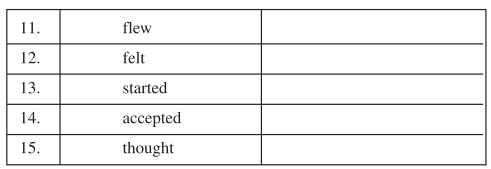
I am Writing a Letter Question Answer Class 6 English Solutions Poem Chapter 3 PSEB Solutions

Punjab State Board PSEB 6th Class English Book Solutions Poem 3 I am Writing a Letter Textbook Exercise Questions and Answers.

Class 6th English Solutions Poem Chapter 3 I am Writing a Letter Question Answers

I am Writing a Letter Class 6 Questions and Answers

Activity 1.

Look up the following words in a dictionary. You should seek the following information about the words and put them in your WORDS notebook.
1. Meaning of the word as used in the lesson/Adjective/Noun/Verb, etc.)
2. Pronunciation (The teacher may refer to the dictionary or the mobile phone for correct pronunciation)
3. Spellings

clearly anxious travels
blot envelope turn over

PSEB 6th Class English Solutions Poem 3 I am Writing a Letter

Vocabulary Expansion

Activity 2.

Make meaningful sentences of the following words.

1. anxious – I am anxious to know about your health.
2. envelope – Open this envelope. There is a letter in it.
3. blotting paper – I dried up the ink with a piece of blotting paper.

Learning to Read and Comprehend

Activity 3.

Answer the following questions.

Question 1.
Who is the poet writing the letter to ?
कवि किस को पत्र लिख रहा है ?
Answer:
The poet is writing the letter to his mother.

Question 2.
What did the poet write on the envelope ?
कवि ने लिफ़ाफ़े पर क्या लिखा ?
Answer:
The poet wrote the date and the address on the envelope.

Question 3.
Why was the poet anxious ?
कवि चिंतित क्यों था ?
Answer:
The poet was anxious to write the letter neatly.

Question 4.
What is the meaning of ‘My pen travels slowly’ ?
‘My pen travels slowly’ का क्या अर्थ है ?
Answer:
It means that he writes very slowly.

Question 5.
What is the meaning of ‘There’s just room for ten’ ?
“There’s just room for ten’ का क्या अर्थ है ?
Answer:
It means that the room was left for ten words only.

Learning Language

Adverbs

Look at the underlined words in the following sentences :
नीचे दिए गए वाक्यों में रेखाकिंत शब्दों पर ध्यान दें।
1. The dog works faithfully for his master.
2. We cannot see clearly in the dark.
3. The old man is walking slowly.
4. Please do the work carefully.
The underlined words tell us how the actions have been done. Such words are called adverbs.
रेखांकित शब्द हमें यह बताते हैं कि क्रिया कैसे हुई। ऐसे शब्द Adverbs कहलाते हैं।

PSEB 6th Class English Solutions Poem 3 I am Writing a Letter

Activity 4.

Pick out adverbs in the following sentences.
1. The dog barked loudly.
2. The boy talked rudely.
3. The child cried bitterly.
4. We sleep early at night.
5. The king treated his people kindly.
Answer:
1. loudly
2. rudely
3. bitterly
4. early
5. kindly.
An adverb is a word that tells us more about a verb. The function of adverbs is to add to the meaning of the verb. Adverbs are used to modify a verb, an adjective or another adverb.

Adverb वह शब्द है जो किसी verb, adjective या किसी अन्य Adverb के बारे में कुछ बताता है। Adverb प्रायः-ly जोड़ कर बनाए जाते हैं।

For Example:
‘Clear’ is an adjective. “Clear’ is modified by adding-ly’ to it i.e. “clearly’.

Adjectives

Adjectives are used to add more to the ‘noun’ in a sentence. It describes the noun. It is also called the describing word.

किसी Noun की विशेषता बताने वाले शब्द Adjectives कहलाते है इन्हें ‘decribing words’ भी कहा जाता है, क्योंकि यह Noun की कुछ और अधिक व्याख्या करते हैं।

Examples :
1. He is a tall boy.
2. Reena is a rich girl.
3. I have a warm blanket.
4. Harry is a strong boy.

Activity 5.

Find any five ‘describing words’ from the poem and write them in the space provided. Also, write the word that it describes.
For example : Once there was a big green tree. Little boy played under its cool shade.

Describing Word (Adjective) Described Word (Noun)
1. big tree
2. little boy
3. cool shade
4. long sheet
5. evening post
6. right address
7. Dearest mummy
8. nice blotting paper

PSEB 6th Class English Solutions Poem 3 I am Writing a Letter

Activity 6.

Make sentences about yourself using adjectives.
My name is (विद्यार्थी स्वयं लिखें)
PSEB 6th Class English Solutions Poem 3 I am Writing a Letter 2
1. I am a good boy.
2. I live in a ……….. small village.
3. I have a ……….. big house.
4. It is a very beautiful house.
5. I study in a famous school. It is the best school in my city.
6. My school has many flower, plants and green trees.
Adjectives can be used to compare the qualities in a person, animal or a thing.
Adjectives का प्रयोग व्यक्तियों, वस्तुओं तथा जीवों के गुणों की तुलना करने के लिए भी किया जाता है।
Examples :
1. Harry is a strong boy.
2. Monu is stronger than Harry.
3. Vicky is the strongest.
The word “strong’ शक्तिशाली) is a quality. ‘Monu is stronger (अधिक शक्तिशाली) than Harry’ means Monu is more strong than Harry. Vicky is the strongest (सबसे शक्तिशाली) means that Vicky is stronger than both Harry and Monu. In the sentences above, there is a comparison of the quality i.e. strong.

In English grammar, it is called degrees of comparison.

Let us look at the following three tables. The tables show the degrees of comparison in different types of adjectives :

Positive Comparative Superlative
strong stronger strongest
kind kinder kindest
long longer longest
small smaller smallest
sweet sweeter sweetest
tall taller tallest
young younger youngest
fat fatter fattest
slim slimmer slimmest
deep deeper deepest
Positive Comparative Superlative
beautiful more beautiful most beautiful
active more active most active
helpful more helpful most helpful
careful more careful most careful
attractive more attractive most attractive
popular more popular most popular
faithful more faithful most faithful
famous more famous most famous
difficult more difficult most difficult
intelligent more intelligent most intelligent
polite more polite most polite

PSEB 6th Class English Solutions Poem 3 I am Writing a Letter

Positive Comparative Superlative
bad worse Worst
good better best
far farther farthest
little less least
much more most
some more most
many more most

Activity 7.

Here are some sentences making comparisons between two things.

Fill in the blanks with the most suitable form of the adjective given in the brackets :

1. My room is ____ (big) than yours.
2. Sachin’s score is ____ (good) than Sehwag’s.
3. The Pacific Ocean is ____ (deep) than the Arctic Ocean.
4. The Arctic Ocean is ____ (cold) than the Indian Ocean.
5. Ravi is ____ (polite) than Sunny.
6. My sister is ___ (tall) than me.
7. A rose is _____ (beautiful) than a marigold.
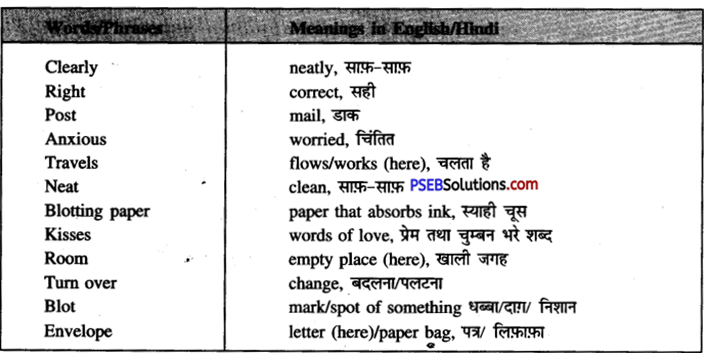
8. The earth is ___ (large) than the moon.
9. A ounce is ___ (little) than a pound.
10. Learning Mandarin is ____ difficult than learning English.
Answer:
1. bigger
2. better
3. deeper
4. colder
5. more polite
6. taller
7. more beautiful
8. larger
9. less
10. more difficult.

Activity 8.

Complete the following sentences by using the correct form of adjective given in bold.
Example : I have a fast car, but my friend’s car is Complete sentence : I have a fast car, but my friend’s car is faster.

1. This is a nice dog, It’s much ____ than my friend’s dog.
2. Here is Laxmi. She’s five years old. Her brother Ram is ten. Ram is ____
3. Anita has an interesting hobby, but my sister has the ____ hobby in the world.
4. Last holiday I read a good book. My father gave me an even ____ book last weekend.
5. School is boring, but homework is ____ than school.
6. Skateboarding is a dangerous hobby. Bungee jumping is ____than skateboarding.
7. This magazine is cheap, but that one is ____
8. We live in a small house, but my grandparents’ house is even ____ than ours.
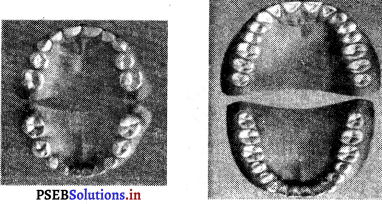
Answer:
1. nicer
2. older
3. most interesting
4. better
5. more boring
6. more dangerous
7. cheaper
8. smaller.

PSEB 6th Class English Solutions Poem 3 I am Writing a Letter

Adverbs

When an adverb modifies a verb, it usually tells us how, when, where, how often and how much the action is performed.
Adverb प्रायः यह बताता है क्रिया कौसे, कब, कहां, कितनी बार या कितनी हुई
Examples :
1. How : He crossed the road quickly.
2. When : We ran a race yesterday.
3. Where : He sat here.
4. How often : She goes for a jog daily.
5. How much : My timing in the 100 meter race was the fastest.

Activity 9.

Underline the adverbs in the following sentences.
1. Sunita kept her bag carefully in the cupboard.
2. Urmil walks gracefully.
3. The police took timely action.
4. Harish always wakes up at 5 o’clock.
5. I came home early from the office.
6. I checked my purse thoroughly but could not find the pen.
7. Please come quietly in my room.
8. He walked slowly after the operation.
9. Where did you go yesterday ?
10. Write clearly.
Answer:
1. carefully
2. gracefully
3. timely
4. always
5. early
6. thoroughly
7. quietly
8. slowly
9. yesterday
10. clearly.

Activity 10.

Adverbs add to the meaning of a verb. Write in the space provided the verb and the adverb in each sentence in activity 9. The first one is given as an example.

S.No. Verb Adverb
1. kept carefully
2. walks gracefully
3. took timely
4. wakes (up) always
5. came early
6. checked thoroughly
7. come quietly
8. walked slowly
9. went yesterday
10. write clearly

PSEB 6th Class English Solutions Poem 3 I am Writing a Letter

Learning to Read and Comprehend

Activity 11.

The poem is about writing a letter. Write the steps of writing a letter mentioned in the poem. One is done for you.

Writing the date clearly….

  • Writing the right address
  • Salutation / e.g. Dearest Mummy
  • Contents or Body of the letter
  • Closing
  • Signature

Learning to speak

Activity 12.

Practise speaking the following words with your teacher. Stress the letters in capitals more than others in each word.
Answer:
1. LEtter (R is silent)
2. POst — (पो ….)
3. MOst — (मो….)
4. PERson (R is silent) — (प….)
5. ADDress — (एड् ….)
6. beGIN — (…. गिन)
7. TRAvels — ( ट्रै …)
8. ANxious — (एं …)
9. ENvelope — ( एँन् )

नोट : विद्यार्थी इन शब्दों का उच्चारण करते समय Capital letters पर अधिक जोर दे | जैसे POst
We use language for talking, reading, writing and listening.
हम बोलते, पढ़ते, लिखते और सुनते समय भाषा का प्रयोग करते हैं।
Let us do an activity of using the language. Let us write a message.

What is a message ?
A message is short. It has information for someone. These days we can use mobile phones to talk but it is still important to know how to write a brief message.

Important points to remember :
कोई Message लिखते समय निम्नलिखित बातों का ध्यान रखें।

1. Place the message within a box.
2. Do not write the address of the sender or the receiver.
3. Do not exceed the word limit of 50 words
4. Mention the time and date of the message.
5. Begin with a brief salutation.
6. Write in the reported speech.
7. Write only the essential points. Do not add anything extra.
8. You can use abbreviations and symbols.
9. Write your name at the end of the message.
10. Keep it informal.

Message Format

Message

Time

Date
Salutation

Content (Not More Than 50 Words)

Name

PSEB 6th Class English Solutions Poem 3 I am Writing a Letter

Activity 13.

Let’s read a telephonic conversation between Navneet and Vineeta.

Navneet : Hello, Is that 2626068 ?
Vineeta : Yes.
Navneet : Am I talking to Harneet ?
Vineeta : May I know who is calling ?
Navneet : I am Navneet. I study in the same college as Harneet. Is she there?
Vineeta : No, she has gone to the market. Why don’t you call her on her mobile ?
Navneet : I tried but it was not reachable. I need to give her a message.
Vineeta : You can give me the message.
Navneet : Tell her that the trip for tomorrow has been postponed and she must come ready for regular classes.
Vineeta : I will tell her.
Navneet : Thank your.

Vineeta has to go to her friend’s house so she writes the message for Harneet and pastes on the refrigerator.

Message

January 22, 20…….

5 pm

Hello Harneet
Navneet called to tell you that your college trip has been postponed and there will be regular classes tomorrow.
Vineeta.

नोट : विद्यार्थी दिए गए format तथा message का अध्ययन करें तथा अपने friends को school से जुड़े messages लिखने का अभ्यास करें।

Activity 14.

You are the Principal of a school. You have received a phone call from a students’ father. The name of the student is Amrinder. He studies in 6th class. His father has said that Amrinder’s grandmother is not well and he should reach home quickly. Write a message for the student. [The message is to be sent to him in the Class.) :

MESSAGE

Feb. 26, 20…..

11 a.m.

Amrinder, the student of class 6th is informed that his grandmother is not well and his father wants him to reach home quickly.
A.B. Singh
(Principal)

Comprehension Of Stanzas

Read stanzas given below and answer the questions that follow each :

(1) I am writing a letter
To send by the evening post
It is to the person
I care for the most,
Write the date clearly
And put the right address.
And begin ‘Dearest Mummy’,
(Did anyone guess ?)

1. Who is the poet writing the letter to ?
कवि किस को पत्र लिख रहा है ?

2. How will he send it ?
वह इसे कैसे भेजेगा ?

3. Why does he use the word ‘Dearest for his Mummy?
वह अपनी मां के लिए ‘Dearest’ शब्द का प्रयोग क्यों करता है?

4. What does he write on the envelope ?
वह लिफ़ाफे पर क्या लिखता है ?

5. Write the name of the poem and the poet.
कविता और कवि का नाम लिखें।
Answer:
1. The poet is writing the letter to his mother.
2. He will send it by the evening post.
3. He uses this word because she is the person he loves and cares the most.
4. The name of the poem is ‘I am Writing a letter’. The name of its poet is Margaret G.
Rhodes.

PSEB 6th Class English Solutions Poem 3 I am Writing a Letter

(2) My new pen travels slowly
All down the long sheet,
Because I am so anxious
To keep it all neat.
I carefully blot it
To dry up the ink
Such nice blotting paper
The colour is pink !

1. Write the name of the poem and the poet.
कवि और कविता का नाम लिखें।

2. Why does the poet’s pen run slowly ?
कवि का पेन् धीरे क्यों चलता है ?

3. What is he anxious about ?
वह किस बात के लिए चिंतित है ?

4. What does he use to dry up the ink ? What is its colour ?
वह स्याही को सुखाने के लिए किस चीज़ का प्रयोग करता है ? यह किस रंग की है ?
Or
Write two pairs of rhyming words in the stanza.
पद्य में से दो जोड़े एक जैसी लय वाले शब्दों के लिखें।
Answer:
1. The name of the poem is ‘I am Writing a Letter and that of the poet is Margaret G.
Rhodes.
2. His pen runs slowly because it is new.
3. He is anxious about the neatness of his letter.
4. He uses a blotting paper to dry up the ink. Its colour is pink.
Or
sheet-neat ; ink-pink.

PSEB 6th Class English Solutions Poem 3 I am Writing a Letter

(3) I turn the page over
And on goes my pen,
Till lastly come kisses,
There’s just room for ten
The envelope’s ready
I put the stamp on,
And run to the postbox,
And now it has gone.

1. When does the writer’s pen become fast ?
लेखक का पेन् तेज़ कब होता है ?

2. When does he put the stamp on the envelope ?
वह लिफ़ाफ़े पर टिकट कब लगाता है ? .

3. What does he write in the last lines ?
अंतिम पंक्तियों में वह क्या लिखता है ?

4. Why does he run to the postbox ?
वह दौड़ कर पोस्ट बॉक्स पर क्यों जाता है ?
Or
Write the words that rhyme with each other in the stanza.
पद्य में से वे शब्द लिखें जिनकी लय एक जैसी है।
Answer:
1. His pen becomes fast after he turns the page over.
2. He puts the stamp on the envelope when the letter is ready.
3. He expresses his love for his mother in the last lines.
4. He runs to the postbox to post his letter.
Or
pen-ten; on-gone.

Word Meanings

PSEB 6th Class English Solutions Poem 3 I am Writing a Letter

I am Writing a Letter Poem Summary in English

I am Writing a Letter Summary in English

To write a letter for a child is happy experience. If the letter is for its mother, the experience becomes more exciting. In this poem too, a child is writing a letter to its mother. It addresses her as ‘Dearest Mummy.’ It is anxious to write the letter very neatly. So it writes very slowly. If a drop of ink leaks and makes a blot on the sheet. it dries, it up with a piece of nice bloting paper.

The child gets fast after turning over the page. It writes its love and kisses for its mother. It stops when a little space in left. In the ends it puts a stamp on the letter and runs to the postbox to post it. It is happy that its letter has gone now.

PSEB 6th Class English Solutions Poem 3 I am Writing a Letter

I am Writing a Letter Summary in Hindi

कवि (बच्चा) अपनी मां को एक पत्र लिख रहा है। वह इसे शाम की डाक से भेजेगा। वह अपनी मां से सबसे ज़्यादा प्रेम करता है और उसके लिए Dearest Mummy शब्दों का प्रयोग करता है। वह बहुत धीरे-धीरे लिखता है, क्योंकि उसका पेन् नया है। लिफ़ाफ़ा (पत्र) काफ़ी लम्बा है और वह साफ़-साफ़ लिखना पसंद करता है।

पत्र पर स्याही गिरने पर में वह उसे गुलाबी स्याही-चूस से सुखा देता है ताकि पत्र साफ़ दिखे। अंत में जगह थोड़ी रह जाती है तो वह अपनी मां को प्रेम भरे और चुम्बन भरे शब्द लिखता है। पत्र पूरा होते ही वह लिफ़ाफ़े को बंद करके उस पर डाक-टिकट लगाता है और दौड़ कर पोस्ट बॉक्स पर जाता है। अब उसका पत्र चला गया है।

Class 6th English Book Solutions PSEB Poetry

PSEB 4th Class EVS Solutions Chapter 12 ਚੁੰਝ ਅਤੇ ਦੰਦ

Punjab State Board PSEB 4th Class EVS Book Solutions Chapter 12 ਚੁੰਝ ਅਤੇ ਦੰਦ Textbook Exercise Questions and Answers.

PSEB Solutions for Class 4 EVS Chapter 12 ਚੁੰਝ ਅਤੇ ਦੰਦ

EVS Guide for Class 4 PSEB ਚੁੰਝ ਅਤੇ ਦੰਦ Textbook Questions and Answers

ਪਾਠ ਪੁਸਤਕ ਪੰਨਾ ਨੰ: 83

ਕਿਰਿਆ 1.
ਵਿਦਿਆਰਥੀਆਂ ਨੂੰ ਹੇਠ ਲਿਖੇ ਵਾਕ ਤੇਜ਼-ਤੇਜ਼ ਬੋਲਣ ਲਈ ਕਿਹਾ ਜਾਵੇ।
(ੳ) ਕੱਚਾ ਪਾਪੜ-ਪੱਕਾ ਪਾਪੜ-ਕੱਚਾ ਪਾਪੜ-ਪੱਕਾ ਪਾਪੜ।
(ਅ) ਦਿੱਲੀ ਦੇ ਦੁਕਾਨਦਾਰ, ਦਾਦੀ ਦੇ ਦੋ ਦੁੱਖਦੇ, ਦੰਦਾਂ ਦੀ ਦਵਾਈ ਦੇ ਦੇ।
ਉੱਤਰ :
ਖ਼ੁਦ ਕਰੋ।

PSEB 4th Class EVS Solutions Chapter 12 ਚੁੰਝ ਅਤੇ ਦੰਦ

ਪ੍ਰਸ਼ਨ 1.
ਦੁੱਧ ਦੰਦ ਗਿਣਤੀ ਵਿੱਚ ਕਿੰਨੇ ਹੁੰਦੇ ਹਨ ਅਤੇ ਪੱਕੇ ਦੰਦ ਕਿੰਨੇ?
PSEB 4th Class EVS Solutions Chapter 12 ਚੁੰਝ ਅਤੇ ਦੰਦ 1
ਉੱਤਰ :
PSEB 4th Class EVS Solutions Chapter 12 ਚੁੰਝ ਅਤੇ ਦੰਦ 13

ਪ੍ਰਸ਼ਨ 2.
ਜੀਭ ਦੇ ਕੀ-ਕੀ ਕੰਮ ਹਨ?
ਉੱਤਰ :

  • ਜੀਭ ਖਾਣੇ ਦੇ ਸਵਾਦ ਦਾ ਪਤਾ ਲਗਾਉਣ ਵਿੱਚ ਸਹਾਇਕ ਹੈ।
  • ਜੀਭ ਬੋਲਣ ਵਿੱਚ ਸਹਾਇਕ ਹੈ।

PSEB 4th Class EVS Solutions Chapter 12 ਚੁੰਝ ਅਤੇ ਦੰਦ

ਕਿਰਿਆ 2.
ਆਪਣੇ ਪਰਿਵਾਰ ਦੇ ਮੈਂਬਰਾਂ ਦੇ ਦੰਦਾਂ ਦੀ ਗਿਣਤੀ ਅਤੇ ਹਾਲਤ ਲਿਖੋ।
PSEB 4th Class EVS Solutions Chapter 12 ਚੁੰਝ ਅਤੇ ਦੰਦ 4
ਉੱਤਰ :
ਖ਼ੁਦ ਕਰੋ।

ਪ੍ਰਸ਼ਨ 3.
ਇਨੈਮਲ ਕੀ ਹੁੰਦਾ ਹੈ?
ਉੱਤਰ :
ਦੰਦਾਂ ਦੇ ਉੱਪਰਲੀ ਚਿੱਟੀ ਪਰਤ ਨੂੰ ਇਨੈਮਲ ਕਹਿੰਦੇ ਹਨ। ਇਹ ਸਰੀਰ ਦਾ ਸਭ ਤੋਂ ਸਖ਼ਤ ਹਿੱਸਾ ਹੁੰਦੀ ਹੈ।

ਪ੍ਰਸ਼ਨ 4.
ਦੰਦਾਂ ਦੇ ਖ਼ਰਾਬ ਹੋਣ ਤੋਂ ਬਚਾਉਣ ਲਈ ਤੁਸੀਂ ਕੀ ਕਰਦੇ ਹੋ?
ਉੱਤਰ :
ਸਵੇਰ ਉੱਠਣ ਤੋਂ ਬਾਅਦ ਅਤੇ ਰਾਤ ਨੂੰ ਸੌਣ ਤੋਂ ਪਹਿਲਾਂ ਦੰਦਾਂ ਤੇ ਬੁਰਸ਼ ਕਰਦਾ ਹਾਂ।

ਪ੍ਰਸ਼ਨ 5.
ਮਿਲਾਨ ਕਰੋ :
1. ਅਗਲੇ ਦੰਦ (ੳ) ਭੋਜਨ ਨੂੰ ਪਾੜਦੇ ਹਨ।
2. ਸੂਏ ਦੰਦ (ਅ) ਭੋਜਨ ਨੂੰ ਚਬਾਉਂਦੇ ਹਨ।
3. ਅਗਰ ਜਾੜ੍ਹ (ਕ) ਭੋਜਨ ਨੂੰ ਬਰੀਕ ਕਰਦੇ ਹਨ।
4. ਜਾੜ੍ਹ , (ਸ) ਭੋਜਨ ਨੂੰ ਕੱਟਦੇ ਹਨ।
ਉੱਤਰ :
1. (ਸ)
2. (ੳ)
3. (ਕ)
4. (ਅ)

PSEB 4th Class EVS Solutions Chapter 12 ਚੁੰਝ ਅਤੇ ਦੰਦ

ਪ੍ਰਸ਼ਨ 6.
ਜੀਭ ਨਾਲ ਸਾਨੂੰ ਕਿਹੜੇ-ਕਿਹੜੇ ਸੁਆਦ ਪਤਾ ਲਗਦੇ ਹਨ?
ਉੱਤਰ :
ਮਿੱਠਾ, ਖੱਟਾ, ਕੌੜਾ, ਨਮਕੀਨ।

ਪਾਠ ਪੁਸਤਕ ਪੰਨਾ ਨੰ: 86

ਪ੍ਰਸ਼ਨ 7.
‘ਹਾਥੀ ਦੇ ਦੰਦ ਖਾਣ ਦੇ ਹੋਰ ਅਤੇ ਦਿਖਾਉਣ ਲਈ ਹੋਰ ਤੋਂ ਤੁਸੀਂ ਕੀ ਸਮਝਦੇ ਹੋ?
ਉੱਤਰ :
ਹਾਥੀ ਦੇ ਦੋ ਦੰਦ ਮੂੰਹ ਤੋਂ ਬਾਹਰ ਨਿਕਲੇ ਹੁੰਦੇ ਹਨ। ਜੋ ਖਾਣ ਵਿਚ ਸਹਾਇਕ ਨਹੀਂ ਹੁੰਦੇ। ਇਸ ਲਈ ‘ਹਾਥੀ ਦੇ ਦੰਦ ਖਾਣ ਦੇ ਹੋਰ ਅਤੇ ਵਿਖਾਉਣ ਲਈ ਹੋਰ’’ ਕਿਹਾ ਜਾਂਦਾ ਹੈ।

ਪ੍ਰਸ਼ਨ 8.
ਕੁੱਤੇ ਦੇ ਲੰਬੇ ਦੰਦ ਕਿਹੜੇ ਕੰਮ ਲਈ ਹੁੰਦੇ ਹਨ?
ਉੱਤਰ :
ਕੁੱਤਾ ਮਾਸਾਹਾਰੀ ਹੁੰਦਾ ਹੈ, ਲੰਬੇ-ਨੁਕੀਲੇ ਦੰਦ ਸ਼ਿਕਾਰ ਦਾ ਮਾਸ ਨੋਚਣ ਅਤੇ ਕੱਟਣ ਲਈ ਹੁੰਦੇ ਹਨ।

ਕਿਰਿਆ 3.
ਤੁਹਾਡੇ ਆਲੇ-ਦੁਆਲੇ ਵਿੱਚ ਰਹਿੰਦੇ ਜਾਨਵਰਾਂ ਦੀਆਂ ਭੋਜਨ ਆਦਤਾਂ ਨੂੰ ਪਰਖੋ।
PSEB 4th Class EVS Solutions Chapter 12 ਚੁੰਝ ਅਤੇ ਦੰਦ 5
ਉੱਤਰ :
ਖੁਦ ਕਰੋ।

PSEB 4th Class EVS Solutions Chapter 12 ਚੁੰਝ ਅਤੇ ਦੰਦ

ਪਾਠ ਪੁਸਤਕ ਪੰਨਾ ਨੰ: 87

ਕਿਰਿਆ-ਪੰਛੀਆਂ ਦੇ ਨਾਂ ਲਿਖੋ।
PSEB 4th Class EVS Solutions Chapter 12 ਚੁੰਝ ਅਤੇ ਦੰਦ 2
ਉੱਤਰ :
1. ਤੋਤਾ,
2. ਇੱਲ,
3. ਬੱਤਖ,
4. ਚਿੜੀ,
5. ਪੈਲੀਕਨ,
6. ਚੱਕੀਰਾਹਾ।

PSEB 4th Class EVS Solutions Chapter 12 ਚੁੰਝ ਅਤੇ ਦੰਦ

ਪਾਠ ਪੁਸਤਕ ਪੰਨਾ ਨੰ: 88

ਪ੍ਰਸ਼ਨ 9.
ਸਹੀ ਉੱਤਰ ਚੁਣ ਕੇ (✓) ਦਾ ਨਿਸ਼ਾਨ ਲਗਾਓ
(ੳ) ਇਹਨਾਂ ਵਿੱਚੋਂ ਕਿਹੜਾ ਪੰਛੀ ਮੱਛੀ ਫੜ ਕੇ ਖਾ ਲੈਂਦਾ ਹੈ?
(i) ਤੋਤਾ
(ii) ਕਿੰਗਫਿਸ਼ਰ
(iii) ਕਾਂ
(iv) ਕਬੂਤਰ।
ਉੱਤਰ :
(i) ਕਿੰਗਫਿਸ਼ਰ।

(ਆ) ਇਹਨਾਂ ਵਿੱਚੋਂ ਕਿਹੜੇ ਪੰਛੀ ਦੀ ਚੁੰਝ ਹੇਠਾਂ ਥੈਲੀ ਹੁੰਦੀ ਹੈ?
(i) ਬੱਤਖ
(ii) ਪੈਲੀਕਨ
(iii) ਚੱਕੀਰਾਹਾ
(iv) ਕਿੰਗਫਿਸ਼ਰ।
ਉੱਤਰ :
(ii) ਪੈਲੀਕਨ।

ਪ੍ਰਸ਼ਨ 10.
ਚੱਕੀਰਾਹੇ ਦੀ ਚੁੰਝ ਚਿੜੀ ਦੀ ਚੁੰਝ ਨਾਲੋਂ ਲੰਬੀ ਕਿਉਂ ਹੁੰਦੀ ਹੈ?
ਉੱਤਰ :
ਚੱਕੀਰਾਹਾ ਰੁੱਖ ਦੇ ਤਣੇ ਦੇ ਗਹਿਰੇ ਖੋਲ ਵਿਚੋਂ ਕੀੜੇ-ਮਕੌੜੇ ਖਿੱਚ ਕੇ ਬਾਹਰ ਕੱਢਦਾ ਹੈ ਤੇ ਖਾਂਦਾ ਹੈ। ਇਸ ਲਈ ਇਸ ਦੀ ਚੁੰਝ ਲੰਬੀ ਹੁੰਦੀ ਹੈ। ਚਿੜੀ ਸਿਰਫ਼ ਦਾਣੇ ਚੁਗਦੀ ਹੈ। ਇਸ ਲਈ ਚਿੜੀ ਦੀ ਚੁੰਝ ਛੋਟੀ ਹੁੰਦੀ ਹੈ।

PSEB 4th Class EVS Solutions Chapter 12 ਚੁੰਝ ਅਤੇ ਦੰਦ

ਪ੍ਰਸ਼ਨ 11.
ਕਿਹੜੇ-ਕਿਹੜੇ ਪੰਛੀ ਸ਼ਿਕਾਰ ਕਰਕੇ ਮਾਸ ਖਾਂਦੇ ਹਨ?
ਉੱਤਰ :
ਉੱਲੂ, ਬਾਜ਼, ਇੱਲ।

ਕਿਰਿਆ 3.
ਤੁਹਾਡੇ ਆਲੇ-ਦੁਆਲੇ ਵਿੱਚ ਛੋਟੀ ਅਤੇ ਵੱਡੀ ਚੁੰਝ ਵਾਲੇ ਪੰਛੀਆਂ ਦੇ ਨਾਂ ਅਤੇ ਉਹਨਾਂ ਦੇ ਭੋਜਨ ਬਾਰੇ ਲਿਖੋ।
PSEB 4th Class EVS Solutions Chapter 12 ਚੁੰਝ ਅਤੇ ਦੰਦ 6
ਉੱਤਰ :
ਖੁਦ ਕਰੋ

ਪਾਠ ਪੁਸਤਕ ਪੰਨਾ ਨੰ: 89

ਕਿਰਿਆ-ਵੱਖ-ਵੱਖ ਪੰਛੀਆਂ ਦੇ ਪੰਜੇ ਅਤੇ ਪੰਜਿਆਂ ਦੇ ਕੰਮ।
PSEB 4th Class EVS Solutions Chapter 12 ਚੁੰਝ ਅਤੇ ਦੰਦ 7
ਉੱਤਰ :
ਕੰਮ ਸ਼ਿਕਾਰ ਫ਼ੜਨਾ ਅਤੇ ਮਾਸ ਨੋਚਣਾ
ਦਰੱਖਤਾਂ ਦੀ ਛਿੱਲ ਨੂੰ ਚੰਗੀ ਤਰ੍ਹਾਂ ਨਾਲ ਫੜ ਸਕਦੇ ਹਨ।
ਕੰਮ ਦਰੱਖ਼ਤਾਂ ਨੂੰ ਕੱਸ ਕੇ ਫੜਨ ਲਈ ਸਹਾਇਕ ਹਨ।
ਪਾਣੀ ਵਿਚ ਸੌਖਿਆਂ ਤੈਰਨ ਲਈ ਅਤੇ ਤੁਰ ਸਕਣ ਲਈ ਸਹਾਈ ਹਨ।

PSEB 4th Class EVS Solutions Chapter 12 ਚੁੰਝ ਅਤੇ ਦੰਦ

ਪਾਠ ਪੁਸਤਕ ਪੰਨਾ ਨੰ: 90

ਪ੍ਰਸ਼ਨ 12.
ਬਾਜ਼ ਪੰਜਿਆਂ ਤੋਂ ਕੀ-ਕੀ ਕੰਮ ਲੈਂਦਾ ਹੈ?
ਉੱਤਰ :
ਸ਼ਿਕਾਰ ਫੜਦਾ ਹੈ।

ਪ੍ਰਸ਼ਨ 13.
ਬੱਤਖਾਂ ਦੇ ਪੰਜੇ ਦੀਆਂ ਉਂਗਲਾਂ ਵਿਚਕਾਰ ਪਤਲੀ ਖਿੱਲੀ ਉਸ ਲਈ ਕਿਵੇਂ ਫਾਇਦੇਮੰਦ ਹੁੰਦੀ ਹੈ?
ਉੱਤਰ :
ਇਹ ਤਿੱਲੀ ਪਾਣੀ ਵਿੱਚ ਤੈਰਨ ਵਿੱਚ ਸਹਾਇਤਾ ਕਰਦੀ ਹੈ।

ਪ੍ਰਸ਼ਨ 14.
ਕਿਹੜਾ ਪੰਛੀ ਦਰੱਖ਼ਤ ਉੱਪਰ ਆਸਾਨੀ ਨਾਲ ਚੜ੍ਹ ਸਕਦਾ ਹੈ?
ਉੱਤਰ :
ਚੱਕੀਰਾਹਾ।

ਕਿਰਿਆ 4.
ਆਲੇ-ਦੁਆਲੇ ਦੇ ਪੰਛੀ ਦੇਖ ਕੇ ਉਹਨਾਂ ਦੀਆਂ ਨਹੁੰਦਰਾਂ ਦੇ ਕੰਮ ਲਿਖੋ।
PSEB 4th Class EVS Solutions Chapter 12 ਚੁੰਝ ਅਤੇ ਦੰਦ 8
ਉੱਤਰ :
ਖ਼ੁਦ ਕਰੋ।

PSEB 4th Class EVS Solutions Chapter 12 ਚੁੰਝ ਅਤੇ ਦੰਦ

ਪਾਠ ਪੁਸਤਕ ਪੰਨਾ ਨੰ: 91, 92

ਕਿਰਿਆ 5.
ਆਪਣੇ ਘਰ ਵਿੱਚ ਪੰਛੀਆਂ ਨੂੰ ਇੱਕ ਸਥਾਨ ਤੇ ਰੋਜ਼ਾਨਾ ਦਾਣੇ ਪਾਓ ਅਤੇ ਜਿਹੜੇ ਪੰਛੀ ਦਾਣੇ ਚੁਗਣ ਆਉਂਦੇ ਹਨ ਉਹਨਾਂ ਦੇ ਨਾਂ ਅਤੇ ਗਿਣਤੀ ਲਿਖੋ। ਪੰਛੀ ਦਾ ਨਾਂ ਗਿਣਤੀ ਪੰਛੀ ਦਾ ਨਾਂ ਗਿਣਤੀ
PSEB 4th Class EVS Solutions Chapter 12 ਚੁੰਝ ਅਤੇ ਦੰਦ 9
ਉੱਤਰ :
ਖ਼ੁਦ ਕਰੋ।

ਦਿਮਾਗੀ ਕਸਰਤ
PSEB 4th Class EVS Solutions Chapter 12 ਚੁੰਝ ਅਤੇ ਦੰਦ 10
PSEB 4th Class EVS Solutions Chapter 12 ਚੁੰਝ ਅਤੇ ਦੰਦ 11
ਉੱਤਰ :
PSEB 4th Class EVS Solutions Chapter 12 ਚੁੰਝ ਅਤੇ ਦੰਦ 12

PSEB 4th Class Punjabi Guide ਚੁੰਝ ਅਤੇ ਦੰਦ Important Questions and Answers

ਹੋਰ ਮਹੱਤਵਪੂਰਨ ਪ੍ਰਸ਼ਨ

ਬਹੁਵਿਕਲਪੀ ਪ੍ਰਸ਼ਨ

1. ਦੁੱਧ ਦੰਦ ਕਿੰਨੇ ਹੁੰਦੇ ਹਨ?
(ਉ) 15
(ਅ) 20
(ਇ) 32
(ਮ) 64
ਉੱਤਰ :
(ਅ) 20.

PSEB 4th Class EVS Solutions Chapter 12 ਚੁੰਝ ਅਤੇ ਦੰਦ

2. ਪੱਕੇ ਦੰਦ ਕਿੰਨੇ ਹੁੰਦੇ ਹਨ?
(ਉ) 32
(ਅ) 15
(ਇ) 20
(ਮ) 64
ਉੱਤਰ :
(ੳ) 32

ਇੱਕ ਵਾਕ ਤੋਂ ਛੋਟੇ ਉੱਤਰ ਵਾਲੇ ਪ੍ਰਸ਼ਨ

ਪ੍ਰਸ਼ਨ 1.
ਕਿਹੜੇ ਜਾਨਵਰਾਂ ਦੇ ਸੂਏ ਦੰਦ ਥੋੜ੍ਹੇ ਵੱਡੇ ਹੁੰਦੇ ਹਨ?
ਉੱਤਰ :
ਮਾਸ ਖਾਣ ਵਾਲੇ।

ਪ੍ਰਸ਼ਨ 2.
ਮਨੁੱਖਾਂ ਦੇ ਦੰਦ ਕਿੰਨੀ ਵਾਰ ਆਉਂਦੇ ਹਨ?
ਉੱਤਰ :
ਦੋ ਵਾਰ

ਖ਼ਾਲੀ ਥਾਂਵਾਂ ਭਰੋ (ਸੁਆਦ, ਬੱਤਖਾਂ)

1. …………………………….. ਦੀਆਂ ਨਹੁੰਦਰਾਂ ਵਿਚਕਾਰ ਪਤਲੀ ਝੱਲੀ ਹੁੰਦੀ ਹੈ।
2. ਜੀਭ ਨਾਲ ਹੀ ਅਸੀਂ ਵੱਖ-ਵੱਖ ਤਰ੍ਹਾਂ ਦੇ …………………………….. ਮਹਿਸੂਸ ਕਰ ਸਕਦੇ ਹਾਂ।
ਉੱਤਰ :
1. ਬੱਤਖਾਂ,
2. ਸੁਆਦ।

PSEB 4th Class EVS Solutions Chapter 12 ਚੁੰਝ ਅਤੇ ਦੰਦ

ਗ਼ਲਤ/ਸਹੀ

1. ਚੱਕੀਰਾਹੇ ਦੀ ਚੁੰਝ ਛੋਟੀ ਹੁੰਦੀ ਹੈ।
2. ਚਿੜੀ ਦੀ ਚੁੰਝ ਲੰਬੀ ਹੁੰਦੀ ਹੈ।
ਉੱਤਰ :
1. ✗
2. ✗

ਮਿਲਾਨ ਕਰੋ

1. ਪੱਕੇ ਦੰਦ (ਉ) ਮਾਸ ਖਾਣ ਲਈ
2. ਲੰਬੇ ਸੂਏ ਦੰਦ (ਅ) ਚਿੜੀ
3. ਛੋਟੀ ਚੁੰਝ (ਇ) 32.
ਉੱਤਰ :
1. (ਇ)
2. (ੳ),
3. (ਅ)।

ਵੱਡੇ ਉੱਤਰ ਵਾਲਾ ਪ੍ਰਸ਼ਨ
ਪ੍ਰਸ਼ਨ – ਵੱਖ-ਵੱਖ ਪ੍ਰਕਾਰ ਦੇ ਦੰਦਾਂ ਦੇ ਕੰਮ ਹੇਠ ਲਿਖੇ ਖਾਕੇ ਵਿੱਚ ਭਰੋ-

ਦੰਦਾਂ ਦੀ ਕਿਸਮ ਦੰਦਾਂ ਦਾ ਕੰਮ
ਅਗਲੇ ਦੰਦ
ਸੂਏ ਦੰਦ
ਅਗਰ ਜਾੜ੍ਹ
ਜਾੜ੍ਹ

ਉੱਤਰ :

ਦੰਦਾਂ ਦੀ ਕਿਸਮ ਦੰਦਾਂ ਦਾ ਕੰਮ
ਅਗਲੇ ਦੰਦ ਕੱਟਣ ਦਾ ਕੰਮ
ਸੂਏ ਦੰਦ ਫਾੜਨ ਦਾ ਕੰਮ
ਅਗਰ ਜਾੜ੍ਹ ਚਬਾਉਣ ਦਾ ਕੰਮ
ਜਾੜ੍ਹ ਪੀਸਣ ਦਾ ਕੰਮ

PSEB 4th Class EVS Solutions Chapter 7 ਪੌਦਿਆਂ ਦੀਆਂ ਜੜ੍ਹਾਂ

Punjab State Board PSEB 4th Class EVS Book Solutions Chapter 7 ਪੌਦਿਆਂ ਦੀਆਂ ਜੜ੍ਹਾਂ Textbook Exercise Questions and Answers.

PSEB Solutions for Class 4 EVS Chapter 7 ਪੌਦਿਆਂ ਦੀਆਂ ਜੜ੍ਹਾਂ

EVS Guide for Class 4 PSEB ਪੌਦਿਆਂ ਦੀਆਂ ਜੜ੍ਹਾਂ Textbook Questions and Answers

ਪਾਠ ਪੁਸਤਕ ਪੰਨਾ ਨੰ: 40

ਕਿਰਿਆ 1.
ਆਪਣੇ ਸਕੂਲ ਵਿੱਚ ਲੱਗੇ ਰੁੱਖ ਪਹਿਚਾਣੋ ਅਤੇ ਉਹਨਾਂ ਵਿੱਚੋਂ ਸਭ ਤੋਂ ਪੁਰਾਣਾ ਰੁੱਖ ਲੱਭ ਕੇ ਉਸ ਬਾਰੇ ਹੇਠਾਂ ਪੁੱਛੀ ਜਾਣਕਾਰੀ ਲਿਖੋ।
ਰੁੱਖ ਦਾ ਨਾਮ ………………………….. ਅੰਦਾਜ਼ਨ ਕਿੰਨਾ ਪੁਰਾਣਾ ਹੈ …………………………..
ਉੱਤਰ :
ਬੋਹੜ। ਇਹ 100 ਸਾਲ ਪੁਰਾਣਾ ਹੈ।
ਨੋਟ-ਹੋਰ ਰੁੱਖਾਂ ਬਾਰੇ ਪਤਾ ਕਰੋ।

PSEB 4th Class EVS Solutions Chapter 7 ਪੌਦਿਆਂ ਦੀਆਂ ਜੜ੍ਹਾਂ

ਪਾਠ ਪੁਸਤਕ ਪੰਨਾ ਨੰ: 41

ਪ੍ਰਸ਼ਨ 1.
ਰੁੱਖ ਦਾ ਕਿਹੜਾ ਹਿੱਸਾ ਪਾਣੀ ਨੂੰ ਸੋਖਦਾ ਹੈ ?
ਉੱਤਰ :
ਜੜਾਂ

ਪ੍ਰਸ਼ਨ 2.
ਜੜਾਂ ਦੇ ਕੀ ਕੰਮ ਹਨ ?
ਉੱਤਰ :
ਜੜਾਂ ਧਰਤੀ ਵਿਚੋਂ ਪਾਣੀ ਤੇ ਹੋਰ ਪੋਸ਼ਕ ਸੋਖਦੀਆਂ ਹਨ ਤੇ ਪੌਦੇ ਨੂੰ ਮਿੱਟੀ ਵਿਚ ਮਜ਼ਬੂਤੀ ਨਾਲ ਜਕੜ ਕੇ ਰੱਖਦੀਆਂ ਹਨ।

ਪਾਠ ਪੁਸਤਕ ਪੰਨਾ ਨੰ: 42

ਕਿਰਿਆ 2.
ਕੁੱਝ ਪੌਦਿਆਂ ਦੀਆਂ ਜੜ੍ਹਾਂ ਅਸੀਂ ਸਬਜ਼ੀਆਂ ਦੇ ਰੂਪ ਵਿੱਚ ਖਾਂਦੇ ਹਾਂ ਅਜਿਹੀਆਂ ਸਬਜ਼ੀਆਂ ਦੀਆਂ ਤਸਵੀਰਾਂ ਉੱਪਰ ਸਹੀ (✓) ਦਾ ਨਿਸ਼ਾਨ ਲਗਾਓ।
ਉੱਤਰ :
PSEB 4th Class EVS Solutions Chapter 7 ਪੌਦਿਆਂ ਦੀਆਂ ਜੜ੍ਹਾਂ 2
ਉੱਤਰ :
PSEB 4th Class EVS Solutions Chapter 7 ਪੌਦਿਆਂ ਦੀਆਂ ਜੜ੍ਹਾਂ 5

PSEB 4th Class EVS Solutions Chapter 7 ਪੌਦਿਆਂ ਦੀਆਂ ਜੜ੍ਹਾਂ

ਪਾਠ ਪੁਸਤਕ ਪੰਨਾ ਨੰ: 44

ਕਿਰਿਆ 3.
ਕੀ ਤੁਸੀਂ ਅਜਿਹਾ ਕੋਈ ਹੋਰ ਰੁੱਖ ਵੇਖਿਆ ਹੈ ? ਉਸਦਾ ਨਾਮ ਤੇ ਸਥਾਨ ਲਿਖੋ।
ਨਾਮ ……………………
ਸਥਾਨ ……………………..
ਉੱਤਰ :
ਆਪ ਕਰੋ।

ਪਾਠ ਪੁਸਤਕ ਪੰਨਾ ਨੰ: 45

ਪ੍ਰਸ਼ਨ 3.
ਮੂਸਲ ਜੜ੍ਹ ਦਾ ਚਿੱਤਰ ਬਣਾਉ।
ਉੱਤਰ :
PSEB 4th Class EVS Solutions Chapter 7 ਪੌਦਿਆਂ ਦੀਆਂ ਜੜ੍ਹਾਂ 1

PSEB 4th Class EVS Solutions Chapter 7 ਪੌਦਿਆਂ ਦੀਆਂ ਜੜ੍ਹਾਂ

ਪ੍ਰਸ਼ਨ 4.
ਖ਼ਾਲੀ ਥਾਂਵਾਂ ਭਰੋ : (ਜੜ੍ਹ, ਜ਼ਮੀਨ, ਮੋਟੀ, ਪਾਣੀ)
(ੳ) ਰੁੱਖਾਂ ਦੀਆਂ ਜੜਾਂ …………………………… ਵਿੱਚ ਹੁੰਦੀਆਂ ਹਨ।
(ਅ) ਕਚਾਲੂ ਇੱਕ ……………………………
(ਇ) ਮੂਸਲ ਜੜ੍ਹ ਬਾਕੀ ਜੜ੍ਹਾਂ ਨਾਲੋਂ …………………………… ਹੁੰਦੀ ਹੈ।
(ਸ) ਜੜਾਂ …………………………… ਨੂੰ ਸੋਖ਼ ਲੈਂਦੀਆਂ ਹਨ।
ਉੱਤਰ :
(ਉ) ਜ਼ਮੀਨ
(ਅ) ਜੜ੍ਹ
(ਬ) ਮੋਟੀ
(ਸ) ਪਾਣੀ।

ਪ੍ਰਸ਼ਨ 5.
ਹੇਠ ਲਿਖੇ ਪ੍ਰਸ਼ਨਾਂ ਦੇ ਉੱਤਰ ਦਿਉ।

(ਉ) ਅਮਰੂਦ ਦਾ ਦਰੱਖਤ ਪੁੱਟਿਆ ਕਿਉਂ ਨਹੀਂ ਗਿਆ ?
ਉੱਤਰ :
ਅਮਰੂਦ ਦਾ ਦਰੱਖ਼ਤ ਜੜਾਂ ਦੁਆਰਾ ਧਰਤੀ ਵਿੱਚ ਮਜ਼ਬੂਤੀ ਨਾਲ ਜੁੜਿਆ ਹੁੰਦਾ ਹੈ। ਇਸ ਲਈ ਇਸ ਨੂੰ ਪੁੱਟਿਆ ਨਹੀਂ ਜਾ ਸਕਦਾ।

(ਅ) ਮੂਸਲ ਜੜ੍ਹ ਕੀ ਹੁੰਦੀ ਹੈ ?
ਉੱਤਰ :
ਰੁੱਖ ਦੀ ਇਕ ਜੜ੍ਹ ਬਾਕੀ, ਜੜ੍ਹਾਂ ਨਾਲੋਂ ਵੱਧ ਮੋਟੀ ਹੁੰਦੀ ਹੈ ਤੇ ਧਰਤੀ ਵਿੱਚ ਸਿੱਧੀ ਹੇਠਾਂ ਨੂੰ ਜਾਂਦੀ ਹੈ ਤੇ ਇਸ ਵਿੱਚੋਂ ਹੋਰ ਪਤਲੀਆਂ ਟਾਹਣੀਆਂ ਨਿਕਲਦੀਆਂ ਹਨ।
PSEB 4th Class EVS Solutions Chapter 7 ਪੌਦਿਆਂ ਦੀਆਂ ਜੜ੍ਹਾਂ 1

PSEB 4th Class EVS Solutions Chapter 7 ਪੌਦਿਆਂ ਦੀਆਂ ਜੜ੍ਹਾਂ

(ਇ) ਕਿਹੜੇ-ਕਿਹੜੇ ਪੌਦਿਆਂ ਦੀਆਂ ਜੜਾਂ ਖਾਧੀਆਂ ਜਾ ਸਕਦੀਆਂ ਹਨ ?
ਉੱਤਰ :
ਸ਼ਲਗਮ, ਗਾਜਰ, ਮੂਲੀ, ਸ਼ਕਰਕੰਦੀ, ਸ਼ਤਾਵਰੀ, ਕਚਾਲੂ।

(ਸ) ਰੁੱਖਾਂ ਨੂੰ ਕੱਟਣਾ ਕਿਉਂ ਨਹੀਂ ਚਾਹੀਦਾ ?
ਉੱਤਰ :
ਰੁੱਖ ਵਰਖਾ ਲਿਆਉਣ ਵਿਚ ਸਹਾਇਕ ਹਨ ਤੇ ਵਾਤਾਵਰਨ ਨੂੰ ਪ੍ਰਦੂਸ਼ਿਤ ਹੋਣ ਤੋਂ ਵੀ ਬਚਾਉਂਦੇ ਹਨ। ਜੇ ਇਹਨਾਂ ਨੂੰ ਕੱਟ ਦਿੱਤਾ ਜਾਵੇਗਾ ਤਾਂ ਜੀਊਣਾ ਮੁਸ਼ਕਿਲ ਹੋ ਜਾਵੇਗਾ।

PSEB 4th Class Punjabi Guide ਪੌਦਿਆਂ ਦੀਆਂ ਜੜ੍ਹਾਂ Important Questions and Answers

ਹੋਰ ਮਹੱਤਵਪੂਰਨ ਪ੍ਰਸ਼ਨ

ਬਹੁਵਿਕਲਪੀ ਪ੍ਰਸ਼ਨ –

1. ਪੌਦੇ ਨੂੰ ਮਿੱਟੀ ਵਿਚ ਕੌਣ ਜਕਦਾ ਹੈ ?
(ਉ) ਤਣਾ
(ਅ) ਜੜਾਂ।
(ਇ) ਫਲ
(ਸ) ਪੱਤੇ।
ਉੱਤਰ :
(ਅ) ਜੜਾਂ।

2. ਕਚਾਲੂ ਪੌਦੇ ਦਾ ਕਿਹੜਾ ਭਾਗ ਹੈ ?
(ਉ) ਤਣਾ
(ਅ) ਜੜ੍ਹ
(ਇ) ਫਲ
(ਸ) ਪੱਤੇ
ਉੱਤਰ :
(ਅ) ਜੜ੍ਹ।

PSEB 4th Class EVS Solutions Chapter 7 ਪੌਦਿਆਂ ਦੀਆਂ ਜੜ੍ਹਾਂ

ਇੱਕ ਵਾਕ ਤੋਂ ਛੋਟੇ ਉੱਤਰ ਵਾਲੇ ਪ੍ਰਸ਼ਨ

ਪ੍ਰਸ਼ਨ 1.
ਬੱਚੇ ਕਿਹੜੇ ਰੁੱਖ ਨੂੰ ਪੁੱਟ ਰਹੇ ਸਨ ?
ਉੱਤਰ :
ਅਮਰੂਦ ਦੇ ਰੁੱਖ ਨੂੰ।

ਪ੍ਰਸ਼ਨ 2.
ਬੋਹੜ ਦੀਆਂ, ਹਵਾਈ ਜੜਾਂ ਕਿਸ ਨੂੰ ਕਿਹਾ ਜਾਂਦਾ ਹੈ ?
ਉੱਤਰ :
ਟਹਿਣੀਆਂ ਵਿੱਚੋਂ ਨਿਕਲੀਆਂ ਜੜ੍ਹਾਂ ਨੂੰ।

ਗਲਤ/ਸਹੀ

1. ਰੁੱਖਾਂ ਦੇ ਵੱਖ-ਵੱਖ ਹਿੱਸਿਆਂ ਨੂੰ ਖਾ ਸਕਦੇ ਹਾਂ।
2. ਕਚਾਲੂ ਇੱਕ ਫਲ ਹੈ।
ਉੱਤਰ :
1. ✓
2. ✗

ਮਿਲਾਨ ਕਰੋ

1. ਕਚਾਲੂ (ਉ) ਤਣਾ
2. ਗੰਨਾ (ਅ) ਜੜ੍ਹ
3. ਟਮਾਟਰ (ਇ) ਫਲ
ਉੱਤਰ :
1. (ਅ)
2. (ਉ)
3. (ਇ)

PSEB 4th Class EVS Solutions Chapter 7 ਪੌਦਿਆਂ ਦੀਆਂ ਜੜ੍ਹਾਂ

ਦਿਮਾਗੀ ਕਸਰਤ

PSEB 4th Class EVS Solutions Chapter 7 ਪੌਦਿਆਂ ਦੀਆਂ ਜੜ੍ਹਾਂ 3
ਉੱਤਰ :
PSEB 4th Class EVS Solutions Chapter 7 ਪੌਦਿਆਂ ਦੀਆਂ ਜੜ੍ਹਾਂ 4

PSEB 4th Class EVS Solutions Chapter 6 ਜੰਤੂ ਅਤੇ ਬੁੰਡ

Punjab State Board PSEB 4th Class EVS Book Solutions Chapter 6 ਜੰਤੂ ਅਤੇ ਬੁੰਡ Textbook Exercise Questions and Answers.

PSEB Solutions for Class 4 EVS Chapter 6 ਜੰਤੂ ਅਤੇ ਬੁੰਡ

EVS Guide for Class 4 PSEB ਜੰਤੂ ਅਤੇ ਬੁੰਡ Textbook Questions and Answers

ਪਾਠ ਪੁਸਤਕ ਪੰਨਾ ਨੰ: 36

ਕਿਰਿਆ 1.
ਚਿੱਤਰਾਂ ਦੇ ਹੇਠਾਂ ਉਨ੍ਹਾਂ ਦੇ ਨਾਂ ਲਿਖੋ।
PSEB 4th Class EVS Solutions Chapter 6 ਜੰਤੂ ਅਤੇ ਬੁੰਡ 1
ਉੱਤਰ :
1. ਸ਼ੁਤਰ-ਮੁਰਗ
2. ਚਿੜੀ
3. ਗਿਲਹਰੀ
4. ਖ਼ਰਗੋਸ਼

PSEB 4th Class EVS Solutions Chapter 6 ਜੰਤੂ ਅਤੇ ਬੁੰਡ

ਪਾਠ ਪੁਸਤਕ ਪੰਨਾ ਨੰ: 37, 38

ਕਿਰਿਆ 2.
ਕੀ ਤੁਸੀਂ ਕਿਸੇ ਹੋਰ ਜਾਨਵਰ ਦੇ ਸੁਭਾਅ ਬਾਰੇ ਕੁੱਝ ਜਾਣਦੇ ਹੋ? ਜੇ ਹਾਂ ਤਾਂ ਲਿਖੋ ਕਿ ਉਸਦਾ ਸੁਭਾਅ ਕਿਹੋ ਜਿਹਾ ਹੈ?
ਉੱਤਰ :

ਨਾਮ ਸੁਭਾਅ ਨਾਮ ਸੁਭਾਅ
ਬਾਂਦਰ ਨਕਲਚੀ ਕੁੱਤਾ ਵਫ਼ਾਦਾਰ
ਖ਼ਰਗੋਸ਼ ਸ਼ਰਮੀਲਾ ਗਿਰਗਿਟ ਰੰਗ ਬਦਲਣ ਵਾਲਾ

ਪ੍ਰਸ਼ਨ 1.
ਖ਼ਾਲੀ ਥਾਂਵਾਂ ਭਰੋ : (ਚਰਗਾਹਾਂ, ਕਾਲੇ ਹਿਰਨ, ਸੰਕੋਚੀ, ਘੋੜੇ)
(ਉ) …………………………………….. ਦੀ ਯਾਦ-ਸ਼ਕਤੀ ਕਮਾਲ ਦੀ ਹੁੰਦੀ ਹੈ।
(ਅ) ਜਾਨਵਰਾਂ ਦੇ ਚਰਨ ਲਈ …………………………………….. ਦੀ ਘਾਟ ਹੋ ਰਹੀ ਹੈ।
(ਇ) ਕਈ ਜਾਨਵਰ ਸੁਭਾਅ ਤੋਂ …………………………………….. ਹੁੰਦੇ ਹਨ।
(ਸ) ਸ਼ਿਕਾਰ ਦੇ ਕਾਰਨ …………………………………….. ਦੀ ਗਿਣਤੀ ਘੱਟ ਰਹੀ ਹੈ।
ਉੱਤਰ :
(ਉ) ਘੋੜੇ
(ਆ) ਚਰਾਗਾਹਾਂ
(ਇ) ਸੰਕੋਚੀ
(ਸ) ਕਾਲੇ ਹਿਰਨ।

PSEB 4th Class EVS Solutions Chapter 6 ਜੰਤੂ ਅਤੇ ਬੁੰਡ

ਪ੍ਰਸ਼ਨ 2.
ਸਹੀ ਉੱਤਰ ਅੱਗੇ (✓) ਦਾ ਨਿਸ਼ਾਨ ਲਾਉ :
(ਉ) ਮਧੂ ਮੱਖੀਆਂ ਕੀ ਬਣਾ ਕੇ ਰਹਿੰਦੀਆਂ ਹਨ?
ਛੱਤਾ
ਆਲ੍ਹਣਾ
ਖੁੱਡ
ਉੱਤਰ :
ਛੱਤਾ

(ਅ) ਪੰਜਾਬ ਦਾ ਰਾਜ ਪਸ਼ੂ ਕਿਹੜਾ ਹੈ? :
ਕਾਲਾ ਹਿਰਨ
ਹਾਥੀ
ਉਠ
ਉੱਤਰ :
ਕਾਲਾ ਹਿਰਨ।

ਕਿਹੜੀ ਮੱਖੀ ਆਂਡੇ ਦਿੰਦੀ ਹੈ?
ਰਾਣੀ ਮੱਖੀ
ਨਰ ਮੱਖੀ
ਕਾਮਾ ਮੱਖੀ
ਉੱਤਰ :
ਰਾਣੀ ਮੱਖੀ।

PSEB 4th Class EVS Solutions Chapter 6 ਜੰਤੂ ਅਤੇ ਬੁੰਡ

(ਸ) ਸੰਕੋਚੀ ਜਾਨਵਰ ਕਿਹੜਾ ਹੈ?
ਕੁੱਤਾ
ਬਾਂਦਰ
ਖ਼ਰਗੋਸ਼
ਉੱਤਰ :
ਖ਼ਰਗੋਸ਼।

ਪ੍ਰਸ਼ਨ 3.
ਕਾਮਾ ਮੱਖੀਆਂ ਕੀ ਕੰਮ ਕਰਦੀਆਂ ਹਨ?
ਉੱਤਰ :
ਕਾਮਾ ਮੱਖੀਆਂ ਛੱਤਾ ਬਣਾਉਣ ਅਤੇ ਫੁੱਲਾਂ ਤੋਂ ਰਸ ਪ੍ਰਾਪਤ ਕਰਕੇ ਸ਼ਹਿਦ ਬਣਾਉਣ ਦਾ ਕੰਮ ਕਰਦੀਆਂ ਹਨ।

ਪ੍ਰਸ਼ਨ 4.
ਘੋੜੇ ਦੇ ਕੋਈ ਦੋ ਗੁਣ ਦੱਸੋ।
ਉੱਤਰ :

  • ਘੋੜਾ ਸਮਝਦਾਰ ਤੇ ਵਫਾਦਾਰ ਜਾਨਵਰ ਹੈ।
  • ਘੋੜੇ ਮਨੁੱਖ ਤੇ ਹੋਰ ਜਾਨਵਰਾਂ ਨਾਲ ਰਲ-ਮਿਲ ਕੇ ਰਹਿ ਸਕਦਾ ਹੈ।

PSEB 4th Class EVS Solutions Chapter 6 ਜੰਤੂ ਅਤੇ ਬੁੰਡ

ਪ੍ਰਸ਼ਨ 5.
ਕਾਲੇ ਹਿਰਨਾਂ ਦੀ ਗਿਣਤੀ ਕਿਉਂ ਘੱਟ ਰਹੀ ਹੈ?
ਉੱਤਰ :
ਕਾਲੇ ਹਿਰਨਾਂ ਦਾ ਵੱਧ ਮਾਤਰਾ ਵਿਚ ਸ਼ਿਕਾਰ ਕਰ ਲੈਣ ਕਾਰਨ ਅਤੇ ਇਹਨਾਂ ਲਈ ਭੋਜਨ ਦੀ ਕਮੀ ਹੋਣ ਕਾਰਨ ਇਹ ਘੱਟ ਰਹੇ ਹਨ।

ਪ੍ਰਸ਼ਨ 6.
ਜੀਵ ਝੰਡਾਂ ਵਿਚ ਕਿਉਂ ਰਹਿੰਦੇ ਹਨ?
ਉੱਤਰ :
ਜੀਵ ਝੁੰਡਾਂ ਵਿਚ ਸੁਰੱਖਿਅਤ ਰਹਿੰਦੇ ਹਨ।

ਪ੍ਰਸ਼ਨ 7.
ਦਿਮਾਗੀ ਕਸਰਤ।
PSEB 4th Class EVS Solutions Chapter 6 ਜੰਤੂ ਅਤੇ ਬੁੰਡ 2
ਉੱਤਰ :
PSEB 4th Class EVS Solutions Chapter 6 ਜੰਤੂ ਅਤੇ ਬੁੰਡ 3

PSEB 4th Class Punjabi Guide ਜੰਤੂ ਅਤੇ ਬੁੰਡ Important Questions and Answers

ਹੋਰ ਮਹੱਤਵਪੂਰਨ ਪ੍ਰਸ਼ਨ

ਬਹੁਵਿਕਲਪੀ ਪ੍ਰਸ਼ਨ

1. ਗਿੰਨੀ ਕੌਣ ਹੈ?
(ਉ) ਤਿੱਤਲੀ
(ਅ) ਲੜਕੀ
(ਇ) ਭੈਣ
(ਸ) ਕੋਈ ਨਹੀਂ।
ਉੱਤਰ :
(ੳ) ਤਿੱਤਲੀ।

PSEB 4th Class EVS Solutions Chapter 6 ਜੰਤੂ ਅਤੇ ਬੁੰਡ

2. ਸ਼ਹਿਦ ਦੀ ਮੱਖੀ ਦਾ ਕੀ ਨਾਂ ਹੈ?
(ਉ) ਗਿੰਨੀ
(ਅ) ਮਿੰਨੀ
(ਇ) ਮੱਖੀ
(ਸ) ਲੋ।
ਉੱਤਰ :
(ਅ) ਮਿੰਨੀ।

ਇੱਕ ਵਾਕ ਤੋਂ ਛੋਟੇ ਉੱਤਰ ਵਾਲੇ ਪ੍ਰਸ਼ਨ

ਪ੍ਰਸ਼ਨ 1.
ਮਧੂ ਮੱਖੀ ਦੇ ਘਰ ਨੂੰ ਕੀ ਕਹਿੰਦੇ ਹਨ?
ਉੱਤਰ :
ਛੱਤਾ।

ਪ੍ਰਸ਼ਨ 2.
ਘੋੜਾ ਕਿਹੋ ਜਿਹਾ ਜਾਨਵਰ ਹੈ?
ਉੱਤਰ :
ਉਹ ਵਫ਼ਾਦਾਰ ਤੇ ਸਮਝਦਾਰ ਜਾਨਵਰ ਹੈ।

ਗਲਤ/ਸਹੀ

1. ਖਰਗੋਸ਼ ਡਰਪੋਕ ਜਾਨਵਰ ਹੈ।
2. ਘੋੜੇ ਝੁੰਡ ਵਿਚ ਰਹਿੰਦੇ ਹਨ।
ਉੱਤਰ :
1. ✓
2. ✓

PSEB 4th Class EVS Solutions Chapter 6 ਜੰਤੂ ਅਤੇ ਬੁੰਡ

ਮਿਲਾਨ ਕਰੋ

1. ਤਿੱਤਲੀ (ਉ) ਬੁੰਡ
2. ਕਾਲਾ ਹਿਰਨ (ਆ) ਫੁੱਲਾਂ ਦਾ ਰਸ
3. ਹਾਥੀ (ਇ) ਰਾਜ ਪਸ਼ੂ
ਉੱਤਰ :
1. (ਅ),
2. (ਇ),
3. (ੳ)।

PSEB 4th Class EVS Solutions Chapter 11 ਚੰਗਾ ਖਾਈਏ, ਸਿਹਤ ਬਣਾਈਏ

Punjab State Board PSEB 4th Class EVS Book Solutions Chapter 11 ਚੰਗਾ ਖਾਈਏ, ਸਿਹਤ ਬਣਾਈਏ Textbook Exercise Questions and Answers.

PSEB Solutions for Class 4 EVS Chapter 11 ਚੰਗਾ ਖਾਈਏ, ਸਿਹਤ ਬਣਾਈਏ

EVS Guide for Class 4 PSEB ਚੰਗਾ ਖਾਈਏ, ਸਿਹਤ ਬਣਾਈਏ Textbook Questions and Answers

ਪਾਠ ਪੁਸਤਕ ਪੰਨਾ ਨੰ: 73

ਪ੍ਰਸ਼ਨ 1.
ਭੋਜਨ ਵਿੱਚ ਮੌਜੂਦ ਵੱਖ-ਵੱਖ ਪੋਸ਼ਕ ਤੱਤਾਂ ਦੇ ਨਾਂ ਲਿਖੋ
ਉੱਤਰ :
ਕਾਰੋਬੋਹਾਈਡੇਟਸ ਅਤੇ ਚਰਬੀ, ਪ੍ਰੋਟੀਨ, ਵਿਟਾਮਿਨ ਅਤੇ ਖਣਿਜ ਪਦਾਰਥ।

ਪ੍ਰਸ਼ਨ 2.
ਕਾਰਬੋਹਾਈਡੇਟਸ ਅਤੇ ਚਰਬੀ ਸਰੀਰ ਨੂੰ ਕੀ ਦਿੰਦੇ ਹਨ ?
ਉੱਤਰ :
ਇਹ ਸਰੀਰ ਨੂੰ ਊਰਜਾ ਦਿੰਦੇ ਹਨ।

PSEB 4th Class EVS Solutions Chapter 11 ਚੰਗਾ ਖਾਈਏ, ਸਿਹਤ ਬਣਾਈਏ

ਪ੍ਰਸ਼ਨ 3.
ਵਿਟਾਮਿਨ ਅਤੇ ਖਣਿਜ ਪਦਾਰਥਾਂ ਦੇ ਵੱਖਵੱਖ ਸੋਮੇ ਲਿਖੋ।
ਉੱਤਰ :
ਵਿਟਾਮਿਨ-ਟਮਾਟਰ, ਸੰਤਰਾ, ਗਾਜਰ, ਦੁੱਧ, ਆਂਡੇ, ਸੂਰਜ ਦੀ ਰੋਸ਼ਨੀ॥
ਖਣਿਜ ਪਦਾਰਥ-ਹਰੀਆਂ ਸਬਜ਼ੀਆਂ, ਤਾਜ਼ੇ ਫਲ ਅਤੇ ਦੁੱਧ।

ਪ੍ਰਸ਼ਨ 4.
ਖ਼ਾਲੀ ਥਾਂਵਾਂ ਭਰੋ :
ਵਿਟਾਮਿਨ ਡੀ, ਪ੍ਰੋਟੀਨ, ਸੰਤੁਲਿਤ, ਊਰਜਾ)
(ਉ) …………………………………… ਸਾਡੇ ਸਰੀਰ ਦੇ ਵਾਧੇ ਲਈ ਬਹੁਤ ਜ਼ਰੂਰੀ ਹੈ।
(ਅ) ਸੂਰਜ ਦੀ ਰੋਸ਼ਨੀ ਤੋਂ …………………………………… ਮਿਲਦਾ ਹੈ।
(ਇ) …………………………………… ਖ਼ੁਰਾਕ ਵਿੱਚ ਸਾਰੇ ਪੋਸ਼ਕ ਤੱਤ ਮੌਜੂਦ ਹੁੰਦੇ ਹਨ।
(ਸ) ਘਿਉ ਖਾਣ ਨਾਲ …………………………………… ਮਿਲਦੀ ਹੈ।
ਉੱਤਰ :
(ੳ) ਪ੍ਰੋਟੀਨ
(ਅ) ਵਿਟਾਮਿਨ ਡੀ
(ਏ) ਸੰਤੁਲਿਤ
(ਸ) ਊਰਜਾ।

ਪਾਠ ਪੁਸਤਕ ਪੰਨਾ ਨੰ: 75

ਕਿਰਿਆ 1.
ਵਿਆਹ ਸਮਾਗਮਾਂ ਵਿੱਚ ਖਾਣ ਲਈ ਮਿਲਣ ਵਾਲੇ ਭੋਜਨ ਦੀ ਸੂਚੀ ਬਣਾਓ।
ਉੱਤਰ :
ਖ਼ੁਦ ਕਰੋ।

PSEB 4th Class EVS Solutions Chapter 11 ਚੰਗਾ ਖਾਈਏ, ਸਿਹਤ ਬਣਾਈਏ

ਪਾਠ ਪੁਸਤਕ ਪੰਨਾ ਨੰ: 76

ਕਿਰਿਆ 2.
PSEB 4th Class EVS Solutions Chapter 11 ਚੰਗਾ ਖਾਈਏ, ਸਿਹਤ ਬਣਾਈਏ 1
ਉੱਤਰ :
1. ਮਿਠਾਈ
2. ਰੇਉੜੀਆਂ ਗਚਕ
3. ਚਾਵਲ

ਪਾਠ ਪੁਸਤਕ ਪੰਨਾ ਨੰ: 77

ਕਿਰਿਆ 3.
ਹਫ਼ਤੇ ਦੇ ਮਿਡ-ਡੇ-ਮੀਲ ਦਾ ਮੈਨਯੂ ਲਿਖੋ !
ਦਿਨ –
ਭੋਜਨ –
ਉੱਤਰ :
ਖ਼ੁਦ ਕਰੋ।

PSEB 4th Class EVS Solutions Chapter 11 ਚੰਗਾ ਖਾਈਏ, ਸਿਹਤ ਬਣਾਈਏ

ਪਾਠ ਪੁਸਤਕ ਪੰਨਾ ਨੰ: 78, 79

ਪ੍ਰਸ਼ਨ 5.
ਖ਼ਾਲੀ ਥਾਂਵਾਂ ਭਰੋ :
(ਉ) ਵਿਆਹ ਸਮਾਗਮ ਵਿੱਚ ਵੱਖ-ਵੱਖ ਤਰ੍ਹਾਂ ਦੇ …………………………………… ਲੱਗੇ ਹੋਏ ਸਨ। ਸਟਾਲ/ਦੁਕਾਨਾਂ)
(ਅ) ਸਾਨੂੰ ਸਮਾਗਮਾਂ ਵਿੱਚ …………………………………… ਅਨੁਸਾਰ ਹੀ ਭੋਜਨ ਲੈਣਾ ਚਾਹੀਦਾ ਹੈ। ਲੋੜ/ਪਲੇਟ)
(ਇ) ਸਕੂਲ ਵਿੱਚ …………………………………… ਮਿਡ-ਡੇ-ਮੀਲ ਮਿਲਦਾ ਹੈ। ਹਰ ਰੋਜ਼/ਕਦੇ-ਕਦੇ
(ਸ) ਰੇਲ ਗੱਡੀ ਵਿੱਚ …………………………………… ਨਾਂ ਦੀ ਰਸੋਈ ਹੁੰਦੀ ਹੈ। ਪੈਂਟਰੀ ਕਾਰ/ਢਾਬੇ)
(ਹ) ਵਿਆਹ ਵਿੱਚ …………………………………… ਤਰ੍ਹਾਂ ਦੇ ਪੀਣ ਵਾਲੇ ਸ਼ੇਕ ਮਿਲਦੇ ਹਨ। (ਇੱਕ ਵੱਖ-ਵੱਖ)
ਉੱਤਰ :
(ਉ) ਸਟਾਲ
(ਅ) ਲੋੜ
(ਈ) ਹਰ ਰੋਜ਼
(ਸ) ਪੈਂਟਰੀ ਕਾਰ
(ਹ) ਵੱਖ-ਵੱਖ।

ਪ੍ਰਸ਼ਨ 6.
ਮਿਲਾਨ ਕਰੋ :
1. ਦਿਵਾਲੀ (ਉ) ਪੂਰੀਆਂ-ਛੋਲੇ
2. ਲੋਹੜੀ (ਅ) ਖੰਡ ਦੇ ਖੇਡਣੇ
3. ਬਸੰਤ (ਈ) ਗੱਚਕ ਅਤੇ ਰਿਉੜੀਆਂ।
4. ਸਾਉਣ (ਸ) ਪੀਲੇ ਚਾਵਲ
5. ਨਰਾਤੇ (ਹ) ਮੱਠੀਆਂ ਅਤੇ ਪੂੜੇ
ਉੱਤਰ :
1. (ਅ),
2. (ਇ),
3. (ਸ),
4. (ਹ),
5. (ੳ).

PSEB 4th Class EVS Solutions Chapter 11 ਚੰਗਾ ਖਾਈਏ, ਸਿਹਤ ਬਣਾਈਏ

ਪ੍ਰਸ਼ਨ 7.
ਹੋਸਟਲ ਵਿੱਚ ਕਿੰਨੇ ਵਾਰ ਖਾਣਾ ਮਿਲਦਾ ਹੈ ?
ਉੱਤਰ :
ਤਿੰਨ ਵਾਰ ਖਾਣਾ ਮਿਲਦਾ ਹੈ।

ਪ੍ਰਸ਼ਨ 8.
ਖਾਣਾ ਖਾਣ ਤੋਂ ਪਹਿਲਾਂ ਅਤੇ ਬਾਅਦ ਵਿੱਚ ਬੱਚੇ ਕੀ ਕਰਦੇ ਹਨ ?
ਉੱਤਰ :
ਖਾਣਾ-ਖਾਣ ਤੋਂ ਪਹਿਲਾਂ ਅਤੇ ਬਾਅਦ ਵਿੱਚ ਬੱਚੇ ਹੱਥ ਸਾਬਣ ਅਤੇ ਪਾਣੀ ਨਾਲ ਚੰਗੀ ਤਰ੍ਹਾਂ ਧੋਦੇ ਹਨ।

ਪ੍ਰਸ਼ਨ 9.
ਇਕੱਠੇ ਬੈਠ ਕੇ ਖਾਣ ਨਾਲ ਕਿਹੜੀਆਂ ਕਿਹੜੀਆਂ ਆਦਤਾਂ ਵਿਕਸਿਤ ਹੁੰਦੀਆਂ ਹਨ ?
ਉੱਤਰ :
ਇਕੱਠੇ ਬੈਠ ਕੇ ਖਾਣਾ ਖਾਣ ਨਾਲ ਭਾਈਚਾਰਾ ਵਧਦਾ ਹੈ ਤੇ ਪਿਆਰ ਦੀ ਭਾਵਨਾ ਪੈਦਾ ਹੁੰਦੀ ਹੈ।

PSEB 4th Class Punjabi Guide ਚੰਗਾ ਖਾਈਏ, ਸਿਹਤ ਬਣਾਈਏ Important Questions and Answers

ਹੋਰ ਮਹੱਤਵਪੂਰਨ ਪ੍ਰਸ਼ਨ

ਬਹੁਵਿਕਲਪੀ ਪ੍ਰਸ਼ਨ

1. ਬਸੰਤ ਦੇ ਮੌਕੇ ਕੀ ਪਕਵਾਨ ਬਣਾਇਆ ਜਾਂਦਾ ਹੈ ?
(ਉ) ਪੀਲੇ ਚਾਵਲ
(ਅ) ਮੱਠੀਆਂ
(ਈ) ਗੁਲਗੁਲੇ
(ਸ) ਲੱਡੂ।
ਉੱਤਰ :
(ਉ) ਪੀਲੇ ਚਾਵਲ।

PSEB 4th Class EVS Solutions Chapter 11 ਚੰਗਾ ਖਾਈਏ, ਸਿਹਤ ਬਣਾਈਏ

2. ਅੰਧਰਾਤਾ ਰੋਗ ਤੋਂ ਬਚਣ ਲਈ ਸਾਨੂੰ ਕਿਹੜਾ ਵਿਟਾਮਿਨ ਲੈਣਾ ਚਾਹੀਦਾ ਹੈ ?
(ਉ) ਵਿਟਾਮਿਨ ਸੀ
(ਅ) ਵਿਟਾਮਿਨ ਬੀ
(ਈ) ਪ੍ਰੋਟੀਨ
(ਸ) ਵਿਟਾਮਿਨ ਏ।
ਉੱਤਰ :
(ਸ) ਵਿਟਾਮਿਨ ਏ।

ਇੱਕ ਵਾਕ ਤੋਂ ਛੋਟੇ ਉੱਤਰ ਵਾਲੇ ਪ੍ਰਸ਼ਨ

ਪ੍ਰਸ਼ਨ 1.
ਨਰਾਤੇ ਦੇ ਦਿਨਾਂ ਵਿਚ ਕੀ ਬਣਾਉਂਦੇ ਹਨ ?
ਉੱਤਰ :
ਪੂਰੀਆਂ-ਛੋਲੇ

ਪ੍ਰਸ਼ਨ 2.
ਸਬਜ਼ੀ ਵਿੱਚ ਸੁਗੰਧ ਲਈ ਕੀ ਪਾਇਆ ਜਾਂਦਾ ਹੈ ?
ਉੱਤਰ :
ਮਸਾਲੇ; ਜਿਵੇਂ-ਜ਼ੀਰਾ, ਇਲੈਚੀ ਆਦਿ।

ਖ਼ਾਲੀ ਥਾਂਵਾਂ ਭਰੋ

ਵਿਟਾਮਿਨ ਡੀ, ਰਿਉੜੀਆਂ
1. …………. ਲੋਹੜੀ ਮੌਕੇ ਬਣਦੀਆਂ ਹਨ।
2. ਸੂਰਜ ਦੀ ਰੌਸ਼ਨੀ ਤੋਂ ……….. ਮਿਲਦਾ ਹੈ।
ਉੱਤਰ :
1. ਰਿਉੜੀਆਂ,
2. ਵਿਟਾਮਿਨ ਡੀ।

PSEB 4th Class EVS Solutions Chapter 11 ਚੰਗਾ ਖਾਈਏ, ਸਿਹਤ ਬਣਾਈਏ

ਗਲਤ/ਸਹੀ

1. ਦਿਵਾਲੀ ਮੌਕੇ ਗੱਚਕ ਹੁੰਦੀ ਹੈ।
2. ਬਸੰਤ ਮੌਕੇ ਪੀਲੇ ਚਾਵਲ ਬਣਦੇ ਹਨ।
ਉੱਤਰ :
1. ✗
2. ✓

ਦਿਮਾਗੀ ਕਸਰਤ

PSEB 4th Class EVS Solutions Chapter 11 ਚੰਗਾ ਖਾਈਏ, ਸਿਹਤ ਬਣਾਈਏ 2
ਉੱਤਰ :
PSEB 4th Class EVS Solutions Chapter 11 ਚੰਗਾ ਖਾਈਏ, ਸਿਹਤ ਬਣਾਈਏ 3

ਵੱਡੇ ਉੱਤਰ ਵਾਲਾ ਪ੍ਰਸ਼ਨ
ਪ੍ਰਸ਼ਨ-ਹਫਤੇ ਦੇ ਕੋਈ ਚਾਰ ਦਿਨਾਂ ਦਾ ਮਿਡ-ਡੇ-ਮੀਲ ਦਾ ਮੈਨਯੂ ਲਿਖੋ।
PSEB 4th Class EVS Solutions Chapter 11 ਚੰਗਾ ਖਾਈਏ, ਸਿਹਤ ਬਣਾਈਏ 4
ਉੱਤਰ :
PSEB 4th Class EVS Solutions Chapter 11 ਚੰਗਾ ਖਾਈਏ, ਸਿਹਤ ਬਣਾਈਏ 5