PSEB 12th Class Biology Solutions Chapter 9 Strategies for Enhancement in Food Production

Punjab State Board PSEB 12th Class Biology Book Solutions Chapter 9 Strategies for Enhancement in Food Production Textbook Exercise Questions and Answers.

PSEB Solutions for Class 12 Biology Chapter 9 Strategies for Enhancement in Food Production

PSEB 12th Class Biology Guide Strategies for Enhancement in Food Production Textbook Questions and Answers

Question 1.
Explain in brief the role of animal husbandry in human welfare.
Answer:
Animal husbandry deals with the scientific management of livestock. It includes various aspects such as feeding, breeding, and control diseases to raise the population of animal livestock. Animal husbandry usually includes animals such as cattle, pig, sheep, poultry, honeybee, silkworm and fish which are useful for humans in various ways. These animals are managed for the production of commercially important products such as milk, meat, wool, egg, honey, silk, etc. The increase in human population has increased the demand of these products. Hence, it is necessary to improve the management of livestock scientifically.

Question 2.
If your family owned a dairy farm, what measures would you undertake to improve the quality and quantity of milk production?
Answer:
Dairy farm management deals with processes which aim at improving the quality and quantity of milk production. Milk production is primarily dependent on choosing improved cattle breeds, provision of proper feed for cattle, maintaining proper shelter facilities, and regular cleaning of cattle.

Choosing improved cattle breeds is an important factor of cattle management. Hybrid cattle breeds are produced for improved productivity. Therefore, it is essential that hybrid cattle breeds should have a combination of various desirable genes such as high milk production and high resistance to diseases. Cattle should also be given healthy and nutritious food consisting of roughage, fibre concentrates, and high levels of proteins and other nutrients.

Cattle should be housed in proper cattle-houses and should be kept in well ventilated roofs to prevent them from harsh weather conditions such as heat, cold, and rain. Regular baths and proper brushing should be ensured to control diseases. Also, time-to-time check ups by a veterinary doctor for symptoms of various diseases should be undertaken.

PSEB 12th Class Biology Solutions Chapter 9 Strategies for Enhancement in Food Production

Question 3.
What is meant by the term ‘breed’? What are the objectives of animal breeding?
Answer:
A breed is a special variety of animals within a species. It is similar in most characters such as general appearance, size, configuration, and features with other members of the same species. Jersey and Brown
Swiss are examples of foreign breeds of cattle. These two varieties of cattle have the ability to produce abundant quantities of milk. This milk is very nutritious with high protein content.
Objectives of animal breeding are as follows:

  • To increase thd yield of animals.
  • To improve the desirable qualities of the animal produce.
  • To produce disease-resistant varieties of animals.

Question 4.
Name the methods employed in animal breeding. According to you which of the methods is best? Why?
Answer:
Animal breeding is the method of mating closely related individuals. There are several methods employed in animal breeding, which can be classified into the following categories:

(A) Natural Methods of Breeding Include Inbreeding and Out-breeding : Breeding between animals of the same breed is known as inbreeding, while breeding between animals of different breeds is known as out-breeding. Out-breeding of animals is of three types:
(a) Out-crossing: In this type of out-breeding, the mating of animals occurs within the same breed. Thus, they have no common ancestors up to the last 4-5 generations.

(b) Cross-breeding: In this type of out-breeding, the mating occurs between different breeds of the same species, thereby producing a hybrid.

(c) Interspecific hybridisation: In this type of out-breeding, the mating occurs between different species.

(B) Artificial Methods of Breeding Include Modern Techniques of Breeding : It involves controlled breeding experiments, which are of two types:
(a) Artificial insemination : It is a process of introducing the semen (collected from the male) into the oviduct or the uterus of the female body by the breeder. This method of breeding helps the breeder overcome certain problems faced in abnormal mating.

(b) Multiple ovulation embryo technology (MOET) : It is a technique for cattle improvement in which super-ovulation is induced by a hormone injection. Then, fertilisation is achieved by artificial insemination and early embryos are collected. Each of these embryos are then transplanted into the surrogate mother for further development of the embryo.

The best method to carry out animal breeding is the artificial method of breeding, which includes artificial insemination and MOET technology. These technologies are scientific in nature. They help overcome problems of normal mating and have a high success rate of crossing between mature males and females. Also, it ensures the production of hybrids with the desired qualities. This method is highly economical as a small amount of semen from the male can be used to inseminate several cattle.

Question 5.
What is apiculture? How is it important in our lives?
Answer:
Apiculture is the practise of bee-keeping for the production of various products such as honey, bee’s wax, etc. Honey is a highly nutritious food source and is used as an indigenous system of medicines. It is
useful in the treatment of many disorders such as cold, flu, and 1 dysentery. Other commercial products obtained from honey bees include bee’s wax and bee pollen. Bee’s wax is used for making cosmetics, polishes, and is even used in several medicinal preparations. Therefore, to meet the increasing demand of honey, people have started practicing bee-keeping on a large scale. It has become an f income generating activity for farmers since it requires a low investment and is labour intensive.

PSEB 12th Class Biology Solutions Chapter 9 Strategies for Enhancement in Food Production

Question 6.
Discuss the role of fishery in enhancement of food production.
Answer:
Fishery is an industry which deals with catching, processing, and marketing of fishes and other aquatic animals that have a high economic value. Some commercially important aquatic animals are prawns, crabs, oysters, lobsters, and octopus. Fisheries play an important role in the Indian economy. This is because a large part of the Indian population is dependent on fishes as a source of food, which is both cheap and high in animal protein. Fishery is an employment generating industry especially for people staying in the coastal areas. Both fresh water fishes (such as Catla, Rohu, etc.) and marine fishes (such as tuna, mackerel, pomfret, etc.) are of high economic value.

Question 7.
Briefly describe various steps involved in plant breeding.
Answer:
Plant breeding is the process in which two genetically dissimilar varieties are purposely crossed to produce a new hybrid variety. As a result, characteristics from both parents can be obtained in the hybrid plant variety. Thus, it involves the production of a new variety with the desired characteristics such as resistance to diseases, climatic adaptability, and better productivity. The various steps involved in plant breeding are as follows:

(a) Collection of Genetic Variability: Genetic variability from various wild relatives of the cultivated species are collected to maintain the genetic diversity of a species. The entire collection of the diverse alleles of a gene in a crop is called the germplasm collection.

(b) Evaluation of Germplasm and Selection of Parents: The germplasm collected is then evaluated for the desirable genes. The selected plants with the desired genes are then used as parents in plant breeding experiments and are multiplied by the process of hybridisation.

(c) Cross-hybridisation between Selected Parents: The next step in plant breeding is to combine the desirable characters present in two different parents to produce hybrids. It is a tedious job as one has to ensure that the pollen grains collected from the male parent reach the stigma of the female parent.

(d) Selection of Superior Hybrids: The progenies of the hybrids having the desired characteristics are selected through scientific evaluation. The selected progenies are then self-pollinated for several generations to ensure homozygosity.

(e) Testing, Release, and Commercialisation of New Cultivars: The selected progenies are evaluated for characters such as yield, resistance to diseases, performance, etc. by growing them in research fields for at least three growing seasons in different parts of the country. After thorough testing and evaluation, the selected varieties are given to the farmers for growing in fields for a large-scale production.

PSEB 12th Class Biology Solutions Chapter 9 Strategies for Enhancement in Food Production

Question 8.
Explain what is meant by biofortification.
Answer:
Biofortification is a process of breeding crops with higher levels of vitamins, minerals, proteins, and fat content. This method is employed to improve public health. Breeding of crops with improved nutritional quality is undertaken to improve the content of proteins, oil, vitamins, minerals, and micro-nutrients in crops. It is also undertaken to upgrade the quality of oil and proteins. An example of this is a wheat variety known as Atlas 66, which has high protein content in comparison to the existing wheat. In addition, there are several other improved varieties of crop plants such as rice, carrots, spinach etc. which have more nutritious value and more nutrients than the existing varieties.

Question 9.
Which part of the plant is best suited for making virus-free plants and why?
Answer:
Apical and axillary meristems of plants is used for making virus-free plants. In a diseased plant, only this region is not infected by the virus as compared to the rest of the plant region. Hence, the scientists remove axillary and apical meristems of the diseased plant and grow it in vitro to obtain a disease-free and healthy plant.
Virus-free plants of banana, sugarcane, and potato have been obtained using this method by scientists.

Question 10.
What is the major advantage of producing plants by micropropagation?
Answer:
Micropropagation is a method of producing new plants in a short duration using plant tissue culture.
Some major advantages of micropropagation are as follows:

  • Micropropagation helps in the propagation of a large number of plants in a short span of time.
  • The plants produced are identical to the mother plant.
  • It leads to the production of healthier plantlets, which exhibit better disease-resisting powers.

Question 11.
Find out what the various components of the medium used for propagation of an explant in vitro are?
Answer:
The major components of medium used for propagation of explants in vitro are carbon sources such as sucrose, inorganic salts, vitamins, amino acids, water, agar-agar, and certain growth hormones such as auxins, gibberellins and cytokinins etc.

PSEB 12th Class Biology Solutions Chapter 9 Strategies for Enhancement in Food Production

Question 12.
Name any five hybrid varieties of crop plants which have been developed in India.
Answer:
The five hybrid varieties of crop plants which have been developed in India are as follow:

Crop plant Hybrid variety
Wheat Sonalika and Kalyan Sona
Rice Jaya and Ratna
Cauliflower Pusa Shubhra and Pusa Snowball K-1
Cowpea Pusa Komal
Mustard Pusa Swarnim

PSEB 12th Class Biology Important Questions Chapter 8 Human Health and Disease

Punjab State Board PSEB 12th Class Biology Important Questions Chapter 8 Human Health and Disease Important Questions and Answers.

PSEB 12th Class Biology Important Questions Chapter 8 Human Health and Disease

Very short answer type questions

Question 1.
Malaria, typhoid, pneumonia and amoebiasis are some of the human infectious diseases. Which ones of these are transmitted through mechanical carriers?
Answer:
Malaria and amoebiasis are transmitted through mechanical carriers.

Question 2.
How does haemozoin affect the human body when released in blood during malarial infection?
Answer:
Haemozoin is responsible for the chill and high fever recurring every three to four days during malarial infection.

Question 3.
What causes swelling of the lower limbs in patients suffering from filariasis?
Answer:
Wuchereria (W. bancrofti and W. malayi).

PSEB 12th Class Biology Important Questions Chapter 8 Human Health and Disease

Question 4.
Why is Gambusia introduced into drains and ponds?
Answer:
To feed on mosquito larvae so as to eliminate the vectors responsible for causing malaria.

Question 5.
Recently chikungunya cases were reported from various parts of the country. Name the vector responsible.
Answer:
Aedes mosquito is responsible for chikungunya cases.

Question 6.
What role do macrophages play in providing immunity to humans?
Answer:
Macrophages destroy the microbes (by phagocytosis) and provide protection against diseases.

Question 7.
In what way are monocytes a cellular barrier in immunity?
Answer:
Monocytes can phagocytose (by the process called phagocytosis) and thereby destroy the pathogens.

Question 8.
How does colostrum provides initial protection against diseases to new bom infants? Give one reason.
Answer:
Colostrum contains several antibodies which are absolutely essential for developing resistance in the new-born babies.

PSEB 12th Class Biology Important Questions Chapter 8 Human Health and Disease

Question 9.
State the functions of mast cells in allergy response.
Answer:
Mast cells release chemicals like histamine and serotonin in allergic response.

Question 10.
What is an autoimmune disease? Give an example.
Answer:
It is an abnormal immune response in which the immune system of the body starts rejecting its own body cells or ‘self cells and molecules. For example, rheumatoid arthritis.

Question 11.
State two different roles of spleen in the human body.
Answer:
Spleen is the secondary lymphoid organ that stores lymphocytes, it filters microbes and acts as a reservoir to store erythrocytes.

Question 12.
Why sharing of injection needles between two individuals is not recommended?
Answer:
Sharing of needles can transmit diseases like HIV, AIDS, Hepatitis B or C from infected to non-infected individuals.

Question 13.
Retroviruses have no DNA. However, the DNA of the infected host cell does possess viral DNA. How is it possible?
Answer:
On infecting the host cell, the viral RNA transforms into viral DNA by reverse transcription. This viral DNA then incorporates into the host DNA.

Question 14.
Suggest any two techniques which can help in early detection of bacterial and viral infections much before the symptoms appear in the body.
Answer:
Enzyme Linked Immunosorbent Assay (ELISA), Polymerase Chain Reaction (PCR).

PSEB 12th Class Biology Important Questions Chapter 8 Human Health and Disease

Question 15.
Mention the useful as well as the harmful drug obtained from the latex of Poppy plant.
Answer:
Useful drug – morphine.
Harmful drug – heroin.

Short answer type questions

Question 1.
Define the term health. Mention any two ways of maintaining it.
Answer:
Health is a state of complete physical, mental and social well-being. Good health can be maintained through balanced diet and regular exercise.

Question 2.
List the specific symptoms of typhoid. Name its causative agent.
Answer:
Specific symptoms of typhoid are as follows:

  • Constant high fever (39° to 40°C)
  • Weakness
  • Stomach pain
  • Loss of appetite

Its causative agent is Salmonella typhi.

Question 3.
Identify a, b, c and d in the following table:

Name of the human disease Name of the causal bacteria/virus Specific organ or its part affected
(i) Typhoid Salmonella typhi a
(ii) Common cold b c
(iii) Pneumonia Streptococcus pneumoniae d

Answer:
(a) Small intestine
(b) Rhino virus
(c) Nose and respiratoiy passage
(d) Alveoli of lungs

PSEB 12th Class Biology Important Questions Chapter 8 Human Health and Disease

Question 4.
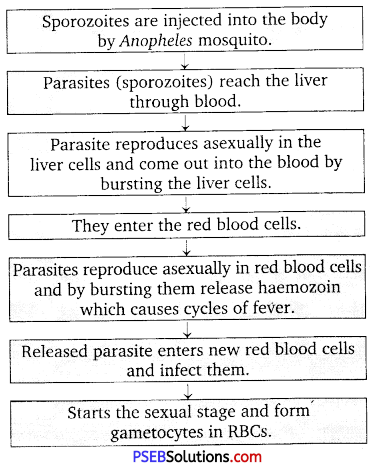
At what stage does Plasmodium gain entry into the human body? Write the different stages of its life-cycle in the human body.
Or Trace the life-cycle of malarial parasite in the human body when bitten by an infected female Anopheles.
Answer:
Plasmodium falciparum is the malarial parasite.
Plasmodium life-cycle:
The gametocyte develops in the red blood cells of human.
PSEB 12th Class Biology Important Questions Chapter 8 Human Health and Disease 1

Question 5.
Explain the role of the following in providing defence against infection in human body :
(i) Histamines
(ii) Interferons
(iii) B-cells
Answer:
(i) Histamines: These are chemicals which cause inflammatory responses.
(ii) Interferons: These are glycoproteins which protect non-infected cells from further viral infection.
(iii) B-cells: These produce proteins called antibodies in response to pathogens into the blood to fight with them.

Question 6.
(a) What is the functional difference between B cells and T cells?
(b) Name the source used to produce hepatitis-B vaccine using rDNA technology.
Answer:

(a)

B-Lymphocytes T-Lymphocytes
(i) They arise from bone marrow. They arise from bone marrow and thymus.
(ii) B-cells form humoral or antibody-mediated immune system (AMIS). T-cells form cell-mediated immune system (CMIS).
(iii) They defend against viruses and bacteria that enter the blood and lymph. They defend against pathogens including protists and fungi that enter the cells.
(iv) They form plasma cells and memory cells by the division. They form killer, helper and suppressor cells by the division of lymphoblasts.

(b) Hepatitis-B vaccine is produced from surface antigens of transgenic yeast by r-DNA technology. The antigens represent whole protein vaccine.

PSEB 12th Class Biology Important Questions Chapter 8 Human Health and Disease

Question 7.
In the metropolitan cities of India, many children are suffering from allergy/asthma. What are the main causes of this problem. Give some symptoms of allergic reactions. [NCERT Exemplar]
Answer:
Allergy is the exaggerated response of the immune system to certain antigens present in the environment. In metropolitan cities life style is responsible in lowering of immunity and sensitivity to allergens. More polluted environment increases the chances of allergy in children. Some symptoms of allergic reactions are sneezing, watery eyes, running nose and difficulty in breathing.

Question 8.
Differentiate between benign and malignant tumours.
Answer:

Benign tumour Malignant tumour
(i) It is a non-cancerous tumour. It is a cancerous tumour.
(ii) Benign tumour does not show metastasis and is non-invasive. It shows metastasis and thus invades other body parts.
(iii) It stops growth after reaching a certain size. Malignant tumour shows indefinite growth.
(iv)Limited There is no adherence amongst cells. They tend to slip past one another.
(v) It is less fatal to the body. It is more fatal to the body.

Question 9.
Write the source and the effect on the human body of the following drugs:
(i) Morphine
(ii) Cocaine
(iii) Marijuana
Answer:
(i) Morphine: It is obtained from poppy plant Papaver somniferum. It binds to specific opioid receptors present in central nervous system and ‘ gastrointestinal tract.
(ii) Cocaine: It is obtained from coca plant Erythroxylum coca. It interferes with the transport of the neurotransmitter dopamine.
(iii)Marijuana : It is obtained from Cannabis sativa. It affects the cardiovascular system of the body.

Question 10.
(a) Why is there a fear amongst the guardians that their adolescent wards may get trapped in drug/alcohol abuse?
(b) Explain ‘addiction’ and dependence’ in respect of drug/alcohol abuse in youth.
Answer:
(a) Reasons for alcohol abuse in adolescents:

  • Social pressure
  • Curiosity and need for adventure, excitement and experiment.
  • To escape from stress, depression and frustration.
  • To overcome hardships of life.
  • Unstable or unsupportive family structure

(b) Addiction: The psychological attachment to certain effects such as euphoria and a temporary feeling of well-being, associated with drugs and alcohol is called addiction.
Dependence: The tendency of the body to manifest a characteristic and unpleasant withdrawal syndrome on abrupt discontinuation of regular dose of drug/alcohol is called dependence.

PSEB 12th Class Biology Important Questions Chapter 8 Human Health and Disease

Long answer type questions

Question 1.
(a) Cancer is one of the most dreaded diseases of humans. Explain ‘Contact inhibition’ and ‘Metastasis’ with respect to the disease.
(b) Name the group of genes which have been identified in normal cells that could lead to cancer and how they do so?
(c) Name any two techniques which are useful to detect cancers of internal organs.
(d) Why are cancer patients often given a-interferon as part of the treatment?
Answer:
(a) Contact inhibition is the property of normal cells in which contact with other cells inhibits their uncontrolled growth.
Metastasis is the property in which tumour cells reach distant sites in the body, through blood.
(b) Proto oncogenes or Cellular oncogenes.
These genes when activated under certain condition could lead to oncogenic transformation of the cells.
(c) Biopsy/radiography/CT/MRI
(d) a-interferon activates immune system and destroys the tumour.

Question 2.
Why do some adolescents start taking drugs? How can the situation be avoided? [NCERT Exemplar]
Answer:
Many factors are responsible for motivating youngsters towards alcohol or drugs. Curiosity, need for adventure and excitement, experimentation are the initial causes of motivation. Some youngsters start consuming drugs and alcohol in order to overcome negative emotions (such as stress, pressure, depression, frustration) and to excel in various fields. Several mediums like television, internet, newspaper, movies etc. are also responsible for promoting the idea of alcohol to the younger generation. Amongst these factors, reasons such as unstable and unsupportive family structures and peer pressure can also lead an individual to be dependant on drugs and alcohol.

Preventive measures against addiction of alcohol and drugs are as follows:
(a) Parents should motivate and try to increase the willpower of their child.
(b) Parents should educate their children about the ill-effects of alcohol. They should provide them with proper knowledge and counselling regarding the consequences of addiction to alcohol.
(c) It is the responsibility of the parent to discourage a child from experimenting with alcohol. Youngsters should be kept away from the company of friends who consume drugs.
(d) Children should be encouraged to devote their energy in other extra¬curricular and recreational activities.
(e) Proper professional and medical help should be provided to a child if sudden symptoms of depression and frustration are observed.

PSEB 12th Class Biology Important Questions Chapter 8 Human Health and Disease

Question 3.
A person shows strong unusual hypersensitive reactions when exposed to certain substances present in the air, identify the condition. Name the cells responsible for such reactions. What precaution should be taken to avoid such reactions? [NCERT Exemplar]
Answer:
The condition is called allergy. Mast cells are responsible for such reactions.
To avoid such reactions following precautions must be taken:

  1. Use of drugs like antihistamine, adrenalin and steroids quickly reduces the symptoms.
  2. Avoid contact with substances to which a person is hypersensitive.

Question 4.
What would happen to immune system, if thymus gland is removed from the body of a person? [NCERT Exemplar]
Answer:
Thymus is the primary lymphoid organ. In thymus gland, immature lymphocytes differentiate into antigen-sensitive lymphocytes. If thymus gland is removed from the body of a person, his immune system becomes weak. As a result the person’s body becomes prone to infectious diseases.

PSEB 12th Class Biology Solutions Chapter 8 Human Health and Disease

Punjab State Board PSEB 12th Class Biology Book Solutions Chapter 8 Human Health and Disease Textbook Exercise Questions and Answers.

PSEB Solutions for Class 12 Biology Chapter 8 Human Health and Disease

PSEB 12th Class Biology Guide Human Health and Disease Textbook Questions and Answers

Question 1.
What are the various public health measures, which you would suggest as safeguard against infectious diseases?
Answer:
Public health measures are preventive measures which are taken to check the spread of various infectious diseases. These measures should be taken to reduce the contact with infectious agents.
Some of these methods are as follows:
1. Maintenance of Personal and Public Hygiene: It is one of the most important methods of preventing infectious diseases. This measure includes maintaining a clean body, consumption of healthy and nutritious food, drinking clean water, etc. Public hygiene includes proper disposal of waste material, excreta, periodic cleaning, and disinfection of water reservoirs.

2. Isolation: To prevent the spread of air-borne diseases such as pneumonia, chicken pox, tuberculosis, etc., it is essential to keep the infected person in isolation to reduce the chances of spreading these diseases.

3. Vaccination: Vaccination is the protection of the body from communicable diseases by administering some agent that mimics the microbe inside the body. It helps in providing passive immunisation to the body. Several vaccines are available against many diseases such as tetanus, polio, measles, mumps, etc.

4. Vector Eradication: Various diseases such as malaria, filariasis, dengue, and chikungunya spread through vectors. Thus, these diseases can be prevented by providing a clean environment and by preventing the breeding of mosquitoes. This can be achieved by not allowing water to stagnate around residential areas. Also, measures like regular cleaning of coolers, use of mosquito nets and insecticides such as malathion in drains, ponds, etc. can be undertaken to ensure a healthy environment. Introducing fish such as Gambusia in ponds also controls the breeding of mosquito larvae in stagnant water.

PSEB 12th Class Biology Solutions Chapter 8 Human Health and Disease

Question 2.
In which way has the study of biology helped us to control infectious diseases?
Answer:
Various advancements that have occurred in the field of biology have helped us gain a better understanding to fight against various infectious diseases. Biology has helped us study the life cycle of various parasites, pathogens, and vectors along with the modes of transmission of various diseases and the measures for controlling them. Vaccination programmes against several infectious diseases such as small pox, chicken pox, tuberculosis, etc. have helped to eradicate these diseases. Biotechnology has helped in the preparation of newer and safer drugs and vaccines. Antibiotics have also played an important role in treating infectious diseases.

Question 3.
How does the transmission of each of the following diseases take * place?
(a) Amoebiasis
(b) Malaria
(c) Ascariasis
(d) Pneumonia
Answer:

Disease Causative organism Mode of transmission
a. Amoebiasis Entamoeba histolytica It is a vector-borne disease that spreads by the means of contaminated food and water. The vector involved in the transmission of this disease is the housefly.
b. Malaria Plasmodium sp. It is a vector-borne disease that spreads by the biting of the female Anopheles mosquito.
c. Ascariasis Ascaris lumbricoides It spreads via contaminated food and water.
d. Pneumonia Streptococcus pneumoniae It spreads by the sputum of an infected person.

Question 4.
What measure would you take to prevent water-borne diseases?
Answer:
Water-borne diseases such as cholera, typhoid, hepatitis B, etc. spread by drinking contaminated water. These water-borne diseases can be prevented by ensuring proper disposal of sewage, excreta, periodic cleaning. Also, measures such as disinfecting community water reservoirs, boiling drinking water, etc. should be observed.

Question 5.
Discuss with your teacher what does ‘a suitable gene’ means, in the context of DNA vaccines.
Answer:
‘A suitable gene’ refers to a specific DNA segment which can be injected into the cells of the host body to produce specific proteins. This protein kills the specific disease-causing organism in the host body and provides immunity.

PSEB 12th Class Biology Solutions Chapter 8 Human Health and Disease

Question 6.
Name the primary and secondary lymphoid organs.
Answer:

  • Primary lymphoid organs include the bone marrow and the thymus.
  • Secondary lymphoid organs include the spleen, lymph nodes, tonsils, Peyer’s patches of small intestine, and appendix.

Question 7.
The following are some well-known abbreviations, which have been used in this chapter. Expand each one to its full form:
(a) MALT
(b) CMI
(c) AIDS
(d) NACO
(e) HIV
Answer:
(a) MALT: Mucosa-Associated Lymphoid Tissue
(b) CMI: Cell-Mediated Immunity
(c) AIDS: Acquired Immuno Deficiency Syndrome
(d) NACO: National AIDS Control Organisation
(e) HIV: Human Immuno Deficiency Virus

Question 8.
Differentiate the following and give examples of each:
(a) Innate and acquired immunity
(b) Active and passive immunity
Answer:
(a) Innate and acquired immunity

Innate immunity Acquired immunity
1. It is a non-pathogen specific type of defense mechanism. It is a pathogen specific type of defense mechanism.
2. It is inherited from parents and protects the individual since birth. It is acquired after the birth of an individual.
3. It operates by providing barriers against the entry of foreign infectious agents. It operates by producing primary and secondary responses, which are mediated by B-lymphocytes and T-lymphocytes.
4. It does not have a specific memory. It is characterised by an immunological memory.

(b) Active and passive immunity

Active immunity Passive immunity
1. It is a type of acquired immunity in which the body produces its own antibodies against disease-causing antigens. It is a type of acquired immunity in which readymade antibodies are transferred from one individual to another.
2. It has a long lasting effect. It does not have long lasting effect.
3. It is slow. It takes time in producing antibodies and giving responses. It is fast. It provides immediate relief.
4. Injecting microbes through vaccination inside the body is an example of active immunity. Transfer of antibodies present in the mother’s milk to the infant is an example of passive immunity.

PSEB 12th Class Biology Solutions Chapter 8 Human Health and Disease

Question 9.
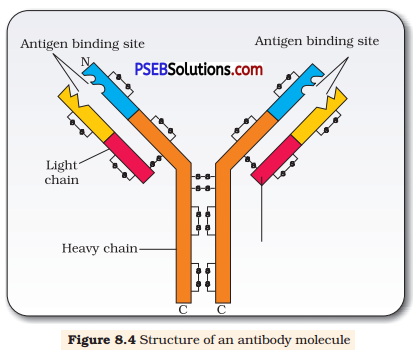
Draw a well-labelled diagram of an antibody molecule.
Answer:
PSEB 12th Class Biology Solutions Chapter 8 Human Health and Disease 1

Question 10.
What are the various routes by which transmission of human i immuno-deficiency virus takes place?
Answer:
AIDS (Acquired Immuno-Deficiency Syndrome) is caused by the Human I Immuno-deficiency Virus (HIV).
It has the following modes of transmission:

  • Unprotected sexual contact with an infected person.
  • Transfusion of blood from an infected person to a healthy person.
  • Sharing infected needles and syringes.
  • From an infected mother to a child through the placenta.

Question 11.
What is the mechanism by which the AIDS virus causes . deficiency of immune system of the infected person?
Answer:
AIDS (Acquired Immuno-Deficiency Syndrome) is caused by the Human immuno-deficiency virus (HIV) via sexual or blood-blood contact. After entering the human body, the HIV virus attacks and enters the macrophages. Inside the macrophages, the RNA of the virus replicates ’ with the help of enzyme reverse transcriptase and gives rise to viral
DNA. Then, this viral DNA incorporates into the host DNA and directs the synthesis of virus particles. At the same time, HIV enters helper T-lymphocytes. It replicates and produces viral progeny there. These newly formed progeny viruses get released into the blood, attacking p other healthy helper T-lymphocytes in the body. As a result, the number of T-lymphocytes in the body of an infected person decreases progressively, thereby decreasing the immunity of a person.

Question 12.
How is a cancerous cell different from a normal cell?
Answer:

Normal cell Cancerous cell
1. Normal cells show the property of contact inhibition. Therefore, when these cells come into contact with other cells, they stop dividing. Cancerous cells lack the property of contact inhibition. Therefore, they continue to divide, thereby forming a mass of cells or tumor.
2. They undergo differentiation after attaining a specific growth. They do not undergo differentiation.
3. These cells remain confined at a particular location. These cells do not remain confined at a particular location. They move into neighbouring tissues and disturb its function.

PSEB 12th Class Biology Solutions Chapter 8 Human Health and Disease

Question 13.
Explain what is meant by metastasis.
Answer:
The property of metastasis is exhibited by malignant tumors. It is the pathological process of spreading cancerous cells to the different parts of the body. These cells divide uncontrollably, forming a mass of cells called tumor. From the tumor, some cells get sloughed off and enter into the blood stream. From the blood stream, these cells reach distant parts of the body and therefore, initiate the formation of new tumors by dividing actively.

Question 14.
List the harmful effects caused by alcohol/drug abuse.
Answer:
Alcohol and drugs have several adverse effects on the individual, his family, and the society.
A. Effects of Alcohol
Effects on the Individual: Alcohol has an adverse effect on the body of an individual. When an individual consumes excess alcohol, it causes damage to the liver and the nervous system. As a result, other symptoms such as depression, fatigue, aggression, loss of weight and appetite may also be observed in the individual. Sometimes, extreme levels of alcohol consumption may also lead to heart failure, resulting coma and death. Also, it is advisable for pregnant women to avoid alcohol as it may inhibit normal growth of the baby.

Effects on the Family: Consumption of excess alcohol by any family member can have devastating effects on the family. It leads to several domestic problems such as quarrels, frustrations, insecurity, etc. Effects on the Society:

  • Rash behaviour
  • Malicious mischief and violence
  • Deteriorating social network
  • Loss of interest in social and other activities

B. Effects of Drugs
Effects on the Individual: Drugs have an adverse effect on the central nervous system of an individual. This leads to the malfunctioning of several other organs of the body such as the kidney, liver, etc. The spread of HIV is most common in these individuals as they share common needles while injecting drugs in their body. Drugs have long-term side effects on both males and females. These side effects include increased aggressiveness, mood swings, and depression.

Effects on the Family and Society: A person addicted to drugs creates problems for his family and society. A person dependant on drugs becomes frustrated, irritated, and anti-social.

Question 15.
Do you think that friends can influence one to take alcohol/ drugs? If yes, how may one protect himself/herself from such an influence?
Answer:
Yes, friends can influence one to take drugs and alcohol. A person cart take the following steps for protecting himself/herself against alcohol/ drug abuse:
(a) Increase your willpower to stay away from alcohol and drugs. One should not experiment with alcohol for curiosity and fun.

  • Avoid the company of friends who take drugs.
  • Seek help from parents and peers. ‘
  • Take proper knowledge and counselling about drug abuse. Devote your energy in other extra-curricular activities.
  • Seek immediate professional and medical help from psychologists and psychiatrists if symptoms of depression and frustration become apparent.

PSEB 12th Class Biology Solutions Chapter 8 Human Health and Disease

Question 16.
Why is that once a person starts taking alcohol or drugs, it is difficult to get rid of this habit? Discuss it with your teacher. Ans. Drug and alcohol consumption has an inherent addictive nature associated with euphoria and a temporary feeling of well-being. Repeated intake of drugs increases the tolerance level of the body’s receptors, leading to more consumption of drugs.

A. Effects of Alcohol
Effects on the Individual: Alcohol has an adverse effect on the body of an individual. When an individual consumes excess alcohol, it causes damage to the liver and the nervous system. As a result, other symptoms such as depression, fatigue, aggression, loss of weight and appetite may al“so be observed in the individual. Sometimes, extreme levels of alcohol consumption may also lead to heart failure, resulting coma and death. Also, it is advisable for pregnant women to avoid alcohol as it may inhibit normal growth of the baby.

Effects on the Family: Consumption of excess alcohol by any family member can have devastating effects on the family. It leads to several domestic problems such as quarrels, frustrations, insecurity, etc. Effects on the Society:

  • Rash behaviour
  • Malicious mischief and violence
  • Deteriorating social network
  • Loss of interest in social and other activities

B. Effects of Drugs
Effects on the Individual: Drugs have an adverse effect on the central nervous system of an individual. This leads to the malfunctioning of several other organs of the body such as the kidney, liver, etc. The spread of HIV is most common in these individuals as they share common needles while injecting drugs in their body. Drugs have long-term side effects on both males and females. These side effects include increased aggressiveness, mood swings, and depression.

Effects on the Family and Society: A person addicted to drugs creates problems for his family and society. A person dependant on drugs becomes frustrated, irritated, and anti-social.

Question 15.
Do you think that friends can influence one to take alcohol/ drugs? If yes, how may one protect himself/herself from such an influence?
Answer:
Yes, friends can influence one to take drugs and alcohol. A person cart take the following steps for protecting himself/herself against alcohol/ drug abuse:

  • Increase your willpower to stay away from alcohol and drugs. One should not experiment with alcohol for curiosity and fun.
  • Avoid the company of friends who take drugs.
  • Seek help from parents and peers.
  • Take proper knowledge and counselling about drug abuse. Devote your energy in other extra-curricular activities.
  • Seek immediate professional and medical help from psychologists and psychiatrists if symptoms of depression and frustration become apparent.

Question 16.
Why is that once a person starts taking alcohol or drugs, it is difficult to get rid of this habit? Discuss it with your teacher.
Answer:
Drug and alcohol consumption has an inherent addictive nature associated with euphoria and a temporary feeling of well-being. Repeated intake of drugs increases the tolerance’ level of the body’s receptors, leading to more consumption of drugs.

PSEB 12th Class Biology Solutions Chapter 8 Human Health and Disease

Question 17.
In your view what motivates youngsters to take to alcohol or drugs and how can this be avoided?
Answer:
Many factors are responsible for motivating youngsters towards alcohol or drugs. Curiosity, need for adventure and excitement, experimentation are the initial causes of motivation. Some youngsters start consuming drugs and alcohol in order to overcome negative emotions (such as stress, pressure, depression, frustration) and to excel in various fields. Several mediums like television, internet, newspaper, movies etc. are also responsible for promoting the idea of alcohol to the younger generation. Amongst these factors, reasons such as unstable and unsupportive family structures and peer pressure can also lead an individual to be dependant on drugs and alcohol.

Preventive measures against addiction of alcohol and drugs are as follows:

  • Parents should motivate and try to increase the willpower of their child.
  • Parents should educate their children about the ill-effects of alcohol. They should provide them with proper knowledge and counselling regarding the consequences of addiction to alcohol.
  • It is the responsibility of the parent to discourage a child from experimenting with alcohol. Youngsters should be kept away from the company of friends who consume drugs.
  • Children should be encouraged to devote their energy in other extra¬curricular and recreational activities.
  • Proper professional and medical help should be provided to a child if sudden symptoms of depression and frustration are observed.

PSEB 12th Class Physics Important Questions Chapter 15 Communication Systems

Punjab State Board PSEB 12th Class Physics Important Questions Chapter 15 Communication Systems Important Questions and Answers.

PSEB 12th Class Physics Important Questions Chapter 15 Communication Systems

Very short answer type questions

Question 1.
Name the essential components of a communication system.
Answer:
Transmitter, medium or channel, and receiver.

Question 2.
What is the function of a transducer used in a communication system?
Answer:
Transducer used as a sensor or detector in communication system. It converts the physical signal into electrical signal.

Question 3.
What is the function of a repeater in a communication system?
Answer:
Repeater pick up the signals from the transmitter, amplifies it and transmits it to the receiver. Thus, repeater comprises up of receiver, transmitted and amplifier. Its function is to extend the range of communication.

Question 4.
Define bandwidth and describe briefly its importance in communicating signals.
Answer:
It is defied as the frequency range over which given equipment operates.
Importance: To design the equipment used in communication system for distinguishing different message signals.

Question 5.
Which basic mode of communication is used for telephonic communication?
Answer:
Point to point is a basic mode of communication, which is used for telephonic conversation. In this mode of communication, communication takes place over a link between a single transmitter and a receiver.

PSEB 12th Class Physics Important Questions Chapter 15 Communication Systems

Question 6.
How are microwaves produced?
Answer:
A type of electromagnetic wave is microwave whose wavelength ranging from as long as metre to as short as millimeter and having the frequency range 3000 MHz to 300 GHz. This also includes UHF, EHF and various sources with different boundaries.

Question 7.
What is sky wave propagation?
Answer:
Skywave propagation is a mode of propagation in which communication of radiowaves in frequency range 2 MHz-20 MHz takes place due to reflection from the ionosphere.

Question 8.
Would sky waves be suitable for transmission of TV signals of 60 MHz frequency? (NCERT Exemplar)
Answer:
A signal to be transmitted through sky waves must have a frequency range of 1710 kHz to 40 MHz. But, here the frequency of TV signals are 60 MHz which is beyond the required range. So, sky waves will not be suitable for transmission of TV signals of 60 MHz frequency.

Question 9.
How are sidebands produced?
Answer:
Sidebands are produced due to the superposition of carrier wave of frequency ωc over modulating or audio signal of frequency ωm. The frequency of lower sideband is ωcm and the upper side band is ωcm

Question 10.
Why are broadcast frequencies (carrier waves) sufficiently spaced in amplitude modulated wave?
Answer:
To avoid mixing up of signals from different transmitters. This can be done by modulating the signals on high-frequency carrier waves, e.g., frequency band for satellite communication is 5.925 – 6.425 GHz.

Question 11.
Why is the amplitude of modulating signal kept less than the amplitude of carrier wave?
Answer:
The amplitude of modulating signal is kept less than the amplitude of carrier wave to avoid distortion.

Question 12.
What is the function of a bandpass filter used in a modulator for obtaining AM signal?
Answer:
Bandpass filter rejects DC and sinusoid of frequency ωm, 2ωm, and 2ωc and retains frequencies ωc + ωm.
Thus, it allows only the desired frequencies to pass through it.

Question 13.
On radiating (sending out) and AM modulated signal, the total radiated power is due to energy carried by ωc, ωcm and ωcm. Suggest ways to minimise cost of radiation without compromising on information. (NCERT Exemplar)
Answer:
In amplitude modulated signals, only sideband frequencies contain information.
Thus only (ωcm) and (ωc – ωm) contain information.

Now, according to question, the total radiated power is due to energy carried by
ωc, (ωc – ωm) and (ωcm)
Thus to minimize the cost of radiation without compromising on information, ωc can be left and transmitting
cm), (ωc – ωm) or both (ωcm) and (ωc – ωm).

PSEB 12th Class Physics Important Questions Chapter 15 Communication Systems

Question 14.
Two waves A and B of frequencies %MHz and 3 MHz, respectively are beamed in the sartie direction for communication via skywave. Which one of these is likely to travel longer distance in the ionosphere before suffering total internal reflection? (NCERT Exemplar)
Answer:
As the frequency of wave B is more than wave A, it means the refractive index of wave B is more than refractive index of wave A (as refractive index increases with frequency increases). For higher frequency wave (i.e., higher refractive index) the angle of refraction is less i.e., bending is less. So, wave B travels longer distance in the ionosphere before suffering total internal reflection.

Short answer type questions

Question 1.
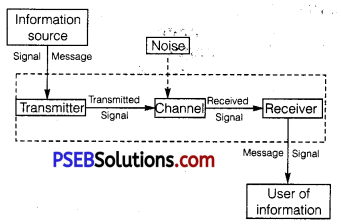
Draw a block diagram of a generalized communication system. Write the functions of each of the following:
(a) Transmitter
(b) Channel
(c) Receiver
Answer:
The block diagram of a generalized communication system is shown in figure
PSEB 12th Class Physics Important Questions Chapter 15 Communication Systems 1
Functions are as follows :
(a) Transmitter: It comprises of message signal source, modulator and transmitting antenna. Transmitter makes signals compatible for communication channel via modulator and antenna.
(b) Channel: It is a link for propagating the signal from transmitter to receiver.
(c) Receiver: It recovers the desired original message signals from the received signals at the end of channel.

Question 2.
Explain the terms
(i) Attenuation and
(ii) Demodulation used in communication system.
Answer:
Attenuation: The loss in strength of a signal while propagating through a medium is known as attenuation.
Demodulation: The process of retrieval of information, from the carrier wave at the receiver end. This is the reverse process of modulation.

Question 3.
(a) Distinguish between ‘Analog and Digital signals’.
(b) Explain briefly two commonly used applications of the Internet.
Answer:
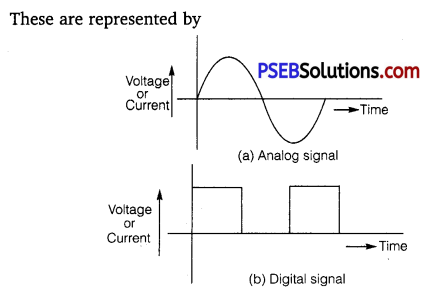
(a) A signal that varies continuously with time (e. g., sine waveform) is called an analog signal.
A signal that is discrete is called a digital signal. The presence of signal is denoted by digit 1 and absence is denoted by digit 0.
PSEB 12th Class Physics Important Questions Chapter 15 Communication Systems 2
(b) Uses of Internet: email, e-banking, e-shopping, e-ticketing, charting, surfing, file transfer, etc.

Question 4.
What is ground wave communication? Explain why this mode cannot be used for long-distance communication using high frequencies.
Answer:
The mode of wave propagation in which wave guided along the surface of the earth is called ground wave communication.
The maximum range of propagation in this mode depends on
(i) transmitted power and
(ii) frequency (less than a few MHz)
At high frequencies, the rate of energy dissipation of the signal increases and the signal gets attenuated over a short distance.

PSEB 12th Class Physics Important Questions Chapter 15 Communication Systems

Question 5.
Define the term modulation. Draw a block diagram of a simple modulator for obtaining AM signals.
Or
Draw a block diagram of a simple modulator to explain how the AM wave is produced. Can the modulated signal be transmitted as such? Explain.
Answer:
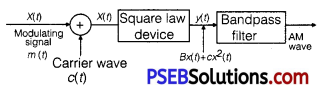
Modulation is the process in which low-frequency message signal is superimposed on high-frequency carrier wave so that they can be transmitted over long distances. The block diagram for a simple modulator for obtaining AM signal is shown as below :
PSEB 12th Class Physics Important Questions Chapter 15 Communication Systems 3

Question 6.
Define modulation index. Why is it kept low? What is the role of a bandpass filter? Give its physical significance.
Answer:
Modulation index is the ratio of the amplitude of modulating signal to that of carrier wave. Mathematically,
µ = \(\frac{A_{m}}{A_{c}}\)
Reason: It is kept low to avoid distortion.
Role: A bandpass filter rejects low and high frequencies and allows a band of desired frequencies to pass through it.
Physical Significance: It signifies the level of distortion or noise. A lower value of modulation index indicates a lower distortion in the transmitted signal.

Question 7.
State the concept of mobile telephony and explain its working.
Answer:
Concept of mobile telephony is to divide the service area into a suitable number of cells centered on an office MTSO (Mobile Telephone Switching Office). Mobile telephony means that you can talk to any person from anywhere.
Explanation:

  • Entire service area is divided into smaller parts called cells or cell zones.
  • Each cell has a base station to receive and send signals to all the mobile phones present inside that cell.
  • Each base station is linked to MTSO. MTSO coordinates between base station and TCO (Telephone Control Office).

Question 8.
What is space wave propagation? State the factors which limit its range of propagation. Derive an expression for the maximum line of sight distance between two antennas for space wave propagation.
Answer:
Space Wave Propagation
The mode of propagation in which radio waves travel, along a straight line, from the transmitting to the receiving antenna.
Limiting Factors
(i) Curvature of the earth
(ii) Insufficient height of the receiving antenna
(iii) LOS distance (> 40 MHz) travel in straight line
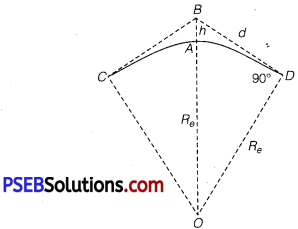
PSEB 12th Class Physics Important Questions Chapter 15 Communication Systems 4
Derivation : In right angled triangle BOD, ∠BDO =90°
∴BO2 = (OD)2 +(BD)2
le., (Re+h)2 =Re2 +(BD)2 ………………. (1)
As height h of the tower is very small as compared to radius (Re) of earth the point B will be very close to A, so that
BD ≈AD = d(say)
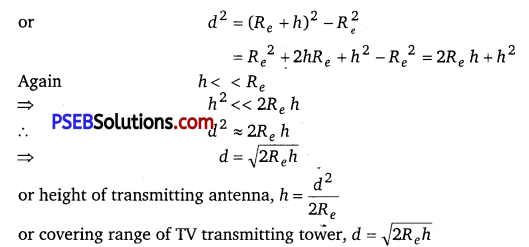
∴ Equation (1) given (Re + h)2 = Re2 + d2
PSEB 12th Class Physics Important Questions Chapter 15 Communication Systems 5
or height of transmitting antenna, h =\(\frac{d^{2}}{2 R_{e}}\)
or covering range of TV transmitting tower, d = \(\sqrt{2 R_{e} h}\)
Thus, covering range of TV signal can be increased by increasing the height of transmission antenna.
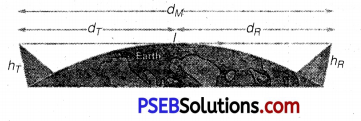
For a transmitting antenna of height hT, and a receiving antenna of height hR, the maximum line of sight distance
becomes
dM= \(\sqrt{2 R h_{T}}+\sqrt{2 R h_{R}}\)

Question 9.
(a) Explain any two factors which justify the need of modulating a low-frequency signal.
(b) Write two advantages of frequency modulation over amplitude modulation
Answer:
(a) (i) If λ is the wavelength of the signal then the antenna should have a length at least \(\frac{\lambda}{4}\)
For an electromagnetic wave of frequency 20 kHz, the wavelength λ is 15 km. Such a long antenna is not possible to construct and operate. So, there is need to modulate the wave in order to reduce the height of antenna to a reasonable height.

(ii) The power radiated by a linear antenna (length l) is proportional to \(\left(\frac{l}{\lambda}\right)^{2}\).
This shows that power radiated increases with decreasing λ. So, for effective power radiation by antenna, there is need to modulate the wave.
(b)

  • High frequency
  • Less noise
  • Maximum use of transmitted power

Question 10.
Given reasons for the following :
(i) For ground wave transmission, size of antenna (l) should the comparable to wavelength (λ) of signal, i.e. I = \(\frac{\lambda}{4}\)
(ii) Audio signals converted into an electromagnetic wave are not directly transmitted.
(iii) The amplitude of a modulating signal is kept less than the amplitude of carrier wave.
Answer:
(i) To radiate the signals with high efficiency.
(ii) Because they are of large wavelength and power radiated by antenna is very small as
P ∝ \(1 / \lambda^{4}\)
(iii) It is so to avoid making over modulated carrier wave. In that situation, the negative half cycle of the modulating signal is dipped and distortion occurs in reception.

PSEB 12th Class Physics Important Questions Chapter 15 Communication Systems

Question 11.
Which of the following would produce analog signals and which would produce digital signals?(NCERT Exemplar)
(a) A vibrating tuning fork
(b) Musical sound due to a vibrating sitar string
(c) Light pulse
(d) Output of NAND gate
Answer:
Analog and digital signals are used to transmit information, usually through electric signals. In both these technologies, the information such as any audio or video is transformed into electric signals. The difference between analog and digital technologies is that in analog technology, information is translated into electric pulses of varying amplitude. In digital technology, translation of information is into binary formal (zero or one) where each bit is representative of two distinct 4 amplitudes. Thus, (a) and (b) would produce analog signals and (c) and (d) would produce digital signals.

Question 12.
Why is AM signal likely to be more noisy than a FM signal upon transmission through a channel? (NCERT Exemplar)
Answer:
In case of AM, the instantaneous voltage of carrier waves is varied by the modulating wave voltage. So, during the transmission, noise signals can also be added and receiver assumes noise a part of the modulating signal.
In case of FM, the frequency of carrier waves is changed as the change in the instantaneous voltage of modulating waves. This can be done by mixing and not while the signal is transmitting in channel. So, noise does not affect FM signal.

Long answer type questions

Question 1.
What does the term LOS communication mean? Name the types of waves that are used for this communication. What is the range of their frequencies? Give typical, examples, with the help of suitable figure of communication systems that use space wave mode propagation.
Answer:
LOS Communication: It means “Line of sight communication”. Space wave are used for LOS communication.
In this communication, the space waves (radio or microwaves) travel directly from transmitting antenna to receiving antenna. Frequency for LOS communication must be more than 40 MHz.
PSEB 12th Class Physics Important Questions Chapter 15 Communication Systems 6
If transmitting antenna and receiving antenna have heights hT and hR respectively, then radio horizon of transmitting antenna.
dT = \( \sqrt{2 R_{e} h_{T}}\)
where Re is radius of earth and radius horizon of receiving antenna,
dR = \(\sqrt{2 R_{e} h_{R}}\)
∴ Maximum line of sight distance,
dM = dT + dR = \(\sqrt{2 R_{e} h_{T}}+\sqrt{2 R_{e} h_{R}}\)
PSEB 12th Class Physics Important Questions Chapter 15 Communication Systems 7
Television, broadcast, microwave links and satellite communication.
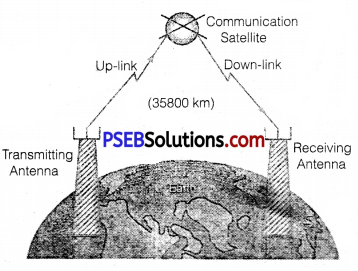
The satellite communication is shown in figure. The space wave used is microwave.

Question 2.
(a) Distinguish between sinusoidal and pulse-shaped signals,
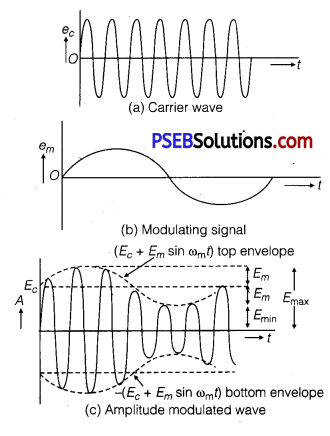
(b) Explain, showing graphically, how a sinusoidal carrier wave is superimposed on a modulating signal to obtain the resultant amplitude modulated (AM) wave.
Answer:
(a) In the process of modulation, some specific characteristics of the carrier wave is varied in accordance with the information or message signal. The carrier wave maybe
(i) Continuous (sinusoidal) wave, or
(ii) Pulse, which is discontinuous.
A continuous sinusoidal carrier wave can be expressed as,
E = Eo sin (ωt +Φ)
Three distinct characteristics of such a wave are amplitude (E0), angular frequency (ω) and phase angle fcj)).
Any one of these three characteristics can be varied in accordance with the modulating baseband (AF) signal, giving rise to the respective Amplitude Modulation;
Frequency Modulation and Phase Modulation.

Again, the significant characteristics of a pulse are Pulse Amplitude, Pulse Duration or Pulse Width and Pulse Position (representing the time of rise or fall of the pulse amplitude). Any one of these characteristics can be varied in accordance with the modulating baseband (AF) signal, giving rise to the respective. Pulse Amplitude
Modulation (PAM), Pulse Duration Modulation (PDM), Pulse Width Modulation (PWM) and Pulse Position Modulation (PPM).

(b) Amplitude Modulation: When a modulating AF wave is superimposed on a high-frequency carrier wave in a manner that the frequency of modulated wave is same as that of the carrier wave, but its amplitude is made proportional to the instantaneous amplitude of the audio, frequency modulating voltage, the process is called amplitude modulation (AM).

PSEB 12th Class Physics Important Questions Chapter 15 Communication Systems

Let the instantaneous carrier voltage (ec) and modulating voltage (em) be represented by,
ec = Ec sinωc t …………………… (1)
em = Em sinωmt …………………….. (2)
Thus, in amplitude modulation, amplitude A of modulated wave is made proportional to the instantaneous modulating voltage em i.e.,
A = Ec+kem ……………………….. (3)
where k is a constant of proportionality.
In amplitude modulation, the proportionality constant k is made equal to unity. Therefore, maximum positive amplitude of AM wave is given
by.
A = Ec +em =Ec +Em sinωm t …………………….. (4)
It is called top envelope.
The maximum negative amplitude of AM wave is given by,
-A = – Ec – em
= – (Ec +Em sinωm t) …………………………. (5)
PSEB 12th Class Physics Important Questions Chapter 15 Communication Systems 8

PSEB 12th Class Physics Solutions Chapter 15 Communication Systems

Punjab State Board PSEB 12th Class Physics Book Solutions Chapter 15 Communication Systems Textbook Exercise Questions and Answers.

PSEB Solutions for Class 12 Physics Chapter 15 Communication Systems

PSEB 12th Class Physics Guide Communication Textbook Questions and Answers

Question 1.
Which of the frequencies will be suitable for beyond-the-horizon communication using sky waves?
(a) 10 kHz
(b) 10 MHz
(C) 1 GHz
(d) 1000 GHz
Answer:
(b) 10 MHz.
For beyond-the-horizon communication, it is necessary for the signal waves to travel a large distance. 10 kHz signals cannot be radiated efficiently because of the antenna size. The high-energy signal waves (1 GHz – 1000 GHz) penetrate the ionosphere. 10 MHz frequencies get reflected easily from the ionosphere. Hence, signal waves of such frequencies are suitable for beyond-the-horizon communication.

Question 2.
Frequencies in the UHF range normally propagate by means of:
(a) Ground waves
(b) Sky waves
(c) Surface waves
(d) Space waves
Answer:
(d) Space waves
Owing to its high frequency, an ultra-high frequency (UHF) wave can neither travel along the trajectory of the ground nor can it get reflected by the ionosphere. The signals having UHF are propagated through line-of-sight communication, which is nothing but space wave propagation.

Question 3.
Digital signals
(i) do not provide a continuous set of values,
(ii) represent values as discrete steps,
(iii) can utilize binary system, and
(iv) can utilize decimal as well as binary systems.
Which of the above statements are true?
(a) (i) and (ii) only
(b) (ii) and (iii) only
(c) (i), (ii) and (iii) but not (iv)
(d) All of (i), (ii), (iii) and (iv)
Answer:
(c) A digital signal uses the binary (0 and 1) system for transferring message signals. Such a system cannot utilize the decimal system (which corresponds to analogue signals). Digital signals represent discontinuous values.

PSEB 12th Class Physics Solutions Chapter 15 Communication Systems

Question 4.
Is it necessary for a transmitting antenna to be at the same height as that of the receiving antenna for line-of-sight communication? A TV transmitting antenna is 81 m tall. How much service area can it cover if the receiving antenna is at the ground level?
Answer:
Line-of-sight communication means that there is no physical obstruction between the transmitter and the receiver.
In such communications, it is not necessary for the transmitting and receiving antennas to be at the same height.
Height of the given antenna, h = 81 m
Radius of earth, R = 6.4 x 10⁶ m

For range, d = 2Rh, the service area of the antenna is given by the relation
A = πd2 = π(2Rh)
= 3.14 x 2 x 6.4 x 106 x 81
= 3255.55 x 106 m2
= 3255.55 ~ 3256 km2.

Question 5.
A carrier wave of peak voltage 12 V is used to transmit a message signal.
What should be the peak voltage of the modulating signal in order to have a modulation index of 75%?
Answer:
Amplitude of the carrier wave, Ac =12,
Modulation index, m = 75% = 0.75
Amplitude of the modulating wave = Am

Using the relation for modulation index,
m = \(\frac{A_{m}}{A_{c}}\)
∴ Am =mAc
= 0.75 x 12 = 9 V
Hence, amplitude of the modulating wave is 9 V.

Question 6.
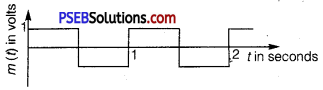
A modulating signal is a square wave, as shown in Fig. 15.14.
The carrier wave is given by c(t) = 2 sin (8πt) volts.
PSEB 12th Class Physics Solutions Chapter 15 Communication Systems 1
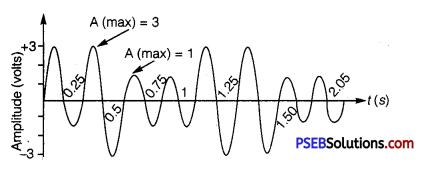
(i) Sketch the amplitude modulated waveform.
(ii) What is the modulation index?
Answer:
Given, the equation of carrier wave
c(t) = 2sin(8πt) ……………………………… (i)
(i) According to the diagram.
Amplitude of modulating signal, Am = 1V
Amplitude of carrier wave,
Ac = 2V [By eq.(1)]
Tm = 1s (From diagram)
From eq.(1) ωm = \(\frac{2 \pi}{T_{m}}=\frac{2 \pi}{1}\) = 2π rad/s ………………. (2)
c(t) = 2sin8πt = Ac sinωc t
ωc =8π
So,
From Eq.(2)
So, ωc = 4ωm
Amplitude of modulated wave
A = Am +Ac =2+1 =3V
The sketch of the amplitude modulated waveform is shown below :
For carrier signal, ω = 8π,T = \(\frac{2 \pi}{\omega}=\frac{2}{8}=\frac{1}{4}\) = 0.25s
PSEB 12th Class Physics Solutions Chapter 15 Communication Systems 2
(ii) Modulation index, µ = \(\frac{A_{m}}{A_{c}}=\frac{1}{2}\) = 0.5

Question 7.
For an amplitude modulated wave, the maximum amplitude is found to be 10 V while the minimum amplitude is found to be 2 V. Determine the modulation index, p.
What would be the value of p if the minimum amplitude is zero volts?
Answer:
Maximum amplitude, Amax = 10 V
Minimum amplitude, Amin = 2 V
Modulation index µ, is given by the relation
µ = \(\frac{A_{\max }-A_{\min }}{A_{\max }+A_{\min }}\)
= \(\frac{10-2}{10+2}=\frac{8}{12} \) = 0.67
If Amin=0,
Then µ = \(\frac{A_{\max }}{A_{\max }}=\frac{10}{10}\) = 1
Hence, µ = 1, if the minimum amplitude is zero volts.

PSEB 12th Class Physics Solutions Chapter 15 Communication Systems

Question 8.
Due to economic reasons, only the upper sideband of an AM wave is transmitted, but at the receiving station, there is a facility for generating the carrier. Show that if a device is available which can multiply two signals, then it is possible to recover the modulating signal at the receiver station.
Answer:
Let ωc be the angular frequency of carrier waves and com by the angular frequency of signal waves.
Let the signal received at the receiving station be
e = E1 cos(ωcm )t
Let the instantaneous voltage of carrier wave
ec = Ec cosωc t
is available at receiving station.
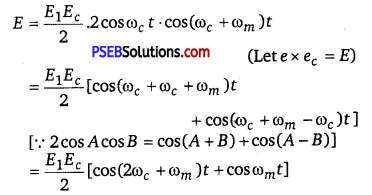
Multiplying these two signals, we get
e x ec = E1Ec coscωc t cos(ωcm)t
PSEB 12th Class Physics Solutions Chapter 15 Communication Systems 3
Now, at the receiving end as the signal passes through filter, it will pass the high frequency (2ωc + ωm) but obstruct the frequency ωm. So, we can \(\frac{E_{1} E_{c}}{2} \cos \omega_{m_{s}} t\) record the modulating signal frequency ωm.

PSEB 12th Class Biology Important Questions Chapter 7 Evolution

Punjab State Board PSEB 12th Class Biology Important Questions Chapter 7 Evolution Important Questions and Answers.

PSEB 12th Class Biology Important Questions Chapter 7 Evolution

Very short answer type questions

Question 1.
Name the scientist who disproved spontaneous generation theory.
Answer:
Louis Pasteur disproved the theory of spontaneous generation.

Question 2.
What did Louis Pasteur’s experiment on ‘killed yeast’ demonstrate? Name the theory that got disproved on the basis of his experiment.
Answer:
Louis Pasteur demonstrated that life comes only from pre-existing life. The theory of spontaneous generation was disproved on the basis of his experiment.

Question 3.
Write the hypothetical proposals put forth by Oparin and Haldane.
Or List two main propositions of Oparin and Haldane.
Or State two postulates of Oparin and Haldane with reference to origin of life.
Answer:
Oparin and Haldane proposed that life originated from pre-existing non-organic molecules and the diverse organic molecules were formed from these inorganic constituents by chemical evolution.

PSEB 12th Class Biology Important Questions Chapter 7 Evolution

Question 4.
When we say “survival of the fittest”, does it mean that
(a) those which are fit only survive, or
(b) those that survive are called fit. Comment. [NCERT Exemplar]
Answer:
Those individuals which survive and reproduce in their respective environment are called fit.

Question 5.
Why are analogous structures a result of convergent evolution?
Answer:
They are not anatomically similar structures though they perform similar functions.

Question 6.
Identify the examples of convergent evolution from the following:
(i) Flippers of penguins and dolphins
(ii) Eyes of octopus and mammals
(iii) Vertebrate brains
Answer:
(i) Flippers of penguins and dolphins
(ii) Eyes of octopus and mammals

Question 7.
What does Hardy-Weinberg equation p2 + 2pq + q2 = 1 convey?
Answer:
Hardy-Weinberg equation convey genetic equilibrium, i.e., sum total of all allelic frequencies is 1.

Question 8.
What is founder effect? [NCERT Exemplar]
Answer:
Sometimes the change in allele frequency is so different in the new sample of population that they become a different species. The original drifted population becomes founder and the effect is called founder effect.

Question 9.
State the significance of Coelacanth in evolution.
Answer:
It is an ancestor of amphibians.

PSEB 12th Class Biology Important Questions Chapter 7 Evolution

Question 10.
Name the first human like hominid. Mention his food habit and brain capacity.
Answer:
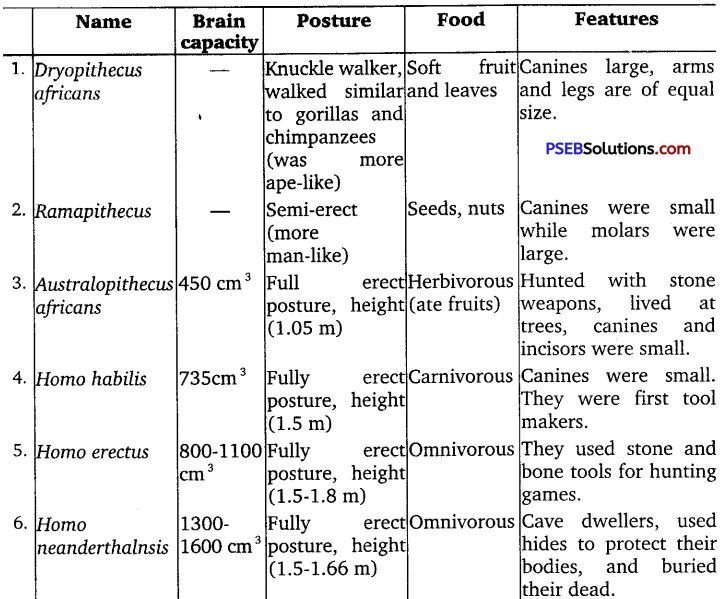
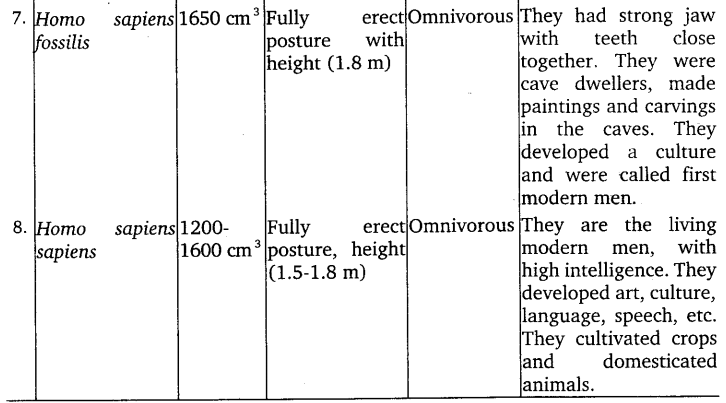
Homo habilis was the first human-like hominid. Homo (man) habili (skilful) was carnivorous and hunted large animals. He had a brain capacity of 650-800 cc.

Question 11.
Name the common ancestor of the great apes and man.
Answer:
Dryopithecus/Ramapithecus.

Question 12.
By what Latin name the first hominid was known?
[NCERT Exemplar]
Answer:
Homo habilis.

Short answer type questions

Question 1.
Describe the experiment that helped Louis Pasteur to dismiss the theory of spontaneous generation of life.
Answer:
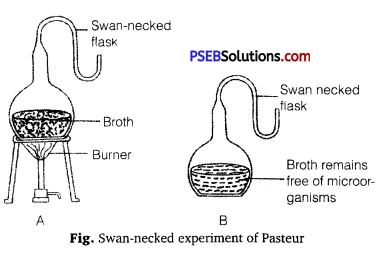
PSEB 12th Class Biology Important Questions Chapter 7 Evolution 1
Louis Pasteur (1864) boiled broth in flasks having bent swan or S-shaped necks. No microorganisms were observed in broth after keeping for several days though broth was connected to air through the bent neck. It is because the dirt carrying microorganisms got settled in the bent part of neck. When the neck was broken, colonies of microorganisms soon developed over the broth showing the microorganisms have come from air.

Question 2.
Mention the contribution of S.L. Miller’s experiments on Origin of Life.
Answer:
S.L. Miller created an environment in laboratory similar to the one that existed before life originated. In a closed flask containing CH4, H2, NH3 and water vapour at 800°C, electric discharge was created. The conditions were similar to those in primitive atmosphere. After a week, they observed presence of amino acids and complex molecules like sugars, nitrogen bases, pigments and fats in the flask. This provided experimental evidence for the theory of chemical origin.

PSEB 12th Class Biology Important Questions Chapter 7 Evolution

Question 3.
How does the study of fossils support evolution? Explain.
Answer:
Different aged rock sediments contain fossil of different types. Early rocks contain fossils of simple organisms while recent rocks contain fossils of complex organisms, e.g., dinosaur.

By studying fossils occurring in different strata of rocks, geologists are able to reconstruct the geological period in which they existed and the cause of evolutionary change. Hence, new forms of life originated at different times in the history’ of earth.

Question 4.
Explain “fitness of a species” as mentioned by Darwin.
Answer:
“Fitness of a species” according to Darwin means reproductive fitness. All organisms after reaching reproductive age have varying degree of reproductive potential. Some organisms produce more offspring and some organism produce only few offspring. This phenomenon is also called as differential reproduction.
Hence the species which produces more offsprings are selected by nature.

Question 5.
While creation and presence of variation is directionless, natural selection is directional as it is in the context of adaptation. Comment. [NCERT Exemplar]
Answer:
Creation and variation occur in a sexually reproducing population as a result of crossing-over during meiosis and random fusion of gametes. It is however the organisms that are selected over a period of time which are determined by the environmental conditions. In other words, the environment provides the direction with respect to adaptations so that the organisms are more and more fit in terms of survival.

Question 6.
Branching descent and natural selection are the two key concepts of Darwinian theory of evolution. Explain each concept with the help of a suitable example.
Answer:
Branching Descent : Different species descending from the common ancestor get adapted in different habitats, e.g., Darwin’s finches-varieties of finches arose from grain eaters; Australian marsupials evolved from common marsupial.

Natural Selection: It is a process in which heritable variations enable better survival of the species to reproduce in large number, e.g., white moth surviving before the industrial revolution and black moth surviving after industrial revolution; long-necked giraffe survived the evolution process; DDT-resistant mosquitoes survive.

PSEB 12th Class Biology Important Questions Chapter 7 Evolution

Question 7.
Explain the salient features of Hugo de Vries theory of mutation.
Answer:
Salient features of Hugo de Vries theory of mutation are as follows:

  • Mutations cause evolution.
  • New species originate due to large mutations.
  • Evolution is a discontinuous process and not gradual.
  • Mutations are directionless.
  • Mutations appear suddenly.
  • Mutations exhibit their effect immediately.

Question 8.
What does Hardy-Weinberg Principle of equilibrium indicate? List any two factors that could alter the equilibrium. What would such an alteration lead to?
Answer:
Hardy-Weinberg principle states that in a given population, the frequency of occurrence of alleles of a gene is supposed to remain fixed and even remains same through generations. This is also called genetic equilibrium. Sum total of all the alleles is 1. Hence, p2 + 2pq + q2 = 1 (p, q represent the frequency of gene A and allele a).
Factors affecting Hardy-Weinberg equilibrium are gene migration or gene flow, genetic drift, mutation, genetic recombination and natural selections.

(i) Gene Flow/Migration: The movement of a section of population from one place to another, results in the addition of new alleles to the local gene pool of the host population. This is called gene migration. Migration causes variations at the genetic level.

(ii) Genetic Drift: The random changes in gene frequency in a population occurring by chance alone rather than by natural selection is called genetic drift. The effects of genetic drift are more prominent in small populations.

Long answer type questions

Question 1.
(a) Differentiate between analogy and homology giving one example each of plant and animal respectively.
(b) How are they considered as an evidence in support of evolution?
Or
Differentiate between homology and analogy. Give one example of each.
Answer:
(a) Analogy is the phenomenon where different structures evolving for the same function and hence having similarity are the result of convergent evolution. These structures are called analogical structures. Example are
(i) Tendril of pea (leaf-let modified) and grapevine/ cucurbita (stem modified),
(ii) Flippers of penguins (wing modified) and dolphin (fore arm modified) both help in swimming.

Homology is the phenomenon where same structure developed along different lines due to adaptation to different needs/habitats as a result of divergent needs/habitats are a result of divergent evolution. These structures are called homologous structure.

Examples: (i) Thorns of Bougainvillea and tendrils of cucurbita represent homology as both are modified stems, (ii) Forelimbs of man, cheetah, whale and bat.

(b) Analogy and homology of the structures represent anatomical and morphological evidence of evolution. Analogy shows that similar habitat result in the selection of similar adaptive features in different groups of organisms but toward same function. This is a result of convergent evolution.

Homology include the same structures developed to have different forms to perform different functions in different animals. It is a result of divergent evolution. It indicate towards common ancestory. The comparative anatomy of forelimbs in all the mammals show similarities in the pattern of bones and pentadactyl organisation.

PSEB 12th Class Biology Important Questions Chapter 7 Evolution

Question 2.
The evolutionary story of moths in England during industrialisation reveals, that ‘evolution is apparently reversible’. Clarify this statement. [NCERT Exemplar]
Answer:
The peppered moth occurs in two forms, i.e., light coloured (Biston betularia typoica) and dark coloured (Biston betrularia carbonaria). Before Industrial Revolution : Only light coloured moths were prevalent. Light coloured moths camouflaged well with the lichens that covers tree trunks, on the contrary dark moths were easy prey on the tree trunks and were very rare.

During the Industrial Revolution: The population of dark coloured moth increased. While, that of light coloured moth decreased. This change was due to the burning of coal in factories.
The smoke from the factories killed the lichens and the tree trunks turned black due to the deposition of soot. The black moths had an advantage against soot, therefore, escaped predation of birds while on the other hand, white moths were identified in sharp contrast and become easy prey.

With the Progression of Industrial Revolution: The coal was replaced by oil and electricity.
This resulted in reduction of soot deposits on the tree trunk. Gradually, the population of black moth decreased and that of light moth began to increase.

PSEB 12th Class Biology Solutions Chapter 7 Evolution

Punjab State Board PSEB 12th Class Biology Book Solutions Chapter 7 Evolution Textbook Exercise Questions and Answers.

PSEB Solutions for Class 12 Biology Chapter 7 Evolution

PSEB 12th Class Biology Guide Evolution Textbook Questions and Answers

Question 1.
Explain antibiotic resistance observed in bacteria in light of Darwinian selection theory.
Answer:
Darwinian selection theory states that individuals with favourable variations are better adapted than individuals with less favourable variation. It means that nature selects the individuals with useful variation as these individuals are better evolved to survive in the existing environment. An example of such selection is antibiotic resistance in bacteria. When bacterial population was grown on an agar plate containing antibiotic penicillin, the colonies that were sensitive to penicillin died, whereas one or few bacterial colonies that were resistant to penicillin survived.

This is because these bacteria had undergone chance mutation, which resulted in the evolution of a gene that made them resistant to penicillin drug. Hence, the resistant bacteria multiplied quickly as compared to non-resistant (sensitive) bacteria, thereby increasing their number. Hence, the advantage of an individual over other helps in the struggle for existence.

Question 2.
Find out from newspapers and popular science articles any new fossil discoveries or controversies about evolution.
Answer:
Fossils of dinosaurs have revealed the evolution of reptiles in Jurassic period. As a result of this, evolution of other animals such as birds and mammals has also been discovered. However, two unusual fossils recently unearthed in China have ignited a controversy over the evolution of birds. Confuciusomis is one such genus of primitive birds that were crow sized and lived during the Creataceous period in China.

PSEB 12th Class Biology Solutions Chapter 7 Evolution

Question 3.
Attempt giving a clear definition of the term species.
Answer:
Species can be defined as a group of organisms, which have the capability to interbreed in order to produce fertile offspring.

Question 4.
Try to trace the various components of human evolution (hint: brain size and function, skeletal structure, dietary preference, etc.)
Answer:
The various components of human evolution are as follows:
(i) Brain capacity
(ii) Posture
(iii) Food/dietary preference and other important features
PSEB 12th Class Biology Solutions Chapter 7 Evolution 1
PSEB 12th Class Biology Solutions Chapter 7 Evolution 2

PSEB 12th Class Biology Solutions Chapter 7 Evolution

Question 5.
Find out through internet and popular science articles whether animals other than man has self-consciousness.
Answer:
There are many animals other than humans, which have self-consciousness. An example of an animal being self-conscious is dolphins. They are highly intelligent. They have a sense of self and they also recognise others among themselves and others. They communicate with each other by whistles, tail-slapping, and other body movements.

Not only dolphins, there are certain other animals such as crow, parrot, chimpanzee, gorilla, orangutan, etc., which exhibit self-consciousness.

Question 6.
List 10 modern-day animals and using the internet resources link it to a corresponding ancient fossil. Name both.
Answer:
The modern-day animals and their ancient fossils are listed in the following table:

Animal Fossil
1. Man Ramapithecus
2. Horse Eohippus
3. Dog Leptocyon
4. amel Protylopus
5. Elephant Moerithers
6. Whale Protocetus
7. Fish Arandaspis
8. Tetrapods Icthyostega
9. Bat Archaeonycteris
10. Giraffe Palaeotragus

Question 7.
Practise drawing various animals and plants.
Answer:
Ask your teachers and parents to suggest the names of plants and animals and practise drawing them. You can also take help from your book to find the names of plants and animals.

PSEB 12th Class Biology Solutions Chapter 7 Evolution

Question 8.
Describe one example of adaptive radiation.
Answer:
Adaptive radiation is an evolutionary process that produces new species from a single, rapidly diversifying lineage. This process occurs due to natural selection. An example of adaptive radiation is Darwin finches, found in Galapagos Island. A large variety of finches is present in Galapagos Island that arose from a single species, which reached this land accidentally. As a result, many new species have evolved, diverged, and adapted to occupy new habitats. These finches have developed different eating habits and different types of beaks to suit their feeding habits. The insectivorous, blood sucking, and other species of finches with varied dietary habits have evolved from a single seed eating finch ancestor.

Question 9.
Can we call human evolution as adaptive radiation?
Answer:
No, human evolution cannot be called adaptive radiation. This is because adaptive radiation is an evolutionary process that produces new species from a single, rapidly diversifying lineage, which is not the case with human evolution. Human evolution is a gradual process that took place slowly in time. It represents an example of anagenesis.

PSEB 12th Class Biology Solutions Chapter 7 Evolution

Question 10.
Using various resources such as your school Library or the internet and discussions with your teacher, trace the evolutionary stages of any one animal, say horse.
Answer:
The evolution of horse started with Eohippus during Eocene period. It involved the following evolutionary stages:

  1. Gradual increase in body size
  2. Elongation of head and neck region
  3. Increase in the length of limbs and feet
  4. Gradual reduction of lateral digits
  5. Enlargement of third functional toe
  6. Strengthening of the back
  7. Development of brain and sensory organs
  8. Increase in the complexity of teeth for feeding on grass

The evolution of horse is represented as follows:
PSEB 12th Class Biology Solutions Chapter 7 Evolution 3
Eohippus: It had a short head and neck. It had four functional toes and a splint of 1 and 5 on each hind limb and a splint of 1 and 3 in each forelimb. The molars were short crowned that were adapted for grinding the plant diet.

Mesohippus: It was slightly taller than Eohippus. It had three toes in each foot.

Merychippus: It had the size of approximately 100 cm. Although it still had three toes in each foot, but it could run on one toe. The side toe did not touch the ground. The molars were adapted for chewing the grass.

Pliohippus: It resembled the modern horse and was around 108 cm tall. It had a single functional toe with splint of 2nd and 4th in each limb.

Equus: Pliohippus gave rise to Equus or the modem horse with one toe in each foot. They have incisors for cutting grass and molars for grinding food.

PSEB 12th Class Biology Important Questions Chapter 6 Molecular Basis of Inheritance

Punjab State Board PSEB 12th Class Biology Important Questions Chapter 6 Molecular Basis of Inheritance Important Questions and Answers.

PSEB 12th Class Biology Important Questions Chapter 6 Molecular Basis of Inheritance

Question 1.
Name the specific components and the linkage between them that form deoxyadenosine.
Answer:
Nitrogenous base (Adenine) and pentose sugar and N-glycosidic linkage.

Question 2.
Why is RNA more reactive in comparison to DNA?
Answer:
RNA is more reactive because:

  • It is single stranded.
  • Every nucleotide has an additional OH group present at position 2 in the ribose.
  • Mutates faster as compared to DNA.

Question 3.
In an experiment, DNA is treated with a compound which tends to place itself amongst the stacks of nitrogenous base pairs. As a result of this, the distance between two consecutive base increases from 0.34 nm to 0.44 nm. Calculate the length of DNA double helix, which has 2 × 10⁹ bp in saturating the presence of this compound. [NCERT Exemplar]
Answer:
The new length of DNA helix would be
= 2 × 10-9 × 0.44 × 10-9bp.

PSEB 12th Class Biology Important Questions Chapter 6 Molecular Basis of Inheritance

Question 4.
In a nucleus, the number of RNA nucleoside triphosphates is 10 times more than the number of DNA nucleoside triphosphates,
still only DNA nucleotides are added during the DNA replication, and not the RNA nucleotides. Why?
[NCERT Exemplar]
Answer:
DNA polymerase is highly specific to recognise only deoxyribonucleoside r triphosphates. Therefore, it cannot hold RNA nucleotides.

Question 5.
Name the enzyme involved in the continuous replication of DNA strand. Mention the polarity of the template strand.
Answer:
DNA polymerase is involved in continuous replication of DNA strand. The polarity of template strand is 3′ → 5′.

Question 6.
What is a cistron?
Answer:
Cistron is a segment of DNA coding for a polypeptide chain.

Question 7.
Name the transcriptionally active region of chromatin in a nucleus.
Answer:
Euchromatin or Exon.

Question 8.
Write the function of RNA polymerase n.
Answer:
RNA polymerase II transcribes precursor of mRNA or hnRNA.

PSEB 12th Class Biology Important Questions Chapter 6 Molecular Basis of Inheritance

Question 9.
Mention the two additional processings which /mRNA needs to
undergo after splicing so as to become functional.
Answer:
Capping and tailing.

Question 10.
Give an example of a codon having dual function.
Answer:
AUG has dual function. It acts as initiation codon and also codes for methionine.

Question 11.
Sometimes cattle or even human beings give birth to their young ones that have extremely different sets of organs like limbs/position of eye(s), etc. Why? [NCERT Exemplar]
Answer:
This is due to a disturbance in coordinated regulation of expression of sets of genes associated with organ development or due to mutations.

Question 12.
How does a degenerate code differ from an unambiguous one?
Answer:
Degenerate code means that one amino acid can be coded by more than one codon. Unambiguous code means that one codon codes for only one amino acid.

Question 13.
What is aminoacylation? State its significance.
Answer:
Aminoacylation of t-RNA involves activation of amino acids by ATP which gets linked to OH’ present at the 3′ end of specific t-RNA. The process is also called charging of t-RNA.

PSEB 12th Class Biology Important Questions Chapter 6 Molecular Basis of Inheritance

Question 14.
Mention how c|oes DNA polymorphism arise in a population?
Answer:
DNA polymorphism in a population arise due to presence of inheritable mutations at high frequency.

Question 15.
How is repetitive/satellite DNA separated from bulk genomic DNA for various genetic experiments?
Answer:
By using density gradient centrifugation, where satellite DNA forms small peaks.

Short answer type questions

Question 1.
Recall the experiments done by Frederick Griffith, Avery, MacLeod and McCarty, where DNA was speculated to be the genetic material. If RNA, instead of DNA was the genetic material, would the heat killed strain of Pneumococcus have transformed the 12-strain into virulent strain? Explain.
[NCERT Exemplar]
Answer:
RNA is more labile and prone to degradation, owing to the presence of 2’OH group in its ribose. Hence, heat-killed S-strain may not have retained its ability to transform the R-strain into virulent form if RNA was its genetic material.

Question 2.
Name a few enzymes involved in DNA replication other than DNA polymerase and ligase. Name the key functions for each of them. [NCERT Exemplar]
Answer:
The enzymes involved in DNA replication other than DNA polymerase and ligase are listed below with their functions:\

  • Helicase – Opens the helix
  • Topoisomerases – Removes the tension caused due to unwinding
  • DNA ligase – Joins the cut DNA strands

PSEB 12th Class Biology Important Questions Chapter 6 Molecular Basis of Inheritance

Question 3.
Following are the features of genetic codes. What does each one indicate?
Stop codon; Unambiguous codon; Degenerate codon; Universal codon.
Answer:

  • Stop codon is a codon, which does not code for any amino acid and here the polypeptide chain is released e.g., 3 codons – UAA, UAG, UGA.
  • Unambiguous codon : One codon codes for only one specific amino acid.
  • Degenerate codon : Here, one amino acid is coded by more than one codon e.g., amino acid glycine is coded by four codons (GGU, GGC, GGA, GGG).
  • Universal codon means a codon specifies the same amino acid in all
    the organisms even in a virus. ,

Question 4.
A single base mutation in a gene may not ‘always’ result in loss or gain of function. Do you think the statement is correct? Defend your answer. [NCERT Exemplar]
Answer:
The statement is correct because of degeneracy of codons, mutations at third base of codon, usually does not result into any change in phenotype. This is called silent mutations but at other times it can lead to loss or formation of malformed protein changing the phenotype.

Question 5.
(a) Name the scientist who called tRNA an adapter molecule.
(b) Draw a clover leaf structure of fRNA showing the following:
(i) Tyrosine attached to its amino acid site.
(ii) Anticodon for this amino acid in its correct site (codon for tyrosine is UCA).
(c) What does the actual structure of JRNA look like?
Answer:
(a) Francis Crick
(b) PSEB 12th Class Biology Important Questions Chapter 6 Molecular Basis of Inheritance 1
(c) The actual structure of t-RNA looks like inverted L.

Question 6.
A low level of expression of lac operon occurs at all the time. Can you explain the logic behind this phenomena. [NCERT Exemplar]
Answer:
In the complete absence of expression of lac operon, permease will not be synthesised which is essential for transport of lactose from medium into the cells. And if lactose cannot be transported into the cell, then it cannot act as inducer. Hence, cannot relieve the lac operon from its repressed state. Therefore, lac operon is always expressed.

PSEB 12th Class Biology Important Questions Chapter 6 Molecular Basis of Inheritance

Question 7.
Would it be appropriate to use DNA probes such as VNTR in DNA fingerprinting of a bacteriophage? [NCERT Exemplar]
Answer:
Bacteriophage does not have repetitive sequences such as VNTRs in its genome, as its genome is very small (i.e., 5386bp) and have all the coding sequence. Therefore, DNA fingerprinting is not done for phages.

Long answer type questions

Question 1.
Describe Meselson and Stahl’s experiment that was carried in 1958 on E.coil. Write the conclusion they arrived at after the experiment.
Matthew Meselson and Franklin Stahl (1958) grew E. coli in a medium containing 15NH4Cl (15N is the heavy isotope of nitrogen) as
the only nitrogen source for many generations. The result was that 15N was incorporated into newly synthesised DNA (as well as other nitrogen containing compounds). This heavy DNA molecule could be distinguished from the normal DNA by centrifugation in a cesium chloride (CsCl) density gradient.

They transferred the cells into a medium with normal 14NH4Cl and took samples at various definite time intervals as the cells multiplied, and extracted the DNA that remained as double-stranded helices. The various samples were separated independently as CsCl gradients to measure the densities of DNA.

Thus, the DNA that was extracted from the culture one generation after the transfer from 15N to 14N medium (that is after 20 minutes; E.coli divides in 20 minutes) had a hybrid or intermediate density. DNA extracted from the culture after another generation (that is after 40 minutes, II generation) was composed of equal amounts of hybrid DNA and of light DNA.

Matthew Meselson and Franklin Stahl’s experiment demonstrated that DNA replication is semi-conservative.
PSEB 12th Class Biology Important Questions Chapter 6 Molecular Basis of Inheritance 2
Generation I Generation II

PSEB 12th Class Biology Important Questions Chapter 6 Molecular Basis of Inheritance

Question 2.
(a) Describe the series of experiments of F. Griffith. Comment on the significance of the results obtained.
(b) State the contribution of MacLeod, McCarty and Avery.
Answer:
(a) Frederick Griffith (1928), a British doctor, was studying the pathogenicity of different strains of Streptococcus pneumoniae. It has two strains- (i) virulent cause pneumonia, has S-type of bacteria, covered by sheath of mucilage, (ii) non-virulent do not produce the disease, has R-type of bacteria, devoid of sheath of mucilage.

Griffith found that on injecting live R-type bacteria did not produce the disease while live S-type caused pneumonia and the death in mice. However, when heat-killed S-type injected, they did not produce the disease. Finally, Griffith injected a combination of live-R-type and heat-killed S-type bacteria into mice. Some mice survived while others developed the disease of pneumonia and died. Autopsy of dead mice showed that they possessed both the type of bacteria (virulent-S-type and non-virulent-R-type) in living form through the mice that had been injected with dead virulent (S-type) and living non-virulent (R-type) bacteria.

From the above experiment, Frederick Griffith concluded that the occurrence of living S-type virulent bacteria is possible only by their formation from R-type non-virulent bacteria which pick-up the trait of virulence from dead bacteria. This phenomenon is called Griffith effect or transformation. Griffith proposed that the transforming principle is a chemical substance released by heat-killed S-type, which changed the S-type into S-bacteria. It was a permanent change as the new S-type formed only S-type progeny.
PSEB 12th Class Biology Important Questions Chapter 6 Molecular Basis of Inheritance 3
(b) Avery, MacLeod, McCarty discovered that DNA from the heat-killed S-strain caused the living R-strain bacteria to become transformed into living S-type. They found proteases and RNAases did not affect transformation while DNAases inhibit transformation. They concluded that DNA is the hereditary material.

PSEB 12th Class Biology Solutions Chapter 6 Molecular Basis of Inheritance

Punjab State Board PSEB 12th Class Biology Book Solutions Chapter 6 Molecular Basis of Inheritance Textbook Exercise Questions and Answers.

PSEB Solutions for Class 12 Biology Chapter 6 Molecular Basis of Inheritance

PSEB 12th Class Biology Guide Molecular Basis of Inheritance Textbook Questions and Answers

Question 1.
Group the following as nitrogenous bases and nucleosides:
Adenine, Cytidine, Thymine, Guanosine, Uracil and Cytosine.
Answer:
Nitrogenous Bases: Adenine, thymine, uracil, and cytosine.
Nucleosides: Cytidine and guanosine.

Question 2.
If a double stranded DNA has 20 per cent of cytosine, calculate the per cent of adenine in the DNA.
Answer:
According to Chargaffs rule, the DNA molecule should have an equal ratio of pyrimidine (cytosine and thymine) and purine (adenine and guanine). It means that the number of adenine molecules is equal to thymine molecules and the number of guanine molecules is equal to cytosine molecules.
% A = % T and % G = % C
If double stranded DNA has 20% of cytosine, then according to the law, it would have 20% of guanine.
Thus, percentage of G + C content = 40%
The remaining 60% represents both A + T molecule. Since adenine and guanine are always present in equal numbers, the percentage of adenine molecule is 30%.

PSEB 12th Class Biology Solutions Chapter 6 Molecular Basis of Inheritance

Question 3.
If the sequence of one strand of DNA is written as follows: 5-ATGCATGCATGCATGCATGCATGCATGC-3′
Write down the sequence of complementary strand in 5′ → 3′ direction.
Answer:
The DNA strands are complementary to each other with respect to base sequence. Hence, if the sequence of one strand of DNA is
5′- ATGCATGCATGCATGCATGCATGCATGC – 3′
Then, the sequence of complementary strand in 5′-3′ direction will be
3′- TACGTACGTACGTACGTACGTACGTACG – 5′
Therefore, the sequence of nucleotides on DNA polypeptide in 5′-3′ direction is
5′- GCATGCATGCATGCATGCATGCATGCAT – 3′

Question 4.
If the sequence of the coding strand in a transcription unit is written as follows:
5′ – ATGCATGCATGCATGCATGCATGCATGC-3 Write down the sequence of mRNA.
Answer:
If the coding strand in a transcription unit is
5′ – ATGCATGCATGCATGCATGCATGCATGC-3′
Then, the template strand in 3′ to 5′ direction would be
3′ – TACGTACGTACGTACGTACGTACGTACG-5′
It is known that the sequence of mRNA is same as the coding strand of DNA.
However, in RNA, thymine is replaced by uracil.
Hence, the sequence of mRNA will be
5′ – AUGCAUGCAUGCAUGCAUGCAUGCAUGC-3′

Question 5.
Which property of DNA double helix led Watson and Crick to hypothesise semi-conservative mode of DNA replication? Explain.
Answer:
Watson and Crick observed that the two strands of DNA are f anti-parallel and complementary to each other with respect to their base sequences. This type of arrangement in DNA molecule led to the hypothesis that DNA replication is semi-conservative. It means that the double stranded DNA molecule separates and then, each of the separated strand acts as a template for the synthesis of a new complementary strand. As a result, each DNA molecule would have one parental strand and a newly synthesised daughter strand.

Since only one parental strand is conserved in each daughter molecule, it is known as semi-conservative mode of replication.
PSEB 12th Class Biology Solutions Chapter 6 Molecular Basis of Inheritance 1

PSEB 12th Class Biology Solutions Chapter 6 Molecular Basis of Inheritance

Quetion 6.
Depending upon the chemical nature of the template (DNA or RNA) and the nature of nucleic acids synthesised from it (DNA or RNA), list the types of nucleic acid polymerases.
Answer:
There are two different types of nucleic acid polymerases.

  1. DNA-dependent DNA polymerases
  2. DNA-dependent RNA polymerases

The DNA-dependent DNA polymerases use a DNA template strand for synthesising a new strand of DNA, whereas DNA-dependent RNA polymerases use a DNA template strand for synthesising a new strand of RNA.

Question 7.
How did Hershey and Chase differentiate between DNA and protein in their experiment while proving that DNA is the genetic material?
Answer:
Hershey and Chase worked with bacteriophage and E.coli to prove that DNA is the genetic material. They used different radioactive isotopes to label DNA and protein coat of the bacteriophage.

They grew some bacteriophages on a medium containing radioactive phosphorus (32) to identify DNA and some on a medium containing radioactive sulphur (35S) to identify protein. Then, these radioactive labelled phages were allowed to infect E.coli bacteria. After infecting, the protein coat of the bacteriophage was separated’from the bacterial cell by blending and then subjected to the process of centrifugation. Since the protein coat was lighter, it was found in the supernatant while the infected bacteria got settled at the bottom of the centrifuge tube. Hence, it was proved that DNA is the genetic material as it was transferred from virus to bacteria.
PSEB 12th Class Biology Solutions Chapter 6 Molecular Basis of Inheritance 2

PSEB 12th Class Biology Solutions Chapter 6 Molecular Basis of Inheritance

Question 8.
Differentiate between the following :
(a) Repetitive DNA and Satellite DNA
(b) mRNA and tRNA
(c) Template strand and Coding strand Arts,
Answer:
(a) Repetitive DNA and Satellite DNA

Repetitive DNA Satellite DNA
Repetitive DNA are DNA sequences that contain small segments, which are repeated many times. Satellite DNA are DNA sequences that contain highly repetitive DNA.

(b) mRNA and tRNA

mRNA tRNA
1. mRNA or messenger RNA acts as a template for the process of transcription. tRNA or transfer RNA acts as an adaptor molecule that carries a specific amino acid to mRNA for the synthesis of polypeptide.
2. It is a linear molecule. It has clover leaf shape.

(c) Template strand and Coding strand

Template strand Coding strand
1. Template strand of DNA acts as a template for the synthesis of mRNA during transcription. Coding strand is a sequence of DNA that has the same base sequence as that of mRNA (except thymine that is replaced by uracil in DNA).
2. It runs from 3′ to 5′. It runs from 5′ to 3′.

Question 9.
List two essential roles of ribosome during translation.
Answer:
The important functions of ribosome during translation are as follows :
(a) Ribosome acts as the site where protein synthesis takes place from individual amino .acids. It is made up of two subunits.
The smaller subunit comes in contact with mRNA and forms a protein synthesising complex whereas the larger subunit acts as an amino acid binding site.

(b) Ribosome acts as a catalyst for forming peptide bond. For example, 23s r-RNA in bacteria acts as a ribozyme.

PSEB 12th Class Biology Solutions Chapter 6 Molecular Basis of Inheritance

Question 10.
In the medium where E. coli was growing, lactose was added, which induced the lac operon. Then, why does lac operon shut down some time after addition of lactose in the medium?
Answer:
Lac operon is a segment of DNA that is made up of three adjacent structural genes, namely, an operator gene, a promoter gene, and a regulator gene. It works in a coordinated manner to metabolise lactose into glucose and galactose.

In lac operon, lactose acts as an inducer. It binds to the repressor and inactivates it. Once the lactose binds to the repressor, RNA polymerase binds to the promoter region. Hence, three structural genes express their product and respective enzymes are produced. These enzymes act on lactose so that lactose is metabolised into glucose and galactose. After sometime, when the level of inducer decreases as it is completely metabolised by enzymes, it causes synthesis of the repressor from regulator gene. The repressor binds to the operator gene and prevents RNA polymerase from transcribing the operon. Hence, the transcription is stopped. This type of regulation is known as negative regulation.
PSEB 12th Class Biology Solutions Chapter 6 Molecular Basis of Inheritance 3

Question 11.
Explain (in one or two lines) the function of the following:
(a) Promoter
(b) tRNA
(c) Exons
Answer:
(a) Promoter: Promoter is a region of DNA that helps in initiating the process of transcription. It serves as the binding site for RNA polymerase.

(b) tRNA: tRNA or transfer RNA is a small RNA that reads the genetic code present on mRNA. It carries specific amino acid to mRNA on ribosome during translation of proteins.

(c) Exons: Exons are coding sequences of DNA in eukaryotes that transcribe for proteins.

Question 12.
Why is the Human Genome project called a mega project?
Answer:
Human genome project was considered to be a mega project because it had a specific goal to sequence every base pair present in the human genome. It took around 13 years for its completion and got accomplished in year 2006. It was a large scale project, which aimed at developing new technology and generating new information in the field of genomic studies. As a result of it, several new areas and avenues have opened up in the field of genetics, biotechnology, and medical sciences. It provided clues regarding the understanding of human biology.

Question 13.
What is DNA fingerprinting? Mention its application.
Answer:
DNA fingerprinting is a technique used to identify and analyse the variations in various individuals at the level of DNA. It is based on variability and polymorphism in DNA sequences.
Applications

  1. It is used in forensic science to identify potential crime suspects.
  2. It is used to establish paternity and family relationships.
  3. It is used to identify and protect the commercial varieties of crops and livestock.
  4. It is used to find out the evolutionary history of an organism and trace out the linkages between groups of various organisms.

PSEB 12th Class Biology Solutions Chapter 6 Molecular Basis of Inheritance

Question 14.
Briefly describe the following:
(a) Transcription
(b) Polymorphism
(c) Translation
(d) Bioinformatics
Answer:
(a) Transcription: It is the process of synthesis of RNA from DNA template. A segment of DNA gets copied into mRNA during the process. The process of transcription starts at the promoter region of the template DNA and terminates at the terminator region. The segment of DNA between these two regions is known as transcription unit. The transcription requires RNA polymerase enzyme, a DNA template, four types of ribonucleotides, and certain cofactors such as Mg2+.
The three important events that occur during the process of transcription are as follows:

  1. Initiation
  2. Elongation
  3. Termination

The DNA-dependent RNA polymerase and certain initiation factors bind at the double stranded DNA at the promoter region of the template strand and initiate the process of transcription. RNA polymerase moves along the DNA and leads to the unwinding of DNA duplex into two separate strands. Then, one of the strands, called sense strand, acts as template for mRNA synthesis. The enzyme, RNA polymerase, utilises nucleoside triphosphates (dNTPs) as raw material and polymerises them to form mRNA according to the complementary bases present on the template DNA«. This process of opening of helix-and elongation of polynucleotide chain continues until the enzyme reaches the terminator region. As RNA polymerase reaches the terminator region, the newly synthesised mRNA transcripted along with enzyme is released. Another factor called terminator factor is required for the termination of the transcription.
PSEB 12th Class Biology Solutions Chapter 6 Molecular Basis of Inheritance 4

(b) Polymorphism: It is a form of genetic variation in which distinct nucleotide sequence can exist at a particular site in a DNA molecule. This heritable mutation is observed at a high frequency in a population. It arises due to mutation either in somatic cell or in the germ cells. The germ cell mutation can be transmitted from parents to their offsprings. This results in accumulation of various mutations in a population, leading to variation and polymorphism in the population. This plays a very important role in the process of evolution and tracing human history.

(c) Translation: It is the process of polymerising amino acid to form a polypeptide chain. The triplet sequence of base pairs in mRNA defines the order and sequence of amino acids in a polypeptide chain.
The process of translation involves following three steps:

  1. Initiation
  2. Elongation
  3. Termination

During the initiation of the translation, tRNA gets charged when the amino acid binds to it using ATP. The start (initiation) codon (AUG) present on mRNA is recognised only by the charged tRNA. The ribosome acts as an actual site for the process of translation and contains two separate sites in a large subunit for the attachment of subsequent amino acids. The small subunit of ribosome binds to mRNA at the initiation codon (AUG) followed by the large subunit. Then, it initiates the process of translation. During the elongation process, the ribosome moves one codon downstream along with mRNA so as to leave the space for binding of another charged tRNA. The amino acid brought by tRNA gets linked with the previous amino acid through a peptide bond and this process continues resulting in the formation of a polypeptide chain. When the ribosome reaches one or more STOP codon (VAA, UAG, and UGA), the process of translation gets terminated. The polypeptide chain is released and the ribosomes get detached from mRNA.
PSEB 12th Class Biology Solutions Chapter 6 Molecular Basis of Inheritance 5

(d) Bioinformatics: It is the application of computational and statistical techniques to the field of molecular biology. It solves the practical problems arising from the management and analysis of biological data. The field of bioinformatics developed after the completion of human genome project (HGP). This is because enormous amount of data has been generated during the process of HGP that has to be managed and stored for easy access and interpretation for future use by various scientists. Hence, bioinformatics involves the creation of biological databases that store the vast information of biology.

It develops certain tools for easy and efficient access to the information and its utilisation. Bioinformatics has developed new algorithms and statistical methods to find out the relationship between the data, to predict protein structure and their functions, and to cluster the protein sequences into their related families.

PSEB 12th Class Biology Important Questions Chapter 5 Principles of Inheritance and Variation

Punjab State Board PSEB 12th Class Biology Important Questions Chapter 5 Principles of Inheritance and Variation Important Questions and Answers.

PSEB 12th Class Biology Important Questions Chapter 5 Principles of Inheritance and Variation

Question 1.
Mention any two contrasting traits with respect to seeds in pea plant that were studied by Mendel.
Answer:
Round/Wrinkled, Yellow/Green.

Question 2.
Name the type of cross that would help to find the genotype of a pea plant bearing violet flowers.
Answer:
Test Cross.

Question 3.
State a difference between a gene and an allele.
Answer:
Gene is a unit of heredity passed from’one generation to next generation and determine the expression of any morphological or physiological inheritable character of an organism.

Alleles are alternative form of a gene, occupying the same position on homologous chromosomes and affecting the alternative forms (contrasting traits) of the same character.

PSEB 12th Class Biology Important Questions Chapter 5 Principles of Inheritance and Variation

Question 4.
A garden pea plant (A) produced inflated yellow pod, and another plant (B) of the same species produced constricted green pods. Identify the dominant traits.
Answer:
Inflated green pod is the dominant trait.

Question 5.
Mention the type of allele that expresses itself only in homozygous state in an organism.
Answer:
Recessive allele.

Question 6.
A garden pea plant produced axial white flowers. Another of the same species produced terminal violet flowers. Identify the dominant traits.
Answer:
Axial, violet flower.

Question 7.
What are ‘true breeding lines’ that are used to study inheritance pattern of traits in plants?
Answer:
True breeding lines are plants which have undergone continuous self-pollination for several generations. These are homozygous for traits.

Question 8.
Name the stage of cell division where segregation of an independent pair of chromosomes occurs.
Answer:
Anaphase-I of Meiosis-I.

PSEB 12th Class Biology Important Questions Chapter 5 Principles of Inheritance and Variation

Question 9.
A male honeybee has 16 chromosomes whereas its female has 32 chromosomest Give one reason.
Answer:
A male honeybee with 16 chromosomes develops parthenogenetically from an unfertilised egg and is haploid (n) whereas the female honeybee with 32 chromosomes develops from a fertilised egg, the zygote and is diploid (2n).

Question 10.
Why is it that the father never passes on the gene for haemophilia to his sons? Explain.
Answer:
Haemophilia is a sex-linked recessive disease and the defective gene is present on X chromosome only and not on Y chromosome. Father never passes X chromosome to the son as father only contributes Y chromosome to the son.

Question 11.
Write the chromosomal defect in individuals affected with Klinefelter’s syndrome.
Answer:
Klinefelter syndrome is caused due to the presence of an additional X-chromosome in the genotype of an individual i.e., 44 + XXY.

Question 12.
State the chromosomal defect in individuals with Turner’s syndrome.
Answer:
In Turner’s syndrome, the karyotype of the individual is 44 + XO. The X-chromosome is missing. It is due to the non-disjunction of X-chromosomes during oogenesis/spermatogenesis.

Short answer type questions

Question 1.
Mendel published his work on inheritance of characters in 1865, but it remained unrecognised till 1900. Give three reasons for the delay in accepting his work.
Answer:

  • The communication was not easy in those days and his work could not be widely publicised.
  • His concept of genes as stable and discrete units that controlled the expression of traits and of the pair of alleles which did not ‘blend’ each other was not accepted by contemporaries as an explanation for the apparently continuous variation seen in nature.
  • Mendel’s approach of using mathematics to explain biological phenomena was totally new and unacceptable to many of the biologists of his time.
  • Though Mendel’s work suggested that factors (genes) were discrete units, he could not provide any physical proof for the existence of factors what they were made of.

PSEB 12th Class Biology Important Questions Chapter 5 Principles of Inheritance and Variation

Question 2.
The pedigree chart given below shows a particular trait which is absent in parents but present in the next generation irrespective of sexes.
Draw your conclusion on the basis of the pedigree. [NCERT Exemplar]
PSEB 12th Class Biology Important Questions Chapter 5 Principles of Inheritance and Variation 1
Answer:
The pedigree chart shows that the trait is autosomal linked and recessive in nature. But, the parents are carriers (i.e. heterozygous) hence, among the offsprings only few show the trait irrespective of sex. The other offsprings are either normal or carrier.

Question 3.
What is Down’s syndrome? Give its symptoms and cause. Why is it that the chances of having a child with Down’s syndrome increases if the age of the mother exceeds forty years?
[NCERT Exemplar]
Answer:
Down’s syndrome is a human genetic disorder caused due to trisomy of chromosome 21. Such individuals are anploid and have 47 chromosomes (2n + 1). The symptoms include mental retardation, growth abnormalities, constantly open mouth, dwarfness, etc. The reason for the disorder is the non-disjunction (failure to separate) of homologous chromosome of pair 21 during meiotic division in the ovum.

The chance of having a child with Down’s syndrome increase with the age of the mother (40+) because ova are present in females since their birth and therefore older cells are more prone to chromosomal non-disjunction because of various physicochemical exposures during the mother’s life-time.

Question 4.
Differentiate between male and female heterogamety.
Answer:
In male heterogamety, the male is heteromorphic and have XY or XO type of sex chromosomes and produce two types of sperms, 50% with X- chromosome and 50% with Y-chromosome or none. The sex of the offspring depends upon the type of sperm, which fuses with egg e.g., mammals, Drosophila, grasshopper.

In female heterogamety, the female is heteromorphic and heterogametic and have ZW or ZO type of sex chromosomes and produce two types of eggs. The sex of the offspring depends upon the type of egg, which is fertilised, e.g., bird and some reptiles, butterflies and moths.

Question 5.
Explain mechanism of sex-determination in birds.
Answer:
Sex-determination in birds is opposite to human beings. Here the females contain heteromorphic sex chromosomes (AA + ZW) while the males have homomorphic (AA + ZZ) chromosomes. Thus, there is female heterogamety. The females are heterogametic and produce two types of eggs (A + Z) and (A + W). The male gametes are of one type (A + Z).

PSEB 12th Class Biology Important Questions Chapter 5 Principles of Inheritance and Variation

Question 6.
Why are human females rarely haemophilic? Explain. How do haemophilic patients suffer?
Answer:
Haemophilia is a sex-linked recessive disorder. The females have XX chromosomes and the males have XY chromosomes. If one of the two X chromosomes is normal, she remains a carrier and not diseased. Females will haemophilic only when both the X chromosomes carry the haemophilia gene, and this is possible only when the mother is a carrier and father is haemophilic. Haemophilic patients suffer from non-stop bleeding and nd clotting.

Question 7.
How do genes and chromosomes share similarity from the point of view of genetical studies? [NCERT Exemplar]
Answer:
By 1902, the chromosome movement during meiosis had been worked out.
Walter Sutton and Theodore Boveri (1902) noted that the behaviour of chromosomes was parallel to the behaviour of genes and used chromosome movement to explain Mendel’s laws.
They studied the behaviour of chromosomes during mitosis (equational division) and during meiosis (reduction division). The chromosomes as well as genes occur in pairs and the two alleles of gene pair are located on homologous sites of homologous chromosomes.
PSEB 12th Class Biology Important Questions Chapter 5 Principles of Inheritance and Variation 2
Chromosomes segregate when germ cells are formed.

Question 8.
Write short notes on –
(i) Phenylketonuria
(ii) Aneuploidy
Answer:
(i) Phenylketonuria : It is an inborn error of metabolism. The affected individual lack an enzyme called phenylalanine hydroxylase that converts the amino acid phenylalanine into tyrosine. As a result, phenylalanine gets accumulated and converted into phenylpyruvic acid and other derivatives in brain, causing mental retardation. These are also excreted through urine due to their absorption by kidney.

(ii) Aneuploidy: It is a phenomenon which occurs due to non¬disjunction resulting into gain or loss of one or more chromosomes, during meiosis.

Long answer type questions

Question 1.
(a) A garden pea plant bearing terminal, violet flowers, when crossed with another pea plant bearing axial, violet flowers, produced axial, violet flowers and axial, white flowers in the ratio of 3 : 1. Work out the cross showing the genotypes of the parent pea plants and their progeny.
(b) Name and state the law that can be derived from this cross and not from a monohybrid cross.
Answer:
PSEB 12th Class Biology Important Questions Chapter 5 Principles of Inheritance and Variation 3

(b) Law of Independent Assortment : When two pairs of traits are combined in a hybrid, segregation of one pair of characters is independent of the other pair of character.

Question 12.
(a) Write the blood group of people with genotype IAIB. Give reasons in support of your answer.
(b) In one family, the four children each have a different blood group. Their mother has blood group A and their father has blood group B. Work out a cross to explain how it is possible.
Answer:
(a) Blood group AB. Both the alleles IA and IB are co-dominant and express themselves completely.
(b) A cross is carried out between heterozygous father (of blood group B) and heterozygous mother (of blood group A) to get four children with different blood groups.
PSEB 12th Class Biology Important Questions Chapter 5 Principles of Inheritance and Variation 4
All the four blood groups are controlled by three allelic genes IA, IB, i
and thus it shows phenomena of multiple allelism. Both IA and IB are dominant over i. However, when together, both are dominant and show the phenomena of co-dominance forming the blood group AB. Six genotypes are possible with combination of these three alleles.

Question 3.
(A) Why are colourblindness and thalassemia categorised as Mendelian disorders? Write the symptoms of these diseases seen in people suffering from them.
(B) About 8% of human male population suffers from colourblindness whereas only about 0.4% of human female population suffers from this disease. Write an explanation to show how it is possible.
Answer:
(A) Colourblindness and thalassemia are categorised as Mendelian disorders because they are (i) due to alteration or mutation in a single gene (ii) transmission to the offspring follow principle of inheritance (iii) can be studied by pedigree analysis.
Symptoms of Colourblindness
(a) Difficulty in distinguishing between colours

  • Protanopia-red colourblindness
  • Deuternopia-green colourblindness
  • Tritanopia-blue colourblindness

(b) Rapid eye movement (in rare cases)
(c) Inability to see shades or tones of the same colour.
(d) In rare cases, some people see only black, white and grey.

Symptoms of Thalassemia
(a) Formation of abnormal haemoglobin molecules resulting into haemolytic anaemia.
(b) Slow growth, delayed puberty.
(c) Bones become wider than normal, brittle and break easily
(d) Poor appetite
(e) A pale and listless appearance
(f) Dark urine
(g) Enlarged spleen, liver or heart.

(B) Colourblindness is a recessive sex-linked disorder in which the patient cannot distinguish red-green colour. The gene for colourblindness is present on X-chromosome. Presence of colourblindness in 8% human male population, is due to the presence of a single X-chromosome in male. There is no chance of dominant and recessive condition, as there is a single gene. Hemizygous condition is enough for the occurrence of defect in males. In females, due to presence of two X-chromosomes, the single gene of colourblindness cannot express and such females are carriers (XXc) for a female to be colourblind, both of her X-chromosome, carry gene for colourblindness(XcXc).