PSEB 8th Class English Story Writing

Punjab State Board PSEB 8th Class English Book Solutions English Story Writing Exercise Questions and Answers, Notes.

PSEB 8th Class English Story Writing

1. God Mercury and the Woodcutter
Or
Honesty is the Best Policy

Outline : Once a woodcutter — cutting a tree — axe fell into the water — God Mercury — golden axe — again dived — silver adxe — at last iron axe — woodcutter happy — god pleased — all the axes — Moral.

Story: Once there was a woodcutter. One day he was cutting a tree on the bank of a river. By chance, his axe fell into the water. He began to weep.

God Mercury came there. He asked him why he was weeping. The woodcutter told him his whole story. The god dived into the water. He brought out a golden axe. But the woodcutter said, “This is not mine.” The god dived again. This time he brought out a silver axe. But the woodcutter did not take that axe also. At last, the god brought out an iron axe. The woodcutter was happy to see it. He said, “This is my axe.” The god was pleased at his honesty. He gave him all the three axes.

Moral : Honesty is the best policy.

एक बार एक लकड़हारा था। एक दिन वह नदी के तट पर एक वृक्ष काट रहा था। अचानक उसकी कुल्हाड़ी पानी में गिर गई। वह रोने लगा।

जल देवता वहां आया। उसने लकड़हारे से पूछा कि वह क्यों रो रहा है। लकड़हारे ने उसे अपनी सारी कहानी सुनाई। देवता ने पानी में डुबकी लगाई। वह सोने की एक कुल्हाड़ी निकाल लाया। परन्तु लकड़हारे ने कहा, “यह मेरी नहीं है।” देवता ने एक बार फिर डुबकी लगाई। इस बार वह चांदी की कुल्हाड़ी निकाल लाया। परन्तु लकड़हारे ने यह कुल्हाड़ी भी नहीं ली। अन्त में जल-देवता लोहे की कुल्हाड़ी निकाल लाया। लकड़हारा इसे देखकर प्रसन्न हुआ। उसने कहा, “यह मेरी कुल्हाड़ी है।” देवता उसकी ईमानदारी पर प्रसन्न हुआ। उसने लकड़हारे को तीनों कुल्हाड़ियां दे दी। शिक्षा-ईमानदारी सबसे उत्तम नीति है।

Word – Meanings : Woodcutter = लकड़हारा, Axe = कुल्हाड़ी, Dived = डुबकी लगाई, Pleased = प्रसन्न हुआ।

PSEB 8th Class English Story Writing

2. Union is Strength
Or
United We Stand, Divided We Fall

Outline : An old farmer — his sons always quarrel — sends for them — gives them a bundle of sticks to break — sons unable to do so — asks them to untie the bundle — sticks broken one by one — Moral.

Story : Once there was an old farmer. He had four sons. They always quarrelled with one another. The farmer was very sad. He advised them not to quarrel but in vain.

One day, the farmer fell ill. His end was near. He thought of a plan. He called his sons. He gave them a bundle of sticks. He asked them to break it. But they failed to do so. Now the bundle was untied. The farmer asked his sons to break the sticks one by one. Each son broke the sticks easily. At this the father said, “Be united like the bundle. If you are united, none will harm you.” The sons learnt a lesson. They never quarrelled again.

Moral : Union is Strength.

एक बार एक वृद्ध किसान था। उसके चार पुत्र थे। वे सदा एक दूसरे के साथ झगड़ते रहते थे। किसान बड़ा दुखी था। उसने उन्हें झगड़ा न करने की शिक्षा दी, परन्तु व्यर्थ।

एक दिन किसान बीमार हो गया। उसका अन्त निकट था। उसे एक युक्ति सूझी। उसने अपने पुत्रों को बुलाया। उसने उन्हें लकड़ियों का एक गट्ठा दिया। उसने उन्हें इसको तोड़ने के लिए कहा। परन्तु वे इसे तोड़ न सके। अब गट्टे को खोल दिया गया। किसान ने अपने पुत्रों से कहा कि वे एक-एक लकड़ी को तोड़ें। प्रत्येक पुत्र ने लकड़ियों को आसानी से तोड़ दिया। इस पर पिता ने कहा, “लकड़ी के गट्टे की भांति इकट्ठे रहो। यदि इकट्ठे रहोगे, तो तुम्हें कोई हानि नहीं पहुंचा पायेगा।” पुत्रों ने इससे शिक्षा प्राप्त की। वे फिर कभी नहीं झगड़े। शिक्षा-एकता में बल है।

Word-Meanings : Quarrelled = झगड़ते थे, Sad = दुःखी, In vain = व्यर्थ, Fell ill = बीमार पड़ गया, End = अन्त, Plan = योजना, Untied = खोल दिया गया।

3. The Dove and the Bee
Or
Do Good, Have Good
Or
One Good Turn Deserves Another
Or
Kindness Never Goes Unrewarded Outline

A bee — falls into a stream — a dove sees — flies to a tree — plucks a leaf — drops it near the bee — the bee gets on to it and flies away — A hunter aims at the dove — the bee stings — the dove is saved — Moral.

Story : Once a bee felt thirsty. It went to the river. It began to drink water. By chance it fell into the water. Its life was in danger. A dove saw all this. She plucked a leaf. She dropped it near the bee. The bee got on to it. It dried its wings and flew away.

One day, the bee saw a hunter. He aimed at the dove. The bee flew to the hunter. It stung him hard on the hand. The gun fell down from his hands. The dove heard the noise. She flew away. She was thankful to the bee for its timely help.

Moral : Do good, have good.

एक बार एक मधुमक्खी को प्यास लगी। वह एक नदी पर गई। वह पानी पीने लगी। अचानक वह पानी में गिर गई। उसका जीवन खतरे में था। एक फ़ाख्ता ने यह सब कुछ देखा। उसने एक पत्ता तोड़ा। उसने इसे मधुमक्खी के पास गिरा दिया। मधुमक्खी उस पर चढ़ गई। उसने अपने पंख सुखाए और उड़ गई।

एक दिन मधुमक्खी ने एक शिकारी को देखा। वह फ़ाख्ता पर निशाना बांध रहा था। मधुमक्खी उड़कर शिकारी की ओर गई। उसने उसके हाथ पर ज़ोर से डंक मारा। बंदूक उसके हाथों से नीचे जा गिरी। फाख्ता ने शोर सुना। वह उड़ गई। वह सामयिक सहायता के लिए मधुमक्खी की आभारी थी।

शिक्षा-कर भला, हो भला।

Word-Meanings : Plucked = तोड़ा, Leaf = पत्ता, Threw = गिरा दिया, Wings = पंख, Hunter = शिकारी, Aimed at = निशाना बांधा, Stung = डंक मारा, Thankful = आभारी, Timely = समय पर।

PSEB 8th Class English Story Writing

4. The Hare and the Tortoise
Or
Pride Hath a Fall
Or
Slow and Steady Wins the Race

Outline : A hare laughs at slow tortoise — both agree to run a race – the hare runs fast — sleeps on the way — tortoise moves on slowly — wins — Moral.

Story : Once a hare lived in a jungle. A tortoise also lived there. They became friends. The hare was proud of his speed. He laughed at the tortoise for his slow speed. The tortoise could not bear this. He asked the hare to run a race. The hare at once agreed.

A goal was fixed. The race began. The hare ran fast. He looked back. There was no tortoise. So he thought of taking rest. He lay down under a tree. He fell fast asleep.

The tortoise walked slowly. He did not stop on the way. He passed by the sleeping hare. He reached the goal. The hare woke up at sunset. He ran fast. He found the tortoise already there. He felt very small.

Moral : Slow and steady wins the race.

एक बार एक जंगल में एक ख़रगोश रहता था। वहां एक कछुआ भी रहता था। वे मित्र बन गए। ख़रगोश को अपनी गति पर गर्व था। वह कछुए की धीमी गति के लिए उसका मज़ाक उड़ाता था। कछुआ इसे सहन न कर सका। उसने खरगोश को एक दौड़ लगाने के लिए कहा। ख़रगोश तुरन्त सहमत हो गया।

एक लक्ष्य स्थान निश्चित किया गया। दौड़ आरम्भ हुई। ख़रगोश तेज़ दौड़ा। उसने पीछे मुड़ कर देखा। कछुए का कहीं पता न था। इसलिए उसने विश्राम करने की सोची। वह एक वृक्ष के नीचे लेट गया। वह गहरी नींद सो गया।

कछुआ धीरे-धीरे चलता गया। वह रास्ते में नहीं रुका। वह सोए हुए ख़रगोश के पास से गुज़र गया। वह लक्ष्य स्थान पर पहुंच गया। खरगोश सूर्यास्त के समय जागा। वह तेज़ दौड़ा। उसने कछुए को पहले ही वहां पाया। वह बड़ा लज्जित हुआ। शिक्षा-सहज पके सो मीठा होय।

Word-Meanings : Tortoise = कछुआ, Small = तुच्छ, Bear = सहन करना, Agree = सहमत होना, Woke up = जागा, Sunset = सूर्यास्त।

5. The Hidden Treasure
Or
No Pains, No Gains

Outline : An old man — has four sons — lazy — father dying — sends for them — tells them of a treasure hidden in the field — dies — they dig the field – – no treasure – – wheat –good crop — Moral.

Story : Once there was a farmer. He had four sons. They were lazy. He advised them to work hard, but all in vain.

One day, the farmer fell ill. His end was near. He wanted to teach his sons a lesson. He called them to his bed-side. He said, “I have hidden a treasure in the field. You may dig it out after my death.”

The farmer died after a few days. The sons went to the field. They dug it deep. But there was no treasure. They were very sad. A wise man passed that way. He advised them to sow wheat. They did so. They had a good crop. They learnt a lesson. They began to work hard. They became very rich.”

Moral : No pains, no gains.

एक बार एक किसान था। उसके चार पुत्र थे। वे सुस्त थे। उसने उन्हें परिश्रम करने का उपदेश दिया, परन्तु सब व्यर्थ।

एक दिन किसान बीमार पड़ गया। उसका अन्त निकट था। वह अपने पुत्रों को शिक्षा देना चाहता था। उसने उन्हें अपनी रोग-शैय्या के समीप बुलाया। वह कहने लगा, “मैंने खेत में खज़ाना गाड़ रखा है। मेरी मृत्यु के पश्चात् तुम इसे खोद निकालना।”

किसान कुछ दिनों के बाद मर गया। पुत्र खेत में गये। उन्होंने इसे गहरा खोदा। परन्तु उनके हाथ खज़ाना न लगा। वे बड़े, दुःखी हुए। एक बुद्धिमान पुरुष वहां से गुज़रा। उसने उन्हें गेहूं बोने के लिए कहा। उन्होंने वैसा ही किया। उनकी अच्छी फसल हुई। उन्होंने शिक्षा ग्रहण कर ली। उन्होंने परिश्रम करना आरम्भ कर दिया। वे बहुत धनी बन गए।

शिक्षा-सेवा बिन मेवा नहीं।

Word-Meanings : Lazy = सुस्त, In vain = व्यर्थ, Hidden = छिपा हुआ, Treasure = खज़ाना, Dig = खोदना, Sow = बोना, Crop = फ़सल।

6. Two Friends And The Bear
Or
A Friend in Need is a Friend Indeed

Outline : Two friends — go to a fair — see a bear — one climbs up a tree — the other lies down — the bear smells him and goes away — the first friend asked what the bear said — Beware of a false friend — Moral.

Story : Ram and Sham were two friends. Ram was a true friend. But Sham was selfish. One day, they went to a fair. They passed through a jungle. They saw a bear. It was coming towards them. Both were afraid. Sham at once climbed up a tree. He did not care for Ram. Ram lay down on the ground. He held his breath. The bear came and smelt him. He took Ram for dead. So he went away. Sham came down. He went to Ram and said, “What did the bear say in your ear?” Ram replied, “The bear advised me to beware of a false friend.”

Moral : Beware of selfish friends. (Or) A friend in need is a friend indeed.

राम और शाम दो मित्र थे। राम एक सच्चा मित्र था। परन्तु शाम स्वार्थी था। एक दिन वे मेले में गये। वे एक जंगल में से गुजरे। उन्होंने एक रीछ देखा। वह उनकी ओर आ रहा था। दोनों डर गये। शाम तुरन्त एक वृक्ष पर चढ़ गया। उसने राम की परवाह नहीं की। राम भूमि पर लेट गया। उसने अपना सांस रोक लिया। रीछ ने आकर उसे सूंघा। उसने राम को मृत समझा। इसलिए वह वहां से चला गया। शाम नीचे उतरा। उसने राम के पास जाकर कहा, “रीछ ने तुम्हारे कान में क्या कहा ?” राम ने उत्तर दिया, “रीछ ने मुझे उपदेश दिया कि झूठे मित्र से सावधान रहो।”
शिक्षा-स्वार्थी मित्रों से सावधान.रहो अथवा मित्र वह जो विपत्ति में काम आये।

Word-Meanings : Selfish = स्वार्थी, Fair = मेला, Passed through = में से गुज़रे, Afraid = डरे हुए, Care for = परवाह करना, Lay down = लेट गया, Held = रोक लिया।

PSEB 8th Class English Story Writing

7. The Wolf and the Lamb
Or
Might is Right

Outline : A wolf drinking water at a river — sees a lamb drinking water lower down — wishes to eat it up — makes lame excuses — kills the lamb – – eats it up – – Moral..

Story : Once there was a wolf. He was very thirsty. He went to a river. He began to drink water. A lamb was also drinking water. The wolf saw it. His mouth watered. He wanted to eat it up. He thought of a plan. He said to the lamb, “Why are you making the water muddy ?” The lamb replied, “Sir, the water is flowing from you to me. How can I make it muddy ?”

The wolf was very cunning. He again said, “Why did you abuse me last year?” The lamb replied that it was not even born then. At this, the wolf said, “Then it must be your father. I must kill you.” Saying this he killed the lamb and ate it up.

Moral : Might is Right.

एक बार एक भेड़िया था। वह बहुत प्यासा था। वह एक नदी पर गया। वह पानी पीने लगा। एक मेमना भी वहां पानी पी रहा था। भेडिए ने उसे देखा। उसके मुंह में पानी भर आया। वह उसे खा जाना चाहता था। उसे एक योजना सूझी। वह मेमने से बोला, “तुम पानी गन्दला क्यों कर रहे हो ?” मेमने ने उत्तर दिया, “श्रीमान्, पानी आप की ओर से मेरी तरफ़ बह रहा है। मैं इसे कैसे गंदला कर सकता हूं ?”

भेड़िया बड़ा मक्कार था। वह पुनः बोला, “तुमने पिछले वर्ष मुझे गालियां क्यों दी थीं ?” मेमने ने उत्तर दिया कि वह तब पैदा भी नहीं हुआ था। इस पर भेड़िया बोला, “तब वह अवश्य ही तुम्हारा बाप होगा। मुझे तुम्हें अवश्य मार देना चाहिए।” ऐसा कहते हुए उसने मेमने को मार डाला और खा गया।

शिक्षा-जिसकी लाठी उसकी भैंस।

Word-Meaning : Lamb = मेमना, Muddy = गंदला, Cunning = मक्कार, Abuse = गाली देना, Replied = उत्तर दिया, Killed = मार डाला।

8. The Thirsty Crow
Or
Where There Is a Will, There Is a Way

Outline : A hot summer day — a thirsty crow — in search of water — sees a jug — puts small stones into the jug — water comes up — drinks it — flies away — Moral.

Story : Once there was a crow. He was very thirsty. He flew. here and there in search of water. But he did not find water anywhere. At last he reached a garden.

There he saw a jug of water. But the water was very low. His beak could not reach it. He saw some small stones near the jug. He thought of a plan. He picked them up one by one and put them into the jug. The water came up. He drank the water and flew away.

Moral : Where there is a will, there is a way.

एक बार एक कौआ था। वह बहुत प्यासा था। वह पानी की खोज में इधर-उधर उड़ता रहा। परन्तु उसे पानी कहीं भी न मिला। अन्त में वह एक बाग़ में पहुंचा।

वहां उसने पानी का एक जग देखा। परन्तु उसमें पानी बहुत कम था। उसकी चोंच पानी तक न पहुंच सकी। उसने जग के समीप कुछ छोटे-छोटे पत्थर देखे। उसे एक युक्ति सूझी। उसने एक-एक करके पत्थर उठाये और उन्हें जग में डाला। पानी ऊपर चढ़ आया। उसने पानी पिया और उड़ गया।

शिक्षा-जहां चाह, वहां राह।

Word-Meanings : In search of = की खोज में Low = नीचे, Beak = चोंच, Thought of a plan = युक्ति सूझी, Picked = उठाया।

9. The Tailor And The Elephant
Or
As You Sow, So Shall You Reap
Or
Tit For Tat Outline : An elephant — passes by a tailor’s shop — tailor angry — pricks a needle — fills trunk with dirty water — throws on clothes — Moral.

Story : Once there was a king. He had an elephant. The elephant was taken to a river daily. There was a tailor’s shop on the way. The tailor used to give the elephant something to eat. They became fast friends.

One day, the tailor was in a bad mood. The elephant came there as before. He put his trurik inside the window. The tailor pricked his trunk with a needle. The elephant got angry. But he went away.

He went to the river. After the bath he filled his trunk with dirty water. He came back. He threw the dirty water on the tailor’s new clothes. The tailor was very sad. But it was too late.

Moral : Tit for tat.

एक बार एक राजा था। उसके पास एक हाथी था। हाथी को प्रतिदिन नदी पर ले जाया जाता था। मार्ग में एक दर्जी की दुकान थी। दर्जी खाने की कुछ चीजें हाथी को दिया करता था। वे पक्के मित्र बन गये।

एक दिन दर्जी का मूड ठीक नहीं था। हाथी पहले की भांति वहां आया। उसने अपनी सूंड को खिड़की के अन्दर डाल दिया। दर्जी ने उसकी सूंड में सुई चुभो दी। हाथी को क्रोध आ गया। परन्तु वह चला गया।

वह नदी पर गया। नहाने के पश्चात् उसने अपनी सूंड में गन्दा पानी भर लिया। वह वापस आया। उसने गन्दे पानी को दर्जी के नये कपड़ों पर फेंक दिया। दर्जी बहुत दुःखी हुआ। परन्तु बहुत देर हो चुकी थी।

शिक्षा-जैसे को तैसा।

Word-Meanings : On the way = मार्ग में, Fast = पक्के, Trunk = सूंड, Pricked = चुभो दी, Filled = भर लिया, Sad = दुःखी।

PSEB 8th Class English Story Writing

10. The Vain Stag
Or
Pride Hath a Fall Outline : A stag drinking at a pool — admires his horns — hates his legs — hunter and bounds — stag runs fast — horns caught in a bush — stag caught — killed — Moral.

Story : Once there was a stag. He was drinking water at a pool. He saw his reflection in the water. He saw his horns. They looked beautiful. He was very happy. Then he looked at his legs. They were ugly. So he became very sad.

Just then, he saw some hounds. He ran away. He ran as fast as his legs could carry him. Soon his horns were caught in a bush. He tried to free them but in vain. The hounds caught him. They tore him to pieces. His ugly legs tried to save his life. But his beautiful horns brought about his death.

Moral : Pride hath a fall.
Or
All that glitters is not gold.

एक बार एक बारहसिंगा था। वह एक तालाब पर पानी पी रहा था। उसने पानी में अपनी परछाईं देखी। उसने अपने सींग देखे। वे सुन्दर लगते थे। वह बहुत प्रसन्न हो गया। तब उसने अपनी टांगें देखीं। वे कुरूप थीं। इसलिए वह बहुत उदास हो गया। ।

उसी समय, उसने कुछ शिकारी कुत्ते देखे। वह भाग गया। वह इतना तेज़ दौड़ा जितना उसकी टांगें उसे ले जा सकती थीं। शीघ्र ही उसके सींग एक झाड़ी में उलझ गए। उसने उन्हें छुड़ाने का प्रयास किया परन्तु व्यर्थ। शिकारी कुत्तों ने उसे पकड़ लिया। उन्होंने उसके टुकड़े-टुकड़े कर डाले। उसकी कुरूप टांगों ने उसके प्राण बचाने का प्रयास किया। परन्तु उसके सुन्दर सींग उसकी मौत का कारण बन गये।

शिक्षा-अभिमान का सिर नीचा।
अथवा
हाथी के दांत खाने के और दिखाने के और।

Word Meanings : Stag = बारहसिंगा, Pool = तालाब, Reflection = परछाईं, Horns = सींग, Ugly = भद्दी, Hounds = शिकारी कुत्ते, Save = बचाना।
PSEB 8th Class English Composition Explaining Newspaper Headlines

Punjab State Board PSEB 8th Class English Book Solutions English Composition Explaining Newspaper Headlines Exercise Questions and Answers, Notes.

PSEB 8th Class English Composition Explaining Newspaper Headlines

1. 10 Killed in a Hosiery Godown Fire.
Explanation – A fire broke out in a Hosiery Godown in Ludhiana last night. 10 people were killed.

2. 14 Girls Killed in a Bus Collision.
Explanation – A school bus collided against a truck yesterday. 14 girls were killed on the spot.

PSEB 8th Class English Composition Explaining Newspaper Headlines

3. Residents Get I – Cards Full of Errors.
Explanation – I – cards issued to the residents of Rajiv colony are full of errors.

4. RM. Leaves for Moscow.
Explanation – The Prime Minister has left for Moscow.

5. Earthquake Rocks Village in H.P. Hundreds Killed.
Explanation – An earthquake rocked a village in Himachal Pradesh. Hundreds of people were killed in it.

6. Hero Cycle Strike : Deadlock Continues.
Explanation – The deadlock between the Management and the striking workers of the Hero Cycle Factory continues.

7. Cell Phones at Cheaper Rates.
Explanation – Nokia Mobiles has introduced a range of mobiles at cheaper rates.

8. Mahila Wing Demands 14 Seats.
Explanation – The Mahila Wing of Punjab is demanding 14 seats in the State Assembly.

9. People Educated on Road Safety.
Explanation – The traffic police educated about two thousand people on road safety during the Road Safety Week.

10. Indo – Pak Ties Ahead to be Improved.
Explanation – Mr. Singh has said that Indo-Pak ties need to be improved for peace in South Asia.

11. Six Held for Stealing Vehicles.
Explanation – The Punjab police have held six persons in Khanna for stealing vehicles.

12. Officer Held for Cheating Finance Companies.
Explanation – The police have held an officer of the Forest Department for cheating various finance companies.

13. Jawans Escape Avalanche.
Explanation – Around 40 Jawans had a narrow escape when a fresh avalanche struck the Jawahar tunnel.

14. Kidnapped Boy Found Dead.
Explanation – Abhi Verma, a 16-year old boy of Hoshiarpur was found dead. His dead body was lying in a field.

15. Landslides Block J & K Highway Again.
Explanation – Fresh landslides forced the closure of the Jammu-Srinagar National Highway again on Monday.

PSEB 8th Class English Composition Explaining Newspaper Headlines

16. New Grades for School Teachers.
Explanation – The school teachers in the state have been given new grades.

17. Australia Beat India in the Opening Match.
Explanation – Australia defeated India in the opening match between the two countries.

18. Terrorists Strike CRPF Camp in Jammu-Two Jawans Killed.
Explanation – In a terrorist attack on a CRPF camp in Jammu, two jawans were killed.

19. Bullion (gold or silver) Rises Further.
Explanation – The gold/silver prices in the market have registered an increase.

20. Husband, In – laws Booked in Dowry Case.
Explanation – In a dowry case filed by a woman, her husband and in-laws have been arrested.

21. Modi Calls For Reforms in Education.
Explanation – Prime Minister Narendra Modi has expressed the view that the education system needs to be reformed.

22. Suicide Bid Foiled by People.
Explanation – Some people foiled an attempt by a person to end his life.

23. Taj Visit in Moonlight to be Cosdier.
Explanation – Watching the Taj in moonlight is going to be costlier.

24. Film Stars Come Forward for Tsunami Victims.
Explanation – Amitabh Bachan and his party walked the ramp in Chandigarh to raise funds for Tsunami victims.

25. Held for Smoking at the Railway Station.
Explanation – The Railway Police Force held 8 people, who were found smoking at Amritsar Railway Station.

26. Sania Creates History.
Explanation – Sania Mirza created history by winning the Hyderabad open on Saturday

27. Sachin Hits Hundred.
Explanation – Sachin hit an unbeaten century

28. Harbhajan’s Hat-trick helps India Win.
Explanation – Harbhajan Singh took three wickets on the last three balls of the match against Australia. India won the match.

29. Militants Killed in J & K.
Explanation – Three militants were killed in an encounter in Poonch district on Sunday night.

30. 12 Caught Copying.
Explanation – 12 students were caught copying on the first day of the Senior Secondary examination.

31. Railway Fare Remains Untouched.
Explanation – There is no increase in the railway fare in the budget presented by the Finance Minister.

PSEB 8th Class English Composition Explaining Newspaper Headlines

32. Man Gets RI for Throwing a Boy out of Train.
Explanation – The man who threw a school boy out of the train last year has got RI for five years.

33. Party Workers Shine Shoes to Collect Relief Fund.
Explanation – Workers of the A.B. Party shone shoes on the footpath to collect relief fund for Tsunami victims.

34. In – laws Held in Dowry Case.
Explanation – In – laws of a newly wedded girl were held for demanding more dowry.

35. Army Man Saves 11 From Tsunami Waves.
Explanation – An army man has saved 11 people from being washed away by Tsunami waves.

36. Youth Shoots Dead His Uncle.
Explanation – A youth in Apra has shot his uncle dead in a property dispute.

37. Govt. Abolishes 300 Posts of Clerks.
Explanation – Thd Govt, has abolished 300 posts of clerks on account of financial crisis.

38. Aid Not Reaching Earthquake Hit People.
Explanation – Aid is not reaching the earthquake hit people in Gujarat due to the strike of the truck owners.

39. Prime Minister for Research on Quake Prediction.
Explanation – The Prime Minister has urged the scientists of the country to develop a quake prediction system.

40. The Party Leader Asks Voters to Give his Party a Chance.
Explanation – The leader of the X party has asked the voters to give his party a chance for all-round development of the state.

41. COVID – 19 (Corona) Spreads havoc.
Explanation – COVID-19 has spread havoc in the world. Lakhs of poeple have died.

42. P.M. declares Lockdown.
Explanation – As a safety measure from COVID-19, P.M. has declared Lockdown for 14 days and asked people to stay at home.

43. Government Fill 300 Posts of Teachers.
Explanation – The Punjab Government has filled 300 posts of teachers lying vacant.

44. Tsunami Hits Japan.
Explanation – A very high Tsunami hit the sea coast of Japan near Honshu Island. There was a great loss of life.

PSEB 8th Class English Composition Explaining Newspaper Headlines

45. Senior Party Member Quits.
Explanation – Mr. Brar a senior most Akali leader quit the party in his protest against party policies.

46. Husband gets RI in Dowry Case.
Explanation – The husband got 10 years RI for beating his wife mercilessly and throwing her out of the house for not meeting his demands of dowry.

47. Defence Minister Reaches Moscow.
Explanation – Defence Minister reached Moscow on Monday night. A deal on aircraft will be struck.

48. 14 year old claims to have cured COVID.
Explanation – A lad of 14 year infected by COVID-19 last week claims to have been fully cured.

PSEB 8th Class Maths Solutions Chapter 16 Playing with Numbers Ex 16.2

Punjab State Board PSEB 8th Class Maths Book Solutions Chapter 16 Playing with Numbers Ex 16.2 Textbook Exercise Questions and Answers.

PSEB Solutions for Class 8 Maths Chapter 16 Playing with Numbers Ex 16.2

1. If 21y5 is a multiple of 9, where y is a digit, what is the value of y?
Solution:
21y5 is a multiple of 9 (given)
∴ Sum of digits of 21y5 = 2 + 1 + y + 5
= 8 + y
Therefore, (8 + y) should be 0, 9, 18, …, etc.
8 + y = 0 is not possible ∴ 8 + y = 9
∴ y = 9 – 8 = 1
Thus, the value of y is 1.

Verification:
21y5 = 2115 (∵ y = 1)
∴ Sum of digits of 2115 = 2 + 1 + 1 + 5 = 9 (9 ÷ 9 = 1, remainder = 0)
∴ 2115 is divisible by 9.
(Note: Here, verification is given to explain you.]

PSEB 8th Class Maths Solutions Chapter 16 Playing with Numbers Ex 16.2

2. If 31z5 is a multiple of 9, where z is a digit, what is the value of z? You will find that there are two answers for the last problem. Why is this so?
Solution:
31z5 is a multiple of 9. (given)
∴ Sum of digits of 31z5 = 3 + 1 + z + 5
= z + 9
Therefore, (z + 9) should be 0, 9, 18, …, etc.
Since, z is a digit, it should be either 0 or 9.
Hence, z = 0 or 9.

Verification:
31z5 = 3105 (∵ z = 0)
∴ Sum of digits of 3105
= 3 + 1 + 0 + 5 = 9
(9 ÷ 9 = 1, remainder = 0)
∴ 3105 is divisible by 9.
31z5 = 3195 (∵ z = 9)
∴ Sum of digits of 3195
= 3 + 1 + 9 + 5 = 18
(18 ÷ 9 = 2, remainder = 0)
∴ 3195 is divisible by 9.

3. If 24x is a multiple of 3, where x is a digit, what is the value of x? (Since 24x is a multiple of 3, its sum of digits 6 + x is a multiple of 3; so 6 + x is one of these numbers: 0, 3, 6, 9, 12, 15, 18 …………. But since x is a digit, it can only be that 6 + x = 6 or 9 or 12 or 15. Therefore, x = 0 or 3 or 6 or 9. Thus, x can have any of four different values.)
Solution:
24x is a multiple of 3. (given)
∴ Sum of digits of 24x = 2 + 4 + x = 6 + x
Therefore, 6 + x should be 0, 3, 6, 9, 12, …, etc.
Since, 6 + x is a multiple of 3.
∴ 6 + x = 0, 6 + x = 3, 6 + x = 6, 6 + x = 9, 6 + x = 12, 6 + x = 15, 6 + x = 18, ……….
∴ x = -6, x = -3, x = 0, x = 3, x = 6, x = 9, x = 12, ……………..
Here, x = 0, 3, 6, 9 are possible.
Thus, the value of x can be 0 or 3 or 6 or 9.

PSEB 8th Class Maths Solutions Chapter 16 Playing with Numbers Ex 16.2

4. If 31z5 is a multiple of 3, where z is a digit, what might be the values of z?
Solution:
31z5 is a multiple of 3. (given)
∴ 31z5 is divisible by 3.
Sum of digits of 31z5 = 3 + 1 + z + 5
= 9 + z
∴ 9 + z is divisible by 3.
∴ Value of 9 + z should be 0, 3, 6, 9, 12, 15 or 18.
Since, z is a multiple of 3.
If 9 + z = 0,
∴ z = – 9 which is impossible.
9 + z = 3,
∴ z = – 6 which is impossible.
9 + z = 6,
∴ z = – 3 which is impossible.
9 + z = 9,
∴ z = 0 which is possible.
9 + z = 12,
∴ z = 3 which is possible.
9 + z = 15,
∴ z = 6 which is possible.
9 + z = 18,
∴ z = 9 which is possible.
9 + z = 21,
∴ z = 12 which is impossible.
Thus, the value of z can be 0 or 3 or 6 or 9.

PSEB 8th Class Maths Solutions Chapter 3 Understanding Quadrilaterals Ex 3.2

Punjab State Board PSEB 8th Class Maths Book Solutions Chapter 3 Understanding Quadrilaterals Ex 3.2 Textbook Exercise Questions and Answers.

PSEB Solutions for Class 8 Maths Chapter 3 Understanding Quadrilaterals Ex 3.2

Question 1.
(a)
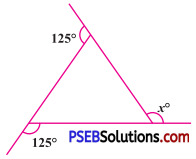
PSEB 8th Class Maths Solutions Chapter 3 Understanding Quadrilaterals Ex 3.2 1
Solution:
Sum of all the exterior angles of a polygon = 360°.
∴ x + 125° + 125° = 360°
∴ x + 250° = 360°
∴ x = 360° – 250° (Transposing 250° to RHS)
∴ x = 110°

(b)
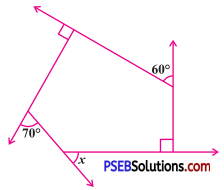
PSEB 8th Class Maths Solutions Chapter 3 Understanding Quadrilaterals Ex 3.2 2
Solution:
In this figure, two exterior angles are of 90° each. (one interior angle is 90°)
Sum of all exterior angles of a polygon = 360°.
∴ x + 90° + 60° + 90° + 70° = 360°
∴ x + 310° = 360°
∴ x = 360° – 310° (Transposing 310° to RHS)
∴ x = 50°

PSEB 8th Class Maths Solutions Chapter 3 Understanding Quadrilaterals Ex 3.2

Question 2.
Find the measure of each exterior angle of a regular polygon of (i) 9 sides (ii) 15 sides
Solution:
(i) Number of sides (n) = 9
∴ Number of exterior angles = 9
The sum of all exterior angles = 360°.
The given polygon is a regular polygon.
∴ All the exterior angles are equal.
∴ Measure of an exterior angle = \(\frac{360^{\circ}}{9}\).
= 40°

(ii) Number of sides of regular polygon = 15
∴ Number of exterior angles = 15
The sum of all the exterior angles = 360°
The given polygon is a regular polygon.
∴ All the exterior angles are equal.
∴ The measure of each exterior angle = \(\frac{360^{\circ}}{15}\) = 24°

Question 3.
How many sides does a regular polygon have if the measure of an exterior angle is 24° ?
Solution:
Regular polygon is equiangular.
Sum of all the exterior angles = 360°
Measure of an exterior angle = 24°
∴ Number of sides = \(\frac{360^{\circ}}{24^{\circ}}\)
The polygon has 15 sides.

PSEB 8th Class Maths Solutions Chapter 3 Understanding Quadrilaterals Ex 3.2

Question 4.
How many sides does a regular polygon have if each of its interior angles is 165° ?
Solution:
The given polygon is regular polygon.
Each interior angle = 165°
∴ Each exterior angle = 180° – 165° = 15°
∴ Number of sides = \(\frac{360^{\circ}}{15^{\circ}}\) = 24
The polygon has 24 sides.

Question 5.
(a) Is it possible to have a regular polygon with measure of each exterior angle as 22° ?
Solution:
Each exterior angle = 22°
∴ Number of sides = \(\frac{360^{\circ}}{22^{\circ}}=\frac{180^{\circ}}{11^{\circ}}\)
The number of sides of a regular polygon must be a whole number.
But, \(\frac {180}{11}\) is not a whole number.
∴ No, exterior angle of a regular polygon cannot be of measure 22°.

(b) Can it be an interior angle of a regular polygon ? Why ?
Solution:
If the measure of an interior angle of a polygon is 22°, then the measure of its exterior angle = 180° – 22° = 158°.
∴ Number of sides = \(\frac{360^{\circ}}{158^{\circ}}=\frac{180^{\circ}}{79^{\circ}}\)
\(\frac {180}{79}\)is not a whole number.
∴ No, 22° cannot be an interior angle of a regular polygon.

PSEB 8th Class Maths Solutions Chapter 3 Understanding Quadrilaterals Ex 3.2

Question 6.
(a) What is the minimum interior angle possible for a regular polygon? Why ?
Solution:
The minimum number of sides of a polygon = 3
The regular polygon of 3-sides is an equilateral triangle.
Each interior angle of an equilateral triangle = 60°.
Hence, the minimum possible interior angle of a polygon = 60°.

(b) What is the maximum exterior angle possible for a regular polygon ?
Solution:
The sum of an exterior angle and its corresponding interior angle is 180°. (Linear pair)
And minimum interior angle of a regular polygon = 60°.
∴ The maximum exterior angle of a regular polygon = 180° – 60° = 120°.

PSEB 8th Class Maths Solutions Chapter 16 Playing with Numbers Ex 16.1

Punjab State Board PSEB 8th Class Maths Book Solutions Chapter 16 Playing with Numbers Ex 16.1 Textbook Exercise Questions and Answers.

PSEB Solutions for Class 8 Maths Chapter 16 Playing with Numbers Ex 16.1

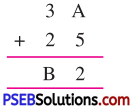
Find the values of the letters in each of the following and give reasons for the steps involved:

Question 1.
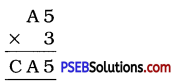
PSEB 8th Class Maths Solutions Chapter 16 Playing with Numbers Ex 16.1 1
Solution:
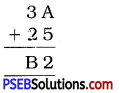
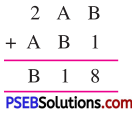
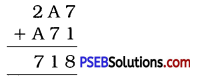
Here, we have two letters A and B, whose values are to be found.
PSEB 8th Class Maths Solutions Chapter 16 Playing with Numbers Ex 16.1 2
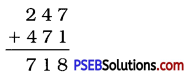
By observing the ones column, we have A + 5 and we get 2 from this.
1. e., a number whose ones digit is 2, for this A has to be 7.
∴ A + 5 = 7 + 5 = 12

Now, for the sum in tens column, we have 1 + 3 + 2 = B
∴ B = 6
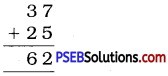
Thus,
PSEB 8th Class Maths Solutions Chapter 16 Playing with Numbers Ex 16.1 3
Thus, A = 7 and B = 6

PSEB 8th Class Maths Solutions Chapter 16 Playing with Numbers Ex 16.1

Question 2.
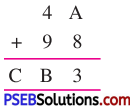
PSEB 8th Class Maths Solutions Chapter 16 Playing with Numbers Ex 16.1 4
Solution:
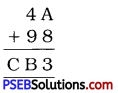
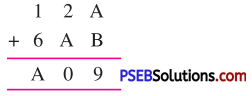
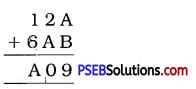
Here, we have three letters A, B and C, whose values are to be found.
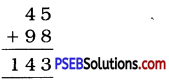
PSEB 8th Class Maths Solutions Chapter 16 Playing with Numbers Ex 16.1 5
By observing the ones column, we have A + 8 and we get 3 from this.
i. e., a number whose ones digit is 3, for this A has to be 5.
∴ A + 8 = 5 + 8 = 13
Now, for the sum in tens column, we have 1 + 4 + 9 = CB
∴ CB = 14
Here, B = 4 and C = 1
PSEB 8th Class Maths Solutions Chapter 16 Playing with Numbers Ex 16.1 6
Thus, A = 5, B = 4 and C = 1

Question 3.
PSEB 8th Class Maths Solutions Chapter 16 Playing with Numbers Ex 16.1 7
Solution:
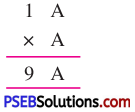
Here, we have A, whose value is to be found.
PSEB 8th Class Maths Solutions Chapter 16 Playing with Numbers Ex 16.1 8
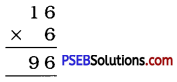
Since, product of ones digit
A × A = A, so it must be 1, 5 or 6.
When A = 1, then 1 1 But, the product is 9 A, so A = 1 is not possible.
PSEB 8th Class Maths Solutions Chapter 16 Playing with Numbers Ex 16.1 9
When A = 5, then
But, the product is 9 A, so A = 5 is not possible.
PSEB 8th Class Maths Solutions Chapter 16 Playing with Numbers Ex 16.1 10
When A = 6, then
PSEB 8th Class Maths Solutions Chapter 16 Playing with Numbers Ex 16.1 11
Thus, A = 6

PSEB 8th Class Maths Solutions Chapter 16 Playing with Numbers Ex 16.1

Question 4.
PSEB 8th Class Maths Solutions Chapter 16 Playing with Numbers Ex 16.1 12
Solution:
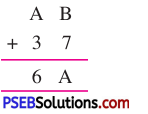
Here, we have two letters A and B, whose values are to be found.
PSEB 8th Class Maths Solutions Chapter 16 Playing with Numbers Ex 16.1 13
By observing the ones column, we have B + 7 and we get A from this, i. e., a number whose ones digit is A.
Now, for the sum in tens column, we have A + 3 and we get 6 from this. Therefore, the value of A must be 2. (Keeping in mind that carry over 1 is to be considered.)
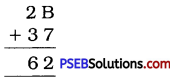
If A = 2, then
PSEB 8th Class Maths Solutions Chapter 16 Playing with Numbers Ex 16.1 14
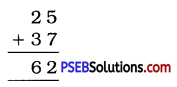
Then B + 7 gives 2, so B + 37 must be 5 and sum in tens 6 2 column is 1 + 2 + 3 = 6, so it is correct.
PSEB 8th Class Maths Solutions Chapter 16 Playing with Numbers Ex 16.1 15

Question 5.
PSEB 8th Class Maths Solutions Chapter 16 Playing with Numbers Ex 16.1 16
Solution:
Here, we have three letters A, B and C, whose values are to be found.
PSEB 8th Class Maths Solutions Chapter 16 Playing with Numbers Ex 16.1 17
Units digit of 3 × B is B, so B must be either 0 or 5.

When B = 0, then
PSEB 8th Class Maths Solutions Chapter 16 Playing with Numbers Ex 16.1 18

When B = 5, then
PSEB 8th Class Maths Solutions Chapter 16 Playing with Numbers Ex 16.1 19

Now, units digit of 3 × A is A. So A must be either 0 or 5, but A cannot be 0, because if A = 0, then AB becomes one-digit number. So A must be 5 and multiplication is either 55 × 3 or 50 × 3.
55 × 3 = 165, here A = 6, so this is not possible.
∴ 50 × 3 = 150
PSEB 8th Class Maths Solutions Chapter 16 Playing with Numbers Ex 16.1 20
Thus, A = 5, B = 0 and C = 6

PSEB 8th Class Maths Solutions Chapter 16 Playing with Numbers Ex 16.1

Question 6.
PSEB 8th Class Maths Solutions Chapter 16 Playing with Numbers Ex 16.1 21
Solution:
Here, we have three letters A, B and C, whose values are to be found.
PSEB 8th Class Maths Solutions Chapter 16 Playing with Numbers Ex 16.1 22
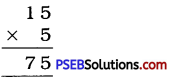
Units digit B × 5 = B, so B must be either 0 or 5.
When B = 0, then
PSEB 8th Class Maths Solutions Chapter 16 Playing with Numbers Ex 16.1 23

When B = 5, then
PSEB 8th Class Maths Solutions Chapter 16 Playing with Numbers Ex 16.1 24

Now, units digit of 5 × A = A, so A must be either 0 or 5.
There are three letters as a product. So A ≠ 0, but A = 5.
So multiplication is either 50 × 5 or 55 × 5.
50 × 5 = 250 and 55 × 5 = 275, so 55 × 5 is not correct.
So 50 × 5 = 250
PSEB 8th Class Maths Solutions Chapter 16 Playing with Numbers Ex 16.1 25
Thus, A = 5, B = 0 and C = 2.

PSEB 8th Class Maths Solutions Chapter 16 Playing with Numbers Ex 16.1

Question 7.
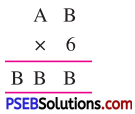
PSEB 8th Class Maths Solutions Chapter 16 Playing with Numbers Ex 16.1 26
Solution:
Here, we have two letters A and B, whose values are to be found.
PSEB 8th Class Maths Solutions Chapter 16 Playing with Numbers Ex 16.1 27
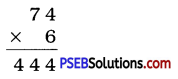
Units digit B × 6 = B, so B must be 2, 4, 6 or 8.
∴ Possible values of product BBB are 222, 444, 666 or 888.
If we divide these numbers by 6, then quotient should be A2, A4, A6 or A8.
Now, 222 ÷ 6 = 37, remainder = 0
But, the quotient is not as A2, so B = 2 is not possible.
PSEB 8th Class Maths Solutions Chapter 16 Playing with Numbers Ex 16.1 28
Thus, A = 7 and B = 4

Question 8.
PSEB 8th Class Maths Solutions Chapter 16 Playing with Numbers Ex 16.1 28
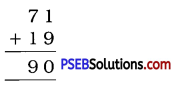
Solution:
Here, we have two letters A and B, whose values are to be found.
PSEB 8th Class Maths Solutions Chapter 16 Playing with Numbers Ex 16.1 30
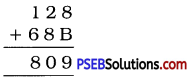
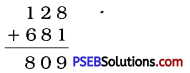
By observing the sum in unit column, we have 1 + B = 0. So here is a number whose unit digit is 0, so B must be 9.
Now, for sum in tens column, we have 1 + A + 1 = 9.
So A must be 7.
PSEB 8th Class Maths Solutions Chapter 16 Playing with Numbers Ex 16.1 31
Thus, A = 7 and B = 9

PSEB 8th Class Maths Solutions Chapter 16 Playing with Numbers Ex 16.1

Question 9.
PSEB 8th Class Maths Solutions Chapter 16 Playing with Numbers Ex 16.1 32
Solution:
Here, we have two letters A and B, whose values are to be found.
PSEB 8th Class Maths Solutions Chapter 16 Playing with Numbers Ex 16.1 33
By observing the sum in units column, we have B + 1 = 8.
∴ B must be 7.
Now,
PSEB 8th Class Maths Solutions Chapter 16 Playing with Numbers Ex 16.1 34
By observing the sum in tens digit column, we have A + 7 = 1, i.e., whose unit’s digit is 1, so A must be 4.
PSEB 8th Class Maths Solutions Chapter 16 Playing with Numbers Ex 16.1 35
Thus, A = 4 and B = 7

PSEB 8th Class Maths Solutions Chapter 16 Playing with Numbers Ex 16.1

Question 10.
PSEB 8th Class Maths Solutions Chapter 16 Playing with Numbers Ex 16.1 36
Solution:
Here, we have two letters A and B, whose values are to be found.
PSEB 8th Class Maths Solutions Chapter 16 Playing with Numbers Ex 16.1 37
By observing the sum in tens column, we have 2 + A = 0, so A must be 8.
Then,
PSEB 8th Class Maths Solutions Chapter 16 Playing with Numbers Ex 16.1 38
Now, by observing the sum in units column, we have 8 + B = 9, so B must be 1.
PSEB 8th Class Maths Solutions Chapter 16 Playing with Numbers Ex 16.1 39
Thus, A = 8 and B = 1.

PSEB 8th Class English Letter/Application Writing

Punjab State Board PSEB 8th Class English Book Solutions English Letter/Application Writing Exercise Questions and Answers, Notes.

PSEB 8th Class English Letter/Application Writing

पत्र लिखना एक कला है। एक अच्छा पत्र लिख कर आप शत्रु का दिल भी जीत सकते हैं। पत्र मुख्यतः तीन प्रकार के होते हैं-व्यक्तिगत, व्यावसायिक अथवा अधिकारियों को लिखे गए पत्र।

व्यक्तिगत पत्र (Personal Letters)-व्यक्तिगत पत्र वे पत्र होते हैं जो हम अपने मित्रों या सगे-सम्बन्धियों को लिखते हैं। ऐसे पत्र प्रायः समाचारों से भरे होते हैं। इन पत्रों में हम अपने घर, परिवार, स्कूल या किसी अनुभव का वर्णन करते हैं। ये पत्र एक विशेष विधि द्वारा लिखे जाते हैं। इन्हें ऐसे लिखा जाता है जैसे कि आप किसी व्यक्ति से बातचीत कर रहे हों। पते के अतिरिक्त इन पत्रों के छ: भाग होते हैं।

  1. लिखने वाले का पता (The address of the sender)
  2. तिथि (Date)
  3. सम्बोधन या अभिवादन (The salutation or greeting)
  4. विषय-वस्तु (The body of letter)
  5. विधिवत् अन्त (The subscription or complimentary close)
  6. हस्ताक्षर (Signature)

PSEB 8th Class English Letter/Application Writing

प्रत्येक भाग को लिखने की अपनी अलग विधि होती है। आओ हम एक-एक करके इनका अध्ययन करें-
1. The Address of the Sender. पहले पत्र भेजने वाले का पता पृष्ठ पर सबसे ऊपर दायें कोने में लिखा जाता था। प्रत्येक लाइन में अन्त में Comma और आखिरी लाइन के अन्त में Full Stop लगाया जाता था।

परन्तु अब पता लिखते समय विराम चिन्ह लगाने की विधि में अन्तर आ गया है। अब पंक्तियों के अन्त में Commas और Full Stop का प्रयोग नहीं होता। इसके अतिरिक्त अब Sender’s Address दाहिने कोने की बजाये बाएं कोने में लिखा जाता है।

15 Model Town
Rajpura
2. Date. तिथि लिखने वाले के पते के बिल्कुल नीचे लिखी जाती है। तिथि लिखने की कई विधियां हैं, जैसे-
15 Model Town
Rajpura
March 12, 20……
या
12th March 20…..
या
12 March 20……
3. The Salutation or Greeting. (i) मित्र को पत्र लिखते समय उसे उसके नाम से सम्बोधित कीजिए; जैसे-Dear Mohan, जहां तक हो सके मित्र को उसी नाम (संक्षिप्त) से संबोधित कीजिए जिस नाम से आप बातचीत करते समय उसे सम्बोधित करते हैं; जैसे,
Dear Monu
Dear Sonu

(ii) माता-पिता, भाइयों, बहनों अथवा घनिष्ठ सगे सम्बन्धियों को आप यूं सम्बोधित कर सकते हैं-
My dear Father or Daddy/Dad
My dear Mother or Mamma/Mom
My dear Brother My dear Gopal
My dear Kamla
नोट-यदि आप Address में विराम चिन्ह नहीं लगाते तो आप सम्बोधन में भी इनका प्रयोग न करें।

4. The Body of the Letter-यह पत्र का सबसे महत्त्वपूर्ण भाग है। एक अच्छा पत्र वह माना जाता है जो सरल हो और जिसमें पाठक की रुचि बनी रहे। पत्र की प्रत्येक पंक्ति अर्थपूर्ण एवं रोचक हो। पत्र ऐसे लिखना चाहिए मानो आपका सम्बन्धी आपके सामने बैठा हो और आप से बातें कर रहा हो। पत्र का यह भाग लिखते समय विराम चिन्हों और Grammar के अन्य सभी नियमों का पूरा पालन करें।

5. The Subscription or Complimentary Close-(i) मित्र को लिखे गए पत्र का अन्त इस प्रकार करें
Yours sincerely
या
Your sincere friend

(ii) सगे-सम्बन्धियों को लिखे गये पत्रों का अन्त इस प्रकार करें-
Yours affectionately

(iii) निम्नलिखित phrases के साथ भी व्यक्तिगत पत्रों का अन्त किया जा सकता है- . Ever sincerely yours
या
Your loving son/Love
या
Lovingly yours
नोट-यदि आपने सम्बोधन के समय comma नहीं लगाया तो आप पत्र का अन्त करने वाले phrase के साथ भी comma न लगायें।

6. Signature-व्यक्तिगत पत्र में आप को अपने पूरे हस्ताक्षर नहीं करने चाहिएं। आपको या तो नाम का पहला हिस्सा लिखना चाहिए या फिर वह नाम लिखें जिस नाम से आप अपने सगे-सम्बन्धियों या मित्रों द्वारा पुकारे जाते हैं। जैसे-
Sohan
या
Sonu आप Sohan Lal Gupta अर्थात् पूरा नाम न लिखें।

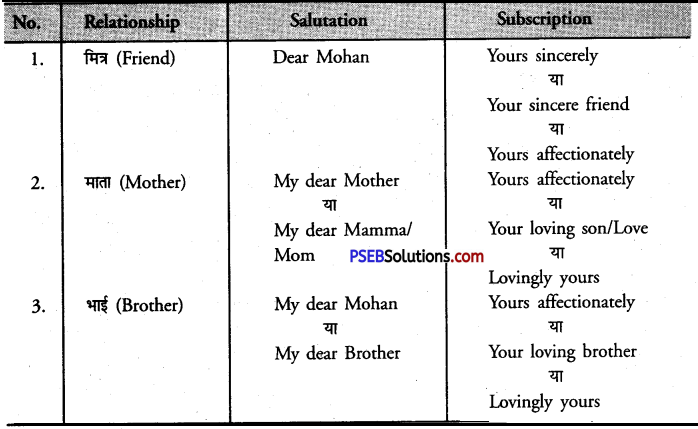
Salutation and Subscription at a Glance
PSEB 8th Class English Letter Application Writing 1
Official Letters या Business Letters.
(i) ऐसे पत्रों में कोई विशेष अन्तर तो नहीं होता। अन्तर केवल इतना है कि इन पत्रों के प्राय: छ: की बजाए सात भाग होते हैं।

(ii) ऐसे पत्रों में पत्र लिखने वाले का पता और तिथि व्यक्तिगत पत्रों की तरह ही लिखे जाते हैं।’

(iii) ऐसे पत्रों में उस फर्म (Firm) या व्यक्ति का पूरा पता भी पत्र में लिखा जाता है जिसे पत्र लिखा जा रहा हो, जैसे-
Messrs Malhotra Book Depot
(Producers of Quality Books)
Railway Road
Jalandhar City

(iv) ऐसे पत्रों में सम्बोधन की विधि इस प्रकार होती है
Dear Sir
या
Dear Sirs
या
Madam
या
Sir
नोट-यदि व्यक्ति आप से परिचित है तो आप उसे यूं भी सम्बोधित कर सकते हैं-
Dear Mr. Sharma

(v) ऐसे पत्रों की विषय-वस्तु संक्षिप्त, स्पष्ट और विनम्र-भाषी होनी चाहिए।

(vi) ऐसे पत्रों का अन्त यूं करना चाहिए
Yours truly
या
Yours faithfully

PSEB 8th Class English Letter/Application Writing

(vii) आप माननीय व्यक्तियों अथवा उच्च पद पर आसीन व्यक्तियों को पत्र लिखते हुए Yours respectfully या Yours obediently का प्रयोग भी कर सकते हैं। नाम से सम्बोधित पत्रों का अन्त Yours sincerely से ही करना चाहिए।

(viii) ऐसे पत्रों में हस्ताक्षर पूरे होने चाहिएं और हस्ताक्षर के पश्चात् लिखने वाले का नाम या पद लिखा जाना चाहिए, जैसे-
Yours faithfully
Mohan Lal Sharma
Manager

Important Applications and Letters

1. Application for Marriage Leave
Write an application to the Headmistress of your school for marriage leave.

The Headmistress
Khalsa Public School
Nawanshahr
Madam

I beg to say that the marriage of my elder brother/sister takes place next week. I am to help my parents in making marriage arrangements. So I cannot come to school. Kindly grant me leave for five days. I shall be very thankful to you for this.

Yours obediently
Jaspinder Kaur
Roll No. 25
23. VIII A
March 15, 20 ………….

Word-Meanings-Marriage = विवाह, Takes place = होगी, Arrangements = व्यवस्थाएं, Much = अधिक.

2. Leave for Urgent Work
Write an application to the Principal of your school for leave for a day.

The Principal
A.B. Sen. Sec. School
Patiala Sir

I beg to say that I have an urgent piece of work at home. So I cannot come to school. Kindly grant me leave for today. I shall be thankful to you for this.

Yours obediently
Raman
Roll No. 25
VIII C
February 5, 20 ……

Word-Meanings-Urgent piece of work = आवश्यक कार्य, Grant = प्रदान करो

3. Application for a Testimonial
Imagine you are Kavita, a student of Govt. Sen. Sec School, Ludhiana. Write an application to the Principal of your school requesting him to send a testimonial as you are applying for the post of a clerk.

11 Happy House
Model Town
Jalandhar
The Principal
Govt. Sen. Sec. School
Ludhiana
Sir

I beg to say that I am an old student of your school. I have to apply for the post of a clerk in a bank. I need a testimonial from you for that. I am writing down the following details for reference.

I passed my Sen. Sec. Examination in 2001 with 600 marks. I stood first in the district. I was a member of the school hockey team. I took part in the debates also and won many trophies and cups for the school. I was in the good books of my teachers.

Kindly send me the testimonial as soon as possible and oblige.

Yours obediently
Kavita
March 14, 20……

Word-Meanings-Testimonial = अचरण पत्र, In the good books of = नजरों में अच्छा, Oblige = कृतार्थ करें।

4. Application for Change of Section
Write an application to the Principal of your school requesting him to change your section.

The Principal
Govt. Sen. Sec. School
Sirhind
Sir

I am a student of VIII B of your school. I live in Main Bazaar. All my friends are in VIII A Section of the school. So I feel very lonely in VIII B.

Besides, I have to do my home task alone at home. Whenever I am unable to attend the school, I cannot do my homework. There is none to tell me about the homework given by the class teacher. The boys of my street can help me in other ways also. I hope you will appreciate my problem and change my section.
Thanking you

Yours obediently
Kirpal Singh
Roll No. 46
VIII B
March 15, 20……

Word-Meanings- Feel = अनुभव करना, Ways = ढंग, Lonely = अकेला, Appreciate = समझना।

5. For Admission to the Next Class
Write an application to the Headmaster of your school requesting him for admission to the next class.

The Headmaster
Govt. High School
Phagwara
Sir

I beg to say that I am a student of 7th class of your school. I fell ill in March. Still I appeared in the annual examination. I failed but my class-fellows went to the next class.

I am a good student. I got first division in the half-yearly examination. Kindly give me a test on any day and admit me to the 8th class. I assure you that I shall get first division in Middle Standard Examination.
Thanking you

Yours obediently
Mohan Lal
VIII C
March 5, 20…….

Word-Meanings- Annual = वार्षिक, Division = श्रेणी.

PSEB 8th Class English Letter/Application Writing

6. Application for Late Fee
Write an application to the Headmaster of your school requesting him to permit you to pay your fee for the month late by ten days.

The Headmaster
Govt. High School
Hoshiarpur
Sir

I beg to say that I am a student of VIII A of your school. Tomorrow is fee day and I am unable to pay it. My father has gone to Delhi. He will come back in ten days. Kindly allow me to pay my fee late by ten days.

Thanking you

Yours obediently
Sohan Lal
VIII A
March 9, 20……..

Word-Meanings- Unable = असमर्थ, Allow = अनुमति देना

7. Permission to take part in Games
Write an application to the Headmaster of your school requesting him to permit you to take part in the evening games.

The Headmaster
A.B.C. High School
Moga
Sir

I am a student of VIII D of your school. Our school is preparing for the Distt. Sports Meet. There are regular games in the school in the evening. I am also fond of games. I am a good player of football. Last year I was a member of the school football team. But this year my name is not in the players’ list because I could not perform well in the final trial. I request you to give me another chance and permit me to take part in the evening games. I assure you that I will try my best to improve my performance.
Thanking you

Yours obediently
Vijay Kumar
Roll No. 25
VIII D
Dated : March 9, 20…………

Word Meanings-Take part = भाग लेना, Permit = अनुमति देना, Assure = विश्वास दिलाना।
8. Permission to go on a Historical Tour
Write an application to your Principal requesting him/her to permit you to go on a historical tour.

The Principal
Govt. Sen. Sec. School
Ladowal
Madam

We, the students of class VIII, beg to seek your permission for a historical tour. The school will close for the summer vacation next week. We want to see the Taj Mahal. We also want to go to Fatehpur Sikri. On our way back, we want to visit Delhi. The trip will be very useful for us. It will give us first hand knowledge of History. The trip will cost two hundred rupees per head. Our teacher of History has agreed to take us to these places. We are 30 girls in all. I hope you will arrange this trip.
Thanking you

Yours obediently
Manjit Kaur
VIII A
April 30, 20……

Word-Meanings- Summer = गर्मी, Trip = भ्रमण, Useful = उपयोगी, Knowledge = ज्ञान

11. On Recovery From Illness
Write a letter to your friend congratulating him on his recovery from long illness.

135 New Road
Nawanshahr
March 18, 20…..
Dear Mohan

I am glad to know that you have recovered from long illness. I congratulate you on your recovery. You worked very hard. So you fell ill. Now please take care of your health.

Take long walks in the morning. Drink milk and eat fruit. All this will make you healthy soon.
With best wishes.

Yours sincerely
Hardeep

Word-Meanings-Glad = प्रसन्न, Recovered = ठीक हो गये हो, Take care of = ध्यान रखो, Congratulate = बधाई देना

12. Invitation on Brother’s Marriage
Write a letter to your friend inviting him to your brother’s marriage.

Govt. High School
Amritsar
March 4, 20………
My dear Kamlesh

You will be glad to know that the marriage of my elder brother comes off on March 9, 20……. The marriage party will leave Amritsar for Delhi the same day. We invite you to join us in our joys.

You know that Delhi is a historical city. There are many buildings worth-seeing. You will see the Red Fort, the Qutab Minar and Jantar Mantar. Rina and Tina have also been invited. They will reach here on Sunday. We will have good time together.
I hope you will reach in time.

Yours sincerely
Mitlesh
Address:
Kumari Kamlesh
45 Mall Road
Shimla

Word-Meanings-Comes off = पड़ती है, Marriage party = बारात, Worth-seeing = दर्शनीय

13. Inviting a Friend to the Birthday Party
Suppose you are Harish. You live at 38 Manavta Park, Hoshiarpur. Invite your friend to come to your birthday party.

38 Manavta Park
Hoshiarpur
February 22, 20……
My dear Surinder

You will be glad to know that my birthday falls on next Monday. There will be a tea party in the evening. I have invited all my friends to the party. I cannot forget you on this day. Please reach here on Sunday evening. We will have a good time together.
Thanking you

Yours sincerely
Harish

Word-Meanings-Falls on = पड़ता है, Invited = आमन्त्रित किया है, Forget = भूलना।
14. To Uncle for a Birthday Gift
Suppose you are Poonam. You live at 232, Phase IX, Mohali. Your uncle has sent you a wrist-watch on your birthday. Write a letter of thanks to your uncle.

232 Phase
IX Mohali
March 8, 20……
My dear Uncle

It is very kind of you to remember me on my birthday. You have sent me a beautiful wrist-watch as a gift. It shows your love for me. I received many gifts that day but I liked your gift the most. Everybody praised it.

The watch will help me a lot. It will make my life regular. I shall never be late for school now. I thank you for this lovely gift. I assure you thar I shall keep this watch with great care.

With regards
Yours lovingly
Poonam
Address :
Shri Manohar Singh
Joginder Nagar
Rohtak

Word-Meanings-Gift = उपहार, The most = सबसे बढ़कर, Praised = प्रशंसा की, A lot = बहुत ज्यादा, Regular = नियमित, Care = ध्यान.

PSEB 8th Class English Letter/Application Writing

15. To Younger Brother to Take Interest in Studies
Write a letter to your younger brother/sister scolding him/her for neglecting studies.

18 Mohan Nagar
Batala
February 18, 20…….
My dear Suman

I received your progress report yesterday. You have failed in all the subjects. You are not working hard. You are neglecting your studies. It is very bad. Final examinations are drawing near. Be careful. Do not waste your time. Work hard. Finish your syllabus in time.
I hope you will act upon my advice.

Yours affectionately
Mohan

Word-Meanings Subjects = विषय, Neglecting = उपेक्षा कार रहे, Waste = नष्ट करना, Avoid = दूर रहना, Act upon = अमल करना।
16. Invitation for Summer Vacation
Write a letter to your friend asking him to spend a part of his summer vacation with you.

1407 Green Avenue
Amritsar
February 18, 20 ……
My dear Gopal

Your school has closed for the summer vacation. You are free now. I invite you to come to Amritsar. Amritsar is a holy city. Here are many places worth-seeing. You will see Sri Harmandar Sahib, the Durgayana Mandir, the Jallianwala Bagh and other important places.

We shall also study together. I hope you will reach here soon.

Yours sincerely
Ramesh

Word-Meanings-Invite = बुलाना, Holy = पठित्र, Worth-seeing = देखने योग्य।
17. To a Friend on his Failure
Write a letter to your friend who has failed in the examination, asking him not to lose heart but try again.

15 New Colony
Kotkapura
March 18, 20 ……
Dear Raman

Your result is out today. It is very sad that you have failed. It is your own fault. You never worked hard. You moved in a bad company. The result is before you.

Please act upon my advice. Don’t lose heart. Give up bad company and work hard. You will pass next time.

Yours sincerely
Kamal
Address:
Mr. Raman
370 Nai Basti
Ambala

Word-Meaning-Moved = घूमते रहे, Act upon = अमल करना, Lose heart = धैर्य छोड़ना।

18. Condolence Letter.
Suppose you are Satish. You live at 6 Soni Street, Khanna. Your friend has lost his mother. Write a letter of condolence to him.

6 Soni Street
Khanna
Feb. 20, 20 ……
My dear X

I got your letter yesterday. I was shocked to read it. The sudden death of your mother is. a great loss. I share your sorrow.

I met your mother last month. She looked healthy. Her death is untimely. It is the will of God. We must bow before His will. Please have courage.

Yours sincerely
Satish
Address:
Mr. X
15-New Chowk
ABC

Word Meanings-Shocked = आघात पहुंचा, Sudden = आकस्मिक, Great loss = बहुत बड़ी क्षति, Share = बांटना, Sorrow – दुःख, Untimely death = अकाल मृत्यु, Will = इच्छा।

19. To Avoid Bad Company
Write a letter to your younger brother, advising him to avoid bad company. Examination Hall

………City
March 15, 20…….
My dear Mukesh

I received a letter from your headmaster. I gather that you move in a bad company. Ramesh and Dinesh are your friends these days. Both of them smoke. They go to pictures everyday. You, too, have started smoking in their company. You have become a film-fan. Your headmaster is worried about you.

Dear brother, we have high hopes on you. You are the light of our home. The examinations are drawing near. Please give up your bad company.
I hope you will act upon my advice.

With love
Yours affectionately
Kamleshwar
Address:
Mr. Mukesh Verma
Boys’ Hostel
A.B.C. Sen. Sec. School
…….. City

Word-Meaning-Film-fan = फिल्म देखने के शौकीन, Draw near = निकट आना, Act upon = अमल करना।

20. To Father about Your Success in the Examination
You have passed the Middle Standard Examination. Write a letter to your father telling him about your good result.

36 Raj Nagar
Khanna
July 3, 20 ……
My dear Father

Our result was out yesterday. You will be glad to know that I have stood second in the state. I have secured 85% marks. My teacher and headmaster came to our house in the morning. They blessed and patted me. They congratulated the mother. All missed you badly on the occasion. When are you coming home?

Your loving son
Amit

Word-Meanings-Secure = प्राप्त करना, Missed = याद आई, Occasion = अवसर।

21. Letter about Hostel Life
You are Anil, a student of class VIII. You are residing in hostel. Write a letter to your mother about your hostel life.

Boys’ Hostel
A.B.C. Sen. Sec. School
Chandigarh
My dear Mother

Our new session has started. I have got a good room in the school hostel. My hostel life is well disciplined. There are fixed hours for study, meals and games. We get up in time and go to bed in time. Our hostel warden is kind as well as strict to us. He does not allow us to go out of the hostel after the main gate is closed.
Dear Mother, I miss you very badly. I wish I got wings to fly home.

With regards
Yours lovingly
Anil

Word-Meanings- Session = सत्र, Disciplined = अनुशासित, Fixed = निरिचत, Strict = सख्त

PSEB 8th Class English Letter/Application Writing

22. To Father About Your Papers
You are appearing in the Middle Standard Examination. Write a letter to your father telling him about your progress in the examination.

8 The Mall
Jalandhar Cantt
March 18, 20…….
My dear Father

I am taking my Middle Standard Examination these days. The English paper was very easy. I hope to get 80 marks in it. The paper in Mathematics was a little tough. But I did all the sums.

Punjabi and Social Studies are easy subjects. I hope to do well in them. I am sure that I shall get good marks. I may win a scholarship.
With regards to dear mother

Your loving son
Arun Kumar

Word-Meanings- Taking = दे रहा हृं, Over = समाप्त, Tough = कठिन, Do well = अच्छ करना

23. To Father for Change of School
Write a letter to your father asking him to allow you to change school.

512 Naya Nagar
…….. City
March 10, 20……..
My dear Father

I feel sad to tell you about my school. Once it was a great school. It was considered one of the best schools in the town. Now it is not. We have no Principal these days. We have no English teacher even. So I do not feel good at studies. I want to change my school. Jain High School is a good school. Kindly allow me to join it.

Your loving son
Raj Kumar
Address:
Mr. Mohan Lal Sharma
1 New Road
Patiala

Word Meanings-Considered = समझा जाता था, Feel good = मन लगना, Allow = अनुमति देना।

PSEB 8th Class English Grammar Sentence and its Types

Punjab State Board PSEB 8th Class English Book Solutions English Grammar Sentence and its Types Exercise Questions and Answers, Notes.

PSEB 8th Class English Grammar Sentence and its Types

A sentence is a well arranged group of words which makes complete sense.
शब्दों का वह सुव्यवस्थित समूह जिससे पूरा अर्थ निकले कहलाता है, जैसे-

  1. Lakhi Mal was very rich.
  2. Where does the koel sit ?
  3. Please bring him milk and fruit now.
  4. Hurrah ! We have won the match.

PSEB 8th Class English Grammar Sentence and its Types

Kinds of Sentence

वाक्य पांच प्रकार के होते हैं-

  1. Assertive Sentences (साधारण वाक्य)
  2. Interrogative Şentences (प्रश्नवाचक वाक्य)
  3. Imperative Sentences (आजसयक वाक्य )
  4. Exclamatory Sentences (विस्मया दिसूचक वाक्य)
  5. Optative Sentences (इच्छासूचक वाक्य)

Parts of a Sentence

वाक्य के दो भाग होते है-

  1. Subject (उद्देश्थ)
  2. Predicate (विधेय)

1. वाक्य में जिस व्यक्ति पशु स्थान अथवा वस्तु के बारे में कुछ कहा जाता है उसे Subject कहते हैं।
2. Predicate. Subject के बारे में जो कुछ कहा जाता है उसे Predicate कहते हैं।

Sentence Subject Predicate
1. Amar lives in Allahabad. Amar lives in Allahabad.
2. How does a fish swim ? a fish How does swim.
3. May you live long ! you May live long.
4. Mr. Verma is my teacher. Mr. Verma is my teacher.

विशेष- Imperative Sentences का Subject प्राय लुप्त रहता है जैसे-

  1. Thank you. (I thank you.)
  2. Come in. (You come in.)

Simple and Complex Sentences

What is a Simple Sentence?
(साधारण वाक्य की परिभाषा)

जिस वाक्य में केवल एक Finite Verb हो, वह Simple Sentence कहलाता है। साधारण वाक्य में एक Subject (उद्देश्य) और एक Predicate (विधेय). होता है; जैसे,-

  1. Mohan loves his country.
  2. Ram plays hockey.
  3. Dogs bark.

Note. 1. जिस क्रिया का अपना subject (उद्देश्य) हो, वह Finite Verb (परिमित क्रिया) कहलाती है।
2. ऊपर के प्रत्येक वाक्य में एक-एक Finite Verb (loves, plays, bark) है।
3. प्रत्येक का अपना Subject (Mohan, Ram, Dogs) है और अपना Predicate (loves his country, plays hockey, bark) है।

What is a Complex Sentence?
(मिश्रित वाक्य की परिभाषा)

Complex Sentencé को जानने से पहले Clauses (उप-वाक्य) को समझ लेना आवश्यक है, क्योंकि Clauses के मेल से ही Complex Sentence बनता है।

Clause. शब्दों के ऐसे समूह को Clause (उप-वाक्य) कहते हैं जिसका अपना Subject तथा अपना Predicate हो और साथ में किसी अन्य वाक्य का उप-भाग भी हो।

Kinds of Clauses. Clauses के प्रकार को समझने के लिए हमें नीचे लिखे वाक्य को ध्यान से पढ़ना चाहिए-
I like him because he is brave.
नोट-1. इस वाक्य के दो भाग हैं।
2. प्रत्येक भाग में Subject और Predicate दोनों हैं। इसलिए दोनों ही clause हैं।

पहली Clause (I like him). पहली clause का पूरा अर्थ निकलता है। इसका अर्थ समझने के लिए दूसरी clause की आवश्यकता नहीं है। ऐसी clause को Principal Clause या Main Clause (प्रधान उप-वाक्य) कहते हैं।

दूसरी Clause (because he is brave). दूसरी clause का पूरा अर्थ नहीं निकलता। पूरा अर्थ देने के लिए यह Principal Clause पर depend (आश्रित) है। इसलिए इसे Dependent या Subordinate Clause (आश्रित उप-वाक्य) कहते हैं।

Complex Sentence की परिभाषा-जिस वाक्य में एक Principal Clause (प्रधान उप-वाक्य) तथा एक या एक से अधिक Subordinate Clauses (आश्रित उप-वाक्य) हों, उसे Complex Sentence कहते हैं।

Exercise (With Hints)

Pick out the complex sentences:
1. Rani is a nice girl.
2. I know that Mohan is a good boy.
3. He is the boy whom I saw in the market.
4. The man (who was) on the platform was my brother.
5. I met the girl with blue eyes.
6. I met the old man who had grey hair.
7. I went wherever he went.
8. I want to know where you found my watch.
9. He is the teacher of my choice.
10. Those whom the gods love, die young.
Hints:
2. I know that Mohan is a good boy.
3. He is the boy whom I saw in the market.
4. The man (who was) on the platform was my brother.
6. I met the old man who had grey hair.
7. I went wherever he went.
8. I want to know where you found my watch.
10. Those whom the gods love, die young.

PSEB 8th Class English Grammar Sentence and its Types

Change of Sentences

A–Affirmative to Negative
नियम- (1) साधारणतया निर्षधात्मक (Negative) वाक्य बनाते समय not का प्रयोग होता है: जैसे-

Affirmative Negative
1. I am a girl. 1. I am not a girl.
2. We are farmers. 2. We are not farmers.
3. You are a student. 3. You are not a student.
4. He was tall. 4. He was not tall.
5. They were proud. 5. They were not proud.
6. Radha was a fat girl. 6. Radha was not a fat girl.
7. I shall write a letter. 7. I shall not write a letter.
8. You will help me. 8. You will not help me.
9. I am reading a book. 9. I am not reading a book.
10. You are weeping. 10. You are not weeping.
11. I was buying a pen. 11. I was not buying a pen.
12. We were playing cards. 12. We were not playing cards.
13. He was swimming. 13. He was not swimming.
14. She had gone there before. 14. She hadn’t gone there before.
Or
She had not gone there before.
15. We should finish this job. 15. We should not finish this job.

(ii) Present Indefinite (पहली फार्म) में do not/does not + पहली फार्म तथा Past Indefinite (दूसरी फार्म) में did not + पहली फार्म का प्रयोग होता है: जैसे-

Affirmative Negative
1. I like mangoes 1. I do not like mangoes.
2. We play hockey. 2. We do not play hockey.
3. You take exercise. 3. You do not take exercise.
4. She speaks the truth. 4. She does not speak the truth.
5. I do it. 5. I do not do it.
6. I took tea. 6. I did not take tea.
7. He read the book. 7. He did not read the book.
8. He sold milk. 8. He did not sell milk.
9. She lived in Delhi. 9. She did not live in Delhi.

(iii) Has, have, had यदि अधिकार (possession) अर्थात् किसी चीज़ का होना व्यक्त करते हों तो प्रायः negative sentences में ‘no’ का प्रयोग होता हैै परन्तु यदि संख्या दी हो तो not का प्रयोग होता है।

1. He has a coat.
He has no coat.

2. He had a book
He had no book.

3. Ram has three books.
Ram has not three books.

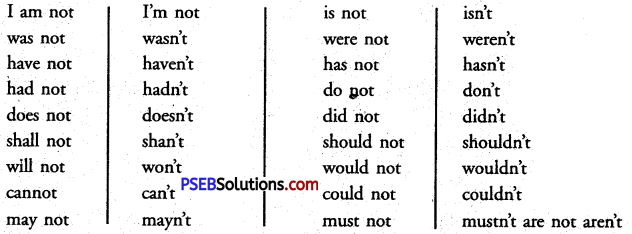
विशेष नोट-1. Negative बनाने के लिए isnt, wasn’t, haven’t, shan’t आदि का भी प्रयोग किया जा सकता है। इन छोटे रूपों का अध्ययन इस प्रकार करें
PSEB 8th Class English Grammar Sentence and its Types 1

2. Can का Negative cannot में किया जाता है। cannot एक शब्द के रूप में लिखा जाता है।

3. Not का प्रयोग पहले शब्द के तुरन्त बाद करना चाहिए, जैसे, shall have been = shall not have been तथा shall be = shall not be.

4. Everybody का Negative nobody तथा either का neither होता है। जैसे,
Affirmative. Everybody is coming.
Negative. Nobody is coming.
Affirmative. Either he or his friend is coming.
Negative. Neither he nor his friend is coming.

PSEB 8th Class English Grammar Sentence and its Types

मिश्चित वाक्य (Mixed Sentences)

Affirmative Negative
1. He is a player. He is not a player.
2. They were happy. They were not happy.
3. He has many books. He does not have many books.
4. We have four toys. We do not have four toys.
5. The boys had a garland. The boys had no garland.
6. I read a book. I do not read a book.
7. He writes a letter. He does not write a letter.
8. He does his work. He does not do his work.
9. He went there. He did not go there.
10. Mohan will tell a lie. Mohan will not tell a lie.

B-Assertive to Interrogative

Assertive Interrogative
1. I do my duty. Do I do my duty ?
2. He can help you. Can he help you?
3. They laughed at us. Did they laugh at us ?
4. She is a girl. Is she a girl ?
5. You are late. Are you late ?
6. He was happy. Was he happy?
7. We shall come soon. Shall we come soon?
8. We built a house there. Did we build a house there?
9. It may rain today. May it rain today?
10. We must go there Must we go there?
11. She does her work. Does she do her work?

Exercise for Practice

Change the following sentences into Interrogative:
1. They can swim.
2. She has a gold ring.
3. These birds are pretty.
4. We have seen the Taj.
5. She helped me in my work.
6. The carpenter makes furniture.
7. This pen costs ten rupees.
8. The child fell from a tree.
9. He was brushing his teeth.
10. Our soldiers fought bravely.

C-Exclamatory to Assertive

Exclamatory Assertive
1. What a lovely flower! It is a very lovely flower.
2. Long live our king! We wish that our king may live long.
3. Alas ! I shall never be able to meet her again. It is very sad that I shall never be able to meet her again.
4. Hurrah ! I have won a scholarship. I am very happy that I have won a scholarship.
5. What a pity you have lost everything! It is very sad that you have lost everything.
6. Fie ! A soldier and afraid of death! It is shameful for a soldier to be afraid of death.
7. How cold it is today! It is very cold today. I am very glad to see you.
8. How glad I am to see you! It is a very shameful act on your part.
9. What a shameful act on your part ! The traitors must be punished with death.
10. Death to the traitors! Assertive

Exercise for Practice

I. Change the following Exclamatory sentences into Assertive sentences:
1. Bravo ! You have killed the enemy.
2. Alas ! I am undone.
3. How sweet the child is!
4. Alas ! How stupid I had been !
5. What a terrible noise !
6. How difficult the paper is !
7. May God bless you with a son!
8. What a beautiful wrist-watch!
9. Splendid ! You have won the day!
10. Alas! You have failed.

II. Change the following Affirmative (Declarative) sentences into Interrogative sentences (Questions):

1. He is clever.
2. He was simple.
3. Ram was feeling tired.
4. Sita was angry.
5. They were good friends.
6. I have two books.
7. She has three pencils.
8. We had a good time there.
9. I have to do it.
10. Sohan had finished his work.
11. I shall go there tomorrow.
12. He will play a match.
13. I can do it.
14. He may help you.
15. You could write.
16. The sun does not shine at night.
17. He beats his donkey with a stick.
18. He sees another dog.
19. The horse runs very fast.
20. They play a match.
21. He waited here for an hour.
22. The train started at ten.
23. He never lost heart.
24. I did not find him there.
25. The rose smelt sweet.
Answer:
1. Is he clever ?
2. Was he simple ?
3. Was Ram feeling tired ?
4. Was Sita angry?
5. Were they good friends ?
6. Have I two books ?
7. Has she three pencils ?
8. Had we a good time there ?
9. Have I to do it?
10. Had Sohan finished his work ?
11. Shall I go there tomorrow?
12. Will he play a match ?
13. Can I do it?
14. May he help you ?
15. Could you write ?
16. Does the sun not shine at night ?
17. Does he beat his donkey with a stick ?
18. Does he see another dog?
19. Does the horse run very fast ?
20. Do they play a match ?
21. Did he wait here for an hour ?
22. Did the train start at ten ?
23. Did he ever lose heart?
24. Did I not find him there ?
25. Did the rose smell sweet?

PSEB 8th Class English Grammar Sentence and its Types

III. Convert the following Interrogative sentences into Assertive (Declarative) sentences:

1. Are you on leave today?
2. Was the train late ?
3. Were the boys not lazy ?
4. Am I strong?
5. Is your sister ill?
6. Has it been raining since morning ?
7. Have you fulfilled your promise ?
8. Had he a pen?
9. Have you a horse ?
10. Has she a lovely voice ?
11. Should I stick to my promise ?
12. Does your father like you?
13. Did she not sing a sweet song?
14. Did he paint the door blue?
15. Can you help me ?
16. Does she sing well ?
17. Do we love our country?
18. Did you have a nice holiday ?
19. Do birds build nests ?
Answer:
1. You are on leave today.
2. The train was late.
3. The boys were not lazy.
4. I am.. strong.
5. Your sister is ill.
6. It has been raining since morning.
7. You have fulfilled your promise.
8. He had a pen.
9. You have a horse.
10. She has a lovely voice.
11. I should stick to my promise.
12. Your father likes you.
13. She did not sing a sweet song.
14. He painted the door blue.
15. You can help me.
16. She sings well.
17. We love our country.
18. You had a nice holiday.
19. Birds build nests.

IV (a) Change the following Positive sentences into their Negative form:

1. Lotus is a very lovely flower.
2. His neighbour was quite well yesterday.
3. Sham has a garland of flowers in his hand.
4. I have a horse.
5. You had corrected me.
6. The cattle graze in the pasture.
7. I get up early in the morning.
8. We saw a snake in the grass.
9. Sit down.
10. Let him die.
Answer:
1. Lotus is not a very lovely flower.
2. His neighbour was not quite well yesterday.
3. Sham has not a garland of flowers in his hand.
4. I do not have a horse.
5. You had not corrected me.
6. The cattle do not graze in the pasture.
7. I do not get up early in the morning.
8. We did not see a snake in the grass.
9. Do not sit down.
10. Let him not die. (Or) Do not let him die.

(b) Change the following Negative sentences into their Positive form:

1. Sohan is not an idle boy.
2. We had not a book.
3. I do not have an umbrella with me.
4. He may not play well today.
5. She cannot tell a lie.
6. Do not bring me a second book of Hindi.
7. Do not let him go there.
8. Do not touch my chair.
9. I did not take the test.
10. You did not attend the class.
Answer:
1. Sohan is an idle boy.
2. We had a book.
3. I have an umbrella with me.
4. He may play well today.
5. She can tell a lie.
6. Bring me a second book of Hindi.
7. Let him go there.
8. Touch my chair.
9. I took the test.
10. You attended the class.

PSEB 8th Class English Grammar Sentence and its Types

V. Change the following Exclamatory sentences into Assertive sentences:

1. Bravo! You have done well.
2. Alas! I have failed.
3. How beautiful the scenery is!
4. Alas! How foolish I had been!
5. What a disaster the earthquake is!
6. How stiff the paper is!
7. May God reward this act of yours!
8. What a terrible storm it is!
9. Wonderful! I have never seen the like of it earlier.
10. May God pardon this sinner!
Answer:
1. You have done very well.
2. It is very sad that I have failed
3. The scenery is very beautiful.
4. It is very sad that I had been very foolish.
5. The earthquake is a terrible disaster.
6. The paper is very stiff.
7. It is prayed that God may reward this act of yours.
8. It is a very terrible storm.
9. It is surprising that I have never seen the like of it earlier. (or) I wonder if I have ever seen the like of it.
10. It is prayed that God may pardon this sinner.

VI. Pick out the Subject and the Predicate in the following sentences:

1. The sun shines brightly.
2. You speak very hastily.
3. He plays cricket.
4. The rose smells sweet.
5. Children take after their parents.
6. Send it at once.
7. Tell me a story.
8. The old man was listening to the wireless.
9. Slow and steady wins the race:
10. Time and tide wait for nobody.
11. He did his work efficiently.
12. Barking dogs seldom bite.
Answer:

Subject Predicate
1. The sun shines brightly.
2. You speak very hastily.
3. He plays cricket.
4. The rose smells sweet.
5. Children take after their parents.
6. You send it at once.
7. You tell me a story.
8. The old man was listening to the wireless.
9. Slow and steady wins the race.
10. Time and tide wait for nobody.
11. He did his work efficiently.
12. Barking dogs seldom bite.

PSEB 6th Class Maths MCQ Chapter 14 Data Handling

Punjab State Board PSEB 6th Class Maths Book Solutions Chapter 14 Data Handling MCQ Questions with Answers.

PSEB 6th Class Maths Chapter 14 Data Handling MCQ Questions

Multiple Choice Questions.

Question 1.
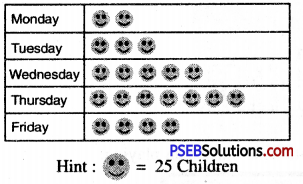
PSEB 6th Class Maths MCQ Chapter 14 Data Handling 1
(a) 30
(b) 40
(c) 50
(d) 5.
Answer:
(c) 50

PSEB 6th Class Maths MCQ Chapter 14 Data Handling

Question 2.
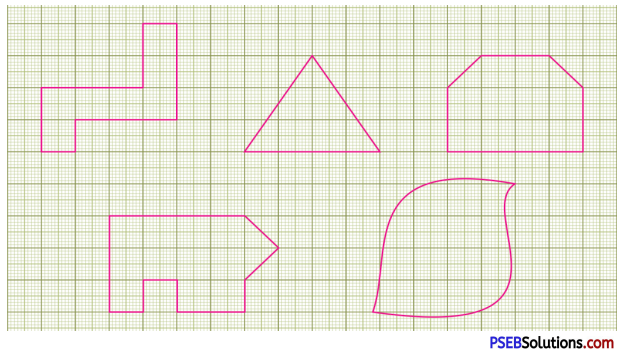
PSEB 6th Class Maths MCQ Chapter 14 Data Handling 2
(a) 1
(b) 14
(c) 21
(d) 28.
Answer:
(c) 21

Question 3.
PSEB 6th Class Maths MCQ Chapter 14 Data Handling 3
(a) 6
(b) 1
(c) 5
(d) 8.
Answer:
(b) 1

Question 4.
PSEB 6th Class Maths MCQ Chapter 14 Data Handling 4
(a) 200
(b) 2000
(c) 20
(d) 2.
Answer:
(a) 200

PSEB 6th Class Maths MCQ Chapter 14 Data Handling

Question 5.
……….. represents data through picture of objects.
(a) Bar Graph
(b) Histogram
(c) Pictograph
(d) None of these.
Answer:
(c) Pictograph

Question 6.
Which tally marks represents 14?
PSEB 6th Class Maths MCQ Chapter 14 Data Handling 5
Answer:
PSEB 6th Class Maths MCQ Chapter 14 Data Handling 6

Question 7.
PSEB 6th Class Maths MCQ Chapter 14 Data Handling 7
(a) 5
(b) 10
(c) 12
(d) 160.
Answer:
(b) 10

Question 8.
……………. is method of representing the data in uniform width size horizontal or vertical box with equal spacing.
(a) Histogram
(b) Bar Graph
(c) Pictograph
(d) Tally Marks.
Answer:
(b) Bar Graph

PSEB 6th Class Maths MCQ Chapter 14 Data Handling

Question 9.
A …………… is a collection of numbers gathered to give some information:
(a) Frequency
(b) Data
(c) Tally mark
(d) None of these.
Answer:
(b) Data

Question 10.
If on a scale 1 unit = 200 then how much quantity does 5 units will represent?
(a) 100
(b) 1000
(c) 300
(d) 600.
Answer:
(b) 1000

Question 11.
In the adjoining bar graph the growth of population of India from 1951 to 2001 is shown. Observe the graph and find in which two consecutive years the population growth is maximum?
PSEB 6th Class Maths MCQ Chapter 14 Data Handling 8
(a) Year 1951 to year 1961
(b) Year 1971 to year 1981.
(c) Year 1981 to year 1991
(d) Year 1991 to year 2001.
Answer:
(d) Year 1991 to year 2001.

PSEB 6th Class Maths MCQ Chapter 14 Data Handling

Question 12.
The bar graph given alongside shows the amount of wheat purchased by government during the year 1998-2002. Read the bar graph and find in which year was the wheat production maximum?
PSEB 6th Class Maths MCQ Chapter 14 Data Handling 9
(a) 1998
(b) 1999
(c) 2001
(d) 2002.
Answer:
(d) 2002

Question 13.
PSEB 6th Class Maths MCQ Chapter 14 Data Handling 10
(a) 5
(b) 6
(c) 7
(d) 8.
Answer:
(c) 7

Question 14.
PSEB 6th Class Maths MCQ Chapter 14 Data Handling 11
(a) 5
(b) 7
(c) 9
(d) 10.
Answer:
(d) 10

PSEB 6th Class Maths MCQ Chapter 14 Data Handling

Question 15.
There is a circus in a village. The number of children came to see circus from Monday to Friday are shown by a pictograph. Read the following pictograph carefully and answer the questions below:
PSEB 6th Class Maths MCQ Chapter 14 Data Handling 12
How many children came to see circus on Tuesday?
(a) 25
(b) 50
(c) 75
(d) 100.
Answer:
(c) 75

Fill in the blanks:

Question (i)
PSEB 6th Class Maths MCQ Chapter 14 Data Handling 13
Answer:
Seven

Question (ii)
A data is a collection of …………… gathered to give some information.
Answer:
Numbers

PSEB 6th Class Maths MCQ Chapter 14 Data Handling

Question (iii)
A diagram that represents stastieal data in the form of pictures is called …………….. .
Answer:
pictograph

Question (iv)
The initial step of any investigation is the ……………. of data.
Answer:
collection

Question (v)
The data can be arranged in a ……………. form using tally marks.
Answer:
tabular

PSEB 6th Class Maths MCQ Chapter 14 Data Handling

Write True/False:

Question (i)
Pictograph represents the data in form of pictures. (True/False)
Answer:
True

Question (ii)
There are three types of data. (True/False)
Answer:
False

Question (iii)
The primary data is collected directly from of source. (True/False)
Answer:
True

PSEB 6th Class Maths MCQ Chapter 14 Data Handling

Question (iv)
PSEB 6th Class Maths MCQ Chapter 14 Data Handling 14
Answer:
False

Question (v)
PSEB 6th Class Maths MCQ Chapter 14 Data Handling 15
Answer:
True

PSEB 6th Class Maths Solutions Chapter 12 Perimeter and Area Ex 12.2

Punjab State Board PSEB 6th Class Maths Book Solutions Chapter 12 Perimeter and Area Ex 12.2 Textbook Exercise Questions and Answers.

PSEB Solutions for Class 6 Maths Chapter 12 Perimeter and Area Ex 12.2

1. Find the approximate area of each of the following figures by countaing the number of squares – complete, more than half and exactly half.
PSEB 6th Class Maths Solutions Chapter 12 Perimeter and Area Ex 12.2 1

Solution:
(i) Number of complete squares m = 7
Here we do not have any half square or more than half.
∴ n = 0, p = 0
∴ Area of plane figure = m + n + \(\frac {1}{2}\)p
= 7 + 0 + 0
= 7 sq. units

(ii) Number of complete squares m = 2
Number of more than half squares n = 4
Number of half squares p = 0
∴ Area of plane figure = m + n + \(\frac {1}{2}\)p
= 4 + 2 + 0
= 6 sq. units.

(iii) Number of complete squares m = 10
Number of more than half squares n = 0
Number of exactly half squares p = 2
∴ Area of plane figure = m + n + \(\frac {1}{2}\)p
= (10 + 0 + \(\frac {1}{2}\) × 2) sq. units
= (10 + 1) sq. units
= 11 sq. units

(iv) Number of complete squares m = 11
Number of more than half squares n = 0
Number of exactly half squares p = 2
∴ Area of plane figure = m + n + \(\frac {1}{2}\)p
= 11 + 0 + \(\frac {1}{2}\) × 2
= 11 + 1 = 12 sq. units

(v) Number of complete squares m = 10
Number of more than half squares n = 3
Number of exactly half squares p = 0
∴ Area of plane figure = m + n + \(\frac {1}{2}\)p
= 10 + 3 + 0
= 13 sq. units

PSEB 6th Class Maths Solutions Chapter 12 Perimeter and Area Ex 12.2

2. Find the area of rectangle whose:

Question (i)
length = 12 cm, breadth = 16 cm
Solution:
Length of rectangle = 12 cm
and Breadth of rectangle = 16 cm.
∴ Area of rectangle = Length × Breadth
= 12 cm × 16 cm
= 192 sq. cm

Question (ii)
length = 25 m, breadth = 18 m
Solution:
Length of rectangle = 25 m
and Breadth of rectangle = 18 m
∴ Area of rectangle = Length × Breadth
= 25 m × 18 m
= 450 sq. m

Question (iii)
length = 2.7 m, breadth = 45 cm
Solution:
Length of rectangle = 2.7 m = 270 cm
and Breadth of rectangle = 45 cm
∴ Area of rectangle = Length × Breadth
= 270 cm × 45 cm
= 12150 sq. cm

Question (iv)
length 4.2 cm, breadth = 1.5 cm
Solution:
Length of rectangle = 4.2 cm
and Breadth of rectangle = 1.5 cm
∴ Area of rectangle = Length × Breadth
= 4.2 cm × 1.5 cm
= 6.3 sq. cm

Question (v)
length = 3.8 mm, breadth = 4 mm.
Solution:
Length of rectangle = 3.8 mm
and Breadth of rectangle = 4 mm
∴ Area of rectangle = Length × Breadth
= 3.8 mm × 4 mm
= 15.2 sq. mm

PSEB 6th Class Maths Solutions Chapter 12 Perimeter and Area Ex 12.2

3. Find the area of the square with side:

Question (i)
19 cm
Solution:
Side of the square = 19 cm
∴ Area of the square = side × side
= 19 cm × 19 cm = 361 sq. cm.

Question (ii)
24 mm
Solution:
Side of square = 24 mm
∴ Area of square = side × side
= 24 mm × 24 mm
= 576 sq. mm

Question (iii)
3.5 cm
Solution:
Side of the square = 3.5 cm
Area of square = side × side
= 3.5 cm × 3.5 cm
= 12.25 sq. cm

Question (iv)
2.6 cm
Solution:
Side of the square = 2.6 cm
Area of square = side × side
= 2.6 cm × 2.6 cm
= 6.76 sq. cm

PSEB 6th Class Maths Solutions Chapter 12 Perimeter and Area Ex 12.2

Question (v)
8.2 cm.
Solution:
Side of the square = 8.2 cm
Area of the square = side × side
= 8.2 cm × 8.2 cm
= 67.24 sq. cm.

4. The area of a rectangle is 216 sq. cm and its length is 12 cm. Find its breadth.
Solution:
The area of the rectangle = 216 sq. cm.
Length of the rectangle = 12 cm
Breadth of the rectangle = \(\frac{\text { Area }}{\text { Length }}\)
= \(\frac {216}{12}\) cm
= 18 cm.

5. The area of a rectangle is 225 sq. m and its breadth is 9 in. Find its length.
Solution:
The area of the rectangle = 225 sq. m
and Breadth of the rectangle = 9 m
∴ Length of the rectangle = \(\frac{\text { Area }}{\text { Breadth }}\)
= \(\frac {225}{9}\) m
= 25 m

6. The length and breadth of a ground are 32 m and 24 m. Find the cost of levelling the ground at the rate of ₹ 3 per sq. m.
Solution:
Length of ground = 32 m
and Breadth of ground = 24 m
Area of the ground = Length × Breadth
= 32 m × 24 m
= 768 sq. m.
Levelling cost of 1 sq. m = ₹ 3
Levelling cost of 768 sq. m = ₹ 3 × 768
= ₹ 2304

PSEB 6th Class Maths Solutions Chapter 12 Perimeter and Area Ex 12.2

7. Find the perimeter of a rectangle whose area is 324 sq. cm and its one side is 36 cm.
Solution:
Area of rectangle = 324 sq. cm
One side of rectangle = 36 cm
∴ Other side of rectangle = \(\frac{\text { Area }}{\text { One side }}\)
= \(\frac {324}{36}\) = 9 cm
Perimeter of rectangle
= 2 × (1st side + 2nd side)
= 2 × (36 + 9) cm
= 2 × 45 cm
= 90 cm

8. The perimeter of a square field is 100 m. Find its area.
Solution:
The perimeter of square field = 100 m
∴ 4 × side of square = 100 m
∴ Side of a square = \(\frac {100}{4}\) = 25 m
Hence area of square field = side × side
= 25 m × 25 m
= 625 sq. m.

9. Area of a rectangle of length 20 cm is 340 sq. cm. Find its perimeter.
Solution:
Area of rectangle = 340 sq. cm
and Length of rectangle = 20 cm
Breadth of rectangle = \(\frac{\text { Area }}{\text { Length }}\)
= \(\frac {340}{20}\) cm = 17 cm
Perimeter of rectangle
= 2 × (Length + Breadth)
= 2 × (20 + 17) cm
= 2 × 37 cm
= 74 cm

PSEB 6th Class Maths Solutions Chapter 12 Perimeter and Area Ex 12.2

10. A marble tile measure 15 cm × 20 cm. How many tiles will be required to cover a wall of size 4 m × 6 m?
Solution:
Area of the wall = 4 m × 6 m
= 400 cm × 600 cm
= 240000 sq. cm
Area of a marble tile = 15 cm × 20 cm
= 300 sq. cm
Number of tiles required to cover wall
= \(\frac{\text { Area of wall }}{\text { Area of tile }}=\frac{240000}{300}\) = 800
Hence number of tiles required to cover wall = 800

11. Find the cost of levelling the square field of side 75 m at rate of ₹ 5 per square metre.
Solution:
Side of the square field = 75 m
Area of square field = side × side
= 75 m × 75 m
= 5625 sq. m
Cost of levelling 1 sq. m = ₹ 5
Cost of levelling 5625 sq. m = ₹ 5 × 5625
= ₹ 28125

12. How many stamps of size 2 cm × 1.5 cm can be pasted on a sheet of paper of size 6 cm × 12 cm?
Solution:
Area of the sheet of paper
= 6 cm × 12 cm = 72 sq. cm
Area of one stamp = 2 cm × 1.5 cm = 3 sq cm
Number of stamps pasted on sheet of paper
= \(=\frac{\text { Area of paper sheet }}{\text { Area of stamp }}=\frac{72}{3}\) = 24.

PSEB 6th Class Maths Solutions Chapter 12 Perimeter and Area Ex 12.2

13.

Question (i)
What will happen to the area of a square if its side is trebled (tripled)?
Solution:
Let side of the square = x cm
∴ Area of the square = (x × x) sq. m
Now, if the side is trebled, then side of new square = 3x cm
∴ Area of the new square
= [(3x) × (3x)] sq. m
= (3 × 3 × x × x) sq. m
= 9 (x × x) sq. cm
= 9 × (Area of original square)
∴ If side is trebled, then area becomes 9 times of original area.

Question (ii)
What will happen to the area of a rectangle if its length is halved and breadth is doubled?
Solution:
l cm and b cm be the length and breadth of the rectangle respectively.
∴ Area of rectangle = l × b
Now, If its length is halved and breadth is doubled.
∴ New length = \(\frac {1}{2}\) l
and new breadth = 2b
Thus area of new rectangle = length × breadth
= \(\frac {1}{2}\) × l × 2b
= \(\frac {1}{2}\) × 2 × (l × b)
= (l × b) = original area
Area will remain the same.

Question (iii)
What will happen to the area of a square if its side is halved?
Solution:
Let side of the square = x cm
∴ Area of the square = (x × x) sq. cm
Now, if side is halved, then
side of new square = \(\frac {1}{2}\)x cm
∴ Area of the new square sq.cm
PSEB 6th Class Maths Solutions Chapter 12 Perimeter and Area Ex 12.2 2
PSEB 6th Class Maths Solutions Chapter 12 Perimeter and Area Ex 12.2 3
Hence, if side is halved, then the area becomes one-fourth times original area.

PSEB 6th Class Maths Solutions Chapter 12 Perimeter and Area Ex 12.2

14. Find the area of the following figures by splitting it into rectangles and squares:

Question (i)
PSEB 6th Class Maths Solutions Chapter 12 Perimeter and Area Ex 12.2 4
Solution:
The given figure can be divided into 2 parts
PSEB 6th Class Maths Solutions Chapter 12 Perimeter and Area Ex 12.2 5
Rectangle A of size 8 cm × 3 cm
Rectangle B of size 4 cm × 2 cm
∴ Area of rectangle A
= 8 cm × 3 cm = 24 sq. cm
and Area of rectangle B
= 4 cm × 2 cm
= 8 sq. cm
⇒ Total area of the figure
= 24 sq. cm + 8 sq. cm
= 32 sq. cm

Question (ii)
PSEB 6th Class Maths Solutions Chapter 12 Perimeter and Area Ex 12.2 6
Solution:
The given figure can be divided into 2 parts
PSEB 6th Class Maths Solutions Chapter 12 Perimeter and Area Ex 12.2 7
Rectangle A of size 10 cm × 2 cm
Rectangle B of size 8 cm × 2 cm
∴ Area of rectangle A
= 10 cm × 2 cm = 20 sq. cm
and Area of rectangle B
= 8 cm × 2 cm = 16 sq. cm
Total Area of the figure
= (20 + 16) sq. cm = 36 sq. cm

PSEB 6th Class Maths Solutions Chapter 12 Perimeter and Area Ex 12.2

Question (iii)
PSEB 6th Class Maths Solutions Chapter 12 Perimeter and Area Ex 12.2 8
Solution:
The given figure can be divided into 3 parts
PSEB 6th Class Maths Solutions Chapter 12 Perimeter and Area Ex 12.2 9
Rectangle A of size 12 cm × 3 cm
Rectangle B of size 3 cm × 2 cm
Rectangle of size 12 cm × 3 cm
Area of rectangle A
= 12 cm × 3 cm = 36 sq. Cm
Area of rectangle B
= 3 cm × 2 cm = 6 sq. cm
Area of rectangle C
= 12 cm × 3 cm = 36 sq. cm
Total area of the figures
= (36 + 6 + 36) sq. cm
= 78 sq. cm

Question (iv)
PSEB 6th Class Maths Solutions Chapter 12 Perimeter and Area Ex 12.2 10
Solution:
The given figure can be divided into 3 parts
PSEB 6th Class Maths Solutions Chapter 12 Perimeter and Area Ex 12.2 11
Rectangle A of size 13 × 3 units
Rectangle B of size 5 × 3 units
Rectangle C of size 5 × 3
Area of rectangle A
= 13 × 3 = 39 sq. units
Area of rectangle B
= 5 × 3 = 15 sq. units
Area of rectangle C
= 5 × 3 = 15 sq. units
Hence total area of the figure
= (39 + 15 + 15) sq. units
= 69 sq. units Ans.

15. Fill in the blanks:

Question (i)
1 square metre = ……….. sq. cm.
Solution:
10000

Question (ii)
1 square cm = ………. sq. mm.
Solution:
100

PSEB 6th Class Maths Solutions Chapter 12 Perimeter and Area Ex 12.2

Question (iii)
Area of Rectangle = …………. × ……………
Solution:
length, breadth

Question (iv)
Length = ………….. ÷ breadth.
Solution:
Area

Question (v)
Area of square = …………. × ……………
Solution:
side × side.

PSEB 6th Class Maths Solutions Chapter 12 Perimeter and Area Ex 12.1

Punjab State Board PSEB 6th Class Maths Book Solutions Chapter 12 Perimeter and Area Ex 12.1 Textbook Exercise Questions and Answers.

PSEB Solutions for Class 6 Maths Chapter 12 Perimeter and Area Ex 12.1

1. Find the perimeter of the following shapes:

Question (i)
PSEB 6th Class Maths Solutions Chapter 12 Perimeter and Area Ex 12.1 1
Solution:
Perimeter = AB + BC + CD + DA
= 8 cm + 7 cm + 12 cm + 9 cm
= 36 cm

PSEB 6th Class Maths Solutions Chapter 12 Perimeter and Area Ex 12.1

Question (ii)
PSEB 6th Class Maths Solutions Chapter 12 Perimeter and Area Ex 12.1 2
Solution:
Perimeter = XY + YZ + ZX
= 10m + 10m + 8m
= 28m

Question (iii)
PSEB 6th Class Maths Solutions Chapter 12 Perimeter and Area Ex 12.1 3
Solution:
Perimeter = PQ + QR + RS + SP
= 15 cm + 12 cm + 15 cm + 12 cm
= 54 cm

Question (iv)
PSEB 6th Class Maths Solutions Chapter 12 Perimeter and Area Ex 12.1 4
Solution:
Perimeter = MN + NO + OP + PL + LM
= 8 cm + 7 cm + 5 cm + 6 cm + 7 cm
= 33 cm

PSEB 6th Class Maths Solutions Chapter 12 Perimeter and Area Ex 12.1

Question (v)
PSEB 6th Class Maths Solutions Chapter 12 Perimeter and Area Ex 12.1 5
Solution:
Perimeter = AB + BC + CD + DE + EF + FG + GM + MA
=8m + 2m + 6m + 4m + 6m + 2m + 8m + 8m
= 44 m

Question (vi)
PSEB 6th Class Maths Solutions Chapter 12 Perimeter and Area Ex 12.1 6
Solution:
Perimeter = LM + MN + NO + OP + PQ + QR + RS + SL
= 3 cm + 3 cm + 3 cm + 3 cm + 3 cm + 3 cm + 3 cm + 3 cm
= 24 cm

2. Find the perimeter of the triangle with sides:

Question (i)
5 cm, 6 cm and 7 cm
Solution:
Perimeter of a triangle
= Sum of lengths of its sides
= 5 cm + 6 cm + 7 cm = 18 cm

PSEB 6th Class Maths Solutions Chapter 12 Perimeter and Area Ex 12.1

Question (ii)
10 m, 12 m, 18 m
Solution:
Sides of triangle
= 10 m, 12 m, 18 m
∴ Perimeter of a triangle
= Sum of lengths of its sides
= 10 m + 12 m + 18 m = 40 m

Question (iii)
4.6 cm, 3.2 cm and 5.8 cm.
Solution:
Sides of triangle
= 4.6 cm, 3.2 cm and 5.8 cm
∴ Perimeter of triangle
= Sum of lengths of its sides
= 4.6 cm + 3.2 cm + 5.8 cm
= 13.6 cm

3. Find the perimeter of an isosceles triangle with 15 cm as length of equal side and 18 cm as base.
Solution:
Sides of isosceles triangle = 15 cm, 15 cm, 18 cm
Area of isosceles triangle = Sum of lengths of its sides
= (15 + 15 + 18) cm = 48 cm

PSEB 6th Class Maths Solutions Chapter 12 Perimeter and Area Ex 12.1

4. Find the perimeter of a square with side:

Question (i)
16 cm
Solution:
Side of square = 16 cm
∴ Perimeter of square = 4 × side
= 4 × 16 cm
= 64 cm

Question (ii)
4.8 mm
Solution:
Side of square = 4.8 mm
∴ Perimeter of square = 4 × side
= 4 × 4.8 mm
= 19.2 mm

Question (iii)
125 cm
Solution:
Side of square = 125 cm
∴ Perimeter of square = 4 × side
= 4 × 125 cm
= 500 cm

Question (iv)
45 m
Solution:
Side of square = 45 m
∴ Perimeter of square = 4 × side
= 4 × 45 m
= 180 m

PSEB 6th Class Maths Solutions Chapter 12 Perimeter and Area Ex 12.1

Question (v)
39 cm.
Solution:
Side of square = 39 cm
∴ Perimeter of square = 4 × side
= 4 × 39 cm
= 156 cm

5. Find the perimeter of a rectangle with:

Question (i)
Length 20 m and breadth 15 m
Solution:
Length of rectangle = 20 m
Breadth of rectangle = 15 m
∴ Perimeter of rectangle = 2 × (length + breadth)
= 2 × (20 + 15) m
= 2 × 35 m
= 70 m

Question (ii)
Length 25 m and breadth 35 m
Solution:
Length of rectangle = 25 m
Breadth of rectangle = 35 m
∴ Perimeter of rectangle = 2 × (length + breadth)
= 2 × (25 + 35) m
= 2 × 60 m
= 120 m

Question (iii)
Length 40 cm and breadth 28 cm
Solution:
Length of rectangle = 40 cm Breadth of rectangle = 28 cm
∴ Perimeter of rectangle = 2 × (length + breadth)
= 2 × (40 + 28) cm
= 2 × 68 cm
= 136 cm

PSEB 6th Class Maths Solutions Chapter 12 Perimeter and Area Ex 12.1

Question (iv)
Length 18.3 cm and breadth 6.8 cm
Solution:
Length of rectangle = 18.3 cm
Breadth of rectangle = 6.8 cm
∴ Perimeter of rectangle
= 2 × (length + breadth)
= 2 × (18.3 + 6.8) cm
= 2 × 25.1 cm = 50.2 cm

Question (v)
Length 0.125 m and breadth 15 cm.
Solution:
Length of rectangle
= 0.125 m = 12.5 cm
Breadth of rectangle = 15 cm
∴ Perimeter of rectangle = 2 × (length + breadth)
= 2 × (12.5 + 15) cm
= 2 × 27.5 cm
= 55 cm

6. Find the perimeter of a regular hexagon with side:

Question (i)
5 cm
Solution:
Side of a regular hexagon = 5 cm
Perimeter of a regular hexagon = 6 × side
= 6 × 5 cm
= 30 cm

PSEB 6th Class Maths Solutions Chapter 12 Perimeter and Area Ex 12.1

Question (ii)
12 cm
Solution:
Side of a regular hexagon = 12 cm
Perimeter of a regular hexagon = 6 × side
= 6 × 12 cm
= 72 cm

Question (iii)
7.2 cm.
Solution:
Side of a regular hexagon = 7.2 cm
Perimeter of a regular hexagon = 6 × side
= 6 × 7.2 cm
= 43.2 cm

7. Find the perimeter of an equilateral triangle with side:

Question (i)
10 cm
Solution:
Side of an equilateral triangle
= 10 cm
∴ Perimeter of an equilateral triangle = 3 × side
= 3 × 10 cm
= 30 cm

Question (ii)
8 m
Solution:
Side of an equilateral triangle = 8 m
∴ Perimeter of an equilateral triangle = 3 × side
= 3 × 8 m
= 24 m

PSEB 6th Class Maths Solutions Chapter 12 Perimeter and Area Ex 12.1

Question (iii)
24 m
Solution:
Side of an equilateral triangle = 24 m
∴ Perimeter of an equilateral triangle = 3 × side
= 3 × 24 m
= 72 m

Question (iv)
5.6 m
Solution:
Side of an equilateral triangle = 5.6 m
∴ Perimeter of an equilateral triangle = 3 × side
= 3 × 5.6 m
= 16.8 m

Question (v)
12.1 cm.
Solution:
Side of an equilateral triangle = 12.1 cm
∴ Perimeter of an equilateral triangle = 3 × side
= 3 × 12.1 cm
= 36.3 cm

PSEB 6th Class Maths Solutions Chapter 12 Perimeter and Area Ex 12.1

8. If the perimeter of a triangle is 48 cm and two sides are 12 cm and 17 cm. Find the third side.
Solution:
Perimeter of a triangle = 48 cm Sum of length of two sides = (12 + 17) cm = 29 cm
∴ Third side = 48 cm – 29 cm
= 19 cm

9. Find the side of an equilateral triangle, if the perimeter is:

Question (i)
45 cm
Solution:
Given perimeter of an equilateral triangle = 45 cm
Perimeter of an equilateral triangle = 3 × (side of the triangle)
⇒ 45 cm = 3 × side
⇒ Side of the triangle
= 15cm

Question (ii)
69 mm
Solution:
Given perimeter of an equilateral triangle = 69 mm
Perimeter of an equilateral triangle = 3 × (side of the triangle)
⇒ 69 = 3 × (side of the triangle)
⇒ Side of the triangle = \(\frac{69 \mathrm{~mm}}{3}\)
= 23 mm

PSEB 6th Class Maths Solutions Chapter 12 Perimeter and Area Ex 12.1

Question (iii)
117 cm.
Solution:
Given perimeter of an equilateral triangle = 117 cm
Perimeter of an equilateral triangle = 3 × (side of the triangle)
⇒ 117 = 3 × (side of the triangle)
⇒ Side of the triangle = \(\frac{117 \mathrm{~cm}}{3}\)
= 39 cm

10. Find the side of a square if the perimeter is:

Question (i)
52 cm
Solution:
Given Perimeter of a square = 52 cm
Perimeter of a square = 4 × (side of square)
⇒ Side of square
= \(\frac{\text { perimeter of a square }}{\text { 4 }}\)
= \(\frac{52 \mathrm{~cm}}{4}\)
= 13 cm

Question (ii)
60 cm
Solution:
Given perimeter of a square = 60 cm
Side of a square
= \(\frac{\text { perimeter of a square }}{\text { 4 }}\)
= \(\frac{60 \mathrm{~cm}}{4}\)
= 15 cm

Question (iii)
112 cm.
Solution:
Given perimeter of a square = 112 cm
Side of a square
= \(\frac{\text { perimeter of a square }}{\text { 4 }}\)
= \(\frac{112 \mathrm{~cm}}{4}\)
= 28 cm

PSEB 6th Class Maths Solutions Chapter 12 Perimeter and Area Ex 12.1

11.

Question (i)
The perimeter of rectangular field is 260 m. If its length is 80 m then find its breadth.
Solution:
Given perimeter of rectangular field = 260 m
and Length of the rectangular field = 80 m
∴ Perimeter of rectangular field = 2 × (length + breadth)
⇒ 260 = 2 × (80 + breadth)
⇒ \(\frac {260}{2}\) = 80 + breadth
⇒ 80 + breadth = 130
⇒ breadth = 130 – 80 = 50 m
Hence breadth of rectangular field = 50 m

Question (ii)
The perimeter of a rectangular garden is 140 m. If its breadth is 45 m then find its length.
Solution:
Given perimeter of rectangular garden = 140 m
and breadth of rectangular garden = 45 m
∴ Perimeter of rectangular garden = 2 × (length + breadth)
⇒ 140 = 2 × (length + 45)
⇒ \(\frac {260}{2}\) = length + 45
⇒ length = 70 – 45 = 25 m
Hence length of rectangular garden = 25 m

Question (iii)
The perimeter of a rectangle is 114 cm. If its length is 32 cm then find its breadth.
Solution:
Given perimeter of rectangle = 114 cm
and length of rectangle = 32 cm
∴ Perimeter of rectangle
= 2 × (length + breadth)
⇒ 114 = 2 × (32 + breadth)
⇒ \(\frac {114}{2}\) = 32 + breadth
⇒ breadth = 57 – 32 = 25 cm
Hence breadth of rectangle = 25 cm

PSEB 6th Class Maths Solutions Chapter 12 Perimeter and Area Ex 12.1

12. The side of a triangular field are 15 m, 20 m and 18 m. Find the total distance travelled by a boy in taking 2 complete rounds of this field.
Solution:
Sides of a triangular fields = 15 m, 20 m and 18 m
Distance covered in one round of a triangular field = Perimeter of rectangular field = Sum of the length of the sides of a rectangular field
= 15 m + 20 m + 18 m
= 53 m
∴ Distance covered in taking 2 complete rounds of this field
= 2 × 53 m
= 106 m

13. Find the cost of fencing a square field of side 26 m at the rate of ₹ 3 per metre.
Solution:
Given side of the square field = 26 m
∴ Perimeter of the square field = 4 × side
= 4 × 26 m = 104 m
Perimeter of fencing = 104 m
Cost of 1 m of fencing = ₹ 3
Cost of 104 m of fencing
= 104 × ₹ 3
= ₹ 312

PSEB 6th Class Maths Solutions Chapter 12 Perimeter and Area Ex 12.1

14. Mani runs around a square park of side 75 m. Kush runs around a rectangular park of length 60 m and breadth 45 m. Who covers less distance?
Solution:
Side of a square park = 75 m
Perimeter of square park = 4 × (side)
= 4 × (75 m) = 300 m
∴ Distance covered by Mani = 300 m
Length of rectangular park = 60 m
Breadth of rectangular park = 45 m
Perimeter of rectangular park = 2 (length + breadth)
= 2 × (60 + 45) m
= 2 × (105) m
= 210 m
∴ Distance covered by Kush = 210 m
Kush covers less distance.

15. Find the cost of framing a rectangular whiteboard with length 240 cm and breadth 150 cm at the rate of ₹ 6 per cm.
Solution:
Length of rectangular white board = 240 cm
Breadth of rectangular white board = 150 cm
Perimeter of rectangular white board = 2 × (length + breadth)
= 2 × (240 + 150) cm
= 2 × (390) cm
= 780 cm
Cost of fencing 1 cm = ₹ 6 × 780
= ₹ 4680

PSEB 6th Class Maths Solutions Chapter 12 Perimeter and Area Ex 12.1

16. If length of a rectangle is ‘a’ units and breadth is 5 units. Find the perimeter of the rectangle.
Solution:
Given length of rectangle = ‘a’ units,
and Breadth of rectangle = 5 units
Perimeter of rectangle = 2 × (length + breadth)
= 2 × (a + 5) units
= 2 (a + 5) units

17. Fill in the blanks:

Question (i)
The sum of lengths of all sides of a polygon is called ……………. .
Solution:
perimeter

Question (ii)
Perimeter of Square = ……………. × side.
Solution:
4

Question (iii)
Perimeter of Rectangle = 2 × (………. +………) .
Solution:
length, breadth

Question (iv)
Side of a square = (……………) ÷ 4.
Solution:
perimeter

PSEB 6th Class Maths Solutions Chapter 12 Perimeter and Area Ex 12.1

Question (v)
Perimeter of an equilateral triangle = …………….. × side.
Solution:
3.