PSEB 8th Class Maths Solutions Chapter 2 Linear Equations in One Variable Ex 2.6

Punjab State Board PSEB 8th Class Maths Book Solutions Chapter 2 Linear Equations in One Variable Ex 2.6 Textbook Exercise Questions and Answers.

PSEB Solutions for Class 8 Maths Chapter 2 Linear Equations in One Variable Ex 2.6

Solve the following equations.

Question 1.
\(\frac{8 x-3}{3 x}=2\)
Solution:
\(\frac{8 x-3}{3 x}=2\)
∴ 3x\(\left(\frac{8 x-3}{3 x}\right)\) = 3x (2) (Multiplying both the sides by 3x)
∴ 8x – 3 = 6x
∴ 8x – 6x = 3 [Transposing 6x to LHS and (-3) to RHS]
∴ 2x = 3
∴ \(\frac{2 x}{2}=\frac{3}{2}\) (Dividing both the sides by 2)
∴ x = \(\frac {3}{2}\)

Question 2.
\(\frac{9 x}{7-6 x}=15\)
Solution:
\(\frac{9 x}{7-6 x}=15\)
∴ 9x = 15 (7 – 6x) (Cross multiplication)
∴ 9x = 105 – 90x
∴ 9x + 90x = 105 [Transposing (- 90x) to LHS]
∴ 99x = 105
∴ \(\frac{99 x}{99}=\frac{105}{99}\)(Dividing both the sides by 99)
∴ x = \(\frac {35}{33}\)

PSEB 8th Class Maths Solutions Chapter 2 Linear Equations in One Variable Ex 2.6

Question 3.
\(\frac{z}{z+15}=\frac{4}{9}\)
Solution:
\(\frac{z}{z+15}=\frac{4}{9}\)
∴ z(9) = 4(z + 15) (Cross multiplication)
∴ 9z = 4z + 60
∴ 9z – 4z = 60 (Transposing 4z to LHS)
∴ 5z = 60
∴ \(\frac{5 z}{5}=\frac{60}{5}\) (Dividing both the sides by 5)
∴ z = 12

Question 4.
\(\frac{3 y+4}{2-6 y}=\frac{-2}{5}\)
Solution:
\(\frac{3 y+4}{2-6 y}=\frac{-2}{5}\)
∴ 5(3y + 4) = -2(2 – 6y) (Cross multiplication)
∴ 15y + 20 = -4 + 12y
∴ 15y – 12y = – 4 – 20 (Transposing 12y to LHS and 20 to RHS)
∴ 3y = -24
∴ \(\frac{3 y}{3}=\frac{-24}{3}\) (Dividing both the sides by 3)
∴ y = (-8)

Question 5.
\(\frac{7 y+4}{y+2}=\frac{-4}{3}\)
Solution:
\(\frac{7 y+4}{y+2}=\frac{-4}{3}\)
∴ 3(7y + 4) = -4(y + 2) (Cross multiplication)
∴ 21y + 12 = – 4y – 8
∴ 21y + 4y = – 8 – 12 (Transposing -4y to LHS and 12 to RHS)
∴ 25y = -20
∴ \(\frac{25 y}{25}=\frac{-20}{25}\) (Dividing both the sides by 25)
∴ y = \(\frac {-4}{5}\)

PSEB 8th Class Maths Solutions Chapter 2 Linear Equations in One Variable Ex 2.6

Question 6.
The ages of Hari and Harry are in the ratio 5:7. Four years from now the ratio of their ages will be 3:4. Find their present ages.
Solution:
Age of Hari : Age of Harry
= 5 : 7
Let the present age of Hari be 5x years.
Then, the present age of Harry = 7x years.
After 4 years their ages :
Hari = (5x + 4) years
Harry = (7x + 4) years
∴ (5x + 4) : (7x + 4) = 3 : 4
∴ \(\frac{5 x+4}{7 x+4}=\frac{3}{4}\)
∴ 4(5x + 4) = 3(7x + 4) (Cross multiplication)
∴ 20x + 16 = 21x + 12
∴ 20x – 21x = 12 – 16 (Transposing 21x to LHS and 16 to RHS)
∴ -x = – 4
∴ x = 4 [Multiplying both the sides by (- 1)]
∴ Hari’s present age = 5x = 5 × 4
= 20 years
∴ Harry’s present age = 7x = 7 × 4
= 28 years
Thus, Hari’s present age is 20 years and Harry’s present age is 28 years.

Question 7.
The denominator of a rational number is greater than its numerator by 8. If the numerator is increased by 17 and the denominator is decreased by 1, the number obtained is \(\frac {3}{2}\). Find the rational number.
Solution:
Let the numerator be x.
Denominator (8 more than numerator) = x + 8
New numerator = x + 17
(After adding 17)
New denominator = x + 8 – 1
= x + 7
(After decreasing 1)
But new number = \(\frac{x+17}{x+7}\)
But this rational number is \(\frac {3}{2}\)
\(\frac{x+17}{x+7}=\frac{3}{2}\)
∴ 2(x + 17) = 3(x + 7) (Cross multiplication)
∴ 2x + 34 = 3x + 21
∴ 2x – 3x = 21 – 34 (Transposing 3x to LHS and 34 to RHS)
∴ -x = – 13
∴ x = 13 [Multiplying both the sides by (-1)]
∴ Numerator = x = 13
Denominator = x + 8
= 13 + 8
= 21
The rational number = \(\frac {13}{21}\)
Thus, the rational number is \(\frac {13}{21}\).

PSEB 6th Class Maths Solutions Chapter 13 Symmetry Ex 13.2

Punjab State Board PSEB 6th Class Maths Book Solutions Chapter 13 Symmetry Ex 13.2 Textbook Exercise Questions and Answers.

PSEB Solutions for Class 6 Maths Chapter 13 Symmetry Ex 13.2

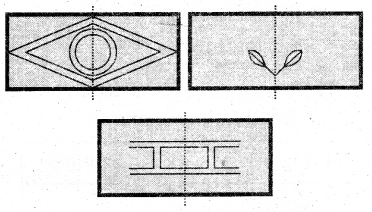
1. Draw the reflection of following figures along the dotted line :
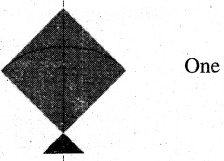
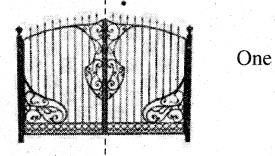
PSEB 6th Class Maths Solutions Chapter 13 Symmetry Ex 13.2 1
Solution:
PSEB 6th Class Maths Solutions Chapter 13 Symmetry Ex 13.2 2

PSEB 6th Class Maths Solutions Chapter 13 Symmetry Ex 13.2

2. Write ‘yes’ for right reflection and ‘no’ for wrong reflection:
PSEB 6th Class Maths Solutions Chapter 13 Symmetry Ex 13.2 3
Solution:
(a) Yes
(b) Yes
(c) Yes
(d) Yes.

PSEB 6th Class Maths Solutions Chapter 13 Symmetry Ex 13.2

3. Trace the figures on the graph paper and draw the reflections. The dotted line is the line of symmetry:
PSEB 6th Class Maths Solutions Chapter 13 Symmetry Ex 13.2 4.1
Solution:
PSEB 6th Class Maths Solutions Chapter 13 Symmetry Ex 13.2 5.1

PSEB 6th Class Maths Solutions Chapter 13 Symmetry Ex 13.1

Punjab State Board PSEB 6th Class Maths Book Solutions Chapter 13 Symmetry Ex 13.1 Textbook Exercise Questions and Answers.

PSEB Solutions for Class 6 Maths Chapter 13 Symmetry Ex 13.1

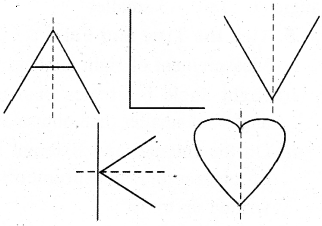
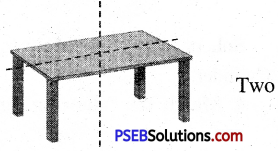
1. Classify the figure as symmetrical or non-symmetrical. Also draw the line/ lines of symmetry (if any).
PSEB 6th Class Maths Solutions Chapter 13 Symmetry Ex 13.1 1
Solution:
PSEB 6th Class Maths Solutions Chapter 13 Symmetry Ex 13.1 2

PSEB 6th Class Maths Solutions Chapter 13 Symmetry Ex 13.1

2. Which Capital letter of English alphabet have:

Question (i)
No line of symmetry.
Solution:
Capital letters of English alphabet having no line of symmetry.
F, G, J, L, N, P, Q, R, S, Z.

Question (ii)
1 line of symmetry.
Solution:
Capital letters of English alphabet having 1 line of symmetry.
A, B, C, D, E, K, M, T, U, V, W, Y.

Question (iii)
2 lines of symmetry.
Solution:
2 lines of symmetry.
O, X, H, I.

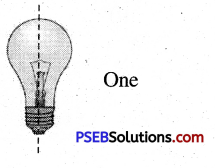
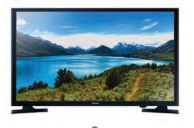
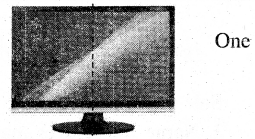
3. Find file numbers of line/lines of symmetry for the following:
PSEB 6th Class Maths Solutions Chapter 13 Symmetry Ex 13.1 3
Solution:
PSEB 6th Class Maths Solutions Chapter 13 Symmetry Ex 13.1 4

PSEB 6th Class Maths Solutions Chapter 13 Symmetry Ex 13.1

4. Draw the line (s) of symmetry the following figures:

Question (a)
Rhombus
Solution:
Rhombus: A rhombus has two lines of symmetry.
PSEB 6th Class Maths Solutions Chapter 13 Symmetry Ex 13.1 5

Question (b)
Scalene Triangle
Solution:
Scalene Triangle: A scalene triangle has no line of symmetry.
PSEB 6th Class Maths Solutions Chapter 13 Symmetry Ex 13.1 6

Question (c)
Parallelogram
Solution:
Parallelogram: A parallelogram has no line of symmetry.

PSEB 6th Class Maths Solutions Chapter 13 Symmetry Ex 13.1

Question (d)
Rectangle
Solution:
Rectangle: A rectangle has two lines of symmetry.
PSEB 6th Class Maths Solutions Chapter 13 Symmetry Ex 13.1 7

Question (e)
Square
Solution:
Square: A square has four lines of symmetry.
PSEB 6th Class Maths Solutions Chapter 13 Symmetry Ex 13.1 8

Question (f)
Regular Pentagon.
Solution:
Regular Pentagon. A regular pentagon has five lines of symmetry.
PSEB 6th Class Maths Solutions Chapter 13 Symmetry Ex 13.1 9

PSEB 6th Class Maths Solutions Chapter 13 Symmetry Ex 13.1

5. Complete each of the figure using both lines of symmetry:
PSEB 6th Class Maths Solutions Chapter 13 Symmetry Ex 13.1 10
Solution:
PSEB 6th Class Maths Solutions Chapter 13 Symmetry Ex 13.1 11

6. Draw a triangle which has:

Question (i)
No line of symmetry
Solution:
No line of symmetry: Scalene triangle has no line of symmetry.
PSEB 6th Class Maths Solutions Chapter 13 Symmetry Ex 13.1 12

PSEB 6th Class Maths Solutions Chapter 13 Symmetry Ex 13.1

Question (ii)
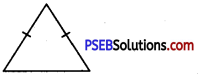
Exactly one line of symmetry
Solution:
Exactly one line of symmetry: Isosceles triangle has exactly one line of symmetry.
PSEB 6th Class Maths Solutions Chapter 13 Symmetry Ex 13.1 13

Question (iii)
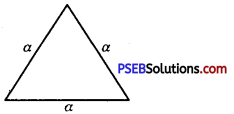
Exactly three lines of symmetry.
Solution:
Exactly three lines of symmetry. Equilateral triangle has exactly three lines of symmetry.
PSEB 6th Class Maths Solutions Chapter 13 Symmetry Ex 13.1 14

PSEB 6th Class Maths Solutions Chapter 13 Symmetry Ex 13.1

7. List any three symmetrical objects from your day-to-day life.
Solution:
Glass, Lock Pencil are three symmetrical objects.

PSEB 8th Class Maths Solutions Chapter 2 Linear Equations in One Variable Ex 2.5

Punjab State Board PSEB 8th Class Maths Book Solutions Chapter 2 Linear Equations in One Variable Ex 2.5 Textbook Exercise Questions and Answers.

PSEB Solutions for Class 8 Maths Chapter 2 Linear Equations in One Variable Ex 2.5

Solve the following linear equations.

Question 1.
\(\frac{x}{2}-\frac{1}{5}=\frac{x}{3}+\frac{1}{4}\)
Solution:
\(\frac{x}{2}-\frac{1}{5}=\frac{x}{3}+\frac{1}{4}\)
∴ \(\frac {1}{2}\) [Transposing \(\frac{x}{3}\) to LHS and \(\frac {-1}{2}\) to RHS]
∴ \(\frac{3 x-2 x}{6}=\frac{1 \times 5+1 \times 4}{20}\) [LCM = 6, LCM = 20]
∴ \(\frac{x}{6}=\frac{5+4}{20}\)
∴ \(\frac{x}{6}=\frac{9}{20}\)
∴ \(\frac{x}{6} \times 6=\frac{9}{20} \times 6\) (Multiplying both the sides by 6)
∴ \(\frac {27}{10}\)
∴ x = 2.7

Question 2.
\(\frac{n}{2}-\frac{3 n}{4}+\frac{5 n}{6}\) = 21
Solution:
\(\frac{n}{2}-\frac{3 n}{4}+\frac{5 n}{6}\) = 21
∴ \(\frac{n \times 6}{2 \times 6}-\frac{3 n \times 3}{4 \times 3}+\frac{5 n \times 2}{6 \times 2}\) = 21
∴ \(\frac{6 n-9 n+10 n}{12}\) = 21
∴ \(\frac {7 n}{12}\) = 21
∴ 7n = 21 × 12 (Multiplying both the sides by 12)
∴ n = \(\frac{21 \times 12}{7}\) (Dividing both the sides by 7)
∴ n = 36

PSEB 8th Class Maths Solutions Chapter 2 Linear Equations in One Variable Ex 2.5

Question 3.
\(x+7-\frac{8 x}{3}=\frac{17}{6}-\frac{5 x}{2}\)
Solution:
\(x+7-\frac{8 x}{3}=\frac{17}{6}-\frac{5 x}{2}\)
(Multipljdng both the sides by 6, the LCM of 3, 6 and 2.)
(6 × x) + (6 × 7) – \(\left(\frac{6 \times 8 x}{3}\right)\) = \(\left(6 \times \frac{17}{6}\right)-\left(\frac{6 \times 5 x}{2}\right)\)
∴ 6x + 42 – 16x = 17- 15x
∴ – 10x + 42 = 17 – 15x
∴ – 10x + 15x = 17 – 42 [Transposing (-15x) to LHS and 42 to RHS]
∴ 5x = – 25
∴ x = – 5 (Dividing both the sides by 5)

Question 4.
\(\frac{x-5}{3}=\frac{x-3}{5}\)
Solution:
\(\frac{x-5}{3}=\frac{x-3}{5}\)
∴ 5(x – 5) = 3 (x – 3) (Cross multiplication)
∴ 5x – 25 = 3x – 9
∴ 5x – 3x = 25 – 9 [Transposing 3x to LHS and (-25) to RHS]
∴ 2x = 16
∴ \(\frac{2 x}{2}=\frac{16}{2}\) (Dividing both the sides by 2)
∴ x = 8

Question 5.
\(\frac{3 t-2}{4}-\frac{2 t+3}{3}=\frac{2}{3}-t\)
Solution:
\(\frac{3 t-2}{4}-\frac{2 t+3}{3}=\frac{2}{3}-t\)
(Multiplying both the sides by 12, the LCM of 4 and 3)
12\(\left(\frac{3 t-2}{4}\right)\) – 12\(\left(\frac{2 t+3}{3}\right)\) = 12 × \(\frac {1}{2}\) – 12t
∴ 3(3t – 2) -4 (2t + 3) = 8 – 12t
∴ 9t – 6 – 8t – 12 = 8 – 12t
∴ t – 18 = 8 – 12t
∴ t + 12t = 8 + 18 [Transposing (-12t) to LHS and (-18) to RHS]
∴ 13t = 26
∴ \(\frac{13 t}{13}=\frac{26}{13}\) (Dividing both the sides by 13)
∴ t = 2

PSEB 8th Class Maths Solutions Chapter 2 Linear Equations in One Variable Ex 2.5

Question 6.
\(m-\frac{m-1}{2}=1-\frac{m-2}{3}\)
Solution:
\(m-\frac{m-1}{2}=1-\frac{m-2}{3}\)
(Multiplying both the sides by 6, the LCM of 2 and 3)
6m – 6 \(\left(\frac{m-1}{2}\right)\) = 1 × 6 – 6\(\left(\frac{m-2}{3}\right)\)
∴ 6m – 3(m- 1) = 6 – 2(m-2)
∴ 6m – 3m + 3 = 6 – 2m + 4
∴ 3m + 3 = 10 – 2m
∴ 3m + 2m = 10 – 3 [Transposing (-2 m) to LHS and 3 to RHS]
∴ 5m = 7
∴ \(\frac{5 m}{5}=\frac{7}{5}\) (Dividing both the sides by 5)
∴ m = \(\frac {7}{5}\)

Simplify and solve the following linear equations.

Question 7.
3(t – 3) = 5(2t + 1)
Solution:
3(t – 3) = 5(2t + 1)
∴ 3t – 9 = 10t + 5
∴ 3t – 10t = 5 + 9 [Transposing 10t to LHS and (-9) to RHS]
∴ – 7t = 14
∴ 7t = – 14 [Multiplying both the sides by (-1)]
∴ \(\frac{7 t}{7}=\frac{-14}{7}\) (Dividing both the sides by 7)
∴ t = -2

Question 8.
15 (y – 4) – 2 (y – 9) + 5 (y + 6) = 0
Solution:
15 (y – 4) – 2 (y – 9) + 5 (y + 6) = 0
∴ 15y – 60 – 2y + 18 + 5y + 30 = 0
∴ 15y – 2y + 5y – 60 + 18 + 30 = 0
∴ 15y + 5y – 2y + 18 + 30 – 60 = 0 (Arranging the terms)
∴ 18y – 12 = 0
∴ 18y = 12 [Transposing (- 12) to RHS]
∴ \(\frac{18 y}{18}=\frac{12}{18}\) (Dividing both the sides by 18)
∴ y = \(\frac {2}{3}\)

PSEB 8th Class Maths Solutions Chapter 2 Linear Equations in One Variable Ex 2.5

Question 9.
3(5z – 7) -2 (9z – 11) = 4(8z – 13) – 17
Solution:
3(5z – 7) -2 (9z – 11) = 4(8z – 13) – 17
∴ 15z – 21 – 18z + 22 = 32z – 52 – 17
∴ 15z – 18z – 21 + 22 = 32z + (-52 – 17)
∴ – 3z + 1 = 32z – 69
∴ – 3z – 32z = – 69 – 1 (Transposing 1 to RHS and 32z to LHS)
∴ – 35z = – 70
∴ 35z = 70[Multiplying both the sides by (-1)]
∴ \(\frac{35 z}{35}=\frac{70}{35}\) (Dividing both the sides by 35)
∴ z = 2.

Question 10.
0.25 (4f – 3) = 0.05(10f – 9)
Solution:
0.25 (4f – 3) = 0.05(10f – 9)
0.25 × 4f – 0.25 × 3
= 0.05 × 10f – 0.05 × 9
PSEB 8th Class Maths Solutions Chapter 2 Linear Equations in One Variable Ex 2.5 1

PSEB 6th Class Maths MCQ Chapter 12 Perimeter and Area

Punjab State Board PSEB 6th Class Maths Book Solutions Chapter 12 Perimeter and Area MCQ Questions with Answers.

PSEB 6th Class Maths Chapter 12 Perimeter and Area MCQ Questions

Multiple Choice Questions

Question 1.
The outer boundary of a closed figure is called ………….. .
(a) Perimeter
(b) Region
(c) Area
(d) Curve.
Answer:
(a) Perimeter

PSEB 6th Class Maths MCQ Chapter 12 Perimeter and Area

Question 2.
Find the perimeter of the given figures:
PSEB 6th Class Maths MCQ Chapter 12 Perimeter and Area 1PSEB 6th Class Maths MCQ Chapter 12 Perimeter and Area 1
(a) 30 cm
(b) 31 cm
(c) 32 cm
(d) 33 cm.
Answer:
(b) 31 cm

Question 3.
Perimeter of an equilateral triangle = ………………… .
(a) 3 + Side
(b) Side × Side
(c) Side + Side
(d) 3 × Side.
Answer:
(d) 3 × Side.

Question 4.
Perimeter of Rectangle = …………………… .
(a) 2l + b
(b) 2 (l + b)
(c) l + 2b
(d) l × b.
Answer:
(b) 2 (l + b)

Question 5.
If side of an equilateral triangle is 4 cm then perimeter = ……………….. .
(a) 8 cm
(b) 7 cm
(c) 12 cm
(d) 16 cm.
Answer:
(c) 12 cm

PSEB 6th Class Maths MCQ Chapter 12 Perimeter and Area

Question 6.
If length and breath of a rectangle are 2.4 cm and 1.9 cm then its perimeter is ………………. .
(a) 4.3 cm
(b) 8.2 cm
(c) 4.2 cm
(d) 8.6 cm.
Answer:
(d) 8.6 cm.

Question 7.
The perimeter of square is 16 cm then its side is ……………………… .
(a) 4 cm
(b) 64 cm
(c) 24 cm
(d) 32 cm.
Answer:
(a) 4 cm

Question 8.
The perimeter of a rectangle is 50 cm and its length is 12 cm then breadth is ……………………….. .
(a) 38 cm
(b) 13 cm
(c) 62cm
(d) 18cm.
Answer:
(b) 13 cm

Question 9.
Two sides of a triangle are 4.8 cm and 3.9 cm. The perimeter of the triangle is 12 cm. Find the third side.
(a) 3.3 cm
(b) 4.3 cm
(c) 20.7 cm
(d) 3.7 cm.
Answer:
(b) 4.3 cm

Question 10.
Samandeep takes 3 rounds of square park side 125 m. Find the distance covered by her.
(a) 1.5 km
(b) 1500 km
(c) 500 m
(d) 375 m.
Answer:
(a) 1.5 km

PSEB 6th Class Maths MCQ Chapter 12 Perimeter and Area

Question 11.
The measurement of the region enclosed by a closed plane figure is called its ………….. .
(a) Circumference
(b) Curve
(c) Perimeter
(d) Area.
Answer:
(d) Area

Question 12.
If the length of a rectangle is x units and breadth is 5 units then its perimeter is ………….. .
(a) 5x
(b) 2 (x + 5)
(c) 10x
(d) 10 + x
Answer:
(b) 2 (x + 5)

Question 13.
Find the area of the given rectangle whose length is 16 m and breadth is 8 m.
(a) 42 sq.m
(b) 128 sq. m
(c) 72 sq. m
(d) 21 sq. m.
Answer:
(b) 128 sq. m

Question 14.
The area of a rectangle is 144 m . If its breadth is 9 m then find its length.
(a) 16 sq. m

(b) 12 m
(c) 16 m
(d) 18 m.
Answer:
(c) 16 m

PSEB 6th Class Maths MCQ Chapter 12 Perimeter and Area

Question 15.
1 sq. m = ……………. sq. cm.
(a) 100
(b) 10000
(c) 1000
(d) 1.
Answer:
(b) 10000

Question 16.
Find the area of a square having side 3.6 cm.
(a) 14.4 cm
(b) 12.96 cm
(c) 1.29 sq. cm
(d) 12.96 sq. cm.
Answer:
(d) 12.96 sq. cm.

Question 17.
The perimeter of a square is 68 m. Find its area.
(a) 289 sq.m
(b) 329 sq. m
(c) 279 sq. m
(d) 249 sq.m.
Answer:
(a) 289 sq.m

Question 18.
A marble tile is of side 25 cm by 25 cm. How many tiles will be required to cover a floor of 4 m by 3 m?
(a) 216
(b) 192
(c) 188
(d) 196.
Answer:
(b) 192

PSEB 6th Class Maths MCQ Chapter 12 Perimeter and Area

Question 19.
What will happen to the area of a square, if side is doubled?
(a) Double
(b) Half
(c) Four times
(d) Nochange.
Answer:
(c) Four times

Question 20.
Find the perimeter of a rectangle whose area is 234 sq. cm and its one side is 13 cm.
(a) 31 cm
(b) 62 cm
(c) 18 cm
(d) 24 cm.
Answer:
(b) 62 cm

Question 21.
How many cm2 are in 1 m2?
(a) 1000
(b) 100
(c) 10000
(d) 10.
Answer:
(c) 10000

Question 22.
The distance covered along the boundary forming a closed figure when you go round the figure once is called its:
(a) Length
(b) Perimeter
(c) Breadth
(d) Area.
Answer:
(b) Perimeter

Question 23.
The amount of surface enclosed by a closed figure is called its:
(a) Perimeter
(b) Volume
(c) Area
(d) None of these.
Answer:
(c) Area

PSEB 6th Class Maths MCQ Chapter 12 Perimeter and Area

Question 24.
The formula to find perimeter of a rectangle is:
(a) Length + Breadth
(b) 2 (Length + Breadth)
(c) Length – Breadth
(d) Length × Breadth.
Answer:
(b) 2 (Length + Breadth)

Question 25.
The formula to find perimeter of a square is :
(a) 4 × side
(b) 3 × side
(c) 2 × side
(d) 5 × side.
Answer:
(a) 4 × side

Fill in the blanks:

Question (i)
The formula to find area of equilateral triangle is …………….. .
Answer:
3 × side

Question (ii)
The formula to find area of a rectangle is ……………… .
Answer:
Length × Breadth

PSEB 6th Class Maths MCQ Chapter 12 Perimeter and Area

Question (iii)
The formula to find area of a square is ………………. .
Answer:
Perimeter

Question (iv)
The sum of lengths of all sides of a polygon is called ………………… .
Answer:
Area

Write True/False:

Question (i)
Perimeter of square = 4 × side. (True/False)
Answer:
True

Question (ii)
1 sq. m = 1000 sq. cm. (True/False)
Answer:
False

Question (iii)
The outer boundary of a closed figure is called area. (True/False)
Answer:
False

PSEB 6th Class Maths MCQ Chapter 12 Perimeter and Area

Question (iv)
Perimeter of a triangle = 3 × side. (True/False)
Answer:
True

Question (v)
Area of rectangle = Length × Breadth. (True/False)
Answer:
True

PSEB 8th Class Maths Solutions Chapter 2 Linear Equations in One Variable Ex 2.4

Punjab State Board PSEB 8th Class Maths Book Solutions Chapter 2 Linear Equations in One Variable Ex 2.4 Textbook Exercise Questions and Answers.

PSEB Solutions for Class 8 Maths Chapter 2 Linear Equations in One Variable Ex 2.4

Question 1.
Amina thinks of a number and subtracts \(\frac {5}{2}\) from it. She multiplies the result by 8. The result now obtained is 3 times the same number she thought of. What is the number?
Solution:
Let the number be x.
Subtracting \(\frac {5}{2}\) from it, we get, x – \(\frac {5}{2}\)
By multiplying this result by 8,
we get 8 (x – \(\frac {5}{2}\))
According to the condition,
8(x – \(\frac {5}{2}\)) = 3x
∴ 8x – 20 = 3x
∴ 8x = 3x + 20 [Transposing (-20) to RHS]
∴ 8x – 3x = 20 (Transposing 3x to LHS)
∴ 5x = 20
∴ \(\frac{5 x}{5}=\frac{20}{5}\) (Dividing both the sides by 5)
∴ x = 4
Thus, the number though of by Amina is 4.

Question 2.
A positive number is 5 times another number. If 21 is added to both the numbers, then one of the new numbers becomes twice the other new number. What are the numbers?
Solution:
Let the smaller number be x
∴ The greater number is 5x
On adding 21 to both the numbers,
we get (5x + 21) and (x + 21)
According to the condition,
5x + 21 = 2 (x + 21)
∴ 5x + 21 = 2x + 42
∴ 5x = 2x + 42 – 21 (Transposing 21 to RHS)
∴ 5x = 2x + 21
∴ 5x – 2x = 21 (Transposing 2x to LHS)
∴ 3x = 21
∴ \(\frac{3 x}{3}=\frac{21}{3}\) (Dividing both the sides by 3)
∴ x = 7
The smaller number x = 7
The greater number = 5x = 5 × 7 = 35
Thus, the required numbers are 7 and 35.

PSEB 8th Class Maths Solutions Chapter 2 Linear Equations in One Variable Ex 2.4

Question 3.
Sum of the digits of a two-digit number is 9. When we interchange the digits, it is found that the resulting new number is greater than the original number by 27. What is the two-digit number?
Solution:
Let the digit at the units place be x.
Then, the digit at the tens place = (9 – x)
The original number = 10(9 – x) + x
= 90 – 10x + x
= 90 – 9x
On interchanging the digits, the new number =10x + (9 – x)
= 10x + 9 – x
= 9x + 9
According to the condition,
New number = Original number + 27
∴ 9x + 9 = (90 – 9x) + 27
∴ 9x + 9 = 90 – 9x + 27
∴ 9x + 9 = 117 – 9x
∴ 9x = 117 – 9x – 9 (Transposing 9 to RHS)
∴ 9x = 108 – 9x
∴ 9x + 9x = 108 [Transposing (-9x) to LHS]
∴ 18x = 108
∴ \(\frac{18 x}{18}=\frac{108}{18}\) (Dividing both the sides by 18)
∴ x = 6
∴ Original number = 90 – 9x
= 90 – 9(6)
= 90 – 54 = 36
Thus, the original number is 36.

Question 4.
One of the two digits of a two-digit number is three times the other digit. I If you interchange the digits of this two-digit number and add the resulting number to the original number, you get 88. What is the original number?
Solution:
Let the digit at units place be x and the digit at tens place be 3x.
The number = 10 (3x) + x
= 30x + x
= 31x
On interchanging the digits, the number – 10x + 3x = 13x
According to the condition,
31x + 13x = 88
44x = 88
∴ \(\frac{44 x}{44}=\frac{88}{44}\) (Dividing both the sides by 44)
∴x = 2
The number = 31x = 31 × 2 = 62
Thus, original number is either 62 or 26.

Question 5.
Saroj’s mother’s present age is six times ; Saroj’s present age. Saroj’s age five years from now will be one third of his mother’s present age. What are their present ages?
Solution:
Let Saroj’s present age be x years and mother’s present age be 6x years
After 5 years:
Saroj’s age will be x + 5 years
Mother’s age will be 6x + 5 years
According to the condition,
\(\frac {1}{3}\) (Mother’s present age) = Saroj’s age after 5 years
∴ \(\frac {1}{3}\)(6x) = x + 5
∴ 2x = x + 5
∴ 2x – x = 5 (Transposing x to LHS)
∴ x = 5
Saroj’s present age = x = 5 years
Mother’s present age = 6x = 6 × 5
= 30 years
Thus, present ages of Saroj and her mother are 5 years and 30 years respectively.

PSEB 8th Class Maths Solutions Chapter 2 Linear Equations in One Variable Ex 2.4

Question 6.
There is a narrow rectangular plot, reserved for a school, in Mahuli village. The length and breadth of the plot are in the ratio 11 : 4. At the rate ₹ 100 per metre it will cost the village panchayat ₹ 75,000 to fence the plot. What are the dimensions of the plot ?
Solution :
Length : Breadth = 11 : 4
Let the length be 11x metres.
Then, the breadth = 4x metres.
Perimetre = 2 (length + breadth)
= 2 (11x + 4x)
= 2 (15x) = 30x
Cost of fencing = ₹ 100 × 30x
= ₹3000 x
But, the cost of fencing = ₹ 75,000 (Given)
∴ 3000 x = 75000
∴ \(\frac{3000 x}{3000}=\frac{75000}{3000}\) (Dividing both the sides by 3000)
∴ x = 25
Length = 11x
= 11 × 25
= 275 metres
Breadth = 4x
= 4 × 25
= 100 metres
Thus, the length and breadth of the rectangular plot are 275 metres and 100 metres respectively.

Question 7.
Hasan buys two kinds of cloth materials for school uniforms, shirt material that costs him ₹ 50 per metre and trouser material that costs him ₹ 90 per metre.
For every 3 metres of the shirt material he buys 2 metres of the trouser material. He sells the materials at 12% and 10 % profit respectively. His total sale is ₹ 36,600. How much trouser material did he buy?
Solution:
Let the length of cloth for trousers be 2x metres
Then, the length of cloth for shirts = 3x metres
Cost of trouser’s cloth = 2x × ₹ 90
= ₹ 180x
Cost of shirt’s cloth = 3x × ₹ 50
= ₹ 150x
10 % profit is made on trouser’s cloth.
If C.E of trouser’s cloth is ₹ 100, then S.E is ₹ 110.
S.E of trouser’s cloth at 10 % profit = ₹\(\frac {110}{100}\) × 180x
= ₹ 198x
12 % profit is made on shirt’s cloth. If C.P of shirt’s cloth is ₹ 100, then S.P is ₹ 112.
S.P of shirt’s cloth at 12 % profit = ₹\(\frac {112}{100}\) × 150x
= ₹ 168x
∴ Total S.P = ₹ 198x + ₹ 168x
= ₹ 366x
But the total S.P. = ₹ 36,600 (Given)
366x = 36600
∴ \(\frac {112}{100}\) (Dividing both the sides by 366)
∴ x = 100
Cloth for trousers = 2x = 2 × 100 = 200
Thus, he bought 200 metres of cloth for trousers.

Question 8.
Half of a herd of deer are grazing | in the field and three fourths of the remaining are playing nearby. The rest 9 are drinking water from the pond. Find the number of deer in the herd.
Solution:
Let the total number of deer be x.
Number of deer grazing in the field = \(\frac{x}{2}\)
Remaining deer = x – \(\frac{x}{2}\) = \(\frac{x}{2}\)
Deer playing near by = \(\frac {3}{2}\) × (Remaining no. of deer)
= \(\frac {3}{4}\) × \(\frac{x}{2}\)
= \(\frac{3 x}{8}\)
Number of deer drinking water = 9
∴ Total number of deer = \(\frac{x}{2}\) + \(\frac{3 x}{8}\) + 9
∴ \(\frac{x}{2}\) + \(\frac{3 x}{8}\) + 9 = x
\(\frac{x}{2}\) + \(\frac{3 x}{8}\) = x – 9 (Transposing 9 to RHS)
\(\frac{x}{2}\) + \(\frac{3 x}{8}\) -x = -9 (Transposing x to LHS)
\(\frac{4 x+3 x-8 x}{8}\) = -9 (LCM = 8)
∴ \(\frac{-x}{8}\) = -9
∴ \(\frac{-x}{8}\) × 8 = -9 × 8 (Multiplying both the sides by 8)
∴ -x = – 72
∴ x = 72 [∵ Multiplying both sides by (- 1)]
Thus, total number of deer in herd is 72.

PSEB 8th Class Maths Solutions Chapter 2 Linear Equations in One Variable Ex 2.4

Question 9.
A grandfather is ten times older than his granddaughter. He is also 54 years older than her. Find their present ages.
Solution:
Let the present age of granddaughter be x years.
Grandfather’s age is 10x years.
Fresent age of daughter + 54 = Grandfather’s age
∴ x + 54 = 10x
∴ 10x = x + 54 (Interchanging the sides)
∴ 10x – x = 54 (Transposing x to LHS)
∴ 9x = 54
∴ \(\frac{9 x}{9}=\frac{54}{9}\) (Dividing both the sides by 9)
∴ x = 6
Granddaughter’s age = x = 6 years
Grandfather’s age = 10x = 10 × 6 = 60 years
Thus, granddaughter’s age is 6 years and grandfather’s age is 60 years.

Question 10.
Aman’s age is three times his son’s age. Ten years ago he was five times his son’s age. Find their present ages.
Solution :
Let the present age of son be x years
Then, the present age of Aman = 3x years
Ten years ago their ages:
Son’s age was (x – 10) years
Aman’s age was (3x – 10) years
5 × (Son’s age 10 years ago) = Aman’s age 10 years ago
∴ 5 (x – 10) = (3x – 10)
∴ 5x – 50 = 3x – 10
∴ 5x = 3x – 10 + 50 [Transposing (-50) to RHS]
∴ 5x = 3x + 40
∴ 5x – 3x = 40 (Transposing 3x to LHS)
∴ 2x = 40
∴ \(\frac{2 x}{2}=\frac{40}{2}\)(Dividing both the sides by 2)
∴ x = 20
Son’s present age = x = 20 years
Aman’s present age = 3x = 3 × 20
= 60 years
Thus, present ages of Aman and his son are 60 years and 20 years respectively.

PSEB 8th Class English Voice Messages Writing

Punjab State Board PSEB 8th Class English Book Solutions English Voice Messages Writing Exercise Questions and Answers, Notes.

PSEB 8th Class English Voice Messages Writing

1.

Main Point of Voicemail Message Message
  • Call from Ramesh Nagar
  • Need two wheeler
  • Not big budget
  • Mobile No …………..
Manju : Hello, this is Manju. Thanks for calling. I’m not at home so please leave a message and I’ll call you back.

Preeti : Hello, Manju this is Preeti calling from Ramesh Nagar. Your neighbourer Mr. Mbhan gave me your number. He said you are interested in selling your two wheeler.

I was in need of second hand two wheeler. I can’t afford a big budget. Your two wheeler will serve my purpose. I am free on Sunday. Could I come to have a look of .the two wheeler.

Thanks a lot. I look forward to hear from you.

My Mobile No. is 98102-70 …….

PSEB 8th Class English Voice Messages Writing

2.

Main Point of Voicemail Message Message
  • Business man or service man
  • Location
  • Number of rooms
  • Minimum rent
Gurvinder : Hello, this is Gurvinder. Thanks for calling. I’m not at home so please leave a message and I’ll call you back.

Ravinder : Hi, Gurvinder this is Ravinder calling from your society. You uncle Mr. Ramesh Singh gave me your number. He told that you wish to let your house on rent.

I have some interested parties with me. They are either business man or service man. Call me back when free. My number is 99012……. Would you please tell me about number of rooms, location of the house, distance of the nearest market, interstate bus stand and railway station. Is there a public park near it ? What would be the minimum rent ?

Thanks a lot. I look forward to hear from you.

3.

Main Point of Voicemail Message Message
  • Calling from Hi-tech
  • Washing powder, Washing soap etc.
  • Brochure on table
  • Live demo
Rohan : Hello, this is Rohan. Thanks for calling. I’m not at home so please leave a message and I’ll call you back.

Rahul : Hi, Rohan this is Rahul calling from Hi-Tech company. Your friend Alka gave me your number. She said you could help me.

I wanted to give you some information about our new products like washing powder, washing soap, hair oil etc. I have left the brochure showing the products and their prices on your table. We can give you live demo at your office when you come back. So please call me back.

My Mobile No. is 70127-50

Thank you very much. I look forward to hear from you.

PSEB 8th Class English Voice Messages Writing

4.

Main Point of Voicemail Message Message
  • Calling from Dubey Builders
  • Two rooms, three rooms or one room set
  • Fully or semi furnished
  • Visiting card
Jagdish : Hello, this is Jagdish. Thanks for calling. I’m not at home so please leave a message and I’ll call you back.

Sunil Dubey : Hi, Jagdish this is Sunil Dubey calling from Dubey Builders Ludhiana. Your nephew Rohan gave me your number. He told that you need a house on rent.

We have developed a new colony with two rooms set, three rooms set or single room set houses. They are fully furnished or semi furnished houses. Some are still vacant you can hire one as per your needs. I have left my visiting card with, the receptionist. Please call me when you are back.

Thank you. Looking forward to hear from you.

5.

Main Point of Voicemail Message Message
  • Deals in two wheelers sale/purchase
  • All companies products
  • Activa in good condition
  • Going on reasonable price
  • Mobile No. 78402-70 ………
Naveen : Hello, this is Naveen. Thanks for calling. I’m not at home so please leave a message and I’ll call you back.

Rakesh : Hi, Naveen this is Rakesh calling from Ludhi colony. Your cousin amrit gave me your number. He said you want to purchase a second hand two wheeler.

I deal is second hand two wheelers. I have products of almost all companies in my stock, Activa, Splender, Gusto, Hero Glamer, Bajaj Pulser and so on. Could you call me when you are back. I would like to give you the (demo) demonstration of the Activa which is in very good condition and going on reasonable price. My Mobile No. is 78402-70 ……….. .

Thanks a lot. I look forward to hear from you.

PSEB 8th Class English Voice Messages Writing

6.

Main Point of Voicemail Message Message
  • Geetanajli from Smith & Smith Decorator
  • Deals in decoration of houses, shops and offices
  • Decoration as per the customers demand.
Sita : Hello, this is Sita. Thanks for calling. I’m not at home so please leave a message and I’ll call you back.

Geetanjali : Hi, Sita this is Geetanjali calling from Smith and Smith Decorators. Your cousin Parul gave me your number. She said you want to renovate your office.

We deal in the decoration of houses, shops and offices. We can beautifully decorate your sales office from inside and can give it a look of commercial centre from outside to attract the customers attention. Some changes can be incorporated in it to make it easy approachable. Every thing can be discussed in details. Just give me a missed call. My Mobile No. is 88112-30 ………. .

Thanks a lot. I look forward to hear from you.

PSEB 6th Class Maths Solutions Chapter 11 Ratio and Proportion Ex 11.1

Punjab State Board PSEB 6th Class Maths Book Solutions Chapter 11 Ratio and Proportion Ex 11.1 Textbook Exercise Questions and Answers.

PSEB Solutions for Class 6 Maths Chapter 11 Ratio and Proportion Ex 11.1

1. Express the following ratios in the simplest form:

Question (i)
12 : 32
Solution:
To express this ratio in the simplest form, we shall have to divide both terms by their H.C.F.
PSEB 6th Class Maths Solutions Chapter 11 Ratio and Proportion Ex 11.1 1
So H.C.F. of 12 and 32 = 4
∴ 12 : 32= (12 ÷ 4) : (32 ÷ 4)
= 3 : 8

PSEB 6th Class Maths Solutions Chapter 11 Ratio and Proportion Ex 11.1

Question (ii)
45 : 25
Solution:
To express this ratio in the simplest form, we shall have to divide both terms by their H.C.F.
PSEB 6th Class Maths Solutions Chapter 11 Ratio and Proportion Ex 11.1 2
So H.C.F. of 45 and 25 = 5
∴ 45 : 25 = (45 ÷ 5) : (25 ÷ 5)
= 9 : 5

Question (iiii)
91 : 104
Solution:
To express this ratio in the simplest form, we shall have to divide both terms by their H.C.F.
PSEB 6th Class Maths Solutions Chapter 11 Ratio and Proportion Ex 11.1 3
So H.C.F. of 91 and 104 = 13
∴ 91 : 104 = (91 ÷ 13) : (104 ÷ 13)
= 7 : 8

Question (iv)
60 : 72
Solution:
To express this ratio in the simplest form, we shall have to divide both terms by their H.C.F.
PSEB 6th Class Maths Solutions Chapter 11 Ratio and Proportion Ex 11.1 4
So H.C.F. of 60 and 72 = 12
∴ 60 : 72 = (60 + 12) : (62 ÷ 12)
= 5 : 6

PSEB 6th Class Maths Solutions Chapter 11 Ratio and Proportion Ex 11.1

Question (v)
375 : 125.
Solution:
To express this ratio in the simplest form, we shall have to divide both terms by their H.C.F.
PSEB 6th Class Maths Solutions Chapter 11 Ratio and Proportion Ex 11.1 5
So H.C.F. of 375 and 125 = 125
∴ 375 : 125 = (375 ÷ 125) : (125 ÷ 125)
= 3 : 1

2. Write the ratio in the simplest form:

Question (i)
₹ 20 to ₹ 55
Solution:
₹ 20 to ₹ 55
= 20 : 55
= (20 ÷ 5) : (55 ÷ 5)
[Divide both terms by their H.C.F.]
= 4:11

Question (ii)
18 m to 63 m
Solution:
18 m to 63 m
= 18 : 63 [H.C.F. of 18 and 63 = 9]
PSEB 6th Class Maths Solutions Chapter 11 Ratio and Proportion Ex 11.1 6
= (18 ÷ 9): (63 ÷ 9)
= 2 : 7

PSEB 6th Class Maths Solutions Chapter 11 Ratio and Proportion Ex 11.1

Question (iii)
40 paise to ₹ 2
Solution:
40 paise to ₹ 2
= 40 paise to 200 paise
(₹ 1 = 100 paise)
= 40 : 200
[H.C.F. of 40 and 200 = 40]
PSEB 6th Class Maths Solutions Chapter 11 Ratio and Proportion Ex 11.1 7
= 1 : 5

Question (iv)
One hour to 36 minutes
Solution:
One hour to 36 minutes
= 60 minutes to 36 minutes
(1 hour = 60 minutes)
= 60 : 36
[H.C.F. of 60 and 36 = 12]
PSEB 6th Class Maths Solutions Chapter 11 Ratio and Proportion Ex 11.1 8
= (60 ÷ 12) : (36 ÷ 12)
= 5 : 3

Question (v)
5 kg to 1200 g.
Solution:
5 kg to 1200 g
= 5000 g : 1200 g
( ∵ 1 kg = 1000 g) [H.C.F. of 5000 and 1200]
PSEB 6th Class Maths Solutions Chapter 11 Ratio and Proportion Ex 11.1 9
= 5000 : 1200
= (5000 ÷ 200) : (1200 ÷ 200)
= 25 : 6

PSEB 6th Class Maths Solutions Chapter 11 Ratio and Proportion Ex 11.1

3. Simplify the following ratios:

Question (i)
2 years : 14 months
Solution:
2 years : 14 months
= 24 months : 14 months
(∵ 1 year =12 months)
= 24 : 14 [H.C.F. of 24 and 14 = 2]
PSEB 6th Class Maths Solutions Chapter 11 Ratio and Proportion Ex 11.1 10
= (24 ÷ 2) : (14 ÷ 2)
= 12 : 7

Question (ii)
28 min : 2 hours
Solution:
28 min : 2 hours
= 28 min : 120 min
(∵ 1 hour = 60 min)
= 28 : 120
[H.C.F. of 28 and 120 = 4]
PSEB 6th Class Maths Solutions Chapter 11 Ratio and Proportion Ex 11.1 11
= (28 ÷ 4) : (120 ÷ 4)
= 7 : 30

PSEB 6th Class Maths Solutions Chapter 11 Ratio and Proportion Ex 11.1

Question (iii)
125 ml: 21
Solution:
125 ml : 2 l
= 125 ml : 2000 ml
(∵ 1 l = 1000 ml)
= 125 : 2000
[H.C.F. of 125 and 2000 = 125]
PSEB 6th Class Maths Solutions Chapter 11 Ratio and Proportion Ex 11.1 12
= (125 ÷ 125) : (2000 ÷ 125)
= 1 : 16

Question (iv)
4 m 20 cm : 80 cm
Solution:
4 m 20 cm : 80 cm
= 420 cm : 80 cm
(∵ 1 m = 100 cm)
= 420 : 80
[H.C.F. of 420 and 80 = 20]
PSEB 6th Class Maths Solutions Chapter 11 Ratio and Proportion Ex 11.1 13
= (420 ÷ 20) : (80 ÷ 20)
= 21 : 4

Question (v)
3 dozen : 12 pieces.
Solution:
3 dozen : 12 pieces
= 36 pieces : 12 pieces
(∵ 1 dozen =12 pieces)
= 36 : 12
[H.C.F. of 36 and 12 = 12]
PSEB 6th Class Maths Solutions Chapter 11 Ratio and Proportion Ex 11.1 14
= (36 ÷ 12) : (12 ÷ 12)
= 3 : 1

PSEB 6th Class Maths Solutions Chapter 11 Ratio and Proportion Ex 11.1

4. Find two equivalent ratios for each given ratio:

Question (i)
4:1
Solution:
4 : 1
4 × 2 : 1 × 2 = 8 : 2
(Multiply both terms by 2)
or 4 × 3 : 1 × 3 = 12 : 3
(Multiply both terms by 3)
∴ 8 : 2 and 12 : 3 are two equivalent ratios

Question (ii)
3:5
Solution:
3 : 5
3 × 2 : 5 × 2 = 6 : 10
(Multiply both terms by 2)
or 3 × 3 : 5 × 3 = 9 : 15
(Multiply both terms by 3)
Thus two equivalent ratios for 3 : 5 are 6 : 10 and 9 : 15

Question (iii)
5 : 12.
Solution:
5 : 12
5 × 2 : 12 × 2 = 10 : 24
(Multiply both terms by 2)
or 5 × 3 : 12 × 3 = 15 : 36
(Multiply both terms by 3)
Thus two equivalent ratios of 5 : 12 are 10 : 24 and 15 : 36

5. The number of boys and girls in a class are 60 and 52 respectively. Find the ratio of number of boys to the number of girls.
Solution:
We have number of boys = 60
and number of girls = 52
Ratio of number of boys to the number of girls = 60 : 52
(Divide both by their H.C.F. = 4)
= 15 : 13

PSEB 6th Class Maths Solutions Chapter 11 Ratio and Proportion Ex 11.1

6. Pankaj has 23 pens and 42 pencils. Find the ratio of pens to pencils.
Solution:
Number of pens = 23
Number of pencils = 42
∴ Ratio of pens to pencils = 23 : 42

7. In a year, Harjot earns ₹ 2,80,000 and saves ₹ 60,000. Find the ratio of money:

Question (i)
He saves to the money he spends.
Solution:
Harjot’s income = ₹ 2,80,000
Haijot’s savings = ₹ 60,000
Haijot’s spendings = ₹ 2,80,000 – ₹ 60,000
= ₹ 2,20,000

Ratio of Harjot’s savings of Haijot’s spendings = 60,000 : 2,20,000 (Divide both terms by their H.C.F.
= 20,000)
= 3:11

Question (ii)
He earns to the money he saves.
Solution:
Ratio of Haijot’s income to Haijot’s savings = ₹ 2,80,000 : ₹ 60,000
(Divide both terms by their H.C.F. = 20,000)
= 14 : 3

Question (iii)
He spends to the money he earns.
Solution:
Ratio of Haijot’s spendings to Haijot’s income = 2,20,000 : 2,80,000
(Divide both terms by their H.C.F. = 20,000)
= 11 : 14

PSEB 6th Class Maths Solutions Chapter 11 Ratio and Proportion Ex 11.1

8. In a school, there are 175 boys, 205 girls students and 20 teachers. Find the ratio of the number of:

Question (i)
Boys to the number of teachers.
Solution:
Number of boys = 175
Number of girls = 205
Number of teachers = 20
Number of total persons in the school = 175 + 205 + 20 = 400.

Ratio of number of boys to the number of teachers = 175 : 20
(Divide both terms by their H.C.F. = 5)
= 35 : 4

Question (ii)
Girls to the number of boys.
Solution:
Ratio of number of girls to the number of boys = 205 : 175
(Divide both terms by their H.C.F. = 5)
= 41 : 35

Question (iii)
Teachers to the number of total persons in the school.
Solution:
Ratio of number of teachers to the number of total persons in the school = 20 : 400
(Divide both terms by their H.C.F. = 20)
= 1 : 20

PSEB 6th Class Maths Solutions Chapter 11 Ratio and Proportion Ex 11.1

9. Out of 144 students in a school, 48 play cricket, 28 play kabaddi, 40 play volleyball and the remaining play kho-kho. Find the ratio of:

Question (i)
Number of students play kabaddi to the number of students play kho- kho.
Solution:
Total number of students in the school = 144
Number of students play cricket = 48
Number of students play kabaddi = 28
Number of students play volley ball = 40
Number of students play kho-kho
= 144 – (48 + 28 + 40)
= 144 – 116
= 28

Ratio of number of students play kabaddi to the number of students play kho-kho
= 28 : 28
= 1 : 1

Question (ii)
Number of students play cricket to the number of students play volleyball.
Solution:
Ratio of number of students play cricket to the number of students play volleyball = 48 : 40
(Divide both terms by their H.C.F. = 8)
= 6 : 5

Question (iii)
Number of students who play kho- kho to the total students of school.
Solution:
Ratio of number of students who play kho-kho to the total students of school = 28 : 144
(Divide both terms by their H.C.F. = 4) = 7 : 36

PSEB 6th Class Maths Solutions Chapter 11 Ratio and Proportion Ex 11.1

10. The present age of Kush and Shelly are 22 years and 16 years respectively. Find the ratio of:

Question (i)
Their present ages.
Solution:
Ratio of present age of Kush to the present age of Shelly = 22 : 16
(Divide both terms by their H.C.F. = 2)
= 11 : 8

Question (ii)
Kush’s age to Shelly’s age after 4 years.
Solution:
After four years Kush’s age
= 22 + 4 = 26 years
After four years Shelly’s age
= 16 + 4 = 20 years
Ratio of Kush’s age to Shelly’s age after four years
= 26 : 20
(Divide both terms by their H.C.F. = 2)
= 13 : 10

Question (iii)
Shelly’s age to Kush’s age before 5 years.
Solution:
Ratio of Shelly’s age to Kush’s age before 5 years
= 17 : 11

PSEB 6th Class Maths Solutions Chapter 11 Ratio and Proportion Ex 11.1

Question (iv)
Kush’s present age to Shelly’s age after 6 years.
Solution:
Ratio of Kush’s present age to Shelly’s age after 6 years
= 22 : 22
(Divide both terms by their H.C.F. = 22)
= 1 : 1

11. In a pencil box there are 150 pencils. Out of which 40 are red, 60 are black and the rest are blue pencils. Find the ratio of:

Question (i)
Red pencils to the black pencils.
Solution:
Total pencils = 150
Red pencils = 40
Black pencils = 60
Blue pencils = 150 – (40 + 60)
= (150 – 100)
= 50

Ratio of Red pencils to the black pencils = 40 : 60
(Divide both terms by their H.C.F. = 20)
= 2 : 3

Question (ii)
Blue pencils to the total number of pencils.
Solution:
Ratio of Blue pencils to the total number of pencils = 50 : 150
(Divide both terms by their H.C.F. = 50)
= 1 : 3

Question (iii)
Total pencils to the red pencils.
Solution:
Ratio of total pencils to the red pencils = 150 : 40
(Divide both terms by their H.C.F. = 10)
= 15 : 4

PSEB 6th Class Maths Solutions Chapter 11 Ratio and Proportion Ex 11.1

12. Divide ₹ 175 in ratio 4 : 3 between Preet and Sukhi.
Solution:
Total Amount = ₹ 175
Ratio =4 : 3
Let Preet’s share = 4 x
and Sukhi’s share = 3 x
Acc. to Question
Preet’s share + Sukhi’s share = ₹ 175
⇒ 4x + 3x = 175
⇒ 7x = 175
x = \(\frac {175}{7}\) = 25
∴ Preet’s share = 4x
= 4 × 25
= ₹ 100
Sukhi’s share = 3x
= 3 × 25
= ₹ 75

13. Two numbers are in the ratio 3:7 and their sum is 140. Find the numbers.
Solution:
Sum of numbers = 140
Ratio = 3 : 7
Let first number = 3x
and second number = 4x
Acc. to Question
(First number) + (Second number)
= 140
⇒ 3x + 7x = 140
⇒ 10 x = 140
x = \(\frac {140}{10}\) = 14
∴ First number = 3x
= 3 × 14
= 42
and Second number = 7x
= 7 × 14
= 98

PSEB 6th Class Maths Solutions Chapter 11 Ratio and Proportion Ex 11.1

14. The angles of a triangle are in the ratio 1 : 2 : 3. Find the measure of each angle.
Solution:
Sum of the angles of the triangle = 180°
Ratio of angles = 1 : 2 : 3
Let First angle = x
Second angle = 2x
Third angle = 3x
Acc. to Question
Sum of three angles = 180°
x + 2x + 3x = 180°
6x = 180°
x = \(\frac {180°}{6}\) = 30°
∴ First angle = x = 30°
Second angle = 2x
= 2 × 30° = 60°
Third angle = 3x
= 3 × 30° = 90°
Thus, the angles of triangle are 30°, 60°, 90°

15. A pipe of length 4 m 16 cm is cut into two pieces in ratio 3:5. Find the length of each piece of the pipe.
Solution:
Length of pipe = 4 m 16 cm
= 416 cm (1 m = 100 cm)
Ratio of two parts = 3 : 5
Let length of first part = 3x
and length of second part = 5x
Acc. to Question
3x + 5x = 416
8x = 416
x = \(\frac {416}{8}\) = 52

∴ Length of first part = 3x
= 3 × 52
= 156 cm
= 1.56 m.

Length of second part = 5x
= 5 × 52
= 260 cm
= 2.60 m

PSEB 8th Class English Reading Comprehension Conversation / Dialogue Based

Punjab State Board PSEB 8th Class English Book Solutions English Reading Comprehension Conversation / Dialogue Based Exercise Questions and Answers, Notes.

PSEB 8th Class English Reading Comprehension Conversation / Dialogue Based

Read the following conversation carefully and answer the questions that follow:

(1) Akram : Why did you not go to village till this time?
Shan : No, I have changed my programme. I do not want to leave comfortable life of the city and lead a very dull and monotonous life in a village.
Akram : You have a very bad unpression about village life. Why ?
Shan : Yes, I am saying right. The village is full of dust and dirt. Many comforts of life are not available in a village. Heaps or garbage can be seen everywhere. People and animals live at the same place. They use the water from the dirty pond. Ignorance prevails everywhere.
Akram : My friend you are mistaken. Many villages have become modern now. There are good schools and hospitals in almost every village. Sanitary system has improved a lot. Electricity has reached in every village which has made life much easier and better.
Shan : But the cities have better facilities, beautiful houses, modern means of communication, fast and comfortable vehicles and many more. The people of cities have comfortable life.
Akram : You are talking superficially. There are crowded houses. A large number of people live in small houses which is injurious to health. Polluted air, dirty streets and stinking drains spread many diseases. The people of cities have no love ‘and sympathy whereas villagers are very sincere. The village life has fresh air, simplicity and love.

Question 1.
Shan thinks that life in a village is:
(a) full of adventures
(b) modern and advanced
(c) dull and monotonous
(d) full of comforts and luxuries
Answer:
(c) dull and monotonous.

Question 2.
What are the major drawbacks of a village life according to Shan ?
(a) lack of sanitation
(b) dirty surroundings
(c) ignorgant people
(d) all of the above.
Answer:
(d) all of the above.

PSEB 8th Class English Reading Comprehension Conversation / Dialogue Based

Question 3.
What makes city life better than village life ?
(a) crowded houses
(b) polluted air and stinking drains
(c) better facilities like communication, transportation and high living standard
(d) people who lack love and sympathy.
Answer:
(c) better facilities like communication, transportation and high living standard

Question 4.
Polluted air and stinking drains have made city life:
(a) more comfortable
(b) full of diseases
(c) thrilling and adventurous
(d) none of the above.
Answer:
(b) full of diseases.

Question 5.
What does the above conversation tell us ?
(a) It draws a comparison between life in a village and a city.
(b) Life in cities is better than in villages.
(c) People in villages are uncivilized and ignorant.
(d) Village life is full of discomforts.
Answer:
(a) It draws a comparison between life in a village and a city.

2. Raman : Dad ! You promised to take me to the shopping mall on Saturday.
Daddy : I remember, my child. Finish your breakfast and get ready to go.
Raman : Yah ! You are the best .dad. (Raman finished his breakfast hurriedly and got ready) I am ready.
Daddy : Let’s go.
(While sitting in the car, daddy asked Raman to wear his seat belt.)
Raman : I know daddy that the traffic policeman would challan us if we are not wearing the seat belt.
Daddy (laughs) : We do not wear seat belt for the policeman. We wear it for our safety. It protects driver and passengers from injury during any type of accident.
Raman : Hmm ! (He pulls his seat belt and smiles.)
(At traffic signal, daddy stops the car just on the zebra crossing.)
Raman : Daddy ! We should not stop the vehicle on the zebra crossing. Our teacher told us that zebra crossing is for the safety of pedestrians. Vehicles have to stop before the zebra crossing to let the pedestrians cross the road safely.
Daddy : Very well, Raman.
(Raman starts singing.)
Raman : Red light, Red light, What do you say ?
I say, Stop !
Stop ! right away.
Yellow light, Yellow light,
What do you say ?
I say, wait!
Wait! Right away.
Green light, Green light,
What do you say ?
I say, Go !
Go ! Right away.
(Daddy smiles and moves the car when the signal goes green.)

Question 1.
In the car Daddy asked Raman to
(a) wear his cap
(b) wear his helmet
(c) wear his seat belt
(d) remove his seat belt.
Answer.
(c) wear his seat belt.

Question 2.
The seat belt is meant for:
(a) safety during accidents
(b) alertness on the road
(c) saving us from challan
(d) all the above.
Answer:
(a) safety during accidents

Question 3.
Zebra crosssing is meant for the :
(a) two wheelers to cross the road safely
(b) car drivers to cross the road safely
(c) policeman to control the traffic
(d) pedestrians to cross the road safely.
Answer:
(d) pedestrians to cross the road safely.

Question 4.
Daddy stops his car just:
(a) on the zebra crossing
(b) before the zebra crossing
(c) in the middle of road.
(d) after he crosses the zebra crossing.
Answer:
(a) on the zebra crossing.

Question 5.
Yellow light asks us to:
(a) go
(b) Stop
(c) wait
(d) Look Back
Answer:
(c) wait.

PSEB 8th Class English Reading Comprehension Conversation / Dialogue Based

3. Pala said, “Dear, look at the buildings. How tall they are ! Our village is now on the way to advancement”. Beero grumbled, “Advancement! Don’t you realize that our health is at stake ?” “What are you saying ?” asked Pala. “You need to look around you,” said Beero. People have beautiful homes with all kinds of facilities but they are not using them properly.”

“What do you want to say ?” asked Pala. Beero responded, “They are not using their toilets.” “What!” exclaimed Pala. Beero continued, “They defecate in the open near my home. This place stinks ! I am fed up of this unpleasant odour. They are not even afraid of the danger they are going to face.”
Pala said, “What kind of danger, Beero ?”
Beero said, “Diseases ! How can we forget the two children of our village who died of diarrhoea and infection. At least I can’t ! I am surprised how can man be so ignorant about good hygiene practices ?” She continued, “I have decided I will not tolerate it anymore.”
“What will you do ?” asked Pala.

Beero announced, “I will spread awareness among the people about the use of toilet and the advantages of keeping their homes and surroundings clean and healthy. Will you help me ?

“Of course ! A good deed needs no second thought, no permission,” remarked Pala.

Question 1.
The village was on the way to advancement. What was its sign ?
{a) healthy atmosphere
(b) new houses
(c) tall buildings
(d) all the above.
Answer:
(c) tall buildings.

Question 2.
People had beautiful houses but they were not using their:
(a) toilets
(b) drawing rooms
(c) kitchens
(d) store houses.
Answer:
(a) toilets.

Question 3.
The people in the village defecated:
(a) in front of their house
(b) at the back of their house on
(c) in the open near Beero’s home
(d) the roof of their building.
Answer:
(c) in the open near Beero’s home.

Question 4.
Two children in the village had died of:
(a) cholera and malaria
(b) malaria and diarrhoea
(c) typhoid and nausea
(d) diarrhoea and infection.
Answer:
(d) diarrhoea and infection.

Question 5.
Pala and Beero decided to spread awareness among the people about:
(a) the use of toilets
(b) keeping their homes clean
(c) keeping their surroundings clean and healthy
(d) all of these.
Answer:
(d) all of these.

(4) Kamal : Good Morning, Madam !
Madam : Good Morning ! Sit down. What do you want ?
Kamal : I want to get admission in your schoof.
Madam : Which class do you want to take admission in ?
Kamal : I have just passed class seven. I want to take admission in eighth class.
Madam : Where were you studying before ?
Kamal : I studied in Delhi Public School, Ludhiana. Now my father has been transferred to this city.
Madam : What does your father do ?
Kamal : He is a bank manager.
Madam : Okay. You have to fill the admission form first. Attach your School Leaving Certificate with it.
Kamal : Thank you. mon.

Question 1.
Why did Kamal come to the school ?
(a) He wants to apply for a job
(b) He wants to study in the school
(c) He wants to take part in games
(d) None of the above.
Answer:
(b) He wants to study in the school.

Question 2.
In which class does he want to study ?
(a) sixth
(b) seventh
(c) eighth
(d) tenth.
Answer:
(c) eighth.

Question 3.
In which city did he study before ?
(a) Ludhiana
(b) Patiala
(c) Kapurthala
(d) Bathinda.
Answer:
(a) Ludhiana.

Question 4.
Why does he want to change the school ?
(a) He did not like his previous school ?
(b) His father was transferred to another city
(c) He was failed
(d) None of the above.
Answer:
(b) His father was transferred to another city.

Question 5.
What is required to get admission along with the admission from ?
(a) Identity Proof
(b) Detailed Marks Certificate
(c) School Leaving Certificate
(d) Residence Certificate.
Answer:
(c) School Leaving Certificate.

5. Aman s father is going to the office. His mother asks his father to pay the electricity bill.
Father : I’m very busy. I have a meeting today.
Mother : Today is the last date to pay the bill.
Father : OK. I will try. (After using his mobile phone) I have paid the bill. Aman has been watching all this and is very curious to know how his father has paid the bill. In the evening, he asks his father about it.
Aman : Papa you did not go to the Electricity office but you paid the bill. How is it possible?
Father : I paid the bill using net banking facility.
Aman : Oh ! What is net-banking facility? Please tell me.
Father : Ok, listen. A bank is a safe place where we can save our money. It receives money from those who want to save it and lends money on interest to those who need it.
Aman : Can we get back our money?
Father : Yes, of course. It depends upon the type of account we choose. From saving account we can withdraw money whenever we need.
Aman : Why should we deposit money in the bank ?
Father : In a bank our money is always safe. A bank also pays us some extra money called interest for our deposit.

Question 1.
What does Aman’s mother ask his father to do?
(a) not to go to the office
(b) to go to the bank
(c) to pay the electricity bill
(d) not to attend the meeting that day.
Answer:
(c) to pay the electricity bill.

Question 2.
The bill must be paid that day because:
(a) it is the last date to pay it
(b) the banks would not be opened the next day
(c) the electricity office would be closed the next day
(d) there was a strike the next day.
Answer:
(a) it is the last date to pay it.

PSEB 8th Class English Reading Comprehension Conversation / Dialogue Based

Question 3.
Aman’s father paid the bill through:
(a) a courier
(b) net-banking.
(c) a check
(d) none of these.
Answer:
(b) net-banking.

Question 4.
For saving of our money, a bank is:
(a) a risky place
(b) not a proper place
(c) a place beyond our reach
(d) a safe place.
Answer:
(d) a safe place.

Question 5.
Extra money that a bank pays us on our deposit is called:
(a) principal
(b) principle
(c) saving
(d) interest.
Answer:
(d) interest.

6. One day, Rahim and his father went for a morning walk at 6 o’ clock. Rahim was questioning his father about the things around and enjoying. On the way, he saw beautiful mountains, lush green lands, grazing cows and white ducks swimming in a small pond.
Rahim : Father, I am tired, now.
Father : We can take rest.
(They both sat down under a shady walnut tree. Suddenly, Rahim s eyes fell on a very big watermelon growing in a field nearby.)
Rahim : Which fruit is that father ?
Father : That is a watermelon. It grows on a vine.
Rahim : Walnut is much smaller than the watermelon but the walnut tree is stronger
than the watermelon vine why God did that ?
Father : What do you think ?
Rahim : I think God has made a mistake. The walnut should have grown on a yine and the watermelon on a tree.
Father : Rahim, never doubt God. Whatsoever God has done or does is always wise decision.
(Just then a walnut fell on Rahims head and struck his head sharply.)
Rahim : Ouch! Now I understand. I am glad that walnuts and not watermelons grow on trees. God, the Almighty is, indeed very wise.

Question 1.
What did Rahizn not see on the way?
(a) lush green lands
(b) beautiful mountains
(c) grazing cows
(d) a watermelon growing on a tree
Answer:
(d) A watermelon growing on a tree.

Question 2.
Where was the big watermelon growing’
(a) in a field
(b) on a tree
(c) in a pond
(d) on the mountain.
Answer:
(a) in a field.

Question 3.
What does a walnut grow?
(a) on a tree
(b) on a vine
(c) on a bush
(d) in a pond.
Answer:
(b) a vine.

Question 4.
‘Whose decision is always right?
(a) Rahim’s
(b) Our friend’s decision.
(c) our elders
(d) God’s.
Answer:
(d) God’s.

PSEB 8th Class English Reading Comprehension Conversation / Dialogue Based

Question 5.
A watermelon does not grow on a tree because:
(a) it may hurt somebody if it falls down
(b) it does not look nice.
(c) it is very costly
(d) It will be difficult to pide it.
Answer:
(a) it may hurt somebody if it falls down.

7. A building is on fire. The fire started because of a short circuit. Huge flames of fire can be seen coming out of each floor and there is black and thick smoke all around. People can be seen running with buckets full of water. They are trying to put out the fire. But are they successful ? No. The fire is spreading to other buildings around. Let’s see what the people are saying to each other.

Mr. Singh : would you please call the fire service on your telephone ?
Mr. Sharma : I’ve already done so. A fire engine is on the way.
Mr. Singh : Phone all the people living in the building to come out. The police have cordoned off the building. A large crowd has gathered on the site.
Mr. Sharma : Yes, some people have come out, but there are others who are trapped in the building.
Mr. Singh : Can you hear the source of alarm bells ? Oh yes, I can also see fire engine coming at full speed.
Mr. Sharma : What a relief!
Mr. Singh : The firemen are at their task. They can be seen using ladders to bring down the people who are trapped.
Mr. Sharma : The firemen are using hoses to spray water on the fire. Soon the fire will be put out.
Mr. Singh : One of the buildings has been reduced to ashes. Everybody was happy that the fire has been controlled and the other buildings have been saved.
Mr. Sharma : Let us thank the firemen for the wonderful job they have done indeed. They have risked their lives to save the houses and the people.

The firemen feel happy They get into the engines and drive away.
Question 1.
The fire started because of a:
(a) burning match
(b) short circut
(c) a bright lamp
(d) a neglected spark.
Answer:
(b) short circut.

Question 2.
called the fire service?
(a) Mr. Verma
(b) Mr. Singh
(c) Mr Sharma
(d) A policeman.
Answer:
(c) Mr. Sharma

Question 3.
The firemen used hoses to:
(a) bring the trapped people down
(b) to climb the tall building
(c) to prevent people coming near the fire
(d) to spray water on the fire.
Answer:
(d) to spray water on the fire.

Question 4.
How many buildings were reduced to ashes?
(a) one
(b) two
(c) three
(d) four.
Answer:
(a) one.

Question 5.
The firemen were successful in:
(a) controlling the fire
(b) saving the people caught in fire
(c) saving the buildings
(d) all the above.
Answer:
(d) all the above.

Teacher : Happy Birthday to you, Neha.
Neha : Thank you, Madam.
Teacher : Who bought this pretty dress for you ?
Neha : My mother bought it for me.
Teacher : How old are you now, Neha ?
Neha : I am eight years old now.
Teacher : Are you organising a party at home ?
Neha : Yes, Madam, I am holding a tea party in the evening today. You are cordially invited. Please do come.

Teacher : Thank you. Neha I will try to come. Who else have you invited to your party ?
Neha : Madam, all my friends and relatives. I have also got some sweets to distribute among my classmates.
Teacher : (To other children) Let us first sing a Birthday Song for Neha.
Teacher and Children : Happy Birthday to you ! Happy Birthday to you ! Happy Birthday to Dear Neha!
(All friends of Neha come to the party at 6 o’clock in the evening dressed in their best party wear. Then the teacher enters the room.)
Children : Good evening, Madam.
Teacher : Good evening.
Children : (To Neha) God bless you, Neha !
Teacher : Here is a Birthday Gift for you. I wish you many happy returns of the Day!
Neha : Thank you. Madam.
Mother : Children, come here. Now Neha is going to cut the cake.
Children : Happy Birthday to Neha.
Uncle : Sorry I am late. Happy Birthday, Neha. Here is a gift for you: it’s a packet of books.
Neha : Thank you, Uncle. Thank you very much. It’s really a nice gift !
Father: Children, now please do have a piece of cake and sweets.
And here are the return gifts for all of you.
(Neha’s mother gives the presents to the children)
Children : Thank you, Uncle. Thank you, Aunt for these beautiful gifts.
Neha : Thank you, everyone. Thanks for my Birthday gifts.

Question 1.
Whose birthday was it ?
(a) Mother’s
(b) Neha’s
(c) Father’s
(d) Teacher’s
Answer:
(b) Neha’s.

Question 2.
Who sang ‘Birthday Song’ ?
(a) Teacher
(b) Children
(c) Teacher and children
(d) Mother and Father.
Answer:
(c) Teacher and children.

PSEB 8th Class English Reading Comprehension Conversation / Dialogue Based

Question 3.
What was the birthday gift of Neha’s uncle ?
(a) a golden wrist watch
(b) a packet of gel-pens
(c) a packet of books
(d) a beautiful dress.
Answer:
(c) a packet of books.

Question 4.
Uncle felt sorry for:
(a) not bringing aunty with him
(b) not bringing some costly gift
(c) not singing Birthday Song
(d) being late.
Answer:
(d) being late.

Question 5.
Children thanked Uncle and Aunt. Who are they ?
(a) Neha’s parents
(b) Neha’s uncle and aunt
(c) Neha’s next door neighbours
(d) None of these
Answer:
(a) Neha’s parents.

9. Teacher : Do you know why I have called you here ? I’ve come to know that most of you start eating your lunch before washing your hands. You should know that this habit will make you fall sick. When you eat with dirty hands, you carry some kinds of germs inside your body.
Students : Sir, is this the only way to keep ourselves healthy ?
Teacher : (smiling) No, there are many other dos and don’ts while we eat. I’ll tell you some of them. These are :
Always eat well-cooked food.
Wash your hands properly before and after taking meals.
Chew your food properly.
Don’t take food more than what you can eat.
Always use clean utensils.
Don’t leave any food in your plate.
Students : Thank you, sir. We’ll follow these.
Teacher : (smiling) You’re welcome. Now go and have your meals peacefully.
(All children queue up to wash their hands.)

Question 1.
What was the teacher’s complaint about ?
(a) eating lunch before washing hands
(b) eating lunch after washing hands.
(c) eating lunch before taking a bath
(d) eating lunch fast.
Answer:
(d) eating lunch before washing hafids.

Question 2.
You may fall sick if you eat with your:
(a) right hand
(b) left hand
(c) dirty hands
(d) wet hands.
Answer:
(c) dirty hands.

Question 3.
What should we not do ? (Pick out two choices)
(a) chewing food properly
(c) using clean utensils
(b) taking food more than we can eat
(d) leaving food in our plate.
Answer:
(b) taking food more than we can eat
(d) leaving food in our plate.

PSEB 8th Class English Reading Comprehension Conversation / Dialogue Based

Question 4.
The students thanked the teacher for:
(a) telling them dos and don’ts of healthy food eating
(b) telling them how to cook healthy food
(c) telling them don’ts of food making.
(d) telling them how to wash hands.
Answer:
(a) telling them dos and don’ts of healthy food eating.

Question 5.
To wash their hands, all children:
(a) stood up
(b) sat down
(c) queued up
(d) ran outside
Answer:
(c) queued up.

PSEB 8th Class English Reading Comprehension Picture / Poster Based

Punjab State Board PSEB 8th Class English Book Solutions English Reading Comprehension Picture / Poster Based Exercise Questions and Answers, Notes.

PSEB 8th Class English Reading Comprehension Picture / Poster Based

Look at the pictures carefully and answer the questions that follow:
PSEB 8th Class English Reading Comprehension Picture Poster Based 1
Question 1.
What is the purpose of this advertisement ?
(a) to prevent people from using motor vehicle.
(b) to spread awareness about traffic rules.
(c) to stop people from walking on the road.
(d) to secure people of road ancient.
Answer:
(b) to spread awareness about traffic rules.

Question 2.
While on scooter or bike, which thing can help to save our lives:
(a) scarf
(b) cap
(c) helmet
(d) seat belt.
Answer:
(c) helmet

PSEB 8th Class English Reading Comprehension Picture / Poster Based

Question 3.
Zebra crossing is meant for:
(a) four wheelers
(b) bikers
(c) cyclists
(d) pedestrians
Answer:
(d) pedestrians

Question 4.
One should stop the vehicle when it is a:
(a) red light
(b) yellow light
(c) green light
(d) none of these
Answer:
(a) red light

Question 5.
Road accidents can be prevented by:
(a) driving within a speed limit
(b) not driving while drinking
(c) obeying the traffic rules
(d) all of the above.
Answer:
(d) all of the above.

Working Together to Keep Our Children Safe.
PSEB 8th Class English Reading Comprehension Picture Poster Based 2

Question 1.
What is the purpose of this advertisement ?
(a) To make children happy
(b) Teaching children how to drive a bike or a car
(c) Taking chidren to the park
(d) Promoting road safety awareness among children
Answer:
(d) Promoting road safety awareness.

Question 2.
Children should be aware of:
(a) speed limit while driving
(b) road safety rules
(c) parking their vehicles at a safe place
(d) all these.
Answer:
(d) all these.

Question 3.
Parking of vechiles on the roadside can result in:
(a) an accident
(b) theft of the vehicle
(c) traffic jam
(d) all the above.
Answer:
(d) all the above.

Question 4.
For safe driving the driver should have the knowledge of:
(a) signboards on the roadside
(b) his R.C.
(c) the vehicles coming behind him
(d) the condition of his vehicle.
Answer:
(a) signboards on the roadside.

PSEB 8th Class English Reading Comprehension Picture / Poster Based

Question 5.
While driving we should:
(a) not drink
(b) not use our mobile
(c) not cross green light
(d) not drive below speed limit.
Answer:
(a) and (b)

PSEB 8th Class English Reading Comprehension Picture Poster Based 3
Question 1.
What is the theme of the picture ?
(a) The Values and Advantages of Games and Sports
(b) Good Manners
(c) The Value of Reading Books
(d) The hazards of Pollution.
Answer:
(b) Good Manners.

Question 2.
Which of the following is not a good habit ?
(a) helping old people
(b) planting trees
(c) getting up early in the morning
(d) keeping your classroom dirty.
Answer:
(d) keeping your classroom dirty.

Question 3.
Which kind of words ‘please’ and thankyou’ are ?
(a) bad words
(b) harsh words
(c) polite words
(d) difficult words.
Answer:
(c) polite words.

Question 4.
We should wait for our turn by standing in the line.
(a) quietly
(b) uneasily
(c) impatiently
(d) angrily.
Answer:
(a) quietly.

Question 5.
‘Early to bed, early to rise makes a man healthy, and wise.’
(a) dull
(b) poor
(c) wealthy
(d) foolish.
Answer:
(c) wealthy.

PSEB 8th Class English Reading Comprehension Picture Poster Based 4
Question 1.
The poster tells us that:
(a) India is a land of festivals.
(.b) we celebrate many festivals in India.
(c) festivals of all religions are celebrated in India.
(d) all these.
Answer:
(d) all these.

Question 2.
What is the importance of festivals in our life ?
(a) They give us new energy.
(b) They keep our culture alive.
(c) They entertain us.
(d) All these.
Ans, (d) All these.

Question 3.
Pushkar fair is celebrated:
(a) all over India
(b) in Rajasthan.
(c) in South India
(d) None of these
Answer:

Question 4.
Holi is a festival of:
(a) lights
(b) colours.
(c) praying in mosques
(d) cleaning our houses and shops
Answer:
(b) colours.

PSEB 8th Class English Reading Comprehension Picture / Poster Based

Question 5.
Which of the following festivals, in particular, would promote Hindu Muslim unity ?
(a) Diwali and Christmas
(b) Eid and christmas
(c) Pushkar Fair and Christmas
(d) Diwali and Eid.
Answer:
(d) Diwali and Eid.

PSEB 8th Class English Reading Comprehension Picture Poster Based 5
Question 1.
What is the purpose of this poster/advertisement about ?
(a) Women Backwardness
(b) Women Education
(c) Women Empowerment
(d) Sources of Entertainment for Women.
Answer:
(c) Women Empowerment.

Question 2.
Daughter’s Day gives the message of:
(a) loving daughters only
(b) having daughters only
(c) Beti Bachao Beti Padhao
(d) marry your daughters in their chile
Answer:
(c) Beti Bachao Beti Padhao

Question 3.
Women’s Day is observed on:
(a) 5th September
(b) First sunday of May
(c) 15th September
(d) 8th March.
Answer:
(d) 8th March.

Question 4.
Women feel empowered when they :
(a) use their power to empower others
(b) use their power to belittle others
(c) win elections to rule the country
(d) all these.
Answer:
(a) use their power to empower others

Question 5.
Mother’s Day is celebrated to:
(a) inspire women to become mother soon after their marriage
(b) to honour mothers of the world
(c) to teach uneducated mothers
(d) none of these.
Answer:
(b) to honour mothers of the world

Polio Drops and Healthy Life
PSEB 8th Class English Reading Comprehension Picture Poster Based 6

Question 1.
The most suitable title for this advertisement is:
(a) Healthy Life
(b) Medication Vs Yoga
(c) Old Age and Yoga
(d) Eating is Better than Yoga.
Answer:
(a) Heatlhy Life.

Question 2.
We should avoid eating:
(a) fruits and vegetables
(b) balanced food
(c) junk food
(d) cooked food.
Answer:
(c) junk food.

PSEB 8th Class English Reading Comprehension Picture / Poster Based

Question 3.
Yoga is kind of:
(a) exercise to please Swami Ramdev
(b) diet to grow tall
(c) excercise to keep us fit and healthy
(d) prayer to please god.
Answer:
(c) exercise to keep us fit and healthy.

Question 4.
Which of the following activity is included in a trip to healthy life ?
(a) walking and laughing loudly
(b) crying and yelling
(c) eating food three times a day
(d) taking medicine now and then.
Answer:
(a) walking and laughing loudly.

Question 5.
Polio drops are given to the children of:
(a) two years
(b) Three years
(c) four years
(d) five years.
Answer:
(d) five years.

PSEB 8th Class English Reading Comprehension Picture Poster Based 7

Question 1.
The best title for this poster is:
(a) Growing and cutting down the trees
(b) Resting and playing under trees
(c) Planting trees in rainy season
(d) Benefits of growing and protecting trees.
Answer:
(d) Benefits of growing and protecting trees.

Question 2.
Trees give us:
(a) fruits
(b) medicines
(c) firewood
(d) all the above.
Answer:
(d) all the above.

Question 3.
Trees serve us by:
(a) giving out oxygen
(b) taking in carbon dioxide
(c) giving us cool shade in summer
(d) all the above.
Answer:
(d) all the above.

Question 4.
Without trees climate would be:
(a) drier and cooler
(b) drier and hotter.
(c) warmer and cooler
(d) drier and hotter wetter and hotter.
Answer:
(b) drier and hotter.

Question 5.
What is our duty towards trees ?
(a) growing more trees and taking proper care of them
(b) cutting down trees only in winter
(c) planting only fruit trees
(d) not to let birds sit in trees.
Answer:
(a) growing more trees and taking proper care of them.

PSEB 8th Class English Reading Comprehension Picture / Poster Based

Effects of Noise Pollution
PSEB 8th Class English Reading Comprehension Picture Poster Based 8
Question 1.
What is purpose of this poster ?
(a) to create awareness against noise pollution.
(b) to use loudspeakers to check noise pollution.
(c) to put hands on ears on hearing a noise
(d) to prevent people from making noise during the day.
Answer:
(a) to create awareness against noise pollution.

Question 2.
Which of the following activity is responsible for noise pollution ?
(a) high volume of loudspeakers
(b) running factories
(c) vehicles running fast on roads
(d) all these.
Answer:
(d) all these.

Question 3.
Too much noise may:
(a) make us deaf
(b) increase the speed of our vehicles
(c) incresae our hearing power
(d) increase our energy to work.
Answer:
(a) make us deaf.

Question 4.
We should not blow horns or ring bells near a hospital because—
(a) it may spoil the medicines
(b) it may disturb the resting patients
(c) the doctors may go on strike
(d) none of these.
Answer:
(b) it may disturb the resting patients.

Question 5.
To avoid noise pollution we should
(a) not blow horns unnecessarily
(b) avoid the use of loudspeakers
(c) not use old vehicles that produce screeching sound.
(d) all these.
Answer:
(d) all these.