
PSEB 10th Class Science Notes Chapter 4 Carbon and its Compounds

This PSEB 10th Class Science Notes Chapter 4 Carbon and its Compounds will help you in revision during exams.

PSEB 10th Class Science Notes Chapter 4 Carbon and its Compounds

→ In our daily life, the maximum things used by us are compounds of carbon.

→ All living species involve carbon.

→ A very small quantity of carbon present in nature is used by us.

→ Most of the carbon compounds are not good conductors of electricity.

PSEB 10th Class Science Notes Chapter 4 Carbon and its Compounds

→ The bonding of carbon compounds does not produce any ions.

→ The atomic number of carbon is 6. It has four electrons in its outermost shell.

→ It can gain four electrons forming C4- anion or it can lose four electrons forming C4+ cation.

→ Hydrogen requires one or more than one electron. The shared pair of electrons is said to constitute a single bond between two hydrogen atoms.

→ Chlorine forms a diatomic molecule.

→ Oxygen forms a double bond between two oxygen atoms.

→ In order to attain an octet, each nitrogen atom in a molecule of nitrogen contributes three electrons giving rise to three shared pairs of electrons.

→ Methane is a compound of carbon. It is the major component of bio-gas and compressed natural gas (CNG).

→ It is one of the simplest compounds of carbon.

PSEB 10th Class Science Notes Chapter 4 Carbon and its Compounds

→ Diamond and graphite are allotropes of carbon. They have the same chemical properties.

→ Fullerenes form another class of carbon allotropes which was first identified as C-60.

→ There are around 3 million carbon compounds in number.

→ The nature of a covalent bond enables carbon to form a very large number of compounds.

→ Carbon shows Catenation to the maximum extent.

→ The organic compounds having the presence of carbon-carbon single bonds only are termed saturated compounds.

→ The carbon-Carbon bond is very stable and strong.

→ Compounds of carbon are formed with oxygen, hydrogen, nitrogen, sulphur, chlorine, and some other elements.

→ Since carbon has a valency of four and is capable of bonding, it forms a large number of compounds.

→ The saturated compounds of carbon and hydrogen are methane, ethane, propane, butane, pentane, hexane.

PSEB 10th Class Science Notes Chapter 4 Carbon and its Compounds

→ The compounds with identical molecular formulas but different structures are called structural compounds.

→ In addition to straight and branched carbon chains, some compounds have carbon atoms arranged in the form of rings. For example, cyclohexane.

→ Saturated hydrocarbons are called ‘Alkanes’. Such unsaturated hydrocarbons which have one double bond are called ‘Alkenes’. Those having one triple bond are called Alkynes’.

→ All hydrocarbons burn in the presence of oxygen and release heat, light, and CO2.

→ Saturated hydrocarbons generally produce clean flame on burning while unsaturated carbon compounds produce a yellow flame with a lot of black smoke.

→ Incomplete combustion produces a sooty flame.

→ A flame is produced when gaseous substances are burnt.

→ Coal and petroleum are fossil fuels that have been formed from biomass that has been subjected to various biological and geological processes.

→ Alcohol can be converted into carboxylic acids by complete oxidation.

→ Substances that are capable of adding oxygen to other substances are known as oxidizing agents.

→ Catalysts are substances that cause a reaction to occur or accelerate the rate without reacting and getting affected.

PSEB 10th Class Science Notes Chapter 4 Carbon and its Compounds

→ Ethanol is a liquid at room temperature. Ethanol is commonly called alcohol.

→ Consumption of small quantities of ethanol tends to slow metabolic processes and depress the central nervous system.

→ Consumption of methanol even in very small quantity can cause death. It can also cause blindness by affecting the optic nerve.

→ Methanol is mixed with ethanol to prevent its misuse. Dyes are added to colour the alcohol blue. This is called denatured alcohol.

→ Sugarcane juice can be used to prepare molasses which is fermented to give ethanol.

→ Ethnic acid is commonly called acetic acid. 3.4% solution of acetic acid in water is called vinegar.

→ Carbon: Carbon is an element that is of immense significance in its elemental and combined form. Placed in 14th group of periodic table with atomic number 6, mass number 12 and electronic configuration 4 it has electronic valency 2, 4 and is symbolised as \({ }_{6}^{12} \mathrm{C}\).

→ Carbon compounds: The compounds in which carbon is present are called carbon compounds. These are generally covalent. Ionic compounds of carbonates are not included in this.

→ Covalent bonds: The bond formed by sharing of electrons is known as a covalent bond.

→ Allotropy: The property of an element by virtue of which it can exist in two or more physical forms of the same chemical element, with the same chemical properties.

PSEB 10th Class Science Notes Chapter 4 Carbon and its Compounds

→ Hydrocarbons: The covalent compounds of hydrogen and carbon are called hydrocarbons.

→ Saturated hydrocarbons: The hydrocarbons with the same chemical formula CnH2n+2 are called alkane. These have a covalent bond between the members of the same category.

→ Isomerism: The compounds with the same molecular formula but different structural formulas are called isomers and the phenomenon is known as isomerism.

→ Unsaturated Hydrocarbons: The compounds of carbon having double or triple bonds between the carbon atoms are known as unsaturated hydrocarbons.

→ Alkene: Generally a hydrocarbon with the chemical formula CnH2n is called alkene.

→ Alkyne: The carbon compound containing a triple bond between carbon atoms is called alkyne.

→ Catenation: The carbon atoms form bonds with other carbon atoms to form long-chained compounds. This property is known as catenation.

→ Allotropy: The phenomenon of the existence of two or more physical forms of the same chemical element, with the same chemical properties, is called allotropy.

→ Fullerenes: There are the allotropes of carbon having a football or bucky ball-like structure.

→ Addition reactions: These are the reactions in which some molecules get added to unsaturated Hydrocarbon like alkene/alkyne.

PSEB 10th Class Science Notes Chapter 4 Carbon and its Compounds

→ Substitution reactions: These are the reactions in which an atom or group of atoms from an organic compound is replaced by another atom or group.

→ Esterification: The reaction of a carboxylic acid with an alcohol to form an ester is called esterification.

→ Functional group: An atom or group of atoms that determines the chemical properties of an organic compound is called a functional group.

→ Fermentation: The process of conversion of complex organic compounds into simple organic compounds with the help of enzymes is known as fermentation.

→ Alcohol: The compound obtained by the replacement of a hydrogen atom of alkane by hydroxyl (-OH) functional group is called alcohol: Its general formula is CnH2n+1 OH.

→ Carboxylic acid: Carboxylic acids are those organic compounds that have (-COOH) as a functional group.

→ Homologous series: A series of organic compounds having the same functional group formula and possessing similar chemical properties are termed homologous series.
PSEB 10th Class Science Notes Chapter 3 Metals and Non-metals

This PSEB 10th Class Science Notes Chapter 3 Metals and Non-metals will help you in revision during exams.

PSEB 10th Class Science Notes Chapter 3 Metals and Non-metals

→ Iron, Copper, Aluminium, Magnesium, Sodium, Lead, Zinc, etc. Metals are easily available.

→ Metals have shining surfaces, called metallic luster.

→ Sodium metal can be cut by a knife.

→ Metals are usually hard and can be beaten into thin sheets and drawn into wires.

PSEB 10th Class Science Notes Chapter 3 Metals and Non-metals

→ Gold is most ductile that is why from one gram of gold, a 2km long wire can be drawn.

→ Metals are good conductors of heat.

→ Malleability and ductility are two important properties of metals.

→ Lead and mercury are bad conductors whereas silver and copper are very good conductors.

→ Metals have sonorous properties.

→ Carbon, Sulphur, Iodine, Oxygen, Hydrogen etc. are non-metals.

→ Bromine is a non-metal which exists in liquid form.

→ Mercury exists in liquid form at room temperature.

PSEB 10th Class Science Notes Chapter 3 Metals and Non-metals

→ Gallium and Cesium have a very low melting point, which melts even when placed on our palms.

→ Iodine is non-metal but is lustrous.

→ Lithium, Sodium, Potassium are alkali metals and are very soft, they can be cut with a knife.

→ Most of the non-metals produce acidic oxides when dissolved in water.

→ Magnesium burns in the air with dazzling white flame.

→ On heating copper, it changes to black coloured copper oxide.

→ Those metal oxides that react with acid as well as with bases and produce salt and water in both cases are called amphoteric oxides.

→ Gold and silver do not react with oxygen even on heating.

PSEB 10th Class Science Notes Chapter 3 Metals and Non-metals

→ Aqua regia is a fresh mixture of concentrated HCl and Concentrated HNO3 in the ratio 3 : 1.

→ Aqua regia can dissolve in Gold and platinum.

→ Reactivity series is a list of metals in which metals are arranged in decreasing activity.

→ Noble gases have completely filled valence shells and thus are less reactive.

→ Helium, Neon, Argon are Noble gases.

→ Compounds formed by the transfer of electrons from metals to non-metals are called ionic or electrovalent compounds.

→ Ionic compounds are solid and hard. They have high melting and boiling point. They can conduct electricity.

→ Earth’s crust is the main source of metals.

PSEB 10th Class Science Notes Chapter 3 Metals and Non-metals

→ The elements or compounds which occur naturally in the earth’s crust are called minerals.

→ Some of the minerals from which extraction of metals is easy and profitable are called ores.

→ Gold, silver, platinum, and copper are at the bottom of the reactivity series and are least reactive, and are found in a free state.

→ Zinc, Iron, lead are moderately reactive and are found in the form of oxide, sulphide, or carbonate in the Earth’s crust.

→ Sodium, Potassium, calcium, Magnesium, Aluminium, etc. are at the top of the reactivity series and are so reactive that they are never found in a free state in nature.

→ Ores are contaminated with impurities like soil, sand, etc. known as gangue.

→ If sulphide ores are heated in excess air, they convert to oxides. This is called roasting.

→ Carbonate ores are converted into oxides by heating them strongly in a limited supply of air. This is known as calcination.

PSEB 10th Class Science Notes Chapter 3 Metals and Non-metals

→ The reaction of iron oxide with aluminium is called the thermit reaction.

→ Electrolytic refining is used to purify metals.

→ Silver articles become black after some time when exposed to air due to the formation of a coating of silver sulphide.

→ Copper gains a green coating of basic copper carbonate due to corrosion when left in air for a long time CuCO3.Cu(OH)2.

→ Iron acquires a brown coating called rust.

→ Corrosion is prevented by greasing, painting, galvanising, chrome plating, anodizing, etc.

→ The homogeneous mixture of two or more two metals is called an alloy.

→ Pure Gold, which is 24-carat gold, which is very soft.

→ For making ornaments silver or copper is mixed with gold.

PSEB 10th Class Science Notes Chapter 3 Metals and Non-metals

→ Generally, 22-carat gold is used for making ornaments. If alloy contains one of its constituents as mercury (Hg) it is called amalgam.

→ Alloy Bronze is a bad conductor of electricity.

→ Ductility: It is a property of metals by virtue of which long wires can be drawn. Electric wire is an example of ductility.

→ Malleability: It is a property of metals by virtue of which metals can be beaten into thin sheets.

→ Conductivity: Metals allow the passage of heat and electricity through them, this is called conductivity.

→ Mineral: Substances from which metals can be extracted are called minerals. Metals can be extracted from minerals by different methods.

→ Metallurgy: To extract metals from their ores and purify them for use is called metallurgy.

→ Ore: Those minerals from which metal extraction is easy and profitable are called ores.

→ Gangue: Ores mined from the earth are contaminated with impurities such as soil, sand, etc. are called gangue.

→ Roasting: The process of converting enriched ore in the excess of air is called roasting.

PSEB 10th Class Science Notes Chapter 3 Metals and Non-metals

→ Reduction: It is a process of obtaining metals from compounds.

→ Purification: It is a process of obtaining pure metal from impure metal.

→ Alloy: Mixture of a metal with other metal or non-metal in the called alloy.

→ Allotropy: A property by virtue of which non-metals exist in different forms is called allotropy.

→ Vulcanization: Mixing sulphur with natural rubber is called vulcanization and such rubber is called vulcanized rubber.

→ Slag: It is a substance that is obtained when gangue and smelter are together.

→ Smelter: It is a substance which is used to separate gangue in the form of liquid from an impure metal.

→ Calcination: It is a process of heating ore in the limited supply of air. Ore becomes porous in this process.

→ Smelting: It is a process to extract an element from its ore using heat and a reduction agent.

→ Metals: Metals are those elements which lose electrons to form positive ions.

PSEB 10th Class Science Notes Chapter 3 Metals and Non-metals

→ Non-Metals: Non-Metals are those elements which gain electrons to form negative ions.

→ Amalgam: When one of the constituents of an alloy is mercury it is called an alloy.

→ Corrosion: The effect of air, water, or any other substance on the surface of the metal is called corrosion.

→ Strategic metals: These are the metals that are important for the economy and safety of the country are strategic metals.

→ Electropositive elements: Those elements which lose electrons to form positive ions are known as electropositive elements: Metals belong to this category.

→ Electronegative elements: Those elements which gain electrons to form negative ions are known as electronegative elements. Non-metals belong to this category.

→ Reactivity series of metals: Arrangement of metals in a column in decreasing reactivity of metals is called reactivity series of metals.

→ Displacement reactions: The replacement of less reactive metal by more reactive metal from its salt in a reaction is called displacement reaction.

PSEB 10th Class Science Notes Chapter 3 Metals and Non-metals

→ Catalyst: These are substances that do not take part in a reaction but can increase or decrease the rate of reaction are called catalysts.

→ Promotor: Substances that increase the performance of catalysts are called promotors.

PSEB 12th Class Physical Education Notes Chapter 6 Sociological and Psychological Aspects of Physical Education

This PSEB 12th Class Physical Education Notes Chapter 6 Sociological and Psychological Aspects of Physical Education will help you in revision during exams.

PSEB 12th Class Physical Education Notes Chapter 6 Sociological and Psychological Aspects of Physical Education

→ It is a well-known fact that man is a social animal by nature and possesses innate social tendencies to create a conducive social environment around him.

→ The term ‘Sociology’ comprises of two words ‘Socius’ meaning associate or social and ‘logos’ meaning science or study.

→ Hence, sociology means the science of society.

→ According to Ogburn, “Socialization is the process by which the individual learns to conform to the norms of the group.”

PSEB 12th Class Physical Education Notes Chapter 6 Sociological and Psychological Aspects of Physical Education

→ Physical education and sports works as building blocks for inculcating the social qualities in an individual.

→ This field provides varied experience to learn social qualities such as character and moral qualities, group feeling and responsibility, punctuality and dedication and social communication, etc.

→ There are several social institutions that affect human behaviour in many ways such as family, educational institution i.e. school or college, etc, peer group, religious institution or national culture, etc.

→ Physical education and sports programme play a vital role in inculcating a deep understanding of cultural diversity, equal opportunities, respect for nation and patriotism, sense of responsibility, etc.

→ This ultimately serves as an important means to develop national integration among the countrymen.

→ The other aspect which has been discussed in this chapter is the psychological behaviour of a sportsperson and its impact on learning skills.

→ The word ‘Psychology’ has been derived from the Greek word ‘Psyche’ and ‘logos’ which means ‘soul or mind’ and ‘to talk about’ respectively.

PSEB 12th Class Physical Education Notes Chapter 6 Sociological and Psychological Aspects of Physical Education

→ Hence, psychology deals with the study of the human soul or mind in relation to their behavioural aspects.

→ In physical education and sports, the term sports psychology deals with the study of the behaviour of sportsperson in or outside the playfield.

→ It is very important to understand the behaviour of sportsperson when it comes to performance-oriented sports.

→ In addition to this, the behaviour of adolescents also needs to be recognized and understood for their proper growth and development.

PSEB 12th Class Physical Education Notes Chapter 5 Disability

This PSEB 12th Class Physical Education Notes Chapter 5 Disability will help you in revision during exams.

PSEB 12th Class Physical Education Notes Chapter 5 Disability

→ The term disability is the state of being unable to use any part of the body properly, which may be due to injury or disease.

→ This restricts an individual to perform daily activities with comfort and ease.

→ The special ability or disability can be either structural disability or functional disability.

→ There are various causes of disability i.e. it can be inherited or caused by environmental factors.

PSEB 12th Class Physical Education Notes Chapter 5 Disability

→ The environmental factors are very vast. it can be due to disease, occupation, physical factors, social factors, chemical factors or psychological factors and accidents, etc.

→ There are many occupational diseases that may cause disability to a person.

→ These occupational diseases can be due to physical agents like dust, noise, radiation, and dust or chemical hazards, etc.

→ These diseases can be prevented to some extent by various means such as medical examination of the workers, maintenance of workplace, control of air or noise pollution, use of protective devices, etc.

→ Another term that has been discussed in this chapter is rehabilitation which means, “the act of restoring something to its original or normal state.

→ The literal meaning came from the Latin words ‘re’-mean again and ‘habitable meaning ‘make fit’. It is the process of keeping a person who suffered an injur}’ or illness to come to a self-sufficient state.

PSEB 12th Class Physical Education Notes Chapter 5 Disability

→ There are many societies that are actively engaged for the rehabilitation services such as the Indian Red Cross Society, All India Blind Relief Society, Tuberculosis Association of India, Indian Council for Child Welfare, etc.

→ Hence, these societies help people to return to their normal or near-normal way of living.

PSEB 12th Class Physical Education Notes Chapter 4 Sport Injuries

This PSEB 12th Class Physical Education Notes Chapter 4 Sport Injuries will help you in revision during exams.

PSEB 12th Class Physical Education Notes Chapter 4 Sport Injuries

→ The term sports injuries mean the injuries that occur during participation in sports activities or exercising.

→ It is also quite common especially for the people who tend to be active or exercise a lot in their routine.

→ The injuries in the field of sports can be due to direct or indirect impact on tissues i.e. soft tissues or hard tissues.

PSEB 12th Class Physical Education Notes Chapter 4 Sport Injuries

→ In the field, an athlete has to take part in terms of the process or training, or competition and seek medical treatment or first aid for the same.

→ The injuries in the field of sports can be due to poor physical fitness level, inadequate warming up or conditioning, lack of proper knowledge, poor quality sports equipment, bad conditions of the playfield, lack of nutritional diet, etc.

→ The chances of injuries can be avoided by adopting various preventive measures such as participation after proper warming up and conditioning, use of protective equipment, proper knowledge of rules and regulations and techniques, under the supervision of a coach, etc.

→ It is also important to know the basic first aid procedure in order to reduce the chances of further complications at the time of injuries on the field.

→ The sports injuries such as sprain, strain, abrasion, contusion, dislocation, and fracture can be managed with the help of first aid procedure and basic principles of RICE (Rest, Ice application, Compression, and Elevation).

→ But, it is well said that “Prevention is better than cure”.

PSEB 12th Class Physical Education Notes Chapter 4 Sport Injuries

→ Hence, the principle of ‘PRICE’ is more suitable to avoid the chances of injuries in the field of sports, where ‘P’ stands for ‘Protection’.

→ Hence, for the continuous improvement in the performance level, it is important to take care of each and every aspect related to injuries and their management.

PSEB 12th Class Physical Education Notes Chapter 3 Careers in Physical Education and Sports Awards

This PSEB 12th Class Physical Education Notes Chapter 3 Careers in Physical Education and Sports Awards will help you in revision during exams.

PSEB 12th Class Physical Education Notes Chapter 3 Careers in Physical Education and Sports Awards

→ Throughout history, sports have played a variety of important roles in society as recreation, preparation for war, and hunting.

→ The ancient Greeks were lovers of sports and taught their children to take part in these activities for health benefits.

→ The main activities at that time were wrestling, running, jumping, discus throw, javelin, and gymnastics, etc.

PSEB 12th Class Physical Education Notes Chapter 3 Careers in Physical Education and Sports Awards

→ Later, during the modern era, the brief history of physical education revealed a focus on gymnastics, hygiene training, and the development of the human body.

→ In 1882, the Education Commission of India recommended introducing physical education in the school curriculum but did not succeed in their efforts.

→ In the year 1927, with the efforts of A.G. Noehren, H.C. Buck, and Dorabji Tata, IOA was established in order to promote physical education teachers in India.

→ LNCPE was established in Gwalior in the year 1957.

→ In the year 1984, the First National sports policy was introduced which laid the stress to include physical education as a compulsory subject in the school curriculum.

PSEB 12th Class Physical Education Notes Chapter 3 Careers in Physical Education and Sports Awards

→ This laid foundation for the career options in the field of physical education to teach students at the school level.

→ With the implementation of the compulsory subjects in the school curriculum and with the development of competitive sports in India, career options were groomed in the field.

→ In order to teach at the school level various degree courses such as B.PE., B.P.Ed., D.P.Ed. were introduced for the school teacher.

→ In addition to this, to teach at the college level a teacher must possess, Masters’ Degree in Physical Education, UGC (NET), M.Phil, Ph.d.

→ With the advancement of physical education and sports in India, leading institutes provided various courses for the career options such as YMCA College Madras, LNIPE Gwalior, Shri Hanumans Parasarak Mandal (Amravati), Chennai University, Panjab University (Chandigarh), GNDU, Amritsar, etc.

→ The career options in the field of physical education and Sports also developed such as options to work as a school and college teacher, coaching, fitness trainer, sports journalism, sports physiotherapist, commentator, and official, etc.

PSEB 12th Class Physical Education Notes Chapter 3 Careers in Physical Education and Sports Awards

→ In order to promote sportspersons, various sports awards were also introduced by the government of India such as the Rajiv Gandhi Khel Ratna Award, the highest sports award for the sports person i.e. Arjuna Award, in order to recognize the contribution of coaches, Dronacharya Award was also introduced, To encourage and improve sports at college or university level MAKA trophy was also introduced by the government of India in the year 1956.

→ Hence, It can be viewed that since the inception of physical education and sports, there has been continuous development in the field to engage youth and children in these activities.

PSEB 7th Class Maths Solutions Chapter 4 Simple Equations Ex 4.3

Punjab State Board PSEB 7th Class Maths Book Solutions Chapter 4 Simple Equations Ex 4.3 Textbook Exercise Questions and Answers.

PSEB Solutions for Class 7 Maths Chapter 4 Simple Equations Ex 4.3

1. Solve each of the following equation.

Question (i).
6x + 10 = – 2
Answer:
Given equation is 6x + 10 = – 2
Transposing + 10 from L.H.S to R.H.S
we get
6x = -2 – 10
or 6x = -12
Dividing both sides by 6, we get
\(\frac{6 x}{6}=\frac{-12}{6}\)
or x = – 2, which is the required solution.

To check Put x = – 2 in the LHS of the equation 6x + 10 = – 2
L.H.S. = 6x + 10
= 6 × -2 + 10
= -12 + 10
= – 2 = R.H.S.
∴ L.H.S. = R.H.S.

Question (ii).
2y – 3 = 2
Answer:
Given equation is 2y – 3 = 2
Transposing – 3 from L.H.S. to R.H.S,
we get
2y = 2 + 3
or 2y = 5
Dividing both sides by 2, we get:
\(\frac{2 y}{2}=\frac{5}{2}\)
or y = \(\frac {5}{2}\), which is the required solution

To check. Put y = \(\frac {5}{2}\) in the L.H.S of the equation 2y – 3 = 2
L.H.S = 2y – 3 = 2 × \(\frac {5}{2}\) – 3
= 5 – 3 = 2 = R.H.S.
∴ L.H.S. = R.H.S.

Question (iii).
\(\frac{a}{5}\) + 3 = 2
Answer:
Given equation is \(\frac{a}{5}\) + 3 = 2
Transposing + 3 from L.H.S to R.H.S., we get
\(\frac{a}{5}\) = 2 – 3
or \(\frac{a}{5}\) = -1
Multiplying both sides, by 5, we get
5 × \(\frac{a}{5}\) = 5 × – 1
or a = – 5, which is the required solution.

To Check: Put a = – 5 in the L.H.S of the equation
\(\frac{a}{5}\) + 3 = 2,
L.H.S. = \(\frac{a}{5}\) + 3
= \(\frac {-5}{5}\) + 3
= – 1 + 3
= 2 = R.H.S.
∴ L.H.S. = R.H.S.

PSEB 7th Class Maths Solutions Chapter 4 Simple Equations Ex 4.3

Question (iv).
\(\frac{3 x}{2}=\frac{2}{3}\)
Answer:
Given equation is \(\frac{3 x}{2}=\frac{2}{3}\)
Multiplying both sides by 2, we get
2 × \(\frac{3 x}{2}\) = 2 × \(\frac {2}{3}\)
or 3x = \(\frac {4}{3}\)
Dividing both sides by 3 we get
\(\frac{3 x}{3}=\frac{4}{3} \times \frac{1}{3}\)
or x = \(\frac {4}{9}\), which is the required solution.

To Check. Put x = \(\frac {4}{9}\) in the L.H.S. of equation \(\frac{3 x}{2}=\frac{2}{3}\)
L.H.S. = \(\frac{3 x}{2}=\frac{3}{2} \times \frac{4}{9}\) = \(\frac {2}{3}\) = R.H.S.
∴L.H.S. = R.H.S.

Question (v).
\(\frac {5}{2}\)x = -5
Answer:
Given equation is \(\frac {5}{2}\) x = – 5
Multiplying both sides by 2, we get
2 × \(\frac {5}{2}\) x = 2 × – 5
or 5x = – 10
Dividing both sides by 5, we get
\(\frac{5 x}{5}=\frac{-10}{5}\)
or x = – 2, which is the required solution.

To Check. Put x = – 2 in L.H.S. of the equation \(\frac {5}{2}\)x = – 5
L.H.S. = \(\frac {5}{2}\)x = \(\frac {5}{2}\) × -2
= – 5 = R.H.S.
∴ L.H.S. = R.H.S.

Question (vi).
2x + \(\frac {5}{2}\) = \(\frac {37}{2}\)
Answer:
Given equation is 2x + \(\frac {5}{2}\) = \(\frac {37}{2}\)
Subtract \(\frac {5}{2}\) from both sides, we get
2x + \(\frac {5}{2}\) – \(\frac {5}{2}\)
= \(\frac {37}{2}\) – \(\frac {5}{2}\)
or 2x = \(\frac{37-5}{2}\)
or 2x = \(\frac {32}{2}\)
or 2x = 16
Dividing both sides by 2, we get
\(\frac{2 x}{2}=\frac{16}{2}\)
or x = 8, which is the required solution.

To Check. Put x = 8 in the L.H.S. of the equation 2x + \(\frac {5}{2}\) = \(\frac {37}{2}\)
L.H.S. = 2x + \(\frac {5}{2}\)
= 2 × 8 + \(\frac {5}{2}\)
= 16 + \(\frac {5}{2}\)
= \(\frac{32+5}{2}\)
= \(\frac {37}{2}\) = R.H.S.
∴ L.H.S. = R.H.S.

PSEB 7th Class Maths Solutions Chapter 4 Simple Equations Ex 4.3

2. Solve the following equation

Question (i).
5 (x + 1) = 25
Answer:
Given equation is 5 (x + 1) = 25
Dividing both sides by 5 we get
\(\frac{5(x+1)}{5}=\frac{25}{5}\)
or x + 1 = 5
Transposing 1 from L.H.S. to R.H.S. we get
x = 5 – 1
or x = 4, which is the required solution.

To Check. Put x = 4 in the L.H.S. of the equation 5 (x + 1) = 25
L.H.S. = 5 (x + 1)
= 5 (4 + 1)
= 5 (5)
= 25 = R.H.S.
∴ L.H.S. = R.H.S.

Question (ii).
2 (3x – 1) = 10
Answer:
Given equation is 2 (3x – 1) = 10
Dividing both sides by 2, we get
\(\frac{2(3 x-1)}{2}=\frac{10}{2}\)
or 3x – 1 = 5
Transposing – 1 from L.H.S. to R.H.S we get
3x = 5 + 1
3x = 6
Dividing both sides by 3, we get \(\frac{3 x}{3}=\frac{6}{3}\)
or x = 2, which is the required solution.

To Check. Put x = 2, in the L.H.S. of the equation 2 (3x – 1) = 10
L.H.S. = 2 (3x – 1) = 10
L.H.S = 2 (3x – 1) = 2 (3 × 2 – 1)
= 2 (6 – 1)
= 2 × 5
= 10 = R.H.S.
∴L.H.S. = R.H.S.

Question (iii).
4 (2 – x) = 8
Answer:
Given equation is 4 (2 – x) = 8
Dividing both sides by 4, we get
\(\frac{4(2-x)}{4}=\frac{8}{4}\)
or 2 – x= 2
Transposing 2 from L.H.S. to R.H.S. we get
-x = 2 – 2
or – x = 0
Multiplying both sides by – 1, we get
-x × – 1 = x – 1
or x = 0, which is the required solution.

To Check. Put x = 0 in the L.H.S. of the equation 4 (2 – x) = 8
L.H.S. = 4 (2 – x) = 4 (2 – 0)
= 4 × 2
= 8 = R.H.S.
∴ L.H.S. = R.H.S.

PSEB 7th Class Maths Solutions Chapter 4 Simple Equations Ex 4.3

Question (iv).
– 4 (2 + x) = 8.
Answer:
Given equation is – 4 (2 + x) = 8
Dividing both sides by – 4, we get
\(\frac{-4(2+x)}{-4}=\frac{8}{-4}\)
Transposing 2 from L.H.S. to R.H.S. we get :
x = – 2 – 2
or x = – 4, which is the required solution

To Check. Put x = – 4 in the L.H.S. of equation – 4 (2 + x) = 8
L.H.S. = – 4 (2 + x) = – 4 [2 + (- 4)]
= – 4 (2 – 4)
= – 4 (- 2)
= 8 = R.H.S.
∴ L.H.S. = R.H.S.

3. Solve the following equations :

Question (i).
4 = 5 (x – 2)
Answer:
Given equation is 4 = 5 (x – 2)
or 4 = 5x – 10
Transposing 5x to L.H.S. and 4 to R.H.S.,
we get
– 5x = – 4 – 10
or – 5x = – 14
Dividing both sides by – 5, we get
\(\frac{-5 x}{-5}=\frac{-14}{-5}\)
or, x = \(\frac {14}{5}\), which is the required solution.

To Check. Put x = \(\frac {14}{5}\) in the R.H.S. of the equation 4 = 5 (x – 2)
R.H.S. = 5 (x – 2) = 5\(\left(\frac{14}{5}-2\right)\)
= 5\(\left(\frac{14-10}{5}\right)\)
= 5 \(\left(\frac{4}{5}\right)\)
= 4 = L.H.S.
∴ L.H.S. = R.H.S.

Question (ii).
– 4 = 5 (x – 2)
Answer:
Given equation is – 4 = 5 (x – 2)
or – 4 = 5x – 10
Transposing -4 to R.H.S and 5x to L.H.S
we get
-5x = 4 – 10 or -5x = -6
Dividing both sides by – 5 we get
\(\frac{-5 x}{-5}=\frac{-6}{-5}\)
or x = \(\frac {6}{5}\), which is the required solution.

To Check. Put x = \(\frac {6}{5}\) in the R.H.S. of the equation – 4 = 5 (x – 2)
L.H.S. = 5 (x – 2)
= 5\(\left(\frac{6}{5}-2\right)\)
= 5\(\left(\frac{6-10}{5}\right)\)
= 5\(\left(\frac{-4}{5}\right)\)
= -4 = L.H.S.
L.H.S. = R.H.S.

Question (iii).
4 + 5 (p – 1) = 34
Answer:
Given equation is 4 + 5(p – 1) = 34
Transposing 4 to R.H.S. we get
5(p – 1) = 34 – 4
5(p – 1) = 30
Dividing both sides, by 5, we get
\(\frac{5(p-1)}{5}=\frac{30}{5}\)
p – 1=6
Transposing -1 to R.H.S. we get
p = 6 + 1
p = 7 which is the required solution.

To Check : Put p = 7 in L.H.S. of the equation 4 + 5 (p – 1) = 34
L.H.S. = 4 + 5 (p – 1)
= 4 + 5 (7 – 1)
= 4 + 5 (6)
= 4 + 30
= 34 = R.H.S.
∴ L.H.S. = R.H.S.

PSEB 7th Class Maths Solutions Chapter 4 Simple Equations Ex 4.3

Question (iv).
6y – 1 = 2y + 1.
Answer:
Given equation is 6y – 1 = 2y + 1
Transposing – 1 to R.H.S. and 2y to L.H.S,
we get
6y – 2y = 1 + 1
or 4y = 2 or y = \(\frac {2}{4}\)
or y = \(\frac {1}{2}\), which is the required solution.

To Check Put y = \(\frac {1}{2}\) in both L.H.S. and R.H.S. of the equation
6y – 1 = 2y + 1
L.H.S. = 6y – 1 = 6 × \(\frac {1}{2}\) – 1 = 3 – 1 = 2
R.H.S. = 2y + 1 = 2 × \(\frac {1}{2}\) + 1 = 1 + 1 = 2.
∴ L.H.S. = R.H.S.

4.

Question (i).
Construct 3 equations starting with x = 2
Answer:
First Equation.
(i) Start with x = 2
Multiplying both sides by 10
10x = 20
Adding 2 to both sides
10x + 2 = 20 + 2
or 10x + 2 = 22
This has resulted in an equation.

Second Equation. Start with x = 2
Divide both sides by 5
∴ \(\frac{x}{5}=\frac{2}{5}\)
This has resulted in an equation.

Third Equation. Start with x = 2
Multiply both sides by 5, we get
5x = 5 × 2
or 5x = 10
Subtracting 3 from both sides, we get
5x – 4 = 10 – 3
or 5x – 3 = 7
This has resulted in an equation.

Question (ii).
Construct 3 equation starting with x = – 2
Answer:
First Equation. Start with x = – 2
Multiplying both sides with 3, we get
3x = – 6
This has resulted in an equation

Second Equation. Start with x = – 2
Multiplying both sides with 3, we get 3x = -6
Adding 7 to both sides, we get 3x + 7
= -6 + 7 or 3x + 7 = 1
This has resulted in an equation.

Third Equation. Start with x = – 2
Multiplying both side with 2 we get 3x = – 6
Adding 10 to both sides we get
3x+ 10 = -6 + 10
or 3x + 10 = 4
This has resulted in an equation.

PSEB 7th Class Maths Solutions Chapter 4 Simple Equations Ex 4.3

Multiple Choice Questions :

5. If 7x + 4 = 39, then x is equal to :
(a) 6
(b) -4
(c) 5
(d) 8
Answer:
(c) 5

6. If 8m – 8 = 56 then m is equal to :
(a) -4
(b) -2
(c) -14
(d) 8
Answer:
(d) 8

7. Which of the following number satisfies the equation – 6 + x = -18 ?
(a) 10
(b) – 13
(c) – 12
(d) – 16.
Answer:
(a) 10

8. If \(\frac{x}{2}\) = 14, then the value of 2x + 6 is equal to :
(a) 62
(b) -64
(c) 16
(d) -62.
Answer:
(a) 62

PSEB 7th Class Maths Solutions Chapter 4 Simple Equations Ex 4.3

9. If 3 subtracted from twice a number is 5, then the number is :
(a) -4
(b) -2
(c) 2
(d) 4
Answer:
(d) 4

10. If 5 added to thrice an integer is – 7, then the integer is :
(a) – 6
(b) – 5
(c) -4
(d) 4
Answer:
(c) -4

PSEB 12th Class Physical Education Notes Chapter 2 Sports Training

This PSEB 12th Class Physical Education Notes Chapter 2 Sports Training will help you in revision during exams.

PSEB 12th Class Physical Education Notes Chapter 2 Sports Training

→ In today’s competitive world of sports, everyone aims at winning at all costs.

→ Hence, the concept of sports training has a vital role to play in the field of sports.

→ The concept of sports training deals with the systematic preparation of athletes to obtain peak performance at the time of competition.

PSEB 12th Class Physical Education Notes Chapter 2 Sports Training

→ The aim of sports training is to produce optimum performance during competition.

→ Hence, the training schedule is classified in such a way that a player gets complete recovery from the training load and feels fresh and energetic to take a fresh load to continue performance.

→ According to Martin, “Sports training is a planned and controlled process of achieving goals in which the changes of motor performance and behaviour are made through measures of content, method, and organisation”.

→ Hence, sports training implies a systematic and controlled way of imparting training to an athlete to produce an optimum performance at the time of competition.

→ In order to have fruitful results from the sports training programme various principles such as individual differences, the principle of use of disuse, load (overload), progression, safety, continuity, and rest or recovery must be followed, otherwise, the purpose of training will not be effective and useful for the trainees.

→ It is also important to perform the warm-up exercises to prepare an athlete physically, physiologically, or psychologically for the sports training programme or prior to competition.

PSEB 12th Class Physical Education Notes Chapter 2 Sports Training

→ It helps an athlete to perform with the least chances of injuries.

→ Similarly, limbering or cooling down plays a significant role to attain normal conditions after performing strenuous exercises.

→ Hence, sports training is the way and means of systematic training to develop various components of physical fitness to attain optimal performance during competition.

PSEB 7th Class Maths Solutions Chapter 3 Data Handling Ex 3.2

Punjab State Board PSEB 7th Class Maths Book Solutions Chapter 3 Data Handling Ex 3.2 Textbook Exercise Questions and Answers.

PSEB Solutions for Class 7 Maths Chapter 3 Data Handling Ex 3.2

1. Find the median of the following data :
3, 1, 5, 6, 3, 4, 5
Solution:
We arrange the data in ascending order.
1, 3, 3, 4, 5, 5, 6
Here, 3 and 5 both occur twice.
Therefore, both the numbers 3 and 5 are modes of the given data.

2. Find the mode of the following numbers :
2, 2, 2, 3, 4, 5, 5, 5, 6, 6, 8
Solution:
The given data is :
2, 2, 2, 3, 4, 5, 5, 5, 6, 6, 8
Median is the middle observation
∴ 5 is the median

PSEB 7th Class Maths Solutions Chapter 3 Data Handling Ex 3.2

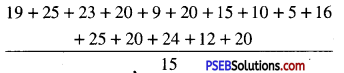
3. The scores in mathematics test (out of 25) of 15 students are as follows :
19, 25, 23, 20, 9, 20, 15, 10, 5, 16, 25, 20, 24, 12, 20.
Find the mean, mode and median of this data ? Are they same ?
Solution:
Mean =
PSEB 7th Class Maths Solutions Chapter 3 Data Handling Ex 3.2 1
= \(\frac {263}{15}\)
= 17.53
Now we arrange the data in ascending order
5, 9, 10, 12, 15, 16, 19, 20, 20, 20, 20, 23, 24, 25, 25
Here 20 occurs more frequently
∴ Mode = 20
Median is the middle observation
∴ 20 is the median.
Yes, both Mode and Median are same.

4. The weight (in kg) of 15 students of class are :
38, 42, 35, 37, 45, 50, 32, 43, 43, 40, 36, 38, 43, 38, 47

Question (i).
Find the mode and median of this data.
Solution:
We arrange the data in ascending order
32, 25, 36, 37, 38, 38, 38, 40, 42, 43, 43, 43, 45, 47, 50
Mode. Here 38 and 43 occurs more frequently i.e. 3 times
∴ Mode = 38 and 43
Median is the middle observation
∴ 40 is median.

Question (ii).
Is there more than one mode ?
Solution:
Yes, there are two mode i.e. 38 and 43

PSEB 7th Class Maths Solutions Chapter 3 Data Handling Ex 3.2

5. Find the mode and median of the following data :
13, 16, 12, 14, 19, 12, 14, 13, 14
Solution:
We arrange the data in ascending order
12, 12, 13, 13, 14, 14, 14, 16, 19
Here 14 occurs more frequently
∴ Mode = 14
Median is middle observation
∴ 14 is median.

6. Find the mode of the following data :
12, 14, 12, 16, 15, 13, 14, 18, 19, 12, 14, 15, 16, 15, 16, 15, 16, 16, 15, 17, 13, 16, 16, 15, 15, 13, 15, 17, 15, 14, 15, 13, 15, 14.
Solution:
We arrange the data in ascending order
12, 12, 12, 13, 13, 13, 13, 14, 14, 14, 14, 14, 15, 15, 15, 15, 15, 15, 15, 15, 15, 15, 15, 16, 16, 16, 16, 16, 16, 16, 17, 17, 18, 19.
Here 15 occurs more frequently
∴ Mode =15

7. Multiple Choice Questions :

Question (i).
The mode of the data :
3, 5, 1, 2, 0, 2, 3, 5, 0, 2, 1, 6 is :
(a) 6
(b) 3
(c) 2
(d) 1.
Answer:
(c) 2

PSEB 7th Class Maths Solutions Chapter 3 Data Handling Ex 3.2

Question (ii).
A cricketer scored 38, 79, 25, 52, 0, 8, 100 runs in seven innings, the range of the runs scored is :
(a) 100
(b) 92
(c) 52
(d) 38.
Answer:
(a) 100

Question (iii).
Which of the following is not a central tendency of a data ?
(a) Mean
(b) Median
(c) Mode
(d) Range.
Answer:
(a) Mean

Question (iv).
The mean of 3, 1, 5, 7 and 9 is :
(a) 6
(b) 4
(c) 5
(d) 0.
Answer:
(c) 5

PSEB 12th Class Physical Education Notes Chapter 1 Physical Fitness

This PSEB 12th Class Physical Education Notes Chapter 1 Physical Fitness will help you in revision during exams.

PSEB 12th Class Physical Education Notes Chapter 1 Physical Fitness

→ The term Physical fitness has different notions for different segments of people.

→ It not only refers to being physically fit but also refers to a balanced state of mind.

PSEB 12th Class Physical Education Notes Chapter 1 Physical Fitness

→ A person can only be considered fit if he is able to function well without any undue fatigue or tiredness.

→ A person who is fit both on physical and mental aspects stays strong in every sphere of life.

→ Now, let’s discuss the definition of physical fitness.

→ It is the ability of an individual to work effectively and efficiently with joy and pleasure.

→ According to David R. Lamb, “Physical fitness is the capacity to meet the present and potential physical challenges of fife with success.”

→ In order to achieve the optimum level of physical fitness one must possess basic components such as strength, speed, endurance, agility, flexibility, and coordinative abilities.

PSEB 12th Class Physical Education Notes Chapter 1 Physical Fitness

→ If a person is having these components, then he will be considered to be physically fit.

→ But, there are various factors that may influence the physical fitness of an individual such as anatomical structure, physiological and psychological makeup, posture, diet, lifestyle, inactivity, injury, age and gender, etc.

→ So, these factors are responsible to have a major influence on the physical fitness of an individual.

→ Hence, physical fitness plays a vital role to live healthy, prosperous, and conducive life in the present scenario of technological advancement.

PSEB 12th Class Physical Education Notes Chapter 1 Physical Fitness

→ It helps in the proper growth and development with the efficient functioning of the physiological systems in the body.

→ These developments ultimately induce the feeling of a balanced state of mental health and physical health of a person.