PSEB 10th Class Computer Solutions Chapter 8 Microsoft Publishers-II

Punjab State Board PSEB 10th Class Computer Book Solutions Chapter 8 Microsoft Publishers-II Textbook Exercise Questions and Answers.

PSEB Solutions for Class 10 Computer Science Chapter 8 Microsoft Publishers-II

Computer Guide for Class 10 PSEB Microsoft Publishers-II Textbook Questions and Answers

1. Multiple choice questions

Question 1.
Now day’s brochures are also available in electronic format and are called:
(a) e-brochures
(b) m-brochures
(c) t-brochures
(d) k-brochures
Answer:
(a) e-brochures

Question 2.
A small card printed with one’s name, occupation, business address, etc. is called:
(a) Brochures
(b) Newsletters
(c) Business cards
(d) Menus
Answer:
(c) Business cards

PSEB 10th Class Computer Solutions Chapter 8 Microsoft Publishers-II

Question 3.
What is the most common document requested of applicants in job applications?
(a) Banner
(b) Resume
(c) Calendar
(d) Flyer
Answer:
(b) Resume

Question 4.
What are longer than resumes-at least two or three pages?
(a) Curriculum vita (CV)
(b) Banner
(c) Invitation
(d) Catalogue
Answer:
(a) Curriculum vita (CV)

PSEB 10th Class Computer Book Chapter 8 Microsoft Publishers-II

2. Fill in the Blanks

1. Advertising means how a company encourages people to buy their …………… or ideas.
Answer:
Products and services

2. MS-Publisher offers templates and other tools to help us create a variety of publications, including brochures, newsletters, …………… and …………….
Answer:
Business Cards and Menus

3. Business cards are cards bearing business information about a ……………. or ……………….
Answer:
Company and Individual

4. A resume provides a summary of our ………….., credentials, …………… and other accomplishments and skills.
Answer:
Education and Work history.

PSEB 10th Class Computer Solutions Chapter 8 Microsoft Publishers-II

3. True or False

1. A compliment card is a piece of card or high quality paper expressing friendship or any other sentiment.
Answer:
True

2. Certificates of achievement, merit, and honor can be powerful tools.
Answer:
True

3. Brochures are prop national documents, primarily never used to introduce a company, organization.
Answer:
False.

PSEB 10th Class Computer Solutions Chapter 8 Microsoft Publishers-II

4. Very Short Answer Type Questions

Question 1.
What is a piece of paper, cloth, wood or any other material which is painted with pictures or words and which gives some information about a particular place, product, or event.
Answer:
Sign

Question 2.
What is a common packaging item, usually made of thin flat material?
Answer:
Envelop

Question 3.
What is something given to a person, a group of people, or an organization recognition of their excellence in a certain field?
Answer:
Award

Question 4.
What is a form of paper advertisement used for wide distribution, posted or distributed in a public place, handed out to individuals or sent through the mail?
Answer:
Flyer

Question 5.
What is a printed report containing news or information of the activities of a business or an organization more.
Answer:
Newsletter

PSEB 10th Class Computer Solutions Chapter 8 Microsoft Publishers-II

5. Short Answer Type Questions

Question 1.
Explain Signs?
Answer:
A sign is a piece of paper, clothe, wood or any other material which is painted with pictures or words and which gives some information about a particular place, product, or event.

Question 2.
Explain Resumes?
Answer:
A resume provides a summary of our education, work history, credentials, and other accomplishments and skills. There are also optional sections, including a resume objective and career summary statement.

Question 3.
What is Banner?
Answer:
A long strip of cloth bearing a slogan or design carried in a demonstration, procession or hung in a public place. Depending on how it is used, a banner can be a flag or other piece of cloth bearing a symbol, logo, slogan or other marketing message. An online banner is either a graph mage that announces the name or identity of a site.

Question 4.
Explain Newsletters?
Answer:
A newsletter is a printed report containing news or information of the activities of a business or an organization that is send by mail regularly to all its members, customers, employees or people, who are interested in. Newsletters generally contain one topic of interest to its recipients. A newsletter may be considered grey literature.

Question 5.
What are Menus?
Answer:
A menu may be a list from which guests use to choose options available. Basically Menu is the main way to give or take order from guest.

PSEB 10th Class Computer Solutions Chapter 8 Microsoft Publishers-II

6. Long Answer Type Questions

Question 1.
What are Advertisements? Explain various print media used for advertisements?
Answer:
An advertisement or ‘ad” for short is anything that draws good attention towards these things. Advertising is an audio or visual form of marketing communication that employs an openly sponsored, non-personal message to promote or sell a product, service or idea. Advertising means how a company encourages people to buy their products, services or ideas. It is usually designed by an advertising agency. Ads appear on television, as well as radio, newspapers, magazines etc. Sponsors of advertising are often businesses who wish to promote their products or services.

Advertising is communicated through various mass media, including old media such as newspapers, magazines, Television, Radio, outdoor advertising or direct mail; or new media such as search results, blogs, websites or text messages. The actual presentation of the message in a media is referred to as an advertisement or “ad”. Non-commercial advertisers include political parties, interest groups, religious organizations and governmental agencies.
MS – Publisher offers templates and other tools to help us create a variety of advertisements like:

  • Banners
  • Brochures
  • Catalogs
  • Flyers
  • Newsletters

Question 2.
What are Business Cards? Write steps for creating Business Card in Publisher?
Answer:
A small card printed with one’s name, occupation, business address, etc. is called a business card. Business cards are cards bearing business information about a company or individual. They are shared during formal introductions. A usiness card typically includes the givers name, company or business affiliation id contact information such as street addresses, telephone number (s), fax number, mail addresses and website.

Steps to Create Business Cards:
1. Click on File Tab, then New, and then Business Card-
Select any one according to choice. On right side of window, you can customize this selected Business Card with the help of color scheme, font scheme, business information, page size options and logo.

2. After changing of color, fonts scheme, business information and page size, click on Create button.

3. The Business Card is designed successfully. Now you can change Business Name or Individual name also, Address, Contacts etc.

PSEB 10th Class Computer Solutions Chapter 8 Microsoft Publishers-II

Question 3.
What is Label? Where labels can be used for?
Answer:
A label is a piece of paper, polymer, cloth, metal, or other material affixed to a container or product. Information printed directly on a container or item can also be considered labeling. Labels have many uses, including providing information on a product’s origin, manufacturer, use, shelf- life and disposal etc. Many hazardous products such as poisons or flammable liquids must have a warning label.
Uses of Labels:

1. Products:
Permanent product labels need to remain secure throughout the life of the product. For example, a food label must be secure until the food has been used.

2. Packaging:
Packaging may have labeling attached to or integral with the package. These may carry pricing, bar codes, UPC (Universal Product Code) identification, usage guidance, addresses, advertising, recipes, and so on.

3. Assets:
In industrial or military environments, asset labeling is used to clearly identify assets for maintenance and operational purposes. Such labels . are frequently made of engraved Trifoliate or a similar material.

4.Textiles:
Garments normally carry separate care/treatment labels which typically indicate how the item should be washed for e.g. machine washed or dry cleaned. Textile labels may be woven into the garment or attached, and may be heat resistant, colorfast, washable. Printed labels are an alternative to woven labels.

5. Mailing: Mailing labels identify the addressee, the sender and any other information which may be useful in transit.

6. Security Labels:
They are used for authentication, theft reduction, and protection against counterfeit and are commonly used on ID cards, credit cards, packaging, and products from CDs to electronics to clothing.

PSEB 10th Class Computer Solutions Chapter 8 Microsoft Publishers-II

Question 4.
What is Letterhead? How to create Letterhead in Publisher?
Answer:
A newsletter is a printed report containing news or information of the activities of a business or an organization that is sent by mail regularly to all it members, customers, employees or people, who are interested in. Newsletter generally contain one main topic of interest to its recipients. A newsletter may b( considered grey literature.E-newsletters delivered electronically via e-mail anc can be viewed as spamming if sent unsolicited.

Steps to Create Newsletters using MS-Publisher:

  • Click on File Tab, then New, and then Newsletters.
  • Select newsletter design from available Templates as per requirement and click on Create.
  • Modify the newsletter and add your own content.

PSEB 10th Class Computer Guide Microsoft Publishers-II Important Questions and Answers

Multiple Choice Questions

Question 1.
Which thing is like a long strip?
(a) Newsletter
(b) Banner
(c) Label
(d) Business card
Answer:
(b) Banner

Question 2
What is called list of things?
(a) Banner
(b) Label
(c) Envelope
(d) Catalogue
Answer:
(d) Catalogue

PSEB 10th Class Computer Solutions Chapter 8 Microsoft Publishers-II

Question 3
What is used for Day planning?
(a) Banner
(b) Label
(c) Calendar
(d) Catalogue
Answer:
(c) Calendar

Question 4
What the Stationary printed with heading is called?
(a) Label
(b) Banner
(c) Letterhead
(d) Catalogue
Answer:
(c) Letterhead

Fill in the Blanks

1. ……………….. menu is used to change the font colour and text bar colour of text.
Answer:
Format

2. Title of newsletter is typed in ………………..
Answer:
Text Box

3. Date of newsletter is typed in …………….
Answer:
Data Text box

4. Post card has ……………… number of sides.
Answer:
two

5. If you do not want to include the logo, then click …………………
Answer:
None.

PSEB 10th Class Computer Solutions Chapter 8 Microsoft Publishers-II

True/False

1. You should type note or message in text box.
Answer:
True

2. Different designs are shown in the preview gallery.
Answer:
True

3. Envelopes are used to write letters.
Answer:
True

4. In news letter every page has same layout.
Answer:
False

5. By default, in news letter, there are three columns and three stories.
Answer:
True

Very Short Answer Type Question

Question 1.
What is resume?
Answer:
Like resume, a curriculum vitae (CV) provides a summary of ones experience and skills. Typically, CVs are longer than resumes-at least two or three pages.

Short Answer Type Questions

Question 1.
What is a Banners?
Answer:
Banner an image, usually displayed at the top of each page in a Web site, containing text and design elements. You can create banners for any event and to capture the attention of the public.

Question 2.
Define Newsletter.
Answer:
Newsletter is a letter that consist of schedule of events, information about the chief guest and other distinguished people who will attend that event.

PSEB 10th Class Computer Solutions Chapter 8 Microsoft Publishers-II

Question 3.
Write a short note on Postcard.
Answer:
Postcard is a card that contains the some information regarding some particular events, celebration, greating etc. In View Publication task pane, Under News form a design, click publications for Print Post cards. Choose the suitable option from the list. Various post card designs are .displayed in preview gallery, select the post card design. Type the note or message in the text box. In post card options task pane, under side 2 information, click the details, which should appear on the reverse side of the post card. In the last specify the number of post cards, under copies per sheet and save the publication.

Question 4.
How will you open new letterhead?
Answer:
The following are the steps two open new letter head :

  • In New Publication task pane, Under New from a Design, click Publication for print letterhead.
  • Klick any one option from two i.e. Plain paper or special paper.
  • Click the any suitable design from the preview gallery.
  • By default logo is included in the letter head, if you do not want to inclued the logo, then click none, under logo.
  • After making all necessary changes, Save the publication as letter head.

Question 5.
Write the usage of envelope.
Answer:
The following are the usage of envelopes :

  • To send invitating card.
  • To send letters.

Question 6.
What is Banner?
Answer:
Banner an image, usually displayed at the top of each page in a Web site, containing text and design elements. You can create banners for any event and to capture the attention of the public.

Question 7.
What is Newsletter?
Answer:
News Letter is a letter that consist of schedule of events, information about the chief guest and other distinguished people who will attend that event.

Question 8.
What is Postcard?
Answer:
Post Card is a card that contains the some information regarding some particular events, celebration, greating etc.

PSEB 10th Class Computer Solutions Chapter 8 Microsoft Publishers-II

Question 9.
State the difference between letterhead and postcard.
Answer:
Post Card is a card that contains the some information regarding some particular events, celebration, greeting etc. Post card has two sides. Letter head is a stationery which is used to write letter.

Long Answer Type Questions

Question 1.
Write the steps to create Newsletter.
Answer:
Newsletters are a great way to share information with family, friends and customers. Microsoft Publisher’s newsletter function provides complete design and layout flexibility. Use the program to select a design layout and color scheme, format text and insert images quickly and easily to create a custom newsletter.

PSEB 10th Class Computer Solutions Chapter 8 Microsoft Publishers-II 1
Following are steps that are used to create a newsletter in Microsoft Publisher:
1. Choose a newsletter design. On the main menu click “File” and then “New” to open the Catalog Window. Click the “Newsletters” option on the Wizards menu, select the desired design from the options and then click “Start Wizard.” Enter your contact information in the window prompt. Delete the sample text in the field to leave a field blank. Click “Include color scheme in this set” and select the desired colors. Click “Update” when finished. Complete the steps in the Wizard or click “Finish” to exit the Newsletter wizard.

2. Enter the text. Place the mouse inside the desired text box and click once. Type the text or cut and paste from a Word document. Format the font style, size and appearance by using the main menu at the top of the screen. Place the mouse over the border until the word “Resize” appears. Click and drag the border to the desired size.

3. Insert images by clicking “Insert” and then “Picture.” Select from clip art or photos stored on your computer. Resize the image. Click and drag the mouse diagonally towards the center of the photo until the photo reaches the desired size.

4. Edit the text box-and image layouts as needed. Create a new text box by , clicking the text frame tool (“A”). Place the mouse in the desired location, then click and drag to create the desired box size. Place the mouse over the item until the word “Move” appears. Click and hold down the mouse and drag to the desired location. Place the mouse inside the box and click once, on the main menu click “Edit” and then “Delete Object” if you need to delete a text box.

5. Change the number of pages in the newsletter as needed. Click “Insert” and then “Page” and follow the instructions in the pop up window. Click the desired page number at the page display on the bottom of the screen and click “Edit” and then “Delete Page” to remove pages.

6. Finalize the newsletter. Proofread and spell check. Print the document on paper and place the pages in order to ensure the page numbers line up properly before copying. This is helpful if you plan to copy two-sided or convert to 11 x 17 inch paper.

PSEB 10th Class Computer Solutions Chapter 8 Microsoft Publishers-II

Question 2.
Write the steps to create Envelope.
Answer:
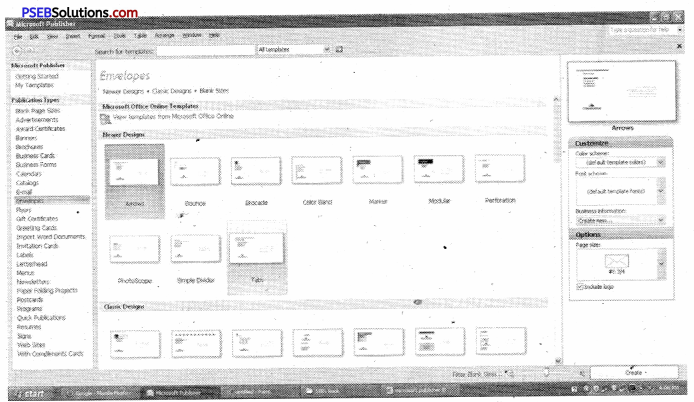
Special occasion cards get piled away with the rest of the mail when they are in plain envelopes with no special decal or design to separate them from others. Design a special envelope using Microsoft Publisher for a single use birthday card envelope or to use on all your mailings, so that people will see your envelopes and know that they are from you. Relatives and close friends will also appreciate the time you took to make their envelope special.
PSEB 10th Class Computer Solutions Chapter 8 Microsoft Publishers-II 2
Following are steps that are used to create an envelope in Microsoft Publisher :
1. Launch Microsoft Publisher and click “Publications for Print.” A list of options will appear underneath this section. You can choose from several pre-made envelopes. These envelope designs are for several different types of businesses.

2. Delete any option or area of the envelope you do not need for your purpose. Select the area by left clicking on the area once and it will bring up a border around the box. Right click on the selection and choose “Delete.”

3. Move any of the pre-selected fields by dragging it to where you would prefer it. Select the area; move the mouse pointer till it becomes a four arrowed figure. Left click and hold the mouse button and drag the box to where you want it.

4. Fill in the address fields by highlighting and entering in the correct information.

5. Insert pictures and designs to the envelope to make it more personal. Click “Insert” and “Clipart”, “Object” or “Textbox.” Recipients of your letters will love having designs on the envelopes that display your personality.

6. Choose to make your own envelope from scratch by selecting “Blank Print Publication” from under the New section on the left hand side of the Microsoft Publisher screen. Select “File”, “Page Setup” and a new window will appear. Hit “Envelope” from under the Publication Type and adjust any height and width dimensions you may need. This is easy, just measure your envelope.

7. Insert and edit till your message is clear from the design on your envelope. Try printing in gray scale and on regular paper before printing on any envelopes. This will save money and trees.

PSEB 12th Class Political Science Solutions Chapter 16 India and SAARC

Punjab State Board PSEB 12th Class Political Science Book Solutions Chapter 16 India and SAARC Textbook Exercise Questions and Answers.

PSEB Solutions for Class 12 Political Science Chapter 16 India and SAARC

Long Answer Type Questions

Question 1.
Write a note on establishment (formation) of SAARC and discuss its objectives.
Or
Describe background and efforts made for the establishment of South Asian Association for Regional Co-operation (SAARC).
Answer:
The quest for regional co-operation in South Asia, as initiated by the late Zia-Ur-Rahman of Bangladesh in March, 1980, was given concrete foundation with the emergence of SAARC (South Asian Association for Regional Co-operation) in August, 1983. On August 1, 1983, foreign ministers of seven countries (Bangladesh, Bhutan, India, Maldives, Nepal, Pakistan and Sri Lanka) met at New Delhi and approved programme of economic co-operation. They decided on an integrated programme of action for regional co-operation. Thus, the seven South Asian countries formally established the SAARC in 1985.
In its 14th Summit which was held at New Delhi on April 3-4-2007, Afghanistan becomes the 8th member of SAARC.

Background And Efforts Made for the Establishment of SAARC:
1. Working Paper on SAARC:
Before the formal launching of SAARC, useful and productive ground work was done by several meetings of the seven South Asian states. The working paper was prepared by Bangladesh’s former President Mr. Zia-Ur-Rehman. He stressed the need of setting up an organisation to promote regional co-operation.

2. Colombo Meeting of the Foreign Ministers of South Asian States (1981):
At this meeting the foreign ministers of South Asian countries- India, Nepal, Bhutan, Bangladesh, Pakistan, Sri-Lanka and Maldives, acknowledged the importance of regional co-operation. The meeting agreed to explore the possibilities of co-operation in five spheres i.e. agriculture, rural development, communication, weather and health and population activities.

3. Foreign Secretaries. Meeting in Kathmandu (1981):
At this meeting the recommendations of the seven nation study group and the report of the coordination committee of the whole was accepted. It also decided to explore the possibilities of Transport, Postal Service and Scientific and Technological cooperation.

4. Islamabad Meeting of Foreign Secretaries (1982):
This meeting approved the recommendations of the study group set up in Kathmandu and decided to constitute new study groups on sports, arts and culture.

5. Dhaka Meeting (1983):
This meeting evaluated the mutual co-operation in different fields and recommended the adoption of integrated programme of action by the foreign ministers. It also decided to set up a standing committee.

6. New Delhi Meeting of Foreign Ministers (1983):
In this meeting the foreign ministers signed the declaration of South Asian regional cooperation. The declaration listed the following objectives of South Asian Regional Co-operation.

  • to promote the welfare of the people of South Asia and to raise their standard of living,
  • to accelerate economic growth, social progress and cultural development in the region;
  • to promote and strengthen collective self-reliance among these countries,
  • to contribute to mutual trust, understanding and appreciation of one another’s problems;
  • to promote active collaboration and mutual assistance in various fields;
  • to strengthen co-operation among themselves and regional forums; and
  • to co-operate with international and regional organisations with similar aims and objectives.

The declaration also stated that SAARC is based on respect for the principle of sovereign equality; territorial integrity, political independence, non¬interference in the international affairs of other states and mutual benefits. The heads of state or government meet annually. It also decided to set up different committees.

7. New Delhi Meeting (1984):
This meeting gave a call for developing friendly relations among the countries of this region, along with co-operation in socio-economic and cultural field.

8. Standing Committee Meeting in Male in Feb. 1985:
This meeting recommended the establishment of a ministry council of South Asian countries through which the common will of mutual co-operation could be given institutional form. Thus, after so much hard work, studies and meeting SAARC was formally inaugurated in Dec. 1985.

Objectives and Principles of SAARC:
The South Asian Association of Regional Co-operation was formally inaugurated in Dec. 1985. The SAARC is an organisation of Eight countries of South Asia:Bhutan, India, Afghanistan, Bangladesh, Maldives, Nepal, Pakistan and Sri Lanka. SAARC was established primarily for co-operation in agriculture, rural development, science and technology, culture, health, population control, narcotics and terrorism.

Objectives of SAARC:
The objectives of the association are : 1. to promote the welfare of the people of South : 2. to accelerate economic growth, social progress and cultural development in the region; 3. to promote and strengthen collective self-reliance among these countries. 4. to contribute to mutual trust, understanding and appreciation of one another’s problems; 5. to promote active collaboration and mutual assistance in various fields; 6. to strengthen co-operation among themselves and regional forums; and 7. to co-operate with international and regional organisations.

Principles of SAARC:

  1. SAARC is based on the principles of sovereign equality; territorial integrity, political independence, non-interference in the internal affairs of other states and mutual benefits.
  2. Decisions at all levels are taken on the basis of unanimity. But bilateral and contentious issues will be excluded from the deliberations.
  3. SAARC is not a political organisation but is formed to accelerate development through mutual co-operation.
  4. The members of SAARC would not act as obstruction in having relations with the individual countries of SAARC and with other countries.

PSEB 12th Class Political Science Solutions Chapter 16 India and SAARC

Question 2.
What important activities SAARC has taken up during its existence? What has been India’s role in them?
Answer:
SAARC is active since 1985. It has taken up many activities as a regional co-operation association. It’s activities are as follows :
First SAARC Summit:
The leaders of seven South Asian countries Bangladesh, Bhutan, Sri Lanka, Maldives, Nepal, Pakistan and India, concluded on Dec. 8, 1985. at Dhaka their first ever regional summit. The Summit Conference adopted a Charter of this regional body to be known as South Asian Association for Regional Co-operation. This marked a major development in co-operation among the countries of the region. It will also help in the maintenance of peace and stability in the area.

Second Summit of SAARC:
The second summit of SAARC was held at Bangalore on Nov. 16-17, 1986 under the Chairmanship of Sh. Rajiv Gandhi. It decided to evolve a joint policy to fight terrorism in South Asia, to set up technical committees on women’s participation in development, drug abuse and drug trafficking.

Third Summit of SAARC:
The third summit of SAARC was held at Kathmandu (Nepal) in Nov. 1987, where agreements were reached on terrorism and established a SAARC Reserved Food Grain Stock. The Reserved Food Grain Stock, launched at the summit, will begin with a stock of 200,000 tonnes of wheat and rice. The summit also decided to commission a comprehensive study of the region’s environment and the necessary measures for its protection and preservation.

Fourth SAARC Summit:
The fourth annual summit of SAARC ended in Islamabad on December 31, 1988. The summit pledged to stamp out terrorism and meet the basic needs of the people through a regional plan ‘SAARC 2000’ with specific targets.

Fifth SAARC Summit 1990:
Fifth SAARC summit was held in Male, the capital of Maldives, in November, 1990. The summit decided to enlarge visa-free travel facilities beyond the present categories of members of Parliament and Supreme Court Judges.

Ninth Session of SAARC Council of Ministers, 1991. On July 4, 1991 the Ninth Session of the SAARC Council of Ministers agreed on taking co-ordinated action to combat the menace of terrorism which they said threatened to destabilize the region. On the economic front, the SAARC Council-also approved to institutionalise co-operation in tourism and trade manufacture and service.

Sixth SAARC Summit 1991:
Sixth SAARC summit was held in Colombo, the capital of Sri Lanka, on Dec. 21, 1991. The seven SAARC nations have agreed to liberalise trade and called for greater co-operation and interaction among the member states to combat terrorism in the region. India has done well by proposing a collective economic security system for the region.

Seventh SAARC Summit 1993:
Seventh SAARC summit was held at Dhaka, the capital of Bangladesh, on April, 1993. The South Asian Association for Regional Co-operation entered a new phase of economic co-operation as the seventh summit approved the 63 point Dhaka declaration and endorsing the South Asia Preferential trade agreement seeking to reduce trade barriers in the region.

Eighth SAARC Summit 1995:
Eighth SAARC summit was held in New Delhi on 2nd May, 1995. All the members of SAARC countries agreed to liberalise trade and called for greater co-operation. Delhi declaration of the eighth SAARC summit called for an international convention prohibiting the use or threat of use of nuclear weapons under any circumstances and strongly deploring acts of terrorism spreading in and outside the region. The declaration called for the production of organised tourism in a big way in the SAARC region. Another significance of this Summit was agreement on South Asian Preferential Trading Arrangement (SAPTA).

Ninth SAARC Summit 1997:
Ninth SAARC summit was held at Male, the capital of Maldives on 11th May, 1997. Leaders of seven South Asian nations accepted India’s proposal to transform the region into a free trade area by 2001. SAARC countries agreed for the removal of all trade barriers and structural impediments by advancing the deadline by four years from the earlier agreed goal of SAFTA by 2005.

Tenth SAARC Summit 1998:
Tenth SAARC summit was held at Colombo on 29th July, 1998. Despite its failings and shortcomings, SAARC has taken several bold steps including establishing a framework for SAPTA (South Asian Preferential Trade Arrangement) and SAFTA (South Asian Free Trade Area). India made a fine gesture that it would remove import restrictions on over two thousand products to facilitate intra-regional trade. With the solitary exception of Pakistan, all other member-countries of SAARC also agreed on the need to hasten the process by two years to realise SAFTA by 2001.

Eleventh SAARC Summit, 2002:
The Eleventh SAARC summit was held at Kathmandu, the capital of Nepal on 5th Jan. 2002 under tenscious shadow of Indo- Pak relations. The 11th SAARC Summit decided for the urgent conclusion of comprehensive convention on combating International terrorism and conducting international cooperation in ending this scourge in conformity with the U.N. Charter. The Summit recognised the importance of creating a free trade area. The declaration called for coordination among the SAARC member states on all World Trade Organisation issues.

Twelfth SAARC Summit (2004):
The 12th SAARC Summit was held at Islamabad; the capital of Pakistan in January 2004. During this summit firstly, SAFTA was approved and it will take effect from January, 2006. Secondly, all the SAARC nations signed its ‘Social Charter’. Thirdly, it was decided to start a ‘SAARC Award’ to respect and encourage the contribution of individual in the spheres of peace, poverty alleviation, social welfare etc. Fourthly, the SAARC nations signed a protocol on the prevention of terrorism.

Thirteenth SAARC Summit (2005):
The 13th SAARC summit was held at Dhaka on November 12, 2005. Summit decided a united fight against terrorism afflicting the region.

Fourteenth SAARC Summit:
The Fourteenth SAARC Summit was held at New Delhi on April 3-4, 2007. All the eight members were present. Afghanistan is the latest addition in the SAARC and because of this addition the total members of the SAARC are eight now. SAARC Summit adopted a 30-point declaration with commitment to ensure market access by all SAARC member countries and also collectively combat poverty, diseases, disaster and terrorism. All the eight members of the SAARC were unanimous for taking strict steps to curb terrorism in the Universe. Two agreements on establishing South Asian University and SAARC Food Bank were signed in the concluding session of the 14th SAARC Summit in New Delhi.

Fifteenth SAARC SUMMIT:
The Fifteenth SAARC Summit was held in Colombo, SRI LANKA on August, 2-3, 2008. The Summit concluded with the leaders expressing serious concern over the threat posed by terrorism to the peace, stability and security of the region and emphasizing the need for strongest possible co-operation in fighting terror and transnational organised crime. The Summit adopted the Colombo Declaration titled ‘Partnership for the growth of our people’ at the concluding session on August 3. The declaration stressed the importance of completing all legislative and other relevant measures to implement within the member states the provisions of the Regional Convention on Narcotic Drugs and Psychotropic substances.

Sixteenth SAARC Summit:
The Sixteenth SAARC Summit was held in Thimpu, Bhutan on April 28-29, 2010. The Summit concluded with the leaders express serious concerns over terrorism. SAARC leaders also decided to celebrated the decade of 2011-2020 as a ‘Decade of Intraregional Connectivity in SAARC’.

17th SAARC Summit (2011):
The 17th SAARC Summit was held in Addu (Maidive) on Nov. 10-11, 2011. The Addu declaration said that the leaders agreed upon the theme of ‘Building Bridges.’ The leaders committed to work towards a huge boost in intra SAARC trade, improving air, rail, motor and water transport connectivity between member countries and putting their heads together to solve common development concerns.

18th SAARC Summit-2014:
The 18th SAARC Summit was held in 2014 in Nepal. It concluded adopting a 36-point declaration with commitment to control Terrorism and Religious Fundamentalism.

India’s Role in SAARC :
India has been playing a vital role in the activities of SAARC. To make this organisation a success India has made constructive contributions. Its contributions in the founding and functioning of the organisation are significant and these are as follow:

  1. India played a leading role in the formation of SAARC. With India’s effort SAARC was constituted in 1985 with a view to promote co-operation in the neighbouring countries.
  2. The second SAARC Summit was held in Bangalore in 1986 under the chairmanship of Late Prime Minister Sh. Rajiv Gandhi.
  3. India announced a grant of Rs. 150 lacs to SAARC for the year 1987-88.
  4. In 1988, India offered 1,53,200 tonnes of foodgrains to create a reserved foodgrains stock for SAARC nations.
  5. India announced a contribution of Rs. 2 crores for SAARC activities for the year 1989-90.
  6. Industrial Development Bank of India hosted a meeting of national development institutions of the member countries in October 1991.
  7. In Dec. 1991, during the Sixth SAARC Summit India proposed a collective economic security system for the region.
  8. India hosted the first cultural festival of SAARC countries in October, 1992.
  9. India also ratified SAARC convention on Narcotic Drugs.
  10. The Eighth SAARC Summit was held in New Delhi on 4 May, 1995.
  11. The first SAARC Trade fair was also held in New Delhi from 9th to 14th January, 1996.
  12. India has removed all Quantitative Restrictions from SAARC countries from August 1, 1998.
  13. To boost the trade within the region India has placed over 2000 products from the Restricted List to Open General List.
  14. Under SAPTA India offered duty concessions to SAARC nations on 160 items.
  15. India has offered to conclude bilateral free trade agreements with those SAARC nations who are willing to move faster.
  16. India has already free trade agreements with Nepal and Bhutan.
  17. India has given financial aid to SAARC nations on a large scale particularly to Nepal, Bhutan and Maldives.
  18. In 12th SAARC Summit India pledged a contribution of Rs. 21.5 million for conferences to give concrete shape to freeing the SAARC region from hunger and giving an added impetus to the SAARC food bank.
  19. In the 13th SAARC Summit India offered concrete proposals to strengthen, including the facility of daily air services by designated airlines on a reciprocal basis, provision of transit facilities, setting up of a South Asian University and establishment of Regional Food Bank, SAARC High Economic Council and SAARC Museum of Textiles and Handicrafts.

Thus, India has played a constructive role in SAARC. It has always helped the member-states in time of need and emergency. India’s role in SAARC activities is a mark of India’s firm belief in SAARC and its policies.

PSEB 12th Class Political Science Solutions Chapter 16 India and SAARC

Question 3.
Describe India’s role in SAARC.
Answer:
India has been playing a vital role in the activities of SAARC. To make this organisation a success India has made constructive contributions. Its contributions in the founding and functioning of the organisation are significant and these are as follow:

  1. India played a leading role in the formation of SAARC. With India’s effort SAARC was constituted in 1985 with a view to promote co-operation in the neighbouring countries.
  2. The second SAARC Summit was held in Bangalore in 1986 under the chairmanship of Late Prime Minister Sh. Rajiv Gandhi.
  3. India announced a grant of Rs. 150 lacs to SAARC for the year 1987-88.
  4. In 1988, India offered 1,53,200 tonnes of foodgrains to create a reserved foodgrains stock for SAARC nations.
  5. India announced a contribution of Rs. 2 crores for SAARC activities for the year 1989-90.
  6. Industrial Development Bank of India hosted a meeting of national development institutions of the member countries in October 1991.
  7. In Dec. 1991, during the Sixth SAARC Summit India proposed a collective economic security system for the region.
  8. India hosted the first cultural festival of SAARC countries in October, 1992.
  9. India also ratified SAARC convention on Narcotic Drugs.
  10. The Eighth SAARC Summit was held in New Delhi on 4 May, 1995.
  11. The first SAARC Trade fair was also held in New Delhi from 9th to 14th January, 1996.
  12. India has removed all Quantitative Restrictions from SAARC countries from August 1, 1998.
  13. To boost the trade within the region India has placed over 2000 products from the Restricted List to Open General List.
  14. Under SAPTA India offered duty concessions to SAARC nations on 160 items.
  15. India has offered to conclude bilateral free trade agreements with those SAARC nations who are willing to move faster.
  16. India has already free trade agreements with Nepal and Bhutan.
  17. India has given financial aid to SAARC nations on a large scale particularly to Nepal, Bhutan and Maldives.
  18. In 12th SAARC Summit India pledged a contribution of Rs. 21.5 million for conferences to give concrete shape to freeing the SAARC region from hunger and giving an added impetus to the SAARC food bank.
  19. In the 13th SAARC Summit India offered concrete proposals to strengthen, including the facility of daily air services by designated airlines on a reciprocal basis, provision of transit facilities, setting up of a South Asian University and establishment of Regional Food Bank, SAARC High Economic Council and SAARC Museum of Textiles and Handicrafts.

Thus, India has played a constructive role in SAARC. It has always helped the member-states in time of need and emergency. India’s role in SAARC activities is a mark of India’s firm belief in SAARC and its policies.

PSEB 12th Class Political Science Solutions Chapter 16 India and SAARC

Short Answer Type Questions

Question 1.
What do you know about SAARC? Write the names of its member countries.
Answer:
The quest for regional co-operation in South Asia, as initiated by late Zia- Ur-Rahman of Bangladesh in March 1980, was given a concrete foundation with the emergence of SAARC. The leaders of seven South Asian countries India, Bangladesh, Pakistan, Sri Lanka, Nepal, Bhutan and Maldives concluded on December 5, 1985 at Dhaka their first ever regional summit. The summit conference adopted a Charter of this regional body to be known as South Asian Association for Regional Co-operation.

This marked a major development in co-operation among the countries of this region. The Indian Prime Minister in his inaugural address termed it as the beginning of a new dawn. The Dhaka Declaration stated that the Heads of State or Government shall meet annually. The SAARC Secretariat was set up at Kathmandu on 16 January, 1987. In its 14th summit which was held at New Delhi on April, 3-4-2007, Afghanistan became the 8th member of SAARC. The basic aim of the organisation as declared by Dhaka Declaration is “to make the full use of all the human and natural resources and to accelerate the economic and social development of the region.”

Question 2.
Write main objectives of SAARC.
Answer:
The objectives of the association are:

  • to promote the welfare of the people of South
  • to accelerate economic growth, social progress and cultural development in the region;
  • to promote and strengthen collective self-reliance among these countries.
  • to contribute to mutual trust, understanding and appreciation of one another’s problems;
  • to promote active collaboration and mutual assistance in various fields;
  • to strengthen co-operation among themselves and regional forums; and
  • to co-operate with international and regional organisations.

PSEB 12th Class Political Science Solutions Chapter 16 India and SAARC

Question 3.
WHhat are the main principles of SAARC? Write the names of its member countries.
Or
Write down the names of the member countries of SAARC.
Answer:
Principles of SAARC:

  1. SAARC is based on the principles of sovereign equality; territorial integrity, political independence, non-interference in the internal affairs of other states and mutual benefits.
  2. Decisions at all levels are taken on the basis of unanimity. But bilateral and contentious issues will be excluded from the deliberations.
  3. SAARC is not a political organisation but is formed to accelerate development through mutual co-operation.
  4. The members of SAARC would not act as obstruction in having relations with the individual countries of SAARC and with other countries.

Names of the member countries of SAARC:

  1. India
  2. Pakistan
  3. Bangladesh
  4. Bhutan
  5. Maldives
  6. Sri Lanka
  7. Nepal,
  8. Afghanistan.

Question 4.
Write a short note on SAFTA.
Answer:
The aim of SAFTA is to establish a ‘South Asian Free Trade Area’ through mutual co-operation. A free trade area means that trading among the countries of the area is free from taxes and custom restrictions. During its establishment it was hoped that SAFTA will replace SAPTA before the start of 21st century. The Tenth SAARC Summit decided to set up a committee of experts to conclude on Treaty 2001 on SAFTA. In 12th SAARC Summit held on January, 2004 in Islamabad the SAARC nations have signed the treaty.

On December 29, 2005 the Union Cabinet of India cleared the implementation of South Asian Free Trade Area (SAFTA) agreement though the actual movement of commodities among Seven Nations started from July 1, 2006. SAFTA allows for a differential and progressively freer regions. India, in effect, will offer relatively unhindered access to its markets for Bangladesh, Bhutan, Maldives and Nepal, the poorest SAARC members, while different ‘sensitive lists’ on goods and services would be prepared for Pakistan and Sri Lanka.

PSEB 12th Class Political Science Solutions Chapter 16 India and SAARC

Question 5.
Write down any four achievements of ‘SAARC’.
Answer:

  • All the member countries of SAARC have come closer to one another and their mutual tension has been lessened.
  • All the member countries are collectively working for their socio-economic development.
  • SAARC has created “Food Stock Pool”. It has developed a sense of self-reliance and self-respect among SAARC nations.
  • SAARC has accelerated development in the region.

Very Short Answer Type Questions

Question 1.
What do you know about SAARC?
Answer:
The quest for regional co-operation in South Asia, as initiated by late Zia- Ur-Rahman of Bangladesh in March 1980, was given a concrete foundation with the emergence of SAARC. The leaders of seven South Asian countries India, Bangladesh, Pakistan, Sri Lanka, Nepal, Bhutan and Maldives concluded on December 5, 1985 at Dhaka their first ever regional summit.

Question 2.
Write the full name of ‘SAARC’.
Answer:
The full name of SAARC is South Asian Association for Regional Cooperation.

Question 3.
Write down the names of SAARC member countries.
Or
Write the names of any four countries of SAARC.
Answer:

  1. India
  2. Pakistan
  3. Bangladesh
  4. Bhutan
  5. Maldives
  6. Sri Lanka
  7. Nepal,
  8. Afghanistan.

Question 4.
Write a short note on SAFTA
Answer:
The aim of SAFTA is to establish a ‘South Asia Free Trade Area’ through mutual co-operation. A free trade area means that trading among the countries of the area is free from taxes and custom restrictions.

PSEB 12th Class Political Science Solutions Chapter 16 India and SAARC

Question 5.
Write down any two achievements of ‘SAARC’.
Answer:

  • All the member countries of SAARC have come closer to one another and their mutual tension has been lessened.
  • All the member countries are collectively working for their socio-economic development.

Question 6.
Write any two problems of SAARC.
Answer:

  • The first problem is Political lnstability in the SAARC Region.
  • The second problem of SAARC is Terrorism.

One Line Answer Type Questions

Question 1.
What is meant by SAARC?
Or
What is the full form of SAARC?
Answer:
SAARC i.e. South Assian Association for Regional Cooperation is an organisation of eight countries of South Asia. It has been established with the objective of increasing mutual co-operation between these countries.

Question 2.
When was SAARC established?
Answer:
A Conference of the Foreign Ministers of seven countries was held on 1-2 August, 1983. They deliberated about the establishment of SAARC. It was formally founded in its first conference at Dhaka in Bangladesh in 1985.

Question 3.
What has been the impact of SAARC as a means of Regional Co-operation?
Answer:
Because of SAARC, the South Asian Countries have come closer to each other. It has been successful in settling some common problems in these countries.

PSEB 12th Class Political Science Solutions Chapter 16 India and SAARC

Question 4.
Mention full form of SAARC and SAFTA
Answer:

  • SAARC: South Asian Association for Regional Co-operation.
  • SAFTA: South Asian Free Trade Area.

Question 5.
When and where was the 18th SAARC Conference held?
Answer:
The 18th SAARC Summit conference was held at Thimpu, the capital of Nepal on Nov. 2014.

Question 6.
Write down names of member countries of SAARC.
Answer:
SAARC includes countries such as India, Pakistan, Sri Lanka, Nepal, Bhutan, Bengladesh, Maldives and Afganistan.

Question 7.
When and in which conference, Afganistan was made a member country of SAARC?
Answer:
Afganistan was made a member of SAARC in the 14th Summit Conference held in India in April, 2007.

Question 8.
Where is the office of SAARC situated?
Answer:
The office of SAARC is in Kathmandu, the capital of Nepal.

Question 9.
Write down any two countries in the north of India who have joined SAARC.
Answer:
In the north of India, Nepal and Bhutan are the member countries of SAARC.

Question 10.
Write down any two countries in the south of India who have joined SAARC.
Answer:
In the south of India, Sri Lanka and Maldives are the member countries of SAARC.

PSEB 12th Class Political Science Solutions Chapter 16 India and SAARC

Question 11.
When was SAARC established?
Answer:
1985.

Question 12.
Write down any one name of the member country of SAARC.
Answer:
India.

Question 13.
How many conferences of SAARC have been held so far?
Answer:
There have been 18 Summit Conferences of SAARC so far.

Question 14.
Where was the 14th Summit Conference of SAARC held?
Answer:
In India.

PSEB 12th Class Political Science Solutions Chapter 16 India and SAARC

Fill in The Blanks

1. The SAARC is an organisation of ………….. member states.
Answer:
Eight

2. ………….. is playing an important role in SAARC activities.
Answer:
India

3. First SAARC Summit was concluded on 8 Dec ………….. .
Answer:
1985

4. 17th SAARC Summit was held in ………….. .
Answer:
Maldives.

PSEB 12th Class Political Science Solutions Chapter 16 India and SAARC

True Or False Statement

1. SAARC is a national organisation.
Answer:
False

2. SAARC is an Institution of South Asian countries.
Answer:
True

3. India is not a member of SAARC.
Answer:
False

4. Afghanistan becomes 8th member of SAARC.
Answer:

5. So far fifteen summits have concluded of SAARC.
Answer:
False.

PSEB 12th Class Political Science Solutions Chapter 16 India and SAARC

Choose The Correct Answer

Question 1.
SAARC was initiated by:
(a) Mr. Zia-ul-Rehman
(b) Mr. Zia-ul-Haq
(c) Mrs. Indira Gandhi
(d) Mr. Mujib-ur-Rehman
Answer:
(a) Mr. Zia-ul-Rehman

Question 2.
SAARC is a/an:
(a) Universal Organisation
(b) Regional Organisation
(c) World Organisation
(d) International Organisation
Answer:
(b) Regional Organisation

Question 3.
The 18th Summit of SAARC
(a) India
(b) Sri Lanka
(c) Nepal
(d) Bhutan.
Answer:
(c) Nepal

PSEB 12th Class Political Science Solutions Chapter 16 India and SAARC

Question 4.
The SAARC was formed
(a) 1987
(b) 1983
(c) 1985
(d) 1982.
Answer:
(b) 1983

Volleyball Game Rules – PSEB 10th Class Physical Education

Punjab State Board PSEB 10th Class Physical Education Book Solutions Volleyball Game Rules.

Volleyball Game Rules – PSEB 10th Class Physical Education

Question 1.
Describe Volleyball court, Net, Ball, Behaviour of players and Coaches, Number of players, Position of players.
Answer:
Playfield:
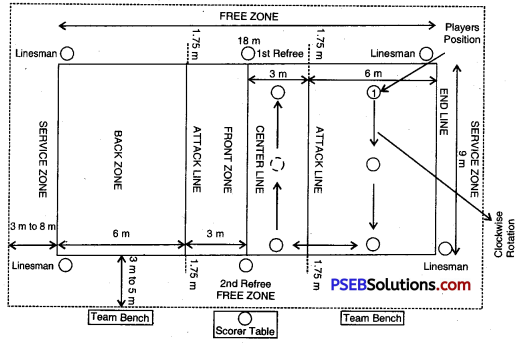
The length of the volleyball playfield shall be 18 metres and breadth 9 metres. There should be no obstruction of any kind upto a height of 7 metres from the ground. The court shall be marked by lines of 5 cms. These lines shall be drawn at least 2 metres away from all obstructions. The centre line under the net divides the court into two equal parts.

Attack Line:
In each half of the court an attack line of 9 metres 5 cms, parallel to the central line, shall be drawn. Its width is included in 3 metres. One line on the right hand side is drawn as its extension and the second line of 3 metres to the left of it. The extension of the service area shall be minimum 3 metres.
Volleyball Game Rules - PSEB 10th Class Physical Education 2
Volleyball Court:
The court of this game should be 18×9 metres. There should be no obstruction of any kind upto a height of 7 metres from the ground. The court is like a rectangle. The width of its boundary lines should be 5 cms. These lines should be atleast 2 metres away from all obstructions. Two lines of 15 x15 cms. In length and 5 cms. in width are drawn behind the last line and parallel to it. These lines mark the service area of the court.

Volleyball Game Rules - PSEB 10th Class Physical Education

One line is drawn right to the side line and the other is drawn to the left of the side line.. The minimum extension of the depth of the service area shall be 2 metres. The centre line under the net divides the court into two equal parts. In each half of the court a line of 9 metres 6 cms., parallel to the central line, at a distance of 3 metres is drawn. It is called attack line.

Net:
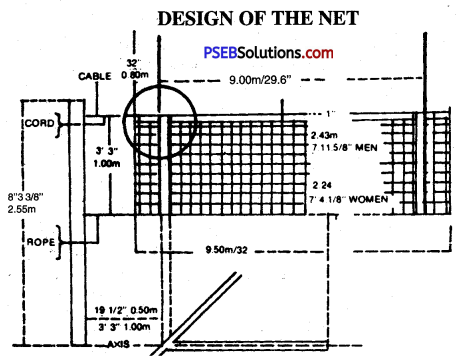
The net shall be 9 metres long and 1 metre wide. The squares of the net should be 15 cms. On its upper part a canvas strap of 5 cms. should be placed in such a way that a flexible cable may pass through it. The net is attached to the posts with this cable. The rope is not used under the net now-a-days. The height of the net for men from the centre should be 2.43 metres from the ground, and for women, it should be 2.24 metres. Flexible straps of 5 cms. width are attached on the ends of net. Both the sign posts supporting the net shall be at least 50 cms. from the side line.

Ball:
The ball should be round and made of supple leather. In it there should be a bladder. Its circumference should be 66 cms. + 1 cms. and weight should be 270 gms. + 10 gms. The pressure of air in the ball should be between 0.48 and 0.52 kg/cm2. The colour of the ball should be uniform.
Conduct of Players and Coaches-

  • Every player should be aware of the rules of game.
  • During the play a player can talk to the referee only through his captain.
  • All of the following acts of breach will be punished :
  • To talk to the officials time and again about their decisions.
    • To use improper words while talking to the officials.
    • To act indecently with the aim of influencing the decisions of officials.
    • To misbehave with or use uncivilised remarks to the opponent.
    • To give coaching to players by any one from the outside of the court.
    • To walk out of the court without the referee’s permission.
    • Clapping or crying by the players when the ball is touched and particularly at service

Warning is given for a minor offence. When the offence is repeated, a player is given a personal warning, by which his team loses the service or a point. A penalty is recorded on the score sheet in case of a serious offence. It entails the lose of service and one point. It the offence is repeated, the referee may disqualify the player fora set or for the rest of the match.

Dress of Player:
The player shall wear jersey, pants and pliable foot wear. He shall not wear on his head turban or cap or any such jewellery as may cause injury to other players.
Number of Players and Substitutes-
1. The number of players in one team shall not exceed 6 under all circumstances. The number of players including substitutes shall not be more than 12.

2. Substitutes and coaches shall sit in the court in front of the referee.

3. The captain of a team or coach can request the referee for a substitute. In this game only 6 players in maximum can play. Before a substitute enters the court he shall go to the scorer in dress and after his approval shall immediately take his place.

4. Any player in the beginning of the set may be replaced only once by a substitute. During the same set the original player may go back to the court, but this can be done only once. A substitute leaving the game cannot come back again in the same set. Only that player may come back who has gone out for the substitute.

Volleyball Game Rules - PSEB 10th Class Physical Education

Position of Players:
The court is divided into two parts. In each half a team of six members plays. After the service, players of both teams stand in their respective areas. They stand in lines in numbers 3-3. It is not essential that the lines shall be straight. Players parallel to the net take their positions from left to right in a way that in doing the service the players 4, 3, 2 are in front of the attack line, and the players 5, 6, 1 are behind. This position remains until the service of a team changes.
Volleyball Game Rules - PSEB 10th Class Physical Education 1
After the service, the players can occupy any position. The rotation order recorded on the score sheet shall have to be kept in use till the end of the set. The game shall be stopped owing to some fault in the rotation, and the faults is removed. All points made by the team during the fault are cancelled. The points scored by the opposing team are retained. If the fault or error is not known at the proper time the defaulter team shall resume its correct position and shall have to lose the service or a point according to the situation.

Officials:
The following officials are appointed to conduct the game:
(i) Referee:
The referee sees to it whether a player is playing according to rules or not. He keeps control over the game, and his decisions are final. If any player breaks the rules, he is entitled to stop him from playing and may award him punishment.

(ii) Umpire:
He substitutes players. In addition to it, he gives signals on crossing the lines, time-on and touching the line. On the request of a captain he allows the substitution of a player. He assists the referee as well. He also brings the players to their positions turn by tarn:

(iii) Scorer:
During the play the scorer asks for the change of end, and keeps in view the rotation of the players. At the start of the game, he notes down the numbers and names of players, and keeps a record of scores.

(iv) Two Linesmen:
In case of a foul, the linesmen of both the teams give signals to the referee. In each end there is a lineman for a team. He announces when the ball falls in or out.

Volleyball Game Rules - PSEB 10th Class Physical Education

Question 2.
Describe the main Rules of Volleyball game.
Answer:
Rules of Play –

  • The number of players in each team shall be compulsorily 6. The number of players including the substitutes in a team cannot exceed 12.
  • All international matches are played to the best of five or to the best of three sets. In all international matches, five winning sets are played.
  • At the start of the game the captains of both the teams toss to decide ends and service. The toss winning team is free to choose either service or ends.
  • After each set the ends are changed. In the last set when a team has made 8 points, the ends are changed.
  • No team can play the game with less than 6 players.
    Volleyball Game Rules - PSEB 10th Class Physical Education 4

Time out:

  • The referee or umpire will grant time-out only in case the ball is damaged (dead).
  • A captain or a coach may ask for time-out for rest.
  • During a time-out the players cannot leave the court to talk to any one. They can only seek advice from their coach.
  • Each team can take two times-out in a set. The duration of such a time-out is not more than 30 seconds. Two times-out can be taken consecutively.
  • If a team, after getting two times-out, requests for the third, the referee shall give a warning to the concerned captain or coach. If the time-out is demanded even after this, the concerned team has to lose a point or service.
  • During the time-out for rest, neither can the players leave the court without permission nor the coach can enter the court. Of course, the coach, while remaining out of the court, can talk to the players.
  • A maximum interval of 2 minutes is permitted between two sets, but the interval between the fourth and fifth sets is of five minutes.
  • The game starts immediately after the substitution of a player.
  • In case a player is injured a time-out of 3 minutes is granted. It is allowed if the player is not substituted.

Obstacles of Play:
If a match is interrupted for some reason and cannot be completed, the problem shall be solved like this-

  • The game shall be re-started on the same court, and the score also shall remain the same as it was left earlier.
  • If the interruption in the game does not exceed 4 hours, the match shall be resumed at the fixed court.
  • In case the match is resumed on another court, the score of the interrupted set shall be deemed to be cancelled but the results pf the completed sets shall remain the same.

Volleyball Game Rules - PSEB 10th Class Physical Education

Passes:
1. Under-hand Pass. This technique is now considered to be very useful. It makes even a difficult service easy. In this pass, the left hand is tightly closed. The ball is placed on the right fist such a way that the thumbs remain parallel to each other. The under-hand ball is received when the ball is quite low.

2. Back Pass. The back pass is made use of to dodge an opponent. The player who is to make pass makes it behind his head. The volley server volleys.

3. Under-hand Ball with Back Rolling. When the ball is beside the net, the hit should be made by opening the fingers and touching them with the ball.

4. Under-hand Ball with Side Rolling. When the ball is to one side of the player, the hand is opened in the direction of the ball. The ball is received by side rolling.

5. Under hand Pass with the Hand. This method is used to return the ball when the ball is to the one side of the player in the direction in which it is to be received. The ball is taken by slightly bending the leg, extending the arm and closing the fist.

6. Taking the Ball Struck with the Net. This type of ball is taken by under-hand, otherwise it is cut towards the fellow players so that it may be passed carefully.

Service:
(a) By service we mean the putting of the ball into play by the right hand back line player. The player hits the ball with his hand either open or closed or any part of the arm in such a way that the ball passes over the net to the opposite court. The service should be done from the fixed place. Throwing the ball by hand is prohibited. A player after service can remain on the boundary line or enter the court.

If the served ball falls on the ground untouched by any player, the service is re-taken. If the service ball passes over the net without touching it and between the antennae, the service is considered to be good. The service will have to be re-taken as soon as the referee blows the whistle. A player shall continue to serve until a fault is committed by any player of his team.

(b) Faults of Service.
If any of the following faults are committed, the referee will blow his whistle for the change of service :

  • When the ball touches the ground.
  • When the ball passes under the net.
  • When the ball touches the antennae or it does not pass over the net completely.
  • When the ball touches a player or an object before it reaches the opponent’s court.
  • When the ball lands outside the limit of the opponent’s court.
  • When the player’s foot, while the service is being taken, is on the line or touches the line.

(c) Second and later Service:
In each new set that team shall serve which has not served in the preceding set. The service in the final set is decided by toss.

(d) Obstacles of Play: If, in the opinion of the referee, a player deliberately obstructs a game, he is penalized.

Change in Service:
When the serving team commits a fault, the service is changed. The service also undergoes a change when the ball is side-out.

Hitting the Ball:

  • Each team can contact the ball three times so as to pass the ball into the court of the opposing team.
  • A ball can be hit with any upper part of the body.
    A ball can pass touching the various upper parts of the body but it should be simultaneous. The ball should not be caught; rather it should bounce forcibly.
  • If a ball lodges for sometime in the player’s hands or arms, it shall be reckoned to bathe ball held. Lifting, pushing, carrying shall also be considered as holding. To hit the ball distinctly with both hands from below is in conformity with the rules.

Blocking:
Blocking is that activity by which, as soon as the ball crosses the net, the attack by an opponent is attempted to be stopped with any upper part of the body, above the abdomen. Blocking is done by the players of the first line. Players of back line are not allowed to do blocking. After blocking any player who takes part in blocking may get the ball.

Games of Net:

  • A ball is considered to be good if it (other than served) touches the net completely.
  • A ball is also considered to be good when it passes the net from inside the marks.
  • A ball hitting the net can be played. If a ball that has been played three times by a team touches the net the fourth time or falls on the ground, the referee shall blow the whistle for the offence.
  • A ball which hits the net so hard that the net contacts an opponent, the opponent shall not be penalized for this contact.
  • If two opposing players touch the net simultaneously, it is considered a double fault.

Crossing Hand Over Net:

  • During blocking, the touching of the ball with hands over the net in the court of the opponents is not considered a fault provided the contact has been made after the attack by the opponents.
  • To pass hands over the net after an attack is not a fault.
  • If the ball is touched by the blocking players, then the same team can cross the ball over the net by touching the ball with hands three times.

Crossing Centre Line:

  • If during the play, any part of the body of any player contacts or enters the opponent’s court, it is considered a fault.
  • Passing of the ball under the net, and attracting the attention of the opponent by touching the ground with any part of the body after crossing from under the net shall be considered a fault.
  • To enter the opponent’s court before the referee whistles shall be deemed as a fault.

Ball out of Play:

  • If the ball touches the net outside antennae or the antennae, it is considered a fault.
  • If the ball touches the ground or any object outside the court, it is considered to be ‘out’. A ball touching hands shall be deemed correct.
  • The play stops with the referee’s whistle, and the ball shall be considered out of play.

Volleyball Game Rules - PSEB 10th Class Physical Education

Score:

  • When a team is leading by two sets, it is declared to be the winner. A set has 15 points. If the score is tied at 14-14, the play is continued upto 16-14, 17-15 and 19-17.
  • If a team refuses to come into the court on being asked by the referee, it loses the game. A wait of 15 minutes for the team to play is possible. It is left in case of injury to a player during the game.
  • If a team fails to return the ball correctly in the court of the opponent, the points is awarded to the opposing team.

Fouls in Volleyball:

  • If during the game a player touches the net, it is considered to be foul.
  • To touch the centre line is a foul.
  • Crossing the line before service is a foul.
  • When the ball hits the face, back and waist, it is a foul.
  • If there is a sound while taking the ball.
  • Holding is a foul.
  • If the ball is touched more than three times, it is a foul.
  • If a player touches the ball with hands continuously for two times, it is a foul.
  • If during the service he is pursued in a wrong situation.
  • If the rotation is faulty.
  • If the ball is given side-pass.
  • If the ball crosses the net from below.
  • When the service is not done from the service area.
  • If the service is not correct, even then it is a foul.
  • If the served ball is crossed by a player of the serving side.
  • While doing service it is a foul to form group.
  • Doing the service before the whistle is a foul. If any of these fouls is done, the referee asks for the change in service. He can give warning to any player or can expel him.

Decisions:

  • The decisions of the officials are final. .
  • Only the captain of a playing team can protest against the decisions about the interpretation of rules.
  • If the referee’s’decision is not correct, the game is played under protest, and the protest is sent to the higher officials.

Important Information about the Volleyball Game

  • The length and breadth of = 18 x 9m
    Volleyball ground
  • The breadth f the post of the = 7 c.m.
    canvas strap
  • The number of Antenica = Two
  • Length of Antenia = 1.80m
  • Distance of poles from line = 1 meter
  • Length and breadth of the net = 9.50 x 1 meters
  • The height of the net for men = 2.43 meters
  • The height of the net for women = 2.24 meters
  • Circumference of the ball = 65 to 67 c.m.
  • Colour of the ball = Multiple colour
  • Weight of the ball = 260 to 280 gm
  • Number of player in a team = 12 (size players 6 substitute)
  • Officials of the match = Two referee, One scorer, Two or four lineman
  • The size number of the back = Height 20 c.m.,15 c.m. Length, 2 c.mBreadth.
    of players
  • Twelve (12) players take part in the game of volleyball, out of which 6 play and 6 are substitutes.
  • Both the teams participating in a match has 6 players each.
  • Standing in their court these players make the ball pass over the net.
  • A point is awarded against the team in whose court the ball falls.
  • There is no time limit for the game of volleyball; instead the best of three or the best of five games is played.
  • No rope is now used under the net.
  • The toss winning team is free to choose service or end.
  • Only two players can be substituted in the game of volleyball.
  • A player of the opposing team can block the service if it is going beside the net. Service will be considered
    correct when the ball during service touched to the net and reached in opponent’s playing area.
  • A team can be scratched if it does not enter the ground in fifteen minutes.
  • Each game of volleyball is of 25 points.
  • Libro player is allowed substitution whenever he desire but for defence purpose only.
  • A player can throw the ball in opponents playing area by hitting the ball with foot and knee.

Lezium Game Rules – PSEB 10th Class Physical Education

Punjab State Board PSEB 10th Class Physical Education Book Solutions Lezium Game Rules.

Lezium Game Rules – PSEB 10th Class Physical Education

Question 1.
Write down the measurement of lezium and its types.
Answer:
Lezium:
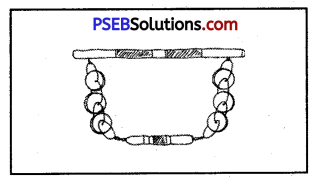
Lezium consists of a wooden handle of 16″ to 18″ in length with an iron chain fixed at both ends of the wooden handle and a rod of 15 cm (6″) in the middle. The iron chain contains iron plates in each ring which produces rhythmic and jingling sound when the lezium is in use. The weight of the whole apparatus is between 1 3/4 to 2 lbs.

Lezium Game Rules - PSEB 10th Class Physical Education

Types of Lezium:
Lezium Skand, Aram, Husshyar, Pavitra, Char Awaj, Ek Jagah, Aidi Lagala, Starting position, Do Rukh, Age Shlang, Peechhe Shlang.

Lezium Skand:
In this position, lezium is kept on right shoulder. In this position, lezium is like egg position, and the wooden handle is remain behind and the chain of iron remain in front of the body.
Lezium Game Rules - PSEB 10th Class Physical Education 1
Aram:
In this position, iron chain kept in a right hand and hanging in left hand when a student is remain in husshyar position the order of aram is given.

Husshyar:
Before starting of the Lezium, student should come in husshyar position. This position is kept when the lezium is on the shoulder. This exercise is performed by counting two on counting one, the iron chain and on counting two the lezium should be kept up to left shoulder and bring it in front of the chest with left hand. Wooden handle is race iron chain in the right hand and pull towards the body. After this exercise, came into the first position.

Pavitra:
This position is obtain from the Skand position. Keeping front left knee is little bend, bring the right foot behind the body. The weight should be on the left toe and push toward the floor. The remain straight chest and head must be raised upward. In this position, left leg must be towards the right and lezium should be in husshyar position.

Char Awaj:
In the starting of husshyar position on counting one keep the knee straight and bend the body, take the first stock near the feet in this position. Wrist goes out side and the handle of the lezium become parallel to the body, one counting to range the body up and snatch the iron chain from the wooden handle.

In the position, lezium will be on waist, on counting three and in a first position. The wooden handle should be moved to the right side and right hand should be in front of the body. On counting four, wooden handle should be taken in front of mouth, which we can see through the lezium.

Ek Jagah:
In the exercise, in counting four rotate the lezium in a round left to right after this next four counting should be repeated from left side.

Adha Lagao:
In this exercise, all the eight counting must be repeated and foot movement should be performed on char awaj. The left leg should be brought to the right leg and the left toe .. should be brought to right, the thumb should be kept between the finger.

Starting position:
In this position, rotating the back Char awaj should be performed four times. In coming first position, the exercise rotate the body from left side and lezium should be in front of the chest. In keeping the taal on counting four rotate the body in fast position. By doing this exercise, arm should be rotate in circle motion.

Do Rukh:
This exercise consist of eight counting and pavitra is N starting position just counting three. It will be like pavitra on counting four in a opposite direction from the left position. In a quick motion, perform four on counting five, rotate the lezium upward to down ward from left toe to right toe. Char awaj perform on counting six. It should be like to on counting seven take the Pavitra position, and char awaj take three counting. On counting eight, it should be like first position.

Lezium Game Rules - PSEB 10th Class Physical Education

Aage Shalang:
This is the exercise of ten counting. Starting position is of pavitra, on counting one, bending forward near the left toe to the char awaj should be done. When taking left foot is completed on counting three, right foot should be forwarded like near the left foot, char awaj should be perform. In this way, left toe is done up on counting five, char awaj to be perform.

Taking six and seven stock with the left lezium should be nearer and foot should be kept in pavitra position. On counting eight, char awaj should be performed on counting nine, bending forward char awaj must be one stock. On counting ten, raise the body by farming char awaj and return to pavitra position.

Peechhe Shalang:
In this exercise, counting should be in ten, starting position must be a pavitra perform. The char awaj near the left toe on counting. In second and third, rotate to right and make two perform. In opposite direction, perform char awaj on four counting four times. Six and seven rotate from left foot keeping the right foot behind, on counting eight perform the char awaj, in this position student should be in pavitra position while counting nine char awaj should be performed.

Forward Bend:
On counting one, keep the right foot ahead. Bend on right side and open the lezium in same position. On counting two, raise the right foot up to three inches and by bending forward, lezium should be close on counting three, keep the left foot ahead and repeat the counting one. In this way, the exercise should be performed.

PSEB 12th Class Sociology Important Questions Chapter 12 Social Issues: Old Age and Disability

Punjab State Board PSEB 12th Class Sociology Important Questions Chapter 12 Social Issues: Old Age and Disability Important Questions and Answers.

PSEB 12th Class Sociology Important Questions Chapter 12 Social Issues: Old Age and Disability

Multiple Choice Questions:

1. In 2021, the number of elders in India will be
(a) 140 million
(b) 150 million
(c) 160 million
(d) 170 million
Answer:
(a) 140 million

2. In 2001, how many elders were there in India?
(a) 80 million
(b) 77 million
(c) 83 million
(d) 86 million
Answer:
(b) 77 million

PSEB 12th Class Sociology Important Questions Chapter 12 Social Issues: Old Age and Disability

3. In the Indian Census Survey, who is considered as an elder?
(a) 58 years
(b) 65 years
(c) 60 years
(d) 63 years
Answer:
(c) 60 years

4. Which of these is the sign of old age?
(a) Tooth decay
(b) Baldness
(c) Grey hair
(d) All of these
Answer:
(d) All of these

5. Which science studies the process of old age?
(a) Gerontology
(b) Dermitology
(c) Physiology
(d) Botany
Answer:
(a) Gerontology

6. Which of these problems is faced by the old age people?
(a) Economic insecurity
(b) Deteriorating health
(c) Change in Roles
(d) All of these
Answer:
(d) All of these

Fill in the Blanks:

1. ………………. is a natural stage of human life which is bound to come.
Answer:
Old age

2. In 1947, around ……………… crore people were elders.
Answer:
1.9

3. According to United Nations, the world population till 2050 will be ……………….
Answer:
910 crore

4. Maintenance and Welfare of Parents and Senior Citizens Act was passed in ………………. A.D.
Answer:
2007

5. According to 6th All India Educational Survey, around …………………. crore children need special education.
Answer:
two

PSEB 12th Class Sociology Important Questions Chapter 12 Social Issues: Old Age and Disability

True/False:

1. The age of retirement in India is 70 years.
Answer:
True

2. The colour of elders changes into black.
Answer:
False

3. There is tooth decay in old age.
Answer:
True

4. There is a provision of reservation in government jobs for disable persons.
Answer:
True

5. Old age people are given a pension of? 5000 per month.
Answer:
False

One Word/One Line Questions Answers:

Question 1.
What is the population of the world?
Answer:
The world’s population is 650 crores.

Question 2.
According to United Nations, in 2050, what would be world’s population?
Answer:
It will be 910 crores in 2050.

Question 3.
In 2021, what would be the population of old age people?
Answer:
It will be around 121 million.

Question 4.
Who is considered as an elder in India?
Answer:
One who is having age of 60 years or more.

Question 5.
Give few signs of old age.
Answer:
Tooth decay, baldness, grey hair, hearing and viewing problems etc.

Question 6.
What do we call to the study of the process of ageing?
Answer:
We call it Gerontology.

Question 7.
What was the major issue in Hindi movie Piku?
Answer:
Major issue in Piku was the mutual relation between an aged father and his daughter in which father was completely dependent on his daughter.

Question 8.
What is the impact of ageing on health?
Answer:
With ageing, body becomes physically and mentally weak.

Question 9.
When was ‘The Rehabilitation Council Act’ passed?
Answer:
It was passed in 1992.

PSEB 12th Class Sociology Important Questions Chapter 12 Social Issues: Old Age and Disability

Very Short Answer Type Questions:

Question 1.
What is meant by Gerontology?
Answer:
Gerontology is a type of science which studies the process of ageing and studies the problems faced by the old age people. Gerontologist studies age, increasing age and the process of ageing.

Question 2.
Activity theory of ageing.
Answer:
Activity theory of ageing says that to remairi happy in old age, one must remain active. This theory says that is the existing roles and rules stops functioning, they must be replaced because with the decline in activity level, the level of satisfaction will also come down.

Question 3.
Problems of old age.
Answer:

  • In old age, one becomes physically and psychologically weak.
  • Economically he depends upon children and becomes economically insecure.
  • Old people are not ready to adapt the changing conditions of life.

Question 4.
Old age homes.
Answer:
Many people are unable to maintain balance with their parents and throw them out of their homes. For such elders, government has made old age homes so that they can in peace in the last stage of their life. Here, every type of care is taken about their needs.

Short Answer Type Questions:

Question 1.
Causes of Problem of Aged.
Answer:

  • The importance and respect of the elders have been decreased due to the decreasing effect of the caste system and that’s why they have to face many types of problems.
  • Due to the development of technology, the importance of the art of elders has been decreased because of which they have to face many types of problems.
  • People are leaving their houses and villages and are moving towards cities due to the spread of education and the problems of elders start from here.
  • People use the whole of their savings to give a better future to their children because of which they have to face many economic problems.

Question 2.
Status of Aged in Ancient times.
Answer:
Status of the aged in ancient India was very good. Patriarchal and joint families were there because of which control of the family was in the hands of elders. Wealth and property of the family was under their control. They had complete knowledge related to art and occupation. They were getting full respect in the family. They used to take all the decisions of the family and no one was going against their wishes. In this way the status of the elders was very good.

Question 3.
Problems which come in old age.
Answer:

  • In old age people suffer from diseases like blood pressure, sugar, heart problem etc.
  • People spend whole of their saving in giving a better future to their children because of which they have to face many economic problems in old age.
  • If elders are dependent upon their children then they have to obey their children because of which many times they are disrespected by their children.

Question 4.
Problem of aged related to health.
Answer:
Persons work for the whole life with great heart. When he becomes old his body hardly responds. He suffers from many diseases like sugar, blood pressure. He is unable to do anything. In this way health related problems are very important for elders.

Question 5.
Old age Homes.
Answer:
If the children of an aged person throw him out of the house he is left with no option except to live in old age homes. In this way old age homes are those houses where those elders are living who are unable to live with their family members. Elders are properly cared in these homes. They are given complete security and shelter ‘in these homes. In this way those aged who are unable to live with their children, they have to live in old age homes. Many old age homes are running in big cities.

Question 6.
Generation Gap.
Answer:
The difference between ideals, rules, ways of behaviour etc. of persons of two generations is known as the generation gap. Actually the old generation expects from the young generation that they must live their lives according to them. But young generation is having its own rules, ideals, ways of behaviour etc. and they never let any one to interfere in their lives. This leads to conflict between the both generations which is known as the generation gap.

PSEB 12th Class Sociology Important Questions Chapter 12 Social Issues: Old Age and Disability

Long Answer Type Questions:

Question 1.
What do you know about the Problems of the Aged?
Answer:
If we look at the Indian population before Indian independence then we will come to know that the rate of life expectancy before independence was around 31 years. It means that person who is born in India lives around 31 years of average. But after independence and after the opening up of health facilities like hospitals, dispensaries etc. the average life expectancy has been increased and has reached to the age of 62 years. It means that within 50 years the life expectancy in India has doubled. Many changes have come in the life of the people after the start of 20th century. First and the most important change which has come is that the average life of the person has been increased. Generally it has been said that the person whose age is more then 60 years or who has been retired from his job has become an aged person or old person. The number of aged persons have also increased with the increase in average age.

This increasing numbers of aged is becoming a challenge for the country. In earlier times every member of the family was coming to the end. It hardly matters that whether he was a child or an aged. If any person was becoming an aged then he was completely taken care by the family. But now people hardly take care of the aged due to the changes which came in the institution of the family, westernization and modernization. They are either not cared by their children or they are sent to old aged homes by their children. This is the biggest problem of the aged.

Generally it has been believed that the problems of a person increases with his increase in age. Rosow says that yet aged people have many problems but one can take them in health, social and financial problems. Person’s utility, in modern age, can be seen on the basis of economic basis and aged people are not considered as useful. Situation of the aged further deteriorates due to technical progress and social change. Problems of the aged has been increased to a great extent due to the increasing number of people of the’ age of 60 years in last few decades. These days aged people have to face many types of social, economic and psychological problems. Even aged people of rural and urban areas have to face the problem of spending their leisure time.

After looking at this we should treat the aged people like humans and should be kept one thing in mind that these people also have their needs and wishes That’s why we should look at their needs from their point of view so that we should be able to understand them and should fulfil their needs.

Historical Perspective:

If we look at the status of the aged people in ancient Indian Society then their position was very good. People in ancient societies were living in the groups of hunters and food gatherers. Aged people were specialized in doing every type of activity. They were considered as very important. Aged, people in ancient societies were given very much importance. Status of the aged people was very powerful in social, religious and political sphere. One scholar has analysed many ancient societies and said that the behaviour, traditions and customs were running according to aged people in ancient societies which was very particular from cultural point of view.

Aged people in ancient Hebru society were considered as the gift of the God. Importance of the aged people in pre industrial societies was considered till that time until they would be able to contribute towards society. Every type of power of society was in their hands and they were given enough security in the society. When they were unable to contribute towards society then they used to retire from their duties. Control of the family was then generally given to the elder son of the family. Because they were elders and had done a lot for the society and family, that’s why they were given enough security from the family. They were the main sources of cultural knowledge.

In Rome, aged people were seen from negative point of view. Due to their more age they were considered as wicked. But some of them were made guardians of small hildren of rich families. Their work was to take the children to school and to bring lem back safely. But elder people in Rome’s history were seen in the negative form.

Question 2.
Explain the status of aged in India.
Answer:
Status of the aged people in ancient Indian society was very good. Aged person was the head of the family and family and property were both in his complete control. He was given the great respect in society and his status was higher than all. At that time it was said that experience of person increases with the increase in age and they give this experience to their next generation. With the passage of time Arya people came to India and they divided the Indian society in four Varnas. Age of the person was considered as 100 years and it was divided in the four ashramas of 25-25 years.

These 4 ashramas were given the names of Brahmacharya, Grihastha, Vaan Prastha and Sanyasa ashrama’s. Person was getting education in first ashram and he was establishing his house after marriage in second ashrama. He had to pay the three debts of life i.e. Dena Rina, Pitri Rina and Rishi Rina. During this time, it was expected from young generation that they should take care of elder people in grihastha ashram. Aged persons were given the security through this ashrama system and all the functions of family and society were being done by aged people.

Persons in the age group of 50 years used to move towards forests in vaan prastha ashram by giving everything in the hands of their children. But many a times they used to come back to their homed to give advice on any matter to their children. That’s why they were given enough respect in the society. With the passage of time, this system was changed but the status of aged people remained as it is Actual change in the status of women came after the advent of the Britishers.

The Britishers started to win over India and with this they started to bring social change in India. They adapted a new judicial and educational system with whirl changes came in ancient relations. Young generation started to live away from their elders due to new educational institutions and industries. People started to move from rural areas to urban areas with which a danger came on the existence of ancient and joint families. When people started to move towards urban areas then they started to live in nuclear families because of which they were unable to take care of elder people. New social structure, values, social and political system and new social processes started to come forward. All these have brought some changes in socio¬economic system of society which are given below:

  • In earlier times production was being done at home but now production is being done in factories because of which now family is no more remains as a centre of economic production.
  • People started to move from rural areas to urban areas in the search of employment especially the people of young age.
  • When people started to move away from rural areas to urban areas then join! families were disintegrated and nuclear families came into being.
  • Very big organizations and new occupations came into being in cities with this the importance of art of occupation, given by elders, was reduced. Importance of knowledge of elders was reduced due to the advancement of new type of knowledge of different occupations.
  • Due to industries, work started to be done on machines. With this one danger started to occur for person and that danger was to be retire from the job. Now the role of the elders remain without any role.
  • Facilities of health were increased due to industrialization and new invention with which death rate was reduced very quickly. Average age was increased very quickly and the number of elder people in total population were increased.

At this moment new problem were started for elders like old age, problem of retirement, problem of health, problem of loneliness. When young generation had left their villages then in the start they were sending money to their villages and even going back to the villages to meet them. But slowly and slowly this was also reduced and the problems of the aged were further increased. Even elders were called as a problem. Loneliness, inability, economic dependence are these problems which are seen as the problems of elders in society.

In 1931 or before independence the average age in India was 31 years but after independence most of the evil diseases or serious diseases were kept under control. Average age in 2011 was increase up to 66 year due to health facilities. In this way number of elders were increased due to increase in age and their problems were also increased due to this. Views of the people were also changed due to industrialization, westernization and modernization because of which the rude behaviour towards elders was also increased. Attack towards elders is also included in rude behaviour.

Giving sanction to the problem of rude behaviour towards elders and to find misbehaviour is not an easy work. If any elder is not doing anything then he generally lives in the house. They depend upon their family. Here one thing is important that elders never like to talk to anyone about rude behaviour towards them. If any one comes to know about this even then they never accept this thing. They think that their own children are misbehaving them it hardly matters. Many elders are afraid of the fact that if they would be left by their children with then what would happen lo them, he will remain alone. That’s why they don’t like to talk with any one about the rude behaviour of their children. Elders never like to live in any old age home. They like to live with their children because they don’t have any other option without this.

Quantity of Misbehaviour. If we will do research on the rude behaviour over the elders then the very wrong results will come in front of us because we will not be able to get the required data. It’s reason is that the aged people will not talk with anyone regarding this. According to one research 4 out of 100 aged persons are misbehaved and out of 100, 3 have to face physical violence. Not only this females are more misbehaved as compared to males. Here one thing should be kept in mind that boys misbehave more with their parent as compared to girls even they have to face violence also. Girls are doing less violence with their parents. This problem is going on all over the place. Yet any research on national level has not taken place but some researchers have tried to do so but all of them are unable to tell us that how much serious this problem is? But on the basis of newspapers and reports we caii say that this problem is very serious.

PSEB 10th Class English Grammar Simple, Complex and Compound Sentences

Punjab State Board PSEB 10th Class English Book Solutions English Grammar Simple, Complex and Compound Sentences Exercise Questions and Answers, Notes.

PSEB 10th Class English Grammar Simple, Complex and Compound Sentences

Analyse the following sentences, selecting the Principal Clause and the Noun Clause. Also, state the function of the Noun Clause.

(A)

1. That Mohan was a doctor was not known to me.
2. Where the boys will stay is not yet known.
3. That Mohan will stand first is certain.
4. What cannot be cured must be endured.
5. Why the thief did not take away the gold is a mystery.
Answer:

Principal Clause Noun Clause
1. It was not known to me that Mohan was a doctor.
(Subject to the verb ‘was not known’.)
2. It is not known yet where the boys will stay.
(Subject to the verb ‘is not known’.)
3. It is certain that Mohan will stand first.
(Subject to the verb ‘is’.)
4. It must be endured what cannot be cured.
(Subject to the verb ‘must be endured’.)
5. It is a mystery why the thief did not take away the gold.
(Subject to the verb ‘is’.)

PSEB 10th Class English Grammar Simple, Complex and Compound Sentences

(B)

1. Ask Asha if Papa has come.
2. Can you tell me why Mohan is absent today?
3. I know that she loves music.
4. Tell me why you hate me.
5. I had never thought that your brother was so lazy.
Answer:

Principal Clause Noun Clause
1. Ask Asha if Papa has come.
(Object to the verb ‘ask’.)
2. Can you tell me why Mohan is absent today ?
(Object to the verb ‘tell’.)
3. I know that she loves music.
(Object to the verb ‘know’.)
4. Tell me why you hate me.
(Object to the verb ‘tell’.)
5. I had never thought that your brother was so lazy.
(Object to the verb ‘thought’.)

(C)

1. My fear was that Mohan would reach late.
2. Life is what you make it.
3. It seems that it will rain soon.
4. Things are not what they appear to be.
5. My firm belief is that Harpreet will stand first.
Answer:

Principal Clause Noun Clause
1. My fear was that Mohan would reach late.
(Complement to the verb ‘was’.)
2. Life is what you make it.
(Complement to the verb ‘is’.)
3. It seems that it will rain soon.
(Complement to the verb ‘seems’.)
4. Things are not what they appear to be.
(Complement to the verb ‘are’.)
5. My firm belief is that Harpreet will stand first.
(Complement to the verb ‘is’.)

(D)

1. Aren’t you ashamed of what you have done ?
2. She must listen to what her teacher says.
3. She agrees to whatever Mohan says.
4. There is no truth in what is stated by Asha.
5. Your success depends on how hard you work.
Answer:

Principal Clause Noun Clause
1. Aren’t you ashamed of what you have done ?
(Object to the preposition ‘of’)
2. She must listen to what her teacher says.
(Object to the preposition ‘to’.)
3. She agrees to whatever Mohan says.
(Object to the preposition ‘to’.)
4. There is no truth in what is stated by Asha.
(Object to the preposition ‘in’.)
5. Your success depends on how hard you work.
(Object to the preposition ‘on’.)

PSEB 10th Class English Grammar Simple, Complex and Compound Sentences

(E)

1. The statement that all students will get two rasgullas every day is not true.
2. The news that Sania Mirza has won is correct.
3. The story that Ram Nath kidnapped his own nephew has been confirmed.
4. It is true that boys are generally taller than girls.
5. The fact that Harbhajan is a cricketer is known to all.
Answer:

Principal Clause Noun Clause
1. The statement is not true that all students will get two rasgullas every day.
(In apposition to the noun ‘statement’.)
2. The news is correct that Sania Mirza has won.
(In apposition to the noun ‘news’.)
3. The story has been confirmed that Ram Nath kidnapped his own nephew.
(In apposition to the noun ‘story’.)
4. It is true that boys are generally taller than girls.
(In apposition to the pronoun ‘it’.)
5. The fact is known to all that Harbhajan is a cricketer.
(In apposition to the noun ‘fact’.)

(F)

1. Finding that the situation was getting worse, the police opened fire.
2. I went to the manager finding that I had been cheated by the company.
3. Thinking that he was a stranger to the city, I helped him.
4. Mohan left the meeting saying that he could not compromise with his principles.
5. We attacked the robber knowing that he was desperate to do anything.
Answer:

Principal Clause Noun Clause
1. The police opened fire finding that the situation was getting worse.
(Object to the participle ‘finding’.)
2. I went to the manager finding that I had been cheated by the company.
(Object to the participle ‘finding’.)
3. I helped him thinking that he was a stranger to the city.
(Object to the participle ‘thinking’.)
4. Mohan left the meeting saying that he could not compromise with his principles.    (Object to the participle ’saying’.)
5. We attacked the robber knowing that he was desperate to do anything.
(Object to the participle ‘knowing’.)

(G)

1. I want to confirm if he has a hand in it.
2. We asked him to explain what he had done.
3. She wants to know how the quarrel stafted.
4. I want to know for certain if you helped the thief.
5. I want to know why he stole the money.
Answer:

Principal Clause Noun Clause
1. I want to confirm if he has a hand in it.
(Object to the infinitive ‘to confirm’.)
2. We asked him to explain what he had done.
(Object to the infinitive ‘to explain’.)
3. She wants to know how the quarrel started.
(Object to the infinitive ‘to know’.)
4. I want to know for certain if you helped the thief.
(Object to the infinitive ‘to know’.)
5. I want to know why he stole the money.
(Object to the infinitive ‘to know’)

Pick out the Adjective Clauses from the following sentences and state the function of each.

1. She is the girl who helped me.
2. He killed the snake that bit his wife.
3. The habits that are formed in early age are difficult to break.
4. The furniture he gave us was worth nothing.
5. He who helps others is sure to be helped by God.
6. Such students as work hard are liked by all.
7. He who has no money has no friends.
8. This is the doctor who treated me.
9. This is the reason why she refused to marry Mohan.
10. There was not a single worker who did not go on strike.
11. I gave him such advice as was very useful.
12. Time once lost is lost for ever.
13. This is the school that the President visited.
14. I remember the village where I was born.
15. He is the man who displayed those magic tricks.
Answer:
The Adjective Clauses are :
1. ‘who helped me’ – Adjective Clause qaualifying the noun ‘girl’
2. ‘that bit his wife’ Adjective Clause qualifying the noun ‘snake?
3. ‘that are formed in early age’ – Adjective Clause qualifying the noun ‘habits’.
4. ‘(that) he gave us’ – Adjective Clause qualifying the noun ‘furniture’.
5. ‘who helps others’ – Adjective Clause qualifying the pronoun ‘he’.
6. as work hard. Adjective Clause qualifying the noun ‘students’.
7. ‘who has no money’ – Adjective Clause qualifying the pronoun ‘he’!
8. ‘who treated me’ – Adjective Clause qualifying the noun ‘doctor’
9. ‘why she refused to marry Mohan’ – Adjective Clause qualifying the ‘noun reason’
10. ‘who did not go on strike’ – Adjective Clause qualifying he noun ‘worker’.
11. as was very useful – Adjective Clause qualifying the noun ‘advice’.
12. (that is) once lost – Adjective Clause qualifying the noun ‘time’.
13. that the President visited – Adjective Clause qualifying the noun ‘school’.
14. where I was born – Adjective Clause qualifying the noun ‘village’.
15. ‘who displayed those magic tricks’ – Adjective Clause qualifying the noun ‘man’.

PSEB 10th Class English Grammar Simple, Complex and Compound Sentences

Pick out the Adverb Clause from each of the following sentences and state the function of each.

(A)

1. Look before you leap.
2. No sooner did the train stop than the boys jumped out.
3. Strike the iron while it is hot.
4. The plane had landed before I reached the airport.
5. As long as you work hard, we will not throw you out.
Answer:
1. before you leap’—Adverb clause showing time.
2. No sooner did the train stop? Adverb clause showing time.
3. While it is hot’ –Adverb clause showing time.
4. before I reached the airport-Adverb clause showing time.
5. As long as you work hard-Adverb clause showing time.

(B)

1. The boat sailed where the wind took it.
2. Send the scooter where it came from.
3. I’ll go with you wherever you go.
4. He gets into trouble wherever he goes.
5. Buy this book wherever you find it.
Answer:
1. where the wind took it-Adverb clause showing place.
2. where it came from –Adverb clause showing place.
3. ‘wherever you goʻ–Adverb clause showing place.
4. ‘wherever he goes’-Adverb clause showing place.
5. wherever you find it-Adverb clause showing place.

(C)

1. Since you are late, I cannot let you in.
2. You will pass the examination because you are working hard.
3. I respect her because she is kind to me.
4. I am glad that you have acted honestly.
5. He is afraid that he may be punished.
Answer:
1. “Since you are late’-Adverb clause showing reason.
2. because you are working hard-Adverb clause showing reason.
3. because she is kind to me-Adverb clause showing reason.
4. that you have acted honestly–Adverb clause showing reason.
5. that he may be punished-Adverb clause showing reason.

(D)

1. I’ll help her provided she works hard.
2. If Mohan comes late, the teacher will punish him.
3. He won’t get the book unless he comes to me.
4. If it rains, we shall stay indoors.
5. If the bus is late, we will take a taxi.
Answer:
1. ‘provided she works hard’-Adverb clause showing condition.
2. If Mohan comes late’-Adverb clause showing condition.
3. ‘unless he comes to me-Adverb clause showing condition.
4. If it rains’-Adverb clause showing condition..
5. If the bus is late-Adverb clause showing condition.

(E)

1. Mohan is as active as he is hard-working.
2. As you sow, so shall you reap.
3. Dress as you like.
4. I know French better than you do.
5. He behaves as if he was mad.
Answer:
1. as he is hard-working-Adverb clause showing extent.
2. As you sow-Adverb clause showing manner.
3. as you like’-Adverb clause showing manner.
4. better than you do’-Adverb clause showing comparison.
5. ‘as if he was mad-Adverb clause showing manner.

PSEB 10th Class English Grammar Simple, Complex and Compound Sentences

(F)

1. No matter how hard up she is, she cannot be mean.
2. We shall go ahead with this business even if we suffer a great loss.
3. Although he tried hard, he did not succeed.
4. You cannot pass however hard you may try.
5. Papa did not agree though I requested him time and again.
Answer:
1. No matter how hard up she is’ — Adverb clause showing contrast.
2. ‘even if we suffer a great loss — Adverb clause showing contrast.
3. Although he tried hard’ – Adverb clause showing contrast.
4. however hard you may try – Adverb clause showing contrast.
5. though I requested him time and again’ – Adverb clause showing contrast.

Sentences तीन प्रकार के होते हैं :

1. Simple Sentence (सरल वाक्य)-जिस वाक्य की केवल एक ही Clause हो, उसे Simple Sentence कहा जाता है; जैसे
1. The boy broke his leg.
2. She washed her clothes.
3. Mohan stood first in his class.
4. I wrote a letter to my father.

2. Compound Sentence (संयुक्त वाक्य) -जिस वाक्य में दो या दो से अधिक अनाश्रित Clauses हों, उसे Compound Sentence कहा जाता है, उदाहरण के रूप में
1. Sita saw Rama and she became happy.
2. You must work hard or you will fail.
3. Many were called, but few were chosen.
4. The sun rose and the fog disappeared.
Compound Sentence की प्रत्येक Clause को Co-ordinate Clause कहा जाता है।

3. Complex Sentence (मिश्रित वाक्य) – जिस वाक्य में एक मुख्य वाक्य (Principal
Clause) हो तथा एक या एक से अधिक आश्रित वाक्य (Subordinate Clauses) हों, उसे Complex Sentence कहा जाता है।
Principal Clause को Main Clause भी कहा जाता है। Subordinate Clause को Dependent Clause भी कहा जाता है।

Kinds Of Subordinate Clauses

Subordinate Clauses तीन प्रकार की होती हैं :
1. Noun Clause
2. Adjective Clause
3. Adverb Clause

1. Noun Clause : किसी Complex Sentence में जो पद एक संज्ञा (Noun) का कार्य कर रहा हो, उसे Noun Clause कहा जाता है।
निम्नलिखित वाक्यों में तिरछे छपे हुए शब्द-समूह Noun Clause बनाते हैं :
1. That John was a thief was not known to me.
2. He was told that he must not be late again.
3. Learning that my brother had received serious injuries, I left for Shimla.

2. Adjective Clause : किसी Complex Sentence में जो पद किसी विशेषण (Adjective) का कार्य कर रहा हो, उसे Adjective Clause कहा जाता है। निम्नलिखित वाक्यों में तिरछे छपे हुए शब्द-समूह Adjective Clause बनाते हैं :
1. The company that supplied goods has failed.
2. The house where my brother lives has been sold.
3. The complaint which he made against me is false.

3. Adverb Clause : किसी Complex Sentence में जो पद किसी क्रिया-विशेषण (Adverb) का कार्य कर रहा हो, उसे Adverb Clause कहा जाता है। निम्नलिखित वाक्यों में तिरछे छपे हुए. शब्द-समूह Adverb Clause बनाते हैं :
1. When the cat is away, the mice will play.
2. Where there is a will, there is a way.
3. You should act as the doctor advises you.
अब हम Complex Sentence के सम्बन्ध में प्रत्येक प्रकार की Clause का विस्तारपूर्वक अध्ययन करेंगे।

Noun Clause

Noun Clause (संज्ञा उपवाक्य)- जिस उपवाक्य का प्रयोग प्रधान वाक्य के किसी शब्द के साथ सम्बन्ध रखने वाली संज्ञा के रूप में किया जाये, उसे Noun Clause कहा जाता है। यह संज्ञा निम्नलिखित अवस्थाओं में हो सकती हैं :
1. Subject to a Verb.
2. Object to a Verb.
3. Object to a Participle.
4. Object to an Infinitive.
5. Object to a Preposition.
6. Complement to a Verb.
7. In apposition to a Noun.
8. In apposition to a Pronoun.

PSEB 10th Class English Grammar Simple, Complex and Compound Sentences

अब हम प्रत्येक प्रकार की Noun Clause का विस्तारपूर्वक अध्ययन करेंगे।

1. Subject to a Verb.
1. How she reached there is a mystery.
2. That Vinod was a thief was not known to me.
3. Whether he did so is doubtful.

2. Object to a Verb.
1. He was told that he must not be late again.
2. He asked her how old she was.
3. I always do whatever is right.

3. Object to a Participle.
1. He went there thinking that he might be able to help him.
2. Seeing that the child was drowning, I jumped into the canal.
3. Fearing that he should be late, he ran all the way to the station.

4. Object to an Infinitive.
1. I was shocked to hear that his only son had died.
2. I want to know what you are doing here.
3. He came to ask if I was going to school.

5. Object to a Preposition.
1. Listen to what your teacher says.
2. The horse will sell for what it costs.
3. They were arguing about who should do it.

6. Complement to a Verb.
1. The fact is that he knows nothing
2. We are what we think.
3. It seems that he will be a great man one day.

नोट : be (is, am, are, was, were, been), seem, look, appear, become, आदि Linking Verbs के बाद प्रयुक्त होने वाले शब्द अथवा पद Complement कहलाते हैं।

7. In apposition to a Noun.
1. They took a vow that they would die for their motherland.
2. He fufilled his promise that he would help me.
3. The rumour that war has broken out is not true.

8. In apposition to the Pronoun “it.
1. It is true that he is honest.
2. See to it that the boy is not hurt.
3. It is unfortunate that he has failed.

Adjective Clause

Adjective Clause (विशेषण उपवाक्य)-जो उपवाक्य प्रधान वाक्य के किसी शब्द के सम्बन्ध में विशेषण का काम कर रहा हो, उसे Adjective Clause कहा जाता है। Adjective Clause दो अवस्थाओं में हो सकती है।

1. Qualifying a Noun.
2. Qualifying a Pronoun. अब हम प्रत्येक प्रकार की Adjective Clause का विस्तारपूर्वक अध्ययन करेंगे।

1. Qualifying a Noun.
1. The company that supplied the goods has failed.
2. The house where your brother lived has been sold.
3. The complaint he made against me is false.

2. Qualifying a Pronoun.
1. There was none but wept.
2. He that climbs too high is liable to fall.
3. All that glitters is not gold.

Adjective Clause के प्रयोग के सम्बन्ध में ध्यान रखने योग्य कुछ ज़रूरी बातें :

(1) Adjective clause को Principal clause के साथ जोड़ने के लिए प्रायः निम्नलिखित sentence linkers का प्रयोग किया जाता है

(a) Relative Pronouns : Who, whom, whose (+ noun), that, which, as, but.
1. The boys who are playing there are my students.
2. He is the man whom I gave my book.
3. She is the girl whose book was stolen.
4. You can take the pen which you like.
5. He has cut down the tree that grew in your field.
6. Nothing but hard work pays in the long run.

(b) Relative Adverbs : When, where, why.
1. We saw the house where he was born.
2. He met me on the day when I was leaving for Mumbai.
3. I told her the reason why she had failed.

(2) Who, whom तथा whose का प्रयोग मनुष्य-जाति के लिए किया जाता है; जैसे
1. He who works hard will succeed.
2. She is the girl whom I gave my books.
3. There stands the boy whose purse has been stolen.

PSEB 10th Class English Grammar Simple, Complex and Compound Sentences

(3) Whose का प्रयोग कई बार निर्जीव वस्तुओं के लिए भी कर लिया जाता है; जैसे
1. Draw a triangle whose sides are equal.
2. This is the house whose owner has died.

(4) Which का प्रयोग जानवरों और निर्जीव वस्तुओं के लिए किया जाता है; जैसे
1. The dog which bit him has been killed.
2. This is the watch which I wanted to buy.

(5) That का प्रयोग मनुष्य-जाति के लिए, जानवरों के लिए और निर्जीव वस्तुओं के लिए भी किया जा सकता हैजैसे
1. Happy is the man that (= who) is honest.
2. This is the house that (= which) I wanted to buy.
3. The man that (= whom) we were looking for has arrived.

किन्तु यह बात ध्यान रखने योग्य है कि that का प्रयोग whose, of which, in which, to whom, आदि के स्थान पर नहीं किया जा सकता है। यदि Relative Pronoun से पूर्व-स्थित संज्ञा बिना बताए ही स्पष्ट (understood) हो और वह नपुंसक लिंग की हो, तो Relative Pronoun के रूप में which की बजाए what का प्रयोग किया जाता है। जैसे

1. I cannot tell you what has happened. [what = the thing which]
2. I have brought what he wanted. [what = the thing(s) which]

Adverb Clause

Adverb Clause किया विशेषण उपवाक्य : जो उपवाक्य प्रधान वाक्य के किसी सब्द के सम्बन्ध में क्रिया-विशेषण का काम कर रहा हो, उसे Adverb Clause कहा जाता है। यह विशेषता निम्नलिखित
1. Time
2. Place
3. Purpose
4. Reason
5. Condition
6. Result
7. Comparison
8. Contrast
9. Manner
10. Extent.

अब हम प्रयेक प्रकार की Adverb Clause का विस्तारपूर्वक अध्ययन करेंगे

1. Showing Time.
1. When the cat is away, the mice will play.
2. Wait here till I return.
3. As soon as she saw her father, she began to cry.

2. Showing Place.
1. I went where he led me.
2. You can go wherever you like.
3. Where there is a will, there is a way.

3. Showing Purpose.
1. People work so that they may earn a living.
2. He died in order that freedom might live.
3. He ran fast lest he should miss the train.

4. Showing Reason.
1. He is unable to attend school because he is ill.
2. I cannot see you as I am not keeping well.
3. Since you are over fourteen, you will have to pay full fare.

5. Showing Condition.
1. If you work hard, you will succeed.
2. I will not go there unless you accompany me.
3. In case you come to me, I will help you.

6. Showing Result (or Effect).
1. It was so dark that we could hardly see a foot before us.
2. He is so weak that he cannot move about.
3. He is such a dull boy that he cannot understand it.

7. Showing Comparison.
1. He is as intelligent as his brother.
2. You are stronger than I am.
3. I can run faster than you.

8. Showing Contrast.
1. Although he is poor, he is honest.
2. The teacher gave him pass marks, though he deserved less.
3. Weak as he is, he does his duty.

PSEB 10th Class English Grammar Simple, Complex and Compound Sentences

9. Showing Manner.
1. You should follow me as I follow him.
2. He ran as if he were mad.
3. You should act as the doctor advises.

10. Showing Extent.
1. So far as I know, he has left the place.
2. The more you have, the more you want.
3. The higher you go, the cooler it is.

Dumbbell Game Rules – PSEB 10th Class Physical Education

Punjab State Board PSEB 10th Class Physical Education Book Solutions Dumbbell Game Rules.

Dumbbell Game Rules – PSEB 10th Class Physical Education

Question 1.
What are Dumbbells? Write about its types.
Answer:
Dumbbell:
Dumbbell is an ancient Indian method of exercise, which can be performed indoor or outdoor.
Dumbbell is of two types-
(1) Iron Dumbbell
(2) Wooden Dumbbell: The dumbbell is very thick and heavy and in the middle, it is very thin. Hold the handle and struck them with each other, so the voice 1 may be produced. In this exercise position one, position two, position three and positions are performed.
Dumbbell Game Rules - PSEB 10th Class Physical Education 1
2. Body position while doing dumbbell:
The ankle should close and the finger should be open, knee and leg should be straight. The shoulder keeping backward and chest should be straight’ while doing, dumbbell from rest position to attention position and attention to rest position catch the dumbbell in both hands. The leader command the attention position, on the direction of the leader, student acquire the attention position, while folding the dumbbell v both hands and raising the hand upward.

Dumbbell Game Rules - PSEB 10th Class Physical Education

Bend the dumbbell towards the elbow and bring the dumbbell from left hand to right hand. When the dumbbell meet each other, the noise is created, after this the leader in other vishram position. Student raise his right hand and keeping the dumbbell near the earth and make the noise. They will bring both dumbbell at the back and make the noise together. After this, on order of attention, the student should bend the elbow and strike the dumbbell with each other.

In this position, acquire the attention position. The ankle should be meet each other and finger should be spread out. In this way, noise created by striking each other. Second position is changed from first position, keeping both the hand straight in front of the body.

The palm should be pointed towards the earth, in the position dumbbell strick again. After coming third position is changed. From third position we gained first position. In this position, the palm of the hand should be upward, bring the hand near the chin and strike dumbbell each other and remain the attention position.

The exercise should be performed by counting sixteen. In exercise, there are four positions-

  1. First Position
  2. Second Position
  3. Third Position
  4. Fourth Position.

1. First Position:
In first position, student will remain in attention position. By folding raise the hand upward and bring the hand near the chin. In this position, palm and the dumbbell strike with each other.

2. Second Position:
In second position, this position is very mentioning. The arm should bring downward from upward and bring the arm backward. In this position, again dumbbell is strike with each other.

Dumbbell Game Rules - PSEB 10th Class Physical Education

3. Third Position:
In third position, hand should be moved, after straight the both hands, the elbow should be near the body, again in this position dumbbell strike.

4. Fourth Position:
In fourth position, student came in attention position and bring the both hands with dumbbell near the body.

Judo Game Rules – PSEB 10th Class Physical Education

Punjab State Board PSEB 10th Class Physical Education Book Solutions Judo Game Rules.

Judo Game Rules – PSEB 10th Class Physical Education

Question 1.
Describe the Judo playground, Officials, Costume and Duration of the bout.
Answer:
Playground:
Judo playground is called ‘Shiajo’. It is a square platform. Its each side is 30 feet. It is at some height from the ground. It is covered with 50 mat pieces of canvas. Each mat piece is 3 x 6 in size.

Officials:
Normally, three officials conduct Judo. One of them is a referee and the other two are judges. The bout is conducted by the referee whose decision is final. No appeal can be made against his decision. Keeping himself in the playground, the referee keeps a watch on the performance of the players.
Judo Game Rules - PSEB 10th Class Physical Education 1

Costume:
The Judo player’s dress is known as ‘Judogi’. In case ‘Judogi’ is not available, a player can wear a dress the belt of which is so long as to cover the body twice. After a square knot is tied, 3 inch belt on each side is left. The jacket should be so long that it covers the hips after being tied with a belt. The sleeves should be loose. There should be a gap of 114 inches between the cuffs and i sleeves and should hang upto the mid-arm. Trousers used should also be quite loose. The Judo player cannot wear ring, bracelet, etc. because they may injure a player. Finger nails of players should be properly pared.

Duration of the Competition:
The duration of the competition lasts from 3 to 20 mintues. Under speical circumstances this duration of the game may be increased or decreased.

Judo Game Rules - PSEB 10th Class Physical Education

Question 2.
Mention the various rules which players of Judo have to follow during competition.
Answer:
Rules for Judo Players:

  • The nails of the players’ hands and feet should be properly pared.
  • The Judo player^ cannot wear rings or bracelet or any other thing which may cause injury to the opponent.

The Start of Judo Play and Various Techniques:
Start of Judo Competition. The Judo competitors should stand at a distance of 12 feet from each other. Their faces should be in front of each other. They salute each other in the standing position. Then the referee begins the bout by uttering the world ‘Hijame’ which means ‘begin’.

Judo Game Rules - PSEB 10th Class Physical Education

Judo Techniques:
The following techniques are adopted in Judo-

  • Naga-waja (the technique of throwing)
  • Katma-paja (the ground work technique)

These two techniques are taken into account while giving a decision. Normally, the decision is not given more than one ‘Ippon’ (one full point).

Rules:

  • After some progress has been made in the throwing technique, the player can unhesitatingly take a lying position, and, thus, become offensive.
  • When a player falls while adopting throwing technique or takes offensive, and the rival player falls, even then he can take a lying position.
  • In the standing position and after adopting ground-work technique, if the player makes some progress, then he can unhesitatingly take to the lying position and become offensive.
  • When one or both the players are outside the contest area, the use of any technique is deemed to be futile and is declared invalid.
  • The throwing technique remains valid if the thrower and the maximum body of his opponent remain inside the contest area.

Question 3.
Mention the various Judo weight categories of Judo competition.
Answer:
JUDO WEIGHT CATEGORIES:

Men Women Junior
up to 50 kg. up to 44 kg. up to 38 kg.
up to 55 kg. up to 48 kg. up to 40 kg.
up to 60 kg. up to 52 kg. up to 45 kg.
up to 65 kg. up to 56 kg. up to 50 kg.
up to 71 kg. up to 61 kg. up to 56 kg.
up to 78 kg. up to 66 kg. up to 63 kg.
up to 86 kg. up to+ 66 kg. up to 71 kg.
Up to + 86 Kg. up to+ 71 kg.

MEN = Total of Categories = Eight
WOMEN =Total of Categories = Seven
JUNIOR = Total of Categories = Eight
Judo Game Rules - PSEB 10th Class Physical Education 2

Judo Game Rules - PSEB 10th Class Physical Education

Important Information about the Judo Game

  • Shape of the Judo play ground = Square
  • Size of each side = 10 meter
  • The dress of the Judo known as = ‘Judogi’
  • Judo competition start = ‘Hijame’
  • Height of the mat from ground = about one feet, 30 c.m.
  • Duration of the bout = 10 to 20 minutes
  • Total weight for men = Eight
  • Total weight for women = seven
  • Total weight for Junior = Eight
  • The size of mat to cover platform = 16 x I6m, number 50
  • Total area of areana = 14 x 14 m (98) meter
  • The size of the each mat = 1×2 meter
  • The distance of Judo player = 4 meter
  • while standing with opponent
  • The Judo competition starts with the referee’s calling the word ‘Hijame’, meaning “Begin”.
  • The player cannot wear ring, iron bracelet, etc. The nails of his hands and feet should be properly pared.
  • With the referee calling ‘Osaekami-toaketa’, the hold is broken.
  • If the judge does not agree with the referee’s decision, he can make suggestion to him. If the referee considers the suggestion sound, he may accept it.
  • The duration of the Judo contest lasts from 3 to 20 minutes.
  • During the duration of the game, pressing the belly or putting pressure on the head or neck with legs is considered to be a foul.
  • If a player refuses to participate in a competition, his rival is declared the winner by fesetcho (winner by default).
  • If a players, during the competition, gets hurt because of some fault of his opponnet, he (the injured player) is declare the winner.

PSEB 12th Class Sociology Solutions Chapter 12 Social Issues: Old Age and Disability

Punjab State Board PSEB 12th Class Sociology Book Solutions Chapter 12 Social Issues: Old Age and Disability Textbook Exercise Questions and Answers.

PSEB Solutions for Class 12 Sociology Chapter 12 Social Issues: Old Age and Disability

Sociology Guide for Class 12 PSEB Social Issues: Old Age and Disability Textbook Questions and Answers

Multiple Choice Questions:

1. The imposing of power by young on elderly of the family creates:
(a) Love
(b) Tension
(c) Stress
(d) Conflict
Answer:
(b) Tension

2. What does the shift in family structure makes elders feel?
(a) Neglected
(b) Poor
(c) Angry
(d) Weak
Answer:
(d) Weak

PSEB 12th Class Sociology Solutions Chapter 12 Social Issues: Old Age and Disability

3. By which act does the maintenance and welfare of parents and senior citizens take place?
(a) Senior Citizen’s Act 2009
(b) Senior Citizen’s Act 2008
(c) Senior Citizen’s Act 2007
(d) Senior Citizen’s Act 2006
Answer:
(c) Senior Citizen’s Act 2007

4. What is the other name for Continuity theory?
(a) Undeveloped theory
(b) Developing theory
(c) Development theory
(d) Non continuity theory
Answer:
(c) Development theory

5. The term ……………. carries with it the connotation of a deficiency mental, physical or sensory.
(a) Blindness
(b) Mental retardation
(c) Disability
(d) Cerebral palsy
Answer:
(c) Disability

6. Children with physical disability whose non-sensory physical limitations or health problems interfere with school attendance or leaving have:
(a) Orthopaedic disability
(b) Cerebral palsy
(c) ADHD
(d) Learning disability
Answer:
(d) Learning disability

7. Embracing which model do the disabled individuals assert a positive identity not only in being disabled but also in being impaired?
(a) Social model
(b) Affirmative model
(c) Politics of disablement model
(d) Structural model
Answer:
(a) Social model

8. The rights of people with disabilities are best promoted by:
(а) Family and friends
(b) Formulating various policies
(c) People with disabilities themselves
(d) Social and government construction
Answer:
(a) Family and friends

Fill in the Blanks:

1. The study of social and sociological aspects of aging is called ………………..
Answer:
Social gerontology

2. Arthritis, high blood pressure, diabetes, heart disease etc. are age related ……………….. diseases.
Answer:
Chronic

3. One of the most challenging phenomenon worldwide in 21st century is ……………….. population.
Answer:
Aging

4. The new housing system for the elderly is known as ……………….
Answer:
Old age homes

PSEB 12th Class Sociology Solutions Chapter 12 Social Issues: Old Age and Disability

5. The ……………… department can take an active role in preparing employees to face retirement and old age issues.
Answer:
Social justice and welfare

6. ………………. is a condition where a person suffers from total blindness or visual acuity not including 6/60 or 20/200 vision.
Answer:
Visual disability

7. The first policy statement in which recognised the rights of people with various impairment is equal opportunities is ……………….
Answer:
The Rehabilitation Council Act

True/False:

1. The Parents’ Maintenance Act was passed in Himachal Pradesh.
Answer:
True

2. The inequality between the young and old in society is explained in the Modernization theory.
Answer:
False

3. Old age people do not have any role problems.
Answer:
False

4. The old age people experience financial insecurity at this age.
Answer:
True

5. Old age people are not considered much productive due to age factor.
Answer:
True

6. The people with Disabilities Act 1995 recognises the need to replace emphasis on medical rehabilitation with emphasis on social rehabilitation.
Answer:
True

Match The Columns:

Column A Column B
Withdrawl from society Activity Theory
Change in socioeconomic status Social Problems
Elders should be more active Disengagement theory
Field of study that aims to study Economic Insecurity
the process of ageing Unable to sustain themselves Gerontology

Answer:

Column A Column B
Withdrawl from society Disengagement theory
Change in socioeconomic status Economic Insecurity
Elders should be more active Activity Theory
Field of study that aims to study Gerontology
the process of ageing Unable to sustain themselves Social Problems

PSEB 12th Class Sociology Solutions Chapter 12 Social Issues: Old Age and Disability

Very Short Answer Type Questions:

Question 1.
According to United Nation, what is the cut off age for older population?
Answer:
This age is 60 + years.

Question 2.
How much would India’s elderly population go upto by 2020?
Answer:
140 million.

Question 3.
On which day is the UN International day for older persons celebrated?
Answer:
1st October.

Question 4.
Which are the five stages of a person’s life?
Answer:
Infancy, Childhood, adolesence, adulthood and old age.

Question 5.
What is the age of retirement in India?
Answer:
60 years.

Question 6.
What do you understand by the term disability?
Answer:
Disability is the consequence of impairment in terms of functional performance and activity.

Question 7.
Distinguish between handicap and impairment.
Answer:
Handicap means deficiency of any physical organ and impairment means loss of psychological, physical or anatomical structure.

Question 8.
What is inclusion?
Answer:
The meaning of inclusion is including any disable person in any work.

Question 9.
What is learning disability?
Answer:
When any person is unable to learn anything, it is called learning disability.

Question 10.
Define social model in your own works.
Answer:
The meaning of social model is that unequal relation in society in which disable persons are not given any importance.

PSEB 12th Class Sociology Solutions Chapter 12 Social Issues: Old Age and Disability

Short Answer Type Questions:

Question 1.
What are the physical signs which mark an individual as old?
Answer:
There are few physical signs which mark an individual as old. Some of these signs are tooth decay, grey hair, hunched back, hearing loss, slow pace of walk, vision impairment etc.

Question 2.
What are the causes of loneliness and depression found among the old age people in society?
Answer:
When the children of old age people go for job or to cities for work, they remain alone at home. With time, authority of family goes in the hands of young one’s. Nothing remained in the hands of old age people because of which they becomes the victim of laneliness and depression.

Question 3.
How inclusion is different from integration?
Answer:
In Inclusion, disable persons are included in any work due to any pressure but in Integration, they are made the part of any work and they become a necessary part of that work.

Long Answer Type Questions:

Question 1.
How does the Government help in the rehabilitation of the old age population?
Answer:
After independence, the Indian government started doing a lot for the welfare of old age population. In 1999, United nations decided to celebrate the same year as the International year for the aged population. After this on 13 January 1999, the Indian government made a national policy for them so that they can get benefits from this. In 2007, ‘Maintenance and welfare of parents and Senior Citizens Act’ gave legal status to the rights of aged people. Along with these, many other programmes were initiated from them such as old age security, old age pension, construction of old age homes, expansion of old age services, to make housing policy for old age etc.

Question 2.
Highlight the housing and health related problems faced by the old age people in our society.
Answer:

  • Housing problems: The aged people have to face housing problems. Out of total old age people, most of them are widows and females, and they lack proper house to live in. There is a common complaint that they feel lonely at home or family members force them to live alone.
  • Health problems: In this age, the immunity power of the body declines considerably. People become weak from physical and psychological points of view. They suffer from many diseases such as no digestion, tooth decay, high blood pressure, sugar etc.

Question 3.
What do you understand by ‘social security benefits’?
Answer:
In the changing situations of the present society, economic dependency on children is quite a difficult task. That’s why the importance of social security benefits given by government has increased. It means that the government gives some help in old age. But in our country, India, old age people are given very less social security. 90% of the total old age people work in unorganise sector and they do not get pension or any other benefits. Government gives some help to poor old age people such as

  • National old age pension which is ₹ 75 per month but is given only to those whose age is 65 years and above.
  • Many state governments have made schemes in which ₹ 60-250 per month are given. This is given only to those whose age is 65 years and above and those who live below the poverty line.
  • Widows are given ₹ 150 per month.

Question 4.
Write about the disability discourse in India in your own words.
Answer:
In almost whole of the world, more than 100 crore people are living with one or the other disability. We might have seen many people around us who are disable and face many problems in living an easy life. Disable persons face many crunches in life such as education, employment and other benefits. Along with this, a social curse is attached with it which is an obstacle in the way of their normal economic and social life. Out of 100 crore disable persons in whole of the world, three crore in India are facing any type of disability. These people are either hated or mercy is shown to them. They cannot use all the basis facilities of life and that’s why lack many things in life. Around 2% of the total Indian population is living with any type of disability.

PSEB 12th Class Sociology Solutions Chapter 12 Social Issues: Old Age and Disability

Question 5.
Disability need not to be an obstacle to success. Discuss.
Answer:
There is no denying the fact that if any individual wish to achieve any thing, no obstacle can stop him. This thing is correctly applicable even on disable persons. In any disable person wish to achieve anything, he can achieve that. We have many examples who achieved success even if they were disable. In Special Olympics, such people take part and make their country proud.

Very Long Answer Type Questions:

Question 1.
Write a detailed note on the theories of ageing.
Or
Explain Activity and Modernisation theory of Ageing.
Or
Discuss modernisation and activity theory of Ageing.
Answer:
There are many theories of ageing which are given below:

1. The Disengagement Theory: According to this theory, old age is such condition in which society and an individual start to move away or disengage from each other. Authority of family moves out of the hands of aged people and goes in the hands of young one’s with which society works efficiently. So, according to this theory, when an individual becomes old, his physical efficiency does not allow him to do more work and he starts to move away from society. That’s -why, every thing goes in the hands of young one’s.

2. The Activity Theory: Activity theory says that, to remain happy in old age, it is necessary for an old man to continue with his work. This theory says that if existing relations are no more, they must be replaced. Change in roles and relations is necessary because with the decline in human ability to do work, decline also comes in his level of satisfaction.

3. The Continuity Theory: Continuity theory also known as development theory. This theory says that the old people try to maintain and preserve internal and external structures by using methods which maintain continuity. This theory has great capability for explaining how people adopt to their own ageing.

4. Modernisation Theory: This theory says that elder persons typically fail to change to satisfy the rules of the modernisation process such as material economy, technological maturity, achievement orientation etc.

5. The Age Stratification Theory: This theory tells us which inequalities exist in any society among young one’s and old persons. This theory also says that the relative inequality of the aged at any given time and in any cultural situation depends upon two types material experiences. First one is those life experiences with which physical and psychological changes come in them and the second is their historical experiences that with which group he is related.

Question 2.
Explain the various problems faced by old age people in society.
Or
Write a detailed note on the problems of the aged.
Answer:
Elders not have to face one or two problems but have to face many problems which are given below:
1. Problems due to Technological Development. Elders were very much respected in ancient times because it was believed that elders have the knowledge of any art. People need those elders to get knowledge of that art. But it is not so in today’s age. Now elders are unable to get that respect due to technological development because any type of knowledge can be saved with the help of technology. That’s why the respect of the aged, which they were getting in earlier times, has been reduced. Now there is no importance of aged for the society. They are considered as useless and misbehaved because of which problems occurred for them.

2. Problem due to decreasing effect of caste system. Many types of laws were made after independence because of which the importance of caste system was reduced to a great extent. Occupation of person, in ancient times, was determined according to his caste, person has to adopt the occupation of that caste in which he is born. He was not allowed to change his occupation even if he had the ability. Elder people of the caste were used to give some secrets of the occupations to the younger members of the family. But after independence, the importance of caste system was reduced because of which now person can adopt anx occupation with his ability. In this way the importance of the secrets given by elders was reduced and their need remains no more. They were considered as useless and their problems were started.

3. Problems due to Spread of Education. Yet the spread of education is good for society but many a times it brings problems for the elders. People of villages send their children to cities to get better education. After getting education they get job in cities. They start to live in cities and even marries over there. In the start they regularly go back to villages and even send money to their parents. But due to increasing business they stop going back to villages and even stop sending money to their parents. Parents has no option except living quitely. From here economic problem starts for them.

4. Problem of Economic Dependency. Generally it has been seen that dependence of money also becomes a reason of problem in old age. If father has died and mother has no source of income then she becomes helpless and becomes dependent upon children. She is left with no option except depending on children to run their daily expenditure. She becomes helpless. In this way dependence upon children also becomes a reason of problem in old age.

5. Spending whole Income on Children. It is very difficult to save money in today’s age of inflation. A middle class family has to do a lot of expenditure. Lot of money is required to meet expenditure of house and expenditure of education of children etc. Every person wants to give better education to his children. Better education is very expensive these days. They spend whole of their income and saving on children to give them good education so that they could be given a good future.That’s why nothing is left with them for old age. Children get good education and good job and even make their own house after marriage. Parents enter in an old age but economic problems surround them. In this way they have to face economic problems.

6. Problems related to Health. Person works with great heart for his whole life. When he becomes old then his body stops responding to them. They surrounds by many diseases like sugar, blood pressure, heart problem etc. They have to take the help of medicines to control these diseases. Their body hardly responds to them. They are unable to do anything. In this way health related problems are very important problems.

7. Problems due to Industrialization. Problems of many aged persons were started after the advent of industries. People are going to cities from villages in search of work. They have to go to cities to save themselves from unemployment and economic problems. They hesitate to take elders to the cities. In this way elders have to live alone in the villages. If there is no economic problem then its fine unless elders hardly get and economic and social help. They struggle themselve to lives because their children do not take their elder’s responsibilities.

8. Another problem is related to the sex of the aged means whether the aged person is male or female. If the aged person is male then he will have to face less problem. But if it is female then there are more chances of misbehaviour with her. She had to do every type of work of the family. She has to take care of the house when her daughter in law goes out for job and has to take care of children. In this way she has to face many problems. After the death of her husband, her economic and social security comes to an end. Widow has to depend upon others and has to live in a pitty condition.

9. It has also been seen that boys create more problems for their elders as compared to girls. Girls give more help to their elder parents. Unmarried children are even more irresponsible. Boys hardly care about their parents because of which daughter in law also stop to do so and elders have to do every type of work themselyes.

10. Quarrel between mother in law and daughter in law also becomes a reason of problem of the aged. Elders depend upon their children. Its reason is that they are wasting their money by spending it on their elders. When situation goes out of control then elders are left with no option except finding other place to live. In some cases some boys send their elders to old age homes. Except this if parents were working in an unorganized sector they are hardly left with any saving for their old age. Their health deteriorates in the old age and have to face many types of problems in the absence of money.

11. Aged people were given a very important place in family and society in traditional Indian Society. Any important decision of the family has been taking according to the wish of the person. But due to the reducing effect of joint family system and with the advent of modern industrial society, many important changes came in social structure. Economic factor was given more importance according to new conditions and the social status of the person now depends upon the socio¬economic condition of the person. That’s why lot of changes have come in the conditions of the aged because they lack money. Their position is changed from earlier conditions. They have to face disrespect and that’s why they have to face psychological tension. Even their children hardly give respect to them.

12. Problem of Leisure Time. Person has to face another problem in the aged condition and that is the problem of spending leisure time. Aged persons have a lot of time and they don’t know what to do with their leisure time. People are working for 8-12 hours in a day in cities and in villages they are working more than that. But after retirement, it becomes very difficult to spend their leisure time. They hardly know that what to do with their leisure time. In this way it has been seen that young generation is leaving their elders in the changed circumstances and in changed values. They are running away from their responsibility of being a child. On the other side parents are spending whole of their income and saving in the upbringing of their children because of which they become useless in their old age.

PSEB 12th Class Sociology Solutions Chapter 12 Social Issues: Old Age and Disability

Question 3.
How can the problems of old age people be solved?
Answer:
In the present age, almost all the countries have started using social, legal and reformative methods to solve the problems of old age people. Some of the methods are given below:

1. Old Age Homes: Few elders are unable to maintain balance with their families and were left alone by them. They even do not keep any relations with their elders. Sometimes, such elders become the victims of tension. For such elders, many countries have started opening old age homes to give them physical, medical and economic security.

2. Welfare Programmes: Almost in all the countries, many welfare programmes for elders have been started such as old age pension, accidental facilities, free medical help etc. To provide the economic security many legal and welfare programmes were started such as provident fund, gratuity, life insurance etc.

3. Jobs: To take care of elders, many methods have been adopted but it is necessary to keep them busy even after their retirement. That’s why few easy jobs have been created for them to take advantage of their experienca

4. Stronger Family Care System: Society must take some steps to have a stronger family care system which could care about elders because one is emotionally attached with his family. There must be a system in which family itself should take care of its elders. In family, members of atleast three generations live together and their relation must be so strong that they must not leave their elders. Traditional values must be so strong that elders must not be left alone.

5. Effective Laws: Different governments have made many laws for the security of elders but there is a need to strictly implement them. There must be a provision that if any one will leave its elder alone, their property will be confiscated and will sent behind bars. Due to this fear, people will not disrespect their elders.

6. Better Medical Facilities: Our present medical facilities are not capable enough to meet the needs of old age people. That’s why we must develop our medical facilities so that the elders can live a happy life.

Question 4.
Write a note on types of disabilities.
Or
Highlight types of disabilities.
Or
Describe Hearing and Mental disability as type of disability.
Answer:
There are many types of disabilities and some of the important one are given below:

1. Locomotor Disability: According to the PWD Act, locomotor disability is the disability of bones, joints or muscles. It leads to the substantial restrictions of the movement of limbs. It also includes cerebral palsy.

2. Visual Disability: Visual disability or low vision can be divided into two parts and these are the blind and the partially sighted. The PWD Act says that the vision of an individual becomes so weak that he is unable to see anything without any external help i.e. spectacle. He is unable to do anything without its help.

3. Hearing Disability: Those individuals who can not hear anything beyond a fixed level come under this category. They need to take help of a machine to hear anything.

4. Mental Disability: This disabilities starts before the age of 18 years and creates hurdle in the normal functioning. His brain cannot work normally. He cannot think properly, brain works in a limit and cannot speak read and write properly. Such disability is known as mental disability.

5. Speech Disability: Those individuals who cannot speak, can speak few limited words or have lost their voice, come under the category of speech disabilities.

Question 5.
What are th’e problems encountered by the people with special needs?
Or
Highlight two problems encountered by differently abled people.
Answer:
1. Social oppression: People with special needs are oppressed in society. They are either hated or are shown mercy by the people. No one gives them a hand full of love. It is so because people feel that they are not normal like them and have some sort of disability. Due to this thinking of common people, such people feel neglected.

2. Inequality: While living in society, they encounter inequality as well. They are behave in an unequal way. They cannot enjoy all the facilities which a common man enjoy. They are discriminated everywhere and on most of the occasions, they are not included. That’s why, they become the victims of tension.

3. Health Related problems: People with special needs are those who are the victims of any type of disability. They cannot hear or cannot see or cannot understand or cannot move freely. In this way they need to take help of anyone to do any work. It is quite difficult for them to do any work of their own.

4. Poverty: Those who are physical disable get very few chances to earn money. Due to their physical inability, they are unable to fully use their ability and that’s why, they always have the problem of money. So, they remain poor.

5. Segregation: Disable people face the problem of segregation. More physical disability leads to more feeling of segregation. Their own behaviour increases the feeling of segregation. Sometimes situation goes out of control and their disability becomes an obstacle in the way of their participation in any work.

PSEB 12th Class Sociology Solutions Chapter 12 Social Issues: Old Age and Disability

Question 6.
In what way legislation can play an important role in empowering the people with special needs?
Or
In what way legislation has played an important role in empowering the people with special ability.
Answer:
There is no denying the fact that legislation can play a very important role in empowering the people with special needs. Actually, along with love and sympathy of society, few legal constraints are required so that the people with special needs can live a happy and prosperous life. It can happen only if the government must makes laws for this.

During last few decades, to include them in the mainstream of our country, few anti discrimination laws were made, equal chances were provided and many programmes were made. But this is possible if few people will collectively work in this field. That’s why in 1986, The Rehabilitation council of India was organised. It is an autonomous organisation which gives training to the people who work for the rehabilitation of people with special needs. It was given the legal status under ‘The Rehabilitation Council Act, 1992 with which this organisation was empowered to give training. According to this law, the work of training will be checked from time to time and it will be provided help with new inventions.

Many laws were passed for them such as:

  • Persons with Disabilities (Equal Opportunities, Protection of Rights and Full Participation) Act, 1995.
  • National Trust for the welfare of persons with Autism, Cerebral Palsy, Mental Retardation and Multiple Disability Act, 1999.
  • Rehabilitation Council of India Act, 1992.

Major objectives of these acts was to provide equality to the people who live with any type of disability. These laws help us to provide facilities to such people who are disable and have no family support. These laws help those organisations or non-government organisations who are engaged in rehabilitation of these people. Few seats in government jobs are kept reserved for them to give them a happy life.

PSEB 10th Class English Grammar Tenses

Punjab State Board PSEB 10th Class English Book Solutions English Grammar Tenses Exercise Questions and Answers, Notes.

PSEB 10th Class English Grammar Tenses

Supply the correct form (Present Indefinite Tense) of the verbs in brackets.

1. Who (swim) in the pond every day?
2. We (burn) fuel to get heat.
3. Here (come) the bride.
4. The sun (rise) in the east.
5. They (come) to school by bus.
6. I (go) for a walk every day.
7. The Governor (arrive) tomorrow morning.
8. Raindrops (fall) from the clouds.
9. You always (speak) the truth.
10. I (be) the people, the mob, the crowd.
11. Father asked me, “How (be) you ?”
12. I (not object) to this proposal.
13. He (not like) mangoes.
14. When (leave) the train ?
15. The boys (know) the answer.
Answer:
1. swims
2. burn
3. comes
4. rises
5. come
6. go
7. arrives
8. fall
9. speak
10. am
11. are
12. do not object.
13. does not like
14. does (the train) leave
15. know.

PSEB 10th Class English Grammar Tenses

Fill in the blanks with the Present Continuous form of the verbs given in brackets.

1. What ………………… you ………………… now ? (do)
2. They ……………… to London next week. (go)
3. Meera ………………… to see me tomorrow. (come)
4. We ………………… football. (play)
5. I ……………….. notes. (not take)
6. Why ……………. he ……………… at me ? (laugh)
7. Rajan ………………… a book. (write)
8. The boys ………………… in the river. (not swim)
9. The workers ……….. (paint)
10. Why ………………. he …………….. his clothes ? (change)
11. She ……………….. the candles. (blow out)
12. The old man …………….. with cold. (shiver)
Answer:
1. are (you) doing
2. are going
3. is coming
4. are playing
5. am not taking
6. is (he) laughing
7. is writing
8. are not swimming
9. are painting
10. is (he) changing
11. is blowing out
12. is shivering.

Rewrite the following sentences using the Present Perfect Tense of the verbs in brackets.

1. We (know) each other for the past ten years.
2. The appointed day (come).
3. Do you know what (happen) to his leg ?
4. I (finish) my work.
5. I (never deceive) you.
6. The train ……………….. just ……………….. . (arrive)
7. I shall go there after he (finish) his homework.
8. Why ………………. they …………….. there ? (go)
9. ………. She …………. her meals ? (have)
10. I (never see) the Taj.
Answer:
1. We have known each other for the past ten years.
2. The appointed day has come.
3. Do you know what has happened to his leg?
4. I have finished my work.
5. I have never deceived you.
6. The train has just arrived.
7. I. shall go there after he has finished his homework.
8. Why have they gone there ?
9. Has she had her meals ?
10. I have never seen the Taj.

Complete the following sentences, using the Present Perfect Continuous Tense of the verbs given in brackets.

1. We ………………. for you for two hours. (wait)
2. It ………………… since morning. (rain)
3. Who ……………… at the door for ten minutes ? (knock)
4. They ………………. here since 1997. (live)
5. The girls …………….. for two hours. (sing)
6. ……………….. he ………………… from fever since Monday ? (not suffer)
7. You ………………… this book since January. (write)
8. ………………… the tap ……………….. for two hours ? (not run)
9. Why ………………… you ………………. since yesterday ? (fight)
10. Why …….. to school for three days ? (not come)
Answer:
1. have been waiting
2. has been raining
3. has been knocking
4. have been living
5. have been singing
6. Has (he) not been suffering
7. have been writing
8. Has (the tap) not been running
9. have (you) been fighting
10. has (he) not been coming.

PSEB 10th Class English Grammar Tenses

Fill in the blanks with the Past Indefinite form of the verbs given in brackets.

1. Meera ……………….. (turn) and ………………. (move) to the door.
2. We. ……………. (see) a lion in the jungle.
3. I ………………… (meet) him yesterday.
4. While the girls …………………… (sing), we ………(dance).
5. He…….. (go) out for ten minutes.
6. Who ………. (break) the window yesterday ?
7. She ………………. (send) him a letter last month.
8. They …………….. (know) the answer.
9. We ……….. (copy) from the blackboard.
10. The dog …….. (bite) the postman.
11. The birds ………………… (fly) away.
12. The little girl ………………. (cry) bitterly.
Answer:
1. turned, moved
2. saw
3. met
4. sang, danced
5. went
6. broke
7. sent
8. knew
9. copied
10. bit
11. flew
12. cried.

Rewrite the following sentences, using the Past Indefinite Tense of the verbs.

1. He counts the books.
2. The peon rings the bell.
3. We play cricket.
4. Mohan helps his father.
5. She reads a story.
6. Neetu drinks a glass of milk.
7. Suman shuts the window.
8. He rides a bicycle.
9. A thief steals some money.
10. The policeman holds up his hand.
Answer:
1. He counted the books.
2. The peon rang the bell.
3. We played cricket.
4. Mohan helped his father.
5. She read a story.
6. Neetu drank a glass of milk.
7. Suman shut the window.
8. He rode a bicycle.
9. A thief stole money.
10. The policeman held up his hand.

Fill in the blanks with the Past Continuous Tense of the verbs given in brackets.

1. I ………………. the truth. (speak)
2. A spider ….. over my body. (crawl)
3. When we arrived, they …………….. lunch. (have)
4. When I came, she ………………… (sing)
5. What . ….. when you arrived ? (do)
6. The plane ………………… violently. (shake)
7. My mother ………………. rice. (cook)
8. Why ………………. you ……….. (run)
9. What ………….. you ……. ……. last evening ? (do)
10. We …………….. a film when they came. (watch)
Answer:
1. was speaking
2. was crawling
3. were having
4. was singing
5. was (he) doing
6. was shaking
7. was cooking
8.were (you) running
9. were (you) doing
10. were watching.

PSEB 10th Class English Grammar Tenses

Fill in the blanks with the suitable form (Past Perfect Tense) of the verbs given in brackets.

1. He ……………….. just ………….. his breakfast when I arrived. (finish)
2. The Nawab ……………. (die) years before his son took over.
3. The train ……………. (leave) before he reached the station.
4. The patient …………….. (die) before the doctor arrived.
5. The ship ………………. (sink) before help could reach.
6. He ………………… (completed his work when Meera came.
7. Why ……………… you ……………….. home till then ? (not reach)
8. I ……………(never expect) it to come this way.
9. ……… they …………. (buy) the tickets before the train arrived ?
10. Mother ………………. (tell) him not to go there.
11. Mahmood ………………… (be known) well throughout the city.
12. We ………………… often ………………… such messages. (receive)
Answer:
1. had (just) finished
2. had died
3. had left
4. had died
5. had sunk
6. had completed
7. had (you) not reached
8. had never expected
9. Had (they) bought
10. had told
11. had been known
12. had (often) received

Fill in the blanks with the Past Perfect Continuous Tense of the verbs given in brackets.

1. We …….. (wait) for you for ten hours when you came.
2. He said that he ………………… (live) here for ten years before they met him.
3. She told me that she ………………… (work) for four hours before the light went off.
4. Seema ………………. (suffer) from fever for a month before her examinations started.
5. She ………………. (knit) a sweater for a month before she fell ill.
6. It …………….. (rain) for two days.
7. The farmer ………………. (milk) the cow for an hour before the bell rang.
8. She ……………….. (teach) us English since 2001.
9. The police ……………… (look for) this thief for the last five years.
10. The boys ………………… (learn) their lessons for two hours before the test started.
Answer:
1. had been waiting
2. had been living
3. had been working
4. had been suffering
5. had been knitting
6. had been raining
7. had been milking
8. had been teaching
9. had been looking for
10. had been learning.

Rewrite the following sentences, changing the verb in each sentence into the Future Indefinite Tense.

1. Malcom closed his eyes.
2. I am going home.
3. The boys have been playing cricket.
4. She has finished her homework.
5. I had written a letter.
6. They paint pictures.
7. We are locking the door.
8. Madan is listening to the radio.
9. The teacher teaches us a new lesson.
10. Kalpana has been dancing and singing.
11. Did you go there?
12. Why did you break the windowpane?
Answer:
1. Malcom will close his eyes.
2. I will go home.
3. The boys will play cricket.
4. She will finish her homework.
5. I shall write a letter.
6. They will paint pictures.
7. We shall lock the door.
8. Madan will listen to the radio.
9. The teacher will teach us a new lesson.
10. Kalpana will dance and sing.
11. Will you go there ?
12. Why will you break the windowpane ?

Rewrite the following sentences after changing the Tense into the Future Continuous.

1. I boarded a plane.
2. She was playing on the harmonium.
3. The peon rings the bell.
4. Hari bought this watch from this shop.
5. They are reading newspapers.
6. We have been playing football.
7. Mamta has cooked the dinner.
8. She sang a beautiful song.
9. The children have eaten a chocolate ice cream.
10. He had been collecting stamps.
Answer:
1. I shall be boarding a plane.
2. She will be playing on the harmonium,
3. The peon will be ringing the bell.
4. Hari will be buying this watch from this shop.
5. They will be reading newspapers.
6. We shall be playing football.
7. Mamta will be cooking the dinner.
8. She will be singing a beautiful song.
9. The children will be eating a chocolate ice cream.
10. He will be collecting stamps.

PSEB 10th Class English Grammar Tenses

Fill in the blanks with the Future Perfect Continuous Tense of the verbs.

1. It ………………. (snow) in Shimla since morning.
2. What ………………… you ………………… ? (write)
3. We ……………….. (play) for three hours when you come here.
4. Anand ……………… (live) in Jaipur for ten years.
5. She ……………… (read) this book for ten days.
6. I ………………… (live) in Chennai for two months.
7. ……………… the tap …………….. (run) for an hour before you turn it off ?
8. The mechanic ………………… (repair) my car for an hour.
9. He ……. (suffer) from fever for six days before you get him admitted to the hospital.
10. Sita ……………….. (knit) my sweater for a month before she leaves for Mumbai.
Answer:
1. will have been snowing
2. will (you) have been writing
3. shall have been playing
4. will have been living
5. will have been reading
6. will have been living
7. Will (the tap) have been running
8. will have been repairing
9. will have been suffering
10. will have been knitting.

Correct the following sentences.

1. She had left yesterday.
2. I had gone to Chennai last week.
3. She is reading the ‘Gitanjali’ for the last six days.
4. She finished her work when I met her.
5. When I finished my dinner, I shall read a book.
6. The train left the station before I reached there.
7. I lived in Chandigarh since 1978.
8. Edison has invented the gramophone.
9. She had been born in 1980.
10. They are working hard since last month.
Answer:
1. She left yesterday.
2. I went to Chennai last week.
3. She has been reading the “Gitanjali’ for the last six days.
4. She had finished her work when I met her.
5. When I have finished my dinner, I shall read a book.
6. The train had left the station before I reached there.
7. I had been living in Chandigarh since 1978.
8. Edison invented the gramophone.
9. She was born in 1980.
10. They have been working hard since last month.

Tense (काल)-Verb के जिस रूप से यह पता चले कि क्रिया कब हुई है, उसे Tense कहा जाता है।

Tense तीन प्रकार के होते हैं
(A) Present Tense (वर्तमान काल)
(B) Past Tense (भूतकाल)
(C) Future Tense (भविष्य काल)

(A) present tense

1. Present Indefinite Tense

प्रयोग – इस Tense का प्रयोग निम्नलिखित स्थितियों में किया जाता है-…
1. सदा-सत्य बातों के लिए –
(The sun shines by day, and the moon by night.)

2. चरित्र-सम्बन्धी स्थायी आदतों के लिए –
(He never tells a lie.)

3. वास्तविक वर्तमान और निकट भविष्य के लिए –
1. I understand what you say
2. He leaves for Mumbai tomorrow.

नियम — (1) इस Tense में Verb की पहली फार्म का प्रयोग किया जाता है।
(2) यदि subject एकवचन हो, तो verb की पहली फार्म के साथ s या es का प्रयोग किया जाता है।
(3) Negative तथा Interrogative वाक्यों में Helping Verb के रूप में do/does का प्रयोग किया जाता है।
(4) बहुवचन subject के लिए do का, तथा एकवचन subject के लिए does का प्रयोग किया जाता है। Does के साथ प्रयोग की जाने वाली Verb की पहली फार्म के साथ 8 या es नहीं लगाया
जाता है।
(5) I तथा you के लिए प्रयोग की जाने वाली Verb की पहली फार्म के साथ s या es नहीं लगा जाता है। इनके लिए बहुवचन subject की भान्ति केवल Verb की पहली फार्म का’ प्रयोग किया जाता है।

2. Present continuous Tense

प्रयोग – इस Tense का प्रयोग निम्नलिखित स्थितियों में किया जाता है.
1. बोलने या लिखने के समय चल रही किसी घटना का वर्णन करने के लिए; जैसे
(He is writing a letter.)

2. किसी आदत अथवा व्यवहार का वर्णन करने के लिए भी कभी-कभी इस Tense का प्रयोग किया जाता है; जैसे
(She is working regularly these days.)
नियम – इस Tense के वाक्यों में is / am / are लगा कर Verb के ing वाले रूप का प्रयोग किया जाता है।
Subject + is / am / are + Verb का ing वाला रूप + …………..

Note : Present Continuous Tense तथा Present Indefinite Tense के अन्तर को अच्छी
प्रकार समझ लेना चाहिए। निम्नलिखित नियम याद रखिए
Present Indefinite Tense – for habitual actions; for universal truths; for actions going to take place in near future.
Present Continuous Tense – for actions in progress at the time of speaking.

3. Present Perfect Tense
प्रयोग – इस Tense का प्रयोग अभी-अभी (वर्तमान में) पूरी हुई किसी घटना का वर्णन करने के लिए किया जाता है। नियम – इस Tense के वाक्यों में has / have लगा कर Verb की तीसरी फार्म का प्रयोग किया जाता है; जैसे
1. She has just finished her work.
2. I have spent all my money on books.

PSEB 10th Class English Grammar Tenses

4. Present Perfect Continuous Tense
प्रयोग – इस Tense का प्रयोग तब किया जाता है जब कोई क्रिया भूतकाल में आरम्भ हुई हो और अब भी ।
चल रही हो; जैसे
1. He has been reading English for two years.
2. They have been reading this book since morning.

नियम –
(1) इस Tense के वाक्यों में has / have + been + V1-ing + since / for at sem किया जाता है।
(2) For का प्रयोग तब किया जाता है जब क्रिया के जारी रहने की अवधि (period of time) दी हुई हो; जैसेfor fifteen minutes; for half an hour; for a month; for three years; for a long time.
(3) Since का प्रयोग तब किया जाता है जब क्रिया के आरम्भ होने का निश्चित समय (point of time) दिया हुआ हो; जैसे since Sunday; since breakfast; since yesterday; since Diwali; since January 1998; since the first of May.

Past Tense

1. Past Indefinite Tense
प्रयोग – इस Tense का प्रयोग तब किया जाता है जब कोई घटना भूतकाल में आरम्भ होकर भूतकाल में ही समाप्त हो गई हो।
(We learnt English at school.)
नियम –
(1) इस Tense के affirmative वाक्यों में Verb की दूसरी फार्म का प्रयोग किया जाता है।
(2) Negative वाक्यों में did not + Verb की पहली फार्म का प्रयोग किया जाता है।
(3) Interrogative वाक्यों में Did + subject + Verb की पहली फार्म का प्रयोग किया जाता है।
(4) Did का प्रयोग करने के बाद सदा Verb की पहली फार्म का ही प्रयोग किया जाता है।

2. Past continuous Tense
प्रयोग – इस Tense का प्रयोग तब किया जाता है जब कोई क्रिया भूतकाल में किसी निश्चित समय पर चल रही हो।
(He was writing a letter when I saw him.)
नियम – इस Tense के वाक्यों में was / were लगा कर Verb के ing वाले रूप का प्रयोग किया जाता है।
Note : Past Continuous Tense तथा Past Indefinite Tense के अन्तर को अच्छी प्रकार से समझ लेना चाहिए। निम्नलिखित नियम याद रखिए
Past Indefinite Tense for completed activity.
Past Continuous Tense – for. continuity in past.

3. Past Perfect Tense
प्रयोग – इस Tense का प्रयोग तब किया जाता है यदि कोई क्रिया भूतकाल में किसी निश्चित समय (moment) से पहले या किसी निश्चित समय तक पूरी हो चुकी हो।
1. The patient had died before the doctor came.
2. I had finished my work by evening.
नियम – इस Tense में had लगा कर Verb की तीसरी फार्म का प्रयोग किया जाता है।

Note : यदि किसी वाक्य में भूतकाल में घटी हुई दो घटनाओं का वर्णन हो, तो उनमें से जो घटना पहले घटी हो, उसके लिए Past Perfect Tense का प्रयोग किया जाता है, और जो घटन अपेक्षाकृत बाद में घटी हो, उसके लिए Past Indefinite Tense का प्रयोग किया जाता

4. Past Perfect continuous Tense
प्रयोग – इस Tense का प्रयोग तब किया जाता है यदि कोई क्रिया भूतकाल में आरम्भ होकर भूत ही किसी निश्चित समय पर चल रही हो; जैसे
(When I reached there at 2 p.m.he had been waiting for 1:30 p.m.).
नियम- इस Tense के वाक्यों में had + been + V1-ing + since / for का प्रयोग कि

Future Tense

1. Future Indefinite Tense प्रयोग -इस Tense का प्रयोग साधारण रूप में भविष्य में होने वाली किसी घटना का वर्णन करने के लिए किया जाता है; जैसे
(The post will arrive late. We shall start early.)
नियम- इस Tense के वाक्यों में will / shall लगा कर Verb की पहली फार्म का प्रयोग किया जाता है।
Note : Will और Shall सम्बन्धी प्रयोग के लिए निम्नलिखित नियम ध्यान में रखिए

Assertive alert
1. यदि किसी भविष्य की घटना का केवल साधारण रूप से ही वर्णन हो, तो First Person के लिए shall का प्रयोग किया जाता है। Second और Third Persons के लिए will का प्रयोग किया जाता है।
2. यदि वाक्य में किसी भविष्य-सम्बन्धी आदेश (command), प्रण (promise), निश्चय (determination), धमकी (threat), आदि का वर्णन हो, तो First Person के लिए will का प्रयोग किया जाता है।
3. यदि वक्ता अपने किसी भविष्य-सम्बन्धी उद्देश्य (intention) को प्रकट करना चाहता हो तो वह अपने लिए will का प्रयोग करेगा। अर्थात् ऐसे वाक्यों में First Person के साथ will का प्रयोग किया जाता है।

Interrogative वाक्यों में
1. प्रश्नवाचक वाक्यों में प्रायः Will I और Shall you का प्रयोग नहीं किया जाता है।
2. Third Person के लिए will अथवा shall, किसी का भी प्रयोग किया जा सकता है।
Shall he – भविष्य-सम्बन्धी आदेश, आदि के लिए।
Will he – भविष्य-सम्बन्धी साधारण क्रिया के लिए।

2. Future Continuous Tense
प्रयोग- इस Tense का प्रयोग तब किया जाता है जब भविष्य में किसी विशेष समय का वर्णन हो, और कोई क्रिया उस विशेष समय से पहले आरम्भ होकर उसके बाद में पूरी होनी हो; जैसे (We shall be waiting for you when you get back tomorrow.)
नियम- इस Tense के वाक्यों में will / shall के साथ be लगा कर Verb के ing वाले रूप का प्रयोग किया जाता है।
Note: Future Continuous Tense तथा Future Indefinite Tense के अन्तर को अच्छी तरह से समझ लेना चाहिए।
निम्नलिखित नियम याद रखिए
Future Indefinite Tense – for an action which begins at a certain future moment.
Future Continuous Tense – for an action which begins before and finishes after a certain future moment.

PSEB 10th Class English Grammar Tenses

3. Future Perfect Tense प्रयोग – इस Tense का प्रयोग तब किया जाता है जब कोई क्रिया भविष्य में किसी समय से पहले पूरी होनी हो; जैसे
(I will have finished my homework by evening.)
नियम- इस Tense में will / shall + have लगा कर Verb की तीसरी फार्म का प्रयोग किया जाता है।

4. Future Perfect Continuous Tense प्रयोग-इस Tense का प्रयोग तब किया जाता है यदि क्रिया भविष्य में किसी निश्चित समय
(point of time) तक अथवा किसी निश्चित अवधि (period of time) के लिए जारी रहनी हो; जैसे
(By six o’clock, I will have been sitting here for ten hours.)
नियम- इस Tense में will / shall + have been लगा कर Verb के ing वाले रूप का प्रयोग किया जाता है।

Indefinite Continuous Perfect Perfect Continuous
PRESENT
PAST
FUTURE
write (s)
wrote
will/shall write
is/am/are writing was/were writing will/shall be writing has/have written
had written
will/shall have written
has/have been writing had been writing will/shall have been writing

I. Fill In the blanks with the Present Indefinite form oF the verbs given in the brackets.

1. He ……….. for a walk every day. (go)
2. She ……….. up early in the morning. (get)
3. The peon ……… the bell at 9 o’clock. (ring)
4. I ……….. my parents. (obey)
5. We ……….. our teachers. (respect)
6. We ……….. our prayers in the morning. (set)
7. She ……….. sweetly. (sing)
8. I do not ……….. sweets. (like)
Answer:
1. goes
2. gets
3. rings
4. obey
5. respect
6. say
7. sings
8. like

II. Fill in the blanks with the Present Continuous form of the verbs given in the brackets.

1. ………. it ……….. today? (rain)
2. …….. the peon ……….. the bell? (ring)
3. ………. the boys ……….. football? (play)
4. He ………. a picture. (paint)
5. We ………. our lesson. (learn)
6. She ……….. not ……….. food. (cook)
7. I……….. a letter. (write)
8. You ……….. a race. (run)
Answer:
1. Is, raining
2. Is, ringing
3. Are, playing
4. is painting
5. are learning
6. is, cooking
7. am writing
8. are running.

III. Fill in the blanks with the Present Perfect form of the verbs given in the brackets.

1. I …… my homework. (finish).
2. He ………………….. first in the class. (stand)
3. ………………………. you ……………. your scooter? (sell)
4. ……… she ……………. a car? (buy)
5. They ……….. their enemy. (defeat)
6. We …………….. the match. (win)
7. The peon ………………….. the bell. (ring)
8. We …………………… our duty. (do)
Answer:
1. have finished
2. has stood
3. Have, sold
4. Has, bought
5. have defeated
6. have won
7. has rung
8. have done.

IV. Fill in the blanks with the Present Perfect Continuous form of the verbs given in the brackets.

1. ……………… since morning. (rain)
2. She ………………. from fever for a week. (suffer)
3. I ………………… for you for half an hour. (wait)
4. He ………………… his brother with money for five years. (help)
5. We ……. for a long time. (fight)
6. She ………………… for a job for several months. (look)
7. …………………… he ……………………. books from you since 1991 ? (borrow)
8. ……… she…… in this office since 1987 ? (work)
Answer:
1. has been raining
2. has been suffering
3. have been waiting
4. has been helping
5. have been fighting
6. has been looking
7. Has been borrowing
8. Has been working

V. Fill in the blanks with the Past Indefinite form of the verbs given in the brackets.

1. India ……………….. independence in 1947. (get)
2. He ……………………. government service in 1980 (join)
3. It ………………….. heavily last night. (rain)
4. ……………….. he …………………. you money ? (lend)
5. She ……………….. not ………………… to my proposal. (agree)
6. Why …………………. he …………………… angry with you ? (become)
7. The teacher …………………. the student. (punish)
8. He …………………. to go for a walk daily. (use)
Answer:
1. got
2. joined
3. rained
4. Did, lend
5. did, agree
6. did, become
7. punished
8. used.

VI. Fill in the blanks with the Past Continuous form of the verbs given in the brackets.

1. It …………….. in the morning. (rain)
2. The peon …………………. the bell. (ring)
3. Why ……………. she (weep)
4. She ……………….. clothes. (wash).
5. …………………… she …………………… food ? (eat)
6. …………. the hunter …………………….. birds ? (kill)
7. It …………………… Since
6. She ……….. not food …………… (cook)
7. I ………………….. a letter. (write)
8. You ……………………. a race. (run)
7. He ………………….. a novel. (read)
8. My grandmother ………. a story. (tell)
Answer:
1. was raining
2. was ringing
3. was, weeping
4. was washing
5. Was, eating
6. Was, killing
7. was reading
8. was telling.

PSEB 10th Class English Grammar Tenses

VII. Fill in the blanks with the Past Perfect form of the verbs given in the brackets.

1. He ……… a tiger before I reached the forest. (kill)
2. She …………………. a sweater before I bought a new one. (knit)
3. I …………….. money from my friend before I received my salary. (borrow)
4. The river …………………… its banks before the dam was built. (overflow)
5. …………………… she ………………….. a new dress before his father came ? (buy)
6. Why …………….. he ……………. ……. you before everybody ? (abuse)
7. My uncle ……………… a new house before he retired from service. (build)
8. …….. you in the race before you defeated him in boxing ? (beat)
Answer:
1. had killed
2. had knitted
3. had borrowed
4. had overflowed
5. Had,bought
6. had, abused
7. had built
8. Had, beaten.

VIII. Fill in the blanks with the Past Perfect Continuous form of the verbs given in the brackets.

1. We ………. in Delhi for ten years. (live)
2. He ……… in this office since 1990. (work)
3. She …………………. in this school for ten years. (teach)
4. ……………………. you ……………………. your brother for five years ? (look after)
5. Who ………………….. you with money all these years? (help)
6. The farmer …………………. the fields for many days. (plough)
7. The teacher …………………… the students for a long time. (guide)
8. They …………………… their country for thirty years. (serve).
Answer:
1. had been living
2. had been working
3. had been teaching
4. Had, been
looking after
5. had been helping
6. had been ploughing
8. had been guiding
8. had been serving.

IX. Fill in the blanks with the Future Indefinite form of the verbs given in the brackets.

1. I ……………….. to Delhi.(go)
2. We …….. you with money. (help)
3. The peon ……………….. the bell at 9 o’clock. (ring)
4. …………. she ………………….. in time ? (crime)
5. …………………… he …………………… you his book ? Glend)
6. She ……………………. a rich man. (marry)
7. The train …………………… in time. (arrive)
8. They …………………… a match tomorrow. (play)
Answer:
1. shall go
2. shall help
3. will ring
4. Will, come
5. Wil, lend
6. will marry
7. will arrive
8. will play

X. Fill in the blanks with the Future Continuous form of the verbs given in the brackets.

1. She ………………….. a picture. (paint)
2. I ……. a new car. (buy)
3. He ………………….. to Delhi tomorrow.(go)
4. They …………………… their friends. (help)
5. People ……………………. their work. (do)
6. ……………………. she ………………….. food ? (cook)
7. ….. in the river ? (bathe)
8. He …………………. not …………. his friends. (cheat)
Answer:
1. will be painting
2. shall be buying
3. will be going
4. will be helping
5. will be doing
6. Will, be cooking
7. Will, be bathing
8. will, be cheating

XI. Fill in the blanks with the Future Perfect form of the verbs given in the brackets.

1. She ……….. her work in time. (finish)
2. He ……………………. you with money. (help)
3. They …………………. their clothes. (wash)
4. I. ……………… the situation. (handle)
5. She ……………….. her promise. (break)
6. He ……………………. you money. (lend)
7. she ………. you English? (teach)
8. ………… bravely? (fight)
Answer:
1. will have finished
2. will have helped
3. will have washed
4. shall have handled
5. will have broken
6. will have lent
7. Will, have taught
8. Will, have fought.

PSEB 10th Class English Grammar Tenses

XII. Fill in the blanks with the Future Perfect Continuous form of the verbs given in the brackets.

1. It …………….. for two hours. (rain)
2. They ……………………. here for many years. (live)
3. She …………………. English since 1980. (learn)
4. He ………………… Mathematics for many years. (teach)
5. …………………. she ……………………. in this office since 1985 ? (work)
6. He ………………….. you for a long time. (cheat)
7. They ………………….. the poor since 1982. (help)
8. ……………. she ……………… food for the whole family for several years? (cook)
Answer:
1. will have been raining
2. will have been living
3. will have been learning
4. will have been teaching
5. Will, have been working
6. will have been cheating
7. will have been helping
8. Will, have been cooking.