Once upon a Time Question Answer Class 12 English Book Poem Chapter 4 PSEB Solutions

Punjab State Board PSEB 12th Class English Book Solutions Poem 4 Once upon a Time Textbook Exercise Questions and Answers.

Class 12th English Book Poem Chapter 4 Once upon a Time Question Answers

Once upon a Time Class 12 Questions and Answers

1. Once upon a time son,
they used to laugh with their hearts
and laugh with their eyes ;
but now they only laugh with their teeth,
while their ice-block-cold eyes
search behind my shadow.

Word-Notes.
Laugh with their hearts – laughed sincerely ; they laughed with real joy in their hearts. Laughter was sincere and natural. Laugh with their eyes – expression of joy in the eyes. Laugh with their teeth – their laughter is artificial. There is no feeling of joy in their laughter. Ice-block-cold eyescold and feelingless eyes almost as cold as a block of ice.

PSEB 12th Class English Solutions Poem 4 Once upon a Time

Explanation.
In these lines the poet says that there was a time when people laughed out of real joy at heart. Such laughter could be seen reflected even in their eyes. Their eyes looked bright and cheerful. But now, they laugh even when they are not happy. Their eyes remain cold and they do not express any joy. They are as cold and expressionless as a block of ice.

इन पंक्तियों में कवि कहता है कि कोई ज़माना था जब लोग अपने हृदय की प्रसन्नता के कारण हंसा करते थे। ऐसी हंसी उनकी आँखों में भी देखी जा सकती थी। उनकी आंखें चमकीली और प्रसन्न दिखती थीं। लेकिन अब तो लोग तब भी हंसते हैं जब वे वास्तव में प्रसन्न नहीं होते। उनकी आँखों में रूखापन होता है और वे प्रसन्नता को व्यक्त नहीं करते। अब उनकी आंखें भावशून्य और बर्फ की तरह ठंडी होती हैं।

2. There was a time indeed
they used to shake hands with their hearts,
but that’s gone, son.
Now they shake hands without hearts
while their left hands search
my empty pockets.

Word-Notes. Shake hands with their hearts – sincere warmth of feelings. That’s gone rob the person.

Explanation.
In these lines the poet tells his son that in the past people shook hands with others out of friendship and good feelings. People were genuine and honest. Now that is changed. People shake hands with one hand and with the other they try to rob the pockets of the other person. The poet expresses his nostalgic feelings for the past.

इन पंक्तियों में कवि अपने बेटे को बताता है कि भूतकाल में लोग दूसरों के साथ मित्रतापूर्ण और अच्छी भावनाओं के साथ हाथ मिलाते थे। वे सच्चे और ईमानदार थे। अब तो परिवर्तन आ गया है। अब लोग एकदूसरे के साथ हाथ मिलाते हैं और दूसरे हाथ के साथ दूसरे आदमी की जेब काटने की कोशिश करते हैं। कवि भूतकाल से अपने बिछुड़ने की भावनाओं को उजागर करता है।

3. ‘Feel at home,’ ‘Come again’,
they say, and when I come
again and feel
at home, once, twice,
there will be no thrice
for then I find the doors shut on me.

Word-Notes. Feel at home – make yourself feel. easy.

Explanation. In these lines the poet tells his son that in the past people were very hospitable. They used to give a warm welcome to their guests. Now there is a change in their attitude. Now people welcome their guests, ask them to feel at home insincerely. When the guest leaves, they invite him to come again.

But if the guests come again, the guest may be entertained once or twice. After that he is no more welcomed. The doors of the host are shut on that guest for ever. People become inhospitable towards their guest. The poet regrets that there is a lot of change in the attitude of people towards their guests.

PSEB 12th Class English Solutions Poem 4 Once upon a Time

इन पंक्तियों में कवि अपने बेटे से कहता है कि भूतकाल के लोग बड़े मेहमाननवाज़ थे। वे अपने मेहमानों का बड़ी गर्मजोशी से स्वागत करते थे। अब उनके व्यवहार में परिवर्तन आ गया है। अब लोग अपने अतिथियों का सत्कार करते हैं, उनको झूठ बोल कर कह देते है कि उनके घर को अपना ही घर समझें। जब अतिथि जाने लगता है वे उसे फिर उनके यहाँ दोबारा आने का न्यौता देते है।

लेकिन यदि मेहमान दोबारा आ जाये, तो एक या दो बार मेहमान का सत्कार कर दिया जाता है। उसके बाद उसका बिल्कुल सत्कार नहीं किया जाता। यजमान के द्वारा ऐसे मेहमान के लिए दरवाज़े सदा के लिए बन्द कर दिए जाते हैं। लोग अपने मेहमान का आदर नहीं करते। कवि खेद से कहता है कि लोगों का अपने मेहमानों के प्रति व्यवहार में काफ़ी परिवर्तन आ गया है।

4. So, I have learnt many things, son,
I have learned to wear many faces
like dresses-homeface,
office face, streetface, hostface,
cocktailface, with all their conforming smiles
like a fixed portrait smile.

Word-Notes.
Wear faces—put on false expressions on the face. Homeface–face sported when one is at home. Officeface—face worn by a person in an office. Streetface-face worn in the street while encountering other people. Hostface-a face worn by the host when entertaining a guest. Cocktailface-face worn at the time of a party. Conforming-suiting to. A portrait smile-artificial smile for a portrait or picture or painting. Fixed—a smile that remains on the face but does not change.

Explanation.
In these lines the poet tells his son that he has learnt many things from this changed situation. He has learnt to change the expression on his face. He has different face expressions at home, in the office, in the street, as a host and as a guest. He has also a fixed smile suiting the occasion and situation of the guest.

कवि अपने बेटे को कहता है कि उसने बदली हुई स्थिति से कई चीजें सीख ली हैं। उसने अपने चेहरे की अभिव्यक्ति को भिन्न-भिन्न स्थानों पर बदल लेना सीख लिया है। उसके चेहरे का हाव-भाव दफ्तर में, गली में, बतौर यजमान और अतिथि बदल जाता है। अवसर और स्थिति के अनुसार उसकी एक निश्चित मुस्कान भी होती है।

PSEB 12th Class English Solutions Poem 4 Once upon a Time

5. [And I have learned, too,
to laugh with only my teeth
and shake hands without my heart.]
I have also learnt to say, ‘Goodbye’
when I mean ‘Good-riddance’ ; 
to say ‘Glad to meet you’.
without being glad ; and to say ‘It’s been
nice talking to you’, after being bored.

Word-Notes. Good-riddance—feeling a sense of relief on getting free of an unwanted guest or person. Bored-having been fed up with someone.

Explanation. In these lines the poet explains to his son that he too has learnt to laugh without being happy and to shake hands without any warmth of feelings. He can say: goodbye to a person whom he has not liked to be with. He says ‘glad to meet you’ without being glad and ‘It has been nice talking to you’, without enjoying the talk.

इन पंक्तियों में कवि अपने बेटे को समझाता है कि बिना प्रसन्न हुए उसने हंसना सीख लिया है और उसने यह भी सीख लिया है कि बिना गर्मजोशी के दूसरों के साथ कैसे हाथ मिलाना है। उसने उस आदमी से भी विदा लेना सीख लिया है जिस आदमी के साथ वह पल भर भी नहीं टिक सकता। बिना खुश हुए वह किसी को भी कह सकता है कि ‘मुझे तुमको मिलकर बहुत खुशी हुई।’ ‘तुम्हारे साथ बातचीत करके बहुत अच्छा लगा’, हालांकि बातचीत करके कोई मज़ा नहीं आया।

6. But believe me, son,
I want to be what I used to be
when I was like you. I want,
to unlearn all these muting things.
Most of all, I want to relearn
how to laugh, for my laugh in the mirror
shows only my teeth like a snake’s bare fangs!

Word-Notes. Unlearn-forget. Muting things-things that change the nature of man. Bare-naked. Fangs-serpent’s teeth with which it injects poison into the victim of its bite.

Explanation. In these lines the poet tells his son that he wants to be as he was earlier. He wants to be innocent, genuine and sincere-hearted like his son. He wants to forget all those things which have changed his nature. He wants to learn laughing in the real sense once again.

Now when he looks at himself laughing in the mirror, his teeth look like the poisonous teeth of a snake. Modern men are like Shakespeare’s villain lago who used to say, “I am not what I am.” We are not to judge the modern people by what they say. They are insincere, hypocritical and deceptive.

PSEB 12th Class English Solutions Poem 4 Once upon a Time

इन पंक्तियों में कवि अपने बेटे को कहता है कि वह ऐसे बनना चाहता है जैसे वह पहले था। वह अपने बेटे की तरह भोलाभाला, निष्कपट और सच्चे हृदय वाला बनना चाहता है। वह उन सब चीज़ों को भूल जाना चाहता है जिन्होंने उसके स्वभाव को बदल दिया है। वह असली अर्थ में एक बार फिर हंसना सीखना चाहता है।

अब जब वह अपने को दर्पण में हंसते हुए देखता है तो उसके दांत ऐसे दिखते हैं जैसे सांप के जहरीले दांत हों। आधुनिक युग के सब आदमी ऐसे होते हैं जैसे Shakespeare का खलनायक Iago जो कहा करता था, “मैं वैसे नहीं दिखता जैसे मैं वास्तव में हूँ।” हमें आधुनिक काल के लोगों को उनके शब्दों द्वारा जज नहीं करना चाहिए। वे झूठे, कपटी और धोखेबाज़ हैं।

7. So, show me son
how to laugh ; show me how
I used to laugh and smile
Once upon a time when I was like you.

Word-Notes. When I was like you—when I had the innocence and simplicity of childhood.

Explanation. In these lines the poet expresses a strong desire to get back the simplicity and innocence of his childhood days. He requests his son to teach him how to laugh in the real sense of the word. He should show to his father how he laughs and smiles now. The poet himself used to laugh and smile innocently in his childhood. He would like to get back the simplicity and innocence of his earlier days when he was like his son.

इन पंक्तियों में कवि अपने बचपन के दिनों की सादगी और भोलेपन को फिर हासिल करने की बड़ी ज़ोरदार इच्छा व्यक्त करता है। वह अपने बेटे को कहता है कि वह उसे सिखलाये कि शब्द के असली अर्थ में किस तरह हंसना चाहिए। उसे अपने पिता को यह दिखाना चाहिए कि वह अब कैसे हंसता और मुस्कराता है। कवि भी अपने बचपन में स्वयं भी निष्कपट रूप से हंसता और मुस्कराया करता था। वह अपने पिछले दिनों की सादगी और भोलापन पुनः प्राप्त करना चाहता है जब वह अपने बेटे की तरह था।

Comprehension Of Stanzas

1. Once upon a time son,
they used to laugh with their hearts
but now they only laugh with their teeth,
while their ice-block-cold eyes
search behind my shadow.

Questions :
(a) How did the people laugh in olden days ? How do they laugh now?
(b) Name the poem and its poet.
(c) Explain : They laugh with their teeth.
(d) How do their eyes look now ?
Answers :
(a) In olden days people laughed sincerely and naturally. They laughed out of real joy at heart.
(b) The name of the poem is ‘Once Upon a Time’. It is written by Gabriel Okara.
(c) Their laughter is artificial. There is no feeling of joy in their laughter.
(d) Their eyes look cold and feelingless.

PSEB 12th Class English Solutions Poem 4 Once upon a Time

2. There was a time indeed
they used to shake hands with their hearts,
but that’s gone, son.
Now they shake hands without hearts
while their left hands search
my empty pockets.

Questions :
(a) What is gone, according to the poet ?
(b) How do people shake hands now?
(c) What do the people do with their left hands ?
(d) What kind of feelings does the poet express for the past ?
Answers :
(a) The genuineness and sincerity of the people is gone now. Now people are insincere.
(b) They shake hands insincerely. They shake hands with one hand.
(c) With their left hands, they try to rob the pockets of the other person.
(d) He expresses nostalgic (thinking of things of the past) feelings for the past.

3. “Feel at home,’ ‘Come again’,
they say, and when I come
again and feel
at home, once, twice,
there will be no thrice
for then I find the doors shut on me.

Questions :
(a) Who is being asked to come again ?
(b) Where is he being invited to ?
(c) By whom is he being invited ?
(d) What is meant by ‘feel at home’ ?
Answers :
(a) The poet is being asked to come again.
(b) He is being invited to the home of the host.
(c) He is being invited by the host.
(d) It means to make oneself comfortable and to feel easy.

4. So, I have learnt many things, son,
I have learned to wear many faces
like dresses – homeface,
officeface with all their conforming smiles
like a fixed portrait smile
And I have learned, too,
to laugh with only teeth.

Questions :
(a) What has the poet learned ?
(b) What is involved in wearing faces ?
(c) What is a portrait smile ?
(d) What is a cocktail face ?
Answers :
(a) He has learned to wear many faces like dresses.
(b) Wearing faces involves putting on false expressions on the face.
(c) It is an artificial smile for a portrait or picture or painting.
(d) It is a face worn at the time of a cocktail party.

5. And I have learned, too,
to laugh with only my teeth
and shake hands without my heart.
I have also learned to say, ‘Goodbye
when I mean “Good riddance’ ;
to say ‘Glad to meet you’
without being glad ; and to say “It’s been
nice talking to you,’ after being bored.

PSEB 12th Class English Solutions Poem 4 Once upon a Time

Questions :
(a) Who is the speaker in the poem ?
(b) What has the poet learned to do with his feelings ?
(c) What is the meaning of laughing with only my teeth ?
(d) What kind of life is the poet living ?
Answers :
(a) The poet (Gabriel Okara) is the speaker in the poem.
(b) He has learned to put on false expressions on his face to hide his real feelings.
(c) He has learned to laugh without being happy. His laughter is artificial. It does not express the joy of his heart.
(d) He is living an artificial life.

6. But believe me, son, 
I want to be what I used to be
when I was like you. I want
to unlearn all these muting things.
Most of all, I want to relearn
how to laugh, for my laugh in the mirror
shows only my teeth like a snake’s bare fangs.

Questions :
(a) Whom is the poet talking to ?
(b) What are the things that the poet wants to unlearn ?
(c) What does the poet compare his teeth to ?.
(d) Write the significance of the title, ‘Once Upon a Time’. (V.V. Imp.)
Answers :
(a) The poet is talking to his son.
(b) The poet wants to unlearn the muting things like hypocrisy and deception.
(c) He compares his teeth to the poisonous teeth of a snake.
(d) The title brings out the difference between the past and the present. The title shows the poet’s longing for the past. He glorifies the past simplicity and innocence in man’s behaviour. In olden days there was love in man’s heart for others. All his actions sprang from the depth of his heart. His eyes showed the depth of his feelings. The modern man is hypocritical in his behaviour.

Once upon a Time Summary in English

Once upon a Time Introduction:

This poem has been written by a Nigerian poet Gabriel Okara. In this poem the poet satirises (criticises) the hypocrisy and artificial behaviour of the modern man. He presents two contrasted pictures of human behaviour. In the past human beings were true, sincere and friendly in their relations with others. But now the situation is entirely different Outwardly man appears to be cordial and friendly, but in reality, it is a pose entirely. At heart, he is selfish and cunning. The poet himself has seen a change in his own behaviour with growing years. He sees innocence and purity in the nature of his son. He wants his son to help him get back his basic nature.

Once upon a Time Summary in English:

The poet tells his son that there was a time when human beings were true and free from any kind of artificiality. When they laughed, they laughed from the heart. Even their eyes shone with the light of joy. But now, they laugh only to show to others that they are laughing. So, their laughter shows only their teeth. It is not an expression of real joy. Their eyes also remain cold and feelingless, as if looking not at the man in front of them, but at his shadow.

In the past, human beings were sincere in their relationship with others. When they shook hands with somebody, it showed the warmth of their feelings. But now that sincerity does not exist in human relationships. When they shake hands, it is a mere formality. While they are shaking hands one tries to pick the pocket of the other with his left hand. Thus, a handshake is no more an expression of warm feelings.

PSEB 12th Class English Solutions Poem 4 Once upon a Time

The modern man poses to be a good and happy host in front of his guests. When his friends and relatives visit him, he pretends to be happy over their coming. He entertains them and asks them to feel at home. He does so once or twice only. When the same guest visits him for the third time, the doors are closed for him.

The poet tells his son that seeing this kind of behaviour around him, he too, has changed. He has now learnt to change his face, his expressions and behaviour like his dresses. Now he can pose well. He wears different face expressions for different places and occasions. He knows what kind of face he should wear at home, in the office, in the street, as a host and as a guest in a cocktail party. His smile changes according to the situation and the type of persons he is with.

The poet says that he has now learnt all kinds of artificial behaviour. He can laugh without being happy at heart. He shakes hands with others without any warmth of feelings. Now he can say goodbye to his guests when at heart he is happy to be rid of them. When he is not glad to see a person, he can tell him that he is glad to meet him. Similarly, when he is bored in conversation with someone, he can say that it was nice talking to him. Thus, he has become an expert in hypocrisy.

The poet is not happy with all this. He tells his son that he heartily wants to regain his old self. He wants to be true and sincere as he was in his childhood. Then he used to be like his son simple, sincere and straightforward. He wants to forget all those things which have caused a change in his nature.

Above everything else, he wants to learn real laughter once again. Now when he sees his laughter in the mirror, he sees only his teeth. They look like the poisonous and dangerous fangs of a snake. No real joy is reflected in that laughter. So he requests his son to show him how to laugh sincerely. He wants to laugh and smile as he used to when he was innocent and true at heart like his son.

Once upon a Time Summary in Hindi

Once upon a Time Introduction:

यह कविता Nigeria के एक कवि Gabriel Okara द्वारा लिखी गई है। इस कविता में कवि आधुनिक व्यक्ति के ढोंगी और बनावटी व्यवहार का उपहास करता है। वह मानवीय व्यवहार के दो भिन्न-भिन्न चित्रों को प्रस्तुत करता है। भूतकाल में मनुष्य सच्चे, निष्कपट और मैत्रीपूर्ण हुआ करते थे। लेकिन अब स्थिति बिल्कुल भिन्न है। बाहरी तौर पर तो मनुष्य स्नेहपूर्ण और मैत्रीपूर्ण दिखाई देता है लेकिन वास्तव में यह केवल एक pose या आडम्बर होता है। उसका दिल टटोलने पर पता चलता है कि वह स्वार्थी और मक्कार होता है। समय बीतने के साथसाथ कवि को स्वयम् अपने व्यवहार में परिवर्तन नज़र आता है। उसको अपने बेटे के स्वभाव में निष्कपटता और शुद्धता नज़र आती है। वह चाहता है कि उसका बेटा बुनियादी स्वभाव को वापिस लाने में उसकी सहायता करे।

Once upon a Time Summary in Hindi:

यह कविता नाईजीरियाई कवि गैबरियल ओकारा के द्वारा लिखी गई है। इस कविता में वह आधुनिक व्यक्ति पर व्यंग्य करता है जो दूसरों के प्रति अपने व्यवहार में अति पाखण्डी और छलपूर्ण हो गया है। अब उसके व्यवहार में वह पहले जैसे सादगी, ईमानदारी और प्रेम-भावना नहीं रही है। वह अपने व्यवहार में प्यार और स्नेह का मात्र खोखला आडम्बर करता है जबकि उसके दिल में छल और कपट भरा होता है। बाहरी रूप से वह किसी व्यक्ति के आने का स्वागत करता है जबकि अपने दिल में वह उससे छुटकारा पाना चाहता है।

PSEB 12th Class English Solutions Poem 4 Once upon a Time

बाहर से वह मुस्करा रहा होता है जबकि उसके दिल में क्रोध भरा होता है। कवि को ये सभी बातें स्वयं अपने में भी दिखलाई देने लगी हैं। वह स्वयं अपने में और अपने पुत्र में बहुत बड़ा अन्तर देखता है। उसका पुत्र अब भी वही पुराने समय की सच्चाई और सादगी रखता है। उसके व्यवहार में कोई छल-कपट नहीं हैं। इसलिए कवि अपने पुत्र से कहता है कि वह उसे भी अपना भोलापन और अपनी सच्ची सादगी सिखला दे ताकि वह पहले की भांति अपने दिल से हंसना और मुस्कराना सीख जाए।

Once upon a Time Central Ideas

This poem is a criticism of modern life. The poet satirises the modern man’s hypocrisy and insincerity. His actions do not reflect his feelings. They are a mere pose. He can laugh without being happy. He can shake his right hand with you while picking your pocket with his left hand. He says ‘good-bye’ when he means good riddance’. There are no feelings of love and sincerity in the heart of the modern man. In good old days people were sincere, affectionate and virtuous. The poet glorifies the past simplicity and sincerity in man’s behaviour.

Once upon a Time Central Idea In Hindi

यह कविता आधुनिक जीवन की कड़ी आलोचना करती है। कवि वर्तमान समय के आदमी के ढोंग और पाखंड का उपहास करता है। उसके व्यवहार से उसकी असली भावनाओं का पता नहीं लगता। उसकी कार्यप्रणाली में आडम्बर होता है। बिना खुश हुए वह हंसता है। वह तुम्हारे साथ दांया हाथ मिलाते समय बाएं हाथ से तुम्हारी जेब काट सकता है। वह तुम्हें अलविदा कहते हुए वास्तव में तुम्हारे जाने पर तुमसे छुटकारा पाता है। आधुनिक मनुष्य के हृदय में प्रेम और सच्चाई की भावनाएं नहीं होतीं। भूतकाल के दिनों में लोग सच्चे, स्नेही और वास्तविक गुणों वाले होते थे। कवि आदमी के व्यवहार में पुराने समय की सादगी और संजीदगी का गुणगान करता है।

A Rainbow of English 12 Class Solutions PSEB Poetry

On Saying “Please” Question Answer Class 12 English Book Chapter 6 PSEB Solutions

Punjab State Board PSEB 12th Class English Book Solutions Chapter 6 On Saying “Please” Textbook Exercise Questions and Answers.

Class 12th English Book Chapter 6 On Saying “Please” Question Answers

On Saying “Please” Class 12 Questions and Answers

Short Answer Type Questions

Question 1.
Write in your own words the theme of the chapter ‘On Saying Please’. (V.V. Imp.)
‘On Saying Please’ अध्याय का विषय-वस्तु अपने शब्दों में लिखो।
Answer:
This essay tells us about the value of good manners. Bad manners are not a legal crime. But a man with bad manners is disliked by everybody. Words like ‘Please’ and ‘Thank you’ help us in making our passage through life smooth.

The law does not permit us to hit back if we are the victims of bad manners. Bad manners create a chain reaction. A good mannered person will find that his work becomes easier by the ready co-operation of others

मानव जीवन में शिष्टाचार का बहुत मूल्य है। कानून की दृष्टि में बुरा व्यवहार अपराध नहीं है। लेकिन बुरे व्यवहार या शिष्टाचार वाले व्यक्ति को कोई पसन्द नहीं करता। ‘Please’ और ‘Thank you’ जैसे शब्द जीवन में हमारे रास्ते को समतल बनाने में हमारी सहायता करते हैं। यदि हम बुरे व्यवहार का शिकार बनते हैं तो कानून हमें पलटवार करने की आज्ञा नहीं देता। बुरे आचरण से प्रतिक्रिया की कड़ी आरम्भ हो जाती है। शिष्टाचार वाले व्यक्ति का काम दूसरों के सहयोग से अधिक सुगम हो जाता है।

PSEB 12th Class English Solutions Chapter 6 On Saying

Question 2.
Describe the narrator’s encounter with the bus conductor.
वर्णनकर्ता की bus conductor के साथ भेंट का वर्णन करो।
Answer:
One day the writer boarded a bus. He found that he had no money in his pocket. He told the conductor that he had no money. He wanted to go back for the money. To his surprise, the conductor told him that he did not need to go back for money.

He gave the writer a ticket without demanding the fare. The writer asked the conductor where he should send the fare. The conductor told the writer that he would see him on the route some day. In the meantime, he found a shilling in his pocket and the account was settled. The conductor’s behaviour left a very good impression on the writer.

एक दिन लेखक बस में सवार हुआ। उसे पता चला कि उसकी जेब में कोई पैसा नहीं था। उसने कंडक्टर को बताया कि उसके पास पैसे नहीं थे। वह पैसे लाने के लिए वापस जाना चाहता था। लेखक को बहुत आश्चर्य हुआ, जब कंडक्टर ने उसे बताया कि उसे पैसों के लिये वापस जाने की आवश्यकता नहीं है।

कंडक्टर ने किराया मांगे बगैर लेखक को टिकट दे दिया। लेखक ने कंडक्टर से पूछा उसे किराया कहां भेजना चाहिये। कंडक्टर ने उत्तर दिया कि वह लेखक को उसी रूट पर किसी दिन मिल जायेगा। इतने में लेखक को अपनी जेब में एक शिलिंग प्राप्त हुआ और उसने हिसाब चुका दिया। कंडक्टर के व्यवहार ने लेखक पर बहुत अच्छा प्रभाव डाला।

Long Answer Type Questions

Question 1.
Draw a brief character-sketch of the bus conductor in your own words. बस कंडक्टर का संक्षेप में चरित्र-चित्रण करो। (Imp.)
Answer:
The bus conductor was a very cheerful and good-natured man. He was full of patience. He never lost his temper. He kept his passengers comfortable. He was very helpful to his passengers. With elderly passengers, he was like a respectful son. With children, he was like a loving father. He cracked jokes with young persons He took special care of the blind and the handicapped people. He was gentle and soft-spoken.

Once he gladly agreed to give the writer the bus ticket and charge from him the fare later. Once he trampled the writer’s toe which caused him great pain. He apologised to him. Travelling in his bus was like getting a lesson in good manners.

PSEB 12th Class English Solutions Chapter 6 On Saying

बस कंडक्टर प्रसन्नता उत्पन्न करने वाला और अच्छे स्वभाव का व्यक्ति था। वह धैर्य से भरपूर था और कभी क्रोध में नहीं आता था। वह अपने यात्रियों को आरामदायक ढंग से रखता था। बूढ़ों के लिये वह श्रद्धालु बेटा था। बच्चों के साथ वह स्नेही पिता था। युवा व्यक्तियों के साथ वह मज़ाक किया करता था।

वह अन्धों और अपंग लोगों का विशेष ध्यान रखता था। वह भद्र और कोमल बोलने वाला था। एक बार वह खुशी से लेखक को बस का टिकट देने और बाद में उससे किराया लेने को मान गया। एक बार उसने लेखक के पैर का अंगूठा कुचल दिया जिससे उसे बहुत दर्द हुआ। उसने लेखक से क्षमा मांगी। उसकी बस में यात्रा करना अच्छे शिष्टाचार का पाठ लेने की तरह था।

Question 2.
Why did the lift-man throw the passenger out of the lift ? Do you approve of his action ?
लिफ्ट-चालक ने यात्री को लिफ्ट से बाहर क्यों धकेला ? क्या तुम उसके काम से सहमत हो ?
Answer:
A passenger got inside a lift and wanted to go to the top floor. He ordered the lift-man to take him to the ‘top’. The lift-man thought that the passenger was rude. He wanted the passenger to say “Top Please’. So he suggested to the passenger to say so. The passenger did not agree.

The lift-man got angry at this. He threw the passenger out of the lift. I do not approve of the lift-man’s action. Discourtesy is not a legal offence. Nobody can force others to be polite. The lift-man used violence against the passenger. This was certainly against law. So he was rightly punished

एक यात्री लिफ्ट में गया और वह सबसे ऊपर की छत पर जाना चाहता था। उसने लिफ्ट वाले को Top का निर्देश दिया। लिफ्ट वाले ने समझा कि यात्री गुस्ताख था। वह चाहता था कि यात्री ‘Top Please” कहे। इसलिये उसने यात्री को ऐसा कहने की सलाह दी। यात्री न माना। इस पर लिफ्ट वाले को क्रोध आया।

लिफ्ट वाले ने यात्री को लिफ्ट से बाहर फेंक दिया। मैं लिफ्ट वाले के काम को पसन्द नहीं करता। अशिष्ट व्यवहार कोई कानूनी अपराध नहीं है। कोई व्यक्ति दूसरों को विनम्र होने पर विवश नहीं कर सकता। लिफ्ट वाले ने यात्री के विरुद्ध हिंसा का प्रयोग किया। यह निश्चित तौर पर कानून के विरुद्ध था। इसलिए लिफ्ट वाले को दण्ड मिलना ठीक था।

PSEB 12th Class English Solutions Chapter 6 On Saying

Question 3.
Explain how a case of bad manners leads to a vicious circle.
वर्णन करो कि बुरे व्यवहार से दुष्टता का चक्कर कैसे चल पड़ता है।
Answer:
Bad manners generally form a vicious circle. The writer gives the example of the sensitive lift-man. He felt hurt by the rudeness of the passenger. He might have got more pain from this challenge to his social status than he would get from a kick on the shin. The passenger might be expressing his rudeness that his employer showed him in the morning by not wishing him good morning.

The employer might be in a bad temper because he had been scolded by his wife, when dealing with the cook. The cook had been insulted by the housemaid. Thus the bad manners and ill-humour of one man do a lot of harm by starting a chain reaction.

बुरे व्यवहार से दुष्टता का चक्कर बन जाता है। लेखक संवेदनशील लिफ्ट वाले का उदाहरण देता है। उसने यात्री की गुस्ताखी पर ठेस महसूस की। उसने अपनी सामाजिक स्थिति पर इस चुनौती से अपने घुटने के नीचे वाली हड्डी पर मुक्के की अपेक्षा अधिक दर्द महसूस किया। यात्री शायद अपना गुस्सा उस पर इसलिए निकाल रहा हो क्योंकि उसके मालिक ने उसे सुबह नमस्ते न करके अपनी गुस्ताखी दिखाई हो।

मालिक का मिज़ाज शायद अपनी पत्नी से झिड़क खाने के कारण खराब हो। पत्नी बावर्ची से निपटते समय क्रुद्ध हुई थी। बावर्ची के साथ नौकरानी ने अशिष्ट ढंग से बात की हो। इस तरह एक व्यक्ति के बुरे व्यवहार से काफ़ी हानि की प्रतिक्रिया आरम्भ हो जाती है।

Question 4.
What are A.G. Gardiner’s views on bus conductors ? How did the polite bus conductor impress him
A.G. Gardiner के बस कंडक्टरों के बारे क्या विचार हैं ? विनम्र बस कंडक्टर ने उसे कैसे प्रभावित किया ?
Answer:
A.G. Gardiner thinks that the profession of a conductor is a very difficult one. Still, a majority of the bus conductors show great patience and good manners in dealing with the passengers. Only a few conductors are ill-mannered. The writer was highly impressed by the polite bus conductor. He was full of patience. He was helpful to all the passengers.

He was kind at heart. He spread cheerfulness around him. Once he gladly agreed to give the writer the bus ticket and charge from him the fare later. Once he trampled the writer’s toes, causing him great pain. He apologised to the writer. The writer was all praise for his decent behaviour.

A.G. Gardiner का विचार है कि कंडक्टर का काम बहुत कठिन होता है। फिर भी बहुत से कंडक्टर यात्रियों के साथ व्यवहार करने में बहुत सहनशीलता और शिष्टाचार का प्रदर्शन करते हैं। केवल बहुत थोड़े कंडक्टर बुरे शिष्टाचार वाले होते हैं। लेखक विनम्र बस कंडक्टर से बहुत प्रभावित हुआ। वह धैर्य से भरपूर था।

वह सब यात्रियों की सहायता करता था। वह दयालु हृदय वाला था। वह अपने इर्द-गिर्द प्रसन्नता फैलाता था। एक बार वह लेखक को बस का टिकट देने पर राजी हो गया और उसने किराया बाद में लेना मान लिया। एक बार उसने लेखक के पांव की उंगलियों को कुचला, जिससे लेखक को काफ़ी पीड़ा हुई। उसने लेखक से क्षमा मांगी। लेखक उसके व्यवहार पर प्रशंसा से भरपूर था।

Question 5.
Describe the value of polite behaviour as expressed in A.G. Gardiner’s essay ‘On Saying Please’.
or
What is the importance of polite words like ‘Please’ and ‘Thank you’ in our life ? Support your answer with examples from your textbook. (V.V. Important)
A.G. Gardiner द्वारा ‘On Saying Please’ निबन्ध में व्यक्त किए गए विनम्र व्यवहार का महत्त्व बताओ।
अथवा
“Please” और “Thank you” शब्दों का हमारे जीवन में क्या महत्त्व है ? अपनी पाठ्य-पुस्तक के उदाहरण से अपने उत्तर का समर्थन करो।
Answer:
Words like ‘Please’ and ‘Thank you’ help us in making our passage through life smooth. Bad manners and rude behaviour create bitterness. A lift-man was punished for throwing an ill-mannered passenger out of a lift. If a person knocks down a thief, he is justified. But the lift-man was in the wrong because he had used violence which is not permitted by the law. Discourtesy is not a legal offence. If a person is hurt physically he can go to the law.

But no law guides us regarding our manners. It is the social practice that requires us to be civil. Good manners are also infectious. An ill-mannered man is a misfit in a cheerful company. A cheerful person, like pleasant weather, removes darkness and spreads light. The writer gives the example of a very polite bus conductor. He was gentle and good humoured with his passengers and his conduct infected the passengers.

“Please” और “Thank you” जैसे शब्द जीवन में हमारे रास्ते को समतल बना देते हैं। अशिष्ट व्यवहार और रूखा आचरण कड़वाहट पैदा करते हैं। एक Lift-man को किसी अशिष्ट व्यवहार वाले यात्री को Lift से बाहर धकेलने के लिए सज़ा दी गई थी। यदि कोई व्यक्ति चोर को मारता है तो वह न्यायोचित है।

लेकिन Lift-man गलत था क्योंकि उसने हिंसा का प्रयोग किया था जिसकी कानून हमें अनुमति नहीं देता। अशिष्टता कानूनी अपराध नहीं है। यदि किसी व्यक्ति को शारीरिक चोट पहुंचाई जाए तो वह कानून का सहारा ले सकता है। लेकिन कोई कानून हमारे शिष्टाचार का पथ-प्रदर्शक नहीं है। सामाजिक व्यवहार हमें शिष्ट बनने पर बाध्य करता है।

PSEB 12th Class English Solutions Chapter 6 On Saying

अच्छा शिष्टाचार भी संक्रमणकारी सिद्ध होता है। एक अशिष्ट व्यक्ति प्रसन्नचित्त व्यक्तियों की संगति में ठीक नहीं बैठता। सुहावने मौसम की तरह एक प्रसन्नचित्त व्यक्ति अन्धकार को परे हटा कर रोशनी फैलाता है। लेखक एक बहुत ही विनम्र बस कंडक्टर का उदाहरण देता है। वह अपने यात्रियों के साथ शराफत और हंसीपूर्वक मज़ाक करता था और उसके व्यवहार का यात्रियों पर अच्छा प्रभाव पड़ता था।

Question 6.
Explain what A.G. Gardiner means by saying “We infect the world with illhumours.”
वर्णन करो कि A.G. Gardiner का यह कहने से क्या अभिप्राय है “हम दुर्भावना से विश्व को दूषित करते हैं।”
Answer:
The writer says that bad manners and bad temper spread like an infection. They create a vicious circle and spoil the atmosphere. The passenger was impolite to the lift-man because his employer had not wished him good morning. The employer had been discourteous because his wife had been rude to him at breakfast. The wife had been rude to him because the cook had been insulting. And the cook had been insulting because the housemaid had answered him back.

In this way one act of rudeness made way for another. In the same way, Sir Anthony Absolute snubbed Captain Absolute. The Captain went out and bullied his man, Fag. Fag went downstairs and kicked the page-boy. In this way there is the chain of bad manners. We infect the world with our illhumours. Bad manners do more to poison the stream of general life than all the crimes in the world.

लेखक कहता है कि बुरा शिष्टाचार और बुरा मिज़ाज संक्रमण की तरह फैलता है। वे एक बुरा दायरा पैदा करते हैं और वातावरण खराब कर देते हैं। यात्री लिफ़्ट-चालक के प्रति नम्र नहीं था क्योंकि उसके मालिक ने उसे शुभ प्रभात नहीं कहा था। मालिक अभद्र था क्योंकि नाश्ते पर उसकी पत्नी गुस्ताख थी। पत्नी ने उस पर गुस्ताखी की क्योंकि खानसामे ने उसका अपमान किया था। खानसामे ने अपमान किया था क्योंकि नौकरानी ने उसको जवाब दिया था।

इस तरह गुस्ताखी का एक कार्य दूसरे को रास्ता देता है। इसी ढंग से, Sir Anthony Absolute ने Captain Absolute को दबोचा था। Captain बाहर गया और अपने आदमी Fag को दबोचा। Fag नीचे गया और पेज लड़के को मुक्का मारा। इस तरह बुरे शिष्टाचार की कड़ी चलती रहती है। हम अपने बुरे स्वभाव से विश्व को दूषित करते हैं। बुरा शिष्टाचार विश्व में सब जुर्मों की अपेक्षा जीवन की सामान्य धारा को अधिक ज़हरीला बनाता है।

PSEB 12th Class English Solutions Chapter 6 On Saying

Objective Type Questions

This question will consist of 3 objective type questions carrying one mark each. These objective questions will include questions to be answered in one word to one sentence or fill in the blank or true/false or multiple choice type questions.

Question 1.
Why was the passenger hurled out of the lift?
Answer:
The passenger asked the liftman rudely to carry him to the top and the offended liftman hurled the passenger out of the lift.

Question 2.
How could the liftman restore his equilibrium ?
Answer:
Feeling insulted by the ill-mannered passenger, the liftman visited his anger on his. wife to restore his equilibrium.

Question 3.
Describe the vicious circle that possibly led to the liftman’s outburst.
Answer:
Bad manners generally form a vicious circle ; the liftman felt hurt by the rudeness of the passenger who expressed his rudeness to his employer who had been scolded
by his wife.

Question 4.
What is the first requirement of civility ? (Important)
Answer:
The first requirement is that we should acknowledge a service.

Question 5.
What serves as ‘Little Courtesies’ in our daily life ?
Answer:
Words like “Please’ and ‘Thank you are the little courtesies in our daily life.

Question 6.
What does à conductor in the bus generally think about the passengers ?
Answer:
Most conductors behave well though some of them regard the passengers as their natural enemies.

Question 7.
Why was the narrator annoyed at himself in the bus ?
Answer:
He was annoyed because he had boarded the bus without having any money in his pocket.

Question 8.
Describe the glow of pleasure that the narrator experienced.
Answer:
The narrator experienced this at the willingness of the conductor in giving him the bus ticket without money.

Question 9.
What were the good qualities of the conductor ?
Answer:
He was cheerful and polite, helpful to passengers, and well-mannered.

Question 10.
How could have the liftman avoided the trouble ?
Answer:
He could have avoided it by being very polite.

Question 11.
The damage done by unkind words is more painful than ………… injury. (Fill up the blank by one of the words : physical, spiritual, social)
Answer:
physical.

Question 12.
A discourtesy is not a ………… offence. (Fill up the blank with a suitable word : legal/punishable.
Answer:
legal.

Question 13.
Civility oils the machine ……………… life. (Fill in the blank)
Answer:
of.

Question 14.
The law does not compel us to be polite. (True/False)
Answer:
True.

PSEB 12th Class English Solutions Chapter 6 On Saying

Question 15.
Social practice requires us to be ………….. (happy/serious / civil) (Fill up the blank with appropriate word)
Answer:
civil.

Question 16.
A cheerful person can make the gloomiest person cheerful….(True/False)
Answer:
True.

Question 17.
There is no harm in getting a moral lesson from a ………… person. (poor/brilliant) (Fill up the blank with the appropriate word)
Answer:
poor.

Question 18.
We infect the world with out ill humour. (True/False)
Answer:
True.

Question 19.
Evil manners start a vicious circle. (True/False)
Answer:
True.

Question 20.
‘On Saying Please’ is written by…………
Answer:
A.G. Gardiner.

Question 21.
Choose the author of essay ‘On Saying Please’ :
(a) Joseph Addison
(b) A.G. Gardiner
(c) William Hazlitt
(d) Charles Lamb.
Answer:
(b) A.G. Gardiner.

Question 22.
Whom did the liftman throw out of the following ?
(a) His boss.
(b) His wife.
(c) A passenger.
(d) The passenger’s wife.
Answer:
(c) A passenger.

Question 23.
Who out of the following happened to trample upon the writer’s toe ?
(a) The bus conductor.
(b) His lady companion.
(c) His neighbour.
(d) A stranger.
Answer:
(a) The bus conductor.

The Story of My Life Summary in English

The Story of My Life Introduction:

This essay tells us about the value of good manners. Bad manners are anti-social. But they are not a crime in the eyes of the law and therefore the law does not permit us to hit back if we have been the victims of bad manners. People begin to avoid a man with bad manners. He is not liked by anyone. A person with good manners brings us sunshine. His company is indeed very pleasant.

The Story of My Life Summary in English:

This essay deals with little but socially important incidents from daily life. It shows us the importance of words like ‘please’ and ‘thank you’ in our daily life. They settle bitter quarrels and soften bad tempers. The damage done by unkind words is more painful than physical injury.

A lift-man in an office threw a passenger out of the lift as the latter was impolite. He did not use the word ‘please’ while asking him to take him to the top. The author is of the opinion that discourtesy is not a legal offence. If a person knocks another person down because he has broken the law, the former will be acquitted.

PSEB 12th Class English Solutions Chapter 6 On Saying

But the lift-man was in the wrong because the law does not permit anybody to use violence, if another person is discourteous. Even if a person is discourteous the law will protect him against attack. An uncivil person may be called ill-mannered but he cannot be compelled by the law to say ‘please’. Moral and intellectual damages have nothing to do in this case.

The lift-man was perhaps badly hurt because he considered it a blot on his social position. If he had been kicked on the shin he could have approached law for getting it redressed, but the pain of a wound to self-respect, would last a longer period. If a person’s self-respect is wounded, he remains uneasy till he inflicts such a wound on some other person.

Evil manners start a vicious circle. In Sheridan’s play “The Rivals the father, Sir Anthony Absolute, rebukes the son, Captain Absolute. Captain Absolute goes out and scolds his personal servant Fag. Fag gets relief for his feelings by going into the servants’ quarters and kicking the page boy.

Similarly, it is quite possible that the employer, in his turn, had been insulted by his wife who was simply trying to work off the temper which she got from the ill manners of the cook. The cook in his turn was sore because the house-maid had been rude. A bad mood and bad temper cause a widespread infection. They do more harm to the social life than the crimes recognised by the penal code. All the same the law cannot operate in this area because it is so vast.

It is true that no law requires us to be polite. Politeness in speech and manners is not only beneficial for the individual who practises it but also for those around. Bad manners poison the general stream of life. Civility oils the machine of life, makes things easier and keeps human beings in good relationship. It is not a social but a moral obligation.

The writer pays a rich tribute to a bus conductor. With his good behaviour he spread joy around him. A polite word to an impolite person is a sweeter form of revenge than the revenge of throwing stones at him who throws a stone at you.

Although the law does not compel us to be polite yet social practice requires us to be civil. Words like ‘Please’ and ‘Thank you’ do keep the machine of life in a good working order. They teach us co-operation and we can get better work by the use of these words. The author once boarded a bus. He found that he had no money in his pocket. He . was in a fix what to do.

He was expecting that the conductor would call his statement an old trick. But when he told the conductor that he had forgotten to bring money with him, he accepted his explanation and gave him the ticket upto his destination. When the author asked him where he should give him the fare, his simple reply was : “Oh you’ll see me some day all right.” Luckily the author found a shilling in one of the corners of his pocket and he settled the account.

A few days later the author was hurt by the heavy boots of the conductor. But he behaved in a very decent manner and the author did not mind it. The conductor always tried to make his passengers comfortable. A journey with him was a lesson in natural courtesy and good manners. If we are uncivil, others also become uncivil. If we show good manners, others will also behave well.

A cheerful person can make the gloomiest person cheerful. The author feels that it is always better to be on the bus of that conductor when going from one place to another. It is a sound investment to possess good manners. If Wordsworth could get a lesson from the poor leech-gatherer, there is no harm in getting lessons from a person like a bus conductor who has good manners.

The Story of My Life Summary in Hindi

The Story of My Life Introduction:

यह निबन्ध हमें शिष्टाचार का महत्त्व बताता है। बुरे आचार समाज विरोधी होते हैं। क्योंकि न्याय की दृष्टि में वे अपराध नहीं हैं और इसलिए यदि हम बुरे शिष्टाचार के शिकार बनते हैं तो कानून हमें बदला लेने की आज्ञा नहीं देता। लोग बुरे आचार वाले व्यक्ति से बचना शुरु कर देते हैं। उसको कोई पसन्द नहीं करता। एक अच्छे शिष्टाचार वाला व्यक्ति हमारे लिये चमकते सूर्य की तरह है। उसकी संगति बड़ी सुहावनी होती है।

The Story of My Life Summary in Hindi:

यह निबन्ध प्रतिदिन के जीवन की छोटी लेकिन महत्त्वपूर्ण सामाजिक घटनाओं के साथ सम्बन्ध रखता है। यह हमारे प्रतिदिन के जीवन में “Please” और “Thank you” जैसे शब्दों का हमें महत्त्व बताता है। ये झगड़ों को निपटाते हैं और अक्खड़ स्वभाव को नम्र बना देते हैं। अप्रिय शब्द कहने से जो पीड़ा होती है वह शारीरिक पीड़ा से अधिक कष्टप्रद है। एक लिफ्टचालक ने यात्री को Lift से बाहर धकेल दिया क्योंकि यात्री का व्यवहार अभद्र था।

उसनें “Please” शब्द का प्रयोग नहीं किया जब उसने उसे ऊपर ले जाने के लिए कहा। लेखक की राय है कि अभद्रता कानूनी अपराध नहीं है। यदि एक व्यक्ति दूसरे को मार कर नीचे गिरा देता है क्योंकि उसने कानून का उल्लंघन किया है तो पहले को बरी कर दिया जायेगा। लेकिन लिफ्टचालक गलत था क्योंकि कानून किसी व्यक्ति को हिंसा का प्रयोग करने की आज्ञा नहीं देता यदि दूसरा अभद्र हो।

PSEB 12th Class English Solutions Chapter 6 On Saying

यदि कोई व्यक्ति अभद्र है, तो कानून आक्रमण के विरुद्ध उसकी रक्षा करेगा। एक अभद्र व्यक्ति को अभद्र कहा जा सकता है लेकिन कानून उसे “Please” कहने के लिए मजबूर नहीं कर सकता। नैतिक तथा बौद्धिक क्षति का इससे कोई सम्बन्ध नहीं।

लिफ्टचालक को शायद काफ़ी दुःख हुआ क्योंकि उसने अपनी पोजीशन पर इसे धब्बा समझा। यदि उसने टांग के नीचे की हड्डी पर मारा होता, तो कानून द्वारा उसकी सुनवाई हो जाती। लेकिन आत्म-सम्मान को लगी ठेस की दर्द काफ़ी देर तक रहती है। यदि किसी व्यक्ति के आत्मसम्मान को ठेस पहुंचती है, वह तब तक बेचैन रहता है जब तक वह किसी दूसरे व्यक्ति को ठेस नहीं पहुंचाता।।

‘बुरे व्यवहार से दुष्टता का चक्कर चल पड़ता है। शैरीडन के नाटक The Rivals में पिता Sir Anthony Absolute अपने पुत्र Captain Al olute को बुरा-भला कहता है। कैप्टन ऐबसोल्यूट अपने बैरे फैग के साथ बुरा व्यवहार करता है। बैरा फैग नौकरी के क्वार्टरों में जाकर एक छोटे लड़के को पीट कर अपना क्रोध उतारता है। इसी प्रकार यह संभव है कि लिफ्टचालक भी उस दिन हताश हो गया था क्योंकि उसके स्वामी ने उसके साथ शिष्ट व्यवहार नहीं किया था।

यह भी संभव है कि स्वामी को उसकी पत्नी ने तंग किया होगा। उसकी पत्नी बावरची की धृष्टता से तंग होगी और बावरची के साथ घर की नौकरानी ने बुरा व्यवहार किया होगा। बुरी मनोदशा और चिड़चिड़ी आदत छूत की बीमारी है। ये सामाजिक जीवन को अपराधों की अपेक्षा अधिक हानि पहंचाते हैं। फिर भी कानून इस क्षेत्र में कुछ सहायता नहीं कर सकता क्योंकि कानून का क्षेत्र बहुत फैला हुआ है। यह सच है कि कोई कानून हमें नम्र होने के लिए विवश नहीं करता। लिए भी लाभप्रद है। अभद्र व्यवहार ज़िन्दगी के सामान्य प्रवाह को विषाक्त करता है।

सदाचार ज़िन्दगी की मशीन को तेल देता है, वस्तुओं को सुलभ बनाता है. और इन्सानों के सम्बन्धों को अच्छा बनाकर रखता है। यह सामाजिक नहीं बल्कि एक नैतिक दायित्व है। लेखक एक बस कण्डक्टर को भावभीनी

श्रद्धांजलि देता है जिसने सद्व्यवहार से अपने सब ओर प्रसन्नता प्रदान की। एक धृष्ट मनुष्य को बदले की भावना से कि ईंट का जवाब पत्थर से दिया जाये एक विनम्र शब्द कहना ज़्यादा अच्छा है। यद्यपि कानून हमें विनम्र होने के लिए मजबूर नहीं करता लेकिन सामाजिक व्यवहार चाहता है कि हम नैतिक बनें।

Please और Thank you शब्द जीवन रूपी मशीन को अच्छी अवस्था में रखते हैं। ये हमें सहयोग करना सिखाते हैं और हम इन शब्दों के प्रयोग से अच्छा काम करवा सकते हैं। एक बार लेखक एक बस में सवार हुआ। उसने देखा कि उसकी जेब में कोई पैसा नहीं है। वह इस उलझन में था कि क्या करे। वह आशा कर रहा था कि बस कण्डक्टर उसकी इस बात को एक पुराना बहाना कहेगा। परन्तु जब उसने कण्डक्टर को बताया कि वह घर से पैसे लाना भूल गया है तो कण्डक्टर ने उसकी बात पर विश्वास करके उसे उसके गन्तव्य तक का टिकट दे दिया।

जब लेखक ने उससे पूछा कि वह इस राशि को कहां पहुँचाये तो उसका साधारण सा जवाब था कि आप मुझे किसी भी दिन मिल सकेंगे। सौभाग्य से लेखक को अपनी जेब के किसी कोने में से एक शिलिंग का सिक्का मिल गया और उसने उसका हिसाब चुका दिया।

कुछ दिन बाद कण्डक्टर का भारी बूट लेखक के पैर के अंगूठे पर आ पड़ा। परन्तु वह बहुत ही सभ्य ढंग से लेखक के साथ पेश आया और लेखक ने इसका बुरा न मनाया। कण्डक्टर अपने यात्रियों को सदा सुखी रखने का यत्न करता था। उसके साथ यात्रा करना सदाचार और विनम्रता का सबक था। यदि हम अभद्र हैं तो दूसरे भी अभद्र बन जाते हैं। यदि हम अच्छे आचरण का अनुसरण करेंगे तो दूसरे भी हमसे अच्छा व्यवहार करेंगे। हंसमुख व्यक्ति बहुत दुःखी मनुष्य को भी खुश कर सकता है। जब कभी भी सफर करना हो तो लेखक उस कण्डक्टर की बस में ही सफर करना ठीक समझता है। अच्छे आचरण को ग्रहण करना एक अद्वितीय खज़ाना है।

PSEB 12th Class English Solutions Chapter 6 On Saying

यदि वर्डजवर्थ एक निर्धन जोक वाले से सबक प्राप्त कर सकता है तो उस भद्र कण्डक्टर से सबक सीखने में कोई बुराई नहीं। युद्ध ने जीवन की शिष्टताओं को प्रभावित किया है परन्तु इन्हें जीवन को सुखद, विनम्र और सहनशील बनाने के लिए लाना ही होगा। कानून इन्हें लाने में हमारी सहायता नहीं कर सकता। यह केवल हमारी शारीरिक आक्रमण के विरुद्ध रक्षा कर सकता है। आत्मिक विजय के लिए हमें दूसरों के प्रति विनम्र होना चाहिए। यदि लिफ्टचालक ने यात्री के साथ भद्र व्यवहार किया होता तो यह उसकी उस पर नैतिक विजय होती।

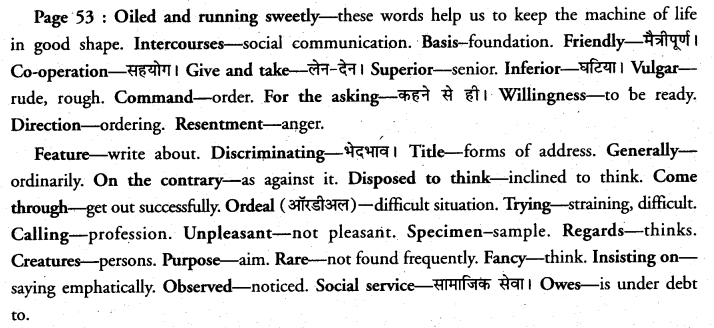
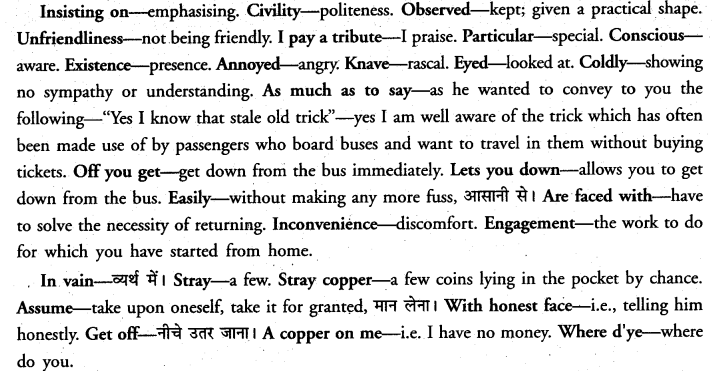
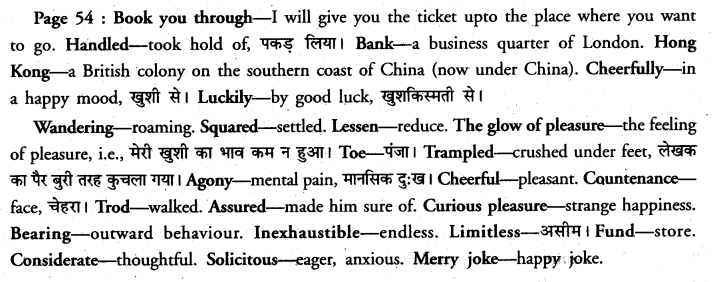
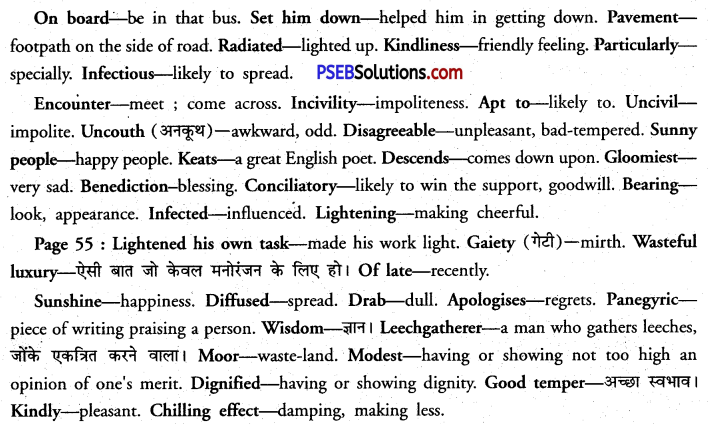
Word Meanings:

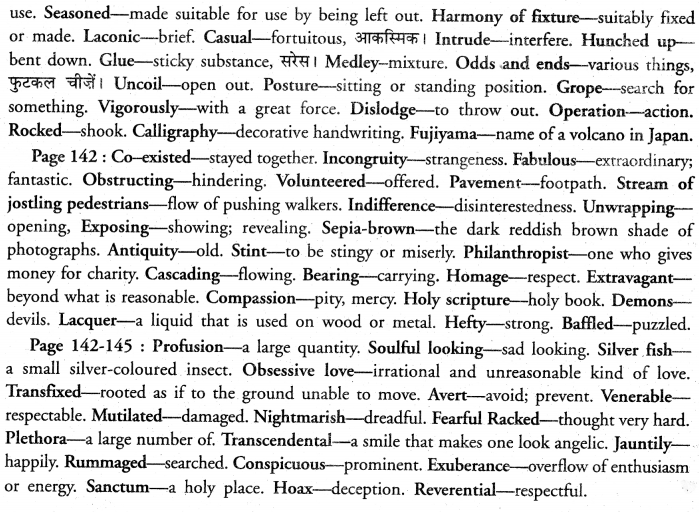
PSEB 12th Class English Solutions Chapter 6 On Saying Please 4
PSEB 12th Class English Solutions Chapter 6 On Saying Please 5

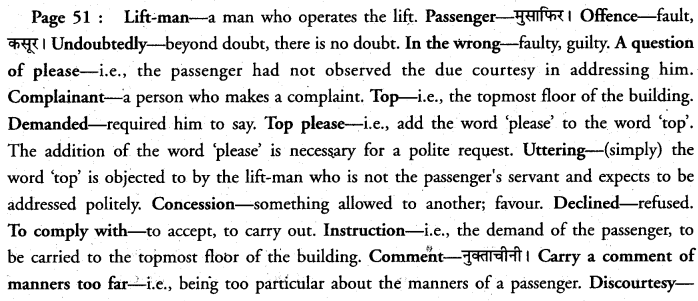
PSEB 12th Class English Solutions Chapter 6 On Saying

PSEB 12th Class English Solutions Chapter 6 On Saying Please 6
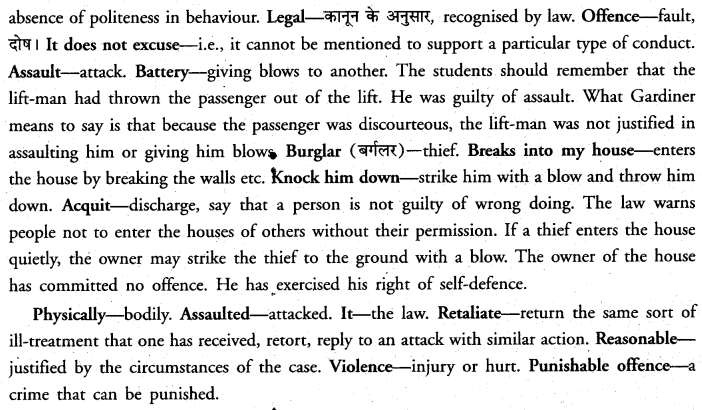
PSEB 12th Class English Solutions Chapter 6 On Saying Please 7
PSEB 12th Class English Solutions Chapter 6 On Saying Please 8
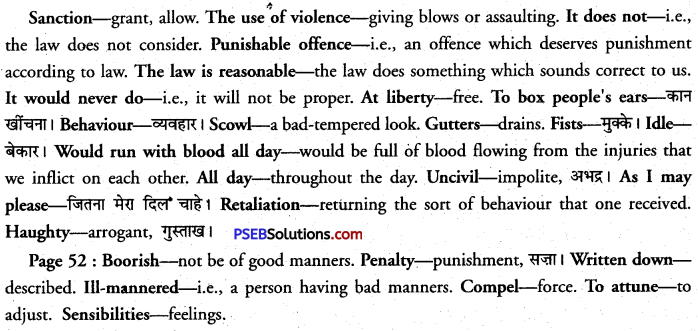
PSEB 12th Class English Solutions Chapter 6 On Saying Please 9

PSEB 12th Class English Solutions Chapter 6 On Saying

PSEB 12th Class English Solutions Chapter 6 On Saying Please 10
PSEB 12th Class English Solutions Chapter 6 On Saying Please 11
PSEB 12th Class English Solutions Chapter 6 On Saying Please 12

PSEB 12th Class English Solutions Chapter 6 On Saying

PSEB 12th Class English Solutions Chapter 6 On Saying Please 13
PSEB 12th Class English Solutions Chapter 6 On Saying Please 14
PSEB 12th Class English Solutions Chapter 6 On Saying Please 15

PSEB 12th Class English Solutions Chapter 6 On Saying

PSEB 12th Class English Solutions Chapter 6 On Saying Please 16

A Rainbow of English 12 Class PSEB Solutions 

The Echoing Green Question Answer Class 12 English Book Poem Chapter 3 PSEB Solutions

Punjab State Board PSEB 12th Class English Book Solutions Poem 3 The Echoing Green Textbook Exercise Questions and Answers.

Class 12th English Book Poem Chapter 3 The Echoing Green Question Answers

The Echoing Green Class 12 Questions and Answers

1. The sun doth arise
And make happy the skies,
The merry bells ring
To welcome the spring
The skylark and thrush
The birds of the bush
Sing louder around
To the bells’ cheerful sound,
While our sports shall be seen
On the Echoing Green.

Word-Notes : The echoing green–the spot where plenty of vegetation, plants, trees, etc. are growing, making it a pleasant place for boys and girls to play the sport. It is echoing with sounds of church bells and birds’ songs etc. The merry bells – the bells of a nearby church. Thrush and Skylark-songbirds who live in bushes.

PSEB 12th Class English Solutions Poem 3 The Echoing Green

Explanation. This poem brings us a scene of a village green on a warm afternoon in the late spring. The sun rises. With the rising of the sun the skies are bright. Happy church bells ring to welcome the spring season. The skylark and the thrush who live in the bushes sing loudly in tune with the cheerful sound of the bells. On the village green plain voices echo. Now the sports played by boys and girls will be seen.

यह कविता हमें बसन्त ऋतु के अन्त में एक गाँव के हरे-भरे मैदान का दृश्य प्रस्तुत करती है। सूर्य उदय होता है। सूर्य उदय होने के साथ आकाश चमकदार प्रतीत होता है। गिरजाघर की घंटियाँ बजती हैं और वे प्रसन्न दिखती हैं। ये घंटियां बसन्त ऋतु का स्वागत कर रही हैं। Skylark और Thrush झाड़ियों में रहने वाले पक्षी हैं। वे ऊँची आवाज में गाते हैं। उनकी आवाज़ घंटियों के बजने के साथ मिल जाती है। गाँव के हरे-भरे मैदान पर लड़कों और लड़कियों की आवाजें गूंजती हैं। अब हम लड़कों और लड़कियों की खेलें देखेंगे।

2. Old John with white hair
Does laugh away care,
Sitting under the oak
Among the old folk.
They laugh at our play,
And soon they all say;
Such, such were the joys
When we all girls and boys.
In our youth time were seen
On the Echoing Green

Word-Notes : Old John-He does not refer to one particular person, but to old men in general.

Explanation. Here the poet says that Old John with grey hair laughs away his cares and worries. The old people keep sitting under the oak tree. They laugh at the play of boys and girls. They say that they were young once. These pleasures of playing on the Echoing Green were also enjoyed by them. According to them, the Echoing Green of the village was a symbol of a happy day.

कवि कहता है कि बूढ़ा John जिसके बाल सफेद हो चुके हैं अब हंसता है और अपनी चिन्ताओं को भूल गया है। बूढ़े लोग बलूत के पेड़ के नीचे बैठते हैं। वे लड़कों और लड़कियों को खेलते हुए देखकर हंसते हैं। वे कहते हैं कि एक बार वे भी जवान थे। वे इस हरे-भरे गूंजते हुए मैदान पर खेलों का मज़ा लिया करते थे। उनके अनुसार गाँव का हरा-भरा मैदान जिस पर शोर भी होता था एक प्रसन्नता वाले दिन का प्रतीक था।

3. Till the little ones, weary,
No more can be merry;
The sun does descend,
And our sports have an end.
Round the laps of their mothers
Many sisters and brothers,
Like birds in their nest,
Are ready for rest,
And sport no more seen
On the darkening Green.

Word-Notes : Weary-tired. Merry-happy. Does descend-come down or set.

Explanation. In these lines the poet says that children are tired and can no longer enjoy the play. The sun is going to set, so the sports of children come to an end. As birds gather round their nests to take rest, children gather near their mothers to fall asleep. And on the Echoing Green, no more sport is seen.

इन पंक्तियों में कवि कहता है कि बच्चे खेलकूद कर थक जाते हैं। अतः वे खेल का मज़ा नहीं ले सकते। सूर्य अस्त होने वाला है। इसलिए बच्चों की खेल समाप्त हो जाती है। जैसे पक्षी अपने घौंसलों के पास इकट्ठे हो जाते हैं, बच्चे भी अपनी माताओं के समीप आ जाते हैं ताकि वे उनकी गोद में सो सकें और फिर बच्चों के शोर और खेल-कूद से गूंजने वाले हरे-भरे मैदान में कोई खेल देखने को नहीं मिलती।

PSEB 12th Class English Solutions Poem 3 The Echoing Green

This poem is a little idyll (a happy piece of music in the peaceful countryside) of a village green on a warm afternoon in the spring. Young boys and girls have gathered for fun and frolic through their play. Some old men like John are sitting under the oak tree. Mothers of children also watch their young ones at play. The open green space of playground comes alive with the cheerful shouts of children and the songs of birds.

As the children play, the old people watch them. They are reminded of their own childhood. Old people forget the problems of their lives for the time being. The children go back home at sunset. Birds go to their nests to sleep for the night. The presence of children, birds, men and women on the ground shows the harmony between man and Nature.

यह कविता एक ग्राम काव्य है और इसका दृश्य है बसन्त ऋतु में गाँव का हरा-भरा मैदान जिसमें खेलते हुए बच्चों का शोर और पक्षियों के चहचहाने की आवाजें भी सुनाई देती हैं। किशोर बालक और बालिकाएं कूदफांद के लिए एकत्रित हुए हैं। Old John जैसे बूढ़े व्यक्ति वहाँ बैठे हुए बच्चों को देख रहे हैं। बच्चों की माताएं भी अपने बच्चों को खेलते हुए देख रही हैं।

वृद्ध व्यक्तियों को बच्चों को खेलते हुए देखकर अपना बचपन याद आता है। वे अपने जीवन की दैनिक समस्याओं को भी भूल जाते हैं। सूर्यास्त होने पर बच्चे अपने-अपने घर चले जाते हैं। पक्षी अपने घौंसलों में चले जाते हैं ताकि वे आराम कर सकें। Echoing Green पर बच्चों, पक्षियों, स्त्रियों और पुरुषों की उपस्थिति यह दर्शाती है कि मनुष्यों और प्रकृति में तालमेल है।

Comprehension Of Stanzas

1. Read the lines given below and answer the questions that follow :

The sun does rise And make happy the skies
The merry bells ring
To welcome the spring.
The skylark and thrush,
The birds of the bush,
Sing louder around
To the bells cheerful sound
While our sports shall be seen
On the Echoing Green.

Questions :
(a) Name the poet and the poem.
(b) Name the birds which sing to welcome the spring.
(c) What purpose does the ringing of the merry bells serve in the poem ?
(d) How can you say that the mood in the poem is happy and carefree, celebrating a close bond between man and nature ? (Imp.)
Answers :
(a) The poet is William Blake and the poem is “The Echoing Green’.
(b) The skylark and the thrush are singing songs to welcome the spring.
(c) People have gathered in some nearby church where bells are ringing and welcoming … the spring season.
(d) The mood in the poem is happy and carefree. The sun has risen and the skies are bright. Happy boys and girls are having fun and frolic. Birds are singing. There
seems to be harmony between Nature and man.

2. Read the lines given below and answer the questions that follow :

Till the little ones weary,
No more can be merry;
The sun does descend
And our sports have an end.
Round the laps of their mothers
Many sisters and brothers
Like birds in their nest
Are ready for rest.
And sport no more seen
On the darkening Green.

Questions :
(a) What do the words weary, descend, an end and rest suggest?
(b) Name the things that take rest at the end of the day.
(c) Why has the echoing green become the darkening green?
(d) Name the figure of speech used in the lines :
Many sisters and brothers Like birds in their nest
Are ready for rest.
(e) Give the rhyme scheme in the first four lines of the passage.
Answers :
(a) They suggest that all activities on the Echoing Green are going to end.
(b) Children, birds, men and women take rest at the end of the day.
(c) The sun sets, night falls and the echoing green becomes the darkening green.
(d) Like birds—-simile.
(e) aa, bb.

The Echoing Green Summary in English

The Echoing Green Introduction:

This poem has been taken from William Blake’s Songs of Innocence. We get a picture of the open green space with the cheerful shouts of children and the songs of birds. As the children play, the older people relax under an oak tree. These old people feel happy as they watch the children at play. They are reminded of their own childhood. John tries to forget the cares and miseries of his life. He thus shares the carefree laughter of the children. The poem shows a link between man and Nature.

The Echoing Green Summary in English:

It is a simple poem. We are taken to the open green space outside a village. We hear cheerful shouts of children and the songs of birds. The sun rises and with it the skies are bright. Happy bells ring to welcome the spring season. The skylark and the thrush who live in the bushes sing loudly in tune with the cheerful sound. While on the green plain where voices echo, our sports will be seen.

PSEB 12th Class English Solutions Poem 3 The Echoing Green

Grey haired old John laughs away his cares and miseries. The old people, sitting under the oak tree, laugh at the play of the children. They say that in their youth also, when they were still boys and girls, these joys (which children have now) were there on this Echoing Green which is a symbol of a happy day.

At last, the little children are tired and can no longer enjoy the play. The sun sets and the play comes to an end. As birds gather around their nests to take rest, children gather near their mothers to fall asleep. On the echoing green, no more sport is seen.

The Echoing Green Summary in Hindi

The Echoing Green Introduction:

यह कविता William Blake के ‘Songs of Innocence’ से ली गई है| इसमे खुले हरे – भरे मैदान का चित्र प्रस्तुत किया गया है जहाँ हमें बच्चों की उल्लास भरी आवाजें गूंजती हुई और पक्षियों के गाने की आवाजें सुनाई देती हैं। जब बच्चे खेलते हैं तब वृद्ध बलूत के पेड़ के नीचे विश्राम करते हैं। यहां वृद्ध लोग बच्चों को खेलते हुए देख कर प्रसन्न होते हैं। उन्हें अपना बचपन याद आ जाता है। कविता आदमी और प्रकृति के बीच एक संबंध प्रकट करती है।

The Echoing Green Summary in Hindi:

यह एक सरल सी कविता है। हम एक गांव के बाहर खुले और हरे-भरे मैदान में पहुंच जाते हैं। हम बच्चों की प्रसन्न चिल्लाहट और पक्षियों के गाने सुनते हैं। सूर्य उदय होता है और आकाश चमकदार दिखाई देता है। बसन्त ऋतु का स्वागत करने के लिए किसी गिर्जे की घंटिया बजती हैं। Skylark (भरल पक्षी) और thrush (बाम्कार पक्षी) जो झाड़ियों में रहते हैं, ऊँची-ऊँची प्रसन्न आवाज़ में गाते हैं। हरे-भरे मैदान में जहाँ आवाजें गूंजती हैं, हमारी खेलें देखी जायेंगी।

सफेद बालों वाला बूढ़ा John अपनी चिन्ताओं और तंग हाली को भूल जाता है। बूढ़े लोग जो बलूत के पेड़ के नीचे बैठे हुए हैं, वे बच्चों की खेलकूद पर हंसते हैं। वे कहते हैं कि जब वे छोटे लड़के थे तब वे भी इस हरे-भरे मैदान में खेलकूद का मज़ा लिया करते थे।  खेलते-कूदते छोटे बच्चे अन्त में थक जाते हैं। सूर्य अस्त हो जाता है और बच्चों के खेल समाप्त हो जाते हैं। जब पक्षी अपने घौंसलों के गिर्द विश्राम करने के लिए इकट्ठे हो जाते हैं, बच्चे अपनी माताओं के पास सोने के लिए चले जाते हैं। हरे-भरे गूंजते हुए मैदान पर खेल बन्द हो जाते हैं।

The Echoing Green Central Idea:

This poem is a little idyll (a happy piece of music in the peaceful countryside) of a village green on a warm afternoon in the spring. Young boys and girls have gathered for fun and frolic through their play. Some old men like John are sitting under the oak tree. Mothers of children also watch their young ones at play.

The open green space of playground comes alive with the cheerful shouts of children and the songs of birds. As the children play, the old people watch them. They are reminded of their own childhood. Old people forget the problems of their lives for the time being. The children go back home at sunset. Birds go to their nests to sleep for the night. The presence of children, birds, men and women on the ground shows the harmony between man and Nature.

The Echoing Green Central Idea in Hindi:

यह कविता एक ग्राम काव्य है और इसका दृश्य है बसन्त ऋतु में गाँव का हरा-भरा मैदान जिसमें खेलते हुए बच्चों का शोर और पक्षियों के चहचहाने की आवाजें भी सुनाई देती हैं। किशोर बालक और बालिकाएं कूदफांद के लिए एकत्रित हुए हैं। Old John जैसे बूढ़े व्यक्ति वहाँ बैठे हुए बच्चों को देख रहे हैं। बच्चों की माताएं भी अपने बच्चों को खेलते हुए देख रही हैं।

PSEB 12th Class English Solutions Poem 3 The Echoing Green

वृद्ध व्यक्तियों को बच्चों को खेलते हुए देखकर अपना बचपन याद आता है। वे अपने जीवन की दैनिक समस्याओं को भी भूल जाते हैं। सूर्यास्त होने पर बच्चे अपने-अपने घर चले जाते हैं। पक्षी अपने घौंसलों में चले जाते हैं ताकि वे आराम कर सकें। Echoing Green पर बच्चों, पक्षियों, स्त्रियों और पुरुषों की उपस्थिति यह दर्शाती है कि मनुष्यों और प्रकृति में तालमेल है।

A Rainbow of English 12 Class Solutions PSEB Poetry

The Gold Frame Question Answer Class 12 English Supplementary Chapter 4 PSEB Solutions

Punjab State Board PSEB 12th Class English Book Solutions Supplementary Chapter 4 The Gold Frame Textbook Exercise Questions and Answers.

Class 12th English Supplementary Chapter 4 The Gold Frame Question Answers

The Gold Frame Class 12 Questions and Answers

Short Answer Type Questions

Question 1.
How does the author describe the shop owned by Datta ? (V.Imp.)
लेखक ने Datta की दुकान का कैसे वर्णन किया है ?
Answer:
The name of Datta’s shop was The Modern Frame Works. But there was no modernity about the structure of the shop. It was actually a very large wooden box fixed on shaky legs. It was tucked in a gap between a medical store and a radio repair shop.

PSEB 12th Class English Solutions Supplementary Chapter 4 The Gold Frame

The walls of the shop were covered by pictures of gods, saints, hockey players, children, national leaders and wedding couples. There were cheap prints of the Mona Lisa, Urdu handwriting sheets and the Japanese volcano Fujiyama. The shop was actually a centre of Datta’s activities.

Datta की दुकान का नाम था ‘The Modern Frame Works’. लेकिन दुकान की बनावट के बारे कोई आधुनिकता नहीं थी। यह वास्तव में एक लकड़ी का बड़ा बक्सा था। (लकड़ी का Kiosk या खोखा था) यह एक दवाईयों की दुकान और एक रेडियो मुरम्मत की दुकान के बीच खाली जगह में खड़ी कर दी दुकान की दीवारों पर देवताओं, सन्तों, हॉकी के खिलाड़ियों, बच्चों, राष्ट्रीय नेताओं और विवाहित जोड़ों की तस्वीरें लगी हुई थी। वहां Mona Lisa, Urdu के सुलेख और जापानी ज्वालामुखी Fujiyama के सस्ते चित्र थे। यह दुकान वास्तव में Datta की गतिविधियों का केन्द्र थी।

Question 2.
What had Datta learnt by his experience ? How was his new customer different from the old ones?
Datta ने अपने अनुभव से क्या सीखा था ? उसका नया ग्राहक उसके अन्य ग्राहकों से कैसे भिन्न था ?
Answer:
Datta had a long experience with his customers. They used to come to him for getting the frames of photos to be made. From his experience Datta knew that his customers never came punctually to carry the frame. Some came days in advance and returned disappointed or they came months later.

Some of the customers never turned up at all. The new customer was eager to have the frame made by Datta. He came to enquire : if it was ready four days before the due date. He wanted to know if it would be attachment to the photograph. He knew that there would be trouble if he did not deliver the frame on the promised date.

Datta का अपने ग्राहकों के साथ लम्बा अनुभव था। वे उसके पास अपने फोटोग्राफों पर फ्रेम लगाने के लिए दे जाया करते थे। अपने अनुभव से दत्ता जानता था कि उसके ग्राहक समय पर अपने फ्रेम लेने नहीं लेट आया करते थे। कई ग्राहक तो कभी भी नहीं आते थे। नया ग्राहक दत्ता द्वारा अपना फ्रेम बनवाने के लिए काफी उत्सुक था।

PSEB 12th Class English Solutions Supplementary Chapter 4 The Gold Frame

वह यह पूछने देय तारीख से चार दिन पहले आ टपका कि क्या उसका फ्रेम तैयार था। वह जानना चाहता था क्या यह मंगलवार तक तैयार होगा। दत्ता समझता था कि नये ग्राहक को फोटो से बड़ी जबरदस्त आसक्ति थी। वह जानता था कि यदि उसने फ्रेम वायदा की गई तारीख को न दिया तो लफड़ा होगा।

Long Answer Type Questions

Question 1.
What impression do you form about Datta, the frame-maker ?
चौखटा बनाने वाले दत्ता के बारे तुम्हारी क्या राये है ?
Answer:
Datta was a frame-maker by profession. He was the owner of The Modern Frame Works. It was a modest shop. It was like a large wooden-box. It was between a medical store and a radio repair shop. Datta did not give the impression of being healthy or stout.

He had a curved figure. He used to sit in his shop. There was hardly any space for the customer to sit there. He sat working on frames for the whole day. He was a silent, hard-working man. He gave brief answers to the questions his customers asked.

He did not allow casual fuends to disturb him in his work. He was always seen sitting and doing his work. He had many things lying around him related with his profession. He had to stand up from time to time to look for a lost piece of wood, a pencil or a glass cutter. The walls of his shop were covered with pictures of actors, sportsmen, gods, national leaders, wedding couples. He used to get several orders from customers for frame-making.

PSEB 12th Class English Solutions Supplementary Chapter 4 The Gold Frame

So he understood the psychology of his customers. He knew how to satisfy them. Some customers were eager to have their order to be carried out in time. Others did not bother. They never came back even once to see if their order for frame-making had been carried out.

Datta was a very diligent and honest worker. He did not deceive anyone. He did not give inferior things to his customers. When he lost the photograph of the customer’s grandfather in the story, he was much worried. He tried to satisfy him by giving him a square mount instead of an oval cut mount ordered by the customer.

व्यवसाय से दत्ता चौखटा बनाने वाला था। वह The Modern Frame Works का मालिक था। यह एक साधारण सी दुकान थी। दुकान एक लकड़ी के बड़े बक्से की तरह थी। यह दुकान एक मेडीकल स्टोर और रेडियो मरम्मत करने वाली दुकान के बीच थी। Datta स्वस्थ और हृष्ट पुष्ट नहीं दिखता था। उसका शरीर अन्दर की ओर मुढ़ा हुआ था।

वह अपनी दुकान में बैठा करता था। ग्राहक के लिए वहां बैठने की कोई जगह नहीं थी। वह सारा दिन फ्रेमों पर काम करता रहता था। वह खामोश रहने वाला परिश्रमी व्यक्ति था। अपने ग्राहकों द्वारा प्रश्नों का वह संक्षिप्त से उत्तर देता था। वह अपने अनियमित मित्रों को अपने काम को अस्त-व्यस्त करने की आज्ञा नहीं देता था। वह सदा अपनी दुकान में बैठा हुआ काम करता दिखाई देता था।

PSEB 12th Class English Solutions Supplementary Chapter 4 The Gold Frame

उसकी दुकान में उसके पेशे से सम्बन्धित कई चीजें पड़ी दिखाई देती थीं। उसे कभी-कभी काम छोड़ कर किसी खोई हुई चीज़ जैसे लकड़ी का टुकड़ा, पैंसिल या शीशा काटने वाला यंत्र ढूंढ़ने के लिए खड़े होना पड़ता था। उसकी दुकान की दीवारें अभिनेताओं, खिलाड़ियों, देवताओं, राष्ट्रीय नेताओं, विवाहित जोड़ों के चित्रों से भरी हुई थीं। उसको फ्रेम बनाने के ग्राहकों द्वारा कई आर्डर दिए जाते थे। इसलिए वह अपने ग्राहकों के मनोविज्ञान को जानता था। वह उनको सन्तुष्ट करना जानता था। कुछ ग्राहक अपने आर्डर को समय पर पूरा करवाने को उत्सुक होते थे।

अन्य परवाह नहीं करते थे। वे एक बार भी पूछने नहीं आते थे कि क्या उनका फ्रेम बनवाने का आर्डर पूरा हो गया था। दत्ता बहुत मेहनती और ईमानदारी कारीगर था। वह किसी को धोखा नहीं देता था। वह अपने ग्राहकों को घटिया चीजें नहीं देता था। जब उसने अपने ग्राहक के दादा की फोटो को गम कर दिया, तो वह बहुत चिन्तित हो गया। उसके ग्राहक ने उसको अंडाकार फ्रेम चढ़ाने का आर्डर दिया था लेकिन उसने उसको वर्गाकार फ्रेम चढ़ाकर सन्तुष्ट करने की कोशिश की।

Question 2.
Datta found a solution to his problem. Did it really work for him ? Justify your answer.
‘Datta ने अपनी समस्या का हल ढूंढ लिया। क्या वह इसमें सचमुच सफल हुआ ? अपने उत्तर को ठीक सिद्ध करें।
Answer:
Datta had to deliver the frame to the new customer. Unluckily he ruined the photograph by dropping paint on it and later on rubbing it hard with cloth. He decided to find a similar photograph and frame it. He feared that the customer

might discover that it was a fake photograph. So he got a photograph from the box which looked like the old man’s double. He looked resplendent in his gold frame. He forgot that he was taking one of the greatest risks any frame-maker took.

He became bold enough to challenge the customer. If his faking was discovered, he was ready to reject the issue of faking if the new customer said so. The customer came and asked Datta if the frame was ready.

At this very time the customer uttered some flattering words to Datta for his promptness. He spread his arms widely with enthusiasm. Datta however took some time in removing the wrapper from the frame. He finally revealed the glittering frame and held it towards the customer. The customer seemed very much impressed by its beauty.

PSEB 12th Class English Solutions Supplementary Chapter 4 The Gold Frame

Datta wondered if the customer would discover the trick he had played on him. He told Datta angrily that he had asked for a cut mount with an oval shape but he had given him a square one. Datta had already prepared himself for such a situation.

The situation was open-ended. The customer would have discovered even the person in the photo was a fake one. The needle of suspicion on Datta’s integrity would be there. So his justification was still far away.

Datta ने नए ग्राहक को फ्रेम देना था। दुर्भाग्यवश उसने फोटो पर पेंट डाल कर और बाद में उसने इस को कपड़े से रगड़ कर खराब कर दिया। उसने निर्णय किया कि वह एक वैसा ही फोटो ढूंढकर उस पर फ्रेम चढ़ा देगा। उसको डर था कि कहीं ग्राहक को पता न लग जाये कि यह नकली फोटो है। इसलिए उसने अपनी दुकान में पड़े एक बक्से में से एक फोटो निकाला जो ग्राहक के दादा की शक्ल से मिलताजुलता था।

वह gold frame में बहुत समुजवल लगता था। वह यह भूल गया कि वह एक ऐसा जोखिम ले रहा था जो आज तक किसी चौखटा बनाने वाले ने लिया हो। वह ग्राहक का सामना करने के लिए पर्याप्त रूप से साहसी बन गया। यदि उसकी जालसाजी पकड़ी गई तो वह नए ग्राहक द्वारा कही गई जालसाजी की बात को रद्द कर देगा।

ग्राहक आया और उसने पूछा क्या फ्रेम तैयार था। ग्राहक ने इसी समय चापलूसी के कुछ शब्द दत्ता को उसकी तत्परता के लिए कहे। उसने उत्साह में अपनी बाहें फैला दीं। लेकिन दत्ता ने चौखटे पर से आवरण हटाने में कुछ समय लिया। Datta ने अन्त में चमकते हुए फ्रेम को दिखला दिया और इसे उसके सामने कर दिया। ग्राहक इस की सुन्दरता से बहुत प्रभावित हो गया।

परन्तु फिर उसने दत्ता को क्रोध भरे शब्दों में कहा कि उसने अण्डाकार फोटो फ्रेम चढ़ाने के लिए कहा था लेकिन उसने उसे वर्गाकार करके चढ़ा दिया है। दत्ता ने पहले ही स्वयम् को इस स्थिति के लिए तैयार कर रखा था। यह एक खुली स्थिति थी। ग्राहक को इस बात का भी पता चल सकता था कि फोटो भी और किसी की थी। Datta की ईमानदारी के ऊपर शक की सुई ज़रूर संकेत करती है। इसलिए दत्ता का अपने आप को ठीक सिद्ध कर लेना दूर की बात है।

Objective Type Questions

This question will consist of 3 objective type questions carrying one mark each. These objective questions will include questions to be answered in one word to one sentence or fill in the blank or true/false or multiple choice type questions.

Question 1.
Where was the shop ‘The Modern Frame Works’ situated ?
Answer:
It was situated in an empty space between a medical store and a radio repair shop.

Question 2.
Who was the owner of ‘The Modern Frame Works’ ?
Answer:
Datta was its owner

Question 3.
What were the walls of this shop covered with ?
Answer:
They were covered with pictures of gods, saints, hockey players, children, cheap prints of the Mona Lisa, National Leaders, wedding couples, Urdu handwriting sheets, the snow-clad volcano, Fujiyama etc.

PSEB 12th Class English Solutions Supplementary Chapter 4 The Gold Frame

Question 4.
What did the customer want ?
Answer:
The customer wanted a photograph of his grandfather to be framed.

Question 5.
What types of frames did Datta show to the customer ?
Answer:
Datta showed the customer a number of samples : plain, decorative, floral, geometrical, thin, hefty and so forth.

Question 6.
What did Datta do to help the customer to make his choice ?
Answer:
Datta recommended one frame with a number of gold leaves and winding creepers, imported from Germany.

Question 7.
What price did Datta quote for the frame selected by his customer ?
Answer:
The price quoted was rupees seventeen.

Question 8.
What was Datta’s experience about his customers ?
Answer:
His experience was that his customers never came punctually to collect their photoframes.

Question 9.
For whom did Datta make frames ?
Answer:
Datta made frames for those who wanted to show or pay their homage to the person in the picture.

Question 10.
How did the photograph get damaged ? (V.V. Imp.)
Answer:
First a tin of paint emptied on the photograph and later efforts to clean the paint damaged the photograph.

Question 11.
How did Datta try to rescue the picture ?
Answer:
Datta rubbed the fallen paint on the picture very hard and made a mess of it.

Question 12.
What solution did Datta finally come up with?
Answer:
He thought of putting the old man’s double in a golden frame to pass it on to his customer.

Question 13.
Why were the days that followed were filled with suspense and anxiety?
Answer:
They were filled with suspense and anxiety because Datta feared that the customer would catch him at an odd moment.

Question 14.
What effect did the picture have on the customer?
Answer:
The customer was struck by the beauty of the frame and became mum.

Question 15.
What was the customer’s complaint regarding the frame ?
Answer:
He complained that the frame-maker had given him a square frame instead of the oval shape ordered by him.

PSEB 12th Class English Solutions Supplementary Chapter 4 The Gold Frame

Question 16.
The Modern Frame Works was one of these : (Choose the correct name) a shop, a workshop, a factory.
Answer:
a shop.

Question 17.
The name of the shop was :
(i) The Ancient Frame Works
(ii) The Lovely Frame Works
(iii) The Modern Frame Works.
Answer:
(iii) The Modern Frame Works.

Question 18.
A large wooden packing case was placed on ………….. legs to make it look like a shop. Fill up the blank with the correct option : (strong, weak, shaky)
Answer:
shaky.

Question 19.
How did the frame-maker sit in his shop ?
Answer:
He sat hunched up.

Question 20.
Datta, the frame-maker did not have a ……….. body. (weak/strong)
Answer:
strong.

Question 21.
The frame-maker wore one of these glasses :
(i) Spectacles
(ii) Silver-rimmed glasses
(iii) Goggles.
Answer:
(ii) Silver-rimmed glasses.

Question 22.
List three things by which the frame-maker used to be surrounded.
Answer:
Card-board pieces, sheets, boxes of wood.

PSEB 12th Class English Solutions Supplementary Chapter 4 The Gold Frame

Question 23.
What happened to Datta’s shop when he shook his dhoti to get some of the lost things?
Answer:
His whole shop shook.

The Gold Frame Summary in English

The Gold Frame Introduction:

This story has been written by R.K.Laxman who was India’s greatest cartoonist. He was well-known for his creation The Common Man’. The story is about a picture frame maker Datta. He was a silent and hard-working man. One day a customer came to his shop.

He wanted a frame for a photograph he had brought with him. It was a photograph of his late grandfather. The customer wanted the best frame for the photograph. Datta promised to keep it ready in two weeks. But by mistake the picture got damaged.

He found some other picture of a similar looking man. The customer failed to know that it was not the picture of his grandfather. His only complaint was that the picture was not framed according to his order.

The Gold Frame Summary in English:

The Modern Frame Works was the name of a shop. It was not a shop made of bricks and cement and wood. It was a very large wooden packing case. It was placed on shaky legs. It was fixed in an empty space between a medical store and a radio repair shop.

PSEB 12th Class English Solutions Supplementary Chapter 4 The Gold Frame

Datta was its owner. He did not have a strong body. He wore silver-rimmed glasses. He had the complexion of seasoned timber. Datta was a silent, hard-working man. He gave very brief answers to his customers. He did not encourage casual friends to come to his shop. He was always seen sitting hunched

up. He was surrounded by cardboard pieces, bits of wood, glass sheets, boxes of nails, glue bottles, paint-tins and other things needed for putting a picture in a frame. In this mixture of things a glass cutter or a pencil, a tub was often lost. Then he looked for his missing things impatiently.

Many times he had to stand up and shake his dhoti to get the lost thing. This operation shook his whole shop. The pictures on the walls gently went on swinging.

Every inch of space in the shop was covered by a picture. Several odd things were lying in his shop. One day a customer standing outside the shop told Datta that he wanted a picture framed. Datta just ignored him and went on driving screws into the sides of a frame.

He wanted a good job to be done without bothering about its cost. The customer placed before Datta a photograph of an old man. It was a good bright photograph.

Datta remained bent over his work. He asked the customer what kind of frame he would want for the photograph. The customer wanted the best kind of frame. Datta then saw the photograph. He was an elderly person of those days. It was the standard portrait of a grandfather.

At least half a dozen people came to him every month bringing similar portraits. They wanted to show their respect to the person in the picture in the shape of a glittering frame.

The customer began to describe the qualities of the man in the picture. He said that he was kind, noble, charitable. If there had been a few more persons like him, it would have been a different place. Of course, there are some wicked people who are out to disagree with him. The customer says that his grandfather is God in his home. Datta then asked the customer what kind of frame he wanted. The customer said that he wanted the best.

PSEB 12th Class English Solutions Supplementary Chapter 4 The Gold Frame

He said that he did not have inferior stuff in his shop. He was shown a number of samples. The customer was puzzled by seeing so many varieties of frames. He did not want a cheap frame for his grandfather’s portrait. Datta recommended a frame with a number of gold leaves and winding creepers. He also told the customer that this frame was imported from Germany.

The customer felt impressed. Datta asked the customer if he wanted a plain mount or a cut mount. The customer felt puzzled. He had no answer. Datta told him that a cut mount would look better. He said that the total expense would be seventeen rupees.

The customer tried to bargain. Datta did not reply to the customer and returned to his corner. The customer then asked Datta when it would be ready. He said that it would be ready within two weeks from the day.

Datta knew from his experience that his customers did not come punctually. They came days in advance and went away disappointed or they came months later and some never turned up at all. So he made frames for those who came to him and visited him at least twice before he actually executed their orders.

Ten days later the customer came and enquired if the picture had been framed. Datta merely nodded his head. He wanted to know if the frame would be ready by Tuesday. Datta decided to get the frame ready. Next morning he made that his first job. Then he looked for the pencil to mark the measurements. As usual the picture was missing. He felt angry. Then he stood up to shake up the folds of his dhoti. But still he could not get the picture.

He upset the tin containing enamel paint and it landed right on the sacred photograph of the old man emptying its contents on it. Datta felt very much upset. Then the glasses of his spectacles clouded with perspiration and screened his vision.

He wanted to save the picture but he made a worse mess of it. He rubbed the picture so hard with a cloth. The old man’s face was nearly gone. He was feeling absolutely hopeless. He could not make out what answer he would give to his customer when he came to ask for the frame.

He had no way to tackle the problem: The gods in pictures on the walls seemed to tell him that he should pray. He stared at the gods. Datta looked at a photograph on the wall of his shop. He looked at so many photographs lying in the wooden box. He worked very hard at finding the old man’s substitute. After a couple of hours work, he proudly surveyed the old man’s double.

PSEB 12th Class English Solutions Supplementary Chapter 4 The Gold Frame

He thought of taking a similar photograph. He feared that his customer might challenge him to say that it was a fake photograph of his grandfather. In that case, he thought of telling the customer that he had brought that picture for framing. He could take it or leave it. The days that followed were filled with anxiety and suspense.

The customer turned up after a few days later and asked Datta if his picture frame was ready. Datta gave the framed photograph to the customer. The customer was very much impressed by the beauty of the frame. The frame-maker was afraid and nervous.

He feared that the customer would come to know that somebody else’s photo had been framed. The customer told the frame-maker that he had asked for a cut mount with an oval shape. But he had given him the frame with a square look. Obviously it had not been according to his order.

The Gold Frame Summary in Hindi

The Gold Frame Introduction:

यह कहानी R.K.Laxman ने लिखी है जो कि भारत का सबसे बड़ा Cartoonist (व्यंग्य चित्रकार) था। वह अपनी रचना ‘The Common Man’ के नाम से बहुत जाना जाता था। यह कहानी एक फोटो के चौखटा बनाने वाले के बारे है जिसका नाम दत्ता था। वह एक खामोश और परिश्रमी व्यक्ति था।

एक दिन एक ग्राहक उसकी दुकान पर आया। वह अपने साथ एक फोटोग्राफ लाया और उसके लिए उसे एक चौखटा चाहिये था। यह फोटो उसके स्वर्गीय दादा जी की थी। ग्राहक को उस फोटो के लिए बेहतरीन चौखटा (frame) चाहिये था। दत्ता ने वादा किया वह इस फ्रेम (चौखटा) को दो हफ्तों में तैयार कर देगा।

PSEB 12th Class English Solutions Supplementary Chapter 4 The Gold Frame

लेकिन गल्ती से चित्र क्षतिग्रस्त हो गया। उसको इस फोटोग्राफ से मिलता-जुलता एक और फोटोग्राफ मिल गया। ग्राहक को यह पता न लग सका कि यह उसके दादा जी का फोटोग्राफ नहीं था। उसको केवल यही शिकायत थी कि चौखटा उसके आर्डर के अनुकूल नहीं बनाया गया था।

The Gold Frame Summary in Hindi:

The Modern Frame Works एक दुकान का नाम था। यह दुकान ईटों और सीमेन्ट और लकड़ी की नहीं बनी हुई थी। यह एक बहुत बड़ी लकड़ी की पेटी या बक्सा था। यह अस्थिर या हिलने-जुलने वाले पायों पर खड़ी थी। इसको एक खाली स्थान में एक Medical store और एक रेडियो मुरम्मत करने वाली दुकान के मध्य में जमा दिया गया था या अचल कर दिया था। Datta इसका मालिक था। उसका शरीर कोई मज़बूत नहीं था।

वह चाँदी के फ्रेम वाला चश्मा पहनता था। उसका रंग पूर्णरूप से तैयार सिझायी की गई लकड़ी की तरह था। . Datta एक खामोश और परिश्रमी व्यक्ति था। वह अपने ग्राहकों को बड़े संक्षिप्त उत्तर दिया करता था।

वह आकस्मिक मित्रों को अपनी दुकान पर नहीं आने दिया करता था। वह सदा झुके हुए बैठा देखा जा सकता था। उसके इर्द-गिर्द गत्ते के टुकड़े, लकड़ी के टुकड़े, शीशे की शीटें (चादरें), कीलों के डिब्बे, चिपकाने वाली गोंद की बोतलें, पेंट के डिब्बे और अन्य छोटी-2 चीजें पड़ी रहती थीं। ये सब चीजें picture को frame (चौखटा) में लगाने के लिए आवश्यक थीं। इन चीजों के मिले-जुले होने के कारण glass काटने वाला यन्त्र या एक पैंसिल

का टुकड़ा प्रायः खो जाया करता था। फिर वह अपनी गुमशुदा चीज़ों को बड़ी बेसब्री से ढूंढता था। कई बार उसको खड़े हो कर अपनी धोती को हिलाना पड़ता था ताकि उसको खोई चीज़ मिल सके। इस प्रक्रिया से उसकी सारी दुकान हिल जाया करती थी। दीवार पर टंगी हुई या लगी हुई तस्वीरें बड़ी नर्मी से झूलती थीं।

दुकान का हर इंच स्थान तस्वीर से ढका रहता था। कई अजीब चीजें उसकी दुकान में पड़ी होती थीं। एक दिन दुकान के बाहर खड़े एक ग्राहक ने Datta को बताया कि उसको एक फोटोग्राफ़ पर एक चौखटा चढ़वाना था। Datta ने उसकी ओर ध्यान नहीं दिया और वह एक चौखटा की side में पेंच लगाता रहा।

ग्राहक चाहता था कि वह कीमत की परवाह न करते हुए चौखटे पर अच्छा काम करे। उसने दत्ता के सामने एक बूढ़े व्यक्ति का फोटो रख दिया। यह फोटोग्राफ़ अच्छा और चमकीला था। दत्ता अपने काम पर झुका रहा। उसने ग्राहक को पूछा कि उसको किस प्रकार का फोटो फ्रेम चाहिये। ग्राहक ने कहा कि उसे सबसे बढ़िया फोटो फ्रेम चाहिये।

Datta ने फिर फोटोग्राफ़ देखा। फोटोग्राफ़ का व्यक्ति उन दिनों का बुजुर्ग व्यक्ति था। यह एक दादा का आदर्श फोटोग्राफ़ था। कम से कम आधा दर्जन लोग उसके पास हर रोज़ आते थे और अपने साथ ऐसे ही फोटोग्राफ़ लाते थे। वे चित्र में व्यक्ति के लिए अपना आदर दिखाना चाहते थे और उसके फोटो को एक चमकदार फ्रेम में रखना चाहते थे।

ग्राहक ने फोटोग्राफ़ वाले व्यक्ति के गुणों का बखान करना. आरम्भ कर दिया। उसने कहा कि वह दयालु, भला और उदार था। यदि उस जैसे और व्यक्ति होते, तो संसार भी और तरह का होता। निस्संदेह कुछ बुरे आदमी भी हैं जो उसके साथ सहमत न होंगे। ग्राहक तो यह भी कहता है कि उसके दादा उसके घर में परमात्मा के समान हैं। दत्ता फिर ग्राहक को पूछता है कि उसको किस प्रकार का फ्रेम चाहिए। ग्राहक ने कहा कि उसको सर्वोत्तम फ्रेम चाहिये।

फ्रेम मेकर (Datta) ने कहा कि उसकी दुकान में घटिया माल नहीं है। उसने उसको कई नमूने दिखाये। ग्राहक अपने दादा के लिए कोई सस्ता फ्रेम नहीं चाहता था। Datta ने एक ऐसे फ्रेम की सिफ़ारिश की जिस पर काफी संख्या में सोने के पत्ते थे और ऊपर को जाती हुई बेले थीं। Datta ने ग्राहक को बताया कि यह फ्रेम Germany से मंगवाया गया था।

ग्राहक प्रभावित हो गया। Datta ने ग्राहक से पूछा कि उसे साधारण बनावट या सजावटी बनावट वाला चाहिए। ग्राहक उलझन में था। उसके पास उत्तर नहीं था। Datta ने उसे बताया कि सजावटी बनावट वाला अधिक बढ़िया लगेगा। उसके कहा कि कुल खर्च 14 रुपये होगा। ग्राहक ने सौदेबाजी करने की कोशिश की।

Datta ने ग्राहक को जवाब नहीं दिया और अपने कोने में वापिस लौट गया। तब ग्राहक ने Datta से पूछा कि यह कब तक तैयार होगा। उसने कहा कि यह उस दिन से लेकर दो सप्ताह में तैयार हो जायेगा। Datta अपने अनुभव से जानता था कि उसके ग्राहक फोटो फ्रेम के लिए समय पर नहीं आया करते थे। वे कई दिन पहले आ जाते थे और निराश हो कर चले जाते थे या कई महीनों देर से आया करते थे और कई ग्राहक कभी भी नहीं आते थे।

इसलिए वह फ्रेम उसके लिए बनाता था जो उसके पास कम से कम दो बार उनके order को अमल में लाने से पहले आ जाते थे। दस दिन के बाद ग्राहक आया और उसने Datta से पूछा क्या चित्र को फ्रेम में लगा दिया गया था।

Datta ने केवल अपना सिर हिलाया। वह जानना चाहता था कि फ्रेम मंगलवार तक मिल जायेगा। Datta ने फ्रेम तैयार करने का निर्णय किया। अगली प्रातः उसने उस काम को करना चाहा। फिर उसने पैंसिल को ढूंढना शुरु किया ताकि वह माप ले सके। Pencil गुम थी। उसे क्रोध आ गया।

PSEB 12th Class English Solutions Supplementary Chapter 4 The Gold Frame

फिर वह खड़ा हो गया और उसने अपनी धोती की तहों को हिलाया। लेकिन फिर भी उसको फोटो नहीं मिली। उसने enamel पेंट से भरे हुए डिब्बे को उलट दिया और यह पेंट उस बूढ़े के पवित्र फोटोग्राफ पर जा गिरा। तब Datta घबराकर अशान्त हो गया। फिर उसके चश्मे के शीशे पसीने के कारण मद्धम हो गये और उसकी नज़र पर बादल की तरह दिखने लगे।

Word Meanings:

PSEB 12th Class English Solutions Supplementary Chapter 4 The Gold Frame 1
PSEB 12th Class English Solutions Supplementary Chapter 4 The Gold Frame 2

Class 12 PSEB Solutions Supplementary Reading

Bholi Question Answer Class 12 English Supplementary Chapter 3 PSEB Solutions

Punjab State Board PSEB 12th Class English Book Solutions Supplementary Chapter 3 Bholi Textbook Exercise Questions and Answers.

Class 12th English Supplementary Chapter 3 Bholi Question Answers

Bholi Class 12 Questions and Answers

Short Answer Type Questions

Question 1.
Ramlal was not worried about his children except Bholi. Why? (Feb. 2017)
रामलाल को भोली के सिवा किसी और बच्चे की चिन्ता नहीं थी। क्यों ?
Answer:
Ramlal had seven children. They were three sons and four daughters. Bholi was the youngest of the four. Ramlal was a prosperous farmer. All the children except Bholi were healthy and strong. The sons had been sent to the city to study in schools and later in colleges.

The eldest daughter Radha had already been married. The second daughter Mangla’s marriage had also been settled. After Mangla’s marriage, he would think of the third Champa. They were good-looking and healthy girls. It was not difficult to find bridegrooms for them. But Ramlal was worried about Bholi. She was neither good-looking nor intelligent. He felt that it would be very difficult to find a bridegroom for Bholi.

PSEB 12th Class English Solutions Supplementary Chapter 3 Bholi

रामलाल के सात बच्चे थे। वे थे तीन बेटे और चार बेटियां। भोली चारों बेटियों में से सबसे छोटी थी। रामलाल एक समृद्ध किसान था। भोली के सिवा सब बच्चे स्वस्थ और हष्ट-पुष्ट थे। लड़कों को शहर भेज दिया गया ताकि पहले वे स्कूल में पढ़ें और फिर कॉलिज में। सबसे बड़ी लड़की राधा की पहले ही शादी हो चुकी थी।

दूसरी लड़की मंगला की शादी भी तय हो चुकी थी। मंगला की शादी के बाद, वह तीसरी बेटी चम्पा के बारे विचार करेगा। वे सुन्दर और स्वस्थ लड़कियाँ थीं। उनके लिए दूल्हे ढूंढ लेना कोई मुश्किल नहीं था। परन्तु रामलाल को भोली के बारे बहुत चिन्ता थी। उसने महसूस किया कि भोली के लिए दूल्हा ढूंढ़ लेना बहुत कठिन होगा।

Question 2.
Write in brief a character-sketch of Bholi’s teacher. (V. Imp.) (Feb. 2017)
संक्षेप में भोली की अध्यापिका का चरित्र-चित्रण करें।
Answer:
Bholi’s teacher was a kind lady. She asked Bholi her name. Being a stammerer Bholi said BHO…BHO…BHO. She could not go further than Bho. The school bell rang. Her teacher again called her in a very soothing voice. The kind teacher asked Bholi her name again. For the sake of this kind teacher she decided to make an effort. Bholi knew that she would not laugh at her.

She began to stammer. The teacher encouraged her. She asked Bholi to tell her. full name. At last with the teacher’s sympathetic encouragement, she was able to say her name. She was an ideal teacher.

भोली की टीचर एक दयालु महिला थी। उसने Bholi को उसका नाम पूछा। एक हकलाने वाली होने के नाते Bholi ने Bho…Bho…Bho रुककर कहा। वह Bho कहने के बाद आगे न जा सकी। स्कूल की घंटी बजी। टीचर ने फिर भोली को बुलाया। उसने सन्तोष देने वाली आवाज़ में उसको बुलाया। दयालु टीचर ने भोली को फिर उसका नाम पूछा।

दयालु टीचर की खातिर भोली ने प्रयत्न करने की कोशिश की। भोली जानती थी कि वह उस पर नहीं हंसेगी। टीचर उसको हिम्मत देती थी। टीचर भोली की हिम्मत बढ़ाती थी। यह वह टीचर थी जिसने भोली को आत्मनिर्भर, विश्वस्त और दलेर बनने के लिए तैयार किया जोकि पहले एक गूंगी गाय थी।

वह अपना नाम साफ-2 बोलने में सक्षम हो गई। उसने एक लालची, कमीने, कायर और घृणा योग्य पति के साथ शादी करने से इन्कार कर दिया। उसने उसी स्कूल में टीचर बन कर पढ़ाने का मन बना लिया। उसने इस टीचर से बहुत कुछ सीखा था। वह भी लड़कियों में जागृति पैदा करेगी।

PSEB 12th Class English Solutions Supplementary Chapter 3 Bholi

Question 3.
Write in brief a character-sketch of Bishamber.
संक्षेप में बिशम्बर का चरित्र-चित्रण करें।
Answer:
Bishamber was a greedy man. His greed came to be known to Bholi on their wedding day. He had to garland Bholi in the marriage mandap. He sair pockmarks on her face. He asked his friend if he had seen pock-marks on her face.

His friend told him that he was not young either. But he said that Bholi’s father must give him five thousand rupees. Ramlal had to give him the demanded amount. Bishamber felt victorious. Bholi refused to marry such a greedy man. Bishamber had to go back with his marriage party.

बिशम्बर लालची आदमी था। भोली को बिशम्बर के लालच का ज्ञान उनकी शादी के दिन ही पता चल गया। उसको शादी के मंडप में भोली को हार पहनाना था। उसने उसके चेहरे पर चेचक के धब्बे देख लिये। उसने अपने मित्र को पूछा क्या उसने भोली के चेहरे पर चेचक के धब्बे देखे थे।

उसके मित्र ने उसको उत्तर दिया कि वह भी तो नौजवान नहीं था। लेकिन उसने कहा कि भोली के पिता को उसे 5 हज़ार रुपये अवश्य देने चाहिए। रामलाल को उसे मांगी गई धन-राशि देनी पड़ी। बिशम्बर ने अपने आपको विजयी समझा। भोली ने ऐसे लालची आदमी से शादी करने से इन्कार कर दिया। बिशम्बर को अपनी बारात के साथ वापस लौटना पड़ा।

PSEB 12th Class English Solutions Supplementary Chapter 3 Bholi

Long Answer Type Questions

Question 1.
Describe, in brief, the early childhood of Bholi.
संक्षेप में Bholi के बचपन के प्रारम्भिक दिनों का वर्णन करे।
Answer:
Her real name was Sulekha. But since her childhood everyone had been calling her Bholi, the simpleton. She was the fourth daughter of Numberdar Ramlal. When she was ten months old, she had fallen off the cot on her head. This had damaged some part of her brain. She became a mentally retarded child. So she was called Bholi, the simpleton.

At birth, she was very pretty and fair. At the age of two, she had an attack of smallpox. Her eyes were safe but her entire body got permanently disfigured by deep black pock marks. She could not speak till she was five. Then she used to stammer. The other children often made fun of her. So she talked very little. She was one of the seven siblings.

She had three sisters and three brothers. Her brothers had gone to the city to study in schools and later in colleges. Her sisters were healthy and good-looking. Bholi was neither good-looking nor intelligent.

PSEB 12th Class English Solutions Supplementary Chapter 3 Bholi

उसका असली नाम सुलेखा था। लेकिन उसके बचपन से ही सब उसको भोली कह कर बुलाते थे, भोली बुद्ध। वह नम्बरदार रामलाल की चौथी बेटी थी। जब वह दस महीने की हुई तो वह अपनी चारपाई से अपने सिर के बल गिर गई। इसने उसके दिमाग के किसी भाग में क्षति पहुँचाई थी। वह दिमागी तौर पर एक पिछड़ा हुआ बच्चा बन गई।

इस लिए उसको बुद्ध Bholi कहकर पुकारा जाने लगा। अपने जन्म के समय वह बहुत गोरी-चिट्टी थी। दो साल की आयु में उसे चेचक का आक्रमण हो गया। उसकी आँखें तो सुरक्षित रहीं लेकिन सारा शरीर काले चेचक के धब्बों से स्थाई तौर पर बदशक्ल हो गया। पाँच वर्ष की आयु से पहले वह बोल भी नहीं सकती थी।

फिर वह हकलाती थी। दूसरे बच्चे प्रायः उसका मजाक उड़ाते थे। इसलिए वह बहुत कम बातें करती थी। वह सात भाई-बहनों में एक थी। उसके तीन भाई और तीन बहनें थीं। उसके भाई शहर में पहले स्कूल और फिर कॉलिज में पढ़ने के लिए चले गये थे। उसकी बहनें स्वस्थ और देखने में सुन्दर थीं। Bholi न देखने में सुन्दर थी न बुद्धि वाी थी।

Objective Type Questions

This question will consist of 3 objective type questions carrying one mark each. These objective questions will include questions to be answered in one word to one sentence or fill in the blank or true/false or multiple choice type questions.

Question 1.
How many siblings did Bholi have ?
Answer:
Bholi had six siblings-three brothers and three sisters.

Question 2.
Why was Sulekha called Bholi ?
Answer:
Because of damage to her brain, she became a backward child and so was called Bholi, the simpleton.

PSEB 12th Class English Solutions Supplementary Chapter 3 Bholi

Question 3.
What was the effect of small-pox on Bholi ?
Answer:
Her body was permanently disfigured.

Question 4.
Why did children make fun of Bholi ?
Answer:
They made fun of her because of her stammering.

Question 5.
Why was Ramlal worried about Bholi ?
Answer:
He was worried about Bholi because she had neither good looks nor intelligence for getting married.

Question 6.
Why did the Tehsildar come to the village ?
Answer:
He came to the village to perform the opening ceremony of the primary school.

Question 7.
Why did the Tehsildar want Ramlal to send his daughters to the school ?
Answer:
He wanted Ramlal to do this as he must set an example to the villagers being an agent of the government in the village.

Question 8.
Why did Ramlal’s wife agree to send Bholi, but not other daughters to school ? (V.V. Imp.)
Answer:
She agreed to send Bholi to school because she had no chance of getting married with her ugly face and lack of sense ; other beautiful daughters had no chance of getting married, if they went to school.

PSEB 12th Class English Solutions Supplementary Chapter 3 Bholi

Question 9.
Why was Bholi glad to see so many girls of her own age at school ?
Answer:
She was glad because she hoped that one of these girls would become her friend.

Question 10.
What happened when the teacher asked Bholi her name?
Answer:
Sweat broke out over her whole body but then she stammered her name Bho-Bho Bho.

Question 11.
Why did Bholi’s parents agree to Bishamber’s proposal for Bholi ?
Answer:
They agreed to the proposal fearing if they did not accept it, she may remain unmarried all her life.

Question 12.
How did Bishamber come to wed Bholi ?
Answer:
Bishamber came to wed Bholi with a big party of friends and relatives on a decorated horse and led by a band.

Question 13.
Why did Bishamber demand five thousand rupees as dowry?
Answer:
He wanted five thousand rupees as dowry as his would-be wife Bholi had pock marks on her face.

Question 14.
Why did Bholi refuse to marry Bishamber?
Answer:
She did not want to marry a mean, greedy and hateful coward as Bishamber.

Question 15.
Bishamber was a heartless man. (True/False)
Answer:
True.

PSEB 12th Class English Solutions Supplementary Chapter 3 Bholi

Question 16.
An old woman said that Bholi was a ………… girl. (Fill up the blank with a suitable word) (shameless/proud)
Answer:
shameless.

Question 17.
Bishamber demanded a dowry of 5000 rupees from Bholi’s father. (True/False)
Answer:
True.

Question 18.
Bholi’s school teacher felt the satisfaction of …… (Choose the correct option)
(i) a singer
(ii) a dancer
(iii) an artist.
Answer:
(iii) an artist.

Question 19.
Write how Bholi used three pauses in telling her name.
Answer:
Bho-Bho-Bho-Bholi.

Question 20.
Bholi had neither beauty nor intelligence. (True/False)
Answer:
True.

Question 21.
Bishamber was a …………… by profession. (labourer/dancer/grocer)
Answer:
grocer.

Question 22.
Pick up the correct word for Bholi’s trouble in speaking. (stuttering, lisping,stammering).
Answer:
Stammering.

Bholi Summary in English

Bholi Introduction:

This story tells us about a girl named Sulekha who was called Bholi because she was a simpleton. She was a neglected child. She used to stammer. She was disliked and neglected by everyone. So she had an inferiority complex. She was guided by her primary school teacher properly.

PSEB 12th Class English Solutions Supplementary Chapter 3 Bholi

Her education gave her the courage and capability to fight against her weakness. She refused to marry an elderly man Bishamber Nath who was a greedy person. Her education helped her to be independent. Her right decision made her respectable in her society.

Bholi Summary in English:

She was called Bholi, the simpleton although her name was Sulekha. She was fourth daughter of Numberdar Ramlal. When she was ten months old, she fell off her cot and received an injury on some part of her brain. She remained a backward child.

She came to be known as Bholi, the simpleton. At her birth, she was very fair and pretty. At the age of two she had an attack of small-pox. Only her eyes were saved. Her entire body was permanently disfigured by deep black pock-marks.

She could not speak till she was five. When she learnt to speak, she stammered. The other children often made fun of her and mimicked her. As a result, she talked very little. She had three brothers and three sisters. She was the youngest of them all.

Her father was a wealthy farmer. All the children except Bholi were healthy. The brothers had been sent to the city to study in schools and later in colleges. Radha, the eldest girl, was already married.

PSEB 12th Class English Solutions Supplementary Chapter 3 Bholi

The second daughter Mangla’s marriage had also been settled. The third daughter Champa was waiting to be married. They were good looking girls. They would easily get bridegrooms. Ramlal was worried about Bholi. She had neither good looks nor intelligence.

Mangla was married when Bholi was seven. The same year a primary school was opened in their village. The Tehsildar performed the opening ceremony of the school. He told Ramlal, the Numberdar, to send his daughters to school. His wife did not like this idea.

She was of the view if girls went to school, nobody would marry them. But Ramlal did not have the courage to disobey the Tehsildar. Ramlal and his wife sent Bholi to school as she had no chance to get married. He told his wife to dress Bholi in good clothes and send her to school. Previously she used to wear old clothes worn by her sisters.

Ramlal and. Bholi went to school. She was handed over to the headmistress. Bholi was glad to find so many girls of her own age present there. Bholi saw some pictures in the classroom. She felt fascinated by the colours. The teacher stood by her side.

She was smiling. The teacher asked her name. Since Bholi was a stammerer, she could not go further than Bh-Bh-Bho. She began to cry and tears began to flow from her eyes. She kept her head down. She saw the girls were laughing at her.

The school bell rang. All the girls ran out of their classes. The teacher called her in a very soft voice. She asked her to tell her name. She again said Bho-Bho-Bho-Bho. At last she was able to say Bholi. The teacher patted her affectionately and told her that she had done well.

She told Bholi to put the fear out of her heart and then she would be able to speak like everyone else. Bholi said that she would come to school every day. The teacher then told her to take the book.

The book was full of nice pictures and the pictures were in colour—dog, cat, goat, horse, parrot, tiger and a cow. She assured Bholi that she will be given a bigger book. After finishing she will get a still bigger one. In time she will be learned. Then nobody will laugh at her. She told her to come to school every day.

Bholi feit happy. She thought that she was having a new life. Thus the years passed. The village became a small town. Ramlal and his wife settled the marriage of Bholi with one Bishamber Nath who was an old man. He was a well-to do grocer.

His marriage party came in village. Bishamber told his friend in the marriage mandap that his would-be wife had pock marks on her face. His friend told him that it should not matter as he himself was quite old.

But Bishamber told Bholi’s father if he was to marry Bholi, her father must give him five thousand rupees. Ramlal begged Bishamber Nath not to humiliate him. He offered him two thousand rupees. He told him to be merciful. Bishamber told him to give him five thousand rupees.

PSEB 12th Class English Solutions Supplementary Chapter 3 Bholi

Bholi threw a garland of her neck into the fire. She told her father that she was not going to marry this greedy old man who was lame. The guests began to say that she was shameless. Ramlal shouted at Bholi not to disgrace her family. Bholi said that for the sake of her father’s izzat she was willing to marry this lame old man. But now she will not marry such a mean, greedy and hateful coward.

An old woman said that she is a shameless girl. They all thought that she was a dumb cow. She said that the auntie was all right. That is why they had decided to hand her over to that heartless creature. Bishamber. Nath, the grocer, started to go back with his party. Ramlal stood rooted to the ground. His head was bowed low. The flames of the sacred fire slowly died down. Ramlal told Bholi that nobody would marry her.

She told her father not to worry. She said that she will serve her father in her old age. She will teach in the same school. Her teacher was present there. In her smiling eyes there was the light of a deep satisfaction that an artist feels when he sees the completion of his work.

Bholi Summary in Hindi

Bholi Introduction:

यह कहानी हमें एक लड़की के बारे में बताती है जिसका नाम सुलेखा था। उसको Bholi कह कर पुकारते थे क्योंकि वह बुद्ध थी। वह हकलाती थी। वह उपेक्षित बच्ची थी। उसको कोई पसन्द नहीं करता था। इसलिए उसमें हीन भावना थी। उसके प्राईमरी स्कूल की अध्यापिका ने उसको ठीक ढंग से मार्गदर्शन किया।

इसलिए उसकी शिक्षा ने उसको उत्साह और योग्यता प्रदान की ताकि वह अपनी कमज़ोरी के विरुद्ध लड़ सके। उसने एक वृद्ध व्यक्ति बिशम्बर नाथ से विवाह करने से इन्कार कर दिया। वह बहुत लालची आदमी था। उसकी शिक्षा ने उसको अपने पाँव पर खड़ा होने में सहायता की। उसके ठीक निर्णय ने उसको अपनी सोसाईटी में सम्मानित बना दिया।

Bholi Summary in Hindi:

उसको भोली कहते थे, वह बुद्ध थी यद्यपि उसका नाम सुलेखा था। वह नम्बरदार रामलाल की चौथी बंटी थी। जब वह दस मास की थी, वह अपनी चारपाई से गिर गई और उसके दिमाग के किसी भाग में चोट लग गई। वह एक पिछड़ी हुई बच्ची बन गई। उसको भोली, बुद्ध कह कर पुकारा जाने लगा। अपने जन्म के समय वह गोरी चिट्टी थी।

दो साल की आयु में उस पर चेचक का आक्रमण हो गया। केवल उसकी आंखें बची और उसका बाकी शरीर स्थाई तौर पर चेचक के काले निशानों के कारण बदशक्ल हो गया। पाँच साल की आयु तक तो वह बोल भी न सकी। जब वह बोलने लगी तो वह हकलाती थी। दूसरे बच्चे उसका मज़ाक उड़ाते थे और उसकी नकल भी करते थे।

PSEB 12th Class English Solutions Supplementary Chapter 3 Bholi

इसका नतीजा यह हुआ कि वह बहुत कम बातें करती थी। उसके तीन भाई और तीन बहनें थीं। वह आयु में सबसे छोटी थी। उसका बाप एक धनी ज़मींदार था। भोली को छोड़कर उसके सब बच्चे स्वस्थ थे। उसके भाइयों को स्कूल में पढ़ने के लिए शहर में भेजा गया और स्कूल के बाद college में।

सबसे बड़ी लड़की राधा की पहले ही शादी हो चुकी थी। दूसरी बेटी मंगला की शादी भी तय हो चुकी थी। तीसरी बेटी चम्पा शादी होने की प्रतीक्षा कर रही थी। वे सुन्दर दिखने वाली लड़कियाँ थीं। उनको आसानी से दूल्हे मिल जाने थे। रामलाल को भोली के बारे में बड़ी चिन्ता थी। न तो उसकी रूपरेखा अच्छी थी और न ही वह बुद्धिमान थी। जब भोली 7 वर्ष की थी तो मंगला की शादी हो गई। उसी वर्ष उनके गांव में एक प्राईमरी स्कूल खुल गया।

स्कूल का उदघाटन समारोह तहसीलदार ने किया। तहसीलदार ने रामलाल नम्बरदार को कहा कि वह अपनी बेटियों को स्कूल भेजे। उसकी पत्नी को यह राय अच्छी नहीं लगी। उसका विचार था कि यदि लड़कियाँ स्कूल पढ़ने जायेंगी तो उनसे कोई विवाह नहीं करेगा। लेकिन रामलाल में इतनी हिम्मत नहीं थी कि वह तहसीलदार का कहना न माने। रामलाल और उसकी पत्नी ने भोली को स्कूल भेज दिया क्योंकि उसके शादी होने का अवसर नहीं था। उसने अपनी पत्नी को कहा कि भोली को अच्छे कपड़े पहनाकर स्कूल भेजे। इससे पहले वह अपनी बहनों के पहने हुए पुराने कपड़े पहना करती थी।

रामलाल और भोली स्कूल गये। उसे headmistress के हवाले कर दिया गया। भोली अपनी आयु की बहुतसी लड़कियां वहां देखकर बहुत खुश हुई। उसने class-room में बहुत से चित्र देखे। वह रंगों को देखकर मन्त्रमुग्ध हो गई। उसकी teacher भी उसके पास खड़ी थी। वह मुस्करा रही थी। Teacher ने उसका नाम पूछा।

चूँकि वह हकलाती थी इसलिए वह अपने नाम को साफ ढंग से बोल नहीं सकी। वह Bho- के आगे न जा सकी। फिर उसने रोना आरम्भ कर दिया और उसकी आंखों से आंसू बहने लगे। उसने अपना सिर नीचे झुका लिया। उसने देखा कि दूसरी लड़कियाँ उस पर हंस रही थीं। इतने में स्कूल की घंटी बजी। सब लड़कियां अपनी classes से बाहर आ गई। भोली की teacher ने उसको बड़ी कोमल आवाज़ में बुलाया। उसने उसको अपना नाम बताने को कहा।

Bho-Bho-Bholi अन्त में वह Bholi कहने में सफल हो गई। टीचर ने बड़े प्यार से उसको थपकी दी और उसको उत्साहित भी किया। टीचर ने भोली को कहा कि वह अपने हृदय से भय को निकाल दे। तब वह सब की तरह साफ-साफ बोल सकेगी। भोली ने यह भी कहा कि वह प्रतिदिन स्कूल आयेगी। Teacher ने उसको कहा कि वह किताब को ले ले।

किताब में अच्छी-अच्छी तस्वीरें थीं और वे सब चित्र रंगीन थे-कुत्ता, बिल्ली, बकरी, घोड़ा, बाघ और गाय। उसने भोली को कहा कि इस किताब को समाप्त करने के बाद उसे इससे बड़ी पुस्तक मिलेगी। उसको समाप्त करने पर उससे भी बड़ी किताब मिलेगी। समय बीतने पर वह काफ़ी कुछ सीख जायेगी। तब कोई भी उसकी हंसी नहीं उड़ायेगा। उसने भोली को कहा कि उसे प्रतिदिन स्कूल आना चाहिए।

PSEB 12th Class English Solutions Supplementary Chapter 3 Bholi

भोली प्रसन्न हो गई। उसने सोचा कि उसका नया जीवन आरम्भ हो रहा है। इस प्रकार वर्ष बीतते गये। गांव एक छोटा नगर बन गया। Ramlal ने भोली की शादी वहां के किरयाने के दुकानदार बिश्म्बरनाथ से कर देने का निर्णय कर लिया। शादी के दिन मंडप में बैठे हुए बिश्म्बरनाथ ने देखा कि उसकी होने वाली पत्नी के चेहरे पर चेचक के दाग हैं। बिश्म्बरनाथ के एक मित्र ने उसको बताया कि भोली के चेहरे पर चेचक के दाग थे।

Word Meanings:
PSEB 12th Class English Solutions Supplementary Chapter 3 Bholi 1

Class 12 PSEB Solutions Supplementary Reading

On Friendship Question Answer Class 12 English Book Poem Chapter 2 PSEB Solutions

Punjab State Board PSEB 12th Class English Book Solutions Poem 2 On Friendship Textbook Exercise Questions and Answers.

Class 12th English Book Poem Chapter 2 On Friendship Question Answers

On Friendship Class 12 Questions and Answers

1. A friend is a gift of God. He’s God’s way of answering our needs.
We nurture a bond of friendship with love and in return we get gratitude
and thanksgiving.
A friend acts like a board that provides strong support in all times.
He is like a fireside that provides us warmth in cold or turbulent times.

PSEB 12th Class English Solutions Poem 2 On Friendship

Word-Notes. Nurture–develop or grow. Bond—a strong connection or feeling of friendship between two people. Gratitude-thankfulness. Board-a medium of support. Like a fireside-like a sympathiser. Cold-not pleasant. Turbulent-disturbed.

Explanation. In these lines the poet says that a friend is a gift given by God to man. God meets our requirements through a friend. We receive a connection of friendship with love and in return we get gratitude or the expression of thanks to God. A friend acts like a platform which is a source of great support to us in all times. As a fireplace gives us comfort in the cold winter nights, similarly a friend provides us warmth or sympathy in all times.

इन पंक्तियों में कवि कहता है कि एक मित्र भगवान का दिया हुआ उपहार है। परमात्मा एक मित्र के साधन से हमारी आवश्यकताओं को पूरा करता है। हमें मित्रता का सम्बन्ध बड़े प्यार से प्राप्त होता है और उसके बदले हमें कृतज्ञता प्राप्त होती है या परमात्मा के शुक्राने की अभिव्यक्ति प्राप्त होती है। एक मित्र एक ऐसे प्लेटफार्म की तरह होता है जो हमारे लिए हर समय सहायता का साधन होता है। चूल्हा सर्दी की रातों को हमें आराम पहुंचाता है। इसी प्रकार एक मित्र हमें हर समय सहानुभूति उपलब्ध करता है।

2. One does not fear to say ‘no’ or ‘yes’ to a friend.
So one can either agree or disagree with friends without any fear
of upsetting them.
One does not need to proclaim one’s love for a friend.
A friend will be able to read thoughts, even if we do not express them.

Word-Notes : Upsetting-making you feel unhappy, angry or annoyed.

Explanation. The poet says that a man says ‘yes’ or ‘no’ boldly to his friend. One may agree or disagree with one’s friend. Friends would never feel angry or annoyed. One does not have to declare one’s love for a friend in so many words. A friend can always read our thoughts even if we do not express them freely or frankly.

कवि कहता है कि आदमी अपने मित्र को बडी दलेरी से हां या न कह देता है। आदमी अपने मित्र से सहमत हो सकता है या असहमत। मित्र किसी भी हालत में नाराज़ या क्रुद्ध नहीं होते। हमें मित्रों के लिए अपने प्रेम को घोषित करने की आवश्यकता नहीं होती। कोई भी मित्र हमारे विचारों को जान सकता है चाहे हम उनको स्वतन्त्र तौर पर या स्पष्ट रूप से व्यक्त नहीं करते।

PSEB 12th Class English Solutions Poem 2 On Friendship

3. We can open our heart to them and share our joys and sorrows with them.
This is what can refresh our hearts like the morning dew.

Word-Notes : Imagery-mental pictures expressed in words. Similes-comparisons. Conveying-communicating. Befitting-suitable.

Explanation. The poet says that friends can talk frankly and openly with friends. They can share joys and sorrows with one another. This exchange of conversation can refresh their hearts like the fresh dew drops. The poet has used very fine imagery. With the help of suitable similes the poet has been able to convey his thoughts and ideas on the subject of friendship.

कवि कहता है कि मित्र आपस में स्पष्टता से और खुलमखुल्ला बातें कर सकते हैं। वे आपस में अपने सुखदुःख की बातें कर सकते हैं। इस वार्तालाप के आदान-प्रदान से वे एक -दूसरे के दिलों को ताज़ा दम बना सकते हैं जिस प्रकार ओस के बिन्दू आदमी को ताज़ा कर देते हैं। कवि ने बहुत अच्छी प्रतिकृति प्रयोग की है। उपयुक्त अलंकारों के प्रयोग से कवि ने अपने विचारों का मित्रता का विषय बड़े उचित ढंग से प्रस्तुत किया है।

4. And a youth said, “Speak to us of Friendship.”
Your friend is your needs answered.
He is your field which you sow with love and reap with thanksgiving,
And he is your board and your fireside.
For you come to him with your hunger and you seek him for peace.
When your friend speaks his mind you fear not the ‘nay’ in your own mind.
Nor do you withhold the ‘yes’.

Word-Notes : Needs-requirements. Answered-fulfilled or met. Sow with loveyou grow with all the care. Reap with thanksgiving—you get the benefits of friendship by the gratitude of your friends.

Explanation. Here the poet says that a young man wanted to be told about the subject of friendship. He gets the answer that friends are there to meet your requirements. Friendship is made and nurtured with love. You get its benefits by the gratitude of friends. A friend is one’s support and provider of sympathy to one’s friends with some requirements. You also go to your friend for consolation. When a friend speaks to you and tells you what is there in his mind, you are not afraid if he says ‘no’. If you have to say ‘yes’, you will not withhold it but you will say ‘yes’ promptly.

यहां कवि कहता है कि एक नवयुवक मित्रता के विषय के बारे जानना चाहता था। उसको यह उत्तर मिलता है कि मित्र इस लिए होते हैं कि तुम्हारी आवश्यकताओं को पूरा किया जा सके। मैत्री प्यार से आरम्भ होती है और प्यार से ही वह फलती-फूलती है। इसका लाभ मित्रों की कृतज्ञता से मिलता है। एक मित्र दूसरे मित्र की सहायता करता है। और वह दूसरे मित्र को सहानुभूति के रूप में उसकी आवश्यकताओं को पूरा करता है। हम सान्त्वना के लिए मित्रों के पास जाते हैं। जब कोई मित्र तुमसे बात करता है और अपने मन की बात करता है, तब तुम्हें यह डर नहीं रहता कि उसका उत्तर ‘न’ में होगा। यदि तुमने ‘yes’ में उत्तर देना है तब भी तुम शीघ्र ही ‘yes’ कह दोगे।

5. And when he is silent your heart ceases not to listen to his heart ;
For without words, in friendship, all thoughts; all desires, all
expectations are born and shared, with joy that is unclaimed.

Word-Notes : Ceases not-does not stop. Expectations-hopes. Unclaimed – not declared.
Explanation. If your friend is silent, it does not mean that you do not listen to what is going on in his heart. When we are friends, all thoughts, desires and hopes are born and shared with undeclared joy even without words.

यदि तुम्हारा मित्र खामोश हो, इसका यह अर्थ नहीं निकलता कि तुम उसको नहीं सुन रहे जो उसके मन में हो रहा हो। जब हम मित्र हों, तब सब विचार, इच्छाएं और आशाएं जन्म लेती हैं और शब्दहीन अघोषित खुशी से सांझेदारी में होती है।

PSEB 12th Class English Solutions Poem 2 On Friendship

6. When you part from your friend, you grieve not.
For that which you love most in him may be clearer in his absence as the mountain to the climber is clearer from the plain.
And let there be no purpose in friendship save the deepening of the spirit.

Word-Notes : Part from-to be away from. Grieve-do not feel sorrowful. Clearerbe more vivid. Plain-flat ground. Save-except. Deepening-strengthening.

Explanation. It is a special feature or characteristic of friendship that we do not feel sad or sorrowful, when we part from our friend. We love our friend for certain qualities. That quality of the friend becomes more prominent when we are away from him. A mountain becomes clearer to a mountain climber from the level ground. Moreover, according to the poet, there is no purpose in friendship except strengthening the spiritual bond between the friends.

मित्रता का यह विशेष लक्षण होता है कि जब हम अपने मित्र से जुदा होते हैं तो हम न तो उदास होते हैं और न ही हमें कोई दुःख होता है। हम अपने मित्रों से उनके गुणों के कारण प्यार करते हैं। हमारे मित्र का गुण अधिक सुप्रकट हो जाता है जब हम उस से दूर हो जाते हैं। एक पर्वत आरोही को मैदान के स्तर से पर्वत. अधिक साफ दिखाई देता है। इसके अतिरिक्त, कवि के अनुसार मित्रता का मंतव्य नहीं होता सिवाये इसके कि दोनों मित्रों के बीच आध्यात्मिक बन्धन को मजबूत करना होता है।

7. For love that seeks aught but the disclosure of its own mystery is not love
but a net cast forth and only the unprofitable is caught.
And let your best be for your friend.
If he must know the ebb of your tide, let him know its flood also.
For what is your friend that you should seek him with hours to kill ?
Seek him always with hours to live.
For it is his to fill your need, but not your emptiness.
And in the sweetness of friendship let there be laughter and sharing of pleasures.
For in the dew of little things, the heart finds its morning and is refreshed.

Word-Notes : Seeks-looks for. Aught—anything. Disclosure—the act of making something known or public. Mystery something that is difficult to understand or to explain. Ebb-the period of time when the sea flows away from the land.

Explanation. The poet talks about the important features of friendship. That friendship cannot be called friendship or love if it is interested in trying to know anything except the mystery of love. In that case it is nothing but a net thrown about. Nothing useful is caught by such a thrown net. You must try to do the best for your friend. If he comes to know the shallowest part of your depth in love, he must also know the peak point of your love.

You should not try to look for your friend only with a view to killing your time. You must seek your friend in order to pass your time with him. Your friend has to meet your requirements. He does not have to do anything to engage you in your idleness. You experience sweetness in the company of your friend. The sweetness of friendship brings us laughter and pleasure. The heart feels refreshed in the sweetness of friendship.

PSEB 12th Class English Solutions Poem 2 On Friendship

कवि मित्रता के महत्त्वपूर्ण लक्षणों के बारे बात करता है। उस मित्रता को मित्रता नहीं कह सकते यदि हम दूसरे मित्र की मित्रता के केवल रहस्य को ही जानना चाहते हैं। उस स्थिति में यह एक फैंका हुआ जाल ही होता है। इस तरह फैंके हुए जाल से कोई लाभदायक चीज़ नहीं मिलती। तुम्हें अपने मित्र के लिए सर्वोत्तम प्रयत्न करना चाहिये। यदि वह तुम्हारे प्यार की कम से कम गहराई को जान सके तो उसे अपने प्यार का शिखर भी दिखाना चाहिये।

तुम्हें अपना मित्र इसलिए नहीं ढूंढना चाहिए ताकि तुम उसके साथ अपना समय नष्ट कर सको। तुम्हें अपने मित्र के साथ अच्छी तरह से समय व्यतीत करना चाहिए। तुम्हारे मित्र ने तुम्हारी मांगों को पूरा करना होता है। उसने तुम्हें अपने पास इसलिए नहीं रखना होता कि वह तुम्हारा समय फजूल ही व्यतीत कर दे। तुम अपने मित्र की संगति में मिठास का अनुभव करते हो। मित्रता की मिठास हमें हंसी और प्रसन्नता उपलब्ध कराती है। मैत्री की मिठास दिलों को ताज़गी देती है।

Comprehension Of Stanzas

1. Read the lines given below and answer the questions that follow :

He is your field which you sow with love and reap with thanksgiving.
And he is your board and your fireside.
For you come to him with your hunger, and you seek him for peace.
When your friend speaks his mind you fear not the ‘nay’ in your own mind.
Nor do you withhold the ‘yes’.

Questions :
(a) Name the poem and its poet.
(b) What is the most important thing that one can give to a friend ?
(c) What do we earn in return when we shower our friend with love ?
(d) How is a friend our fireside ?
Or
Give the figure of speech in the line ……………… He is your field which you sow with love.
Answers:
(a) The name of the poem is ‘On Friendship and its poet is Kahlil Gibran.
(b) Love is the most important thing which we can give to a friend.
(c). When we shower our friend with love, he also responds.
(d) By showing sympathy, our friend acts as our fireside.
Or.
A. The figure of speech used is a metaphor.

PSEB 12th Class English Solutions Poem 2 On Friendship

2. Read the lines given below and answer the questions that follow :

For that which you love most in him may be clearer in his absence as the mountain to the climber is clearer from the plain.
And let there be no purpose in friendship save the deepening of the spirit.
For love that seeks aught but the disclosure of its own mystery is not love but a net
cast forth and only the unprofitable is caught.

Questions :
(a) A mountain appears more clear when one is on the plain, at some distance away. How does the poet relate this statement to understand the value of a friend ?
(b) What should be the main purpose of friendship?
(c) List all the qualities a true friend should have, according to Kahlil Gibran.
(d) A true friend is one with whom we can share our :
(i) Wealth and property.
(ii) Fame and pleasures.
(iii) Joys and sorrows.
Answers :
(a) We love our friend for some great quality. We miss him for this quality when he is away from us. In the same way, a mountain climber can see the mountain more
clearly when he stands on a flat plain at some distance.
(b) The main purpose of friendship is strengthening the spiritual bond between two friends.
(c) A true friend is loving, grateful, supportive, sympathetic, helpful, candid.
(d) Joys and sorrows.

On Friendship Summary in English

On Friendship Introduction:

This is a simple poem. It has been taken from the book ‘The Prophet’. It was written in 1923. The publication of this poem made the writer famous and popular. In this poem, the poet praises the virtues and advantages of having friends.

On Friendship Summary in English:

A friend is God’s gift to us. God meets our requirements through a friend. We develop a bond of friendship with love. Such a bond is accepted by our friend with gratitude. A friend is very dependable and he gives us support in all times. He provides us warmth in cold and disturbed times.

We can be frank and candid with our friends. One does not have any fear while accepting or rejecting a friend’s suggestion about some thing. We do not have to declare our love for our friend every now and then. A friend can easily read the thoughts of a friend even if we do not express them.

We can open our hearts to our friends. We can also share our joys and sorrows with them. By doing so we can refresh our hearts like the morning dew. It has been rightly said that joy shared is joy doubled and sorrow shared is sorrow halved. The poet has used excellent images in the poem. The use of proper similes helps him in conveying his thoughts and ideas in a suitable manner.

A youth wanted to be told about friendship. We have to understand that a friend meets our needs. One develops friendship with love and our love is properly reciprocated by gratitude. A friend is our strong support and he provides us warmth. We go to our friends when we need something. We also go to our friends for peace and consolation. When our friend speaks his mind we do not feel afraid if he says ‘no’ to something. He actually speaks what we have in our mind. If you have something by saying ‘yes’, you promptly say ‘yes’. You do not delay it.

Even when our friend is silent, our heart does not stop listening to what goes on in his mind. Between friends, all thoughts, desires and expectations are born and shared even when they are not openly expressed. When we part from our friends, we do not feel sad or sorrowful.

Because when a friend is absent from us, we remember him for the quality that we like in him the most just as the mountain to the climber is clearer from the plain. The purpose of friendship is after all the deep relationship of two friendly spirits. Love that seeks anything except its own mystery is not love but is a net thrown about. Nothing profitable is caught in the throw of a net for this purpose.

PSEB 12th Class English Solutions Poem 2 On Friendship

A friend always wants to get the best for the sake of his friend. If a friend comes to know that there has been a fall in the intensity of your love, he should also know its peak. That friendship is of no use when you seek your friend to kill your time. You should always seek your friend to live with him. You must seek the company of your friend. It is your friend’s duty to meet your requirement. He does not make you feel idle. Friendship is sweet. There should be sweetness of friendship. There is laughter and sharing of mutual pleasure. Friends feel refreshed if they share the little things of life by being together.

On Friendship Summary in Hindi

On Friendship Introduction:

यह एक सरल सी कविता है। इस को ‘The Prophet’ नामक पुस्तक से लिया गया है। यह 1923 में लिखी गई थी। इस पुस्तक के छपने के बाद लेखक बहुत प्रसिद्ध और लोकप्रिय हो गया। इस सरल कविता में कवि मित्रता के गुणों और लाभों की प्रशंसा करता है।

On Friendship Summary in Hindi:

एक मित्र हमें ईश्वर का दिया हुआ उपहार होता है। परमात्मा मित्र के द्वारा हमारी आवश्यकताओं को पूरा करता है। हम प्रेम द्वारा मैत्री का बन्धन बनाते हैं। हमारा मित्र ऐसे बन्धन को कृतज्ञता से स्वीकार कर लेता है। मित्र पर निर्भर किया जा सकता है और वह हमें हर समय में सहायता करता है। एक मित्र कठिनाई के समय हमें सहानुभूति दिखाता है। हम अपने मित्रों के साथ स्पष्टवादी और निष्कपट हो सकते हैं। अपने मित्र की किसी चीज़ के बारे सलाह को स्वीकार करने या रद्द करने में कोई डर नहीं होता। हमें अपने मित्र के लिए अपने प्रेम को बार-बार घोषित करने की आवश्यकता नहीं होती। एक मित्र दूसरे मित्र के विचारों के बिना व्यक्त करने के समझ सकता है।

हम अपने मित्र के साथ अपने मन की बात कर सकते हैं। हम अपने मित्रों के साथ खुशियों और दुःखों की बातें बांट सकते हैं। ऐसा करने से प्रातः की ओस की तरह हम अपने हृदयों को ताज़ा कर सकते हैं। ठीक ही कहा गया है कि खुशी बांटने से खुशी दुगनी हो जाती है और दुःख बांटने से आधा रह जाता है। कवि ने कविता में विशिष्ट अंलकार प्रयोग किए हैं। उपयुक्त उपमाओं के प्रयोग द्वारा अपने विचारों को व्यक्त करने में उसने सहायता ली है।

एक नवयुवक मित्रता के बारे जानना चाहता था। हमें यह समझना चाहिए कि एक मित्र हमारी आवश्कताओं को पूरा करता है। हम प्यार द्वारा मैत्री पैदा करते हैं और हमारे प्रेम का उपयुक्त आदान-प्रदान कृतज्ञता से होता है। एक मित्र हमारा बड़ा तगड़ा सहायक होता है और वह हमारा सहानुभूति वाला मददगार बन जाता है। हम अपने मित्रों के पास तब जाते हैं जब हमें किसी चीज़ की आवश्यकता होती है। हम अपने मित्रों के पास तब भी जाते है जब हमें शान्ति और सांत्वना (दिलासा) की आवश्यकता होती है।

जब हमारा मित्र अपने मन की बात कहता है हमें कोई डर नहीं लगता यदि वह किसी चीज़ के लिए न कह दे। वास्तव में वह वही बात कहता है जो हमारे दिल में होती है। यदि तुम्हें ‘yes’ वाला उत्तर चाहिए तो वह भी ‘yes’ ही कहता है। तुम देर नहीं करते। जब हमारा मित्र खामोश भी हो तब भी हमारा हृदय उस बात को सुन लेना बन्द नहीं करता जो उसके दिल में हो। मित्रों के बीच सारे विचार, इच्छाएं और आशायें उत्पन्न होती हैं और साझी होती हैं चाहे वे व्यक्त न की गई हों।

PSEB 12th Class English Solutions Poem 2 On Friendship

जिस प्रकार पर्वत आरोही को पर्वत मैदान से अधिक साफ दिखाई देता है, इसी प्रकार मित्रता का प्रयोजन है दो मैत्रीभाव वाले मनुष्यों का घनिष्ठ सम्बन्ध होता है। वह प्यार जो अपने रहस्य को छोड़कर और कुछ ढूंढता है वह प्यार नहीं होता बल्कि वह एक जाल होता है। जाल के फैंकने से कोई लाभदायक वस्तु नहीं पकड़ी जा सकती। एक मित्र अपने मित्र के लिए सर्वोत्तम चीज़ प्राप्त करना चाहता है।

यदि किसी मित्र को यह आभास होता है कि उसके मित्र के प्यार की प्रगाढ़ता में अन्तर आ गया है, तो उसे प्यार के शिखर स्तर पर होने का ज्ञान भी होना चाहिए। वह मित्रता किसी काम की नहीं होती जिसमें एक मित्र अपना समय गुजारने के लिए दूसरे मित्र के पास जाता है। तुम्हें अपने मित्र के साथ रहने के लिए उसके पास जाना चाहिए। तुम्हें अपने मित्र की संगति तलाशनी चाहिए। यह तुम्हारे मित्र का कर्तव्य है कि वह आपकी मांगों को पूरा करे। वह तुम्हें बेकार नहीं रहने देगा। मित्रता एक मधुर वस्तु है। मित्रता में मिठास होनी चाहिए। यह तब हो सकता है जब हंसीमज़ाक की साझेदारी हो। मित्र ताज़ा दम हो जाते हैं यदि वे जीवन की छोटी-छोटी बातों को साझा कर लें।

On Friendship Cental Idea

This poem tells us about friendship by praising its virtues and advantages. A friend is a God’s gift to us. A friend is a God’s way of meeting our requirements. He supports us at all times. He shows us sympathy whenever we need it. A friend is free to agree or disagree with us on any point. We do not have to declare our love for our friend. He can read our thoughts even if we do not express them. We can open our heart to a friend and a friend can share our joys and sorrows. When our friend is away from us, we remember him for his best quality. Friendship enables us to strengthen our spiritual bond.

On Friendship Cental Idea in Hindi

यह कविता मित्रता के गुणों और लाभों का गुणगान करते हुए हमें दोस्ती के बारे बताती है। एक मित्र हमें परमात्मा का दिया हुआ उपहार होता है। एक मित्र ऐसा साधन होता है जिसके जरिये परमात्मा हमारी आवश्यकताओं को पूरा करता है। हमारा मित्र हर समय हमारा समर्थन करता है। जब हमें आवश्यकता होती है तो हमारा मित्र हमें सहानुभूति दिखलाता है। एक मित्र हमारे साथ सहमत या असहमत हो सकता है। हमें अपने मित्र के प्रति प्रेम की घोषणा नहीं करनी होती है। हमारा मित्र हमारे विचारों को यूँ ही जान लेता है चाहे हम उनको व्यक्त न भी करें। एक मित्र के सामने हम अपना दिल खोल सकते हैं और मित्र हमारे सुखों और दुःखों का सांझेदार हो सकता है। जब हमारा मित्र हमसे दूर होता है तब भी हम उसको उसके सर्वोत्तम गुण के लिए याद रखते हैं। मित्रता हमारे आध्यात्मिक बन्धन को मजबूत बनाती है।

A Rainbow of English 12 Class Solutions PSEB Poetry

Prayer of the Woods Question Answer Class 12 English Book Poem Chapter 1 PSEB Solutions

Punjab State Board PSEB 12th Class English Book Solutions Poem 1 Prayer of the Woods Textbook Exercise Questions and Answers.

Class 12th English Book Poem Chapter 1 Prayer of the Woods Question Answers

Prayer of the Woods Class 12 Questions and Answers

1. I am the heat of your hearth on the cold winter nights, the friendly shade
Screening you from the summer sun and my fruits are refreshing draughts
quenching your thirst as you journey on.
I am the beam that holds your house, the board of your table, the bed on
Which you lie, and the timber that built your boat.

PSEB 12th Class English Solutions Poem 1 Prayer of the Woods

Word-Notes:
Heat-fire that gives heat or warmth. Hearth – fireplace, चूल्हा | Friendly soothing. Shade – the area that is dark and cool under a tree. Screening – hiding or keeping one away from. Refreshing – making one feel less tired. Quenching – satisfying. Journey on-travel onwards, go forward. Draughts – liquid drops. Beam – long piece of timber……. .

Explanation:
The tree says that its wood burns the fire in the fireplaces of men. When the fire burns, the cold of the winter season keeps off. The tree also provides pleasant shade to human beings and keeps the heat of the summer season away. As the travellers move on during their travel in the summer season, the juice from the juicy fruits of trees keeps them refreshed and less tired. Timber of the trees supports the roofs of houses. It makes boards for tables. Beds on which we sleep are also made from wood. Wood is also used in making boats.

वृक्ष कहता है कि उसकी लकड़ी आदमियों के चूल्हों में आग जलाती है। जब आग जलती है तो सर्दी के मौसम की सर्दी दूर रहती है। गर्मी के मौसम में जब यात्री चलते जाते हैं तो रसदार फलों वाले वृक्षों का रस यात्रियों को ताजा दम और कम थकान वाले बना देता है। वृक्षों की लकड़ी मकानों की छतों को पूरा सहारा देती है। पेड़ों की लकड़ी से मेज़ों के फट्टे बनते हैं, लकड़ी से सोने के लिए Beds और नौकाएं बनती हैं।

2. I am the handle of your hoe, the door of your homestead, the wood of your
cradle and the shell of your coffin.
I am the bread of kindness and the flower of beauty. Ye, who pass by, listen to my prayer :
Harm me not.

Word-Notes:
Hoe-an instrument for breaking the soil, a garden tool, फावड़ा, कुदाली, गोड़ने के लिए। Ye-you.

PSEB 12th Class English Solutions Poem 1 Prayer of the Woods

Explanation:
The speaker here tells the human being that he is the wooden handle of his garden tools with which the soil is broken. He also serves the purpose of the door of his house. He provides wood for the cradle for the new born baby and coffin for the dead. He also teaches the lesson of kindness and beauty. So he requests human beings not to harm the trees grown in the forest.

वक्ता (जंगल का वृक्ष) यहां मानव को कहता है कि वह उसके औजारों (फावड़े या कुदाली) के लिए handle बनाने के लिए लकड़ी देता है। उसके घर का दरवाज़ा भी लकड़ी से बनता है। वह नये पैदा होने वाले बच्चे के पालने के लिए लकड़ी देता है और मरे हुए व्यक्ति के कफन के कवच के लिए लकड़ी देता है। वह मेहरबानी और सुन्दरता का भी पाठ सिखलाता है। अतः वह मानवों से विनती करता है कि उन्हें जंगल में उगे हुए वृक्षों को हानि नहीं पहुंचानी चाहिए।

Comprehension Of Stanza

1. Read the lines given below and answer the questions that follow :

I am the heat of your hearth on the cold winter nights, the friendly shade
screening you from the summer sun, and my fruits are refreshing draughts
quenching your thirst as you journey on.

Questions :
(a) Name the poet and the poem.
(b) Name the figure of speech used in the line …………. the friendly shade screening you from the summer sun.
(c) How can the woods give us heat as well as coldness ?
(d) Who is the narrator in the lines ?
Answers :
(a) The name of the poem is Prayer of the Woods and the name of the poet is not known (anonymous).
(b) The friendly shade …………. (Personification). Screening you from the summer sun ………… (Alliteration).
(c) Wood burnt in the fireplace on cold winter nights gives us warmth or heat and the friendly shade gives us coldness in summer.
(d) The wood is the narrator.

PSEB 12th Class English Solutions Poem 1 Prayer of the Woods

2. I am the beam that holds your house, the board of your table, the bed on

which you lie, and the timber that built your boat.
I am the handle of your hoe, the door of your homestead, the wood of
your cradle and the shell of your coffin.
I am the bread of kindness and the flower of beauty. Ye, who pass by, listen to my prayer :
Harm me not.

Questions :
(a) Write down the line in the poem that explains the statement :
The wood accompanies us from birth to death.
(b) I am the bread of kindness and the flower of beauty. This means the woods give us : .
(i) Business and love.
(ii) Food and decoration.
(iii) Kind feelings and loveliness.
(c) Who is the speaker in the poem ?
(d) What is the prayer of the woods to the human beings ?
Answers :
(a) The line is : I am the wood of your cradle, and the shell of your coffin.
(b) Kind feelings and loveliness.
(c) The wood or the tree is the speaker in the poem.
(d) The woods pray to the human beings not to harm them.

Prayer of the Woods Summary in English

Prayer of the Woods Introduction:

It is a simple poem. Its poet is not known. It is a prayer by trees to human beings. The trees say that they are very useful for human beings. On winter nights, wood from trces burns in the fireplaces and provides heat to people. Shade is provided by trees in the summer season. They provide juicy fruit to travellers to satisfy their thirst. Long pieces of timber support roofs of buildings. Wood from trees is used for making tables and boats. The handles of garden tools are also built from wood. Hollows for coffins are also made from wood. Trees teach the value of kindness and beauty. Trees appeal to human beings not to harm them.

PSEB 12th Class English Solutions Poem 1 Prayer of the Woods

Prayer of the Woods Summary in English:

In this poem trees of the woods make an appeal to human beings not to harm them. They say that they are very useful for human beings in several ways. Wood from trees is burnt in the fireplaces and this provides warmth to human beings on cold winter nights. They also protect man from the summer sun by giving shade. They provide juicy fruits to travellers and satisfy their thirst. Wood from the forest is also used as beams to support the houseroofs. Wood is also used for making boards for tables and the covers for coffins of dead persons. Wood from the trees is also used for making handles of garden tools such as spade, hoe, doors for homes and cradles. Woods inspire people with feelings of kindness and enjoyment of beauty. In other words, woods are very useful for men. So woods appeal to human beings not to harm them in any way.

Prayer of the Woods Summary in Hindi

Prayer of the Woods Introduction:

यह एक सरल कविता है। इसके कवि के नाम का पता नहीं है। यह वृक्षों द्वारा इन्सानों को याचना या विनती है। वृक्ष कहते हैं कि वे इंसानों के कई काम आते हैं। जाड़ें की रातों में चूल्हों में लकड़ी जलती है और लोगों को जाड़े से राहत मिलती है। गर्मी के मौसम में वृक्षों से छाया उपलब्ध होती है। अपनी प्यास बुझाने के लिए यात्रियों को रसदार फल मिलते हैं। लकड़ी के शहतीरों के लम्बे-लम्बे टुकड़े मकानों की छत बनाने के काम आते हैं। मेज़ों के लिए लकड़ी भी वृक्षों से मिलती है और नौकाएं भी लकड़ी से बनती हैं। बागों के लिए औज़ारों के हैन्डलस लकड़ी से बनते हैं। कफनों के लिए कवच भी लकड़ी द्वारा बनाये जाते हैं। वृक्ष हमें दयालुता और सुन्दरता का पाठ भी सिखलाते हैं। वृक्ष मानवों से प्रार्थना करते हैं कि वे उनको कोई हानि न पहुंचायें।

Prayer of the Woods Summary in Hindi:

इस कविता में जंगलों के वृक्ष मानवों से याचना करते हैं कि वे उनको हानि न पहुंचायें। वे कहते हैं कि वे कई तरह इंसानों के बहुत काम आते हैं। वृक्षों की लकड़ी चूल्हों में जलाई जाती है और जाड़े की रातों में गर्मी उपलब्ध होती है। वे गर्मी के मौसम में इंसानों को अपनी छाया देकर उनको आराम पहुंचाते हैं। यात्रियों को रस-भरे फलों द्वारा उनकी प्यास को दूर करते हैं। वन की लकड़ी से घर बनाने के लिए शहतीर प्रयोग किए जाते हैं, मेजें बनाने के लिए फट्टे बनाये जाते है और मरे हुए व्यक्तियों को दफनाने के लिए खोल या कवच बनाये जाते हैं। वृक्षों की लकड़ी बाग के औज़ार फावड़ा और कुदाली, घरों के लिए दरवाज़े बनाने के काम आती है। लकड़ी के वन लोगों को दयालुता की भावनाओं से प्रेरित करते हैं और सुन्दरता की प्रसन्नता देते हैं। इस लिए वन मनुष्यों से याचना करते हैं कि वे उनको हानि न पहुंचायें।

PSEB 12th Class English Solutions Poem 1 Prayer of the Woods

Prayer of the Woods Central Idea.

This poem is based on the idea that trees serve man in various ways. The wood from trees is used in winter for warmth. Trees provide shade in summer and juicy fruits to travellers to satisfy thirst. Buildings, boats, and furniture use wood. Wood is used by mạn from birth to death. Trees also teach us the value of kindness and beauty. Trees appeal very humbly to men not to harm them.

Prayer of the Woods Central Idea In Hindi

यह कविता इस विचार पर आधारित है कि वृक्ष मनुष्य के लिए भिन्न-भिन्न तरीकों से काम में आते हैं। वृक्षों से उपलब्ध लकड़ी को सर्दी के मौसम में गर्मी प्राप्त करने के लिए इस्तेमाल किया जाता है। गर्मियों में वृक्षों से छाया प्राप्त होती है और यात्रियों को रसदार फलों से प्यास बुझा कर तसल्ली होती है। इमारतें, नौकाएं और – फर्नीचर बनाने के लिए लकड़ी प्रयोग की जाती है। जन्म से लेकर मृत्यु तक लकड़ी आदमी के काम आती रहती है। वृक्ष हमें दयालुता और सौन्दर्य का पाठ भी सिखलाते हैं। वृक्ष बड़ी विनम्रता से मानवों को अपील करते हैं कि वे वृक्षों को कोई हानि न पहुंचाये।

A Rainbow of English 12 Class Solutions PSEB Poetry

On Giving Advice Question Answer Class 12 English Book Chapter 5 PSEB Solutions

Punjab State Board PSEB 12th Class English Book Solutions Chapter 5 On Giving Advice Textbook Exercise Questions and Answers.

Class 12th English Book Chapter 5 On Giving Advice Question Answers

On Giving Advice Class 12 Questions and Answers

Short Answer Type Questions

Question 1.
Explain the writer’s views about advising others.
दूसरों को नसीहत देने के बारे में लेखक की राय का स्पष्टीकरण करें।
Answer:
Addison says that we are unwilling to receive advice from others. We think that the person advising us is insulting us. A man advising us thinks that others are 51 idiots or less intelligent. The advising person thinks that he is more intelligent than others. Advice to others must be made pleasant. The best way to do so is to advise others through a fable. A fable is a story with a moral. When we get advice through a fable, we think that we are advising ourselves.

PSEB 12th Class English Solutions Chapter 5 On Giving Advice

Addison कहता है कि हम दूसरों से नसीहत लेने या सलाह लेने के लिए रजामन्द नहीं होते। हम यह सोचते हैं कि हमें नसीहत देने वाला व्यक्ति हमारा अपमान कर रहा है। जो व्यक्ति हमें सलाह देता है वह समझता है कि दूसरे मूर्ख हैं या कम बुद्धिमान हैं। दूसरों को नसीहत सुखद या मनोहर बना देनी चाहिए। दूसरों को नसीहत देने का बेहतरीन तरीका है नीति कथा के माध्यम से नसीहत का पाठ देना। एक नीति कथा एक कहानी होती है जिसमें नैतिक शिक्षा दी होती है। जब हम नीति कथा के माध्यम से शिक्षा लेते हैं तो हम महसूस करते हैं कि हम स्वयं अपने आप को नसीहत दे रहे हैं।

Long Answer Type Questions

Question 1.
What is the theme of the chapter ‘On Giving Advice’ ? Discuss briefly. (V.V. Imp.)
‘On Giving Advice’ अध्याय का क्या कथावस्तु है ? संक्षेप में लिखें।
Answer:
The theme of the chapter is that people do not like to be advised by others. People think that those who seek to advise think that others are foolish or less intelligent. Besides, a person who advises thinks that he is more intelligent than the persons receiving advice. Some people who are advised by others think that : the adviser is arrogant or rude.

We must make advice pleasant to be received by others gladly. That is why most writers make use of wit, nicely chosen words, proverbs and even good poetic language. Addison feels that a fable is the best method of advising others. The lesson given in a fable is acceptable. People listening to fables think that they are advising themselves. They feel that they are quite enlightened in their own wisdom.

इस chapter का कथावस्तु यह है कि लोग दूसरों से सलाह दिए जाना पसन्द नहीं करते। वे सोचते हैं कि, जो सलाह देते हैं,समझते हैं कि दूसरे मूर्ख हैं या कम बुद्धि वाले हैं। कुछ लोग जिनको सलाह दी जाती है, सोचते हैं कि नसीहत देने वाला घमंडी या अक्खड़ है। हमें सलाह को सुखद और मनोहर बनाना चाहिए ताकि सुनने वाले इसको खुशी से ग्रहण कर लें।

इसीलिए बहुत से लेखक अपने लेखों में अपनी बुद्धि या हाज़िरजवाबी, अच्छी तरह चुने हुए शब्दों, मुहावरों और अच्छी कवियों वाली भाषा का प्रयोग करते हैं। Addison महसूस करता है कि एक fable (नीति कथा) दूसरों को नसीहत देने का सर्वोत्तम तरीका होता है। Fable में दिया हुआ पाठ स्वीकार्य होता है। Fables को सुनने वाले लोग महसूस करते हैं कि वे स्वयं अपने आप को नसीहत दे रहे हैं। वे सोचते हैं कि वे अपनी ही अक्ल में जानकारी रखते हैं।

PSEB 12th Class English Solutions Chapter 5 On Giving Advice

Question 2.
How did the vizier manage to change the mindset of cruel King Mahmoud ? Explain in your own words. ·
वज़ीर क्रूर सुल्तान Mahmoud के मन को बदलने में किस प्रकार सफल हो गया ? अपने शब्दों में वर्णन करें।
Answer:
Sultan Mahmoud was a cruel ruler. He had killed many people in wars. He was very cruel at home. He had filled his kingdom with ruin, and desolation. He had unpeopled half the Persian empire. One day his vizier was returning from hunting with the Sultan.

On the way he heard two owls talking. The vizier could understand the language of birds. The Sultan asked him what the owls talked. He told the Sultan that one of the owls had a son and the other had a daughter.

They were on a treaty of marriage. The father of the son agreed to the marriage provided the father of the daughter would settle upon his daughter fifty ruined villages in dowry. The father of the daughter was willing to give 500 villages in place of fifty.

The father of the son said that he would never want 500 ruined villages.The Sultan was touched by the fable. He had a change of heart. He started working for the welfare of his people and rebuilt ruined towns and villages.

सुल्तान महमूद एक क्रूर बादशाह था। उसने युद्ध में कई व्यक्तियों को मारा था। वह अपने राज्य में भी बहुत क्रूर था। उसने अपने राज्य को भी तबाही और सूनेपन से भर दिया था। एक दिन उसका वज़ीर और सुल्तान शिकार से लौट रहे थे। रास्ते में वज़ीर ने दो उल्लुओं को बातें करते सुना। वजीर पक्षियों की बोली समझ सकता था। सुल्तान ने उससे पूछा कि उल्लू क्या बातें कर रहे थे। वजीर ने Sultan को बताया कि एक उल्लू का बेटा था, दूसरे की बेटी थी।

वे दोनों की शादी के बारे समझौता करने वाले थे। बेटे का बाप दूसरे उल्लू की बेटी से अपने बेटे की शादी करने पर सहमत था यदि वह अपनी बेटी को दहेज में 50 तबाह हो गये गांव दे दे। लड़की का बाप 500 तबाह हो गये गांव देने को तैयार था। बेटे के बाप ने कहा कि वह तबाह हुए 500 गांव कभी नहीं लेगा। नीति कथा को सुनकर सुल्तान द्रवित हो गया। उसके दिल में परिवर्तन आ गया। उसने अपने लोगों की भलाई के लिए काम करना आरम्भ कर दिया और उजड़े हुए गांवों और शहरों का पुनर्निमाण शुरु कर दिया।

PSEB 12th Class English Solutions Chapter 5 On Giving Advice

Objective Type Questions

This question will consist of 3 objective type questions carrying one mark each. These objective questions will include questions to be anşwered in one word to
one sentence or fill in the blank or true/false or multiple choice type questions.

Question 1.
Why does one feel reluctant to receive an advice ?
Answer:
We are reluctant to receive it because we think the person advising us is insulting our intelligence.

Question 2.
Why are people eager to advise others ?
Answer:
They are eager because they think they are wiser than others.

Question 3.
How do the writers distinguish themselves from one another in the matter of advising or instructing others ?
Answer:
They do so by instructions in the best chosen words, by writing sweet poetic words, some by wit and short proverbs.

Question 4.
According to the narrator which method is the most appropriate one to give a counsel?
Answer:
Fable is the most appropriate method for giving advice.

Question 5.
How is the fable best suited amongst the various ways of instruction?
Answer:
In a fable, we advise ourselves and the writer’s moral lessons are our own and there is nothing insulting.

Question 6.
How can an advice be inoffensive ?
Answer:
The indirect method of advice is inoffensive in a fable.

Question 7.
Why did Mahmoud want to know about the conversation of the owls ?
Answer:
The Sultan did not like the vizier telling him that he dare not tell but the Sultan would be satisfied only by knowing it.

PSEB 12th Class English Solutions Chapter 5 On Giving Advice

Question 8.
What made Mahmoud change his old tyrannical ways ?
Answer:
He was moved by the words of the girl’s father and he changed his cruel ways.

Question 9.
Name the author of the essay ‘On Giving Advice’.
Answer:
Joseph Addison.

Question 10.
We take advice gladly. (True/False)
Answer:
False.

Question 11.
A person advising us insults our ………….(Fill in the blank)
Answer:
understanding.

Question 12.
Advice given for our welfare is actually a piece of ……. (Fill in the blank)
Answer:
rudeness.

Question 13.
The adviser thinks that he is superior to the receiver of advice. (True or False)
Answer:
True.

Question 14.
Choose the correct option :
(i) We feel that we are advising ourselves on reading a fable.
(ii) While reading a fable we feel that we are advising others.
(iii) When we read a fable we do not get any advice.
Answer:
(i) We feel that we are advising ourselves on reading a fable.

Question 15.
The Sultan Mahmoud of Turkey was very cruel/very kind/at home. (Write the correct answer)
Answer:
very cruel.

Question 16.
Being touched by the fable, the Sultan of Turkey destroyed the towns and villages. (True/False)
Answer:
False.

Question 17.
The Sultan decided to work for the welfare of the people. (True/False)
Answer:
True.

Question 18.
What were the owls discussing with each other ?
Answer:
They were talking about setting the marriage of one’s son with the daughter of the other.

PSEB 12th Class English Solutions Chapter 5 On Giving Advice

Question 19.
One of the given ways is the best way of giving advice :
(a) Grandmother’s tales
(b) Fables
(c) Comedies
(d) Hymns.
Answer:
(b) Fables.

Question 20.
The name of the Sultan in the lesson ‘On Giving Advice’ was :
(a) Omar Khayyam
(b) Saddam Hussain
(c) Mahmoud
(d) Fanney Khan
Answer:
(c) Mahmoud.

Question 21.
The Sultan was walking through the jungle with one of these :
(a) His begum
(b) His vizier
(c) His bodyguard .
(d) His secretary.
Answer:
(b) His vizier.

Question 22.
Fill in the blank :
…………. is the author of the essay ‘On Giving Advice
Answer:
Joseph Addison.

On Giving Advice Summary in English

On Giving Advice Introduction:

This essay has been written by Joseph Addison who was an essayist of the eighteenth century. He tried to improve the morality of his readers with his wit. He wrote in a simple and easy to understand language. In this essay he tells us that most people are unwilling to be advised by others. They think that the man who gives them advice is insulting their intelligence.

He also thinks that he is superior to the receiver of advice. The giver of advice thinks that the receiver of advice is inferior in understanding. So advice has to be made pleasant. All the writers of the modern times and olden days have tried their best to make their advice pleasant through humour, wit and in the best-chosen words.

PSEB 12th Class English Solutions Chapter 5 On Giving Advice

Addison thinks that the best method of making advice acceptable is by means of a fable. A fable is a made-up story. It gives a moral lesson. Readers think that they are advising themselves. So they do not mind being given such an advice.

On Giving Advice Summary in English:

We are generally unwilling to receive advice from others. We think that the man who is giving us advice is insulting our understanding and treating us like children or idiots. We consider the advice that we are given for our welfare is actually a piece of rudeness. The person who advises us thinks that he is superior to us. The advice giver thinks that the receiver of advice is defective either in conduct or understanding.

There is nothing so difficult as making the giving of advice pleasant. All the writers of the olden days and the modern times try their level best to make their advice agreeable. Many writers use several ways to make their advice pleasant. Some give us their instructions in the best chosen words, others do so in sweet words of poetry, still others make use of proverbs to give their advice.

Addison thinks that the best way of giving advice is through a made-up story or fable. Giving advice by telling a fable is the best way of giving advice. By listening to advice, in a fable, no body feels insulted. It does not shock the receiver of advice. He does not feel insulted.

On reading a fable, we feel that we are advising ourselves. We read the author for the sake of the story. We consider his moral lesson in the fable as our own conclusion. We do not think that the writer is giving us any advice. We are unable to see or feel the advice in the fable. We are taught by surprise. We become wiser and better without knowing that we are getting wiser and better. By this method, the man feels that he is directing himself.

If we try to examine ourselves we shall find that the mind is pleased when it takes part in any action. It gives the human mind an idea of her own perfections and abilities. This natural pride and ambition of the soul is very much satisfied in the reading of a fable.

In the reading of a fable, the reader is involved in half of the performance. Everything appears to him like a discovery of his own. He is busy all the while in applying characters and circumstances. In olden days, wise men gave advice to their kings through fables. Birbal used to advise Akbar by fables. There is one good example of this nature in a Turkish tale.

PSEB 12th Class English Solutions Chapter 5 On Giving Advice

The Sultan Mahmood of Turkey had fought many wars with other kings. He was very cruel at home. He filled his kingdom with ruin and desolation. Half of the Persian population was destroyed. The vizier of this great Sultan had pretended to have learned to understand the language of birds. One day the vizier was returning from hunting with his Sultan.

They saw a group of owls. The Sultan wanted to know what the two owls were saying to each other. He ordered his vizier to listen to their talk and give him an account of it. The vizier went near the tree on which the owls sat. He pretended to be very attentive to the owls.

He then came to the Sultan and told him that he had heard a part of the conversation between the two owls. One of these owls had a son and the other had a daughter. They wanted to settle à marriage between the son and the daughter. The father of the son told the father of the daughter that he would consent to the marriage if he would settle upon his daughter fifty ruined villages for her dowry.

The father of the daughter said in his reply that he would give her five hundred villages in place of fifty. The father of the son did .. not want ruined villages.The fable tells us that the Sultan was so touched by the fable. He rebuilt the towns and villages which had been destroyed. From that time, he always worked for the welfare; of his people.

On Giving Advice Summary in Hindi

On Giving Advice Introduction:

यह लेख (निबन्ध) Joseph Addison ने लिखा है। वह 18वीं शताब्दी का essayist (निबन्धकार) था। उसने अपने पाठकों की नैतिकता में अपनी समझ या हाज़िर-जवाबी से सुधार लाने का प्रयास किया। वह बड़ी सरल और आसानी से समझ आने वाली भाषा में निबन्ध लिखता था। इस निबन्ध में वह कहता है कि बहुत से लोग दूसरों द्वारा नसीहत दिए जाने को पसन्द नहीं करते। वे सोचते हैं कि जो आदमी उनको नसीहत करता है वह उनकी बुद्धि का अपमान करता है।

वह यह भी सोचता है कि वह नसीहत लेने वाले से वरिष्ठ है। नसीहत करने वाला यह भी समझता है कि नसीहत लेने वाला अपनी समझ में घटिया है। इस लिए नसीहत को सुखकर या मनोहर बना कर देना पड़ता है। वर्तमान और पुराने जमाने के लेखकों ने अपने लेखों को सुखकर और मनोहर बनाने के लिए हास्य रस, हाज़िर-जवाबी और सर्वोत्तम शब्दों के प्रयोग के द्वारा प्रयास किया है।

Addison का विचार है कि नसीहत को स्वीकार्य बनाने के लिए एक नीति कथा का प्रयोग करना चाहिए। एक नीति कथा बनाई हुई कहानी होती है। यह एक नैतिक पाठ भी देती है। पाठक यह समझते हैं कि वे स्वयं अपने आपको नसीहत दे रहे हैं। इसलिए वे ऐसी नसीहत को बुरा नहीं मानते।

PSEB 12th Class English Solutions Chapter 5 On Giving Advice

On Giving Advice Summary in Hindi:

हम दूसरों से परामर्श या सलाह या नसीहत लेने में रज़ामन्द नहीं होते। हम सोचते हैं कि जो आदमी हम को नसीहत दे रहा है वह हमारी समझ या बुद्धि का अपमान कर रहा है और हमारे साथ ऐसे व्यवहार कर रहा है जैसे हम बच्चे हों या मूर्ख हों। जो नसीहत हमको हमारी भलाई के लिए दी जा रही है वास्तव में देने वाले की गुस्ताखी दिखाती है। जो व्यक्ति हमें नसीहत देता है वह यह समझता है कि वह हम से श्रेष्ठतर है।

नसीहत देने वाला यह सोचता है कि नसीहत लेने वाला अपने आचरण में या समझ में दोषपूर्ण या मन्द बुद्धि है। – नसीहत देने को सुखद बनाने से और कोई काम अधिक कठिन नहीं होता। पुराने समय के और वर्तमान ज़माने के लेखक अपनी नसीहत को सुखद बनाने का पूरा प्रयास करते हैं। बहुत से लेखक अपने लेखों को सुखद बनने के लिए कई तरीके अपनाते हैं। उनमें से कुछ अपने अनुदेशों को बहुत अच्छी तरह चुने हुए शब्दों में देते हैं। कुछ लेखक कविता के मधुर शब्दों में अपने अनुदेशों को देते हैं। कुछ ऐसे भी हैं जो मुहावरों के प्रयोग से अपने आप को सुखद बनाते हैं।

Addison का विचार है कि नसीहत देने का बेहतरीन तरीका है कि इसको मनगढन्त कहानी से दिया जाये। मनगढन्त कहानी के माध्यम से दी हुई कहानी में नसीहत देना, नसीहत देने का बेहतरीन तरीका है। किसी मनगढन्त कहानी में नसीहत को सुनकर कोई अपमानित महसूस नहीं करता। नसीहत पाने वाले को कोई सदमा नहीं होता।

वह अपमानित भी महसूस नहीं करता। मनगढन्त कहानी को पढ़ते समय हम महसूस करते हैं कि हम अपने आपको सलाह दे रहे हैं। हम उस लेखक को उसकी कहानी के लिए पढ़ते हैं। कहानी में दी हुई उसकी नैतिक शिक्षा को हम अपना ही उपसंहार समझते हैं। हम यह कभी नहीं सोचते कि लेखक हमें अपना परामर्श दे रहा है।

हमें इस fable में कोई नसीहत दिखाई नहीं देती । हमें अनजाने में नसीहत मिल जाती है। हम यह जाने बिना कि हम अधिक बुद्धिमान और बेहतर बन रहे हैं, इस तरीके से मनुष्य यह महसूस करता है कि वह अपने आपको अनुदेश देता है। यदि हम अपना निरीक्षण करें कि आदमी का मस्तिष्क उस समय प्रसन्न होता है जब वह किसी action में भाग लेता है, तो इससे आदमी के mind को अपनी पूर्णताओं और योग्यताओं का पता लग जाता है।

आत्मा के इस प्राकृतिक अभिमान की उच्चाकांक्षा किसी fable के पढ़ने से बहुत अधिक संतुष्ट हो जाती है। Fable के पढ़ने से पाठक action के आधे भाग का भागीदार बन जाता है। पाठक को ऐसे प्रतीत होता है कि यह उसकी अपनी ही खोज है। वह पूरा समय चरित्रों और परिस्थितियों को लागू करने में व्यस्त हो जाता है। पुराने समय में बुद्धिमान व्यक्ति अपने राजाओं को मनगढन्त कहानियों (fables) के साधन से शिक्षा दिया करते थे। बीरबल अकबर को fables के साधन से शिक्षा देता था। इस प्रकार का उदाहरण तुर्की की एक कहानी में है।

PSEB 12th Class English Solutions Chapter 5 On Giving Advice

तुर्की के सुलतान महमूद ने दूसरे बादशाहों के साथ कई लड़ाईयां लड़ी थीं। वह अपने देश में बहुत क्रूर था। उसने अपने राज्य को तबाही और निर्जनता से भर दिया। ईरान की आधी जनसंख्या तबाह हो गई। इस बड़े सुलतान के वज़ीर ने बहाना किया था कि उसने जानवरों की भाषाएँ सीख ली हैं।

एक दिन वज़ीर अपने सुलतान के साथ शिकार से वापस लौट रहा था। उन्होंने उल्लुओं का एक समूह देखा। सुलतान जानना चाहता था कि दोनों उल्लू आपस में क्या बातें कर रहे थे। उसने अपने वज़ीर को आदेश दिया कि वह उल्लुओं की वार्तालाप सुने और उसे उसका अर्थ आकर बताये। वज़ीर उस पेड़ के पास गया जिस पर पक्षी बैठे हुए थे। उसने पक्षियों की ओर ध्यान देने का बहाना किया।

फिर वज़ीर सुलतान के पास आया और उसने कहा कि उसने दोनों उल्लओं की बातों को आंशिक तौर पर सुना था। एक उल्लू का एक बेटा था और दूसरे उल्लू की एक बेटी थी। वे बेटे और बेटी को शादी के बंधन में बाँधना चाहते थे। लड़के के बाप ने लड़की के बाप को कहा कि वह इस शादी के लिए सहमत है यदि वह अपनी बेटी के दहेज़ के लिए 50 उजड़े हुए गाँव दे दे। लड़की के बाप ने कहा कि वह उसको 50 की जगह यह कहानी हमें बताती है कि सुलतान इस वृत्तान्त को सुनकर द्रवित हो गया। उसने उजड़े हुए गाँवों और शहरों को पुनः आबाद कर दिया। उस समय से वह अपनी प्रजा की भलाई करने लगा।

Word Meanings:

PSEB 12th Class English Solutions Chapter 5 On Giving Advice 1
PSEB 12th Class English Solutions Chapter 5 On Giving Advice 2

A Rainbow of English 12 Class PSEB Solutions 

A Chameleon Question Answer Class 12 English Supplementary Chapter 2 PSEB Solutions

Punjab State Board PSEB 12th Class English Book Solutions Supplementary Chapter 2 A Chameleon Textbook Exercise Questions and Answers.

Class 12th English Supplementary Chapter 2 A Chameleon Question Answers

A Chameleon Class 12 Questions and Answers

Short Answer Type Questions

Question 1.
Why did Otchumyelov’s statement keep on changing regarding Hryukin’s complaint ?
Otchumyelov का वक्तव्य Hryukin की सिकायत के बारे क्यों बदलता रहता है
Answer:
Otchumyelov was a police officer with a wavering mind. Hryukin complained about his being bitten by a dog. He wanted compensation. Otchumyelov said that he would teach a lesson to those who let loose their dogs. He was told that the dog belonged to the General or the General’s brother. He changed his mind out of fear.

Otchumyelov अस्थिर मन वाला पुलिस अफ़सर था। Hryukin ने स्वयम् को कुत्ते द्वारा काटे जाने के बारे में शिकायत की। वह मुआवज़ा चाहता था। Otchumyelov ने उन लोगों को सबक सिखाने के लिए कहा जो अपने कुत्तों को खुला छोड़ देते थे। उसे बताया गया कि कुत्ता General अथवा General के भाई का था। उसने डर कर अपना मन बदल लिया।

Long Answer Type Questions

Question 1.
Why did Otchumyelov’s statement keep on changing regarding Hryukin’s complaint ?
Hryukin की शिकायत के बारे Otchumyelov का बयान क्यों बदलता
Answer:
Otchumyelov was not a resolute officer. He had a wavering mind. Hryukin made a complaint about his having been bitten by a dog. He wanted compensation because he had to stay away from his work. The S.P. heard his complaint very attentively.

He threatened to teach a lesson to those people who allowed their dogs to run all over the place. He felt that such dogs should be throttled. He wanted to find out the name of the owner. He wanted a report to be prepared about it.

PSEB 12th Class English Solutions Supplementary Chapter 2 A Chameleon

It was known that the dog belonged to General Zhigalov. The S.P. felt nervous. Then he started questioning Hryukin how a heavy and tall man could be bitten by a weak and small dog. Then the General’s cook came on the scene. He said that the dog was that of the General’s brother.

This again made him nervous. He was willing to send the dog to the General. In the mean while the cook took away the dog. The S.P. had no definite views. He was lacking firmness. He had a wavering mind. A chameleon could not help changing his mind depending on the situation.

Otchumyelov कृतसंकल्प अधिकारी नहीं था। उसका मन विचलित होने वाला था। Hryukin ने SP. से शिकायत की कि उसको कुत्ते ने काटा था। उसे कुछ मुआवजा चाहिए था क्योंकि उसे अपना काम बन्द करना होगा। S.P. ने उसकी शिकायत को बड़े ध्यान से सुना। उसने उन लोगों को सबक सिखाने की धमकी दी जो अपने कुत्तों को हर स्थान पर बिना रोक-टोक जाने देते थे। उसका विचार था कि ऐसे कुत्तों का गला घोंट देना चाहिए।

वह कुत्ते के मालिक का नाम जानना चाहता था। वह इस बारे रिपोर्ट भी तैयार करना चाहता था। पता चला कि यह कुत्ता General zhigalov का था। S.P. घबरा गया। फिर उसने Hryukin को प्रश्न करना आरम्भ कर दिया कि एक भारी-भरकम और लम्बे आदमी को एक कमजोर और छोटा कुत्ता कैसे काट सकता था।

तब General का खानसामा वहाँ आ पहुंचा। उसने कहा कि यह कुत्ता General के भाई का था। वह कुत्ते को General के पास भेजना चाहता था। इतने में खानसामा कुत्ते को ले गया। S.P. की कोई निश्चित राय नहीं थी। उसमें दृढ़ता की कमी थी। उसका मन अस्थिर था। वह स्थिति के अनुसार गिरगिट की तरह अपनी राय बदल लेने वाला व्यक्ति था।

Question 2.
Justify the title of the story. (V. V. Imp.)
कहानी के शीर्षक को उचित सिद्ध करो।
Answer:
The title of a story should be appropriate. It should throw light on the main events of the story and capture its theme. Chameleon is the title of the story. The Superintendent of Police represents the title. He changes his opinion from time to time.

He is walking across the market square. A goldsmith is bitten by a dog. He makes a complaint to the Superintendent of Police. He listens to him attentively. The Superintendent of Police threatens to teach a lesson to those who allow their dogs to run all over the place. He even says that stray dogs must be throttled. He seems to be serious in redressing the complaint of Hryukin.

He wants to know the name of the owner of the dog. Soon he comes to know that General Zhigalov is the owner of the dog. This makes him nervous. He starts snubbing Hryukin. He questions him how a tall and heavy man like him was bitten by a small and weak looking dog.

It is decided to send the dog to the General. Then the General’s cook comes on the spot. He says that the dog belongs to the General’s brother. He takes away the dog. Obviously the complaint of Hryukin is forgotten by the chameleon of a Superintendent of Police. The title is quite apt.

PSEB 12th Class English Solutions Supplementary Chapter 2 A Chameleon

कहानी का शीर्षक उचित होना चाहिए। इसे कहानी की मुख्य घटनाओं पर प्रकाश डालना चाहिए और इसके विषय को भी दर्शाना चाहिए। Chameleon इस कहानी का शीर्षक है। Police Superintendent इस शीर्षक का प्रतिनिधित्व करता है। वह market square में चलता जा रहा है। एक सुनार को कुत्ता काट लेता है। वह अपनी शिकायत S.P. के पास लेकर आता है। वह उसकी बातों को ध्यान से सुनता है।

वह उन लोगों को सबक सिखाने का मन बनाता है जो अपने कुत्ते को इधर-उधर आवारागर्दी करने के लिए छोड़ देते हैं। वह यहां तक कह देता है कि आवारा कुत्तों का गला घोट कर उन्हें मार देना चाहिए। वह Hryukin की शिकायत दूर करने के लिए गम्भीर है। वह कुत्ते के मालिक का नाम जानना चाहता है। शीघ्र ही उसे पता चलता है कि General Zhigalov इसका मालिक है। वह यह सुनकर घबरा जाता है।

वह Hryukin की बेइज्जती करना शुरु कर देता है। वह उससे प्रश्न करता है कि उस जैसे लम्बेचौड़े और भारी-भरकम मनुष्य को एक छोटे से और कमज़ोर कुत्ते ने कैसे काटा। वह निर्णय करता है कि कुत्ते को General के यहां भेज दिया जाये। तब General का खानसामा वहां आ जाता है। वह कहता है कि यह तो General के भाई का कुत्ता है। वह कुत्ते को ले जाता है। स्पष्टतया Hryukin की शिकायत को गिरगिट जैसे Police Superintendent के द्वारा नज़रअन्दाज़ कर दिया जाता है। शीर्षक बिल्कुल उचित है।

Question 3.
Give a character sketch of Otchumyelov. (V. Imp.)
Otchumyelov का चरित्र-चित्रण करो।
Answer:
Otchumyelov is the Police Superintendent in a Russian town. When the story begins, he is walking across the market square. He is wearing a new. overcoat. He is bothered by a man named Hryukin, a goldsmith by profession. He says that he has been bitten by a dog without reason. He wants to be compensated for the injury caused to his finger by the dog.

Otchumyelov poses to be strict. As he hears the goldsmith’s complaint, he threatens to teach a lesson to those people who let their dogs run all over the place. He tells the policeman to find out the name of the owner of the dog. He wants the dog to be throttled.

Otchumyelov is a chameleon. He changes his stand every now and then. When he comes to know that the dog belongs to General Zhigalov, he feels nervous. He begins to feel hot and asks the constable to remove his coat. He questions Hryukin as to how a small dog could bite a big man like him. In the meantime, the General’s cook comes on the scene.

PSEB 12th Class English Solutions Supplementary Chapter 2 A Chameleon

He tells Otchumyelov that the dog belongs to the General’s brother. Otchumyelov wants the dog to be sent back to the General. The General’s cook Prohor takes away the dog. The Superintendent of Police is a comic figure. His handling of the case produces fun. His use of his overcoat to cover his nervousness makes us laugh.

Otchumyelov रूस के किसी नगर में Police Superintendent है। जब कहानी शुरू होती है तो वह किसी market square में चलता जा रहा है। उसने नया overcoat पहना हुआ है। उसे एक व्यक्ति जिसका नाम Hryukin है और जो व्यवसाय से सुनार है उसको परेशान कर रहा है। वह कहता है कि उसको बिना कारण एक कुत्ते ने काट लिया है। उसकी ऊंगली पर कुत्ते ने काट कर जख्म कर दिया है और वह उसके लिए मुआवजा माँगता है।

Otchumyelov कठोर होने का दिखावा करता है। ज्यों ही वह सुनार की शिकायत सुनता है, वह उन लोगों को सबक सिखाने की धमकी देता है जो अपने कुत्ते खुले छोड़ देते हैं। वह पुलिसमैन को कहता है कि वह कुत्ते के मालिक के नाम का पता लगाये। वह कहता कि ऐसे कुत्ते का गला घोंट कर मार दिया जाना चाहिए। Otchumyelov एक गिरगिट की तरह रंग बदलता है। वह बार-बार अपना stand बदल लेता है।

जब उसे पता चलता है कि कुत्ते का मालिक General Zhigalov है, वह घबरा जाता है। उसको गर्मी लगनी शुरु हो जाती है। वह सिपाही को कहता है कि वह उसका कोट उतार दे। वह Hryukin को पूछता है कि एक छोटे-से कुत्ते ने उस जैसे भारी-भरकम व्यक्ति को कैसे काट लिया। इतने में जनरल का खानसामा उस स्थान पर पहुँच जाता है। वह Otchumyelov को कहता है कि यह कुत्ता तो जनरल के भाई का है।

Otchumyelov चाहता है कि कुत्ते को जनरल के पास भेज दिया जाये। जनरल का खानसामा जिसका नाम Prohor है, कुत्ते को ले जाता है। Police Superintendent एक हास्यस्पद व्यक्ति है। उसके case का निपटारा करने पर हंसी आती है। उसके द्वारा अपनी घबराहट को Overcoat के प्रयोग से काबू पाने पर भी हमें हंसी आती है।

Question 4.
Give a character sketch of Hryukin.
Hryukin का चरित्र-चित्रण करो।
Answer:
Hryukin is the second important character in the story. According to the Superintendent of Police, he is a goldsmith by profession. He claims that he does fine work on gold. He has a fertile brain. He wants to make easy money. He complains to the Superintendent of Police that a dog bit him without any reason.

Since he is a fine craftsman, he claims to get compensation from the Superintendent of Police. At first the S.P. listens to him carefully and begins to think over his claim. He plans to teach a lesson to those people who allow their dogs to run all over the place. People in the crowd say that Hryukin is a liar.

PSEB 12th Class English Solutions Supplementary Chapter 2 A Chameleon

The dog did not bite him. It is he who tried to burn the dog’s face with a cigarette. The dog took revenge by biting his finger. He is a victim of the chameleon S.P. In the beginning, the S.P. heard his complaint carefully. But when he comes to know that the owner of the dog is a General, then the S.P. questions him how a heavy and tall man like him (Hryukin) could be bitten by a small dog.

Hryukin becomes a butt of the people. The General’s cook comes and takes the dog away, because the dog belongs to the General’s brother. The crowd of people laugh at Hryukin the liar. They laugh at his being deprived of the compensation.

Hryukin कहानी में दूसरा महत्त्वपूर्ण पात्र है। S.P के अनुसार, वह अपने व्यवसाय से सुनार है। वह अपने आपको सोने का बढ़िया कारीगर समझता है। उसका दिमाग़ बड़ा उपजाऊ है। वह सुगम तरीके से पैसे बनाना चाहता है। वह S.P को शिकायत करता है कि एक कुत्ते ने उसे बिना कारण काट लिया। पहले तो S.P. उसकी बात को ध्यान से सुनता है और उसके दावे के बारे विचार करता है। वह उन लोगों को सबक सिखाने की योजना बनाता है जो अपने कुत्तों को हर स्थान पर आवारा घूमने देते हैं। जनसमूह (भीड़) में लोग कहते हैं कि Hryukin झूठा व्यक्ति है।

उनके अनुसार कुत्ते ने उसको नहीं काटा। वास्तव में Hryukin ने सिगरेट से कुत्ते के चेहरे को जलाने का प्रयत्न किया। कुत्ते ने बदला लेने के लिए उसकी ऊंगली को काटा। वह गिरगिट S.P. का शिकार बन गया। शुरू में S.P. ने उसकी शिकायत को ध्यान से सुना। परन्तु S.P. को पता लगा कि कुत्ते का मालिक एक General है।

फिर S.P. उसको प्रश्न पूछता है कि छोटा-सा दुबला कुत्ता Hryukin जैसे एक भारी-भरकम आदमी को कैसे काट सकता है। Hryukin लोगों के मज़ाक का पात्र बन जाता है। General का खानसामा आता है और वह कुत्ते को ले जाता है क्योंकि यह कुत्ता General के भाई का है। जनसमूह झूठे Hryukin पर हंसता है। वे इसलिए हंसते है क्योंकि वह मुआवज़े से वंचित रह जाता है। .

Objective Type Questions

This question will consist of 3 objective type questions carrying one mark each. These objective questions will include questions to be answered in one word to one sentence or fill in the blank or true/false or multiple choice type questions.

Question 1.
What does the author tell us about Miss Beam ?
Answer:
He tells us that Miss Beam was a middle-aged, kindly, understanding and impressive lady.

Question 2.
What was the real aim of Miss Beam’s school ?
Answer:
Its real aim was to make the students thoughtful, helpful and sympathetic citizens.

PSEB 12th Class English Solutions Supplementary Chapter 2 A Chameleon

Question 3.
Why did the author feel sorry for some of the children ?
Answer:
He felt sorry for some children because they seemed to be handicapped.

Question 4.
Were the children playing in the ground really physically handicapped ?
Answer:
They were not really handicapped.

Question 5.
Why were the children acting to be blind, deaf or lame ?
Answer:
The children were acting to be blind, lame and deaf to have experience of misfortune.

Question 6.
What is the educative value of a blind, deaf or lame day?
Answer:
Students get an idea of the discomfort of handicapped persons and then they have sympathy for the handicapped.

Question 7.
Which day is the most difficult for children ?
Answer:
The blind day is the most difficult for children.

Question 8.
Who did Miss Beam lead the author to ?
Answer:
Miss Beam led the author to the girl whose eyes were bandaged.

Question 9.
How did the girl with bandaged eyes feel on her blind day?
Answer:
All the time she feared that she was going to be hit by something.

PSEB 12th Class English Solutions Supplementary Chapter 2 A Chameleon

Question 10.
What does the girl with the bandaged eyes tell the author about her guides ?
Answer:
She tells the author that the guides were very good.

Question 11.
What, according to the girl with the bandaged eyes, is almost a fun ?
Answer:
According to her, hopping about with a crutch is almost a fun.

Question 12.
Why does the girl with the bandaged eyes say that her head aches all the time on her blind day?
Answer:
She says that her head aches all the time just from dodging things that are not there.

Question 13.
What does the girl, with the bandaged eyes, tell the author about the head girl ?
Answer:
She says that she is very decent.

Question 14.
What does the girl with the bandaged eyes say about the gardener ?
Answer:
She says that he is hundreds of years old.

Question 15.
What made Miss Beam think that there was something in her system?
Answer:
Miss Beam was right to think so because her school had taught the author to share the sorrows of others.

Question 16.
Choose the correct option:
(i) Miss Beam was a cruel lady.
(ii) Miss Beam was a young lady, teaching in a school.
(iii) Miss Beam was a middle aged, kindly and impressive lady.
Answer:
(iii) Miss Beam was a middle aged, kindly and impressive lady.

PSEB 12th Class English Solutions Supplementary Chapter 2 A Chameleon

Question 17.
Choose the correct option :
(i) The aim of Miss Beam’s school was to make the students thoughtful, helpful and sympathetic citizens.
(ii) The object of Miss Beam’s school was to make the students bookworms.
(iii) Miss Beam’s school made the students into good sportspersons.
Answer:
(i) The aim of Miss Beam’s school was to make the students thoughtful, helpful and sympathetic citizens.

Question 18.
Choose the correct option :
The author was sorry for some children of Miss Beam’s school because they were :
(i) poor.
(ii) handicapped.
(iii) sick.
Answer:
(ii) handicapped.

Question 19.
Write True or False as appropriate :
(i) The children in Miss Beam’s school were handicapped.
(ii) They were acting to be handicapped.
(iii) They were being treated for being handicapped.
Answer:
(i) False
(ii) True
(iii) False.

Question 20.
Write True or False as appropriate :
The most difficult day for the students in Miss Beam’s school was the lame day.
Answer:
False.

Question 21.
Write True or False as appropriate :
The most difficult day for the students in Miss Beam’s school was the deaf day.
Answer:
False.

PSEB 12th Class English Solutions Supplementary Chapter 2 A Chameleon

Question 22.
Write True or False as appropriate :
The most difficult day for the students in Miss Beam’s school was the blind day.
Answer:
True.

Question 23.
The writer had heard of the ……….. of the system of Miss Beam’s school. (Fill up the blank)
Answer:
originality

Question 24.
The bandaged girl tells the writer that the gardener was …………. of years old. (Fill in the blank)
Answer:
hundreds

Question 25.
What was the name of the bandaged girl ?
Answer:
Millie.

A Chameleon Summary in English

A Chameleon Introduction:

The dictionary meaning of chameleon is a small lizard that can change colour according to the surroundings. It also stands for a person who changes his behaviour or opinion according to the situation. In Hindi and Punjabi a chameleon is a ‘girgit’. The story is about a Superintendent of Police. He is bothered by a man looking for easy money.

We come to know the man when he chases down a dog in front of the Superintendent. He shows the Superintendent his bleeding finger. He says that the dog has bitten him for no reason. He demands to be compensated for his pain. But the crowd complained that the man had burned the dog with a cigarette. So the dog had hit him back.

The Superintendent changes his stand like a chameleon in handling the case. The story goes on. It is asked whose dog it is. It comes to be known that the dog belongs to the General’s brother. Being friends with the General, the Superintendent sends the dog back to its owner.

A Chameleon Summary in English:

The Police Superintendent whose name is Otchumyelov is walking across a market square. He is wearing a new overcoat. He carries a parcel under his arm. A red-haired policeman walks after him with a sieve full of gooseberries in his hands. There is silence all around. The doors of shops and inns are open. There is not even a beggar near them.

PSEB 12th Class English Solutions Supplementary Chapter 2 A Chameleon

A dog is barking. Otchumyelov looks in the direction of the sound. He sees a dog. The dog is moving on three legs out of a timber-yard. A man is chasing him. While chasing him, he falls. The dog barks. The man catches him by his hind legs.

Soon a crowd of people gathers round the timber-yard. The policeman tells the Superintendent that it is a noisy quarrel. The Police Superintendent walks towards the crowd. He sees a man in an unbuttoned waist-coat.

He is Hryukin, the goldsmith. It is he who has created the sensation. A dog is sitting on the ground. It is trembling all over. The Police Superintendent asks the man Hryukin about the problem. He says that this dog has bitten his finger. He explains and further says that he is a working man.

He does fine work. His finger has been bitten by the dog without any reason. He must have damages. He regrets to say that he would not be able to use his finger for a week. The Police Superintendent wants to know who the owner of the dog is.

He would not allow such a thing to happen. He would teach a lesson to those who let their dogs run all over the place. He seems to be stern and is determined to teach a lesson to the owner of the dog.

He tells the policeman to find out the name of the owner of the dog and make a report. He orders that such a dog must be throttled. Such a dog is likely to be mad. Someone in the crowd says that the dog is General Zhigalov’s.

On hearing this, the Superintendent feels hot in his overcoat. He thinks that it is going to rain. He is not able to understand how the dog happened to bite Hryukin. He wonders how the little dog could reach. Hyrukin’s finger. Hryukin is a heavy man. He says that Hryukin must have scratched his finger with a nail. And then the idea came to him to claim compensation for it.

Someone from the crowd told the Police Superintendent that Hyrukin had put a cigarette in the dog’s face and the dog had hit him back. He added Hyrukin is a stupid person. Hyrukin said that it was a lie. He added that the honourable Police Superintendent could easily make out who was telling a lie and who was speaking the truth.

PSEB 12th Class English Solutions Supplementary Chapter 2 A Chameleon

He said that his own brother is in the police. The policeman said that it was not the General’s dog. The Police Superintendent began to feel cold. He told the policeman to help him on with his overcoat. He ordered him to take the dog to the General. He should be told that his dog should not be in the street. It may be a valuable dog. He told Hryukin to put his hand down. He should not display his finger. It was his own fault.

In the mean time Prohor, the General’s cook came on the scene. He was asked if it was the General’s dog. The Police Superintendent himself said that it was no use wasting time talking about the dog. Since it is a stray dog, he must be destroyed.

Prohor said that the dog belongs to the General’s brother. Prohor calls the dog and walks away from there. The crowd laughs at Hryukin. The Police Superintendent threatens Hyrukin. He puts on his overcoat and then tells. Hyrukin that he will set him right.

A Chameleon Summary in Hindi

A Chameleon Introduction:

Chameleon (कैमिलियन) शब्द का dictionary अर्थ है एक छोटी छिपकली जो कि अपने वातावरण के . अनुसार अपना रूप बदल लेती है। यह शब्द एक ऐसे व्यक्ति का प्रतिनिधित्व भी करता है जो स्थिति के अनुसार अपनी राय बदल लेता है। हिन्दी और पंजाबी में Chameleon को बहुरुपी ‘गिरगिट’ कहते हैं।

यह कहानी एक पुलिस Superintendent के बारे है। उसको एक ऐसा आदमी परेशान करता है जो आसानी से पैसे बनाना चाहता है। हमें ऐसे आदमी से तब सामना होता है जब वह Superintendent के सामने कुत्ते का पीछा करता है। वह Superintendent को अपनी ऊंगली दिखाता है जिससे रक्त बह रहा है। वह कहता है कि कुत्ते ने उसको बिना कारण काट लिया है। लेकिन लोग शिकायत करते हैं कि इस व्यक्ति ने कुत्ते को सिगरेट से जलाया था।

PSEB 12th Class English Solutions Supplementary Chapter 2 A Chameleon

इसलिए कुत्ते ने इससे बदला लेने के लिए उसको काटा था। केस से निपटने के लिए Superintendent अपना stand गिरगिट की तरह बदल लेता है। पूछा जाता है कि यह कुत्ता किसका है। पता चलता है कि कुत्ता General के भाई का है। General का मित्र होने के नाते Superintendent कुत्ते को मालिक के पास भेज देता है।

A Chameleon Summary in Hindi:

Police Superintendent जिसका नाम Otchumyelov है एक Market Square में जा रहा है। उसने नया overcoat पहना हुआ है। उसने अपने बाजू के नीचे एक पार्सल उठा रखा है। लाल बालों वाला एक पुलिस का सिपाही उसके पीछे-पीछे चल रहा है, उसके हाथों में एक छलनी है जिसमें gooseberry (काक बदरी) के फल हैं। चारों और खामोशी है। दुकानों और Pubs (शराबघरों) के दरवाजे खुले है लेकिन उनके समीप कोई भिखारी भी नहीं है।

एक कुत्ता भौंक रहा है। (वास्तव में यह एक कुतिया है।) Otchumyelov कुत्ते के भौंकने की दशा में देखता है। उसे एक कुत्ता दिखाई देता है। कुत्ता लकड़ी (Timber) के आंगन से तीन टांगों पर भागता बाहर आ रहा है। एक आदमी उसके पीछे भागता आ रहा है। उसके (कुत्ते के) पीछे भागते-भागते वह गिर जाता है।

कुत्ता भौंकता है। आदमी उसको उसकी पिछली टाँगों से पकड़ लेता है। शीघ्र ही timber-yard के पास लोगों की भीड़ इकट्ठी ही जाती है। पुलिसमैन Police Superintendent को बताता है कि कोई शोर भरा झगड़ा हो रहा है। Police Superintendent भीड़ की ओर जाता है। वह एक आदमी को वहां देखता है जिसने खुले बटनों वाली वासकिट पहनी हुई है।

उसका नाम है Hryukin सुनार। यह वह व्यक्ति है जिसने यहां सारा गुलपाड़ा पैदा कर दिया है। एक कुत्ता ज़मीन पर बैठा हुआ है। यह पूरी तरह से कांप रहा है। Police Superintendent Hryukin को पूछता है कि क्या माजरा है। वह कहता है कि इस कुत्ते ने उसकी ऊंगली को काट दिया है। वह और स्पष्टीकरण करता है और कहता है कि वह काम करने वाला आदमी है। वह सुन्दर काम करने वाला कारीगर है। बिना किसी कारण कुत्ते ने उसकी ऊंगली काट दी है। उसे मुआवज़ा मिलना चाहिए। वह खेद से कहता है कि वह सात दिन तक काम नहीं कर सकेगा।

PSEB 12th Class English Solutions Supplementary Chapter 2 A Chameleon

Police Superintendent जानना चाहता है कि कुत्ते का मालिक कौन है। वह ऐसी घटना कभी भी घटित नहीं होने देगा। वह उन लोगों को सबक सिखायेगा जो अपने कुत्तों को हर जगह जाने देते हैं। वह कठोर दिखाई देता है और उसने पक्का इरादा किया हुआ है कि वह कुत्ते के मालिक को सबक सिखायेगा। वह पुलिसमैन को आदेश देता है कि कुत्ते के मालिक के नाम का पता करे और उसकी रिपोर्ट तैयार करे। वह आदेश देता है कि ऐसे कुत्ते का गला घोंट देना चाहिये। हो सकता है कि यह कुत्ता पागल हो।

भीड़ में से एक आदमी कहता है कि कुत्ता General Zhigalov का है। यह सुनकर Police Superintendent को अपने Overcoat में गर्मी लगनी शुरू हो जाती है। उसका विचार है कि अब वर्षा होगी। उसको यह समझ नहीं आती कि कुत्ते ने Hryukin सुनार को कैसे काट दिया। वह यह देखकर हैरान रह जाता है कि एक छोटा सा कुत्ता Hryukin जैसे भारी-भरकम आदमी की ऊंगली को कैसे काट सकता है। वह कहता है कि Hryukin ने किसी कील से अपनी ऊंगली को खरोच लिया हो। और उसको बाद में यह विचार आ गया कि उसे इसका मुआवज़ा मांगना चाहिये।

भीड़ में से किसी ने Police Suprintendent को कहा कि Hryukin ने कुत्ते के चेहरे को सिगरेट से जलाया था और फिर कुत्ते ने बदला लेने के लिए काटा था। उसने यह कहा कि Hryukin एक मूर्ख व्यक्ति था। Hryukin ने कहा कि झूठ है। उसने यह भी कहा कि माननीय Police Superintendent यह बात आसानी से समझ सकते थे कि कौन झूठ बोल रहा है और सच कौन बोल रहा था। उसने कहा कि उसका अपना भाई भी Police में है। Policeman ने कहा कि यह General का कुत्ता नहीं था। Police Superintendent को सर्दी लगनी शुरु

Word Meanings:
PSEB 12th Class English Solutions Supplementary Chapter 2 A Chameleon 1

Class 12 PSEB Solutions Supplementary Reading
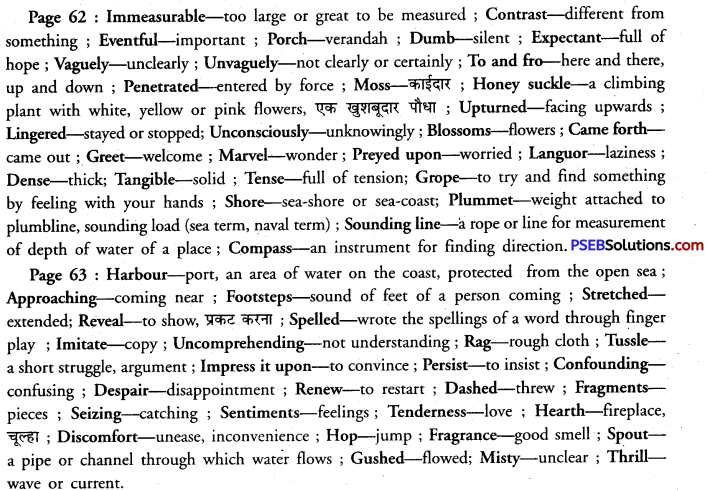
Razia, the Tigress Question Answer Class 10 English Main Course Book Poem Chapter 4 PSEB Solutions

Punjab State Board PSEB 10th Class English Book Solutions English Main Course Book Poem 4 Razia, the Tigress Textbook Exercise Questions and Answers.

Class 10th English Main Course Book Poem Chapter 4 Razia, the Tigress Question Answers

Razia, the Tigress Class 10 Questions and Answers

Question 1.
Write a summary of the poem, ‘Razia, the Tigress’.
Answer:
Razia is a young tigress. She has two little cubs. Her male companion, Sheru, has left her. Now Razia is worried about her two cubs. She can’t leave them alone and go hunting for food. Hyenas can come and kill the little cubs. She is afraid of the poachers also.

रज़िया एक युवा बाघिन है। उसके दो छोटे बच्चे हैं। उसका नर साथी, शेरू, उसे छोड़कर चला गया है। अब रज़िया अपने दो बच्चों के बारे में चिन्तित है। वह उन्हें अकेला छोड़ कर भोजन के लिए शिकार करने नहीं जा सकती है। लकड़बग्घे आकर उन्हें मार सकते हैं। वह शिकार-चोरों से भी डरती है।

PSEB 10th Class English Main Course Book Solutions Poem 4 Razia, the Tigress

Question 2.
What is the theme (central idea) of the poem, ‘Razia, the Tigress’ ?
Answer:
This poem underlines the grave danger to wildlife resulting from the destruction of forests. Man has usurped the land belonging to wild animals. Now the poor animals have nowhere to live. They live in the danger of poachers.

यह कविता जंगलों के विनाश-स्वरूप वण्य जीवों को होने वाले भयानक ख़तरों को रेखांकित करती है। मनुष्य ने जंगली जानवरों की जमीन पर अनुचित अधिकार जमा लिया है। अब बेचारे जानवरों के
पास रहने की कोई जगह नहीं है। वे शिकार-चोरों के भय में रहते हैं।

Question 3.
Why does Razia, the tigress, live alone ?
Answer:
Razia, the tigress, used to live with her mate, Sheru. But soon after the birth of two cubs, Sheru left her. He has not come back. That is why Razia is living alone with her cubs.

बाघिन रज़िया अपने साथी शेरू के साथ रहा करती थी। किन्तु उसके दो बच्चों के जन्म के शीघ्र ही बाद शेरू उसे छोड़ कर चला गया। वह वापस नहीं आया है। इसी कारण से रज़िया अपने बच्चों के
साथ अकेली रह रही है।

Question 4.
What was Sheru’s expertise ?
Answer:
Sheru was very good at hunting. He had a good knowledge of the winds and their directions. He knew that he should keep himself on the upside of the wind. Thus his scent would not reach the deer and he could get at them easily.

शेरू शिकार करने में बहुत कुशल था। उसे पवनों तथा उनकी दिशाओं का अच्छा ज्ञान था। वह जानता था कि उसे स्वयं को पवन की ऊपर वाली दिशा में रखना चाहिए। इस प्रकार उसकी गन्ध मृगों तक
नहीं पहुंचेगी और वह आसानी से उन का शिकार कर सकेगा।

Question 5.
What happened to Sheru ?
Answer:
Forests had been destroyed. There was not enough game for Sheru. It became difficult for him to find food. There was the danger of poachers also. So he left the forest and went somewhere else.

जंगल नष्ट कर दिए गए थे। शेरू के लिए शिकार करने को ज्यादा जानवर नहीं बचे थे। उसके लिए भोजन ढूंढना मुश्किल हो गया। वहां शिकार-चोरों का ख़तरा भी था। इसलिए उसने जंगल छोड़ दिया तथा कहीं और चला गया।

PSEB 10th Class English Main Course Book Solutions Poem 4 Razia, the Tigress

Question 6.
What are Razia’s fears ?
Answer:
Razia has two little cubs. She can’t leave them alone and go hunting. Hyenas can come and kill them. Then there is the fear of poachers also. They can come with their guns and kill all of them.

रज़िया के दो छोटे बच्चे हैं। वह उन्हें अकेला छोड़ कर शिकार करने नहीं जा सकती है। लकड़बग्घे आकर उन्हें मार सकते हैं। इसके अतिरिक्त वहां शिकार-चोरों का भय भी है। वे अपनी बन्दूकें लिए आ सकते हैं और उन सभी को मार सकते हैं।

Objective Type Questions

Question 1.
Razia, the Tigress has …………. cubs.
(i) two
(ii) three
(iii) four
(iv) five.
Answer:
(i) two

Question 2.
Sheru was an expert on ….
(i) hunting
(ii) winds
(iii) racing
(iv) aiming at birds.
Answer:
(ii) winds

Question 3.
Razia was not afraid of poachers. (True False)
Answer:
False.

Answer each of the following in one word / phrase / sentence :

Question 1.
Who wrote the poem, ‘Razia, the Tigress’ ?
Answer:
Keki N Daruwalla.

Question 2.
Who was Sheru ?
Answer:
A tiger.

Question 3.
Who left Razia after she had given birth to two cubs ?
Answer:
Sheru, her male companion.

Question 4.
What do we call the people who illegally hunt birds and animals ?
Answer:
Poachers.

Question 5.
What does the poet say about the tiger’s claw ?.
Answer:
He calls it a giant club.

Complete the following :

1. Sheru had left Razia shortly after ………….
2. Sheru had a good knowledge of …………….
3. Man has usurped the land belonging to ….
Answer:
1. the birth of two cubs
2. winds and their directions
3. wild animals.

Write True or False against each statement :

1. Sheru was very good at hunting.
2. Poachers are the people who legally hunt animals.
3. Razia’s male companion has left her.
Answer:
1. True
2. False
3. True.

PSEB 10th Class English Main Course Book Solutions Poem 4 Razia, the Tigress

Choose the correct option for each of the following :

Question 1.
Razia is worried about her ………
(a) male companion
(b) the poachers
(c) two cubs
(d) none of these three.
Answer:
(b) the poachers

Question 2.
Sheru was expert in the knowledge of ………….
(a) poachers
(b) his prey
(c) winds
(d) hunting
Answer:
(c) winds

Reading Comprehension

Razia, the Tigress Poem Summary in English

Razia, the Tigress Introduction:
A tigress named Razia lived in a forest. She lived with her male companion and her two cubs. The cubs were yet too little and had not been given any name. The male, named Sheru, left Razia and the two cubs alone. (Perhaps he had been killed by poachers). He went away because men had cut down the forest and there was no deer, antelope or any other game to hunt for food. Now Razia was worried about herself and her two little cubs. She feared that one day some poacher would come and hunt her down and also her little cubs. Thus the poet tries to show how by cutting down our forests, we have harmed our flora and fauna.

Razia, the Tigress Summary in English:

The tigress named Razia is now living alone. She has two little cubs. The cubs have not been given any name yet. Their father, Sheru, merely played with them a couple of days and is now gone. What a shame that he has left his mate and the two little cubs to suffer alone. (Perhaps Sheru has been killed by poachers.)

Sheru was an expert at hunting. He had a good knowledge of the winds and their directions of blowing. He knew how they flew over the hills and valleys. He knew the places where no wind blew during the night and not even a leaf moved there. The place was all still where he could lie hiding and waiting for his victim.

He knew what winds blew at what time of the year and what way they went. He also knew that the herd of deer would smell him out if they were on the down side of the wind and he was on the upper side. So he would keep lying on his belly in a crouching position.

PSEB 10th Class English Main Course Book Solutions Poem 4 Razia, the Tigress

Sheru wanted to avoid being smelt out by the deer. He would keep crouching and would take a long circular route. He would keep himself hidden behind bushes and other small plants. When he became certain that the wind won’t carry his scent to the deer, he would spring up in a flash and pounce on his victim.

Clearly the deer had not been able to sniff the thick and mouldy smell of the tiger. Among people, this smell is known as tiger-scent. From among the herd, the tiger chose a stag as its victim. Using his claws as a giant club, he fell upon the stag and caught it.

The tiger caught hold of the antler’s neck with his giant claws. The antler fell dead at once. But now sadly the male tiger Sheru is gone. Now the people living around are no longer afraid of the dreadful tiger-scent. Now no pug-marks are ever seen on the floor of the forest.

In the absence of Sheru, Razia’s heart is filled with grief and fear. She fears that with Sheru gone, the wild hyenas (lakarbaggas) could chase her cubs like hounds and kill them. Thus how could she now leave her little ones alone and go hunting for their food ?

Thus the tigress Razia now lives in fear. She can’t leave her kids alone for fear of their being killed by the wild hyenas. She can’t go to hunt for flesh and bone as food for her little ones. But she has a still greater fear. The poachers can come again any time with their guns and kill the mother as well as her cubs.

Razia, the Tigress Poem Summary in Hindi

Razia, the Tigress Introduction:
रज़िया नाम की एक मादा-बाघ किसी जंगल में रहा करती थी। वह अपने नर साथी और अपने दो नन्हें बच्चों के साथ रहा करती थी। बच्चे अभी बहुत छोटे थे और उन्हें कोई नाम नहीं दिया गया था। शेरू, जो कि उसका नर साथी था, रज़िया और दोनों बच्चों को अकेला छोड़ कर भाग गया (वह शायद शिकारियों द्वारा मार दिया गया था)। वह इसलिए चला गया क्योंकि मनुष्यों ने जंगल को काट दिया था और भोजन के लिए शिकार करने को वहां कोई मृग, बारहसिंघा या कोई अन्य जानवर नहीं बचा था। अब रज़िया अपने बारे में और अपने दो छोटेछोटे बच्चों के बारे में चिन्तित थी। वह डरती थी कि किसी दिन कोई शिकार-चोर आएगा और उसे तथा उसके दो छोटे-छोटे बच्चों को भी मार गिराएगा। इस प्रकार कवि यह दिखाने की कोशिश करता है कि अपने जंगलों को काट कर हम ने किस तरह अपने पेड़-पौधों तथा वन्य प्राणियों को. हानि पहुंचाई है।

Razia, the Tigress Summary in Hindi:

कविता का विस्तृत सार रज़िया नाम की मादा-बाघ अब अकेली रह रही है। उसके दो छोटे-छोटे बच्चे (शावक) हैं। बच्चों का अभी कोई नाम नहीं रखा गया है। उनका पिता शेरू उनके साथ मात्र कुछ-एक दिन खेला और अब वह उन्हें छोड़कर चला गया है। कितनी लज्जा की बात है कि वह अपनी साथिन और दो छोटे-छोटे बच्चों को अकेले ही कष्ट झेलने के लिए छोड़ गया है। (या शायद शेरू शिकारियों द्वारा मार दिया गया है।)

शेरू शिकार करने में बड़ा माहिर था। उसे पवनों और उनके चलने की दिशाओं का बहुत अच्छा ज्ञान था। वह जानता था कि वे पहाड़ियों और घाटियों के ऊपर से होकर किस प्रकार चलती हैं। वह उन जगहों के बारे में भी जानता था जहां रात के दौरान कोई हवा नहीं चलती थी और एक भी पत्ता हिला नहीं करता था। वह जगह बिल्कुल शांत हुआ करती थी जहां वह छिपकर बैठे हुए अपने शिकार की प्रतीक्षा कर सकता था।

शेरू जानता था कि वर्ष के किस समय के दौरान कौन सी हवाएं चलती हैं और वे किस रास्ते से होकर गुज़रती हैं। वह इस बात को भी जानता था कि मृगों का झुण्ड उसके बारे में सूंघ कर जान सकता था यदि वे हवा के नीचे वाली दिशा में होंगे तथा वह ऊपर वाली दिशा में होगा। इसलिए वह अपने पेट के बल झुक कर रेंगने वाली स्थिति बनाए हुए पड़ा रहता।।

PSEB 10th Class English Main Course Book Solutions Poem 4 Razia, the Tigress

शेरु मृगों के द्वारा सूंघ कर पता चलने से बचना चाहता था। वह झुक कर पड़ा रहता और रेंगते हुए एक गोलाई वाला रास्ता धारण कर लेता। वह स्वयं को छोटी-छोटी झाड़ियों तथा अन्य छोटे-छोटे पौधों के पीछे छिपाए रखता। जब उसे इस बात का निश्चय हो जाता कि हवा उसकी गंध को मृगों तक नहीं ले जाएगी तो वह बिजली की सी चमक के साथ उछलता और अपने शिकार के ऊपर झपट पड़ता।

स्पष्ट रूप से मृग, बाघ की घनी और बासी गंध को संघ पाने में असमर्थ रहते थे। इस गंध को लोगों में बाघ की गंध के नाम से जाना जाता है। झुण्ड के मध्य में से बाघ अपने शिकार के रूप में एक हिरण को चुन लेता। अपने पंजों को एक भारी गदा के रूप में इस्तेमाल करते हुए वह हिरण के ऊपर झपटता और इसे पकड़ लेता।

बाघ हिरण की गर्दन को अपने बड़े-बड़े पंजों से पकड़ लेता। वह हिरण तुरन्त ढेर हो जाता। किन्तु अब दुर्भाग्यवश वह नर-बाघ शेरू चला गया है। अब वहां इर्द-गिर्द रहने वाले लोग उस भयानक गंध का कोई भय नहीं रखते हैं। अब जंगल की धरती पर बाघ के पैरों के कोई चिन्ह दिखाई नहीं देते हैं।

शेरू की अनुपस्थिति में रज़िया का दिल भय और दुःख से भरा रहता है। वह डरती है कि शेरू के चले जाने पर जंगली लकड़बग्घे उसके बच्चों को शिकारी कुत्तों की भान्ति दबोच लेंगे और मार डालेंगे। इस प्रकार अब वह किस तरह अपने छोटे बच्चों को अकेले छोड़ सकती थी और उनके भोजन के लिए शिकार पर निकल सकती थी?

इस प्रकार मादा-बाघ रज़िया अब अपने दिन भय में काटती है। वह जंगली लकड़बग्घों के द्वारा अपने बच्चों के मारे जाने के भय से उन्हें अकेले नहीं छोड़ सकती। वह अपने बच्चों के लिए भोजन के रूप में कोई मांस या हड्डी की खोज करने के लिए नहीं जा सकती। किन्तु उसे इससे भी बड़ा एक भय है। शिकारी-चोर अपनी बंदूकें लिए हुए किसी भी समय दोबारा आ सकते हैं तथा मां और उसके बच्चों को मार सकते हैं।

Razia, the Tigress Poem Translation in Hindi

(1) (Lines 1-2)
The tigress Razia lives alone.
Her two cubs haven’t yet been named.
Sheru barely played with them
And now he’s gone, O what a shame !
Sheru was an expert on winds,
Knew how they traversed dale and hill,
And where they put up for the night.
When no leaf stirred and all was still.

Word-meanings : 1. cubs-बच्चे (शावक); 2. barely-मुश्किल से ही; 3. shame-लज्जा की बात; 4. traversed-घूमती थीं; 5. dale-घाटी; 6. put up-निवास करना; 7. stirred-गति करता था; 8. still-शांत।

अनुवाद-मादा-बाघ रज़िया अकेली ही रह रही है। उसके दो बच्चों का अभी नामकरण नहीं हुआ है। शेरू (उनका पिता) मुश्किल से ही उनके साथ खेला होगा और अब वह चला गया है। अरे कितनी लज्जा की बात है! पवनों के सम्बन्ध में शेरू बहुत माहिर था। वह जानता था कि पवनें घाटी और पहाड़ी के ऊपर किस तरह घूमती-फिरती हैं और रात को वह किस जगह विश्राम करती हैं, जहां कोई भी पत्ता हिल नहीं रहा होता और सब कुछ बिल्कुल शांत होता है।

PSEB 10th Class English Main Course Book Solutions Poem 4 Razia, the Tigress

(2) (Lines 3-4)
He knew his winds, their traffic lanes !
He knew the deer would smell him out,
If they were down-wind.
So he would belly-crawl and crouch
And take a long circular route,
Hiding behind bush and shrub
Once he knew his scent won’t carry,
In a flash he would erupt.

Word-meanings : 1. traffic lanes—आने-जाने के रास्ते; 2. the deer-मृगों के झुण्ड; 3. smell him out-सूंघकर उसका पता लगाना; 4. down-wind-हवा बहने की दिशा में; 5. belly-crawl—पेट के बल रेंगना; 6. crouch-दुबक कर बैठना; 7. circular route-घुमावदार रास्ता; 8. bush and shrub- झाड़-पात; 9. in a flash-पल भर में; 10. erupt-उछल पड़ना।

अनुवाद-वह अपने क्षेत्र की पवनों को और उनके बहने के रास्ते को जानता था। वह जानता था कि मृगों के झुण्ड सूंघकर उसके बारे में जान लेंगे यदि वे पवन के बहने की दिशा में किसी जगह पर हुए। इसलिए वह पेट के बल रेंगते हुए और दुबकते हुए एक लम्बा घुमावदार रास्ता ले लेता। वह झाड़-पात के पीछे स्वयं को छिपाए रखता। जब उसको इस बात का निश्चय हो जाता कि उसकी गंध उन तक नहीं पहुंचेगी तब वह पल भर में उछल पड़ता।

(3) (5–6)
(Deer hadn’t sniffed that thick and musty
Smell of his which people dubbed As tiger-scent.)
He got the stag, His claw fell like a giant club
On neck and antler – both were crushed.
Now Sheru’s gone. Not any more
Do people fear his dreaded spoor,
Pug-marked on the forest floor.

Word-meanings : 1. sniffed—नाक से सूंघा ; 2. musty-सीली और बासी ; 3. dubbedनाम देते थे ; 4. stag-हिरण, मृग, बारासिंघा ; 5. giant club–भारी गदा (पंजा); 6. antler-बारासिंघे का सींग; 7. crushed-कुचले जाना ; 8. dreaded spoor – भयभीत कर देने वाली जानवर की गंध ; 9. pug-marked-पंजों के निशान।।

अनुवाद-मृगों के झुण्ड उस घनी और सीली बासी गंध को सूंघ नहीं पाए थे जिसे लोग बाघ-गंध का नाम देते हैं। वह हिरण के ऊपर झपट पड़ा। उसका पंजा एक भारी गदा की भान्ति हिरण की गर्दन और सींगों पर एक साथ जा पड़ा और उन्हें वहीं कुचल दिया। अब वह शेरू चला गया है। अब लोग उसकी भयानक गंध से डरते नहीं हैं और न ही जंगल की धरती पर उसके पैरों के कोई निशान देखने को मिलते हैं।

(4) (Lines 7-8)
Grief and fear start competing
In Razia’s heart. With Sheru gone,
Will the hyenas hound her cubs ?
Can she leave the little ones alone,
When she goes hunting flesh and bone ?
The tigress Razia lives in fear.
A greater dread, when will again
The poachers with their guns appear ?

Word-meanings : 1. grief-दुःख ; 2. hyenas-लकड़बग्घे ; 3. hound-शिकार करना ; 4. flesh and bone-मांस-हड्डी का भोजन ; 5. dread-भय ; 6. poachers-चोर-शिकारी।

PSEB 10th Class English Main Course Book Solutions Poem 4 Razia, the Tigress

अनुवाद-रज़िया के दिल में दुःख और भय का अन्तर्द्वद होने लगता है। अब जब कि शेरू चला गया है तो क्या लकड़बग्घे उसके बच्चों को शिकारी कुत्तों की भान्ति नोच नहीं डालेंगे? क्या वह अपने छोटे-छोटे बच्चों को अकेले छोड़ जाए जब वह उनके लिए मांस-हड्डी का भोजन ढूंढने को जाए? इसलिए मादा-बाघ रज़िया भय में रह रही है। उससे भी बड़ा एक अन्य भय यह है कि पता नहीं कब चोर-शिकारी लोग अपनी बंदूकें लेकर एक बार फिर वहां आ जाएं!

Class 10th English Main Course Book Solutions PSEB Poetry