PSEB 11th Class Biology Solutions Chapter 19 Excretory Products and their Elimination

Punjab State Board PSEB 11th Class Biology Book Solutions Chapter 19 Excretory Products and their Elimination Textbook Exercise Questions and Answers.

PSEB Solutions for Class 11 Biology Chapter 19 Excretory Products and their Elimination

PSEB 11th Class Biology Guide Excretory Products and their Elimination Textbook Questions and Answers

Question 1.
Define Glomerular Filtration Rate (GFR).
Answer:
Glomerular Filtration Rate (GFR) is the amount of the filtrate formed by the kidneys per minute. GFR in a healthy individual is approximately 125 mt/mm, i.e., 180 L day.

Question 2.
Explain the autoregulatory mechanism of GFR.
Answer:
Regulation of GFR: The kidneys have built-in mechanisms for the regulation o glomerular filtration rate. One such efficient mechanism is carried out by the juxtaglomerular apparatus (JGA). JGA is a special sensitive region formed by cellular modifications in the distal convoluted tubule and the afferent arteriole at the location of their contact. A fall in GFR can activate the JG cells to release renin which can stimulate the glomerular blood flow and thereby the GFR back to normal.

Question 3.
Indicate whether the following statements are true or false:
(a) Micturition is carried out by a reflex.
(b) Al)H helps In water elimination, making the urine hypotonia.
(c) Protein-free fluid is filtered from blood plasma into the Bowman’s capsule.
(d) Henle’s loop plays an important role in concentrating the urine.
(e) Glucose is actively reabsorbed in the proximal convoluted tubule.
Answer:
(a) True,
(b) False,
(C) True,
(d) True,
(e) True.

PSEB 11th Class Biology Solutions Chapter 19 Excretory Products and their Elimination

Question 4.
Give a brief account of the counter-current mechanism.
Answer:
Counter-current Mechanism

  • The counter-current mechanism takes place in Henle’s loop and vasa recta.
  • The flow of filtrate in the two limbs of Henle’s loop is in opposite directions and thus, forms a counter-current.
  • The flow of blood through the two limbs of vasa recta is also in a counter-current pattern.
  • NaCl is transported by the ascending limb of Henle’s loop which is exchanged with the descending limb of vasa recta.
  • NaCl is returned to the interstitium by the ascending portion of vasa recta.
  • Similarly small amount of urea enters the thin segment of the ascending limb of Henle’ loop, which is transported back to the interstitium by the collecting tubule.
  • This transport of substances facilitated by the special arrangement of Henle’s loop and vasa recta is called the counter-current mechanism,
  • It helps to maintain a concentration gradient in the medullary interstitium, which facilitates an easy passage of water from the collecting tubule thereby concentrating the filtrate (urine).

Question 5.
Describe the foie of liver, lungs and skin in excretion.
Answer:
Liver, lungs and skin also play an important role in the process of excretion. Role of the Liver: Liver is the largest gland in vertebrates. It helps in the excretion of cholesterol, steroid hormones, vitamins, drugs, and other waste materials through bile. Urea is formed in the liver by the ornithine cycle. Ammonia-a toxic substance is quickly changed into urea in the liver and thence eliminated from the body. Liver also changes the decomposed haemoglobin pigment into bile pigments called bilirubin and biliverdin.

Role of the Lungs: Lungs help in the removing waste materials such as carbon dioxide from the body.
Role of the Skin: Skin has many glands which help in excreting waste products through pores. It has two types of glands-sweat and sebaceous glands.

Sweat glands are highly vascular and tubular glands that separate the waste products from the blood and excrete them in the form of sweat. Sweat excretes excess salt and water from the body.
Sebaceous glands are branched glands that secrete an oily secretion called sebum.

Question 6.
Explain micturition.
Answer:
Micturition: The process of release of urine is called micturition and the neural mechanisms causing it is called the micturition reflex. An adult human excretes on an average 1 to 1.5 L of urine per day. The urine formed is a light yellow coloured watery fluid which is slightly acidic (pH 6.0) and has a characteristic odour.

Question 7.
Match the items of Column-I with those of Column-II:

Column-I Column-II
(a) Ammonotelism (i) Birds
(b) Bowman’s capsule (ii) Water reabsorption
(c) Micturition (iii) Bony fish
(d) Uricotelism (iv) Urinary bladder
(e) ADH (v) Renal tubule

Answer:

Column-I Column-II
(a) Ammonotelism (iii) Bony fish
(b) Bowman’s capsule (v) Renal tubule
(c) Micturition (iv) Urinary bladder
(d) Uricotelism (i) Birds
(e) ADH (ii) Water reabsorption

Question 8.
What is meant by the term osmoregulation?
Answer:
It is the phenomenon of regulation of change in the concentration of body fluids according to the concentration of external environment. Le., most marine invertebrates, some freshwater invertebrates, hagfish (a vertebrate).

Question 9.
Terrestrial animals are generally either republic or uricotelic, not ammonotelic, why?
Answer:
Terrestrial adaptation requires the production of less toxic nitrogenous wastes like urea and uric acid for the conservation of water. Aquatic animals excret atnmonia which requires large amounts of water to dissolve. This huge quantity of water is easily available to such animals from surroundings.

However, for terrestrial animals, such a huge quantity of water is not available, hence, they modify their original water product NH3 to comparatively less toxic products like urea and uric acid which requires less amount of water for their excretion.

PSEB 11th Class Biology Solutions Chapter 19 Excretory Products and their Elimination

Question 10.
What is the significance of juxtaglomerular apparatus (JGA) in Sidney function?
Answer:
The juxtaglomerular apparatus (JGA) plays an important role in monitoring and regulation of kidney functioning by hormonal feedback, mechanism, involving the hypothalamus and to a certain extent, the heart.

Question 11.
Name the following:
(a) A chordate animal having flame cells as excretory structures.
(b) Cortical portions projecting between the medullary pyramids in the human kidney.
(c) A loop of capillary running parallel to the Henle’s loop.
Answer:
(a) Flarworms,
(b) Columns of Bertini,
(c) Vasa recta

Question 12.
Fill in the gaps:
(a) Ascending limb of Henle’s loop is ………………………… to water whereas the descending limb is …………………….. to it.
(b) Reabsorption of water from distal parts of the tubules is facilitated by hormone ……………………………. .
(c) Dialysis fluid contains all the constituents as in plasma except …………………………… .
(d) A healthy adult human excretes (on an average) ………………………… gm of urea/day.
Answer:
(a) impermeable, permeable;
(b) vasopressin or ADH.;
(c) the nitrogenous wastes;
(d) 25-30.
PSEB 11th Class Biology Important Questions Chapter 4 Animal Kingdom

Punjab State Board PSEB 11th Class Biology Important Questions Chapter 4 Animal Kingdom Important Questions and Answers.

PSEB 11th Class Biology Important Questions Chapter 4 Animal Kingdom

Very short answer type questions

Question 1.
What are coelomates? Give two examples.
Answer:
Animals possessing coelom are called coelomates, e.g., Annelids, molluscs, arthropods, etc.

Question 2.
Body cavity is the cavity present between body wall and gut wall. In some animals the body cavity is not lined by mesoderm. Such animals are called: [NCERT Exemplar]
Answer:
Pseudocoelomates.

PSEB 11th Class Biology Important Questions Chapter 4 Animal Kingdom

Question 3.
In some animal groups, the body is found to be divided into compartments with atleast some organs/organ repeated. Name this characteristic feature. [NCERT Exemplar]
Answer:
The segmentation that simultaneously divides body both externally and internally is called metamerism.

Question 4.
Name the group which lack digestive tract.
Answer:
Porifera.

Question 5.
Name an animal having canal system and spicules. [NCERT Exemplar]
Answer:
Scypha (sycon)/Leucosolenia.

Question 6.
Give an example of animal which exhibit alternation of generation. [NCERT Exemplar]
Answer:
Obelia, shows alternation of asexual and sexual phases.

Question 7.
Name the animal which exhibits the phenomenon of bioluminescence. Mention the phylum to which it belongs.
[NCERT Exemplar]
Answer:
Pleurobrachia, phylum – Ctenophora.

PSEB 11th Class Biology Important Questions Chapter 4 Animal Kingdom

Question 8.
How is mesoglea different in ctenophores that in cnidarians?
Answer:
The mesoglea in ctenophores also contains amoebocytes, elastic fibres and muscle cells.

Question 9.
What is the role of radula in Mollusca? [NCERT Exemplar]
Answer:
It is the rasping organ that help in feeding.

Question 10.
Identify the animal in which adults exhibit radial symmetry and larvae exhibit bilateral symmetry. [NCERT Exemplar]
Answer:
In Echinodermata, the adults are radially symmetrical and larvae are bilaterally symmetrical.

Question 11.
Why are urochordates called tunicates?
Answer:
This is because the soft body of urochordates is surrounded by a thick test or tunic, often transparent or translucent.

Question 12.
In which fishes cartilaginous skeleton is present?
Answer:
Chondrichthyes.

PSEB 11th Class Biology Important Questions Chapter 4 Animal Kingdom

Question 13.
Which amphibians show branchial (gills) respiration?
Answer:
Young ones of most of the amphibians which are aquatic show branchial respiration.

Question 14.
What is the importance of pneumatic bones and air sacs in Aves? [NCERT Exemplar]
Answer:

  • Pneumatic bones are light but strong, the feature which helps in flight,
  • Air sacs increase the efficiency of respiration and provide buoyancy to the animal.

Short answer type questions

Question 1.
Define tissue level of organization in the Kingdom Animalia. Give some examples of organisms showing tissue level of organization.
Answer:
In tissue level of organization there are specified groups of cells to carry out specific functions. This is a start of division of labour in the Animal Kingdom. Examples: Aurelia and Hydra.

Question 2.
What are diploblastic and triploblastic organisation?
Answer:
Animals in which the cells are arranged in two embryonic layers, an external ectoderm and an internal endoderm, are called diploblastic animals, e.g., coelenterates. An undifferentiated layer, mesoglea, is present in between the ectoderm and the endoderm. Those animals in which the developing embryo has a third germinal layer, mesoderm, in between the ectoderm and endoderm, are called triploblasdc animals (platyhelminthes to chordates).

Question 3.
Write two characters on the basis of which you can say that Coelenterata is more evolved than Porifera.
Answer:
(a) Porifera shows cellular level of organization, while Coelenterata shows tissue level of organisation.
(b) All members of Porifera are sessile, i.e., they are attached to the substratum, while some members of Coelenterata are motile, showing further improvement.

PSEB 11th Class Biology Important Questions Chapter 4 Animal Kingdom

Question 4.
On the basis of which characters you can say that Aschelminthes are more advanced compared to Platyhelminthes?
Answer:
(a) Platyhelminthes are acoelomate,while Aschelminthes are pseudocoelomates. This indicates development of mesoderm.
(b)In Platyhelminthes both sexes are on the same animal, while in Aschelminthes there is segregation of sexes. This shows another point of evolution.

Question 5.
Give a description of the water vascular system in Echinodermata..
Answer:
Water Vascular System in Echinodermata: The water vascular system is a hydraulic system used by echinoderms, such as starfish and sea urchins, for locomotion, food and waste transportation, and respiration. The system is composed of canals connecting numerous tube feet. Echinoderms move by alternately contracting muscles that force water into the tube feet, causing them to extend and push against the ground, then relaxing to allow the feet to retract.

Long answer type questions

Question 1.
Differentiate between polyp and medusa. [NCERT Exemplar]
Answer:
Differences between polyp and medusa are as follows :

Polyp Medusa
1. It is a fixed zooid. It is free swimming.
2. It is asexual. It is sexual.
3. It is cylindrical in outline. Medusa is umbrella-shaped.
4. Tentacles found at upper end of manubrium. Tentacles occur along the margin of umbrella.
5. Mouth is circular and terminal over upright manubrium. Mouth is four sided, lies at the lower end of hanging manubrium.
6. Velum and sense organs are absent. Medusa have a-circular velum and eight sense organs or statocysts.

Question 2.
Differentiate between Chordates and Non-Chordates.
Answer:
Differences between chordates and non-chordates are given below:

Chordates Non-Chordates
•» Notocord is present at stages in some stages of development. Notochord is absent.
•» Central nervous system is dorsal, hollow, single and non-ganglionated. Central nervous system is ventral, solid, double and ganglionated.
•» Gill slits present on lateral side of pharynx in sum stages of throughout life. Gill slits are absent.
•» Tail is present in some stages and throughout life. Tail generally absent.
•» Heart is ventral. Heart is dorsal.
•» Haemoglobin is present in RBCs. It is present in plasma.

PSEB 11th Class Biology Important Questions Chapter 4 Animal Kingdom

Question 3.
Which features make mammals as most successful and dominant animals?
Answer:
Features which make mammals as dominant and successful animals are as follows:

  • The presence of an insulating and protective hairy exoskeleton
  • They are warm blooded so have high rate of metabolism.
  • They are viviparous animals and show placentation and intrauterine development which increases the chances for survival of young ones.
  • They show high degree of parental care.
  • They have more developed hearing efficiency due to the presence of pinna, three ear-ossicles and coiled cochlea in the ear.
  • They are able to speak through language.
  • They have good power of learning due to the presence of more developed brain.

PSEB 11th Class Biology Solutions Chapter 4 Animal Kingdom

Punjab State Board PSEB 11th Class Biology Book Solutions Chapter 4 Animal Kingdom Textbook Exercise Questions and Answers.

PSEB Solutions for Class 11 Biology Chapter 4 Animal Kingdom

PSEB 11th Class Biology Guide Animal Kingdom Textbook Questions and Answers

Question 1.
What are the difficulties that you would face in classification of animals, if common fundamental features are not taken into account?
Answer:
The major difficulties in the classification of animals are on the following lines :

  • Some show cellular level of organisation, some have tissue level and even some have organ system level of organisation.
  • Regarding symmetry, some are radially symmetrical, while some have bilateral symmetry.
  • Some have open circulatory system, while others have closed type.
  • Regarding digestion, some animals have extracellular digestion, while others have intracellular digestion.
  • In case of body cavity, some have true coelom while others are pseudocoelomates.
  • Regarding reproduction, some have only asexual reproduction, while others reproduce both by sexual and asexual means.
    So, these are difficulties that zoologists face in the classification of animals.

Question 2.
If you are given a specimen, what are the steps that you would follow to classify it?
Answer:
If I am given an animal specimen, then I will classify it on the basis of fundamental features which are common to all animal types inspite of the presence of some major differences in the structure and form of animals. The features taken into consideration during classification of animal are as follows:

  • The type of arrangement of cells.
  • Body symmetry.
  • Nature of coelom.
  • Pattern of digestive system.
  • Type of circulatory system.
  • Type of methods of reproduction.

PSEB 11th Class Biology Solutions Chapter 4 Animal Kingdom

Question 3.
How useful is the study of the nature of body cavity and coelom in the classification of animals?
Answer:
Presence or absence of a cavity between the body wall and the gut wall is very important in classification. The body cavity which is lined by, mesoderm, is called coelom.

  • Animals possessing coelom are called coelomates, e.g., annelids, molluscs, arthropods, echinoderms, hemichordates and chordates.
  • In some animals, the body cavity is not mesoderm, instead the mesoderm is present as scattered pouches in between the ectoderm and endoderm. Such a body cavity is called pseudocoelom and the animals possessing them are called pseudocoelomates, e.g., Aschelminthes.
  • The animals in which the body cavity is absent are known as acoelomates, e.g. , Platyhelminthes.

Question 4.
Distinguish between intracellular and extracellular digestion?
Answer:
Differences between intracellular and extracellular digestion are as follows:
(i) Intracellular Digestion: It occurs inside the living cells with the help of lysosomal enzymes. Food particle is taken in through endocytosis. It forms a phagosome which fuses with a lysosome. The digested material pass into the cytoplasm. The undigested matter is throw out by exocytosis. It occurs in Amoeba, Paramecium, etc.,

(ii) Extracellular Digestion: In case of coelentrates digestion occurs in gastrovascular cavity. This cavity has gland cells which secret digestive enzymes over the food. The partially digested fragmented food particles are ingested by nutritive cells. It occurs in Hydra, Aurelia, etc.

Question 5.
What is the difference between direct and indirect development?
Answer:
In direct development the embryo directly develops into an adult, while in indirect development there is an intermediate larval stage. Certain members of arthropods show larval stage of development.

Question 6.
What are the peculiar features that you find in parasitic platyhelminthes?
Answer:
Hooks and suckers are present in the parasitic forms. They are parasitic flatworms commonly called flukes. The body is unsegmented leaf like, which is covered by a thick living tegument. There is no epidermis. The mouth is anterior and is armed with suckers for attachment in the host. Life history includes larval stage and involves more than one hosts.
Examples : Fasciola (the liver fluke), Schistosoma (the blood fluke.)

PSEB 11th Class Biology Solutions Chapter 4 Animal Kingdom

Question 7.
What are the reasons that you can think of for the arthropods to constitute the largest group of the animal kingdom?
Answer:
Arthropods constitute the largest group of the animal kingdom. It is estimated that the Arthropoda population of the world is approximately a billion (1018) individuals, in terms of species diversity, number of individuals and geographical distribution. It is the most successful phylum on the Earth that have ever existed. Arthropods are equipped with jointed appendages, which are variously adapted for walking, swimming, feeding, sensory reception and defence. The appendages of abdomen are associated with locomotion, reproduction and in some cases with defence as well.

The appendages of head are related to defence, whereas those of thorax are mainly associated with locomotion. These features are responsible for its large diversity.

Question 8.
Water vascular system is the characteristic of which group of the following?
(a) Porifera
(b) Ctenophora
(c) Echinodermata
(d) Chordata
Answer:
Echinodermata have the water vascular system.

Question 9.
‘All vertebrates are chordates but all chordates are not vertebrates’.’Justify the statement.
Answer:
Notochord is a characteristic feature of all chordates. The members of sub-phylum – Vertebrata possess notochord during the embryonic stage. But in adults the notochord is replaced by a cartilaginous or bony vertebral column. Whereas in member of other Sub-phyla of Chordata the notochord remain as such. The urochordate and cephalochordates retain the notochord during their entire life cycle. Thus, the absence of notochord in adult vertebrates suggest that all vertebrates are chordates but all chordates are not vertebrates.

Question 10.
How important is the presence of air bladder in Pisces?
Answer:
In fishes, air bladder regulates buoyancy and helps in floating in water. If it is absent, animals need to swim constantly to avoid sinking.

PSEB 11th Class Biology Solutions Chapter 4 Animal Kingdom

Question 11.
What are the modifications that are observed in birds that help them fly?
Answer:
Flight adaptations in birds are as follows :

  • Boat-shaped body helps to propel through the air easily.
  • Feathery covering of body to reduce the friction of air.
  • Holding the twigs automatically by hindlimbs.
  • Extremely powerful muscles that enables the wings to work during flight.
  • Bones are light, hollow and provide more space for muscle attachment. Presence of pneumatic bones which reduce the weight of body and help in flight.
  • The first four thoracic vertebrae are fused to form a furculum for walking of the wings.
  • Lungs are solid and elastic and have associated air sacs.
  • The power of accomodation of eyes is well developed due to the presence of comb-like structure pecten.
  • A single left ovary and oviduct to reduce the body weight.

Question 12.
Could the number of eggs or young ones produced by an oviparous and viviparous mother be equal? Why?
Answer:
The number of eggs or young ones produced by an oviparous or viviparous mother cannot be equal. An oviparous mother gives rise to more number of eggs as some of them die during hatching and as they have to pass through a large number of developmental stages before becoming an adult. On the other hand, a viviparous mother gives rise to fewer number of young ones because there are less chances of their death. Moreover, they did not have to pass through any larval stage.

Question 13.
Segmentation in the body is first observed in which of the following:
(a) Platyhelminthes
(b) Annelida
(c) Aschelminthes
(d) Arthropoda
Answer:
Segmentation in the body is first observed in Annelida. This phenomenon is known as metamerism.

Question 14.
Match the following:

A. Operculum 1. Ctenophora
B. Parapodia 2. Mollusca
C. Scales 3. Porifera
D. Comb plates 4. Reptilia
E. Radula 5. Annelida
F. Hairs 6. Cyclostomata and Chondrichthyes
G. Choanocytes 7. Mammalia
H. Gill slits 8. Osteichthyes

Answer:

A. Operculum 8. Osteichthyes
B. Parapodia 5. Annelida
C. Scales 4. Reptilia
D. Comb plates 1. Ctenophora
E. Radula 2. Mollusca
F. Hairs 7. Mammalia
G. Choanocytes 3. Porifera
H. Gill slits 6. Cyclostomata and Chondrichthyes

PSEB 11th Class Biology Solutions Chapter 4 Animal Kingdom

Question 15.
Prepare a list of some animals that are found parasitic on human heings.
Answer:
A list of parasitic animals on human beings:

Parasite In Part of Human Body
Leishmania donovani Blood
Trichomonas vaginalis Vagina of human female
Plasmodium vivax Blood
Taenia solium Intestine
Ascaris lumbricoides Small intestine
Wuchereria bancrofti Lymphatic and muscular system
Loa loa Eyes
Fasciola hepatica Liver and bile ducts
Entamoeba histolytica Intestine
Trypanosoma gambiense Blood

PSEB 11th Class Biology Important Questions Chapter 3 Plant Kingdom

Punjab State Board PSEB 11th Class Biology Important Questions Chapter 3 Plant Kingdom Important Questions and Answers.

PSEB 11th Class Biology Important Questions Chapter 3 Plant Kingdom

Very short answer type questions

Question 1.
Name the types of classification of plants.
Answer:
Artificial, natural and phylogenetic.

Question 2.
Which system indicates evolutionary as well as genetic relationships among organisms?
Answer:
Phylogenetic system of classification.

Question 3.
What is cytotaxonomy?
Answer:
Cytotaxonomy is a method of classification. It is based on cytological structure and their relatedness.

PSEB 11th Class Biology Important Questions Chapter 3 Plant Kingdom

Question 4.
Food is stored as floridean starch in Rhodophyceae. Mannitol is the reserve food material of which group of algae?
[NCERT Exemplar]
Answer:
Phaeophyceae.

Question 5.
Holdfast, stipe and frond constitutes the plant body in case of
[NCERT Exemplar]
(a) Rhodophyceae
(b) Chlorophyceae
(c) Phaeophyceae
(d) All of these
Answer:
The lamina of Phaeophyceae members large sized body with differentiation of holdfast, stipe and lamina.

Question 6.
The plant body in higher plants is well differentiated and well developed. Roots are the organs used for the purpose of absorptions. What is the equivalent of the roots in the less developed lower plants? [NCERT Exemplar]
Answer:
Rhizoids.

Question 7.
Most algal genera show haplontic life cycle. Name an alga which is (i) Haplodiplontic (ii) Diplontic [NCERT Exemplar]
Answer:
Haplodiplontic: Ulva, Dictyota.
Diplontic: Fucus, Cladophora, Glomerata.

Question 8.
How are mosses considered ecologically important?
Answer:
Mosses, along with lichens are the first organism to colonise rocks, hence are ecologically important.

PSEB 11th Class Biology Important Questions Chapter 3 Plant Kingdom

Question 9.
A prothallus is
(a) a structure in pteridophyte formed before the thallus develops
(b) a sporophytic free-living structure formed in pteridophyte
(c) a gametophytic free-living structure formed in pteridophytes
(d) a primitive structure formed after fertilisation in pteridophyte
[NCERT Exemplar]
Answer:
Gametophyte is a free-living small thalloid structure called prothallus. In most ferns, the prothallus is green and autotrophic.

Question 10.
Where are seeds located in gymnosperm?
Answer:
Seeds lie naked or exposed on the surface of megasporophyll.

Question 11.
The embryo sac of an angiosperm is made up of:
(i) 8 cells
(ii) 7 cells and 8 nuclei
(iii) 8 nuclei
(iv) 7 cells and 7 nuclei [NCERT Exemplar]
Answer:
(ii) Embryo sac of angiosperm develops up to 8 nucleate state prior to fertilisation. There is a three celled egg apparatus, three antipodal cells and two polar nuclei.

Question 12.
What is alternation of generations?
Answer:
Alernation of generations is regular switch over from gamete bearing haploid gametophyte to haploid spore producing diploid sporophyte.

PSEB 11th Class Biology Important Questions Chapter 3 Plant Kingdom

Short answer type questions

Question 1.
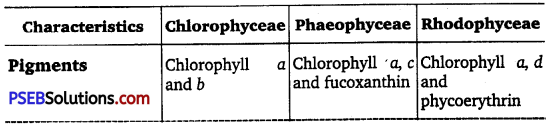
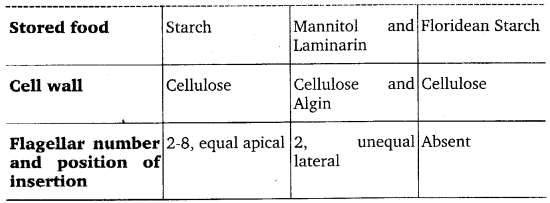
What are the main differences among Chlorophyceae, Phaeophyceae and Rhodophyceae?
Answer:
PSEB 11th Class Biology Important Questions Chapter 3 Plant Kingdom 1
PSEB 11th Class Biology Important Questions Chapter 3 Plant Kingdom 2

Question 2.
What is the general structure of bryophytes?
Answer:
Structure of Bryophytes: It is thallus-like and prostrate or erect, and attached to the substratum by unicellular or multicellular rhizoids. They lack true roots, stem or leaves. They may possess root-like, or stem-like structures.

Question 3.
What is the general structure of pteridophytes?
Answer:

  • The main plant body is a sporophyte which is differentiated into true root, stem and leaves. These organs possess well-differentiated vascular tissues.
  • The leaves in pteridophyta are small (microphylls) as in Selaginella or large (macrophylls) as in ferns.
  • The sporophytes bear sporangia that are subtended by leaf-like appendages called sporophylls. In some cases sporophylls may form distinct compact structures called strobili or cones (Selaginella, Equisetum).

PSEB 11th Class Biology Important Questions Chapter 3 Plant Kingdom

Question 4.
Write short notes on:
(a) Importance of carbon fixation by algae.
(b) Importance of Gymnosperms
(c) Importance of Angiosperms
(d) Medicinal use of algae
Answer:
(a) About 50% of carbon fixation is done by algae. This enables majority of sea organisms to get the required food.
(b) Gymnosperms are mainly used as decorative plants. Certain paints are
prepared from Gymnosperm plants.
(c) Angiosperms are the major providers of food-grains to the mankind.
(d) Spirullina is made by algae and is used as a nutritional supplement.

Long answer type questions

Question 1.
Algae are known to reproduce asexually by a variety of spores under different environmental condition. Name these spores and the conditions under which they are produced. [NCERT Exemplar]
Answer:
Zoospores: Flagellate spores, under favourable conditions.
Aplanospores: Non-flagellate, thin-walled spores under approaching unfavourable conditions.
Hypnospores: Thick-walled, resting spores in unfavourable conditions.
Akinetes: Thin-walled and thick-walled spores formed from whole cells in unfavourable conditions. .
Autospores: Spores which look exactly like parent cell formed under favourable conditions.

Question 2.
Write about habit and habitat of algae.
Answer:
Habit and Habitat of Algae: Algae are chlorophyll-bearing, simple, thalloid, autotrophic and largely aquatic (both fresh water and marine) organisms. They occur in a variety of other habitats : moist stones, soils and wood. Some of them also occur in association with fungi (lichen) and animals (e.g., on sloth bear).

PSEB 11th Class Biology Important Questions Chapter 3 Plant Kingdom

Question 3.
What are the differences betweenpinus and cycas?
Answer:

Pinus Cycas
1. Roots are micorrhizal. 1. Roots are not micorrhizal.
2. Stems are branched. 2. Stems are unbranched.
3. Male and female strobili are on same tree. 3. They are on different trees.

PSEB 11th Class Biology Solutions Chapter 3 Plant Kingdom

Punjab State Board PSEB 11th Class Biology Book Solutions Chapter 3 Plant Kingdom Textbook Exercise Questions and Answers.

PSEB Solutions for Class 11 Biology Chapter 3 Plant Kingdom

PSEB 11th Class Biology Guide Plant Kingdom Textbook Questions and Answers

Question 1.
What is the basis of classification of algae?
Answer:
Basis of classification of algae are as follows:

  • Kinds of pigments.
  • Nature of reserve food.
  • Kinds, number and points of insertion of flagella of motile cells.
  • Presence or absence of organised nucleus in the cell.

Question 2.
When and where does reduction division take place in the life cycle of a liverwort, a moss, a fern, a gymnosperm and an angiosperm?
Answer:
Reduction division in the life cycle of a liverwort, a moss, a fern and a gymnosperm take place during the production of spores from spore mother cells. In case of an angiosperm, the reduction division occurs during pollen grain formation from anthers and during production of embryo sac from ovule.

PSEB 11th Class Biology Solutions Chapter 3 Plant Kingdom

Question 3.
Name three groups of plants that bear archegonia. Briefly describe the life cycle of any one of them.
Answer:
Three groups of plants that bear archegonia are bryophytes, pteridophytes and gymnosperms.
Life Cycle of a Pteridophyte: The life cycle of a pteridophyte consists of two morphologically distinct phases:
1. The gametophytic phase
2. The sporophytic phase.
These two phases come one after another in the life cycle of a pteridophyte. This phenomenon is called alternation of generation. The gametophyte is haploid with single set of chromosomes. It produces male sex organs antheridia and female sex organs archegonia.

  • The antheridia may be embedded or projecting type. Each antheridium has single layered sterile jacket enclosing a mass of androcytes.
  • The androcytes are flask-shaped, sessile or shortly stalked and differentiated into globular venter and tubular neck.
  • The archegonium contains large egg, which is non-mo tile.
  • The antherozoids after liberation from antheridium, reaches up to the archegonium fuses with the egg and forms a diploid structure known as zygotes.
  • The diploid zygote is the first cell of sporophytic generation. It is retained inside the archegonium and forms the embryo.
  • The embryo grows and develop to form sporophyte which is differentiated into roots, stem and leaves.
  • At maturity the plant bears sporangia, which encloses spore mother cells.
  • Each spore mother cell gives rise to four haploid spores which are usually arranged in tetrads.
  • The sporophytic generation ends with the production of spores.
  • Each spore is the first cell of gametophytic generation. It germinates to produce gametophyte and completes its life cycle.

PSEB 11th Class Biology Important Questions Chapter 2 Biological Classification 1

Question 4.
Mention the ploidy of the following:
Protonemal cell of a moss, primary endosperm nucleus in dicot, leaf cell of a moss, prothallus cell of a fern, gemma cell in Marchantia, meristem cell of monocot, ovum of a liverwort and zygote of a fern.
Answer:
Protonemal cell of a moss – haploid
Primary endosperm nucleus in dicot – triploid
Leaf cell of a moss – haploid
Prothallus cell of a fern – haploid
Gemma cell in Marchantia – haploid
Meristem cell of monocot – diploid
Ovum of a liverwort – haploid
Zygote of a fern – diploid

PSEB 11th Class Biology Solutions Chapter 3 Plant Kingdom

Question 5.
Write a note on economic importance of algae and gymnosperms.
Answer:
Economic Importance of Algae

  • Red algae provides food, fodder and commercial products. Porphyra tenera is rich in protein, carbohydrates and vitamin-A, B, E and C.
  • Corallina has vermifuge properties.
  • Agar-agar a gelatin substance used as solidifying agent in culture media is obtained from Gelidium and Gracilaria algae. Funori is a glue used as adhesive and in sizing textiles, papers, etc. Chondrus is most widely used in sea weed in Europe.
  • Mucilage extracted from Chondrus is used in sampoos, shoe polish and creams.
  • Carrageenin is a sulphated polysaccharide obtained from cell wall of Chondrus crispus and Gigartina and is used in confectionary, bakery, jelly, creams, etc.

Economic Importance of Gymnosperms

  • Gymnosperms hold soil particles and thus check soil erosion.
  • Many gymnosperms are grown in gardens as ornamental plants, i.e., Cycas, Thiya, Araucaria, Taxus, Agathis, Maiden hair tree, etc.
  • Sago is a kind of starch obtained from cortex and pith of stem and seeds of Cycas. Roasted seeds of Pinus geradiana (chilgoza) are used as dry fruit.
  • Paper pulp is obtained from wood of Picea (spruce), Gnetum, Pinus (pine) and Larix (larck).
  • The wood of Juniperus virginiana (red cedar) is used to make pencils, holders and cigar boxes. Wood of Taxus is heaviest amongst soft woods and is used for making bows for archery.
  • Dry leaves of Cycas are used to make baskets and brooms. Needles of Pinus in making fibre board. Electric and telephone poles are made of stem of conifers.
  • Essential oils are obtained from Juniperus, Tsugo, Picea, Abies, Cedrus, etc. Resins are obtained from many species of Pinus.

Question 6.
Both gymnosperms and angiosperms bear seeds, then why are they classified separately?
Answer:
Both gymnosperms and angiosperms bear seeds, but they are yet classified separately. Because, in case of gymnosperms the seeds are naked, i.e., the seeds are not produced inside the fruit but in case of angiosperms the seeds are enclosed inside the fruit.

Question 7.
What is heterospory? Briefly comment on its significance. Give two examples.
Answer:
Heterospory is the phenomenon in which a plant produces two types of spores, namely microspores and megaspores.
Heterospory is significant in the following ways:

  • Microspores give rise to male gametophyte and megaspores give rise to female gametophyte.
  • Female gametophyte is retained on the parent plant. The development of zygote takes place within the female gametophyte.
  • This leads to formation of seeds.
    Examples: All gymnosperms and all angiosperms, Pinus, Gnetum, neem, peepal, etc.

PSEB 11th Class Biology Solutions Chapter 3 Plant Kingdom

Question 8.
Explain briefly the following terms with suitable examples:
(i) Protonema
(ii) Antheridium
(iii) Archegonium
(iv) Diplontic
(v) Sporophyll
(vi) Isogamy.
Answer:
(i) Protonema: It is the juvenile stage of a moss. It results from the germinating meiospore. When fully grown, it consists of a slender green, branching system of filaments called the protonema.

(ii) Antheridium: The male sex organ of bryophyte and pteridophyte is known as antheridium. It has a single-layered sterile jacket enclosing in a large number of androcytes. The androcytes’ metamorphose into flagellated motile antherozoids.

(iii) Archegonium: The female sex organ of bryophytes, which is multicellular and differentiated into neck and venter. The neck consists of neck canal cells and venter contains the venter canal cells and egg.

(iv) Diplontic: A kind of life cycle in which the sporophyte is the dominant, photosynthetic, independent phase of the plant and alternate with haploid gametophytic phase is known as diplontic life cycle.

(v) Sporophyll: The sporangium bearing structure in case of Selaginella is known as sporophyll.

(vi) Isogamy: It is the process of fusion between two similar gametes, i.e., Chlamydomonas.

Question 9.
Differentiate between the following:
(i) red algae and brown algae,
(ii) liverworts and moss,
(iii) homosporous and heterosporous pteridophytes.
(iv) syngamy and triple fusion.
Answer:
(i) Differences between Red Algae and Brown Algae

Red Algae Brown Algae
1. It belongs to the It belongs to the class-Rhodophyceae It belongs to the It belongs to the class Phaeophyceae.
2. It is red in colour due to the presence of pigments chlorophyll-a, c and phycoerythrin.

Example: Stylolema, Rhodela.

It is brown in colour due to the presence

Example: Sargassum, Microcystis.

(ii) Differences between Liverworts and Moss

Liverwort Moss
1. These are the member of class-Hepaticopsida of bryophyta. These belongs to class-Bryop’sida of bryophyta.
2. Thallus is dorsoventrally flattened and lobed liver like Thallus is leafy and radially symmetrical.
3. Rhizoids are unicellular. Rhizoids are multicellular
4. Elaters are present in capsule to assist dispersal of spores. Elaters are absent, but peristome teeth are present in the capsule to assist dispersal of spores.

(iii) Differences between Homosporous and Heterosporous Pteridophytes

Homosporous Pteridophyte Heterosporous Pteridophyte
Pteridophytes, which produce only one kind of spores.

Example: Lycopodium

These produce two kinds of spores, i.e., large megaspore and smaller microspore.

Example: Selaginella

(iv) Differences between Syngamy and Triple Fusion

Syngamy Triple Fusion
It is the act of fusion of one male gamete with the egg cell to form zygote. The act of fusion of second male gamete with secondary nucleus to form triploid enddsperm is called triple endosperm is called triple fusion.

PSEB 11th Class Biology Solutions Chapter 3 Plant Kingdom

Question 10.
How would you distinguish monocots from dicots?
Answer:

Dicotyledons (Dicots) Monocotyledons (Monocots)
•» Tap root system Fibrous root system
•» Two cotyledons One cotyledon
•» Reticulate Venation Parallel venation
•» Tetramerous or Pentamerous flowers Trimerous flowers

Question 11.
Match the followings (column I with column II)

Column I Column II
(a) Chlamydomonas (i) Moss
(b) Cycas (ii) Pteridophyte
(c) Selaginella (iii) Algae
(d) Sphagnum (iv) Gymnosperm

Answer:

Column I Column II
(a) Chlamydomonas (iii) Algae
(b) Cycas (iv) Gymnosperm
(c) Selaginella (ii) Pteridophyte
(d) Sphagnum (i) Moss

PSEB 11th Class Biology Solutions Chapter 3 Plant Kingdom

Question 12.
Describe the important characteristics of gymnosperms.
Answer:
Characteristics of gymnosperms are as follows :

  • Naked-seeded plants, i.e., their ovules are exposed and not enclosed in ovaries. Hence, the seeds are naked without fruits.
  • Tap root system is present. They show symbiotic as speciation with fungi
    to form mycorrhizae or with N2-fixing cyanobacteria to form colloidal roots as in Cycas.
  • Leaves are large and needle-shaped.
  • Vascular tissues are well developed.
  • Gymnosperms are heterosporous.
  • Pollination by wind and deposited in ovules.
  • Fertilisation occurs in archegonia.
  • Retention of female gametophyte inside the ovule and the ovules on the sporophytic plant for complete development is responsible for the development of seed habit.

PSEB 11th Class Biology Solutions Chapter 20 Locomotion and Movement

Punjab State Board PSEB 11th Class Biology Book Solutions Chapter 20 Locomotion and Movement Textbook Exercise Questions and Answers.

PSEB Solutions for Class 11 Biology Chapter 20 Locomotion and Movement

PSEB 11th Class Biology Guide Locomotion and Movement Textbook Questions and Answers

Question 1.
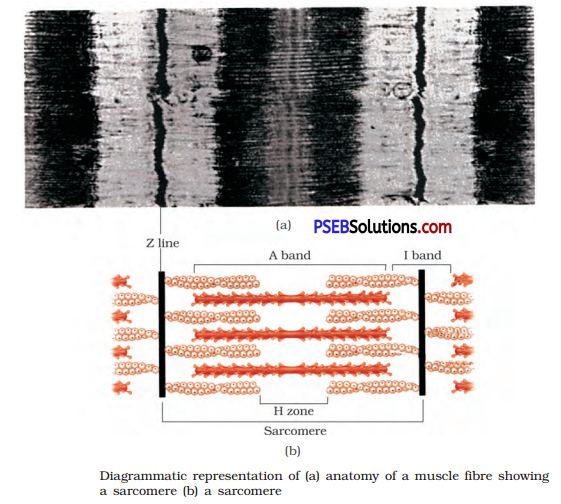
Draw the diagram of a sarcomere of skeletal muscle showing different regions.
Answer:
PSEB 11th Class Biology Solutions Chapter 20 Locomotion and Movement 1

Question 2.
Define sliding-filament theory of muscle contraction.
Answer:
The sliding-filament, theory states that the contraction of a muscle fibre takes place by the sliding of the thin filaments over the thick filaments.

Question 3.
Describe the important steps in muscle contraction.
Answer:
Mechanism of Muscle Contraction:

  • The mechanism of muscle contraction is explained by the sliding filament theory.
  • This theory states that contraction of a muscle fibre is due to the sliding of the thin (actin) filaments over the thick (myosin) filaments.
  • Muscle contraction is initiated by a neural signal from the central nervous system through a motor neuron.
  • When the neural signal reaches the neuromuscular junction, it releases a neurotransmitter, i.e., acetylcholine, which generates an action potential in the sarcolemma.
  • This spreads through the muscle fibre and causes the release of Ca++ ions from the sarcoplasmic reticulum into the sarcoplasm.
  • The Ca++ ions bind to the subunit of troponin and brings about conformational changes; this removes the masking of the active site for myosin.
  • The myosin head binds to the active site on actin to form a cross-bridge; this utilises energy from the hydrolysis of ATP.
  • This pulls the actin filaments towards the centre of A-band.
  • As a result, the Z-lines limiting the sarcomere are pulled closer together, causing a shortening of the sarcomere or contraction of muscle.
  • Thus, during muscle contraction, the length of A band remains unchanged, while that of I-band decreases.
  • The myosin goes back to its relaxed state.
  • A new ATP binds and the cross-bridge is broken and the actin filaments slide out of A-band.
  • The cycle of cross bridge-formation and cross bridge breakage continues till the Ca++ ions are pumped back to the sarcoplasmic reticulum which leads to the masking of the active site on F-actin.

PSEB 11th Class Biology Solutions Chapter 20 Locomotion and Movement

Question 4.
Write true or false. If false change the statement so that it is true.
(a) Actin is present in thin filament.
(b) H-zone of striated muscle fibre represents both thick and thin filaments.
(c) Human skeleton has 206 bones.
(d) There are 11 pairs of ribs in man.
(e) Sternum is present on the ventral side of the body.
Answer:
(a) True
(b) False, H-zone represents thick filaments
(c) True
(d) False, there are 12 pairs of ribs in man.
(e) True

Question 5.
Write the difference between:
(a) Actin and Myosin
(b) Red and White Muscles
(c) Pectoral and Pelvic Girdle
Answer:
(a) Differences between Actin and Myosin Filament

Actin Filaments Myosin Filaments
1. These are found in I-band. These are found in A-band.
2. These are thin. These are thick.
3. Cross bridges (heads) are absent. Cross bridges (heads) are present.
4. It is a globular protein with low molecular weight. It is a heavy molecular weight polymerised protein.

(b) Differences between Red and White Muscles

Red Muscles White Muscles
1. In some muscles, myoglobin content is high, which gives a reddish colour to them, such muscles are called red muscles. Some muscles possess very less quantity of myoglobin, so they appear whitish called as white muscles.
2. These contain plenty of mitochondria. These have less number of mitochondria but amount of sarcoplasmic reticulum is high.
3. These are called aerobic muscles. They depend on anaerobic process of energy.

(c) Differences between Pectoral and Pelvic Girdle

Pectoral Girdle Pelvic Girdle
1. It helps in the articulation of upper limbs. It helps in the articulation of lower limbs.
2. It is situated in the pectoral region of the body. It is situated in the pelvic region of the body.
3. Each half of pectoral girdle is formed of a clavicle and a scapula. Pelvic girdle consists of two coxal bones.
4. Scapula is a large triangular flat bone and clavicle is a long slender bone. Each coxal bone is formed of three bones, ilium, ischium and pubis.
5. An expanded process, acromion from scapula forms a depression called glenoid cavity, which articulates with the head of humerus to form shoulder joint. Ilium, ischium and pubis fuse at a point to form a cavity called acetabulum to which the thigh bone articulates.

Question 6.
Match Column-I with Column-II

Column-I Column-II
(a) Smooth muscle (i) Myoglobin
(b) Tropomyosin (ii) Thin filament
(c) Red muscle (iii) Sutures
(d) Skull (iv) Involuntary

Answer:

Column-I Column-II
(a) Smooth muscle (iv) Involuntary
(b) Tropomyosin (ii) Thin filament
(c) Red muscle (i) Myoglobin
(d) Skull (iii) Sutures

PSEB 11th Class Biology Solutions Chapter 20 Locomotion and Movement

Question 7.
What are the different types of movements exhibited by the cells of human body?
Answer:
Cells of the human body exhibit three main types of movements-amoeboid, ciliary and muscular.
(i) Amoeboid Movement: Some specialised cells in our body like macrophages and leucocytes in blood exhibit amoeboid movement. It is effected by pseudopodia formed by the streaming of protoplasm (as in Amoeba). Cytoskeletal elements like microfilaments are also involved in amoeboid movement.

(ii) Ciliary Movement: Ciliary movement occurs in most of our internal tubular organs which are lined by ciliated epithelium. The coordinated movements of cilia in the trachea help us in removing dust particles and some of the foreign substances inhaled along with the atmospheric air. Passage of ova through the female reproductive tract is also facilitated by the ciliary movement.

(iii) Muscular Movement: Movement of our limbs, jaws, tongue, etc., require muscular movement. Locomotion requires a perfect coordinated activity of muscular, skeletal and neural systems.

Question 8.
How do you distinguish between a skeletal muscle and a cardiac muscle?
Answer:

Skeletal Muscle Cardiac Muscle
1. The, cells of skeletal muscles are unbranched. 1. The cells of cardiac muscles are branched.
2. Intercalated disks are absent. 2. The cells are joined with one another by intercalated disks that help in coordination or
synchronization of the heartbeat.
3. Alternate light and dark bands are present. 3. Faint bands are present.
4. They are voluntary muscles. 4. They are involuntary muscles.
5. They contract rapidly and get fatigued in a short span of time. 5. They contract rapidly but do not get fatigued easily.
6. They are present in body parts such as the legs, tongue, hands, etc. 6. These muscles are present in the heart and control the contraction and relaxation of the heart.

Question 9.
Name the type of joint between the following:
(i) Atlas/Axis
(ii) Carpal/Metacarpal of thumb
(iii) Between phalanges
(iv) Femur/Acetabulum
(v) Between cranial bones
(vi) Between pubic bones in the pelvic girdle.
Answer:
(i) Pivot joint
(ii) Saddle joint
(iii) Hinge joint
(iv) Ball and socket joint
(v) Fibrous joint
(vi) Cartilagenous joint

Question 10.
Fill in the blank spaces.
(a) All mammals (except a few) have ………………………………. cervical vertebra.
(b) The number of phalanges in each limb of human is ……………………………………
(c) Thin filament of myofibril contains 2 ‘F’ actins and two other proteins namely ………………………. and ………………..
(d) In a muscle fibre Ca2+ is stored in ………………………..
(e) ………………….. and ……………………………….. pairs of ribs are called floating ribs.
(f) The human cranium is made of …………………………. bones.
Answer:
(a) seven
(b) fourteen.
(c) troponin and tropomyosin
(d) sarcoplasm
(e) 11 th; 12th
(f) eight

PSEB 11th Class Physics Important Questions Chapter 12 Thermodynamics

Punjab State Board PSEB 11th Class Physics Important Questions Chapter 12 Thermodynamics Important Questions and Answers.

PSEB 11th Class Physics Important Questions Chapter 12 Thermodynamics

Very Short Answer Type Questions

Question 1.
Can a system be heated and its temperature remain constant? (NCERT Exemplar)
Answer:
If the system does work against the surroundings so that it compensates for the heat supplied, the temperature can remain constant.

Question 2.
Air pressure in a car tyre increases during driving. Explain. (NCERT Exemplar)
Answer:

  • During driving, temperature of the gas increases while its volume remains constant.
  • So, according to Charles’ law, at constant V, p ∝ T.
  • Therefore, pressure of gas increases.

Question 3.
Write conditions for an isothermal process.
Answer:
The conditions for an isothermal process are :

  • The walls should be diathermic.
  • The process should be quasi-static.

Question 4.
Why air quickly leaking out of a balloon becomes cooler?
Answer:
Leaking of air is adiabatic expansion and adiabatic expansion produces cooling.

PSEB 11th Class Physics Important Questions Chapter 12 Thermodynamics

Question 5.
If a refrigerator’s door is kept open, will the room become cool or hot? Explain.
Answer:
Here, heat removed is less than the heat supplied and hence the room become hotter.

Question 6.
Is reversible process is possible in nature?
Answer:
A reversible process is never possible in nature because of dissipative forces and condition for a quasi-static process is not practically possible.

Question 7.
On what factors, the efficiency of a Carnot engine depends?
Answer:
On the temperature of source of heat and the sink.

Question 8.
Which thermodynamic law put restrictions on the complete conversion of heat into work?
Answer:
According to second law of thermodynamics, heat energy cannot converted into work completely.

Short Answer Type Questions

Question 1.
What are the limitations of the first law of thermodynamics?
Answer:
Following are the limitations of the first law of thermodynamics :

  • It does not tell us about the direction of flow of heat.
  • It fails to explain why heat cannot be spontaneously converted into work.

Question 2.
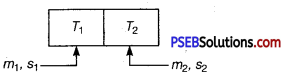
Two bodies at different temperatures T1 and T2 are brought in contact.
Under what condition, they settle to mean temperature? (after they attain equilibrium)
Answer:
Let m1 and m2 are masses of bodies with specific heats s1 and s2, then if their temperature after they are in thermal equilibrium is T.
PSEB 11th Class Physics Important Questions Chapter 12 Thermodynamics 1
Then, if > T1> T2 and assuming no heat loss.
Heat lost by hot body = heat gained by cold body
m1s1(T1-T)=m2s2(T-T2)
⇒ \(\frac{m_{1} s_{1} T_{1}+m_{2} s_{2} T_{2}}{m_{1} s_{1}+m_{2} s_{2}}\) = T[equilibrium temperature]
So for, bodies to settle down to mean temperature,
m1 = m2 and s1 = s2
means bodies have same specific heat and have equal masses.
Then, T = \(\frac{T_{1}+T_{2}}{2}\) [mean temperature]

PSEB 11th Class Physics Important Questions Chapter 12 Thermodynamics

Question 3.
When ice melts, then change in internal energy, is greater than the heat supplied, why?
Solution:
When ice melts, volume of water formed is less than that of ice. So, surroundings (environment) does work on the system (ice). And by first law,
ΔQ = ΔW+ΔU
⇒ ΔU = ΔQ-ΔW
(ΔW = negative as work is done on the system)
⇒ ΔU>ΔQ

Question 4.
Calculate the work done for adiabatic expansion of a gas.
Solution:
Consider (say µ mole) an ideal gas, which is undergoing an adiabatic expansion.
Let the gas expands by an infinitesimally small volume dV, at pressure p, then the infinitesimally small work done given by
dW = pdV
The net work done from an initial volume V1 to final volume V2 is given by
W= ∫v1v2 pdV
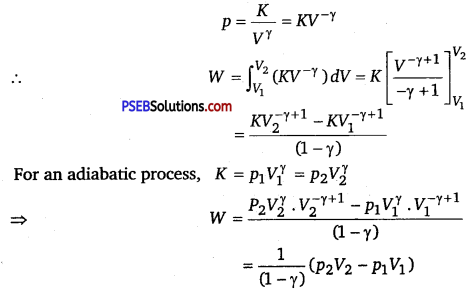
For an adiabatic process, pVγ = constant = K
PSEB 11th Class Physics Important Questions Chapter 12 Thermodynamics 2
For an adiabatic process, K = p1Vγ = p2Vγ
For an ideal gas, p1V1 = μRT1 and p2V2 = μRT2.
So, we have
W = \(\frac{1}{(1-\gamma)}\left[\mu R T_{2}-\mu R T_{1}\right]=\frac{\mu R}{(\gamma-1)}\left[T_{1}-T_{2}\right]\)

Question 5.
What is a heat engine? What is the best way to increase efficiency of a heat engine? Is it possible to design a thermal engine that has 100% efficiency?
Solution:
A heat engine is a device (or a combination) which converts heat into work.
Its efficiency, η = \(\frac{\text { Work output }}{\text { Heat input }}=1-\frac{T_{2}}{T_{1}}\)
where, T2 = temperature of sink
T1 = temperature of source.
From above expression, we can see that for 100% efficiency, T2 =0
It is impossible to design a thermal engine that has 100% efficiency because it is not possible to have a sink with kelvin temperature.

PSEB 11th Class Physics Important Questions Chapter 12 Thermodynamics

Question 6.
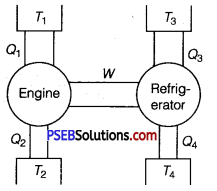
An ideal engine works between temperatures T1 and T2. It derives an ideal refrigerator that works between temperatures T3 and T4. Find the ratio Q3/Q1 in terms of T1, T2, T3, and T4.
PSEB 11th Class Physics Important Questions Chapter 12 Thermodynamics 3
Solution:
W = work done by engine = Q1 – Q2
and W = work done supplied to refrigerator = Q3 -Q4
Q1 – Q2 =Q3 – Q4
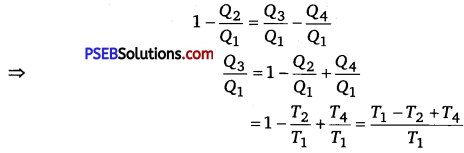
Dividing by Q1, on both sides of the above equation, we get
PSEB 11th Class Physics Important Questions Chapter 12 Thermodynamics 4

Question 7.
Under what condition, an ideal Carnot engine has 100% efficiency?
Solution:
Efficiency of a Carnot engine is given by η = \(\left(1-\frac{T_{2}}{T_{1}}\right)\)
where, T2 = temperature of sink
and T1 = temperature of sink source
So for η = 1 or 100%, T2 = 0 K or heat is rejected into a sink at 0 K temperature.

Question 8.
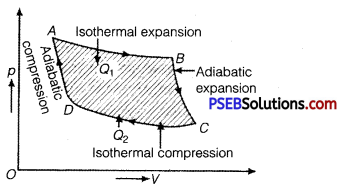
Draw p-V diagram of a Carnot cycle.
Solution:
p-V diagram for Carnot cycle
PSEB 11th Class Physics Important Questions Chapter 12 Thermodynamics 5

Long Answer Type Questions

Question 1.
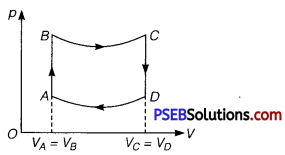
A cycle followed by a machine (made of one mole of a perfect gas in a cylinder with a piston) is shown in figure
PSEB 11th Class Physics Important Questions Chapter 12 Thermodynamics 6
A to B: volume constant B to C: adiabatic
C to D: volume constant D to A : adiabatic
VC = VD = 2 VA = 2 VB
(i) In which part of the cycle, heat is supplied to the machine from outside?
(ii) In which part of the cycle, heat is being given to the surrounding by the machine?
(iii) What is the work done by the machine in one cycle? Write your answer in terms of PA’ PB’ VA.
(iv) What is the efficiency of the machine?
Take γ = \(\frac{5}{3}\) for the gas and CV =R for one mole.
Solution:
(i) A to B because TB > TA, as p ∝ T [ ∴ V = constant]
(ii) C to D because TC>TD, as P ∝ T [∴ V=constant]
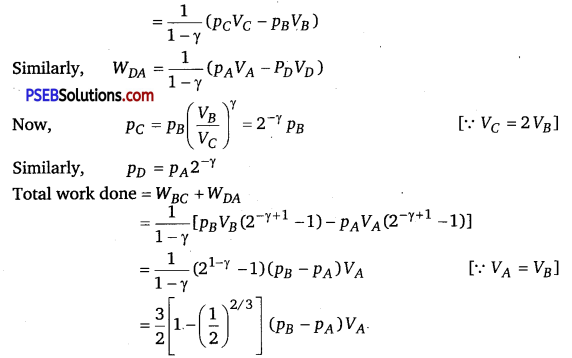
(iii) WAB = \(\int_{B}^{C} \) pdV=O and WCD =0 [∴ V= constant]
Similarly,
PSEB 11th Class Physics Important Questions Chapter 12 Thermodynamics 7
PSEB 11th Class Physics Important Questions Chapter 12 Thermodynamics 8

(iv) Heat supplied during process A to B
dQAB = dUAB
QAB = \(\frac{3}{2} n R\left(T_{B}-T_{A}\right)=\frac{3}{2}\left(p_{B}-p_{A}\right) V_{A}\)
∴ Efficiency = \(=\frac{\text { Net work done }}{\text { Heat supplied }}=\left[1-\left(\frac{1}{2}\right)^{2 / 3}\right]\)

PSEB 11th Class Physics Important Questions Chapter 12 Thermodynamics

Question 2.
Explain with the suitable example that a reversible process must be carried slowly and a fast process is necessarily irreversible.
Answer:
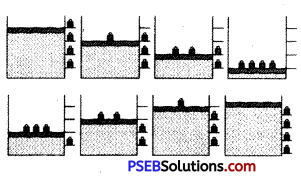
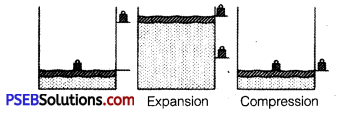
A reversible process must pass through equilibrium states which are very close to each other so that when process is reversed, it passes back through these equilibrium states. Then, it is again decompressed or it passes through same equilibrium states, system can be restored to its initial state without any change in surroundings. e.g., If a gas is compressed as shown But a reversible process can proceed without reaching equilibrium in intermediate states.
PSEB 11th Class Physics Important Questions Chapter 12 Thermodynamics 9

PSEB 11th Class Biology Important Questions Chapter 2 Biological Classification

Punjab State Board PSEB 11th Class Biology Important Questions Chapter 2 Biological Classification Important Questions and Answers.

PSEB 11th Class Biology Important Questions Chapter 2 Biological Classification

Very short answer type questions

Question 1.
Name the organisms living in salty areas. [NCERT Exemplar]
Answer:
Halophiles live in habitats having high salinity and high light intensity.

Question 2.
Name the kingdom under which cyanobacteria have been classified.
Answer:
Cyanobacteria are prokaryotic organisms belong to kingdom – Monera.

PSEB 11th Class Biology Important Questions Chapter 2 Biological Classification

Question 3.
What is the principle underlying the use of cyanobacteria in agricultural fields for crop improvement? [NCERT Exemplar]
Answer:
Some cyanobacteria live in mutually beneficial relationship with plants, obtaining food and shelter and fixing nitrogen for the plant. They also reduce soil alkalinity and improve soil texture.

Question 4.
Are chemosynthetic bacteria autotrophic or heterotrophic? [IMCERT Exemplar]
Answer:
Chemosynthetic bacteria are- autotrophs because they are able to synthesize their food from inorganic raw material with the help of energy obtained from chemical reaction.

Question 5.
Fusion of two gametes which are dissimilar in size is termed as. [NCERT Exemplar]
Answer:
Anisogamy, it occurs in Ceratium a dinoflagellate.

Question 6.
Why are cysts formed in protistans?
Answer:
Cysts formation helps to over come unfavourable condition.

PSEB 11th Class Biology Important Questions Chapter 2 Biological Classification

Question 7.
What kind of nutrition occurs in a parasite?
Answer:
Parasites have phagotrophic and absorptive type of nutrition.

Question 8.
An association between roots of higher plants and fungi is called.
Answer:
Mycorrhiza is a symbiotic association between a fungus and the root of a plant. Mycorrhiza does not penetrate deep but remains in the superficial layers of the soil.

Question 9.
How the saprotrophic Basidiomycetes are able to decompose plant matter?
Answer:
The saprotrophic Basidiomycetes can decompose plant matter because they have enzymes for metabolising both cellulose and lignin.

Question 10.
Which are the most advanced group of fungi?
Answer:
Basidiomycetes.

Question 11.
What is capsid and how it is useful for viruses?
Answer:
Capsid is a proteinaceous covering around the virus. It protects the nucleoid from damage from physical and chemical agents.

PSEB 11th Class Biology Important Questions Chapter 2 Biological Classification

Question 12.
Which enzyme is present in bacteriophages?
Answer:
Lysozyme is present in the region that comes in contact with host cell.

Short answer type questions

Question 1.
Write five beneficial usage or effects of bacteria.
Answer:
(a) Curdling of milk
(b) Lactobacillus is an important commensal in the gut flora of humans.
(c) Penicillin antibiotics are prepared by bacteria.
(d) Bacteria is a good decomposer, so it assists in completing the energy cycle.
(e) Rhizobium bacteria helps in nitrogen fixation.

Question 2.
What is the role of methanogens?
Answer:
Methanogens are a type of bacteria which live in the gut of ruminating animals. They assist those animals in digestion and the byproduct of that digestive process is methane. More number of livestock population results in increased methane level in the environment leading to global warming. So, indirectly methanogens can be responsible for global warming.

Question 3.
Cyanobacteria plays a major role in our ecology. Discuss.
Answer:
Cyanobacteria, also known as ‘blue-green algae’ help in carbon fixation in a major way on the ocean surface. They are helpful in nitrogen fixation in paddy fields leading to a better harvest. About 80% of photosynthesis on ocean surface is done by cyanobacteria. So, it can be said that they play a major role in our ecology.

Question 4.
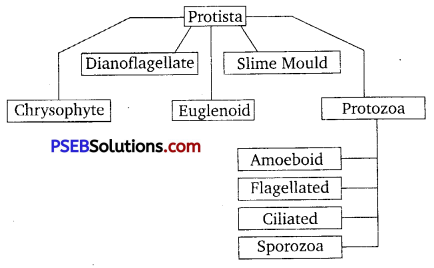
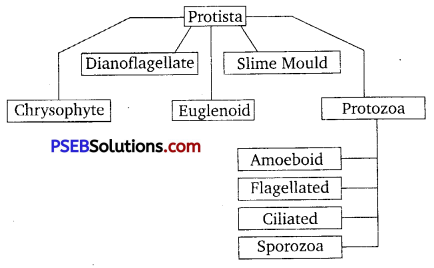
Give a diagrammatic representation of classification of Protista.
Answer:
PSEB 11th Class Biology Important Questions Chapter 2 Biological Classification 1

PSEB 11th Class Biology Important Questions Chapter 2 Biological Classification

Long answer type questions

Question 1.
Answer the following:
(i) A poisonous mushroom having white spores
(ii) Edible Basidiomycetes
(iii) Used in brewing industry
(iv) It is searched by trained pets
(v) Root like, cards like hyphal masses having a distinct growing point.
(vi) Non-motile meiospores develop in Basidiomycetes
(vii) Compact groups of hyphal produced to overcome unfavourable conditions.
Answer:
(i) toadstools
(ii) mushrooms and young pufballs
(iii) brewer’s yeast Saccharomyces cerevisiae
(iv) Truffles (tuber like underground fungus)
(v) Rhizomorphs perennate during periods of scarcity of food and water.
(vi) Basidiospores (develop exogenously)
(vii) Sclerotia under favourable conditions each one forms a new mycelium.

PSEB 11th Class Physics Solutions Chapter 12 Thermodynamics

Punjab State Board PSEB 11th Class Physics Book Solutions Chapter 12 Thermodynamics Textbook Exercise Questions and Answers.

PSEB Solutions for Class 11 Physics Chapter 12 Thermodynamics

PSEB 11th Class Physics Guide Thermodynamics Textbook Questions and Answers

Question 1.
A geyser heats water flowing at the rate of 3.0 liters per minute from 27°C to 77°C. If the geyser operates on a gas burner, what is the rate of consumption of the fuel if its heat of combustion is 4.0 x 10⁴ J/g?
Solution:
Water is flowing at a rate of 3.0 liter/min.
The geyser heats the water, raising the temperature from 27°C to 77°C.
Initial temperature, T1 = 27°C
Final temperature, T2 = 77°C
Rise in temperature, ΔT = T2 -T1
= 77-27 = 50°C

Heat of combustion = 4 x 10⁴ J/g
Specific heat of water, C = 4.2 J g-1 °C-1
Mass of flowing water, m = 3.0 litre/min = 3000 g/min
Total heat used, ΔQ = mC ΔT
= 3000 x 4.2 x 50
= 6.3 x 10⁵ J/min
∴ Rate of consumption = \(\frac{6.3 \times 10^{5}}{4 \times 10^{4}}\) = 15.75 g/min

Question 2.
What amount of heat must be supplied to 2.0 x 10⁻² kg of nitrogen (at room temperature) to raise its temperature by 45°C at constant pressure? (Molecular mass of N2 = 28; R = 8.3 J mol-1K-1).
Solution:
Mass of nitrogen, m = 2.0 x 10⁻² kg = 20g
Rise in temperature, ΔT = 45°C
Molecular mass of N2,M =28
Universal gas constant, R = 8.3 J mol-1K-1
Number of moles, n = \(\frac{m}{M}\)
= \(\frac{2.0 \times 10^{-2} \times 10^{3}}{28}\) = 0.714
Molar specific heat at constant pressure for nitrogen,
Cp = \(\frac{7}{2}\) R = \(\frac{7}{2}\) x 8.3
= 29.05J mol-1 K-1

The total amount of heat to be supplied is given by the relation
ΔQ = nCpΔT
= 0.714 x 29.05 x 45 = 933.38 J
Therefore, the amount of heat to be supplied is 933.38 J

PSEB 11th Class Physics Solutions Chapter 12 Thermodynamics

Question 3.
Explain why
(a) Two bodies at different temperatures T1 and T2 if brought in thermal contact do not necessarily settle to the mean temperature (T1 + T2) / 2.
(b) The coolant in a chemical or a nuclear plant (i.e., the liquid used to prevent the different parts of a plant from getting too hot) should have high specific heat.
(c) Air pressure in a car tyre increases during driving.
(d) The climate of a harbour town is more temperate than that of a town in a desert at the same latitude.
Answer:
(a) When two bodies at different temperatures T1 and T2 are brought in thermal contact, heat flows from the body at the higher temperature to the body at the lower temperature till equilibrium is achieved, i.e., the temperatures of both the bodies become equal. The equilibrium temperature is equal to the mean temperature (T1 + T2) / 2 only when the thermal capacities of both the bodies are equal.

(b) The coolant in a chemical or nuclear plant should have a high specific heat. This is because higher the specific heat of the coolant, higher is its heat-absorbing capacity and vice versa. Hence, a liquid having a high specific heat is the best coolant to be used in a nuclear or chemical plant. This would prevent different parts of the plant from getting too hot.

(c) When a car is in motion, the air temperature inside the car increases because of the motion of the air molecules. According to Charles’ law, temperature is directly proportional to pressure. Hence, if the temperature inside a tyre increases, then the air pressure in it will also increase.

(d) A harbour town has a more temperate climate (i.e., without the extremes of heat or cold) than a town located in a desert at the same latitude. This is because the relative humidity in a harbour town is more than it is in a desert town.

Question 4.
A cylinder with a movable piston contains 3 moles of hydrogen at standard temperature and pressure. The walls of the cylinder are made of a heat insulator, and the piston is insulated by having a pile of sand on it. By what factor does the pressure of the gas increase if the gas is compressed to half its original volume?
Solution:
The cylinder is completely insulated from its surroundings. As a result, no heat is exchanged between the system (cylinder) and its surroundings. Thus, the process is adiabatic.
Initial pressure inside the cylinder = P1
Final pressure inside the cylinder = P2
Initial volume inside the cylinder = V1
Final volume inside the cylinder = V2
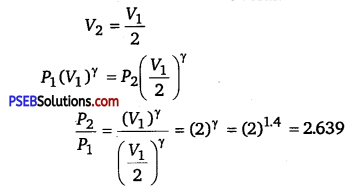
Ratio of specific heats, γ = 1.4 For an adiabatic process,
we have
P1V1γ = P2V2γ
The final volume is compressed to half of its initial volume.
PSEB 11th Class Physics Solutions Chapter 12 1
Hence, the pressure increases by a factor of 2.639.

Question 5.
In changing the state of a gas adiabatically from an equilibrium state A to another equilibrium state B, an amount of work equal to 22.3 J is done on the system. If the gas is taken from state A to B via a process in which the net heat absorbed by the system is 9.35 cal, how much is the net work done by the system in the latter case? (Take 1 cal = 4.19 J)
Solution:
The work done (W) on the system while the gas changes from state A to state Bis 22.3 J.
This is an adiabatic process. Hence, change in heat is zero.
ΔQ = 0
ΔW = -22.3 J (since the work is done on the system)
From the first law of thermodynamics, we have:
ΔQ = ΔU + ΔW

where, ΔU = Change in the internal energy of the gas .
ΔU = ΔQ – ΔW = -(-22.3 J)
ΔU = +22.3 J
When the gas goes from state A to state B via a process, the net heat absorbed by the system is
ΔQ =9.35cal = 9.35 x 4.19 = 39.1765J
Heat absorbed, ΔQ = ΔU + ΔW
ΔW = ΔQ – ΔU = 39.1765 – 22.3 – = 16.8765J
Therefore, 16.88 J of work is done by the system.

PSEB 11th Class Physics Solutions Chapter 12 Thermodynamics

Question 6.
Two cylinders A and B of equal capacity are connected to each other via a stopcock.
A contains a gas at standard temperature and pressure.
B is completely evacuated. The entire system is thermally insulated.
The stopcock is suddenly opened. Answer the following:
(a) What is the final pressure of the gas in A and B?
(b) What is the change in internal energy of the gas?
(c) What is the change in the temperature of the gas?
(d) Do the intermediate states of the system (before settling to the final equilibrium state) lie on its P -V – T surface?
Solution:
(a) 0.5 atm
The volume available to the gas is doused as soon as the stopcock between cylinders A and B is opened? Since volume is inversely proportional to pressure, the pressure will decrease to one-half of the original value. Since the initial pressure of the gas is 1 atm, the pressure in each cylinder will be 0.5atm.

(b) Zero
The internal energy of the gas can change only when work is done by or on the gas. Since in this case no work is done by or on the gas, the internal energy of the gas will not change.

(c) Zero
Since no work is being done by the gas during the expansion of the gas, the temperature of the gas will not change at all.

(d) No
The given process is a case of free expansion. It is rapid and cannot be controlled. The intermediate states do not satisfy the gas equation and since they are in non-equilibrium states, they do not lie on the P-V-T surface of the system.

Question 7.
A steam engine delivers 5.4 x 10⁸ J of work per minute and services 3.6 x 10⁹ J of heat per minute from its boiler. What is the efficiency of the engine? How much heat is wasted per minute?
Solution:
Work done by the steam engine per minute, W = 5.4 x 10⁸ J
Heat supplied from the boiler, H = 3.6 x 10⁹ J
Efficiency of the engine = \(\frac{\text { Output energy }}{\text { Input energy }}\)
∴ η = \(\frac{W}{H}=\frac{5.4 \times 10^{8}}{3.6 \times 10^{9}}\) = 0.15
Hence, the percentage efficiency of the engine is 15%.
Amount of heat wasted= 3.6 x 10⁹ – 5.4 x 108
= 30.6 x 108 = 3.06 x 10⁹ J
Therefore, the amount of heat wasted per minute is 3.06 x 10⁹J.

Question 8.
An electric heater supplies heat to a system at a rate of 100 W. If system performs work at a rate of 75 joules per second. At what rate is the internal energy increasing?
Solution:
Heat is supplied to the system at a rate of 100 W.
∴ Heat supplied, ΔQ = 100 J/s
The system performs at a rate of 75 J/s.
∴ Work done, ΔW = 75 J/s

From the first law of thermodynamics, we have
ΔQ = ΔU + ΔW
where ΔU = Rate of change in internal energy
ΔU = ΔQ – ΔW = 100 – 75 = 25 J/s = 25W
Therefore, the internal energy of the given electric heater increases at a rate of 25 W.

PSEB 11th Class Physics Solutions Chapter 12 Thermodynamics

Question 9.
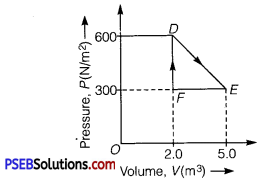
A thermodynamic system is taken from an original state to an intermediate state by the linear process shown in figure given below.
PSEB 11th Class Physics Solutions Chapter 12 2
Its volume is then reduced to the original value from E to F by an isobaric process. Calculate the total work done by the gas from D to E to F.
Solution:
Total work done by the gas from D to E to F = Area of ΔDEF
Area of ΔDEF = \(\frac{1}{2}\) DF x EF
where, DF = Change in pressure
=600 N/m2
= 300N/m2 = 300N/m2
FE = Change in volume
5.0 m3 – 2.0 m3 = 3.0m3
Area of ADEF = \(\frac{1}{2} \) x 300 x 3 = 450 J
Therefore, the total work done by the gas from D to E to F is 450 J.

Question 10.
A refrigerator is to maintain eatables kept inside at 9°C. If the room temperature is 36°C, Calculate the coefficient of performance.
Solution:
Temperature inside the refrigerator, T1 = 9°C = 273 + 9 = 282 K
Room temperature, T2 = 36°C = 273+36
Coefficient of performance = \(\frac{T_{1}}{T_{2}-T_{1}}\)
= \(\frac{282}{309-282}=\frac{282}{27}\)
309-282 = 10.44
Therefore, the coefficient of performance of the given refrigerator is 10.44.

PSEB 11th Class Biology Important Questions Chapter 15 Plant Growth and Development

Punjab State Board PSEB 11th Class Biology Important Questions Chapter 15 Plant Growth and Development Important Questions and Answers.

PSEB 11th Class Biology Important Questions Chapter 15 Plant Growth and Development

Very short answer type questions

Question 1.
Identify the actively dividing cells in plants.
Answer:
Meristems are the actively dividing cells present in the plants.

Question 2.
What happens if the meristematic cells ever cease to divide?
Answer:
If meristematic cells cease to divide, the growth of the plant will be hindered and will undergo a period of dormancy depending upon the seasonal changes in the climate. „

Question 3.
Growth is one of the characteristics of all living organisms? Do unicellular organisms also grow? If so, what are the parameters?
Answer:
Yes, unicellular organisms also grow. Their cell size increases up to a certain fixed dimension only.

PSEB 11th Class Biology Important Questions Chapter 15 Plant Growth and Development

Question 4.
Mention the name of the internal factors that control development in plants.
Answer:
Internal factors that control development in plants are as follows:

  1. Genetic factors (intracellular)
  2. Plant growth regulators (intercellular).

Question 5.
Identify the plant hormone-related with intermodal elongation.
Answer:
Gibberellin is the plant hormone-related with internodal elongation.

Question 6.
Mention the name the growth regulator, which was first isolated from endosperm of maize. Give its main biological activity.
Answer:
Zeatin is the growth regulator isolated from endosperm of maize. It controls cell division (cytokinesis) even in non-meristematic tissues.

Question 7.
In most plants, the terminal bud suppresses the development of lateral buds into branches. What is this phenomenon called? Name one phytohormone that can promote this phenomenon.
Answer:
The phenomenon is called apical dominance. Auxin is the phytohormone involved in prompting this phenomenon.

Question 8.
Which air pollutant also acts as a plant hormone?
Answer:
Ethylene.

Question 9.
How do gibberellin help in promoting seed germination?
Answer:
The gibberellin mobilize storage reserves by amylases during germination of seeds.

Question 10.
What are the plant organs responsible for the perception of light variation? What is the pigment responsible for this perception?
Answer:

  • Leaves are mainly responsible for perception of light intensity in plants.
  • The pigment that performs this perception is called phytochrome.

Question 11.
Name the hormones involved in photoperiodism.
Answer:
Florigen is the hormone involved in photoperiodism.

PSEB 11th Class Biology Important Questions Chapter 15 Plant Growth and Development

Question 12.
Beetroot is often known as a long-day plant. Explain why?
Answer:
Beetroot is known as long-day plant because flowering takes place when the plants are exposed to day length longer than a critical period.

Short answer type questions

Question 1.
An owner of an apple orchard wants to get better yield and wants to wait for good market conditions to sell his apples. Which PGR should he use to achieve his goals?
Answer:
He should use Gibberellins. Gibberellins help increase the size of apples. Moreover, they also delay senescence so apples can be left on branches for a longer duration. This will give the orchard owner enough time to wait for good market conditions.

Question 2.
What are plasticity and heterophylly?
Answer:
In some plants, certain structures show different forms, in response to environment or to phases of life. This ability is known as plasticity.
PSEB 11th Class Biology Important Questions Chapter 15 Plant Growth and Development 1
For example, in cotton, coriander, and larkspur, leaves of juvenile plants are different in shape compared to leaves in mature plants. This is called heterophylly. Juvenile In buttercup shape of leaves produced in air is different from that produced in water.

Question 3.
What are the favorable conditions for seed germination?
Answer:
Favorable conditions for seed germination are given below:

  • Proper temperature
  • Moisture
  • Sunlight
  • Oxygen.

Question 4.
What are the various man-made meant of overcoming seed dormancy?
Answer:
Man-made means of overcoming seed dormancy are given below :
The seed-coat barrier in some seeds can be broken by mechanical abrasions using knives, sandpaper, etc. or by vigorous shaking.

Effect of inhibitory substances can be removed by subjecting the seeds to chilling conditions or by application of certain chemicals like gibberellic acid and nitrates. Changing environment conditions: like light and temperature.

PSEB 11th Class Biology Important Questions Chapter 15 Plant Growth and Development

Question 5.
What do you understand by apical dominance?
Answer:
In most of the higher plants, growing apical bud inhibits the growth of lateral (axillary buds). This phenomenon is called apical dominance. Removal of short tips (decapitation) normally results in the growth of lateral buds. Decapitation is used in tea plantations to get more leaves from a plant.

Long answer type questions

Question 1.
Mention the phenomenon of growth in plants. Explain the phases of growth in detail.
Answer:
Growth is defined as a permanent or irreversible increase in dry weight, mass or volume of cell, organ or organism.
Plant growth takes place in three steps or phases cell, division (meristematic), cell elongation and cell maturation.
(i) Cell Division (Meristematic) Phase:

  • It is also called formative phase.
  • New cells are produced by mitotic divisions of the pre-existing cells. The meristematic cells have thin cellulose walls with abundant plasmodesma connections, dense protoplasm and conspicuous nuclei.
  • In higher plants cell division occurs in meristems or growing points.
  • As the formation of new cells requires intense biosynthetic activity, the rate of respiration in the cells of formation phase is very high.

(ii) Cell Elongation Phase:

  • It is also called phase of cell enlargement.
  • This phase lies just behind the growing points and is mainly responsible for growth of plant parts.
  • The newly formed cells, produced informative phase undergo enlargement.
  • The cell walls of the enlarging of cell show plastic extension through enzymatic loosening of microfibrils and deposition of new materials.
  • The enlarging cell also develops a central vacuole, rate of respiration is high but less than that of the cells in the formative phase.
  • Thus, this phase is characterized by cell enlargement, new cell wall deposition and increased vacuolation.

(iii) Cell Maturation Phase

  • This phase occurs just behind the phase of elongation.
  • The enlarged cells develop into particular type of cells by undergoing structural and physiological differentiation.
  • Hence, at this phase, all the diverse tissue types observed in root or stem.