PSEB 11th Class Biology Solutions Chapter 6 Anatomy of Flowering Plants

Punjab State Board PSEB 11th Class Biology Book Solutions Chapter 6 Anatomy of Flowering Plants Textbook Exercise Questions and Answers.

PSEB Solutions for Class 11 Biology Chapter 6 Anatomy of Flowering Plants

PSEB 11th Class Biology Guide Anatomy of Flowering Plants Textbook Questions and Answers

Question 1.
State the location and function of different types of meristems.
Answer:
A meristematic tissue represents a group of cells that have retained the power of division throughout the life of an individual. The meristematic tissues are of three types, i.e., apical, intercalary and lateral meristem.

  • Apical Meristem: These meristems are present at the apices of shoot and roots of the plants. Apical meristems are responsible for the increase in length of all the primary tissues.
  • Intercalary Meristem: It is the meristem that occurs between the mature tissues. They occur in grasses and regenerate parts removed by the grazing herbivores. It contributes to the formation of the primary plant body.
  • Lateral Meristem: It occurs in the mature regions of roots arid shoots of many plants, particularly that produce woody axis. These meristems are responsible for producing the secondary tissues.

Question 2.
Cork cambium forms tissues that form the cork. Do you agree with this statement? Explain.
Answer:
Yes, cork cambium forms tissues that form cork. As the stem continues to increase in girth another meristematic tissue called cork cambium or phellogen develops in cortex region of stem. The phellogen cuts off cells on both sides. The outer cells differentiate into cork or phellem. The inner cells differentiate into secondary cortex or phelloderm. Cork is impervious to water due to suberin and provides protection to underlying tissues.

PSEB 11th Class Biology Solutions Chapter 6 Anatomy of Flowering Plants

Question 3.
Explain the process of secondary growth in the stems of woody angiosperms with the help of schematic diagrams. What is its significance?
Answer:
Secondary growth in stems of woody angiosperms occur by two types of cambia, i.e., vascular cambium and cork cambium.
(i) Vascular Cambium: Certain cells of medullary rays become meristematic to form interfascicular cambium. The fascicular cambium and the interfascicular cambium join to form a complete ring called cambial ring. The cells of the cambial ring undergo mitotic divisions and produce secondary phloem on its outer side and secondary xylem on its inner side.

At places, vascular cambium possesses ray initials. They form vascular rays, phloem rays in secondary phloem and wood rays in secondary xylem.

As new secondary phloem becomes functional, the previous older phloem gets crushed. Secondary xylem or wood persists. As a result wood grows

with age in the form of annual rings. In each annual ring, there is wide or broader spring or early wood or spring wood and narrow autumn or late wood.

In old stems, the central part of wood becomes non-functional and dark coloured due to tyloses and deposit of resins, gums, tannins. It is called r duramen or heartwood. The outer, functional wood is called sapwood.

(ii) Cork Cambium: As the stem continues to increase in girth due to the activity of vascular cambium the outer cortical and epidermal layers get broken and need to be replaced to provide new protective cell layers. In this way, cork cambium or phellogen develops in the cortex region. Phellogen cuts of cells on both sides.

The outer cells differentiate into cork or phellem while, the inner cells ; differentiate into secondary cortex or phelloderm. Due to the activity of cork cambium, pressure builds up on remaining layers peripheral to
phellogen and ultimately these layers die and slough off. At places, aerating pores called lenticels develop, which have loosely arranged , complementary cells.
PSEB 11th Class Biology Solutions Chapter 6 Anatomy of Flowering Plants 1
Significance of Secondary Growth

  • It replaces old non-functional tissues.
  • It provides fire proof, insect proof and insulating cover around the older plant parts.
  • Commercial cork is a product of secondary growth.
  • Wood is the product of secondary growth.

PSEB 11th Class Biology Solutions Chapter 6 Anatomy of Flowering Plants

Question 4.
Draw illustrations to bring out the anatomical difference between:
(a) Monocot root and Dicot root
(b) Monocot stem and Dicot stem
Answer:
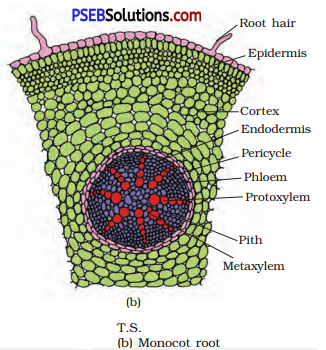
PSEB 11th Class Biology Solutions Chapter 6 Anatomy of Flowering Plants 2
(a) Anatomical Differences between Monocot Root and Dicot Root
(i) Anatomy of Monocot Root
(a) The structure of epidermis, cortex, endodermis and pericycle of a monocot root resembles exactly those of a dicot root.
(b) Vascular bundles are radial, and polyarch.
(c) Pith is large and well-developed; it is composed of parenchyma cells

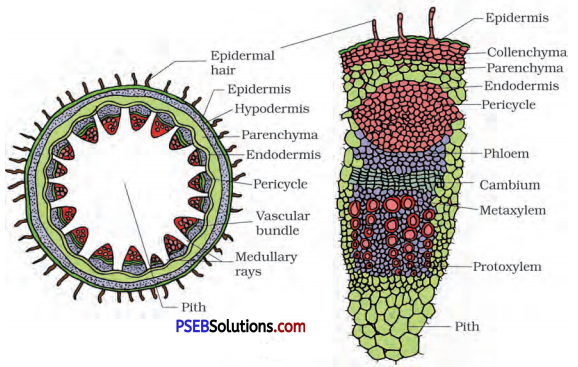
(ii) Anatomy of dicot root
PSEB 11th Class Biology Solutions Chapter 6 Anatomy of Flowering Plants 3
T.S of Dicot root
(a) Epidermis is single layered and many cells bear root hairs; cuticle is absent.
(b) Cortex is made of several layers of parenchyma cells.
(c) Endodermis consists of a single-layer of cells. The cells have a deposition of suberin, in the form of casparian strips, on their radial and tangential walls.
(d) Pericycle comprises a few layers of specialised parenchyma cells inner to the endodermis.
(e) Vascular bundles are radial and may range between two and six, though commonly there are four groups; i.e., tetrarch; xylem is exarch.
(f) Pith is very small and made of parenchyma cells.

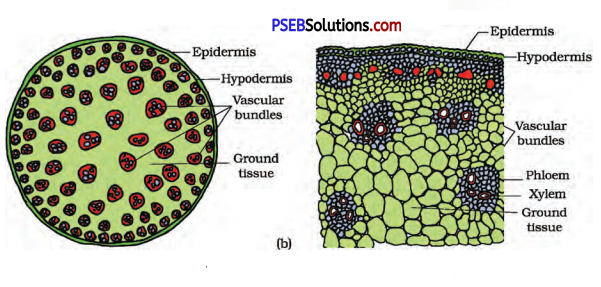
(b) Anatomical Differences between Monocot Stem and Dicot stem
(i) Anatomy of monocot stem
(a) Epidermis is single layered and trichomes are absent; cuticle is present on its outer surface.
(b) Hypodermis consists of two or three layers of sclerenchyma cells.
(c) Ground tissue is parenchymatous and is not differentiated into cortex or pith.
(d) Vascular bundles are many and scattered in the ground tissue; they vary in size.
PSEB 11th Class Biology Solutions Chapter 6 Anatomy of Flowering Plants 4
T.S. of Monocot Stem

  • Each vascular bundle is surrounded by sclerenchymatous bundle sheath.
  • The vascular bundles are conjoint and closed; xylem is endarch and characteristically a protoxylem lacuna is present.

(ii) Anatomy of dicot stem
(a) Epidermis is the outermost layer of cells; externally it is covered with a cuticle and may bear trichomes and a few stomata.
(b) Hypodermis consists of a few layers of collenchyma cells, just below the epidermis.
(c) Cortex consists of parenchyma cells.
(d) Endodermis is single layered and the cells are rich in starch grains and hence it is also referred to as starch sheath.
(e) Pericyde occurs inner to the endodermis, above the phloem of vascular bundles in the form of semi-lunar patches (hence also referred to as bundle caps); it is composed of sclerenchyma.
T.S. of Dicot Stem
PSEB 11th Class Biology Solutions Chapter 6 Anatomy of Flowering Plants 5
(f) Vascular bundles are characteristically arranged in the form of a ring.

  • Each vascular bundle is conjoint and open with intra-fascicular cambium; xylem is endarch.
    (g) Medullary rays are the few layers of radially placed parenchyma cells, in between the vascular bundles.
    (h) Pith is composed of parenchyma cells.

PSEB 11th Class Biology Solutions Chapter 6 Anatomy of Flowering Plants

Question 5.
Cut a transverse section of young stem of a plant from your school garden and observe it under the microscope. How would you ascertain whether it is a monocot stem or a dicot stem? Give reasons.
Answer:
Transverse section of a monocot stem possess following characters:

  • Dumbbell-shaped guard cells in stomata in epidermis.
  • Sclerenchymatous hypodermis.
  • No concentric arrangement of internal tissues.
  • Unifrom ground tissue showing no tissue differentiation.
  • More than 8 scattered vascular bundles.
  • Bundle sheath is present.
  • No secondary growth normally.
  • Xylem vessels arranged in Y-shaped manner.
  • Protoxylem cavity usually present in vascular tissues.

Transverse section of a dicot stem possess following characters:

  • Kidney-shaped guard cells in stomata present in epidermis.
  • Collenchymatous hypodermis.
  • Concentric arrangement of internal tissues.
  • Differentiation of ground tissue into cortex, endodermis, pericycle and pith.
  • The vascular bundles are arranged in a ring.
  • Conjoint, collateral and open vascular bundles.
  • Without bundle sheath.
  • Secondary growth takes place.
  • Xylem vessels arranged in rows.

[Note: For figures refer to Q.No. 4]

Question 6.
The transverse section of a plant material shows the following anatomical features:
(a) The vascular bundles are conjoint, scattered and surrounded by a sclerenchymatous bundle sheaths.
(b) Phloem parenchyma is absent. What will you identify it as?
Answer:
It is a transverse section of monocotyledonous stem.

Question 7.
Why are xylem and phloem called complex tissues?
Answer:
Xylem and phloem are made up of more than one type of cells that is why they are called as complex tissues :
(i) Xylem is composed of four different kinds of elements, namely-tracheids, vessels, xylem fibres and xylem parenchyma. Tracheids are dead tube-like cells which are thick walled, vessels are made up of large number of tube cells placed end to end. Xylem fibres are thick walled cells that maybe septate and aseptate. Xylem parenchyma is living and thin walled cells.

(ii) Phloem is composed of sieve tube elements, companion cells, phloem parenchyma and phloem fibres. Sieve tube elements are tube-like cells, whereas phloem parenchyma are living cells and phloem fibres are thick walled lignified cells.

PSEB 11th Class Biology Solutions Chapter 6 Anatomy of Flowering Plants

Question 8.
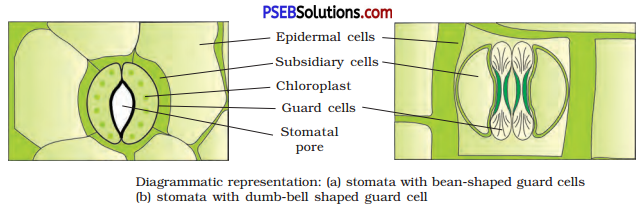
What is stomatal apparatus? Explain the structure of stomata with a labelled diagram.
Answer:
The minute pores present in the epidermis are known as stomata. The stomata may be surrounded by either bean-shaped (in dicots) or by dumb-bell-shaped (in monocots) guard cells. The guard cells in turn are surrounded by other epidermal cells, which are known as subsidiary or
PSEB 11th Class Biology Solutions Chapter 6 Anatomy of Flowering Plants 6
accessory cells. The stomatal aperture, guard cells, accessory cells constitute the stomatal apparatus.

Question 9.
Name the three basic tissue systems in the flowering plants. Give the tissue names under each system.
Answer:
The three basic; tissue systems in flowering plants are as follows:

  • Epidermal Tissue System: The tissue related to this system are epidermis, cuticle and wax, stomata and trichomes.
  • Ground Tissue System: It consists of cortex, endodermis, pericycle, medullary rays, pith and ground tissue of leaves.
  • Vascular Tissue System: It contains conducting tissues like xylem and phloem.

Question 10.
How is the study of plant anatomy useful to us?
Answer:
Plant anatomy is the study of internal structure of living organisms.

  • It describes the tissues involved in assimilation of food and its storage, transportation of water, i.e., xylem tissue, transportation of minerals. i.e., phloem and those involved in providing mechanical support to the plant,
  • Study of internal structure of plants helps to understand their adaptations of diverse environments.
  • The study of plant anatomy also help in understanding the functional organisation of higher plants.

Question 11.
What is periderm? How does periderm formation take place in
the dicot stems?
Answer:
Phellogen, phellem and phelloderm are collectively called as periderm. Phellogen develops usually in the cortex region. Phellogen is a couple of layers thick. Phellogen cuts off cells on both sides. The outer cells 1 differentiate into cork or phellem, while the inner cells differentiate into secondary cortex or phelloderm. All these together form periderm.

PSEB 11th Class Biology Solutions Chapter 6 Anatomy of Flowering Plants

Question 12.
Describe the internal structure of a dorsiventral leaf with the help of labelled diagrams.
Answer:
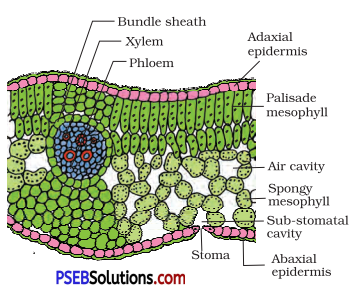
The vertical section of a dorsiventral leaf through the lamina shows three ; main parts namely, epidermis, mesophyll and vascular system. The epidermis which covers both the upper surface (adaxial epidermis) and lower surface (abaxial epidermis) of the leaf has a conspicuous cuticle. The abaxial epidermis generally bears more stomata than the adaxial epidermis. The latter may even lack stomata. The tissue between the upper and the lower epidermis is called the mesophyll. Mesophyll, which possesses chloroplasts and carry out photosynthesis, is made up of parenchyma. It has two types of cells – the palisade parenchyma and the spongy parenchyma.

The adaxially placed palisade parenchyma is made up of elongated cells, which are arranged vertically and parallel to each other. The oval or round and loosely arranged spongy parenchyma is situated below the palisade cells and extends to the lower epidermis. There are numerous large spaces and air cavities between these cells. Vascular system includes vascular bundles, which can be seen in the veins and the midrib. The size of the vascular bundles are dependent on the size of the veins. The veins vary in thickness in the reticulate venation of the dicot leaves. The vascular bundles are surrounded by a layer of thick walled bundle sheath cells.
T.S. of Dorsiventral Leaf
PSEB 11th Class Biology Solutions Chapter 6 Anatomy of Flowering Plants 7

PSEB 11th Class Biology Solutions Chapter 17 Breathing and Exchange of Gases

Punjab State Board PSEB 11th Class Biology Book Solutions Chapter 17 Breathing and Exchange of Gases Textbook Exercise Questions and Answers.

PSEB Solutions for Class 11 Biology Chapter 17 Breathing and Exchange of Gases

PSEB 11th Class Biology Guide Breathing and Exchange of Gases Textbook Questions and Answers

Question 1.
Define vital capacity. What is its significance?
Answer:
Vital Capacity (VC): The maximum volume of air a person can breathe in after a forced expiration is called vital capacity. Vital capacity is higher in athletes and singers. Vital capacity shows the strength of our inspiration and expiration.

Question 2.
State the volume of air remaining in the lungs after a normal breathing.
Answer:
The volume of air remaining in the lungs even after a forcible expiration averages 1100 ml to 1200 ml.

Question 3.
Diffusion of gases occurs in the alveolar region only and not in the other parts of respiratory system. Why?
Answer:
Alveoli are the primaty sites of gas exchange in the respiratory system. Exchange of gases occur between blood and these tissues. O2 and CO2 are exchanged in these sites by simple diffusion mainly based on pressure/concentration gradient. The diffusion membrane for gas exchange is made up of three major layers.
These layers are :

  1. Squamous epithelium of alveoli.
  2. Endothelium of alveolar capillaries.
  3. Basement substance in between them. Its total thickness is much less than a millimetre. Therefore, all the factors in our body are favourable for diffusion of O2 from alveoli to tissues and that of CO2 from tissues to alveoli.

Question 4.
What are the major transport mechanisms for CO2? Explain.
Answer:
Transport of Carbon Dioxide: CO2 in gaseous form diffuses out of the cells into capillaries, where it is transported in following ways :
(i) Transport in dissolved form: About 7% CO2 is carried in dissolved form through the plasma because of its high solubility.
(ii) Transport as bicarbonate: The largest fraction (about 70%) is carried in plasma as bicarbonate ions (HCO3). At the tissues site, where pCO2 is high due to catabolism, CO2 diffuses into the blood (RBCs and plasma) and forms HCO3 and H.
PSEB 11th Class Biology Solutions Chapter 17 Breathing and Exchange of Gases 1
This reaction is faster in RBCs because they contain an enzyme carbonic anhydrase. Hydrogen ion released during the reaction bind to Hb, triggering the Bohr effect.
At the alveolar site, where pCO2 is low, the reaction proceeds in opposite direction forming CO2 and H2O. Thus, CO2 trapped as bicarbonate at tissue level and transported to alveoli is released as CO2.

(iii) Transport as carbaminohaemoglobin: Nearly 20-25% CO2 is carried by haemoglobin as carbaminohaemoglobin, CO2 entering the blood combines with the NH2 group of the reduced Hb.
PSEB 11th Class Biology Solutions Chapter 17 Breathing and Exchange of Gases 2
The reaction releases oxygen from oxyhaemoglobin.
Factors affecting the binding of CO2 and Hb are as follows:

  • Partial pressure of CO2.
  • Partial pressure of O2 (major factor).

In tissues, pCO2 is high and pO2 is low, more binding of CO2 occurs while, in the alveoli, pCO2 is low and pO2 is high, dissociation of CO2 from HbCO2 takes place, i.e., CO2, which is bound to Hb from the tissues is delivered at the alveoli.

PSEB 11th Class Biology Solutions Chapter 17 Breathing and Exchange of Gases

Question 5.
What will be the pO2 and pCO2, in the atmospheric air compared to those in the alveolar air?
(i) pO2 lesser and pCO2 higher
(ii) pO2 higher and pCO2 lesser
(iii) pO2 higher and pCO2 higher
(iv) pO2 lesser and pCO2 lesser
Answer:
(i) In the alveolar tissues, where low pO2, high pCO2, high H+ concentration, these conditions are favourable for dissociation of oxygen from the oxyhaemoglobin.

(ii) When there is high pO2, low pCO2, less H+ concentration and lesser temperature, the factors are all favourable for formation of oxyhaemoglobin.

(iii) When pO2 is high in the alveoli and pCO2 is high in the tissues then the oxygen diffuses into the blood and combines with oxygen forming oxyhaemoglobin and CO2 diffuses out.

(iv) When pO2 is low in the alveoli and pCO2 is low in the tissues then these conditions are favourable for dissociation of oxygen from the oxyhaemoglobin.

Question 6.
Explain the process of inspiration under normal conditions.
Answer:
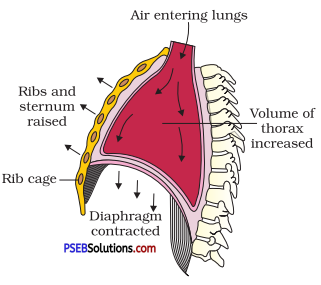
Inspiration is the process during which atmospheric air is drawn in. Inspiration is initiated by the contraction of diaphragm, which increases the volume of thoracic chamber in the anteroposterior axis. The contraction of external intercostal muscles lifts up the ribs and the sternum causing an increase in the volume of the thoracic chamber in the dorso-ventral axis.

The overall increase in the thoracic volume causes a similar increase in pulmonary volume. An increase in pulmonary volume decreases the intrapulmonary pressure to less than the atmospheric pressure, which forces the air from outside to move into the lungs, i. e., inspiration. On an average, a healthy human breathes 12-16 times/minute.
PSEB 11th Class Biology Solutions Chapter 17 Breathing and Exchange of Gases 3

Question 7.
How is respiration regulated?
Answer:
Respiratory rhythm centre is primarily responsible for regulation of respiration. This centre is present in the medulla.
Pneumotaxic centre, present in the pons region, also coordinates respiration. Apart from them, receptors associated with aortic arch and carotid artery, can also recognize changes in CO2 and H+ concentration and send signal to the rhythm centre for proper action.

Question 8.
What is the effect of pCO2 on oxygen transport?
Answer:
Partial pressure of CO2 (pCO2) can interfere the binding of oxygen with haemoglobin, i.e., to form oxyhaemoglobin.
(i) In the alveoli, where there is high pO2 and low pCO2, less H+ concentration and low temperature, more formation of oxyhaemoglobin occur.

(ii) In the tissues, where low pO2, high pCO2, high H+ concentration and high temperature exist, the conditions are responsible for dissociation of oxygen from the oxyhaemoglobin.

Question 9.
What happens to the respiratory process in a man going up a hill?
Answer:
At hills, the pressure of air falls and the person cannot get enough oxygen in the lungs for diffusion in blood. Due to deficiency of oxygen, the person feels breathlessness, headache, dizziness, nausea, mental fatigue and a bluish colour on the skin, nails and lips.

PSEB 11th Class Biology Solutions Chapter 17 Breathing and Exchange of Gases

Question 10.
What is the site of gaseous exchange in an insect?
Answer:
The actual site of gaseous exchange in an insect is tracheoles and tracheolar end cells.

Question 11.
Define oxygen dissociation curve. Can you suggest any reason for its sigmoidal pattern?
Answer:
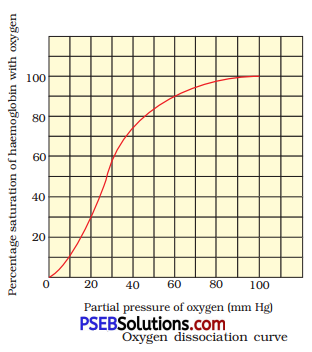
A sigmoid curve is obtained when percentage saturation of haemoglobin with O2 is plotted against the pO2.
This curve is called the oxygen dissociation curve and is highly useful in studying the effect of factors like pCO2, H+ concentration, etc., on binding of O2 with haemoglobin.
PSEB 11th Class Biology Solutions Chapter 17 Breathing and Exchange of Gases 4
In the alveoli, where there is high pO2, low pCO2, lesser H+ concentration and lower temperature, the factors are all favourable for the formation of oxyhaemoglobin, whereas in the tissues, where low pO2, high pCO2, high H+ concentration and higher temperature exist, the conditions are favourable for dissociation of oxygen from the oxyhaemoglobin. This dearly indicates that O2 gets bound to haemoglobin in the lung surface and gets dissociated at the tissues. Every 100 ml of oxygenated blood can deliver around 5 ml of O2 to the tissues under normal physiological conditions.

Question 12.
Have you heard about hypoxia? Try to gather information about it, and discuss with your friends.
Answer:
Hypoxia is the shortage of oxygen supply to the blood due to :
(a) normal shortage in air
(b) oxygen deficiency on high mountains (mountain sickness), anaemia and phytotoxicity or poisoning of electron transport system.

Question 13.
Distinguish between:
(a) IRV and ERV
(b) Inspiratory Capacity and Expiratory Capacity
(c) Vital Capacity and Total Lung Capacity
Answer:
(a) IRV and ERV Inspiratory Reserve Volume (IRV): Additional volume of air, a person can inspire by a forcible inspiration. This is about 2500-3000 mL. Expiratory Reserve Volume (ERV): Additional volume of air, a person can expire by a forcible expiration. This is about 1000-1100 mL.

(b) Inspiratory Capacity and Expiratory Capacity Inspiratory Capacity (IC): Total volume of air a person can inspire after a normal expiration. This includes tidal volume and inspiratory reserve volume (TV+IRV).
Expiratory Capacity (EC): Total volume of air a person can expire after a normal inspiration. This includes tidal volume and expiratory reserve volume (TV+ERV)

(c) Vital Capacity and Total Lung Capacity
Vital Capacity (VC): The maximum volume of air, a person can breathe in after a forced expiration. This includes ERV, TV and IRV or the maximum volume of air a person can breathe out after a forced inspiration.
Total Lung Capacity (TLC): Total volume of air accommodated in the lungs at the end of a forced inspiration. This includes RV, ERV, TV and IRV or vital capacity + residual volume.

PSEB 11th Class Biology Solutions Chapter 17 Breathing and Exchange of Gases

Question 14.
What is tidal volume? Find out the tidal volume (approximate value) for a healthy human in an hour.
Answer:
Tidal Volume (TV): Volume of air inspired or expired during a normal respiration is called tidal volume. It is about 500 mL., i.e., a healthy man can inspire or expire approximately 6000 to 8000 mL of air per minute.

PSEB 11th Class Biology Solutions Chapter 18 Body Fluids and Circulation

Punjab State Board PSEB 11th Class Biology Book Solutions Chapter 18 Body Fluids and Circulation Textbook Exercise Questions and Answers.

PSEB Solutions for Class 11 Biology Chapter 18 Body Fluids and Circulation

PSEB 11th Class Biology Guide Body Fluids and Circulation Textbook Questions and Answers

Question 1.
Name the components of the formed elements in the blood and mention one major function of each of them.
Answer:
(a) Erythrocytes: They are also known as Red Blood Cells (RBC). They are the most abundant of all the cells in blood. A healthy’adult man has, on an average, 5 millions to 5.5 millions of RBCs mm -3 of blood. RBCs are formed in the red bone marrow in the adults.
RBCs are devoid of nucleus in most of the mammals and are biconcave in shape. They have a red coloured, iron containing complex protein called haemoglobin. A healthy individual has 12-16 gms of haemoglobin in every 100 ml of blood.
these molecules play a significant role in transport of respiratory gases. RBCs have an average life span of 120 days after which they are destroyed in the spleen. Hence, spleen is also known as the graveyard of RBCs.

(b) Leucocytes: They are also known as White Blood Cells (WBC) as they are colourless due to the lack of haemoglobin. They are nucleated and are relatively lesser in number which averages 6000-8000 mm-3 of blood. Leucocytes are generally short-lived.

There are two main categories of WBCs :
1. Granulocytes, e.g., neutrophils, eosinophils and basophils
2. Agranulocytes. e.g., lymphocytes and monocytes.
Neutrophils are the most abundant cells (60-65 per cent) of the total WBCs and basophils are the least (0.5-1 per cent) among them. Neutrophils and monocytes (6-8 per cent) are phagocytic cells which destroy foreign organisms entering the body.

Basophils secrete histamine, serotonin, heparin, etc., and are involved in inflammatory reactions. Eosinophils (2-3 per cent) resist infections and are also associated with allergic reactions. Lymphocytes (20-25 per cent) are of two major types- ‘B’ and T forms. Both B and T lymphocytes are responsible for immune responses of the body.

(c) Platelets: Platelets or thrombocytes, are involved in the coagulation or clotting of blood. A reduction in their number can lead to clotting disorders, which will lead to excessive loss of blood from the body.

PSEB 11th Class Biology Solutions Chapter 18 Body Fluids and Circulation

Question 2.
What is the importance of plasma proteins?
Answer:
Fibrinogen, globulins and albumins are the major plasma proteins. Fibrinogens are needed for clotting or coagulation of blood. Globulins primarily are involved in defense mechanisms of the body and the albumins help in osmotic balance.

Question 3.
Match column I with column II.

Column I Column II
A. Eosinophils 1. Coagulation
B. RBC 2. Universal recipient
C. AB group 3. Resist infections
D. Platelets 4. Contraction of heart
E. Systole 5. Gas transport

Answer:

Column I Column II
A. Eosinophils 3. Resist infections
B. RBC 5. Gas transport
C. AB group 2. Universal recipient
D. Platelets 1. Coagulation
E. Systole 4. Contraction of heart

Question 4.
Why do we consider blood as a connective tissue?
Answer:
Blood is a mobile connective tissue derived from mesoderm which consists of fibre-free fluid matrix, plasma and other cells. It regularly circulates in the body, takes part in the transport of materials.

PSEB 11th Class Biology Solutions Chapter 18 Body Fluids and Circulation

Question 5.
What is the difference between blood and lymph?
Answer:
Differences between Blood and Lymph

Blood Lymph
It is red in colour due to the presence of haemoglobin in red cells. It is colourless as red blood cells are absent.
It consists of plasma, RBC, WBC and platelets. It consists of plasma and less number of WBC.
Glucose concentration is low. Glucose concentration is higher than blood.
Clotting of blood is a fast process. Clotting of lymph is comparatively slow.
It transports materials from one organ to other. It transports materials from tissue cells into the blood.
Flow of blood is fast. Lymph flows very slowly.
Its plasma has more proteins, calcium and phosphorus. Its plasma has less protein, calcium and phosphorus.
It moves away from the heart and towards the heart. It moves in one direction, i. e., from tissues to sub-clavians.

Question 6.
What is meant by double circulation? What is its significance?
Answer:
Double Circulation: In double circulation, the blood passes twice through the heart during one complete cycle. Double circulation is carried out by two ways :
1. Pulmonary circulation,
2. Systemic circulation

Significance: In birds and mammals, oxygenated and deoxygenated blood received by the left and right atria respectively passes on to the ventricles of the same sides. The ventricles pump it out without mixing up, i.e., two separate circulatory pathways are present in these organisms. This is the importance of double circulation.

Question 7.
Write the differences between:
(a) Blood and lymph
(b) Open and closed system of circulation
(c) Systole and diastole
(d) P-wave and T-wave
Answer:
(a)

Blood Lymph
It is red in colour due to the presence of haemoglobin in red cells. It is colourless as red blood cells are absent.
It consists of plasma, RBC, WBC and platelets. It consists of plasma and less number of WBC.
Glucose concentration is low. Glucose concentration is higher than blood.
Clotting of blood is a fast process. Clotting of lymph is comparatively slow.
It transports materials from one organ to other. It transports materials from tissue cells into the blood.
Flow of blood is fast. Lymph flows very slowly.
Its plasma has more proteins, calcium and phosphorus. Its plasma has less protein, calcium and phosphorus.
It moves away from the heart and towards the heart. It moves in one direction, i. e., from tissues to sub-clavians.

(b) Differences between Open and Closed Circulatory Systems

Open Circulatory System Closed Circulatory System
1. It is present in arthropods and molluscs. It is present in annelids and chordates.
2. Blood pumped by heart passes through large vessels into open spaces or body cavities called sinuses. Blood pumped by the heart is circulated through a loosed network of blood vessels.
3. Flow of blood is not regulated precisely. It is more advantageous as the blood flow is more precisely regulated.

(c) Differences between Systole and Diastole

Systole Diastole
1. The contraction of the muscles of auricles and ventricles is called systole. It is the relaxation of atria and ventricle muscle.
2. It increases the ventricular pressure causing the closure of tricuspid and bicuspid valves due to attempted backflow of blood into atria. The ventricular pressure falls causing the closure of semilunar valves which prevent backflow of blood into the ventricle.
3. Systolic pressure is higher and occurs during ventricular contraction. Diastolic pressure is lower and occurs during ventricular
expansion.

(d) Differences between P-wave and T-wave

P-wave T-wave
The P-wave represents the electrical excitation (or depolarisation) of the arrÍa, which leads to the contraction of both the arria. The T-wave represents the return of the ventricles from excited to normal state (repolarisation). The end of the T-wave marks the end of systole.

Question 8.
Describe the evolutionary change in the pattern of heart among the vertebrates.
Answer:
The heart among the vertebrates shows different patterns of evolution. Different groups of animals have evolved different methods for this transport. All vertebrates possess a muscular chambered heart.
Fishes have a 2-chambered heart with an atrium and a ventricle.
Amphibians and the reptiles (except crocodiles) have a 3-chambered heart with two atria and a single ventricle.
In crocodiles, birds and mammals possess a 4-chambered heart with two atria and two ventricles.

In fishes, the heart pumps out deoxygenated blood which is oxygenated by the gills and supplied to the body parts from where deoxygenated blood is returned to the heart.

In amphibians and reptiles, the left atrium receives oxygenated blood from the gills/lungs/skin and the right atrium gets the deoxygenated blood from other body parts. However, they get mixed up in the single ventricle which pumps out mixed blood.

In birds and mammals, oxygenated and deoxygenated blood received by the left and right atria respectively passes on to the ventricles of the same sides. The ventricles pump it out without any mixing up, i. e., two separate circulatory pathways are present in these organisms, hence, these animals have double circulation.

PSEB 11th Class Biology Solutions Chapter 18 Body Fluids and Circulation

Question 9.
Why do we call our heart myogenic?
Answer:
Heart is myogenic in origin because the cardiac impulse is initiated in our heart muscles.

Question 10.
The sino-atrial node is called the pacemaker of our heart. Why?
Answer:
The sino-atrial node of heart is responsible for initiating and maintaining the rhythmic activity, therefore it is known as pacemaker of the heart.

Question 11.
What is the significance of atrioventricular node and atrioventricular bundle in the functioning of heart?
Answer:
Atrioventricular Node (AVN): It is the mass of tissue present in the lower-left corner of the right atrium close to the atrioventricular septum. It is stimulated by the impulses that sweep over the atrial myocardium. It is too capable of initiating impulses that cause contraction but at slower rate than SA node.

Atrioventricular Bundle (AV Bundle): It is a bundle of nodal fibres, which continues from AVN and passes through the atria-ventricular septa to emerge on the top of interventricular septum. The AV bundle, bundle branches and Purkinje fibres convey impulses of contraction from the AV node to the apex of the myocardium. Here the wave of ventricular contraction begins, then sweeps upwards and outwards, pumping blood into the pulmonary artery and the aorta.
This nodal musculature has the ability to generate action potentials without any external stimuli.

Question 12.
Define a cardiac cycle and the cardiac output.
Answer:
Cardiac Cycle: The sequential event in the heart which is cyclically repeated is called the cardiac cycle. It consists of systole and diastole of both the atria and ventricles.

Cardiac Output: It is the volume of blood pumped out by each ventricle per minute and averages 5000 mL or 5 L in a healthy individual. The body has the ability to alter the stroke volume as well as the heart rate and thereby the cardiac output. For example, the cardiac output of an athlete will be much higher than that of an ordinary man.

Question 13.
Explain heart sounds.
Answer:
During each cardiac cycle, two prominent sounds are produced which can be easily heard through a stethoscope. The first heart sound (lub) is associated with the closure of the tricuspid and bicuspid valves, whereas the second heart sound (dup) is associated with the closure of the semilunar valves. These sounds are of clinical diagnostic significance.

Question 14.
Draw a standard ECG and explain the different segments in it.
Answer:
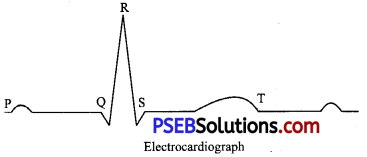
Electrocardiograph (ECG): ECG is a graphical representation of the electrical activity of the heart during a cardiac cycle. A patient is connected to the machine with three electrical leads (one to each wrist and to the left ankle) that continuously monitor the heart activity. For a detailed evaluation of the heart’s function, multiple leads are attached to the chest region.

Each peak in, the ECG is identified with a letter from P to T that corresponds to a specific electrical activity of the heart. The P-wave represents the electrical excitation (or depolarization) of the atria, which leads to the contraction of both the atria. The QRS complex represents the depolarization of the ventricles, which initiates the ventricular contraction. The contraction starts shortly after Q and marks the beginning of the systole.
PSEB 11th Class Biology Solutions Chapter 18 Body Fluids and Circulation 1

  • The T-wave represents the return of the ventricles from excited to normal state (repolarisation).
  • The end of the T-wave marks the end of systole.
  • Obviously, by counting the number of QRS complexes that occur in a given time period, one can determine the heartbeat rate of an individual.
  • Since the ECGs obtained from different individuals have roughly the same shape for a given lead configuration, any deviation from this shape indicates a possible abnormality or disease.
  • Hence, it is of a great clinical significance.

PSEB 11th Class Biology Solutions Chapter 5 Morphology of Flowering Plants

Punjab State Board PSEB 11th Class Biology Book Solutions Morphology of Flowering Plants Textbook Exercise Questions and Answers.

PSEB Solutions for Class 11 Biology Morphology of Flowering Plants

PSEB 11th Class Biology Guide Morphology of Flowering Plants Textbook Questions and Answers

Question 1.
What is meant by modification of root? What type of modification of root is found in the:
(a) Banyan tree
(b) Turnip
(c) Mangrove trees
Answer:
Modification of Root: Roots in some plants change their shape and
structure and become modified to perform functions, other than absorption and conduction of water and minerals. The roots are modified for water, absorption, support, storage of food and respiration.
(a) A banyan tree have hanging roots known as prop roots.
(b) The roots of turnip get modified to become swollen and store food.
(c) The roots of mangrove trees get modified to grow vertically upwards and help to get oxygen for respiration. These are known as pneumatophores.

Question 2.
Justify the following statements on the basis of external features:
(a) Underground parts of a plant are not always roots.
(b) Flower is a modified shoot.
Answer:
(a) Underground parts of a plant are not always roots, they are subterranean stems which do not have root hairs and root cap. Have terminal bud, nodes and internodes. Have leaves on the nodes.
Most of the underground stems such as sucker, rhizome, corm, tubers, bulb, etc., store food, form aerial shoots.
(b) Flower is a modified shoot because:

  • It possess nodes and internodes.
  • It may develop in the axil of small leaf-like structure called bract.
  • Flowers get modified into bulbils or fleshy buds in some plants.
  • Anatomically the pedicel and thalamus of a flower resemble that of stem.
  • The vascular supply of different organs of flower resemble that of normal leaves.
  • In the flower of Degeneria, the stamens are expanded like leaves and the carpels appear like folded leaves.

Question 3.
How is a pinnately compound leaf different from a palmately compound leaf?
Answer:
In pinnately compound leaf, the number of leaflets are present on a common axis, the rachis, which represents the midrib of the leaf as in neem. In case of a palmately compound leaf, the leaflets are attached at a common point, i e., at the tip of petiole as in silk cotton.

PSEB 11th Class Biology Solutions Chapter 5 Morphology of Flowering Plants

Question 4.
Explain with suitable examples the different types of phyllotaxy.
Answer:
Phyllotaxy is the pattern of arrangement of leaves on the stem or branch. This is usually of three types—alternate, opposite and whorled.

  • In alternate phyllotaxy, a single leaf arises at each node in alternate manner, as in China rose, mustard and sunflower plants.
  • In opposite type of phyllotaxy, a pair of leaves arise at each node and lie opposite to each other as in Calotropis and guava plants.
  • If more than two leaves arise at each node and form, a whorl, it is called as whorled, as in Alstonia.

Question 5.
Define the following terms:
(i) Aestivation
(ii) Placentation
(iii) Actinomorphic
(iv) Zygomorphic
(v) Superior ovary
(vi) Perigynous flower
(vii) Epipetalous stamen
Answer:
(i) Aestivation: The mode of arrangement of sepals or petals in relation to one another in a flower bud is called aestivation.
(ii) Placentation: The pattern by which the ovules are attached in an ovary is called placentation.

(iii) Actinomorphic: A flower having radial symmetry. The parts of each whorl are similar in size and shape. The flower can be divided in two equal halves along more than one median longitudinal plane.

(iv) Zygomorphic: A flower having bilateral symmetry. The parts of one or more whorls are dissimilar. The flower can be divided into two equal halves in only one vertical plane.

(v) Superior ovary: The ovary is called superior when it is borne above the point attachment of perianth and stamens on the thalamus.

(vi) Perigynous flower: It is the condition in which gynoecium of a flower is situated in the centre and other parts of the flower are located on the rim of the thalamus almost at the same level.

(vii) Epipetalous stamen: Stamens adhere to the petals by their filaments so, appear to arise from them.

PSEB 11th Class Biology Solutions Chapter 5 Morphology of Flowering Plants

Question 6.
Differentiate between:
(a) Racemose and cymose inflorescence
(b) Fibrous root and adventitious root
(c) Apocarpous and syncarpous ovary
Answer:
(a) Differences between Racemose and Cymose Inflorescence.

Racemose Cymose
1. This is further divided into (a) Raceme (b) Catkin (c) Spike (d) Spadix (e) Corymb (f) Umbel or capitutum It is further divided into (a) Monochasial cyme (b) Dichasial Cyme (c) Polychasial Cyme.
2. Branches develop indefinitely and further branches arise laterally in acropetal manner. The branches arise from terminal buds and stop growing after some time Lateral branches grow much vigorously and spread like a dome.

(b) Differences between Fibrous Root and Adventitious Root

Fibrous Root Adventitious Root
In monocotyledonous plants, the primary root is short lived and is replaced by a latge number of roots. These roots originate from the base of the fibrous root system say, for example in wheat plants. In some plants, say for example, in grass and banyan tree there are roots arising from parts of the plant other than the radicle. These are called adventitious roots.

(c) Differences between Apocarpous Ovaiy and Syncarpous Ovary

Apocarpous Ovary Syncarpous Ovary
When more than one carpel is present, they may be free (as in lotus and rose) and are called apocarpous ovary. They are termed syncarpous ovary when fused, as in mustard and tomato. After fertilisation, the ovules develop into seeds and like ovary matures into a fruit.

PSEB 11th Class Biology Solutions Chapter 5 Morphology of Flowering Plants

Question 7.
Draw the labelled diagram of the following:
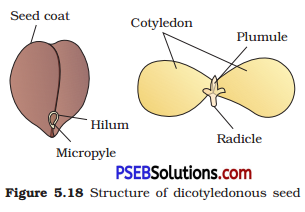
(a) gram seed
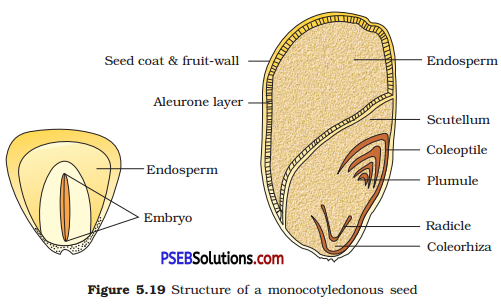
(b) V.S. of maize seed
Answer:
(a) Gram Seed
PSEB 11th Class Biology Solutions Chapter 5 Morphology of Flowering Plants 1
(b) V.S. of maize seed
PSEB 11th Class Biology Solutions Chapter 5 Morphology of Flowering Plants 2

Question 8.
Describe modifications of stem with suitable examples. [NCERT]
Answer:
Modifications of stem are as follows:

  • Tendrils help plants to climb on the support, e. g., Cucumber.
  • Thorns are woody, pointed, straight structures to protect plants from browsing animals, e. g., Bougainvillea.
  • The plants in arid regions modify their stems into flattened (Opuntia) or fleshy cylindrical (Euphorbia) structures. They contain chlorophyll and carry out photosynthesis.
  • Underground stems of some plants such as grass and snawberry, etc., spread to new riches and when older parts die, new plants are formed.
  • In Pistia and Eichhornia, a lateral branch with short internodes and each node bearing a rosette of leaves and a tuft of roots is found.
  • Stolons or runners help in vegetative propagation in jasmine and grass, respectively.

PSEB 11th Class Biology Solutions Chapter 5 Morphology of Flowering Plants

Question 9.
Take one flower each of the families Fabaceae and Solanaceae and write its semi-technical description. Also draw their floral diagram after studying them.
Answer:
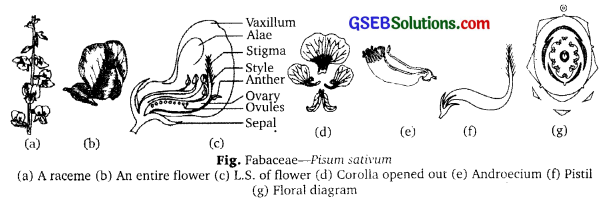
(i) Fabaceae: This family was earlier called Papilionoideae, a subfamily of family Leguminosae.
(a) Habit: Trees, shrubs, herbs, climbers, etc.
(b) Root System: Tap root system with root nodules, that harbour nitrogen fixing bacterium.
(c) Leaves: Leaves are alternate, simple or pinnately compound, pulvinate, and stipulate; venation reticulate.
(d) Inflorescence: Racemose usually, a raceme.
(e) Flowers: Bracteate, bracteolate, bisexual, zygomorphic, hypogynous, and pentamerous.
(f) Calyx: Five sepals, gamosepalous, irregular, odd sepal anterior (characteristic feature of the family) and valvate aestivation.
PSEB 11th Class Biology Solutions Chapter 5 Morphology of Flowering Plants 3
(g) Corolla: Corolla consists of five petals, polypetalous, characteristically papilionaceous, with an odd posterior large petal called standard or vexillum, a pair of lateral petals, called wing or alae and two anterior keel or carina, which enclose the essential organs; aestivation is vexillary.
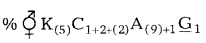
(h) Androecium: Ten stamens, diadelphous, [(9) + 1] and anthers dithecous.
(i) Gynoecium: Ovary is superior, monocarpellary, unilocular with many ovules on marginal placenta; style single, curved or bent at right angles to the ovary.
(j) Fruits and Seeds: Characteristically a legume/pod and seeds are non-endospermic.
(k) Floral Formula: PSEB 11th Class Biology Solutions Chapter 5 Morphology of Flowering Plants 4
(l) Economic Importance: Plants of this family yield pulses, edible oil, dye, fodder, fibres and wood; some yield products of medicinal value,

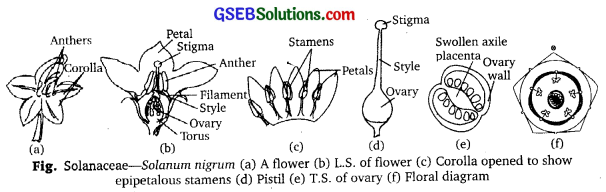
(ii) Solanaceae (Potato family)
(a) Habit: Plants are mostly herbs or shrubs or small trees; stem is erect, cylindrical, branched (cymose type); stem is underground in potato CSolarium tuberosum).
(b) Leaves: Simple, alternate, exstipulate with reticulate venation.
(c) Inflorescence: Axillary or extra-axillary cymose, or solitary.
(d) Flowers: Bisexual, actinomorphic, hypogynous and pentamerous.
(e) Calyx: Five sepals, gamosepalous, persistant and valvate aestivation.
(f) Corolla: Five petals, gamopetalous, valvate or imbricate, rotate/wheel-shaped.
(g) Androecium: Five stamens, epipetalous and alternating with the petals.
(h) Gynoecium: Bicarpellary, syncarpous, superior with many ovules on swollen axile placenta; carpels are obliquely placed.
(i) Fruits and Seeds: A berry (tomato and brinjal) or a capsule; seeds are endospermic.
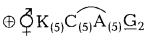
(j) Floral Formula : PSEB 11th Class Biology Solutions Chapter 5 Morphology of Flowering Plants 5
(k) Economic Importance: Many plants are used as source of food (vegetables), spice, medicines of fumigatory; some are ornamental plants.
PSEB 11th Class Biology Solutions Chapter 5 Morphology of Flowering Plants 6

Question 10.
Describe the various types of placentations found in flowering plants.
Answer:
Types of Placentations: The arrangement of ovules within the ovary is known as placentation. The placentations are of different types – marginal, axile, parietal, free central and basal.

Marginal placentation: In this placentation, the placenta forms a ridge along the ventral suture of the ovary and the ovules are borne on this ridge forming two rows as in pea.

Axile placentation: In this placentation, the placenta is axile and the ovules are attached to it in a multilocular ovary as in China rose, tomato, etc.

Parietal placentation: In this placentation, the ovules develop on the inner wall of the ovary or on peripheral part. Ovary is one chambered but it becomes two chambered due to the formation of a false septum known as replam, e.g., mustard.

Free central placentation: In this type of placentation, the ovules are present on the central axis of ovary and septa are absent as in Dianthus and primrose.

Basal placentation: In this placentation the placenta develops at the base of ovary and a single ovule is attached to it, as in sunflower.

PSEB 11th Class Biology Solutions Chapter 5 Morphology of Flowering Plants

Question 11.
What is a flower? Describe the parts of a typical angiospermic flower.
Answer:
Flower: It is a condensed modified reproductive shoot found in angiosperms. It often develops in the axile of a small leaf-like structure called bract. The stalk of the flower is called pedicel. The tip of the pedicel or the base of flower has a broad highly condensed multinodal region called thalamus.
A flower has following four floral structures:

  • Calyx: It is made up of sepals. These are green in colour and help in photosynthesis.
  • Corolla: It is the brightly coloured part containing petals.
  • Androecium: It is the male reproductive part which consists of stamens. A stamen has a long filament and terminal anther. The anther produces the pollen grains.
  • Gynoecium: It is the female reproductive part which consists of
    carpels. A carpel has three parts, i.e., style, stigma and ovary. The ovary bears the ovules.

Question 12.
How do the various leaf modifications help plants?
Answer:
Leaf Modifications in Plants
(i) In some plants, the leaf and leaf parts get modified to form green, long, thin unbranched and sensitive thread-like structures called tendrils. The tendrils coil around the plant and provide support to the plant in climbing. Tendrils are present in pea, garden Nasturtium, Clematis, Smilax, etc.

(ii) In some plants, the leaves get modified to form curved stiff claw like hooks to help the plant in clinging to the support. Leaflet hooks are present in Bignonia.

(iii) In case of Acacia and Zizyphus, the leaves get modified to form vasculated, hard, stiff and pointed structures.

(iv) In case of Acacia longifolia, the expanded petiole gets modified and perform the function of photosynthesis in absence of lamina.

(v) In plants such as Nepenthes, the lamina is modified to form large pitcher. It is used for storing water and for digesting insect protein.

(vi) In case of Utricularia, the leaf segments are modified into small bladders, to trap small animals.

Question 13.
Define the term inflorescence. Explain the basis for the different types of inflorescence in flowering plants.
Answer:
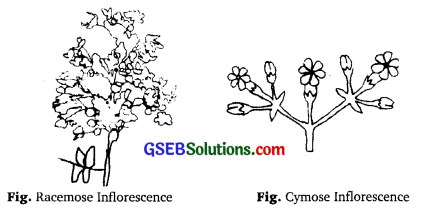
The arrangement of flowers on the floral axis is termed as inflorescence. Depending on whether the apex gets converted into a flower or continues to grow, two major types of inflorescences are defined – racemose and cymose. In racemose type of inflorescence the main axis continues to grow, the flowers are borne laterally in an acropetal succession.

In cymose type of inflorescence the main axis terminates in a flower, hence is limited in growth. The flowers are borne in a basipetal order, as depicted in figure.
PSEB 11th Class Biology Solutions Chapter 5 Morphology of Flowering Plants 7

PSEB 11th Class Biology Solutions Chapter 5 Morphology of Flowering Plants

Question 14.
Write the floral formula of a actinomorphic, bisexual, hypogynous flower with five united sepals, five free petals, five f free stamens and two united carpels with superior ovary and axile placentation.
Answer:
Floral formula PSEB 11th Class Biology Solutions Chapter 5 Morphology of Flowering Plants 8

Question 15.
Describe the arrangement of floral members in relation to their ‘ insertion on thalamus.
Answer:
A flower is a condensed specialised reproductive shoot found in angiosperms. The stalk of the flower is known as pedicel. The tip of the pedicel or the base of the flower has a broad highly condensed multinodal region called thalamus. The floral parts of a flower are present on the thalamus. Starting from below they are green sepals or calyx, coloured petals or corolla, stamens or androecium and carpels or gynoecium.

PSEB 11th Class Physics Solutions Chapter 15 Waves

Punjab State Board PSEB 11th Class Physics Book Solutions Chapter 15 Waves Textbook Exercise Questions and Answers.

PSEB Solutions for Class 11 Physics Chapter 15 Waves

PSEB 11th Class Physics Guide Waves Textbook Questions and Answers

Question 1.
A string of mass 50 kg is under a tension of 200 N. The length of the stretched string is 20.0 m. If the transverse jerk is struck at one end of the string, how long does the disturbance take to reach the other end?
Solution:
Mass of the string, M = 2.50 kg
Tension in the string, T = 200 N
Length of the string, l = 20.0 m
Mass per unit length, µ = \(\frac{M}{l}=\frac{2.50}{20} \) = 0.125 kg m-1
The velocity (υ) of the transverse wave in the string is given by the relation:
υ = \(\sqrt{\frac{T}{\mu}}=\sqrt{\frac{200}{0.125}}=\sqrt{1600} \) = 40 m/s

∴ Time taken by the disturbance to reach the other end, t = \(\frac{l}{v}=\frac{20}{40}\) = 0.5 s

Question 2.
A stone dropped from the top of a tower of height 300 m high splashes into the water of a pond near the base of the tower. When is the splash heard at the top given that the speed of sound in air is 340ms-1?(g=9.8ms-2)
Solution:
Height of the tower, s = 300 m
The initial velocity of the stone, µ = 0
Acceleration, a = g = 9.8 m/s2
Speed of sound in air = 340 rn/s

The time (t1) taken by the stone to strike the water in the pond can be calculated using the second equation of motion, as:
s=ut1+\(\frac{1}{2}\) gt12
300 = 0+ \( \frac{1}{2}\) × 9.8 × t12
∴ t1 =\( \sqrt{\frac{300 \times 2}{9.8}}\) = 7.82 s
Time taken by the sound to reach the top of the tower,
t2 =\(\frac{300}{340}\) = 0.88 s
Therefore, the time after which the splash is heard, t = t1 +t2
= 7.82+0.88= 8.7 s .

Question 3.
A steel wire has a length of 12.0 m and a mass of 2.10 kg. What should be the tension in the wire so that the speed of a transverse wave on the wire equals the speed of sound in dry air at 20°C = 343 ms-1.
Solution:
Length of the steel wire, l = 12 m
Mass of the steel wire, m = 2.10 kg
Velocity of the transverse wave, ν = 343 m/s
Mass per unit length, µ =\(\frac{m}{l}=\frac{2.10}{12}\) = 0.175 kg m-1
For tension T, velocity of the transverse wave can be obtained using the relation:
υ = \(\sqrt{\frac{T}{\mu}}\)
∴ T = υ2µ = (343)2 × 0.175 = 20588.575 ≈ 2.06 ×10⁴ N

Question 4.
Use the formula υ = \(\sqrt{\frac{\gamma \boldsymbol{P}}{\rho}}\) to explain why the speed of sound in
air
(a) is independent of pressure,
(b) increases with temperature,
(c) increases with humidity.
Solution:
(a) Given the relation:
υ = \( \sqrt{\frac{\gamma \boldsymbol{P}}{\rho}} \) ……………………………. (i)
Density, ρ = \(\frac{\text { Mass }}{\text { Volume }}=\frac{M}{V}\)
where, M = Molecular weight of the gas; V = Volume of the gas
Hence, equation ‘(i) reduces to:
υ = \(\sqrt{\frac{\gamma P V}{M}}\) …………………………………………. (ii)
Now, from the ideal gas equation for n = 1 :
PV = RT
For constant T, PV = Constant
Since both M and γ are constants, υ = Constant
Hence, at a constant temperature, the speed of sound in a gaseous
medium is independent of the change in the pressure of the gas.

(b) Given the relation:
υ = \( \sqrt{\frac{\gamma \boldsymbol{P}}{\rho}} \) …………………………………. (i)
For one mole of an ideal gas, the gas equation can be written as:
PV = RT
P = \(\frac{R T}{V}\)

Substituting equation (ii) in equation (i), we get:
υ = \(\sqrt{\frac{\gamma R T}{V \rho}}=\sqrt{\frac{\gamma R T}{M}}\) ……………………………… (iii)
where, M = mass = ρV is a constant; γ and R are also constants We conclude from equation (iii) that v ∝ \(\sqrt{T}\) .
Hence, the speed of sound in a gas is directly proportional to the square root of the temperature of the gaseous medium, i. e., the speed of the sound increases with an increase in the temperature of the gaseous medium and vice versa.

(c) Let υm and υd be the speeds of sound in moist air and dry air respectively.
Let ρm and ρd be the densities of moist air and dry air respectively.
Take the relation:
υ = \(\sqrt{\frac{\gamma P}{\rho}}\)
Hence, the speed of sound in moist air is:
υm = \(\sqrt{\frac{\gamma P}{\rho_{m}}}\) ………………………….. (i)
And the speed of sound in dry air is:
υd = \(\sqrt{\frac{Y P}{P_{d}}}\) ………………………………… (ii)

On dividing equations (i) and (ii), we get:
\(\frac{v_{m}}{v_{d}} \)
On dividing equations (i) and (ii), we get:
\(\frac{v_{m}}{v_{d}}=\sqrt{\frac{\gamma P}{\rho_{m}}} \times \frac{\rho_{d}}{\gamma P}=\sqrt{\frac{\rho_{d}}{\rho_{m}}} \)
However, the presence of water vapour reduces the density of air, i.e.,
ρdm
∴ υmd
Hence the speed of sound in moist air greater than it is in dry air.
Thus, in a gaseous medium, the speed of sound increase with humidity.

PSEB 11th Class Physics Solutions Chapter 15 Waves

Question 5.
You have learnt that a travelling wave in one dimension is represented by a function y = f(x, t) where x and t must appear
in the combination x-υt or x+υt, i.e., y=f(x±υt). Is the converse true? Examine if the following functions for y can
possibly represent a traveIliig wave:
(a) (x—υt)2 (b)log \(\left[\frac{x+v t}{x_{0}}\right] \) (c) \(\frac{1}{(x+v t)}\)
Solution:
No, the converse of the given statement is not true. The essential requirement for a function to represent a travelling wave is that it should
remain finite for all values of x and t.

(a) Does not represent a wave
Explanation :
For x = 0 and t = 0, the function (x – υt)2 becomes 0.
Hence, for x = 0 and t = 0, the function represents a point and not a wave,

(b) Represents a wave Explanation:
For x = 0 and t = 0, the function log \(\left(\frac{x+v t}{x_{0}}\right)\) = log 0 = ∞
Since the function does not converge to a finite value for x = 0 and t = 0, it represents a travelling wave.

(c) Does not represents a wave
Explanation :
For x = 0 and t = 0, the function
\(\frac{1}{x+v t}\) = log \(\frac{1}{0} \) = ∞
Since the function does not converge to a finite value for x = 0 and t = 0, it does not represent a travelling wave.

Question 6.
A bat emits the ultrasonic sound of frequency 1000 kHz in air. If the sound meets a water surface, what is the wavelength of (a) the reflected sound, (b) the transmitted sound? Speed of sound in air is 340 ms-1 and in water 1486 ms-1.
Solution:
(a) Frequency of the ultrasonic sound, υ = 1000 kHz = 106 Hz
Speed of sound in water, υa = 340 m/s
The wavelength (λr)of the transmitted sound is given as:
λr = \(\frac{v}{v}=\frac{340}{10^{6}}\) = 3.4 × 10⁻⁴ m

(b) Frequency of the ultrasonic sound, v = 1000 kHz = 106 Hz
Speed of sound in water, υw, =1486 m/s
The wavelength of the transmitted sound is given as:
λt= \(\frac{1486}{10^{6}}\) = 1.49 × 10⁻³ m

Question 7.
A hospital uses an ultrasonic scanner to locate tumours in a tissue. What is the wavelength of sound in the tissue in which the speed of sound is 1.7 km s-1? The operating frequency of the scanner is 4.2 MHz.
Solution:
Speed of sound in the tissue, υ = 1.7 km/s = 1.7 x 10 3 m/s
Operating frequency of the scanner, v = 4.2 MHz = 4.2 x 10⁶ Hz
The wavelength of sound in the tissue is given as:
λ = \(\frac{v}{v}=\frac{1.7 \times 10^{3}}{4.2 \times 10^{6}}\) = 4.1 x 10⁻⁴m.

Question 8.
A transverse harmonic wave on a string is described by y(x, t) = 3.0sin(36t+0.018x+\(\frac{\pi}{4}\))
where x and y are in cm and t in s. The positive direction of x is from left to right.
Is this a travelling wave or a stationary wave?
(a) If it is travelling, what are the speed and direction of its propagation?
(b) What are its amplitude and frequency?
(c) What is the initial phase at the origin?
(d) What is the least distance between two successive crests in the wave?
Solution:
(a) Yes.
The equation of a progressive wave travelling from right to left is given by the displacement function:
y(x,t) = a sin(ωt + kx + Φ) ……………………………………. (i)
The given equation is
y(x, t) = 3.0 sin( 36t +0.018x+\(\frac{\pi}{4}\)) …………………………………. (ii)
On comparing both the equations, we find that equation (ii) represents a travelling wave, propagating from right to left.
Now, using equations (i) and (ii), we can write:
ω = 36 rad/s and k = 0.018 cm-1
We know that
v = \(\frac{\omega}{2 \pi}\) and λ = \(\frac{2 \pi}{k}\)
Also,
υ = vλ
∴ υ = \(\left(\frac{\omega}{2 \pi}\right) \times\left(\frac{2 \pi}{k}\right)\) = \(\frac{\omega}{k}=\frac{36}{0.018} \) = 2000 cm/s = 20 m/s
Hence, the speed of the given travelling wave is 20 m/s.

(b) Amplitude of the given wave, a =3 cm (Given)
Frequency of the given wave:
v = \(\frac{\omega}{2 \pi}=\frac{36}{2 \times 3.14}\) = 5.73 Hz

(c) On comparing çquations (i) and (ii), we find that the initial phase angle, Φ = \(\frac{\pi}{4}\)

(d) The distance between two successive crests or troughs is equal to the
wavelength of the wave.
Wavelength is given by the relation:
k= \(\frac{2 \pi}{\lambda}\)
∴ λ = \(\frac{2 \pi}{k}=\frac{2 \times 3.14}{0.018}\) = 348.89 cm = 3.49 m.

PSEB 11th Class Physics Solutions Chapter 15 Waves

Question 9.
For the wave described in question 8, plot the displacement (y) versus (t) graphs for s =0,2 and 4 çm. What are the shapes of these graphs? In which aspects does the oscillatory motion in travelling wave differ from one point to another: amplitude, frequency or phase?
Solution:
All the waves have different phases. The given transverse harmonic wave is
y(x,t) = 3.0 sin (36t+0.018x + \(\frac{\pi}{4}\))
For x = 0, the equation reduces to
y(0,t) = 3.0 sin (36t+\(\frac{\pi}{4}\)) ………………………….. (i)
Also,
ω = \(\frac{2 \pi}{T}\) = 36 rad/s
∴ T = \(\frac{2 \pi}{\omega}=\frac{2 \pi}{36} \) = \(\frac{\pi}{18}\) s
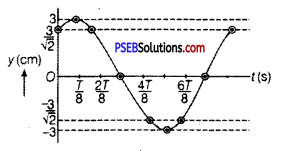
For different values of t, we calculate y using eq. (i). These values are tabulated below
PSEB 11th Class Physics Solutions Chapter 15 Waves 1
On plotting y versus t graph, we obtain a sinusoidal curve as shown in figure below.
PSEB 11th Class Physics Solutions Chapter 15 Waves 2

Similar graphs are obtained for x = 2 cm and x = 4 cm.
The oscillatory motion in travelling wave differs from one point to another only in terms of phase. Amplitude and frequency of oscillatory motion remain the same in all the three cases.

Question 10.
For the travelling harmonic wave
y(x, t) = 2.0 cos 2π (10t – 0.0080x +0.35)
where, x and y are in cm and t in s. Calculate the phase difference between oscillatory motion of two points separated by a distance of
(a) 4m
(b) 0.5m
(c) \(\frac{\lambda}{2}\)
(d) \(\frac{3 \lambda}{4}\)
Solution:
Equation for a travelling harmonic wave is given as
y{x,t) = 2.0 cos 2π(10t -0.0080x +0.35)
= = 2.0 cos (20πt – 0.016πx+0.70π)

where, propagation constant, k = 0.0160π
Amplitude, a = 2 cm
Angular frequency, ω = 20 π rad/s
Phase difference is given by the relation:
Φ =kx=\(\frac{2 \pi}{\lambda} \)

(a)
For x=4m=400cm
Φ =0.016 π × 400 =6.4 π rad

(b) For 0.5 m=50cm
Φ = 0.1016 π × 50 = 0.8 π rad

(c) For x= \(\frac{\lambda}{2}\)
Φ = \(\frac{2 \pi}{\lambda} \times \frac{\lambda}{2}\) = π rad

(d) For x= \(\frac{3 \lambda}{4}\)
Φ = \(\frac{2 \pi}{\lambda} \times \frac{3 \lambda}{4} \) = 1.5π rad

Question 11.
The transverse displacement of a string (clamped at its both ends) is given by y(x,t) = 0.06 sin \(\frac{\mathbf{2} \pi}{\mathbf{3}}\) x cos (120πt) where x and y are in m and t in s. The length of the string is 1.5 m and its mass is 3.0 × 10⁻² Kg Answer the following
(a) Does the function represents a travelling wave or a stationary wave?
(b) Interpret the wave as a superposition of two waves travelling in opposite directions. What is the wavelength,
frequency, and speed of each wave?
(c) Determine the tension in the string.
Solution:
(a) The general equation representing a stationary wave is given by the displacement function:
y(x,t) = 2asinkxcosωt
This equation is similar to the given equation:
y(x,t)= 0.06 sin\(\left(\frac{2 \pi}{3} x\right)\) cos (120πt)
Hence, the given function represents a stationary wave.

(b) A wave travelling along the positive x -direction is given as
y1 =asin(ωt -kx)
The wave travelling along the negative x -direction is given as:
y2 = -asin(ωt +kx)
The superposition of these two waves yields:
y= y1+y2 = asin(ωt -kx)-asin(ωt +kr)
= asin(ωt)cos(kx) – asin(kx)cos(ωt)- asin(ωt)cos(kx) – asin(kx)cos(ωt)
= -2asin(kx)cos(ωt)
= – 2asin \(\left(\frac{2 \pi}{\lambda} x\right)\)cos (2πcvt) …………………………….. (i)

The transverse displacement of the string is given as y(x,t) = 0.06 sin \(\left(\frac{2 \pi}{3} x\right)\)cos (120πt) ………………………………. (ii)
Comparing equations (i) and (ii), we have
\(\frac{2 \pi}{\lambda}=\frac{2 \pi}{3}\)
∴ Wavelength, λ = 3 m
it is given that
120 π =2πv
Frequency, ν =60 Hz
Wave speed, υ = vλ
=60 × 3=180 m/s

(c) The velocity of a transverse wave travelling in a string is given by the relation
υ = \(\sqrt{\frac{T}{\mu}} \) ………………………… (iii)
where, µ = Mass per unit length of the string = \(\frac{m}{l}=\frac{3.0}{1.5} \times 10^{-2}\)
=2 x 10⁻² kgm-1
T = Tension in the string = T
From equation (iii), tension can be obtained as
T =ν2µ=(180)2 x 2 x 10-2 =648 N

PSEB 11th Class Physics Solutions Chapter 15 Waves

Question 12.
(i) For the wave on a string described in question 11, do all the points on the string oscillate with the same
(a) frequency,
(b) phase, (c) amplitude? Explain your answers.
(ii) What is the amplitude of a point 0.375 m away from one end?
Solution:
(I) (a) Yes, except at the nodes; All the points on the string oscillate with the same frequency, except at
the nodes which have zero frequency.

(b) Yes, except at the nodes;
All the points in any vibrating loop have the same phase, except at the nodes.

(C) No;
All the points in any vibrating loop have different amplitudes of vibration.

(ii) The given equation is .
y(x,t) = 0.06 sin \(\left(\frac{2 \pi}{3} x\right)\)cos (120πt)
For x = 0.375m and t =0
Amplitude = Displacement 0.06sin \(\left(\frac{2 \pi}{3} x\right) \cos 0^{\circ}\)
= 0.06 sin \(\left(\frac{2 \pi}{3} \times 0.375\right) \times 1\)
= 0.06 sin(0.25π) = 0.06 sin\(\left(\frac{\pi}{4}\right)\)
= 0.06 x \(\frac{1}{\sqrt{2}}\) = 0.042 m

Question 13.
Given below are some functions of x and t to represent the displacement (transverse or longitudinal) of an elastic wave. State which of these represent (i) a travelling wave, (ii) a stationary wave or (iii) none at all:
(a) y = 2cos(3x)sin(10t)
(b) y = 2\(\sqrt{x-v t}\)
(c) y = 3sin(5x – 0.5t) + 4cos(5x – 0.5t)
(d) Y = cos x sin t + cos 2x sin 2t
Solution:
(a) The given equation represents a stationary wave because the harmonic terms kx and cot appear separately in the equation.

(b) The given equation does not contain any harmonic term. Therefore, it does not represent either a travelling wave or a stationary wave.’

(c) The given equation represents a travelling wave as the harmonic terms kx and cot are in the combination of kx – cot.

(d) The given equation represents a stationary wave because the harmonic terms kx and cot appear separately in the equation. This equation actually represents the superposition of two stationary waves.

Question 14.
A wire stretched between two rigid supports vibrates in its fundamental mode with a frequency of 45 Hz. The mass of the wire is 3.5 x10⁻² kg and its linear mass density is 40 x 10-2 kgm-1. What is
(a) the speed of a transverse wave on the string, and
(b) the tension in the string?
Solution:
Mass of the wire, m = 3.5×10 -2 kg
Linear mass density, μ = \(\frac{m}{l}\) = 4.0 × 10⁻² kg m-1
Frequency of vibration, μ = 45 Hz
∴ Length of the wire, l = \(\frac{m}{\mu}=\frac{3.5 \times 10^{-2}}{4.0 \times 10^{-2}}\) =0.875 m
The wavelength of the stationary wave (λ,) is related to the length of the wire by the relation:
λ = \(\frac{2 l}{n}\)
where, n = Number of nodes in the wire For fundamental node, n = 1:
λ =2l
λ =2 x 0.875 = 1.75 m
(a) The speed of the transverse wave in the string is given as
υ = vλ = 45 x 1.75 = 78.75 m/s

(b) The tension produced in the string is given by the relation:
T =υ2 μ
= (78.75)2 x 4.0 x 10-2 =248.06 N

Question 15.
A metre-long tube open at one end, with a movable piston at the other end, shows resonance with a fixed frequency source (a tuning fork of frequency 340 Hz)when the tube length is 25.5 cm or 79.3 cm. Estimate the speed of sound in air at the temperature of the experiment. The edge effects may be neglected.
Solution:
Frequency of the turning fork, v = 340 Hz
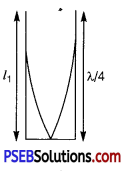
Since the given pipe is attached with a piston at one end, it will behave as a pipe with one end closed and the other end open, as shown in the given figure.
PSEB 11th Class Physics Solutions Chapter 15 Waves 3
Such a system produces odd harmonics. The fundamental note in a closed pipe is given by the relation l1 = \(\frac{\lambda}{4}\)
where, length of the pipe, = 25.5 cm = 0.255 m
λ = 4l1 =4 x 0.255 = 1.02 m
The speed of sound is given by the relation:
υ = vλ = 340 x 1.02 = 346.8 m/s

Question 16.
A steel rod 100 cm long is clamped at its middle. The fundamental frequency of longitudinal vibrations of the rod is given to be 2.53 kHz. What is the speed of sound in steel?
Solution:
Length of the steel rod, l = 100 cm = lm
v Fundamental frequency of vibration, v = 2.53 kHz = 2.53 x 10³ Hz When the rod is plucked at its middle, an antinode (A) is formed at its centre, and nodes (N) are formed at its two ends, as shown in the given figure.
PSEB 11th Class Physics Solutions Chapter 15 Waves 4

The distance between two successive nodes is \(\frac{\lambda}{2}\)
l = \( \frac{\lambda}{2}\)
λ=2l=2 x l=2m
The speed of sound in steel is given by the relation:
v =vλ = 2.53 x 103 x 2
= 5.06 x 10 3 m/s = 5.06 km/s

Question 17.
A pipe 20 cm long is closed at one end. Which harmonic mode of the pipe is resonantly excited by a 430 Hz source? Will the same source be in resonance with the pipe if both ends are open? (Speed of sound in air is 340 ms-1).
Solution:
First (Fundamental); No
Length of the pipe, l = 20 cm = 0.2 m
Source frequency = nth normal mode of frequency, vn = 430 Hz Speed of sound, ν = 340 m/s
In a closed pipe, nth the rth normal mode of frequency is given by the relation
vn = (2n -1) \(\frac{v}{4 l}\) ; n is an integer = 0,1,2,3 ………………
430 = (2n -1) \(\frac{340}{4 \times 0.2} \)
2n-1 = \(\frac{430 \times 4 \times 0.2}{340}\) = 1.01
2n =1.01+1
2n = 2.01
n ≈ 1

Hence, the first mode of vibration frequency is resonantly excited by the given source.
In a pipe open at both ends, the nth mode of vibration frequency is given by the relation:
vn = \(\frac{n v}{2 l}\)
n = \(\frac{2 l v_{n}}{v}=\frac{2 \times 0.2 \times 430}{340}\) = 0.5
Since the number of the mode of vibration (n) has to be an integer, the given source does not produce a resonant vibration in an open pipe.

PSEB 11th Class Physics Solutions Chapter 15 Waves

Question 18.
Two sitar strings A and B playing the note ‘Ga’ are slightly out of tune and produce beats of frequency 6 Hz. The tension in string A is slightly reduced and the beat frequency is found to reduce to 3 Hz. If the original frequency of A is 324 Hz, what is the frequency of B?
Solution:
Frequency of string A, fA = 324 Hz
Frequency of string B = fB
Beat’s frequency, n = 6 Hz
Beat’s frequency is given as
n = |fA ±fB|
6 =324 ±fB
fB =330 Hz or 318 Hz

The frequency decreases with a decrease in the tension in a string. This is because the frequency is directly proportional to the square root of the tension. It is given as
v ∝ \(\sqrt{T}\)
Hence, the beat frequency cannot be 330 Hz.
∴ fB= 318 Hz

Question 19.
Explain why (or how):
(a) In a sound wave, a displacement node is a pressure antinode and vice versa,
(b) Bats can ascertain distances, directions, nature, and sizes of the obstacles without any “eyes”,
(c) A violin note and sitar note may have the same frequency, yet we can distinguish between the two notes,
(d) Solids can support both longitudinal and transverse waves, but only longitudinal waves can propagate in gases, and
(e) The shape of a pulse gets distorted during propagation in a dispersive medium.
Solution:
(a) A node is a point where the amplitude of vibration is the minimum and pressure is the maximum. On the other hand, an antinode is a point where the amplitude of vibration is the maximum and pressure is the minimum.
Therefore, a displacement node is nothing but a pressure antinode and vice versa.

(b) Bats emit very high-frequency ultrasonic sound waves. These waves get reflected back toward them by obstacles. A bat receives a reflected wave (frequency) and estimates the distance, direction, nature, and size of an obstacle with the help of its brain senses.

(c) The overtones produced by a sitar and a violin, and the strengths of these overtones, are different. Hence, one can distinguish between the notes produced by a sitar and a violin even if they have the same frequency of vibration.

(d) Solids have shear modulus. They can sustain shearing stress. Since fluids do not have any definite shape, they yield to shearing stress. The propagation of a transverse wave is such that it produces shearing *’ stress in a medium. The propagation of such a wave is possible only in solids, and not in gases. ‘
Both solids and fluids have their respective bulk moduli. They can sustain compressive stress. Hence, longitudinal waves can propagate through solids and fluids.

(e) A pulse is actually a combination of waves having different wavelengths. These waves travel in a dispersive medium with different velocities, depending on the nature of the medium. This results in the distortion of the shape of a wave pulse.

Question 20.
A train, standing at the outer signal of a railway station blows a whistle of frequency 400 Hz in still air
(i) What is the frequency of the whistle for a platform observer when the train
(a) approaches the platform with a speed of 10 ms-1,
(b) recedes from the platform with a speed of 10 ms-1?
(ii) What is the speed of sound in each case? The speed of sound in still air can be taken as 340 ms -1.
Solution:
(i)
(a) Frequency of the whistle, ν = 400 Hz
Speed of the train, υT = 10 m/s
Speed of sound, υ = 340 m/s
The apparent frequency (v’) of the whisde as the train approaches the platform is given by the relation
υ’ = \(=\left(\frac{v}{v-v_{T}}\right) \mathrm{v}=\left(\frac{340}{340-10}\right) \times 400\) = 412.12 Hz
(b) The apparent frequency (v”) of the whistle as the train recedes from the platform is given by the relation
v” = \(\left(\frac{v}{v+v_{T}}\right) \mathrm{v}=\left(\frac{340}{340+10}\right) \times 400\) = 388.57 Hz

(ii) The apparent change in the frequency of sound is caused by the relative motions of the source and the observer. These relative motions produce no effect on the speed of sound. Therefore, the speed of sound in air in both the cases remains the same, i.e.,340 m/s.

Question 21.
A train standing in a station yard blows a whistle of frequency 400 Hz in still air. The wind starts blowing in the direction from the yard to the station with at a speed of 10 ms-1. What are the frequency, wavelength, and speed of sound for an observer standing on the station’s platform? Is the situation exactly identical to the case when the air is still and the observer runs towards the yard at a speed of 10 ms-1? The speed of sound in still air can be taken as 340 ms-1.
Solution:
For the stationary observer:
Frequency of the sound produced by the whistle, v = 400 Hz
Speed of sound = 340 m/s
Velocity of the wind, ν = 10 m/s

As there is no relative motion between the source and the observer, the frequency of the sound heard .by the observer will be the same as that produced by the source, i. e., 400 Hz.
The wind is blowing toward the observer. Hence, the effective speed of the sound increases by 10 units, i.e.,
Effective speed of the sound, υe = 340 +10 = 350 m/s

The wavelength (λ) of the sound heard by the observer is given by the relation:
λ = \(\frac{v_{e}}{v}=\frac{350}{400}\) = 0.857 m

For the running observer:
Velocity of the observer, υ0 = 10 m/s
The observer is moving toward the source. As a result of the
motions of the source and the observer, there is a change in (v’).
This is given by the relation:
υ’ = \(\left(\frac{v+v_{o}}{v}\right) v=\left(\frac{340+10}{340}\right) \times 400\) = 411.76 Hz
Since the air is still, the effective speed of sound = 340 + 0 = The source is at rest. Hence, the wavelength of the sound will i. e., λ remains 0.875 m
Hence, the given two situations are not exactly identical.

Additional Exercises

Question 22.
A travelling harmonic wave on a string is described by
y(x,t) = 7.5 sin (0.0050x + 12t+\(\frac{\pi}{4}\))
(a) What are the displacement and velocity of oscillation of a point at x = 1 cm, and t = 1 s? Is this velocity equal to the velocity of wave propagation?
(b) Locate the points of the string which have the same transverse displacements and velocity as the x = 1 cm point at t = 2 s, 5 s and 11 s.
Solution:
(a) The given harmonic wave is
y(x,t) = 7.5sin(0.0050x + 12t+\(\frac{\pi}{4}\))
For x = 1 cm and t = 1 s,
y(1, 1) = 7.5sin(0.0050x + 12t+\(\frac{\pi}{4}\))
= 7.5 sin (12.0050+\(\frac{\pi}{4}\)) = 7.5sinθ
where, 0 = 12.0050 + \(\frac{\pi}{4}\) = 12.0050 + \( \) = 12.79 rad 4
= \(\frac{180}{3.14} \times 12.79\) = 732.810
∴ y(1,1) = 7.5 sin (732.810) = 7.5sin (90 × 8 +12.81°) = 7.5 sin 12.81°
= 7.5 × 0.2217
= 1.6229 ≈ 1.663 cm
The velocity of the oscillation at a given point and time is given as
PSEB 11th Class Physics Solutions Chapter 15 Waves 5
At x = 1 cm and t = 1 s
v = y(1, 1) = 90 cos(12.005 +\(\frac{\pi}{4}\))
= 90 cos (732.81 ° ) = 90 cos (90 x 8 +12.81 ° ) = 90cos(12.81°) = 90 x 0.975 = 87.75 cm/s

Now, the equation of a propagating wave is given by
y(x,t) = asin(kx +ωt +Φ)
where, k = \(\frac{2 \pi}{\lambda} \)
∴ λ = \(\frac{2 \pi}{k}\)
And ω = 2πv
∴ v = \(\frac{\omega}{2 \pi}\)
Speed, υ = vλ = \(\frac{\omega}{k}\)
where, ω = 12 rad/s
k = 0.0050 cm-1
∴ v = \(\frac{12}{0.0050}\) = 2400 cm/s
Hence, the velocity of the wave oscillation at x = 1 cm and t = 1 s is not equal to the velocity of the wave propagation.

(b) Propagation constant is related to wavelength as:
k = \(\frac{2 \pi}{\lambda}\)
∴ λ = \(\frac{2 \pi}{k}=\frac{2 \times 3.14}{0.0050}\) = 1256 cm = 12.56 cm
Therefore, all the points at distances nλ{n = ±1,±2… and so on), i.e., ±12.56 m, + 25.12m, … and so on for x =1 cm, will have the same displacement as the x = 1 cm points at t = 2 s, 5 s and 11s.

Question 23.
A narrow sound pulse (for example, a short pip by a whistle) is sent across a medium,
(a) Does the pulse have a definite
(i) frequency,
(ii) wavelength,
(iii) speed of propagation?
(b) If the pulse rate is 1 after every 20 s, (that is the whistle is blown for a split of second after every 20 s), is the frequency of the note
produced by the whistle equal to \(\frac{1}{20}\) or 0.05 Hz?
Solution:
(a) (i) No;
(ii) No;
(iii) Yes;
Explanation:
The narrow sound pulse does not have a fixed wavelength or frequency. However, the speed of the sound pulse remains the same, which is equal to the speed of sound in that medium.
(b) No;
The short pip produced after every 20 s does not mean that the frequency of the whistle is \(\frac{1}{20}\) or 0.05 Hz. It means that 0.05 Hz is the frequency of the repetition of the pip of the whisde.

Question 24.
One end of a long string of linear mass density 8.0 x 10⁻³ kg m-1 is connected to an electrically driven tuning fork of frequency 256 Hz. The other end passes over a pulley and is tied to a pan containing a mass of 90 kg. The pulley end absorbs all the incoming energy so that reflected waves at this end have negligible amplitude.

At t = 0, the left end (fork end) of the string x = 0 has zero transverse displacement (y = 0) and is moving along positive y-direction. The amplitude of the wave is 5.0 cm. Write down the transverse displacement y as a function of x and t that describes the wave on the string.
Solution:
The equation of a Gravelling wave propagating along the positive y-direction is given by the displacement equation
y(x, t) = a sin (cot – kx) ………………………. (i)
Linear mass density, μ = 8.0 x 10 -3 kg m-1
Frequency of the tuning fork, v = 256 Hz
The amplitude of the wave, a = 5.0 cm = 0.05 m ……………………………. (ii)
Mass of the pan, m = 90 kg
Tension in the string, T = mg = 90 x 9.8 = 882 N

The velocity of the transverse wave υ, is given by the relation:
υ = \(=\sqrt{\frac{T}{\mu}}=\sqrt{\frac{882}{8.0 \times 10^{-3}}}\) = 332 m/s
Angular Frequency, ω = 2πv
= 2 x 3.14 x 256
= 1607.68 = 16 x 103 rad/s ………………………….. (iii)
Wavelength λ = \(\frac{v}{v}=\frac{332}{256}\)m
∴ propagation constant, k = \(\frac{2 \pi}{\lambda}=\frac{2 \times 3.14}{\frac{332}{256}}\) = 4.84 m-1 ……….. (iv)
Substituting the values from equations (ii), (iii), and (iv) in equation (i), we get the displacement equation:
y(x,t) = 0.05sin(1.6 x 10³t -4.84 x)
where x and y are in and t in s.

Question 25.
A SONAR system fixed in a submarine operates at a frequency 40.0 kHz. An enemy submarine moves towards the SONAR with a speed of 360 km h-1. What is the frequency of sound reflected by the submarine? Take the speed of sound in water to be 1450 ms-1.
Solution:
Operating frequency of the SONAR system, v = 40 kHz
Speed of the enemy submarine, ve = 360 km/h = 100 m/s
Speed of sound in water, v = 1450 m/s
The source is at rest and the observer (enemy submarine) is moving toward it.

Hence, the apparent frequency (v’) received and reflected by the submarine is given by the relation:
The frequency (v”) received by the enemy submarine is given by the relation
v’ = \( =\left(\frac{v+v_{e}}{v}\right) v=\left(\frac{1450+100}{1450}\right) \times 40\) = 42.76 kHz
The frequency (V”) received by the enemy submarine is given by the relation
v” = \(\left(\frac{v}{v-v_{s}}\right) v^{\prime}\)
Where vs = 100 m/s
∴ v” = \(\left(\frac{1450}{1450-100}\right) \times 42.76 \) = 45.93 kHz

Question 28.
Earthquakes generate sound waves inside the Earth. Unlike a gas, the Earth can experience both transverse (S) and
longitudinal (P) sound waves. Typically the speed of S wave is about 4.0kms-1 , and that of P wave is 8.0 kms1. A
seismograph records P and S waves from an Earthquake. The first P wave arrives 4 min before the first S wave. Assuming the waves travel in straight line, at what distance does the Earthquake occur?
Solution:
Let νs and vp, be the velocities of S and P waves respectively.
Let L be the distance between the epicentre and the seismograph.
We have
L = νstsub>s ……………………….. (i)
L = νptsub>p …………………………(ii)

where ts and tp are the respective times taken by the S and P waves to
reach the seismograph from the epicentre
It is given that
νp =8km/s
νs =4km/s

From equations (i) and (ii), we have
υsts = υptp
4ts = 8tp
ts = 2tp …………………………..(iii)
It is also given that
ts – tp =4 min=240s
2tp-tp= 240
tp = 240
and = 2×240 =840 s
From equation (ii), we get

L =8×240=1920 km
Hence, the Earthquake occurs at a distance of 1920 km from the seismograph.

Question 27.
A bat is flitting about in a cave, navigating via ultrasonic beeps. Assume that the sound emission frequency of the bat is 40 kHz. During one fast swoop directly toward a flat wall surface, the bat is moving at 0.03 times the speed of sound hi air. What frequency does the bat hear reflected off the wall?
Solution:
Ultrasonic beep frequency emitted by the bat, ν = 40 kHz
The velocity of the bat, νb = 0.03 ν
where, ν = velocity of sound in air
The appartment frequency of the sound strìking the wall is given as
v’ = \(\left(\frac{v}{v-v_{b}}\right) v=\left(\frac{v}{v-0.03 v}\right) \times 40 \) = \(\frac{40}{0.97}\) kHz
This frequency is reflected by the stationary wall (νs = 0) toward the bat.
The frequency (ν”) of the received sound is given by the relation:
ν” = \(\left(\frac{v+v_{b}}{v}\right) \mathrm{v}^{\prime}=\left(\frac{v+0.03 v}{v}\right) \times \frac{40}{0.97}=\frac{1.03 \times 40}{0.97}\) = 42.47 kHz

PSEB 11th Class Physics Solutions Chapter 14 Oscillations

Punjab State Board PSEB 11th Class Physics Book Solutions Chapter 14 Oscillations Textbook Exercise Questions and Answers.

PSEB Solutions for Class 11 Physics Chapter 14 Oscillations

PSEB 11th Class Physics Guide Oscillations Textbook Questions and Answers

Question 1.
Which of the following examples represent periodic motion?
(a) A swimmer completing one (return) trip from one bank of a river to the other and back.
(b) A freely suspended bar magnet displaced from its N-S direction and released.
(c) A hydrogen molecule rotating about its center of mass.
(d) An arrow released from a bow.
Solution:
(b) and (c)
Explanations :
(a) The swimmer’s motion is not periodic. The motion of the swimmer between the banks of a river is back and forth. However, it does not have a definite period. This is because the time taken by the swimmer during his back and forth journey may not be the same.

(b) The motion of a freely-suspended magnet, if displaced from its N-S direction and released, is periodic. This is because the magnet oscillates about its position with a definite period of time.

(c) When a hydrogen molecule rotates about its center of mass, it comes to the same position again and again after an equal interval of time. Such motion is periodic.

(d) An arrow released from a bow moves only in the forward direction. It does not come backward. Hence, this motion is not a periodic.

Question 2.
Which of the following examples represent (nearly) simple harmonic motion and which represent periodic but not simple harmonic motion?
(a) the rotation of earth about its axis.
(b) motion of an oscillating mercury column in a 17-tube.
(c) motion of a ball bearing inside a smooth curved bowl, when released from a point slightly above the lowermost point.
(d) general vibrations of a polyatomic molecule about its equilibrium position.
Solution:
(b) and (c) are SHMs; (a) and (d) are periodic, but not SHMs
Explanations :
(a) During its rotation about its axis, earth comes to the same position again and again in equal intervals of time. Hence, it is a periodic motion. However, this motion is not simple harmonic. This is because earth does not have a to and fro motion about its axis.

(b) An oscillating mercury column in a [/-tube is simple harmonic. This is because the mercury moves to and fro on the same path, about the fixed position, with a certain period of time.

(c) The ball moves to and fro about the lowermost point of the bowl when released. Also, the ball comes back to its initial position in the same period of time, again and again. Hence, its motion is periodic as well as simple harmonic.

(d) A polyatomic molecule has many natural frequencies of oscillation. Its vibration is the superposition of individual simple harmonic motions of a number of different molecules. Hence, it is not simple harmonic, but periodic.

PSEB 11th Class Physics Solutions Chapter 14 Oscillations

Question 3.
Figure depicts four x-t plots for linear motion of a particle. Which of the plots represents periodic motion? What is the period of motion (in case of periodic motion)?
(a)
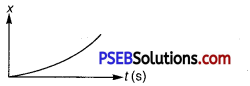
PSEB 11th Class Physics Solutions Chapter 14 Oscillations 1
(b)
PSEB 11th Class Physics Solutions Chapter 14 Oscillations 2
(c)
PSEB 11th Class Physics Solutions Chapter 14 Oscillations 3
(d)
PSEB 11th Class Physics Solutions Chapter 14 Oscillations 4
Solution:
(b) and (d) are periodic
Explanation :
(a) It is not a periodic motion. This represents a unidirectional, linear uniform motion. There is no repetition of motion in this case.
(b) In this case, the motion of the particle repeats itself after 2 s. Hence, it is a periodic motion, having a period of 2 s.
(c) It is not a periodic motion. This is because the particle repeats the motion in one position only. For a periodic motion, the entire motion of the particle must be repeated in equal intervals of time. In this case, the motion of the particle repeats itself after 2 s. Hence, it is a periodic motion, having a period of 2 s.

Question 4.
Which of the following functions of time represent (a) simple ‘ harmonic, (b) periodic but not simple harmonic, and (c) non¬periodic motion? Give period for each case of periodic motion (a is any positive constant):
(a) sin ωt – cos ωt
(b) sin 3ωt
(c) 3cos(\(\pi / 4 \) -2ωt)
(d) cos ωt +cos 3 ωt+cos 5ωt
(e) exp(-ω2t2)
(f) 1+ ωt+ω2t
Solution:
(a) SHM
The given function is:
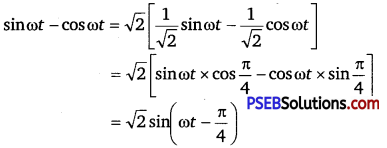
PSEB 11th Class Physics Solutions Chapter 14 Oscillations 5
This function represents SHM as it can be written in the form: a sin (ωt +Φ)
Its period is: \(\frac{2 \pi}{\omega}\)

(b) Periodic, but not SHM The given function is:
sin3 ωt = \(\frac{1}{4}\) [3sinωt -sin3ωt] (∵ sin3θ = 3sinθ – 4sin3 θ)
The terms sin cot and sin 3 ωt individually represent simple harmonic motion (SHM). However, the superposition of two SHM is periodic and not simple harmonic.

Period of\(\frac{3}{4}\)sin ωt = \(\frac{2 \pi}{\omega}\) = T
Period of\(\frac{1}{4}\)sin3ωt = \(\frac{2 \pi}{3 \omega}\) = T’ = \(\frac{T}{3}\)
Thus, period of the combination
= Minimum time after which the combined function repeats
= LCM of T and \(\frac{T}{3}\) = T
Its period is 2 \(\pi / \omega\)

(c) SHM
The given function is:
3 cos \(\left[\frac{\pi}{4}-2 \omega t\right]\) = 3 cos \(\left[2 \omega t-\frac{\pi}{4}\right]\)
This function represents simple harmonic motion because it can be written in the form:
acos(ωt +Φ)

Its period is :
\(\frac{2 \pi}{2 \omega}=\frac{\pi}{\omega}\)

(d) Periodic, but not SHM
The given function is cosωt +cos3ωt +cos5ωt. Each individual cosme function represents SHM. However, the superposition of threc simple harmonic motions is periodic, but not simple harmonic.

cosωt represents SHM with period = \(\frac{2 \pi}{\omega}\) T (say)
cos 3ωt represents SHM with period = \(\frac{2 \pi}{3 \omega}=\frac{T}{3}\)
cos 5ωt represents SHM with period = \(\frac{2 \pi}{5 \omega}=\frac{T}{5}\)
The minimum time after which the combined function repeats its value is T. Hence, the given function represents periodic function but not SHM, with period T.

(e) Non-periodic motion: .
The given function exp(- ω2t2) is an exponential function. Exponential functions do not repeat themselves. Therefore, it is a non-periodic motion.

(f) Non-periodic motion
The given function is 1+ ωt + ω2t2
Here no repetition of values. Hence, it represents non-periodic motion.

PSEB 11th Class Physics Solutions Chapter 14 Oscillations

Question 5.
A particle Is in linear simple harmonic motion between two points, A and B, 10 cm apart Take the direction from A to B as the positive direction and give the signs of velocity, acceleration and force on the particle when It Is
(a) at the end A,
(b) at the end B,
(c) at the midpoint of AB going towards A,
(d) at 2 cm away from B going towards A,
(e) at 3 cm away from A going towards B, and
(f) at 4 cm away from B going towards A.
Solution:
The given situation is shown in the following figure. Points A and B are the two endpoints, with AB =10cm. 0 is the midpoint of the path.

PSEB 11th Class Physics Solutions Chapter 14 Oscillations 6
A particle is in linear simple harmonic motion between the endpoints
(a) At the extreme point A, the particle is at rest momentarily. Hence, its velocity is zero at this point.
Its acceleration is positive as it is directed along with AO.
Force is also positive in this case as the particle is directed rightward.

(b) At the extreme point B, the particle is at rest momentarily. Hence, its velocity is zero at this point.
Its acceleration is negative as it is directed along B.
Force is also negative in this case as the particle is directed leftward.

(c) PSEB 11th Class Physics Solutions Chapter 14 Oscillations 7

The particle is extending a simple harmonic motion. O is the mean position of the particle. Its velocity at the mean position O is the maximum. The value for velocity is negative as the partide Is directed leftward. The acceleration and force of a particle executing SHM is zero at the mean position.

(d) PSEB 11th Class Physics Solutions Chapter 14 Oscillations 8

The particle is moving towards point O from the end B. This direction of motion is opposite to the conventional positive direction, which is from A to R. Hence, the particle’s velocity and acceleration, and the force on it are all negative.

(e)

PSEB 11th Class Physics Solutions Chapter 14 Oscillations 9
The particle is moving towards point O from the end A. This direction of motion is from A to B, which is the conventional positive direction. Hence, the value for velocity, acceleration, and force are all positive.

(f)

PSEB 11th Class Physics Solutions Chapter 14 Oscillations 10
This case is similar to the one given in (d).

Question 6.
Whi ch of the following relationships between the acceleration a and the displacement x of a particle involves simple harmonic motion?
(a) a=0.7x
(b) a=-200x2
(c) a= – 10 x (d) a=100x3
Solution:
A motion represents simple harmonic motion if it is governed by the force law:
F=-kx
ma’= -kx
∴ a = – \(\frac{k}{m}\) x

where F is the force
m is the mass (a constant for a body)
x is the displacement
a is the acceleration.
k is a constant
Among the given equations, only equation a = -10 x is written in the
above form with \( \frac{k}{m}\) =10. Hence, this relation represents SHM.

PSEB 11th Class Physics Solutions Chapter 14 Oscillations

Question 7.
The motion of a particle executing simple harmonic motion is described by the displacement function,
x(t) = A cos (ωt+Φ)
If the initial (t = 0) position of the particle is 1 cm and its initial velocity is ω cm/s, what are its amplitude and initial phase angle? The angular frequency of the particle is πs-1. If instead of the cosine function, we choose the sine function to describe the SHM:x = B sin(ωt + α), what are the amplitude and initial phase of the particle with the above initial conditions.
Solution:
Initially, at t = 0:
Displacement, x = 1 cm Initial velocity, ν = ω cm/s.
Angular frequency, ω = π rad s-1
It is given that:
x(t) = Acos (ωt+Φ)
1 = Acos(ω x 0 +Φ) = AcosΦ
AcosΦ =1 ……………………………….. (i)

Velocity, ν = \(\frac{d x}{d t}\)
ω = -Aω sin(ωt +Φ)
1 = -Asin(ω x 0 +Φ) = -AsinΦ
Asin Φ = -1 ………………………… (ii)
Squaring and adding equations (i) and (ii), we get
A2(sin2Φ +cos2Φ) = 1+1
A2 = 2
∴ A = \(\sqrt{2}\) cm

Dividing equation (ii) by equation (i), we get
tanΦ = -1
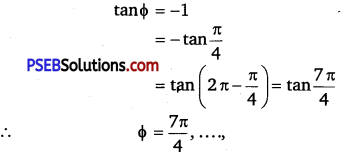
PSEB 11th Class Physics Solutions Chapter 14 Oscillations 11
SHM is given as
x = Bsin(ωt + α)
Putting the given values in this equation, we get 1 =B sin (ωt + α)
B sin α =1 …………………………… (iii)

Velocity, ν = \(\frac{d x}{d t}\)
ω =(ωB cos (ωt + a)
1 =B cos (ω x 0+α ) = B cos α …………………………………… (iv)
Squaring and adding equations (iii) and (iv), we get
B2 [sin2α +cos2 α] =1+1
B2 =2
B = \(\sqrt{2}\) cm
Dividing equation (iii) by equation (iv), we get
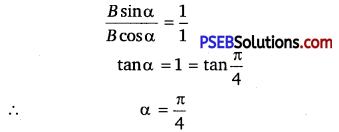
PSEB 11th Class Physics Solutions Chapter 14 Oscillations 12

Question 8.
A spring balance has a scale that reads from 0 to 50kg. The length of the scale is 20 cm. A body suspended from this balance, when displaced and released, oscillates with a period of 0.6 s. What is the weight of the body?
Solution:
Maximum mass that the scale can read, M = 50 kg
Maximum displacement of the spring = Length of the scale, l = 20 cm = 0.2 m Time period, T =0.6s
Maximum force exerted on the spring, F = Mg where,
g = acceleration due to gravity = 9.8 m/s2
F = 50 × 9.8 = 490 N
∴ Spring constant , K = \(\frac{F}{l}=\frac{490}{0.2}\) = 2450Nm-1

Mass m, is suspended from the balance,
Time period, T = \(2 \pi \sqrt{\frac{m}{k}}\)
∴ m = \(\left(\frac{T}{2 \pi}\right)^{2} \times k=\left(\frac{0.6}{2 \times 3.14}\right)^{2} \times 2450 \) = 22.36 kg
∴ Weight of the body = mg = 22.36 x 9.8 = 219.167N
Hence, the weight of the body is about 219 N.

Question 9.
Aspringhavingwith aspiring constant 1200Nm-1 is mounted on a horizontal table as shown in figure. A mss of 3kg is attached to the free end of the spring. The mass is then pulled sideways to a distance of 2.0cm and released.

PSEB 11th Class Physics Solutions Chapter 14 Oscillations 13
Determine (i) the frequency of oscillations,
(ii) maximum acceleration of the mass, and
(iii) the maximum speed of the mass.
Solution:
Spring constant, k = 1200 Nm-1
mass,m = 3 Kg
Displacement,A = 2.0 cm = 0.02 m
(i) Frequency of oscillation y, is gyen by the relation
V = \(\frac{1}{T}=\frac{1}{2 \pi} \sqrt{\frac{k}{m}}\)
where, T is the time period
∴ v = \(\frac{1}{2 \times 3.14} \sqrt{\frac{1200}{3}}\) = 3.18 s-1
Hence, the frequency of oscillations is 3.18 s-1.

(ii) Maximum acceleration a is given by the relation:
a = ω2A
where,
ω = Angular frequency = \(\sqrt{\frac{k}{m}}\)
A = Maximum displacement
∴ a = \(\frac{k}{m} A=\frac{1200 \times 0.02}{3}\) = 8 ms-2
Hence, the maximum acceleration of the mass is 8.0 ms2

(iii) Maximum speed, νmax = Aω
= \(A \sqrt{\frac{k}{m}}=0.02 \times \sqrt{\frac{1200}{3}}\) = 0.4 m/s
Hence, the maximum speed of the mass is 0.4 m/s.

Question 10.
In question 9, let us take the position of mass when the spring is unstretched as x =0, and the direction from left to right as the positive direction of x-axis. Give x as a function of time t for the oscillating massif at the moment we start the stopwatch (t = 0), the mass is
(a) at the mean position,
(b) at the maximum stretched position, and
(c) at the maximum compressed position.
In what way do these functions for SHM differ from each other, in frequency, in amplitude br the initial phase?
Solution:
(a) The functions have the same frequency and amplitude, but different initial phases.
Distance travelled by the mass sideways, A = 2.0 cm
Force constant of the spring, k =1200 N m-1
Mass, m =3kg
Angular frequency of oscillation,
ω = \(\sqrt{\frac{k}{m}}=\sqrt{\frac{1200}{3}} \) = \(\sqrt{400}\) = 20 rad s-1
When the mass is at the mean position, initial phase is 0.
Displacement,
x = A sinωt = 2 sin20 t

(b) At the maximum stretched position, the mass is toward the extreme right. Hence, the initial phase is \(\frac{\pi}{2}\)
Displacement, x = Asin \(\left(\omega t+\frac{\pi}{2}\right)\)
=2sin\(\left(20 t+\frac{\pi}{2}\right)\)
= 2 cos 20t

(c) At the maximum compressed position, the mass is toward the extreme left. Hence, the initial phase is \(\frac{3 \pi}{2}\)
Displacement, x = A sin \(\left(\omega t+\frac{3 \pi}{2}\right)\)
= 2sin \(\left(20 t+\frac{3 \pi}{2}\right)\) = -2cos 20t
The functions have the same frequencyl \(\left(\frac{20}{2 \pi} \mathrm{Hz}\right)\) land amplitude (2cm),
but different initial phases \(\left(0, \frac{\pi}{2}, \frac{3 \pi}{2}\right)\)

PSEB 11th Class Physics Solutions Chapter 14 Oscillations

Question 11.
Figures correspond to two circular motions. The radius of the circle, the period of revolution, the initial position, and the sense of revolution (i. e., clockwise or anti-clockwise) are indicated on each figure.
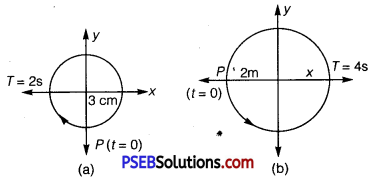
PSEB 11th Class Physics Solutions Chapter 14 Oscillations 14
Obtain the corresponding simple harmonic motions of the x-projection of the radius vector of the revolving particle P, in each case.
solution:
Time period,T =2s
Amplitude, A = 3cm
At time, t = O, the radius vector OP makes an angle \(\frac{\pi}{2}\) with the positive x -axis, i.e., phase angle Φ = + \(\frac{\pi}{2}\)
Therefore, the equation of simple harmonic motion for the x —projection of OP, at time t, is given by the displacement equation
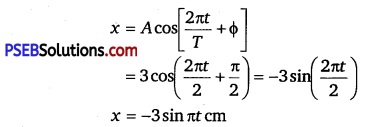
PSEB 11th Class Physics Solutions Chapter 14 Oscillations 15

(b) Time period, T = 4s
Amplitude, a =2 m
At time t = 0, OP makes an angle ir with the x-axis, in the anticlockwise direction. Hence, phase angle, Φ = +π
Therefore, the equation of simple harmonic motion for the x -projection of OP, at time t, is given as

PSEB 11th Class Physics Solutions Chapter 14 Oscillations 16

Question 12.
Plot the corresponding reference circle for each of the following simple harmonic motions. Indicate the initial (t = 0) position of the particle, the radius of the circle, and the angular speed of the rotating particle. For simplicity, the sense of rotation may be fixed to be anticlockwise in every case: (x is in cm and t is in s).
(a) x= – 2sin(3t+\(\pi / \mathbf{3}\) )
(b) x=cos (\(\pi / 6\) – t)
(c) x=3 sin (2πt + \(\pi / 4 \) )
(d) x=2 cos πt
Solution:
(a) x = -2 sin \(\left(3 t+\frac{\pi}{3}\right)=+2 \cos \left(3 t+\frac{\pi}{3}+\frac{\pi}{2}\right)=2 \cos \left(3 t+\frac{5 \pi}{6}\right) \)

If this equation is compared with the standard SHM equation,
x =A cos \(\left(\frac{2 \pi}{T} t+\phi\right)\) then we get
Amplitude, A = 2cm
Phase angle, Φ = \(\frac{5 \pi}{6}\) =150°
Angular velocity, ω = \(\frac{2 \pi}{T}\) =3 rad/sec
The motion of the particle can be pokted as shown in the following figure.
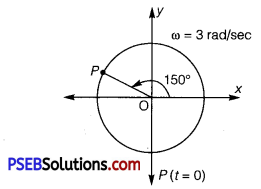
PSEB 11th Class Physics Solutions Chapter 14 Oscillations 17

(b) x=cos \(\left(\frac{\pi}{6}-t\right)\) =cos \(\left(t-\frac{\pi}{6}\right)\)
If this equation is compared with the standard SHM equation,
x = A cos \(\left(\frac{2 \pi}{T} t+\phi\right)\) then we get
Amplitude, A = 1 cm
Phase angle, Φ = \(-\frac{\pi}{6} \) = – 30°
Angular velocity, ω = \(\frac{2 \pi}{T}\) =1 rad/s
The motion of the particle can be plotted as shown in the following figure.
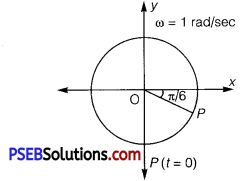
PSEB 11th Class Physics Solutions Chapter 14 Oscillations 18

(c) x =3sin \(\left(2 \pi t+\frac{\pi}{4}\right)\)
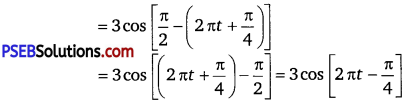
PSEB 11th Class Physics Solutions Chapter 14 Oscillations 19
If this equation is compared with the standard SHM equation
x = Acos \(\left(\frac{2 \pi}{T} t+\phi\right)\) then we get
Amplitude, A = 3cm
Phase angle, Φ = \(-\frac{\pi}{4}\)
Angular velocity, ω = \(\frac{2 \pi}{T}\) = 2π rad/s
The motion of the particle can be plotted as shown in the following figure.
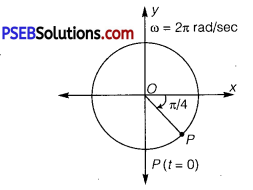
PSEB 11th Class Physics Solutions Chapter 14 Oscillations 20

(d) x=2cosπt
If this equation is compared with the standard SHM equation,
x = A cos \(\left(\frac{2 \pi}{T} t+\phi\right) \) then we get
Amplitude, A = 2cm
Phase angle, Φ = 0
Angular velocity, ω = π rad/s
The motion of the particle can be plotted as shown in the following figure.
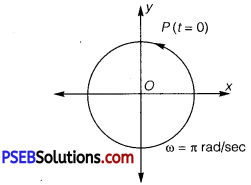
PSEB 11th Class Physics Solutions Chapter 14 Oscillations 21

Question 13.
Figure (a) shows a spring of force constant k clamped rigidly at one end and a mass m attached to its free end. A force F applied at the free end stretches the spring. Figure (b) shows the same spring with both ends free and attached to a mass m at either end. Each end of the spring in figure (b) is stretched by the same force F.
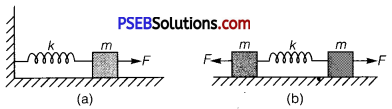
PSEB 11th Class Physics Solutions Chapter 14 Oscillations 22

(a) What is the minimum extension of the spring in the two cases?
(b) If the mass in Fig. (a) and the two masses in Fig. (b) are released, what is the period of oscillation in each case?
Solution:
(a) For the one block system:
When a force F, is applied to the free end of the spring, an extension l, is produced. For the maximum extension, it can be written as:
F=kl
where k is the spring constant
Hence, the maximum extension produced in the spring, l = \(\frac{F}{k}\)
For the two blocks system:
The displacement (x) produced in this case is:
x = \(\frac{l}{2}\)
Net force, F = +2kx =2k \(\frac{l}{2}\)
∴ l = \(\frac{F}{k}\)

(b) For the one blocks system:
For mass (m) of the block, force is written as
F = ma = m \(\frac{d^{2} x}{d t^{2}}\)
where, x is the displacement of the block in time t
∴ m \(\frac{d^{2} x}{d t^{2}}\) = -kx
It is negative because the direction of elastic force is opposite to the direction of displacement.
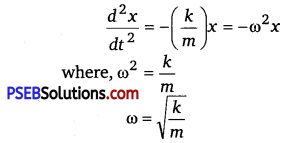
PSEB 11th Class Physics Solutions Chapter 14 Oscillations 23
where, ω is angular frequency of the oscillation
∴ Time period of the oscillation,
T= \(\frac{2 \pi}{\omega}=\frac{2 \pi}{\sqrt{\frac{k}{m}}}=2 \pi \sqrt{\frac{m}{k}}\)

For the two blocks system:
F=m \(\frac{d^{2} x}{d t^{2}}\)
m \(\frac{d^{2} x}{d t^{2}}\) =-2kx

It is negative because the direction of elastic force is opposite to the direction of displacement.
\(\frac{d^{2} x}{d t^{2}}\) = \(-\left[\frac{2 k}{m}\right] x \) = – ω2x
where, Angular frequency, ω = \(\sqrt{\frac{2 k}{m}}\)
∴ Time period T = \(\frac{2 \pi}{\omega}=2 \pi \sqrt{\frac{m}{2 k}} \)

PSEB 11th Class Physics Solutions Chapter 14 Oscillations

Question 14.
The piston in the cylinder head of a locomotive has a stroke (twice the amplitude) of 1.0 in. If the piston moves with simple harmonic motion with an angular frequency of 200 rad/min, what is its maximum speed?
Solution:
Angular frequency of the piston, ω = 200 rad/min.
Stroke =1.0 m
Amplitude, A = \(\frac{1.0}{2}\) = 0.5m
The maximum speed (νmax) of the piston is given by the relation
νmax =Aω = 200 x 0.5=100 m/min

Question 15.
The acceleration due to gravity on the surface of moon is 1.7 ms-2. What is the time period of a simple pendulum on the surface of moon If Its time period on the surface of earth is 3.5 s? (gon the surface of earth is 9.8 ms-2)
Solution:
Acceleration due to gravity on the surface of moon, g’ = 1.7m s-2
Acceleration due to gravity on the surface of earth, g = 9.8 ms-2
Time period of a simple pendulum on earth, T = 3.5 s
T= \(2 \pi \sqrt{\frac{l}{g}}\)

where l is the length of the pendulum
∴ l = \(\frac{T^{2}}{(2 \pi)^{2}} \times g=\frac{(3.5)^{2}}{4 \times(3.14)^{2}} \times 9.8 \mathrm{~m} \)

The length of the pendulum remains constant.
On Moon’s surface, time period,
T’ = \(2 \pi \sqrt{\frac{l}{g^{\prime}}}=2 \pi \sqrt{\frac{(3.5)^{2}}{\frac{4 \times(3.14)^{2}}{1.7}} \times 9.8} \) = 8.4 s
Hence, the time period of the simple pendulum on the surface of Moon is 8.4 s.

Question 16.
Answer the following questions:
(a) Time period of a particle in SHM depends on the force constant k and mass m of the particle:
T = \(2 \pi \sqrt{\frac{m}{k}}\) A simple pendulum executes SHM approximately. Why then is the time period of a pendulum independent of the mass of the pendulum?

(b) The motion of a simple pendulum is approximately simple harmonic for small-angle oscillations. For larger angles of oscillation a more involved analysis shows that T is greater than \(2 \pi \sqrt{\frac{l}{g}}\) Think of a qualitative argument to appreciate this result.

(c) A man with a wristwatch on his hand falls from the top of a tower. Does the watch give correct time during the free fall?

(d) What is the frequency of oscillation of a simple pendulum mounted in a cabin that is freely falling under gravity?
Solution :
(a) The time period of a simple pendulum, T = \(2 \pi \sqrt{\frac{m}{k}}\)
For a simple pendulum, k is expressed in terms of mass m, as
k ∝ m
\(\frac{m}{k}\) = Constant
Hence, the time period T, of a simple pendulum is independent of the mass of the bob.

(b) In the case of a simple pendulum, the restoring force acting on the bob of the pendulum is given as
F = -mg sinθ
where, F = Restoring force; m = Mass of the bob; g = Acceleration due to
gravity; θ = Angle of displacement
For small θ, sinθ ≈ θ
For large 0,sin0 is greater than 0.
This decreases the effective value of g.
Hence, the time period increases as
T = \(2 \pi \sqrt{\frac{l}{g}}\)
where, l is the length of the simple pendulum

(c) The time shown by the wristwatch of a man falling from the top of a tower is not affected by the fall. Since a wristwatch does not work on the principle of a simple pendulum, it is not affected by the acceleration due to gravity during free fall. Its working depends on spring action.

(d) When a simple pendulum mounted in a cabin falls freely under gravity, its acceleration is zero. Hence the frequency of oscillation of this simple pendulum is zero.

Question 17.
A simple pendulum of length l and having a bob of mass M is suspended in a car. The car is moving on a circular track of radius R with a uniform speed v. If the pendulum makes small f oscillations in a radial direction about its equilibrium position, what will be its time period?
Solution:
The bob of the simple pendulum will experience the acceleration due to gravity and the centripetal acceleration provided by the circular motion of the car.
Acceleration due to gravity = g
Centripetal acceleration = \(\frac{v^{2}}{R}\)
where, v is the uniform speed of the car R is the radius of the track
Effective acceleration (aeff) is given as
aeff = \(\sqrt{g^{2}+\left(\frac{v^{2}}{R}\right)^{2}}\)

Time period, T = \( 2 \pi \sqrt{\frac{l}{a_{e f f}}}\)
where, l is the length of the pendulum
∴ Time period, T = \(2 \pi \sqrt{\frac{l}{g^{2}+\frac{v^{4}}{R^{2}}}} \)

Question 18.
A cylindrical piece of cork of density of base area A and height h floats in a liquid of density ρl. The cork is depressed slightly and then released. Show that the cork oscillates up and down simple harmonically with a period
T = \(2 \pi \sqrt{\frac{\boldsymbol{h} \rho}{\rho_{\boldsymbol{l}} \boldsymbol{g}}}\)
where ρ is the density of cork. (Ignore damping due to viscosity of the liquid).
Solution:
Base area of the cork = A
Height of the cork = h
Density of the liquid = ρl
Density of the cork = ρ

In equilibrium:
Weight of the cork = Weight of the liquid displaced by the floating cork Let the cork be depressed slightly by x. As a result, some extra water of a certain volume is displaced. Hence, an extra up-thrust acts upward and provides the restoring force to the cork.
Up-thrust = Restoring force, F = Weight of the extra water displaced
F = -(Volume x Density x g)
Volume = Area x Distance through which the cork is depressed Volume = Ax
∴ F = -Ax ρlg ………………………… (i)
According to the force law,
F = kx
k = \(\frac{F}{x}\)

where k is a constant
k = \(\frac{F}{x}\) = -Aρlg ………………………………. (ii)
The time period of the oscillations of the cork,
T = \(2 \pi \sqrt{\frac{m}{k}} \) …………………………………… (iii)

where,
m = Mass of the cork
= Volume of the cork x Density
= Base area of the cork x Height of the cork x Density of the cork = Ahρ
Hence, the expression for the time period becomes
T = \(2 \pi \sqrt{\frac{A h \rho}{A \rho_{l} g}}\) = 2\(\pi \sqrt{\frac{h \rho}{\rho_{l} g}} \)

Question 19.
One end of a U-tube containing mercury is connected to a suction pump and the other end to atmosphere. A small pressure difference is maintained between the two columns. Show that, when the suction pump is removed, the column of mercury in the U-tube executes simple harmonic motion.
Solution:
Area of cross-section of the U-tube = A
Density of the mercury column = ρ
Acceleration due to gravity = g
Restoring force, F = Weight of the mercury column of a certain height
F = -(Volume x Density x g)
F = -(A x 2h x ρ x g) = -2Aρgh = -k x Displacement in one of the arms (h)

where, 2h is the height of the mercury column in the two arms
k is a constant, given by k = \(-\frac{F}{h}\) = 2Aρg
Time period = \(2 \pi \sqrt{\frac{m}{k}}=2 \pi \sqrt{\frac{m}{2 A \rho g}}\)
where, m is the mass of the mercury column
Let l be the length of the total mercury in the U-tube.
Mass of mercury, m = Volume of mercury x Density of mercury = Alρ
∴ T = \(2 \pi \sqrt{\frac{A l \rho}{2 A \rho g}}=2 \pi \sqrt{\frac{l}{2 g}} \)

Hence the mercury column executes simple harmonic motion with time period \(2 \pi \sqrt{\frac{l}{2 g}} \)

Additional Exercises

Question 20.
An air chamber of volume V has a neck area of cross-section a into which a ball of mass m just fits and can move up and down without any friction (see figure). Show that when the ball is pressed down a little and released, it executes SHM. Obtain an expression for the time period of oscillations assuming pressure-volume variations of air to be isothermal.
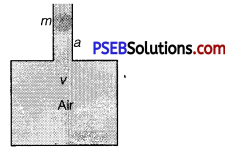
PSEB 11th Class Physics Solutions Chapter 14 Oscillations 24
Solution:
Volume of the air chamber = V
Area of cross-section of the neck = a
Mass of the ball = m
The pressure inside the chamber is equal to the atmospheric pressure. Let the ball be depressed by x units. As a result of this depression, there would be a decrease in the volume and an increase in the pressure inside the chamber.
Decrease in the volume of the air chamber, ΔV = ax
Volumetric strain =PSEB 11th Class Physics Solutions Chapter 14 Oscillations 25
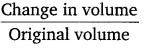
⇒ \(\frac{\Delta V}{V}=\frac{a x}{V}\)

Bulk Modulus of air, B = \(\frac{\text { Stress }}{\text { Strain }}=\frac{-p}{\frac{a x}{V}}\)
In this case, stress is the increase in pressure. The negative sign indicates that pressure increases with a decrease in volume.
p = \(\frac{-B a x}{V}\)
The restoring force acting on the ball,
F = p × a = \(\frac{-B a x}{V} \cdot a=\frac{-B a^{2} x}{V}\) ……………………………. (i)
In simple harmonic motion, the equation for restoring force is
F = -kx …………………………………….. (ii)
where, k is the spring constant Comparing equations (i) and (ii), we get
k = \(\frac{B a^{2}}{V}\)
Time period, T = \(2 \pi \sqrt{\frac{m}{k}}=2 \pi \sqrt{\frac{V m}{B a^{2}}}\)

PSEB 11th Class Physics Solutions Chapter 14 Oscillations

Question 21.
You are riding in an automobile of mass 3000kg. Assuming that you are examining the oscillation characteristics of its suspension system. The suspension sags 15 cm when the entire automobile is placed on it. Also, the amplitude of oscillation decreases by 50% during one complete oscillation. Estimate the values of (a) the spring constant k and (6) the damping constant b for the spring and shock absorber system of one wheel, assuming that each wheel supports 750 kg.
Solution:
Mass of the automobile, m = 3000 kg
Displacement in the suspension system, x = 15cm = 0.15 m
There are 4 springs in parallel to the support of the mass of the automobile.
The equation for the restoring force for the system:
F = -4 kx = mg

where, k is the spring constant of the suspension system
Time period, T = \(2 \pi \sqrt{\frac{m}{4 k}}\)
and, k = \(\frac{m g}{4 x}=\frac{3000 \times 10}{4 \times 0.15}\) = 50000 = 5 x 10 4N/m
Spring constant, k = 5 x 10⁴ N/m

Each wheel supports a mass, M = \(\frac{3000}{4}\) = 750 kg
For damping factor b, the equation for displacement is written as:
x = x0e-bt/2M

The amplitude of oscillation decreases by 50%
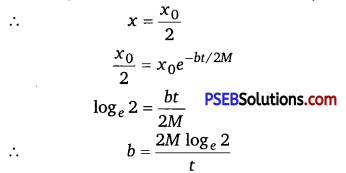
PSEB 11th Class Physics Solutions Chapter 14 Oscillations 26
where, Time petiod,t =\(2 \pi \sqrt{\frac{m}{4 k}}=2 \pi \sqrt{\frac{3000}{4 \times 5 \times 10^{4}}}\) =0.7691s
∴ b =\(\frac{2 \times 750 \times 0.693}{0.7691}\) =1351.58kg/s
Therefore, the damping constant of the spring is 1351.58 kg/s.

Question 22.
Show that for a particle in linear SHM the average kinetic energy over a period of oscillation equals the average potential energy over the same period.
Solution:
The equation of displacement of a particle executing SHM at an instant t is given as
x = Asinωt
where,
A = Amplitude of oscillation
ω = Angular frequency = \(\sqrt{\frac{k}{M}}\)
The velocity of the particle is
ν = \(\frac{d x}{d t}\) = Aωcosωt

The kinetic energy of the particle is
Ek = \(\frac{1}{2} M v^{2}=\frac{1}{2} M A^{2} \omega^{2} \cos ^{2} \omega t \)
The potential energy of the particle is
Ep = \( \frac{1}{2} k x^{2}=\frac{1}{2} M \omega^{2} A^{2} \sin ^{2} \omega t\)

For time period T, the average kinetic energy over a single cycle is given as
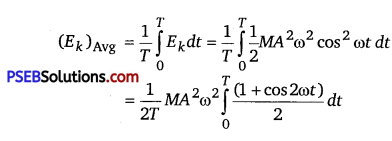
PSEB 11th Class Physics Solutions Chapter 14 Oscillations 27
PSEB 11th Class Physics Solutions Chapter 14 Oscillations 28
And, average potential energy over one cycle is given as
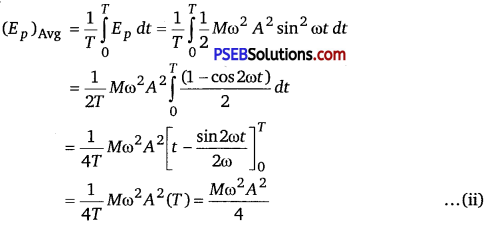
PSEB 11th Class Physics Solutions Chapter 14 Oscillations 29
It can be inferred from equations (i) and (ii) that the average kinetic energy for a given time period is equal to the average potential energy for the same time period.

Question 23.
A circular disc of mass 10 kg is suspended by a wire attached to its center. The wire is twisted by rotating the disc and released. The period of torsional oscillations is found to be 1.5s. The radius of the disc is 15 cm. Determine the torsional spring constant of the wire. (Torsional spring constant a is defined by the relation J = -αθ, where J is the restoring couple and 0 the angle of twist).
Solution:
Mass of the circular disc, m = 10 kg
Radius of the disc, r = 15cm = 0.15 m
The torsional oscillations of the disc has a time period, T = 1.5 s The moment of inertia of the disc is
I = \(\frac{1}{2}\) mr2 = \(\frac{1}{2} \times(10) \times(0.15)^{2}\) = 0.1125kg-m2

Time period, T = \(2 \pi \sqrt{\frac{I}{\alpha}}\)
where, α is the torsional constant.
An21 4 x(3.14)2x 0.1125 , M
α = \(\frac{4 \pi^{2} I}{T^{2}}=\frac{4 \times(3.14)^{2} \times 0.1125}{(1.5)^{2}} \) = 1.972 N-m/rad
Hence, the torsional spring constant of the wire is 1.972 N-m rad-1.

Question 24.
A body describes simple harmonic motion with amplitude of 5 cm and a period of 0.2 s. Find the acceleration and velocity of the body when the displacement is (a) 5 cm, (b) 3 cm, (c) 0 cm.
Solution:
Amplitude, A = 5 cm = 0.05m
Time period, T = 0.2 s
(a) For displacement, x = 5 cm = 0.05m
Acceleration is given by
a = -ω2x = \(-\left(\frac{2 \pi}{T}\right)^{2} x=-\left(\frac{2 \pi}{0.2}\right)^{2} \times 0.05\)
Velocity is given by
ν = ω \(\sqrt{A^{2}-x^{2}}=\frac{2 \pi}{T} \sqrt{(0.05)^{2}-(0.05)^{2}}\) = 0
When the displacement of the body is 5 cm, its acceleration is -5π2 m/s2 and velocity is 0.

(b) For displacement, x =3 cm = 0.03 m
Acceleration is given by
a = – ω2x = – \(\left(\frac{2 \pi}{T}\right)^{2}\)x = \(\left(\frac{2 \pi}{0.2}\right)^{2}\) 0.03 = -3π2 m/s2
Velocity is given by
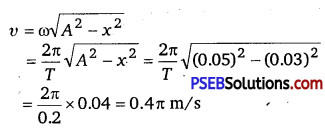
PSEB 11th Class Physics Solutions Chapter 14 Oscillations 30
When the displacement of the body is 3 cm, its acceleration is -3π m/s2 and velocity is 0.4π m/s.

(c) For displacement, x = 0
Acceleration is given by
a = – ω2x = 0
Velocity is given by
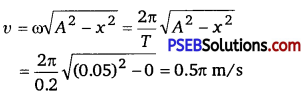
PSEB 11th Class Physics Solutions Chapter 14 Oscillations 31
When the displacement of the body is 0, its acceleration is 0, and velocity is0.5π m/s.

PSEB 11th Class Physics Solutions Chapter 14 Oscillations

Question 25.
A mass attached to a spring is free to oscillate, with angular velocity ω, in a horizontal plane without friction or damping. It is pulled to a distance x0 and pushed towards the center with a velocity v0 at time t = 0. Determine the amplitude of the resulting oscillations in terms of the parameters ω, x0, and v0. [Hint: Start with the equation x = a cos(ωt + θ) and note that the initial velocity is negative.]
Solution:
The displacement equation for an oscillating mass is given by
x = Acos(ωt + θ) …………………………… (i)
where A is the amplitude
x is the displacement
θ is the phase constant
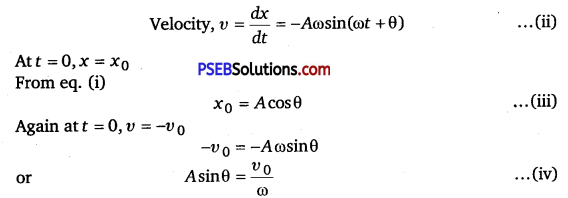
PSEB 11th Class Physics Solutions Chapter 14 Oscillations 32
Squaring and adding equations (iii) and (iv), we get
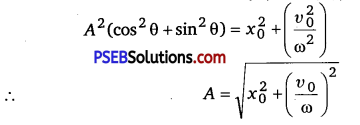
PSEB 11th Class Physics Solutions Chapter 14 Oscillations 33
Hence, the amplitude of the resulting oscillation is \(\sqrt{x_{0}^{2}+\left(\frac{v_{0}}{\omega}\right)^{2}}\)

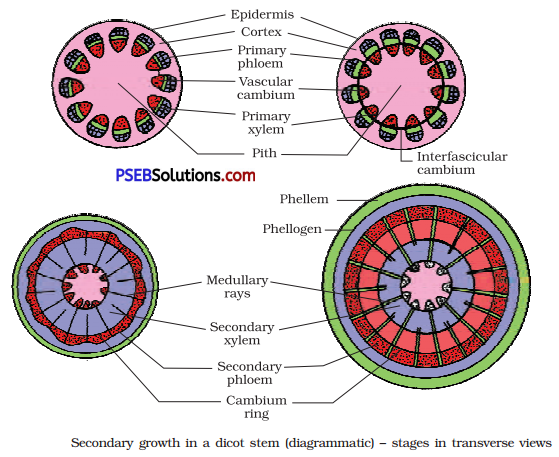
PSEB 11th Class Physics Solutions Chapter 1 Physical World

Punjab State Board PSEB 11th Class Physics Book Solutions Chapter 1 Physical World Textbook Exercise Questions and Answers.

PSEB Solutions for Class 11 Physics Chapter 1 Physical World

PSEB 11th Class Physics Guide Physical World Textbook Questions and Answers

Question 1.
Some of the most profound statements on the nature of science have come from Albert Einstein, one of the greatest scientists of all time. What do you think did Einstein mean when he said: “The most incomprehensible thing about the world is that it is comprehensible”?
Answer:
The physical world around us is full of different complex natural phenomena so the world is incomprehensible. But with the help of study and observations it has been found that all these phenomena are based on some basic physical laws and so it is comprehensible.

Question 2.
“Every great physical theory starts as a heresy and ends as a dogma”. Give some examples from the history of science of the validity of this incisive remark.
Answer:
The above statement is true. Validity of this incisive remark can be validated from the example of moment of inertia. It states that the moment of inertia of a body depends on its energy. But according to Einstein’s mass-energy relation (E = mc2), energy depends on the speed of the body.

PSEB 11th Class Physics Solutions Chapter 1 Physical World

Question 3.
“Politics is the art of the possible”. Similarly, “Science is the art of the soluble”. Explain this beautiful aphorism on the nature and practice of science.
Answer:
It is well known that to win over votes, politicians would make anything and everything possible even when they are least sure of the same. And in science the various natural phenomena can be explained in terms of some basic laws. So as ‘Politics is the art of possible’ similarly ‘Science is the art of the soluble’.

Question 4.
Though India now has a large base in science and technology, which is fast expanding, it is still a long way from realizing its potential of becoming a world leader in science. Name some important factors, which in your view have hindered the advancement of science in India.
Answer:
Some important factors in our view which have hindered the advancement of science in India are:

  • Proper funds are not arranged for the development of research work and laboratories. The labs and scientific instruments are very old and outdated.
  • Most of the people in India are uneducated and highly traditional. They don’t understand the importance of science.
  • There is no proper employment opportunity for the science educated person in India.
  • There are no proper facilities for science education in schools and colleges in India.

Question 5.
No physicist has ever “seen” an electron. Yet, all physicists believe in the existence of electrons. An intelligent but superstitious man advances this analogy to argue that ‘ghosts’ exist even though no one has “seen” one. How will you refute his argument?
Answer:
No physicist has ever seen an electron but there are practical evidences which prove the presence of electron. Their size is so small, even powerful microscopes find it difficult to measure their sizes. But still its effects could be tested. On the other hand, there is no phenomena which can be explained on the basis of existence of ghosts.

Our senses of sight and hearing are very limited to observe the existence of both.
So, there is no comparison between the two given cases.

Question 6.
The shells of crabs found around a particular coastal location in Japan seem mostly to resemble the legendary face of a Samurai. Given below are two explanations of this observed fact. Which of these strikes you as a scientific explanation?

(a) A tragic sea accident several centimes ago drowned a young Samurai. As a tribute to his bravery, nature through its inscrutable ways immortalized his face by imprinting it on the crab shells in that area.

(b) After the sea tragedy, fishermen in that area, in a gesture of honor to their dead hero, let free any crab shell caught by them which accidentally had a shape resembling the face of a Samurai. ConseQuestionuently, the particular shape of the crab shell survived longer and therefore in course of time the shape was genetically propagated. This is an example of evolution by artificial selection.

[Note: This interesting illustration taken from Carl Sagan’s ‘The Cosmos’ highlights the fact that often strange and inexplicable facts which on the first sight appear ‘supernatural’ actually turn out to have simple scientific explanations. Try to think out other examples of this kind].
Answer:
Explanation (b) is correct as it is a scientific explanation of the observed fact.

PSEB 11th Class Physics Solutions Chapter 1 Physical World

Question 7.
The industrial revolution in England and Western Europe more than two centuries ago was triggered by some key scientific and technological advances. What were these advances?
Answer:
More than two centuries ago, England and Western Europe invented steam engine, electricity, theory of gravitation and the explosives. Steam engines helped them in the field of heat and thermodynamics, theory of gravitation in field of motion and making guns and cannons. These progresses brought about industrial revolution in England and Western Europe.
Few of which are given below:

  • Steam engine formed on the application of heat and thermodynamics.
  • Discovery of electricity helped in designing dynamos and motors.
  • Safety lamp which was used safety in mines.
  • Invention of powerloom which used steampower was used for spinning and weaving.

Question 8.
It is often said that the world is witnessing now a second industrial revolution, which will transform the society as
radically as did the first. List some key contemporary areas of science and technology, which are responsible for this
revolution.
Answer:
Some of the key contemporary areas of science and technology which may trAnswer:form the society radically are:

  • Development of super fast computers.
  • Internet and tremendous advancement in information technology.
  • Development in Biotechnology.
  • Development of super-conducting materials at room temperature.
  • Development of robots.

Question 9.
Write in about 1000* words a fiction piece based on your : speculation on the science and technology of the twenty second century.
Answer:
Let us imagine a spaceship moving towards a distant star, 500 light years away. Let it be propelled by current fed into the electric motor consisting of superconducting wires. In space, suppose there is a particular region which has such a high temperature that destroys the superconducting property of electric wires of the motor. At this stage, another spaceship
filled with matter and anti-matter comes to the rescue of the first ship and it (i. e., 1st ship) continues its onward journey.

Another way to put is: Now matter can be changed into energy and energy into matter. A man of 22nd century stands on a plateform of a specially designed machine which energises him and his body disappears in the form of energy. After split of a second, he appears at a place much far away from the previous one just intact.

Question 10.
Attempt to formulate your ‘moral’ views on the practice of science. Imagine yourself stumbling upon a discovery, which has great academic interest but is certain to have nothing but dangerous conseQuestionuences for the human society. How, if at all, will you resolve your dilemma?
Answer:
In our view a type of discovery which is of great academic interest but harmful for human society should not be made public because science is for the society, society is not for science.

PSEB 11th Class Physics Solutions Chapter 1 Physical World

Question 11.
Science, like any knowledge, can be put to good or had use, depending on the user.Given below are some of the applications of science. Formulate your views on whether the particular application is good, bad or something that cannot be so clearly categorized:
(a) Mass vaccination against small pox to curb and finally eradicate this disease from the population. (This has already been successfully done in India).
(b) Television for eradication of illiteracy and for mass communication of news and ideas.
(c) Prenatal sex determination
(d) Computers for increase in work efficiency
(e) Putting artificial satellites into orbits around the Earth
(f) Development of nuclear weapons
(g) Development of new and powerful techniQuestionues of chemical and biological warfare.
(h) Purification of water for drinking
(i) Plastic surgery
(j) Cloning
Answer:
(a) Mass vaccination is good as it is used to make the society free from the diseases like Small Pox.

(b) Television for eradication of illiteracy and for mass communication of news and ideas is good as it is a medium which is easily under the reach of common man and also they are very habitual to it.

(c) Prenatal sex determination is bad because people are misusing it. Some of the people after determination of sex of child, think to abort. They do it specially with girl child.

(d) Computers for increase in work efficiency is good as using the computer a man can do much more work with greater efficiency and accuracy as it could do without computers.

(e) Putting artificial satellites into orbits around the Earth is a good development as these satellites serve many purposes like Remote Sensing, Weather Forcasting etc. These informations have very high importance for us as we can plan the things in advance.

(f) Development of nuclear weapons is bad as they can be used in mass destruction.

(g) Development of new and powerful techniQuestionues of chemical and biological warfare are bad as they can also be used for mass destruction.

(h) Purification of water for drinking is good as we can save ourseleves from the diseases which we can have due to drinking the contaminated water.

(i) Plastic surgery is good as with the help of it a man or woman can remove the skin defects occuring due to accidents or some other reasons. It has some bad effects too but they are not very considerable.

(j) Cloning is good as far as animals are concerned with the help of it we can develop some special species which can be used to serve some specific purposes. But it is not good for human beings.

Question 12.
India has had a long and unbroken tradition of great scholarship – in mathematics, astronomy, linguistics, logic and ethics. Yet, in parallel with this, several superstitious and obscurantistic attitudes and practices flourished in our society and unfortunately continue even today – among many educated people too. How will you use your knowledge of science to develop strategies to counter these attitudes?
Answer:
Poverty and illiteracy are the two major factors which make people superstitious in India. So to remove the superstitious and obscurantist attitude we have to first overcome these factors. Everybody should be educated, so that one can have scientific attitude. Knowledge of science can be put to use to prove people’s superstitious wrong by showing them the scientific logic behind everything happening in our world.

PSEB 11th Class Physics Solutions Chapter 1 Physical World

Question 13.
Though the law gives women equal status in India, many people hold unscientific views on a woman’s innate nature, capacity and intelligence, and in practice give them a secondary status and role. Demolish this view using scientific arguments, and by quoting examples of great women in science and other spheres; and persuade yourself and others that, given equal opportunity, women are on par with men.
Answer:
Some people in our society have the view that women do not have the innate nature, capacity and intelligence.
To demolish this view there are many examples of women who have proven their abilities in science and other fields.
Madam Curie, Mother Teresa, Indira Gandhi, Marget Thatcher, Rani Laxmi Bai, Florence Nightingale are some examples. So in this era women are definitely not behind man in any field.

Question 14.
“It is more important to have beauty in the equations of physics than to have them agree with experiments”. The great British physicist P. A. M. Dirac held this view. Criticize this statement.
‘ Look out for some eQuestionuations and results in this book which strike you as beautiful.
Solution:
An equation which agrees with experiment must also be simple and hence beautiful. We have some simple and beautiful equations in physics such as
E = mc2 (Energy of light) .
E = hv (Energy of a photon)
KE = 1 / 2 mv 2 (Kinetic energy of a moving particle)
PE = mgh (Potential energy of a body at rest)
W = F. d (Work done)
All have the same dimensions. One experiment shows dependency of energy on speed, the other shows dependency on frequency and displacement.
That’s the beauty of equations in physics coming from different experiments.

Question. 15.
Though the statement quoted above may be disputed, most physicists do have a feeling that the great laws of physics are at once simple and beautiful. Some of the notable physicists, besides Dirac, who have articulated this feeling are Einstein, Bohr, Heisenberg, Chandrasekhar and Feynman. You are urged to make special efforts to get access to the general books and writings by these and other great masters of physics (See the Bibliography at the end of this book). Their writings are truly inspiring!
Solution:
There is no doubt that great laws of physics are at once so simple and beautiful and are easy to grasp. For example, let us look at some of these:

  • E = mc2 is a famous Einstein’s mass energy equivalence relation which has a great impact not only on the various physical phenomena but also on the human lives.
  • Plank’s Questionuantum condition i.e., E = hv is also a simple and beautiful eQuestionuation and it is a great law of physics.
  • ∆x. ∆p ≥ \(\frac {1}{2}\).\(\frac{h}{2 \pi}\) or ∆ E. A t ≥ \(\frac {1}{2}\).\(\frac{h}{2 \pi}\) is Heisenberg’s.

Uncertainly Principle which is also very simple, beautiful and interesting. It is a direct conseQuestionuence of the dual nature of matter.

  • λ = \(\frac{h}{m v}\) is also a famous eQuestionuation in physics known as de-Broglie euation. It is again simple and beautiful.

PSEB 11th Class Physics Solutions Chapter 1 Physical World

Question 16.
Textbooks on science may give you a wrong impression that studying science is dry and all too serious and that scientists are absent minded introverts who never laugh or grin. This image of science and scientists is patently false. Scientists like any other group of humans have their share of humorists, and many have led their lives with a great sense of fun and adventure, even as they seriously pursued their scientific work. Two great physicists of this genre are Gamow and Feynman. You will enjoy reading their books listed in the Bibliography.
Answer:
It is not an exercise as such but is a statement of facts. We can add the names of other scientists who were humorists along with being physicists. They are C.V. Raman, Homi Jahangir Bhabha, Einstein and Bohr. India have several politiciAnswer: like M.M. Joshi, V.P. Singh etc. who are physicists. President A.P.J. Kalafn is also a great nuclear scientist.

PSEB 11th Class Physics Solutions Chapter 13 Kinetic Theory

Punjab State Board PSEB 11th Class Physics Book Solutions Chapter 13 Kinetic Theory Textbook Exercise Questions and Answers.

PSEB Solutions for Class 11 Physics Chapter 13 Kinetic Theory

PSEB 11th Class Physics Guide Kinetic Theory Textbook Questions and Answers

Question 1.
Estimate the fraction of molecular volume to the actual volume occupied by oxygen gas at SIP. Take the diameter of an oxygen molecule to be 3Å.
Solution:
Diameter of an oxygen molecule, d = 3Å
Radius, r = \(\frac{d}{2}=\frac{3}{2}\) =1.5 Å = 1.5 x 10⁻⁸ cm
Actual volume occupied by 1 mole of oxygen gas at STP = 22400 cm3
Molecular volume of oxygen gas, V = \(\frac{4}{3}\) πr3N

where, N is Avogadro’s number = 6.023 x 10²³ molecules/mole
∴ V = \(\frac{4}{3}\) x 3.14 x (1.5 x 10-8)3 x 6.023 x 1023 = 8.51cm3

Ratio of the molecular volume to the actual volume of oxygen = \(\frac{8.51}{22400}\) = 3.8 x 10⁻⁴ ≈ 4 x 10⁻⁴

Question 2.
Molar volume is the volume occupied by 1 mol of any (ideal) gas at standard temperature and pressure (STP: 1 atmospheric pressure, 0°C). Show that it is 22.4 litres.
Solution:
The ideal gas equation relating pressure (P), volume (V), and absolute temperature (T) is given as PV = nRT
where, R is the universal gas constant = 8.314 J mol-1 K-1
n = Number of moles = 1
T = Standard temperature = 273 K
P = Standard pressure = 1 atm = 1.013 x 10⁵ Nm-2
∴ V = \(\frac{n R T}{P}\)
PSEB 11th Class Physics Solutions Chapter 13 Kinetic Theory 1
Hence, the molar volume of a gas at STP is 22.4 litres.

PSEB 11th Class Physics Solutions Chapter 13 Kinetic Theory

Question 3.
Given figure shows plot of PV IT versus P for 1.00 x 10⁻³ kg of oxygen gas at two different temperatures.
PSEB 11th Class Physics Solutions Chapter 13 Kinetic Theory 2
(a) What does the dotted plot signify?
(b) Which is true: T1 > T2 or T1 <T2?
(c) What is the value of PVIT where the curves meet on the y-axis?
(d) If we obtained similar plots for 1.00 x 10³ kg of hydrogen, would we get the same value of PV/T at the point where the curves meet on the y-axis? If not, what mass of hydrogen yields the same value of PV/T (for low-pressure high-temperature region of the plot)? (Molecular mass of H2=2.02u,of O2 =32.0 u, R= 8.31Jmol-1K-1)
Solution:
(a) The dotted plot in the graph signifies the ideal behaviour of the gas, i. e., the ratio \(\frac{\bar{P} V}{T}\) is equal. μR(μ is the number of moles and R is the universal gas constant) is a constant quantity. It is not dependent on the pressure of the gas.

(b) The dotted plotmn the given graph represents an ideal gas. The curve of the gas at temperatureT1 is closer to the dotted plot than the curve of the gas at temperature T2. A real gàs approaches the behaviour of an ideal gas when its temperature increases. Therefore, T1 > T2 is true for the given plot.

(c) The value of the ratio PV/T, where the two curves meet, is μ.R. This is because the ideal gas equation is given as:
PV=μRT
\(\frac{P V}{T}\) = μR
where P is the pressure
T is the temperature
V is the volume
μ is the number of moles
R is the unìversal constant
Molecular mass of oxygen = 32.0 g
Mass of oxygen =1 x 10⁻³ kg = 1 g
R =8.314J mole-1K-1
∴ \(\frac{P V}{T}=\frac{1}{32} \times 8.314\) =0.26JK-1
Therefore, the value of the ratio PV/T, where the curves meet on the y-axis, is 0.26JK-1.

(d) If we obtain similar plots for 1.00 x 10⁻³ kg of hydrogen, then we will not get the same value of PV/T at the point where the curves meet the y-axis. This is because the molecular mass of hydrogen (2.02 u) is different from that of oxygen (32.0 u).
We have \(\frac{P V}{T}\) = 0.26JK-1
R = 8.314 J mole-1 K-1
Molecular mass (M) of H2 =2.02 u PV
\(\frac{P V}{T}\) = μR at constant temperature
where, μ = \(\frac{m}{M}\) , m = Mass of H2
∴ m = \(\frac{P V}{T} \times \frac{M}{R}=\frac{0.26 \times 2.02}{8.314}\)
= 6.3 x 10⁻² g = 6.3 x 10⁻⁵ kg
Hence, 6.3 x 10⁻⁵ kg of H2 will yield the same value of PV/T.

Question 4.
An oxygen cylinder of volume 30 litres has an initial gauge pressure of 15 atm and a temperature of 27°C. After some oxygen is withdrawn from the cylinder, the gauge pressure drops to 11 atm and its temperature drops to 17°C. Estimate the mass of oxygen taken out of the cylinder (R = 8.31 J mol-1 K -1, molecular mass of O 2 =32 u).
Solution:
Absolute pressure, p1 = (15 + 1) atm
[∵ Absolute pressure = Gauge pressure +1 atm] = 16 x 1.013 x 105 Pa
V1 = 30 L = 30 x 10-3 m3
T1 = 273.15 + 27 = 300.15K
Using ideal gas equation,
pV = nRT
PSEB 11th Class Physics Solutions Chapter 13 Kinetic Theory 3
Hence, moles removed = 19.48-15.12 = 4.36
Mass removed = 4.36 x 32 g = 139.52 g = 0.1396 kg.
Therefore, 0.14 kg of oxygen is taken out of the cylinder.

Question 5.
An air bubble of volume 1.0 cm3 rises from the bottom of a lake 40 cm deep at a temperature of 12°C. To what volume does it grow when it reaches the surface, which is at a temperature of 35°C?
Solution:
Volume of the air bubble, = 1.0 cm3 = 1.0 x 10⁻⁶ m3
Bubble rises to height, d = 40 m
Temperature at a depth of 40 m, T1 = 12°C = 273 + 12 = 285K
Temperature at the surface of the lake, T2 = 35°C = 273 + 35 = 308K
The pressure on the surface of the lake,
P2 =1 atm = 1 x 1.013 x 105Pa
The pressure at the depth of 40 m,
P1 = 1 atm + dρg
where, ρ is the density of water = 103 kg/m3
g is the acceleration due to gravity = 9.8 m/s2
∴ P1 = 1.013 X10⁵+40 X 103 X 9.8 = 493300 Pa
We have \(\frac{P_{1} V_{1}}{T_{1}}=\frac{P_{2} V_{2}}{T_{2}}\)
where, V2 is the volume of the air bubble when it reaches the surface
V2= \(\frac{P_{1} V_{1} T_{2}}{T_{1} P_{2}}=\frac{(493300)\left(1.0 \times 10^{-6}\right) 308}{285 \times 1.013 \times 10^{5}}\)
= 5.263 x 10⁻⁶ m3 or 5.263 cm3
Therefore, when the air bubble reaches the surface, its volume becomes 5.263 cm3.

PSEB 11th Class Physics Solutions Chapter 13 Kinetic Theory

Question 6.
Estimate the total number of air molecules (inclusive of oxygen, nitrogen, water vapour and other constituents) in a room of capacity 25.0 m3 at a temperature of 27°C and 1 atm pressure.
Solution:
Volume of the room, V = 25.0 m3
Temperature of the room, T = 27°C = 273 + 27°C = 300 K
Pressure in the room, P = 1 atm = 1 x 1.013 x 105 Pa
The ideal gas equation relating pressure (?), Volume (V), and absolute temperature (T) can be written as PV = kBNT
where,
KB is Boltzmann constant = 1.38 x 10 -23 m2 kg s-2 K-1
N is the number of air molecules in the room
∴ N = \(\frac{P V}{k_{B} T}\)
= \(\frac{1.013 \times 10^{5} \times 25}{1.38 \times 10^{-23} \times 300}\) = 6.11 x 1026 molecules
Therefore, the total number of air molecules in the given room is 6.11 x 1026.

Question 7.
Estimate the average thermal energy of a helium atom at (i) room temperature (27°C),
(ii) the temperature on the surface of the Sun (6000K),
(iii) the temperature of 10 million Kelvin (the typical core temperature in the case of a star).
Solution:
(i) At room temperature, T = 27°C = 273 +27 = 300 K
Average thermal energy, E = \(\frac{3}{2}\)kT
where k is Boltzmann constant = 1.38 x 10⁻²³ m2 kg s-2 K-1
∴ E = \(\frac{3}{2}\) x 1.38 x 10-23 x 300 = 6.21 x 10⁻²¹ J
Hence, the average thermal energy of a helium atom at room temperature (27°C) is 6.21 x 10⁻²³ J

(ii) On the surface of the Sun, T = 6000 K
Average thermal energy = \(\frac{3}{2}\) kT = \(\frac{3}{2}\) x 1.38 x 10-23 x 6000
= 1.241 x 10⁻¹⁹J
Hence, the average thermal energy of a helium atom on the surface of the Sun is 1.241 x 10⁻¹⁹J.

(iii) At temperature, T =107 K
Average thermal energy = \(\frac{3}{2}\)kT = \(\frac{3}{2}\) x 1.38 x 10-23 x 107
= 2.07 x 10⁻¹⁶ J
Hence, the average thermal energy of a helium atom at the core of a star is 2.07 x 10⁻¹⁶ J.

Question 8.
Three vessels of equal capacity have gases at the same temperature and pressure. The first vessel contains neon (monatomic), the second contains chlorine (diatomic), and the third contains uranium hexafluoride (polyatomic). Do the vessels contain equal number of respective molecules? Is the root mean square speed of molecules the same in the three cases? If not, in which case is υrms the largest?
Solution:
Yes. All contain the same number of the respective molecules.
No. The root means square speed of neon is the largest.
Since the three vessels have the same capacity, they have the same volume.

Hence, each gas has the same pressure, volume, and temperature. According to Avogadro’s law, the three vessels will contain an equal number of the respective molecules. This number is equal to Avogadro’s number, N = 6.023 x 10²³.
The root mean square speed (υrms)oi a gas of mass m, and temperature T, is given by the relation: υrms = \(\sqrt{\frac{3 k T}{m}} \)
where k is Boltzmann constant
For the given gases, k and T are constants.

Hence, υrms depends only on the mass of the atoms, i.e., υrms ∝ \(\sqrt{\frac{1}{m}}\)
Therefore, the root mean square speed of the molecules in the three cases is not the same.

Among neon, chlorine, and uranium hexafluoride, the mass of neon is the smallest.
Hence, neon has the largest root mean square speed among the given gases.

PSEB 11th Class Physics Solutions Chapter 13 Kinetic Theory

Question 9.
At what temperature is the root mean square speed of an atom in an argon gas cylinder equal to the rms speed of a helium gas atom at -20°C? (atomic mass of Ar = 39.9 u, of He = 4.0u).
Solution:
Temperature of the helium atom, THe = -20°C = 273 – 20 = 253K
Atomic mass of argon, MAr= 39.9 u
Atomic mass of helium, MHe = 4.0 u
Let, (υrms)be the rms speed of argon.
Let (υrms )He be the rms speed of helium.
The rms speed of argon is given by
rms)Ar = \(\sqrt{\frac{3 R T_{\mathrm{Ar}}}{M_{\mathrm{Ar}}}}\) …………………………….. (i)
where, R is the universal gas constant
TAr is temperature of argon gas
The rms speed of helium is given by:
rms)He = \(\sqrt{\frac{3 R T_{\mathrm{He}}}{M_{\mathrm{He}}}}\) …………………………. (ii)

It is given that: (υrms)Ar = (υrms)He
PSEB 11th Class Physics Solutions Chapter 13 Kinetic Theory 4
Therefore, the temperature of the argon atom is 2.52 x 10³ K.

Question 10.
Estimate the mean free path and collision frequency of a nitrogen molecule in a cylinder containing nitrogen at 2.0 atm and temperature 17°C. Take the radius of a nitrogen molecule to be roughly 1.0 Å. Compare the collision time with the time the molecule moves freely between two successive collisions (Molecular mass of N2 = 28.0u).
Solution:
Pressure inside the cylinder containing nitrogen,
P =2.0atm = 2 x 1.013 x 105 Pa = 2.026 x 10⁵ Pa
Temperature inside the cylinder, T = 17°C = 273 +17 = 290 K
Radius of a nitrogen molecule, r = 1.0 Å = 1 x 10,sup>-10 m
Diameter, d = 2 x 1 x 10-10 = 2 x 10⁻¹⁰ m
Molecular mass of nitrogen, M = 28.0 g = 28 x 10-3 kg
The root mean square speed of nitrogen is given by the relation
υrms = \(\sqrt{\frac{3 R T}{M}}\)
where, R is the universal gas constant = 8.314 J mole -1 K-1
∴ υrms = \(\sqrt{\frac{3 \times 8.314 \times 290}{28 \times 10^{-3}}}\) = 508.26m/s
The mean free path (l) is given by the relation:
l = \(\frac{k T}{\sqrt{2} \times d^{2} \times P}\)
where,
k is the Boltzmann constant = 1.38 x 10⁻²³ kgm2s-2 K-1
PSEB 11th Class Physics Solutions Chapter 13 Kinetic Theory 13

Time is taken between successive collisions,
PSEB 11th Class Physics Solutions Chapter 13 Kinetic Theory 5
Hence, the time taken between successive collisions is 500 times the time taken for a collision.

Additional Exercises

Question 11.
A metre long narrow bore held horizontally (and closed at one end) contains a 76 cm long mercury thread, which traps a 15 cm column of air. What happens if the tube is held vertically with the open end at the bottom?
Solution:
Length of the narrow bore, L=1 m = 100 cm
Length of the mercury thread, l = 76 cm
Length of the air column between mercury and the closed-end, la = 15cm
Since the bore is held vertically in air with the open end at the bottom, the mercury length that occupies the air space is 100-(76+15) = 9 cm

Hence, the total length of the air column = 15 + 9 = 24 cm
Let h cm of mercury flow out as a result of atmospheric pressure.
∴ Length of the air column in the bore = 24 + h cm
and, length of the mercury column = 76 – h cm
Initial pressure, P1 = 76 cm of mercury
Initial volume,V1 =15 cm3
Final pressure, P2 = 76 – (76 – h) = h cm of mercury
Final volume, V2 = (24 + h) cm3
The temperature remains constant throughout the process.
PSEB 11th Class Physics Solutions Chapter 13 Kinetic Theory 6

Height cannot be negative. Hence, 23.8cm of mercury will flow out from the bore and 52.2 cm of mercury will remain in it. The length of the air column will be 24 +23.8 = 47.8 cm.

Question 12.
From a certain apparatus, the diffusion rate of hydrogen has an average value of 28.7cm3s-1. The diffusion of another gas under the same conditions is measured to have an average rate of 7.2 cm3 s-1. Identify the gas. [Hint: Use Graham’s law of diffusion: R1/R2 =(M2/M1)1/2, where R1, R2 are diffusion rates of gases 1 and 2, and M1 and M2 their respective molecular masses. The law is a simple consequence of the kinetic theory.]
Solution:
Rate of diffusion of hydrogen, R1 = 28.7cm3 s-1
Rate of diffusion of another gas, R2 = 7.2 cm3 s-1
According to Graham’s Law of diffusion, we have
\(\frac{R_{1}}{R_{2}}=\sqrt{\frac{M_{2}}{M_{1}}}\)
where, M1 is the molecular mass of hydrogen 2.020 g
M2 is the molecular mass of the unknown gas
∴ M2 = M1\(\left(\frac{R_{1}}{R_{2}}\right)^{2}\) = 2.01 \(\left(\frac{28.7}{7.2}\right)^{2}\) = 32.09 g
32g is the molecular mass of oxygen. Hence, the unknown gas is oxygen.

PSEB 11th Class Physics Solutions Chapter 13 Kinetic Theory

Question 13.
A gas in equilibrium has uniform density and pressure throughout its volume. This is strictly true only if there are no external influences. A gas column under gravity, for example, does not have a uniform density (and pressure). As you might expect, its density decreases with height. The precise dependence is given by the so-called law of atmospheres n2 =n1 exp[-mg(h2 -h1) / kB T]
where n2,n1 refer to number density at heights h2 and h1 respectively.
Use this relation to derive the equation for sedimentation equilibrium of a suspension in a liquid column: n2 = n1 exp [-mg NA (ρ -ρ’)(h2 -h1) / (ρRT)]
where ρ is the density of the suspended particle, and ρ’ that of surrounding medium. [NA is Avogadro’s number and R the universal gas constant.] [Hint: Use Archimedes principle to find the apparent weight of the suspended particle.]
Solution:
According to the law of atmospheres, we have
n2=n1 exp [-mg(h2 – h1])/kBT] ………………………………. (i)
where, n1 is the number density at height h1, and n2 is the number density at height h2
mg is the weight of the particle suspended in the gas column
Density of the medium = ρ’
Density of the suspended particle = ρ
Mass of one suspended particle = m’
Mass of the medium displaced = m
Volume of a suspended particle = V
According to Archimedes’ principle for a particle suspended in a liquid column, the effective weight of the suspended particle is given as

Weight of the medium displaced – Weight of the suspended particle
= mg – m’g
= mg – Vρ’g = mg – \(\left(\frac{m}{\rho}\right)\) ρ’g
= mg – \(\left(1-\frac{\rho^{\prime}}{\rho}\right)\) …………………………….. (ii)
Gas constant, R = kBN
kB = \(\frac{R}{N}\) …………………………………….. (iii)
Substituting equation (ii) in place of mg in equation (i) and then using equation (iii), we get
PSEB 11th Class Physics Solutions Chapter 13 Kinetic Theory 7

Question 14.
Given below are densities of some solids and liquids. Give rough estimates of the size of their atoms:

Substance Atomic Mass (u) Density (103 kg m-3)
Carbon (diamond) 12.01 2.22
Gold 197.00 19.32
Nitrogen (liquid) 14.01 1.00
Lithium 6.94 0.53
Fluorine (liquid) 19.00 1.14

[Hint: Assume the atoms to be ‘tightly packed’ in a solid or liquid phase, and use the known value of Avogadro’s number. You should, however, not take the actual numbers you obtain for various atomic sizes too literally. Because of the crudeness of the tight packing approximation, the results only indicate that atomic sizes are in the range of a few Å].
Atomic mass of a substance = M
Density of the substance = ρ

Avogadro’s number = N = 6.023 x 10²³
Volume of each atom = \(\frac{4}{3} \pi r^{3}\)
Volume of N number of molecules = \(\frac{4}{3} \pi r^{3}\) N …………………………….. (i)
Volume of one mole of a substance = \(\frac{M}{\rho}\) ………………………………….. (ii)

PSEB 11th Class Physics Solutions Chapter 13 Kinetic Theory 8
For gold
PSEB 11th Class Physics Solutions Chapter 13 Kinetic Theory 9
Hence, the radius of a gold atom is 1.59 Å
For liquid nitrogen
PSEB 11th Class Physics Solutions Chapter 13 Kinetic Theory 10
Hence, the radius of a liquid nitrogen atom is 1.77 Å

For lithium
PSEB 11th Class Physics Solutions Chapter 13 Kinetic Theory 11
Hence, the radius of a lithium atom is 1.73 Å.

For liquid fluorine
PSEB 11th Class Physics Solutions Chapter 13 Kinetic Theory 12
Hence, the radius of liquid fluorine atom is 1.88 Å.

PSEB 11th Class Physics Solutions Chapter 3 Motion in a Straight Line

Punjab State Board PSEB 11th Class Physics Book Solutions Chapter 3 Motion in a Straight Line Textbook Exercise Questions and Answers.

PSEB Solutions for Class 11 Physics Chapter 3 Motion in a Straight Lines

PSEB 11th Class Physics Guide Motion in a Straight Line Textbook Questions and Answers

Question 1.
In which of the following examples of motion, can the body be considered approximately a point object:
(a) a railway carriage moving without jerks between two stations.
(b) a monkey sitting on top of a man cycling smoothly on a circular track.
(c) a spinning cricket ball that turns sharply on hitting the ground.
(d) a tumbling beaker that has slipped off the edge of a table.
Answer:
(a), (b)

Explanation
(a) The size of a carriage is very small as compared to the distance between two stations. Therefore, the carriage can be treated as a point sized object.
(b) The size of a monkey is very small as compared to the size of a circular track. Therefore, the monkey can be considered as a point sized object on the track.
(c) The size of a spinning cricket ball is comparable to the distance through which it turns sharply on hitting the ground. Hence, the cricket ball cannot be considered as a point object.
(d) The size of a beaker is comparable to the height of the table from which it slipped. Hence, the beaker cannot be considered as a point object.

PSEB 11th Class Physics Solutions Chapter 3 Motion in a Straight Line

Question 2.
The position-time (x – t) graphs for two children A and B returning from their school O to their homes P and Q respectively are shown in below figure. Choose the correct entries in the brackets below;
(a) (A / B) lives closer to the school than (B / A)
(b) (A / B) starts from the school earlier than (B/ A)
(c) (A / B) walks faster than (B / A)
(d) A and B reach home at the (same/different) time
(e) (A / B) overtakes (B / A) on the road (once/twice).
PSEB 11th Class Physics Solutions Chapter 3 Motion in a Straight Line 1
Solution:
(a) Draw normals on graphs from points P and Q. It is clear that OQ > OP. Therefore, child A lives closer to the school than child B.
PSEB 11th Class Physics Solutions Chapter 3 Motion in a Straight Line 2
(b) Child A start from school at time t =0 (become its graph starts from origin) whild child B starts from school at time t = OC. Therefore, child A starts from school earlier than B.

(c) The slope of distance-time graph represents the speed. More the slope of the graph, more will be the speed. As the slope of the x-t graph of B is higher than the slope of the x – t graph of A, therefore child B walks faster than child A.
(d) Corresponding to points P and Q, the value of t from x – t graphs for children A and B is same i. e.,OE. Therefore, children A and B will reach their homes P and Q at the same time.

(e) x – t graphs for children A and B intersect each other at a point D. Child B starts later but reaches home at the same time as that of child A, therefore child B overtake child A on the road once.

Question 3.
A woman starts from her home at 9.00 am, walks with a speed of 5kmh-1 on a straight road up to her office 2.5 km away, stays at the office up to 5.00 pm, and returns home by an auto with a speed of 25 km h-1. Choose suitable scales and plot the x – t graph of her motion.
Solution:
Speed of the woman = 5 km/h
Distance between her office and home = 2.5 km
Time taken = \(\frac{\text { Distance }}{\text { Speed }}\)
= \(\frac{2.5}{5}\) = 0.5 h = 30 min
Time of arival at office = 9.00 am + 30 min = 9.30 am i. e., at 9.30 am the distance covered will be 2.5 km. This part of journey is represented in graph by OA.
It is given that she covers the same distance in the evening by an auto. Now, speed of the auto = 25 km/h
= \(\frac{2.5}{25}=\frac{1}{10}\) = 0.1 h = 6 mm

She leaves the office at 5.00 pm and take 6 min to reach home. Therefore, she reaches her home at 5.06 pm at this time the distance is zero. This part of journey is represented in graph by BC.
PSEB 11th Class Physics Solutions Chapter 3 Motion in a Straight Line 3

PSEB 11th Class Physics Solutions Chapter 3 Motion in a Straight Line

Question 4.
A drunkard walking in a narrow lane takes 5 steps forward and 3 steps backward, followed again by 5 steps forward and 3 steps backward, and so on. Each step is 1 m long and requires 1 s. Plot the x – t graph of bis motion. Determine graphically and otherwise how long the drunkard takes to fall in a pit 13 m away from the start.
Solution:
The x – t graph of the drunkard is shown in figure.
PSEB 11th Class Physics Solutions Chapter 3 Motion in a Straight Line 4
Length of each step =1 m, time taken for each step = 1 s
Time taken to move by 5 steps = 5 s
5 steps forward and 3 steps backward means that the net distance covered by him in first 8 steps i. e., in8s = 5m-3m = 2m
Distance covered by him in first 16 steps orl6s = 2 + 2 = 4m
Distance covered the drunkard in first 24 s i. e., 24 steps = 2 + 2 + 2= 6m
and distance covered in 32 steps i. e. 32 s = 8 m
Distance covered in37 steps = 8 + 5 = 13m
Distance of the pit from the start = 13 m
Total time taken by the drunkard to fall in the pit = 37 s
Since, 1 step requires 1 s of time, so we arrive at the same result from the graph shown.

Question 5.
A jet airplane travelling at the speed of 500 km h-1 ejects its products of combustion at the speed of 1500 km h-1 relative to the jet plane. What is the speed of the latter with respect to an observer on the ground?
Speed of the jet airplane, υjet = 500 km/h
Relative speed of its products of combustion with respect to the plane,
υsmoke = -1500 km/h
Speed of its products of combustion with respect to the ground V’smoke Relative speed of its products of combustion with respect to the airplane,
υsmoke = υ’smoke υ jet
-1500 = υ’smoke – 500
υ’smoke = -1000 km/h
The negative sign indicates that the direction of its products of combustion is opposite to the direction of motion of the jet airplane.

PSEB 11th Class Physics Solutions Chapter 3 Motion in a Straight Line

Question 6.
A car moving along a straight highway with speed of 126 km h-1 is brought to a stop within a distance of 200 m, What is the retardation of the car (assumed uniform), and how long does it take for the car to stop?
Solution:
Initial velocity of the car, u= 126 km/h = 126 × \(\frac{5}{18}\) m/s
= 35 m/s (∵ 1 km/h \(\frac{5}{10}\) m/s)
Final velocity of the car, υ = 0
Distance covered by the car before coming to rest, s = 200 m
From third equation of motion,
υ2 – u2 = 2as
(0)2 – (35)2 = 2 × a × 200
a = \(\frac{35 \times 35}{2 \times 200}\) = -3.06 m/s2
From first equation of motion,
v = u +at
t = \(\frac{v-u}{a}=\frac{0-35}{-3.06}=\frac{-35}{-3.06}\) = 11.44s
∴ Car will stop after 11.4 s.

Question 7.
Two trains A and B of length 400 m each are moving on two parallel tracks with a uniform speed of 72 km h-1 in the same direction, with A ahead of B. The driver of B decides to overtake A and accelerates by 1 m/s2. If after 50 s, the guard of B just brushes past the driver of A, what was the original distance between them?
Solution:
For train A:
Initial velocity, u = 72 km/h = 72 × \(\frac{5}{18}\) m/s = 20 m/s
Time, t = 50 s
Acceleration, aI =0 (Since it is moving with a uniform velocity)
From second equation of motion, distance (SI) covered by train A can be obtained as :
SI = ut + \(\frac {1}{2}\)aIt2
= 20 × 50 + 0 = 1000 m

For train B:
Initial velocity, u = 7 2 km/h = 72 × \(\frac{5}{18}\) m/ s = 20 m/ s
Acceleration, aII = 1 m/s2
Time, t = 50 s
From second equation of motion, distance (SII) covered by train B can be obtained as :
sII = ut + \(\frac {1}{2}\) aIIt2
= 20 × 50 + \(\frac {1}{2}\) × 1 × (50)2 = 2250 m
Hence, the original distance between the driver of train A and the guard of train B is 2250 – 1000 = 1250 m.

PSEB 11th Class Physics Solutions Chapter 3 Motion in a Straight Line

Question 8.
On a two lane road, car A is travelling with a speed of 36 kmh-1. Two cars B and C approach car A in opposite directions with a speed of 54 km h 1 each. At a certain instant, when the distance AB is equal to AC, both being 1 km, B decides to overtake A before C does. What minimum acceleration of car B is required to avoid an accident?
Solution:
Velocity of car A, υA = 36 km/h = 36 × \(\frac {5}{18}\) m/s = 10 m/s
Velocity of car B, υB =54 km/h = 54 × \(\frac {5}{18}\) m/s = 15 m/s
Velocity of car C,υC = 54 km/h 54 × \(\frac {5}{18}\) m/s = 15 m/s
Relative velocity of car B with respect to car A,
υBA = υB – υA = 15 – 10 = 5 m/s
Relative velocity of car C with respect to car A,
υCA – υC – (-υA) = 15 + 10 = 25m/s
At a certain instance, both cars B and C are at the same distance from car Ai.e.,
s = 1 km = 1000 m
Time taken (t) by car C to cover 1000 m = \(\frac {1000}{25}\) = 40 s
Hence, to avoid an accident, car B must cover the same distance in a maximum of 40 s. From second equation of motion, minimum acceleration (a) produced by car B can be obtained as:
s = ut + \(\frac {1}{2}\)at2
1000 = 5 × 40 + \(\frac {1}{2}\) × a × (40)2
a = \(\frac {1600}{1600}\) = 1ms2

Question 9.
Two towns A and B are connected by a regular bus service with a bus leaving in either direction every T minutes. A man cycling with a speed of 20 km h-1 in the direction AtoB notices that a bus goes past him every 18 min in the direction of his motion, and eveiy 6 min in opposite direction. What is the period T of the bus service and with what speed (assumed constant) do the buses ply on the road?
Solution:
Let V be the speed of the bus running between towns A and B.
Speed of the cyclist, υ = 20 km/h
Relative speed of the bus moving in the direction of the cyclist
= V- υ = (V – 20)km/h
The bus went past the cyclist every 18 min i.e., \(\frac{18}{60}\) h (when he moves in the direction of the bus).
Distance covered by the bus = (V – 20) × \(\frac{18}{60}\) km ……………….. (i)
Since one bus leaves after every T minutes, the distance travelled by the bus will be equal to V × \(\frac{T}{60}\) ……………. (ii)
Both equations (i) and (ii) are equal.
V – 20 \(\frac{18}{60}=\frac{V T}{60}\) ……………… (iii)
Relative speed of the bus moving in the opposite direction of the cyclist
= (V + 20)km/h
Time taken by the bus to go past the cyclist = 6 min = \(\frac{6}{60}\)h
∴ (V + 20) \(\frac{6}{60}\) = \(\frac{VT}{60}\) …………………. (iv)
From equations (iii) and (iv), we get
(V + 20) × \(\frac{6}{60}\) = (V – 20) × \(\frac{18}{60}\)
V + 20 = 3 V – 60
2V = 80
V = 4 km/h
Substituting the value of V in equation (iv), we get
(40 + 20) × \(\frac{6}{60}=\frac{40 T}{60}\)
T = \(\frac{360}{40}\) = 9 min

PSEB 11th Class Physics Solutions Chapter 3 Motion in a Straight Line

Question 10.
A player throws a hall upwards with an initial speed of 29.4 ms-1 .
(a) What is the direction of acceleration during the upward motion of the hall?
(b) What are the velocity and acceleration of the ball at the highest point of its motion?
(c) Choose the x = 0 m and t0 = 0 s to be the location and time of
the ball at its highest point, vertically downward direction to be the positive direction of x-axis, and give the signs of position, velocity and acceleration of the ball during its upward, and downward motion.
(d) To what height does the ball rise and after how long does the ball return to the player’s hands? (Take g = 9.8 m s-2 and neglect air resistance).
Solution:
(a) The ball is moving under the effect of gravity and therefore the direction of acceleration is vertically downward, in the direction of acceleration due to gravity.
(b) At the highest point of its motion velocity is zero and acceleration is equal to the acceleration due to gravity (9.8 m/s) in vertically downward direction.
(c) If we choose the highest point as x = 0 m and t0 = 0 s and vertically downward direction to be the positive direction of X- axis then,

During upward motion
Sign of position is negative.
Sign of velocity is negative.
Sign of acceleration is positive.

During downward motion Sign of position is positive.
Sign of velocity is positive.
Sign of acceleration is positive.

(d) Let the ball rises upto maximum height h.
Initial velocity of ball (u) = 29.4 m/s
g = 9.8 m/s
Final velocity at maximum height (υ) = 0
Using equation of motion, υ2 = u2 – 2gh
0 = (29.4)2 – 2 × 9.8 × h
or h = \(\frac{29.4 \times 29.4}{2 \times 9.8}\) = 44.1
Again using equation of motion, υ = u – gt
0 = 29.4 -9.8t
or t = \(\frac{29.4}{9.8}\) = 3s
Time of ascent is always equal to the time of descent.
Total time after which the ball returns to the player’s hand = 2t = 2 × 3 = 6s

Question 11.
Read each statement below carefully and state with reasons and examples, if it is true or false;
A particle in one-dimensional motion
(a) with zero speed at an instant may have non-zero acceleration at that instant’
(b) with zero speed may have non-zero velocity,
(c) with constant speed must have zero acceleration,
(d) with positive value of acceleration must be speeding up.
Answer:
(a) True
Explanation: When an object is thrown vertically up in the air, its speed becomes zero at maximum height. However, it has acceleration equal to the acceleration due to gravity (g) that acts in the downward direction at that point.
Speed is the magnitude of velocity. When speed is zero, the magnitude of velocity along with the velocity is zero.

(b) False
Explanation: A car moving on a straight highway with constant speed will have constant velocity. Since acceleration is defined as the rate of change of velocity, acceleration of the car is also zero.

(c) True
Explanation: This statement is false in the situation when acceleration is positive and velocity is negative at the instant time taken as origin. Then, for all the time before velocity becomes zero, there is slowing down of the particle. Such a case happens when a particle is projected upwards.

(d) False
Explanation: This statement is true when both velocity and acceleration are positive, at the instant time taken as origin. Such a case happens when a particle is moving with positive acceleration or falling vertically downwards from a height.

PSEB 11th Class Physics Solutions Chapter 3 Motion in a Straight Line

Question 12.
A ball is dropped from a height of 90 m on a floor. At each collision with the floor, the ball loses one tenth of its speed. Plot the speed-time graph of its motion between t = 0 to 12 s.
Solution:
Ball is dropped from a height, s = 90 m
Initial velocity of the ball, u = 0
Acceleration, a = g = 9.8 m/s2
Final velocity of the ball = υ
From second equation of motion, time (t) taken by the ball to hit the ground can be obtained as:
s = ut + \(\frac {1}{2}\)at2
90 = 0 + \(\frac {1}{2}\) × 9.8t2
t = \(\sqrt{18.38}\) = 4.29 s
From first equation of motion, final velocity is given as:
υ = u + at
= 0 + 9.8 × 4.29 = 42.04 m/s
Rebound velocity of the ball, ur = \(\frac {9}{10}\) υ = \(\frac {9}{10}\) × 42.04 = 37.84 m/s

Time (t) taken by the ball to reach maximum height is obtained with the help of first equation of motion as:
υ =ur + at’
0 = 37.84 + (-9.8) t’
t’ = \(\frac{-37.84}{-9.8}\) = 3.86s
Total time taken by the ball = t + t’ = 4.29 + 3.86 = 8.15 s
As the time of ascent is equal to the time of descent, the ball takes 3.86 s to strike back on the floor for the second time.
The velocity with which the ball rebounds from the floor
= \(\frac {9}{10}\) × 37.84 = 34.05m/s
Total time taken by the ball for second rebound = 8.15 + 3.86 = 12.01 s The speed-time graph of the ball is represented in the given figure as :
PSEB 11th Class Physics Solutions Chapter 3 Motion in a Straight Line 5

Question 13.
Explain clearly, with examples, the distinction between the following:
(a) magnitude of displacement (sometimes called distance) over an interval of time, and the total length of path covered by a particle over the same interval;

(b) magnitude of average velocity over an interval of time, and the average speed over the same interval. [Average speed of a particle over an interval of time is defined as the total path length divided by the time interval].
Show in both (a) and (h) that the second quantity is either greater than or equal to the first.
When is the equality sign true? [For simplicity, consider one-dimensional motion only].
Solution:
(a) The magnitude of displacement over an interval of time is the shortest distance (which is a straight line) between the initial and final positions of the particle.
The total path length of a particle is the actual path length covered by the particle in a given interval of time.
For example, suppose a particle moves from point A to point B and then, comes back to a point, C taking a total time t, as shown below. Then, the magnitude of displacement of the particle = AC.
PSEB 11th Class Physics Solutions Chapter 3 Motion in a Straight Line 6
Whereas, total path length = AB+BC
It is also important to note that the magnitude of displacement can never be greater than the total path length. However, in some cases, both quantities are equal to each other.

(b)PSEB 11th Class Physics Solutions Chapter 3 Motion in a Straight Line 7
For the given particle,
Average velocity = \(\frac{A C}{t}\)
PSEB 11th Class Physics Solutions Chapter 3 Motion in a Straight Line 8
= \(\frac{A B+B C}{t}\)
Since (AB + BC)> AC, average speed is greater than the magnitude of average velocity. The two quantities will be equal if the particle continues to move along a straight line.

PSEB 11th Class Physics Solutions Chapter 3 Motion in a Straight Line

Question 14.
A man walks on a straight road from his home to a market 2.5 km away with a speed of 5 km h-1. Finding the market closed, he instantly turns and walks back home with a speed of 7.5 km h-1. What is the
(a) magnitude of average velocity, and
(b) average speed of the man over the interval of time? (i) 0 to 30 min, (ii) 0 to 50 min, (iii) 0 to 40 min?
[Note: You will appreciate from this exercise why it is better to define average speed as total path length divided by time, and not as magnitude of average velocity. You would not like to tell the tired man on his return home that his average speed was zero.]
Solution:
(a) A man return his home, therefore total displacement of the man = 0
PSEB 11th Class Physics Solutions Chapter 3 Motion in a Straight Line 9

(b) Speed of man during motion from his home to the market υ1 = 5 km/h
Speed of man during from market his home υ2 =7.5 km/h
Distance between his home and market = 2.5 km
(i) Taking time interval 0 to 30 min.
Time taken by the man to reach the market from home,
t1 = \(\frac{2.5}{5}=\frac{1}{2}\) = h = 30 min
Hence, the man moves from his home to the market in t = 0 to 30 min.
PSEB 11th Class Physics Solutions Chapter 3 Motion in a Straight Line 10

(ii) Taking time interval 0 to 50 min.
Time taken by man in returning to his home from the market
PSEB 11th Class Physics Solutions Chapter 3 Motion in a Straight Line 11

(iii) Taking time interval 0 to 40 min.
Distance travelled in first 30 min = 2.5 km
Distance travelled by the man (from market to home) in the next 10 min
= 7.5 × \(\frac{10}{60}\) =1.25 km
Net displacement 2.5 -1.25 = 1.25 km
Total distance travelled = 2.5 +1.25 = 3.75 km
Average velocity = \(\frac{1.25}{\left(\frac{40}{60}\right)}\) = \(\frac{1.25 \times 3}{2}\) = 1.875 km/h
Average speed = \(\frac{3.75}{\left(\frac{40}{60}\right)}\) = 5.625 km/h

Question 15.
In questions 13 and 14, we have carefully distinguished between average speed and magnitude of average velocity. No such distinction is necessary when we consider instantaneous speed and magnitude of velocity. The instantaneous speed is always equal to the magnitude of instantaneous velocity. Why?
Solution:
Instantaneous velocity is given by the first derivative of distance with respect to time i. e.,
υm = \(\frac{d x}{d t}\)
Here, the time interval dt is so small that it is assumed that the particle does not change its direction of motion. As a result, both the total path length and magnitude of displacement become equal is this interval of time.
Therefore, instantaneous speed is always equal to instantaneous velocity.

PSEB 11th Class Physics Solutions Chapter 3 Motion in a Straight Line

Question 16.
Look at the graphs (a) to (d) carefully and state, with reasons, which of these cannot possibly represent one-dimensional motion of a particle.
PSEB 11th Class Physics Solutions Chapter 3 Motion in a Straight Line 12
Solution:
(a) The given x – t graph, shown in (a), does not represent one-dimensional motion of the particle. This is because a particle cannot have two positions at the same instant of time.
(b) The given υ – t graph, shown in (b), does not represent one-dimensional motion of the particle. This is because a particle can never have two values of velocity at the same instant of time.
(c) The given υ – t graph, shown in (c), does not represent one-dimensional motion of the particle. This is because speed being a scalar quantity cannot be negative.
(d) The given total path length-time graph, shown in (d), does not represent one dimensional motion of the particle. This is because the total path length travelled by the particle cannot decrease with time.

Question 17.
Figure shows the x – t plot of one-dimensional motion of a particle. Is it correct to say from the graph that the particle’ moves in a straight line for t< 0 and on a parabolic path for t > 0 ? If not, suggest a suitable physical context for this graph.
PSEB 11th Class Physics Solutions Chapter 3 Motion in a Straight Line 13
Solution:
No; The x – t graph of a particle moving in a straight line for t < 0 and on a parabolic path for t > 0 cannot be shown as the given graph. This is because, the given particle does not follow the trajectory of path followed by the particle as t = 0, x = 0. A physical situation that resembles the above graph is of a freely falling body held for sometime at a height.

PSEB 11th Class Physics Solutions Chapter 3 Motion in a Straight Line

Question 18.
A police van moving on a highway with a speed of 30 km h-1 fires a bullet at a theifs car speeding away in the same direction with a speed of 192 km h-1. If the muzzle speed of the bullet is 150 m s-1, with what speed does the bullet hit the thief’s car ?
(Note: Obtain that speed which is relevant for damaging the thief’s car).
Solution:
Speed of the police van, υp = 30 km/h = 8.33 m/s
Muzzle speed of the bullet, υb = 150 m/s
Speed of the thief s car, υt =192 km/h = 53.33 m/s
Since the bullet is fired from a moving van, its resultant speed can be obtained as:
= 150 +8.33 = 158.33 m/s
Since, both the vehicles are moving in the same direction, the velocity with which the bullet hits the thief s car can be obtained as:
υbt = υb – υt
= 158.33 – 53.33 = 105 m/s

Question 19.
Suggest a suitable physical situation for each of the following graphs:
PSEB 11th Class Physics Solutions Chapter 3 Motion in a Straight Line 14
Solution:
(a) The given x – t graph shows that initially a body was at rest. Then, its velocity increases with time and attains an instantaneous constant value. The velocity then reduces to zero with an increase in time. Then, its velocity increases with time in the opposite direction and acquires a constant value. A similar physical situation arises when a football (initially kept at rest) is kicked and gets rebound from a rigid wall so that its speed gets reduced. Then, it passes from the player who has kicked it and ultimately gets stopped after sometime.

(b) In the given v-t graph, the sign of velocity changes and its magnitude decreases with a passage of time. A similar situation arises when a ball is dropped on the hard floor from a height. It strikes the floor with some velocity and upon rebound, its velocity decreases by a factor. This continues till the velocity of the ball eventually becomes zero.

(c) The given a – t graph reveals that initially the body is moving with a certain uniform velocity. Its acceleration increases for a short interval of time, which again drops to zero. This indicates that the body again starts moving with the same constant velocity. A similar physical situation arises when a hammer moving with a uniform velocity strikes a nail.

PSEB 11th Class Physics Solutions Chapter 3 Motion in a Straight Line

Question 20.
Figure gives the x – t plot of a particle executing one-dimensional simple harmonic motion. (You will learn about this motion in more detail in Chapter 14). Give the signs of position, velocity and acceleration variables of the particle at t = 0.3 s, 1.2 s,-1.2 s.
PSEB 11th Class Physics Solutions Chapter 3 Motion in a Straight Line 15
Solution:
For simple harmonic motion (SHM) of a particle, acceleration (a) is given by the relation:
a = -ω2x ……. (i)
where, ω → angular frequency
At t = 0.3 s
In this time interval, x is negative. Thus, the slope of the x – t plot will also be negative. Therefore, both position and velocity are negative. However, using equation (i), acceleration of the particle will be positive.
At t = 1.2s
In this time interval, x is positive. Thus, the slope of the x – t plot will also be positive. Therefore, both position and velocity are positive. However, using equation (i), acceleration of the particle comes to be negative.
t = -1.2s
In this time interval, x is negative. Thus, the slope of the x – t plot will also be negative. Since both x and t are negative, the velocity comes to be positive. From equation (i), it can be inferred that the acceleration of the particle will be positive.

Question 21.
Figure gives the x – t plot of a particle in one-dimensional motion. Three different equal intervals of time are shown. In which interval is the average speed greatest, and in which is it the least? Give the sign of average velocity for each interval.
PSEB 11th Class Physics Solutions Chapter 3 Motion in a Straight Line 16
Solution:
The average speed of a particle shown in the x – t graph is obtained from the slope of the graph in a particular interval of time.
It is clear from the graph that the slope is maximum and minimum restively in intervals 3 and 2 respectively. Therefore, the average speed of the particle is the greatest in interval 3 and is the least in interval 2. The
sign of average velocity is positive in both intervals 1 and 2 as the slope is positive in these intervals. However, it is negative in interval 3 because the slope is negative in this interval.

PSEB 11th Class Physics Solutions Chapter 3 Motion in a Straight Line

Question 22.
Figure gives a speed-time graph of a particle in motion along a constant direction. Three equal intervals of time are shown. In which interval is the average acceleration greatest in magnitude? In which interval is the average speed greatest? Choosing the positive direction as the constant direction of motion, give the signs of v and a in the three intervals. What are the accelerations at the points A, B, C and D?
PSEB 11th Class Physics Solutions Chapter 3 Motion in a Straight Line 17
Solution:
Acceleration is given by the slope of the speed-time graph. In the given case, it is given by the slope of the speed-time graph within the,given interval of time.

Since the slope of the given speed-time graph is maximum in interval 2, average acceleration will be the greatest in this interval.
Height of the curve from the time-axis gives the average speed of the particle. It is clear that the height is the greatest in interval 3. Hence, . average speed of the particle is the greatest in interval 3.

In interval 1: The slope of the speed-time graph is positive. Hence, acceleration is positive. Similarly, the speed of the particle is positive in this interval.

In interval 2: The slope of the speed-time graph is negative. Hence, acceleration is negative in this interval. However, speed is positive because it is a scalar quantity.

In interval 3: The slope of the speed-time graph is zero. Hence, acceleration is zero in this interval. However, here the particle acquires some uniform speed. It is positive in this interval.

Points A, B, C and D are all parallel to the time-axis. Hence, the slope is zero at these points. Therefore, at points A, B, C and D, acceleration of the particle is zero.

Question 23.
A three-wheeler starts from rest, accelerates uniformly with 1 m s-2 on a straight road for 10 s, and then moves with uniform velocity. Plot the distance covered by the vehicle during the nth second (n = 1, 2, 3,…)versus n. What do you expect this plot to be during accelerated motion: a straight line or a parabola?
Solution:
Distance covered by a body in nth second is given by the relation
Dn = u + \(\frac{a}{2}\)(2n – 1) ……………(i)
where, u = Initial velocity, a = Acceleration, n = Time = 1, 2, 3, …. , n
In the given case,
u = 0 and a = 1 m/s2
.-. Dn = \(\frac {1}{2}\)(2n – 1) ……………… (ii)
This relation shows that
Dn ∝ n ………………(iii)
Now, substituting different values of n in equation (ii), we get the following table:
PSEB 11th Class Physics Solutions Chapter 3 Motion in a Straight Line 18
Since the three-wheeler acquires uniform velocity after 10 s, the line , will be parallel to the time-axis after n = 10 s.

PSEB 11th Class Physics Solutions Chapter 3 Motion in a Straight Line

Question 24.
A boy standing on a stationary lift (open from above) throws a ball upwards with the maximum initial speed he can, equal to 49 m/s. How much time does the ball take to return to his hands? If the lift starts moving up with a uniform speed of 5 m/s and the boy again throws the ball up with the maximum speed he can, how long does the ball take to return to his hands?
Solution:
Initial velocity of the ball, u = 49 m/s
Acceleration, a = -g = – 9.8 m/s2
Case I:
When the lift was stationary, the boy throws the ball.
Taking upward motion of the ball,
Final velocity, υ of the ball becomes zero at the highest point.
From first equation of motion, time of ascent (t) is given as
υ = u + at
t = \(\frac{v-u}{a}\)
\(\frac{-49}{-9.8}\) = 5s
But, the time of ascent is equal to the time of descent.
Hence, the total time taken by the ball to return to the boy’s hand
= 5 + 5 = 10 s
Motion in a Straight Line 53

Case II:
The lift was moving up with a uniform velocity of 5 m/s. In this case, the relative velocity of the ball with respect to the boy remains the same i. e., 49 m/s. Therefore, in this case also, the ball will return back to the boy’s hand after 10 s.

Question 25.
On a long horizontally moving belt (see figure) a child runs to and fro with a speed 9 km h-1 (with respect to the belt) between his father and mother located 50 m apart on the moving belt. The belt moves with a speed of 4 km h-1. For an observer on a stationary platform outside, what is the
(a) speed of the child running in the direction of motion of the belt?
(b) speed of the child running opposite to the direction of motion of the belt?
(c) time taken by the child in (a) and (b) ?
Which of the answers alter if motion is viewed by one of the parents?
PSEB 11th Class Physics Solutions Chapter 3 Motion in a Straight Line 19
Solution:
Speed of the belt, υB = 4 km/h
Speed of the child, υC = 9 km/h

(a) Since the child is running in the same direction of the motion of the belt, his speed (as observed by the stationary observer) can be obtained as
υCB = υC + υB = 9 + 4 = 13 km/h

(b) Since the child is running in the direction opposite to the direction of the motion of the belt, his speed (as observed by the stationary observer) can be obtained as
υCB = υC + (-υB) = 9 – 4 = 5 km/h

(c) Distance between the child’s parents = 50 m
As both parents are standing on the moving belt, the speed of the child in either direction as observed by the parents will remain the same i. e.,
9 km/h = 9 x \(\frac{5}{18}\) m/s = 2.5 m/s.
18
Hence, the time taken by the child in case (a) and (b) is given by
\(\frac{\text { Distance }}{\text { Speed }}=\frac{50}{2.5}\) = 20 s.
If the motion is viewed by any one of the parents, answers obtained in (a) and (b) get altered. This is because the child and his parents are standing on the same belt and hence, are equally affected by the motion of the belt. Therefore, for both parents (irrespective of the direction of motion) the speed of the child remains the same i.e., 9 km/h.

For this reason, it can be concluded that the time taken by the child to reach any one of his parents remains unaltered.

PSEB 11th Class Physics Solutions Chapter 3 Motion in a Straight Line

Question 26.
Two stones are thrown up simultaneously from the edge of a cliff 200 m high with initial speeds of 15 m/s and 30 m/s. Verify that the graph shown in figure correctly represents the time variation of the relative position of the second stone with respect to the first. Neglect air resistance and assume that the stones do not rebound after hitting the ground. Take g = 10 m/s2. Give the equations for the linear and curved parts of the plot.
PSEB 11th Class Physics Solutions Chapter 3 Motion in a Straight Line 20
Solution:
For first stone:
Initial velocity, u1 =15 m/s
Acceleration, a = -g = -10 m/s2
Using the relation,
x1 = x0 + u1t + \(\frac {1}{2}\)at2
where, x0 = Height of the cliff = 200 m
x1 =200 + 15t – 5t2 ………………. (i)
When this stone hits the ground, x1 = 0
-5t2 +15t + 200 = 0
t2 – 3t – 40 =0
t2 – 8t + 5t – 40 = 0
t(t – 8) + 5(t – 8) = 0
(t – 8)(t + 5) = 0
t = 8 s or t = -5s
Since the stone was projected at time t = 0, the negative sign before time is meaningless.
∴ t = 8s

For second stone:
Initial velocity, u2 = 30 m/s
Acceleration, a = -g = -10 m/s2
Using the relation,
x2 = x0 + u2t + \(\frac {1}{2}\)at2
= 200 + 30t – 5t2 ……………. (ii)
At the moment when this stone hits the ground; x2 = 0
-5t2 + 30t + 200 = 0
t2 – 6t – 40 = 0
t2 -10t + 4t + 40 = 0
t(t – 10) + 4(t – 10) = 0
(t – 10)(t + 4) = 0
t = 10 s or t = -4 s
Here again, the negative sign before time is meaningless.
∴ t = 10 s
Subtracting eq. (i) from eq. (ii), we get
x2 – x1 = (200 +30t – 5t2) – (200 + 15t – 5t2)
x2 – x1 = 15t …………….. (iii)
Equation (iii) represents the linear path of both stones. Due to this linear relation between
(x2 – x1) and t, the path remains a straight line till 8 s.
Maximum separation between the two stones is at t = 8 s.
(x2 – x1] )max = 15 × 8 = 120 m
This is in accordance with the given graph.
After 8 s, only second stone is in motion whose variation with time is given by the quadratic equation :
x2 – x1 = 200 + 30t – 5t2
Hence, the equation of linear and curved path is given by
x2 – x1 = 15t (Linear path)
x2 – x1 = 200 + 30t – 5t2 (Curved path)

Question 27.
The speed-time graph of a particle moving along a fixed direction is shown in figure given below. Obtain the distance traversed by the particle between (a) t = 0 s to 10 s, (b) t = 2 s to 6 s.
PSEB 11th Class Physics Solutions Chapter 3 Motion in a Straight Line 21
What is the average speed of the particle over the intervals in (a) and (b)?
Solution:
(a) Distance travelled by the particle = Area under the given graph
= \(\frac{1}{2}\) × (10 – 0) × (12 – 0) = 60 m
Average speed = \(\frac{\text { Distance }}{\text { Time }}\) = \(\frac{60}{10}\) = 6 m/s

(b) Let s1 and s2 be the distances covered by the particle between time t = 2 s to 5 s and t = 5 s to 6 s respectively.
Total distance (s) covered by the particle in time t = 2 s to 6 s
S = S1 + s2 ……………… (i)

For distance S1:
Let u’ be the velocity of the particle after 2 s and a’ be the acceleration of the particle in t = 0 to t = 5 s.
Since the particle undergoes uniform acceleration in the interval t = 0 to t = 5 s, from first equation of motion, acceleration can be obtained as:
υ = u + at
Where, υ = Final velocity of the particle
12. = 0 + a’ × 5
a’ = \(\frac{12}{5}\) = 2.4 m/s2 .
Again, from first equation of motion, we have
υ = u + at
= 0 + 2.4 × 2 = 4.8 m/s
Distance travelled by the particle between time 2 s and 5 s i. e., in 3 s
S1 = u’t + \(\frac{1}{2}\) a’t2
= 4.8 × 3 + \(\frac{1}{2}\) × 2.4 × (3)2
= 25.2 m ……………… (ii)

For distance S2:
Let a” be the acceleration of the particle between time t = 5 s and t = 10s.
From first equation of motion,
υ = u + at (where υ = 0 as the particle finally comes to rest)
0 = 12 + a” × 5
a” = \(\frac{-12}{5}\)
= -2.4 m/s2
Distance travelled by the particle in Is (i. e., between t = 5 s and t = 6 s)
S2 = u”t + \(\frac{1}{2}\) at2
= 12 × a + \(\frac{1}{2}\)(-2.4) × (1)2
= 12 – 1.2 = 10.8 m ……………… (iii)
From equations (i), (ii), and (iii), we get
S = 25.2 + 10.8 = 36 m
∴ Average speed = \(\frac{36}{4}\) = 9 m/s

PSEB 11th Class Physics Solutions Chapter 3 Motion in a Straight Line

Question 28.
The velocity-time graph of a particle in one-dimensional motion is shown in figure.
PSEB 11th Class Physics Solutions Chapter 3 Motion in a Straight Line 22
Which of the following formulae are correct for describing the motion of the particle over the time-interval t1 to t2 ?
(a) x(t2) = x(t1) + υ(t1)(t2 – t1) + \(\frac {1}{2}\) a(t2 – t1)2
(b) υ(t2) = υ(t1)+a(t2 – t1)
(c) Average = [x(t2) – x(t1)] /(t2 – t1)
(d) Average = [(t2 ) – υ(t1)] / (t2 – t1)
(e) x(t2) = x(t1) + υAverage (t2 – t1) + (\(\frac {1}{2}\)) aAverage (t2 – t1)2
(f) x (tsub>2) – x (tsub>1) = area under the υ – t curve bounded by the t-axis and the dotted line shown.
Solution:
The slope of the given graph over the time interval tsub>1 to tsub>2 is not constant and is not uniform. It means acceleration is not constant and is not uniform, therefore, relation (a), (b) and (e) are not correct which is for uniform accelerated motion, but relations (c), (d) and (f) are correct, because these relations are true for both uniform or non-uniform accelerated motion.

PSEB 11th Class Physics Solutions Chapter 9 Mechanical Properties of Solids

Punjab State Board PSEB 11th Class Physics Book Solutions Chapter 9 Mechanical Properties of Solids Textbook Exercise Questions and Answers.

PSEB Solutions for Class 11 Physics Chapter 9 Mechanical Properties of Solids

PSEB 11th Class Physics Guide Mechanical Properties of Solids Textbook Questions and Answers

Question 1.
A steel wire of length 4.7 m and cross-sectional area 3.0 x 10⁻⁵ m2 stretches by the same amount as a copper wire of length 3.5 m and cross-sectional area of 4.0 x 10⁻⁵ m2 under a given load. What is the ratio of the Young’s modulus of steel to that of copper?
Solution:
Given, length of the steel wire, L1 = 4.7 m
Area of cross-section of the steel wire,A1 = 3.0 x 10⁻⁵ m2
Length of the copper wire, L2 = 3.5 m
Area of cross-section of the copper wire, A2 = 4.0 x 10⁻⁵ m2

Change in length = ΔL1 = ΔL2 = ΔL
Force applied in both the cases = F
Young’s modulus of the steel wire,
Y1 = \(\frac{F_{1}}{A_{1}} \times \frac{L_{1}}{\Delta L_{1}} \)
= \(\frac{F \times 4.7}{3.0 \times 10^{-5} \times \Delta L} \) ………………………………. (i)
Young’s modulus of the copper wire,
Y2 = \(\frac{F_{2}}{A_{2}} \times \frac{L_{2}}{\Delta L_{2}}=\frac{F \times 3.5}{4.0 \times 10^{-5} \times \Delta L}\) ………………………………. (ii)
Dividing eq. (i) by eq. (ii), we get:
\(\frac{Y_{1}}{Y_{2}}=\frac{4.7 \times 4.0 \times 10^{-5}}{3.0 \times 10^{-5} \times 3.5}\) = 1.79:1
The ratio of Young’s modulus of steel to that of copper is 1.79: 1.

PSEB 11th Class Physics Solutions Chapter 9 Mechanical Properties of Solids

Question 2.
Figure given below shows the strain-stress curve for a given material. What are (a) Young’s modulus and (b) approximate yield strengths for this material?
PSEB 11th Class Physics Solutions Chapter 9 Mechanical Properties of Solids 1
Solution:
(a) It is clear from the given graph that for stress 150 x 106 N/m2, strain is 0.002.
∴ Young s modulus, Y = \(\frac{\text { Stress }}{\text { Strain }}\)
= \(\frac{150 \times 10^{6}}{0.002}\) = 7.5 x 10¹⁰ N/m2
Hence, Young’s modulus for the given material is 7.5 x10¹⁰ N/m2

(b) The yield strength of a material is the maximum stress that the material can sustain without crossing the elastic limit. It is clear from the given graph that the approximate yield strength of this material is 300 x 106 N/m2 or 3 x 10⁸ N/m2.

Question 3.
The stress-strain graphs for materials A and B are shown in figure given below.
PSEB 11th Class Physics Solutions Chapter 9 Mechanical Properties of Solids 2
The graphs are drawn to the same scale.
(a) Which of the materials has the greater Young’s modulus?
(b) Which of the two is the stronger material?
Solution:
(a) A, for a given strain, the stress for material A is more than it is for > material B, as shown in the two graphs.
Young’s modulus = \(\frac{\text { Stress }}{\text { Strain }}\)
For a given strain, if the stress for a material is more, then Young’s modulus is also greater for that material. Therefore, Young’s modulus for material A is greater than it is for material B.

(b) A, the amount of stress required for fracturing a material, corresponding to its fracture point, gives the strength of that material. Fracture point is the extreme point in a stress-strain curve. It can be observed that material A can withstand more strain than material B. Hence, material A is stronger than material B.

Question 4.
Read the following two statements below carefully and state, with reasons, if it is true or false.
(a) The Young’s modulus of rubber is greater than that of steel;
(b) The stretching of a coil is determined by its shear modulus.
Solution:
(a) False.
Reason: For a given stress, the strain in rubber is more than it is in steel.
Young’s modulus, Y = \(\frac{\text { Stress }}{\text { Strain }} \)
For a constant stress Y ∝ \(\frac{1}{\text { Strain }}\)
Hence, Young’s modulus for rubber is less than it is for steel.

(b) True.
Reason: Shear modulus is the ratio of the applied stress to the change in the shape of a body. The stretching of a coil changes its shape. Hence, shear modulus of elasticity is involved in this process.

PSEB 11th Class Physics Solutions Chapter 9 Mechanical Properties of Solids

Question 5.
Two wires of diameter 0.25 cm, one made of steel and the other made of brass are loaded as shown in figure given below. The unloaded length of steel wire is 1.5 m and that of brass wire is 1.0 m.
Compute the elongations of the steel and the brass wires.
PSEB 11th Class Physics Solutions Chapter 9 Mechanical Properties of Solids 3
Solution:
Given, diameter of the wires, d = 0.25 cm
Hence, the radius of the wires, r = \(\frac{d}{2} \) = 0.125cm = 0.125 x 10⁻²m
Length of the steel wire, L1 = 1.5 m
Length of the brass wire, L2 = 1.0 m
Total force exerted on the steel wire,
F1 = (4 +6)g= 10×9.8 = 98N .

Young’s modulus for steel
Y1 = \(\frac{\left(\frac{F_{1}}{A_{1}}\right)}{\left(\frac{\Delta L_{1}}{L_{1}}\right)} \)
where, ΔL1 = Change in the length of the steel wire
A1 = Area of cross-section of the steel wire = πr²1

Young’s modulus of steel, Y1 = 2.0 x 10¹¹ Pa
∴ ΔL1 = \(\frac{F_{1} \times L_{1}}{A_{1} \times Y_{1}}=\frac{F_{1} \times L_{1}}{\pi r_{1}^{2} \times Y_{1}}\)
= \(\frac{98 \times 1.5}{3.14\left(0.125 \times 10^{-2}\right)^{2} \times 2 \times 10^{11}}\)
= 1.5 x 10⁻⁴ m

Total force on the brass wire
F2 =6 x 9.8=58.8N
Young’s modulus for brass
Y2 = \(\frac{\left(\frac{F_{2}}{A_{2}}\right)}{\left(\frac{\Delta L_{2}}{L_{2}}\right)}\)

where, ΔL2 = Change in length of the steel wire
A2 = Area of cross-section of the brass wire
∴ ΔL2 = \(\frac{F_{2} \times L_{2}}{A_{2} \times Y_{2}}=\frac{F_{2} \times L_{2}}{\pi r_{2}^{2} \times Y_{2}}\)
= \(\frac{58.8 \times 1.0}{3.14 \times\left(0.125 \times 10^{-2}\right)^{2} \times\left(0.91 \times 10^{11}\right)}\)
= 1.3 x 10⁻⁴ m
Hence, elongation of the steel wire =1.49 x 10⁻⁴ m
and elongation of the brass wire = 1.3 x 10⁻⁴ m

Question 6.
The edge of an aluminium cube is 10 cm long. One face of the cube is firmly fixed to a vertical wall. A mass of 100 kg Is the attached to the opposite face of the cube. The shear modulus of aluminium is 25 GPa. What is the vertical deflection of this face?
Solution:
Given, edge of the aluminium cube, L = 10cm = 0.1 m
The mass attached to the cube, m =100 kg
Shear modulus (ri) of aluminium = 25GPa =25 x 109 Pa
Shear modulus, η = \(\frac{\text { Shear stress }}{\text { Shear strain }}=\frac{\frac{F}{A}}{\frac{\Delta L}{L}}\)
where, F = Applied force = mg = 100 x 9.8 = 980 N
A = Area of one of the faces of the cube = 0.1 x 0.1 = 0.01 m2

ΔL = Vertical deflection of the cube
ΔL = \(\frac{F L}{A \eta}=\frac{980 \times 0.1}{10^{-2} \times\left(25 \times 10^{9}\right)}\)
= 3.92 x 10⁻⁷ m
The vertical deflection of this face of the cube is 3.92 x 10⁻⁷ m.

Question 7.
Four identical tblloW cylindrical columns of mild steel support a big structure of mass’50,000 kg. The inner and outer radii of each column are 30 cm and 60 cm respectively. Assuming the load distribution to be uniform, calculate the compressional strain of each column.
Solution:
Given, mass of the big structure, M = 50000 kg
Inner radius of the column, r = 30 cm = 0.3 m
Outer radius of the column, R = 60 cm = 0.6 m
Young’s modulus of steel, Y = 2 x 10¹¹ Pa
Total force exerted, F =Mg = 50000 x 9.8N
Stress = Force exerted on a single column = \(\frac{50000 \times 9.8}{4}\) = 122500 N

Young’s modulus, Y = \(\frac{\text { Stress }}{\text { Strain }} \)
Strain = \(\frac{F}{\frac{A}{Y}} \)
where, Area, A = π(R2 – r2) = π[(0.6)2 – (0.3)2]
Strain = \(\frac{122500}{3.14\left[(0.6)^{2}-(0.3)^{2}\right] \times 2 \times 10^{11}}\) = 7.22 x 10⁻⁷
Hence, the compressional strain of each column is 7.22 x 10⁻⁷.
∴Compressional strain of all columns is given by
= 7.22 x 10 -7 x 4 = 2.88 x 10⁻⁶.

PSEB 11th Class Physics Solutions Chapter 9 Mechanical Properties of Solids

Question 8.
A piece of copper having a rectangular cross-section of 15.2 minxes 19.2 mm is pulled in tension with 44,500 N force, producing only elastic deformation. Calculate the resulting strain?
Solution:
Given, cross-section area.of copper piece (A) = 15.2 mm x 19.1 mm
= (15.2 x 19.1) x 10 -6m2
Force applied (F) = 44500 N
Young’s modulus (Y) =1.1 x 10¹¹ Nm-2

Young s modulus (Y) = \(=\frac{\text { Longitudinal stress }}{\text { Longitudinal strain }}\)
or Longitudinal strain = \(\frac{\text { Longitudinal stress }}{\text { Young’s modulus }}\)
Young’s modulus
= \(\frac{(F / A)}{Y}=\frac{F}{A Y}\)
= \(\frac{44500}{15.2 \times 19.1 \times 10^{-6} \times 1.1 \times 10^{11}}\)
= 0.0013934.

Question 9.
A steel cable with a radius of 1.5 cm supports a chairlift at a ski area. If the maximum stress is not to exceed 108 Nm -2, what is the maximum load the cable can support?
Solution:
Radius of the steel cable, r = 1.5cm = 0.015m
Maximum allowable stress = 108 N m-2
Maximum stress = \(\frac{\text { Maximum force }}{\text { Area of cross – section }} \)
∴ Maximum force = Maximum stress x Area of cross – section
= 108 x π (0.015)2
= 7.065 x 10⁴ N
Hence, the cable can support the maximum load of 7.065 x 10⁴ N.

Question 10.
A rigid bar of mass 15 kg is supported symmetrically by three wires each 2.0 m long. Those at each mid are of copper and the middle one is of iron. Determine the ratio of their diameters if each is to have the same tension.
Solution:
The tension force acting on each wire is the same. Thus, the extension in each case is the same. Since the wires are of the same length, the strain will also be the same.
The relation for Young’s modulus is given as:
Y = \(\frac{\text { Stress }}{\text { Strain }}=\frac{\frac{F}{A}}{\text { Strain }}=\frac{\frac{4 F}{\pi d^{2}}}{\text { Strain }}\) ……………………………. (i)
where, F = Tension force
A = Area of cross-section
d = Diameter of the wire
It can be inferred from equation (i) that Y ∝ \(\frac{1}{d^{2}}\)
Young’s modulus for iron, Y1 = 190 x 109 Pa
Diameter of the iron wire = d1
Young’s modulus for copper, Y2 = 110 x 109 Pa
Diameter of the copper wire = d2
Therefore, the ratio of their diameters is given as:
\(\frac{d_{2}}{d_{1}}=\sqrt{\frac{Y_{1}}{Y_{2}}}=\sqrt{\frac{190 \times 10^{9}}{110 \times 10^{9}}}=\sqrt{\frac{19}{11}}\)
= 1.31:11.

PSEB 11th Class Physics Solutions Chapter 9 Mechanical Properties of Solids

Question 11.
A 14.5 kg mass, fastened to the end of a steel wire of unstretched length 1.0 m, is whirled in a vertical circle with an angular velocity of 2 rev/s at the bottom of the circle.
The cross-sectional area of the wire is 0.065 cm2. Calculate the elongation of the wire when the mass is at the lowest point of its path.
Solution:
Given, mass, m = 14.5kg
Length of the steel wire, l = 1.0 m
Angular velocity, ω = 2 rev / s
Cross-sectional area of the wire, a = 0.065cm2 = 0.065 x 10⁻⁴ m2
Let δl be died elongation of the wire when the mass is at the lowest point of its path.
When the mass is placed at the position of the vertical circle, the total force on the mass is :
F = mg+mlω2 ,
= 14.5 x 9.8 +14.5x 1 x (2)2 = 200.1 N

Young’s modulus = \(\frac{\text { Stress }}{\text { Strain }} \)
Y = \(\frac{\frac{F}{A}}{\frac{\Delta l}{l}}=\frac{F}{A} \cdot \frac{l}{\Delta l}\)
∴ Δl = \(\frac{F l}{A Y}\)

Young’s modulus for steel = 2 x 10¹¹ Pa
∴ Δl = \(\frac{200.1 \times 1}{0.065 \times 10^{-4} \times 2 \times 10^{11}} \) = 1539.23 x 10-7
= 1.539 x 10⁻⁴
Hence, the elongation of the wire is 1.539 x 10⁻⁴ m.

Question 12.
Compute the bulk modulus of water from the following data: Initial volume =100.0 litre, Pressure increase =100.0atm (1 atm = 1.013 x 10⁵ Pa), Final volume = 100.5 litre. Compare the bulk modulus of water with that of air (at constant temperature). Explain in simple terms why the ratio is so large.
Solution:
Initial volume, V1 = 100.0 l x 10-3 m3
Final volume, V2 = 100.5l = 100.5 x 10⁻³ m-3
Increase in volume, V = V2 — V1 = 0.5 x 10⁻³ m3
Increase in pressure, Δp =100.0 atm = 100 x 1.013 x 105 Pa
Bulk modulus = \( \frac{\Delta p}{\frac{\Delta V}{V_{1}}}=\frac{\Delta p \times V_{1}}{\Delta V}\)
= \(\frac{100 \times 1.013 \times 10^{5} \times 100 \times 10^{-3}}{0.5 \times 10^{-3}}\) = 2.206 x 10⁹ Pa
Bulk modulus of air = 1.0 x 10⁵ Pa
∴ \(\frac{\text { Bulk modulus of water }}{\text { Bulk modulus of air }}=\frac{2.026 \times 10^{9}}{1.0 \times 10^{5}}\)
= 2.026 x 10⁴
This ratio is very high because air is more compressible than water.

Question 13.
What is the density of water at a depth where pressure is 80.0 atm, given that its density at the surface is 103 x 103 kgm-3?
Solution:
Let the given depth be h.
Pressure at the given depth, p = 80.0 atm = 80 x 1.01 x 105 Pa
Density of water at the surface, ρ1 = 1.03 x 10³ kg m-3
Let ρ2 be the density of water at the depth h.
Let V1 be the volume of water of mass m at the surface.
Let V2 be the volumé of water of mass m at the depth h.
Let ΔV be the change in volume.

ΔV = V1 – V2 = \(m\left(\frac{1}{\rho_{1}}-\frac{1}{\rho_{2}}\right)\)
∴ Volumetric strain= \(\frac{\Delta V}{V_{1}}=m\left(\frac{1}{\rho_{1}}-\frac{1}{\rho_{2}}\right) \times \frac{\rho_{1}}{m}\)
∴ \(\frac{\Delta V}{V_{1}}=1-\frac{\rho_{1}}{\rho_{2}}\) ………………………………. (i)

Bulk modulus, B = \(\frac{p V_{1}}{\Delta V}\)
\(\frac{\Delta V}{V_{1}}=\frac{p}{B}\)
Compressibility of water = \(\frac{1}{B}=45.8 \times 10^{-11} \mathrm{~Pa}^{-1}\)
∴ \(\frac{\Delta V}{V_{1}}=80 \times 1.013 \times 10^{5} \times 45.8 \times 10^{-11}\) = 3.71 x 10⁻³ ………….(ii)
From equations (i) and (ii), we get
PSEB 11th Class Physics Solutions Chapter 9 Mechanical Properties of Solids 4
Therefore, the density of water at the given depth (h) is 1.034 x 10³ kg m-3.

PSEB 11th Class Physics Solutions Chapter 9 Mechanical Properties of Solids

Question 14.
Compute the fractional change in volume of a glass slab, when subjected to a hydraulic pressure of 10 atm.
Solution:
Hydraulic pressure exerted on the glass slab, p = 10 atm = 10 x 1.013 x 105 Pa
Bulk modulus of glass, B = 37 x 109 Nm-2
Bulk modulus, B = \(\frac{p}{\frac{\Delta V}{V}}\)
where, \(\frac{\Delta V}{V}\) = Fractional change in volume
∴ \(\frac{\Delta V}{V}=\frac{p}{B}=\frac{10 \times 1.013 \times 10^{5}}{37 \times 10^{9}}\)
= 2.73 x 10⁻⁵
Hence, the fractional change in the volume of the glass slab is
2.73 x 10-5 = 2.73 x 10⁻³% = 0.0027%

Question 15.
Determine the volume contraction of a solid copper cube, 10 cm on an edge, when subjected to a hydraulic pressure of 7.0x 10⁶ Pa.
Solution:
Length of an edge of the solid copper cube, l =10 cm = 0.1 m
Hydraulic pressure, p = 7.0 x 10⁶ Pa
Bulk modulus of copper, B = 140 x 109 Pa
Bulk modulus, B = \(\frac{P}{\frac{P}{\Delta V}}\)
where, \(\frac{\Delta V}{V}\) = Volumetric strain
ΔV = Change in volume
V =,Original volume
ΔV = \(\frac{p V}{B}\)
Original volume of the cube, V = l3
PSEB 11th Class Physics Solutions Chapter 9 Mechanical Properties of Solids 5
Therefore, the volume contraction of the solid copper cube is 0.05 cm3.

Question 16.
How much should the pressure on a litre of water be changed to compress by 0.10%?
Solution:
Volume of water, V =1 L
It is given that water is to be compressed by 0.10%.
∴ Fractional change, \(\frac{\Delta V}{V}=\frac{0.1}{100 \times 1}=10^{-3}\)
Bulk modulus, B = \(\frac{p}{\frac{\Delta V}{V}}\)
p = B x \( \frac{\Delta V}{V}\)

Bulk modulus of water, B = 2.2 x 10⁹ Nm-2
p = 22 x 109 x 10-3
=2.2 x 10⁶ Nm-2
Therefore, the pressure on water should be 2.2 x 10⁶ Nm-2.

PSEB 11th Class Physics Solutions Chapter 9 Mechanical Properties of Solids

Additional Exercises

Question 17.
Anvils made of single crystals of diamond, with the shape as shown in figure given below, are used to investigate behaviour of materials under very high pressures. Flat faces at the narrow end of the anvil have a diameter of 0.50 mm, and the wide ends are subjected to a compressional force of 50,000 N. What is the pressure at the tip of the anvil?
PSEB 11th Class Physics Solutions Chapter 9 Mechanical Properties of Solids 6
Solution:
Diameter of the cones at the narrow ends, d = 0.50 mm = 0.5 x 10⁻³m
radius, r = \( \frac{d}{2}\) = 0.25 x 10⁻³ m
Compressional force, F = 50000 N
Pressure at the tip of the anvil,
p = \(\frac{\text { Force }}{\text { Area }}=\frac{F}{\pi r^{2}}\)
= \(\frac{50000}{3.14 \times\left(0.25 \times 10^{-3}\right)^{2}}\)
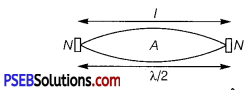
= 2.55 x 10¹¹ Pa
Therefore, the pressure at the tip of the anvil is 2.55 x 10¹¹ Pa.

Question 18.
A rod of length 1.05 m having negligible mass is supported at its ends by two wires of steel (wire A) and aluminium (wire B) of equal lengths as shown in figure given below. The cross-sectional areas of wires A and B are 1.0 mm2 and 2.0mm2, respectively. At what point along the rod should a mass m he suspended in order to produce (a) equal stresses and (b) equal strains in both steel and aluminium wires.
PSEB 11th Class Physics Solutions Chapter 9 Mechanical Properties of Solids 7
Solution:
Given, cross-sectional area of wire A, a1 = 1.0 mm2 = 1.0 x 10⁻⁶ m2
Cross-sectional area of wire B, a2 = 2.0 mm2 = 2.0 x 10⁻⁶ m2
Young’s modulus for steel, Y1 = 2 x 10¹¹ Nm-2
Young’s modulus for aluminium, Y2 = 7.0 x 10¹⁰ Nm-2

Let a small mass m be suspended to the rod at a distance y from the end where wire A is attached.
Stress in the wire = \(\frac{\text { Force }}{\text { Area }}=\frac{F}{a}\)
If the two wires have equal stresses, then,
\( \frac{F_{1}}{a_{1}}=\frac{F_{2}}{a_{2}}\)
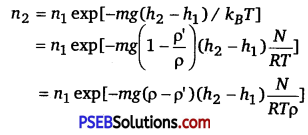
where, F1 = Force exerted on the steel wire

F2 = Force exerted on the aluminium wire
\(\frac{F_{1}}{F_{2}}=\frac{a_{1}}{a_{2}}=\frac{1}{2}\) …………………………. (i)
The situation is shown in the following figure.
PSEB 11th Class Physics Solutions Chapter 9 Mechanical Properties of Solids 8
Taking torque about the point of suspension, we have
F1y = F2(1.05— y)
\(\frac{F_{1}}{F_{2}}=\frac{(1.05-y)}{y}\) ……………………….(ii)
Using equations (i) and (ii), we can write
PSEB 11th Class Physics Solutions Chapter 9 Mechanical Properties of Solids 9
In order to produce an equal stress in the two wires, the mass should be suspended at a distance of 0.7 m from the end where wire A is attached.

(b) Young s modulus = \(\frac{\text { Stress }}{\text { Strain }} \)
Strain = \(\frac{\text { Stress }}{\text { Young’s modulus }}=\frac{\frac{F}{a}}{Y}\)
If the strain in the two wires is equal, then,
PSEB 11th Class Physics Solutions Chapter 9 Mechanical Properties of Solids 10
Taking torque about the point where mass m, is suspended at a distance y1 from the side where wire A attached, we get
F1y1 =F2(1.05-y1)
\(\frac{F_{1}}{F_{2}}=\frac{\left(1.05-y_{1}\right)}{y_{1}}\) ……………………………. (iv)
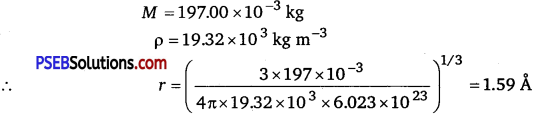
Using equations (iii) and (iv), we get
\(\frac{\left(1.05-y_{1}\right)}{y_{1}}=\frac{10}{7}\)
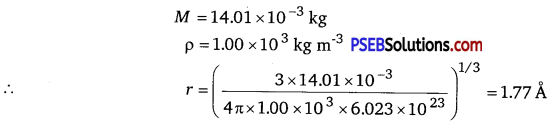
7(1.05 – y1) = 10 y1
⇒ 17 y1 = 7.35
y1 = 0.432 m
In order to produce an equal strain in the two wires, the mass should be suspended at a distance of 0.432 m from the end where wire A is attached.

PSEB 11th Class Physics Solutions Chapter 9 Mechanical Properties of Solids

Question 19.
A mild steel wire of length 1.0 m and cross-sectional area 0.50 x 10⁻² cm2 is stretched, well within its elastic limit, horizontally between two pillars. A mass of 100 g is suspended from the mid-point of the wire. Calculate the depression at the mid-point.
Solution:
PSEB 11th Class Physics Solutions Chapter 9 Mechanical Properties of Solids 11
Length of the steel wire = 1.0 m
Area of cross-section, A = 0.50 x 10⁻² cm2 = 0.50 x 10⁻⁶ m2
A mass 100 g is suspended from its mid-point.
m = 100 g = 0.1kg
Hence, the wire dips, as shown in the given figure.
PSEB 11th Class Physics Solutions Chapter 9 Mechanical Properties of Solids 12
Original length = XZ
Depression = l
The length after mass m, is attached to the wire = XO +OZ
Increase in the length of the wire:
Δl = (XO + OZ)-XZ
Where
PSEB 11th Class Physics Solutions Chapter 9 Mechanical Properties of Solids 13
Expanding and neglecting higher terms, we get:
Δl = \(\frac{l^{2}}{0.5}\)
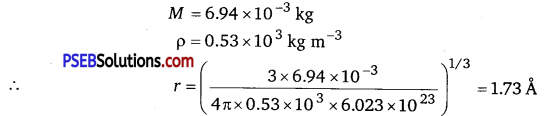
Strain = \(\frac{\text { Increase in length }}{\text { Original length }}\)
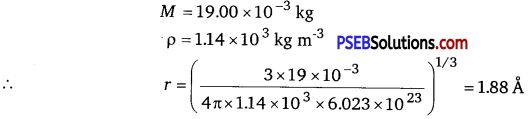
Let T be the tension in the wire.

∴ mg = 2Tcos θ
Using the figure, it can be written as
Cos θ = \(\frac{l}{\left[(0.5)^{2}+l^{2}\right]^{\frac{1}{2}}}=\frac{l}{(0.5)\left[1+\left(\frac{l}{0.5}\right)^{2}\right]^{\frac{1}{2}}}\)
Expanding the expression and eliminating the higher terms, we get
Cos θ = \(\frac{l}{(0.5)\left(1+\frac{l^{2}}{2(0.5)^{2}}\right)}\)
\(\left(1+\frac{l^{2}}{2(0.5)^{2}}\right)\) ≈ 1 for small l
PSEB 11th Class Physics Solutions Chapter 9 Mechanical Properties of Solids 14
Hence, the depression at the mid-point is 0.0107 m.

Question 20.
Two strips of metal are riveted together at their ends by four rivets, each of diameter 6.0 mm. What is the maximum tension’ that can be exerted by the riveted strip if the shearing stress on the rivet is not to exceed 6.9 x 10⁷ Pa?
Assume that each rivet is to carry one-quarter of the load.
Solution:
Diameter of the metal strip, d = 6.0 mm = 6.0 x 10⁻³ m
Radius, r = \(\frac{d}{2}\) = 3.0 x 10⁻³ m
Maximum shearing stress = 6.9 x 10⁷ Pa
Maximum stress = \(\frac{\text { Maximum load or force }}{\text { Area }}\)
Maximum force = Maximum stress x Area
= 6.9 x 10⁷ x π x (r)2
= 6.9 x 107 x 3.14 x (3 x10-3)2
= 1949.94 N
Each rivet carries one quarter of the load.
∴ Maximum tension on each rivet = 4 x 1949.94 = 7799.76 N.

PSEB 11th Class Physics Solutions Chapter 9 Mechanical Properties of Solids

Question 21.
The Marina trench is located in the Pacific Ocean, and at one place it is nearly eleven km beneath the surface of the water. The water pressure at the bottom of the trench is about 1.1 x 10⁸ Pa. A steel ball of initial volume 0.32m is dropped into the ocean and falls to the bottom of the trench. What is the change in the volume of the ball when it reaches to the bottom?
Solution:
Water pressure at the bottom, p = 1.1 x 10⁸ Pa
Initial volume of the steel ball, V = 0.32 m3
Bulk modulus of steel, B = 1.6 x 10¹¹ Nm-2
The ball falls at the bottom of the Pacific Ocean, which is 11 km beneath the surface.
Let the change in the volume of the ball on reaching the bottom of the trench be ΔV.
Bulk modulus, B = \( \frac{p}{\frac{\Delta V}{V}}\)
ΔV = \(\frac{p V}{B}=\frac{1.1 \times 10^{8} \times 0.32}{1.6 \times 10^{11}}\)
= 2.2 x 10⁻⁴ m3
Therefore, the change in volume of the ball on reaching the bottom of the trench is 2.2 x 10⁻⁴ m3.