PSEB 7th Class Hindi Solutions Chapter 4 कार्निवल का चक्कर

Punjab State Board PSEB 7th Class Hindi Book Solutions Chapter 4 कार्निवल का चक्कर Textbook Exercise Questions and Answers.

PSEB Solutions for Class 7 Hindi Chapter 4 कार्निवल का चक्कर

Hindi Guide for Class 7 PSEB कार्निवल का चक्कर Textbook Questions and Answers

(क) भाषा-बोध

1. शब्दार्थ

कार्निवल = मेला, आनन्दोत्सव
नवरत्न = नौ रत्नों से बनी वस्तु
स्पर्श = छूना
नवग्रह = नौ ग्रह-सूर्य, चन्द्रमा, मंगल, बुध, शुक्र, बृहस्पति, शनि, राहु, केतु
तोड़ = बचाव
पगार = वेतन
तरकारी = सब्जी
पुनर्जीवित = दुबारा जीवित करना
मरुस्थल का जहाज़ = ऊँट
शुल्क = फीस
ड्राइव = गोता लगाना
सैम्पल – नमूना
क्रैश – दुर्घटनाग्रस्त
पेय = पीने का पदार्थ
विस्फारित = अच्छी तरह से खोला हुआ
हूटर = चेतावनी सूचक, ध्वनि यंत्र
कैमल राइडिंग = ऊँट की सवारी
ऊहापोह = दुविधा
उधेड़बुन = सोच-विचार

2. लिंग बदलो

लाला = ललाइन
बाबू = ……………
नाई = …………..
पंडित = …………..
चौधरी = …………..
गुरु = ……………
माली = …………..
धोबी = …………..
सुनार = ………….
ग्वाला = ………….
नौकर = ………….
उत्तर:
लाला = ललाइन
बाबू = बबुआइन
नाई = नाइन
पंडित = पंडिताइन
चौधरी = चौधरानी
गुरु = गुरुआइन
माली = मालिन
धोबी = धोबिन
सुनार = सुनारिन
ग्वाला = ग्वालिन
नौकर = नौकरानी

PSEB 7th Class Hindi Solutions Chapter 4 कार्निवल का चक्कर

3. इन शब्दों के विपरीत अर्थ वाले शब्द लिखें:

विदेशी = ………………..
विद्वान = ………………..
महंगा = ………………..
स्वाद = ………………..
प्रवेश = ………………..
नई = …………………
उत्तर:
शब्द विपरीत शब्द
विदेशी = देशी
विद्वान = मुर्ख
महंगा = सस्ता
प्रवेश =  निकास
नई = पुरानी

4. इन शब्दों के शुद्ध रूप लिखें:

इस्कूटर = ……………
सन्नाटा = …………..
पटरोल = …………..
कारनीवल = ……………..
विसफारित = …………….
जूनिवरसिटी = …………….
कमकपी = ……………
टिककीयाँ = ……………..
बुद्दी = ……………..
उत्तर:
अशुद्ध शुद्ध
इस्कूटर = स्कूटर
सन्नाटा = सन्नाटा
पटरोल = पैट्रोल
कारनीवल = कार्निवल
विसफारित = विस्फारित
जूनिवरसिटी = यूनिवर्सिटी
कमकपी = कँपकँपी
टिककीयाँ = टिक्कियाँ
बुद्दी = बुद्धि

5. इन शब्दों के पर्यायवाची शब्द लिखें:

पगार = …………….
आसमान = ……………..
आग = ……………
पवन = …………….
घोड़ा = ………………
उत्तर:
शब्द पर्यायवाची शब्द
पगार = वेतन, पारिश्रमिक, तनख्वाह
आसमान = गगन, आकाश, नभ
आग = पावक, अनल, बह्नि
पवन = समीर, वायु, हवा
घोड़ा = अश्व, तुरंग, हय।

6. (क) निम्नलिखित मुहावरों, लोकोक्तियों के अर्थ लिखकर वाक्यों में प्रयोग करें

उकता जाना, हाथ पसारना, अक्ल घास चरने जाना, टेढ़ी खीर होना, कान पर जूं न रेंगना, आँखें तरेरना, दुम दबा कर भागना, हवा से बातें करना, चेहरे पर चमक आना।।
उत्तर:
उकता जाना (तंग होना) – मनजीत की फालतू बातें सुन-सुनकर सिमरन उकता गई।
हाथ पसारना (मांगना) – कौशल्या के पास इतना कुछ है फिर भी भाई के आगे हमेशा हाथ पसारती रहती है।
अक्ल घास चरने जाना (समझ नहीं आना) – हरदीप को चाहे कितना समझा लो, वह नहीं समझेगा क्योंकि उसकी तो अक्ल घास चरने गई है।
टेढ़ी खीर होना (बहुत कठिन कार्य) – एवरेस्ट की चोटी पर चढ़ना कोई बच्चों का खेल नहीं, टेढी खीर है।
कान पर जूं न रेंगना (कोई असर न होना) – रेहाना को कितना भी डाँट लो उस के तो कान पर जूं भी नहीं रेंगती।
आँखें तरेरना (क्रोध से देखना) – कक्षा में शोर सुन कर जैसे ही अध्यापक ने आँखें तरेरी कि कक्षा में सन्नाटा छा गया।
दुम दबा कर भागना (चुपचाप चले जाना) – मुख्याध्यापक को आते देखकर राम और श्याम आपस में लड़ना छोड़ दुम दबा कर भाग गए।
हवा से बातें करना (तेज़ भागना) – राणा प्रताप का घोड़ा चेतक संकेत मिलते ही हवा से बातें करने लगता था।
चेहरे पर चमक आना (प्रसन्न होना)-अपने नाम लॉटरी निकलने का समाचार सुनते ही सुरेन्द्र के चेहरे पर चमक आ गई।

(ख) विचार-बोध

1. इन प्रश्नों के उत्तर एक या दो वाक्यों में लिखें:

प्रश्न 1.
लेखक बच्चों को कहाँ घुमाने ले गए ?
उत्तर:
लेखक बच्चों को कार्निवल घमाने ले गए।

प्रश्न 2.
लेखक ने अपने आप को अमीर क्यों समझा ?
उत्तर:
लेखक ने अपने आप को अमीर इसलिए समझा क्योंकि उसे वेतन मिले दोचार दिन हुए थे तथा अभी तक उसने किसी का उधार नहीं चुकाया था।

प्रश्न 3.
कार्निवल घूमना टेढ़ी खीर क्यों था ?
उत्तर:
कार्निवल घूमना टेढ़ी खीर इसलिए था क्योंकि वहाँ बहुत रुपए खर्च हो जाते हैं तथा वह महंगा स्थान होता है।

प्रश्न 4.
बच्चों ने अपने पिता के आगे क्या-क्या फ़रमाइशें रखीं ?
उत्तर:
बच्चों ने पिता को बर्गर, गोलगप्पे खिलाने, कोल्ड ड्रिंक पिलाने, टिक्की खिलाने और झूला झुलवाने के लिए कहा।

प्रश्न 5.
गोलगप्पे खाते हुए लेखक का श्वास क्या सुनकर अटक गया ?
उत्तर:
गोलगप्पे खाते हुए लेखक का श्वास यह सुनकर अटक गया कि एक गोलगप्पे का मूल्य पाँच रुपये है।

प्रश्न 6.
टिक्की खाते हुए लेखक को कहाँ की याद आ गई ?
उत्तर:
टिक्की खाते हुए लेखक को नयी-नयी शादी पर कचौरी की खायी टिक्कियाँ याद आ गईं।

2. इन प्रश्नों के उत्तर चार-पाँच वाक्यों में लिखें:

प्रश्न 1.
झूले वाली घटना को अपने शब्दों में लिखें।
उत्तर:
बच्चों ने झूला झूलने के लिए कहा तो लेखक तुरन्त अकड़ते हुए झूले वाले के पास रौब से पाँच टिकट देने के लिए कहा। जब झूले वाले ने पाँच टिकट के चार सौ रुपये मांगे तो वह धम्म से नीचे गिर गया। उसके चेहरे पर हवाइयाँ उड़ने लगी और सिर चक्कर खाने लगा। आस-पास के लोगों ने कहा दौरा पड़ गया, कोई बोला मिर्गी है चप्पल-जूता सुंधाओ तो किसी ने कहा कि हृदयघात लगता है। इस पर लेखक ने उन्हें कांपते हाथों से अपने परिवार की ओर संकेत किया। तब सब लोग उसे उसके बच्चों के पास पटक गए।

PSEB 7th Class Hindi Solutions Chapter 4 कार्निवल का चक्कर

प्रश्न 2.
इस पाठ में लेखक ने महंगाई पर व्यंग्य के बाण छोड़े हैं। कोई एक उदाहरण लिखें।
उत्तर:
लेखक बच्चों को घुमाने कार्निवल ले गया था पर उन्हें वहाँ कोल्ड ड्रिंक आदि नहीं पिलवा सका क्योंकि वहाँ वे सब बहुत महँगे थे। वह बच्चों को बहलाने के लिए कह देता है कि घर चलकर तुम्हें बादाम नींबू का शीतल पेय पिलाएंगे परन्तु मन-ही-मन सोचता है कि बच्चों से नाहक वायदा कर लिया क्योंकि नींबू दो सौ रुपए किलो और बादाम पाँच सौ रुपए किलो हैं। इस प्रकार लेखक ने महँगाई पर व्यंग्य किया है।

प्रश्न 1.
क्या आप कहीं घूमने गए हैं ? यदि हाँ, तो अपने शब्दों में लिखें कि वहाँ आपने क्या-क्या देखा? क्या खाया? क्या आनन्द लिया?
उत्तर:
मैं अपने माता-पिता के साथ जालन्धर में लगी ‘भारत-दर्शन’ प्रदर्शनी देखने गई थी। हमारे साथ हमारा छोटा भाई हरप्रीत भी था। वहाँ हमने भारत के विभिन्न प्रदेशों की सांस्कृतिक झलक देखी, जिसमें कहीं गुजरात दर्शन, कहीं उत्तराखंड, बिहार, महाराष्ट्र, कर्नाटक, तमिलनाडु आदि के दर्शनीय स्थलों के सचित्र विवरण थे तो कहीं पृथ्वी के स्वर्ग कश्मीर का नज़ारा था। इससे मुझे विभिन्न प्रान्तों के सामाजिक तथा सांस्कृतिक जीवन का पता चला। वहाँ इन प्रदेशों के फूड स्टाल भी थे, जहाँ से हमने गुजराती डोकला (ढोकला) तथा तमिलनाडु का डोसा खाया। बंगाल के रसगुल्ले ने तो हमारा मन मोह लिया था। हमने झूले झूलने तथा सांस्कृतिक कार्यक्रम देखने का आनन्द भी लिया।

(ग) रचना-बोध

प्रश्न 1.
नगरपालिका/नगर निगम/पंचायत के प्रधान को अपने गाँव/शहर की सड़कों की स्थिति बताते हुए उनकी मुरम्मत करवाने के लिए पत्र लिखें।
उत्तर:
1. बलवन्त सिंह संधू
सचिव, नागरिक रक्षा सभा,
रेलवे रोड, जालन्धर शहर।
दिनांक 25 जुलाई, 20…
सेवा में
अध्यक्ष,
नगर निगम,
जालन्धर।
महोदय,

निवेदन यह है कि जालन्धर शहर की सभी मुख्य सड़कों की बुरी हालत हो गई है। जगह-जगह गड्ढे पड़ गए हैं। कई स्थानों पर तो सड़क की जगह मिट्टी और गिट्टियां ही दिखाई देती हैं। बस स्टैंड और रेलवे स्टेशन के पास तो बहुत बुरा हाल है। आए दिन इन से वाहन टकरा कर टूटते हैं और लोगों को चोट लगती रहती है। वर्षा के कारण तथा रात में दशा और भी दुखदायी हो जाती है क्योंकि इन खतरों का पता ही नहीं चलता और दुर्घटना हो जाती है।

आप शीघ्र ही इनकी मुरम्मत करवाने की कृपा करें।

धन्यवाद,
भवदीय,
बलवन्त सिंह संधू
सचिव, नागरिक रक्षा सभा।

प्रश्न 2.
बढ़ती हुई महँगाई विषय पर अपने विचार लिखें।
उत्तर:
आजकल बढ़ती हुई महँगाई ने लोगों का जीना हराम कर दिया है। आम आदमी रोज़ की चीजों के बढ़ते दामों से परेशान है। उसे अपना घर चलाना मुश्किल लग रहा है। दूध, सब्जियों, अन्न, दालों, पैट्रोल, गैस, डीज़ल आदि सबके दाम आकाश को छू रहे हैं। सरकार इन सब से लापरवाह बनी हुई है तथा केवल शब्दों से जनता को मूर्ख बना रही है। जमाखोरों, काला बज़ारियों और नेताओं की नकेल नहीं कसी जा रही। अनाज सड़ रहा है पर भूखों को नहीं मिलता। वितरण प्रणाली दोषपूर्ण है। सब तरफ भ्रष्टाचार फैला हुआ है। अमीर तथा शासक वर्ग मौज उड़ा रहा है। मध्यमवर्ग तथा गरीब पिस रहे हैं। इससे असन्तोष बढ़ेगा तथा समाज में गृह-कलह तक की स्थिति बन सकती है। इसलिए सरकार को जाग कर महँगाई रोकने के लिए कठोर कदम उठाने चाहिए।

PSEB 7th Class Hindi Guide कार्निवल का चक्कर Important Questions and Answers

1. निम्नलिखित प्रश्नों के उत्तर उचित विकल्प चुनकर लिखिए

प्रश्न 1
‘कार्निवल का चक्कर’ किस प्रकार का लेख है ?
(क) कहानी
(ख) नाटक
(ग) व्यंग्यात्मक
(घ) चित्रात्मक
उत्तर:
(घ) व्यंग्यात्मक

प्रश्न 2.
किसके छूने से लेखक चौंक गया था ?
(क) पत्नी के
(ख) बेटे के
(ग) बेटी के
(घ) माँ के
उत्तर:
(क) पत्नी के

प्रश्न 3.
स्कूटर कैसे चला ?
(क) किक मारने से
(ख) धक्का मारने से
(ग) गिराने से
(घ) फूंक मारने से
उत्तर:
(ख) धक्का मारने से

प्रश्न 4.
लेखक ने स्कूटर स्टैंड वाले को कितने रुपये दिए ?
(क) दस रुपये
(ख) बीस रुपये
(ग) तीस रुपये
(ख) पंद्रह रुपये
उत्तर:
(क) दस रुपये

प्रश्न 5.
कार्निवल में प्रति व्यक्ति प्रवेश शुल्क कितना था ?
(क) दस रुपए
(ख) बीस रुपये
(ग) पंद्रह रुपए
(घ) तीस रुपए
उत्तर:
(ख) बीस रुपए

PSEB 7th Class Hindi Solutions Chapter 4 कार्निवल का चक्कर

2. निम्नलिखित रिक्त स्थानों की पूर्ति उचित विकल्पों से कीजिए

प्रश्न 1.
लेखक ने गोल गप्पे वाले को ……….. दिए।
(क) 100 रुपए
(ख) पचास रुपए
(ग) पचहत्तर रुपए
(घ) अस्सी रुपए
उत्तर:
(क) पचास रुपए

प्रश्न 2.
पाँच के चार सौ रुपए सुनकर लेखक ………………
(क) नाचने लगा
(ख) दौड़ने लगा
(ग) धम्म से गिर गया
(घ) कोई नहीं
उत्तर:
(ग) धम्म से गिर गया

प्रश्न 3.
बेटी ने ……. वाला कोल्ड ड्रिंक पीने की जिद्द की थी।
(क) गाँगुली वाला
(ख) सचिन वाला
(ग) गावस्कर वाला
(घ) कपिल वाला
उत्तर:
(ख) सचिन वाला

प्रश्न 4.
लेखक ने टिक्कियाँ का भुगतान …………………… रूपए किया था |
(का) दो सौ पचास
(खा) तीन सौ पचास
(ग) पाँच सौ
(घ) चार सौ
उत्तर:
(का) दो सौ पचास

प्रश्न 5.
लेखक ने टिक्कियों का भुगतान ………. रुपए किया था ।
(क) दो सौ पचास
(ख) तीन सौ पचास
(ग) पाँच सौ
(घ) चार सौ
उत्तर:
(क) दो सौ पचास

प्रश्न 6.
लेखक ने मुन्नू को घर चलकर ……… का शीतल पेय पीने को कहा।
(क) शिंकजी
(ख) संतरे
(ग) बादाम नीबूं
(घ) इनमें से कोई नहीं
उत्तर:
(ग) बादाम नीबूं

3. निम्नलिखित दिए गए शब्द के सही अर्थ से मिलान कीजिए

प्रश्न 1.
पचहत्तर:
85
75
74
उत्तर-75.

प्रश्न 2.
उहापोह:
दुविधा
देनदारी
उत्तर:
दुविधा।

प्रश्न 3.
पगार:
परिर्वतन
परिक्रमा
पारिश्रमिक
उत्तर:
पारिश्रमिक।

प्रश्न 4.
पेय:
खाने का पदार्थ
सोने की जगह
पीने का पदार्थ
उत्तर:
पीने का पदार्थ।

कार्निवल का चक्कर Summary

कार्निवल का चक्कर पाठ का सार

‘कार्निवल का चक्कर’ लेखक का बढ़ती हुई महंगाई पर एक व्यंग्यात्मक लेख है। लेखक नाश्ता करने के बाद अखबार पढ़ने बैठा ही था कि उसकी पत्नी ने उसे छुआ तो वह चौंक गया। पत्नी ने उसे बच्चों सहित कार्निवल घूमने के लिए कहा। वह मान गया परन्तु सोचने लगा कि आज के ज़माने में दाल-रोटी चलाना मुश्किल हो रहा है और उस ने कार्निवल घूमने के लिए हाँ कर दी है। उसे वेतन मिले अभी दो-चार दिन ही हुए थे; इसलिए जेब गर्म थी तथा दूध, धोबी, चौकीदार आदि का भुगतान अभी किया नहीं था।

कार्निवल चलने के लिए लेखक ने स्कूटर को हिलाकर देखा तो उसमें पेट्रोल था। चुन्नू-मुन्नू स्कूटर साफ करने के लिए कपड़ा ले आए। किक मारने पर भी स्कूटर नहीं चला। जब बच्चों ने उसे धक्का लगाया तो वह चल पड़ा। बच्चों और पत्नी को स्कूटर पर बैठा कर लेखक बजरंगबली का नाम लेकर कार्निवल की ओर पवन वेग से स्कूटर को उड़ाता हुआ चल पड़ा। वहाँ स्कूटर स्टैंड वाले को दस रुपए और कार्निवल में प्रवेश के लिए प्रति व्यक्ति बीस रुपए की दर से सौ रुपए देने पड़े।

कार्निवल में प्रवेश करते ही उनके बच्चों ने बर्गर-गोलगप्पा तथा पत्नी ने गोलगप्पे खाने के लिए कहा तो लेखक को हाँ करनी पड़ी परन्तु पाँच रुपए की एक….. सुन कर गोलगप्पे का जल लेखक की श्वास नली में अटक गया और गोलगप्पे वाले को पिचहत्तर की बजाय पचास रुपए देकर आगे बढ़ गए। आगे चल कर बच्चे झूले पर सवारी करने के लिए कहने लगे तो पाँच के चार सौ रुपए सुनकर लेखक धम्म से नीचे गिर गए तो लोगों ने दौरा पड़ने, मिर्गी आने, हृदयघात की बात कही तो लेखक ने कांपते हाथों से अपने परिवार की ओर संकेत किया। लोग उन्हें उठा कर वहाँ पटक कर चले गए।

पत्नी ने पूछा कि क्या हुआ तो इन्होंने भीड़ के दम घुटने की बात कह कर खुले में चलने के लिए कहा। बेटी ने सचिन वाला कोल्ड ड्रिंक पीने की जिद की तो उसे डांट दिया और घर जाकर नींबू-पानी पीने के लिए कहा। पत्नी ने टिक्की खाने के लिए कहा तो पाँच प्लेट टिक्कियाँ खाईं और इन का भुगतान दो सौ पचास रुपए करते हुए घबरा गए। मुन्नू कुछ कहने लगा तो उसे घर चल कर बादाम नींबू का शीतल पेय पीने के लिए कहा और सोचने लगे नींबू दौ सौ रुपए किलो, बादाम पाँच सौ रुपए बच्चों से वायदा बेकार ही किया।
PSEB 7th Class Hindi Solutions Chapter 3 मास्टर ब्लास्टर : सचिन तेंदुलकर

Punjab State Board PSEB 7th Class Hindi Book Solutions Chapter 3 मास्टर ब्लास्टर : सचिन तेंदुलकर Textbook Exercise Questions and Answers.

PSEB Solutions for Class 7 Hindi Chapter 3 मास्टर ब्लास्टर : सचिन तेंदुलकर

Hindi Guide for Class 7 PSEB 3 मास्टर ब्लास्टर : सचिन तेंदुलकर Textbook Questions and Answers

(क) भाषा-बोध

1. शब्दार्थ

लोकोक्ति = कहावत
चरितार्थ = सार्थक
मुगरी = कपड़े धोने का डंडा, थापी
दिनचर्या = रोज़ का काम
लक्षण = विशेषता, लच्छन
सम्मान = आदर
ग्रहण = लेना
आत्मीयता = अपनापन
संस्कार = मर्यादा की शिक्षा
श्रीगणेश = आरम्भ करना
सान्निध्य = निकटता
कार्यकुशलता = कार्य करने में निपुणता
आश्वस्त = भरोसा
चुनौती = ललकार
अविजित = जिसे कोई न जीत सके
खिलाफ = विरुद्ध
सर्वाधिक = सब से ज्यादा
शतक = सौ
कीर्तिमान = यशस्वी, विख्यात, नेकनाम
फितरत = आदत
कायल = प्रशंसक
अहंकार = घमंड
प्रेरणास्रोत = प्रेरणा देने वाले
लक्ष्य = उद्देश्य
समर्पण = श्रद्धापूर्वक देना
प्रयास = कोशिश
प्रदर्शन = दिखाने का काम
सम्मानित = सम्मान देना, आदर देना
कार्यरत = काम में लगे रहना
अढ़ाई = ढाई

2. लोकोक्ति एवं मुहावरों के अर्थ बताकर वाक्य बनाएँ:

(1) होनहार बिरवान के होत चीकने पात ____________ _________________________
(2) श्रीगणेश करना _______________ _____________________
(3) घुटने टेकना _______________ ____________________
(4) मुँह बन्द होना ______________ ____________________
उत्तर:

(1) होनहार बिरवान के होत चीकने पात – प्रतिभावान की प्रतिभा और योग्यता का ज्ञान बचपन से ही हो जाता है।
आठ वर्ष की आयु में ही शंकराचार्य ने जब संन्यास लेने का निर्णय किया तो लगा कि वे अवश्य ही बहुत महान् संन्यासी बनेंगे और वे आदि शंकराचार्य कहलाए। इसलिए कहते हैं कि होनहार बिरवान के होत चीकने पात।

(2) श्रीगणेश करना – आरंभ करना।
हरप्रीत ने अपनी नई दुकान का श्रीगणेश नवरात्रों में करना है।

(3) घुटने टेकना – हार मानना।
शत्रु सेना ने भारतीय सेना के सम्मुख घुटने टेक दिए।

(4) मुँह बन्द होना – चुप होना।
कक्षा में खूब शोर हो रहा था परन्तु अध्यापक जी के आते ही सब के मुँह बन्द हो गए।

3. निम्नलिखित वाक्यों में प्रयुक्त हुए अंकों के स्थान पर शब्द लिखें:

  1. सचिन का जन्म 24 अप्रैल, सन् ………………….. (चौबीस अप्रैल उन्नीस सौ तिहतर ईस्वी) को राजापुर (मुम्बई) में हुआ।
  2. बचपन के 11 ……………… (शब्दों में) वर्षों तक सचिन, उनके भाई अजीत, नितिन और बहन सविता का लालन-पालन उनकी नानी ने किया।
  3. सन् 1988 …………….. (शब्दों में) स्कूल स्तर के मैच में सचिन ने विनोद काम्बली के साथ मिलकर 664 ……………… (शब्दों में) दौड़ें बनायीं।
  4. सन् 1995 ………….. (शब्दों में) में इनका विवाह अंजली से हुआ।
  5. 38 ……………… (शब्दों में) वर्षीय सचिन ने अपने बल्ले से उम्र को मात दी है।
  6. सन् 1994 …………… (शब्दों में) में इन्हें अर्जुन पुरस्कार, सन् 1999 (शब्दों में) में पद्मश्री तथा सन् 2008 ……….. (शब्दों में) में इन्हें पद्मविभूषण से सम्मानित किया गया।

उत्तर:

  1. सचिन का जन्म 24 अप्रैल, सन् 1973 ई० (चौबीस अप्रैल उन्नीस सौ तिहतर ईस्वी) को राजापुर (मुम्बई) में हुआ।
  2. बचपन के 11 ग्यारह वर्षों तक सचिन, उनके भाई अजीत, नितिन और बहन सविता का लालन-पालन उनकी नानी ने किया।
  3. सन् 1988 उन्नीस सौ अठासी में स्कूल स्तर के मैच में सचिन ने विनोद काम्बली के साथ मिलकर 664 छ: सौ चौंसठ दौड़ें बनायीं।
  4. सन् 1995 उन्नीस सौ पचानवें में इनका विवाह अंजली से हुआ।
  5. 38 अड़तीस वर्षीय सचिन ने अपने बल्ले से उम्र को मात दी है।
  6. सन् 1994 उन्नीस सौ चौरानवें में इन्हें अर्जुन पुरस्कार, सन् 1999 (उन्नीस सौ निन्यानवें) में पद्मश्री तथा सन् 2008 दो हजार आठ में इन्हें पद्मविभूषण से सम्मानित किया गया।

PSEB 7th Class Hindi Solutions Chapter 3 मास्टर ब्लास्टर : सचिन तेंदुलकर

(ख) विचार-बोध

1. इन प्रश्नों के उत्तर एक या दो वाक्यों में लिखें:

प्रश्न 1.
सचिन तेंदुलकर की नानी का क्या नाम था ?
उत्तर:
सचिन तेंदुलकर की नानी का नाम लक्ष्मीबाई गिजे था।

प्रश्न 2.
सचिन तेंदुलकर के माता-पिता का क्या नाम है ?
उत्तर:
सचिन तेंदुलकर की माता का नाम रजनी तेंदुलकर तथा पिता का नाम रमेश तेंदुलकर है।

प्रश्न 3.
कितने वर्ष की आयु में इन्होंने क्रिकेट जीवन का आरम्भ किया?
उत्तर:
सचिन तेंदुलकर ने चौदह वर्ष की आयु में क्रिकेट जीवन का आरम्भ किया था।

प्रश्न 4.
अंतर्राष्ट्रीय क्रिकेट जीवन की शुरुआत कब और कहाँ से की ?
उत्तर:
सचिन तेंदुलकर ने अंतर्राष्ट्रीय क्रिकेट जीवन की शुरुआत सन् 1989 ई० में कराची में पाकिस्तान के खिलाफ़ की थी।

प्रश्न 5.
सचिन की शादी कब और किससे हुई?
उत्तर:
सचिन तेंदुलकर की शादी सन् 1995 ई० में अंजली से हुई थी।

प्रश्न 6.
सचिन किस हाथ से लिखते और किस हाथ से खेलते हैं ?
उत्तर:
सचिन तेंदुलकर बाएँ हाथ से लिखते और दाएँ हाथ से खेलते हैं।

प्रश्न 7.
इनके व्यक्तित्व पर कौन-सी उक्ति पूरी तरह सार्थक होती है?
उत्तर:
सचिन तेंदुलकर के ऊपर ‘होनहार बिरवान के होत चीकने पात’ उक्ति पूरी तरह सार्थक होती है।

प्रश्न 8.
सचिन अपना आदर्श किसे मानते हैं?
उत्तर:
सचिन तेंदुलकर अपना आदर्श भारतीय सैनिकों को मानते हैं।

प्रश्न 9.
अपने जीवन लक्ष्य तय करने के बाद हमें क्या करना चाहिए?
उत्तर:
अपना जीवन लक्ष्य तय करने के बाद हमें उसे पाने के लिए तन, मन एवं समर्पण के भाव से परिश्रम और कोशिश करनी चाहिए।

2. इन प्रश्नों के उत्तर चार या पाँच वाक्यों में लिखें:

प्रश्न 1.
सचिन अपना जीवन गुरु किसे मानते हैं और क्यों ?
उत्तर:
सचिन अपना जीवन गुरु अपनी नानी लक्ष्मीबाई गिजे को मानते हैं क्योंकि क्रिकेट के प्रति उनके लगाव को देखकर उनकी नानी ने उन्हें उनके तीसरे जन्मदिन पर गेंद-बल्ला दिया था और वे उन के साथ क्रिकेट खेलती थी। उन्होंने सचिन को क्रिकेट से लगाव, बड़ों के प्रति सम्मान, सबसे अच्छे गुण लेना, मित्रों के प्रति अपनापन आदि संस्कार भी दिए थे।

प्रश्न 2.
सचिन तेंदुलकर के कोच का क्या नाम है और वे क्या चुनौती दिया करते थे ?
उत्तर:
सचिन के कोच का नाम रमाकांत अचरेकर था। वे सचिन के खेल पर बहुत गर्व करते थे। वे अभ्यास के समय स्टम्प्स पर सिक्का रख देते थे और गेंदबाजों को चुनौती दे कर कहते थे कि जो सचिन को आऊट कर देगा, यह सिक्का उसे मिलेगा और आऊट नहीं होने पर सिक्का सचिन का होगा।

प्रश्न 3.
सचिन को जीवन में आज भी क्या बहुत प्रिय है ?
उत्तर:
सचिन को कोच द्वारा दी गई चुनौती के रूप में खेल का बढ़िया प्रदर्शन करके जीते हुए तेरह सिक्के आज भी बहुत प्रिय हैं।

प्रश्न 4.
सचिन का सर्वोत्तम गुण कौन-सा है, विस्तार से बताएँ।
उत्तर:
सचिन की विशेषता उनकी विनम्रता है। अहंकार तो उन्हें छू भी नहीं पाया है। वे साहस, सूझबूझ, धैर्य एवं विवेकशील हैं। जब कभी आलोचक इनकी आलोचना करते हैं तो वे धैर्य एवं विवेक से काम लेते हैं और मौन रहकर अपने खेल का अच्छा प्रदर्शन करते हुए आलोचकों के मुँह बन्द कर देते हैं। यही उनके व्यक्तित्व का सर्वोत्तम गुण है।

प्रश्न 5.
सचिन के जीवन से आपको क्या शिक्षा मिलती है?
उत्तर:
सचिन के जीवन से हमें यह शिक्षा मिलती है कि यदि हम अपने जीवन का कोई लक्ष्य निश्चित करते हैं तो उसे पाने के लिए हमें तन, मन और समर्पण के भाव से परिश्रम और कोशिश करनी चाहिए।

प्रश्न 6.
सचिन ने सैनिक के जीवन से क्या शिक्षा ली है ?
उत्तर:
सचिन ने अपना आदर्श देश के सैनिकों को माना है। उन्होंने सैनिकों से अपनी ज़िम्मेदारी समझना और अन्त तक संघर्ष करना सीखा है।

प्रश्न 7.
सचिन को कौन-कौन से पुरस्कार मिले और कब ?
उत्तर:
सचिन को उन के इक्कीस वर्ष के प्रशंसनीय खेल प्रदर्शनों के लिए अनेक सम्मान दिए गए। सन् 1994 में इन्हें अर्जुन पुरस्कार में क्रिकेट जगत से राजीव गांधी खेल रत्न पुरस्कार दिया गया। सन् 1999 में इन्हें पद्मश्री और सन् 2008 ई० में पद्म विभूषण से सम्मानित किया गया था।

प्रश्न 8.
क्रिकेट के अलावा सचिन और क्या-क्या कार्य करते हैं ?
उत्तर:
क्रिकेट के अतिरिक्त सचिन एक गैर सरकारी संगठन ‘अपनालय’ के दो सौ बच्चों का पालन-पोषण करते हैं और एक रेस्टोरेंट भी सफलतापूर्वक चला रहे हैं।

3. रिक्त स्थानों की पूर्ति करो :

  1. सचिन का पूरा नाम ……………… है।
  2. इनका जन्म …………… को ………….. में हुआ।
  3. इनकी पुत्री …………….. व पुत्र ……………. है।
  4. सचिन ने ………………. से उम्र को मात दी है।
  5. …………………. तो इन्हें कभी छू तक नहीं पाया।
  6. सचिन ……………. में अपना लक्ष्य ………….. प्राप्त करने में सफल हो गए।
  7. सन् 1999 में ……………. और सन् 2008 में इन्हें ………….. से सम्मानित किया गया।

उत्तर:

  1. सचिन का पूरा नाम सचिन रमेश तेंदुलकर है।
  2. इनका जन्म 24 अप्रैल, सन् 1973 ई० को राजापुर, मुंबई में हुआ।
  3. इनकी पुत्री सारा व पुत्र अर्जुन है।
  4. सचिन ने बल्ले से उम्र को मात दी है।
  5. अहंकार तो इन्हें कभी छू तक नहीं पाया।
  6. सचिन 2 अप्रैल, सन् 2011 में अपना लक्ष्य विश्वकप-2011 प्राप्त करने में सफल हो गए।
  7. सन् 1999 में पद्मश्री और सन् 2008 में इन्हें पद्म विभूषण से सम्मानित किया गया।

(ग) कुछ करो

  1. महान् क्रिकेट खिलाड़ियों के चित्र एकत्रित कर अपनी कापी पर चिपकाएँ।
  2. अपनी कक्षा को दो टीमों में बाँट कर खेलों की घंटी में क्रिकेट मैच खेलें।
  3. स्कूल के पी०टी०आई० या डी०पी०ई० अध्यापकों से क्रिकेट की तकनीकी जानकारी प्राप्त करें।
  4. क्रिकेट की गेंद व बल्ला कापी/चार्ट पर बनाकर मनपसन्द रंग भरें फिर कक्षा में टाँगें।
  5. आप जीवन में क्या बनना चाहते हैं, अपना लक्ष्य अपने अभिभावकों एवं अध्यापकों की मदद से निर्धारित करें और अभी से उसमें लग जाएं।

उत्तर:
विद्यार्थी शिक्षक के सहयोग से स्वयं करें।

PSEB 7th Class Hindi Solutions Chapter 3 मास्टर ब्लास्टर : सचिन तेंदुलकर

(घ) रचना वाक्य

प्रश्न 1.
मेरे जीवन का लक्ष्य पर दस वाक्य लिखें।
उत्तर:

  1. मैं एक पुलिस अधिकारी बनना चाहता हूँ।
  2. मैं खूब मेहनत से पढ़कर आई०पी०एस० परीक्षा उत्तीर्ण करूँगा।
  3. पुलिस अधिकारी बनकर पुलिस में फैले भ्रष्टाचार को दूर करूँगा।
  4. मैं समाज को अनुशासित बनाने के लिए स्वयं अनुशासन का पालन करूँगा।
  5. मैं मन-प्राण से अपने कर्त्तव्य का पालन करूँगा।
  6. मैं अपराधियों को दंड दिलाने के लिए कानून की सहायता करूँगा।
  7. मैं समाज के उपेक्षित वर्ग के प्रति पूरी सहानुभूति रखते हुए उन्हें समाज के शोषक वर्ग से सुरक्षा प्रदान करूँगा।
  8. मैं अपने अधीन काम करने वाले पुलिसवालों को जनता का सच्चा सेवक बनाऊँगा।
  9. मैं किसी प्रकार के दबाव में काम नहीं करूँगा।
  10. मैं सदा अपने-पराये, ऊँच-नीच, निर्धन-धनवान, अधिकारी-कर्मचारी का भेद-भाव भुलाकर ही-न्यायपूर्ण उचित निर्णय करूँगा।

PSEB 7th Class Hindi Guide मास्टर ब्लास्टर : सचिन तेंदुलकर Important Questions and Answers

1. निम्नलिखित प्रश्नों के उत्तर उचित विकल्प चुनकर लिखिए

प्रश्न 1.
सचिन की बहन का नाम क्या है ?
(क) सविता
(ख) गीता
(ग) सुनीता
(घ) रीटा।
उत्तर:
(क) सविता।

प्रश्न 2.
सचिन को अपने तीसरे जन्मदिन पर नानी से क्या उपहार मिला था ?
(क) मोटर
(ख) किताब
(ग) कलम
(घ) गेंद-बल्ला
उत्तर:
(घ) गेंद-बल्ला

प्रश्न 3.
सचिन का जन्म कहाँ हुआ था ?
(क) गाजीपुर
(ख) मुंबई
(ग) राजापुर मुंबई
(घ) देहरादून।
उत्तर:
(ग) राजापुर मुंबई।

प्रश्न 4.
सचिन को सन् 2008 में कौन-सा सम्मान मिला था ?
(क) भारत रत्न
(ख) पद्म विभूषण
(ग) अर्जुन पुरस्कार
(घ) राजीव गांधी खेल रत्न।
उत्तर:
(ख) पद्म विभूषण।

प्रश्न 5.
सचिन ने अंतर्राष्ट्रीय क्रिकेट किस सन् में खेलना शुरू किया ?
(क) सन् 1989
(ख) सन् 1988
(ग) सन् 1990
(घ) सन् 1987
उत्तर:
(क) सन् 1989

प्रश्न 6.
सचिन अपना जीवन गुरु किसे मानते थे ?
(क) अपनी नानी को
(ख) अपनी दादी को
(ग) अपनी माँ को
(घ) अपने पिता को।
उत्तर:
(क) अपनी नानी को।

2. निम्नलिखित रिक्त स्थानों की पूर्ति उचित विकल्पों से कीजिए

प्रश्न 1.
सचिन के बड़े भाई का नाम …………. था।
(क) अजित
(ख) रोहन
(ग) मोहन
(घ) सोहन
उत्तर:
(क) अजित

प्रश्न 2.
सचिन का पूरा नाम ……………. था।
(क) सचित तेंदुलकर
(ख) सचिन रमेश तेंदुलकर
(ग) मास्टर ब्लास्टर
(घ) सचिन रमेश।
उत्तर:
(ख) सचिन रमेश तेंदुलकर।

PSEB 7th Class Hindi Solutions Chapter 3 मास्टर ब्लास्टर : सचिन तेंदुलकर

प्रश्न 3.
सचिन ने पहला प्रथम श्रेणी मैच ………….. में खेला।
(क) सन् 1986 में
(ख) सन् 1989 में
(ग) सन् 1988 में
(घ) सन् 1987 में।
उत्तर:
(ग) सन् 1988 में।

प्रश्न 4.
सचिन के कोच का नाम ………….. था ।
(क) उमाकांत
(ख) कपिलदेव
(ग) सुनील गावस्कर
(घ) रमाकांत अचरेकर।
उत्तर:
(घ) रमांकात अचरेकर।

3 .निम्नलिखित दिए गए शब्द के सही अर्थ से मिलान कीजिए

प्रश्न 1.
बल्ला:
बला
बैट
बेला
उत्तर:
बैट।

प्रश्न 2.
मुगरी:
थापी
मूँग
मूंगफली
उत्तर:
थापी।

प्रश्न 3.
धैय:
धर
धीरज
धरा
उत्तर:
धीरज।

प्रश्न 4.
उत्तीर्ण:
फेल होना
गिर जाना
पास होना।
उत्तर:
पास होना।

मास्टर ब्लास्टर : सचिन तेंदुलकर Summary

मास्टर ब्लास्टर : सचिन तेंदुलकर पाठ का सार

‘होनहार बिरवान के होत चीकने पात’ उक्ति को पूरी तरह सिद्ध करने वाले मास्टर ब्लास्टर सचिन तेंदुलकर अढ़ाई वर्ष की आयु में ही मुगरी का बल्ला बना कर प्लास्टिक की गेंद से अपनी नानी और बड़े भाई अजित के साथ खेलते थे। उनकी नानी लक्ष्मी बाई गिजे ने इन्हें इन के तीसरे जन्मदिन पर गेंद-बल्ला उपहार में दिया तो रोज़ क्रिकेट खेलना उनका नियम ही बन गया था। इनका पूरा नाम सचिन रमेश तेंदुलकर, माता का नाम रजनी तेंदुलकर तथा पिता का नाम रमेश तेंदुलकर है। इनका जन्म 24 अप्रैल, सन् 1973 ई० को राजापुर, मुंबई में हुआ था। इनके माता-पिता नौकरी करते थे, इसलिए ग्यारह वर्ष तक इनका तथा इनके भाई अजीत, नितिन तथा बहन सविता का पालन-पोषण इनकी नानी ने किया था। सन् 1995 ई० में इनका विवाह अंजली से हुआ। इनकी पुत्री सारा तथा पुत्र अर्जुन है। सचिन अपनी नानी को अपना क्रिकेट और जीवन गुरु मानते हैं।

शारदाश्रम विद्या मंदिर में पढ़ते हुए इन्होंने क्रिकेट खेलना प्रारंभ किया। कोच रमाकांत अचरेकर इन्हें घण्टों अभ्यास कराते थे और स्टम्प्स पर सिक्का रखकर गेंदबाजों को कहते थे, जो सचिन को आऊट करेगा, सिक्का उसे मिलेगा तथा आऊट नहीं होने पर सिक्का सचिन का होगा। सचिन के पास ऐसे जमा किए हुए तेरह सिक्के हैं। सचिन ने पहला प्रथम श्रेणी मैच सन् 1988 ई० में चौदह वर्ष की आयु में मुंबई के लिए विनोद काम्बली के साथ मिलकर खेला और दोनों ने मिलकर 664 दौड़ों की अविजित पारी खेली, जिसे देखकर विरोधी टीम ने आगे खेलने से मना कर दिया था।
सचिन ने अंतर्राष्ट्रीय क्रिकेट सन् 1989 ई० में पाकिस्तान के विरुद्ध कराची में खेला था। अब तक वे अपने नाम अनेक रिकार्ड कर चुके हैं। वे बाएँ हाथ से लिखते और दाएँ हाथ से खेलते हैं। वे ऑफ स्पिन, लेग स्पिन, गुगली गेंदबाजी भी करते हैं। वे भारतीय सैनिकों को अपना आदर्श मान कर संघर्ष करना सीखे हैं। वे बहुत विनम्र, धैर्यवान, संयमी एवं विवेकी हैं। वे अपनालय के बच्चों का पालन-पोषण करते हैं तथा एक रेस्टोरेंट के मालिक भी हैं। उन्होंने 2 अप्रैल, सन् 2011 ई० को विश्वकप-2011 जिताया। इन्हें सन् 1994 में अर्जुन पुरस्कार, राजीव गांधी खेल रत्न पुरस्कार, सन् 1999 में पद्मश्री और सन् 2008 में पद्म विभूषण सम्मान दिया गया था।
PSEB 7th Class Maths MCQ Chapter 11 Perimeter and Area

Punjab State Board PSEB 7th Class Maths Book Solutions Chapter 11 Perimeter and Area MCQ Questions with Answers.

PSEB 7th Class Maths Chapter 11 Perimeter and Area MCQ Questions

Multiple Choice Questions :

Question 1.
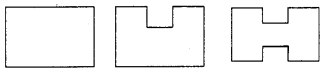
Out of the following figures which has the greatest perimeter ?
(The length and breadth of each rectangle is equal)
(i) (ii) (iii)
PSEB 7th Class Maths MCQ Chapter 11 Perimeter and Area 1
(a) (i)
(b) (ii)
(c) (iii)
(d) (iv).
Answer:
(c) (iii)

Question 2.
Perimeter of a rectangle = 2 (…………)
(a) Length + Breadth
(b) Length × Breadth
(c) Length ÷ Breadth
(d) Length – Breadth.
Answer:
(a) Length + Breadth

Question 3.
Area of rectangle = …………….
(a) Length + Breadth
(b) Length × Breadth
(c) Length – Breadth
(d) Length ÷ Breadth.
Answer:
(b) Length × Breadth

Question 4.
Circumference of a circle = …………….
(a) πr
(b) 2πr
(c) πr2
(d) 2πr2.
Answer:
(b) 2πr

Question 5.
Area of a circle =
(a) 2πr
(b) πr
(c) πr2
(d) 2πr2
Answer:
(c) πr2

PSEB 7th Class Maths MCQ Chapter 11 Perimeter and Area

Question 6.
The area of a square park whose perimeter is 320 m will be :
(a) 3200 m2
(b) 640 m2
(c) 6400 m2
(d) 6400 m
Answer:
(c) 6400 m2

Question 7.
The area of a rectangular plot is 440 m2 and its length is 22 m. Its breadth will be :
(a) 20 m
(b) 40 m
(c) 44 m
(d) 21 m.
Answer:
(a) 20 m

Question 8.
The radius ofa circle is 14 cm. Its area will be:
(a) 88 cm2
(b) 616 cm2
(c) 196 cm2
(d) 56 cm2
Answer:
(b) 616 cm2

Fill in the blanks :

Question 1.
Perimeter of a rectangle = 2 (………….)
Answer:
Length + Breadth

Question 2.
Area of rectangle = ………….
Answer:
Length × Breadth

PSEB 7th Class Maths MCQ Chapter 11 Perimeter and Area

Question 3.
Perimeter of a square = ………….
Answer:
4 × side

Question 4.
Area of a square = ………….
Answer:
(side)2

Question 5.
Area of a triangle = ………….
Answer:
\(\frac {1}{2}\) × Base × height

Write True/False :

Question 1.
Area of a square with side 10 cm is 20 cm2 (True/False)
Answer:
False

Question 2.
One are has 100 m2 (True/False)
Answer:
True

PSEB 7th Class Maths MCQ Chapter 11 Perimeter and Area

Question 3.
One hectare has 1000 m2 (True/False)
Answer:
False

Question 4.
Area of circle is πr2 square unit (True/False)
Answer:
True

Question 5.
Brahmgupta gave the formule for the area of a cyclic quadrilateral (True/False)
Answer:
True

PSEB 7th Class Hindi Solutions Chapter 2 धूल का फूल

Punjab State Board PSEB 7th Class Hindi Book Solutions Chapter 2 धूल का फूल Textbook Exercise Questions and Answers.

PSEB Solutions for Class 7 Hindi Chapter 2 धूल का फूल

Hindi Guide for Class 7 PSEB धूल का फूल Textbook Questions and Answers

(क) भाषा-बोध

1. शब्दार्थ

सरपट – तेज़ चाल से
खलिहान = कटी हुई फसल रखने का स्थान
विपन्नता = गरीबी
मजूरी = मज़दूरी
व्यर्थ = बेकार
मुटियार = नवयुवती
उत्थान = उन्नति, बढ़ती
जन्नत = स्वर्ग
निहारते = देखते
प्रांगण = आंगन
पुष्प-गुच्छ = फूलों का गुलदस्ता
गुंजायमान = गूंजता हुआ

2. इन मुहावरों के अर्थ लिखते हुए वाक्य प्रयोग करें:

खुशी के आँसू छलकना ________________ ___________________________
मन बल्लियों उछलना _____________ _________________________
नाम रोशन करना __________________ ______________________
गले लगाना ________________ _______________________
फूले न समाना _______________ __________________________
उत्तर:
खुशी के आँसू छलकना (बहुत अधिक प्रसन्न होना) – परीक्षा में प्रथम आने का समाचार मिलते ही नीलम की आँखों में खुशी के आँसू छलकने लगे।
मन बल्लियों उछलना(बहुत प्रसन्न होना) – बहुत दिनों बाद गाँव जाते हुए प्रशांत का मन बल्लियों उछलने लगा।
नाम रोशन करना (प्रसिद्धि मिलना) – कलक्टर बन कर प्रशांत ने अपने माता-पिता का नाम रोशन कर दिया।
गले लगना (प्रेम से भेंटना)  -माता ने पुत्र को आशीर्वाद देते हुए बाँहों में भरकर गले लगा लिया।
फूले न समना (बहुत प्रसन्न होना) – एशिया-कप हॉकी में विजय प्राप्त कर भारतीय खिलाड़ी फूले न समा रहे थे।

PSEB 7th Class Hindi Solutions Chapter 2 धूल का फूल

3. विपरीत शब्द लिखें: 

मौन = ……………..
ऊबड़-खाबड़ = ……………
ज़रूरी = ……………..
शहर = …………….
सुनसान = ……………….
मजदूर = ……………..
आमदन = ………………
उत्थान = ……………
उत्तर:
शब्द विपरीत शब्द
मौन = मुखर
ऊबड़-खाबड़ = सीधी-सपाट
ज़रूरी = गैर-ज़रूरी
शहर = गाँव
सुनसान = आबाद
मजदूर = मालिक
आमदन = खर्च
उत्थान = पतन

4. दो-दो पर्यायवाची शब्द लिखें :

तरक्की = ……………
शिक्षा = ……………
अध्यापक = ……………
मेहनत = …………….
शिष्य = …………….
उत्तर:
शब्द पर्यायवाची शब्द
तरक्की = वृद्धि, बढ़ती
शिक्षा = परामर्श, सलाह, तालीम, सबक
अध्यापक = शिक्षक, गुरु
मेहनत = परिश्रम, श्रम
शिष्य = चेला, विद्यार्थी

प्रयोगात्मक व्याकरण

गुरु की शरण = गुरुशरण
माँ और बाप = माँ-बाप

उपर्युक्त पदों में गुरु की शरण को गुरुशरण तथा माँ और बाप को माँ-बाप रूप में संक्षेप में लिख सकते हैं। इस प्रकार शब्दों के मेल से नए शब्द बन जाते हैं।
अतः परस्पर सम्बन्ध रखने वाले दो या दो से अधिक शब्दों के मेल से जब कोई नया सार्थक शब्द बनता है तो उस मेल को समास कहते हैं।

समास करने के बाद जो शब्द बनता है उसे समस्तपद कहते हैं। समस्तपद को इसके शब्द खण्डों में अलग-अलग करने की विधि को विग्रह कहते हैं। जैसे :

गुरुशरण (समस्त पद) = गुरु की शरण (विग्रह)

विशेष:
समस्त पद के दो पद होते हैं- पूर्व पद और उत्तर पद। पहले पद को पूर्व पद तथा बाद को उत्तर पद कहते हैं। जैसे-गुरु (पूर्व पद), शरण (उत्तर पद)

पदों की प्रधानता के आधार पर समास के चार भेद होते हैं :

  1. अव्ययीभाव समास
  2. तत्पुरुष समास
  3. द्वंद्व समास
  4. बहुब्रीहि समास
(क) समस्त पद विग्रह जिस अर्थ में अव्यय यहाँ प्रयुक्त हुआ
(1) बेरोज़गार रोज़गार के बिना ‘बे’ का प्रयोग के बिना’ अर्थ में हुआ है।
(2) आजीवन जीवन तक ‘आ’ का प्रयोग तक के अर्थ में हुआ है।
(3) यथानियम नियम के अनुसार ‘यथा’ का प्रयोग ‘अनुसार’ के अर्थ में हुआ है।

यहाँ समस्त पद में ‘बे’, ‘आ’ तथा ‘यथा’ अव्यय हैं तथा इसके मेल से पूर्ण पद ही अव्यय बन गया है।

अतएव जिस समस्त पद में पूर्वपद प्रधान हो और अव्यय हो और समास होने पर पूर्ण पद ही अव्यय बन जाए, वह अव्ययी भाव समास कहलाता है।
अन्य उदाहरण-आमरण-मरने तक, निडर-डर के बिना, भरपेट-पेट भर कर, आजन्म-जन्म भर, प्रति पल-हर पल, बेखबर-बिना खबर के, अनजान-जाने बिना आदि।
तत्पुरुष समास को समझने के लिए कारक का ज्ञान अपेक्षित है। अत: पहले कारकों को समझते हैं।

हमें साहब ने रहने के लिए घर दिया।

यदि इस वाक्य को इस ढंग से लिखें-‘हमें साहब रहने घर दिया’ तो वाक्य में आए शब्दों का एक-दूसरे से सम्बन्ध नहीं प्रकट होता और न ही अर्थ स्पष्ट होता है।
इसलिए वाक्य में आए ने, के लिए चिह्न वाक्य के अन्य शब्दों का परस्पर सम्बन्ध जोड़ते हैं।

अतएव संज्ञा या सर्वनाम के जिस रूप से उनका सम्बन्ध क्रिया तथा वाक्य के दूसरे शब्दों में जाना जाए, उसे कारक कहते हैं।

विशेष :- वाक्य में प्रयुक्त ‘के, ने, से, के लिए’ कारक चिह्नों को परसर्ग भी कहते हैं।

(1) शरण ने क्षमा माँगी।
इस वाक्य में क्षमा माँगने का काम शरण ने किया अर्थात् कर्ता शरण है। अतः शरण ने में कर्ता कारक है।

(2) प्रशांत उच्च पद को प्राप्त हुआ।
इस वाक्य में प्राप्त हुआ क्रिया है, प्रशांत कर्ता है तथा क्रिया का फल पद पर पड़ रहा है। अतः पद को में कर्म कारक है।

अतएव वाक्य में जिस संज्ञा या सर्वनाम पर क्रिया का फल पड़ता है, उसे कर्म कारक कहते हैं।

PSEB 7th Class Hindi Solutions Chapter 2 धूल का फूल

(3) प्रशांत गाड़ी से गाँव आया।
इस वाक्य में गया क्रिया का साधन गाड़ी है। अतः गाड़ी से में करण कारक है।

अतएव कर्ता जिस साधन की मदद से क्रिया सम्पन्न करता है, उसे करण कारक कहते हैं।

(4) हम पढ़ने के लिए विद्यालय जाते थे।
इस वाक्य में जाना क्रिया का कार्य पढ़ने के लिए है, अतः यहाँ सम्प्रदान कारक है।

अतएव जिस संज्ञा या सर्वनाम के लिए कुछ किया जाए उसे सम्प्रदान कारक कहते हैं।

(5) हमारा पूरा परिवार गाँव से शहर आ गया।
इस वाक्य में गाँव से पद से अलग होने का अर्थ स्पष्ट हो रहा है, इसलिए यहाँ अपादान कारक है।

अतः जिस संज्ञा से पृथक्ता अर्थात् अलग होने का भाव प्रकट हो, उसे अपादान कारक कहते हैं।

इसके अतिरिक्त किसी से सीखने, लगाने, डरने, बचाने, तुलना करने, माँगने, निकलने तथा दूरी का भाव दर्शाने में भी अपादान कारक होता है।

(6) नसीब का लड़का कलक्टर बन गया।
इस वाक्य में नसीब का लड़का से पिता-पुत्र का सम्बन्ध प्रकट हो रहा है अतः यहाँ सम्बन्ध कारक है।

अतएव जहाँ दो संज्ञाओं या सर्वनामों का आपस में सम्बन्ध प्रकट हो, वहाँ सम्बन्ध कारक होता है।

(7) प्रशांत पहले गाँव में रहता था।
इस वाक्य में गाँव में पद में रहना क्रिया के आधार का पता चलता है, यहाँ अधिकरण कारक है।

अतएव जहाँ संज्ञा या सर्वनाम शब्द के आधार का पता चले उसे अधिकरण कारक कहते हैं।

(8) अरे शरण गाड़ी जल्दी चलाओ।
इस वाक्य में अरे शरण ! को सम्बोधन किया गया है, इसलिए यहाँ सम्बोधन कारक है।

अतएव संज्ञा या सर्वनाम के जिस रूप से किसी को पुकारने, बुलाने, सुनाने या सावधान करने का भाव प्रकट हो, वहाँ सम्बोधन कारक होता है। आइए, अब तत्पुरुष समास को समझते हैं।

(ख) समस्त पद विग्रह
पदप्राप्त पद को प्राप्त

उपर्युक्त समास में समस्त पद बनाते समय पूर्वपद (पद) के साथ आए परसर्ग (को) का लोप हो गया है। इसके उत्तरपद (प्राप्त) प्रधान है।
अतएव जिस समास में उत्तर पद प्रधान हो उसे तत्पुरुष समास कहते हैं। पद बनाते समय पूर्वपद के साथ आने वाले परसर्ग का लोप हो जाता है।

अन्य उदाहरण

समस्त पद = विग्रह
यशप्राप्त = यश को प्राप्त
समस्त पद = विग्रह
भावविह्वल = भाव से विह्वल
पाठशाला = पढ़ने के लिए शाला
धनहीन = धन से हीन
विद्याभ्यास = विद्या का अभ्यास
सिरदर्द = सिर में दर्द

(ख) विचार-बोध

1. प्रश्नों के उत्तर एक या दो वाक्यों में लिखें:

प्रश्न 1.
प्रशान्त का मन बल्लियों क्यों उछल रहा था ?
उत्तर:
प्रशान्त का मन बल्लियों इसलिए उछल रहा था क्योंकि वह कई वर्षों के बाद अपने गाँव जा रहा था।

प्रश्न 2.
गाँव की ओर जाते हुए उसे किन-किन लोगों की याद आने लगी ?
उत्तर:
गाँव की ओर जाते हुए पंच जी के खेत, दीनू ग्वाले की गाय-भैंसें, सब्बू कुम्हार के चाक की याद आने लगी।

प्रश्न 3.
उसके अध्यापक का क्या नाम था ?
उत्तर:
उस के अध्यापक का नाम मास्टर आदित्य प्रकाश था।

प्रश्न 4.
हर माँ-बाप का क्या सपना होता है ?
उत्तर:
हर माँ-बाप का यह सपना होता है कि उसकी संतान पढ़-लिखकर कुछ बन जाए।

प्रश्न 5.
प्रशान्त का क्या सपना था? यह सपना उसने कैसे पूरा किया ?
उत्तर:
प्रशान्त का सपना था कि एक दिन ज़रूर वह कुछ बनेगा। यह सपना उस ने खूब पढ़ कर पूरा किया।

PSEB 7th Class Hindi Solutions Chapter 2 धूल का फूल

प्रश्न 6.
लड़कियों की शिक्षा के सम्बन्ध में उसके क्या विचार थे ?
उत्तर:
लड़कियों की शिक्षा के सम्बन्ध में उसके विचार थे कि लड़कियाँ घर का श्रृंगार होती हैं। उन्हें खूब पढ़ाना चाहिए, क्योंकि वे परिवार का आधार होती हैं।

प्रश्न 7.
प्रशान्त गाँव में क्यों आया था ?
उत्तर:
प्रशान्त गाँव में गाँव की पाठशाला का दर्जा बढ़ाने का आदेश लेकर आया था।

2. इन प्रश्नों के उत्तर चार-पाँच वाक्यों में लिखें:

प्रश्न 1.
गरीबी में रहते हुए भी प्रशान्त ने अपने लक्ष्य को कैसे प्राप्त किया?
उत्तर:
प्रशान्त गरीबी में रहते हुए भी पढ़ाई की तरफ बहुत ध्यान देता था। वह मास्टर आदित्य प्रकाश जी की बातें सुनकर धन्य हो जाता था। पढ़ाई का खर्च चलाने के लिए वह छुट्टियों में छोटा-मोटा आमदनी वाला काम कर लेता था। वह खूब पढ़ कर अफसर बनना चाहता था। उसे विश्वास था कि बड़े बनने की कुंजी विद्या है। इसलिए वह मेहनत से पढ़ता था और कर्म को पूजा मानता था। इस प्रकार परिश्रमपूर्वक पढ़-लिख कर उसने अपना लक्ष्य प्राप्त किया और कलक्टर बन गया।

प्रश्न 2.
आपका क्या लक्ष्य है ? अपने लक्ष्य को प्राप्त करने के लिए आप क्या करेंगे?
उत्तर:
मेरे जीवन का लक्ष्य आदर्श अध्यापक बनना है, जो अपने विद्यार्थियों को विद्या के प्रति सच्ची लगन पैदा करके उन्हें भावी भारत का सच्चा एवं अनुशासित नागरिक बना सके। इसके लिए मैं खूब मेहनत से पढंगा। बी०ए० करने के बाद अध्यापक के प्रशिक्षण के लिए बी०एड्० की परीक्षा उत्तीर्ण करके किसी अच्छे विद्यालय में शिक्षक का पद ग्रहण कर विद्यार्थियों को सर्वगुण सम्पन्न बनाने का प्रयास करूँगा।

3. इस कहानी में कई बिन्दुओं को छुआ गया है जैसे :

…………………… गाँवों से शहर की ओर पलायन
…………………… ग्रामीण लोगों की दशा/गरीबी/यथास्थिति
…………………… लक्ष्य प्राप्त करना
…………………… लड़कियों की शिक्षा के प्रति सोच
…………………… गाँव के प्रति प्यार
…………………… सम्बन्धों की आत्मीयता
…………………… अध्यापकों का सम्मान
…………………… इन बिंदुओं पर विचार-विमर्श करें।
उत्तर:
विद्यार्थी आपस में विचार-विमर्श करें।

PSEB 7th Class Hindi Guide धूल का फूल Important Questions and Answers

निम्नलिखित प्रश्नों के उत्तर उचित विकल्प चुनकर लिखिए

प्रश्न 1.
‘धूल का फूल’ किसकी कहानी है ?
(क) खेत मज़दूर के पुत्र की
(ख) खेत की
(ग) खेत मजदूर की पुत्री की
(घ) नाले की
उत्तर:
(क) खेत मज़दूर के पुत्र की

प्रश्न 2.
खेत मजदूर का लड़का पढ़-लिखकर क्या बनता है ?
(क) चपड़ासी
(ख) कलक्टर
(ग) अध्यापक
(घ) पुलिस कप्तान
उत्तर:
(ख) कलक्टर

प्रश्न 3.
गाड़ी चलाते हुए कौन सोच रहा था ?
(क) करण
(ख) गुरचरण
(ग) गुरशरण
(घ) गौरव
उत्तर:
(ग) गुरशरण

प्रश्न 4.
कुम्हार का क्या नाम था ?
(क) सब्बू
(ख) चौधरी
(ग) कब्बू
(घ) चेतन
उत्तर:
(क) सब्बू

प्रश्न 5.
बड़ा बनने की कुंजी क्या है ?
(क) शरीर की ताकत
(ख) ज़मीन
(ग) धन
(घ) विद्या
उत्तर:
(घ) विद्या

प्रश्न 6.
कलक्टर प्रशांत क्या आदेश लेकर आया था?
(क) गाँव खाली कराने का
(ख) गाँव के विद्यालय का दर्जा बढ़ाने का
(ग) ज़मीन लेने का
(घ) ज़मीन देने का
उत्तर:
(ख) गाँव के विद्यालय का दर्जा बढ़ाने का

PSEB 7th Class Hindi Solutions Chapter 2 धूल का फूल

निम्नलिखित रिक्त स्थानों की पूर्ति उचित विकल्पों से कीजिए

प्रश्न 1.
कलक्टर के चाचा का नाम ………… था ।
(क) चरण सिंह
(ख) विक्रम सिंह
(ग) करण सिंह
(घ) चेतन सिंह
उत्तर:
(क) चरण सिंह

प्रश्न 2.
कलक्टर का नाम …………… था।
(क) अविरल
(ख) प्रशांत
(ग) चहल
(घ) वेदांत
उत्तर:
(ख) प्रशांत

प्रश्न 3.
प्रशांत के पिता का नाम …………. था ।
(क) अब्दुल्ला
(ख) कासिम
(ग) सुजान सिंह
(घ) नसीब
उत्तर:
(घ) नसीब

प्रश्न 4.
प्रशांत के मास्टर का नाम ………… था ।
(क) आदित्य
(ख) विश्वास
(ग) विवेक शर्मा
(घ) कर्म सिंह
उत्तर:
(क) आदित्य

दिए गए शब्दों का सही अर्थ मिलान कीजिए

प्रश्न 1.
सरपट:
साँप का पेट
सिर का पेट
तेज चाल से
उत्तर:
तेज़ चाल से

प्रश्न 2.
प्रांगण:
आंगन
पराग का कण
परात
उत्तर:
आंगन

प्रश्न 3.
मजूरी:
मंजूरी
मज़दूरी
मंजर
उत्तर:
मजदूरी

प्रश्न 4.
उत्थान:
उनका
उन्नति
उतना
उत्तरः
उन्नति

धूल का फूल Summary

धूल का फूल पाठ का सार

‘धूल का फूल’ एक ऐसे खेत-मज़दूर गरीब पिता के पुत्र की कहानी है, जो अपने परिश्रम तथा इच्छा शक्ति के बल पर पढ़-लिखकर कलक्टर बन जाता है। ऊबड़-खाबड़ सड़क पर गाड़ी चलाते हुए गुरशरण सोच रहा था कि न मालूम क्यों साहब इधर दौरे पर आए हैं ? जब उसने साहब से पूछा कि अभी और कितनी दूर जाना है तो साहब ने उसे चलते रहने को कहा।

साहब का मन बहुत प्रसन्न था। वे बरसों बाद अपने गाँव जा रहे थे। वे बीस-पच्चीस साल पहले के पंच जी के खेत, दीनू ग्वाले की गाय-भैंसें, सब्बू कुम्हार के चाक आदि की बातें सोच कर भाव-विभोर हो रहे थे। उन्हें गन्ने का रस पीना, गर्म गुड़ खाना, ऊधम मचाना, ककड़ियाँ-खरबूजे खाना, पाठशाला में आदित्य मास्टर जी से पढ़ना आदि याद आ रहा था। उसके पिता दूसरों के खेतों में मजदूरी करते थे तथा माँ के साथ वह खेतों पर खाना ले जाता था। उसके पिता को शहर में चपरासी की नौकरी मिली तो सारा परिवार गाँव से शहर आ गया। जहाँ आकर गाड़ी में बैठे अफसर को देखकर उसका मन भी उन जैसा बनने की इच्छा करता और वह सोचता कि जब लाल बहादुर शास्त्री, लिंकन, एडीसन जैसे बड़े बन सकते हैं, तो वह क्यों नहीं?

सरकारी स्कूल दूर थे फिर भी वह पढ़ता गया क्योंकि उसे विश्वास था कि बड़े बनने की कुंजी विद्या ही है और विद्याधन मेहनत के बिना नहीं मिलता। वह कर्म को पूजा मानने लगा। वह शरण को गाड़ी धीरे चलाने के लिए कहता है और शरण से यह जान कर कि उसका लड़का तो पढ़ने जाता है परन्तु वह अपनी लड़की को स्कूल नहीं भेजता तो उसे समझाता है कि लड़की को भी पढ़ाओ क्योंकि लड़कियाँ घर का श्रृंगार होती हैं, वे ही परिवार का आधार हैं। उसने गाड़ी की खिड़की से मुटियारों को सिर पर बोझ लेकर जाते, खेतों में कम्बाइन चलाते तथा स्त्रियों-बच्चों को झोला लिए अनाज की बालियाँ चुनते देखा तो सोचने लगा कि आजादी के इतने सालों बाद भी गरीब की वही दशा है जो उस के ज़माने में थी। तभी उसे एक बुजुर्ग दिखाई दिए। उस ने गाड़ी रुकवाई और उनके पैर स्पर्श किए। वे चाचा चरण सिंह थे।

उन्होंने उसे नहीं पहचाना तो उसने स्वयं ही अपना परिचय दिया कि वह उनका प्रशांत है। चाचा को भी याद आया नसीब का पुत्र प्रशांत। वह आज यहाँ गाँव के विद्यालय का दर्जा बढ़ाने का आदेश लेकर आया था। पाठशाला रंगोली, रंग-बिरंगी झंडियों से सजी हुई थी। पुष्प-गुच्छों से उसका स्वागत हुआ। अपने प्रिय अध्यापक आदित्य प्रकाश के पैरों को स्पर्श करने के लिए जैसे ही प्रशांत झुका कि उन्होंने उसे बाँहों में भरकर गले लगा लिया और वे फूले नहीं समा रहे थे कि उनका गरीब प्रशांत कलक्टर प्रशांत बन गया है। वही सरकार की ओर से पाठशाला का दर्जा बढ़ाने का आदेश लाया है।

PSEB 7th Class Maths Solutions Chapter 11 Perimeter and Area Ex 11.4

Punjab State Board PSEB 7th Class Maths Book Solutions Chapter 11 Perimeter and Area Ex 11.4 Textbook Exercise Questions and Answers.

PSEB Solutions for Class 7 Maths Chapter 11 Perimeter and Area Ex 11.4

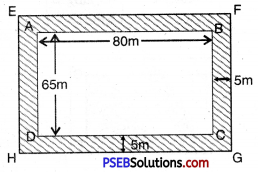
1. An rectangular park is 80 m long and 65 in wide. A path of 5 m width is constructed outside the park. Find the area of path.
Solution:
Let ABCD be a rectangular park.
Length of the park = 80 m
Breadth of the park = 65 m
PSEB 7th Class Maths Solutions Chapter 11 Perimeter and Area Ex 11.4 1
Area of the rectangular park
ABCD = Length × Breadth
= 80 m × 65 m
= 5200 m2
Length of rectangular garden EFGH (including park)
= 80 + 5 + 5
= 90 m
Breadth = 65 + 5 + 5
= 75 m
Area of rectangular path EFGH = 90 × 75
= 6750 m2
Area of the path = Area of rectangular park EFGH – Area of rectangle ABCD
= 6750 – 5200
= 1550 m2

PSEB 7th Class Maths Solutions Chapter 11 Perimeter and Area Ex 11.4

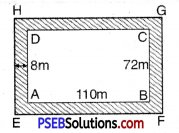
2. A rectangular garden is 110 m long and 72 m broad. A path of uniform width 8 m has to be constructed around it. Find the cost of gravelling the path at ₹ 11.50 per m2.
Solution:
Let ABCD represents the rectangular garden and the shaded region represents the path of width 8 m around the garden.
Length of rectangular garden l = 110 m
PSEB 7th Class Maths Solutions Chapter 11 Perimeter and Area Ex 11.4 2
Breadth of rectangular garden b = 72 m
Area of rectangular garden ABCD = (110 × 72) m2
= 7920 m2
Length of rectangular garden including path = 110 m + (8m + 8m)
= 126 m
Breadth of rectangular garden including path = 72m + (8m + 8m) = 88 m
Area of garden including path = (126 × 88) m2
= 11088 m2
Area of path = Area of garden including path – Area of garden
Area of path = (11088 – 7920) m2
= 3168 m2
Cost of gravelling 1 m2 of path = ₹ 11.50
Cost of gravelling 2928 m2 of path = ₹ 3168 × 11.50
= ₹ 36432

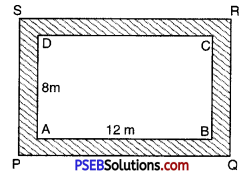
3. A room is 12 m long and 8 m broad. It is surrounded by a verandah, which is 3 m wide all around it. Find the cost of flooring the verandah with marble at ₹ 275 per m2.
Solution:
Let ABCD. represents the rectangular floor of room and shaded region represents the verandah 3 m wide all along the outside of a room.
PSEB 7th Class Maths Solutions Chapter 11 Perimeter and Area Ex 11.4 3
PQ = (3 + 12 + 3) m
= 18 m
PS = (3 + 8 + 3) m
= 14 m
Area of rectangle ABCD = 1 × b
= AB × AD
= 12 m × 8m
= 96 m2
Area of recangle PQRS = 1 × b
= PQ × PS
= 18 m × 14 m
= 252 m2
Area of verandah = [Area of rectangle PQRS] – [Area of rectangle ABCD]
= (252 – 96) m2
= 156 m2
(Rate of flooting the verandha with marble verandah = ₹ 275 per m2)
Cost of flooring verandah with moble.
= ₹ (156 × 275)
= ₹ 42900.

PSEB 7th Class Maths Solutions Chapter 11 Perimeter and Area Ex 11.4

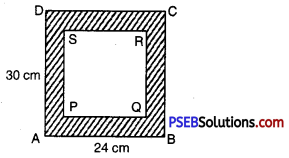
4. A sheet of paper measures 30 cm × 24 cm. A strip of 4 cm width is cut from it, all around. Find the area of remaining sheet and also the area of cut out strip.
Solution:
Let ABCD represent the sheet of 30 cm × 24 cm and shaded region represents the 4 cm width to be cut
PSEB 7th Class Maths Solutions Chapter 11 Perimeter and Area Ex 11.4 4
PQ = (30 – 4 – 4) cm
= 22 cm
PS = (24 – 4 – 4) cm
= 16 cm

(i) remaining sheet
[Area of rectangle ABCD] – [Area of rectangle PQRS]
= (30 × 24 – 22 × 16)
= (720 – 352 = 368) cm2
Area of the cut our strip i.e. area of rectangle PQRS = 22 × 16 cm2
= 352 cm2

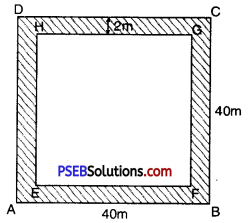
5. A path of 2 m wide is built along the border inside a square garden of side 40 m. Find :

Question (i).
The Area of path.
Solution:
Let ABCD be the square park of side 40 m and the shaded region represents the path 2 m wide
EF = 40 m – (2 + 2) m
= 36 m
PSEB 7th Class Maths Solutions Chapter 11 Perimeter and Area Ex 11.4 5
Area of square park ABCD = (Side)2
= 40 × 40
= 1600 m2
Area of EFGH = (Side)2
= 36 × 36
= 1296 m2
Area of path = Area of square park ABCD – Area of EFGH
= (1600 – 1296) m2
= 304 m2

Question (ii).
The cost of planting grass in the remaining portion of the garden at the rate of ₹ 50 per m2.
Solution:
Cost of planting grass = 50 per m2
Cost of planting grass 1m2 = ₹ 50
Cost of 1296 m2 = 1296 × 50
= ₹ 64800

PSEB 7th Class Maths Solutions Chapter 11 Perimeter and Area Ex 11.4

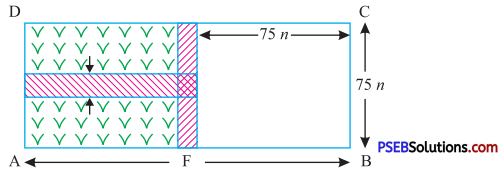
6. A nursery school play ground is 150 m long and 75 m wide. A portion of 75 m × 75 m is kept for see-saw slides and other park equipments. In the remaining portion 3 m wide path parallel to its width and parallel to remaining length (as shown in fig). The remaining area is covered by grass. Find the area covered by grass.
PSEB 7th Class Maths Solutions Chapter 11 Perimeter and Area Ex 11.4 6
Solution:
Area of school ground
= 150 m × 75 m = 11250 m2
Area kept for see-saw slides and other equipments
= 75 × 75
= 5625 m2
Area of path parallel to width of ground = 75 × 3
= 225 m2
Area common to both paths = 3 × 3
= 9 m2
Total area covered by path
= (225 + 225 – 9)
= 441 m2
Area covered by grass = Area of ground – (Area kept for see-saw slides + area covered by paths)
= 11250 – (5625 + 441)
= (11250 – 6066) m2
= 5184 m2

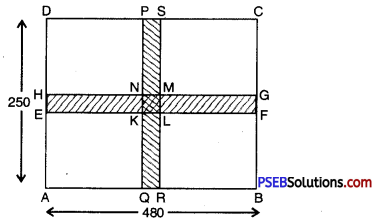
7. Two cross roads each of width 8 m cut at right angle through the centre of a rectangular park of length 480 m and breadth 250 m and parallel to its sides. Find the area of roads. Also, find the area of park excluding cross roads.
Solution:
PSEB 7th Class Maths Solutions Chapter 11 Perimeter and Area Ex 11.4 7
ABCD represent the rectangular park of length AB = 480 m and breadth BC = 250 m. Area of shaded portion i.e. area of rectangle EFGH and PQRS represent the area of cross roads, but the area of square KLMN is taken twice, So it will be subtracted.
Now EF = 480, FG = 8 m, PQ = 250 m, QR = 8 m, KL = 8 m.
Area covered by roads = Area of rectangle EFGH + area of rectangle PQRS – Area of square KLMN
= (EF × FG) + (PQ × QR) – (KL)2
= (480 × 8) + (250 × 8) – (8 × 8)
= 3840 + 2000 – 64
Area of the road = 5776 m2
Area of park excluding cross roads = 250 × 480 – (250 × 8 + 480 × 8 – 8 × 8)
= 114224 m2

PSEB 7th Class Maths Solutions Chapter 11 Perimeter and Area Ex 11.4

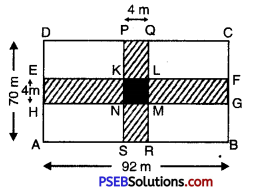
8. In a rectangular field of length 92 m and breadth 70 m, two roads are constructed which are parallel to the sides and cut each other at right angles through the centre of field. If the width of each road is 4 m, find.
(i) The area covered by roads.
(ii) The cost of constructing the roads at the rate of ₹ 150 per m2.
Solution:
Let ABCD represents the rectangular field of length ; AB = 92 m and breadth; AD = 70 m. Let the area of shaded portion
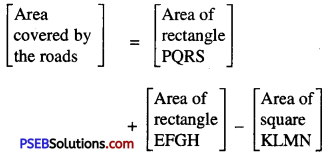
i. e. area of the rectangle PQRS and the area of rectangle EFGH represents the area of cross roads.
PSEB 7th Class Maths Solutions Chapter 11 Perimeter and Area Ex 11.4 8
But in doing this, area of square KLMN is taken twice which is to be subtracted.
Now PQ = 4 m, PS = 70 m
and EH = 4 m, EF = 92 m
and KL = 4 m, KN = 4 m
PSEB 7th Class Maths Solutions Chapter 11 Perimeter and Area Ex 11.4 9
= PQ × PS + EF × EH – KL × KN
= [(4 × 70) + (92 × 4) – (4 × 4)] m2
= (280 + 368 – 16) m2
= (648 – 16) m2
= 632 m2

(ii) Cost of constructing 1 m2 of roads = ₹ 150
Therefore cost of constructing 632 m2 of roads = ₹ (150 × 632)
= ₹ 94800.

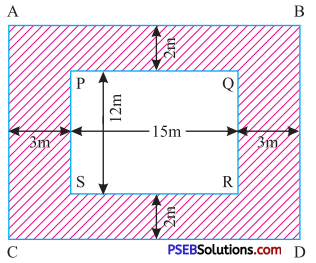
9. Find the area of shaded region in each of the following figures.

Question (i).
PSEB 7th Class Maths Solutions Chapter 11 Perimeter and Area Ex 11.4 10
Solution:
Length of rectangle ABDC
= 3m + 15m + 3m
= 21 m
Breadth of rectangle ABDC
= 2m + 12m + 2m
= 16 m
Area of rectangle ABDC
= length × breadth
= 21 × 16 m2
= 336 m2
Length of rectangle PQRS = 15 m
Breadth of rectangle PQRS = 12 m
Area of rectangle PQRS = 15 × 12 m2
= 180 m2
Area of shaded region = Area of rectangle ABCD – Area of rectangle PQRS
= 336 m2 – 180 m2
= 156 m2

PSEB 7th Class Maths Solutions Chapter 11 Perimeter and Area Ex 11.4

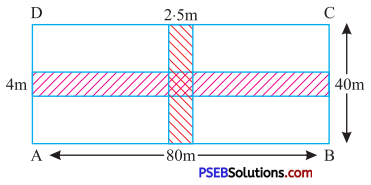
Question (ii).
PSEB 7th Class Maths Solutions Chapter 11 Perimeter and Area Ex 11.4 11
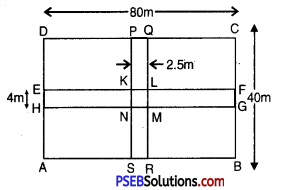
Solution:
PSEB 7th Class Maths Solutions Chapter 11 Perimeter and Area Ex 11.4 12
SR = PQ = 2.5 m
EH = FG = 4 m
KL = 2.5 m
LM = 4 m
Area of shaded region = [Area of rectangle PQRS] + [Area of rectangle EFGH] – Area of rectangle KLMN
= 40 × 2.5 + 80 × 4 – 2.5 × 4
= 100 + 320 – 10
= 420 – 10
= 410 m2

PSEB 7th Class Maths MCQ Chapter 10 Practical Geometry

Punjab State Board PSEB 7th Class Maths Book Solutions Chapter 10 Practical Geometry MCQ Questions with Answers.

PSEB 7th Class Maths Chapter 10 Practical Geometry MCQ Questions

Multiple Choice Questions :

Question 1.
Number of parallel lines that can be drawn passing through a point not lying on the given line is :
(a) 0
(b) 1
(c) 2
(d) 3.
Answer:
(b) 1

Question 2.
The sum of three angles of a Δ is :
(a) 90°
(b) 180°
(c) 360°
(d) None
Answer:
(b) 180°

Question 3.
A triangle can be constructed by taking its sides of these :
(a) 3 cm, 5 cm, 7 cm
(b) 4 cm, 5 cm, 9 cm
(c) 4 cm, 3 cm, 8 cm
(d) 3 cm, 2 cm, 5 cm.
Answer:
(a) 3 cm, 5 cm, 7 cm

Question 4.
Two angles of a triangle are 40° and 50°. Third angle is :
(a) 40°
(b) 50°
(c) 90°
(d) 60°
Answer:
(c) 90°

Question 5.
The angles of a triangle are 30° and 50°, third angle is :
(a) 100°
(b) 60°
(c) 80°
(d) 50°.
Answer:
(a) 100°

PSEB 7th Class Maths MCQ Chapter 10 Practical Geometry

Fill in the blanks :

Question 1.
Sum of lengths of any two sides of a triangle is …………….
Answer:
greater than third side

Question 2.
In right angled triangle.
(Hypotenuse)2 = (…………….)2 + (…………….)2
Answer:
Base, Perpendicular

Question 3.
SAS stands for …………….
Answer:
Side, angle, Side

Question 4.
RHS stands for …………….
Answer:
Right angle hypotenuse side

Question 5.
ASA stands for …………….
Answer:
Angle, side, angle.

PSEB 7th Class Maths MCQ Chapter 10 Practical Geometry

Write True or False

Question 1.
Exterior angle of a triangle is equal to the sum of opposite interior angles. (True/False)
Answer:
True

Question 2.
The lengths of three sides can be used to construct a triangle. (True/False)
Answer:
True

Question 3.
The sum of the three angles of a triangle is 160°. (True/False)
Answer:
False

Question 4.
Construction of a triangle is possible when some of too angle is 180°. (True/False)
Answer:
True

Question 5.
Each angle of equilateral triangle is 60°. (True/False)
Answer:
True

PSEB 7th Class Maths Solutions Chapter 10 Practical Geometry Ex 10.5

Punjab State Board PSEB 7th Class Maths Book Solutions Chapter 10 Practical Geometry Ex 10.5 Textbook Exercise Questions and Answers.

PSEB Solutions for Class 7 Maths Chapter 10 Practical Geometry Ex 10.5

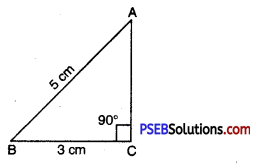
1. Construct a right angled triangle ABC with ∠C = 90°, AB = 5 cm and BC = 3 cm.
Solution:
Given : Two sides of ΔABC as
AB = 5 cm,
BC = 3 cm
and ∠C = 90°.
To construct : A triangle with these two sides and one right angle.
Steps of Construction :
Step 1. We first draw a rough sketch of the triangle ABC and indicate the measure of these two sides and mark the right angle.
PSEB 7th Class Maths Solutions Chapter 10 Practical Geometry Ex 10.5 1
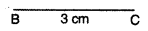
Step 2. Draw BC of length 3 cm.
PSEB 7th Class Maths Solutions Chapter 10 Practical Geometry Ex 10.5 2
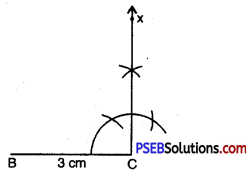
Step 3. At C, draw CX ⊥ BC. (A should be somewhere on this perpendicular).
PSEB 7th Class Maths Solutions Chapter 10 Practical Geometry Ex 10.5 3
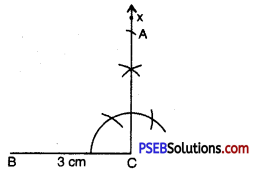
Step 4. With B as centre, draw an arc of radius 5 cm. (A must be on this arc since it is at a distance of 5 cm from B).
PSEB 7th Class Maths Solutions Chapter 10 Practical Geometry Ex 10.5 4
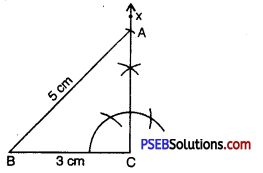
Step 5. A has to be on the perpendicular line CX as well as on the arc drawn with centre C.
∴ A is the meeting point of these two.
ΔABC is now obtained.
PSEB 7th Class Maths Solutions Chapter 10 Practical Geometry Ex 10.5 5

PSEB 7th Class Maths Solutions Chapter 10 Practical Geometry Ex 10.5

2. Construct an isosceles right angled triangle DEF where ∠E = 90° and EF = 6 cm.
Solution:
Given : An isoscele right angled ΔDEF where ∠E = 90° and EF = 6 cm.
To Construct: A right angled triangle with one side.
Steps of Construction:
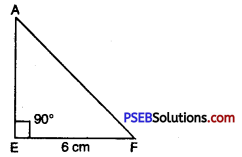
Steps 1. Draw a rough sketch of given measures.
PSEB 7th Class Maths Solutions Chapter 10 Practical Geometry Ex 10.5 6
Step 2. Draw a line segment EF = 6 cm.
PSEB 7th Class Maths Solutions Chapter 10 Practical Geometry Ex 10.5 7
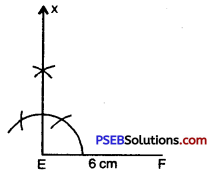
Step 3. With the help of compass taking E as centre, draw a ray EX making an angle of 90° with EF.
PSEB 7th Class Maths Solutions Chapter 10 Practical Geometry Ex 10.5 8
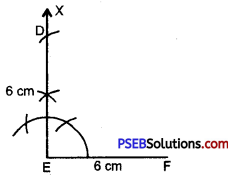
Step 4. With E as centre and radius 6 cm (= DE) draw an arc intersecting EX at D.
PSEB 7th Class Maths Solutions Chapter 10 Practical Geometry Ex 10.5 9
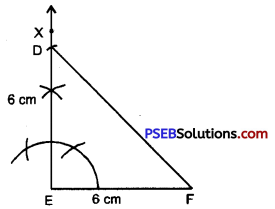
Step 5. Join D and F. Therefore ΔDEF is required isosceles right triangle.
PSEB 7th Class Maths Solutions Chapter 10 Practical Geometry Ex 10.5 10

PSEB 7th Class Maths Solutions Chapter 10 Practical Geometry Ex 10.5

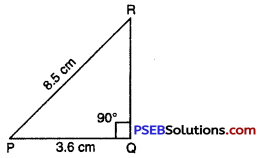
3. Construct a right-angled triangle PQR in which :
∠Q= 90°, PQ = 3.6 cm and PR = 8.5 cm
Solution:
Given : Right triangle be PQR; right-angled at Q
i. e. ∠Q = 90°
and PQ = 3.6 cm,
PR = 8.5 cm
To construct : A triangle with these two sides and one right angle.
Steps of Construction :
Step 1. We first draw a rough sketch of the triangle PQR and indicate the measure of these two sides and mark the right angle.
PSEB 7th Class Maths Solutions Chapter 10 Practical Geometry Ex 10.5 11
Step 2. Draw PQ of length 3.6 cm.
PSEB 7th Class Maths Solutions Chapter 10 Practical Geometry Ex 10.5 12
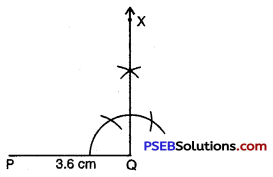
Step 3. At Q, draw QX ⊥ PQ.
(R should be somewhere on this perpendicular).
PSEB 7th Class Maths Solutions Chapter 10 Practical Geometry Ex 10.5 13
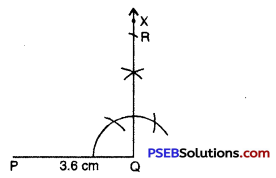
Step 4. With P as centre, draw arc of radius
(R must be on this arc, since it is at a distance of 8.5 cm from P).
PSEB 7th Class Maths Solutions Chapter 10 Practical Geometry Ex 10.5 14
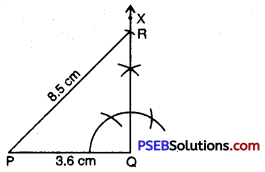
Step 5. R has to be on the perpendicular line QX as well as on the arc drawn with centre P.
∴ R is the meeting point of these two.
ΔPQR is now obtained.
PSEB 7th Class Maths Solutions Chapter 10 Practical Geometry Ex 10.5 15

PSEB 7th Class Maths Solutions Chapter 10 Practical Geometry Ex 10.5

4. Question (i).
Which of the following is a pythagorian triplet ?
(a) 1, 2, 3
(b) 2, 3, 4
(c) 4, 5, 6
(d) 12, 13, 5
Answer:
(d) 12, 13, 5

Question (ii).
Construction of unique triangle is not possible when :
(a) Three sides are given.
(b) Two sides and an included angle are given.
(c) Three angles are given.
(d) Two angles & included side are given.
Answer:
(c) Three angles are given.

PSEB 7th Class Maths Solutions Chapter 11 Perimeter and Area Ex 11.2

Punjab State Board PSEB 7th Class Maths Book Solutions Chapter 11 Perimeter and Area Ex 11.2 Textbook Exercise Questions and Answers.

PSEB Solutions for Class 7 Maths Chapter 11 Perimeter and Area Ex 11.2

1. Estimate the area of the following figures by counting unit squares.

Question (i).
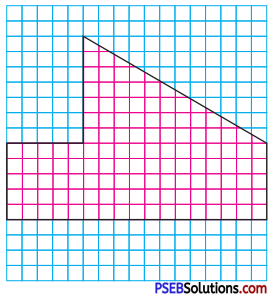
PSEB 7th Class Maths Solutions Chapter 11 Perimeter and Area Ex 11.2 1
Solution:
In the given figure, number of squares covered completely = 135
Area of a square = 1 sq. unit
Area of (135 square) figure = 135 sq. units, (approx.)

Question (ii).
PSEB 7th Class Maths Solutions Chapter 11 Perimeter and Area Ex 11.2 2
Solution:
In the given figure number of square covered completely = 114
Area of one square = 1 unit
∴ Area of 114 squares = 114 sq units approx
Thus area of given figure = 114 sq units approx.

PSEB 7th Class Maths Solutions Chapter 11 Perimeter and Area Ex 11.2

2. In the following figures find the area of 

Question (i).
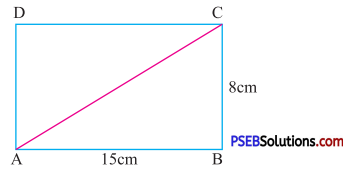
ΔABC
PSEB 7th Class Maths Solutions Chapter 11 Perimeter and Area Ex 11.2 3
Solution:
Given length of rectangle = 15 cm
Breadth of rectangle = 8 cm
The diagonal AC divides the rectangle into two triangles ΔABC and ΔADC
So, area of ΔABC = \(\frac {1}{2}\) × Area of rectangle ABCD
= \(\frac {1}{2}\) × length × breadth
= \(\frac {1}{2}\) × 15 × 8
= 60 cm2

Question (ii).
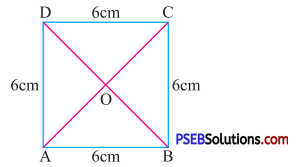
ΔCOD
PSEB 7th Class Maths Solutions Chapter 11 Perimeter and Area Ex 11.2 4
Solution:
Given side of square = 6 cm
The diagonals AC and BD divides the square into four equal posses (triangles)
So, area of ΔCOD = \(\frac {1}{4}\) × Area of square
= \(\frac {1}{4}\) × 6 × 6
= 9 cm2

3. Find the area of following parallelograms.

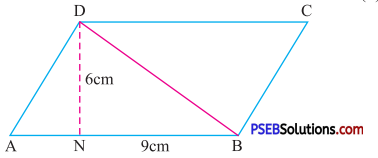
Question (i).
PSEB 7th Class Maths Solutions Chapter 11 Perimeter and Area Ex 11.2 5
Solution:
Given base of parallelogram = 9 cm
Height of parallelogram = 6 cm
Area of parallelogram = Base × height
= 9 × 6
= 54 cm2

Question (ii).
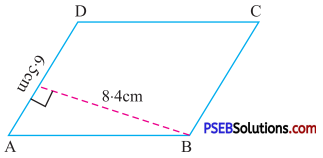
PSEB 7th Class Maths Solutions Chapter 11 Perimeter and Area Ex 11.2 6
Solution:
Given base of parallelogram = 6.5 cm
Height of parallelogram= 8.4 cm
Area of parallelogram = Base × height
= 6.5 × 8.4
= 54.6 cm2

PSEB 7th Class Maths Solutions Chapter 11 Perimeter and Area Ex 11.2

4. Find the value of x in the following parallelograms.

Question (i).
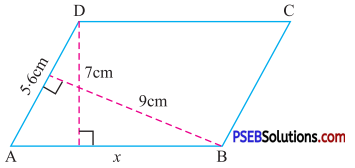
PSEB 7th Class Maths Solutions Chapter 11 Perimeter and Area Ex 11.2 7
Solution:
Given base (AD) of parallelogram = 5.6 cm
Corresponding height of parallelogram = 9 cm
Area of parallelogram = 5.6 × 9 cm2 ….(1)
Also in the paralleogram, base (AB) = x
Corresponding height of parallelogram = 7 cm
Area of parallelogram will be = x × 7 ….(2)
From (1) and (2), we get
x × 7 = 5.6 × 9
x = \(\frac{5.6 \times 9}{7}\)
= 7.2

Question (ii).
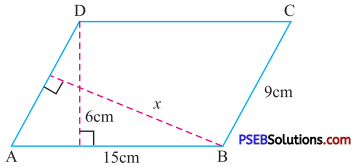
PSEB 7th Class Maths Solutions Chapter 11 Perimeter and Area Ex 11.2 8
Solution:
Given base (AB) of parallelogram = 15 cm
Corresponding height = 6 cm
Area of parallelogram =15 × 6 cm2 ….(1)
Also Base (AD || BC) of parallelogram = 9 cm
Corresponding height = x
So area of parallelogram = 9 × x ….(2)
From (1) and (2)
9 × x = 15 × 6
x = \(\frac{15 \times 6}{9}\)
= 10 cm.

5. The adjacent sides of a parallelogram are 28 cm and 45 cm and the altitude on longer side is 18 cm. Find the area of parallelogram.
Solution:
Given base of the parallelogram = 45 cm
Corresponding height = 18 cm
Area of parallelogram = Base × Height
= 45 × 18
= 810 cm2

PSEB 7th Class Maths Solutions Chapter 11 Perimeter and Area Ex 11.2

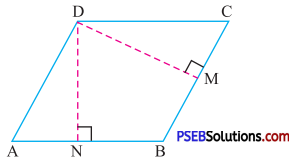
6. ABCD is a parallelogram given in figure. DN and DM are the altitudes on side AB and CB respectively. If area of the parallelogram is 1225 cm2, AB = 35 cm and CB = 25 cm, find DN and DM.
PSEB 7th Class Maths Solutions Chapter 11 Perimeter and Area Ex 11.2 9
Solution:
In the given parallelogram ABCD
Base (AB) = 35 cm
Let height (DN) = x cm
So area of parallelogram = 35 × x cm2
But given area of parallelogram (ABCD) = 1225 cm2
Therefore 35x = 1225
x = \(\frac {1225}{35}\)
= 35 cm
Similarly, for base (BC) and height (DM)
1225 = BC × DM
\(\frac{1225}{\mathrm{BC}}\) = DM
or DM = \(\frac {1225}{25}\)
= 49 cm.

7. Find the area of the following triangles.

Question (i).
PSEB 7th Class Maths Solutions Chapter 11 Perimeter and Area Ex 11.2 10
Solution:
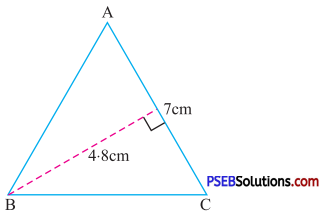
Given base of triangle = 7 cm
Height of triangle = 4.8 cm
Area of triangle = \(\frac {1}{2}\) × Base × Height
= \(\frac {1}{2}\) × 7 × 4.8
= 16.8 cm2.

Question (ii).
PSEB 7th Class Maths Solutions Chapter 11 Perimeter and Area Ex 11.2 11
Solution:
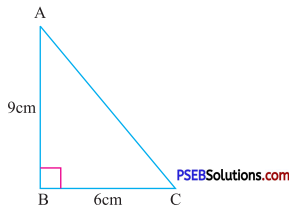
Given base of triangle =6 cm
Height of triangle = 9 cm
Area of triangle = \(\frac {1}{2}\) × Base × Height
= \(\frac {1}{2}\) × 6 × 9
= 27 cm2

PSEB 7th Class Maths Solutions Chapter 11 Perimeter and Area Ex 11.2

8. Find the value of x in the following triangles.

Question (i).
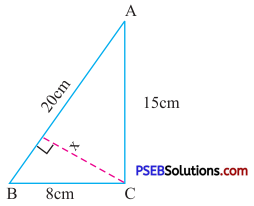
PSEB 7th Class Maths Solutions Chapter 11 Perimeter and Area Ex 11.2 12
Solution:
In ΔABC, BC = 8 cm, AC = 15 cm
Area of triangle ABC = \(\frac {1}{2}\) × Base × height
= \(\frac {1}{2}\) × BC × AC
= \(\frac {1}{2}\) × 8 × 15
= 60 cm2 …(1)
Also, in ΔABC, AB = 20 cm
height = x
Area of triangle ABC = \(\frac {1}{2}\) × Base × Height
= \(\frac {1}{2}\) × 20 × x ….(2)
From (1) and (2)
\(\frac {1}{2}\) × 20 × x = 60
x = \(\frac{60 \times 2}{20}\)
x = 6 cm.

Question (ii).
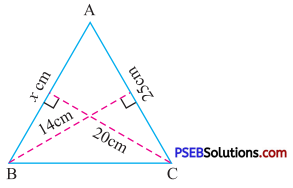
PSEB 7th Class Maths Solutions Chapter 11 Perimeter and Area Ex 11.2 13
Solution:
In ΔABC, base (AC) = 25 cm
height = 14 cm
Area of triangle ABC = \(\frac {1}{2}\) × Base × height
\(\frac {1}{2}\) × 14 × 25 ….(1)
Also, in ΔABC, base AB = x cm
height = 20 cm
So, area of ΔABC = \(\frac {1}{2}\) × Base × Height
= \(\frac {1}{2}\) × x × 20 ….(2)
From (1) and (2) we get
\(\frac {1}{2}\) × x × 20 = \(\frac {1}{2}\) × 14 × 25
x = 17.5 cm

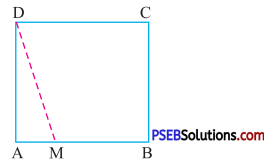
9. ABCD is a square, M is a point on AB such that AM = 9 cm and area of ΔDAM is 171 cm2. What is the area of the square ?
PSEB 7th Class Maths Solutions Chapter 11 Perimeter and Area Ex 11.2 14
Solution:
Given area of ΔDAM = 171 cm2
Base of triangle = 9 cm
As, area of triangle ΔDAM = \(\frac {1}{2}\) × base × height
171 = \(\frac {1}{2}\) × 9 × (DA)
Hence height (DA) = \(\frac{171 \times 2}{9}\)
= 18 cm
Hence side of square (DA) = 18 cm
Therefore area of square = (side)2
= (18)2
= 324 cm2

PSEB 7th Class Maths Solutions Chapter 11 Perimeter and Area Ex 11.2

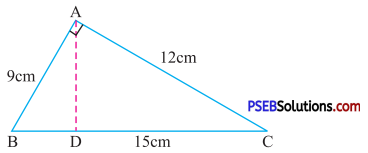
10. ΔABC is right angled at A as shown in figure. AD is perpendicular to BC, if AB = 9 cm, BC = 15 cm and AC = 12 cm. Find the area of ΔABC, also find file length of AD.
PSEB 7th Class Maths Solutions Chapter 11 Perimeter and Area Ex 11.2 15
Solution:
Given AB = 9 cm
BC = 15 cm
AC = 12 cm
Let AD = x cm
Area of triangle = \(\frac {1}{2}\) × Base × height
= \(\frac {1}{2}\) × 12 × 9 cm2.
= 54 cm2 ….(1)
Since, AD is perpendicular to BC
So, area of triangle = \(\frac {1}{2}\) × BC × AD
= \(\frac {1}{2}\) × 15 × AD ….(2)
From (1) and (2) we get
\(\frac {1}{2}\) × 15 × AD = 54
AD = \(\frac{54 \times 2}{15}\)
AD = 7.2 cm

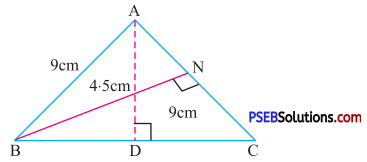
11. ΔABC is isosceles with AB = AC = 9 cm, BC = 12 cm and the height AD from A to BC is 4.5 cm. Find the area of ΔABC. What will be the height from B to AC i.e. BN ?
PSEB 7th Class Maths Solutions Chapter 11 Perimeter and Area Ex 11.2 16
Solution:
In triangle ABC, Base (BC) = 12 cm
AD = 4.5 cm
AD is perpendicular to BC
So, Area of ΔABC = \(\frac {1}{2}\) × base × height
= \(\frac {1}{2}\) × 12 × 4.5 cm
= 27 cm ….(1)
Also, in ΔABC, Base (AC) = 9 cm
Let corresponding height (BN) = x
So area of ΔABC = \(\frac {1}{2}\) × base × height
= \(\frac {1}{2}\) × 9 × BN ….(2)
From (1) and (2)
\(\frac {1}{2}\) × 9 × BN = 27
BN = \(\frac{27 \times 2}{9}\)
= 6 cm.

PSEB 7th Class Maths Solutions Chapter 11 Perimeter and Area Ex 11.2

12. Multiple choice questions :

Question (i).
Find the height of a parallelogram whose area is 246 cm2 and base is 20 cm.
(a) 1.23 cm2
(b) 13.2 cm2
(c) 12.3 cm2
(d) 1.32 cm2
Answer:
(c) 12.3 cm2

Question (ii).
One of the side and the corresponding height of a parallelogram are 7 cm and 3.5 cm respectively. Find the area of the parallelogram.
(a) 21 cm2
(b) 24.5 cm2
(c) 21.5 cm2
(d) 24 cm2
Answer:
(b) 24.5 cm2

Question (iii).
The height of a triangle whose base is 13 cm and area is 65 cm2 is :
(a) 12 cm
(b) 15 cm
(c) 10 cm
(d) 20 cm
Answer:
(c) 10 cm

Question (iv).
Find the area of an isosceles right angled triangle, whose equal sides are of length 40 cm each.
(a) 400 cm2
(b) 200 cm2
(c) 600 cm2
(d) 800 cm2
Answer:
(d) 800 cm2

PSEB 7th Class Maths Solutions Chapter 11 Perimeter and Area Ex 11.2

Question (v).
If the sides of a parallelogram are increased to twice of its original length, how much will be the perimeter of the new parallelogram ?
(a) 1.5 times
(b) 2 times
(c) 3 times
(d) 4 times
Answer:
(b) 2 times

Question (vi).
In a right angled triangle one leg is double the other and area is 64 cm2 find the smaller leg.
(a) 8 cm
(b) 16 cm
(c) 24 cm
(d) 32 cm.
Answer:
(a) 8 cm

PSEB 7th Class Maths Solutions Chapter 11 Perimeter and Area Ex 11.1

Punjab State Board PSEB 7th Class Maths Book Solutions Chapter 11 Perimeter and Area Ex 11.1 Textbook Exercise Questions and Answers.

PSEB Solutions for Class 7 Maths Chapter 11 Perimeter and Area Ex 11.1

1. Find the perimeter and the area of a rectangle having :
(i) Length = 28 cm, Breadth = 15 cm
(ii) Length = 9.4 cm Breadth = 2.5 cm
Solution:
(i) Given length of rectangle = 28 cm
Breadth of rectangle = 15 cm
Perimeter of rectangle = 2 [length + Breadth]
= 2 [28 + 15]
= 2 × 43
= 86 cm

Area of rectangle = length × Breadth
= 28 × 15
= 420 cm2

(ii) Perimeter of rectangle = 2 [9.4 + 2.5]
= 2 × 11.9
= 23.8 cm
Area of rectangle = 9.4 × 2.5
= 23.5 cm2

2. Find the perimeter and the area of a square whose side measures
(i) 29 cm
(ii) 8.3 cm
Solution:
(i) Given side of square = 29 cm
Perimeter of square = 4 × side
= 4 × 29
= 116 cm
Area of square = (side)2
= (29)2
= 841 cm2

(ii) Perimeter of square = 4 × 8.3
= 33.2 cm
Area of square = 8.3 × 8.3
= 68.89 cm2

PSEB 7th Class Maths Solutions Chapter 11 Perimeter and Area Ex 11.1

3. The perimeter of a square park is 148 m. Find its area.
Solution:
Given the perimeter of square park = 148 m
Side of the square park = \(\frac{perimeter}{4}\)
= \(\frac {148}{4}\)
Area of the square park = (side)2
= (37)2
= 1369 m2

4. The area of a rectangle is 580 cm2. Its length is 29 cm. Find its breadth and also, the perimeter.
Solution:
Given area of rectangle = 580 cm2
Length of the rectangle = 29 cm
Let breadth of the rectangle = b cm
Area of the rectangle = length × breadth
580 = 29 × b
\(\frac {580}{29}\) = b
b = 20 cm
Perimeter of rectangle = 2 [length + breadth]
= 2 [29 + 20]
= 2 × 49
= 98 cm

5. A wire is in the shape of a rectangle. Its length is 48 cm and breadth is 32 cm. If the same wire is rebent into the shape of a square, what will be the measure of each side. Also, find which shape encloses more area and by how much ?
Solution:
Given length of the rectangle = 48 cm
Breadth of the rectangle = 32 cm
Perimeter of the rectangle = 2 [length + breadth]
= 2 [48 + 32]
= 2 × 80
= 160 cm
Let side of square = a cm
Perimeter of the square = 4 × a
Since wire is rebent into the shape of a square
Perimeter of square = Perimeter of rectangle
4 a = 160
Therefore, a = \(\frac {160}{4}\)
= 40 cm
Area of square = (side)2
= 40 × 40
= 1600 cm2
Area of rectangle = length × breadth
= 48 × 32
= 1536 cm2
∴ Square encloses more area by 64 cm2

PSEB 7th Class Maths Solutions Chapter 11 Perimeter and Area Ex 11.1

6. The area of a square park is the same as that of a rectangular park. If the side of the square park is 75 m and the length of the rectangular park is 125 m, find the breadth of the rectangular park. Also, find the perimeter of rectangular park.
Solution:
Given side of square park = 75 m
Area of square park = (75)2
= 75 × 75
= 5625 m2
Length of rectangular park = 125 m
Let breadth of rectangular park = b m
Area of rectangular park = length × breadth
= 125 × b m2
Given that
Area of rectangular park = Area of square park
125 × b = 5625
= 45 m
Perimeter of rectangular park = 2 [length + breadth]
= 2 [125 + 45]
= 2 × 170
= 340 m

7. A door of length 2.5 m and breadth 1.5 m is fitted in a wall. The length of wall, is 9 m and breadth is 6 m. Find the cost of painting the wall, if the rate of painting the wall is ₹ 30 per m2.
PSEB 7th Class Maths Solutions Chapter 11 Perimeter and Area Ex 11.1 1
Solution:
Length of door = 2.5 m
Breadth of door = 1.5 m
Area of door = length × breadth
= 2.5 × 1.5
= 3.75 m2
Area of wall = 9 × 6
= 54 m2
Area of wall painting = Area of wall including door – Area of door
= 54 – 3.75
= 50.25 m2
Cost of painting 1 m2 of wall = ₹ 30
Cost of painting 50.25 m2 of wall = ₹ 50.25 × 30
= ₹ 1507.50

PSEB 7th Class Maths Solutions Chapter 11 Perimeter and Area Ex 11.1

8. A door of dimensions 3 m × 2 m and a window of dimensions 2.5 m × 1.5 m is fitted in a wall. The length of the wall is 7.8 m and breadth is 3.9 m. Find the cost of painting the wall, if the rate of painting the wall is ₹ 25 per m2.
Solution:
Area of door = 3 × 2 = 6 m2
Area of window = 2.5 m × 1.5 m
= 3.75 m2
Area of wall = 7.8 m × 3.9 m
= 30.42 m2
Area of painting the wall = Area of wall – Area of door – Area of window
= 30.42 – 6 – 3.75
= 20.67 m2
Cost of painting the wall = ₹ 25 × 20.67
= ₹ 516.75

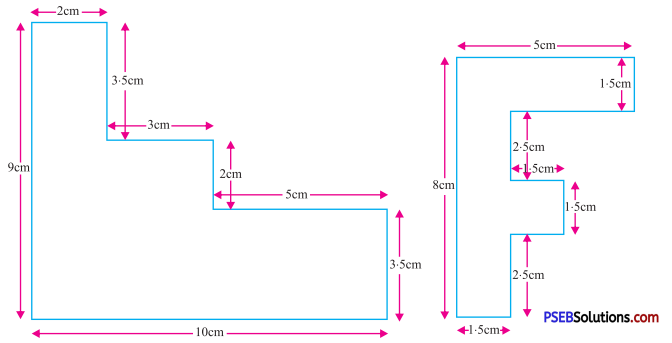
9. Find the area and the perimeter of the following figures.
PSEB 7th Class Maths Solutions Chapter 11 Perimeter and Area Ex 11.1 2
Solution:
(i) Perimeter of the given figure
= AB + BC + CD + DE + EF + FG + GH + HA
= 2 + 3.5 + 3 + 2 + 5 + 3.5 + 10 + 9
= 38 cm2
Area of the figure = Area of rectangle ABCJ + Area of rectangle JDEI + Area of rectangle IFGH
= 2 × 3.5 + 5 × 2 + 10 × 3.5
= 7 + 10 + 35
= 52 cm2

(ii) Perimeter of the given figure
= 8cm + 5 cm + 1.5 cm + 2.5 cm + 2.5 cm + 1.5 cm + 1.5 cm + 1.5 cm + 2.5 cm + 1.5 cm
= 29 cm
Area of the given figure = Area of rectangle I + Area of rectangle II + Area of rectangle III
= 8 cm × 1.5 cm + 3.5 cm × 1.5 cm + 1.5 cm × 1.5 cm
= 12 cm2 + 5.25 cm2 + 2.25 cm
= 19.5 cm2

PSEB 7th Class Maths Solutions Chapter 11 Perimeter and Area Ex 11.1

10. Multiple Choice Questions :

Question (i).
What is the area of a rectangle of dimensions 12 cm × 10 cm ?
(a) 44 cm2
(b) 120 cm2
(c) 1200 cm2
(d) 1440 cm2
Answer:
(b) 120 cm2

Question (ii).
Find the breadth of a rectangle whose length is 12 cm and perimeter is 36 cm.
(a) 6 cm
(b) 3 cm
(c) 9 cm
(d) 12 cm
Answer:
(a) 6 cm

Question (iii).
If each side of a square is 1 m then its area is ?
(a) 10 cm2
(b) 100 cm2
(c) 1000 cm2
(d) 10000 cm2
Answer:
(d) 10000 cm2

Question (iv).
Find the area of a square whose perimeter is 96 cm.
(a) 576 cm2
(b) 626 cm2
(c) 726 cm2
(d) 748 cm2.
Answer:
(a) 576 cm2

Question (v).
The area of a rectangular sheet is 500 cm2. If the length of the sheet is 25 cm, what is its breadth ?
(a) 30 cm
(b) 40 cm
(c) 20 cm
(d) 25 cm.
Answer:
(c) 20 cm

Question (vi).
What happens to the area of a square, if its side is doubled ?
(a) The area becomes 4 times, the area of original square.
(b) The area becomes \(\frac {1}{4}\) times, the area of original square.
(c) The area becomes 16 times, the area of original square.
(d) The area becomes \(\frac {1}{6}\) times, 6 the area of original square.
Answer:
(a) The area becomes 4 times, the area of original square.

PSEB 7th Class English Reading Comprehension Conversation / Dialogue Based

Punjab State Board PSEB 7th Class English Book Solutions English Reading Comprehension Conversation / Dialogue Based Exercise Questions and Answers, Notes.

PSEB 7th Class English Reading Comprehension Conversation / Dialogue Based

Read the following conversation carefully and answer the questions that follow:

1. Akbar : Birbal make me a painting. Use your imagination in it.
Birbal : I am not an artist, how can I paint ?
Akbar : If I don’t get a good painting, you shall be punished.
Birbal : (Next day) I am here with the painting.
Akbar : I am happy to see that you obeyed me. Please show me the painting.
Birbal : Huzoor, have a look. I am opening the covered frame.
Akbar : This painting is nothing but only ground and sky. There is a little grass on the ground. What is this?
Birbal : A cow eating grass, Huzoor!
Akbar : Where is the cow and grass ?
Birbal : I used my imagination. The cow ate the grass and returned to its shed.

Question 1.
The given conversation is between ……………
(a) Birbal and Begum
(b) Birbal and his Son
(c) Akbar and his Son
(d) Akbar and Birbal.
Answer:
(d) Akbar and Birbal.

PSEB 7th Class English Reading Comprehension Conversation / Dialogue Based

Question 2.
What did Akbar want Birbal to make for him?
(a) a cake
(b) a painting
(c) a dish
(d) all of the above.
Answer:
(b) a painting.

Question 3.
Who ate the grass ?
(a) cow
(b) cat
(c) camel
(d) goat.
Answer:
(a) cow.

Question 4.
What was in the painting ?
(a) ground and sky
(b) boy and sky
(c) girl and kite
(d) cat and dog.
Answer:
(a) ground and sky.

Question 5.
Birbal carried a ……………. with him.
(a) covered glass
(b) covered frame
(c) covered bowl
(d) covered box.
Answer:
(b) covered frame.

2. Sadab : Good afternoon.
Ritu : Good afternoon.
Sadab : So, where are you going now?
Ritu : I am going to meet my friend Garima in Kolkata Market.
Sadab : Oh, so nice, I have to buy a new school uniform.
Ritu : Will you accompany me ?
Sadab : Yes, it will be great fun for me.
Ritu : So, can we move now so that we can reach on time.
Sadab : Sure.

Question 1.
This conversation is between ………..
(a) Sadab and Garima
(b) Ritu and Garima
(c) Ritu and Sadab
(d) Garima and Kolkata Market.
Answer:
(c) Ritu and Sadab.

Question 2.
Where is Ritu going ?
(a) to meet her sister Garima
(b) to meet her friend Garima
(c) to meet her teacher
(d) to buy a school uniform.
Answer:
(b) to meet her friend Garima.

Question 3.
Garima will be found ……………
(a) in Kolkata market
(b) in Bombay market
(c) in Kolkata street
(d) in Sadab market.
Answer:
(a) in Kolkata market.

Question 4.
What does Sadab want to buy ?
(a) some new books
(b) a new mobile phone
(c) a new school uniform
(d) new shoes.
Answer:
(c) a new school uniform.

Question 5.
What was the time of conversation ?
(a) early morning
(b) afternoon
(c) late evening
(d) night.
Answer:
(b) afternoon.

3. Headman Ant asked, “What happened ? Why are you running ?” Rabbit said, “We’re running for our lives. I heard the news of Tsunami, very high sea waves.”

Headman Ant asked everyone to stay calm and explained that they were just testing the warning system. It didn’t happen for real. Let us all be prepared to deal with disasters.

Next day at the village meeting, everyone gave their ideas.

Elephant : “We should always follow news carefully.”
Butterfly : “I have already put my valuable things away in a safe place.”
Rats : “I have prepared survival bag which will always be close to me. I have kept a bottle of water, medicines, dried food, some beans, the radio for news and a family photo.”
Mother Frog : “My kids will not go out to play by themselves in hazardous places.”
Mother Goat : “We must run to higher grounds or to the safe areas. I shall make a map of the village.
Headman Ant : “Why didn’t you run like asked Grandpa others ?
OX : ……..
Grandpa OX : “We are too old. We don’t want to be a burden to anyone.”
Headman Ant : (said politely) “No one is a burden. What would your grandchildren do without you ??

Question 1.
Rabbit was running for life because he had heard the news of ……………
(a) Earthquake
(b) Tsunami
(c) Flash flood
(d) Land slide.
Answer:
(b) Tsunami.

PSEB 7th Class English Reading Comprehension Conversation / Dialogue Based

Question 2.
What did the Headman Ant tell the animals about the news ?
(a) It was real
(b) It was to create panic only
(c) It was not real
(d) It was to entertain the old people.
Answer:
(c) It was not real.

Question 3.
Who is most careful about news ?
(a) Grandpa Ox
(6) Rabbit
(c) Elephant
(d) Frog.
Answer:
(c) Elephant.

Question 4.
Which one of the following is not true according to the conversation ?
(a) The elephant was not present at the meeting
(6) Grandpa Ox does not want to be a burden to anyone
(c) Mother Goat wants to run to the higher places
(d) Rats have prepared survival bags.
Answer:
(a) The elephant was not present at the meeting.

Question 5.
Tsunami is a ……………..
(a) safe place from high sea wave
(b) very high sea wave
(c) cool breeze coming from sea
(d) dry wind blowing towards sea.
Answer:
(b) very high sea wave.

4. Ali : Hello ! I’m Ali. What’s your name?
Ravi : Hello ! My name’s Ravi. I’m ten years old.
Ali . : I’m ten, too. Do you play cricket ?
Ravi : Not very well. I’m fond of football.
Ali : Oh, good ! Will you help me with my homework?
Ravi : Of course, I will. Come to me during the break.
Ali : Thanks. I’ll help you play cricket.
Ravi : That will be great. Thank you !
Ali : : Where do you live ?
Ravi : I live near the school and Ali, where do you live?
Ali : I live in the school hostel.

Question 1.
What is common between Ali and Ravi ?
(a) both are ten years old
(b) both play cricket very well
(c) both live in the school hostel
(d) both are fond of playing football.
Answer:
(a) both are ten years old.

Question 2.
Where does Ali live ?
(a) near the school
(b) in the school hostel
(c) near the football club
(d) near the cricket club.
Answer:
(b) in the school hostel.

Question 3.
Ali will help Ravi ……………
(a) play football
(b) do his homework
(c) play cricket
(d) all the above.
Answer:
(c) play cricket.

Question 4.
Ravi will help Ali ………
(a) play cricket
(b) play football
(c) do his homework
(d) none of these.
Answer:
(c) do his homework.

Question 5.
When will Ravi help Ali with his homework?
(a) after playing cricket
(b) after playing football
(c) when the school starts
(d) during the break.
Answer:
(d) during the break.

PSEB 7th Class English Reading Comprehension Conversation / Dialogue Based

5. Ravi : Do you know what time it is now, please ?
Aman : No, I’m really very sorry, I don’t have a watch.
Rama : Could you tell me the time, please ?
Radha : It’s about eleven-thirty.
Rama : Thanks a lot.
Radha : At what time do you come to school ?
Rama : At 8:30 in the morning.
Radha : At what time does the school get over ?
Rama : At 3 o’clock in the afternoon.
Ajay : What time is the next bus, please ?
Anil : It leaves at 5:30 p.m.
Ajay : Is there any bus after 10 p.m. ?
Anil : The last bus leaves at 10:30 p.m.
Ajay : Thanks a lot for the information.

Question 1.
The main point in this conversation is …………… .
(a) bus
(b) time
(c) watch
(d) school.
Answer:
(b) time.

Question 2.
Aman is unable to tell Ravi time because …………….
(a) he is in a hurry
(b) he is very sorry
(c) he has no watch
(d) he has no clock.
Answer:
(c) he has no watch.

Question 3.
When does Rama go to school ?
(a) at 8:30
(b) at 3 o’clock
(c) at 11:30
(d) at 10 o’clock.
Answer:
(a) at 8:30.

Question 4.
What does Ajay want to know ?
(a) times about school
(b) times about buses
(c) time by Aman’s watch
(d) none of these.
Answer:
(b) times about buses.

Question 5.
Who tells Ajay time for last bus ?
(a) Rama
(b) Anil
(c) Radha
(d) Aman.
Ans.
(b) Anil.

6. Raj : Could you help me, please ?
Shopkeeper : Certainly.
Raj : Thank you.
Shopkeeper : What can I get you ?
Raj : A black shoe polish.
Rani : Excuse me please, where are the pens ?
Shopkeeper : They are in the second row. Let me help you.
Rani : How much do the two pens cost ?
Shopkeeper : The price is written on them. They cost Rs. 10 each.
Rani : Thank you.

Question 1.
Whose help does Raj ask for ?
(a) Rani’s
(b) shopkeeper’s
(c) nobody’s
(d) his own.
Answer:
(b) shopkeeper’s.

Question 2.
Raj wants to buy a ……………..
(a) brown shoe polish
(b) black shoe polish
(c) some pens and a polish
(d) none of these.
Answer:
(b) black shoe polish.

Question 3.
The pens are lying
(a) in a box
(b) in the first row
(c) in the second row
(d) on the upmost shelf.
Answer:
(c) in the second row.

PSEB 7th Class English Reading Comprehension Conversation / Dialogue Based

Question 4.
How many pens does Rani want to buy ?
(a) two
(b) three
(c) one.
(d) four.
Answer:
(a) two.

Question 5.
How much do the two pens cost ?
(a) Rs. 20
(6) Rs. 10
(c) Rs. 30
(d) Rs. 15.
Answer:
(a) Rs. 20.

7. Aryan : Why are you wearing this funny dress, Praveen ?
Praveen : Aryan, what is funny about it?
Aryan : Look at your clothes ! They look so tight, and your shoes have wheels. And what’s that you have on your head ?
Praveen : (laughs) Oh, are you talking about this dress ? I’m going for my skating class and this is my helmet to save me from injuries.
Aryan : Skating ?
Praveen : Yes, skating. That’s why I’m wearing these roller skating shoes.
Aryan : Where are you going for your skating class ?
Praveen : I’m going to the ‘Roller Mall’. It has a skating rink.
Aryan : Could I come with you to see what you do there?
Praveen : Sure, come along. (They reach the skating rink.) Aryan (amazed) Oh, so many people moving on the wheels !
Praveen : They’re all skaters moving on roller skates.
Aryan : Look ! How they all are gliding on the floor. I wish I could do the same. Will you teach me how to skate ?
Praveen : Oh yes, whenever you are ready.
Aryan : Thanks.

Question 1.
Praveen’s dress looks funny to Aryan. Why?
(a) It is very tight.
(b) His shoes have wheels.
(c) There is a, helmet on his head.
(d) all these.
Answer:
(d) all these.

Question 2.
Praveen is going to …………
(a) his school to take part in a drama
(b) a park for a picnic
(c) perform a magic show
(d) his skating class.
Answer:
(d) his skating class.

Question 3.
A helmet saves us from …………
(a) foot injuries
(b) severe cold on ice
(c) head injuries
(d) all the above.
Answer:
(c) head injuries.

Question 4.
What does Aryan want to learn ?
(a) skating
(b) use of wheeled shoes
(c) using a helmet
(d) wearing a tight dress.
Answer:
(a) skating.

PSEB 7th Class English Reading Comprehension Conversation / Dialogue Based

Question 5.
Who will teach Aryan how to skate ?
(a) skating teacher
(b) his elder brother
(c) Praveen
(d) class teacher.
Answer:
(c) Praveen.