PSEB 8th Class English Grammar Finite and Non-Finite Verbs

Punjab State Board PSEB 8th Class English Book Solutions English Grammar Finite and Non-Finite Verbs Exercise Questions and Answers, Notes.

PSEB 8th Class English Grammar Finite and Non-Finite Verbs

निम्नलिखित वाक्यों को पढ़ो और इन वाक्यों में दिये गए italicised (तिरछे) शब्दों के प्रयोग पर विचार करो-

1. (a) (i) I saw the girls jumping.
(ii). I did not see the dancing girl.

(b) (i) He got his shoes mended.
(ii) He is a worried man now.

PSEB 8th Class English Grammar Finite and Non-Finite Verbs

2. (i) I went to see the match.
(ii) We go home to take rest.

3. (i) Dancing is an art.
(ii) She enjoys dancing.

सभी italicised शब्द ऐसे शब्द हैं जो अपने आप में किसी वाक्य का Predicate नहीं बन सकते। हम ऊपर दिए गए किसी भी वाक्य का italicised शब्द के साथ predicate नहीं बना सकते। अर्थात् ‘I jumping’, ‘I dancing’ आदि predicate नहीं बना सकते, इस प्रकार के Verbs को Non-Finite Verbs कहते हैं। इसके विपरीत वे Verbs या Verb Phrases जो किसी वाक्य के Predicate बन सकते हैं, Finite Verbs कहलाते हैं।

एक अन्य परिभाषा

Italicised शब्दों पर Tense, Person अथवा Number का कोई प्रभाव दिखाई नहीं देता। अर्थात् जिन Verbs पर Tense, Person के Number का प्रभाव नहीं होता, Non-Finite Verbs कहलाते हैं। Tense अथवा Subject बदलने के पश्चात् भी इन Verbs का रूप नहीं बदलता। इसके विपरीत Finite Verbs का रूप Tense तथा Person के अनुसार बदल सकता है। आओ वाक्यों पर पुनः विचार करें-
1. (a) I saw the train moving.
I see the train moving.
He sees the train moving.

(b) He got his watch repaired.
He gets his watch repaired.
They will get their watches repaired.

2. (i) I want to see the match.
(ii) He wants to see the match.
(iii) We wanted to see the match.

3. (i) She enjoys dancing.
(ii) She will enjoy dancing.
(iii) They enjoyed dancing.

अतः स्पष्ट है कि Finite Verbs (underlined) का परिवर्तन होने पर भी Non-finite Verbs में कोई परिवर्तन नहीं होता।

पूर्ण स्पष्टीकरण
अब दाईं तथा बाईं ओर दिए गए शब्द-समूहों का अध्ययन करो। आप देखेंगे कि Non-finites किस प्रकार Predicate का रूप धारण नहीं कर सकते।

Finite Verbs:
He takes tea.
He can drive well.
They have gone home.
The dog was beaten by the boys

Non-Finite Verbs:
He taking tea.
He to drive well.
They going home.
The dog beaten by the boys.

बाईं ओर के सभी शब्द समूह वाक्य हैं। ऐसा इसलिए है क्योंकि इनके Verbs Predicate का काम करते हैं परन्तु दाईं ओर के Verbs Non-Finites हैं। क्योंकि Non-Finites स्वयं Predicate का निर्माण नहीं करते, इसलिए दाईं ओर के शब्द-समूह वाक्य नहीं हो सकते।

Non-Finites का वर्गीकरण-
(1) Present Participle
(2) Past Participle

1. (a) (i). I saw the girl jumping. (Present Participle)
(ii) I did not see the dancing girl. (Present Participle)

(b) (i) He got his shoes mended. (Past Participle)
(ii) He is a ‘worried man now. (Past Participle)

2. (i) I want to see the match. (Infinitive)
(ii) We go home to take rest. (Infinitive)

3. (i) Dancing is an art. (Gerund)
(ii) She enjoys dancing (Gerund)

I. The Infinitive

I. Infinitive का प्रयोग Noun के रूप में हो सकता है।
1. Verb के Subject के रूप में:

  • To forgive is divine.
  • To drive a car requires skill.
  • To err is human.

2. Object के रूप में:

  • She wishes to rise higher in life.
  • No one likes to die.
  • I want to learn music.

3. Complement के रूप में:

  • This house is to let.
  • He seems to act well.
  • Her desire was to do good.

PSEB 8th Class English Grammar Finite and Non-Finite Verbs

4. Preposition के Object के रूप में:

  • He was about to speak.
  • The match was going to start.
  • She was about to die.

5. Noun या Pronoun के Apposition के रूप में:

  • It is easy to advise others.
  • It is bad to find faults with others.
  • It is good to help the poor.

II. Infinitive का प्रयोग adjective के रूप में भी हो सकता है।

1. Bere 2017 बताने के लिए

  • He got up to ask a question.
  • I went to see the Principal.
  • He studied to become a doctor.

2. Noun या Pronoun की विशेषता बताने के लिए

  • My decision to go is final.
  • I have no friends to talk to.
  • The topics to be written are known to all.

3. Preposition या Object की विशेषता बताने के लिए

  • He is too old to walk.
  • She is too young to understand.
  • They are too busy to attend the function.

4. verb या complement की विशेषता बताने के लिए

  • To tell the truth, I hate shirkers.
  • To sum up, he is the best of friends.
  • To say in a few words, Mohan achieved the object of his life.

Bare Infinitive या बिना to के Infinitive

इसका प्रयोग होता है:
1. bid, feel, hear, know, let, make, notice, observe, see, watch if Verbs

  • I made him give up smoking.
  • He bade me open the window.
  • I let the boy go.

2. shall, will, would, should, do, have may, must, can, could if Auxiliaries as:

  • You may leave now.
  • I do not like him.
  • You must not disobey your parents.

3. ‘had better’, ‘had rather’, ‘would rather’, ‘had sooner:

  • You had better leave this place.
  • I would rather starve than beg.
  • He would rather solve the problem better.

4. but’, ‘than’s are:

  • We could not but laugh.
  • He did more than help his friend.

II. The Gerund

The Gerund का निर्माण Verb की पहली फार्म + ing से होता है। Gerund का प्रयोग निम्नलिखित ढंग से हो सकता है।

1. Verb के Subject के रूप में :

  • Swimming is a good exercise.
  • Speaking is easier than writing.
  • Dancing is an art.

2. Verb के Object के रूप में:

  • I hate waiting at bus stops.
  • He likes reading novels.
  • She stopped playing.

PSEB 8th Class English Grammar Finite and Non-Finite Verbs

3. Preposition के Object के रूप में:

  • I am tired of thinking.
  • He is thinking of leaving this place.
  • He started his journey after resting for an hour.

4. Verb at Complement के रूप में:

  • Thinking is doing.
  • Talking to him is wasting time.
  • Seeing is believing

5. Absolute construction के रूप में:

  • Speaking the truth being his habit, we like him.
  • Reading the books being his hobby, we appreciate him.

Note : यदि Gerund से पहले कोई noun या pronoun आये तो उसका Possessive रूप ही प्रयोग करना सकता है।

  • He stopped my going there.
  • He likes my doing this job.
  • I do not like Ram’s coming here.

6. Noun Compounds as party के रूप में:

  • He bought a new dining table.
  • The dancing girl was full of thrill.
  • She wastes hours before her looking glass.

Note : निचे कुछ विशेष verbs दिए गए है जिनके साथ Gerund का प्रयोग होता है

  • He avoided seeing the Principal.
  • He admitted telling a lie.
  • She denied using force.
  • He dislikes deceiving people.
  • I enjoy playing with children.
  • He cannot help laughing.
  • I don’t mind waiting for an hour.
  • I missed seeing that film.
  • He postponed his going to Delhi.
  • She stopped going there.
  • I suggest going for a walk.

III. Participle (Present and Past)

Present Participle : Present Participle का निर्माण verb की पहली फार्म तथा ing से होता है।
Note : Present Participle तथा Gerund दोनों का निर्माण ‘ing’ से होता है; प्रतनु दोनों में अत्नर है (i) Participle adjective के रूप में प्रयोग होता है
उदाहरण:
I like new coat.
I like shining-coat.
यहाँ ‘shining new की तरह adjective का काम कर रहा है। इसलिए यह Participle है।

(ii) Gerund noun के रूप में प्रयुक्त होता है। इसलिए यह वाक्य में वे सभी स्थान ले सकता है जो Noun के होते है; जैसे
Swimming is an exercise. (Subject के रूप में)
I like swimming. (Object के रूप में)

Present Participle का प्रयोग
1. Present Participle का प्रयोग subject के बाद आने वाले Noun के Adjective के रूप में होता है:

  • His speech was expressing.
  • Her lectures were interesting.
  • The results were encouraging.

2. जब दो कार्य एक ही Subject द्वारा एक के बाद एक किए जायें, तो पहले कार्य को व्यक्त करने के लिए Present Participle का प्रयोग किया जाता है, जैसे,

  • Seeing his father, the boy ran away.
  • She entered, closing the door behind her.
  • Crying, she went to qazi.

3. जब दो साथ-साथ हों तो उनमें से एक को Present Participle दुरा यक्त किया जाता है:

  • He went into the room singing.
  • He came to me running.
  • The birds flew away chirping.

4. Present Participle ‘Object complement’ के रूप में भी कार्य कर सकता है:

  • We found him studying in his room.
  • The doctor found the patient sitting up in bed.
  • I saw him watering the plants in his garden.

PSEB 8th Class English Grammar Finite and Non-Finite Verbs

5. Present Participle का प्रयोग absolutely’ भी होता है; जैसे,

  • The weather being fine (having been fine), we decided to go out for a walk.
  • The dinner being over, the guests started leaving.
  • The song being over, the dancers stopped dancing.

6. कभी- कभी Present Participle का प्रयोग Perfect Participle के रूप में होता है। ऐसा तब किया जाता है जब यह व्यक्त करना हो कि दूसरा कार्य आरम्भ होने से पूर्व पहला कार्य पूरा हो चुका था; जैसे,

  • Having seen my sister off, I came home.
  • Having done her homework, she went out to play.
  • Having seen the film, they went out to a restaurant.

7. Perfect Participle का प्रयोग Passive constructions में भी होता है; जैसे,

  • Having been betrayed once, he did not fall into the trap again.
  • Having been defeated several times, the army finally surrendered.
  • Having been insulted twice, I never went to see him again.

Past Participle : Past Participle verb की तीसरी फार्म होती है।
Past Participle का प्रयोग
Past Participle का प्रयोग निम्नलिखित प्रकार से होता है

1. Adjective के रूप में; जैसे

  • His spoken English is much better than his written English.
  • The written words have much weight.
  • The planned object was achieved.

2. Passive भावना को यकत करने के लिए; जैसे

  • The Chief Minister arrived, accompanied by the Minister for Education.
  • Shot by an arrow, the bird fell to the ground.
  • Disgusted, he left his home.

3. Subject complement के रूप में; जैसे

  • They grew tired.
  • We were left bored.
  • Don’t be disappointed.

4. Object complement के रूप में; जैसे

  • I got a new shirt made.
  • We got a new home built.
  • He had his hair cut.

Combination of Sentences

(Using Non-Finites)
Participle, Infinitive या Gerund (Non-finites) की सहायता से दो वाक्यों को जोड़ कर एक वाक्य भी बनाया जा सकता है।

1. Infinitive के प्रयोग द्वारा
(1) Separate : We go to a cinema. We see a movie.
Combined : We go to a cinema to see a movie.

(2) Separate : The principal called Mrs. Sharma. She would teach English.
Combined : The principal called Mrs. Sharma to teach English.

(3) Separate : I shall go to the market. I shall buy rice.
Combined : I shall go to the market to buy rice.

(4) Separate : She is very poor. She cannot pay her fee.
Combined : She is too poor to pay her fee.

(5) Separate : I want to go to my brother. I shall assist him.
Combined :: I want to go to my brother to assist him.

(6) Separate : I go to the playground. I play there.
Combined : I go to the playground to play.

(7) Separate : I bent. I picked the ball.
Combined : I bent to pick the ball.

PSEB 8th Class English Grammar Finite and Non-Finite Verbs

2. Participle के प्रयोग द्वारा

(1) Separate : He picked up his umbrella. He went out.
Combined : Picking up his umbrella, he went out.

(2) Separate : The thieves ran away. They saw the policeman.
Combined : Seeing the policeman, the thieves ran away.

(3) Separate : The students stopped talking. They saw the headmaster.
Combined : Seeing the headmaster, the students stopped talking.

(4) Separate : He lost his book. He began to cry.
Combined : Having lost his book, he began to cry.

(5) Separate : He picked the pocket. He ran away.
Combined : Having picked the pocket, he ran away.

(6) Separate : The old lady was helped by the little boy. She was able to cross the road.
Combined : Helped by the little boy, the old lady was able to cross the road.

(7) Separate : I saw some monkeys. They were jumping from branch to branch.
Combined : I saw some monkeys jumping from branch to branch.

(8) Separate : We watched a cricket match. It was being played in our school.
Combined : We watched a cricket match being played in our school.

(9) Separate : I met a girl. She was weeping in the street.
Combined : I met a weeping girl in the street.

(10) Separate : We heard a noise. It was coming from a nearby house.
Combined : We heard a noise coming from a nearby house.

3. Gerund के प्रयोग द्वारा

(1) Separate : Mohan waits for the bus everyday. He can’t bear it.
Combined : Mohan can’t bear waiting for the bus everyday.

(2) Separate : Gopal watches hockey matches. He likes it.
Combined : Gopal likes watching hockey matches.

(3) Separate : Kamla writes stories. She is very fond of it.
Combined : Kamla is very fond of writing stories.

(4) Separate : He helped my brother. I appreciate it.
Combined : I appreciate his helping my brother.

(5) Separate : I avoided Ram. I did not meet him.
Combined : I avoided meeting Ram.

PSEB 8th Class English Grammar Finite and Non-Finite Verbs

(6) Separate : He was seeing the match. He saw it for some time.
Combined : He went on seeing the match for some time.

(7) Separate : The bird spread the wings. It flew away.
Combined : The bird flew away by spreading the wings.

(8) Separate : You go there. I do not approve of it.
Combined : I do not approve of your going there.

Exercises (Solved) (With Hints) Set-I

Combine the following sentences in each pair using participle:

1. He took aim. He shot the tiger.
2. He hurt his foot. He stopped.
3. He was unwilling to go any further. He returned home.
4. They saw the uselessness of punishment. They changed their way.
5. He was tired of failure. He went to another city.
6. I received no answer. I knocked it second time.
7. He felt tired. He laid his work aside.
8. I went to Delhi last year. I wished to see a doctor.
9. He lost money. He gave up gambling.
10. He gave up the job. He was not satisfied with the salary.
11. He went straight on. He met Ram on the path.
12. A dog stole a piece of meat. He went outside the city to enjoy it.
13. The magician took pity on the mouse. He turned it into a cat.
14. My sister liked the book. She bought it at once.
15. The letter was badly written. I had great difficulty in reading it.
16. The hungry fox saw some grapes. They were hanging from a vine.
17. I was walking along the bank. I saw a dead snake.
18. He ran at top speed. He got out of breath.
19. He jumped up. He ran away.
20. He was tired. He sat down to rest.
21. He finished his dinner. He went out for a walk.
22. He felt sleepy. He went to bed.
23. He aimed at the bird. He shot an arrow.
24. He failed in the examinations. He gave up studies.
25. He ran after the thief. He caught him.
Hints:
1. Taking aim
2. Having hurt
3. Unwilling
4. Seeing the
5. Tired of
6. Having received
7. Feeling tired
8. Wishing to
9. Having lost
10. Dissatisfied with
11. Going
12. Having stolen, the dog went
13. Taking pity, the magician turned
14. Having liked, my sister bought it
15. The letter being badly written.
16. The hungry fox saw some grapes hanging
17. Walking along the bank
18. Running at
19. Jumping up
20. Being tired
21. Having finished
22. Feeling sleepy
23. Aiming at the bird
24. Having failed
25. Running after.

PSEB 8th Class English Grammar Finite and Non-Finite Verbs

Set-II
Combine the following sentences by using infinitives:

1. I went to the playground. I wanted to see the match.
2. I worked very hard. I wanted to assist him.
3. I want to go to my brother. I want to assist him.
4. I won a scholarship. I had to work very hard for it.
5. She is very poor. She cannot pay her fee.
6. He is very selfish. He will not help you.
7. I shall go to the market. I shall buy sugar.
8. I was trying to lift the box. He helped me.
9. I speak the truth. I am not afraid of it.
10. Everyone should do his duty. The country expects this of everyone.
11. He must apologise to me. This is the only way to escape punishment.
12. I shall succeed. I am sure of it.
13. He will stand first. He is hopeful of it.
14. You will catch the train. You need not run for it.
15. She visits the poor. It is in this way that she can help.
16. He took out the knife. His object was to stab the passer-by.
17. I am very tired. I cannot work.
18. The hunter took up his gun. He wanted to shoot the tiger.
19. He bought a box. He needed it for keeping ornaments in it.
20. The king was very pleased. He heard of the success of his army.
21. This load is very heavy. I cannot lift it.
22. He heard the happy news. He was overjoyed.
23. The problem was difficult. It could not be solved.
24. My friend has gone to Delhi. He will attend a wedding there.
25. This book is very expensive. I cannot buy it.
26. We go to a cinema. We see a movie there.
27. We telephoned the airport. We wanted to ask for some information.
28. The school appointed Miss Sheela. She would teach English.
29. I wanted to meet my parents. I returned home.
30. He wanted to learn the art of bowling. The coach taught him.
31. We bow before our teacher. We respect him.
32. She bought a car. She would travel fast.
33. They use kerosene. They would/will cook their food.
Hints:
1. playground to see
2. hard to assist
3. brother to assist him
4. very hard to win a scholarship
5. too poor to pay her fees
6. too selfish to help
7. market to buy
8. He helped me lift
9. afraid to speak the truth
10. expects everyone of us to do our duty
11. to escape punishment
12. sure to succeed
13. he hopes to stand
14. run to catch
15. She visits the poor to help them
16. knife to stab
17. too-to
18. his gun to shoot
19. a box to keep
20. pleased to hear
21. too heavy for me to
22. overjoyed to hear
23. too difficult to be
24. gone to Delhi to attend
25. too expensive for me to
26. to a cinema to see
27. the airport to ask
28. appointed Miss Sheela to teach
29. home to meet
30. taught him to learn
31. our teacher to respect
32. a car to travel fast
33. use kerosene to cook

Exercises From Board’s Grammar (Solved)

1. Pick out Infinitives in the following sentences:
1. To lie is a sin.
2. I saw him enter.
3. She let me watch the film.
4. He promised to come.
5. To forgive is divine.
6. He is too weak to walk.
7. I don’t know where to go.
8. It is shameful to cheat your friend.
9. I watched her dance.
10. Straw is used to make paperboard.
Answer:
1. To lie
2. enter
3. watch
4. to come
5. To forgive
6. to walk
7. to go
8. to cheat
9. dance
10. to make.

PSEB 8th Class English Grammar Finite and Non-Finite Verbs

II. Complete the following sentences by filling in the blank spaces with appropriate non-finite forms:

1. (Err) is human, (forgive) is divine.
2. You ought (get) up earlier.
3. It is easy (make) mistakes.
4. Why not (take) the day off?
5. He made me (repeat) the lessons.
6. You needn’t (say) anything.
7. I am sorry (disappoint) you.
8. He heard a cock (crow) in the neighbouring village.
9. Would you (like) (come) in my car?
10. He will be able (swim) very soon.
Answer:
1. To err, to forgive.
2. to get
3. to make
4. take.
5. repeat
6. say
7. to disappoint
8. crow.
9. like, to come.
10. to swim.

III. Combine the following pairs of sentences into one sentence each using too / enough + infinitive:

1. You are very young. You can’t have a gun.
2. He is very ill. He can’t eat anything.
3. The coffee is strong. It won’t keep us awake.
4. Tom was very foolish. He told lies to the police.
5. He was furious. He couldn’t speak.
6. You are quite thin. You could slip between the bars.
7. It is very cold. We can’t bathe.
8. It is very cold. We can’t go out.
9. The fire isn’t very hot. It won’t boil water in a kettle.
10. I am rather old. I can’t walk that far.
Answer:
1. You are too young to have a gun.
2. He is too ill to eat anything.
3. The coffee is not strong enough to keep us awake.
4. Tom was foolish enough to tell lies to the police.
5. He was too furious to speak.
6. You are thin enough to slip between the bars.
7. It is too cold for us to bathe.
8. It is too cold for us to go out.
9. The fire isn’t hot enough to boil water in a kettle.
10. I am too old to walk that far.

IV. Pick out gerunds in the following sentences:

1. Gambling is a bad habit.
2. She enjoys sleeping.
3. Old men enjoy gossiping.
4. I hate waiting.
5. Stealing is a crime.
6. He is fond of walking.
7. I am good at spelling.
8. We took part in boating.
9. My sister does not like cooking.
10. She is fond of dancing.
Answer:
1. Gambling.
2. sleeping.
3. gossiping.
4. waiting.
5. stealing
6. walking
7. spelling
8. boating.
9. cooking
10. dancing.
PSEB 8th Class Maths Solutions Chapter 2 Linear Equations in One Variable Ex 2.2

Punjab State Board PSEB 8th Class Maths Book Solutions Chapter 2 Linear Equations in One Variable Ex 2.2 Textbook Exercise Questions and Answers.

PSEB Solutions for Class 8 Maths Chapter 2 Linear Equations in One Variable Ex 2.2

Question 1.
If you subtract \(\frac {1}{2}\) from a number and multiply the result by \(\frac {1}{2}\), you get \(\frac {1}{8}\). What is the number?
Solution:
Let the required number be x.
By subtracting \(\frac {1}{2}\) from x, we get x-\(\frac {1}{2}\) and by multiplying this result by \(\frac {1}{2}\),
we get \(\frac {1}{2}\)(x – \(\frac {1}{2}\))
But, the result is \(\frac {1}{8}\)
\(\frac {1}{2}\)(x – \(\frac {1}{2}\)) = \(\frac {1}{8}\)
∴ \(\frac {1}{2}\)(x – \(\frac {1}{2}\)) × 2 = \(\frac {1}{8}\) × 2 (Multiplying both the sides by 2)
∴ x – \(\frac {1}{2}\) = \(\frac {1}{4}\)
∴ x = \(\frac{1}{4}+\frac{1}{2}\) (Transposing –\(\frac {1}{2}\) to RHS)
∴ x = \(\frac{1+2}{4}\) (LCM = 4)
∴ x = \(\frac {3}{4}\)
Thus, the required number = \(\frac {3}{4}\)

Question 2.
The perimeter of a rectangular swimming pool is 154 m. Its length is 2 m more than twice its breadth. What are the length and the breadth of the pool?
Solution:
Perimeter of the pool = 154 m
Let breadth = x metres
Length is 2 m more than twice its breadth.
Length = 2 (breadth) + 2
= (2x + 2) metres
Perimeter of a rectangle = 2 (length + breadth)
2 (length + breadth) = Perimeter
∴ 2[(2x + 2) + x] = 154
∴ 2 [2x + 2 + x] = 154
∴ 2 (3x + 2) = 154
∴ \(\frac{2(3 x+2)}{2}=\frac{154}{2}\) (Dividing both the sides by 2)
∴ 3x + 2 = 77
∴ 3x = 77 – 2 (Transposing 2 to RHS)
∴ 3x = 75
∴ \(\frac{3 x}{3}=\frac{75}{3}\) (Dividing both the sides by 3) x — 25
Breadth = 25 m
Length = 2x + 2
= 2 (25) + 2
= 50 + 2
= 52 m
Thus, the length of the pool is 52 m and its breadth is 25 m.

PSEB 8th Class Maths Solutions Chapter 2 Linear Equations in One Variable Ex 2.2

Question 3.
The base of an isosceles triangle is \(\frac {4}{3}\) cm. The perimeter of the triangle is 4\(\frac {2}{15}\) cm. What is the length of either of the remaining equal sides?
Solution:
Base of an isosceles triangle = \(\frac {4}{3}\) cm
Let the length of each of the equal sides = x cm
Perimeter of the triangle = \(\frac {4}{3}\) + x + x
= \(\frac {4}{3}\) + 2x
Perimeter of the triangle = 4\(\frac {2}{15}\) cm (Given)
∴ \(\frac {4}{3}\) + 2x = 4\(\frac {2}{15}\)
∴ \(\frac {4}{3}\) + 2x = \(\frac {62}{15}\)
∴ 2x = \(\frac{62}{15}-\frac{4}{3}\)(Transposing to RHS)
∴ 2x = \(\frac{62-20}{15}\) (LCM = 15)
∴ 2x = \(\frac {42}{15}\)
∴ \(\frac{2 x}{2}=\frac{42}{15} \times \frac{1}{2}\) (Dividing both the sides by 2)
∴ x = \(\frac {21}{15}\)
∴ x = \(\frac{7 \times 3}{5 \times 3}\)
∴ x = \(\frac {7}{5}\)
∴ x = 1\(\frac {2}{5}\)
Thus, the required length of either of the remaining equal sides is 1\(\frac {2}{5}\) cm.

Question 4.
Sum of two numbers is 95. If one exceeds the other by 15, find the numbers.
Solution:
Let the smaller number be x
∴ The greater number = x + 15
Their sum is 95.
∴ x + (x + 15) = 95
∴ x + x + 15 = 95
∴ 2x + 15 = 95
∴ 2x = 95 – 15 (Transposing 15 to RHS)
∴ 2x = 80
∴ \(\frac{2 x}{2}=\frac{80}{2}\) (Dividing both the sides by 2)
∴ x = 40
The smaller number = x = 40
The greater number = x + 15 = 40 + 15 = 55
Thus, 40 and 55 are the required numbers.

Question 5.
Two numbers are in the ratio 5 : 3. If they differ by 18, what are the numbers ?
Solution:
Ratio of the two numbers = 5 : 3
Let the two numbers be 5x and 3x.
Difference = 18
∴ 5x – 3x = 18
∴ 2x = 18
∴ \(\frac{2 x}{2}=\frac{18}{2}\) (Dividing both the sides by 2)
∴ x = 9
∴ Greater number = 5x = 5 × 9 = 45
Smaller number = 3x = 3 × 9 = 27
Thus, 45 and 27 are the numbers.

PSEB 8th Class Maths Solutions Chapter 2 Linear Equations in One Variable Ex 2.2

Question 6.
Three consecutive integers add up to 51. What are these integers ?
Solution:
Let the consecutive integers be, x, x + 1 and x + 2.
Their sum is 51.
∴ x + (x + 1) + (x + 2) = 51
∴ x + x + 1 + x + 2 = 51
∴ 3x + 3 = 51
∴ 3x = 51 – 3 (Transposing 3 to RHS)
∴ 3x = 48
∴ \(\frac{3 x}{3}=\frac{48}{3}\) (Dividing both the sides by 3)
∴ x = 16
∴ First number = x = 16
Second number = x + 1 = 16 + 1 = 17
Third number = x + 2 = 16 + 2 = 18
Thus, the required consecutive integers are 16, 17 and 18.

Question 7.
The sum of three consecutive multiples of 8 is 888. Find the multiples.
Solution:
Let the three multiples of 8 be x, x + 8, and x + 8 + 8 = x + 16.
Their sum is 888.
∴ x + (x + 8) + (x + 16) = 888
∴ x + x + 8 + x + 16 = 888
∴ 3x + 24 = 888
∴ 3x = 888 – 24 (Transposing 24 to RHS)
∴ 3x = 864
∴ \(\frac{3 x}{3}=\frac{864}{3}\) (Dividing both the sides by 3)
∴ x = 288
∴ First number = x = 288
∴ Second number = x + 8 = 288 + 8 = 296
Third number = x + 16 = 288 + 16 = 304
Thus, the required three consecutives multiples of 8 are 288, 296 and 304.

Question 8.
Three consecutive integers are such that when they are taken in increasing order and multiplied by 2, 3 and 4 respectively, they add up to 74. Find these numbers.
Solution:
Let the three consecutive integers be, x, (x + 1) and (x + 2).
According to the condition,
∴ 2 × (x) + 3 × (x + 1) + 4 × (x + 2) = 74
∴ 2x + 3x + 3 + 4x + 8 = 74
∴ 9x + 11 = 74
∴ 9x = 74 – 11 (Transposing 11 to RHS)
∴ 9x = 63
∴ \(\frac{9 x}{9}=\frac{63}{9}\) (Dividing both the sides by 9)
∴ x = 7
∴ First integer = x – 7
Second integer = x + 1 = 7 + 1 = 8
Third integer = x + 2 = 7 + 2 = 9
Thus, the required integers are 7, 8 and 9.

PSEB 8th Class Maths Solutions Chapter 2 Linear Equations in One Variable Ex 2.2

Question 9.
The ages of Rahul and Haroon are in the ratio 5 : 7. Four years later the sum of their ages will be 56 years. What are their present ages?
Solution:
Ages of Rahul and Haroon are in the ratio of 5 : 7.
Let their present ages be 5x and 7x years.
∴ 4 years later,
the age of Rahul will be 5x + 4 years and the age of Haroon will be 7x + 4 years.
According to the condition,
(5x + 4) + (7x + 4) = 56
∴ 5x + 4 + 7x + 4 = 56
∴ 12x + 8 = 56
∴ 12x = 56 – 8 (Transposing 8 to RHS)
∴ 12x = 48
∴ \(\frac{12 x}{12}=\frac{48}{12}\) (dividing both the sides by 12)
∴ x = 4
Present age of Rahul = 5x = 5 × 4
= 20 years
Present age of Haroon = 7x = 7 × 4
= 28 years
Thus, present age of Rahul is 20 years and that of Haroon is 28 years.

Question 10.
The number of boys and girls in a class are in the ratio 7 : 5. The number of boys is 8 more than the number of girls. What is the total class strength?
Solution:
Number of boys : Number of girls = 7 : 5
Let the number of boys be 7x, and the number of girls be 5x.
According to the condition
7x = 5x + 8
∴ 7x – 5x = 8 (Transposing 5x to LHS)
∴ 2x = 8
∴ \(\frac{2 x}{2}=\frac{8}{2}\) (Dividing both the sides by 2)
∴ x = 4
Number of boys = 7x = 7 × 4 = 28
Number of girls = 5x = 5 × 4 = 20
Total class strength = 28 + 20 = 48
Thus, total class strength is 48.

Question 11.
Bharat’s father is 26 years younger than Bharat’s grandfather and 29 years older than Bharat. The sum of the ages of all the three is 135 years. What is the age of each one of them ?
Solution:
Let the age of Bharat be x years,
His father’s age = (x + 29) years
His grandfather’s age = x + 29 + 26
= (x + 55) years
Sum of their ages is 135 years.
∴ x + (x + 29) + (x + 55) = 135
∴ x + x + 29 + x + 55 = 135
∴ 3x + 84 = 135
∴ 3x = 135 – 84 (Transposing 84 to RHS)
∴ 3x = 51
∴ \(\frac{3 x}{3}=\frac{51}{3}\) (Dividing both the sides by 3)
∴ x = 17
Bharat’s age = x = 17 years
His father’s age = x + 29
= 17 + 29
= 46 years
His grandfather’s age = x + 55
= 17 + 55
= 72 years
Thus, Bharat’s age is 17 years, his father’s age is 46 years and his grandfather’s age is 72 years.

PSEB 8th Class Maths Solutions Chapter 2 Linear Equations in One Variable Ex 2.2

Question 12.
Fifteen years from now Ravi’s age will be four times his present age. What is Ravi’s present age?
Solution:
Let Ravi’s present age be x years.
4 times his present age be 4x years.
15 years from now his age be x + 15 years.
According to the condition, x + 15 = 4x
∴ 4x = x + 15 (Interchanging both the sides)
∴ 4x – x = 15 (Transposing x to LHS)
∴ 3x = 15
∴ \(\frac{3 x}{3}=\frac{15}{3}\) (Dividing both the sides by 3)
∴ x = 5
Thus, Ravi’s present age is 5 years.

Question 13.
A rational number is such that when you multiply it by \(\frac {5}{2}\) an\(\frac {2}{3}\) add g to the product, you get –\(\frac {7}{12}\). What is the number ?
Solution:
Let the required rational number be x.
We get \(\frac{5 x}{2}\) by multiplying x with \(\frac {5}{2}\)
By adding \(\frac {2}{3}\) to it we get \(\frac{5 x}{2}+\frac{2}{3}\)
But, the result is \(\frac {-7}{12}\)
∴ \(\frac{5 x}{2}+\frac{2}{3}=\frac{-7}{12}\)
\(\frac{5 x}{2}=-\frac{7}{12}-\frac{2}{3}\) (Transposing \(\frac {2}{3}\) to RHS)
∴ \(\frac{5 x}{2}=\frac{-7-8}{12}\) (LCM = 12)
∴ \(\frac{5 x}{2}=\frac{-15}{12}\)
∴ \(\frac{5 x}{2} \times \frac{2}{5}=\frac{-15}{12} \times \frac{2}{5}\) (Multiplying both the sides by \(\frac {2}{5}\))
∴ x = –\(\frac {1}{2}\)
Thus, the required rational number is –\(\frac {1}{2}\).

Question 14.
Lakshmi is a cashier in a bank. She has currency notes of denominations ₹ 100, ₹ 50 and ₹ 10, respectively. The ratio of the number of these notes is 2 : 3 : 5. The total cash with Lakshmi is ₹ 4,00,000. How many notes of each denomination does she have?
Solution:
Let the number of
₹ 100 notes be 2x,
₹ 50 notes be 3x,
₹ 10 notes be 5x.
Value of ₹ 100 notes = 2x × 100 = ₹ 200x
Value of ₹ 50 notes = 3x × 50 = ₹ 150x
Value of ₹ 10 notes = 5x × 10 = ₹ 50x
According to the condition, value of
₹ 200x + ₹ 150x + ₹ 50x = ₹ 4,00,000
∴ 200x + 150x + 50x = 4,00,000
∴ 400x = 400000
∴ \(\frac{400 x}{400}=\frac{400000}{400}\)
∴ x = 1000
Number of ₹ 100 notes = 2x
= 2 × 1000
= 2000
Number of ₹ 50 notes = 3x
= 3 × 1000
= 3000
Number of ₹ 10 notes = 5x
= 5 × 1000
– 5000
Thus, Lakshmi has 2000 notes of ₹ 100, 3000 notes of ₹ 50 and 5000 notes of ₹ 10.

PSEB 8th Class Maths Solutions Chapter 2 Linear Equations in One Variable Ex 2.2

Question 15.
I have a total of ₹ 300 in coins of denomination ₹ 1, ₹ 2 and ₹ 5. The number of ₹ 2 coins is 3 times the number of ₹ 5 coins. The total number of coins is 160. How many coins of each denomination are with me?
Solution:
Let the number of ₹ 5 coins be x.
Then, the number of ₹ 2 coins = 3x
Total number of coins = 160
Number of ₹ 1 coins = 160 – 3x – x
= 160 – 4x
Now, value of
₹ 5 coins = ₹ 5 × x = ₹ 5x
₹ 2 coins = ₹ 2 × 3x = ₹ 6x
₹ 1 coins = ₹ 1 × (160 – 4x)
= ₹ (160 – 4x)
According to the condition,
5x + 6x + (160 – 4x) = 300
∴ 5x + 6x + 160 – 4x = 300
∴ 11x – 4x + 160 = 300
∴ 7x + 160 = 300
∴ 7x = 300 – 160 (Transposing 160 to RHS)
7x = 140
∴ \(\frac{7 x}{7}=\frac{140}{7}\) (Dividing both the sides by 7)
∴ x = 20
Number of
₹ 5 coins = x = 20
₹ 2 coins = 3x = 3 × 20 = 60
₹ 1 coins = 160 – 4x
= 160 – 4 × 20
= 160 – 80
= 80
Thus, I have 20 coins of ₹ 5, 60 coins of ₹ 2 and 80 coins of ₹ 1.

Question 16.
The organisers of an essay competition decide that a winner in the competition gets a prize of ₹ 100 and a participant who does not win gets a prize of ₹ 25. The total prize money distributed is ₹ 3000. Find the number of winners, if the total number of participants is 63.
Solution:
Let the number of winners be x
∴ Number of participants who are not winners = (63 – x)
Prize money given to winners = x × ₹ 100 = ₹ 100x
Prize money given to non-winner
participants = ₹ 25 × (63 -x)
= ₹ 25 × 63 – ₹ 25x
= ₹ 1575 – ₹ 25x
According to the condition
100x + 1575 – 25x = 3000
∴ 75x + 1575 = 3000
∴ 75x = 3000 – 1575 (Transposing 1575 to RHS)
∴ 75x = 1425
\(\frac{75 x}{75}=\frac{1425}{75}\) (Dividing both the sides by 75)
∴ x = 19
Thus, the number of winners are 19.

PSEB 10th Class Maths Solutions Chapter 8 Introduction to Trigonometry Ex 8.4

Punjab State Board PSEB 10th Class Maths Book Solutions Chapter 8 Introduction to Trigonometry Ex 8.4 Textbook Exercise Questions and Answers.

PSEB Solutions for Class 10 Maths Chapter 8 Introduction to Trigonometry Ex 8.4

Question 1.
Express the trigonometric ratios of sin A, sec A and tan A in terms of cot A.
Solution:
By using Identity,
cosec2 A – cot2 A = 1
⇒ cosec2 A = 1 + cot2 A
⇒ (cosec A)2 = cot2 A + 1
⇒ \(\left(\frac{1}{\sin A}\right)^{2}\) = cot2 A + 1
⇒ (sin A)2 = \(\frac{1}{\cot ^{2} \mathrm{~A}+1}\)
⇒ sin A = ± \(\frac{1}{\sqrt{\cot ^{2} \mathrm{~A}+1}}\)
We reject negative values of sin A for acute angle A.
Therefore, sin A = \(\frac{1}{\sqrt{\cot ^{2} A+1}}\)
By using identity,
sec2 A – tan2 A = 1
⇒ sec2 A = 1 + tan2 A
= 1 + \(\frac{1}{\cot ^{2} A}\)
= \(\frac{\cot ^{2} A+1}{\cot ^{2} A}\)

⇒ sec A = \(\sqrt{\frac{\cot ^{2} A+1}{\cot ^{2} A}}\)

tan A = \(\frac{1}{\cot A}\).

PSEB Solutions PSEB 10th Class Maths Solutions Chapter 8 Introduction to Trigonometry Ex 8.4

Question 2.
Write all the other trigonometric ratios of ∠A in terms of sec A.
Solution:
By using Identity
sin2 A + cos2 A = 1
⇒ sin2 A = 1 – cos2 A
= 1 – \(\frac{1}{\sec ^{2} \cdot A}\) = \(\frac{\sec ^{2} A-1}{\sec ^{2} A}\)

⇒ (sin A)2 = \(\frac{\sec ^{2} A-1}{\sec ^{2} A}\)

⇒ sin A = ± \(\sqrt{\frac{\sec ^{2} A-1}{\sec ^{2} A}}\)

[Reject – ve sign for acute angle A]
⇒ sin A = ± \(\sqrt{\frac{\sec ^{2} A-1}{\sec ^{2} A}}\)
cos A = \(\frac{1}{\sec A}\)
1 + tan2 A = sec2 A
tan2 A = sec2 A – 1
(tan A)2 = sec2 A – 1
⇒ tan A = ± \(\sqrt{\sec ^{2} A-1}\)
[Reject – ve sign for acute angle A]
i.e., tan A = \(\sqrt{\sec ^{2} A-1}\)
cosec A = \(\frac{1}{\sin A}=\frac{1}{\sqrt{\sec ^{2} A-1}}\)

= \(\frac{\sec A}{\sqrt{\sec ^{2} A-1}}\)

cot A = \(\frac{1}{\tan A}=\frac{1}{\sqrt{\sec ^{2} A-1}}\).

Question 3.
Evaluate:
(i) \(\frac{\sin ^{2} 63^{\circ}+\sin ^{2} 27^{\circ}}{\cos ^{2} 17^{\circ}+\cos ^{2} 73^{\circ}}\)

(ii) sin 25° cos 65° + cos 25° sin 65°.
Solution:
(i) \(\frac{\sin ^{2} 63^{\circ}+\sin ^{2} 27^{\circ}}{\cos ^{2} 17^{\circ}+\cos ^{2} 73^{\circ}}\)

= \(\frac{\left\{\sin \left(90^{\circ}-27^{\circ}\right)+\sin ^{2} 27^{\circ}\right\}}{\cos ^{2} 17^{\circ}+\left\{\cos \left(90^{\circ}-17^{\circ}\right)\right\}^{2}}\)
[∵ sin(90 – θ) = cos θ and cos (90 – θ) = sin θ]

= \(\frac{\left\{\cos 27^{\circ}\right\}^{2}+\sin ^{2} 27^{\circ}}{\cos ^{2} 17^{\circ}+\left\{\sin 17^{\circ}\right\}^{2}}\)

= \(\frac{\cos ^{2} 27^{\circ}+\sin ^{2} 27^{\circ}}{\cos ^{2} 17^{\circ}+\sin ^{2} 17^{\circ}}\)
= \(\frac{1}{1}\) = 1.

PSEB Solutions PSEB 10th Class Maths Solutions Chapter 8 Introduction to Trigonometry Ex 8.4

(ii) sin 25° cos 65° + cos 25° sin 65°
= sin 25° × cos (90° – 25°)
+ cos 25° × sin (90° – 25°)
[∵ cos (90° – θ) = sin θ
sin(90° – θ) = cos θ].
= sin 25° × sin 25° + cos 25° × cos 25°
= sin2 25° + cos2 25° = 1.

Question 4.
Choose the correct option. Justify your choice:
(i) 9 sec2 A – 9 tan2 A =
(A) 1
(B) 9
(C) 8
(D) 0.

(ii) (1 + tan θ + sec θ) (1 + cot θ – cosec θ) =
(A) θ
(B) 1
(C) 2
(D) – 1.

(iii) (sec A + tan A) (1 – sin A) =
(A) sec A
(B) sin A
(C) cosec A
(D) cos A.

(iv) \(\frac{1+\tan ^{2} A}{1+\cot ^{2} A}\) =
(A) sec2A
(B) – 1
(C) cot2 A
(D) tan2 A.

Solution:
(i) Consider, 9 sec2 A – 9 tan2 A
= 9 (sec2 A – tan2 A)
= 9 × 1 = 9.
Option (B) is correct.

PSEB Solutions PSEB 10th Class Maths Solutions Chapter 8 Introduction to Trigonometry Ex 8.4

(ii) Consider, (1 + tan θ + sec θ) (1 + cot θ – cosec θ)
= \(\left\{1+\frac{\sin \theta}{\cos \theta}+\frac{1}{\cos \theta}\right\} \times\left\{1+\frac{\cos \theta}{\sin \theta}-\frac{1}{\sin \theta}\right\}\)

= \(\left\{\frac{\cos \theta+\sin \theta+1}{\cos \theta}\right\} \times\left\{\frac{\sin \theta+\cos \theta+1}{\sin \theta}\right\}\)

= \(\begin{array}{r}
\{(\cos \theta+\sin \theta)+1\} \\
\times\{(\cos \theta+\sin \theta)-1\} \\
\hline \cos \theta \times \sin \theta
\end{array}\)

= \(\frac{(\cos \theta+\sin \theta)^{2}-(1)^{2}}{\cos \theta \times \sin \theta}\)

[∵ (a + b) (a – b) = a2 – b2]

= \(\frac{\cos ^{2} \theta+\sin ^{2} \theta+2 \cos \theta \sin \theta-1}{\cos \theta \times \sin \theta}\)

= \(\frac{1+2 \cos \theta \sin \theta-1}{\cos \theta \sin \theta}\) = 2.

Option (C) is correct.

(iii) Consider, (sec A + tan A) (1 – sin A)
= \(\left(\frac{1}{\cos A}+\frac{\sin A}{\cos A}\right)\) × (1 – sin A)

= \(\frac{(1+\sin A)}{\cos A}\) × (1 – sin A)

= \(\frac{(1+\sin A)(1-\sin A)}{\cos A}\)

= \(\frac{(1)^{2}-(\sin A)^{2}}{\cos A}=\frac{1-\sin ^{2} A}{\cos A}=\frac{\cos ^{2} A}{\cos A}\)
[∵ cos2 A = 1 – sin2 A]
= cos A.
Option (D) is correct.

PSEB Solutions PSEB 10th Class Maths Solutions Chapter 8 Introduction to Trigonometry Ex 8.4

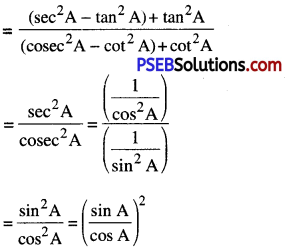
(iv) Consider, \(\frac{1+\tan ^{2} A}{1+\cot ^{2} A}\)

PSEB 10th Class Maths Solutions Chapter 8 Introduction to Trigonometry Ex 8.4 7

= tan2 A.
Option (D) is correct.

Question 5.
Prove the following Identities, where the angles involved are acute angles for which the expressions are defined.
(i) (cosec θ – cot θ) = \(\frac{1-\cos \theta}{1+\cos \theta}\)

(ii) \(\frac{\cos A}{1+\sin A}+\frac{1+\sin A}{\cos A}\) = 2 sec A.

(iii) \(\frac{\tan \theta}{1+\cot \theta}+\frac{\cot \theta}{1-\tan \theta}\) = 1 + sec θ cosec θ
[Hint : Write the expression in terms of sin θ and cos θ]

(iv) \(\frac{1+\sec A}{\sec A}=\frac{\sin ^{2} A}{1-\cos A}\)
[Hint: Simplify L.H.S. and R.H.S. separately]

(v) \(\frac{\cos A-\sin A+1}{\cos A+\sin A-1}\) using the identity cosec2 A = 1 + cot2 A.

(vi) \(\sqrt{\frac{1+\sin A}{1-\sin A}}\) = sec A + tan A

(vii) \(\frac{\sin \theta-2 \sin ^{3} \theta}{2 \cos ^{3} \theta-\cos \theta}\) = tan θ

(viii) (sin A + cosec A)2 + (cos A + sec A)2 = 7 + tan2 A + cot2 A.

(ix) (cosec A – sin A) (sec A – cos A) = \(\frac{1}{\tan A+\cot A}\)
[Hint : Simplify L.H.S. and R.H.S. separately]

(x) \(\left(\frac{1+\tan ^{2} A}{1+\cot A^{2}}\right)=\left(\frac{1-\tan A}{1-\cot A}\right)^{2}\) = tan2 A.

PSEB Solutions PSEB 10th Class Maths Solutions Chapter 8 Introduction to Trigonometry Ex 8.4

Solution:
(i) L.H.S. = (cosec θ – cot θ)2
= \(\left\{\frac{1}{\sin \theta}-\frac{\cos \theta}{\sin \theta}\right\}^{2}\)

= \(\left(\frac{1-\cos \theta}{\sin \theta}\right)^{2}=\frac{(1-\cos \theta)^{2}}{\sin ^{2} \theta}\)
Using identity, sin2 θ + cos2 θ = 1
⇒ sin2 θ = 1 – cos2 θ
= \(\frac{(1-\cos \theta)^{2}}{1-\cos ^{2} \theta}\)
= \(\)
[∵ a2 – b2 = (a + b) (a – b)]

= \(\)

∴ L.H.S. = R.H.S.
Hence, (cosec θ – cot θ)2 = \(\frac{1-\cos \theta}{1+\cos \theta}\)

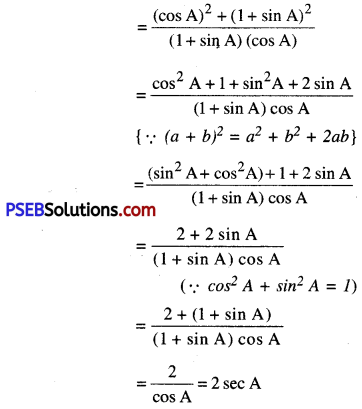
(ii) L.H.S. = \(\frac{\cos A}{1+\sin A}+\frac{1+\sin A}{\cos A}\)

PSEB 10th Class Maths Solutions Chapter 8 Introduction to Trigonometry Ex 8.4 1

= \(\frac{2}{\cos A}\) = cos A
∴L.H.S. = R.H.S.
Hence, \(\frac{\cos A}{1+\sin A}+\frac{1+\sin A}{\cos A}\) = 2 sec A.

PSEB Solutions PSEB 10th Class Maths Solutions Chapter 8 Introduction to Trigonometry Ex 8.4

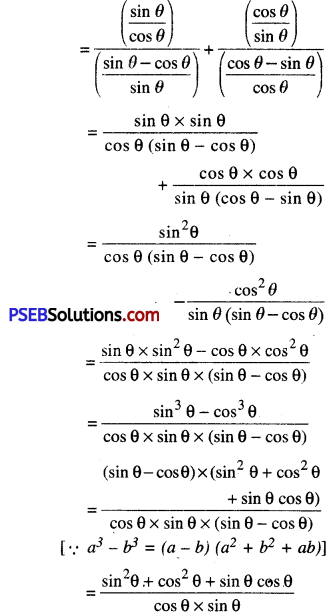
(iii) L.H.S. = \(\frac{\tan \theta}{1+\cot \theta}+\frac{\cot \theta}{1-\tan \theta}\) = 1 + sec θ cosec θ

= \(\frac{\left(\frac{\sin \theta}{\cos \theta}\right)}{\left(1-\frac{\cos \theta}{\sin \theta}\right)}+\frac{\left(\frac{\cos \theta}{\sin \theta}\right)}{\left(1-\frac{\sin \theta}{\cos \theta}\right)}\)

PSEB 10th Class Maths Solutions Chapter 8 Introduction to Trigonometry Ex 8.4 2

= \(\frac{1+\sin \theta \cos \theta}{\cos \theta \sin \theta}=\frac{1}{\cos \theta \sin \theta}+1\)

= 1 + \(\left(\frac{1}{\cos \theta}\right)\left(\frac{1}{\sin \theta}\right)\) = 1 + sec θ cosec θ
∴L.H.S. = R.H.S.
Hence, \(\frac{\tan \theta}{1+\cot \theta}+\frac{\cot \theta}{1-\tan \theta}\) = 1 + sec θ cosec θ

(iv) L.H.S. = \(\frac{1+\sec A}{\sec A}=\frac{\sin ^{2} A}{1-\cos A}\)
= \(\frac{1+\frac{1}{\cos A}}{\frac{1}{\cos A}}\)
= 1 + cos A …………….(1)
R.H.S = \(\frac{\sin ^{2} A}{1-\cos A}\)
(∵ 1 – cos2 A = sin2 A.)
= \(\frac{1-\cos ^{2} A}{1-\cos A}\)

= \(\frac{(1+\cos A)(1-\cos A)}{(1-\cos A)}\)

= 1 + cos A. …………….(2)
From (1) and (2) it is clear that
∴ L.H.S. = R.H.S.
Hence, \(\frac{1+\sec A}{\sec A}=\frac{\sin ^{2} A}{1-\cos A}\).

PSEB Solutions PSEB 10th Class Maths Solutions Chapter 8 Introduction to Trigonometry Ex 8.4

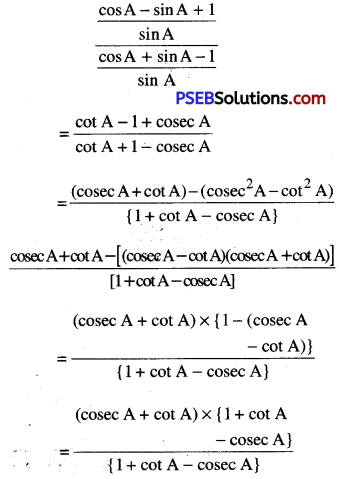
(v) L.H.S. = \(\frac{\cos A-\sin A+1}{\cos A+\sin A-1}\) using the identity cosec2 A

PSEB 10th Class Maths Solutions Chapter 8 Introduction to Trigonometry Ex 8.4 3

= cosec A + cot A
= R.H.S
∴ L.H.S. = R.H.S.
Hence, \(\frac{\cos A-\sin A+1}{\cos A+\sin A-1}\) using the identity cosec2 A = 1 + cot2 A.

(vi) L.H.S. = \(\sqrt{\frac{1+\sin A}{1-\sin A}}\)

= \(\sqrt{\frac{(1+\sin A)(1+\sin A)}{(1-\sin A)(1+\sin A)}}\)

= \(\sqrt{\frac{(1+\sin A)^{2}}{(1)^{2}-(\sin A)^{2}}}\)

= \(\sqrt{\frac{(1+\sin A)^{2}}{1-\sin ^{2} A}}=\sqrt{\frac{(1+\sin A)^{2}}{\cos ^{2} A}}\)

= \(\frac{1+\sin A}{\cos A}=\frac{1}{\cos A}+\frac{\sin A}{\cos A}\)
= sec A + tan A
∴ L.H.S. = R.H.S.
Hence, \(\sqrt{\frac{1+\sin A}{1-\sin A}}\) = sec A + tan A.

PSEB Solutions PSEB 10th Class Maths Solutions Chapter 8 Introduction to Trigonometry Ex 8.4

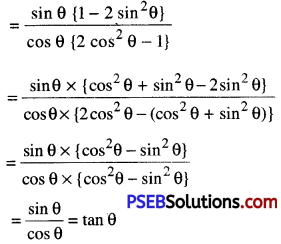
(vii) L.H.S. = \(\frac{\sin \theta-2 \sin ^{3} \theta}{2 \cos ^{3} \theta-\cos \theta}\)

PSEB 10th Class Maths Solutions Chapter 8 Introduction to Trigonometry Ex 8.4 4

∴ L.H.S. = R.H.S.
Hence, \(\frac{\sin \theta-2 \sin ^{3} \theta}{2 \cos ^{3} \theta-\cos \theta}\) = tan θ

(viii) L.H.S. = (sin A + cosec A)2 + (cos A + sec A)2
= (sin2 A + cosec2 A + 2 sin A × cosec A) + {cos2 A + sec2 A
+ 2 cos A × sec A)
= [sin2 A + co2 A + 2sin A × \(\frac{1}{\sin A}\)] + [cos2 A + sec2 A + 2 cosA × \(\frac{1}{\cos A}\)]
= (sin2 A + cosec2 A + 2) + (cos2 A + sec2 A + 2)
= 2 + 2 + (sin2 A + cos2 A) + sec2 A + cosec2 A
= 2 + 2 + 1 + 1 + tan2 A + 1 + cot2 A
= 7 tan2 A + cot2 A
∴ L.H.S. = R.H.S.
Hence, (sin A + cosec A)2 + (cos A + sec A)2 = 7 + tan2 A + cot2 A.

PSEB Solutions PSEB 10th Class Maths Solutions Chapter 8 Introduction to Trigonometry Ex 8.4

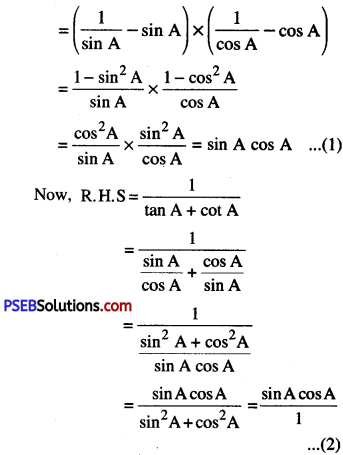
(ix) L.H.S. = (cosec A – sin A) (sec A – cos A)

PSEB 10th Class Maths Solutions Chapter 8 Introduction to Trigonometry Ex 8.4 5

From (1) and (2), it is clear that
L.H.S. = R.H.S.
Hence, (cosec A – sin A) (sec A – cos A) = \(\frac{1}{\tan A+\cot A}\)

(x) \(\left(\frac{1+\tan ^{2} A}{1+\cot A^{2}}\right)\)
(∵ 1 + tan2 A = sec2 A
and 1 + cot2 A = cosec2 A)

PSEB 10th Class Maths Solutions Chapter 8 Introduction to Trigonometry Ex 8.4 6

From (1) and (2), it is clear that
LH.S. = R.H.S.
Hence, \(\left(\frac{1+\tan ^{2} A}{1+\cot A^{2}}\right)=\left(\frac{1-\tan A}{1-\cot A}\right)^{2}\) = tan2 A.

PSEB Solutions PSEB 10th Class Maths Solutions Chapter 8 Introduction to Trigonometry Ex 8.4

PSEB 6th Class Maths MCQ Chapter 11 Ratio and Proportion

Punjab State Board PSEB 6th Class Maths Book Solutions Chapter 11 Ratio and Proportion MCQ Questions with Answers.

PSEB 6th Class Maths Chapter 11 Ratio and Proportion MCQ Questions

Multiple Choice Questions.

Question 1.
The ratio of 24 seconds to 1 minute is :
(a) 2 : 5
(b) 24 : 1
(c) 5 : 2
(d) 1 : 24.
Answer:
(a) 2 : 5

PSEB 6th Class Maths MCQ Chapter 11 Ratio and Proportion

Question 2.
The ratio of 2 m to 75 cm is :
(a) 2 : 75
(b) 75 : 2
(c) 8 : 3
(d) 3 : 8.
Answer:
(c) 8 : 3

Question 3.
The ratio of 1 year to 8 months is :
(a) 2 : 3
(b) 3 : 2
(c) 1 : 8
(d) 8 : 1.
Answer:
(b) 3 : 2

Question 4.
Divide ₹ 40 in 2 : 3.
(a) ₹ 20, ₹ 30
(b) ₹ 24, ₹ 16
(c) ₹ 30, ₹ 20
(d) ₹ 16, ₹ 24.
Answer:
(d) ₹ 16, ₹ 24.

Question 5.
Which of the following is equivalent ratio of 4 : 7.
(a) 28 : 42
(b) 28 : 49
(c) 20 : 49
(d) 20 : 42.
Answer:
(b) 28 : 49

PSEB 6th Class Maths MCQ Chapter 11 Ratio and Proportion

Question 6.
Find a, if 8, a, 40, 65 are in proportion.
(a) 26
(b) 12
(c) 13
(d) 9.
Answer:
(c) 13

Question 7.
Find x if 12, 25, x, 75 are in proportion.
(a) 36
(b) 40
(c) 30
(d) 38.
Answer:
(a) 36

Question 8.
The cost of 12 pens is ₹ 108. Find the cost of 18 such pens.
(a) ₹ 152
(b) ₹ 216
(c) ₹ 162
(d) ₹ 144.
Answer:
(c) ₹ 162

Question 9.
Aslam earns ₹ 1680 in a week. In how many days, he will earn ₹ 2400?
(a) 10
(b) 8
(c) 12
(d) 9.
Answer:
(a) 10

PSEB 6th Class Maths MCQ Chapter 11 Ratio and Proportion

Question 10.
A bus travels 90 km in 2\(\frac {1}{2}\) hours. How much distance it cover in 5 hours?
(a) 100 km
(b) 180 km
(c) 150 km
(d) 120 km.
Answer:
(b) 180 km

Question 11.
Which of the following complete the given figure?
PSEB 6th Class Maths MCQ Chapter 11 Ratio and Proportion 1
(a) 35
(b) 45
(c) 15
(d) 61.
Answer:
(a) 35

Question 12.
Which of the following complete the given blank space?
PSEB 6th Class Maths MCQ Chapter 11 Ratio and Proportion 2
(a) 24
(b) 26
(c) 18
(d) 20.
Answer:
(a) 24

PSEB 6th Class Maths MCQ Chapter 11 Ratio and Proportion

Question 13.
Which of the following complete the given blank space?
PSEB 6th Class Maths MCQ Chapter 11 Ratio and Proportion 3
(a) 7
(b) 3
(c) 2
(d) 4.
Answer:
(c) 2

Question 14.
Which of the following complete the given blank space?
PSEB 6th Class Maths MCQ Chapter 11 Ratio and Proportion 4
(a) 5
(b) 6
(c) 4
(d) 2.
Answer:
(a) 5

Question 15.
Which of the following complete the given blank space?
PSEB 6th Class Maths MCQ Chapter 11 Ratio and Proportion 5
(a) 20
(b) 25
(c) 35
(d) 45.
Answer:
(b) 25

PSEB 6th Class Maths MCQ Chapter 11 Ratio and Proportion

Fill in the blanks:

Question (i)
The length of a room is 30 m and breadth is 20 m. The ratio of length to breadth is …………. .
Answer:
3 : 2

Question (ii)
Sheena has 25 marbles and her friend Shabnam has 30 marbles. The ratio of the marbles Sheena and Shabnam is ……………… .
Answer:
5 : 6

Question (iii)
Ratio of 50 m and 15 m is ………………. .
Answer:
10 : 3

PSEB 6th Class Maths MCQ Chapter 11 Ratio and Proportion

Question (iv)
The comparison by division is known as ……………. .
Answer:
ratio

Question (v)
A ratio is a comparison of ……………. quantities.
Answer:
two

Write True/False:

Question (i)
The comparison by division is called ratio. (True/False)
Answer:
True

PSEB 6th Class Maths MCQ Chapter 11 Ratio and Proportion

Question (ii)
The first and fourth term of a proportion called. Extreme Terms. (True/False)
Answer:
True

Question (iii)
The ratio 18 : 24 in the simplest form is 3 : 4. (True/False)
Answer:
True

Question (iv)
Ratio of 15 minutes to 40 minutes is 8 : 3. (True/False)
Answer:
False

PSEB 6th Class Maths MCQ Chapter 11 Ratio and Proportion

Question (v)
20, 40, 25, 50 are in proportion. (True/False)
Answer:
True

PSEB 6th Class Maths Solutions Chapter 11 Ratio and Proportion Ex 11.3

Punjab State Board PSEB 6th Class Maths Book Solutions Chapter 11 Ratio and Proportion Ex 11.3 Textbook Exercise Questions and Answers.

PSEB Solutions for Class 6 Maths Chapter 11 Ratio and Proportion Ex 11.3

1. The cost of 1 kg apples is ₹ 45. What is the cost of 7 kg apples?
Solution:
Cost of 1 kg apples = ₹ 45
Cost of 7 kg apples = ₹ 45 × 7
= ₹ 315

PSEB 6th Class Maths Solutions Chapter 11 Ratio and Proportion Ex 11.3

2. A car travels 224 km in 7 litres of petrol. How much distance will it cover in 1 litre?
Solution:
Distance covered in 7 litres = 224 km
Distance covered in 1 litres = \(\frac {224}{7}\)
= 32 km

3. A pipe can fill 10 water tanks in 12 hours. How much time will it take to fill 15 such water tanks?
Solution:
Time taken to fill 10 water tanks = 12 hours
Time taken to fill 1 water tank = \(\frac {12}{10}\) hours
Time taken to fill 15 water tanks = \(\frac {12}{10}\) × 15 hours
= 18 hours

4. The cost of 18 m cloth is ₹ 810. What is the cost of 25 m cloth?
Solution:
Cost of 18 m cloth = ₹ 810
Cost of 1 m cloth = ₹ \(\frac {810}{18}\)
Cost of 25 m cloth = ₹ \(\frac {810}{18}\) × 25
= ₹ 1125

PSEB 6th Class Maths Solutions Chapter 11 Ratio and Proportion Ex 11.3

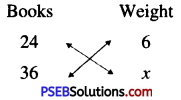
5. The weight of 24 books is 6 kg. What is the weight of 36 such books?
Solution:
Weight of 24 books = 6 kg
Weight of 1 book = \(\frac {6}{24}\) kg
Weight of 36 books = \(\frac {6}{24}\) × 36 kg
= 9 kg

Aliter:
PSEB 6th Class Maths Solutions Chapter 11 Ratio and Proportion Ex 11.3 1

By cross product, we have
24 × x = 6 × 36
x = \(\frac{6 \times 36}{24}\)
⇒ x = 9
Hence, weight of 36 books is 9 kg

6. ‘A’ runs 28 km in 5 hours. How many kilometres does it run in 9 hours?
Solution:
A runs in 5 hours = 28 km
A runs in 1 hour = \(\frac {28}{5}\) km
A runs in 9 hours= \(\frac {28}{5}\) × 9 km
= \(\frac {252}{5}\) km
50.4 km

7. A 12 m high pole casts a shadow of 30 m. Find the height of the pole that casts a shadow of 45 m.
Solution:
If shadow cast is 30 m, then height of Pole = 12 m
If shadow cast is 1 m, then height of Pole = \(\frac {12}{30}\) m
If shadow cast is 45 m, then height of Pole
= \(\frac {12}{30}\) × 45 m
= 18 m

PSEB 6th Class Maths Solutions Chapter 11 Ratio and Proportion Ex 11.3

8. A man earns ₹ 11200 in 7 months.

Question (i)
How much will he earn in 18 months?
Solution:
A man earns in 7 months = ₹ 11200
A man earns in 1 month = ₹ \(\frac {11200}{7}\)
A man earns in 18 months = ₹ \(\frac {11200}{7}\) × 18
= ₹ 28800

Question (ii)
In how many months will he earn ₹ 40,000?
Solution:
A man earns ₹ 1600 = 1 month
A man earns ₹ 40000 = \(\frac {1}{1600}\) × 40000
= 25 months

9. If the cost of a dozen soaps is ₹ 153.60. What will be the cost of 16 such soaps?
Solution:
Cost of 12 soaps = ₹ 153.60
(1 dozen =12 pieces)
Cost of 1 soap = ₹ \(\frac {153.60}{12}\)
Cost of 16 soap = ₹ \(\frac {153.60}{12}\) × 16
= ₹ 204.80

PSEB 6th Class Maths Solutions Chapter 11 Ratio and Proportion Ex 11.3

10. Cost of 105 envelops is ₹ 35. How many envelops can be purchased for ₹ 10?
Solution:
Number of envelops purchased for ₹ 35 = 105
Number of envelops purchased for ₹ 1 = \(\frac {105}{35}\)
Number of envelops purchased for ₹ 10 = \(\frac {105}{35}\) × 10
= 30

11. A bus travels 90 km in 2\(\frac {1}{2}\) hours.

Question (i)
How much time is required to cover 54 km with the same speed?
Solution:
Time required to cover 90 km
= 2\(\frac {1}{2}\) hours
= \(\frac {5}{2}\) hours
Time required to cover 1 km
= \(\frac{5}{2} \times \frac{1}{90}\) hours
Time required to cover 54 km
= \frac{5}{2} \times \frac{1}{90} × 54 hours
= \(\frac {3}{2}\) hours
= 1\(\frac {1}{2}\) hours

Question (ii)
Find the distance covered in 4 hours with the same speed?
Solution:
Distance covered in \(\frac {5}{2}\) hours
= 90 km
Distance covered 1 hour
= 90 × \(\frac {2}{5}\) km
Distance covered 4 hours
= 4 × 90 × \(\frac {2}{5}\) km
= 144 km

PSEB 6th Class Maths Solutions Chapter 11 Ratio and Proportion Ex 11.3

12. Anshul made 57 runs in 6 overs. In how many overs he made 95 runs with same strike rate?
Solution:
Number of overs to make 57 runs = 6 overs
Number of overs to make 1 run = \(\frac {6}{57}\) over
Number of overs to make 95 runs = \(\frac {6}{57}\) × 95 overs
= 10 overs

13. Cost of 5 kg rice is ₹ 32.50.

Question (i)
What will be the cost of 14 kg such rice?
Solution:
Cost of 5 kg rice = ₹ 32.50
Cost of 1 kg rice = ₹ \(\frac {32.50}{5}\)
Cost of 14 kg rice = ₹ \(\frac {32.50}{5}\) × 14
= ₹ 91

Question (ii)
What quantity of rice can be purchased in ₹ 162.50?
Solution:
Qunatity of rice for ₹ 32.50 = 5 kg
Qunatity of rice for ₹ 1 = \(\frac {5}{32.50}\) kg
Qunatity of rice for ₹ 162.50 = \(\frac {5}{32.50}\) × 162.50
= 25 kg

PSEB 6th Class Maths Solutions Chapter 11 Ratio and Proportion Ex 11.3

14. If a cow grazes 21 sq. m of a field in 6 days. How much area will it graze in 27 days?
Solution:
Field grazed in 6 days = 21 sq. m
Field grazed in 1 day = \(\frac {21}{6}\) sq. m
Field grazed in 27 days = \(\frac {21}{6}\) × 27 sq. m
= 94.5 sq. m

PSEB 6th Class Maths Solutions Chapter 11 Ratio and Proportion Ex 11.2

Punjab State Board PSEB 6th Class Maths Book Solutions Chapter 11 Ratio and Proportion Ex 11.2 Textbook Exercise Questions and Answers.

PSEB Solutions for Class 6 Maths Chapter 11 Ratio and Proportion Ex 11.2

1. Determine if the following are in proportion:

Question (i)
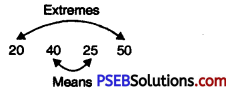
20, 40, 25, 50
Solution:
Yes,
PSEB 6th Class Maths Solutions Chapter 11 Ratio and Proportion Ex 11.2 1
Product of Extremes = 20 × 50 = 1000
Product of Means = 40 × 25 = 1000
∴ Product of Extremes = Product of Means
Hence, 20, 40, 25, 50 are in proportion.

PSEB 6th Class Maths Solutions Chapter 11 Ratio and Proportion Ex 11.2

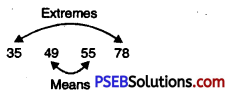
Question (ii)
35, 49, 55, 78
Solution:
No,
PSEB 6th Class Maths Solutions Chapter 11 Ratio and Proportion Ex 11.2 2
Product of Extremes = 35 × 78 = 2730
Product of Means = 49 × 55 = 2695
∴ Product of Extremes ≠ Product of Means
Hence, 35, 49, 55, 78 are not in proportion

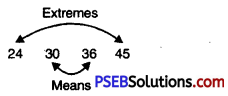
Question (iii)
24, 30, 36, 45
Solution:
Yes,
PSEB 6th Class Maths Solutions Chapter 11 Ratio and Proportion Ex 11.2 3
Product of Extremes = 24 × 45 = 1080
Product of Means = 30 × 36 = 1080
Since Product of Extremes = Product of Means
Hence, 24, 30,36,45 are in proportion

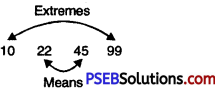
Question (iv)
10, 22, 45, 99
Solution:
Yes,
PSEB 6th Class Maths Solutions Chapter 11 Ratio and Proportion Ex 11.2 4
Product of Extremes = 10 × 99 = 990
Product of Means = 22 × 45 = 990
∴ Product of Extremes = Product of Means
Hence, 10,22,45,99 are in proportion

PSEB 6th Class Maths Solutions Chapter 11 Ratio and Proportion Ex 11.2

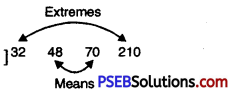
Question (v)
32, 48, 70, 210.
Solution:
No,
PSEB 6th Class Maths Solutions Chapter 11 Ratio and Proportion Ex 11.2 5
Product of Extremes = 32 × 210 = 6720
Product of Means = 48 × 70 = 3360
Since Product of Extremes ≠ Product of Means
Hence, 32, 48, 70, 210 are not in proportion.

2. Do the following ratios forms a proportion:

Question (i)
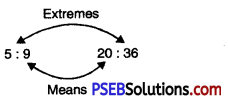
5:9 and 20 : 36
Solution:
Yes,
PSEB 6th Class Maths Solutions Chapter 11 Ratio and Proportion Ex 11.2 6
Product of Extremes = 5 × 36 = 180
Product of Means = 9 × 20 = 180
Since Product of Extremes = Product of Means
Hence, 5 : 9 and 20 : 36 are in proportion

PSEB 6th Class Maths Solutions Chapter 11 Ratio and Proportion Ex 11.2

Question (ii)
24 : 36 and 32 : 48
Solution:
Yes,
First ratio = 24 : 36 (Dividing both terms by 12) = 2 : 3
Second ratio = 32 : 48 (Dividing both terms by 16) = 2 : 3
∴ Both ratios are equal.
Hence, 24 : 36 and 32 : 48 are in proportion

Question (iii)
32 : 40 and 36 : 42
Solution:
No,
First ratio = 32 : 40 (Dividing both terms by 8) = 4 : 5
Second ratio = 36 : 42 (Dividing both terms by 6) = 6 : 7
∴ Both ratios are not equal.
Hence, 32 : 40 and 36 : 42 are not in proportion

Question (iv)
27 : 18 and 3:2
Solution:
Yes,
First ratio = 27 : 18 (Dividing both terms by 9) = 3 : 2
Second ratio = 3 : 2
∴ Both ratios are equal.
Hence, 27 : 18 and 3 : 2 are in proportion

PSEB 6th Class Maths Solutions Chapter 11 Ratio and Proportion Ex 11.2

Question (v)
35 : 28 and 77 : 44.
Solution:
No,
First ratio = 35 : 28 (Dividing both terms by 7) = 5 : 4
Second ratio = 77 : 44 (Dividing both terms by 11) = 7 : 4
∴ Both ratios are not equal.
Hence, 35 : 28 and 77 : 44 are not in proportion.

3. State true or false of the following:

Question (i)
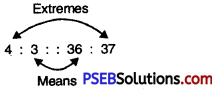
4 : 3 : : 36 : 37
Solution:
False,
PSEB 6th Class Maths Solutions Chapter 11 Ratio and Proportion Ex 11.2 7
Product of Extremes = 4 × 37 = 148
Product of Means = 3 × 36 = 108
∴ Product of Extremes ≠ Product of Means
Hence, it is false.

Question (ii)
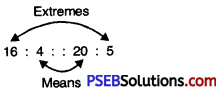
16 : 4 : : 20 : 5
Solution:
True,
PSEB 6th Class Maths Solutions Chapter 11 Ratio and Proportion Ex 11.2 8
Product of Extremes = 16 × 5 = 80
Product of Means = 4 × 20 = 80
∴ Product of Extremes = Product of Means
Hence, it is true

Question (iii)
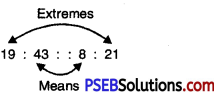
19 : 43 : : 8 : 21.
Solution:
False,
PSEB 6th Class Maths Solutions Chapter 11 Ratio and Proportion Ex 11.2 9
Product of Extremes = 19 × 21 = 399
Product of Means = 43 × 8 = 344
∴ Product of Extremes ≠ Product of Means
Hence, it is false.

PSEB 6th Class Maths Solutions Chapter 11 Ratio and Proportion Ex 11.2

4. Determine if the following ratios form a proportion:

Question (i)
40 cm : 1 m and ₹ 12 : ₹ 30
Solution:
Yes,
First ratio = 40 cm : 1 m
= 40 : 100
(Dividing both terms by 20) = 2:5
Second ratio = ₹ 12 : ₹ 30
= 12 : 30
(Dividing both terms by 6) = 2:5
∴ Both ratios are equal.
Hence, 40 cm : 1 m and ₹ 12 : ₹ 30 are in proportion.

Question (ii)
25 min : 1 hour and 40 km : 96 km
Solution:
Yes,
First ratio = 25 min : 1 hour
= 20 min : 60 min
= 25 : 60
(Dividing both terms by 5) = 5 : 12
Second ratio = 40 km : 96 km
= 40 : 96
(Dividing both terms by 8) = 5 : 12
∴ First ratio = Second ratio
Hence, 25 min : 1 hour and 40 km : 96 km are in proportion.

PSEB 6th Class Maths Solutions Chapter 11 Ratio and Proportion Ex 11.2

Question (iii)
₹ 4 : 35 paise and 8 kg : 9 kg.
Solution:
No,
First ratio = ₹ 4 : 35 paise
= 400 paise : 35 paise
= 400 : 35
(Dividing both terms by 5)
= 80 : 7
Second ratio = 8 kg : 9 kg
= 8 : 9
∴ First ratio ≠ Second ratio
Hence, ₹ 4 : 35 paise and 8 kg : 9 kg are not in proportion.

5. Find the value of ‘x’ in each case:

Question (i)
25 : x :: 15 : 6
Solution:
Since, given terms are in proportion
∴ Product of Extremes = Product of Means
⇒ 25 × 6 = x × 15
⇒ \(\frac{25 \times 6}{15}\) = x
⇒ x = 10

Question (ii)
28 : 49 :: x : 56
Solution:
28 : 49 : : x : 56
Since, given terms are in proportion
∴ Product of Extremes = Product of Means
⇒ 28 × 56 = 49 × x
⇒ \(\frac{28 \times 56}{49}\) = x
⇒ x = 32

PSEB 6th Class Maths Solutions Chapter 11 Ratio and Proportion Ex 11.2

Question (iii)
8 : 20 :: 10 : x.
Solution:
8 : 20 : : 10 : x
Since, given terms are in proportion
∴ Product of Extremes = Product of Means
⇒ 8 × x = 20 × 10
⇒ x = \(\frac{20 \times 10}{8}\)
⇒ x = 25

6. Check if the following terms are in continued proportion:

Question (i)
1, 4, 16
Solution:
For continued proportion, 1, 4, 16 can be written as 1, 4, 4, 16
∴ Product of Extremes = 1 × 16 = 16
Product of Means = 4 × 4 = 16
∴ Product of Extremes = Product of Means
Hence, 1, 4, 16 are in continued proportion

Question (ii)
3, 9, 27
Solution:
For continued proportion, 3, 9, 27 can be written as 3, 9, 9, 27
∴ Product of Extremes = 3 × 27 = 81
∴ Product of Means =9 × 9 = 81
∴ Product of Extremes = Product of Means
Hence, 3, 9, 27 are in continued proportion.

PSEB 6th Class Maths Solutions Chapter 11 Ratio and Proportion Ex 11.2

Question (iii)
5, 10, 20.
Solution:
For continued proportion, 5, 10, 20 can be written as 5, 10, 10, 20
∴ Product of Extremes = 5 × 20 = 100
∴ Product of Means = 10 × 10 = 100
∴ Product of Extremes = Product of Means
Hence, 5, 10, 20 are in continued proportion.

PSEB 8th Class Maths Solutions Chapter 2 Linear Equations in One Variable Ex 2.1

Punjab State Board PSEB 8th Class Maths Book Solutions Chapter 2 Linear Equations in One Variable Ex 2.1 Textbook Exercise Questions and Answers.

PSEB Solutions for Class 8 Maths Chapter 2 Linear Equations in One Variable Ex 2.1

Solve the following equations.

Question 1.
x – 2 = 7
Solution:
x – 2 = 7
∴ x = 7 + 2 (Transposing – 2 to RHS)
∴ x = 9

Question 2.
y + 3 = 10
Solution:
y + 3 = 10
∴ y = 10 – 3 (Transposing 3 to RHS)
∴ y = 7

Question 3.
6 = z + 2
Solution:
6 = z + 2
∴ z + 2 = 6 (Interchanging both the sides)
∴ z = 6 – 2 (Transposing 2 to RHS)
∴ z = 4.

Question 4.
\(\frac {3}{7}\) + x = \(\frac {17}{7}\)
Solution:
\(\frac {3}{7}\) + x = \(\frac {17}{7}\)
∴ x = \(\frac{17}{7}-\frac{3}{7}\) (Transposing \(\frac {3}{7}\) to RHS)
∴ x = \(\frac{17-3}{7}\)
∴ x = \(\frac {14}{7}\)
∴ x = 2

Question 5.
6x = 12
Solution:
6x = 12
∴ \(\frac{6 x}{6}=\frac{12}{6}\) (Dividing both the sides by 6)
∴ x = 2

PSEB 8th Class Maths Solutions Chapter 2 Linear Equations in One Variable Ex 2.1

Question 6.
\(\frac{t}{5}\) = 10
Solution:
\(\frac{t}{5}\) = 10
∴ \(\frac{t}{5}\) × 5 = 10 × 5 (Multiplying both the sides by 5)
∴ t = 50

Question 7.
\(\frac{2 x}{3}\) = 15
Solution:
\(\frac{2 x}{3}\) = 15
∴ \(\frac{2 x}{3} \times \frac{3}{2}=18 \times \frac{3}{2}\) (Multiplying both the sides by \(\frac {3}{2}\))

Question 8.
1.6 = \(\frac{y}{1.5}\)
Solution:
1.6 = \(\frac{y}{1.5}\)
∴ 1.6 × 1.5 = \(\frac{y}{1.5}\) × 1.5 (Multiplying both the sides by 1.5)
∴ 2.4 = y (∵ 1.6 × 1.5 = 2.4)
∴ y = 2.4

Question 9.
7x – 9 = 16
Solution:
7x – 9 = 16
∴ 7x = 16 + 9 (Transposing – 9 to RHS)
∴ 7x = 25
∴ \(\frac{7 x}{7}=\frac{25}{7}\) (Dividing both the sides by 7)
∴ x = \(\frac {25}{7}\)

Question 10.
14y – 8 = 13
Solution:
14y – 8 = 13
∴ 14y = 13 + 8 (Transposing – 8 to RHS)
∴ 14y = 21
∴ \(\frac{14 y}{14}=\frac{21}{14}\) (Dividing both the sides by 14)
∴ y = \(\frac{7 \times 3}{7 \times 2}\)
∴ y = \(\frac {3}{2}\)

PSEB 8th Class Maths Solutions Chapter 2 Linear Equations in One Variable Ex 2.1

Question 11.
17 + 16p = 9
Solution:
17 + 16p = 9
∴ 6p = 9 – 17 (Transposing 17 to RHS)
∴ 6p = -8
∴ \(\frac{6 p}{6}=\frac{-8}{6}\) (Dividing both the sides by 6)
∴ p = \(\frac{-4 \times 2}{3 \times 2}\)
∴ p = –\(\frac {4}{3}\)

Question 12.
\(\frac{x}{3}+1=\frac{7}{15}\)
Solution:
\(\frac{x}{3}+1=\frac{7}{15}\)
∴ \(\frac{x}{3}=\frac{7}{15}-1\) (Transposing 1 to RHS)
∴ \(\frac{7-15}{15}\) (LCM = 15)
∴ \(\frac{x}{3}=\frac{-8}{15}\)
∴ \(\frac{x}{3} \times 3=\frac{-8}{15} \times 3\) (Multiplying both the sides by 3)
∴ x = –\(\frac {8}{5}\)

PSEB 6th Class Maths Solutions Chapter 10 Practical Geometry Ex 10.4

Punjab State Board PSEB 6th Class Maths Book Solutions Chapter 10 Practical Geometry Ex 10.4 Textbook Exercise Questions and Answers.

PSEB Solutions for Class 6 Maths Chapter 10 Practical Geometry Ex 10.4

1. Draw a circle of the following radius:

Question (i)
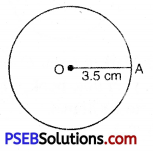
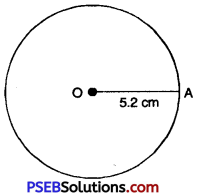
3.5 cm
Solution:
Steps of construction.
PSEB 6th Class Maths Solutions Chapter 10 Practical Geometry Ex 10.4 1
1. Mark a point O on the page of your note book, where a circle is to be drawn.
2. Take compasses fixed with sharp pencil and measure OA = 3.5 cm using a scale.
3. Without changing the opening of the compasses, keep the needle at point O and draw a complete arc by holding the compasses from its knob, we get the required circle.

PSEB 6th Class Maths Solutions Chapter 10 Practical Geometry Ex 10.4

Question (ii)
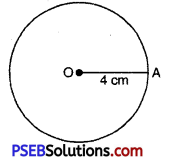
4 cm
Solution:
Steps of construction.
PSEB 6th Class Maths Solutions Chapter 10 Practical Geometry Ex 10.4 2
1. Mark a point O on the page of your note book, where a circle is to be drawn.
2. Take compasses fixed with sharp pencil and measure OA = 4 cm using a scale.
3. Without changing the opening of the compasses, keep the needle at point O and draw a complete arc by holding the compasses from its knob.

Question (iii)
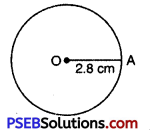
2.8 cm
Solution:
Steps of construction
PSEB 6th Class Maths Solutions Chapter 10 Practical Geometry Ex 10.4 3
1. Mark a point O on the page of your note book, where a circle is to be drawn.
2. Take compasses fixed with sharp pencil and measures OA = 2.8 cm using a scale.
3. Without changing the opening of the compasses, keep the needle at point O and draw a complete arc by holding the compasses from its knob, we get the required circle.

PSEB 6th Class Maths Solutions Chapter 10 Practical Geometry Ex 10.4

Question (iv)
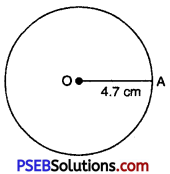
4.7 cm
Solution:
Steps of construction
PSEB 6th Class Maths Solutions Chapter 10 Practical Geometry Ex 10.4 4
1. Mark a point O on the page of your note book.
2. Take compasses fixed with sharp pencil and measures OA = 4.7 cm using a scale.
3. Without changing the opening of the compasses, keep the needle at point O and draw a complete arc by holding the compasses from its knob, we get the required circle.

Question (v)
5.2 cm.
Solution:
Steps of construction
PSEB 6th Class Maths Solutions Chapter 10 Practical Geometry Ex 10.4 5
1. Mark a point O on the page of your note book.
2. Take compasses fixed with sharp pencil and measures OA = 5.2 cm using a scale.
3. Without changing the opening of the compasses, keep the needle at point O and draw a complete arc by holding the compasses from its knob, we get the required circle.

PSEB 6th Class Maths Solutions Chapter 10 Practical Geometry Ex 10.4

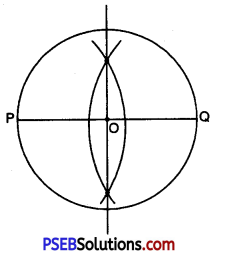
2. Draw a circle of diameter 6 cm.
Solution:
Steps of construction
PSEB 6th Class Maths Solutions Chapter 10 Practical Geometry Ex 10.4 6
1. Draw a line segment PQ = 6 cm.
2. Draw the perpendicular bisector of PQ intersecting PQ at O.
3. With O as centre and radius = OQ = 3 cm (= OP), draw a circle.
The circle thus drawn is the required circle.

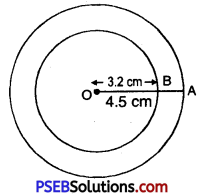
3. With the same centre O, draw two concentric circles of radii 3.2 cm and 4.5 cm.
Solution:
Steps of Construction
PSEB 6th Class Maths Solutions Chapter 10 Practical Geometry Ex 10.4 7
1. Mark a point O on the page of your note book, where a circle is drawn.
2. Take compasses fixed with sharp pencil measuring OA = 4.5 cm using scale.
3. Without changing the opening of the compasses, keep the needle at point O and draw complete arc by holding the compasses from its knob.
After completing one round, we get circle I.
4. Again with the same centre O and new radius = 3.2 cm draw another circle II following the same step 3.

PSEB 6th Class Maths Solutions Chapter 10 Practical Geometry Ex 10.4

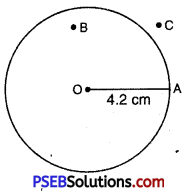
4. Draw a circle of radius 4.2 cm with centre at O. Mark three points A, B and C such that point A is on the circle, B is in the interior and C is in the exterior of the circle.
Solution:
Steps of Construction
PSEB 6th Class Maths Solutions Chapter 10 Practical Geometry Ex 10.4 8
1. Mark a point O on the page of your note book, where a circle is to be drawn
2. Take compasses fixed with sharp pencil and measure OA = 4.2 cm using scale (∴ A is on the circle).
3. Without changing the opening of the compasses, keep the needle at point O and draw complete arc by rotating the compasses from the knob. After completing one round, we get required circle.
4. Mark point B in the interior of the circle and point C in the exterior of the circle.

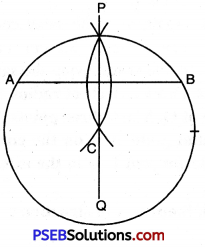
5. Draw a circle of radius 3 cm and draw any chord. Draw the perpendicular bisector of the chord. Does the perpendicular bisector passes through the centre?
Solution:
Steps of Construction.
PSEB 6th Class Maths Solutions Chapter 10 Practical Geometry Ex 10.4 9
1. Draw a circle with C as centre and radius 3 cm.
2. Draw AB the chord of the circle.
3. Draw PQ the perpendicular bisector of chord AB.
4. We see that the perpendicular bisector of chord AB passes through the centre C of the circle.

PSEB 6th Class Maths Solutions Chapter 10 Practical Geometry Ex 10.3

Punjab State Board PSEB 6th Class Maths Book Solutions Chapter 10 Practical Geometry Ex 10.3 Textbook Exercise Questions and Answers.

PSEB Solutions for Class 6 Maths Chapter 10 Practical Geometry Ex 10.3

1. Draw a line r and mark a point P on it. Construct a line perpendicular to r at point P.

Question (i)
Using a ruler and compasses.
Solution:
Using ruler and compasses

Steps of Construction.

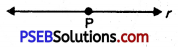
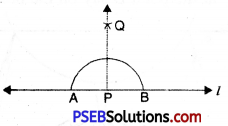
1. Draw a line r and mark a point P on it.
PSEB 6th Class Maths Solutions Chapter 10 Practical Geometry Ex 10.3 1
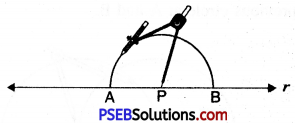
2. Draw an arc from P to the line r of any suitable radius which intersects line r at A and B.
PSEB 6th Class Maths Solutions Chapter 10 Practical Geometry Ex 10.3 2
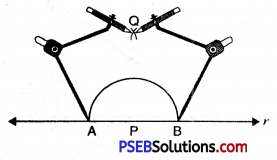
3. Draw arcs of any radius which is more than half of arc made in step (2) from A and B which intersect at Q.
PSEB 6th Class Maths Solutions Chapter 10 Practical Geometry Ex 10.3 3
4. Join PQ.
PSEB 6th Class Maths Solutions Chapter 10 Practical Geometry Ex 10.3 4
Thus PQ is perpendicular to AB or line l or PQ ⊥ A.
Here P is called foot of perpendicular.

PSEB 6th Class Maths Solutions Chapter 10 Practical Geometry Ex 10.3

Question (ii)
Using a ruler and a set square.
Solution:
Using a ruler and a set square

Steps of Construction

1. Draw a line r and a point P on it.
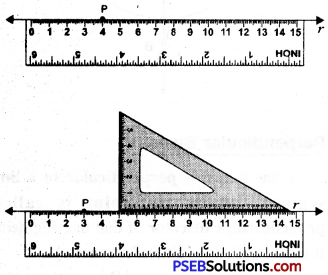
2. Place one of the edges of a ruler along the line l and hold if firmly.
PSEB 6th Class Maths Solutions Chapter 10 Practical Geometry Ex 10.3 5
3. Place the set square in such a way that one of its edges contaning the right angle coincides with the ruler.
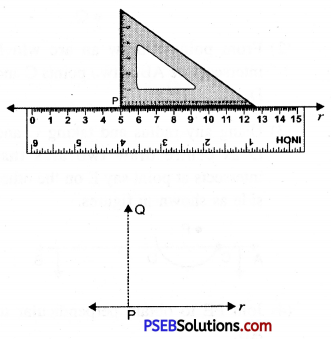
4. Holding the ruler, slide the set square along the line l till the vertical side reaches the point P.
PSEB 6th Class Maths Solutions Chapter 10 Practical Geometry Ex 10.3 6
5. Firmly hold the set square in this position. Draw PQ along its vertical edge. Now PQ is the required perpendicular to l ie. PQ ⊥ r.

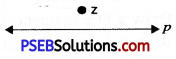
2. Draw a line p and mark a point z above it. Construct a line perpendicular to p, from the point z.

Question (i)
Using a ruler and compasses.
Solution:
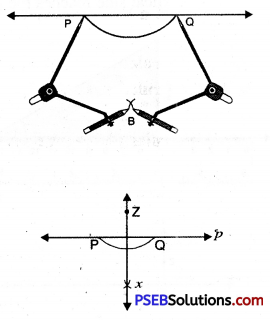
1. Draw a line p and mark a point z not lying on it.
2. From point z draw an arc which intersects line p at two points P and Q.
PSEB 6th Class Maths Solutions Chapter 10 Practical Geometry Ex 10.3 7
PSEB 6th Class Maths Solutions Chapter 10 Practical Geometry Ex 10.3 8
3. Using any radius and taking P and Q as centre, draw two arcs that intersect at point say B. On the other side (a shown in figure).
4. Join AB to obtain altitude to the line p.
PSEB 6th Class Maths Solutions Chapter 10 Practical Geometry Ex 10.3 9
Thus xz is altitude to line p.
i.e. xz ⊥ p.

PSEB 6th Class Maths Solutions Chapter 10 Practical Geometry Ex 10.3

Question (ii)
Using a ruler and set square
Solution:
Steps of constructions:
1. Draw a line p and mark a point z which is not lying on it.
2. Place one of the edge of a ruler along the line p and hold it firmly.
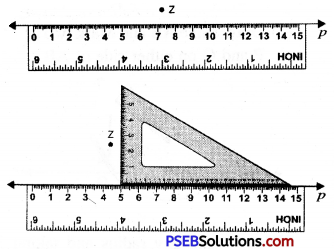
PSEB 6th Class Maths Solutions Chapter 10 Practical Geometry Ex 10.3 10
3. Place the set square in such a way that one of its edges containing the right angle coincides with the ruler.
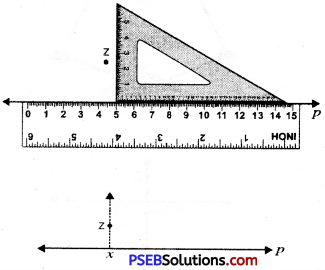
4. Holding the ruler firmly, slide the set square along the line p till its vertical side reaches the point z.
PSEB 6th Class Maths Solutions Chapter 10 Practical Geometry Ex 10.3 11
5. Firmly hold the set square in this position, Draw xz along its vertical edge. Now xz is the required altitude to p i.e. xz ⊥ p.

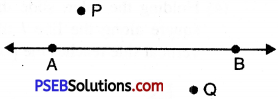
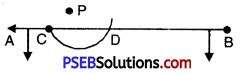
3. Draw a line AB and mark two points P and Q on either side of line AB, Construct two lines perpendicular to AB, from P and Q using a ruler and compasses.
Solution:
1. Draw a line AB and Mark two points P and Q on either side of AB.
PSEB 6th Class Maths Solutions Chapter 10 Practical Geometry Ex 10.3 12
2. From point P draw an arc which intersect line AB at two points C and D.
3. Using any radius and taking C and D as centre draw two arcs that intersects at point say E on the other side as shown in figures.
PSEB 6th Class Maths Solutions Chapter 10 Practical Geometry Ex 10.3 13
4. Join PE to obtain perpendicular to AB.
5. From point Q draw an arc which intersects AB at two points X and Y.
PSEB 6th Class Maths Solutions Chapter 10 Practical Geometry Ex 10.3 14
6. Using any radius and taking X and Y as centre draw two arcs that intersects at point say R on the other side of line AB as shown in figures.
7. Join QR to obtain perpendicular to AB.
Thus, PE ⊥ AB and QR ⊥ AB

PSEB 6th Class Maths Solutions Chapter 10 Practical Geometry Ex 10.3

4. Draw a line segment of 7 cm and draw perpendicular bisector of this line segment.
Solution:
Steps of Construction:
1. Draw a line segment AB = 7 cm.
2. With A as centre and radius more than half of AB, draw an arc on both sides of AB.
PSEB 6th Class Maths Solutions Chapter 10 Practical Geometry Ex 10.3 15
3. With B as centre and the same radius as in step 2, draw an arc intersecting the first arc at C and D.
4. Join CD intersecting AB at O. Then CD is the perpendicular bisector of AB.

5. Draw a line segment PQ = 6.8 cm and draw its perpendicular bisector XY which bisect PQ at M. Find the length of PM and QM. Is PM = QM ?
Solution:
Steps of Construction:

1. Draw a line segment PQ = 6.8 cm
2. With P as centre and radius more than half of PQ draw arcs on both sides of PQ.
PSEB 6th Class Maths Solutions Chapter 10 Practical Geometry Ex 10.3 16
3. Now with Q as centre and the same radius as in step 2 draw arcs intersecting the previous drawn arcs at A and B respectively.
4. Join AB intersecting PQ at M. Then M bisects the line segment.
5. Measure the length of PM and QM
PM = 3.4 cm and QM = 3.4 cm
∴ PM = QM.
PSEB 6th Class Maths Solutions Chapter 10 Practical Geometry Ex 10.3 17

PSEB 6th Class Maths Solutions Chapter 10 Practical Geometry Ex 10.3

6. Draw perpendicular bisector of line segment AB = 5.4 cm. Mark point X anywhere on perpendicular bisector Join X with A and B. Is AX = BX ?
Solution:
Steps of construction.
1. Draw a line segment AB = 5.4 cm.
2. With A as centre and radius more than half of AB, draw an arc in both sides of AB.
PSEB 6th Class Maths Solutions Chapter 10 Practical Geometry Ex 10.3 18
3. With B as centre and the same radius as in step 2, draw an arc intersecting the first arc at C and D.
4. Join CD intersecting AB at O.
Then CD is the perpendicular bisector of AB.
Mark any point X on the perpendicular bisector CD. Drawn. Then join AX and BX.
On examination, we find that AX = BX.

7. Draw perpendicular bisectors of line segment of the following lengths.

Question (i)
8.2 cm
Solution:
Steps of Construction.
1. Draw a line regment AB = 8.2 cm
PSEB 6th Class Maths Solutions Chapter 10 Practical Geometry Ex 10.3 19
2. With A as centre and radius more than half of AB, draw arcs on both sides of AB.
3. With B as centre and the same radius as in step 2, draw an arcs intersecting the previous arc at C and D.
4. Join CD intersecting AB at O. Then CD is the perpendicular bisector of AB.

PSEB 6th Class Maths Solutions Chapter 10 Practical Geometry Ex 10.3

Question (ii)
7.8 cm
Solution:
Steps of Construction.

1. Draw a line segment AB = 7.8 cm
PSEB 6th Class Maths Solutions Chapter 10 Practical Geometry Ex 10.3 20
2. With A as centre and radius more than half of AB draw arcs on both sides of AB.
3. With B as centre and the same radius as in step 2, draw arcs intersecting the previous arcs at C and D.
4. Join CD intersecting AB at O. Then CD is the perpendicular bisector of AB.

Question (iii)
6.5 cm.
Solution:
Steps of Construction.
1. Draw a line segment AB = 6.5 cm
PSEB 6th Class Maths Solutions Chapter 10 Practical Geometry Ex 10.3 21
2. With A as centre and radius more than half of AB draw arcs on both sides of AB.
3. With B as centre and the same radius as in step 2 draw arcs intersecting the previous arcs at C and D.
4. Join CD intersecting AB at O. Then CD is the perpendicular bisector of AB.

PSEB 6th Class Maths Solutions Chapter 10 Practical Geometry Ex 10.3

8. Draw a line segment of length 8 cm and divide it into four equal parts Using compasses. Measure each part.
Solution:
Steps of construction.
PSEB 6th Class Maths Solutions Chapter 10 Practical Geometry Ex 10.3 22
1. Draw a line segment AB of length 8 cm
2. With A as centre and radius more than half of AB, draw arcs on both sides of AB.
3. With B as centre and the same radius as in step 2, draw arcs intersecting the previous arcs at P and Q.
4. Join PQ intersecting AB at C then PQ is the perpendicular bisector of AB intersecting AB at C.
5. Similarly draw the perpendicular bisector of AC intersecting AC at D.
6. Draw the perpendicular bisector of CB intersecting CB at E.
By actual measurement, it can be verified that
AD = DC = CE = EB

PSEB 10th Class Maths Solutions Chapter 8 Introduction to Trigonometry Ex 8.3

Punjab State Board PSEB 10th Class Maths Book Solutions Chapter 8 Introduction to Trigonometry Ex 8.3 Textbook Exercise Questions and Answers.

PSEB Solutions for Class 10 Maths Chapter 8 Introduction to Trigonometry Ex 8.3

Question 1.
Evaluate:
(i) \(\frac{\sin 18^{\circ}}{\cos 72^{\circ}}\)
(ii) \(\frac{\tan 26^{\circ}}{\cot 64^{\circ}}\)
(iii) cos 48° – sin 42°
(iv) cosec 31° – sec 59°.
Solution.
(i) \(\frac{\sin 18^{\circ}}{\cos 72^{\circ}}\)
= \(\frac{\sin 18^{\circ}}{\cos \left(90^{\circ}-18^{\circ}\right)}\)
= \(\frac{\sin 18^{\circ}}{\sin 18^{\circ}}\) = 1
[∵ cos (90° – θ) = sin θ]

(ii) \(\frac{\tan 26^{\circ}}{\cos 64^{\circ}}=\frac{\tan 26^{\circ}}{\cot \left(90^{\circ}-26^{\circ}\right)}\)
= \(\frac{\tan 26^{\circ}}{\tan 26^{\circ}}\) = 1
[∵ cot (90°- θ) = tan θ]

(iii) cos 48° – sin 42°
= cos (90° – 42°) – sin 42°
[∵ cos (90° – 0) = sin O]
= sin 42° – sin 42° = 0.

(iv) cosec 31° – sec 59°
=cosec 31° – sec (90° – 31°)
= cosec 31° – cosec 31°
[∵ sec (90° – θ) = cosec θ].

PSEB Solutions PSEB 10th Class Maths Solutions Chapter 8 Introduction to Trigonometry Ex 8.3

Question 2.
Show that:
(i) tan 4 tan 230 tan 42° tan 67° = 1
(ii) cos 38° cos 52° – sin 38° sin 52° = 0
Solution:
(i) L.H.S.
= tan 48° tan 23° tan 42° tan 67°
= tan 48° × tan 23° × tan (90° – 48°) × tan (90° – 23°)
= tan48° × tan 23° × cot48° × cot 23°
= tan 48C × tan 23° × \(\frac{1}{\tan 48^{\circ}}\) × \(\frac{1}{\tan 23^{\circ}}\) = 1
∴ L.H.S. = R.H.S.

(ii) L.H.S.= cos 38° cos 52° – sin 38° sin 52°
= cos 38° × cos (90 – 38°) – sin 38° × sin (90° – 38°)
= cos 38° × sin 38° – sin 38° × cos 38
= 0.
∴ L.H.S. = RH.S.

Question 3.
If tan 2A = cot (A – 18°) where 2A is an acute angle, find the value of A.
Solution:
Given: tan 2A = cot (A – 18°)
⇒ cot (90° – 2A) = cot (A – 18°)
[cot (90° – θ) = tan θ]
⇒ 90°- 2A = A – 18°
⇒ 3A = 108°
⇒A = 36°.

Question 4.
If tan A = cot B, prove that A + B = 90°.
Solution:
Given that: tan A = cot B
⇒ tan A = tan(90° – B)
[∵ tan (90° – θ) = cot θ]
⇒ A = 90° – B.
⇒ A + B = 90°..

PSEB Solutions PSEB 10th Class Maths Solutions Chapter 8 Introduction to Trigonometry Ex 8.3

Question 5.
If sec 4A = cosec (A – 20°), where 4A is an acute angle, find the value of A.
Solution:
Given that: sec 4A = cosec (A – 20°)
⇒ cosec (90° – 4A) = cosec (A — 20°)
[∵ cosec (90° – θ) = sec θ]
⇒ 90° – 4A = A – 20°
⇒ 5A = 110°
⇒ A = 22°.

Question 6.
If A, B and C interior angles of a triangle ABC, then show that: \(\sin \left(\frac{B+C}{2}\right)=\cos \left(\frac{A}{2}\right)\)
Solution:
Since, A, B and C are interior angles of a triangle
∴ A + B + C = 180°
[Sum of three angles of a triangle is 180°]
⇒ B + C = 180° – A
⇒ \(\frac{\mathrm{B}+\mathrm{C}}{2}=\frac{180^{\circ}-\mathrm{A}}{2}\)
⇒ \(\frac{\mathrm{B}+\mathrm{C}}{2}=\left(90^{\circ}-\frac{\mathrm{A}}{2}\right)\)
Taking sin on both sides, we get
⇒ \(\sin \left(\frac{\mathrm{B}+\mathrm{C}}{2}\right)=\sin \left(90^{\circ}-\frac{\mathrm{A}}{2}\right)\)
[∵ sin (90° – θ) = cos θ].

PSEB Solutions PSEB 10th Class Maths Solutions Chapter 8 Introduction to Trigonometry Ex 8.3

Question 7.
Express sin 67° + cos 75° in terms of Trigonometric ratios of angles between 0° and 45°.
Solution:
Given that: sin 67° + cos 75°
= sin (90° – 23°) + cos (90° – 15°)
= cos 23° + sin 15°
[∵ sin(90° – θ) = cos θ and cos (90° – θ) = sin θ].