PSEB 9th Class Maths Solutions Chapter 1 Number Systems Ex 1.2

Punjab State Board PSEB 9th Class Maths Book Solutions Chapter 1 Number Systems Ex 1.2 Textbook Exercise Questions and Answers.

PSEB Solutions for Class 9 Maths Chapter 1 Number Systems Ex 1.2

Question 1.
State whether the following statements are true or false. Justify your answers:
(i) Every irrational number is a real number.
Answer:
This statement is true. The collection of real numbers contain all the rational numbers and all the irrational numbers.

(ii) Every point on the number line is of the form √m, where m is a natural number.
Answer:
This statement is false. The negative numbers represented on the number line are never of the form √m, where m is a natural number. For natural number m, √m is always a positive number.

(iii) Every real number is an irrational number.
Answer:
This statement is false. The collection of real numbers is made-up of rational numbers and irrational numbers. So, every real number is either a rational number or an irrational number.

PSEB 9th Class Maths Solutions Chapter 1 Number Systems Ex 1.2

Question 2.
Are the square roots of all positive integers irrational? if not, give an example of the square root of a number that is a rational number.
Answer:
No, The square roots of all positive integers are not irrational. The square root of any perfect square number is always a rational number.
e.g., √4 = 2, √9 = 3, √16 = 4, ……

Question 3.
Show how √5 can be represented on the number line.
Answer:
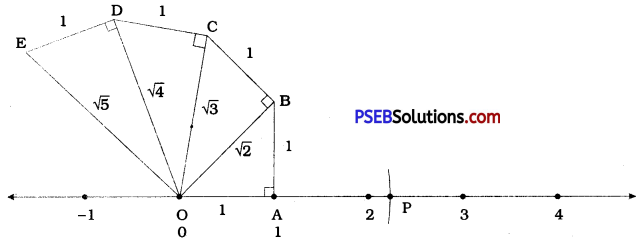
PSEB 9th Class Maths Solutions Chapter 1 Number Systems Ex 1.2 1

Start by taking point O on the number line which represents O. Choosing proper unit, locate point A on the number line to represent
1. Draw seg AB of unit length perpendicular to seg OA. Construct seg OB. Then, by Pythagoras’ theorem, OB = √2. Draw seg BC of unit length perpendicular to seg OB. Construct seg OC.
Then, OC = √3. Draw seg CD of unit length perpendicular to seg OC. Construct seg OD.
Then, OD = √4. Draw seg DE of unit length perpendicular to seg OD. Construct seg 0E.
Then, 0E = √5. Draw an arc with centre O and radius OE to Intersect the number line at P Then, point P on the number line represents √5.

Alternate Method:
This can be solved In fewer steps as shown in the following manner:
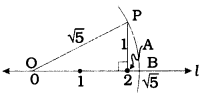
On the number line l, take a point O corresponding to 0. Choosing the proper unit, take a point A on l such that OA = 2 units. Construct right angled Δ OAP such that ΔOAP = 90° and AP = 1 unit.
PSEB 9th Class Maths Solutions Chapter 1 Number Systems Ex 1.2 2
Then, by Pythagoras theorem,
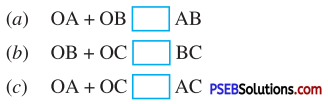
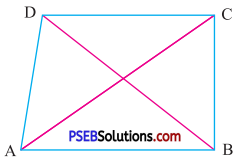
OP2 = OA2 + AP2
= (2)2 + (1)2 = 4 + 1 = 5
∴ OP = √5
Draw an arc with centre O and radius OP to intersect l at B. B is the point corresponding to Draw an arc with centre O and radius OP to intersect I at B. B is the point corresponding to √5.

PSEB 9th Class Maths Solutions Chapter 1 Number Systems Ex 1.2

Question 4.
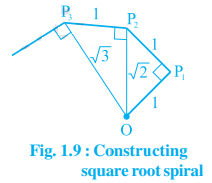
Classroom activity (Constructing the ‘square root spiral’): Take a large sheet of paper and construct the ‘square root spiral’ in the following fashion. Start with a point O and draw a line segment OP1 of unit length. Draw a line segment P1P2 perpendicular to OP1 of unit length (see Fig. 1.9). Now draw a line segment P2P3 perpendicular to OP2. Then draw a line segment P3P4 perpendicular to OP3. Continuing in this manner, you can get the line segment Pn-1Pn by drawing a line segment of unit length perpendicular to OPn-1. In this manner, you will have created the points P2, P3, …………, Pn, ………, and joined them to create a beautiful spiral depicting √2, √3, √4, ………..
PSEB 9th Class Maths Solutions Chapter 1 Number Systems Ex 1.2 3
Answer:
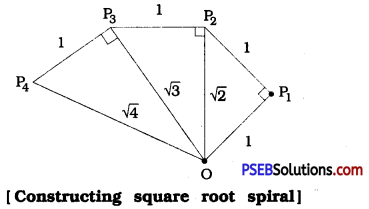
Take a large sheet of paper and construct the ‘square root spiral’ in the following fashion:
PSEB 9th Class Maths Solutions Chapter 1 Number Systems Ex 1.2 4
Start with a point O and draw a line segment OP1 of unit length. Draw a line segment P1P2 perpendicular to OP1 of unit length (see Fig. 1.9). Now draw a line segment P2P3 perpendicular to OP2. Then draw a line segment P3P4 perpendicular to OP3. Continuing in this manner, you can get the line segment Pn-1Pn by drawing a line segment of unit length perpendicular to OPn-1. In this manner, you will have created the points P2, P3, …………, Pn, ………, and joined them to create a beautiful spiral depicting √2, √3, √4, ………..

PSEB 9th Class Science Solutions Chapter 14 Natural Resources

Punjab State Board PSEB 9th Class Science Book Solutions Chapter 14 Natural Resources Textbook ExerciseQuestions and Answers.

PSEB Solutions for Class 9 Science Chapter 14 Natural Resources

PSEB 9th Class Science Guide Natural Resources Textbook Questions and Answers

Question 1.
Why is atmosphere essential for life?
Answer:
Importance of atmosphere:

  1. Role of atmosphere in climate control. Atmosphere acts as a blanket and keeps the average temperature of earth steady during day and even during course of year.
  2. Movement of air causes winds.
  3. Rain and rainfall pattern are decided by wind pattern.
  4. Air provides oxygen for breathing.
  5. Atmosphere absorbs the harmful ultrovoilet rays thus protects the living organisms.

PSEB 9th Class Science Solutions Chapter 14 Natural Resources

Question 2.
Why is water essential for life?
Answer:
Water is a wonder liquid and is essential for life due to the following reasons:

  1. Life is not possible without water.
  2. Water makes up 60-70 per cent of body weight.
  3. All the reactions that take place in our body and within the cells occur between substances that are dissolved in water.
  4. Water is required for transport of materials in living organisms.
  5. The density of water is similar to that of protoplasm.
  6. Water is a universal solvent.

Question 3.
How are living organisms dependent on the soil? Are organisms that live in water totally independent of soil as a resource?
Answer:
Functions of Soil:

Soil plays an important role in plant growth by providing water, nutrients and anchorage i.e. fixation of plant in it.

  1. Soil also supports the growth of crops, grassland and forests which provide us food, fibre, wood and building material.
  2. Soil is an important resource and decides the diversity of life in an area. Plants living in water are also dependent on soil.

PSEB 9th Class Science Solutions Chapter 14 Natural Resources

Question 4.
You have seen weather reports on television and in newspapers. How do you think that we are able to predict the weather?
Answer:
Weather can be predicted on the basis of the study of the following:

  • Movement of air resulting in diverse phenomena caused by uneven heating of the atmosphere in different regions of the earth.
  • Rainfall pattern is decided by the prevailing wind pattern.

Question 5.
We know that many human activities lead to increasing levels of pollution of the air, water bodies and soil. Do you think that isolating these activities to specific and limited areas would help in reducing pollution?
Answer:
Pollution of air, water and soil is caused by human activities such as:

  1. Combustion of fossil fuels for energy used for industries, automobiles.
  2. Further use of insecticides and fertilizers cause pollution of soil and water.
  3. Release of chemicals from industries also cause pollution.
  4. If separate industrial zones are created, it will help in reducing pollution.
  5. Controlled release of pollutants from automobiles.

Question 6.
Write a note on how forests influence the quality of air, soil and water resources.
Answer:

  1. Roots of plants have important role in preventing soil erosion.
  2. Forests have moderating effects on climates.
  3. Forests prevent floods.
  4. Forests release O2 evolved during photosynthesis into atmosphere, thus renewing the oxygen.

Science Guide for Class 9 PSEB Natural Resources InText Questions and Answers

Question 1.
How is our atmosphere different from atmosphere on Venus and Mars?
Answer:
In planets such as Venus and Mars the major component of atmosphere is 95-97% of C02 and it does not support life. Atmosphere on planet Earth is a mixture of nitrogen (78.08%), oxygen (20.95%), C02 (0.03%) and water vapours that help life to exist here.

PSEB 9th Class Science Solutions Chapter 14 Natural Resources

Question 2.
How does atmosphere acts as a blanket?
Answer:
Atmosphere acts as a blanket because of following reasons:

  1. Air is a bad conductor of heat.
  2. The atmosphere keeps the average temperature of earth fairly steady during the day and even during the course of whole year.
  3. The atmosphere prevents the sudden increase or decrease in temperature.

Question 3.
What causes winds?
Answer:
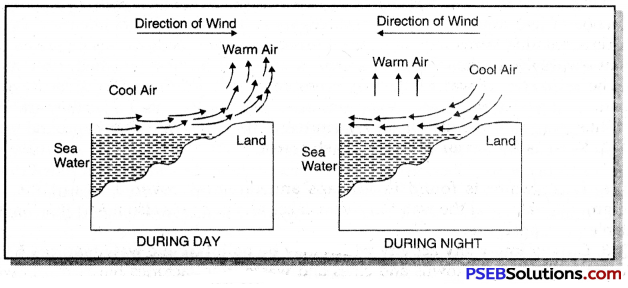
All movements of air are caused by the uneven heating of the atmosphere in different regions of earth. Air above the land gets heated faster and being light starts rising. As the air rises, a region of low pressure is created. Due to this, air over the sea moves into this area of pressure.
PSEB 9th Class Science Solutions Chapter 14 Natural Resources 1
Factors which control the movement of wind:

  1. The rotation of earth and presence of mountain ranges are other factors which cause winds.
  2. Uneven heating of land in different parts of earth.
  3. Differences in heating and cooling of land and water.

PSEB 9th Class Science Solutions Chapter 14 Natural Resources

Question 4.
How are clouds formed?
Answer:
Clouds are formed by the condensation of water droplets in air. It occurs as large amount of water evaporates and goes into air. Air rises up, it expands and cools. The cooling causes the water vapours in the air to condense in the form of tiny droplets. These water droplets get bigger by more and more condensation of other droplets and form clouds.

Question 5.
List any three human activities that you think would lead to air pollution.
Answer:

  1. Combustion of fossil fuels. Excessive use and burning of fossil fuels like coal and petroleum by man in industries and automobiles produce different oxides of nitrogen and sulphur.
  2. These are not only dangerous to our respiratory system but also leads to acid rain.
  3. Deforestation i.e. cutting of trees leads to deterioration of atmosphere. The pollutants also come from industries.
  4. Forest fires, excessive mining and ore refining, excessive use of chloro-fluoro carbons and excessive industrialisation leads to air pollution.

Question 6.
Why do organisms need water?
Answer:
Importance of water:

  1. All cellular processes take place in water medium.
  2. All reactions that take place within our body and within the cells occur between substances that are dissolved in water.
  3. Substances are also transported from one part of the body to the other in a dissolved form.
  4. Organisms need to maintain the level of water within their bodies in order to survive.
  5. Water is a universal solvent and helps the organism in many ways.
  6. Water is required by organisms for many of their activities such as agriculture, production of hydropower, drinking, cooking etc.
  7. Terrestrial life forms require freshwater because their bodies cannot tolerate high amount of dissolved salts in saline water.
  8. The availability of water is the major resource which determines the diversity of life on land.
  9. Thus, water is essential for maintenance and very existence of life.

PSEB 9th Class Science Solutions Chapter 14 Natural Resources

Question 7.
What is the major source of fresh water in the city/town/village where you live?
Answer:
Freshwater is found in ice-caps and on snow-covered mountains. The underground water and the water in rivers, lakes and ponds is also fresh. This water is available for human use.

Question 8.
Do you know any activity which may be polluting the water sources?
Answer:

  1. Sewage from towns and cities and waste from factories released into water bodies.
  2. Discharging hot water from cooling towers into water bodies affects the living organisms.

Question 9.
How is soil formed?
Answer:
The weathering of rocks at or near the surface of earth over long period of time results in soil formation. They are broken down by various physical, chemical and biological processes. The end products of this breaking down are the fine particles of soil.

Soil: There are many other factors which play a vital role in the formation of soil. These factors are:

  1. The Sun: It causes heating of rocks which Causes cracking and ultimately breaking up into smaller pieces.
  2. Water: It breaks rocks both by freezing and fast flow.
  3. Wind: It causes erosion of rocks.
  4. Living Organisms: Lichens and mosses growing dn rock surface form cracks in them and result in their breakdown.

PSEB 9th Class Science Solutions Chapter 14 Natural Resources

Question 10.
What is soil erosion?
Answer:
Removal of useful components from the topsoil which affects the fertility of soil is called soil erosion.

Question 11.
What are the methods of preventing or reducing soil erosion?
Answer:
Prevention of Soil Erosion:

  1. It can be prevented by intensive cropping.
  2. It can be prevented by providing proper drainage canals around the fields.
  3. Soil erosion in hilly areas can be prevented by practising terrace farming.
  4. It can be prevented by planting trees and sowing grasses.
  5. It can be prevented by constructing strong embankments along the river banks.

Question 12.
What are the different states in which water is found during water cycle?
Answer:
Groundwater, surface water, water vapours, water droplets, clouds. Water is found in gaseous state, liquid state and solid state during water cycle.

PSEB 9th Class Science Solutions Chapter 14 Natural Resources

Question 13.
Name two biological important compounds that contain both oxygen and nitrogen.
Answer:
Proteins and Nucleic acids (DNA and RNA).

Question 14.
List any three human activities which would lead to an increase in CO, in air.
Answer:

  1. Combustion of fossil fuel to provide energy for various needs like heating, cooking transportation etc.
  2. Respiration.
  3. Deforestation.

Question 15.
What is greenhouse effect?
Answer:
Greenhouse effect. The increase in global temperature due to rise in CO-, is called greenhouse effect. It causes global warming.

PSEB 9th Class Science Solutions Chapter 14 Natural Resources

Question 16.
What are the two forms of oxygen found in the atmosphere?
Answer:

  1. Oxygen (02), about 21%.
  2. Ozone: In the upper region such as stratosphere oxygen is found in the form of ozone.

PSEB 9th Class Science Important Questions Chapter 13 Why Do we Fall Ill

Punjab State Board PSEB 9th Class Science Important Questions Chapter 13 Why Do we Fall Ill Important Questions and Answers.

PSEB 9th Class Science Important Questions Chapter 13 Why Do we Fall Ill

Long Answer Type Questions:

Question 1.
Discuss the modes of transmission of diseases.
Answer:
Transmission of Communicable Diseases: Diseases are transmitted from the reservoir of susceptible persons in tire following ways:
1. Direct transmission:
(a) Direct contact between infected and healthy person, e.g. chickenpox, leprosy.
(b) Droplet infection from sneezing, coughing, spitting and talking. e.g. T.B, Whooping cough.
(c) Contact with soil which contains saprophytic disease-causing agents.
(d) Bite of an animal, e.g. Rabies, by bite of rabid dog.
(e) Transplacental transmission (from mother to foetus).

2. Indirect transmission:
1. Air-borne diseases such as common cold, pneumonia and tuberculosis. Such disease causing microbes are spread through the air. This occurs through little droplets thrown out by an infected person who sneezes or coughs. Someone standing closeby can breathe in these droplets, and the microbes get a chance to start a new infection.

2. Water-borne diseases such as cholera, diarrhoea, jaundice. Infectious diseases can be spread through water. This occurs if the stool or other wastes from person suffering from an infectious intestinal disease, gets mixed with the drinking water used by people living nearby. The cholera-causing microbes will enter new hosts through the water they drink and cause disease in them.

3. Sexually-transmitted diseases such as Syphilis and AIDS. Both of these pathogens are transmitted by sexual contact from one partner to the other. Such sexually transmitted
diseases are not spread by casual physical contact. Casual physical contacts include handshakes or hugs or sports as wrestling or by any of the other ways in which we touch each other socially.

4. Spread of disease through vectors. Many animals which live with us may carry diseases. These animals carry the infecting agents from a sick person to another potential host. These animals act as intermediate host and are called vectors. Mosquitoes (Anopheles) are vector of a disease called malaria and dengue fever.

PSEB 9th Class Science Important Questions Chapter 13 Why Do we Fall Ill

Question 2.
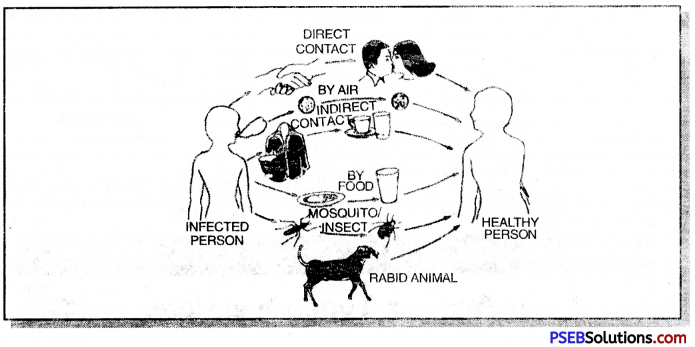
Show the common modes of transmission of diseases.
Answer:
Modes of transmission of diseases
PSEB 9th Class Science Important Questions Chapter 13 Why Do we Fall Ill 1

Question 3.
What are general ways of preventing infectious diseases?
Answer:
General ways of preventing infectious diseases:
The general ways of preventing infections mostly relate to preventing exposure. Public hygiene is one basic key to the prevention of infectious diseases.

The following practices are adopted in this method of prevention of diseases:

  1. For air-borne microbes, we can prevent exposure by providing living conditions that are not overcrowded.
  2. For water-borne microbes, we can prevent exposure by providing safe drinking water.
  3. For vector-borne infections, we can provide clean environment. Such a clean environment would not allow mosquito breeding.

Question 4.
Explain acute and chronic diseases.
Answer:
Acute and Chronic diseases: The manifestations of disease will be different depending on a number of factors. One of the most obvious factors that determine how we perceive the disease is its duration. Some diseases last for only very short periods of time, and these are called acute diseases.

The common cold lasts only a few days. Other ailments can last for a long time, even as much as a lifetime and are called chronic diseases. An example is the infection causing elephantiasis, which is very common in some parts of India.

PSEB 9th Class Science Important Questions Chapter 13 Why Do we Fall Ill

Question 5.
Make a table showing organ specific and tissue-specific manifestation of diseases.
Answer:
Organ-specific and tissue-specific manifestations depend on the target organ which the microbes target after their entry. They are as follows:

Target organ Specific manifestation
1. Lungs Cough, breathlessness, chest pain and may be bloody sputum as in TB and lung cancer.
2. Liver Inflammation of liver cells leading to jaundice characterized by yellowness of skin and eyes as in

Hepatitis.

3. Intestine Inflammation of intestinal mucosa leading to acute diarrhoea and dehydration as in cholera.
4. Nasal chambers Inflammation of nasal mucosa leading to sneezing, bronchitis, coughing, fever, etc. as in influenza.
5. Brain Headaches, vomiting, fits or unconsciousness.

Question 6.
Expand AIDS. Explain causes/modes of transmission, effects, incubation period, diagnosis, symptoms and preventive measures of AIDS. What is the significance of 1st December?
Answer:
AIDS (Acquired Immuno-Deficiency Syndrome)
(a) Cause. AIDS is caused by a retro-virus-HIV (Human immuno-deficiency virus).
In India, it was first reported in the prostitutes of Chennai in 1986. It is a pandemic disease.

(b) Epidemiology (Transmission). Human infection occurs through:

  1. Unprotected sexual intercourse,
  2. Use of contaminated syringes,
  3. Blood transfusion,
  4. Organ transplantation,
  5. Common razor of the barbers, etc.

Effects: It causes damage, decrease in number of platelets, swollen lymph nodes, ritght sweats, loss of memory, etc. It is a 100% fatal disease.

(c) Incubation period is of about 28 months.

(d) Diagnosis by ELISA test and Western Blot test.

(e) Symptoms: HIV kills the Helper T-lytnphocytes. It is characterized by following symptoms :

  1. Prolonged fever.
  2. Swollen lymph nodes.
  3. Weight loss and loss of appetite.
  4. Unexplained bleeding.
  5. Loss of memory and mental ability.
  6. Patient becomes susceptible to other infectious diseases.
  7. Night Sweats.

(f) Preventive measures: Involves educating the high risk groups use of disposable syringes; screening tests of blood, organs, semen, etc; monogamous relationship avoiding prostitution, polygamy and heterosexuality, using condoms, avoiding the use of common razor; etc.

(g) Treatment: Drugs like AZT (Azidothymidine), TIAS injection and Protease inhibitors, etc. are known to suppress AIDS virus. Efforts are on for a vaccine against the virus. Ist December is observed as World AIDS Day.

PSEB 9th Class Science Important Questions Chapter 13 Why Do we Fall Ill

Question 7.
Make a list of common communicable diseases caused by bacteria, viruses, fungi, protozoans and helminthes.
Answer:
Common communicable diseases. The following table shows some important diseases caused by bacteria, fungi and protozoa.

Name of causative agent Diseases
1. Bacteria Pneumonia, Tetanus, Tuberculosis, Cholera, Food Poi­soning, Sexually transmitted diseases.
2. Viruses Chickenpox, poliomyelitis, Influenza, AIDS.
3. Fungi Skin diseases, Food poisoning.
4. Protozoans Malaria, Kala-Azar, Amoebic dysentery, and African sleeping sickness.
5. Helminthes Taeniasis, Cysticercosis, Ascariasis, Elephantiasis.

Short Answer Type Questions:

Question 1.
Define disease and health?
Answer:

  • Disease: It is defined as a condition of the body or a part of it in which functions are disturbed. The word disease means lack of ease and comfort.
  • Health: It is a state of complete physical, mental and social well-being. Health is also linked with social environment and cultural background.

PSEB 9th Class Science Important Questions Chapter 13 Why Do we Fall Ill

Question 2.
What precautions could you take in your school to reduce the incidence of infectious diseases?
Answer:

  1. Providing safe and clean drinking water.
  2. Providing clean environment to prevent vector-borne infections.
  3. Adopting public hygienic measures.

Question 3.
Discuss the principle of prevention of communicable disease.
Answer:
Principles of Prevention: Following three limitations are normally confronted while treating an infectious disease:

  • If a person has a disease, his/her body functions are damaged and may never recover completely.
  • Treatment will take time, which means that person suffering from a disease is likely to be bedridden for sometime even if given proper treatment.
  • The person suffering from an infectious disease can serve as the source from where the infection may spread to other people. It is because of such reasons that prevention of diseases is better than their cure.

Question 4.
Differentiate between infectious and non-infectious diseases.
Answer:
Differences between infectious and non-infectious diseases

Characters Infectious diseases Non-infectious diseases
1. Transmission Can be transmitted from an infected person to a healthy person. Cannot be transmitted from an infected person to a healthy person.
2. Causative agents Microorganisms called pathogens. Deficiency of nutrient or hormone: or degeneration of tissue or hypersen­sitivity of body or tumour formation.
3. Nature They are brought about by extrinsic factor. They are brought about by intrinsic factors.
4. Examples…….. Typhoid, Cholera, T.B., AIDS, Malaria etc. Diabetes, Kwashiorkor, Marasmus, Goitre, Cancer, Allergy etc.

PSEB 9th Class Science Important Questions Chapter 13 Why Do we Fall Ill

Question 5.
What are congenital diseases? Name the three types. Give examples.
Answer:
Congenital diseases: These are inborn diseases present since birth caused by gene or chromosomal mutation.
Types of congenital diseases:

  1. Diseases caused by gene mutation, e.g. Haemophilia, colorblindness, alcaptonuria and sickle cell anaemia.
  2. Diseases caused by chromosomal mutation, e.g. Down’s syndrome, Klinefelter’s syndrome, Turner’s syndrome.
  3. Diseases caused by environmental factors such as radiations or pollutants. They are non-inheritable,

Question 6.
List various modes of direct transmission of diseases, giving one example of each type.
Answer:

  1. By direct contact with an infected person e.g. Leprosy, chickenpox etc.
  2. By droplet infection e.g. Diphtheria, tuberculosis, etc.
  3. By contact with soil e.g. bacterial cysts of tetanus.
  4. By animal bite e.g. rabies viruse.
  5. Transplacental transmission e.g. viruses of German measles and AIDS.

Question 7.
What are sources of diseases? Name various sources of diseases, giving one example of each.
Answer:
1. Sources of diseases are those sites which are occupied by the pathogens before entering inside the human body. These are also called reservoirs of infection.
2. Types of sources of diseases:
(a) Carriers or vectors e.g. Plasmodium (female Anopheles).
(b) Soil e.g. bacterial cysts of Clostridium tetani.
(c) Air e.g. bacterial cysts of TB.
(d) Food and water e.g. bacterial cysts of Cholera.

Question 8.
Differentiate symptoms and signs.
Answer:
Differences between symptoms and signs:

Symptoms Signs
1. They indicate presence of disease.

2. They are collective manifestations of a number of diseases of a particular part or organ.

1. They provide information about the presence of particular diseases.

2. They are distinct for different diseases.

PSEB 9th Class Science Important Questions Chapter 13 Why Do we Fall Ill

Question 9.
Differentiate acute diseases and chronic diseases.
Answer:
Differences between acute diseases and chronic diseases:

Acute diseases Chronic diseases
1. They occur very rapidly but for only short period.

2. Do not cause major effects on general health.

3. Examples: Common cold. Cough.

1. These diseases last for a long time and could be dangerous.

2. They have prolonged and major effects on general health.

3. Examples: T.B., Cancer, Diabetes, Arthritis.

Question 10.
How do antibiotics function?
Answer:
Action of antibiotics: Antibiotics commonly block biochemical pathways important for bacteria. Many bacteria, for example, make a cell-wall to protect themselves. The best illustration is action of penicillin, ft blocks the bacterial processes that build the cell-wall. As a result, the growing bacteria become unable to make cell-walls, and die easily.

Human cells don’t make a cell-wall anyway, so penicillin cannot have such an effect on us. Penicillin will have this effect on any bacteria that use such processes for making cell-walls. Similarly, many antibiotics work against many species of bacteria rather than simply working against one.

Question 11.
Why do antibiotics not work against viral infection?
Answer:
Viruses do not have their own metabolic pathways at all, and that is the reason why antibiotics do not work against viral infections. In case of common cold, taking antibiotics does not reduce the severity or the duration of the disease.

Question 12.
What is hydrophobia? How does it occur in man? Why is it called a neurotrophic disease?
Answer:

  1. Hydrophobia is another name of a viral disease called Rabies.
  2. It is caused by a RNA-virus, Rabies vires, which is injected in the human being along with saliva of rabid animals like dogs, cats, monkeys etc.
  3. Because the virus damages the motor neurons of brain and spinal cord, therefore causes paralysis and death.

PSEB 9th Class Science Important Questions Chapter 13 Why Do we Fall Ill

Question 13.
What are vaccines?
Answer:
Vaccines are produced by deliberate infection of animals, recombinant DNA techniques coupled with hybridomas have opened up the way for custom-made monoclonal antibodies for preventive and therapeutic use. The vaccination prepares the body to fight against the attack.

Question 14.
Give a few examples of vector-borne diseases.
Answer:
Vector-borne diseases:

Vector Disease
Tse Tse fly (Glossina)

Sandfly (Phlebotomus)

Female mosquito (Anopheles)

Rat flea (Xenopsilla)

Aedes mosquito

African sleeping sickness

Kala-azar and Oriental sore

Malaria

Bubonic plague

Yellow fever, Dengue.

Question 15.
Write the name of causal organism of the following diseases:

  1. Malaria
  2. Rabies
  3. Influenza
  4. Tuberculosis
  5. Typhoid

Answer:

Disease Casual Organism
1. Malaria

2. Rabies

3. Influenza

4. Tuberculosis

5. Typhoid

Plasmodium vivax

Rabies-virus

Myxovirus influenzae

Mycobacterium tuberculosis

Salmonella typhosa

Question 16.
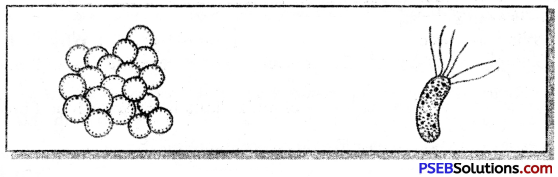
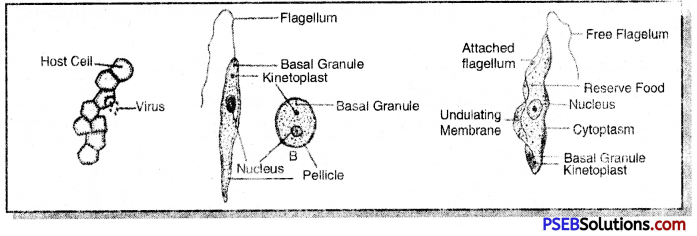
Draw simple diagrams to show the structure of Staphylococcus, Heliobacter, SARS, Leishmania and Trypanosoma.
Answer:
Structure of disease-causing agents
PSEB 9th Class Science Important Questions Chapter 13 Why Do we Fall Ill 2
PSEB 9th Class Science Important Questions Chapter 13 Why Do we Fall Ill 3

Question 17.
Name the infectious disease that leads to immunodeficiency and wasting of body parts. Give the scientific name of the pathogen causing the disease and mention the body organs it primarily affects.
Answer:

  1. AIDS is characterized by immunodeficiency and wasting of body parts.
  2. It is caused by Human Immunodeficiency Virus (HIV).
  3. HIV attacks helper T-lymphocytes, so causing cell-mediated immunodeficiency, so making the body more prone to various infections.

PSEB 9th Class Science Important Questions Chapter 13 Why Do we Fall Ill

Question 18.
Which disease is called epidemic jaundice? List its main symptoms? How can it be prevented?
Answer:

  1. Epidemic jaundice is commonly called Hepatitis-A.
  2. It is characterized by yellowing of skin, urine and stool due to damage of liver cells and overproduction of bilirubin.
  3. It can be prevented by proper sanitation, use of boiled or ozonised water and intramuscular injection of human immunoglobulins.

Question 19.
Explain the differences between active and passive immunization.
Answer:
Differences between active immunization and passive immunization:

Active Immunization Passive Immunization
1. Antigens are introduced from outside which trigger off the formation of antibodies in the body. 1. Ready-made antibodies are introduced into the body.
2. It does not provide immediate relief. 2. It provides immediate relief.
3. Immunity thus achieved is long-lasting. 3. It is not long-lasting.

Question 20.
How is health at risk in a cyclone?
Answer:
Health is at risk in case of cyclone because:

  1. Social environment is disturbed as it is an important factor in case of individual health.
  2. Garbage collected in places is source of multiplication of microbes and breeding place for various vectors.
  3. Stagnant water will provide breeding surface for mosquitoes and other such disease spreading agents.

Question 21.
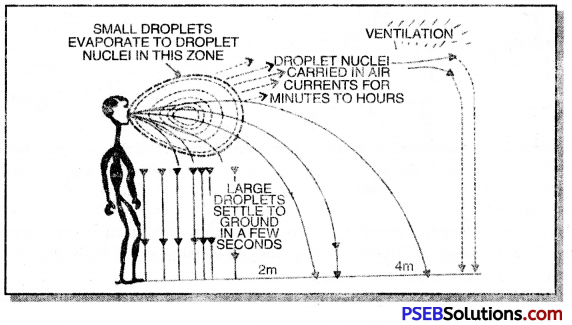
Show by simple diagram how airborne diseases are easier to catch the person who is near the infected person.
Answer:
PSEB 9th Class Science Important Questions Chapter 13 Why Do we Fall Ill 4
Fig. Air-transmitted diseases are easier to catch the closer we are to the infected person. However, in closed areas, the droplet nuclei recirculate and pose a risk to everybody. Overcrowded and poorly ventilated housing is therefore a major factor in the spread of airborne diseases.

PSEB 9th Class Science Important Questions Chapter 13 Why Do we Fall Ill

Question 22.
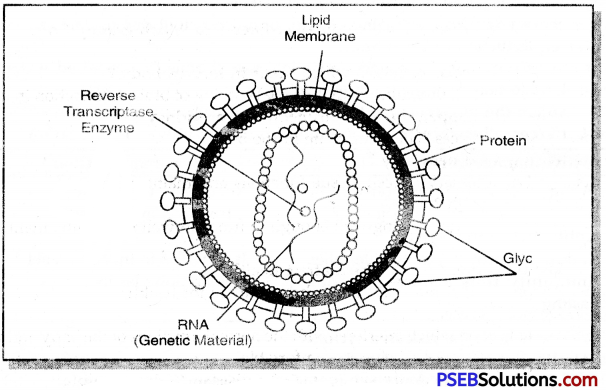
Draw a diagram showing structure of HIV Virus.
Answer:
Structure of HIV Virus
PSEB 9th Class Science Important Questions Chapter 13 Why Do we Fall Ill 5

Question 23.
What is meant by hydrophobia (rabies)? Write its four symptoms. Suggest four preventive measures to check this disease.
Answer:
Rabies: It is caused by bite of rabid or mad dog and other rabid animals.
Causative agent: Rabies virus present in saliva of dog.
Symptoms:

  1. High fever.
  2. Severe headache.
  3. Painful contraction of muscles of throat and chest.
  4. Fear of water.

Preventive measures:

  1. Wound should be cleaned.
  2. Immunise dogs and cats.
  3. Kill highly rabid dogs.

PSEB 9th Class Science Important Questions Chapter 13 Why Do we Fall Ill

Question 24.
A person is suffering from chest pain, breathlessness, loss of body weight, persistent cough and produces blood stained sputum.

  1. Name the disease and its causative agent.
  2. Mention two means of its transmission.
  3. Name the vaccine used to prevent this disease.
  4. Who discovered this disease?

Answer:

  1. Person is suffering from pulmonary tuberculosis: Causative agent Bacterium namely Mycobacterium tuberculosis.
  2. Modes of transmission: It is a communicable disease. Droplet infection during sneezing or otherwise.
  3. BCG vaccine can prevent TB.
  4. Robert Koch (1882).

Very Short Answer Type Questions:

Question 1.
Health and diseases are complex problems in which group of organisms?
Answer:
Human.

Question 2.
List four special activities which occur in human body?
Answer:

  1. Heartbeat
  2. Breathing with lungs
  3. Working of brain
  4. Excretion in kidneys.

Question 3.
What will happen due to malfunctioning of kidney?
Answer:
Toxic substances will accumulate in the body.

Question 4.
Why is food necessary?
Answer:
Food is necessary for cell, tissue functions and maintenance.

PSEB 9th Class Science Important Questions Chapter 13 Why Do we Fall Ill

Question 5.
What is health?
Answer:
Health is a state of being well enough to function well physically, mentally and socially.

Question 6.
List two other factors which affect health.
Answer:
Personal and community issues both matters for health.

Question 7.
Define disease.
Answer:
Any condition which interferes with the normal functions of the body and impairs the health. It literally means being uncomfortable.

Question 8.
What do you mean by symptoms of a disease? Give example.
Answer:
Symptoms of a disease are things we feel as being wrong, e.g. headache, cough, loose motions etc.

Question 9.
What are the signs of disease?
Answer:
Signs indicate a little more definite indications of presence of disease.

Question 10.
What are two types of diseases on the basis of duration?
Answer:

  • Acute diseases
  • Chronic diseases

PSEB 9th Class Science Important Questions Chapter 13 Why Do we Fall Ill

Question 11.
What do you understand by acute diseases?
Answer:
The diseases which last only for a short period of time.

Question 12.
Define chronic diseases.
Answer:
Diseases which last for long time, even life time are called chronic diseases.

Question 13.
Give two examples of acute diseases.
Answer:
1. Cough and cold
2. Flu

Question 14.
Write example of chronic disease.
Answer:
Elephantiasis.

Question 15.
Which kind of diseases are more harmful to the body?
Answer:
Chronic diseases.

PSEB 9th Class Science Important Questions Chapter 13 Why Do we Fall Ill

Question 16.
What is the cause of dysentary?
Answer:
Contaminated food and water.

Question 17.
Name two types of diseases on the basis of their occurrence.
Answer:

  1. Congenital diseases
  2. Acquired diseases

Question 18.
Why are communicable diseases called infectious diseases?
Answer:
Because these are caused by the infection and multiplication of some kind of micro-organisms like bacteria, viruses etc.

Question 19.
What are congenital diseases?
Answer:
Diseases present in the body from the birth. They are mostly hereditary disorders.

Question 20.
Name a disease which is no longer chronic disease.
Answer:
Peptic ulcer.

Question 21.
Name the bacterium responsible for peptic ulcer.
Answer:
Helicobacter pylori.

PSEB 9th Class Science Important Questions Chapter 13 Why Do we Fall Ill

Question 22.
Who discovered that Helicobacter pylori causes peptic ulcer and were awarded Nobel prize?
Answer:
Robin Warren and Barry Marshall.

Question 23.
Name a few disease-causing microbes.
Answer:
Viruses, Bacteria, Fungi and some Protozoans.

Question 24.
Name any four diseases caused by bacteria.
Answer:
Typhoid, Cholera, Tuberculosis (TB), Anthrax.

Question 25.
List a few common diseases caused by viruses.
Answer:
Common cold, Influenza, Dengue fever and AIDS.

Question 26.
Write examples of protozoanal diseases.
Answer:
Malaria, Kala-azar, Amoebic dysentary.

Question 27.
Name a cutaneous disease caused by fungi.
Answer:
Ringworm.

Question 28.
Name two 100% fatal diseases.
Answer:
Rabies and AIDS.

PSEB 9th Class Science Important Questions Chapter 13 Why Do we Fall Ill

Question 29.
What is the common name of influenza? Give its causative agent.
Answer:
Influenza is commonly called flu. It is caused by Myxovirus influenza virus.

Question 30.
How does Penicillin acts as a useful antibiotic?
Answer:
Penicillin blocks the pathway that build the cell wall as a result growing bacteria are unable to form a cell wall.

Question 31.
Why antibiotic do not affect cough and cold?
Answer:
Cough and cold are mostly caused by viruses and antibiotics fail to act on viruses.

Question 32.
Name three sexually transmitted diseases.
Answer:
AIDS, Syphilis, Gonorrhea.

Question 33.
Sexually transmitted diseases are not spread by which factors?
Answer:
Handshake, embracing, wrestling.

Question 34.
How do bacteria causing T.B. reach lungs?
Answer:
Through nose during breathing.

PSEB 9th Class Science Important Questions Chapter 13 Why Do we Fall Ill

Question 35.
How do bacteria causing typhoid enter body.
Answer:
During intake of contaminated food and water.

Question 36.
What is the cause of jaundice?
Answer:
Hepatitis virus.

Question 37.
Who proposed the name malaria from bad air?
Answer:
Macculoch (1827).

Question 38.
Why is rabies called a neurotrophic disease?
Answer:
Because the toxins of Rabies-virus damage the motor neurons of the brain.

Question 39.
Expand the term AIDS.
Answer:
Acquired Immuno Deficiency Syndrome.

Question 40.
Give the full form of HIV.
Answer:
Human-Immuno Deficiency Virus.

PSEB 9th Class Science Important Questions Chapter 13 Why Do we Fall Ill

Question 41.
What is the significance of December 1?
Answer:
World AIDS Day falls on December 1.

Question 42.
Which disease is characterized by yellowing of skin?
Answer:
Hepatitis (epidemic jaundice).

Question 43.
Name three modes of transmission of AIDS.
Answer:

  1. Sexual intercourse with infected partner
  2. Use of contaminated syringes and
  3. Contaminated blood transfusion.

Question 44.
Who prepared the first vaccine?
Answer:
Edward Jenner.

Question 45.
Why is it difficult to make antiviral substances?
Answer:
Viruses do not have their own biochemical pathways, instead they utilize the machinery of cells they attack, therefore, it is difficult to make antiviral substances.

Question 46.
Define vectors.
Answer:
Vectors: They are organisms which spread the disease-causing agents from infected person to a healthy person.

Question 47.
Encephalitis attack which organ of body?
Answer:
Brain.

PSEB 9th Class Science Important Questions Chapter 13 Why Do we Fall Ill

Question 48.
List a few symptoms of encephalitis.
Answer:
Headache, Vomitting, Unconsciousness.

Question 49.
Name a disease which does not occur after one attack?
Answer:
Small-pox.

Question 50.
Which disese have been eliminated from the world.
Answer:
Small pox.

Question 51.
List some common modes of spread of disease.
Answer:

  1. Direct contact
  2. Air
  3. Indirect contact
  4. Insect bites
  5. Contaminated food and water
  6. Rabid animal.

PSEB 9th Class Science Important Questions Chapter 13 Why Do we Fall Ill

Question 52.
Name the two ways of preventing diseases.
Answer:

  • General way is preventing exposure.
  • Strong immune system.

Question 53.
Name a few diseases for which vaccines are available.
Answer:
Whooping cough, Diphtheria, Measeles, Polio and Tuberculosis.

Question 54.
What is immune system?
Answer:
The system of animal body, which protects it from various infectious agents and cancer is termed immune system.

Question 55.
List two features for individual health.
Answer:
Good economic conditions of jobs and stress-free life are needed for individual health.

PSEB 9th Class Hindi Vyakaran वर्ण

Punjab State Board PSEB 9th Class Hindi Book Solutions Hindi Grammar varn वर्ण Exercise Questions and Answers, Notes.

PSEB 9th Class Hindi Grammar वर्ण

(क) निम्नलिखित शब्दों का वर्ण-विच्छेद कीजिए:

अंकुर ……… + ……… + ……… + ……… + ……… ।
उत्तर:
अं + कु + उ + र् + अ

अनुभव : ……… + ……… + ……… + ……… ……… + ……… +
त्तर:
अ + न् + उ + भ् + अ + व् + अ

आराम: ……… + ……… + ……… + ……… + ……… ।
उत्तर:
आ + र् + आ + म् + अ

PSEB 9th Class Hindi Vyakaran वर्ण

इच्छा : ……… + ……… + ……… + ………।
उत्तर:
इ + च् + छ् + आ

ईश्वर : ……… + ……… + ……… + ……… + ………।
उत्तर:
ई + श् + व् + अ + र + अ

उपाधि : ……… + ……… + ……… + ……… +
उत्तर:
उ + प् + आ + ध + इ

ऊर्जा : ……… + ……… + ………. + ……… + ………
उत्तर:
ऊ + र + ज् + आ

ऋतु : ……… + ……… + ……… + ……… ।
उत्तर:
ऋ + इ + त् + उ

एकांत : ……… + ……… + ……… + ……… + ……… ।
उत्तर:
ए + + आ + त् + अ

ऐतिहासिक : ……… + ……… + ……… + ……… + ……… + ……… + ……… + ……… + ………
उत्तर:
ऐ + त् + इ + ह् + आ + स् + इ + क् + अ

ओजस्वी : ……… + ……… + ……… + ……… + ……… + ………।
उत्तर:
ओ + ज् + अ + स् + व + ई

औपचारिक : ……… + ……… + ……… + ……… + ……… + ……….
उत्तर:
औ + प + अ + च + आ + र् + इ + क् + अ

क्रमानुसार : ……… + ……… + ……… + ……… + ……… + ……… + ……… + ……… + ………
उत्तर:
क् + र् + म् + आ + न् + उ + स् + र् + अ

खिन्न : ……… + ……… + ……… + ……… + ……… ।
उत्तर:
ख् + इ + न् + न् + अ

गर्दन : ……… + ……… + ……… + ……… + ……… + ……… + ……..
उत्तर:
ग् + अ + र् + द् + अ + न् + अ

घमासान : ……… + ……… + ……… + ……… + ……… + ………
उत्तर:
घ + म् + आ + स् + आ + न् + अ

चतुर्भुज : ……… + ……… + ……… + ……… + ……… + ………
उत्तर:
च् + अ + त् + उ + र् + भ + उ + ज् + अ

छियानवे : ……… + ……… + ……… + ……… + ……… + ………
उत्तर:
छ् + इ + य् + आ + न् + अ + व + ए

जिह्वा : ……… + ……… + ……… + ……… + ……… ।
उत्तर:
ज् + इ + ह् + व् + आ

ज्ञानवर्धक : ……… + ……… + ……… + ……… + ……… + ……… + ……… + …………. + …….. ….. + ……… + ………।
उत्तर:
ज + अ + आ + न् + अ + व + अ + द् + र् + ध् + अ + क् + अ

झंझट : ……… + ……… + ……… + ……… + ……… + ………।
उत्तर:
झ + अं + झ् + अ + ट् + अ

ट्रैफिक : ……… + ……… + ……… + ……… + ……… + ……… + ………….
उत्तर:
ट् + र् + ऐ + फ् + इ + क् + अ

ठंडक : ……… + ……… + ……… + …………. + ………।
उत्तर:
ठं + अं + ड् + अ + क् + अ

ड्राइवर : ……… + ……… + ……… + ……… + ……… + ……… + ……… + ……… ।
उत्तर:
ड् + र् + आ + इ + व् + अ + र् + अ

PSEB 9th Class Hindi Vyakaran वर्ण

ढूंढ़ना : ……… + ……… + ……… + ……… + ………….. + ………।
उत्तर:
द + ऊ + अं+ ढ् + अ + न् + आ

त्याग : ……… + ……… + ……… + ……… + ……… ।
उत्तर:
त् + य् + आ + ग् + अ

थिरकना : ……… + ……… + ……… + ……… + ……… + ……… + ……… + ………।
उत्तर:
थ् + इ + र् + अ + क् + अ + न् + आ

दुग्ध : ……… + ……… + ……… + ……… + ……… ।
उत्तर:
द् + उ + ग् + ध् + अ

धोखेबाज़ : ……… + ……… + ……… + ……… + ……… + ……… + ……… + ………।
उत्तर:
ध् + ओ + ख् + ए + ब + आ + ज + अ

न्यून : ……… +………. + ……… + ……… + ………
उत्तर:
न् + य + ऊ + न् + अ

पर्वत : ……… + ……… + ……… + ……… + ……… + ……… + ………।
उत्तर:
प् + अ + र् + व् + अ + त् + अ

फरीटकोट : ……… + ……… + ……… + ……… + ……… + ……… + ……… + ……… + ……… + …………. ।
उत्तर:
फ्+ अ + र् + ई + द् + अ + क् + ओ + ट् + अ

बर्मा : ……… + ……… + ……… + ……… + ……… ।
उत्तर:
ब् + अ + र् + म् + आ

भ्रष्टाचार : ……… + ……… + ……… + ……… + ……… + ……… + ……… + ……… + ……… + …….।
उत्तर:
भ् + र् + अ + ष् + ट् + आ + च् + आ + र् + अ

मनोव्यथा : ……… + ……… + ……… + ……… + ……… + ……… + ……… + …….
उत्तर:
म् + अ + न् + ओ + व् + य् + अ + थ् + आ

योद्धा : ……… + ……… + ……… + ……… + ……… ।
उत्तर:
य् + ओ + द् + ध् + आ

रहस्य : ……… + ……… + ……… + ……… + ……… + ……… + ……… ।
उत्तर:’
र + अ + ह् + अ + स् + य + अ

लिखवाना : ……… + ……… + ……… + ……… + ……… + ……… + ………।
उत्तर:
ल् + इ + ख + अ + व् + आ + न + आ

विज्ञान : ……… + ……… + ……… + ……… + ……… + ……… + ………।
उत्तर:
व् + इ + ज् + ब + आ + न् + अ

व्यवहार : ……… + ……… + ……… + ……… + ……… + ……… + ……… + ……… + ………।
उत्तर:
व् + य + अ + व् + अ + ह् + आ + र् + अ

श्रृंगार : ……… + ……… + ……… + ……… + ……… + ………।
उत्तर:
श् + क्रं + ग् + आ + र् + अ

श्रीमती : ……… + ……… + ……… + ……… + ……… + ……… + ………।।
उत्तर:
श् + र् + ई + म् + अ + त् + ई

PSEB 9th Class Hindi Vyakaran वर्ण

सूक्ष्म : ……… + ……… + ……… + ……… + ………
उत्तर:
स् + ऊ + क् + क्ष् + म् + अ

हृदय : ……… + ……… + ……… + ……… + ……… ………।
उत्तर:
ह् + ऋ + द् + अ + य् + अ

(ख) निम्नलिखित वर्णों को जोड़कर शब्द बनाइए:

1. उ + प् + आ + य् + अ =
उत्तर:
उपाय

2. ऊ + ष् + म् + आ =
उत्तर:
ऊष्मा

3. औ + ष + अ + ध् + इ =
उत्तर:
औषधि

4. + अं+ च् + अ + न् + अ =
उत्तर:
कंचन

5. ग् + य् + आ + र् + अ + ह् + अ =
उत्तर:
ग्यारह

6. न् + इ + श् + च् + इ + त् + अ =
उत्तर:
निश्चित

7. प् + र् + अ + द् + अ + र् + श् + अ + न् + अ =
उत्तर:
परादर्शन

8. प् + र् + अ + स् + अ + न् + न् + अ + त् + आ =
उत्तर:
प्रसन्नता

9. स् + व् + अ + र् + ग् + ई + य् + अ =
उत्तर:
स्वर्गीय

10. स् + अ + र् + व् + ओ + च् + च् + अ =
उत्तर:
सर्वोच्च

11. प् + अ + र् + इ + श् + र् + अ + म् + अ =
उत्तर:
परिश्रम

12. प् + अ + त् + र् + इ + + आ =
उत्तर:
पत्रिका

13. व् + अ + र + त् + अ + म् + आ + न् + अ =
उत्तर:
वर्तमान

14. ग् + अ + र् + इ + म् + आ =
उत्तर:
गरिमा

15. च् + इ + + इ + त् + स् + आ + ल् + य् + अ =
उत्तर:
चिकित्सालय

16. ल् + अ + + उ + र् + आ + इ + न् + अ =
उत्तर:
ठकुराइन

17. त् + ई + व् + र् + अ =
उत्तर:
तीव्र

18. थ् + आ + न् + ए + द् + अ + र् + अ =
उत्तर:
थानेदार

19. द् + उ + र् + भ् + आ + ग् + य् + अ =
उत्तर:
दुर्भाग्य

PSEB 9th Class Hindi Vyakaran वर्ण

20. आ + श् + च् + अ + र् + य् + अ =
उत्तर:
आश्चर्य

परीक्षोपयोगी वर्णविच्छेद संबंधी अन्य उदाहरण

अशोक = अ + श् + ओ + क् + अ
प्रेम = प् + र् + ए + म् + अ
कर्म = क् + अ + र् + म् + अ
विद्यालय = व् + इ + द् + य् + आ + ल + अ + य् + अ
विद्या = व् + इ + द् + य् + आ
कृष्ण = कृ + ऋ + ष् + ण् + अ
विश्वास = व् + इ + श् + व् + आ + स् + अ
उत्तीर्ण = उ + त् + त् + ई + र् + ण् + अ
दिल्ली = द् + इ + ल् + ल् + ई
केंद्र = क् + ए + न् + द् + र् + अ
चंडीगढ़ = च + अ + ण् + इ + ई + ग्र + अ + ढ़ + अ
यज्ञ = य् + अ + ज् + ञ् + अ
क्षमा = क् + ष् + अ + म् + आ
त्राता = त् + र् + आ + त् + आ
पिता = प् + इ + त् + आ
माता = म + आ + त् + आ
आश्रय = आ + श् + र् + अ + य् + अ
ट्रक = ट् + र् + अ + क् + अ
यात्रा = य् + आ + त् + र् + आ
श्रीमान = श् + र् + ई + म् + आ + न् + अ
कर्म = क् + अ + र् + म् + अ
ग्वाला = ग् + व् + आ + ल् + आ
सत्य = स् + अ + त् + य् + अ
मच्छर = म् + अ + च् + छ् + अ + र् + अ
प्याऊ = प् + य् + आ + ऊ.
मक्खी = म् + अ + क् + ख + ई
मक्खन = म् + अ + क् + ख् + अ + न् + अ
दैत्याकार = द् + ऐ + त् + य् + आ + क् + आ + र् + अ
अच्छाई = अ + च् + छ + आ + ई
मोटर = म् + ओ + ट् + अ + र् + अ
कठिन = क् + अ + ल् + इ + न् + अ
स्कूल = स् + क् + ऊ + ल् + अ
गृहकार्य = गृ + ऋ + ह् + अ + क् + आ + र् + य् + अ
खिचड़ी = ख् + इ + च् + अ + ई
मानस = म् + आ + न् + अ + स् + अ
पूनम = प् + ऊ + न + अ + म् + अ
रजत = र + अ + ज् + अ + त् + अ
प्रतिकूल = प् + र् + अ + त् + इ + क् + ऊ + ल् + अ
सूर्योदय = स् + ऊ + र् + य् + ओ + द् + अ + य् + अ
तृप्ति = त् + ऋ+ प + त् + इ
तिमिर = त् + इ + म् + इ + र् + अ
खिलाफ़त = ख् + इ + ल् + आ + फ् + अ + त् + अ
जलाशय = ज् + अ + ल् + आ + श् + अ + य् + अ
काव्यात्मक = क् + आ + व् + य् + आ + त् + म् + अ + क् + अ
स्वाभाविकता = स् + व + आ + भ् + आ + व् + इ + क् + अ + त् + आ
नेतृत्व = न् + ए + त् + ऋ + त् + व् + अ
महिषकुल = म् + अ + ह + इ + ष् + अ + क् + उ + ल् + अ
संस्करण = स् + अं+ स् + क् + अ + र् + आ + ण् + अ
प्रयोगशाला = प् + र् + अ + य् + ओ + ग् + अ + श् + आ + ल् + आ
वाद्ययंत्र = व् + आ + द् + य् + अ + य् + अं + त् + र् + अ
आविष्कार = आ + व् + इ + ष् + क् + आ + र् + अ
उद्वेलिंत = उ + द् + व् + ए + ल + इ + त् + अ
दुर्दात = द् + उ + र् + द् + आ + त् + अ
कलाभिज्ञ = क् + अ + ल + आ + भ् + इ + ज् + ञ् + अ
आह्लादित = आ + ह् + ल् + आ + द् + इ + त् + अ
चिह्न = च + इ + इ + न् + अ
आह्वान. = आ + ह् + व् + आ + न् + अ
चाँदनी = च् + आँ + द् + अ + न + ई
विडंवना व + इ + ड् + अं + ब् + अ + न् + आ
श्रेणियों = श् + र् + ए + ण् + इ + य् + ओं
विचित्र = व् + इ + च + इ + त् + र् + अ
विज्ञापित = व + इ + ज + अ + आ + प + इ + त् + अ
यथार्थवादी = . य + अ + थ् + आ + र् + थ् + अ + व् + आ + द् + ई
प्रधानाध्यापक = प् + र् + अ + ध् + आ + न + आ + ध् + य् + आ + प् + अ + क् + अ
न्योछावर = न् + य् + ओ + छ् + आ + व् + अ + र् + अ
पर्यावरण = प् + अ + र् + य् + आ + व् + अ + र् + अ + ण् + अ
प्रकृति = प् + र् + अ + क् + ऋ + त् + इ
द्रवित = द् + र् + अ + व् + इ + त् + अ
मोमबत्ती = म् + ओ + म् + अ + ब् + अ + त् + ई

एक वाक्य में उत्तर दीजिए

प्रश्न 1.
वर्ण किसे कहते हैं?
उत्तर:
भाषा में प्रयुक्त होने वाली सबसे छोटी ध्वनि को वर्ण कहते हैं।

PSEB 9th Class Hindi Vyakaran वर्ण

प्रश्न 2.
उच्चारण की दृष्टि से वर्ण के कितने भेद होते हैं?
उत्तर:
उच्चारण की दृष्टि से वर्ण के तीन भेद होते हैं-स्वर, अयोगवाह और व्यंजन।

प्रश्न 3.
स्वर के भेद कौन-कौन से होते हैं?
उत्तर:
हस्व, दीर्घ और प्लुत।

प्रश्न 4.
ओ३म्, राम और श्या३म् में स्वर का कौन-सा भेद है?
उत्तर:
प्लुत स्वर।

प्रश्न 5.
व्यंजन किसे कहते हैं?
उत्तर:
जिन वर्णों का उच्चारण करते समय हमारे मुँह से हवा थोड़ा रुक कर बाहर निकलती है उसे व्यंजन कहते हैं।

प्रश्न 6.
व्यंजनों के कितने भेद होते हैं?
उत्तर:
व्यंजनों के तीन भेद होते हैं-स्पर्श, अन्त:स्थ, ऊष्म।

प्रश्न 7.
अयोगवाह कितने और कौन-से होते हैं?
उत्तर:
अयोगवाह संख्या में दो होते हैं-‘अं’, ‘अः’।

प्रश्न 8.
संयुक्त व्यंजन किसे कहते हैं?
उत्तर:
जब स्वर रहित व्यंजन किसी स्वर रहित व्यंजन से मिलाकर लिखा जाता है तो उसे संयुक्त व्यंजन कहते हैं।

प्रश्न 9.
संयुक्त व्यंजनों के चार उदाहरण लिखिए।
उत्तर:
श्रीमती, विज्ञापन, विक्षिप्त, नेत्र।

प्रश्न 10.
मात्रा किसे कहते हैं?
उत्तर:
जब स्वर किसी व्यंजन से मिलते हैं तो उनके बदले हुए रूप को ‘मात्रा’ कहते हैं।

प्रश्न 11.
संयुक्त व्यंजन किसे कहते हैं?
उत्तर:
जो व्यंजन दो वर्गों के संयोग से बनते हैं उन्हें संयुक्त व्यंजन कहते हैं। ये स्वतंत्र नहीं होते।

प्रश्न 12.
संयुक्त व्यंजनों के चार उदाहरण दीजिए।
उत्तर:
विज्ञापन, पवित्र, श्रीमान, अत्रिय।

प्रश्न 13.
द्वित्व वर्ण किसे कहते हैं ?
उत्तर:
जब किसी एक शब्द में कोई व्यंजन दो बार आ जाता है तो उसे द्वित्व वर्ण कहते हैं; उदाहरण-हड्डी, डिब्बा, धक्का

प्रश्न 14.
अयोगवाह किसे कहते हैं?
उत्तर:
हिंदी वर्णमाला में जो न स्वर होते हैं और न ही व्यंजन उन्हें अयोगवाह कहते हैं।

एक शब्द में उत्तर दीजिए

प्रश्न 1.
हिंदी में किस स्वर का प्रयोग लगभग नहीं होता?
उत्तर:
प्लुत स्वर।

प्रश्न 2.
दीर्घ स्वर के दो उदाहरण दीजिए।
उत्तर:
आ, ई।

PSEB 9th Class Hindi Vyakaran वर्ण

प्रश्न 3.
वर्णमाला में न स्वर न व्यंजन क्या कहलाते हैं?
उत्तर:
अयोगवाह।

प्रश्न 4.
अनुनासिक का उदाहरण दीजिए।
उत्तर:
आँख।

प्रश्न 5.
विसर्ग के प्रयोग से बना एक शब्द लिखिए।
उत्तर:
प्रातः।

प्रश्न 6.
त् + ई + व् + र् + अ से बनने वाला शब्द लिखिए।
उत्तर:
तीव्र।

प्रश्न 7.
उच्चारण में ह्रस्व स्वर से तिगुना समय किस स्वर में लगता है?
उत्तर:
प्लतु स्वर में।

हाँ/नहीं में उत्तर दीजिए

प्रश्न 1.
भाषा में सब से छोटी ध्वनि को वर्ण कहते हैं।
उत्तर:
हाँ।

प्रश्न 2.
उच्चारण की दृष्टि से वर्णों के तीन भेद होते हैं।
उत्तर:
हाँ।

प्रश्न 3.
ह्रस्व स्वरों की संख्या चार होती है?
उत्तर:
हाँ।

प्रश्न 4.
हिन्दी में अब दीर्घ स्वर का प्रयोग नहीं किया जाता?
उत्तर:
नहीं।

प्रश्न 5.
स्पर्श व्यंजन संख्या में 25 होते हैं।
उत्तर:
हाँ।

प्रश्न 6.
अयोगवाह ध्वनि का वहन करते हैं।
उत्तर:
हाँ।

प्रश्न 7.
विसर्ग का प्रयोग प्रायः संस्कृत शब्दों में किया जाता है।
उत्तर:
हाँ।

प्रश्न 8.
हिंदी में प्रयुक्त अंग्रेजी, उर्दू, अरबी, फ़ारसी आदि के शब्दों को आगत शब्द कहते हैं।
उत्तर:
हाँ।

प्रश्न 9.
द्वित्व वर्ण में एक शब्द में कोई व्यंजन दो बार आते हैं।
उत्तर:
हाँ।

रिक्त स्थानों की पूर्ति करें

प्रश्न 1.
वर्णभेद का उच्चारण ……….. के आधार पर किया जाता है।
उत्तर:
अव्ययों की भिन्नता।

प्रश्न 2.
स्वरों के ……….. भेद होते हैं।
उत्तर:
तीन।

प्रश्न 3.
व्यंजनों के ………. भेद होते हैं।
उत्तर:
तीन।

प्रश्न 4.
विसर्ग का प्रयोग प्रायः ……… भाषा में किया जाता है।
उत्तर:
संस्कृत।

प्रश्न 1.
वर्ण किसे कहते हैं?
उत्तर:
भाषा में प्रयुक्त होने वाली सबसे छोटी ध्वनि को वर्ण कहते हैं। उदाहरण-अ, इ, उ, ज्, र, म्, आदि।

प्रश्न 2.
वर्णमाला से आपका क्या तात्पर्य है?
उत्तर:
वर्णमाला शब्द का सामान्य अर्थ है-वर्णों की माला या वर्गों का समूह। किसी भी भाषा के वर्गों के व्यवस्थित समूह को वर्णमाला कहते हैं।

PSEB 9th Class Hindi Vyakaran वर्ण

प्रश्न 3.
उच्चारण की दृष्टि से वर्गों के कितने भेद होते हैं?
उत्तर:
उच्चारण की दृष्टि से वर्गों के तीन भेद होते हैंस्वर, अयोगवाह और व्यंजन।

प्रश्न 4.
हिंदी की वर्णमाला लिखिए।
उत्तर:
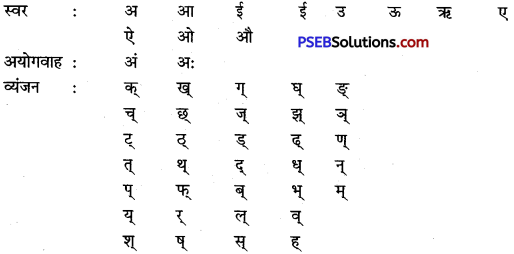
PSEB 9th Class Hindi Vyakaran वर्ण 1

प्रश्न 5.
वर्ण-भेद किस आधार पर किया जाता है? स्पष्ट करें।
उत्तर:
भाषा की ध्वनियों का उच्चारण अव्ययों की भिन्नता के आधार पर किया जाता है। इसी आधार पर भाषा के वर्गों का विभाजन दो भागों में किया जाता है-स्वर और व्यंजन।

प्रश्न 6.
स्वर किसे कहते हैं? ये कितने प्रकार के होते हैं?
उत्तर:
जिन वर्णों के उच्चारण करते समय हमारे मुँह से हवा किसी भी प्रकार की रुकावट के बिना बाहर निकलती है, उन्हें स्वर कहते हैं।
स्वर तीन प्रकार के होते हैं-ह्रस्व, दीर्घ और प्लुत।

प्रश्न 7.
स्वरों के तीन भेदों का वर्णन कीजिए।
उत्तर:
उच्चारण में लगे हुए समय के आधार पर स्वरों का वर्गीकरण किया जाता है; जैसे-
(I) ह्रस्व स्वर-जिन स्वरों के उच्चारण में कम समय लगता है, उन्हें ह्रस्व स्वर कहते हैं। ये संख्या में चार होते हैं-अ, इ, उ, ऋ।

(II) दीर्घ स्वर-जिन स्वरों के उच्चारण में दुगुना समय लगता है, उन्हें दीर्घ स्वर कहते हैं। ये संख्या में सात होते है-
आ, ई, ऊ, ए, ऐ, ओ, औ।

(III) प्लुत स्वर-जब किसी स्वर के उच्चारण में ह्रस्व स्वर से तिगुना समय लगता है, उन्हें प्लत स्वर कहते हैं। इनका प्रयोग दूर से पुकारने या आवाज़ को लंबा खींचने की आवश्यकता पड़ने पर किया जाता है। संस्कृत में इसे लिखने के लिए स्वर विशेष के आगे ‘३’ (तीन) का अंक लिख दिया जाता है; जैसे- ओ३म्, गोपाइल, रा३म्, श्या३म् आदि। हिंदी में प्लुत स्वर का प्रयोग अब प्राय: नहीं किया जाता।

प्रश्न 8.
व्यंजन किसे कहते हैं?
उत्तर:
जिन वर्णों का उच्चारण करते समय हमारे मुँह से हवा थोड़ा रुक कर बाहर निकलती है, उन्हें व्यंजन कहते हैं। व्यंजन सदा स्वरों की सहायता से बोले जाते हैं, जैसे-
क् + अ = क, ल् + अ = ल, ट् + अ = ट आदि।

प्रश्न 9.
व्यंजनों के कितने भेद होते हैं? उनका वर्णन कीजिए।
उत्तर:
व्यंजनों के तीन भेद हैं। स्पर्श, अन्तःस्थ, ऊष्म।
(I) स्पर्श-जिन वर्णों का उच्चारण करते समय वायु कंठ, तालू, जिह्वा आदि उच्चारण स्थानों का स्पर्श करती है, उन्हें स्पर्श व्यंजन कहते हैं। ये संख्या में 25 होते हैं; जैसे-
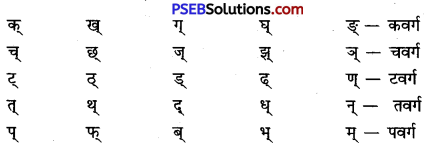
PSEB 9th Class Hindi Vyakaran वर्ण 2

(II) अन्तःस्थ-जिन व्यंजनों का उच्चारण करते समय जिह्वा पूरी तरह मुख के किसी भी भाग का स्पर्श नहीं करती उन्हें अन्तःस्थ व्यंजन कहते हैं। इनका उच्चारण स्वर और व्यंजन के बीच का-सा होता है। ये संख्या में चार होते हैं-य, र, ल, व्।

(III) ऊष्म-जिन वर्णों के उच्चारण के समय मुख से ऊष्मा अर्थात् गर्म हवा बाहर निकले और हल्की सीटी जैसी ध्वनि उत्पन्न हो, उन्हें ऊष्म व्यंजन कहते हैं, इनके उच्चारण में श्वास की प्रबलता रहती है। ये संख्या में चार होते हैंश्, ष, स्, ह। .

प्रश्न 10.
अयोगवाह किसे कहते हैं?
उत्तर:
हिंदी वर्ण माला में अयोगवाह न स्वर होते हैं और न ही व्यंजन। इनकी संख्या दो है- ‘अं’, ‘अः’। ‘अं’ को अनुस्वार और ‘अ’: को विसर्ग कहते हैं। इन्हें स्वतंत्र गति न होने के कारण स्वर नहीं कहा जा सकता। इनका प्रयोग स्वरों के साथ होने के कारण इन्हें व्यंजन भी नहीं कहा जा सकता। ये ध्वनि का वहन करते हैं; इसलिए इन्हें ‘अयोगवाह’ कहते हैं।

प्रश्न 11.
अनुस्वार किसे कहते हैं?
उत्तर- अनुस्वार (.) एक नासिक्य ध्वनि है। जब इसका उच्चारण किया जाता है। तब हवा केवल नाक से निकलती है। यह अपने से पहले आने वाले वर्ण के ऊपर बिंदु (.) रूप में लगता है; जैसे-
अंकित, अंत, रंक, पंक, डंक, गंद, कंस, आदि।

अनुस्वार का प्रयोग सभी वर्गों के पाँचवें नासिक्य व्यंजन (ङ्, ञ्, ण, न, म्) के स्थान पर किया जाता है; जैसे-

शब्द उच्चरित रूप वर्ग विशेष से पूर्व
(I) कंघी, गंगा कङ्घी, गङ्गा कवर्ग से पहले ‘ङ’ रूप में
(II) चंचल, आंचल चञ्चल, आञ्चल चवर्ग से पहले ‘ज्’ रूप में
(III) डंडा, ठंडी डण्डा, ठण्डी टवर्ग से पहले ‘ण’ रूप में
(IV) निंदा, संध्या निन्दा, सन्ध्या तवर्ग से पहले ‘न्’ रूप में
(V) असंभव, अंबर असम्भव, अम्बर पवर्ग से पहले ‘म्’ रूप में

PSEB 9th Class Hindi Vyakaran वर्ण

प्रश्न 12.
अनुस्वार से संबंधित विशेष नियमों को लिखिए।
उत्तर:
(1) हिंदी में सरलता, सुविधा और एकरूपता के लिए अनुस्वार को वर्ण के ऊपर बिंदु (.) रूप में प्रयुक्त किया जाने लगा है। संस्कृत में अभी भी इसका प्रयोग बिंदु और परंपरागत रूप में किया जाता है।

(II) यदि ‘म्’ के पश्चात् व्यंजनों के अतिरिक्त अंत:स्थ (य, र, ल, व) या ऊष्म व्यंजन (श, ष, स, ह) में से कोई भी व्यंजन प्रयुक्त करना हो तो ‘म्’ अनुस्वार रूप में ही लिखते हैं; जैसे-संचार, संहार, संलग्न, संरचना, संयम, संयत, संशय, संसार आदि।

(III) ऊष्म व्यंजन श, ष, स् से पहले अनुस्वार अपने मूल रूप में प्रयुक्त होता है; जैसे–संसद्, संशय, कंस, वंश।

(IV) हिंदी में शब्द के अंत में ‘म्’ अनुस्वार में बदल जाता है; जैसे-अहं, स्वयं आदि।

(V) जहाँ नासिक्य व्यंजन संयुक्त रूप में होते हैं, वहाँ अनुस्वार का प्रयोग नहीं होता; जैसे-जन्म, वाङ्मय, मन्मथ, षण्मास आदि।

(VI) न, म्, आदि पंचम वर्ण जब संयुक्त रूप में प्रयुक्त होते हैं। तब अनुस्वार का प्रयोग नहीं किया जाता, जैसे गन्ना, पन्ना, धम्म, धन्ना, सम्मान, खुन्नस आदि।

(VII) यदि पंचम स्वर य, व, ह से पहले आता हो तो वहाँ अनुस्वार का प्रयोग नहीं होता; जैसे- पुण्य, गण्य, लावण्य आदि।

प्रश्न 13.
अनुनासिक किसे कहते हैं?
उत्तर:
जब किसी शब्द के उच्चारण में हवा, नाक और मुँह दोनों से ही निकलती है तो उसे अनुनासिक कहते हैं। यह अपने से पहले आने वाले वर्ण के ऊपर-चंद्रबिंदु () के रूप में लगाया जाता है; जैसे-काँख, आँख, गाँव, चाँद, मुँह आदि।

प्रश्न 14.
अनुनासिक को किस अवस्था में अनुस्वार के रूप में लिखा जा सकता है ? उदाहरण सहित लिखिए।
उत्तर:
जब किसी शब्द में स्वरों या मात्राओं का कोई भी अंश शिरोरेखा के ऊपर चला जाता है तो अनुनासिकता (*) के स्थान पर अनुस्वार (‘) का प्रयोग किया जाता हैं; जैसे- मैं, चौंक, गेंद, छींक आदि । इनमें ‘ऐ’, ‘औ’, ‘ए’ ‘इ’ की मात्राएँ शिरारेखा के ऊपर प्रयुक्त की गई है।

प्रश्न 15.
अनुस्वार और अनुनासिक में अंतर लिखिए।
उत्तर:

अनुस्वार अनुनासिक
1. यह एक व्यंजन है। 1. यह एक स्वर है।
2. इसका चिह्न बिंदु (.) है। 2. इसका चिह्न चंद्रबिंदु (*) है।
3. इसमें ‘न्’ ध्वनि ज़ोर देकर बोला जाता है। 3. इसमें ‘न्’ ध्वनि ज़ोर देकर नहीं बोला जाता।
4. इससे वर्ण दीर्घ हो जाता है। 4. इसमें वर्ण दीर्घ नहीं होता।

प्रश्न 16.
विसर्ग किसे कहते हैं? इसका प्रयोग कहाँ किया जाता है?
उत्तर:
विसर्ग (:) एक ध्वनि चिह्न है जिसका उच्चारण ‘इ’ व्यंजन के समान किया जाता है। इसका प्रयोग संस्कृत या हिंदी में प्रयुक्त किए जाने वाले संस्कृत शब्दों में किया जाता है। जैसे- स्वतः, प्रातः, दुःख, अतः, पुनः आदि।

प्रश्न 17.
हल और हलंत किसे कहते हैं? उदाहरण सहित लिखिए।
उत्तर:
स्वर के प्रयोग के बिना किसी व्यंजन के प्रयोग के लिए उसके नीचे लगी तिरछी-सी रेखा को हल कहते हैं और हल से युक्त व्यंजन या शब्द को हलंत कहते हैं; जैसे-
व = व् + अ
लेकिन व् = ‘अ’ स्वर में रहित ‘व’।
उदाहरण-विद्या, द्वारा, विद्यालय, रद्दी, आद्या।
हिंदी में हलंत का प्रयोग अब धीरे-धीरे कम होता जा रहा है।

प्रश्न 18.
आगत स्वर किसे कहते हैं? उदाहरण देकर लिखिए।।
उत्तर:
अंग्रेज़ी में अनेक शब्द ऐसे हैं जिनके शुद्ध उच्चारण और लेखन के लिए हिंदी में औ’ (अर्धचंद्राकार) ध्वनि को जोड़ा गया है। यह हिंदी की ‘आ’ और ‘ओ’ ध्वनि से अलग है। यह ओष्ठों की स्थिति के अनुसार वृत्तमुखी और जीभ के अनुसार अर्ध विवृत स्वर है। उदाहरण-टॉफी, मॉनीटर, बॉल, नॉलेज, डॉक्टर, कॉलेज, टॉय, कॉफी, बॉक्स, कॉलोनी, मॉडल आदि।

प्रश्न 19.
हिंदी में विकसित ध्वनियाँ कौन-कौन सी हैं? इनका विकास किन व्यंजनों से हुआ है?
उत्तर:
हिंदी में ‘ङ’ और ‘ढ’ विकसित ध्वनियाँ हैं जो क्रमशः ‘ड’ और ‘ढ’ से बनी हैं। ये दोनों टवर्ग से संबंधित
उदाहरण-बढ़, कढ़ाई, उड़ान, बढ़ना, सड़क, जड़, उजाड़, बुढ़िया, चढ़ाई, गुड़िया आदि।
हिंदी शब्दों के आरंभ में ‘ड’ और ‘ढ’ का प्रयोग कभी नहीं होता। इन्हें शब्दों के बीच और अंत में प्रयोग किया जाता है; जैसे-शब्द के बीच में-बढ़ना, लड़ाई, लड़ना, उजड़ना, सड़ना, पढ़ना, बढ़ना।
शब्द के अंत में-उजाड़, झाड़, सड़, ताड़, बाढ़, पढ़, मारवाड़।

प्रश्न 20.
आगत व्यंजन किसे कहते हैं?
उत्तर:
हिंदी में जिन अंग्रेज़ी, उर्दू, अरबी, फ़ारसी आदि शब्दों का प्रयोग प्रायः होता है उन्हें आगत शब्द कहते हैं। इन्हें शुद्ध रूप से बोलने और लिखने के लिए ‘क’, ‘ख’, ‘ग’, ‘ज’, और ‘फ’ व्यंजनों के नीचे बिंदु (नुक्ता) लगाया जाता है और उन्हें आगत व्यंजन कहते हैं। यदि ऐसा न किया जाए तो ध्वनियों के परिवर्तन के कारण अर्थ में बदलाव आ जाता है; जैसे-

राज-शासन राज-रहस्य
फन–साँप का सिर फ़न-कौशल
फलक-लकड़ी का तख्ता फ़लक-आकाश
जरा-बुढ़ापा ज़रा-थोड़ा
कदर-आँख, अंकुश क़दर-प्रतिष्ठा, मान
खुदा-उत्कीर्ण खुदा-भगवान्
खाना-भोजन ख़ाना-घर, मकान, अलमारी, आदि का ख़ाना
गौर-उज्ज्वल गौर-सोच-विचार।

प्रश्न 21.
अंग्रेज़ी और उर्दू में प्रयोग किए जाने वाले ‘ज़’ और ‘फ़’ वर्ग वाले कुछ शब्दों के उदाहरण दीजिए जो हिन्दी में भी प्रयुक्त किए जाते हैं।
उत्तर:
I. उर्दू से आए ‘ज’ वर्ग वाले शब्द-ज़ोर, नाज़, मज़ेदार, ज़बान, ज़माना, हमराज़, जिंदा, ज़मीन, ज़बरदस्त, जेवर, जब्त, बाजी, फर्ज, कर्ज, ज़फ़र, प्याज़, ज़िक्र।
अंग्रेज़ी से आए ‘ज़’ वर्ण वाले शब्द-ज़ीरो, क्विज़, मेज़र, इज़ी, ट्रेजरर, क्रेज़ी, ट्रेज़टी, पीज़ा, जोन, फ़िज़िक्स, प्राइज़, जेब्रा, अंग्रेज़ी, रोज़, रिवीज़न, फिज़िकल।

II. उर्दू से आए ‘फ़’ वर्ण वाले शब्द-फ़ाका, फ़रियाद, फ़लसफा, फारसी, फ़रज़ी, फ़रेब, फ़जूल, फ़जीहत, गिलाफ़, फ़रमान, सिफ़ारिश, सफ़ेद, बरफ़, शराफ़त, फ़ौजी, हफ़्ते, फ़र्क, फ़ायदा, काफ़ी।
अंग्रेज़ी से आए ‘फ़’ वर्ण वाले शब्द-फ़न, कॉफ़ी, फ्रूट, फ़िल्म, फ्री, फ्रेक्चर, कफ़, फ़न, फुटबॉल, फ़ाइव, फ़ील, फ़ाइल, फ़िटर, फ़ीचर, फ़िल्टर, फ़ेल, फ़ार्म, फ़ादर, फ़ोर, फ़ारेन, फ़िजिक्स, फ़ार्मूला, फ़ार्मेसी, फ़ायर।

प्रश्न 22.
‘मात्रा’ किसे कहते हैं? स्वरों का जब व्यंजन वर्गों में मेल होता है तो उनके रूप कैसे बन जाते हैं? लिख कर स्पष्ट करें।
उत्तर:
किसी वर्ण के उच्चारण में लगने वाले समय के अंश को मात्रा कहते हैं। इन्हें निम्नलिखित ढंग से लिखा जा सकता है-
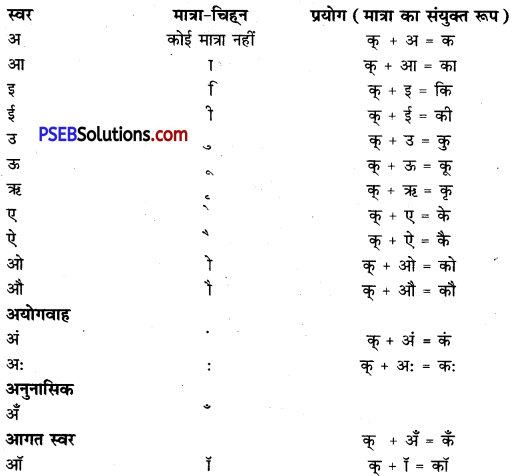
PSEB 9th Class Hindi Vyakaran वर्ण 3

प्रश्न 23.
‘र’ व्यंजन में ‘उ’ और ‘ऊ’ मात्राएँ कैसे लगाई जाती हैं ? उदाहरण सहित स्पष्ट करें।
उत्तर:
‘र’ व्यंजन में ‘उ’ और ‘ऊ’ मात्राएँ नीचे न लग कर सामने की ओर लगती हैं; जैसे-र + उ = रुचि, रुपया, रुबी, रुमाल, र + ऊ = रुपया, रूखा, अमरूद, बारूद।

प्रश्न 24.
संयुक्त व्यंजनों को किस-किस प्रकार लिखा जा सकता है? स्पष्ट कीजिए।
उत्तर:
जब व्यंजन को दूसरे व्यंजन से मिला कर लिखा जाता है तो संयुक्त ध्वनियों की रचना होती है। स्वर-रहित व्यंजन को हलंत किया जाता है या अगले व्यंजन के साथ मिलाकर लिख दिया जाता है। प्रायः संयुक्त व्यंजनों को दो प्रकार से लिखा जाता है-
I. खड़ी पाईं (1) के साथ-देवनागरी लिपि में जिन व्यंजनों के साथ खड़ी रेखा मिलती है। उन्हें पाई (1) कहते हैं, जैसे-ख्, ग, घ, च्, ज, झ्, ण, त्, थ, ध्, न्, प, ब्, भ, म्, य, ल, व्, श, ष, स्। जब इन्हें आगे वाले व्यंजन से मिलाया जाता है तो इनकी पाई हटा दी जाती है, जैसे-
ग् + व = ग्व (ग्वाला), प् + य = प्य (प्यार) ल् + क = ल्क (शुल्क), न् + न = न्न (गन्ना), थ् + य = थ्य (तथ्य), त् + थ = त्थ (पत्थर), म् + म = म्म (सम्मान), स् + ट = स्ट (स्टूल), व् + य = व्य (व्यस्क), य् + य = य्य (नैय्या), ल् + ल = ल्ल (हल्ला), ष् + ठ = ष्ठ (वशिष्ठ), ध्, य = ध्य (संध्या), ण् + ड = ण्ड आदि। (तुण्ड), ज् + व = ज्व (ज्वार), च् + च = च्च (जच्चा) आदि। देवनागरी लिपि में ‘क’ और ‘फ’ व्यंजनों के बीच में खड़ी पाई का प्रयोग किया जाता है। इन्हें अगले वर्ण से मिलाकर लिखा जाता है। खड़ी पाई के बाद के हिस्से से नीचे के भाग को हटा दिया जाता है, जैसे-
क् + य = क्य (वाक्य), क् + ल = क्ल (शक्ल), क् + त = क्त (सूक्त), फ़् + ल = पल (फ़्लास्क), फ़् + ल = फ़्ल (फ़्लू) आदि।

II. बिना पाई वाले व्यंजन–देवनागरी लिपि में ‘छ’, ‘ट’, ‘ठ’, ‘ड’, ‘ढ’, ‘ढ’, ‘ट’, ‘ट’ बिना पाई वाले व्यंजन हैं। जब इन्हें अगले व्यंजनों (‘र’ के अतिरिक्त) से मिला कर लिखा जाता है तो हलंत का प्रयोग किया जाता है; जैसे— द् + य = द्य (विद्यालय), ट् + ट = ट्ट (मिट्टी), ट् + ठ = ट्ठ (मट्ठी), ठ् + य = ठ्य (सुपाठ्य), ड् + ढ = ड् (गड्ढा ) = ह् + य = ह्य (दुःसह्य)।

प्रश्न 25.
हिन्दी में प्रचलित मानक और मानकेतर शब्दों की एक सारणी तैयार कीजिए।
उत्तर:
हिन्दी में संयुक्त व्यंजनों के मानक और मानकेतर रूप प्रचलन में हैं। वर्तमान में एकरूपता के लिए मानक व्यंजनों को अधिक महत्त्व दिया जाता है। लेकिन मानकेतर रूप को अशुद्ध भी नहीं माना जाता। यह संभव हो सकता है कि भविष्य में मानकेतर रूप का धीरे-धीरे प्रचलन समाप्त हो जाए। वर्तमान में भी इनका प्रयोग अपेक्षाकृत कम हो गया है, जैसे-
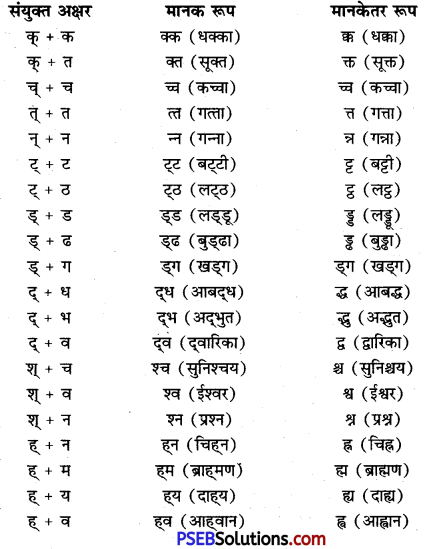
PSEB 9th Class Hindi Vyakaran वर्ण 4

प्रश्न 26.
द्वित्व वर्ण किसे कहते हैं? स्पष्ट कीजिए।
उत्तर:
जब किसी एक शब्द में कोई व्यंजन दो बार आ जाए तो उसे द्वित्व वर्ण कहते हैं। इनमें पहला व्यंजन स्वर रहित और दूसरा स्वर युक्त होता है; जैसे-
पक्का, धक्का, टट्ट, हड्डी, फट्टा, गत्ता, चक्का, मुक्का, डिब्बा, लट्ट, बिट्ट आदि।

प्रश्न 27.
द्वित्व वर्ण की रचना में किन बातों का ध्यान रखना चाहिए?
उत्तर-वर्णमाला के दूसरे और चौथे वर्णों को द्वित्व नहीं हो सकता। जब किसी स्थिति में दूसरे और चौथे वर्णों के द्वित्व होने का आभास होता है तो वहाँ वर्ग के पहले-दूसरे तथा तीसरे-चौथे वर्गों का मेल माना जाना चाहिए; जैसे-
(क) पहले-दूसरे वर्गों का मेल-पत्थर, मच्छर, अच्छाई, अक्खड़, मक्खी आदि शब्दों में दूसरे वर्ण के द्वित्व होने का होने का आभास होता है। नियमानुसार इनमें दूसरे वर्ण के साथ उसी वर्ग का पहला वर्ण जोड़ दिया गया है।

(ख) तीसरे-चौथे वर्गों का मेल-शुद्ध, बौद्ध, बुड्ढा, घग्घर आदि शब्दों में चौथे वर्ण से द्वित्व होने का आभास होता है लेकिन नियम के अनुसार उसके साथ उसी वर्ग का तीसरा वर्ण लगा दिया गया है।

प्रश्न 28.
‘र’ और ‘ऋ’ में क्या अंतर है?
उत्तर:
‘र’ एक व्यंजन है और ‘ऋ’ स्वर है। हिन्दी में ‘ऋ’ का उच्चारण ‘रि’ के रूप में किया जाता है।

प्रश्न 29.
व्यंजनों के साथ ‘र’ लगाने के नियम लिखिए।
उत्तर:
(क) स्वर ‘ऋ’ के अतिरिक्त किसी भी स्वर ‘र’ के बाद आता है तो ‘र’ पूरा लिखा जाता है; जैसे- रख, राम, रिक्शा, रीढ़, रुपया, रूठना, रेखा, रैली, रोना, रौब।

(ख) स्वर से रहित ‘र’ रेफ (‘) कहलाता है जो अपने से अगले व्यंजन के ऊपर लगता है, जैसे कर्म, गर्म, चर्म, टर्न, वर्ष, पूर्वज, पर्वत, कर्क, बर्फ आदि।

(ग) ‘र’ से पहले यदि ‘क्’, ‘ग्’, ‘घ’, ‘थ्’, ‘ब’, ‘भ्’, ‘ध्’ ‘प्’, ‘फ्’ हों तो यह ‘प्र’ (पदेन ‘र’) के रूप में दिखाई देता है, जैसे-क्रम, ग्रास, घ्राण, थ्रो, ब्राह्मण, भ्रांति, ध्रुवीय, प्रेम, फ्रॉक।

(घ) यह त्, श् और स् के साथ क्रमशः ‘त्र’, ‘श्र’, ‘स’ रूप में दिखाई देता है; जैसे-
त् + र = त्र (तत्र, सत्र)
श् + र = श्र (श्रवण, श्रद्धा)
स् + र = स्र (स्रोत, सहस्र)।

(ङ) जब ‘स्’ के साथ त्र मिलता है तो ‘स्त्र’ बनता है, जैसे शस्त्र, शास्त्र।

(च) बिना पाई वाले व्यंजनों ‘ट्’ और ‘ठ’ के र () रूप में लिखा जाता है; जैसे-
ट् + र = ट्र (राष्ट्र, ट्राम, ड्रम, ट्रिन-ट्रिन)

(ज) ‘द’ के साथ ‘र’ पदेन र का रूप ले लेता है; जैसे-
द् + र = द्र (द्रव, द्राक्षासव, विद्रुम, उपद्रव, विद्रोह, द्रोणाचार्य, द्रोही, द्रविड़, रुद्र आदि)

(झ) यदि ‘र’.से पहले ‘ह’ हो तो ‘ह्’ बनता है; जैसे
ह् + र = ह् (ह्रस्व)
उदाहरण-ह्रास, ह्रासोन्मुख, ह्री।।

प्रश्न 30.
संयुक्त व्यंजन किसे कहते हैं? स्पष्ट कीजिए।
उत्तर:
कुछ व्यंजन दो वर्गों के संयोग से बनते हैं। ये स्वतंत्र नहीं होते। जब स्वर रहित व्यंजन किसी स्वर सहित व्यंजन से मिलकर लिखे जाते हैं तो उन्हें संयुक्त व्यंजन कहते हैं। जैसे-
क् + ष = क्ष – क्षमा, रक्षा, क्षत्रिय,
विक्षिप्त। त् + र = त्र – नेत्र, नेतायुग, पवित्र, पुत्र।

ज् + उ = ज्ञ – ज्ञान, विज्ञान, ज्ञापित, विज्ञापन।
श् + र = श्र – श्रीमान, श्रीमती, श्रीफल, श्रमिक।

प्रश्न 31.
संस्कृतनिष्ठ भाषा बोलने वाले विद्वान् ‘ज्ञ’ का उच्चारण कैसे करते हैं और क्यों?
उत्तर:
संस्कृतनिष्ठ भाषा बोलने वाले विद्वान् ‘ज्ञ’ को ‘ज्व’ रूप में उच्चारित करते हैं जबकि हिन्दी भाषी इसे ‘ग्य’ रूप में बोलते हैं। ये दोनों रूप मानक हैं। हिन्दी भाषा यदि ‘विज्ञान’ को ‘विज्यान’ बोलते हैं तो संस्कृत भाषी ‘विज्ञान’ बोलते हैं।

प्रश्न 32.
यदि ‘ऋ’ से पहले स्वर रहित ‘श्’ आ जाए तो संयुक्त रूप में क्या परिवर्तन हो जाता है? उदाहरण भी दीजिए।
उत्तर:
यदि ‘ऋ’ से पहले स्वर रहित ‘श्’ आ जाए तो वह संयुक्त रूप में शृ’ बन जाता है; जैसे-शृंगार, श्रृंगी, श्रृंखला, शृंगाल, श्रृंगारिक, विश्रृंखल।

प्रश्न 33.
वर्ण विच्छेद से क्या तात्पर्य है?
उत्तर:
वास्तव में ‘वर्ण’ का विच्छेद कभी नहीं हो सकता लेकिन यहाँ ‘वर्ण विच्छेद’ से तात्पर्य है-किसी शब्द के वर्गों को अलग-अलग करना।

प्रश्न 34.
वर्ण विच्छेद करते समय किन-किन बातों की ओर ध्यान में रखा जाना चाहिए?
उत्तर:
वर्ण, विच्छेद करते समय निम्नलिखित बातों की ओर ध्यान रखा जाना चाहिए
I. स्वर से रहित व्यंजनों को हलंत () रूप में लिखा जाना चाहिए; जैसे-
पुस्तक = प + उ + स् + त् + अ + क् + अ
कलम = क् + अ + ल् + अ + म् + अ।
टमाटर = ट् + अ + म् + आ + ट् + अ + र् + अ
शलजम = श् + अ + ल् + अ + ज् + अ + म् + अ

II. स्वरों का मूल रूप में विच्छेद नहीं होता और न ही उनके नीचे कभी हलंत लगता है; जैसे-
उल्लू = उ + ल् + ल् + ऊ
उदय = उ + द् + अ + य् + अ
ऐनक = ऐ + न् + अ + क् + अ
इमली = इ + म् + अ + ल् + ई

III. मात्राओं वाले शब्दों का विच्छेद ध्यानपूर्वक करना चाहिए। स्वरों को हलंत नहीं लगाना चाहिए, जैसे यदि किसी शब्द में कोई स्वर मूल रूप में हो तो उसका विच्छेद नहीं किया जाना चाहिए; जैसे-
एकता = ए + क् + अ + त् + आ
अनुपम = अ + न् + उ + प् + अ + म् + अ
कूल = क् + ऊ + ल् + अ
कृपा = क् + ऋ + प् + आ
उपयोगिता – उ + प् + य् + ओ + ग् + इ + त् + आ
केरल = क + ए + र् + अ + ल् + अ
कृपावान = क् + ऋ + प् + आ + व् + आ + न् + अ
किला = क् + इ + ल् + आ
किसान = क् + इ + स् + आ + न् + अ
कौरव = क् + औ + र् + अ + व् + अ
कैसा = क् + ऐ + स् + आ ..
हृदय = ह् + ऋ + द् + अ + य् + अ
हार्दिक = ह् + आ + र् + द् + इ + क् + अ

IV.(क) अनुस्वार (स्पर्श व्यंजनों के साथ) वाले शब्दों के वर्ण विच्छेद में पंचम स्वर के स्थान पर अनुस्वार () का ही प्रयोग होता है लेकिन कुछ विद्वान् अभी भी पंचम अक्षर का प्रयोग करते हैं जिसे गलत नहीं माना जाता; जैसे-
पतंगा = प् + अ + त् + अं + ग् + आ
चंचल = च् + अं + च् + अ + ल् + अ
तंदूर = त् + अं + द् + ऊ + र् + अ
दंडित = द + अं + ड् + इ + त् + अ .
कंजूस = क् + अं + ज् + ऊ + स् + अ

(ख) सम्’ उपसर्ग के बाद अंत: स्थ (य, र, ल, व) या ऊष्म (श, स, ह) व्यंजन आने पर अनुस्वार (‘) का प्रयोग किया जाता है; जैसे-
संशय = स् + अं + श् + अ + य् + अ
संसार = स् + अं +. स् + आ + र् + अ
संवादात्मकता = स् + अं + व् + आ + द् + आ + त् + म् + अ + क् + अ + त् + आ
विसंहार = व् + इ + स् + अं + ह् + आ + र् + अ
संयत = स् + अं + य् + अ + त् + अ
संयोग = स् + अं + य् + ओ + ग् + अ

5. पूरा रूप बदलने वाले संयुक्त व्यंजनों (ज्ञ, त्र, क्ष) का वर्ण-विच्छेद करते हुए उनके मूलरूप को ध्यान में रखा जाना चाहिए, जैसे-
पवित्रता = प् + अ + व् + इ + त् + र् + त् + आ
कक्षा = क् + अ + क् + ष् + आ
ज्ञानवान = ज् + ञ् + आ + न् + अ + व् + आ + न् + अ
श्रमिक = श् + र् + म् + इ + क् + अ
श्रीमान = श् + र् + ई + म् + आ + न् + अ
जयश्री = ज् + अ + + अ + श् + र् + ई

6. अन्य संयुक्त अक्षरों का वर्ण विच्छेद करते समय खड़ी मध्य और बिना पाई वाले व्यंजनों के संयोग की ओर ध्यान दिया जानना चाहिए; जैसे-
विख्यात = व् + इ + ख् + य् + आ + त् + अ
ज्वर = ज् + व् + अ + र् + अ
ग्वालिन = ग् + व् + आ + ल् + इ + न् + अ।
क्लांति = क् + ल् + आ + त् + इ
फ्लै शबैक = फ् + ल् + ऐ + श् + अ + ब + ऐ + क् + अ
समन्वय = स् + अ + म् + अ + न् + व् + अ + य् + अ
गड्ढा = ग् + अ + ड् + ल् + आ
दृश्यमान = द् + ऋ + श् + य् + अ + म् + आ + न् + अ
बाह्य = ब् + आ + ह् + य् + अ
सुपाठ्य = स् + उ + प् + आ + ल् + य् + आ

7. द्वित्व व्यंजन वाले शब्दों के वर्ण विच्छेद में विशेष ध्यान देने की आवश्यकता होती है। जैसे-
कच्चा = क् + च् + च् + आ
पक्की = प् + अ + क् + क् + ई.
खट्टी = ख् + अ + ट् + ट् + ई
सुशैय्या = स् + उ + श् + ऐ + य् + य् + आ
पत्थरीला = प् + अ + त् + थ् + अ + र् + ई + ल् + आ
मच्छर = म् + अ + च् + छ् + अ + र् + अ

8. ‘र’ के विभिन्न रूपों वाले शब्दों का वर्ण विच्छेद करते समय ‘र’ के रूप की ओर ध्यान दिया जाना चाहिए; जैसे-
राम = र् + आ + म् + अ
राजेश्वर = र् + आ + ज् + ए + श् + व् + अ + र् + अ
रात = र् + आ + त् + अ
मर्म = म् + अ + र् + म् +. अ
कार्मिक = क् + आ + र् + म् + इ + क् + अ
अधर्म = अ + ध् + अ + र् + म् + अ
क्रम = क् + र् + अ + म् + अ
प्रीतम = प् + र् + ई + त् + अ + म् + अ
अतिशीघ्र = अ + त् + इ + श् + ई + घ् + र् + अ
मेलट्रेन = म् + ए + ल् + अ + ट् + र् + ए + न् + अ
द्रविड़ = द् + र् + अ + व् + इ + ङ् + अ
सुपुत्र = स् + उ + प् + उ. + त् + त् + अ
ह्रस्व = ह् + र् + अ + स् + व् + अ
हासोनुमुख = ह् + र् + आ + स् + ओ + न् + उ + म् + उ + ख् +अ
मित्रता = म् + इ + त् + र् + अ + त् + आ
श्रावण = श् + र् + आ + व् + अ + ण् + अ
विग्रह = व् + इ + ग् + र् + अ + ह् + अ

PSEB 9th Class Hindi Vyakaran भाषा और लिपि

Punjab State Board PSEB 9th Class Hindi Book Solutions Hindi Grammar bhasha aur lipi भाषा और लिपि Exercise Questions and Answers, Notes.

PSEB 9th Class Hindi Grammar भाषा और लिपि

प्रश्न 1.
भाषा के कितने रूप हैं? उनके नाम लिखिए।
उत्तर;
भाषा के दो रूप हैं। उनके नाम हैं-मौखिक भाषा और लिखित भाषा।

PSEB 9th Class Hindi Vyakaran भाषा और लिपि

प्रश्न 2.
भाषा (व्याकरण) के मुख्यतः कितने अंग हैं? उनके नाम लिखिए।
उत्तर:
व्याकरण के मुख्यतः तीन अंग हैं। उनके नाम हैं-

  1. वर्ण विचार
  2. शब्द विचार
  3. वाक्य विचार।

प्रश्न 3.
रचना की दृष्टि से भाषा की सबसे लघु इकाई का नाम लिखिए।
उत्तर:
रचना की दृष्टि से भाषा की सबसे लघु इकाई वर्ण है।

प्रश्न 4.
मौखिक भाषा की आधारभूत इकाई क्या है?
उत्तर:
मौखिक भाषा की आधारभूत इकाई ध्वनि है।

प्रश्न 5.
हिंदी की लिपि कौन-सी है?
उत्तर:
देवनागरी।

प्रश्न 6.
पंजाबी की लिपि का नाम लिखिए।
उत्तर:
गुरुमुखी।

प्रश्न 7.
रोमन लिपि किस भाषा की है?
उत्तर:
अंग्रेज़ी, फ्रेंच, जर्मन भाषा की।

प्रश्न 8.
बायीं ओर से दायीं ओर लिखी जाने वाली किसी एक भाषा और लिपि का नाम लिखिए।
उत्तर:
भाषा-नेपाली/मराठी/हिंदी
लिपि-देवनागरी।

प्रश्न 9.
दायीं ओर से बायीं ओर लिखी जाने वाली किसी एक भाषा ओर लिपि का नाम लिखिए।
उत्तर:
भाषा-अरबी/फ़ारसी/उर्दू
लिपि-फ़ारसी।

प्रश्न 10.
नेपाली और मराठी भाषाओं की लिपि कौन-सी है?
उत्तर:
देवनागरी।

एक वाक्य में उत्तर दीजिए

प्रश्न 1.
भाषा किसे कहते हैं?
उत्तर:
विचारों के आदान-प्रदान के साधन को भाषा कहते हैं।

प्रश्न 2.
भाषा के कितने रूप होते हैं?
उत्तर:
भाषा के दो रूप होते हैं।

प्रश्न 3.
भाषा के कितने और कौन-से रूप होते हैं?
उत्तर:
भाषा के दो रूप होते हैं-मौखिक और लिखित।

PSEB 9th Class Hindi Vyakaran भाषा और लिपि

प्रश्न 4.
मौखिक भाषा किसे कहते हैं?
उत्तर-मुँह से बोल कर प्रकट किए गए विचारों को मौखिक भाषा कहते हैं।

प्रश्न 5.
लिखित भाषा किसे कहते हैं?
उत्तर:
लिख कर प्रकट किए गए विचारों को लिखित भाषा कहते हैं।

प्रश्न 6.
बोली किसे कहते हैं?
उत्तर:
किसी छोटे क्षेत्र में बोली जाने वाली भाषा के स्थानीय रूप को बोली कहते हैं।

प्रश्न 7.
बोली के दो उदाहरण दीजिए।
उत्तर:
ब्रजभाषा, अवधी, हरियाणवी, मारवाड़ी आदि।

प्रश्न 8.
उपभाषा किसे कहते हैं?
उत्तर:
पाँच-दस किलोमीटर की दूरी पर किसी बोली के थोड़े-बहुत बदल जाने को उपभाषा कहते हैं।

प्रश्न 9.
हिन्दी की कितनी उपभाषाएँ मानी जाती हैं?
उत्तर:
पाँच।

प्रश्न 10.
पश्चिमी हिंदी की बोलियों के नाम लिखिए।
उत्तर:
खड़ी बोली, कनौजी, बुंदेली, ब्रज, हरियाणवी।

प्रश्न 11.
पूर्वी हिंदी की बोलियां कौन-सी हैं?
उत्तर:
अवधी, बघेली, छत्तीसगढ़ी।

एक शब्द में उत्तर दीजिए

प्रश्न 1.
‘मारवाड़ी’ की उपभाषा कौन-सी है?
उत्तर:
राजस्थानी हिंदी।

प्रश्न 2.
जयपुरी का प्रयोग मुख्य रूप से किस राज्य में होता है?
उत्तर:
राजस्थान।

प्रश्न 3.
कुमाऊँ, गढ़वाल में किस उपभाषा का प्रयोग किया जाता है?
उत्तर:
पहाड़ी हिंदी।

प्रश्न 4.
भोजपुरी हिंदी की किस उपभाषा से संबंधित है?
उत्तर:
बिहारी हिंदी से।

प्रश्न 5.
बायीं से दायीं ओर लिखी जाने वाली किसी विदेशी भाषा का नाम लिखिए।
उत्तर:
फ्रैंच, जर्मन।

PSEB 9th Class Hindi Vyakaran भाषा और लिपि

प्रश्न 6.
पंजाबी की लिपि का नाम लिखिए।
उत्तर:
गुरुमुखी।

प्रश्न 7.
नेपाली और मराठी भाषाओं की लिपि का नाम लिखिए।
उत्तर:
देवनागरी।

प्रश्न 8.
हिंदी की लिपि कौन-सी है?
उत्तर:
देवनागरी।

हाँ/नहीं में उत्तर दीजिए

प्रश्न 1.
भाषा के दो रूप होते हैं।
उत्तर:
हाँ।

प्रश्न 2.
मौखिक भाषा की आधारभूत इकाई ध्वनि नहीं होती।
उत्तर:
नहीं।

प्रश्न 3.
‘ब्रजभाषा’ बोली का एक उदाहरण है।
उत्तर:
हाँ।

प्रश्न 4.
तुलसीदास के काव्य की बोली अवधी है।
उत्तर:
हाँ।

प्रश्न 5.
अजमेर और किशनगढ़ की बोली जयपुरी है।
उत्तर:
हाँ।

प्रश्न 6.
पंजाबी की लिपि गुरुमुखी है।’
उत्तर:
हाँ।

प्रश्न 7.
अरबी लिपि दायीं ओर से बायीं ओर लिखी जाती है।
उत्तर:
हाँ।

रिक्त स्थानों की पूर्ति करें

प्रश्न 1.
देवनागरी लिपि का भारत के अतिरिक्त ……… देश में प्रयोग किया जाता है।
उत्तर:
नेपाल में।

प्रश्न 2.
फ्रेंच भाषा की लिपि ……… होती है।
उत्तर:
रोमन।

प्रश्न 3.
मराठी की लिपि ………….. होती है।
उत्तर:
देवनागरी।

प्रश्न 4.
भाषा के मुख्य रूप ………….. होते हैं।
उत्तर:
मौखिक और लिखित।

PSEB 9th Class Hindi Vyakaran भाषा और लिपि

प्रश्न 1.
भाषा संकेतों से आपका क्या तात्पर्य है?
उत्तर:
भाषा का प्रयोग किए बिना विभिन्न प्रकार के विचारों को जब व्यक्त किया जाता है तब उन्हें भाषा संकेत कहते हैं। ट्रैफिक लाइट, बस कंडक्टर की सीटी, रेलगाड़ी की सीटी, बच्चों का रोना, गूंगे व्यक्ति के संकेत, प्लेटफार्म पर गार्ड की हरी-लाल झंडी आदि भाषा संकेतों के उदाहरण हैं।

प्रश्न 2.
भाषा किसे कहते हैं? भाषा की परिभाषा लिखिए।
उत्तर:
मानव कंठ से उत्पन्न होने वाली सार्थक ध्वनियों को भाषा कहते हैं। इनका वाक्यों में प्रयोग किया जा सकता है। परिभाषा-जिस साधन के द्वारा मनुष्य अपने मन के भावों या विचारों को बोलकर या लिखकर प्रकट करता है. उसे भाषा कहते हैं।

प्रश्न 3.
भाषा के कितने रूप होते हैं? उन्हें स्पष्ट कीजिए।
उत्तर:
भाषा के दो रूप होते हैं-
(क) मौखिक भाषा
(ख) लिखित भाषा।
(क) मौखिक भाषा-जब मनुष्य के द्वारा मुँह खोल कर अपने विचारों को दूसरों तक प्रकट किया जाता है तो उसे मौखिक भाषा कहते हैं। मौखिक भाषा की आधारभूत इकाई ध्वनि होती है जिन के आपस में किए गए जोड़ से शब्द बनते हैं। शब्दों के सार्थक रूप से वाक्य बनते हैं।

(ख) लिखित भाषा-जब मनुष्य के द्वारा अपने विचारों को लिख कर व्यक्त किया जाता है तो उसे लिखित भाषा कहते हैं। लिखित भाषा की आधारभूत इकाई वर्ण कहलाती है।

प्रश्न 4.
बोली किसे कहते हैं? उदाहरण भी दीजिए।
उत्तर:
किसी छोटे क्षेत्र में बोले जाने वाले भाषा के स्थानीय रूप को बोली कहते हैं; जैसे-ब्रजभाषा, बुन्देली, अवधी, बघेली, मारवाड़ी, मैथिली, भोजपुरी, छत्तीसगढ़ी, मगही, हरियाणवी (बाँगरू) आदि।

प्रश्न 5.
उपभाषा किसे कहते हैं? उदाहरण भी दीजिए।
उत्तर:
भाषा परिवर्तनशील होती है। लगभग हर पाँच-दस किलोमीटर की दूरी पर बोली थोड़ी-बहुत बदल जाती है। लेकिन उसके सामान्य रूप में बड़ा अंतर नहीं आता। उसे उपभाषा कहते हैं। किसी उपभाषा के क्षेत्र में अनेक बोलियाँ हो सकती हैं। उपभाषा के उदाहरण हैं-पश्चिमी हिंदी, पूर्वी हिंदी, राजस्थानी, पहाड़ी और बिहारी।

प्रश्न 6.
हिंदी की बोलियों और उपभाषाओं में रचित कुछ प्रमुख रचनाओं के नाम और उनके रचयिताओं के नाम लिखिए।
उत्तर:
PSEB 9th Class Hindi Vyakaran भाषा और लिपि 1

प्रश्न 7.
हिंदी की उपभाषाएँ संख्या में कितनी हैं ? उनके नाम लिखिए।
उत्तर:
हिंदी की पाँच उपभाषाएँ हैं। उनके नाम हैं-पश्चिमी हिंदी, पूर्वी हिंदी, राजस्थानी हिंदी, पहाड़ी हिंदी, बिहारी हिंदी।

प्रश्न 8.
पश्चिमी हिंदी की बोलियों और बोली क्षेत्रों को सारणीबद्ध रूप में लिखिए।
उत्तर:

उपभाषा बोली बोली क्षेत्र
पश्चिमी हिंदी खड़ी बोली/कौरवी दिल्ली, मेरठ, बिजनौर, देहरादून, सहारनपुर, मुजफ्फर नगर
कन्नौज कन्नौजी (उत्तर प्रदेश)
बुन्देली उत्तर प्रदेश में जालौन, झाँसी तथा मध्य प्रदेश में भोपाल, ग्वालियर
ब्रजभाषा आगरा, मथुरा, अलीगढ़
हरियाणवी (बाँगरू) करनाल, रोहतक, नाभा, हिसार, जिले के पूर्वी भाग, पटियाला के पूर्वी भाग, दिल्ली के ग्रामीण क्षेत्र

प्रश्न 9.
पूर्वी हिंदी की बोलियों और बोली क्षेत्रों को सारणीबद्ध कीजिए।
उत्तर:

उपभाषा बोली बोली क्षेत्र
पूर्वी हिंदी अवधी उत्तर प्रदेश के लखनऊ, रायबरेली, सीतापुर, फैजाबाद, इलाहाबाद, फतेहपुर, कानपुर, जौनपुर
बघेली छत्तीसगढ़ में रीवा, दमोह, मांडला, जबलपुर, बालाघाट
छत्तीसगढ़ी मध्य प्रदेश के रायपुर, रामपुर, बिलासपुर

प्रश्न 10.
राजस्थानी हिंदी की बोलियों और बोली क्षेत्रों को एक सारणी में दर्शाइए।
उत्तर:

उपभाषा बोली बोली क्षेत्र
राजस्थानी हिंदी जयपुरी जयपुर, अजमेर, किशनगढ़ (राजस्थान)
मालवी उज्जैन, भोपाल, इन्दौर
मारवाड़ी मेवाड़, जैसलमेर, जोधपुर, बीकानेर
भीली राजस्थान, गुजरात तथा मध्य प्रदेश के सीमावर्ती क्षेत्र

PSEB 9th Class Hindi Vyakaran भाषा और लिपि

प्रश्न 11.
पहाड़ी हिंदी की बोलियों और बोली क्षेत्रों को सारणीबद्ध कीजिए।
उत्तर:

उपभाषा बोली बोली क्षेत्र
पहाड़ी हिंदी पश्चिमी पहाड़ी मंडी, शिमला, चंबा और सीमावर्ती प्रदेश
मध्यवर्ती पहाड़ी कुमाऊँ, गढ़वाल

प्रश्न 12.
बिहारी हिंदी की बोलियों और बोली क्षेत्रों को सारणीबद्ध कीजिए।
उत्तर:

उपभाषा बोली बोली क्षेत्र
बिहारी हिंदी भोजपुरी गोरखपुर, बलिया, गाजीपुर, आजमगढ़
मगही गया, पटना
मैथिली दरभंगा, मुंगेर, मुजफ्फरपुर

प्रश्न 13.
लिपि किसे कहते हैं?
उत्तर:
मौखिक ध्वनियों को लिखकर प्रकट करने के लिए निश्चित किए गए चिह्नों को लिपि कहते हैं।

प्रश्न 14.
विश्वभर में अनेक लिपियों की आवश्यकता क्यों पडती है ?
उत्तर:
विश्वभर में अनेक भाषाएँ बोली जाती हैं। उन सब को लिखने के लिए अनेक लिपियों की आवश्यकता पड़ती है; जैसे हिंदी और संस्कृत भाषाओं के लिए देवनागरी, पंजाबी के लिए गुरुमुखी; अंग्रेज़ी के लिए रोमन आदि।

प्रश्न 15.
अरबी, फारसी, उर्दू, फ्रेंच, जर्मन और नेपाली भाषाओं की लिपि और उन्हें लिखने का ढंग लिखिए।
उत्तर:

भाषा लिपि लिखने का ढंग
अरबी अरबी दायीं ओर से बायीं ओर
फ़ारसी फ़ारसी दायीं ओर से बायीं ओर
उर्दू फ़ारसी दायीं ओर से बायीं ओर
फ्रैंच रोमन बायीं ओर से दायीं ओर
जर्मन रोमन बायीं ओर से दायीं ओर
नेपाली देवनागरी बायीं ओर से दायीं ओर
अंग्रेज़ी रोमन बायीं ओर से दायीं ओर
मराठी रोमन बायीं ओर से दायीं ओर

प्रश्न 16.
लिखित भाषा की मूल इकाई क्या है? इसका महत्त्व क्या है?
उत्तर:
लिखित भाषा की मूल इकाई ‘वर्ण’ है। यह भाषा का स्थायी रूप है। इससे हमारे विचार स्थायी रूप से सुरक्षित रह सकते हैं।

प्रश्न 17.
देवनागरी लिपि में लिखी जाने वाली चार भाषाओं के नाम लिखिए।
उत्तर:
हिंदी, मराठी, नेपाली, संस्कृत।

प्रश्न 18.
व्याकरण किसे कहते हैं?
उत्तर:
किसी भाषा को शुद्ध रूप में बोलना, लिखना और पढ़ना सिखाने वाले शास्त्र को व्याकरण कहते हैं। व्याकरण हमें भाषा के वर्णों के उच्चारण स्थान की जानकारी देता है जिससे हमें शुद्ध भाषा बोलने में सहायता प्राप्त होती है।

PSEB 9th Class Hindi Vyakaran भाषा और लिपि

प्रश्न 19.
व्याकरण के मुख्य रूप से कितने अंग माने जाते हैं ? उनका संक्षिप्त परिचय दीजिए।
उत्तर:
व्याकरण के मुख्य रूप से तीन अंग माने जाते हैं-
वर्ण विचार, शब्द विचार, वाक्य विचार।
(I) वर्ण विचार-इसमें वर्णों, उनके भेद, उच्चारण और उनके मेल से बनने वाले शब्दों के नियम और वर्णों के विच्छेद पर विचार किया जाता है।
(II) शब्द विचार-इसमें शब्द, उसके भेद, उत्पत्ति, रचना और रूपांतर पर विचार किया जाता है।

PSEB 7th Class Maths Solutions Chapter 6 Triangles Ex 6.4

Punjab State Board PSEB 7th Class Maths Book Solutions Chapter 6 Triangles Ex 6.4 Textbook Exercise Questions and Answers.

PSEB Solutions for Class 7 Maths Chapter 6 Triangles Ex 6.4

1. Which of the following can be the sides of a triangle ?
(a) 8 cm, 10 cm, 18 cm
(b) 6 cm, 4 cm, 8 cm
(c) 35 cm, 38 cm, 40 cm
(d) 3 cm, 4 cm, 10 cm
Solutions:
Drawing of a triangle with given three sides is possible if sum of lengths of any two sides of a triangle is greater than the third side.
(a) Since 8 + 10 = 18
So, 8 cm, 10 cm, 18 cm cannot be the lengths of the sides of the triangle

(b) Since 6 + 4 > 8
4 + 8 >6
8 + 6 > 4
So, 6 cm, 4 cm, 8 cm can be lengths of the sides of a triangle.

(c) Since 35 + 38 > 40
38 + 40 > 35
40 + 35 > 38
So, 35 cm, 38 cm, 40 cm can be lengths of the sides of a triangle.

(d) Since 3 + 4 < 10
So, 3 cm, 4 cm, 10 cm cannot be the lengths of the sides of a triangle.

PSEB 7th Class Maths Solutions Chapter 6 Triangles Ex 6.4

2. A point O is in interior of a ΔABC use symbols >, < or = to make the following statements true.

PSEB 7th Class Maths Solutions Chapter 6 Triangles Ex 6.4 1
Answer:
(a) OA + OB  AB
(b) OB + OC  BC
(c) OA + OC  AC

3. ABCD is a quadrilateral
Is AB + BC + CD + DA > AC + BD ?
PSEB 7th Class Maths Solutions Chapter 6 Triangles Ex 6.4 2
Solution:
Yes ; AB + BC + CD + DA > AC + BD
Proof : In ΔABC ; AB + BC > AC
[∵ sum of lengths of any two sides of a triangle is always greater than the third side] …. (i)
In ΔADC ; CD + DA > AC
[using same reason as above] …. (ii)
In ΔABD ; AB + DA > BD
[using same reason as above] …. (iii)
In ΔBCD ; BC + CD > BD
[using same reason as above] …. (iv)
Adding (i), (ii), (iii) and (iv), we get :
(AB + BC) + (CD + DA) + (AB + DA) + (BC + CD] > AC + AC + BD + BD (AB + AB) + (BC + BC) + (CD + CD) + (DA + DA) > 2AC + 2BD
2AB + 2BC + 2CD + 2DA > 2AC + 2BD
or 2 (AB + BC + CD + DA) > 2 (AC + BD)
or AB + BC + CD + DA > AC + BD
Proved.

PSEB 7th Class Maths Solutions Chapter 6 Triangles Ex 6.4

4. AD is a median of < ABC
Is AB + BC + CA > 2AD ?
PSEB 7th Class Maths Solutions Chapter 6 Triangles Ex 6.4 3
Solution:
In ΔABD
AB + BD > AD …(1)
{∵ Sum of the lengths of any two sides of a triangle is greater than the third side}
In ΔACD
CA + DC > AD …(2) (using same reason as above)
Adding (1) and (2), we get
AB + BD + CA + DC > AD + AD
AB + (BD + DC) + CA > 2AD
[D is mid point of BC BD + DC = BC]
Hence AB + BC + CA > 2AD.

5. The length of two sides of a triangle are 4 cm and 6 cm. Between what two measures should the length of the third side fall ?
Solution:
We know that the sum of two sides of a triangle is always greater than the third side.
Therefore, third side has to be less than the sum of the two sides.
The third is thus less than 4 cm + 6 cm = 10 cm
The third side cannot be less than the difference of the two sides.
Thus the third side has to be more than 6 cm – 4 cm = 2 cm the length of third side should be greater than 2 cm and less than 10 cm.
Hence the length of the third side should fall between 2 cm and 10 cm.

PSEB 8th Class Science Notes Chapter 14 Chemical Effects of Electric Current

This PSEB 8th Class Science Notes Chapter 14 Chemical Effects of Electric Current will help you in revision during exams.

PSEB 8th Class Science Notes Chapter 14 Chemical Effects of Electric Current

→ Some materials that allow current to pass through them are called conductors and some that do not allow the current to pass through them are called insulators.

→ Some liquids that allow an electric current to pass through them, are called electrolytes.

→ An electric bulb glows, when an electric current passes through it.

→ LEDs are used, when the electric current is very small.

→ Pure air is an insulator.

→ Tap water, saltwater, sea or pond water all conduct electricity as they contain impurities and salt them.

PSEB 8th Class Science Notes Chapter 14 Chemical Effects of Electric Current

→ Pure distilled water is a non-electrolyte.

→ Solutions of acids, bases, and salts are good electrolytes.

→ The passage of an electric current through a conducting solution causes chemical reactions.

→ Evolution of gas, change of color of the solution, and deposits of metal on electrodes are a few examples of chemical effects of electric current.

→ Fruits and vegetables can also conduct electricity.

→ Passing an electric current through acidulated water produces bubbles of oxygen and hydrogen on +ve and -ve terminals respectively.

→ Electroplating is an important application of the chemical effect of electric current.

→ Electroplating is the process of depositing a layer of any desired (superior) metal on another metallic object (of base metal) by means of electricity.

→ Electroplating is very useful to obtain shiny and rust-proof articles by covering cheap metals with desired coatings of costlier metals.

→ Conductors: Materials that allow current to pass through them, are called conductors.

→ Insulators: Materials that do not allow current to pass through them, are called insulators.

PSEB 8th Class Science Notes Chapter 14 Chemical Effects of Electric Current

→ Electrolysis: It is the process by which a substance (electrolyte) is decomposed into its basic components by passing an electric current through it.

→ Anode: The electrode, which is connected to the positive end of the battery is called the anode.

→ Cathode: The electrode, which is connected to the negative end of the battery is called the cathode.

→ Electrolyte: A salt solution that conducts electricity through it.

PSEB 8th Class Science Notes Chapter 13 Sound

This PSEB 8th Class Science Notes Chapter 13 Sound will help you in revision during exams.

PSEB 8th Class Science Notes Chapter 13 Sound

→ Sound is produced by a vibrating object.

→ The maximum distance to which a vibrating body moves on either side from its mean position is called the amplitude of vibration.

→ The time taken to complete one oscillation is called the time period.

PSEB 8th Class Science Notes Chapter 13 Sound

→ The number of oscillations per second is called the frequency of oscillation.

→ Frequency is measured in hertz (Hz).

→ The larger the amplitude of vibration, the louder is the sound produced.

→ The higher the frequency of vibration, the higher is the pitch.

→ For human ears, the audible range of frequency is 20 Hz to 20000 Hz.

→ Sound needs a medium for its propagation. It cannot travel in a vacuum.

→ Light travels much faster than sound.

→ The sound may get reflected by an obstacle. The echo is produced due to reflected sound.

→ Some surfaces reflect sound better than others.

→ The pleasant effect of sound on the ear is called music while the unpleasant sound is called noise.

→ In human beings, voice is produced by the vibration of their vocal cords.

→ Amplitude: The maximum distance through which a vibrating body is displaced from its mean position.

→ Echo: The reflection of sound from an obstacle such as a building or a mountain.

→ Frequency: The number of vibrations made by a vibrating body in 1 second.

→ Hertz (Hz): The unit of frequency.

→ Larynx: Organ of voice in human beings.

→ Loudness: The property of sound which depends upon the amplitude and intensity of the vibrating body.

PSEB 8th Class Science Notes Chapter 13 Sound

→ Musical Sound: Sound which produces a pleasing effect on the ear.

→ Noise: Sound which produces a disagreeable effect on the ear.

→ Ultrasonic: Vibrations having a frequency above 20,000 Hz.

→ Vibrating Body: An object, moving to and fro about the mean position.

→ Vibrations: To and fro motion of an object.

→ Vocal Cords: Two pairs of membranous cords or folds in the larynx.

PSEB 8th Class Science Notes Chapter 12 Friction

This PSEB 8th Class Science Notes Chapter 12 Friction will help you in revision during exams.

PSEB 8th Class Science Notes Chapter 12 Friction

→ Force opposing the motion of the body is called the force of friction.

→ Force of friction acts between any two surfaces in contact with each other.

→ Friction depends upon the nature and smoothness of the surface.

→ Friction is due to irregularities on the two surfaces in contact.

PSEB 8th Class Science Notes Chapter 12 Friction

→ Friction increases with pressure.

→ Sliding friction is less than static friction.

→ Friction is both a friend and a foe.

→ Friction is a necessary evil.

→ Friction can be increased or decreased as per requirement.

→ Wheels reduce friction.

→ Lubricants are substances that can reduce friction.

→ The frictional force exerted by fluids is also known as drag.

→ Frictional force in fluids depends upon the speed, nature of the object, and shape of the object.

→ Streamlined objects offer less friction in fluids.

→ Friction: A force which opposes the relative motion between the two surfaces in contact is called friction.

→ Static Friction: A force that counterbalances the applied force on a body is static friction.

→ Sliding Friction: A force that exists between any two sliding surfaces is sliding friction.

→ Rolling Friction: A friction that comes into play between two rolling materials is called rolling friction.

PSEB 8th Class Science Notes Chapter 12 Friction

→ Fluid Friction: A force exerted by the fluid on the object immersed in it, is called fluid friction.

→ Streamline: A particular shape that offers little resistance in air or water.

→ Fluids: The name given to air and liquids together.

PSEB 8th Class Science Notes Chapter 11 Force and Pressure

This PSEB 8th Class Science Notes Chapter 11 Force and Pressure will help you in revision during exams.

PSEB 8th Class Science Notes Chapter 11 Force and Pressure

→ Force is a push or a pull that produces or tends to produce a change in the state of a body.

→ The effect of force depends not only on the magnitude of force but also depends on the area on which it is applied.

→ Force can change the speed, the direction of motion, and the shape of an object,

PSEB 8th Class Science Notes Chapter 11 Force and Pressure

→ There are various types of forces such as muscular, magnetic, electrostatic, gravitational, and frictional.

→ Force acting per unit area is called pressure.

→ Liquids and gases apply pressure on the surfaces of the container.

→ The atmosphere also exerts pressure, called atmospheric pressure.

→ The pressure exerted by liquids at a given depth is equal in all directions.

→ The pressure of a column of liquid depends on its depth. The more the depth of the liquid column, the more is the pressure.

→ Gases exert pressure in all directions.

→ Force: It is defined as an external cause that changes or tends to change the state of rest or of uniform motion of an object. It is a vector quantity.

→ Resultant Force: When two or more forces act on a body simultaneously, then a single force that produces the same effect as the combined effect of all the forces together, is called resultant force.

→ The force of Friction: The force which opposes the motion of one body over another body in contact with it, is called the force of friction or simply friction.

→ Gravitation: Gravitation is the attraction between any two bodies (particles) in the universe.

PSEB 8th Class Science Notes Chapter 11 Force and Pressure

→ Weight: The weight of a body is the force with which the body is attracted towards the centre of the earth.

→ Pressure: Force acting per unit area is called pressure.

→ Atmospheric Pressure: Pressure exerted by the atmosphere on all the objects lying on the earth is called atmospheric pressure.