PSEB 5th Class Maths Solutions Chapter 2 Fundamental Operations on Numbers Ex 2.4

Punjab State Board PSEB 5th Class Maths Book Solutions Chapter 2 Fundamental Operations on Numbers Ex 2.4 Textbook Exercise Questions and Answers.

PSEB Solutions for Class 5 Maths Chapter 2 Fundamental Operations on Numbers Ex 2.4

Question 1.
Solve the following :
(a) 450 × 6
(b) 963 × 9
(c) 529 × 23
(d) 988 × 38
(e) 912 × 56
(f) 806 × 56
(g) 252 × 54
(h) 1888 × 19
(i) 2005 × 34
(j) 1560 × 64
(k) 10569 × 8
(l) 10210 × 9
(m) 230 × 150
(n) 400 × 225
Solution:
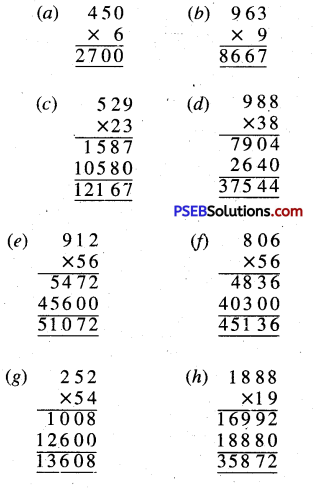
PSEB 5th Class Maths Solutions Chapter 2 Fundamental Operations on Numbers Ex 2.4 2
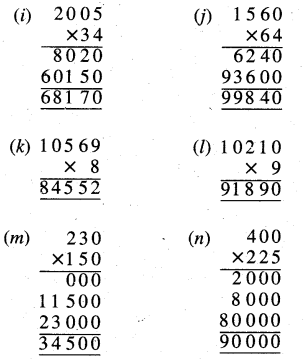
PSEB 5th Class Maths Solutions Chapter 2 Fundamental Operations on Numbers Ex 2.4 3

Question 2.
Find the product of the following:
(a) 4045 × 23
(b) 1609 × 30
(c) 363 × 134
(d) 455 × 208
(e) 105 × 120
(f) 1440 × 25
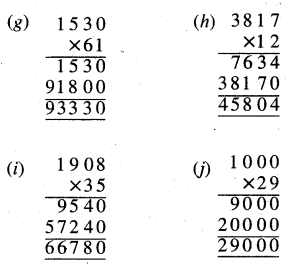
(g) 1530 × 61
(h) 3817 × 12
(i) 1908 × 35
(j) 1000 × 29
Solution:
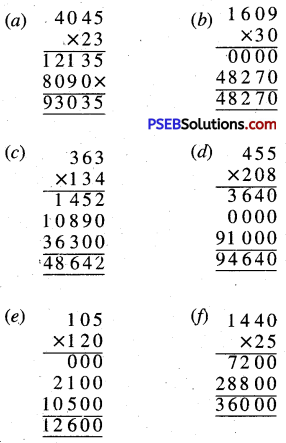
PSEB 5th Class Maths Solutions Chapter 2 Fundamental Operations on Numbers Ex 2.4 4
PSEB 5th Class Maths Solutions Chapter 2 Fundamental Operations on Numbers Ex 2.4 5

PSEB 5th Class Maths Solutions Chapter 2 Fundamental Operations on Numbers Ex 2.4

Question 3.
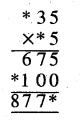
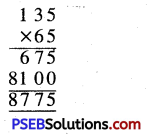
Find the digits in place of * :
PSEB 5th Class Maths Solutions Chapter 2 Fundamental Operations on Numbers Ex 2.4 6
Solution:
PSEB 5th Class Maths Solutions Chapter 2 Fundamental Operations on Numbers Ex 2.4 7

PSEB 5th Class Maths MCQ Chapter 9 Volume

Punjab State Board PSEB 5th Class Maths Book Solutions Chapter 9 Volume MCQ Questions and Answers.

PSEB 5th Class Maths Chapter 9 Volume MCQ Questions

Multiple Choice Questions

Tick (✓) the correct answer :

Question 1.
Volume of cube with side 9 cm is :
(a) 81 cubic cm
(b) 90 cubic cm
(c) 729 cubic cm
(d) 8 cubic cm.
Answer:
(c) 729 cubic cm

PSEB 5th Class Maths Solutions MCQ Chapter 9 Volume

Question 2.
Find volume of cuboid with length 6 cm, breadth 4 cm and height 2 cm :
(a) 24 cubic cm
(b) 28 cubic cm
(c) 64 cubic cm
(d) 48 cubic cm.
Answer:
(d) 48 cubic cm.

Question 3.
Which is not the standard unit of volume?
(a) cubic cm
(b) sq. m
(c) cubic mm
(d) cubic metre.
Answer:
(b) sq. m

Question 4.
A cuboid with all sides equal is called ……………
(a) square
(b) cube
(c) cuboid
(d) rectangle.
Answer:
(b) cube

PSEB 5th Class Maths Solutions MCQ Chapter 9 Volume

Question 5.
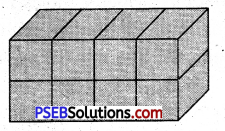
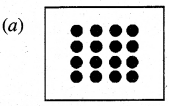
Count the number of cubes and find the volume of cuboid.
PSEB 5th Class Maths Solutions MCQ Chapter 9 Volume 1
Solution:
Volume of cuboid = 8 cubic cm.

Question 6.
A trolly is full of bricks. Length of the trolly is 400 cm, breadth is 200 cm and height is 100 cm. Length, breadth and height of a brick are 20 cm, 10 cm and 6 cm respectively. How many bricks are there in the trolly?
Solution:
Length of trolly, L = 400 cm
Breadth of trolly B = 200 cm
Height of trolly, H = 100 cm
Volume of trolly = L × B × H
= 400 cm × 200 cm × 100 cm.
Length of a brick, l = 20 cm
Breadth of a brick; b = 10 cm
Height of a brick, h = 6 cm
Volume of a brick = 20 cm × 10 cm × 6 cm
Number of bricks in the trolly
= \(\frac{\text { Volume of trolly }}{\text { Volume of each brick }}\)
= \(\frac{400 \times 200 \times 100}{20 \times 10 \times 6}\)
= \(\frac{20 \times 20 \times 50}{3}\) = \(\frac{20000}{3}\)
= 6666 (Approx)

PSEB 10th Class Science Solutions Chapter 4 Carbon and its Compounds

Punjab State Board PSEB 10th Class Science Book Solutions Chapter 4 Carbon and its Compounds Textbook Exercise Questions and Answers.

PSEB Solutions for Class 10 Science Chapter 4 Carbon and its Compounds

PSEB 10th Class Science Guide Carbon and its Compounds Textbook Questions and Answers

Question 1.
Ethane, with the molecular formula C2H6 has :
(a) 6 covalent bonds
(b) 7 covalent bonds
(c) 8 covalent bonds
(d) 9 covalent bonds.
Answer:
(b) 7 covalent bonds

Question 2.
Butanone is a four-carbon compound with the functional group :
(a) carboxylic acid
(b) aldehyde
(c) ketone
(d) alcohol.
Answer:
(c) ketone

Question 3.
While cooking, if the bottom of the vessel is getting blackened on the outside, it means that :
(а) the food is not cooked completely
(b) the fuel is not burning completely
(c) the fuel is wet
(d) the fuel is burning completely.
Answer:
(b) the fuel is not burning completely

Question 4.
Explain the nature of the covalent bond using the bond formation in CH3Cl.
Answer:
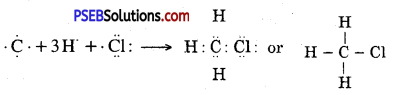
The formation of CH3Cl can be represented as :
PSEB 10th Class Science Solutions Chapter 4 Carbon and its Compounds 1
Carbon forms single covalent bonds with three H- atoms and one Cl – atom by sharing one electron pair with each C-H bonds are non-polar. But C – Cl bond is polar because C and H leave almost same electronegativity whereas Cl has more electronegativity than carbon.

PSEB 10th Class Science Solutions Chapter 4 Carbon and its Compounds

Question 5.
Draw the electron dot structures for :
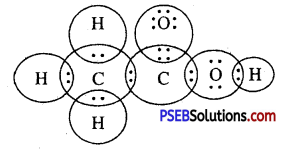
(a) ethanoic acid
Answer:
PSEB 10th Class Science Solutions Chapter 4 Carbon and its Compounds 2

(b) H2S
Answer:
PSEB 10th Class Science Solutions Chapter 4 Carbon and its Compounds 3

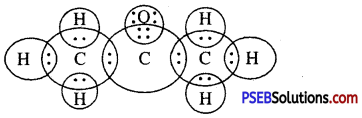
(c) propanone
Answer:
PSEB 10th Class Science Solutions Chapter 4 Carbon and its Compounds 4

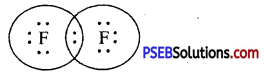
(d) F2.
Answer:
PSEB 10th Class Science Solutions Chapter 4 Carbon and its Compounds 5

Question 6.
What is an homologous series? Explain with an example.
Answer:
A series of compounds having similar structural formulae, same functional group and hence similar chemical properties is called a homologous series. In the homologous series any two adjacent members differ by CH2 unit in their molecular formulae.

For example homologous series of aldehydes (or alkanals) can be represented as :

H – CHO Methanal
CH3 – CHO Ethanal
CH3 – CH2 – CHO Propanal
CH3 – CH2 – CH2 – CHO Butanal
CH3 – CH2 – CH2 – CH2 – CHO Pentanal and so on.

Question 7.
How can ethanol and ethanoic acid be differentiated on the basis of their physical and chemical properties?
Answer:
Differences between ethanol and ethanoic acid

Ethanol Ethanoic acid
1. It is a colourless liquid having a pleasant smell. 1. It is colourless liquid having vineger like smell.
2. It has no action with a litmus solution. 2. It turns blue litmus solution red.
3. It has no action with sodium hydrogen carbonate solution. 3. It decomposes sodium hydrogen carbonate solution giving brisk effervescence of carbon dioxide gas.

Question 8.
Why does micelle formation take place when soap is added to water? Will a micelle be formed in other solvents such as ethanol also?
Answer:
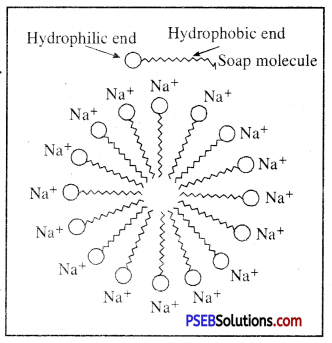
Soap molecule has two ends, one is hydrophilic, and it dissolves in water, while the other end is hydrophobic, and it dissolves in hydrocarbons. When soap is at the surface of water , the hydrophobic ‘tail’ of soap will not be soluble in water and the soap will align along the surface of water with the ionic end in water and the hydrocarbon ‘tail’ pointing out of water.
PSEB 10th Class Science Solutions Chapter 4 Carbon and its Compounds 6
Inside water, these molecules have a unique orientation which keeps the hydrocarbon portion out of the water. This is achieved due to the formation clusters of molecules in which the hydrophobic tails are in the interior of the cluster and the ionic ends are on the surface of the cluster. This formation is called a micelle.

Such micelles can be formed in other polar solvents like ethanol.

Question 9.
Why are carbon and its compounds used as fuels for most applications?
Answer:
Carbon and its compounds are used as fuels for most applications because they bum producing a large amount of heat and light.

PSEB 10th Class Science Solutions Chapter 4 Carbon and its Compounds

Question 10.
Explain the formation of scum when hard water is treated with soap.
Answer:
When soap is added to hard water, the soluble calcium and magnesium salts present in it react with soap to give insoluble calcium salt of soap which produces scum.
PSEB 10th Class Science Solutions Chapter 4 Carbon and its Compounds 7

Question 11.
What change will you observe if you test soap with litmus paper (red and blue)?
Answer:
Soap solution will turn red litmus paper blue because soap is alkaline in nature.

Question 12.
What is hydrogenation? What is its industrial application?
Answer:
The addition of hydrogen to unsaturated hydrocarbons in the presence of catalysts like palladium, platinum, nickel etc. to give saturated hydrocarbons is called hydrogenation.
PSEB 10th Class Science Solutions Chapter 4 Carbon and its Compounds 8
This reaction is used for hydrogenation of liquid vegetable oils using a nickel catalyst to get artificial or vanaspati ghee.

Question 13.
Which of the following hydrocarbons undergo addition reaction : C2H6, C3H8, C3H6, C2H2 and CH4.
Answer:
Out of C2H6, C3H8, C3H6, C2H2 and CH4; C3H6 and C2H2 undergo addition reactions because they contain multiple bonds.

Question 14.
Give a test that can be used to differentiate chemically between butter and cooking oil.
Answer:
Distinction between Butter and Cooking oil:

Butter Cooking Oil
1. It is solid at room temperature. 1. It is liquid at room temperature.
2. Mix equal volumes of HgCl2 solution in 50% alcohol and 5% iodine solution in alcohol. To this add lg of butter. Violet colour does not fade away. 2. Mix equal volumes of HgCl2 solution in 50% alcohol and 5% solution of iodine in alcohol. To this add 1 ml of cooking oil. Violet colour fades away.
3. Take 2 g of butter in a test tube. To this add 1ml of cone. HCl and a few drops of 2% furfural solution in alcohol. Shake and allow to stand for 5 – 10 minutes. No rose red coloration appears. 3. Take 2 g of cooking oil in a test tube. To this add 1 ml of cone. HCl and a few drops of 2% .furfural solution in alcohol. Shake it and allow to stand for 5 – 10 minutes. Rose red coloration is obtained.

Question 15.
Explain the mechanism of the cleansing action of soaps.
Answer:
Mechanism of cleansing action of Soap:
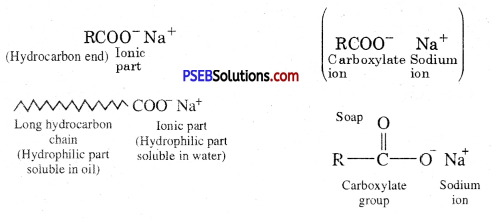
Soaps are sodium or potassium salts of higher fatty acids e.g. sodium palmitate, C15H31COONa+, sodium stearate, C17H35COONa+ etc. A molecule of soap consists of two parts :

  1. a long chain hydrocarbon part (C15H31, C17H35 …. etc.) which is soluble in oil and
  2. ionic part on polar group, – COONa+ which is soluble in water. Thus a molecule of soap can be represented as :

PSEB 10th Class Science Solutions Chapter 4 Carbon and its Compounds 9
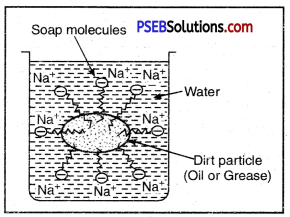
The long hydrocarbon chain is insoluble in water but soluble in oil and greases whereas the ionic or polar part is soluble in water. Soap has a capacity to clean a dirty piece of cloth whereas ordinary water cannot. The dirty clothes contain greasy and oily substance (dirt). Soap molecules dissociate in water to give carboxylate ion (RCOO) and cation (Na+). When soap added to dirty clothes dipped in water, the hydrocarbon part of carboxylate group dissolving in greasy or oily dirt particles where the polar (COO) group remain attached to water. In this way each oil droplet acquires negative charge.
PSEB 10th Class Science Solutions Chapter 4 Carbon and its Compounds 10
The cleansing action of Soap

These negative charged oil droplets called micelles cannot coalesce and hence form a stable emulsion water. These small droplets along with dirt can be easily washed away with water. Thus the soap helps in removing greasy dirt by producing a stable oil in wrater type emulsion. Also the soap reduces surface tension of water. Hence cloth is wetted more effectively and is cleaned.

Science Guide for Class 10 PSEB Carbon and its Compounds InText Questions and Answers

Question 1.
What would be the electron-dot structure of carbon dioxide which has the formula CO2?
Answer:
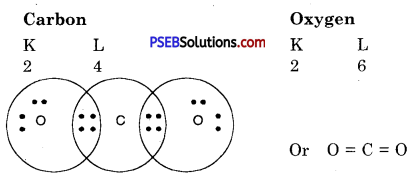
In carbon dioxide, carbon atoms are bonded with two oxygen atoms. The atomic number of carbon is 6, and it has four electrons in the outer shell.

To make an octet it requires four electrons. Oxygen requires only two electrons in the outer shell. Therefore electron-dot structure will be :
PSEB 10th Class Science Solutions Chapter 4 Carbon and its Compounds 11
Every oxygen atom is joined to carbon atom by double bond.

Question 2.
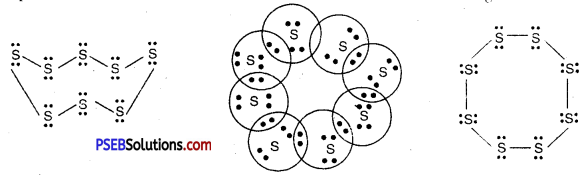
What would be the electron-dot structure of a molecule of sulphur which is made up of eight atoms of sulphur? (HINT. The eight atoms of sulphur are joined together in the form of ring.)
Answer:
The atomic number of sulphur is 16
PSEB 10th Class Science Solutions Chapter 4 Carbon and its Compounds 12
Sulphur has 6 electrons in the outermost shell and to complete an octet it requires 2 electrons.
∴ Sulphur atom will share 2 electrons. It’s chemical formula is S8.
PSEB 10th Class Science Solutions Chapter 4 Carbon and its Compounds 13

PSEB 10th Class Science Solutions Chapter 4 Carbon and its Compounds

Question 3.
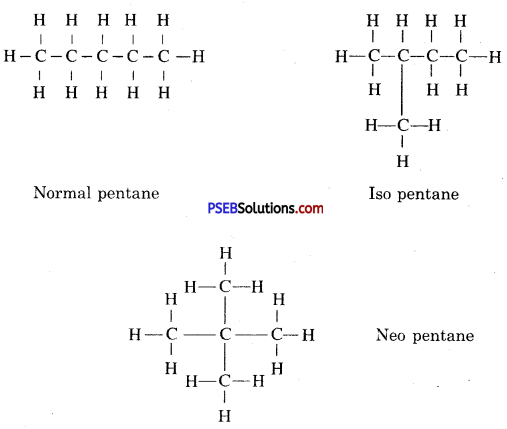
How many structural isomers can you draw for pentane?
Answer:
Three ; n-Pentane, iso-pentane, neo-pentane.
Structural isomers can be drawn for pentane.
PSEB 10th Class Science Solutions Chapter 4 Carbon and its Compounds 14

Question 4.
What are the two properties of carbon which lead to the huge number of carbon compounds we see around us?
Answer:

  1. Catenation: The carbon atoms have an astonishing property to combine and form bond with other carbon atoms to form long chain compounds. This property is known as catenation. In this, either long chain of carbon are in ring form or the carbon atoms join in single, double or triple bond.
  2. Tetravalency: Carbon has four electrons in the outermost shell. That is why its valency is four and it has got capacity to make bonds with other elements. Oxygen, Hydrogen, Nitrogen, Sulphur, Chlorine and many other elements can make new compounds with the help of carbon.

Question 5.
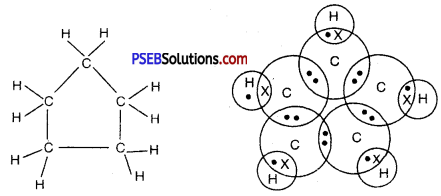
What will be the formula and electron dot structure of cyclopentane?
Answer:
Molecular formula of cyclopentane = C5 H2 × 5 = C5H10
PSEB 10th Class Science Solutions Chapter 4 Carbon and its Compounds 15

Question 6.
Draw the structures for following compounds :
Are structural isomers possible for bromopentane?
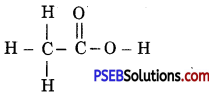
(i) Ethanoic acid
Answer:
Ethanoic acid (CH3COOH)
PSEB 10th Class Science Solutions Chapter 4 Carbon and its Compounds 16

(ii) Bromopentane
Answer:
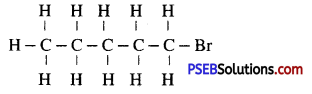
PSEB 10th Class Science Solutions Chapter 4 Carbon and its Compounds 17
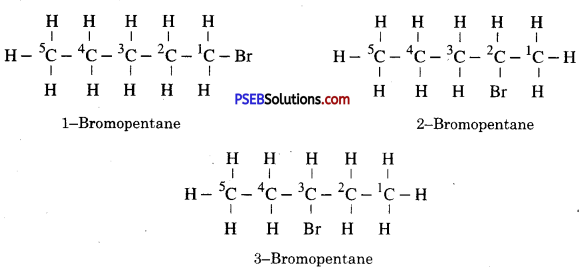
Due to exchange of position of carbon with bromine, many isomers of bromopentane are possible.
For example :
PSEB 10th Class Science Solutions Chapter 4 Carbon and its Compounds 18

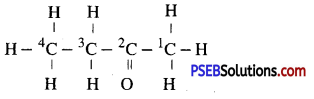
(iii) Butanone
Answer:
PSEB 10th Class Science Solutions Chapter 4 Carbon and its Compounds 19

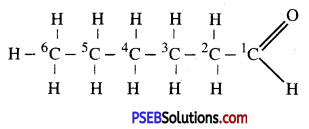
(iv) Hexanal.
Answer:
PSEB 10th Class Science Solutions Chapter 4 Carbon and its Compounds 20

Question 7.
How would you name the following compounds?
(i) CH3 – CH2 – Br
Answer:
Bromoethane

PSEB 10th Class Science Solutions Chapter 4 Carbon and its Compounds 21
Answer:
Methanal

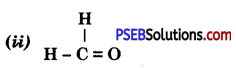
PSEB 10th Class Science Solutions Chapter 4 Carbon and its Compounds 22
Answer:
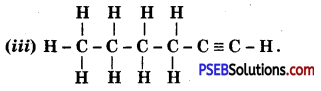
Hex-1-yne.

PSEB 10th Class Science Solutions Chapter 4 Carbon and its Compounds

Question 8.
Why is the conversion of ethanol to ethanoic acid an oxidation reaction?
Answer:
This is because in this reaction oxygen gets added to ethanol.
PSEB 10th Class Science Solutions Chapter 4 Carbon and its Compounds 23

Question 9.
A mixture of oxygen and ethyne is burnt for welding. Can you tell why a mixture of ethyne and air is not used?
Answer:
A mixture of ethyne and air is not burnt for welding. This is because air also contains nitrogen along with oxygen. Nitrogen will also burn in oxygen producing oxides of nitrogen such as nitre oxide (NO) and nitrogen dioxide (NO2) which cause pollution.

Question 10.
How would you distinguish experimentally between an alcohol and a carboxylic acid?
Answer:
The following two tests are used :

  • Litmus test: Treat the given compound with blue litmus solutions. If the blue litmus solution turns red, it is a carboxylic acid and if does not turn red, it is an alcohol.
  • Sodium bicarbonate test: Add some sodium bicarbonate solution to the given compound. If their is a brisk evolution of a colourless and odourless gas (CO2) which turns freshly prepared lime water milk, it is carboxylic acid and if their is no effervescence, it is an alcohol.

Question 11.
What are oxidising agents?
Answer:

  • The substances which can oxidise other substances by giving oxygen are called oxidising agents.
  • Examples: Alkaline potassium permanganate solution, acidified potassium dichromate solution, etc.

Question 12.
Would you be able to check if water is hard using a detergent?
Answer:
No, we can’t check whether the water is hand or soft using a detergent.

Question 13.
People use a variety of methods to wash clothes. Usually after adding the soap, they ‘beat’ the clothes on a stone, or beat it with a paddle, scrub with a brush, or the mixture is agitated necessary to get clean clothes?
Answer:
This is because when soap molecules dissolve in the dirt, the dirt is somewhat loosened from the clothes, and in order to remove it from clothes, the clothes have to be beaten on a stone or beaten with a paddle or scrubbed with a brush or mixture has to be agitated in washing machines.

PSEB 9th Class Science Solutions Chapter 5 The Fundamental Unit of Life

Punjab State Board PSEB 9th Class Science Important Questions Chapter 5 The Fundamental Unit of Life Important Questions and Answers.

PSEB Solutions for Class 9 Science Chapter 5 The Fundamental Unit of Life

PSEB 9th Class Science Guide The Fundamental Unit of Life Textbook Questions and Answers

Question 1.
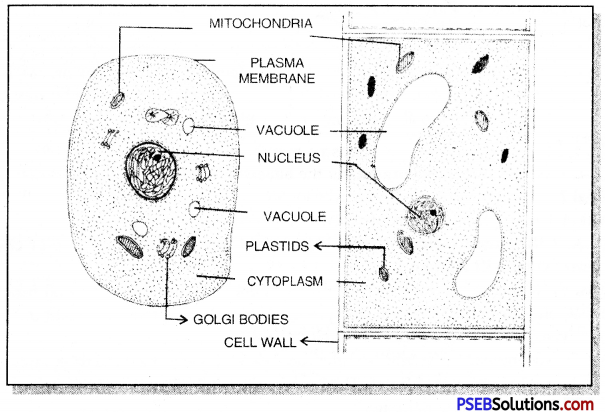
Make a comparison to write down ways in which plant cells are different from animal cell.
Answer:

Features Plant Cell Animal Cell
1. Cell wall Cell wall is formed of cellulose. Cell wall is absent.
2. Centrosome Absent. Present.
3. Vacuoles Large-sized and many present, small-sized. Generally absent but if only a few.
4. Plastids Present. Absent.
5. Reserve food In the form of starch and paramylon. In the form of glycogen
6. Nucleus Central. Acentric away from centre.

PSEB 9th Class Science Solutions Chapter 5 The Fundamental Unit of Life 1

PSEB 9th Class Science Important Questions Chapter 5 The Fundamental Unit of Life

Question 2.
How is prokaryotic cell different from a eukaryotic cell?
Answer:
Differences between prokaryotic cell and eukaryotic cell

Prokaryotic cell Eukaryotic cell
1. Found in Bacteria, blue-green algae and , Mycoplasma.

2. Primitive nucleus called nucleoid present. Chromosome is single, circular and double-stranded DNA but no proteins (so naked), No nuclear membrane.

3. Cell wall when present, it is formed of peptidoglycan.

4. Membrane-bound Cell-organelles like mitochondria, plastids, E.R., golgi bodies etc. is absent.

5. Ribosomes are of 70 S type.

6. Small-sized (1 – 10 um).

7. Cell division by fission or budding.

  1.  Found in Protista, Fungi, Plantae and Animalia.

2. A true nucleus present. Chromosomes are two to man, linear and formed of DNA and histones. Nuclear membrane present.

3. Cell wall when present in plant cells it is formed of cellulose.

4. Membrane-bound Cell-organelles like mitochondria, plastids, E.R., golgi bodies etc. is present.

5. Ribosomes are of 80 S type.

6. Large-sized (5 – 100 /un).

7. Cell division bv mitosis and meiosis.

Question 3.
What would happen if a plasma membrane ruptures or breaks down?
Answer:
Plasma membrane maintains the shape and protects the organelles. If it gets ruptured the internal organisation will be lost and it will not be able to perform its function. Then cell wall die and contents of cell will get disintegrated.

Question 4.
What would happen to the life of a cell if there was no Golgi apparatus?
Answer:
1. The Golgi apparatus performs the function of storage, modification and packaging of materials synthesised in the cell. These materials will not be able to perform their function in its original form.
2. The formation of lysosomes will be affected.

Question 5.
Which organelle is known as the powerhouse of the cell? Why?
Answer:
Mitochondria are known as ‘power house’ of the cell. They are sites for synthesis, storage and transport of ATP (Adenosine triphosphate) commonly called energy currency.

PSEB 9th Class Science Important Questions Chapter 5 The Fundamental Unit of Life

Question 6.
Where do the lipids and proteins constituting the cell membrane get synthesised?
Answer:

  • Proteins are synthesised bv ribosomes.
  • SER is site for synthesis of lipid.
  • These proteins and lipids are modified by golgi apparatus to form plasma membrane.

Question 7.
How does an Amoeba obtain its food?
Answer:
Plasma membrane is flexible and it enables the cell to engulf in food and other materials from the external environment. Such a process is termed endocytosis.

Question 8.
What is osmosis?
Answer:
Osmosis. It is a special case of diffusion of water through a selectively permeable membrane. It is a passage of water from a region of higher concentration through a semi- permeable membrane to a region of low water concentration.

Question 9.
Carry out the following osmosis experiment:
Take four peeled potato halves and hollow each one out to make potato cups. One of these potato cups should be made from a boiled potato. Put each potato cup in a trough containing water. Now,
(a) keep cup A empty
(b) put one teaspoon sugar in cup B
(c) put one teaspoon salt in cup C
(d) put one teaspoon sugar in the boiled potato cup D.
Keep this setup for two hours. Then observe the four potato cups and answer the following.
1. Explain why water gathers in the hollowed portion of B and C.
2. Why is potato A necessary for this experiment?
3. Explain why water does not gather in the hollowed out portions of A and D?
Answer:
1. The water gathers in hollowed portion of potato cups B and C due to osmosis.
2. Cup A acts as control experiment and indicates that cavity of potato will not induce any type of movement.
3. Cup A does not contain hypertonic solution hence water does not rise. In cup D, cells of potato cup being boiled cells are dead and no osmosis occurs.

Science Guide for Class 9 PSEB The Fundamental Unit of Life InText Questions and Answers

Question 1.
Who discovered cell and how?
Answer:
Robert Hooke (1665) discovered cell for the first time. He examined a thin slice of cork under the microscope. He observed that cork resembled the structure of a honey comb consisting of many hexagonal compartments and called these boxes ‘cells’.

Question 2.
Why is cell called the structural and functional unit of life?
Answer:

  1. Cells are arranged in proper and systematic order to form a body of living organism. Thus cells serve as basic building structural units for more complex organisms.
  2. Cell is also functional unit of life because all the metabolic activities of life take place at cell level.
  3. Respiration, digestion, excretion and reproduction occur at cell level.
  4. Cells contain genetic material which regulate cell functions and pass on all information to the next generation.

Question 3.
How do substances like C02 and water move in and out of the cell? Discuss.
Answer:
The substances like C02 and water move in and out of cell by the process of diffusion. There is spontaneous movement of substances from higher concentration to lower concentration. The movement of water across selectively permeable membrane is called osmosis.

PSEB 9th Class Science Important Questions Chapter 5 The Fundamental Unit of Life

Question 4.
Why is the plasma membrane called selectively permeable membrane?
Answer
Plasma membrane permits the entry and exit of selected materials in and out of the cell. It also prevents movement of some materials required within the cell. The membrane is called selectively permeable membrane.

Question 5.
Fill in the gaps in the following table illustrating differences between prokaryotic and eukaryotic cells.

Prokaryotic Cell Eukaryotic Cell
1. Size: generally small (1 – 10 µm) = 10-6m

2. Nuclear region ……………. and known as ………………..

3. Chromosome single.

4. Membrane-bound cell organelles absent.

1. Size: generally large 5 – 100 µm

2. Nuclear region well defined and surrounded by a nuclear membrane.

3. More than one.

4. ………………………………………………..

Answer:
2. Nuclear region undefined due to absence of nuclear membrane and known as Nucleoid.
4. Membrane-bound cell organelles such as mitochondria, Golgi bodies, chloroplast, etc. are present.

Question 6.
Can you name two organelles we have studied that contain their own genetic material?
Answer:

  • Chloroplasts
  • Mitochondria.

Question 7.
If the organization of the cell is destroyed due to some physical or chemical influence, what will happen?
Answer:
Each cell has certain special cell organelles. Each performs a special function. If an organization is destroyed cell will stop performing basic functions and result in its death.

PSEB 9th Class Science Important Questions Chapter 5 The Fundamental Unit of Life

Question 8.
Why are lysosomes called ‘suicidal bags’?
Answer:
Lysosomes are membrane-bound sacs filled with enzymes and this enzyme may digest their own contents if burst. They carry out autolysis (auto = self; lysis = break down) hence called “suicidal bags.”

Question 9.
Where are proteins synthesized inside the cell?
Answer:
Proteins are synthesized on the ribosomes which are attached to the surface of RER or lie freely in the cytoplasm. Ribosomes are also called “protein factories” of cells.

PSEB 10th Class Science Solutions Chapter 6 Life Processes

Punjab State Board PSEB 10th Class Science Book Solutions Chapter 6 Life Processes Textbook Exercise Questions and Answers.

PSEB Solutions for Class 10 Science Chapter 6 Life Processes

PSEB 10th Class Science Guide Life Processes Textbook Questions and Answers

Question 1.
The kidneys in human beings are a part of the system for :
(a) nutrition
(b) respiration
(c) excretion
(d) transportation.
Answer:
(c) excretion.

Question 2.
The xylem in plants are responsible for :
(a) transport of water
(b) transport of food
(c) transport of amino acids
(d) transport of oxygen.
Answer:
(a) transport of water.

Question 3.
The autotrophic mode of nutrition requires :
(a) CO2 and water
(b) Chlorophyll
(c) Sunlight
(d) All of the above.
Answer:
(d) All of above.

Question 4.
The breakdown of pyruvate to give CO2, water and energy takes place in :
(a) cytoplasm
(b) mitochondria
(c) chloroplast
(d) nucleus
Answer:
(b) mitochondria.

Question 5.
How are fats digested in our bodies? Where does the process take place?
Answer:
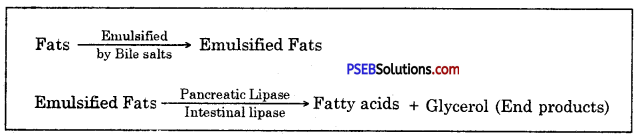
Digestion of fats takes place in the intestine. The fats are emulsified by the bile salts present in bile. The emulsified fats are acted upon by pancreatic lipase (strepsin) which hydrolyses fats into fatty acids and glycerol. The intestinal lipase also hydrolyses the emulsified fats into fatty acids and glycerol.
PSEB 10th Class Science Solutions Chapter 6 Life Processes 1

Question 6.
What is the role of saliva in the digestion of food?
Answer:
Role of saliva

  • Saliva lubricates the food and facilitates mastication.
  • Saliva binds the food molecules together.
  • Saliva contains ptyalin (salivary amylase) enzyme which acts on starch, glycogen and other carbohydrates to form maltose.

PSEB 10th Class Science Solutions Chapter 6 Life Processes

Question 7.
What are the necessary conditions for autotrophic nutrition and what are its byproducts?
Answer:
Photosynthesis is essential in case of autotrophic nutrition
PSEB 10th Class Science Solutions Chapter 6 Life Processes 2

Conditions required for photosynthesis

  • CO2 is necessary for photosynthesis.
  • Water is required.
  • Sunlight is necessary for photosynthesis.
  • Chlorophyll is essential for photosynthesis.
  • By-products. Molecular oxygen is liberated as a byproduct.

Question 8.
What are the differences between aerobic respiration and anaerobic respiration? Name some organisms that use anaerobic mode of respiration.
Answer:
(a) Differences between aerobic and anaerobic respiration

Aerobic respiration Anaerobic respiration
1. It takes place in the presence of oxygen. 1. It takes place in the absence of oxygen.
2. It is completed in cytoplasm and mitochondria of cells. 2. It is completed in the cytoplasm only.
3. It involves the complete oxidation of glucose into CO2 and H2O and a large amount of energy is released. 3. It involves the incomplete oxidation of glucose into CO2 and alcohol or lactic acid and less amount of energy is released.
4. The process is harmless. 4. It is toxic to plants.

(b) Anaerobic respiration takes place in bacteria and yeast.

Question 9.
How are alveoli designed to maximise the exchange of gases?
Answer:

Question 10.
What would be the consequences of a deficiency of haemoglobin in our bodies?
Answer:
Haemoglobin is a respiratory pigment present in RBC of blood. It has high affinity for oxygen. One molecule of haemoglobin carries 4 molecules of oxygen. If simple diffusion were to move oxygen in our body, it is estimated that it would take 3 years for a molecule of oxygen to reach tip of toes from lungs.

Question 11.
Describe double circulation in human beings. Why is it necessary?
Answer:
Double circulation. In human beings heart is four-chambered, having right and left auricles and right and left ventricles. The right auricle receives the deoxygenated blood from the body and sends it into the right ventricle that pumps it to the lungs via a pulmonary arch for oxygenation. The left auricle receives oxygenated blood from the lungs and sends it into the left ventricle, which pumps it to the body through a single aortic arch.

Significance:

  • Thus, the deoxygenated and oxygenated blood remain fully separate, and there is complete double circulation.
  • It increases efficiency.

PSEB 10th Class Science Solutions Chapter 6 Life Processes 3
Double circulation of blood in birds and mammals.

Question 12.
What are the differences between the transport of materials in xylem and phloem?
Answer:
Differences between transport in xylem and phloem

Transport in xylem Transport in phloem
1. Water and minerals are transported through xylem. 1. Sucrose, amino acids and other substances are transported through phloem.
2. Xylem helps in upward movement, i.e. from roots to stem, branches and leaves. 2. Phloem is responsible for downward and lateral movement from leaves to other parts.

Question 13.
Compare the functioning of alveoli in the lungs and nephrons in the kidneys with respect to their structure and functioning.
Answer:

  • Alveoli of lungs remove CO2 as a waste during exchange of gases and nephrons filter wastes from blood.
  • Alveoli are supplied with extensive network of blood capillaries for gaseous exchange. Bowman’s capsule surrounds a cluster of capillaries for filtration.
  • Both increases surface area either for gaseous exchange or filtration.
  • Urea and uric acid wastes are removed in the nephron.
  • Both purify blood lungs alveoli by removing waste gases and nephrons by filtering the waste products in the form of urine.

Science Guide for Class 10 PSEB Life Processes InText Questions and Answers

Question 1.
Why is diffusion insufficient to meet the energy requirements of multicellular organisms like humans?
Answer:
In multicellular organisms, all the cells of body may not be in direct contact with the surrounding source of oxygen i.e. environment, thus simple diffusion will not meet the oxygen requirements of all the cells. These organisms require specialised organs to meet the oxygen requirement.

PSEB 10th Class Science Solutions Chapter 6 Life Processes

Question 2.
What criteria do we use to decide whether something is alive?
Answer:
Features of living organisms

  • Movements
  • Growth
  • Metabolism
  • Cellular body
  • Nutrition
  • Respiration
  • Transportation
  • Excretion
  • Respond to stimuli
  • Reproduction.

Question 3.
What are outside raw materials used by living organism?
Answer:
Outside raw materials used by living organism

  • Energy obtained from food.
  • Oxygen: Required for breaking down of carbon based molecules to liberate energy in the body.
  • Water: It is required for proper digestion of food and other functions in the body. It is raw material for photosynthesis in plants. All reactions occur in solution form in the body.
  • CO2 Raw material for photosynthesis in plants. All reactions occur in solution form in the body.

Question 4.
What processes would you consider essential for maintaining life?
Answer:

  • Nutrition
  • Respiration
  • Transportation
  • Excretion.

Question 5.
What are the differences between autotrophic and heterotrophic nutrition?
Answer:
Differences between Autotrophic and Heterotrophic nutrition

Autotrophic Nutrition Heterotrophic Nutrition
1. It occurs in green plants and blue green algae. 1. It occurs in animals and insectivorous plants.
2. CO2 and water are raw materials which combine to form organic compound. 2. They depend on plants and herbivore for their food.
3. They need chlorophyll and sunlight 3. There is no need of chlorophyll and sunlight,

Question 6.
Where do the plants get each of raw materials required for photosynthesis? (PB. Board 2011)
Answer:
Raw materials of photosynthesis

  • CO2
  • Water.
  • Nitrogen
  1. CO2 is obtained from air. It enters the leaf through stomatal openings.
  2. Water is obtained from soil. It enters the leaf through the mid-rib and vein from the root which absorbs it from the soil.
  3. Nitrogen: It is obtained from soil.

Question 7.
What is the role of acid in our stomach?
Answer:
HCl is obtained from gastric glands present in the wall of the stomach.

Functions of HCl:

  • It provides acidic medium. It is required for the action of enzymes. It changes the pH of food from almost neutral to acidic medium (from pH 7 to 2)
  • Activates the inactive proenzyme propepsin into active pepsin.
  • Kills the bacteria present in food.
  • It softens calcium.
  • It regulates the opening and closing of the pyloric aperture.

Question 8.
What is the function of digestive enzymes?
Answer:
Role of digestive enzymes: These enzymes convert the complex non-diffusible form of food into simple diffusible form.

  • Ptyalin converts starch into maltose.
  • Pepsin breaks down proteins into peptides and amino acids.
  • Rennin curdles milk protiens so that they can stay for longer period to be acted upon by pepsin.
  • Lipase acts on fats and forms fatty acid and glycerol.
  • Maltase acts on maltose and forms glucose.

Question 9.
How is small intestine designed to absorb digested food?
Answer:
Small intestine is a long tubular structure. The inner wall of small intestine is thrown into folds called villi. The absorptive cells have numerous finger-like processes called microvilli. They increase the surface area for absorption of food. These villi have blood vessels named lacteals from absorption of food.

Question 10.
What advantage over an aquatic organism does a terrestrial organism have with regard to obtaining oxygen for respiration?
Answer:
The amount of oxygen dissolved in water is very low as compared to the amount of oxygen in air. Thus these organisms have to make less efforts to obtain oxygen.

PSEB 10th Class Science Solutions Chapter 6 Life Processes

Question 11.
What are the different ways in which glucose is oxidised to provide energy in various organisms?
Answer:
Different pathways to provide energy from glucose
PSEB 10th Class Science Solutions Chapter 6 Life Processes 4

Question 12.
How is oxygen and CO2 transported in human beings?
Answer:
1. Transport of oxygen: It is transported from respiratory organs to body cells,
1. Haemoglobin helps in the transport of oxygen. In the alveoli of the lungs, the haemoglobin (Hb) present in red blood corpuscles combines with oxygen to form oxyhaemoglobin. When the blood reaches the tissue, oxygen is released from the oxyhaemoglobin for the consumption by the tissues.
Hb + O2 → HbO2
PSEB 10th Class Science Solutions Chapter 6 Life Processes 5

2. Some of O2 is transported in the solution form by plasma of blood.

2. Transport of CO2

  • CO2 diffuses into blood plasma to form physical solution.
  • CO2 forms unstable carbonic acid with water and is transported as such.
  • CO2 is also transported from tissue to lungs as bicarbonates.

Question 13.
How are lungs designed in human beings to maximise the area for exchange of gases?
Answer:
Within the lungs, the primary bronchi divides into smaller and smaller tubes which finally terminate into balloon-like structures called alveoli. These alveoli increase the surface area for exchange of gases. There are 750 million alveoli in the lungs of man. If the alveolar surface is spread out it would cover about 80 m2. Thus it makes efficient exchange of gases.

Each alveolus or air sac has a diameter of 75 to 300 microns and has a very thin wall. The walls of the alveoli are elastic and are supplied with capillaries. Through these thin walls gases are exchanged between the capillaries and the air sacs.

Question 14.
What are the components of the transport system in human beings? What are the functions of these components?
Answer:
There are two main transport systems in human beings :

  1. Blood vascular system.
  2. Lymphatic system.

Components of blood vascular system

  • Blood: It is a reddish viscous fluid connective tissue. In an adult human being, it is 5-6 litres in amount. Blood consists of two parts – plasma and formed elements. (RBCs, WBCs and blood platelets). Blood transports digested food, oxygen, carbon dioxide, nitrogenous wastes and hormones in the body.
  • Heart: It is a hollow, muscular pumping organ. The heart sends the blood to lungs. Heart pumps the blood in the body.
  • Blood vessels: The blood vessels which carry oxygenated blood are called arteries. They divide to form capillaries of finer dimensions. Exchange of materials takes place across the capillaries. It is possible because the walls of capillaries are extremely thin. The blood from the tissues is returned by veins.

Components of Lymphatic system

  1. Lymph: It acts as middle man between blood and tissue. It destroys harmful bacteria
  2. Lymph vessels
  3. Lymph capillaries
  4. Lymph nodes

Question 15.
Why is it necessary to separate oxygenated and deoxygenated blood in mammals and birds?
Answer:

  • In the heart of these organisms the left side has oxygenated blood and right side deoxygenated blood.
  • The separation of blood allows a highly efficient supply of oxygen to the body.
  • It is essential for such animals which have high energy needs.
  • They also constantly use energy for maintaining body heat.

Question 16.
What are the components of transport system in highly organised plants?
Answer:
Components of transport system in plants

  • Xylem tissue. Vessels and tracheids of roots, stems and leaves are concerned with transport of water and minerals in plants.
  • Phloem consists of sieve tubes and companion cells. It transports food, amino acid, phytohormones and other substances from leaves to various parts of plants.

Question 17.
How are water and minerals transported in plants?
Answer:
Transport of water and minerals
1. In xylem tissue, vessels and tracheids of the roots, stems and leaves are interconnected to form a continuous system of water conducting channels reaching all parts of the plants.

2. Plants absorb water and minerals through their entire surface i.e., roots, stem and leaves. However, mainly the water is absorbed by roots from soil.

3. The area of young roots where most of the absorption takes place is the root hair zone.

4. This zone is the area of greatest permeability.
PSEB 10th Class Science Solutions Chapter 6 Life Processes 6

5. Passage of water in root or pathway of water in root

  • The entry of water into the root hair dilutes the cell sap. Thus water molecules in root hair increase as compared to adjacent cortical cells.
  • Water reaches the passage cells of endodermis. These passage cells lie opposite the xylem.
  • They allow water to entre the pericycle.
  • So, water enters the xylem from pericycle for upward movement of sap.

6. The Ascent of Sap:
The upward movement of water from the root towards the top of the plant in the xylem vessels is called ascent of sap. The upward transport of water and minerals in plants which are in some cases as tall as 400 ft. poses a serious problem.

7. Transpiration also helps in the absorption and upward movement of water and minerals dissolved in it from roots to the leaves.

Question 18.
How is food transported in plants?
Answer:
Transport of food in plants:
The food prepared in the green leaves of plants is transported through phloem in the form of sucrose solution to storage organs of roots, seeds and fruits. This process is called translocation. This process requires energy. It is provided by ATP molecules. This increases the osmotic pressure in the tissue causing water to move into it. This pressure moves the material in the phloem to tissues which have less pressure.

PSEB 10th Class Science Solutions Chapter 6 Life Processes

Question 19.
Describe the structure and functioning of nephron.
Or
How does urine formation occur in human?
Answer:
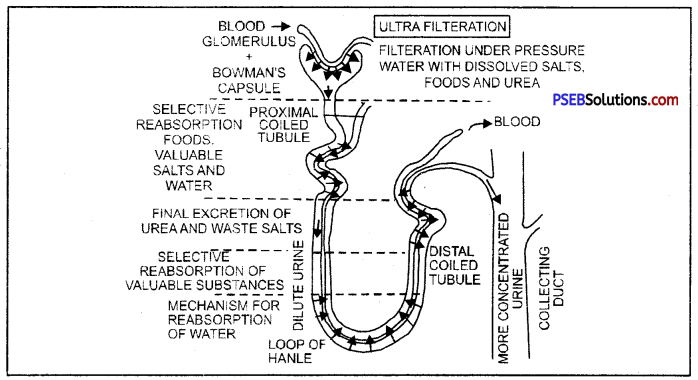
Structure of a Nephron:
A nephron is made up of:

  • a globular double-walled Bowman’s capsule around a clump of capillaries or glomerulus, and
  • a tubule surrounded by blood capillaries.

The tubule consists of
(a) a proximal convoluted portion
(b) the loop of Henle, with descending and ascending limbs, and
(c) a distal convoluted part.

The nephron empties into a collecting duct. The two million nephrons of a human being, end to end would extend for nearly 80 km. All the collecting ducts discharge into a central cavity of the kidney (pelvis) that connects to the ureter.

Functioning of Nephron
Urine is formed by 3 processes: glomerular filtration, tubular reabsorption and tubular secretion in the nephrons of the kidney.
1. Ultrafiltration (Glomerular filtration):
Blood is filtered under pressure in the glomeruli present in the cup-like structure of Bowman’s capsule. Glomerular (nephric) filtrate is formed.
PSEB 10th Class Science Solutions Chapter 6 Life Processes 7
Nephron and its function

2. Tubular reabsorption:
In the PCT, entire glucose, amino acids, vitamins and hormones, most of the inorganic ions are reabsorbed by active transport, most of water by osmosis, and some urea by back diffusion from nephric filtrate.
Loop of Henle mainly concentrates urine to conserve water. Here, some inorganic ions are actively taken up and some water leaves by osmosis.

3. Tubular secretion:
In the DCT, collecting tubule and collecting duct, many ions, water (depending upon availability) are secreted in to DCT and collecting duct.
Urine formed passes into bladder from kidney through ureters.

Question 20.
What are the methods used by plants to get rid of excretory products?
Answer:
Excretory products of plants include CO2, salts, resins, tanins latex etc. Excretion in Plants

  • Excess of water passes out during transpiration.
  • Plants get rid of dead tissue as a measure to eliminate waste.
  • Waste products may be stored in cellular vacuoles.
  • Waste products may be stored in leaves which fall off.
  • Resins and gums are stored in old xylem.
  • Plants also excrete wastes into soil.
  • Aquatic plants lose their waste products by diffusion into the water.

Question 21.
How is the amount of urine produced regulated?
Answer:

  • Amount of urine formed depends upon the availability of water in the body.
  • ADH (Antidiuretic Hormone) regulate the amount of water.
  • Osmoregulation helps in regulation of salts and water.
  • Urine is stored in urinary bladder.

PSEB 5th Class Hindi Solutions Chapter 2 जब मैं पढ़ता था

Punjab State Board PSEB 5th Class Hindi Book Solutions Chapter 2 जब मैं पढ़ता था Textbook Exercise Questions and Answers.

PSEB Solutions for Class 5 Hindi Chapter 2 जब मैं पढ़ता था

Hindi Guide for Class 5 PSEB जब मैं पढ़ता था Textbook Questions and Answers

I. बताओ

प्रश्न 1.
गाँधी जी का पूरा नाम क्या था ?
उत्तर:
गाँधी जी का पूरा नाम मोहनदास कर्मचन्द गाँधी था।

प्रश्न 2.
गाँधी जी का जन्म कब और कहाँ हुआ ?
उत्तर:
गाँधी जी का जन्म 2 अक्तूबर, सन् 1869 को पोरबन्दर (गुजरात) में हुआ।

PSEB 5th Class Hindi Solutions Chapter 2 जब मैं पढ़ता था

प्रश्न 3.
गाँधी जी के माता-पिता का क्या नाम था ?
उत्तर:
गाँधी जी की माता का नाम पुतलीबाई और इनके पिता का नाम करमचन्द गाँधी था।

प्रश्न 4.
गाँधी जी ने श्रवण कुमार का चित्र देखकर मन में क्या सोचा ?
उत्तर:
श्रवण कुमार का चित्र देखकर गाँधी जी ने मन ही मन श्रवण कुमार की तरह बनकर मातापिता की सेवा करने का निश्चय किया।

प्रश्न 5.
‘सत्य हरिश्चन्द्र’ नाटक देखने पर गाँधी जी के मन में क्या बात बैठ गई ?
उत्तर:
‘सत्य हरिश्चन्द्र’ नाटक देखने पर गाँधी जी के मन में यह बात बैठ गई कि चाहे हरिश्चन्द्र की भाँति दुःख उठाना पड़े, पर सत्य को कभी नहीं छोगा।

प्रश्न 6.
गाँधी जी की किस भूल की सज़ा उन्हें जीवन भर झेलनी पड़ी ?
उत्तर:
स्कूल के समय में अपनी लिखाई को न सुधारना गाँधी जी की एक ऐसी भूल थी जिसकी सज़ा उन्हें जीवन भर झेलनी पड़ी।

प्रश्न 7.
गाँधी जी के लिए क्या बात असहय थी ?
उत्तर:
अपने से बड़ों तथा शिक्षकों का अप्रसन्न होना गाँधी जी के लिए असह्य था।

प्रश्न 8.
गाँधी जी की व्यायाम में अरुचि के दो कारण कौन-से थे ?
उत्तर-:
गाँधी जी की व्यायाम में अरुचि के दो कारणों में से प्रथम तो यह है कि वह बहुत संकोची स्वभाव के थे और दूसरा कि वह अपने पिता जी की सेवा करने की तीव्र इच्छा रखते थे। स्कूल बन्द होते ही वह तुरन्त घर जाकर उनकी सेवा में लग जाते थे। इसीलिए व्यायाम में उनकी अरुचि थी।

II. इन प्रश्नों के उत्तर चार या पाँच पंक्तियों में लिखो

प्रश्न 1.
गाँधी जी ने इस पाठ में अपने माता– पिता के बारे में क्या बताया है ?
उत्तर:
गाँधी जी ने अपने माता-पिता के बारे में बताते हुए कहा कि मेरे पिता करमचन्द गाँधी थे। वे राजकोट के दीवान थे। वे सत्यप्रिय, साहसी और उदार व्यक्ति थे। वे सदा उचित न्याय करते थे। उनकी माता का नाम पुतलीबाई था। उनका स्वभाव बहुत अच्छा था। वे धार्मिक विचारों की महिला थीं। पूजा-पाठ किए बिना भोजन नहीं करती थीं।

प्रश्न 2.
सुलेख शिक्षा का ज़रूरी अंग है। इसके बारे में गाँधी जी के विचार क्या थे ?
उत्तर;
‘सुलेख शिक्षा का ज़रूरी अंग है’, गाँधी जी के इस बारे में विचार थे कि लिखाई सुन्दर होनी चाहिए, इसके लिए चित्रकला सीखनी चाहिए। बालक जब चित्रकला सीखकर चित्र बनाना जान जाता है, तब यदि अक्षर लिखना सीखे तो उसके अक्षर मोती जैसे हो सकते हैं।

प्रश्न 3.
व्यायाम के लिए समय पर स्कूल न पहँचने पर गाँधी जी को दःख क्यों हआ ?
उत्तर:
व्यायाम के लिए समय पर स्कूल न पहुँचने पर गाँधी जी को इसलिए दुःख हुआ क्योंकि आकाश में बादल होने के कारण गाँधी जी को समय का पता नहीं चला और घड़ी इनके पास थी नहीं। इन्होंने अपनी देरी का कारण सबको सच-सच बतला दिया, लेकिन किसी ने इनकी बात पर विश्वास नहीं किया और इन्हें दण्ड लगा दिया। इस बात पर गाँधी जी को दुःख हुआ।

III. वाक्यों में प्रयोग करो

सत्यप्रिय, साहसी, उदार, सत्यवादी, धार्मिक, स्वास्थ्य, मंदबुद्धि, पके घड़े पर मिट्टी चढ़ना, मोती जैसे अक्षर होना, धोखा खाना, मन मारकर रह जाना।
उत्तर:
(i) सत्यप्रिय-कर्मचन्द गाँधी सत्यप्रिय व्यक्ति थे।
(ii) साहसी-मोहन एक साहसी बालक है।
(iii) उदार-राजा बहुत उदार स्वभाव का था।
(iv) सत्यवादी-हमें सत्यवादी बनना चाहिए।
(v) धार्मिक-मेरी माता जी धार्मिक स्वभाव की हैं।
(vi) स्वास्थ्य-इन दिनों मेरा स्वास्थ्य ठीक नहीं
(vi) मंदबुद्धि-हमें मंदबुद्धि बालकों से भी प्रेम पूर्वक व्यवहार करना चाहिए।
(vii) पके घड़े पर मिट्टी चढ़ना-महेश तुम अब कॉलेज में पढ़ते हुए अपनी लिखाई सुधारने की बात सोचते हो। भला पके घड़े पर भी कहीं मिट्टी चढ़ी है?
(ix) मोती जैसे अक्षर होना-बार-बार सुलेख का अभ्यास करो तो तुम्हारे मोती जैसे अक्षर हो सकते हैं।
(x) धोखा खाना-मैंने दो बार मोहन पर विश्वास करके धोखा ही खाया है।
(xi) मन मारकर रह जाना-मेरा सुझाव किसी ने भी न माना अत: मुझे मन मारकर रह जाना पड़ा।

IV. ‘अ’ लगाकर विपरीत शब्द बनाओ

(i) अ + प्रसन्न = अप्रसन्न
(ii) अ + सत्य = ……………
(iii) अ + पूर्ण = ……………
(iv) अ + रुचि = ……………
(v) अ + न्याय = ……………
(vi) अ + सावधान = ……………
उत्तर:
(i) अ + प्रसन्न = अप्रसन्न।
(ii) अ + सत्य = असत्य।
(iii) अ + पूर्ण = अपूर्ण।
(iv) अ + रुचि = अरुचि।
(v) अ + न्याय = अन्याय।
(vi) अ + सावधान = असावधान।

PSEB 5th Class Hindi Solutions Chapter 2 जब मैं पढ़ता था

V. इन शब्दों में ‘र’ पदेन (/) है या रेफ (‘) या ऋ की मात्रा

(i) अनिवार्य = ……………
(ii) पितृभक्ति = ……………
(iii) धार्मिक = ……………
(iv) हरिश्चन्द्र = ……………
(v) अपूर्ण = ……………
(vi) संस्कृत = ……………
(vii) आश्च र्य. = ……………
(viii) छात्रवृति = ……………
(ix) श्रवण = ……………
(x) सत्यप्रिय = ……………
(xi) वर्ष = ……………
(xii) विद्यार्थी = ……………
(xiii) प्रेम = ……………
(xiv) क्रिकेट = ……………
उत्तर:
(i) अनिवार्य = रेफ।
(ii) पितृभक्ति = ऋा
(iii) धार्मिक = रेफ।
(iv) हरिश्चन्द्र = पदेन।
(v) अपूर्ण = रेफ।
(vi) संस्कृत = ऋ।
(vii) आश्चर्य = रेफ।
(viii) छात्रवृति = ऋ।
(ix) श्रवण = पदेन।
(x) सत्यप्रिय = पदेन।
(xi) वर्ष = रेफ।
(xii) विद्यार्थी = रेफ।
(xiii) प्रेम = पदेन।
(xiv) क्रिकेट = पदेन।

VI. पाठ से ढूँढ़कर समान अर्थ वाले शब्द लिखो

(i) स्कूल = ……………
(ii) पुस्तक = ……………
(iii) अध्यापक = ……………
(iv) पढ़ाई = ……………
(v) नाखुश = ……………
(vi) कसरत = ……………
(vii) हैरानी = ……………
(vii) कठोर = ……………
(ix) तरीका = ……………
(x) जरूरी = ……………
उत्तर:
समान अर्थ वाले शब्द
(i) स्कूल = विद्यालय।
(ii) पुस्तक = किताब।
(iii) अध्यापक = शिक्षक।
(iv) पढ़ाई = विद्या।
(v) नाखुश = नाराज़।
(vi) कसरत = व्यायाम।
(vii) हैरानी = आश्चर्य।
(viii) कठोर = सख्त।
(ix) तरीका = उपाय।
(x) ज़रूरी = आवश्यक।

VII. इनके लिए एक शब्द लिखौं।

PSEB 5th Class Hindi Solutions Chapter 2 जब मैं पढ़ता था 1

(i) जो दूसरों से संकोच करे …………..
(ii) जिसे सदा सत्य प्यारा हो …………..
(ii) जो सत्य के लिए आग्रह करे ………….
(iv) जो सदा सत्य बोले ……………….।
(v) जो पिता का भक्त हो …………
उत्तर:
(i) जो दूसरों से संकोच करे-संकोची।
(ii) जिसे सदा सत्य प्यारा हो-सत्यप्रिय।.
(iii) जो सत्य के लिए आग्रह करे-सत्याग्रही।
(iv) जो सदा सत्य बोले-सत्यवादी।
(v) जो पिता का भक्त हो-पितृभक्त।

PSEB 5th Class Hindi Solutions Chapter 2 जब मैं पढ़ता था

VIII. (क) अन्तर समझो और वाक्यों में प्रयोग करो-

1. दण्ड = जुर्माना-मुझे दो रुपये दण्ड देना पड़ा।
दण्ड = सज़ा-पुलिस ने चोर को दण्ड दिया।

2. पात्र = बर्त – …………
नपात्र = अभिनेता- …………………..
3. भूल = गलती- ………….
भूल = भूल जाना- …………

4. कड़ा = हाथ में पहना जाने वाला- …………
कड़ा = कठोर- ………….

5. दीवान = मंत्री, वजीर- …………..
दीवान = जमघट, जमावड़ा, संग्रह-………..

6. आना = मूल्य (रुपया, आना, पैसा)-……
आना = किसी व्यक्ति या वस्तु का कहीं से आना-……… ……..
उत्तर:
1. दण्ड = जुर्माना – मुझे दो रुपये दण्ड देना पड़ा।
दण्ड = सज़ा-पुलिस ने चोर को दण्ड दिया।

2. पात्र = बर्तन-इस पात्र का मुँह छोटा है।
पात्र = अभिनेता-इस नाटक में पाँच पात्र हैं।

3. भूल = गलती-मैं अपनी भूल की क्षमा चाहता हूँ।
भूल = भूल जाना-मैं आपकी पुस्तक लाना भूल गया।

4. कड़ा = हाथ में पहना जाने वाला-मुझे सोने का कड़ा चाहिए।
कड़ा = कठोर-अनुशासन के मामले में वह बहुत कड़ा है।

5. दीवान = मंत्री, वजीर-दीवान ने अपनी समस्या राजा के सामने रखी।
दीवान = जमघट, संग्रह, जमावड़ा-पीपल के पेड़ के नीचे गाँव का दीवान सज़ा हुआ था।

6. आना = एक रुपये का सोलहवां हिस्सा| मुझे आठ आना चाहिए।
आना = किसी का आना-आपका दिल्ली से कब आना होगा ?

(ख) सूक्ष्म अंतर समझो और वाक्यों में प्रयोग करो

1. सजा = सजाना- …………
सजा = दण्ड- ………….

2. शोक = अफसोस …………..
शौक = पसंद- ……………

3. चिंता = फिक्र- …………
चिता = शव जलाने हेतु लकड़ियों का ढेर …………
उत्तर:
1. सजा = सजाना-नौकर ने सारा कमरा सजा दिया है।
सज़ा = दण्ड-अपराधी को अपने किए की सज़ा मिली।

2. शोक = अफसोस-मित्र की माता के निधन पर शोक पत्र लिखो।
शौक = पसंद-मुझे खेलने का बहुत शौक है।

3. चिंता = फिक्र-मुझे आपकी बहुत चिंता
चिता = शव जलाने हेतु लकड़ियों का ढेर-शव को चिता पर रखा गया।

IX. पढ़ो, समझो और नये शब्द बनाओ

क् + ष = क्ष = अक्षर …………… , …………….
त् + र = त्र = छात्र ………… , …………..
ज् + अ = ज्ञ = ज्ञान …………… , …………..
श् + र = श्र = श्रवण ……………. , ……………
उत्तर:
(क) निरक्षर, साक्षर।
(ख) पत्र, मित्र।
(ग) ज्ञान, विज्ञान।
(घ) आश्रय, विश्राम।

X. विपरीत शब्द बनाओ

(i) इच्छा = अनिच्छा
(ii) उदार = अनुदार
(iii) दुःख = ………..
(iv) अनिवार्य = ऐच्छिक
(v) दण्ड = …………….
(vi) रुचि = …………..
उत्तर:
विपरीत शब्द
(i) इच्छा = अनिच्छा।
(ii) उदार = अनुदार।
(iii) दुःख = सुख।
(iv) अनिवार्य = ऐच्छिक।
(v) दण्ड = इनाम।
(vi) रुचि = अरुचि।

प्रयोगात्मक व्याकरण

I. संज्ञा (परिभाषा)-किसी व्यक्ति के नाम, वस्तु, स्थान अथवा भाव के नाम को संज्ञा कहते हैं।

उदाहरण:

  1. मैं भी श्रवण कुमार की तरह बनूँगा।
  2. मैं फुटबाल खेलने नहीं गया था।
  3. यह विचार मेरे मन में इंग्लैंड जाने तक रहा।
  4. मुझे इस बात का दुःख है।

ऊपर दिखाए गए वाक्यों में रेखांकित शब्द संज्ञा कहलाते हैं।

निम्नलिखित वाक्यों में से संज्ञा शब्द छांटिए

(1) वे राजकोट के दीवान थे।
(2) सभी को हरिश्चन्द्र की तरह सत्यवादी बनना चाहिए।
(3) सत्य को कभी नहीं छोड़ना चाहिए।
(4) मैंने कभी झूठ नहीं बोला।
(5) मैं तुरन्त उनकी सेवा में लग जाता था।
(6) लेकिन अपने आचरण की मुझे बहुत चिन्ता रहती थी।
उत्तर:
(1) राजकोट, दीवान
(2) हरिश्चन्द्र, सत्यवादी
(3) सत्य
(4) झूठ
(5) सेवा
(6) आचरण।

PSEB 5th Class Hindi Solutions Chapter 2 जब मैं पढ़ता था

योग्यता विस्तार

अपने स्कूल के पुस्तकालय से श्रवण कुमार, महात्मा गाँधी, भगत सिंह, सुखदेव, राजगुरु, लाला लाजपत राय आदि की जीवनियाँ लेकर पढ़ो। जो गुण आप उनसे सीखो उसे अपनी डायरी में नोट करो और अपने आचरण में लाओ।

नोट-विद्यार्थी पुस्तकालय में से इन महापुरुषों की जीवनियों को पढ़ें, अपनी डायरी में उनके अच्छे गुणों को लिखें और जीवन में उनका आचरण करें।

II. निम्नलिखित के उत्तर हाँ या नहीं में दो

  1. क्या आप सैर करने जाते हो – हाँ/नहीं
  2. क्या आप फुटबाल खेलते हो – हाँ/नहीं
  3. क्या आप क्रिकेट खेलते हो – हाँ/नहीं
  4. क्या आप व्यायाम/योग करते हो – हाँ/नहीं
  5. क्या आप चित्रकला में रुचि रखते हो हाँ/नहीं
  6. क्या आप नाटक में रुचि रखते हो हाँ/नहीं

ऊपर लिखी जिस बात में आपकी अधिक रुचि है उस पर अन्यथा इनके अलावा किसी अन्य में जैसे संगीत, दौड़ आदि में आपकी रुचि है तो उस पर पाँच वाक्य लिखें।

नोट- विद्यार्थी अपनी पसन्द के खेलों में हाँ और नापसन्द खेलों में नहीं को सही (✓) का निशान लगाते हुए अपनी मनपसन्द खेल के लिए पाँच वाक्य लिखें।

(3) (क) भाषा : परिभाषा-अपने मन की बातों, भावनाओं और विचारों को प्रकट करने का साधन भाषा कहलाती है। साहित्यिक दृष्टि से भाषा के दो प्रकार होते हैं। (i) मौखिक और (ii) लिखित।

(ख) लिपि : परिभाषा-भाषा को चिह्नों में लिखने की प्रणाली को लिपि कहते हैं। अलगअलग भाषाओं की अलग-अलग लिपियाँ होती हैं। कुछ प्रसिद्ध भाषाओं की लिपियाँ निम्नांकित हैं

भाषा – लिपि
(i) संस्कृत – देवनागरी।
(ii) हिन्दी – देवनागरी।
(iii) पंजाबी – गुरुमुखी।
(iv) अंग्रेजी – रोमन।
(v) उर्दू – फ़ारसी।

III. समझो और संकेतों की सहायता से अपनी आत्मकथा लिखो

अपने बारे में लिखी कहानी को आत्मकथा कहते हैं। आपने गाँधी जी की आत्मकथा पढ़ी। इसमें से कौनकौन से गुण आप अपने जीवन में अपनायेंगे। लिखो।

शब्द संकेत
…………… माता-पिता की सेवा करना
…………… शिक्षक का आदर करना
……………… सत्य बोलना
………………. खुली हवा में सैर करना
……………… सुलेख
……………… पढ़ने के साथ व्यायाम करना
उत्तर:
नोट-विद्यार्थी दिए गए शब्द संकेतों की सहायता से स्वयं लेखन का प्रयास करें।

बहुवैकल्पिक प्रश्न

पूछे गए प्रश्नों के सही विकल्प पर (✓) निशान लगाएं

प्रश्न 1.
गाँधी जी का पूरा नाम क्या था ?
(क) मोहन
(ख) मोहनदास
(ग) कर्मचन्द
(घ) मोहनदास कर्मचन्द गांधी।
उत्तर:
(घ) मोहनदास कर्मचन्द गांधी।

प्रश्न 2.
गाँधी जी का जन्म कब हुआ ?
(क) 2 अक्तूबर 1869
(ख) 2 अक्तूबर 1879
(ग) 2 अक्तूबर 1889
(घ) 2 अक्तूबर 1899.
उत्तर:
(क) 2 अक्तूबर 1869

प्रश्न 3.
गाँधी जी का जन्म कहाँ हुआ?.
(क) हरियाणा
(ख) गुजरात
(ग) पंजाब
(घ) कश्मीर।
उत्तर:
(ख) गुजरात

प्रश्न 4.
गाँधी जी ने किसका चित्र देखा?
(क) श्रवण कुमार
(ख) सुभाषचन्द्र बोस
(ग) शहीद भगत सिंह
(घ) नेहरू।
उत्तर:
(क) श्रवण कुमार

प्रश्न 5.
गाँधी जी ने कौन-सा नाटक देखा?
(क) सत्य
(ख) हरिश्चन्द्र
(ग) सत्य हरिश्चन्द्र
(घ) सत्य के प्रयोग।
उत्तर:
(ग) सत्य हरिश्चन्द्र

जब मैं पढ़ता था Summary

जब मैं पढ़ता था पाठ का सार

महात्मा गाँधी अपने जीवन के विषय में बताते हैं कि उनके पिता का नाम करमचन्द गाँधी तथा माता का नाम पुतली बाई था। पिता सत्यप्रिय, साहसी और उदार व्यक्ति थे। माता आस्तिक और अच्छे स्वभाव की महिला थीं। पोरबंदर में जन्म लेकर उन्होंने स्कूली शिक्षा राजकोट में प्राप्त की। बचपन में ‘श्रवणपितृभक्ति’ नामक पिता के द्वारा लाई पुस्तक को पढ़कर और श्रवण कुमार की शीशे में तस्वीर देख श्रवण कुमार की तरह बनने की इच्छा तेज़ हो गई थी। वे हरिश्चन्द्र की सत्यवादिता से बहुत प्रभावित हुए थे। तेरह वर्ष की आयु में उनका विवाह कस्तूरबा से हो गया था। शिक्षा प्राप्ति में उन्होंने सुलेख का महत्त्व समझा। अपने संस्कृत-अध्यापक की प्रेरणा से उन्होंने संस्कृत सीखी। पढ़ाई में ये सामान्य थे। इनका मन व्यायाम करने, क्रिकेट या फुटबाल खेलने में नहीं लगता था। ये अपने पिता की सेवा करना चाहते थे। एक बार आकाश में बादलों के कारण ये समय का ठीक अनुमान नहीं लगा पाए थे और शाम के व्यायाम के लिए ठीक समय पर न पहुँच पाने के कारण इन्हें जुर्माना देना पड़ा था जिसका इन्हें दुख था कि झूठा न होने पर भी उन्हें दंडित किया गया, तब उन्होंने जाना था कि सच बोलने वाले को असावधान भी नहीं रहना चाहिए।

PSEB 5th Class Hindi Solutions Chapter 2 जब मैं पढ़ता था

कठिन शब्दों के अर्थ:

दीवान = मन्त्री। सत्यप्रिय = सत्य से प्रेम करने वाला। साहसी = हिम्मती। उदार = बड़े दिल वाला। उचित = ठीक। न्याय = इन्साफ़। स्वभाव = आदत। धार्मिक = धर्म से जुड़ा। पाठशाला = विद्यालय, स्कूल। प्रभाव = असर। बहँगी = काँवर। छात्रवृत्ति = वज़ीफा।असह्य = जिसे सहा न जा सके, न सहने वाला। सहपाठी = साथ पढ़ने वाला। शिक्षक = शिक्षा देने वाला, अध्यापक। संकोची = शर्मीला। सत्यवादी = सच। बोलने वाला। पितृभक्ति = पिता की भक्ति। आचरण = चाल-चलन, व्यवहार। स्वास्थ्य = सेहत। लाभकारी = लाभ पहुंचाने वाला। व्यायाम = कसरत। अपूर्ण = अधूरी। चित्रकला = तस्वीर बनाने का हुनर। सरल = आसान। कठिनाई = मुश्किल। रस = आनन्द। उपकार = भला। अध्ययन = पढ़ना, पढ़ाई। मन्द बुद्धि = थोड़ी अक्ल वाला। गर्व = अभिमान। दण्ड = सजा। पात्र = अधिकारी।अरुचि = शौक न होना। अनुशासन = नियम का पालन, नियन्त्रण। अनिवार्य = ज़रूरी। तीव्र = तेज़। विज = रुकावट। मन मार कर = मन पर काबू करके। असावधान = लापरवाह।

PSEB 10th Class Science Important Questions Chapter 3 Metals and Non-metals

Punjab State Board PSEB 10th Class Science Important Questions Chapter 3 Metals and Non-metals Important Questions and Answers.

PSEB 10th Class Science Important Questions Chapter 3 Metals and Non-metals

Long Answer Typt Questions

Question 1.
Show various steps involved in extraction of metal from an ore by a sketch.
Answer:
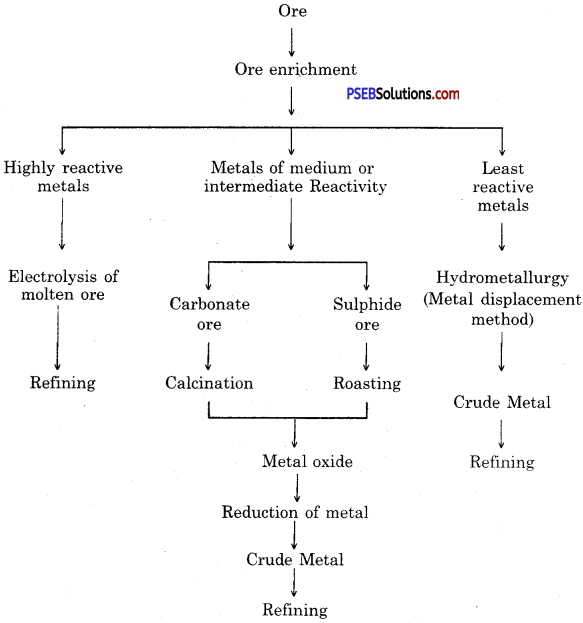
PSEB 10th Class Science Important Questions Chapter 3 Metals and Non-metals 1
Steps involved in the extraction of metals from ores.

Question 2.
Give methods of enrichment of ores.
Answer:
Methods of enrichment of ores. Ores or minerals are mined from earth these are usually contaminated with large amount of impurities which are called gangue. It is necessary to remove these impurities before extraction of metals. By removing gangue the ore is enriched and concentration of metal is increased. Therefore ore in enriched prior to other processes. Methods of removing gangue from ore depends on the difference of physical and chemical properties of both of them.
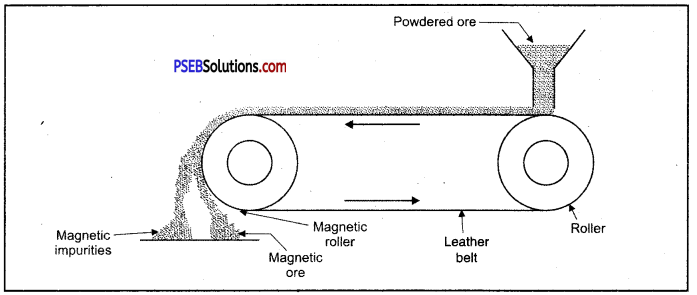
PSEB 10th Class Science Important Questions Chapter 3 Metals and Non-metals 2
Enrichment of ore using magnetic method.

Physical methods of enrichment :

  • Hydraulic Washing: In this method finely powdered ore is washed with jet of water. In this strong flow of water light gangue particles are washed away where as heavy ore particles settle down, Tin and lead ores are enriched by this method.
  • Froth Floatation Method: In this method, mixture of powdered ore and water or some appropriate oil is taken in a tank. Ore particles are coated with oil and gangue particles are wet with water. A blast of compressed air is blown through the pipe of a rotating agitation to produce froth, due to this, mineral particles wetted with oil change into foam and float on the surface of water. Froth containing ore particles is easily transferred to another container sulphides of copper, lead and zinc are enriched by this method.

Chemical Methods: The chemical method used for the concentration of the ore is based on the difference in some chemical property of the metal and the impurities. An example of this method is the concentration of bauxite ore of aluminium.

Concentration of aluminium ore by Bayer’s process: In this method, Bauxite is reduced by treating it with hot sodium hydroxide. It gives sodium meta aluminate (NaAlO2) which is soluble in water. The solution in filtered to remove the gangue present in the ore because it does not dissolve in sodium hydroxide. NaAlO2 is allowed to react with hydrochloric acid to obtain Aluminium hydroxide. On strong heating aluminium hydroxide pure aluminium oxide is obtained.

Following reactions take place
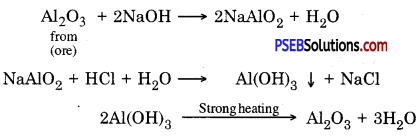
PSEB 10th Class Science Important Questions Chapter 3 Metals and Non-metals 3

Question 3.
Explain General methods used in the extraction of metals.
Answer:
Steps involved in the extraction of metals :

  • Enrichment (concentration) of ore.
  • Converting concentrated ore into oxide.
  • Reduction of metal oxide to obtain metal.
  • Refining of impure metal.

1. Concentration :
(A) Hydraulic washing: This method is used for concentration of oxide ores Gangue particles are lighter as compared to ore particles. In this method powdered ore is washed with flowing water. Light gangue particles are washed away with water and heavy ore particles are left.

(B) Froth floatation method: In this method powdered ore is taken in a tank containing water pine oil is also added to it. Sulphide ore is wet with oil and gangue is wet with water.
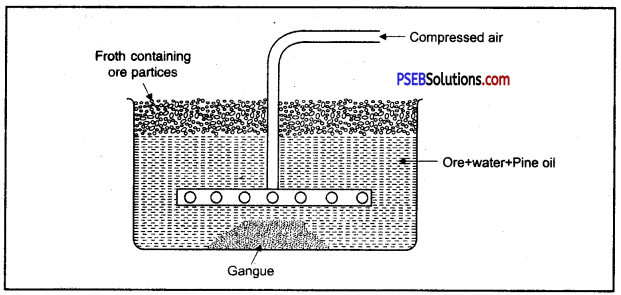
PSEB 10th Class Science Important Questions Chapter 3 Metals and Non-metals 4
The water is agitated by blowing compressed air violently, a froth is formed on the surface of water. This froth carries the lighter ore particles along with it to the surface. Gangue particles are heavy and settle to the bottom.

(C) Magnetic separation.
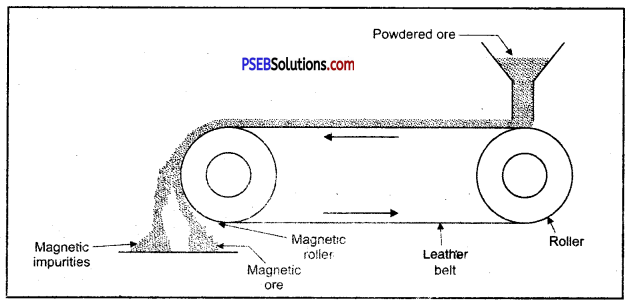
PSEB 10th Class Science Important Questions Chapter 3 Metals and Non-metals 5
Enrichment of ore using magnetic method.

1. Magnetic method: This method is acceptable for magnetic impurities like iron, cobalt, Nickel etc. Minerals which are of magnetic nature got attracted towards magnetic field. Chromite and pyrolusite ores are enriched by this method. In this method ground ore is placed on a conveyer belt. This belt goes around two rollers one of which is magnetic. When ore comes near the magnetic roller then two heaps of magnetic and non magnetic materials are obtained. Iron ore magnetite is enriched by this method.

(D) Chemical separation: This process is based on the difference between chemical – properties of ores and gangue eg. Bauxite Al2O3.2H2O is impure form of aluminium oxide. It contains Iron (III) oxide (Fe2O3) and sand (SiO2) as main impurities. Due to iron (III) oxide its colour is red brown. Bayer’s process is used to obtain pure aluminium from / bauxite. In this methods powdered ore is mixed with heated sodium hydroxide.
Al2O3 (S) + 2NaOH (aq) → 2NaAlO2 (aq) + H2O (l)
NaAlO2 (aq) + 2H2O (l) → Al(OH)2 (s) + NaOH (aq)

PSEB 10th Class Science Important Questions Chapter 3 Metals and Non-metals 6

2. Converting concentrated ore into metal oxide
Roasting: In this process ore is heated in the presence of air to obtain metal oxide. Which can easily be reduced to obtain the metal.

Zinc blende contains zinc sulphide when concentrated zinc blende ore (zinc sulphide) is roasted in air then it gets oxidized to give zinc oxide.

PSEB 10th Class Science Important Questions Chapter 3 Metals and Non-metals 7
Calcination: In this process ore is heated in the absence of air to remove moisture and volatile impurities.
When carbonate ore is heated it dissociates to give metal oxide.

PSEB 10th Class Science Important Questions Chapter 3 Metals and Non-metals 8

3. Extracting metals from metal oxide.
To obtain metal from metal oxide it is heated with some reducing agent. To obtain metals zinc, iron, tin etc. their oxides ore heated with carbon which acts as reducing agent.
ZnO(s) + C(s) → Zn(s) + CO(g)

Oxides of metals with medium activity can be reduced by using highly reactive metals like sodium, calcium and aluminium etc.
3MnO2(s) + 4Al(s) → 3Mn(l) + 2Al2O3(s) + heat

4. Electrolytic refining.
In this method impure metal is taken as anode and a thin strip of pure metal is taken in the form of cathode metal salt solution is taken as electrolyte. When electric current is passed through the electrolyte, pure metal from anode dissolves into solution and impurities settle down as anode mud.
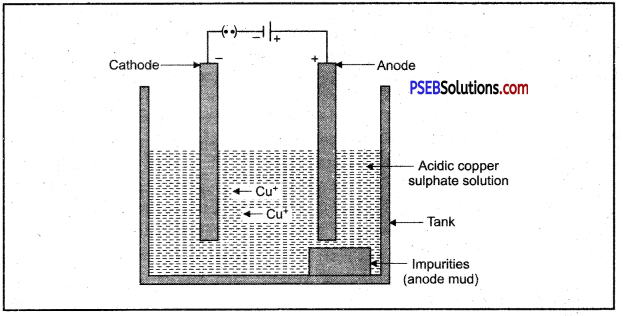
PSEB 10th Class Science Important Questions Chapter 3 Metals and Non-metals 9
Electrolytic refining

PSEB 10th Class Science Important Questions Chapter 3 Metals and Non-metals

Question 4.
(a). How do metals and non-metals react?
Answer:
Metals and non-metals react on the basis of electronic configuration in the valence shell.

Sodium has only one electron in its outer most shell. If it lose its electrons of the M shell then L will become its outermost shell which have complete octet. Nucleus of this atom will have 11 protons but number of electrons is 10, therefore it is positively charged and gives Na+ sodium positive ions. On the other side, there are 7 electrons in the outer most shell of chlorine and it requires one electron to complete its octet. If there is reaction between chlorine and sodium then lost electron of sodium atom is gained by chlorine atom and chlorine atom becomes negatively charged by one unit. Because there are 17 protons in the nucleus of the chlorine atom and there are 18 electrons in K, L and M shells. Therefore, chloride negative ions Cl- is obtained.

Due to opposite charges sodium and chloride ions attract each other and they form strong bonds involving electrostatic forces and form sodium chloride.

Another ionic compound, magnesium chloride is shown in fig.
Formation of NaCl and MgCl2 by Electron transfer :
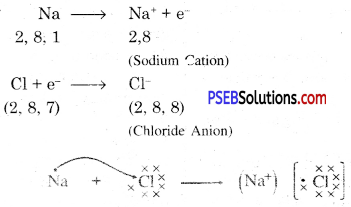
PSEB 10th Class Science Important Questions Chapter 3 Metals and Non-metals 10
Formation of sodium chloride.
PSEB 10th Class Science Important Questions Chapter 3 Metals and Non-metals 11
Formation of sodium chloride.

Compounds formed by metals and Non-Metals by the transfer of electrons between them are called ionic or electrovalent compounds.

(b) Write four main exceptions from normal properties of metals and Non-Metals.
Answer:

  • All the metals are solid at room temperature except mercury. Melting point of metal is usually high but of Gallium and Cesium is low.
  • Iodine is a non-metal but still shiny.
  • Carbon is a non-metal which can have many forms. Diamond is allotrope of carbon. It is the hardest substance found in nature. Its melting and boiling point are very high. Another allotrope of carbon is graphite which is conductor of electricity.
  • Alkali metal (lithium, sodium, Potassium) are so soft that these can be cut by knife. They have low density and low melting point.

Question 5.
How will you differentiate between metals and non-metals?
Answer:
Differences between metals and non-metals on the basis of physical properties :

Metals Non-metals
1.         All metals are solid at room temperature. But mercury is liquid at room temperature. 1. Non-metals exist in all the three states at room temperature. Phosphorous and sulphur are solid, H2, O2, N2 in gaseous state, and bromine in liquid state.
2. Metals are ductile, malleable and tenacious. 2. These are soft.
3. Metals have lustre i.e. metal shine. 3. They do not have lustre but diamond, graphite and iodine are exceptions.
4. Metals are good conductors of heat and electricity but bismuth is exception.  4.All non metals are non conductors except graphite and carbon gas.
5. Metals have high melting and boiling points.  5. Non metals have low melting and boiling points.
6. Metals are hard but sodium and potassium can be cut by knife. 6. These are not very hard but diamond is the hardest substance.
7. Metals have very high relative densities but Na, K are exceptions. 7. Non metals have very low relative densities.
8. Metals are opaque. 8. Gaseous non metals are transparent.

Difference between metals and non-metals on the basis of chemical properties

Metals Non-metals
1. Metals form alkaline oxides some of them form bases. 1. Non-metals form acidic or neutral oxides.
2. Metals react with acids to displace hydrogen and form salts. 2. Non-metals do not displaces hydrogen from acids.
3. Metals are electropositive in nature. 3. Non-metals are electronegative in nature.
4. Metals combine with chlorine to form chlorides which are electrovalent compounds. 4. Non-metals combine with chlorine to form chlorides which are covalent compounds.
5. Some metals combine with hydrogen to form hydrides which are electrovalent. 5. Non-metals combine with hydrogen to form hydrides which are covalent.
6. Metals are reducing agents. 6. Non-metals are oxidizing agents.
7. Metals form positive ions in aqueous solution. 7. Non-metals form negative ions in aqueous solution.

Question 6.
Discuss about the extraction of metals
Answer:
Some metals are found in free state in nature. Some metals are found in the form of compounds. Metals at the bottom of reactivity series show very low reactivity. These are found in free state. Gold, silver, platinum and copper are found in free state.

Copper and silver are also found in the form of sulphide and oxide ores. Metals (K, Na, Ca, Mg and Al) which are at the top of reactivity series show very high reactivity that they are never found in free state. Metals at the middle of the reactivity series (Zn, Fe, Pb etc.) are moderately reactive. These are found in the form of oxide, sulphide or carbonate. Some metal ores are found in the form of oxides.

Metals are classified into three types:
(a) least reactive metals
(b) Moderately reactive metals
(c) highly reactive metals.
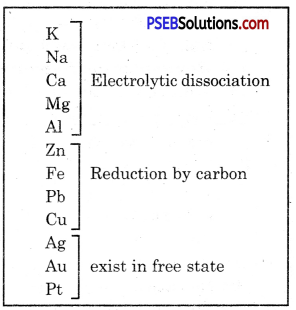
PSEB 10th Class Science Important Questions Chapter 3 Metals and Non-metals 12
Reactivity series and metallurgy

Question 7.
What is rust? What are the requirements necessary for its completion? Give ways to prevent rusting of iron?
Answer:
Surface of iron aquires a coating of a brown flaky substance called rust. It is a compound of Iron (III) Oxide and iron (III) hydroxide. It weakens the iron surface. Due to this, a great loss occurs to the iron articles.

The presence of moisture and air is necessary for rusting of iron. This can be proved with an experiment. If we take new shining irons nails in three test tubes as shown, then we find that nails which are in contact with water and air, got rusted. If we completely immerse the nails in water and cover the water surface with oil so that there is no air available for the nails, then nails will not get rusted.

Similarly if we use CaCl, in the test tube absorbs all the moisture so that no moisture is available in this case also, nails will not get rusted.
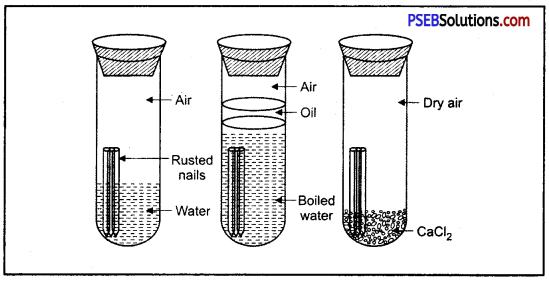
PSEB 10th Class Science Important Questions Chapter 3 Metals and Non-metals 13

Ways to Prevent Rusting :

  1. Using oil or grease on the surface: If iron surface is covered with oil or grease it does not remain in contact with air and thus rusting is prevented. Machine parts are saved by this method.
  2. Using enamel: By painting iron surface, rusting can be prevented. Buses, cars, scooter, motor cycle, windows, trains etc. are saved by this method.
  3. Covering with plastic: Iron surface is covered with plastic. Iron furniture is saved by this method.
  4. Galvanization: A process of coating thin layer of zinc on iron is called galvanization. This method is used to prevent buckets, tubs, drums, iron sheets etc. from rusting.
  5. By electroplating: Iron can be electroplated by metals like Nickle, Chromium, aluminium etc. Rims, handles, bumpers etc. of vehicles are prevented from rusting by this method.
  6. By tin: Iron is coated with tin. Ghee canisters, boxes used for packing food are tinned.
  7. Converting to steel: Iron can be preverted from rusting by converting it into steel.

PSEB 10th Class Science Important Questions Chapter 3 Metals and Non-metals

Question 8.
Explain General properties of ionic compounds.
Answer:
General properties of ionic compounds are given below:

  • Physical nature: Due to strong force of attraction between positive ions and negative ions, ionic compounds are solid. They are brittle and break on pressing.
  • Melting and boiling point: They have high melting and boiling points. Because a large amount of energy is required to break the strong inter ionic attraction.
  • Solubility: Ionic compounds are normally soluble in water but are insoluble in Kerosene, Petrol etc.
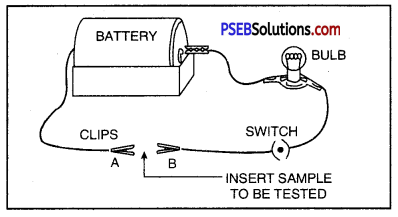
  • Electric Conductivity: In solid form ionic compounds do not conduct electricity because of strong and firm structure. Movement of ions is not possible. But ionic compounds can conduct electricity in molten state, because electrostatic force of attraction becomes very weak due to heat energy. Therefore ions can move freely and electric current can pass through it. Mobility of charged particles is necessary for conduction of electricity in a solution. Ions are present in aqueous solution of ionic compounds. When electric current is passed through the solution then ions start moving towards the opposite electrodes.

Question 9.
What is an alloy? Magnetic iron oxide explain the objective of their formation?
Answer:
Alloy: An alloy is a homogeneous mixture of a metal with another metal or non-metal, e.g. solder is an alloy of lead and tin (Pb and Sn). Stainless steel, solder, brass, bronze, bell metal etc.

Uses of alloys :

  • For increasing hardness: Iron is mixed with carbon to form stainless steel which is harder than iron. Copper is mixed with gold and lead is mixed with silver to make them hard. Duralium is an alloy made from aluminium and is very hard.
  • Increasing strength: Steel, Duralium are hard as well as strong.
  • Preventing Corrosion: By making stainless steel an alloy of iron, which do not get rusted.
  • To produce sound: Bell metal is an alloy of copper and tin used to produce loud sound.
  • To lower melting point: An alloy of Bismuth, tin and lead has low melting point.
  • Moulding: Bronze and type metal.
  • For change in colour: Aluminium bronze is an alloy of copper and aluminium is of golden colour.
  • Domestic uses: Alloys are used in homes, factories, offices etc. e.g. utensils, almirahs, fans, refrigerators elements etc. are made up of alloys.

Question 10.
Explain the activity series of metals.
Answer:
All metals have different rates of activity. Some metals like sodium, potassium and calcium etc. are highly reactive. These metals combine with oxygen to form oxide and react with hydrogen to form hydrides. Some metals are compratively less reactive e.g. iron, zinc etc. Some metals are least reactive e.g. gold, silver. Reactivity of metals depends on their ability to lose electrons, Metals are arranged in a list in decreasing rate of their activity.
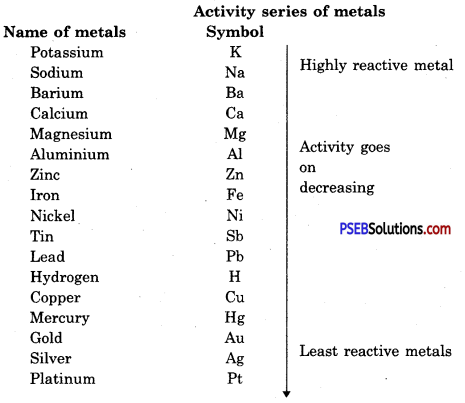
PSEB 10th Class Science Important Questions Chapter 3 Metals and Non-metals 14
Metals which are above hydrogen are more reactive and those below hydrogen are lower in reactivity and are found in free state. In this series potassium is the most reactive metal in this series.

Short Answer Type Questions

Question 1.
Name two metals which are good conductors of heat and electricity. Name metals which are highly and least conducting with reference to heat.
Answer:
Copper and aluminium are good conductors of electricity and heat. Silver is very good conductor of heat whereas lead is not a good conductor of heat.

Question 2.
Define ductility with example.
Answer:
Property of drawing thin wires from a metal is called ductility. Gold is the highest ductile metal. We can draw 2 km long wire from 18 carat gold.

Question 3.
What is electrical conductivity? Name the metals which have the highest conductivity, less than this and the lowest conductivity.
Answer:
It is the ease with which electric current can flow through a metal. Those metals which offer very low resistance to the flow of current they have high conductivity. Silver, copper are very good conductors of current then comes gold, aluminium and tungsten. Lead and iron have least conductivity i.e., they offer very high resistance to the flow of current.

Question 4.
Which property of metals give them characteristic chemical properties?
Answer:
Metals form positive ions by loosing electrons. This property of formation of ions by the metals give them characteristics chemical properties, e.g., Mg form Mg ion by loosing two electrons :
Mg → Mg2+ + 2e

Question 5.
Ionic compounds are found in which state? Comment on the melting and boiling point of ionic compounds.
Answer:
Compounds which are formed by the transfer of electrons from metals to Non¬Metals are called ionic or electrovalent compounds e.g., NaCl, LiCl, CaCl2, CaO, MgCl2. Ionic compounds have very high melting and boiling points because a large amount of energy is required to break the strong inter-ionic attractions.

PSEB 10th Class Science Important Questions Chapter 3 Metals and Non-metals

Question 6.
What is difference between minerals and ores?
Answer:

Sr. No. Minerals Ores
1. Those natural occuring substances, which contain metals in the form of compounds. 1. These are the minerals from which metals can be extracted easily and cheaply.
2. In many of the minerals percent age amount of metals is large and in some it is less. 2. In all the ores, percentage amount of metals is enough.
3. In some minerals there are so many impurities which create difficulty in the extraction of metals. 3. Ores do not have such problematic impurities.
4. All the minerals can not be used for extracting metals. All the minerals are not ores. 4.         All the ores can be used to extract metals.

Question 7.
How are the metals extracted, which are at the top of reactivity series?
Answer:
Metals which are towards the top of reactivity series are sodium, calcium, magnesium, aluminium. There are very reactive. These metals can not be obtained by heating them with carbon. These have more affinity towards oxygen, therefore these are extracted by electrolytic reduction. Sodium, magnesium and calcium are obtained by the electrolysis of their molten chlorides. Metals got deposited at cathode and chorine is liberated at anode.
At cathode : Na+ + e → Na
At anode : 2Cl → Cl2 + 2e

Aluminium is obtained by the electrolytic reduction of aluminium oxide.
At cathode ; Al3+ + 3e → Al
PSEB 10th Class Science Important Questions Chapter 3 Metals and Non-metals 15

Question 8.
How the metals, which are in the middle of the activity series extracted?
Answer:
Metals which are in the middle of the activity series are iron, zinc, lead, copper etc. These are found in the form of sulphides or carbonates. It is easy to obtain metals from their oxides compared to sulphides or carbonates. Therefore before extraction metal sulphide or carbonates are converted into their oxide. Sulphide ores are converted into metal oxides by heating in the presence of air. This is known as roasting. Carbonate ores are heated in limited supply of air to convert them into oxides. This is known as calcination. Following reactions take place during roasting and calcination of zinc.

PSEB 10th Class Science Important Questions Chapter 3 Metals and Non-metals 16
PSEB 10th Class Science Important Questions Chapter 3 Metals and Non-metals 17
Then by using carbon as reducing agent, metal is extracted from metal oxide, e.g. when Zinc oxide is heated with carbon it gets reduced to give zinc.

PSEB 10th Class Science Important Questions Chapter 3 Metals and Non-metals 18
In addition to using carbon for reduction, displacement reaction can be used to extract metals. More reactive metals like sodium, calcium, aluminium etc. can be used as reducing agents because these can displace atoms which are below them in the reactivity series. For example, when mangnese dioxide is heated with aluminium powder then following reaction takes place.

PSEB 10th Class Science Important Questions Chapter 3 Metals and Non-metals 19

Question 9.
How will you extract metals which are low in the activity series?
Answer:Metals low in the activity series are less reactive and can be obtained from metal oxides simply by heating. Cinnabar (Hgs) an ore of mercury (Hg) when heated change to mercuric oxide (HgO), on heating it further it is reduced to mercury.
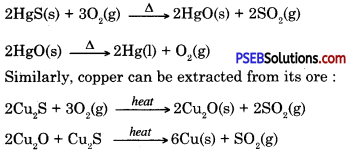
Question 10.
Explain the reactions of metals with water.
Answer:
On reacting with water, metals form metal oxide and produce hydrogen. These dissolve in water to form metal hydroxide. But all metals do not react with water.

Metals like sodium and Potassium react with cold water, vigorously. The reaction of sodium and Potassium is very vigorous and exothermic that hydrogen produced starts burning simultaneously.
2K (s) + 2H2O (l) → 2KOH (aq) + H2(g) + heat
2Na (s) + 2H2O (l) → 2NaOH (aq) + H2(g) + heat

Reaction of calcium with water is slow. Heat produced in this reaction is not enough to burn the hydrogen produced in the reaction.
Ca (s) + 2H2O(l) → Ca (OH)2 + H2(g)

Metals like iron, aluminium, zinc etc. do not react with cold water and not even with hot water. But they react with steam to form metal oxide and produce, hydrogen.
2Al(s) + 3H2O(g) → Al2O3(S) + 3H2(g)
3Fe(s) + 4H2O(g) → Fe3O4(s) + 4H2(g)
Metals like lead, copper, silver and gold etc. do not react with water.

Question 11.
How do metals react with :
1. Oxygen
2. Dilute acids
3. Chlorine
4. Hydrogen.
Answer:
I. Reaction of metals with oxygen: Metals combine with oxygen to form metal oxides. Metal atoms lose their loosely bound electrons to form positive ions where as oxygen atoms gain electrons to form negative oxide ions. These metal oxide are basic in nature. Since all metals have different level of reactivity therefore they combine with oxygen at different temperatures.
1. Na and K Combine with oxygen at normal temperature to form oxides which dissolve in water to form hydroxide.
4 Na (s) + O2(g) → 2Na2S(s)
Na2O(s) + H2O → 2NaOH (or)

2. If magnesium is burned in air it forms magnesium oxide.
Mg → Mg2+ + 2e-
O + 2e → O2-
Mg2+ + O2- → MgO

3. Copper and iron combine with oxygen at high temperature in dry air.
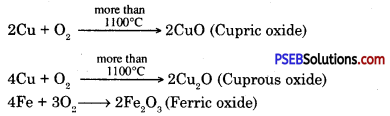
PSEB 10th Class Science Important Questions Chapter 3 Metals and Non-metals 21

II. Reaction of metals with dilute acids. Metals reacts with dilute acids to produce hydrogen gas. Rate of reactivity is different.
1. Na, K, Zn, Mg, Fe etc. are reactive in decreasing order.
2Na + HCl → 2NaCl + H2
Mg + 2HCl → MgCl2 + H2
Zn + H2SO4 → ZnSO4 + H2

2. Dilute nitric acid reacts with metals like Cu, Ag, Pb, Hg to form NO (nitrogen oxide).
Cu + 8HNO3 → 3Cu (NO3)2 + 2NO + 4H2O
3Ag + 4HNO3 → 3AgNO3 + NO + 2H2O

3. Dilute nitric acid reacts with Mg and Mn to produce hydrogen gas.
Mg + 2HNO3 → Mg (NO3)2 + H2

4. Gold and platinum do not react with dilute acids.

III. Reaction of metals with chlorine. Metals combines with chlorine to form electrovalent chlorides.
Ca + Cl2 → CaCl2

IV. Reaction of metals with hydrogen. Reactive metals like Na, K, Ca etc. react with hydrogen to form hydrid.
2Na + H2 → 2NaH
Ca + H2 → CaH2

V. Reaction of metals with water:
1. Water at normal temperature react with Na, K and Ca to liberate hydrogen gas.
2Na + 2H2O → 2NaOH + H2
Ca + 2H2O → Ca (OH)2 + H2

2. Mg, Zn and Fe react with boiling water to form oxide.
Mg + H2O → MgO + H2
3Fe + 4H2O → Fe3O4 + 4H2

PSEB 10th Class Science Important Questions Chapter 3 Metals and Non-metals

Question 12.
What is roasting? When do you use it?
Answer:
Roasting. After enrichment of ore, it is heated in the presence of dir, this process is called roasting sulphides or carbonates of some metals are converted into oxides, because extraction of metal is easy from oxides. Carbonates and sulphides of zinc and lead are converted into oxides by roasting.

PSEB 10th Class Science Important Questions Chapter 3 Metals and Non-metals 22

Question 13.
If a copper plate remains immersed in silver nitrate solution for some time then what happens? Write the ionic equation for the reaction.
Answer:
Copper is more reactive than silver. Copper will displace silver from the solution and silver gets deposited on copper. Colour of the solution becomes blue.

PSEB 10th Class Science Important Questions Chapter 3 Metals and Non-metals 23

Question 14.
Copper sulphate solution is stored in an iron container. After some days holes were seen in the container. Write the reaction. Explain the reaction on the basis of activity series.
Answer:
Iron is more reactive than copper and is placed before copper in the activity series. Therefore iron can displace copper from copper sulphate solution, due to this reaction holes were seen in the container.
CuSO4 + Fe → FeSO4 + Cu
Cu2+ (aq) + Fe(s) → Fe2+ (aq) + Cu(s)
Thus iron displaced copper.

Question 15.
Why copper becomes green if left open in air. Why?
Answer:
Copper reacts with moist carbon dioxide which is present in air. This makes its surface dull and a green layer is seen on the surface of copper. This green substance is copper carbonate.

PSEB 10th Class Science Important Questions Chapter 3 Metals and Non-metals 24

Question 16.
What is 24 carat gold?
Answer:
Pure gold is called 24 carat gold. It is very soft. It can be used to make ornaments. Small amount of silver or copper is mixed with it to make it harder. In our country usually 22 carat gold is used to make ornaments. This means 22 pure gold is mixed with 2 parts of copper or silver.

Question 17.
Which process is used for the enrichment of sulphide ore. Explain in brief two steps involved in the extraction of metal from enriched sulphide ore.
Answer:
Sulphide ore is finely grounded to get powder. This is then enriched by using ‘Froth floation process’.

Steps involved in the extraction of metal from enriched sulphide ore :
1. Roasting: Enriched ore is heated in the presence of air to get oxides. This process is called roasting.

PSEB 10th Class Science Important Questions Chapter 3 Metals and Non-metals 25

2. Reduction. Oxide of the enriched ore is heated with reducing agent to extract the metal.

PSEB 10th Class Science Important Questions Chapter 3 Metals and Non-metals 26

Question 18.
Give differences :
(i) Hydraulic washing and liquation.
Answer:

Hydraulic Washing Liquation
1. This process is used for concentration of an ore. 1. The process is used for refining of metals.
2. Ore is washed with washing. 2. This is used for refining metal having low melting points.

(ii) Electrolytic reduction and reduction by carbon.
Answer:

Electrolytic reduction Reduction by carbon
1. Here cathode acts as reducing agent. It converts metal ions into metals by providing electrons.
  1. Carbon is used as reducing agent.
2. This method is used to reduce the salts of highly reactive metals. 2. This method is used to reduce the oxides of metals which are in the middle of activity series.

Question 19.
An alloy of yellow’ colour is made up of two metals A and B. When this alloy was dipped in dilute sulphuric acid, a layer dissolved in acid and formed colourless solution. B did not dissolve in it and the surface of alloy attained red brown colour. What is A and B?
Answer:
Yellow coloured alloy is brass which is mixture of zinc and copper. In this A is zinc and B is copper.
Zn + H2SO4 → ZnSO4 + H2

Question 20.
Sulphur dioxide (SO2) gas is produced when a certain ore is heated. Write the method involved in the extraction of metal from this ore.
Answer:
SO2 gas is produced when copper pyrites an ore of copper is heated.

Following steps are involved in the extraction of metal from this ore :
1. Ore is ground to get powder. It is mixed with water and pine oil. Compressed air is blown to separate impurities. This way ore gets enriched, this method is called froth floatation method.

2. Now the enriched ore is roasted. A part of CuS converts to CuO

PSEB 10th Class Science Important Questions Chapter 3 Metals and Non-metals 27
Copper is in liquid state and is purified by electric refining.

3. Electrical refining. In this process impure copper rod is taken as anode and pure copper plate is taken as cathode. Electric current is passed through copper sulphate solution in the presence of acid
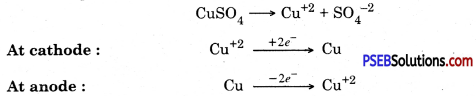
PSEB 10th Class Science Important Questions Chapter 3 Metals and Non-metals 28

PSEB 10th Class Science Important Questions Chapter 3 Metals and Non-metals

Question 21.
What is Thermite process? Write its uses.
Answer:
Some displacement reactions are highly exothermic. The quantity of heat produced is so high that metals obtained are in molten state. When Iron (III) oxide (Fe2O3) reacts with aluminium then a large amount of heat is produced.
Fe2O3(s) + 2Al(s) → 2Fe(l) + Al2O3(s) + heat

This is known as thermite process. This process is used to weld the rails and to join the cracks in machines.

Question 22.
Give five uses of non-metals.
Answer:

  • Hydrogen is used in the preparation of vegetable oil.
  • Carbon is an important non-metal which is main constituent of vitamins, proteins, carbohydrates, enzymes etc. Graphite is used as an electrode in various cells.
  • Nitrogen is used in ammonia, Nitric acid and fertilizers. Its presence in air controls the rate of combustion.
  • Presence of oxygen is the base of our life. Combustion is also possible in the presence of oxygen.
  • Sulphur is used in many medicines and is also used to make explosives.

Question 23.
Differentiate Roasting and Calcination.
Answer:

Roasting Calcination
1. Roasting is used for sulphide ores. 1. Calcination is used for carbonate and hydrated ores.
2. Ore is heated in the presence of air.  2. Ore is heated in the absence of air.
3. SO2 gas is produced. 3. CO2 gas is produced.

Question 24.
How is ionic compound sodium chloride, forms from sodium and chlorine?
Answer:
Sodium and chloride ions are oppositely charged and thus attract each other
They are bound together by strong electrostatic force of attraction and exist in the form of sodium chloride (NaCl). Sodium chloride does not exist as a molecule but as a set of ions :
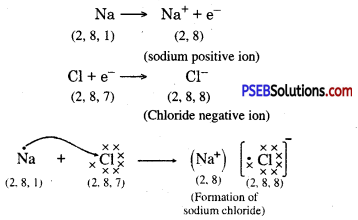
PSEB 10th Class Science Important Questions Chapter 3 Metals and Non-metals 29

Question 25.
Ionic compounds are insulators when in solid state whereas when in aqueous solution they become conductors. Why?
Answer:
There exist a strong force of attraction between positive and negative ions of the ionic compounds, due to which these compounds are solid and hard. Due to their firm and rigid structure ions cannot move. But in molten state or in aqueous solution the force between opposite ions become weak and the ions can move freely. Therefore electricity can pass through ionic compounds when in liquid form.

Question 26.
What is aqua regia? Explain.
Answer:
Aqua regia is a mixutre of concentrated hydrochloric acid and concentrated nitric acid in the ratio of 3 : 1. It can dissolve gold where no single acid can do this. Aqua regia (Latin word for Royal water) is highly corrosive and fuming liquid. It can also dissolve platinum.

Question 27.
Give two main ores of aluminium. Also give two alloys of aluminium.
Answer:
Two ores of aluminium are :

  1. Bauxite, Al2O3. 2H2O
  2. Cryolite, Na3 (AlF6).

Two alloys of aluminium are :

  1. Duralium
  2. Magnalium.

Question 28.
Give uses of pure metals.
Answer:

  • Copper and aluminium wires are used in the transmission of power (electricity).
  • Utensils, Machines etc. are made up of iron, aluminium and copper.
  • Gold and silver are used to make ornaments, these are also used in sweets in the form of silver foil.
  • Metals like cadmium, titanium, zinconium etc. are used in nuclear energy and space science projects.
  • Aluminium foil is used to wrap eatables.
  • Titanium and its alloys are used in airplane, airplane structure and engine, chemical reactor.
  • Metals are used in broken bones and body parts.

Question 29.
Which gas is produced, when reactive metals come in contact with dilute hydrochloric acid? Write the chemical reaction between iron and dil. H2SO4.
Answer:
When reactive metals come in contact with dil. hydrochloric acid then (H2) hydrogen gas is produced.
Hydrogen gas is produced when iron reacts with dil. H2SO4.
Fe + H2SO4 → FeSO4 + H2

PSEB 10th Class Science Important Questions Chapter 3 Metals and Non-metals

Question 30.
What is the function of cryolite in the electrolytic reduction of alumina?
Answer:
Cryolite has two functions in the extraction of aluminium :

  • To reduce the melting point of alumina.
  • Alumina is bad conductor of electricity on mixing cryolite (Na2AlF3), Al2+ ions are produced from alumina.

Question 31.
How do iron and aluminium react with water?
Answer:
Aluminium and iron do not react with cold or hot water. But react with steam to form metal oxide and hydrogen.
2Al(s) + 3H2O(g) → Al2O3(s) + 3H2(g)
3Fe(s) + 3H2O(g) → Fe3O4(s) + 3H2(g)

Question 32.
What happen when :
(i) Iron oxide is heated with coke?
Answer:
Iron oxide is readuced to iron.
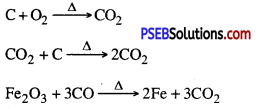
PSEB 10th Class Science Important Questions Chapter 3 Metals and Non-metals 30

(ii) Magnesium is treated with dilute sulphuric acid?
Answer:
Hydrogen is produced

PSEB 10th Class Science Important Questions Chapter 3 Metals and Non-metals 31

(iii) Zinc is added to blue vitriol solution?
Answer:
Blue colour of solution gradually faders away

PSEB 10th Class Science Important Questions Chapter 3 Metals and Non-metals 32

Question 33.
What is rust? Explain it with the help of a chemical reaction.
Answer:
If iron is left open in moist air, a brown layer is produced on its surface. This brown coloured layer is of Ferric oxide and ferric hydroxide. This is called rust. This makes iron weak.
4Fe + 3O2 + 3H2O → Fe2O3 + 2Fe(OH)3

Question 34.
Write names of main alloys and their constituents?
Answer:

Alloys Constituents Uses
1. Steel Iron, carbon used in airplanes, buildings vehicles etc.
2. Stainless steel Iron, Carbon, Chromium utensils, machine parts, knife, blade, food and milk industry, nuts, bolts, taps etc.
3. Brass Copper, Zinc utensils, idols, airplanes, medals, steam driven train parts etc.
4. Bronze Copper, tin utensils and other apparatus.
5. Solder Lead, tin For joining/welding electric wires.
6. German Silver Copper, Nickel, zinc Airplane wings, utensils used in kitchen of airplanes and other mate­rials.
7. Bell metal Copper,tin For making bells.
8. Duralium Aluminium, copper magnesium and mangnese in very small amount. In airplane
9. Magnoleum Aluminium, magnesium Light weight tools and cheap utensils.
10. Gun metal Copper, tin, zinc For making gears of vehicles and machines.

Question 35.
Write the names of metals found in Bronze and Duralium, give uses of these alloys.
Answer:
Bronze. It is 90% copper and 10% tin. It is used in idols, medals, coins and vessels used for cooking food.
Duralium. It consists of 95% aluminium, 4% copper, 0.5% magnesium and 0.5% manganese. It is used in aeroplanes, space crafts, kitchen vessels.

Question 36.
What is rust? What is its chemical formula?
Answer:
When iron is left open in air, then a layer of iron oxide is formed on the surface of iron. This brown matter is rust. It corrodes the metal. Its chemical formula is Fe2O3. xH2O.

PSEB 10th Class Science Important Questions Chapter 3 Metals and Non-metals

Question 37.
What are metals?
Answer:
The elements which are on the left and in the middle of the periodic table and have metallic lustre are called metals. These are usually ductile, malleable, good conductor of electricity and heat, hard and have high density. They form basic oxides. Examples of metals are gold, iron, silver, copper, platinum etc.

Question 38.
What is ihe reason of catching fire by potassium and sodium on their own?
Answer:
Potassium and sodium reacts with water vigorously and violently. The reaction is very violent and highly exothermic that hydrogen produced in the reaction catches fire on its own.

Question 39.
Observe the figure given below and name the gas produced. Also give the chemical equation.
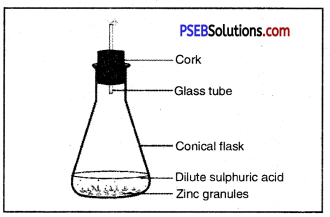
PSEB 10th Class Science Important Questions Chapter 3 Metals and Non-metals 33
Answer:
Hydrogen gas is produced
PSEB 10th Class Science Important Questions Chapter 3 Metals and Non-metals 34

Question 40.
What is indicated by the following figure?
Or
With the help of a labelled diagram prove that both oxygen/air and water are necessary for rusting of iron.
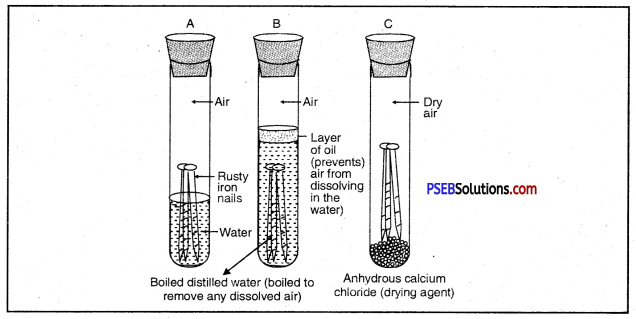
PSEB 10th Class Science Important Questions Chapter 3 Metals and Non-metals 35
Answer:
Both air and moisture are required for rusting of iron.

Question 41.
Why the substance obtained by mixing small amount of carbon in iron is used largely for various purposes?
Answer:
When small amount of carbon is mixed with iron it changes to steel. This is stronger than iron. It can be used in ships, vehicles, dams.

Question 42.
Write a chemical equation for the reaction taking place in the test tube. How does the colour of solution change? What is change in colour of iron nails?
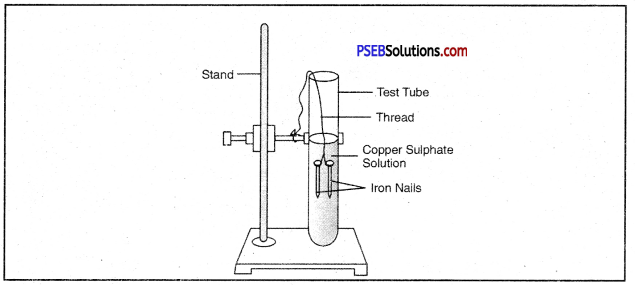
PSEB 10th Class Science Important Questions Chapter 3 Metals and Non-metals 36
Answer:
PSEB 10th Class Science Important Questions Chapter 3 Metals and Non-metals 37
The colour of the solution changes from blue to light green. The colour of Iron nails changes from grey to brown.

Very Short Answer Type Questions

Question 1.
Give one example of metal which is liquid at room temperature.
Answer:
Mercury.

Question 2.
Name one metal and one non-metal which is liquid at room temperature.
Answer:
Metal-Mercury.
Non-Metal—Bromine

Question 3.
Name one non-metal which has bright lustre.
Answer:
Iodine.

Question 4.
Name one non-metal which does not have bright.
Answer:
Phosphorus.

Question 5.
Which of the following metal are liquid at body temperature (37° C): Gallium, Magnesium, Caesium, Aluminium.
Answer:
Gallium and Caesium.

Question 6.
Name one non-metal which is a good conductor of electricity?
Answer:
Graphite (Carbon).

PSEB 10th Class Science Important Questions Chapter 3 Metals and Non-metals

Question 7.
Arrange the following metals in the decreasing order of reactivity,
Fe, Zn, Cu, Na, Ag.
Answer:
Na > Zn > Fe > Cu > Ag.

Question 8.
Out of Sodium, Calcium, Aluminium, Copper and Magnesium name the metal which reacts with
(i) Boiling water
Answer:
Magnesium

(ii) Steam.
Answer:
Copper.

Question 9.
Sodium metal is kept under kerosene oil, why?
Answer:
This is because sodium reacts with moist air as well as water.

Question 10.
A non-metal X, exists in two forms Y and Z. Y is the hardest substance and Z is a poor conductor of electricity. What are X, Y and Z?
Answer:
Y = Diamond Z = Graphite X = Carbon
Y and Z are allotropic forms of carbon.

Question 11.
An element, A form two oxides AO and AOa. AO is neutral and AO2 is acidic : Indicate whether A is metal or non-metal.
Answer:
A is non-metal.

Question 12.
Name the reaction to convert metal into its oxide .
Answer:
Oxidation.

Question 13.
Ionic solids have high melting points, why?
Answer:
In ionic solids, there are strong electrostatic forces of attraction between the oppositely charged ions and a large amount of energy required to overcome these forces.

Question 14.
An element X reacts with oxide to form oxide, X2O which dissolves in water and turns red litmus solution blue. Give the nature of oxide and indicate X is metal or non-metal.
Answer:
X2O is basic. X is metal.

Question 15.
What is the nature of metal oxides?
Answer:
Basic.

Question 16.
Name two noble metals.
Answer:
Gold and platinum.

Question 17.
Name an ore of mercury.
Answer:
Mercury sulphide (Hgs).

Question 18.
Name two metalloids.
Answer:
Arsenic, antimony.

Question 19.
Metals lose lustre when placed in air, why?
Answer:
This is because their surfaces are covered with oxides, carbonates or sulphide layer’s .

Question 20.
Name two metals which can be cut with a knife.
Answer:
Sodium and potassium.

Question 21.
Why do metals aquire different shapes?
Answer:
This is due to malleability and ductility of metals.

PSEB 10th Class Science Important Questions Chapter 3 Metals and Non-metals

Question 22.
Name the metal which is poor conductor of heat.
Answer:
Lead.

Question 23.
Name the metal which offers resistance to the flow of electricity.
Answer:
Mercury.

Question 24.
Which of the following metals can be drawn into wires?
Answer:
Cu, Al, Fe, Pb.

Question 25.
Name four non-metals which are solid at room temperature.
Answer:
Carbon, Sulphur, Phosphorous, and iodine.

Question 26.
Name the elements which are present in abundance in earth’s crust.
Answer:
Oxygen and silicon.

Question 27.
What are alkalies? Give one example.
Answer:
Alkali. It is a metal hydroxide soluble in water Example : Sodium hydroxide (NaOH).

Question 28.
Name two amphoteric oxide.
Answer:

  1. Aluminium oxide (Al2O3)
  2. Zinc Oxide (ZnO)

Question 29.
What happens when magnesium is heated to ignition temperature?
Answer:
Magnesium burns with white light producing magnesium oxide.

Question 30.
Name the metal which does not react with dil. HCl.
Answer:
Copper.

Question 31.
Name two metals which react with hydrogen.
Answer:
Sodium and potasium.

Question 32.
Give the reaction when a piece of Calcium reacts with water.
Answer:
Ca + 2H2O → Ca (OH)2 + 4H2.

Question 33.
Give the reactions when red hot iron reacts with steam.
Answer:
Ca + 4H2O → Fe3O4 + H2.

Question 34.
Why is zinc oxide called amphoteric oxide?
Answer:
This is because zinc oxide reacts with both acid as well as base.

Question 35.
The metals Na, K and Ca react with hydrogen to form hydroxide but other metals don’t, why?
Answer:
This is because Na, K and Ca are highly reactive metals.

Question 36.
Give the reactions which occur when zinc plate is added to copper sulphate solution.
Answer:
Zn + CuSO4 → ZnSO4 + Cu.

Question 37.
Out of the metals, Na, Cu, Au, which is
(i) Most reactive and
Answer:
Most reactive metal-Sodium (Na)

(ii) Least reactive?
Answer:
Least reactive metal-Gold (Au).

Question 38.
Arrange the following metals in the decreasing order of reactivity, Zinc, Mercury and Aluminium.
Answer:
Al < Zn < Hg.

PSEB 10th Class Science Important Questions Chapter 3 Metals and Non-metals

Question 39.
Name two metals which occur in free state in nature.
Answer:
Gold and Platinum.

Question 40.
Define corrosion of metals.
Answer:
It is the interaction of surface of metal with air and moisture forming a layer of oxide, halide or carbonate layer on its surface.

Question 41.
Name a metal which undergoes corrosion in air.
Answer:
Iron.

Question 42.
Name two metals which are not corroded easily.
Answer:
Gold and silver.

Question 43.
Why does copper utensils turn green on exposure to air?
Answer:
Copper reacts with oxygen, carbon dioxide and moisture to form a green coloured compound (basic copper carlxmate):

PSEB 10th Class Science Important Questions Chapter 3 Metals and Non-metals 38

Question 44.
Name two metals which are both malleable and ductile.
Answer:

  1. Copper
  2. Aluminium.

Question 45.
Name the most abundant metal in the earth’s crust.
Answer:
Aluminium.

Question 46.
Name the metal that gives a green coating when exposed to moisture.
Answer:
Copper.

Question 47.
Which is the most lightest metal known to us?
Answer:
Lithium.

Question 48.
Name two metals which occur in free state in nature.
Answer:

  1. Gold
  2. Platinum.

Question 49.
Name one of the most common ore of aluminium.
Answer:
Bauxite (Al2O3. 2H2O).

Question 50.
What is an amalgam?
Answer:
An amalgam is an alloy of mercury with some other metals.

Question 51.
Name two metals which :
(a) readily burn in air an
Answer:
Metals which readily burn in air are :

  1. sodium
  2. magnesium.

(b) do not burn.
Answer:
metals which do not burn readily in air are :

  1. Copper
  2. iron.

Question 52.
Name the metal which is best conductor of electricity.
Answer:
Silver.

PSEB 10th Class Science Important Questions Chapter 3 Metals and Non-metals

Question 53.
Name one metal which reacts with cold water.
Answer:
Sodium.

Question 54.
Name one metal
(i) more reactive than hydrogen and
Answer:
Sodium

(ii) less reactive than hydrogen.
Answer:
Silver.

Question 55.
Write the chemical name of any one compound ore of sulphur.
Answer:
Zinc sulphide (ZnS).

Question 56.
Name the metal used in galvanisation of iron.
Answer:
Zinc.

Question 57.
The metal which is found in nature in the free state is
Answer:
Gold and Platinum.

Question 58.
What chemical process is used for obtaining a metal from its oxide?
Answer:
Reduction process.

Question 59.
Which metals do not corrode easily?
Answer:
The metals which are not attacked by air and moisture don’t corrode easily.

Multiple Choice Questions :

Question 1.
The non-metal which is liquid at room temperature is:
(A) Chlorine
(B) Bromine
(C) Fluorine
(D) Iodine.
Answer:
(B) Bromine

Question 2.
Most reactive metal is:
(A) Na
(B) Mg
(C) Au
(D) K
Answer:
(D) K

Question 3.
The property due to which metals can be beaten into sheets is :
(A) Malleability
(B) Ductility
(C) Metallic lustre
(D) Hardness.
Answer:
(A) Malleability

Question 4.
The axnphoteric oxide is:
(A) ZnO
(B) BaO
(C) K2O
(D) Na2O.
Answer:
(A) ZnO

PSEB 10th Class Science Important Questions Chapter 3 Metals and Non-metals

Question 5.
Copper gets covered with green layer when exposed to air due to the formation of:
(A) CuSO4
(B) CuCO3. Cu(OH)2
(C) Cu (NO3)2
(D) CuO.
Answer:
(B) CuCO3. Cu(OH)2

Question 6.
During galvanisation, the metal whose layer is deposited is:
(A) Gallium
(B) Aluminium
(C) Zinc
(D) Silver.
Answer:
(C) Zinc

Fill in the blanks:

Question 1.
Brass is an alloy of copper and ____________
Answer:
Zinc.

Question 2.
____________ is the best conductor of electricity.
Answer:
Silver.

Question 3.
All the ores are ____________
Answer:
Minerals.

Question 4.
Copper can be refined by ____________
Answer:
Electrorefining.

PSEB 5th Class Maths Solutions Chapter 1 Numbers Ex 1.3

Punjab State Board PSEB 5th Class Maths Book Solutions Chapter 1 Numbers Ex 1.3 Textbook Exercise Questions and Answers.

PSEB Solutions for Class 5 Maths Chapter 1 Numbers Ex 1.3

Question 1.
Fill in the blanks using the signs <, >, or = :
(a) 8072 PSEB 5th Class Maths Solutions Chapter 1 Numbers Ex 1.3 1 1872
0b) 9876 PSEB 5th Class Maths Solutions Chapter 1 Numbers Ex 1.3 1 6789
(c) 21916 PSEB 5th Class Maths Solutions Chapter 1 Numbers Ex 1.3 1 29161
(d) 40234 PSEB 5th Class Maths Solutions Chapter 1 Numbers Ex 1.3 1 32234
(e) 35003 PSEB 5th Class Maths Solutions Chapter 1 Numbers Ex 1.3 1 35003
(f) 60104 PSEB 5th Class Maths Solutions Chapter 1 Numbers Ex 1.3 1 60140
(g) 52838 PSEB 5th Class Maths Solutions Chapter 1 Numbers Ex 1.3 1 45885
(h) 99999 PSEB 5th Class Maths Solutions Chapter 1 Numbers Ex 1.3 1 100000.
Solution:
(a) >
(b) >
(c) <
(d) >
(e) =
(f) <
(g) >
(h) <

Question 2.
Write the greatest number from the following :
(a) 8172, 2578, 8127, 8728, 8527
(b) 60060, 66006,60600,66660, 60006
(c) 58031, 13258, 35185, 81135, 86311 .
(d) 47443, 73434, 44473, 74437, 34474
(e) 872,31827,5183,31725,40426.
Solution:
(a) 8728
(b) 66660
(c) 86311
(d) 74437
(e) 40426.

PSEB 5th Class Maths Solutions Chapter 1 Numbers Ex 1.3

Question 3.
Write the smallest number from the following :
(a) 9064, 7372,8938, 9746,9942
(b) 81018, 80108, 80810, 18018, 10018
(c) 32334, 23443, 24334, 33342, 32343
(d) 927,39272,93227,46238,27999
(e) 43148, 448i3, 48134, 34148, 13481.
Solution:
(a) 7372
(b) 10018
(c) 23443
(d) 927
(e) 13481.

Question 4.
Arrange the following numbers in ascending order :
(a) 9036, 6309, 9610, 699, 1000
(b) 37492, 94713, 49273, 61047, 52364
(c) 63918, 36829, 45261, 61514, 63819
(d) 36118, 70225, 27052, 36343, 52073
(e) 28136, 28236, 28853, 28534, 28435.
Solution:
(a) 699, 1000, 6309, 9036, 9610
(b) 37492, 49273, 52364, 61047, 94713
(c) 36829, 45261, 61514, 63819, 63918
(d) 27052, 36118, 36343, 52073, 70225
(e) 28136, 28236, 28435, 28534, 28853.

Question 5.
Arrange the following numbers in descending order :
(a) 7084, 8084, 4048, 5074, 6785
(b) 61272,71262,51721,41112, 62271
(c) 72280, 82720, 87220, 82270, 28780
(d) 99063, 93083, 94835, 99093, 96039
(e) 83226, 86203, 28306, 28603, 27503.
Solution:
(a) 8084, 7084, 6785, 5074, 4048
(b) 71262, 62271, 61272, 51721, 41112
(c) 87220,82720,82270, 72280, 28780
(d) 99093, 99063; 96039, 94835, 93083
(e) 86203, 83226, 28603, 28306, 27503.

Question 6.
Write the greatest and smallest 5-digits numbers using digits 6, 7, 8, 4 and 1.
Solution:
The greatest number = 87641
The smallest number = 14678

PSEB 5th Class Maths Solutions Chapter 1 Numbers Ex 1.3

Question 7.
Write the greatest and smallest 5-digits numbers using digits 5, 8, 3, 0 and 9.
Solution:
The greatest number = 98530
The smallest number = 30589

Question 8.
Write the greatest and smallest 5-digits numbers using different digits.
Solution:
The greatest number = 98765
The smallest number = 10234

PSEB 10th Class Science Solutions Chapter 3 Metals and Non-metals

Punjab State Board PSEB 10th Class Science Book Solutions Chapter 3 Metals and Non-metals Textbook Exercise Questions and Answers.

PSEB Solutions for Class 10 Science Chapter 3 Metals and Non-metals

PSEB 10th Class Science Guide Acids, Bases and Salts Textbook Questions and Answers

Question 1.
Which of the following pairs will give displacement reactions :
(а) NaCl solution and copper metal
(b) MgCl2 solution and aluminium metal
(c) FeSO4 solution and silver metal
(d) AgNO3 solution and copper metal?
Answer:
(d) AgNO3 solution and copper metal?

Question 2.
Which of the following methods is suitable for preventing an iron frying pan from rusting :
(a) applying grease
(b) applying paint
(c) applying a coating of zinc
(d) all of the above :
Answer:
(c) applying a coating of zinc

Question 3.
An element reacts with oxygen to give a compound with a high melting point. This compound is also soluble in water. The element is likely to be :
(a) calcium
(b) carbon
(c) silicon
(d) iron.
Answer:
(a) calcium

Question 4.
Food cans are coated with tin and not with zinc because :
(а) zinc is costlier than tin
(b) zinc has a higher melting point than tin
(c) zinc is more reactive than tin
(d) zinc is less reactive than tin.
Answer:
(c) zinc is more reactive than tin

PSEB 10th Class Science Solutions Chapter 3 Metals and Non-metals

Question 5.
You are given a hammer, a battery, a bulb, wires and a switch.
(i) How could you use them to distinguish between samples of metals and non-metals?
(ii) Assess the usefulness of these tests in distinguishing between metals and non-metals.
Answer:
(i) Set up the electric circuit as shown below :
PSEB 10th Class Science Solutions Chapter 3 Metals and Non-metals 11
To distinguish between metals and non-metals on the basis of their electrical conductivity.

Insert the sample to be tested between clips A and B
If the bulbs glows, the sample is metal.
If the bulb does not glow, the sample is non-metal.
Thus metals are good conductors of electricity whereas non-metals are poor conductors of electricity.

(ii) If a substance produces a sound when struck beating with a hammer, it is a metal and if no sound is produced, it is a non-metal.
Metals are sonorous whereas non-metals are non-sonorous.

Question 6.
What are amphoteric oxides? Give two examples of amphoteric oxides.
Answer:
Amphoteric oxides. The metal oxide which react both with acids as well as bases to produce salts and water are known as amphoteric oxides.

Examples. Zinc oxide, ZnO Aluminium oxide, Al2O3

Question 7.
Name two metals which will displace hydrogen from dilute acids, and two metals which will not.
Answer:
Zinc and magnesium can displace hydrogen from dilute acids. Copper and silver cannot displace hydrogen from dilute acids.

Question 8.
In the electrolytic refining a metal M, what would you take as the anode, the cathode and the electrolyte?
Answer:
During the electrorefining of metal, the impure metal is made as anode, a thin strip of pure metal M is made as cathode. The electrolyte used a soluble salt of metal M. to be refined.

Question 9.
Pratyush took sulphur powder on a spatula and heated it. He collected the gas evolved by inverting a test tube over it as shown in figure
PSEB 10th Class Science Solutions Chapter 3 Metals and Non-metals 12
Collection of Gas
(a) What will be the action of gas on
(i) dry litmus paper?
Answer:
No action.

(ii) moist litmus paper?
Answer:
It turns moist litmus paper red and then bleaches it.

(b) Write a balanced chemical equation for the reaction taking place.
Answer:
S + O2 → SO2

Question 10.
State two ways to prevent the rusting of iron.
Answer:
The rusting can be prevented by

  1. By painting, oiling, greasing, galvanising, chrome plate or anodising.
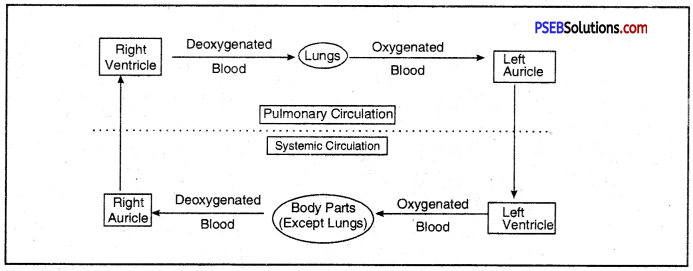
  2. By forming alloys.

Question 11.
What type of oxides are formed when non-metals combine with oxygen?
Answer:
As they form two types of oxides :
(a) Neutral oxides such as CO, NO etc.
(b) Acidic oxides such as SO2, CO2 etc.

Question 12.
Give reasons :
(a) Platinum, gold and silver are used to make jewellery.
Answer:
Platinum, gold and silver are used to make jewellery because these are not attacked by air and moisture. They don’t undergo corrosion and retain their lustre for a long time. Also these metals are malleable and ductile.

(b) Sodium, potassium and lithium are stored under oil.
Answer:
Sodium, potassium and lithium are stored under oil because in contact with moist air containing carbon dioxide, these are covered with a carbonate layer.
e.g. 4Na + O2 → 2Na2O
Na2O + H2O → 2NaOH
2NaOH + CO2 → Na2CO3 + H2O

Also they react with water.
e.g. 2Na + 2H2O → 2NaOH + H2.
Hence, these metals are stored under oil.

(c) Aluminium is a highly reactive metal, yet it is used to make utensils for cooking.
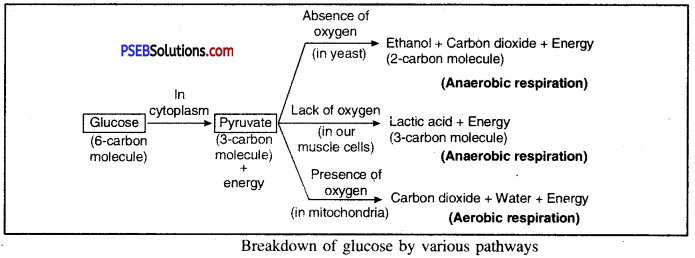
Answer:
This is due to the reason that a thin sticking oxide layer of aluminium is formed on its surface which prevents further reaction. Also aluminium is a good conductor of heat and the oxide layer (Al2O3) is stable even at high temperatures.

(d) Carbonate and sulphide ores are usually converted into oxides during the process of extraction.
Answer:
This is because it is easier to obtain a metal from its oxide as compared to its sulphide and carbonate ore.

Question 13.
You must have seen tarnished copper vessels being cleaned with lemon or tamarind juice. Explain why these sour substances are effective in cleaning the vessels.
Answer:
In tarnished copper vessel there is a layer of basic copper carbonate. This basic layer can be cleaned by using sour substances such as lemon or tamarind juice which are acidic in nature and dissolve the basic coat of copper carbonate

PSEB 10th Class Science Solutions Chapter 3 Metals and Non-metals

Question 14.
Differentiate betw een metals and non-metals.
Or
Differentiate between metals and non-metals on the basis of their chemical properties.
Answer:
Differences between metals and non-metals :

Metals Non-Metals
1. They form basic oxides. 1. They form acidic or neutral oxides.
2. They displace hydrogen from dilute acids. 2. They don’t displace hydrogen from dilute acids.
3. Usually they don’t combine with hydrogen. Only a few reactive metals combine with hydrogen to form metal hydroxide which are electrovalent compounds. 3. They react with hydrogen to form hydrides which are covalent compounds.
4. They form chlorides which are electrovalent compounds. 4. They react with chlorine to form chlorides which are covalent compounds.

Question 15.
A man went door to door posing as a goldsmith. He promised to bring back the glitter of old and dull gold ornaments. An unsuspecting lady gave a set of gold bangles to him which he dipped in a particular solution. The bangles sparkled like new but their weight was reduced drastically. The lady was upset but after a futile argument the man beat a hasty retreat. Can you play the detective to find out the nature of the solution he had used?
Answer:
The solution used by goldsmith to bring back the glitter of old and dull gold ornaments was aqua regia. It is a freshly prepared mixture of cone. HCl and cone. HNOg in the ratio 3 : 1. It can dissolve gold,

Question 16.
Give the reasons why copper is used to make hot water tanks but steel (an alloy of iron) is not.
Answer:
This is because iron present in steel reacts with steam to form ferrosoferric oxide whereas copper has no action with water. As a result of it, the body of the steel tank becomes weaker and weaker in case of iron and not in case of copper.
PSEB 10th Class Science Solutions Chapter 3 Metals and Non-metals 13

Science Guide for Class 10 PSEB Metals and Non-metals InText Questions and Answers

Question 1.
Give an example of a metal which :
(i) is a liquid at room temperature
Answer:
Mercury

(ii) can be easily cut with a knife
Answer:
Sodium

(iii) it is the best conductor of heat
Answer:
Silver

(iv) is a poor conductor of heat.
Answer:
Lead.

Question 2.
Explain the meaning of malleable and ductile.
Answer:
Malleable: A substance is said to be malleable, if it can be beaten into sheets. e.g. metals are malleable.
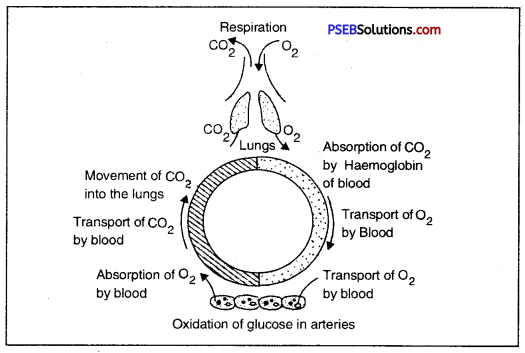
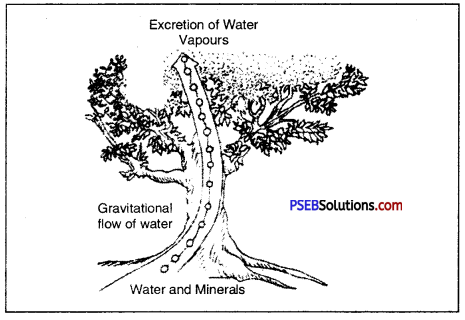
Ductile: A substance is said to be ductile, if it can be drawn into wires e.g. the metals are ductile.

Question 3.
Why is sodium kept immersed in kerosene oil?
Answer:
This is because in contact with moist air containing carbon dioxide, it is covered with a carbonate layer.
4Na + O2 → 2Na2O
Na2O + H2O → 2NaOH
2NaOH + CO2 → Na2CO3 + H2O

Also sodium reacts with water.
2Na + 2H2O → 2NaOH + H2
Hence, sodium is kept immersed in kerosene oil.

PSEB 10th Class Science Solutions Chapter 3 Metals and Non-metals

Question 4.
Write equation for the reactions of
(i) iron with steam
Answer:
PSEB 10th Class Science Solutions Chapter 3 Metals and Non-metals 1

(ii) calcium and potassium with water.
Answer:
Ca + 2H2O → Ca(OH)2 + H2
2K + 2H2O → 2KOH + H2

Question 5.
Samples of four metals A, B, C and D were taken and added to the following solution one by one. The results obtained have been tabulated as follows :
PSEB 10th Class Science Solutions Chapter 3 Metals and Non-metals 2
Use the table above to answer the following questions about metals, A, B, C and D.
(i) Which is the most reactive metal?
Answer:
B is the most reactive metal.

(ii) What would you observe if B is added to a solution of copper (II) sulphate?
Answer:
B will displace copper from copper sulphate solution.

(iii) Arrange the metals A, B, C and D in the order of decreasing reactivity.
Answer:
The decreasing order of reactivity is B > A > C > D.

Question 6.
Which gas is produced when dilute hydrochloric acid is added to a reactive metal? Write the chemical reaction when iron reacts with dilute H2SO4.
Answer:
Hydrogen gas is produced when dilute hydrochloric acid is added to a reactive metal.
PSEB 10th Class Science Solutions Chapter 3 Metals and Non-metals 3

Question 7.
What would you observe when zinc is added to a solution of iron (II) sulphate? Write the chemical reaction that takes place.
Answer:
When zinc is added to a solution of iron (II) sulphate it will displace iron from it and light green colour of solution gradually fades away.
PSEB 10th Class Science Solutions Chapter 3 Metals and Non-metals 4

Question 8.
(i) Write the electron-dot structures for sodium, oxygen and magnesium.
Answer:
Electron-dot structures for sodium, oxygen and magnesium are
PSEB 10th Class Science Solutions Chapter 3 Metals and Non-metals 5

(ii) Show the formation of Na2O and MgO by the transfer of electrons.
Answer:
Formation of Na2O:
PSEB 10th Class Science Solutions Chapter 3 Metals and Non-metals 6

(iii) What are the ions present in the above compounds?
Answer:
PSEB 10th Class Science Solutions Chapter 3 Metals and Non-metals 7

Question 9.
Why do ionic compounds have high melting points?
Answer:
In ionic compounds there are strong electrostatic forces of attraction between oppositely charged ion and a considerable amount of energy is required to break the strong interionic attraction.

Question 10.
Define the terms :
(a) mineral
Answer:
Mineral. The compounds of elements occurring in earth’s crust which are associated with earthly impurities are called minerals.

(b) ore
Answer:
Ore. An ore is a mineral from which metal can be extracted conveniently and economically.

(c) gangue.
Answer
Gangue. The earthly impurities such as sand, lime stone, rocks etc. associated with minerals and ores are collectively known as gangue or matrix.

Question 11.
Name two metals which are found in nature in the free state.
Answer:
Gold and Platinum.

PSEB 10th Class Science Solutions Chapter 3 Metals and Non-metals

Question 12.
What chemical process is used for obtaining a metal from its oxide?
Answer:
Reduction process.

Question 13.
Metallic oxides of zinc, magnesium and copper were heated with the following metals :

Metal Zinc Magnesium Copper
Zinc oxide
Magnesium oxide
Copper oxide

In which cases will you find displacement reactions taking place?
Answer:
Zinc can displace copper from copper oxide
PSEB 10th Class Science Solutions Chapter 3 Metals and Non-metals 8
Magnesium can displace zinc from zinc oxide
PSEB 10th Class Science Solutions Chapter 3 Metals and Non-metals 9
Also Mg can displace copper from CuO
PSEB 10th Class Science Solutions Chapter 3 Metals and Non-metals 10

Question 14.
Which metals do not corrode easily?
Answer:
The metals which are not attacked by air and moisture don’t corrode easily.

Question 15.
What are alloys?
Answer:
Alloys. These are the homogeneous mixtures of two or more metals or metals and non-metals.

PSEB 5th Class Maths MCQ Chapter 11 Patterns

Punjab State Board PSEB 5th Class Maths Book Solutions Chapter 11 Patterns MCQ Questions and Answers.

PSEB 5th Class Maths Chapter 11 Patterns MCQ Questions

Tick (✓) the correct answer :

Question 1.
Select the right box for empty box:
PSEB 5th Class Maths Solutions MCQ Chapter 11 Patterns 1
PSEB 5th Class Maths Solutions MCQ Chapter 11 Patterns 2
Solution:
PSEB 5th Class Maths Solutions MCQ Chapter 11 Patterns 3

PSEB 5th Class Maths Solutions MCQ Chapter 11 Patterns

Question 2.
Rotate and repeat:
PSEB 5th Class Maths Solutions MCQ Chapter 11 Patterns 4
Solution:
(c)

Fill in the blanks :

Question 1.
PSEB 5th Class Maths Solutions MCQ Chapter 11 Patterns 5
Solution:
5E, 6F

Question 2.
PSEB 5th Class Maths Solutions MCQ Chapter 11 Patterns 6
Solution:
PSEB 5th Class Maths Solutions MCQ Chapter 11 Patterns 7

Question 3.
50, 65, 80, 95, ……………., ………….
Solution:
95 + 15 = 110
110 + 15 = 125

Question 4.
600, 550, 500, ………….., 400, ……………, 300
Solution:
500 – 50 = 450
400 – 50 = 350.