
PSEB 9th Class SST Solutions Civics Chapter 4 India’s Parliamentary Democracy

Punjab State Board PSEB 9th Class Social Science Book Solutions Civics Chapter 4 India’s Parliamentary Democracy Textbook Exercise Questions and Answers.

PSEB Solutions for Class 9 Social Science Civics Chapter 4 India’s Parliamentary Democracy

SST Guide for Class 9 PSEB India’s Parliamentary Democracy Textbook Questions and Answers

I. Fill in the blanks :

Question 1.
_________ appoints the judges of the Supreme Court.
Answer:
The President.

Question 2.
The President of India exercises all his powers only on the advice of _________
Answer:
Prime Minister and his Council of Ministers.

II. Multiple Choice Questions :

Question 1.
Which is the final authority for making laws in India?
(i) The Cabinet
(ii) The Parliament
(iii) The Lok Sabha
(iv) The President.
Answer:
(ii) The Parliament.

Question 2.
Who chairs the cabinet meetings?
(i) The President
(ii) The Governor
(iii) The Prime Minister
(iv) The Party President.
Answer:
(iii) The Prime Minister

III. Write T (for True) and F (for False) statements :

Question 1.
The Prime Minister is the Constitutional Head of our country.
Answer:
False.

PSEB 9th Class SST Solutions Civics Chapter 4 India’s Parliamentary Democracy

Question 2.
Indian Parliament comprises the Lok Sabha, the Rajya Sabha and the President of India.
Answer:
True.

IV. Very Short Answer Type Questions

Question 1.
In India which form of the government has been adopted in centre and states?
Answer:
In India parliamentary form of government has been adopted at central and state level.

Question 2.
In parliamentary system, who is the real executive of the country?
Answer:
Prime Minister and his Council of Ministers.

Question 3.
Who is nominal executive in India?
Answer:
The President is the nominal executive in India.

Question 4.
Who is included in the electoral college for the Indian President?
Answer:
The elected members of Lok Sabha, Rajya Sabha (M.P.’s) and State Legislative Assemblies (including Delhi and Puducherry.)

PSEB 9th Class SST Solutions Civics Chapter 4 India’s Parliamentary Democracy

Question 5.
Name any two features of the Parliamentary system.
Answer:

  1. In the Parliamentary system, there is a nominal head of the country.
  2. After elections whichever party gets clear cut majority in Parliament (Lok Sabha) forms the government.

Question 6.
What is called the lower house of the Parliament?
Answer:
Lok Sabha is called the lower house of the Parliament.

Question 7.
How many members can be nominated by the President in the Rajya Sabha?
Answer:
12 members are nominated by the President to the Rajya Sabha.

Question 8.
What is the tenure of the members of the Rajya Sabha?
Answer:
Rajya Sabha members are elected for six years but one third retire after every two years.

Question 9.
What is the name of the Head of the State in Canada and Australia?
Answer:
Governor General is the Head of State in Canada and Australia.

Question 10.
Who makes an oath to the Prime Minister and other ministers?
Answer:
The President makes an oath to the Prime Minister and other ministers.

Question 11.
Who presides over the meetings of the cabinet?
Answer:
Prime Minister presides over the meetings of the cabinet.

Question 12.
Give the names of two forms of Govt; on the basis of relationship between executive and legislative.
Answer:

  1. Parliamentary Govt.: In this Council of Ministers is responsible to Legislature for its actions.
  2. Presidential form of Govt.: In this executive cannot be removed by Legislature.

Question 13.
From which country Parliamentary system in India has been taken?
Answer:
Parliamentary form of Government is taken from the Constitution of England.

PSEB 9th Class SST Solutions Civics Chapter 4 India’s Parliamentary Democracy

Question 14.
What is the name of the lower and upper house of Parliament in England?
Answer:

  • Lower House-House of Commons.
  • Upper House-House of Lords.

V. Short Answer Type Questions

Question 1.
How is the Prime Minister elected?
Answer:
After the general elections of Lok Sabha whichever party or group gets majority, elects its leader who is called by the President to form the government. The President appoints him the Prime Minister and on his advice he also appoints the Council of Ministers.

Question 2.
What is the meaning of the collective responsibility of the ministers?
Answer:

  1. The council of ministers is responsible towards the Parliament or legislature. It means that it does not matter whether any minister is happy with the decision of council of ministers or not, he is required to support the decision in the Parliament.
  2. If the Parliament (Lok Sabha) passes no-confidence motion against any minister, it is considered no confidence against the whole council of ministers. In this case Prime Minister and his council of ministers are bound to resign.
  3. Members of parliament can ask ministers any question regarding their departments.

Question 3.
How does the legislature control over the activity of ministers?
Answer:

  1. The council of ministers is responsible towards the Parliament or legislature. It means that it does not matter whether any minister is happy with the decision of council of ministers or not, he is required to support the decision in the Parliament.
  2. If the Parliament (Lok Sabha) passes no-confidence motion against any minister, it is considered no confidence against the whole council of ministers. In this case Prime Minister and his council of ministers are bound to resign.
  3. Members of parliament can ask ministers any question regarding their departments.

PSEB 9th Class SST Solutions Civics Chapter 4 India’s Parliamentary Democracy

Question 4.
Explain briefly any three duties of the Prime Minister.
Answer:

  1. Prime Minister creates the Council of Ministers.
  2. He distributes different portfolios to different ministers.
  3. He acts as a link between the President and Council of Ministers.
  4. He can advise the President to dissolve the Lok Sabha even before the completion of his term.
  5. He presides over the meetings of Council of Ministers.

Question 5.
Write a short note on the structure of the parliament.
Answer:
The two Houses of the Parliaments are :

  1. Lok Sabha and
  2. Rajya Sabha.

Term of the Lok Sabha: The Lok Sabha is elected for 5 years. But the President can dissolve it earlier too. During emergency due to external aggression or internal insurrection its term can be extended.

Term of the Rajya Sabha: Rajya Sabha is a permanent house. But after every two years one third (l/3rd) of its members retire and new ones are elected in their place. Thus every member is elected for a term of six years.

Question 6.
How are the members of the Rajya Sabha elected?
Answer:
The maximum strength of the Rajya Sabha can be 250. Out of these 12 members are nominated by the President. The remaining 238 members represent the States and Union Territories. The representatives of the States are elected by the elected members of their Legislative Assemblies and in case of Union Territories are chosen in such a manner as the Parliament may by law determine. At present Rajya Sabha consists of 245 members.

Question 7.
Describe any four powers of the President.
Answer:

  1. The President can Summon, prorogue the Parliament and dissolve the Lok Sabha.
  2. He can address the two Houses of the Parliament jointly or he may address them independently.
  3. He nominates 12 members to the Rajya Sabha and two members to the Lok Sabha.
  4. No bill passed by the Parliament can become an Act without the assent of the President.
  5. He gives approval to many bills passed by the State Legislatures.

Question 8.
Write a note on the structure of the council of ministers.
Answer:
Article 75 of the Constitution says that the President shall appoint the Prime Minister and on his advice, he shall also appoint the Council of Ministers. But he cannot appoint any of the minister of his own. It is the discretionary power of the Prime Minister as to whom he wants to get appointed as minister.

There are three types of ministers.

  1. Cabinet Ministers. They are the most trustworthy ministers and are given independent charge of an important portfolio.
  2. Minister of State. They may or may not be given independent charge of any portfolio or can be asked to assist any cabinet minister.
  3. Deputy Minister. They are not given any independent charge but are asked either to assist any cabinet minister or minister of state.

VI. Long Answer Type Questions

Question 1.
Write a brief note on the structure of Rajya Sabha.
Answer:
The maximum strength of the Rajya Sabha can be 250. Out of these 12 members are nominated by the President. The remaining 238 members represent the States and Union Territories. The representatives of the States are elected by the elected members of their Legislative Assemblies and in case of Union Territories are chosen in such a manner as the Parliament may by law determine. At present Rajya Sabha consists of 245 members.

PSEB 9th Class SST Solutions Civics Chapter 4 India’s Parliamentary Democracy

Question 2.
Write a brief note on the leadership of Prime Minister in the Parliamentry system.
Answer:
As a leader the Prime Minister has following powers :
(a) Leader of the Cabinet. The Prime Minister is the leader of the Cabinet.

(b) Powers regarding Appointment. He exercises very vast powers of patronage which are the following :

  • Appointment of Ministers.
  • Appointment of Ambassadors.
  • Appointment of Governors.
  • Appointment of Attorney General.
  • Appointment of C.A.G.
  • Appointment of various Commissions and Committees.

(c) Powers regarding the Parliament. He has many important powers by which he controls the Parliament :

  • To recommend to the President about summoning and proroguing of the Parliament.
  • To advise the President to dissolve Lok Sabha.
  • To issue ordinances and propose Legislation.
  • To make details of skeleton Laws made by the Parliament.
  • To act as a Leader of the Parliament.

(d) Powers regarding the Party. The Prime Minister is the leader of the majority party. He guides the policy formulation of his party.

Pt. Nehru combined in himself the powers of a party chief and the leader of the majority party.

  • He is the leader of his party.
  • He popularises his party among the masses.
  • He cares that the opposition does not have any complaint against him.

(e) Powers as an Advisor. The Prime Minister exercises a good deal of advisory powers :

  • He is the Chief Advisor of the President.
  • He exercises practically all the powers of the President.
  • He serves as a link between the President and the Council of Ministers.

Question 3.
Explain in brief qualifications, election and tenure for the President of India.
Answer:
Election. The President is elected indirectly by an electoral college. Elected members of both the Houses of Parliament and elected members of Legislative Assemblies of States (including Delhi and Puducherry) constitute the Electoral College. The voting is held on the basis of proportional representation by the single transferable vote system.

Qualifications :

  • He should be a citizen of India.
  • He must have completed the age of 35 years.
  • He must be qualified to be elected as member of the Lok Sabha.
  • He must not hold any office of profit under the Government of India or any State Government or local authosrity.

Tenure: The President is elected for a period of five years. The President can be removed from office by impeachment only. He can be impeached for violation of the Constitution. The impeachment charge may be initiated by either House of Parliament. If a resolution is passed by a two-third majority of the total membership of the House then the resolution is sent to the other House. If the other House also passes the resolution by a two-third majority then the President is removed from his office.

PSEB 9th Class SST Solutions Civics Chapter 4 India’s Parliamentary Democracy

Question 4.
What do you mean by the collective and individual responsibility of the Council of Ministers?
Answer:
Collective Responsibility-Article 75 (3) of the Indian Constitution clearly says that the council of ministers is collectively responsible towards Lok Sabha. Council of Ministers can remain on their post till they have majority in Lok Sabha or they have confidence of Lok Sabha. If the majority of Lok Sabha votes against them, they all collectively will have to resign. Council of Ministers acts as a unit and if no confidence motion is passed against any minister, they all will have to resign. It has been said that the “Council of Ministers swim and sink together.”

Individual Responsibility. If all the ministers are collectively responsible then they also have some individual responsibilities. All the ministers are individually responsible for their departments. If any department is unable to function in a better way, Prime Minister can ask for the resignation of the concerned minister. If he refuses to resign, Prime Minister can get him removed by the President.

PSEB 9th Class Social Science Guide India’s Parliamentary Democracy Important Questions and Answers

Multiple Choice Questions :

Question 1.
Indian Parliament consists of _________
(a) 1
(b) 2.
(c) 3
(d) 4
Answer:
(b) 2.

Question 2.
Upper House of the Parliament is known as
(a) Rajya Sabha
(b) Lok Sabha
(c) Vidhan Sabha
(d) Vidhan Parishad.
Answer:
(a) Rajya Sabha.

Question 3.
Lower House of the Parliament is known as
(a) Rajya Sabha
(b) Vidhan Sabha
(c) Lok Sabha
(d) Vidhan Parishad.
Answer:
(c) Lok Sabha.

Question 4.
Who is the President of India?
(a) Narendra Modi
(b) Pranav Mukherjee
(c) Pratibha Patil
(d) Ramnath Kovind.
Answer:
(d) Ramnath Kovind.

Question 5.
Who is the Prime Minister of India?
(a) Narendra Modi
(b) Manmohan Singh
(c) Rahul Gandhi
(d) Pranav Mukherjee.
Answer:
(a) Narendra Modi.

Question 6.
Who appoints the Prime Minister of India?
(a) President
(b) Speaker
(c) Governor
(d) Vice President.
Answer:
(a) President.

PSEB 9th Class SST Solutions Civics Chapter 4 India’s Parliamentary Democracy

Question 7.
Who was elected as the speaker of 17th Lok Sabha in 2019?
(a) Om Birla
(b) Hamid Ansari
(c) Sonia Gandhi
(d) P. Thambi Durai.
Answer:
(a) Om Birla.

Question 8.
Who appoints the judges of the Supreme Court?
(a) Prime Minister
(b) Speaker
(c) President
(d) Vice President.
Answer:
(c) President.

Question 9.
Who protects the fundamental rights of the citizens?
(a) President
(b) Supreme Court
(c) Speaker
(d) Prime Minister.
Answer:
(b) Supreme Court.

Fill in the Blanks :

Question 1.
In India _________ is known as the Head of country.
Answer:
President

Question 2.
After the elections of Lok Sabha in 2014, _________ formed the government.
Answer:
Narendra Modi

Question 3.
In India real powers are in the hands of _________
Answer:
Prime Minister

Question 4.
Lok Sabha, Rajya Sabha and _________ are included in Parliament.
Answer:
President

Question 5.
Lok Sabha can have maximum _________ members.
Answer:
552

PSEB 9th Class SST Solutions Civics Chapter 4 India’s Parliamentary Democracy

Question 6.
Rajya Sabha can have maximum _________ members.
Answer:
250

Question 7.
The President can appoint 2 members of,_________ community to Lok Sabha.
Answer:
Anglo-Indian

Question 8.
The age of _________ years is required to become the President of India.
Answer:
35.

True/False:

Question 1.
There is presidential form of govt, in India.
Answer:
False

Question 2.
After the passing of No Confidence Motion, government needs to resign.
Answer:
True

Question 3.
It is not compulsory to be a member of parliament to become a minister.
Answer:
False

Question 4.
Lok Sabha is just like house of commons in England.
Answer:
True

PSEB 9th Class SST Solutions Civics Chapter 4 India’s Parliamentary Democracy

Question 5.
The President can nominate 12 members to Rajya Sabha.
Answer:
True

Question 6.
Head of Lok Sabha is known as the Speaker.
Answer:
True

Question 7.
For ordinary bill, prior permission of the President is required.
Answer:
False.

Very Short Answer Type Questions

Question 1.
Name the two Houses of Parliament.
Answer:
Lower House is called Lok Sabha and Upper House is called Rajya Sabha.

Question 2.
What constitutes the Indian Parliament?
Answer:
The President,, Lok Sabha and Rajya Sabha.

Question 3.
Who is represented by Rajya Sabha?
Answer:
Rajya Sabha respresents the States.

Question 4.
What is the maximum strength of Rajya Sabha? What is the present strength of Rajya Sabha?
Answer:
Rajya Sabha can have maximum of 250 members. Presently it has 245 members.

Question 5.
How many members can the President nominate to Rajya Sabha?
Answer:
The President an nominate 12 members Cb Rajya Sabha.

Question 6.
What is the tenure of Rajya Sabha members?
Answer:
6 years but one third members retire after every two years.

PSEB 9th Class SST Solutions Civics Chapter 4 India’s Parliamentary Democracy

Question 7.
Who is the presiding officer of Rajya Sabha?
Answer:
The Vice President is ex-officio chairman of Rajya Sabha.

Question 8.
Who calls the session of Lok Sabha?
Answer:
The President calls the session of Lok Sabha.

Question 9.
Which house of the parliament is more powerful?
Answer:
Lok Sabha.

Question 10.
In which house can an ordinary bill be first introduced?
Answer:
An ordinary bill can be introduced in any of the house.

Question 11.
In which house can a money bill be first introduced?
Answer:
Lok Sabha.

Question 12.
Who is the presiding officer of Lok Sabha?
Answer:
Speaker is the presiding officer of Lok Sabha.

Question 13.
What is the term of Lok Sabha?
Answer:
The members of Lok Sabha are elected for a tenure of 5 years.

Question 14.
Give one power of the parliament.
Answer:
The parliament makes laws for the country.

Question 15.
What is the maximum strength of Lok Sabha? What is its present strength?
Answer:
Lok Sabha can have a maximum strength of 552. Presently it is 545.

Question 16.
Give one function of the presiding officer of Rajya Sabha.
Answer:
He presides over the meetings of Rajya Sabha.

PSEB 9th Class SST Solutions Civics Chapter 4 India’s Parliamentary Democracy

Question 17.
Give a restriction on the supremacy of Parliament.
Answer:
Indian Constitution is written which restricts the supremacy of the Parliament.

Question 18.
Under which conditions, a joint session of Parliament is called?
Answer:
To resolve a dispute between both the houses, a joint session can be called. Question 19. Give one qualification to become the member of Rajya Sabha. Answer:The person must have minimum age of 30 years.

Question 20.
Give one special power of Rajya Sabha.
Answer:
It can declare a subject of state list as of national importance and can authorise the parliament to make laws on the subject.

Question 21.
Give one qualification to become the member of Lok Sabha.
Answer:
The person must have the age of 25 years.

Question 22.
Is Rajya Sabha a nominal house? Give one reason in its favour.
Answer:
Rajya Sabha is not given any power concerning money.

Question 23.
What is the difference between the elections of Lok Sabha and Rajya Sabha?
Answer:
Members of Lok Sabha are directly elected whereas the members of Rajya Sabha are indirectly elected.

Question 24.
Give one equal power of Lok Sabha and Rajya Sabha.
Answer:
For the passing of an ordinary bill, both the houses have equal power.

Question 25.
Give one special power of Lok Sabha.
Answer:
Bypassing no-confidence motion, Lok Sabha can remove the government.

PSEB 9th Class SST Solutions Civics Chapter 4 India’s Parliamentary Democracy

Question 26.
Give one function of the Speaker of Lok Sabha.
Answer:
He regulates the proceedings of the housfe

Question 27.
How is the Speaker of Lok Sabha elected?
Answer:
He is elected by the members within themselves.

Question 28.
Who was elected as the Speaker of 16th Lok Sabha in 2014?
Answer:
Sumitra Mahajan.

Question 29.
Give one difference between money bill and an ordinary bill.
Answer:
An ordinary bill can be introduced in any of the house but money bill can only be introduced in Lok Sabha.

Question 30.
What is meant by collective responsibility?
Answer:
It means that ministers are collectively responsible towards parliament. If no confidence motion passes against one minister, whole of the council of ministers need to resign.

Question 31.
Which government system is adopted in India?
Answer:
India has adopted parliamentary form of government.

Question 32.
How can the Parliament remove the Council of Ministers?
Answer:
By passing no confidence motion in Lok Sabha.

Question 33.
Who can dissolve Lok Sabha?
Answer:
The President can dissolve Lok Sabha on the advice of Prime Minister.

Question 34.
Who decides whether a bill is a money bill or an ordinary bill?
Answer:
The Speaker of Lok Sabha.

Question 35.
Who are included in the central executive?
Answer:
In the central executive, the President, Vice President, Prime Minister and his Council of Ministers are included.

Question 36.
Who elects the President of India?
Answer:
The President is elected by an electoral college.

PSEB 9th Class SST Solutions Civics Chapter 4 India’s Parliamentary Democracy

Question 37.
Who are included in the electoral college?
Answer:
The elected members of parliament (Lok Sabha and Rajya Sabha) and the elected members of state legislative assemblies (including Delhi and Puducherry).

Question 38.
What is the tenure of President? Can he be elected again?
Answer:
The tenure of President is 5 years and he can be re-elected.

Question 39.
Name the first and present President of India.
Answer:
The first President of India was Dr. Rajendra Prasad and the present President of India is Ramnath Kovind.

Question 40.
Who appoints the Prime Minister of India?
Answer:
The Prime Minister of India is appointed by the President.

Question 41.
Who appoints the minister?
Answer:
The ministers are appointed by the President on the advice of Prime Minister.

Question 42.
What is the tenure of Prime Minister?
Answer:
Prime Minister does not have a definite tenure. His tenure depends upon the majority of Lok Sabha.

Question 43.
What is the salary of the President of India?
Answer:
The Indian President gets ₹ 5 lac per month.

PSEB 9th Class SST Solutions Civics Chapter 4 India’s Parliamentary Democracy

Question 44.
When can the President declare national emergency?
Answer:
The President can declare national emergency in case of war, foreign attack or an armed rebellion.

Question 45.
How many types of emergencies are there?
Answer:
Emergency is of three types.

Question 46.
When can the President issue an ordinance?
Answer:
In case of recess of the Parliament the President can issue an ordinance. Question 47. How many members can the President nominate to Lok Sabha? Answer:The President can nominate two Anglo Indian members to Lok Sabha.

Question 48.
Give one executive power of the President.
Answer:
He appoints the leader of majority party as the Prime Minister of’India.

Question 49.
Give one legislative power of the President.
Answer:
He signs the bills passed by the parliament.

Question 50.
Give one financial power of the President.
Answer:
He gives prior sanction to the money bill before its introduction to Lok Sabha.

Question 51.
Give one feature of the council of ministers.
Answer:
There is a great relation between parliament and the council of ministers.

PSEB 9th Class SST Solutions Civics Chapter 4 India’s Parliamentary Democracy

Question 52.
Give one function of the central council of ministers.
Answer:
It makes internal and external policy of India.

Short Answer Type Questions

Question 1.
Explain the membership of Lok Sabha and Rajya Sabha.
Answer:
The maximum membership of Lok Sabha is 552 but presently it is 545. Out of these 545, 543 are the directly elected members and 2 are nominated by the President from Anglo-Indian Community. The maximum strength of Rajya Sabha is 250 but presently it is 245. Out of 245 members. 233 are elected by the state legislative assemblies and 12 are nominated by the President.

Question 2.
Give any three functions of the chairman of Rajya Sabha.
Answer:

  1. He presides over the meetings of Rajya Sabha.
  2. He is responsible to maintain peace in the house and also to carry on its smooth functioning.
  3. He permits the members to speak in the Rajya Sabha.

Question 3.
What is the difference between the elections of Lok Sabha and Rajya Sabha?
Answer:
The members of Lok Sabha are directly elected by the people and every citizen with the age of 18 years or more have the right to vote. One candidate is elected from a parliamentary constituency and whosoever gets maximum votes is declared as the winner. The members of Rajya Sabha are elected by the elected members of state legislative assemblies. In this way, the members of Rajya Sabha are indirectly elected.

Question 4.
Give three powers of Lok Sabha.
Answer:

  1. By passing no confidence motion, it can remove the government.
  2. Money Bill can only be introduced in Lok Sabha.
  3. In case of any deadlock between both the houses on any ordinary bill, a joint session of parliament is called in which Lok Sabha’s will prevails due to its more numerical strength.

Question 5.
What are the qualifications of the members of Lok Sabha?
Answer:

  1. He must b§ a citizen of India.
  2. He must have completed 25 years of ago.
  3. He must not hold any office of profit under the Government of India or the Government of any State.
  4. He must possess such other qualifications as may he prescribed by the parliament.
  5. No person can be a member of both Houses of Parliament.

Question 6.
What are the qualifications required for the membership of Rajya Sabha?
Answer:

  • He must be a citizen of India.
  • He must have completed 30 years of ago.
  • He must possess such other qualifications as are prescribed by the Parliament.
  • He should not hold any office of profit under the government of India or any State government.

Question 7.
Write a note on the Speaker.
Answer:
The Speaker is the presiding officer of the Lok Sabha. He is elected by the members of the Lok Sabha from among themselves. The Speaker presides over the meetings of the House ; maintains order in the House and conducts the business of the House in accordance with the rules of the House. The Constitution also provides for the office of the Deputy Speaker.

PSEB 9th Class SST Solutions Civics Chapter 4 India’s Parliamentary Democracy

Question 8.
What do you understand by the supremacy of the Parliament?
Answer:
The meaning of the supermacy of the Parliament is that the ultimate authority of making laws in the country lies in the hands of the Parliament. The bill passed by the Parliament is signed by the President. It makes laws on the subjects of union list, concurrent list, residuary powers and in case of emergency from the state list as well. It takes part in the process of election of the President and Vice President. It can request the President to remove any judge of the Supreme Court and the High Courts. It keeps control over the income and expenditure of the government. It can amend the Constitution. Except this, it keeps control over the government through different methods. So, it is clear that the Parliament is supreme in the country.

Question 9.
What is meant by Parliament? Name its houses and their tenure.
Answer:
The central legislature is known as parliament. It has two houses Lok Sabha and Rajya Sabha. It is the institution which make laws on the subjects of national importance. Laws made by the parliament are implemented in whole of the country.

  • Tenure of Lok Sabha. Lok Sabha is elected for five years but it can be dissolved by the President (on the advise of P.M.) even before the completion of its term. During emergency, its tenure can be increased.
  • Tenure of Rajya Sabha. Rajya Sabha is a permanent house which cannot be dissolved in any case. Its members are elected for six years but one third of the total members retire after every two years.

Question 10.
What is meant by No-confidence Motion?
Answer:
No-confidence means that the leader of the House has lost the confidence of the majority of members and is no longer wanted to lead the party and the government. The no-confidence motion is a formal resolution tabled in the houses to see whether the leader enjoys the confidence of the members of the house. If the motion is passed the leader resigns and is replaced by the new incumbent.

Question 11.
Explain the election process of the members of Lok Sabha.
Answer:
Lok Sabha is the lower house of the Indian Parliament. Its member are directly elected by the people. Every Indian citizen with the age of 18 years or more has the right to vote during Lok Sabha election. Few seats in Lok Sabha are reserved for scheduled castes and scheduled tribes. If the President feels that the Anglo Indian community is not represented in Lok Sabha, he can nominate 2 Anglo Indians to Lok Sabha.

Members of Lok Sabha are elected on the basis of population. For the purpose of elections, whole of the country is divided into equal parts. That’s why larger states send more members to Lok Sabha.

Question 12.
Give financial powers of Lok Sabha.
Answer:

  • Budget and money bill can only be introduced in Lok Sabha.
  • Rajya Sabha can delay a money bill maximum upto 14 days or it will be considered automatically passed.
  • Money of the country is kept under the control of the Lok Sabha.

Question 13.
Give three powers of Rajya Sabha.
Answer:
Under the Constitution, the Rajya Sabha has been vested with two special and exclusive powers.

They are :

  1. Under Article 249 the Rajya Sabha may declare by resolution, passed by two-third majority of its members present and voting, that it is necessary or expedient in the national interest that Parliament should make laws with respect to any matter enumerated in the State List.
  2. Rajya Sabha is competent to create one or more All India Services if it passes a resolution by two-thirds majority.
  3. Rajya Sabha alone can initiate the proposal for removing the Vice-President.

PSEB 9th Class SST Solutions Civics Chapter 4 India’s Parliamentary Democracy

Question 14.
How is the Indian President elected?
Answer:
The President is elected indirectly by an electoral college. Elected members of both the houses of Parliament and elected members of Legislative Assemblies of States constitute the Electoral College. The voting is held on the basis of proportional representation by the single transferable vote system.

Question 15.
The President is the nominal head of the state. How?
Answer:
Whole of the administration runs on the name of the President but he is the nominal head of the country. There is parliamentary form of government in India where the President is given enormous powers but he cannot use them of his own. He can use these powers on the advice of Prime Minister and his Council of Ministers. Actual powers are in the hands of Council of Ministers. The President is the constitutional but nominal head of the country.

Question 16.
Write down the legislative powers of the President.
Answer:

  • The President can convene, prorogue and dissolve the parliament.
  • He can address the two Houses of the parliament jointly or he may address them independently.
  • He nominates 12 persons to the Rajya Sabha and two persons to the Lok Sabha.
  • No bill passed by the Parliament can become an act without the assent of the President.

Question 17.
Can the President become a dictator?
Answer:
The President cannot become a dictator. Even during the times of emergency, he cannot become a dictator. Its major reason is that the parliamentary system of government is adopted in India in which he is the nominal head. Actually his powers are used by the Prime minister and his council of ministers. If he tries to work according to his wish, he can be removed through £he process of impeachment. He can declare emergency only on the written advice of the cabinet. Parliament can remove emergency only by passing a resolution with simple majority.

Question 18.
Whom does the President appoint as the Prime Minister?
Answer:
The President appoints the Prime Minister. He invites the leader of the majority party in the Lok Sabha and appoints him the Prime Minister. If no single party has a majority, many parties may form a coalition to make a majority and elect a leader. Then the leader of the coalition will be appointed as the Prime Minister.

Question 19.
Mention any two functions of the Prime Minister.
Answer:
1. Formation of the Council of Ministers. First and important function of the Prime Minister is the formation of the Council of Ministers. He prepares the list of the ministers according to his sweet will. Nobody can be appointed a minister against the wishes of the Prime Minister.

2. Distribution of Portfolios. Another major function of the Prime Minister is to distribute portfolios among the ministers. He decides what department is to be allotted to a particular Minister.

PSEB 9th Class SST Solutions Civics Chapter 4 India’s Parliamentary Democracy

Question 20.
Why it is said that the Prime Minister is at the head of the Council of Ministers?
Answer:
The Prime Minister is at the head of the Council of Ministers because the Council of Ministers has no existence without the Prime Minister. He can make or unmake the Council of Ministers. The resignation or death of the Prime Minister leads to the dissolution of the Council of Ministers.

Question 21.
What is the relationship between the President and the Prime Minister in our country?
Answer:
India has Parliamentary form of government. Therefore, the Prime Minister enjoys a better position than the President. The President is the head of Executive but all of his powers are exercised by the Prime Minister. According to 42nd Amendment it has become binding on the President to accept the Prime Minister’s advice. The Prime Minister submits his list of Ministers to the President and the President appoints them. The Prime Minister keeps the President informed of the proceedings of the cabinet. Thus, he serves as a link between the President and the Cabinet.

Question 22.
Discuss about the types of Ministers.
Answer:
There are three types of ministers.

  1. Cabinet Ministers. They are the most trustworthy ministers and are given independent charge of an important portfolio.
  2. Minister of State. They may or may not be given independent charge of any portfolio or can be asked to assist any cabinet minister.
  3. Deputy Minister. They are not given any independent charge but are asked either to assist any cabinet minister or minister of state.

Question 23.
Give any three functions of the cabinet.
Answer:
Following are the functions of the cabinet :

  1. Making national policy: The most important function of the cabinet is to make internal policy and to formulate the policy of public welfare.
  2. Regulating foreign relations: Cabinet forms the foreign policy and regulates the relations with other countries.
  3. Control over administration: Every department is under the control of a minister and the concerned minister tries to run the administration in a proper way.

Question 24.
Give three features of the Indian cabinet.
Answer:
Following are the features of the Indian cabinet :

  1. Nominal head. The President is the nominal head. Whole of the country’s administration is run on the name of the President but actually, it is run by the cabinet.
  2. Relation between executive and legislature. In parliamentary form of government, council of ministers is the executive and it has close relations with the legislature.
  3. Prime Minister Leader. Indian cabinet works under the guidance of the Prime Minister. Every minister has to accept the order of the Prime Minister or he can be removed.

Question 25.
Can the Prime Minister become a dictator?
Answer:
The Prime Minister cannot become a dictator because :

  1. He is responsible towards the Parliament which can remove him if he tries to do so.
  2. Parliament (Lok Sabha) can remove him by passing a no-confidence motion.
  3. He cannot work against the public opinion.
  4. He is required to care about the opposition party.

Question 26.
Discuss the mutual relations between the Prime Minister and the Council of Ministers.
Answer:
The Prime Minister is the leader of the majority party in Lok Sabha. He gets the Council of Ministers appointed by the President and distributes them different portfolios. He presides over the meetings of the council of Ministers. If any minister does not work according to the Prime Minister, he can be asked to resign. If any minister refuses to resign, he can dissolve whole of the Council of Ministers and can create it again sans that minister.

Question 27.
Give judicial powers of the President.
Answer:

  1. The President appoints the Chief Justice and other judges of the Supreme Court and High Courts.
  2. The President has the powers to grant pardon or reduce the sentence awarded to a criminal.
  3. The President has the power to reprieve (temporarily suspend) the sentence.

Long Answer Type Questions

Question 1.
Describe the powers of the Union Parliament.
Answer:
Following are the main powers of the Union Parliament :

  1. Legislative Powers. The Parliament can frame laws on the subjects mentioned in the Union List and Concurrent List. Under certain special circumstances the Parliament gets the right to frame laws on the subjects mentioned in the State List.
  2. Financial Powers. The Parliament controls the finances of the country. The budget is passed by the Parliament.
  3. Executive Power’s. The Prime Minister and the Council of Ministers are responsible to the Parliament for their actions and policies. The Parliament has the power to remove the Council of Ministers by passing a vote of no-confidence.
  4. Judicial Powers. The Parliament can remove the President from office through impeachment. The Parliament can remove the judges of the High Courts and Supreme Court by passing a resolution to that effect.
  5. Electoral Powers. The elected members of Parliament participate in the election of the President. The Vice President is elected by the members of both the Houses of Parliament.
  6. Amendment of the Constitution. Under Article 368 .the Parliament can make any amendment in the Constitution but it has no. power to change the basic structure of the Constitution.

PSEB 9th Class SST Solutions Civics Chapter 4 India’s Parliamentary Democracy

Question 2.
Write down the Executive powers of the President.
Answer:
The President is the Chief Executive or Head of the State. According to Art. 53 (1) of the Constitution, the executive powers of the Union have been vested in the President. He may exercise these powers himself or get them exercised through officers subordinate to him.
1. Administration is run in the name of the President. The entire administration of India is conducted in his name and all government decisions are formally announced as his decisions. Laws passed by the Parliament are promulgated in his name.

2. Appointments. (i) He appoints the Prime Minister and other ministers on the advice of the Prime Minister, (ii) He appoints the Attorney General, the Comptroller and the Auditor General. Judges of the Supreme Court and the High Courts, the Chairman and Members of the Union Public Service Commission, the Chairman and Members of Joint Public Service Commission, the Election Commission, Finance Commission, the Official Language Commission and Commission for the Scheduled Castes. Scheduled Tribes, Backward Classes, etc. He also appoints the State Governors, Lt. Governors and Chief Commissioners of the Union Territories. He also sends and receives diplomatic representatives.

3. Military Powers. The President is the Supreme Commander of the Defence Forces, but the exercise of military powers of the President is regulated by the Parliament. The President cannot declare war or employ forces without the sanction of the Parliament or in anticipation of the sanction by the Parliament.

4. Powers Relating to Foreign Affairs. The President has extensive diplomatic powers. He represents his country in International affairs. He appoints Indian representatives to foreign countries and also receives diplomatic representatives of other states which have been recognised by the Parliament.

5. Power of Direction, Control and Co-ordination. The President has the power of direction, control and co-ordination of the work in the states. He can issue directions to the states for the compliance of union law.

Question 3.
Explain the .legislative powers of the Indian President.
Answer:
Following are the legislative powers of the Indian President provided by Art. 123 of the Constitution.
1. Power to Summon, Prorogue and Dissolve the Parliament. The President can convene, prorogue and dissolve the Parliament. He can order fresh elections to the Lok Sabha on the recommendation of the Prime Minister. He must call the session of the Parliament within 6 months.

2. Address to the Parliament. He can address the two Houses of the Parliament jointly or he may address them independently. The first session of the Parliament after the General elections is inaugurated by the President. He also addresses the first session of the Parliament every year. In his address the President explains the policy of the Government- to the House.

3. Nominates the Members to the Parliament. He nominates 12 persons to the Rajya Sabha. These persons must have distinguished themselves in the fields of art, literature, science and social service. He can nominate two persons of the Anglo-Indian community to the Lok Sabha if he feels that the community has not got adequate representation.

4. Assent on Bills. No bill passed by the Parliament can become an Act without the assent of the President. He can reject an ordinary bill only once and when passed for the second time, the President is to give his assent.

5. Approval to Money Bills. He gives approval to money bills passed by the State Legislatures.

6. Joint Session. He can call a joint session of the two Houses of the Parliament. If the two Chambers differ on an ordinary bill, only then he calls a joint session.

7. Power to Send Messages. He can send messages to any House from time to time.

8. Ordinance. During the intervals of the session of the Parliament, he can issue ordinances. These ordinances have the force of laws.

Question 4.
Discuss the Legislative’s control over the Executive.
Answer:
Our country has adopted the parliamentary form of government. Parliament can keep control over the Council of Ministers in many ways. It can force the Council of Ministers to work in its way.

  • Questions: The members of parliament can ask any question to any minister regarding the functioning of their department and it is must for the concerned ministers to reply.
  • Discussion: Parliament can discuss the presidential address to the parliament and can criticise all of its policies.
  • Adjournment Motion: To discuss any serious problem, members of parliament can raise adjournment motion. Its aim is to stop the normal preceedings and firstly discuss that problem. In this government can be criticised.
  • To remove the Council of Ministers: If parliament is not satisfied with the working of the council of ministers, it can remove whole of the council by passing no-confidence motion in Lok Sabha.

PSEB 9th Class SST Solutions Civics Chapter 4 India’s Parliamentary Democracy

Question 5.
Give a few features of the parliamentary form of government.
Answer:
The parliamentary form of government is a system in which the council of ministers is responsible towards the parliament for its political policies and functions. The Head of the state is the nomical head and is not responsible towards parliament.

Features:

  • Nominal Executive. In a parliamentary system, the head of the country i.e. the President is the nominal head because real powers lie in the hands of the prime minister and his council of ministers.
  • Clear Majority. In parliamentary form, the government is run by the political party which gets the majority in elections. This party elects its leader who is called by the President to form the government.
  • Compulsory Membership of Parliament. To become a minister, it is a must for a person to be a member of parliament. If anyone is not a member of parliament, on the advice of the Prime Minister, the President can make him a minister. But it is a must for him to acquire the membership within 6 months or he will have to leave his post.
  • Collective Responsibility. The council of ministers is collectively responsible towards the legislature. They can be asked any question within the parliament. If parliament (Lok Sabha) passes a no-confidence motion against them, they can be removed from their post.
  • The leadership of the Prime Minister. In the parliamentary form of government, Prime Minister is the leader of the council of ministers. The President appoints different ministers on the advice of the Prime Minister. Prime Minister looks after the functioning of different ministers and tries to maintain balance among them.

PSEB 10th Class Science Solutions Chapter 1 Chemical Reactions and Equations

Punjab State Board PSEB 10th Class Science Book Solutions Chapter 1 Chemical Reactions and Equations Textbook Exercise Questions and Answers.

PSEB Solutions for Class 10 Science Chapter 1 Chemical Reactions and Equations

PSEB 10th Class Science Guide Chemical Reactions and Equations Textbook Questions and Answers

Question 1.
Which of the statements about the reaction below are incorrect?
2PbO(s) + C(s) → 2Pb(s) + CO2(g)
(a) Lead is getting reduced.
(b) Carbon dioxide is getting oxidised.
(c) Carbon is getting oxidised.
(d) Lead oxide is being reduced.
(i) (a) and (b)
(ii) (a) and (c)
(iii) (a), (b) and (c)
(iv) all.
Answer
(i) (a) and (b)

Question 2.
Fe2O3 + 2Al → Al2O3 + 2Fe
The above reaction is an example of a
(a) combination reaction.
(b) double displacement reaction.
(c) decomposition reaction.
(d) displacement reaction.
Answer:
(d) displacement reaction.

Question 3.
What happens when dilute hydrochloric acid is added to iron filings?
Tick the correct answer.
(a) Hydrogen gas and iron chloride are produced.
(b) Chlorine gas and iron hydroxide are produced.
(c) No reaction takes place.
(d) Iron salt and water are produced.
Answer:
(a) Hydrogen gas and iron chloride are produced.

Question 4.
What is a balanced chemical equation? Why should chemical equations be balanced?
Answer:
Balanced chemical equation. It is a chemical equation in which number of atoms of each element are equal on both sides of the equation.

The chemical equation should be balanced because law of conservation of mass holds good i.e., the total mass of the reactants must be equal to the total mass of the products.

PSEB 10th Class Science Solutions Chapter 1 Chemical Reactions and Equations

Question 5.
Translate the following statements into chemical equations and then balance them :
(a) Hydrogen gas combines with nitrogen to form ammonia.
Answer:
3H2 (g) + N2 → 2NH3 (g)

(b) Hydrogen sulphide gas burns in air to give water and sulphur dioxide.
Answer:
2H2S (g) + 3O2 (g) → 2H2O (l) + 2SO2 (g)

(c) Barium chloride reacts with aluminium sulphate to give aluminium chloride and a precipitate of barium sulphate.
Answer:
3BaCl2 + A12(SO4)3 → 2AlCl3 (aq) + 3BaSO4 (s)↓

(d) Potassium metal reacts with water to give potassium hydroxide and hydrogen gas.
Answer:
2K (s) + 2H2O (l) → 2KOH (aq) + H2 (g)

Question 6.
Balance the following chemical equations :
(a) HNO3 + Ca(OH)2 → Ca(NO3)2 + H2O
Answer:
2HNO3 + Ca(OH)2 → Ca(NO3)2 + 2H2O

(b) NaOH + H2SO4 → Na2SO4 + H2O
Answer:
2NaOH + H2SO4 → Na2SO4 + 2H2O

(c) NaCl + AgNO3 → AgCl + NaNO3
Answer:
NaCl + AgNO3 → AgCl + NaNO3

(d) BaCl2 + H2SO4 → BaSO4 + HCl
Answer:
BaCl2 + H2SO4 → BaSO4 + 2HCl

Question 7.
Write the balanced chemical equations for the following reactions :
(a) Calcium hydroxide + Carbon dioxide → Calcium carbonate + Water
Answer:
Ca(OH)2 + CO2 → CaCO3 + H2O

(b) Zinc + Silver nitrate → Zinc nitrate + Silver.
Answer:
Zn + 2AgNO3 → Zn(NO3)2 + 2Ag

(c) Aluminium + Copper chloride → Aluminium chloride + Copper.
Answer:
2Al + 3CuCl2 → 2AlCl3 + 3Cu

(d) Barium chloride + Potassium sulphate → Barium sulphate + Potassium chloride.
Answer:
BaCl2 + K2SO4 → BaSO4 + 2KCl

Question 8.
Write the balanced chemical equation for the following reaction and identify the type of reaction in each case.
(a) Potassium bromide (aq) + Barium iodide (aq) → Potassium iodide (aq) + Barium bromide (s)
Answer:
2KBr (aq) + Bal2 (aq) → 2KI (aq) + BaBr2 (aq) — Double displacement reaction

(b) Zinc carbonate (s) → Zinc oxide (s) + Carbon dioxide (g)
Answer:
ZnCO3 (s) → ZnO (s) + CO2 (g) — Decomposition reaction

(c) Hydrogen (g) + Chlorine (g) → Hydrogen chloride (g)
Answer:
H2(g) + Cl2 (g) → 2HCl(g) — Combination reaction

(d) Magnesium (s) + Hydrochloric acid (aq) → Magnesium chloride (aq) + Hydrogen (g)
Answer:(a)
Mg(s) + 2HCl(aq) → MgCl2 (aq) + H2 (g) — Displacement reaction

Question 9.
What is meant by exothermic and endothermic reactions? Give examples.
Or
Differentiate between exothermic and endothermic reactions.
Answer:
Exothermic reaction. It is a chemical reaction in which heat energy is given out.
e.g. C (s) + O2 (g) → CO2 + Heat energy
NaOH (aq) + HCl (aq) → NaCl (aq) + H2O (l) + Heat energy

Endothermic reaction : It is a chemical reaction in which heat energy is absorbed,
e.g. N2 (g) + O2 (g) → 2NO (g) — Heat energy
C (S) + H2O (g) → CO + H2 (g) — Heat energy.

Question 10.
Why is respiration considered as an exothermic reaction? Explain.
Answer:
During respiration oxidation of glucose occurs which produces heat energy.

Question 11.
Why are decomposition reactions called opposite of combination reactions? Write equations for these reactions.
Answer:
During decomposition a single substance breaks down into two or more substances which is just the reverse of combination reaction.

Examples for decomposition reactions are :
PSEB 10th Class Science Solutions Chapter 1 Chemical Reactions and Equations 1

Question 12.
Write one equation each for decomposition reactions where energy is supplied in the form of heat, light or electricity.
Answer:
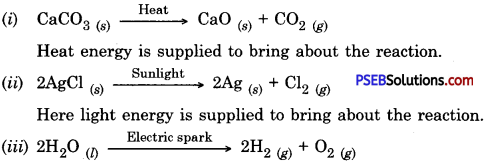
PSEB 10th Class Science Solutions Chapter 1 Chemical Reactions and Equations 2
Here electrical energy is supplied to bring about the reaction.

Question 13.
What is the difference between the displacement and double displacement reactions? Write equations for these reactions.
Answer:
Displacement reaction: In this reaction a more active element displaces less active element from solution of its compound. Examples:
Fe (s) + CuSO4 (aq) → FeSO4 (aq) + Cu (s) ↓
Zn (s) + CuSO4 (aq) → ZnSO4 (aq) + Cu (s) ↓

Double displacement reaction: The reaction in which there is an exchange of ions between two reactants is called a double displacement reaction.
AgNO3 (aq) + NaCl (aq) AgCl (s) ↓ + NaNO3 (aq)
BaCl2 (aq) + Na2SO4 (aq) BaSO4 (s) ↓ + 2NaCl (aq)

Question 14.
In the refining of silver, the recovery of silver from silver nitrate solution involved displacement by copper metal. Write down the reaction involved.
Answer:
Cu (s) + 2AgNO3 (aq) → Cu(NO3)2 (aq) + 2Ag ↓

PSEB 10th Class Science Solutions Chapter 1 Chemical Reactions and Equations

Question 15.
What do you mean by precipitation reaction? Explain by giving examples.
Answer:
Precipitation reaction. A reaction in which an insoluble product or precipitate is produced is called precipitation reaction.
AgNO3 (aq) + NaCl (aq) → AgCl (s) ↓ + NaNO3 (aq)
BaCl2 (aq) + Na2SO4 (aq) → BaSO4 (s) ↓ + 2NaCl (aq)

Question 16.
Explain the following in terms of gain or loss of oxygen with two examples each :
(a) Oxidation (b) Reduction.
Answer:
(a) Oxidation: A chemical reaction in which a substance gains oxygen or loses hydrogen is called oxidation.
Examples
PSEB 10th Class Science Solutions Chapter 1 Chemical Reactions and Equations 3

(b) Reduction: A chemical reaction in which a substance loses oxygen or gains hydrogen is called reduction.
PSEB 10th Class Science Solutions Chapter 1 Chemical Reactions and Equations 4

Question 17.
A shiny brown coloured element ‘X’ on heating in air becomes black in colour. Name the element ‘X’ and the black coloured compound formed.
Answer:
The element X is copper.
PSEB 10th Class Science Solutions Chapter 1 Chemical Reactions and Equations 5
Therefore the black coloured compound formed is copper (II) oxide (CuO).

Question 18.
Why do we apply paint on iron articles?
Answer:
The iron articles can be protected from rusting by applying paint on them so that the iron surface does not come in contact with air (or oxygen) and moisture which causes rusting.

Question 19.
Oil and fat containing food items are flushed with nitrogen. Why?
Answer:
This is because food items are prevented from oxidation by oxygen or air.

Question 20.
Explain the following terms with one example each :
(a) Corrosion
Answer:
Corrosion: The slow eating up of metals by the action of air and moisture on their surfaces is called corrosion. For example, iron undergoes corrosion or rusting in the presence of moist air.

(b) Rancidity.
Answer:
Rancidity: When fats and oils or food containing oils and fats get oxidised with air or oxygen, their smells and tastes change, This process is called rancidity. For example, the packet containing potato chips is flushed with nitrogen gas to avoid rancidity.

Science Guide for Class 10 PSEB Chemical Reactions and Equations InText Questions and Answers

Question 1.
Why should a magnesium ribbon be cleaned before burning in air?
Answer:
Magnesium ribbon should be cleaned before burning to remove the protective layer of basic magnesium carbonate from its surface.

Question 2.
Write the balanced equation for the following chemical reactions.
(i) Hydrogen + Chlorine → Hydrogen chloride
Answer:
H2 + Cl2 → 2HCl

(ii) Barium chloride + Aluminium Sulphate → Barium Sulphate + Aluminium Chloride
Answer:
3BaCl2 + Al2(SO4)3 → 3BaSO4 + 2AlCl3

(iii) Sodium + Water → Sodium hydroxide + Hydrogen
Answer:
2Na + 2H2O → 2NaOH + H2

Question 3.
Write a balanced chemical equation with state symbols for the following reactions.
(i) Solutions of barium chloride and sodium sulphate in water react to give insoluble sulphate and the solution of sodium chloride.
Answer:
BaCl2(aq) + Na2SO4(aq) → BaSO4(s) + 2NaCl(aq)

(ii) Sodium hydroxide solution (in water) reacts with hydrochloric acid solution (in water) to produce sodium chloride and water.
Answer:
NaOH (aq) + HCl (aq) → NaCl (aq) + H2O (l)

PSEB 10th Class Science Solutions Chapter 1 Chemical Reactions and Equations

Question 4.
A solution of substance “X’ is used for white washing.
(i) Name the substance X’and write its formula.
Answer:
X is calcium oxide (quick lime) and its formula is CaO.

(ii) Write the reaction of the substance X named in (i) above with water.
Answer:
CaO (s) + H2O(l) → Ca(OH)2 (aq)

Question 5.
Why is the amount of gas collected in one of the test tubes in activity 1.7 double of the amount collected in the other? Name this gas.
Answer:
When electric current is passed through acidulated water, the reaction taking place is
PSEB 10th Class Science Solutions Chapter 1 Chemical Reactions and Equations 6
Therefore hydrogen and oxygen produced are in the ratio 2 : 1 by volume. Hence volume of gas collected in one test tube is double the volume of gas collected in the other tube and this gas is hydrogen.

Question 6.
Why does the colour of copper sulphate solution change, when an iron nail is dipped in it?
Answer:
This is because iron displaces copper from copper sulphate solution.
Therefore, the concentration of copper sulphate solution decreases and blue colour of solution gradually fades away.
PSEB 10th Class Science Solutions Chapter 1 Chemical Reactions and Equations 7
The concentration of copper sulphate solution decreases as ferrous sulphate is produced.

Question 7.
Give an example of a double displacement reaction other than the one given in the activity 1.10 given in textbook
Answer:
NaCl (aq) + AgNO3(ag) → NaNO3(aq) +AgCl(s) ↓

Question 8.
Identify the substances that are oxidised and the substances that are reduced in the following reactions :
(i) 4Na(s) + O2(g) → 2Na2O (s)
(ii) CuO(s) + H2(g) → Cu(s) + H2O(l)
Answer:

Substance oxidised Substance reduced
1. Na(s) H2
2. H2 CuO(s)

PSEB 10th Class SST Solutions Civics Chapter 3 The State Government

Punjab State Board PSEB 10th Class Social Science Book Solutions Civics Chapter 3 The State Government Textbook Exercise Questions and Answers.

PSEB Solutions for Class 10 Social Science Civics Chapter 3 The State Government

SST Guide for Class 10 PSEB The State Government Textbook Questions and Answers

I. Answer the following questions in brief:

Question 1.
How many Chambers a State Legislative Assembly has? Give their names.
Answer:
In many states of India, the State Legislatures have one House. Some State Legislatures have two Houses. Where the State Legislature has two Houses, these are Vidhan Sabha and Vidhan Parishad. Where there is only one House, the name of the House is Vidhan Sabha pr Legislative Assembly.

Question 2.
Answer the following questions concerning State Legislative Assembly (Vidhan Sabha).
(a) The qualifications to become its member.
Answer:
Essential qualifications for a person to become the member of the Legislative Assembly or the Vidhan Sabha. Following are the essential qualifications for a person to become the member of the Vidhan Sabha :

  • He must be a citizen of India.
  • He must have completed 25 years of age.
  • He must not be either an insolvent or a bankrupt or of unsound fnind.
  • He must not hold any office of profit under the Government of India or the State Government.

(b) The maximum and minimum number of its members as per the Constitution.
Answer:
Number of Members. The number of members of the Vidhan Sabha is fixed by the Parliament on the basis of the population of the state concerned. It can have a maximum membership of 500 and a minimum of 60 persons.

(c) Mention the stages, an ordinary bill has to pass through.
Answer:
Stages of an ordinary bill. An ordinary bill, before becoming an act, has to pass through the following stages; At the first stage, the bill is introduced in the House and its first reading is done. At the second stage, a general discussion on each clause of the bill takes place. At the third stage, the debate is confined to the acceptance or rejection of the bill.

(d) The minimum age required to become the member of the Legislative Assembly.
Answer:
Minimum age limit for the member of the Vidhan Sabha.
The minimum age limit for contesting election to the Vidhan Sabha is 25 years.

(e) How is the Speaker of the Legislative Assembly elected?
Answer:
Election of the Speaker. The Speaker presides over the meetings of the State Legislative Assembly (Vidhan Sabha) and maintains discipline and decorum in the House. He is elected by the House from amongst its own members.

PSEB 10th Class SST Solutions Civics Chapter 3 The State Government

Question 3.
Answer the following questions concerning Legislative Council of a state :
(а) How many members can be there of the Legislative Council?
Answer:
The maximum strength of the Vidhan Parishad. The Vidhan Parishad is the upper House of the State Legislature. The maximum strength of this House is fixed at one-third of the membership of the Vidhan Sabha and a minimum of 40 members.

(b) Mention the term of the members of Legislative Council.
Answer:
Term of the members of Legislative Council.
The Legislative Council is a permanent house. The term of members is six years but one-third of its members retire after every two years.

(c) Mention the term of the members of Legislative Assembly.
Answer:
The term of the members of Legislative Assembly is 5 years but the Assembly can be dismissed by the President by using Article 356 even before the completion of its term.

(d) Name four states where the Lagislative Council Exists.
Answer:
Andhra Pradesh, Karnataka, Telangana, Maharashtra, Bihar and Uttar Pradesh have Legislative Councils. It means these states have bicameral legislature.

Question 4.
Enumerate the four powers of the State Legislature.
Answer:
Following are the main powers of the State Legislature :

  • To exercise control over the Council of Ministers.
  • To pass the budget, and to impose, reduce or repeal taxes.
  • To make laws on the subjects included in the State List and the Concurrent List.
  • To punish those who violate the discipline of the House.

Question 5.
Do your state has bicameral legislatuse?
Answer:
Punjab has a unicameral legislature called Vidhan Sabha. Punjab has no Second Chamber or Vidhan Parishad.

Question 6.
How is the Governor of a State appointed?
Answer:
The Governor is the constitutional head of a state. He is appointed by the President for a period of five years.

Question 7.
Who and how is a Chief Minister appointed?
Answer:
The Chief Minister of a State is appointed by the Governor. He appoints a person who is the leader of the majority party in the State Vidhan Sabha.

PSEB 10th Class SST Solutions Civics Chapter 3 The State Government

Question 8.
Examine the role of the Governor during President’s rule in a state.
Answer:
If the President is satisfied either on the recommendation of the Governor or otherwise that the government cannot be carried on in a State in accordance with the Constitution, he declares constitutional emergency in the state. The Governor can dismiss the Council of Ministers and dissolve the Vidhan Sabha. He becomes the real head of the State.

Question 9.
Mention the term of the office of the Governor.
Answer:
The term of the Governor is five years. But before the expiry of this term, he can be removed from his office by the President. The President can ask him to hold this office even after five years of his term.

Question 10.
Name the three lists under which powers between union and states are distributed.
Answer:
There are three lists under which powers are divided between union government and state governments :

  • Union List. It contains 97 subjects on which only union government can make laws.
  • State List. This list contains 66 subjects on which state government can make laws.
  • Concurrent List. This list contains 47 subjects on which both union government and state governments can make laws. But in case of clash of laws, central law prevails.

Question 11.
What do you understand by Lok Adalats?
Answer:
Lok Adalats haye been set up in the country with a view to providing speedy and cheap justice to the poor. The first Lok Adalat held its session at Delhi on Oct. 6, 1985. It decided 150 cases in a single day.

Question 12.
When and who appoints Finance Commission?
Answer:
The president of India appoints the Finance Commission at the end of every fifth year or earlier, as the deemed necessary by him/her.

II. Answer the following questions in short :

Question 1.
Briefly describe the administrative powers of the Governor.
Or
Explain three powers of the Governor
Answer:
Following are the executive powers of the Governor of a state :

  • All executive actions of the State are taken in his name.
  • It is his responsibility to maintain law and order in the State. There is a provision for a Council of Ministers to assist hini in this work.
  • He appoints the Chief Minister, and on his advice, other ministers of his Council of Ministers.
  • He makes high appointments like those of the Advocate General, Chairman and Members of the State Public Service Commission, etc.
  • He is also consulted by the President in matters relating to the appointment of the judges for the High Court of his State.

Question 2.
Examine the process of appointment of the Council of Ministers in a state.
Answer:
The Constitution of India establishes Parliamentary form of government at the State level and at the Centre. The Governor, therefore, is a nominal head of the State. There is a provision for a Council of Ministers to assist him. The Council of Ministers is the real executive of the State. The Governor appoints a person as the Chief Minister who is the leader of the majority party in the Legislative Assembly. He also appoints other ministers on the advice of the Chief Minister. The Governor can neither delete nor add any new name to the list, given to him by the Chief Minister.

PSEB 10th Class SST Solutions Civics Chapter 3 The State Government

Question 3.
Explain the discretionary powers of a Governor.
Answer:
The Governor has some powers which he can use on his own discretion. These are called his discretionary powers.

The Governor can exercise these powers in the following cases :

  • When no party holds a clear majority in the State Vidhan Sabha, he shall exercise his discretion in the appointment of the Chief Minister.
  • In the event of the failure of the constitutional machinery in the state, he may recommend the imposition of the President’s rule in his state.
  • To safeguard the interests of the Scheduled Castes and Tribes in his state.
  • To reserve any bill passed by the state legislature for the approval of the President.
  • The Governor can dismiss the ministry if he is convinced that it has lost the majority support.

Question 4.
How a declaration of the breakdown of constitutional machinery affects the State Government?
Answer:

  • The President can use all the powers or any of the executive powers of the state.
  • The powers taken over by him shall be exercised by him either directly or through officers subordinate to him. These powers are generally exercised by the state Governor.
  • He can suspend or dissolve the legislative assembly of the state.
  • The Parliament can make laws on any subject on the State list for that State.
  • The Parliament passes the annual budget of the state.
  • The Council of Ministers of the state is dismissed.

Question 5.
Distinguish between the Cabinet and the Council of Ministers.
Answer:
There are the following differences between the Cabinet and the Council of Ministers :

  • The Council of Ministers consists of about 60 ministers, whereas the Cabinet has only 15-20 members.
  • The Cabinet is the inner part of the Council of Minister. That is why, it is commonly termed as wheel within a wheel.
  • The Cabinet formulates all the policies of the state whereas the Council of Ministers does not take part in policy making.
  • The meetings of the Cabinet are held once or twice a week but the meetings of the Council of Ministers are very rarely held.

Question 6.
Examine the four main functions of the Council of Ministers.
Answer:
Following are the four main functions of the Council of Ministers :

  1. Formulation of Policies. The first important function of the Council of Ministers of a state is the formulation of the policies on the basis of which the administration of the state is to be conducted.
  2. Administration. The Council of Ministers is the real executive of the state. Each minister is made incharge of a department and it is his responsibility to run the administration of the department smoothly.
  3. Legislative functions. It is the Council of Ministers that decides the time of summoning and prorougation of the legislature. The Governor’s address is prepared by the council. Majority of the bills are introduced in the legislature by the Council of Ministers.
  4. Financial functions. It is the Council of Ministers which prepares the budget and decides the financial policy of the state. It decides which new taxes are to be imposed. It also decides which taxes are to be increased or decreased.

Question 7.
How a money bill becomes an Act in a State Legislature?
Answer:
A money bill can be introduced by a minister only in the Vidhan Sabha. In a State, which has bicameral legislature, the money bill, after being passed by the Vidhan Sabha, is sent to the Vidhan Parishad. The Vidhan Parishad can keep pending the money bill for 14 days. After this, it sends the bill to Vidhan Sabha with or without its suggestions. The Vidhan Sabha has power to reject or accept these suggestions. Then the bill passed by the Vidhan Sabha is sent to the Governor for approval. The bill, after getting the assent of the Governor, becomes an act.

Question 8.
Explain the original jurisdiction or administrative powers of a High Court.
Answer:
Some cases can be brought before the High Court directly. This is called the original jurisdiction of the High Court. The High Court has original jurisdictions in the following cases :

  1. Any case regarding the fundamental rights can be brought directly to the High Court. The High Court is empowered to issue five kinds of writs for the enforcement of fundamental rights.
  2. The State High Courts like the Supreme Court can strike down any law passed by the State Legislature or the Parliament or any order of the executive if it violates any provision of the Constitution.

PSEB 10th Class SST Solutions Civics Chapter 3 The State Government

Question 9.
Describe the Appellate jurisdiction of a High Court.
Answer:

  • The High Court can hear appeals against the decision of the lower courts in most of the revenue and criminal cases.
  • The High Court can hear appeals in criminal cases in which the accused has been sentenced to four years imprisonment by the Sessions Judge. The Sessions Judge of a district court can award death sentence in criminal cases. But such a sentence is subject to the confirmation of the High Court.

Question 10.
‘A High Court is a Court of Record’. How?
Answer:
According to Article 251, every State High Court is a Court of Record, and as such its decisions are recorded and the courts subordinate to it accept these decisions as judicial precedents.

Question 11.
Examine the organization and main functions of the Lok Adalats.
Answer:
Lok Adalats. The Lok Adalats have been set up in the country with a view to providing speedy and cheap justice to the poor. Justice P.N. Bhagwati is regarded as its founder. The first Lok Adalat held its session at Delhi in October 6, 1985 and settled many cases in a single day. Our courts have heavy work-load. Lakhs of cases are pending. The system provides the simplest way to file a petition for a poor citizen in the Lok Adalat through a simple letter written on a postcard. In 1987, these Lok Adalats got legal recognition.

Question 12.
Describe briefly the relations between the Union and States on one of the following :
(a) Legislative Relations
(b) Administrative Relations
(c) Financial Relations.
Answer:
(а) Legislative Relations. The union legislature can make laws on the subjects given in the Union list and Concurrent list while the State Legislature can make laws on the State list and the Concurrent list. Only the Parliament can make laws on subjects in the State List as well as the Concurrent List during the declaration of emergency in the State (Art. 356).

(b) Administrative Relations. The administrative powers of the State shall be so exercised that they do not come into conflict with executive powers of the Centre. The Union government can issue instructions to the States for that purpose if it thinks it necessary. The executive powers of the union government shall also extend to the giving of directions to a state regarding the construction and maintenance .of the means of communication declared to be of national and military importance.

(c) Financial Relations. The sources of income are divided between the Centre and the States. The important sources of income of the Central Government are such as

  • Customs and export duties.
  • Income tax.
  • Estate duty.
  • Interstate trade tax.

Sources of Income of the States are such as :

  • Land revenue
  • House tax
  • Taxes on succession to agricultural land
  • V.A. tax.

PSEB 10th Class Social Science Guide The State Government Important Questions and Answers

Answer the following questions in one line or one word :

Question 1.
Where is Punjab High Court located?
Answer:
Punjab High Court is located at Chandigarh.

Question 2.
How many States and Union Territories are there in the Indian Republic?
Answer:
There are twenty-eight States and eight Union Territories in India.

PSEB 10th Class SST Solutions Civics Chapter 3 The State Government

Question 3.
On what basis have the states been classified?
Answer:
In India, the states have been organised on a linguistic basis.

Question 4.
What is called a Union Territory?
Answer:
An administrative unit the administration of which is under the Union Government.

Question 5.
On which lists of subjects can the State Government make laws?
Answer:
The State Legislature can make laws on the subjects in the State list and Concurrent list.

Question 6.
In which House can a money bill be introduced?
Answer:
A money bill can be introduced only in the Vidhan Sabha.

Question 7.
Who is the real head of a State Government?
Answer:
The Chief Minister is the real head of a State Government.

Question 8.
Mention two qualifications for the office of the Governor.
Answer:
He must be a citizen of India and must have completed 35 years of age.

Question 9.
Write any one executive power of the Governor.
Answer:
The Governor is the executive head of the State.

Question 10.
Mention any one legislative function of the Governor.
Answer:
He summons, adjourns and prorogues the State Legislature.

Question 11.
Mention any one financial power of the Governor.
Answer:
The Budget of the State is presented to the Legislative Assembly in his name.

Question 12.
Write any one judicial power of the Governor.
Answer:
The Governor is consulted by the President in the appointment of the judges of the High Court.

Question 13.
How many minimum sessions of the State Legislature must be held in a year?
Answer:
The State Legislature must hold at least two sessions in a year.

PSEB 10th Class SST Solutions Civics Chapter 3 The State Government

Question 14.
Who is the chipf adviser of the Governor?
Answer:
The Chief Minister is the chief adviser of the Governor.

Question 15.
Write any one power of the Chief Minister.
Answer:
The Chief Minister prepares a list of the ministers and sends it to the Governor for approval.

Question 18.
What is the number of members of the Punjab Legislative Assembly?
Answer:
The Punjab Legislative Assembly consists of 117 members.

Question 17.
Who can appoint the Governor?
Answer:
The Governor is appointed by the President of India.

Question 18.
Who appoints the Chief Minister?
Answer:
The Chief Minister is appointed by the Governor.

Question 19.
What is the tenure of the Governor?
Answer:
The tenure of the Governor is five years.

Question 20.
What is tenure of Legislative Council?
Answer:
Legislative Council is a permanent body. Its one-third members retire by rotation after every two years and these members can be re-elected. The tenure of each member is six years.

Question 21.
What is the name of the Governor of the Punjab?
Answer:
V.P. Singh Bednore.

Fill in the blanks :

Question 1.
There are _________ States in India.
Answer:
28

Question 2.
There are _________ Union Territories in India.
Answer:
8

PSEB 10th Class SST Solutions Civics Chapter 3 The State Government

Question 3.
In Punjab there is _________ Legislature.
Answer:
unicameral

Question 4.
The _________ is the Chief advisor of the Governor.
Answer:
Chief Minister

Question 5.
The Governor is appointed by the _________
Answer:
President

Question 6.
The tenure of the Governor is _________
Answer:
five

Question 7.
The Chief Minister is appointed by the _________
Answer:
Governor

Question 8.
The Judges of the High Court are appointed by the _________
Answer:
President

Question 9.
The strength of the Punjab Legislative Assembly is _________
Answer:
117

Question 10.
The Judges of the High Court retire at the age of _________ years.
Answer:
sixty-two

PSEB 10th Class SST Solutions Civics Chapter 3 The State Government

Question 11.
The constitutional head of the state is _________
Answer:
Governor

Question 12.
The Legislative Council is a _________ House.
Answer:
Permanent

Question 13.
The tenure of the Legislative Assembly is _________ years.
Answer:
five.

Choose the correct answer :

Question 1.
The Governor of a state is :
(a) Head of Govt.
(b) Head of the State
(c) Head of the Union Territory
(d) None of these.
Answer:
(b) Head of the State

Question 2.
Two Houses of the State Legislature are :
(а) Lok Sabha and Rajya Sabha
(b) Legislative Council and Lok Sabha
(c) Legislative Assembly and Legislative Council
(d) Rajya Sabha and Legislative Assembly.
Answer:
(c) Legislative Assembly and Legislative Council

Question 3.
Who is the constitutional head of the state?
(a) Governor
(b) Chief Minister
(c) President
(d) Speaker of Legislative Assembly.
Answer:
(a) Governor

Question 4.
The term of office of the Governor is :
(a) 4 years
(b) 5 years
(c) 3 years
(d) 6 years.
Answer:
(b) 5 years

PSEB 10th Class SST Solutions Civics Chapter 3 The State Government

Question 5.
The tenure of the Legistative Assembly in normal time is :
(a) 4 years
(b) 6 years
(c) 3 years
(d) 5 years.
Answer:
(d) 5 years.

Short Answer Type Questions

Question 1.
Describe the composition of the State Legislative Assembly (Vidhan Sabha).
Answer:
The Vidhan Sabha consists of the members directly elected by the people of the State on the basis of adult franchise. According to the Constitution, its maximum membership shall not exceed 500 and shall not be below 60. A citizen having attained the age of 25 years is eligible to be elected to this house. The tenure of the Vidhan Sabha is five years. This house has a Speaker and a Deputy Speaker to conduct its meetings. The House elects them from among its members.

Question 2.
How is the Legislative Council (Vidhan Parishad) organised?
Answer:
The membership of the Vidhan Parishad cannot exceed one-third of the membership of the Vidhan Sabha with a minimum of 40 members. Its members are elected or nominated as under:

  • 1/3rd members are elected by the Vidhan Sabha from amongst persons who are not its members.
  • 1/3rd members are elected by the local bodies of the state.
  • 1/12th of members are elected by persons of at least three years’ standing as teachers in educational institutions not lower in standard than that of a secondary school.
  • 1/12th of members are elected by the university graduates of at least three years’ standing in the state.
  • 1/6th members are nominated by the Governor from amongst persons possessing special knowledge and experience in the fields of arts, literature, science, etc.

Question 3.
Describe the position of the Governor as a representative of the Central Government.
Answer:
The Governor of an Indian State is the head of the State but he is the representative of the Centre also. The following facts prove it :

  1. He acts as a link between Central Government and the State Government. He can reserve certain bills for the consideration of the President.
  2. If the Governor feels that administration of the state cannot be carried on in accordance with the provisions of the Constitution, he can recommend to the President to declare emergency arising due to breakdown of constitutional machinery in the state. In that case, the President may impose President’s Rule in that state.
  3. The State Vidhan Sabha and the Council of Ministers may be suspended or dissolved. During the emergency the Governor acts as a representative of the Central Government. He runs the administration with the help of an Advisory Council.

Question 4.
Mention the grounds on the basis of which the Governor can recommend President’s rule in the state.
Answer:
The Governor can recommend to the President for the imposition of President’s rule in his state if he is satisfied that :

  1. the constitutional machinery has broken down in the state; and
  2. the ruling party has lost the support of the majority of legislators.

Question 5.
Write a short note on the ‘Union Territories’.
Answer:
There are, at present, eight Union Territories apart from the 2S States. Since the area and population covered by them is small, so these are not given the status of a full-fledged state. The administration of the Union Territories is under the control of the President acting through a Lt. Governor or a Chief Commissioner. The Parliament may constitute, for every such territory, a Council of Advisors to the Chief Commissioner which may partly be elected and partly nominated.

PSEB 10th Class SST Solutions Civics Chapter 3 The State Government

Question 6.
List out three similarities in the organisation of Central and the State Governments.
Answer:
The following are three similarities with regard to the organisation of Central and State Governments :

  1. The Constitution’ establishes the parliamentary form of government both at the Centre and in the units.
  2. Both at the Centre and in the States there exists’ independent impartial judicial system with a single hierarchy of coy^s to administer justice on, both the Union and the State laws.
  3. The legislature of the Centre is bicameral and so it is in many states such as Bihar, Tamilnadu, Maharashtra, Karnataka, Uttar Pradesh.

Question 7.
List out three dissimilarities in the organisation of the Centre and State Governments.
Answer:
The following are the three dissimilarities with regard to the organisation of Central and State Governments :

  1. The head of the state at the centre is an elected President; but the Governor, the head of the state, is nominated.
  2. The central legislature is bicameral but most of the states have unicameral legislatures.
  3. There is no office like that of the Vice-President in the States.

Question 8.
Give four non-legislative functions of the State Legislature.
Answer:
The following are the non-legislative functions of the State Legislature :

  1. The State Legislature exercises control over the finances of the State.
  2. The Legislature’deliberates on the no-confidence motion against the Government.
  3. The elected members of the State Legislature elect the members of Rajya Sabha.
  4. Each of the Houses of the Legislature elects its own Chairman and Deputy Chairman.

Question 9.
Mention three major legislative functions of the Governor.
Answer:
The following are the legislative functions of the Governor :

  1. He summons, adjourns and prorogues the State Legislature.
  2. All bills passed by the legislature are sent to him for his approval.
  3. He can issue ordinances during the recess of the State Legislature.

PSEB 10th Class SST Solutions Civics Chapter 3 The State Government

Question 10.
Mention three major executive functions of the Governor.
Answer:
The following are the executive functions of the Governor :

  1. He appoints the Chief Minister and on his advice the other ministers.
  2. He appoints the Advocate General of the State, the Chairman and the members of the Public Service Commission and other officials of the State.
  3. The Chief Minister informs the Governor about all decisions of the Council of Ministers and supplies him information relating to the administration of the State.

Question 11.
Mention the four major functions of the State Governments.
Answer:
The State Governments perform the following functions :

  1. The most important function of each State Government is to maintain law and order in its State.
  2. It is also the function of the State Government to provide the citizens with basic amenities of life.
  3. It provides educational facilities to its citizens.
  4. The Government is also expected to look after the economic welfare of the citizens by undertaking development programmes.

Question 12.
Explain three powers of the Chief Minister.
Answer:
Following are the powers of the Chief Minister :

  1. Appointment of the Minister*. The Chief Minister prepares a list of his Ministers and sends it to the Governor.
  2. Distribution of Portfolios. The Chief Minister distributes the portfolios among the ministers.
  3. Removal of Ministers. He can ask a minister to resign. If that minister refuses to resign, the Chief Minister can ask the Governor to remove him from the Cabinet.
  4. Head of the Council of Ministers. The Chief Minister calls the meetings of the Council of Ministers and presides over the meetings.

Question 13.
Describe the position of the Chief Minister.
Answer:
Position of the Chief Minister, In fact, the Chief Minister is the most important and powerful authority in the State. There is no field of the State administration which is not under the control of the Chief Minister. A minister remains in office so long as he continues to enjoy the confidence of the Chief Minister. He is the pivot around which the whole administration of the state revolves.

Question 14.
Discuss the administrative powers of the High Court.
Answer:
Following are the administrative powers of the High Court:

  • It exercises the power of superintendence and control over all the subordinate courts.
  • It makes rules and regulations for the transaction of business of the subordinate courts.
  • It frames rules for the promotion of the judges.

Question 15.
Write a note on the District Courts.
Answer:
For the convenience of judicial administration, a state is divided into districts. There are subordinate courts in every district which are under, the control of the District and Sessions Judge. The District and Sessions Judge is appointed by the State Governor in consultation with the High Court. A person to be eligible for appointment to the post of District and Sessions Judge should be an advocate of at least 7 years’ standing or should have served in the central or state government. The High Court exercises control over the district courts.

PSEB 10th Class SST Solutions Civics Chapter 3 The State Government

Question 16.
What are the unitary features of the Indian Constitution?
Answer:
The Indian Constitution has created a very strong Centre. There are three Lists : Central List, State List and Concurrent List, distributing the powers between the Centre and the States. The Central Government has a large number of powers. It has co-equal powers with the States to legislate on the Concurrent List and in the event of any difference between the Centre and the State, on any law, the central law prevails. The residuary powers are also with the Centre.

During the emergency the Centre gets powers to legislate even on State List. Yet another implication of the declaration of emergency in the country is that the federal structure turns into unitary one, thus making the Centre all powerful.

Question 17.
How have the powers of government been divided between the Union and the States?
Answer:
Powers of the government have clearly been divided between the onion and the states. There are three different lists of the Subjects:

  1. The Union List. There are 97 subjects in the Union list. Only Union Government can make laws on these subjects. The main subjects, are Railways, Post and Telegraph, Coinage and Currency, Defence, and Foreign Affairs.
  2. The State List. There are 66 subjects in this list. The state governments make laws on them. The main subjects are law and order, police, agriculture, irrigation, and public works.
  3. The Concurrent List. There are 47 subjects on the concurrent list such as Family Planning, Marriage and Divorce, control over press, Education etc. In this list are those subjects on which both the Centre and the States can make laws. But if the two laws are contradictory, the law made by the Centre prevails.

Question 18.
Discuss the relationship between the Governor and the Council of Ministers.
Answer:
The Governor is the executive head of the State. He is the nominal head of the State. He is to act on the advice of the State Council of Ministers. The Governor cannot act according to his discretion while appointing the Chief Minister and other members of the Council of Ministers. Only the leader of the majority party in the State Legislative Assembly is appointed the Chief Minister by him. However, if no party gets clear majority, he is at liberty to appoint the Chief Minister. Other ministers are appointed by him on the advice of the Chief Minister. He distributes portfolios among the ministers on the advice of the Chief Minister. But under certain circumstances, he becomes the real head of the state. He acts as the agent of the centre in the state in times of Constitutional Emergency. He also enjoys certain discretionary powers.

Question 19.
What are the powers of the Governor?
Answer:
The Governor has many legislative, executive, financial and judicial powers.

  • He organises the Council of Ministers on the advice of the Chief Minister,
  • He appoints members of the State Public Service Commission,
  • The bills passed by the State Legislature are sent to him for assent.
  • Before the start of every financial year, he causes to be laid through the Finance Minister annual Budget before the Legislature,
  • He advises the President about’ the appointment of the judges of the High Court,
  • He can reserve certain bills for the consideration of the President. He can send report to the President with regard to the breakdown of constitutional machinery in the State.

Question 20.
Describe the powers of State Legislature.
Answer:
1. Legislative Powers. It can legislate on all subjects included in the state list and concurrent list as well. If its legislation on some subjects of the concurrent list is contrary to the parliamentary law then it becomes null and void to the extent it is contrary to that.

2. Financial Powers. It has complete control over the financial affairs of the state. The finance minister presents the state budget before the legislative assembly every year. To impose or reduce or abolish all taxes is within its executive powers.

3. Executive Powers. The. council of ministers headed by Chief Minister is the real executive and it is directly and collectively responsible to the legislative assembly.

4. Miscellaneous functions,

  • Members of the legislative assembly participate in the election of the President and the Vice President of India.
  • The legislative assembly elects its own Speaker and Deputy Speaker.
  • It can create a contingency fund of the State which is controlled by the (Governor.
  • It can suspend its own members if they disrupt the proceedings of the House.

PSEB 10th Class SST Solutions Civics Chapter 3 The State Government

Question 21.
Explain the original jurisdiction and powers regarding*the fundamental rights of the High Court.
Answer:
Some cases can directly be brought to a High Court. They are cases relating to fundamental rights, wills, divorce, marriages, contempt of court etc. Election disputes can also be heard by the High Court. The High Courts of Kolkata, Mumbai and Chennai can hear civil cases of a value exceeding Rs. 20,00Q or more.

In case regarding fundamental rights, the High Court can issue writs for the enforcement of fundamental rights.
The High Court can declare unconstitutional any law passed by the State Legislature or any executive order of a State Government which it finds violative of any of the provisions of the Constitution. Laws declared unconstitutional by a High Court cannot be enforced.

Question 22.
How is a money bill passed in a State Legislative Assembly?
Answer:
A money bill can be introduced in a State Legislative Assembly (Vidhan Sabha). After a bill is passed by it, the bill is sent to Legislative Council (Vidhan Parishad) which can delay it for 14 days only.

PSEB 8th Class Social Science Solutions Chapter 24 Constitution and Law

Punjab State Board PSEB 8th Class Social Science Book Solutions Civics Chapter 24 Constitution and Law Textbook Exercise Questions and Answers.

PSEB Solutions for Class 8 Social Science Civics Chapter 24 Constitution and Law

SST Guide for Class 8 PSEB Constitution and Law Textbook Questions and Answers

I. Fill in the blanks :

Question 1.
The constitution of India was implemented on ___________
Answer:
26 Jan. 1950

Question 2.
___________ was the first President of India.
Answer:
Dr. Rajendra Prasad

Question 3.
The law against Dowry was enacted in ___________
Answer:
1961 A.D.

Question 4.
The Constitution of India was prepared in ___________ years months and days.
Answer:
2,11,18

PSEB 8th Class Social Science Solutions Chapter 24 Constitution and Law

Question 5.
The main cause of foeticide is ___________custom.
Answer:
dowry.

II. Put a tick against the Right (✓) and a cross against the wrong (✗) answer:

Question 1.
Gandhiji broke the salt law at Dandi.
Answer:
(✓)

Question 2.
The Judiciary does not protected the constitution.
Answer:
(✗)

Question 3.
The rule of law runs through India.
Answer:
(✓)

Question 4.
To oppose bad laws is the feature of Democracy.
Answer:
(✓)

Question 5.
Laws are Indefinite rules.
Answer:
(✗)

III. Multiple Choice Questions :

Question 1.
When was the Indian Constitution Implement?
(A) Nov. 26, 1949
(B) Jan. 26, 1950
(C) Jan. 26, 1930
(D) Jan. 26, 1949.
Answer:
(B) Jan. 26, 1950.

Question 2.
Who was the Chairman of the constitution draft committee?
(A) Dr. Rajinder Prasad
(B) Dr. B.R. Ambedkar
(C) Mahatma Gandhi
(D) Pandit Jawahar Lai Nehru.
Answer:
(B) Dr. B.R. Ambedkar.

PSEB 8th Class Social Science Solutions Chapter 24 Constitution and Law

Question 3.
Who is the highest of the following in India?
(A) Prime Minister
(B) President
(C) Judiciary
(D) Constitution.
Answer:
(D) Constitution.

Question 4.
State the number of draft committee members.
(A) 11
(B) 18
(C) 7
(D) 2.
Answer:
(C) 7.

IV. Answer the following questions In not more than 15 words :

Question 1.
What do you mean by Constitution?
Or
Write the meaning of the term Constitution.
Answer:
The Constitution is a legal document through which administration of the country is being run. Central and state governments run their administration according to the Constitution. The Constitution is above of all the laws of the country.

Question 2.
Why was Constitution implemented on 26th January, 1950?
Answer:
Our Constitution was implemented on 26th January, 1950 because of the historical importance of this date. On 26th January, 1930, first independence day of the country was celebrated.

Question 3.
Write the word meaning of Law.
Answer:
Law is an English word. The word “Law’ came out of Tutonic word ‘Lag’ whose meaning is definite. In this way the meaning of law is definite rule.

PSEB 8th Class Social Science Solutions Chapter 24 Constitution and Law

Question 4.
What is the importance of Law?
Answer:
Law is helpful in maintaining system of any institution or the country. No institution can run in a proper way without the laws. School also has its own laws (rules) with which discipline is maintained in the school.

Question 5.
What do you mean by the impartial Judiciary?
Answer:
The meaning of impartiality of the judiciary is that it works independently without the pressure of executive or legislative. Judiciary in India also has been made impartial. If any institution does not work according to the Constitution, judiciary can declare it unconstitutional.

Question 6.
Which were the movements started by Mahatma Gandhi?
Answer:
Mahatma Gandhiji started Non-Cooperation Movement in 1921, Civil Disobedience Movement in 1930 and Quit India Movement in 1942 A.D.

Question 7.
What do you understand by “Boycott of Liquor”?
Or
What is meant by the prohibition of Liquor?
Answer:
The meaning of Boycott of Liquor is restriction of making whisky by state, sale of whisky and drinking of whisky.

V. Answer the following questions in 50-60 words :

Question 1.
What do you mean by the. supremacy of the Constitution?
Answer:
The Indian Constitution is considered as the highest document.

  1. Persons being appointed in all the important offices of the country are asked to take the oath of the Constitution.
  2. All government and non-government institutions work according to the Constitution.
  3. Judiciary has been made independent and impartial. It has been given a number of rights for the security of the Constitution. Out of these, one right is related to” security and explanation of the Constitution.
  4. A democratic structure has been established in the country according to the Constitution. Citizens are given a number of rights. One of these important rights is the right to criticise the government.

Question 2.
How was the Constitution of India formed?
Answer:
On the 29th of August, 1947, a seven member committee was formed to form the Indian Constitution. This committee studied the Constitutions of many countries. It took 2 years, 11 months and 18 days to complete the Indian Constitution. It was passed by the Constituent Assembly on 29th November, 1949 but was implemented in the country on 26th January, 1950 due to the historical importance of this date.

Question 3.
How has the judiciary been made Impartial in India?
Answer:
Judiciary has been made the independent and unbiased for the security of Constitution. Judiciary determines that the Constitution should be obeyed. If any institution does not work according to the Constitution then it can be declared as unconstitutional. Judiciary has the right to review the laws. It means that if any law made by legislative is against the spirit of the Constitution, it can be dismissed by the Judiciary. In the same way if any work implemented by executive is against the Constitution then it can be declared as unconstitutional.

Question 4.
Why did Gandhi violate the British laws?
Answer:
The British government used to make laws for the country before our independence. The main aim of these laws was to meet the interests of the British government. Indian interests were hardly cared by these laws. For example, British government passed an act in 1919 A.D. called Rowlatt Act according to which government was free to arrest any person just on the basis of doubt. Salt law was also against Indians. It was necessary to break such laws. That’s why Gandhiji broke those laws.

PSEB 8th Class Social Science Solutions Chapter 24 Constitution and Law

Question 5.
What is meant by prohibition and why should it be put into practice?
Answer:
Meaning of boycotting of liquor is the legal prohibition of making whisky, sale of whisky and drinking of whisky.

Drinking whisky or alcohol is a social evil. According to one survey, every fourth person of the country is alcoholic. Daily 25 crore rupees are being spent on whisky. Not only this it leads to loss of money, loss of health and loss of time. Alcohol takes the person towards moral degradation. That’s why it is necessary to implement the policy of Complete Prohibition.

PSEB 8th Class Social Science Guide Constitution and Law Important Questions and Answers

Multiple Choice Questions :

Question 1.
Indian Constitution was framed by :
(a) Indian Parliament
(b) Dr. Ambedkar British
(c) Constituent Assembly
(d) Parliament.
Answer:
(c) Constituent Assembly.

Question 2.
The Indian Constitution was enforced on :
(a) 9th December 1950
(b) 15th August 1947
(c) 26th Nov. 1949
(d) 26th January, 1950.
Answer:
(d) 26th January, 1950.

Question 3.
Aims of the Constitution are mentioned in the :
(a) Preamble
(b) Fundamental Rights
(c) Directive Principles
(d) None of the above.
Answer:
(a) Preamble

PSEB 8th Class Social Science Solutions Chapter 24 Constitution and Law

Question 4.
Who was the Chairman of the Drafting Committee of the Constituent Assembly?
(a) Dr. B.R. Ambedkar
(b) Pt. Jawaharlal Nehru
(c) Dr. Rajinder Prasad
(d) K.M. Munshi.
Answer:
(a) Dr. B.R. Ambedkar.

Question 5.
Which of the following right is available under the Indian Constitution?
(a) Right to Equality
(b) Right to Freedom
(c) Right against Exploitation
(d) All the above.
Answer:
(d) All the above.

Question 6.
At present Indian citizen enjoys :
(a) Seven Fundamental Rights
(b) Eight Fundamental Rights
(c) Six Fundamental Rights
(d) None of the above
Answer:
(c) Six Fundamental Rights.

Question 7.
Who was elected as the first president of India?
(a) Dr. Rajendra Prasad
(b) Pt. Jawahar Lai Nehru
(c) Sardar Patel
(d) Mahatma Gandhi.
Answer:
(a) Dr. Rajendra Prasad.

Question 8.
Which of these movements was started by Gandhiji?
(a) Non-Cooperation Movement
(b) Quit India Movement
(c) Civil Disobedience Movement
(d) All of these.
Answer:
(d) All of these.

PSEB 8th Class Social Science Solutions Chapter 24 Constitution and Law

Question 9.
When was Dowry Prohibition Act passed?
(a) 1960
(b) 1961
(c) 1962
(d) 1963.
Answer:
(b) 1961.

Fill in the Blanks :

Question 1.
Indian Constitution come into force on ___________
Answer:
26 January 1950

Question 2.
___________ was the first President of India.
Answer:
Dr. Rajendra Prasad

Question 3.
Dowry Prohibition Act was passed in A.D.
Answer:
1961

Question 4.
Indian Constitution was made in around ___________ years.
Answer:
Three

PSEB 8th Class Social Science Solutions Chapter 24 Constitution and Law

Question 5.
Major reason of foeticide is ___________
Answer:
Dowry.

Tick the Right (✓) or Wrong (✗) Answer:

Question 1.
Gandhi Ji broke Salt Law at Dandi.
Answer:
(✓)

Question 2.
Judiciary never protects the country.
Answer:
(✗).

Question 3.
Rule of law is there in India.
Answer:
(✓)

Question 4.
Elimination of wrong laws is a basic aspect of democratic government.
Answer:
(✓)

PSEB 8th Class Social Science Solutions Chapter 24 Constitution and Law

Question 5.
Laws are indefinite rules.
Answer:
(✗).

Match the Following :

Question 1.

A B
1. Constitution (i) Judiciary
2. Protection of Constitution (ii) 31 Dec. 1929
3. Completion of Constitution (iii) Legal Document
4. Declaration of Poorna Swaraj (iv) 26 Nov. 1949

Answer:

A B
1. Constitution (iii) Legal Document
2. Protection of Constitution (i) Judiciary
3. Completion of Constitution (iv) 26 Nov. 1949
4. Declaration of Poorna Swaraj (ii) 31 Dec. 1929

Very Short Answer Type Questions

Question 1.
When did India become independent?
Answer:
India became independent on 15th August 1947.

Question 2.
Who framed the Constitution of India? Who was its chairman?
Answer:
The Constitution of India was framed by the Constituent Assembly whose chairman was Dr. Rajendra Prasad.

Question 3.
When was the Drafting Committee of the Constituent Assembly framed? Who was its Chairman?
Answer:
The Drafting Committee of the Constituent Assembly was framed on 29th August 1947. Its chairman was Dr. B.R. Ambedkar.

PSEB 8th Class Social Science Solutions Chapter 24 Constitution and Law

Question 4.
Who was the first President of India? In which meeting of Constituent Assembly he was elected as President?
Answer:
The first President of India was Dr. Rajendra Prasad. He was elected as the President in the last meeting of Constituent Assembly on 25th January 1950.

Question 5.
Which steps are taken to make Judiciary independent and impartial?
Answer:
Appointment of judges, their salary, perks and term are kept separate from other bureaucrats.

Question 6.
Give two things included in the Civil Disobedience and Non-Cooperation Movements.
Answer:

  1. Not to use things made by the British government.
  2. Not to wear clothes made by them.

Question 7.
Where and how was the salt law broken?
Answer:
Salt law was broken at Dandi (Gujarat) under the leadership of Mahatma Gandhi. Salt made by the British government was destroyed by them and Gandhiji ordered to make salt themselves from the seawater.

Question 8.
Which state governments passed the laws related to complete prohibition? Were they proved fruitful?
Answer:
Complete Prohibition Laws were passed by governments of Gujarat, Haryana, Kerala and Andhra Pradesh. But they were not proved fruitful.

Short Answer Type Questions

Question 1.
Write a note on the formation and implementation of the Constitution of India.
Answer:
After the independence, one Constituent Assembly was formed. Dr. Rajendra Prasad was elected its permanent chairman. This committee was sovereign in its hands.

Formation of Drafting Committee and making of the Constitution. One committee of seven members was formed on 29th August, 1947 to give definite form to the Constitution. It’s chairman was Dr. B.R. Ambedkar. This Drafting Committee studied the Constitutions of different countries and collectecLmany facts from the Constitutions of other countries. Total 11 meetings of the Constituent Assembly were held. The work of making of the Constitution was completed on 26 Nov., 1949. It took 2 years, 11 months and 18 days to make our Constitution. The Constitution was implemented on 26th Jan. 1950. Last meeting of Constituent Assembly took place on 25th Jan. 1950 in which Dr. Rajendra Prasad was elected as the first President, of India.

PSEB 8th Class Social Science Solutions Chapter 24 Constitution and Law

Question 2.
Why and how Dowry System was banned?
Answer:
The custom of dowry was a curse on our society. This was one of the biggest problems for poor classes right from the ages. Poor people used to take loan to give dowry to their girls. It led to lower status of females in society. That’s why people started to encourage female foeticide. It led to decline in sex-ratio in society. That’s why government was forced to make a law to restrict dowry system and this law was made in 1961. According to this law, giving or taking dowry is an offence.

Question 3.
What do you mean by the Constitution and Law?
Answer:
Constitution. The Constitution is a fundamental and legal document which enjoys the highest place in the country. It is a set of those rules according to which administration of the country is being run. All the government and non-government institutions work according to the Constitution.

Law. Law is that rule which maintains peace and order in the country. Laws are being formed by central and state legislatures. It is necessary for all the citizens of the country to obey the laws of the country. Punishment can be given in case of breaking the laws.

Question 4.
What is the meaning and importance of Law?
Answer:
Meaning. Law is an English word. The word ‘Law’ came out of the Teutonic word ‘Lag” whose meaning is definite. In this way, the meaning of the word ‘Law’ is any definite rule.

Importance of Law: Laws are of great importance in social life. They regulate our social life. Our social life cannot run in a proper way without these laws. For example, if rules (laws) will not be implemented in the school then indiscipline will not prevail in the school. In this way, if criminals will not be controlled by laws then insecurity will prevail in the social life of the society.

PSEB 8th Class Social Science Solutions Chapter 24 Constitution and Law

Question 5.
List the rights of citizens in a criticism.
Answer:
Rights given to citizens by the Constitution are known as basic rights or fundamental rights. They are six in number and are listed as follows:

  1. Right to Equality.
  2. Right to Freedom.
  3. Right against Exploitation.
  4. Right to Religious Freedom.
  5. Cultural and Educational Rights.
  6. Right to Constitutional Remedies.

PSEB 7th Class Social Science Solutions Chapter 20 State-Government

Punjab State Board PSEB 7th Class Social Science Book Solutions Civics Chapter 20 State-Government Textbook Exercise Questions and Answers.

PSEB Solutions for Class 7 Social Science Civics Chapter 20 State-Government

SST Guide for Class 7 PSEB State-Government Textbook Questions and Answers

I. Answer the following questions in 1-15 words.

Question 1.
Write two qualifications required for the members of legislative assembly.
Answer:

  1. He should be an Indian citizen.
  2. He should not be less than 25 years of age.

Question 2.
What qualifications are required for a Governor?
Answer:

  1. He should be an Indian citizen.
  2. He should not be less than 35 years of age.
  3. He should be mentally and physically sound.
  4. He should not be a member of a state or central legislature or should not be a govt, official.

Question 3.
Who can be the secretary of some department?
Answer:
The departmental secretary is the chief of a govt, department.

Question 4.
Name out, who is the chief minister and governor of your state?
Answer:
Captain Amrinder Singh is the Chief Minister and Mr. V.P. Singh Badnore is the Governor of our State.

PSEB 7th Class Social Science Solutions Chapter 20 State-Government

Question 5.
Who is the Executive head of a state?
Answer:
The Governor is the Executive head of a state.

II. Answer the following Questions in 50-60 words

Question 1.
Write in short the functions of the Governor.
Answer:
Although the Constitution gives vast powers to the Governor, yet he is not the real head of the state. He exercises all the powers on the advice of the Chief Minister and the Council of Ministers. If the Governor disagrees with the ministers, he places himself in an awkward position. They would resign and the Governor would be compelled to find an alternative ministry. The Council of Ministers is responsible to the Legislative Assembly and not to the Governor.

But it must be noted that the Governor is something more than a mere nominal head or rubber stamp. He has the powers to advise, warn and encourage the Council of Ministers. He functions as the agent of the Centre. He acts as a link between the Centre and the State and is the watchdog of the Constitution.

He has certain functions which he can perform at his discretion.

  • He recommends to the President to declare an emergency in the State.
  • He becomes the real ruler of the State after the emergency is declared in the State.
  • He can appoint a person of his choice as the Chief Minister in case no party in the State Legislative Assembly wins majority of seats.
  • He can send back the bills passed by the State Legislature for reconsideration.
  • He can reserve certain bills for the approval of the President.

Question 2.
Write about the powers and functions of the Chief Minister.
Answer:
The Chief Minister is the real executive head of the State government. He selects his ministers. The Governor must give approval to his list of ministers. The Chief Minister distributes portfolios among the ministers. He reorganizes the Council of Ministers from time to time. He can appoint new ministers and remove the inefficient ones. The Chief Minister is the link between the Governor and the Ministers. He is also the chief advisor to the Governor. The Chief Minister is the leader of the Gis party and also the leader of the State Legislature. The people of the State look upto him for his guidance and development of the State.

Thus, we see that the Chief Minister is the most important figure in the State. He enjoys the same position in the State as the Prime Minister at the Centre. So long as he enjoys the support of majority in the Vidhan Sabha, he has complete control over the State Government. He is the pivot round which the whole Council of Ministers and the total administration revolves.

Question 3.
Give in brief the election procedure of Legislative Assembly or Legislative Council.
Answer:
The State Legislative may consist of one or two chambers or houses. The lower and the more popular house is called the Vidhan Sabha or Legislative Assembly. It shall not consist of more than 500 and not less than 60 members. The upper chamber is called Vidhan Parishad or Legislative Council. The minimum number of members of a Vidhan Parishad shall be forty and the maximum number should not be more than one-third of the total membership of the Legislative Assembly of that state. 5/6 members of Legislative Council are elected by teachers, members of local bodies, MLAs and Graduates. The rest 1/6 members are nominated by the Governor.

Question 4.
Which civil officials (Bureaucracy) run the state administration?
Answer:
In the State there are education, irrigation, transportation, health, sanitation, etc. departments. While ministers are the chiefs of these departments but actually civil servants run these departments who are known as secretaries. They are appointed by Union Public Service Commission or State Public Service Commission. The secretary is the chief advisor of his concerned minister. In the state there is one head of all these secretaries known as Chief Secretary of the State. The office of the secretary is known as the secretariat.

PSEB 7th Class Social Science Solutions Chapter 20 State-Government

Question 5.
Give five reasons of Road accidents.
Answer:

  1. Fast speed.
  2. Overtaking.
  3. Not obeying traffic rules and signals.
  4. Drunken driving.
  5. Change of lines.
  6. Overloading.
  7. Low visibility due to rain, fog or snowfall etc.

These are some of the reasons of road accidents.

III. Fill in the Blanks :

Question 1.
__________ is Governor of Punjab State.
Answer:
Shri V.P. Singh Badnore

Question 2.
The State Legislature of Punjab is __________
Answer:
unicameral

Question 3.
Money bill can be introduced in __________ house of State Legislature.
Answer:
lower

Question 4.
The assent of is essential for every type of bill.
Answer:
Governor

Question 5.
The speaker presides over the meeting of the house of State Legislature.
Answer:
lower

Question 6.
__________ is the head of the state.
Answer:
Governor

Question 7.
Tenure of Council of Ministers is __________
Answer:
5 years

PSEB 7th Class Social Science Solutions Chapter 20 State-Government

Question 8.
__________ members of Council of Ministers is nominated by the Governor.
Answer:
All

Question 9.
Maximum number of members of legislative assemble is __________
Answer:
500

Question 10.
Minimum number of legislative council can __________
Answer:
60.

IV. True/False :

Question 1.
In India,we have one Centre Government, 28 State Governments and 8 Union Territories.
Answer:
True

Question 2.
The Lower House of State Legislature is called Legislative Council.
Answer:
False.

Question 3.
Punjab State Legislature is bicameral legislature.
Answer:
False.

PSEB 7th Class Social Science Solutions Chapter 20 State-Government

Question 4.
Governor has main executive power with him.
Answer:
False.

Question 5.
The Right of Property is a fundamental right.
Answer:
False.

V. Multiple Choice Questions :

Question 1.
How many states are there in India?
(a) 21
(b) 25
(c) 28.
Answer:
(c) 28.

Question 2.
How many members are in Punjab Legislative Assembly?
(a) 117
(b) 60
(c) 105.
Answer:
(a) 117.

PSEB 7th Class Social Science Solutions Chapter 20 State-Government

Question 3.
By whom the Chief Minister is elected?
(a) By President
(b) By Governor
(c) By Speaker.
Answer:
(b) By Governor.

VI. Activities:

Question 1.
Paste the pictures of the Chief Minister and Governor of your State in your note-book and write five sentences about them.
Answer:
Do it yourself.

Question 2.
Write the details of some road accident you have seen and write how you helped the injured persons.
Answer:
Do it yourself.

PSEB 7th Class Social Science Guide State-Government Important Questions and Answers

Multiple Choice Questions

Question 1.
Member of Legislative Assembly is known as
(a) MLA
(b) Chief Minister
(c) Prime Minister
(d) Advocate General.
Answer:
(a) MLA.

Question 2.
Who is the leader of majority party in Legislative Assembly?
(a) Prime Minister
(b) Chief Minister
(c) President
(d) MLA.
Answer:
(b) Chief Minister.

PSEB 7th Class Social Science Solutions Chapter 20 State-Government

Question 3.
__________ works as the representative of President in the state.
(a) Chief Minister
(b) Speaker
(c) Governor
(d) MLA.
Answer:
(c) Governor.

Question 4.
Which of these is the level of government?
(a) Local level
(b) State level
(c) Central level
(d) All of these.
Answer:
(d) All of these.

Question 5.
Which of these is the chief minister of Haryana?
(a) Manohar Lai Khattar
(b) Bhajan Lai
(c) Bansi Lai
(d) Om Prakash Chautala.
Answer:
(a) Manohar Ltd Khattar.

Question 6.
Who runs the state government?
(a) Governor
(b) Chief Minister
(c) Speaker
(d) Legislative Assembly.
Answer:
(6) Chief Minister.

Question 7.
Who asks questions to ministers in Legislative Assembly?
(a) Chief Minister
(b) Speaker
(c) MLA
(d) None of these.
Answer:
(c) MLA.

PSEB 7th Class Social Science Solutions Chapter 20 State-Government

Question 8.
__________ is the head of the state.
(a) Governor
(b) Chief Minister
(c) Speaker
(d) President.
Answer:
(a) Governor.

Question 9.
Who appoints the Governor?
(a) State Government
(b) Central Government
(c) Parliament
(d) Election Commission.
Answer:
(b) Central Government.

Short Answer Type Questions

Question 1.
How many States are there in India?
Answer:
28.

Question 2.
What are the three organs of Central/State Govt.?
Answer:
Legislative, Executive and Judiciary.

Question 3.
What are the main functions of the three organs of the State Govt.?
Answer:

  1. Legislature makes laws.
  2. The executive executes these laws.
  3. The Judiciary punishes the violators.

PSEB 7th Class Social Science Solutions Chapter 20 State-Government

Question 4.
What is the difference between Union list and State list? What is the common list or Concurrent list?
Answer:
There is division of powers among the Centre and the States. All important subjects are in the Union list, like defence, external affairs, currency, railways. The important subjects for the state like, agriculture, land revenue, jails, local self Govts, are in the state list. There are certain common subjects which are written in the concurrent list.

Question 5.
When does a bill become law?
Answer:
After the bill is passed in the State Legislature it is sent to the Governor for signature. It becomes a law only after the Governor puts his signature.

Question 6.
Write the powers and functions of the State legislature.
Answer:

  1. It can make laws on subjects given in state list.
  2. The council of ministers is accountable to the state legislature and has to answer all the queries.
  3. It can even pass a no-confidence motion.
  4. If the Vidhan Sabha (Legislative Assembly) passes a resolution by a majority of 2/3rd of its members, the Union Parliament can abolish or re-establish the Vidhan Parishad. Thus, the life of the Vidhan Parishad depends upon the will of the Vidhan Sabha.

Question 7.
What are the functions of the Speaker?
Answer:

  1. He is the Chairman of all meetings of the Legislative Assembly.
  2. He gives permission to present bills.
  3. He is responsible for discipline in the assembly.

Question 8.
How is the Governor of a state-appointed?
Answer:
The Governor is appointed by the President of India. The President can appoint the same person as Governor for more than one state. The President acts on the advice of the Prime Minister while appointing the Governors.

Question 9.
How is the Council of Ministers appointed as well as the Chief Minister?
Answer:
The Council of Ministers is appointed by the Governor on the recommendation of Chief Minister. The Chief Minister along with other ministers forms the Council of Ministers. Sometimes the Chief Minister heads the coalition govt, because no single party gets absolute majority. Sometimes such person becomes Chief Minister who is not a member of either house. In such a case, he has to become a member within six months.

PSEB 7th Class Social Science Solutions Chapter 20 State-Government

Question 10.
Write a commentary on the construction of Council of ministers and their process of functioning.
Answer:
Construction / Composition: Three types of ministers are there :

  1. Cabinet Ministers,
  2. Ministers of State,
  3. Deputy Ministers.

Functioning: The Council of Ministers work in coordination as a team. They are accountable to the State Legislature jointly as well as individually. It means even if a no-confidence motion is passed against one minister, the whole Council has to resign. If the Chief Minister resigns, it is considered as the resignation of the whole Council of Ministers.

Question 11.
Name five states of India having Bi-cameral legislature.
Answer:
Bihar, Jammu & Kashmir, Karnataka, Andhra Pradesh, Maharashtra and Uttar Pardesh.

Question 12.
Give the discretionary powers of a Governor.
Answer:
The Governor has certain powers which he can use at his own discretion.
(a) He recommends to the President to declare emergency in the state.
(b) He becomes a real ruler of the state after the emergency is declared in the state.
(c) He can appoint a person of his choice as a Chief Minister if no party in the state Legislative Assembly can win a majority of seats.
(d) He can send back the bills passed by the State Legislature for reconsideration.
(e) He can reserve certain bills for the final approval of the President.

Question 13.
What type of ministers are there in the Council of Ministers?
Answer:
Three types of ministers: Cabinet ministers who hold important portfolios, deputy ministers and the ministers of state who help the Cabinet ministers to perform their duties.

PSEB 7th Class Social Science Solutions Chapter 20 State-Government

Question 14.
What do you know about the term of the State Legislature?
Answer:
1. Council of Ministers: The period is 5 years, but if the Chief Minister resigns or dies, then the Council of Ministers also comes to an end. The no-confidence motion in the legislature can also put an end to the period of the Council of Ministers.

2. State Legislature: Its period is also 5 years but it can be dissolved by the Governor early also. During an emergency, its period can be increased by 6 months. The Legislative Council has a period of 6 years, but after every 2 years, 1/3 of its members retire.

PSEB 7th Class Social Science Solutions Chapter 18 Democracy and Equality

Punjab State Board PSEB 7th Class Social Science Book Solutions Civics Chapter 18 Democracy and Equality Textbook Exercise Questions and Answers.

PSEB Solutions for Class 7 Social Science Civics Chapter 18 Democracy and Equality

SST Guide for Class 7 PSEB Democracy and Equality Textbook Questions and Answers

I. Answer the following questions in 1-15 words.

Question 1.
What do you understand by democracy?
Answer:
In a democracy, the government belongs to the people, the government runs according to the will of the people. The rule of law prevails in this system. The rights and duties of each and everybody are well defined. The govt, works for the welfare of the people. Abraham Lincoln says, “It is the govt, of the people, for the people and by the people.”

Question 2.
What do you know about the ‘Rule of Law’?
Answer:
It means there are predetermined laws and by-laws which cannot be violated. The government runs according to these rules and these are written in the Constitution of India. The Constitution can be amended by a majority of people’s representatives. The government derives its powers from the Constitution.

Question 3.
What is the importance of Universal Adult Franchise?
Answer:
Modem democracy is the representative democracy, also known as indirect democracy. The citizens elect their representatives, who run the government and make laws. These are elected through voting. If the government is incapable then it can be changed through the right to franchise. So this right plays a great role in modem democracy.

Question 4.
What is the importance of public opinion in democracy?
Answer:
Public opinion means the will of the people. The policies are formulated on the basis of public opinion. If the government chooses to ignore the public opinion, it loses the general elections and is easily changed.

PSEB 7th Class Social Science Solutions Chapter 18 Democracy and Equality

Question 5.
In which country there is still ‘Direct Democracy’?
Answer:
In this system, all citizens directly participate in the law making process, as well as government making process. When the population increases, such kind of democracy becomes very difficult to adopt. Still, in Switzerland, there is the existence of direct democracy.

II. Answer the following questions in 50-60 words :

Question 1.
Write short note on the emergence of democracy.
Answer:
The beginning of democracy was in Athens, city of Ancient Greece. The democracy there is almost 2500 years old. It is said that in Athens, the general public would hold meetings many times in a year. Here, the decisions were taken directly by the people for running the administration. Such democracy is known as direct democracy. At that time it was possible because the population was less and people could gather at one place and take decisions. Direct democracy was possible also because the women, the foreigners and the slaves had no right to participate in the administration. But today direct democracy is not possible.

Question 2.
Where and when democracy emerged?
Answer:
First of all, it was established in Greece in Athens city. The democracy there is almost 2500 years old. The people of Athens would gather many times in a single year and hold meetings. In these meetings they would take decisions about how to run the management of the state.

PSEB 7th Class Social Science Solutions Chapter 18 Democracy and Equality

Question 3.
Write name of four types of democracy on the basis of classification.
Answer:
1. Presidential type of Government: In this, the President is directly elected by the people. He is the real ruler of the state. So, the President and the ministers are not from a single political party. Such type of presidential form of government is in America. The President here is more powerful than the Indian President.

2. Parliamentary type of Government: In this, the Parliament is the most powerful organ. The President is just for the name only. The real power is in the hands of Prime Minister. All members of the council of ministers are taken from the Parliament or legislatures. So, there remains a co-ordination between legislatures and executives.

3. Unitary type of Government: In it, there is division of powers between the state and the centre. But centre is more powerful than the states. The Indian Constitution is federal in nature. But in times of emergency, the powers of central government increase.

4. Federal Government: Here the Constitution is written and rigid. There is division of power among centre and the states. Every state has its own government. In India also, there is federal government.

Question 4.
Write about any two features of the Democracy.
Answer:
1. Enlightened Citizens: In democracy, all the citizens are aware about their rights and duties. They are matured enough to run the administration efficiently.

2. Matured Leadership: Leaders in democracy are also mature because matured leaders are very much necessary to run democratic system efficiently.

Question 5.
Write your views about Economic and Social Equality.
Answer:
1. Social equality: It means all people are equal in society. Nobody can be discriminated on the basis of place of birth, colour of skin, religion, caste and sex. All people are useful organs of the society. No person can be given special status.

2. Economic Equality: It means there should be no difference between the rich and the poor. No class of the society should be exploited. It also means that means of production should not be limited in the hands of a few people. All should have equal opportunities of earning employment.

PSEB 7th Class Social Science Solutions Chapter 18 Democracy and Equality

Question 6.
Why democracy is the most popular form of government in modern times?
Answer:
Today most countries in the world have democratic governments. Such government is welfare-oriented and gives special importance to human rights and freedom. All are treated as equal in the eyes of law. The following are the main features that make democracy very popular :
1. Equality: There is no rich, poor, religious or caste division in democracy. All are equal in the eyes of law.

2. Freedom: People are free from every aspect. They can do any business, can live in any area, can express their ideas freely. But in dictatorship, people have to abide by the ruling of the dictator.

3. The process of making decisions: The decision-making process is in the hands of the people. People choose their representatives and send them to legislatures. The majority party makes the government and runs the administration. The govt, works as per the wishes of general public. If the government does not work properly then it can be changed.

4. Active participation by citizens: All electorates can fight elections or cast then- votes according to their wishes. All are equal participants in the administration of the government but in dictatorship it does not happen.

5. To remove altercations: The ideas of others are respected. Nobody is compelled to adopt anything. The ruling party considers the suggestions of opposition parties as important and the opposition party also co-operates with the ruling party. So, ideological differences are cleared amicably.

6. Growth of human dignity: Freedom, equality and fraternity are the main principles of democracy. Here there is political, social as well as economic freedom and equality. The right to employment is available to everybody. The economically weaker sections of the society are given reservations in jobs. So, these steps increase the human dignity.

III. Fill in the blanks :

Question 1.
In India head of the country is elected for a fixed time (five years) because of this India is called ______
Answer:
Democratic Republic

Question 2.
The nominal executive head of Central Govt, is and heads of State Govt’s are ______
Answer:
President, Governors

Question 3.
Democracy originated in city of ______
Answer:
Athens

PSEB 7th Class Social Science Solutions Chapter 18 Democracy and Equality

Question 4.
______ is the country where there is Direct Democracy.
Answer:
Switzerland

Question 5.
The basic principle of Democracy is ______ and ______
Answer:
Rule of law, Accountability.

IV. True/False :

Question 1.
India is a democratic Republic.
Answer:
True

Question 2.
Switzerland is the only country where there is Direct Democracy.
Answer:
True

Question 3.
To cast vote is a Universal Adult Franchise to only some persons.
Answer:
False.

Question 4.
In a Democratic country Rule of Law prevails.
Answer:
True

PSEB 7th Class Social Science Solutions Chapter 18 Democracy and Equality

Question 5.
Modern Democracy has emerged firstly in France.
Answer:
False.

V. Multiple Choice Questions :

Question 1.
Democracy is a government , “of the people, by the people and for the people.” Who spoke these words.
(a) Abrahim Lincoln
(b) Laski
(c) David Fasten.
Answer:
(a) Abrahim Lincoln.

Question 2.
Which is the most popular form of government in modern times?
(a) Dictatorship
(b) Democracy
(c) Military Rule.
Answer:
(b) Democracy

PSEB 7th Class Social Science Solutions Chapter 18 Democracy and Equality

Question 3.
How many types of heads of state in parliamentary democratic countries?
(a) Four
(6) Five
(c) Two.
Answer:
(c) Two.

VI. Activities:

Question 1.
Prepare a list of 10 Democratic Countries.
Answer:
Do it yourself.

Question 2.
Discuss about the success of Indian Democracy with your teacher.
Answer:
Do it yourself.

PSEB 7th Class Social Science Guide Democracy and Equality Important Questions and Answers

Multiple Choice Questions

Question 1.
India is a ______ country.
(a) Democratic
(b) Monarchical
(c) Dictatorship
(d) None of these.
Answer:
(a) Democratic.

PSEB 7th Class Social Science Solutions Chapter 18 Democracy and Equality

Question 2.
In a democracy, power lies in the hands of the
(a) Government
(6) People
(c) Leaders
(d) President.
Answer:
(b) People.

Question 3.
Democracy exists :
(а) In 70 Countries
(б) In Europe only
(c) In the majority countries of the world
(d) In the whole world.
Answer:
(c) In the majority countries of the world.

Question 4.
Which of these is a feature of democracy?
(а) Franchise based on property, qualification
(b) Franchise based on educational qualification
(c) Landlords are the voters
(d) Universal Adult Franchise.
Answer:
(d) Universal Adult Franchise.

PSEB 7th Class Social Science Solutions Chapter 18 Democracy and Equality

Question 5.
In ______ democracy, public itself manages the administration.
(a) Direct
(b) Indirect
(c) Referendum
(d) Monarchical.
Answer:
(a) Direct.

Question 6.
______ is more important in democracy.
(a) Election
(b) Referendum
(c) Franchise based on property
(d) None of these.
Answer:
(a) Election.

Question 7.
______ is the real executive of government.
(a) President
(b) Prime Minister
(c) Parliament
(d) People.
Answer:
(a) President.

Short Answer Type Questions

Question 1.
Write two features of democracy.
Answer:

  1. The administration is in the hands of people.
  2. The policy decisions are taken according to the wishes of the public.

Question 2.
Write the types of democracy.
Answer:

  1. Direct Democracy.
  2. Indirect or Representative Democracy.

Question 3.
What is the difference between direct and indirect democracies?
Answer:
In direct democracies, people themselves take decisions. But in Indirect democracies, people take decisions through their elected representatives.

PSEB 7th Class Social Science Solutions Chapter 18 Democracy and Equality

Question 4.
Write the names of chiefs of the country in a democratic setup.
Answer:
The are two types of chiefs given ahead :

  1. The real chief,
  2. Chief in name only or Nominal Chief.

Like in our country, chief in name is President of the country and Governors of the states. And the real chief is Prime Minister of the country and Chief Minister of the state.

Question 5.
What do you mean by Republic?
Answer:
Where the head of the state is elected by the people it is called republic.

Question 6.
Why do we call India a democratic republic?
Answer:
Because in India, the head of the state is elected by people.

Question 7.
What is democratic monarchy?
Answer:
Here the head of the state, is queen or king, which is an inherited status not an elected one. In England such type of democracy exists.

PSEB 7th Class Social Science Solutions Chapter 18 Democracy and Equality

Question 8.
Write the basic principle of democracy.
Answer:
The basic principle of democracy is based upon right of equahty and freedom.

Question 9.
What is Universal Adult Franchise?
Answer:
Where all adults have the right to vote without any discrimination.

Question 10.
Write the types of democratic government on the basis of legislature and executive.
Answer:

  1. Presidential form
  2. Parliamentary form.

Question 11.
Write the types of democratic government on the basis of division of powers.
Answer:
Centralised government, federal government.

Question 12.
“Democracy is not just a type but a life in experiment.” Explain.
Answer:
In democracy, there is no discrimination, no rich-poor divide, no female-male divide. Every person can develop his or her personality. Success is not granted on the basis of caste or place of birth. So, Democracy is not just a type of government but a life in experiment.

Question 13.
What do you mean by dictatorial government?
Answer:
The authority is in the hands of a single person or a few persons in such government. The elections are not conducted and the government is not run according to the will of general public. The power is concentrated in the hands of dictator. His word is law. The people have to work according to the will of the dictator.

PSEB 7th Class Social Science Solutions Chapter 18 Democracy and Equality

Question 14.
Write about the emergence of the principle of equality.
Answer:
Freedom and equality are the bases of democracy. These beliefs developed due to the England revolution and French Revolution in 17th century and 18th century respectively. In the beginning, the right to vote was available only to rich people but because of the need of time, all adults were given the right to vote. This is called the Universal Adult Franchise. It is based on the law of equity.

In the 19th and 20th centuries, the equality right of democracy become more prominent. This right was limited earlier to the political area only. But now in economic and social areas, the right to equality is being emphasized. The people have been given many freedoms also. In this, freedom of expression is most important.

Question 15.
What do you mean by Parliamentary Democracy?
Answer:
The Parliamentary Democracy is considered the best government but there are certain conditions to make the democracy successful which are as follows :
1. Alert citizens: Public opinion is the basis of democracy. So, the citizens must be very alert. It means that the public should be politically mature. Only then they can keep a check on their representatives.

2. Capable leaders: If the government is run by educated leadership, the government will be capable. Only wise voters can elect such leadership.

3. Disciplined citizens and political parties: People need to be disciplined and only then they can criticize the wrong policies of the government and can compel the government to work properly. People must respect each other’s ideas. When the political ideology is different, different political parties come into existence. The representatives of the people are elected through elections. So, the political parties should also be very alert and disciplined.

4. Social and economic equality: There is no difference between the rich and poor. Democracy cannot succeed if there are differences in caste, religion, and language.

5. Tolerance: In a democracy, there is a rule of the majority. So, the ruling party must be tolerant. The opposition should also adopt the policy of tolerance which is a prominent feature of democracy.

PSEB 10th Class SST Solutions Civics Source Based Questions and Answers

Punjab State Board PSEB 10th Class Social Science Book Solutions Civics Source Based Questions and Answers.

PSEB 10th Class Social Science Solutions Civics Source Based Questions and Answers

Question 1.
The Government of every country establishes law and order and peace in the society. This work is done by the Government by making laws, establishing law and order in the society. But Government can not do whatever it wants by passing laws according to its will. The Government of country has to work according to constitutional fundamental laws. So the Constitution is the basic source of framing of country’s administration as well as state administration and it keeps check on misuse of power. It decides the relationship between the organs of the government and its citizens. It checks misuse of power by the Government.
(а) What do you mean by constitution?
Answer:
Constitution is a document of basic laws according to which the government of a country functions.

(b) Write briefly any three objectives described in preamble.
Answer:
The preamble to the constitution throws light on the nature of the Indian administrative system and goals to be achieved by the state. Its objectives are as under:

  • India would be Sovereign, Socialist, Secular and Democratic Republic state.
  • Social, economic and political justice to all citizens.
  • Liberty of thought, expression, belief, faith and worship to all citizens.
  • Equality of status.
  • Fraternity assuring the dignity of the individual and unity and integrity of the nation.

Question 2.
Rights and duties are the two sides of the same coin. Both of these runs side by side. In other words, there is no place for rights without duties. So all countries of world have mentioned fundamental rights along with fundamental duties. In Indian culture, emphasis has been always given to duties instead of rights. In basic constitution, there was no mention of duties of citizens.
In 1976 by 42nd amendment of constitution in chapter IV A, ten duties were added for citizens. In the year 2002, by 86th amendment of constitution, a new duty was also added.
(a) Why and when the fundamental duties of Indian citizens were inserted in the constitution?
Answer:
There was no mention of duties of citizens in the basic constitution.
These were included in the Indian constitution by the 42nd constitutional amendment in 1976.

(b) Write any three duties of Indian Citizens.
Answer:
The following are the fundamental duties of Indian citizens :

  • To abide by the constitution and respect its ideals, National Flag and National Anthem.
  • To Cherish and follow the noble ideals which inspired our national struggle for freedom.
  • To uphold and protect the sovereignty, unity and integrity of India.
  • To defend the country and render national service when called upon to do so.
  • To develop the feelings of interalion among citizens for religion, language and territory.
  • To value and preserve the rich heritage of our composite nature. –
  • To protect the nation’s environment and wildlife and to have compassion for living creatures.
  • To develop the scientific temper, humanism and the spirit of inquiry and reform.
  • To safeguard public property and abjure violence.

PSEB 10th Class SST Solutions Civics Source Based Questions and Answers

Question 3.
Democracy is considered to be the best system. At present many countries of the world have adopted this form of government and it has become very popular. In spite of this, the democratic system is not successful in every country.
For the success of democracy, every citizen should have good character, vigilent and wise, educated, intelligent, responsible and having interest in public matter. There should be good and able leadership, social and economic equality and independent press and judiciary, good political parties and tolerance among the citizens for success of democracy. According to J.S. Mill, “In order to make democracy successful, there, should be intentions to regularise democratic rule in the people and ability to run it, always to be ready for protection of Democracy and there should be intention among the citizens and to protection of rights of the people and to perform the duties is necessary.
(а) What do you mean by Democracy?
Answer:
According to Lincoln, “Democracy is the government of’the people, for the people and by the people”.

(b) Describe three conditions for the success of Democracy.
Answer:
Following are the main conditions necessary for the success of Democracy:

  1. Spread of Education: Government should take the appropriate steps to spread education. Schools should be opened in every village. There should be adequate arrangement of women education and should encourage adult education.
  2. Change in Curriculum: There should be change in syllabus of school and colleges. Children should be aware of political science. There should be democratic meetings in educational institutions where children can get training of election and administration.
  3. Reform in Election Process: There should be such system that elections should be conducted in a single day and their results should also be declared on the same day.
  4. Reform in Judiciary: There should be increase in a number of judges in the country so that cases could be settled as early as possible. There should be an arrangement of advocates for poor people by the government.
  5. Freedom of Press. There should be complete freedom to newspapers and press in the country to express their views.
  6. Economic Development: Government should establish new industry in the country. Government should provide employment opportunities to the citizens. Appropriate steps should be taken in villages for the development of Agriculture.

Question 4.
In order to understand the deep connection between democracy and public opinion, it should be understood that public opinion is the basis of democracy. Today is the age of democracy and Democracy is always for welfare of the people. Besides this, in real sense public opinion is soul of Democratic government. Because, Democratic government gets its whole power from peoplg and holds on this base. This type of government always tries that public opinion should be in their favour and not reverse. So, we can say that public opinion is the soul of social well being government. Besides this, in democracy, in order to run the government, intelligent public opinion is necessary.
(a) What do you mean by public opinion?
Answer:
Public opinion means the opinion of people on a particular matter of public interest.

(b) Describe the role of public opinion (in democracy).
Answer:
Public opinion is the soul of Democracy. Because, democratic government gets its power from public opinion. This type of government always tries its best that the public opinion always remains in its favour. Besides this, democracy is the rule of people. This type of government implements its policies keeping in view the will and directions of the public. It is oftenly observed that the general elections are conducted after long period. As a result of it, public remains untouched with the government and there is possibility of government becoming dictorial which puts democracy in danger. In such a situation, public opinion becomes base of democratic government.

PSEB 10th Class SST Solutions Civics Source Based Questions and Answers

Question 5.
The Prime Minister is the link between the President and Cabinet. It is his constitutional duty to inform the President about decisions of Council of Ministers. President can get information about any department from Prime Minister. If any minister wants to meet or get advice from President, he can do so only through Prime Minister. In brief, he acts as a middle man between President and Council of Ministers.
Prime Minister is considered to be the leader of Lok S&bha. In every adverse situation, Lok Sabha wants its leadership. Lok Sabha cannot do anything against the will of Prime Minister because, he has support of majority in Lok Sabha. He announces the policies and decisions of government in Lok Sabha. Speaker, with the consent of Prime Minister, decides the programmes of Lok Sabha.
(a) How is the Prime Minister appointed?
Answer:
President appoints the person as the Prime Minister who enjoys a majority in the Lok Sabha.

(b) Examine any three important powers of the Prime Minister.
Answer:

  • There is no doubt that the Prime Minister is the pivot of the Cabinet. He appoints the ministers and also he allots the portfolios to the ministers
  • He can reorganise the Cabinet to make the administration efficient. This means he can replace old ministers with new ministers. He can change the portfolios of the ministers. If the Prime minister resigns, the whole Council of Ministers is dissolved,
  • If any minister refuses to resign, he can dismiss the whole cabinet. While reorganising, he can keep that minister out of Cabinet. Besides this, he presides over the meetings of the Cabinet and decides its date, time and place.

Question 6.
According to the constitution, if Governor reports to the president or president gets this information through dependable source that state government is not running according to the constitution, he can announce President’s rule in that state. After this type of announcement, President can dismiss Cabinet of that state and can dissolve Legislative Assembly or suspend it. Under the President’s rule, Governor is the real head of the state, meaning thereby, he acts as an agent of central government. In the event of the failure of the constitutional machinery, all the executive powers of the state rests with the President and Legislative powers goes to Parliament.
(a) How the Governor of state is appointed?
Answer:
The Governor of state is appointed by the President for the period of five years.

(b) How a declaration of breakdown of constitutional machinery affects the state government?
Answer:
In case of breakdown of constitutional machinery in the state, the President with the consent of Governor can delcare constitutional emergency in the state. It results in dissolution or suspension of Legislative Assembly of that state. The Council of Ministers of the state is also dismissed. President takes the control of state administration in his own hands. It means that state’s administration is run by central government for short time.

Practically, the President transfers actual powers to Governor to run state administration. All powers of Legislature temporarily goes to central government.

PSEB 10th Class SST Solutions Civics Source Based Questions and Answers

Question 7.
India has made Non-Alignment a basic principle of our foreign policy. When India got freedom, the whole of the world was divided into two blocs, i.e. Russian and Anglo- American blocs. The main framer of India’s foreign policy, Pandit Jawahar Lai Nehru felt that India should keep’dwayfrom these two power blocs for India’s development. That is why, Pandit Nehru adopted the policy of Non-Alignment. Non-Alignment means willingly to remain aloof from the competitive power blocs. Not to keep sense of enmity against
any country and decide the international problems according to their quality and to adopt the independent policy. As a result of India’s endeavors, Non-Alignment became powerful movement in the world.
(a) What is India’s Atomic Policy?
Answer:
India is an atomic power country. But our foreign policy is based on peacefulness. That is why base of India’s atomic policy is to achieve peaceful objectives and to develop the nation. India is not in the favour of supressing any neighbouring country with nuclear power. We have made it clear that we would not use nuclear power first even in the situation of war.

(b) Describe the meaning of the policy of Non-Alignment and reasons for its adoption by India.
Answer:
Non-Alignment means to remain aloof from power blocs. It does not mean that we would be mere spectators of International problems but will try to take decision on quality bases. We shall call noble as noble and bad as bad.

Causes to adopt Non-Alignment policy by India. At the time of independence, world was divided into two power blocs i.e. Anglo-American power block and Russian power bloc. The politics of the whole world was revolving around these blocs and there was cold war between them. Then newly independent India could progress by keeping away these power blocs struggle. So Pandit Jawahar Lai Nehru based India’s foreign policy on the principle of Non-Alignment.

PSEB 10th Class SST Solutions History Source Based Questions and Answers

Punjab State Board PSEB 10th Class Social Science Book Solutions History Source Based Questions and Answers.

PSEB 10th Class Social Science Solutions History Source Based Questions and Answers

Question 1.
The word Punjab is derived from two-Persian words, Panj (five) and Aab (water or river). Thus Punjab is the region of five waters. These five rivers are Satluj, Beas, Ravi, Chenab and Jhelum. The Punjab is situated on the North West of India. In 1947, After the partition of India, Punjab was partitioned into two parts. The western part of Punjab was transfered to Pakistan and eastern part of Punjab became North Western Province of Independent Republic of India. In Pakistani Punjab, which is called Western Punjab, three rivers are flowing namely Ravi, Chenab and Jhelum. In Indian Punjab which is called East Punjab only two rivers are flowing namely Beas and Satluj. The name Punjab is so much popular that the residents of both the Bunjabs called their Punjab as only Punjab instead of west or east-. We will study in this book about medieval ancient Punjab between Yamuna and Sind rivers.
(а) Name the words and language from which the word Punjab has been derived. Write its meaning also.
Answer:
The world Punjab is combination of two Persian words Panj and Aab which means region of five waters or five rivers.

(b) After Partition of India, why the Word Punjab had not remained so appropriate?
Answer:
Before partition, Punjab was region of five rivers. But due to partition, its three rivers became the part of Pakistan and the remaining the Beas and Satluj remained in Present Punjab.

(c) Write briefly about any three Doabs.
Answer:

  1. The Sindh Sagar Doab. This Doab is the region between the rivers Indus and Jhelum. This part is not much fertile.
  2. Chhaj Doab. This Doab is the region between the rivers Chenab and Jhelum. The Important cities of this Doab are Gujrat, Bhera and Shahpur.
  3. Rachna Doab. It is the region between rivers Ravi and Chenab, which is very fertile region. Gujranwala and Shekhupura are the Important towns of this Doab.

Question 2.
The Afghan Chiefs were annoyed at Stiff attitude of the Emperor Ibrahim Lodhi. To show their discontentment, they made a plan to declare Alam Khan as ruler of Delhi. They decided to take help of Babur for this. But in 1524 A.D., After managing his victorious areas Babar had just reached the Kabul that Daullat Khan Lodhi after gathering his army seized Lahore from Abdul Aziz. After this, he vacated Sultanpur from Dilawar Khan and also defeated Alam Khan in Dipalpur.
Alam Khan went to Kabul in Babur’s Asylum. Then Daultat Khan Lodhi attacked Sialkot but failed. In order to supress the rising power of Daulat Khan and to eradicate Babur’s army from Punjab, Ibrahim Lodhi again deployed his army. Daulat Khan Lodhi gave crushing defeat to the army. As a result of which independent rule of Daulat Khan was established in central Punjab.
(а) Describe any two shortcomings of Ibrahim Lodhi.
Answer:

  1. Ibrahim Lodhi failed to understand the nature and habits of the Afghans.
  2. He tried to discipline the Afghans but failed miserably in his policy.

(b) Why Dilawar Khan Lodhi went to Delhi? How Ibrahim Lodhi treated him?
Answer:
Dilawar Khan visited Delhi to meet Ibrahim Lodhi and to clarify his position
regarding his relations with his father. Ibrahim Lodhi threatened Dilawar Khan. He told Dilawar Khan that he would severly punish his father for conspiring against him. Dilawar Khan was shown horrifying scenes of torture which were inflicted on the rebels and after word he was imprisoned. Somehow, he managed to escape from the prison of Ibrahim Lodhi. On reaching Lahore, he told his father Daulat Khan all the facts, the treatment meted out to him and happenings at Delhi. Daulat Khan got the message and also came to know the real intentions of Ibrahim Lodhi and decided to cross swords with him.

PSEB 10th Class SST Solutions History Source Based Questions and Answers

Question 3.
Before Guru Nanak Devi Ji, Punjab was ruled by Muslims. That is why Muslims could get high position in government. They were treated with respect. Judiciary was in favour of them.

At that time, Muslim society was divided into four sections—Amir and Sardars, Ulema and Sayyad, Middle class and slave.
Women did not enjoy a respectable position in the muslim society. There were harems of women in havelis of Amirs and Sardars (Nobles). The women belonging to Amir and Sardars lived in harems. The Slaves and concubines were provided- to serve them. The Purdah system preveiled at that time. The women of the families of common muslim lived in separate part of the house partitioned by purdah. Their portion was called. ‘Janan Khana’. -They could come out of their dwelling houses only in Purdah. This system was not strictly observed in the rural areas. ‘
(а) Define the Classes into which the Muslim Society was divided.
Answer:
At the end of fifteen century, Muslim society was divided into three classes

  1. Amirs (Nobles) high ranking commanders and Sardars
  2. Ulemas and Sayyad’s
  3. Middle class and the slaves.

(b) Mention the position of women in the Muslim Society.
Answer:
A description of condition of Muslim women is as given below:

  1. (i) Women did not enjoy respectable position in the Muslim society.
  2. (ii) The women belonging to high class lived in highly protected environment of harems. The slaves and concubines were provided to serve them.
  3. The Purdah System was prevalent in the society. However, this system was not strictly observed in the rural areas.
  4. The women of the families of the common people lived in separate portions of the houses. Their portion was called ‘Janan Khana’. They could come out from here only after wearing Burka.

Question 4.
After enlightenment, when Guru Nanak Dev ji returned to Sultanpur Lodhi, he was silent. When he was compeled to speak, then he said only this, “No one is Hindu or Muslim”. When Daulat Khan, Brahman and Kazis asked the meaning of this phrase, then Guru Sahib said that Hindus and Muslims both had forgotten the real principles of their respective religions. The meaning of these words were also that there is no difference between Hindus and Muslims and both are equal. He started giving his message in these importnat words. Guru Ji spent his remaining life in spreading this message. After resigning from his job, Guru ji started long udasis.
(а) What words were spoken by Guru Nanak Dev Ji after attaining enlightenment and explain their meaning?
Answer:
Guru Nanak Dev Ji gave the message that “No one is Hindu or Muslim”. The meaning of his message was that Hindus and Mulsims both had distraced from the path of their respecitve religions.

(b) Describe briefly the views of Guru Nanak Dev ji about God.
Answer:

  1. God is One. Guru Nanak Dev ji gave the message that there is one God and could not be divided. He gave the message of one Supreme Formless or Supreme Onkar.
  2. God is Formless and Self Created. Guru Nanak Dev ji preached that the Supreme Godis formless, without attributes and absolute. Even then the Supreme God has attributes which cannot be explained in words. Guru Nanak Sahib further taught that god is Self-Created and not bounded by the laws of time. Hence, he cannot be presented in the form of an idol and worshipped.
  3. God is Omnipotent and Omnipresent. Guru Nanak Dev ji explained that God is Omnipotent and Omnipresent. He existed everywhere. He cannot be confined within the four walls of the temple or mosque.
  4. God is Supreme. According to Guru Nanak Dev Ji-, God is Supreme. He is incomparable. It is impossible to measure the depth of his grace and greatness.
  5. God is Compassionate (kind). According to Guru Nanak Dev ji, God is compassionate. He helps to his true seekers whenever they need them.

PSEB 10th Class SST Solutions History Source Based Questions and Answers

Question 5.
To see the indifferent attitude of Guru Nanak Dev ji towards worldly affairs, his father Mehta Kalu ji remained sad. In order to change his thinking, Mehta Kalu ji had given him duty of grazing buffalos. Guru ji took the animals towards fields but did not pay attention to them. They remained involved in meditation of God. Buffalos used to destroy the crops. Mehta Kalu ji had to bear many complaints about this. After hearing these complaints, Mehta ji gave the work of farming to Guru ji. Mehta ji gave twenty rupees to him and advised him to spend this in market for true and profitable deal. But due to his young age, Mehta ji sent Bhai Balaji with him. On the way, they met with the group of Saints. Guru ji spent that money in feeding hungry Saints. Mehta Ji was very disappointed when Guru ji returned empty handed. When he demanded the detail of twenty rupees, then guru ji explained the truth. This incident is called Sachha Sauda.
What is the meaning of Sachha Sauda?
Answer:
The meaning of Sachha Sauda is pious deal or in other words, a true kind of business. Guru Nanak Dev ji made pious deal by spending twenty rupees to feed the hungry Saints.

(b) What professions did Guru Nanak Dev ji adopt in his early life?
Answer:
Guru Nanak Dev ji had started showing his disinterest in education and worldly affairs at a very young age. His father engaged him in cattle grazing to divert his interest in worldy affairs. While on cattle grazing round, he remained engrossed in deep meditation and his cattle strayed into the fields of other people. Troubled by the complaints of the neighbouring farmers, his father decided to put him in the business. He gave him twenty rupees to start some business but Guru Nanak Dev ji spent all the money in feeding the hungry Saints. This incident of his life is popular as Sachha Sauda or the Pious Deal.

Question 6.
Guru Angad Dev ji continued Langar System, which was started by Guru Nanak Dev ji. This sy stem continued even at the time of Guru Amar Dass ji.
Guru Ji had made a rule according to which nobody would come in his presence without first partaking food. Mughal emperor Akbar and king of Haripur also had to partake food before meeting Guru Sahib, So this system proved to be powerful aid in propaganda work.
(а) Define Langar System.
Answer:
The Langar system or Pangat System refers to that tradition by which all the people without any distinction like caste, religion, etc. sat in one row and partook food.

(b) What is the meaning of Manji System and Why was it started?
Answer:
Manji system was started by Guru Amar Dass ji. The no. of his Sikh followers had increased immensly by the time of Guru Amar Dass ji, However, Guru Amar Dass ji was very old and It was difficult for him to visit his large spiritual empire of Sikh followers in order to spread his teachings. Hence Guru Sahib divided his spiritual empire into 22 regions called the Manjis. Each Manji was further divided into Pidees. The Manji System had great significance in the history of Sikh religion. Dr. Gokal Chand Narang says that this work of Guru Sahib consolidated the foundation of Sikh religion and helped to spread Guru’s teachings in the all parts of the country.

Question 7.
Guru Arjan Dev ji raised Sri Harmandir Sahib in the centre of the Sarovar ‘Amritsar’ in 1588 A.D. It is considered that Sufi Fakir Mian Mir laid the foundation stone of Sri Harmandir Sahib in 1589 A.D. Guru Sahib had constructed doors in each of the four directions of Sri Harmandir Sahib. It was done to declare that the doors of Sri Harmandir Sahib were open to the people of all the castes and religions without distinction. Bhai Budda Singh ji and Bhai Gurdas ji supervised the v. ork of construction of Sri Harmandir Sahib and was completed in 1601 A.D. In 1604 A.D, Adi Granth Sahib was placed in Sri Harminder Sahib and Bhai Budda ji was appointed as the first Granthi of Sri Harmandir Sahib.

The construction work of Sri Harmandir Sahib in Amritsar was an important task to firmly strengthen the Sikh religion. With this, Sikhs need not visit Hindu pilgrimage. Amritsar had become Mecca and Ganga Benaras of Sikhs.
(а) When and who laid the foundation of Sri Harmandir Sahib?
Answer:
The foundation stone of Sri Harmandir Sahib was laid in 1589 A.D. by the renowned Sufi Saint of his times Mian Mir.

(b) Write about Sri Harmandir Sahib.
Answer:
Guru Arjan Dev ji had raised Sri Harmandir Sahib in the centre of the Sarovar ‘Amritsar’ after the final union of Guru Ram Dass Ji with the Divine Power. Sufi Fakir, Mian Mir laid the foundation stone of Sri Harmandir Sahib in 1589 A.D. Guru Sahib had constructed doors in each of the four directions of Sri Harmandir Sahib. It was done to declare that the doors of Sri Harmandir Sahib were open to the people of all the castes and religions without any distinction. Bhai Budda ji supervised the work of construction of Sri Harmandir Sahib and got it completed in 1601 A.D. In 1604 A.D, Adi Granth was placed in Sri Harmandir Sahib and Bhai Budda ji was appointed as the first Granthi of Sri Harmandir Sahib.

Harmandir Sahib soon became Mecca and Ganga—Benaras or main centre of pilgrimage for the Sikhs.

Question 8.
Two Mughal Emperors, Akbar and Jahangir were contemporary to Guru Arjan Dev ji. Since the aim of preaches of gurus was to constitute a society where there will be no privilege given to caste, post, blind faith and strong religious beliefs. For this, Akbar used to like gurus. But Jahangir was jealous of the rising popularity of Guru Arjan Dev ji. He was troubled by the fact that like the Hindus, many Muslims were coming under the influence of Guru Arjan Dev ji. After sometime, Prince Khusro revolted against his father Jahangir. When Royal army chased Khusro, then he ran away and came to Punjab and met Guru ji. On this, Jahangir who was already against Guru ji, fined Guru ji Rs. two lakh for helping rebilious Khusro. Guru ji refused to pay this fine considering it as an unappropriate. For this Guru ji was sentenced to death by giving physical torture in 1606 A.D.
(а) Why did Jahangir want to kill Guru Arjan Dev ji?
Answer:
The Mughal Emperor Jahangir was jealous of the rising popularity of Guru Arjan Dev ji. Jahangir was perturbed (troubled) by the fact that like the Hindus, many Muslims were also coming under the influence of Guru Arjan Dev ji.

(b) Write a note on the martyrdom of Guru Arjan Dev ji.
Answer:
The Mughal Emperor Akbar had very cordial relations with Pancham Padshah (Sikh Guru) Guru Arjan Dev Ji. However, Jahangir, the next Mughal’emperor abondoned the policy of toleration after the death of Akbar. Jahangir was on the look out for an opportunity to give mortal blow to Sikh religion. In the meantime, Prince Khusro, the son of Jahangir, revolted against his father. After getting defeat at the hands of his father, Khusro came to Guru Arjan Dev ji. Guru Sahib blessed him. Jahangir imposed a fine of two lakh rupees on Guru Sahib on the charge of helping rebellious Khusro. Guru Sahib refused to pay the fine. As a result, Guru Sahib was detained and subjected to severe torture. It infuriated the Sikhs. The Sikhs learned that the only course then left with them was to rise in arms for the protection of their religion.

PSEB 10th Class SST Solutions History Source Based Questions and Answers

Question 9.
Guru Gobind Singh ji was the tenth and the last guru of Sikhs. Guru Nanak Dev ji founded Sikh religion. His successors spread Sikh religion. The work was completed by Guru Gobind Singh ji.
He gave final shape to Sikh religion by establishing Khalsa in 1699 A.D. He developed the spirit of heriosm, courage and unity among the Sikhs. Guru Sahib gave a strong reply to the opression of Mughals with limited resources and lesser number of Sikh soldiers. Before his final union with divine power, he ended the guru system and gave his divine power to Granth Sahib Ji and Khalsa. For this, he had qualities of a spiritual leader, supreme organiser, general by birth, impressive scholar and best reformer at the same time. ”
(а) When and where Guru Gobind Rai ji was born? Write the names of his parents.
Answer:
Guru Gobind Rai Ji was born on 22nd December 1666 A.D. at Patna. The name of his father was Guru Teg Bahadur ji. The name of his mother was Mata Gujari ji.

(b) Describe the personality of Guru Gobind Singh ji as a General.
Answer:
Guru Gobind Singh was a successful military commander and a brave soldier. Guru Sahib fought every battle courageously and established himself as a successful General. Guru Sahib had complete mastery over sword play, archery and horse riding. Guru Sahib had all the qualities of a commander of high calibre. Guru Sahib had made the Mughals and hill chiefs to lick dust even with the lesser number of soldiers and limited resources. During the battle of Chamkaur Sahib, Guru Sahib had hardly forty Sikhs in his army. But under his command, they displayed such a spectacular fighting skill that the Mughal army of thousands, failed to defeat him.

Question 10.
In 1699 A.D. on the day of Baisakhi, Guru Gobind Rai ji convened a assembly of Sikh followers at Anandpur Sahib. On that day, his nearly 80,000 Sikh followers gathered there. When all the people had settled down, then Guru Sahib brandished his sword and gave a call. “Is there any true Sikh of mine, who is ready to die for Dharma.” Guru Sahib repeated these words thrice. Third time, Daya Ram Khatri of Lahore stood up and bowed before Guru Sahib. Guru ji took him to nearby tent and returned after sometime with a sword with blood dropping from it. Guru ji repeated his call. This time Dharam Dass jat of Delhi offered himself. Guru Sahib also took him to the tent. In this way, Guru Ji demanded five heads and five men, Bhai Mohkam Chand (Washerman of Dwarka), Bhai Sahib Chand (Barber of Bidar) and Bhai Himmat Rai (Kahar of Jagan Nath Puri) besides Bhai Daya Ram and Bhai Dharam Dass offered their heads to Guru ji. After some time, Guru ji brought that five men before gathering, wearing saff and colored beautiful clothes.

At that time, Guru ji himself had worn saffron coloured clothes. People were surprised to see that five men. Guru ji blessed them with title of ‘Panj Pyare’ collectively.
(а) When and where was Khalsa created?
Answer:
In Anandpur Sahib in 1699 A.D. on the day of Baisakhi.

(b) Describe the principles of Khalsa.
Answer:
Guru Gobind Singh ji created Khalsa in 1699 A.D. Guru Sahib made the following rules for the Khalsa.

  1. Every Sikh would add ‘Singh’ (lion) after his name. Every Sikh woman would add word ‘Kaur’ after her name.
  2. Before becoming Khalsa, every person has to drink Khande-ke-Pahaul. Only after that he will be declared Khalsa.
  3. Every Sikh must wear five Ks. which are Kesh (unshorn hair), Kangha (comb), Kara (the iron bangle), Kirpan (dagger) and Kachchera (a pair of shorts).
  4. Every Sikh shall recite the five prayers after taking bath every morning, which are recited when the Khande ka Pahul is prepared.

PSEB 10th Class SST Solutions History Source Based Questions and Answers

Question 11.
The main target of the military expedition of Banda Singh Bahadur was Sirhind where Subedar Wazir Khan lived, who had troubled Guru Gobind Singh ji throughout his life. He had sent army against Guru ji in battles of Anandpur Sahib and Chamkaur Sahib. At this place his younger sons were bricked alive in a wall. Wazir Khan had murdered thousands of innocent Sikhs and Hindus. That is why, Banda Bahadur and Sikhs had great anger on Wazir Khan. As the news of Banda, Bahadur marching towards Sirhand in Punjab, spread, thousands of people rallied under the flag of Banda Bahadur. A nephew of Suchha Nand, who was an employee of Sirhind administration also joined the invading Sikh army along with his one thousand soldiers. On the other side, number of Wazir Khan’s soldiers were 20000. In his army, besides horsemen, there were gunmen and cannon firemen and elephant riders.
(a) What were the orders, given by Guru Gobind Singh ji to the sikhs of Punjab in his Hukamnamas?
Answer:
Guru Gobind Singh ji instructed the sikhs of Punjab in his Hukamnama to consider Banda Bahadur as their leader in their struggle against the Mughals.

(b) Describe battles of Chhapparchiri and Sirhind.
Answer:
The Subedar of Sirhand Wazir Khan had troubled Guru Gobind Singh ji throughout his stay in Punjab. Besides, the two young Sahibzadas were bricked alive in a wall on his orders. So Banda Bahadur wanted to avenge the heinous crimes committed by Wazir Khan. As he marched towards Sirhind, many people rallied under his flag. A nephew of Sucha Nand, who was an employee of Sirhand administration, also joined the Sikh army along with his thousand soldiers. However, later he deserted the Sikh army. On the otherside, Wazir Khan had twenty thousand soldiers at his disposal. On May 22, 1710 A.D. a fierce battle between two armies took place at Chapparchiri, a place 16 kilometers away from Sirhind, Wazir Khan was slain in this battle. The enemy army became the victim of the swords of Sikhs in large numbers. The dead body of Wazir Khan was hanged from a tree. Suchha Nand, who had master minded the attrocities on Sikhs, his nose was pierced and was paraded, in the town.

Question 12.
In 1837 A.D., The Governor-General of India, General, Lord Auckland was feared at the increasing influence of Russia in Afghanistan. He also felt that Dost Mohammad was establishing friendly relations with Russia, a enemy of British. In these situations, Lord Auckland wanted to make ruler of Afghanistan Shah Shuja (Former ruler of Afghanistan who lived on Pension from British) instead of Dost Mohammad. For this, on 26th June 1838 A.D. with the permission of British Government, there was Treaty between the British, Ranjit Singh and Shah Shuja which is called Tripartite Treaty. According to this treaty Shah Shuja would be the ruler of Afghanistan Shah Shuja accepted the right over all areas (Kashmir, Multan, Peshawar, Attuck, Derafat etc.) conquered by Maharaja from Afghans. Maharaja did not accept one term of the treaty that during Afghan war, he would let the English forces pass from his area. On this, the relations between Maharaja and British bittered. Maharaja died on June 1839 A.D.
(а) When was Ranjit Singh born? What was his father’s name?
Answer:
Ranjit Singh was born on November 13, 1780 A.D. His father’s name was Mahan Singh.

(b) What was the Tripartite Treaty?
Answer:
The Tripartite Treaty was signed between the British, Ranjit Singh and Shah Shuja in 1838 A.D. The terms of this treaty were as under :

  1. The territories conquered by Ranjit Singh would not be included in the Kingdom of Shah Shuja.
  2. No party would help any foreign power.
  3. Ranjit Singh would be allowed to control that-part of Sindh which he had quite recently conquered.
  4. Enemy of one would be considered as the enemy of other two signatories of the treaty.
  5. Whatever decision the British and Ranjit Singh would take in the matter of Sindh, would be accepable to Shah Shuja.
  6. Shah Shuja would not establish relations with any country without the consent of Ranjit Singh and British.

Question 13.
Although, Lord Hardinge, after defeating Sikhs did not include Punjab in British empire, but he certainly weakened the Lahore Government. British occupied southern areas of Satluj of Lahore state. He occupied fertile areas of Doab Bist Jalandhar. Kashmir, Kangra. Hilly states of Hazara were freed from Lahore. Army of Lahore state was reduced. A large amount of money was recovered from Lahore state. Punjab was weakened so much on economic and army front that when the english desired, they could occupy.
(а) Who was the successor of Maharaja Ranjit Singh?
Answer:
Kharak Singh was the successor of Maharaja Ranjit Singh.

(b) What were the terms of second treaty of Lahore?
Answer:
The second Treaty of Lahore was signed between the British and Sikhs on 11th March, 1846 A.D. The terms of the treaty were as under.

  1. British Government will keep large force in Lahore in the security of Maharaja Dalip Singh and inhabitants of Lahore. These forces would remain there upto 1846 A.D.
  2. Lahore city and fort would remain in control of British.
  3. Lahore government signed a treaty on 9 March 1846 A.D. by which it was decided that Lahore government will respect the jagirdars and officials of the area given to the English.
  4. Lahore government will have no right to seize the cannons, property, treasury from the forts given to English.

PSEB 10th Class SST Solutions History Source Based Questions and Answers

Question 14.
On January, 1848, Lord Dalhousie became the Governor-General of India in place of Lord Hardinge. He believed in expansion of Brisith empire in India. First of all he decided to include Punjab in British Empire. British got the opportunity to fight with Sikhs on revolt by Mool Raj of Multan and Chattar Singh of Hazara and his son Sher Singh. After the defeat of Sikhs in Second Anglo Sikh War the work of real shape of already decided was given to foreign secreatary Henery Elliot. He compeled the members of Council of Regency to sign a treaty. According to that treaty, Maharaja Dalip Singh was dethroned. British occupied the whole property of Punjab. Kohinoor Diamond was sent to Queen of England (Victoria) A pension of Rs. 4 Lakh-5 Lakh was settled for Dalip Singh. On that day, Henry Elliot narrated a declaration paper written by Lord Dalhousie in Lahore Darbar. In this declaration, the decision of inclusion of Punjab in British Empire was justified.
(а) When was the Punjab annexed to the British Empire? Who was the Governor-General of India at that time?
Answer:
Punjab was annexed to the British Empire in 1849 A,D. Lord Dalhousie was the Governor-General at that time.

(b) What do you know about Maharaja Dalip Singh?
Answer:
Maharaja Dalip Singh was the last Sikh ruler of Punjab (Lahore State). He was minor at the time of First Anglo-Sikh war. According to the Treaty of Bhairowal of 1846 A.D., a Council of Regency was formed to run the administration of the Lahore Darbar. It was to run the administration till the maturity of Maharaja Dalip Singh. But the Sikh forces lost the Second Anglo-Sikh war. As a result of it, Maharaja Dalip Singh was dethroned and given a pension of 4-5 lakhs annually. Punjab became the part of British Empire.

Question 15.
Many cow slaughterers were killed by attacking on slaughterhouses of Amritsar and Raikot. Many in Kukas were openly hanged but they did not get back from their objectives. On January 1872 A.D., a group of 150 Kukas reached Malerkotla to punish cow slaughterers. On 15 January 1872, there was great fight between Kukas and forces of Malerkotla. Many people were killed on both sides. British government sent forces in Malerkotla to take action against Kukas. Sixty five Kukas arrested themselves. Out of them, 49 Kukas were blown off by the cannons on 17th January 1872 A.D. Other 16 Kukas were also blown off by cannons fire on 18th January 1872 A.D. after a trial. Sri Satguru Ram Singh Ji was deported to Rangoon. Many Namdharis were sent to Kala Pani. Many were drowned to death in a sea. Properties of many Kukas was confiscated. In this way, British government did many attrocites. But this wave continued up till 15th August 1947 A.D. untill India became independent.
(а) Why did Sri Satguru Ram Singh Ji show non-cooperation with the British Government?
Answer:
Sri Satguru Ram Singh Ji was opposed to the foreign government, foreign administration and foreign goods.

(b) Describe the tragedy that occured between the Namdharis and Britishers in Malerkotla.
Answer:
Namdharis had started the work of protection of cows. For the protection of cows, they began to kill butchers. In January 1872 A.D. a group of 150 Kukas (Namdharis) reached Malerkotla to punish Cow slaughterers, On 15th January, there was a staff fight between Kukas and forces of Malerkotla. Many peoples were killed on both sides. British government sent his special force to Malerkotla. Sixty five Kukas arrested themselves. Out of them, 49 Kukas were blown off by cannon on 17th January 1872 A.D. After a trial, other 16 Kukas were also killed by cannon on 18th January 1872 A.D.

Question 16.
In an atmosphere of unrest and anger, about 20,(TOO people from Amritsar and nearby villages assembled at Jallianwala Bagh on Baisakhi day 13th April 1919. General Dyer declared these type of meetings illegal on that day at 9.30 A.M. But people did not know about it. That is why the meeting was continuing.
General Dyer got an opportunity to avenge the massacre -of the five Britishers. He arrived at the entrance gate of Jallianwala Bagh with 150 soldiers. There was only one narrow street to reach the garden. General Dyer standing on that street, ordered the people to get out within three minutes. But it was not possible. After three minutes, General Dyer gave shoot order. About 1000 people were killed and more than 3000 were injured. After the incident of Jallianwala Bagh, the country’s independence wave got new direction. The revenge of this incident was taken by Sardar Udham Singh after 21 years by shooting dead Sir Michel O’Dyer (who was Lieutenant governor at the time of incident).
(а) Who took the revenge of Jallinwala Bagh Massacre and How?
Answer:
Shaheed Udham Singh took revenge of the Jallianwala Bagh Massacre. Twenty-one years after the massacre, he shot dead Michel O’ Dwyer in England.

(b) What were the causes of the Jallianwala Bagh incident?
Answer:
Following were the causes of the Jallianwala Bagh tragedy.

  1. Rowlatt Acts. In 1919 A.D., the British Government passed the Rowlatt Act. According to which police was given special powers to crush the people. So the people oppossed it.
  2. Arrest of Dr. Satpal and Dr. Kichlu. Strikes were called at many places in Punjab to protest against the Rowlatt Act. Violent incidents occurs in some cities. So the Government arrested two popular leaders of Punjab Dr. Satpal and Dr. Kichlu. This enraged the people.
  3. Murder of some Britishers. Police opened fire on the excited people at Amritsar. In return, people killed five Englishmen. So the administration of Amritsar was handed over to General Dyer.
    To express anger against these incidents, a meeting was being held at Jallianwala Bagh Amritsar, where tragedy occured.

PSEB 10th Class SST Solutions History Source Based Questions and Answers

Question 17.
Group of Akalis started vacating gurdwaras from corrupt Mahants. They got vacated Gurudwara Punja Sahib situated at Hasan Abdal, Gurudwara Sachha Sauda of District Shaikhupura and Gurudwara Chola Sahib of Amritsar District. Akalis fought with Mahants at Tarantaran. Similar incidents happened at Gurudwara Baba Ki Ber at Sialkot and Gurdwara Gajra at District Layalpur (Faislabad). Even then, Akalis remained in struggle to vacate Gurudwaras. There occured incident at Gurdwara Nankana Sahib on 20th February 1921 when group of Akali gathered at gurdwara peacefully. There Mahant Narayan Dass of thfit Gurdwara got massacred 30 Akalis. British Government did not show any sympathy to Akalis. But Muslims and Hindus of Sarparant showed sympathy to Akalis.
(a) Why was the key Morcha Organised?
Answer:
The keys of the treasury of Sri Harnaandir Sahib were with the British Government. The Sikhs launched the Morcha to secure the keys of the treasury of Sri Harmandir Sahib.

(b) Describe the incident of Guru Ka Bagh.
Answer:
Gurudwara ‘Guru Ka Bagh’ is situated 13 KM away from Amritsar at Ajnala Tehsil. This Gurudwara was in the hands of a corrupt person named Mahant Sunder Dass. The Shiromani Gurudwara Parbandhak Committee sent a Jatha under the leadership of Dan Singh on 23rd August, 1921 A.D. to take over the charge of the Gurudwara in its hands. The Englishmen arrested the members of this Jatha.

This incident further enraged the Sikhs. Sikhs sent more and more Jathas. These Jathas were badly treated and tortured by the Englishmen. All the political parties of the country criticised this action of the British. In the end, Akalis won the ‘Guru Ka Bagh Morcha’ in peaceful manner.

PSEB 7th Class Social Science Solutions Chapter 21 Media and Democracy

Punjab State Board PSEB 7th Class Social Science Book Solutions Civics Chapter 21 Media and Democracy Textbook Exercise Questions and Answers.

PSEB Solutions for Class 7 Social Science Civics Chapter 21 Media and Democracy

SST Guide for Class 7 PSEB Media and Democracy Textbook Questions and Answers

I. Answer the following questions in 1-15 words.

Question 1.
Write the name of the electronic means of advertisement.
Answer:
Radio, television, and computers are the main electronic media. Even illiterate people can get information about the activity of the govt, and on that basis, they can form public opinion.

Question 2.
What do you mean by the Right to information?
Answer:
People can access any such information which affects them either directly or indirectly. It is actually a right to put a stoppage to the unfair functioning of some govt, officers, or a right to inquire on a personal level.

Question 3.
How many types of advertisements are there?
Answer:
These are of two types:

  1. Commercial advertisements.
  2. Social advertisements.

Commercial advertisements increase the demand for commodities while social advertisements help in social service and help to remove social evils.

PSEB 7th Class Social Science Solutions Chapter 21 Media and Democracy

Question 4.
What are the main objectives of advertising?
Answer:

  1. To give information about the product, e.g. where to purchase a thing and how to use it.
  2. To induce people to buy a product.
  3. To bring the concerned institution in the eyes of the public.

Question 5.
What do you mean by social advertisement?
Answer:
Through social advertisement, social welfare is promoted. Such advertisements alert the people against different diseases, disasters and vices. These also help to promote national unity and integrity.

II. Answer the following questions in 50-60 words :

Question 1.
What is there in Commercial advertising?
Answer:
Commercial advertising is attached to the buyers and consumers. Consumers include the buyers of goods like domestic usage goods (foodgrains, grocery, clothes), electronic goods (T.V., Refrigerator). The sellers adopt many means to attract lacs of consumers. The various media are newspapers, magazines, radio, television, internet etc. The oldest way of selling products is of the street hawker. Even today people selling vegetables, fruits use this method. People today resort to direct selling to increase their sales and also take the help of trade fairs etc.

Question 2.
What techniques are used by the advertisers to shape Public attitude towards their products?
Answer:

  1. Through street hawking.
  2. By advertising in newspapers and magazines.
  3. By advertising in radio and T.V.

Question 3.
Give name of some social advertisements related with Public Services.
Answer:
Social issues like family welfare, polio eradication, protection from cancer, AIDS awareness, stopping the female infanticide, commimitte coordination, national unity, blood donation, road safety etc. are the advertisements related to public services.

PSEB 7th Class Social Science Solutions Chapter 21 Media and Democracy

Question 4.
What is the need of regulations in advertisement?
Answer:
Advertisement is neither good nor bad but it is such a means which can be misused because it has the power to leave a deep impact on the society, so the advertisement which promotes bad products should be stopped: It can be done only by making proper laws, e.g. in America, there is a legal prohibition on the advertisement of tobacoo. So we can say that laws related to advertisement are very important.

Question 5.
Which ethics are required to be followed by the media?
Answer:

  • To broadcast full-fair information to the public.
  • To promote social welfare.
  • To create awareness among people so that they can become capable citizens.
  • Not to let communal tension prevail.
  • To promote information that should strengthen democracy.
  • To fulfill social responsibility properly.

III. Fill in the blanks :

Question 1.
Media is the __________ to inform the people about the shortcomings of the existing system.
Answer:
means

Question 2.
Main role of Media is to provide __________
Answer:
information

PSEB 7th Class Social Science Solutions Chapter 21 Media and Democracy

Question 3.
__________ means to fulfill one’s responsibilities properly.
Answer:
Morality

Question 4.
Advertising is different on the basis of their __________
Answer:
sales

Question 5.
To increase the ______________ the product is one of the main objectives of commercial advertisement.
Answer:
sales

Question 6.
__________ advertisements are in the favour of candidates and political parties.
Answer:
Commercial.

IV. True/False :

Question 1.
Various means to communicate information and ideas to a group of people is called media.
Answer:
True

Question 2.
Press is known as the light-house of democracy.
Answer:
True

Question 3.
Types of Advertisement-Commercial advertisement and Social-advertisement.
Answer:
True.

V. Multiple Choice Questions :

Question 1.
Write name of the electronic means of Media?
(a) Newspaper
(b) Magazine
(c) Television.
Answer:
(c) Television.

PSEB 7th Class Social Science Solutions Chapter 21 Media and Democracy

Question 2.
Name the main types of advertisements.
(a) Two
(b) Four
(c) Six.
Answer:
(a) Two

Question 3.
In which country Press is known as ligljt-house of Democracy?
(a) Afghanistan
(b) India
(c) China.
Answer:
(b) India.

VI. Activity:

Question 1.
Paste five pictures of some social advertisements on a chart paper and write 5 sentences each about their importance.
Answer:
Do it yourself.

PSEB 7th Class Social Science Guide Media and Democracy Important Questions and Answers

Multiple Choice Questions

Question 1.
Which of these is an electronic means of mass media?
(a) Television
(b) Computer
(c) Internet
(d) All of these
Answer:
(d) All of these.

PSEB 7th Class Social Science Solutions Chapter 21 Media and Democracy

Question 2.
The used in means of mass media keeps on changing all the times.
(a) Technology
(b) Language
(c) Form
(d) None of these.
Answer:
(a) Technology.

Question 3.
Who invented the printing press?
(a) John Logie Berd
(b) Gutenberg.
(c) Graham Bell
(d) Henry Ford
Answer:
(b) Gutenberg.

Question 4.
Who invented Television?
(a) Graham Bell
(b) Gutenberg.
(c) John Logie Berd
(d) Henry Ford
Answer:
(c) John Logie Berd.

Question 5.
Different technologies used in mass media are quite.
(a) Cheap
(b) Expensive
(c) Ancient
(d) None of these
Answer:
(b) Expensive.

Question 6.
What is used in T.V. studio for mass media?
(a) Lights, Camera
(b) Machines of recording voice
(c) Satellite for transmission
(d) All of these.
Answer:
(d) All of these.

Question 7.
Too much is required to get modern techniques of means of mass media.
(a) Money
(b) Humans
(c) Technology
(d) None of these.
Answer:
(a) Money.

PSEB 7th Class Social Science Solutions Chapter 21 Media and Democracy

Question 8.
Which of these is the main source of income of T.V. Channels?
(a) Grant
(b) Advertisement
(c) Donation
(d) Government’s help.
Answer:
(b) Advertisement.

Short Answer Type Questions

Question 1.
What do you mean by media.
Answer:
Media is a means of contacting with public.

Question 2.
Give some examples of media?
Answer:
Newspapers, Radio, T.V., Cinema, Press, etc.

Question 3.
Which is the most important media?
Answer:
Press, which includes newspapers, magazines, books etc.

PSEB 7th Class Social Science Solutions Chapter 21 Media and Democracy

Question 4.
What is the importance of press?
Answer:
It is the most important media of democracy. It includes newspapers, magazines, books etc.

It brings people face to face with national and international news. It also gives information about the ideology, organization and programme of different political organizations.

Question 5.
What is the role of political parties as media?
Answer:
The political parties with the help of meetings, manifestoes, educate the people about the functions and weaknesses of the govt. They inform the public about various social problems. Thus political parties create public opinion and play an important role in expressing the public opinion.

Question 6.
How does the election help in creating balanced public opinion?
Answer:
At the time of elections the political parties inform the people about the deeds and misdeeds of the govt. So the people after listening to the ideas of different parties make their balanced opinion.

Question 7.
Which are the states that have passed the right to information ordinance?
Answer:
First of all it was done in Rajasthan in 2000. After that it has been passed by other states like Maharashtra, Karnataka, Goa and Punjab states.

Question 8.
What is the importance of the right to information?
Answer:
It is an important weapon to check the unlawful act – of corrupt officials.

Question 9.
Write the contribution of advertisement in the process of human development.
Answer:
It has an important role to play in the field of social welfare and social improvement. It induces and inspires the people to take up such activities which result in the welfare of the whole society.

PSEB 7th Class Social Science Solutions Chapter 21 Media and Democracy

Question 10.
What is the relationship between the media and advertising?
Answer:
There is a deep relationship between the two. It gives information about the activities and events happening in the world. It alerts the public against the functions of the govt. It is the spirit of democracy because it promotes this system. So media is also called the lighthouse of democracy.

PSEB 9th Class SST Solutions Civics Chapter 6 Fundamental Rights of Citizen

Punjab State Board PSEB 9th Class Social Science Book Solutions Civics Chapter 6 Fundamental Rights of Citizen Textbook Exercise Questions and Answers.

PSEB Solutions for Class 9 Social Science Civics Chapter 6 Fundamental Rights of Citizen

SST Guide for Class 9 PSEB Fundamental Rights of Citizen Textbook Questions and Answers

I. Fill in the Blanks :

Question 1.
Indian Constitution provides fundamental rights to its citizens.
Answer:
Six.

Question 2.
Right to free and compulsory education to children of age group 6-14 is granted under _________ article by _________ constitutional amendment.
Answer:
21 A, 86th.

II. Multiple Choice Questions :

Question 1.
Child labour is banned under :
(i) Right to freedom
(ii) Right to equality
(iii) Right against exploitation
(iv) Right to constitutional remedies.
Answer:
(iii) Right against exploitation.

PSEB 9th Class SST Solutions Civics Chapter 6 Fundamental Rights of Citizen

Question 2.
A secular state means :
(i) A state that recognises only one religion.
(ii) A state that has no religion.
(iii) A state that has multi religions.
(iv) A state that doesn’t establish any one religion.
Answer:
(ii) A state that has no religion.

III. Write T (for True) and F (for False) statements :

Question 1.
Rights are those essential conditions of life without which-no one can lead a full happy life.
Answer:
True.

Question 2.
Secularism means people are free to follow any religion.
Answer:
True.

IV. Very Short Answer Type Questions

Question 1.
In which part of the Constitution Fundamental Rights are incorporated?
Answer:
Fundamental Rights are incorporated in Part-Ill of the Constitution.

Question 2.
Which power has been conferred on Indian judiciary for the protection of fundamental rights?
Answer:
Indian judiciary is given the power to issue writs for the protection of fundamental rights under Right to Constitutional Remedies.

Question 3.
Give the name of the bill in which Bal Gangadhar Tilak had demanded some rights for Indians from the British.
Answer:
Bal Gangadhar Tilk asked for the Swaraj Bill.

PSEB 9th Class SST Solutions Civics Chapter 6 Fundamental Rights of Citizen

Question 4.
In which report equal rights for women were demanded from Britishers?
Answer:
Nehru Report.

Question 5.
What is reasonable claim recognised by the society and enforced by the state called?
Answer:
They are called Fundamental Rights.

Question 6.
When and under which amendment the right to property was excluded from the list of fundamental rights?
Answer:
In 1978 through 44th Constitutional Amendment, right to property was excluded from the list of fundamental rights.

Question 7.
Name any two fundamental rights which have been provided to the foreigners also.
Answer:
Right to Freedom, Right to Equality before Law, Right to Freedom of Religion.

Question 8.
Under which article, right to education has been enlisted in the list of fundamental rights.
Answer:
Article 21-A.

Question 9.
From which article to which article fundamental rights have been enlisted (enumerated) in the Constitution?
Answer:
Articles 14-32.

Question 10.
Under which article provision has been made against the evil of untouchability?
Answer:
Article 17.

V. Short Answer Type Questions

Question 1.
Explain in brief ‘Right to Equality’.
Answer:
Right to equality is the base of democracy which is given under Articles 14-18 of the Constitution.

  • Article 14 says that everyone is equal in front of law.
  • Article 15 says that there shall be no discrimination with any one on the basis of religion, caste, colour, race, gender etc.
  • Article 16 says that equal opportunities will be provided in matters of public employment.
  • Article 17 has abolished untouchability in the country.
  • Article 18 says that no titles will be provided except military or educational titles.

Question 2.
Write a note on ‘Power of Judicial Review’.
Answer:
Judicial review is the power given to judiciary according to which it can review any law made by the Parliament and state legislative assemblies. If that law is against the basic structure of the Constitution, it can declare that law unconstitutional and illegal (null and void). It can even declare any clause of that law illegal. Courts can declare only that law unconstitutional which comes in front of it in the form of a case.

Question 3.
What provisions have been made in Indian Constitution for freedom of judiciary?
Answer:

  • The judges of Supreme Court and High Courts are appointed by the President. Hence there is no scope of Executive’s interference.
  • Judges can only be removed by the Parliament through the process of impeachment which in itself is quite a difficult process.
  • Except Financial Emergency, the salary of the judges can never be reduced or stopped.
  • After retirement, judges are given handsome pension.

PSEB 9th Class SST Solutions Civics Chapter 6 Fundamental Rights of Citizen

Question 4.
Explain in brief ‘Right to Freedom of Religion’.
Answer:
Right to Freedom of Religion (Articles 25-28). Articles 25-28 deal with the right to freedom of religion, Right to freedom of religion has been guaranteed to all persons residing in India. Art. 25 provides that subject to public order, morality and health, all persons are equally entitled to freedom of conscience and the right to profess, practise and propagate any religion.

Art. 28 prohibits imparting of religious instruction in any educational institution wholly maintained out -of State funds.

Question 5.
Which liberties have been given to the Indian citizens under Article 19?
Answer:
Right to Freedom (Articles 19 to 22). Articles 19-22 of the Constitution guarantee to the citizens Rights of Freedom. Article 19 guarantees six freedoms viz.

  1. Right to Freedom of Speech and Expression;
  2. Right to assemble peacefully and without arms;
  3. Right to form Associations;
  4. Right to move freely throughout the territory of India;
  5. Right to reside and settle in any part of the territory of India;
  6. Right to practise any profession. Articles 20 to 22 guarantee personal liberty.

Question 6.
Write a note on Right against Exploitation.
Answer:
The Constitution of India recognises the dignity of the individual and protects him against any form of exploitation either by the State or by the privileged class in the Society. Traffic in human beings (Article 23) i.e. selling and buying of human beings and begar (forced labour) are prohibited. The Constitution prohibits the employment of children below the age of 14 years in any factory or mine (Article 24). Children are the future of the country; hence they must be protected against any form of exploitation.

Question 7.
‘How our fundamental rights are fundamental in nature? Explain.
Answer:
There is great importance of the Fundamental Rights given in the Indian Constitution. The Fundamental Rights ensure the fullest physical, mental and moral development of every citizen and provide those basic freedoms and conditions which alone can make the life worth-living. The Fundamental Rights safeguard the individual by putting restriction on the arbitrariness of the Government.

VI. Long Answer Type Questions

Question 1.
Explain in brief the nature of fundamental rights.
Answer:
Part III of Indian Constitution contains the Fundamental Rights for the Indian citizens.

Following are the main features of Fundamental Rights given in the Indian Constitution.
1. All Citizens are equally entitled to the Fundamental Rigths. The
Constitution declares that rights contained in Part III are to be enjoyed by all the citizens of India. There can be no discrimination.

2. Fundamental Rights are not Absolute. Fundamental rights are not absolute. The Constitution imposes certain restrictions on these rights.

3. Fundamental Rights can be suspended. Fundamental Rights can be restricted or suspended as the circumstances demand.

4. Fundamental Rights are Justiciable. These are justiciable. Art. 32 of the Constitution provides that if state or any other authority encroaches upon the rights of a person, the later can move to the Supreme Court and the High Courts for the enforcement of his rights.

5. No Natural Right is enumerated in the Constitution. The Indian Bill of Rights is not based on the theory of natural rights. Our Fundamental Rights have been specified in the Constitution. A Right which is not incorporated in Part III is not fundamental right.

6. These can be Amended. Fundamental Rights can be amended by the procedure given in Article 368. According to this Article, only Parliament is competent to amend the provisions of the Fundamental Rights with two-third majority of the total membership of the Parliament.

PSEB 9th Class SST Solutions Civics Chapter 6 Fundamental Rights of Citizen

Question 2.
Explain in brief the provisions made under Articles 20-22.
Answer:
The Right to Freedom is regarded as the most fundamental right. Articles 19 to 22 deal with this right. Article 19 provides six freedoms: freedom of speech and expression; freedom of assembly; freedom of association; freedom of movement; freedom of residence and settlement; freedom of profession, occupation, trade or business. These freedoms are not absolute. The guarantee of each of these freedoms is limited by the Constitution.

Personal Liberty. Articles 20-22 aim at protecting the individual’s life and personal liberty.
(a) No person shall be convicted of any offence except for violation of a law.
(b) No person shall be subjected to a penalty greater than that which might have been inflicted under the law.
(c) No person shall be deprived of his life or personal liberty except according to procedure established by law.
(d) The State shall not deny to any person equality before law.
(e) No person can be arrested in an arbitrary manner, nor can he be detained for an indefinite period.
(f) The Constitution also provides some safeguards to persons arrested under the preventive detention law.

Question 3.
Explain in brief the provisions made under Articles 25-28 with reference to the right to freedom of religion.
Answer:

  1. Under Articles 25-28 of the Indian Constitution, citizens are given freedom of religion. Article 25 gives citizens the freedom of conscience and free profession, practice and propagation of religion.
  2. Article 26 gives every one the freedom to manage religious affairs.
  3. Article 26 gives the citizens freedom as to payment of taxes for promotion of any particular religion.
  4. Article 28 gives the freedom as to attendance at religious instruction or religious worship in certain educational institutions. It also says that [28(1)] no religious instruction shall be provided in any educational institution wholly maintained out of state funds.

Question 4.
What do you know about right to constitutional remedies? Explain in brief.
Answer:
Right to Constitutional Remedies is the most significant right mentioned in the Constitution. This right is often described as the most fundamental of all the Fundamental Rights. Because all other rights given under part-III of the Constitution would become meaningless without this right. Our other rights are not only implemented by this right but safeguarded also. That is why many constitutional experts describe this right as the heart and soul of Fundamental Rights.

VII. Match the following:

Question 1.

Activity Mach Options
(a) Article 15 (i) Freedom to profess any Religion, Freedom to Belief
(b) Article 23 (ii) Right to Constitutional Remedies
(c) Article 32 (iii) Right to Free and Compulsory Education
(d) Article 22 (iv) prohibition of Discrimination
(e) Article 21A (v) Prevention of Forced Labour and Traffic in Human beings
(f) Article 25 (vi) Rights to Prisoners of Conscience.

Answer:

Activity Mach Options
(a) Article 15 (iv) prohibition of Discrimination
(b) Article 23 (v) Prevention of Forced Labour and Traffic in Human beings
(c) Article 32 (ii) Right to Constitutional Remedies
(d) Article 22 (vi) Rights to Prisoners of Conscience.
(e) Article 21A (iii) Right to Free and Compulsory Education
(f) Article 25 (i) Freedom to profess any Religion, Freedom to Belief

PSEB 9th Class Social Science Guide Fundamental Rights of Citizen Important Questions and Answers

Multiple Choice Questions :

Question 1.
What is required for humans?
(a) Violence
(b) Ignorance
(c) Rights
(d) Unemployment.
Answer:
(c) Rights.

Question 2.
Fundamental Rights are given in part _________ of the Constitution.
(a) First
(b) Second
(c) Third
(d) Fourth.
Answer:
(c) Third.

Question 3.
How many fundamental rights are given in the Constitution?
(a) 5
(b) 6
(c) 7
(d) 8.
Answer:
(b) 6.

PSEB 9th Class SST Solutions Civics Chapter 6 Fundamental Rights of Citizen

Question 4.
Right to Freedom is given under Articles _________
(a) 14-18
(b) 19-22
(c) 23-24
(d) 25-28.
Answer:
(b) 19-22.

Question 5.
Right to Equality is given under Articles _________
(a) 14-18
(b) 19-22
(c) 23-24
(d) 25-28.
Answer:
(a) 14-18.

Question 6.
Articles _________ give us right against exploitation.
(a) 14-18
(b) 19-22
(c) 23-24
(d) 25-28.
Answer:
(c) 23-24.

Question 7.
Right to freedom of religion is given under Articles _________
(a) 23-24
(b) 25-28
(c) 14-18
(d) 19-22.
Answer:
(b) 25-28.

Question 8.
Right to constitutional remedies is given under Article _________
(a) 32
(b) 31
(c) 30
(d) 29.
Answer:
(a) 32.

Question 9.
Article _________ of the Constitution has abolished untouchability.
(a) 15
(b) 16
(c) 17
(d) 18.
Answer:
(c) 17.

PSEB 9th Class SST Solutions Civics Chapter 6 Fundamental Rights of Citizen

Question 10.
Which type of State is India?
(a) Secular State
(b) Hindu State
(c) Muslim State
(d) Sikh State.
Answer:
(a) Secular.

Fill in the Blanks :

Question 1.
In _________ A.D., Bal Gangadhar Tilak asked the British to pass Swaraj Bill.
Answer:
1895

Question 2.
In 1946 A.D _________ supported to give fundamental rights to Indian citizens.
Answer:
cabinet mission

Question 3.
Right to property was made a legal right with _________ constitutional amendment.
Answer:
44th

Question 4.
Right to education is kept under article _________
Answer:
21-A

Question 5.
_________ is abolished with Artick 17.
Answer:
untouchability

PSEB 9th Class SST Solutions Civics Chapter 6 Fundamental Rights of Citizen

Question 6.
Article _________ gives us equality before law.
Answer:
15

Question 7. Right to constitutional remedies is given under article
Answer:
32.

True/False:

Question 1.
Rights create obstacles in life.
Answer:
False

Question 2.
Fundamental Rights are given under Articles 14-32.
Answer:
True

Question 3.
Article 15 prohibits any type of discrimination.
Answer:
True

PSEB 9th Class SST Solutions Civics Chapter 6 Fundamental Rights of Citizen

Question 4.
Under Article 19, the freedoms are given to the citizens.
Answer:
False

Question 5.
We don’t have freedom to choose occupation.
Answer:
False

Question 6.
Article 24 is for the protection of children.
Answer:
True

Very Short Answer Type Questions

Question 1.
What are rights?
Answer:
Humans need certain facilities for their development and such facilities are called rights.

Question 2.
Give one definition of rights.
Answer:
According to Bosanquet, “A right is a claim recognized by the society and enforced by state.”

Question 3.
Give an important fact of rights.
Answer:
Rights are given by society and enforced by state.

Question 4.
Give one feature of rights.
Answer:
Rights are the claims of independence to do any work which one gets from society.

PSEB 9th Class SST Solutions Civics Chapter 6 Fundamental Rights of Citizen

Question 5.
What are legal rights?
Answer:
Legal rights are the rights which are sanctioned by the state and that person is punished who tries to disobey them.

Question 6.
Give two important political rights of citizens.
Answer:

  1. Right to vote
  2. Right to contest elections.

Question 7.
Give meaning of fundamental rights.
Answer:
The legal rights explained in the Constitution are called fundamental rights.

Question 8.
Why are rights necessary for an individual?
Answer:
Because they greatly help in all-round development of an individual.

Question 9.
In which part and articles of the Constitution .fundamental rights are mentioned?
Answer:
In 3rd part and under 12-35 Articles.

Question 10.
How many fundamental rights are given to the Indian citizens?
Answer:
Six fundamental rights (after 44th amendment).

Question 11.
With which fundamental right articles 14-18 are related?
Answer:
Articles 14-18 are related to the right to equality.

Question 12.
Under which articles, right to freedom is given?
Answer:
Right to freedom is given under articles 19-22.

PSEB 9th Class SST Solutions Civics Chapter 6 Fundamental Rights of Citizen

Question 13.
Under which articles, right to freedom of religion is given?
Answer:
Articles 25-28.

Question 14.
Under which articles, the right against exploitation is given?
Answer:
Articles 23-24.

Question 15.
What do you mean by right to constitutional remedies?
Answer:
According to Article 32, if any one’s rights are violated then under this right, one can approach court to get his rights.

Question 16.
Give one feature of fundamental rights.
Answer:
Fundamental rights are justiciable and one can approach court if they are violated.

Question 17.
What do you mean by equality before law?
Answer:
It means that every one is equal in front of law and mo one can be discriminated on any basis.

Question 18.
Which titles can be given to the Indian citizens?
Answer:
Educational and Military titles.

Question 19.
Name any two freedoms given under Article 19.
Answer:

  1. Freedom of speech and expression.
  2. Freedom to form association.

PSEB 9th Class SST Solutions Civics Chapter 6 Fundamental Rights of Citizen

Question 20.
Give one feature of right against exploitation.
Answer:
No one can force any one to do begar and no one can sell ahd purchase humans.

Question 21.
What is meant by right to freedom of religion?
Answer:
People are free to adopt, profess and propagate any religion arid they are free to establish religious institutions.

Question 22.
Name any two fundamental rights which make India a sec ular state.
Answer:

  1. Under right to equality, all the citizens are given equal rights.
  2. All the Indians are free to adopt any religion.

Question 23.
What is meant by cultural and educational right?
Answer:
Minorities are free to protect their language, script and culture and are free to establish educational institutions.

Question 24.
Name any two writs which can be filed in the Supreme Court to implement fundamental rights.
Answer:

  1. Habeas Corpus
  2. Mandamus.

Question 25.
With which constitutional amendment, the right to property was made the legal right?
Answer:
44th constitutional amendment.

Question 26.
Is there any limitation on fundamental rights?
Answer:
Yes, the Constitution has kept certain restrictions on fundamental rights. Parliament can limit them with the constitutional amendment.

PSEB 9th Class SST Solutions Civics Chapter 6 Fundamental Rights of Citizen

Question 27.
What is meant by Habeas Corpus?
Answer:
Habeas Corpus is a Latin word that means “Let us have the body”.

Question 28.
What do you mean by Mandamus?
Answer:
Mandamus is a Latin word which means ‘We command’.

Question 29.
With which Article the Parliament is stopped to restrict fundamental rights?
Answer:
With Article 13, the Parliament is stopped from restricting fundamental rights.

Question 30.
Which fundamental right cannot be suspended even during emergency?
Answer:
The right of individual freedom cannot be suspended even during emergency.

Question 31.
With which constitutional amendment the right to education was included in fundamental rights?
Answer:
With 86th constitutional amendment.

Question 32.
Who appoints the chief justice of India and other judges of Supreme Court?
Answer:
They all are appointed by the President.

Short Answer Type Questions

Question 1.
Explain the meaning of Rights.
Answer:
Rights are those conditions of social life without which human personality cannot develop. The rights are recognised by the state. According to Bosanquet, “A right is a claim recognised by society and enforced by the state.”

PSEB 9th Class SST Solutions Civics Chapter 6 Fundamental Rights of Citizen

Question 2.
Give two features of rights.
Answer:

  1. Rights are possible only in society: There is no existence of rights out of society and they are not required as well.
  2. Rights are limited: Rights cannot be unlimited and they are restricted powers which are necessary for individual development.

Question 3.
Give two definitions of rights.
Answer:

  1. According to T.H. Green, “Rights are those powers which are necessary for the fulfilment of man’s vocation as a moral being.”
  2. According to Wilde, “A right is a reasonable claim to the freedom in the exercise of certain activities.”

Question 4.
Give types of rights.
Answer:
Rights are of three types: Natural, Moral, and Legal.

  1. Natural Rights: These are the rights which one gets from nature itself.
  2. Moral Rights: Moral rights are based on one’s moral values. Such rights don’t have any legal sanction.
  3. Legal Rights: Legal rights are sanctioned by the state. Law of the state implements such laws.

Legal rights are of four types:

  1. fundamental rights,
  2. social rights,
  3. political rights and
  4. economic rights.

PSEB 9th Class SST Solutions Civics Chapter 6 Fundamental Rights of Citizen

Question 5.
Give two features of the fundamental rights given in the Indian Constitution.
Answer:

  1. Detailed rights. Fundamental rights given in. the Constitution are quite wide in scope. Citizens are given 6 fundamental rights and each right is explained in detail.
  2. Right are for all the citizens. Fundamental rights given in the Constitution are for all citizens and no discrimination takes place while providing these rights.

Question 6.
What is meant by fundamental rights?
Answer:
Such legal rights which are given in the Constitution are known as fundamental rights. These are such rights which one gets right away after his birth and which are considered necessary for individual development. Citizens of India, U.S.A., Japan, France and other democratic countries are given fundamental rights.

Question 7.
Explain any two fundamental rights given to the Indian citizens.
Answer:

  1. Equality before Law. Equality before law means that all are equal before law and that the law does not discriminate against any one on the grounds of birth, wealth, caste, creed, religion, etc. Equality before law ensures the rule of law in the country.
  2. Right to Freedom of Religion. Right to Freedom of Religion means that all persons are equally entitled to freedom of conscience and the right to profess, practise and propagate any religion.

Question 8.
Write down the names of Fundamental Rights given in our Constitution.
Answer:
Part III of our Constitution mentions the following Fundamental Rights :

  1. Right to Equality
  2. Right to Freedom.
  3. Right against Exploitation.
  4. Right to Freedom of Religion.
  5. Cultural and Educational Rights.
  6. Right to Constitutional Remedies.

Question 9.
Why was the Right to Property deleted from the list of Fundamental Rights?
Answer:
Right to Property was deleted from the list of Fundamental Rights because the right to property created obstacle in the goal of the achievement of socialist pattern of society. The word ‘Compensation’ was a great stumbling block. The Supreme Court struck down the Anti-Zamindari Laws. Hence by 44th Amendment, Right to Property was deleted.

Question 10.
Mention any two conditions under which ‘Fundamental Rights’ can be restricted.
Answer:

  1. During the proclamation of emergency caused by external aggression or armed rebellion, the President can by order suspend Fundamental Rights and their enforcement in the courts of law.
  2. During emergency caused by internal disturbance, Fundamental Rights under Article 19 are automatically suspended in the disturbed area.

Question 11.
Give any two demerits of the fundamental rights given in the Constitution.
Answer:

  1. Too much restriction. So many restrictions have been kept on the fundamental rights that their importance is reduced. There are so many restrictions on these rights that it is quite difficult for the citizens to understand the facilities given to them.
  2. Lack of economic rights. Fundamental rights are also criticised on the base that no economic right is given in them. But in socialist countries, they are given to the citizens.

PSEB 9th Class SST Solutions Civics Chapter 6 Fundamental Rights of Citizen

Question 12.
Why are rights necessary to the individuals?
Answer:
Rights are necessary to the individuals because man can develop all his mental, physical and spiritual qualities only if he is given certain rights and privileges by the State. Each State gives certain rights to the citizens which are essential for the development of the personality of the individuals. In brief, we can say that rights are essential for all round development of the individuals.

Question 13.
Differentiate between fundamental rights and directive principles of state policy.
Answer:

  • Fundamental rights are justiciable but directive principles are not. Fundamental rights can be implemented by the courts but not the directive principles.
  • The objective of fundamental rights is political democracy but the objective of directive principles is economic democracy.
  • Fundamental rights are the rights of people but directive principles are duties of the state.
  • Fundamental rights can be restricted but directive principles cannot be restricted.

Question 14.
What provisions are kept under Articles 23 and 24?
Answer:
The Constitution of India recognises the dignity of the individual and protects him against any form of exploitation either by the State or by the privileged class in the Society. Traffic in human beings (i.e.) selling and buying of human beings and begar (forced labour) are prohibited. The Constitution prohibits the employment of children below the age of 14 years in any factory or mine. Children are the future of the country ; hence they must be protected against any form of exploitation.

Question 15.
According to the right to constitutional remedies, which orders judiciary can issue?
Answer:
The Supreme Court and High Courts can issue five types of writs under Article 32 of the Constitution.

These writs are:

  • Writ of Habeas Corpus,
  • Writ of Mandamus,
  • Writ of Quo-Warranto,
  • Writ of Prohibition,
  • Writ of Certiorari.

Question 16.
Which provisions are kept under Articles 29 and 30 of the Indian Constitution?
Answer:
1. Article-29 provides that any section of the citizens residing in the territory of India or any part’thereof having distinct language, script or culture of its own shall have right to conserve the same.

2. Article-30 provides that all minorities, whether based on religion or language shall have the right to establish and administer educational institutions of their choice. The State shall not in granting aid to educational institutions, discriminate against any educational institution on the ground that it is under the management of a minority.

PSEB 9th Class SST Solutions Civics Chapter 6 Fundamental Rights of Citizen

Question 17.
What is meant by Mandamus?
Answer:
‘Mandamus’ is a Latin word which means ‘We command’. Mandamus is an order from a superior court to a lower court or tribunal or public authority to perform an act, which falls within its duty. This writ does not apply to the President and the Governors.

Question 18.
Why are Fundamental Rights enumerated in the Indian Constitution?
Answer:
Fundamental Rights are included in the Constitution to uphold the dignity of the individual. The object of enshrining Fundamental Rights in the Constitution is to sustain the proposition that the system of government recognised by the Constitution embodies the concept of limited government (i.e.) a government of laws and not of men. Another very important reason for the inclusion of Fundamental Rights in the Constitution of India is to create a climate of trust and confidence in the minds of minorities living in the country.

Question 19.
Explain the idea of equality before law.
Answer:
The meaning of equality before law is that every one is equal in front of law and no one is given special rights. No one is above the law of land. Everyone, irrespective of his/her position, is under law and he can be tried in the court of law.

Law will not discriminate with any one on any basis. Another meaning of equality before law is under normal circumstances, everyone will be treated equally.

Question 20.
Explain the right to freedom of speech and expression.
Answer:
Everyone is given the freedom of speech and expression. Anyone can express his views by giving speech or in writing. Freedom of press, giving speech are the methods of freedom of expression. But if any one will try to raise question mark on the sovereignty or integrity of the country, provoking violence or give speech to provoke the people to work against the state, it is strictly prohibited.

Question 21.
Explain the meaning of Writ of Quo-warranto.
Answer:
The writ of quo-warranto is used to prevent illegal assumption of any public office or usurpation of any public office by anybody. For example, a person of 60 years is appointed to fill a public office whereas the retirement age is 55. Now the appropriate High Court has a right to issue a writ of quo-warranto against that person and declare the office vacant.

Question 22.
Explain the Right to Education.
Answer:
In December, 2002, 86th constitutional amendment was passed and Article 21A was added in the Constitution. Under this Article, right to education was kept. Under this system, arrangements were made that all the children within the age group of 6 to 14 years must have the fundamental right of education. Along with this, arrangements were also made that it is the responsibility a of the parents to provide such opportunities to their children, with which they can get education. Government will also’make arrangements for providing education to the children above 6 years.

Question 23.
What is meant by independence of judiciary?
Answer:
The meaning of independence of judiciary is that the judges must be free, impartial and without any fear or pressure. Judges can only do impartial justice when they are not under any type of pressure. Judiciary must not be kept under legislature and executive and they must not have any right to interfere in the normal functioning of judiciary.

Question 24.
Write a short note on Supreme Court as the protector of Fundamental Rights.
Answer:
The Constitution makes the Supreme Court the ultimate guardian of Fundamental Rights and liberties of the people. Rights of the people have no meaning if they are not backed and upheld by judiciary. It is both the jurisdiction as well as the responsibility of Supreme Court to issue orders, directions and writs of Habeas Corpus, Mandamus. Prohibition, Quo Warranto and Certiorari, or any of them for the enforcement of Fundamental Rights. However, this jurisdiction of the Supreme Court is not exclusive. State High Courts have also been given similar powers.

PSEB 9th Class SST Solutions Civics Chapter 6 Fundamental Rights of Citizen

Question 25.
What steps have been taken to make independent Judiciary in India?
Answer:

  • In India method of the appointment of the judges is deviced in such a way that only able persons could become the judges.
  • The judges of Supreme Court and High Courts are given a very good salary.
  • The judges are kept in service for a pretty long period.
  • Legal qualifications have been prescribed to become the judges of the Supreme Court and the High Court.
  • Judiciary has been given vast powers in India.

Long Answer Type Questions

Question 1.
What do you mean by Rights? Explain its features.
Answer:
Humans need certain facilities for their development. They get these facilities only in society and such facilities are called rights. In simple words, rights are those facilities and opportunities which are very much necessary for the development of one’s personality. These rights are sanctioned by society. In other words, rights are those facilities with which we get authority to do or not to do any work.

Different authors have defined rights and their definitions are :

  • According to Green, “Rights are those powers which are necessary for the fulfilment of man’s vocation as a moral being.”
  • According to Bosanquet, “A right is a claim recognised by the society and enforced by state.”
  • According to Prof. Laski, “Rights are those conditions of social life without which no man can seek to be himself at his best.”

Features:

  • Rights are possible only in society.
  • Rights are sanctioned by society.
  • Rights are claims of human beings.
  • Rights are logical and moral.
  • Rights are not unlimited.
  • Rights are used in public welfare.
  • Duties are also attached with rights.

PSEB 9th Class SST Solutions Civics Chapter 6 Fundamental Rights of Citizen

Question 2.
Write an essay on ‘Fundamental Rights’ as incorporated in our Constitution.
Answer:
The Fundamental Rights enumerated in the Indian Constitution are the most elaborate in the world. The Constitution of India provides for Fundamental Rights by developing a complete and separate Part (Part III) and classifies them under six categories. Six Fundamental Rights are as follows :
1. Right to Equality (Articles 14 to 18.)
The Constitution declares all the citizens of India to be equal in the eyes of law. Law provides equal protection to all. The positive concept of equality is that special privileges of all kinds should be abolished. Untouchability is abolished.

2. Right to Freedom (Articles 19 to 22).
Articles 19-22 of the Constitution guarantee to the citizens Rights of Freedom. Article 19 guarantees six freedoms viz.

  1. Right to Freedom of Speech and Expression;
  2. Right to assemble peacefully and without arms;
  3. Right to form Associations;
  4. Right to move freely throughout the territory of India;
  5. Right to reside and settle in any part of the territory of India;
  6. Right to practise any profession. Articles 20 to 22 guarantee personal liberty.

3. Right against Exploitation (Articles 23-24).
The Constitution of India recognises the dignity of the individual and protects him against any form of exploitation either by the State or by the privileged classes in the society. Art. 23 provides that traffic in human beings and begar (forced labour) and similar other forms of forced labour are prohibited.

Art. 24. prohibits the employment of children below the age of 14 in any factory, mine or any other hazardous (dangerous) employment.

4. Right to Freedom of Religion (Articles 25-28).
Articles 25-28 deal with the right to freedom of religion, Right to freedom of religion has been guaranteed to all persons residing in India. Art. 25 provides that subject to public order, morality and health, all persons are equally entitled to freedom of conscience and the right to profess, practise and propagate any religion.

Art. 28 prohibits imparting of religious instruction in any educational institution wholly maintained out of State funds.

5. Cultural and Educational Rights. (Articles 29 and 30.)
Under Articles 29 and 30, the Constitution guarantees certain cultural and educational rights. No citizen shall be denied admission into any educational institution maintained by the State receiving aid out of State funds on grounds only of religion, race, caste, language or any of them.

The Constitution protects the interests of the minorities in India. The Constitution provides that all minorities, whether based on religion or language, shall have the right to establish and administer educational institutions of their choice.

6. Right to Constitutional Remedies. (Article 32.)
Art. 32 guarantees the right to move the Supreme Court by appropriate proceedings for the enforcement of the rights conferred by Part III of the Constitution.

PSEB 9th Class SST Solutions Civics Chapter 6 Fundamental Rights of Citizen

Question 3.
Discuss the Right to Equality as given in the Constitution.
Answer:
Right to Equality is the cornerstone of democracy: The Right to Equality is covered mainly by Articles 14-18. The

Right to Equality means :
1. Equality Before Law. Article 14 of the Constitution guarantees all persons equality before law and equal protection of law within the territory of India. There can be no discrimination between one citizen and another on the basis of caste, class, creed, sex or any of them. This ensures the Rule of Law in the country.

2. No Discrimination: Art. 15 provides that the State shall not discriminate against any citizen on grounds only of religion, race, caste, sex, place of birth or any of them. The same Article provides that all the citizens shall have access to shops, public restaurants, hotels and places of public entertainment, the use of wells, tanks, bathing ghats, roads, etc.

3. Equality of Opportunity. The Constitution guarantees equality of opportunities for all citizens in matters relating to employment or appointment to any office under the State. No citizen shall, on grounds only of religion, race, caste, sex descent, place of birth, residence or any of them, be ineligible for or discriminated against, in respect of any employment or office under the State.

4. Abolition of Untouchability. Untouchability has been a bane of the Indian society. Social Justice is impossible to achieve where untouchability is practised in any form. Article 17 abolishes untouchability and its practice in any form is forbidden.

5. Abolition of Titles. Art. 18 provides that no title, not being a military or academic distinction, shall be conferred by the State. The Constitution prohibits citizens of India from accepting any title from any foreign country.

Fundamental Rights of Citizen PSEB 9th Class SST Notes

  • While living in society, people enjoy many facilities such as equality, expression of speech, to move anywhere, to adopt any occupation, to follow any religion etc. Such facilities are called rights.
  • We can say that the rights are such genuine demands of an individual or group of individuals which are recognized by society and state.
  • To give citizens a happy life and to maintain dignity of individuals, our Constitution has given us few rights which are known as fundamental rights. These are given in the 3rd part and under Articles 12-35 of the Constitution.
  • Our rights are quite lengthy and extensive, positive and negative, they are limited but justiceable and they cannot be violated.
  • Initially the Indian citizens were given seven fundamental rights out of which right to property was deleted in 1978 through 44th constitutional amendment and was made a legal right Consequently this number came down to six.
  • In 2002, through 86th constitutional amendment, children were given Right to Education (RTE) and it was kept under Article 21 A.
  • We are given six fundamental rights and these are :
    (i) Right to Equality (Articles 14-18)
    (ii) Right to Freedom (Articles 19-22)
    (iii) Right against Exploitation (Articles 23-24)
    (iv) Right to Freedom of Religion (Articles 25-28)
    (v) Cultural and Educational Right (Articles 29-30)
    (vi) Right to Constitutional Remedy (Articles 32)
  • In our country, many provisions are kept to maintain security and independence of judiciary. This is done so that judiciary must give its decisions without any fear.
  • Our courts (Supreme Court and High Courts) are given the power of judicial review. It means that the judiciary can check any law made by legislature. If it feels that the law made by legislature is against the basic structure of the Constitution, it can declare that law illegal (null and void).
  • The power of judicial review is given so that the different organs of government must work according to their jurisdiction and according to the spirit of Constitution.
  • Fundamental Rights are fundamental because they are very much necessary for the all-around development of an individual.




