PSEB 7th Class Computer Solutions Chapter 4 Microsoft Word (Part-II)

Punjab State Board PSEB 7th Class Computer Science Book Solutions Chapter 4 Microsoft Word (Part-II) Textbook Exercise Questions and Answers.

PSEB Solutions for Class 7 Computer Science Chapter 4 Microsoft Word (Part-II)

Computer Guide for Class 7 PSEB Microsoft Word (Part-II) Textbook Questions and Answers

1. Fill in the Blanks

Question 1.
To select a whole word, ……….. click on it.
(a) Single
(b) Double
(c) Triple
(d) None.
Answer:
(b) Double

Question 2.
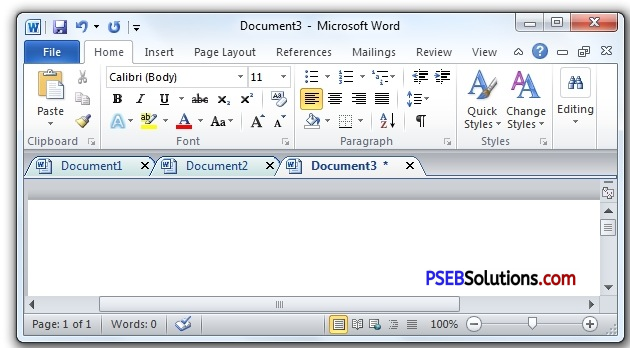
The …………….. group of home tab allows us to change our text font, style, size, color and many other elements.
(a) Font
(b) Paragraph
(c) Styles
(d) Editing.
Answer:
(a) Font

PSEB 7th Class Computer Solutions Chapter 4 Microsoft Word (Part-II)

Question 3.
…………. means draw a horizontal line underneath the letters.
(a) Bold
(6) Italic
(c) Underline
(d) None.
Answer:
(c) Underline

Question 4.
………………. Option means that the text is shown like it was marked with a highlighter pen.
(a) Font Color
(b) Text Color
(c) Text Highlight Color
(d) All of above.
Answer:
(c) Text Highlight Color

Question 5.
After inserting a shape, a new tab will appear which is called ……………….. .
(a) Drawing Tools Format
(b) Shape Tools Format
(c) Drawing Shapes Format
(d) None.
Answer:
(a) Drawing Tools Format

PSEB 7th Class Computer Solutions Chapter 4 Microsoft Word (Part-II)

2. Write the Shortcut keys of the following

1. To cut the selected text
Answer:
Ctrl + X

2. To paste the copied/cut contents
Answer:
Ctrl + V

3. To increase the font size
Answer:
Ctrl + >

4. To Underline the Text
Answer:
Ctrl + U

5. To change the case of the Selected Text
Answer:
Shift + F3

6. For Center Alignment
Answer:
Ctrl+ E

PSEB 7th Class Computer Solutions Chapter 4 Microsoft Word (Part-II)

7. For double line spacing
Answer:
Ctrl + z

8. To Replace the text
Answer:
Ctrl + H

9. To Undo the last operation
Answer:
Ctrl + z

10. To Insert a Page Break.
Answer:
Ctrl + Return.

PSEB 7th Class Computer Solutions Chapter 4 Microsoft Word (Part-II)

3. Short Answer Type Questions

Question 1.
Write about Undo commend.
Answer:
If we have made a mistake while editing the text in the document, we can correct it by clicking on the Undo command from the “Quick access” toolbar and this will undo the last change we made to the document. Or you can press the Ctrl + Z keys from the keyboard.

Question 2.
Which are basic three font styles?
Answer:
Word processor software uses three basic font styles for text, these are as below:
1. Bold:
If you want to thicken the text in your document, then use Bold option, by pressing the “Ctrl + B” shortcut or by clicking “B” button from the font group.

2. Italic:
If you want to italicize the text in your document, then use Italic option by pressing the “Ctrl + I” shortcut or by clicking “I” button from the font group.

3. Underline:
If you want to underline the text in your document, then use underline option by pressing the “Ctrl + U” shortcut or by clicking “U” button from the font group.

PSEB 7th Class Computer Solutions Chapter 4 Microsoft Word (Part-II)

Question 3.
What are Headers and Footers in MS Word?
Answer:
Header and Footer are parts of a document that contain specific information such as page number and total number of pages, title of the document, company logo, any photo, etc. A header appears at the top of each page, and footer appears at the bottom of each page. To insert the header and footer in your document, click the “Header/Footer” option from the Header & Footer group on the insert tab.

Question 4.
How many change cases options are available in MS Word? Write their names.
Answer:
There are five options available to change the case in Microsoft Word, these are:

  • Sentence case: It capitalizes the first letter of each sentence.
  • Lowercase: It changes the text from uppercase to lowercase.
  • Uppercase: It capitalizes all the letters of your text.
  • Capitalize Each Word: It capitalizes the first letter of each word.
  • Toggle case: It allows you to shift between two case views, e.g. to shift between Capitalize Each Word and Captalized each word.

PSEB 7th Class Computer Solutions Chapter 4 Microsoft Word (Part-II)

Question 5.
How many alignments are available in MS Word? Write their names and shortcut keys.
Answer:
There are four types of alignments available in the paragraph group, which are as follows:

  • Align Text Left: Aligns the selected text with the left margin. Shortcut key is (Ctrl + L).
  • Align Text Right: Aligns the selected text with the right margin. Shortcut key is (Ctrl + R).
  • Center: This aligns the selected text to the center within the margin. Shortcut key is (Ctrl + E).
  • Justify: Aligns text to both left and right margins, adding extra space between words as necessary. Shortcut key is (Ctrl + J).

Question 6.
How can we insert page break in MS Word?
Answer:
This option is used to delete a page at the current cursor position and start a new page. In simple words we can say that it divides the page into two parts.
The steps to insert page break are given below:

  • Place the cursor where you want to insert the break.
  • Click the Page Break Option on the Pages Group from the Insert Tab.
  • Your page will break into two parts.
  • Long Answer Type Questions

(ii) Cut Paste Option:
Cut Paste Option means to move the selected text from one place to another. In Microsoft Word, you can cut text from a document and paste that text into another document or anywhere in the same document. After cutting the text, it is stored in the clipboard.

MS Word offers a variety of ways to cut and paste text. Some popular methods are given below :
Method 1.

  • First select the text you want to cut.
  • Click the Home tab and then click the Cut command.
  • Place the cursor where you want to paste the text.
  • Click on the Paste command in the Home tab.

Method 2.

  • First select the text you want to cut.
  • Now click the right button of the mouse on selected text.
  • A menu will appear; select the “Cut” option from this menu.
  • Now, move the cursor to the desired position and right click on the mouse.
  • A menu will appear; select the “Paste” option.

Method 3.

  • First select the text you want to copy.
  • Now press the Ctrl + X button.
  • Now, move the cursor to the desired position and press the Ctrl + V button.

(iii) Format Painter:
With the help of Format Painter we can copy the format already applied to the text in our document very easily and without wasting time. Below are the steps for copying text formatting :

Method 1.

  • First select the text whose formatting you want to copy.
  • Click the Home tab and click the Format Painter command.
  • The pointer changes to a paintbrush icon.
  • Use the brush and drag it over the text where you want to apply the formatting.
  • To cancel formatting, press the Esc key or click on the Format Painter command.

Method 2.

  • First select the text whose formatting you want to copy.
  • Now press the Ctrl + Shift + C button.
  • Click on the text where you want to apply the copied formatting.
  • Now press the Ctrl + Shift + V button.

PSEB 7th Class Computer Solutions Chapter 4 Microsoft Word (Part-II)

Question 2.
Write about the options available in Font group of Home tab in MS Word.
Answer:
The Home tab’s font group gives us many commands for character formatting. These commands are as follows:

  • Font Style: This button is used to change the font type (Font face) for the entire document or for the selected text within the document.
  • Font Size: This button is used to change the font size for the entire document or for the selected text within the document.
  • Font Color: This button is used to change the font color for the entire document or for the text selected within the document.
  • Bold: This button is used to make the selected text or entire document bold.
  • Italic: This button is used to italicize the entire document or the selected text within the document.
  • Underline: This button is used to underline the entire document or the selected text within the document.
  • Changing the Text Case: This button is used to convert the selected text to lower case or to apply other capitalization.
  • Grow Fonts: With the help of grow fonts we can increase the size of the selected text by one size.
  • Shrink Font: With the help of Shrink font we can reduce the size of selected text by one size.
  • Strike Through: This button is used to draw a line in the middle of the selected text in a document.
  • Subscript: This button is used to create lowercase letters below the text baseline, such as X2.
  • Superscript: This button is used to create lowercase letters above the line of text such as X2.
  • Clear Formatting: This option works to remove the formatting applied to the text document.
  • Text Highlight Color: Used to highlight the selected text.

Question 3.
What is Word Art? How will you insert Word Art in a Word document?
Answer:
Word Art is designed to allow you make your text more attractive. You can format your text to make it look like a picture or 3D art and enhance its appearance in different ways. The steps to insert Word Art are given below:

  • Select the text you want to change.
  • Then click on the Insert tab.
  • Click on the Word Art drop-down arrow in the Text group.
  • A drop-down menu of Word Art style will appear. Click the style you want to use.
  • Word will automatically create a text box for the text.
  • Now click Ok button, the text will appear in the selected style.

PSEB 7th Class Computer Solutions Chapter 4 Microsoft Word (Part-II)

PSEB 7th Class Computer Guide Microsoft Word (Part-II) Important Questions and Answers

1. Fill in the Blanks

Question 1.
……………. is used to create documents.
(a) Word processing
(b) DOS
(c) Numbers
(d) Word Art.
Answer:
(a) Word processing

Question 2.
MS Word is an important …………… Processor.
(a) Text
(b) Word
(c) DOS
(d) Number.
Answer:
(b) Word

Question 3.
In Word, there are ………….. types of tool bars.
(a) 2
(6) 3
(c) 4
(d) 5.
Answer:
(a) 2

PSEB 7th Class Computer Solutions Chapter 4 Microsoft Word (Part-II)

Question 4.
………… is a blinking line.
(a) Mouse
(b) Insertion Point
(c) Command
(d) Instructions.
Answer:
(b) Insertion Point

Question 5.
To Select a …………. double click on it.
(a) Word
(b) Text
(c) Sentence
(d) Paragraph.
Answer:
(a) Word

Question 6.
Cut and Copy commands are available in ………….. menu.
(a) File
(b) Edit
(c) Format
(d) Help.
Answer:
(b) Edit

PSEB 7th Class Computer Solutions Chapter 4 Microsoft Word (Part-II)

Question 7.
Backspace key is used to delete the alphabet from the ………….. side of Cursor.
(a) Right
(b) Left
(c) Above
(d) Below.
Answer:
(b) Left

Question 8.
color line appears below the wrong word.
(a) Green
(b) Yellow
(c) Red
(d) Blue.
Answer:
(c) Red

Question 9.
The Page number, Page name, date and time are written in the and, which appears on every page of document.
(a) Upper, Lower
(b) Header, Footer
(c) Margin, Footer
(d) Word, Spreadsheet.
Answer:
(b) Header, Footer

Question 10.
Margins and tabs are available in page setup dialog box.
(a) Orientation
(b) Layout
(c) Page
(d) Columns.
Answer:
(b) Layout

PSEB 7th Class Computer Solutions Chapter 4 Microsoft Word (Part-II)

2. True/False

1. Title bar appears below the Screen of word.
Answer:
False

2. Word Pad is a Word Processing Package.
Answer:
False

3. The small screen that appears on the right side of the window is called task pane.
Answer:
True

4. The text is added to where the insertion point is.
Answer:
True

5. To exit from the word click File Exit.
Answer:
True

PSEB 7th Class Computer Solutions Chapter 4 Microsoft Word (Part-II)

3. Match the Columns
Table 1
Answer:
Table 2

PSEB 7th Class Computer Solutions Chapter 4 Microsoft Word (Part-II)

4. Short Answer Type Questions

Question 1.
Write the steps to select a text with the help of mouse.
Answer:
Place the cursor in front of the text and then left click on the mouse button, hold it and drag it over the text and then release it. The text will be selected.

  • Double click on the word to select the same word.
  • To Select the entire paragraph, click within the paragraph three times.
  • To select the complete document, in the Home tab from the editing group, click Select command and then click the Select All button.

Question 2.
Write steps to select the text with the help of keyboard.
Answer:
Press Shift + Arrow keys from the keyboard; Hold down the Shift key and press the arrow button, Word will select the text in the direction of the arrow button. There are three arrow keys in numeric keypad, so you can select text in three different directions.

Question 3.
What do you mean by font?
Answer:
A Font is a graphical representation of the text that may include type, size, design, color, weight of the text.

PSEB 7th Class Computer Solutions Chapter 4 Microsoft Word (Part-II)

Question 4.
Write steps to change case of the text.
Answer:

  • Sentence case: It capitalizes the first letter of each sentence.
  • Lowercase: It changes the text from uppercase to lowercase.
  • Uppercase: It capitalizes all the all letters of your text.
  • Capitalize Each Word: It capitalizes the first letter of each word.
  • Toggle Case: It allows you to Shift between two case views, e.g. to Shift between Capitalize Each Word and CAPITALIZE EACH WORD.

Question 5.
What do you mean by alignment?
Answer:
You can change the text alignment in your document to make it more presentable and readable.
There are four types of alignments available in the paragraph group which is as follows :

  • Align Text Left (Ctrl + L): Aligns the selected text with the left margin.
  • Align Text Right (Ctrl + R): Aligns the selected text with the right margin.
  • Center (Ctrl + E): This aligns the selected text to the center within the margin.
  • Justify (Ctrl + J): Aligns text to both left and right margins, adding extra space between words as necessary.

PSEB 7th Class Computer Solutions Chapter 4 Microsoft Word (Part-II)

Question 6.
Write down the ways to delete page number.
Answer:
If you want to delete the previously, entered page number, click on the Page Number option from the Header & Footer group of the Insert tab and click on the Remove Page Number option from the drop-down list.

Question 7.
How can you format the shapes?
Answer:
Shapes: This button is used to insert the shapes such as circles, squares, arrows and triangles into a document, When the button is clicked. Here are the steps to insert the shape:

  • In the Insert tab, click on the Shapes option from the Illustrations tab.
  • A gallery of different shapes will appear.
  • Click the desired shape and then drag the shape into the document.

If you want to write something in the drawn shape, here are the steps :

  • Right click on the drawn shape.
  • Click Add Text from the pop-up menu.

PSEB 7th Class Computer Solutions Chapter 4 Microsoft Word (Part-II)

5. Long Answer Type Questions

Question 1.
What do you mean by Format Painter? How can we use it?
Answer:
Format Painter:
With the help of Format Painter we can copy the format already applied to the text in our document very easily and without wasting time. Below are the steps for copying text formatting :
Method 1.

  • First select the text whose formatting you want to copy.
  • Click the Home tab and click the Format Painter command.
  • The pointer changes to a paintbrush icon.
  • Use the brush and drag it over the text where you want to apply the formatting.
  • To cancel formatting, press the Esc key or click on the Format Painter command.

Method 2.

  • First select the text whose formatting you want to copy.
  • Now press the Ctrl + Shift + C button.
  • Click on the text where you want to apply the copied formatting.
  • Now press the Ctrl + Shift + V button.

PSEB 7th Class Computer Solutions Chapter 4 Microsoft Word (Part-II)

Question 2.
What is Font Color? How can we change it?
Answer:
Font Color:
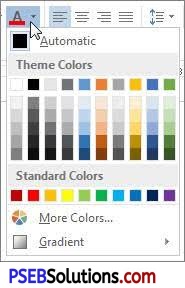
If you want to change the color of a word or paragraph in your document, you must select a font color for this purpose. Here are the steps to change the color of the text.
1. Select the text you want to change color.
2. Select the appropriate color from the Font dialog box as shown in the picture above.
Or
1. Select the text you want to change the color.
2. Click on the Font Color option from the Font group as shown in thepicture below. Now a pull down menu will open.
PSEB 7th Class Computer Solutions Chapter 4 Microsoft Word (Part-II) 1
3. Choose your favorite color from this menu. Now your text will change to that color.

Question 3.
What is text highlight color? Write steps to use it.
Answer:
Text Highlight Color:
Just as we can highlight a word or a sentence in our written document with the help of a pen, we can highlight our text with any color in MS Word.

  • Select the text you want to highlight.
  • Click on the Text Highlight option from the Fonts group. Now a pull down menu will open.
  • Now choose your favorite color from this menu. Your text will be highlighted in that color.

PSEB 7th Class Computer Solutions Chapter 4 Microsoft Word (Part-II)

Question 4.
What do you mean by Word Art? How can we add it?
Answer:
Word Art:
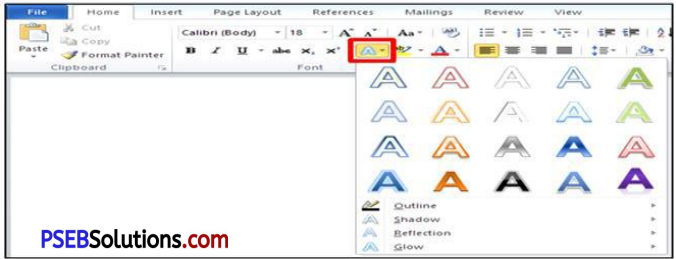
Word Art is designed to allow you make your text more attractive; you can format your text to make it look like a picture or 3D art and enhance its appearance in different ways. The steps to insert Word Art are given below :

  • Select the text you want to change.
  • Then click on the Insert tab.
  • Click on the Word Art drop-down arrow in the Text group.

    PSEB 7th Class Computer Solutions Chapter 4 Microsoft Word (Part-II) 2
  • A drop-down menu of Word Art style will appear. Click the style you want to use.
  • Word will automatically create a text box for the text.
  • Now click Ok button, the text will appear in the selected style.

Question 5.
Write steps to change the alignment of the text.
Answer:
You can change the text alignment in your document to make it more presentable and readable.
There are four types of alignments available in the paragraph group which is as follows:

  • Align Text Left (Ctrl + L): Aligns the selected text with the left margin.
  • Align Text Right (Ctrl + R): Aligns the selected text with the right margin.
  • Center (Ctrl + E): This aligns the selected text to the center within the margin
  • Justify (Ctrl + J): Aligns text : to both left and right margins, adding extra space between words as necessary.
    PSEB 7th Class Computer Solutions Chapter 4 Microsoft Word (Part-II) 3

Here are the steps to change the alignment:

  • Select the text.
  • Click the appropriate alignment button from the Paragraph group of the Home tab.
PSEB 7th Class Computer Solutions Chapter 3 Microsoft Word (Part-I)

Punjab State Board PSEB 7th Class Computer Science Book Solutions Chapter 3 Microsoft Word (Part-I) Textbook Exercise Questions and Answers.

PSEB Solutions for Class 7 Computer Science Chapter 3 Microsoft Word (Part-I)

Computer Guide for Class 7 PSEB Microsoft Word (Part-I) Textbook Questions and Answers

1. Fill in the Blanks

Question 1.
Ctrl + S used to …………………
(a) Save
(b) Open
(c) New
(d) Close.
Answer:
(a) Save

Question 2.
Below the ruler, the large area is called the ………………..
(a) Text Area
(b) Open Area
(c) Close Area
(d) All of these.
Answer:
(a) Text Area

PSEB 7th Class Computer Solutions Chapter 3 Microsoft Word (Part-I)

Question 3.
There are two scroll bars in a word document ……………. and …………… .
(a) Horizontal, vertical
(b) Left, Right
(c) Upper Bar, Lower Bar
(d) None of these.
Answer:
(a) Horizontal, vertical

Question 4.
To Open a new document, ……………. Press keys from the keyboard.
(a) Ctrl + O
(b) Ctrl + N
(c) Ctrl + S
(d) Ctrl + 5.
Answer:
(b) Ctrl + N

Question 5.
The view shows the document as it will look when it is printed.
(a) Print Layout
(b) Draft
(c) Outline
(d) Full size.
Answer:
(a) Print Layout

PSEB 7th Class Computer Solutions Chapter 3 Microsoft Word (Part-I)

2. Very Short Answer Type Questions

Question 1.
Write the name of option that is present at the bottom-right corner of every group.
Answer:
Dialog Box Launcher.

Question 2.
Write the name of the top most bar of the Word window.
Answer:
The top bar of the Word window is the title bar.

Question 3.
Which View of MS Word displays the document in the same way as we get it after printing?
Answer:
Print layout View

Question 4.
Write the shortcut to create a New document.
Answer:
The Ctrl + 0 shortcut key is used to open a new document.

Question 5.
Which layout view shows the outline of a document?
Answer:
Outline view represents the outline of the document.

PSEB 7th Class Computer Solutions Chapter 3 Microsoft Word (Part-I)

3. Short Answer Type Questions

Question 1.
What is a Word Processor?
Answer:
Word processing is a process by which we can create, save, and print any type of document in a computer and it can be used anytime in the future and can be edited if required. The software that is used for word processing process called word processor. For example: MS Word, Note Pad, Word Pad and word perfect all are word processors.

Question 2.
Write the name of some Word Processing Software.
Answer:
The software that is used for word processing process called word processor. For example: MS Word, Note Pad, Word Pad and word perfect all are word processors.

Question 3.
How to start the MS Word?
Answer:
The steps to start MS Word are as follows:
2. Now click on All Program from the popup menu as shown in the picture below.
3. Now click MS Office→MS Word.
Or
Type ‘Word” in the search bar as shown in the picture below and press Enter key from the keyboard

PSEB 7th Class Computer Solutions Chapter 3 Microsoft Word (Part-I)

Question 4.
Write the name of different parts of MS word window.
Answer:
Components of MS word window are as follow:

  • File menu/Office button:
    • Home
    • Insert
    • Page layout
    • References
    • Review
    • view
  • Quick access toolbar
  • Title bar
  • Ribbon
    • Tabs
    • Group
    • Commands
  • Ruler
  • Help
  • Document area
  • Status bar
  • Dialog box launcher 10, view Buttons
    • Print layout view
    • Full Screen view
    • Web Layout view
    • Draft view
    • Outline view

Question 5.
Define the Text Area.
Answer:
Right below the ruler, there is a large space called the text area. This is the area where we type our document; the blinking line in this area is called the insertion point which indicates that your typing will start from this place.

PSEB 7th Class Computer Solutions Chapter 3 Microsoft Word (Part-I)

4. Long Answer Type Questions

Question 1.
Explain the special features of MS Word.
Answer:
Some of the special features of Microsoft word are as follows:

  • MS Word allows us to include text anywhere in the document.
  • We can delete any word, line or page from the document as easily as we erase the words written on paper.
  • We can cut and copy the text and paste it anywhere in the same document or any other document.
  • MS Word allows us to set the page margin and page size according to our needs.
  • We can add Bold, Italic and Underline effects to the text.
  • We can change the size, style, color of the text.
  • We can add header on the top of pages and footer on the bottom of the page.
  • We can add pictures, chart, graphs and smart art.
  • We can convert the text into tables.
  • You can also set different margins in a document and also determine the different locations to start a paragraph.
  • It also provides us with the facility of macro. This is a list of many commands with which our time is saved.
  • MS Word also provides us the facility of spelling checks. It shows a red line below the words that are incorrect.
  • MS Word also provides us the facility of grammar checks.
  • It also provides Find and Replace option.
  • It also provides the facility of dictionary with which we can find many words with the same meaning and use them in our document.

Question 2.
Explain Document views in MS Word.
Answer:
At the bottom right of the window screen is a set of 5 buttons that allow us to view the document in a different view.
1. Print Layout:
This is the default document view in Word. The Print Layout view shows the document as it would appear after printing. Full Screen Layout view: This view opens the document to a full screen. This layout helps us to make our document easily readable above the screen.

2. Web Layout:
This view displays a document on the screen the way it will look when viewed in a Web browser if you saved it as a web page. Out Line view: The outline view shows the document as an outline form.

3. Draft view: This is the most commonly used view, in this view we can edit our document very quickly and easily.

PSEB 7th Class Computer Solutions Chapter 3 Microsoft Word (Part-I)

Question 3.
How to Create and Save a New Document in MS Word?
Answer:
Follow these steps to create a new document:
2. Now click on New option from the drop down menu.
3. A New Document dialog box will appears on the screen.
4. Click Blank Document option from this dialog box and then Click Create Option.
5. Now a blank document will appear on the screen.
Or
You can create a new document by pressing the Ctrl + N keys from the keyboard.
Saving A File:
To save a newly created document follows these steps:
1. Click the File tab or Office Button.
2. Click Save option. The Save dialog box appears.
3. Now type the name of your document in File name box and then click Save button.
Or
You can also save your document by pressing the Ctrl + S keys from Keyboard.
Now your document is safe for future use.

PSEB 7th Class Computer Solutions Chapter 3 Microsoft Word (Part-I)

PSEB 7th Class Computer Guide Microsoft Word (Part-I) Important Questions and Answers

1. Fill in the Blanks

Question 1.
……………… is used to open other options in any group.
(a) Open button
(b) New button
(c) Dialog Box Launcher
(d) All these.
Answer:
(c) Dialog Box Launcher

Question 2.
The …………….. tab is used to prepare the thesis or books.
(a) Insert
(b) design
(c) Review
(d) Reference.
Answer:
(d) Reference.

Question 3.
Orientation option is available in …………..tab.
(a) Design
(b) insert
(c) Page Layout
(d) home.
Answer:
(c) Page Layout

PSEB 7th Class Computer Solutions Chapter 3 Microsoft Word (Part-I)

Question 4.
Which keys are used to secure the work done.
(a) Ctrl + N
(b) Ctrl + S
(c) Ctrl + 0
(d) Ctrl + P.
Answer:
(b) Ctrl + S

Question 5.
The total number of pages and words appears on the …………… bar.
(a) Title
(b) Status
(c) Horizontal
(d) None.
Answer:
(b) Status

Question 6.
Document can be typed in ………………. area in Word window.
(a) Text
(b) font
(c) Format
(d) View.
Answer:
(a) Text

Question 7.
The table option is available in the ……………. menu.
(a) File
(b) home
(c) Insert
(d) design.
Answer:
(c) Insert

PSEB 7th Class Computer Solutions Chapter 3 Microsoft Word (Part-I)

Question 8.
Prepared documents are called …………………… .
(a) Template
(b) Blank document
(c) Table
(d) Margin.
Answer:
(a) Template

2. True/False

Question 1.
MS-Word is not a word Processing Software.
Answer:
False

Question 2.
We cannot find and replace a word in MS-Word.
Answer:
False

Question 3.
Tabs appear on the top of ribbon.
Answer:
True

Question 4.
Ctrl+C keys are used to create a document.
Answer:
False

Question 5.
In MS-Word there are three types of ruler.
Answer:
False

PSEB 7th Class Computer Solutions Chapter 3 Microsoft Word (Part-I)

3. Short Answer Type Questions

Question 1.
What is Microsoft Word?
Answer:
MS Word is word processor software published by Microsoft Company that works on formatting text and graphics and creating a variety of documents.

Question 2.
Write the names of all the groups available in the Home tab.
Answer:
It consists of clipboard, font, paragraph, styles and editing groups.

Question 3.
Which option is used to check grammatical errors in a document?
Answer:
The grammar check option is used to check the grammatical errors.

Question 4.
Which option is used to check the spellings of words in the document?
Answer:
The Spell check option is used to check the spellings of words.

PSEB 7th Class Computer Solutions Chapter 3 Microsoft Word (Part-I)

Question 5.
What are tabs?
Answer:
Tabs are groups of related commands that appear at the top of the ribbon.

Question 6.
Which view can you use to view the document as an outline form?
Answer:
Outline view is use to view the document as an outline form.

Question 7.
Which option is used for MS-Word related help?
Answer:
Help icon is used for MS-Word related support.

Question 8.
Which option is used to add one document to another document?
Answer:
Mail-Merge option is used to add one document to another document.

PSEB 7th Class Computer Solutions Chapter 3 Microsoft Word (Part-I)

4. Long Answer Type Questions

Question 1.
What is word processing? Write down its features also.
Answer:
Wort Processing:
We make a lot of mistakes when typing a document with the help of typewriter, which we can’t correct again, we have to type the document again to make it better, but word processing gives us a facility through which we can easily correct our mistakes in typed documents without having to retype them.

Word processing is a process by which we can create, save and print any type of document in a computer and it can be used anytime in the future and can be edited if required. The software that is used for word processing process called word processor. For example: MS Word, Note Pad, Word Pad and word perfect all are word processors.

Features of Word Processing:
Following are the features of word processor :

  • A word processor provides an easier and faster method to type the text.
  • It offers so many styles, size, color, effects for text.
  • Using a word processor, you can apply editing operations to the text.
  • It stores all your documents for. future use.
  • It allows you to insert photos, music, background etc. into the document.
  • It can move any document from one place to another with the help of cut, copy, and paste option.
  • You can delete, edit, update the data in the pre-created document at any time.
  • It helps us to find and correct mistakes in the typed text.
  • It also provide the facility to check the grammar mistakes in the typed text.

PSEB 7th Class Computer Solutions Chapter 3 Microsoft Word (Part-I)

Question 2.
How we can open a document in MS Word?
Answer:
Open an Existing Document:
Follow these steps to open an existing document:

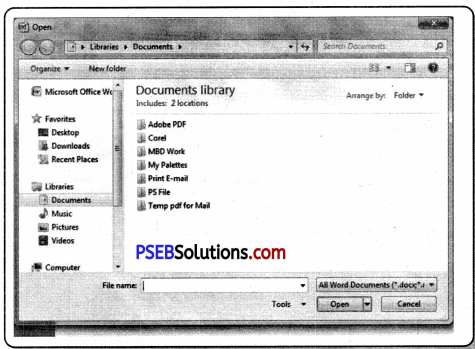
  • Click the File tab or Office Button.
  • Click Open option. The Open dialog box appears.
  • As shown in picture below select a document which you want to open and then Click Open button.
  • Now your document will open on the screen.
    Or
    You can open an existing document by pressing the Ctrl + O keys from the keyboard.
    PSEB 7th Class Computer Solutions Chapter 3 Microsoft Word (Part-I) 1

PSEB 7th Class Computer Solutions Chapter 3 Microsoft Word (Part-I)

Question 3.
Write down all the commands of File Menu.
Answer:
1. File Menu:
This option is available in the upper left corner of the window, it contains many of the following commands:

(a) Home:
It has options like font color, font size, font style, alignment, bullets, line spacing, etc. All the basic elements that someone might need to edit their document are available in the Home option.

(b) Insert:
Tables, sizes, images, charts, graphs, headers, footers, page numbers, etc. are available in insert options.

(c) Design:
The template (pre-created document design) or the design in which you want your document to be created can be selected under the Design tab.
(d) Page layout:
Under the Page Layout tab we can find the options such as Margins, Orientation, Columns, Lines, Indentations, Spacing, etc.

(e) Reference:
This tab is most useful for those who are preparing thesis or writing books or working on a long document. Footnote, table of content, bibliography, captions etc. options can be found under this tab.

(f) Review:
Spell check, grammar, thesaurus, word count, language, translation, comments, etc. can all be tracked under the Review tab.

PSEB 6th Class Science Solutions Chapter 11 Light Shadows and Reflections

Punjab State Board PSEB 6th Class Science Book Solutions Chapter 11 Light Shadows and Reflections Textbook Exercise Questions and Answers.

PSEB Solutions for Class 6 Science Chapter 11 Light Shadows and Reflections

Science Guide for Class 6 PSEB Light Shadows and Reflections Intext Questions and Answers

Think and Answer (Textbook Page No. 109)

Question 1.
Classify different objects depending on whether an object allows light to pass through it completely, partially or not at all.
Answer:
Depending upon the amount of light passing through the object we can classify objects into the following three types.

  1. Transparent objects. Those objects which allow light to pass through them completely.
  2. Translucent objects. Those objects which allow only partial amount of light to pass through them.
  3. Opaque objects. Those objects which do not allow light to pass through them at all.

Question 2.
Classify the objects given in following table as transparent, opaque or translucent.

Object/material Transparent/opaque/translucent
Water
Tissue paper
Stone
Air
Book
Mirror
Thin cloth

Answer:

Object/material Transparent/opaque/translucent
Water Transparent
Tissue paper Translucent
Stone Opaque
Air Transparent
Book Opaque
Mirror Transparent
Thin cloth Translucent

PSEB 6th Class Science Solutions Chapter 11 Light Shadows and Reflections

Think and Answer (Textbook Page No. 109)

Question 1.
Light travels in ……………. line path.
Answer:
Light travels in straight line path.

Question 2.
Light cannot pass through …………….. material.
Answer:
Light cannot pass through opaque material.

Think and Answer (Textbook Page No. 111)

Question 1.
For shadow formation, how many things are required ?
Answer:
For shadow formation, the following three things are required :

  1. Source of light.
  2. An opaque object and
  3. For getting shadow a surface or screen (which may be a wall or it can be earth surface)

Question 2.
A shadow is observed, on a screen, when an …………….. object comes in between
screen and a source of light.
Answer:
A shadow is observed on a screen, whenever an opaque object comes in between screen and a source of light.

Think and Answer (Textbook Page No.112)

Question 1.
The size of shadow of a given opaque object depends on relative ………….. of source of light and the opaque object.
Answer:
The size of shadow of a given opaque object depends on relative position of source of light and the opaque object.

Question 2.
What may be the colour of opaque object, shadow will always be …………….. (black/white)
Answer:
What may be the colour of opaque object, shadow will always be black.

Think and Answer (Textbook Page No. 115)

Question 1.
Pin-hole camera is based on the fact that in ordinary conditions light travel in ………………… path.
Answer:
Pin-hole camera is based on the fact that in ordinary conditions light travel in straight line path.

Question 2.
The images formed by pin-hole camera is …………….. and ………………..
Answer:
The images formed by pin-hole camera is inverted and small.

PSEB 6th Class Science Solutions Chapter 11 Light Shadows and Reflections

Think and Answer (Textbook Page No. 116)

Question 1.
A mirror does not change the direction of light that falls on it. (True/False)
Answer:
False.

Question 2.
A polished or shining surface like plane miror produces reflection.
Answer:
A polished or shining surface like plane mirror produces regular reflection.

PSEB 6th Class Science Guide Light Shadows and Reflections Textbook Questions and Answers

Exercise – 1

1. Fill in the Blanks:

(a) An object that allow light to pass through them partially are known as …………….. object.
Answer:
Translucent

(b) Light source like the sun that emit light of their own are called …………… objects.
Answer:
Luminous

(c) Never ever look directly at the Sun because it could be extremely …………… for the eyes.
Answer:
harmful

(d) The change in direction of propagation of light when light allowed to fall on polished
surface is called ……………….. of light.
Answer:
Reflection

(e) Due to ……………… phenomenon rooms are lighted up in day time though no direct
sunlight enters the room.
Answer:
irregular reflection

PSEB 6th Class Science Solutions Chapter 11 Light Shadows and Reflections

2. Write True or False:

(a) Moon is a luminous object.
Answer:
False

(b) We can clearly see through transparent material.
Answer:
True

(c) Shadow of opaque object is always black.
Answer:
True

(d) Light doesn’t travel in straight line path.
Answer:
False

(e) Due to reflection of light, rooms are lighted up during day time though no direct sunlight enters the room.
Answer:
True

3. Match the Column A with Column B:

Column A Column B
1. Natural sources of light (a) Light moves along a straight path
2. CFL, LED and tube light (b) Opaque object
3. Rectilinear propagation of light (c) Shadow cast by a heavenly body
4. Eclipse (d) Man-made sources of light
5. Cardboard, wood and metal (e) Sun, stars and firefly.

Answer:

Column A Column B
1. Natural sources of light (e) Sun, stars and firefly
2. CFL, LED and tube light (d) Man-made sources of light
3. Rectilinear propagation of light (a) Light moves along a straight path
4. Eclipse (c) Shadow cast by a heavenly body
5. Cardboard, wood and metal (b) Opaque object.

4. Choose the Correct Answer:

Question (i)
Objects, like moon, which do not emit light of their own, are called:
(a) Luminous objects
(b) Absorbers of light
(c) Non-luminous objects
(d) Reflectors of light.
Answer:
(c) Non-luminous object

PSEB 6th Class Science Solutions Chapter 11 Light Shadows and Reflections

Question (ii)
An object, through which we can see partially, but not very clearly, is:
(a) A rubber ball
(b) A sheet of plane glass
(c) A sheet of tracing paper
(d) A compact disk.
Answer:
(c) A sheet of tracing paper

Question (iii)
When sun (during evening) is behind an object, the size of its shadow in comparison to that of the object M ould be:
(a) Smaller
(b) Almost zero
(c) Larger
(d) Equal.
Answer:
(C) Larger

Question (iv)
The image, formed by a pinhole camera, is:
(a) Inverted and diminished
(b) Inverted and enlarged
(c) Erect and enlarged
(d) Erect and diminished.
Answer:
(a) Inverted and diminished

Question (v)
For shadow formation, we require :
(a) An opaque object
(b) A source of light
(c) The screen to obtain the shadow
(d) All of the above.
Answer:
All of the above

5. Very Short Answer Type Questions:

Question (i)
State the type of path that light ordinarily follows while going from one point to another.
Answer:
Light follows straight line path.

Question (ii)
Fishes do not cast shadow in water. Why ?
Answer:
Fishes do not cast their shadows when the bed river or swimming pool which acts as a screen is far away from the fishes.

Question (iii)
State the relative position of sun, earth and the moon during solar eclipse.
Answer:
During solar eclipse, the position sun will be between earth and the moon and the
three are in a straight line.

PSEB 6th Class Science Solutions Chapter 11 Light Shadows and Reflections

Question (iv)
In a completely dark room, if you hold a mirror in front of you, will you see a reflection of yourself in the mirror ?
Answer:
If you hold a mirror in front of you in a completely dark room you cannot see your image because light is required for formation of image.

Question (v)
Two identical bed sheets, of pink and grey colour are hanging on a rope under the sun. What would be the colour of shadow of these two bed sheets ?
Answer:
We know that the shadow of an opaque object is always black. The colour of shadow does not depend on the colour of an object. So the colour of shadows of these two bed sheets would be black.

6. Short Answer Type Questions:

Question (i)
What is regular reflection ?
Answer:
Regular reflection. When light falls on a plane mirror or smooth and polished surface of some metal then it is reflected in a regular manner. This type of reflection is known as regular reflection.

Question (ii)
Why shadow in afternoon is smaller than shadow formed in the morning ?
Answer:
During noon the sun is vertically above our head and the sun rays directly fall on the
objects so that a small image is formed whereas in the morning the sun rays fall obliquely resulting in a large shadow. The size of the shadow depends upon the position of the source of light relative to the object.

7. Long Answer Type Questions:

Question (i)
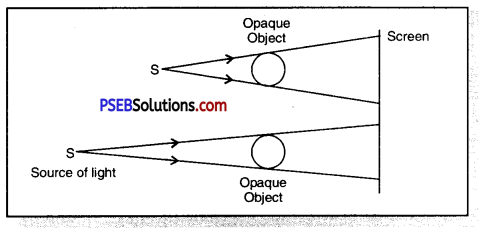
Using suitable diagrams show that size of shadow formed, depends on relative position of the source of light and the opaque object.
Answer:
It is clear from the figure that by increasing the distance between the source of light and the opaque body the size of the shadow decreases. And if the distance between the source of light and the opaque object decreases the size of the shadow becomes light. Thus we can say that the size of shadow formed depends on the relative position of source of light and the opaque object.
PSEB 6th Class Science Solutions Chapter 11 Light Shadows and Reflections 1

Question (ii)
Using diagram, show the formation of image by pinhole camera.
Answer:
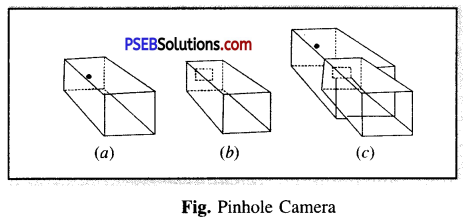
Pinhole camera. It is a simple camera which can be made from wood or cardboard box. Take two boxes such that one can slide into the other tube easily.

Cut the small flaps of one side of each box. Make a hole in the centre of other side of big box. Similarly cut a rectangular flap in the centre of other side of small box. Put a piece of tracing paper on this cut. Slide the smaller box inside the bigger box. A pinhole camera is ready.

Working. Try to view from the open side of small box. Cover your head and box with a black cloth. View some trees or far off objects. Fix camera on object which is completely under sunlight. Slide small box inside bigger box so that a picture can be obtained on butter paper.
PSEB 6th Class Science Solutions Chapter 11 Light Shadows and Reflections 2

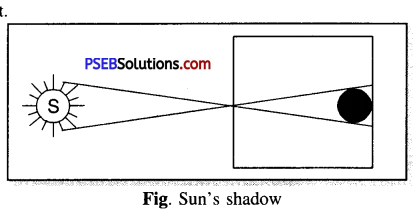
Formation of sun’s shadow with pinhole camera.
To make shadow of sun, we need a big cardboard sheet with a pinhole in centre. Hold this sheet in front of sun to get a clear shadow. We will see round image of sun in the centre of the cardboard sheet.
PSEB 6th Class Science Solutions Chapter 11 Light Shadows and Reflections 3

PSEB 6th Class Science Solutions Chapter 11 Light Shadows and Reflections

PSEB Solutions for Class 6 Science Light Shadows and Reflections Important Questions and Answers

Multiple Choice Questions:

Question 1.
The substance through which light can pass is called:
(a) Translucent
(b) Opaque
(c) Transparent
(d) None of these.
Answer:
(c) Transparent

Question 2.
For formation of shadow, the object in the path of light should be:
(a) Transparent
(b) Opaque
(c) Traslucent
(d) None of these.
Answer:
(b) Opaque

Question 3.
Seeing across Translucent objects is possible:
(a) Completely
(b) Partially
(c) Not at all
(d) None of these.
Answer:
(b) Partially

Question 4.
Luminous bodies:
(a) Emit light
(b) Do not emit light
(c) Take light from other body and then emit light
(d) None of these.
Answer:
(a) Emit light

Question 5.
Moon is a body:
(a) Luminous
(b) Non-luminous
(c) Both luminous and non-luminous
(d) None of these.
Answer:
(b) Non-luminous

Question 6.
During reflection, light after striking polished surface is:
(a) Sent back into the same medium
(b) Is passed on to the other medium
(c) Some part of light returns to the same medium
(d) None of these.
Answer:
(a) Sent back into the same medium

Question 7.
Reflection of light occurs at :
(a) Regular surface
(b) Irregular surface
(v) Some part of the surface is regular and some part is irregular.
Answer:
(a) Regular surface

PSEB 6th Class Science Solutions Chapter 11 Light Shadows and Reflections

Question 8.
When an opaque object is brought near a source of light, then :
(a) The size should become equal to that of the object
(b) The size of the shadow becomes smaller
(c) The size of the shadow increases
(d) None of these.
Answer:
(d) None of these.

Question 9.
The image formed in a pinhole camera is of :
(a) Object situated near
(b) Distant object
(c) Distant object at rest
(d) None of these.
Answer:
(b) Distant object

Question 10.
The shadow of a transparent object is :
(a) Dark black
(b) Circular
(c) Large sized
(d) None of these.
Answer:
(d) None of these.

Fill in the Blanks:

(a) Those objects through which light can not pass completely are called ……………….. objects.
Answer:
Translucent

(b) An opaque object placed in the path of light rays coming from source of light forms a black region behind the object which is called ………………
Answer:
Shadows

(c) Reflection of light occurs from surface of a ……………..
Answer:
mirror

(d) Irregular reflection of light takes place from a …………….. surface.
Answer:
rough

PSEB 6th Class Science Solutions Chapter 11 Light Shadows and Reflections

(e) Images of sun and other luminous objects are formed by ………………….
Answer:
Pinhole camera

Write (T) against true and (F) against false statements:

(a) The size of the shadow of an object does not depend on the position of source of light.
Answer:
False

(b) During lunar eclipse the moon is in between sun and earth and three are in a straight line.
Answer:
False

(c) Light travels in a straight line and does not bend around large objects.
Answer:
True

(d) Moon is a non-luminous body.
Answer:
True

(e) Taking source of light away from an opaque object forms large shadow of the object.
Answer:
False

Match the following :

Match statement of column A with that of Column B.

Column A Column B
1. Light travels in straight line Earth lies in between moon and sun.
2. Lunar eclipse Formation of shadow
3. Solar eclipse Pinhole camera.
4. Inverted and small image Opaque objects, source of light and screen
5. Shadows Moon is between Earth and Sun.

Answer:
(1) Light travels in straight line – Formation of shadow.
(2) Lunar eclipse – Earth lies in between moon and sun.
(3) Solar eclipse – Moon is between Earth and Sun.
(4) Inverted and small image – Pinhole camera.
(5) Shadows – Opaque objects, source of light and screen.

PSEB 6th Class Science Solutions Chapter 11 Light Shadows and Reflections

Very Short Answer Type Questions

Question 1.
What is luminous body ?
Answer:
Luminous body. An object which gives out light of its own is called luminous body.

Question 2.
Name some luminous bodies.
Answer:
The sun, electric bulb, lighted candle, stars etc.

Question 3.
What are non-luminous bodies ?
Answer:
Non-luminous bodies. The bodies which donot give out light are called non-luminous bodies.

Question 4.
Name four non-luminous bodies.
Answer:
Card board, Table, Chair, Stone.

Question 5.
What is a transparent material ?
Answer:
Transparent. The matrial which comdpletely transmits light rays through it, is called transparent.

Question 6.
Name four transparent materials.
Answer:
Air, glass, water, alcohol.

Question 7.
What is an opaque material ?
Answer:
Opaque. The materials which do not allow the light to pass through them, are called opaque.

PSEB 6th Class Science Solutions Chapter 11 Light Shadows and Reflections

Question 8.
Name four opaque materials.
Answer:
Card board, Stone, wood piece and brick wall.

Question 9.
What is traslucent material ?
Answer:
Translucent. The material which transmits only part of light through it, is called translucent.

Question 10.
Name four translucent materials.
Answer:
Smoke, Fog, Butter paper, Rubber glass.

Question 11.
What is to be done to see shadow ?
Answer:
To see a shadow, place an opaque object in the path of source of light.

Question 12.
What are shadows ?
Answer:
Shadows. It is the dark space formed on the other side of the opaque object, when it is placed in the path of light.

Question 13.
Why should not we see directly towards the Sun ?
Answer:
It can affect our eyes.

Question 14.
How is image in a pinhole camera, possible ?
Answer:
When light travels in a straight line, then an inverted image is formed in a pinhole camera.

Question 15.
What is reflection of light ?
Answer:
Reflection of light. When a ray of light falls on a mirror/polished surface, it is sent back in to the same medium. This change of path of light is known as reflection of light.

PSEB 6th Class Science Solutions Chapter 11 Light Shadows and Reflections

Short Answer Type Questions

Question 1.
Is moon a Luminous or non-luminous body ?
Answer:
Moon is a non-luminous body as it does not give out light but reflects the sun light falling on its surface.

Question 2.
What are the conditions necessary for seeing objects ?
Answer:
Conditions necessary for seeing objects :

  1. The object to be seen
  2. Eye
  3. Presence of light

We cannot see objects in the dark. It is the light that helps us to see objects.

Question 3.
Differentiate between luminous and non-luminous bodies.
Answer:
Luminous bodies. Those bodies which give out light of their own are called Luminous bodies. For example, the Sun, the stars, jugnu, candle, an oil lamp etc.

Non-Luminous bodies. Some objects around us do not give out light themselves, but become visible only when light from a luminous body falls on them and some part of the reflected light enters our eyes.
Examples. Wood, Iron, cardboard and brick etc.

Question 4.
Why does an opaque body form shadow when light falls on it ?
Answer:
When light falls on an opaque body, it does not allow light to pass through it, so it forms its shadow.

Question 5.
What is a shadow ? What happens when an object is moved towards source of light ?
Answer:
Shadow. It is a dark space formed on the other side of the opaque object, when it is placed in the path of light. The opaque object does not allow the light to pass through it and light travels in a straight line only.

Question 6.
When we see some opaque object at height in the sun, black spots are seen on the earth. Why ?
Answer:
When we see some opaque objects at a height in the sun we notice some black spots on the earth which are shadows of the objects formed on the earth. Here earth acts as a screen.

Question 7.
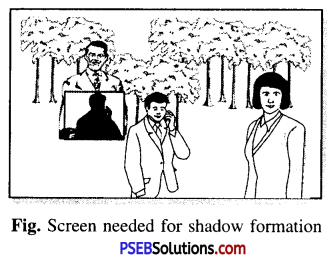
Is a screen needed for shadow formation ? Which type of material, act as screen for shadows in daily life ?
Answer:
PSEB 6th Class Science Solutions Chapter 11 Light Shadows and Reflections 4
Yes, screen is needed for shadow formation as shadows can be seen on screens only.
Walls of a room, building and such surface etc. act as screen for shadows in daily life.

PSEB 6th Class Science Solutions Chapter 11 Light Shadows and Reflections

Question 8.
Show with an experiment that light travels in a straight line.
Answer:
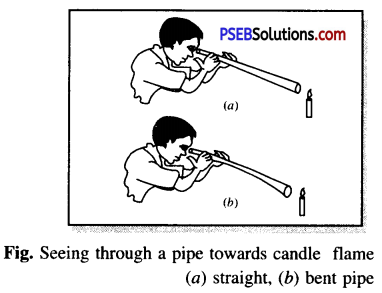
PSEB 6th Class Science Solutions Chapter 11 Light Shadows and Reflections 5
Take a small piece of long rubber pipe and place a candle on a table. Light the candle. Stand a little far away from the table and see the candle flame through the pipe. It is visible. Now bend the pipe or move it to the right or left and again look for the candle flame. The candle flame will disappear. This shows that light travels in a straight line.

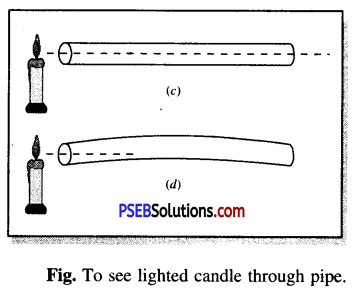
PSEB 6th Class Science Solutions Chapter 11 Light Shadows and Reflections 6
The reason is that light rays coming towards our eye through pipe is stopped due to bend. Since pipe is made up of opaque material, so light cannot pass through it. Hence light cannot reach our eye, due to which candle is not visible to us. This shows that light travels along a straight line.

Question 9.
What is reflection of light ? Which objects can cause reflection ?
Answer:
Reflection of light. The phenomenon of coming back of light into the same medium in a particular direction after falling on any surface, is called reflection of light. Ordinarily reflection takes place from polished surfaces but sometimes we see reflection of trees and buildings from water of tank or lake.

Question 10.
Classify the objects or materials given below as opaque, transparent or translucent luminous and non-luminous.

Air, water, a piece of rock, a sheet of aluminium, a miror, a wooden board, a sheet of polythene, a CD, smoke, a sheet of plane glass, fog, a piece of red hot iron, an umbrella, a lighted fluorescent tube, a wall, a sheet of carbon paper, the flame of a gas burner, a sheet of cardboard, a lighted torch, a sheet of cellophane, a wire mesh, kerosene stove, sun, firefly, moon.
Answer:
Opaque. A piece of rock, a sheet of aluminium, a wooden board, a CD, a sheet of carbon paper, a wall, a sheet of cardboard.
Transparent. Air, water, a sheet of plane glass.
Translucent. A sheet of cellophane, a sheet of polythene, smoke, fog, an umbrella, a wiremesh.
Luminous. A mirror, a lighted fluorescent tube, lighted torch, a flame of a gas burner, a piece of red hot iron, kerosene stove, sun, firefly.
Non-Luminous. A piece of rock, aluminium sheet, a wooden board, a sheet of cardboard moon.

Question 11.
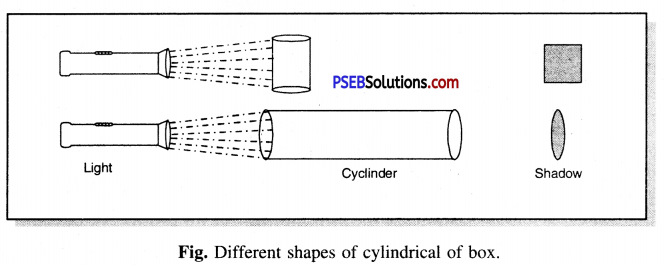
Can you think of creating a shape that would give a circular shadow if held in one way and a rectangular shadow if held in another way ?
Answer:
A cylindrical box can give rectangular shadow when placed in vertical direction while a round/circular shadow when placed horizontally.
PSEB 6th Class Science Solutions Chapter 11 Light Shadows and Reflections 7

Question 12.
What are the conditions necessary for formation of shadow of an opaque objects ?
Answer:
For formation of shadow of an opaque object, the following conditions are necessary :

  1. A source of light
  2. An opaque object
  3. The screen (may be a wall or ground

PSEB 6th Class Science Solutions Chapter 11 Light Shadows and Reflections

Question 13.
What is Irregular Reflection ?
Answer:
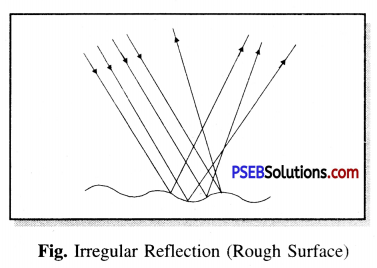
PSEB 6th Class Science Solutions Chapter 11 Light Shadows and Reflections 8
Irregular Reflection. When light falls on some rough or uneven surface then after reflection light gets scattered. Such type of reflection is called irregular reflection. Due to this phenomenon we see various objects around us.

Long Answer Type Questions

Question 1.
What is the reflection of light ? Show the phenomenon of reflection with the help of an activity.
Answer:
Reflection of light : The phenomenon coming back of light into the same medium after following on a smooth and polished surface is called reflection of light.

Activity 1.
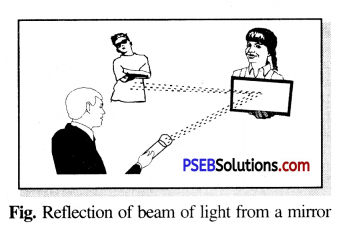
Ask your friend to hold a plane mirror in his hand and stand in a corner of a dark room. Cover the glass of a torch with your palm and switch it on. To get a beam of light leave some space between your fingers. Throw this beam of light on the plane mirror held by your friend, you would notice the spots of light. Now change the direction of torch so that the image of some other friend standing in the room is formed in the mirror.
This activity shows that the mirror relflects the light falling on its surface.
PSEB 6th Class Science Solutions Chapter 11 Light Shadows and Reflections 9

Activity 2.
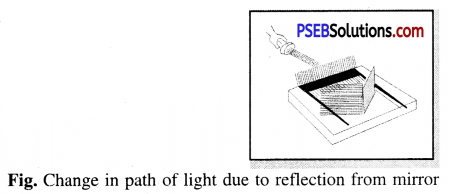
Fix a comb on one side of a white thermocol sheet and fix a mirror on the other side as shown in fig. Fix a dark cloured sheet of paper between the comb and the mirror. Now project a beam of light from a torch through the comb on the mirror. You will see a pattern as shown in the figure.
This activity shows that mirror changes the direction of light that falls on it. which is due to reflection of light.
PSEB 6th Class Science Solutions Chapter 11 Light Shadows and Reflections 10

Question 2.
Show an activity to study the factors which are responsible to affect the size and colour of shadows.
Answer:
Study of factors that affect the size and colour of shadows:
Activity.
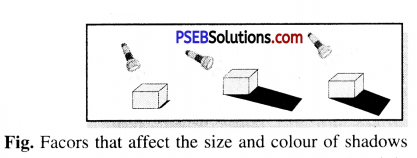
Throw a beam of light from a torch over a cubical block as shown in the figure to get its shadow on the ground. First, move the torch towards the cubical block and then away from it.
PSEB 6th Class Science Solutions Chapter 11 Light Shadows and Reflections 11

You will notice that when the torch is closer to the cubical block, the shadow is small and when it is away, the shadow is large in size.

Now use cubical blocks of different colours like chalk boxes, books, copies, tiffin boxes for getting shadows. You will see that in each case shadow is black.

In this way from the above activity we conclude:

  1. The size of the shadow of a given opaque object depends on the relative position of the source of light and the opaque object.
  2. The shadow of an opaque object is always black whatever may be the colour of the opaque object.

PSEB 6th Class Science Solutions Chapter 15 Air Around Us

Punjab State Board PSEB 6th Class Science Book Solutions Chapter 15 Air Around Us Textbook Exercise Questions and Answers.

PSEB Solutions for Class 6 Science Chapter 15 Air Around Us

PSEB 6th Class Science Guide Air Around Us Textbook Questions and Answers

1. Fill in the Blanks:

(a) Plants give out ……………….. gas and breathe in ……………….. gas.
Answer:
oxygen, carbon dioxide

(b) …………………. gas can not be used directly from the atmosphere.
Answer:
nitrogen

(c) Earth is protected from the harmful rays of sun by …………………… layer.
Answer:
ozone

PSEB 6th Class Science Solutions Chapter 15 Air Around Us

(d) ………………. is important for the water cycle.
Answer:
air.

2. Write True or False:

(a) Oxygen gas protects us from the harmful UV rays of the sun.
Answer:
Flase

(b) Carbondioxide is required for burning of fuel.
Answer:
Flase

(c) Composition of air always remain the same.
Answer:
Flase

(d) Air contains equal amount of oxygen and nitrogen.
Answer:
Flase

(e) Aquatic animals breathe carbon dioxide which is dissolved in water.
Answer:
Flase

3. Match the Column A with Column B:

Column A Column B
1. Most abundant gas in the air (a) ozone
2. Gas required for photosynthesis (b) water vapours
3. Gas used for respiration (c) carbondioxide
4. Form of water present in the air (d) nitrogen
5. Layer that protects us from harmful rays of Sun (e) oxygen

Answer:

Column A Column B
1. Most abundant gas in the air (d) nitrogen
2. Gas required for photosynthesis (c) carbondioxide
3. Gas used for respiration (e) oxygen
4. Form of water present in the air (b) water vapour
5. Layer that protects us from harmful rays of Sun (a) ozone

PSEB 6th Class Science Solutions Chapter 15 Air Around Us

4. Choose the Correct Answer:

Question (i)
Air contains highest percentage of which gas ?
(a) Oxygen
(b) Nitrogen
(c) Smoke
(d) Carbondioxide.
Answer:
(b) Nitrogen

Question (ii)
Which gas is a supporter of combustion ?
(a) Nitrogen
(b) Carbondioxide
(c) Smoke
(d) Oxygen.
Answer:
(d) Oxygen

Question (iii)
Moving air is known as:
(a) Wind
(b) Water vapour
(c) Ozone
(d) Wind mill.
Answer:
(a) Wind

Question (iv)
Earthworms come out of soil during:
(a) heavy rains
(b) cold weather
(c) snow
(d) hot weather.
Answer:
(a) heavy rains.

5. Very Short Answer Type Questions:

Question (i)
Which gas is essential for breathing of animals ?
Answer:
Oxygen gas is essential for breathing of animals.

Question (ii)
Name one component of air that does not support burning.
Answer:
Carbon dioxide does not support burning.

Question (iii)
Name the components of air.
Answer:
Components of air are nitrogen, oxygen, carbon dioxide, water vapours, and smoke.

PSEB 6th Class Science Solutions Chapter 15 Air Around Us

6. Short Answer Type Questions:

Question (i)
Which gas in the atmosphere is essential for respiration ?
Answer:
Oxygen gas is essential for respiration.

Question (ii)
Why does a lemp of cotton wool shrink in water ?
Answer:
A lemp of cotton has air trapped in it in the spaces between the cotton wool. When water is poured on it or lemp of cotton is dipped in water, the air so trapped gets displaced and appears in the form of bubbles with the result no air space is left between the glasswool. In this way, the size of the lemp decreases so that it shrinks.

Question (iii)
How will you show that air dissolves in water ?
Answer:
To show that air dissolves in water, we can perform the following experiment.
Steps of the Procedure.

  1. Take some water in glass vessel and heat it on a tripod stand before it begins to boil.
  2. Look at the inner surface of vessel.
  3. The tiny bubbles appear inside before water starts boiling.
  4. These are air bubbles.

From this experiment it is proved that air is dissolved in water.

7. Long Answer Type Questions:

Question (i)
How will you show that air supports burning ?
Answer:
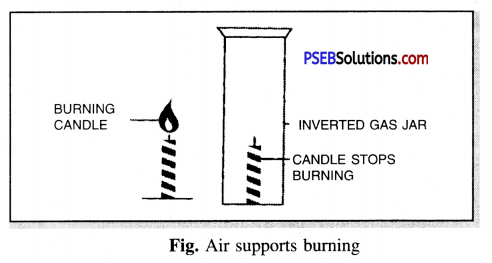
Experiment. Take a candle and fix it on a table.
PSEB 6th Class Science Solutions Chapter 15 Air Around Us 1
The candle is lighted by using a burning match stick. The candle will continue to bum in this case. This is because air is continuously available to the candle for its burning process.

Now cover the burning candle by putting an inverted jar over it. After a short time, the candle stops burning. It gets extinguished (see Figure). This can be explained as – when the burning candle is covered with glass jar, then the candle takes the oxygen necessary for burning from the air enclosed in gas jar. Since only a small amount of oxygen is available in the gas jar which is used in short time then the burning candle gets extinguished. Thus when a burning candle is covered with gas jar, then the fresh supply of air to the candle is cut off and hence it stops burning.
From this experiment, we conclude that air is necessary for burning.

Question (ii)
How is the balance of carbon dioxide and oxygen gases is maintained in the atmosphere ?
Answer:
Air contains both, oxygen gas and carbon dioxide gas. Plants use carbon dioxide of air and produce oxygen during photosynthesis. Oxygen is used by animals for respiration and carbon dioxide gas exhaled by them is produced which goes into the air and is used by plants. This is how the balance of carbon dioxide and oxygen gases is maintained in the atmosphere.

PSEB Solutions for Class 6 Science Air Around Us Important Questions and Answers

Multiple Choice Questions:

Question 1.
Which gas is needed for burning ?
(a) Oxygen
(b) Nitrogen
(c) Carbon dioxide
(d) All.
Answer:
(a) Oxygen

PSEB 6th Class Science Solutions Chapter 15 Air Around Us

Question 2.
Oxygen and Nitrogen constitute , ……………… of air.
(a) 1%
(b) 99%
(c) 100%
(d) None.
Answer:
(b) 99%

Question 3.
The plants release ……………….. during photosynthesis.
(a) Oxygen
(b) Nitrogen
(c) Carbon dioxide
(d) None.
Answer:
(c) Carbon dioxide

Question 4.
Air is:
(a) A mixture of gases
(b) A compound
(c) An element
(d) None.
Answer:
(a) A mixture of gases

Question 5.
Oxygen in air is replaced by:
(a) Respiration
(b) Burning
(c) Photosynthesis
(d) None.
Answer:
(c) Photosynthesis

Question 6.
Air helps in moving:
(a) Yachts
(b) Parachutes
(c) Windmills
(d) All.
Answer:
(d) All.

Fill in the Blanks:

(a) The ………………… air sways the clothes on cloth line.
Answer:
moving

(b) Air ……………… space.
Answer:
occupies

(c) Our earth is …………….. by a thin layer of air.
Answer:
surrounded

PSEB 6th Class Science Solutions Chapter 15 Air Around Us

(d) Air is a ………………. of many gases.
Answer:
mixture

(e) For burning ……………….. is needed.
Answer:
oxygen

(f) Suffocation is result of excess ……………….. in the room.
Answer:
carbon dioxide

(g) The burning of fuels ……………….. smoke.
Answer:
produce

(h) ……………………. particles are always present in the air.
Answer:
Dust

(i) Hair in nose ……………….. dust particles from getting into our body.
Answer:
prevent

(j) Air is present in the tiny …………………. of soil.
Answer:
particles

(k) The wind makes the ………………… rotate.
Answer:
wind-mill

PSEB 6th Class Science Solutions Chapter 15 Air Around Us

(l) ………………… plays an important role in water cycle.
Answer:
Air

Write T against true and F against false statement:

(a) Air is found in soil only.
Answer:
False

(b) Air has no visibility but it is transparent.
Answer:
True

(c) Nitrogen is needed for burning.
Answer:
False

(d) Smoke disturbs birds in the sky.
Answer:
True

(e) We should breathe through open mouth.
Answer:
False

(f) Water has air in it.
Answer:
True

(g) Composition of air is constant everywhere.
Answer:
False

(h) Earthworms live in holes in the earth.
Answer:
True

(i) Plants consume oxygen for respiration.
Answer:
True

PSEB 6th Class Science Solutions Chapter 15 Air Around Us

(j) Windmills generate electricity.
Answer:
True

Very Short Answer Type Questions

Question 1.
Where is air found ?
Answer:
All around us i.e. everywhere.

Question 2.
What makes the leaves rustle ?
Answer:
Air.

Question 3.
What is colour of air ?
Answer:
No colour/colourless.

Question 4.
Which gas is filled in cylinders carried by mountaineers ?
Answer:
Oxygen.

Question 5.
Presence of which particle is important for water cycle ?
Answer:
Water vapour.

Question 6.
Which gas is produced during burning/respiration ?
Answer:
Carbon dioxide.

Question 7.
From where do roots get oxygen for respiration ?
Answer:
Air present in soil.

PSEB 6th Class Science Solutions Chapter 15 Air Around Us

Question 8.
What is layer of air around the earth known as ?
Answer:
Atmosphere.

Short Answer Type Questions

Question 1.
What is air ?
Answer:
Air is a mixture of gases such as oxygen, nitrogen, carbondioxide, water vapour, dust particles etc.

Question 2.
Why is oxygen important ?
Answer:
Oxygen is important because it is needed for burning and respiration.

Question 3.
How do animals living on soil and roots of plant respire ?
Answer:
Soil contains air in the space between its particles. Burrows of animals also allow air to circulate through these spaces. So this air is used by animals and roots for respiration.

Question 4.
List uses of air.
Answer:
Uses of air :

  1. It is used for rotating wind mills.
  2. It is used for moving yachts, gliders etc.
  3. It is used by brids for flying.
  4. It is used for burning.
  5. It is used for dispersal of seeds and pollen grains.
  6. It is used for respiration.
  7. It is used for winnowing.

Question 5.
Write few uses of wind mills.
Answer:
Wind mill is a set up which runs on moving air or wind. This is very useful for many activities.
Uses of wind mills :

  1. For drawing water from tube wells.
  2. For generating electricity.
  3. For running flour mills.

PSEB 6th Class Science Solutions Chapter 15 Air Around Us

Long Answer Type Questions

Question 1.
How will you show that an empty glass bottle is filled with air ?
Or
How will you show that air occupies space ?
Answer:
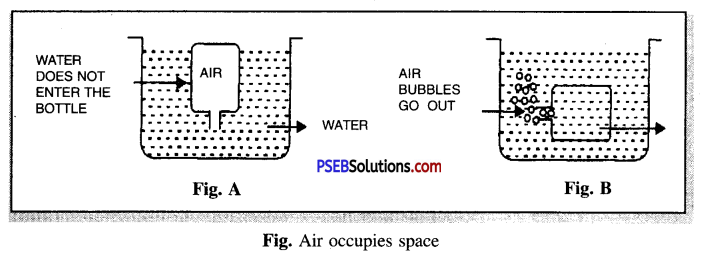
Air occupies space. We take an empty glass bottle and hold it in the inverted position. The inverted glass bottle is put in water kept in a vessel (Fig. A). We will find that the water does not enter into the inverted glass bottle because the bottle is filled with air. Actually, all the space in the bottle is occupied by air. From this experiment we conclude that air occupies space.

If we tilt the bottle held in water we will find that the air present in the bottle goes out in the form of bubbles (Fig. B.)

As the air from the bottle escapes, water starts entering the glass bottle. Actually, the space vacated by the air leaving the bottle is now occupied by water.
PSEB 6th Class Science Solutions Chapter 15 Air Around Us 2

Question 2.
Give an experiment to show the presence of water vapours in the air.
Answer:
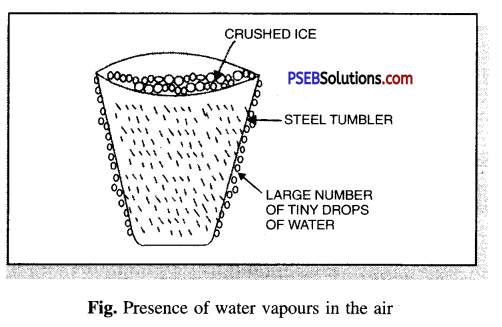
Experiment showing presence of water vapours in air. The presence of water vapours in the air can be shown as follows:
PSEB 6th Class Science Solutions Chapter 15 Air Around Us 3

We take a steel or glass tumbler and put some well crushed ice into it. (See Fig.). Wipe the tumbler from outside with a piece of clean and dry cloth so as to make its outer surface completely dry.

Allow the ice-containing steel or glass tumbler to stand undisturbed for five minutes. A large number of tiny drops of water appear on the outer surface of steel tumbler. This is because the air around the steel tumbler contains water vapours in it. When they come in contact with cold, they condense to form tiny drops of liquid water.

Thus, by observing the formation of drops of water on the outside surface of the steel or the glass tumbler containing crushed ice we conclude that water vapours are present in air.

Question 3.
Besides water, what other thing is present in the lump of soil ? Show its presence.
Answer:
PSEB 6th Class Science Solutions Chapter 15 Air Around Us 4
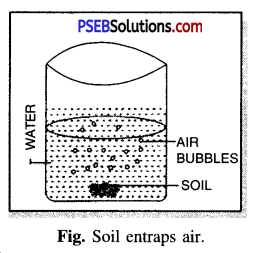
Air is also present in the lump of soil. It can be shown as follows :
We take the lump of soil and put it in a vessel full of water. We will see air bubbles escaping from the lump of soil into the water.

Actually the lump of soil contains air in its pores. When the lump of soil is put in water, the water displaces air from its pores. So, the air present in the lump of soil is seen going out in the form of air bubbles in the vessel containing
water.

Question 4.
How will you show that air contains dust particles ?
Answer:
The presence of dust particles in air can be shown as follows :
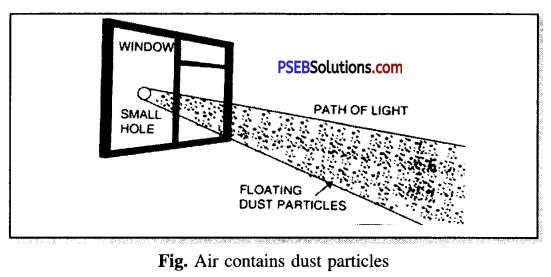
We darken a room completely by putting black chart papers on its windows and a black curtain on its door. A small hole is made in the black chart paper fixed on that window, which faces the sun. See Fig.
PSEB 6th Class Science Solutions Chapter 15 Air Around Us 5
A thin beam of sunlight enters the darkened room through the small hole made in the window. We can see the small dust particles moving in the beam of light in the darkroom. Actually, the air in the room always contains some dust particles but they are so small that normally they are not visible to us. These tiny dust particles become visible and can be seen by us only when a thick beam of sunlight falls on them. This experiment shows that air contains dust particles.

PSEB 6th Class Science Solutions Chapter 10 Motion and Measurement of Distances

Punjab State Board PSEB 6th Class Science Book Solutions Chapter 10 Motion and Measurement of Distances Textbook Exercise Questions and Answers.

PSEB Solutions for Class 6 Science Chapter 10 Motion and Measurement of Distances

Science Guide for Class 6 PSEB Motion and Measurement of Distances Intext Questions and Answers

Think and Answer (Textbook Page No. 103)

Question 1.
The length of a curved line can be measured by a metre scale directly. (True/False)
Answer:
False.

Question 2.
The metre is standard unit of length. (True/False)
Answer:
True.

PSEB 6th Class Science Guide Motion and Measurement of Distances Textbook Questions and Answers

Exercise – 1

1. Fill in the Blanks :

(a) One metre is ………………… cm.
Answer:
100

PSEB 6th Class Science Solutions Chapter 10 Motion and Measurement of Distances

(b) Five kilometre is ………………. m.
Answer:
5000

(c) Motion of a child on a swing is ……………….
Answer:
Periodic motion

(d) Motion of the needle of a sewing machine is ……………….
Answer:
Periodic motion

(e) Motion of wheel of a bicycle is ……………..
Answer:
Circular motion

2. Write True or False:

(a) Handspan or foot step are standard units of measurement.
Answer:
False

(b) Standard unit of length is metre.
Answer:
True

(c) Motion of train on railway track is an example of linear motion.
Answer:
True

PSEB 6th Class Science Solutions Chapter 10 Motion and Measurement of Distances

(d) Length of a curved line can be measured by a scale.
Answer:
False

(e) Motion of hands of a clock is a circular motion.
Answer:
True

3. Match the Column A with Column B:

Column A Column B
1. Metre (a) Periodic Motion
2. Circular Motion (b) Length
3. 1 Km (c) Linear Motion
4. Train on track (d) Hands of Clock
5. Swing (e) 1000 m

Answer:

Column A Column B
1. Metre (b) Length
2. Circular Motion (d) Hands of Clock
3. 1 Km (e) 1000 m
4. Train on track (c) Linear Motion
5. Swing (a) Periodic Motion

Exercise – 2

4. Choose the Correct Answer:

Question (i)
In motor vehicles which of the following is used for measuring the distance covered by the vehicle ?
(a) Speedometer
(b) Odometer
(c) Thermometer
(d) None of these.
Answer:
(b) Odometer

Question (ii)
A student want to take the measurements of a brick, for this purpose which unit he should use ?
(a) Kilometre
(b) Meter
(c) Centimetre
(d) Hand span.
Answer:
(c) Centimetre

Question (iii)
Which one among the following is false ?
(a) 1000 m = 1 km
(b) 100 mm = 1 cm
(c) 100 cm = 1 m
(d) 10 mm = 1 cm.
Answer:
(b) 100 mm = 1 cm

PSEB 6th Class Science Solutions Chapter 10 Motion and Measurement of Distances

Question (iv)
The motion of wings of a moving fan is …………….
(a) Circular Motion
(b) Linear Motion
(c) Both (a) and (b)
(d) None of these.
Answer:
(a) Circular Motion.

5. Very Short Answer Type Questions:

Question (i)
Name some means of transport used in ancient time.
Answer:
Ancient means of transport :

  1. Bullock Cart,
  2. Hand drawn and hand pushed carts,
  3. Palanquin carried by men,
  4. Boats made of wood,
  5. walked on foot,
  6. rode on animals back (horse and donkey),
  7. Tonga, (8) Coracles.

Question (ii)
Give two examples of periodic motion.
Answer:
Examples of Periodic motion :
(1) Motion of simple pendulum
(2) Up and down motion of needle of sewing machine.
(3) Motion of swing.

6. Short Answer Type Questions:

Question (i)
Give two examples of transport used on land, water and air.
Answer:
Examples of transport :
(1) On land : (a) Bus, (b) Car, (c) Train.
(2) On Water : (a) Ship, (b) Boat.
(3) In Air : (a) Aeroplane, (b) Helicopter.

Question (ii)
What is distance ?
Answer:
Distance. It is measurement of length between two points. It is also a length and S.l. unit of distance is metre.

Question (iii)
Arrange the following lengths in their incresing magnitude :
1 metre, 1 centimetre, 1 kilometre, 1 millimetre.
Answer:
Arrangement of lengths in increasing magnitude :
1 millimeter < 1 centimeter < 1 metre < 1 kilometer.

Question (iv)
Write the similarities and differences between the motion of a bicycle and a ceiling fan that has been switched on.
Answer:
Both bicycle and ceiling fan have circular motion. But wheel of a bi-cycle also performs linear motion on the road which is not undertaken by ceiling fan.

PSEB 6th Class Science Solutions Chapter 10 Motion and Measurement of Distances

Question (v)
The distance between Radha’s home and her school is 3250 m. Express this distance into km.
Solution.
Distance between Radha’s home and school = 3250 m
= \(\frac{3250}{1000}\) km [∵ 1 km – 1000 m]
= 3.250 km
Answer:

7. Long Answer Type Questions :

Question (i)
Describe what precautions should be taken while measuring length or breadth of an object.
Answer:
The following precautions must be taken while using a metre scale for measuring length :
(1) The scale should be placed close and along the length of the object to be measured.
PSEB 6th Class Science Solutions Chapter 10 Motion and Measurement of Distances 1

(2) If the ends of the scale are broken then in such a case one should coincide any other full mark of the scale with one edge of the object. The correct length is obtained by subtracting the reading of the mark from the reading coinciding with the other end of the object.
PSEB 6th Class Science Solutions Chapter 10 Motion and Measurement of Distances 2

(3) The eye must be kept on the end point of the object where the measurement is to be taken.
PSEB 6th Class Science Solutions Chapter 10 Motion and Measurement of Distances 3

Question (ii)
How many types of motion are there ? Give examples for each type.
Answer:
Different types of motion that we generally observe in our daily life are given below :
1. Linear Motion,
2. Circular Motion,
3. Periodic Motion.

1. Linear Motion. The motion of an object in a straight line is called Linear Motion.
Examples :
(a) A car or bus moving on a straight road.
(b) An athlete running on a straight track.
(c) Train running on straight track.

2. Circular Motion. Motion of an object on a circular path is called circular motion.
Examples :
(a) Motion of blades of a ceiling fan.
(b) Motion of hands of a wall clock.
(c) Motion of stone tied to the string when whirled around.

3. Periodic Motion. When an object repeats its motion after a fixed interval of time is said to have Periodic Motion.
Examples :
(a) The motion of a swing.
(b) Motion of needle of a sewing machine.
(c) Heart beat.
(d) The revolution of earth around the sun.

Question (iii)
Write an activity for measuring the length of a curved line.
Answer:
Measuring length of curved line using a thread :
The following steps should be taken while measuring the length of a curved line :
(1) Take a long, thick piece of thread.
(2) Tie a knot at one end of the thread.
(3) Place this knot on one point of curve, let it be A.
PSEB 6th Class Science Solutions Chapter 10 Motion and Measurement of Distances 4
(4) Place small portion of thread along the line using fingers and thumb.
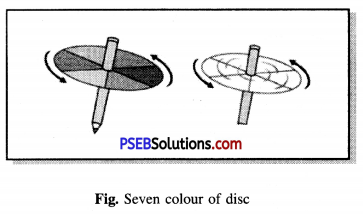
(5) Hold the thread at this end point with one hand.
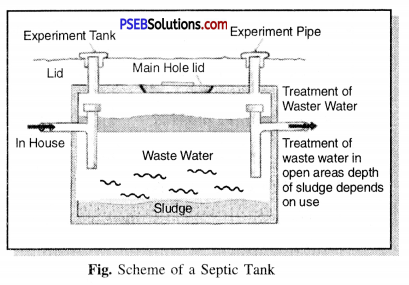
(6) Using other hand, stretch a little more portion of thread along the curved line.
(7) Repeat this process till you reach the other end of line, let it be point B,
(8) Mark the point on the thread with ink.
(9) Stretch this thread on a metre scale and measure the length between the knot and the end mark on the thread. This is the length of the curved line.

PSEB 6th Class Science Solutions Chapter 10 Motion and Measurement of Distances

Question (iv)
Why handspan or foot steps cannot be used as standard units of measurement ?
Answer:
A standard unit must be same at all places so that it is understood similarly by different persons. If a length is measured by handspans or foot steps of different person it will not be the same.
As their measure is not fixed and varies from person to person. So handspan and foot step cannot be considered as a standard unit of measurement.

PSEB Solutions for Class 6 Science Motion and Measurement of Distances Important Questions and Answers

Multiple Choice Questions:

Question 1.
Which of the following is a standard unit of length ?
(a) Decimeter
(b) Centimeter
(c) Millimeter
(d) Metre.
Answer:
(d) Metre.

Question 2.
1 kilometre = ……………..
(a) 100 m
(b) 1000 m
(c) 100 cm
(d) 10 mm.
Answer:
(b) 1000 m

Question 3.
Length of curved line can be measured by:
(a) Tailors measuring Tape
(b) Metre scale
(c) Thread
(d) None of these.
Answer:
(c) Thread

Question 4.
The means of transportation used in water surface is:
(a) Aeroplane
(b) Boat
(c) Train
(d) None of these.
Answer:
(b) Boat

Question 5.
The motion of a child on a swing is:
(a) Circular motion
(b) Periodic motion
(c) Linear motion
(d) Both Circular motion and Linear motion.
Answer:
(b) Periodic motion

Question 6.
1 millimetre is what part of one metre ?
(a) \(\frac{1}{10}\)th
(b) \(\frac{1}{100}\)th
(c) \(\frac{1}{1000}\)th
(d) None of these
Answer:
(c) \(\frac{1}{1000}\)th

Question 7.
To express the distance between Delhi and Mumbai, the standard unit of length used would be :
(a) Metre
(b) Quintal
(c) Kilometer
(d) Kilogram.
Answer:
(c) Kilometer

PSEB 6th Class Science Solutions Chapter 10 Motion and Measurement of Distances

Question 8.
The precaution while measuring length with metre scale is:
(a) Correct position of eye
(b) Correct position of eye and proper end of metre scale
(c) Only correct end of meter scale
(d) None of these.
Answer:
(b) Correct position of eye and proper end of metre scale

Question 9.
The SI unit of length is :
(a) Kilometre
(b) Centimetre
(c) Metre
(d) Inch.
Answer:
(c) Metre

Fill in the Blanks:

(a) Curved lengths are measured by using a ……………… .
Answer:
thread

(b) Linear motion is the movement of the object in a …………….. .
Answer:
straight line

(c) The motion of blades of ceiling fan is an example of ………………. .
Answer:
circular motion

(d) The revolution of earth around the sun is an example of ……………… .
Answer:
Periodic motion

(e) Motion is the change in …………………. of an object in comparison to surrounding with time.
Answer:
position.

PSEB 6th Class Science Solutions Chapter 10 Motion and Measurement of Distances

Write (T) against true and (F) against false statements :

(a) Swinging of our arms forward and backward is an example of a periodic motion.
Answer:
False

(b) Periodic motion helps us to measure time.
Answer:
True

(c) Metre is a convenient scale for measuring long distances.
Answer:
False

(d) S.I. unit of length is centimeter.
Answer:
False

(e) Vehicle moving on a straight road is an example of linear motion.
Answer:
True

Match the following :

Column A Column B
(1) Metre An ancient unit of measuring length
(2) Motion Motion of tip of ceiling fan blade
(3) Circular Motion S.I. Unit of length
(4) Linear Motion State of moving objects
(5) Hand span Apple falling from a tree.

Answer:
(1) Metre – S.I. Unit of length
(2) Motion – State of moving objects
(3) Circular Motion – Motionof tip of ceiling fan blade
(4) Linear Motion – Apple falling from a tree
(5) Hand span – An ancient unit of measuring length.

Very Short Answer Type Questions

Question 1.
Name the S.I. unit of length.
Answer:
S.I. unit of length is metre.


Question 2.
State the unit of distance used in each of the following cases :
(i) The height of a person
(ii) The height of mountain peak
(iii) The distance between Mumbai and Delhi.
Answer:
(i) Centimetre,
(ii) Metre,
(iii) Kilometre.

Question 3.
What type of motion does the wheel of a bicycle perform ?
Answer:
The wheel of moving bicycle performs simultaneously circular motion and linear motion.

Question 4.
Can we measure the length of a curved line directly with a metre scale ?
Answer:
No, we cannot measure the length of a curved line directly with a metre scale.

Question 5.
What type of measuring device would you use to measure the girth of a tree ?
Answer:
We can make use of either a measuring tape or a thread and metre scale to measure girth of a tree.

Question 6.
What type of motion does striker of a carrom game execute when it moves ?
Answer:
Striker in the game of carroms moves in a straight line and therefore, its motion is linear motion.

Short Answer Type Questions

Question 1.
Why is it necessary to have standard units of measurement ?
Answer:
Measurement means comparing a given quantity with another known quantity of the same kind. For the same measurement, a variety of objects can be used. But when you tell others about the measurement made by you, they will not be able to understand how much the actual measurement is. Thus to make others understand for the sake of uniformity, there is a necessity of having standard units of measurement.

PSEB 6th Class Science Solutions Chapter 10 Motion and Measurement of Distances

Question 2.
Name two types of motions of the Earth.
Answer:
The earth has two types of motion :

  1. Motion of the earth around the Sun. It repeats after a fixed interval of time. So, it is called periodic motion.
  2. Motion of the earth around its axis. This motion is both periodic and circular motion as it is repeated after a same interval of time and it is along an orbit.

Question 3.
Write precautions needed while using a metre scale.
Answer:
Precautions to be taken while using a metre scale are :

  • The eye position should be correct.
  • The scale should be placed properly parallel to the length.
  • The scale must not have broken end. In case of broken end, any other complete mark must be taken as the initial reading coinciding with the first end.

Question 4.
The height of a person is 1.65 m. Express it into cm and mm.
Answer:
1.65 m = 1.65 × 100 = 165 cm [∵ 1 m = 100 cm]
1.65 m = 1.65 × 1000 — 1650 mm. [∵ 1 m = 1000 mm]

Question 5.
While measuring the length of a knitting needle, the reading of the scale at one end is 3.0 cm and at the other end is 33.1 cm. What is the length of the needle ?
Answer:
The length of the needle is = (33.1 – 3) cm = 30.1 cm.

Question 6.
What were different units used for measurement of length in ancient times ?
Answer:
Units for measurement in ancient times were:

  1. length of a foot.
  2. the width of fingers.
  3. distance of a step.
  4. cubit.
  5. yard etc.

Question 7.
Give two examples each, of modes of transport used on land, water and air.
Answer:
Modes of transport.

  1. On land are Bus, Car.
  2. On Water. Motorized boats and ships are used as means of transport on water.
  3. In Air. Aeroplanes and helicopters are used as means of transport in air.

Question 8.
Classify the motion of the following objects into linear motion, circular motion and Periodic motion:
Motion of child on swing, motion of a plough, motion of the needle of a sewing machine, motion of a deer, motion of earth, motion of an electric fan.
Answer:
Linear motion. Motion of a deer, motion of a plough.
Circular motion. Motion of the earth, motion of an electric fan.
Periodic motion. Motion of child on the swing, motion of the needle of a sewing machine.

Long Answer Type Question

Question 1.
Which things were being used for measurement in ancient times ?
Answer:
In ancient times length of the foot, the width of finger and distance of a step, were used for measurement.

During the Harappa civilization, some exact unit of length must have been chosen as proved by geometrical structures procured during excavation.

The length from one end of the finger to elbow, called cubit was also used as a unit of measure in ancient Egypt. It was also accepted in some other parts of the world.

In a different parts of the world, ‘foot’ was also taken as a unit of measurement of length. Different areas have a different measures of the foot.

People used to measure a yard of cloth with an open arm upto the chin. Romans measured length with their steps.

In ancient India, small measures of lengths were taken by the width of fingers or fists. These days also in some cities of India, flower sellers can be seen measuring the length of flower garlands with their arms. For convenience sake, different parts of the body have been used for measurement.

Because every person has a different measure of body parts so problems occurred during measurement. In 1970, French people invented a measurement scale known as ‘Metric System.

PSEB 7th Class Computer Solutions Chapter 5 Microsoft Word (Part-III)

Punjab State Board PSEB 7th Class Computer Science Book Solutions Chapter 5 Microsoft Word (Part-III) Textbook Exercise Questions and Answers.

PSEB Solutions for Class 7 Computer Science Chapter 5 Microsoft Word (Part-III)

Computer Guide for Class 7 PSEB Microsoft Word (Part-III) Textbook Questions and Answers

1. Fill in the Blanks

Question 1.
After selecting the picture tab appears.
(a) Format
(b) Page Layout
(c) insert
(d) View.
Answer:
(a) Format

Question 2.
For text wrapping, we can use option.
(a) Square
(b) Tight
(c) Behind Text
(d) All of these.
Answer:
(d) All of these.

PSEB 7th Class Computer Solutions Chapter 5 Microsoft Word (Part-III)

Question 3.
To remove any unwanted parts of picture, option s used.
(a) Crop
(b) Rotate
(c) Group
(d) Compress.
Answer:
(a) Crop

Question 4.
Which of the following option is not available in the Adjust group of Format tab?
(a) Corrections
(6) Artistic Effects
(c) Remove Background
(d) Picture Styles.
Answer:
(d) Picture Styles.

Question 5.
We can find the number of words in the bar at the bottom of the window.
(a) Task Bar
(b) Status Bar
(c) Title Bar
(d) Scroll Bar.
Answer:
(b) Status Bar

PSEB 7th Class Computer Solutions Chapter 5 Microsoft Word (Part-III)

2. Very Short Answer Type Questions

Question 1.
Which option splits the text into two or more Columns?
Answer:
The Columns option from the Page Setup group in the format tab divides the text into two or more sections.

Question 2.
Which page orientation sets the page in horizontal direction?
Answer:
Landscape Orientation.

Question 3.
Which option is used to group two or more images together so that they can be treated as a single object?
Answer:
Two or more images can be grouped together as one object using the Group command from the Arrange group in the Layout tab.

PSEB 7th Class Computer Solutions Chapter 5 Microsoft Word (Part-III)

Question 4.
Which option can be used to change the colors of the picture in MS Word?
Answer:
From the Picture Format tab, the color of the picture can be changed with the Color option from the Adjust group.

Question 5.
Which option is used to count words in MS Word?
Answer:
Words can be counted using the Word Count option from the Proofing group in the Review tab or the Word Count Dialog box from the Status bar.

3. Short Answer Type Questions

Question 1.
What are Margins?
Answer:
A margin is the space between the text and the edge of the page. By default, a new document’s margins are set to Normal, which means it has a one-inch space between the text and each edge. Depending on your needs, Word allows you to change your document’s margin size.

PSEB 7th Class Computer Solutions Chapter 5 Microsoft Word (Part-III)

Question 2.
What do you mean by Compress Picture?
Answer:
With this button the image can be compressed. To reduce the size of documents, pictures can be reduced in storage size. You can change the resolution of an image or delete a cropped part of an image.

Question 3.
Write about Reset Picture.
Answer:
If you want to remove all formatting changes to a picture in the document, “Reset Picture’ command will be used. This button is used to undo all formatting changes made to the picture and restore it to its original format.

  • Select the picture.
  • in the Format tab, click on the Reset picture option from the Adjust group.

Question 4.
What is Crop option?
Answer:
Crop button is used to delete the unwanted part of an image. When you crop an image, an unselected part of the picture is removed. Steps to crop the image are as follows:

  • Select the image you want to crop. The Format tab appears.
  • On the Format tab, click the Crop command.
  • Black handles will appear around the image. Click, hold and drag a handle to crop the image.
  • Click the Crop command again. The image will be cropped.

PSEB 7th Class Computer Solutions Chapter 5 Microsoft Word (Part-III)

Question 5.
Give the name of two page orientation in MS Word.
Answer:
To change the position of a document from a portrait to a landscape, click this button. To change the position of the page, steps are as follows:

  • Select the Page Layout tab.
  • in the Page Setup group, click on the “Orientation” command.
  • Click “Portrait” or “Landscape” to change the position of the page. Landscape format means the page is horizontal, while portrait format means it is vertical.

Question 6.
Write the name of various options available in the adjust group of Picture Tools Format tab.
Answer:
Correction, Picture Color, Artistic Effect, Compress Picture, Change Picture, Reset Picture, Remove Background.

4. Long Answer Type Questions

Question 1.
What is Watermark? Write steps to add watermark in a word document.
Answer:
Watermark: it is just like a stamp. it is used for confidential documents. A watermark is an image that appears blurred behind the text on a page. The steps to add a watermark to the document are given ahead:

  • Open the document to which you want to include the water-mark.
  • Click the Page Layout tab and then click the “Watermark” button to display a list of standard watermark options.
  • You can select any available standard watermark by clicking on it. This will apply to all pages of the document.

PSEB 7th Class Computer Solutions Chapter 5 Microsoft Word (Part-III)

Question 2.
Write the steps to run a Spelling and Grammar Check.
Answer:
To do Spelling and Grammar check, steps are as follows:

  • From the Review tab, click the Spelling & Grammar command.
  • The Spelling and Grammar dialog box will appear.
  • This dialog box offer one or more suggestions for spellings and grammatical errors.
  • You can select a suggestion and click “Change” to correct the error.

Question 3.
Explain the steps to Print a Document.
Answer:
Once you’ve created your document, you may want to print it to view and share your work offline. it’s easy to preview and print a document in Word using the Print option.

  • On the File tab or Office button, click Print command.
  • A print dialog box will appear.
  • In the “Name” drop-down list select the name of you printer.
  • In the “Copies” box, enter the number of copies you want.
  • In “Page Range” option select “All” option if you want to print all pages of your document.
  • If you want particular page to print then click “Pages” radio button and type page number in the box.
  • Now click “Print” option. Your document will be print.

PSEB 7th Class Computer Guide Microsoft Word (Part-III) Important Questions and Answers

1. Fill in the Blanks

Question 1.
The text of the paragraph is selected by pressing the arrow keys and the ………….. key together.
(a) Special
(b) Shift
(c) Number
(d) Function.
Answer:
(b) Shift

PSEB 7th Class Computer Solutions Chapter 5 Microsoft Word (Part-III)

Question 2.
The default line spacing is …………… point.
(a) Single
(b) Double
(c) Triple
(d) Four.
Answer:
(a) Single

Question 3.
The fill color option is used to color in ………………… .
(a) Text
(b) Line
(c) Shape
(d) Word.
Answer:
(c) Shape

Question 4.
For border and shading …………… menu is used.
(a) File
(b) Edit
(c) Format
(d) Home.
Answer:
(c) Format

Question 5.
Auto Shapes are submitted from the …………….. tool bar.
(a) Shapes
(b) Home
(c) Word
(d) Drawing.
Answer:
(d) Drawing.

PSEB 7th Class Computer Solutions Chapter 5 Microsoft Word (Part-III)

2. True/False

1. The left mouse button is clicked three times to select the entire paragraph.
Answer:
True.

2. By default paragraph text is right aligned.
Answer:
False

3. indentation command is used for shading.
Answer:
False

4. To fill ClipArt, Click insert Picture then click ClipArt command.
Answer:
True.

5. Arial and Times New Roman are the names of the fonts.
Answer:
True.

PSEB 7th Class Computer Solutions Chapter 5 Microsoft Word (Part-III)

3. Match the Columns

Column A Column B
1. Ctrl + B (a) For double line spacing
2. Ctrl + E (b) For bold the text
3. Ctrl+ 2 (c) For Left, Right, Center, Justify
4. Font style (d) For Center Alignment
5. Alignment (e) Bold, Italic, Underline

Answer:

Column A Column B
1. Ctrl + B (b) For bold the text
2. Ctrl + E (d) For Center Alignment
3. Ctrl+ 2 (a) For double line spacing
4. Font style (e) Bold, Italic, Underline
5. Alignment (c) For Left, Right, Center, Justify

PSEB 7th Class Computer Solutions Chapter 5 Microsoft Word (Part-III)

4. Short Answer Type Questions

Question 1.
What is Picture Border?
Answer:
Picture border means the line around a picture.

Question 2.
What is picture position?
Answer:
Picture position means where the picture is located into the document.

Question 3.
What are the various options available in page layout tab?
Answer:
The Page Layout tab has more than one Page layout and Formatting options. This affects the look of a page’s content. Depending on how we want to present our document, we can choose Page Orientation, Paper Segment and Page Margin commands.

PSEB 7th Class Computer Solutions Chapter 5 Microsoft Word (Part-III)

Question 4.
Write steps for formatting page margins.
Answer:

  • Click on the Page layout tab.
  • Click on the Margins command from page setup group. A drop-down menu will appear. By default “Normal” margin will be selected.
  • Click on the Predefined margin as you want.

Question 5.
Describe the steps for using custom margin.
Answer:

  • Click on Margin command from the Page Layout tab.
  • A drop-down menu will appear. From this menu click “custom margin” option.
  • A Page Setup dialog box will appear.
  • Adjust the margin size for each side of the page, and click Ok.

Question 6.
What is Orientation?
Answer:
To change the position of a document from a portrait to a landscape, click this button. To change the position of the page, steps are as follows:

  • Select the Page Layout tab.
  • in the Page Setup group, click on the “Orientation” command.
  • Click “Portrait” or “Landscape” to change the position of the page. Landscape format means the page is horizontal, while portrait format means it is vertical.

PSEB 7th Class Computer Solutions Chapter 5 Microsoft Word (Part-III)

Question 7.
What are the steps to change the paper size?
Answer:

  • Select Page Layout.
  • Click on the Page-Size command and a drop-down menu will appear. The current page size will be highlighted.
  • Click on the Size option as per your requirement. The page size of the document will change.

Question 8.
What does the column option do?
Answer:
This option splits the written text into two or more columns.

5. Long Answer Type Questions

Question 1.
What are corrections? How are they used?
Answer:
Adjust Group:
You do not need to use additional picture editing software to create high quality images for your document. Instead, you can use Adjust tools to correct and improve your photos.
1. Select photo.
2. In the Format tab, click on the Correction option from the Adjust group. A drop-down menu will now open. From this menu, select 3. Sharpen/Soften and Brightness/ Contrast settings according to your needs.
PSEB 7th Class Computer Solutions Chapter 5 Microsoft Word (Part-III) 1
To make these settings more detailed, go to Picture Format>> Corrections>> “Picture Corrections Options” option. The Format Picture sidebar appears. This allows you to provide special settings for Sharpness, Brightness and Contrast.

PSEB 7th Class Computer Solutions Chapter 5 Microsoft Word (Part-III)

Question 2.
Write the steps for using the color option.
Answer:
Picture Color:
Microsoft Word allows you to control the color and tone of your picture and you can repaint the whole picture for special effects.
Steps to change the picture color are as follows:
(a) Select picture.

(b) In the Format tab, click on the Color option from the Adjust group. A drop-down menu will open.

(c) In this menu there are 3 options:

  • Color Saturation: This controls how bright the colors are in the image.
  • Color Tone: This controls the temperature of the color, from cool to warm.
  • Recolor ; This controls the overall color of the image. Use this option to make the image black and white or gray scale, or to colorize it with a different color.

(d) Choose any of the options as per your need.
PSEB 7th Class Computer Solutions Chapter 5 Microsoft Word (Part-III) 2

Question 3.
Write the steps for compressing a picture.
Answer:
Compress Picture: With this button the image can be compressed. To reduce the size of documents, pictures can be reduced in storage size. You can change the resolution of an image or delete a cropped part of an image. The steps to compress a picture are given below:

  • Select the picture.
  • In the Format tab, click on the Compress picture option from the Adjust group.
  • Now a Compression Settings dialog box will open.
    PSEB 7th Class Computer Solutions Chapter 5 Microsoft Word (Part-III) 3
  • If you want to print the picture, click on the Print (220 ppi) option.
  • If you want to reduce the size of the file to e-mail, click on the E-mail (96 ppi) option.
  • If you want to upload the file to a web page or projector, click on Project Options.

PSEB 7th Class Computer Solutions Chapter 5 Microsoft Word (Part-III)

Question 4.
Write the steps to remove the background of the picture.
Answer:
Remove Background:
This option is used to automatically remove unwanted parts of an image. Areas to remove or keep can be marked in the picture. Following are the steps to remove the background of a photo:

(a) Select the image from which you want to remove the background.

(b) Click the “Remove Background” option from the Adjust group in the Format tab.

(c)Now the default background area will be marked with magenta color, while the foreground will remain its natural color.
(d)If the default area isn’t correct, go to Background Removal > Picture Tools and do one or both of the following:

  • If parts of the picture that you want to keep are magenta, select
  • “Mark Areas to Keep” option and use the drawing pencil to mark the areas on the picture that you want to keep.
  • To remove more parts of the picture, select Mark Areas to
  • Remove option and use the drawing pencil to mark those areas

When you’re done, select “Keep Changes” or “Discard All Changes”.
PSEB 7th Class Computer Solutions Chapter 5 Microsoft Word (Part-III) 4

PSEB 7th Class Computer Solutions Chapter 5 Microsoft Word (Part-III)

Question 5.
Write down the steps to apply a picture style.
Answer:
Picture Style Group:
Picture Styles Gallery offers many preset styles that make it easy for you to add borders and special effects with one click.
1. Picture Style Gallery:
This field provides a list of different formats that can be applied to an image. To see what each style will do, just move the mouse pointer over each style. To apply the style on a picture steps are as follows:
(a) Select the photo whose style you want to change.
(b) On the Format tab, in the Picture Styles group, click any style you like.
PSEB 7th Class Computer Solutions Chapter 5 Microsoft Word (Part-III) 5

2. Picture Border:
Use this command to change the color, width, or line style of the border of the image. Steps to add border as follows:

  • Select the image to which you want to add a border.
  • On the Picture Format tab, in the Picture Styles gallery, select Picture Border command. A drop-down menu will appear.
  • From this menu select color for border line.
  • Select weight (thickness) of boarder line.
  • Select whether the line of the border is dashed.

3. Picture Effects:
Click this button to add visual effects to the picture such as shadows, 3-D effects, and glows. Steps to add an effect to a picture are as follows:

  • Select the picture for which you want to add or change an effect.
  • Under the Format tab, in the Picture Styles group, click Picture Effects command.
  • A drop-down list will appear. From this menu select appropriate effect for image.

Question 6.
Write the steps of wrapping text.
Answer:
Text Wrapping:
This feature is used to apply wrapping to an image. When wrapping is applied, text can be typed around the image. Make it easy to move images from one place to another in a document. To apply the text wrapping on the image follow these steps:
(a) Select the image which you want to apply wrapping.
(b) From the Picture Tools tab, in the Arrange group, click on the “Text Wrapping” option.
Do one of the following:

  • Click “Square” command to type the text around the border of your picture.
  • Click ‘Tight” command to type text around a clip art image or an irregularly shaped image.
  • Click “Behind Text” command to display the text on the image.
  • Click “In Front of Text” command to display the image on the text.
  • Click “Top and Bottom” command to place the image on your line.
  • Click “More Layout Options” command for more layout Options.

From this dialog box, specify the distance between the text and the image.
PSEB 7th Class Computer Solutions Chapter 5 Microsoft Word (Part-III) 6

PSEB 7th Class Computer Solutions Chapter 5 Microsoft Word (Part-III)

Question 7.
Write the steps for adding background color or texture.
Answer:
Page Color:
With the help of this option we can apply different colors, textures and pictures to the background of the page in our document. Steps to add background color or texture are as follows:

  • Click on “Page color” command in the Page Background group from the Page Layout tab.
  • A drop-down menu will appear.
  • Choose one of the following options from this drop-down menu:
  • To apply the background color click any color from “Theme Colors or Standard Colors”.
  • To apply the texture, Gradient, pattern and pictures into the background, click “Fill Effects” option.
  • A Fill Effect dialog Box will appear. Select appropriate design for you background.

PSEB 6th Class Science Solutions Chapter 16 Garbage Management and Disposal

Punjab State Board PSEB 6th Class Science Book Solutions Chapter 16 Garbage Management and Disposal Textbook Exercise Questions and Answers.

PSEB Solutions for Class 6 Science Chapter 16 Garbage Management and Disposal

Science Guide for Class 6 PSEB Garbage Management and Disposal Intext Questions and Answers

Think and Answer (Textbook Page No. 164)

Question 1.
Vegetable peels are ………………… waste. (Biodegradable/Non-Biodegradable)
Answer:
Biodegradable.

Question 2.
Glass is a ………………. waste. (Biodegradable/Non-Biodegradable)
Answer:
Non-Biodegradable.

PSEB 6th Class Science Solutions Chapter 16 Garbage Management and Disposal

Question 3.
Plant leaves are ………………. waste. (Biodegradable/Non-Biodegradable)
Answer:
Biodegradable.

Think and Answer (Textbook Page No. 165)

Question 1.
Compost is rich in nutrients. (True/False)
Answer:
True.

Question 2.
We can use non-Biodegradable waste in composting. (True/False)
Answer:
False.

Question 3.
Vermicomposting is done by ……………..
Answer:
Earthworms.

Question 4.
Kitchen waste (biodegradable waste) is used in Vermicomposting. (True/False)
Answer:
True.

Think and Answer (Textbook Page No. 167)

Question 1.
We can also recycle glass and metals to useful product. (True/False)
Answer:
True.

Question 2.
The process of changing the waste and non-useable materials into useful material is called recycling. (True/False)
Answer:
True.

PSEB 6th Class Science Guide Garbage Management and Disposal Textbook Questions and Answers

1. Fill in the Blanks:

(a) Solid waste is commonly called ………….. .
Answer:
garbage

PSEB 6th Class Science Solutions Chapter 16 Garbage Management and Disposal

(b) Plastic is a ……………….. material.
Answer:
non-biodegradable

(c) Composting done by earthworms is called ………………
Answer:
vermicomposting

(d) …………… dustbin is used for collecting non-biodegradable waste.
Answer:
Blue

2. Write True or False:

(a) Green dustbin is used for collecting non-biodegradable waste.
Answer:
False

(b) Biomedical wastes are hazardous and infectious.
Answer:
True

(c) A large, low lying area used to dispose off garbage is known as a dump.
Answer:
True

(d) Landfill site is ideal for making parks and playgrounds.
Answer:
True

3. Match the Column A with Column B:

Column A Column B
1. Biomedical waste (a) fly ash
2. Industrial waste (b) medicines and syringes
3. Domestic waste (c) Paddy husk
4. Agricultural waste (d) vegetable peels

Answer:

Column A Column B
1. Biomedical waste (b) medicines and syringes
2. Industrial waste (a) fly ash
3. Domestic waste (d) vegetable peels
4. Agricultural waste (c) Paddy husk

PSEB 6th Class Science Solutions Chapter 16 Garbage Management and Disposal

4. Choose the Correct Answer:

Question (i)
Hospital waste is generally:
(a) Recycled
(b) Incinerated
(c) Dumped in landfill
(d) Composted.
Answer:
(b) Incinerated

Question (ii)
The earthworms used for composting are called:
(a) Redworms
(b) Blueworms
(c) Greenworms
(d) Whiteworms.
Answer:
(a) Redworms

Question (iii)
……………. is a non-biodegradable waste.
(a) Plastic
(b) paper
(c) Vegetable
(d) Animal dung.
Answer:
(a) Plastic

Question (iv)
We can recycle ……………. .
(a) Glass
(b) Metals
(c) Plastic
(d) All.
Answer:
(d) All.

5. Very Short Answer Type Questions:

Question (i)
What is meant by dump ?
Answer:
The low lying areas used for disposing off garbage are called dumps.

Question (ii)
What type of garbage is collected in blue dustbin and green dustbin ?
Answer:
Blue dustbins are used for collecting non-biodegradable wastes like polythene bags, plastics, glass, etc.
Green dustbins are used for collecting biodegradable wastes like sewage waste, news papers, etc.

Question (iii)
What is meant by recycling ?
Answer:
The process of changing the waste and non-useable materials into useful material is called recycling.

PSEB 6th Class Science Solutions Chapter 16 Garbage Management and Disposal

6. Short Answer Type Questions:

Question (i)
Distinguish between biodegradable and non-biodegradable waste.
Answer:

Biodegradable Non-biodegradable waste
(1) Waste materials that can be decomposed by micro-organisms. (1) The waste materials that cannot be decomposed easily.
(2) For example-Sewage waste, vegetable peels, etc. (2) For example-Plastics, glass, chemicals, construction site wastes, etc.
(3) Such wastes are not harmful to environment. (3) Such wastes are harmful to environment.

Question (ii)
What is vermicomposting ? How is it done ?
Answer:
The method used to prepare compost with the help of earthworms is called vermicomposting. The redworms eat the waste material using their gizzards along with soil and convert it into compost.

7. Long Answer Type Questions:

Question (i)
Explain how plastic is a boon.
Answer:
Plastic is a latest addition to our development. It is prepared chemically. It has become part of our life. It has both aspects – useful and harmful.

Useful aspects. Everything found around us is made of plastic – shoes, toys, buckets, tubes, pens, bags etc. Even electronic things have plastic components. Life seems to come to an end when we consider to abolish plastic. It is used for making things because it is tough, hard, shiny, durable and above all inexpensive.
From the different uses we can consider that plastic is a boon.

Question (ii)
List various methods of garbage disposal. Explain any one.
Answer:
There are three methods for disposal of garbage. These are :
(1) Composting
(2) Landfill
(3) Incineration
Landfilling. This is a commonly used method for disposing the waste.

Method : Collect the garbage from house and separate it into two groups before it is thrown into the dustbin.
Group I : Garbage from the kitchen like fruits and vegetable peels, egg shells, tea leaves etc.

Group II : Pieces of cloth, polythene bags, broken glass, old shoes, aluminium wrappers etc. Make separate heaps of this garbage and labelled as A, B, C and D. Put these into . separate plastic bags. Tie the mouth of these bags tightly. Put the four heaps in separate pits and cover them with the soil. This way of dumping is done in open land. The dumped content, with time changes to garbage.

Question (iii)
Explain the 4R’s.
Answer:
4R’s are used for waste management. These are (1) Reuse, (2) Reduce (3) Recycle and (4) Refuse.

(1) Reuse. It means to use an item again instead of throwing it away. We can reuse things after separating. For example fans and mobiles can be reused.

(2) Reduce. Reducing the amount of waste we produce is the best way to protect our environment. We can use glass and metal utensils instead of disposable utensils.

(3) Recycle. Conversion of waste material into usable form is called recycling of the waste. We can recycle old news papers into cardboard. Similarly plastic, glass, metals can be recycled.

(4) Refuse. Refuse the plastic and polythene bags. Disposable plastic pollutes our environment. For example using a reusable metal water bottle instead of disposable water bottle.

PSEB Solutions for Class 6 Science Garbage Management and Disposal Important Questions and Answers

Multiple Choice Questions:

Question (i)
Name the material which can be recycled ?
(a) paper
(b) old clothes
(c) toys
(d) all.
Answer:
(d) all

PSEB 6th Class Science Solutions Chapter 16 Garbage Management and Disposal

Question (ii)
Domestic waste constitutes :
(a) bandages
(b) kitchen waste
(c) syringes
(d) none.
Answer:
(b) kitchen waste

Question (iii)
The following item is not one of the waste material:
(a) broken glass
(b) a new bottle
(c) wrappers
(d) broken toy.
Answer:
(b) a new bottle

Question (iv)
Some animals die when they swallow
(a) fruit peels
(b) pieces of clothes
(c) plastic bags
(d) food.
Answer:
(c) plastic bags

Question (v)
Red worms survive at:
(a) high temperature
(b) low temperature
(c) average temperature
(d) none.
Answer:
(c) average temperature

Fill in the Blanks:

(a) All the wrapping materials go out as ………………..
Answer:
garbage

(b) Garbage has both ……………….. and non-useful components.
Answer:
useful

(c) Burning of …………….. produces smoke and ……………… gases which affect the health.
Answer:
agricultural waste, harmful

PSEB 6th Class Science Solutions Chapter 16 Garbage Management and Disposal

(d) ……………. , ……………………. and ……………. do not rot in the garbage heaps.
Answer:
Iron, glass, plastic

(e) The rotting and conversion of some materials into ……………… is called composting.
Answer:
manure

(f) The food of red worms is ……………….. and ……………….. waste.
Answer:
fruit, vegetables

(g) Red worms have structures like …………….. which help in grinding the food.
Answer:
gizzards

(h) Paper-mache is a paste made of clay and ……………. .
Answer:
paper

(i) Same kind of plastic can be …………… .
Answer:
recycled

(j) The plastic bags are cause of ………………… of drains and sewer system.
Answer:
choking

(k) We should not use ……………. to store eatables.
Answer:
plastic bags

(l) We should never bum ……………… and plastic ………………. .
Answer:
plastic bags, items

PSEB 6th Class Science Solutions Chapter 16 Garbage Management and Disposal

Write (T) against true and (F) against false statements:

(a) Garbage is always non-useful.
Answer:
False

(b) Composting of waste material can be done only by red worms.
Answer:
False

(c) Every type of plastic can be recycled.
Answer:
False

(d) We are irresponsible as we do not take proper care of the wastage.
Answer:
True

(e) The plastic bags are cause of death of animals.
Answer:
True

(f) Burning of leaves is done to reduce garbage.
Answer:
True

(g) Vermicomposting is a process to reduce useful garbage into useful components.
Answer:
True

(h) Red worms can survive any conditions of the weather.
Answer:
False

PSEB 6th Class Science Solutions Chapter 16 Garbage Management and Disposal

(i) Landfill is a low lying area.
Answer:
True

(j) Bum the garbage that do not rot.
Answer:
False

Match the column A with column B:

Column A Column B
(1) Composting 3 categories
(2) Landfill sewage, kitchen waste, garbage
(3) Domestic wastes area where garbage dumped
(4) Sewage waste converting waste into manure.

Answer:
(1) Composting – converting waste into manure
(2) Landfill – area where garbage dumped
(3) Domestic wastes – sewage, kitchen waste, garbage
(4) Sewage waste – 3 categories.

Very Short Answer Type Questions

Question 1.
What is land fill ?
Answer:
Land fill is a low lying open area to dump the waste.

Question 2.
What is garbage ?
Answer:
Garbage: All the waste material from houses, markets, school, offices etc. constitute
garbage.

Question 3.
Name different components of garbage.
Answer:
Useful and non-useful components.

PSEB 6th Class Science Solutions Chapter 16 Garbage Management and Disposal

Question 4.
Which part of red worms help in grinding the food ?
Answer:
Gizzard helps in grinding the food.

Question 5.
Used paper can be remade and is used for other purposes. What is this process known as ?
Answer:
Recycling.

Question 6.
What is colour of garbage after rotting ?
Answer:
Black.

Question 7.
Can salt, pickets be given to red worms ? Why ?
Answer:
No, These materials produce disease causing organisms.

Question 8.
Which coloured bin is used for collecting kitchen waste or degradable waste ?
Answer:
Green.

Question 9.
Blue coloured bin is used for which type of substances ?
Answer:
Recycling material.

Question 10.
What is compost ?
Answer:
Compost. Dead leaves and other plant material are broken down in the soil into nutrients for plants to use is known as compost.

PSEB 6th Class Science Solutions Chapter 16 Garbage Management and Disposal

Question 11.
What do you mean by vermicomposting ?
Answer:
Vermicomposting. It is the method of making compost from kitchen garbage using red worms is called vermicomposting.

Question 12.
Write the types of garbage.
Answer:
Garbage consist of two type of components :

  1. Useful components.
  2. Non-useful components.

Question 13.
How non-useful components of waste or garbage are dumped ?
Answer:
The non-useful component is separated from garbage. It is then spread over the landfill and then covered with a layer of soil. Once the landfill is completely full, it is usually converted into park or play ground.

Question 14.
What is composting ?
Answer:
Composting. The rotting and conversion of some garbage into manure is called composting.

Question 15.
Why it is necessary for us to separate waste into two groups ?
Answer:
It is necessary for us to separate waste into two groups because waste contains two type of components. One are useful and recycled and other are non useful and can not be recycled like polythene bags.

Question 16.
Can polythene bags be recycled ?
Answer:
No, polythene bags cannot be recycled.

Question 17.
Name the material which can be recycled.
Answer:
Paper can be recycled.

Short Answer Type Questions

Question 1.
What is recycling ?
Answer:
Recycling is making of useful substance from the used materials i.e., rotten paper can be recycled to get fresh paper for use.

PSEB 6th Class Science Solutions Chapter 16 Garbage Management and Disposal

Question 2.
Write a short note on Red worms.
Answer:
Red worms. Red worms are small organisms which can convert useful component of garbage into manure. These can survive under normal conditions and get doubled in one month. They feed on vegetable and fruit waste only. Milk products, salt, lemon pickles are harmful to them. Red worms have structures called gizzard for grinding the food material.

Question 3.
How can we minimize the use of plastics ?
Answer:
Steps to minimize the use of plastics

  1. Use paper bags instead of plastic bags.
  2. Use jute or cloth bag while shopping.
  3. Never bum plastic bags and plastic item.
  4. Use washable utensils instead of plastic ones.

Question 4.
How does garbage spoil the landscape ?
Answer:
Spoilage of landscape. Improper management of solid waste leads to spoilage of landscape. Solid waste left untreated is unhygienic. It destroys the surrounding greenery. The texture of soil becomes toxic and rats, house flies, mosquitoes and bacteria make their homes in this waste heap. Thus, destroying the beauty and usefulness of that area.

Question 5.
How is a landfill used for composting ?
Answer:
Following steps are taken for composting the waste in a landfill –

  1. Deposit the garbage in a landfill.
  2. Compress it with bulldozers.
  3. Cover the garbage with at least 6 inches deep soil after every deposit of garbage.
  4. Finally cover properly the top layer with 2 inches of soil.

Question 6.
Why burning of agricultural waste is not safe ?
Answer:
Burning of dried leaves, husk and agricultural waste produces smoke and harmful gases which have an adverse affect on the health.

Question 7.
What is role of municipality to separate the garbage ?
Answer:
Role of municipality to separate the garbage. In some town and cities, municipality provides separate dustbin for collecting different kinds of garbage. Blue coloured bin is for materials which can be recycled and green coloured bin is for kitchen waste, or the waste which can easily rot or decompose, when get buried in the soil.

Question 8.
Is it possible for all of this garbage to be changed into compost ? How ?
Answer:
No, it is not possible to change all of this garbage into compost because it contains two kind of components- (i) useful (ii) non-useful.

(i) Useful Components : The components from kitchen waste like fruits, vegetable peels, eggs shells, waste food can be changed to manure. Waste papers can be recycled.

(ii) Non Useful Components : The components like piece of cloth, polythene bags, broken glass, aluminium wrappers and broken toys cannot be changed to manure or compost.
Hence all type of garbage cannot be changed into compost.

Question 9.
How does a landfill basically works ?
Answer:
The basic working of a landfill involves the following three steps:

  • Deposit the refuse.
  • Compact it with buldozers.
  • Cover the garbage with at least 6 inches deep of soil after each day operation and with a final cover of 2 feet when the area is full.

PSEB 6th Class Science Solutions Chapter 16 Garbage Management and Disposal

Long Answer Type Questions

Question 1.
How can we reduce garbage and deal with it ?
Answer:
Steps taken to reduce and deal with garbage are:

  1. Reuse plastic items and bags whenever it is needed.
  2. Use vermicomposting at home.
  3. Recycle paper.
  4.  Donot throw plastic bags here and there after use.
  5. Make full use of your note books. Use slates for rough work.
  6. Make people aware of proper practices for disposing different kinds of waste.

Question 2.
Discuss whether plastic is a boon or a curse ?
Answer:
Plastic is a latest addition to our development. It is prepared chemically. It has become part of our life. It has both aspects – useful and harmful.

Useful aspects. Everything found around us is made of plastic – shoes, toys, buckets, tubes, pens, bags etc. Even electronic things have plastic components. Life seems to come to an end when we consider to abolish plastic. It is used for making things because it is tough, hard, shiny, durable and above all inexpensive.

Harmful aspects. It is difficult to dispose plastic as it bums with a foul smell and lots of smoke containing harmful gases.

Plastic do not rot even under undesirable conditions. Instead it create havoc in daily routine. Such as plastic bags when swallowed by animal are cause of their death as they choke their alimentary canal. These bags choke the drains and sewage thus causing a great problem. Some times food becomes poisonous when stored in plastic bags. Plastic things become shapeless when kept near fire.
So from above point of view plastic is a boon as well as a curse.

Question 3.
What do you know about waste ? Classify them according to their nature.
Answer:
Waste : The materials discarded by human beings in their day to day activities are considered as domestic waste.
Domestic waste may be classified into the following types :

  1. Food Waste : The animal, fruit or vegetable residue (also called garbage) resulting from the handling, preparation, cooking and eating of food.
  2. Ashes : Residue left over from the burning of wood, coal, coke etc. or from partially burnt materials.
  3. Rubbish : Waste material like cardboard, plastics, rubbers, wood, furniture, glass, broken utensils etc.
  4. Human excreta : Waste product excreted from the body is termed excreta.
  5. Plastic bag : Used plastic bags made of synthetic material are often thrown away.

Question 4.
What do you mean by dumping ? Explain improved form of open dumping method (Land filling).
Answer:
Waste dumping is a method of controlled final disposal at landfill sites which must be done by using state-of-the art method.
The improved form of open dumping is termed as land-filling.

Method: Collect the garbage from house and separate it into two groups before it is thrown into the dustbin.

Group I: Garbage from the kitchen like fruits and vegetable peels, egg shells, tea leaves etc.

Group II: Pieces of cloth, polythene bags, broken glass, old shoes, aluminium wrappers etc. Make separate heaps of this garbage and labelled as A, B, C and D. Put these into separate plastic bags. Tie the mouth of these bags tightly. Put the four heaps in separate pits and cover them with the soil. This way of dumping is done in open land. The dumped content, with time changes to garbage.

Question 5.
What do you mean by vermicomposting ? How can we prepare manure by vermicomposting ? Explain with activity.
Answer:
The method of preparing compost from kitchen wastes with the help of red worms is called vermicomposting.

Method to prepare manure by vermicomposting (Activity): Take a wooden box and place it where there is neither too hot nor too cold. Spread a net at the bottom or spread sand as an alternative. Also, spread some vegetable waste along with it. Dried animal dung could also be used as a spread over-sand. Sprinkle some water to make this layer wet. The pit is ready for composting. Now put some red worms on the pit. Cover them loosely with a gunny bag. To feed red worms vegetable waste, coffee, tea leaves can be used.

Question 6.
How do red worms make vermicompost?
Answer:
Redworms do not have teeth. They have a structure called ‘gizzard’ which helps them in grinding their food. Eggshells could be mixed with the wastes. They help redworms in grinding their food. Red worms need moisture around them. With all this, the number will be doubled. After 3-4 weeks, we will see loose soil-like material in the pit called vermicompost.

PSEB 8th Class Physical Education Solutions Chapter 6 Sports and Discipline

Punjab State Board PSEB 8th Class Physical Education Book Solutions  Chapter 6 Sports and Discipline Textbook Exercise Questions and Answers.

PSEB Solutions for Class 8 Physical Education Chapter 6 Sports and Discipline

Physical Education Guide for Class 8 PSEB Sports and Discipline Textbook Questions and Answers

Question 1.
What is the relation between Sports and Discipline?
Answer:
Sports have a very deep relation with discipline because one cannot achieve victory without discipline in sports. Sports causes development in the behaviour of player/sportsperson. Discipline plays an important role in building up the character of a player and without discipline, a good character cannot be developed. Lack of discipline causes several problems in the life of a player which further gets tough for the player to overcome.

No example can be better than that of the ‘Nature’, everything is disciplined as far as the functioning of Nature is concerned. For example; the sunrise and sunset always occur timely and with strict discipline; earth revolves around the sun with a fixed speed and time, likewise, there must be a proper and strict discipline in the life of an individual as well.

If an individual wants to become a successful player, he/she should practice discipline right from childhood because discipline can be developed aptly in one’s childhood. Sports teach discipline to the player in a way because sports demand obedience, co-operation, honesty, peace of mind and responsibility, which in turn brings discipline in the life of a player. It can be concluded that discipline is the key to success, and discipline can be easily achieved through sports.

PSEB 8th Class Physical Education Solutions Chapter 6 Sports and Discipline

Question 2.
What is the meaning of Discipline?
Answer:
Meaning of Discipline. Discipline means to follow the rules strictly or everybody should perform all his duties. Every citizen should remain in discipline. “Discipline makes a nation great” is a well-known saying. If every citizen is disciplined, the nation can make rapid progress. By abiding all rules and regulations, a citizen can make his contribution to his society or country.

Question 3.
What are the types of discipline?
Answer:
Types of Discipline.
Discipline is of two types:

1. Self Discipline
2. Forced Discipline or Commanded Discipline.

1. Self Discipline:
The feeling of abiding by the rules comes from his own and perform his duties without any external command. This is permanent discipline.

2. Forced Discipline.
In forced discipline the rules and regulations are followed by command or the directions of someone. This type of discipline is temporary. Forced discipline will remain only upto that time when you have a fear of someone or a person who commands on your head. Out of these, self discipline is better. Children must have the feeling to be self-disciplined, so that they may become good students or good citizens.

PSEB 8th Class Physical Education Solutions Chapter 6 Sports and Discipline

Question 4.
What is the need and importance of discipline?
Answer:
Importance of Discipline in our life. Discipline is a milestone of our society. Without discipline man can’t move in society. If every citizen is disciplined the nation can make rapid progress. By abiding the rules, a good citizen can make his contribution to his society or country. Discipline is the base of every caste, creed, society and country. In every sphere of life, Discipline is needed. Importance of Discipline is known by the following facts:

  • Discipline makes a good student an ideal citizen.
  • Disciplined boys learn to respect their teachers, parents and elders.
  • Through Discipline children become obedient.
  • Disciplined children behave nicely with others.
  • Disciplined boys become punctual.
  • Discipline develops the personality of a person.
  • Discipline develops good habits and good qualities in a person.
  • Discipline helps to reform social life.
  • Discipline makes the society and the nation more strong.
  • Discipline makes a nation strong and keeps it strong.
  • Discipline helps the society and country for its progress and happy life of their citizens.
  • Discipline helps a person to lead a successful and happy life.
  • Discipline also protects the country from foreign invaders.
  • Discipline helps to run school, house and other organisations smoothly.
  • Discipline helps a person for his harmonious development of his personality.
  • Disciplined labour can increase the production of their factory.
  • Discipline assists a person for his mental development because a person performs his duties after proper thinking and according to rules.

One should remain in discipline to lead a successful life. Home, School, Play fields are such places where a person gets an opportunity to remain in discipline.

Question 5.
How do the sports create discipline in Hie life of the students?
Answer:
Sport and discipline are integral part of each other. Victory can not be achieved without discipline. Sports build the character of the players. Discipline plays an important role in character. building. Character building is impossible without discipline because indiscipline creates many problems in the life of a player. It becomes difficult for a player to overcome these problems. The nature works in discipline. The sun rises in the east in the morning and sets in the west in the evening.

The earth moves in an order. Similary discipline is very important in the life of a human being. We can teach discipline in better way to the children. Sports create discipline in the innocent mind of the children. Sports teaches them to be disciplined because sports teaches punctuality, coordination, leadership, honesty, and sense of responsibility to fulfil their duties. Discipline is the key to success because it creates opportunity to succeed.

PSEB 8th Class Physical Education Solutions Chapter 6 Sports and Discipline

PSEB 8th Class Physical Education Guide Sports and Discipline Important Questions and Answers

Multiple Choice Questions

Question 1.
Types of discipline :
(A) Two
(B) Three
(C) Four
(D) Five.
Answers:
(A) Two

Question 2.
Importance of discipline:
(A) Children become obedience.
(B) Disciplined boys behave good with others.
(C) Discipline causes to do the work on time.
(D) Above all.
Answers:
(D) Above all.

Question 3.
Sports and discipline are related:
(A) There is discipline in sports.
(B) Discipline develops character in sports man.
(C) Without discipline character cannot be developed.
(D) Above all.
Answers:
(D) Above all.

PSEB 8th Class Physical Education Solutions Chapter 6 Sports and Discipline

Question 4.
These qualities belongs to:
(A) Punctuality
(B) Obedience
(C) Tolerance
(D) All above in discipline.
Answers:
(D) All above in discipline.

Question 5.
Why indiscipline is harmful for the country?
(A) Country cannot remain happy.
(B) Country cannot progress.
(C) Country will depend on other countries.
(D) All Above.
Answers:
(D) All Above.

Very Short Answer Type Questions

Question 1.
What do you mean by obeying the rules or remain in control?
Answer:
Discipline.

Question 2.
On which thing the ancient institution used to stress mostly?
Answer:
To be disciplined.

PSEB 8th Class Physical Education Solutions Chapter 6 Sports and Discipline

Question 3.
How students behave these days in their institutions?
Answer:
Indiscipline.

Question 4.
How is the nation built and how it remains stable?
Answer:
Through discipline.

Question 5.
What type of education discipline provides to the children?
Answer:
Obedience.

Question 6.
Discipline develops the personality. How?
Answer:
Mental development.

Question 7.
How the quality of discipline is improved?
Answer:
Games and sports.

Question 8.
Whose important place is there to instil discipline in students.
Answer:
The important place to instil discipline in student is teacher.

PSEB 8th Class Physical Education Solutions Chapter 6 Sports and Discipline

Short Answer Type Questions

Question 1.
Children learn discipline at Home. How?
Answer:
Home is the first school of Discipline for children. Parents, grandmother, grandfather; uncle and aunty, brothers and sisters live together in a house. The elder person in family leads it in all activities. All other follow him according to the sweet will of his elders. Everyone love each others and respect to the elders. Everybody share their happy and sorrows. They had very congenial and wholesome atmosphere of his family. All the members of the family perform their duties. In such congenial atmosphere children remain in discipline. They start to be in discipline from his house in their childhood, small children respect elders and follow them.

Question 2.
How sports developed discipline in students.
Answer:
School and discipline. Atmosphere of the school provides training to the students for discipline. In school, students respect their teachers and obey them. They live together with their friends and co-students. Playing, and sitting together become their habits. They attend their school in time and do their home work regularly. They are afraid of theft and telling lie and help each other. These qualities become part and parcel of their character.

All the teacher obey the order of the headmaster and other workers follow him in carrying the order of the teacher, everything is performed in a disciplined way in the school. The students start learning discipline in such type of atmosphere of the school. In this way, environment of school is helpful in teaching their students about discipline.

Question 3.
Do our society and our country need discipline? Write your ideas.
Answer:
Man is a social animal. He has to depend upon others for the satisfaction of many of his needs. He cannot live alone. He cannot fulfil all his desires all alone. We have to take help from one another in some work. We can not disobey the rules of our society. To imbide the rules of our society we have to remain in discipline people can get benefits by obeying Laws in other fields of life. The society will be stable if we remain in discipline. Indiscipline is harmful for the society.

Law treats all men as equal. Therefore, it is the duty of every person to obey Law. Law are made for the welfare of the people . Our society and country are facing so many troubles from outside and within the country to safe the country from foreign invasion. Everyone should obey rules and laws in life and lead an organised and disciplined life. A country can progress only if has inhabitants leads disciplined life. For the progress of the country the whole society must be disciplined. Indiscipline is not in favour of the country. We should not go against the country. So we can say that our society and country needs Discipline.

PSEB 8th Class Physical Education Solutions Chapter 6 Sports and Discipline

Question 4.
Why indiscipline is harmful for the country?
Answer:
It is the duty of every citizen to obey laws and to be disciplined.

  • Indiscipline is harmful to our society.
  • For the development and progress of the country discipline is the need of the hour. Discipline has great importance for the citizen of the country to develop and for stability.
  • Indiscipline is very very harmful to the nation.
  • Students, labourers, and so many others employees, of Govt, and private institutions go on strike and destroy the national property. Such type of indiscipline is not in favour of the welfare of our country.

Everybody is aware that he can play an important role to form government because government is for the people, by the people and of the people. Laws are made by the government and the people has to obey these Laws. If the countrymen are indisciplined it causes internal disturbance, thereby causing foreign forces to attack. So a country cannot progress due to indiscipline.

PSEB 7th Class Science Solutions Chapter 15 Light

Punjab State Board PSEB 7th Class Science Book Solutions Chapter 15 Light Textbook Exercise Questions and Answers.

PSEB Solutions for Class 7 Science Chapter 15 Light

Science Guide for Class 7 PSEB Light Intext Questions and Answers

Think and Answer (Textbook Page No. 186)

Question 1.
The process of change in direction of light after falling on a mirror is called ……………….. of light.
Answer:
Reflection.

Question 2.
Angle of incidence is equal to angle of reflection. (True/False)
Answer:
True.

PSEB 7th Class Science Solutions Chapter 15 Light

Think and Answer (Textbook Page No. 189)

Question 1.
The distance between the object and the mirror is ……………… to the distance
between the image and the mirror.
Answer:
Equal.

Question 2.
Thes plane mirror has to be placed vertically on the graph paper. (True/False)
Answer:
True.

Question 3.
The plane mirror should be vertically upright.
Answer:
Right.

Think and Answer (Textbook Page No. 191)

Question 1.
The image of the sun formed by the concave mirror on the wall is …………………… image.
(Real/Virtual)
Answer:
Real.

Question 2.
Is the image of a candle seen using a concave mirror same as that the image of the Sun seen on the wall ?
Answer:
In both cases the rays of light are reflected from a concave mirror to form a real image.

Think and Answer (Textbook Page No. 192)

Question 1.
When the object is very far from the concave mirror, the image formed is ………………….
and
Answer:
Real, inverted/small in size.

Question 2.
The image formed on the screen is real.
Answer:
True. (True/False)

Question 3.
For a concave mirror, the image formed is always real.
Answer:
False.

PSEB 7th Class Science Solutions Chapter 15 Light

Think and Answer (Textbook Page No. 195) (True/False)

Question 1.
The bright spot of light obtained on the paper is the image formed due to effect.
Answer:
Converging.

Question 2.
The image obtained on the paper is the virtual image.
Answer:
False.

Think and Answer (Textbook Page No. 196) 

Question 1.
The convex lens is placed between the object and the screen. (True/False)
Answer:
True.

Question 2.
For a convex lens, the image formed is always real. (True/False)
Answer:
False.

Think and Answer (Textbook Page No. 198)

Question 1.
White light is composed of ………………. Colours. (True/False)
Answer:
Seven.

Question 2.
When disc with seven colours is rotated, it appears to be red. (True/False)
Answer:
False.

Question 3.
Name the seven colours of which the white light is made of.
Answer:
The seven colours of white light are:

  1. Violets,
  2. Indigo,
  3. Blue,
  4. Green,
  5. Yellow,
  6. Orange
  7. Red.

Collectively called VIBGYOR.

PSEB 7th Class Science Solutions Chapter 15 Light

PSEB 7th Class Science Guide Light Textbook Questions and Answers

1. Fill in the Blanks:

(i) An image formed by a ………………….. mirror is always of the same size as that of object.
Answer:
plane

(ii) In a plane mirror, the left hand of a person appears to be the ………………… hand in the image and ……………. hand appears to be the left hand in the image.
Answer:
right, right

(iii) The image formed by a convex mirror is always ………………… and ……………….. in size.
Answer:
erect, smaller

(iv) Convex lenses are ………………… in the middle and concave lenses are ……………….. in the middle than at the edges.
Answer:
thin, thick

(v) A prism splits the white light into ……………….. colours.
Answer:
seven

2. State True or False:

(i) There is reflection of light through a lens.
Answer:
False

(ii) The ray of light coming towards the plane mirror is called the reflected ray.
Answer:
False

PSEB 7th Class Science Solutions Chapter 15 Light

(iii) The image formed by a plane mirror is always in front of the mirror.
Answer:
False

(iv) A concave mirror is a part of hollow sphere of glass, whose outer side is coated with silver layer and reflection takes place from the inside.
Answer:
True

(v) Concave lens always forms a virtual, erect and smaller image of the object.
Answer:
True

3. Choose the Correct Answer:

Question (i)
Which of the following does not show reflection of light ?
(a) Plane mirror
(b) Concave mirror
(c) Convex mirror
(d) Card board.
Answer:
(d) Card board.

Question (ii)
Which is used for rear view in cars and other vehicles:
(a) Concave mirror
(b) Convex mirror
(c) Convex lens
(d) Concave lens.
Answer:
(b) Convex mirror.

Question (iii)
The image of an object formed by a concave lens is always ?
(a) Real and diminished
(b) Virtual and larger
(c) Real and larger
(d) Virtual and diminished.
Answer:
(d) Virtual and diminished.

Question (iv)
The process of splitting of white light in seven colours on passing through a prism is called:
(a) Reflection of light
(b) Refraction of light
(c) Bending of light
(d) Dispersion of light.
Answer:
(d) Dispersion of light.

PSEB 7th Class Science Solutions Chapter 15 Light

4. Match the Column ‘I’ with Column ‘II’:

Column ‘I’ Column ‘II’
1. Mirror used by dentists (a) Spectacles
2. Rear view Mirror (b) Microscope
3. Magnifying glass (c) Vehicles
4. Concave Lens (d) Concave

Answer:

Column ‘I’ Column ‘II’
1. Mirror used by dentists (d) Concave
2. Rear view Mirror (c) Vehicles
3. Magnifying glass (b) Microscope
4. Concave Lens (a) Spectacles.

5. Very Short Answer Type Questions:

Question (i)
Is the image formed by a plane mirror real or virtual ?
Answer:
The image formed by the plane mirror is Virtual.

Question (ii)
Which lens forms a real image of an object ?
Answer:
Convex lens forms a real image of the object.

Question (iii)
Which optical instrument uses convex lens ?
Answer:
Convex lens is used in a microscope.

Question (iv)
What is the seven rainbow coloured disc called ?
Answer:
The seven-rainbow coloured disc is called Newton’s disc.

6. Short Answer Type Questions:

Question (i)
Differentiate between Real and Virtual images. Give examples.
Answer:
Difference between Real image and Virtual image:

Real image Virtual image
1. The rays of light coming from the object are actually found to meet at a point after reflection or refraction. 1. The light rays coming from an object do not actually meet but appear to meet at a single point after reflection or refraction.
2. They are always inverted. 2. They are always erect.
3. Real image can be obtained on a screen.

Example : (a) If the object is too far away from the concave mirror, the image becomes too small and inverted. When the object is brought closer to the concave miiror, the image after reflection becomes large and real.

(b) If the object is in front of a convex lens then the rays coming from that will form a real, inverted image after refraction.
PSEB 7th Class Science Solutions Chapter 15 Light 1

3. Virtual image can not be obtained on a screen

Example : (a) If the object is between the focal point of the concave mirror and the object, then the image is large, upright and virtual.In the convex mirror for each position of the object, the image obtained is virtual, erect and small.

(b) If the object is between the focal point of the convex lens and the lens, then image is virtual, erect and large.
PSEB 7th Class Science Solutions Chapter 15 Light 2

PSEB 7th Class Science Solutions Chapter 15 Light

Question (ii)
A person is standing 5m away from a plane mirror. How far will his image be:
(a) from the mirror
(b) from the person himself ?
Solution:
We know that the image formed in a plane mirror is at the same distance behind the mirror is as the object is in front of the mirror. So,
(a) Distance of image from the mirror = Distance of person from the mirror
= 2 meters

(b) Distance of the image from the person = Distance of the person from the plane mirror + Image distance from the mirror. = 2 meters + 2 meters
∴ Distance of the image from the person = 4 meters

Question (iii)
Give two uses of concave mirrors.
Answer:
Uses of concave mirrors:

  • Concave mirror is used as a having mirror, as the concave mirror produces a large and erect image when the mirror is placed close to the face.
  • Concave mirrors are mostly used on the headlights of vehicles. Here the bulb (light source) is placed on the principal focus of the concave mirror.

Question (iv)
State two differences between convex lens and concave lens.
Answer:
Difference between convex lens and concave lens:

Convex lens Concave lens
(1) It is thick in the middle and thin at the edges. (1) It is thin in the middle and thick at the edges.
(2) It generally forms a large image of the object. (2) It forms a small and virtual image of the object.

Question (v)
Of how many colours is white light made of ? Name them.
Answer:
White light consists of seven colours. Their names are:

  1. Violet,
  2. Purple (Indigo),
  3. Blue,
  4. Green.
  5. Yellow,
  6. Orange and
  7. Red.

Question (vi)
Ravi is observing his image in a plane mirror. The distance between the mirror and his image is 6 m. If he moves 2 m towards the mirror, then the distance between Ravi and his image will be:
Answer:
Given, the distance between the plane mirror and the image = 6 meters
We know, the distance between the object (Ravi) and the mirror = Distance between the mirror and the image
Distance between Ravi and mirror = 6 meters (Given.)
PSEB 7th Class Science Solutions Chapter 15 Light 3
When he moves 2 meters forward then the distance between Ravi and mirror will be
= 6 meters – 2 meters
= 4 meters.
Now,
Distance between Ravi and his image = Distance between Ravi and Plane mirror + Distance between plane mirror and image
= 4 meters + 4 meters
= 8 meters

7. Long Answer Type Questions:

Question (i)
State and explain the characteristics of the image formed by a plane mirror.
Answer:
Characteristics of the image formed by the plane mirror:

  • The image of the burning candle (object) is seen behind the mirror at the same distance. Therefore the image formed by a plane mirror is always formed as far behind the mirror as the objects is in front of it.
  • Since the image of the candle behind the mirror cannot be obtained on the screen, therefore, The image formed by the mirror is always virtual.
  • When we place the candle upright the image formed is also upwards. This shows that the image formed by a plane mirror is erect.
  • When we compare the size of the candle and its image formed in a plane mirror, they are of the same size. This shows the size of the object and the size image formed by the plane mirror is equal.
  • The distance between the candle and the mirror is equal to the distance between the image of the candle and the minor.
  • The image formed by a plane mirror is laterally inverted. That is, the left side of the object appears to the right side of the image and the right side of the object is to the left side of the image.

Question (ii)
What is meant by dispersion of the light ? Explain by using a Prism. Which natural phenomenon is associated with dispersion of light ?
Answer:
PSEB 7th Class Science Solutions Chapter 15 Light 4
Dispersion of Light.
It is the phenomena of spliting the white light into its seven colours. The process of its separation into seven colors is characterized by a white ray of light passing through the prism as shown in the figure.

Place a white screen on the other side of prism. You will see that the white light will be splited in seven colors. These colors form a band of the seven colors received on the screen called the spectrum. Due to the different wavelengths of the seven colors, these seven colors diverge at different angles. These seven colors are: (1) Violet, (2) Indigo, (3) Blue, (4) Green, (5) Yellow, (6) Orange, (7) Red.

We can remember these names with the word VIBGYOR formed from their first letters. You may have seen rainbows forming in the sky after rain. It causes the rays of the sun’s white light to be dispersed from the water droplets hanging in the atmosphere. Here the water droplets act like a prism and split up the white sunlight into its seven colours.

PSEB 7th Class Science Solutions Chapter 15 Light

PSEB Solutions for Class 7 Science Light Important Questions and Answers

1. Fill in the Blanks:

(i) An image that cannot be obtained on a screen is called …………………..
Answer:
virtual image

(ii) Image formed by a convex …………………. is always virtual and smaller in size.
Answer:
mirror

(iii) An image formed by a ………………….. mirror is always of same size as that of an object.
Answer:
plane

(iv) An image which can be obtained on a screen is called a ………………. image
Answer:
real

(v) An image formed by a …………………. lens cannot be obtained on a screen.
Answer:
concave

2. Match the Column ‘A’ with Column ‘B’:

Column ‘A’ Column ‘B’
(i) Convex lens (a) Rainbow
(ii) Real, inverted and equal image (b) Concave mirror
(iii) Alphabetical process (c) Magnifying glass
(iv) Virtual image (d) Convex lens
(v) The reflecting surface is inward (e) Cannot be obtained on screen

Answer:

Column ‘A’ Column ‘B’
(i) Convex lens (c) Magnifying glass
(ii) Real, inverted and equal image (d) Convex lens
(iii) Alphabetical process (a) Rainbow
(iv) Virtual image (e) Cannot be obtained on screen
(v) The reflecting surface is inward (b) Concave mirror.

3. Choose the Correct Answer:

Question (i)
Light travels in:
(a) Straight lines
(b) Curved lines
(c) Circles
(d) None of the above.
Answer:
(a) Straight lines.

PSEB 7th Class Science Solutions Chapter 15 Light

Question (ii)
Erect, virtual and diminished image is formed in:
(a) plane mirror
(b) concave mirror convexo.
(c) convex mirror
(d) concave mirror
Answer:
(c) convex mirror.

Question (iii)
To see an object it is necessary:
(a) Source of light
(b) Source of light and an object
(c) Source of light, object and an eye
(d) None of these.
Answer:
(c) Source of light, object and an eye.

Question (iv)
After passing through a prism, light is split up into:
(a) two colours
(b) five colours
(c) seven colours
(d) six colours.
Answer:
(c) seven colours.

Question (v)
To see magnified view of teeth, dentists use:
(a) plane mirror
(b) concave mirror
(c) convex mirror and convex mirrors.
(d) combination of concave
Answer:
(b) concave mirror

Question (vi)
Which mirror is used to get magnified and real image ?
(a) convex mirror
(b) plane mirror
(c) concave mirror
(d) none of the above.
Answer:
(c) concave mirror.

Question (vii)
Convex lens is:
(a) thick at the centre and thin at the edges
(b) thick at the edges and thin at the centre
(c) uniformly thick
(d) irregularly thick.
Answer:
(a) thick at the centre and thin at the edges.

Question (viii)
When Newton disc is rotated fast which colour is seen ?
PSEB 7th Class Science Solutions Chapter 15 Light 5
(a) Black
(b) White
(c) Blue
(d) Yellow.
Answer:
(b) White.

PSEB 7th Class Science Solutions Chapter 15 Light

Very Short Answer Type Questions

Question 1.
Give one property of light.
Answer:
Light travels in a straight line.

Question 2.
Which surface acts as a mirror ?
Answer:
Any smooth and polished surface.

Question 3.
If you are standing in front of a plane mirror and observing your own image what is the relation
Answer:
Distance of the object from the mirror = Distance of the Image from the mirror.

Question 4.
What are spherical mirrors ?
Answer:
Spherical Mirrors. Spherical mirrors are the part of hollow spherical reflecting surface of which the mirror is a part. The spherical mirrors are of two types:

  1. Concave mirrors
  2. Convex mirrors.

Question 5.
One wants to get an enlarged image of an object in a mirror. What type of mirror should one use ?
Answer:
Concave mirror.

Question 6.
What type of mirror is used in automobiles for the benefit of drivers ?
Answer:
Convex mirror.

Question 7.
What type of mirrors are used in search-lights and head lights of cars ?
Answer:
Concave mirror.

PSEB 7th Class Science Solutions Chapter 15 Light

Question 8.
Name the mirror in which the image of object is always diminished and virtual.
Answer:
Convex mirror.

Question 9.
Name the kind of mirror which produces a diminished real image.
Answer:
Concave mirror.

Question 10.
Write a note on convex lens.
Answer:
PSEB 7th Class Science Solutions Chapter 15 Light 6
Convex lens.
A convex lens is thick in the centre and thin at the edges. This lens has the capability to converge a beam of light. So this lens is also called a converging lens.

Question 11.
What is a concave lens ?
Answer:
PSEB 7th Class Science Solutions Chapter 15 Light 7
Concave lens.
A concave lens is thin at the centre and thick at the edges. This lens has a capacity to diverge a beam of light. So this lens is also called a diverging lens.

Question 12.
Name the seven constituent colors of light.
Answer:
Violet, Indigo, Blue, Green, Yellow, Orange, Red.

Question 13.
Describe a natural phenomenon in which seven colors of light are displayed.
Answer:
View of the rainbow after rains.

Short Answer Type Qucstions

Question 1.
Why should not we see towards sun through a convex lens ?
Answer:
A convex lens is a converging lens. It converges a beam of parallel rays coming from the Sun at the focus. If a piece of paper or cloth is placed at the focus of a convex lens from the sun, these catch fire. So, if we see towards the sun through a convex lens, large amount of heat will be produced which is very harmful for the eyes. Hence we should not see the sun through a convex lens.

Question 2.
What is a virtual image ? Give one situation where a virtual image is formed.
Answer:
Virtual image. An image which cannot be obtained on a screen, is called a virtual image.
Image formed in a plane mirror is always virtual.
Image in a concave mirror is virtual when object is placed very close to the mirror.
Image formed in a convex mirror is always virtual.

PSEB 7th Class Science Solutions Chapter 15 Light

Question 3.
State two differences between a convex and a concave lens.
Answer:
Differences between a Convex and a Concave lens:

Convex lens Concave lens
1. It is thick at the centre and thin at the edges.

PSEB 7th Class Science Solutions Chapter 15 Light 8

It is thin at the centre and thick at the edges

PSEB 7th Class Science Solutions Chapter 15 Light 9

2. The image is generally formed on the other side of the lens (except when the object is between F and optical centre). The image is formed on the same side of the object.
3. It converges a beam of light to a It diverges a beam of light as coming from a point.

Question 4.
Give one use each of a concave and a convex mirror.
Answer:
Use of concave mirror. It is used as reflector in a searchlight or car head-light.
Use of convex mirror. It is used in cars and other vehicles as a rear view mirror.

Question 5.
Which type of mirror can form a real image ?
Answer:
A concave mirror forms a real image.

Question 6.
Which type of lens forms always a virtual image ?
Answer:
Concave lens.

Question 7.
Give the conditions necessary for seeing an object.
Answer:
Conditions for seeing an object. To see an object the following three conditions are required to be satisfied:

  1. Source of light to make the object visible.
  2. The object.
  3. Eye.

Question 8.
What are the uses of mirrors ?
Answer:
Uses of Mirrors. We use mirrors in our daily life for one or the other purpose.
(i) Plane Mirror. Plane mirrors are used in the barber’s shops and in homes as looking glass. It is also used in periscope and other optical instruments.

(ii) Concave mirror.

  1. It is used as reflector in a search light or in a car head light.
  2. It is used in the solar cookers to converge the radiations coming from the sun.

(iii) Convex mirror.

  1. It is used in the cars and other vehicles as a rear view mirror to have look at the vehicles coming behind.
  2. It is used in amusement parks for showing strange looking images of people who stand in front of them.

Long Answer Type Question

Question 1.
Give an experiment to show that white light is made up of seven colours.
Answer:
PSEB 7th Class Science Solutions Chapter 15 Light 10
White light is a mixture of seven colours. To prove that white light is a mixture of seven colours, the following activity is performed.

Make a small top with a rotating disc. Paint the upper surface of the disc with sectorial area proportionately to the seven colours of the rainbow. Now rotate the disc when a white colour will appear on the disc. Light helps us to see the objects around us.

PSEB 7th Class Science Solutions Chapter 18 Wastewater Story

Punjab State Board PSEB 7th Class Science Book Solutions Chapter 18 Wastewater Story Textbook Exercise Questions and Answers.

PSEB Solutions for Class 7 Science Chapter 18 Wastewater Story

Science Guide for Class 7 PSEB Wastewater Story Intext Questions and Answers

Think and Answer (Textbook Page No. 224)

Question 1.
What is the difference in colour of contaminated and clean water ?
Answer:
Clear water is colourless, but it may contain soluble impurities and microorganisms. This water is not pure and not drinkable.
Contaminated water in which microorganisms are present can also be colourless. Also, if there is any pigment or impurities in the water, it may be dark brown in colour.

Question 2.
Name any two organic contaminants present in drain water.
Answer:
Organic pollutants present in the drain waste water are:

    1. Insecticides,
    2. Diuretics,
    3. Fruits and vegetables waste,
    4. Human and animal excreta.

Think and Answer (Textbook Page No. 225)

Question 1.
Why are manholes builts in sewage route ?
Answer:
Manholes are made at every 50-60 m distance of the sewerage system or at the junction of two sewage discharges, so that the person can enter the sewage drain to identify and diagnose the problem.

PSEB 7th Class Science Solutions Chapter 18 Wastewater Story

Question 2.
Name any two organisms living in and around an open drain.
Answer:

  1. Cockroach and
  2. scorpion.

Think and Answer (Textbook Page No. 228)

Question 1.
What change do in you notice in the appearance of liquid after aeration ?
Answer:
The color of the liquid is slightly clear and light.

Question 2.
What was removed by the sand filter ?
Answer:
Insoluble solid particles were separated by sand filter.

PSEB 7th Class Science Guide Wastewater Story Textbook Questions and Answers

1. Fill in the Blanks:

(i) ……………….. are dissolved and suspended solid impurities present in sewage.
Answer:
Pollutants

(ii) The activated sludge is about ……………….. water.
Answer:
97%

(iii) …………………. is the solid material settled at the bottom of water clarifier.
Answer:
Sludge

(iv) ……………… is the place where contaminants are removed from wastewater.
Answer:
Water purification tank

PSEB 7th Class Science Solutions Chapter 18 Wastewater Story

(v) Adopt ……………….. sanitation practices.
Answer:
Good

2. State True or False:

(i) The sight and smell of open drain is attractive.
Answer:
False

(ii) Throw plastic bags in the drain.
Answer:
False

(iii) Open drain is the breeding place for flies and mosquitoes.
Answer:
True

(iv) Do not defecate in the open.
Answer:
True

(v) Solid food remains can block the drains.
Answer:
True

3. Match the Column ‘A’ with Column ‘B’:

Column ‘A’ Column ‘B’
(i) Organic impurities (a) Sewage treatment
(ii) Inorganic impurities (b) Typhoid
(iii) Wastewater treatment (c) Manure
(iv) Water borne diseases (d) Nitrate and phosphates
(v) Dried sludge (e) Human wastes

Answer:

Column ‘A’ Column ‘B’
(i) Organic impurities (e) Human wastes
(ii) Inorganic impurities (d) Nitrate and phosphates
(iii) Wastewater treatment (a) Sewage treatment
(iv) Water borne diseases (b) Typhoid
(v) Dried sludge (c) Manure

PSEB 7th Class Science Solutions Chapter 18 Wastewater Story

4. Choose the Correct Answer

Question (i)
Wastewater treatment plant involve:
(a) Bar screen
(b) Water clarifier
(c) Grit and sand removal tank
(d) All of these.
Answer:
(d) All of these.

Question (ii)
Name the by-product of wastewater treatment plant:
(a) Biogas.
(b) Sludge
(c) Both (a) and (b)
(d) None of these.
Answer:
(c) Both (a) and (b).

Question (iii)
Which of the following chemicals is used to disinfect water ?
(a) Chlorine
(b) Ozone
(c) Both (a) and (b)
(d) None of these.
Answer:
(c) Both (a) and (b).

Question (iv)
World Toilet Day is celebrated every year on:
(a) 29 November
(b) 19 October
(c) 19 November
(d) 29 October.
Answer:
(c) 19 November.

Question (v)
Which of the following is not a low cost onsite sewage disposal system
(a) Septic tank
(b) Compost pit
(c) Chemical toilets
(d) Bar screen.
Answer:
(d) Bar screen.

5. Very Short Answer Type Questions:

Question (i)
What is sewage ?
Answer:
Sewage.
This is the dirty water which contains soluble impurities dissolved and insoluble suspended impurities. It is produced by homes, offices, industries, farms and hospitals.

PSEB 7th Class Science Solutions Chapter 18 Wastewater Story

Question (ii)
What is Sludge ?
Answer:
Sludge.
The solid that settles at the bottom of a water purification tank is called Sludge.

PSEB 7th Class Science Solutions Chapter 18 Wastewater Story

Question (iii)
What is clarified water ?
Answer:
Clarified Water (Pure water).
It is colourless, odourless and tasteless water with pH value 7. Rainwater is pure water. The boiling point of pure water is 100°C. Pure water does not contain soluble or hanging impurities in it.

Question (iv)
What is septic tank ?
Answer:
PSEB 7th Class Science Solutions Chapter 18 Wastewater Story 1
Septic Tank.
This is a low cost onsite sewage treatment system that contains anaerobic bacterial enivironment to decompose the waste products. It has connection to main sewage discharge pipes. This is used in which excreta from the toilet passes through the covered pipes from the toilets directly to the biogas plant.

Question (v)
What is waste water treatment plant ?
Answer:
Waste Water Treatment Plant.
Polluted water of houses through covered underground Pipes is taken to sewage removing contaminants.

The water is taken to the treatment plant and after the treatment this water is discharged into the rivers or oceans. The remaining waste water is sent to the place where the impurities are separated from it. Separation of contaminants from waste, water is called water purification. Water treatment involves physical, chemical and biological processes which remove contaminants from the waste water. Waste water treatment plant is also called sewage treatment plant.

6. Short Answer Type Questions:

Question (i)
Why oil and fats should not be thrown in the drain ?
Answer:
PSEB 7th Class Science Solutions Chapter 18 Wastewater Story 2
Oil, ghee etc. should not be thrown in the drain, instead leftover should be put in the dustbin.
Because they harden and block the drainage pipes. If thrown in the open then they can close pores iin the soil which may reduce the ability of the soil to filter water.

Question (ii)
What is the function of bar screens in a wastewater treatment plants ?
Answer:
Function of Bar screen in waste water treatment Plants:
PSEB 7th Class Science Solutions Chapter 18 Wastewater Story 3
In waste water treatment plant at first this water which contains solid insoluble impurities such as cans, pieces of nepkins and plastic etc is first passed through a mesh having bar screens where these impurities are stopped and separated.

PSEB 7th Class Science Solutions Chapter 18 Wastewater Story

Question (iii)
“Throw litter in the dustbin only
Answer:
Always throw the garbage in the dustbin because scattering the garbage will not only pollute our surroundings but will also pollute the environment and give off a foul smell which will help in producing germs, insects and cockroaches. It will also cause many diseases. So throw litter only in the dustbin.

Question (iv)
What are the alternative arrangements for sewage disposal ?
Answer:
Alternative arrangements for sewage disposal.
Where there is no sewerage system, low cost sewage disposal systems such as septic tanks, chemical tanks, composting pits etc. can be constructed. A septic tank is a small sewage treatment system that contains anaerobic bacterial environment that separate waste pollutants. It has no connection with main sewage disposal pipes.

Question (v)
Why is it harmful to discharge untreated sewage in water bodies ?
Answer:
Untreated sewage contains inorganic and suspended contaminants. If this untreated sewage is discharged directly into water bodies then contaminants like germs present in it will get activated which will cause diseases like cholera, typhoid, diarrhoea, polio and hepatitis.

7. Long Answer Type Questions:

Question (i)
Write a brief note on open defecation.
Answer:
Open defecation.
Open defecation on railway tracks, banks of rivers or in the fields can cause health problems. It spreads many deadly diseases like cholera, typhoid, diarrhoea, polio and hepatitis.

About one lakh people die every year due to open defecation. In areas where open defecation is common, human feces and animal feces are swallowed by children accumulating large amounts of bacteria, parasites, and viruses in their bodies which causes diseases, even it leads to death.

Question (ii)
What steps will you take at home for efficient working of sewerage system ?
Answer:
Steps for efficient sewrage system at home. We should develop the following good habits for efficient sewerage system at the home.

  • Don’t waste water. Every time you go to toilet and you flush the toilet, water runs unnecessarily. So manage the amount of water to be used in toilets by putting a bottle filled with water or a brick in your flush tank which will maintain the water pressure and reduce the wastage of water.
  • Avoid using the toilet as a waste basket.
  • Install water-efficient toilets. Fix standard for reducing water consumption each time you flush.
  • Use only phosphate-free soaps and detergents.
  • Use washing machine only when you have full load of clothes.
  • Do not throw solid materials like tea leaves, wool, plastic envelopes (polythene), sanitary towels, soft toys etc. in the drainage water as they may block the drain. As a result, oxygen does not flow freely and the decomposition process slows down.
  • Do not throw substances like ghee, machine oil, grease, pesticides and other chemicals etc. in the drain as it can kill the water purifying microorganisms.

PSEB Solutions for Class 7 Science Wastewater Story Important Questions and Answers

1. Fill in the Blanks:

(i) Cleaning of water is a process of removing ………………….. .
Answer:
contaminants

(ii) Waste water released by houses is called ………………… .
Answer:
sewage

PSEB 7th Class Science Solutions Chapter 18 Wastewater Story

(iii) Dried ……………… is used as manure.
Answer:
sludge

(iv) Drains get blocked by ………………. and ……………. .
Answer:
cooking oil, fats

(v) An open space covered by a lid is a passage through which a person can enter and check the sewage system is called …………….. .
Answer:
Manhole

2. Match the Column ‘I’ with Column ‘II’:

Column ‘I’ Column ‘II’
(i) Waste water treatment by-products (a) November 19
(ii) World Water Day (b) Breeding area for mosquitoes and flies.
(iii) Open defecation (c) Humus and bio gas
(iv) World Toilet Day (d) March 22

Answer:

Column ‘I’ Column ‘II’
(i) Waste water treatment by-products (c) Humus and bio gas
(ii) World Water Day (d) March 22
(iii) Open defecation (b) Breeding area for mosquitoes and flies.
(iv) World Toilet Day (a) November 19

3. Choose the Correct Answer:

Question (i)
A network of small and large underground pipes:
(a) Sewage
(b) Humus
(c) Stool excretion
(d) None of these
Answer:
(a) Sewage.

Question (ii)
World Water Day is celebrated:
(a) March 22
(b) 22 February
(c) April 22
(d) 22 June
Answer:
(a) March 22.

Question (iii)
Which gas absorbs ultraviolet radiation ?
(a) Nitrogen
(b) Oxygen
(c) Ozone
(d) Hydrogen
Answer:
(c) Ozone.

Question (iv)
Contaminated water causes diseases:
(a) Jaundice
(b) Diarrhoea
(c) Cholera
(d) All of the above
Answer:
(d) All of the above.

PSEB 7th Class Science Solutions Chapter 18 Wastewater Story

Question (v)
Malaria can spread through:
(a) Open drains
(b) Taps
(c) Closed drains
(d) Water pipes
Answer:
(a) Open drains

State True or False:

(i) Untreated sewage should be disposed of in reservoirs.
Answer:
False

(ii) Residual oil and ghee should be drained.
Answer:
False

(iii) Throwing polythene bags or pieces in the drains can choke the drain.
Answer:
True

(iv) Litter should be thrown in the dustbin only.
Answer:
True

(v) The solid settling at the bottom of a water purification tank is called sludge.
Answer:
True

Very Short Answer Type Questions

Question 1.
Which is World Water Day ?
Answer:
World Water Day : 22 March.

PSEB 7th Class Science Solutions Chapter 18 Wastewater Story

Question 2.
What is cleaning of water ?
Answer:
Cleaning of Water. Removing pollutants from waste water.

Question 3.
What is common name of waste water treatment ?
Answer:
Sewage Treatment.

Question 4.
How is Sewage formed ?
Answer:
Sewage. It is waste water discharged by homes, industries, hospitals, offices and other users.

Question 5.
Which organisms cause dysentery ?
Answer:
Microbes.

Question 6.
What is sewerage ?
Answer:
Sewerage. Network of small and big pipes called sewers form sewerage.

Question 7.
Which chemicals destroy water micro-organisms?
Answer:
Paints, painkillers, oils, medicines, etc destroy micro-organisms.

Question 8.
Why should solid waste not be dumped in drains?
Answer:
Because they pollute the drains and block the free flow of oxygen.

PSEB 7th Class Science Solutions Chapter 18 Wastewater Story

Question 9.
How does oxygen purify waste water?
Answer:
Oxygen helps in biodegradation.

Question 10.
Write the names of two causes for spread of diseases.
Answer:
Unhygienic surroundings and Polluted water.

Question 11.
Name the plant used at places where sewerage system is not available.
Answer:
Septic tank.

Short Answer Type Questions

Question 1.
Give a short account of alternative arrangements for sewage disposal.
Answer:
The alternative arrangements for sewage disposal are septic tanks, chemical toilets, compositing pits, etc.

All these are low cost onsite sewage disposal systems and are suitable for places where there is no sewerage systems. For example, in hospitals, isolated building or a cluster of 4-5 houses in a remote area.

Question 2.
Name some practices used at home which can minimise the waste production.
Answer:
Practices used at home to minimise waste.

  • Greasy, oily things should not be dumped into drains, as they block (choke) the drains.
  • Chemicals, paints, insecticides etc. should not be thrown into drains as they kill microbes that help to purify water.
  • Solid wastes, used tea leaves, sanitary towels etc. should be thrown in dustbins and not in drains as they choke the drains.

Question 3.
What is Sewage ? Explain why it is harmful to discharge untreated sewage into rivers or seas.
Answer:
Sewage. Sewage is a liquid waste which has lot of dissolved and suspended pollutants in water. It is complex in nature.

It is produced in homes, industries, agricultural fields and in other human activities. It is main cause of water and soil pollution.

Harmful aspects of disposal of untreated water waste:

  1. It causes health hazards.
  2. Ground water and surface water gets polluted.
  3. It is carrier of water borne diseases.

Question 4.
Why should oil and fats be not released in the drain ? Explain.
Answer:
Oil and fats on hardening block the drain pipes. In open drains, the oils clog the soil particles reducing their power of filtering.

PSEB 7th Class Science Solutions Chapter 18 Wastewater Story

Question 5.
Describe the steps involving in getting clarified water from waste-water.
Answer:
Steps to get clarified water from waste water:

  1. Passing waste water through bar screening to remove large objects like rags, plastics, cans etc.
  2. Passing through grit and sand. Removal tank with slow speed to settle down sand and dust particles.
  3. Settling down of water is done in a big tank which has a slope in middle to remove faecal matter and floatable solids such as oils and grease. Water so obtained is called clarified water.

Question 6.
What is sludge ? Explain how it is treated.
Answer:
Sludge.
It is solid faecal matter collected from the waste water after passing through screen bars and grit and sand removal tank.

Treatment of Sludge.
It is collected in a tank to be treated by anaeroboic bacteria. The biogas produced is used for generating electricity. Dried sludge is used as a manure.

Question 7.
Untreated human excreta is a health hazard. Explain.
Answer:
Untreated human excreta.

  1. It is a breeding place for mosquitoes, flies and other insects.
  2. It is full of foul smell.
  3. It contaminates water and soil,
  4. It is carrier of many diseases.

Question 8.
Name two chemicals used to disinfect water.
Answer:

  1. Chlorine and
  2. Ozone.

Long Answer Type Question

Question 1.
Give a detailed account of waste water treatment plant.
Answer:
Waste water is contaminated with physical, chemical and biological pollutants. To remove all these physical, chemical and biological processes are to be involved.

(i) Bar-Screen treatment. Wastewater is allowed to pass through big bar screens to remove solid large objects such as napkins, tins, cans, sticks, plastics, etc.

(ii) Grit and sand removal tank. The wastewater is allowed to pass through these tanks at a very low speed so that sand, dust, and insoluble heavy particles settle down in these tanks.

(iii) Separating the sludge. In this process, water is put into a large tank whose middle portion is sloped. All solids get settled down and are removed with a scraper. This solid waste is known as sludge. Some floating solids are removed by a skimmer. Water, thus, obtained is called clarified water.

Now two separate processes are to be followed.

(a) Sludge is transferred to a tank to be decomposed by anaerobic bacteria when biogas is produced as a by-product.

(b) In the clarified water, aerobic bacterias are present to enhance their functioning. Air is pumped into the water. Bacteria consume the impurities left in water and settle down at the bottom. The water is then removed from the top. While the sludge settled at the bottom is dried and used as manure.

(iv) The above water is either discharged into sea or river to be naturally cleaned or treated with chlorine or ozone and supplied for further use.