PSEB 8th Class Agriculture Solutions Chapter 4 Solar Energy

Punjab State Board PSEB 8th Class Agriculture Book Solutions Chapter 4 Solar Energy Textbook Exercise Questions and Answers.

PSEB Solutions for Class 8 Agriculture Chapter 4 Solar Energy

Agriculture Guide for Class 8 PSEB Solar Energy Textbook Questions and Answers

(A) Answer In one to two words:

Question 1.
What is the major benefit of solar water heater?
Answer:
It is used to heat water for temperatures less than 100°C.

Question 2.
Give two examples of renewable sources of energy.
Answer:
Solar energy, Bio-gas.

PSEB 8th Class Agriculture Solutions Chapter 4 Solar Energy

Question 3.
Give two examples of non-renewable sources of energy.
Answer:
Coal, Petroleum products etc.

Question 4.
How many types of solar dryers are?
Answer:
There are two types of solar dryer on the basis of their use domestic solar dryer and multi product solar dryer.

Question 5.
Name any two vegetables which are dried in the solar dryer.
Answer:
Spinach, Fenugreek, Chilli etc.

Question 6.
What is the capacity of multiple solar dryer for drying agricultural product?
Answer:
20 to 30 kg agricultural product.

Question 7.
What is the major benefit of solar cooker?
Answer:
It is used to cook food.

Question 8.
What percentage of conventional fuel can be saved by the use of solar cooker?
Answer:
It saves 20% to 50% conventional fuel.

PSEB 8th Class Agriculture Solutions Chapter 4 Solar Energy

Question 9.
For how many hours solar lantern can be used?
Answer:
For 3-4 hours.

Question 10.
How many types of solar cooker are there?
Answer:
These are of two types storage cum collector solar water heater and thermosiphon solar water heater.

(B) Answer in one to two sentences:

Question 1.
What are the types of energy sources? Give examples.
Answer:
There are two types of energy sources:

  • Renewable
  • Non-renewable.
  • Renewable energy sources: Biogas, solar energy, chemical energy etc. These sources are plenty and less costly.
  • Non-renewable energy sources: Electricity, coal, petrol etc. These are limited in nature.

Question 2.
Name the products which are dried with solar dryer.
Answer:
Spinach, tomato, fenugreek, mustard leaves, potato, turmeric, chilli, plums, peach, grapes etc.

PSEB 8th Class Agriculture Solutions Chapter 4 Solar Energy

Question 3.
What is meant by solar cooker?
Answer:
It is a device used to cook food using solar energy. It can save 20% to 50% of non-renewable fuel.

Question 4.
Briefly discuss solar street light.
Answer:
This light is used after the sun sets to light the street, roads etc. A battery is charged using solar energy which is used to give power to these solar lights. These are automatic lights which are operated automatically when sun sets.

PSEB 8th Class Agriculture Solutions Chapter 4 Solar Energy 1

Question 5.
What are the points kept in mind when the cooking is done in solar cooker?
Answer:

  • Pre heat the solar cooker by setting up it in the sun.
  • Add just sufficient water to the container having food ingredients to be cooked in the solar cooker.
  • Vegetables, eggs etc. do not need water for cooking in solar cooker. Cut potatoes and vegetables into small pieces before placing these into the solar cooker for cooking.
  • The container containing ingredients and water should not be filled more than half of its level.

Question 6.
Briefly discuss the solar home lighting system.
Answer:
In this system sunlight is used to charge the inverter battery system. It can be used to light 2 tube lights and two fans up to 5 to 6 hours in case of power cuts.

PSEB 8th Class Agriculture Solutions Chapter 4 Solar Energy 2

Question 7.
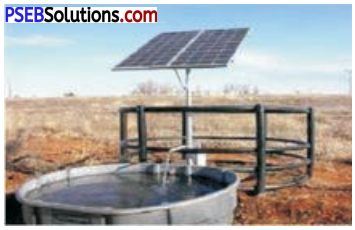
What is solar water pump?
Answer:
This pump is used to lift water from a level of 35 to 40 feet. It consists of a motor which runs by electricity produced by solar panels.
PSEB 8th Class Agriculture Solutions Chapter 4 Solar Energy 3

Question 8.
Briefly discuss solar lantern.
Answer:
This is an emergency light system. It is charged in the sun light and it can be used for 3-4 hours for lighting.

PSEB 8th Class Agriculture Solutions Chapter 4 Solar Energy 4

Question 9.
Briefly explain the working of domestic solar dryer.
Answer:
It is a small-sized solar dryer. It can be used to dry 2 to 3 kg fresh products in 2 to 3 days. Products which are dried in this dryer are normally used in powder form in the kitchen e.g. red chillies, onion, garlic, mango powder, ginger, spinach leaves etc.

PSEB 8th Class Agriculture Solutions Chapter 4 Solar Energy 5

Question 10.
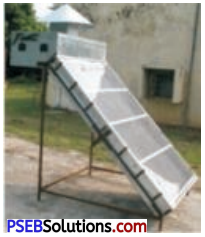
Briefly discuss the multi-product solar drier.
Answer:
Agricultural products should be dried at low air temperature than the maximum allowed temperature. High temperature may destroy the quality of the food items. This solar drier can be used for drying 20-30 kg of agricultural products per day.
PSEB 8th Class Agriculture Solutions Chapter 4 Solar Energy 6

PSEB 8th Class Agriculture Solutions Chapter 4 Solar Energy

(C) Answer in five to six sentences:

Question 1.
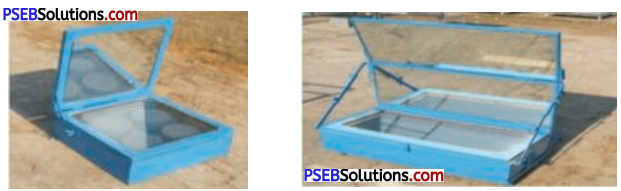
Explain the method of cooking in solar cooker.
Answer:

  • Pre heat the’solar cooker by setting up it in the sun.
  • Add just sufficient water to the container having food ingredients to be cooked in the solar cooker.
  • Vegetables, eggs etc. do not need water for cooking in solar cooker. Cut potatoes and vegetables into small pieces before placing-these into the solar cooker for cooking.
  • The container containing ingredients and water should not be filled more than half of its level.
  • Keep the top of solar cooker towards the sun.
  • Do not open the solar cooker again and again. This will delay in cooking.
  • Open the lid carefully after cooking the food, so that steam cannot hurt our body.
    PSEB 8th Class Agriculture Solutions Chapter 4 Solar Energy 7

Question 2.
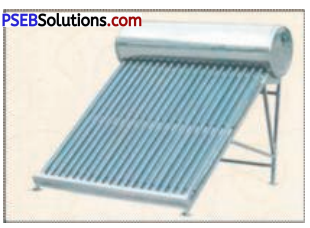
Explain the solar water heater in details.
Answer:
Solar water heater is a device used for heating water using solar energy. It consists of tubes, storage tank, tube and fix assembly, glass sheet etc.
PSEB 8th Class Agriculture Solutions Chapter 4 Solar Energy 8
Collector tubes are joined to the header of the bottom and top storage tank is insulated and is mounted in such a way that its bottom is above the top of collector by at least 60-70 cm. Front of the tube and fin assembly is covered by a glass sheet and all other sides and back are insulated. The sun rays fall on the tube and fin assembly, as a result water gets heated up, as hot water is lighter than cold water, hot water moves to the upper part of the storage tank.

PSEB 8th Class Agriculture Solutions Chapter 4 Solar Energy

Question 3.
Explain two solar dryer in detail.
Answer:
Solar dryer is used to dry vegetables and fruits. These are of two types.
Cabinet dryer:
This is a wooden box which is black from inside. It is covered with a glass sheet. Inside the box. there are perforated trays arranged at different levels, one above the other. Product to be dried is placed in these trays. There are two holes in this dryer, lower hole allows the air to enter and the hole at upper side allows the air to leave, this way air circulation takes place.

Multi product solar dryer:
This device is made up of sheets of wood and iron or of fiber glass. There are many holes at lower part and upper part for circulation of air. An arrangement has been done on the sides for placing and removing the products. There are shining rods for absorbing sunlight. Single glass sheet is fitted on the top of the box. Those trays which are used for drying the products have many holes in them. Trays are 3-4 cm in height. Cut pieces of vegetables and fruits can be dried in these trays. To protect the products from getting direct sunlight shining black plates are fixed. Since this is a solar device and uses sun rays it is placed in sunlight. Its glass top should be towards south.

Question 4.
Briefly discuss the different gadgets of solar energy.
Answer:
Do it yourself.

Question 5.
How the solar energy can be used in different ways?
Answer:
Sun is the ultimate source of energy in the world. Plants make their own food in sunlight and living beings take their food from the plants. Sun is responsible for air – water cycle, but all these things are happening automatically in nature. We can use solar energy in different ways by using different techniques, e.g.

  • We can heat water using solar energy, cook food, produce electricity. We can dry fruits and vegetables using solar energy.
  • Electricity can be produced using solar cells.
  • We can save non-renewable sources of energy by using solar energy.

PSEB 8th Class Agriculture Solutions Chapter 4 Solar Energy

PSEB 8th Class Agriculture Guide Solar Energy Important Questions and Answers

Very Short Answer Type Questions

Question 1.
How many types of natural energy source are there?
Answer:
Two types.

Question 2.
What type of energy is electricity obtained from burning of coal?
Answer:
Conventional (Non-renewable) energy source.

Question 3.
Which type of energy sources are limited?
Answer:
Non-renewable.

Question 4.
Which type of energy sources are in plenty?
Answer:
Renewable (Non-conventional).

Question 5.
How much fresh product can be dried in domestic level solar dryer and in how many days?
Answer:
2-3 kg fresh products in 2-3 days.

PSEB 8th Class Agriculture Solutions Chapter 4 Solar Energy

Question 6.
Can we prepare chapati in solar cooker?
Answer:
No.

Question 7.
In which direction solar water should face?
Answer:
Towards south.

Question 8.
How many fans and lights can be operated using solar home lighting system?
Answer:
2 tubes, 2 fans for 5 to 6 hours.

Question 9.
What is the name of solar water heater.
Answer:
Thermosyphen solar water heater and storage-cum-collector solar water heater.

Question 10.
Name any one conventional source of energy.
Answer:
Coal.

PSEB 8th Class Agriculture Solutions Chapter 4 Solar Energy

Question 11.
How much percent of conventional fuel is saved by using solar cooker?
Answer:
20% to 50%.

Question 12.
Frame of trays is made up of which material?
Answer:
G.I. sheets.

Short Answer Type Questions

Question 1.
What are the uses of solar energy?
Answer:
Solar energy is used to heat water, for drying fruits and vegetables, for cooking food etc.

Question 2.
What is the disadvantage of drying bruits and vegetables in direct sun light?
Answer:
Insects, birds and dust can harm the fruits and vegetables and their color may change.

Question 3.
What is solar heater?
Answer:
This is a device which absorb solar energy and convert it in heat energy.

PSEB 8th Class Agriculture Solutions Chapter 4 Solar Energy

Question 4.
Why is it necessary to clean the glass of solar water heater?
Answer:
Dust collects on the glass which hinders the path of sun light and therefore efficiency of the water heater is reduced. It becomes necessary to clean the glass top.

Question 5.
How can solar energy be concentrated?
Answer:
By using various types of lenses and mirrors.

Long Answer Type Question

Question 1.
How much conventional fuel is saved by using solar cookers? What are the types of solar cookers? What are the limitations of solar cookers?
Answer:
By using a solar cookers we can save 20% to 50% of conventional fuel which is used to cook food. Solar energy can be concentrated by using various types of lenses, normally these are of two types:

  1. Box type solar cooker
  2. Double reflector solar cooker.

Limitations:
We have to Place the solar cooker in such a way that it is always facing The sunlight and it has to be set again and again. The solar cooker can not be used to prepare chapatis.
PSEB 7th Class Physical Education Solutions Chapter 2 Physical Capacity and Advantages of Exercises

Punjab State Board PSEB 7th Class Physical Education Book Solutions Chapter 2 Physical Capacity and Advantages of Exercises Textbook Exercise Questions and Answers.

PSEB Solutions for Class 7 Physical Education Chapter 2 Physical Capacity and Advantages of Exercises

Physical Education Guide for Class 7 PSEB Physical Capacity and Advantages of Exercises Textbook Questions and Answers

Question 1.
What do you mean by human capacity?
Answer:
Physical capacity is required not only in games but in every field of life to perform the work. Physical capacity is the quality of the body by which a person can do his daily work without any difficulty, in other words, a person’s capacity to do maximum physical work is called human capacity. Physical capacity is to be related to the person who does a lot of physical work. People who do not know the meaning of physical capacity.

They think that physical strength is required only by the farmers, labours, etc. who do heavy physical work and perform hard duties. Besides this physical capacity is considered with players. Who has to win the medal in games. The level of physical capacity is different in every person. The capacity is different from one another. It depends upon the profession and the work they are doing.

A person who perform hardwork is possessing more capacity then a person who do not perform any work. A person who works in a shop are the one who is clerk has less physical capacity as compare to a sports person. In the same way a football and a kabaddi player as in both the games player do hard work in different way. A person’s physical quantity depends upon different qualities. The physical capacity will increase as much as you work hard.

PSEB 7th Class Physical Education Solutions Chapter 2 Physical Capacity and Advantages of Exercises

Question 2.
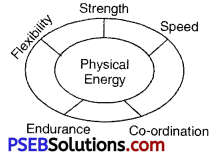
Write the name of parts of human capacity.
Answer:
Human capacity are as follows :

  • Speed
  • Strength
  • Endurance
  • Flexibility
  • Co-ordination.

Question 3.
What do you understand by speed?
Answer:
The first quality of physical capacity is speed. The ability to do a work in minimum time is called speed. Speed is a very important quality of a physical capacity that has an important role in every game. That player is considered a good player who possesses a great speed. Even in general work, the person who owns the quality of doing a work faster, completes his work earlier than others.
PSEB 7th Class Physical Education Solutions Chapter 2 Physical Capacity and Advantages of Exercises

Question 4.
What do you mean by co-ordination? What is the importance of co-ordination for a player?
Answer:
Co-ordination is also a quality of physical capacity. Co-ordination means the relation between mind and the body. The body receives the message sent by the mind and complete the soon no work is possible without the co-ordination of mind and body.

PSEB 7th Class Physical Education Solutions Chapter 2 Physical Capacity and Advantages of Exercises

Question 5.
Write in detail about the importance of human capacity.
Answer:

  • The body of a person having physical capacity remains beautiful and stout. His body has good growth and development.
  • Physical systems become able to work properly due to physical capacity, our muscles become able to do heavy work and we can do more work.
  • A person has good control on his body with his physical capacity. There is improvement in co-ordination of his brain and muscles.
  • There is less scope of heart and lung diseases e.g. blood pressure, heart attack, breathing problems, asthama etc. to the person with physical capacity.

Question 6.
What do you mean by exercise? What are the advantages of exercise?
Answer:
Walking, Running, Throwing and Climbing are the basic skills of human being. He uses all the skills in his routine life and perform exercise. Sometime forceful and brisk activities are done to improve these skills. These activities are known as exercise. The objectives of exercise to improve the circulation of blood. It has a great relationship between health and exercise. There are many advantages of exercise which are given below:

  • Muscle becomes strong and flexible.
  • Lungs contract and expand during exercise.
  • CO2 is exhaled in more quantity due to quick contraction and expansion of lungs and more of O2 is inhaled in the body. The blood is purified by this process.
  • Heart becomes healthy. There is increase in the capacity of heart and arteries become strong.
  • Digestive system of a person become more stronger with exercise.
  • Exercise remove the formitive of the body and one gets reduff joint problems.
  • New cell and new blood is produce in body. White blood cells increased and body become strong.
  • Ageing is delayed mental and physical health remain good.
  • By doing exercise health remain good and he away from evil thoughts.
  • Extra fat of the body is burned and his body become healthy, active and stout.
  • Heat is produced in the body while doing exercise and prespiration is caused impurities expell out from the body and skin becomes clear after that body become healthy.

PSEB 7th Class Physical Education Solutions Chapter 2 Physical Capacity and Advantages of Exercises

PSEB 7th Class Physical Education Guide Physical Capacity and Advantages of Exercises Important Questions and Answers

Multiple Choice Questions

Question 1.
Write the quality of Physical capacity.
(A)Speed
(B) Strength
(C) Courage and flexibility
(D) All the above.
Answer:
(D) All the above.

Question 2.
Advantage of Excercise:
(A) Muscle becomes strong
(B) Digestive system becomes strong
(C) Ageing is delayed
(D) All the above.
Answer:
(D) All the above.

Question 3.
Write more advantage of Exercise.
(A) Blood remain pure
(B) Heart becomes healthy
(C) White cells in the body increases
(D) All the above.
Answer:
(D) All the above.

PSEB 7th Class Physical Education Solutions Chapter 2 Physical Capacity and Advantages of Exercises

Very Short Answer Type Questions

Question 1.
What happens when we walk, jump, run?
Answer:
Exercise.

Question 2.
Which organ exhaled the CO2 from our body?
Answer:
Lungs.

Question 3.
How physical capacity is build?
Answer:
Regular exercise and taking balanced diet.

Question 4.
How our muscles become stronger & flexible?
Answer:
By doing exercise.

PSEB 7th Class Physical Education Solutions Chapter 2 Physical Capacity and Advantages of Exercises

Question 5.
What happen by prespiration?
Answer:
Waste products are expelled out from our body.

Question 6.
What is physical capacity?
Answer:
It is the ability of a person which enable him to perform his work smoothly.

Question 7.
Write the name of quality of physical capacity.
Answer:
Speed, Coordination, Endurance, Strength and Flexibility.

Question 8.
Write the importance of physical energy?
Answer:

  • It makes our body healthy & attractive.
  • With the help of physical energy he overcome the control of energy.

PSEB 7th Class Physical Education Solutions Chapter 2 Physical Capacity and Advantages of Exercises

Short Answer Type Questions

Question 1.
What is the effect of exercise on all parts of the body?
Answer:

  • Body becomes strong & more work is performed.
  • Digestive system work properly.
  • We feel more hungry.

Question 2.
Write any three advantages of exercise
Answer:

  • It removes the illness.
  • While doing exercise precipiration is cause and impurities of the body are expelled.
  • Age of the person is increased.

Question 3.
Write the effect of exercise on lungs.
Answer:

  • Lungs contract & expand during exercise.
  • CO2 is exhaled in more quantity.
  • More of O2 is inhaled by the body.

PSEB 7th Class Physical Education Solutions Chapter 2 Physical Capacity and Advantages of Exercises

Long Answer Type Questions

Question 1.
What are the achievement of sports person in field of sports?
Answer:
The sports person are creating new record in the fields of sports. Bring loral to their own country. Sports are limited for recreation & intest earlier. But now there are earing lot of money in sports for this very reason they work very harding improve their physical capacity. To won the medal in Olympic are breaking record in other sports. They become star in sports and become very rich by earning money from this sports. Every person intend to create a world record in the field of sports. For this very reason they have to work hard and pay special method of training modem equipment of sports. Experience coach develops all the qualities of a person in a sports. In this way, the sports person prepare himself for the demand of sports market. If is lacking in the physical energy he cannot compete with his opponents.

Question 2.
Write the qualities of physical energy.
Answer:
1. Speed
2. Strength
3. Endurance
4. Flexibility
5. Coordination.

1. Speed:
The first quality of physical capacity is speed. The ability to do a work in minimum time is called speed. Speed is very important quality of physical capacity that has an important role in every game. The player is considered a good player who possesses a great speed.

2. Strength:
The energy produced by the muscles of the body is called strength. It is required to complete any work. Every light or heavy work requires physical capacity to complete it. A strong person can do any light or heavy work easily.

3. Endurance:
The capacity to do work for a long period is called endurance. It is an important part of physical strength that helps a person to continue his work even in the state of fatigue. The long term activities cannot be completed without this quality.

4. Flexibility:
Any player’s performance in the game depends upon the body’s flexibility. It directs relate to the joints of the body. The more the person bends his joints, the more flexibility he owns.

5. Coordination:
It is also an important physical capacity like others. It means the relation between wind and the body. There will be no mistakes if the body receives the messages sent by wind and completes it soon.

PSEB 7th Class Physical Education Solutions Chapter 1 Human Body

Punjab State Board PSEB 7th Class Physical Education Book Solutions Chapter 1 Human Body Textbook Exercise Questions and Answers.

PSEB Solutions for Class 7 Physical Education Chapter 1 Human Body

Physical Education Guide for Class 7 PSEB Human Body Textbook Questions and Answers

Question 1.
What do you know about the human body?
Answer:
The human body is made up of muscles, bones, and many other small and large organs of the body like- heart, lungs, liver, kidneys, etc. When we see the kabaddi players before participating in-game and they warm up and enter into the sports field. Their attractive body is much impressed to us and we attend to be fit like kabaddi players. The players have to face many difficulties to build their bodies. It is very essential to be fit and have an attractive look. The player’s body fitness depends on its strength and power. Their achievement in sports depends on their fitness and strength to make them healthy. A sportsman must have knowledge of his body if the sportsman knows all parts of the body. He will be able to perform in sports well. If he does not know the various parts of the body and their working then he may get hurt while doing exercise and he may not be able to develop his body fitness.

PSEB 7th Class Physical Education Solutions Chapter 1 Human Body

Question 2.
In which categories can a human body be divided to understand or knowledge it?
Answer:

  • Body Posture
  • Body Function.

Question 3.
How many bones are there in a human body?
Answer:
The human body has 206 bones of different shapes and sizes which make the frame of the body by joining together.

Question 4.
What are the main organs of blood-circulation system?
Answer:
Heart, Arteries, veins and tissues are the main organs of the blood circulation system.

Question 5.
What do you know about sensory organs?
Answer:
Sensory organs are:
eyes, ears, tongue, nose, skin. We get knowledge about our surrounding and the changes of environment through them. We can see any object with our eyes. We can smell any thing with our nose. We can hear any thing with our ears. Tongue tells about different kind of tastes of eatables. Skin makes us to feel the touch of anything and realization of summer and winter.

PSEB 7th Class Physical Education Solutions Chapter 1 Human Body

Question 6.
What is the importance of excretory system in human body?
Answer:
The food we take eat only a small part of it is retained in our body and the rest of it is excreted from the body in the form of waste material when we work the energy is consumed and the result of many waste material are produce in the body. The waste material are necessary to excrete from out body. If these waste material are remain in our body may causes many diseases. Excretory system expell out the waste product out of the body. The skin and the kidney are the main part of the system. They expell the waste product in the form of urine and sweat.

Question 7.
What are the main functions of human body?
Answer:
1. Protection:
Our body consist of many soft organs like : heart, lungs and brain, which are pretected by the skeleton system like : bones of our skull protect our brain and bones of our rib cage protect our lungs and heart also.

2. Shape:
The body structure gives shape to our body. If this body structure is not present then shape of our body is irregular.

3. Movement:
All movements are possible due to the body posture. The muscles are attached to the frame of the body. The contraction and expansion of muscles causes movement in the bones and this result body to do the movement.

4. Mineral Store House:
The bones of our body act as a mineral store house. In bones they decay great quantity of calcium and phosphorus
stored in our body, which causes growth and development in human being. We should take a balanced diet in our food. If any of these elements is not sufficient in our body, the bones use to supply these.

PSEB 7th Class Physical Education Solutions Chapter 1 Human Body

PSEB 7th Class Physical Education Guide Human Body Important Questions and Answers

Multiple Choice Questions

Question 1.
In which categories can a human body be divided to understand or knowledge of:
(A) Two
(B) Three
(C) Four
(D) Five.
Answer:
(A) Two

Question 2.
How many bones are there in human?
(A) 206
(B) 220
(C) 300
(D) 250.
Answer:
(A) 206

Question 3.
Main functions of human body :
(A) Protection
(B) Shape
(C) Movement
(D) All the above.
Answer:
(D) All the above.

Question 4.
Organs of Blood Circulation :
(A) Heart
(B) Arteries
(C) Veins
(D) All the above.
Answer:
(D) All the above.

PSEB 7th Class Physical Education Solutions Chapter 1 Human Body

Question 5.
Main system of Body.
(A) Muscular System
(B) Circulatory System
(C) Respiratory System
(D) All the above.
Answer:
(D) All the above.

Very Short Answer Type Questions

Question 1.
Which material is used to make the human body?
Answer:
Muscles, Bones and some small and big orgAnswer:

Question 2.
Write the three body orgAnswer:
Answer:
Heart
Lungs
kidneys

Question 3.
Who protect our soft organs?
Answer:
Bones and ribs.

PSEB 7th Class Physical Education Solutions Chapter 1 Human Body

Question 4.
Which body organ is protected by the skull?
Answer:
It protects the brain.

Question 5.
Who provide shape to our body?
Answer:
Skeletal system provide shape to our body.

Question 6.
What happen if bones are not present in our body?
Answer:
It becomes big flash of skin.

Question 7.
How we get the movements to our body?
Answer:
Muscles create the movements in our body.

Question 8.
Who stored the minerals?
Answer:
Bones stored the minerals in our body.

Question 9.
Which are the important systems in our body?
Answer:
Circulatory system, Respiratory system.

PSEB 7th Class Physical Education Solutions Chapter 1 Human Body

Question 10.
Which system help us in running and walking?
Answer: Muscular System.

Question 11.
Write the main organs of respiratory system.
Answer:
Nose, Wind pipe, Lungs.

Question 12.
Which system provides energy to our body?
Answer:
Digestive System.

Question 13.
Write the main organs of excretory system.
Answer:
Skin and Kidneys.

Question 14.
Write the function of the nervous system.
Answer:
Messages of Brain provides to the body organs and activities of body organs provide to brain.

Short Answer Type Questions

Question 1.
What steps should be taken by a sportsman to make our body beautiful and attractive?
Answer:
They should work hard to make his body fit and fine.

PSEB 7th Class Physical Education Solutions Chapter 1 Human Body

Question 2.
What did the sportsman knows for their progress?
Answer:
Players should know the various parts of the body, their work and efficiency of the body.

Question 3.
Which mineral is stored in bones?
Answer:
Calcium and Phosphorus.

Question 4.
From which we get the energy?
Answer:
We get the energy from our food. The food we intake after so many chemical changes we get the energy. The digestive system tells us how the food is absorbed and how we can get the energy from it.

Question 5.
How the human body was?
Answer:
Human body is like a machine and different system like its parts. To run the machine properly all parts should be work together. If any system of our body is disturbed. The effect can be effect on the whole body and a man can suffer. It is important to get the knowledge about our body to keep healthy.

Question 6.
What is the difference between veins and arteries?
Answer:
The arteries carries the pure blood from heart to all organs. Veins carries impure blood from body organs to heart.

PSEB 7th Class Physical Education Solutions Chapter 1 Human Body

Long Answer Type Questions

Question 1.
Why we should have the knowledge about different body organs?
Answer:
Our body system consist of many system and they combine to do different works. It is important that all the system work properly. If any of the system stops working properly then our body is effected and causes many problems.
1. Muscular System:
By this system we know about muscles. Due to muscles we are able to run, walk etc. Our body also works properly due to these muscles.

2. Circulatory System:
The blood keeps circulating in our body continuously the main organs of this system is heart, arteries, veins and tissues. The heart always remains beating and through the veins circulate the blood to the whole body. We can see blue arteries on the upper parts of our hands which takes blood towards the heart.

3. Respiratory System (Breathing System):
To our human body oxygen always require to live. We take O2 through breathing and exhale CO2. Nose, wind pipes and lungs are the main parts of this organ.

4. Digestive System:
We need energy to work. This energy is derived from food. The food we intake becomes very useful to our body after chemical process. We come to know how the food is digested and how the energy produced by it.

5. Excretory System:
The food we eat, only a small part of it is retained in our body and at rest of it is excreted from body in the shape of waste materials. In the similar way, when we work, the energy is consumed as a result many waste materials are produced in the form of sweat and urine.

6. Sense Organs:
Eyes, nose, ears, tongue and skin are the main parts of this system. We get knowledge about our surrounding and the change of environment through them.

7. Nervous System:
Brain controls all the activities of human body. There is a net of nervous system spread in the whole body that send message of’brain to different parts of the body and vice versa.

PSEB 7th Class Physical Education Solutions Chapter 1 Human Body

Question 2.
Write the advantages of different body systems?
Answer:
All the body systems are vital for body but the blood circulation and breathing system among are very important. Any one system of these two, if stops working even for a short while, a man can die. Continuous flow of blood and O2 in the body is very necessary to keep and human being alive. Human body is like a machine and different system of the body are like its parts. To make the machine run properly, it is important that all its parts should work properly. If any system of our body is disrupted, its effect can be felt on the whole body and the main becomes ill.

PSEB 8th Class Physical Education Solutions Chapter 2 Nutritious and Balanced Diet

Punjab State Board PSEB 8th Class Physical Education Book Solutions  Chapter 2 Nutritious and Balanced Diet Textbook Exercise Questions and Answers.

PSEB Solutions for Class 8 Physical Education Chapter 2 Nutritious and Balanced Diet

Physical Education Guide for Class 8 PSEB Nutritious and Balanced Diet Textbook Questions and Answers

Question 1.
What do you mean by food?
Answer:
Food is very important for our body because it helps in the growth and development of our body. It repairs old cells and forms the new cells. Food prevents us from diseases. We consider such things as food which becomes part of our body after taking it and develops the body.

PSEB 8th Class Physical Education Solutions Chapter 2 Nutritious and Balanced Diet

Question 2.
What do you mean by nutritious food?
Answer:
The following are the constituents of nutritious food:

  • Proteins
  • Vitamins
  • Carbohydrates
  • Fats
  • Mineral Salts
  • Water.

Question 3.
What do you mean by balanced diet?
Answer:
Balanced Diet. Balanced diet is the diet which has all the nutrients in right proportion and which is capable of fulfilling all the needs of the body. It should have all nutrients like carbohydrates, proteins, fats, vitamins, minerals, salts and water in proper proportion. Such a diet needs to be taken for the proper development of body, protection from diseases and good health. No single item of food is balanced diet in itself. Only milk is an exception, as it has got almost all nutrients.

Question 4.
What do you understand by protein? How many types of proteins are there?
Answer:
Proteins:
Protein is a complex compound consisting of carbon, hydrogen, oxygen, sulphur, phosphorus and nitrogen. It is of two kinds vegetable protein and animal protein.

Sources:
1. Vegetable Protein: It is available in soyabeans, groundnuts, cashew-nuts, pistachio, walnuts, wheat, millet, maize, etc.
2. Animal Protein: It is available in meat, fish, egg, cheese, etc.
PSEB 8th Class Physical Education Solutions Chapter 2 Nutritious and Balanced Diet 1
Advantages of Protein:

  • It ensures physical growth and development
  • It repairs broken tissues
  • It keeps the body temperature normal
  • It produces energy in case there is lack-of the quantity of carbohydrates or fats in the body.

Harms due to lack of Proteins:
The body catches the following diseases due to lack of proteins-
1. Kwashiorkor:
This disease is common in children in the age group of 1-3 years in case there is lack of proteins. At first, the child’s legs are affected. Then this disease causes swelling on the face and then the whole body. The skin of the child becomes rough and red. The child becomes irritated.

2. Rickets or Rachitis:
As a result of the lack of proteins children suffer from rachitis. A child affected with this disease looks very thin and weak. Bones are visible through his flesh.

3. Hunger Oedema:
Because of prolonged hunger and lack of protein, the body does not get nourishment, and water gets accumulated in cells, and body appears to be swelled up.

4. Pellagra: As a result of this disease, one’s skin appears to be rough and dry.

5. Defect in the Liver. Liver gets damaged due to the lack of protein in food.

Harms due to excess of Proteins:
One may suffer from kidney ailments in case of excessive intake of proteins. Blood vessels too get affected and one begins to have joint pains.

Proper quantity:
Children in the age group of 1-6 years are in dire need of proteins in large amount. A normal person should consume 70 to 100 gms. of proteins every day.

PSEB 8th Class Physical Education Solutions Chapter 2 Nutritious and Balanced Diet

Question 5.
What are carbohydrates? What are the harmful effects of its deficiency and excess.
Answer:
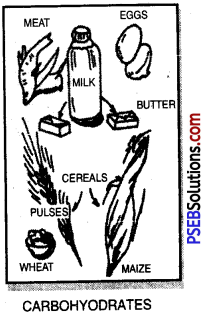
Carbohydrates: Carbohydrates provide heat and energy to the body. Indians, in general, compensate 70-80% of their food with this element.

Sources: Carbohydrates are available in wheat, rice, barley, maize, millet, jaggery, sugar, potatoes, etc.

Advantages of Carbohydrates:

  • Carbohydrates provide heat and energy to the body.
  • They help in digesting fat.
  • They cleanse intestines and liver.

Harms due to lack of Carbohydrates:

  • As a result of the lack of carbohydrates, blood loses its alkaline nature, and becomes more acidic. In such a condition, a person may become unconscious. In such a condition due to hunger one may get diabetes.
  • Intestines are not cleaned properly.
  • As a result of lack of carbohydrates, fats remain undigested in the body.
  • As a result of lack of carbohydrates acidic elements in the liver get cleansed, and it is harmful to the body
  • A person becomes very weak and may die in case there is excess of lack of carbohydrates in his food.
    PSEB 8th Class Physical Education Solutions Chapter 2 Nutritious and Balanced Diet 2

Harms due to excess of Carbohydrates:
The excess of carbohydrates causes-

  • fatness
  • high blood pressure
  • joint pains and
  • diabetes.

Proper Quantity:
Our food has 50-80% of carbohydrates. 50-60% part of balanced diet consists of carbohydrates. A normal person should have 400 to 700 gms. of carbohydrates in his daily food.

PSEB 8th Class Physical Education Solutions Chapter 2 Nutritious and Balanced Diet

Question 6.
What do you mean by fats? What are its types.
Answer:
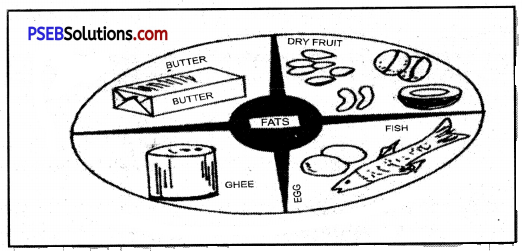
Fats are of two types-
(i) vegetable fats
(ii) animal fats.

Sources.
1. Vegetable Fats. These are available in almonds, walnuts, soyabeans, groundnuts, coconut oil, mustard, etc.
2. Animal Fats. These are available in ghee, butter, milk, meat, fish, egg, etc.
PSEB 8th Class Physical Education Solutions Chapter 2 Nutritious and Balanced Diet 3

Advantages:

  • It provides energy to the body.
  • It keeps the body temperature stable.
  • It protects all parts of the body against external injuries.
  • It keeps in reserve vitamins A, D and K according to the needs of the body.

Harms due to the lack of Fats:
The body suffers in the following ways in case there is lack of fats-

  • Skin becomes dry.
  • The deficiency of vitamins A, D and K follows.
  • The skin goes dry because of the lack of acids of fat.

Harms due to excess of Fats:
The excess of fats in one’s food also proves to be harmful in the following ways-

  • One suffers from obesity.
  • Heart diseases are caused.
  • Digestion weakens.
  • One suffers from diabetes.
  • Stones may form in the abdomen.

Proper Quantity: A normal person should have 50 to 75 gms. of fats in his daily food.

PSEB 8th Class Physical Education Solutions Chapter 2 Nutritious and Balanced Diet

Question 7.
Milk is a complete food. Explain it?
Answer:
Milk:
Milk is an ideal and whole food. It has got all the essential nutrients. It has 3.6% fat, 3.4% protein, 4.8% carbohydrates, 0.7% salts and 7.5% water. Milk is given to growing children because it is a complete food. At home, patient is also given milk which acts as complete food.
For good health, milk serves as a balanced diet.

All the essential nutrients as proteins, carbohydrates, fats, minerals, salts, water, vitamins are available in milk in right proportion. All these nutrients have different functions to perform in our body. Milk is considered to be an ideal food as it has all the essential nutrients including vitamins, though it does not have iron.

Question 8.
What are the principles of cooking food?
Answer:
Cooking Food:
Properly cooked food is useful for health. Food must be cooked properly, if food is over cooked, it does loses some essential nutrients like vitamins C and D. Food must be cooked properly for the following reasons:

  • Properly cooked food becomes easily digestible.
  • By cooking food disease causing germs get killed.
  • Cooked food is tasty. One feels like eating it.
  • We can preserve the cooked food for long.

Methods of Cooking food:
The following methods for cooking food are generally followed-

  1. Boiling
  2. Cooking with steam
  3. Roasting
  4. Frying

These methods are explained in brief below:
1. Boiling:
In this method, food articles are cooked by boiling in water. But essential vitamins and mineral salts dissolve in water and are lost in this method of cooking. A little quantity of water should be used in boiling eatables. If water used in boiling is excessive, it should not be thrown. Rice, pulses, meat and vegetables are cooked by boiling.

2. Cooking with Steam:
Food is also cooked with steam. Essential nutrients do not get lost in cooking by this method. The food cooked in a steam cooker is nutritious and beneficial to health. So this method is considered to be better than other methods.

3. Roasting:
In this method, food is directly roasted on the fire. Excessive roasting also destroys essential nutrients. The roasted meat is tasty and easily digestible.

4. Frying:
There are many food items such as ‘pakora’, ‘samosa’ and “purian” which are fried. Food is cooked very soon by frying. But essential nutrients also get lost in this method. Moreover, fried food is not easily digestible, and is often harmful to one’s health. Best Method. Of all the methods of cooking, cooking with steam is the best. The food cooked in this way does not lose essential nutrients and it is very beneficial to one’s health.

PSEB 8th Class Physical Education Solutions Chapter 2 Nutritious and Balanced Diet

Question 9.
Explain the rules of taking food.
Answer:

  • Always have your food at a fixed time. Untimely eaten food causes indigestion.
  • Wash your hands with soap before taking meals and always wear clean clothes. Nails should be cut and cleaned.
  • We should not eat too hot or too cold food. Hot food causes blisters or boils and cold food cannot be chewed properly.
  • Food should be taken in an adequate quantity, over-eating may cause indigestion.
  • Food should be chewed slowly and properly so that it can be digested easily.
  • Food should be nutritious and easily digestible.
  • Never take stale food because it causes food poisoning.
  • We should be happy while taking food. Never talk or watch T.V. while taking food.
  • Take dinner at least two hours before sleeping because it is dangerous to sleep immediately after taking a meal.
  • Rest a while after meals.

Question 10.
Right notes on the following:
(a) Roughage
(b) Water
(c) Minerals
(d) Cooking food.
Answer:
(a) Roughage:
Wheat, pulses, vegetables, fruits, dry fruits, milk, meat, fish are the main food products. The advantages of these are as under:
(i) Cereals:
Wheat, rice, grams, maize, barley are generally taken as food.

Advantages of Cereals:

  • These are helpful for the formation of our body.
  • Food provides energy to body.
  • They contain too much carbohydrates.
  • The outer parts of these food material provide iron, lime, vitamins and proteins.
  • They are very useful to remove constipation.

(ii) Pulses:
Soyabean, peas, turnip, almonds are counted in pulses. These pulses provide us vitamins A, B, and C. They also supply us with proteins, minerals, salt, iron and phosphorus.

Advantages of Pulses:

  • These provide energy.
  • Increase appetite.
  • Improve digestion.

(iii) Vegetables:
Cauliflower, palak, sarson ka saag, methi, carrots, walnut, turnip, tomatoes, potatoes, peas, cabbage and onion are the main vegetables.

Advantages of Vegetables:

  • Vegetables protect our body.
  • Vegetables maintain the health of a person.
  • They purify the blood.
  • They prevent constipation.

(b) Water:
Our body is composed of 2/3rd of water. It is formed of the combination of oxygen and hydrogen. It is as important as air for our body.
Sources. It is available in pure form in many nutrients also such as milk, fruit and vegetables.

Uses of Water:

  • Water helps in the formation of cells.
  • It carries nourishment to cells. It helps in the excretion of waste products from the body.
  • It helps in digestion of food.
  • It regulates the heat in our body.
  • It helps in mixing nutrients with blood.
  • It keeps the parts and joints of body soft.
  • It ensures blood circulation in the body.

Harms due to lack of Water:
There are many harms of drinking less water-

  • The food does not digest properly in case one drinks less water.
  • Liver remains heavy.
  • Constipation is caused.
  • One feels physical fatigue all the time.
  • The body gets weakened.
  • The face turns pale.
  • Waste products in the body do not get excreted properly.
  • One is afflicted with joint pains.
  • Stones are formed in kidneys.

Harms due to excess of Water:
Water should always be taken in right proportion. Liver remains filled by taking water in excess and one does not feel appetite. If one continues taking water with food, food does not digest properly.

Proper Quantity:
The quantity of water intake varies with season, exercise and food. Normally, 5-6 glasses of water a day are enough for a normal person.

(c) Minerals:
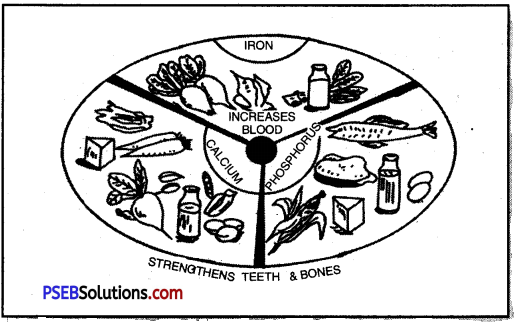
Our body has 4% of minerals and salts. Phosphorus, calcium, sodium, chlorine, potassium, magnesium, manganese, iodine and zinc are some prominent minerals.
PSEB 8th Class Physical Education Solutions Chapter 2 Nutritious and Balanced Diet 4
Sources:
Minerals and salts are available in green vegetables, fruits, meat, milk. Milk has less amount of iron, but it has all other minerals.

Advantages of Minerals:
1. They help in the development of muscular tissues.
2. They make the blood red.
3. Calcium helps in blood clotting.
4. Iron is very important for the formation of blood.
5. Minerals help in the Topper functioning of all parts of the body.

Harms due to lack of Minerals:

  • The lack of calcium causes the weakening of teeth and bones.
  • Body loses its power of resistance to diseases.
  • The lack of iodine is the cause of goitre in the body.

(d) Cooking Food:
Properly cooked food is useful for health. Food must be cooked properly, if food is over cooked, it does loses some essential nutrients like vitamins C and D. Food must be cooked properly for the following reasons:

  • Properly cooked food becomes easily digestible.
  • By cooking food disease causing germs get killed.
  • Cooked food is tasty. One feels like eating it.
  • We can preserve the cooked food for long.

Methods of Cooking food:
The following methods for cooking food are generally followed-

1. Boiling
2. Cooking with steam
3. Roasting
4. Frying

These methods are explained in brief below:
1. Boiling:
In this method, food articles are cooked by boiling in water. But essential vitamins and mineral salts dissolve in water and are lost in this method of cooking. A little quantity of water should be used in boiling eatables. If water used in boiling is excessive, it should not be thrown. Rice, pulses, meat and vegetables are cooked by boiling.

2. Cooking with Steam:
Food is also cooked with steam. Essential nutrients do not get lost in cooking by this method. The food cooked in a steam cooker is nutritious and beneficial to health. So this method is considered to be better than other methods.

3. Roasting:
In this method, food is directly roasted on the fire. Excessive roasting also destroys essential nutrients. The roasted meat is tasty and easily digestible.

4. Frying:
There are many food items such as ‘pakora’, ‘samosa’ and “purian” which are fried. Food is cooked very soon by frying. But essential nutrients also get lost in this method. Moreover, fried food is not easily digestible, and is often harmful to one’s health. Best Method. Of all the methods of cooking, cooking with steam is the best. The food cooked in this way does not lose essential nutrients and it is very beneficial to one’s health.

PSEB 8th Class Physical Education Solutions Chapter 2 Nutritious and Balanced Diet

PSEB 8th Class Physical Education Guide Nutritious and Balanced Diet Important Questions and Answers

Multiple Choice Questions

Question 1.
Balanced diet contains:
(A) Protein
(B) Carbohydrates
(C) Fats and Mineral Salts
(D) Above all.
Answers:
(D) Above all.

Question 2.
How the protein is made?
(A) Carbon
(B) Oxygen
(C) Hydrogen
(D) None of them.
Answers:
(A) Carbon
(B) Oxygen
(C) Hydrogen

Question 3.
How many types of Protein?
(A) Two
(B) Three
(C) Four
(D) Five.
Answers:
(A) Two

Question 4
Write the sources of Fat:
(A) Fruits .
(B) Soyabeans
(C) Groundnuts
(D) All above.
Answers:
(A) Fruits .
(B) Soyabeans
(C) Groundnuts

PSEB 8th Class Physical Education Solutions Chapter 2 Nutritious and Balanced Diet

Question 5.
Mention the types of carbohydrates
(A) Two
(B) Three
(C) Four
(D) Five.
Answers:
(A) Two

Question 6.
Important food is:
(A) Butter
(B) Fruits
(C) Almond or Milk
(D) None of these.
Answers:
(C) Almond or Milk

Question 7.
The rules of eating food:
(A) Always have your food at fix time.
(B) Wash your hands with soap before taking meal.
(C) Food should be chewed slowly.
(D) All above.
Answer:
(A) Always have your food at fix time.
(B) Wash your hands with soap before taking meal.
(C) Food should be chewed slowly.
(D) All above.

PSEB 8th Class Physical Education Solutions Chapter 2 Nutritious and Balanced Diet

Very Short Answer Type Questions

Question 1.
What is the meaning of food?
Answer:
Those eatable things which satisfy our hunger and develop our body are called food.

Question 2.
Write down the salts, which are found in our food?
Answer:
Calcium, phosphorus, iron, sodium, magnesium, potassium, iodine, chlorine, and sulphur are salts found in our body.

Question 3.
Why the food cooked on steam is considered well?
Answer:
Because the food cooked by steam does not destroy the nutritious elements.

PSEB 8th Class Physical Education Solutions Chapter 2 Nutritious and Balanced Diet

Question 4.
What is the percentage of water in our body?
Answer:
There is 60% of water in the body of a human being.

Question 5.
How many types of proteins are there? Write their names.
Answer:
Proteins are of two types:

  • Animal proteins
  • Vegetable proteins.

Question 6.
Mention sources of Animal Proteins
Answer:
It is available in meat, fish and milk.

Question 7.
Mention the three sources of Vegetable Proteins.
Answer:
It is available in soyabeans, groundnuts and cashew-nuts.

PSEB 8th Class Physical Education Solutions Chapter 2 Nutritious and Balanced Diet

Question 8.
What are Carbohydrates?
Answer:
Carbohydrates contain Carbon, Hydrogen and Oxygen.

Question 9.
Mention the types of vitamins.
Answer:
Vitamins are of six types-A, B, C, D, E and K.

Question 10.
Lack of which vitamin causes night blindness?
Answer:
Lack of Vitamin A.

Question 11.
Lack of which vitamin causes Berry-Berry disease?
Answer:
Lack of Vitamin B.

Question 12.
Lack of which vitamin causes Scurvy disease?
Answer:
Lack of Vitamin B.

PSEB 8th Class Physical Education Solutions Chapter 2 Nutritious and Balanced Diet

Question 13.
What is the cause of Pyoria?
Answer:
Lack of Vitamin C.

Question 14.
Lack of which vitamin causes infertility in women?
Answer:
Lack of Vitamin E.

Question 15.
Mention the vitamins which are not soluble in water?
Answer:
Vitamins C, D and K.

Question 16.
Which milk is useful for a child?
Answer:
Mother feed.

Question 17.
What are the various methods of cooking food? Name them.
Answer:

  • Boiling
  • Roasting
  • Frying
  • Cooking with steam.

PSEB 8th Class Physical Education Solutions Chapter 2 Nutritious and Balanced Diet

Question 18.
How much quantity of proteins should we take in our daily meals?
Answer:
70 to 100 grams.

Question 19.
Describe the main constituents of carbohydrates.
Answer:
Starch and sugar.

Question 20.
Name the constituents of proteins.
Answer:
Carbon, Nitrogen, Hydrogen and Sulphur.

Question 21.
To whom do we call life giving?
Answer:
Vitamins.

Question 22.
Which vitamins are soluble?
Answer:
Vitamins B and C.

Question 23.
How much Fat do we require in our meals?
Answer:
50 to 70 gms.

PSEB 8th Class Physical Education Solutions Chapter 2 Nutritious and Balanced Diet

Question 24.
Which disease is caused by lack of iron?
Answer:
Lack of Haemoglobin.

Question 25.
What should be kind of Dinning site?
Answer:
Clean and airy.

Short Answer Type Questions

Question 1.
What is the meaning of food?
Answer:
Food is very important for our body because it helps in growth and development of our body. It repairs olcfcells and forms the new cells.
Food prevents us from diseases. We consider such thing as food which becomes part of our body after taking it and develops the body.

Question 2.
Why it is necessary for our body?
Answer:
Everybody needs food for living. Daily we take part in many activities or perform so many types of work. To perform these activities we need energy. This energy is derived from food.

Question 3.
What are the advantages of food?
Answer:

  • Food provides energy to the body.
  • Food helps growth and development of the body.
  • Food helps in the formation of new cells.
  • Food helps in repairing the broken cells.
  • Food helps in preventing diseases.

PSEB 8th Class Physical Education Solutions Chapter 2 Nutritious and Balanced Diet

Question 4.
Name the main nutrients of food.
Answer:
The following are the constituents of food:

  • Proteins
  • Vitamins
  • Carbohydrates
  • Fats
  • Mineral Salts
  • Water.

Question 5.
How is water useful for our body?
Answer:
Our body needs water to live. We cannot live without water. Advantages of Water.

  • It carries nourishment to cells. It helps in the excretion of waste products from the body.
  • It regulates the heat in our body.
  • It helps digestion of food.
  • It helps in mixing nutrients with blood.
  • It keeps the parts and joints of the body soft.
  • It ensures blood circulation in the body.

PSEB 8th Class Physical Education Solutions Chapter 2 Nutritious and Balanced Diet

Question 6.
Why it is compulsory to cook food?
Answer:
Need for cooking food. Properly cooked food is useful for health. Food must he cooked properly. If food is overcooked, it loses some essential nutrients like vitamins C and D. Food should be cooked for the following reasons:

  • Properly cooked food becomes easily digestible.
  • By cooking food disease-causing germs get killed.
  • Cooked food is tasty, one feels like eating it.
  • We can preserve the cooked food for long.

PSEB 9th Class Agriculture Solutions Chapter 3 Flower Cultivation

Punjab State Board PSEB 9th Class Agriculture Book Solutions Chapter 3 Flower Cultivation Textbook Exercise Questions and Answers.

PSEB Solutions for Class 9 Agriculture Chapter 3 Flower Cultivation

Agriculture Guide for Class 9 PSEB Flower Cultivation Textbook Questions and Answers

(A) Answer 1-2 words:

Question 1.
Which is the major cut flower crop?
Answer:
Gladiolus.

Question 2.
Which is the major loose flower crop?
Answer:
Marigold.

Question 3.
How much area is under flower crops in Punjab?
Answer:
The area under cultivation of flowers in Punjab is around 2160 hectares out of which 1300 hectares area is under fresh flowers.

PSEB 9th Class Agriculture Solutions Chapter 3 Flower Cultivation

Question 4.
What are different types of flowering crops being cultivated in Punjab?
Answer:
Divided into two categories :

  • Loose flowers
  • Cut flowers.

Question 5.
When Gladiolus corms are planted in the field?
Answer:
September to mid-November.

Question 6.
Which month is suitable for making Chrysanthemum cuttings?
Answer:
End June to mid-July.

Question 7.
How Gerbera is propagated?
Answer:
Through tissue culture.

Question 8.
Which color of the rose is widely grown for loose flower production?
Answer:
Red Rose.

Question 9.
Which flowers are used for the extraction of oil?
Answer:
Flowers of Tuberose, Motia (Jasmine).

Question 10.
Which flower is generally grown in protected conditions?
Answer:
Gerbera.

(B) Answer in 1-2 sentences:

Question 1.
Define cut flowers and name the major cut flower crops under cultivation.
Answer:
These are flowers that are cut with long stems or branches. Some of the major cut flowers are Gladiolus, Gerbera, Chrysanthemum, Rose, and Lilium.

Question 2.
How Gladiolus spikes are harvested and stored?
Answer:
Gladiolus flower spikes are harvested when the basal floret is half or fully open. These cut spikes can be stored by keeping them in water for nine days in a cold store.

Question 3.
How the roses are propagated?
Answer:
Propagation of rose plants can be done

  • by T-budding for cut flower varieties
  • from stem cuttings for loose flowers.

Question 4.
Which months are suitable for raising the nursery of Marigold crop?
Answer:
For rainy season nursery is raised during last week of June to first week of July. For winter it is done in mid September and foT summer first week of January.

Question 5.
What is the planting time for winter season marigold?
Answer:
In winter season marigold is sown during the mid September.

PSEB 9th Class Agriculture Solutions Chapter 3 Flower Cultivation

Question 6.
Write harvesting stages of the following flowers :

  1. Gladiolus
  2. Rose as cut flower
  3. Motia.

Answer:

  1. Gladiolus. Harvesting is done when the basal floret is half or fully open.
  2. Rose as a cut flower. It is harvested at the tight bud (closed) stage.
  3. Motia. These are harvested at the unopened flower buds stage.

Question 7.
What is plant spacing in African and French marigolds?
Answer:
For African marigold spacing is 40 x 30 cm and for French marigold, spacing is 60 x 60 cm.

Question 8.
What is planting time of Gerbera ? For how many years Gerbera crop gives flowers?
Answer:
Planting time for Gerbera is September to October. This crop once planted can produce flowers for three years.

PSEB 9th Class Agriculture Solutions Chapter 3 Flower Cultivation Img 6

Question 9.
Write names of loose flowers and write their uses.
Answer:
Loose flowers are Rose, Marigold, Motia, Chrysanthemum etc. These flowers are used for making garlands, used for worshipping God and for other decorative purposes.

Question 10.
Which is the appropriate soil for Jasmine production?
Answer:
Light to heavy soil with good drainage are appropriate soils for Jasmine.

(C) Answer in 5-6 sentences:

Question 1.
What is the importance of flowers in human life?
Answer:
Flowers are very important in human life. These make the world around us beautiful and colourful. Flowers play an important role in cultural and customary events. During marriage ceremonies, birthdays, flowers are used to complete some customs and are also used for decorative purposes. Devotees present flowers to their gods in the temples and other religious places to show their respect, faith and devotion. Chief guests are welcomed by presenting flowers to them in the form of bouquets or garlands. Women use flower as part of their make up. Flower cultivation has become economically beneficial for the farmers. Thus flowers play an important role in our life.

Question 2.
What is the difference between cut flowers and loose flowers? Give examples.
Answer:

  • Loose flowers: These flowers are harvested without stem. Examples of such flowers are Marigold, Motia, Chrysanthemum etc. These are used for making garlands, for worshipping gods and for other decorative purposes.
  • Cut flowers: These flowers are harvested with a long stem or branch attached with them. These are marketed as such with stem. These are usually used for making bouquets e.g.Gladiolus, Chrysanthemum, Gerbera, Rose, Lilium etc.

Question 3.
Write a brief note on importance and cultivation of motia.
Answer:
It is one of the main flower among fragrant flowers. These flowers are used to extract fragrant oil. These are also used for worshipping gods.
Climate. Summer season and dry climate is suitable for their growth.

PSEB 9th Class Agriculture Solutions Chapter 3 Flower Cultivation Img 5

Soil. Light to heavy soils with good drainage are suitable. Appearance of flower. Flowers appear during the months of July—August.
Harvesting. Unopened flower buds are harvested for marketing.

Question 4.
Write a short note on transplanting, harvesting and yield of marigold.
Answer:
Marigold is one of the major loose flowers crop of our state. It is cultivated throughout the year. Soils of Punjab are found very appropriate for the cultivation of Marigold.
Sowing Nursery: For rainy season nursery is sown during last week of June to first week of July, for winter in mid September and for summer in first week of January. The seedlings are ready in a month of transplanting.
Varieties:L These are of two types—African and French.

PSEB 9th Class Agriculture Solutions Chapter 3 Flower Cultivation Img 4

  • Spacing: For African variety spacing should be 40 x 30 cm and for French variety spacing should be 60 x 60 cm.
  • Flowering: Flowering starts after 50-60 days of transplanting.
  • Harvesting: Fully opened flowers are harvested.
  • Yield: Average yield in rainy season is 200 quintal per hectare and in winter it is 150 to 170 quintal per hectare.

Question 5.
How the following flowers are propagated?
1. Gladiolus
Answer:
Gladiolus. It is propagated by planting corms in the field.

PSEB 9th Class Agriculture Solutions Chapter 3 Flower Cultivation

2. Tuberose
Answer:
Tuberose. These are propagated from underground bulbs.

3. Chrysanthemum
Answer:
Chrysanthemum. These are propagated by stem cuttings of plants. These are cut from old plants.

4. Gerbera.
Answer:
Gerbera. These plants are propagated through tissue culture.

Very Short Answer Type Questions:

Question 1.
How much area comes under fresh flower cultivation?
Answer:
1300 hectare.

Question 2.
What type of flowers are Gladiolus, Chrysanthemum, Gerbera?
Answer:
Cut flowers.

Question 3.
What type of flowers are Rose and Motia?
Answer:
Loose flower.

Question 4.
How Gladiolus plants are propagated?
Answer:
From corms.

Question 5.
What is the sowing time of corms of Gladiolus in the fields?
Answer:
From September to mid-November.

Question 6.
When can the cultivation of marigold be done?
Answer:
Throughout the year.

PSEB 9th Class Agriculture Solutions Chapter 3 Flower Cultivation

Question 7.
Which soil is good for the cultivation of Marigold?
Answer:
All soils of Punjab are suitable for the cultivation of Marigold.

Question 8.
Name the varieties of Marigold.
Answer:
African and French.

Question 9.
How much seed is required for raising seedlings for one acre?
Answer:
600 gram.

Question 10.
When is the nursery of Marigold sown for the rainy season?
Answer:
Last week of June to first week of July.

Question 11.
After how many days of transplanting Marigold the crop starts flowering?
Answer:
After 50-60 days.

Question 12.
What is the yield of Marigold in rainy season?
Answer:
Around 200 quintals per hectare.

Question 13.
What is the yield of Marigold in winter?
Answer:
150-170 quintal per hectare.

Question 14.
From which plants Chrysanthemum cutting are obtained?
Answer:
These are cut from old plants.

Question 15.
When the stem cuttings of Chrysanthemum are done?
Answer:
Last week of June to mid July.

Question 16.
When are stem cuttings of chrysanthemum planted in fields?
Answer:
Mid July to mid September.

Question 17.
Give plant spacing for Chrysanthemum.
Answer:
30 x 30 cm.

Question 18.
When does the flowers appear on the chrysanthemum?
Answer:
November-December.

Question 19.
At what height the cut stems are harvested above ground level?
Answer:
5 cm above the ground level.

Question 20.
When do we get rose flowers in Punjab?
Answer:
November to February-March.

Question 21.
What is the colour of Gerbera flowers?
Answer:
Red, orange, white, pink, yellow.

Question 22.
When are.Gerbera flowers planted?
Answer:
September to October.

Question 23.
How many types of Tuberose are there?
Answer:
Two types—single and double.

Question 24.
Which type of Tuberose is more fragrant?
Answer:
Single type.

PSEB 9th Class Agriculture Solutions Chapter 3 Flower Cultivation

Question 25.
When are the bulbs of tuberose planted?
Answer:
February-March.

Question 26.
When do the flowers of Tuberose appear?
Answer:
July-August.

Question 27.
Give yield of Tuberose.
Answer:
Cut flowers 80,000 or 2-2.5 tons of loose flowers per acre.

Question 28.
Name a fragrant giving flower.
Answer:
Motia.

Question 29.
What is the color of Motia flowers?
Answer:
White.

Question 30.
When do we get Motia flowers?
Answer:
April to July-August.

Short Answer Type Questions:

Question 1.
How to prepare bulbs of Gladiolus for planting in the next season?
Answer:
Corms are dug out from the soil after 6-8 weeks of harvesting the spikes. These corms are cleaned. These are dried in shade and are stored in a cold store for planting in the next season.

Question 2.
When is the nursery of marigold raised?
Answer:
Sowing Nursery. For the rainy season nursery is sown during last week of June to first week of July, for winter in mid September and for summer in first week of January. The seedlings are ready in a month of transplanting.

Question 3.
When are the cuttings for Chrysanthemum prepared?
Answer:
Stem cuttings are cut from the old plants which are known as mother stock from end June to mid July.


PSEB 9th Class Agriculture Solutions Chapter 3 Flower Cultivation Img 1

Question 4.
When do the flowers of Chrysanthemum appear and write about their harvesting?
Answer:
Chrysanthemum flowers appear in November-December. For cut flower use, stems are harvested 5 cm above ground whereas for loose flowers fully opened flowers are harvested.

PSEB 9th Class Agriculture Solutions Chapter 3 Flower Cultivation

Question 5.
When do the flowers of Rose appear and write about their harvesting?
Answer:
Rose flowers appear in November to February—March in Punjab. Cut flowers are harvested in tight bud stage and for loose flowers harvest in fully open stage.

PSEB 9th Class Agriculture Solutions Chapter 3 Flower Cultivation Img 2

Question 6.
Write about types of Tuberose.
Answer:
Tuberose flowers are of two types—single and double. Single types are more fragrant and oil can be extracted from these flowers

PSEB 9th Class Agriculture Solutions Chapter 3 Flower Cultivation Img 3

Question 7.
When are the bulbs of tuberose planted and when do the flowers appear?
Answer:
Bulbs are planted in February-March and flowers appear in July-August.

Long Answer Type Questions:

Question 1.
Write details of cultivation of Galdiolus.
Answer:

  • Gladiolus is main flower crop used as cut flower.
  • Seed: Gladiolus corms are used as seed.
  • Sowing time: September to mid-November.
  • Spacing: 30 x 20 cm
  • Harvesting: Spikes are harvested when basal floret is half or fully open.
  • Storing: Spikes can be stored by keeping them in water for nine days in cold store.
  • Next season seed: Dug out the corms from the soil from which flower spikes have been cut. Dug out these after 6-8 weeks after taking spikes. Clean and dry the corms in shade and store them in cold store of next season planting.

Question 2.
Write about cultivation of Chrysanthemum.
Answer:
Chrysanthemumilowers are used as cut flowers as well as loose flower. These can be planted is pots.

  • Preparing cuttings: Stem cuttings are prepared from old plants during last June to mid-July.
  • Sowing time: Cuttings are planted during mid-July to mid-September.
  • Plants spacing: 30 x 30 cm.
  • Appearance of flowers: November to December.
  • Harvesting: Cut flowers are harvested from 5 cm above the ground. But loose flowers are harvested when fully open.

PSEB 9th Class Agriculture Guide Flower Cultivation Important Questions and Answers

Multiple Choice Questions:

1. ……………….. is the main cut flower crop :
(a) Marigold
(b) Rose
(c) Gladiolus
(d) None
Answer:
(c) Gladiolus

2. Produce obtained for tuberose is ……………….. loose flowers per acre.
(a) 2-2.5 ton
(b) 5 ton
(c) 20 ton
(d) 1 ton.
Answer:
(a) 2-2.5 ton

3. Gladiolus is propagated from the ………………..
(a) Corms
(b) Grafting
(c) Leaves
(d) All
Answer:
(a) Corms

4. Loose flower is :
(a) Marigold
(b) Rose
(c) Jasmine
(d) Gerbera
Answer:
(d) Gerbera

5. French flower is type of ………………..
(a) Marigold
(b) Rose
(c) Motia
(d) Gerbera.
Answer:
(a) Marigold

PSEB 9th Class Agriculture Solutions Chapter 3 Flower Cultivation

True/False:

1. In Punjab, area under flower cultivation is 5000 hectares.
Answer:
False

2. In Punjab, area under fresh flower cultivation is 13000 hectares.
Answer:
False

3. Gladiolus is propagated from the corms.
Answer:
True

4. For raising nursery of one acre of marigold 600 gram seed is required.
Answer:
True

5. Tuberose flowers are used as loose and cut flowers for oil extraction.
Answer:
True

Fill in the Blanks:

1. In Punjab, flower crops are mainly classified in ……………… categories, Loose flower, Cut flower.
Answer:
two

2. Cut flowers are harvested with their ………………
Answer:
long stems

3. Marigold is the main major ……………… crop of Punjab.
Answer:
loqse flower

4. Tuberose bulbs are planted during ………………
Answer:
February-March

5. Motia (Jasmine) flowers are of ……………… colored having good fragrance.
Answer:
white

PSEB 8th Class Science Solutions Chapter 10 Reaching the Age of Adolescence

Punjab State Board PSEB 8th Class Science Book Solutions Chapter 10 Reaching the Age of Adolescence Textbook Exercise Questions and Answers.

PSEB Solutions for Class 8 Science Chapter 10 Reaching the Age of Adolescence

PSEB 8th Class Science Guide Reaching the Age of Adolescence Textbook Questions and Answers

Exercises

Question 1.
What is the term used for secretions of endocrine glands responsible for changes taking place in the body?
Answer:
Hormones.

Question 2.
Define adolescence.
Answer:
Adolescence.
The period of life, when the body undergoes changes, leading to reproductive maturity is called adolescence. Adolescence begins around the age of 11 and lasts upto 18 or 19 years of age. The adolescents are also called “teenagers”. Adolescence in girls may begin a year or two earlier than in boys. Also the period of adolescence varies from person to person.

PSEB 8th Class Science Solutions Chapter 10 Reaching the Age of Adolescence

Question 3.
WTaat is Menstruation ? Explain.
Answer:
Menstruation.
The rhythmic changes in the uterus which occur about every 28 days throughout the reproductive cycle of women except the pregnancy is called menstrual cycle. The female sex hormones initiate the thickening of the uterine wall for the implantation of a fertilized ovum. If the ovum is not fertilized, the lining wall is broken down the discharge from the body. This is called menstruation. Normally the menstrual cycle starts at the age of 10-14 years and stops at the age of 45-50 when menopause is reached.

Question 4.
List changes in the body that takes place at puberty.
Answer:
Puberty. Puberty is period between the age of 11 to 19 years. Following changes take place at the onset of puberty.

1. Changes taking place at puberty in boys.

  1. Height increase suddenly. The bones of legs and arms become long and make a boy tall.
  2. Boy’s shoulders become broader and chest also become wider.
  3. Muscles of the body grow more prominently.
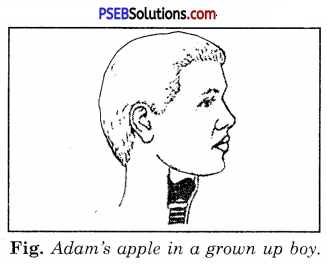
  4. The voice becomes hoarse. Adam’s apple, a protruding part of throat is seen. They have a deep voice.
  5. They get acne and pimples on the face at this time due to the increased activities
    of sweat and subaceous glands.
  6. Male sex organs like testes and penis develop completely.
  7. Boys develop hair on their chest, under the arms and on the pubic region.

2. Changes taking place at puberty in girls.

  1. Height also increases in girls but comparatively less.
  2. The region below the waist becomes wider.
  3. In girls the larynx is hardly visible from the outside. Girls have a high pitched voice.
  4. Like boys girls also get pimples on the face.
  5. The ovaries enlarge and eggs begin to mature.
  6. Breasts begin to develop.
  7. Hair grow under the arms and also on the pubic region.

Question 5.
Prepare a table having two columns depicting names of endocrine glands and hormones secreted by them.
Answer:
The table given ahead indicates the endocrine glands and their hormones:

Endocrine gland Hormones
(i) Pituitary gland (i) Growth Hormones
(ii) Thyroid (ii) Thyroxine
(iii) Adrenal (iii) Adrenalin
(iv) Pancreas (iv) Insulin
(v) Testis (v) Androgen (Testosterone)
(vi) Ovaries (vi) Estrogen

Question 6.
What are sex hormones ? Why are they named so ? State their function.
Answer:
Sex hormones.
There are the hormones secreted by testes in males and ovaries in females. They are named so because they are secreted by male and female sexes separately.

Male Sex hormone (Testosterone).
It is secreted by testes. It causes changes in boys like growth of facial hair. It also stimulates spermatogenesis.

Female sex hormone (Estrogen).
It is secreted by ovaries. It controls the development of secondary sexual characters in females, appearance of mammary glands etc. It maintains pregnancy.

Question 7.
Choose the correct option.
[a] Adolescents should be careful about what they eat, because
(i) proper diet develops their brains.
(ii) proper diet is needed for the rapid growth taking place in their body.
(iii) adolescents feel hungry all the time.
(iv) taste buds are well developed in teenagers.
Answer:
(ii) proper diet is needed for the rapid growth taking place in their body.

[b] Reproductive age in women starts when their
(i) menstruation starts.
(ii) breasts start developing.
(iii) body weight increases.
(iv) height increases.
Answer:
(i) menstruation starts.

[c] The right meal for adolescents consists of
(i) Chips, noodles, coke.
(ii) Chapati, dal, vegetables.
(iii) Rice, noodles and burger.
(iv) Vegetable cutlets, chips and lemon drink.
Answer:
(ii) chapati, dal, vegetables.

PSEB 8th Class Science Solutions Chapter 10 Reaching the Age of Adolescence

Question 8.
Write notes on:
(а) Adam’s apple.
(b) Secondary sexual characters.
(c) Sex determination in the unborn baby.
Answer:
(a) Adam’s apple.
PSEB 8th Class Science Solutions Chapter 10 Reaching the Age of Adolescence 1
At puberty boys develop larger voice box or larynx. This box in boys is seen as a protruding part of the throat called Adam’s apple.

(b) Secondary sexual characters.
We know testis and ovaries are the reproductive organs. They produce the gametes i.e. sperms and ova. In girls, breasts begin to develop at puberty and boys begin to grow facial hair, i.e. moustaches and beard. As these features help to distinguish the male from the female they are called secondary sexual characters. Boys also develop hair on their chest. In both boys and girls hairs grow under the arms and in the region above the thighs or the pubic region.

(c) Sex determination in the unborn baby.
Determination of the sex of child. Sex chromosomes determine sex in human beings. In males, there are 44 + XY chromosomes, whereas, in females there are 44 + XX chromosomes. Here X and Y chromosomes determine sex in human beings.

Two types of gametes are formed in male, one type is having 50% X-chromosome, whereas, other type is having Y-chromosome. In female, gametes are of one type and contain X-chromosome.

Thus females are homogametic. If male gamete having Y-chromosome undergoes fusion with female gamete having X-chromosome the zygote will have XY chromosome and this gives rise to male child.

If male gamete having X-chromosome undergoes fusion with female gamete having X-chromosome, the zygote will be having XX-chromosome and this gives rise to female child.
PSEB 8th Class Science Solutions Chapter 10 Reaching the Age of Adolescence 2

Question 9.
Word game : Use the clues to work out the words.
Across
3. Protruding voice box in boys
4. Glands without ducts
7. Endocrine gland attached to brain
8. Secretion of endocrine glands
9. Pancreatic hormone
10. Female hormone

Down
1. Male hormone
2. Secretes thyroxine
3. Another term for teenage
5. Hormone reaches here through blood stream
6. Voice box
7. Terms for changes at adolescence
PSEB 8th Class Science Solutions Chapter 10 Reaching the Age of Adolescence 3
Answer:
PSEB 8th Class Science Solutions Chapter 10 Reaching the Age of Adolescence 4

Question 10.
The table below shows the data on likely heights of boys and girls as they grow in age. Draw graphs showing height and age for both boys and girls on the same graph paper. What conclusions can be drawn from these graphs?
PSEB 8th Class Science Solutions Chapter 10 Reaching the Age of Adolescence 5
Answer:
PSEB 8th Class Science Solutions Chapter 10 Reaching the Age of Adolescence 6
The above graph shows that the increase in the growth in heights of boys and girls is same. The increase in growth is less in girls upto first eight years and after that it remains the same upto twenty years.

PSEB 8th Class Science Solutions Chapter 10 Reaching the Age of Adolescence

PSEB Solutions for Class 8 Science Reaching the Age of Adolescence Important Questions and Answers

Multiple Choice Questions

Question 1.
Adolescent period normally start from …………………. of age.
(a) 9
(b) 11
(c) 13
(d) 15.
Answer:
(b) 11.

Question 2.
Adolescence period ends in the ……………….. year of age.
(a) 19
(b) 22
(c) 25
(d) 27.
Answer:
(a) 19.

Question 3.
Menstrual period of human female is of how many days ?
(a) 20 days
(b) 22 days
(c) 18 days
(d) 28 days.
Answer:
(d) 28 days.

Question 4.
The stoppage of menstrual cycle is called:
(a) Menopause
(b) Menstruation
(c) Metaphorsis
(d) None of these.
Answer:
(a) Menopause.

Question 5.
Female sex harmone is called:
(a) Estrogen
(6) Testosterone
(c) Adrenalin
(d) Thyroxin.
Answer:
(a) Estrogen.

Question 6.
The male sex harmon is:
(a) Estrogen
(b) Adrenalin
(c) Testosterone
(d) Thyroxin.
Answer:
(c) Testosterone.

PSEB 8th Class Science Solutions Chapter 10 Reaching the Age of Adolescence

Very Short Answer Type Questions

Question 1.
Name two endocrine glands in humans.
Answer:

  1. Pituitary
  2. Thyroid.

Question 2.
Which of the endocrine gland secretes growth hormone ?
Answer:
Growth hormone is secreted by pituitary gland.

Question 3.
What are female sex cells called ?
Answer:
Ova.

Question 4.
When do human stop growing ?
Answer:
Human stops growing after about 20-25 years of age.

Question 5.
What is the main element of thyroxine hormone ?
Answer:
Iodine.

Question 6.
In which part adrenaline is produced ?
Answer:
Adrenal gland.

Question 7.
Name the male and female sex hormones.
Answer:
Testosterone, Estrogen.

PSEB 8th Class Science Solutions Chapter 10 Reaching the Age of Adolescence

Question 8.
Name the following:
(i) The types of glands that secrete hormones.
(ii) The other name of hormones.
(iii) The gland which is called ‘Master gland’.
(iv) The hormone secreted by thyroid gland.
(v) The disease caused by the deficiency of iodine.
(vi) The hormones that control blood glucose level.
(vii) The gland which produces the so called ‘emergency hormone’.
Answer:
(i) Endocrine glands or ductless glands
(ii) Chemical coordinators
(iii) Pituitary gland
(iv) Thyroxine
(v) Goitre
(vi) Insulin and glucagon
(vii) Adrenalin.

Question 9.
Define sex chromosomes.
Answer:
Sex chromosomes.
The chromosomes associated with sex determination are called sex chromosomes. XX in female and XY chromosomes in male are called sex chromosomes.

Question 10.
How many chromosomes are found in human cells ?
Answer:
46 (44 autosomes and a pair of sex chromosomes).

Question 11.
When do adolescence begins and ends ?
Answer:
Adolescence begins at the age of 11 years and lasts upto the 18 or 19 years of age.

Question 12.
The glands which pour their secretions directly into the blood stream is called ……………. ?
Answer:
Endocrine glands.

Question 13.
What is target site ?
Answer:
Target Site. Target site is a body part where the hormones act.

PSEB 8th Class Science Solutions Chapter 10 Reaching the Age of Adolescence

Question 14.
What is the period of reproductive phase in females ?
Answer:
The reproductive phase begins at puberty (10-12 years) and lasts till the age of 45-50 years.

Question 15.
Define menarch.
Answer:
Menarch. The first menstrual flow in females begins at puberty which is called menarch.

Question 16.
Define Menopause.
Answer:
Menopause. Stoppage of menstruation is called menopause.

Question 17.
What are the sex chromosomes in males and females ?
Answer:
Females have two X-chromosomes (XX), Males have one X and one Y-chromosome (XY).

Question 18.
To which body part pituitary gland is attached ?
Answer:
Pituitary gland is attached to brain.

Question 19.
Name the hormones which control metamorphosis in insects and frog.
Answer:
In insects-Insect hormone In frog-Thyroxine.

PSEB 8th Class Science Solutions Chapter 10 Reaching the Age of Adolescence

Question 20.
Expand AIDS.
Answer:
AIDS. Acquired Immuno Deficiency Syndrome.

Question 21.
What is the legal age of marriage in India ?
Answer:
The legal minimum age for marriage is 18 years for girls and 21 years for boys.

Short Answer Type Questions

Question 1.
How does hormone affect a girl’s body between the age of 10-15 years ?
Answer:
Hormones affect girl’s body by making the breast to become bigger and hips becoming more rounded.

Question 2.
How does hormone affect a boy’s body between the age of 11-16 years ?
Answer:
In boy’s body, the following changes are caused by hormones:

  1. his voice becomes hoarse (deeper)
  2. hairs start to grow on his face and body.
  3. his body muscles develop.
  4. his testis start producing sperms.

Question 3.
Write short notes on :
(i) Menstruation
(ii) Menopause.
Answer:
(i) Menstruation.
Destruction of the mucous membrane of foetus and consequent bleeding which occur periodically in human and other mammals.

(ii) Menopause.
Stoppage of menstrual flow and other events is called menopause. It occurs between 45 to 55 years.

Question 4.
Explain sexual cycle in human female.
Answer:
Sexual cycle.
The rhythmic changes in the uterus which occur about every 28 days throughout the reproductive cycle of woman except the pregnancy period is called menstrual cycle. The female sex hormones initiate the thickening of the uterine wall for the implantation of a fertilized ovum.

If the ovum is not fertilized, the lining wall is broken down and discharged from the body. This is called menstruation. Normally the menstrual cycle starts at the age of 10-14 years and stops at the age of 45-50 when menopause is reached.

If the ovum is fertilized by sperm, the zygote develops in the wall of uterus and developing embryo called foetus is nourished by placenta. During the period, ovulation or ‘menstruation does not occur. However these activities are restored after child birth.

PSEB 8th Class Science Solutions Chapter 10 Reaching the Age of Adolescence

Question 5.
What is meant by reproductive health ?
Answer:
Reproductive health.
Reproductive organs are important organs of the body. Proper knowledge and hygiene of these organs is important otherwise persons may get some sexually transmitted diseases such as AIDS, syphilis and gonorrhoea.

Question 6.
Write modes of transmission of AIDS.
Answer:
Modes of transmission of AIDS. It is transmitted during transfusion of infected blood, use of contaminated needles, artificial insemination and several intercourse with an infected partner without a condom.

Question 7.
Differentiate between menarch and menopause.
Answer:
Differences between Menarch and Menopause

Menarch Menopause
1. Commencement of menstruation at puberty is called menarch. 1. Stoppage of menstrual flow and other events is called menopause.
2. It starts at the age of 11 to 12 years. 2. It stops around the age of 50 years.

Question 8.
Write whether True (T) or False (F):
(i) Fertilization is process of fusion of sperm and ovum.
Answer:
True

(ii) Duration of menstrual cycle in human female is 20 days.
Answer:
False

(iii) Onset of menstruation is termed as menopause.
Answer:
False

(iv) In human beings, males attain puberty little later than females.
Answer:
True

Question 9.
Why the endocrine glands are called ductless glands ?
Answer:
The transport of hormones from one place to another takes place through body fluids, rather than through the ducts. Therefore, the endocrine glands are also called ductless glands.

Question 10.
Which gland secretion reduces pituitary secretion ?
Answer:
Increased secretion of thyroxin from the thyroid gland reduces the production of hormones by the pituitary gland.

PSEB 8th Class Science Solutions Chapter 10 Reaching the Age of Adolescence

Question 11.
Adrenalin secretion increases during a frightening situation. What is the response ?
Answer:
Frightening experience (scene) is the stimulus which causes the increase of adrenalin secretion. Therefore, increased adrenalin secretion acts as response to the stimulus.

Question 12.
Draw a diagram showing various endocrine glands.
Answer:
PSEB 8th Class Science Solutions Chapter 10 Reaching the Age of Adolescence 7

Question 13.
List some of the functions of pituitary gland.
Answer:
Functions of pituitary gland.

  1. Regulates growth.
  2. Influences the thyroid gland, the adrenals and gonads.
  3. Can produce changes in the skin colour of many amphibians and fishes.
  4. Influences migration and nest building in birds.

Question 14.
Why should an adolescent eat right kind of food ?
Answer:
Adolescents are in growing years. It is very important to eat right kind of food. It helps in the better nourishment of growing bones, muscles and other parts of body.

Question 15.
Why do adolescents become independent than before ?
Answer:
Adolescents are more independent than before and are also self conscious. It is a period of change in a person’s way of thinking. Intellectual development takes place and they tend to spend more time in thinking. In fact, it is often the time in one’s life when the brain has the greatest capacity for learning. Sometimes, however, an adolescent may feel insecure while trying to adjust to the changes in the body and mind.

Question 16.
How will you explain that sex hormones are under the control of pituitary glands ?
Answer:
The sex hormones are controlled by pituitary gland. The gland secretes many hormones, one of which is FSH or Follicle Stimulating Hormone. It makes ova and sperms mature in the ovaries and testis respectively. It can be shown as follows:
Hormones from pituitary stimulates gonads to release Testosterone (in male) and Estrogen (in female)
Released in the blood stream and reach parts of the body (Target site)
Stimulate changes in the body and onset of puberty.

PSEB 8th Class Science Solutions Chapter 10 Reaching the Age of Adolescence

Question 17.
Adolescent should say ‘No’ to the drugs. Why ?
Answer:
Adolescence is a period of much activity in the body and mind. So, do not feel confused or insecure. If anybody suggests that you will get relief if you take some drugs, just say ‘No’ unless prescribed by doctor. We know that drugs are addictive, if you take them once, you feel like taking them again and again. They harm the , body in the long run. They ruin health and happiness.

Question 18.
Give some myths about adolescents.
Answer:
One comes across many myths and taboos. We should discard them. These myths are as follows-

  1. A girl becomes pregnant if she looks at boys during menstruation,
  2. A drop of semen lost means loss of 10 drops of blood which will make the boy weak.
  3. The mother is responsible for the sex of her child.
  4. A girl should not be allowed to work in the kitchen during menstruation.

Question 19.
What changes occur in voice at the time of puberty ?
Answer:
At puberty, the boys develop larger voice box and it can be seen as a protruding part. The voice of boys becomes hoarse and cracked due to increase in larynx. Such kind of difference is not visible in the voice box or larynx of girls. The girls have a high pitched and sweet voice due to smallness of larynx.

Question 20.
Write the main characteristics of hormones.
Answer:
Main characteristics of hormones are following:

  1. Hormones are secreted by endocrine glands. They have specific functions.
  2. Hormones are required in very little quantity,
  3. These effect only specific organs.

Question 21.
Why is pituitary gland called master gland ?
Answer:
This gland is located in the lower portion of the brain. The hormone secreted . by it controls the growth of bones and tissues. This gland secretes a hormone which controls the function of other glands, therefore, it is called master gland.

Question 22.
What is reason behind this fact that boys and girls should not be married in young age ?
Answer:
In young age, the body of adolescents, especially reproductive organs, are not ready for motherhood. If marriage takes place in such a situation, then such couples may face many health problems which can cause stress. In our country, the legal age for marriage is 18 years for girls and 21 years for boys when adolescents are allowed to get married. The adolescents below this age are not allowed to marry under the law of marriage and it is legally wrong doing so.

PSEB 8th Class Science Solutions Chapter 10 Reaching the Age of Adolescence

Question 23.
Why there is great possibility of disease HIV-AIDS in adolescents ?
Answer:
Many adolescents start taking drugs to make themselves stress free. By taking drugs from HIV contaminated needle of injection, this dangerous virus spreads in other adolesqents. The other reason of spreading this virus is unsafe sexual relationship. In many cases, this virus may enter in infants through the milk of mother.
So,it is very necessary for adolescents to remain aware to save their precious life from HIV.

Question 24.
List any two changes in the body that take place at puberty.
Answer:
Changes taking place in boys at puberty.

  1. Height increase suddenly. The bones of legs and arms become long and make a boy tall.
  2. Boy’s shoulders become broader and chest also become wider.

Changes taking place at puberty in girls.

  1. Height also increases in girls but comparatively less.
  2. The region below the waist becomes wider.

Long Answer Type Questions

Question 1.
Give a chart showing the average rate of growth in height with age.
Answer:
PSEB 8th Class Science Solutions Chapter 10 Reaching the Age of Adolescence 8

Calculation for full height (cm)
Present height (cm)
= \(\frac{\text { Present height }(\mathrm{cm})}{\% \text { of full height at this age }}\) × 100
(as given in the chart)
For example, A boy is 8 years old and 108 cm tall. At the end of the growth period, he is likely to be
\(\frac{108}{72}\) × 100 cm = 150 cm tall.

Question 2.
Describe the various conditions or factors needed for keeping the body healthy during adolescence.
Answer:
During adolescence following conditions are essential for a healthy body:
1. Nutritional needs.
Adolescence is a stage of rapid growth and development, hence the diet for an adolescent has to be carefully planned. A balanced diet means that the meals should include proteins, carbohydrates, fats, vitamins, and minerals in the requisite proportion. Our Indian meal of roti/rice, dal (pulses) and vegetables, milk, fruits is a balanced meal.

Chips and packed or tinned snacks, though very tasty should never replace regular meals as they do not have adequate nutritional value.
PSEB 8th Class Science Solutions Chapter 10 Reaching the Age of Adolescence 9
2. Personal hygiene.
Having a bath at least once every day is more necessary for teenagers because the increased activity of sweat glands sometimes makes the body smelly. All parts of the body should be washed and cleaned every day. If cleanliness is not maintained, there are chances of catching a bacterial infection. Girls should keep track of their menstrual cycle and be prepared for the onset of menstruation. Undergarments should be changed every day. Cotton undergarments should be preferred.

Kho-Kho Game Rules – PSEB 10th Class Physical Education

Punjab State Board PSEB 10th Class Physical Education Book Solutions Kho-Kho Game Rules.

Kho-Kho Game Rules – PSEB 10th Class Physical Education

Question 1.
Discuss the playground of the Kho-Kho Chasers, Runners, To take a direction, To Turn the face, Returning, Lona?
Answer:
Kho-Kho
The size of the Kho-Kho playground is rectangular. It is 29 metres long and 16 metres wide. There are two rectangles at the fend of the playground. One side of the rectangle is 15 m. and the other side is 2.75 m. In the middle of these rectangles, there are two wooden poles.

The central lane is 2.10 m. long and 30 cm. wide. There are eight small squares, 30 × 30 cms., on this lane. The height of each pole from the ground is 1.20 cms. A line is drawn towards the width of each pole. Eight lanes are drawn parallel to this line. Each lane is 15 m. in length and 30 cm. in width. This lane is divided into two equal parts, each of 7.10 m, by the central lane.kho-kho image 1

The thickness of each line is 2 cms. Each lane is 2.10 m. long Each outside lane and pole line are 2.25 metres from each other Each pole line is farther from outside boundary by 2.70 metres. There is a lobby 3 metre wide along the four sides of the playground.

Definitions

1. Posts:
Two posts are fixed at the end of the central lane. Thej are 1.20 cms. high above the ground. Their circumference cannot be less than 30 cms and not more than 40 cms.

2. Central Lane:
There is a central lane in between two poles. It is 21.60 m. long and 30 cm wide.

3. Cross Lane:
Each rectangle is 15 m. long and 30 cm. wide. It crosses the central lane at right angles (90°). It is itself divided into two halves. It is called cross-lane.

4. Square:
The area, 30 cm. × 30 cm., made by the intersection of the central lane and cross lane is called square.

5. The Line of the Post:
The line that goes to the centre of the post, parallel to cross lanes, is known as the line of the post.

6. Rectangle:
The area which is outside the line of post is known as rectangle.
kho-kho image 2

7. Limits:
The lines on both sides and at a distance gf 7.30 m. from the central line, and parallel to it, are called limits.

8. Chasers:
The players who sit in the squares are called chasers. A player who actively pursues the players of the rival team is termed an active chaser.

9. Runners:
The players of the opposite side other than those of chasers are called runners.

10. To give Kho:
In order to give good Kho, an active chaser should touch the sitting chaser from behind, uttering clearly and loudly the word “Kho”. The action of touching and uttering of the word “Who” should be done simultaneously.

11. Foul:
If a sitting or active chaser breaks any rule, that is called a foul.

12. To take a Direction:
The taking of direction is to go from one post to another post.

13. To turn the Face:
At a time when an active chaser, going in a particular direction, turns his or her shoulders at 90°, he or she is said to have turned the face. It is a foul.

14. Returning:
When the active chaser, going in a particular direction, changes his direction to the opposite, he or she is said to have returned or receded. This is also a foul.

15. To Leave the Post Line:
When an active chaser leaves hold of a post, and leaves the rectangle or goes beyond it, such actions are known as leaving the post line.

16. Foot Out:
When a runner’s feet touch the ground outside the limits, it is called Foot-out, and the runner is out.

17. Lona:
When all runners are out within 7 minutes, the chaser will mark “Lona” against the runners. But no point is awarded for “Lona.”

How to begin the Play:
The game of Kho-Kho is started with a toss. The toss winning captain of the team shall decide to touch or be touched, and inform the referee about his decision. The players who sit are called chasers. The opposing players of the chasers are known as runners. Except one chaser, all the chasers sit in such a way that no two adjacent chasers face the same side. At the start of the game, the ninth chaser stands near a pole. When the referee whistles, the action of touching begins.

Kho-Kho Game Rules - PSEB 10th Class Physical Education

Question 2.
Discuss the rules in the Kho-Kho game?
Answer:
Rules Of The Play

  1. No part of an active chaser’s body should touch the ground of the central lane. Moreover, he cannot cross the central lane by jumping from within the posts.
  2. The playfield shall be marked as shown in the diagram.
  3. The decision to be a chaser or a runner is made by toss.
  4. If a Kho is to be given, it shall have to be given from behind to a sitting chaser. Without having received the Kho, the chaser cannot get up. The active chaser shall not give Kho by touching the extended arm or leg of the sitting chaser. If the chaser breaks Rule no. 1 and 2, the referee shall award a foul.
  5. After having played, the active chaser takes the plac§ of the sitting chaser whom he has given the ‘Kho’.
  6. After taking the Kho the running chaser shall go in the direction which goes to the central lane.
  7. Until the utters ‘Kho’ to any sitting chaser, he can come only by crossing through the opposite side of the central lane above the pole.
  8. The face of the runner should be towards the direction of running.
  9. The chaser should sit in such a way that he does not obstruct the runners. If a runner is out because of any such obstruction, he shall be declared out.
  10. The active chaser can’ come out of the limit. But he will have to follow the rules regarding taking direction and turning the face, etc.
  11. After having taken the direction, the active chaser can attack again in the cross line, and it shall not be considered a foul.
  12. The runner cannot touch a sitting chaser. If he does so, he is given warning once. If he does so even after the warning, he is declared out.
  13. If the runner goes out of court, he shall be deemed to be out.
  14. If the runner is touched by a chaser, he shall be considered out.
  15. The rules regarding taking direction and changing direction shall not be applicable in the rectangular area.

Question 3.
Discuss the rules of the match in the Kho-Kho game?
Answer:
Rules About the Match

1. Each team shall have 9 members with 3 extras.

2. Each innings shall Mve four running and chasing turns which shall be of 7-7 minute duration. The two innings are for touching, and two for running.

3. Before the start of the match the captains of both teams shall decide about the turn of chasers or runners by toss.

4. Runners, in order of playing, shall get their names recorded with the scorer. At the beginning of a turn, the first three players shall be within the limit. When these three players are out, the next three shall succeed them before the kho is given. The players who fail to enter within that period shall be out. The players who enter out of turn shall also be declared out. This process will continue until the end of the term. The active chaser who has removed the third runner shall not pursue the newly entered runner. He will give Kho. The runners of each team shall enter the field from one side only.

5. The chaser and the runner have the option to end the turn before the given time. The captain of the runner or chaser team shall inform about his decision to the referee, and shall request the referee to declare the turn close. On such a request, the referee shall stop the game to end the turn. There shall be a rest of two minutes after this turn, and of five minutes in between two innings.

6. The chaser, on each runner’s being out, shall score one point. A ‘Lona’ is scored against all the runners who are out before time. Afterwards, that team sends its runners in the same turn. No extra point is given for scoring a Lona. The play shall continue in the same way until the close of the innings. The order of runners during the innings can be changed.

7. The team that scores more points at the end of a match in knock-out system is declared the winner. If the points are equal, one more innings is played. If again the points are equal, the Baker Rule 29 is used. In this condition, the players need not be the same.

In the league system, the winning team scores two points and the losing one scores zero point, and in case of a tie, each team is awarded one point. If in a league system, the league points are equal, the team or teams shall replay the game by lots. Such matches shall be played on knock-out system.

8. If due to any reason match is not completed, it shall be played at some other time, and the previous score shall not be counted. The match shall be replayed from the beginning.

9. If the points of a team are more than the points of the opposing team by 12 or more, the first team can ask the other team to follow on their innings as chasers. If the other team scores more points, it retains its right to be chasers.

10. If a player gets hurt during the play, he can be replaced by a substitute on the referee’s permission.

Kho-Kho Game Rules - PSEB 10th Class Physical Education

Question 4.
Mention the number of officials conducting the game of Kho-Kho?
Answer:
Officials:
The following officials are appointed to conduct the match:

  1. Two Umpires
  2. One Referee
  3. One Time Keeper
  4. One Scorer

1. Umpire:
The umpire shall stand outside the lobby ground and shall supervise the match from the central lane. He shall give all decisions of his half, and shall help the other umpire to make correct decisions in the other half.

2. Referee:
There is only one referee in the game of Kho-Kho. His duties as referee are as follows:

  1. He shall help the umpire perform their duties. He shall give his own decision in case there is any difference between the umpires on an issue.
  2. A referee shall punish the defaulting player for his misbehaviour or for breaking the rules of the game.
  3. He is responsible for proper conduct of the game and match.
  4. At the end of innings he declares the score won by each team, and announces the result.

3. Time Keeper:
The duty of the time keeper is to record time. He signals the start and the end of the innings by blowing a whistle.

4. Scorer:
The scorer makes it certain that the players enter the field in accordance with the approved order. He keeps a record of the runners who are out. At the end of each term, he enters makes on the score sheet and prepares the score of the chasers. At the end of the match, he prepares the result and hands over the same to the referee for announcement.

Question 5.
Write down the score sheet of Kho-Kho game.
Answer:
kho-kho image 3

Kho-Kho Game Rules - PSEB 10th Class Physical Education

Important Information About the Kho-Kho Game

  • The length and breadth of ground for man = 29 × 16 m
  • The number of square in central line = 8
  • Size of the lobby = 16 × 2.75 meter
  • Distance of square from each line = 2.50 meter
  • Breadth and length of central line = 30 c.m. & 23.50 meter
  • Size of square = 30 × 30 c.m.
  • Number of players in a team = 9 players
  • Substitution of players = 3 players
  • Duration of the Kho-Kho match = 9-5-9 (9) 9-5-9 minutes
  • Inning of Kho-Kho match = 2
  • Sitting players in square are called = Chaser
  • Opponent of chaser = Runner
  • Duration of play for girls = 7-2-7 (5) 7-2-7 minutes
  • Official of the match = One referee, Two Umpire, One time keeper, One scorer
  • Height of the pole = 1.20 meter
  • The size of the Kho-Kho playground is rectangular. It is 29 metre long and 16 metre wide.
  • A Kho-Kho team includes 12 players, of which 9 players play and 3 players are substitutes.
  • The start of the game is by toss. The captain of the toss winning team decides to be a chaser or runner.
  • Except one chaser, all chasers sit on the squares in such a way that there are no two adjacent chasers facing the same side.
  • Kho should be given from behind to a sitting chaser.
  • Kho-Kho match consists of 2-2 innings. The team that scores more points in all the innings is declared the winner.
  • A player who gets injured or hurt during the play may be substituted by another player with the permission of the referee.
  • No part of an active chaser’s body should touch the central lane.
  • If the two teams score equal points, one more innings shall be played. If again the scores are equal, another innings is played.
  • A substitute comes in place of an injured player.
  • The duration of the game is 9-5-9, 7,9-5-9 minutes.

PSEB 9th Class Agriculture Solutions Chapter 2 Summer Vegetables

Punjab State Board PSEB 9th Class Agriculture Book Solutions Chapter 2 Summer Vegetables Textbook Exercise Questions and Answers.

PSEB Solutions for Class 9 Agriculture Chapter 2 Summer Vegetables

Agriculture Guide for Class 9 PSEB Summer Vegetables Textbook Questions and Answers

(A) Answer in 1-2 words:

Question 1.
Write the name of two varieties of chili.
Answer:
Punjab Surkh, CH-1.

Question 2.
How much is a requirement of vegetables per person per day for maintenance of good health?
Answer:
284 gm.

Question 3.
Write the name of two improved varieties of tomato.
Answer:
Punjab Varkha Bahar-1, Punjab Varkha Bahar-2.

Question 4.
How much seed per acre of okra is required for sowing in February?
Answer:
15 kg per acre.

Question 5.
How much spacing is required between rows in the brinjal crop?
Answer:
60 cm.

PSEB 9th Class Agriculture Solutions Chapter 2 Summer Vegetables

Question 6.
Write the name of two varieties of bitter gourd.
Answer:
Punjab-14, Punjab Kareli-1.

Question 7.
When sowing of bottle gourd should be done?
Answer:
Feb-March, June-July, and November-December.

Question 8.
How much seed of cucumber is required per acre?
Answer:
1 kg per acre.

Question 9.
How much seed of muskmelon is required per acre?
Answer:
400 gram.

Question 10.
What is the sowing time of the sponge gourd?
Answer:
Mid May to July.

(B) Answer in 1-2 sentences:

Question 1.
What do you mean by vegetable?
Answer:
Any succulent part like fruit, leaf, stems, etc. of a plant which can be eaten fresh as salad or after cooking is called vegetable.

Question 2.
How much seed and area is required for raising nursery for transplanting one acre tomato ?
Answer:
100 gram seed is required for nursery raising in 2 maria area for transplanting in one acre.

PSEB 9th Class Agriculture Solutions Chapter 2 Summer Vegetables

Question 3.
How much fertilizers are used per acre for chilli crop ?
Answer:
10-15 ton well rotten farm yard manure, 25 kg. nitrogen, 12 kg phosphorus and 12 kg potash can be used. This dose is for one acre.

Question 4.
How four crops of brinjal are raised in a year?
Answer:
Four crops of brinjal are raised in a year by sowing in October, November, February-March and July.

Question 5.
What are the sowing time and seed rate of okrg?
Answer:
Spring season crop is sown in February-March and rainy season crop is sown in June-July. Seed rate is 15 kg (February), 8-10 kg (March), 5-6 kg (June-July).

Question 6.
Give the reasons for the low availability of per capita’ per day vegetables in our country.
Answer:
The low availability of per capita per day vegetables in our country is due to

  • population explosion and
  • due to post-harvest losses which are nearly one-third of the total production of vegetables.

Question 7.
What is the ideal time for sowing and transplanting of the nursery of tomato?
Answer:
The ideal time for sowing the nursery of tomatoes is the second fortnight of July. Transplanting of seedlings is done in second fortnight of August.

Question 8.
How many days are required from sowing to harvesting in bitter gourd ?
Answer:
55-60 days are required from sowing to harvesting in bitter gourd.

Question 9.
Write two improved varieties and sowing time of muskmelon.
Answer:
Improved varieties of muskmelon are Punjab hybrid, Hara madhu and sowing time is February-March.

Question 10.
How can we get early and higher yield in cucumber ?
Answer:
We get early and higher yield in cucumber by growing under low tunnel polythene sheets.

(C) Answer in 5-6 sentences:

Question 1.
Write name of summer vegetables and describe any one of them.
Answer:
Summer vegetables are – tomato, brinjal, bottle gourd, sponge gourd, bitter gourd, chilli, okra, summer squash, cucumber, long melon, squash melon etc.

Tomato

Improved varieties—Punjab Varkha Bahar-1, Punjab Varkha Bahar-2.
Seed rate—100 gram seed is required for sowing nursery in 2 maria for transplanting in one acre.
Time of sowing—Sow nursery in the second fortnight of July.
Transplanting—Second fortnight of August.
Row spacing—120-150 cm.
Weed control—Spray stomp or sencor.
Plant spacing—30 cm.
Irrigation—First irrigation should be done immediately after transplanting and later irrigations should be done after 6-7 dhys interval.

PSEB 9th Class Agriculture Solutions Chapter 2 Summer Vegetables

Question 2.
Write a short note on improved varieties, sowing time, seed rate, and control of weeds in okra.
Answer:
Improved varieties. Punjab-7, Punjab-8, Punjab Padmani.
Sowing time. Spring season sowing is done in February-March and rainy season crop is sown in June-July.
Seed rate. Seed rate per acre is 15 kg (for February), 8-10 kg (March), 5-6 kg (June-July).
Weed control. 3-4 hoeings are needed or spray stomp.

Question 3.
What is the importance of vegetables in human diet?
Answer:
Vegetables have a very important role in the human diet. Vegetables contain a sufficient amount of nutrients like carbohydrates, minerals, proteins, vitamins etc. These nutrients are essential for the maintenance of good health. A large population of our country is vegetarian, therefore, importance of vegetables becomes more in our country. According to scientific research, a person should consume 284 gram of vegetable in a day. Vegetables include leafy vegetables (spinach, fenugreek, lettuce, saag etc.), root vegetables (carrot, radish, turnip), flower buds (cauliflower), fruit (tomato, brinjal) etc.

Question 4.
Describe cultivation of Bottlegourd.
Answer:

  • Improved varieties. Punjab Berkat, Punjab Komal.
  • Sowing time. February-March, June-July, November- December.
  • Harvesting. After 60-70 days of sowing, the crop is ready for harvesting.

Question 5.
How to raise a successful crop of ashgourd?
Answer:
Ash gourd belongs to
Improved Varieties—PAG-3
Sowing time—Feb-March and June-July.
Seed rate—2kg seed/acre
Method of sowing–Sow at least two seeds per hill on one side.
Spacing—Beds should be 3m wide and spacing should be 75-90 cm.

PSEB 9th Class Agriculture Solutions Chapter 2 Summer Vegetables

Very Short Answer Type Questions:

Question 1.
What is the seed rate for chilli?
Answer:
200 grams per acre.

Question 2.
What is the time of sowing of Nursery for chilli?
Answer:
End October to mid-November.

Question 3.
What is the time of transplanting the seedlings of chilli?
Answer:
February-March.

Question 4.
What is row spacing for chilli?
Answer:
75 cm.

Question 5.
What is plant spacing for chilli?
Answer:
45 cm.

PSEB 9th Class Agriculture Solutions Chapter 2 Summer Vegetables

Question 6.
Write names of varieties of tomato.
Answer:
Punjab Varkha Bahar-1, Punjab Varkha Bahar-2.

Question 7.
Write seed rate for tomato.
Answer:
100 gram per acre.

Question 8.
What is a time of sowing of the nursery for tomato?
Answer:
Second fortnight of July.

Question 9.
What is time of transplanting seedlings of tomato?
Answer:
Second fortnight of August.

Question 10.
What is row spacing for tomato?
Answer:
120-150 cm.

Question 11.
What is plant spacing for tomato?
Answer:
30 cm.

Question 12.
Weed control is done in tomatoes by using
Answer:
Stomp, Sencore.

Question 13.
Write varieties of Brinjal.
Answer:
Punjab Neelam (round), B.H.-2 (Oblong), PBH-3 (small).

Question 14.
Write seed rate for brinjal.
Answer:
300-400 grams per acre.

Question 15.
Write row spacing for brinjal.
Answer:
60 cm.

Question 16.
What is plant spacing for brinjal?
Answer:
30-40 cm.

Question 17.
How is Okra sown?
Answer:
Sowing is done on ridges.

Question 18.
Write varieties of Okra.
Answer:
Punjab-7, Punjab-8, Punjab Padmani.

Question 19.
How is the Okra crop sown in February-March?
Answer:
On ridges.

Question 20.
How is the okra crop sown in June-July?
Answer:
On planes.

Question 21.
What is row spacing for okra?
Answer:
45 cm.

Question 22.
What is plant spacing for okra?
Answer:
15 cm.

Question 23.
When is okra harvested?
Answer:
45-50 days after sowing.

Question 24.
Write improved varieties of summer squash.
Answer:
Punjab Chappan Kadoo.

Question 25.
Write time of sowing for summer squash.
Answer:
Mid-January to March and October-November.

Question 26.
What is the seed rate for summer squash?
Answer:
2 kg per acre.

Question 27.
How many seeds are sown at a place for summer squash?
Answer:
Two seeds at a place.

Question 28.
When is summer squash ready for harvesting?
Answer:
In 60 days.

Question 29.
Write varieties of Bottle gourd.
Answer:
Punjab Berkat, Punjab Komal.

Question 30.
Write time of sowing for bottle gourd.
Answer:
February-March, June-July, November-December.

PSEB 9th Class Agriculture Solutions Chapter 2 Summer Vegetables

Question 31.
When is the bottle gourd ready for harvesting?
Answer:
60-70 days after sowing.

Question 32.
Write varieties of bitter gourd.
Answer:
Punjab-14, Punjab Kareli-1.

Question 33.
Write time of sowing for bitter gourd.
Answer:
February-March, June-July.

Question 34.
Write seed rate for bitter gourd.
Answer:
2 kg per acre.

Question 35.
What is plant spacing for the bitter gourd?
Answer:
45 cm.

Question 36.
How is bitter gourd sown in Kyaris (beds)?
Answer:
On both sides.

Question 37.
Write varieties of sponge gourd.
Answer:
Pusa chikni, Punjab sponge gourd-9.

Question 38.
What is a time of sowing for sponge gourd?
Answer:
Mid-February to March.

Question 39.
What is seed rate for sponge gourd?
Answer:
2 kg seed per acre.

Question 40.
When is sponge gourd ready for harvesting?
Answer:
After 70-80 days of sowing.

Question 41.
Write varieties of ash gourd.
Answer:
PAG—3.

Question 42.
Write time of sowing for ash gourd.
Answer:
February-March, June-July.

Question 43.
What is seed rate for ash gourd?
Answer:
2 kg per acre.

Question 44.
Write varieties of cucumber.
Answer:
Punjab Naveen.

Question 45.
What is seed rate for cucumber?
Answer:
One kg per acre.

Question 46.
Write varieties for long melon.
Answer:
Punjab long melon.

Question 47.
What is time of sowing for long melon?
Answer:
February-March.

Question 48.
What is seed rate for long melon?
Answer:
One kg per acre.

PSEB 9th Class Agriculture Solutions Chapter 2 Summer Vegetables

Question 49.
Write about harvesting of long melon.
Answer:
After 60-70 days of sowing.

Question 50.
Write varieties of squash melon.
Answer:
Tinda-48.

Question 51.
What is time of sowing for squash melon?
Answer:
February-March, June-July.

Question 52.
What is seed rate for squash melon ?
Answer:
1.5 kg per acre.

Question 53.
When is squash melon ready for harvesting?
Answer:
After 60 days of sowing.

Question 54.
Is muskmelon a vegetable or fruit ?
Answer:
It is a vegetable.

Question 55.
What is time of sowing for muskmelon?
Answer:
February-March.

Question 56.
What is sedd rate for muskmelon ?
Answer:
400 gram per acre.

Question 57.
What is plant spacing for muskmelon?
Answer:
60 cm.

Short Answer Type Questions:

Question 1.
Which nutrients are found in vegetables?
Answer:
Vegetables contain carbohydrates, proteins, minerals, vitamins, etc.

Question 2.
Write about fertilizers for chillis.
Answer:
Apply 10—15 ton well rotten farmyard manure, 25 kg nitrogen, 12 kg phosphorus, and 12 kg potash per acre.

Question 3.
Write about irrigation for chillis.
Answer:
Give first irrigation immediately after transplanting. Give irrigation after intervals of 7-10 days in summer.

Question 4.
Write irrigation requirements for tomatoes.
Answer:
Give first irrigation immediately after transplanting. Give irrigation after intervals of 7-10 days in summer.

PSEB 9th Class Agriculture Solutions Chapter 2 Summer Vegetables

Question 5.
Write about the method of sowing for brinjal.
Answer:
Brinjal is sown in 10-15 raised beds in one maria.

Question 6.
Give the method of sowing of summer squash.
Answer:
Summer squash is sown in 1.25 m wide beds and two seeds are sown per hill at a distance of 45 cm on both sides of beds.

Question 7.
Write about the cultivation of cucumbers. Improved varieties, time of sowing, seed rate.
Answer:

  • Improved varieties—Punjab Naveen.
  • Time of sowing—February-March.
  • Seed rate—One kg per acre.

Question 8.
Write about the cultivation of long melon.
Answer:

  • Improved varieties—Punjab long melon-1.
  • Time of sowing—February-March.
  • Seed rate—One kg per acre.
  • Harvesting—After sowing 60-70 days.

Question 9.
Write about the cultivation of squash melon.
Answer:

  • Improved varieties—Tinda-48.
  • Time of sowing—February-March, June-July.
  • Seed rate—1.5 kg seed per acre.
  • Method of sowing—Sow seeds on both sides of 1.5 m wide beds at a spacing of 45 cm.
  • Harvesting—Fruits are ready for picking after 60 days of sowing.

Question 10.
Write about the cultivation of sponge gourd.
Answer:

  • Varieties—Pusa Chikni, Punjab sponge gourd-9.
  • Time of sowing—Mid February to March, Mid May to July. Method of sowing—Sow in 3 m wide beds with a spacing of 75-90 cm.
  • Seed rate—2 kg seed per acre.
  • Harvesting—70-80 days after sowing.

Long Answer Type Questions:

Question 1.
Write about the cultivation of muskmelon.
Answer:
Muskmelon is a vegetable scientifically but we consider it as a fruit.

  • Varieties: Punjab hybrid, Hara Madhu, Punjab Sunehri.
  • Time of Sowing: February-March.
  • Seed Rate: 400-gram seed per acre.
  • Method of Sowing: Sow in 3-4 m wide beds.
  • Plant Spacing: Plant to plant spacing is 60 cm.
  • Irrigation: Water the crop every week in summer at the time of fruit maturity. Avoid direct contact of water with fruit.

Question 2.
Write about the cultivation of Chilli.
Answer:

  • Varieties: Punjab Surkh, Punjab Guchhedar, and Chilli hybrid-1.
  • Seed Rate: 200-gram seed per acre.
  • Sowing Nursery: Sow nursery in one maria and the seed is sown in the nursery during the end of October to mid-November.
  • Transplanting: It is done in February-March.
  • Plant Spacing: Spacing between rows is 75 cm and plant to plant spacing is 45 cm.
  • Fertilizer: 10 to 15 tonnes of well rotten farmyard manure is required, 25 kg Nitrogen, 12 kg phosphorus, and 20 kg potash per acre are also required.
  • Irrigation: Apply first irrigation after transplanting. Give water after every 7-10 days in summer.

Question 3.
Write about the cultivation of Brinjal.
Answer:

  • Varieties: Punjab Neelam (Round fruited), BH-2 (oblong fruited), and PBH-3 (small fruited)
  • Seed Rate: 300-400 grams for one acre.
  • Method of Sowing: Nursery is sown in 10-15 cm raised beds of one maria.
  • Crops of Brinjal: We can get four crops of brinjal in one-year i. e., by sowing nursery in October, November, February, March, and July.
  • Plant Spacing: Spacing between rows 60 cm and in plants 30-45 cm.
  • Irrigation: Apply first irrigation after transplanting. Give water after every 6-7 days.

PSEB 9th Class Agriculture Solutions Chapter 2 Summer Vegetables

PSEB 9th Class Agriculture Guide Summer Vegetables Important Questions and Answers

Multiple Choice Questions:

1. Seed rate for tomatoes is
(a) 100 gram per acre
(b) 500 gram per acre
(c) 100 gram per acre
(d) None
Answer:
(c) 100 gram per acre

2. Punjab Barkat is a variety of :
(a) Ghia
(b) Bitter gourd
(c) Tomato
(d) Chilli.
Answer:
(a) Ghia

3. Variety of Bitter Gourd :
(a) Punjab Kareli-1
(b) Punjab Chappan Kaddu
(c) Punjab Neelam
(d) P.A.G.-3.
Answer:
(a) Punjab Kareli-1

4. Seed rate for Muskmelon (per acre) :
(a) 200 gram
(b) 700 gram
(c) 100 gram
(d) 400 gram.
Answer:
(d) 400 gram.

5. Punjab Naveen is a variety of :
(a) Petha
(b) Ghia
(c) Tomato
(d) Cucumber
Answer:
(d) Cucumber

True/False:

1. Vegetables contain carbohydrates, proteins, minerals, and vitamins.
Answer:
True

2. For maintaining good health, the consumption of 504 grams of vegetables per person per day is essential.
Answer:
False

3. Leaf vegetables are – spinach, fenugreek, lettuce (salad), saag.
Answer:
True

4. Root vegetables are – carrot, radish, turnip.
Answer:
True

5. Any succulent part like fruit, leaf, stems, etc. of a plant which can be eaten fresh as a salad or after cooking is called a vegetable.
Answer:
True

PSEB 9th Class Agriculture Solutions Chapter 2 Summer Vegetables

Fill in the Blanks :

1. Major ……………….. vegetables are chilli, brinjal, okra, bitter gourd, squash melon, tomato, bottle gourd, sponge gourd, long melon etc.
Answer:
Kharif (summer)

2. Seed rate for chiili for sowing nursery in one maria is ………………..
Answer:
200 gram

3. Seed rate for sowing nursery of brinjal is ……………….. per acre.
Answer:
300-400 gram

4. Punjab Gucchedar is a variety of ………………..
Answer:
Chilli

5. Varieties of ……………….. are – Punjab-7, Punjab-8, Punjab Padmini.
Answer:
Okra

PSEB 6th Class Science Solutions Chapter 4 Sorting Materials into Groups

Punjab State Board PSEB 6th Class Science Book Solutions Chapter 4 Sorting Materials into Groups Textbook Exercise Questions and Answers.

PSEB Solutions for Class 6 Science Chapter 4 Sorting Materials into Groups

Science Guide for Class 6 PSEB Sorting Materials into Groups Intext Questions and Answers

Think and Answer (Textbook Page No. 36)

Question 1.
The density of an object is slightly less than that of water will it sink or float in water?
Answer:
It will float on water.

Think and Answer (Textbook Page No. 37)

Question 1.
Is clear water opaque, transparent, or translucent?
Answer:
Clearwater is transparent.

PSEB 6th Class Science Guide Sorting Materials into Groups Textbook Questions and Answers

1. Fill in the Blanks:

(a) Name five objects which can be made from wood. ………….., …………….., …………….., ………………, …………..
Answer:
table, chair, plough, door, cricket bat

(b) Sugar is …………….. in water.
Answer:
soluble.

PSEB 6th Class Science Solutions Chapter 4 Sorting Materials into Groups

2. Write True or False:

(a) Stone is transparent.
Answer:
False

(b) A piece of wood floats on water.
Answer:
True

(c) A windowpane is opaque.
Answer:
False

(d) Oil mixes with water.
Answer:
False

(e) Vinegar dissolves in water.
Answer:
True

3. Match the Column A with Column B:

Column A Column B
1. Book (a) Glass
2. Tumbler (b) Wood
3. Chair (c) Paper
4. Toy (d) Leather
5. Shoes (e) Plastics

Answer:

Column A Column B
1. Book (c) Paper
2. Tumbler (a) Glass
3. Chair (b) Wood
4. Toy (e) Plastics
5. Shoes (d) Leather

4. Choose the Correct Answer:

Question (i)
Which of the following is not matter ?
(a) water
(b) sound
(c) air
(d) fruits.
Answer:
(b) sound

PSEB 6th Class Science Solutions Chapter 4 Sorting Materials into Groups

Question (ii)
Which property is common to all matter ?
(a) Matter takes up space and has no mass
(b) Matter takes up space and some mass
(c) Matter takes up space and has mass
(d) Matter takes up space and may or may not have mass.
Answer:
(c) Matter takes up space and has mass

Question (iii)
Which of the following is transparent ?
(a) wood
(b) glass
(r) paper
(d) plastic.
Answer:
(b) glass

5. Very Short Answer Type Questions:

Question (i)
What is an atom ?
Answer:
Atom is the smallest particle that is present in all types of matter.

Question (ii)
Define density.
Answer:
The mass per unit volume of substance is known as density.

Question (iii)
What are transparent objects ?
Answer:
The substances through which one can see, are called transparent.

Question (iv)
What are opaque objects ?
Answer:
The substances through which one cannot see are called opaque.

Question (v)
What are translucent objects ?
Answer:
The substances through which one can see partially but not clearly, are called translucent.

6. Short Answer Type Questions:

Question (i)
What is the difference between transparent and translucent objects ? Give examples.
Answer:
The substances, through which one can see, are called transparent substances. Examples are glass, water, air, etc. The substances through which one can see partially but not clearly, are called translucent substances. Examples are frosted glass used in windows, paper sheet having an oily patch, etc.

PSEB 6th Class Science Solutions Chapter 4 Sorting Materials into Groups

Question (ii)
Select the objects from the following which shine.
Glass bowl, plastic mug, steel chair, cotton shirt, gold chain silver ring.
Answer:
Glass bowl, steel chair, gold chain and silver ring.

7. Long Answer Type Questions:

(i) Are all liquids soluble in water ?
Answer:
No, all liquids are not soluble in water. When we mix any liquid we observe three things. Some of the liquids will dissolve completely in water. Some of the liquids mix with water only to some extent. Some liquids do not mix with water.

Liquids which mix with water are called miscible liquids. Examples are vinegar and water.
Liquids which do not mix with water are called immiscible liquids. Examples are oil and water.
Liquids which mix only partially are called partially miscible liquids. Examples are phenol and water.

Question (ii)
List any four item that can float on water and five items that can not float on water ?
Answer:
Objects which can float on water. The items which have density less than that of water will float on water. Examples are dried leaves, piece of wood, cork piece, paper, cardboard, cloth, etc.

Objects which can not float on water. The items which have density more than that of water cannot float on water. Examples are items made of iron, gold ring, silver chain, stone, lead ball, etc.

PSEB Solutions for Class 6 Science Sorting Materials into Groups Important Questions and Answers

Multiple Choice Questions:

Question 1.
Glass tumbler is made of :
(a) wood
(b) glass
(c) steel
(d) cloth.
Answer:
(b) glass

Question 2.
Stone is an example of :
(a) opaque substance
(b) transparent substance
(c) translucent substance
(d) none.
Answer:
(a) opaque substance

Question 3.
Some solids can dissolve in water. These are called :
(a) soluble
(b) insoluble
(c) transparent
(d) opaque.
Answer:
(a) soluble

Question 4.
Paper can ……………… on the surface of water.
(a) sink
(b) float
(c) both (i) and (ii)
(d) none.
Answer:
(b) float

Question 5.
Sponge can be compressed easily. So, it is a ………….. material.
(a) hard
(b) gas
(c) soft
(d) none
Answer:
(c) soft

PSEB 6th Class Science Solutions Chapter 4 Sorting Materials into Groups

Question 6.
………………… has no shine at all.
(a) Gold
(b) Silver
(c) Wood
(d) Aluminium.
Answer:
(c) Wood

Question 7.
Grouping of material is done for :
(a) decoration
(b) covering less space
(c) convenience
(d) none.
Answer:
(c) convenience

Fill in the Blanks:

(a) All objects around us are made of one or more ……………….
Answer:
materials

(b) We can group objects in many …………….. ways.
Answer:
different

(c) Properties of material are important for their ………………..
Answer:
usage

(d) Silver and gold have a …………….
Answer:
lustre

(e) ………………. material can be compressed easily.
Answer:
Soft

(f) …………. is a hard material.
Answer:
Iron

PSEB 6th Class Science Solutions Chapter 4 Sorting Materials into Groups

(g) Some ………….. are soluble in water, are known as ………………… materials.
Answer:
materials, soluble

(h) Vinegar and lemon juice …………………. well with each other.
Answer:
mix

(i) Glass is a ………………. material.
Answer:
transparent

(j) Opaque materials are those which …………… light to pass through them.
Answer:
do not allow

(k) We cannot ………………… clearly through a translucent material.
Answer:
see

(l) We group materials for …………….. and to ……………. their properties.
Answer:
convenience, study

(m) Materials are grouped together on the basis of …………… and dissimilarities.
Answer:
similarities

Write ‘T’ against true and ‘F’ against false Statements:

(a) All objects are not made of one material only.
Answer:
True

PSEB 6th Class Science Solutions Chapter 4 Sorting Materials into Groups

(b) One material can be used for making different objects.
Answer:
True

(c) All materials are hard and shiny
Answer:
False

(d) Hard materials can be compressed easily.
Answer:
False

(e) Some objects lose their shine after sometime.
Answer:
True

(f) Oil and water mix well to form a clear solution.
Answer:
False

(g) Water is important for functioning of body.
Answer:
True

(h) Some gases are soluble in water.
Answer:
True

(i) Glass containers are made so that things placed inside them can be seen from outside.
Answer:
True

PSEB 6th Class Science Solutions Chapter 4 Sorting Materials into Groups

(j) Grouping of objects is done to store them in small places.
Answer:
False

(k) Materials can be grouped on the basis of their size and colour.
Answer:
True

Matching

Match the column A with column B

Column A Column B
(1) Wax glass
(2) Rubber magnetic material
(3) Common salt floats in water
(4) Tumbler bad conductor
(5) Iron nail dissolves in water.

Answer:
(1) Wax – Floats in water
(2) Rubber – bad conductor
(3) Common salt – dissolves in water
(4) Tumbler – glass
(5) Iron nails – magnetic material.

Very Short Answer Type Questions

Question 1.
What are objects made of ?
Answer:
Materials.

Question 2.
Which materials can be compressed easily ?
Answer:
Soft.

Question 3.
Name two substances which shine.
Answer:
(i) Gold, (ii) Aluminium.

Question 4.
Is wood hard or soft ?
Answer:
Hard.

Question 5.
Are oil and water soluble in one another ?
Answer:
No.

PSEB 6th Class Science Solutions Chapter 4 Sorting Materials into Groups

Question 6.
Which gas dissolves in water and is important for survival of sea life ?
Answer:
Oxygen.

Question 7.
Which materials do not sink in water- heavy or light ?
Answer:
Light materials.

Question 8.
The materials which do not allow light to pass through them completely are translucent materials. Give examples.
Answer:
Butter/Oiled paper, Coloured glass.

Question 9.
What is grouping of materials ?
Answer:
To store and collect different materials on basis of their size, shape, colour, smell, use etc. is grouping of materials.

Question 10.
Why is grouping of materials needed ?
Answer:
For convenience.

Question 11.
What is classification ?
Answer:
Classification. The process of grouping things on the basis of their common properties, is called classification.

Question 12.
How various objects are grouped ?
Answer:
Various objects are grouped according to their similarities and necessities like size, shape, colour, hardness, transparency, conduction of heat etc.

Question 13.
Name some materials that can be used to make school bags.
Answer:
Cloth of cotton, jute or nylon, plastic, metals etc.

PSEB 6th Class Science Solutions Chapter 4 Sorting Materials into Groups

Question 14.
Name some objects made from glass.
Answer:
Jug, bowl, bottle, cup, test tube etc.

Question 15.
List some solutions that are used in your home.
Answer:
Salt solution, cold drinks, sugar solution and lime juice etc.

Question 16.
List some transparent liquids.
Answer:
Water, petrol, spirit, alcohol etc.

Question 17.
Why water is called universal solvent ?
Answer:
Water as universal solvent. Water has property of dissolving a large number of materials in it, which makes it a universal solvent.

Question 18.
Name some liquids which are miscible in water.
Answer:
Milk, soft drinks, glycerine etc.

Question 19.
Name some liquids which are immiscible in water.
Answer:
Petrol, kerosene oil, edible oils etc.

Short Answer Type Questions

Question 1.
Some materials lose their shine after sometime. How can they be made to shine again ?
Answer:
Steps to make materials shine again :

  1. By rubbing them with sand paper
  2. By cutting their surfaces.

Question 2.
Name few properties of materials used in daily life ?
Answer:
Properties of materials used in daily life :

  1. Lustre
  2. Hardness/softness
  3. Solubility/Insolubility
  4. Lightness/heaviness
  5. Transparency etc.

PSEB 6th Class Science Solutions Chapter 4 Sorting Materials into Groups

Question 3.
Fill the following table :
Different things made from same material :

Material Things
Wood

Paper

Leather

Plastic

Cotton

…………….

…………….

……………..

……………..

……………..

Answer:
Material Things

Material Things
Wood Plywood, utensils, house windows, house doors.
Paper Fibrous stem of plant is used to make paper, covering material, notebooks, books.
Leather Bags, purses, shoes, chappals, sandles etc.
Plastic Buckets, mugs, tubs, household utensils, containers etc.
Cotton Clothes, raw material for rayon, mattresses, pillows, quilts, curtains.

Question 4.
Fill the table :
Things made from different materials :

Item Material from which they can be made
Chair

Schoolbag

Tumbler

Shoes

Shirt

………………

………………

………………

………………

……………….

Answer:

Item Material from which they can be made
Chair Wood, plastic, iron.
Schoolbag Leather, cotton, heavy cloth.
Tumbler Glass, steel, brass, wood, plastic.
Shoes Leather, cloth, plastic.
Shirt Cotton cloth, synthetic cloth.

Question 5.
Why grouping of materials is necessary?
Answer:
Need of Grouping. The things around us are made up of large variety of materials. The same materials can be used to make large number of things. Similarly, same thing can be made from different type of materials. Different materials have different properties so grouping of materials is done on the basis of their similarities and differences in their properties.

Question 6.
What are miscible and immiscible substances ?
Answer:
Miscible substances. Those liquids which mix well with water to form homogeneous mixtures are said to be miscible substances.
Example. Vinegar, Lemon Juice, etc. are miscible in water.

Immiscible substances. Those substances which do not mix well with water are known as immiscible substances.
Examples. Coconut oil, mustard oil, etc. are immiscible in water.

Question 7.
Why do we not cook our food in the utensils made of wood ?
Answer:
Wood is a combustible substance. So, utensils made of wood bum on heating on a direct flame. So we do not cook our food in utensils made of wood.

Long Answer Type Questions

Question 1.
Explain Transparent, Translucent, and Opaque materials with the help of examples.
Answer:
Transparent. Those substances or materials through which things can be seen clearly are called transparent. Glass, plastic bottles used in the kitchen are transparent.

Opaque. Those substances or materials through which we are not able to see, are called opaque. For example, wooden almirah, metal containers are opaque materials.

Translucent. The substances through which things are only partially visible are called translucent materials. For example, cellophane paper (tracing paper), Oiled portion of the paper, etc.

Question 2.
What are the different criteria on the basis of which materials can be grouped?
Answer:
Materials are abundant in nature. It is very difficult to know and study each and every object in the world. Materials have different properties which make them capable of grouping. Some of these are:

  1. States of matter, (a) Solid (b) liquid (c) gas.
  2. Visibility of the matter, (a) Transparent (b) translucent (c) opaque.
  3. Magnetic property, (a) Magnetic (b) Non-magnetic.
  4. Conductivity, (a) Conductors (b) Insulators.
  5. Elements, (a) metals (b) non-metals (c) metalloids.
  6. Taste, (a) Sweet (b) sour (c) bitter (d) salty.
  7. Size, (a) big (b) small
  8. Shape, (a) round (b) square (c) pyramid (d) cone.

PSEB 9th Class Computer Solutions Chapter 3 Networking

Punjab State Board PSEB 9th Class Computer Book Solutions Chapter 3 Networking Textbook Exercise Questions and Answers.

PSEB 9th Class Computer Science Chapter 3 Networking

Computer Guide for Class 9 PSEB Networking Textbook Questions and Answers

1. Fill in the Blanks

1. ……………………………. is a group of two or more computers.
(a) Network
(b) Internet
(c) Wireless
(d) Topology
Answer:
(a) Network

2. ………………………………. is the normal computer system that is connected to the network for sharing of resources.
(a) Server
(b) Client/Node
(c) LAN
(d) WAN.
Answer:
(b) Client/Node

3. …………………………. is a device that allows you to connect multiple computers to a single network device
(a) HUB
(b) BUS
(c) Ring
(d) Star.
Answer:
(a) HUB

PSEB 9th Class Computer Solutions Chapter 3 Networking

4. In ………………………… network, a single cable is shared by all the devices and data travel only in one direction.
(a) Single Ring
(b) Dual ring
(c) MAN
(d) LAN.
Answer:
(a) Single Ring

5. ………………………… prepares information and sends it.
(a) Protocol
(b) Receiver
(c) Sender
(d) Hub.
Answer:
(c) Sender

2. True/False

1. LAN covers a large geographic area.
Answer:
False

2. In full-duplex, information can move in both directions.
Answer:
True

3. Protocols are rules under which data transmission takes place.
Answer:
True

4. The network does not provide security to us.
Answer:
False

5. The efficiency of the network is increased with the increase of computers.
Answer:
False.

3. Short Answer Type Questions

Question 1.
Name any four Network topologies.
Answer:
The main types of Network Topologies are as under:

  1. Bus topology
  2. Ring topology
  3. Star topology
  4. Tree topology
  5. Mesh
  6. Hybrid topology

Question 2.
Define the computer that is used for networking.
Answer:
A computer network is an interconnected collection of a group of two or more autonomous computers that are linked together to share information and resources. Here autonomous means, there is no master and slave relationship and all computers are equal and free to act independently. The computer network enables to share the resources. Basically, the computer network is a collection of computers, printers, and other equipment, which are connected together so that they can communicate with each other. The components in a network system are normally connected together through a cable, however, the connection may be wireless.

PSEB 9th Class Computer Solutions Chapter 3 Networking

Question 3.
Write a short note on Routers.
Answer:
A Router is a* network device that typically operates at the network layer of the OSI model. A Router performs its job by examining the network layer data packet (Ethernet Frame) and forwarding the packet to other devices based on IP Addresses. Both switches and bridges function using the addressing system, also known as MAC addresses. Each port of a network switch is in a separate collision domain and therefore Switches are used to divide a big collision domain into multiple smaller collision domains

Question 4.
Write a note on Hub.
Answer:
Hub is a device that splits a network connection into multiple computers. Hubs were the common network infrastructure devices used for Local Area Network (LAN) connectivity. Hubs function as the central connection point for Local Area Network (LAN). Hubs are designed to work with Twisted pair cabling and normally use an RJ45 jack to connect the devices. Network devices (Servers, Workstations, Printers, Scanners, etc) are attached to the hub by individual network cables. Hubs usually come in different shapes and different numbers of ports.

Question 5.
What are the two types of ring topologies?
Answer:
In a ring topology, all computers are connected via a cable that loops in a ring or circle. A ring topology is a circle that has no start and no end and terminators are not necessary for a ring topology. Signals travel in one direction on a ring while they pass from one computer to the next, with each computer regenerating the signal so that it may travel the distance required.

4. Long Answer Type Questions

Question 1.
What is Network? Explain the advantages and disadvantages of the network.
Answer:
Computer networking is the practice of interfacing two or more computing devices with each other for the purpose of sharing data. Computer networks are built with a combination of hardware and software components.

Advantages of Network :

  1. File Sharing. The major advantage of a computer network is that it allows file sharing and remote file access.
  2. Resource Sharing. Resource sharing is another important benefit of a computer network.
  3. Inexpensive Set-Up. Shared resources mean a reduction in hardware costs. Shared files mean a reduction in memory requirement, which indirectly means a reduction in file storage expenses.

Disadvantages of Network :

  1. Security Difficulties. Since there is already a huge number of people who are using computer networking in sharing some of their files and resources, your security would be always at risk.
  2. Presence of Computer Viruses and Other Malware. There are instances that the stored file you have in your gadget is already destroyed because there are already viruses that corrupt your file.

PSEB 9th Class Computer Solutions Chapter 3 Networking

Question 2.
Write information about the parts of computer networks.
Answer:
A Data Communication system has the following components :

  1. Message: It is the information or data to be communicated. It can consist of text, numbers, pictures, sound or video, or any combination of these.
  2. Sender: It is the device/computer that generates and sends that message.
  3. Receiver: It is the device or computer that receives the message. The location of the receiver computer is generally different from the sender’s computer. The distance between sender and receiver depends upon the types of networks used in between.
  4. Medium: It is the channel or physical path through which the message is carried from the sender to the receiver. The medium can be wired like twisted-pair wire, coaxial cable, fiber-optic cable, or wireless like a laser, radio waves, and microwaves.
  5. Protocol: It is a set of rules that govern the communication between the devices. Both sender and receiver follow the same protocols to communicate with each other.

Question 3.
Write about the types of networks.
Answer:
Ahead are the types of computer networks :

Local Area Network (LAN)
This is one of the original categories of network, and one of the simplest. LAN networks connect computers together over relatively small distances, such as within a single building or within a small group of buildings.
PSEB 9th Class Computer Solutions Chapter 3 Networking Img 1

Wide Area Network (WAN)
This is another of the original categories of network, and slightly more complex in nature. WAN networks connect computers together over large physical distances, remotely connecting them over one huge network and allowing them to communicate even when far apart. The Internet is a WAN and connects computers all around the world together.
PSEB 9th Class Computer Solutions Chapter 3 Networking Img 2

Metropolitan Area Network
This is a network that is larger than a LAN but smaller than a WAN and incorporates elements of both. It typically spans a town or city and is owned by a single person or company, such as a local council or a large company.

PSEB 9th Class Computer Solutions Chapter 3 Networking

Question 4.
What are the methods of data transmission?
Answer:
The way in which data is transmitted from one place to another is called data transmission mode. It is also called the data communication mode. It indicates the direction of the flow of information. Sometimes, data transmission modes are also called directional modes.

Types of Data Transmission Modes
Different types of data transmission modes are as follows :

  1. Simplex mode
  2. Half-duplex mode
  3. Full-duplex mode

1. Simplex Mode. In simplex mode, data can flow in only one direction. In this mode, a sender can only send data and cannot receive it. Similarly, a receiver can only receive data but cannot send it. Data sent from computer to printer is an example of simplex mode.
PSEB 9th Class Computer Solutions Chapter 3 Networking Img 3

2. Half-Duplex Mode. In half-duplex mode, data can flow in both directions but only in one direction at a time. In this mode, data is sent and received alternatively. It is like a one-lane bridge where two-way traffic must give way in order to cross the other.
PSEB 9th Class Computer Solutions Chapter 3 Networking Img 4

3. Full-Duplex Mode. In full-duplex mode, data can flow in both directions at the same time. It is the fastest directional mode of data communication. The telephone communication system is an example of a full-duplex communication mode. Two persons can talk at the same time. Another example of the fully-duplex mode in daily life is automobile traffic on a two-lane road. The traffic can move in both directions at the same time.
PSEB 9th Class Computer Solutions Chapter 3 Networking Img 5

PSEB 9th Class Computer Guide Networking Important Questions and Answers

Fill in the blanks

1. Process of error for data communication is called …………………………………..
(a) Delivery
(b) Accuracy
(c) Protection
(d) Protocol.
Answer:
(b) Accuracy

2. …………………………. receive information.
(a) Sender
(b) Receiver
(c) Protocol
(d) Medium.
Answer:
(b) Receiver

3. Graphical representation of Network devices is called.
(a) Topology
(b) Network
(c) Ring
(d) Cable.
Answer:
(a) Topology

4. …………………. Topology uses common wire.
(a) Ring
(b) Star
(c) Bus
(d) Tree.
Answer:
(c) Bus

True or False

1. A node is a workstation that is connected to a computer.
Answer:
True

2. MAN is a network that spreads in a city.
Answer:
True

3. Data transfer rate is in Giga Bytes per second.
Answer:
False

4. NIC connects servers and workstations.
Answer:
True

5. URL means Uniform resource locator in the network.
Answer:
True

6. 1 GBPS = 1,000,000,00
Answer:
False

7. Air has an unguided transmission medium.
Answer:
True

8. A hub helps you to connect to a network.
Answer:
True

9. Bandwidth is the capacity to transfer signals.
Answer:
True

10. Available copy of a file can be used in a computer network, in case of availability of multiple copies.
Answer:
True

PSEB 9th Class Computer Solutions Chapter 3 Networking

Short Answer Type Questions

Question 1.
Define Network.
Answer:
A network is a set of devices connected by physical media links. A network is recursively is a connection of two or more nodes by a physical link or two or more networks connected by one or more nodes.

Question 2.
What is a LAN?
Answer:
LAN is short for Local Area Network. It refers to the connection between computers and other network devices that are located within a small physical location.

Question 3.
What is a node?
Answer:
A node refers to a point or joint where a connection takes place. It can be a computer or device that is part of a network. Two or more nodes are needed in order to form a network connection.

Question 4.
Describe Network Topology.
Answer:
Network Topology refers to the layout of a computer network. It shows how devices and cables are physically laid out, as well as how they connect to one another.

Question 5.
How does a network topology affect your decision in setting up a network?
Answer:
Network topology dictates what media you must use to interconnect defaces. It also serves as the basis on what materials, connector, and terminations that is applicable for the setup.

PSEB 9th Class Computer Solutions Chapter 3 Networking

Question 6.
What is WAN?
Answer:
WAN stands for Wide Area Network. It is an interconnection of computers and devices that are geographically dispersed. It connects networks that are located in different regions and countries.

Question 7.
Define star topology.
Answer:
Star topology consists of a central hub that connects to nodes. This is one of the easiest to set up and maintain.

Question 8.
What advantages does fiber optics have over other media?
Answer:
One major advantage of fiber optics is that is it less susceptible to electrical interference. It also supports higher bandwidth, meaning more data can be transmitted and received. Signal degrading is also very minimal over long distances.

Question 9.
What is the difference between a hub and a switch?
Answer:
A hub acts as a multiport repeater. However, as more and more devices connect to it, it would not be able to efficiently manage the volume of traffic that passes through it. A switch provides a better alternative that can improve the performance especially when high traffic volume is expected across all ports.

Question 10.
Define networking.
Answer:
Networking refers to the interconnection between computers and peripherals for data communication. Networking can be done using wired cabling or through wireless links.

Question 11.
What is mesh topology?
Answer:
Mesh topology is a setup wherein each device is connected directly to every other device on the network. Consequently, it requires that each device have at least two network connections.

PSEB 9th Class Computer Solutions Chapter 3 Networking

Question 12.
What is the difference between logical and physical topology?
Answer:
Logical topology: The logical topology defines how the media is accessed by the hosts. It is used to describe the arrangement of devices on a network and how they communicate with one another. It is also referred to as Signal Topology.

Physical topology: The physical topology defines the actual layout of the wire i.e. media. It is concerned with the physical layout of the network; how the cables are arranged; and how the computers are connected. The physical topology of a network refers to the configuration of cables, computers, and other peripherals.

Long Answer Type Questions

Question 1.
What is physical, and wireless media used in networking?
Answer:
Physical media:

  • Twisted pair cable – consists of two independently insulated wires twisted around each other
  • Coaxial cable – consists of an insulated center wire grounded by a shield of braided wire Fiber optic cable – contains hundreds of clear fiberglass or plastic fibers
  • ISDN line – a special digital telephone line that transmits and receives information at very high speeds

Wireless media:

  • Microwave system – transmits data via high-frequency radio signals through the atmosphere
  • Satellite system – receive signals from the earth, amplify them, and then transmit back these signals to the appropriate locations on the earth.
  • Cellular technology – uses antennae resembling telephone towers to pick up radio signals within a specific area.

Question 2.
What are the various disadvantages of networking?
Answer:
Disadvantages of computer networks :
Computer networks are very helpful when it comes to sharing resources and saving time and money but this technology has some disadvantages too. The most common disadvantages of computer networks are as follows :

1. Expensive: The first and foremost disadvantage of computer networks is that they are expensive to purchase and maintain. The cabling and installation of a large-sized computer network are very costly.

2. Data Security: Special security measures are needed to stop users from using programs and data that they shouldn’t have access to. The proper permissions must be issued to various users according to their nature of work. The proper password validation check must be applied for the authorization and authentication of the user.

3. Manager dependence: The complex networks require a network manager to keep it running. The major problem with networks is that their efficiency is very dependent on the skill of the network manager. A badly managed network may operate less efficiently than non-networked computers. Also, a badly run network may allow external users into it with little protection against them causing damage.

4. Vulnerable to hackers and viruses: Computer networks are very vulnerable to hackers and viruses. For example, if the network is poorly implemented, improper communication may take place. This may lead to the situation in which the private or important mails can be seen by other users or hackers and this may result in loss of privacy or corrupt information system. Secondly, the virus on one system in a network can affect the whole computer network and could prove fatal for the organization.

5. Social problems: Computer networks pose social problems when people post offensive views about sensitive issues like religion, sex, and politics. The newsgroup or bulletin boards allow people«to exchange messages freely on the network. This could lead to a problem because” they are not restricted to post materials on any subject including deeply offensive views regarding religion, caste or creed, etc.