PSEB 6th Class Maths Solutions Chapter 3 Playing with Numbers Ex 3.1

Punjab State Board PSEB 6th Class Maths Book Solutions Chapter 3 Playing with Numbers Ex 3.1 Textbook Exercise Questions and Answers.

PSEB Solutions for Class 6 Maths Chapter 3 Playing with Numbers Ex 3.1

1. Write down all the factors of each of the following:

Question (i)
18
Solution:
18 = 1 × 18
18 = 2 × 9
18 = 3 × 6
So, 1, 2, 3, 6, 9 and 18 are factors of 18

PSEB 6th Class Maths Solutions Chapter 3 Playing with Numbers Ex 3.1

Question (ii)
24
Solution:
24 = 1 × 24
24 = 2 × 12
24 = 3 × 8
24 = 4 × 6
So, 1, 2, 3, 4, 6, 8, 12 and 24 are factors of 24

Question (iii)
45
Solution:
45 = 1 × 45
45 = 3 × 15
45 = 5 × 9
So, 1, 3, 5, 9, 15 and 45 are factors of 45

Question (iv)
60
Solution:
60 = 1 × 60
60 = 2 × 30
60 = 3 × 20
60 = 4 × 15
60 = 5 × 12
60 = 6 × 10
So, the factors of 60 are 1, 2, 3, 4, 5, 6, 10, 12, 15, 20, 30 and 60

Question (v)
65.
Solution:
65 = 1 × 65
65 = 5 × 13
So, 1, 5, 13 and 65 are the factors of 65

PSEB 6th Class Maths Solutions Chapter 3 Playing with Numbers Ex 3.1

2. Write down the first six multiples of each of the following:

Question (i)
6
Solution:
First six multiples of 6 are:
6, 12, 18, 24, 30 and 36

Question (ii)
9
Solution:
First six multiples of 9 are:
9, 18, 27, 36, 45 and 54

Question (iii)
11
Solution:
First six multiples of 11 are:
11, 22, 33, 44, 55 and 66

Question (iv)
15
Solution:
First six multiples of 15 are:
15, 30, 45, 60, 75 and 90

PSEB 6th Class Maths Solutions Chapter 3 Playing with Numbers Ex 3.1

Question (v)
24.
Solution:
First six multiples of 24 are:
24, 48, 72, 96, 120 and 144

3. List all the numbers less than 100 that are multiples of:

Question (i)
17
Solution:
Multiples of 17 less than 100 are:
17, 34, 51, 68 and 85

Question (ii)
12
Solution:
Multiples of 12 less than 100 are:
12, 24, 36,48, 60, 72, 84 and 96

Question (iii)
21.
Solution:
Multiples of 21 less than 100 are:
21, 42, 63 and 84

4. Which of the following are prime numbers?

Question (i)
39
Solution:
Given number = 39
We find that 39 is divisible by 3.
∴ It has more than two factors.
∴ So, 39 is not a prime number

PSEB 6th Class Maths Solutions Chapter 3 Playing with Numbers Ex 3.1

Question (ii)
129
Solution:
Given number =129
It is divisible by 1 and itself So, it has exactly two factors.
∴ 129 is a prime number

Question (iii)
177
Solution:
Given number = 177
We find that 177 is divisble by 3
∴ It has more than two factors.
So, 177 is not a prime number

Question (iv)
203
Solution:
Given number = 203
It is divisible by 1 and itself
So, 203 is a prime number

Question (v)
237
Solution:
Given number = 237
We find that 237 is divisible by 3
∴ It has more than two factors.
So, 237 is not a prime number

PSEB 6th Class Maths Solutions Chapter 3 Playing with Numbers Ex 3.1

Question (vi)
361.
Solution:
Given number = 361
We find that 361 is divisible by 19
∴ It has more than two factors.
So, 361 is not a prime number

5. Express each of the following as sum of two odd prime numbers:

Question (i)
16
Solution:
16 = 3 + 13
= 5 + 11

Question (ii)
28
Solution:
28 = 11+ 17

Question (iii)
40.
Solution:
40 = 3 + 37
= 11 + 29
= 17 + 23

PSEB 6th Class Maths Solutions Chapter 3 Playing with Numbers Ex 3.1

6. Write all the prime numbers between the given numbers:

Question (i)
1 to 25
Solution:
Prime numbers between 1 to 25 are:
2, 3, 5, 7, 11, 13, 17, 19, 23

Question (ii)
85 to 105
Solution:
Prime numbers between 85 to 105 are:
89, 97, 101, 103

Question (iii)
120 to 140.
Solution:
Prime numbers between 120 to 140 are:
127, 129, 131, 137, 139

7. Is 36 a perfect number?
Solution:
Factors of 36 are:
2, 3, 4, 6, 9, 12, 18, 36
Sum of all the factors of 36
= 2 + 3 + 4 + 6 + 9 + 12+18 + 36
= 90
= 2 × 45
But sum of all factors of a number = 2 × Number
Thus, 36 is not a perfect number

PSEB 6th Class Maths Solutions Chapter 3 Playing with Numbers Ex 3.1

8. Find the missing factors:

Question (i)
(i) 5 × …. = 30
(ii) …. × 6 = 48
(iii) 7 × …. = 63
(iv) …. × 8 = 104
(v) …. × 7 = 105.
Solution:
(i) 5 × 6 =30
(ii) 8 × 6 = 48
(iii) 7 × 9 = 63
(iv) 13 × 8 = 104
(v) 15 × 7 = 105.

9. List all 2-digit prime numbers, in which both the digits are prime numbers.
Solution:
All 2-digit numbers, in which both the digits are prime numbers are:
23, 37, 53, 73

PSEB 6th Class Maths MCQ Chapter 2 Whole Numbers

Punjab State Board PSEB 6th Class Maths Book Solutions Chapter 2 Whole Numbers MCQ Questions with Answers.

PSEB 6th Class Maths Chapter 2 Whole Numbers MCQ Questions

Multiple Choice Questions

Question 1.
The smallest whole number is:
(a) 0
(b) 1
(c) 2
(d) 3.
Answer:
(a) 0

PSEB 6th Class Maths MCQ Chapter 2 Whole Numbers

Question 2.
The smallest natural number is:
(a) 0
(b) 1
(c) 2
(d) 3.
Answer:
(b) 1

Question 3.
The successor of 38899 is:
(a) 39000
(b) 38900
(c) 39900
(d) 38800.
Answer:
(b) 38900

Question 4.
The predecessor of 24100 is:
(a) 24999
(b) 24009
(c) 24199
(d) 24099.
Answer:
(d) 24099.

Question 5.
The statement 4 + 3 = 3 + 4 represents:
(a) Closure
(b) Associative
(c) Commutative property
(d) Identity.
Answer:
(c) Commutative property

Question 6.
Which of the following is the additive identity?
(a) 0
(b) 1
(c) 2
(d) 3.
Answer:
(a) 0

Question 7.
The multiplicative identity is ………………. .
(a) 0
(b) 1
(c) 2
(d) 3
Answer:
(b) 1

PSEB 6th Class Maths MCQ Chapter 2 Whole Numbers

Question 8.
15 × 32 + 15 × 68 = …………….. .
(a) 1400
(b) 1600
(c) 1700
(d) 1500
Answer:
(d) 1500

Question 9.
The largest 4 digit number divisible by 13 is:
(a) 9997
(b) 9999
(c) 9995
(d) 9991.
Answer:
(a) 9997

Question 10.
The successor of 3 digit largest number is:
(a) 100
(b) 998
(c) 1001
(d) 1000
Answer:
(d) 1000

Question 11.
Which of the following is shown on the given number line?
PSEB 6th Class Maths MCQ Chapter 2 Whole Numbers 1
(a) 2 + 5
(b) 5 + 2
(c) 7 – 2
(d) 7 – 5.
Answer:
(d) 7 – 5

PSEB 6th Class Maths MCQ Chapter 2 Whole Numbers

Question 12.
The whole number which comes just before 10001 is:
(a) 10000
(b) 10002
(c) 9999
(d) 9998.
Answer:
(a) 10000

Question 13.
The smallest natural number is:
(a) 1
(b) 0
(c) 9
(d) 10
Answer:
(a) 1

Question 14.
Which is the smallest whole number?
(a) 1
(b) 0
(c) -1
(d) 9
Answer:
(b) 0

Question 15.
Which is the successor of 100199?
(a) 100198
(b) 100197
(c) 100200
(d) 100201.
Answer:
(c) 100200

Question 16.
Which is the predecessor of 10000?
(a) 10001
(b) 9999
(c) 10002
(d) 9998.
Answer:
(b) 9999

Question 17.
How many whole numbers are there between 32 and 53?
(a) 21
(b) 22
(c) 19
(d) 20.
Answer:
(d) 20

PSEB 6th Class Maths MCQ Chapter 2 Whole Numbers

Fill in the blanks:

  1. 25 …………… 205
  2. 10001 …………. 9999
  3. 15 × 0 = …………….
  4. 0 ÷ 25 = ………….
  5. 1 ÷ 1 = ……………

Answer:

  1. <
  2. >
  3. 0
  4. 0
  5. 1

Write True or False:

Question 1.
Zero is smallest natural number. (True/False)
Answer:
False

Question 2.
All natural numbers are whole numbers. (True/False)
Answer:
True

Question 3.
All whole numbers are, natural numbers. (True/False)
Answer:
False

PSEB 6th Class Maths MCQ Chapter 2 Whole Numbers

Question 4.
The naitural number 1 has no predecessor. (True/False)
Answer:
True

Question 5.
500 is the predecessor of 490. (True/False)
Answer:
False

PSEB 6th Class Maths Solutions Chapter 2 Whole Numbers Ex 2.3

Punjab State Board PSEB 6th Class Maths Book Solutions Chapter 2 Whole Numbers Ex 2.3 Textbook Exercise Questions and Answers.

PSEB Solutions for Class 6 Maths Chapter 2 Whole Numbers Ex 2.3

1. If the product of two whole numbers is zero. Can we say that one or both of them will be zero? Justify through examples.
Solution:
One of them can be Zero i.e. 0 × 5 = 0
Both of them can be Zero i.e. 0 × 0 = 0.

PSEB 6th Class Maths Solutions Chapter 2 Whole Numbers Ex 2.3

2. If the product of two whole numbers is 1. Can we say that one or both of them will be 1? Justify through examples.
Solution:
Both of them will be 1.
Example: 1 × 1 = 1.

3. Observe the pattern in the following and fill in the blanks:
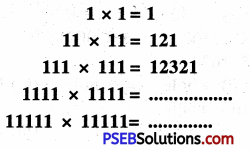
PSEB 6th Class Maths Solutions Chapter 2 Whole Numbers Ex 2.3 1
Solution:
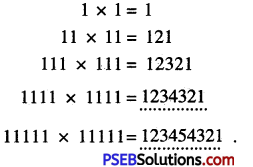
PSEB 6th Class Maths Solutions Chapter 2 Whole Numbers Ex 2.3 2

PSEB 6th Class Maths Solutions Chapter 2 Whole Numbers Ex 2.3

4. Observe the pattern and fill in the blanks:
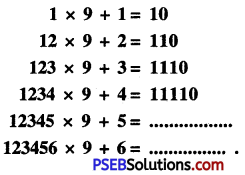
PSEB 6th Class Maths Solutions Chapter 2 Whole Numbers Ex 2.3 3
Solution:
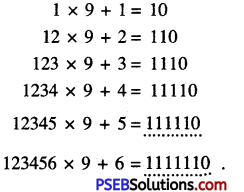
PSEB 6th Class Maths Solutions Chapter 2 Whole Numbers Ex 2.3 4

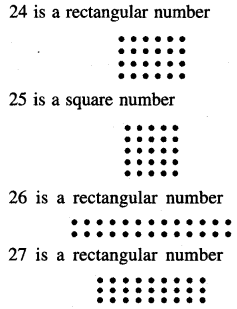
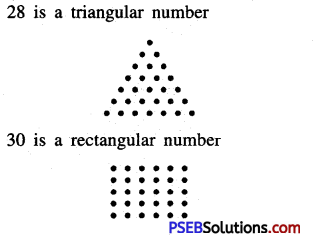
5. Represent numbers from 24 to 30 according to rectangular, square or triangular pattern.
Solution:
Numbers from 24 to 30 are 24, 25, 26, 27, 28, 29, 30.
PSEB 6th Class Maths Solutions Chapter 2 Whole Numbers Ex 2.3 5
PSEB 6th Class Maths Solutions Chapter 2 Whole Numbers Ex 2.3 6

PSEB 6th Class Maths Solutions Chapter 2 Whole Numbers Ex 2.3

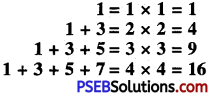
6. Study the following pattern:

Question (i)
PSEB 6th Class Maths Solutions Chapter 2 Whole Numbers Ex 2.3 7
Hence find the sum of
(a) First 12 odd numbers
(b) First 50 odd numbers.
Solution:
(a) Sum of first 12 odd numbers = 12 × 12 = 144
(b) Sum of first 50 odd numbers = 50 × 50 = 2500

PSEB 6th Class Maths Solutions Chapter 3 Playing with Numbers Ex 3.3

Punjab State Board PSEB 6th Class Maths Book Solutions Chapter 3 Playing with Numbers Ex 3.3 Textbook Exercise Questions and Answers.

PSEB Solutions for Class 6 Maths Chapter 3 Playing with Numbers Ex 3.3

1. Find prime factors of the following numbers by factor tree method:

Question (i)
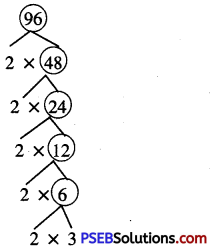
96
Solution:
PSEB 6th Class Maths Solutions Chapter 3 Playing with Numbers Ex 3.3 1
∴ Prime factorisation of 96 = 2 × 2 × 2 × 2 × 2 × 3

PSEB 6th Class Maths Solutions Chapter 3 Playing with Numbers Ex 3.3

Question (ii)
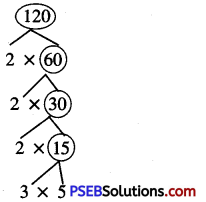
120
Solution:
PSEB 6th Class Maths Solutions Chapter 3 Playing with Numbers Ex 3.3 2
∴ Prime factorisation of 120 = 2 × 2 × 2 × 3 × 5

Question (iii)
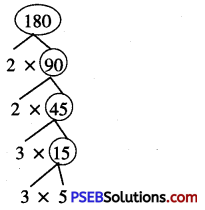
180.
Solution:
PSEB 6th Class Maths Solutions Chapter 3 Playing with Numbers Ex 3.3 3
∴ Prime factorisation of 180 = 2 × 2 × 3 × 3 × 5

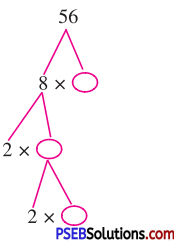
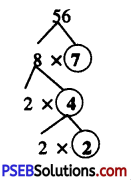
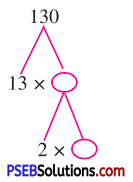
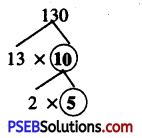
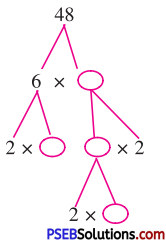
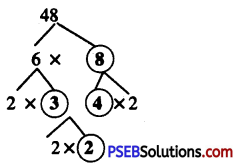
2. Complete each factor tree:

Question (i)
PSEB 6th Class Maths Solutions Chapter 3 Playing with Numbers Ex 3.3 4
Solution:
PSEB 6th Class Maths Solutions Chapter 3 Playing with Numbers Ex 3.3 5

PSEB 6th Class Maths Solutions Chapter 3 Playing with Numbers Ex 3.3

Question (ii)
PSEB 6th Class Maths Solutions Chapter 3 Playing with Numbers Ex 3.3 6
Solution:
PSEB 6th Class Maths Solutions Chapter 3 Playing with Numbers Ex 3.3 7

Question (iii)
PSEB 6th Class Maths Solutions Chapter 3 Playing with Numbers Ex 3.3 8
Solution:
PSEB 6th Class Maths Solutions Chapter 3 Playing with Numbers Ex 3.3 9

PSEB 6th Class Maths Solutions Chapter 3 Playing with Numbers Ex 3.3

3. Find the prime factors of the following numbers by division method:

Question (i)
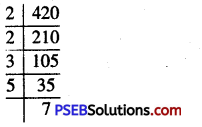
420
Solution:
PSEB 6th Class Maths Solutions Chapter 3 Playing with Numbers Ex 3.3 10
∴ 420 = 2 × 2 × 3 × 5 × 7

Question (ii)
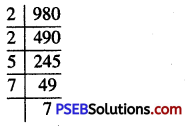
980
Solution:
PSEB 6th Class Maths Solutions Chapter 3 Playing with Numbers Ex 3.3 11
∴ 980 = 2 × 2 × 5 × 7 × 7

Question (iii)
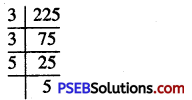
225
Solution:
PSEB 6th Class Maths Solutions Chapter 3 Playing with Numbers Ex 3.3 12
∴ 225 = 3 × 3 × 5 × 5

PSEB 6th Class Maths Solutions Chapter 3 Playing with Numbers Ex 3.3

Question (iv)
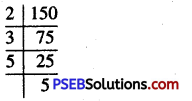
150
Solution:
PSEB 6th Class Maths Solutions Chapter 3 Playing with Numbers Ex 3.3 13
∴ 150 = 2 × 3 × 5 × 5

Question (v)
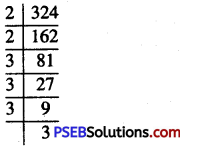
324
Solution:
PSEB 6th Class Maths Solutions Chapter 3 Playing with Numbers Ex 3.3 14
∴ 324 = 2 × 2 × 3 × 3 × 3 × 3

PSEB 6th Class Maths Solutions Chapter 3 Playing with Numbers Ex 3.2

Punjab State Board PSEB 6th Class Maths Book Solutions Chapter 3 Playing with Numbers Ex 3.2 Textbook Exercise Questions and Answers.

PSEB Solutions for Class 6 Maths Chapter 3 Playing with Numbers Ex 3.2

1. Find the common factors of the followings:

Question (i)
16 and 24
Solution:
The factors of 16
= 1, 2, 4, 8, 16
The factors of 24
= 1, 2, 3, 4, 6, 8, 12, 24
Common factors of 16 and 24
= 1, 2, 4, 8

PSEB 6th Class Maths Solutions Chapter 3 Playing with Numbers Ex 3.2

Question (ii)
25 and 40
Solution:
The factors of 25
= 1, 5, 25
The factors of 40
= 1, 2, 4, 5, 8, 10, 20, 40
Common factors of 25 and 40
= 1, 5

Question (iii)
24 and 36
Solution:
The factors of 24
= 1, 2, 3, 4, 6, 8, 12, 24
The factors of 36
= 1, 2, 3, 4, 6, 12, 18, 36
Common factors of 24 and 36
= 1, 2, 3, 4, 6, 12

Question (iv)
14, 35 and 42
Solution:
The factors of 14
= 1, 2, 7, 14
The factors of 35
= 1, 5, 7, 35
The factors of 42
= 1,2,3, 6, 7, 21, 42
Common factors of 14, 35 and 42
= 1, 7

Question (v)
15, 24 and 35.
Solution:
The factors of 15
= 1, 3, 5, 15
The factors of 24
= 1, 2, 3, 4, 6, 8, 12, 24
The factors of 35
= 1, 5, 7, 35
Common factors of 15, 24 and 35.
= 1

PSEB 6th Class Maths Solutions Chapter 3 Playing with Numbers Ex 3.2

2. Find first three common multiples of the followings:

Question (i)
3 and 5
Solution:
The multiples of 3
= 3, 6, 9, 12, 15, 18, 21, 24, 27, 30, 33, 36, 39, 42, 45
The multiples of 5
= 5, 10, 15, 20, 25, 30, 35, 40,45
First three common multiples of 3 and 5
= 15, 30 and 45

Question (ii)
6 and 8
Solution:
The multiples of 6
= 6, 12, 18, 24, 30, 36, 42, 48 54, 60, 66, 72
The multiples of 8
= 8, 16, 24, 32, 40, 48, 56, 64, 72
First three common multiples of 6 and 8
= 24, 48 and 72

Question (iii)
2, 3 and 4.
Solution:
The multiples of 2
= 2, 4, 6, 8, 10, 12, 14, 16, 18, 20, 22, 24, 26, 28, 30, 32, 34, 36
The multiples of 3
= 3, 6, 9, 12, 15, 18, 21, 24, 27, 30, 33, 36
The multiples of 4
= 4, 8, 12, 16, 20, 24, 28, 32, 36
First three common multiples of 2, 3 and 4
= 12, 24 and 36

3. Which of the following numbers are divisible by 2 or 4?

Question (i)
52314
Solution:
52314 is divisible by 2 as it is even number.
52314 is not divisible by 4 because the last two digits i.e. 14 which is not divisible by 4

PSEB 6th Class Maths Solutions Chapter 3 Playing with Numbers Ex 3.2

Question (ii)
678913
Solution:
678913 is not divisible by 2. As it is an odd number.
678913 is not divisible by 4 because the last two digits i.e. 13 is not divisible by 4.

Question (iii)
4056784
Solution:
4056784 is divisible by 2. As it is an even number.
4056784 is also divisible by 4 because the last two digits i.e. 84 which is divisible by 4.

Question (iv)
21536
Solution:
21536 is divisible by 2. As it is an even number.
21536 is divisible by 4. As number formed by their last two digits is divisible by 4.

Question (v)
412318.
Solution:
412318 is divisible by 2. As it is an even number.
412318. is not divisible by 4. As number formed by their last two digits is not divisible by 4.

4. Which of the following numbers are divisible by 3 or 9?

Question (i)
654312
Solution:
654312 is divisible by 3.
As sum of its digits = 6 + 5 + 4 + 3 + 1 + 2 = 21, which is divisible by 3.
654312 is not divisible by 9.
As sum of its digits = 21, which is not divisible by 9.

PSEB 6th Class Maths Solutions Chapter 3 Playing with Numbers Ex 3.2

Question (ii)
516735
Solution:
516735 is divisible by 3.
As sum of its digits = 5 + 1 + 6 + 7 + 3 + 5 = 27, which is divisible by 3.
516735 is also divisible by 9.
As sum of its digits = 27, which is divisible by 3.

Question (iii)
423152
Solution:
423152 is divisible by 3.
As sum of its digits = 4 + 2 + 3 + 1 + 5 + 2=17, which is not divisible by 3.
423152 is also not divisible by 9.
As sum of its digits = 17, which is not divisible by 9.

Question (iv)
704355
Solution:
704355 is divisible by 3.
As sum of its digits = 7 + 0 + 4 + 3 + 5 + 5 = 24, which is divisible by 3.
704355 is not divisible by 9.
As sum of its digits = 24, which is not divisible by 9.

Question (v)
215478.
Solution:
215478 is divisible by 3.
As sum of its digits = 2 + 1 + 5 + 4 + 7 + 8 = 27, which is divisible by 3.
215478 is divisible by 9.
As sum of its digits = 27, which is divisible by 9.

5. Which of the following numbers are divisible by 5 or 10?

Question (i)
456803
Solution:
456803 is not divisible by 5
As its last digit is not 0 or 5.
456803 is not divisible by 10
As its last digit is not 0.

PSEB 6th Class Maths Solutions Chapter 3 Playing with Numbers Ex 3.2

Question (ii)
654130
Solution:
654130 is divisible by both 5 and 10
As its last digit is 0.

Question (iii)
256785
Solution:
256785 is divisible by 5
As its last digit is 5.
256785 is not divisible by 10
As its last digit is not 0.

Question (iv)
412508
Solution:
412508 is not divisible by 5
As its last digit is not 0 or 5.
412508 is not divisible by 10
As its last digit is not 0.

Question (v)
872565.
Solution:
872565 is divisible by 5
As its last digit is 5.
872565 is not divisible by 10
As its last digit is not 0.

6. Which of the following numbers are divisible by 8?

Question (i)
457432
Solution:
457432 is divisible by 8, because its last three digits are 432, which is divisible by 8.

PSEB 6th Class Maths Solutions Chapter 3 Playing with Numbers Ex 3.2

Question (ii)
5134214
Solution:
5134214 is not divisible by 8, because its last three digits are 214, which is not divisible by 8.

Question (iii)
7232000
Solution:
7232000 is divisible by 8, because its last three digits are 000, which is divisible by 8.

Question (iv)
5124328
Solution:
5124328 is divisible by 8, because its last three digits are 328, which is divisible by 8.

Question (v)
642516.
Solution:
642516 is not divisible by 8, because its last three digits are 516, which is not divisible by 8.

7. Which of the following numbers are divisible by 6?

Question (i)
425424
Solution:
425424 is divisible by 2 because, it has 4 in its units place.
Sum of digits = 4 + 2 + 5+4 + 2 + 4 = 21
Sum of digits of 425424 is divisible by 3.
∴ 425424 is divisible by 2 as well as 3
Hence, 425424 is divisible by 6.

Question (ii)
617415
Solution:
617415 is not divisible by 2 because, it has 5 in its units place.
∴ 617415 is not divisible by 6.

PSEB 6th Class Maths Solutions Chapter 3 Playing with Numbers Ex 3.2

Question (iii)
3415026
Solution:
3415026 is divisible by 2 because, it has 6 in its units place.
Sum of digits = 3 + 4 + 1 + 5 + 0 + 2 + 6 = 21
Sum of digits of 3415026 is divisible by 3
So, 3415026 is divisible by 3
∴ 3415026 is divisible by 2 as well as 3
Hence, 3415026 is divisible by 6.

Question (iv)
4065842
Solution:
4065842 is divisible by 2 because, it has 2 in its units place.
Sum of digits = 4 + 0 + 6 + 5 + 8 + 4 + 2 = 29
Sum of digits of 4065842 is not divisible by 3.
So, 4065842 is not divisible by 3.
∴ 4065842 is divisible by 2 but not by 3.
Hence, 4065842 is not divisible by 6.

Question (v)
725436.
Solution:
725436 is divisible by 2 because, it has 6 in its units place.
Sum of digits = 7 + 2 + 5 + 4 + 3 + 6 = 27
Sum of digits of 725436 is divisible by 3.
So, 725436 is divisible by 3.
∴ 725436 is divisible by 2 as well as 3
Hence, 725436 is divisible by 6.

8. Which of the following numbers are divisible by 11?

Question (i)
4281970
Solution:
4281970 is divisible by 11.
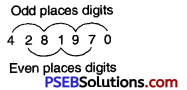
PSEB 6th Class Maths Solutions Chapter 3 Playing with Numbers Ex 3.2 1
Since sum of its digits in odd places = 4 + 8 + 9 + 0 = 21 and
sum of its digits in even places = 2 + 1 + 7 = 10
Their difference = 21 – 10=11, which is odd places digits divisible by 11.

PSEB 6th Class Maths Solutions Chapter 3 Playing with Numbers Ex 3.2

Question (ii)
8049536
Solution:
8049536 is divisible by 11.
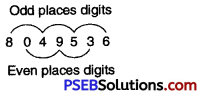
PSEB 6th Class Maths Solutions Chapter 3 Playing with Numbers Ex 3.2 2
Since sum of its digits in odd places = 8 + 4 + 5 + 6 = 23
and sum of its digits in even places = 0 + 9 + 3 = 12
Difference = 23 – 12 = 11, which is divisible by 11.

Question (iii)
1234321
Solution:
1234321 is divisible by 11.
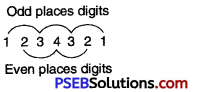
PSEB 6th Class Maths Solutions Chapter 3 Playing with Numbers Ex 3.2 3
Since sum of its digits in odd places = 1 + 3 + 3 + 1 = 8
and sum of its digits in even places = 2 + 4 + 2 = 8
Difference = 8 – 8 = 0.

Question (iv)
6450828
Solution:
6450828 is not divisible by 11.
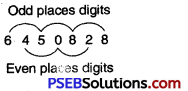
PSEB 6th Class Maths Solutions Chapter 3 Playing with Numbers Ex 3.2 4
Since sum of its digits in odd places = 6 + 5 + 8 + 8 = 27
and sum of its digits in even places = 4 + 0 + 2 = 6
Difference = 27 – 6 = 21, which is not divisible by 11.

Question (v)
5648346.
Solution:
5648346 is divisible by 11.
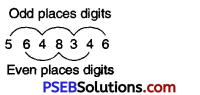
PSEB 6th Class Maths Solutions Chapter 3 Playing with Numbers Ex 3.2 5
Since sum of its digits in odd places = 5 + 4 + 3 + 6 = 18 and
sum of its digits in even places = 6 + 8 + 4 = 18.
Difference = 18 – 18 = 0.

9. State True or False:

Question (i)
If a number is divisible by 24, then it is also divisible by 3 and 8.
Solution:
True

PSEB 6th Class Maths Solutions Chapter 3 Playing with Numbers Ex 3.2

Question (ii)
60 and 90 both are divisible by 10 then their sum is not divisible by 10.
Solution:
False

Question (iii)
If a number is divisible by 8 then it is also divisible by 16.
Solution:
False

Question (iv)
If a number is divisible by 15 then it is also divisible by 3.
Solution:
True

Question (v)
144 and 72 are divisible by 12 then their difference is also divisible by 12.
Solution:
True

10. If a number is divisible by 5 and 9 then by which other numbers will that number be always divisible?
Solution:
If a number is divisible by 5 and 9. Then the number is also divisible by their product i.e. 5 × 9 = 45.

11. Which of the following pairs are co-prime?

Question (i)
25, 35
Solution:
Two numbers are said to be co-prime if they do not have a common factor other than 1.
Given numbers are 25 and 35 Factors of 25 = 1, 5, 25
Factors of 35 = 1, 5, 7, 35
Since 25 and 35 have 1 and 5 two common factors
∴ 25 and 33 are not co-prime.

Question (ii)
16,21
Solution:
Given numbers are 16 and 21
Factors of 16 = 1, 2, 4, 8, 16
Factors of 21 = 3, 7, 21
There is only 1 common factors 16 and 21 are co-prime
∴ 16 and 21 are co-prime.

PSEB 6th Class Maths Solutions Chapter 3 Playing with Numbers Ex 3.2

Question (iii)
24, 41
Solution:
Given numbers are 24 and 41
Factors of 24 = 1, 2, 3, 4, 6, 8, 12, 24
Factors of 41 = 1, 41
There is only one (1) common factors.
∴ 24 and 41 are co-prime.

Question (iv)
48,33
Solution:
Given numbers are 48 and 33
Factors of 48 = 1, 2, 3, 4, 6, 8, 12, 16, 24, 48
Factors of 33 = 1, 3, 11
There are two common factors 1 and 3.
∴ 48 and 33 are not co-prime.

Question (v)
20, 57.
Solution:
Given numbers are 20 and 57
Factors of 20 = 1, 2, 4, 5, 10, 20
Factors of 57 = 1, 3, 19, 57
There is only only one (1) common factors.
∴ 20 and 57 are co-prime.


PSEB 6th Class Maths Solutions Chapter 2 Whole Numbers Ex 2.2

Punjab State Board PSEB 6th Class Maths Book Solutions Chapter 2 Whole Numbers Ex 2.2 Textbook Exercise Questions and Answers.

PSEB Solutions for Class 6 Maths Chapter 2 Whole Numbers Ex 2.2

1. Find the sum by suitable arrangement of terms:

Question (a)
837 + 208 + 363
Solution:
837 + 208 + 363
= (837 + 363) + 208
= 1200 + 208
= 1408

PSEB 6th Class Maths Solutions Chapter 2 Whole Numbers Ex 2.2

Question (b)
1962 + 453 + 1538 + 647.
Solution:
1962 + 453 + 1538 + 647
= (1962 + 1538) + (453 + 647)
= 3500 + 1100
= 4600

2. Find the product by suitable arrangement of terms:

Question (a)
2 × 1497 × 50
Solution:
= (2 × 50) × 1497
= 100 × 1497
= 149700

Question (b)
4 × 263 × 25
Solution:
= (4 × 25) × 263
= 100 × 263
= 26300

Question (c)
8 × 163 × 125
Solution:
= (8 × 125) × 163
= 1000 × 163
= 163000

Question (d)
963 × 16 × 25
Solution:
= 963 × (16 × 25)
= 963 × 400
= 385200

PSEB 6th Class Maths Solutions Chapter 2 Whole Numbers Ex 2.2

Question (e)
5 × 171 × 60
Solution:
= (5 × 60) × 171
= 300 × 171
= 51300

Question (f)
125 × 40 × 8 × 25
Solution:
= (125 × 40) × (8 × 25)
= 5000 × 200
= 1000000

Question (g)
30921 × 25 × 40 × 2
Solution:
= 30921 × (25 × 40) × 2
= 30921 × 1000 × 2
= 61842000

Question (h)
4 × 2 × 1932 × 125
Solution:
4 × 2 × 1932 × 125
= 1932 × (4 × 2 × 125)
= 1932 × 1000
= 1932000

Question (i)
5462 × 25 × 4 × 2.
Solution:
= 5462 × 2 × 25 × 4
= 10924 × 100
= 1092400

PSEB 6th Class Maths Solutions Chapter 2 Whole Numbers Ex 2.2

3. Find the value of each of the following using distributive property:

Question (a)
(649 × 8) + (649 × 2)
Solution:
(649 × 8) + (649 × 2)
= 649 × (8 + 2)
= 649 × 10
= 6490

Question (b)
(6524 × 69) + (6524 × 31)
Solution:
(6524 × 69) + (6524 × 31)
= 6524 × (69 + 31)
= 6524 × 100
= 652400

Question (c)
(2986 × 35) + (2986 × 65)
Solution:
(2986 × 35) + (2986 × 65)
= 2986 × (35 + 65)
= 2986 × 100
= 298600

Question (d)
(6001 × 172) – (6001 × 72).
Solution:
(6001 × 172) – (6001 × 72)
= 6001 × (172 – 72)
= 6001 × 100
= 600100

4. Find the value of the following:

Question (a)
493 × 8 + 493 × 2
Solution:
(a) 493 × 8 + 493 × 2
= 493 × (8 + 2) = 493 × 10
= 4930

PSEB 6th Class Maths Solutions Chapter 2 Whole Numbers Ex 2.2

Question (b)
24579 × 93 + 7 × 24579
Solution:
24579 × 93 + 7 × 24579
= 24579 × (93 + 7)
= 24579 × 100
= 2457900

Question (c)
3845 × 5 × 782 + 769 × 25 × 218
Solution:
3845 × 5 × 782 + 769 × 25 × 218
= 769 × 5 × 5 × 782 + 769 × 5 × 5 × 218
= 769 × 5 × 5 × (782 + 218)
= 769 × 25 × 1000
= 19225 × 1000
= 19225000

Question (d)
3297 × 999 + 3297.
Solution:
3297 × 999 + 3297
= (3297) × (999 + 1)
= 3297 × 1000
= 3297000

5. Find the product, using suitable properties:

Question (a)
738 × 103
Solution:
= 738 × (100 + 3)
= (738 × 100) + (738 × 3)
[Using a × (b + c) = (a × b) + (a × c)]
= 73800 + 2214
= 76014

PSEB 6th Class Maths Solutions Chapter 2 Whole Numbers Ex 2.2

Question (b)
854 × 102
Solution:
= 854 × (100 + 2)
= (854 × 100) + (854 × 2)
[Using a × (b + c) = (a × b) + (a × c)]
= 85400 + 1708
= 87108

Question (c)
258 × 1008
Solution:
= 258 × (1000 + 8)
= (258 × 1000) + (258 x 8)
[Using a × (b + c) = (a × b) + (a × c)]
= 258000 + 2064
= 260064

Question (d)
736 × 93
Solution:
= 736 × (100 – 7)
= 736 × 100 = 736 × 7
[Using a × (b – c) = (a × b) – (a × c)]
= 73600 – 5152
= 68448

Question (e)
816 × 745
Solution:
= (800 + 16) × 745
= 800 × 745 + 16 × 745
[Using a × (b + c) = (a × b) + (a × c)]
= 596000 + 11920
= 607920

PSEB 6th Class Maths Solutions Chapter 2 Whole Numbers Ex 2.2

Question (f)
2032 × 613
Solution:
= 2032 × (600 + 13)
= 2032 × 600 + 2032 × 13
[Using a × (b + c) = (a × b) + (a × c)]
= 1219200 + 26416
= 1245616

6. A taxi driver filled his car petrol tank with 40 litres of petrol on Monday. The next day, he filled the tank with 50 litres of petrol. If the petrol costs ₹ 78 per litre, how much he spend in all on petrol?
Solution:
Petrol filled on Monday = 40 Litres
Petrol filled on Tuesday = 50 Litres
Total Petrol filled = 40 + 50 = 90 Litres
Cost per litre = ₹ 78
Total Cost = 90 × ₹ 78
= ₹ 7020

7. A vendor supplies 32 litres of milk to a hotel in the morning and 68 litres of milk in the evening. If the milk costs ₹ 35 per litre, how much money is due to the vendor per day?
Solution:
Milk supplied in the morning = 32 Litres
Milk supplied in the evening = 68 Litres
Total milk supplied = 32 + 68
= 100 Litres
Cost Per litre = ₹ 35
∴ Total cost of milk per day = 100 × ₹ 35
= ₹ 3500

PSEB 6th Class Maths Solutions Chapter 2 Whole Numbers Ex 2.2

8. We know that 0 × 0 = 0. Is there any other whole number which when multiplied by itself gives the product equal to the number itself? Find out the number.
Solution:
Yes, there is a whole number 1.
Here 1 × 1 = 1.

9. Fill in the blanks:

Question (i)
(a) 15 × 0 = ………….. .
(b) 15 + 0 = ………….. .
(c) 15 – 0 = ………….. .
(d) 15 ÷ 0 = ………….. .
(e) 0 × 15 = ………….. .
(f) 0 + 15 = ………….. .
(g) 0 ÷ 15 = ………….. .
(h) 15 × 1 = ………….. .
(i) 15 ÷ 1 = ………….. .
(j) 1 ÷ 1 = ………….. .
Solution:
(a) 0,
(b) 15,
(c) 15,
(d) Not defined,
(e) 0,
(f) 15,
(g) 0,
(h) 15,
(i) 15,
(j) 1.

PSEB 6th Class Maths Solutions Chapter 2 Whole Numbers Ex 2.2

Question 10.
The product of two Whole numbers is zero. What do you conclude. Explain with example.
Solution:
We conclude that one number must be zero such 25 × 0 = 0.

Question 11.
Match the following:

1. 537 × 106 = 537 ×100 + 537 × 6 (a)  Commutativity under multiplication
2. 4 × 47 × 25 = 4 × 25 × 47 (b) Commutativity under addition
3. 70 + 1923 + 30 = 70 + 30 + 1923 (c)  Distributivity of multiplication over addition.

Solution:

1. 537 × 106 = 537 × 100 + 537 × 6 (c)  Distributivity of multiplication over addition.
2. 4 × 47 × 25 = 4 × 25 × 47 (a)  Commutativity under multiplication
3. 70 + 1923 + 30 = 70 + 30 + 1923 (b) Commutativity under addition

PSEB 6th Class Maths Solutions Chapter 2 Whole Numbers Ex 2.1

Punjab State Board PSEB 6th Class Maths Book Solutions Chapter 2 Whole Numbers Ex 2.1 Textbook Exercise Questions and Answers.

PSEB Solutions for Class 6 Maths Chapter 2 Whole Numbers Ex 2.1

1. Answer the following questions:

Question (a)
Write the smallest whole number.
Solution:
The smallest Whole number = 0

PSEB 6th Class Maths Solutions Chapter 2 Whole Numbers Ex 2.1

Question (b)
Write the smallest natural number.
Solution:
The smallest natural number = 1

Question (c)
Write the successor of 0 in whole numbers.
Solution:
Successor of 0 = 0 + 1 = 1

Question (d)
Write the predecessor of 0 in whole numbers.
Solution:
Predecessor of 0 is whole number is not possible.

Question (e)
Write the Largest whole number.
Solution:
Largest whole number is not possible.

2. Which of the following statements are True (T) and which are False (F)?

Question (a)
Zero is the smallest natural number.
Solution:
False

PSEB 6th Class Maths Solutions Chapter 2 Whole Numbers Ex 2.1

Question (b)
Zero is the smallest whole number.
Solution:
True

Question (c)
Every whole number is a natural number.
Solution:
False

Question (d)
Every natural number is a whole number.
Solution:
True

Question (e)
1 is the smallest whole number.
Solution:
False

Question (f)
The natural number 1 has no predecessor in natural numbers.
Solution:
True

Question (g)
The whole number 1 has no predecessor in whole numbers.
Solution:
False

PSEB 6th Class Maths Solutions Chapter 2 Whole Numbers Ex 2.1

Question (h)
Successor of the largest two-digit number is smallest three-digit number.
Solution:
True

Question (i)
The successor of a two-digit number is always a two-digit number.
Solution:
False

Question (j)
300 is the predecessor of 299.
Solution:
False

Question (k)
500 is the successor of 499.
Solution:
True

Question (l)
The predecessor of a two-digit number is never a single-digit number.
Solution:
False

3. Write the successor of each of following:

Question (a)
100909
Solution:
Successor of 100909
= 100909 + 1
= 100910

PSEB 6th Class Maths Solutions Chapter 2 Whole Numbers Ex 2.1

Question (b)
4630999
Solution:
Successor of 4630999
= 4630999 + 1
= 4631000

Question (c)
830001
Solution:
Successor of 830001
= 830001 + 1
= 830002

Question (d)
99999.
Solution:
Successor of 99999
= 99999 + 1
= 100000

4. Write the predecessor of each of following:

Question (a)
1000
Solution:
Predecessor of 1000 = 1000 – 1
= 999

PSEB 6th Class Maths Solutions Chapter 2 Whole Numbers Ex 2.1

Question (b)
208090
Solution:
Predecessor of 208090 = 208090 – 1
= 208089

Question (c)
7654321
Solution:
Predecessor of 7654321 = 7654321 – 1
= 7654320

Question (d)
12576.
Solution:
Predecessor of 12576 = 12576 – 1
= 12575

5. Represent the following numbers on the number line: 2, 0, 3, 5, 7, 11, 15.
Solution:
Draw a line. Mark a point on it. Label it ‘O’. Mark a second point to the right of 0. Label it 1. The distance between these points labelled as 0 and 1 is called unit distance. On this line, mark a point to the right of 1 and at unit distance from 1 and label it 2. In this way go on labeling points at unit distance as 3, 4, 5, …………… on the line.
PSEB 6th Class Maths Solutions Chapter 2 Whole Numbers Ex 2.1 1

6. How many whole numbers are there between 22 and 43?
Solution:
Whole numbers between 22 and 43 are 23, 24, 25, 26, 27, 28, 29, 30, 31, 32, 33, 34, 35, 36, 37, 38, 39, 40, 41, 42
∴ There are 20 whole numbers between 22 and 43.
Or [(43 – 22) – 1 = 21 – 1 = 20].

PSEB 6th Class Maths Solutions Chapter 2 Whole Numbers Ex 2.1

7. Draw a number line to represent each of following on it.

Question (a)
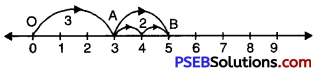
3 + 2
Solution:
We draw a number line and move 3 steps from 0 to the right and mark this point as A.
Now, starting from A we move 2 steps towards right and move at B.
PSEB 6th Class Maths Solutions Chapter 2 Whole Numbers Ex 2.1 2
OA = 4, AB = 2, OB = 5
Hence, OB = 3 + 2 = 5.

Question (b)
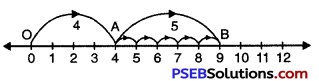
4 + 5
Solution:
We draw a number line.
Starting from point 0 (i.e. zero), we move 4 steps to the right and mark this point as A.
Now, starting from A we move 5 steps towards right and arrive at B.
PSEB 6th Class Maths Solutions Chapter 2 Whole Numbers Ex 2.1 3
OA = 4, AB = 5, OB = 9
Hence, OB = 4 + 5 = 9.

PSEB 6th Class Maths Solutions Chapter 2 Whole Numbers Ex 2.1

Question (c)
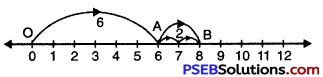
6 + 2
Solution:
We draw a number line.
Starting from point 0 (i.e. zero), we move 6 steps to the right and mark this point as A.
Now, starting from A we move 2 steps towards right and arrive at B.
PSEB 6th Class Maths Solutions Chapter 2 Whole Numbers Ex 2.1 4
OA = 6, AB = 2, OB = 8
Hence, OB = 6 + 2 = 8.

Question (d)
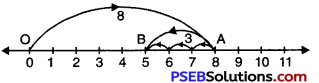
8 – 3
Solution:
We draw a number line.
Starting from point 0 (i.e. zero), we move 8 steps to the right and arrive at A.
Now, starting from A we move 3 steps to the left of A and arrive at B.
PSEB 6th Class Maths Solutions Chapter 2 Whole Numbers Ex 2.1 5
OA = 8, AB = 3, OB = 5
Hence, OB = 8 – 3 = 5.

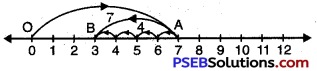
Question (e)
7 – 4
Solution:
We draw a number line.
Starting from point 0 (i.e. zero), we move 7 steps to the right and arrive at A.
Now, starting from A we move 4 steps to the left of A and arrive at B.
PSEB 6th Class Maths Solutions Chapter 2 Whole Numbers Ex 2.1 6
OA = 7, AB = 4, OB = 3
Hence, OB = 7 – 4 = 3.

PSEB 6th Class Maths Solutions Chapter 2 Whole Numbers Ex 2.1

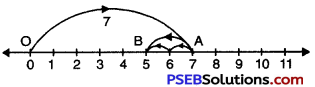
Question (f)
7 – 2
Solution:
We draw a number line.
Starting from point 0 (i.e. zero), we move 7 steps to the right and arrive at A.
Now, starting from A, we move 2 steps to the left of A and arrive at B.
PSEB 6th Class Maths Solutions Chapter 2 Whole Numbers Ex 2.1 7
OA = 7, AB = 2, OB = 5
Hence, OB = 7 – 2 = 5.

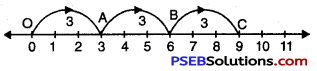
Question (g)
3 × 3
Solution:
We draw a number line.
Starting from 0 we move 3 units to the right of 0 to arrive at A.
We make two more such same moves starting from A (total 3 moves of 3 units each) to reach finally at C which represents 9.
PSEB 6th Class Maths Solutions Chapter 2 Whole Numbers Ex 2.1 8
Hence, 3 × 3 = 9.

Question (h)
2 × 5
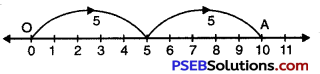
Solution:
We draw a number line.
We start from 0 move 5 units at a time to right.
We make 2 such moves. We shall reach at 10.
PSEB 6th Class Maths Solutions Chapter 2 Whole Numbers Ex 2.1 9
So, 2 × 5 = 10.

PSEB 6th Class Maths Solutions Chapter 2 Whole Numbers Ex 2.1

Question (i)
3 × 5
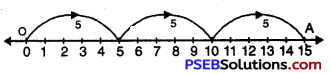
Solution:
We draw a number line.
We start from 0, move 5 units at a time to right.
We make 3 such moves. We shall reach at 15.
PSEB 6th Class Maths Solutions Chapter 2 Whole Numbers Ex 2.1 10
So, 3 × 5 = 15

Question (j)
9 ÷ 3
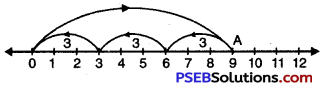
We draw a number line.
Starting from 0, we move 9 units to the right of 0 to arrive at A.
Now, from A take moves of 3 units to the left of A till we reach at ‘O’. We observe that there are 3 moves.
PSEB 6th Class Maths Solutions Chapter 2 Whole Numbers Ex 2.1 11
So, 9 ÷ 3 = 3.

Question (k)
12 ÷ 4
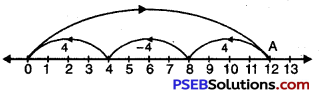
We draw a number line.
Starting from 0, we move 12 units to the right of 0 to arrive at A.
Now, from A take moves of 4 units to the left of A till we reach at ‘O’. We observe that there are 3 moves.
PSEB 6th Class Maths Solutions Chapter 2 Whole Numbers Ex 2.1 12
So, 12 ÷ 4 = 3.

PSEB 6th Class Maths Solutions Chapter 2 Whole Numbers Ex 2.1

Question (l)
10 ÷ 2
Solution:
We draw a number line.
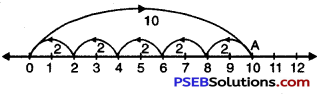
Starting from 0, we move 10 units to the right of 0 to arrive at A.
Now, from A take moves of 2 units to the left c A till we reach at ‘O’. We observe that there are 5 moves.
PSEB 6th Class Maths Solutions Chapter 2 Whole Numbers Ex 2.1 13
So, 10 ÷ 2 = 5.

8. Fill in the blanks with the appropriate symbol < or > :

Question (i)
(a) 25 ……………. 205
(b) 170 …………… 107
(c) 415 …………… 514
(d) 10001 ………….. 9999
(e) 2300014 ………….. 2300041
(f) 99999 …………… 888888.
Solution:
(a) 25 < 205 (b) 170 > 107
(c) 415 < 514 (d) 10001 > 9999
(c) 2300014 < 2300041
(f) 99999 < 888888.

PSEB 6th Class Maths MCQ Chapter 1 Knowing Our Numbers

Punjab State Board PSEB 6th Class Maths Book Solutions Chapter 1 Knowing Our Numbers MCQ Questions with Answers.

PSEB 6th Class Maths Chapter 1 Knowing Our Numbers MCQ Questions

Multiple Choice Questions

Question 1.
The number of digits are:
(a) 9
(b) 10
(c) 8
(d) Infinite.
Answer:
(b) 10

PSEB 6th Class Maths MCQ Chapter 1 Knowing Our Numbers

Question 2.
The greatest 4 digit number using 1, 5, 2, 9 once is:
(a) 9215
(b) 9512
(c) 5912
(d) 9521.
Answer:
(b) 9512

Question 3.
The smallest 4 digit number using 2, 0, 3, 7 once is:
(a) 0237
(b) 2037
(c) 7320
(d) 7023.
Answer:
(b) 2037

Question 4.
Which of the following are in ascending order?
(a) 217, 271, 127, 721
(b) 217, 127, 721, 271
(c) 127, 217, 271, 721
(d) 721, 271, 217, 127.
Answer:
(c) 127, 217, 271, 721

Question 5.
The face value of digit 4 in 23468 is:
(a) 4
(b) 400
(c) 40
(d) 468.
Answer:
(a) 4

Question 6.
The place value of digit 2 in 4123 is:
(a) 23
(b) 2
(c) 20
(d) 200.
Answer:
(c) 20

PSEB 6th Class Maths MCQ Chapter 1 Knowing Our Numbers

Question 7.
The difference between place value and face value of 5 in 76542 is:
(a) 537
(b) 45
(c) 0
(d) 495
Answer:
(d) 495

Question 8.
5 × 10000 + 3 × 100 + 2 × 10 + 2 = …………..
(a) 5322
(b) 53022
(c) 50322
(d) 53202.
Answer:
(c) 50322

Question 9.
Four lakh two thousand three hundred fifty-one = …………..
(a) 42351
(b) 402351
(c) 420351
(d) 4002351.
Answer:
(b) 402351

Question 10.
How many four-digit numbers are there?
(a) 9999
(b) 9900
(c) 9000
(d) 9990.
Answer:
(c) 9000

Question 11.
Seventeen million twenty-four thousand fifty-four = …………….
(a) 172454
(b) 170024054
(c) 170240054
(d) 17024054.
Answer:
(d) 17024054.

PSEB 6th Class Maths MCQ Chapter 1 Knowing Our Numbers

Question 12.
1 Crore = …………….. million.
(a) 1
(b) 10
(c) 100
(d) 1000.
Answer:
(b) 10

Question 13.
Rounded off 7213 to nearest thousands.
(a) 7200
(b) 7000
(c) 7210
(d) 7213.
Answer:
(b) 7000

Question 14.
Rounded off 45553 to nearest hundreds.
(a) 45500
(b) 45550
(c) 45600
(d) 45650.
Answer:
(c) 45600

Question 15.
Solve : (9 – 4) × 6 = …………….. .
(a) 30
(b) 54
(c) 78
(d) 64.
Answer:
(a) 30

Question 16.
Which of the following number does not have symbol in Roman numerals?
(a) 0
(b) 1
(c) 10
(d) 1000.
Answer:
(a) 0

PSEB 6th Class Maths MCQ Chapter 1 Knowing Our Numbers

Question 17.
How many symbols are used in Roman Numerals?
(a) 5
(b) 8
(c) 9
(d) 7.
Answer:
(d) 7

Question 18.
Which of the following are meaningless?
(a) LXIX
(b) XC
(c) IL
(d) LI.
Answer:
(c) IL

Question 19.
CLXVI = ………..
(a) 164
(b) 144
(c) 176
(d) 166.
Answer:
(d) 166

Question 20.
XCIX + XLVI = …………….
(a) CVL
(b) CLV
(c) CXLV
(d) CXLIV.
Answer:
(c) CXLV

Question 21.
Using the digits 4, 5, 7 and 0 without repetition which of the following is the smallest four-digit number?
(a) 0457
(b) 4057
(c) 4507
(d) 4075.
Answer:
(b) 4057

PSEB 6th Class Maths MCQ Chapter 1 Knowing Our Numbers

Question 22.
Using the digits 2, 8, 7 and 4 without repetition which of the following is the greatest four-digit number?
(a) 2874
(b) 8742
(c) 8472
(d) 8274.
Answer:
(b) 8742

Question 23.
Which is the smallest four digits number made from the digits 3, 8, 7 by using one-digit twice?
(a) 3378
(b) 3783
(c) 3873
(d) 3837.
Answer:
(a) 3378

Question 24.
Make the greatest four-digit number from the digits 9, 0, 5 by using one-digit twice.
(a) 9005
(b) 9905
(c) 9950
(d) 9050.
Answer:
(c) 9950

Question 25.
Take two digits, 2 and 3, from diem make smallest four digit number, using both the digits equal number of time.
(a) 3232
(b) 2323
(c) 3223
(d) 2233.
Answer:
(d) 2233.

Question 26.
Take two digits, 2 and 3 from them make greatest four-digit number, using both the digits equal number of time.
(a) 3232
(b) 3322
(c) 3223
(d) 2323.
Answer:
(b) 3322

Question 27.
The greatest number from 4536, 4892, 4370, 4452 is:
(a) 4536
(b) 4892
(c) 4370
(d) 4452.
Answer:
(b) 4892

PSEB 6th Class Maths MCQ Chapter 1 Knowing Our Numbers

Question 28.
Out of 15623, 15073, 15189, 15800 the smallest number is:
(a) 15623
(b) 15073
(c) 15189
(d) 15800.
Answer:
(b) 15073

Question 29.
The ascending order of the numbers 847, 9754, 8320, 571 is:
(a) 847, 9754, 8320, 571
(b) 9754, 8320, 847, 571
(c) 571, 847, 8320, 9754
(d) 571, 8320, 847, 9754.
Answer:
(c) 571, 847, 8320, 9754

Fill in the blanks:

Question 1.
1 lakh = ten thousands.
Answer:
Ten

Question 2.
1 million = ……………… hundred thousand.
Answer:
Ten

Question 3.
1 crore = ……………….. million.
Answer:
Ten

Question 4.
1 crore = …………… ten lakh.
Answer:
Ten

PSEB 6th Class Maths MCQ Chapter 1 Knowing Our Numbers

Question 5.
1 million = ……………. lakh.
Answer:
Ten

Write True/False:

Question 1.
The number of digits are 10. (True/False)
Answer:
True

Question 2.
The greatest four-digit number is 1000. (True/False)
Answer:
False

Question 3.
The place value of digit 5 in 3564 is 50. (True/False)
Answer:
False

Question 4.
0 does not have symbol in Roman numbers. (True/False)
Answer:
True

PSEB 6th Class Maths MCQ Chapter 1 Knowing Our Numbers

Question 5.
IL is meaningless. (True/False)
Answer:
True

PSEB 6th Class Social Science Solutions Chapter 22 Public Property and its Protection

Punjab State Board PSEB 6th Class Social Science Book Solutions Civics Chapter 22 Public Property and its Protection Textbook Exercise Questions and Answers.

PSEB Solutions for Class 6 Social Science Civics Chapter 22 Public Property and its Protection

SST Guide for Class 6 PSEB Public Property and its Protection Textbook Questions and Answers

I. Answer the following questions in brief :

Question 1.
Why do we love our personal property?
Answer:
We have to purchase the item of our personal property if it is lost or spoiled. It causes financial loss to us. Therefore, we love our personal property.

Question 2.
Why should National Property be protected? Give two reasons.
Answer:
National property is created by the government out of the money collected from the people of the country in the form of taxes. It is meant for the convenience of all the people. If this property is damaged, it causes social and economic loss to us, our family and the nation as a whole. Therefore, the national property should be protected.
Question 3.
Why people damage public property? Give two reasons.
Answer:

  1. Some people damage public property for the sake of fun.
  2. Some people damage public property because they feel that this is the best way to draw the government’s attention towards their demands.

Question 4.
Give the name of two kinds of public property.
Answer:
Two kinds of public property are :

  1. Public utility services,
  2. Historical buildings or monuments.

Question 5.
What do you mean by public utility services? Give two examples of it.
Answer:
Public utility services are those services which are provided to all in equal proportions by the government, for the fulfilment of minimum needs of citizens. Services like electricity and water are public utility services.

PSEB 6th Class Social Science Solutions Chapter 22 Public Property and its Protection

Question 6.
What is public property? How is it created?
Answer:
Property to which all of us have a common right to share is called public property. It belongs to all. It is jointly created by the people and the government. Taxes are imposed and funds created. These funds create public property. It is our duty to preserve it.

Question 7.
How people misuse the public property?
Answer:
People misuse public property in the following ways :

  • Some people express their resentment against the government or try to get their demands accepted by damaging and burning public property.
  • Some people damage bulbs and tubes of street lights by throwing stones on them.
  • Some people throw garbage and litter in gardens, parks, zoos, historical buildings and museums, etc.
  • Children tear-off seats of buses and railway trains.
  • Some people draw lines or write their names on historical buildings and thus damage them.
  • Some foolish people steal valuable goods or idols, etc. from temples or museums.

Question 8.
From whose money the school property is made?
Answer:
The school property is made from the money of our parents and our government. The government’s money is also our own money because the government collects it from us in the form of taxes.

Question 9.
Give one basic difference between personal property and public property.
Answer:
Personal property belongs to a person or family, whereas public property is the common property of all. This is one basic difference between the two.

PSEB 6th Class Social Science Solutions Chapter 22 Public Property and its Protection

Question 10.
What is our responsibility towards school property?
Answer:
Our responsibility towards school property is the following :

  • We should not damage the school furniture.
  • We should not scribble on the school walls.
  • We should not pluck flowers from flower beds and pots lying in the school premises.
  • We should not tear off pages from the library books.
  • We should turn off the water taps after use.
  • We should not spoil the sports goods like hockey, football, etc.

Question 11.
How can you help to preserve the historical monuments?
Answer:
We can help to preserve the historical monuments in the following ways :

  • We should not disfigure or scratch them.
  • We should not steal idols from them.
  • We should not throw garbage and rubbish in of around them.
  • If someone causes damage to historical monuments, we should report the matter to the police so that the gtiilty may be prosecuted and punished.
  • We should help the government in the protection and preservation of historical monuments.

II. Write ‘true’ or ‘false’ in the brackets given after each statement :

Question 1.
Parks and hospitals are our personal property.
Answer:
False

Question 2.
We should not damage our national property as it is our own.
Answer:
True

PSEB 6th Class Social Science Solutions Chapter 22 Public Property and its Protection

Question 3.
Historical monuments are protected by a government law passed in 1958.
Answer:
True

III. Fill in the blanks :

Question 1.
All objects that we possess as individual make _______ property.
Answer:
personal

Question 2.
Old historical buildings are called _______ monuments.
Answer:
historical

Question 3.
We must not _______ the public property.
Answer:
damage

Question 4.
Things owned collectively make _______ property.
Answer:
family.

IV. Select out of the following as private property and public property :

Question 1.
Book, Post office, Pen, Raliway station, Scooter, Bus stand, Monument, Almirah, Sewerage, Car, Roads, Canals, Bag, Bridge, Water-works, Bungalow, River, Museum, Television.
Answer:
Private Property. Book, Pen, Scooter, Almirah, Car, Bag, Bungalow, Television.
Public Property. Post office, Railway station, Bus stand, Monuments, Sewerage, Roads, Canals, Bridge, Water-works, River, Museum.

PSEB 6th Class Social Science Guide Public Property and its Protection Important Questions and Answers

Multiple Choice Questions

Question 1.
Property owned by an individual is called _______ property.
(A) Personal
(B) Public
(C) National .
(D) International.
Answer:
(A) Personal.

Question 2.
Property owned by whole community is called _______ property
(A) National
(B) Public
(C) International
(D) Personal.
Answer:
(B) Public.

PSEB 6th Class Social Science Solutions Chapter 22 Public Property and its Protection

Question 3.
Facilities provided by the government are called _______ facilities.
(A) National
(B) Social
(C) Public
(D) Personal.
Answer:
(C) Public.

Question 4.
When was the Ancient Monuments and Archaeological sites and Remains Act passed?
(A) 1950
(B) 1958
(C) 1954
(D) 1962.
Answer:
(B) 1958.

Question 5.
Who gives money for the maintance of public property?
(A) Public
(B) An individual
(C) Government
(D) U.N.O.
Answer:
(A) Public.

Question 6.
How do people misuse public property?
(A) They tear off seats of buses
(B) They write their names on historical buildings
(C) They damage street lights
(D) All of these.
Answer:
(D) All of these.

Question 7.
What is our responsibility towards school property?
(A) Not to damage School furniture
(B) Not to scribble on School Walls
(C) Not to tear off pages from liberary books
(D) All of these.
Answer:
(A) All of these.

PSEB 6th Class Social Science Solutions Chapter 22 Public Property and its Protection

Question 8.
Which of these is a public property?
(A) Trains
(B) Historical buildings
(C) Bus stand
(D) All of these.
Answer:
(D) All of these.

Very Short Answer Type Questions

Question 1.
What is a democratic country?
Answer:
A democratic country is one where people elect their representatives to make the government.

Question 2.
Name the three organs of a government. What are their functions?
Answer:

  1. Legislature,
  2. Executive,
  3. Judiciary.

Legislature makes laws, the Executive executes them and Judiciary punishes the persons who violate laws.

Question 3.
Name a few items of personal property.
Answer:
Clothes, school bag, books, notebooks, pen, pencil, etc.

Question 4.
Name some items of family property.
Answer:
House, scooter, car, television, furniture, etc.

Question 5.
What is included in public utility services?
Answer:
Public utility services include school, buses, hospitals, parks, post office, electricity, water, etc. These services are provided by the government.

Question 6.
Who suffers if you lose any of your own or family possessions?
Answer:
We and our family suffer.

Question 7.
Why do we owe joint responsibility towards the protection of public property?
Answer:
We owe joint responsibility towards the protection of public property because all the people have to suffer if it is damaged.

PSEB 6th Class Social Science Solutions Chapter 22 Public Property and its Protection

Question 8.
Give some examples of school property.
Answer:
Chairs, tables, desks, blackboards, library, playgrounds, etc.

Question 9.
What is a historical monument?
Answer:
A historical monument is a structure of the past which reminds us of our ancient glory.

Question 10.
Which government department takes care of historical monuments?
Answer:
The Archaeological Department.

Question 11.
What is our duty towards public property?
Answer:
We should keep it safe from any type of damage.

Question 12.
Should we cause damage to public property? Why, or why not?
Answer:
No, we should not cause any damage to public property. Its damage means our own loss.

Question 13.
Why is school called public property?
Answer:
Our parents’ and the government’s money is spent on the building of school. So it is public property.

Question 14.
Of what do our historical buildings and monuments remind us?
Answer:
Our historical buildings and monuments remind us of our rich cultural heritage and glorious past.

PSEB 6th Class Social Science Solutions Chapter 22 Public Property and its Protection

Question 15.
Why should parks be maintained?
Answer:
People go to parks to breathe in fresh air and to take exercise there. So parks should be maintained.

Short Answer Type Questions

Question 1.
Why should we not damage public property?
Answer:
Public property is the property of the nation to which we all belong. It is created out of the taxes paid by us. It serves our own purpose. If we do not protect it, we ourselves will be put to inconvenience. It will become difficult to have it again. Thus it is our own loss. We have a common right to the public property. So it is our duty to protect our common things.

Question 2.
What is the difference between private property and public property?
Answer:
The property to which the owner has a personal right is called private property. No one can use this property without the permission of its owner. Privately owned houses, shops, motor cycles, scooters, etc. are good examples of private property.

On the other hand, public property is the property to which all of us have a common right. Roads, buses, railways, hospitals, schools, post offices, etc. are some examples of public property.

Question 3.
What is the importance of historical monuments in our life?
Answer:
There is a great importance of historical monuments in our life. Historical monuments like forts, palaces, temples, mosques, churches and towers, etc. remind us of our ancient glory. They are the great centres of education. We learn our history through the statues, coins, pictures and maps found in these monuments. They inspire us to do great deeds.

Long Answer Type Question

Question 1.
What points should we keep in mind to make proper use of public places?
Answer:
To make proper use of public places we should keep the following points in mind :

  1. School is a very important institution. Here, we study and attain different types of social and moral qualities. So we should not spoil our classroom furniture by throwing it hither or thither, nor should we scribble^on the classroom walls. We should riot pluck flowers from flower beds and pots lying in the school premises. We should not tear off pages from the library books. We should turn off the water taps after use. We should not spoil the sports goods like hockey, football, etc.
  2. Our government provides us with public means of transport like buses and trains for our convenience. We should not harm these public modes of transport, otherwise, it will be difficult for us to reach our school, college or office.
  3. We should ensure that bulbs and tubes of street lights are not damaged by throwing stones on them. It will cause inconvenience to the public moving on roads at night time. The number of accidents can also increase.
  4. We should not throw garbage and litter in the parks.
  5. We should not tease the animals in zoos.
  6. By preserving the parks, zoos, and sanctuaries we can help our community to maintain a balance between the natural environment and the man-made environment.

PSEB 6th Class Science Solutions Chapter 14 Water

Punjab State Board PSEB 6th Class Science Book Solutions Chapter 14 Water Textbook Exercise Questions and Answers.

PSEB Solutions for Class 6 Science Chapter 14 Water

Science Guide for Class 6 PSEB Water Intext Questions and Answers

Think and Answer (Textbook Page No. 145)

Question 1.
Does every person use same quantity of water every day ?
Answer:
No, every person does not use same quantity of water every day.

Think and Answer (Textbook Page No. 146)

Question 1.
What happens to ice-cream when it is taken out of the refrigerator ?
Answer:
It melts.

Question 2.
What is the state of ice-cream ?
Answer:
Solid.

PSEB 6th Class Science Solutions Chapter 14 Water

Think and Answer (Textbook Page No. 147)

Question 1.
What happens when you spill water on the floor in hot summer days ?
Answer:
It evaporates

Question 2.
Why cow’ dung cakes are kept in sunlight ?
Answer:
To become dry as a result of evaporation of water.

Think and Answer (Textbook Page No. 148)

Question 1.
Why do we observe water droplets outside water bottle when taken out from a refrigerator ?
Answer:
The temperature outside refrigerator is warmer and when the bottle comes out of refrigerator, the water vapour present in air condenses and forms droplets of water on surface of bottle. This process is known as condensation.

PSEB 6th Class Science Guide Water Textbook Questions and Answers

Fill in the Blanks:

(a) The process of changing of water into its vapour is called ………………….
Answer:
evaporaion

(b) The process of changing water vapour into water is called …………………
Answer:
condensation

(c) No rainfall for a year or more may lead to ……………… in that region.
Answer:
drought

(d) Excessive rains may cause …………………..
Answer:
clood

(e) Three states of water are …………………….. , ……………….. and ………………. .
Answer:
solid, liquid and gas

PSEB 6th Class Science Solutions Chapter 14 Water

(f) In plants, transpiration takes place through …………….
Answer:
stomata

2. Write True or False:

(a) Ice on cooling changes to steam.
Answer:
Flase

(b) Evaporation of water takes place in sunlight.
Answer:
Flase

(c) We should not repair the pipe having leakage.
Answer:
Flase

(d) Water in ocean is fit for drinking.
Answer:
Flase

(e) Drip irrigation method is useful for farming.
Answer:
True

3. Match the Column A with Column B:

Column A Column B
1. Water conservation (a) Solid form of water
2. Snow (b) Sunny day
3. Precipitation (c) Rainwater harvesting
4. Evaporation (d) Ground water
5. Fresh water (e) Rain from clouds

Answer:

Column A Column B
1. Water conservation (c) Rainwater harvesting
2. Snow (a) Solid form of water
3. Precipitation (e) Rain from clouds
4. Evaporation (b) Sunny day
5. Fresh water (d) Ground water.

PSEB 6th Class Science Solutions Chapter 14 Water

4. Choose the Correct Answer:

Question (i)
How much part of earth is covered with water ?
(ci) two third
(b) half
(c) one third
(d) three fourth.
Answer:
(d) three fourth

Question (ii)
Fog appearing on a cold winter morning is the result of:
(a) Condensation
(b) evaporation
(c) Precipitation
(d) none.
Answer:
(a) Condensation

Question (iii)
Which of the source of water is not used for drinking?
(a) river
(b) ocean
(c) dam
(d) lake.
Answer:
(b) ocean

Question (iv)
Process of conversion of gas into liquid is called:
(a) Evaporation
(b) Melting
(c) Condensation
(d) Boiling.
Answer:
(c) Condensation

Question (v)
About how much percentage of water is present in human body:
(a) 60%
(b) 70%
(c) 80%
(d) 90%.
Answer:
(b) 70%

5. Very Short Answer Type Questions:

Question (i)
What are two main sources of water ?
Answer:
Main sources of water are surface water and ground water.

Question (ii)
What is the advantage of drip irrigation ?
Answer:
Advantage of drip irrigation is that water and other nutrients are directly delivered to plants.

Question (iii)
What is the effect of temperature on evaporation ?
Answer:
The rate of evaporation increases with increase of temperature.

PSEB 6th Class Science Solutions Chapter 14 Water

Question (iv)
Differentiate between ground water and surface water.
Answer:
Ground water is found below the surface of earth and is safe for drinking.
Surface water is found in lakes, rivers, wells and reservoirs.

Question (v)
What is transpiration ?
Answer:
The process by which water is lost in the air by plants is called transpiration.

6. Short Answer Type Questions:

Question (i)
Explain floods and its effects.
Answer:
The overflow of large amount of water beyond its normal limits is known as flood. Effects of Flood.

  1. Many people and animals die.
  2. Some people become homeless.
  3. Wide-spread of communicable diseases.

Question (ii)
Define condensation. Give two examples.
Answer:
The process of conversion of gaseous form back to liquid form is called condensation.
Examples are :

  1. Fogging of windshield or rear view of car.
  2. Dew on leaves of grass on a winter morning.

Question (iii)
Explain formation of clouds.
Answer:
When we go higher from the surface of earth, the temperture falls. The air becomes so cool that the water vapours condense to form water droplets. These water droplets together in air are clouds.

Question (iv)
Write three ways to conserve water.
Answer:
Three ways to conserve water are :

  1. Rain water harvesting
  2. Recycling of water
  3. Turning off tap when not in use.

Question (v)
What is drought and what are its effects ?
Answer:
A period when there is very little or no rainfall is called drought. Effects of Drought :

  1. Soil becomes dry and infertile due to loss of water.
  2. Ponds become dry and level of water in wells goes down.

PSEB 6th Class Science Solutions Chapter 14 Water

7. Long Answer Type Questions:

Question (i)
Explain the uses of water.
Answer:
Water is a very vital resource and is used for many purposes. Some of the uses of water are mentioneded below :
Uses of Water.

  1. It maintains temperature on earth.
  2. It is used for drinking, bathing, washing, etc.
  3. Running or flowing water is used for generating electricity.
  4. It is used for irrigation of crops.
  5. It is also used for cleanng, cooking, watering plants, etc.

Question (ii)
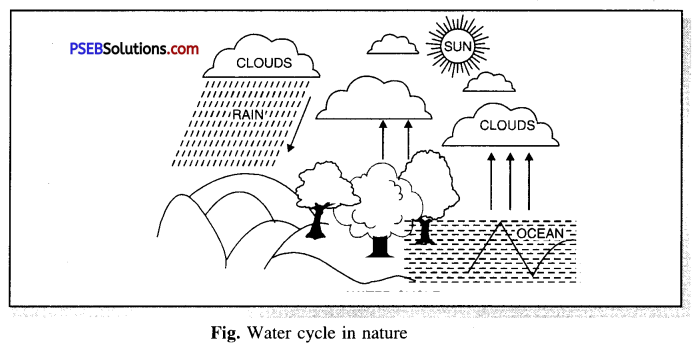
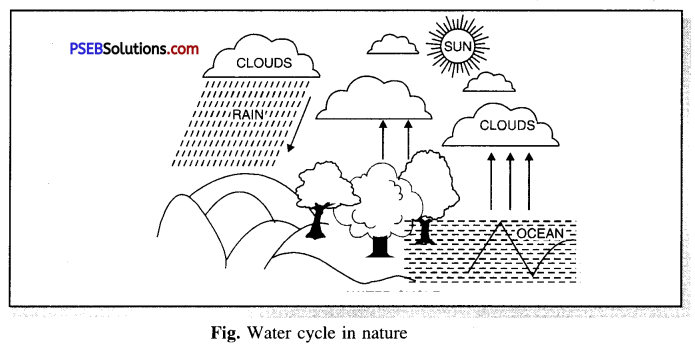
Explain water cycle with diagram.
Answer:
Water cycle in nature. Water falls on earth in the form of rain, dew, snow etc. This
PSEB 6th Class Science Solutions Chapter 14 Water 1
water falls in ponds, streams, oceans and some water seeps down the earth. With the heat of sun, the water evaporates from the streams, ponds, oceans etc. and fills the atmosphere with water vapours. These water vapours on cooling get condensed and form clouds. These clouds come back on earth in form of rains. So, this cycle goes on.

Question (iii)
Why there is need to conserve water ? Write technique of rain water harvesting.
Answer:
Fresh water is only 2.59% on earth and is in very low amount that can be used for drinking or human consumption. So, we must conserve the water.

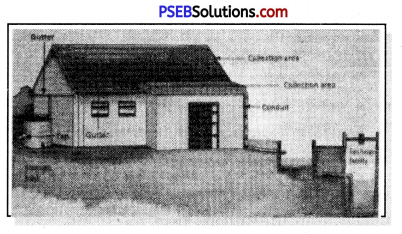
Rain Harvesting. It is a technique which involves collection and storage of rain water and its reuse, it is the simplest and oldest method.

Techniques of rain harvesting. The most commonly used technique used for rain water harvesting is roof top rain water harvesting.

Roof Top Rain Water harvesting. In this rain water is collected on the roof of house and then stored in storage tank through pipes. This stored water can be used for any purpose.
PSEB 6th Class Science Solutions Chapter 14 Water 2

PSEB Solutions for Class 6 Science Water Important Questions and Answers

Multiple Choice Questions:

Question 1.
The process of conversion of water into vapours is:
(a) Evaporation
(b) Transpiration
(c) Condensation
(d) None.
Answer:
(a) Evaporation

Question 2.
The process of converting water vapours into water is:
(a) Evaporation
(b) Transpiration
(c) Condensation
(d) None.
Answer:
(c) Condensation

Question 3.
We use water in:
(a) Industry
(b) Agriculture
(c) Domestic needs
(d) Industry agriculture and domestic needs.
Answer:
(d) Industry agriculture and domestic needs.

PSEB 6th Class Science Solutions Chapter 14 Water

Question 4.
Saline water is found in:
(a) Seas
(b) Taps
(c) Lakes
(d) nowhere.
Answer:
(a) Seas

Question 5.
Hot air causes:
(a) Transpiration
(b) Evaporation
(c) Condensation
(d) None.
Answer:
(b) Evaporation

Question 6.
Water cycle is a phenomenon:
(a) Fast
(b) Slow
(c) Medium
(d) None of these.
Answer:
(b) Slow

Question 7.
To get 1 kg of wheat grains evaporated. from wheat plant litre water gets
(a) 100
(b) 200
(c) 400
(d) 500.
Answer:
(d) 500

Question 8.
Excessive rainfall causes:
(a) Drought
(b) Flood
(c) Storm
(d) None of these.
Answer:
(b) Flood

Question 9.
of earth is covered with water.
(a) 33%
(b) 67%
(c) 25%
(d) None of these.
Answer:
(b) 67%

Question 10.
Water is available in plenty from:
(a) River
(b) Well
(c) Sea
(d) Rain.
Answer:
(c) Sea

PSEB 6th Class Science Solutions Chapter 14 Water

Question 11.
Change of water vapours into water is called:
(a) Vaporisation
(b) Transpiration
(c) Condensation
(d) None of these.
Answer:
(a) Vaporisation

Question 12.
Change of water vapours into water is called:
(a) Evaporation
(b) Transpiration
(c) Condensation
(d) None of these.
Answer:
(c) Condensation

Fill in the Blanks:

(a) We use water for many …………….. .
Answer:
activities

(b) We get water from …………… .
Answer:
taps

(c) ……………. , ……………… and …………… are sources of water.
Answer:
Ponds, lakes, wells

(d) About …………… of earth is covered with water.
Answer:
2/3rd

(e) ………………. water is saline.
Answer:
Sea

(f) ………………… is needed to convert water into water vapour.
Answer:
Heat

PSEB 6th Class Science Solutions Chapter 14 Water

(g) The warm air provides heat for evaporation of water in ……………… areas.
Answer:
shady

(h) About …………….. litres of water is transpirated by wheat plants to provide 1 kilogram of wheat.
Answer:
500

(i) Clouds are ………………. that remain floating in air.
Answer:
tiny droplets

(j) Snow is another form of ……………… .
Answer:
water

(k) Open wells are fed by ………….. .
Answer:
ground water

(l) Water cycle is a ……………. process.
Answer:
slow

(m) Excess rainfall leads to many ………………..
Answer:
problems

PSEB 6th Class Science Solutions Chapter 14 Water

(n) In ……………… conditions, food and fodder are scarce.
Answer:
drought

(o) The ………………. of water is increasing day-by-day.
Answer:
demand

(p) Collecting rain water is ……………… .
Answer:
rain water harvesting

(q) Excess rains are cause of …………….. .
Answer:
floods

Write (T) against true and (F) against false statements.

(a) Every region in the world get same amount of water.
Answer:
False

(b) Plants need water to grow.
Answer:
True

(c) Industries have no use of water.
Answer:
False

(d) Water can evaporate from any place either in shade or sunlight.
Answer:
True

(e) Plants transpirate water in the absence of sunlight.
Answer:
True

PSEB 6th Class Science Solutions Chapter 14 Water

(f) Heating increases the evaporation.
Answer:
True

(g) Clouds are nothing but condensed water.
Answer:
True

(h) Never waste water.
Answer:
True

Very Short Answer Type Questions

Question 1.
In which structures, the vast quantity of water is available ?
Answer:
Seas or Oceans.

Question 2.
What is nature of water in seas ?
Answer:
Salty (Saline).

Question 3.
When water evaporates from the seas, lakes, rivers etc, what happens to the salts dissolved in it ?
Answer:
Salts remain behind.

Question 4.
Is evaporation a fast process ?
Answer:
No, it is a slow process.

Question 5.
What is dew ?
Answer:
Dew is condensed water vapour.

PSEB 6th Class Science Solutions Chapter 14 Water

Question 6.
What is rain ?
Answer:
Falling of droplets on earth after becoming heavy is rain.

Question 7.
Besides rain, how water returns to the earth ?
Answer:
In the form of hail or snow.

Question 8.
Evaporation, Transpiration, Condensation are processes of which cycle ?
Answer:
Water cycle.

Question 9.
What is ground water ?
Answer:
Rain water seeps into the soil and gets collected on a rock. This collected water is ground water. It is pure.

Short Answer Type Questions

Question 1.
Write few uses of water.
Answer:
Uses of water.

  1. For drinking, bathing, washing etc.
  2. For cooking, cleaning, watering the plants etc.
  3. For crop growth.
  4. For generating electricity.
  5. In many industries like textile industries and food processing industries.

Question 2.
What is evaporation ? Which factors increase the evaporation ?
Answer:
Evaporation. The process of conversion of liquid into its vapours is called evaporation. Factors responsible for increasing evaporation are :

  • Wind. More wind results in speedy evaporation
  • Sunlight. More sunlight increases the speed of evaporation. This is why evaporation is fast during summer and slow during winter.
  • Exposed Surface Area. When the surface area is large, the speed or rate of evaporation is high.
  • Humidity. If the humidity in the surrounding is high then the speed of evaporation is low and if the humidity is low then the rate of evaporation is low.

Question 3.
Water disappears from the wet clothes. Why ?
Answer:
Heat from sun converts water into water vapours which get disappeared in the air.

Question 4.
What are clouds ?
Answer:
Clouds are nothing but condensed water vapours in the sky.

PSEB 6th Class Science Solutions Chapter 14 Water

Question 5.
Why is sea water not fit for drinking purposes ?
Answer:
Sea water contains many salts in it thus giving water a salty or saline taste. This salty water is not fit for drinking purposes.

Question 6.
What are effects of excessive rains ?
Answer:
Effects of excessive rains.

  • Excessive rains will increase the level of water in ponds, rivers, seas etc. resulting in floods.
  • Excessive rains can result in floods. These floods can cause damage to property, life and crops.

Question 7.
What is rain water harvesting ? Why is it done ?
Answer:
Rain water harvesting. The collection of rain water in tanks etc. is called rain water harvesting.
Need of rain water harvesting. We must do rain harvesting because of the following reasons :

  1. To increase the availability of water.
  2. To store water for later use when its scarcity is felt.

Long Answer Type Questions

Question 1.
List sources of water. Explain briefly.
Answer:
Sources of water. At homes we get water from taps, but the main sources of water are :
(i) Ponds
(ii) Lakes
(iii) Rivers
(iv) Wells
(v) Sea water
(vi) Rain.

(i) Ponds. Ponds are low lying areas in which rain water or river water gets collected.

(ii) Lakes. Lakes are natural sources of water. They may contain salts in them.

(iii) Rivers. Rivers contain water formed by melting of snow on the mountains. These rivers many be flowing all year round or temporarily during a particular season. These rivers also have rain water in it. There may be or may not be impurities in them.

(iv) Wells. A part of rain-water seeps into the ground through soil. It reaches the bottom areas of earth’s crust and collects there as a water body. This water is put to use by bor wells and hand pumps.

(v) Sea water. Oceans are big reservoirs of water. Most of the rivers fall into the sea and thus carry dissolved salts and impurities into the sea. That is why, sea water is salty in taste.

(vi) Rain. The rain drops in the form of a cloud are almost pure. But rain water gets contaminated due to gases from atmosphere, particulate matter, acid fumes and micro-organisms floating in the air. We get rain only during specific period i.e. monsoon season in our country.

Question 2.
What is Rain ? What will happen if it does not rain at all ?
Answer:
Rain. When the water vapours in the cloud become too heavy, it falls back to the ground as rain. The earth receives heavy rain at some part of the year. Some parts do not get enough of rainfall. It affects the human, plants and animal life. If at certain places there will not be rain for a year then the soil becomes dry and drought. As most of the soil water evaporates and transpirates from the plants, rivers, ponds and wells, it will dry and water table would lower down. All this affects the humans, animals and wild plants. If it continues for one or two years in continuation, it results into drought.

Question 3.
What will happen if it keeps raining continuously ?
Answer:
Consequences of continuous rains. Rains bring a lot of enjoyment and pleasant weather especially after hot days. However, if it rains heavily, you might have noticed water getting collected here and there and at times causing disruption of normal life.

In case of continuous rains the water level of rivers, lakes and ponds will rise. The soil surface will get laden with water resulting into flood. When the soil gets too much of water, air in the soil comes out of it. Due to lack of air the animals living inside the soil also come out of it. Heavy rains also result in the loss of crops due to overflooding.

Question 4.
Explain and draw a neat diagram of water cycle in nature.
Answer:
Answer:
Water cycle in nature. Water falls on earth in the form of rain, dew, snow etc. This
PSEB 6th Class Science Solutions Chapter 14 Water 1
waterfalls in ponds, streams, oceans, and some water seep down the earth. With the heat of the sun, the water evaporates from the streams, ponds, oceans, etc., and fills the atmosphere with water vapours. These water vapours on cooling get condensed and form clouds. These clouds come back on earth in form of rains. So, this cycle goes on.