PSEB 11th Class English Reading Comprehension Unseen Passages

Punjab State Board PSEB 11th Class English Book Solutions English Reading Comprehension Unseen Passages Exercise Questions and Answers, Notes.

PSEB 11th Class English Reading Comprehension Unseen Passages

Examination-Style Fully Solved Passages

Passage 1

In many countries, only one language, the mother tongue, is enough to satisfy the need for expression of most of their inhabitants2. In India, however, the position is more complicated3. Here, an educated man is called upon to master more than one language. There is, first of all, the language that he learns on his mother’s lap, and through which he expresses his first needs and feelings. Naturally, it is in this that he gains the most proficiency4. But since India is a very large country, we really need an extra language – a lingua franca) — as a means of communication with states other than our own. But even this is not enough. An educated Indian also requires the mastery of an international language, one that is widely understood and is used in the dealings of one country with another. Ideally speaking then, an educated Indian should be able to read and write in three languages, and moreover, should be able to express himself in all three with ease and fluency’.PSEB 11th Class English Reading Comprehension Unseen Passages 1

Question 1.
In many countries, only ………… is enough for people to express their ideas.
(a) mother tongue
(b) a foreign language
(c) local language
(d) none of the above.
Answer:
(a) mother tongue

PSEB 11th Class English Reading Comprehension Unseen Passages

Question 2.
In India, an educated man is expected to master …………….
(a) his mother tongue
(b) a foreign language
(c) more than one language
(d) the national language.
Answer:
(c) more than one language

Question 3.
What purpose does the language used by us serve ?
Answer:
It serves our need for expression and communication.

Question 4.
What is the position in India regarding the languages ?
Answer:
Here an educated person is expected to master three lauguages – the mother tongue, a lingua franca and a foreign language.

Question 5.
An educated Indian is supposed to be able to read and write in ……….. languages.
Answer:
three.

Question 6.
Match the words in column A with their meanings in column B.

A B
big most
sufficient enough
large

Answer:
big – large;
sufficient – enough.

Passage 2

Food can maintain? or save life. It can destroy life as well. Proper food serves the purpose of medicine. Improper food works as poison and causes diseases. We may take pride in calling ourselves civilized; but we flout? all the norms about the quality or quantity of food. We mostly eat processed foods. We have drifted away from mother nature. Thus the incidence of diabetes has increased very much. According to a survey, diabetes was rare in the natives of Canada a few years ago. With the advent of processed and junk foods, the incidence of diabetes has shot up within a very short time. By offering chocolates, cakes and ice creams too often to our children and by attending parties every other day, we in fact, invite obesity and diabetes.

PSEB 11th Class English Reading Comprehension Unseen Passages 2

Question 1.
Food can …………… our life.
(a) maintain
(b) save
(c) destroy
(d) all the above.
Answer:
(d) all the above.

Question 2.
The incidence of diabetes has …………… very much.
(a) decreased
(b) drifted
(c) increased
(d) rare.
Answer:
(c) increased

Question 3.
What is improper food ?
Answer:
Food that is harmful to health is improper food.

Question 4.
How have we changed our food habits ?
Answer:
We have started eating processed foods.

Question 5.
Diabates used to be ………… in the natives of Canada earlier.
Answer:
rare.

Question 6.
Match the words in column A with their opposites in column B.

A B
destroy advent
mostly create
rarely

Answer:
destory → create;
mostly → rarely.

Passage 3

Among the manifold’ misfortunes that may befall humanity, the loss of health is one of the severest?. All the joys, which life can give, can’t outweigh the suffering of the sick. Give the sick man everything and leave him with his suffering, he will feel half the world is lost to him. Lay him on a soft silken couch3, he will nevertheless4 groan sleepless under the presence of his suffering, while the miserable beggar, blessed with health, sleeps sweetly on the hard ground. Spread his table with dainty meals and choicest drinks and he will thrust back the hand that proffers them, and envy the poor man who thoroughly enjoys his dry crust. Surround him with the pomp of kings; let his chair be a throne and his crutch a world-swaying sceptre, he will look with contemptuous eyes on marble, on gold, on purple, and would deem himself happy, could he enjoy, even were it under a thatched roof, the health of the meanest of his servants.

PSEB 11th Class English Reading Comprehension Unseen Passages 3

Question 1.
Loss of ………….. is one of the severest misfortunes.
(a) joy
(b) health
(c) money
(d) humanity.
Answer:
(b) health

Question 2.
The man who is suffering will be happy to ……..
(a) get marble
(b) receive gold
(c) be blessed with purple
(d) get back good health.
Answer:
(d) get back good health.

Question 3.
Which misfortune is regarded as one of the severest ?
Answer:
Loss of health is regarded as one of the severest misfortunes.

Question 4.
What is the strongest wish of a sick man ?
Answer:
His strongest wish is to get rid of his suffering.

Question 5.
A sick man will hate-marble, gold or …………..
Answer:
purple.

Question 6.
Match the words in column A with their meanings in column B.

A B
purpose result
obesity fatness
aim

Answer:
purpose → aim;
abesity → fatness.

Passage 4

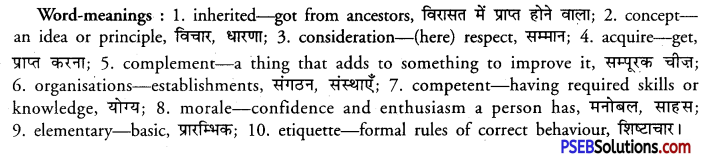
Good manners are not inherited?. And they don’t come naturally to intelligent people. They have to be learnt and practised. They are based upon the concept of consideration3 for others. They are easy to acquire4 and there is nothing more profitable. Good manners are a necessary complement in every walk of life, especially in business. Organisations with competent and well-mannered representatives enjoy a good reputation. The morale8, productivity and profits of such an organisation will be high. And this, in turn, will attract more business. There is no particular place or time when a person should show or begin his elementaryo courtesy. Courtesy, etiquette 10 and manners are tools that one should always carry with oneself, wherever one goes. The first step to success in life is treating others as courteously as we would wish others to treat us.
PSEB 11th Class English Reading Comprehension Unseen Passages 4

Question 1.
Good manners don’t come ………. to intelligent people.
(a) ever
(b) unnaturally
(c) easily
(d) naturally.
Answer:
(d) naturally.

Question 2.
Good manners are more ………….. than any other thing.
(a) inherited
(b) profitable
(c) difficult
(d) practised.
Answer:
(b) profitable

PSEB 11th Class English Reading Comprehension Unseen Passages

Question 3.
What are good manners ?
Answer:
Good manners mean a consideration for others.

Question 4.
How are good manners aequired ?
Answer:
Good manners have to be learnt and practised.

Question 5.
We must treat others as ………….. as we would wish them to treat us.
Answer:
courteously.

Question 6.
Match the words in column A with their opposites in column B.

A B
naturally nowhere
everywhere artificially
particularly

Answer:
naturally → artificially;
everywhere → nowhere.

Passage 5

For a student, walking is preferable to all other exercises. The advantage of this model of exercise is that it is simple. The apparatus2 is all at hand. You need not wait for the importationof machinery. It is in the open air that the lungs can at once receive the pure air of heaven and the eyes gaze upon hill and dale“, upon trees and flowers, upon the objects animate and inanimates. The very objects of sight and sound cheer the mind and raise the spirit. Another advantage of walking is that you can have a friend to walk with and unbend the mind by pleasant conversation. Once try the method of walking with a friend regularly for a few weeks and you will be surprised at the marvellouso results. On those afternoons when study is not required, be sure to take a long walk and lay up health for days to come.

PSEB 11th Class English Reading Comprehension Unseen Passages 5

Question 1.
The advantage of walking is that it is ………..
(a) complicated
(b) tough
(c) simple
(d) energy-giving.
Answer:
(c) simple

Question 2.
The objects of sight and sound ………….. the mind.
(a) lift
(b) increase
(c) sharpan
(d) cheer.
Answer:
(d) cheer.

Question 3.
Which exercise is preferable for a student ?
Answer:
For a student, walking is preferable to all other exercises.

Question 4.
How are the lungs of a walker benefited ?
Answer:
His lungs receive the pure air of heaven.

Question 5.
The advantage of walking is that it is ………..
Answer:
simple.

Question 6.
Match the words in column A with their meanings in column B.

A B
advantage benefit
heaven export
paradise

Answer:
advantage → benefit;
heaven → paradise.

Passage 6

If a man’s house is full of bottles of medicines, we think that the man is probably sick; but if his house is full of books, we concludea that he is intelligent. We consider the bottles of medicines as the sign of a sick body, but we do not consider the books as the sign of a sick mind. Surely that is not right. The wise men of the past took no pains to make life literate”; but they did much to make it meaningful. Books, after all, contain only letters. It is useless to hope to make life meaningful merelys by collecting books. Can we know swimming merely by reading a book on swimming ?

Real knowledge is to be found in life itself. Until we understand this, we shall never taste true knowledge.

PSEB 11th Class English Reading Comprehension Unseen Passages 6

Question 1.
There will be many bottles of medicines in a …………… man’s house.
(a) sick
(b) healthy
(c) plump
(d) weak.
Answer:
(a) sick

Question 2.
The wise men of the past did much to make life
(a) easy
(b) simple
(c) luxurious
(d) meaningful.
Answer:
(d) meaningful.

Question 3.
What will we think if we see bottles of medicines in somebody’s house ?
Answer:
We will think that the man is probably sick.

Question 4.
What did the wise men of the past want to do?
Answer:
They wanted to make the life meaningful.

Question 5.
Real knowledge is to be found in ………….. itself.
Answer:
life.

Question 6.
Match the words in column A with their opposites in column B.

Α B
sick wrong
Right healthy
Read

Answer:
sick → healthy;
right → wrong.

Passage 7

People fight to settle disputes. Fighting means killing and civilized’ people ought to be able to find some way of settling their disputes? other than by seeing which side can kill the greater number of the other side, and then saying that the side which has killed most has won; and not only has won, but because it has won has been in the right. For that is what going to war means; it means saying that might is right. That is what the history of mankind on the whole has been like. Even our own age has fought the two greatest wars in history, in which millions of people were killed and mutilated.

And today while it is true that people don’t fight and kill each other in the streets, this is to say, we have got to the stage of keeping the rules or behaving properly towards each other in daily life, nations and countries have not learnt to do this yet and still behave like savages.

PSEB 11th Class English Reading Comprehension Unseen Passages 7

Question 1.
Civilized people do not indulge in …………
(a) killings
(b) parties
(c) donations
(d) gambling.
Answer:
(a) killings

Question 2.
Our age has fought two ………….. wars in history.
(a) recorded
(b) greatest
(c) atomic
(d) important.
Answer:
(b) greatest

Question 3.
What should civilized people do ?
Answer:
They should find some peaceful way to settle their disputes.

PSEB 11th Class English Reading Comprehension Unseen Passages

Question 4.
What does ‘might is right’ mean?
Answer:
It means that the person who wins thinks himself to be right.

Question 5.
Now people don’t fight and kill each other in ……….
Answer:
streets.

Question 6.
Match the words in column A with their meanings in column B.

A B
dispute treatment
behaviour disagreement
action

Answer:
dispute → disagreement;
behaviour → treatment.

Passage 8

Cheating in examinations is a major defectof our educational system. Cheating has become so common that students consider it their birthright to use unfair means in the examination. The root cause of this evil lies in our schools. Short-cuts have replaced hard labour. Guides and notes are encouraged in place of textbooks. In all school examinations, except the Middle and the Matric examinations, teachers show leniency3 to the students and pass most of them. Sometimes, even the parents are at fault. They get their undeserving wards promoted“ to the higher class. The students don’t cultivate the habit of self-study and hard work. Then in the Board Examination, students resort to copying. The teachers on duty encourage the students to use unfair means to pass the examinations. The desire to show good results motivates them to adopt wrong methods.

PSEB 11th Class English Reading Comprehension Unseen Passages 8

Question
1. Students consider it their ………….. to cheat in examinations.
(a) rule
(b) duty
(c) responsibility
(d) birthright.
Answers:
(d) birthright.

Question 2.
The teachers on duty …………. students to use unfair means.
(a) deny
(b) refuse
(c) encourage
(d) discourage.
Answers:
(c) encourage

Question 3.
What does the given passage call as the major defect?
Answers:
It calls cheating in examinations as the major defect.

Question 4.
How are the parents responsible for the evil of cheating?
Answers:
They want their undeserving wards promoted to their higher class.

Question 5.
The students don’t cultivate the habit of ………….. and …………. work.
Answers:
self-study, hard.

Question 6.
Match the words in column A with their meanings in column B.

A B
major defect
fault leniency
biggest

Answers:
major → biggest;
fault → defect.

Passage 9

Living on the earth is rather like being at the bottom of a sea hundreds of miles deep. Without atmosphere, there would be no people or animals, birds or fishes, trees or plants. There would be no weather, winds or rain. And there would be no blue sky, no rosy sunsets or dawns. Fire would be impossible without air, for burning is the union of oxygen with whatever is burned. Nor would there be any noise, which is the vibration? of air waves against our eardrums.

By day, the atmosphere serves as a great sunshade. It protects3 the earth from the full force of the sun by absorbing most of its harmful radiation4. But for the atmosphere, the daytime temperature would rise to 230 degrees Fahrenheit, hotter than boiling water. By night, the air acts like a giant greenhouse. It imprisons the heat collected during the day and prevents it from spreading into space.

PSEB 11th Class English Reading Comprehension Unseen Passages 9

Question 1.
Without …………., there would be no life on the earth.
(a) atmosphere
(b) gases
(c) sea
(d) weather.
Answer:
(a) atmosphere

Question 2.
By day, the atmosphere serves as a great ………….. .
(a) ball
(b) star
(c) sunshade
(d) vibration.
Answer:
(c) sunshade

Question 3.
What is living on the earth like ?
Answer:
It is like being at the bottom of a deep sea.

Question 4.
What does the atmosphere serve as ?
Answer:
It serves as a great sunshade.

Question 5.
By night, the air acts like a giant ……………
Answer:
greenhouse.

Question 6.
Match the words in column A with their opposites in column B.

A B
bottom enjoy
protect top
kill

Answer:
bottom → top;
protect → kill.

Passage 10

Subhash Chandra Bose was a great leader of India. He was born on 23rd January 1896. People called him ‘Netaji’ because he led them to the right path. He went to jail many times. Soon he found out that more efforts had to be made to make India free. The British power was getting weakened in the second world war. He thought of striking it from all sides. One day, he escapedfrom Kolkata in the guise of a Pathan and went to Germany. From there, he went to Japan. He organised the Indian National Army that fought many battles against the British armies. He said to his countrymen, “Give me blood and I will give you freedom.” At this appeal, hundreds of Indians abroad4 gave their all for the good of India. It was a bad day for India when Netaji died in an air crash. We shall always remember him as the greatest fighter for the freedom of India.

PSEB 11th Class English Reading Comprehension Unseen Passages 10

Question 1.
People called Subhash Chandra Bose as ………….. .
(a) Netaji
(b) great leader
(c) a revolutionary
(d) great guide.
Answer:
(a) Netaji

Question 2.
His army fought many battles against the ………….. army.
(a) British
(b) German
(c) Japanese
(d) foreign.
Answer:
(a) British

Question 3.
Why did the people call Bose as ‘Netaji’?
Answer:
Because he led them to the right path.

Question 4.
What did he organize ? Why?
Answer:
He organised Indian National Army to fight British armies.

Question 5.
His slogan was ‘Give me …………. and I will give you freedom.
Answer:
blood.

Question 6.
Match the words in column A with their meanings in column B.

A B
effort correct
right endeavour
up

Answer:
effort → endeavour;
right → correct.

Passage 11

Deserts are wild waste stretches of land, usually covered with sand, where little can grow and few can live. There are deserts in Africa, Asia, Australia and America, but the greatest and the most famous is the Sahara covering about 35 lakh square miles of northern Africa. It extends from the Mediterranean southward to the Sudan, and from the Red Sea westward to the Atlantic Ocean.

Crossing a desert has always been a risky adventure. Temperatures are very high during the day and may fall below zero at night. Going from one oasis! to another may be a march of several days. The lack of water, the fierce? rays of the sun, sandstorms and other hardships have always made journeys across such deserts as the Sahara the worst kind of travel in the world. The old tracks across the sand are lined with the bones of men and beasts that have met their fate. Horses and oxen are not suited to these conditions and the only animal that can be used is the camel, which has a peculiar stomach in which water can be stored. Besides being able to go for three days without drinking, it can also live for a long time on small quantities of food. Since ancient times, the camel has been called the ship of the desert’.

PSEB 11th Class English Reading Comprehension Unseen Passages 11

Question 1.
Deserts are wild waste …………. of land covered with sand.
(a) stretches
(b) spread
(c) spaces
(d) places.
Answer:
(a) stretches

Question 2.
Crossing a desert has always been a ………….. adventure.
(a) huge
(b) giant
(c) risky
(d) preferable.
Answer:
(c) risky

Question 3.
What is a desert ?
Answer:
A desert is a wild waste stretch of land covered with sand.

PSEB 11th Class English Reading Comprehension Unseen Passages

Question 4.
What is the camel called since ancient times ?
Answer:
It has been called the ship of the desert.

Question 5.
………….. is a place in the desert where some plants grow.
Answer:
Oasis.

Question 6.
Match the words in column A with their meanings in column B.

A B
lack shortage
beasts vegetation
animals

Answer:
lack → shortage;
beasts → animals.

Passage 12

In the modern times, with the coming of the motor cars and the aeroplanes, the desert may be said to have been conquered as far as travel is concerned. There are still special dangers for the car, including breakdowns, but an aeroplane can fly over a desert as easily as anywhere else. However the journey is made, wireless messages can be sent out if help is needed.

Yet in other ways, the desert has not yielded. It is the enemy and never the friend of man. Just as the sea, year after year, gradually eats away the land, so the sand of the desert, blown by the winds, advances yard by yard over the cultivated? fields. The remains of the old towns and villages, half-buried in the sand show that men once lived and grew their crops where there is no life today. One of the problems of the present century is how to stop this continuous extension4 of sandy wastes and save food-producing districts from destruction.

PSEB 11th Class English Reading Comprehension Unseen Passages 12

Question 1.
What modes of transport have been mentioned in the passage ?
(a) Motor cars.
(b) Aeroplanes.
(c) Both (a) & (b).
(d) Camels.
Answer:
(c) Both (a) & (b).

Question 2.
If help is needed, …………. message can be sent.
(a) telegraphic
(b) telephone
(c) wireless
(d) satellite.
Answer:
(c) wireless

Question 3.
What does the author think about the desert ?
Answer:
He thinks that the desert is an eneny which can never be a friend of man.

Question 4.
What is the problem of the present century ?
Answer:
It is how to stop the continuous extension of sandy wastes.

Question 5.
The desert is …………… the friend of man.
Answer:
never.

Question 6.
Match the words in column A with their opposites in column B.

А B
modern friend
foe ancient
enemy

Answer:
modern → ancient;
foe → friend.

Passage 13

In India, every boy and every girl now reading in schools is the future citizen of the country. Although he or she is not immediately called upon to vote or to make laws, he or she will have to do this in the near future. As the citizen of tomorrow, every young man should, therefore, prepare himself for the great task. The young citizen’s first duty is to learn how not to hurt- others, to be careful not to play unfairly, in the playing field, and not to speak a word which may give pain to anyone, not to make fun of others, or say things behind one’s back. He should not waste or throw away a grain4 of food, considering that there are many poor people in India who do not have enough to eat. Lastly, he should get training in the use of his leisure”.

PSEB 11th Class English Reading Comprehension Unseen Passages 13

Question 1.
Every …………. reading in schools in the future citizen of the country.
(a) boy
(b) girl
(c) both (a) and (b)
(d) child.
Answer:
(c) both (a) and (b)

Question 2.
We should not waste or throw a …………… of food.
(a) piece
(b) fragment
(c) grain
(d) lot.
Answer:
(c) grain

Question 3.
What is the great task of a citizen ?
Answer:
It is to lead a disciplined life.

Question 4.
Who is the future citizen of the country ?
Answer:
Every school-going boy and girl.

Question 5.
We should not waste or …………… away even a grain of food.
Answer:
throw.

Question 6.
Match the words in column A with their meanings in column B.

A B
hurt sufficient
enough injure
lack

Answer:
hurt → injure;
enough → sufficient.

Passage 14

Gandhiji’s mother was a very sweet, kind and religious woman. She visited the temple daily, often taking her little son with her. She fasted frequently2, too. Once she made a vow to eat only one meal a day for four months, and not to take even that one meal unless she had first seen sunshine. As she had made this vow in the rainy season, it was often difficult to see sunshine at all. Her children, who could not bear4 to think of their dear mother going without food all the twenty-four hours, would stand staring up at the sky waiting to catch the first gleams of the sun.

As soon as a ray appeared, they would dash? into the house and call their mother to come and see for herself. By the time she came out, the sun had often gone behind the clouds again. “It does not matter,” she would say cheerfully. “God does not want me to eat today,” and back she would go to her household tasks. In this way, Gandhiji learnt from his good mother how to do penance cheerfully for love of God.

PSEB 11th Class English Reading Comprehension Unseen Passages 14

Question 1.
Gandhiji’s mother was a very …………… woman.
(a) sweet
(b) kind
(c) religious
(d) all of the above.
Answer:
(d) all of the above.

Question 2.
Gandhiji’s mother made the vow in the …………. season.
(a) summer
(b) rainy
(c) pleasant
(d) rough.
Answer:
(b) rainy

Question 3.
What could the children not bear?
Answer:
They could not bear their mother going without food all the 24 hours.

Question 4.
What did Gandhiji learn from his mother?
Answer:
He learnt from his mother how to do penance cheerfully.

Question 5.
In the rainy season, it was often difficult to see …………… at all.
Answer:
sunshine.

Question 6.
Match the words in column A with their opposites in column B.

Α B
sweet cruel.
kind noble
bitter

Answer:
sweet → bitter;
kind → cruel.

Passages From Grammar Book (Fully Solved)

Passage 1

There are in our country, as in other countries of the world, thousands of differently abled persons, such as those who are blind or deaf and dumb. In some cases, these persons may have been born blind or deaf while in others, they may have gone blind or deaf as a result of some illness or accident.

You sometimes hear people say of such handicapped persons : “It is the work of fate.” or “It is the will of God.” Some even say, “They suffer the fruits’ of their own actions in the past.” Even the parents of differently abled children often express such feelings and opinions, and they scarcely ever think of how they can help these unfortunate ones. This certainly is not the way to look at the problems of the differently abled.
Whatever may be the cause of their suffering, we have got to treat the differently abled with sympathy and understanding. In many instances, physically challenged children suffer neglect and are left to themselves in their homes.

This makes their life extremely sad and lonely3. Our first duty is to make these children happier and less lonely by engaging them in different activities suitable for them. Secondly, we have got to educate these children and help them to live meaningful lives. We should secure“ benefits of education for them in schools intended for them. We ought to make them self-reliant by creating suitable opportunities for them. They will then have a sense of achievement. We will also feel satisfied that we have done our duty towards them.

PSEB 11th Class English Reading Comprehension Unseen Passages 15

Question 1.
How should we treat the differently abled children ?
(a) Indifferently.
(b) With sympathy and understanding.
(c) By ignoring their loneliness.
(d) By neglecting them.
Answer:
(b) With sympathy and understanding.

PSEB 11th Class English Reading Comprehension Unseen Passages

Question 2.
According to the author, what is our first duty towards handicapped children ?
(a) To make them homeless.
(b) To make them healthy.
(c) To make them happier and less lonely.
(d) To make them run fast.
Answer:
(c) To make them happier and less lonely.

Question 3.
How do some children become differently abled ?
Answer:
Some of them may be born handicapped, e.g. deaf, dumb, etc. Others may become handicapped later due to some illness or accident.

Question 4.
What makes the life of handicapped children sad and lonely?
Answer:
The handicapped children start feeling sad and lonely when they have to suffer neglect and are left to their lot in their homes.

Question 5.
Fill in the blank with a suitable word from the passage.
We must ……… these children with love and sympathy.
Answer:
treat.

Question 6.
Match the words under column A with their meanings in column B:

A B
sympathy sad
unhappy nearly
feeling pity and tenderness

Answer:
sympathy → feeling pity and tenderness;
unhappy → sad.

Passage 2

In a reversal of the norm elsewhere, in India policy-makers and economists have become optimists’ while bosses do the worrying. The country’s Central Bank has predicted that India’s economy is likely to grow at a double-digit rate during the next 20-30 years. India has the capability with its vast labour and lauded? entrepreneurial spirit. But the private sector which is supposed to do the heavy lifting that turns India from the tenth largest economy to the third largest by 2030, has become fed up.

Business people often crib about India’s problems, but their irritation this time has a nervous edge. In the first quarter of 2011, GDP grew at an annual rate of 7.8 per cent; in 2015-17, it managed 6-7 per cent. The economy may be slowing naturally as the low interest rates and public spending that got India through the global crisis are belatedly withdrawn. At the same time, the surge in inflation caused by exorbitant food prices has spread more widely, casting doubt over whether India can grow at 8-10 per cent in the medium term without overheating.

PSEB 11th Class English Reading Comprehension Unseen Passages 16

Question 1.
What rate of growth does the Central Bank predict for the Indian economy for the next 20-30 years ?
(a) Eight per cent.
(b) Seven per cent.
(c) Double-digit per cent.
(d) Five per cent.
Answer:
(c) Double-digit per cent.

Question 2.
Who is supposed to do the heavy lifting to turn India into third largest economy ?
(a) Govt. agencies.
(b) Private sector.
(c) Public sector.
(d) Property owners.
Answer:
(b) Private sector.

Question 3.
What is India’s capability to grow based on ?
Answer:
It is based on our large labour force and the entrepreneurial spirit of our people.

Question 4.
What is casting doubts over India’s growth rate ?
Answer:
Two main reasons for the doubt are (i) withdrawal of low interest rates and public spending and (ii) a surge in inflation brought about by extremely high food prices.

Question 5.
Fill in the blank with a suitable word from the passage.
He suffered from a ……… breakdown.
Answer:
nervous.

Question 6.
Match the words under column A with their meanings in column B:

A B
crisis large
optimist difficult phase
one who looks forward to a positive outcome

Answer:
crisis → difficult phase;
optimist → one who looks forward to a positive outcome.

Passage 3

Brain drain, also referred to as human capital flight, is the action of having highly skilled and educated people leaving their country to work abroad. It has actually become one of the most serious concerns’ for the developing nations. While many people believe that immigration is a personal choice that must be understood and respected, others look at this phenomenon from a different perspective?. What makes those people leave their country, their own people, should be seriously considered and a distinction between pull and push factors must be made. The push factors include low wages and a lack of satisfactory working and living conditions.

Social unrest, political conflicts and wars may also be the determining causes. The pull factors, however, include intellectual freedom and substantial funds for research. Brain drain has a negative impact on the economic prospects and competitiveness of sender countries. It reduces the number of dynamic and creative people who can contribute to the development of their country. Likewise, with more entrepreneurs taking their investments abroad, developing countries are missing the opportunity of wealth creation.

PSEB 11th Class English Reading Comprehension Unseen Passages 17

Question 1.
The term “brain drain’ is also referred to as:
(a) Capital flight
(b)Human capital flight
(c) Pull factors
(d) Push factors.
Answer:
(b)Human capital flight

Question 2.
Brain drain has terrible consequences on the economic development of:
(a) Sending countries
(b) Receiving countries
(c) Developed countries
(d) Undeveloped countries.
Answer:
(a) Sending countries

Question 3.
What do you mean by the term ‘brain drain’ ?
Answer:
‘Brain drain’ is the name given to the activity of the skilled people of a country migrating to foreign countries for better prospects.

Question 4.
Enumerate the push factors that lead to brain drain.
Answer:
The push factors behind ‘brain drain’ are low wages and a lack of satisfactory working and living conditions in the sending countries.

Question 5.
Fill in the blank with a suitable word from the passage.
Every citizen must ……. to the development of the nation wholeheartedly.
Answer:
contribure.

Question 6.
Match the words under column A with their meanings in column B:

A B
conflicts decrease
reduce disputes
increase

Answer:
conflicts → disputes;
reduce → decrease.

Passage 4

One night a man came to our house and told me, “There is a family with eight children. They have not eaten for days.” I took some food and went out. When I finally came to the family, I saw the faces of those little children disfigured’ by hunger. There was no sorrow or sadness in their faces, just the deep pain of hunger. I gave the rice to the mother. She divided it into two and went out, carrying half the rice with her. When she came back, I: asked her, “Where did you go ?” She gave me this simple answer, “To my neighbour, they are also hungry.” I was not surprised because poor people are generous but I was surprised that she knew they were hungry.

As a rule, when we are suffering, we are so focused on ourselves, we have no time for others. We become selfish and self-centred. Having experienced the pangs“ of sufferings, we should rather extend a helping hand to the poor and the needy.

PSEB 11th Class English Reading Comprehension Unseen Passages 18

Question 1.
The faces of the children reflected:
(a) sorrow
(b) joy
(c) hunger
(d) greediness.
Answer:
(c) hunger

Question 2.
The action of the mother shows:
(a) selfishness
(b) hatred
(c) gratitude
(d) love.
Answer:
(d) love.

PSEB 11th Class English Reading Comprehension Unseen Passages

Question 3.
Where did the mother go after dividing the rice and why ?
Answer:
She went to her neighbour’s house. She went there to share rice with them. She knew they were hungry like her and also needed food like her.

Question 4.
Why was the gentleman surprised ?
Answer:
The man knew that the poor people are generous, but he was surprised to find that the woman knew for certain that her neighbour’s family was also hungry like her own family. Normally, the people remain selfcentred.

Question 5.
Fill in the blank with a suitable word from the passage.
The faces of the little children were ………
Answer:
disfigured.

Question 6.
Match the words under column A with their opposites under column B:

A B
simple complicated
generous hatred
selfish

Answer:
simple → complicated;
generous → selfish.

Passage 5

Health and hygiene go hand in hand. Health refers to a state of sound mind and physically fit body, free from any form of sickness, disorder or ailment’. Hygiene refers to the good practices that prevent disease and lead to good health through cleanliness, proper sewage? disposal, balanced and nutritious food, regular exercise, proper sleep, pure and fresh air and supply of safe drinking water. The proverb, ‘Health is Wealth’, is truly said of all things in the world. Health is the most valuable thing that one can possess.

Money is undoubtedly a prized’ possession, but can it provide pleasure to a ruined health? As body and mind are closely related, the mind can never be sound and cheerful without sound health. An unhealthy man may have intelligence, merit and wealth, but he cannot put them to use and reap their benefits. We must, therefore, adopt proper hygienic measures to preserve and maintain good health. Too much work or exercise, eating or drinking are injurious to health. A regulated life coupled with clear and pure mind makes life worth living.

PSEB 11th Class English Reading Comprehension Unseen Passages 19

Question 1.
Hygiene refers to practices that lead to good health through:
(a) balanced diet
(b) impure air
(c) abundant wealth
(d) regular play.
Answer:
(a) balanced diet

Question 2.
Life can become worth living through:
(a) gambling and drinking
(b) regulated life
(c) pure mind
(d) healthy body.
Answer:
(b) regulated life

Question 3.
What does the term ‘health refer to ?
Answer:
Health refers to a state of sound mind and a body that is physically fit and free from sickness, disorder or ailment.

Question 4.
Can a wealthy but unhealthy man enjoy life?
Answer:
No, an unhealthy man cannot enjoy life because nothing can provide pleasure to a man with ruined health. And without sound health, man cannot have a sound mind also.

Question 5.
Fill in the blank with suitable words from the passage.
The selection in Army service is made purely on ……… .
Answer:
the soundness of both body and mind.

Question 6.
Match the words under column A with their opposites under column B:

A B
fresh use
preserve stale
destroy

Answer:
fresh → stale;
preserve → destroy.

Passage 6

Named after former Prime Minister, Inder Kumar Gujral’s mother, Pushpa Gujral Science City located on Jalandhar-Kapurthala Road, just west of Jalandhar, is extremely thrilling. Almost every branch of science is exhibited, right from physical, applied, natural and social sciences to health sciences, human evolution and civilization, engineering, technology, agriculture, the environment, ecosystems and Jurassic Park. In the Dome Theatre, large-format films are projected on 23-metre tilted dome. Semi-circular giant dome screen produces huge images that soar and swoop above, beside and behind you, to give you a spectacular, immiscible? experience.

The Light-Speed 3-D Digital Theatre presents three-dimensional computer graphics, videos and the most advanced animation. Amazing Living Machine Gallery presents the intricate structures and functions of the human body using large human models. The Flight Simulator provides the visitors a sense of adventure. The Laser Theatre presents laser shows that carry the visitors to a wonderland to experience a mind-boggling mix of sound and laser beams. The Dinosaur Park displays the evolution of dinosaurs and the probable reasons for their extinction”. There is also a kids’ park containing tunnels, rides, bouncers, etc. and an artificial lake that allows the visitors to indulge in boating. With all the wonderful attractions, a visit to the Science City would be highly informative and enjoyable.

PSEB 11th Class English Reading Comprehension Unseen Passages 20

Question 1.
Which facility provides a sense of adventure ?
(a) Kids’ Park.
(b) Dome Theatre.
(c) Flight Simulator.
(d) Laser Theatre.
Answer:
(c) Flight Simulator.

Question 2.
Large human models are found in:
(a) Amazing Living Machine Gallery
(b) Dinosaur Park
(c) Digital Theatre
(d) Laser Theatre.
Answer:
(a) Amazing Living Machine Gallery

Question 3.
Where is the Pushpa Gujral Science City located ?
Answer:
It is located on Jalandhar-Kapurthala Road, just west of Jalandhar.

Question 4.
What is displayed in the Dinosaur Park ?
Answer:
The Dinosaur Park displays the evolution of dinosaurs and the likely reasons of their extinction.

Question 5.
Fill in the blank with a suitable word from the passage.
The works of famous painters are ……… in the Tagore Art Gallery.
Answer:
exhibited.

Question 6.
Match the words under column A with their meanings under column B:

A B
spectacular huge
giant amazing

Answer:
spectacular – amazing;
giant – huge.

Passages For Practice

Passage 1

Democratic societies from the earliest times have expected their governments to protect the weak from the strong. No ‘era of good feeling’ can justify discharging the police force or giving up the idea of public control over concentrated private wealth. On the other hand, it is obvious that a spirit of self-deniall and moderation? on the part of those who hold economic power, will greatly soften the demand for absolute equality. Men are more interested in freedom and security than in an equal distribution of wealth. The extent to which the government must interfere with business, therefore, is not exactly measured by the extent to which economic power is concentrated into a few hands. The required degree of government interference depends mainly on whether economic powers are oppressively used and on the necessity of keeping economic factors in a tolerable state of balance.

The powers of government are unavoidably increased, whichever political party may be in office. The growth of government is a necessary result of the growth of technology and of the problems that go with the use of machines and science. Since the government, in our nation, must take on more powers to meet its problems, there is no way to preserveo freedom except by making democracy more powerful.

PSEB 11th Class English Reading Comprehension Unseen Passages 21

Question 1.
Democratic societies from the earliest times have expected their governments to ……… the weak from the strong.
(a) protect
(b) differentiate
(c) separate
(d) preserve.

Question 2.
Two things in which men are more interested than in equal distribution of wealth
are (a) freedom and power
(b) freedom and security
(c) power and security
(d) power and insecurity

Question 3.
What do you mean by the growth of government ?

Question 4.
How can we justify ‘era of good feeling’ ?

Question 5.
The growth of ………… is the necessary result of the growth of ……….. .

Question 6.
Match the words in column A with their meanings in column B.

Α B
growth bear
tolerate decline
development

Passage 2

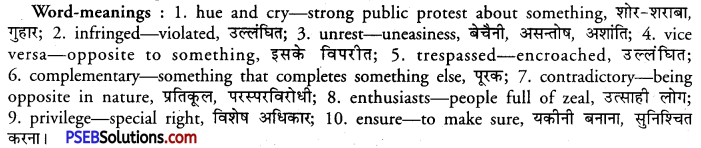
In today’s world, everybody talks much about his rights. There is a great hue and cry if our rights are infringed?. But nobody seems to bother much about his duties. That is why there is a great unrest in our present-day life. Actually duties come first, and rights afterwards.

Many a time, one man’s right is another man’s duty and vice versa4. For example, every man has the right to have an undisturbed sleep. So it becomes the duty of his neighbour not to tune his radio at too high a pitch. If we want to enjoy our rights, we should act in such a way that the rights of others are not trespassed. It can happen only if we take due account of our duties also. In short, rights and duties are complementary things and not contradictory?

It is difficult to agree on which rights should be guaranteed to a citizen. For example, does a child have the right to be educated in his / her mother tongue ? Some enthusiasts may say ‘certainly’. But others may say that while everyone must have a right to education, the government should not be forced to spend money to employ special teachers for the language of every group and community. Take another example. Does every adult have a right to job? Some will say ‘yes’. Others will disagree and say that this is a privilege’, not a right. They say that in these days of population explosion, it is not possible for any government to ensure10 full employment.
PSEB 11th Class English Reading Comprehension Unseen Passages 22

Question
1. There is a great unrest in present-day life because ………….
(a) everybody wants to enjoy his rights
(b) nobody wants to bother about his duties
(c) both (a) and (b)
(d) neither (a) nor (b).

Question 2.
We should act in such a way that other’s ……… .
(a) rights are trespassed
(b) duties are trespassed
(c) rights are not trespassed
(d) duties are not trespassed.

Question 3.
What argument can be given against the right of every adult to have a job?

Question 4.
Give one example from the passage to show that one man’s right is another man’s duty.

PSEB 11th Class English Reading Comprehension Unseen Passages

Question 5.
It is not ………. for any government to ……… full employment.

Question 6.
Match the words in column A with their meanings in column B.

Α B
encroached infringed
violated allowed
trespassed

Passage 3

1. Summer vacation offers families dilemmas and opportunities. For too many kids, it becomes a period of intellectual passivity and stalled personal growth. For others and their parents – it’s a time of overload and frantic scheduling.

2. “Summer is a great time for parents to build relationship with their children,” says a renowned child psychologist. And it’s an opportunity both for the kids to learn and for the family to grow together. To make this a reality, educators and psychologists point to several simple strategies that parents can start planning before summer gets underway.

3. “Summer’s a perfect time for kids to test the skills they’ve learnt in a classroom and use them in new ways,” notes a well-known educator. Comparing prices in a grocery shop can sharpen children’s mental maths skills. Taking measurements to build a new tree house or design a simple plaything teaches geometry. Car trips provide opportunities to study maps and learn geography. Some libraries offer free summer reading programmes for children. “It’s the daily doses of stimulation? intellectual, creative, esteembuilding – that parents can give their children that have the greatest impact,” says an eminent researcher.

PSEB 11th Class English Reading Comprehension Unseen Passages 23

Question 1.
Parents can give their kids a special summer vacation by ……….
(a) building relationship with them
(b) providing them opportunities to use their skills
(c) giving them daily doses of stimulation
(d) all of the three.

Question 2.
………. is a great time for parents to build relationship with their children.
(a) Spring
(b) Summer
(c) Winter
(d) Autumn

Question 3.
Mention the three ways in which children can use the skills learnt in class.

Question 4.
What do car trips provide ?

Question 5.
To test the ……… children have learnt in their classroom ………. is a perfect time.

Question 6.
Match the words in column A with their meanings in column B.

Α B
stimulation talent
skill passion
encouragement

Passage 4

1. The Egyptian mummies have always remained a fascination for all. The method of embalming? or treating the dead body, that the ancient Egyptians used, is called mummification. Using special processes, they removed all moisture from the dead body, leaving only a dried form that would not easily decay. It was an important Egyptian religious belief to preserve the dead body in as lifelike a manner as possible.

2. The first step in the process was the removal of all internal parts that might decay rapidly. The brain was removed by carefully inserting special hooked instruments up through the nostrils. It was a delicate operation, one which could easily disfigure the face. The embalmers then removed the organs of the abdomen and chest through a cut usually made on the left side of the abdomen. They left only the heart in place, believing it to be the centre of a person’s being and intelligence. The other organs were preserved separately, with the stomach, liver, lungs, and intestines placed in special boxes or jars. Such jars are today called the canopic jars.

3. The embalmers next removed all moisture from the body. This they did by covering the body with natron, a type of salt which has great drying properties, and by placing additional natron packets inside the body.

PSEB 11th Class English Reading Comprehension Unseen Passages 24

Question 1.
Mummification is a process by which a dead body is ………..
(a) destroyed
(b) preserved
(c) mutilated
(d) cremated.

Question 2.
The process of mummification was followed by ancient ………….
(a) Egyptians
(b) Aryans
(c) Europeans
(d) Negroes.

Question 3.
What was done with the internal parts of the body and why ?

Question 4.
What was done with those organs that were removed from the dead body ?

Question 5.
The method of ………. or treating the dead body is called mummification.

Question 6.
Match the words in column A with their meanings in column B.

A B
disfigure dislocate
sunken hollow
mutilate

Passage 5

1. Trees are the most useful gift of nature to man. Without trees, it would be a very bleak? world. Without them, life would be impossible. Now let’s see what trees do for us.
2. Men in olden days used wood for making their homes, rafts?, canoes3 and weapons. They used it as fuel to cook and to keep themselves warm.

3. In addition to wood, man was dependent on trees for many other things also. He got from them fruits and nuts for his food. Leaves of the palm and other trees were used for thatching roofs. The bark and the leaves of trees were used for clothing. Utensils were made from calabashes, coconuts and the shells of other fruits. A number of medicines, dyes, tanning materials and species were obtained from trees.

4. In present times also, man is no less dependent on trees. He has, no doubt, invented many things that can take the place of wood. He has begun to use concrete, steel, glass and plastics in place of wood. But even then, the demand for wood has increased vastly. For example, we
need lots and lots of wood for making paper, cardboard and packing cases.

5. Trees are invaluable for other reason also. There is oxygen in the air, but it is being constantly used up and turned into carbon dioxide. When animals breathe and things burn, oxygen is consumed and carbon dioxide is produced. The green leaves of trees absorb this carbon dioxide. With the help of sunlight, they break it into carbon and oxygen. The carbon is used by green leaves to make starch. The oxygen is released back into the air.

PSEB 11th Class English Reading Comprehension Unseen Passages 25

Question 1.
If there were no trees, no ………. would be possible on the earth.
(a) life
(b) death
(c) nature
(d) calamity.

Question 2.
Utensils were made from ……….
(a) calabashes
(b) coconuts
(c) shells of other fruits
(d) all of these three.

PSEB 11th Class English Reading Comprehension Unseen Passages

Question 3.
How did men in olden days make use of trees ?

Question 4.
How do trees treat the carbon dioxide produced by us ?

Question 5.
For making paper, cardboard and packing cases, we need ………….

Question 6.
Match the words in column A with their meanings in column B.

A B
invaluable priceless
bleak fragile
miserable

Passage 6

1. Grammar can be a way of comparing different languages. To most people, grammar is a set ef rules for speaking and writing a language correctly. Usually, before you can speak any language well – even your own language which you have gradually been learning since you were little – you have to know something about its grammar. Small children start to pick up the grammar of their own language almost by instinct, by hearing how their parents talk and by seeing how words were put together in sentences in the books they read. Before long, they learn that some expressions sound wrong, or are ‘bad grammar’, such as ‘they looked at he’ instead of what it should be, they looked at him? or ‘the boys fighted for a hour’ instead of the boys fought for an hour’. By being exposed to the language over a period of time, they eventually know how to say the right things and avoid? saying the wrong things in order to be understood.

2. However, when children begin to learn a foreign language, they find that they have to set about deliberately3 learning its grammar rules by heart. It is not simple enough to know the words of a new language, or a person could learn it just by reading a dictionary. The words by themselves do not mean very much until they are fitted together to form sentences, and it is grammar that shows how to do this.

PSEB 11th Class English Reading Comprehension Unseen Passages 26

Question 1.
To be able to learn a language well, we have to learn something about its ………
(a) pronunciation
(b) rules
(c) diction
(d) grammar.

Question 2.
The words do not mean very much until they are arranged in order to form ………
(a) tenses
(b) narration
(c) sentences
(d) voice.

Question 3.
How are even small children able to distinguish a wrong expression from a correct one ?

Question 4.
How does grammar help in learning a foreign language ?

Question 5.
………. can be a way of comparing different languages.

Question 6.
Match the words in column A with their antonyms in column B.

A B
different carelessly
deliberately similar
intentionally

Passage 7

Gandhiji does not reject machinery as such. He observes “How can I be against all machinery, when I know that even this body is the most delicatel piece of machinery ? The spinning wheel is a machine, a little toothpick is a machine. What I object to is the craze? for machinery, not machinery as such. The craze is for what they call labour-saving machinery. Men go on ‘saving labour’ till thousands are without work and thrown on the open streets to die of starvation.

I want to save time and labour, not for a fraction of mankind, but for all. I want the collection of wealth, not in the hands of a few, but in the hands of all. Today, machinery merely helps a few to ride on the back of millions. The impetus behind it all is not philanthropys to save labour, but greed. It is against this constitution of things that I am fighting with all my might. The machine should not tend to atrophy the limbs of man. Factories run by power-driven machinery should be nationalized, state-controlled. The supreme consideration is man.”

PSEB 11th Class English Reading Comprehension Unseen Passages 27

Question 1.
Gandhiji objects to the ………. for machinery, not machinery itself.
(a) craze
(b) interest
(c) intention
(d) want.

Question 2.
The phrase ‘thrown on the open streets’ means ………..
(a) employed people
(b) enslaved people
(c) unemployed people
(d) freed people.

Question 3.
What is it about machinery that Gandhiji really objects to ?

Question 4.
Machines save time and labour, not for the poor worker, but for the rich factory owner. Explain how it happens.

PSEB 11th Class English Reading Comprehension Unseen Passages

Question 5.
Gandhiji does not want factories run by ……… machinery to be ……….

Question 6.
Match the words in column A with their meanings in column B.

A B
craze credit
impetus stimulus
fad

PSEB 11th Class English Grammar Prepositions

Punjab State Board PSEB 11th Class English Book Solutions English Grammar Prepositions Exercise Questions and Answers, Notes.

PSEB 11th Class English Grammar Prepositions

ऐसे शब्द को Preposition कहा जाता है जो स्थान (place), दिशा (direction), साधन (source), विधि (method) आदि का बोध कराने के लिए किसी Noun अथवा Pronoun से पहले लगाया गया हो; जैसे-
In the room; towards the city; through the forest; by all means; into the well; beside me; between us आदि।

The Use Of Some Prepositions

(1) At का प्रयोग छोटे नगरों तथा गांवों के नामों के साथ किया जाता है।
In का प्रयोग बड़े नगरों, प्रान्तों और देशों के नामों के साथ किया जाता है।

  • Mohan lives at Kathua.
  • She was born at Batote.
  • The last National Games were held in Nagpur.
  • There are many film studios in Mumbai.

PSEB 11th Class English Grammar Prepositions

(2) On का प्रयोग तिथियों तथा दिनों के नामों के साथ किया जाता है।
In का प्रयोग महीनों तथा वर्षों के लिए किया जाता है।
At का प्रयोग Point of Time के लिए किया जाता है।

  • I shall go to Delhi on Sunday.
  • Our examination begins on 24th July.
  • Rains started in July.
  • His grandfather died in 1995.
  • We had tea at 5 o’clock.
  • He came at the right time.

(3) In और At के निम्नलिखित समय-सम्बन्धी प्रयोग याद रखिए
In the morning. At noon In the evening At night
In the afternoon At dawn

(4) Between का प्रयोग दो पुरुषों । स्थानों / वस्तुओं आदि के लिए किया जाता है। Among का प्रयोग दो से अधिक पुरुषों / स्थानों / वस्तुओं आदि के लिए किया जाता है।

  • The two brothers quarrelled between themselves.
  • The three brothers quarrelled among themselves.

(5) In स्थिरता (rest) को प्रकट करता है। Into अन्दर की ओर गति (motion) को प्रकट करता है।

  • He was sitting in the room.
  • The fox fell into the well.

(6) On स्थिरता (rest) को प्रकट करता है।
Upon ऊपर की ओर गति (motion) को प्रकट करता है।

  • The book is on the table.
  • The cat jumped upon the table.

(7) With उस यन्त्र (instrument) की ओर संकेत करता है जिसका प्रयोग कोई काम करने के लिए किया गया हो। By काम करने वाले (doer) की ओर संकेत करता है।

  • He beat his servant with a stick.
  • The book was written by me.

(8) Beside = निकट, असंगत
Besides = के अतिरिक्त

  • She came and sat beside me.
  • Your answer is beside the mark.
  • I have three other pens besides this.

(9) Since तथा for का प्रयोग Perfect Tense के बाद किया जाता है।
From का प्रयोग किसी भी Tense के बाद किया जा सकता है।
Since और from का प्रयोग point of time के लिए किया जाता है।
For का प्रयोग period of time के लिए किया जाता है।
Since का प्रयोग केवल भूतकाल के सम्बन्ध में ही किया जा सकता है।
From और for का प्रयोग किसी भी काल के लिए किया जा सकता है।

  • He has been ill since Monday last.
  • This timetable has been in force since August.
  • He studied English from the age of ten.
  • This timetable will come in force from Monday.
  • I have been ill for five days.

Words Followed By Appropriate Prepositions

नोट- कई शब्दों के साथ किसी विशेष अर्थ के लिए किसी विशेष Preposition का ही प्रयोग किया जा सकता है। ऐसे शब्द और उनके साथ लगने वाले उपयुक्त Prepositions याद रखने चाहिएं।

1. Abide by (पाबन्द रहना) – We must abide by the rules of the road.
2. Absorbed in (मग्न) – I was absorbed in my work.
3. Abstain from (परहेज़ करना) – We should abstain from drinking.
4. Accede to (मान लेना, स्वीकार कर लेना) – He acceded to my request.
5. Accuse of (दोष लगाना) – He was accused of murder.
6. Act upon (आचरण करना) – He acted upon my advice.
7. Addicted to (बुरी आदत में फँसे होना) – He is addicted to gambling.
8. Admit to (दाखिल करना) – He was admitted to the 9th class.
9. Agree to (स्वीकार करना) – Do you agree to this proposal ?
10. Agree with (सहमत होना) – I agree with you.
11. Alarmed at (चौंक उठना) – We were alarmed at the sight of a lion.
12. Angry with (नाराज़ होना) – He is angry with me.
13. Angry at (नाराज़ होना) – The teacher was angry at your misconduct.
14. Apologize to, for (क्षमा मांगना) – He apologized to me for his rude behaviour.
15. Appeal to, for (प्रार्थना करना) – He appealed to the judge for mercy.
16. Apply to, for (प्रार्थनापत्र देना) – He applied to the headmaster for leave.
17. Approve of (पसन्द करना) – I do not approve of your action.
18. Arrive at (पहुंचना) – He arrived at Jalandhar at six o’clock.
19. Ashamed of (लज्जित होना) – He feels ashamed of his conduct.
20. Assure of (विश्वास दिलाना) – I assure you of my help.
21. Astonished at (हैरान होना) – I was astonished at his failure.
22. Attend on (देखभाल करना) – You should attend on your ailing mother.
23. Attend to (ध्यान देना) – Attend to your lesson.
24. Aware of (सचेत होना) – I am aware of my shortcomings.
25. Believe in (विश्वास करना) – I do not believe in ghosts.
26. Belong to (सम्बन्ध रखना) – He belongs to a rich family.
27. Beware of (सावधान रहना) – Beware of thieves.
28. Bless with (आशीर्वाद देना) – She was blessed with a son.
29. Blind in (अंधा) – He is blind in one eye.
30. Blind to (अपरिचित) – You are blind to your shortcomings.
31. Boast of (शेखी मारना) – Do not boast of your riches.
32. Born in (पैदा होना) – He was born in a poor family.
33. Born of (पैदा होना) – She was born of rich parents.
34. Borrow from (उधार लेना) – I borrowed a book from my friend.
35. Busy with (व्यस्त) – I was busy with my work.
36. Call at (मिलने के लिए जाना) – I called at his house this morning.
37. Call on (बुलाना) – Tomorrow I shall call on you.
38. Call in (बुला कर लाना) – Please call in the doctor at once.
39. Care for (परवाह करना) – He does not care for his studies.
40. Charge with (दोष लगाना) – He was charged with murder.
41. Cling to (चिपटना) – The baby clings to her mother.
42. Collide with (टक्कर खाना) – My cycle collided with a tonga.
43. Compare to (उपमा देना) – We may compare the world to a stage.
44. Compare with (तुलना करना) – Compare Ashoka with Chandragupta.
45. Complain of (शिकायत करना) – He always complains of headache.
46. Complain against, to (शिकायत करना) – I complained against him to the officer.
47. Conscious of (ज्ञान होना) – I am conscious of my shortcomings.
48. Consist of (बना हुआ होना) – The class consists of forty boys.
49. Contented with (सन्तुष्ट होना) – Be contented with your lot.
50. Cure of (स्वस्थ करना) – The doctor cured him of his disease.
51. Deal in (व्यापार करना) – His father deals in cotton.
52. Deal with (व्यवहार करना) – I know how to deal with you.
53. Deprive of (वंचित करना) – He was deprived of his share.
54. Desire for (इच्छा रखना) – I have no desire for name or fame.
55. Die of (मरना) – He died of cholera.
56. Differ from (भिन्न होना) – This pen differs from that.
57. Differ with (सहमत न होना) – I differ with you on this point.
58. Dismiss from (निकाल देना) – He was dismissed from service.
59. Dispose of (बेच देना) – He disposed of his old books.
60. Due to (के कारण) – His success is due to hard work.
61. Eligible for (जो चुना जा सके) — You are not eligible for this post.
62. Engaged in (लगा हुआ) – He is engaged in writing a book.
63. Engage to (सगाई होना) – She is engaged to a doctor.
64. Enquire after (हाल पूछना) – He enquired after my health.
65. Enquire (Inquire) into (पूछताछ करना) – I will enquire into the matter.
66. Excel in (श्रेष्ठ होना) – He excels me in speaking English.
67. Familiar to (परिचित) – His face is familiar to me.
68. Familiar with (परिचित) – I am not familiar with him.
69. Famous for (के लिए प्रसिद्ध) – Ludhiana is famous for hosiery goods.
70. Feed on (निर्वाह करना) – Cows feed on grass.
71. Feel for (अनुभव करना) – We should feel for the poor.
72. Fond of (इच्छुक) – Children are fond of sweets.
73. Full of (भरा हुआ) – The glass is full of milk.
74. Glad at (प्रसन्न) – We are glad at your arrival.
75. Good at (योग्य) – He is good at Mathematics.
76. Grateful to (कृतज्ञ) – I shall be grateful to you for this kindness.
77. Grieve at (दुःखी होना) – He was grieved at his failure.
78. Guilty of (अपराधी) – He was found guilty of theft.
79. Honest in (ईमानदारी) – He is honest in his dealings.
80. Hope for (आशा करना) – Let us hope for better result this time.
81. Ignorant of (अज्ञानता में) – He was ignorant of the facts.
82. Import from (आयात करना) – India imports oil from other countries.
83. Indifferent to (लापरवाह होना) – You are indifferent to your health.
84. Inferior to (घटिया) – This pen is inferior to that.
85. Inform of (सूचना देना) – You did not inform me of his arrival.
86. Injurious to (हानिकारक) – Smoking is injurious to health.
87. Insist on (जिद करना) – He insisted on going with me.
88. Interest in (रुचि) – He has no interest in his studies.
89. Interfere with (दखल देना) – Do not interfere with my work.
90. Introduce to (परिचय कराना) – He introduced me to his friend.
91. Invite to (निमन्त्रण देना) – He invited me to dinner.
92. Jealous of (ईर्ष्यालु) – I am not jealous of his good fortune.
93. Junior to (छोटा) – He is junior to me in service.
94. Knock at (खटखटाना) – Who knocked at the door ?
95. Known to (विदित) – He is known to everybody.
96. Lame in (लंगड़ा) – He is lame in one leg.
97. Laugh at (हंसी उड़ाना) – Do not laugh at the poor.
98. Listen to (ध्यान से सुनना) – Listen to what I say.
99. Live on (गुजारा करना) – He lives on milk and fruit.
100. Long for (इच्छा करना) – I long for happy days.
101. Married to (विवाह होना) – Rama was married to Sita.
102. Match for (मुकाबले का) – Pakistan is no match for India.
103. Negligent in (लापरवाह) – He is negligent in his studies.
104. Notorious for (बदनाम) – He is notorious for gambling.
105. Obedient to (आज्ञाकारी होना) – Be obedient to your teachers.
106. Object to (आपत्ति करना) – He objected to my proposal.
107. Occur to (सूझना) – An idea occurred to me.
108. Part from (जुदा होना) – I was sorry to part from my friends.
109. Part with (जुदा होना) – I cannot part with this book.
110. Pity for (दया) – Have pity for the poor.
111. Pity on (दया) – He took pity on me.
112. Pleased with (प्रसन्न होना) – The teacher is pleased with her.
113. Polite to (नम्र) – Be polite to all.
114. Popular with (लोकप्रिय) – This teacher is popular with the students.
115. Preferable to (अच्छा) – Death is preferable to dishonour.
116. Prefer to (से अच्छा समझना) – I prefer death to dishonour.
117. Pray to (प्रार्थना करना) – I pray to God daily.
118. Prepare for (तैयार होना) – Mohan is preparing for the examination.
119. Preside over (सभापति होना) – Who presided over the meeting?
120. Prevent from (रोकना) – He prevented me from going there.
121. Prey to (शिकार होना) – He fell a prey to drugs.
122. Pride in (अभिमान) – She takes pride in her beauty.
123. Proud of (अभिमानी) – She is proud of her beauty.
124. Recover from (मुक्त होना) – He has recovered from illness.
125. Reduce to (घट जाना) – He was reduced to a skeleton.
126. Regard for (मान) – He has no regard for his teachers.
127. Related to (सम्बन्ध होना) – She is related to me.
128. Rely on (भरोसा रखना) – I rely on your support.
129. Remember to (याद करवाना) – Please remember me to your father.
130. Remind of (याद कराना) – He reminded me of my promise.
131. Repent of (पछताना) – He repented of his folly.
132. Responsible to (उत्तरदायी) – We are responsible to God for our actions.
133. Satisfied with (सन्तुष्ट होना) – I am not satisfied with his work.
134. Search for (तलाश करना) – What are you searching for ?
135. Send for (बुला भेजना) – We sent for the doctor.
136. Shock at (दुःखी होना) – I was shocked at the news of his death.
137. Sick of (तंग आना) – He is sick of his son.
138. Similar to (वैसी ही) – This knife is similar to that.
139. Slow at (सुस्त) – He is slow at Arithmetic.
140. Slow of (सुस्त) – He is slow of understanding.
141. Succeed in (सफल होना) – He succeeded in getting a job.
142. Succeed to (उत्तराधिकारी बनना) – Akbar succeeded to the throne after Humayun’s death.
143. Suffer from (पीड़ित होना) – He suffered from malaria.
144. Superior to (बढ़िया) – My cap is superior to yours.
145. Sure of (विश्वासी) – I am sure of my success.
146. Surprised at (हैरान होना) – I am surprised at your behaviour.
147. Sympathise with (सहानुभूति करना) – Always sympathise with the poor.
148. Talk to (बात करना) – I talked to him about his problem.
149. Taste for (दिलचस्पी) – I have no taste for games.
150. Tired of (तंग हो जाना) – I am tired of this type of life.
151. Tired with (थका हुआ) – I am tired with the day’s work.
152. Trust in (भरोसा करना) – Trust in God and do the right.
153. True to (के प्रति सच्चा होना) – I am true to my friends.
154. Useful for (लाभदायक, किसी उद्देश्य के लिए) – Exercise is useful for health.
155. Useful to (लाभदायक, किसी व्यक्ति के लिए) – This book is very useful to me.
156. Warn of (सचेत करना) – He warned me of the danger.
157. Warn against (चौकन्ना करना) – I warned him against false friends.
158. Wish for (इच्छा करना) – I wish for your success.
159. Worthy of (के योग्य) – I shall try to be worthy of your love.
160. Yield to (झुक जाना) – Never yield to injustice.

PSEB 11th Class English Grammar Prepositions

EXERCISE

I. Fill in the blanks with appropriate prepositions.
1. People should abide …………… the norms of society.
2. Students should abstain …………… politics.
3. He was accused …………… making inflammatory speeches.
4. He was acquitted …………… corruption charges.
5. It is not easy to adapt oneself ……………. an alien culture.
6. Children are getting addicted …………. cartoon programmes.
7. He is determined to adhere ……………. his convictions.
8. His grandfather is afflicted …………… arthritis.
9. He aimed the punch …………… my nose.
10. Hypocrisy is alien ……………. his nature.
Answer:
1. by
2. from
3. of
4. of
5. to
6. to
7. to
8. with
9. at
10. to.

II. 1. She was born …………… cultivated parents.
2. Several people burst ………………. spontaneous tears on hearing about the Columbia disaster.
3. She wastes a lot of her time in brooding …………… her past.
4. He was charged …………… neglecting his duty in the battlefield.
5. It is not easy to find a person one can confide ………..
6. Parents who connive ………….. the faults of their children spoil them.
7. She was convicted …………… making a false statement.
8. These conditions are not conducive ………….. the healthy development of a child.
9. She was deaf ……………. his plea for forgiveness.
10. A totalitarian regime deprives its people ……………. their civil rights.
Answer:
1. to
2. into
3. over
4. with
5. in
6. at
7. of
8. to
9. to
10. of.

Miscellaneous Exercise (Based On The Textbook)

Fill in the blanks with suitable prepositions.

I. 1. Sudha Murthy was surprised to be called …………. the interview.
2. Life was full ……….. fun and joy.
3. I saw an advertisement ……………. the noticeboard.
4. They have cared for higher education in India …………. 1900.
5. I was taken aback ……….. the telegram.
6. Sudha fell ………. love with the beautiful city.
7. There were six people ………. the panel.
8. I was transferred ……….. Mumbai in June 1999.
9. She hobbled ………… the house in spotless white with one hand resting on her waist.
10. She carried several stale chapattis ……….. her for the village dogs.
11. That was a turning point ………….. our friendship.
12. She took ……… feeding sparrows in the courtyard of our city house.
13. She could not help me ……….. my lessons.
14. She lay peacefully …………. bed praying and telling her beads.
15. A peaceful pallor spread ……………. her face.
Answer:
1. for
2. of
3. on
4. since
5. by
6. in
7. on
8. to
9. about
10. with
11. in
12. to
13. with
14. in
15. on.

II. 1. She had done better than most ………… her male peers.
2. Her face was a criss-cross ……….. wrinkles.
3. She used to get up ……….. the morning and get me ready …….. school.
4. He rules ……….. a vast empire.
5. I never bothered ……… learn the prayer.
6. The driver jumped ………. of the car.
7. Studies pass ……….. the character.
8. Many a learned professor took part ………. the conference.
9. Your reply must be exact and ………… the point.
10. Discipline is a restraint ……………… liberty.
11. Discipline should not be imposed ……… physical violence and fear.
12. If you hold a position of authority, you must impose discipline yourself first.
13. You cannot have liberty ………. discipline.
14. We think more …………. liberty than ……… responsibility.
15. History teaches us the need ……………. a disciplined living.
Answer:
1. of
2. of
3. in, for
4. over
5. to
6. out
7. into
8. in
9. to
10. on
11. by
12. on
13. without
14. of, of
15. of.

III. 1. Dr A.P.J. Abdul Kalam has three visions …….. India.
2. Indians have never tried to enforce their way of life ………. others.
3. India must stand up …………. the world.
4. India is first ……….. milk production.
5. We are ………. the top five nations of the world in terms of GDP.
6. Her lips constantly moved ………… an inaudible prayer.
7. Do we realize that self-respect comes ……… self-reliance ?
8. I came here the day ……………. yesterday.
9. Everything in this store is ………….. sale.
10. We expect the government to do everything ………… us.
11. Let’s do what our country needs ………….. us.
12. Our conscience is mortgaged …………. money.
13. Discipline is unavoidable …………… a modern man.
14. India got its first vision ………… Freedom in 1857.
15. The earth is a treasure we hold ………… trust for our descendants.
Answer:
1. for
2. on
3. to
4. in
5. among
6. in
7. with
8. before
9. for
10. for
11. from
12. to
13. for
14. of
15. in.

IV. 1. India has made wonderful success ……….. many fields.
2. Kalam refers to our obsession …………. foreign goods.
3. We are in the habit of finding fault ………… the government.
4. Major Som Nath Sharma was honoured ……………. the Param Vir Chakra.
5. Trust …………… God and do what is right.
6. I wear a ring ………… my finger.
7. We believe …………… freedom to think.
8. A man becomes a gentleman only ……….. overcoming his weakness.
9. Globalisation leads to a better understanding ……….. nations.
10. Man has always been …………. the fear of wars.
11. The United Nations was founded ………….. the name of common people.
12. They have to survive …………. very little income.
13. Half of the human race is living ………. poverty.
14. Internal wars result ………. unfair distribution of power and wealth in a country.
15. Som Nath Sharma’s right hand was ……… plaster.
Answer:
1. in
2. with
3. with
4. with
5. in
6. on
7. in
8. by / after
9. among
10. in
11. in
12. on
13. in
14. from
15. in.

PSEB 11th Class English Grammar Prepositions

V. 1. Major Thapa and his men inflicted heavy losses …….. the enemy.
2. Abdul Hamid was enrolled ………… the grenadiers Infantry Regiment in 1954.
3. He was badly wounded ………… a highly explosive shell.
4. Vikram Batra soon rose ………… the rank of Captain.
5. He was given the task ……….. recapturing Point 5140.
6. They hurled two grenades ………….. the machine gun post.
7. Captain Vikram alone killed three enemy soldiers ……… close combat.
8. Major Som Nath’s company was sent to Badgam in Kashmir …………… a fighting patrol.
9. Water is the basis ……….. all life.
10. By cutting ………….. our forests, we have disturbed the water cycle.
11. Water bodies add ………… the beauty of nature.
12. Eyes reflect the state ………….. human mind.
13. Many people had fled ……….. Hiroshima.
14. It was built …………. the delta of the river Ota.
15. Absolute silence reigned …………. the whole city.
Answer:
1. on
2. into
3. by
4. to
5. of
6. at
7. in
8. on
9. of
10. down
11. to
12. of
13. from
14. on
15. in.

VI. 1. A new war would leave nothing worthy ……….. mention.
2. Force is not a solution ……….. man’s problems.
3. Too much has been destroyed …………. this war.
4. They were deeply moved ………. seeing those photographs.
5. They were writhing ……….. agony because of the unbearable pain of their burns.
6. Trees went ………. in flames.
7. There was left nothing ………….. burn.
8. Barb continued writing ………….. Malcolm.
9. An emergency operation was performed ………… Malcolm.
10. Malcolm called …………. to Barb in a weak tone.
11. He received from Barb a proposal ………….. marriage.
12. They went …………. a hiking trip to Balu Pass.
13. Malcolm thought there was no time ………… fear.
14. His one knee-cap was torn …………. .
15. What he saw ……………. the mirror made him sick.
Answer:
1. of
2. to
3. in
4. on
5. in
6. up
7. to
8. to
9. on
10. out
11. for
12. on
13. for
14. off
15. in.

Exercises From Grammar Book (Fully Solved)

Exercise 1
Fill in the blanks with suitable prepositions.

1. The show will be over ………. 5 p.m.
2. His interview will be held ……….. Monday, 30th October.
3. Two boys quarrelled ………. the teacher had gone.
4. The new session starts ………. April.
5. They have been living here ……….. 2009.
6. We were at Shimla ……… Monday ………. Friday.
7. The hockey match was played ………. 1 p.m. ……….. 2.20 p.m.
8. They met only ……….. thirty minutes.
9. The train arrives ……….. 11 o’clock sharp.
10. Our shop opens ………. weekdays only.
Answer:
1. by
2. on
3. after
4. in
5. since
6. from, to
7. from, to
8. for
9. at
10. on.

Exercise 2
Fill in the blanks with suitable prepositions.

1. He stays ……….. Karol Bagh.
2. He spent his early life ……….. India.
3. He made his son sit ……… him and his friend on the bike.
4. Manav was sitting ……….. his mother.
5. He distributed the toffees ……….. all the children.
6. He was hiding ……….. a big board.
7. We stood ……….. the Sun Temple for a while to admire its beauty.
8. My cat was resting ……….. the table.
9. A big statue of Mahatma Gandhi has been placed ……… the Gandhi Museum.
10. The papers were scattered ………. the floor.
Answer:
1. at
2. in
3. between
4. beside
5. among
6. behind
7. in front of
8. under
9. in front of
10. on.

Exercise 3
Fill in the blanks with suitable prepositions.

1. We were on our way ……….. school.
2. Winter vacations start ……….. 25th December.
3. The axe fell ……….. the canal.
4. They were running ……….. the beach.
5. Our school is ………. the temple.
6. The wheel went ……….. .
7. He will have to pay ……….. his nose.
8. We must face the challenge ………. courage.
9. You must learn the lesson ………. heart.
10. He threw the packet ……….. the wall.
Answer:
1. to
2. on
3. into
4. along
5. near
6. off
7. through
8. with
9. by
10. over.

Exercise 4
Fill in the blanks with appropriate prepositions.

1. I was surprised ………. the contents of the notice.
2. He sat ……….. the sofa.
3. She was looking forward ………. your proposal.
4. The cat jumped ……….. the table.
5. I fell ……….. love with the picturesque beauty of Darjeeling.
6. Sudha was not afraid ……….. challenges.
7. Gulmohars were scattered all ……….. the fields.
8. The rat ran ……….. its hole.
9. I saw the advertisement ……… the Sunday newspaper.
10. She was transferred out ……….. Mumbai.
Answer:
1. at
2. on
3. to
4. upon
5. in
6. of
7. over
8. into
9. in
10. from.

Exercise 5
Fill in the blanks with appropriate prepositions.

1. We walked ………. the park.
2. He lives ………. India.
3. My grandfather’s portrait hung ……….. the mantelpiece.
4. His cat was sitting ……….. the table.
5. Grandmother’s lips constantly moved ……….. prayers.
6. I was left alone …….. my village.
7. Her face was covered ………. her silver locks.
8. My school was attached ………. the village temple.
9. She used to sit ………. the temple till my school finished.
10. She hobbled ……….. the house with a stick in her hand.
Answer:
1. to / into
2. in
3. over
4. under
5. in
6. at / in
7. by
8. to
9. in
10. about.

PSEB 11th Class English Grammar Prepositions

Exercise 6
Fill in the blanks with appropriate prepositions.

1. I used to get up early ……….. the morning.
2. A brisk walk is best ……….. the heart.
3. Some books are ……… be tasted, while others are to be read ……… parts.
4. You should not take things ………. granted.
5. Some students were reading books ………. the library.
6. Books serve ………. delight and ornament.
7. He is good ………. studies.
8. We will be free ……….. the end of the day.
9. Francis Bacon wrote an essay ……….. the importance of studies.
Answer:
1. in
2. for
3. to, in
4. for
5. in
6. for
7. at
8. at / by
9. on.

Exercise 7
Fill in the blanks with appropriate prepositions.

1. The children climbed ……….. the wall.
2. We watched the match ……… a big screen.
3. He answered some ……….. the questions only.
4. Wasan was admitted ……….. the class.
5. We must pray ……….. God.
6. I have no interest ………. games.
7. Kalam had three visions ……….. India.
8. I believe ……….. equality.
9. Discipline is important ……….. success.
10. He was worried ……….. the results of the competition.
Answer:
1. up
2. on
3. of
4. to
5. to
6. in
7. for
8. in
9. for
10. about.

Exercise 8
Fill in the blanks with appropriate prepositions.

1. He was moving ……….. the stage.
2. Kalam would not rest ………. he achieved his aim.
3. The students stood ……… the Taj for some time to admire its beauty.
4. We remained seated ………. the entire performance.
5. Self-respect comes ……….. self-reliance.
6. I could see only his head ………. the water.
7. I parked my car exactly ……….. the bridge.
8. I waited for him ……….. 5.00 p.m. and then left for my walk.
9. Cubs were jostling ……….. each other.
10. We should wash our hands ………. the meals.
Answer:
1. towards
2. till
3. in front of
4. through
5. from
6. above
7. under
8. till
9. with
10. before.

Exercise 9
Fill in the blanks with appropriate prepositions.

1. I have been waiting for you ……… 11.00 a.m.
2. He has been visiting our place ………. many weeks now.
3. They have lived here ……….. 2015.
4. You must learn ……….. stand ………. yourself.
5. The meeting was held ……….. 2 p.m. to 5 p.m.
6. He got a deep cut ……….. his right hand.
7. Both the vehicles collided …….. each other.
8. The plane flew ……….. the fields.
9. Children generally quarrel ………. themselves over trifles.
10. India is ………. the top five nations of the world.
Answer:
9. 1. since
2. for
3. since
4. to, for
5. from
6. on
7. against
8. over
9. among
10. among.

Exercise 10
Fill in the blanks with appropriate prepositions.

1. His car knocked ………. the pillar and overturned.
2. The crowd pressed ……….. the gate.
3. Captain Vikram Batra stormed ………. the enemy.
4. Major Som Nath Sharma laid down his life ………. the nation.
5. Indian troops were airlifted ……….. Srinagar.
6. Flying Officer Nirmaljit exposed himself ……….. danger.
7. The aeroplane flew ……….. the clouds.
8. Indian soldiers displayed highest bravery ……….. the battle.
9. Captain Batra led his company ……….. victory.
10. Our soldiers inflicted heavy casualties ………. the enemy.
Answer:
10. 1. against
2. against
3. at
4. for
5. from / to
6. to
7. over / under
8. in
9. to
10. on.

Exercise 11
Fill in the blanks with appropriate prepositions.

1. We can see ……….. clear water.
2. We should leave the natural resources ……….. future generations.
3. Rivers have been flowing ……….. ages.
4. Forests are essential ……….. human life too.
5. Saving our environment is the need ……….. the hour.
6. Many parts of Punjab are on the verge ………. becoming a desert.
7. Many cities were developed ……… the banks of rivers.
8. Man has always longed ……….. the imaginary elixir of life.
9. We must take steps ………. preserve it.
10. People should be educated ……….. the adverse effects of globalization.
Answer:
1. through
2. for
3. for
4. for
5. of
6. of
7. on
8. for
9. to
10. about.

Exercise 12
Fill in the blanks with appropriate prepositions.

1. U.S. forces dropped atomic bombs …….. Hiroshima and Nagasaki.
2. A soldier renders selfless service ………. his nation.
3. Violence is not a solution ……… any problem.
4. Man must learn ………. love.
5. Many animals hunt ………. night.
6. I requested the commander ……….. explain the situation of the patients.
7. I waited ……….. the doctor.
8. ……. attending to the patients, he gave them medicines also.
9. General Fitch took ……….. his glasses after reading the telegram.
10. The nurse was attending ………. the sick people.
Answer:
1. on
2. to
3. to
4. to
5. at
6. to
7. for
8. While
9. off
10. on.

Exercise 13
Fill in the blanks with appropriate prepositions.

1. Malcolm was walking ………. a creek.
2. He saw the grizzly ……… a distance of a few yards.
3. The grizzly pounced ……….. Barb.
4. Malcolm was standing ……… the grizzly and Barb.
5. She kept slipping ……….. the ice.
6. Grizzly grabbed him ………. both hands.
7. She squeezed him ………. her chest.
8. Barb burst ……….. tears.
9. There was no time ……….. fear.
10. Barb did not give ………. on Malcolm.
Answer:
1. along
2. at
3. on
4. between
5. on
6. with
7. against
8. into
9. for
10. up.

PSEB 11th Class English Grammar Prepositions

Exercise 14
Fill in the blanks with appropriate prepositions.

1. Nobody warned us ………. the dangers of pollution.
2. He never thought I would be ready ……….. the challenge.
3. The new law prohibits us ……….. drinking while driving.
4. Will you wait ………… your turn ?
5. The teacher handed ……….. the answer sheets ……… the students.
6. The Prime Minister was very keen ……… reforms.
7. BMW has recalled many cars because ………. some technical fault.
8. The policeman was walking ………. the street at night.
9. People of India know how ……….. welcome a guest.
10. Swami Vivekananda influenced millions of people ………. the world.
Answer:
1. aganist
2. for
3. from
4. for
5. ovet, to
6. on
7. of
8. on/about
9. to
10. around.

Exercise 15
Fill in the blanks with appropriate prepositions.

1. He was looking ……….. the board.
2. The haze prevented me ……… seeing the train.
3. She complained ……….. headache.
4. I could not agree ………. his proposal.
5. There is no exception ………. the rules of traffic.
6. They fought ……….. the last round.
7. Swami’s father was shocked ………. his behaviour.
8. I insist ………. his speaking the truth.
9. He was sorry ………. the delay.
10. My friend is a professor ………. profession.
Answer:
1. at
2. from
3. of
4. to
5. to
6. till
7. at
8. on
9. for
10. by.

Exercise 16
Fill in the blanks with appropriate prepositions.

1. Children are generally fond ………. laddoos.
2. A drowning man catches ……….. a straw.
3. We are now ………. good terms with each other.
4. He has not come to my house ……….. many days.
5. It is difficult ……….. convince him.
6. He knew that he was ……….. fault.
7. Maharana Pratap fought tooth and nail ……….. the Mughals.
8. Shivaji fought ……… his motherland.
9. He fell a victim ……….. drinking. 10. Her voice is familiar ………. me.
Answer:
1. of
2. at
3. on
4. for
5. to
6. at
7. against
8. for
9. to
10. to.

Exercise 17
Fill in the blanks with appropriate prepositions.

1. The child was clinging ……….. his mother.
2. He wrote a letter ……….. his friend.
3. She closed the door ……….. him.
4. Always be kind ……….. children.
5. I am pleased ……….. her.
6. Write ……….. ink.
7. I don’t care a fig ……….. him.
8. He ran short ……….. money.
9. We haven’t met ………. last week.
10. Her efforts were rewarded ………. success.
Answer:
1. to
2. to
3. upon / after
4. to
5. with
6. in
7. for
8. of
9. since
10. with.

Exercise 18
Fill in the blanks with appropriate prepositions.

1. This book is superior ……….. that.
2. I congratulated her ……….. her success.
3. He will deliver the mail ………. you.
4. The postman delivered the letter ……….. my home.
5. The man was leaning ……….. the wall.
6. I will get ………. the difficulties.
7. I wished him a speedy recovery ……….. illness.
8. She takes pride ………. her beauty.
9. My office is opposite ……….. the post office.
10. I never exempted him ……….. class.
Answer:
1. to
2. on
3. to
4. at
5. against
6. over
7. from
8. in
9. to
10. from.

Exercise 19
Fill in the blanks with appropriate prepositions.

1. She belongs ……….. a poor family.
2. Beware ………. stray dogs.
3. One should never boast ……… one’s knowledge.
4. He appealed ……….. the public for keeping the area clean.
5. My bed is made ……… teak wood.
6. I was not angry ……….. her.
7. Mr. Verma is sure ……….. his success.
8. He was anxious ……….. his son’s safety.
9. He believes ……….. fair dealing.
10. I solved the problem ………. any difficulty.
Answer:
1. to
2. of
3. of
4. to
5. of
6. with
7. of
8. about
9. in
10. without.

PSEB 11th Class English Grammar Prepositions

Exercise 20
Fill in the blanks with appropriate prepositions.

1. We go to office ……….. our official car.
2. He works in the factory ……… 8.30 a.m. ………. 4.30. p.m.
3. The boy hid himself ………. the tree.
4. He was found sleeping ……….. the class.
5. His mobile fell ……….. the water tank.
6. Sweets were distributed ………. the street children.
7. There is a cinema hall in front ………. his office.
8. The river is flowing ……… the danger mark.
9. Always hope ……… the best.
10. Always be positive ………. life.
Answer:
1. by
2. from, to
3. behind
4. in
5. into
6. among
7. of
8. above
9. for
10. in.

PSEB 11th Class English Letter Writing

Punjab State Board PSEB 11th Class English Book Solutions English Letter Writing Exercise Questions and Answers, Notes.

PSEB 11th Class English Letter Writing

Some Important Letters

(1) How You Fared in Your English Paper

Suppose you are Rakesh. Do you remember that one Mr A.C. Gogoi became your friend when you were travelling with him from Delhi to Kanpur ? Do you also remember that you did not do well in English Paper – A, and your friend advised you to make up in English Paper – B?

Now at the end of your examination, write a letter to Mr Gogoi, A/255 Paan Bazaar, Guwahati (Assam), telling him about the examination, particularly how you did in the two English Papers.

2204-A Model Town
Patiala
24 April 20 ……

Dear Mr Gogoi
I still remember our sweet meeting in the Gomti Express while travelling from Delhi to Kanpur. We took each other’s address and I promised to write to you first. I could not write to you earlier because of the examination. Only yesterday I finished my last paper.

I have done quite well in the remaining papers. I hope to get very good marks in my Mathematics and Science Papers. In Social Studies and Punjabi too I hope to get at least second class marks. It is only in English that I have not done too well. In fact, at the end of English Paper – A I was completely disappointed. I was about to give up. But my friend Hardeep advised me to take heart and make up in Paper – B. I worked very hard for it. Now I hope to get at least 50 marks in Paper – B.

I am free for more than two months now. I shall go to college in July. I plan to spend my holidays with a friend at Shimla. It will be cool and pleasant there. Will you please join us there for a few days ?

With best wishes
Yours sincerely
Rakesh

PSEB 11th Class English Grammar Letter Writing

(2) A Letter of Advice to A Friend

Suppose you are Parkash. You live at 125 Kucha Harnam Singh, Phagwara. Your friend Gurinder, who lives opposite Govt. Middle School Goraya, is thinking of running away to Mumbai to become a film actor. Write him a letter of advice, telling him that it is not wise to do so.

125 Kucha Harnam Singh
Phagwara
16 March 20 ………
Dear Gurinder

Last week, Subhash came here to buy seeds for his farm. He told me that you are planning to run away to Mumbai to become a film actor. I do not think this will be a wise step for you. Dreams of becoming film actors often lead young boys and girls into grief and difficulties. Very foolishly they leave their sweet homes and run away to Mumbai with stolen money. Very soon this money is spent and they have to starve. They have to sleep on pavements. No film company allows them to enter their gates even.

I think you should look after your father’s lands. You can really earn a lot of money this way. However, if you feel a strong urge to become a film actor, you should first practise acting on the college stage. You should complete your B.A. first. Then you can join the Film and Television Institute at Pune. If you have talent for acting, you will surely get good offers from film companies. I am sure you will consider my advice and act upon it.

With best wishes
Yours sincerely
Prakash

(3) To Brother Asking for Money

Imagine you are Robert William and you are studying in Class XI at the Mayo College, Ajmer. In a few months, you have to appear in the final examination. Your father sent you the examination fee last month, which you spent away in buying some clothes for yourself. You cannot write to your father again for the fee. Write to your brother, who lives at 23 / 2, South Extension III, New Delhi, explaining everything and asking him to lend you Rs 800/- only.

12 Partap Hostel
Mayo College
Ajmer
18 April 20 ……..
Dear Brother

I am writing you this letter with a sense of shame and guilt. My Annual Examination comes off in the month of April. The admission forms are being sent. Father sent me two thousand rupees to deposit my examination fees and other college dues. But last Monday I was going through the bazaar with one of my friends. I saw a pullover in the window of a shop. It caught my fancy. I bought it for ?1000/-. The fact that I was to deposit my fees quite slipped out of my mind.

Now I am ashamed of my thoughtlessness. I do not want to trouble dear father once again for money. He will feel bad about it. I request you to lend me Rs 800/- so that I may be able to pay my fees.I hope you won’t disappoint me. I shall save from my pocket-money to pay off the loan.

Yours affectionately
Robert William

(4) To Mother About How You Helped An Old Man

On Friday last week, while you were returning home from school, it suddenly started raining. The roads became slippery and cycling became dangerous. Right then, you ran into an old man and he had to be taken to hospital. Write a letter of not more than 100 words, to your mother, giving her an account of what happened. Your name is Seeta and you live in Amritsar. Your house is situated on Court Road; its number being 729.

729 Prem Niwas
Court Road
Amritsar
7 April 20 ……..
My dear Mother

On Friday last week, I was returning home from school. I was riding my cycle. Suddenly, it started raining. The roads became slippery. Cycling became dangerous. Just when I was taking a turn on the road, an old man came walking across it. My cycle ran into him. He was knocked down. He was badly wounded in his leg.

The old man was very noble. He did not get angry with me. He said that it was not my fault. However, I knew my duty. I at once took the old man to a nearby hospital. I got his wounds dressed. Then I took him to his house and left: him there. The old man blessed me again and again.
With regards

Your loving daughter
Seeta Puri

(5) Advising Friend Against Early Marriage

You are Harpreet Kaur. You live at 125—A, Railway Road, Jalandhar City. A classfellow of yours (Surinder) comes from Nakodar and tells you that Gurpreet’s parents are arranging Gurpreet’s marriage shortly. Gurpreet does not like to get married so soon. After all, like you, she has just passed the senior secondary examination and is barely 16. Write a letter to Gurpreet (House No. 233, Mohalla Kalyana, Nakodar), advising her how she can convince her parents that it is too early for her to get married. You can tell her that even law does not permit it.

125-A Railway Road
Jalandhar City
11 April 20 ……….
My dear Gurpreet

I was very unhappy to learn from Surinder that your parents are arranging your marriage shortly. She also told me that you don’t like to get married so soon. You are perfectly right. After all you are barely 16 as yet.

You should try to convince your parents. Tell them that it will spoil your life. You have just passed the senior secondary examination. They should let you do B.A. at least. Marriage at so early an age is very harmful. It spoils the health of a girl. Moreover, law does not permit it. Parents can’t marry off a girl less than 18 years of age. It can lead to imprisonment as well as fine.

I hope your parents will see reason and postpone the idea of arranging your marriage. With best wishes

Yours sincerely
Harpreet Kaur

(6) Inviting Friend to A Hill Station

Your name is Neelam and you live at House No. 576, Shastri Nagar in Mussoorie. Write a letter to your friend inviting him to spend the summer vacation with you.

House No. 576
Shastri Nagar
Mussoorie
27 May 20 ………
My dear Sushil

I am very glad to know that your school has broken up for the summer vacation. I invite you to spend your vacation with us at Mussoorie.

Mussoorie is called the Queen of Hill-stations. The air here is cool and bracing. The rains have set in. We have a shower of rain almost daily. After a shower, the weather becomes pleasant. Fruit is cheap and can be had in plenty.

I shall take you round the various beauty spots here. Hiking among the mountains has a joy of its own. It will certainly be a treat if you come. We shall have a jolly good time here. My parents will be very happy to have you in our midst. Kindly write me the time and date of your arrival. I am anxiously waiting for you.

Yours sincerely
Neelam

(7) Showing Inability to Accept An Invitation

Suppose you are Mohan living in 132, Friends’ Colony, Moga. Your friend Ramesh has invited you to visit Delhi and see the Historical buildings there. Write him a letter of thanks, showing your inability to accept his invitation.

132 Friends’ Colony
Moga
28 March 20 ……..
My dear Ramesh

I received your letter yesterday. It shows your deep love for me. You have invited me to visit Delhi and see the historical buildings there. I thank you for it.

But I regret to inform you that I won’t be able to visit Delhi in the near future. I met with an accident last Sunday. I was coming home from college. A scooterist ran into me. I was knocked down. I broke my right leg. I was taken to the hospital. The doctor applied plaster to my leg. I have to use a crutch to move about. It gives me pain also. Due to this disability I am unable to travel. I promise to visit you as soon as I get well.
With sincerest regards

Yours sincerely
Mohan

(8) Congratulating on Winning A Scholarship

Imagine you are Harish. You live in Amritsar at Guru Nanak Wara (House No. 2577). Write a letter to a friend congratulating him on winning a scholarship.

House No. 2577
Guru Nanak Wara
Amritsar
12 April 20 ……..
My dear Mukesh

The result of the Plus 2 Examination was out today. I looked up your roll number on the Internet. My joy knew no bounds when I saw that you are getting 385 marks. You have got not only a very high first division, but your name appears in the list of scholarship- winners also. Please accept my heartiest congratulations on your brilliant success. Really, it is a splendid success. You have brought honour to your family and to us also. Your hard work has borne fruit after all.

Please convey my congratulations to your dear parents. They must be very glad at your success. When are you giving a party to celebrate your success ? Please don’t forget to keep my share. May you progress in life by leaps and bounds !
Congratulating you once again

Your loving friend
Harish

PSEB 11th Class English Grammar Letter Writing

(9) Informing About Winning A Prize

Imagine you are Harish. You live in Amritsar at Guru Nanak Wara (House No. 2577). Write a letter to your father informing him about a prize which you have won by standing first in the house examinations.

House No. 2577
Guru Nanak Wara
Amritsar
12 April 20 ……..
My dear Father

The prize distribution function of our college was held last Monday. The Chief Minister presided over the function. You will be glad to know that I have won the first prize by standing first in the house examinations. There were many prize-winners, but I was the first to be called for getting the prize. I went to the stage and shook hands with the President. The students and teachers gave loud cheers. The President gave me the prize and took me in his embrace. There was a loud applause once again. After this, I came back to my seat. My friends, congratulated me again and again. I wish, Papa, you had been there on thit day.

After giving away the prizes, the President made a speech. Last of all our Principal thanked the President and the function came to a close. My friends gathered round me and asked for a party. I entertained them with sweets and cold drinks.
With regards

Your loving son
Harish

(10) Sympathising on Failure

Your name is Kamal and you reside in Ludhiana at 2511/3, Bharat Nagar. A friend of yours has failed in the Matriculation examination. Write a letter to him, encouraging him to try again.

2511 / 3,
Bharat Nagar
Ludhiana
17 April 20 ………
My dear Rohit

The result of the Matriculation Examination is out today. I am sorry not to find your name among the successful candidates.

To be quite honest about it, your failure in the examination does not surprise me much. You fell ill just before your examination. The doctor had advised you complete rest, but you insisted on appearing in the examination. You could hardly walk to the Examination Hall.

I advise you not to give way to despair. After all you are not to be blamed. Examinations are not a sure test of one’s ability. They are a mere chance. Please do not take your failure to heart. Keep up your spirits. Take your failure as a stepping-stone to success. Work hard for the next year. God will bless you with better luck next time.
With deep sympathies

Yours very sincerely
Kamal

(11) Permission to Continue Your Studies

Imagine that your name is Bhupinder and you live in a village named Bham which has a post office from where letters are distributed. This village is in Hoshiarpur district. Your father desires that you should discontinue your studies after 10+1 examination. Write him why he should let you continue your studies.

V. & P. O. Bham
District Hoshiarpur
13 April 20 ……….
My dear Father

I received your letter yesterday. I am very sad to know that you want me to discontinue my studies after my 10+1 Examination. It is true that you want me to lend you a hand in business. But, Father, you should realise the value of education. After doing my B.Com., I shall be able to help you in a better way. I shall then maintain all the accounts myself. If I discontinue my studies now, I will be handicapped for the whole of my life. Moreover, I am not a weak student. I have never failed in any examination. I shall do my B.Com. in the next four years. I request you to employ some young man for your help. I shall be ever at your beck and call after finishing my studies.
I hope you won’t compel me to discontinue my studies.

Yours lovingly
Bhupinder

(12) Explaining Cause of Your Failure

Suppose you are Naresh. You live in Basant Cottage, Railway Road, Jalandhar City. Write a letter to your father explaining the cause of your failure in the House Examination.

Basant Cottage
Railway Road
Jalandhar City
6 April 20 ……..
My dear Father

I am very sorry to inform you that I have failed in the December Test. I fail in English and Economics. In History and Pol. Science, too, I have not fared well. But believe me, Father, I am not to be blamed for it.

My failure is not due to any carelessness on my part. In the class, I was always attentive. I put in hard work. I never missed any period. Nor did I ever waste my time in idle talk. Unluckily, I fell ill before the examination. I caught a severe cold. The doctor advised me to take complete rest. I could not revise my courses of study. So, I could not do the papers well. Kindly excuse me this time. I hope to fare quite well in the Annual Examination.
With regards

Yours affectionately
Naresh

PSEB 11th Class English Grammar Letter Writing

(13) A Cheerful Letter to A Sick Friend

Your name is Kamal and you reside in Jalandhar at 60, Jawahar Nagar. Write a bright and cheerful letter to a friend who is lying ill in a hospital.

60 Jawahar Nagar
Jalandhar
27 March 20 ……..
My dear Anil

Your elder brother met me yesterday. He told me that you have been operated for appendicitis. I hope you will bear it up and be well soon. You will be up and doing as soon as your wounds heal up. Avoid exertion for some time. Follow the advice of your doctor and be careful about your health.

Dear Anil, I have a very good news for you. My father has bought a car. He has promised to take us to Srinagar. We shall go by our car. You will also go with us. We shall go when you recover completely. We shall have a very happy time together. We shall enjoy the beauty of hills and waterfalls on the way.

Please keep me informed about your health.
With best wishes

Your loving
friend Kamal

(14) Suggestions for Improvement in Studies

Imagine you have a younger brother. You have received his progress report from his school. The report is unsatisfactory. Write a letter giving him some suggestions to improve his performance.

14 Railway Road
Malerkotla
12 April 20 ………
My dear Rakesh

I have just received your progress report for the December Test. It is very disappointing. I am pained to learn that you fail badly in English and Mathematics and get bare pass marks in the other subjects. Your tutor has complained that you are often late for school and do not do your homework regularly. He also writes that you keep bad company.

Dear Rakesh, it is never too late to mend. Turn over a new leaf and avoid bad company. Put your heart and soul into your studies.

You should try to be in the good books of your teachers. Do your homework regularly and never be late for school. You should try to make up your deficiency in English and Mathematics. Request your teacher to suggest you some good books on these subjects. You should read every subject daily. Frame a time-table and work according to it.

I hope you will take my suggestions seriously. Remember it will be no use crying over spilt milk.

Yours affectionately
Suresh Jindal

(15) Thanking for the Birthday Gift

Suppose you are Ankit Jain. You live at 554, Royal Enclave, Ludhiana. Write a letter to your uncle, thanking him for the birthday gift that he sent for you.

554, Royal Enclave
Ludhiana
II October 20 ……..
My dear Uncle

Thank you for the lovely gift you have sent me on my birthday. Your gift is truly after my heart. The wristwatch sent by you looks very beautiful. All my friends have liked it very much.

Dear uncle, I was badly in need of a watch. I was often late for school. I had to pay some fine every month. This watch will now prove useful for me. It will help me during the examinations. It will also help me to regulate my daily work. It is a token of your love for me. I shall keep it with great care. I once again thank you for this nice present.

Yours affectionately
Ankit Tain

(16) Advising Your Brother to Take Part in Games

You are Mohit Verma living at 405, Green Park, Ludhiana. Write a letter to your younger brother, Namit, who is a bookworm, persuading him to take part in games.

405, Green Park
Ludhiana
6 January 20 ……..
My dear Namit

I have just received a letter from Sushma. I am sorry to learn that you are gone very weak in health. You often fall ill. No doubt, you are doing quite well in studies. But you are doing so at the cost of your health. Dear Ajitabh, this is not good. Overwork will tell upon your health. If you go on studying without rest, you will certainly ruin your health.

You must know that games are as useful as studies. They are part and parcel of education. They make us active and smart. They keep us healthy. They widen our circle of friendship. They teach us many good things. Above all, they keep us physically fit. So you must take part in games. I trust you will act upon my advice.

With love
Yours affectionately
Mohit Verma

(17) A Letter of Condolence

Imagine you are Aman Verma. You live at 503, Surya Enclave, Phagwara. Write a letter of condolence to your friend who has lost his father.

503, Surya Enclave
Phagwara
20 August 20 ……..
Dear Sumit

I was shocked to learn about the untimely death of your father. He was quite healthy. I met him the other day. I never thought that his end was so near. He was a very noble man. He was kind to all. He was a lovable father. He took keen interest in your studies. He looked upon me as his own son. I feel your father’s death as a personal loss to me.

Dear Sanjeev, do not give way to grief. Death spares nobody. Your loss is great, but tears cannot bring your dear father back. It is useless to shed tears. Such was God’s will and we must bow to it. Try to console your younger brothers and sisters. May God grant peace to the departed soul !

With deep sympathies
Yours sincerely
Aman Verma

(18) About the Life in Hostel

You are Mohini Sharma living at Kamla Devi, Girls’ Hostel, DAV College, Ludhiana. Write a letter to your mother, telling her about the life in your hostel.

Room No. 53
Kamla Devi Girls’ Hostel
DAV College
Ludhiana
30 August 20 ……..
My dear Mother

I have been living in the college hostel for the last two months. It is a new experience for me. I have liked this life very much.

Our hostel has lovely surroundings. All around it, there are tall, green trees. The rooms are very airy. They are well-lit. Each room is shared by four students. My room-mates are luckily very good girls. I have made friends with them. The food served in our hostel is very tasty and nourishing. We get fruit and milk daily. You have nothing to worry about me.

With regards
Yours loving daughter
Mohini Sharma

PSEB 11th Class English Grammar Letter Writing

(19) About Increasing Thefts

Suppose you are Anuj Gupta. You live at 15, Upkar Nagar, Ludhiana. Write a letter to the Police Commissioner complaining about the increasing number of thefts in your area.

15 Upkar Nagar Ludhiana
7th April 20 ………
The Police Commissioner
Ludhiana
Respected Sir

Recently there has been an alarming increase in the number of thefts in the Upkar Nagar area of this city. Hardly a day passes when there is no theft or burglary. Cases are regularly reported to the nearest Police Station but no headway has so far been made in apprehending the culprits. To be quite frank, people have started doubting that some policemen have a hand in these thefts and burglaries. Though it is a wild charge, the fact remains that the culprits always go scot-free. There is a danger to the life of the residents also since the burglars come armed with weapons.

It is requested that night patrolling in this area should be intensified and all-out efforts should be made to nab the culprits.

Yours faithfully
Anuj Gupta

(20) About Poor Pouce Patrolling

Write a letter to the Superintendent of Police of your district complaining about poor patrolling by the police in your area resulting in petty crimes. Sign yourself as ABC.

16 Railway Road
Amritsar
30 March 20 ……..
The Superintendent of Police
Amritsar
Subject : Crimes Due to Poor Police Patrolling Sir

It pains me to bring to your kind notice the poor patrolling by police in this area. I think there is nobody to check whether the policemen on duty are doing their job honestly. Two or three policemen are often seen in the early hours of the night. They move about here and there with long sticks in their hands. They harass the villagers going back home after their day’s work. They extort money from them on one pretext or the other.

This so-called patrolling party disappears after about 10 p.m. There is no night watchman also in this area. The thieves and burglars have a free time to enter any house they choose. Hardly a day passes when there is no case of theft.

Sir, I request you to put some honest policemen on patrol duty in this area. All the residents shall feel obliged to you.

Yours faithfully
ABC

(21) About Poor Condition of Roads and Street Lights

Write a letter to the Municipal Commissioner, informing him about the poor condition of the roads and street lights in your locality explaining the difficulties faced by the people of the area. You are Rajeev / Ragini.

350 Model Town
Ludhiana
15 July 20 ……….
The Municipal Commissioner
Amritsar

Subject : Complaint about Poor Condition of Roads and Street Lights Sir

I beg to draw your kind attention to the poor condition of the roads and street lights in our locality. The bad roads and the dark streets cause a lot of difficulty for the people of this area. The roads are dotted with pits and have become bumpy. There always remains a fear of accidents. And at night the situation becomes worse when there are no street lights. People have to grope their way in the dark. It becomes very easy for antisocial elements to play mischief anywhere they like.

It is, therefore, requested that urgent steps should be taken to improve the condition of roads and also to make the street lights functional.

Yours faithfully
Rajeev

(22) Requesting for Opening A Dispensary

You are Vinay Jain, living at 23, Rampur, Kathua. Write a letter to the Deputy Commissioner of your district, making out a case for the opening of a dispensary in your area.

H.No. 23
Rampur, Kathua
5 January 20 ……..
The Deputy Commissioner
Kathua
Subject : Opening of a Dispensary in Our Area Sir

Our village Rampur is at a distance of about fifteen kilometres from Kathua. It is quite a big village. It has a population of about 2000 people. But it is a pity that there is no dispensary here. People have to depend upon quacks who befool and fleece the poor villagers. It is almost impossible to walk all the way to Kathua for getting medical treatment.

There is much talk about rural developnent on the part of the government. It is claimed that electricity, pure drinking water and medical facilities are being provided in each village. But sadly, our village has not so far won the attention of the health department. It is requested that keeping in view the great need of the villagers, a good dispensary should be opened here. A whole-time doctor should also be appointed so that the villagers have not to run to the city for sound medical advice. It is hoped that a sympathetic consideration shall be given to our request.
Thanking you

Yours faithfully
Vinay Jain

PSEB 11th Class English Grammar Letter Writing

(23) About the Delay in the Delivery of Your Mail

You are Ishqpreet Singh Nanda. Write a letter to the Post Master General, complaining about the delay in the delivery of your mail by the postman and asking him to make enquiries.

53 Vijay Nagar
Amritsar
17 May 20 ………
The Post Master General
Amritsar
Subject : Delay in the Delivery of Mail Sir

I beg to draw your kind attention to the irregular delivery of letters in our locality. This problem has become a big grievance for all the residents of our locality.

Ram Lai, the postman of our beat, is very careless and irregular. He does not do his duty honestly. He seldom visits our locality. Whenever he comes, he does not deliver the mail properly. Almost every resident has put a letter box on the outer wall of his house. But the postman does not care to put letters into the boxes. He throws them at the doors of the houses. Sometimes, he hands them over to the children playing in the street. Many important letters are thus lost or delayed. Every resident has suffered because of his negligence. We have warned the postman many a time, but to no effect.

Kindly look into the matter and take necessary steps for the regular delivery of our letters.

Yours faithfully
Ishqpreet Singh

(24) Misuse and Poor Maintenance of the Public Park

You are Shaan of 32, Kailash Colony, Ram Nagar. Write a letter to the editor of a newspaper about the misuse and poor maintenance of the public park in your colony.

32 Kailash Colony
Ram Nagar
17 April 20 …….
The Editor
The Daily Reporter
Chandigarh
Subject : About the Misuse and Poor Maintenance of the Public Park Sir

We have a big public park in our locality. But sadly it has fallen into miserable state due to the total neglect of the concerned officials. The plants in the park have withered because they are hardly ever watered. All the park has overgrown with prickly weeds which make it impossible for the children to play there. Heaps of garbage have come up at all the corners of the park. Thus the park has become the most ugly spot of the colony. It has also become a den for antisocial elements who starts collecting there as soon as the night begins to fall. It is hoped that the publication of these lines in your esteemed paper will help to draw the attention of the corporation officials to take proper steps for the upkeep of this park. A well-kept park will certainly prove a boon for the residents.

Yours truly
Shaan

(25) About the Evil of Begging

You are Rohit Verma living at 53-B, Model Town, Jalandhar. Write a letter to the Editor of a newspaper, highlighting the evils of begging on the streets in your city.

53-B Model Town
Jalandhar
2 October 20 ……….
The Editor
The Tribune
Chandigarh
Subject : The Evil of Begging Sir

Beggars have become a great nuisance these days. They pester people for alms in trains, buses, bazaars and streets. They shout curses if one refuses to listen to them.

No doubt, some beggars deserve our sympathy. They are handicapped. They are unable to earn their living. But the pity is that most of the beggars are able-bodied. Begging has become a profession for them. They find it the easiest way to earn their living. Some of them are criminals. They beg only to hide their crimes. This evil is a slur on the fair name of our country.

Begging should be abolished by law. It should be made a punishable offence. The govern¬ment should open asylums for those beggars who are really helpless. Able-bodied beggars should be forced to work. If they go without work, they must also go without food. We should have no sympathy for such impostors. We should not encourage them by giving alms. People can thus play a big role in eradicating this evil.

Yours truly
Rohit Verma

(26) For Change of Your Name

You are Jagmeet Dua living at 59, Rama Avenue, Jalandhar. You want to change your name. Write a letter to the Editor of a newspaper for change of name.

59 Rama Avenue
Jalandhar
24 Feburary 20 …….
The Editor
Jalandhar Times
Jalandhar
Sir

I have changed my name recently and I wish to announce it through the concerned column of your reputed weekly newspaper. I have enclosed the copy of the affidavit which I have for this purpose. I have also enclosed with this letter the required demand draff of Rs 500/- as the charges for publishing such intimations. The matter to be published reads : “Everybody should note that I, Jagmeet Dua S/o S. Harmeet Singh Dua, the resident of 59, Rama Avenue Jalandhar, have changed my name from Jagmeet Dua to Jagmeet Singh Dua. In future, I should be known by this name.”

Yours truly
Jagmeet Dua

(27) Requesting to Condone the Shortage of Lectures

Write an application to the Principal of your school, requesting him to condone the shortage of lectures in your case.

The Principal
B. C. M. School
Jalandhar
7 April 20 ……
Subject : Condoning the Shortage of Lectures Sir

With due respect, I wish to state that I am a student of class XI in your reputed school. My class teacher has told me that I am short of lectures. I do not have the habit of bunking my classes. As a matter of fact, my younger brother was seriously sick in the month of February. He was in hospital for two weeks. My father is posted far away in Nagaland as a B.S.F. jawan. He couldn’t get leave to reach home. There were only my mother and I left to look after him. Therefore, I had to miss classes for two weeks.

I have always been a bright student. I always top my class. I have participated in many cricket matches as a team member of the school cricket eleven and brought laurels to the school. I will study day and night to top the class again. You are very humbly requested to condone the shortage of lectures. I will be very obliged to you.

Thanking you
Yours obediently
Rohit Pahwa
XI-B

(28) For Some Changes in the School Library

Write an application to the Principal of your school, requesting him to make some effective changes in the school library.

The Principal
DAV Senior Secondary School
Phagwara
20 May 20 …….
Subject : Changes in the School Library Sir

I study in class XI-A of this school. I visit the library of the school very often. A good library is a part and parcel of a good school. But the condition of our school library puts me off. Books are not properly catalogued. Students have to face a lot of difficulty in finding the books of their choice. Magazines and journals are not subscribed to. Even there is no reading room.

The books should be properly catalogued The arrangement of books should be in the alphabetical manner Good magazines and journals should be subscribed to. The placement of books should be section-wise.

The suggestions given above will go a long way in making the visit to library a meaningful and pleasant experience.

Yours obediently
Deepak Sbarma

PSEB 11th Class English Grammar Letter Writing

(29) Full Fee Concession

Write an application to the Principal of your school, requesting him to grant you full fee concession and also some help out of the Students’ Aid Fund.

The Principal
Govt. Senior Secondary School Ludhiana
20 August 20……..
Sir

I am a student of class XI of your school. My father is a poor man. He works as a peon in a local factory. He gets only Rs 7850 per month. He has a large family to support. We have no other source of income. It is very difficult for my father to meet the expenses of my education. He is too poor to pay my fees.

Sir, I am one of the good students of my class. I have always fared well in my examinations. I am in the good books of my professors. I take part in games also. I am a member of the college cricket eleven. Kindly grant me full fee concession as well as some help from the Students’ Aid Fund. I shall be highly thankful to you for this kindness.

Yours obediently
Raman Jeet
XI-A

(30) Requesting for Incorporation of Change of Name

Write an application to the Principal of your school for incorporation of change of name in the school records.

The Principal
Alpine International School
Civil City
Jalandhar
16 August 20 ……..
Subject : Incorporation of Change of Name in the School Records Sir

I want to state that I have changed my name. Earlier it was Harpreet Kaur. Now it is Harpreet Kaur Randhawa. This change of name has been published in all the leading newspapers including my Aadhaar Card. It is, hence, requested that this change be incorporated in the school records as well. I will be highly obliged.
Thanking in anticipation

Yours obediently
Harpreet Kaur
XI-A

Exercise From Grammar Book (Fully Solved)

(1) Complaining About The Use of Loudspeakers

Write a letter to the Deputy Commissioner of your district, complaining about the use of loudspeakers in your town.

15 Nehru Park
Patiala
18 March 20 ……..
The Deputy Commissioner
Patiala
Subject : Nuisance of Loudspeakers in the City Sir

The nuisance of loudspeakers in the city is increasing day by day. They are used indiscriminately during day as well as night. They are used in temples and gurdwaras. They are used on marriages, jagrans, meetings, rallies and all sorts of social, religious and other functions. Sometimes even shopkeepers put up loudspeakers to attract the customers and to boost their sales. And then there are street-criers who don’t let you have a moments rest. The poor students are the worst sufferers.

They find it difficult to concentrate on their studies with so much noise around. For the common man, too, the noise of loudspeakers is very jarring and harmful. The pollution due to noise is as harmful as the pollution of air and water. So, it is requested that some check must be put on the use of loudspeakers in the city so that the residents can get a calm and peaceful atmosphere to live in. It will be an act of philanthropy towards the city dwellers.

Yours respectfully
Rajiv

(2) Need of A Park for Children

Write a letter to the Deputy Commissioner of your district, requesting for a park for children in your city.

124 Model Town
Karnal
17 July 20 ………
The Deputy Commissioner
Karnal
Sir

It is a matter of regret that there is no park for children in our area Children have no proper place to play in. They play either in the streets or on the roadside. There always remains a danger of their being run over by some speeding vehicle. It is the duty of the civic authorities to look to this need of their tiny citizens.

Children have an inborn love of beauty and nature. They love flowers, trees, parks and gardens. This love of beautiful objects changes into a love of beautiful thoughts when they grow up. So we must provide our children with beautiful surroundings if we want them to grow into men and women of refined tastes. Parks are necessary from another point of view also. They add to the beauty of a town. Children can play there while the elders can refresh their weary minds. So, it is requested that at least one big park should be provided for children in our locality.

Thanking you
Yours faithfully
Vinay Chaudhry

(3) About the Loss of Your Bicycle

Write a letter to the S.H.O. of your area, reporting the loss of your bicycle.

16 Chander Nagar
Ludhiana
5 June 20 ……..
The Station House Officer
Police Station Civil Lines
Ludhiana
Sir

I beg to report the loss of my cycle in Kamla Market. I went into Khan Cloth House to make some purchases this afternoon. I locked my cycle. I placed it outside the shop. When I came out after about thirty minutes, I found my cycle missing. I enquired from several persons, but none could give me any clue.

Sir, mine is a Hero Cycle. It bears the number AKL 4125. It is black in colour. It is quite a new one. I bought it only last month.

I hope you will do your best to trace out my lost cycle. I shall feel highly obliged if you let me know as soon as you get any clue.
Thanking you in anticipation,

Yours faithfully
ABC

PSEB 11th Class English Grammar Letter Writing

(4) About the Bad Condition of Buses

You are Meena. You live at 209, Sector 69, Mohali. Write a letter to the Editor of a newspaper, complaining about the bad condition of buses in Punjab.

H.No. 209
Sector 69
Mohali
15 February 20 …….
The Editor The Tribune Chandigarh
Subject : Bad Condition of Buses in Punjab Sir

I shifted my residence from Ambala, Haryana, about two years ago to the industrial hub of Punjab, Ludhiana. I am pained to see the pitiable state of buses run by the Punjab Roadways. I wish to voice by concern through the columns of your esteemed paper.

As was natural in my case, I was forced to compare the buses of Punjab with those of Haryana Roadways. The buses here are in a very bad shape. They make too much noise while creeping on the road. In just too many cases, the passengers are told to get off at some desolate place because of breakdown. The behaviour of running staff towards public calls for a complete overhaul. The bus shelters are in a very bad state, if at all they exist somewhere. A friend of mine was informed through his RTI petition that there were 450 buses grounded in Ludhiana workshop alone as on 20 January, 20 ……..

I do fondly hope that these few lines will wake the concerned authorities from their deep slumber. A sense of duty and strong willpower on their part can do wonders.

Yours truly
Meena

(5) About Reckless Driving

You are Suman. You live at 119, Sector-70, Mohali. Write a letter to the Editor of a newspa-per, expressing your views on the reckless driving.

119 Sector-70
Mohali
2 May 20 …….
The Editor
The Hindustan Times
New Delhi
Sir

Rash driving has become very common these days, especially among the youth. As a result, accidents have become almost a matter of daily occurrence. We often see young guys zooming through the streets on their motorbikes. They drive at a reckless speed with no regard to their own safety or that of others. This dangerous practice has already claimed the lives of several innocent children of the town. There are traffic rules, no doubt, but they are hardly ever followed. People are not educated about these rules and they break them unknowingly. But even those who know the rules, more often break them than follow them. We often see motorists jumping the red lights. Heavy and deterrent fines should be imposed on such people.

It is also important that people should be educated about the need of safe driving. They should be told that speed no doubt thrills, but it kills also. The best course would be to raise the penalty for overspeeding. The driving licences of persistent offenders should be impounded.

Yours truly
Suman

(6) For A Testimonial

Suppose you are Mandeep Randhawa. You live at 1802, Main Bazar Abohar. Write a letter to your Principal, requesting him to issue your testimonial / character certificate.

1802 Main Bazar
Abohar
15 July 20 …….
The Principal
Govt. Girls Senior Secondary School
Main Bazar
Abohar
Subject : Request for a Testimonial / Character Certificate.
Sir

I was a student of your school for five years, from 20 …… to 20 ……, and cleared the Senior Secondary Examination held in March 20 …….., under roll no. 56372, securing first division.

During my days in your school, I participated in various curricular and co-curricular activities. Many a time, I won prizes also for my meritorious performance. I was a member of school’s N.C.C. unit and attended two annual camps also. As a member of the school cricket team, I participated in the inter-school district tournament and fared well as a batsman.

I now intend to join PEC University of Technology, Chandigarh, and for that I need a testimonial / character certificate. Kindly issue me the same and oblige.
Thanking you

Yours obediently
Mandeep Randhawa

(7) Complaining About the Insanitary Conditions

Imagine you are Mohan. You live at 83, Doon Valley Dehradun. Write a letter to the Commissioner of your Municipal Corporation, complaining about the insanitary conditions in your locality.

83 Doon Valley
Dehradun
10 April 20 ……..
The Commissioner
Municipal Corporation .
Dehradun
Subject : Insanitary Conditions in Our Locality
Sir

I beg to draw your attention to the insanitary conditions of our locality, Model Town. It has been my unhappy lot to live in this area for the last few months.

Mainly poor people live in this area. Perhaps that is why no Sanitary Inspector has ever visited it. There are very few proper drains here. These drains are not cleaned regularly. They are never flushed with water. No dustbins have been provided. People throw all their refuse here and there. Flies and mosquitoes buzz about. All this gives this area a very dirty look.

I hope you will realize our difficulty. You are requested to take suitable measures to improve the sanitary conditions of this area.
Thanking you in anticipation

Yours faithfully
Mohan

(8) About The Evil of Eve-Teasing and Chain-Snatching

You are Amab. You live at House No. 92, Model Town, Moga. Write a letter to the Editor of a newspaper, highlighting the evil of eve-teasing and chain-snatching.

92 Model Town
Moga
26 June 20……
The Editor
The Tribune
Chandigarh
Sir

There has been an alarming rise in the incidents of chain-snatching and eve-teasing in our area during the past few days. There is hardly any day when one such incident doesn’t take place. The press, too, has reported about it. All cases are duly brought to the notice of the police officials of the area. But sadly, no suitable steps have been taken to nab the culprits. Now people have begun to point an accusing finger at the police also. Through the columns of your newspaper, I request the authorities concerned that some effective steps be taken immediately so that the residents, and especially the girls, can move about without any sense of fear.

Yours truly
Arnab

(9) Need of Opening A Library

Imagine you are Manjit. You live at 101, New Town, Mohali. Write a letter to the Mayor of your town, stressing the need for a public library in your town.

House No. 101
New Town
Mohali
15 April 20 ………
The Mayor
Municipal Corporation Mohali
Subject : Opening a Public Library in Our Town
Sir

Our town was designed to be a replica of Chandigarh many years ago. Today, it has blossomed into a developed city in its own right. Being in close proximity with Chandigarh, it is now inhabited by people who are not only educated, but they also wish to increase their knowledge.
It is, indeed, a pity that there is no library for the use of public. Everybody cannot afford to buy magazines and newspapers for themselves. Moreover, there is no good bookshop in this small town. So, the people remain out of touch with current affairs. Their knowledge cannot be kept up to date.

The Municipal Corporation has not so far given any attention to this need. The absence of a public library does not do justice to the fair name of this town.

The population of Mohali will ever remain grateful to you if their long-standing desire is fulfilled.

I hope that you will graciously use your good offices to persuade authorities to open a public library in our town.

Yours faithfully
Manjit

PSEB 11th Class English Grammar Letter Writing

(10) Indiscipline Among the Students

Imagine you are Aman. Write a letter to the Editor of a newspaper, highlighting the causes of indiscipline among the students.

15 Adarsh Nagar
Karnal
18 May 20 ………..
The Editor
The Hindustan Times
New Delhi
Sir

Colleges and universities were once thought to be the temples of learning. Students used to go there for higher studies. They pursued their studies seriously and wholeheartedly. But mod¬ern students have profaned the sanctity of these temples. They have defiled their atmosphere. Students indulge in acts of violence and indiscipline. Politics has become a plaything for them. They take part in politics without knowing what they are driving at.

Corrupt and unscrupulous politicians are the root cause of indiscipline in our colleges and universities. They lead the innocent students astray in order to gain their selfish ends. They instigate the students to create problems of law ana order. Most of the strikes in our colleges and universities are the acts of hired politicians. It is the duty of teachers and parents to keep the students on the right path. They should caution the students about the evil designs of politicians.

Yours truly
Aman

(11) About the Loss of Your Motorcycle

You are Rimpy. You live at House No. 65, Model Gram, Ludhiana. Write a letter to the S.H.O. of your area, reporting the loss of your motorcycle.

65 Model Gram
Ludhiana
5 June 20 ……
The Station House Officer
Model Gram Police Station
Ludhiana
Sir

I am writing this letter to lodge an FIR about my motorcycle that has been stolen. Last night after coming home from my office, I parked my motorcycle outside the house. When I got up this morning, I found my motorcycle missing. I asked all my neighbours, but no one could give me any clue about it.

It is Hero Honda Passion Plus of the 2009 model. It is of red colour and the registration po. is PB10-AB0320. I hope on the basis of the given information, you could help me trace my motorcycle at your earliest.

Thanking you in anticipation
Yours faithfully
Rimpy

(12) Asking For The Replacement Of Defective Goods

You are Bhiwani. You live at House No. 29, Teachers’ Enclave, Kapurthala. Write a letter to a firm, complaining that the goods sent by it were defective and ask for a free replacement.

29 Teachers’ Enclave
Kapurthala
13 April 20……
Messrs Ram Nath & Sons
Daryaganj
New Delhi
Subject : Replacement of Defective Printers Dear
Sirs

The two HP printers that I had ordered for on 5th March were delivered yesterday, but I regret to inform you that one of them has been found badly damaged. The carton containing the printer appeared to be in a perfect condition. Therefore, I accepted the delivery and signed for it. I unpacked the printers myself with great care. I can only say that the damage must have been caused due to careless handling prior to packing. It is requested that the damaged printer should be replaced at your cost.

Yours faithfully
Bhiwani

(13) Applying for the Job of Sales Manager

Suppose you are Pari. You live at House No. 101, Subhash Colony, Jalandhar. Write a letter to the General Manager of a firm to appoint you as Sales Manager.

101 Subhash Colony
Jalandhar
27 July 20 ……..
The General Manager
New World Publication Ludhiana
Subject : Appointment as Sales Manager
Dear Sir

I am writing to you to apply for the post of Sales Manager in your establishment. It is in response to your advertisement in The Pioneer dated 22 July, 20…… . After doing my MBA from Punjabi University, Patiala, I worked for two years with K.K. and Sons, Jalandhar, a well-known company for the publication of school and college books. Presently, I am working with UBS Publishers, Delhi, as their Sales Manager. I am well-acquainted with the market and am personally known to many bigwigs in this field.

I would welcome the chance of being a part of your establishment and I am confident I shall be able to boost your sales backed by my abilities and vast experience. I shall be available for an interview any day next week. I am looking forward to hearing from you.

Yours faithfully
Pari

(14) About the Flood Situation in Your Area

Suppose you are Babita. Write a letter to the Deputy Commissioner of your district, about the flood situation in your area.

H.No. 235
Preet Vihar
Ludhiana
The Deputy Commissioner
Ludhiana
Subject : Flood Situation in Our Area
Sir

The recent floods have made the life of the people in our area miserable. Our area is a low-lying area, so the water from the adjoining localities also collects here in every rainy season. The elderly people can’t go for a walk in the morning and evening. Little children find it nightmarish to go to their schools. The buses meant for conveying them don’t come to our area due to waterlogging. Housewives cannot go for shopping for their day-to-day needs. Thus people of all ages and spheres have to suffer.

Every year, the same thing happens with a clockwork regularity. Some show of action is shown when rains set in, and people are assured of some permanent measures to be taken. But noth¬ing is done and with the end of the rainy season, all assurances are thrown to the winds.We request you, sir, to do the needful for the present calamity which has gripped the residents.
Thanking you in anticipation

Yours faithfully
Babita

(15) For The Remission of Fine

You are Sarita. Your address is 156, Kaarvan Apartments, Sector 11, Panipat. Write an application to the Principal of your school, requesting him for the remission of fine.

The Principal
Rama Senior Secondary School
Panipat
18 March 20 ……
Sir

Our English teacher gave us a test on Monday. That day, I was suffering from high fever. So I could not take the test. The teacher fined me fifty rupees.

I am a good student. I wanted to take the test. I had also done full preparation for the test. But I was helpless. Kindly remit my fine. I shall be thankful to you for this kindness.6

Yours obediently
Sarita
Class – XI – C

(16) Complaing About the Frequent Breakdown of Electricity

You are Himalaya. You live at 118, Motia Apartments, Khanna. Write a letter to the S.D.O. (Electricity), against frequent breakdown of electricity in your locality.

118 Motia Apartments
Khanna
6 June 20 ……..
The S.D.O. (Electricity)
P.S.P.C.L.
Khanna
Subject : Frequent Breakdown of Electricity in Our Area
Sir

I regret to inform your honour about the frequent breakdown of electricity for the last about three months in this part of the town. In these hot months, it becomes unbearable to do without electric power for even a few minutes. But you can imagine the lot of people when they have to go without it for the whole day and night. When enquiries are made from the nearest station, no satisfactory answer is given. Residents are put off with vague replies.

The officials concerned are also very rude and indifferent to the difficulty of the residents. Poor students are the worst sufferers. The examinations are drawing near. Without proper power supply, it becomes almost impossible for them to study. It is requested that continuous power supply should be ensured so that the residents have not to suffer.

Yours faithfully
Himalaya

PSEB 11th Class English Grammar Letter Writing

(17) Wishing Good Health to Your Friend on His Recovery From Illness

Suppose you are Hannan. Write a letter to your friend who has recovered from dengue and wish him good health.

88/4 Model Town
Jalandhar
29 March 20 ……..
My dear Manjit

I am very glad to learn that you have recovered from dengue. I heartily congratulate you on your recovery. I was much distressed when I heard that you were down with dengue. Thank God that you have got well. The happy news of your recovery has given me immense joy.

Please take complete rest for some days more. Be very careful about cleanliness around you. Follow the advice of your doctor. I will come to see you soon.
With best wishes

Yours sincerely
Harman

(18) About An Educational Tour

\bu are Prem. You live at 11, Kamla Nagar, New Delhi. Write a letter to your friend, Mahipal, sharing your experiences of an educational tour you have recently made to places in south India.

11 Kamla Nagar
New Delhi
15 May 20 ……..
My dear Mahipal

You may probably know about one tradition of our school. Our school arranges educational trips to different parts of the country about every six months. They prove very useful to us. We come to know about our country and its people in a better light.

Last month, our class was taken to places in south India. We travelled by train. A compart¬ment had been reserved for us. Our first stop was at Hyderabad. It is the capital ofTelangana and its history is very rich. The trips to Nizams palace and Charminar were very informative and enjoyable. We also visited some other monuments of historical importance.

From there, we went to Bengaluru. There we saw the famous Vidhana Saudha (Vidhan Sabha), whose architecture is superb. We were also taken on the guided tour of Bharat Electronics, Hindustan Aeronautics Limited and Hindustan Machine Tools. We were filled with pride to see that we were steadily but surely marching forward to become a really developed nation.

Our last destination was Chennai. We visited the famous temples of Dravida culture there. We were also taken around some big modern factories there.

On coming back to Delhi, we were asked to give short lectures on what we had learned from our educational tour. Such tours are a veritable blessing for the student community. Now I am looking forward to our next trip.

Yours affectionately
Prem

(19) About Joining Indian Army as A Commissioned Officer

Suppose you are Harneet. You live at 110, Sector 72, Mohali. Write a letter to your uncle, who is an Ex-Army Officer, asking for details about the various options about joining Indian Army as a Commissioned Officer.

H.No. 110
Sector 72
Mohali
10 June 20 …….
Dear Uncle

I was born in a businessman’s family and since then, I have been enjoying a rather comfortable life. My father naturally wanted me to join him in his venture. He also gave me the option of starting a new venture of my liking, if I so desired.

But for some reason, I have never desired to become a businessman. I have always dreamt of becoming a Commissioned Officer like you. I have always looked upon you as my role model. I strongly yearn for an adventurous life. For this reason, I wish to join our country’s glorious army. While serving in the army, I will have many avenues to serve my motherland also.

Dear uncle, I implore you to guide me how I can satisfy my desire to become a Commis¬sioned Officer. I am soon to appear for the final of 10+2. I seek your guidance in deciding what course I must join after my 10+2. I will be equally interested in the infantry, admin¬istrative or technical branch of the army. As you know me quite well, you can guide me about which branch will suit my lifestyle and temperament. You can also decide then which branch of studies I should opt to fulfil my ambition.
I hope to hear from you soon.

Yours affectionately
Harneet

(20) About The Non-Payment Of Interest On The Deposited Amount

Write a letter to your bank manager regarding the non-payment of interest on an amount you have deposited in your account.

112 New Colony
Civil Lines
Dreamland
17 March 20 ……..
The Manager
The Progressive Bank
Model Town
Dreamland
Subject : Non-payment of Interest on the Deposited Amount
Dear Sir

I have a Savings Bank account No. 1234524567 with your branch. I opened the said account about 9 years back and since then, I have been largely satisfied with the services offered by you.

About a year ago, my grandfather, a big businessman of our city, passed away. After his property and cash were devided among the legal heirs, I recieved Rs 5 lakh as my share. I deposited the entire amount in my above savings account.

On going through the passbook, made up-to-date last week, 1 find that there is no entry showing the interest accrued on the said amount of deposit. On phoning up the accoun¬tant, I could not get any satisfactory reply from him.

I request you to kindly look into the case and take suitable action to credit the due interest into my account.
Thanking you in anticipation, I am

Yours faithfully
PQR

PSEB 11th Class English Grammar Letter Writing

Letter-Writing Tasks for Practice

1. You are Rohit Bajaj, living at A-10, MIG Flats, Manali. Many telephones of your area have been dead for the last three months in spite of several complaints. Write a lettel to the Area Manager, Telephone Nigam Ltd., requesting him to get this serious fault rectified.
2. You are Rajan Mishra, living at D-203, College Road, Mandi. The footpaths of this place are being occupied by cycle dealers and transporters. Write a letter to the Municipal Commissioner, Mandi, requesting him to get the footpaths cleared.
3. Write a letter to the editor of a newspaper, expressing your concern about the ‘Problem of Unemployment in India’. Suggest some remedial measures.
4.. Write a letter to the Postmaster, General Post Office, Shimla, complaining about the late delivery of letters. You are Megh Hans of 29, Hans Niwas, New Shimla.
5. Write a letter to the President, Municipal Corporation of your city, informing him about the poor condition of roads and street in your locality. Sign yourself as Raman / Radha.
6 Write a letter to your friend, requesting him / her to spend summer vacation with you in Shimla. Sign yourself as Anita / Amit from Bilaspur, H.P.

PSEB 11th Class English Message Writing

Punjab State Board PSEB 11th Class English Book Solutions English Message Writing Exercise Questions and Answers, Notes.

PSEB 11th Class English Message Writing

A messsage is a piece of information, news, request, etc. sent to somebody in writing, speech, by telephone, etc. Telephone is the quickest means of sending a message. Sometimes it so happens that a message is received on telephone, but the person for whom the message is meant is not at hand. So someone else has to receive it. And if he himself has to go out, he has to leave in writing the message for the person for whom it is meant.

Always Remember :

  1. Address need not be given in a written message.
  2. Salutation should be very brief (e.g. Dear Uncle).
  3. Date and time of penning down the message should be given.
  4. Mention Clearly mention the name of the person from whom the message was received.
  5. Only important points should be written.
  6. The language used should be very clear and comprehensible.
  7. Nothing should be added of your own.

PSEB 11th Class English Grammar Message Writing

A specimen of message writing

Read the following telephonic conversation between Mrs Gupta and Surinder. Mrs Gupta is about to leave home and won’t be able to meet her son, Sanjay. She leaves a message for him. Write this message in your answer sheet in not more than 50 words. Put your message in a box.

The telephone rings and Mrs Gupta lifts the receiver.
Mrs Gupta : Hello ?
Suriner : Hello, could I speak to Sanjay ? This is Surinder.
Mrs Gupta : He’s not at home, dear. He has gone out with one of his friends.
Suriner : Oh, what a pity ! Aunty, we have arranged a cricket match this morning and we want him to play on our side. He’s such a good player. Please tell him to reach Kotla Grounds as soon as he comes. We shall be waiting for him.
Mrs Gupta : I won’t be able to meet him, but I’ll leave your message.
Suriner : Thanks, Aunty. Please don’t forget.
Mrs Gupta : Oh, never. Rest assured.
PSEB 11th Class English Message Writing 1

Examination-Style Examples of Messages

1. Read the following notes from the notepad of Shri M.A. Khan, the Principal of Samson Public School, Srinagar. He asks his assistant to draft a message on his behalf for Mr Q.M. Sagar, the Vice-Principal of the school. Using the information from the notepad, draft the message.

  • Request attend urgent meeting
  • Meeting in my office – 10 a.m. – today
  • Agenda – planning for a two-week excursion to Gangotri
  • Duration – 2 weeks – summer vacation
  • Inform – class teachers of X, XI & XII : – should attend meeting

Answer:
Message

8 April 20 ……
8.30 a.m.

Mr QM. Sgyar
( Vice-Principal)

You’ are requested to attend an urgent meeting along with the clars teachers of X, XI and XII in my office* at 10 a,.m. today to discuss the agenda regarding planning for a tun-ureeh excursion, to gangotri, during summer vacation, Teachers are reguasted to take their seats by 9.50 a,.m. sharp.

M.A. Khan
(Principal)

2. You are Miss Shahida. You received a telephone call from Mr Vivek who informs you to tell Mr Rashid, your brother, that a cricket match is arranged this morning and his participation is a must. You leave a message for Rashid. Write this message in not more than 50 words. Put your message in a box.
Answer:
Message From Vivek

16 March 20 ……..
7.30 a,.m.
Rashid,

There mas a, callfor you,from Mr Vivek. He monied to tellyou, that a, cricket match has been arranged this morning and your participation, in it is a, must.

Shahida

3. Read the given sample and complete the message suitably:
You wish to inform your mother, who hasn’t come home from duty, that you are going to your friend’s house to prepare a class project with her / him. Inform her about this, requesting her to phone you up as soon as she gets home, and also tell her about your time to return.
Answer:
Message

14 September 20 ……
5.30 p.m.
Mom,

I am gouty to my friend Naseewis house to prepare a, class projest with huso. Please ring me up at my mobile number as soon as yon get homefrom duty. It’ll take me a, couple of hours before I am able to finish the project. However, l hope to be bask, before 8.00 p.m.

Anwar

PSEB 11th Class English Grammar Message Writing

4. Read the following notes from the notepad of Shri Ramnath, Principal of Secondary School, Ram Nagar. He asks his assistant to draft a message on his behalf for the class representatives and the staff secretary. Using the information from the notepad, draft the message in not more than 50 words. Put the message in a box.

  • Growing tendency of not attending the school regularly.
  • Sending applications with one or the other excuse.
  • Indiscipline created there by
  • All the class representatives and the staff secretary to attend the meeting.

Answer:
Message from the Principal
(For all Class Representatives and the Staff Secretary)

18 May 20 …..
11.30 a.m.

A growing tendency of net attending the school regularly has been noticed among me students and some members of the staff Applications for leave are sent wide one excuse or the other. It leads to the creation of indiscipline. To check this tendency, a, meeting will be held in the Principal’s office today in the recess period. All class representatives and the staff secretary should make it a point to attend the meeting.

For Principal
(P.A. to Principal)

5. You are Sonal, who has arrived at the New Delhi railway station to board the Shatabdi Express to Ludhiana. You hear the following announcement. Write a message to be sent to your father through your driver. Use not more than 50 words. Put the message in a box.

This is for the attention of all the passengers of the Shatabdi Express bound for Ludhiana scheduled to arrive at 6.55 a.m. The Shatabdi Express has derailed 20 kilometres from here. Please note that the Howrah Express that leaves the New Delhi railway station at 8.30 a.m, will carry all the passengers to their destination. You are requested not to buy a new ticket. Your ticket for the Shatabdi Express holds valid and at par for the Howrah Express. Additional coaches are being attached to the Howrah Express to accommodate passengers of the Shatabdi Express.
Answer:
Message

15 June 20 ……
6:40 a,m.
Respected Father

I shall be, going by the, Howrah, Express instead of the, Shatabdi Express. When, I resulted, the, New Delhi, railway station, to board, the, Shatabdi Express, it was announced, that the, train had, derailed, 20 kilometres from, here,. Ail the, Shatabdi passengers bound for Ludhiana, are now being accommodated in the Howrah, Express that will leone at 8.30 hrs. Till then, I shall be waiting at the station itself. And I am sending the driver bash.

Your Coving daughter
Sonal

6. Mr Ujwal, the Managing Director of Ceramics India Ltd., asks his P.A. to draft a message for Mr Ramesh, the P.R.O. of his company. Use the following information in the M.D.’s notepad to draft the message. Put the message in a box. Your answer Should be in not more than 50 words.

  • Two dignitaries arriving from Delhi on 4th April.
  • Accommodation to be booked in a five-star hotel.
  • Show them around the factory.
  • Book return tickets for the 6th of April.

CERAMICS INDIA LTD.
UJWAL JAIN (MANAGING DIRECTOR)
MESSAGE FOR MR RAMESH (P.R.O.)

27 March 20……..

Two dignitaries are* arriving prom, Delhi an/ 4th April to visit our factory. Please/ arrange/ to booh suitable/ accommodationfor them/ ire a five/-star hotel of ike/ city. Also shour them/ around the/ factory at any time’ convenient to them/. They will be staying here/for two days. Also, booh their return/ tickets for the/ 6th of April.

Nitish
(P.A. to M.D.)

PSEB 11th Class English Grammar Message Writing

7. Read the following notes from the notepad of Mr Ram Nath, Principal, Secondary School, Ram Nagar. He asks his Office Superintendent to draft a message on his behalf for the Staff Secretary and the class representatives. Using the information from the notepad, draft the message in not more than 50 words. Put the message in a box.

  • Growing cases of bunking / missing class without any solid reason.
  • Most truants found in parks, cinema halls or wandering on the roads.
  • Indiscipline on the rise.
  • Strict measures needed.
  • All class representatives and the staff secretary to attend the meeting in my office at 10.30 a.m. tomorrow.

Answer:

MESSAGE
FOR ALL CLASS REPRESENTATIVES AND THE STAFF SECRETARY

18 May 20 ……….
11 : 30 am

A growing tendency of bunking / missing classes has been noticed among the students. Most of such truants are seen Cohering in parks, cinema/ halls, etc. It leads to the creation of indiscipline. To check this tendency, a/meeting will beheld in the Principal’s office tomorrour at 1030 am. All class representatives and the staff secretary should make it a point to attend the meeting.

Far Principal
(Office Superintendent)

Exercise From Grammar Book (Fully Solved)

Read the following telephonic conversation and write the message.
Kunaal : Hello, can I speak to Jasmine ?
Saina : Hello, Jasmine is not at home. I am her friend.
Kunaal : Would you please give my message to her ?
Saina : I will. Please tell me what do you want me to tell her ?
Kunaal : Kindly tell her we shall be visiting her office tomorrow at 11.00 for accounts inspection. She should keep her records ready.
Saina : I will convey your message to her.
Answer:
MESSAGE

ZS August 20 ……..
Jasmine,

Mr Kunaal rang up to inform you, that they unit be inciting your office tomorrow out 11.00 a.m. for accounts inspection. You have to keep- your records ready.

Saina.

2. Read the following telephonic conversation and write the message.

Mrs. Gupta : Hello, am I speaking to Seema ?
Maid : Good morning, madam. Memsahib is not at home. I am her maid.
Mrs. Gupta : Will you convey my message to her ?
Maid : Please tell me, madam.
Mrs. Gupta : Please tell her that my son is getting engaged on this Saturday. The marriage ceremony is going to be solemnized at Hotel Taj, Mumbai, on coming Monday at 7.00 p.m. She, along with her family, is invited to attend the ceremony. Her attendance will be highly appreciated.
Maid : I will convey your message.
Mrs. Gupta : Thanks.
Answer:
MESSAGE

14 July 20 ……….
Memsahib,

There was a call from Mrs (Jupta. Her souls engagement is taking place on this Saturday. Marriage ceremony will be solemnuced at Hotel Tag, Mumbai, on the coming Monday at 7.00 p.m. You are inmted to attend true ceremony with family. Your attendance will be highly appreciated.

Maid.

MESSAGE-WRITING TASKS FOR PRACTICE

1. You are Nanny / Namit. In her absence, your sister Reema’s boss makes a Telephone call. He tells you to pass on the following message to Reema which you note down on the notepad.

  • Extension of her leave not approved
  • Must report to office on Monday morning
  • Important contract has to be signed
  • Documents have to be ready by lunch-time on Monday.

You have to leave for a party, so you decide to leave the message. Write down the message for Reena in not more than 50 words.

PSEB 11th Class English Grammar Message Writing

2. Mr Vikram Batra, the Managing Director of Oswal Mills, asks his P.A. to draft a message for Mr Rajan Jain, the RR.O. of his company. Use the following information to draft the message. Put the message in a box. Your answer should be in not more than 50 words.

  • Two dignitaries arriving from Mumbai on 14th August.
  • Accommodation to be booked in Hayat Regency.
  • Show them around the mill.
  • Book return tickets for the 16th August.

3. Read the following telephonic conversation between Kusha and Armaan. Armaan will not be able to meet Moksh. He leaves a message for him. Write this message, using not more than 50 words. Put the’ message in a box.

Kusha : Hello ! Hello ! I am Kusha from Chandigarh. Can I speak to Moksh ? I am his sister.
Armaan : Hello ! Kusha, I am Armaan, Moksh’s colleague. Moksh is on leave today. Can I take a message ?
Kusha : Yes, Armaan. I am coming to Delhi tomorrow. Ask him to pick me up at the airport. I have an interview for the post of Scientist at NPL on the day after tomorrow.
Armaan : Which flight are you coming on ?
Kusha : It is the Jetline flight which arrives there at 7:15 in the morning. I am also bringing along that big box which contains his books. I hope it won’t be any trouble for you.
Armaan : Not at all. I will leave a message on his table. Okay, Kusha.
Kusha : Thank you Armaan. Bye.

PSEB 11th Class English Grammar Modals

Punjab State Board PSEB 11th Class English Book Solutions English Grammar Modals Exercise Questions and Answers, Notes.

PSEB 11th Class English Grammar Modals

1. निम्नलिखित सहायक क्रियाओं को अंग्रेजी व्याकरण में Modals कहा जाता है-
can, could, will, would, shall, should, may, might, must, have to, ought to, used to, need, dare आदि।

2. इन सहायक क्रियाओं को मुख्य क्रिया के रूप में प्रयोग नहीं किया जा सकता है।

  • He will go.
  • She might pass this year.

3. ये सहायक क्रियाएँ कर्ता के वचन और लिंग के अनुसार बदलती नहीं हैं।

  • I will study hard.
  • They will study hard.

PSEB 11th Class English Grammar Modals

4. इन क्रियाओं से पूर्व ‘to’ का प्रयोग नहीं किया जा सकता है। हम निम्नलिखित का प्रयोग नहीं कर सकते हैं-
to will, to can, to may, to must, to might, to used, etc.

5. इन सहायक क्रियाओं के साथ -ing नहीं जोड़ा जा सकता है।

6. इन सहायक क्रियाओं के साथ क्रिया के केवल मूल रूप का ही प्रयोग किया जा सकता है-

  • I will go home.
  • You can go home.
  • They must go home.

7. निम्नलिखित Auxiliary Verbs के साथ सदा क्रिया के मूल रूप V, का प्रयोग किया जाता है-

  • Shall, should
  • Will, would
  • Can, could
  • May, might
  • Ought to
  • Used to
  • Need
  • Dare
  • Must, have to, am to, etc.

The Use of Some Modal Auxiliaries

I. Can तथा Could का प्रयोग
(1) Can का प्रयोग निम्नलिखित स्थितियों में किया जाता है-
1. योग्यता सूचक
She can dance very well.

2. इजाज़त सूचक
You can go home now.

3. सम्भावना सूचक
It can happen to anyone.

4. Pt. Cont. की जगह
I can hear people talking.

(2) Could का प्रयोग निम्नलिखित स्थितियों में किया जाता है-

1. शर्त वाचक

  • I could lift this box (if I tried).
  • I could buy a shirt (if I had money).

2. प्रार्थना वाचक

  • Could (would) you tell me the time ?
  • Could (would) you bring me a glass of water ?

3. सम्भावना सूचक

  • He could be busy at this time.
  • He could help you if he were here.

4. Can क Past

  • He said that I could go.
  • He could come to me any time he liked.

II. May तथा Might का प्रयोग

(1) May का प्रयोग निम्नलिखित स्थितियों में किया जाता है-
1. अनुमति / इजाज़त सूचक

  • You may go now.
  • May I come in, Sir ?

2. सम्भावना सूचक

  • His statement may (can / could) be true.
  • His plan may (can / could) succeed.

3. इच्छा / प्रार्थना सूचक

  • May you live long!
  • May our country prosper !

(2) Might का प्रयोग निम्नलिखित स्थितियों में किया जाता है-

1. May का Past

  • He said that I might go.
  • I thought that he might help her.

2. भावी सम्भावना

  • He might (may) pass this year.
  • He might (may) reach here by evening.

3. इजाज़त होना

  • Might I have your pen ?
  • You might do me a favour.

(May की अपेक्षा might में अधिक झिझक और विनम्रता का संकेत होता है।)

III. Would तथा Should का प्रयोग

(1) Would का प्रयोग निम्नलिखित स्थितियों में किया जाता है-

1. Will का Past

  • I told him that I would come.
  • The doctor knew that the patient would die.

2. प्रार्थना वाचक

  • Would you close the window?
  • Would you tell me the time?

3. शर्त वाचक

  • He would pass if he worked hard.
  • He would have passed if he had worked hard.

(2) Should का प्रयोग निम्नलिखित स्थितियों में किया जाता है-
1. उपदेश वाचक – You should give up smoking.

2. सम्भावना वाचक – They should be here by now.

3. नैतिक फर्ज़ – You should do your duty.

4. Shall at Past – He told me that I should I would pass.

IV. Must, Have to तथा Had to का प्रयोग

(1) Must का प्रयोग निम्नलिखित स्थितियों में किया जाता है-
1. उपदेश सूचक

  • You must consult some good doctor.
  • You must work hard this year.

2. आवश्यकता सूचक

  • You must be back by evening.
  • The students must bring their books daily.

3. सम्भावना सूचक

  • The child must be hungry.
  • He must have made some big mistake.

4. बन्धन / मजबूरी सूचक

  • You must do as you are told.
  • He must clear his accounts before leaving.

(2) Must का प्रयोग Affirmative और Interrogative वाक्यों में किया जा सकता है, किन्तु Negative वाक्यों में must के विपरीतार्थक (opposite) के रूप में need not का प्रयोग किया जाना चाहिए।

1. Must she come tomorrow ?

  • Yes, she must.
  • No, She needn’t.

(3) Must की जगह has / have to का प्रयोग किया जा सकता है।

1. He must go now.
He has to go now.

2. You must obey your officer.
You have to obey your officer.

(4) जब कोई नैतिक बन्धन स्वयं वक्ता द्वारा लागू किया गया हो, तो must का प्रयोग किया जाना चाहिए किन्तु जब यह नैतिक बन्धन किसी बाहरी वजह से हो, तो have to अथवा had to का प्रयोग किया जाना चाहिए।

Mother : You must wipe your feet when you come in.
Child : I have to wipe my feet every time I come in.

(5) Must not की जगह is not to का प्रयोग किया जा सकता है।
1. He must not go there.
He is not to go there.

PSEB 11th Class English Grammar Modals

(6) Tense के अनुसार must के प्रयोग में होने वाले परिवर्तनों के लिए निम्नलिखित तालिका याद कीजिए-

Present Past Future
1. He must go. He had to go. He must go.
2. He must not go. He was not to go. He must not go.

V. Ought to तथा Used to का प्रयोग

I. Ought के साथ सदा to का प्रयोग किया जाता है। (Ought to = Should)
Ought to का प्रयोग (should की भांति) निम्नलिखित स्थितियों में किया जाता है-

1. नैतिक फर्ज़

  • You ought to respect your elders.
  • You ought to have helped the poor.

2. इच्छा-योग्य सम्भावना

  • Mohan ought to win the race this time.
  • You have worked hard, You ought to get good marks.

3. इच्छा-योग्य ज़रूरत

  • He ought to build a new house now.
  • There ought to be some more buses.

(इन सभी वाक्यों में ought to के स्थान पर should का प्रयोग किया जा सकता है।)

II. Ought की तरह used भी एक ऐसा modal है जिसके साथ to का प्रयोग करना ज़रूरी होता है।

  • He used to live here.
  • He never used to live here.
  • Used he to live here ?

Used to का प्रयोग भूतकाल के संबंध में किसी आदत अथवा प्रायः होने वाली क्रिया को प्रकट करने के लिए किया जाता है।

Used to + V2 = V2
1. He used to come to my house every evening. 1. He came to my house every evening.
2. She never used to tell a lie. 2. She never told a lie.
3. They used to consult me on all matters. 3. They consulted me on all matters.

VI. Need का प्रयोग Modal के रूप में Need का प्रयोग केवल Negative और Interrogative वाक्यों में किया जाना चाहिए।

(1) इसका प्रयोग किसी सन्देह (doubt) अथवा मनाही (prohibition) को ज़ोरदार ढंग से व्यक्त करने के लिए किया जाता है।

  • Need I go there ? No, you needn’t.
  • Need she come tomorrow ? No, she needn’t.

(2) Need का Third Person Singular सदा need ही होता है, needs नहीं।

  • Need Mohan go there now?
  • He need not worry any more.

(3) प्रश्नवाचक वाक्यों में need का प्रयोग तभी किया जाता है जब negative उत्तर वांछित हो।

  • Need you go there?
  • No, I neednt.

(4) Interrogative और Negative वाक्यों में need के साथ to का प्रयोग नहीं किया जाता है ।

  • Need he do any work ?
  • No, he needn’t do any work.

(5) किन्तु निम्नलिखित वाक्यों में need के साथ to का प्रयोग किया गया है

  • He needs to go now. (Affirmative)
  • He does not need to go now. (Negative)
  • Does he need to go now? (Interrogative)

यदि ध्यान से देखा जाए तो पता चलेगा कि इन सभी वाक्यों में need को मुख्य क्रिया (Principal Verb) के रूप में प्रयोग किया गया है, न कि Modal Auxiliary के रूप में।

(6) Need not की जगह haven’t got to / don’t have to / don’t need to का प्रयोग किया जा सकता है।

  • He need not go.
  • He has not got to go.
  • He does not have to go.
  • He does not need to go.

(7) जब needs का प्रयोग must के साथ किया गया हो, तो यह एक adverb का कार्य कर रहा होता है। वास्तव में needs एक Possessive Case है जिसमें Apostrophe (‘) का लोप किया होता है।

इस प्रकार – needs = need’s = of need = of necessity = necessarily (adv.)
इस प्रकार हम देखा कि needs को एक adverb क्यों माना जाता है।
He must needs finish his work by evening.

VII. Dare का प्रयोग

(1) Modal के रूप में dare का प्रयोग नीचे लिखी स्थितियों में किया जाता है-

  • Negative वाक्यों में।
  • Interrogative वाक्यों में।
  • सन्देह (doubt) प्रकट करने वाले वाक्यों में।
  • ऐसे वाक्यों में जिनमें hardly, never, no one, nobody का प्रयोग किया गया हो।

(2) जब dare का प्रयोग Modal के रूप में किया गया हो तो इसके साथ to का प्रयोग नहीं किया जाता।

(3) Dare का Third Person Singular सदा dare ही होता है न कि dares.
Examples :

  • He dare not fight with me. (Negative)
  • Nobody dared ask him about his intentions. (Negative)
  • Dare he come to my house ? (Interrogative)
  • How dare he say such things about me ? (Interrogative)
  • I wonder whether he dare try.(Doubt)
  • He will hardly dare go there again. (Doubt)

Exercise
1. Fill in the blanks in the following sentences with the most appropriate modal.

(a) 1. He said that he …………… not come the next day.
2. ………….. you please stop talking ?
3. We ……………. speak English fluently.
4. She ………….. obey the rules.
5. He works hard so that he ………….. pass.
6. …………… you please help me lift the bundle ?
7. If I were you, I …………… not do it.
8. The pupils ………… to obey the orders.
Answer:
1. would / might
2. Would
3. can
4. should / must
5. may
6. Could / Would
7. would
8. ought

(b) 1. ………….. God bring you a lot of prosperity !
2. He …………. inform me if he was in trouble.
3. I do not know whether I …………. be able to spare money.
4. There are clouds in the sky. It ………….. rain tonight.
5. If I were you, I ………….. have helped Kapil.
6. A poor man ………….. spend his money wisely.
7. Your father …………… be nearly eighty now.
8. …………… God protect you !
Answer:
1. May
2. could
3. would
4. may / might / could
5. would
6. must
7. must
8. May.

PSEB 11th Class English Grammar Modals

2. Fill in the blanks with suitable modals from the brackets.

(a) 1. Can I smoke here ? No, you ……….. (should / may / can’t)
2. He said he ……………. come the next day. (may / would / can)
3. The driver ………… to have been more careful. (should / ought / must)
4. I will do it myself. You …………… come. (mustn’t / needn’t / oughtn’t)
5. Usha asked if she …………… bring her dog. (might / could)
6. Rajiv ……………. speak five languages. (may / can / should)
7. You ……………. pay your debts. (must / should I can)
8. Candidates …………… answer all questions. (must / should)
Answer:
1. can’t
2. would
3. ought
4. needn’t
5. could
6. can
7. should
8. must.

(b) 1. He …………… hear. He is deaf. (must not / won’t I can’t)
2. He ………….. come home by the morning train. (ought / used / might)
3. The Headmaster ………….. check all these accounts. (should I dare)
4. …………… his soul rest in peace ! (May / Might)
5. We …………. do as we are told. (can / should)
6. I …………… rather die than beg. (would / should I will)
7. He ………….. not help laughing. (can I could)
8. ……….. you possibly lend me a thousand rupees ? (Could / Will)
Answer:
1. can’t
2. might
3. should
4. May
5. should
6. would
7. could
8. Could.

Miscellaneous Exercise (Based on the Textbook)

(a) 1. You …………… be careful while driving. (must / need)
2. We …………… preserve our forests. (must / need)
3. Sudha …………… appear for an interview at Telco’s Pune office at the company’s expense. (used to / had to)
4. She was sure that she …………… not get the job in the famous automobile company, Telco. (should / would)
5. She …………… to wake up in the morning and get me ready for school. (ought / used)
6. He looked as if he …………… only have lots and lots of grandchildren. (could I can)
7. We …………. not use bookish knowledge to contradict and condemn others. (ought / should)
8. The teacher said that he ………….. be punished for his mistake. (will / would)
9. You ………….. impose discipline on yourself first. (can limust)
10. Some of us are worrying about whether the stock market …………… crash. (will / should)
Answer:
1. must
2. must
3. had to
4. would
5. used
6. could
7. should
8. would
9. must
10. will.

(b) 1. Time on books …………… be spent according to their quality. (need / should)
2. An officer ………….. display high standards of discipline in his own (must / can)
3. We …………… never get anything without paying something for it. (should I can)
4. We …………… blame the government or the system for all the ills. (shouldn’t I needn’t)
5. Globalisation ………….. help to fight the problem of poverty in the world. (can / could)
6. A leader ………….. be ready to accept responsibilities and self-discipline. (should / may)
7. She …………. not help me with the lesson. (could / ought)
8. Take an umbrella with you; it …………… rain. (can / might)
9. ………… I come in, sir ? (May / Might)
10. ………….. that I were a king ! (Should / Would)
Answer:
1. should
2. must
3. can
4. shouldn’t
5. can
6. should
7. could
8. might
9. May
10. Would.

(c) 1. Kalam says that future generation ………… have the freedom to sustain their lives on the earth. (should / would)
2. As he ………… not afford to pay his fees, he approached the principal for help. (could / would)
3. Since the Earth’s water supply is fixed, we ………….. preserve the quality of water available to us. (must / can)
4. The absence of water …………. turn fertile lands into dry, barren lifeless tracts of death. (can / must)
5. Malcolm thought that Barb …………… not love an ugly person like him. (can / could)
6. It …………. rain tomorrow. (may / shall)
7. You ………….. have liberty without discipline. (can’t I may not)
8. We …………. not eat in public during Ramadan, in Dubai. (dare / must)
9. Tomorrow …………… be Sunday. (may / will)
10. He ………….. be thirty next birthday. (shall / will)
Answer:
1. should
2. could
3. must
4. can
5. could
6. may
7. can’t
8. dare
9. will
10. will.

(d) 1. If a woman proposed to a man in a leap year, he …………… accept it unless he was already engaged. (had to / used to)
2. Barb was so afraid that she …………… not make a reply to Malcolm. (could I can)
3. Junod suggested that a rescue expedition ………….. be organised at once. (should I would)
4. A new war …………… leave nothing behind worthy of mention. (would I could)
5. Force alone ………….. solve man’s problems. (can’t / mustn’t)
6. I did not know who headed Telco. I thought it …………… be one of the Tatas. (need / must)
7. The film …………. to be a great success. (should / ought)
8. My hostel-mates told me I …………. use the opportunity to go to Pune. (should / would)
9. She …………. never have been pretty. (can I could)
10. You …………… start somewhere, otherwise no woman will ever be able to work in your factories. (may / must)
Answer:
1. had to
2. could
3. should
4. would
5. can’t
6. must
7. ought
8. should
9. could
10. must.

PSEB 11th Class English Grammar Modals

2. Fill in the blanks in the following sentences with the most appropriate modal.

(a) 1. We ………….. read good books with full concentration.
2. If a man lacks reasoning, he …………. study law and lawyers’ cases.
3. A book …………. not be read to condemn or refute others.
4. No one …………. avoid doing something he …………… do.
5. Our nation …………… be strong not only as a military power, but also as an economic power.
6. We ………….. become self-reliant and not run after imported things.
7. In Jeddah, we …………. not go out without covering our head.
8. The poor people …………… live in very dirty conditions.
9. Globalisation ………………. lead to new opportunities, faster growth and higher standard of living
10. We ……………. preserve our forests, fisheries and the diversity of living species.
Answer:
1. must
2. should
3. should
4. must should
5. should
6. must
7. dare
8. have to
9. can
10.must.

(b) 1. Without water, life ………….. become impossible on this earth.
2. Malcolm ………….. decide whether Barb still loved him.
3. The lovers ………… face many hardships.
4. We …………… set things right before it is too late.
5. Those people too ………….. not survive long, who had fled from Hiroshima after the explosion.
6. The General realized how destructive an atomic war …………. be.
7. All possible efforts …………. be made to save mankind from itself.
8. “How ………….. anyone love a freak ?” thought Malcolm.
9. Barb ……………… not give up writing to Malcolms even though he never responded.
10. The books of lower quality …………. be read by proxy.
Answer:
1. would
2. couldn’t
3. have to
4. must
5. could
6. could
7. must
8. can / could
9. would
10. should

Exercises From Grammar Book (Fully Solved)

Exercise 1
Fill in the blanks with ‘will or ‘shall’.

1. I ……….. surely help you. (determination)
2. If you make a noise, you ……….. be punished.
3. ……….. you have tea ?
4. He ……….. play the match tomorrow. (information about future)
5. You ………. not leave this place. (order)
6. ……….. I bring some tea for you ? (offer)
7. I ……….. take care of your brother. (promise)
8. I ………. send him to jail. (threat)
9. How ……….. you solve this problem?
10. I ……….. take care of your brother. (promise)
Answer:
1. will
2. shall
3. will
4. will
5. shall
6. Shall
7. will
8. will
9. will
10. will.

Exercise 2
Fill in the blanks with ‘would’ or ‘should.

1. I told him that he ……….. pass.
2. You ……….. respect your elders.
3. Walk fast lest you ………. miss the train.
4. They ……….. sit for hours talking together. (Past habit)
5. ……….. that I were the Prime Minister !
6. You ………. take your medicine regularly.
7. I ……… rather fail than cheat.
8. I ………. like to have a cup of tea.
9. You ……….. not leave this job.
10. ………. you meet him, give him this book.
Answer:
1. would
2. should
3. should
4. would
5. Would
6. should
7. would
8. would
9. should
10. Should.

Exercise 3
Fill in the blanks with ‘can’ or ‘could’.

1. She ………. read and write English well.
2. I told him that he ……….. accompany me.
3. He ………. drive a car at the age of twelve.
4. I ……….. not help laughing.
5. You ………. go now.
6. He ………. help you if you want.
7. He ……….. come to meet me any time.
8. I ………. have availed myself of the opportunity. (But I didn’t)
9. Who ……….. be kinder than God ?
10. Three years ago, he ……….. not even walk.
Answer:
1. can
2. could
3. could
4. could
5. can
6. can
7. can
8. could
9. can
10. could.

Exercise 4
Fill in the blanks with ‘may’ or ‘might’.

1. ……….. I go home now?
2. She asked if she ……….. read my book.
3. We eat so that we ……….. live.
4. ……… God bless you !
5. It ………. rain today. (weak possibility)
6. You ……….. have won the race if you had taken an early start.
7. If you apologise, he ……….. forgive you.
8. She ……… have applied for a job, but I am not sure.
9. ……….. his soul rest in peace.
10. He is working hard so that he ……… stand first in the class.
Answer:
1. May
2. might
3. may
4. May
5. may
6. might
7. may
8. might
9. May
10. may.

Exercise 5
Fill in the blanks with ‘used to’ or ‘ought to’.

1. We ……….. serve our country.
2. My grandmother ……….. tell me stories.
3. You ……….. change your job.
4. I am not ……….. driving alone.
5. I ………. visit my sick brother.
6. We ……….. obey the laws of our country.
7. They ………. miss their classes to watch a movie.
8. The students ……….. be regular and punctual.
9. The employees ……….. come late, but now they have become punctual.
Answer:
1. ought to
2. used to
3. ought to
4. used to
5. ought to
6. ought to
7. used to
8. ought to
9. used to.

PSEB 11th Class English Grammar Modals

Exercise 6
Fill in the blanks with ‘must, ‘dare’ or ‘need.

1. The candidates ………. answer five out of ten questions.
2. How ………. you touch my things ?
3. I ……….. finish this work by Monday.
4. ……….. I go to school today?
5. He ………. not oppose me.
6. You ………. not wait for him.
7. Does she ………. to argue with you ?
8. You ……….. not go to the market as I have brought vegetables.
9. ………. you have taken all this trouble ?
10. You ………. be joking.
Answer:
1. must
2. dare
3. must
4. Need
5. dare
6. need
7. dare
8. need
9. Need
10. must.

Exercise 7
Fill in the blanks with appropriate modals.

1. ……….. you please stop talking ? (will / shall)
2. You ………. go home whenever you like. (may / might)
3. We ……….. not tell lies. (would / should)
4. You ……….. get a prize if you finish your work in time. (shall / will)
5. My grandmother ………. go for a morning walk in her youth. (used to I might)
6. He ……….. read and write Spanish. (can I could)
7. The rich ……… help the poor. (should / would)
8. If you have a ticket, you ………. go inside. (could I may)
9. He said that it ……….. be true. (would / could)
10. ………. you hear that sound ? (may / can)
Answer:
1. Will
2. may
3. should
4. will
5. used to
6. can / could
7. should
8. may
9. could
10. Can.

Exercise 8
Fill in the blanks with appropriate modals.

1. I tried to climb up the tree, but ………. not.
2. He worked hard so that he ……….. win the gold medal.
3. ……….. that I were a princess !
4. Death ……….. come any time.
5. ………. you prosper in life !
6. Cars ……….. not be parked in front of the gate. (may / must)
7. She is three years old, but she ………. not speak as yet.
8. You ……….. not drink here. (will / shall)
9. If it ………. rain, we will have a holiday. (should I could)
10. ………. you mind my sitting here ? (would / should)
Answer:
1. could
2. could
3. Would
4. can
5. May
6. must
7. can
8. shall
9. should
10. Would.

Exercise 9
Fill in the blanks with appropriate modals.

1. You ……….. help the needy. (moral obligation)
2. If I were you, I ……….. not behave like that. (conditional sentence)
3. I ……….. never tell a lie. (determination)
4. He told me that he ………… not let me down.
5. Walk slowly lest you ……….. stumble.
6. My uncle ………. have reached by now. (possibility)
7. The patient is critical. He ……….. be taken to the hospital. (compulsion)
8. You ………. not laugh at her mistakes.
9. How ……….. you call her names ?
10. I ……….. play hockey when I was a student. (past habit)
Answer:
1. should
2. would
3. will
4. would
5. should
6. might
7. must
8. should
9. dare
10. used to.

Exercise 10
Fill in the blanks with appropriate modals.

1. What ……….. you like to have, tea or coffee ?
2. ……….. I smoke here? (formal permission)
3. One ……….. do one’s duty.
4. I ……….. smell something burning.
5. I ……….. rather die than beg.
6. It ………. rain today. (less certain)
7. I told him that he ………. take the test. (can I could)
8. She ……….. not insult me. (will / must) (insistence)
9. We ……….. respect our elders. (can / ought to)
10. I ………. help him with money. (will / shall)
Answer:
1. would
2. May
3. should / must
4. can
5. would
6. might
7. could
8. must
9. ought to
10. will.

Exercise 11
Fill in the blanks with appropriate modals.

1. ……….. I answer your question ? (should I need)
2. I wish I ……… help you, but I have my own problems. (can I could)
3. Walk carefully lest you ………. sprain your foot.
4. You ……….. not see him; just write a letter. (dare / need)
5. We ……….. go to the station by taxi, it is getting late. (may / should)
6. You ……….. do as you are told. (order)
7. The children asked if they ……….. have an ice cream. (could / would)
8. ……… we play cricket ? (suggestion)
9. ……….. you have tea ?
10. It ………. rain tomorrow. (prediction)
Answer:
1. Need
2. could
3. should
4. need
5. should
6. must
7. could
8. Shall
9. Would
10. may.

Exercise 12
Fill in the blanks with appropriate modals.

1. ……….. I bring some tea for you? (Do you want me ?)
2. ……….. I use your pen ? (very polite)
3. You ……….. attend the class. (compulsion)
4. He told me that he ……….. join the Army. (possibility)
5. ………. he insult you? (challenge)
6. Play well so that you ……… win the match. (purpose)
7. Everyone ……….. love his country. (may / ought to)
8. He is your father, you ……….. obey him. (obligation)
9. You ………. not worry about it, I will handle it.
10. You ……….. do your homework regularly. (advice)
Answer:
1. Shall
2. Might
3. must
4. might
5. Dare
6. may
7. ought to
8. should
9. need
10. should.

PSEB 11th Class English Grammar Modals

Exercise 13
Fill in the blanks with appropriate modals.

1. I ………. hear her reciting a prayer. (might / could)
2. You said that you ……….. be absent. (should / would)
3. I ……….. bring a chocolate for you tomorrow. (promise)
4. You ……… not hurry, there is plenty of time.
5. I ……….. try to do better next time. (promise)
6. ……….. you please help me ? (should I would)
7. ……….. God save our souls !
8. I ……….. type ninety words in a minute. (may / can)
9. You ………. read a grammar book to understand these concepts. (may / ought to)
10. The doctor told me that the fever ………. go. (would / will)
Answer:
1. could
2. would
3. will
4. need
5. will
6. Would
7. May
8. can
9. ought to
10. would.

Exercise 14
Fill in the blanks with appropriate modals.

1. A leader ……….. be ready to accept responsibilities. (shall / must)
2. Take an umbrella with you, it ……….. rain. (should I may)
3. If we are not free, no one ……….. respect us. (will / shall)
4. Some books ……….. be read thoroughly. (may / must)
5. We ……….. preserve our heritage. (can / must)
6. They ……….. to complete their lessons. (dare / need)
7. One ………. not have liberty without discipline. (can / may)
8. You ……….. see a doctor.
9. He ……….. be thirty next birthday. (will / shall)
10. ……….. we drink salty sea water ? (can I could)
Answer:
1. must
2. may
3. will
4. must
5. must
6. need
7. can
8. must
9. will
10. Can.

Exercise 15
Fill in the blanks with appropriate modals.

1. ……….. we play cricket ?
2. I ……….. invite you to the party. (intention)
3. You ………. not attend my class. (order)
4. He ……….. have helped you if he wished.
5. He ……….. come today. (remote possibility)
6. She ……….. come late to school every day. (past habit)
7. Don’t put off till tomorrow what you ……….. do today.
8. He did not ……….. to offend me.
9. I think I ……….. go now. (could / should)
10. I ……….. do or die. (compulsion)
Answer:
1. Shall
2. will
3. shall / must
4. could
5. might
6. used to
7. can
8. dare
9. should
10. must.

PSEB 11th Class English Grammar Modals

Exercise 16
Fill in the blanks with appropriate modals.

1. Reading ……….. make a full man. (may / can)
2. We ……….. learn how to govern better. (must / might)
3. The teacher said that he ………. be rewarded for his good work.
4. You ……….. follow the traffic rules.
5. How ………. you do this to me ? (could / would)
6. ……….. I bring you something to eat ?
7. He ………. play the match. (willingness)
8. You ………. not waste time on it. (necessity)
9. Had the doctor come in time, he ……….. have saved the patient.
10. Had you hurried up, you ……….. have caught the train. (could / can)
Answer:
1. can
2. must
3. would
4. should / must / ought to
5. could
6. Shall
7. would / will
8. must
9. would / could
10. could.

PSEB 11th Class English Grammar Determiners

Punjab State Board PSEB 11th Class English Book Solutions English Grammar Determiners Exercise Questions and Answers, Notes.

PSEB 11th Class English Grammar Determiners

Determiners

किसी संज्ञा से पूर्व स्थित ऐसे शब्द को Determiner कहा जाता है जो उस संज्ञा को निर्धारित करता हो; जैसे-
A book, an inkpot, the Ramayana, some boys, any book, a few difficulties, a little rest, आदि।

Determiner एक प्रकार से विशेषण (Adjective) ही होता है। अन्तर केवल इतना है कि Adjective किसी संज्ञा की व्याख्या करता है जबकि Determiner किसी संज्ञा को निर्धारित करता है।

अध्ययन की सुविधा के लिए Determiners को मुख्य रूप से निम्नलिखित भागों में बांटा जा सकता है –

1. Possessive My, our, your, his, her, its, their.
2. Demonstrative Definite : The, this, that, these, those, such, same, etc.
Indefinite : A, an, any, some, other, certain, etc.
3. Quantitative Much, little, no, some, any, enough, sufficient, all, whole, half, etc.
4. Numeral Definite : One, two, three, first, second, third, etc.
Indefinite : All, some, no, many, few, several, etc.
5. Articles Definite : The.
Indefinite : A, an.

PSEB 11th Class English Grammar Determiners

The Use of Some Determiners

1. Some, any : ये दोनों शब्द मात्रावाचक भी हैं और संख्यावाचक भी।
Some का प्रयोग निम्नलिखित प्रकार के वाक्यों में किया जाता है-
(a) Affirmative वाक्यों में।

  • There are some children outside.
  • Some people say that money makes the mare go.

(b) Interrogative वाक्यों में, यदि वक्ता को afffirmative उत्तर की इच्छा अथवा आशा हो।

  • Aren’t there some stamps in the drawer ?
  • Didn’t he give you some money ?

Any का प्रयोग निम्नलिखित प्रकार के वाक्यों में किया जाता है-
(a) Negative वाक्यों में।

  • I didn’t buy any bread.
  • He has not solved any question.

(b) Interrogative वाक्यों में, यदि वक्ता को negative उत्तर की आशा हो।

  • Have you any problem ?
  • Are there any stamps in my drawer ?

नोट- यह बात ध्यान रखने योग्य है कि not के साथ any का प्रयोग किया जाता है किन्तु no के साथ any का प्रयोग कभी नहीं किया जाता है।
इसलिए यह कहना गलत है कि-
I bought no any apple.
हमें कहना चाहिए –
I bought no apple.

2. Few, little:
Few – एक संख्यावाचक शब्द है।
Little – एक मात्रावाचक शब्द है।

→ Few, a few, the few का प्रयोग-
(1) Few – यह एक Negative विशेषण है।
Few = not many = अधिक नहीं।

(2) A few – यह एक affirmative विशेषण है।
A few = some at least = थोड़े से।

(3) The few – यह एक ऐसा विशेषण है जिससे negative तथा affirmative दोनों अर्थों का बोध होता है।
The few – the whole of any particular number = थोड़े-बहुत जो भी हों।

→ Little, a little, the little का प्रयोग-
(1) Little – यह एक Negative विशेषण है।
Little – not much = अधिक नहीं।

(2) A little – यह एक Affirmative विशेषण है।
A little = some at least = थोड़ा सा।

(3) The little – यह एक ऐसा विशेषण है जिससे Negative तथा affirmative दोनों अर्थों का बोध होता है।
The little = the whole of any particular quantity = थोड़ा-बहुत जो भी हो।

Examples:
I. 1. He makes few mistakes.
उसके पास अधिक दूध नहीं था।
2. He makes a few mistakes.
वह कुछ गलतियां कर देता है।
3. I corrected the few mistakes he had made.
जो थोड़ी-बहुत गलतियां उसने की थीं, मैंने ठीक कर दी।

PSEB 11th Class English Grammar Determiners

II. 1. He had little milk.
वह अधिक गलतियां नहीं करता है।
2. He had a little milk.
उसके पास थोड़ा सा दूध था।
3. He drank the little milk I had.
मेरे पास जो थोड़ा-बहुत दूध था, वह पी गया।

नोट – वाक्य (3) के अर्थ को दो भागों में बांटा जा सकता है-
(a) Negative तथा (b) Affirmative
(a) The mistakes he had made were not many.
जो गलतियां उसने की थीं वे अधिक नहीं थीं।
The milk I had was not much.
मेरे पास जो दूध था वह अधिक नहीं था।

(b) I corrected all the mistake he had made.
मैंने वे सारी गलतियां ठीक कर दी जो उसने की थीं।
He drank all the milk I had.
उसने सारा दूध पी लिया जो मेरे पास था।

III. Much, Many, Many a, Less, Fewer:
(1) Much तथा less मात्रावाचक विशेषण हैं।

(2) Many तथा fewer संख्यावाचक विशेषण हैं।

(3) Much का प्रयोग uncountable nouns (मात्रावाचक संज्ञाओं) के साथ किया जाता है।
Many का प्रयोग countable nouns (संख्यावाचक संज्ञाओं) के साथ किया जाता है।

(4) Much और Many का प्रयोग निम्नलिखित प्रकार के वाक्यों में किया जाना चाहिए-

  • Negative वाक्यों में।
  • Interrogative वाक्यों में।
  • Affirmative वाक्यों में, यदि इन शब्दों का प्रयोग कर्ता अथवा कर्ता की व्याख्या करने वाले शब्द के रूप में किया गया हो।

(5) Many a – कई बार ‘Many’ के साथ ‘a’ का प्रयोग किया जाता है।
अर्थ की दृष्टि से ‘many’ और ‘many a में कोई अन्तर नहीं है। अन्तर केवल इतना है कि-
Many के साथ बहुवचन संज्ञा तथा बहुवचन क्रिया का प्रयोग किया जाता है।
Many a के साथ एकवचन संज्ञा तथा एकवचन क्रिया का प्रयोग किया जाता है।
Many a man = many x one man = Many men

  • Many a boy is absent
  • Many boys are absent.

(6) Fewer, few की comparative degree के रूप में प्रयोग किया जाता है, परन्तु – Less को little की comparative degree के रूप में बहुत कम प्रयोग किया जाता है। यह एक आज़ाद comparative है। वास्तव में इसकी कोई positive degree नहीं होती।

Examples : Much (मात्रावाचक)

  • There is not much food in the house. (Negative)
  • Did you have much difficulty in finding it? (Interrogative)
  • Much of what you say is true. (Affirmative)
  • He never eats much breakfast. (Negative)
  • Does your cow give much milk ? (Interrogative)
  • Much of it is useless. (Affirmative)

Many (संख्यावाचक)

  • I don’t have many friends. (Negative)
  • Were there many people at the meeting ? (Interrogative)
  • Many people left early. (Affirmative)

Fewer (संख्यावाचक)

  • No fewer than twenty workers were absent.
  • There were fewer men than women.
  • Few know and fewer care.
  • Today I bought fewer eggs.

Less (मात्रावाचक)

  • Less size means less weight.
  • He had less difficulty with his work.
  • Don’t think it has less importance.
  • I have less money than you.

Articles

Articles भी एक प्रकार से Determiners ही होते हैं क्योंकि ये किसी संज्ञा से पूर्व लगाए जाते हैं और उसे निर्धारित करते हैं।
अंग्रेज़ी भाषा में a, an तथा the को Articles कहा जाता है।
The को Definite Article कहा जाता है।
A तथा an को Indefinite Articles कहा जाता है।

Articles के प्रयोग सम्बन्धी नियम

(1) An का प्रयोग किसी स्वर (Vowel : a, e, i, 0, u) से पूर्व अथवा silent b से पूर्व किया जाता है; जैसे-
An apple; an egg; an inkpot; an ox; an umbrella; an honest man; an M.A.; etc.

(2) A का प्रयोग किसी व्यंजन (Consonant) से पूर्व किया जाता है। ऐसे स्वर जिनका उच्चारण किसी व्यंजन की भांति किया जाए, उनसे पूर्व भी a का ही प्रयोग किया जाता है; जैसे –
A kite; a cart; a monkey; a unit; a useful thing; a one-eyed man; a European country; etc.

(3) साधारण रूप से नियम यह है कि यदि कोई Common Noun एकवचन में हो, तो उससे पूर्व Article का प्रयोग किया जाना चाहिए; जैसे-

  • I saw a dog in street. (यह वाक्य आशुद्ध है।)
  • I saw a dog in the street. (यह वाक्य शुद्ध है।)
  • I saw the dog in the street. (यह वाक्य शुद्ध है।)

(4) The का प्रयोग निम्नलिखित स्थितियों में किया जाता है-
1. किसी विशेष व्यक्ति अथवा पदार्थ का वर्णन करने के लिए।
(He is the man who beat me.)

2. नदियों के नामों के साथ।
(The Ganges; the Yamuna)

3. पर्वत-शृंखलाओं के नाम के साथ।
(The Himalayas; the Vindhyas)

4. समुद्रों के नाम के साथ।
(The Indian Ocean; the Arabian Sea)

5. प्रसिद्ध पुस्तकों के नामों के साथ।
(The Gita; the Quran)

6. प्रकृति की अद्वितीय रचनाओं के साथ।
(The sun; the moon; the earth)

7. Superlative Degree के साथ।
(The best, the noblest; the youngest)

8. किसी जाति अथवा वर्ग के नाम के साथ।
(The English; the Indians; the French)

9. उस विशेषण से पूर्व जिनके साथ लगने वाली संज्ञा understood हो।
(The rich should help the poor.)

10. निम्नलिखित प्रकार के मुहावरों के साथ।
(The higher, the better.)

(5) The का प्रयोग निम्नलिखित स्थितियों में प्रायः नहीं किया जाता है-

  • किसी नगर, शहर, गांव के नाम से पूर्व।
  • किसी देश के नाम से पूर्व।
  • किसी महाद्वीप के नाम से पूर्व।
  • किसी अकेले द्वीप के नाम से पूर्व।
  • किसी- अन्तरीप (Cape) के नाम से पूर्व। (Cape Comorin, कुमारी अन्तरीप)
  • किसी झील के नाम से पूर्व।
  • किसी अकेली पहाड़ी के नाम से पूर्व ।
  • किसी व्यक्तिवाचक (Proper) अथवा भाववाचक (Abstract) संज्ञा के साथ।

(6) निम्नलिखित स्थितियों में से किसी भी Article का प्रयोग नहीं किया जाता है-
1. किसी नामलेख (title) के साथ।
(Queen Victoria; King George)

2. किसी सकर्मक (Transitive) क्रिया वाले मुहावरे में Verb के बाद लगे हुए Object के साथ।
(send word; shake hands; catch fire)

3. किसी मुहावरे में Preposition के बाद लगी हुई संज्ञा के साथ।
(By hand; at sea; by night)

4. विशालतम अर्थ में प्रयोग की गई किसी संज्ञा के साथ।
(Man is mortal.)

5. द्रव्यवाचक संज्ञा (Material Noun) के साथ।
(Iron is a very useful metal.)

Exercises

1. Fill in the blanks with suitable Determiners.

(a) 1. Did he give you ……………. money ?
2. ……………. girls were playing in the ground.
3. Have you read ………….. new novel ?
4. There is not …………… oil in the bottle.
5. Will you please give me ……….. milk ?
6. His condition is so serious that there is ……….. hope of his recovery.
7. ………… women can keep a secret.
8. ………….. knowledge is a dangerous thing.
Answer:
1. any
2. Some
3. any
4. any
5. some
6. little
7. Few
8. A little.

PSEB 11th Class English Grammar Determiners

(b) 1. Only ………… boys were present in the meeting.
2. There isn’t ………… sugar in the cup.
3. You must take …………. meals a day.
4. This work is lighter, so I can do with …………… manpower.
5. Did he make ………….. mistakes in his essay ?
6. I have seen her ………….. time.
7. Have you read …………… Ramayana ?
8. He was struck by ………… arrow.
Answer:
1. a few
2. much
3. fewer
4. less
5. many
6. many a
7. the
8. an.

2. Fill in the blanks with suitable determiners.

(a) Rajan came to my house. He asked me how ………… money I had. I told him that I had ………. money in my pocket which I had saved from …………. pocket money. He told me that he needed ………… money to buy ……….. book on Economics.

(b) There was a knock at my door. When I opened ……….. door, I saw stranger with …………… tool bag in his hand. I didn’t allow him to enter ………….. room as I had never seen him earlier.

(c) Ram needed ……….. paper for his work. He said to his brother, “There isn’t …………… paper for me to write on. Please buy ………… for me when you go to the market.”

(d) ………. man bought …………….. ox and sold it in ………….. open market of the city. But he got only …………… little money from the sale.
Answer:
(a) much, some, my, some, a.
(b) the, a, a, the.
(c) some, any, some.
(d) A, an, the, a.

Miscellaneous Exercise (Based on the Textbook)

1. Fill in each blank with a suitable determiner.

(a) 1. One day, Sudha had to show ……… reports to Mr. Moolgaokar. (some / any)
2. Sudha went to do …………. M.Tech. in Computer Science from IISc, Bangalore. (an / the)
3. Since there were …………. dogs in the streets, she took to feeding sparrows in the city. (no / many)
4. Would you like ……… tea ? (any / some)
5. ……….. my life, I have been waiting for this moment. (All / Some)
6. I have no time for ………… these formalities. (any / all)
7. …………… the lawyers pleaded their cases well. (Every / Both)
8. ………… books are to be read only in parts. (Any / Some)
9. She carried ………….. stale chapattis with her for the village dogs. (few / several)
10. I used to go to ………….. English school in a motor bus. (an / the)
Answer:
1. some
2. an
3. no
4. some
5. All
6. all
7. Both
8. Some
9. several
10. an.

(b) 1. According to Bacon, ……….. books should be swallowed. (many / some)
2. Some books don’t deserve ………….. mind and concentration. (our / their)
3. …………… individual is dependent. (All / Every)
4. They never left …………… post during the war. (their / our)
5. Liberty is the birthright of each and …………. person. (every / any)
6. …………. of us were constantly together. (Our / Both)
7. She told me about the games she used to play as ……….. child. (the / a)
8. ………… parents left me with Grandmother. (My / Each)
9. ………… drop of water is precious. (Every / All)
10. We hear …….. amazing success stories, but we refuse to acknowledge them. (much / many)
Answer:
1. some
2. our
3. Every
4. their
5. every
6. Both
7. a
8. My
9. Every
10. many.

2. Fill in the blanks with suitable determiners.

(a) 1. This is ………….. girl who wrote to Mr. JRD.
2. Women should not tolerate …………. sort of injustice.
3. Grandmother got ………… old drum and started singing.
4. ………. day, Sudha went to Mr. Moolgaokar’s office.
5. ………….. book should not be read with the same interest and concentration.
6. Studies have a great influence on ……… human mind.
7. Bacon believes that ………. defect of the mind has a special remedy.
8. Studies cure a man of ………… mental deficiencies.
9. Discipline is …………. training of mind and character.
10. We have mortgaged ………….. conscience to money.
Answer:
1. the
2. any
3. an
4. One
5. Every
6. the
7. every
8. his
9. the
10. our.

(b) 1. We should be true patriots and noble sons of …………… motherland.
2. The earth is a treasure we hold in trust for ………… descendents.
3. The future generations should have the freedom to sustain ………… lives on this planet.
4. Vikram Batra was ………… officer of the Indian Army.
5. Forests play …………. vital role in the conservation of water.
6. Eyes lend ………… unique beauty to the human face.
7. Water is the basis of …………. life.
8. Malcolm was awarded ……….. medals for his rare courage and sense of sacrifice.
9. Malcolm felt that there was ……….. time for fear.
10. The grizzly grabbed Malcolm with ……….. paws and squeezed him against her chest.
Answer:
1. our
2. our
3. their
4. an
5. a
6. a
7. all
8. many
9. no
10. both.

Exercises From Grammar Book (Fully Solved)

Exercise 1
Fill in the blanks with an appropriate article (a, an or the) or leave the space blank if no article is needed.

1. I want ……….. apple from that basket.
2. ………. church on the corner is progressive.
3. Miss Lin speaks ……….. Chinese.
4. I borrowed ………. pencil from your pile of pencils and pens.
5. One of the students said, “………. professor is late today.”
6. Ali likes to play ……….. volleyball.
7. I bought ……….. umbrella to go out in the rain.
8. My daughter is learning to play ……… violin at her school.
9. Please give me ……….. cake that is on the counter.
10. I lived on ……….. Main Street when I first came to this town.
Answer:
1. an
2. The
3. x
4. a
5. The
6. x
7. an
8. the
9. the
10. x.

PSEB 11th Class English Grammar Determiners

Exercise 2
Fill in the blanks with an appropriate article (a, an or the) or leave the space blank if no article is needed.

1. Albany is the capital of ……….. New York State.
2. My husband’s family speaks ……….. Polish.
3. ………. apple a day keeps the doctor away.
4. ………. ink in my pen is red.
5. Our neighbours have ………. cat and ………. dog.
6. He is ……….. idiot.
7. You are doing ………. good job.
8. It is ……….. rotten plum.
9. This is ………. used fork.
10. ………. historian writes history books.
Answer:
1. x
2. x
3. An
4. The
5. a, a
6. an
7. a
8. a
9. a
10. A.

Exercise 3
Fill in the blanks with an appropriate article (a, an or the) or leave the space blank if no article is needed.

1. He is ……….. honest man.
2. It was ………. horrible movie.
3. We went for ………. opera show at Sydney Opera House.
4. Spanish is ……….. easy language.
5. Their car does 100 miles ……….. hour.
6. Mathura is ………. holy city.
7. Cactus is ………. thorny plant.
8. Which is ……… longest tunnel in the world ?
9. ……….. honourable discharge is every employee’s right.
10. He is ……….. intelligent man.
Answer:
1. an
2. a
3. an
4. an
5. an
6. a
7. a
8. the
9. An
10. an.

Exercise 4
Fill in the blanks with an appropriate article (a, an or the) or leave the space blank if no article is needed.

1. It is ………. big table.
2. There is ……….. stairway in the lobby.
3. Give me ……….. paper clip.
4. Dog is ……….. faithful animal.
5. I have ……….. unusual feeling.
6. We saw ……….. interesting movie.
7. He won ……….. early bird prize in the party.
8. It was ……….. daring idea.
9. ……….. sun rises in the east.
10. We gave away ……….. prizes.
Answer:
1. a
2. a
3. a
4. a
5. an
6. an
7. the
8. a
9. The
10. the.

Exercise 5
Fill in the blanks with an appropriate article (a, an or the) or leave the space blank if no article is needed.

1. The brick hit him in ………… face.
2. He went ……….. home.
3. She is going to ………. cinema.
4. ……… idea can change your life.
5. ……….. higher you go, ……….. cooler it is.
6. South Hall is ……….. Punjab of England.
7. He is ………. most intelligent child of the family.
8. ……….. umbrella is ……….. useful thing.
9. He has ………. soft corner for the poor.
10. I gave him ………. hundred-rupee note.
Answer:
1. the
2. x
3. the
4. An
5. The, the
6. the
7. the
8. An, a
9. a
10. a.

Exercise 6
Fill in the blanks with an appropriate article (a, an or the) or leave the space blank if no article is needed.

1. I bought ……….. pair of shoes.
2. He gave me ………. beautiful gift.
3. I have ……….. one-rupee note.
4. He is ……….. senior teacher.
5. Have you read ………. Bible ?
6. P.K. Shinh is ……….. M.A.
7. It is ………. best he could do.
8. She is ……….. N.C.C. officer.
9. It was ……….. pleasant day.
10. He is ………. cowardly person.
Answer:
1. a
2. a
3. a
4. a
5. the
6. an
7. the
8. an
9. a
10. a.

Exercise 7
Fill in the blanks with an appropriate article (a, an or the) or leave the space blank if no article is needed.

1. She has ……….. headache.
2. I have got ……….. cold.
3. What is on ……….. radio tonight ?
4. This is ………. historical moment.
5. He has ………. few friends in his class.
6. He is studying in ………. European university.
7. He is ……….. worst player of the team.
8. Rose is ………. taller of the two sisters.
9. He is ……….. great comedian.
10. Wordsworth wrote poems about ……….. nature.
Answer:
1. a
2. x
3. the
4. a
5. a
6. a
7. the
8. the
9. a
10. x.

Exercise 8
Fill in the blanks with an appropriate article (a, an or the) or leave the space blank if no article is needed.

1. New York is ……….. big city.
2. ……….. cow is ………. useful animal.
3. Honesty is ……….. best policy.
4. France is ……….. great country
5. The sun rises in ……….. east.
6. I saw him when he was ……. child.
7. Who has not seen ……….. tiger ?
8. ……….. milk is very nutritious.
9. Man is after all ……….. animal.
10. How beautiful ……….. stars are !
Answer:
1. a
2. The, a
3. the
4. a
5. the
6. a
7. a
8. x
9. an
10. the.

Exercise 9
Fill in the blanks with an appropriate article (a, an or the) or leave the space blank if no article is needed.

1. God has created ………. universe.
2. Gold is ……….. precious metal.
3. Kalidasa is ………. Shakespeare of India.
4. This is ……….. best book I have ever read.
5. ………. cat killed ………. rat.
6. ……….. cat is on ……….. roof.
7. Mahatma Gandhi was ……….. great leader of India.
8. The stone hit me on ……….. head.
9. John is ………. smallest boy in the class, but Peter is ……….. biggest.
10. I would like to buy ……….. pair of stockings and ……….. couple of shirts.
Answer:
1. the
2. a
3. the
4. the
5. The, the
6. The, the
7. a
8. the
9. the, the
10. a, a.

Exercise 10
Fill in the blanks with an appropriate article (a, an or the) or leave the space blank if no article is needed.

1. Many ……… flower is born to blush unseen.
2. He is ………. Newton of his age.
3. I admire ………. wisdom of Solomon.
4. ………. whole class will participate in the program.
5. ……….. Himalayas protect the plains of India from the cold winds of the north.
6. I watched ………… interesting film yesterday.
7. I bought ………. laptop for my daughter.
8. ……….. laptop that I bought for my daughter was very expensive.
9. My daughter didn’t like ………. laptop I gave her. She said that it was too big for her.
10. So, I got it exchanged for ………. smaller model.
Answer:
1. a
2. the
3. the
4. The
5. The
6. an
7. a
8. The
9. the
10. a.

PSEB 11th Class English Grammar Determiners

Exercise 11
Fill in the blanks with an appropriate article (a, an or the) or leave the space blank if no article is needed.

1. She absolutely loved ……….. new model.
2. My son has been asking for ………. smartphone for a while.
3. He was ……….. only child of his parents.
4. Siddhartha was ………. kind-hearted prince.
5. His parents shielded him from ………. miseries of ……… world.
6. Sri Lanka is ……….. island country in ……….. Indian Ocean.
7. I prefer ……….. mountains to the seaside.
8. We went to ……….. same school.
9. My brother is going out with ………. Chinese girl.
10. I am looking forward to being ……….. grandmother.
Answer:
1. the
2. a
3. the
4. a
5. the, the
6. an, the
7. the
8. the
9. a
10. a.

Exercise 12
Fill in the blanks with an appropriate determiner or leave the space blank if no determiner is needed.

1. Have they got ……… matches ?
2. He used his shoe as ………. hammer.
3. Harsh fed ………. dogs.
4. There are ……….. children in the park.
5. Who invented ………. telephone ?
6. He is ……….. oldest in his family.
7. They met ……….. nice Asian girls on holiday.
8. I think there is ……….. ice cream in the fridge.
9. Let us go and bathe in ……….. river.
10. Have you seen ……… Red Fort ?
Answer:
1. the
2. a
3. the
4. no
5. the
6. the
7. some
8. an
9. the
10. the.

Exercise 13
Fill in the blanks with an appropriate determiner or leave the space blank if no determiner is needed.

1. Have you got ……….. English friends ?
2. No, I haven’t got ……….. English friends.
3. But I have ……….. English penfriends.
4. He has ………. friends at all.
5. She has ………. best friend. They spend all their time together.
6. Would you like ……….. more orange juice ?
7. I have hardly ………. money left.
8. I never have ……….. luck with the lottery.
9. Have you got ………. money ?
10. Yes, I’ve got ……….. .
Answer:
1. any
2. any
3. some
4. no
5. a
6. some
7. any
8. any
9. any
10. some.

Exercise 14
Fill in the blanks with an appropriate determiner or leave the space blank if no determiner is needed.

1. There are ……….. animals in this zoo.
2. He is ……….. man of ……….. words.
3. How ………. milk do you need ?
4. ………. time has passed now.
5. He is ……….. same boy who cheated me.
6. Is there ………. water in the glass ?
7. ………. he and his brother passed the exam.
8. He can write with ……….. hand.
9. …….. people would be cruel to the blind.
10. I shall finish ………. novel within two days.
Answer:
1. many
2. a, few
3. much
4. Much
5. the
6. any
7. Both
8. either
9. Few
10. this.

Exercise 15
Fill in the blanks with an appropriate determiner or leave the space blank if no determiner is needed.

1. I always keep ……….. pen in my pocket.
2. He has ……….. good habits.
3. She wants the advice of ……….. doctor.
4. She fell to ……….. ground.
5. The bullet hit on ……….. spot.
6. ………. path of duty leads to glory.
7. He is ………. author of great versatility.
8. He gave up ……….. evil ways to attain salvation.
9. Unemployment has been increasing at ………. alarming rate.
10. Keep the enemy at ………. arm’s length.
Answer:
1. a
2. many
3. some / a
4. the
5. the
6. The
7. an
8. his / the
9. an
10. an.

Exercise 16
Fill in the blanks with an appropriate determiner or leave the space blank if no determiner is needed.

1. He is ………. Indian Muslim.
2. She wrote ………. letter quickly.
3. She threw her arms round ……….. baby.
4. I have ……… expectations from anyone.
5. I think of ……….. Ganges.
6. ………. list of new books has been released.
7. He is ………. international Grandmaster of Chess.
8. He tore away ………. resignation letter.
9. Singing is ……….. passion.
10. ………. road leads to Srinagar.
Answer:
1. an
2. a / the
3. her / the
4. no
5. the
6. A
7. an
8. his
9. my
10. This.

Exercise 17
Fill in the blanks with an appropriate determiner or leave the space blank if no determiner is needed.

1. I have ……….. relatives in this town.
2. An umbrella is ………. useful thing.
3. I have got ………. rice.
4. You can find ………. wild animals in Rajaji National Park.
5. ……….. of ……….. rare books have been destroyed by foreign invaders.
6. He has lost all ………. money in gambling.
7. I do not have ………. extra dress for the evening party.
8. Everybody should respect ……….. religions.
9. I purchased ……….. new house.
10. Painting is ……….. profession.
Answer:
1. no / many / few
2. a
3. no / a little / some
4. many
5. Many, the
6. his
7. an / any
8. all
9. a
10. my / his / their, etc.

Exercise 18
Fill in the blanks with an appropriate determiner or leave the space blank if no determiner is needed.

1. Where shall I send ………. packer ?
2. He sat on ……… seat beside his bed.
3. Sudha knew ………. languages.
4. Hassan lost ………. sympathy the teacher had for him.
5. How ……… money does he need ?
6. ………. the papers were lying on the floor.
7. There was hardly ………. effort by Hassan to overcome his bad habits.
8. We have ……….. things to finish before we go.
9. I had to take ……….. responsibility.
10. The big hall has ………. windows.
Answer:
1. this
2. the
3. many
4. the little
5. much
6. All
7. any
8. many
9. the
10. many.

Exercise 19
Fill in the blanks with an appropriate determiner or leave the space blank if no determiner is needed.

1. How many students were there in ……….. class ?
2. She is proud of ……….. culinary skills.
3. Philip was ……….. great violinist.
4. He did not make ……….. mistake in the final match.
5. Do you need ……….. further information on this issue ?
6. How ………. cups of tea do you take daily ?
7. No part of ……….. ashes should be retained.
8. We have ……….. spare cash to be distributed.
9. He handed ……….. cup to Socrates.
10. Did you hear ……….. noise ?
Answer:
1. the
2. her
3. a
4. any
5. any
6. many
7. the
8. little / a little / some / no
9. the
10. any.

PSEB 11th Class English Grammar Determiners

Exercise 20
Fill in the blanks with an appropriate determiner or leave the space blank if no determiner is needed.

1. He always keeps ……….. money in his wallet for emergencies.
2. ………. sun sets in the west.
3. The doctor advised me to eat ………. apple every morning.
4. There aren’t ………. students in the library.
5. I haven’t got ……….. pictures in my bedroom
6. She gave a cookie to ………. child.
7. I’ve got to solve ……….. math problems before I go to sleep.
8. (With a bowl of cherries on your lap) ………. cherries are delicious !
9. My mother doesn’t drink ………. coffee.
10. Could you bring me ……….. books I left in the garden ?
Answer:
1. some
2. The
3. an
4. many
5. any
6. each
7. some
8. These
9. much
10. the.

Exercise 21
Fill in the blanks with an appropriate determiner or leave the space blank if no determiner is needed.

1. I am a man of ……… words.
2. ……….. hobby is a must for the proper use of time.
3. ………. idle man’s mind is a devil’s workshop.
4. There is hardly ……….. person who doesn’t have a hobby.
5. You have many pens, but ……….. works well.
6. There are ………. horses in this stable.
7. She wasted ………. money she had.
8. Wait for me in ……….. hall.
9. I want ……….. sugar in my coffee.
10. ………. friends he has, love him.
Answer:
1. few
2. A
3. An
4. any
5. none
6. many
7. the little
8. the
9. a little
10. The few.

Exercise 22
Fill in the blanks with an appropriate determiner or leave the space blank if no determiner is needed.

1. I caught the thief by ……….. neck.
2. I get up early in ……….. morning.
3. ……… people are living in slums in Mumbai.
4. ……….. the dirty linen have been washed.
5. ……… students were absent today.
6. One must keep ………. promise.
7. My father is ……….. advocate.
8. ……… Seeta and Geeta ran the race.
9. Children should respect ………. elders.
10. He is a gentleman. I like ……….. behaviour.
Answer:
1. the
2. the
3. A lot of
4. All
5. Some / Many
6. one’s
7. an
8. Both
9. their
10. his.

Exercise 23
Fill in the blanks with an appropriate determiner or leave the space blank if no determiner is needed.

1. I have ……….. enemies.
2. ……….. person must get the share.
3. He gave me …….. clothes he had.
4. Rabindra Nath Tagore has written ………. great poems.
5. I have done ………..
6. The police could not find ……….. lost bike.
7. He recites ……….. Gita every morning.
8. He has committed ………. crimes.
9. I have made ……… friends in a short span of time.
10. Do you have ……….. change in your purse ?
Answer:
1. a lot of / many / no / few / a few
2. Each
3. the few
4. many / a lot of
5. my
6. the
7. the
8. many / a lot of
9. many / a lot of
10. any.

Exercise 24
Fill in the blanks with an appropriate determiner or leave the space blank if no determiner is needed.
1. I have read ……….. books written by Graham Greene.
2. ………. player was given a medal.
3. Both the books are not expensive. You can buy ……….. of them.
4. There is ……….. hope of his survival.
5. He can take ……….. dress he likes.
6. We do not expect ……….. mercy from him.
7. Will you lend me ……….. money?
8. Miss Keller learnt ………. new words that day.
9. How ……….. money do you want ?
10. ……….. plant is dying.
Answer:
1. many
2. Each
3. either
4. little
5. any
6. any
7. some
8. many
9. much
10. That / This.

Exercise 25
Fill in the blanks with an appropriate determiner or leave the space blank if no determiner is needed.

1. He tried to save ………. boy.
2. It makes ……….. flesh crawl to hear you.
3. There is ……….. end to it.
4. I am not in favour of ……….. religious ceremonies.
5. What is ………… matter with your tooth ?
6. She toils up ……….. hill.
7. She sank into ……….. chair.
8. I waited for him for ………. while.
9. ……… unity and diversity of India is its strength.
10. Thin men are ……….. best divers.
Answer:
1. the
2. my
3. no
4. any
5. the
6. the
7. the
8. a
9. The
10. the.

Exercise 26
Fill in the blanks with an appropriate determiner or leave the space blank if no determiner is needed.

1. Let’s go for ………. walk.
2. I must sign ……….. will.
3. Why couldn’t you have come ……….. day earlier ?
4. ………. type of life lasted for ten years.
5. Pasteur released ……….. saliva into a tube.
6. I covered ……….. face and wept.
7. What is ……….. strange outcry ?
8. She asked her friend to lend ……….. money.
9. It is ………. opinion that these birds are mad.
10. In ……….. seconds, she put down her head.
Answer:
1. a
2. the
3. a
4. This
5. the
6. my
7. that
8. some
9. my
10. a few.

Exercise 27
Fill in the blanks with an appropriate determiner or leave the space blank if no determiner is needed.

1. ……….. book is useful to me.
2. There is not ……….. coffee in the mug.
3. That is ………. pen.
4. ………. police was called to help.
5. We need ……….. more water today.
6. They had taken ……….. milk that day.
7. ……….. dress do you like ?
8. Give me ……….. curd.
9. ………. child likes chocolates.
10. He stood ………. in the class.
Answer:
1. This
2. any / much
3. my / his, etc.
4. The
5. some
6. no
7. Which
8. some / a little
9. Every
10. first / second, etc.

PSEB 11th Class English Grammar Determiners

Exercise 28
Fill in the blanks with an appropriate determiner or leave the space blank if no determiner is needed.

1. He has done you ……….. harm.
2. His father is ………. M.P.
3. English is ………. universal language.
4. Do you still get ………. message from him ?
5. He is ……….. honest officer.
6. Jack and Jill went up ……….. hill.
7. ……….. were drowned.
8. ………. milk was spilt.
9. …………. body can do it if they try.
10. ……… of these roads leads to the airport.
Answer:
1. no
2. an
3. a
4. any
5. an
6. the
7. All
8. Some
9. Any
10. Either.

Exercise 29
Fill in the blanks with an appropriate determiner or leave the space blank if no determiner is needed.

1. ………. fool can do that.
2. ……….. took it in turn.
3. ………. of the accusations is true.
4. It was ……….. festival of spring.
5. He hurried towards ………. friends.
6. Nehru had been attached to …….. Ganga.
7. I had left home without ……….. money in my pocket.
8. May I ask ……….. one to tea?
9. Then ……….. noise was repeated.
10. There is ………. time for Spain to choose from.
Answer:
1. Any
2. Each
3. None
4. the
5. his
6. the
7. any / much
8. some
9. the
10. no.

Exercise 30
Fill in the blanks with an appropriate determiner or leave the space blank if no determiner is needed.

1. He returned ……….. books after reading.
2. They gave the children ………. toys.
3. He liked ……….. shirt that I gave him.
4. It was ………. bitterly cold night.
5. We were sitting on ………. deck of the launch.
6. They were carrying water on ……… heads.
7. I glanced at ………. watch.
8. You must take …………. dog out.
9. Everyone seemed to be in ……….. hurry.
10. There were still ……….. questions unanswered.
Answer:
1. the
2. some / a few
3. the
4. a
5. the
6. their
7. my
8. the
9. a
10. some / a few.

Exercise 31
Fill in the blanks with an appropriate determiner or leave the space blank if no determiner is needed.

1. I have ……….. axe.
2. Please give me ………. fruit to eat.
3. He wrote ……….. essay.
4. There are ………. people whom I know in this town.
5. December is ………… last month of ………. year.
6. ……….. Adi Granth is a sacred book of ……….. Sikhs.
7. She is as pure as ……….. angel.
8. Children were happy to see ……….. elephant.
9. Kashi is ………. holy city.
10. Failures are ……….. pillars of success.
Answer:
1. an
2. some
3. an
4. many / a lot of
5. the, the
6. The, the
7. an
8. the
9. a
10. the.

Exercise 32
Fill in the blanks with an appropriate determiner or leave the space blank if no determiner is needed.

1. ……… team won the Kabaddi finals in 2014 ?
2. He applied for ………. job.
3. There were ………. people at the platform.
4. The old man gave all ……….. clothes he had.
5. Only ……….. friends were invited for my birthday party.
6. He bought ……….. bananas.
7. How ………. butter do you need ?
8. He could take ……….. of the dresses.
9. There were ………. children in the ground.
10. He could not finish ………. homework.
Answer:
1. Which
2. the
3. many / a lot of / few
4. the
5. a few
6. some / a few
7. much
8. either
9. many / a lot of / few / a few
10. his.

Exercise 33
Fill in the blanks with an appropriate determiner or leave the space blank if no determiner is needed.

1. How ……… money did he steal ?
2. On Sundays, there is not ………. traffic on this road.
3. He has spilt ………. ink on his new dress.
4. There is too ……….. of sugar in Coca Cola
5. It rained heavily. Only ……….. students came to school.
6. She has not given ………. response so far.
7. Are you proud of ……….. beauty ?
8. He bought ……….. new car.
9. Have you drawn ………. new sketch ?
10. Is there ……… milk left in the glass ?
Answer:
1. much
2. much
3. a little
4. much
5. a few
6. any
7. your
8. a
9. any
10. any.

Exercise 34
Fill in the blanks with an appropriate determiner or leave the space blank if no determiner is needed

1. Can you bring me ……….. glass of water ?
2. ……….. can I help you ?
3. I have not seen ……….. movie in the past one month.
4. Please show me ………. new prints.
5. ……….. shops are newly built.
6. Dashrath had ………. sons.
7. He was ………. to none.
8. Do you have ………. work to do now?
9. Ravi is ……… smarter of the two.
10. ……….. the Kauravas were killed.
Answer:
1. a
2. How
3. any
4. some
5. These
6. four
7. second
8. any
9. the
10. All.

PSEB 11th Class English Grammar Determiners

Exercise 35
Fill in the blanks with an appropriate determiner or leave the space blank if no determiner is needed.

1. He said he would have ……….. milk.
2. He is leading ………. group of volunteers.
3. Have you read ……….. these books ?
4. Very ……….. politicians are honest these days.
5. Shiv Batalvi is ………. Keats of Punjabi poetry.
6. The Muslims bury ………. dead.
7. He removed ……….. hat on entering the main hall.
8. Is ……….. statement correct ?
9. He takes his medicine thrice ………. day.
10. ……….. grapes were a bit too high.
Answer:
1. some
2. a
3. all
4. few
5. the
6. their
7. his
8. this
9. a
10. The.

PSEB 11th Class English Advertisement Writing

Punjab State Board PSEB 11th Class English Book Solutions English Advertisement Writing Exercise Questions and Answers, Notes.

PSEB 11th Class English Advertisement Writing

An advertisement is a message carried in one of the various forms of ‘media’ such as newspapers and magazines, radio and television, and the posters and neon signs that we see in the marketplaces. The purpose of most advertisements is to persuade a particular audience or a group of people to buy the product or service offered by the advertiser.

PSEB 11th Class English Grammar Advertisement Writing

There are, of course, many kinds of advertisements each with a different purpose. Some advertisements are simply informative. The ‘small ads’ columns in the local newspapers, for example, may contain information of items for sale. They include a simple description of the item, but do not normally use the techniques of persuasive advertising. Some advertisements may try to promote a cause or an idea. For example, there are posters carrying messages such as ‘Big Benefits from Small Savings’ or ‘Protect Your Environment’.

The following points should be kept in mind while drafting an advertisement :

  1. It shouldn’t be too cluttered.
  2. It should be simple and to the point.
  3. It should be worded beautifully and tastefully.
  4. The name of the advertiser and of the advertised product should be given in bold / capital letters.
  5. A business advertisement should never be too lengthy. It should be as brief as possible.
  6. The modern reader has neither the time nor the patience to go through lengthy write-ups. Therefore, an advertisement should be short, crisp and pithy.

Examination-Style Examples of Advertisements

(1) You want to sell a typewriter. Write a suitable advertisement to be published in the ‘For Sale’ column of a newspaper.
Answer:
FOR SALE

A Godrej refrigerator, 2005 model, excellent condition. Intending buyers may call at the office of SHARMA ELECTRICALS, Model Town, Ludhiana, between 3 p,m. and 5 p.m. on any working day.

(2) You are Manoj / Abha of 354, Upkar Nagar, Ludhiana. You want to sell the first floor of your newly constructed house. Draft an advertisement in not more than 50 words for publication in ‘The Indian Express’ under their classified column, marked ‘Property for Sale’. Include all relevant details like location, type of accommodation and contact address including telephone number, etc.
Answer:
PROPERTY FOR SALE

The first floor of our newly constructed house in Upkar Nagar is available for sale, as detailed below:
A two-room set with marble flooring and attached bathrooms – a spacious kitchen, a sitting room and a lobby. The balcony overlooks a beautiful public park. Stairs leading to the floor are quite separate, not connected with any other set. For further details, please contact : Manoj Kumar 354, Upkar Nagar, Ludhiana, Phone 5743713.

(3) You are Prashant / Purnima of 202, Laxmi Nagar, Moga. You lost your briefcase while travelling by bus from Moga to Ludhiana. The briefcase contains some valuable documents, including your Board Certificate for All India Secondary School Examination. Draft a notification in not more than 50 words to be published in ‘The Indian Express’ under their column ‘Lost and Found’. Include all necessary details about the lost briefcase to establish your claim.
Answer:
LOST AND FOUND

While travelling by bus from Moga to Ludhiana, I lost my briefcase which contains some valuable documents. It has also my Board Certificate for All India Secondary School Examination. The briefcase is light brown in colour and is of the VIP make. The finder is requested to return it to my address at my cost.

Prashant
202, Laxmi Nagar,
Moga.

(4) You need a stenographer for your office. Write a brief and to-the-point advertisement for the ‘Situations Vacant’ column of a local newspaper.
Answer:
SITUATIONS VACANT

Wanted an experienced stenographer for our Delhi office. Candidate must be a graduate who can handle office correspondence independently. Salary according to qualifications and experience. Apply within 7 days to P.O. Box No. 15020, Amritsar – 110006.

PSEB 11th Class English Grammar Advertisement Writing

(5) You have recently started a centre for personality development for schoolchildren. Draft an advertisement to be published in a local daily about it, giving all relevant details.
Answer:
NEW AGE CENTRE FOR PERSONALITY DEVELOPMENT

An ideal centre to help boys and girls of all age groups to develop their personality through interactive activities. Special emphasis is given on developing a logical and healthy attitude in the solution of problems. Equal importance is given to the development of body and mind. Duration of course:
6 months. Consolidated fees : Rs 5000/-.

(6) You are Ashok / Ashita of Model Town, Patiala. You have got a foreign assignment and would be going abroad soon. You have a television set and a refrigerator to sell. Draft a suitable advertisement to be published in the classified columns of ‘Hindustan Times’, Delhi.
Answer:
FOR SALE

A Videocon television set and a Kelvinator refrigerator, both of 2013 model, in excellent condition. Owner going abroad shortly. Intending buyers may please contact-

Ashita
545, Model Town, Patiala.

(7) You are the General Manager of Brakes & Brakes India Limited. You want to appoint two sales representatives for your company. Give an advertisement to be published in the classified columns of a local daily.
Answer:
WANTED SALES REPRESENTATIVES

Brakes and Brakes (India) Limited require two young, efficient and hard-working sales representatives to work for the company. Candidates should have an impressive personality and should be able to converse in Hindi and English fluently. Salary and other perks to be commensurate with the candidates abilities. Applications with complete curriculum vitae should reach the General Manager by the 30th of this month.

Brakes and Brakes (India) Ltd
Focal Point, Ludhiana.

(8) Ravi Menon of 54/7, Vasant Kunj, wishes to let out his house. He drafts an advertisement for publication in the ‘To Let’ section of a newspaper, giving the location, type of accommodation, rent expected and contact address. Write the advertisement in not more than 50 words.
Answer:
TO LET

A newly built spacious house in Urban Estate Gokul, is available on rent. It is a three-room set with attached toilet for each room. Provision for car parking also exists. Beautiful lawn in the front and also in the rear of the nouse. Expected rent. Rs 4500/- per month.

Contact : Ravi Menon, 54/7, Vasant Kunj – between 6 p.m. and 9 p.m. – any day of the week.

(9) You are the General Manager of a leading industrial concern. You need a Chartered Accountant for your office. Draft an advertisement in not more than 50 words to be published in ‘Times of India’, New Delhi, under the classified columns.
Answer:
SITUATIONS VACANT

Wanted a Chartered Accountant for our Delhi office. Candidates must have an experience of minimum 5 years in auditing. Salary no bar for deserving candidates. Apply within 7 days to the General Manager, Rogues & Crooks Ltd., Deep Nagar, Ludhiana.

PSEB 11th Class English Grammar Advertisement Writing

Exercise From Grammar Book (Fully Solved)

(1) Draft an advertisement for a Washing Machine.
Answer:
SAMINA WASHING MACHINE

Get rid of your stress and troublesome hours in a few minutes with Samina’s range of best washing machines. Seamless features as 350-degree Turbo-Jet Technology. One-Key spin, Fuzzy Logic and many others. It will surely take the burden off your shoulders. Available in three models to suit every budget-
→ Fully Automatic Top Load – 10400/-
→ Fully Automatic Front Load – 12490/-
→ Semi Automatic – 8890/-

(2) Draft an advertisement for a Furniture Exhibition.
Answer:
The First Indian International Furniture Exhibition in Delhi
All World Class Furniture On Display
Venue – Pragati Maidan, New Delhi.
Phase I – 18-21 March 20_ _
Phase II – 28-31 March 20_ _
Book Stalls Now

(3) Write an advertisement for the Mysore Silk Saree Centre, offering festival discounts.
Answer:
MYSORE SILK SAREE CENTRE

Spoil yourself with fabulous silk sarees available at Mysore Silk Saree Centre. Sarees of all leading brands available. Reasonable prices. Go east, go west, only we have the best. Special 40% festival discount offer on Dussehra and Diwali. So what are you waiting for ? Visit today.

Address
434, Booth Market, Mysore (Karnataka)
# 0821 – 1234567, 9888123456

(4) Draft an advertisement for a new HD TV Showroom.
Answer:
Navrang Electrovision
Now
Open In Your City Your Long Wait is Over

All HD LED TV Brands – Panasonic, LG, Sony, Toshiba, Videocon, etc. available with us:
All Leading Brands
Under One Roof.
VISIT TODAY
Address
425, Samrala Road, Ludhiana.

(5) Draft an advertisement for ‘The Leather Shop – an all-leather store’.
Answer:
THE LEATHER SHOP
An All-Leather Store in Your City
Real Leather, Not Rexin
Guarantee of Genuineness
Leather Belts, Leather Shoes, Leather Purses and Wallets,
Jackets Also Available Here.
Kindly Visit Soon.
Very Reasonable Prices.

Address
136, Gol Market, Jamalpur, Ludhiana.
Phone Nos. 0161-2670008, 9000007890

PSEB 11th Class English Grammar Advertisement Writing

(6) Draft an advertisement for admission to various engineering and management courses being offered by an institute of engineering and management.
Answer:
POTHOHAN INSTITUTE OF ENGINEERING AND MANAGEMENT
(Approved by AICTE and Affilliated to Thapar University of Engineering and Management)

REGISTRATION FOR ADMISSION TO ENGINEERING & MANAGEMENT COURSES OPEN NOW

MANAGEMENT COURSES
1. B.B.A (all streams)
2. M.B.A (all streams)
3. PGDBM
4. D.B.M

ENGINEERING COURSES
1. Civil Engineering
2. Electrical Engineering
3. B. Tech., M. Tech.
4. Mechanical Engineering
5. Computer Science & Engineering
6. Electronics & Telecommunication

www.piem.com

(7) Draft an advertisement for high-speed Eco-Bikes – an alternative means of transport.
Answer:
‘Lapero’
India’s First Eco-Bike
Now Launched
Say Bye-Bye to Pollution

Features:

  • Korean Tyres
  • Alloy Rims
  • High-end Battery
  • 100 Km Per Charge
  • 6-Speed Gear Box
  • Digital Display
  • Disc Brakes

Price : 55600/-

(8) Draft an advertisement for an electric car.
Answer:
‘Chanta Figore’
India’s First Electric Car
Now Available at Its Exclusive Showrooms

Features:

  • Electronic Engine
  • Top Speed-135 kmph
  • 29.8 kw Electric Motor
  • 155 km per charge
  • Kerb Weight- 1516 kgs.
  • Single-Speed Gearbox

(9) Draft an advertisement for ‘Swachh Bharat Mission in rural areas.
Answer:
PSEB 11th Class English Advertisement Writing 1

(10) Draft an advertisement for a store of affordable Ayurvedic Products.
Answer:
Arihant Ayurveda Store

  • All Types of Ayurvedic Products Available
  • All Leading Brands Like Patanjali, Baidyanath, Dabur, Deendayal.
  • Very affordable rates.
  • A Qualified Ayurvedacharya Available for Consultation
  • Say ‘Yes’ to Ayurveda and ‘No’ to Harmful Chemicals

PSEB 11th Class English Grammar Advertisement Writing

Advertisement-Writing Tasks for Practice

  1. Write out a paragraph advertisement, for release in a family magazine, to promote a new toothpaste being made by the company you are working for.
  2. You want to sell your television set. Draft a suitable advertisement in about 50 words to be published in the ‘For Sale’ column of a newspaper.
  3. You want to seek a suitable match for your sister who is an M.A. in English and is working as a college lecturer. Draft a suitable advertisement for the Matrimonial column of a local daily.
  4. On transfer to a far-flung area, you want to dispose of some of your household items. Draft a suitable advertisement in about 50 words for insertion in the ‘For Sale’ column of a newspaper.
  5. You are an athletics coach just returned from the U.S.A. You require a job. You are XYZ. Your phone number is 6663232, Moga. Write out an advertisement for a newspaper.
  6. You have lost your pet dog. Draft a suitable advertisement in about 50 words to be published in the ‘Lost and Found’ column of a newspaper.

PSEB 11th Class English Grammar Use of Words as Different Parts of Speech

Punjab State Board PSEB 11th Class English Book Solutions English Grammar Use of Words as Different Parts of Speech Exercise Questions and Answers, Notes.

PSEB 11th Class English Grammar Use of Words as Different Parts of Speech

Use of the Same Word as Noun, Verb and Adjective (From Textbook)

1. All – (Noun) I lost my all in this business.
– (Adjective) All the boys reached the playground.
2. Above – (Noun) These orders have come from above.
– (Adjective) Read the above passage.
3. Attack – (Noun) We are ready to face any attack.
– (Verb) He attacked his enemy.
4. Arm – (Noun) It is my left arm.
– (Verb) Pakistan has armed herself with dangerous weapons
5. Address – (Noun) I don’t know your present address.
– (Verb) The Principal addressed the students.

PSEB 11th Class English Grammar Use of Words as Different Parts of Speech

6. Answer – (Noun) Give a short answer to this question.
– (Verb) He answered the question correctly.
7. Air – (Noun) Fresh air is useful for health.
– (Verb) The mattress needs to be aired.
– (Adjective) She is an air hostess.
8. Back – (Noun) I have pain in my back.
– (Verb) He backed my proposal.
– (Adjective) He came through the back door.
9. Book – (Noun) I have read this book.
– (Verb) Have you booked your passage to London ?
10. Brave – (Noun) Fortune favours the brave.
– (Verb) We braved all the dangers.
– (Adjective) He is a brave soldier.
11. Bell – (Noun) The peon is ringing the bell.
– (Verb) Who will bell the cat ?
12. Beat – (Noun) I heard the beat of a drum.
– (Verb) Why did you beat my brother ?
13. Conduct – (Noun) His conduct was quite satisfactory.
– (Verb) Who conducted this meeting ?
14. Chance – (Noun) He has no chance of success.
– (Verb) I chanced to meet an old friend at Delhi.
– (Adjective) It was just a chance meeting.
15. Change – (Noun) Change is the law of nature.
– (Verb) He has changed his programme.
16. Care – (Noun) You should take care of your health.
– (Verb) I do not care for what he says.
17. Cost – (Noun) The cost of living is very high these days.
– (Verb) How much did this book cost you ?
– (Adjective) What is the cost price of this machine ?
18. Cure – (Noun) There is no cure for cancer.
– (Verb) This medicine will cure you.
19. Dead – (Noun) It is useless to grieve over the dead.
– (Adjective) I saw a dead man lying on the road.
20. Down – (Noun) I have seen many ups and downs in my life.
– (Verb) He downed his opponent with a sliding trick.
– (Adjective) The down trains are mostly late.
21. Death – (Noun) Death does not spare anyone.
– (Adjective) The arrival of television dealt a death blow to mass cinema audiences.
22. Danger – (Noun) Life here is full of dangers.
– (Adjective) The river was flowing above the danger mark.
23. Dry – (Adjective) The weather is dry today.
– (Verb) This lake dries up in summer.
24. Dirty – (Adjective) Your hands are dirty.
– (Verb) Do not dirty your clothes.
25. Enough – (Noun) We have enough of food with us.
– (Verb) The poor cannot get enough food.
26. End – (Noun) There was no end to our difficulties.
– (Verb) Communal riots must end now.
27. Eye – (Noun) We see with our eyes.
– (Verb) He eyed me with anger.
28. Finish – (Noun) Our army fought to a finish.
– (Verb) Finish your work quickly.
29. Face – (Noun) Wash your face.
– (Verb) He has faced many difficulties in his life.
– (Adjective) Rani uses face cream to look pretty.
30. Fall – (Noun) Pride hath a fall.
– (Verb) Prices will fall if we produce more.
31. Fire – (Noun) The police opened fire on the crowd.
– (Verb) The hunter fired at the tiger.
32. Fine – (Noun) The Principal did not remit his fine.
– (Verb) The latecomers were fined.
– (Adjective) It is very fine today.
33. Fight – (Noun) There was a fight between Ram and Sham.
– (Verb) We should fight against the dowry system.

PSEB 11th Class English Grammar Use of Words as Different Parts of Speech

34. Floor – (Noun) He lives on the second floor of the house.
– (Verb) No one can floor Sham in debate.
35. Ground – (Noun) Our plans fell to the ground.
– (Verb) The teacher grounded his pupils in algebra.
– (Adjective) He lives on the ground floor.
36. Hand – (Noun) Wash your hands.
– (Verb) He has handed over the charge.
37. Honour – (Noun) I have a great honour for my teachers.
– (Verb) Patriots are always honoured.
37. Head – (Noun) Who is the head of your family ?
– (Verb) The procession was headed by the police band.
– (Adjective) Atma Ram is our head clerk.
38. House – (Noun) I want a house to live in.
– (Verb) Our college is housed in a rented building.
– (Adjective) The house owner was a very noble person.
39. Help – (Noun) I thank you for your help.
– (Verb) We should help the poor.
40. Heat – (Noun) Fire gives us heat.
– (Verb) Electricity heats our rooms.
41. Hit – (Noun) It was a fine hit.
– (Verb) He hit upon a plan.
– (Adjective) His uncle is on the hit list of the extremists.
42. Import – (Noun) The report calls for a ban on the import of hazardous waste.
– (Verb) We import many things from America.
43. Idle – (Noun) The idle fail in their life.
– (Verb) Do not idle away your precious time.
– (Adjective) Sohan is an idle boy.
44. Leave – (Noun) I applied to the Principal for leave.
– (Verb) He will leave for Delhi tomorrow.
45. Lead – (Noun) Gandhiji gave us a lead in the struggle for freedom.
– (Verb) Where does this road lead to ?
– (Adjective) It is a lead pencil.
46. Look – (Noun) I am afraid of his angry looks.
– (Verb) Look at the blackboard.
47. Lock – (Noun) He has lost his lock.
– (Verb) Lock the room.
48. Long – (Noun) Tell me the long and short of this matter.
– (Verb) He longs to see his parents.
– (Adjective) He had to cover a long distance.
49. Man – (Noun) We shall fight to the last man.
– (Verb) Who will man the ship ?
50. Mind – (Noun) Please keep it in your mind.
– (Verb) Mind your own business, please.
51. Milk – (Noun) I take milk every morning.
– (Verb) Milk the cow.
– (Adjective) I want some milk powder.
52. Mean – (Noun) I always follow the golden mean.
– (Verb) I mean what I say.
– (Adjective) He is a mean person.
53. Need – (Noun) I am in need of money.
– (Verb) I need your help at this time.
54. Open – (Noun) Always play in the open.
– (Verb) Open the door.
– (Adjective) It is an open space.
55. Offer – (Noun) He jumped at my offer of help.
– (Verb) I offered him a bunch of flowers.
56. Order – (Noun) We must obey the orders of our seniors.
– (Verb) I ordered a bunch of flowers.
– (Adjective) I have lost my order book.
57. Post – (Noun) I am satisfied with my present post.
– (Verb) Post this letter, please.
– (Adjective) His father works in the local post office
58. Place – (Noun) This is a new place for me.
– (Verb) He placed the whole matter before me.
59. Poor – (Noun) The rich should help the poor.
– (Verb) She is a poor woman.
60. Reply – (Noun) He has sent me no reply.
– (Verb) He did not reply my letter.
61. Round – (Noun) Let us have a round of cards.
– (Verb) He rounded his lips in anger.
– (Adjective) The earth is round.
62. Result – (Noun) His result has been declared today.
– (Verb) His carelessness will result in his failure.
– (Adjective) This is my result card.
63. Respect – (Noun) We should pay respect to our elders.
– (Verb) We should respect our teachers.
64. Rule – (Noun) All of us must obey the rule of the road.
– (Verb) He ruled out my suggestion.
65. Right – (Noun) We must fight for our rights.
– (Verb) Every wrong should be righted.
– (Adjective) This is my right hand.
66. Reach – (Noun) It is beyond my reach.
– (Verb) We reached the station in time.
67. Risk – (Noun) He ran the risk of his life.
– (Verb) He risked his life and saved the drowning boy.
68. Ring – (Noun) He will buy a ring for his wife.
– (Verb) The peon rings the bell.
69. Silence – (Noun) There was perfect silence in the classroom.
– (Verb) The teacher silenced the boys.
70. Stand – (Noun) He was criticized for his tough stand on immigration
– (Verb) Will you please stand up ?
71. Second – (Noun) I shall come back in a second.
– (Verb) I will second your proposal.
– (Adjective) February is the second month of the year.

PSEB 11th Class English Grammar Use of Words as Different Parts of Speech

72. Store – (Noun) He has a rich store of knowledge.
– (Verb) He stored huge stocks of sugar.
73. Station – (Noun) We walked to the railway station.
– (Verb) The army has been stationed on the border.
74. Study – (Noun) She was sitting in her study and reading a book.
– (Verb) The officer has studied the file.
75. Score – (Noun) What is the score of the Indian cricket team ?
– (Verb) Virat Kohli scored fifty runs.
76. Smoke – (Noun) Smoke is coming out of the chimney.
– (Verb) I smoke very seldom.
– (Adjective) The enemies used a smoke bomb to hide themselves.
77. Safe – (Noun) We keep our ornaments in a safe.
– (Adjective) We reached home safe and sound.
78. Search – (Noun) I am in search of a good job.
– (Verb) I am searching for my dog.
– (Adjective) The search party has arrived.
79. Sound – (Noun) We heard the sound of his footsteps.
– (Verb) He sounded the warning.
80. Sight – (Noun) It was a beautiful sight.
– (Verb) I sighted a snake in the garden.
81. Tear – (Noun) Mohan shed tears when he failed.
– (Verb) The child tore my exercise book.
82. Turn – (Noun) Now it is my turn.
– (Verb) Turn on the tap, please.
83. Time – (Noun) What is the time by your watch ?
– (Verb) The train is timed to reach here at 4 p.m.
84. Table – (Noun) This is my office table.
– (Verb) He tabled the agenda for the meeting.
85. Use – (Noun) It is no use going there.
– (Verb) – We use firewood in winter.
86. Up – (Noun) He has seen many ups and downs in his life.
– (Verb) – The up trains are running late today.
87. Visit – (Noun) He went on a visit to Germany.
– (Verb) – I will visit Shimla soon.
88. Water – (Noun) We cannot live without water.
– (Verb) – The gardener is watering the plants.
89. Well – (Noun) We have a well in our garden.
– (Verb) – Tears welled up in her eyes.
– (Adjective) – All is well that ends well.
90. Work – (Noun) I have a lot of work to do.
– (Verb) – The farmers are working in the fields.
91. Waste – (Noun) You will have to feel sorry for this waste of time.
– (Verb) – Do not waste your time.
– (Adjective) – War reduced the country to a waste land.

Exercises from Grammar Book (Fully Solved)

Exercise

Use the following words as Nouns and as Verbs and also as Adjectives (if applicable).
I. aim 2. pen 3. attempt 4. break 5. calm 6. deal 7. touch 8. promise 9. rain 10. pause 11. water 12. vote 13. man 14. dance 15. fix 16. gun 17. head 18. eye 19. light 20. rest 21. smell 22. ring 23. fly 24. oil.
Answer:
1. aim – (Noun) Her aim is to become a doctor.
– (Verb) The hunter aimed at the lion.
2. pen – (Noun) My uncle gifted me a Parker pen.
– (Verb) I penned a loving letter to my younger sister.
3. attempt – (Noun) I passed the entrance test in the first attempt.
– (Verb) I attempted all the questions well.

PSEB 11th Class English Grammar Use of Words as Different Parts of Speech

4. break – (Noun) I went to Shimla during our summer break.
– (Verb) It was she who broke the silence.
5. calm – (Noun) A perfect calm prevailed during his speech.
– (Verb) My friend’s presence had a calming effect on me.
6. deal – (Noun) I believe in fair deal with all my friends.
– (Verb) Mr. Verma deals in ready-made garments.
7. touch – (Noun) Midas’s golden touch could turn anything into gold.
– (Verb) I touched her gently on the hand.
8. promise – (Noun) It is always my endeavour to keep my promise.
– (Verb) I promised to repay the loan in a month.
9. rain – (Noun) The rain in winter months is not welcome.
– (Verb) It rained cats and dogs yesterday.
10. pause – (Noun) The pauses during the speech make it more effective.
– (Verb) She paused for a moment before answering.
11. water – (Noun) Water is truly the elixir of life.
– (Verb) I water the plants of my garden daily.
12. vote – (Noun) Each vote is valuable in an election.
– (Verb) People must vote fearlessly in any election.
13. man – (Noun) Man is mortal.
– (Verb) The border posts are manned 24 hours a day.
14. dance – (Noun) Dance is in Madhuri Dixit’s blood.
– (Verb) A peacock steals your heart when dancing.
15. fix – (Noun) I was in a fix what to do.
– (Verb) Can you fix my computer ?
16. gun – (Noun) The gun is every soldiers constant companion.
– (Verb) Our two soldiers were gunned down by the hooligans.
17. head – (Noun) We must always keep our heads high.
– (Verb) We headed deep into the forest.
18. eye – (Noun) We see with our eyes.
– (Verb) I eyed the stranger with suspicion.
19. light – (Noun) The sun gives us light and heat.
– (Verb) Our way was lit by a full moon.
– (Adj.) It gets light at about 5 o’clock.
20. rest – (Noun) We stopped for a well-deserved rest.
– (Verb) We rested for about two hours before setting out agian.
21. smell – (Noun) Everybody likes the smell of flowers.
– (Verb) The rose smells very sweet.
22. ring – (Noun) I gave her a golden ring as a parting gift.
– (Verb) Don’t forget to ring me up after reaching home.

PSEB 11th Class English Grammar Use of Words as Different Parts of Speech

23. fly – (Noun) The flies were buzzing about in the sweets shop.
– (Verb) I am flying to Mumbai tomorrow.
24. oil – (Noun) I bought the engine oil from the nearest petrol.
– (Verb) Oiling the machine regularly increases its life.

PSEB 5th Class Maths Solutions Chapter 6 ਮਾਪ Ex 6.1

Punjab State Board PSEB 5th Class Maths Book Solutions Chapter 6 ਮਾਪ Ex 6.1 Textbook Exercise Questions and Answers.

PSEB Solutions for Class 5 Maths Chapter 6 ਮਾਪ Ex 6.1

1. ਲੰਬਾਈ ਪਤਾ ਕਰੋ :

ਪ੍ਰਸ਼ਨ 1.
PSEB 5th Class Maths Solutions Chapter 6 ਮਾਪ Ex 6.1 1

ਪ੍ਰਸ਼ਨ 2.
PSEB 5th Class Maths Solutions Chapter 6 ਮਾਪ Ex 6.1 2
__________ ਸੈਂ.ਮੀ. __________ ਮਿ.ਮੀ. = __________ . __________ ਸੈਂ.ਮੀ.
ਹੱਲ:
11 ਸੈਂ.ਮੀ. 0 ਮਿ.ਮੀ. = 11 ਸੈਂ.ਮੀ.

PSEB 5th Class Maths Solutions Chapter 6 ਮਾਪ Ex 6.1

ਪ੍ਰਸ਼ਨ 3.
PSEB 5th Class Maths Solutions Chapter 6 ਮਾਪ Ex 6.1 3
__________ ਸੈਂ.ਮੀ. __________ ਮਿ.ਮੀ. = __________ . __________ ਸੈਂ.ਮੀ.
ਹੱਲ:
4 ਸੈਂ.ਮੀ. 2 ਮਿ.ਮੀ. = 4.2 ਸੈਂ.ਮੀ.

ਪ੍ਰਸ਼ਨ 4.
PSEB 5th Class Maths Solutions Chapter 6 ਮਾਪ Ex 6.1 4
__________ ਸੈਂ.ਮੀ. __________ ਮਿ.ਮੀ. = __________ . __________ ਸੈਂ.ਮੀ.
ਹੱਲ:
5 ਸੈਂ.ਮੀ. 8 ਮਿ.ਮੀ. = 5.8 ਸੈਂ.ਮੀ.

2. ਰੇਖਾ ਖੰਡ ਦੀ ਲੰਬਾਈ ਸੈਂਟੀਮੀਟਰਾਂ ਵਿੱਚ ਮਾਪੋ ਅਤੇ ਆਪਣੀ ਕਾਪੀ ‘ਤੇ ਬਣਾਓ :

ਪ੍ਰਸ਼ਨ 1.
PSEB 5th Class Maths Solutions Chapter 6 ਮਾਪ Ex 6.1 5
ਹੱਲ:
3.6 cm
PSEB 5th Class Maths Solutions Chapter 6 ਮਾਪ Ex 6.1 6

ਪ੍ਰਸ਼ਨ 2.
PSEB 5th Class Maths Solutions Chapter 6 ਮਾਪ Ex 6.1 7
ਹੱਲ:
4.4 cm
PSEB 5th Class Maths Solutions Chapter 6 ਮਾਪ Ex 6.1 8

ਪ੍ਰਸ਼ਨ 3.
PSEB 5th Class Maths Solutions Chapter 6 ਮਾਪ Ex 6.1 9
ਹੱਲ:
1.9 cm
PSEB 5th Class Maths Solutions Chapter 6 ਮਾਪ Ex 6.1 10

PSEB 5th Class Maths Solutions Chapter 6 ਮਾਪ Ex 6.1

ਪ੍ਰਸ਼ਨ 4.
PSEB 5th Class Maths Solutions Chapter 6 ਮਾਪ Ex 6.1 11
ਹੱਲ:
6 cm
PSEB 5th Class Maths Solutions Chapter 6 ਮਾਪ Ex 6.1 12

ਪ੍ਰਸ਼ਨ 5.
PSEB 5th Class Maths Solutions Chapter 6 ਮਾਪ Ex 6.1 13
ਹੱਲ:
2.7 cm
PSEB 5th Class Maths Solutions Chapter 6 ਮਾਪ Ex 6.1 14

ਪ੍ਰਸ਼ਨ 6.
PSEB 5th Class Maths Solutions Chapter 6 ਮਾਪ Ex 6.1 15
ਹੱਲ:
4.5 cm
PSEB 5th Class Maths Solutions Chapter 6 ਮਾਪ Ex 6.1 16

3. ਖ਼ਾਲੀ ਸਥਾਨ ਭਰੋ :

ਪ੍ਰਸ਼ਨ 1.
3.45 ਮੀ. : ……………….. ਮੀ. ……………….. ਸੈਂ.ਮੀ.
ਹੱਲ:
3 ਮੀ. 45 ਸੈਂ.ਮੀ.

PSEB 5th Class Maths Solutions Chapter 6 ਮਾਪ Ex 6.1

ਪ੍ਰਸ਼ਨ 2.
5.75 ਮੀ. = ……………… ਮੀ. …………… ਸੈਂ.ਮੀ.
ਹੱਲ:
5 ਮੀ. 75 ਸੈਂ.ਮੀ.

ਪ੍ਰਸ਼ਨ 3.
10.850 ਕਿ.ਮੀ. = …………………….. ਕਿ.ਮੀ………………….. ਮੀ.
ਹੱਲ:
10 ਕਿ.ਮੀ. 850 ਮੀ.

ਪ੍ਰਸ਼ਨ 4.
………………… ਮੀ = 4 ਮੀ. 25 ਸੈਂ.ਮੀ.
ਹੱਲ:
4.25 ਮੀ.

PSEB 5th Class Maths Solutions Chapter 6 ਮਾਪ Ex 6.1

ਪ੍ਰਸ਼ਨ 5.
…………………. ਕਿ.ਮੀ.= 7 ਕਿ.ਮੀ. 375 ਮੀ.
ਹੱਲ:
7.375 ਕਿ.ਮੀ.

4. ਬਦਲੋ :

ਪ੍ਰਸ਼ਨ 1.
4.5 ਸੈਂ.ਮੀ. ਨੂੰ ਮਿ.ਮੀ. ਵਿੱਚ
ਹੱਲ:
4.5 ਸੈਂ.ਮੀ. = 4.5 × 10 ਮਿ.ਮੀ.
= 45 ਮਿ.ਮੀ.

ਪ੍ਰਸ਼ਨ 2.
270 ਮੀ. ਨੂੰ ਕਿ ਮੀ. ਵਿੱਚ .
ਹੱਲ:
270 ਮੀ. = \(\frac{270}{1000}\) ਕਿ.ਮੀ.
= 0.270 ਕਿ.ਮੀ.

ਪ੍ਰਸ਼ਨ 3.
5.82 ਕਿ.ਮੀ. ਨੂੰ ਮੀ. ਵਿੱਚ
ਹੱਲ:
5.82 ਕਿ.ਮੀ.= 5.82 × 1000 ਮੀ.
= 5820 ਮੀਟਰ

PSEB 5th Class Maths Solutions Chapter 6 ਮਾਪ Ex 6.1

ਪ੍ਰਸ਼ਨ 4.
0.65 ਮੀ. ਨੂੰ ਸੈਂ.ਮੀ. ਵਿੱਚ
ਹੱਲ:
0.65 ਮੀ. = 0.65 × 100 ਸੈਂ.ਮੀ.
= 65 ਸੈਂ.ਮੀ.

ਪ੍ਰਸ਼ਨ 5.
18 ਮਿ.ਮੀ. ਨੂੰ ਮੀ. ਵਿੱਚ
ਹੱਲ:
18 ਮਿ.ਮੀ. = \(\frac{18}{1000}\) ਮੀ.
= 0.018 ਮੀ.

PSEB 12th Class English Grammar Use of Non-finites (Infinitives, Gerunds and Participles)

Punjab State Board PSEB 12th Class English Book Solutions English Grammar Use of Non-finites (Infinitives, Gerunds and Participles) Exercise Questions and Answers, Notes.

PSEB 12th Class English Grammar Use of Non-finites (Infinitives, Gerunds and Participles)

We divide verbs into two types. One of the types of verb is the finite verb. A verb that changes its form according to person, tense, mood is called a Finite Verb.

Read the examples given below:
Neeru runs fast.
They run fast.
She is running fast.
We have run fast.

The verbs used in the above example are finite verbs because they change according to person, number and tense.

Now have a look at the sentences given below:

  1. She wants to be prosperous.
  2. They wanted to be famous. .
  3. You wanted to be rich and famous.
  4. She made me realise my mistake.

PSEB 12th Class English Grammar PSEB 12th Class English Grammar Use of Non-finites (Infinitives, Gerunds and Participles)

The verbs be and realise in the above sentences do not change according to tense, number and person. Such verbs are called non-finite verbs.

Now read the following sentences:
Rashmi eats to live.
Reshma eats to live.
Rajan eats to live.
A girl eats to live.
These girls eat to live.
You eat to live.
They eat to live.

The verbs used in the above sentences/examples are finite verbs because they change according to person, number and tense.

In the above examples containing eat and to live, eat is governed by person, number and tense. So it is finite verb.

In all other sentences to live is not governed by person and tense. That is an infinite verb.

Three kinds of verbs are there in the infinite verb.

The Infinitive

1. In simple language infinitive means the use of to before the verb.
Examples : I want to go. I want to hit you.
I shall watch Rekha dance.
He made me leave the room.

There are some verbs before which we do not use to. These verbs are make, observe, bid, notice, make, feel, need, dare, see, hear.

2. I need to warn you.
Do you need to leave this place just now ?
He dares me to kill the mongoose ?
If need and dare are used as main verb, to has to be used after these verbs.

3. We do not use to before did, may, do, shall, might, can, could.
He could ride a car.
We shall laugh,
I might leave for Jalandhar.

4. There are some verbs which take an infinitive with the verb.
Promise, refuse, wish, want, dare, fail, decide, agree, hope, desire, expect, ready, glad, happy.
Sentences : I promise to help you. He refused to obey me. I wish to see you tonight.

We use infinitive after some adjectives:
Ready, glad, happy, eager, easy, anxious, hard, able etc.
I am ready to leave for Gurdaspur.
I am glad to see my friend.
I am happy to meet you.
I am eager to know the result on my examination.
It is easy to solve this problem.
I am anxious to see my father.
It is hard to solve this riddle.
He was able to get the job.

Forms of Infinitive

The Infinitive has two forms:

(i) Bare Infinitive
Or
Infinitive without to.
run, fight

(ii) to + Infinitive
to repair
to go

Use of To + Infinitive

We use to + infinitive in the following ways:
1. As a verb
(a) To walk is a good exercise
To smoke is very harmful.

(b) I want to learn French. (Object of the transitive verb want)
I know how to cook pasta. (Object)

(c) The best thing is to help yourself. (Complement to the linking verb is)
Her target was to become an actress. (Complement to the linking verb was)

It is easier to say than to do. (After the dummy subject ‘it’)

2. As an adverb to modify a verb or an adjective:

He went to see the Chairman. (modifies the verb went)
They stood up to protest. (modifies the verb stood)
She is anxious to resign. (modifies the adjective anxious)
He is hard to please. (modifies the adjective hard)

3. As an adjective to qualify a noun:
It is time to depart (qualifies the noun time)
We have nothing to offer. (qualifies nothing)

4. As an object complement or an object to a preposition.
He is about to retire.
We saw him run.
This shop is about to shut.
I felt something fall on my shoulder.

5. As an adjunct :
The captain was the last to abandon the ship.
Kindly give me some water to drink.

6. As part of too + adjective/adverb + infinitive.
He is too weak to walk.
He doesn’t have money enough to buy a flat.

PSEB 12th Class English Grammar PSEB 12th Class English Grammar Use of Non-finites (Infinitives, Gerunds and Participles)

7. As an absolute to modify the whole sentence.
To be candid with you, you are unfit for the job.
To be brief, you have cheated all of us.

Use the Bare Infinitive

8. We do not use to (bare infinitive) before some verbs like watch, bid, see, let, make, help, hear, feel, behold etc.
I shall watch you write an apology.
I heard her sing.
Mummy helped her daughter do her homework.
The Chairman made me wait.
I like you to be with me.
Let me know the truth.

9. With had better, had rather.
You had better stay where you are.
You had rather patch up with your friend.

10. With some prepositions like except, but, than etc.
He does nothing but play.
I would rather give up.
He does nothing except crib.
I would rather die than beg.

11. Passive form of the infinitive (to + be + past participle)
Women like to be flattered by men.
It is an insult to be maltreated like that.

Exercise 1

Fill in the blanks using the verbs within brackets (with or without to):

1. He made me ………… (to laugh)
2. He is too weak ………… (to walk)
3- Raju let me ………… his car. (to drive)
4. He must ………… them from going, (to prevent)
5. You had better ………… (to go)
6. The mango is ………… (eat)
7. You are too young ………… (to understand)
8. There is nothing ………… (to say)
9. We watched them ………… (to work)
10. Let him ………… this work (to do)
Answer:
1. laugh
2. to walk
3. drive
4. prevent
5. go
6. to eat
7. to understand
8. to be said
9. work
10. do.

Exercise 2

Fill up the blanks with infinitive:

1. There is no one ………… this claim, (challenge)
2. He did not let me ………… my work in peace, (do)
3. He was sure ………… a scholarship, (get)
4. The teacher asked the students ………… silence, (maintain)
5. The doctor advised me ………… regular exercise, (to take)
6. They did nothing but ………… (to think)
7. You had rather ………… there, (to go)
8. Everyone wants ………… peacefully, (to live)
9. My father allowed me ………… (to go)
10. She expects ………… (to succeed)
Answer:
1. to challenge
2. do
3. to get
4. to maintain
5. to take
6. think
7. go
8. to live
9. to go
10. to succeed.

The Gerund

A gerund is that form of the verb which ends in V-ing and has the force of a noun. That is why a gerund is called a verbal noun.

Use of Gerund

1. As a Subject
Running is good for health.
Swimming is useful for reducing weight.
Seeing is believing
Reading makes a man complete.
Writing makes a man perfect.

2. As an object
She likes painting.
Rekha loves dancing.

3. As a complement to a Linking Verb
My first love is singing.
My favourite sport is swimming.

4. As an object of preposition
I am tired of sitting all day long.
I am fond of fishing.
He is addicted to gambling.

5. As part of a Noun Phrase
Watching snowfall is soothing to the eyes.
It is foolish catching fire.

Note : Addicted to, look forward to are followed by gerund -ing.
He is addicted to drinking.
He is looking forward to meeting his friend.

The Participle

A participle is that form of verb which partakes of the nature both of a verb and of an adjective.

Kinds of Participle

Participle is of two kinds:

Present Participle Past Participle
V1 + ing
go + ing V3 gone
eat + ing V3 eaten (eat, ate, eaten) V3
V1 is the first form of the verb. V3 is the third form of the verb.

PSEB 12th Class English Grammar PSEB 12th Class English Grammar Use of Non-finites (Infinitives, Gerunds and Participles)

Use of Participle:

1. As an adjective :
I will buy a talking clock.
This house has no running water.

2. As an object complement:
I found the conditions soothing.
She found the baby weeping.

3. As an adverb :
She went away smiling.
The player left the ground abusing.
The girl stood whistling.

4. As part of an Adjective Phrase:
The lady doctor living on the ground floor is very charming.
The man managing the event is my uncle.

5. As a Participle Phrase :
Placing his hand on the Gita, he swore that he would speak the truth.
Taking her bag, the lady walked out of the Mall.

Difference between a Gerund and a Participle:
Throwing a grenade at the C.R.P.F. picket, the terrorist ran away. (Present Participle)
Throwing stones at other people’s houses is an anti-social act. (Gerund)
Swimming in the fast flowing water, Atul saved a drowning boy. (Present Participle)
Jogging is a good exercise. (Gerund)

Use of Past Participle:

1. As an Adjective:
The injured man was carried to the trauma centre.
He is a gone case.

2. As an Object Complement:
I found the door shut.
The murder of the leader left us shocked.

3. As an Adverb:
He left the gym totally exhausted.
Nervous, he kept on moving to and fro.

4. As part of a Participle Phrase:
I saw a dog crushed under a truck.
The landlady found her house burgled from the front and the back.

Exercise 1

Do as directed:

Question 1.
………… (hear) a noise, I turned round. (Fill up the blank with a participle)
Answer:
Hearing a noise, I turned round.

Question 2.
I saw a storm ………… (approach). (Fill up the blank with a participle)
Answer:
I saw a storm approaching.

Question 3.
(Hunt) deer is not allowed in this area. (Fill up the blank with a gerund)
Answer:
Hunting deer is not allowed in this area.

Question 4.
Children love ………… make mud houses. (Fill up the blank with a gerund)
Answer:
Children love making mud houses.

Question 5.
………… (toil) is the lot of mankind. (Fill up the blank with an infinitive)
Answer:
To toil or toiling is the lot of mankind.

Exercise 2

Do as directed:

Question 1.
Combine the following sentences using an infinitive:
(i) He went to Amritsar.
(ii) He wanted to visit the Golden Temple.
Answer:
He went to Amritsar to visit the Golden Temple.

Question 2.
Combine the following sentences using the participle:
(i) I speak the truth.
(ii) I am not afraid of speaking of it.
Answer:
I am not afraid of speaking the truth.

Question 3.
A ……….. candle fell off the table, (burn) (Fill up the blank with a participle)
Answer:
A burning candle fell off the table.

Question 4.
He left the tap (run). (Fill up the blank with a participle)
Answer:
He left the tap running.

Question 5.
Combine the following sentences using a participle :
He had resolved on a certain course.
He acted with vigour.
Answer:
Having resolved on a course, he acted with vigour.

PSEB 12th Class English Grammar PSEB 12th Class English Grammar Use of Non-finites (Infinitives, Gerunds and Participles)

Question 6.
Combine the following sentences using a participle:
They had no fodder.
They could give the cow nothing to eat.
Answer:
Having no fodder, they could give the cow nothing to eat.

Question 7.
Success is not merely ………….. (win) applause. (Fill up the blank with a gerund)
Answer:
Success is not merely winning applause.

Question 8.
………….. (amass) wealth often ruins the health. (Fill up the blank with a gerund)
Answer:
Amassing wealth often ruins the health.

Exercise 3

Do as directed:

Question 1.
The ability …………. (laugh) is peculiar to mankind. (Fill the blank with an infinitive)
Answer:
The ability to laugh is peculiar to mankind.

Question 2.
Can you hope (count) the stars ? (Fill up the blank with an infinitive)
Answer:
Can you hope to count the stars ?

Question 3.
Combine the following sentences using a participle:
(i) I call a spade a spade.
(ii) I am not afraid of it.
Answer:
I am not afraid of calling a spade a spade.

Question 4.
The man seems …………. (worry) (Fill up the blank with a participle)
Answer:
The man seems worried.

Question 5.
We had a drink of the ………….. (sparkle) water. (Fill up the blank with a participle)
Answer:
We had a drink of the sparkling water.

6. Combine the following sentences using a participle:
(i) The stable door was open.
(ii) The horse was stolen.
Answer:
The stable door having been opened, the horse was stolen.

Question 7.
Combine the following sentences using a participle:
(i) We met a man.
(ii) He was carrying a log of wood.
Answer:
We met a man carrying a log of wood.

Question 8.
We were prevented from …………. (enter) the house. (Fill up the blank by using a gerund)
Answer:
We were prevented from entering the house.

Question 9.
We heard her …………… (sing) at the function. (Fill up the blank with a gerund)
Answer:
We heard her singing at the function.

Exercise 4 (Textual)

Do as directed:

Question 1.
He is slow, ……………. (forgive) (Fill up the blank with an infinitive)
Answer:
He is slow to forgive.

Question 2.
I am sorry …………… (hear) this. (Fill up the blank with an infinitive)
Answer:
I am sorry to hear this.

Question 3.
Combine the following sentences using an infinitive:
(i) He collects old stamps even at great expense.
(ii) It is his hobby.
Answer:
It is his hobby to collect old stamps even at great expense.

Question 4.
…………… (Run) water is not always fit for drinking. (Fill up the blank with a participle)
Answer:
Running water is not always fit for drinking.

Question 5.
………… (carry) by the wind, seeds are scattered far and wide. (Fill up the blank with a participle)
Answer:
Having been carried by the wind, seeds are scattered far and wide.

Question 6.
Combine the following sentences using a participle:
(i) He was dissatisfied.
(ii) He resigned his job.
Answer:
Having been dissatisfied, he resigned his job.

Question 7.
Combine the following sentences using a participle :
(i) We met a girl.
(ii) She was carrying a basket of flowers.
Answer:
We met a girl carrying a basket of flowers.

Question 8.
He is fond of ……….. (swim) (Fill up the blank with a gerund)
Answer:
He is fond of swimming.

PSEB 12th Class English Grammar PSEB 12th Class English Grammar Use of Non-finites (Infinitives, Gerunds and Participles)

Question 9.
Are you afraid of his …………… (hear) you ? (Fill up the blank with a gerund)
Answer:
Are you afraid of his hearing you ?

Question 10.
I have come ……………. (see) you. (Fill up the blank with an infinitive)
Answer:
I have come to see you.

Exercise 5 (Textual)

Question 1.
Combine the following sentences using an infinitive:
(i) He has five children.
(ii) He must provide for them.
Answer:
He must provide for them.

Question 2.
He has five children to provide for.
(i) He wants to earn his livelihood.
(ii) He works hard for this reason.
Answer:
He works hard to earn his livelihood.

Question 3.
(i) I saw him (enter) the house. (Fill up the blank with a participle.)
Answer:
I saw him entering the house.

Question 4.
He played a …………. (lose) game. (Fill up the blank with a participle)
Answer:
He played a losing game.

Question 5.
Combine the following sentences using a participle:
(i) He staggered back.
(it) He sank to the ground.
Answer:
He staggered back sinking to the ground.

Question 6.
She is very keen to …………. modelling, (take up) (Fill up the blank with an infinitive)
Answer:
She is very keen to take up modelling.

Question 7.
What she hates most is ……………. (smoke) (Fill up the blank with a gerund)
Answer:
What she hates most is smoking.

Question 8.
He objected to …………. money on cosmetics, (spend) (Fill up the blank with a gerund)
Answer:
He objected to spending money on cosmetics.

Question 9.
It is a penal offence ……………. bribe a public servant. (Fill up the blank with an infinitive)
Answer:
It is a penal offence to bribe a public servant.

Question 10.
The boys are anxious ………….. (learn) (Fill up the blank with an infinitive)
Answer:
to learn.

Exercise 6 (Textual)

Question 1.
Combine the following sentences using participles:
(i) The strikers held a meeting.
(ii) They wished to discuss the terms of the employers.
Answer:
The strikers held a meeting wishing to discuss the terms of the employers.

Question 2.
(i) The robber took out a knife.
(ii) He wanted to frighten the old man.
Answer:
The robber took out a knife wanting to frighten the old man.

Question 3.
…………. (consider) the facts, he received scant justice. (Fill up the blank with a participle)
Answer:
Considering the facts, he received scant justice.

Question 4.
Combine the following sentences using a participle:
(i) He walked away.
(ii) He was whistling.
Answer:
He walked away whistling.

Question 5.
My hair needs …………….. (cut) (Fill up the blanks with a gerund)
Answer:
My hair needs cutting.

Question 6.
I saw him …………….. (cross) the road. (Fill up the blank with a gerund)
Answer:
I saw him crossing the road.

Exercise 7 (Textual)

Combine each of the following pairs of sentences into one sentence by using infinitives:
Question 1.
I am learning Sanskrit. I want to study the Gita.
Answer:
I am learning Sanskrit to study the Gita.

Question 2.
He labours hard. He wants to succeed.
Answer:
He labours hard to succeed.

PSEB 12th Class English Grammar PSEB 12th Class English Grammar Use of Non-finites (Infinitives, Gerunds and Participles)

Question 3.
I am learning English. I want to study the works of Shakespeare.
Answer:
I am learning English to study the works of Shakespeare.

Question 4.
Children are going to the field. They want to play.
Answer:
Children are going to the field to play.

Question 5.
I have come here. I would like to see you.
Answer:
I have come here to see you.

Exercise 8 (Textual)

Fill up the blanks with one of these: (Infinitive, Gerund, Participle)

Question 1.
He has a …………… look, (surprise)
Answer:
surprised (Participle)

Question 2.
My father is a …………… man. (retire)
Answer:
retired (Participle)

Question 3.
They promised …………… me. (help)
Answer:
ro help (Infinitive)

Question 4.
…………… is pleasant, (play)
Answer:
Playing (Gerund)

Question 5.
…………… on the footpath is safe, (walk)
Answer:
Walking on the footpath is safe. (Gerund)

Question 6.
He gave me a pen …………… with, (write)
Answer:
He gave me a pen to write with. (Infinitive)

Question 7.
He gave up …………… (drink)
Answer:
He gave up drinking. (Gerund)

Miscellaneous Exercises

Infinitive

Exercise 1

Fill in the blanks with a infinitive:

1. …………… (waste) time is a folly.
2. …………… (err) is human.
3. I find it sensible …………… (remain) silent.
4. She seems …………… (be) happy.
5. …………… (toil) is the lot of mankind.
6. You need …………… (do) a lot.
7. I gave him a chance …………… (reconsider) his stand.
8. You are advised not …………… (mislead) your friends.
9. The game was about …………… (begin).
10. Let him leave the room.
11. Make him realise his mistake.
Answer:
1. To waste
2. To err
3. to remain
4. to be
5. To toil
6. to do
7. to reconsider
8. to mislead
9. to begin
10. To is not to be used in these sentences.
11. To is not to be used in these sentences.

Exercise 2

Use the following pair of sentences by using an infinitive:
1. The poor man had live children.
He must provide for them.
2. Turn to the left.
You will find my house.
3. My teacher will learn about my success.
He will be delighted.
4. This box is very big.
He can’t lift it.
5. I had no money.
I could buy no clothes.
Answer:
1. The poor man had ro provide tor five children.
2. Turn to the left for my house.
Or
Turn to the left to find rny house.
3. My teacher will be delighted to learn about my success.
4. This box is too big to lift.
5. I had no money to buy clothes.

PSEB 12th Class English Grammar PSEB 12th Class English Grammar Use of Non-finites (Infinitives, Gerunds and Participles)

Gerund

Exercise 1

Complete the following sentences with correct use oi gerund form of the verb:

1. He is good ar …………… (dance).
2. He is crazy about …………… (sing).
3. He doesn’t like …………… (play; cards.
4. I am afraid of …………… (swim) in the canal.
5. I am always interested in …………… (make) ftiends.
6. He is scared of …………… (travel! by air.
7. I suggest …………… (do) sonic m ire sums.
8. They insisted on …………… (cook) the dinner at home.
9. I thanked him for …………… (fix) my door.
10. I praised him for …………… (help) me in distress.
Answer:
1. dancing
2. playing
3. playing
4. swimming
5. making
6. travelling
7. doing
8. cooking
9. fixing
10. helping.

Participle

Exercise 1

Fill in the blanks with Present Participle:

1. The man …………… (drive) the car is my uncle.
2. Lorries …………… (come) over the bridge have to be careful of the wind.
3. Who was the girl …………… (wear) the red dress ?
4. Students …………… (submit) their essays late will lose ten marks.
5. The …………… (bud) flowers looked very lovely.
6. The …………… (run) bus rammed against the wall.
7. …………… (hear) the noise, he rushed to the spot.
8. They told us an …………… (amuse) account of their journey.
9. I saw the lion …………… (approach) us.
10. He watched them …………… (fight) over trigger.
Answer:
1. driving
2. coming
3. wearing
4. submitting
5. budding
6. running
7. Hearing
8. amusing
9. approaching
10. fighting.