PSEB 8th Class Maths Solutions Chapter 12 Exponents and Powers InText Questions

Punjab State Board PSEB 8th Class Maths Book Solutions Chapter 12 Exponents and Powers InText Questions and Answers.

PSEB 8th Class Maths Solutions Chapter 12 Exponents and Powers InText Questions

Try These : [Textbook Page No. 194]

1. Find the multiplicative inverse of the following:

Question (i)
2-4
Solution:
Multiplicative inverse of 2-4 = 24

PSEB 8th Class Maths Solutions Chapter 12 Exponents and Powers InText Questions

Question (ii)
10-5
Solution:
Multiplicative inverse of 10-5 = 105

Question (iii)
7-2
Solution:
Multiplicative inverse of 7-2 = 72

Question (iv)
5-3
Solution:
Multiplicative inverse of 5-3 = 53

Question (v)
10-100
Solution:
Multiplicative inverse of 10-100 =10100

PSEB 8th Class Maths Solutions Chapter 12 Exponents and Powers InText Questions

Try These : [Textbook Page No. 194]

1. Expand the following numbers using exponents:
(i) 1025.63
(ii) 1256.249
Solution:

Number Expanded form
(i) 1025.63 (1 × 1000) + (0 × 100) + (2 × 10) + (5 × 1) + (6 × \(\frac {1}{10}\)) + (3 × \(\frac {1}{100}\))
OR
(1 × 10³) + (2 × 101) + (5 × 100) + (6 × 10⁻¹) + (3 × 10⁻²)
(ii) 1256.249 (1 × 1000) + (2 × 100) + (5 × 10) + (6 × 1) + (2 × \(\frac {1}{10}\))+ (4 x \(\frac {1}{100}\)) + (9 × \(\frac {1}{1000}\))
OR
(1 × 10³) + (2 × 10²) + (5 × 101) + (6 × 100) + (2 × 10⁻¹) + (4 × 10⁻²) + (9 × 10⁻³)

Try These : [Textbook Page No. 195]

1. Simplify and write in exponential form:

Question (i)
(- 2)-3 × (- 2)-4
Solution:
= (-2)-3+(-4)
= (-2)-3-4
= (-2)-7 or \(\frac{1}{(-2)^{7}}\)

Question (ii)
p3 × p-10
Solution:
= p3+(-10)
= p3-10
= (p)-7 or \(\frac{1}{(p)^{7}}\)

PSEB 8th Class Maths Solutions Chapter 12 Exponents and Powers InText Questions

Question (iii)
32 × 3-5 × 36
Solution:
= 32+(-5)+6
= 32-5+6
= 32+6-5
= 33

Try These : [Textbook Page No. 199]

1. Write the following numbers in standard form:

Question (i)
0.000000564
Solution:
= \(\frac{564}{1000000000}\)
(The decimal point is shifted to nine places to the right.)
= \(\frac{5.64}{10^{9}}\)
= \(\frac{5.64}{10^{7}}\)
= 5.64 × 10⁻⁷
∴ 0.000000564 = 5.64 × 10⁻⁷

Question (ii)
0.0000021
Solution:
\(\frac{21}{10000000}\)
= \(\frac{2.1 \times 10}{10000000}\)
= \(\frac{2.1}{10^{6}}\)
= 2.1 × 10⁻⁶
∴ 0.0000021 = 2.1 × 10⁻⁶

PSEB 8th Class Maths Solutions Chapter 12 Exponents and Powers InText Questions

Question (iii)
21600000
Solution:
= 216 × 100000
= 216 × 105
= 2.16 × 102 × 105
= 2.16 × 10⁷
∴ 21600000 = 2.16 × 10⁷

Question (iv)
15240000
Solution:
= 1524 × 10000
= 1.524 × 1000 × 10000
= 1.524 × 103 × 104
= 1.524 × 10⁷
∴ 15240000 = 1.524 × 10⁷

2. Write all the facts given in the standard form. Observe the following facts: [Textbook Page No. 198 ]

Question 1.
The distance from the Earth to the Sun is 150,600,000,000 m.
Solution:
150,600,000,000 m
= 1.506 × 10¹¹ m

PSEB 8th Class Maths Solutions Chapter 12 Exponents and Powers InText Questions

Question 2.
The speed of light is 300,000,000 m/sec.
Solution:
300,000,000 m / sec
= 3 × 10⁸m/sec

Question 3.
Thickness of Class VII Mathematics book is 20 mm.
Solution:
20 = 2 × 101 mm

Question 4.
The average diameter of a Red Blood Cell is 0.000007 m.
Solution:
0.000007 = 7 × 10⁻⁶ m

PSEB 8th Class Maths Solutions Chapter 12 Exponents and Powers InText Questions

Question 5.
The thickness of human hair is in the range of 0.005 cm to 0.01 cm.
Solution:
0.005 = 5 × 10⁻³cm and
0.01 = 1 × 10⁻² cm

Question 6.
The distance of moon from the Earth is 384,467,000 m (approx).
Solution:
384,467,000 = 3.84467 × 10⁸ m

Question 7.
The size of a plant cell is 0.00001275 m.
Solution:
0.00001275 = 1.275 × 10⁻⁵m

Question 8.
Average radius of the Sun is 695000 km.
Solution:
695000 = 6.95 × 10⁵ km

PSEB 8th Class Maths Solutions Chapter 12 Exponents and Powers InText Questions

Question 9.
Mass of propellant in a space shuttle solid rocket booster is 503600 kg.
Solution:
503600 = 5.036 × 10⁵ kg

Question 10.
Thickness of a piece of paper is 0.0016 cm.
Solution:
0.0016 = 1.6 × 10⁻³ cm

Question 11.
Diameter of a wire on a computer chip is 0.000003 m.
Solution:
0.000003 = 3 × 10⁻⁶ cm

PSEB 8th Class Maths Solutions Chapter 12 Exponents and Powers InText Questions

Question 12.
The height of Mount Everest is 8848 m.
Solution:
8848 = 8.848 × 10³ m

PSEB 6th Class English Vocabulary Antonyms

Punjab State Board PSEB 6th Class English Book Solutions English Vocabulary Antonyms Exercise Questions and Answers, Notes.

PSEB 6th Class English Vocabulary Antonyms

An Antonym is a word which is opposite in meaning (विपरीतार्थक) to another word; as-

Word – Antonym
absent – present
active – passive
above – below
accept – reject
before – after
bitter – sweet

PSEB 6th Class English Vocabulary Antonyms

blunt – sharp
bold – timid
beautiful – ugly
bright – dim
cheap – costly
clean – dirty
clever – stupid
dark – bright
defeat – victory
difficult – easy
death – life
early – late
empty – full
enemy – friend
far – near
foolish – wise
fresh – stale
good – bad
great – small
happy – sad
high – low
hot – cold
in – out
import – export
increase – decrease
joy – sorrow
Word – Antonym
junior – senior
kind – cruel
lend – borrow
light – heavy
love – hate
long – short
old – young/new
oral – written
night – day
peace – war
poor – rich
profit – loss
right – wrong
shallow – deep
slow – fast
stale – fresh

PSEB 6th Class English Vocabulary Antonyms

strong – weak
summer – winter
thick – thin
top – bottom
tall – short
up – down
warm – cool
wide – narrow
wise – silly

PSEB 6th Class English Vocabulary Sounds of Animals

Punjab State Board PSEB 6th Class English Book Solutions English Vocabulary Sounds of Animals Exercise Questions and Answers, Notes.

PSEB 6th Class English Vocabulary Sounds of Animals

Animal – Sound
Ass – Brays
Bee – hum
Cat/Kitten – mew
Chicks – cheep
Cows – low, moo

PSEB 6th Class English Vocabulary Sounds of Animals

Crows – caw
Cuckoos – cuckoo
Cock – Crow
Deers – bell
Dogs – barks
Dolphins – click
Donkeys – hee-haw
Doves – coo
Ducks – quack
Eagles – scream
Elephants – trumpet, roar
Fly – buzz
Foxes – bark, yelp.
Frogs – croak
Geese – cackle/quack
Grasshoppers – chirp
Goat – baah
Hare – squeak
Horse – neigh
Lions – roar, growl
Monkey – scream, chatter
Owl – hoot
Parrot – talk
Sparrow – chirrup, chirp
Snakes – hiss

PSEB 6th Class English Vocabulary Sounds of Animals

Sheep – bleat
Tiger – roar, growl
Tortoise – grunt.

PSEB 8th Class Maths Solutions Chapter 4 Practical Geometry InText Questions

Punjab State Board PSEB 8th Class Maths Book Solutions Chapter 4 Practical Geometry InText Questions and Answers.

PSEB 8th Class Maths Solutions Chapter 4 Practical Geometry InText Questions

Think, Discuss and Write (Textbook Page No. 58)

Question 1.
Arshad has five measurements of a quadrilateral ABCD. These are AB = 5 cm, ∠A = 50°, AC = 4 cm, BD = 5 cm and AD = 6 cm. Can he construct a unique quadrilateral ? Give reasons for your answer.
Solution:
No, the quadrilateral ABCD cannot be constructed with the given combination of measurements. If the length of side BC or DC is given, then only □ ABCD can be constructed.

Think, Discuss and Write (Textbook Page No. 60)

Question (i).
We saw that 5 measurements of a quadrilateral can determine a quadrilateral uniquely. Do you think any five measurements of the quadrilateral can do this ?
Solution:
No, any 5 measurements can’t determine a s quadrilateral. To construct a quadrilateral, specific combination of measurements should be needed such as :

  • Four sides and one diagonal
  • Four sides and one angle
  • Three sides and two diagonals
  • Two adjacent sides and three angles
  • Three sides and two included angles
  • Some special properties should be given,

Question (ii).
Can you draw a parallelogram BATS where BA = 5 cm, AT = 6 cm and AS = 6.5 cm? Why?
Solution:
PSEB 8th Class Maths Solutions Chapter 4 Practical Geometry InText Questions 1
Here, to draw a parallelogram BATS, BA = 5 cm, AT = 6 cm and AS = 6.5 cm are given. In parallelogram length of opposite sides are equal. So ST = AB = 5 cm and SB = AT = 6 cm. First we can draw A ASB where SB = 6 cm, AB = 5 cm and AS = 6.5 cm. Then draw ΔATS where AT = 6 cm, ST = 5 cm.
Thus, we can draw a parallelogram from given measurements.

PSEB 8th Class Maths Solutions Chapter 4 Practical Geometry InText Questions

Question (iii).
Can you draw a rhombus ZEAL where ZE = 3.5 cm, diagonal EL = 5 cm ? Why?
Solution:
PSEB 8th Class Maths Solutions Chapter 4 Practical Geometry InText Questions 2
Here, to draw a rhombus ZEAL, ZE = 3.5 cm and EL = 5 cm are given. All of rhombus are equal to each other. So ZE = EA = AL = LZ = 3.5 cm. Moreover, diagonal EL = 5 cm Is given.
So We know all necessary measurements to draw rhombus. Yes, we can draw a rhombus ZEAL.

Question (iv).
A student attempted to draw a quadrilateral PLAY where PL = 3 cm, LA = 4 cm, AY = 4.5 cm, PY = 2 cm and LY = 6 cm, but could not draw it. What is the reason?
[Hint: Discuss it using a rough sketch. ]
Solution :
Here, to draw a quadrilateral PLAY,
PL = 3 cm, LA = 4 cm, AY = 4.5 cm, PY = 2 cm and LY = 6 cm are given.
PSEB 8th Class Maths Solutions Chapter 4 Practical Geometry InText Questions 3
Now, let us look at measurements of
ΔPLY. PL + PY = 3 cm + 2 cm = 5 cm while YL = 6 cm.
We know that the sum of the lengths of any two sides of triangle is always greater than the length of the third side.
So point P cannot be determined even after constructing ΔLAY. Thus, a student failed s due to this reason.

Think, Discuss and Write (Textbook Page No. 62)

Question 1.
In the above example, can we draw the quadrilateral by drawing ΔABD first and then find the fourth point C ?
Solution:
Since, the measurement of AB is not given, we cannot draw ΔABD, so question does not arise to find the foruth point C.
PSEB 8th Class Maths Solutions Chapter 4 Practical Geometry InText Questions 4
Thus, we cannot draw the quadrilateral

Question 2.
Can you construct a quadrilateral PQRS with PQ = 3 cm, RS = 3 cm, PS = 7.5 cm, PR = 8 cm and SQ = 4 cm ? Justify your answer.
Solution:
No, the quadrilateral PQRS cannot be constructed as in ΔQSP, SQ + PQ ≯ SP

PSEB 8th Class Maths Solutions Chapter 4 Practical Geometry InText Questions

Think, Discuss and Write (Textbook Page No. 64)

Question 1.
Can you construct the above quadrilateral MIST if we have 100° at M instead of 75° ?
Solution:
Yes. The quadrilateral MIST can be constructed with ∠M = 100° instead of 75°.
[Note : Only size of quadrilateral is changed.]

Question 2.
Can you construct the quadrilateral PLAN if PL = 6 cm, LA = 9.5 cm, ∠P = 75°, ∠L = 150° and ∠A = 140° ?
[Hint: Recall angle sum property.]
Solution:
Here, ∠P + ∠L + ∠A + ∠N
= 75° + 150° + 140° + ∠N
= 365° + ∠N
∴ Construction of quadrilateral PLAN is not possible as according to angle sum property. The sum of all the angles of a quadrilateral is 360°. Here, 365° + N > 360°.

Question 3.
In a parallelogram, the lengths of adjacent sides are known. Do we still need measures of the angles to construct as in the example above?
Solution :
In a parallelogram, the opposite sides are parallel and of equal length. Here, we know the lengths of adjacent sides, so measures of the angles are not needed.
If we know the length of a diagonal the quadrilateral can be drawn.

PSEB 8th Class Maths Solutions Chapter 4 Practical Geometry InText Questions

Think, Discuss and Write (Textbook Page No. 66)

Question 1.
In the above example, we first drew BC. Instead, what could have been be the other starting points?
Solution :
Instead of drawing BC, we can start with \(\overline{\mathrm{AB}}\) or \(\overline{\mathrm{CD}}\).

Question 2.
We used some five measurements to draw quadrilaterals so far. Can there be different sets of five measurements (other than seen so far) to draw a quadrilateral ? The following problems may help you in answering the question.
(i) Quadrilateral ABCD with AB = 5 cm, BC = 5.5 cm, CD = 4 cm, AD = 6 cm and ∠B = 80°.
(ii) Quadrilateral PQRS with PQ = 4.5 cm, ∠P = 70°, ∠Q = 100°, ∠R = 80° and ∠S = 110°.
Construct a few more examples of your own to find sufficiency/insufficiency of the data for construction of a quadrilateral.
Solution:
(i) Here, four sides and one angle are given. So given data is sufficient to construct quadrilateral ABCD.
(ii) We cannot locate the points R and S with the help of given data. So given data is insufficient to construct quadrilateral PQRS.

Few examples of sufficient data to construct quadrilaterals :

  • Quadrilateral PQRS in which RS = 6 cm, QR = 5 cm, PQ = 5 cm, ∠Q = 135°, ∠R = 90°. (three sides and two angles)
  • Quadrilateral ABCD in which AB = 5 cm, BC = 4 cm, ∠B = 60°, ∠A = 90° and ∠C = 135°. (two sides and three angles)

Try these (Textbook Page No. 67)

Question 1.
How will you construct a rectangle PQRS if you know only the lengths PQ and QR?
Solution:
PSEB 8th Class Maths Solutions Chapter 4 Practical Geometry InText Questions 5
Each angle of a rectangle is a right angle. Rectangle has opposite sides of equal lengths. Here, PQ is given, So PQ = RS.
ΔPQR can be drawn using PQ, QR and ∠Q = 90°.
ΔQRS can be drawn using QR, RS and ∠R = 90°.
Thus, the required rectangle PQRS can be constructed.

PSEB 8th Class Maths Solutions Chapter 4 Practical Geometry InText Questions

Question 2.
Construct the kite EASY if AY = 8 cm, EY = 4 cm and SY = 6 cm. Which properties of the kite did you use in the process ?
Solution:
PSEB 8th Class Maths Solutions Chapter 4 Practical Geometry InText Questions 6
Diagonals intersect each other at right angle. ? In kite pairs of consecutive sides are of equal lengths.
While constructing, E cannot be located.
∴ Kite EASY cannot be constructed
(∵ For Δ EYA, the sum of lengths of two sides EY + EA (4 + 4) is not greater than length of third side AY (8).

PSEB 7th Class English Message Writing

Punjab State Board PSEB 7th Class English Book Solutions English Message Writing Exercise Questions and Answers, Notes.

PSEB 7th Class English Message Writing

Type – I

1. Read the following telephonic conversation between Kavita and Karan. Karan will not be able to meet Avik. He leaves a message for him. Write this message by using not more than 50 words.

Kavita : Hello ! Hello ! I am Kavita from Indore. Can I speak to Avik? I am his sister.
Karan : Hello ! Kavita I am Karan, Avik’s colleagues. Avik is on leave today. Can I take a message ?
Kavita : Yes, Karan, I am coming to Mumbai tomorrow. Ask him to pick me up at the
airport. I have an interview for the post of Scientist at NPL on the day after tomorrow.
Karan : Which flight are you coming on ?
Kavita : It is the Jetline flight which arrives there at 7.15 p.m. I am bringing along with me that big box which contains his books. I hope it won’t be any trouble for you coming.
Karan : Not at all, I will leave a message on his table. Okay, Kavita.
Kavita : Thank you, Karan. Bye.

Message

Avik

Today, there was a telephonic message from your sister, Kavita. She is coming to Mumbai tomorrow as she has some interview here. She is coming by the Jetlnte flight which will arrive here at 7.15 p.m. She says she will be bringing with her a big box containing your books. Please pick her up at the airport.

Karan

PSEB 7th Class English Message Writing

2. Read the following telephone conversation which took place when Suresh was staying with his uncle. Write the message from Suresh to his maid, using not more than 50 words.

Seshu : Hello ! Hello ! This is Sheshu from Lucknow. Can I speak to Mrs. Rao, please ? I am a friend of his son, Madhav.
Suresh : This is Suresh Rao. My uncle is not here at the moment. We heard about the earthquake. Is Madhav all right ?
Seshu : Yes, yes. He’s okay now. He had a bad fall during the earthquake and he broke his left leg. It was a multiple fracture, but there’s nothing to worry about now.
Suresh : Is he in hospital ?
Sheshu : Yes, he’s at the Tata Memorial Hospital here. Would you please inform his family ?
Suresh : Of course I will.

Message

Dear Uncle

There was a telephonic call for you from one Mrs. Sheshu. He is our Madhav’s friend, from Lucknow. He had a fall during the earthquake and he broke his leg. He got a multiple fracture and has been in the Tata Memorial Hospital there. But he added that there was nothing to worry.

Suresh

3. Here is telephonic talk between Gurbani and Jaspreet. Gurbani give her a message , Write the message on behalf of Gurmeet not more than 50 words.

Gurbani : Hi ! Gurmeet.
Jaspreet : Sorry, I’m not Gurmeet. I’m her elder sister Jaspreet. Can I know who is calling ?
Gurbani : I Gurbani, her friend, Is it not her contact number ? I have some urgent message for her.
Jaspreet : Yes, it is but she has gone to the market to by some fruit and her mobile, is with me.
Gurbani : Would you please convey my message to her ? .
Jaspreet : But she is not coming back for about two hours. I am also going.to the hospital to see one of our neighbours. Would you gave me the message. I’ll leave it on her table before I go.
Gurbani : Sure ! Please note our family is going to Hazoor Sahib on Sunday. She can accompnay as if her parents allow. It will be a good company for me.
Jaspreet : All right, Don’t worry. The message will reach her.
Gurbani : Thank you very much.

Message

22.06.2020
Dear Gurmeet,

There was a call from your friend Gurbani in your absence. Their family is going to Hazoor Sahib on Sunday. You can accompany them if our parents permit. She will be feeling good in your company. Talk to her for confirmation.

Jaspreet.

4. Read the conversation between Mrs. Singh and the Principal of G.S.S. Modern School. Write the message on behalf of the Principal that he will send to the Preeti’s class-teacher.

Mrs. Singh : Hello ! Is that G.S.S. Modem School ?
Principal : Yes, what do you want ?
Mrs. Singh : I would like to speak to the school Principal.
Principal : yes, speaking. What can I do for you.
Mrs. Singh : My daughter, Preeti is a student of VII A of your school. Today was the last day for the payment of her school fee. I have deposited it the school account.
Principal : What is the problem in that ? It was your duty.
Mrs. Singh : Madam, she was worried about fine before she left for school and looked sad. Send this message to her in class, to make her tension free.
Principal : Of course ! The message will be sent to her through her class teacher.
Mrs. Singh : Thank you, Madam.

Message

12.05.2020
Dear Preeti

You looked worried and sad before you left for school. It was natural because your school fee was not paid and you could be fined or punished in some other way for that. Now, don’t take any tension as your fee has been deposited.

Mummy

5. Read the following telephonic conversation between Ravinder and Ranjit about to leave for her coaching soon and his mother is not at home for the moment. Write this message on behalf of Ranjit.

Ravinder : Hello, is that Amit ?
Ranjit : No I am her elder brother, Ranjit speaking May I know who is speaking ?
Ravinder : I am Ravinder speaking. I wanted to speak to your brother for an important message.
Ranjit : He is not at home now. He has just gone to visit one of two friends. I am also leaving for my office. If there is some message I shall give him.
Ravinder : OK, then Please tell Amit all about me. We are to play a friendly cricket match tomorrow morining. I am one of the players in his team front. I will not be able to take part in it as I am suddenly fell ill and the doctor has advised me complete rest. He can take any other player with him.

Message

23 March, 2020
Dear Amit

In your absence there was a telephone from your friend, Ravinder. He is one of the players of your cricket team for the tomorrow match.

But he will not be able to come, as he has suddenly fallen ill and the doctor has advised him complete rest. You can take any other friend with you.

Ranjit

PSEB 7th Class English Message Writing

6. Here is telephonic talk between Gurbani and Jaspreet Gurmeet gives her message for her brother. Write the message on behalf of Gurmeet not more than 50 words.

Gurmeet : Hi ! Gurmeet.
Jaspreet : Sorry, I’m not Gurmeet. I am his elder sister, Jaspreet. Can I know who is calling ?
Gurbani : I am Gurbani, Bedi, her tutor. Is it not his contact number ? I have some urgent message for her.
Jaspreet : Yes it is. But she has gone to the market to buy fruit and her mobile is with me.
Gurbani : Would you please, convey my message to him
Jaspreet : But he is not coming back for about two hours, I’m also going to the hospital to see one of our neighbours. Would you give me the message. I’ll leave it on his table before I go.
Gurbani : Sure ! Please note this. I shall not be able ‘to come for coaching as I have sprained my ankle. Therefore she should not write for me in the evening.
Jaspreet : All right. Don’t worry the message will reach him.
Gurbani : Thank you very much.

Message

April 10, 2020
Dear Sarbjit

There was a call from you tutor when you were not at home. She will not be coming today for coaching because she has sprained her ankle. Therefore don’t wait for her in the evening.

Mother/Mummy

7. Read the following telephone conversation between kamal and Hardeep from a hospital. Hardeep wants to talk to kamlesh sharma but she is at present not at home. She will be back after an hour. Thinking yourself as Kamal and using the telephone conversation as the subject, write a message to Kamlesh Sharma in not more than 50 words.

Hardeep : Is that Kamlesh Sharma ?
Kamal : No, we are her tanents.
Hardeep : May I speak to Mrs Sharma ? I have to talk to her urgently.
Kamal : She is not here at present. She has gone out and will return after an hour.
Hardeep : Then, would you give a message to her as soon as she returns ?
Kamal : Yes, of course. But I am also going to my friend’s home for his birthday party this evening. However, you needn’t worry I shall leave your message on table for her. What’s it ?
Hardeep : Kindly tell her that her grandmother has met with an accident and she is at present, in the civil hospital here in Khanna. She has broken her leg and is in plaster. Now she is feeling easy. Please tell kamlesh sharma to reach the hospital at her earliest with her husband.
Kamal : O.M.G. Please worry not. I shall leave the message for her before I leave Hardeep. Thank you very much.
Kamal : By, Who speaks on the other side ?
Hardeep : I am her neighbour, Hardeep Sodhi.

Message

May 5, 2020.
Dear Sharma Aunty

There was a telephone call for you from Khanna. I am sorry to inform that your grandmother has broken her leg and is in the Civil Hospital there. Don’t worry she is feeling easy now though she is still in plaster. Reach the hospital with your husband at your earliest.

Kamal

8. Read the following telephonic conversation between Ravinder and Shilpa. Shilpa is about to leave for her coaching within five minutes and her sister is not at home for the moment. Write this message conveyed on behalf of Shilpa.

Mrs. Ravinder : Hello, is that Jaspreet ?
Shilpa : No, I am her sister, Shilpa speaking. May I know who speaks on the other side ?
Mrs. Ravinder : I am Mrs. Ravinder, her friend Sonum’s mother speaking from bus stand. I wanted to speak to your sister urgently.
Shilpa : She is not at home now aunty. She has just gone to her college if there is some message I shall give her.
Mrs. Ravinder : Ok, then please note down I have returned from Amritsar. I have brought some holy books for her. I wanted her to collect the packet at bus stand as I am already late for home. However, she can collect it from there in the evening today urgently. I will not be availabe for the night as we have to attend a marriage party.
Shilpa : You needn’t worry aunty. As I am also going to the Gurudwara, I shall leave this message on table before leave.
Mrs. Ravinder : Thank you very much.

Message

March 5, 2020
Didi

There was a telephone from Mrs. Ravinder, Sonum’s mother. She has bought some holy books for you from Amritsar. Collect the packet from her home in the evening today, urgenlty as she will not be available at night as they are going to attend a marriage party.

Shilpa.

PSEB 7th Class English Message Writing

TYPE – II

1. You want to send a message to your niece on her birthday as you are unable to attend it because of an urgent meeting in the office. Write the S.M.S. is not more than 50 words.

May 15, 2020
Dear Vani

Many many happy returns of the day. Stay blessed and in high spirits. Don’t mind my absence as I am unable to attend your birthday party due to an urgent meeting in the office. You will soon receive a lovely gift from me through courier.

Your loving uncle
Gurnarn

2. You were to attend the marriage of your friend but you suddenly fell ill that night. Send your friend an S.M.S. informing your friend about your disability to reach and giving him congratulations and expressing your good wishes for the wedding couple.

Dear Madhur

Congratulations on the wedding of your elder brother. Please pardon my absence as I am unable to attend the marriage ceremony because of sudden illness. I had got my briefcase ready to take a bus, but I was forced it lie in bed. Let me convey my hearty wishes for the happy life of the wedding couple.

Sharan

PSEB 8th Class Maths Solutions Chapter 12 Exponents and Powers Ex 12.2

Punjab State Board PSEB 8th Class Maths Book Solutions Chapter 12 Exponents and Powers Ex 12.2 Textbook Exercise Questions and Answers.

PSEB Solutions for Class 8 Maths Chapter 12 Exponents and Powers Ex 12.2

1. Express the following numbers in standard form:

Question (i)
0.0000000000085
Solution:
= \(\frac{85}{10000000000000}\)
= \(\frac{85}{10^{13}}\)
= \(\frac{8.5 \times 10}{10^{13}}\)
= 8.5 × 10 × 10-13
= 8.5 × 10⁻¹²

PSEB 8th Class Maths Solutions Chapter 12 Exponents and Powers Ex 12.2

Question (ii)
0.00000000000942
Solution:
= \(\frac{942}{100000000000000}\)
= \(\frac{942}{10^{14}}\)
= \(\frac{9.42 \times 10^{2}}{10^{14}}\)
= 9.42 × 102 × 10-14
= 9.42 × 10⁻¹²

Question (iii)
6020000000000000
Solution:
= 602 × 10000000000000
= 602 × 1013
= 6.02 × 102 × 1013
= 6.02 × 10¹⁵

Question (iv)
0.00000000837
Solution:
= \(\frac{837}{100000000000}\)
= \(\frac{837}{10^{11}}\)
= \(\frac{8.37 \times 10^{2}}{10^{11}}\)
= 8.37 × 102 × 10-11
= 8.37 × 10²+(-11)
= 8.37 × 10⁻⁹

PSEB 8th Class Maths Solutions Chapter 12 Exponents and Powers Ex 12.2

Question (v)
31860000000
Solution:
= 3186 × 10000000
= 3186 × 107
= 3.186 × 103 × 107
= 3.186 × 10³ + 7
= 3.186 × 10¹⁰

2. Express the following numbers in usual form:

Question (i)
3.02 × 10⁻⁶
Solution:
= 302 × 10-2 × 10-6
= 302 × 10-8
= \(\frac{302}{100000000}\)
= 0.00000302

Question (ii)
4.5 × 10⁴
Solution:
= \(\frac {45}{10}\) × 10000
= 45 × 1000
= 45000

PSEB 8th Class Maths Solutions Chapter 12 Exponents and Powers Ex 12.2

Question (iii)
3 × 10⁻⁸
Solution:
= \(\frac{3}{100000000}\)
= 0.00000003

Question (iv)
1.0001 × 10⁹
Solution:
= \(\frac{10001}{10000}\) × 1000000000
= 10001 × 100000
= 1000100000

Question (v)
5.8 × 10¹²
Solution:
= \(\frac {58}{10}\) × 100000000000
= 58 × 10000000000
= 5800000000000

Question (vi)
3.61492 × 10⁶
Solution:
= \(\frac{361492}{100000}\) × 1000000
= 361492 x 10
= 3614920

PSEB 8th Class Maths Solutions Chapter 12 Exponents and Powers Ex 12.2

3. Express the number appearing in the following statements in standard form:

Question (i)
1 micron is equal to \(\frac{1}{1000000}\) m.
Solution:
1 micron = \(\frac{1}{1000000}\)m
= \(\frac{1}{10^{6}}\)m
∴ 1 micron = 1 × 10⁻⁶ m

Question (ii)
Charge of an electron is 0.000,000,000,000,000,000,16 coulomb.
Solution:
Charge of an electron
= 0.000,000,000,000,000,000,16 coulomb
= \(\frac{16}{100000000000000000000}\) coulomb
= \(\frac{1.6 \times 10}{10^{20}}\) coulomb
= \(\frac{1.6}{10^{19}}\) coulomb
= 1.6 × 10⁻¹⁹ coulomb
∴ Charge of an electron = 1.6 × 10⁻¹⁹ coulomb

Question (iii)
Size of a bacteria is 0.0000005 m.
Solution:
Size of a bacteria = 0.0000005 m
= \(\frac{5}{10000000}\)m
= \(\frac{5}{10^{7}}\)m
= 5 × 10⁻⁷ m
∴ Size of a bacteria = 5 × 10⁻⁷ m

PSEB 8th Class Maths Solutions Chapter 12 Exponents and Powers Ex 12.2

Question (iv)
Size of a plant cell is 0.00001275 m.
Solution:
Size of a plant cell = 0.00001275 m
= \(\frac{1275}{100000000}\)m
= \(\frac{1275}{10^{8}}\)m
= \(\frac{1.275 \times 10^{3}}{10^{8}}\) m
= 1.275 × 10³-8
= 1.275 × 10⁻⁵
∴ Size of a plant cell
= 1.275 × 10⁻⁵ m

Question (v)
Thickness of a thick paper is 0.07 mm.
Solution:
Thickness of a thick paper = 0.07 mm
= \(\frac {7}{100}\) mm
= \(\frac{7}{10^{2}}\) mm
= 7 × 10⁻² mm
∴ Thickness of a thick paper
= 7 × 10⁻² mm

PSEB 8th Class Maths Solutions Chapter 12 Exponents and Powers Ex 12.2

4. In a stack there are 5 books each of thickness 20 mm and 5 paper sheets each of thickness 0.016 mm. What is the total thickness of the stack.
Solution:
Thickness of a book = 20 mm
∴ Thickness of 5 books = (5 × 20) mm
= 100 mm
Thickness of a paper sheet = 0.016 mm
∴ Thickness of 5 paper sheets
= (5 × 0.016) mm
= 0.08 mm
∴ Total thickness of a stack = Thickness of books + Thickness of paper sheets
= (100 + 0.08) mm
= 100.08 mm
In standard form 100.08 is written as 1.0008 × 10².
Thus, the total thickness of the stack is 1.0008 × 102 mm.

PSEB 10th Class Maths Solutions Chapter 14 Statistics Ex 14.1

Punjab State Board PSEB 10th Class Maths Book Solutions Chapter Statistics Ex 14.1 Textbook Exercise Questions and Answers.

PSEB Solutions for Class 10 Maths Chapter 14 Statistics Ex 14.1

Question 1.
A survey was conducted by a group of students as a part of their enviroment awareness programme, in which they collected the following data regarding the number of plants in 20 houses in a locality. Find the mean number of plants per house.

PSEB 10th Class Maths Solutions Chapter 14 Statistics Ex 14.1 1

Which method did you use for finding the mean, and why?
Solution:
Since, number of plants and houses are small in their values; so we must use direct method

PSEB 10th Class Maths Solutions Chapter 14 Statistics Ex 14.1 2

Mean X = \(\overline{\mathrm{X}}=\frac{\Sigma f_{i} x_{i}}{\Sigma f_{i}}\)

\(\frac{162}{20}\) = 8.1

Hence, mean number of plants per house is 8.1.

PSEB Solutions PSEB 10th Class Maths Solutions Chapter 14 Statistics Ex 14.2

Question 2.
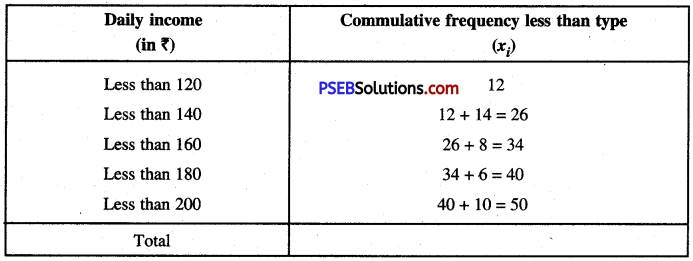
Consider the following distribution of daily wages of 50 workers of a factory.

PSEB 10th Class Maths Solutions Chapter 14 Statistics Ex 14.1 3

Find the mean daily wages of the workers of the factory by using an appropriate method.
Solution:

PSEB 10th Class Maths Solutions Chapter 14 Statistics Ex 14.1 4

From given data,
Assumed Mean (a) = 150
and width of the class (h) = 20
∴ \(\bar{u}=\frac{\Sigma f_{i} u_{i}}{\Sigma f_{i}}\)
= \(\frac{-12}{50}\) = – 0.24

Using formula, Mean \((\overline{\mathrm{X}})=a+h \bar{u}\)
= 150 + (20) (- 0.24)
= 150 – 4.8 = 145.2
Hence,mean daily wages of the workers of factory is ₹ 145.20.

PSEB Solutions PSEB 10th Class Maths Solutions Chapter 14 Statistics Ex 14.2

Question 3.
The following distribution shows the daily pocket allowance of children of a locality. The mean pocket allowance is 18. Find the missing frequency f.

PSEB 10th Class Maths Solutions Chapter 14 Statistics Ex 14.1 5

Solution;

PSEB 10th Class Maths Solutions Chapter 14 Statistics Ex 14.1 6

From the above data,
Assumed mean (a) = 18
Using formula, Mean \((\overline{\mathrm{X}})=a+\frac{\sum f_{i} d_{i}}{\Sigma f_{i}}\)

\(\bar{X}=18+\frac{2 f-40}{44+f}\)
But. Mean of data \((\bar{x})\) = 18 …(Given)
∴ 18 = 18 + \(\frac{2 f-40}{44+f}\)
or \(\frac{2 f-40}{44+f}\) = 18 – 18 = 0
or 2f – 40 = 0
or 2f = 40
or f = \(\frac{40}{2}\) = 20
Hence, missing frequency f is 20.

PSEB Solutions PSEB 10th Class Maths Solutions Chapter 14 Statistics Ex 14.2

Question 4.
Thirty women were examined in a hospital by a doctor and the number of heart beats per minute were recorded and summarised as follows. Find the mean heart beats per minute for these women, choosing a suitable method.

PSEB 10th Class Maths Solutions Chapter 14 Statistics Ex 14.1 7

Solution:

PSEB 10th Class Maths Solutions Chapter 14 Statistics Ex 14.1 8

From above data,
Assumed Mean (a) = 75.5
Width of Class (h) = 3
∴ \(\bar{u}=\frac{\sum f_{i} u_{i}}{\sum f_{i}}\)
= \(\frac{4}{30}\) (approx.)
Using formula,
Mean \((\overline{\mathrm{X}})=a+h \bar{u}\)
= 75.5 + 3 (0.13) = 75.5 + 0.39
\(\overline{\mathrm{X}}\) = 75.89
Hence, mean heart beats per minute for women is 75.89.

PSEB Solutions PSEB 10th Class Maths Solutions Chapter 14 Statistics Ex 14.2

Question 5.
In a retail market, fruit vendors were selling mangoes kept in packing boxes. These boxes contained varying number mangoes. The following was the distribution of mangoes according to the number of boxes.

PSEB 10th Class Maths Solutions Chapter 14 Statistics Ex 14.1 9

Find the mean number of mangoes kept in a packing box. Which method of finding the mean did you choose?
Solution:
Since, values of number of mamgoes and number of boxes are large numerically. So, we must use step-deviation method.

PSEB 10th Class Maths Solutions Chapter 14 Statistics Ex 14.1 10

From above data,
Assumed Mean (a) = 57
Width of class (h) = 3
∴ \(\bar{u}=\frac{\sum f_{i} u_{i}}{\sum f_{i}}\)

\(\bar{u}=\frac{25}{400}\) = 0.0625

Using formula, Mean \((\overline{\mathrm{X}})=a+h \bar{u}\)
\(\bar{X}\) = 57 + 3(0.0625)
= 57 + 0.1875 = 57.1875 = 57.19.
Hence, mean number of mangoes kept in a packing box is 57.19.

PSEB Solutions PSEB 10th Class Maths Solutions Chapter 14 Statistics Ex 14.2

Question 6.
The table below shows the daily expenditure on food of 25 households in a locality.

PSEB 10th Class Maths Solutions Chapter 14 Statistics Ex 14.1 11

Find the mean daily expenditure on food by a suitable method.

Solution:

PSEB 10th Class Maths Solutions Chapter 14 Statistics Ex 14.1 12

From above data,
Assumed mean (a) = 225
Width of class (h) = 50
∴ \(\bar{u}=\frac{\Sigma f_{i} u_{i}}{\Sigma f_{i}}\)

\(\bar{u}=-\frac{7}{25}\) = 0.28
Using formula,
Mean \((\overline{\mathrm{X}})=a+h \bar{u}\)
\(\bar{X}\) = 225 + 50 (- 0.28)
\(\bar{X}\) = 225 – 14
\(\bar{X}\) = 211
Hence, mean daily expenditure on food is ₹ 211.

PSEB Solutions PSEB 10th Class Maths Solutions Chapter 14 Statistics Ex 14.2

Question 7.
To find out the concentration of SO2 in the air (in parts per million, e., ppm), the data was collected for 30 localities in a certain city and is presented below:

PSEB 10th Class Maths Solutions Chapter 14 Statistics Ex 14.1 13

Find the mean concentration of SO2 in the air.
Solution:

PSEB 10th Class Maths Solutions Chapter 14 Statistics Ex 14.1 14

From above data,
Assumed mean (a) = 0.10
Width of class (h) = 0.04
∴ \(\bar{u}=\frac{\Sigma f_{i} u_{i}}{\Sigma f_{i}}\)

\(\bar{u}=-\frac{1}{30}\) = – 0.33(approx.)
Using formula, Mean \((\overline{\mathrm{X}})=a+h \bar{u}\)
\(\bar{X}\) = 0.10 + 0.04 (- 0.33)
= 0.10 – 0.0013 = 0.0987 (approx.)
Hence, mean concentration of SO2 in the air is 0.0987 ppm.

PSEB Solutions PSEB 10th Class Maths Solutions Chapter 14 Statistics Ex 14.2

Question 8.
A class teacher has the folloing absentee record of 40 students of a class for the whole term. Find the mean number of days a student was absent.

PSEB 10th Class Maths Solutions Chapter 14 Statistics Ex 14.1 15

Solution:

PSEB 10th Class Maths Solutions Chapter 14 Statistics Ex 14.1 16

From above data,
Assumed Mean (a) = 17
Using formula, Mean(\(\bar{X}\)) = a + \(\frac{\Sigma f_{i} d_{i}}{\Sigma f_{i}}\)
\(\bar{X}\) = 17 + \(-\frac{181}{40}\)
= 17 – 4.52 = 12.48.
Hence, mean 12.48 number of days a student was absent.

PSEB Solutions PSEB 10th Class Maths Solutions Chapter 14 Statistics Ex 14.2

Question 9.
The following table gives the literacy rate (in percentage) of 35 citIes. Find the mean literacy rate.

PSEB 10th Class Maths Solutions Chapter 14 Statistics Ex 14.1 17

Solution:

PSEB 10th Class Maths Solutions Chapter 14 Statistics Ex 14.1 18

From the above data,
Assumed Mean (a) = 70
Width of class (h) = 10
∴ \(\bar{u}=\frac{\Sigma f_{i} u_{i}}{\Sigma f_{i}}=\frac{-2}{35}\) = – 0.057

Using formula, Mean \((\overline{\mathrm{X}})=a+h \bar{u}\)
\(\bar{X}\) = 70 + 10 (- 0.057)
= 70 – 0.57 = 69.43
Hence, mean literacy rate is 69.43%.

PSEB 8th Class Maths Solutions Chapter 12 Exponents and Powers Ex 12.1

Punjab State Board PSEB 8th Class Maths Book Solutions Chapter 12 Exponents and Powers Ex 12.1 Textbook Exercise Questions and Answers.

PSEB Solutions for Class 8 Maths Chapter 12 Exponents and Powers Ex 12.1

1. Evaluate:

Question (i)
3-2
Solution:
= \(\frac{1}{3^{2}}\)
= \(\frac{1}{3 \times 3}\)
= \(\frac {1}{9}\)

PSEB 8th Class Maths Solutions Chapter 12 Exponents and Powers Ex 12.1

Question (ii)
(-4)-2
Solution:
= \(\frac{1}{(-4)^{2}}\)
= \(\frac{1}{(-4) \times(-4)}\)
= \(\frac {1}{9}\)

Question (iii)
(\(\frac {1}{2}\))-5
Solution:
= \(\frac{1}{2} \times \frac{1}{2} \times \frac{1}{2} \times \frac{1}{2} \times \frac{1}{2}\)
= \(\frac{1}{\frac{1}{32}}\)
= 32

2. Simplify and express the result in power notation with positive exponent:

Question (i)
(-4)5 ÷ (-4)8
Solution:
= (-4)5 – 8 (∵ am ÷ an = am-n)
= (-4)– 3
= \(\frac{1}{(-4)^{3}}\)

PSEB 8th Class Maths Solutions Chapter 12 Exponents and Powers Ex 12.1

Question (ii)
\(\left(\frac{1}{2^{3}}\right)\)2
Solution:
= \(\frac{(1)^{2}}{\left(2^{3}\right)^{2}}\) [∵ \(\left(\frac{a}{b}\right)^{m}=\frac{a^{m}}{b^{m}}\)]
= \(\frac{1}{2^{3 \times 2}}\) [∵ (am)n = amn
= \(\frac{1}{2^{6}}\)

Question (iii)
(-3)4 × (\(\frac {5}{3}\))4
Solution:
= [(-3) × \(\frac {5}{3}\)]4 [∵ am × bm = (ab)m]
= [(-1) × 5]4
= (-1)4 × 54
= 1 × 54
= 54

Question (iv)
(3-7 ÷ 3-10) × 3-5
Solution:
= (3(-7)-(-10)) × 3-5 (∵ am ÷ an = am-n)
= (3-7+10 × 3-5
= 33 × 3-5
= 33 + (-5) (∵ am × an = am+n)
= 3-2
= \(\frac{1}{3^{2}}\)

PSEB 8th Class Maths Solutions Chapter 12 Exponents and Powers Ex 12.1

Question (v)
2-3 × (-7)-3
Solution:
= [2 × (-7)]-3 [∵ am × bm = (ab)m
= (-14)-3
= \(\frac{1}{(-14)^{3}}\)

3. Find the value of:

Question (i)
(30 + 4-1) × 22
Solution:
= (1 + \(\frac {1}{4}\)) × 22
= (\(1 \frac{1}{4}\)) × 22
= (\(\frac {5}{4}\)) × 4
= 5

Question (ii)
(2– 1 × 4-1) ÷ 22
Solution:
= (\(\frac {1}{2}\) × \(\frac {1}{4}\)) ÷ \(\frac{1}{2^{2}}\)
= (\(\frac {1}{8}\)) ÷ \(\frac {1}{4}\)
= \(\frac {1}{8}\) × \(\frac {4}{1}\)
= \(\frac {1}{2}\)

Question (iii)
(\(\frac {1}{2}\))– 2 + (\(\frac {1}{3}\))– 2 + (\(\frac {1}{4}\))– 2
Solution:
=\(\frac{1}{\left(\frac{1}{2}\right)^{2}}+\frac{1}{\left(\frac{1}{3}\right)^{2}}+\frac{1}{\left(\frac{1}{4}\right)^{2}}\)
= \(\frac{1}{\frac{1}{4}}+\frac{1}{\frac{1}{9}}+\frac{1}{\frac{1}{16}}\)
= 4 + 9 + 16
= 29

PSEB 8th Class Maths Solutions Chapter 12 Exponents and Powers Ex 12.1

Question (iv)
(3– 1 + 4– 1 + 5– 1)0
Solution:
(3-1 + 4-1 + 5-1)0
∴ [3-1 + 4-1 + 5-1]0 = 1
[∵ a0 = 1]

Question (v)
\(\left\{\left(\frac{-2}{3}\right)^{-2}\right\}\)2
Solution:
= \(\left(\frac{-2}{3}\right)^{(-2) \times 2}\) [∵ (am)m = amn]
= (\(\frac {-2}{3}\))-4
= \(\frac{(-2)^{-4}}{(3)^{-4}}\) [∵ \(\left(\frac{a}{b}\right)^{m}=\frac{a^{m}}{b^{m}}\)]
= \(\frac{3^{4}}{(-2)^{4}}\)
= \(\frac{3 \times 3 \times 3 \times 3}{(-2) \times(-2) \times(-2) \times(-2)}\)
= \(\frac {81}{16}\)

4. Evaluate:

Question (i)
\(\frac{8^{-1} \times 5^{3}}{2^{-4}}\)
Solution:
= \(\frac{2^{4} \times 5^{3}}{8}\)
= \(\frac{2^{4} \times 5^{3}}{2^{3}}\)
= 24-3 × 53
= 2 × 125
= 250

Question (ii)
(5-1 × 2-1) × 6-1
Solution:
= (\(\frac {1}{5}\) × \(\frac {1}{2}\)) × \(\frac {1}{6}\)
= (\(\frac {1}{10}\)) × \(\frac {1}{6}\)
= \(\frac {1}{60}\)

Another method:
= 5-1 × 2-1 × 6-1
= (5 × 2 × 6)-1
= (60)-1
= \(\frac {1}{60}\)

PSEB 8th Class Maths Solutions Chapter 12 Exponents and Powers Ex 12.1

5. Find the value of m for which 5m ÷ 5-3 = 55.
Solution:
∴ 5m-(-3) = 55.
∴ 5m + 3 = 55
∴ m + 3 = 5 (∵ am = an then m = n)
∴ m = 5 – 3
∴ m = 2
Thus, value of m is 2.

6. Evaluate:

Question (i)
\(\left\{\left(\frac{1}{3}\right)^{-1}-\left(\frac{1}{4}\right)^{-1}\right\}^{-1}\)
Solution:
= {\(\frac{3}{1}-\frac{4}{1}\)}-1 (∵ a-m = \(\frac {1}{am}\))
= {3 – 4}-1
= {-1}-1
= \(\frac {1}{-1}\)
= -1

Question (ii)
(\(\frac {5}{8}\))-7 × (\(\frac {8}{5}\))-4
Solution:
(\(\frac {5}{8}\))-7 × (\(\frac {5}{8}\))4
(∵ a-m = \(\frac{1}{a^{m}}\))
= (\(\frac {5}{8}\))-7+4 (∵ am × an = am+n)
= (\(\frac {5}{8}\))-3
= (\(\frac {8}{5}\))3
= \(\frac{8 \times 8 \times 8}{5 \times 5 \times 5}\)
= \(\frac {512}{125}\)

PSEB 8th Class Maths Solutions Chapter 12 Exponents and Powers Ex 12.1

7. Simplify:

Question (i)
\(\frac{25 \times t^{-4}}{5^{-3} \times 10 \times t^{-8}}\) (t ≠ 0)
Solution:
PSEB 8th Class Maths Solutions Chapter 12 Exponents and Powers Ex 12.1 1

Question (ii)
\(\frac{3^{-5} \times 10^{-5} \times 125}{5^{-7} \times 6^{-5}}\)
Solution:
PSEB 8th Class Maths Solutions Chapter 12 Exponents and Powers Ex 12.1 2

PSEB 8th Class Maths Solutions Chapter 4 Practical Geometry Ex 4.5

Punjab State Board PSEB 8th Class Maths Book Solutions Chapter 4 Practical Geometry Ex 4.5 Textbook Exercise Questions and Answers.

PSEB Solutions for Class 8 Maths Chapter 4 Practical Geometry Ex 4.5

Draw the following.

Question 1.
The square READ with RE = 5.1 cm.
Solution:
PSEB 8th Class Maths Solutions Chapter 4 Practical Geometry Ex 4.5 1
Steps of construction :

  • Draw a line segment RE = 5.1 cm.
  • At E, draw \(\overrightarrow{\mathrm{EM}}\), such that ∠REM = 90°.
  • With E as centre and radius =5.1 cm, draw an arc intersecting \(\overrightarrow{\mathrm{EM}}\) at A.
  • With R as centre and radius = 5.1 cm, draw an arc.
  • With A as centre and radius = 5.1 cm, draw an arc which intersect the previous arc at D.
  • Draw \(\overline{\mathrm{RD}}\) and \(\overline{\mathrm{AD}}\).

Thus, READ is the required square.

PSEB 8th Class Maths Solutions Chapter 4 Practical Geometry Ex 4.5

Question 2.
A rhombus whose diagonals are 5.2 cm and 6.4 cm long.
Solution:
PSEB 8th Class Maths Solutions Chapter 4 Practical Geometry Ex 4.5 2
[Note : The diagonals of a rhombus bisect each other at right angle.]
Here, in rhombus XYZW, YW 6.4 cm.
∴ OW = OY = 3.2 cm

Steps of construction:

  • Draw a line segment XZ = 5.2 cm.
  • Draw \(\overleftrightarrow{\mathrm{AB}}\), the perpendicular bisector of \(\overline{\mathrm{XZ}}\), which intersect \(\overline{\mathrm{XZ}}\) at O.
  • With O as centre and radius = 3.2 cm, draw an arc intersecting \(\overleftrightarrow{\mathrm{AB}}\) above \(\overline{\mathrm{XZ}}\) at W.
  • With O as centre and radius = 3.2 cm, draw another arc which intersects \(\overleftrightarrow{\mathrm{AB}}\) below \(\overline{\mathrm{XZ}}\) at Y.
  • Draw \(\overline{\mathrm{XY}}\), \(\overline{\mathrm{YZ}}\), \(\overline{\mathrm{ZW}}\) and \(\overline{\mathrm{XW}}\).

Thus, XYZW is the required rhombus.

Question 3.
A rectangle with adjacent sides of lengths 5 cm and 4 cm.
Solution:
PSEB 8th Class Maths Solutions Chapter 4 Practical Geometry Ex 4.5 3
[Note: Each angle of a rectangle is a right angle.]
Steps of construction :

  • Draw a line segment AB = 5 cm.
  • At A, draw \(\overrightarrow{\mathrm{AX}}\), such that ∠XAB = 90°.
  • With A as centre and radius = 4 cm, draw an arc intersecting \(\overrightarrow{\mathrm{AX}}\) at D.
  • With B as centre and radius = 4 cm, draw an arc.
  • With D as centre and radius = 5 cm, draw an arc which intersects the previous arc at C.
  • Draw \(\overline{\mathrm{BC}}\) and \(\overline{\mathrm{CD}}\).

Thus, ABCD is the required rectangle.

PSEB 8th Class Maths Solutions Chapter 4 Practical Geometry Ex 4.5

Question 4.
A parallelogram OKAY where OK = 5.5 cm and KA = 4.2 cm. Is it unique ?
Solution:
PSEB 8th Class Maths Solutions Chapter 4 Practical Geometry Ex 4.5 4
A parallelogram cannot be constructed as sufficient measurements are not given. It is not unique as angles may vary in parallelogram drawn by given measurements.

PSEB 8th Class Maths Solutions Chapter 13 Direct and Inverse Proportions Ex 13.1

Punjab State Board PSEB 8th Class Maths Book Solutions Chapter 13 Direct and Inverse Proportions Ex 13.1 Textbook Exercise Questions and Answers.

PSEB Solutions for Class 8 Maths Chapter 13 Direct and Inverse Proportions Ex 13.1

1. Following are the car parking charges near a railway station upto:
PSEB 8th Class Maths Solutions Chapter 13 Direct and Inverse Proportions Ex 13.1 1
Check if the parking charges are in direct proportion to the parking time.
Solution:
Here, ratio of parking charges and parking time are as follow:

Parking time Parking charges Parking charge / Parking time
4 hours ₹ 60 \(\frac{60}{4}=\frac{15}{1}\)
8 hours ₹ 100 \(\frac{100}{8}=\frac{25}{2}\)
12 hours ₹ 140 \(\frac{140}{12}=\frac{35}{3}\)
24 hours ₹ 180 \(\frac{180}{24}=\frac{15}{2}\)

Here, \(\frac {15}{1}\) ≠ \(\frac {25}{2}\) ≠ \(\frac {35}{3}\) ≠ \(\frac {15}{2}\)
Thus, the parking charges are not in direct proportion to the parking time.

PSEB 8th Class Maths Solutions Chapter 13 Direct and Inverse Proportions Ex 13.1

2. A mixture of paint is prepared by mixing 1 part of red pigments with 8 parts of base. In the following table, find the parts of base that need to be added:
Solution:

Parts of red pigment 1 4 7 12 20
Parts of base 8

If parts of red pigment are x1, x2, x3, x4 and x5 respectively, then parts of base are y1, y2, y3, y4 and y5 respectively. Here, it is clear that mixture preparation is in direct proportion.
PSEB 8th Class Maths Solutions Chapter 13 Direct and Inverse Proportions Ex 13.1 2
Thus, the table is

Parts of red pigment 1 4 7 12 20
Parts of base 8 32 56 96 160

3. In Question 2 above, if 1 part of a red pigment requires 75 ml of base, how much red pigment should we mix with 1800 ml of base?
Solution:
See as per question 2 –
x1 = 1, y1 = 75, x2 = ? and yx2 = 1800
\(\frac{x_{1}}{y_{1}}=\frac{x_{2}}{y_{2}}\)
∴ \(\frac{1}{75}=\frac{x_{2}}{1800}\)
∴ x2 = \(\frac{1 \times 1800}{75}\)
∴ x2 = 24
Thus, 24 ml of red pigment should be mixed with 1800 ml of base.

PSEB 8th Class Maths Solutions Chapter 13 Direct and Inverse Proportions Ex 13.1

4. A machine in a soft drink factory fills 840 bottles in six hours. How many bottles will it fill in five hours?
Solution:
Let the number of bottles filled by machine in 5 h be x.

Number of hours (x) 6 5
Number of bottles filled (y) 840 ?

Here, as the number of hours decreases, the number of bottles filled will also decrease.
∴ It is case of direct proportion.
Here, x1 = 6, y1 = 840, x2 = 5 and y2 = ?
\(\frac{x_{1}}{y_{1}}=\frac{x_{2}}{y_{2}}\)
∴ \(\frac{6}{840}=\frac{5}{y_{2}}\)
∴ y2 = \(\frac{5 \times 840}{6}\)
∴ y2 = 700
Thus, 700 bottles will be filled in 5 hours.

5. A photograph of a bacteria enlarged 50,000 times attains a length of 5 cm as shown in the diagram. What is the actual length of the bacteria? If the photograph is enlarged 20,000 times only, what would be its enlarged length?
Solution:

Enlargement in picture of bacteria Length (cm)
50,000 times enlarged (x1) 5 (y1)
1 (x2) ? (y2)

Here, length of bacteria increases as picture of bacteria enlarges.
∴ It is case of, direct proportion.
PSEB 8th Class Maths Solutions Chapter 13 Direct and Inverse Proportions Ex 13.1 2.1
Hence, the actual length of bacteria is 10-4 cm.
Now, the photograph is enlarged 20,000 times.

Enlargement in picture of bacteria Length (cm)
50,000 times enlarged (x1) 5 (y1)
20,000 times enlarged (x1) ? (y2)

∴ \(\frac{50,000}{5}=\frac{20,000}{y_{2}}\)
∴ y2 = \(\frac{20,000 \times 5}{50000}\)
∴ y2 = 2
Thus, its enlarged length would be 2 cm.

PSEB 8th Class Maths Solutions Chapter 13 Direct and Inverse Proportions Ex 13.1

6. In a model of a ship, the mast is 9 cm high, while the mast of the actual ship is 12 m high. If the length of the ship is 28 m, how long is the model ship?
Solution:

Actual ship Model ship
Length of the ship x 28 m ?
Height of mast y 12m 9 cm

This is a case of direct proportion.
x1 = 28, y1 = 12, x2 = ?, y2 = 9
\(\frac{x_{1}}{y_{1}}=\frac{x_{2}}{y_{2}}\)
∴ \(\frac{28}{12}=\frac{x_{2}}{9}\)
∴ x2 = \(\frac{28 \times 9}{12}\)
∴ x2 = 21
Thus, the length of model ship is 21 cm.

7. Suppose 2 kg of sugar contains 9 × 10⁶ crystals. How many sugar crystals are there in

Question (i)
5 kg of sugar?
Solution:

Weight of sugar (kg) x Number of sugar crystals y
x1 = 2 y1 = 9 × 106
x2 = 5 y2 = (?)

This is a case of direct proportion.
PSEB 8th Class Maths Solutions Chapter 13 Direct and Inverse Proportions Ex 13.1 3
Thus, there are 2.25 × 10⁷ crystals of sugar in 5 kg of sugar.

PSEB 8th Class Maths Solutions Chapter 13 Direct and Inverse Proportions Ex 13.1

Question (ii)
1.2kg of sugar?
Solution:

Weight of sugar (kg) x Number of sugar crystals y
x1 = 2 y1 = 9 × 106
x2 = 1.2 y2 = (?)

Here. x1 = 2, x1 = 9 × 10⁶, x2 = 1.2, y2 = ?
\(\frac{x_{1}}{y_{1}}=\frac{x_{2}}{y_{2}}\)
∴ \(\frac{2}{9 \times 10^{6}}=\frac{1.2}{y_{2}}\)
∴ y2 = \(\frac{1.2 \times 9 \times 10^{6}}{2}\)
∴ y2 = 0.6 × 9 × 106
∴ y2 = 5.4 × 10⁶
Thus, there are 5.4 × 10⁶ crystals of sugar in 1.2 kg of sugar.

8. Rashmi has a road map with a scale of 1 cm representing 18 km. She drives on a road for 72 km. What would be her distance covered in the map?
Solution:

Actual distance (km) x Distance on the map (cm) y
x1 = 18 y1 = 1
x2 = 72 y2 = (?)

This is a case of direct proportional.
Here, x1 = 18 km, y1 = 1 cm, x2 = 72 km, y2 = ?
\(\frac{x_{1}}{y_{1}}=\frac{x_{2}}{y_{2}}\)
∴ \(\frac{18}{1}=\frac{72}{y_{2}}\)
∴ y2 = \(\frac{72 \times 1}{18}\)
∴ y2 = 4
Thus, the distance covered by her on the map is 4 cm.

PSEB 8th Class Maths Solutions Chapter 13 Direct and Inverse Proportions Ex 13.1

9. A 5 m 60 cm high vertical pole casts a shadow 3 m 20 cm long. Find at the same time

Question (i)
the length of the shadow cast by another pole 10 m 50 cm high
Solution:

Height of vertical pole x Length of shadow y
x1 = 5 m 60 cm = 560 cm y1 = 3 m 20 cm = 320 cm
x2 = 10 m 50 cm = 1050 cm y2 = (?)

This is a case of direct proportionality.
PSEB 8th Class Maths Solutions Chapter 13 Direct and Inverse Proportions Ex 13.1 4
Thus, the length of the shadow cast by another pole is 6 m.

Question (ii)
the height of a pole which casts a shadow 5 m long.
Solution:

Height of vertical pole x Length of shadow y
x1 = 560 cm y1 = 320 cm
x2 = (?) y2 = 5 m = 500 cm

x1 = 560, y1 = 320, x2 = ?, y2 = 500
\(\frac{x_{1}}{y_{1}}=\frac{x_{2}}{y_{2}}\)
∴ \(\frac{560}{320}=\frac{x_{2}}{500}\)
∴ x2 = \(\frac{560 \times 500}{320}\)
∴ x2 = 875 cm
∴ x2 = 8.75 cm
Thus, the height of the pole is 8,75 m.

PSEB 8th Class Maths Solutions Chapter 13 Direct and Inverse Proportions Ex 13.1

10. A loaded truck travels 14 km in 25 minutes. If the speed remains the same, how far can it travel in 5 hours?
Solution:

Distance (km) x Time (minute) y
x1= 14 y1 = 25
x2 = (?) y2 = 5 hours = 300

This is a case of direct proportion.
∴ Here, x1 = 14, y1 = 25, x2 = ?, y2 = 300
\(\frac{x_{1}}{y_{1}}=\frac{x_{2}}{y_{2}}\)
∴ \(\frac{14}{25}=\frac{x_{2}}{300}\)
∴ x2 = \(\frac{14 \times 300}{25}\)
∴ x2 = 168
Thus, loaded truck can travel 168 km in 5 h.