PSEB 7th Class English Grammar Determiners

Punjab State Board PSEB 7th Class English Book Solutions English Grammar Determiners Exercise Questions and Answers, Notes.

PSEB 7th Class English Grammar Determiners

Determiners वे शब्द हैं जो संज्ञा (noun) से पूर्व उसके अर्थ को किसी-न-किसी रूप में स्पष्ट करने या निश्चित करने के लिए प्रयुक्त होते हैं। यहां पर हम Determiners की एक सूची दे रहे हैं-

  1. Demonstratives. this, that, these, those.
  2. Possessives. my, your, his, her, its, our, their.
  3. Cardinal numbers. one, two, three, etc.
  4. Ordinal numbers. first, second, third, etc.
  5. Articles. a, an, the.

Miscellaneous. Some, any, both, certain, enough, few, every, least, less, little, more, most, much, next; other, own, plenty, several, such, many, another, each, no, a few, a large number of, a small number of, a great deal of, a good deal of, a large quantity of, a small quantity of, all, etc.

PSEB 7th Class English Grammar Determiners

(i) Demonstratives (निर्देशक शब्द). This, that, these, those ऐसे शब्द हैं जो वस्तुओं की ओर संकेत करते हैं। अतः वे निर्देशक कहलाते हैं और इनसे Determiners की एक श्रेणी बनती है; जैसे,

  • This book was purchased by me.
  • That book was purchased by me.
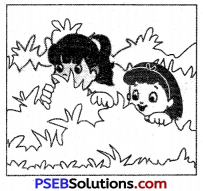
  • These girls are singing.
  • Those girls are dancing.

Note. This और that एकवचन हैं जबकि these और those बहुवचन हैं।

(ii) Possessives (सम्बन्धवाचक शब्द). My, her, your, his its, our, their सम्बन्धवाचक सर्वनाम हैं और – इनका प्रयोग एकवचन और बहुवचन दोनों प्रकार की संज्ञाओं के साथ किया जाता है; जैसे
1. (a) I like my book. (Singular)
(b) I kept my books in order. (Plural)

2. (a) He told his story in tears. (Singular)
(b) People tell his stories in tears. (Plural)

3. (a) Let me see your note-book. (Singular)
(b) Teacher will check your note-books. (Plural)

Note. सम्बन्धवाचक शब्द अगणनीय संज्ञाओं से पूर्व भी प्रयुक्त किए जा सकते हैं; जैसे,

  • I took my bath. (uncountable)
  • His courage failed him. (uncountable)
  • We cannot doubt their patriotism: (uncountable)

(iii) and (iv) Cardinal and Ordinal Numbers. Cardinal and Ordinal संख्याएं भी Determiners का एक भाग हैं।

  • Two miles are left to be covered.
  • I am reading the third chapter now.
  • I need fifty rupees for this.

(v) The Articles. a, an तथा the को अंग्रेजी व्याकरण में articles के नाम से पुकारा जाता है। ये वास्तव में Adjective determiners हैं।

A तथा An का प्रयोग
1. सभी एकवचन Countable Nouns से पूर्व a या an का प्रयोग होता है। यदि शब्द के पहले letter की आवाज़ स्वर (Vowel) से मेल खाये तो an और यदि व्यंजन (Consonant) से मेल खाये तो a का प्रयोग होता है; जैसे,

  • I saw a man.
  • He saw an elephant.
  • A bench is lying there.
  • An ox was eating grass.
  • There is a lion in the forest.
  • He needs an inkpot now.

2. कुछ शब्द vowel से आरम्भ होते हैं, परन्तु उनकी आवाज़ व्यंजन (Consonants) की होती है। ऐसे एकवचन Countable nouns से पूर्व a लगता है; जैसे,-

  • He is a European.
  • He is a one-eyed person.
  • She is a university student.

3. कुछ शब्द आरम्भ तो h से होते हैं, परन्तु यदि h मौन होने के कारण उनकी आवाज़ स्वर (Vowel) से मेल खाती है तो ऐसे h वाले एकवचन (Countable nouns) शब्दों से पूर्व an का प्रयोग होता है; जैसे,

  • He reached an hour earlier.
  • He is an honest man.

यदि एकवचन संज्ञा (Countable Noun) से पूर्व कोई adjective आ जाये तो a तथा an उस Adjective से पहले स्वर या व्यंजन की ध्वनि के आधार पर लगाया जाता है; जैसे,

  • He is an honourable man.
  • It is a useful medicine.
  • The doctor gave Pratap a glass eye.

Note. 1. a या an का प्रयोग किसी वाक्य या paragraph में किसी शब्द के साथ एक बार ही होता है। दूसरी बार उसके साथ the का प्रयोग करना चाहिए; जैसे,-
I saw a lion in a forest. The forest was thick. The lion was unable to find his way through the forest.
2. Uncountable Nouns (milk, water, rice, paper) से पूर्व a या an का प्रयोग नहीं होता।

The का प्रयोग

The का प्रयोग निम्नलिखित शब्दों के साथ किया जाता है-
1. विशेष वस्तु के साथ; जैसे,
I have spent the money that my father sent me.
This is the house where my childhood passed.

2. किसी एकवचन Noun से पूर्व जब Noun किसी जाति की जानकारी के लिए प्रयोग किया जाता हो; जैसे,-
The cow is a gentle animal.
The dog is a faithful animal.

3. किसी Adverb से पूर्व जब उसका प्रयोग यूं किया जाए; जैसे,-
The higher we go the cooler it is. The more the merrier.

4. नदियों, पर्वत श्रृंखलाओं तथा द्वीप-समूहों से पूर्व; जैसे,
The Ganga, The Himalayas, The British Isles.

5. महासागरों, समुद्रों तथा खाड़ियों से पूर्व; जैसे,
The Indian Ocean, The Red Sea, The Bay of Bengal, The Persian Gulf.

6. कुछ प्रान्तों तथा देशों के नाम से पूर्व; जैसे,
The Punjab (The land of five rivers), The United States.

7. कुछ प्रसिद्ध ग्रन्थों के नाम से पूर्व; जैसे,
The Ramayana, The Mahabharata, The Vedas, The Bible.

8. Adjective की Superlative degree से पहले; जैसे,
He is the best boy of our class.

9. ऐसे Proper Noun से पहले जिसके लिए किसी विशेषण का प्रयोग हो। यदि कोई Phrase या Clause भी विशेषण के रूप में प्रयोग की गई हो तो भी The का प्रयोग किया जाता है; जैसे,
The Great Nehru, The Famous Napoleon, The Immortal Mahatma Gandhi.

PSEB 7th Class English Grammar Determiners

10. Adjectives से पूर्व भी ‘The’ का प्रयोग किया जाता है; जैसे,
The rich should help the poor.

11. समाचार-पत्रों, पत्रिकाओं, ऐतिहासिक भवनों और कुछ विशेष संस्थाओं के नामों से पहले; जैसे,
The Tribune, The Illustrated Weekly, The Taj, The Sharma Dramatic Club.

12. जातियों तथा दशाओं से पूर्व; जैसे,
The Hindus, The east, The west.

13. कुछ ऐसे Proper Nouns के साथ जो Common Nouns के रूप में प्रयोग किये जाते हैं; जैसे,
He is the Manoj Kumar of our class.

14. कुछ Abstract Nouns से पूर्व; जैसे,
The bravery of the Rajputs is known all over the world.

Filling the Blanks with Blanks

1. Ram is ………. honest man. (an)
2. ………. book you gave me is lost. (The)
3. ………. cow is a useful animal. (The)
4. ………. Himalayas have many ranges. (The)
5. Gardening is ………. useful hobby. (a)
6. I have been waiting for you for ………. hour. (an)
7. I saw ………. Sri Harmandar Sahib. (the)
8. Who is ………. head of your family ? (the)
9. He is ………. boy who stole my pen. (the)
10. Our Principal is ………. intelligent man. (an)
11. ………. stitch in time saves nine. (A)
12. Do not make ………. noise (a)
13. My brother is ………. M.A., you are ………. B.A. (an, a)
14. New Delhi is ………. capital of India. (the)
15. This is …….. interesting story. (an)
16. He has ……… lot of money. (a)
17. He has ………. monthly income of Rs. 7000. (a)
18. ………. stars are a beautiful sight. (The)
19. Give me ………. apple or ……… orange. (an, an)
20. You should always show sympathy to ……… poor. (the)
21. Get me ………. nice cup of tea. (a)
22. This is ………. excellent watch. (an)
23. ………. rose smells sweet. (The)
24. Where is ……… book which I gave you ? (the)
25. He is ………. able student but not ……… ablest. (an, the)
26. Why are you in ………. hurry ? (a)
27. I hate ……… dishonest servant. (a)
28. He is ………. idiot. (an)
29. ………. rich are not always happy. (The)
30. ………. moon has risen. (The)
31. There was ………. army of monkeys near ………. temple. (an, the)
32. This is quite ………. new idea. (a)
33. He is ……… hardworking boy. (a)
34. I need ……… pen and ………. inkpot. (a, an)
35. I read ………. Hindustan Times everyday. (the)
36. I have not seen ………. Taj as yet. (the)
37. ………. bad workman quarrels with his tools. (A)
38. ………. apple ………. day keeps ………. doctor away. (An, a, the)
39. ………. Ganga is ………. sacred river. (The, a)

Exercises for Practice

I. 1. You are ……… intelligent student.
2. Is not he ……… school teacher ?
3. I drank all ………. milk.
4. Who invented ………. radio ?
5. There was once ……… king called Ashoka.
6. I saw ……… accident on my way to school.
7. Do you ever read …….. Gita ?
8. He is ………. best boy in the class.
9. He is ………. Napoleon of India.
10. I had ………. busy time in Mumbai.

II. 1. Believe in God and do ………. right.
2. He is ……………. S.D.O.
3. ……… stitch in time saves nine.
4. Is not he ……….. foolish person ?
5. Do not laugh at ……….. poor.
6. Child is ……….. father of man.
7. ………. apple …………day keeps………. doctor away.
8. Marconi invented ……….. machine called radio.
9. Kapil Dev is ………. cricketer.
10. ……….. rose is beautiful.

III. 1. He is ……….. fair-weather friend.
2. Both ………. teams were equally strong.
3. Kalidas is ……….. Shakespeare of India.
4. Rabindranath wrote ………. national anthem.
5. ……….. hen lays eggs.
6. ……….. sun rises in ………. east.
7. I saw ……… one-eyed man.
8. ……….. Bible is ……….. sacred book of ………….. Christians.
9. ……….. Hindus and the Sikhs should live together.
10. Lord Rama was ……….. eldest son of Dashratha.

IV. 1. He is ……… best boy in the class.
2. ……….. Ganges is ………. sacred river of ……….. Hindus.
3. ……….. Himalayas are ……….. highest mountains in ………..world.
4. Mahatma Gandhi is………father of………..nation.
5. ………dog is……..faithful animal.
6. Your brother is ……….. honest man.
7. …………. rich should help ………. poor.
8. I want ……….. orange and not ………. apple.
9. She stood first in ……….. examination.
10. My school is at ……….. stone’s throw from my house.

V. 1. He held him by ………. ear.
2. She is ………. actress.
3. He is ……….. film actor.
4. What ……….. fool he is !
5. This is ……….. old temple of Amritsar.
6. This city is situated on ……… bank of ……….. Yamuna.
7. I met ……. old man yesterday.
8. Delhi is ……….. capital of India.
9. Gurdaspur is ………. district in the Punjab.
10. Giani Zail Singh was ……….. President of India.

Miscellaneous

1. Some, any
(i) दोनों मात्रा और संख्या का ज्ञान कराते हैं। some का प्रयोग positive (सकारात्मक) तथा any का प्रयोग Negative (नकारात्मक) वाक्यों में होता है; जैसे,
I have some money.
They have some books.
He did not lend me any book.
They did not buy any book.

(ii) प्रश्नवाचक वाक्यों में some और any दोनों ही प्रयोग हो सकते हैं; जैसे,
Will you give me any money ?
Will you give me some money ?

2. Much, many
much मात्रा तथा many संख्या के लिए प्रयोग किया जाता है; जैसे,
I have many books.
I have much money.

3. Each, everyone
Each दो या अधिक व्यक्तियों या चीजों के लिए प्रयोग होता है; परन्तु वर्णित व्यक्तियों या चीजों की संख्या निश्चित होती है; जैसे,
Each player was given a prize.
There were two books in the picture. Each book had a red cover.
Every का प्रयोग दो से अधिक व्यक्तियों या चीज़ों के लिए उस समय किया जाता है जबकि व्यक्तियों या चीजों की संख्या निश्चित नहीं होती है; जैसे,
Every man and every boy should do his duty.

4. Little, a little, the little
(i) Little का अर्थ है ‘न’ के बराबर; जैसे,
Mohan is a fool and has little sense.

(ii) A little का अर्थ है ‘कुछ’; जैसे,
I am in need of a little water.

(iii) The little का अर्थ है ‘अधिक तो नहीं, परन्तु वह (थोड़ा) सारे का सारा’, जैसे,
I have spent the little money that I had.

5. Few, a few, the few.
(i) Few का अर्थ ‘कोई नहीं’ अथवा कठिनता से कोई; जैसे,
Few persons can keep a secret.

(ii) A few का अर्थ है ‘बहुत थोड़े’; जैसे,
A few persons were present at the magic show.

(iii) The few का अर्थ है ‘बहुत तो नहीं, परन्तु वे (कुछ) सभी’, जैसे,
I bought the few books that I needed.

Use of Some Other Determiners

1. He has enough money in the bank.
2. Every man wishes to be happy.
3. I have never seen such persons.
4. I want to help that man.
5. He met several people on the way.
6. He lives in his own house.
7. Those girls were absent from the class.
8. Ram has less money than I have.
9. She lives next door to me.
10. Don’t show it to other people.
11. There are certain people who can work day and night.
12. Both men were sent to prison.
13. They have plenty of money.
14. A lot of people came to see the match.
15. Most of the boys were absent yesterday.
16. You can select either book.
17. What is the latest news of the war ?
18. Mumbai is farther than Delhi.
19. I have no further information.
20. This is the last lesson of the book.

PSEB 7th Class English Grammar Determiners

Exercises

I. Fill up the blanks with the Articles (a, an, the):

1. He can read ………. Vedas.
2. She is ………. intelligent girl.
3. ………. sun shines brightly.
4. Life is not ………. bed of roses.
5. …….. higher you climb …….. colder it gets.
6. In ………. park I saw ……… one-eyed beggar.
7. Mumbai is ………. Manchester of India.
8. ………. Sikhs are a brave nation.
9. ……… Owl cannot see during day time.
10. He became ……… doctor.
11. Mangoes are sold by ………. kilo.
12. Everest is ………. highest mountain in ………. world.
13. I caught him by ………. ear.
14. Do not make ………. noise.
15. The more, ………. merrier.
16. He is ………. one-eyed person.
17. …….. Ganges is ……… sacred river.
18. We started late in ………. afternoon.
19. ………. rose smells sweet.
20. He reads ………… Bible everyday.
21. Kalidas was ………… Shakespeare of India.
22. Einstein was ………. Newton.
23. …….. camel is ………… ship of ………. desert.
24. Can ………. leopard change its spots ?
25. ………. lotus is a lovely flower.
26. ……… rich must help ……….. poor.
27. ……… more you speak, ……….. less I understand.
28. Tagore was ………… truly great poet.
29. ………. more they get, ……… more they want.
30. This is ………. historic occasion.
31. ……………… black and white cow is grazing in the field.
32. He is ………… real Mahatma.
33. I read ………… Tribune daily.
34. I am in ………… hurry.
35. Help ………. poor.
36. Both ………. robbers were arrested.
37. Keep to ………. left.
38. ……… housemaid pulls up ………. blind.
39. What ………. lovely girl !
40. What ………. ripe apple !
41. Not ………. word was said.
42. Help ……… poor, ………. needy and ………. miserable.
43. Who is ………. cleverer of ………. two cheats ?
44. He is ………. better mechanic than clerk.
45. Read ………. third and ……. fourth chapters.
Hints:
1. the
2. an
3. The
4. a
5. The, the
6. the, a
7. the
8. The
9. An
10. a
11. the
12. the, the
13. the
14. a
15. the
16. a
17. The, a
18. the
19. The
20. the
21. the
22 the
23. The, the, the
24. a
25. The
26. The, the
27. The, the
28. a
29. The, the
30. a
31. A
32. a
33. the
34. a.
35. the
36. the
37. the
38. The, the
39. a
40. a
41. a
42. the, the, the
43. the, the
44. a
45. the, the.

II. Correct the following sentences:

1. Only few men are honest.
2. The man is mortal.
3. He acted like man.
4. Beas flows in Punjab.
5. You are in wrong but he is in right.
6. He is by far ablest boy.
7. Nobody likes a person with bad temper.
8. The iron is useful metal.
9. Not word was said.
10. He has too high a opinion of you.
11. Learn this poem by the heart.
12. Never tell lie.
Answer:
1. Only a few men are honest.
2. Man is mortal.
3. He acted like a man.
4. The Beas flows in the Punjab.
5. You are in the wrong but he is in the right.
6. He is by far the ablest boy.
7. Nobody likes a person with a bad temper.
8. Iron is a useful metal.
9. Not a word was said.
10. He has too high an opinion of you.
11. Learn this poem by heart.
12. Never tell a lie.

PSEB 7th Class English Grammar Determiners

III. Fill in the blanks with suitable determiners:

1. I went to ………. window which commanded a large green garden.
2. I have heard so ………. about your school.
3. Look out of the window for ……… minute.
4. It is really something of ……… joke.
5. There you have …….. essential part of our system.
6. I asked her by way of ………. opening.
7. But I had ……. idea of all this.
8. Come down into …….. garden.
9. Having ………. arm tied up is troublesome.
10. It educates both ……… blind and the helpers.
Hints:
1. the
2. much
3. a
4. a
5. an
6. an
7. an
8. the
9. an
10. the.

IV. Fill in the blanks with suitable determiners:

1. We should look into ………. depth of the problem.
2. It was ………. daring idea.
3. He took the saliva from the jaws of ………. mad bulldog.
4. This is ………. good home for him.
5. ………. people had been bitten by the mad wolf.
6. He held one finger over ………. top of the tube.
7. Besides them stood Pasteur, holding a narrow tube in …….. hand.
8. They took samples from ………. brain of a dog that had died.
9. ………. little knowledge is ………. dangerous thing.
10. Your old place in ………. laboratory is waiting for you.
Hints:
1. the
2. a
3. a
4. a
5. Some
6. the
7. his
8. the
9. A, a
10. the.

V. Fill in the blanks with suitable determiners:

1. He turned to look at ………. parents.
2. ……… old banyan tree outstretched its powerful arms over other trees.
3. I want ……… pen.
4. His parents would refuse to buy him ………. flowers.
5. He was carried away by……….. rainbow glory of their colours.
6. At ………. distance, he could see men and women talking.
7. I saw ………. curious look in ………. eyes.
8. I want ………. garland.
9. I borrowed ……… books from him.
10. Is there ………. milk in the pot ?
Hints:
1. his
2. An
3. a
4. any
5. the
6. a
7. a, his
8. a
9. these
10. any.

VI. (a) Insert the determiners ‘this, that, these, those in the blanks:

1. ………. shirt is costly but …….. shirt is cheap.
2. Would you like to take ………. book or ………. one ?
3. ………. sum cannot be solved by ……. silly boys.
4. ………. flowers are beautiful but ………. flowers are ordinary ones.
5. He likes this pair of trousers but he does not like ………. One.
Hints:
1. This, that
2. this, that
3. This, those
4. These, those
5. that.

(b) Insert ‘a few’ or ‘the few’ whichever is suitable:

1. ………. books she had were all lost.
2. It is a question of spending ………. rupees.
3. ………. suggestions she gave were all carried out.
4. ……… hints on essay-writing are quite to the point.
5. …….. boys attended the class.
Hints:
1. The few
2. a few
3. The few
4. A few
5. A few

(c) Insert ‘little’, ‘a little’, or ‘the little whichever is suitable:

1. ……… knowledge is a dangerous thing.
2. There is ………. hope of his recovery.
3. He has ………. money with him.
4. ………. strength he had in him proved useless.
5. He takes ……… interest in me.
Hints:
1. A little
2. little
3. a little
4. The little
5. little.

(d) Fill in the blanks with determiners ‘each, every, either or neither:

1. ……… pen costs ten rupees.
2. He comes here on ………. Sunday.
3. ………. of you may take this book.
4. ………. man wants to rise in the world.
5. ……… seat in the hall was occupied.
Hints:
1. Each
2. every
3. Either
4. Every
5. Every.

PSEB 7th Class English Grammar Determiners

(e) Fill in the blanks with determiners ‘much, many, some, any’:

1. Will you please give me ………. Water ?
2. There is ………. sugar in the pot.
3. Is there ………. elderly person in the house ?
4. He did not make ………. mistakes in the essay.
5. She hasn’t ……… money.
Hints:
1. some
2. much
3, any
4. any
5. any.

(f) Fill in the blanks with ‘farther, further, latter, latest, last’:

1. What is the ………. information?
2. The man in the ………. row was my uncle.
3. The old man could not go ………. without a rest.
4. The college will be closed until ………. notice.
5. Of the two, the majority accepted the ………. proposal.
Hints:
1. latest
2. last
3. farther
4. further
5. latter.

Exercises For Practice

Fill in the blanks with determiners:

1. (i) He is ………. One-eyed man.
(ii) ……….. higher you go, ……….. cooler it is.

2. (i) I want ……….. more sugar in the tea.
(ii) This is ……… boy who stood first in the class.

3. (i) How ……….. feet make one yard ?
(ii) A ……….. knowledge is a dangerous thing.

4. (i) There is ……….. slip between ………….. cup and……..lip.
(ii) How ……….. milk do you buy daily ?

5. (i) He is every inch ……….. honest man.
(ii) ……….. umbrella you brought was ……… imported one.

6. (i) Is this ……….. dog which had bitten you ?
(ii) This book contains ……….. pictures.

7. (i) There is ……….. salt, but there is not ………. chillies.
(ii) How ……….. water is there in the jug?

8. (i) He was late for school by ……… hour and …….. half.
(ii) He is ……… university professor.

9. (i) ……….. trees fell down during cyclone.
(ii) One goes to ……….. theatre to have entertainment.

10. (i) ……….. boy you met just now is my cousin.
(ii) How ………. sugar do you consume in a month ?

11. (i) ………. book was purchased by me.
(ii) Does he need ……….. kind of assistance ?

12. (i) He did not make ……….. provi’ ion for his future.
(ii) How ……….. boys failed in th: examination ?

13. (i) This is ……….. last time that i have taken meat.
(ii) Do you have ……….. book to spare ?

14. (i) Would you lend me ………. money ?
(ii) He spent ……….. little money he had.

15. (i) How ………. boys are there in the class ?
(ii) How ………. milk is there in the pot ?

16. (i) I saw …………. Sri Harmandar Sahib
(ii) Sohan is ……………… honest man.

17. (i) Do not make …………… noise.
(ii) New Delhi is ……………… capital of India.

18. (i) ……………… rich are not always happy.
(ii) He is ………….. idiot.

19. (i) Do not make ……….. noise.
(ii) She is ………… intelligent girl.

20. (i) He can read …………. Vedas.
(ii) It was ………… daring idea.

21. (i) I am in ……………. hurry.
(ii) ……………… rose smells sweet.

22. (i) Look out of the window for ………. minute.
(ii) Your old place in ………………. laboratory is waiting for you.

23. (i) I have heard so ……………… about your school.
(ii) He takes …………….. interest in me.

24. (i) Is there …………… milk in the pot ?
(ii) ……………… seat in the hall was occupied.

PSEB 7th Class English Grammar Determiners

25. (i) She is ………….. intelligent girl.
(ii) Do not make …………. noise.

26. (i) He is ………… one-eyed man.
(ii) He lost ……….. books he had.

PSEB 7th Class English Reading Comprehension Picture / Poster Based

Punjab State Board PSEB 7th Class English Book Solutions English Reading Comprehension Picture / Poster Based Exercise Questions and Answers, Notes.

PSEB 7th Class English Reading Comprehension Picture / Poster Based

Look at the picture carefully and answer the questions that follow:

PSEB 7th Class English Reading Comprehension Picture Poster Based 1

Question 1.
What is the name of this object ?
(a) traffic police
(b) traffic light
(c) street light
(d) street hawker.
Answer:
(b) traffic light.

Question 2.
Where do we see (find) this object?
(a) in the hospital
(b) in the park
(c) on the roads
(d) in the drawing room.
Answer:
(c) on the roads.

PSEB 7th Class English Reading Comprehension Picture / Poster Based

Question 3.
This object is related to
(a) rules of road
(b) rules of school
(c) rules of home
(d) rules of hotel.
Answer:
(a) rules of road.

Question 4.
Which light says us to stop ?
(a) red
(b) green
(c) yellow
(d) white.
Answer:
(a) red.

Question 5.
Yellow light says us to …..
(a) stop
(b) go
(c) wait
(d) rest.
Answer:
(c) wait.

2.
PSEB 7th Class English Reading Comprehension Picture Poster Based 2
Question 1.
What is this place?
(a) a public park
(b) a zoo
(c) a school ground
(d) a circus ground.
Answer:
(a) a public park.

Question 2.
Public parks are open to ……….
(a) men
(b) women
(c) children
(d) all these.
Answer:
(d) all these.

Question 3.
Elederly people go to the parks …………
(a) for a walk
(b) to sit and chat
(c) give exercise to their body
(d) all these.
Answer:
(d) all these.

Question 4.
Why do children like visiting a big park ?
(a) they can enjoy sliding, swinging etc.
(b) they can have a picnic
(c) they meet their friends, play, sing and dance
(d) all the above.
Answer:
(d) all the above.

PSEB 7th Class English Reading Comprehension Picture / Poster Based

Question 5.
In a park, we should ……………. .
(a) pluck flowers
(b) throw waste papers here and there
(c) run across the flower beds
(d) sit in the lawns peacefully.
Answer:
(d) sit in the lawns peacefully.

3.
PSEB 7th Class English Reading Comprehension Picture Poster Based 3

Question 1.
What is this place ?
(a) a public park
(b) a zoo(c) a picnic spot
(d) a playground.
Answer:
(b) a zoo.

Question 2.
In a zoo we can see different kinds of ……….
(a) weapons
(b) plants
(c) coins
(d) animals.
Answer:
(d) animals.

Question 3.
In a zoo animals like lions and tigers are kept …………….
(a) in ponds
(b) in lawns
(c) in cages
(d) under trees.
Answer:
(c) in cages.

Question 4.
Monkeys and Kangaroos are allowed to move freely because ………
(a) they are dangerous
(b) they are not harmful
(c) they entertain people
(d) they eat grass.
Answer:
(b) they are not harmful.

Question 5.
A zoo looks like a ………..
(a) public park
(6) large playground
(c) mini forest
(d) a desert land.
Answer:
(c) mini forest.

4.
PSEB 7th Class English Reading Comprehension Picture Poster Based 4

Question 1.
This is a
(a) small city
(b) big city
(c) small village
(d) none of these.
Answer:
(c) small village.

Question 2.
The villagers here live in …………
(a) huts
(b) boats
(c) big houses
(d) flats.
Answer:
(a) huts.

PSEB 7th Class English Reading Comprehension Picture / Poster Based

Question 3.
What is the potter doing ?
(a) baking pots
(b) making chalks
(c) making pots
(d) breaking pots.
Answer:
(c) making pots.

Question 4.
Two persons are carrying pots ……….
(a) in their hands
(b) in a cart
(c) on their heads
(d) in a bucket.
Answer:
(c) on their heads.

Question 5.
Nearby the village there …………… .
(a) flows a river
(b) is a market
(c) is a large well
(d) swimming pool.
Answer:
(a) flows a river.

5.
PSEB 7th Class English Reading Comprehension Picture Poster Based 5

Question 1.
The most appealing title for this poster is …………
(a) help children in their work
(b) shed tears for children
(c) stop child labour
(d) child labour is a great blessing.
Answer:
(c) stop child labour.

Question 2.
Children must be sent to ……….
(a) schools
(b) factories
(c) tea stalls .
(d) rag picking job.
Answer:
(a) schools.

Question 3.
What is the main cause of child labour?
(a) cheap labour
(b) poverty
(c) unemployment
(d) all the above.
Answer:
(d) all the above.

Question 4.
Child labour is …………….
(a) a blessing
(b) a curse
(c) a boon
(d) none of these.
Answer:
(b) a curse.

PSEB 7th Class English Reading Comprehension Picture / Poster Based

Question 5.
Why should we not deny education to our children ?
(a) childhood is the best time to get education
(b) children are our future citizens
(c) they are too delicate to put to work
(d) all the above.
Answer:
(d) all the above.

6.
PSEB 7th Class English Reading Comprehension Picture Poster Based 6

Question 1.
What is meant by global warming ?
(a) decreasing temperatures in winter
(b) heating the globe by big fires
(c) using hot water in agriculture and factories
(d) rising temperature of the atmosphere in the world.
Answer:
(d) rising temperature of the atmosphere in the world.

Question 2.
Global warming is the result of ……..
(a) using more and more fossil fuels
(b) using more and more solar energy
(c) using non-stop electrical energy
(d) using atomic energy for peaceful purposes.
Answer:
(a) using more and more fossil fuels.

Question 3.
Global warming is a serious problem because
(a) it can give birth to fatal diseases
(b) it can melt our glaciers
(c) it can result in the rise of sea-level
(d) all the above.
Answer:
(d) all the above.

Question 4.
What should we do to prevent global warming ?
(a) all trees should be cut down
(b) we should use fossil fuels only
(c) more and more trees should be planted
(d) none of these.
Answer:
(c) more and more trees should be planted.

PSEB 7th Class English Reading Comprehension Picture / Poster Based

Question 5.
Global warming is harmful for ……….
(a) mankind
(b) animal forests
(c) Forests
(d) all the above.
Answer:
(d) all the above.

PSEB 7th Class English Reading Comprehension Unseen Passages

Punjab State Board PSEB 7th Class English Book Solutions English Reading Comprehension Unseen Passages Exercise Questions and Answers, Notes.

PSEB 7th Class English Reading Comprehension Unseen Passages

Read the following passages and answer the questions given below each:

1. Two kittens got a large loaf of bread. They were very happy. But they could not divide it equally between themselves. They started fighting. Then they went to their mother cat to divide the loaf. The cat was clever. She divided the loaf into three pieces. She gave two pieces to each of them and kept one for the future. Both kittens enjoyed the bread happily and again started playing. After sometime they were again hungry and to their surprise their mother again gave them some bread which made them happier.

Question 1.
Why were the two kittens happy ?
(a) Because they got a bone.
(b) Because they got a toy.
(c) Because they got a mouse.
(d) Because they got a loaf.
Answer:
(d) Because they got a loaf.

Question 2.
Whose help did the kittens take to divide the loaf ?
(a) lion
(b) monkey
(c) dog
(d) mother cat.
Answer:
(d) mother cat.

PSEB 7th Class English Reading Comprehension Unseen Passages

Question 3.
The kittens started ………….. after eating bread.
(a) playing
(b) fighting
(c) singing
(d) eating
Answer:
(a) playing.

Question 4.
In how many pieces the cat divided the loaf ?
(a) two pieces
(b) four pieces
(c) three pieces
(d) five pieces.
Answer:
(c) three pieces.

Question 5.
How many pieces did the kittens eat ?
(a) one piece
(b) two pieces
(c) three pieces
(d) none.
Answer:
(b) two pieces.

2. A few days later, Prem Chand resigned his job of Inspector of Schools after having worked in the department for twenty years. He was a free man after all. Now, he could write novels and stories about his country and its people. In his books, he dealt with the lives of the peasants and workers. He revealed the greed and meanness of the money-lenders, landlords and priests. He attacked the social evils, like dowry and early marriage.

He held society responsible for the sins of women. The heroes of Prem Chand’s stories and novels fight against cruelty and injustice. Prem Chand valued love and tolerance, particularly Hindu-Muslim unity.

Question 1.
Before he started writing novels, Prem Chand was …………..
(a) a great writer
(b) a great social-reformer.
(c) Inspector of Schools
(d) a principal in a school.
Answer:
(c) Inspector of Schools.

Question 2.
What did Prem Chand value particularly ?
(a) Hindu-Muslim unity
(b) Love and tolerance
(c) Injustice and cruelty
(d) Dowry and early marriage.
Answer:
(a) Hindu-Muslim unity.

Question 3.
In his books, Prem Chand revealed the greed of ……………..
(a) Indian women
(b) peasants, workers and priests
(c) landlords, moneylenders and priests
(d) all the above.
Answer:
(c) landlords, moneylenders and priests.

Question 4.
Prem Chand’s novels and stories deal with …………
(a) the lives of peasants and workers
(6) curse of child labour
(c) problems of schools
(d) none of these.
Answer
(a) the lives of peasants and workers.

Question 5.
Who did Prem Chand hold responsible for the sins of women ?
(a) leaders
(b) society
(c) social reformers
(d) free men.
Answer:
(b) society.

3. Trees are useful to man in three very important ways they provide him with wood and other products, they give him shade and they help to prevent droughts and floods.

Unfortunately, in many parts of the world, man has not realized that the services of the trees are the most important. In his eagerness to draw quick profit from the trees, he has cut them down in large numbers, only to find that with them he has lost the best faced friend he had.

The people in the villages must be persuaded to stop cutting trees for fuel and for selling it to city people. Unless the Government has a good system of control or it can educate the people, the forests will slowly disappear.

Question 1.
What do trees help to prevent ?
(a) sun and shade
(b) cutting of trees for wood
(c) drought and floods
(d) heavy rains.
Answer:
(c) drought and floods.

Question 2.
Man has not realized that …………. .
(a) the services of the trees are most important
(b) the services of the trees are of no use
(c) the cutting of trees is most important
(d) all the above.
Answer:
(a) the services of the trees are most important.

PSEB 7th Class English Reading Comprehension Unseen Passages

Question 3.
Man has lost the best faced friend he had. Who is this ‘best friend’?
(a) people who cut trees
(b) the government
(c) trees
(d) man himself.
Answer:
(c) trees.

Question 4.
The villagers cut tree for ………….
(a) fuel
(b) selling it to the city people
(c) both (a) and (b)
(d) neither (a) nor (b).
Answer:
(c) both (a) and (b).

Question 5.
Trees give man ……………. .
(a) wood and other products.
(b) shade
(c) fuel
(d) all these.
Answer:
(d) all these.

4. Maharaja Ranjit Singh is very well known to all of us. He was very kind to all. He loved his people very much. He did not want them to be poor. He gave money and gold to the poor people. Thus he made them rich.

People believe that ‘Paras’ is a wonder stone. It turns iron into gold. In the same way poor people came to Maharaja Ranjit Singh and became rich. So they called him ‘Paras’.

One day he was riding a horse. He was passing through the streets of Lahore. All the people welcomed him. They were shouting, “Maharaja Ranjit Singh Ki Jai.” They showered flowers on him. They were very happy to see their generous king.

Question 1.
What kind of king was Maharaja Ranjit Singh ?
(a) cruel
(b) dishonest
(c) kind and generous
(d) proud.
Answer:
(c) kind and generous.

Question 2.
Maharaja Ranjit Singh made his people rich because
(a) he loved his people very much
(b) he did not want them to be poor
(c) he was very kind to all
(d) all the above.
Answer:
(d) all the above.

Question 3.
Why is ‘paras’ called a wonder stone?
(a) because it is very shining
(b) because Maharaja had it
(c) because it turns iron into gold
(d) because it can turn everything into gold.
Answer:
(c) because it turns iron into gold.

Question 4.
One day Maharaja was passing through the streets of …………
(a) Lahore
(b) Amritsar
(c) Multan
(d) Patna Sahib.
Answer:
(a) Lahore.

Question 5.
People welcomed their generous king by …………… .
(a) showering holy water on him
(b) giving him precious gifts
(c) showering flowers on him
(d) by turning iron into gold.
Answer:
(c) showering flowers on him.

5. Mithu was a milkman. He had a number of cows. He milked them every morning and every evening and sold the milk. But he did not sell pure milk. He was a dishonest man and he always added a lot of water to his milk.

One day, Mithu took a bag of money and started for the weekly fair. He wanted to buy a cow. The fair was in a village a few kilometres away.

Question 1.
What did Mitu have ?
(a) a number of sheep
(b) a small and a big cow
(c) sheep and goats
(d) a number of cows.
Answer:
(d) a number of cows.

Question 2.
Mithu was ……………. .
(a) an honest man
(b) a dishonest man
(c) a good man
(d) none of these.
Answer:
(b) a dishonest man.

Question 3.
Mithu never sold …………
(a) pure milk
(b) impure milk
(c) cow milk
(d) water added milk.
Answer:
(a) pure milk.

Question 4.
Where did Mithu go to buy a cow ?
(a) in a city
(b) in a weekly fair
(c) in a monthly fair
(d) to a farmer in his village.
Answer:
(b) in a weekly fair.

PSEB 7th Class English Reading Comprehension Unseen Passages

Question 5.
Where was the fair held ?
(a) in a city
(b) in a ground
(c) in a village
(d) near the canal.
Answer:
(c) in a village.

6. The blind beggar gave the violin to him. The gentleman stood by his side and began playing. People began gathering round him. In a short time the crowd became very large. The music was very sweet and no one among them moved away. After some time the man stopped playing. All the people dropped coins into the beggar’s cap. It became very heavy. The dog was not able to hold it and dropped it. The coins fell on the road. The blind beggar gathered all the coins and the gentleman helped him. The beggar now had a lot of money and was very happy.

Question 1.
The beggar was ………..
(a) old and weak
(b) young and healthy
(c) deaf and dumb
(d) blind.
Answer:
(d) blind.

Question 2.
Who played on violin for the beggar ?
(a) some people
(b) a gentleman
(c) his companion
none of these.
Answer:
(b) a gentleman.

Question 3.
Why did no one move away ?
(a) because the music was very sweet
(b) because the crowd was very large
(c) because the road was filled with coins
(d) all the above.
Answer:
(a) because the music was very sweet.

Question 4.
The beggar’s dog dropped the cap because ………..
(a) it was old and torn
(b) it became very heavy
(c) he did not like its colour
(d) the musician had stopped playing.
Answer:
(b) it became very heavy.

Question 5.
The coins in the cap fell ………….
(a) in the street
(b) into the lake
(c) on the road
(d) on the violin.
Answer:
(c) on the road.

7. One day there was a magic show in the big hall in Mohan’s school. All the pupils of the school and all the teachers were there. The hall was full. The boys and the girls were sitting on the floor in rows. The smaller boys and the girls sat in the front rows and the bigger boys in the back rows. The headmaster and the teachers sat in chairs behind the boys.

The magician, Mr. Parshuram, stood on a platform. He wore a black coat and a tall black hat. He had a wand in one hand and a handkerchief in the other. There was a big table in front of him.

Question 1.
Where was the magic show held?
(a) in the playground in Mohan’s school
(b) in the big hall in Mr. Parshuram’s school
(c) in the big hall in Mohan’s school
(d) in the staff room in Mohan’s school.
Answer:
(c) in the big hall in Mohan’s school.

Question 2.
Who was Mr. Parshuram?
(a) headmaster
(6) headboy
(c) a teacher
(d) a magician.
Answer:
(d) a magician.

Question 3.
Who sat in the front rows ?
(a) smaller boys and girls
(b) bigger boys and girls
(c) The headmaster and the teachers
(d) Mr. Parshuram.
Answer:
(a) smaller boys and girls.

PSEB 7th Class English Reading Comprehension Unseen Passages

Question 4.
Which one of the following things do not belong to Mr. Parshuram ?
(a) wand
(b) black coat
(c) white hat
(d) handkerchief.
Answer:
(c) white hat.

Question 5.
Where did Mr. Parshuram stand?
(a) on a table
(b) on a platform
(c) in the front row
(d) behind the boys.
Answer:
(b) on a platform.

8. Once there was a rogue. He was always playing tricks on the people. He was giving them a lot of trouble and so they asked the king to punish him. The king ordered his soldiers to bring the rogue before him.

The rogue was brought before the king. He said to the rogue, “You must do three tasks or you will be punished.” The rogue asked the king what the three tasks were.

Question 1.
What was the rogue doing to the people ?
(a) playing games with them
(b) playing tricks on them
(c) helping them in trouble
(d) stealing their money.
Answer:
(b) playing tricks on them.

Question 2.
What did the king order his soldiers to do ?
(a) to bring the rogue before him
(b) to punish the rogue
(c) to keep a watch on the rogue
(d) to bring the rogue before the poeple.
Answer:
(a) to bring the rogue before him.

Question 3.
The rogue was brought before …………
(a) the people
(b) the judge
(c) the king
(d) the soldiers.
Answer:
(c) the king.

Question 4.
The rogue was asked to do ……..
(a) two tasks
(b) one task
(c) four tasks
(d) three tasks.
Answer:
(d) three tasks.

PSEB 7th Class English Reading Comprehension Unseen Passages

Question 5.
The rogue was giving a lot of trouble to ………… .
(a) the soldiers
(b) the king
(c) the people
(d) all the above.
Answer:
(c) the people.

PSEB 7th Class English Creative Writing

Punjab State Board PSEB 7th Class English Book Solutions English Creative Writing Exercise Questions and Answers, Notes.

PSEB 7th Class English Creative Writing

A – Picture Composition

1.
PSEB 7th Class English Creative Writing 1
This is a railway platform. It is very busy. A train has just arrived. There is a great rush at the platform. Some passengers have got down the train. The other are ready to board it. They are carrying their luggage. Some passengers have got their seats reserved. Two ticket checkers are helping them to find their seats (berths). Soon guard will blow a whistle. The train will leave the station.

PSEB 7th Class English Creative Writing

2.
PSEB 7th Class English Creative Writing 2
It is fun-making time. Some students are making merry. They are dancing to the tune of music. Their teacher is also present. He is there to help them. A little girl has some problem with another student. The teacher is trying to solve her problem. A girl with curly hair does not seem to be interested in dancing. She is thinking to do something different. However, most of the students are in a happy mood. They are dancing and singing happily and joyfully.

3.
PSEB 7th Class English Creative Writing 3
This is a fair. It presents a lovely look with different things to watch. There is a huge fairywheel. It takes the children up and down. There is a game for children called free-fall. Many stalls have been put up. They are selling different things. A man is selling flowers. Another man is selling toy-cars. One can also buy clothes at this fair.

4.
PSEB 7th Class English Creative Writing 4
This is a book shop. It is very big. It has hundreds of books. The books are arranged in shelves. Some books are small in size but some are big and fat. The shop has a long platform in front of it. A girl and a boy are standing on it. They have come to buy some books. The girl is showing everything to boy. We can also see an electric shop in the picture. It is on one side of the book shop.

5.
PSEB 7th Class English Creative Writing 5
This is a lovely forest. There are many tall trees in it. A crow is sitting on a tree. He has a piece of cheese in its beak. There is a fox under the tree. It wants to get that piece. It will flatter the crow to sing. When the crow opens its beak. The piece of cheese will fall down. The fox will take it away to eat.

6.
PSEB 7th Class English Creative Writing 6
This is a shopping mall. There are many people in the market. A child with his parents is demanding an ice cream. Father is paying no attention to take an ice cream. An other child has two ice creams in his hands. The ice cream stall is very beautiful. A boy is eating some fruit and looking at the family. In his other hand, he has something. It looks like a ball. It may be an apple. A boy with a girl is going to a shop. A man is walking after him.

7.
PSEB 7th Class English Creative Writing 7
This is a bus-stand. A girl is going with her parents. They are waiting for the bus. The boy is drinking water. The girl is sitting on the trunk. She is eating an ice-cream. An old woman is trying to get into a bus. A boy is standing with her. A bag is lying on the footpath. The parents are watching the bus. The road is neat and clean. The box looks very heavy.

PSEB 7th Class English Creative Writing

8.
PSEB 7th Class English Creative Writing 8
It is a rainy weather. The sky is overcaste with dark clouds. It is raining heavily. Rain is falling like a current of water. Children are enjoy the falling rain. A boy with his sister is standing under an umbrella. They are watching the scene. There is a tree behind them boy stepped into a pool of water. A man under an umbrella is giving him some warning. Everything is wet and looks fresh.

B- Guided Composition

1. A Day in Bed

Hints : Being in bed ……… last Monday ………… after the summer vacation ………… running temperature ……….. got worried ……….. he gave me ………… went to school ………… were very bitter ……….. found it.

Being in bed is a sad experience. I had such an experience last Monday. It was the first day of school after the summer vacation. In the morning I tried to get up. But I was running temperature and my body was aching. So I had to remain in the bed. My parents got worried. They called in a doctor. He gave me medicine and advised me complete rest. The tablets he gave me were very bitter. Soon my parents left for work and my brother went to school. So I was left alone in the house. I tried to kill my time by playing cards by myself. But I found it difficult to sit up for long. I was helpless and lay down in the bed again. Soon I went to sleep and opened my eyes late in the evening. What a boring and painful day!

Word-Meanings : Aching- दर्द कर रही थी। Bitter- कड़वी। Helpless- लाचार। Painful- कष्टदायक।

2. A Day Without Mother

Hints : God is great …………… look after in …………… Mother is an idol ………. very much ………… I cannot ………….. becomes a burden for me ………… the day when ………….. last Sunday ………. The house looked …………… butter for breakfast …………. never part me from my mother.

God is great and merciful. He has sent mothers on earth to look after us. Mother is an idol of self-sacrifice. The showers her love and affection on us. So I love my mother very much. I cannot live without her. The day when she is not with me becomes a burden for me. Last Sunday she went to meet her sister early in the morning. The house looked deserted without her. My father gave me bread and butter for breakfast. I ate it half heartedly. I could not enjoy my lunch also. I failed to do my homework properly. With a sad heart I went to play in the garden. Suddenly I sprained my ankle. I was a severe pain. But without my mother I forgot to cry. In the evening my mother returned and kissed me. I was in tears to meet her. May God never part me from my mother!

Word-Meanings : Merciful- दया से भरपूर, Deserted- सुनसान, Sprain- मोच

3. A School Picnic

Hints : 1. Beautiful public park ………… fine yesterday ………… park for picnic ……….. We got ……………. a few things ………… in our beings …………by a school bus …………. enjoyed cold drinks ………. good time in the park.

There is a beautiful public park in our town. Many people go there for a picnic. It was a fine day yesterday. The students of our class went to the park for a picnic. We got ready at eight o’clock. We went to the bazaar and bought a few things. We packed them in boxes. We kept the fruit in our bags. We went to the park by school bus. There we sat in the shade of trees. We felt hungry after a while. We ate cakes and biscuits. We also ate fruit and enjoyed cold drinks. We sang and danced until we were tired. We had a good time in the park.

Word-Meanings : Public park- सार्वजनिक पार्क, After a while- थोड़ी देर बाद

4. A Visit To a Fair

Hints : 1. Baisakhi fair ………. of a canal ……… at six in the morning …….. in then best ………… the bangle-shops …………. buying toys ………….. gathered round him ………… happy time at the fair.

I went to see the Baisakhi fair last Sunday. It was held on the bank of a canal. We were five friends. We reached the canal at six in the morning. There was a great rush. People were dressed in their best. Many shops had been set up. The ladies were standing at the bangle-shops. They were buying bangles. The children were buying toys. Bhangra parties were singing folk songs. A juggler was showing his feats. Many people had gathered round him. Some children were enjoying rides in the merry-go-rounds. We had a very happy time at the fair.

Word-Meanings : Bank-किनारा। Bangles-चूड़ियां। Juggler-मदारी। Feats-कारनामे।

5. Helping Mother at Home

Hints : My father ………….. engage a servent. ………… domestic work ………. after her bath. ………. from the dairy……….. help my mother ……… dust the furniture ……….. at 3.30 p.m. after dinner ……….. me great pleasure.

My father is a clerk. His salary is small. So we cannot afford to engage a servant. We ourselves do our domestic work. My mother gets up very early. After her bath, she gets busy in preparing breakfast for the family. My brother fetches milk from the dairy. I also help my mother. I sweep the rooms and dust the furniture. Then I have my breakfast and leave for school. I come back at 3.30 p.m. After doing my home-work, I help my mother in the kitchen. After dinner, I clean the utensils and go to bed. Helping my mother in her work gives me great pleasure.

Word-Meanings : Afford-समार्थ्य होना। Engage-रखना। Domestic-घर का। Fetch-ले आना।

PSEB 7th Class English Creative Writing

6. Mahatma Gandhi

Hints : Mahatma Gandhi ……….. Bapuji …….. leader ………. 2nd October 1869 ……. pious lady ………… matriculation ……………….. a barrister ………….. . South Africa ……….. back to India …………. jail many times …………… free in 1947 ……… for the poor …………. January 30, 1948 …….. father of the nation.

Mahatma Gandhi is called Bapuji. He was a great leader. He was born on 2nd October, 1869. His mother was a pious lady. His father was the Diwan of a State. He passed his matriculation. He went to England. There he passed law. He became a barrister. He came back to India. Soon he went to South Africa. There he worked for the good of the Indians. Then he came back to India. He fought for our freedom. He went to jail many times. At last he won the battle. India became free in 1947. He loved truth. He did a lot for the poor. He worked for Hindu-Muslim unity. He died on January 30, 1948. We can never forget his services. He is the father of the nation.

Word-Meanings : Barrister- वकील, Unity- एकता

7. How I Saved a Boy from Drowning

Hints : ………. went for boating ………. river ……….. boys bathing………..the others boating……… My friend, Rajan and I hired ……. did boating for ……… Suddenly ………… heard a cry …….. boated towards the place ……….. a boy drowning ………. could see………. his hands for help. I jumped ………… and swam ………… I caught ………… leg and pulled. Then I swam ………… to the bank ………… Luckily, ……….. a doctor. He gave him first-aid ………… After a while the boy ………. We ………… to his home. He told ………… to his parents. They ……….. happy ….. served. ………. tea ………. drank ……….. and reached ………. .

It was Sunday. My friend Rajan and I went for boating. Many boys were bathing in the river. Many others were boating. We also hired a small boat. We did boating for some time. Suddenly, we heard a cry. We boated towards that place. A boy was drowning. We could see his hands for help. I jumped into the water. I swam to the boy. I caught him by the leg and pulled him. I swam with him to the bank. Luckily, a doctor came there. He gave him first-aid. After a while the boy came to his senses. We took him to his home. He told the story to his parents. They were happy to see their son. They served us with tea. We went home happily.

Word-Meanings : Hired- किशए पर ली, First-aid- प्राथमिक उपचार, Came to his senses- होश में आया, Blessed – आशीर्वाद दिया

8. A Street Quarrel

Hints : A common sight………..last night………..studying in my room………..loud noise in the street………..two persons……….hot words exchanged………..blows………..both injured………..had started over a trifle……….pacified by people………..boys playing………..a ball struck another……….. parents joined……….. should be avoided.

A street quarrel is a common sight. Mostly, an ordinary quarrel of children takes an ugly shape. Last night I happened to see a street quarrel. I was studying in my room. Suddenly, I heard a loud noise in the street. I saw a big crowd there. Two persons were exchanging hot words. Soon they came to blows. Both got injured and started bleeding. With great difficulty some people pacified them. The quarrel had started over a trifle. Some boys were playing in the open. By chance a ball struck another boy. They started fighting. Someone informed the parents of both the boys. They came out and started fighting. Thus a big scene was created out of a small thing. Such quarrels should be avoided.

Word-Meanings : Quarrel- झगड़ा , Common sight- आम दृश्य, Ugly shape- गंदा रूप, Exchanging hot words-गुस्से में बोल रहे थे, Blows-मुक्के, Bleeding-खून बहना, Pacified-शांत किया, Trifle- तुच्छ बात।

9. A Rainy Day

Hints : Got up ………… six o’clock ………… dark clouds ………. had my bath ……… breakfast ………. came out ………. raining ……… umbrella ………. reached school ………… rained till ………… home ………… after lunch ………… paper-boats ………… played with children………… love rainy season.

Yesterday I got up at six o’clock. I looked up. I saw dark clouds in the sky. It might rain any time. I hurried. I had my bath. Then I had my breakfast. I got ready for the school. I picked up my school bag. I came out of my house. It was raining. I took my umbrella and reached the school. Only a few students had come to school. There was no teaching work at all. We enjoyed all the time. It rained till two o’clock. The rain stopped. I came back home. I took my lunch. Then I made paper-boats. My friends and I played with paper-boats. We sailed them in the rain water. All children love rainy season.

Word-Meanings : Picked up- उठाया, Enjoyed- आनन्द लिया, Stopped- थम गई, Sailed- चलाई,

C- Mind Mapping

Mind Mapping अपने विचारों को प्रस्तुत करने का एक आसान तरीका है। इसमें किसी जानकारी को दिमाग से सोचकर या मन की आँखों से देखकर लिखित रूप में लाया जाता है।

इसके लिए आपको एक आरेख (Diagram) दिया जाता है जिसके केन्द्र में एक ऐसा ‘शब्द’ होता है जिससे बहुत कुछ जुड़ा होता है। आपको उससे जुड़ी जानकारी को जुटा कर (लिखकर) आरेख पूरा करना होता है। इसमें किसी क्रम को ध्यान में नहीं रखा जाता।

उदाहरण के लिए हम ‘School’ शब्द लेते हैं। School से जुड़ी हर वस्तु इस आरेख को पूरा कर सकती है; जैसेLibrary, Playground, Classrooms, Garden, Staff room, Science room etc.

Some Solved Examples

Type – I
1. Let’s learn the words related to bank:
PSEB 7th Class English Creative Writing 9
Hints:
1. Cheque
2. Pass book
3. Withdrawal
4. Cash
5. Computer
6. ATM Machine
7. Credit Card
8. Locker.

PSEB 7th Class English Creative Writing

2. Let’s learn the words related to Zoo.
PSEB 7th Class English Creative Writing 10
Hints:
1. Tiger
2. Monkeys
3. Zebra
4. Elephant
5. Lion.

3. Let’s learn the words related to Birds.
PSEB 7th Class English Creative Writing 11
Hints:
1. Crow
2. Sparrow
3. Pigeon
4. Peacock
5. Eagle.

4. Let’s learn the words related to Post Office.
PSEB 7th Class English Creative Writing 12
Hints:
1. Stamps
2. Postmaster
3. Postmen
4. Letters
5. Parcels
6. Counters.

5. Let’s learn the words related to Places of Workship.
PSEB 7th Class English Creative Writing 13
Hints:
1. Mosque
2. Temple
3. Pagoda (Buddhist Temple)
4. Church
5. Gurudwara.

6. Let’s learn the words related to Relations.
PSEB 7th Class English Creative Writing 14
Hints:
1.Aunt
2. Father
3. Mother
4. Uncle
5. Brother
6. Sister.

PSEB 7th Class English Creative Writing

Type – II

1. Study the map like picture and apply your mind to develop it into a suitable story.
PSEB 7th Class English Creative Writing 15

Two Cats and the Monkey
Once there were a two cats. They found a loaf of bread. They started quarrelling over it. They decided to divide it into two equal parts. They went to a monkey for it. The monkey brought a balance and tore the bread in two parts. He put one part each in the two pans of the balance. The weighed unequal. The monkey ate up some from the heavier part. The process went on and the monkey ate up the whole loaf. The cats went away with sad heart.
PSEB 7th Class English Creative Writing 16

Corona Times
It is corona times. The virus has spread a terror. People are following safety measures. They prefer staying at home. A boy is washing his hands. Road is deserted. One or two vehicles only can be seen on the road. Three customers are standing at a chemist shop. They have masks on their mouth. They are full of patiens. The doctors are in PPE kits. The nurses have gloves on their hands and masks on their mouth. A sanitising team is at work. They are sanitising a street. We must follow all protective measures to be safe from Covid-19.

2. Look at the picture and write the story in your own words. Give it a title.
PSEB 7th Class English Creative Writing 17

One day a man was going to the market with his son and ass (गधा). They met a couple (दम्पति पति पत्नी) on the way. “Why walk when you have an ass to ride ?” Cried the husband. Let the boy sit on the ass.” “I would like that” said the boy. “Help me up, Father.”

Soon they met another couple. “How shameful (शमी कि बात है) of you !” cried the woman. “Let your father ride. Won’t he be tired ?” So, the boy got down and the father rode the ass.

Again they marched the “Poor boy.” said the next person they met. “Why should the lazy father rode while his son is walking ?” So, the boy got onto the ass too. As they went on, they met some travellers (यत्री). “How cruel of them ! They are up to kill the poor ass.” cried one of the travellers. Hearing this the father and the son got down. Now they decided (फैसला किया) to carry the ass on their shoulders. As they did so, the travellers broke into laughter (जोर से हंसने लगे). The laughter frightened (इरा दिया ) the ass. It broke free and ran away.

PSEB 7th Class English Creative Writing

3. Look at the picture and write the story in your own words. Give it a title.
PSEB 7th Class English Creative Writing 18
The Fox and the Goat
A fox went to a well to drink water. Accidently he fell into it. He tried to get out but was not successful. In the meantime a goat came there. She saw the fox inside the well. She asked him how all that had happened. The fox was very cunning. He told the goat that he was enjoying the water. The goat asked him if the water was sweet. He very smartly replied that it was the sweetest water that he had ever tasted. The goat said, “Let me taste it.” He asked her to bend down. When the goat bent down. The fox hung on to the goat and came out of the water and the goat fell in. He went away saying, “Now enjoy the sweet water.” The story teaches us that we should be away of cunning people.

PSEB 7th Class English Letter Writing

Punjab State Board PSEB 7th Class English Book Solutions English Letter Writing Exercise Questions and Answers, Notes.

PSEB 7th Class English Letter Writing

1. Application for Leave (For going to a doctor)

Write an application to your Headmaster to grant you leave as you are going to the doctor.

The Headmaster
Govt. High School
Ludhiana
12 March 20…….
Sir

I wish to inform you that my mother is ill. I have an appointment with the doctor at 12 for her medical check up. Kindly allow me to leave the school at 11 a.m.

Thanking you
Yours obediently
Baldev Singh
Class VII B

Word-Meanings : Appointment- मिलने का समय, Allow- अनुमति देना।

PSEB 7th Class English Letter Writing

2. Application for School Leaving Certificate

Imagine you are Baldev Oberoi. You are a student of Govt. High School, Ropar. Your father has been transferred to Sangrur. Write an application to the Headmaster of your school, requesting him to issue you the school leaving certificate.
Or
Write an application to the headmaster of your school requesting him to issue you the school living certificate.

The Headmaster
Govt. High School
Ropar
12 March 20……
Sir

With due respect I wish to say that I am a student of VII A of your school. My father has been transferred to Sangrur. He is to report on duty there within three days. All the members of our family are leaving for Sangrur.

I will have to join some school at Sangrur. So you are requested to issue my school leaving certificate and oblige.

Yours obediently
Baldev Oberoi
Class VII A

Word-Meanings : Transferred- बदली हो गई, Oblige- कृतार्थ करें।

3. Application for Sick Leave

Suppose you are Harjit Singh. You are a student of Govt. High School, Balachaur. Write an application to the Headmaster to grant you leave for four days because you are ill.

The Headmaster
Govt. High School
Balachaur
March 13, 20……..
Sir

I have been ill since yesterday. The doctor has advised me complete rest. So I cannot attend the school.
Kindly grant me leave for four days. I shall be highly thankful to you for this.

Yours obediently
Harjit Singh
VII C

Word-Meanings : Advised- परामशं दिया हे, Highly thankful- अति धन्यवादी

4. Application for Full Fee Concession

You are a student of Khalsa Model School, Patiala. Write an application to the Headmaster requesting him to grant you full fee concession. Give reasons like father’s income, family conditions, academic and sports merit.

The Headmaster
Khalsa Model School
Patiala
8 March 20……
Sir

I am a student of VII B of your school. My father is a clerk. His income is very small but our family is very large. So he is unable to pay my school fee.

I am a good student. I always get good marks. I am a good player of hockey also. I was a free student last year. Kindly grant me full fee concession this year also. I shall be thankful to you for this.

Yours obediently
Sham Singh
Roll No. 25
VIIB

Word-Meanings : Unable- असमर्थ, Free student- फीस मुक्त विद्यार्थी

PSEB 7th Class English Letter Writing

5. Application for Remission of Fine Write an application to the Headmistress of your school for remission of fine.

The Headmistress
GGS High School
X.Y.Z.
10 March 20 ………
Madam

I beg to say that our English teacher gave us a test on Sunday. My father was seriously ill on that day. I was to attend upon him. So I could not take the test. My teacher fined me ten rupees.

My father is a poor man. He cannot pay my fine. Besides, I am a good student. I always stand first in English. Kindly remit my fine.
I shall be very thankful to you.

Yours obediently
Simaran
VIID

Word-Meanings : Attend upon- देखरेख करना, Besides- इसके अतिरिक्त

6. Encouraging Brother / Sister on Losing a Match

Your brother/sister is the captain of his/her school’s hockey team. The school lost the match and could not qualify for the zonals. He/she is sad about it. Write a letter encouraging him/her and giving some advice.

42 Court Road
Amritsar
April 2, 20……
Dear Kamal

Through a newspaper, I have come to know that your school has lost the hockey match. It has failed to qualify for the zonals. Since you are the captain of the team, you must be very upset. But there is nothing to be sad about it. Victory and defeat go side by side. Moreover, failures are the stepping stones to success. So have courage and work harder. One day the success will be yours.
With lots of love

Your loving
brother Balvinder

Word-Meanings : Qualify- स्थान बनाना, Defeat- हार, Side by side- साथ साथ, Stepping stones to success- सफलता की सीढियां

7. Letter to a Sportsperson

Write a letter to a sportsperson telling him/her why you admire him/her.

215 Model Town
Khanna
18 Feb. 20 ………
Dear Sachin

I am very fond of sports. I like cricket the most and you are my favourite sportsperson. Your style of playing is really admirable. I feel thrilled when you are at the crease. The way you bowl and field is superb. So I consider you the best all-rounder of today. I wish you set more and more records.
With heartiest well-wishes

Your fan
Navjat

Word-Meanings : Sportsperson- खिलाड़ी, Admirable- प्रशंसनीय, Thrilled- रोमांचित Superb- शानदार।

8. Letter about School

Write a letter to your cousin in U.S.A. telling him about your school.

105 The Mall
Amritsar
October 1, 20……
Dear Sanju

You will be glad to know that I have joined a new school. It is a government school. It is outside the city. The school building is very beautiful. There are 40 rooms in it. It has two large playgrounds. It has a garden also. The library is very big.

The school has 40 teachers. They are well qualified. The headmaster is a very able person. He is an M.A., B.T. The school has 1500 students. The examination results are always good. The school is really a model school.
With love

Yours affectionately
Raman

Word-Meanings : Qualified- योग्य, Model- अदर्श

PSEB 7th Class English Letter Writing

9. Inviting a Friend to a Birthday Party

Write a letter to your friend Vinod inviting him to your birthday party.

Kailash Colony
……….. City
March 12, 20 ……..
My dear Vinod

You will be glad to know that my birthday falls on March 20. I am planning to celebrate it at home. There will be a programme of dance and music. A dinner will also be served. All our friends are coming. I hope you will also join us. I am sure you will enjoy yourself.

Yours sincerely
Prem

Word-Meanings : Celebrate- मनाना, Falls- को पड़ता है।

10. Mistakes in the English Companion

Write a letter to Raman Publishers about some mistakes in their English Companion of Class VII.

Dev Kumar
H.No. 315 Mithu Basti
Jalandhar
M/s Raman Publishers
Lal Chowk
Ludhiana
March 10, 20 …….
Sir

It is to bring to your notice that there are some mistakes in the English Companion Class VII. – The errors are as under:
Page No. Incorrect Correct rain
reign 21 Rami
Rani 24
Ambrella Umbrella 60 Jansi
Jhansi There can be more errors. Kindly revise the book and rectify the mistakes. Thanking you Yours truly Dev Kumar

Word-Meanings : Errors- गन्तियां, Rectily- सुधारना

PSEB 7th Class English Letter Writing

11. Extension of Holidays

Write a letter to your Principal for extension of your holidays.

The Principal
Guru Ramdas High School
Khanna
11 March 20 ……..
Sir

Our summer vacation are coming to a close. The sun is still very hot because it did not rain during the holidays. The heat is unbearable. This is the hottest month breaking all previous (fted) records. I would, therefore, request you to extend (Q@FTI) the holidays for at least ten days.

Thanking you
Yours obediently
Simranjeet
VII-B

Word-Meanings : Unbearable- असहनीय, Previous- पिछले, Extend- बढ़ाना, At least- कम से कम

PSEB 6th Class Maths Solutions Chapter 14 Data Handling Ex 14.3

Punjab State Board PSEB 6th Class Maths Book Solutions Chapter 14 Data Handling Ex 14.3 Textbook Exercise Questions and Answers.

PSEB Solutions for Class 6 Maths Chapter 14 Data Handling Ex 14.3

1. Read the following bar graph showing the number of students in a particular class of a school:
PSEB 6th Class Maths Solutions Chapter 14 Data Handling Ex 14.3 1

Answer the following questions:

Question (i)
What is the scale of this graph?
Solution:
Scale used 1 unit = 10 students

PSEB 6th Class Maths Solutions Chapter 14 Data Handling Ex 14.3

Question (ii)
How many students are there in 2016?
Solution:
Number of students in year 2016 = 50

Question (iii)
Is the number of students in the year 2017 twice the year 2014?
Solution:
Yes:
Number of students in year 2014 = 30
Number of students in year 2017 = 60.

2. Read the bar graph and answer the following questions:

Question (i)
(i) What is the information given by the bar graph?
(ii) Which scale is used in this bar graph?
PSEB 6th Class Maths Solutions Chapter 14 Data Handling Ex 14.3 2
(iii) What is the maximum age? How many students have maximum age?
(iv) How many students have minimum age?
(v) How many students are 13 years old?
Solution:
(i) Age of different students is represented by bar graph
(ii) Scale used : 1 unit = 4 students
(iii) Maximum age =15 years Number of students of maximum age = 24 student.

PSEB 6th Class Maths Solutions Chapter 14 Data Handling Ex 14.3

3. Read the given bar graph and answer the following questions:
PSEB 6th Class Maths Solutions Chapter 14 Data Handling Ex 14.3 3

Question (i)
What information does the bar graph represent?
Solution:
The bar graph represents number of shoes sold in different days.

Question (ii)
What is the scale chosen for this graph?
Solution:
Scale chosen : 1 unit = 6 shoes sold

PSEB 6th Class Maths Solutions Chapter 14 Data Handling Ex 14.3

Question (iii)
On which day were the maximum number of shoes sold and how many?
Solution:
The day on which maximum shoes sold = Tuesday
Maximum shoes sold = 42 shoes

Question (iv)
On which day were the minimum number of shoes sold and how many?
Solution:
The day on which minimum shoes sold = Wednesday
Minimum shoes sold = 18 shoes

Question (v)
How many shoes were sold on Thursday?
Solution:
Shoes sold on Thursday = 36 shoes.

4. Read the bar graph which shows the number of books of different subjects in a library:
PSEB 6th Class Maths Solutions Chapter 14 Data Handling Ex 14.3 4

Answer the following questions:

Question (i)
What information does the bar graph gives?
Solution:
The bar graph gives the information of number of books of different subjects in the library.

PSEB 6th Class Maths Solutions Chapter 14 Data Handling Ex 14.3

Question (ii)
What is the scale chosen for this graph?
Solution:
Scale chosen : 1 unit = 20 books

Question (iii)
Which subject has maximum number of books and how many?
Solution:
Subject which has maximum number of books = Computer
Maximum number of books = 200 books

Question (iv)
Which subject has minimum number of books and how many?
Solution:
Subject which has minimum number of books = Social Science
Minimum number of books of social science = 60 books.

5. The number of Mathematics books sold by a shopkeeper on the different days are shown below:

Days Number of books sold
Sunday 65
Monday 40
Tuesday 30
Wednesday 50
Thursday. 20
Friday 70

PSEB 6th Class Maths Solutions Chapter 14 Data Handling Ex 14.3

Question (i)
Draw a bar graph to represent the above information choosing the scale of your choice.
Solution:
PSEB 6th Class Maths Solutions Chapter 14 Data Handling Ex 14.3 5

PSEB 6th Class Maths Solutions Chapter 14 Data Handling Ex 14.2

Punjab State Board PSEB 6th Class Maths Book Solutions Chapter 14 Data Handling Ex 14.2 Textbook Exercise Questions and Answers.

PSEB Solutions for Class 6 Maths Chapter 14 Data Handling Ex 14.2

1. The colour of refrigerators preferred by number of people living in a locality are shown by the following pictograph:
PSEB 6th Class Maths Solutions Chapter 14 Data Handling Ex 14.2 1

Question (i)
Find the number of people preferring blue colour?
Solution:
Number of people preferring blue colour = 50

PSEB 6th Class Maths Solutions Chapter 14 Data Handling Ex 14.2

Question (ii)
How many people liked red colour?
Solution:
Number of people who liked red colour = 55.

2. A survey was carried out on 30 students of class VI in a school. Data about different modes of transport used by them to travel to school was displayed through pictograph.
PSEB 6th Class Maths Solutions Chapter 14 Data Handling Ex 14.2 2
Observe this pictograph and answer these questions?

Question (i)
How many students come on foot?
Solution:
Number of students who come on foot = 9

PSEB 6th Class Maths Solutions Chapter 14 Data Handling Ex 14.2

Question (ii)
By which mode of transport, less students come?
Solution:
Mode used by less student = Private car.

3. Following is the pictograph showing books on different subjects kept in school library. Observe the pictograph and answer the following questions:
PSEB 6th Class Maths Solutions Chapter 14 Data Handling Ex 14.2 3

Question (i)
How many math books are there in the library?
Solution:
Number of mathematics books = 18

PSEB 6th Class Maths Solutions Chapter 14 Data Handling Ex 14.2

Question (ii)
Which books are minimum in number?
Solution:
Minimum number of books = Math and English

Question (iii)
Which books are maximum in number?
Solution:
Maximum number of books = Punjabi.

4. The number of desks in rooms of classes VI to X are given below:

Class VI MI VIII IX X
No. of desks 30 50 40 35 45

Draw the pictograph by using any suitable scale.
Solution:
PSEB 6th Class Maths Solutions Chapter 14 Data Handling Ex 14.2 4

PSEB 6th Class Maths Solutions Chapter 14 Data Handling Ex 14.2

5. In the half-yearly examination, the marks scored by a student in each subject out of 100 are given below:

Subject English Hindi Maths Science Social Science
Marks scored 70 85 80 65 75

Draw a pictograph taking the scale in which one picture = 10 marks and answer the following questions:

Question (i)
In which subject the maximum marks are obtained?
Solution:
PSEB 6th Class Maths Solutions Chapter 14 Data Handling Ex 14.2 5
Subject in which, maximum marks obtained = Hindi

Question (ii)
In which subject the student has to do more hard work?
Solution:
Subject in which minimum marks obtained = Science

PSEB 6th Class Maths Solutions Chapter 14 Data Handling Ex 14.2

Question (iii)
What is the difference between the maximum and minimum marks?
Solution:
Difference in maximum and minimum numbers = 85 – 65 = 20.

Read the following information and choose the correct answer for given questions:

6. The marks received by Harjeet in different subject are as follows:

Subject Punjabi English Hindi Math Science
Marks 43 40 45 48 37

Question (i)
In which subject, Harjeet scored maximum?
(a) Science
(b) Hindi
(c) Math
(d) Punjabi.
Answer:
(c) Math

PSEB 6th Class Maths Solutions Chapter 14 Data Handling Ex 14.2

Question (ii)
In which subject, Harjeet scored minimum?
(a) Science
(b) Hindi
(c) Math
(d) Punjabi.
Answer:
(a) Science

Question (iii)
HOW many marks he scored in Math?
(a) 40
(b) 45
(c) 48
(d) 43.
Answer:
(c) 48

Question (iv)
How many marks he scored in English?
(a) 40
(b) 45
(c) 48
(d) 43.
Answer:
(a) 40

Question (v)
In how many subjects, he scored more than 45?
(a) 2
(b) 3
(c) 4
(d) 1.
Solution:
(d) 1

PSEB 6th Class Maths Solutions Chapter 14 Data Handling Ex 14.2

7. The number of books sold by a shopkeeper on the different days are shown below:

Days No. of books sold
Monday 250
Tuesday 280
Wednesday 190
Thursday 175
Friday 220
Saturday 300

Question (i)
On which day, the sale is maximum?
(a) Saturday
(b) Friday
(c) Thursday
(d) Wednesday.
Answer:
(a) Saturday

Question (ii)
On which day, the sale is minimum?
(a) Saturday
(b) Friday
(c) Thursday
(d) Wednesday.
Answer:
(c) Thursday

Question (iii)
On Friday, how many books are sold?
(a) 280
(b) 220
(c) 175
(d) 300.
Answer:
(b) 220

Question (iv)
On Tuesday, how many books are sold?
(a) 220
(b) 175
(c) 280
(d) 300.
Answer:
(c) 280

PSEB 6th Class Maths Solutions Chapter 14 Data Handling Ex 14.2

Question (v)
How many books are sold on Saturday?
(a) 220
(b) 175
(c) 280
(d) 300.
Answer:
(d) 300

PSEB 10th Class Maths Solutions Chapter 10 Circles Ex 10.2

Punjab State Board PSEB 10th Class Maths Book Solutions Chapter 10 Circles Ex 10.2 Textbook Exercise Questions and Answers.

PSEB Solutions for Class 10 Maths Chapter 10 Circles Ex 10.2

In Question 1 to 3, choose the corred option and give justification.

Question 1.
From a point Q, the length of the tangent to a circle is 24 cm and the distance of Q from the centre is 25 cm. The radius of the circle is
(A) 7 cm
(B) 12 cm
(C) 15 cm
(D) 24.5 cm
Solution:
A circle with centre O from a point, Q the length of the tangent to a circle is 24 cm and distance of Q from the centre is 25 cm.

PSEB 10th Class Maths Solutions Chapter 10 Circles Ex 10.2 1

∴ ∠QPO = 90°
Now, in right angled ∠OPQ,
OQ2 = PQ2 + OP2
(25)2 = (24)2 + OP2
Or 625 = 576 + OP2
Or OP2 = 625 – 576
Or OP2 = 49 = (7)2
Or OP = 7 cm
∴ Option (A) is correct.

PSEB Solutions PSEB 10th Class Maths Solutions Chapter Circles Ex 10.2

Question 2.
In Fig., if TP and TQ and tangents to a circle with centre O so ∠POQ = 110°, then ∠PTQ is equal to
(A) 60°
(B) 70°
(C) 80°
(D) 90°

PSEB 10th Class Maths Solutions Chapter 10 Circles Ex 10.2 2

Solution:
In figure, OP is radius and PT is tangent to circle.
∠OPT = 90°
Similarly, ∠OQT = 90° and ∠POQ = 110° (Given)
Now, POQT is a Quadrilateral.
∴ ∠POQ + ∠OQT + ∠PTQ + ∠TPO = 360°
110° + 90° + ∠PTQ + 90° = 360°
Or ∠PTQ + 290° = 360°
Or ∠PTQ = 360° – 290°
Or ∠PTQ = 70°
∴ Option (B) is correct.

PSEB Solutions PSEB 10th Class Maths Solutions Chapter Circles Ex 10.2

Question 3.
In tangents PA and PB from a point P to a circle with centre O are inclined to each other at angle of 800, then LPOA is equal to
(A) 50°
(B) 60°
(C) 70°
(D) 80°
Solution:
In given firgure, OA is radius and AP is a tangent to the circle.

PSEB 10th Class Maths Solutions Chapter 10 Circles Ex 10.2 3

∴ ∠OAP = 90°
Similarly, ∠OBP = 90°
Now, in right angled ∆PAO and ∆PBO
∠PAO = ∠PBO = 90°
OP = OP (Common side)
OA = OB (radii of same Circle)
∴ ∆PAO ≅ ∆PBO [RHS congruence]
∴ ∠AOP = ∠BOP [CPCT]
Or ∠AOP =∠BOP = \(\frac{1}{2}\) ∠AOB
Also, In Quad. OAPB,
∠OBP + ∠BPA + ∠PAO + ∠AOP = 360°
90° +80° +90° + ∠AOB = 360°
∠AOB = 360° – 260°
∠AOB = 100°
Form (1) and (2), we get
∠AOP = ∠BOP = \(\frac{1}{2}\) × 100° = 50°

∴ Option (A) is correct.

PSEB Solutions PSEB 10th Class Maths Solutions Chapter Circles Ex 10.2

Question 4.
Prove that, the tangents drawn at the ends of a diameter of a circle are parallel.
Solution:
Given: A circle with center O and AB as its diameter l and m are tangents at points A and B.
To Prove: l || m
Proof: OA is the radius and l is the tangent to the circle.

PSEB 10th Class Maths Solutions Chapter 10 Circles Ex 10.2 4

∴ ∠1 = 90°
Similarly, ∠2 = 90°
Or ∠1 = ∠2 = 90°
But these are alternate angles between two lines, when one transversal cuts them.
∴ l || m
Hence, tangents drawn at the ends of a diameter of a circle are parallel.

Question 5.
Prove that the perpendicular at the point of contact to the tangent to a circle passes through the centre.
Solution:
Given. A circle with centre O. AB its tangent meet circle at P.
i.e., P is the point of contact.

PSEB 10th Class Maths Solutions Chapter 10 Circles Ex 10.2 5

To Prove: Perpendicular at the point of contact to the tangent to a circle passes through the centre.
Construction: Join OP.
Proof: The perpendicular to a tangent line AB through the point of contact passes through the centre of the circle because only one perpendicular, OP can be drawn to the line AB through the point P.
Hence, perpendicular at the point of contact to the tangent to a circle passes through the centre.

PSEB Solutions PSEB 10th Class Maths Solutions Chapter Circles Ex 10.2

Question 6.
The length of a tangent from a point A at a distance 5 cm. from the centre of the circle is 4 cm. Find the radius of the circle.
Solution:
A circle with centre ‘O’ A is any point outside the circle at a distance of 5 cm from the centre.

PSEB 10th Class Maths Solutions Chapter 10 Circles Ex 10.2 6

Length of tangent = PA = 4 cm
Since, OP is the radius and PA is the tangent to the circle.
∠OPA = 90°
Now, in right angled ∠OPA.
Using Pythagoras Theorem.
OA2 = OP2 + PA2
(5)2 = OP2 + (4)2
Or OP2 = 25 – 16
Or OP2 = 9 = (3)2
Or OP = 3 cm.
Hence, radius of the circle is 3 cm.

Question 7.
Two concentric circles are of radii 5 cm and 3 cm. Find the length of Ihe chord of the larger circle which touches the smaller circle.
Solution:
Two concentric circles having same centre O, and radii 5 cm and 3 cm respectively. Let PQ be the chord of larger circle
but tangent to the smaller circle.

PSEB 10th Class Maths Solutions Chapter 10 Circles Ex 10.2 7

Since, OM be the radius of smaller circle and PMQ be the tangent.

∴ ∠OMP = ∠OMQ = 90°
Consider, right angled triangles OMP and OMQ,
∠OMP = ∠OMQ = 90°
OP = OQ [radii of same circle]
OM = OM [common side]
∴ ∆OMP ≅ ∆OMQ [RHS congurence]
∴ PM = MQ [CPCT]
Or PQ = 2PM = 2MQ
Now, in right angled ∆OMQ.
Using Pythagoras Theorem,
OQ2 = OM2 + MQ2
(5)2 = (3)2 + (MQ)2
Or MQ = 25 – 9
Or MQ2 = 16 = (4)2
Or MQ = 4 cm
Length of chord PQ = 2 MQ = 2 (4) cm = 8 cm
Hence, length of required chord is 8 cm.

PSEB Solutions PSEB 10th Class Maths Solutions Chapter Circles Ex 10.2

Question 8.
A quadrilateral ABCD is drawn to the circumscribe a circle (see figure). Prove that AB + CD = AD + BC.

PSEB 10th Class Maths Solutions Chapter 10 Circles Ex 10.2 8

Solution:
Given: A Quadrilateral ABCD is drawn to circumscribe a circle.
To Prove: AB + CD = AD + BC
Proof: Since the lengths of tangents drawn from an external point to a circle are equal. Now, B is any point outside the circle and BP : BQ are tangents to the circle.
∴ BP = BQ ……………(1)
Similarly, AP = AS ………….(2)
and CR = CQ …………..(3)
Also, DR = DS ………….(4)
Adding (1), (2), (3) and (4), we get
(BP + AP) + (CR + DR) = (BQ + CQ) + (AS + DS)
AB + CD = BC + AD
is the required result.

Question 9.
In figure, XY and X’Y’ are two parallel tangents to a circle with centre O and another tangent AB with point of contact C
intersecting XY at A and X’Y’ at B. Prove that ∠AOB = 90°.

PSEB 10th Class Maths Solutions Chapter 10 Circles Ex 10.2 9

Solution:
Given: A circle with centre O having two parallel tangents XY and X’Y’ and= another tangent AB with point of contact C
intersecting XY at A and X’Y’ at B.
To Prove: ∠AOB = 90°
Contruction: Join OC, OA and OB.
Proof: Since the lengths of tangents drawn from an external point to a circle are equal.
Now, A is any point outside the circle from two tangents PA and AC are drawn to the circle.
∴ PA = AC
Also, in ∆ POA and ∆ AOC,
PA = AC (Proved)
OA = OA (common side)
OP = OC (radii of same circle)
∴ ∆POA ≅ ∆AOC [SSS congruence]
and ∠PAO = ∠CAO [CPCT]
Or ∠PAC = 2 ∠PAO = 2 ∠CAO ……………(1)
Similarly, ∠QBC = 2∠OBC = 2 ∠OBQ ………………(2)
Now, ∠PAC + ∠QBC = 180°
[Sum of the interior angles on the same side of transversal is 180°]
Or 2∠CAO + 2∠OBC = 180° [Using (1) & (2)]
Or ∠CAO + ∠OBC = 180 = 90° …(3)
Now, in ∆OAB,
∠CAO + ∠OBC + ∠AOB = 180°
90°+ ∠AOB = 180° [Using (3)]
Or ∠AOB = 180° – 90° = 90°
Hence, ∠AOB = 90°.

PSEB Solutions PSEB 10th Class Maths Solutions Chapter Circles Ex 10.2

Question 10.
Prove that the angle between the two tangents drawn from an external point to a circle is supplementary to the angle subtended by the line segment joining the points of contact at the centre. [Pb. 20191
Solution:
Given. A circle with centre O. P is any point outside the circle PQ and PR are the tangents to the given circle from point P.

PSEB 10th Class Maths Solutions Chapter 10 Circles Ex 10.2 10

To Prove. ∠ROQ + ∠QPR = 180°
Proof. OQ is the radius and PQ is tangent from point P to the given circle.
∴ ∠OQP = 90° ………..(1)
[∵ The tangent at any point of a circle is perpendicular to the radius through the point of contact]
Similarly, ∠ORP = 90°
Now, in quadrilateral ROQP,
∠ROQ + ∠PRO + ∠OQP + ∠QPR = 360°
Or ∠ROQ + 90° + 90° + ∠QPR = 360° [Using (1) & (2)]
Or ∠ROQ + ∠QPR + 180 = 360°
Or ∠ROQ + ∠QPR = 360° – 180°
Or ∠ROQ + ∠QPR = 180°
Hence, the angle between the two tangents drawn from and external point to a circle is supplementary to angle subtended by the line segment joining the pnts of contact at the centre.

Question 11.
Prove that the parallelogram circumscribing a circle is a rhombus.
Solution:
Given: A parallelogram ABCD circumscribed a circle with centre O.
To Prove: ABCD is a rhombus.
Proof: Since the lengths of tangents drawn from an external point to a circle are equal. Now, B is any point outside thé circle and BE; BF are tangents to the circle.

PSEB 10th Class Maths Solutions Chapter 10 Circles Ex 10.2 11

To Prove: ABCD is a rhombus.
Proof: Since the lengths of tangents drawn from an external point to a circle are equal. Now, B is any point outside thè circle and BE; BF are tangents to the circle.
∴ BE = BF
Similarly AE = AH ……………(2)
and CG = CF
Also DG = DH
Adding (1), (2), (3) and (4), we get
(BE + AE) + (CG + DG) = (BF + CF) – (AH + DH)
Or AB + CD = BC +AD ……….(5)
Now, ABCD is a parallelogram, (Given)
∴ AB = CD and BC = AD …………(6)
From (5) and (6), we get
AB + AB = BC + BC
Or 2AB = 2BC or AB = BC
Or AB = BC = CD = AD
∴ ABCD is a rhombus.
Hence, parallelogram circumscribing a circle is a rhombus.

PSEB Solutions PSEB 10th Class Maths Solutions Chapter Circles Ex 10.2

Question 12.
A triangle ABC is drawn to circumscribe a circle of radius 4 cm such that the segments BD and DC into which BC is divided by the point of contact D are of lengths 8 cm and 6 cm respectively (see Fig). Find the sides AB and AC.

PSEB 10th Class Maths Solutions Chapter 10 Circles Ex 10.2 12

Solution:
A triangle ABC is drawn to circumscribe a circle of radius 4 cm and the sides BC, CA, AB of ∆ABC touch the circle at
D, E, F respectively. Since the lengths of tangents drawn from an external point to a circle are equal.
∴ AE = AF = x cm(say)
CE = CD = 6 cm (Given)
and BF = BD = 5 cm
Since the tangent at any point of a circle is perpendicular to the radius through the point of contact.

PSEB 10th Class Maths Solutions Chapter 10 Circles Ex 10.2 13

∴ OD ⊥ BC; OE ⊥ AC and OF ⊥ AB.
Also, OE = OD = OF = 4 cm.
Consider, ∆ABC
a = AC = (x + 6) cm ;
b = CB = (6 + 8) cm = 14 cm
c = BA = (8 + x) cm
S = \(\frac{a+b+c}{2}\)
∴ S = \(\frac{x+6+14+8+x}{2}\) = \(\frac{2 x+28}{2}\) = (x + 14)

area (∆ABC)= \(\sqrt{\mathrm{S}(\mathrm{S}-a)(\mathrm{S}-b)(\mathrm{S}-c)}\)

= \(\sqrt{\begin{array}{r}
(x+14)(x+14-\overline{x+6}) \\
(x+14-14)(x+14-\overline{8+x})
\end{array}}\)

= \(\sqrt{(x+14)(8)(x)(6)}\)

= \(\sqrt{48 x^{2}+672 x}\) cm2 ………………(1)

area (∆OBC) = \(\frac{1}{2}\) × base × altitude
= \(\frac{1}{2}\) × 14 × 4 = 28cm2 …………….(2)

area(∆BOA)= \(\frac{1}{2}\) × base × altitude
= \(\frac{1}{2}\) × (8 + x) × 4 = 28cm2…………….(3)

area (∆AOC) = \(\frac{1}{2}\) × base × altitude
= \(\frac{1}{2}\) × (6 + x) × 4 = 28cm2 …………….(4)

From the figure, by addition of areas, we have
Or (∆ABC) = ar (∆OBC) + ar (∆BOA) + ar (∆AOC)
\(\sqrt{48 x^{2}+672 x}\) = 28 + 16 + 2x + 12 + 2x
Or \(\sqrt{48 x^{2}+672 x}\) = 4x + 56
Or 48x2 + 672x =4[x+ 14]
Squaring both sides, we get
Or 48x2 + 672x = 16 (x + 14)2
Or 48x (x + 14) = 16(x + 14)2
Or 3x = x + 14
Or 2x = 14
Or x = \(\frac{14}{2}\) = 7
∴ AC = (x + 6) cm = (7 + 6) cm= 13 cm
and AB = (x + 8) cm = (7 + 8) cm = 15 cm
Hence, AB = 15 cm and AC = 13 cm.

PSEB Solutions PSEB 10th Class Maths Solutions Chapter Circles Ex 10.2

Question 13.
Prove that opposite sides of a quadrilateral circumscribing a circle subtend supplementary angles at the centre of the circle.
Solution:
Given:
A quadrilateral PQRS circumscribing a circle having centre O. Sides PQ, QR, RS and SP touches the circles at L, M, N, T
respectively.

PSEB 10th Class Maths Solutions Chapter 10 Circles Ex 10.2 14

To Prove:
∠POQ + ∠SOR = 180°
and ∠SOP + ∠ROQ = 180°
Construction:
Join OP, OL, OQ, 0M. OR, ON, OS, OT
Proof: Since the two tangents drawn from an external point subtend equal angles at the centre.
∴ ∠2 = ∠3; ∠4 = ∠5 ; ∠6 = ∠7; ∠8 = ∠1
But, sum of all angles around a point is 360°
∴ ∠1 + ∠2 + ∠3 + ∠4 + ∠5 + ∠6 + ∠7 + ∠8 = 360°
Or ∠1 + ∠2 + ∠2 + ∠5 +∠5 + ∠6 + ∠6 + ∠1 = 360°
Or 2(∠1 + ∠2 + ∠5 + ∠6) = 360°
Or (∠1 + ∠2) + (∠5 + ∠6) = \(\frac{360^{\circ}}{2}\) = 180°
Or ∠POQ + ∠SOR = 180°
Similarly, ∠SOP + ∠ROQ = 180°
Hence, opposite sides of a quadrilateral circumscribing a circle subtend supplementary angles at the centre of the circle.

PSEB 8th Class Maths Solutions Chapter 3 Understanding Quadrilaterals Ex 3.3

Punjab State Board PSEB 8th Class Maths Book Solutions Chapter 3 Understanding Quadrilaterals Ex 3.3 Textbook Exercise Questions and Answers.

PSEB Solutions for Class 8 Maths Chapter 3 Understanding Quadrilaterals Ex 3.3

Question 1.
Given a parallelogram ABCD. Complete each statement along with the definition or property used:
PSEB 8th Class Maths Solutions Chapter 3 Understanding Quadrilaterals Ex 3.3 1
(i) AD = ……………
(ii) ∠DCB = ……………
(iii) OC = ……………
(iv) m∠DAB + m∠CDA = ……………
Solution:
(i) AD = BC
(∵ Opposite sides are equal)

(ii) ∠DCB = ∠DAB
(∵ Opposite angles are equal)

(iii) OC = OA
(∵ Diagonals bisect each other)

(iv) m∠DAB + m∠CDA = 180°
(∵ Adjacent angles are supplementary)

PSEB 8th Class Maths Solutions Chapter 3 Understanding Quadrilaterals Ex 3.3

Question 2.
Consider the following parallelograms. Find the values of the unknowns x, y, z.
(i)
PSEB 8th Class Maths Solutions Chapter 3 Understanding Quadrilaterals Ex 3.3 2
Solution:
□ ABCD is a parallelogram.
∴ ZB = ZD
∴ y = 100°
(∵ Opposite angles)
Now, y + z = 180° (∵ Adjacent singles are supplementary)
∴ 100° + z = 180°
∴ z = 180° – 100°
∴ z = 80°
Now, x = z (∵ Opposite angles)
∴ x = 80°
Thus, x = 80°, y = 100° and z = 80°.

(ii)
PSEB 8th Class Maths Solutions Chapter 3 Understanding Quadrilaterals Ex 3.3 3
Solution:
It is a parallelogram.
PSEB 8th Class Maths Solutions Chapter 3 Understanding Quadrilaterals Ex 3.3 4
∴ m∠P + m∠S = 180°
(∵ Adjacent angles are supplementary)
∴ x + 50° = 180°
∴ x = 180° – 50°
∴ x = 130°
x = y (∵ Opposite angles)
∴ y = 130°
Now, m∠Q = 50° (∵ ∠S and ∠Q are opposite angles)
m∠Q + z = 180° (∵ Linear pair of angles)
∴ 50° + z = 180°
∴ z = 180° – 50°
∴ z = 130°
Thus, x = 130°, y = 130° and z = 130°.

(iii)
PSEB 8th Class Maths Solutions Chapter 3 Understanding Quadrilaterals Ex 3.3 5
Solution:
Vertically opposite angles are equal.
PSEB 8th Class Maths Solutions Chapter 3 Understanding Quadrilaterals Ex 3.3 6
∴ m∠AMD = m∠BMC = 90°
∴ x = 90°
In ΔBMC
y + 90° + 30° = 180°
(Angle sum property of a triangle)
∴ y + 120° = 180°
∴ y = 180° – 120° = 60°
Here, ABCD is a parallelogram
∴ \(\overline{\mathrm{AD}} \| \overline{\mathrm{BC}}, \overline{\mathrm{BD}}\) is a transversal.
∴ y = z (∵ Alternate angles)
∴ z = 60° (∵ y = 60°)
Thus, x = 90°, y = 60° and z = 60°

(iv)
PSEB 8th Class Maths Solutions Chapter 3 Understanding Quadrilaterals Ex 3.3 7
Solution:
□ ABCD is a Dparallelogram.
PSEB 8th Class Maths Solutions Chapter 3 Understanding Quadrilaterals Ex 3.3 8
∠D = ∠B (∵ Opposite angles)
∴ y = 80°
m∠A + m∠D = 180° (∵ Adjacent angles are supplementary.)
∴ x + y = 180°
∴ x + 80° = 180°
∴ x = 180° – 80°
∴ x = 100°
m∠A = m∠BCD (∵ Opposite angles are equal)
∴ 100° = m∠BCD
Now, z + m∠BCD = 180° (∵ Linear pair of angles)
∴ z + 100° = 180°
∴ z = 180° – 100°
∴ z = 80°
Thus, x = 100°, y = 80° and z = 80°

(v)
PSEB 8th Class Maths Solutions Chapter 3 Understanding Quadrilaterals Ex 3.3 9
Solution:
□ ABCD is a parallelogram.
PSEB 8th Class Maths Solutions Chapter 3 Understanding Quadrilaterals Ex 3.3 10
∴ m∠B = m∠D (∵ Opposite angles)
∴ y = 112°
m∠A + m∠B = 180°
(∵ Adjacent angles are supplementary)
∴ (40° + z) + 112° = 180°
∴ 40° + z + 112° = 180°
∴ z + 152° = 180°
∴ z = 180° – 152°
∴ z = 28°
Now, \(\overline{\mathrm{DC}} \| \overline{\mathrm{AB}}\), \(\overleftrightarrow{\mathrm{AC}}\) is their transversal.
∴ z = x
∴ x = 28° (∵ z = 28°)
Thus, x = 28°, y = 112° and z = 28°

PSEB 8th Class Maths Solutions Chapter 3 Understanding Quadrilaterals Ex 3.3

Question 3.
Can a quadrilateral ABCD be a parallelogram if
(i) ∠D + ∠B = 180°?
Solution:
In a quadrilateral ABCD,
∠D + ∠B = 180° (Given)
In parallelogram, the sum of measures of adjacent angles is 180°.
But here, the sum of measures of opposite angles is 180°.
∴ The quadrilateral may be a parallelogram.

(ii) AB = DC = 8 cm, AD = 4 cm and BC = 4.4 cm?
Solution:
In a quadrilateral ABDC,
AB = DC = 8 cm
AD = 4 cm
BC = 4.4 cm
∵ Opposite sides AD and BC are not equal.
∴ It cannot be a parallelogram.

(iii) ∠A = 70° and ∠C = 65° ?
Solution:
In a quadrilateral ABCD, m∠A = 70° and m∠C = 65°
Opposite angles ∠A ≠ ∠C
∴ It cannot be a parallelogram.

Question 4.
Draw a rough figure of a quadrilateral that is not a parallelogram but has exactly two opposite angles of equal measure.
Solution:
PSEB 8th Class Maths Solutions Chapter 3 Understanding Quadrilaterals Ex 3.3 11
Here, ∠B = ∠D (see figure)
Yet, it is not a parallelogram.

PSEB 8th Class Maths Solutions Chapter 3 Understanding Quadrilaterals Ex 3.3

Question 5.
The measures of two adjacent angles of a parallelogram are in the ratio 3 : 2. Find the measure of each of the angles of the parallelogram.
Solution:
Let ABCD be a parallelogram in which adjacent angles ∠A and ∠B are 3x and 2x respectively.
PSEB 8th Class Maths Solutions Chapter 3 Understanding Quadrilaterals Ex 3.3 12
Adjacent angles are supplementary.
∴ m∠A + m∠B = 180°
∴ 3x + 2x – 180°
∴ 5x = 180°
∴ \(\frac{180^{\circ}}{5}\)
∴ m∠A = 3x = 3 × 36° = 108°
m∠B = 2x = 2 × 36° = 72°
Now, m∠A = m∠C and m∠B = m∠D (∵ Opposite angles)
∴ m∠C = 108° and m∠D = 72°
Thus, ∠A = 108°, ∠B = 72°, ∠C = 108° and ∠D = 72°.

Question 6.
Two adjacent angles of a parallelogram have equal measure. Find the measure of each of the angles of the parallelogram.
Solution:
Let ABCD be a parallelogram such that adjacent angles ∠A = ∠B.
PSEB 8th Class Maths Solutions Chapter 3 Understanding Quadrilaterals Ex 3.3 13
∴ m∠A + m∠B = 180°
(∵ Adjacent angles are supplementary)
∴ m∠A + m∠A = 180° (m∠B = m∠A)
∴ 2m∠A = 180°
∴ m∠A = \(\frac{180^{\circ}}{2}\) = 90°
∴ m∠B = 90°
Now, m∠A = m∠C and m∠B = m∠D (∵ Opposite angles)
∴ m∠C = 90° and m∠D = 90°
Thus, ∠A = 90°, ∠B = 90°, ∠C = 90° and ∠D = 90°.

PSEB 8th Class Maths Solutions Chapter 3 Understanding Quadrilaterals Ex 3.3

Question 7.
The adjacent figure HOPE is a parallelogram. Find the angle measures x, y and z. State the properties you use to find them.
PSEB 8th Class Maths Solutions Chapter 3 Understanding Quadrilaterals Ex 3.3 14
Solution:
∠POA is the exterior angle of ΔHOE
∴ y + z = 70° (Exterior)
∴ m∠HOP = 180° – 70° = 110°
∠HEP = ∠HOP = 110° (Opposite angles of a parallelogram)
∴ x = 110°
∵ \(\overline{\mathrm{EH}} \| \overline{\mathrm{PO}}\), \(\overleftrightarrow{\mathrm{PH}}\) is a transversal.
∴ y = 40° (∵ Alternate angles are equal)
Now, y + z = 70°
∴ 40° + z = 70°
∴ z = 70° – 40° = 30°
Thus, x = 110°, y = 40° and z = 30°

Question 8.
The following figures GUNS and RUNS are parallelograms. Find x and y. (Lengths are in cm)
(i)
PSEB 8th Class Maths Solutions Chapter 3 Understanding Quadrilaterals Ex 3.3 15
Solution :
□ GUNS is a parallelogram.
∴ GS = NU and SN = GU (Y Opposite sides)
∴ 3x = 18 and 26 = 3y – 1
∴ x = \(\frac {18}{3}\)
∴ x = 6

∴ 3y – 1 = 26
∴ 3y = 26 + 1
∴ 3y = 27
∴ y = \(\frac {27}{3}\) = 9
Thus, x = 6 cm and y = 9 cm

(ii)
PSEB 8th Class Maths Solutions Chapter 3 Understanding Quadrilaterals Ex 3.3 16
Solution:
□ RUNS is a parallelogram.
∴ Its diagonals bisect each other.
x + y = 16 ……(1)
and y + 7 = 20
y = 20 – 7 = 13 …..(2)
Substituting value of y in (1)
x + y = 16
x + 13 = 16
∴ x = 16 – 13
= 3
Thus, x = 3 cm and y = 13 cm

PSEB 8th Class Maths Solutions Chapter 3 Understanding Quadrilaterals Ex 3.3

Question 9.
PSEB 8th Class Maths Solutions Chapter 3 Understanding Quadrilaterals Ex 3.3 17
In the above figure both RISK and CLUE are parallelograms. Find the value of x.
Solution:
□ RISK is a parallelogram.
∴ m∠R + m∠K = 180°
(∵ Adjacent angles are supplementary)
∴ m∠R + 120° = 180°
∴ m∠R = 180° – 120°
∴ m∠R = 60°
∠R and ∠S are opposite angles of parallelogram.
∴ m∠S = 60°
□ CLUE is a parallelogram.
∴ m∠E = m∠L = 70° (∵ Opposite angles)
In ΔESQ
∴ m∠E + m∠S + x = 180° (∵ Angle sum property of triangle)
∴ 70° + 60° + x = 180°
∴ 130° + x = 180°
∴ x = 180° – 130°
∴ x = 50°
Thus, x = 50°

Question 10.
Explain how this figure is a trapezium. Which of its two sides are parallel ? (Fig3.32)
PSEB 8th Class Maths Solutions Chapter 3 Understanding Quadrilaterals Ex 3.3 18
Solution:
Since, 100° + 80° = 180°
i. e., ∠M and ∠L are supplementary.
∴ \(\overline{\mathrm{NM}} \| \overline{\mathrm{KL}}\)
(∵ Interior angles along on the same side of the transversal are supplementary)
One pair of opposite side of □ LMNK is parallel.
∴ □ LMNK is a trapezium.

PSEB 8th Class Maths Solutions Chapter 3 Understanding Quadrilaterals Ex 3.3

Question 11.
Find m∠C in figure 3.33 if \(\overline{\mathbf{A B}} \| \overline{\mathbf{D C}}\).
PSEB 8th Class Maths Solutions Chapter 3 Understanding Quadrilaterals Ex 3.3 19
Solution:
In □ ABCD, \(\overline{\mathrm{AB}} \| \overline{\mathrm{DC}}\) and BC is their transversal,
∴ m∠B + m∠C = 180°
(∵ Interior angles on the same side of transversal are supplementary)
∴ 120° + m∠C = 180°
∴ m∠C = 180° – 120° = 60°
Thus, m∠C = 60°

Question 12.
Find the measure of ∠P and ∠S if \(\overline{\mathrm{SP}} \| \overline{\mathrm{RQ}}\) in figure 3.34. (If you find m∠R, is there more than one method to find m∠P ?)
PSEB 8th Class Maths Solutions Chapter 3 Understanding Quadrilaterals Ex 3.3 20
Solution:
In □ PQRS \(\overline{\mathrm{SP}} \| \overline{\mathrm{RQ}}\)
∴ □ PQRS is a trapezium.
\(\overleftrightarrow{\mathrm{PQ}}\) is a transversal of \(\overline{\mathrm{SP}} \| \overline{\mathrm{RQ}}\)
m∠P + m∠Q = 180°
(∵ Interior angles on the same side of transversal are supplementary)
∴ mZP + 130° = 180°
∴ mZP = 180° – 130°
∴ mZP = 50°
In □ PQRS, ∠R = 90°
\(\overline{\mathrm{SP}} \| \overline{\mathrm{RQ}}\), \(\overleftrightarrow{\mathrm{RS}}\) is their transversal.
∴ m∠S + m∠R = 180°
∴ m∠S + 90° = 180°
∴ m∠S= 180°-90°
∴ m∠S = 90°
Yes, the sum of the measures of all angles of quadrilateral is 360°. ∠P and ∠R can be found.
m∠P + m∠Q + m∠R + m∠S = 360°
∴ m∠P + 130° + 90° + 90° = 360°
∴ m∠P + 310° = 360°
∴ m∠P = 360° – 310°
∴ m∠P = 50°

PSEB 8th Class English Creative Writing

Punjab State Board PSEB 8th Class English Book Solutions English Creative Writing Exercise Questions and Answers, Notes.

PSEB 8th Class English Creative Writing

(A) Picture Composition

Now write some sentences on a bicycle. You can take help from the picture.
1.
PSEB 8th Class English Creative Writing 1
Answers:
I have a bicycle. Its colour is black. It has a shining strong rims with tyres on them. There are spokes in the rims. Its tongs are tightly fitted to the wheels. Its chain is very light and runs smoothly. I sit on the saddle on my bicycle. Catches its handle and moves its paddles. My bicycle runs very fast.

PSEB 8th Class English Creative Writing

2.
PSEB 8th Class English Creative Writing 2

1. This picture shows the protection of forest trees.
2. A little girl has put her loving arms around a tree.
3. He does not want it to be cut down.
4. Her love for trees has inspired many other women too.
5. They all try to stop people from cutting trees.
6. Whenever people come to their village to cut trees they reach there crying ‘Chipko ! Chipko !” Hug the trees.
7. It has now become a big movement called ‘Chipko Movement’.
8. They cling to the trees till the tree fallers go back.
9. They tell them the great benefits of trees.
Trees, for example, give us fruits, firewood, medicines and many other things.
10. They check air pollution and supply us with fresh oxygen.
11. Above all our forest trees along with various birds and animals living in the forests are the beauty of our earth.

3. Family Picnic
PSEB 8th Class English Creative Writing 3

1. The picture depicts (Gericht) a family picnic.
2. Three children with their parents and grand parents have come to enjoy the day.
3. It is bright morning.
4. They have spread a mat near a tree.
5. They have brought some food in g big box. There is another dish in a steel container.
6. The house wife is giving some slikes to the old lady to eat.
7. Her grand-daughter is also giving her something.
8. Father and the son are enjoying the game of chakri/chakti.
9. The grandfather is busy in playing some other game with his grandson.
10. The scene is a feast to the eyes.
11. All look happy and carefree.

4.
PSEB 8th Class English Creative Writing 4

1. It is a kids party-five, kids are celebrating it in a beautiful hall outside.
2. The hall is open and is decoated with colourful balloons.
3. The outside panorama (figga) is adding new colours to the scene.
4. The children are in fancy dresses.
5. They have clown caps on their heads.
6. The have a big table in front of them.
7. The cake with candles on it suggest that it is a birthday party of the girl standing near the table.
8. Other kids have brought different gifts for her.
9. There is an arrangement of cold drinks too.
10. The cake will be cut with clappie and cheers
11. The hall will echo with the merry songs of ‘Happy Birthday to ……….

PSEB 8th Class English Creative Writing

(B) Guided Composition

Write a paragraph with the help of the given, hints:

1. My Best Friends
Hints : True friends rare……….. name……….. classmate……….. tall, smart, hard-working,: intelligent………..family……..one of the best students………. kind, gentle, helpful.

True friends are rare in the world. But I am very lucky to have a true friend. His name is Mohan. He is my classmate. He is tall and smart. He is hard-working and intelligent. He is one of the best students of our school. He comes of a noble family. His father is a doctor. His mother is a teacher. He has many good habits. He gets up early and goes for a walk. He wears neat and clean dress. He is never late for school. He obeys the school rules. He respects his teachers. He is a good player of hockey. He is very kind and gentle. He helps the poor and the needy. He is like a rose among flowers.

Word-Meanings : Rare-दुर्लभ, Classmate-सहपाठी, Habits-आदतें, Needy-ज़रूरतमंद।

2. The Postman:
Hints : Nathu Ram our postman……..to post office……… sorts…….. arranges…….. New bag……. keeps……..letters and parcels……..from house to house………..busy…….. hardworking……….. punctual………..enjoys work………..few holidays……….. brings news………..

Sh. Nathu Ram is our postman. He gets early in the morning. He puts on his dress. He goes to the post office in the morning. He sorts the daak there. He arranges letters and parcels. He has a bag round his shoulder. He keeps letters and parcels in it. He goes from house to house. He gives letters and parcels to the right persons. He is busy from morning to evening. He is very hard-working. He is very regular and punctual. He is never late. He enjoys his work very much. He knows no rest. He has a few holidays. He brings all types of news to us. We wait for him every day.

Word-Meanings : Sorts-छांटता है, Arranges-क्रम में रखता है, Punctual-समय का पाबन्द।

3. My Favourite Teacher
Hints : My teacher……. able and hard-working…….like Sh. K.S. Bedi the most……….tall and handsome………..M.A.; B.Ed……….. noble family………..good habits………..gets up early………. prays to God………..school in time……… well dressed……….polite………. way of teaching………good speaker……….Singer……….. helps the needy.

There are many teachers in our school. They are verable and hard-working. But I like Sh. K.S. Bedi the most. He is my favourite teacher. He is ofr class-in-charge. He is about 42 years old. He is tall and handsome. He is an M.A.; B.Ed. He belongs to a noble family. My teacher has many good habits. He gets up early in the morning He goes out for a walk. He prays to God daily. He always comes to school in time. He is an ays well dressed. He never gets angry.

He is polite to all. He teaches us English. His way of teaching is very simple. He takes part in games. He is a good speaker and fine singer. He is a lover of books. He helps the poor and the needy. All like him very much. May be live long!

Word-Meanings : Handsome – संदर, Belongs-संबंध रखते है, Noble – नेक.

4. Our School Library
Hints : School is a temple of learning………..library an altar……. a big library in my school………..50,000 books………. kept subject-wise………. newspapers and magazines ……….. librarian very helpful and kind……….. really useful.

A school is a temple of learning. A library is an altar ( èÁæ-SÍÜ) in it. My school too has a big library. It is housed in a corner. It has about 50,000 books in it. The books are kept subject-wise. They are kept in almirahs with glass-panes. The library has a number of newspapers and magazines too. They are in Punjabi, Hindi and English. We can borrow books from the library. But no student can keep a book for more than fifteen days. The librarian is very helpful, kind and gentle. But he is very strict. He maintains perfect silence and discipline in the library. We go to the library thrice a week. We read newspapers and magazines. The library is really very useful to all of us.

Word-Meanings : Housed in a corner- एक कोने में स्थित हैं, Magazines- पत्रिकाएं, Perfect silence-पूर्ण खामोशी, Strict-सख्त।

PSEB 8th Class English Creative Writing

5. A Cricket Match
Hints: We played against the KVM School………..won the toss………. decided to bat……….skipper Abdul made 20 runs………..Surinder and Hira Singh………201 runs………KVM team scored 180 runs………..we won………..dancing.

Last Sunday we played a cricket match against the KVM Sen. Sec. School. It was a 50 over match. Both the teams were equally strong. We won the toss. We decided to bat. Our skipper Abdul opened the innings with his partner Hamid. He made twenty runs. Then came Surinder. He delighted the spectators with five sixes. Hira Singh was the next batsman. He stayed there for two hours and scored seventy runs. The whole team was out for 201 runs. It was now our turn to field. Our bowlers bowled very well. Our opponents were in great difficulty. They were not in a good form. They were all out for 180 runs. As a result we won the match. All of us started dancing in the field. Other students also joined us.

Word-Meanings : Equally-एक समान, Delighted-प्रसन्न किया, Spectators-दर्शक, Opponents-विरोधी

6. A Street Quarrel
Hints : A common sight……….. last night………..studying in my room………..loud noise in the street………..two persons………. hot words exchanged………. blows……….both injured……….had started over a trifle………..pacified by people……….. boys playing……….a ball struck another……….. parents joined………..should be avoided.

A street quarrel is a common sight. Mostly, an ordinary quarrel of children takes an ugly shape. Last night I happened to see a street quarrel. I was studying in my room. Suddenly, I heard a loud noise in the street. I saw a big crowd there. Two persons were exchanging hot words. Soon they came to blows. Both got injured and started bleeding. With great difficulty some people pacified them. The quarrel had started over a trifle. Some boys were playing in the open. By chance a ball struck another boy. They started fighting. Someone informed the parents of both the boys. They came out and started fighting. Thus a big scene was created out of a small thing. Such quarrels should be avoided.

Word-Meanings : Quarrel-झगड़ा, Common sight- आम दृश्य, Ugly shape – गंदा रूप, Exchanging hot words-गुस्से में बोल रहे थे, Blows-मुक्के, Bleeding-खून बहना, Pacified – रांत क्रिया, Trifle – तुच्छ बात

7. A Picnic
Hints : Sunday morning….party of fifteen boys…..carried fruit and cold drinks…. reached bank of a river……splashed water at one another….chatted and laughed…….titbits…….. tea and snacks………. took a bus and reached home ………. remember the day.

“It was Sunday morning. My friends and I decided to go for a picnic. We were a party of fifteen boys. We carried fruit, cold drinks and some snacks with us. We went to a river by bus. We reached the bank of the river at 9 a.m. We took some rest. Then we took off our clothes and jumped into the water. We splashed water at one another. After half an hour we came out of the water. We took fruit and cold drinks. We took rest for some time. Once again we jumped into the water. After half an hour we came out. We were in a cheerful mood. We chatted and laughed. Gurvinder related a few titbits. We had tea and snacks. At 6 p.m. we took a bus and reached our homes at 7 p.m. We remember the day even today.

Word-Meanings : Took off-उतरे, Splashed-छुटि उड़ाए, Related- सुनाये, Titbits – चुटकले, Chatted-बतें की.

8. A Journey by Train
Hints : Travelled from Chandigarh to Delhi by train ……… reached before time ……… bought a ticket ………. the train late, arrived, comfortable seat …….. trees, houses running backwards …….. stopped at Ambala ……. took tea ……… reached Delhi ……. sigh of relief.

Last Sunday, I travelled from Chandigarh to Delhi by train. I reached the railway station before the arrival of the train. I bought a ticket and came to the platform. The train was late. At last the train arrived. The platform was crowded with people. It was very difficult to get a seat. But I was lucky. I got a very comfortable seat near the window. The train started moving. I looked out of the window. The trees, the houses and the electric poles seemed running backwards. The train stopped even at small stations. At Ambala it stopped for half an hour. I came down and took tea. After some time the train started again. I reached Delhi at sunset. I heaved a sigh of relief.

Word-Meanings – Arrival-आगमन, Crowded-मश हुआ था, Seemed- लगता था, Comfortable-आरामदायक, Heaved a sigh of relief-चैन की सांस ली।

9. Going to the Market
Hints : There is a………… in our ……….. Men and women………… Some buy fruit, vegetables, some ……… grains open ………… Sunday ……….. I visited ………… last Sunday ………… many shops………. sari ………. my mother, shirt ……….. book shop …………. a story book ………… my younger sister ………… toys ………… no money left ………… back home.

There is a big market near our town. Men, women and children go there. They buy different things. Some buy fruit and vegetables. Some buy grains. Cloth is also sold there. The market is open on Sunday too. I visited it last Sunday. I went to many shops. First of all I went to a cloth shop. I bought a sari for my mother and a shirt for my brother. Then I visited a book shop. It had all types of books. I bought a story book for my younger sister. I saw a beautiful toy at toy shop. I wanted to buy it. But I had spent all the money. So I came back home.

Word-Meanings : Market- बाजर, Different- भिन्न-भिन्न, Grains-अनज, Bought-खरीदी, Types-प्रकार, Spent-खर्च कर दिए.

PSEB 8th Class English Creative Writing

10. A Morning Walk
Hints : A morning walk …………. useful ………… fit and healthy ………… I get up ….. friend’s house ………… to the canal ……….. meet people ………… scene very beautiful …………. birds ……… dew-drops ……….. everything fresh ……….. cool breeze ……….. refreshes mind………… reach canal ………… Some people bathing ………… praying………. return home.

A morning walk is very useful. It is a light exercise. It keeps us fit and healthy. Therefore, I go for a morning walk daily. I get up at 5 a.m. and go to my friend’s house. We go out for a walk together. We go to the canal. We meet many people on the way. They are also going for a walk. The morning scene is very beautiful. The birds are chirping. There are dew-drops on the grass. They shine like pearls. Everything looks fresh. A cool breeze is blowing. It refreshes our mind and body. We feel very happy. We reach the canal at about 6 a.m. We walk along the bank. Many men are there. Some are praying. Others are bathing. We also take our bath in the canal. The sun rises and we come back home.

Word-Meanings : Light Exercise-हल्का व्यायम, Canal-नहर, Dew-drops-ओस की बूंदें, Pearls-मोती, Refreshes-ताज़गी देती है।

11. Our Neighbour
Hints : Mohan Babu our neighbour ………… a shopkeeper ………… goes out for a walk ……. returns ………… vegetable market ………… buys vegetables ………… temple ………… devotee of goddess Lakshmi ……….. back from temple ……….. breakfast ……….. leaves for shop ………… a cloth merchant ……….. clever ………. comes home with money ……….. hearty meal with family sleeps early ………. a happy life.

A neighbour is a person who lives near us. Mohan Babu is our neighbour. He is a happy person. He is a shopkeeper. He gets up early in the morning. He goes out for a walk. He comes back after an hour. Then he goes to the vegetable market. He buys vegetables for the family. He goes to the temple daily. He is a devotee of Lakshmi, the goddess of wealth. He takes his breakfast and leaves for his shop. He is a cloth merchant. He is very clever. He deals with his customers well. He returns home late in the evening. His purse is full. He enjoys his meal with his family. He goes to bed early. Thus he leads a real happy life.

Word-Meanings : Neighbour-पड़ोसी, Vegetable market-सब्जी मंडी, Devotee-उपासक, Wealth-धन दौलत, Customers-ग्रहक

12. My Father-A Farmer Hints : Father a farmer ………… not well-educated ………… hard-working ………. truthful and honest ………… respected in village ………… proud of him ………… an open minded man ………… ready to accept things ………… a pleasant person………… settles village quarrels ……….. the wisest man of the village ………… simple and clean life ………… does not lose temper ………… respected by all.

My father is an able person. He is a farmer. Though he is not well-educated, he knows his work well. He is very hard-working. He is truthful and honest. All the villagers respect him. They greet him respectfully. They often consult him about their private affairs. My father has an open mind. He accepts things easily. Moreover, he settles the quarrels among the people of the village. He is the wisest man of the village. He leads a simple and clean life. He does not lose temper with anybody. He is respected by one and all. I am proud of my father.

Word-Meanings-Well-educated-सुरिक्षित, Hard-working-परिश्मी, Greet-अभिवादन करना, Respectfully-आदरपूर्वक, Consult-सलाह लेना, Accept things-बात मान लेना/समझ जाना, Private affairs-निजी मामले, Quarrels-झगड़े, Lose temper-क्रोध करना।

Completion of Incomplete Paragraphs

1. My Mother-A Nurse My mother is a nurse. She spends her day according to a set time-table. She gets up early in the morning. She prepares bed tea for all of us…………..

My mother is a nurse. She spends her day according to a set time-table. She gets up early in the morning. She prepares bed tea for all of us. Then she goes out for a walk. On coming back, she prepares breakfast. She then changes her clothes. She goes to the hospital for her duty. She takes care of every patient. She looks after them very nicely. She comes back in the evening. She prepares tea. We all sit together and talk for some time. Then she starts preparing dinner for us. Really, my mother is a noble lady.

Word-Meanings : According to-के अनुसार, Prepares-तैयार करती है, Breakfast- नारता, Take care of-देखभाल करना, Patients-मरीज, Together-इकट्ठे, Noble- नेक

2. A Football Match Yesterday, a football match was played between our school and Khalsa High School. It was final match. It was played on our school playground…. ……….

Yesterday a football match was played between our school and Khalsa High School. It was final match. It was played on our school playground. The students of both the schools had come to see the match. The match started at 4 p.m. Both the teams were equally strong. The match was very brisk from the very start. The players were in high spirits. Both the teams tried hard to score a goal. But there was no score till interval. After the interval, our team attacked hard. Our centre forward got the ball and scored the first goal. The other team tried hard to equalize but in vain. After a few minutes, the referee blew a long whistle and the match was over. Our team won the match by one goal to nil.

Word- Meanings: Equally-सामन रूप से, Brisk-तेज/ शेचक
उत्सहित In high spirits-Jnifen, Score a goal-गोल करना, Equalize-बराबर करना।

PSEB 8th Class English Creative Writing

3. An Indian Festival
Or
Diwali

The Diwali is a great Indian festival. It comes off in the month of October or November. It has a story behind it. ……….. .

The Diwali is a great Indian festival. It comes off in the month of October or November. It has a story behind it. Rama came back to Ayodhya after 14 years of exile. This festival is held to mark this day. This festival is held with great pomp and show. People whitewash their houses. They hang pictures on the walls. The Diwali day is a happy day. The bazaars look beautiful. A few years ago the sweets were in great demand on Diwali. But today the taste of the people has changed. They prefer dry fruits to sweets. The Diwali night is a beautiful night. Everywhere there is light. There are rows of candles on the roofs. There is a great noise of crackers. Lakshmi Pooja is held. Some people drink and gamble. It is bad. We should celebrate this festival with purity.

Word-Meanings : Festival-त्योहार, Exile-वनवास, Pomp and show-धूमधाम से, Prefer-अधिक पसन्द करना, Crackers-पटाखे, Gamble-जुआ खेलना, Celebrate-उत्सव मनाना, Purity-fastati

4. A Visit To Shimla

I went to Shimla last year. My uncle was with me. We left by the Kalka Mail. …

I went to Shimla last year. My uncle was with me. We left by the Kalka Mail. It left Jalandhar City at 11 p.m. and reached Kalka at 6 a.m. There we changed the train. The train passed through many tunnels. It snaked its way to Shimla. We stayed there in a good hotel. As we were tired, we slept for three or four hours. In the evening we visited the Mall. There was a great rush at the Mall. The next day we visited Kufri. We also visited Jakhoo hill and other places of interest. We stayed at Shimla for a fortnight. We had a nice time there.

Word-Meanings : Changed the train-रेलगाड़ी बदली, Passed through-गुजरी, Tunnels-सुरंगें, Stayed-ठहरे, Snaked-बल खाते हुए चली, Fortnight-पखवाड़ा (पंद्रह दिन)।

5. The Morning Assembly of Our School

Our school begins at half past eight in the morning. All the students and the teachers reach the school in time. The morning assembly begins……….

Our school begins at half past eight in the morning. All the students and the teachers reach the school in time. The morning assembly begins. All the students stand in rows. They stand facing the school building. Four boys stand facing the assembly. They say prayer. The other students say after them. A student from the seniormost class reads out the main news of the day. A teacher gives the thought for the day and explains it. Sometimes our Headmaster makes some important announcement. Then there is roll-call. The assembly ends with the National Anthem and we go to our class-rooms.

Word-Meanings : Morning Assembly–प्राता: कालीन प्रार्थन साभा, Rows-पंक्तियां, Seniormost सबसे ऊंची, Thought-विचार, Explain-व्याख्या करना, Announcement-घोषणा, Rollcall – हाजिरी

6. A Fire Scene
Or
A House On Fire

It was a summer night. I was sleeping on the roof of my house. I was awakened by the cries of Fire ! Fire ! I got up and reached the spot………….

It was a summer night. I was sleeping on the roof of my house. I was awakened by the cries of Fire ! Fire ! I got up and reached the spot. The house of the Mahajans was on fire. I saw flames rising higher. Many people had gathered there. Some were throwing water on the fire. Others were throwing sand. A few people were taking out goods. The youngest son was sleeping in the upper storey. He was crying loudly. I at once took a ladder and climbed up. The boy was safe. I took him down before the fire reached the upper storey. The boy’s mother was very happy. She thanked and blessed me. Soon the fire-brigade arrived. The firemen struggled hard to put out the fire. After an hour, they brought the fire under control. There was a great loss of property. But thank God there was no loss of life.

Word-Meanings: Awaken- नींद से उठना, Spot-जगह, Flames-लपटें, Sand-रेत, Upper storey-ऊपरी मंज़िल, Ladder-सीढ़ी, Blessed-आशीर्वाद दिया, Under control नियन्त्रण में, Property-सम्मत्ति

C-Picture Description

1.
PSEB 8th Class English Creative Writing 5
A boy was coming back from the school. He was on a bicycle. He was cycling very fast. A stone was lying on the road. He did not notice it. His bicycle hit it and lost its balance. He fell down and injured his leg.

One of his schoolmates was coming after him. She was on foot. She saw her wounded classmate and a clinic on the road side. Unluckily, the clinic was closed. Soon the girl remembered a piece of bandage in her bag. She bandanged the wound of the boy. The blood stopped and the boy started walking with her. Soon the boy’s parents reached there. They thanked the girl for her timely help.

2.
PSEB 8th Class English Creative Writing 6
Some monkeys were playing in a jungle. Suddenly, they heard the loud sound of an elephant’s trumpet. They got afraid. They ran up and down a tree.

Soon the elephant reached very close to the tree. A little monkey looked towards the elephant and smiled.

The elephant picked him up and put him on his back. The little monkey had a joyful ride. The other monkeys saw him and one by one also jumped on to elephant’s back. The elephant started moving. The monkeys had a jolly good elephant ride.

3.
PSEB 8th Class English Creative Writing 7
Once there was a donkey. One day he was wandering in the forest. Suddently he found a lion’s skin lying on the ground. He wore it. Animals saw him and ran away with fear. The donkey was very happy. After some time he heard some donkeys braying. He also stared braying. The animals heard his braying and came to know that he was donkey not a lion. They chased him and drove him away from the forest.

4.
PSEB 8th Class English Creative Writing 8
A man was going to the market with his son and ass (गंधा). They met a couple (दम्मत्ति पति- पत्नी) on the way. ‘Why walk when you have an ass to ride ?” called out the husband ‘Seat (बिठा दो) at the boy on the ass.” “I would like that,” said the boy. “Help me up. Father.”

Soon they met another couple. How shameful; (शर्म की बात हे) of you !” cried the woman. “Let your father ride. Won’t he be tired ?” So, the boy got down and the father ride the ass.

Again they marched on. “Poor boy”, “said the next person they met. “Why should the lazy father ride while his son is walking ?” So, the boy got onto the ass too. As they went on, they met some travellers (यात्री). “How cruel of them! They are up to kill the poor ass” cried one of the travellers. Hearing this the father and the son got down. Now they decided (फैसला किया) to carry the ass on their shoulders. As they did so, the travellers brake into laughter (जोर से हंसने लगे) The laughter frightened (डरा दिया) the ass. It broke free and ran away.