PSEB 6th Class Maths Solutions Chapter 14 Data Handling Ex 14.1

Punjab State Board PSEB 6th Class Maths Book Solutions Chapter 14 Data Handling Ex 14.1 Textbook Exercise Questions and Answers.

PSEB Solutions for Class 6 Maths Chapter 14 Data Handling Ex 14.1

1. The heights (in cm) of students of a class 6th were recorded as below:
116, 117, 125, 116, 118, 120, 125, 121, 124, 117, 116, 115, 119, 121, 124, 117, 116, 119, 123, 120, 116, 121, 119, 116, 118, 125, 116, 119, 123,122,121, 120
Arrange the data in a tabular form using tally marks.
Solution:
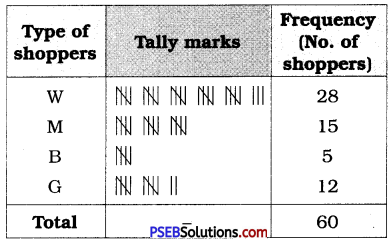
PSEB 6th Class Maths Solutions Chapter 14 Data Handling Ex 14.1 1

PSEB 6th Class Maths Solutions Chapter 14 Data Handling Ex 14.1

2. The weight of 25 students (in kg) are given below:
25, 34, 32, 28, 25, 28, 34, 32, 32, 34, 32, 25, 28, 34, 34, 28, 28, 25, 32, 33, 32, 34, 33, 32,25
Arrange the data in a tabular form using tally marks.
Solution:
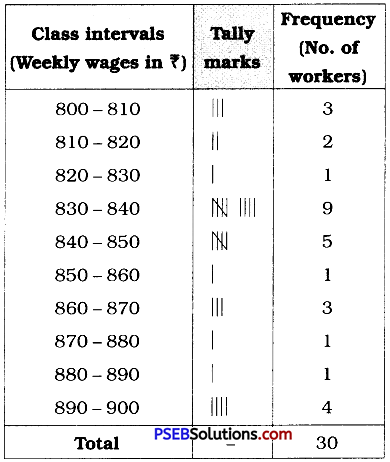
PSEB 6th Class Maths Solutions Chapter 14 Data Handling Ex 14.1 2

3. Ekta is asked to collect data for size of shoes of students in her class 6th. Her finding are recorded in the manner shown below:
PSEB 6th Class Maths Solutions Chapter 14 Data Handling Ex 14.1 3
Arrange the data in a tabular form using tally marks.
Solution:
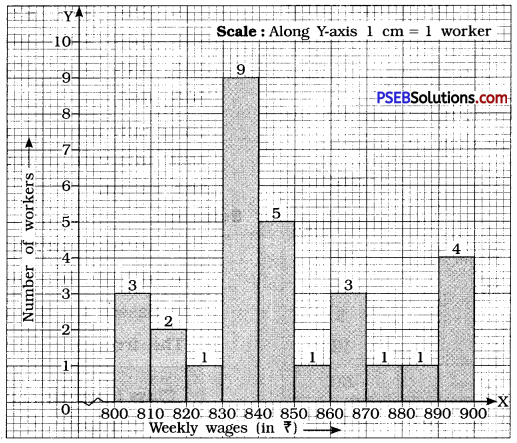
PSEB 6th Class Maths Solutions Chapter 14 Data Handling Ex 14.1 4

PSEB 6th Class Maths Solutions Chapter 14 Data Handling Ex 14.1

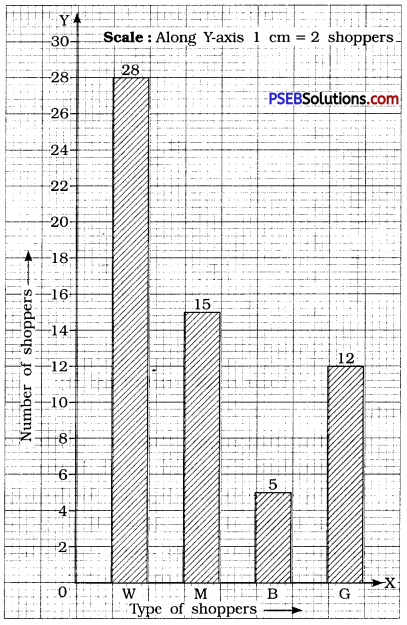
4. Shweta threw a dice 40 times and noted the number appearing each time as shown below:
PSEB 6th Class Maths Solutions Chapter 14 Data Handling Ex 14.1 5
Make a table and enter the data using tally marks. Find the number that appeared:

Question (i)
The minimum number of times.
Solution:
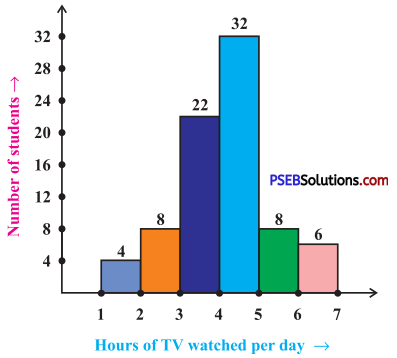
PSEB 6th Class Maths Solutions Chapter 14 Data Handling Ex 14.1 6
4

Question (ii)
The maximum number of times.
Solution:
5.

PSEB 6th Class Maths Solutions Chapter 14 Data Handling Ex 14.1

5. The students of class 6th had a Maths test and scored marks out of 10, which are listed below:
PSEB 6th Class Maths Solutions Chapter 14 Data Handling Ex 14.1 7

Question (i)
Organize the data using tally marks.
Solution:
PSEB 6th Class Maths Solutions Chapter 14 Data Handling Ex 14.1 8

Question (ii)
How many students scored less than or equal to 6?
Solution:
15

PSEB 6th Class Maths Solutions Chapter 14 Data Handling Ex 14.1

Question (iii)
How many students scored more than 7?
Solution:
9

PSEB 8th Class Maths Solutions Chapter 3 Understanding Quadrilaterals Ex 3.1

Punjab State Board PSEB 8th Class Maths Book Solutions Chapter 3 Understanding Quadrilaterals Ex 3.1 Textbook Exercise Questions and Answers.

PSEB Solutions for Class 8 Maths Chapter 3 Understanding Quadrilaterals Ex 3.1

Question 1.
Given here are some figures.
PSEB 8th Class Maths Solutions Chapter 3 Understanding Quadrilaterals Ex 3.1 1
Classify each of them on the basis of the following:
(a) Simple curve
(b ) Simple closed curve
(c) Polygon
(d ) Convex polygon
(e) Concave polygon
Solution:
(a) Simple curves : (i), (ii), (v), (vi) and (vii)
(b) Simple closed curves : (i), (ii), (v), (vi) and (vii)
(c) Polygons : (i) and (ii)
(d) Convex polygon : (ii)
(e) Concave polygons : (i)

PSEB 8th Class Maths Solutions Chapter 3 Understanding Quadrilaterals Ex 3.1

Question 2.
How many diagonals does each of the following have?
(a) A convex quadrilateral
(b) A regular hexagon
(c) A triangle
Solution :
(a) In a convex quadrilateral, number of sides (n) = 4
∴ Number of diagonals = \(\frac{n(n-3)}{2}\)
= \(\frac{4(4-3)}{2}\)
= \(\frac{4 \times 1}{2}\)
= 2

(b) In a regular hexagon, number of sides (n) = 6
∴ Number of diagonals = \(\frac{n(n-3)}{2}\)
= \(\frac{6(6-3)}{2}\)
= \(\frac{6 \times 3}{2}\)
= 9

(c) In a triangle, number of sides (n) = 3
∴ Number of diagonals = \(\frac{n(n-3)}{2}\)
= \(\frac{3(3-3)}{2}\)
= \(\frac{3 \times 0}{2}\)
= 0.

Question 3.
What is the sum of the measures of the angles of a convex quadrilateral ? Will this property hold if the quadrilateral is not convex ? (Make a non-convex quadrilateral and try!)
Solution:
The sum of measures of angles of a convex quadrilateral = 360°
PSEB 8th Class Maths Solutions Chapter 3 Understanding Quadrilaterals Ex 3.1 2
Yes, this property holds, even if the quadrilateral is not convex.
Here, quadrilateral ABCD is a non-convex quadrilateral.
m∠A + m∠B + m∠C + m∠D
= 40° + 55° + 35° + 230°
= 360°

PSEB 8th Class Maths Solutions Chapter 3 Understanding Quadrilaterals Ex 3.1

Question 4.
Examine the table. (Each figure is divided into triangles and the sum of the angles deduced from that.)
PSEB 8th Class Maths Solutions Chapter 3 Understanding Quadrilaterals Ex 3.1 3
What can you say about the angle sum of a convex polygon with number of sides ?
(a) 7 (b) 8 (c) 10 (d) n
Solution :
From the above table, we conclude that sum of interior angles of polygon with n-sides = (n – 2) × 180°
(a) When n = 7
Sum of interior angles of a polygon of 7 sides = (n – 2) × 180°
= (7 – 2) × 180°
= 5 × 180°
= 900°

(b) When n = 8
Sum of interior angles of a polygon of 8 sides = (n – 2) × 180°
= (8 – 2) × 180°
= 6 × 180°
= 1080°

(c) When n = 10
Sum of interior angles of a polygon having n-sides = (n – 2) × 180°
= (10 – 2) × 180°
= 8 × 180°
= 1440°

(d) When n = n
Sum of interior angles of a polygon having n-sides = (n – 2) × 180°

Question 5.
What is a regular polygon ? State the name of a regular polygon of:
(i) 3 sides
(ii) 4 sides
(iii) 6 sides
Solution:
A polygon is said to be a regular polygon if:
(1) the measures of its interior angles are equal.
(2) the lengths of its sides are equal.

The name of a regular polygon having:
(i) 3 sides is a ‘equilateral triangle’.
(ii) 4 sides is a ‘square’.
(iii) 6 sides is a ‘regular hexagon’.

PSEB 8th Class Maths Solutions Chapter 3 Understanding Quadrilaterals Ex 3.1

Question 6.
Find the angle measure x in the following figures.
(a)
PSEB 8th Class Maths Solutions Chapter 3 Understanding Quadrilaterals Ex 3.1 4
Solution:
The sum of the interior angles of a quadrilateral = 360°
∴ x + 120° + 130° + 50° = 360°
∴ x + 300° = 360°
∴ x = 360° – 300°
(Transposing 300° to RHS)
∴ x = 60°

(b)
PSEB 8th Class Maths Solutions Chapter 3 Understanding Quadrilaterals Ex 3.1 5
Solution:
The sum of the interior angles of a quadrilateral = 360°
∴ x + 60° + 70° + 90° = 360°
∴ x + 220° = 360°
∴ x = 360° – 220° (Transposing 220° to RHS)
∴ x = 140°

(c)
PSEB 8th Class Maths Solutions Chapter 3 Understanding Quadrilaterals Ex 3.1 6
Solution:
Interior angles are : 30°, x, x,
(180° – 70°) = 110° (Linear pair) and
(180° – 60°) = 120° (Linear pair)
The given figure is a pentagon.
∴ Sum of interior angles of a pentagon = (n – 2) × 180°
= (5 – 2) × 180°
= 3 × 180° = 540°
∴ 30° + x + x + 110° + 120° = 540°
∴ 2x + 260° = 540°
∴ 2x = 540° – 260° (Transposing 260° to RHS)
∴ 2x = 280°
∴ \(\frac{2 x}{2}=\frac{280^{\circ}}{2}\)
(Dividing both the sides by 2)
∴ x = 140°

(d)
PSEB 8th Class Maths Solutions Chapter 3 Understanding Quadrilaterals Ex 3.1 7
Solution:
It is a regular pentagon.
Sum of all interior angles of a pentagon
= (5 – 2) × 180°
= 3 × 180°
= 540°
∴ x + x + x + x + x = 540°
∴ 5x = 540°
∴ \(\frac{5 x}{5}=\frac{540^{\circ}}{5}\)
(Dividing both the sides by 5)
∴ x = 108°

PSEB 8th Class Maths Solutions Chapter 3 Understanding Quadrilaterals Ex 3.1

7. (a).
PSEB 8th Class Maths Solutions Chapter 3 Understanding Quadrilaterals Ex 3.1 8
Find x + y + z
Solution:
x + 90° = 180° (Linear pair)
∴ x = 180° – 90°
∴ x = 90°
y = 30° + 90° = 120°
(Exterior angle of a triangle is equal to the sum of interior opposite angles)
z = 180° – 30° (Linear pair) = 150°
Now, x + y + z = 90° + 120° + 150°
= 360°

(b).
PSEB 8th Class Maths Solutions Chapter 3 Understanding Quadrilaterals Ex 3.1 9
Find x + y + z + ω
Solution:
The sum of interior angles of a quadrilateral = 360°
PSEB 8th Class Maths Solutions Chapter 3 Understanding Quadrilaterals Ex 3.1 10
∴ a + 60° + 80° + 120° = 360°
∴ a + 260° = 360°
∴ a = 360° – 260° = 100°
Now, x + 120° = 180° (Linear pair)
∴ x = 180°- 120° = 60°
y + 80° = 180° (Linear pair)
∴ y = 180° – 80° = 100°
z + 60° = 180° (Linear pair)
∴ z = 180° – 60° = 120°
ω + 100° = 180°
∴ ω = 180° – 100° = 80°
Thus, x + y + z + ω = 60° + 100° + 120° + 80°
= 360°

PSEB 8th Class Maths Solutions Chapter 4 Practical Geometry Ex 4.1

Punjab State Board PSEB 8th Class Maths Book Solutions Chapter 4 Practical Geometry Ex 4.1 Textbook Exercise Questions and Answers.

PSEB Solutions for Class 8 Maths Chapter 4 Practical Geometry Ex 4.1

1. Construct the following quadrilaterals:

Question (i).
Quadrilateral ABCD.
AB = 4.5 cm,
BC = 5.5 cm,
CD = 4 cm,
AD = 6 cm,
AC = 7 cm.
Solution :
PSEB 8th Class Maths Solutions Chapter 4 Practical Geometry Ex 4.1 1
Steps of construction:

  • Draw a line segment AB = 4.5 cm.
  • With A as centre and radius = 7 cm, draw an arc.
  • With B as centre and radius = 5.5 cm, draw another arc to intersect previous arc at C.
  • With A as centre and radius 6 cm draw an arc.
  • With centre at C and radius 4 cm, draw another arc to intersect previous arc at D.
  • Draw \(\overline{\mathrm{BC}}, \overline{\mathrm{CD}}, \overline{\mathrm{AD}}\) and \(\overline{\mathrm{AC}}\).

Thus, ABCD is the required quadrilateral.

PSEB 8th Class Maths Solutions Chapter 4 Practical Geometry Ex 4.1

Question (ii).
Quadrilateral JUMP
JU = 3.5 cm,
UM = 4 cm,
MP = 5 cm,
PJ = 4.5 cm,
PU = 6.5 cm.
Solution:
PSEB 8th Class Maths Solutions Chapter 4 Practical Geometry Ex 4.1 2
Steps of construction :

  • Draw a line segment JU = 3.5 cm.
  • With J as centre and radius = 4.5 cm, draw an arc.
  • With U as centre and radius = 6.5 cm, draw another arc to intersect previous arc at P
  • With U as centre and radius = 4 cm draw an arc.
  • With P as centre and radius 5 cm, draw an arc which intersects previous arc at M.
  • Draw \(\overline{\mathrm{JP}}, \overline{\mathrm{UM}}, \overline{\mathrm{MP}}\) and \(\overline{\mathrm{UP}}\).

Thus, JUMP is the required quadrilateral.

PSEB 8th Class Maths Solutions Chapter 4 Practical Geometry Ex 4.1

Question (iii).
Parallelogram MORE ?
OR = 6 cm,
RE = 4.5 cm,
EO = 7.5 cm.
Solution:
PSEB 8th Class Maths Solutions Chapter 4 Practical Geometry Ex 4.1 3
[Note: □ MORE is a parallelogram. So length of opposite sides are equal. ]
∴ RE = MO = 4.5 cm; OR = ME = 6 cm
Steps of construction:

  • Draw a line segment MO = 4.5 cm.
  • With M as centre and radius = 6 cm, draw an arc.
  • With O as centre and radius = 7.5 cm, draw another arc to intersect the previous arc at E.
  • With O as centre and radius = 6 cm, draw an arc.
  • With E as centre and radius = 4.5 cm, draw another arc to intersect the previous arc at R.
  • Draw \(\overline{\mathrm{ME}}, \overline{\mathrm{OR}}, \overline{\mathrm{RE}}\) and \(\overline{\mathrm{OE}}\).

Thus, MORE is the required parallelogram.

PSEB 8th Class Maths Solutions Chapter 4 Practical Geometry Ex 4.1

Question (iv).
Rhombus BEST
BE = 4.5 cm,
ET = 6 cm.
Solution:
PSEB 8th Class Maths Solutions Chapter 4 Practical Geometry Ex 4.1 4
[Note : BEST is a rhombus. So length of all four sides are equal.]
BE = 4.5 cm
∴ ES = ST = TB = 4.5 cm
ET = 6 cm (Given)
Steps of construction:

  • Draw a line segment BE = 4.5 cm.
  • With B as centre and radius = 4.5 cm, draw an arc.
  • With E as centre and radius = 6 cm, draw another arc to intersect the previous arc at T.
  • With E as centre and radius = 4.5 cm, draw an arc.
  • With T as centre and radius = 4.5 cm, draw another arc to intersect previous arc at S.
  • Draw \(\overline{\mathrm{BT}}, \overline{\mathrm{ES}}, \overline{\mathrm{ST}}\) and \(\overline{\mathrm{ET}}\).

Thus, BEST is the required quadrilateral.

PSEB 4th Class Maths Solutions Chapter 9 Data Handling Worksheet

Punjab State Board PSEB 4th Class Maths Book Solutions Chapter 9 Data Handling Worksheet Textbook Exercise Questions and Answers.

PSEB Solutions for Class 4 Maths Chapter 9 Data Handling Worksheet

Question 1.
Uniforms are distributed in a school from Classes I to V.
PSEB 4th Class Maths Solutions Chapter 9 Data Handling Worksheet 3
(i) Uniforms were distributed among 20 students of class 1st. (✓ or ✗)
(ii) Uniforms were distributed among 7 students of class 5. (✓ or ✗)
(iii) Uniforms were distributed among ………. students of class 3.
(iv) In which class 25 uniforms were distributed ?
(a) class-I
(b) class-II
(c) class-IV
(d) class-V.
(v) Which class received the least number of uniforms ?
(a) class-I
(b) class-II
(c) class-III
(d) class-V.
(vi) Find the total number of students who received uniforms ?
(a) 125
(b) 25
(c) 65
(d) 100.
Solution:
(i) ✓,
(ii) ✗,
(iii) 15,
(iv) (b),
(v) (c),
(vi) (a).

PSEB 4th Class Maths Solutions Chapter 9 Data Handling Worksheet

Question 2.
Students of a particular school who have liking for different types of fruits.
PSEB 4th Class Maths Solutions Chapter 9 Data Handling Worksheet 4
If there are 20 children in the class.
(i) Number of children who like mango is ……….
(ii) Find the number of children who like apple.
(a) 20
(b) 5
(c) 15
(d) 10.
(iii) Find the total number of children who like apple and banana both.
(a) 5
(b) 20
(c) 10
(d) 15.
(iv) Banana has been liked the most (✓ or ✗)
(v) Banana has been liked more than apple (✓ or ✗)
Solution:
(i) 10,
(ii) (b),
(iii) (c),
(iv) ✗,
(v) ✗.

PSEB 4th Class Maths Solutions Chapter 9 Data Handling Worksheet

Question 3.
The Pie Chart is also called
Solution:
The Circle Map.

PSEB 4th Class Maths Solutions Chapter 9 Data Handling Ex 9.1

Punjab State Board PSEB 4th Class Maths Book Solutions Chapter 9 Data Handling Ex 9.1 Textbook Exercise Questions and Answers.

PSEB Solutions for Class 4 Maths Chapter 9 Data Handling Ex 9.1

Question 1.
Ice cream eaten by first to fifth class students of a particular school are shown in pictograph as under. Answer the following questions :
PSEB 4th Class Maths Solutions Chapter 9 Data Handling Ex 9.1 4

  1. How many ice creams are represented by PSEB 4th Class Maths Solutions Chapter 9 Data Handling Ex 9.1 5 ice cream stick ?
  2. How many ice creams did 4th class students eat ?
  3. How many ice creams did 5th class students eat ?
  4. Which class ate 15 ice creams ?
  5. Which class ate maximum number of ice creams ?
  6. Which class at least number of ice creams ?

Solution:

  1. 5,
  2. 20,
  3. 50,
  4. First class
  5. Fifth class
  6. First class.

PSEB 4th Class Maths Solutions Chapter 9 Data Handling Ex 9.1

Question 2.
Prepare pictograph vertically which represent enrollment from first to fifth class of your school.
PSEB 4th Class Maths Solutions Chapter 9 Data Handling Ex 9.1 6
Solution:
Try yourself.

PSEB 8th Class Maths Solutions Chapter 15 Introduction to Graphs Ex 15.1

Punjab State Board PSEB 8th Class Maths Book Solutions Chapter 15 Introduction to Graphs Ex 15.1 Textbook Exercise Questions and Answers.

PSEB Solutions for Class 8 Maths Chapter 15 Introduction to Graphs Ex 15.1

1. The following graph shows the temperature of a patient in a hospital, recorded every hour:
PSEB 8th Class Maths Solutions Chapter 15 Introduction to Graphs Ex 15.1 1

Question (a)
What was the patient’s temperature at 1 p.m.?
Solution:
The patient’s temperature at 1 p.m. was 36.5 °C.

PSEB 8th Class Maths Solutions Chapter 15 Introduction to Graphs Ex 15.1

Question (b)
When was the patient’s temperature 38.5 °C?
Solution:
The patient’s temperature was 38.5 °C at 12 noon.

Question (c)
The patient’s temperature was the same two times during the period given. What were these two times?
Solution:
The patient’s temperature was same (36.5 °C) at 1 p.m. and 2 p.m.

Question (d)
What was the temperature at 1:30 p.m.? How did you arrive at your answer?
Solution:
The patient’s temperature at 1:30 p.m. was 36.5 °C.
(The temperature did not change during interval of 1 p.m. and 2 p.m. So the temperature did not show any change and it was 36.5 °C at 1:30 p.m.)

Question (e)
During which periods did the patients’ temperature showed an upward trend?
Solution:
The patient’s temperature showed an upward trend during the periods 9 a.m. to 10 a.m., 10 a.m. to 11a.m. and 2 p.m. to 3 p.m., because the temperature increased during these intervals.

PSEB 8th Class Maths Solutions Chapter 15 Introduction to Graphs Ex 15.1

2. The following line graph shows the yearly sales figures for a manufacturing company:
PSEB 8th Class Maths Solutions Chapter 15 Introduction to Graphs Ex 15.1 2

Question (a)
What were the sales in (i) 2002 (ii) 2006?
Solution:
1. The sales in the year 2002 was ₹ 4 crores.
2. The sales in the year 2006 was ₹ 8 crores.

PSEB 8th Class Maths Solutions Chapter 15 Introduction to Graphs Ex 15.1

Question (b)
What were the sales in (i) 2003 (ii) 2005?
Solution:
1. The sales in the year 2003 was ₹ 7 crores.
2. The sales in the year 2005 was ₹ 10 crores.

Question (c)
Compute the difference between the sales in 2002 and 2006.
Solution:
The difference between the sales in 2002 and 2006 = ₹ (8 – 4) crore
= ₹ 4 crores

Question (d)
In which year was there the greatest difference between the sales as compared to its previous year?
Solution:
In year 2005, there was the greatest difference between the sales as compared to its previous year.

3. For an experiment in Botany, two different plants, plant A and plant B were grown under similar laboratory conditions. Their heights were measured at the end of each week for 3 weeks. The results are shown by the following graph:
PSEB 8th Class Maths Solutions Chapter 15 Introduction to Graphs Ex 15.1 3

Question (a)
How high was Plant A after
1. 2 weeks
2. 3 weeks?
Solution:
1. The plant A was 7 cm high after 2 weeks.
2. The plant A was 9 cm high after 3 weeks.

PSEB 8th Class Maths Solutions Chapter 15 Introduction to Graphs Ex 15.1

Question (b)
How high was Plant B after
1. 2 weeks
2. 3 weeks?
Solution:
1. The plant B was 7 cm high after 2 weeks.
2. The plant B was 10 cm high after 3 weeks.

Question (c)
How much did Plant A grow during the 3rd week?
Solution:
Plant A grew (9 cm – 7 cm) = 2 cm during 3rd week.

Question (d)
How much did Plant B grow from the end of the 2nd week to the end of the 3rd week?
Solution:
The plant B grew (10cm-7cm) = 3 cm from the end of 2nd week to the end of 3rd week.

Question (e)
During which week did Plant A grow most?
Solution:
The growth of the plant A During the 1st week = 2 cm – 0 cm = 2 cm
During the 2nd week = 7 cm – 2 cm = 5 cm
During the 3rd week = 9 cm – 7 cm = 2 cm
Thus, during the 2nd week, the plant A grew the most.

PSEB 8th Class Maths Solutions Chapter 15 Introduction to Graphs Ex 15.1

Question (f)
During which week did Plant B grow least?
Solution:
The growth of the plant B.
During the 1st week = 1cm – 0 cm
= 1 cm
During the 2nd week = 7 cm – 1 cm
= 6 cm
During the 3rd week = 10 cm-7 cm
= 3 cm
Thus, the plant B grew the least in the first week.

Question (g)
Were the two plants of the same height during any week shown here? Specify.
Solution:
At the end of 2nd week, both the plants were of the same height, that is 7 cm.

4. The following graph shows the temperature forecast and the actual temperature for each day of a week.
PSEB 8th Class Maths Solutions Chapter 15 Introduction to Graphs Ex 15.1 4

Question (a)
On which days was the forecast temperature the same as the actual temperature?
Solution:
The forecast temperature was the same as the actual temperature on Tuesday, Friday and Sunday.

PSEB 8th Class Maths Solutions Chapter 15 Introduction to Graphs Ex 15.1

Question (b)
What was the maximum forecast temperature during the week?
Solution:
The maximum forecast temperature during the week was 35 °C.

Question (c)
What was the minimum actual temperature during the week?
Solution:
The minimum actual temperature during the week was 15 °C.

Question (d)
On which day did the actual temperature differ the most from the forecast temperature?
Solution:
On Thursday, the actual temperature differed the most from the forecast temperature (7.5 °C).

Difference of temperature:

  • Monday : 17.5 °C – 15 °C = 2.5 °C
  • Tuesday : 20 °C – 20 °C = o°c
  • Wednesday : 30 °C – 25 °C = 5°C
  • Thursday : 22.5 °C – 15 °C = 7.5 °C
  • Friday : 15 °C – 15 °C = o°c
  • Saturday : 30 °C – 25 °C = 5°C
  • Sunday : 35 °C – 35 °C = o°c

5. Use the tables below to draw linear graphs:

Question (a)
The number of days a hillside city received snow in different years:

Year 2003 2004 2005 2006
Days 8 10 5 12

Solution:
Linear graph to show snowfall in different years:
PSEB 8th Class Maths Solutions Chapter 15 Introduction to Graphs Ex 15.1 5

PSEB 8th Class Maths Solutions Chapter 15 Introduction to Graphs Ex 15.1

Question (b)
Population (in thousands) of men and women in a village in different years:

Year 2003 2004 2005 2006 2007
Number of Men 12 12.5 13 13.2 13.5
Number of Women 11.3 11.9 13 13.6 12.8

Solution:
Draw two perpendicular lines on the graph paper. Take year along X-axis (horizontal line) and population (in thousand) along Y-axis (vertical line).
For men: Mark the points (2003, 12), (2004, 12.5); (2005, 13); (2006, 13.2) and (2007, 13.5) and join them.
For women: Mark the points (2003, 11.3); (2004, 11.9); (2005, 13); (2006, 13.6) and (2007, 12.8) and join them.
PSEB 8th Class Maths Solutions Chapter 15 Introduction to Graphs Ex 15.1 6

PSEB 8th Class Maths Solutions Chapter 15 Introduction to Graphs Ex 15.1

6. A courier cycles from a town to a neighboring suburban area to deliver a parcel to a merchant. His distance from the town at different times is shown by the following graph:
PSEB 8th Class Maths Solutions Chapter 15 Introduction to Graphs Ex 15.1 7

Question (a)
What is the scale taken for the time axis?
Solution:
The time is taken along the X-axis. The scale along X-axis is 4 units = 1 hour.

Question (b)
How much time did the person take for the travel?
Solution:
Total travel time taken by a courier : = 8:00 am to 11:30 am = 3\(\frac {1}{2}\) hours

Question (c)
How far is the place of the merchant from the town?
Solution:
Distance of the merchant from the town is 22 km.

Question (d)
Did the person stop on his way? Explain.
Solution:
Yes, the stopage time = 10:00 am to 10:30 am. This is indicated by the horizontal part of the graph.

Question (e)
During which period did he ride fastest?
Solution:
He rode fastest between 8:00 am and 9:00 am.

PSEB 8th Class Maths Solutions Chapter 15 Introduction to Graphs Ex 15.1

7. Can there be a time-temperature graph as follows? Justify your answer.
PSEB 8th Class Maths Solutions Chapter 15 Introduction to Graphs Ex 15.1 8
Solution:
In case of (iii), the graph shows different number of temperatures at the same time which is not possible.
∴ Case (iii) does not represent a time-temperature graph.

PSEB 8th Class Maths Solutions Chapter 3 Understanding Quadrilaterals InText Questions

Punjab State Board PSEB 8th Class Maths Book Solutions Chapter 3 Understanding Quadrilaterals InText Questions and Answers.

PSEB 8th Class Maths Solutions Chapter 3 Understanding Quadrilaterals InText Questions

Try These (Textbook Page No. 43)

Take a regular hexagon Fig 3.10.
PSEB 8th Class Maths Solutions Chapter 3 Understanding Quadrilaterals InText Questions 1

Question 1.
What is the sum of the measures of its exterior angles x, y, z, p, q r?
Solution:
∠x + ∠y + ∠z + ∠p + ∠q + ∠r = 360°
(∵ Sum of exterior angles of a polygon = 360°)

Question 2.
Is x = y = z = p = q = r ? Why?
Solution:
Since, all the sides of the polygon are equal, it is a regular hexagon. So its interior angles are equal.
∴ x = (180° – a), y = (180° – a),
z = (180° – a), p = (180° – a),
q = (180° – a), r = (180° – a)
∴ x = y = z = p = q = r

PSEB 8th Class Maths Solutions Chapter 3 Understanding Quadrilaterals InText Questions

Question 3.
What is the measure of each ?
(i) exterior angle
(ii) interior angle
Solution:
(i) x + y + z + p + q + r = 360°
(∵ Sum of exterior angles = 360°)
All angles are equal.
∴ Measure of each exterior angle = \(\frac{360^{\circ}}{6}\) = 60°

(ii) Exterior angle = 60°
∴ Interior angle = 180° – 60° = 120°.

Question 4.
Repeat this activity for the cases of:
(i) a regular octagon
(ii) a regular 20-gon
Solution:
(i) In a regular octagon, number of sides (n) = 8.
∴ Each exterior angle = \(\frac{360^{\circ}}{8}\) = 45°
∴ Each interior angle = 180° – 45° = 135°

(ii) For a regular 20-gon, the number of sides (n) = 20.
∴ Each exterior angle = \(\frac{360^{\circ}}{20}\) = 18°
∴ Each interior angle = 180° – 18° = 162°

PSEB 8th Class Maths Solutions Chapter 3 Understanding Quadrilaterals InText Questions

Try These (Textbook Page No. 47)

Question 1.
Take two identical set squares with angles 30°-60°-90° and place them adjacently to form a parallelogram as shown in figure. Does this help you to verify the above property ?
PSEB 8th Class Maths Solutions Chapter 3 Understanding Quadrilaterals InText Questions 2
Solution:
Yes, the given figure helps us to verify that opposite sides of a parallelogram are equal.

Try These (Textbook Page No. 48)

Question 1.
PSEB 8th Class Maths Solutions Chapter 3 Understanding Quadrilaterals InText Questions 3
Solution:
Yes, this figure also helps us to confirm that opposite angles of a parallelogram are equal.

Think, Discuss and Write (Textbook Page No. 50)

Question 1.
After showing m∠R = m∠N = 70°, can you find m∠I and m∠G by any other method ?
Solution:
PSEB 8th Class Maths Solutions Chapter 3 Understanding Quadrilaterals InText Questions 4
Yes, without using the property of parallelogram, we can find m∠I and m∠G.
m∠R = m∠N = 70° (Given)
RG || IN, the transversal RI intersecting them,
∴ m∠R + m∠I = 180° (Sum of interior angles is 180°)
∴ 70° + m∠I = 180° (∵ m∠R = m∠N = 70°)
∴ m∠I = 180° – 70°
∴ m∠I = 110°
Similarly, m∠G = 110°

PSEB 8th Class Maths Solutions Chapter 3 Understanding Quadrilaterals InText Questions

Think, Discuss and Write (Textbook Page No. 56)

Question 1.
A mason has made a concrete slab. He needs it to be rectangular. In what different ways can he make sure that it is rectangular?
Solution :
He can make sure that it is rectangular using the following different ways :

  • By making opposite sides of equal length.
  • By keeping each angle at the corners as 90°.
  • By keeping the diagonals of equal length.
  • By making opposite sides parallel.

Question 2.
A square was defined as a rectangle with all sides equal. Can we define it as rhombus with equal angles? Explore this idea.
Solution:
Yes, because a rhombus becomes a square if its all angles are equal.

Question 3.
Can a trapezium have all angles equal ?
Can it have all sides equal ? Explain.
Solution:
Yes, a trapezium can have all angles equal. In this case, it becomes a square or rectangle.
Yes, it can have all sides equal. In this case, it becomes a rhombus or square.

PSEB 8th Class Maths Solutions Chapter 3 Understanding Quadrilaterals Ex 3.4

Punjab State Board PSEB 8th Class Maths Book Solutions Chapter 3 Understanding Quadrilaterals Ex 3.4 Textbook Exercise Questions and Answers.

PSEB Solutions for Class 8 Maths Chapter 3 Understanding Quadrilaterals Ex 3.4

Question 1.
State whether True or False:
(a) All rectangles are squares.
(b) All rhombuses are parallelograms.
(c) All squares are rhombuses and also rectangles.
(d) All squares are not parallelograms.
(e) All kites are rhombuses.
(f) All rhombuses are kites.
(g) All parallelograms are trapeziums.
(h) All squares are trapeziums.
Solution :
(a) False
(b) True
(c) True
(d) False
(e) False
(f) False
(g) False
(h) False

Question 2.
Identify all the quadrilaterals that have:
(a) four sides of equal length
(b) four right angles
Solution:
(a) Squares as well as rhombuses have four sides of equal length.
(b) Squares as well as rectangles have four right angles.

PSEB 8th Class Maths Solutions Chapter 3 Understanding Quadrilaterals Ex 3.4

Question 3.
Explain how a square is
(i) a quadrilateral
(ii) a parallelogram
(iii) a rhombus
(iv) a rectangle
Solution:
(i) A square is a four sided closed figure, so it is a quadrilateral.
(ii) The opposite sides of a square are equal and parallel, so it is a parallelogram.
(iii) All the sides of a square are equal, so it is a rhombus.
(iv) Each angle of a square is a right angle, so it is a rectangle.

Question 4.
Name the quadrilaterals whose diagonals:
(i) bisect each other
(ii) are perpendicular bisectors of each other
(iii) are equal
Solution:
(i) The diagonals of the following quadrilaterals bisect each other :

  • Parallelogram
  • Rectangle
  • Square
  • Rhombus

(ii) The diagonals of the following quadrilaterals are perpendicular bisectors of each other :

  • Square
  • Rhombus

(iii) The diagonals are equal in following quadrilaterals :

  • Square
  • Rectangle

Question 5.
Explain why a rectangle is a convex quadrilateral.
Solution:

  • All the angles have measure less than 180°.
  • Both diagonals lie wholly in the interior of the rectangle.

∴ The rectangle is a convex quadrilateral.

PSEB 8th Class Maths Solutions Chapter 3 Understanding Quadrilaterals Ex 3.4

Question 6.
ABC is a right angled triangle and O is the midpoint of the side opposite to the right angle. Explain why O is equidistant from A, B and C. (The dotted lines are drawn additionally to help you).
PSEB 8th Class Maths Solutions Chapter 3 Understanding Quadrilaterals Ex 3.4 1
Solution:
Produce \(\frac {1}{2}\) to D such that BO = OD.
Joining \(\frac {1}{2}\) and \(\frac {1}{2}\), we get a □ ABCD.
AO = OC (Given)
BO = OD (Constration)
∴ The diagonals AC and BD bisect each other.
∴ □ ABCD is a parallelogram.
∠B is a right angle. (Given)
∴ □ ABCD is a rectangle.
∴ BO = OD = AO = OC
∴ Point O is equidistant from points A, B and C.

PSEB 5th Class Maths Solutions Chapter 6 Measurement Ex 6.7

Punjab State Board PSEB 5th Class Maths Book Solutions Chapter 6 Measurement Ex 6.7 Textbook Exercise Questions and Answers.

PSEB Solutions for Class 5 Maths Chapter 6 Measurement Ex 6.7

1. Find the difference :

Question 1.
8 hours 30 min and 2 hours 10 min
Solution:
PSEB 5th Class Maths Solutions Chapter 6 Measurement Ex 6.7 1

Question 2.
10 hours 30 min 20 sec and 8 hours 20 min 15 sec
Solution:
PSEB 5th Class Maths Solutions Chapter 6 Measurement Ex 6.7 2

PSEB 5th Class Maths Solutions Chapter 6 Measurement Ex 6.7

Question 3.
11 years 5 months and 6 years
Solution:
PSEB 5th Class Maths Solutions Chapter 6 Measurement Ex 6.7 3

Question 4.
7 years 2 months and 3 years
Solution:
PSEB 5th Class Maths Solutions Chapter 6 Measurement Ex 6.7 4

Note, ∵ 1 year = 12 months
∴ 12 months + 2 months = 14 months

2. Find the Time :

Question 1.
4 hours before 5:30 pm
Solution:
4 hours before 5:30 pm
4 hours = 30 minutes + 3 hours + 30 minutes
30 minutres before 5:30 pm = 5.00 pm
3 hours before 5:00 pm = 2:00 pm
30 minutes before 2:00 pm = 1:30 pm

PSEB 5th Class Maths Solutions Chapter 6 Measurement Ex 6.7

Question 2.
2 hours after 11:00 am
Solution:
2 hours after 11:00 am
1 hour after 11:00 am = 12:00 noon
1 hour after 12:00 noon =1:00 pm
Second method :
2 hours after 11:00 am
PSEB 5th Class Maths Solutions Chapter 6 Measurement Ex 6.7 5
i.e. 12:00 +1:00
= 1:00 pm

Question 3.
6 hours before 4:30 am
Solution:
6 hours before 4:30 am
6 hours = 30 minutes + 4 hours + 1 hour + 30 minutes
30 minutes before 4:30 am = 4:00 am
4 hours before 4:00 am = 12:00 mid night
1 hour before 12:00 mid night = 11:00 pm

PSEB 5th Class Maths Solutions Chapter 6 Measurement Ex 6.7

Question 4.
1 hour 45 min after 8:30 am
Solution:
1 hour 45 min after 8:30 am
1 hour 45 minutes = 30 minutes + 1 hour + 15 minutes
30 minutes after 8:30 am = 9:00 am
1 hour after 9:00 am = 10: 00 am
15 minutes after 10:00 am = 10:15 am

3. Find the Time Gap :

Question 1.
From 3:00 am to 10:00 am
Solution:
Time gap from 3:00 am to 10:00 am = 7 hour
PSEB 5th Class Maths Solutions Chapter 6 Measurement Ex 6.7 6

Question 2.
From 6:00 am to 1:30 pm
Solution:
Time gap from 6:00 am to 1:30 pm
Time gap between 6:00 am to 12:00 noon = 6 hours
Time gap from 12:00 noon to 1:00 pm = 1 hour
Time gap from 1:00 pm to 1:30 pm = 30 minutes
Hence, time gap from 6:00 am to 1:30 pm = 7 hours 30 minutes

Second Method :
1:30 pm = 1:30 + 12:00 = 13:30 o’clock
Time gap from 6:00 am to 1:30 pm
PSEB 5th Class Maths Solutions Chapter 6 Measurement Ex 6.7 7

PSEB 5th Class Maths Solutions Chapter 6 Measurement Ex 6.7

Question 3.
From 5:00 am to 10:45 pm
Solution:
Time gap from 5:00 pm to 10:45 pm
Time gap from 5:00 pm to 10:00 pm = 5 hours
Time gap from 10:00 pm to 10:45 pm = 45 minutes
Hence, time gap from 5:00 to 10:45 pm = 5 hours 45 minutes

Question 4.
From 9:00 am to 2:30 am (next morning)
Solution:
Time gap from 9:00 pm to 2:30 am (next morning)
Time gap from 9:00 pm to 12:00 mid night = 3 hours
Time gap from 12:00 mid night to 2:00 am = 2 hours
Time gap from 2:00 am to 2:30 am = 30 minutes
Hence, time gap from 9:00 pm to 2:30 am (next morning) = 5 hours 30 minutes

PSEB 5th Class Maths Solutions Chapter 6 Measurement Ex 6.7

Question 4.
A bank opens at 9:30 am and closes at 5:00 pm. How many working hours are there ?
Solution:
Time gap from 9:30 am to 10:00 am
= 30 minutes Time gap from 10:00 am to 12:00 noon = 2 hours
Time gap from 12:00 noon to 5:00 pm = 5 hours
Hence, time gap from 9:00 am to 5:00 pm = 7 hours 30 minutes
Therefore, working hours of the bank = 7 hours 30 minutes

Question 5.
A bus starts from Chandigarh at 7:30 am and reaches Shimla at 10:50 am. How much time is taken by the bus to reach Shimla ?
Solution:
Time gap from 7:30 am to 8:00 am = 30 minutes
Time gap from 8:00 am to 10:00 am = 2 hours
Time gap from 10:00 am to 10:50 am = 50 minutes
Time gap from 7:30 am to 10:50 am
= 30 minutes + 2 hours + 50 minutes
= 2 hours + 80 minutes
= 2 hours + 60 minutes + 20 minutes
= 2 hours + 1 hour + 20 minutes
= 3 hours 20 minutes
Therefore, time taken by the bus to reach Shimla = 3 hours 20 minutes

Second Method :
The time at which the bus reaches Shimla = 10:50 am
The time at which the bus starts from Chandigarh = 7:30 am
= 3:20 hours
The time taken by bus to reach Shimla = 3 hours 20 min.

PSEB 5th Class Maths Solutions Chapter 6 Measurement Ex 6.7

Question 6.
A boy goes to school at 7:30 am and returns back from school at 2:45 pm. How much time does he spend in the school ?
Solution:
The time when the boy goes to school = 7:30 am
The time when the boy returns back = 2.45 am
The time gap from 7:30 am to 8:00 am = 30 minutes
The time gap from 8:00 am to 12:00 noon = 4 hours
The time gap from 12:00 noon to 2:00 pm = 2 hours
The time gap from 2:00 pm to 2:45 pm = 45 minutes
Total time
= 30 minutes + 6 hours + 45 minutes
= 6 hours + 75 minutes = 6 hours + 60 minutes + 15 minutes
= 6 hours + 1 hour + 15 minutes
= 7 hours 15 minutes
Therefore, time spent in the school = 7 hours 15 minutes

Second Method :
2:45 pm = 2:45 + 12:00 = 14:45 o’clock
The time when the boy returns back = 14:45 o’clock
The time when the boy goes to school = 7:30 o’clock
The time spent in the school by boy
PSEB 5th Class Maths Solutions Chapter 6 Measurement Ex 6.7 8
= 7 hours 15 minutes

PSEB 5th Class Maths Solutions Chapter 2 Fundamental Operations on Numbers Ex 2.5

Punjab State Board PSEB 5th Class Maths Book Solutions Chapter 2 Fundamental Operations on Numbers Ex 2.5 Textbook Exercise Questions and Answers.

PSEB Solutions for Class 5 Maths Chapter 2 Fundamental Operations on Numbers Ex 2.5

Question 1.
Fill in the blanks:

(a) 451 × 1 = ____
Solution:
451 × 1 = 451

(b) 8135 × 10 = _____
Solution:
8135 × 10 = 81350

(c) 650 × 100 = _____
Solution:
650 × 100 = 65000

(d) 3090 × 0 = _____
Solution:
3090 × 0 = 0

(e) 129 × _____ = 12900
Solution:
129 × 100 = 12900

(f) _____ × 1000 = 13000
Solution:
13 × 1000 = 13000

(g) _____ × 791 = 0
Solution:
0 × 791 = 0

PSEB 5th Class Maths Solutions Chapter 2 Fundamental Operations on Numbers Ex 2.5

(h) _____ × 82 = 82 × 602
Solution:
602 × 82 = 82 × 602

(i) 8414 × 10 = _____
Solution:
8414 × 10 = 84140

(j) 67 × 100 = _____
Solution:
67 × 100 = 6700

(k) 91 × 1000 = _____
Solution:
91 × 1000 = 91000

(l) 100 × 1000 = _____
Solution:
100 × 1000 = 100000

(m) 545 × _____ = 5450
Solution:
545 × 10 = 5450

(n) _____ × 10 = 7060
Solution:
706 × 10 = 7060

(o) 798 × _____ = 798
Solution:
798 × 1 = 798