PSEB 10th Class Maths Solutions Chapter 8 Introduction to Trigonometry Ex 8.1

Punjab State Board PSEB 10th Class Maths Book Solutions Chapter 8 Introduction to Trigonometry Ex 8.1 Textbook Exercise Questions and Answers.

PSEB Solutions for Class 10 Maths Chapter 8 Introduction to Trigonometry Ex 8.1

Question 1.
In ∆ABC, right angled at B, AB = 24 cm; BC = 7 cm. Determine
(i) sin A, cos A
(ii) sin C, cos C.
Solution:
(i) We are to find sin A .cos A AB = 24 cm; BC = 7 cm
By using Pythagoras Theorem,
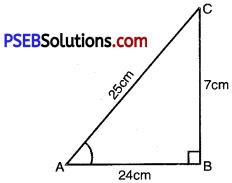
PSEB 10th Class Maths Solutions Chapter 8 Introduction to Trigonometry Ex 8.1 1

AC2 = AB2 + BC2
AC2 = (24)2 + (7)2
AC2 = 576 + 49
AC2 = 625
AC = \(\sqrt{625}\)
AC = 25 cm.
sin A = \(\frac{\mathrm{BC}}{\mathrm{AC}}\)

sin A = \(\frac{7 \mathrm{~cm}}{25 \mathrm{~cm}}=\frac{7}{25}\)

cos A = \(\frac{\mathrm{AB}}{\mathrm{AC}}=\frac{24 \mathrm{~cm}}{25 \mathrm{~cm}}\)

cos A = \(\frac{24}{25}\)

Hence sin A = \([latex]\frac{7}{25}\)[/latex] and cos A = \([latex]\frac{24}{25}\)[/latex].

PSEB Solutions PSEB 10th Class Maths Solutions Chapter 8 Introduction to Trigonometry Ex 8.1

(ii) sin C = \(\frac{\mathrm{AB}}{\mathrm{AC}}=\frac{24 \mathrm{~cm}}{25 \mathrm{~cm}}\)
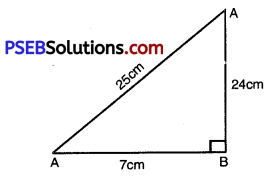
PSEB 10th Class Maths Solutions Chapter 8 Introduction to Trigonometry Ex 8.1 2

sin C = \(\frac{24}{25}\)

cos C = \(\frac{\mathrm{BC}}{\mathrm{AC}}=\frac{7 \mathrm{~cm}}{25 \mathrm{~cm}}\)

cos C = \(\frac{7}{25}\)

Hence sin C = \(\frac{24}{25}\) and cos C = \(\frac{7}{25}\).

Question 2
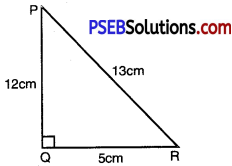
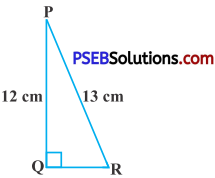
In fig., find tan P – cot R.
PSEB 10th Class Maths Solutions Chapter 8 Introduction to Trigonometry Ex 8.1 3

Solution:
Hyp. PR = 13 cm

PSEB 10th Class Maths Solutions Chapter 8 Introduction to Trigonometry Ex 8.1 4

By using Pythagoras Theorem,
PR2 = PQ2 + QR2
or (13)2 = (12)2 + QR2
or 169 = 144 + (QR)2
or 169 – 144 = (QR)2
or 25 = (QR)2
or QR = ± \(\sqrt{25}\)
or QR = 5, – 5.
But QR = 5 cm.
[QR ≠ – 5, because side cannot be negative]
tan P = \(\frac{R Q}{Q P}=\frac{5}{12}\)

cot R = \(\frac{R Q}{P Q}=\frac{5}{12}\)

∴ tan P – cot R = \(\frac{5}{12}-\frac{5}{12}\) = 0
Hence tan P – cot R = 0.

PSEB Solutions PSEB 10th Class Maths Solutions Chapter 8 Introduction to Trigonometry Ex 8.1

Question 3.
If sin A = \(\frac{3}{4}\) calculate cos A and tan A.
Solution:
Let ABC be any triangle with right angle at B.
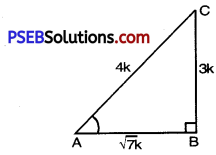
PSEB 10th Class Maths Solutions Chapter 8 Introduction to Trigonometry Ex 8.1 5

sin A = \(\frac{3}{4}\)
But sin A = \(\frac{\mathrm{BC}}{\mathrm{AC}}\) [From figure]
∴ \(\frac{\mathrm{BC}}{\mathrm{AC}}=\frac{3}{4}\)
But \(\frac{\mathrm{BC}}{\mathrm{AC}}=\frac{3}{4}\) = K
where K, is constant of proportionality.
⇒ BC = 3K, AC = 4K
By using Pythagoras Theorem,
AC2 = AB2 + BC2
or (4K)2 = (AB)2 + (3K)2
or 16K2 = AB2 + 9K2
or 16K2 – 9K2 = AB2
or 7K2 = AB2
or AB = ± \(\sqrt{7 K^{2}}\)
or AB = ± \(\sqrt{7} \mathrm{~K}\)
[AB ≠ \(\sqrt{7 K}\) because side of a triangle cannot be negative]

⇒ AB = \(\sqrt{7} \mathrm{~K}\)
cos A = \(\frac{\mathrm{AB}}{\mathrm{AC}}\)
cos A = \(\frac{\sqrt{7} K}{4 K}=\frac{\sqrt{7}}{4}\)
tan A = \(\frac{\mathrm{BC}}{\mathrm{AB}}=\frac{3 \mathrm{~K}}{\sqrt{7} \mathrm{~K}}=\frac{3}{\sqrt{7}}\)

Hence cos A = \(\frac{\sqrt{7}}{4}\) and tan A = \(\frac{3}{\sqrt{7}}\).

PSEB Solutions PSEB 10th Class Maths Solutions Chapter 8 Introduction to Trigonometry Ex 8.1

Question 4.
Given 15 cot A = 8, find sin A and sec A.
Solution:
Let ABC be any right angled triangle where A is an acute angle with right angle at B.
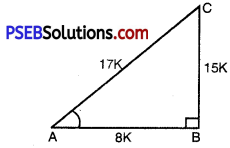
PSEB 10th Class Maths Solutions Chapter 8 Introduction to Trigonometry Ex 8.1 6

15 cot A = 8
cot A = \(\frac{8}{15}\)
But cot A = \(\frac{A B}{B C}\) (fromfig.)
⇒ \(\frac{A B}{B C}=\frac{8}{15}\) = K
where K is constant of proportionality.
AB = 8 K, BC = 15 K
By using Pythagoras Theorem.
AC2 = (AB)2 + (BC)2
(AC)2 = (8 K)2 + (15 K)2
(AC)2 = 64K2 + 225 K2
(AC)2 = 289 K2
AC = ± \(\sqrt{289 K^{2}}\)
AC = ± 17 K
⇒ AC = 17K
[AC = – 17 K, Because side cannot be negative]
sin A = \(\frac{\mathrm{BC}}{\mathrm{AC}}=\frac{15 \mathrm{~K}}{17 \mathrm{~K}}=\frac{15}{17}\)

sin A = \(\frac{15}{17}\)

sec A = \(\frac{\mathrm{AC}}{\mathrm{AB}}\)

sec A = \(\frac{17 \mathrm{~K}}{8 \mathrm{~K}}=\frac{17}{8}\)

sec A = \(\frac{17}{8}\)

Hence, sin A = \(\frac{15}{17}\) and sec A = \(\frac{17}{8}\).

PSEB Solutions PSEB 10th Class Maths Solutions Chapter 8 Introduction to Trigonometry Ex 8.1

Question 5.
Given sec θ = \(\frac{13}{2}\), calculate all other trigonometric ratios.
Solution:
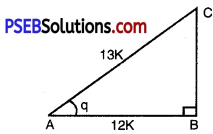
Let ABC be any right angled triangle with right angle at B.
Let ∠BAC = θ
PSEB 10th Class Maths Solutions Chapter 8 Introduction to Trigonometry Ex 8.1 7

sec θ = \(\frac{13}{12}\)

But sec θ = \(\frac{\mathrm{AC}}{\mathrm{AB}}\) ……….[from fig.]

\(\frac{\mathrm{AC}}{\mathrm{AB}}=\frac{13}{12}\)

But \(\frac{\mathrm{AC}}{\mathrm{AB}}=\frac{13}{12}\) = k where k is constant of proportionality.
AC = 13 k and AB = 12 k
By using Pythagoras Theorem,
AC2 = (AB)2 + (BC)2
or (13k)2 = (12k)2 + (BC)2
or 169k2 = 144k2 + (BC)2
or 169k2 – 144k2 = (BC)
or (BC)2 = 25k2
or BC = ± \(\sqrt{25 k^{2}}\)
or BC = ± 5k
or BC = 5k.
[BC ≠ – 5k because side cannot be negative]

sin θ = \(\frac{\mathrm{BC}}{\mathrm{AC}}=\frac{5 k}{13 k}=\frac{5}{13}\)
cos θ = \(\frac{\mathrm{AB}}{\mathrm{AC}}=\frac{12 k}{13 k}=\frac{12}{13}\)
tan θ = \(\frac{\mathrm{BC}}{\mathrm{AB}}=\frac{5 k}{12 k}=\frac{5}{12}\)
cosec θ = \(\frac{\mathrm{AC}}{\mathrm{BC}}=\frac{13 k}{5 k}=\frac{13}{5}\)
cot θ = \(\frac{\mathrm{AB}}{\mathrm{BC}}=\frac{12 k}{5 k}=\frac{12}{5}\).

PSEB Solutions PSEB 10th Class Maths Solutions Chapter 8 Introduction to Trigonometry Ex 8.1

Question 6.
If ∠A and ∠B are acute angles such that cos A = cos B, show that LA = LB.
Solution:
Let ABC be any triangle, where ∠A and ∠B are acute angles. To find cos A and cos B.
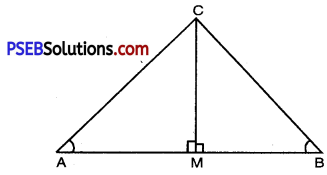
PSEB 10th Class Maths Solutions Chapter 8 Introduction to Trigonometry Ex 8.1 8

Draw CM ⊥ AB
∠AMC = ∠BMC = 90°
In right angled ∆AMC,
\(\frac{\mathrm{AM}}{\mathrm{AC}}\) = cos A ……………(1)
In right angled ∆BMC,
\(\frac{\mathrm{BM}}{\mathrm{BC}}\) = cos B ……………(2)
But cos A = cos B [given] ………..(3)
From (1), (2) and (3),
\(\frac{\mathrm{AM}}{\mathrm{AC}}=\frac{\mathrm{BM}}{\mathrm{BC}}\)
\(\frac{\mathrm{AM}}{\mathrm{BM}}=\frac{\mathrm{AC}}{\mathrm{BC}}=\frac{\mathrm{CM}}{\mathrm{CM}}\)
∴ ∆AMC = ∆BMC [By SSS similarity]
⇒ ∠A = ∠B [∵ Corresponding angles of two similar triangles are equal].

PSEB Solutions PSEB 10th Class Maths Solutions Chapter 8 Introduction to Trigonometry Ex 8.1

Question 7.
If cot θ = \(\frac{7}{8}\) evaluate
(i) \(\frac{(1+\sin \theta)(1-\sin \theta)}{(1+\cos \theta)(1-\cos \theta)}\)
(ii) cot2 θ.
Solution:
(i) ∠ABC = θ.
In right angled triangle ABC with right angle at C.
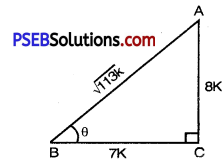
PSEB 10th Class Maths Solutions Chapter 8 Introduction to Trigonometry Ex 8.1 9

Given that, cot θ = \(\frac{7}{8}\)
But cot θ = \(\frac{\mathrm{BC}}{\mathrm{AC}}\) [From fig.]
⇒ \(\frac{\mathrm{BC}}{\mathrm{AC}}=\frac{7}{8}\)
Let \(\frac{\mathrm{BC}}{\mathrm{AC}}=\frac{7}{8}\) = k
where k is constant of proportionality.
⇒ BC = 7k, AC = 8k
By using Pythagoras Theorem,
AB2 = (BC)2 + (AC)2
or (AB)2 = (7k)2 + (8k)2
or (AB)2 = 49k2 + 64k2
or (AB)2 = 113 k2
or AB = ± \(\)
AB = \(\sqrt{113 k^{2}}\) k
AB = \(\sqrt{113}\) k
[AB ≠ \(\sqrt{113}\) k because side cannot be negative]

sin θ = \(\frac{\mathrm{AC}}{\mathrm{AB}}=\frac{8 k}{\sqrt{113} k}\)
sin θ = \(\frac{8}{\sqrt{113}}\)
cos θ = \(\frac{\mathrm{BC}}{\mathrm{AB}}=\frac{7 k}{\sqrt{113} k}=\frac{7}{\sqrt{113}}\)
cos θ = \(\frac{7}{\sqrt{113}}\)

(1 + sin θ) (1 – sin θ) = (1 + \(\frac{8}{\sqrt{113}}\)) (1 – \(\frac{8}{\sqrt{113}}\))
= (1)2 – (\(\frac{8}{\sqrt{113}}\))2
[By using formula (a + b) (a – b) = a2 – b2]
= 1 – \(\frac{64}{113}\)
(1 + sin θ) (1 – sin θ) = \(\frac{113-64}{113}=\frac{49}{113}\)
(1 + sin θ)(1 – sin θ) = \(\frac{49}{113}\) ……………..(1)

(1 + cos θ) (1 – cos θ) = (1 + \(\frac{8}{\sqrt{113}}\)) (1 – \(\frac{8}{\sqrt{113}}\))
(1)2 – (\(\frac{7}{\sqrt{113}}\))2
[By using formula(a + b) (a – b) = a2 – b2]
= 1 – \(\frac{49}{113}\) = \(\frac{113-49}{113}\)
(1 + cos θ) (1 – cos θ) = \(\frac{64}{113}\) ……….(2)

Consider, \(\frac{(1+\sin \theta)(1-\sin \theta)}{(1+\cos \theta)(1-\cos \theta)}=\frac{\frac{49}{113}}{\frac{64}{113}}\) [From (1) and (2)]

Hence \(\frac{(1+\sin \theta)(1-\sin \theta)}{(1+\cos \theta)(1-\cos \theta)}=\frac{49}{64}\)

PSEB Solutions PSEB 10th Class Maths Solutions Chapter 8 Introduction to Trigonometry Ex 8.1

(ii) cot θ = \(\frac{\mathrm{BC}}{\mathrm{AC}}=\frac{7}{8}\)
cot2 θ = (cot θ)2
cot2 θ= (\(\frac{7}{8}\))2
⇒ cot2 θ = \(\frac{49}{64}\).

Question 8.
If 3 cot A = 4 check whether \(\frac{1-\tan ^{2} A}{1+\tan ^{2} A}\) = cos2 A – sin2 A or not.
Solution:
Let ABC be a right angled triangle with right angled at B.
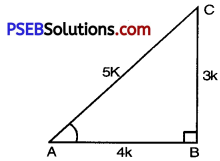
PSEB 10th Class Maths Solutions Chapter 8 Introduction to Trigonometry Ex 8.1 10

It is given that 3 cot A = 4
cot A = \(\frac{4}{3}\)
But cot A = \(\frac{\mathrm{AB}}{\mathrm{BC}}\) [From fig.]
⇒ \(\frac{A B}{B C}=\frac{4}{3}\)
But \(\frac{A B}{B C}=\frac{4}{3}\) = k
⇒ AB = 4k, BC = 3k
By using Pythagoras Theorem,
(AC)2 = (AB)2 + (BC)2
(AC)2 = (4k)2 + (3k)2
(AC)2 = 16 k2 + 9 k2
(AC)2 = 25 k2
AC=± \(\sqrt{25 k^{2}}\)
AC = ± 5k

But AC = 5k.
[AC ≠ – 5k. because side cannot be negative]
sin A = \(\frac{\mathrm{BC}}{\mathrm{AC}}=\frac{3 k}{5 k}=\frac{3}{5}\)

tan A = \(\frac{\mathrm{BC}}{\mathrm{AB}}=\frac{3 k}{4 k}=\frac{3}{4}\)

cos A = \(\frac{\mathrm{AB}}{\mathrm{AC}}=\frac{4 k}{5 k}=\frac{4}{5}\)

L.H.S. = \(\frac{1-\tan ^{2} \mathrm{~A}}{1+\tan ^{2} \mathrm{~A}}\)
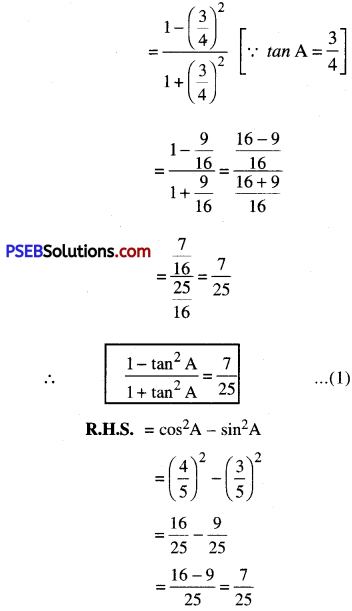
PSEB 10th Class Maths Solutions Chapter 8 Introduction to Trigonometry Ex 8.1 11

∴ cos2 A – sin2 A = \(\frac{7}{25}\) ………..(2)

From (1) and (2),
L.H.S = R.H.S
Hence, \(\frac{1-\tan ^{2} \mathrm{~A}}{1+\tan ^{2} \mathrm{~A}}\) = cos2 A – sin2 A.

PSEB Solutions PSEB 10th Class Maths Solutions Chapter 8 Introduction to Trigonometry Ex 8.1

Question 9.
In triangle ABC, right angled at B, if tan A = \(\frac{1}{\sqrt{3}}\). Find the value of:
(i) sin A cos C + cos A sin C
(ii) cos A cos C – sin A sin C.
Solution:
(i) Given: ABC with right angled at B
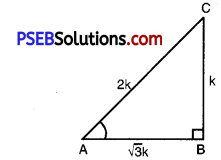
PSEB 10th Class Maths Solutions Chapter 8 Introduction to Trigonometry Ex 8.1 12

tan A = \(\frac{1}{\sqrt{3}}\) ……………..(1)
But tan A = \(\frac{B C}{A B}\) ……………(2)
From (1) and (2),
\(\frac{\mathrm{BC}}{\mathrm{AB}}=\frac{1}{\sqrt{3}}\)
Let \(\frac{\mathrm{BC}}{\mathrm{AB}}=\frac{1}{\sqrt{3}}\) = k
BC = k, AB = k
where k is constant of proportionality.
In right angled triangle ABC,
By using Pythagoras Theorem,
(AC)2 = (AB)2 + (BC)2
or (AC)2 = (Jk)2 + (k)2
or AC2 = 3k2 + k2
or AC2 = 4k2
or AC = ± \(\sqrt{4 k^{2}}\)
AC = ± 2k.
where AC = 2k
[AC ≠ – 2k side cannot be negative]

[sin A = \(\frac{\mathrm{BC}}{\mathrm{AC}}=\frac{k}{2 k}=\frac{1}{2}\)

cos C = \(\frac{\mathrm{BC}}{\mathrm{AC}}=\frac{k}{2 k}=\frac{1}{2}\)

cos A = \(\frac{\mathrm{AB}}{\mathrm{AC}}=\frac{\sqrt{3} k}{2 k}=\frac{\sqrt{3}}{2}\)

sin C = \(\frac{\mathrm{AB}}{\mathrm{AC}}=\frac{\sqrt{3} k}{2 k}=\frac{\sqrt{3}}{2}\)] …………….(3)

sin A cos C = \(\left(\frac{1}{2}\right)\left(\frac{1}{2}\right)=\frac{1}{4}\)
cos A sin C = \(\left(\frac{\sqrt{3}}{2}\right)\left(\frac{\sqrt{3}}{2}\right)=\frac{3}{4}\)
sin A cos C + cos A sin C = \(\frac{1}{4}+\frac{3}{4}\)
= \(\frac{1+3}{4}\)
= \(\frac{4}{4}\) = 1
∴ sin A cos C + cos A sin C = 1.

(ii) cos A cos C = \(\left(\frac{\sqrt{3}}{2}\right)\left(\frac{1}{2}\right)=\frac{\sqrt{3}}{4}\) [From (3)]
sin A sin C = \(\left(\frac{1}{2}\right)\left(\frac{\sqrt{3}}{2}\right)=\frac{\sqrt{3}}{4}\) [From (3)]

cos A cos C – sin A sin C = \(\left(\frac{\sqrt{3}}{4}\right)-\left(\frac{\sqrt{3}}{4}\right)\) = 0.

PSEB Solutions PSEB 10th Class Maths Solutions Chapter 8 Introduction to Trigonometry Ex 8.1

Question 10.
In ∆PQR, right angled at Q, PR + QR = 25 cm and PQ = 5 cm. Determine the values of sin P, cos P and tan P.
Solution:
Given: ∆PQR, right angled at Q
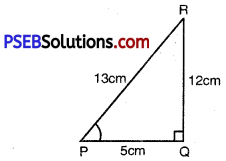
PSEB 10th Class Maths Solutions Chapter 8 Introduction to Trigonometry Ex 8.1 13

PR + QR = 25 cm
PQ = 5 cm
In right angled triangle PQR
By using Pythagoras Theorem,
(PR)2 = (PQ)2 + (RQ)2
or (PR)2 = (5)2 + (RQ)2
[∴ PR + QR = 25, QR = 25 – PR]
or (PR)2 = 25 + [25 – PR]2
or (PR)2 = 25 + (25)2 + (PR)2 – 2 × 25 × PR
or (PR)2 = 25 + 625 + (PR)2 – 50
or (PR)2 – (PR)2 + 50 PR = 650
or 50 PR = 650
or PR = \(\frac{650}{50}\)
or PR = 13 cm
QR = 25 – PR
QR = (25 – 13) cm
or QR = 12 cm.

sin P = \(\frac{Q R}{P R}=\frac{12}{13}\)

cos P = \(\frac{P Q}{P R}=\frac{5}{13}\)

tan P = \(\frac{Q R}{P Q}=\frac{12}{5}\)

PSEB Solutions PSEB 10th Class Maths Solutions Chapter 8 Introduction to Trigonometry Ex 8.1

Question 11.
State whether the following are true or false. Justify your answer.
(i) The value of tan A is always less than 1
(ii) sec A = \(\frac{12}{5}\) for some value of angle A.
(iii) cos A is abbreviation used for cosecant of angle A.
(iv) cot A is product of cot and A.
(v) sin θ = \(\frac{4}{3}\) for some angle θ.
Solution:
(i) False
∵ tan 60° = √3 = 1.732 > 1.

(ii) True; sec A = \(\frac{12}{5}\) = 240 > 1
∵ Sec A is always greater than 1.

(iii) False.
Because cos A is used for cosine A.

(iv) False.
Because cot A is cotangent of the angle A not the product of cot and A.

(v) False; sin θ = \(\frac{4}{3}\) = 1.666 > 1
Because sin θ is always less than 1.
PSEB 8th Class Maths Solutions Chapter 1 Rational Numbers Ex 1.1

Punjab State Board PSEB 8th Class Maths Book Solutions Chapter 1 Rational Numbers Ex 1.1 Textbook Exercise Questions and Answers.

PSEB Solutions for Class 8 Maths Chapter 1 Rational Numbers Ex 1.1

1. Using appropriate properties find.

Question (i).
\(-\frac{2}{3} \times \frac{3}{5}+\frac{5}{2}-\frac{3}{5} \times \frac{1}{6}\)
Solution:
\(-\frac{2}{3} \times \frac{3}{5}+\frac{5}{2}-\frac{3}{5} \times \frac{1}{6}\)
= \(-\frac{2}{3} \times \frac{3}{5}-\frac{3}{5} \times \frac{1}{6}+\frac{5}{2}\) (Commutative)
= \(\frac{3}{5} \times\left[-\frac{2}{3}-\frac{1}{6}\right]+\frac{5}{2}\) (Distributive)
= \(\frac{3}{5}\left[\frac{-4-1}{6}\right]+\frac{5}{2}\)
= \(\frac{3}{5}\left[\frac{-5}{6}\right]+\frac{5}{2}\)
= \(\frac{3}{5} \times \frac{-5}{6}+\frac{5}{2}\)
= \(-\frac{1}{2}+\frac{5}{2}\)
= \(\frac{-1+5}{2}\)
= \(\frac {4}{2}\)
= 2

Question (ii).
\(\frac{2}{5} \times\left(-\frac{3}{7}\right)-\frac{1}{6} \times \frac{3}{2}+\frac{1}{14} \times \frac{2}{5}\)
Solution:
\(\frac{2}{5} \times\left(-\frac{3}{7}\right)-\frac{1}{6} \times \frac{3}{2}+\frac{1}{14} \times \frac{2}{5}\)
= \(\frac{2}{5} \times\left(\frac{-3}{7}\right)+\frac{1}{14} \times \frac{2}{5}-\frac{1}{6} \times \frac{3}{2}\) (Commutative)
= \(\frac{2}{5} \times\left(\frac{-3}{7}+\frac{1}{14}\right)-\frac{1}{6} \times \frac{3}{2}\) (Distributive)
= \(\frac{2}{5} \times\left[\frac{-6+1}{14}\right]-\frac{1}{4}\)
= \(\frac{2}{5} \times \frac{-5}{14}-\frac{1}{4}\)
= \(-\frac{1}{7}-\frac{1}{4}=\frac{-4-7}{28}\)
= \(\frac{-11}{28}\)

PSEB 8th Class Maths Solutions Chapter 1 Rational Numbers Ex 1.1

2. Write the additive inverse of each of the following:

Question (i).
\(\frac{2}{8}\)
Solution:
Additive inverse of \(\frac{2}{8}\) = \(\frac{-2}{8}\)

Question (ii).
\(\frac{-5}{9}\)
Solution:
Additive inverse of \(\frac{-5}{9}\) = \(\frac{5}{9}\)

Question (iii).
\(\frac{-6}{-5}\)
Solution:
Additive inverse of \(\frac{-6}{-5}\) means \(\frac{6}{5}\) = \(\frac{-6}{5}\)

Question (iv).
\(\frac{2}{-9}\)
Solution:
Additive inverse of \(\frac{2}{-9}\) = \(\frac{2}{9}\)

Question (v).
\(\frac{19}{-6}\)
Solution:
Additive inverse of \(\frac{19}{-6}\) = \(\frac{19}{6}\)

3. Verify that – (- x) = x for

(i) x = \(\frac {11}{15}\)
Solution:
x = \(\frac {11}{15}\)
∴ (-x) = \(\left(\frac{-11}{15}\right)\)
-(-x) = –\(\left(\frac{-11}{15}\right)\)
= \(\frac {11}{15}\) = x
∴ -(-x) = x

(ii) x = \(\frac {-13}{17}\)
Solution:
x = \(\frac {-13}{17}\)
∴ (-x) = \(\left(\frac{-13}{17}\right)\)
= \(\frac {13}{17}\)
-(-x) = –\(\left(\frac{-13}{17}\right)\)
= \(\frac {-13}{17}\) = x
∴ -(-x) = x

PSEB 8th Class Maths Solutions Chapter 1 Rational Numbers Ex 1.1

4. Find the multiplicative inverse of the following:

Question (i).
-13
Solution:
Multiplicative inverse of -13 = \(\frac {-1}{13}\)

Question (ii).
\(\frac {-13}{19}\)
Solution:
Multiplicative inverse of \(\frac {-13}{19}\) \(\frac {-19}{13}\)

Question (iii).
\(\frac {1}{5}\)
Solution:
Multiplicative inverse of \(\frac {1}{5}\) = 5

Question (iv).
\(\frac{-5}{8} \times \frac{-3}{7}\)
Solution:
\(\left(\frac{-5}{8}\right) \times\left(\frac{-3}{7}\right)\)
= \(\frac{(-5 \times-3)}{8 \times 7}\)
= \(\frac {15}{56}\)
Multiplicative inverse of \(\frac {15}{56}\) = \(\frac {56}{15}\)

Question (v) .
1 × \(\frac {-2}{5}\)
Solution:
-1 × \(\frac {-2}{5}\) = \(\frac{(-1 \times-2)}{5}\)
= \(\frac {2}{5}\)
Multiplicative inverse of \(\frac {2}{5}\) = \(\frac {5}{2}\)

Question (vi).
-1
Solution:
Multiplicative inverse of -1 = (-1)
(∵ \(\frac{1}{(-1)}\) = (-1))

PSEB 8th Class Maths Solutions Chapter 1 Rational Numbers Ex 1.1

5. Name the property under multiplication used in each of the following:

Question (i).
\(\frac{-4}{5} \times 1=1 \times \frac{-4}{5}=-\frac{4}{5}\)
Solution:
1 is the multiplicative identity.

Question (ii).
\(-\frac{13}{17} \times \frac{-2}{7}=\frac{-2}{7} \times \frac{-13}{17}\)
Solution:
Commutative property of multiplication.

Question (iii).
\(\frac{-19}{29} \times \frac{29}{-19}=1\)
Solution:
Existence of multiplicative inverse.

6. Multiply \(\frac {6}{13}\) by the reciprocal of \(\frac {-7}{16}\).
Solution:
Reciprocal of \(\frac{-7}{16}=\frac{-16}{7}\)
∴ \(\frac{6}{13} \times \frac{-16}{7}\)
= \(\frac{6 \times(-16)}{13 \times 7}\)
= \(\frac {-96}{91}\)

7. Tell what property allows you to compute.
\(\frac{1}{3} \times\left(6 \times \frac{4}{3}\right)\) as \(\left(\frac{1}{3} \times 6\right) \times \frac{4}{3}\)
Solution:
In computing
\(\frac{1}{3} \times\left(6 \times \frac{4}{3}\right)\) as \(\left(\frac{1}{3} \times 6\right) \times \frac{4}{3}\)
we use the associativity.

PSEB 8th Class Maths Solutions Chapter 1 Rational Numbers Ex 1.1

8. Is \(\frac {8}{9}\) the multiplicative inverse of – 1 \(\frac {1}{8}\) ? Why or why not ?
Solution:
\(-1 \frac{1}{8}=\frac{-9}{8}\)
\(\frac{8}{9} \times \frac{-9}{8}\) = (-1)
∴ \(\frac {8}{9}\) is is not the multiplicative inverse of -1 \(\frac {1}{8}\) as product of two multiplicative inverse is always 1.

9. Is 0.3 the multiplicative inverse of 3 \(\frac {1}{3}\) ? Why or why not?
Solution:
0.3 = \(\frac {3}{10}\) and 3 \(\frac {1}{3}\) = \(\frac {10}{3}\)
\(\frac{3}{10} \times \frac{10}{3}\) = 1
∴ the multiplicative inverse of 3 \(\frac {1}{3}\) is 0.3.

10. Write:

Question (i).
The rational number that does not have a reciprocal.
Solution:
The rational number that does not have a reciprocal is 0.

Question (ii).
The rational numbers that are equal to their reciprocals.
Solution:
The rational numbers that are equal to their reciprocals are 1 and (-1).

Question (iii).
The rational number that is equal to its negative.
Solution:
The rational number that is equal to its negative is zero (0).

PSEB 8th Class Maths Solutions Chapter 1 Rational Numbers Ex 1.1

11. Fill in the blanks:

Question (i).
Zero has ……………. reciprocal.
Solution:
Zero has no reciprocal.

Question (ii).
The numbers ……………. and ……………. are their own reciprocals.
Solution:
The numbers 1 and -1 are their own reciprocals.

Question (iii).
The reciprocal of – 5 is …………….
Solution:
The reciprocal of – 5 is \(\frac {-1}{5}\)

Question (iv).
Reciprocal of \(\frac{1}{x}\), where x ≠ 0 is …………….
Solution:
Reciprocal of \(\frac{1}{x}\), where x ≠ 0 is x

Question (v) .
The product of two rational numbers is always a …………….
Solution:
The product of two rational numbers is always a rational number.

Question (vi).
The reciprocal of a positive rational number is …………….
Solution:
The reciprocal of a positive rational number is positive.

PSEB 10th Class Maths Solutions Chapter 7 Coordinate Geometry Ex 7.4

Punjab State Board PSEB 10th Class Maths Book Solutions Chapter 7 Coordinate Geometry Ex 7.4 Textbook Exercise Questions and Answers.

PSEB Solutions for Class 10 Maths Chapter 7 Coordinate Geometry Ex 7.4

Question 1.
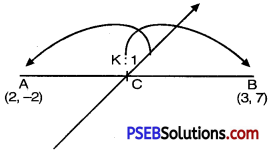
Determine the ratio in which the line it + y – 4 = 0 divides the line segment joining the points A (2, – 2) and B (3, 7).
Solution:
Let line 2x + y – 4 = 0 divides the line segment joining the points A (2,- 2) and B(3, 7) at C (x, y) in the ratio k : 1

PSEB 10th Class Maths Solutions Chapter 7 Coordinate Geometry Ex 7.4 1

∴ Coordinates of C are x = \(\frac{3 k+2 \times 1}{k+1}=\frac{3 k+2}{k+1}\) and y = \(\frac{7 k+(-2) \times 1}{k+1}=\frac{7 k-2}{k+1}\)
∴ C \(\left[\frac{3 k+2}{k+1}, \frac{7 k-2}{k+1}\right]\). must lie on the line 2x + y – 4 = 0

i.e., 2\(\left(\frac{3 k+2}{k+1}\right)+\left(\frac{7 k-2}{k+1}\right)\) – 4 = 0
or \(\frac{6 k+4+7 k-2-4 k-4}{k+1}\) = 0
or 9k – 2 = 0
or 9k = 2
or k = \(\frac{2}{9}\).
∴ ratio k : 1 = \(\frac{2}{9}\) : 1 = 2 : 9.
Hence required ratio is 2 : 9.

PSEB Solutions PSEB 10th Class Maths Solutions Chapter 7 Coordinate Geometry Ex 7.4

Question 2.
Find a relation between x and y if (x, y) ; (1, 2) and (7, 0) are collinear.
Solution:
Let given points are A (x, y); B (1, 2) and C (7, 0).
Here x1 = x, x2 = 1, x3 = 7
y1 = y, y2 = 2, y3 = 0
∵ Three points are collinear
iff \(\frac{1}{2}\) [x1 (y2 – y3) + x2 (y3 – y1) + x3 (y1 – y2)] = 0
or \(\frac{1}{2}\) x (2 – 0) + 1 (0 – y) + 7 (y – 2)] = 0
or 2x – y + 7y – 14 = 0
or 2x + 6y – 14 = 0
or x + 3y – 7 = 0 is the required relation.

Question 3.
Find the centre of a cirçle passing through the points (6, —6); (3, —7) and (3,3).
Solution:
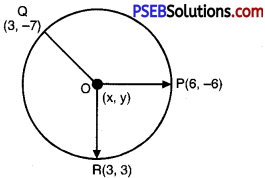
Let O (x, y) be the required centre of the circle which passes through points P(6, – 6); Q(3, – 7) and R (3, 3).
∴ radii of circle are equal.

PSEB 10th Class Maths Solutions Chapter 7 Coordinate Geometry Ex 7.4 2

∴ OP = OQ = OR
or (OP)2 = (OQ)2 = (OR)2
Now, (OP)2 = (OQ)2
(x – 6)2 + (y + 6)2 = (x – 3)2 + (y + 7)2
or x2 + 36 – 12x + y2 + 36 + 12y = x2 + 9 – 6x + y2 + 49 + 14y
or – 12x + 12y + 72 = – 6x + 14y + 58
or – 6x – 2y + 14 = 0
or 3x + y – 7 = 0 ………………(1)
Also, (OQ)2 = (OR)2
or (x – 3)2 + (y + 7)2 = (x – 3)2 + (y – 3)2
or (y + 7)2 = (y – 3)2
or y2 + 49 + 14y = y2 + 9 – 6y
or 20y = – 40
y = \(\frac{-40}{20}\) = – 2
Substitute this value of)’ in (1), we get
3x – 2 – 7 = 0
or 3x – 9 = 0
or 3x = 9
or x = \(\frac{9}{3}\) = 3
∴ Required centre is (3, – 2).

PSEB Solutions PSEB 10th Class Maths Solutions Chapter 7 Coordinate Geometry Ex 7.4

Question 4.
The two opposite vertices of a square are (- 1, 2) and (3, 2). Find the coordinates of other two vertices.
Solution:
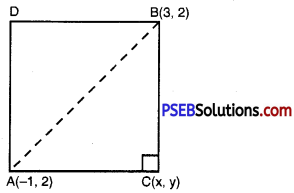
Let two opposite vertices of a square ACBD are A (- 1, 2) and B (3, 2) and coordinates of C are (x, y)
∵ Length of each sides of square are equal.
∴ AC = BC
or (AC)2 = (BC)2
or (x + 1)2 + (y – 2)2 = (x – 3)2 + (y – 2)2

PSEB 10th Class Maths Solutions Chapter 7 Coordinate Geometry Ex 7.4 3

or (x + 1)2 = (x – 3)2
or x2 + 1 + 2x = x2 + 9 – 6x
or 8x = 8
or x = \(\frac{8}{8}\) = 1
Now, in rt ∠d ∆ACB,
Using Pythagoras Theorem,
(AC)2 + (BC)2 = (AB)2
(x + 1)2 + (y – 2)2 + (x – 3)2 + (y – 2)2 = (3 + 1)2 + (2 – 2)2
or x2 + 1 + 2x + y2 + 4 – 4y + x2 + 9 – 6x + y2 + 4 – 4y = 16
or 2x2 + 2y2 – 4x – 8y + 2 = 0
or x2 + y2 – 2x – 4y + 1 = 0
Putting the value of x = 1 in (1), we get
(1)2 + y2 – 2 (1) – 4y + 1 = 0
or y2 – 4y = 0
or y (y – 4) = 0
Either y = 0 or y – 4 = 0
Either y = 0 or y = 4
∴ y = 0, 4
∴ Required points are (1. 0) and (1.4).

PSEB Solutions PSEB 10th Class Maths Solutions Chapter 7 Coordinate Geometry Ex 7.4

Question 5.
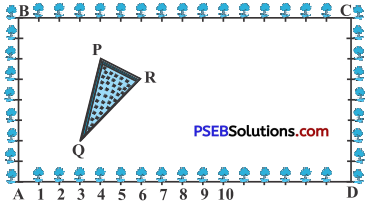
The Class X students of a secondary school in Krishinagar have been allotted a rectangular plot of land for their gardening activity. Sapling of Gulmohar are planted on the boundary at a distance of 1m from each other. There ¡s a triangular grassy lawn in the plot as shown in the Fig. The students are to sow seeds of flowering plants on the remaining area of the plot.

PSEB 10th Class Maths Solutions Chapter 7 Coordinate Geometry Ex 7.4 4

(i) Taking A as origin, find the coordinates of the vertices of the triangle.
(ii) What will be the coordinates of the vertices of A PQR if C is the origin? Also calculate the areas of the triangles In these cases. What do you observe?
Solution:
Case I:
When taking A as origin then AD is X-axis and AB is Y-axis.
∴ Coordinates of triangular grassy Lawn
PQR are P (4, 6); Q (3, 2) and R(6, 5).
Here x1 = 4, x2 = 3, x3 = 6
y1 = 6, y2 = 2, y3 = 50
Now, area of ∆PQR = \(\frac{1}{2}\) [x1 (y2 – y3) + x2 (y3 – y1) + x3 (y1 – y2)]
= \(\frac{1}{2}\) [4 (2 – 5) + 3 (5 – 6) + 6 (6 – 2)]
= \(\frac{1}{2}\) [- 12 – 3 + 24] = \(\frac{9}{2}\)
= 4.5 sq. units.

Case II: When taking C as origin then CB is X – axis and CD is Y – axis.
∴ Coordinates of triangular grassy lawn PQR
are P(12, 2); Q (13,6) and R (10, 3)
Here x1 = 12, x2 = 13, x3 = 10
y1 = 2, y2 = 6, y3 = 3
Now, area of ∆PQR = \(\frac{1}{2}\) [x1 (y2 – y3) + x2 (y3 – y1) + x3 (y1 – y2)]
= \(\frac{1}{2}\) [12 (6 – 3) + 13 (3 – 2) + 10 (2 – 6)]
= \(\frac{1}{2}\) [36 + 13 – 40]
= \(\frac{9}{2}\) = 4.5 sq. units.
From above two cases, it is clear that area of triangular grassy lawn is same.

PSEB Solutions PSEB 10th Class Maths Solutions Chapter 7 Coordinate Geometry Ex 7.4

Question 6.
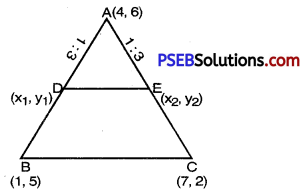
The vertices of a ∆ABC are A (4, 6), B (1, 5) and C (7, 2). A line is drawn to intersect sides AB and AC at D and E respectively, such that \(\frac{\mathrm{AD}}{\mathrm{AB}}=\frac{\mathrm{AE}}{\mathrm{AC}}=\frac{1}{4}\) Calculate the area of the ∆ADE and compare it with the area of ∆ABC. (Recall Theorem 6.2 and Theorem 6.6).
Solution:
The vertices of ∆ABC are A (4, 6); B (1, 5) and C (7, 2)

PSEB 10th Class Maths Solutions Chapter 7 Coordinate Geometry Ex 7.4 5

A line is drawn to intersect sides AB and AC at D (x1, y1) and E (x2, y2) respectively such that \(\frac{\mathrm{AD}}{\mathrm{AB}}=\frac{\mathrm{AE}}{\mathrm{AC}}=\frac{1}{4}\).

∴ D and E divides AB and AC in the ratio 1 : 3.
∴ Coordinates of D are
x1 = \(\frac{1(1)+3(4)}{1+3}=\frac{1+12}{4}=\frac{13}{4}\) and y1 = \(\frac{1(5)+3(6)}{1+3}=\frac{5+18}{4}=\frac{23}{4}\)

∴ Coordinates of D are (\(\frac{13}{4}\), \(\frac{23}{4}\))
Now, coordinates of E are
x2 = \(\frac{1(7)+3(4)}{1+3}=\frac{7+12}{4}=\frac{19}{4}\) and y2 = \(\frac{1(2)+3(6)}{1+3}=\frac{2+18}{4}=\frac{20}{4}=5\)

∴ Coordinates of E are (\(\frac{19}{4}\), 5).

In ∆ADE
x1 = 4, x2 = \(\frac{13}{4}\), x3 = \(\frac{19}{4}\)
y2 = 6, y2 = \(\frac{23}{4}\), y3 = 5
area of ∆ADE = \(\frac{1}{2}\) [x1 (y2 – y3) + x2 (y3 – y1) + x3 (y1 – y2)]

= \(\frac{1}{2}\left[4\left(\frac{23}{4}-5\right)+\frac{13}{4}(5-6)+\frac{19}{4}\left(6-\frac{23}{4}\right)\right]\)

= \(\frac{1}{2}\left[4\left(\frac{23-20}{4}\right)+\frac{13}{4}(-1)+\frac{19}{4}\left(\frac{24-23}{4}\right)\right]\)

= \(\frac{1}{2}\left[3-\frac{13}{4}+\frac{19}{16}\right]\)

= \(\frac{1}{2}\left[\frac{48-52+19}{16}=\frac{15}{16}\right]\)
= \(\frac{15}{32}\) sq. units.

In ∆ABC
x1 = 4, x2 = 1, x3 = 7
y2 = 6, y2 = 5, y3 = 2
Area of ∆ABC = \(\frac{1}{2}\) [x1 (y2 – y3) + x2 (y3 – y1) + x3 (y1 – y2)]

= \(\frac{1}{2}\) [4 (5 – 2) + 1 (2 – 6) + 7 (6 – 5)]
= \(\frac{1}{2}\) [12 – 4 + 7] = \(\frac{15}{2}\) sq.units.

Now, \(\frac{\text { area of } \Delta \mathrm{ADE}}{\text { area of } \Delta \mathrm{ABC}}=\frac{\frac{15}{32}}{\frac{15}{2}}=\frac{15}{32} \times \frac{2^{1}}{16_{1}}\)

= \(\frac{1}{16}=\left(\frac{1}{4}\right)^{2}\)

= \(\left(\frac{A D}{A B}\right)^{2} \text { or }\left(\frac{A E}{A C}\right)^{2}\).

PSEB Solutions PSEB 10th Class Maths Solutions Chapter 7 Coordinate Geometry Ex 7.4

Question 7.
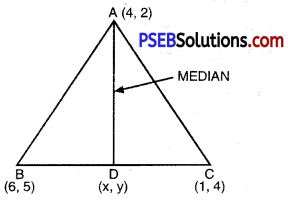
Let (4, 2), B (6, 5) and C (1, 4) be the vertices of ∆ABC.
(i) The median from A meets BC at D. Find the coordinates of the point D.
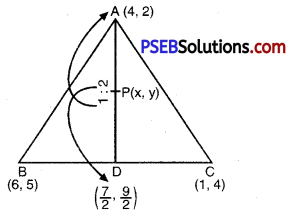
(ii) Find the coordinates of the potnt P on AD such that AP : PD = 2 : 1
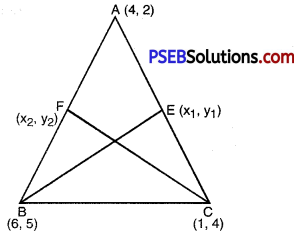
(iii) Find the coordinates of points Q and R on medians BE and CF respectively such that BQ : QE = 2 : 1 and CR : RF = 2 : 1.
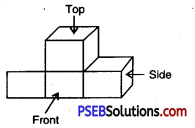
(iv) What do you observe?
[Note : The point which is common to all the three medians ¡s called centroid and this point divides each median in the ratio 2: 1]
(v) if A (x1, y1), B (x2, y2) and C (x3, y3) are the vertices of ∆ABC, find the coordinates of the centroid of the triangle.
Solution:
Given that vertices of ∆ABC are A (4, 2); B (6, 5) and C (1, 4).
(i) AD is the median from the vertex A.
∴ D is the mid point of BC.

PSEB 10th Class Maths Solutions Chapter 7 Coordinate Geometry Ex 7.4 6

then x = \(\frac{6+1}{2}=\frac{7}{2}\) and y = \(\frac{5+4}{2}=\frac{9}{2}\)
Hence, coordinates of D is (\(\frac{7}{2}\), \(\frac{9}{2}\)).

(ii) Let P(x, y) be point on AD such that AP : PD = 2 : 1

PSEB 10th Class Maths Solutions Chapter 7 Coordinate Geometry Ex 7.4 7

then x = \(\frac{2\left(\frac{7}{2}\right)+1(4)}{2+1}\)
= \(\frac{7+4}{3}=\frac{11}{3}\)

and y = \(\frac{2\left(\frac{9}{2}\right)+1(2)}{2+1}\)
= \(\frac{9+2}{3}=\frac{11}{3}\)

Hence, Coordinates of P is (\(\frac{11}{3}\), \(\frac{11}{3}\)).

PSEB Solutions PSEB 10th Class Maths Solutions Chapter 7 Coordinate Geometry Ex 7.4

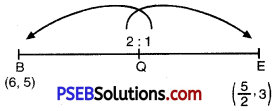
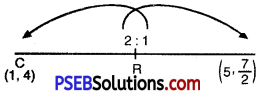
(iii) Le BE and CF are the medians of ∆ABC to AC and AB respectively.
∴ E and F are mid points of AC and AB respectively.

PSEB 10th Class Maths Solutions Chapter 7 Coordinate Geometry Ex 7.4 8

Coordinate of E are
x1 = \(\frac{4+1}{2}=\frac{5}{2}\)
and y1 = \(\frac{4+2}{2}=\frac{6}{2}\) = 3
Coordinate of E are (\(\frac{5}{2}\), 3)
Coordinate of F are
x2 = \(\frac{4+6}{2}=\frac{10}{2}\) = 5
and y2 = \(\frac{5+2}{2}=\frac{7}{2}\)
∴ Coordinate of F are (5, \(\frac{7}{2}\))
Now, Q divides BE such that BQ : QE = 2: 1

PSEB 10th Class Maths Solutions Chapter 7 Coordinate Geometry Ex 7.4 9

∴ Coordinate of Q are \(\left(\frac{2\left(\frac{5}{2}\right)+6(1)}{2+1}, \frac{2(3)+1(5)}{2+1}\right)\)

= \(\left(\frac{5+6}{3}, \frac{6+5}{3}\right)\) = \(\left(\frac{11}{3}, \frac{11}{3}\right)\)

Also, R divides CF such that CR : RF = 2 : 1

PSEB 10th Class Maths Solutions Chapter 7 Coordinate Geometry Ex 7.4 10

∴ Coordinate of R are = \(\left(\frac{2(5)+1(1)}{2+1}, \frac{2\left(\frac{7}{2}\right)+(4)}{2+1}\right)\)

= \(\left(\frac{10+1}{3}, \frac{7+4}{3}\right)\)

= \(\left(\frac{11}{3}, \frac{11}{3}\right)\)

(iv) From above discussion, it is clear that coordinates of P, Q and R are same and coincide at a point, is known as centroid of triangle, which divides each median in the ratio 2: 1.
(v) The vertices of given ∆ABC are
A (x1, y1); B (x2, y2) and C (x3, y3).
PSEB 10th Class Maths Solutions Chapter 7 Coordinate Geometry Ex 7.4 11

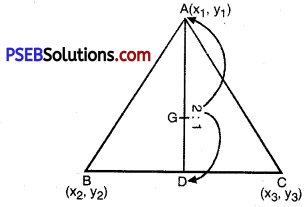
Let AD is median of E, ∆ABC.
∴ D is the mid point of BC then coordinates of D are \(\left(\frac{x_{2}+x_{3}}{2}, \frac{y_{2}+y_{3}}{2}\right)\)

Now, G be the centroid of ABC, which divides the median AD in the ratio 2: 1
∴ Coordinates of G are [using (iv)]

= \(\left[\frac{2\left(\frac{x_{2}+x_{3}}{2}\right)+1\left(x_{1}\right)}{2+1}, \frac{2\left(\frac{y_{2}+y_{3}}{2}\right)+1\left(y_{1}\right)}{2+1}\right]\)

= \(\left[\frac{x_{2}+x_{3}+x_{1}}{3}, \frac{y_{2}+y_{3}+y_{1}}{3}\right]\)

= \(\left[\frac{x_{1}+x_{2}+x_{3}}{3}, \frac{y_{1}+y_{2}+y_{3}}{3}\right]\).

PSEB Solutions PSEB 10th Class Maths Solutions Chapter 7 Coordinate Geometry Ex 7.4

Question 8.
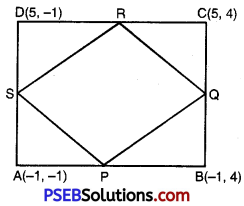
ABCD is a rectangle formed by the points A (- 1, – 1), B (- 1, 4), C (5, 4) and D (5, – 1). P, Q R and S are the mid points
of AB, BC, CD and DA respectively. Is the quadrilateral PQRS a square ? a rectangle? or a rhombus ? Justify your answer.
Solution:
Given: The vertices ot’ given rectangle ABCD are
A(- 1, – 1); B(- 1, 4); C(5, 4) and D (5, – 1).

PSEB 10th Class Maths Solutions Chapter 7 Coordinate Geometry Ex 7.4 12.

∵ P is the mid point of AB.
∴ Coordinates of P are \(\left(\frac{-1-1}{2}, \frac{-1+4}{2}\right)=\left(-1, \frac{3}{2}\right)\)
∵ Q is the mid point of BC.
∴ Co-ordinates of Q are \(\left(\frac{-5+5}{2}, \frac{4+4}{2}\right)\) = (2, 4)
∵ R is the mid point of CD.
∴ Coordinates of R are \(\left(\frac{5+5}{2}, \frac{4+1}{2}\right)=\left(5, \frac{3}{2}\right)\)

∵ S is the mid point of AD.
∴ Co-ordinates of S are \(\left(\frac{5-1}{2}, \frac{-1-1}{2}\right)\) = (2, -1)

PQ = \(\sqrt{(2+1)^{2}+\left(4-\frac{3}{2}\right)^{2}}\)

= \(\sqrt{9 \times \frac{25}{4}}=\sqrt{\frac{36+25}{4}}\)

PQ = \(\sqrt{\frac{61}{4}}\)

QR = \(\sqrt{(5-2)^{2}+\left(\frac{3}{2}-4\right)^{2}}\)

= \(\sqrt{(3)^{2}+\left(\frac{3-8}{2}\right)^{2}}\)

= \(\sqrt{9+\frac{25}{4}}=\sqrt{\frac{36+25}{4}}\)

QR = \(\sqrt{\frac{61}{4}}\)

RS = \(\sqrt{(2-5)^{2}+\left(-1-\frac{3}{2}\right)^{2}}\)

= \(\sqrt{9+\frac{25}{4}}=\sqrt{\frac{36+25}{4}}\)

RS = \(\sqrt{\frac{61}{4}}\)

and SP = \(\sqrt{(-1-2)^{2}+\left(\frac{3}{2}+1\right)^{2}}\)

SP = \(\sqrt{9+\frac{25}{4}}=\sqrt{\frac{61}{4}}\)

Also PR = \(\sqrt{(5+1)^{2}+\left(\frac{3}{2}-\frac{3}{2}\right)^{2}}\)
PR = \(\sqrt{36+0}=\sqrt{36}\) = 6
QS = \(\sqrt{(2-2)^{2}+(4+1)^{2}}\)
= \(\sqrt{0+25}=\sqrt{25}\) = 5.

Form above discussion it is clear that PQ = QR = RS = SP.
Also, PR ≠ QS.
⇒ All sides of quad. PQRS are equal but their diagonals are not equal.
Quad. PQRS is a rhombus.

PSEB 10th Class Maths Solutions Chapter 7 Coordinate Geometry Ex 7.3

Punjab State Board PSEB 10th Class Maths Book Solutions Chapter 7 Coordinate Geometry Ex 7.3 Textbook Exercise Questions and Answers.

PSEB Solutions for Class 10 Maths Chapter 7 Coordinate Geometry Ex 7.3

Question 1.
Find the area of the triangle whose vertices are:
(i) (2, 3); (- 1, 0); (2, – 4)
(ii) (- 5, – 1); (3, – 5); (5, 2)
Solution:
(i) Let vertices of the ∆ABC are A (2, 3); B(- 1, 0) and C (2, – 4)
Here x1 = 2, x2 = – 1 x3 = 2
y1 = 3, y2 = 0, y3 = – 4 .
∴ Area of ∆ABC = \(\frac{1}{2}\) [x1 (y2 – y3) + x2 (y3 – y1) + x3 (y1 – y2)
= \(\frac{1}{2}\) [2 × (0 + 4) – 1 × (- 4 – 3) + 2 × (3 – 0)]
= \(\frac{1}{2}\) [8 + 7 + 6] = \(\frac{21}{2}\)
= 10.5 sq units.

(ii) Let vertices of the ∆ABC are A (- 5, – 1); B (3, – 5) and C (5, 2)
Here x1 = – 5, x2 = 3, x3 = 5
y1 = – 1, y2 = – 5, y3 = 2
∴ Area of ∆ABC = \(\frac{1}{2}\) [x1 (y2 – y3) + x2 (y3 – y1) + x3 (y1 – y2)]
= \(\frac{1}{2}\) [- 5 (- 5 – 2) + 3 (2 + 1) + 5 (- 1 + 5)]
= \(\frac{1}{2}\) [35 + 9 + 20]
= \(\frac{1}{2}\) × 64 = 32 sq units.

PSEB Solutions PSEB 10th Class Maths Solutions Chapter Coordinate Geometry Ex 7.3

Question 2.
In each of the following find the value of ‘k’ for which the points are coimear.
(i) (7, – 2); (5, 1); (3, k)
(ii) (8, 1); (k, – 4); (2, – 5)
Solution:
(i) Let given points be A (7, – 2); B (5, 1) and C (5, k)
Here x1 = 7, x2 = 5, x3 = 3
y1 = – 2, y2 = 1 y3 = k
Three points are collinear iff
\(\frac{1}{2}\) [x1 (y2 – y3) + x2 (y3 – y1) + x3 (y1 – y2)] = 0
or \(\frac{1}{2}\) [7 (1 – k) + 5(k + 2) + 3(- 2 – 1)] = 0
or 7 – 7k + 5k +10 – 9 = 0
or – 2k + 8 = 0
or – 2k = – 8
or – k = \(\frac{-8}{-2}\) = 4 .
Hence k = 4.

(ii) Let given points be A (8, 1); B (k, – 4) and C(2, – 5)
Here x1 = 8 x2 = k, x3 = 2
y1 = 1, y = – 4, y = – 5
Three points are collinear iff
\(\frac{1}{2}\) [x1 (y2 – y3) + x2 (y3 – y1) + x3 (y1 – y2)] = 0
or \(\frac{1}{2}\) [8 (- 4 + 5) + k (- 5 – 1) + 2 (1 + 4) = 0]
or 8 – 6k + 10 = 0
or – 6k = – 18 .
or k = \(\frac{-18}{-6}\) = 3.
Hence k = 3.

PSEB Solutions PSEB 10th Class Maths Solutions Chapter Coordinate Geometry Ex 7.3

Question 3.
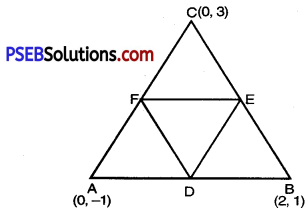
Find the area of the triangle formed by joining the mid-points of the sides of the triangle whose vertices are (0, – 1), (2, 1) and (0, 3). FInd the ratio of the area of the triangle formed to the area of the given triangle.
Solution:
Let vertices of given triangle ABC are A(0, – 1); B (2, 1) and C (0, 3).
Also, D, E, F be the mid points of AB, BC, CA respectively.
Using mid point formula,
Coordinates of D = \(\left(\frac{0+2}{2}, \frac{-1+1}{2}\right)\) = (1, 0)

Coordinates of E = \(\left(\frac{2+0}{2}, \frac{1+3}{2}\right)\) = (1, 2)

Coordinates of F = \(\left(\frac{0+0}{2}, \frac{3-1}{2}\right)\) = (0, 1)

PSEB 10th Class Maths Solutions Chapter 7 Coordinate Geometry Ex 7.3 1

∴ Co-ordinates of the vertices of DEF are D (1, 0); E (1, 2); F (0,1).
Here x1 = 1, x2 = 1, x3 = 0
y1 = 0, y2 = 2, y3 = 1.
Area of ∆DEF = \(\frac{1}{2}\) [x1 (y2 – y3) + x2 (y3 – y1) + x3 (y1 – y2)]
= \(\frac{1}{2}\) [1 (2 – 1) + 1 (1 – 0) + 0 (0 – 2)]
= \(\frac{1}{2}\) [1 + 1 + 0] = \(\frac{2}{2}\) = 1.

In ∆ABC,
x1 = 0, x2 = 2, x3 = 0
y1 = – 1, y2 = 1, y3 = 3.
Area of ∆ABC = \(\frac{1}{2}\) [x1 (y2 – y3) + x2 (y3 – y1) + x3 (y1 – y2)]
= \(\frac{1}{2}\) [0 (1 – 3) + 2 (3 + 1) + 0 (- 1 – 1)]
= \(\frac{1}{2}\) [0 + 8 + 0] = \(\frac{8}{2}\) = 4
Required ratio = \(\frac{\text { Area of } \triangle \mathrm{DEF}}{\text { Area of } \triangle \mathrm{ABC}}\)
= \(\frac{1}{4}\)

PSEB Solutions PSEB 10th Class Maths Solutions Chapter Coordinate Geometry Ex 7.3

Question 4.
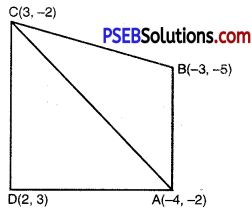
Find the area of the quadrilateral whose vertices taken in order, are (- 4, – 2); (- 3, – 5); (3, – 2); (2, 3).
Solution:
Let co-ordinates of the given quadrilateral ABCD are A(- 4, – 2); B(-3, – 5); C(3, – 2) and D (2, 3).
Join AC then Quad. ABCD divides in two triangles
i.e. ∆ABC and ∆CDA

PSEB 10th Class Maths Solutions Chapter 7 Coordinate Geometry Ex 7.3 3

In ∆ABC
Here x1 = – 4, x2 = – 3, x3 = 3
y1 = – 2, y2 = – 5, y3 = – 2
Area of ∆ABC = \(\frac{1}{2}\) [x1 (y2 – y3) + x2 (y3 – y1) + x3 (y1 – y2)]
= \(\frac{1}{2}\) [- 4 (5 + 2) + (- 3) (- 2 + 2) + 3 (- 2 + 5)]
= \(\frac{1}{2}\) [12 + 0 + 9] = \(\frac{21}{2}\) sq. units.

In ∆CDA
x1 = 3, x2 = 2, x3 = – 4
y1 = – 2, y2 = 3, y3= – 2
Area of ∆CDA = \(\frac{1}{2}\) [x1 (y2 – y3) + x2 (y3 – y1) + x3 (y1 – y2)]
= \(\frac{1}{2}\) [3 (3 + 2) + 2 (- 2 + 2) + (-4) (- 2 – 3)]
= \(\frac{1}{2}\) [20 + 15 + 0] = \(\frac{35}{2}\) sq. units.

Now, Area of quadritateral ABCD = (Area of ∆ABC) + (Area of ∆ACD)
= \(\frac{21}{2}+\frac{35}{2}=\frac{21+35}{2}\)
= \(\frac{56}{2}\) = 28 sq. units.

PSEB Solutions PSEB 10th Class Maths Solutions Chapter Coordinate Geometry Ex 7.3

Question 5.
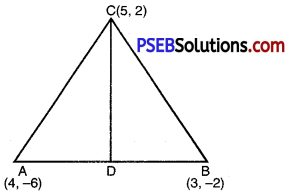
You have studied in Class IX, (Chapter 9, Q. 3) that a median of a triangle divides it into two triangles of equal areas. Verify this result for ∆ABC whose vertices are A(4, – 6), B(3, – 2) and C(5, 2).
Solution:
Given that coordinates of the vertices of ∆ABC are A(4, – 6); B (3, – 2) and C (5, 2)
Let CD is the median i.e. D is the mid point of AB which divides AABC into two pails i.e.

PSEB 10th Class Maths Solutions Chapter 7 Coordinate Geometry Ex 7.3 4

∆ADC and ∆CDB
Coordinates of D = \(\left(\frac{4+3}{2}, \frac{-6-3}{2}\right)\)
= \(\left(\frac{7}{2}, \frac{-8}{2}\right)\) = (3.5,- 4).

In ∆ADC
x1 = 4, x2 = 3.5, x3 = 5
y1 = – 6, y2 = -4, y3 = 2
Area of ∆ADC = \(\frac{1}{2}\) [x1 (y2 – y3) + x2 (y3 – y1) + x3 (y1 – y2)]
= \(\frac{1}{2}\) [4(—4—2)+3.5(2+6)÷5(—6+4)]
= \(\frac{1}{2}\) [- 24 + 28 – 101]
= \(\frac{1}{2}\) × -6
= 3 sq. units (∵ area cannot be negative).

In ∆CDB
x = 5, x = 35, x = 3
y = 2, y = – 4, y = – 2
Area of ∆CDB = \(\frac{1}{2}\) [x1 (y2 – y3) + x2 (y3 – y1) + x3 (y1 – y2)]
= \(\frac{1}{2}\) [5 (- 4 + 2) + 3.5 (- 2 – 2) + 3 (2 + 4)]
= \(\frac{1}{2}\) [- 10 – 14 + 18]
= \(\frac{1}{2}\) × – 6 = – 3
= 3 sq. units(∵ area cannot be negalive)
From above discussion it is clear that area of ∆ADC = area of ∆CDB = 3 sq. units
Hence, a median of a triangle divides it into two triangles of equal areas.

PSEB 9th Class Maths Solutions Chapter 14 Statistics Ex 14.2

Punjab State Board PSEB 9th Class Maths Book Solutions Chapter 14 Statistics Ex 14.2 Textbook Exercise Questions and Answers.

PSEB Solutions for Class 9 Maths Chapter 14 Statistics Ex 14.2

Question 1.
The blood groups of 30 students of Class VIII are recorded as follows:
A, B, O, O, AB, O, A, O, B, A, O, B, A, O, O,
A, AB, O, A, A, O, O, AB, B, A, O, B, A, B, O.
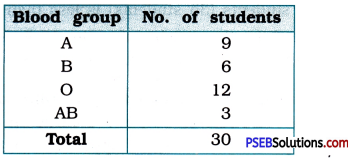
Represent this data in the form of a frequency distribution table. Which is the most common, and which is the rarest, blood group among these students ?
Answer:
Frequency distribution table
PSEB 9th Class Maths Solutions Chapter 14 Statistics Ex 14.2 1
From the frequency distribution table, it is very clear that the most common blood group is O and the rarest blood group is AB.

PSEB 9th Class Maths Solutions Chapter 14 Statistics Ex 14.2

Question 2.
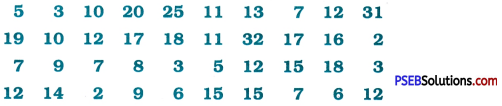
The distance (in km) of 40 engineers from their residence to their place of work were found as follows:
PSEB 9th Class Maths Solutions Chapter 14 Statistics Ex 14.2 2
Construct a grouped frequency distribution table with class size 5 for the data given above taking the first interval as 0-5 (5 not included). What main features do you observe from this tabular representation?
Answer:
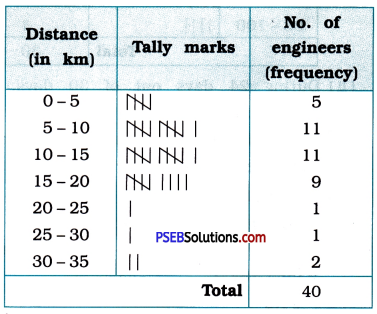
Grouped frequency distribution table
PSEB 9th Class Maths Solutions Chapter 14 Statistics Ex 14.2 3
From the frequency distribution table, we can conclude that for the majority of engineers, s i.e., 31 engineers, the distance from their residence to their place to work is 5 km or more than 5 km but less than 20 km. For some engineers, i.e., 5 engineers, this distance is less than 5 km. Still, for some engineers, i.e., 4 engineers, this distance is 20 km or more than 20 km but less than 35 km.

PSEB 9th Class Maths Solutions Chapter 14 Statistics Ex 14.2

Question 3.
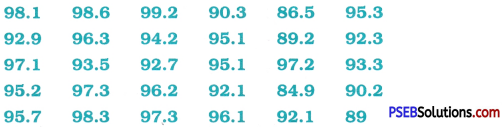
The relative humidity (in %) of a certain city for a month of 30 days was as follows:
PSEB 9th Class Maths Solutions Chapter 14 Statistics Ex 14.2 4
(i) Construct a grouped frequency distribution table with classes 84-86, 86 – 88, etc.
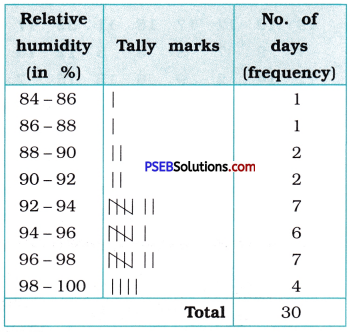
Answer:
PSEB 9th Class Maths Solutions Chapter 14 Statistics Ex 14.2 5

(ii) Which month or season do you think this data is about ?
Answer:
During 24 days out of 30 days, the relative humidity is 92 % or more than 92 %. This suggests that the data must have been collected during Monsoon.

(iii) What is the range of this data ?
Answer:
Range of the data
= The greatest observation – The least observation
= 99.2 – 84.9
= 14.3

PSEB 9th Class Maths Solutions Chapter 14 Statistics Ex 14.2

Question 4.
The heights of 50 students, measured to the nearest centimetres, have been found to be as follows:
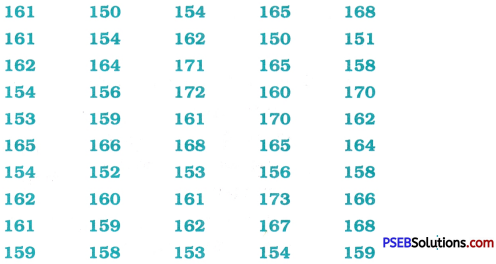
PSEB 9th Class Maths Solutions Chapter 14 Statistics Ex 14.2 6

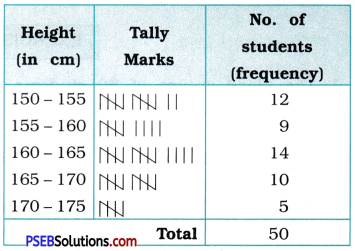
(i) Represent the data given above by grouped frequency distribution table, taking the class intervals as 160 – 165, 165-170, etc.
Answer:
Grouped frequency distribution table
PSEB 9th Class Maths Solutions Chapter 14 Statistics Ex 14.2 7

PSEB 9th Class Maths Solutions Chapter 14 Statistics Ex 14.2

(ii) What can you conclude about their heights from the table?
Answer:
From the above frequency distribution, we can conclude that the height of 70 % students (35 students) is less than 165 cm while the height of only 10 % students (5 students) is 170 cm or more than that.

Question 5.
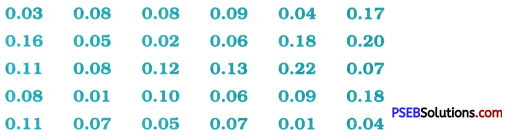
A study was conducted to find out the concentration of sulphur dioxide in the air in parts per million (ppm) of a certain city. The data obtained for 30 days is as follows :
PSEB 9th Class Maths Solutions Chapter 14 Statistics Ex 14.2 8

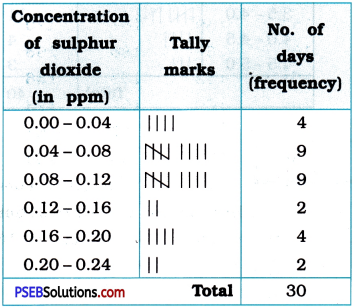
(i) Make a grouped frequency distribution table for this data with class intervals as 0.00-0.04, 0.04-0.08, and so on.
Answer:
PSEB 9th Class Maths Solutions Chapter 14 Statistics Ex 14.2 9

PSEB 9th Class Maths Solutions Chapter 14 Statistics Ex 14.2

(ii) For how many days, was the concentration of sulphur dioxide more than 0.11 parts per million?
Answer:
The concentration of sulphur dioxide was more than 0.11 ppm for 8 days (2 + 4 + 2).

Question 6.
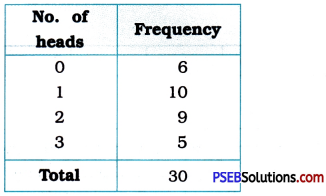
Three coins were tossed 30 times simultaneously. Each time the number of heads occurring was noted down as follows:
PSEB 9th Class Maths Solutions Chapter 14 Statistics Ex 14.2 10
Prepare a frequency distribution table for the data given above.
Answer:
PSEB 9th Class Maths Solutions Chapter 14 Statistics Ex 14.2 11

PSEB 9th Class Maths Solutions Chapter 14 Statistics Ex 14.2

Question 7.
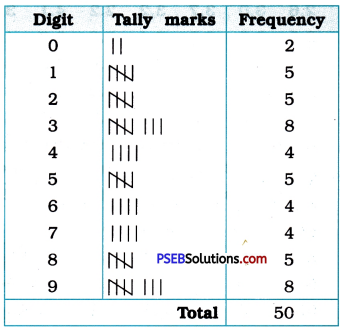
The value of π up to 50 decimal places is given below:
3.1415926535897932384626433832795028 8419716939937510
(i) Make a frequency distribution of the digits from 0 to 9 after the decimal point.
Answer:
Frequency distribution table
PSEB 9th Class Maths Solutions Chapter 14 Statistics Ex 14.2 12

(ii) Which are the most and the least frequently occurring digits?
Answer:
The most frequently occurring digits are 3 and 9 (8 times each) and the least occurring digit is 0 (2 times).

PSEB 9th Class Maths Solutions Chapter 14 Statistics Ex 14.2

Question 8.
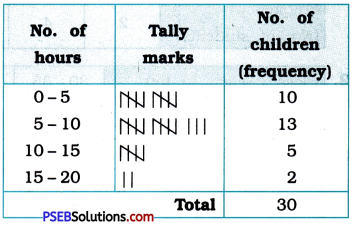
Thirty children were asked about the number of hours they watched TV programmes in the previous week. The results were found as follows:
PSEB 9th Class Maths Solutions Chapter 14 Statistics Ex 14.2 13
(i) Make a grouped frequency distribution table for this data, taking class width 5 and one of the class intervals as 5-10.
Answer:
PSEB 9th Class Maths Solutions Chapter 14 Statistics Ex 14.2 14

(ii) How many children watched television for 15 or more hours a week?
Answer:
Two children watched television for 15 or more hours a week.

PSEB 9th Class Maths Solutions Chapter 14 Statistics Ex 14.2

Question 9.
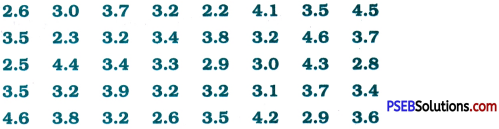
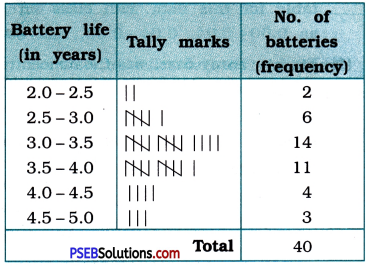
A company manufactures car batteries of a Grouped frequency distribution table particular type. The lives (in years) of 40 such batteries were recorded as follows
PSEB 9th Class Maths Solutions Chapter 14 Statistics Ex 14.2 15
Construct a grouped frequency distribution table for this data, using class intervals of size 0.5 starting from the interval 2 – 2.5.
Answer:
PSEB 9th Class Maths Solutions Chapter 14 Statistics Ex 14.2 16

PSEB 9th Class Maths Solutions Chapter 14 Statistics Ex 14.1

Punjab State Board PSEB 9th Class Maths Book Solutions Chapter 14 Statistics Ex 14.1 Textbook Exercise Questions and Answers.

PSEB Solutions for Class 9 Maths Chapter 14 Statistics Ex 14.1

Question 1.
Give five examples of data that you can collect from your day-to-day life.
Answer:
Five examples of data that can be collected from day-to-day life can be given as below:

  1. Election results obtained from newspapers or TV
  2. The number of different kinds of trees grown in our school.
  3. Amounts of invoices of electricity for last one year at our home.
  4. The number of students studying in different standards of our school.
  5. Percentage of marks scored at last examination by the students in our class.

PSEB 9th Class Maths Solutions Chapter 14 Statistics Ex 14.1

Question 2.
Classify the data in Q. 1 above as primary or secondary data.
Answer:
Among the five data given as the answer to Q. 1, data no.

Primary data:

  • The number of different kinds of trees grown in our school.
  • Amounts of invoices of electricity for last one year at our home.
  • Percentage of marks scored at last examination by the students in our class.
  • primary data which we can collect ourselves.

Secondary data:

  • Election results obtained from newspapers or TV
  • The number of students studying in different standards of our school.
  • Secondary data as they are received from the sources of the newspapers or TV or the office of our school.

PSEB 9th Class Maths MCQ Chapter 13 Surface Areas and Volumes

Punjab State Board PSEB 9th Class Maths Book Solutions Chapter 13 Surface Areas and Volumes MCQ Questions with Answers.

PSEB 9th Class Maths Chapter 13 Surface Areas and Volumes MCQ Questions

Multiple Choice Questions and Answer

Answer each question by selecting the proper alternative from those given below each question to make the statement true:

Question 1.
The total surface area of a cuboid with length 20 cm, breadth 15 cm and height 10 cm is
A. 1300
B. 650
C. 3000
D. 1500
Answer:
A. 1300

PSEB 9th Class Maths MCQ Chapter 13 Surface Areas and Volumes

Question 2.
The lateral surface area of a cuboid with length 15 cm, breadth 8 cm and height 5 cm is ………………. cm2.
A. 115
B. 230
C. 600
D. 300
Answer:
B. 230

Question 3.
The diameter of a cylinder is 7 cm and its curved surface area is 220 cm2. Then, its height is ……………….. cm.
A. 35
B. 10
C. 44
D. 20
Answer:
B. 10

PSEB 9th Class Maths MCQ Chapter 13 Surface Areas and Volumes

Question 4.
The total surface area of a closed cylinder with radius 3.5 cm and height 6.5 cm is ………………… cm2.
A. 110
B. 220
C. 330
D. 440
Answer:
B. 220

Question 5.
The curved surface area of a cone is 880 cm2. If its slant height is 20 cm, then its diameter is …………………… cm.
A. 14
B. 7
C. 3.5
D. 28
Answer:
D. 28

Question 6.
The curved surface area of a cone with diameter 14 cm and slant height 10 cm is ………………. cm2.
A. 220
B. 1540
C. 110
D. 440
Answer:
A. 220

PSEB 9th Class Maths MCQ Chapter 13 Surface Areas and Volumes

Question 7.
The height of a cone is 24 cm and its slant height is 25 cm. Then, its diameter is ………………. cm.
A. 14
B. 7
C. 4
D. 49
Answer:
A. 14

Question 8.
The circumference of the base of a cone is 44 cm and its slant height is 15 cm. Then, its curved surface area is ……………….. cm2.
A. 14
B. 154
C. 330
D. 115
Answer:
C. 330

PSEB 9th Class Maths MCQ Chapter 13 Surface Areas and Volumes

Question 9.
The diameter of a cone is 7 cm and its slant ! height is 16.5 cm. Then, its total surface area is …………………. cm2.
A. 110
B. 220
C. 105
D. 154
Answer:
B. 220

Question 10.
Total surface area of a hemisphere with radius 7 cm is ………………….. cm2.
A. 231
B. 115.5
C. 462
D. 154
Answer:
C. 462

Question 11.
Total surface area of a hemisphere is 72 cm2.
Then, its curved surface area is ………………….. cm2.
A. 24
B. 36
C. 48
D. 72
Answer:
C. 48

PSEB 9th Class Maths MCQ Chapter 13 Surface Areas and Volumes

Question 12.
The surface area of a sphere is 616 cm2.
Then, its radius is ……………. cm.
A. 6
B. 8
C. 7
D. 14
Answer:
C. 7

Question 13.
In a cuboid, the area of the face with sides length and breadth is 120 cm2. If the height of the cuboid is 5 cm, then its volume is …………………… cm3
A. 120
B. 240
C. 600
D. 300
Answer:
C. 600

PSEB 9th Class Maths MCQ Chapter 13 Surface Areas and Volumes

Question 14.
The volume of a cylinder is 2200 cm3 and its height is 7 cm. Then, the radius of the cylinder is ……………….. cm.
A. 5
B. 15
C. 10
D. 20
Answer:
C. 10

Question 15.
The radius and height of a cone are 7 cm and 3 cm respectively. Then, the volume of the cone is ……………… cm3.
A. 154
B. 168
C. 148
D. 462
Answer:
A. 154

PSEB 9th Class Maths MCQ Chapter 13 Surface Areas and Volumes

Question 16.
The volume of a sphere is 4.5 π cm3. Then, its diameter is …………………. cm.
A. 3
B. 2
C. 1.5
D. 4
Answer:
A. 3

Question 17.
The ratio of radii of two cones is 2 : 3 and the ratio of their heights is 9:4. Then, the ratio of their volumes is
A. 1 : 1
B. 3 : 2
C. 1 : 3
D. 2 : 3
Answer:
A. 1 : 1

PSEB 9th Class Maths MCQ Chapter 13 Surface Areas and Volumes

Question 18.
The circumference of the base of a cone is 44 cm and its height is 6 cm. Then, its volume is ………………… cm3.
A. 49
B. 98
C. 308
D. 154
Answer:
C. 308

PSEB 7th Class Maths MCQ Chapter 15 Visualising Solid

Punjab State Board PSEB 7th Class Maths Book Solutions Chapter 15 Visualising Solid MCQ Questions with Answers.

PSEB 7th Class Maths Chapter 15 Visualising Solid MCQ Questions

Multiple Choice Questions

Question 1.
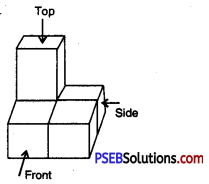
Identify the side view for the given solid.
PSEB 7th Class Maths MCQ Chapter 15 Visualising Solid 1
(a)
PSEB 7th Class Maths MCQ Chapter 15 Visualising Solid 2
(b)
PSEB 7th Class Maths MCQ Chapter 15 Visualising Solid 3
(c)
PSEB 7th Class Maths MCQ Chapter 15 Visualising Solid 4
(d) None of these.
Answer:
(a)
PSEB 7th Class Maths MCQ Chapter 15 Visualising Solid 7

PSEB 7th Class Maths MCQ Chapter 15 Visualising Solid

Question 2.
Identify the front view for the given solid.
PSEB 7th Class Maths MCQ Chapter 15 Visualising Solid 5
PSEB 7th Class Maths MCQ Chapter 15 Visualising Solid 6
(d) None of these.
Answer:
PSEB 7th Class Maths MCQ Chapter 15 Visualising Solid 8

Fill in the blanks :

Question 1.
The name of the figure PSEB 7th Class Maths MCQ Chapter 15 Visualising Solid 9 is ……………..
Answer:
Cone

Question 2.
The number of edges of a cube are ……………..
Answer:
12

Question 3.
The number of faces of a cuboid are ……………..
Answer:
6

PSEB 7th Class Maths MCQ Chapter 15 Visualising Solid

Question 4.
Opposite faces of a die always have a total of …………….. dots on there.
Answer:
7

Question 5.
The number of corners of a cube are ……………..
Answer:
8

Write True or False :

Question 1.
Cube is solid figure.
Answer:
True

Question 2.
Plane figure has three dimensions.
Answer:
False

PSEB 7th Class Maths MCQ Chapter 15 Visualising Solid

Question 3.
Rectangle is a plane figure.
Answer:
True

Question 4.
A cylinder has two flat surfaces.
Answer:
True

Question 5.
A cube has twelve edges.
Answer:
True

PSEB 8th Class English Grammar Translation

Punjab State Board PSEB 8th Class English Book Solutions English Grammar Translation Exercise Questions and Answers, Notes.

PSEB 8th Class English Grammar Translation

1. अपना बस्ता खोलो। – Open your bag.
2. अपना नाम बताओ। – Tell our name.
3. बातें मत करो। – Dont’t talk.

PSEB 8th Class English Grammar Translation

4. बुरी संगत से बचो। – Avoid bad company.
5. बड़ों का कहना मानो। – Obey your elders.
6. कूड़ा मत बिखराओ। – Don’t spread the litter.
7. अपने हाथ ऊपर उठाओ। – Hands up.
8. कभी झूठ मत बोलो। – Never tell a lie.
9. अपना काम पूरा करो। – Complete your work.
10. अपनी त्रुटियों को सुधारो। – Mend/Correct your mistakes.
11. मैं थका हुआ हूँ। – I am tired.
12. वह मूर्ख नहीं है। – He is not foolish.
13. मेरे माता-पिता जी शिक्षक हैं। – My parents are teachers.
14. हम भारतीय हैं। – We are Indians.
15. उसकी बहन बहुत बुद्धिमान है। – His/Her sister is very wise.
16. मुझे आप पर गर्व है। – I am proud of you.
17. पानी साफ है। – Water is clean.
18. वह बहुत स्वार्थी है। – He is very selfish.
19. घास हरी-भरी है। – Grass is green.
20. मैं आज स्वस्थ महसूस नहीं कर रहा हूँ। – I am not feeling well today.
21. मैं रोज़ स्कूल जाता हूँ। – I go to school daily.
22. मेरे माता जी स्वादिष्ट भोजन बनाते हैं। – My mother cooks tasty food.
23. सभी ने पाठ याद कर लिया है। – All have learnt their lesson.
24. मैंने अपना जन्मदिन मनाया। – I celebrated my birthday.
25. मेरे पिता जी बाज़ार जाएंगे। – My father will go to the market.
26. भगवान मेरी मदद करेगा। – God will help me.
27. वह तेज़ दौड़ रहा है। – He is running fast.
28. चपरासी घंटी नहीं बजा रहा है। – The peon is not ringing the bell.
29. छात्र पढ़ रहे होंगे। – The students will be studying.
30. किसान आराम नहीं कर रहे होंगे। – The farmers will not be taking rest.
31. सुशील ने अपना काम कर लिया है। – Susheel has done his work.
32. मेरे शिक्षक ने कापी चैक कर ली है। – The teacher has checked my notebook.
33. लड़कों ने कुर्सी नहीं तोड़ी है। – The boys have not broken the chair.
34. मुझे एक नौकरी मिल गई है। – I have got a job.
35. किसी ने मुझे बुलाया है। – Someone has called me.
36. मोहन ने एक गीत गाया है। – Mohan has sung a song.
37. लड़कियां कक्षा में चली गई हैं। – The girls have gone into the class.

PSEB 8th Class English Grammar Translation

38. पुलिस ने चोर को नहीं पकड़ा है। – The police have not caught the thief.
39. वह इस वर्ष पास नहीं हुआ है। – He has not passed this year.
40. मेरे चाचा जी ने मुझे तोहफे में घड़ी दी। – My uncle gave me a watch as a gift.
41. उसने सच नहीं बोला। – He did not speak the truth.
42. मुझे उस दिन बुखार था। – I was ill that day.
43. हमने डॉक्टर को बुला लिया था। – We had called in the doctor.
44. बूढ़े व्यक्ति ने घर बनाया। – The old man built a house.
45. हम बहुत मज़ा कर चुके थे। – We had a lot of fun.
46. सुधा ने खेल खेला था। – Sudha had played a game.
47. मेरी सहेली ने मेरी मदद की थी। – My friend had helped me.
48. बिल्ली ने दूध नहीं पिया। – The cat had not drunk milk.
49. सोनू ने आपको धक्का नहीं दिया था। – Sonu had not pushed you.
50. दादी ने अच्छी कहानी सुनाई। – The grandmother had told a good story.
51. आप कहाँ रहते हो? – Where do you live?
52. आपने झूठ क्यों बोला? – Why did you tell a lie?
53. आपने अपनी छुट्टी कहां बिताई? – Where did you pass your holiday.
54. कक्षा में कौन था? – Who was in the class?
55. आपका घनिष्ठ मित्र कौन है? – Who is your fast friend?
56. अध्यापिका ने क्या पढ़ाया? – What did the teacher teach?
57. उसने उत्तर क्यों नहीं दिया? – Why did he/she not reply?
58. आप कहाँ जा रहे हो? – Where are you going?
59. आप शोर क्यों मचा रहे हैं? – Why are you making a noise?
60. आप कब आ रहे हो? – When are you coming?
61. आप पुस्तक कब पढ़ रहे थे? – When were you reading the book?
62. आप कल क्या कर रहे थे? – What were you doing yesterday?
63. आप काम कब करोगे? – When will you do the work?
64. वह सवाल कैसे हल करेगी? – How will she solve the sum?
65. अब आप कहां जाओगे? – Where will you go now?
66. वह पार्टी पर क्यों नहीं आएगी? – Why will she not attend the party?
67. क्या आपने उत्तर लिख लिया है? – Have you written the answer?
68. क्या उसने पाठ याद कर लिया है? – Has he learnt the lesson?
69. उसने अपना घर क्यों बेच दिया? – Why did he sell his house?

PSEB 8th Class English Grammar Translation

70. क्या उन्होंने मैच जीत लिया था? – Had they won the match?
71. वह परीक्षा में किस तरह पास हो गया? – How did he pass the test?
72. क्या मैं अन्दर आ सकता हूँ? – May I come in?
73. क्या मैं बाहर जा सकता है। – May I go out?
74. क्या वह तैर सकती है? – Can she swim?
75. क्या मैं अब जा सकता हूँ? – May I go now?
76. अपने हाथ हमें भोजन से पहले धोने चाहिए। – We should wash our hands before meal.
77. मुझे अब सोना चाहिए। – I should go to bed now.
78. परिश्रम करो नहीं तो आप फेल हो जाओगे। – Work hard otherswise you will fail.
79. कृपया करके पृष्ठ पलटो। – Please turn the page.
80. शाबाश! आपने बहुत बढ़िया किया। – Well done!

PSEB 8th Class English Grammar Formation of Adverb

Punjab State Board PSEB 8th Class English Book Solutions English Grammar Formation of Adverb Exercise Questions and Answers, Notes.

PSEB 8th Class English Grammar Formation of Adverb

Word – Adverb
Able – ably
Abrupt – Abruptly
Accident – Accidently
Active – Actively
Actual – Actually
Anger – Angrily
Annual – Annually
Awful – Awfully
Bad – Badly
Basic – Basically
Busy – Busily
Brief – Briefly
Bold – Boldly
Clear – Clearly
Close – Closly
Calm – Calmly
Certain – Certainly
Comfort – Comfortably

PSEB 8th Class English Grammar Formation of Adverb

Dear – Dearly
Dead – Deadly
Easy – Easily
Different – Differently
Equal – Equally
Fair – Fairly
Entire – Entirely
Quiet – Quietly
Real – Reality
Rude – Rudely
Safe – Safely
Warm – Warmly
Virtual – Virtually
right – Tighdy
Tender – Tenderly
Wild – Wildly