PSEB 7th Class English Vocabulary Synonyms

Punjab State Board PSEB 7th Class English Book Solutions English Vocabulary Synonyms Exercise Questions and Answers, Notes.

PSEB 7th Class English Vocabulary Synonyms

A Synonyms is a word which is same in meaning (एक समान अर्थ) to another word; as-

Word – Synonym

auspicious – happy/lucky
alive – lively
along – side by side
aim – objective
beautiful – pretty

PSEB 7th Class English Vocabulary Synonyms

bow – to bend
blaze – fire
believe – trust
banks – shores
courtier – a member of a royal court
comer – end point of some place
crack – rift
complete – full
cultural – traditional
celebrate – to hold make merry
deep – far-down
deities – gods/goddesses
diamond – a precious stone
dawn – morning
expect – hope
energy – power
famous – well-known
false – untrue
fright – panic, threaten
fervous – zeal
glance – look
gentle – kind
grey – brown
handsome – smart
honest – truthful
immobile – stationary
mounds – heaps/piles
nice – fine
overcome – win over
peace – calmness
patience – toleration
prepared – ready
paddy – rice crop
real – genuine
strong – tough
slumber – sound sleep
sight – scene
slightly – a little
stout – well built/strong
silent – quiet, motionless

PSEB 7th Class English Vocabulary Synonyms

smooth – plain
stuck – got busy
to pass – to move onward
tiny – little
together – along with
tense – nervous
trade – business
tribal – related to a tribe
ugly – bad looking
woods – jungle

PSEB 7th Class English Vocabulary Antonyms

Punjab State Board PSEB 7th Class English Book Solutions English Vocabulary Antonyms Exercise Questions and Answers, Notes.

PSEB 7th Class English Vocabulary Antonyms

An Antonym is a word which is opposite in meaning to another word; as

Word – Antonym

departure – arrival
ugly – beautiful
after – before

PSEB 7th Class English Vocabulary Antonyms

white – black
big – small
break – make
begin – end
buy – sell
complete – incomplete
clean – dirty
come – go
cruel – kind
cool – warm
catch – throw
care – neglect
calm – noisy
dawn – dusk
day – night
earth – sky
east – west
friend – enemy
front – behind
first – last
found – lost
give – take
good – bad
hate – love
here – there
hide – seek
happy – sad
hot – cold
in – out
late – early
love – hate
long – short
land – water
morning – evening
many – few
now – then
near – far
new – old
open – close
obey – disobey
proud – humble
push – pull
pretty – ugly
rich – poor
right – wrong/left
some – many
sit – stand
soon – late

PSEB 7th Class English Vocabulary Antonyms

tall – short
top – bottom
up – down
virtue – vice
wild – pet/domestic
win – lose
weak – strong

PSEB 7th Class English Grammar Verb (Conjugation)

Punjab State Board PSEB 7th Class English Book Solutions English Grammar Verb (Conjugation) Exercise Questions and Answers, Notes.

PSEB 7th Class English Grammar Verb (Conjugation)

वे शब्द जो किसी क्रिया (action) को व्यकत करते हैं, Verbs कहलाते हैं। Verbs दो प्रकार के होते हैं- Main Verbs (मुख्य क्रियाएं) तथा helping verbs (सहायक क्रियाएं)

नीचे लिखे वाक्यों को पढ़िए:

  1. Dev is sleeping.
  2. Geeta made a doll.
  3. They laughed.
  4. The girls are going out.
  5. Our team will play a match.

ऊपर दिए गए वाक्यों में sleeping, made, laughed, going तथा play मुख्य क्रियाएं (Main verbs) है। परन्तु is, are, will सहायक क्रियाएं (Helping Verbs) हैं। वे मुख्य क्रियाओं की सहायता करती हैं।
सहायक क्रियाएं निम्नलिखित हैं:
Is, am, are, was, were, has, have, had, do, does, did, will, would, shall, should, can, could, may, might, must, ought to, need, dare, used to.

PSEB 7th Class English Grammar Verb (Conjugation)

Exercises

I. Pick out the helping verbs in the following sentences.

1. I have found a bag.
2. Where were you going yesterday ?
3. I am learning to swim.
4. He has lost his book.
5. You may go out now.
6. I will bring an orange for you.
7. They are cutting the hedge.
8. Where do you live?
9. I shall give you some money.
10. You can go now.
Hints:
1. have
2. were
3. am
4. has
5. may
6. will
7. are
8. do
9. shall
10. can.

II. Fill in the blanks with suitable helping verbs:

1. The teacher…………. not punish the whole class.
2. We………….go for a picnic tomorrow.
3. Where………….. the books kept ?
4. Who………….stolen my money?
5. Which games…………played in school ?
6. The winner…………..receive a prize from the chief guest.
7. …………you seen the Taj Mahal ?
8. When…………..your tutor come to teach you ?
9. Ravi…………go to London or America for his holidays.
10. ………….I help you with your problems ?

PSEB 7th Class English Grammar Verb (Conjugation)

Hints:
1. did
2. shall
3. were
4. has
5. are
6. will
7. Have
8. does
9. will
10. May.

PSEB 7th Class English Grammar Translation

Punjab State Board PSEB 7th Class English Book Solutions English Grammar Translation Exercise Questions and Answers, Notes.

PSEB 7th Class English Grammar Translation

Present Indefinite Tense

1. मैं स्कूल जाता हूँ। – I go to school.
2. बच्चे खेलते हैं। – Children play.
3. माता जी खाना बनाते हैं। – Mother cooks food.
4. लड़के खेलते हैं। – Boys play.
5. मोहित दांत साफ़ करता है। – Mohit brushes his teeth.

PSEB 7th Class English Grammar Translation

Present Indefinite Tense (Interrogative)

1. क्या आप स्कूल जाते हैं ? – Do you go to school ?
2. आप क्या चाहते हो ? – What do you want ?
3. आप देर से क्यों आते हो ? – Why do you come late ?
4. आप कहाँ रहते हो। – Where do you live?
5. आपका स्कूल कब लगता है ? – When does your school start ?

Present Indefinite Tense (Negative)

1. रोहित झूठ नहीं बोलता है। – Rohit does not tell lies.
2. मैं खाना बेकार नहीं करता हूँ। – I don’t waste food.
3. आप गाना नहीं गाते हो। – You do not sing a song.
4. समय किसी के लिए भी नहीं रूकता है। – Time does not wait for anyone.
5. हम स्कूल लेट नहीं जाते। – We do not go to school late.

Past Indefinite Tense

1. मैं स्कूल गया। – I went to school.
2. आपने खाना खाया। – You took food.
3. मेरी माता जी ने भोजन बनाया। – My mother cooked food.
4. मैंने कल पाठ याद किया। – I learnt my lesson yesterday.
5. चपरासी ने घंटी बजाई। – The peon rang the bell.

Past Indefinite Tense (Interrogative)

1. क्या आप कल स्कूल गए थे ? – Did you go to school yesterday ?
2. आप कल कितने बजे बाज़ार गए थे ? – At what time did you go to the market yesterday ?
3. आप कल देर से क्यों आए ? – Why did you come late yesterday ?
4. उन्होंने मेरी बात क्यों नहीं सुनी ? – Why did they not listen to me ?
5. उषा ने खाना कब बनाया। – When did Usha cook food ?

Past Indefinite Tense (Negative)

1. मैंने झूठ नहीं बोला। – I did not tell a lie.
2. शरन ने दवाई नहीं ली। – Sharan did not take medicine.
3. रचना ने कसरत नहीं की। – Rachna did not take excercise.
4. भारत ने मन नहीं हारा। – Bharat did not lose heart.
5. चपरासी ने घंटी नहीं बजाई। – The poen did not ring the bell.

Future Indefinite Tense

1. कल बरसात होगी। – It will rain tomorrow.
2. मैं कल स्कूल आऊँगा। – I will come to school tomorrow.
3. वह कल दिल्ली जाएगा। – He will go to Delhi tomorrow.
4. आप कल रमेश से मिलोगे। – You will meet Ramesh tomorrow.
5. रमन कल मुझे ई-मेल करेगा। – Raman will send me an e-mail tomorrow.

PSEB 7th Class English Grammar Translation

Future Indefinite Tense (Negative)

1. बच्चे झूठ नहीं बोलेंगे। – The children will not tell lies.
2. पंछी गीत नहीं गाएंगे। – The birds will not sing songs.
3. नांव समुद्र में नहीं डूबेगी। – The boat will not sink in the sea.
4. आज बरसात नहीं होगी। – It will not rain today.
5. आप स्कूल से छुट्टी नहीं करोगे। – You will not take a leave from the school.

Future Indefinite Tense (Interrogative)

1. क्या आप कल मुझे मिलेगें ? – Will you meet me tomorrow ?
2. क्या चित्रकार चित्र बनाएगा ? – Will the painter paint a picture ?
3. क्या वह गाना गाएंगे ? – Will they sing a song ?
4. आप स्कूल कब आएंगे ? – When will you come to school ?
5. आप मेरा काम क्यों नहीं करोगे ? -Why will you not do my work ?

Present Continuous Tense

1. बच्चे पढ़ रहे हैं। – Children are reading.
2. अंजू कार चला रही है। – Anju is driving a car.
3. आपको पसीना आ रहा है। – You are perspiring/sweating.
4. पानी बहुत तेज़ बह रहा है। – Water is running very fast.
5. अध्यापक पढ़ रहा है। – The teacher is teaching.

Present Continuous Tense (Interrogative)

1. क्या पानी तेज़ी से बह रहा है ? – Is the water running fast ?
2. लोग वृक्षों की छाया क्यों ढूंढ़ रहे हैं ? – Why are the people looking for the shade of the trees. ?
3. क्या रानी निशी की मदद कर रही है ? – Is Rani helping Nishi ?
4. मोहन घर कब जा रहा है ? – When is Mohan going home ?
5. उसकी माता कौन-सा खाना बना रही है ? – Which food is her mother cooking ?

Present Continuous Tense (Negative)

1. छोटे बच्चे खाना नहीं खा रहे हैं। – Little children are not eating food.
2. रोहित गाड़ी तेज़ नहीं चला रहा है। – Rohit is not driving fast.
3. सीता अपना काम ठीक नहीं कर रही है। – Sita is not doing her work.
4. बरसात नहीं हो रही है। – It is not raining.
5. मकैनिक कार ठीक नहीं कर रहा है। – Mechanic is not repairing the car.

Past Continuous Tense

1. वह सफलता के लिए प्रार्थना कर रहा था। – He was praying for success.
2. मेरा भाई स्कूल जा रहा था। – My brother was going to school.
3. मां पैसे बचा रही थी। – Mother was saving money.
4. सिमर नई किताब लिख रही थी। – Simar was writing a new book.
5. बरसात हो रही थी। – It was raining.

PSEB 7th Class English Grammar Translation

Past Continuous Tense (Negative)

1. साइकिल तेज़ नहीं चल रही थी। – The bicycle was not running fast.
2. पंछी उड़ नहीं रहे थे। – The birds were not flying.
3. मेरी सहेली गाना नहीं गा रही थी। – My friend was not singing a song.
4. मेरी माता जी गुस्सा नहीं कर रही थी। – My mother was not angry.
5. बच्चे शोर नहीं मचा रहे थे। – The Children were not making a noise.

Past Continuous Tense (Interrogative)

1. क्या सभी अपना पाठ याद कर रहे थे ? – Were all learning their lesson ?
2. पारस अपना जन्मदिन कैसे मना रहा था ? – How was Paras celebrating his birthday ?
3. लेखक कौन सी किताब लिख रहा था ? – Which book was the writer writing ?
4. राकेश घर कब जा रहा होगा ? – When was Rakesh going home ?
5. बरसात कब हो रही थी ? – When was it raining ?

Future Continuous Tense

1. मैं कल बस से दिल्ली जा रहा होगा। – I will be going to Delhi by bus tomorrow.
2. मेरे माता जी इस वक्त खाना बना रहे होंगे। – My mother will be cooking food at this time.
3. प्रीति गाना गा रही होगी। – Preeti will be singing a song.
4. रचित फिल्म देख रहा होगा। – Rachit will be watching a movie.
5. कल मनजीत पेपर दे रहा होगा। – Manjeet will be taking a test tomorrow.

Future Continuous Tense (Negative)

1. अगले सप्ताह किसान फ़सल नहीं काट रहा होगा। – The farmer will not be reaping the crop next week.
2. परीक्षा के दौरान हम टी०वी० नहीं देख रहे होंगे। – We were not watching T.V. during the examinations.
3. मुस्कान शाम के समय चाय नहीं पी रही होगी। – Muskan will not be taking tea in the evening.
4. वह घर नहीं जा रही होगी। – She will not be going home.
5. बच्चा इस समय सो नहीं रहा होगा। – The child will not be sleeping by this time.

Future Continuous Tense (Interrogative)

1. गुरमुख शाम का क्या कर रहा होगा ? – What will he be doing in the evening ?
2. क्या कल सुबह सोनू पढ़ रहा होगा ? – Will Sonu be reading in the morning tomorrow ?
3. क्या नरेश नई किताब खरीद रहा होगा ? – Will Naresh be buying new book ?
4. क्या सोनू क्रिकेट खेल रहा होगा ? – Will Sonu playing cricket ?
5. निशी शाम को घर कैसे जा रही होगी ? – How will Nishi going home in the evening ?

PSEB 7th Class English Grammar Translation

Other Sentences

1. मेरा बात सुनो। – Listen to me.
2. विनम्रता से बात करो। – Speak gently.
3. अपनी किताब मुझे दो। – Give me your book.
4. एक-दूसरे को धक्का ना मारो। – Don’t push one another.
5. आपस में मत झगड़ो। – Don’t quarrel among yourselves.
6. वह आदमी अमीर है। – That man is rich.
7. चाय गर्म है। – Tea is hot.
8. वह घर सुन्दर है। – That house is beautiful.
9. वह अच्छा अध्यापक है। – He is a good teacher.
10. धरती सूर्य के इर्द-गिर्द घूमती है। – The earth moves around the Sun.

PSEB 7th Class Maths Solutions Chapter 10 Practical Geometry Ex 10.3

Punjab State Board PSEB 7th Class Maths Book Solutions Chapter 10 Practical Geometry Ex 10.3 Textbook Exercise Questions and Answers.

PSEB Solutions for Class 7 Maths Chapter 10 Practical Geometry Ex 10.3

1. Construct ΔABC such that AB = 4 cm, ∠B = 30°, BC = 4 cm. Also name the type of triangle on the basis of sides.
Solution:
Given : Two sides of ΔABC as AB = 4 cm, BC = 4 cm and ∠B = 30°.
To construct: A triangle with these two sides and included angle.
Step of Construction :
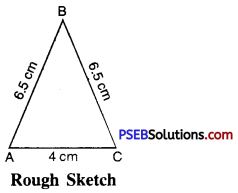
Step 1. We first draw a rough sketch of the ΔABC and indicate the measure of these two sides and included angle.
PSEB 7th Class Maths Solutions Chapter 10 Practical Geometry Ex 10.3 1
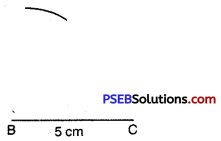
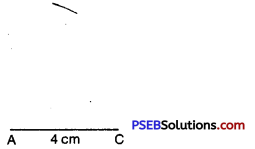
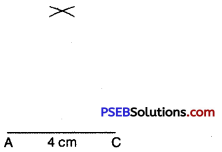
Step 2. Draw a line segment BC of length 4 cm.
PSEB 7th Class Maths Solutions Chapter 10 Practical Geometry Ex 10.3 2
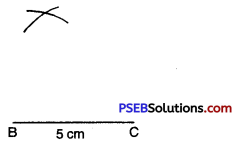
Step 3. At B draw BX making an angle of 30° with BC (The point A must be somewhere on this ray of the angle).
PSEB 7th Class Maths Solutions Chapter 10 Practical Geometry Ex 10.3 3
Step 4. (To fix A, the distance AB has been given) With B as centre, draw an arc of radius 3 cm. It cuts BX at the point A.
PSEB 7th Class Maths Solutions Chapter 10 Practical Geometry Ex 10.3 4
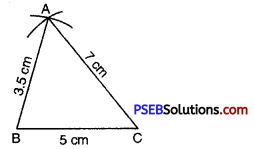
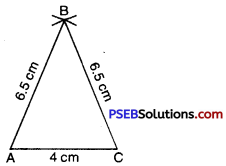
Step 5. Join AC.
ΔDEF is now obtained.
PSEB 7th Class Maths Solutions Chapter 10 Practical Geometry Ex 10.3 5
Since two sides of triangle are equal.
Therefore ΔABC is an isosceles triangle.

PSEB 7th Class Maths Solutions Chapter 10 Practical Geometry Ex 10.3

2. Construct ΔABC with AB = 7.5 cm, BC = 5 cm and ∠B = 30°.
Solution:
Given. Two sides of ΔABC as AB = 7.5 cm,
BC = 5 cm
and ∠B = 30°
To construct A triangle with these two sides and included angle.
Steps of Construction.
Step 1. We first draw a rough sketch of the ΔABC and indicate the measures of these two sides and included angle.
PSEB 7th Class Maths Solutions Chapter 10 Practical Geometry Ex 10.3 6
Step 2. Draw a line segment BC of length 5 cm.
PSEB 7th Class Maths Solutions Chapter 10 Practical Geometry Ex 10.3 7
Step 3. At B draw BX making an angle of 30° with BC. (The point A must be somewhere on this ray of the angle)
PSEB 7th Class Maths Solutions Chapter 10 Practical Geometry Ex 10.3 8
Step 4. (To fix A; the distance BC has been given) With B as centre draw an arc of radius 7.5 cm. It cuts CX at the point A.
PSEB 7th Class Maths Solutions Chapter 10 Practical Geometry Ex 10.3 9
Step 5 : Join AC.
ΔABC is now obtained.
PSEB 7th Class Maths Solutions Chapter 10 Practical Geometry Ex 10.3 10

PSEB 7th Class Maths Solutions Chapter 10 Practical Geometry Ex 10.3

3. Construct a triangle XYZ, such that XY = 6 cm, YZ = 6 cm and ∠Y = 60°. Also name the type of this triangle.
Solution:
Step 1. Draw a rough sketch of XYZ with given measures.
PSEB 7th Class Maths Solutions Chapter 10 Practical Geometry Ex 10.3 11
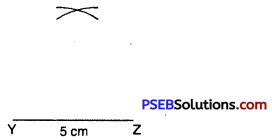
Step 2. Draw a line segment XY of length 6 cm.
PSEB 7th Class Maths Solutions Chapter 10 Practical Geometry Ex 10.3 12
Step 3. With the help of compass, at Y, draw a ray YA making an angle 60°
PSEB 7th Class Maths Solutions Chapter 10 Practical Geometry Ex 10.3 13
Step 4. With Y as centre and radius 6 cm. draw an arc intersecting the ray YX at point Z.
PSEB 7th Class Maths Solutions Chapter 10 Practical Geometry Ex 10.3 14
Step 5. Join XZ.ΔXYZ is required triangle, Measure the third side. We see that ZX = 6 cm
∴ In Δ XYZ
XY = YZ = ZX = 6 cm
Therefore XYZ is an equilateral triangle.
PSEB 7th Class Maths Solutions Chapter 10 Practical Geometry Ex 10.3 15

PSEB 7th Class Maths Solutions Chapter 10 Practical Geometry Ex 10.3

4. Which of the following triangle can be constructed using SAS criterion.
(a) AB = 5 cm, BC = 5 cm, CA = 6 cm
(b) AB = 5 cm, BC = -5 cm, ∠B = 40°
(c) ∠A = 60°, ∠B = 60°, ∠C = 60°
(d) BC = 5 cm, ∠B = ∠C = 45°
Answer:
(b) AB = 5 cm, BC = -5 cm, ∠B = 40°

PSEB 8th Class Maths Solutions Chapter 14 Factorization Ex 14.3

Punjab State Board PSEB 8th Class Maths Book Solutions Chapter 14 Factorization Ex 14.3 Textbook Exercise Questions and Answers.

PSEB Solutions for Class 8 Maths Chapter 14 Factorization Ex 14.3

1. Carry out the following divisions:

Question (i)
28x4 ÷ 56x
Solution:
PSEB 8th Class Maths Solutions Chapter 14 Factorization Ex 14.3 1

PSEB 8th Class Maths Solutions Chapter 14 Factorization Ex 14.3

Question (ii)
– 36y3 ÷ 9y2
Solution:
PSEB 8th Class Maths Solutions Chapter 14 Factorization Ex 14.3 2

Question (iii)
66pq2r3 ÷ 11qr2
Solution:
PSEB 8th Class Maths Solutions Chapter 14 Factorization Ex 14.3 3

Question (iv)
34x3y3z3 ÷ 51 xy2z3
Solution:
PSEB 8th Class Maths Solutions Chapter 14 Factorization Ex 14.3 4

PSEB 8th Class Maths Solutions Chapter 14 Factorization Ex 14.3

Question (v)
12a8b8 ÷ (- 6a6b4)
Solution:
PSEB 8th Class Maths Solutions Chapter 14 Factorization Ex 14.3 5

2. Divide the given polynomial by the given monomial:

Question (i)
(5x2 – 6x) ÷ 3x
Solution:
PSEB 8th Class Maths Solutions Chapter 14 Factorization Ex 14.3 6

Question (ii)
(3y8 – 4y6 + 5y4) ÷ y4
Solution:
PSEB 8th Class Maths Solutions Chapter 14 Factorization Ex 14.3 7

PSEB 8th Class Maths Solutions Chapter 14 Factorization Ex 14.3

Question (iii)
8 (x3y2z2 + x2y3z2 ÷ 4 x2y2z2)
Solution:
PSEB 8th Class Maths Solutions Chapter 14 Factorization Ex 14.3 8

Question (iv)
(x3 + 2x2 + 3x) ÷ 2x
Solution:
PSEB 8th Class Maths Solutions Chapter 14 Factorization Ex 14.3 9

Question (v)
(P3 q6 – p6 q3) ÷ p3 q3
Solution:
PSEB 8th Class Maths Solutions Chapter 14 Factorization Ex 14.3 10

PSEB 8th Class Maths Solutions Chapter 14 Factorization Ex 14.3

3. Work out the following divisions:

Question (i)
(10x – 25) ÷ 5
Solution:
= \(\frac{10 x-25}{5}\)
= \(\frac{5(2 x-5)}{5}\)
= 2x – 5

Question (ii)
(10x-25) ÷ (2x – 5)
Solution:
= \(\frac{10 x-25}{2 x-5}\)
= \(\frac{5(2 x-5)}{(2 x-5)}\)
= 5

Question (iii)
10y (6y + 21) ÷ 5 (2y + 7)
Solution:
= \(\frac{10 y(6 y+21)}{5(2 y+7)}\)
= \(\frac{2 \times 5 \times y \times 3 \times(2 y+7)}{5(2 y+7)}\)
= 2 × y × 3
= 6y

PSEB 8th Class Maths Solutions Chapter 14 Factorization Ex 14.3

Question (iv)
9x2y2(3z – 24) ÷ 27xy (z – 8)
Solution:
PSEB 8th Class Maths Solutions Chapter 14 Factorization Ex 14.3 11

Question (v)
96 abc (3a – 12) (5b – 30) ÷ 144 (a – 4)(b – 6)
Solution:
= \(\frac{96 a b c(3 a-12)(5 b-30)}{144(a-4)(b-6)}\)
= \(\frac{2 \times 2 \times 2 \times 2 \times 2 \times 3 \times a \times b \times c \times 3 \times(a-4) \times 5 \times(b-6)}{2 \times 2 \times 2 \times 2 \times 3 \times 3 \times(a-4) \times(b-6)}\)
= 2 × 5 × a × b × c
= 10 abc

4. Divide as directed:

Question (i)
5 (2x + 1) (3x + 5) ÷ (2x + 1)
Solution:
= \(\frac{5(2 x+1)(3 x+5)}{(2 x+1)}\)
= \(\frac{5 \times(3 x+5)}{1}\)
= 5(3x + 5)

PSEB 8th Class Maths Solutions Chapter 14 Factorization Ex 14.3

Question (ii)
26xy (x + 5) (y – 4) ÷ 13x (y – 4)
Solution:
= \(\frac{26 x y(x+5)(y-4)}{13 x(y-4)}\)
= \(\frac{2 \times 13 \times x \times y(x+5)(y-4)}{13 x(y-4)}\)
= 2y(x + 5)

Question (iii)
52pqr (p + q) (q + r) (r + p) ÷ 104pq (q + r) (r + p)
Solution:
= \(\frac{52 p q r(p+q)(q+r)(r+p)}{104 p q(q+r)(r+p)}\)
= \(\frac{52 \times p \times q \times r \times(p+q)(q+r)(r+p)}{2 \times 52 \times p \times q \times(q+r)(r+p)}\)
= \(\frac{r \times(p+q)}{2}\)
= \(\frac {1}{2}\)r (p + q)

Question (iv)
20 (y + 4) (y2 + 5y + 3) ÷ 5 (y + 4)
Solution:
= \(\frac{20(y+4)\left(y^{2}+5 y+3\right)}{5(y+4)}\)
= \(\frac{2 \times 2 \times 5 \times(y+4)\left(y^{2}+5 y+3\right)}{5(y+4)}\)
= 2 × 2 × (y2 + 5y + 3)
= 4(y2 + 5y + 3)

PSEB 8th Class Maths Solutions Chapter 14 Factorization Ex 14.3

Question (v)
x (x + 1) (x + 2) (x + 3) ÷ x (x + 1)
Solution:
= \(\frac{x(x+1)(x+2)(x+3)}{x(x+1)}\)
= \(\frac{(x+2)(x+3)}{1}\)
= (x + 2)(x + 3)

5. Factorise the expressions and divide them as directed:

Question (i)
(y2 + 7y + 10) ÷ (y + 5)
Solution:
First we factorise
y2 + 7y + 10
= y2 + 5y + 2y + 10
= y (y + 5) + 2 (y + 5)
= (y + 5) (y + 2)
∴ (y2 + 7y + 10) ÷ (y + 5)
= \(\frac{(y+5)(y+2)}{(y+5)}\)
= y + 2

Question (ii)
(m2 – 14m – 32) ÷ (m + 2)
Solution:
First we factorise
m2 – 14m – 32
= m2 – 16m + 2m – 32
= m (m – 16) + 2 (m – 16)
= (m – 16) (m + 2)
∴ (m2 – 14m – 32) ÷ (m + 2)
= \(\frac{(m-16)(m+2)}{m+2}\)
= m – 16

PSEB 8th Class Maths Solutions Chapter 14 Factorization Ex 14.3

Question (iii)
(5p2 – 25p + 20) ÷ (p – 1)
Solution:
First we factorise
5p2 – 25p + 20
= 5 (p2 – 5p + 4)
= 5 (p2 – 4p – p + 4)
= 5 [p (p – 4) – 1 (p – 4)]
= 5 (p – 4) (p – 1)
∴ (5p2 – 25p + 20) ÷ (p – 1)
= \(\frac{5(p-4)(p-1)}{p-1}\)
= 5 (p – 4)

PSEB 8th Class Maths Solutions Chapter 14 Factorization Ex 14.3

Question (iv)
4yz (z2 + 6z – 16) ÷ 2y (z + 8)
Solution:
= \(\frac{4 y z\left(z^{2}+6 z-16\right)}{2 y(z+8)}\)
= \(\frac{2 z\left(z^{2}+6 z-16\right)}{z+8}\)
Now, factorise
z2 + 6z – 16
= z2 + 8z – 2z – 16
= z (z + 8) – 2 (z + 8)
= (z + 8) (z – 2)
∴ 4yz (z2 + 6z – 16) ÷ 2y (z + 8)
= \(\frac{2 z(z+8)(z-2)}{z+8}\)
= 2z (z – 2)

Question (v)
5pq (p2 – q2) ÷ 2p(p + q)
Solution:
PSEB 8th Class Maths Solutions Chapter 14 Factorization Ex 14.3 12

Question (vi)
12xy (9x2 – 16y2) ÷ 4xy (3x + 4y)
Solution:
= \(\frac{12 x y\left(9 x^{2}-16 y^{2}\right)}{4 x y(3 x+4 y)}\)
= \(\frac{12 x y(3 x-4 y)(3 x+4 y)}{4 x y(3 x+4 y)}\)
= 3 (3x – 4y)

PSEB 8th Class Maths Solutions Chapter 14 Factorization Ex 14.3

Question (vii)
39y3 (50y2 – 98) ÷ 26y2 (5y + 7)
Solution:
PSEB 8th Class Maths Solutions Chapter 14 Factorization Ex 14.3 13

PSEB 8th Class Maths Solutions Chapter 14 Factorization Ex 14.2

Punjab State Board PSEB 8th Class Maths Book Solutions Chapter 14 Factorization Ex 14.2 Textbook Exercise Questions and Answers.

PSEB Solutions for Class 8 Maths Chapter 14 Factorization Ex 14.2

1. Factorise the following expressions:

Question (i)
a2 + 8a + 16
Solution:
= (a)2 + 2 (a)(4) + (4)2
= (a + 4)2

PSEB 8th Class Maths Solutions Chapter 14 Factorization Ex 14.2

Question (ii)
p2 – 10p + 25
Solution:
= (p)2 – 2 (p)(5) + (5)2
= (P – 5)2

Question (iii)
25m2 + 30m + 9
Solution:
= (5m)2 + 2 (5m) (3) + (3)2
= (5m + 3)2

Question (iv)
49y2 + 84yz + 36z2
Solution:
= (7y)2 + 2 (7y)(6z) + (6z)2
= (7y + 6z)2

PSEB 8th Class Maths Solutions Chapter 14 Factorization Ex 14.2

Question (v)
4x2 – 8x + 4
Solution:
= 4(x2 – 2x + 1)
= 4 [(x)2 – 2 (x)(1) + (1)2]
= 4 (x – 1)2

Question (vi)
121b2 – 88bc + 16c2
Solution:
= (11b)2 – 2 (11b)(4c) + (4c)2
= (11b – 4c)2

Question (vii)
(l + m)2 – 4lm [Hint: Expand (1 + m)2 first]
Solution:
= l2 + 2lm + m2 – 4lm
= l2 + 2lm – 4lm + m2
= l2 – 2lm + m2
= (l)2 – 2 (l) (m) + (m)2
= (l – m)2

Question (viii)
a4 + 2a2b2 + b4
Solution:
= (a2)2 + 2 (a2)(b2) + (b2)2
= (a2 + b2)2

PSEB 8th Class Maths Solutions Chapter 14 Factorization Ex 14.2

2. Factorise:

Question (i)
4p2 – 9q2
Solution:
= (2p)2 – (3q)2
= (2p – 3q) (2p + 3q)

Question (ii)
63a2 – 112b2
Solution:
= 7 (9a2 – 16b2)
= 7 [(3a)2 -(4b)2]
= 7 (3a – 4b) (3a + 4b)

Question (iii)
49x2 – 36
Solution:
= (7x)2 – (6)2
= (7x – 6) (7x + 6)

Question (iv)
16x5 – 144x3
Solution:
= 16x3(x2 – 9)
= 16x3 [(x)2 – (3)2]
= 16x3 (x-3) (x + 3)

PSEB 8th Class Maths Solutions Chapter 14 Factorization Ex 14.2

Question (v)
(l + m)2 – (l – m)2
Solution:
=[(l + m) + (l – m)] [(l + m) – (l – m)]
= [l + m + l – m] [l + m – l + m]
= (2l) (2m)
= 4lm

Question (vi)
9x2y2 – 16
Solution:
= (3xy)2 – (4)2
= (3xy – 4) (3xy + 4)

Question (vii)
(x2 – 2xy + y2) – z2
Solution:
= (x – y)2 – (z)2
= [(x – y) – z] [(x – y) + z]
= (x – y – z) (x – y + z)

Question (viii)
25a2 – 4b2 + 28bc – 49c2
Solution:
= (25a2) – (4b2 – 28bc + 49c2)
= (5a)2 – (2b – 7c)2
= [(5a) – (2b – 7c)] [(5a) + (2b – 7c)]
= (5a – 2b + 7c) (5a + 2b – 7c)

PSEB 8th Class Maths Solutions Chapter 14 Factorization Ex 14.2

3. Factorise the expressions:

Question (i)
ax2 + bx
Solution:
= x (ax + b)

Question (ii)
7p2 + 21q2
Solution:
= 7 (p2 + 3q2)

Question (iii)
2x3 + 2xy2 + 2xz2
Solution:
= 2x(x2 + y2 + z2)

Question (iv)
am2 + bm2 + bn2 + an2
Solution:
= am2 + bm2 + an2 + bn2
= m2 (a + b) + n2(a + b)
= (a + b) (m2 + n2)

PSEB 8th Class Maths Solutions Chapter 14 Factorization Ex 14.2

Question (v)
(lm + l) + m + 1
Solution:
= l (m + 1) + 1 (m + 1)
= (m + 1) (l + 1)

Question (vi)
y(y + z) + 9(y + z)
Solution:
= (y + z)(y + 9)

Question (vii)
5y2 – 20y – 8z + 2yz
Solution:
= 5y2 – 20y + 2yz – 8z
= 5y (y – 4) + 2z (y – 4)
= (y- 4) (5y + 2z)

Question (viii)
10ab + 4a + 5b + 2
Solution:
= 2a (5b + 2) + 1 (5b + 2)
= (5b + 2) (2a + 1)

PSEB 8th Class Maths Solutions Chapter 14 Factorization Ex 14.2

Question (ix)
6xy – 4y + 6 – 9x
Solution:
= 6xy – 4y – 9x + 6
= 2y (3x-2)-3(3x-2)
= (3x-2) (2y – 3)

4. Factorise:

Question (i)
a4 – b4
Solution:
= (a2)2 – (b2)2
= (a2 – b2) (a2 + b2)
= ((a)2 – (b2)] (a2 + b2)
= (a – b) (a + b) (a2 + b2)

Question (ii)
p4 – 81
Solution:
= (p2)2 – (9)2
= (p2 – 9) (p2 + 9)
= ((p)2 – (3)2] (p2 + 9)
= (p – 3)(p + 3)(p2 + 9)

PSEB 8th Class Maths Solutions Chapter 14 Factorization Ex 14.2

Question (iii)
x4 – (y + z)4
Solution:
= (x2)2 – (a2)2 (∵ y + z = a)
= (x2 – a2) (x2 + a2)
= (x – a) (x + a) (x2 + a2)
= [x – (y + z)] [x + (y + z)] [x2 + (y + z)2] (∵ a = y + z)
= (x – y – z) (x + y + z) [x2 + (y + z)2]

Question (iv)
x4 – (x – z)4
Solution:
= (x2)2 – [(x – z)2]2
= [x2 – (x – z)2] [x2 + (x – z)2]
= [x2 – (x2 – 2xz + z2)] [x2 + (x2 – 2xz + z2)]
= (x2 – x2 + 2xz – z2) (x2 + x2 – 2xz + z2)
= (2xz – z2) (2x2 – 2xz + z2)
= z (2x – z) (2x2 – 2xz + z2)

Question (v)
a4 – 2a2b2 + b4
Solution:
= (a2)2 – 2(a2)(b2) + (b2)2
= (a2 – b2)2
= (a2 – b2) (a2 – b2)
= (a – b) (a + b) (a – b) (a + b)

PSEB 8th Class Maths Solutions Chapter 14 Factorization Ex 14.2

5. Factorise the following expressions:

Question (i)
p2 + 6p + 8
Solution:
= p2 + 6p + 9 – 1
= (p2 + 6p + 9) – (1)
= (p + 3)2 – (1)2
= (p + 3 + 1) (p + 3 – 1)
= (P + 4) (p + 2)
Here, last term is 8.
∴ 9 – 1 = 8.

OR
p2 + 6p + 8
Here, ab = 8 and a + b = 6
On solving equations, a = 4, b = 2
Now, p2 + 6p + 8
= p2 + 4p + 2p + 8
= p (p + 4) + 2 (p + 4)
= (p + 4) (p + 2)

Question (ii)
q2 – 10q + 21
Solution:
= q2 – 10q + 25 – 4
= (q2 – 10q + 25) – (4)
= (q – 5)2 – (2)2
= (q – 5 + 2) (q – 5 – 2)
= (q – 3) (q – 7)
Here, last term is 21.
∴ 25 – 4 = 21.

OR
q2 – 10q + 21
Here, ab = 21 and a + b = (- 10)
Possible values of a = 7 or (-7)
b = 3 or (- 3)
Let us check, 7 + 3 = 10 ≠ (- 10)
∴ a = – 7, b = – 3
Now, q2 – 10q + 21
= q2 – 7q – 3q + 21
= q (q – 7) – 3 (q – 7)
= (q – 7) (q – 3)

PSEB 8th Class Maths Solutions Chapter 14 Factorization Ex 14.2

Question (iii)
p2 + 6p – 16
Solution:
= p2 + 6p + 9 – 25
= (P2 + 6p + 9) – (25)
= (p + 3)2 – (5)2
= (p + 3 – 5) (p + 3 + 5)
= (p – 2) (p + 8)
Here, last term is (-16).
∴ (-25) + 9 = (-16)

OR

p2 + 6p – 16
Here, ab = – 16 and a + b = 6
Possible values of a = 8 or (-8) b = 2 or (-2)
Let us check, 8 + 2 = 10 ≠ 6
(- 8) + 2 = (-6) ≠ 6
8 + (-2) = 8 – 2 = 6
Now, p2 + 6p – 16
= p2 + 8p – 2p – 16
= P (P + 8) – 2 (p + 8)
= (p + 8) (p – 2)

PSEB 8th Class Maths Solutions Chapter 14 Factorization Ex 14.1

Punjab State Board PSEB 8th Class Maths Book Solutions Chapter 14 Factorization Ex 14.1 Textbook Exercise Questions and Answers.

PSEB Solutions for Class 8 Maths Chapter 14 Factorization Ex 14.1

1. Find the common factors of the given terms:

Question (i)
12x, 36
Solution:
12x = 2 × 2 × 3 × x
36 = 2 × 2 × 3 × 3
∴ Common factors of 12x and 36 = 2 × 2 × 3
= 12

PSEB 8th Class Maths Solutions Chapter 14 Factorization Ex 14.1

Question (ii)
2y, 22xy
Solution:
2y = 2 xy
22xy = 2 × 11 × x × y
∴ Common factors of 2y and 22xy
= 2 × y = 2y

Question (iii)
14pq, 28p2q2
Solution:
14pq = 2 × 7 × p × q
28p2q2 = 2 × 2 × 7 × p × p × q × q
∴ Common factors of 14pq and 28p2q2
= 2 × 7 × p × q = 14pq

Question (iv)
2x, 3x2, 4
Solution:
2x = 2 × x
3x2 = 3 × x × x
4 = 2 × 2
∴ Common factors of 2x, 3x2 and 4 = 1 [Note: 1 is a factor of each term.]

PSEB 8th Class Maths Solutions Chapter 14 Factorization Ex 14.1

Question (v)
6abc, 24ab2, 12a2b
Solution:
6abc = 2 × 3 × a × b × c
24ab2 = 2 × 2 × 2 × 3 × a × b × b
12a2b = 2 × 2 × 3 × a × a × b
∴ Common factors of 6abc, 24ab2 and 12a2b
= 2 × 3 × a × b
= 6ab

Question (vi)
16x3, – 4x2, 32x
Solution:
16x3 = 2 × 2 × 2 × 2 × x × x × x
– 4x2 = (-1) × 2 × 2 × x × x
32x = 2 × 2 × 2 × 2 × 2 × x
∴ Common factors of 16x3, – 4x2 and 32x = 2 × 2 × x = 4x

Question (vii)
10pq, 20qr, 30rp
Solution:
10pq = 2 × 5 × p × q
20qr = 2 × 2 × 5 × q × r
30rp = 2 × 3 × 5 × r × p
∴ Common factors of 10pq, 20qr and 30rp = 2 × 5 = 10

Question (viii)
3x2y3, 10x3y2, 6x2y2z
Solution:
3x2y3 = 3 × x × x × y × y × y
10x3y2 = 2 × 5 × x × x × x × y × y
6x2y2z = 2 × 3 × x × x × y × y × z
∴ Common factors of 3x2y3, 10x3y2 and 6x2y2z
= x × x × y × y = x2y2

PSEB 8th Class Maths Solutions Chapter 14 Factorization Ex 14.1

2. Factorise the following expressions:

Question (i)
7x – 42
Solution:
7x = 7 × x
42 = 2 × 3 × 7
∴ 7 is common in both terms.
7x – 42 = 7 (x – 6)

Question (ii)
6p – 12q
Solution:
6p = 2 × 3 × p
12q = 2 × 2 × 3 × q
∴ 2 × 3 = 6 is common in both terms.
6p – 12q = 6 (p – 2q)

Question (iii)
7a2 + 14a
Solution:
7a2 = 7 × a × a
14a = 2 × 7 × a
∴ 7 × a = 7a is common in both terms.
∴ 7a2 + 14a = 7a (a + 2)

PSEB 8th Class Maths Solutions Chapter 14 Factorization Ex 14.1

Question (iv)
– 16z + 20z3
Solution:
– 16z = -2 × 2 × 2 × 2 × z
20z3 = 2 × 2 × 5 × z × z × z
∴ 2 × 2 × z = 4z is common in both terms.
∴ – 16z + 20z3 = 4z (- 4 + 5z2)

Question (v)
20l2m + 30alm
Solution:
= 2 × 2 × 5 × l × l × m + 2 × 3 × 5 × a × l × m
= 10lm (2l + 3a)

Question (vi)
5x2y – 15xy2
Solution:
= 5xy (x – 3y)

PSEB 8th Class Maths Solutions Chapter 14 Factorization Ex 14.1

Question (vii)
10a2 – 15b2 + 20c2
Solution:
= 5 (2a2 – 3b2 + 4c2)

Question (viii)
– 4a2 + 4ab – 4ca
Solution:
= 4a (- a + b – c)

Question (ix)
x2yz + xy2z + xyz2
Solution:
= xyz (x + y + z)

Question (x)
ax2y + bxy2 + cxyz
Solution:
= xy (ax + by + cz)

PSEB 8th Class Maths Solutions Chapter 14 Factorization Ex 14.1

3. Factorise:

Question (i)
x2 + xy + 8x + 8y
Solution:
= x (x + y) + 8 (x + y)
= (x + y) (x + 8)

Question (ii)
15xy – 6x + 5y – 2
Solution:
= 3x (5y – 2) + 1 (5y – 2)
= (5y – 2) (3x + 1)

Question (iii)
ax + bx- ay – by
Solution:
= x (a + b) – y (a + b)
= (a+ b) (x- y)

PSEB 8th Class Maths Solutions Chapter 14 Factorization Ex 14.1

Question (iv)
15pq + 15 + 9q + 25p
Solution:
= 15pq + 9q + 25p + 15
= 3q (5p + 3) + 5 (5p + 3)
= (5p + 3) (3q + 5)

Question (v)
z – 7 + 7xy – xyz
Solution:
= z – 7 – xyz + 7xy
= 1 (z – 7) – xy (z – 7)
= (z – 7) (1 – xy)

PSEB 8th Class Maths Solutions Chapter 16 Playing with Numbers InText Questions

Punjab State Board PSEB 8th Class Maths Book Solutions Chapter 16 Playing with Numbers InText Questions and Answers.

PSEB 8th Class Maths Solutions Chapter 16 Playing with Numbers InText Questions

Try These : [Textbook Page No. 250]

1. Write the following numbers in generalised form:

Question (i)

  1. 25
  2. 73
  3. 129
  4. 302

Solution:

  1. 25 = 10 × 2 + 5 [ ∵ ab = 10a + b]
  2. 73 = 10 × 7 + 3 [ ∵ ab = 10a + b]
  3. 129 = 100 × 1 + 10 × 2 + 9 [ ∵ abc = 100a + 10b + c]
  4. 302 = 100 × 3 + 10 × 0 + 2 [ ∵ abc = 100a + 10b + c]

PSEB 8th Class Maths Solutions Chapter 16 Playing with Numbers InText Questions

Question (ii)
Write the following in the usual form:

  1. 10 × 5 + 6
  2. 100 × 7 + 10 × 1 + 8
  3. 100 × a + 10 × c + b

Solution:

  1. 10 × 5 + 6 = 50 + 6 = 56
  2. 100 × 7 + 10 × 1 + 8
    = 700 + 10 + 8 = 718
  3. 100 × a + 10 × c + b
    = 100a + 10c + b = acb

Try These : [Textbook Page No. 251 ]

1. Check what the result would have been if Sundaram had chosen the numbers shown below:

Question (i)
1. 27
Solution:
Let Sundaram choose the number = 27
Then reversed number = 72
∴ Sum of these two numbers
= 27 + 72 = 99
Now, 99 = 11 (9) = 11 (2 + 7)
= 11 (Sum of the digits of the chosen number)

Question (ii)
2. 39
Solution:
Let Sundaram choose the number = 39
Then reversed number = 93
∴ Sum of these two numbers
= 39 + 93 = 132
Now, 132 = 11 (12) = 11 (3 + 9)
= 11 (Sum of the digits of the chosen number)

PSEB 8th Class Maths Solutions Chapter 16 Playing with Numbers InText Questions

Question (iii)
3. 64
Solution:
Let Sundaram choose the number = 64
Then reversed number = 46
∴ Sum of these two numbers
= 64 + 46 = 110
Now, 110= 11 (10) = 11 (6+ 4)
= 11 (Sum of the digits of the chosen number)

Question (iv)
4. 17
Solution:
Let Sundaram choose the number =17
Then reversed number = 71
∴ Sum of these two numbers
= 17 + 71 = 88
Now, 88 = 11 (8) = 11 (1 + 7)
= 11 (Sum of the digits of the chosen number)
[Note: From above results, it is clear that sum of 2-digit number and number obtained by interchanging its digit is multiple of 11, i.e., is divisible by 11, leaving remainder 0.]

Try These [Textbook Page No. 251]

Check what the result would have been if Sundaram had chosen the numbers shown below:

Question (i)
1. 17
Solution:
Let Sundaram choose the number =17
Then reversed number = 71
∴ Difference of these numbers
= 71 – 17 = 54
Now, 54 = 9(6) = 9(7- 1)
= 9 (Difference of the digits of the chosen number)

PSEB 8th Class Maths Solutions Chapter 16 Playing with Numbers InText Questions

Question (ii)
2. 21
Solution:
Let Sundaram choose the number = 21
Then reversed number =12
∴ Difference of these numbers
= 21 – 12 = 9
Now, 9 = 9(1) = 9(2 – 1)
= 9 (Difference of the digits of the chosen number)

Question (iii)
3. 96
Solution:
Let Sundaram choose the number = 96
Then reversed number = 69
∴ Difference of these numbers = 96 – 69 = 27
Now, 27 = 9 (3) = 9 (9-6)
= 9 (Difference of the digits of the chosen number)

Question (iv)
4. 37
Solution:
Let Sundaram choose the number = 37
Then reversed number = 73
∴ Difference of these numbers = 73 – 37 = 36
Now, 36 = 9(4) = 9(7 – 3)
= 9 (Difference of the digits of the chosen number)
[Note: From above results, it is clear that difference of 2-digit number and number obtained by interchanging its digit is a multiple of 9, i.e., is divisible by 9, leaving remainder 0.]

PSEB 8th Class Maths Solutions Chapter 16 Playing with Numbers InText Questions

Try These: [Textbook Page No. 252]

Check what the result would have been if Minakshi had chosen the numbers shown below. In each case keep a record of the quotient obtained at the end:

Question (i)
1. 132
Solution:
Let Minakshi choose the number =132
Then reversed number = 231
∴ Difference of these numbers = 231 – 132 = 99
Now, 99 ÷ 99 = 1, so remainder = 0

Question (ii)
2. 469
Solution:
Let Minakshi choose the number = 469
Then reversed number = 964
∴ Difference of these numbers = 964 – 469 = 495
Now, 495 ÷ 99 = 5, so remainder = 0

Question (iii)
3. 737
Solution:
Let Minakshi choose the number = 737
Then reversed number = 737
∴ Difference of these numbers = 737 – 737 = 0
Now, 0 ÷ 99 = 0, so remainder = 0

PSEB 8th Class Maths Solutions Chapter 16 Playing with Numbers InText Questions

Question (iv)
4. 901
Solution:
Let Minakshi choose the number = 901
Then reversed number =109
∴ Difference of these numbers = 901 – 109 = 792
Now, 792 ÷ 99 = 8, so remainder = 0

[Note: From above results, it is clear s that difference of 3-digit number and number obtained by reversing | its digits (Interchanging unit and ; hundred’s place) is multiple of 99, i.e., is divisible by 99, leaving ’ remainder 0.]

Try These : [Textbook Page No. 253]

Check what the result would have been if Sundaram had chosen the numbers shown below:

Question (i)
1. 417
Solution:
Let Sundaram choose the number = 417
By interchanging the digits, we get two ) numbers, which are 741 and 147.
∴ Sum of these three numbers = 417 + 741 + 174 = 1332
Now, dividing the sum by 37,
1332 ÷ 37 = 36, so remainder = 0

Question (ii)
2. 632
Solution:
Let Sundaram choose the number = 632
By interchanging digits, we get two numbers, which are 263 and 326.
∴ Sum of these three numbers = 632 + 263 + 326 = 1221
Now, dividing the sum by 37,
1221 ÷ 37 = 33, so remainder = 0

PSEB 8th Class Maths Solutions Chapter 16 Playing with Numbers InText Questions

Question (iii)
3. 117
Solution:
Let Sundaram choose the number =117 By interchanging digits, we get two numbers, which are 711 and 171.
∴ Sum of these three numbers = 117 + 171 + 711 = 999
Now, dividing the sum by 37,
999 ÷ 37 = 27, so remainder = 0

Question (iv)
4. 937
Solution:
Let Sundaram choose the number = 937
By interchanging digits, we get two numbers, which are 379 and 793.
∴ Sum of these three numbers = 937 + 379 + 793 = 2109
Now, dividing the sum by 37,
2109 ÷ 37 = 57, so remainder = 0
[Note: Sum of 3-digit number and numbers formed by interchanging their digit is divisible by 37, leaving no remainder. ]

Try These : [Textbook Page No. 257]

Question (i)
If the division N ÷ 5 leaves a remainder of 3, what might be the ones digit of N? (The ones digit, when divided by 5, must leave a remainder of 3. So the ones digit must be either 3 or 8.)
Solution:
The ones digit, when divided by 5 leaves a remainder of 3. So the ones digit must be either 3 or 8.
(Given in textbook, but let us make it simple by solving numerically.)
PSEB 8th Class Maths Solutions Chapter 16 Playing with Numbers InText Questions 1

PSEB 8th Class Maths Solutions Chapter 16 Playing with Numbers InText Questions

Question (ii)
If the division N ÷ 5 leaves a remainder of 1, what might be the ones digit of N?
Solution:
The ones digit, when divided by 5 leaves a remainder of 1. So the ones digit must be either 1 or 6.
PSEB 8th Class Maths Solutions Chapter 16 Playing with Numbers InText Questions 2

Question (iii)
If the division N ÷ 5 leaves a remainder of 4, what might be the ones digit of N?
Solution:
The ones digit, when divided by 5 leaves a remainder of 4. So the ones digit must be either 4 or 9.
PSEB 8th Class Maths Solutions Chapter 16 Playing with Numbers InText Questions 3

Try These : [Textbook Page No. 257 – 258]

Question (i)
If the division N ÷ 2 leaves a remainder of 1, what might be the ones digit of N? (N is odd; so its ones digit is odd. Therefore, the ones digit must be 1, 3, 5, 7 or 9.)
Solution:
N is odd, so its ones digit is odd. Therefore, the ones digit must be 1, 3, 5, 7 or 9.
(Given in textbook, but let us make it simple by solving numerically.)
PSEB 8th Class Maths Solutions Chapter 16 Playing with Numbers InText Questions 4

PSEB 8th Class Maths Solutions Chapter 16 Playing with Numbers InText Questions

Question (ii)
If the division N ÷ 2 leaves no remainder (i.e., zero remainder), what might be the one’s digit of N?
Solution:
Here, the remainder = 0. So N is an even number, i.e., its ones digit is even. Therefore, the one’s digit must be 0, 2, 4, 6 or 8.
PSEB 8th Class Maths Solutions Chapter 16 Playing with Numbers InText Questions 5

Question (iii)
Suppose that the division N ÷ 5 leaves a remainder of 4 and the division N ÷ 2 leaves a remainder of 1. What must be the ones digit of N?
Solution:
Here, the remainder is 4. So ones digit of N should be 4 or 9. Again, N ÷ 2 leaves a remainder 1.
So ones digit of N is odd, i.e., ones digit is one of these 1, 3, 5, 7 or 9.
∴ 9 is a common ones digit in both the cases.
Therefore, ones digit of N must be 9.
PSEB 8th Class Maths Solutions Chapter 16 Playing with Numbers InText Questions 6

Try These : [Textbook Page No. 259]

Check the divisibility of the following numbers by 9:

Question (i)
1. 108
Solution:
Sum of digits of 108 = 1 + 0 + 8 = 9
Now, 9 ÷ 9 = 1 and remainder = 0
Thus, 108 is divisible by 9.

PSEB 8th Class Maths Solutions Chapter 16 Playing with Numbers InText Questions

Question (ii)
2.616
Solution:
Sum of digits of 616 = 6 +1 + 6 = 13
Now, 13 ÷ 9 = 1 and remainder = 4
Thus, 616 is not divisible by 9.

Question (iii)
3. 294
Solution:
Sum of digits of 294 = 2 + 9 + 4 = 15
Now, 15 ÷ 9 = 1 and remainder = 6
Thus, 294 is not divisible by 9.

Question (iv)
4. 432
Solution:
Sum of digits of 432 = 4 + 3 + 2 = 9
Now, 9 ÷ 9 = 1 and remainder = 0
Thus, 432 is divisible by 9.

Question (v)
5. 927
Solution:
Sum of digits of 927 = 9 + 2 + 7 = 18
Now, 18 ÷ 9 = 2 and remainder = 0
Thus, 927 is divisible by 9.

PSEB 8th Class Maths Solutions Chapter 16 Playing with Numbers InText Questions

Think, Discuss and Write: [Textbook Page No. 259]

1. You have seen that a number 450 is divisible by 10. It is also divisible by 2 and 5 which are factors of 10. Similarly, a number 135 is divisible 9. It is also divisible by 3 which is a factor of 9. Can you say that if a number is divisible by any number m, then it will also be divisible by each of the factors of m?
Solution:
Yes, if a number is divisible by any number m, then it will also be divisible by each of the factors of m. e.g. 12 is divisible by 6.
Factors of 6 are 2 and 3.
∴ 12 is also divisible by 2 and 3.

2.

Question (i)
Write a 3-digit number abc as 100a + 10b + c
= 99a + 11b + (a – b + c)
= 11 (9a + b) + (a – b + c)
If the number abc is divisible by 11, then what can you say about (a – b + c) ? Is it necessary that (a + c – b) should be divisible by 11?
Solution:
If the number abc is divisible by 11, then (a-b + c) is either 0 or a multiple of 11. Yes, it is necessary that (a + c-b) should be divisible by 11.

Question (ii)
Write a 4-digit number abed as 1000a + 100b + 10c + d = (1001a + 99b + 11c) – (a – b + c – d) = 11 (91a + 9b + c) + [(b + d) – (a + c)] If the number abed is divisible by 11, then what can you say about ((b + d) – (a + c)]?
Solution:
If the number abcd is divisible by 11, then [(b + d) – (a + c)] must be divisible by 11, i.e., [(b + d) – (a + c)] must be 0 or a multiple of 11.

PSEB 8th Class Maths Solutions Chapter 16 Playing with Numbers InText Questions

Question (iii)
From (i) and (ii) above, can you say that a number will be divisible by 11 if the difference between the sum of digits at its odd places and that of digits at the even places is divisible by 11?
Solution:
Yes, we can say that a number will be divisible by 11, if the difference between the sum of digits at its odd places and that of digits at the even places is divisible by 11.

Try These : [Textbook Page No. 260]

Check the divisibility of the following numbers by 3:

Question (i)
1. 108
Solution:
Sum of digits of 108 = 1 + 0 + 8 = 9
Now, 9 is divisible by 3.
(∵ 9 ÷ 3 = 3, remainder = 0)
∴ 108 is divisible by 3.

Question (ii)
2. 616
Solution:
Sum of digits of 616 = 6 + 1 + 6 = 13
Now, 13 is not divisible by 3 leaving remainder 0.
(∵ 13 ÷ 3 = 4, remainder = 1)
∴ 616 is not divisible by 3.

Question (iii)
3. 294
Solution:
Sum of digits of 294 = 2 + 9 + 4 = 15
Now, 15 is divisible by 3.
(∵ 15 ÷ 3 = 5, remainder = 0)
∴ 294 is divisible by 3.

PSEB 8th Class Maths Solutions Chapter 16 Playing with Numbers InText Questions

Question (iv)
4. 432
Solution:
Sum of digits of 432 = 4 + 3 + 2 = 9
Now, 9 is divisible by 3.
(∵ 9 ÷ 3 = 3, remainder = 0)
∴ 432 is divisible by 3.

Question (v)
5. 927
Solution:
Sum of digits of 927 = 9 + 2 + 7= 18
Now, 18 is divisible by 3.
(∵ 18 ÷ 3 = 6, remainder = 0)
∴ 927 is divisible by 3.

PSEB 7th Class English Grammar Subject-Verb-Object

Punjab State Board PSEB 7th Class English Book Solutions English Grammar Subject-Verb-Object Exercise Questions and Answers, Notes.

PSEB 7th Class English Grammar Subject-Verb-Object

एकवचन कर्ता (Subject) के साथ एकवचन क्रिया (Verb) का प्रयोग किया जाता है, जबकि बहुवचन कर्ता के साथ बहुवचन क्रिया का प्रयोग किया जाता है।

एकवचन क्रियाएं is, am, was, has, does तथा I form + s/es हैं। बहुवचन क्रियाएं हैं- are, were, have, do आदि।

Ram goes,
Ram and Sham go.
They go.
She goes.

PSEB 7th Class English Grammar Subject-Verb-Object

1. यदि दो या दो से अधिक एकवचन Subjects को and से जोड़ा जाए तो प्राय: उनके साथ बहुवचन Verb का प्रयोग होता है; जैसे,

  • Mohan and Ram are friends.
  • Mohan, Sham and Ram play together.
  • He and his brother have done the work.
  • Sham and Gopal were there in the meeting.
  • He and his friend do not work together.

2. यदि दो एकवचन संज्ञाएं (Nouns) किसी एक व्यक्ति या किसी एक चीज़ का बोध कराती हों तो ऐसी एकवचन संज्ञाओं (Nouns) के साथ एकवचन Verb का प्रयोग होता है; जैसे,

  • My brother and helper has arrived.
  • The leader and speaker is sitting on the stage.
  • A great Gandhian and leader is dead.

नोट- (i) यदि एक ही व्यक्ति का बोध कराना हो तो Article का प्रयोग दोनों संज्ञाओं अथवा विशेषणों में से पहली संज्ञा या विशेषण के साथ ही किया जाता है।
(ii) यदि दो संज्ञाओं से दो अलग व्यक्तियों का बोध कराना हो तो प्रत्येक संज्ञा (Noun) से पूर्व Article का प्रयोग किया जाएगा। ऐसी अवस्था में बहुवचन क्रिया (Verb in Plural) का प्रयोग किया जाएगा।
The leader and the speaker are sitting on the stage.

3. यदि दो कर्त्ता मिलकर किसी एक विचार (one idea) को व्यक्त करते हों तो एकवचन क्रिया (Verb in Singular) का प्रयोग होता है; जैसे,

  • Fish and meat is the food of the Bengalis.
  • Slow and steady wins the race.
  • Twenty kilometres is not a long distance.
  • The horse and the carriage has arrived.

4. यदि एकवचन कर्ता (Subject) से पूर्व each अथवा every का प्रयोग किया जाए तो एकवचन क्रिया (Verb in Singular) का प्रयोग होता है; जैसे,

  • Every boy and girl was well dressed.
  • Every man, woman and child was present.
  • Each day and each hour takes its account.

5. यदि दो या दो से अधिक एकवचन कर्ता (Subjects) को or, nor, either…….. or, neither…………nor से जोड़ा जाए तो एकवचन क्रिया का प्रयोग होता है; जैसे,

  • Work or play has no difference for me.
  • Neither he nor I was present.
  • Either Mohan or Sohan has broken the slate.
  • Neither food nor water was available there.
  • Neither pleasure nor pain affects me.

6. जब or तथा nor से जोड़े गए Subjects का वचन भिन्न-भिन्न हो तो बहुवचन क्रिया का प्रयोग होना चाहिए तथा बहुवचन कर्ता को क्रिया के साथ रखना चाहिए; जैसे,

  • Sham or his brothers have broken the slate.
  • Neither the monitor nor the students were present.
  • Neither the speaker nor the listeners were serious.
  • Either the man or his sons have gone wrong.

7. जब or अथवा nor से विभिन्न कर्ता (Subjects) जुड़े हुए हों, तो क्रिया (Verb) अपने निकटतम् Subject: के Person (पुरुष) से मेल खाता है; जैसे,

  • Either he or I have to go to Delhi.
  • Neither you nor he is to blame.
  • Either you or father is paying for it.

8. जब कर्ता (Subjects) के वचन अथवा पुरुष में अन्तर हो और वे and से जुड़े हों तो क्रिया (Verb) बहुवचन में प्रयोग होती है।

  • He and I are good friends.
  • My father and I have jointly done this.
  • You and he are always together.
  • You and I are always in time.

PSEB 7th Class English Grammar Subject-Verb-Object

9. समूहवाचक संज्ञा (Collective Noun) के साथ पूरे समूह का भाव व्यक्त करने के लिए एकवचन क्रिया (Verb in Singular) का प्रयोग होता है। परन्तु यदि समूह के व्यक्तियों (individuals) का बोध कराना हो तो बहुवचन क्रिया (Verb in Plural) का प्रयोग होता है; जैसे,

  • The Committee has chosen its Chairman.
  • There is a large number of boys in the class.
  • A number of players were playing foul.
  • The police were called out. The crew was efficient.
  • The crew were arrested after the accident.

10. कुछ संज्ञाएं देखने में बहुवचन लगती हैं, परन्तु वे भाव में एकवचन होती हैं। ऐसी संज्ञाओं के साथ एकवचन क्रिया (Verb) लगती है; जैसे,

  • The news is good.
  • Physics is an easy subject.

11. कुछ संज्ञाएं देखने में एकवचन लगती हैं परन्तु उनका अर्थ बहुवचन होता है। ऐसी संज्ञाओं के साथ बहुवचन क्रिया (Verb in Plural) का प्रयोग होता है; जैसे,

  • The cattle are grazing in the field.
  • People are there in the field.

12. हमें क्रिया का मेल वास्तविक Subject के साथ ही कराना चाहिये। कभी-कभी हम क्रिया का निकटतम Plural Subject के साथ मेल कर देते हैं और वास्तविक Subject की अनदेखी कर देते हैं। हमें क्रिया का मेल वास्तविक Subject के साथ ही करना चाहिये; जैसे,

  • Each of the students was a player.
  • Neither of the women was tall.
  • Each one of plots is for sale.
  • One of the boys was my friend.

13. यदि Subject में दो Nouns या Pronouns ‘with’ या ‘as well as’ के साथ जुड़े हों, तो क्रिया उनमें से पहले noun या pronoun से मेल खाती हैः जैसे:

  • Ram, with all the members of his family, was present.
  • He, as well as his friends, is there in the hall.
  • Mohan, and not his friend, has done this.
  • I, as well as he, have worked hard.

14. जब किसी क्रिया का Subject कोई Relative Pronoun हो, तो क्रिया Relative Pronoun से ठीक पहले वाले Subject के अनुसार लगती है; जैसे

  • I, who am your guide, shall stand by you.
  • You, who are my guide, are expected to stand by me.
  • He is among the persons who are against me.

PSEB 7th Class English Grammar Subject-Verb-Object

Exercise

In each of the following sentences supply a verb in agreement with its subject.

1. My scissors ………………. lost.
2. The police ………………… investigating the case.
3. Neither of the students …………………. right.
4. Raja and Rama ………………… in the garden.
5. Gagan with his friend ………………. come today.
6. Every boy and girl ………………… invited for the programme.
7. Five rupees ………………… too much for this item.
8. A packet of sweets ………………. given to each child.
9. All the children ……………….. going for the movie.
10. Six kilometres …………………. a long distance to walk.
11. Ram as well as Ravi ……………….. to be helped.
12. One of the students …………………. hurt while playing.
13. The military ………………… put on alert.
14. He, with his father, ……………… among the first to arrive.
15. There ………………… several mistakes in your work.
16. The quality of the fruits …………………. very good.
17. No news ……………… good news.
18. Twice three times ……………….. six.
19. Either he or ………………… at fault.
Hints:
1. are
2. is
3. is
4. were
5. has
6. was
7. are
8. was
9. are
10. is
11. is
12. was
13. was
14. was
15. are
16. is
17. is
18. is
19. am.