PSEB 7th Class English Notice Writing

Punjab State Board PSEB 7th Class English Book Solutions English Notice Writing Exercise Questions and Answers, Notes.

PSEB 7th Class English Notice Writing

Notice लोगों को किसी घटना की जानकारी देने का संदेश अथवा समाचार होता है। उदाहरण के लिए किसी स्कूल के Notice-board पर विद्यार्थियों को स्कूल की विभिन्न गतिविधियों की जानकारी दी जा सकती है। Notice लिखते समय अग्रलिखित बातों का उल्लेख अवश्य करें:

  1. शीर्षक-इसमें स्पष्ट किया जाना चाहिए कि Notice किसके लिए है।
  2. Notice लिखे जाने की तिथि
  3. संबंधित घटना का दिन, समय तथा स्थान
  4. Notice के नीचे लिखने वाले का नाम, पद, पता आदि।
  5. शब्द-सीमा लगभग 30 शब्दों तक।

PSEB 7th Class English Notice Writing

1. You are the PTI of your school. Write a notice asking the students to enrol for free yoga classes.

Free Yoga Classes

Attention!

20 March 20 ……

All students interested in attending free yoga classes from 10th April every. morning from 6 a.m. to 7 a.m. should contact the undersigned before 7th April.

Sd/
B.S. Bedi
PTI

2. You are the librarian of your school. Write a notice asking the students to return borrowed books before the school closes down.

Attention!

10 March 20…….

The school is going to be closed down for the summer vacation next week. All students who have borrowed any book from the library must return it before the school closes down.

Raman Kumar
Librarian

3. You are Anupam, the editor of the school magazine, and want to hold an interclass competiton to collect poems and cartoons for the magazine before Sept. 9. Draft a notice for the students ‘Notice-board inviting entires.

Interesting Contest, Amazing Prizes

We are going to hold an inter-class compition to collet poems and cartoons for the school magazine. Entries for the same are invited to reach the under signed befors 9th September. The result of the contest will be declared on 15th. The best poem and cartoon shall win a free school blazer. There will be some consolation prizes to.

4. You are Sangeets, the secretary of the school quiz club. You want to hold an inter-class competition to decide on entires for an inter-school competition 2 weeks from now. Draft a notice for the students notice-board inviting participants.

Prizes Through Quizzes

An inter-school quiz-competition is going to be held two weeks from now. In order to decide entreis for the same, we have decided to hold on inter-class competition on Monday, the 15th. All those who desire to participets schould give their name to the undersigned by tomorrow. The three best participants shall be awarded free school blazers Sangeeta.

(Secretary, School Quiz Club.)

PSEB 7th Class English Notice Writing

5. You are Kulbir Singh of Class VII. You have lost your new water bottle. Write the notice that you would like to put up on the school notice-board.

Lost ! Lost ! Lost !

12 March 20……..

I have lost my new water bottle somewhere in the school garden. The bottle is of Eagle make with blue colour. The finder is requested to return it to me or deposit it with the school office.

Kulbir Singh
Roll No. 2
VII B.

6. You are the Sarpanch of your village. Write a notice inviting adults to donate blood at the blood donation camp to be held at the community centre.

Blood Donation Camp

8 March 20 ………

The village Panchayat is going to organise a blood donation camp in the community centre on 8th April from 9 a.m. to 11 a.m. All the adults of the village should come forward and donate blood to save lives of many.

Balwan Singh
Village Sarpanch.

7. You have misplaced a library book ‘Panchtantra Tales’. Write a notice that you would like to put up in the classroom.

Book Misplaced

10 March 20 …….

I have misplaced my book “Panchtantra Tales’ somewhere in the classroom. I borrowed it from the library yesterday. The finder is requested to return it to me or deposit it with the class teacher.

Rajni
Roll No. 5
VII A.

PSEB 7th Class English Notice Writing

8. You are the sports captain of your school. Write a notice to all participants to submit their names and event in which they are taking part.

Attention ! Sports Participants

02 May 20 …….

All the participants in the school sports are requested to submit their names with the undersigned before Sunday, the 6th May. They must mention the event they are taking part in.

Geeta Sharma
Sports Captain
Khalsa Girls High School, Moga.

PSEB 6th Class Maths Solutions Chapter 4 Integers Ex 4.2

Punjab State Board PSEB 6th Class Maths Book Solutions Chapter 4 Integers Ex 4.2 Textbook Exercise Questions and Answers.

PSEB Solutions for Class 6 Maths Chapter 4 Integers Ex 4.2

1. Using number line write the integer which is:

Question (a)
5 less than -1
Solution:
5 less than -1 = ?
We need to find the integer which is 5 less than -1.
So, we shall start with ‘-1 ’ and proceed 5 steps to the left of -1 as shown below:
PSEB 6th Class Maths Solutions Chapter 4 Integers Ex 4.2 1
Therefore 5 less than -1 is -6

PSEB 6th Class Maths Solutions Chapter 4 Integers Ex 4.2

Question (b)
5 more than -5
Solution:
5 more than -5 = ?
We need to find the integer which is 5 more than -5.
So, we shall start with -5 and proceed 5 steps to the right of -5 as shown below:
PSEB 6th Class Maths Solutions Chapter 4 Integers Ex 4.2 2
Therefore 5 more than -5 is zero.

Question (c)
2 less than 5
Solution:
2 less than 5 = ?
We need to find the integer which is 2 less than 5.
So, we shall start with 5 and proceed
2 steps to the left of 5 as shown below:
PSEB 6th Class Maths Solutions Chapter 4 Integers Ex 4.2 3
Therefore 2 less than 5 is 3.

Question (d)
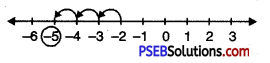
3 less than -2.
Solution:
3 less than – 2 = ?
We need to find the integer which is 3 less than -2.
So, we shall start with -2 and proceed 3 steps to the left of -2 as shown below:
PSEB 6th Class Maths Solutions Chapter 4 Integers Ex 4.2 4
Therefore 3 less than -2 is -5.

PSEB 6th Class Maths Solutions Chapter 4 Integers Ex 4.2

2. Using number line, add the following integers:

Question (a)
9 + (-3)
Solution:
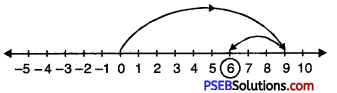
On number line we shall start from 0 and move 9 steps to the right of zero. Then we shall move three steps to the left of ‘+9’. We finally reach at +6. Thus, +6 is the answer.
PSEB 6th Class Maths Solutions Chapter 4 Integers Ex 4.2 5
Hence, 9 + (-3) = +6

Question (b)
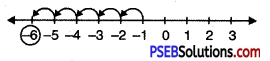
5 + (-11)
Solution:
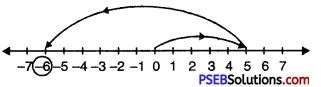
On number line we shall start from 0 and move 5 steps to the right of zero. Then we shall move eleven steps to the left of ‘+5’. We finally reach at ‘-6’. Thus, -6 is the answer.
PSEB 6th Class Maths Solutions Chapter 4 Integers Ex 4.2 6
Hence, 5 + (-11) = -6

Question (c)
(-1) + (-4)
Solution:
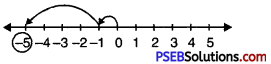
On number line we first move 1 step to the left of zero. Then we moved ahead 4 steps to the left of ‘-1\ We finally reaches at -5. Thus -5 is the answer.
PSEB 6th Class Maths Solutions Chapter 4 Integers Ex 4.2 7
Hence, (-1) + (-4) = -5

Question (d)
(-5) + 12
Solution:
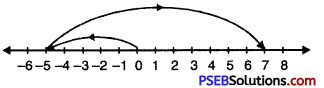
On number line we shall move 5 steps to the left of zero. Then we shall move 12 steps to the right of ‘-5’ and finally reach at ‘+7’. Thus +7 is the answer.
PSEB 6th Class Maths Solutions Chapter 4 Integers Ex 4.2 8
Hence, (-5) + 12 = +7

PSEB 6th Class Maths Solutions Chapter 4 Integers Ex 4.2

Question (e)
(-1) + (-2) + (-4)
Solution:
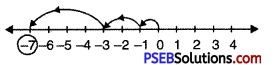
Step I: On number line we shall move one step to the left of zero suggested by minus sign of ‘-1’.
Step II: Then we shall move 2 steps to the left of -1 suggested by minus sign of -2 and we reach at ‘-3’.
Step III: Then again we shall move 4 steps to the left of ‘-3’ suggested by minus sign of -4 and finally we reach at-7.
PSEB 6th Class Maths Solutions Chapter 4 Integers Ex 4.2 9
Hence, (-1) + (-2) + (-4) = -7

Question (f)
(-2) + 4 + (-5)
Solution:
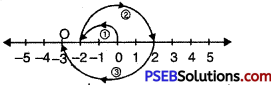
Step I: On number line we shall move 2 steps to the left of zero suggested by minus sign of ‘-2’.
Step II: Then we shall move 4 steps to the right of ‘-2’ suggested by plus sign of ‘44’ and we reach at +2.
Step III: Then we shall move 5 steps to the left of ‘+2’ as suggested by minus sign of ‘-5’ and finally we reach at -3. Thus answer is ‘-3’.
PSEB 6th Class Maths Solutions Chapter 4 Integers Ex 4.2 10
Hence, (-2) + 4 + (-5) = -3

Question (g)
(-3) + (5) + (-4).
Solution:
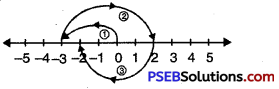
Step I: On number line we shall move 3 steps to the left of zero as suggested by minus sign of ‘-3’.
Step II: Then we shall move 5 steps to the right of ‘-3’ as suggested by plus sign of ‘+5’ and we reach at ‘+2’.
Step III: Then we shall move 4 steps to the left of ‘+2’ as suggested by minus sign of ‘4’ and finally we reach at ‘-2’. Thus ‘-2’ is the answer.
PSEB 6th Class Maths Solutions Chapter 4 Integers Ex 4.2 11
Hence, (-3) + (5) + (-4) = -2

3. Add without using number line:

Question (a)
18 + 13
Solution:
18 + 13 = 31

PSEB 6th Class Maths Solutions Chapter 4 Integers Ex 4.2

Question (b)
18 + (- 13)
Solution:
18 + (- 13) = + (18 – 13) = +5

Question (c)
(-18) + 13
Solution:
(-18) + 13 = – (18 – 13) = -5

Question (d)
(-18) + (-13)
Solution:
(-18) + (-13) = -(18 + 13) = -31

Question (e)
180 + (-200)
Solution:
180 + (-200) = -(200 – 180) = -20

PSEB 6th Class Maths Solutions Chapter 4 Integers Ex 4.2

Question (f)
111 + (-67)
Solution:
111 + (-67) = (777 – 67) = 710

Question (g)
1262 + (-366) + (-962)
Solution:
1262 + (-366) + (-962)
= 1262 – (366 + 962)
= 1262 – 1328
= -(1328 – 1262) = -66

Question (h)
30 + (-27) + 21 + (-19) + (-3) + 11 + (-9)
Solution:
30 + (-27) + 21 + (-19) + (-3) + 11 + (-9)
= 30 + 21 + 11 + (-27) + (-19) + (-3) + (-9)
= 62 + (-58) = 62 – 58 = 4

Question (i)
(-7) + (-9) + 4 + 16
Solution:
(-7) + (-9) + 4+16 = (-16) + 20 = 4

PSEB 6th Class Maths Solutions Chapter 4 Integers Ex 4.2

Question (j)
37 + (-2) + (-65) + (-8).
Solution:
37 + (-2) + (-65) + (-8)
= 37 – (2 + 65 + 8)
= 37 – 75 = -38

4. Write the successor and predecessor of the following:

Question (a)
-15
Solution:
Successor of -15 = -15 + 1 = -14
Predecessor of -15 = -15 – 1 = -16

Question (b)
27
Solution:
Successor of 27 = 27 + 1 = 28
Predecessor of 27 = 27 – 1 = 26

Question (c)
-79
Solution:
Successor of -79 = -79 + 1 = -78
Predecessor of -79 = -79- 1 = -80

PSEB 6th Class Maths Solutions Chapter 4 Integers Ex 4.2

Question (d)
0
Solution:
Successor of 0 = 0+ 1 = 1
Predecessor of 0 = 0 – 1 = -1

Question (e)
29
Solution:
Successor of 29 = 29 + 1 = 30
Predecessor of 29 = 29 – 1 = 28

Question (f)
-18
Solution:
Successor of -18 = -18 + 1 = -17
Predecessor of -18 = -18 – 1 = -19

Question (g)
-21
Solution:
Successor of -21 = -21 + 1 = -200
Predecessor of -21 = -21 – 1 = -22

Question (h)
99
Solution:
Successor of 99 = 99 + 1 = 100
Predecessor of 99 = 99 – 1 = 98

Question (i)
-1
Solution:
Successor of-1 = -1 + 1 = 0
Predecessor of -1 = -1 – 1 = -2

Question (j)
-13.
Solution:
Successor of -13 = -13 + 1 = -12
Predecessor of -13 = -13 – 1 = -14

PSEB 6th Class Maths Solutions Chapter 4 Integers Ex 4.2

5. Complete the following addition table:

+ -3 -4 -2 +1 +2 +3
-2
-3
0
+1
+2

Solution:

+ -3 -4 -2 + 1 +2 +3
-2 -5 -6 -4 -1 0 + 1
-3 -6 -7 -5 -2 -1 0
0 -3 -4 -2 + 1 +2 +3
+ 1 -2 -3 -1 +2 +3 +4
+2 -1 -2 0 +3 +4 +5

PSEB 9th Class Maths Solutions Chapter 7 Triangles Ex 7.3

Punjab State Board PSEB 9th Class Maths Book Solutions Chapter 7 Triangles Ex 7.3 Textbook Exercise Questions and Answers.

PSEB Solutions for Class 9 Maths Chapter 7 Triangles Ex 7.3

Question 1.
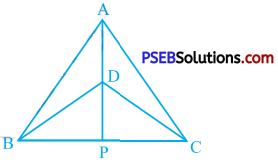
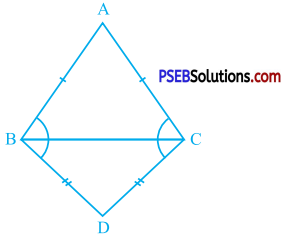
∆ ABC and ∆ DBC are two isosceles triangles on the same base BC and vertices A and D are on the same side of BC (see the given figure). If AD is extended to intersect BC at D show that,
PSEB 9th Class Maths Solutions Chapter 7 Triangles Ex 7.3 1
(i) ∆ ABD ≅ ∆ ACD
(ii) ∆ ABP ≅ ∆ ACP
(iii) AP bisects ∠ A as well as ∠ D.
(iv) AP is the perpendicular bisector of BC.
Answer:
∆ ABC and ∆ DBC are isosceles triangles on the same base BC.
∴ In ∆ ABC, AB = AC and in ∆ DBC, DB = DC.
In ∆ ABD and ∆ ACD,
AB = AC
DB = DC
and AD = AD (Common)
∴ ∆ ABD s ∆ ACD (SSS rule) [Result (i)]
∴ ∠ BAD = ∠ CAD (CPCT)
In ∆ ABP and ∆ ACP
AB = AC
∠ BAP = ∠ CAP (∵ ∠ BAD = ∠ CAD)
and AP = AP (Common)
∴ ∆ ABP ≅ ∆ ACP (SAS rule) [Result (ii)]
∴ BP = CP (CPCT)
In ∆ DBP and ∆ DCR
DB = DC
BP = CP
and DP = DP (Common)
∴ ∆ DBP ≅ ∆ DCP (SSS rule)
From ∆ ABP ≅ ∆ ACR ∠ BAP = ∠ CAP (CPCT)
∴ AP bisects ∠A.
From ∆ DBP ≅ ∆ DCR ∠BDP = ∠ CDP (CPCT)
∴ DP bisects ∠D.
Thus, AP bisects ∠A as well as ∠D. [Result (iii)]
∆ A ABP ≅ ∆ ACP
∴ BP = CP and ∠ APB = ∠ APC (CPCT)
But, ∠ APB + ∠ APC = 180° (Linear pair)
∴ ∠ APB = ∠ APC = \(\) = 90°
Thus, BP = CP and AP ⊥ BC.
∴ AP is the perpendicular bisector of BC. [Result (iv)]

PSEB 9th Class Maths Solutions Chapter 7 Triangles Ex 7.3

Question 2.
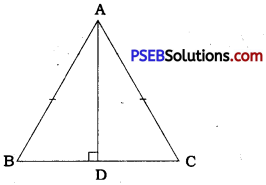
AD is an altitude of an isosceles triangle ABC in which AB = AC. Show that:
(i) AD bisects BC
(ii) AD bisects ∠ A
PSEB 9th Class Maths Solutions Chapter 7 Triangles Ex 7.3 2
Answer:
AD is an altitude of A ABC.
∴ ∠ ADB = ∠ ADC = 90°
In ∆ ADB and ∆ ADC,
hypotenuse AB = hypotenuse AC (Given)
∠ ADB = ∠ ADC (Right angles)
AD = AD (Common)
∴ ∆ ADB ≅ ∆ ADC (RHS rule)
∴ BD = CD and ∠ BAD = ∠ CAD (CPCT)
Now, BD = CD means D is the midpoint of BC.
Hence, AD bisects BC. [Result (i)]
Moreover, ∠ BAD = ∠ CAD and
∠ BAD + ∠ CAD = ∠ BAC.
Hence, AD bisects ∠A. [Result (ii)]

PSEB 9th Class Maths Solutions Chapter 7 Triangles Ex 7.3

Question 3.
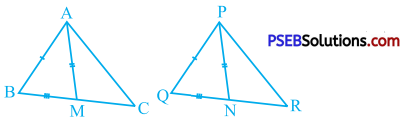
Two sides AB and BC and median AM of one triangle ABC are respectively equal to sides PQ and QR and median PN of ∆ PQR (see the given figure). Show that:
(i) ∆ ABM ≅ ∆ PQN
(ii) ∆ ABC ≅ ∆ PQR
PSEB 9th Class Maths Solutions Chapter 7 Triangles Ex 7.3 3
Answer:
In ∆ ABC, AM is a median.
∴ BM = CM = \(\frac{1}{2}\) BC
In ∆ PQR, PN is a median.
∴ QN = RN = \(\frac{1}{2}\) QR
Now, BC = QR (Given)
∴ \(\frac{1}{2}\) BC = \(\frac{1}{2}\) QR
∴ BM = QN
In ∆ ABM and ∆ PQN,
AB = PQ (Given)
AM = PN (Given)
BM = QN (Proved)
∴ ∆ ABM ≅ ∆ PQN (SSS rule) [Result (i)]
∴ ∠ ABM = ∠ PQN (CPCT)
∴ ∠ ABC = ∠ PQR
Now, in ∆ ABC and ∆ PQR,
AB = PQ
∠ ABC = ∠ PQR
BC = QR .
∴ ∆ ABC ≅ ∆ PQR (SAS rule) [Result (ii)]

PSEB 9th Class Maths Solutions Chapter 7 Triangles Ex 7.3

Question 4.
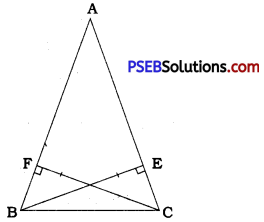
BE and CF are two equal altitudes of a triangle ABC. Using RHS congruence rule, prove that the triangle ABC is isosceles.
PSEB 9th Class Maths Solutions Chapter 7 Triangles Ex 7.3 4
Answer:
In ∆ FBC and ∆ ECB,
CF = BE (Given)
∠ CFB = ∠ BEC = 90° (Given)
BC = CB (Common)
∴ A FBC ≅ A ECB (RHS rule)
∴ ∠ FBC = ∠ ECB (CPCT)
∴ ∠ ABC = ∠ ACB
Now, in ∆ ABC, ∠ ABC = ∠ ACB
∴ AC = AB (Theorem 7.3)
Hence, ∆ ABC is an isosceles triangle.

PSEB 9th Class Maths Solutions Chapter 7 Triangles Ex 7.3

Question 5.
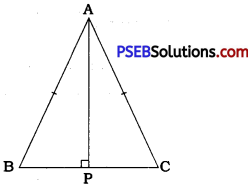
ABC is an isosceles triangle with AB = AC. Draw AP ⊥ BC to show that ∠ B = ∠ C.
Answer:
PSEB 9th Class Maths Solutions Chapter 7 Triangles Ex 7.3 5
In ∆ ABC, AP is an altitude.
∴ ∠ APB = ∠ APC = 90°
In ∆ APB and ∆ APC,
∠ APB = ∠ APC = 90°
AB = AC (Given)
AP = AP (Common)
∴ ∆ APB ≅ ∆ APC (RHS rule)
∴ ∠ ABP = ∠ AGP (CPCT)
∴ ∠ ABC = ∠ ACB
Thus, in ∆ ABC, ∠ B = ∠ C.

PSEB 10th Class Maths Solutions Chapter 13 Surface Areas and Volumes Ex 13.1

Punjab State Board PSEB 10th Class Maths Book Solutions Chapter 13 Surface Areas and Volumes Ex 13.1 Textbook Exercise Questions and Answers.

PSEB Solutions for Class 10 Maths Chapter 13 Surface Areas and Volumes Ex 13.1

Question 1.
2 cubes each of volume 64 cm3 are joined end to end. Find the surface area of the resulting cuboid.
Solution:
Let side of cube = x cm
Volume of cube = 64 cm3
[volume of cube = (side)3]
x3 = 64
x = \(\sqrt[3]{4 \times 4 \times 4}\)
x = 4 cm
∴ side of cube = 4 cm.

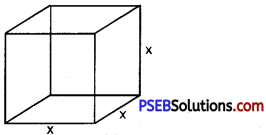
PSEB 10th Class Maths Solutions Chapter 13 Surface Areas and Volumes Ex 13.1 1

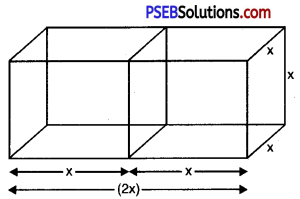
When cubes are joined end to end and cuboid is formed
whose Length = 2x cm = 2(4) = 8 cm
Width = x cm = 4 cm
Height = x cm = 4 cm

PSEB 10th Class Maths Solutions Chapter 13 Surface Areas and Volumes Ex 13.1 2

Surface area of cuboid = 2[LB + Bh + hL]
= 2 [8 × 4 + 4 × 4 + 4 × 8]
= 2 [32 + 16 + 32]
= 2 [80]
∴ Surface area of cuboid = 160 cm2.

PSEB Solutions PSEB 10th Class Maths Solutions Chapter Surface Areas and Volumes Ex 13.1

Question 2.
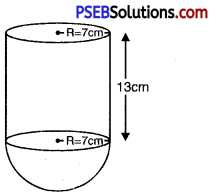
A vessel is in the form of a hollow hemisphere mounted by a hollow cylinder. The diameter of the hemisphere ¡s 14 cm and the total height of the vessel is 13 cm. Find the inner surface area of the vessel.
Solution:

PSEB 10th Class Maths Solutions Chapter 13 Surface Areas and Volumes Ex 13.1 3

Diameter of hemisphere = Diameter of cylinder
= 14 cm
2R = 14 cm
Radius of hemisphere (R) = 7 cm
Total height of vessel = 13 cm
∴ Height of cylinder = (13 – 7) = 6 cm
Inner surface area of vessel = inner surface area of cylinder + Inner surface area of hemisphere
= 2πRH + 2πR2
= 2πR [H + R]
= 2 × \(\frac{22}{7}\) × 7(16 + 7)
= 44 × 13 = 572 cm2
Hence, Inner surface area of vessel = 572 cm2

PSEB Solutions PSEB 10th Class Maths Solutions Chapter Surface Areas and Volumes Ex 13.1

Question 3.
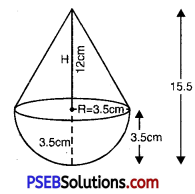
A toy is ¡n the form of a cone of radius 3.5 cm mounted on a hemisphere of same radius. The total height of the toy is 15.5 cm. Find the total surface area of the toy.
Solution:
Radius of cone = Radius of hemisphere (R) = 3.5 cm
Total height of toy = 15.5 cm
∴ Height of cone (H) = (15.5 – 3.5) = 12 cm

PSEB 10th Class Maths Solutions Chapter 13 Surface Areas and Volumes Ex 13.1 4

Slant height of cone = \(\sqrt{\mathrm{R}^{2}+\mathrm{H}^{2}}\)

= \(\sqrt{(3.5)^{2}+(12)^{2}}\)

= \(\sqrt{12.25+144}\) = \(\sqrt{156.25}\)
Slain height conk (l) = 12.5 cm
Total surface area of toy = Surface area of cone + Surface area of hemisphere
= πRL + 2πR2
= πR[L + 2R]
= \(\frac{22}{7}\) × 3.5 [12.5 + 2 (3.5)1 cm2
= \(\frac{22}{7}\) × 3.5 [19.5] cm2
= \(\frac{1501.5}{7}\) = 214.5 cm2
∴ Total surface area of toy = 214.5 cm2

PSEB Solutions PSEB 10th Class Maths Solutions Chapter Surface Areas and Volumes Ex 13.1

Question 4.
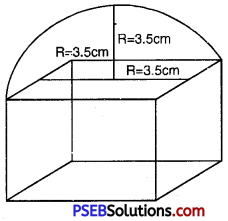
A cubical block of side 7 cm is surmounted by a hemisphere. What is the greatest diameter the hemisphere can have?
Find the surface area of the solid.
Solution:
Side of cubical box = 7 cm
Diameter of hemisphere = Side of cubical box = 7 cm
2R = 7
R = \(\frac{7}{2}\) cm

PSEB 10th Class Maths Solutions Chapter 13 Surface Areas and Volumes Ex 13.1 5

Surface area of solid = (surface area of the cube) – (area of base of hemisphere) + curved surface area of hemisphere)
= 6l2 – πR2 + 2πR2
= 6l2 + πR2
= 6(7)2 + \(\frac{22}{7}\) \(\frac{7}{2}\)2
= [6 × 49 + 11 × \(\frac{7}{2}\)]cm2
= 294 + 38.5 = 332.5 cm2

PSEB Solutions PSEB 10th Class Maths Solutions Chapter Surface Areas and Volumes Ex 13.1

Question 5.
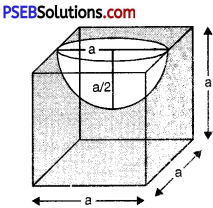
A hemispherical depression is cut out from one face of a cubical wooden block such that the diameter l of (he hemisphere is equal to the edge of the cube. Determine the surface area of the remaining solid.
Solution:
Let each side of cube = a
∴ Diameter of hemisphere = Side of cube
2R = a
R = \(\frac{a}{2}\)

PSEB 10th Class Maths Solutions Chapter 13 Surface Areas and Volumes Ex 13.1 6

Surface area of remaining solid = Total surface area of euboid – Area of the top of cube + Inner curved Surface area of hemisphere
= 6 (side)2 – πR2 + 2πR2
= 6(a)2 + πR2
= 6(a)2 + π \(\frac{a}{2}\)2
= 6a2 + π \(\frac{a^{2}}{4}\)
= a2 6 + \(\frac{\pi}{4}\) cm2

PSEB Solutions PSEB 10th Class Maths Solutions Chapter Surface Areas and Volumes Ex 13.1

Question 6.
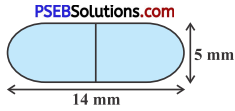
A medicine capsule is ¡n the shape of a cylinder with two hemispheres stuck to each of its ends. The length of the entire capsule is 14 mm and the diameter of the capsule is 5 mm. Find its surface area.

PSEB 10th Class Maths Solutions Chapter 13 Surface Areas and Volumes Ex 13.1 7

Solution:
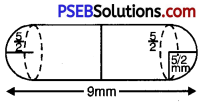
Diameter of capsule = Diameter of hemisphere = Diameter of cylinder = 5 mm
∴ 2R = 5 mm
R = \(\frac{5}{2}\) mm

PSEB 10th Class Maths Solutions Chapter 13 Surface Areas and Volumes Ex 13.1 8

Length of entire capsule = 14 mm
Height of cylinderical part = (14 – \(\frac{5}{2}\) – \(\frac{5}{2}\)) mm
= (14 – 5) mm
H = 9 mm
Surface area of capsule = Surface area of cylinder + 2 Surface area of hemisphere
= 2πRH + 2 (2πR2)
= 2πRH + 4πR2
= 2πR [H + 2R]
= 2 × \(\frac{22}{7} \times \frac{5}{2}\left[9+2\left(\frac{5}{2}\right)\right]\)
= 2 × \(\frac{22}{7}\) × \(\frac{5}{2}\) [9 + 5]
= \(\frac{22}{7}\) × 5 × 14
= 220 mm2
Hence, Surface area of capsule = 220 mm2.

PSEB Solutions PSEB 10th Class Maths Solutions Chapter Surface Areas and Volumes Ex 13.1

Question 7.
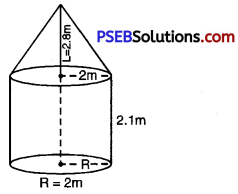
A tent is in the shape of a cylinder surmounted by a conical top. If the height and diameter of the cylindrical part are 2.1 m and 4 m respectively, and the slant height of the top is 2.8 m, find the area of the canvas used for making the tent. Also, find the cost of the canvas of the tent at the rate of 500 per (Note that the base of the tent will not be
covered with canvas.)
Solution:
Diameter of cone = Diameter of cylinder
2R = 4
R = 2 m

PSEB 10th Class Maths Solutions Chapter 13 Surface Areas and Volumes Ex 13.1 9

Radius of cone = Radius of cylinder
Height of cylinder (H) = 2.1 in
Slant height of cone (L) = 2.8 m
Curved surface area of tent = Curved surface of cylinder + Curved surface of conical part
= 2πRH + πRL
= πR [2H + L]
= \(\frac{22}{7}\) × 2[2(2.1) + 2.8]
= \(\frac{22}{7}\) × 2[4.2 + 2.8]
= \(\frac{22}{7}\) × 2 × 7
= 44 m2
∴ Curved surface area of tent = 44 m2
Cost of 1m2 canvas = ₹ 500
Cost of 44 m2 canvas = 44 × 500 = ₹ 22000
Hence, Total cost of canvas = ₹ 22000.

PSEB Solutions PSEB 10th Class Maths Solutions Chapter Surface Areas and Volumes Ex 13.1

Question 8.
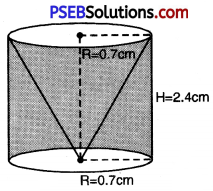
From a solid cylinder whose height is 2.4 cm and diameter 1.4 cm, a conical cavity of the same height and same diameter is hollowed out. Find the total surface area of the remaining solid to the nearest cm2.
Solution:
Diameter of cylinder (D) = 1.4 cm = Diameter of cone
∴ Radius of cylinder = Radius of cone (R) = 0.7 cm
Height of cylinder (H) = 2.4 cm

PSEB 10th Class Maths Solutions Chapter 13 Surface Areas and Volumes Ex 13.1 10

As we know, L2 = R2 + H2 + (2.4)2
L = \(\sqrt{(0.7)^{2}+(2.4)^{2}}\)
= \(\sqrt{0.49+5.76}\) = \(\sqrt{6.25}\)
L = 2.5 cm
Total surface area of remaining solid = curved surface area of cylinder + Area of base of cylinder + Surface area of cone
= 2πRH + πR2 + πRL
= πR [2R +R + L]
= \(\frac{22}{7}\) × 0.7 [2(2.4) + 0.7 + 2.5]

=\(\frac{22}{7}\) × \(\frac{7}{10}\) [4.8 + 3.2]

= \(\frac{22}{10}\) [8]

= \(\frac{176}{10}\) = 17.6 cm2

Hence, Total surface area remaining solid to nearest cm2 = 18 cm2.

PSEB Solutions PSEB 10th Class Maths Solutions Chapter Surface Areas and Volumes Ex 13.1

Question 9.
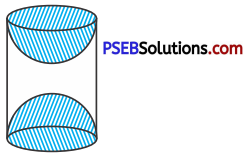
A wooden article was made by scooping out a hemisphere form each end of a solid cylinder, as shown in Fig.

PSEB 10th Class Maths Solutions Chapter 13 Surface Areas and Volumes Ex 13.1 11

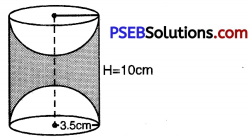
If the height of the cylinder is 10 cm, and its base ¡s of radius 3.5 cm, find the total surface area of the article.
Solution:
Height of cylinder (H) = 10 cm
Radius of cylinder = Radius of hemisphere (R) = 3.5 cm

PSEB 10th Class Maths Solutions Chapter 13 Surface Areas and Volumes Ex 13.1 12

Surface area of article = curved surface area of cylinder + 2 curved surface area of hemisphere
= 2πRH + 2 (2πR2)
= 2πR [H + 2R]
= 2 × \(\frac{22}{7}\) × 3.5 [10 + 2(3.5)]
= \(\frac{44}{7}\) × \(\frac{35}{10}\) [10 + 7]
= 44 × \(\frac{5}{10}\) × 17
= 44 × \(\frac{1}{2}\) × 17
= 22 × 17 = 374 cm2
Hence, total surface area of article = 374 cm2.

PSEB 9th Class Maths Solutions Chapter 7 Triangles Ex 7.2

Punjab State Board PSEB 9th Class Maths Book Solutions Chapter 7 Triangles Ex 7.2 Textbook Exercise Questions and Answers.

PSEB Solutions for Class 9 Maths Chapter 7 Triangles Ex 7.2

Question 1.
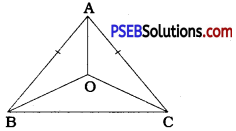
In an isosceles triangle ABC, with AB = AC, the bisectors of ∠ B and ∠ C intersect each other at O. Join A to O. Show that:
(i) OB = OC
(ii) AO bisects ∠ A
Answer:
PSEB 9th Class Maths Solutions Chapter 7 Triangles Ex 7.2 1
In ∆ ABC, AB = AC
∴ ∠ ABC = ∠ ACB (Theorem 7.2)
∴ \(\frac{1}{2}\) ∠ ABC = \(\frac{1}{2}\) ∠ ACB
∴ ∠ OBC = ∠ OCB (BO bisects ∠ ABC and CO bisects ∠ ACB)
Now, in ∆ OBC, ∠ OBC = ∠ OCB
∴ OB = OC (Theorem 7.3)
Similarly, ∠ ABC = ∠ ACB gives
∴ \(\frac{1}{2}\) ∠ ABC = \(\frac{1}{2}\) ∠ ACB
∴ ∠ ABO = ∠ ACO
Now, in ∆ ABO and ∆ ACO,
AB = AC (Given)
∠ ABO = ∠ ACO
and OB = OC
∴ ∆ ABO ≅ ∆ ACO (SAS rule)
∴ ∠ BAO = ∠ CAO (CPCT)
But, ∠ BAO + ∠ CAO = ∠ BAC (Adjacent angles)
∴ ∠ BAO = ∠ CAO = \(\frac{1}{2}\) ∠ BAC
Thus, AO bisects ∠ A.

PSEB 9th Class Maths Solutions Chapter 7 Triangles Ex 7.2

Question 2.
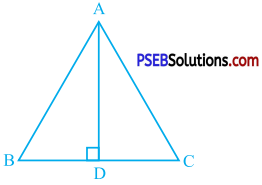
In ∆ ABC, AD is the perpendicular bisector of BC (see the given figure). Show that ∆ ABC is an isosceles triangle in which AB = AC.
PSEB 9th Class Maths Solutions Chapter 7 Triangles Ex 7.2 2
Answer:
In ∆ ABC, AD is the perpendicular bisector of BC.
∴ BD = CD and ∠ ADB = ∠ ADC = 90°
In ∆ ADB and ∆ ADC,
AD = AD (Common)
∠ ADB = ∠ ADC (Right angles)
and BD = CD
∴ ∆ ADB ≅ ∆ ADC (SAS rule)
∴ AB = AC (CPCT)
Now, in ∆ ABC, AB = AC.
Hence, ∆ ABC is an isosceles triangle in which AB = AC.

PSEB 9th Class Maths Solutions Chapter 7 Triangles Ex 7.2

Question 3.
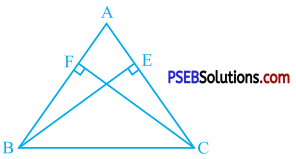
ABC is an isosceles triangle in which altitudes BE and CF are drawn to equal sides AC and AB respectively (see the given figure). Show that these altitudes are equal.
PSEB 9th Class Maths Solutions Chapter 7 Triangles Ex 7.2 3
Answer:
In ∆ ABC, AC = AB
∴ ∠ ABC = ∠ ACB
∴ ∠ FBC = ∠ ECB
Now, in ∆ FBC and ∆ ECB,
∠ FBC = ∠ ECB
∠ BFC = ∠ CEB (Right angles)
BC = CB (Common)
∴ ∆ FBC ≅ ∆ ECB (AAS rule)
∴ CF = BE (CPCT)
Thus, the altitudes CF and BE on equal sides AB and AC respectively of ∆ ABC are equal.

PSEB 9th Class Maths Solutions Chapter 7 Triangles Ex 7.2

Question 4.
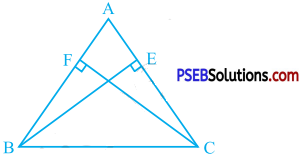
ABC is a triangle in which altitudes BE and CF to sides AC and AB are equal (see the given figure). Show that
(i) ∆ ABE ≅ ∆ ACF
(ii) AB = AC, i.e., ABC is an isosceles triangle.
PSEB 9th Class Maths Solutions Chapter 7 Triangles Ex 7.2 4
Answer:
In ∆ ABE and ∆ ACF,
∠ AEB = ∠ AFC (Right angles)
∠ A = ∠ A (Common)
BE = CF (Given)
∴ ∆ ABE ≅ ∆ ACF (AAS rule)
∴ AB = AC (CPCT)
Thus, ∆ ABC is an isosceles triangle.

Question 5.
ABC and DBC are two isosceles triangles on the same base BC (see the given figure). Show that ∠ ABD = ∠ ACD.
PSEB 9th Class Maths Solutions Chapter 7 Triangles Ex 7.2 5
Answer:
∠ ABC and ∠ DBC are adjacent angles.
∴ ∠ ABC + ∠ DBC = ∠ ABD ………… (1)
∠ ACB and ∠ DCB are adjacent angles.
∴ ∠ ACB + ∠ DCB = ∠ ACD ………….. (2)
In ∆ ABC, AB = AC.
∴ ∠ ABC = ∠ ACB (Theorem 7.2)
In ∆ DBC, DB = DC.
∴ ∠ DBC = ∠ DCB (Theorem 7.2)
∴ ∠ ABC + ∠ DBC = ∠ ACB + ∠ DCB
∴ ∠ ABD = ∠ ACD [From (1) and (2))

PSEB 9th Class Maths Solutions Chapter 7 Triangles Ex 7.2

Question 6.
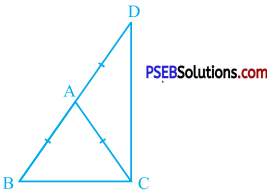
∆ ABC is an isosceles triangle in which AB = AC. side BA is produced to D such that AD = AB (see the given figure). Show that ∠ BCD is a right angle.
PSEB 9th Class Maths Solutions Chapter 7 Triangles Ex 7.2 6
Answer:
AB = AC and AD = AB
∴ AC = AD
In ∆ ABC, AB = AC
∴ ∠ ACB = ∠ ABC (Theorem 7.2) ……………… (1)
In A ADC, AC = AD
∴ ∠ ACD = ∠ ADC (Theorem 7.2) ……………… (2)
Adding (1) and (2),
∠ ACB + ∠ ACD = ∠ ABC + ∠ ADC
∴ ∠ BCD = ∠ DBC + ∠ BDC
(Adjacent angles and A lies on BD)
In ∆ BCD,
∠ DBC + ∠ BDC + ∠ BCD = 180°
∴ ∠ BCD + ∠ BCD = 180° (from (3)]
∴ 2 ∠ BCD = 180°
∴ ∠ BCD = 90°
Thus, ∠ BCD is a right angle.

PSEB 9th Class Maths Solutions Chapter 7 Triangles Ex 7.2

Question 7.
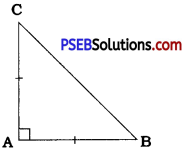
ABC is a right angled triangle in which ∠A = 90° and AB = AC. Find ∠ B and ∠ C.
Answer:
PSEB 9th Class Maths Solutions Chapter 7 Triangles Ex 7.2 7
In ∆ ABC, AB = AC
∴ Z C = Z B (Theorem 7.2)
In ∆ ABC,
∠ A + ∠ B + ∠ C = 180°
∴ 90° + ∠ B + ∠ B = 180° (Given and ∠ C = ∠ B)
∴ 2 ∠ B = 90°
∴ ∠ B = 45°
∴ ∠ C = 45°

PSEB 9th Class Maths Solutions Chapter 7 Triangles Ex 7.2

Question 8.
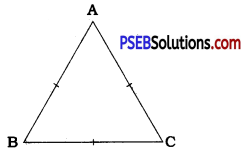
Show that the angles of an equilateral triangle are 60° each.
Answer:
PSEB 9th Class Maths Solutions Chapter 7 Triangles Ex 7.2 8
∆ ABC is an equilateral triangle.
∴ AB = BC = AC
In ∆ ABC, AB = BC
∴ ∠ C = ∠ A (Theorem 7.2)
In ∆ ABC, AB = AC
∴ ∠ C = ∠ B (Theorem 7.2)
Hence, ∠ A = ∠B = ∠ C.
Now, in ∆ ABC, ∠ A + ∠ B + Z C = 180°
∴ ∠ A = ∠ B = ∠ C = \(\frac{180^{\circ}}{3}\) = 60°
Thus, the angles of ah equilateral triangle are 60° each.

PSEB 7th Class Maths Solutions Chapter 10 Practical Geometry Ex 10.4

Punjab State Board PSEB 7th Class Maths Book Solutions Chapter 10 Practical Geometry Ex 10.4 Textbook Exercise Questions and Answers.

PSEB Solutions for Class 7 Maths Chapter 10 Practical Geometry Ex 10.4

1. Construct ΔABC, given AB = 6 cm, ∠A = 30° and ∠B = 75°.
Solution:
Given. One side of ΔABC as AB = 6 cm, m∠A = 30° and m∠B = 75°.
To construct: A triangle with one side and these two angles.
Steps of Construction :
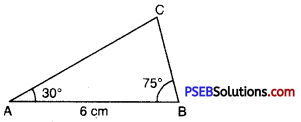
Step 1. We first draw a rough sketch of ΔABC and indicate the measures of side and two angles.
PSEB 7th Class Maths Solutions Chapter 10 Practical Geometry Ex 10.4 1
Step 2. Draw a ray AB of length 6 cm.
PSEB 7th Class Maths Solutions Chapter 10 Practical Geometry Ex 10.4 2
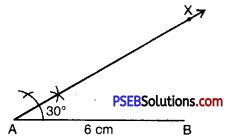
Step 3. At A; draw a ray AX making an angle 30° with AB.
PSEB 7th Class Maths Solutions Chapter 10 Practical Geometry Ex 10.4 3
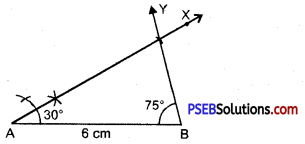
Step 4. With the help of compass. At B; draw a ray BY making an angle of 75° with AB.
PSEB 7th Class Maths Solutions Chapter 10 Practical Geometry Ex 10.4 4
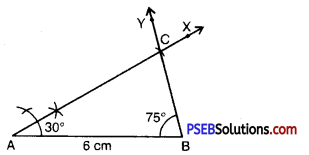
Step 5. Both rays AX and BY intersect, at a point. So the point of intersection of the two rays is C Then. ΔABC is now obtained.
PSEB 7th Class Maths Solutions Chapter 10 Practical Geometry Ex 10.4 5

PSEB 7th Class Maths Solutions Chapter 10 Practical Geometry Ex 10.4

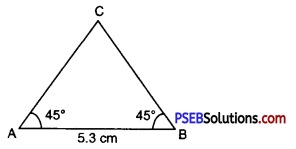
2. Construct an isosceles ΔABC such that AB = 5.3 cm and each base angle = 45°.
Solution:
Given : Isosceles ΔABC with AB = 5.3 cm each base angle = 45°.
To Construct: A triangle with one side and two base angles.
Steps of construction :
Step 1. Draw a rough sketch of ΔABC with given measures
PSEB 7th Class Maths Solutions Chapter 10 Practical Geometry Ex 10.4 6
Step 2. Draw a line segment AB = 5.3 cm.
PSEB 7th Class Maths Solutions Chapter 10 Practical Geometry Ex 10.4 7
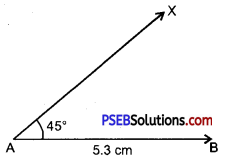
Step 3. Taking A as centre with the help of compass. Draw a ray AX making an angle 45° with AB.
PSEB 7th Class Maths Solutions Chapter 10 Practical Geometry Ex 10.4 8
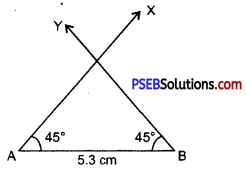
Step 4. With the help of compass and taking B as a centre. Draw a ray BY making an angle 45° with the line segment AB.
PSEB 7th Class Maths Solutions Chapter 10 Practical Geometry Ex 10.4 9
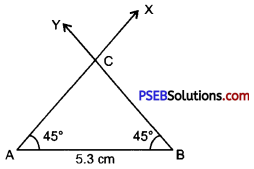
Step 5. Rays AX and BY intersect, at a point say C, then ABC is the required triangle.
PSEB 7th Class Maths Solutions Chapter 10 Practical Geometry Ex 10.4 10

PSEB 7th Class Maths Solutions Chapter 10 Practical Geometry Ex 10.4

3. Construct ΔXYZ if XY = 4 cm, ∠X = 45° and ∠Z = 60°.
[Hint : ∠Y = 180° – 45° – 60° = 75°]
Solution:
One side of ΔXYZ as
XY = 4 cm,
∠X = 45°
and ∠Z = 60°.
As we know that by angle-sum property of a triangle; sum of all three angles of a triangle is equal to 180°.
∴ ∠X + ∠Y + ∠Z = 180°
⇒ 45° + ∠Y + 60° = 180°
⇒ 105° + ∠Y = 180°
⇒ ∠Y = 75°.
Now it will be easy to construct triangle with side
XY = 4 cm,
∠X = 45°
and ∠Y = 75°.
Steps of Construction :
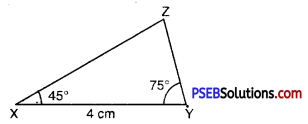
Step 1. We first draw a rough sketch of ΔXYZ and indicate the measure of side and two angles.
PSEB 7th Class Maths Solutions Chapter 10 Practical Geometry Ex 10.4 11
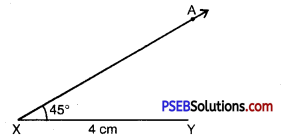
Step 2. Draw a ray XY of length 4 cm.
PSEB 7th Class Maths Solutions Chapter 10 Practical Geometry Ex 10.4 12
Step 3. At X draw a ray XA making an angle of 45° with XY.
PSEB 7th Class Maths Solutions Chapter 10 Practical Geometry Ex 10.4 13
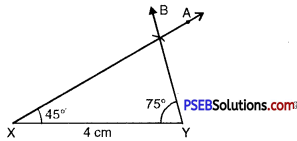
Step 4. At Y; draw a ray YB making an angle of 75° with XY.
PSEB 7th Class Maths Solutions Chapter 10 Practical Geometry Ex 10.4 14
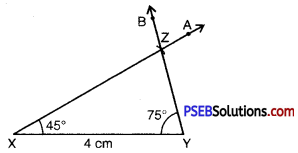
Step 5. Z has to lie on both rays XA and YB. So, the point of intersection of two rays is Z.
ΔXYZ is now obtained.
PSEB 7th Class Maths Solutions Chapter 10 Practical Geometry Ex 10.4 15

PSEB 7th Class Maths Solutions Chapter 10 Practical Geometry Ex 10.4

4. Examine whether you can construct ΔPQR such that ∠P = 100°, ∠Q = 90° and PQ = 4.3 cm If not possible given reason.
Solution:
No, we cannot construct given ΔPQR.
Reason :
As we know that by angle sum property of a triangle; sum of all three angles a triangle is equal to 180°. But in given question sum of two angles;
m∠P + m∠Q
= 100° + 90°
= 190°
The sum of these two angles should be less than 180°. So triangle with given measures cannot be constructed as it violates the angle sum property of a triangle.

5. Question (i).
In which of the following cases a unique triangle can be drawn ?
(a) BC = 5 cm, ∠B = 90° and ∠C = 100°
(b) AB = 4 cm, BC = 7 cm and CA = 2 cm
(c) XY = 5 cm, ∠X = 45°, ∠Y = 60°
(d) An isosceles triangle with length of each equal side equal to 5 cm.
Answer:
(c) XY = 5 cm, ∠X = 45°, ∠Y = 60°

Question (ii).
A triangle can be constructed by taking two of its angles as.
(a) 110°, 40°
(b) 70°, 115°
(c) 135°, 45°
(d) 90°, 90°
Answer:
(a) 110°, 40°

PSEB 7th Class English Grammar Tense

Punjab State Board PSEB 7th Class English Book Solutions English Grammar Tense Exercise Questions and Answers, Notes.

PSEB 7th Class English Grammar Tense

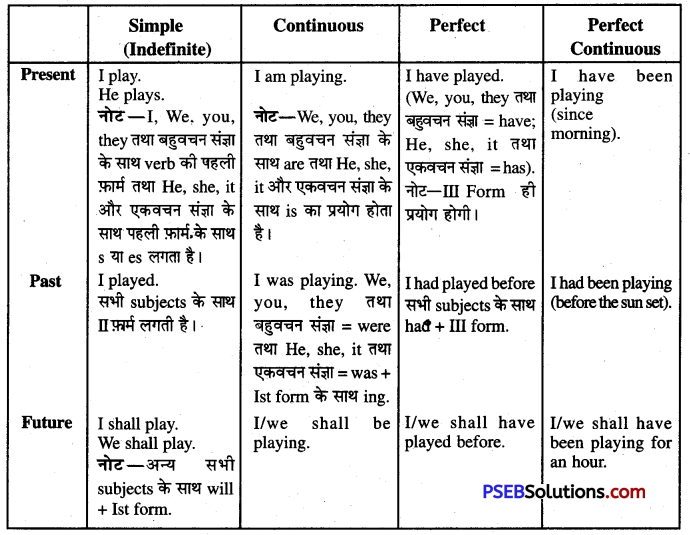
Study the Chart

PSEB 7th Class English Grammar Tense 1

PSEB 7th Class English Grammar Tense

Exercise 1

I. Fill in the blanks with the right tense form of the verb given in the brackets:

1. Our school ……………………… (begin) with a prayer everyday.
2. Ahmed ……………………… (keep awake) till midnight these days.
3. What…………….(make) you do so ?
4. This box ………………….. (contain) a gift for him.
5. This road is closed. They …………………….. (repair) it.
6. The clerk ……………. (type) the letter still, he never …………… (finish) the work in time.
7. Don’t make a noise. An important meeting ……………………. (go on) here. 8. She
8. ………… (say) a prayer to God regularly before going to bed.
9. The peon ……………….. (ring) the bell now.
10. We ……………. (feel) uneasy on a very hot day.
Hints:
1. begins
2. keeps awake
3. makes
4. contains
5. are repairing
6. is typing, finishes
7. is going on
8. says
9. is ringing
10. feel.

Exercise 2

Fill in the blanks with the right tense form of the verb given in the brackets: (Use Present Perfect Tense)

1. The water level …………………… (go up) because of rains.
2. The doctor ……………………. (examine) the patient. He is improving now.
3. I ……………………… (finish) my work. I am going home now.
4. They ………………….. (leave) the place.
5. Sheela …………………. (learn) her lesson.
6. Father ………………………. (not come) home for lunch yet.
7. ………………… you ………………. (finish) your work ? Can you come with me now?
8. I ……………………. (study) the problem. It is easy to solve.
9. ………….. he ………. (take charge) of his new assignment ?
10. The train …………………………… (leave) the station. The platform looks deserted.
Hints:
1. has gone up
2. has examined
3. have finished
4. have left
5. has learnt
6. has not come
7. Have, finished
8. have studied
9. Has, taken charge
10. has left.

Exercise 3

Fill in the blanks with the right tense form (Past Continuous or Simple Past) of the verbs given in brackets:

1. She ………………… (look) for a book shop, when I ………………….. (meet) her.
2. The policeman …………………… (arrest) the thief, when I …………………… (see) him.
3. I……………………………… (go) to the cattle-shed, when I …………………….. (hear) someone quarrelling.
4. The sarpanch ………… (take) the horse out of the stable, when I ……. (call) him.
5. Yesterday as I …………. (walk) along the street. I ……………………… (meet) my friend.
6. In January 1948 Gandhiji ……………………… (stay) in Delhi. He was shot while he ……………. (come out) of the prayer meeting.
7. While I …………………. (watch) the T.V., the lights ………….. (go off).
Hints:
1. was looking, met
2. was arresting, saw
3. was going, heard
4. was taking, called
5. was walking, met
6. was staying, was coming out
7. was watching, went off.

PSEB 7th Class English Grammar Tense

Exercise 4

Fill in the blanks using the verbs in the brackets according to the tense form indicated:

1. A group of officials ……….. (go) to Delhi tomorrow. (Simple Future)
2. We …………………… (visit) Kashmir next January. (Future Continuous)
3. What …………………….. you ……………(do) tomorrow evening ? (Future Continuous)
4. I …….. (go) with my brother. I am sure I ……………… (have) a very nice time on this (Simple Future)
5. I want to give this book to Jaspreet …………………… you ……………………… (go) to give this book to her ? (Simple Future)
Hints:
1. will go
2. shall be visiting
3. will, be doing
4. shall go, will have
5. will, go.

Exercise 5

Fill in the blanks to express Future Perfect aspects of the verbs given in the brackets.

1. The police …………………… (arrest) the thief by tomorrow.
2. Davinder. ………………… (tell) me all before you talk to him.
3. He ………………….. (return) before you arrive.
4. Gobind ……………………. (write) the story before you return.
5. We …………………… (enjoy) our holidays for about a month before he arrives.
Hints:
1. will have arrested
2. will have told
3. will have returned
4. will have written
5. shall have enjoyed.

Exercise 6
(Miscellaneous)

I. Underline the verb and write in the space given whether the sentence is in the Present, Past or Future Perfect tense. One has been done for you.

1. The rain had stopped before I arrived. (Past Perfect Tense)
2. I have lived in Bhatinda since childhood. (Present Perfect Tense)
3. We shall have reached home before they arrive. (Future Perfect Tense)
4. The children shall have eaten something by the time I reach home, (Future Perfect Tense)
5. She has not finished writing the book. (Present Perfect Tense)
6. The watchman had run away before the owner reached. (Past Perfect Tense)
7. The children have learnt the song. (Present Perfect Tense)
8. Naaz has posted the letter. (Present Perfect Tense)
9. My uncle has given me a room in the new house. (Present Perfect Tense)
10. They will have left for Patiala by night. (Future Perfect Tense)

II. Complete the following letter by using the verb in the bracket in present perfect/ past tense. One has been done for you:

Dear sir
I wrote (write) to you some time ago-asking about conditions of entry to your competition. You replied (reply) enclosing an entry form which I filled up (fill up) and sent (send) without delay. I have heard (hear) nothing from you and am beginning to wonder if my application has gone (go) astray. Please check if you have received (receive) it or not. In case you have not got (not get) it. Kindly inform me.

Thanking you
Yours faithfully
Amarjit Singh

III. You have planned to undertake a railway journey in your summer holidays. In about ten sentences describe your forth coming trip using simple future tense.

I will go to Amritsar during summer holidays. I will go by train. I will catch the train from Ludhiana. I will go to the railway station. I will buy a ticket and go to the platform to board the train. The train will reach Amritsar within three hours. There, I will stay in a hotel. I will visit Sri Harmandar Sahib. I will have a holy dip in the tank there. I will also visit the Durgiana Mandir. I will not miss to see the Jallianwala Bagh before I come back.

IV. Your house is flooded due to heavy rains. You saved yourself by sitting on the roof top for almost three days and nights. Using simple and continuous past tense, write your experience.

I found water all around me. It was rising continually. I, with my family, took shelter on the roof of my house. We took with us all the eatables available in home. There was a large carpet at the roof. At night we slept on it. But the rain did not stop for three days. All our eatables were consumed. We grew weaker and weaker. We prayed to God for help. Then one day, it stopped raining. We came down, took buckets and threw the water out of the house. We thanked God for saving our lives.

PSEB 7th Class English Grammar Tense

V. Supply for the blanks the future perfect tense of the verb given in the brackets:

1. Our maid will have broken all the cups (break).
2. He …………..by that time. (return)
3. The sun …………… when we reach home. (set)
4. We …………. all the cakes by evening. (eat)
5. She ……………for the family by night. (cook)
6. He …………. his pledge. (keep)
7. Each child …………… a new pull over. (bought)
8. The shoeshine …………… my shoes. (polish)
9. The commander ………….. the army to march. (order)
10. I……………. the job by sunset. (complete)
11. She …………. to speak English by the year end. (learn)
12. You ………….. tea before we reach there. (drink)
13. Meeta ………….. the beauty contest. (win)
14. Mini …………… to India by early September. (fly)
Hints:
2. will have returned
3. will have set
4. shall have eaten
5. will have cooked
6. will have kept
7. will have bought
8. will have polished
9. will have ordered
10. shall have completed
11. will have learnt
12. will have drunk
13. will have won
14. will have flown.

VI. Given below is a complaint letter. Fill in the blanks with the correct form of the verb given in the brackets. One has been done.

The Secretary
DIV/4901
Vasant Kunj
New Delhi.
Dear Sir

I regret to bring (bring/brought) to your notice that Bihari Lal, the sweeper is not doing (is not doing / has not done) his duty well. He sweeps (sweeps / sweep) the road only once a day. He leaves (leave /leaves) the garbage on the road or throws (threw / throws) them all around. As a result the area is filthy. I have requested (am requesting /have requested) him many times but he refused (refuses / refused) to obey. It seems (seem / seems) he does not care (do not care/does not care).

Yours sincerely
Anil Sharma

VII. Rewrite the following sentences after changing the verbs into the present or past continuous tense:

1. Sudha lies on the bed.
2. Raja plays with his brother.
3. The servant rang the bell.
4. The children scream.
5. The sun sets in the west.
6. They go out for a picnic.
7. She likes the game.
8. I eat my food.
Answer:
1. Sudha is lying on the bed.
2. Raja is playing with his brother.
3. The servant was ringing the bell.
4. The children are screaming.
5. The sun is setting in the west.
6. They are going out for a picnic.
7. She is liking the game.
8. I am eating my food.

PSEB 7th Class English Grammar Tense

VIII. Fill in the blanks with the past perfect tense of the verb given in brackets:

1. He …………. a tiger before I reached the forest. (kill)
2. She ………….. a sweater before I bought a new one. (knit)
3. I ……………. money from my friend before I received my salary. (borrow)
4. The river ……………. its bank before the dam was built. (overflow)
5. She ……………. my book before I could check her. (steal)
6. The train …………….. before I could reach the station. (arrive)
7. I ………….. a funny story before the sad one. (hear)
8. The thief ………….. from the jail before the police arrived. (escape)
Answer:
1. He had killed a tiger before I reached the forest. (kill)
2. She had knitted a sweater before I bought a new one. (knit)
3. I had borrowed money from my friend before I received my salary. (borrow)
4. The river had overflown its bank before the dam was built. (overflow)
5. She had stolen my book before I could check her. (steal)
6. The train had arrived before I could reach the station. (arrive)
7. I had heard a funny story before the sad one. (hear)
8. The thief had escaped from the jail before the police arrived. (escape)

PSEB 10th Class Maths Solutions Chapter 12 Areas Related to Circles Ex 12.3

Punjab State Board PSEB 10th Class Maths Book Solutions Chapter 12 Areas Related to Circles Ex 12.3 Textbook Exercise Questions and Answers.

PSEB Solutions for Class 10 Maths Chapter 12 Areas Related to Circles Ex 12.3

Question 1.
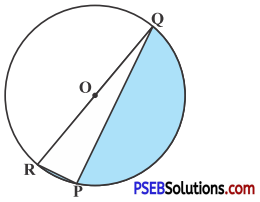
Find the area of the shaded region in Fig., If PQ = 24 cm, PR =7 cm and O is the centre of the circle.
PSEB 10th Class Maths Solutions Chapter 12 Areas Related to Circles Ex 12.3 1

Solution:
PQ = 24 cm
PR = 7 cm
RQ is diameter of circle
∠RPQ = 90° Angle in semi circle
In ∆PQR,
QR2 = RP2 + PQ2
QR = \(\sqrt{(7)^{2}+(24)^{2}}=\sqrt{49+576}\)
= \(\sqrt{625}\)
QR = 25 cm
∴ Diameter of circle (QR) = 25 cm
Radius of circle (R) = \(\frac{25}{2}\) cm
Area of shaded region = Area of the semicircle – Area of ∆RPQ
= \(\frac{1}{2} \pi \mathrm{R}^{2}-\frac{1}{2} \mathrm{RP} \times \mathrm{PQ}\)

= \(\left[\frac{1}{2} \times \frac{22}{7} \times \frac{25}{2} \times \frac{25}{2}-\frac{1}{2} \times 7 \times 24\right]\) cm2

= \(\left[\frac{6875}{28}-84\right]\)
= 245.53 – 84 = 161.53 cm2
∴ Area of shaded region = 161.53 cm2.

PSEB Solutions PSEB 10th Class Maths Solutions Chapter 12 Areas Related to Circles Ex 12.3

Question 2.
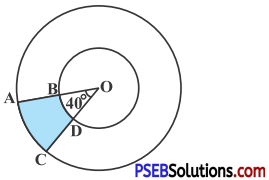
Find the area of the shaded region in Fig., if radii of the two concentric circles with centre O are 7 cm and 14 cm respectively and ∠AOC = 40°.
PSEB 10th Class Maths Solutions Chapter 12 Areas Related to Circles Ex 12.3 2

Solution:
Radius of smaller circle (r) = 7 cm
Radius of bigger circle (R) = 14 cm
Central angle ∠AOC (θ) = 40°
Area of shaded region = Area of bigger sector OAC – Area of smaller sector OBD
= \(\frac{\pi \mathrm{R}^{2} \theta}{360^{\circ}}-\frac{\pi r^{2} \theta}{360^{\circ}}\)

= \(\frac{\pi \theta}{360^{\circ}}\) [R2 – r2]

= \(\frac{22}{7} \times \frac{40}{360}\) × [142 – 72]

= \(\frac{22}{63}\) [196 – 49]

= \(\frac{22}{63}\) × 147 = 51.33 cm2
∴ Shaded Region = 51.33 cm2.

PSEB Solutions PSEB 10th Class Maths Solutions Chapter 12 Areas Related to Circles Ex 12.3

Question 3.
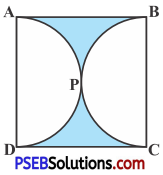
Find the area of the shaded region in fig., if ABCD is a square of side 14 cm and APD and BPC are semi circles.
PSEB 10th Class Maths Solutions Chapter 12 Areas Related to Circles Ex 12.3 3

Solution:
Side of square = 14 cm
Diameter of semicircle (AB = BC) = 14 cm
Radius of semi circle (R) = 7 cm
Area of square = (Side)2
= 14 × 14 = 196cm2
Area of a semi circles = \(\frac{1}{2}\) πR2
= \(\frac{1}{2} \times \frac{22}{7}\) × 7 × 7
= 77 cm2
Area of two semi circle = 2(77) = 154 cm2
Area of shaded region = Area of square ABCD – Area of two semi circles
= (196 – 154) = 42 cm2
Area of shaded region = 42 cm2.

PSEB Solutions PSEB 10th Class Maths Solutions Chapter 12 Areas Related to Circles Ex 12.3

Question 4.
Find the area of the shaded region in fig., where a circular arc of radius 6 cm has been drawn iith vertex O of an equilateral triangle OAB of side 12 cm as centre.
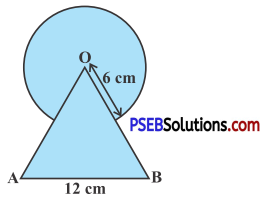
PSEB 10th Class Maths Solutions Chapter 12 Areas Related to Circles Ex 12.3 4

[Each angle of equilateral triangle is 60°]
Area of major sector of circle = Area of circle – Area of sector
= πR2 – \(\frac{\pi \mathrm{R}^{2} \theta}{360^{\circ}}\)

= \(\frac{22}{7}\) × 6 × 6 – \(\frac{22}{7}\) × 6 × 6 × \(\frac{60}{360}\)

= \(\frac{22}{7}\) × 6 × 6 1 – \(\frac{60}{360}\)

= \(\frac{22}{7}\) × 36 1 – \(\frac{1}{6}\)

= \(\frac{22}{7}\) × 36 × \(\frac{5}{6}\)
= 94.28 cm2
∴ Area of major sector of circle = 94.28 cm2
Area of equilateral triangle OAB = \(\frac{\sqrt{3}}{4}\) (side)2
= \(\frac{1.73}{4}\) × 12 × 12
= 1.73 × 36 = 62.28 cm2
Shaded Area = Area of equilateral triangle OAB + Area of major sector of circle
= 62.28 + 94.28 = 62.28 cm2
Shaded Area = Area of equilateral triangle OAR + Area of major sectoç of circle
= 62.28 + 94.28 = 156.56
Shaded Area = 156.56 cm2.

PSEB Solutions PSEB 10th Class Maths Solutions Chapter 12 Areas Related to Circles Ex 12.3

Question 5.
From each corner of a square of side 4 cm a quadrant of a circle of radius 1 cm is cut and also a circle of diameter 2 cm is cut as shown in fig. Find the area of the remaining portion of the square.
Solution:
Side of square = 4 cm
Radius of each semi circle cut out (r) = 1 cm
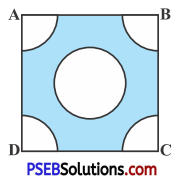
PSEB 10th Class Maths Solutions Chapter 12 Areas Related to Circles Ex 12.3 5

Diameter of circle (R) = 2 cm
.. Radius of circle (R) = 1 cm
Area of square = (Side)2
= (4)2 = 16 cm2
Area of 4 quadrants = 4\(\left[\frac{\pi^{2} \theta}{360^{\circ}}\right]\)

= \(\frac{4 \times 90}{360} \times \frac{22}{7} 1 \times 1\)

= 1 × \(\frac{22}{7}\) × 1 × 1 = 3.14 cm2
Area of circle = πR2
= \(\frac{22}{7}\) × 1 × 1
Area of circle = 3.14 cm2
Required area = Area of square – Area of 4 quadrants – Area of circle
= (16 – 3.14 – 3.14) cm2 = 9.72 cm2
Required Area = 9.72 cm2.

PSEB Solutions PSEB 10th Class Maths Solutions Chapter 12 Areas Related to Circles Ex 12.3

Question 6.
In a circular table cover of radius 32 cm, a design is formed leaving an equilateral triangle ABC in the middle as
shown in fig. Find the area of the design (shaded region).

PSEB 10th Class Maths Solutions Chapter 12 Areas Related to Circles Ex 12.3 5

Solution:
Radius of table cover (R) = 32 cm
OA = OB = OC = 32 cm
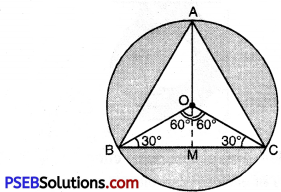
PSEB 10th Class Maths Solutions Chapter 12 Areas Related to Circles Ex 12.3 7

∆ABC is equilateral triangle with AB = AC = BC
∠AOB = ∠BOC = ∠COA = 120°
Now, in ∆BOC,
From O draw, angle bisector of ∠BOC as well as perpendicular bisector 0M of BC.
∴ BM = MC = \(\frac{1}{2}\) BC
Also, OB = OC [radii of the circle]
∴ ∠B = ∠C
∴ ∠O + ∠B + ∠C = 180°
120° + 2∠B = 180°
∠B = 30°
and ∠B = ∠C = 30°
Also, ∠BOM = ∠COM = 60°
∆OMB ≅ ∆OMC [RHS Cong.]
∴ In ∠OMB,
∠OBM = 30° [∠O = 60° and ∠M = 90°]
∴ \(\frac{\mathrm{BM}}{\mathrm{OB}}\) = cos 30°

\(\frac{\mathrm{BM}}{32}=\frac{\sqrt{3}}{2}\)

BM = 16√3 cm.

∴ BC = 2 MB = 32√3 cm
Area of circle = πR2 = \(\frac{22}{7}\) × (32)2
= \(\frac{22}{7}\) × 32 × 32 = 3218.28 cm2

Area of ∆ABC = 4 (side)2
= \(\frac{1.73}{4}\) × 32√3 × 32√3 = 1328.64 cm2

∴ Required Area = Area of circle – Area of ∆ABC
= 3218.28 – 1328.64 = 1889.64 cm2

PSEB Solutions PSEB 10th Class Maths Solutions Chapter 12 Areas Related to Circles Ex 12.3

Question 7.
In fig., ABCD is a square of side 14 cm. With centres A, B, C and D, four circles are drawn such that each circle touch externally two of the remaining three circles. Find the area of the shaded region.
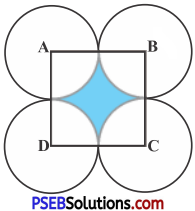
PSEB 10th Class Maths Solutions Chapter 12 Areas Related to Circles Ex 12.3 8

Solution:
Side of square ABCD = 14 cm
Radius of circle (R) = 7 cm
Sector angle (θ) = 90° [Each angle of square 90°]
Area of square = (side)2
= 14 × 14 = 196 cm2
Area of four quadrants = 4 \(\left[\frac{\pi R^{2} \theta}{360}\right]\)
= 4 × \(\frac{22}{7} \times \frac{7 \times 7 \times 90}{360}\)
= 22 × 7 = 154 cm2
∴ Required shaded area = Area of square – Area of 4 quadrants
= 196 – 154 = 42 cm2.


Question 8.
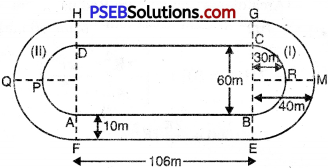
Fig. depicts a racing track whose left and right ends are semicircular. The distahce between the two inner parallel line segments is 60 m and they are each 106 m long. 1f the track is 10 m wide, find
(i) the distance around the track along its inner edge.
(ii) the area of the track.

PSEB 10th Class Maths Solutions Chapter 12 Areas Related to Circles Ex 12.3 9

Solution:

PSEB 10th Class Maths Solutions Chapter 12 Areas Related to Circles Ex 12.3 10

(i) Here AB = DC = 106 m
AF = BE = CG = HD = 10m
Diameter of inner semicircle (APD and BRC) =60 m
∴ Radius of inner semicircle (APD (r) = 30 m
Radius of outer semicircle (R) = r + 10 = 30 + 10 = 40 m
Distance around the track along inner edge = AB + circumference of semi circle BRC + CD + circumference of semi circle DPA
= 2 AB + 2 [circumference of semi circle BRC]
= 2 (106) + 2(\(\left(\frac{2 \pi r}{2}\right)\))
= 212 + 2πr
= 212 + 2 × \(\frac{22}{7}\) × 30
= 212 + \(\frac{60 \times 22}{7}\)
= 212 + 188.57 = 400.57 m.
∴ Distance around the track along its inner edge = 400.57 m

(ii) Area of track = Area of rectangle ABEF + Area of region BEMGCRB + Area of rectangle CGHD + area of region.
= 2 Area of rectangle ABCD + 2 Area of region (II)
= 2 (AB × AF) + 2
[Area of semi circle with Radius 60 cm – Area of semi circle with radius 30 cm]
= 2 [106 × 10] + 2 [latex]\frac{\pi \mathrm{R}^{2}}{2}-\frac{\pi r^{2}}{2}[/latex]
= 2 × 1060 + \(\frac{2 \pi}{2}\) [R2 – r2]
= 2120 + \(\frac{22}{7}\) (402 – 302)
= 2120 + \(\frac{22}{7}\) [1600 – 900]
= 2120 + \(\frac{22}{7}\) [700]
= 2120 + 2200 = 4320 m2
Area of track = 4320 m2

Question 9.
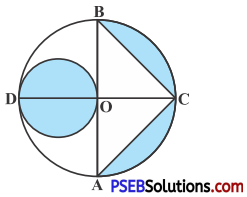
In Fig., AB and CD are two diameters of a circle (with centre O) perpendicular to each other and OD is the diameter of the smaller circle. If OA = 7 cm, find the area of the shaded region.
PSEB 10th Class Maths Solutions Chapter 12 Areas Related to Circles Ex 12.3 11

Solution:
Diameter of circle = 14 cm
Radius of circle = 7 cm
Diameter of smaller circle = 7 cm
∴ Radius of smaller circle = \(\frac{7}{2}\) cm
Since AB and CD are to perpendicular the diameters of a circle,
∴ AO ⊥ CD
Area of bigger circle = πR2 × 7 × 7 = 154 cm2
Area of bigger semicircle = \(\frac{154}{2}\) = 77 cm2
Area of smaller circle = πr2
= \(\frac{22}{7} \times \frac{7}{2} \times \frac{7}{2}\)
= 38.50 cm2

Area of ∆ABC = \(\frac{1}{2}\) Base × Altitude
= \(\frac{1}{2}\) × 14 × 7 = 49 cm2
∴ Shaded Area = Area of bigger semi circle + Area of smaller circle – Area of triangle
= (77 – 49 + 38.5) cm2 = 66.5 cm2

Question 10.
The area of an equilateral triangle ABC is 17320.5 cm2. With each vertex of the triangle as centre, a circle is drawn with radius equal to half of the length of the side of the triangle (see Fig.). Find the area of the shaded region.
(Use n = 3.14 and ,√3 = 1.73205)
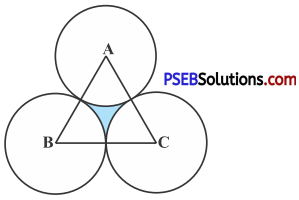
PSEB 10th Class Maths Solutions Chapter 12 Areas Related to Circles Ex 12.3 12

Solution:
Area of equilateral triangle ABC = 17320.5 cm2
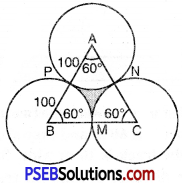
PSEB 10th Class Maths Solutions Chapter 12 Areas Related to Circles Ex 12.3 13

\(\frac{\sqrt{3}}{4}\) (side)2 = 17320.5

(side)2 = \(\frac{17320.5 \times 4}{1.73205}\)

(side)2 = \(\frac{173205}{10} \times \frac{100000 \times 4}{173205}\)

side = \(\sqrt{4 \times 100 \times 100}\)
side = 2 × 100 = 200 cm
AB = BC = AC
Radius of circle (R) = \(\frac{A B}{2}=\frac{200}{2}\) = 100 cm
Sector angle, θ = 60°
Area of sector APN = \(\frac{\pi \mathrm{R}^{2} \theta}{360}\)

= \(\frac{3.14 \times 100 \times 100 \times 60}{360}\)

= \(\frac{15700}{3}\)

Area of three sector = 3 × \(\frac{15700}{3}\) cm2
∴ Required shaded Area = Area of triangle – Area of three sectors
= 17320.5 – 15700 = 1620.5 cm2
∴ Hence, Required shaded Area = 1620.5 cm2

Question 11.
On a square handkerchief, nine circular designs each of radius 7 cm are made (see Fig). Find the area of the remaining portion of the handkerchief.
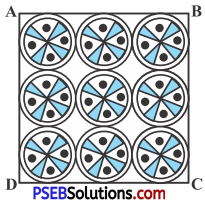
PSEB 10th Class Maths Solutions Chapter 12 Areas Related to Circles Ex 12.3 14

Solution:
Radius of circle (R) = 7 cm
Diameter of circle = 2 × R = 2 × 7 = 14 cm
Since there are three circles along a side of square
∴ side of squrae = 3 [14] = 42 cm
Total area of handkerchief = Area of square = (side)2
= (42)2 = 1764 cm2.
Area of 9 circular designs = 9πR2
= 9 × \(\frac{22}{7}\) × (7)2
= 9 × \(\frac{22}{7}\) × 7 × 7
= 9 × 154 = 1386 cm2
∴ Required area of remaining portion = Area of square – Area of 9 circular designs
= 1764 – 1386 = 378 cm2
∴ Required area of remaining portion = 378 cm2.

Question 12.
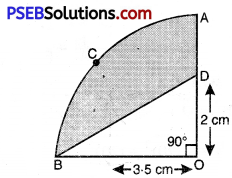
In Fig., OACB is a quadrant of a circle with centre O and radius 3.5 cm. If OD = 2 cm, find the area of the
(i) quadrant OACB,
(ii) shaded region.
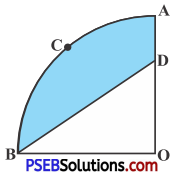
PSEB 10th Class Maths Solutions Chapter 12 Areas Related to Circles Ex 12.3 15

Solution:

PSEB 10th Class Maths Solutions Chapter 12 Areas Related to Circles Ex 12.3 16

Radius of quadrant (R) = 3.5 cm
Angle of sector (θ) = 90°
OD = 2 cm.

(i) Area of quadrant OACB = \(\frac{\pi \mathrm{R}^{2} \theta}{360}\)

= \(\frac{22}{7} \times \frac{3.5 \times 3.5 \times 90}{360}\) = 9.625 cm2.

(ii) Area of ODB = \(\frac{1}{2}\) Base × Altitude
= \(\frac{1}{2}\) × 3.5 × 2 = 3.5 cm2

∴ Shaded Area = Area of quadrant OACB – Area of ∆ODB
= 9.625 – 3.5 = 6.125 cm2
∴ Hence, Shaded Area = 6.125 cm2.

Question 13.
In fig., a square OABC is inscribed in a quadrant OPBQ. If OA = 20 cm, find the area of the shaded region.
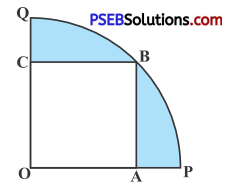
PSEB 10th Class Maths Solutions Chapter 12 Areas Related to Circles Ex 12.3 17

Solution:
Side of square ABCO = 20 cm
∠AOC = 90°
AB = OA
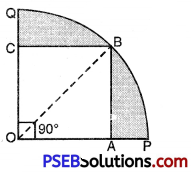
PSEB 10th Class Maths Solutions Chapter 12 Areas Related to Circles Ex 12.3 18

OB2 = OA2 + AB2

OB = \(\sqrt{(20)^{2}+(20)^{2}}\)

= \(\sqrt{400+400}\)

= \(\sqrt{800}=\sqrt{400 \times 2}\)
OB = 20√2 cm
Area of square OABC = (side)2 = (20)2
∴ Area of square = 400 cm2
Radius of quadrant (R) = 20√2 cm
Sector angle (θ) = 90°
∴ Area of sector = \(\frac{\pi \mathrm{R}^{2} \theta}{360^{\circ}}\)
= \(\frac{3.14 \times 20 \sqrt{2} \times 20 \sqrt{2} \times 90}{360}\)
= 2 × 314 cm2 = 628 cm2
Required shaded Area = Area of sector – Area of square
= (628 – 400) cm2 = 228 cm2

Question 14.
AB and CD are respectively arcs of two concentric circles of radii 21 cm and 7 cm and centre O. If ZAOB = 30°, find the area of the shaded region.
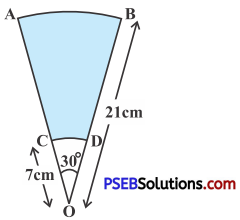
PSEB 10th Class Maths Solutions Chapter 12 Areas Related to Circles Ex 12.3 19

Solution:
Radius of sector OBA (R) =21 cm
Radius of sector ODC (r) 7 cm
Sector angle (θ) = 30°
Area of bigger sector (OAB) = \(\frac{\pi \mathrm{R}^{2} \theta}{360^{\circ}}\)

= \(\frac{22}{7} \times \frac{21 \times 21 \times 30}{360}\) = 115.5 cm2

Area of smaller sector (ODC) = \(\frac{\pi \mathrm{R}^{2} \theta}{360^{\circ}}\)

= \(\frac{22}{7} \times \frac{7 \times 7 \times 30}{360}\) = 12.83 cm2

Area of smaller sector (ODC) = 12.83 cm2
Now, Shaded Area = Area of bigger sector OAB – Area of smaller sector OCD
= 115.5 – 12.83 = 102.66
Hence, Shaded Area = 102.66 cm2.

Question 15.
In fig., ABC is a quadrant of a circle of radius 14 cm and a semi circle is drawn with BC as diameter. Find the area of the shaded region.
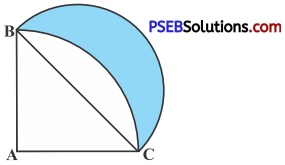
PSEB 10th Class Maths Solutions Chapter 12 Areas Related to Circles Ex 12.3 20

Solution:
Radius of quadrant ACPB (r) = 14 cm
Sector angle (θ) = 90°
AB = AC = 14 cm
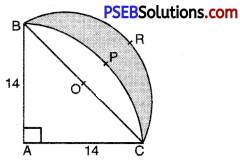
PSEB 10th Class Maths Solutions Chapter 12 Areas Related to Circles Ex 12.3 21

Area of triangle = \(\frac{1}{2}\) AB × AC
= \(\frac{1}{2}\) × 14 × 14
= 98 cm2

Area of sector ACPB = \(\frac{\pi \mathrm{R}^{2} \theta}{360^{\circ}}\)

= \(\frac{22}{7} \times \frac{14 \times 14 \times 30}{360}\) = 154 cm2

∴ Area of BOCPB = Area of sector ABPC – Area of \ABC
= 154 cm2 – 98 cm2 = 56 cm2
In ∆BAC, AB2 + AC2 = BC2
(14)2 + (14)2 = BC2
BC = \(\sqrt{196+196}=\sqrt{2(196)}\) = 14√2

∴ Radius of semi circle BOCR = \(\frac{14 \sqrt{2}}{2}\) = 7√2

Area of semi circle = \(\frac{\pi \mathrm{R}^{2}}{2}\)

= \(\frac{22}{7} \times \frac{7 \sqrt{2} \times 7 \sqrt{2}}{2}\)

= \(\frac{22}{7} \times \frac{7 \times 7 \times 2}{2}\)
= 154 cm2

Required Area = Area of semi circle – [Area of sector – Area of ∆BAC]
= 154 – [154 – 98]
= (154 – 56) cm2 = 98 cm2
Hence, Shaded Area = 98 cm2.

Question 16.
Calculate the area of the designed region in fig. common between the two quadrants of circles of radius 8 cm each.
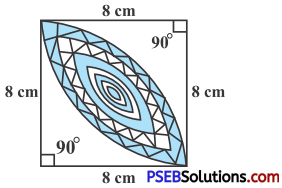
PSEB 10th Class Maths Solutions Chapter 12 Areas Related to Circles Ex 12.3 22

Solution:
Side of square = 8 cm
Area of square = (8)2 = 64 cm2
Line BD divides square ABCD into the equal parts
Area of ∆ABD = ar of ∆BDC
Sector angle θ = 90°
Area of sector = \(\frac{\pi \mathrm{R}^{2} \theta}{360}\)

= \(\frac{22}{7} \times \frac{8 \times 8 \times 90}{360}\)
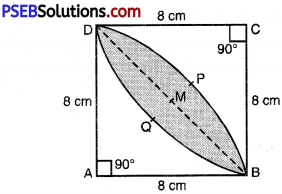
PSEB 10th Class Maths Solutions Chapter 12 Areas Related to Circles Ex 12.3 23

Area of sector = 50.28 cm2
Area of ∆ABD = \(\frac{1}{2}\) × AB × AD
= \(\frac{1}{2}\) × 8 × 8
= 32 cm2

∴ Area of segment DMBPD = Area of sector ∆BPD – Area of ∆ABD
= 50.28 – 32 = 18.28 cm2
Hence, Shaded area = 2 area of segment DMBPD = 2 (18.28) = 36.56 cm2

PSEB 7th Class English Vocabulary Arrange in Alphabetical Order

Punjab State Board PSEB 7th Class English Book Solutions English Vocabulary Arrange in Alphabetical Order Exercise Questions and Answers, Notes.

PSEB 7th Class English Vocabulary Arrange in Alphabetical Order

Question 1.
Monkey, picture, bury, dengue, donkey, village, heart, tomb, women, develop.
Answer:
Bury, dengue, develop, donkey, heart, monkey, picture, tomb, village, women.

PSEB 7th Class English Vocabulary Arrange in Alphabetical Order

Question 2.
Able, Wednesday, frozen, return, extremely, disappointed, shivering, wisest, realise, looking.
Answer:
Able, disappointed, extremely, frozen, looking, realise, return, shivering, Wednesday, wisest.

Question 3.
Quick, fine, nice, ancient, bold, clever, deep, mountain, heavy, happy.
Answer:
Ancient, bold, clever, deep, fine, happy, heavy, mountain, nice, quick.

Question 4.
Astronaut, truth, resident, clown, scratch, journey, assigned, disbelief, humble, mission.
Answer:
Assigned, astronaut, clown, disbelief, humble, journey, mission, resident, scratch, truth.

Question 5.
Sheep, bull, horse, bowl, goal, crow, parrot, frog, donkey, duck.
Answer:
Bowl, bull, crow, donkey, duck, frog, goal, horse, parrot, sheep.

Question 6.
Belt, girl, chalk, wife, picture, sister, error, host, duke, actor.
Answer:
Actor, belt, chalk, duke, error, girl, host, picture, sister, wife.

Question 7.
Active, helpful, careful, brother, popular, faithful, famous, difficult, intelligent, polite.
Answer:
Active, brother, careful, difficult, faithful, famous, helpful, intelligent, polite, popular.

PSEB 7th Class English Vocabulary Arrange in Alphabetical Order

Question 8.
Parent, child, sky, plate, madam, doctor, witch, televisiori, bulb, niece.
Answer:
Bulb, child, doctor, madam, niece, parent, plate, sky, television, witch.

Question 9.
Wash, dance, cook, pray, dust, jump, table, father, laugh, help.
Answer:
Cook, dance, dust, father, help, jump, laugh, pray, table, wash.

PSEB 7th Class English Grammar Parts of Speech

Punjab State Board PSEB 7th Class English Book Solutions English Grammar Parts of Speech Exercise Questions and Answers, Notes.

PSEB 7th Class English Grammar Parts of Speech

शब्दों को प्रयोग के अनुसार आठ भागों अथवा श्रेणियों में विभाजित किया जाता है, जिन्हें Parts of Speech (शब्द भेद) कहते हैं। ये आठ भाग हैं-

  1. Noun
  2. Pronoun
  3. Adjective
  4. Verb
  5. Adverb
  6. Preposition
  7. Conjunction
  8. Interjection.

1. Noun-किसी व्यक्ति, स्थान, वस्तु अथवा गुण-दोष के नाम को Noun (संज्ञा) कहते हैं; जैसे Ram, Shyam, Mumbai, Pen, Pencil, Rose, Dog, Beauty, Honesty आदि।

PSEB 7th Class English Grammar Parts of Speech

2. Pronoun-जो शब्द किसी संज्ञा के स्थान पर प्रयोग होता है, उसे Pronoun (सर्वनाम) कहते हैं; जैसे I, we, you, they, he, she, it आदि।

3. Adjective-जो शब्द किसी Noun अथवा Pronoun की विशेषता प्रकट करता है, उसे Adjective (विशेषण) कहते हैं; जैसे good, bad, thin, fat, tall, many, useful आदि।

4. Verb-वह शब्द जिससे कार्य का होना अथवा करना प्रकट हो या जो शब्द किसी व्यक्ति, स्थान अथवा वस्तु के बारे में कुछ बतलाए, वह,शब्द Verb (क्रिया) कहलाता है; जैसे-

  • The girl reads a book.
  • Ram is a good boy.
  • Mohan goes to school daily.
  • Seema feels sad.
  • I helped the poor.

5. Adverb जो शब्द किसी Verb, Adjective अथवा किसी अन्य Adverb की विशेषता प्रकट करे, तो उसे Adverb (क्रिया विशेषण) कहते हैं; जैसे-

  • He ran fast. (Verb की विशेषता)
  • Rose is very beautiful. (Adjective की विशेषता)
  • He works too slowly. (Adverb की विशेषता)

6. Preposition-जो शब्द किसी Noun अथवा Pronoun से पहले प्रयोग किया जाता है और जो उनका सम्बन्ध वाक्य के अन्य शब्दों से जोड़ता है, उसे Preposition (सम्बन्धवाचक शब्द) कहते हैं; जैसे- .

  • Mohan is at the gate.
  • Ram is proud of his teacher.
  • He is fond of music.
  • I am writing with a pen.

7. Conjunction–जो शब्द, शब्दों अथवा वाक्यों को जोड़ता है, उसे Conjunction (संयोजक) कहते हैं; जैसे-

  • Ram and Shyam are friends.
  • You will get through if you work hard.
  • He was late because he missed the bus.
  • Either he or his brother is at fault.

8. Interjection-अकस्मात् भावना को व्यक्त करने वाला शब्द Interjection (विस्मयादिबोधक अव्यय) कहलाता है जैसे, Alas ! Hurrah ! Oh ! Lo! आदि।

Exercises

I. Write in the space provided the name of the part of speech to which the underlined words belong in the following sentences:

1. Seema is a beautiful girl.
2. Alas! His dog is dead.
3. The sun sets in the west.
4. The lion is a ferocious animal.
5. Delhi is a very big city.
6. Rahim is poor but honest.
7. Honesty is the best policy.
8. The.cat is under the table.
Hints:
1. Adjective
2. Interjection
3. Verb
4. Adjective
5. Adverb
6. Conjunction
7. Noun
8. Preposition.

II. Complete the following sentences with appropriate ‘Nouns’:

1. ……….. is a good boy.
2. She goes to the ……… everyday.
3. They go for a ……….. daily.
4. ……….. is the Capital of India.
5. ……… is the best policy.
6. The ………. rises in the …….
7. Chandigarh is the ……….. of Punjab and Haryana.
8. Shimla is a beautiful …………
Hints:
1. Mohan
2. temple/Gurudwara
3. walk
4. Delhi
5. Honesty
6. sun, east
7. capital
8. place.

III. Fill in the blanks with suitable “Pronouns’:

1. My son is playing with ……… toys.
2. ……….. father is working in Mumbai.
3. ……….. has gone abroad for higher studies.
4. This is ……… house.
5. The girls are doing ……….. homework.
6. ……….. is the bread-winner of the family.
7. We should respect ……. parents.
8. He loves ……… native place very much.
Hints:
1. his
2. My
3. He
4. our
5. their
6. She
7. our
8. his.

PSEB 7th Class English Grammar Parts of Speech

IV. Fill in the blanks with suitable ‘Adjectives’:

1. She is my ……….. friend.
2. Pudding is my ……….. dish.
3. The scenery of Mussoorie is
4. She likes to wear ……… dresses.
5. The Bible is a ……….. book.
6. Cricket is a ………. game.
7. John is an ……….. teacher.
8. Mango is a ………. fruit.
Hints:
1. best
2. favourite
3. beautiful
4. white
5. holy
6. good
7. English
8 juicy.

V. Fill in the blanks with suitable ‘Verbs’:

1. She ……….. ice-cream.
2. They ……….. a lot.
3. My mother ……….. food.
4. John …….. in a factory.
5. They ………. football.
6. We should ……….. a bath everyday.
7. The school peon ……….. the bell.
8. Seema ……….. for a walk daily.
Hints:
1. is eating
2. worked
3. cooks
4. works
5. play
6. take
7. rings
8. goes.

VI. Fill up the blanks with suitable ‘Adverbs’:

1. Sohan walks …………. .
2. Everyone should work ………..
3. She sings ………….
4. His dad is a …………. respectable man.
5. Our teacher speaks ……….. politely.
6. My sister sleeps …………
7. John is a ………. hardworking boy.
8. Girls sang …………. .
Hints:
1. slowly
2. hard
3. sweetly:
4. very
5. very
6. early
7. very
8. nicely.

VII. Complete the following sentences with suitable ‘Prepositions:

1. My grandfather is hard ……….. hearing.
2. My mom is fond ……… music.
3. A burglar broke ……….. our house last night.
4. The students should listen ………. their teachers attentively.
5. Yesterday we went ………. the Rose Garden.
6. Ayushi is playing ……….. the piano.
7. Children have been playing ……….. morning.
8. My uncle has been living ……….. Canada ……….. fifteen years.
9. I will play ……….. finishing my homework.
10. I am standing ……….. Anshu. Anshu is in front of me.
Hints:
1. of
2. of
3. into
4. to
5. to
6. on
7. since
8. in, for
9. after
10. behind.

PSEB 7th Class English Grammar Parts of Speech

VIII. Fill in the blanks with suitable ‘Conjunctions’:

1. My younger brother is both intelligent ……….. hardworking.
2. He says ………. he is a doctor.
3. ……….. Seema ………. Rita is at fault.
4. Our servant is poor ……….. honest.
5. He ………. his nephew manage the shop.
6. Ram went on leave ……….. he was injured.
7. You will get the tickets ………..you reach there before 6 o’clock.
8. ……….. he was late, yet he was able to catch the bus.
Hints:
1. and
2. that
3. Either, or
4. but
5. and
6. because
7. if
8. Although

IX. Fill in the blanks with suitable ‘Interjections’:

1. ……….. We have won the game.
2. ……. The man is dead.
3. ……… They have come.

V. Fill in the blanks with suitable ‘Verbs’:

1. She ……….. ice-cream.
2. They ……….. a lot.
3. My mother ……….. food.
4. John …….. in a factory.
5. They ………. football.
6. We should ……….. a bath everyday.
7. The school peon ……….. the bell.
8. Seema ……….. for a walk daily.
Hints:
1. is eating
2. worked
3. cooks
4. works
5. play
6. take
7. rings
8. goes.

VI. Fill up the blanks with suitable ‘Adverbs’:

1. Sohan walks …………. .
2. Everyone should work ………….
3. She sings …………..
4. His dad is a ………….. respectable man.
5. Our teacher speaks ……… politely.
6. My sister sleeps …………..
7. John is a …………. hardworking boy.
8. Girls sang ……….. .
Hints:
1. slowly
2. hard
3. sweetly
4. very
5. very
6. early
7. very
8. nicely.

VII. Complete the following sentences with suitable ‘Prepositions:

1. My grandfather is hard ……….. hearing.
2. My mom is fond ……… music.
3. A burglar broke ……….. our house last night.
4. The students should listen ………. their teachers attentively.
5. Yesterday we went ………. the Rose Garden.
6. Ayushi is playing ……….. the piano.
7. Children have been playing ……….. morning.
8. My uncle has been living ……….. Canada ……….. fifteen years.
9. I will play ……….. finishing my homework.
10. I am standing ……….. Anshu. Anshu is in front of me.
Hints:
1. of
2. of
3. into
4. to
5. to
6. on
7. since
8. in, for
9. after
10. behind.

VIII. Fill in the blanks with suitable ‘Conjunctions’:

1. My younger brother is both intelligent ……….. hardworking.
2. He says ………. he is a doctor.
3. ……….. Seema ………. Rita is at fault.
4. Our servant is poor ……….. honest.
5. He ………. his nephew manage the shop.
6. Ram went on leave ……….. he was injured.
7. You will get the tickets ………..you reach there before 6 o’clock.
8. ……….. he was late, yet he was able to catch the bus.
Hints:
1. and
2. that
3. Either, or
4. but
5. and
6. because
7. if
8. Although

PSEB 7th Class English Grammar Parts of Speech

IX. Fill in the blanks with suitable ‘Interjections’:

1. ……….. We have won the game.
2. ………… The man is dead.
3. …………. They have come.
4. …………. Is this the place?
5. …………. Well done.
6. ………….. He has lost all his money in gambling.
7. …………. You are hurt.
8. …………… He has failed again.
Hints:
1. Hurrah !
2. Alas!
3. Lo !
4. Oh !
5. Bravo !
6. Alas !
7. Oh !
8. Alas !

Exercise

Choose the correct option to determine which part of speech the underlined word belongs to:

Question 1.
Honesty is the best policy.
(a) noun
(b) verb
(c) adjective
(d) preposition
Answer:
(a) noun

Question 2.
The sun rises in the east.
(a) adjective
(b) verb
(c) noun
(d) preposition
Answer:
(c) noun

Question 3.
She is eating ice-cream.
(a) noun
(b) verb
(c) adjective
(d) preposition
Answer:
(b) verb

Question 4.
The school peon rings the bell.
(a) noun
(b) adjective
(c) verb
(d) preposition
Answer:
(c) verb

Question 5.
She likes to wear white dresses.
(a) noun
(b) verb
(c) adjective
(d) preposition
Answer:
(c) adjective

Question 6.
Mango is a juicy fruit.
(a) noun
(b) adjective
(c) verb
(d) preposition
Answer:
(b) adjective

Question 7.
My grandfather is hard of hearing.
(a) noun
(b) verb
(c) adjective
(d) preposition
Answer:
(d) preposition

Question 8.
Ayushi is playing on the piano.
(a) preposition
(b) verb
(c) adjective
(d) noun
Answer:
(a) preposition

Question 9.
My son is playing with his toys.
(a) pronoun
(b) adverb
(c) conjunction
(d) interjection
Answer:
(a) pronoun

PSEB 7th Class English Grammar Parts of Speech

Question 10.
We should respect our parents.
(a) adverb
(b) pronoun
(c) interjection
(d) conjunction
Answer:
(b) pronoun

Question 11.
Sohan walks slowly.
(a) pronoun
(b) adverb
(c) conjunction
(d) interjection
Answer:
(b) adverb

Question 12.
Our teacher speaks very politely.
(a) pronoun
(b) interjection
(c) conjunction
(d) adverb
Answer:
(d) adverb

Question 13.
He says that he is a doctor.
(a) pronoun
(b) adverb
(c) conjunction
(d) interjection
Answer:
(c) conjunction

Question 14.
Our servant is poor but honest.
(a) conjunction
(b) adverb
(c) pronoun
(d) interjection
Answer:
(a) conjunction

Question 15.
Hurrah ! We have won the match.
(a) pronoun
(b) adverb
(c) conjunction
(d) interjection
Answer:
(d) interjection

Question 16.
Alas ! He has failed again.
(a) pronoun
(b) interjection
(c) conjunction
(d) adverb
Answer:
(b) interjection

Name the part of speech of the bold words:

A. (i). He lives in a cottage.
(ii) Delhi is very big city.

B. (i) They go for a walk daily.
(ii) She is my best friend.

C. (i) Beauty does not last long.
(ii) The baby plays.

Fill in the blanks with an appropriate noun:

A. Shimla is a beautiful …………….
B. …………….. is the capital of India.
C. …………….. is a good boy.

Name the part of speech of the underlined words:

A. (i) Honesty is the best policy.
(ii) Pudding is my favourite dish.

B. (i) Dey is a good boy.
(ii) The girls are doing their homework.

C. (i) They play with the ball.
(ii) She sings sweetly.

PSEB 7th Class English Grammar Parts of Speech

Name the part of speech of the bold words:

A. (i) This is my house.
(ii) Our teacher speaks very politely.

B. (i) He lives in a cottage.
(ii) Josh is very handsome.

C. (i) The sun sets in the west.
(ii) Seema is a beautiful girl.

Choose the correct option to determine which part of speech the underlined word belongs to:

(i) Rohan is a handsome boy
(a) noun
(b) verb
(c) adjective
(d) preposition
Answer:
(c) adjective

(ü) Delhi is a big city.
(a) noun
(b) verb
(c) adjective
(d) preposition
Answer:
(a) noun