PSEB 10th Class Maths Solutions Chapter 12 Areas Related to Circles Ex 12.2

Punjab State Board PSEB 10th Class Maths Book Solutions Chapter 12 Areas Related to Circles Ex 12.2 Textbook Exercise Questions and Answers.

PSEB Solutions for Class 10 Maths Chapter 12 Areas Related to Circles Ex 12.2

Question 1.
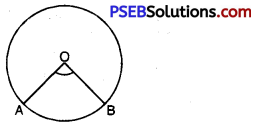
Find the area of sector of a circle with radius 6 cm, if angle of the sector is 60°.
Solution:
Radius of sector of circle (R) = 6 cm
PSEB 10th Class Maths Solutions Chapter 12 Areas Related to Circles Ex 12.2 1

Central angle (θ) = 60°
Area of sector = \(\frac{\pi \mathrm{R}^{2} \theta}{360}\)

= \(\frac{22}{7} \times \frac{6 \times 6 \times 60}{360}\)

= \(\frac{132}{7}\) cm2
∴ Area of sector = 18.86 cm2.

PSEB Solutions PSEB 10th Class Maths Solutions Chapter 12 Areas Related to Circles Ex 12.2

Question 2.
Find the area of a quadrant of a circle whose circumference is 22 cm.
Solution:
Circumference of circle = 22 cm
2πR = 22
R = \(\frac{22 \times 7}{2 \times 22}=\frac{7}{2}\) cm
R = \([latex]\frac{7}{2}\)[/latex] cm
Central angle [quadrant] (θ) = 90°
∴ Area of a quadrant = \(\frac{\pi \mathrm{R}^{2} \theta}{360}=\frac{\frac{22}{7} \times \frac{7}{2} \times \frac{7}{2} \times 90}{360}\)

= \(\frac{77}{8}\)

Area of quadrant = 9.625 cm2.

PSEB Solutions PSEB 10th Class Maths Solutions Chapter 12 Areas Related to Circles Ex 12.2

Question 3.
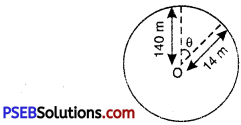
The length of the minute hand of a clock is 14 cm. Find the area swept by the minute hand in 5 minutes.
Solution:
Length of minute hand of clock = Radius of circle (R) = 14 cm
PSEB 10th Class Maths Solutions Chapter 12 Areas Related to Circles Ex 12.2 3

We know that
60’ = 360°
1’ = \(\frac{360^{\circ}}{60}\) = 6°
5′ = 60 × 5 = 30°
Angle of sector (θ) = 30°
∴ Area swept by minute hand in 5 minutes = \(\frac{\pi R^{2} \theta}{360}\)

= \(\frac{22}{7} \times 14 \times 14 \times \frac{30}{360}\)

= \(\frac{1}{12}\) × 22 × 28 = \(\frac{154}{3}\) cm2.

Hence, area swept by minute hand in 5 minutes is 5133 cm2.

PSEB Solutions PSEB 10th Class Maths Solutions Chapter 12 Areas Related to Circles Ex 12.2

Question 4.
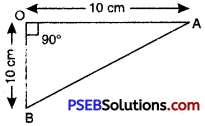
A chord of a circle of radius 10 cm subtends a right angle at the centre. Find the area of the corresponding:
(i) minor segment
(ii) major sector.
Solution:
Radius of circle (R) = 10 cm
Central angle (θ) = 90°
PSEB 10th Class Maths Solutions Chapter 12 Areas Related to Circles Ex 12.2 2

(i) Area of minor sector = \(\frac{\pi R^{2} \theta}{360}\)

= 3.14 × 10 × 10 × \(\frac{90}{360}\)

Area of minor sector = \(\frac{314}{4}\) = 78.5 cm2
Area of minor segment = Area of minor sector – Area of MOB
= 78.5 – \(\frac{1}{2}\) Base × Altitude
= 78.5 – \(\frac{1}{2}\) × 10 × 10
= 78.5 – 50 = 28.5
∴ Area of minor segment = 28.5 cm2

(ii) Area of major sector = \(\frac{(360-\theta)}{360}\)
= \(\frac{(360-90)}{360}\) × 3.14 × 10 × 10
= \(\frac{270}{360}\) × 3.14 × 100
= \(\frac{3 \times 314}{4}=\frac{3 \times 157}{2}\)
∴ Area of major sector 235.5 cm2.

PSEB Solutions PSEB 10th Class Maths Solutions Chapter 12 Areas Related to Circles Ex 12.2

Question 5.
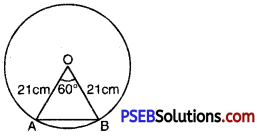
In a circle of radius 21 cm, an arc subtends an angle of 60° at the centre. Find:
(j) the length of the arc
(ii) area of the sector formed by the arc
(iii) area of the segment formed by the corresponding chord
Solution:
(i) Radius of circle (R) 21 cm
PSEB 10th Class Maths Solutions Chapter 12 Areas Related to Circles Ex 12.2 4

Central angle(θ) = 60°
Length of arc = \(\frac{\theta}{360}\) × 2πR
= \(\frac{60}{360} \times 2 \times \frac{22}{7} \times 21\) = 22 cm
Hence, length of arc = 22 cm.

(ii) Area of sector formed by arc = \(\)
= \(\frac{22}{7} \times \frac{21 \times 21 \times 60}{360}\)
Area of sector = 231 cm2
∴ Since ∆OAB is equilateral triangle, θ = 60°.

(iii) Area of segment = Area of sector – Area of ∆AOB
= \(\frac{\pi R^{2} \theta}{360}-\frac{\sqrt{3}}{4}(\text { side })^{2}\)
= 231 – \(\frac{1.73}{4}\) × 21 × 21
= 231 – 0.4325 × 441
= 231 – 190.7325
Area of segment = 40.26 cm2.

PSEB Solutions PSEB 10th Class Maths Solutions Chapter 12 Areas Related to Circles Ex 12.2

Question 6.
A chord of a circle of radius 15 cm subtends an angle of 60° at the centre. Find the areas of the corresponding minor and major segments of the circle. (Use π = 3.14 and √3 = 1.73)
Solution:
Radius of circle = (R) = 15 cm
Central angle (θ) = 60°
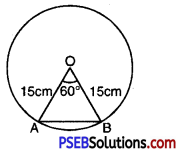
PSEB 10th Class Maths Solutions Chapter 12 Areas Related to Circles Ex 12.2 5

In ∆OAB, central angle θ = 60°
OA = OB = 15 cm
∴ ∠A = ∠B
Now, ∠A + ∠B + ∠O = 180°
2∠A ÷ 600 = 180°
∠A = 60°
∴ ∠A = ∠B = 60
∴ ∠OAB is equilateral.
[ Area of minor segment] = [Area of minor sector] – [Area of equilateral triangle]

= \(\frac{\pi R^{2} \theta}{360}-\frac{\sqrt{3}}{4}(\text { side })^{2}\)

= 3.14 × \(\frac{15 \times 15 \times 60}{360}-\frac{1.73}{4} \times(15)^{2}\)

= 15 × 15 \(\left[\frac{3.14 \times 60}{360}-\frac{1.73}{4}\right]\)

= \(\frac{225}{100}\left[\frac{314}{6}-\frac{173}{4}\right]\)

= \(\frac{225}{100}\) [52.33 – 43.25]

= \(\frac{225}{100}\) × 9.08

= \(\frac{2043}{100}\) = 20.43 cm2

Area of minor segment = 20.43 cm2.
Area of major segment = Area of circle – Area of major segment.
= πR2 – 20.43
= 3.14 × 15 × 15 – 20.43
= 706.5 – 20.43
= 686.07 cm2
Area of major segment = 686.07 cm2.

PSEB Solutions PSEB 10th Class Maths Solutions Chapter 12 Areas Related to Circles Ex 12.2

Question 7.
A chord of a circle of radius 12 cm subtends an angle of 120° at the centre. Find the area of the corresponding segment of the circle. (Use it π = 3.14 and √3 = 1.73).
Solution:
Radius of circle (R) = 12 cm
Central angle (θ) = 120°
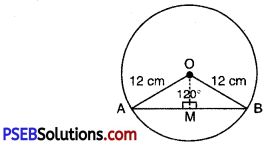
PSEB 10th Class Maths Solutions Chapter 12 Areas Related to Circles Ex 12.2 6

In ∆OAM, from O draw, angle bisector of ∠AOB as well as perpendicular bisector OM of AB.
∴ AM = MB = \(\frac{1}{2}\) AB
In ∆OMA,
∠AOM + ∠OMA + ∠OAM = 180°
LOAM = 30°
Similarly, ∠OAM = 30° = ∠OBM
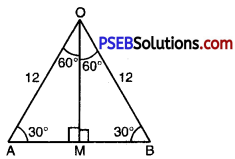
PSEB 10th Class Maths Solutions Chapter 12 Areas Related to Circles Ex 12.2 7

AB = 2AM
= 2 \(\left(\frac{\mathrm{AM}}{\mathrm{OA}}\right)\) OA
= 2 (sin 60°) 12
AB = 2 × \(\frac{\sqrt{3}}{2}\) × 12 = 12√3 cm
OM = OA \(\left(\frac{O M}{O A}\right)\) = 12 (cos 60°)
= 12 × \(\frac{1}{2}\) = 6 cm
Area of the segment = Area of sector – Area of ∆OAB.
Area of segment = \(\frac{\pi R^{2} \theta}{360^{\circ}}-\frac{1}{2} A B \times O M\)

= \(\frac{3.14 \times 12 \times 12 \times 120}{360}\) – \(\frac{1}{2}\) × 12√3 × 6

= \(\frac{314}{100} \times \frac{144 \times 120}{360}\) – 36√3
= 150.72 – 36 × 1.73
= (150.72 – 62.28) cm2
= 88.44 cm2
∴ Area of the segment = 88.44 cm2.

PSEB Solutions PSEB 10th Class Maths Solutions Chapter 12 Areas Related to Circles Ex 12.2

Question 8.
A horse is tied to a peg at one corner of a square shaped grass field of side 15 m by means of a 5 m long rope (see fig.). Find:
(i) the area of that part of the field in which the horse can graze.
(ii) the increase in the grazing area if the rope were 10 m long instead of 5 m (Use π = 3.14).
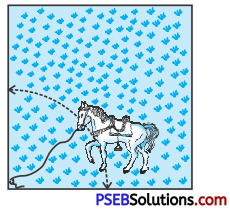
PSEB 10th Class Maths Solutions Chapter 12 Areas Related to Circles Ex 12.2 8

Solution:
Side of square = 15 m
(i) Length of Peg = Radius of rope (R) = 5 m
Centrral angle (θ) = 90° [Each angle of square]
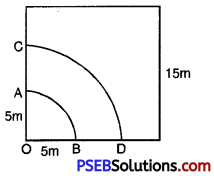
PSEB 10th Class Maths Solutions Chapter 12 Areas Related to Circles Ex 12.2 9

Area of sector = \(\frac{\pi R^{2} \theta}{360}\)

= \(\frac{3.14 \times 5 \times 5 \times 90}{360}\)

Area of sector = \(\frac{3.14 \times 25}{4}=\frac{78.5}{4}\) m2.
= 19.625 m2

PSEB Solutions PSEB 10th Class Maths Solutions Chapter 12 Areas Related to Circles Ex 12.2

(ii) When radius of sector increased to 10 m
Radius of sector OCD (R1) = 10 m
Central angle (θ) = 90°
∴ Area of sector OCD = \(\frac{\pi R_{1}^{2} \theta}{360^{\circ}}\)

= \(\frac{3.14 \times 10 \times 10 \times 90}{360^{\circ}}\)

= \(\frac{314}{100} \times \frac{100 \times 90}{360^{\circ}}\)

= \(\frac{314}{4}\) = 78.5 m

∴ Increase in grazing area = Area of sector OCD – Area of sector OAB
= 78.5 – 19.625 = 58.875 m2
Increase of grazing area = 58.875 m2

Question 9.
A brooch is made with silver wire in the form of a circle with diameter 35 mm. The wire is also used in making 5 diameters which divide the circle into 10 equal sectors as shown In fig. Find:
(i) the total length of the silver wire required.
(ii) the area of each sector of the brooch.

PSEB 10th Class Maths Solutions Chapter 12 Areas Related to Circles Ex 12.2 10

Solution:
Diameter of circle (D) = 35 mm
Radius of circle (R) = \(\frac{35}{2}\) mm
Number of diameter = 5
Number of equal sector = 10

(i) Wire used = Length of 5 diameters + circumference of circle (brooch) = 5(35) + 2πR
= 175 + 2 × \(\frac{22}{7}\) × \(\frac{35}{2}\)
= 175 + 110 = 285 mm

(ii) Sector angle of brooch = \(\frac{360^{\circ}}{\text { Number of sector }}\)
= \(\frac{360^{\circ}}{10}\) = 36°
Area of each brooch (Area of sector) = \(\frac{\pi R^{2} \theta}{360^{\circ}}\)

= \(\frac{22}{7} \times \frac{35}{2} \times \frac{35}{2} \times \frac{36}{360}\)

= \(\frac{11 \times 35}{4}=\frac{385}{4}\) mm2 = 96.25 mm2

∴ Area of each brooch = 96.25 m2.

PSEB Solutions PSEB 10th Class Maths Solutions Chapter 12 Areas Related to Circles Ex 12.2

Question 10.
An umbrella has 8 ribs which are equally spaced (see fig). Assuming umbrella to be a flat circle of radius 45 cm, find the area between the two consecutive ribs of the umbrella.

PSEB 10th Class Maths Solutions Chapter 12 Areas Related to Circles Ex 12.2 11

Solution:
Radius of circle = 45 cm
Number of ribs = 8
Central angle (sector angle) = \(\frac{360^{\circ}}{8}\) = 45°
Area of sector = \(\frac{\pi R^{2} \theta}{360^{\circ}}\)

= \(\frac{45}{360^{\circ}} \times \frac{22}{7} \times 45 \times 45\)

= \(\frac{1}{8} \times \frac{22}{7} \times 45 \times 45\)

= \(\frac{22275}{28}\) cm2

Area of sector = 795.53 cm2
∴ Area between two consecutive ribs of the umbrella = 795.53 cm2.

PSEB Solutions PSEB 10th Class Maths Solutions Chapter 12 Areas Related to Circles Ex 12.2

Question 11.
A car has two wipers which do not overlap. Each wiper has a blade of length 25 cm sweeping through an angle of 115°. Find the total area cleaned at each sweep of the blades.
Solution:
Length of blade (R) = 25 cm
Sector angle (θ) = 115°
Wiper moves in form of sector.
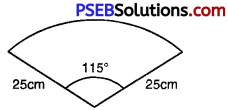
PSEB 10th Class Maths Solutions Chapter 12 Areas Related to Circles Ex 12.2 12

Area of sector = Area çovered by one blade
= \(\frac{\pi \mathrm{R}^{2} \theta}{360^{\circ}}\)

= \(\frac{22}{7} \times \frac{115}{360} \times 25 \times 25=\frac{316250}{504}\)

= 627.48 cm2
Area covered by two blades of wiper = 2 Area of sector
= 2 × 627.48 = 1254.96 cm2.

Question 12.
To warn ships for underwater rocks, a lighthouse spreads a red coloured light over a sector of angle 800 to a distance of 16.5 km. Find the area of the sea over which the ships are warned. (Use x = 3.14)
Solution:
Sector angle (θ) = 80°
Radius of sector (R) = 16.5 km
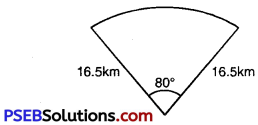
PSEB 10th Class Maths Solutions Chapter 12 Areas Related to Circles Ex 12.2 13

Area of sea over which the ships are warned
Area of sector = \(\frac{\pi R^{2} \theta}{360^{\circ}}\)

= \(\frac{3.14 \times 16.5 \times 16.5 \times 80}{360}\)
= 189.97 km2
Area of sea over which the ships are warned = 189.97 km2.

PSEB Solutions PSEB 10th Class Maths Solutions Chapter 12 Areas Related to Circles Ex 12.2

Question 13.
A round table cover has six equal designs as shown in fig. 1f the radius of the cover is 28 cm, find the cost of making the designs at the rate of 0.35 per cm2. (Use √3 = 1.7)
Solution:
Number of equal designs = 6
Radius of designs (R) = 28 cm
Each design is in the shape of sector central angle (θ) = 6 = 60°
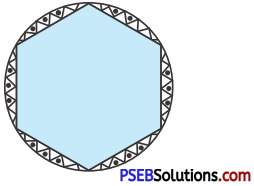
PSEB 10th Class Maths Solutions Chapter 12 Areas Related to Circles Ex 12.2 14

Since central angle is 60° and OA = OB
∴ ∆OAB is equilateral triangle having side 28 cm.
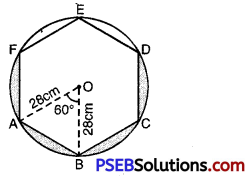
PSEB 10th Class Maths Solutions Chapter 12 Areas Related to Circles Ex 12.2 15

Area of one shaded designed portion = area of segment = Area of the sector OAB – area of ∆OAB
= \(\frac{\pi R^{2} \theta}{360^{\circ}}-\frac{\sqrt{3}}{4}(\text { side })^{2}\)

= \(\frac{22}{7} \times \frac{28 \times 28}{360^{\circ}} \times 60^{\circ}-\frac{1.7}{4} \times 28 \times 28\)
= 410.66 – 333.2 = 77.46.

Area of one shaded designed portion = 77.46
Area of six designed portions = 6 [Area of one designed]
= 6 [77.46] = 464.76 cm2
Cost of making 1 cm2 = ₹ 0.35
Cost of making of 464.76 cm2 = 464.76 × 0.35 = ₹ 162.68.

PSEB Solutions PSEB 10th Class Maths Solutions Chapter 12 Areas Related to Circles Ex 12.2

Question 14.
Tick the correct answer in the following:
Area of a sector of angle p° of a circle with radius R is
(A) \(\frac{p}{180}\) × 2πR
(B) \(\frac{p}{180}\) × πR2
(C) \(\frac{p}{360}\) × 2πR
(D) \(\frac{p}{720}\) × 2πR2
Solution:
Angle of sector (θ) = p°
Radius of circle = R
Area of sector = \(\frac{\pi \mathrm{R}^{2} \theta}{360}\)

= \(\frac{\pi \mathrm{R}^{2} \times p^{\circ}}{360}\)

= \(\frac{p^{\circ}}{720}\) × 2πR2
∴ Correct option is (D).
PSEB 7th Class English Grammar Conjunctions

Punjab State Board PSEB 7th Class English Book Solutions English Grammar Conjunctions Exercise Questions and Answers, Notes.

PSEB 7th Class English Grammar Conjunctions

A conjunction is a word which joins words or sentences together.
वह शब्द जो शब्दों अथवा वाक्यों को आपस में जोड़े, Conjunction (संयोजक) कहलाता है। जैसे:

  1. Moti and Narain were friends.
  2. I know that he is honest.
  3. He failed because he did not work hard.

इन वाक्यों में and, that तथा because शब्दों एवं वाक्यों को आपस में जोड़ते हैं। अतः ये शब्द conjunctions

PSEB 7th Class English Grammar Conjunctions

Exercise 1

I. Rewrite each pair of sentences by using ‘because’, ‘and’, ‘but’, ‘or’, ‘else’, “otherwise and ‘unless’. One has been done for you:

1. You must walk’ fast. You will not reach the station.
You must walk fast or you will not reach the station.

2. Rina is a girl. Tony is a boy.
Rina is a girl but Tony is a boy.

3. Radha is studying. Hardeep is watching cartoons.
Radha is studying but Hardeep is watching cartoons.

4. Find the key. You will be standing out.
Find the key else you will be standing out..

5. Lock the door. Robbers will break into the house.
Lock the door otherwise robbers will break into the house.

6. Study seriously. You will not get promotion.
Unless you study seriously you will not get promotion.

7. Take exercise regularly. You will not keep fit.
Take exercise regularly otherwise you will not keep fit.

8. Put the alarm. You will not wake on time.
Put the alarm or you will not wake on time.

9. Rama sells fruits. She sells vegetables.
Rama sells fruits but she sells vegetables.

10. I like my parents. They encourage me.
I Like my parents because they encourage me.

11. They started well. They failed in the end.
They started well but they failed in the end.

12. Control your ways. You will be punished.
Control your ways or you will be punished.

II. Using the conjunctions “so’, ‘therefore’, ‘because’, “as’, ‘since’, ‘though”, “still and “although’ make sentences of your own. The first one has been done for you:

1. I am not well so I did not go to school today.
2. It was very cold, therefore I did not go for a walk.
3. My father punished me because I stole his pen.
4. I forgave him as he spoke the truth.
5. Since he is my brother, I must help him.
6. Though they played well, they could not win the match.
7. Raj hit the gentleman still he forgave him.
8. Although he ran fast, he could not win the race.

PSEB 7th Class English Grammar Conjunctions

III. Underline the conjunctions in the following sentences. The first one has been done for you:

1. I won’t forgive you unless you return my money.
2. Sanjay is rich yet he is a miser.
3. I am weak but I can run fast.
4. Although I am weak, I can run fast.
5. She is old, so her limbs are weak.
6. I was angry with him because he disobeyed me.
7. You are not an honest man, still I will help you.
8. The lady fed the child since she cared for her.
9. It is very hot, therefore I am drinking a cold drink.
10. As there is no milk, I am not having tea.
11. Take the medicine else you will remain sick.
12. Though he is poor, he is happy and content.
13. It was raining still the children went out to play.
14. We did not start the dinner till the guests arrived.

Exercise 2

I. Combine the following pair of sentences by using neither ……… nor ; either………….. or:

1. Soma is not intelligent. Gopal is not intelligent.
2. Hari doesn’t know the answer. Manjit doesn’t know the answer.
3. I shall write you a letter. I shall telephone you.
4. You can go by bus. You can go by train.
5. Our country isn’t poor. Our country isn’t small.
6. You can play in the playground. You can read in the library.
7. He has not come from England. He has not come from America.
Answer:
1. Neither Soma nor Gopal is intelligent.
2. Neither Hari nor Manjit knows the answer.
3. I shall either write you a letter or telephone you.
4. You can either go by bus or by train.
5. Our country is neither poor nor small.
6. You can either play in the playground or read in the library.
7. He has neither come from England nor from America.

PSEB 7th Class English Grammar Conjunctions

II. Fill in the blanks with appropriate conjunctions and, unless, if, or, but, till, though, neither……. nor, either… or:

1. The beggar sang for a long time……………. nobody gave him anything.
2. He felt sad………….. stopped singing.
3. He is …………….. an actor …………… a teacher. He is a student.
4. The musician said, “Give me your violin ………….. I will play for you.”
5. They …………. eat bread ………………….. chapattis for breakfast.
6. ………….. I ran fast I missed the train.
7. I shall wait …………….. you return.
8. Catch me …………… you can.
9. You will be late …………… you hurry.
10. Raman will sing ……………. you so desire.
11. He saw me …………….. did not talk to me.
12. I have a rupee. You can ………….. take it ………….. leave it.
13. Gopal is not to be seen. He is ……………. at home …………….in his office.
14. He did not come …………… I invited him.
Hints:
1. but
2. and
3. neither, nor
4. and
5. either, or
6. Though
7. till
8. if
9. unless
10. if
11. but
12. either, or
13. neither, nor
14. though.

PSEB 10th Class Maths Solutions Chapter 12 Areas Related to Circles Ex 12.1

Punjab State Board PSEB 10th Class Maths Book Solutions Chapter 12 Areas Related to Circles Ex 12.1 Textbook Exercise Questions and Answers.

PSEB Solutions for Class 10 Maths Chapter 12 Areas Related to Circles Ex 12.1

Question 1.
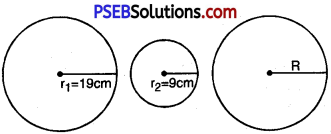
The radii of two circles are 19 cm and 9 cm respectively. Find the radius of the circle which has circumference equal to the sum of the circumferences of the two circles.
Solution:

PSEB 10th Class Maths Solutions Chapter 12 Areas Related to Circles Ex 12.1 1

Radius of first circle (r1) = 19 cm
Radius of second circle (r2) = 9 cm
Let radius of third circle be R cm
According to condition
circumference of first circle + circumference of second circle = circumference of third circle
2πr1 + 2πr2 = 2πR
2π (r1 + r2] = 2πR
19 + 9 = R
∴ R = 28
∴ Radius of third circle (R) = 28 cm.

PSEB Solutions PSEB 10th Class Maths Solutions Chapter 12 Areas Related to Circles Ex 12.1

Question 2.
The Radii of two circles are 8 cm and 6 cm respectively. Find radius of circle which is having area equal to sum of the area of two circles.
Solution:
Radius of first circle (r1) = 8 cm
Radius of second circle (r2) = 6 cm
Let radius of third circle be R cm
According to question
Area of third circle = Area of first circle + Area of second circle
πR2 = πr12 + πr22
πR2 = π[r12 + r22]
R2 = (8)2 + (6)2
R = \(\sqrt{64+36}=\sqrt{100}\)
R = 10 cm
∴ Radius of required circle (R) = 10 cm.

PSEB Solutions PSEB 10th Class Maths Solutions Chapter 12 Areas Related to Circles Ex 12.1

Question 3.
Fig. depicts an archery target marLed with its five scoring areas from the centre ‘utwards as Gold, Red, Blue, Black and White. The diameter of the region representing Gold score ¡s 21 cm and each of the other bands is 10.5 cm wide. Find the area of each of the five scoring regions.

PSEB 10th Class Maths Solutions Chapter 12 Areas Related to Circles Ex 12.1 2

Solution:
Diameter of Gold region = 21 cm
Radius of Gold region (R1) = 10.5 cm
∴ Area of gold region = πR12
= \(\frac{22}{7} \times \frac{21}{2} \times \frac{21}{2}=\frac{690}{2}\) cm2
= 346.5 cm2
Width of each band = 10.5 cm
∴ Radius of Red and Gold region (R2) = (10.5 + 10.5) = 21 cm
Combined radius of Blue, Red and Gold region (R3) = R2 + 10.5 cm
= 21 cm + 10.5 cm = 31.5 cm
Combined radius of Black, Blue, Red and Gold (R4) = R3 + 10.5
= 31.5 + 10.5 = 42cm
Area of circle having black radius = (Combined area of Gold, Red, Blue and Black radius) – (Combined Area of Gold, Red and Blue radius)
= πr42 – πr32
= π [(42)2 – (31.5)2]
= \(\frac{22}{7}\) [1764 – 992.25]
= \(\frac{22}{7}\) [771.75] = 2425.5 cm2

PSEB Solutions PSEB 10th Class Maths Solutions Chapter 12 Areas Related to Circles Ex 12.1

Combined Radius of white, black, blue, red, gold region (R5) = R4 + 10.5
R5 = 42 + 10.5 = 52.5 cm
Combined radius of black, blue, red and gold = (R4) = 42 cm.
Area of circle white scoring region = (Combined area of white, bLack, red, blue, gold region) – (Combined Area of Black, blue and gold region)
= πR52 – πR42
= π[R52 – πR42]
= \(\frac{22}{7}\) × [(52.5)2 – (42)2]
= \(\frac{22}{7}\) [2756.25 – 1764]
= \(\frac{22 \times 992.25}{7}=\frac{21829.5}{7}\)
= 3118.5 cm2
∴ Area of white scoring region = 3118.5 cm2

∴ Area of red region = Area of red and gold region – Area of gold region
= πR22 – πR12
= π [(21)2 – (\(\frac{21}{2}\))2]
= \(\frac{22}{7}\) × 441 [1 – \(\frac{1}{4}\)]
= 22 × 63 \(\frac{3}{4}\)
= \(\frac{11 \times 189}{4}=\frac{2079}{4} \mathrm{~cm}^{2}\)
= 1039.5 cm2

∴ Area of Red region = 1039.5 cm2
Combined Radius of Gold, Red and Blue region R3 (10.5 + 10.5 + 10.5) = 31.5 cm

Area of blue scoring region = (Combined area of red, blue and gold region) – (Combined area of Gold and red region)
= πR32 – πR22
= π[R32 – πR22]
= \(\frac{22}{7}\) × [(31.5)2 – (21)2]
= \(\frac{22}{7}\) [992.25 – 441]
= \(\frac{22}{7}\) × 551.25 = \(\frac{121275}{7}\)
= 1732.5 cm2

Hence, area of gold ring; red ring; blue ring : black ring; white ring are 3465 cm2 ; 1039.5 cm2; 1732.5 cm2; 24255 cm2 ; 3118.5 cm2 respectively.

PSEB Solutions PSEB 10th Class Maths Solutions Chapter 12 Areas Related to Circles Ex 12.1

Question 4.
The wheels of a ca are of diameter 80 cm each. How many complete revolutions does each wheel make in 10 minutes when the car is travelling at a spel of 66 km per hour?
Solution:
Diameter of wheel = 80 cm
Radius of wheel (R) = 40 cm
Circumference of whed = 2πr
= 2 × \(\frac{22}{7}\) × 0.04
= \(\frac{22}{7}\) × 0.08 m
Let us suppose wheel of cr complete n revolutions of the wheel in 10 minutes = n[0.08 × \(\frac{22}{7}\)]
Speed of car = 66 km/hr. = 66 × 1000 m
Distance covered in 60 minutes = \(\frac{66 \times 1000}{60} \times 10\) = 11000 m
According to question.
∴ n[\(\frac{22}{7}\) × 0.08] = 11000
n = \(\frac{11000}{0.08} \times \frac{7}{22}\)
n = 4375
Hence, number of complete revolutions made by wheel in 10 minutes = 4375.

PSEB Solutions PSEB 10th Class Maths Solutions Chapter 12 Areas Related to Circles Ex 12.1

Question 5.
Tick the correct answer in the following and justify your choice : If the perimeter and area of a clrde are numerically equal, then the radius of the circle Is
(A) 2 units
(B) π units
(C) 4 units
(D) n units
Solution:
Perimeter of circle = Area of circle
2πR = πR2
2R = R2
⇒ R = 2
∴ Correct option A is (R) = 2 unit.

PSEB 10th Class Maths Solutions Chapter 11 Constructions Ex 11.2

Punjab State Board PSEB 10th Class Maths Book Solutions Chapter 11 Constructions Ex 11.2 Textbook Exercise Questions and Answers.

PSEB Solutions for Class 10 Maths Chapter 11 Constructions Ex 11.2

In each of the following, give also the justification of the construction.

Question 1.
Draw a circle of radius 6 cm from a point 10 cm away from its centre, construct the pair of tangents to the circle and measure their lengths.
Solution:

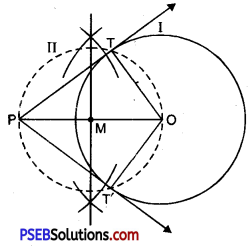
PSEB 10th Class Maths Solutions Chapter 11 Constructions Ex 11.2 1

Steps of construction:
1. Draw a circle (1) of radius 6 cm.
2. Take a point ‘P’ at a distance of 10 m. from the centre of the circle. Join OP.
3. Draw perpendicular bisector of OP. Let ‘M’ be the mid point OP.
4. With ‘M’ as centre and radius MO, draw a circle (II) which intersects the circle (I) at T and T’.
5. Then FT and PT’ are two required tangents.

PSEB Solutions PSEB 10th Class Maths Solutions Chapter 11 Constructions Ex 11.2

Justification of construction:
We know that tangent at a point is always perpendicular to the radius at the point. Now
we have to prove that ∠PTO = ∠PT’O = 90°.
OT is joined.
Now, PMO is the diameter of circle (II) and ∠PTO is in the semicircle.
∴ ∠PTO = 90° [Angle in semicircle is a right angle].
Similarly, ∠PT’O = 90°
∴ PT and PT’ has to be the tangents to the circle at T and T’.
(On measuring, the lengths of tangents
i.e., PT = 8.1 cm
PT’ = 8.1 cm.
Co-centric circles. Two or more circles having same centre but different radii are called CO-CENTRIC circles.

PSEB Solutions PSEB 10th Class Maths Solutions Chapter 11 Constructions Ex 11.2

Question 2.
Construct a tangent to a circle of radivs 4 cm from a point on the co-centric circle of radIus 6 cm and measure its length.
Also, erify the measurement by actual calculation.
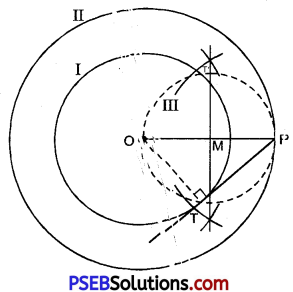
Solution: Steps of construction:
STEPS OF CONSTRUCTION:
1. Draw a circle with cente O’ and radius 4 cm. Mark it as 1
2. Draw another circle with same centre ‘O’ and radius 6 cm and mark it as II.
3. Take any point ‘P’ on circle II. Join OP.
4. Draw pependicu1ar bisector of OP. Let it intersects ‘OP’ at M.
5. With M is centre and radius MO’ or ‘MP’, draw a circie III which intersects the circle ‘1’ at T and T’.
6. Join PT.
PT is the required tangent.

PSEB 10th Class Maths Solutions Chapter 11 Constructions Ex 11.2 2

Justification of the construction :
Join OT.
Now OP is the diameter of the circle III.
∠OTP is in the semicircle.
∴ ∠OTP = 90° …………….(1)
[∴ Angle in a semicircle isa right angle]
Now OT ⊥ PT [using (I)]
∵ A line which makes an angle of 900 with radius at any point on the circle, the line is tangent to the circle.
∴ PT is tangent to the circle ‘I’
i.e. PT is tangent to the circle of radius 4.5 cm.

PSEB Solutions PSEB 10th Class Maths Solutions Chapter 11 Constructions Ex 11.2

To calculate the length of tangent:
Consider ∆OTP,
∠OTP = 90° [using (i)]
∴ ∆OTP is a right angled triangle.
OT = 4 cm [Radius of I circle (given)]
OP = 6 cm [Radius of the II circle (given)]
PT = ? [to be calculated]
In rt. triangle ∆OTP,
By Pythagoras theorem
OP2 = OT2 + PT2
[(Hyp)2 = (Base)2 + (Perp.)2]
or PT2 = OP2 – OT2
= 62 – 42
= 36 – 16 = 20
PT = \(\sqrt{20}\) cm
= 2√5 = 2 × 2.24 = 4.48 cm.
So, length of tangent by actual calculation = 4.48 cm = 4.5 cm.
Length of tangent by measurement = 4.5 cm
Hence, the length of tangent ‘PT’ is verified.

PSEB Solutions PSEB 10th Class Maths Solutions Chapter 11 Constructions Ex 11.2

Question 3.
Draw a circle of radius 3 cm. Take two points P and Q on one of its extended diameter each at a distance of 7 cm from its centre. Draw tangents to the circle from these two points ‘P’ and ‘Q’.
Solution:
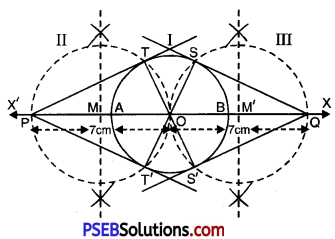
Steps of construction:
1. Draw a circle of radius 3 cm and centre ‘O’.

PSEB 10th Class Maths Solutions Chapter 11 Constructions Ex 11.2 3

2. Draw its diameter ‘AB’ and extend it in both directions as OX and OX’.
3. Take a point P’ on OX” direction and ‘Q’ on OX’ direction such that OP = OQ = 7 cm.
4. Draw perpendicular bisectors of OP and OQ which intersects OP and OQ at ‘M’ and ‘M” respectively.
5. With ‘M’ as centre and radius = ‘MO’ or MP, draw a circle ‘II’ which intersects the circle ‘I’ at T and T’.
6. Similarly with ‘M’’ as centre and radius = M’O or MQ, draw a circle (III) which intersects the circle ‘I’ at S’ and ‘S’’.
7. Join PT, PT’ and QS and QS’.

Justification of construction :
Join OT’ and ‘OT” and ‘OS’ and OS’.
To prove ‘PT & PT’ tangents to the circle
we will prove that ∠PTO = ∠PT’O = 90°.
Now ‘OP’ acts as the diameter of circle ‘II’ and ∠OTP is in the semicircle.
∴ ∠OTP = 90° …………….(1) [∵ Angle in semicircle is 90°]
But ‘OT’ is the radius of circle ‘I’ and line ‘PT’ touches the circle at T’.
∵ The line which touches the circle at a point and makes an angle of 90° with radius at that point, is tangent to the circle.
∴ PT is tangent to the circle I at point T through point ‘P.
Similarly PT’, QS and QS’ are tangents to the circle I.

PSEB Solutions PSEB 10th Class Maths Solutions Chapter 11 Constructions Ex 11.2

Question 4.
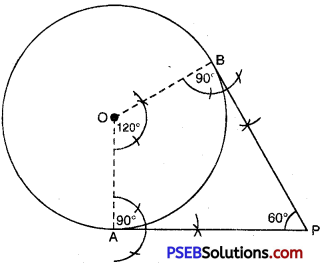
Draw a pair of tangents to a circle of radius 5 cm which are inclined to each other at an angle of 60°
Solution:
Steps of construction:
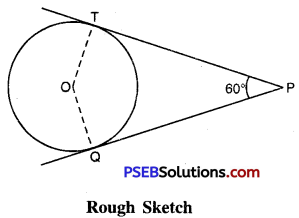
1. Draw the rough sketch of required figure.

PSEB 10th Class Maths Solutions Chapter 11 Constructions Ex 11.2 4

∵ the tangents make an angle of 60° with each other.
∠OTP = ∠OQT = 90°
[Tangent is perpendicular to the radius of circle]
1. To find inclination of radii with each other
∠TOQ + ∠OTP + ∠OQT + ∠TPQ = 360° [Angle sum property of quad.]
or ∠TOQ + 90° + 90° + 60 = 360°
or ∠TOQ = 360 – 90° – 90° – 60° = 120°
2. Draw a circle of radius 5 cm.
3. Draw two radii of circle which make an angle of 120° with each other.
4. The radii intersect the circle at ‘A’ and
5. Make an angle of 90° at each point A and B, which intersect each other at ‘P’.

PSEB 10th Class Maths Solutions Chapter 11 Constructions Ex 11.2 5

6. PA and PB are the required tangents.

PSEB Solutions PSEB 10th Class Maths Solutions Chapter 11 Constructions Ex 11.2

Question 5.
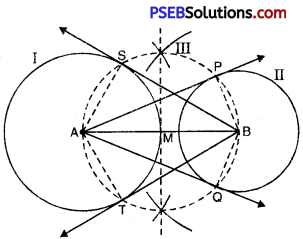
Draw a line segment AB of length 8 cm. Taking ‘A’ as centre, draw a circle of radius 4 cm and taking ‘B’ as centre, draw another circle of radius 3 cm. Construct tangents to each circle from the centre of the other circle.
Solution:

PSEB 10th Class Maths Solutions Chapter 11 Constructions Ex 11.2 6

Steps of construction :
1. Draw a line segment AB = 8 cm.
2. With ‘A’ as centre and radius 4 cm, draw a circle (I)
3. With ‘B’ as centre and radius 3 cm, draw a circle ‘I’.
4. Draw the perpendicular bisector of line segment AB which inersects ‘AB’ at ‘M’.
5. With ‘M as centre and radius MA or MB. draw a circle (III) which intersects the circle (I) at ‘S’ and ‘T’ and circle (II) at ‘P’ and ‘Q’.
6. Join ‘AP’ and AQ’. These are required tangents to the circle with radius 3 cm. from point ‘A’.
7. Join ‘BS’ and ‘BT’. These are required tangents to the circle with radius 4 cm from point ‘B’.

Justification of Construction:
In circle (III), AB acts as diameter then ∠ASB and ∠BPA are in semicircle.
∴ ∠ASB = 90° ………………(1) [Angle in semicircle]
and ∠BPA = 90° .
But ∠ASB is angle between radius of circle (I) and line segment BS’ and ∠BPA is angle between radius of circle (II) and line segment ‘AP’.
∵ Line segment which is perpendicular to the radius of circle, is tangent to the circle through that point.
∴ BS is tangent to circle (I) at point ‘S’ and AP is tangent to circle (II) at point ‘P’.
Similarly AQ and BT are tangents to the circle (II) and (I) respectively.

PSEB Solutions PSEB 10th Class Maths Solutions Chapter 11 Constructions Ex 11.2

Question 6.
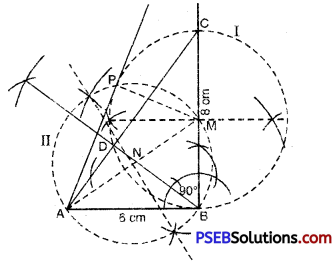
Let ABC be a right triangle in which AB = 6 cm, BC = 5 cm and ∠B = 90°. BD is the perpendicular from B on AC. The circle through B, C, D is drawn. Construct the tangents from ‘A’ to this circle.
Solution:

PSEB 10th Class Maths Solutions Chapter 11 Constructions Ex 11.2 7

Steps of construction:
1. Construct rt. angled triangle. ABC according to given conditions and measurements.
2. Draw BD ⊥ AC.
3. Take mid point of side BC take it as
4. Take ‘M’ as centre and BC as diameter,
draw a circle through B. C, D using property, angle in semicircle is 90° (∠BDC 90°). Take this circle as I.
5. Now join ‘A’ and ‘M.
6. Draw perpendicular bisector of AM intersecting AM in point N. Now with ‘N’ as centre and ‘NA or ‘NM’ as radius, draw a circle (II) which intersects the circle (I) at ‘B’ and ‘P’.
7. Join AP.
8 AP and AB are the required tangents.

Justification of construction:
Line segment AM’ is diameter of circle (II)
∠APM is in semicircle
∴ ∠APM = 90° [Angle in semicircle]
i.e., MP ⊥ AP
But ‘MP’ is the radius of circle (I)
∴ AP is tangent to the circle (II)
[∵ Any line ⊥ to radius of circle at any point on the circle is tangent to the circle.]
Similarly AB is tangent to circle (I).

Question 7.
Draw a circle with the help of a bangle. Take a point outside the circle. Construct the pair of tangents from this poiñt
to the circle.
Solution:
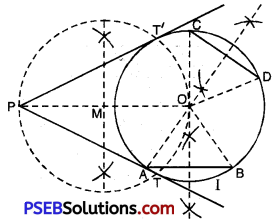
To draw circle with bangle means the centre of circle is unknown. First find the centre of circle.

PSEB 10th Class Maths Solutions Chapter 11 Constructions Ex 11.2 8

Steps of construction:
1. Draw a circle. using a bangle (I).
2. Take any two chords AB and CD (non parallel) on circle.
3. Draw the perpendicular bisectors of chords AB and CD. The perpendicular bisectors intersect each other
[∵ any point lying on perpendicular bisector of line segment is equidistant from its end points
[∵ ‘O’ lies on ⊥ bisector of AH and CD]
∴ OA = OB and OC = OD
∴ OA = OB = OC = OD (Radii of circle)
∴ ‘O’ is the centre of circle.
4. Take any point ‘P’ out side the circle.
5. Join OP.
6. Draw the perpcndicular bisector of OP let ‘M’ the mid point of OP.
7. With ‘M’ as centre and radius ‘MP’ or ‘MO’, draw a circle II which intersects the circle (I) at T and T’.
8. Join PT and PT’, which is required pair of tangents.

Justification of construction:
Tangent at a point is always perpendicular to the radius at the point. Now, we have to prove
that ∠PTO = PT’O = 90°
Join OT.
Now ∠PTO is in the semicircle I.
∵ ∠PTO = 90° [Angle in semicircle is a right angle]
Similarly ∠PT’O = 90°
∴ PT and PT’ has to be the tangents to the circle at T and T’.

PSEB 10th Class Maths Solutions Chapter 11 Constructions Ex 11.1

Punjab State Board PSEB 10th Class Maths Book Solutions Chapter 11 Constructions Ex 11.1 Textbook Exercise Questions and Answers.

PSEB Solutions for Class 10 Maths Chapter 11 Constructions Ex 11.1

In each of the questions, give the justification of the construction also.

Question 1.
Draw a line segment of length 7.6 cm and divide ¡tin the ratio 5 : 8. Measure the two parts.
Solution:
Given: A line segment of length of 7.6 cm.
Steps of construction:
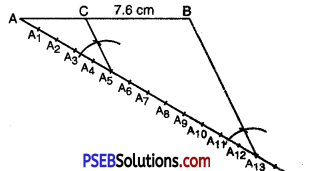
1. Take a line segment AB = 7.6 cm.
2. Draw any ray AX, making an acute angle ∠BAX.
3. Locate 5 + 8 = 13 (given ratio 5: 8) points A1, A2, A3, A4, A5, ………….., A10, A11, A12, A13 on ray AX such that A1A2 = A2A3 = A3A4 = …………. = A11A12 = A12 A13.
4. Join BA13.
5. Through point A5, draw a line A5C || A13B (by making an angle equal to ∠A13B) at A5 intersecting AB at ‘C’. Then AC : CB = 5 : 8;

PSEB 10th Class Maths Solutions Chapter 11 Constructions Ex 11.1 1

Justification:
Let us see how this method gives us the required division.
In ∆AA13B,
Since A5C || A13B
∴ By Basic Proportionality Theorem
\(\frac{\mathrm{AA}_{5}}{\mathrm{~A}_{5} \mathrm{~A}_{13}}=\frac{\mathrm{AC}}{\mathrm{CB}}\)

By construction, \(\frac{\mathrm{AA}_{5}}{\mathrm{~A}_{5} \mathrm{~A}_{13}}=\frac{5}{8}\)

∴ \(\frac{\mathrm{AC}}{\mathrm{CB}}=\frac{5}{8}\)
This shows that ‘C’ divides AB in the ratio 5 : 8.
On measuring the two parts, AC = 2.9 cm and CB = 4.7 cm.

PSEB Solutions PSEB 10th Class Maths Solutions Chapter 11 Constructions Ex 11.1

Alternative Method:
Steps of construction:
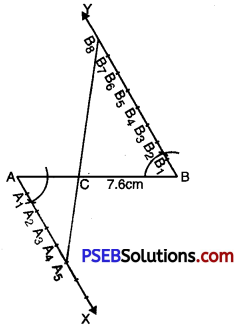
1. Take a line segment AB = 7.6 cm
2. Draw any acute angle ∠BAX
3. Draw angle ∠ABY such that ∠ABY = ∠BAX.
4. Locate the points A1, A2, A3, A4, A5 on ray AX such that A1A2 = A2A3 = A3A4 = A4A5.
5. Locate the points B1, B2, B3, B4, B5, B6, B7, B8 on ray BY such that B1B2 = B2B3 = B3B4 = B4B5 = B5B6 = B6B7 = B7B8
6. Join A5B8 let it intersects AB at point Then AC : CB = 5 : 8.

PSEB 10th Class Maths Solutions Chapter 11 Constructions Ex 11.1 2

justification:
In ∆ACA5 and ∆BCB8,
∠ACA5 = ∠BCB8 [vertically opp. ∠s]
∠BAA5 = ∠ABB8 [construction]
∴ AACA5 ~ ABCB8 [AA-similarity cond.]
∴ Their corresponding sides must be in the same ratio. ,
\(\frac{A C}{B C}=\frac{C A_{5}}{C B_{8}}=\frac{A_{5} A}{B_{8} B}\)
(I)(II) (III)
From I and III, \(\frac{A C}{B C}=\frac{A_{5} A}{B_{8} B}\)

But, \(\frac{A_{5} A}{B_{8} B}=\frac{5}{8}\) [construction]

\(\frac{A C}{C B}=\frac{5}{8}\).

PSEB Solutions PSEB 10th Class Maths Solutions Chapter 11 Constructions Ex 11.1

Question 2.
Construct a triangle of sides 4 cm, 5 cm and 6 cm and then a triangle similar to it whose sides are \(\frac{2}{3}\) of corresponding sides of the first triangle.
Solution:
Steps of construction:
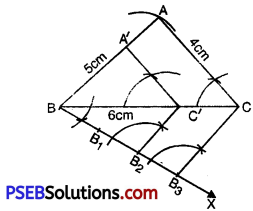
1. Construct a triangle ABC with given measurements. AB = 5 cm, AC = 4 cm and BC = 6 cm.
2. Make any acute angle ∠CBX below the side BC.

PSEB 10th Class Maths Solutions Chapter 11 Constructions Ex 11.1 3

3. Locate three points (greater of 2 and 3 in \(\frac{2}{3}\))B1, B2, B3 on BX such that BB1 = B1B2 = B2B3.
4. Join B3C.
5. Through B2 (smaller of 2 and 3 in \(\frac{2}{3}\) draw a line parallel to B3C, which intersect BC in C’.
6. Through C’, draw a line parallel to CA meeting BA is A’.
Thus ∆A’BC’ is the required triangle whose sides are of corresponding sides of ∆ABC.

Justification of construction :
First we will show that first triangle and constructed triangle are similar.
i.e. ∆A’BC’ ~ ∆ABC.
Consider ∆A’BC’ and ∆ABC.
∠B = ∠B [Common]
∠A’C’B= ∠ACB [By construction]
∆A’C’B ~ ∆ACB [AA – similarity]
∴ Their corresponding sides must be in the same ratio.
\(\frac{\mathrm{A}^{\prime} \mathrm{B}}{\mathrm{AB}}=\frac{\mathrm{BC}^{\prime}}{\mathrm{BC}}=\frac{\mathrm{C}^{\prime} \mathrm{A}^{\prime}}{\mathrm{CA}}\) …………….(1)
Now, consider ∆B2BC’ and ∆B3BC,
∠B = ∠B [common]
∠B2C’B = ∠B2CB [construction]
∴ ∆B2BC’ ~ ∆B3BC [AA -similarity]
∴ Their corresponding sides must be in the same ratio.

\(\frac{\mathrm{B}_{2} \mathrm{~B}}{\mathrm{~B}_{3} \mathrm{~B}}=\frac{\mathrm{BC}^{\prime}}{\mathrm{BC}}=\frac{\mathrm{C}^{\prime} \mathrm{B}_{2}}{\mathrm{CB}_{3}}\)

I II III

Taking (I) and (II).
\(\frac{\mathrm{BC}^{\prime}}{\mathrm{BC}}=\frac{\mathrm{B}_{2} \mathrm{~B}}{\mathrm{~B}_{3} \mathrm{~B}}\)

But, \(\frac{\mathrm{B}_{2} \mathrm{~B}}{\mathrm{~B}_{3} \mathrm{~B}}=\frac{2}{3}\) [construction]

\(\frac{\mathrm{BC}^{\prime}}{\mathrm{BC}}=\frac{2}{3}\) ……………(2)

From (1) & (2),
\(\frac{\mathrm{A}^{\prime} \mathrm{B}}{\mathrm{AB}}=\frac{\mathrm{BC}^{\prime}}{\mathrm{BC}}=\frac{\mathrm{C}^{\prime} \mathrm{A}^{\prime}}{\mathrm{CA}}=\frac{2}{3}\)

⇒ A’B = \(\frac{2}{3}\) AB and BC’ = \(\frac{2}{3}\) BC; C’A’ = \(\frac{2}{3}\) CA.
Hence, the construction is Justified.

PSEB Solutions PSEB 10th Class Maths Solutions Chapter 11 Constructions Ex 11.1

Question 3.
Construct a triangle with sides 5 cm, 6 cm and 7 cm and then another triangle whose sides are of the corresponding sides of the first triangle.
Solution:

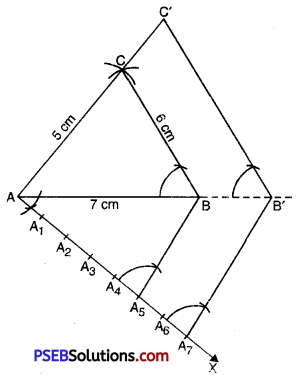
PSEB 10th Class Maths Solutions Chapter 11 Constructions Ex 11.1 4

Steps of construction :
1. Construct a triangle ABC in which AB = 7 cm, BC 6 cm and AC =5 cm.
2. Make any acute angle ∠BAX below the base AB.
3. Locate seven points A1, A2, A3, A4, A5, A6, A7 on the ray AX such that
AA1 = A1A2 = A2A3 = A3A4 = A4A5 = A5A6 = A6A7.
4. Join BA5.
5. Through A7, draw a line parallel A5B. Let it meets AB at B’ on being produced such that AB’= \(\frac{7}{5}\) AB.
6. Through B’, draw a line parallel to BC which meets AC at C’ on being produced.
∆AB’C’ is the required triangle.

Justification of the construction.
In ∆ABC and ∆AB’C’,
∠A = ∠A [common]
∠ABC = ∠AB’C’ [corresponding ∠s]
∴ ∠ABC – ∠AB’C’ [AA-similarity]
∴ Their corresponding sides must be in the same ratio.
\(\frac{\mathrm{AB}}{\mathrm{AB}^{\prime}}=\frac{\mathrm{BC}}{\mathrm{B}^{\prime} \mathrm{C}^{\prime}}=\frac{\mathrm{CA}}{\mathrm{C}^{\prime} \mathrm{A}}\) ……………..(1)

Again, in ∆AA5B and AA7B’
∠A = ∠A [common]
∠AA5B = ∠AA7 B’ [corresponding ∠s]
∴ ∆AA5B ~ ∆AA7B’ [AA – similarity]
∴ Their corresponding sides must be in the same ratio.
\(\frac{\mathrm{AA}_{5}}{\mathrm{AA}_{7}}=\frac{\mathrm{A}_{5} \mathrm{~B}}{\mathrm{~A}_{7} \mathrm{~B}^{\prime}}=\frac{\mathrm{AB}}{\mathrm{AB}^{\prime}}\)

⇒ \(\frac{\mathrm{AB}}{\mathrm{AB}^{\prime}}=\frac{\mathrm{AA}_{5}}{\mathrm{AA}_{7}}\) [construction]

But, \(\frac{\mathrm{AB}}{\mathrm{AB}^{\prime}}=\frac{5}{7}\) …………….(2)

From (1) and (2),

\(\frac{\mathrm{AB}}{\mathrm{AB}^{\prime}}=\frac{\mathrm{BC}}{\mathrm{B}^{\prime} \mathrm{C}^{\prime}}=\frac{\mathrm{CA}}{\mathrm{C}^{\prime} \mathrm{A}}=\frac{5}{7}\)

or \(\frac{A B^{\prime}}{A B}=\frac{B^{\prime} C^{\prime}}{B C}=\frac{C^{\prime} A}{C A}=\frac{7}{5}\)

⇒ AB’ = \(\frac{7}{5}\) AB; B’C’ = \(\frac{7}{5}\) BC and C’A’ = \(\frac{7}{5}\) CA

Hence, the sides of ∆AB’C’ are \(\frac{4}{4}\) of ∆ABC.

PSEB Solutions PSEB 10th Class Maths Solutions Chapter 11 Constructions Ex 11.1

Question 4.
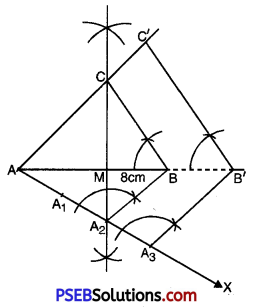
Construct an isosceles triangle whose base is 8 cm and altitude 4 cm and then another triangle whose sides are 12 times
the corresponding sides of the isosceles triangle.
Solution:
Given: Base of isosceles triangle is 8 cm and Altitude = 4 cm
To construct: A triangle whose sides are times the sides of isosceles triangle.
Steps of construction:
1. Take base AB = 8 cm.
2. Draw perpendicular bisector of AB. Let it intersect AB at ‘M’.
3. With M as centre and radius = 4 cm, draw an arc which intersects the perpendicular bisector at ‘C’
4. Join CA and CB.
5. ∆ABC is an isosceles with CA = CB.
6. Make any acute angle ∠BAX below the side BC.
7. Locate three (greater of ‘2’ & ‘3’ in 1\(\frac{1}{2}\) or \(\frac{3}{2}\))
A1, A2, A3 on ‘AX’ such that A A1 = A1 A2 = A2 A3.

PSEB 10th Class Maths Solutions Chapter 11 Constructions Ex 11.1 5

8. Join A2 (2nd point smaller of ‘2 and ‘3’ in ) and B.
9. Through A3, draw a line parallel to A2B meet AB is B’ cm being produced.
10. Through B’, draw a line parallel to BC which meets AC in C’ on being produced. ∆AB’C’ is the required triangle whose sides are 1\(\frac{1}{2}\) times the corresponding sides of ∆ABC.

Justification of construction :
First we will prove ∆AB’C’ are ∆ABC and similar.
Consider ∆ AB’C’ and ∆ ABC
∠A = ∠A [Common]
∠AB’C’ = ∠ABC [By construction]
∠AB’C’ ~ ∠ABC [By AA – similarityj
∴ Their corresponding sides must be in the same ratio
\(\frac{\mathrm{AB}^{\prime}}{\mathrm{AB}}=\frac{\mathrm{B}^{\prime} \mathrm{C}^{\prime}}{\mathrm{BC}}=\frac{\mathrm{C}^{\prime} \mathrm{A}}{\mathrm{CA}}\) ……………(1)

Now consider ∆ A3AB’ and ∆ A,AB
∠A = ∠A [common]
∠B’A3A = ∠BA2A [By construction]
∴∆ A3A B’ – ∆A2AB [AA – similarity]
∴ Their corresponding sides must be in the same ratio
\(\frac{A_{3} A}{A_{2} A}=\frac{A B^{\prime}}{A B}=\frac{B^{\prime} A_{3}}{B A_{2}}\)
I II III
Taking (I) & (II),
\(\frac{A B^{\prime}}{A B}=\frac{A_{3} A}{A_{2} A}\)

But, \(\frac{A_{3} A}{A_{2} A}=\frac{3}{2}\) [construction]
⇒ \(\frac{\mathrm{AB}^{\prime}}{\mathrm{AB}}=\frac{3}{2}\) ……………..(2)
From (1) & (2)m
\(\frac{\mathrm{AB}^{\prime}}{\mathrm{AB}}=\frac{\mathrm{B}^{\prime} \mathrm{C}^{\prime}}{\mathrm{BC}}=\frac{\mathrm{C}^{\prime} \mathrm{A}}{\mathrm{CA}}=\frac{3}{2}\left(1 \frac{1}{2}\right)\)

⇒ AB’ = 1\(\frac{1}{2}\) (AB); B’C’ = 1\(\frac{1}{2}\) BC and C’A’ = 1\(\frac{1}{2}\) (CA)
Hence, given result is justified.

PSEB Solutions PSEB 10th Class Maths Solutions Chapter 11 Constructions Ex 11.1

Question 5.
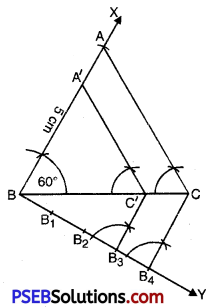
Draw a triangle ABC with side BC = 6 cm, AB =5 cm and ¿ABC = 60°. Then construct a triangle whose sides are of the corresponding sides of the triangle ABC.
Solution:
Steps of construction :
1. Take a line segment BC = 6 cm
2. Construct an angle of measure 60° at point B. i.e., ∠CBX = 60°.
3. With B as centre and radius 5 cm draw an arc intersecting BX at ‘A’

PSEB 10th Class Maths Solutions Chapter 11 Constructions Ex 11.1 6

4. Join A and C.
5. At B, make any acute angle ∠CBY below the side BC.
6. Locate four points (greater of 3 and 4 in \(\frac{3}{4}\)) B1, B2, B3, B4 on BY such that BB1 = B1B2 = B2B3 = B3B4. .
7. Join B4 and C.
8. Draw a line through B3 (smaller of 3 and 4 in ) parallel to B4C making corresponding angles. Let the line through B3 intersects BC in C’.
9. Through C’, draw a line parallel to CA which intersects BA at A’.
The ∆A’BC’ is the required triangle whose sides are \(\frac{3}{4}\) of sides of ∆ABC.

Justification of the construction:
Consider ∆A’BC’ and ∆ABC
∠B = ∠B [commoni
∠A’C’B = ∠ACB [corresponding ∠s]
∴ ∆A’BC’ ~ ∆ABC [AA – similarity]
∴ Their corresponding sides must be in the same ratio.

∴ \(\frac{\mathrm{A}^{\prime} \mathrm{B}}{\mathrm{AB}}=\frac{\mathrm{BC}^{\prime}}{\mathrm{BC}}=\frac{\mathrm{C}^{\prime} \mathrm{A}^{\prime}}{\mathrm{CA}}\) ……………..(1)

Now consider ∆B3B C’ and ∆B4BC.
∠B = ∠B [common]
∠ C’ B3B = ∠CB4B [corresponding ∠s]
∆B3BC’ ~ ∆B4BC [AA – similarity con.]
Their corresponding sides must be in the same ratio.
\(\frac{B_{3} B}{B_{4} B}=\frac{B C^{\prime}}{B C}=\frac{C^{\prime} B_{3}}{C B_{4}}\)
(I) (II) (III)

From (I) and (II),
\(\frac{\mathrm{BC}^{\prime}}{\mathrm{BC}}=\frac{\mathrm{B}_{3} \mathrm{~B}}{\mathrm{~B}_{4} \mathrm{~B}}\)

But, = \(\frac{\mathrm{B}_{3} \mathrm{~B}}{\mathrm{~B}_{4} \mathrm{~B}}=\frac{3}{4}\) [construction]

\(\frac{\mathrm{BC}^{\prime}}{\mathrm{BC}}=\frac{3}{4}\) ………..(3)

From (1) and (3)
\(\frac{\mathrm{A}^{\prime} \mathrm{B}}{\mathrm{AB}}=\frac{\mathrm{BC}^{\prime}}{\mathrm{BC}}=\frac{\mathrm{C}^{\prime} \mathrm{A}^{\prime}}{\mathrm{CA}}=\frac{3}{4}\)

and C’A’= \(\frac{3}{4}\) CA.
∆A’BC’ is the required triangle whose sides are \(\frac{3}{4}\) sides of ∆ABC.

PSEB Solutions PSEB 10th Class Maths Solutions Chapter 11 Constructions Ex 11.1

Question 6.
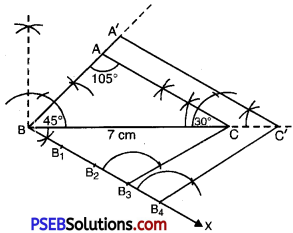
Draw a triangle ABC with side BC = 7 cm, ∠B = 45°. ∠A = 105°. Then construct a triangle whose sides are j- times
the corresponding sides of ∆ABC.
Solution:
Steps of construction:
1. Construct the triangle ABC with the given measurements.
BC = 7 cm; ∠B = 45, ∠A = 105°
By angle sum property of triangle
∠A + ∠B + ∠C= 180°
105° + 45° + ∠C = 180°
∠C = 180 – 150° = 30°
2. Make any acute angle ∠CBX at point B, below the sides BC.

PSEB 10th Class Maths Solutions Chapter 11 Constructions Ex 11.1 7

3. Locate four points (greater of 3 and 4 in \(\frac{4}{3}\)) B1, B2, B3, B4 on ‘BX’ such that BB1 = B1B2 = B2B3 = B3B4.
4. Join B3C (smaller of 3 and 4 in \(\frac{4}{3}\)).
5. Through B4, draw a line parallel to B3C meeting BC in C’ on being produced.
6. Through C’, draw another line parallel to CA meeting BA in A’ on being produced.
7. ∆A’BC’ is the required triangle whose sides are times the triangle ABC.

Justification of construction:
Consider the ∆ A’BC’ and ∆ ABC,
∠B = ∠B [common]
∠A’C’B = ∠ACB [construction]
∴ ∆A’BC’ ~ ∆ABC [AA – similarity]
∴ Their corresponding sides must be in the same ratio

\(\frac{\mathrm{A}^{\prime} \mathrm{B}}{\mathrm{AB}}=\frac{\mathrm{BC}^{\prime}}{\mathrm{BC}}=\frac{\mathrm{C}^{\prime} \mathrm{A}^{\prime}}{\mathrm{CA}}\) ………….(1)

Again, consider ∆B4B C’ and ∆B3BC,
∠B = ∠B [common]
∠C’B4B = ∠CB3B [By consiruction]
∴ BB C’ AB3BC [AA-si niilarity]
∴ Their corresponding sides must be in the same ratio
\(\frac{\mathrm{B}_{4} \mathrm{~B}}{\mathrm{~B}_{3} \mathrm{~B}}=\frac{\mathrm{BC}^{\prime}}{\mathrm{BC}}=\frac{\mathrm{C}^{\prime} \mathrm{B}_{4}}{\mathrm{CB}_{3}}\)
I II III

Taking I and II members.

\(\frac{B C^{\prime}}{B C}=\frac{B_{4} B}{B_{3} B}\)

But, \(\frac{B_{4} B}{B_{3} B}=\frac{4}{3}\) (construction)

or \(\frac{B C^{\prime}}{B C}=\frac{4}{3}\) ………….(2)

From (1) and (2),

\(\frac{\mathrm{A}^{\prime} \mathrm{B}}{\mathrm{AB}}=\frac{\mathrm{BC}^{\prime}}{\mathrm{BC}}=\frac{\mathrm{C}^{\prime} \mathrm{A}^{\prime}}{\mathrm{CA}}=\frac{4}{3}\)

⇒ A’B = \(\frac{4}{3}\) AB; BC’ = \(\frac{4}{3}\) BC and C’A’ = \(\frac{4}{3}\) CA
Hence the construction is justified.

PSEB Solutions PSEB 10th Class Maths Solutions Chapter 11 Constructions Ex 11.1

Question 7.
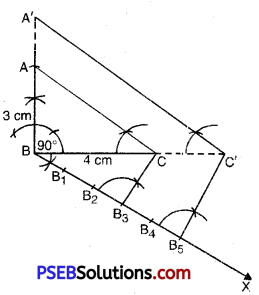
Draw a right triangle in which the sides (other than hypotenuse) are of lengths 4 cm and 3 cm. Then construct another triangle whose sides are \(\frac{5}{3}\) times the corresponding sides of the given triangle.
Solution:
Steps of construction:
1. Draw a right triangle using given conditions. Consider the triangle as ABC in which BC = 4 cm; AB = 3 cm and
∠B = 90°.
2. Make any acute angle ∠CBX below the line BC.
3. Locate five points (greater of 5 and 3 in \(\frac{5}{3}\)) B1, B2, B3, B4. B5 on BX such that BB1 = B1B2 = B2B3 = B3B4 = B4B5.
4. Join B3 (smaller of ‘5’ and ‘3’ in \(\frac{5}{3}\)) and ‘C’.

PSEB 10th Class Maths Solutions Chapter 11 Constructions Ex 11.1 8

5. Through B5. draw a line parallel to BC meeting BC is C’ on being produced.
6. Again draw a line through C’ parallel to CA meeting BA in A’ on being produced.
∆A’BC’ is the required triangle whose sides are \(\frac{5}{3}\) times the sides of ∆ABC.

Justification of construction :
Consider ∆A’BC’ and ∆ABC
∠B = ∠B [common]
∠A’C’B = ∠ACB [By construction]
∴ ∆A’BC’ ~ ∆ABC [AA-similarity condition]
∴ Their corresponding sides must be in the same ratio
\(\frac{\mathrm{A}^{\prime} \mathrm{B}}{\mathrm{AB}}=\frac{\mathrm{BC}^{\prime}}{\mathrm{BC}}=\frac{\mathrm{C}^{\prime} \mathrm{A}^{\prime}}{\mathrm{CA}}\) ……………..(1)

Again, in ∆B5C’B and ∆XB3CB,
∠B = ∠B [common]
∠C’B5B = ∠CB3B [By construction]
∴ ∆B5C’B ~ ∆B3CB [AA-similarityj
∴ Their corresponding sidcs must be in the same ratio.

\(\frac{\mathrm{B}_{5} \mathrm{C}^{\prime}}{\mathrm{B}_{3} \mathrm{C}}=\frac{\mathrm{C}^{\prime} \mathrm{B}}{\mathrm{CB}}=\frac{\mathrm{BB}_{5}}{\mathrm{BB}_{3}}\)

I II III

Taking II and III members.
\(\frac{\mathrm{BC}^{\prime}}{\mathrm{BC}}=\frac{\mathrm{B}_{5} \mathrm{~B}}{\mathrm{~B}_{3} \mathrm{~B}}\)

But, \(\frac{B_{5} B}{B_{3} B}=\frac{5}{3}\) [construction]

\(\frac{B C^{\prime}}{B C}=\frac{5}{3}\) ……………(2)
From (1) and (2),

\(\frac{\mathrm{A}^{\prime} \mathrm{B}}{\mathrm{AB}}=\frac{\mathrm{BC}^{\prime}}{\mathrm{BC}}=\frac{\mathrm{C}^{\prime} \mathrm{A}^{\prime}}{\mathrm{CA}}=\frac{5}{3}\)

⇒ A’B = \(\frac{5}{3}\) AB; BC’ = \(\frac{5}{3}\) BC and C’A’ = \(\frac{5}{3}\) CA
Hence the construction is justified.

PSEB 7th Class English Grammar Noun

Punjab State Board PSEB 7th Class English Book Solutions English Grammar Noun Exercise Questions and Answers, Notes.

PSEB 7th Class English Grammar Noun

A Noun is the name of a person an animal place or a thing.
किसी व्यक्ति, पशु स्थान अथवा वस्तु के नाम को Noun (संज्ञा) कहते हैं; जैसे,

  1. Mr. Amitabh Mukerjee is a Bengali.
  2. Geeta went to Patiala.
  3. A balloon was flying in the sky.

PSEB 7th Class English Grammar Noun

1. पहले वाक्य में व्यक्ति अर्थात् Mr. Amitabh Mukerjee, दूसरे में स्थान अर्थात् Patiala और तीसरे में वस्तु अर्थात् balloon का नाम दिया गया है। ये तीनों शब्द Nouns हैं।

Kinds:
Nouns चार प्रकार के होते हैं।

  • Proper Noun. Proper Noun (व्यक्तिवाचक संज्ञा) किसी विशेष व्यक्ति या स्थान का नाम होता है, जैसे:
  • Dinesh is a good boy.
  • Chandigarh is the capital of Punjab.

2. Common Noun. जिस शब्द से किसी जाति के प्रत्येक व्यक्ति, स्थान, अथवा वस्तु का बोध हो, उसे Common Noun (जातिवाचक संज्ञा) कहते हैं; जैसे:

  • She went to a lawyer.
  • Amritsar is a big city.

3. Collective Noun. जिस संज्ञा से समूह का बोध होता है उसे Collective Noun (समुदायवाचक संज्ञा) कहते हैं; जैसे:

  • A hockey team has eleven players.
  • There are fifty boys in our class.
  • She has lost her bunch of keys.

4. Abstract Noun. जिस संज्ञा से किसी वस्तु के गुण, कार्य अथवा अवस्था का बोध होता है, उसे Abstract Noun (भाववाचक संज्ञा) कहते हैं; जैसे:
गुण-Goodness, kindness, honesty, beauty.
कार्य-Laughter, hatred.
अवस्था-Boyhood, sleep, childhood, length, breadth.

Exercise 1

I. Underline the common nouns in the following sentences. Some sentences have more than one common noun. One has been done for you.
1. The baby was afraid of the dark.
2. Many people were being treated in the hospital.
3. The sky was full of dark clouds.
4. My house is very large.
5. I like to play with my favourite toys.
6. Books give us a lot of information.
7. Amarjit has injured his arm.
8. The old lady was very lonely.
9. The train to Jalandhar was late again.
10. The teacher spoke to her students.
11. Simran loves watching the television.
Hints:
2. people, hospital
3. clouds
4. house
5. toys
6. Books
7. arm
8. lady
9. train
10. teacher, students
11. television.

II. Fill in the blanks with suitable common nouns to form meaningful sentences:

1. Ravi could not find his ………….. in his bag.
2. Rahim fell into the
3. The ………… was late today.
4. Our ………….. is very beautiful.
5. We bought some …………. yesterday.
6. I saw a long
Hints:
1. pen
2. river
3. bus
4. garden
5. flowers
6. snake.

Exercise 2

I. Underline the proper nouns in the following sentences. Some sentences have more than one proper noun. The first one has been done for you:
1. Nutan was a great actress of India.
2. Ravana is a character from the Ramayana
3. The Ganges flows down from the Himalayas.
4. Children enjoyed at Appu Ghar.
5. The Esteem is an expensive car.
6. Prince Rana died in a tragic road accident.
7. Mr. Mohan uses a Videocon washing machine.
8. The Charminar is in Hyderabad.
9. The film Sholay was seen by a large number of people.
10. February is the shortest month of the year.
11. Verka ice-cream is available in many flavours.
Hints:
2. Ravana, Ramayana
3. Ganges, Himalayas
4. Appu Ghar
5. Esteem
6. Prince Rana
7. Mr. Mohan, Videocon washing machine
8. Charminar, Hyderabad
9. Sholay
10. February
11. Verka ice-cream.

PSEB 7th Class English Grammar Noun

II. Fill in the blanks with suitable proper nouns to form meaningful sentences.

1. My pet dog …………. is very lovable.
2. …………. is a popular hill station.
3. My favourite television programme is ………
4. The film ………… is running in four theatres.
5. The month of ………….. is very cold.
Hints:
1. Don
2. Shimla
3. Hungama
4. Sholay
5. January.

Exercise 3

I. Underline the collective nouns in the following sentences. The first one has been done for you.

1. The army marched forward to occupy the land.
2. Father bought a packet of sweets.
3. Our class is very noisy.
4. The mob destroyed the furniture.
5. We booked a suite of rooms in the hotel.
6. A herd of cattle was grazing in the field.
Hints:
2. packet
3. class
4. mob, furniture
5. suite
6. herd.

II. Fill in the blanks in the following phrases with collective nouns. Choose from the box given below:

soldiers
grapes
bananas
bees
stick
musicians
sailors
stones
puppies.
wolves
1. a band of musicians
2. a bundle of sticks
3. a heap of stones
4. a bunch of grapes
5. a regiment of soldiers
6. a pack of wolves
7. a swarm of bees
8. a bunch of bananas
9. a crew of sailors
10. a litter of puppies.

III. Choose from the following list of collective nouns to form meaningful sentences:

school
library
pride
audience
committee
1. The …………. held a two hour meeting.
2. The …………. enjoyed the film.
3. We saw a …………. of whales in the sea.
4. The ………….. of lions was an impressive sight.
5. The students collected books from the ………
Hints:
1. committee
2. audience
3. school
4. pride
5. library.

Exercise 4

I. Underline the abstract nouns in the following sentences. The first one has been done for you.

1. Soldiers are known for their bravery.
2. Books provide us with knowledge.
3. My grandfather enjoys good health.
4. We lost hope of finding our stolen jewellery.
5. Raj suffered a loss when he sold his house.
6. Navin was in a lot of pain after he fell.
7. The teacher told the parents about their son’s progress.
8. The little boy cried in fear on seeing the tiger.
9. It is our duty to respect our parents.
10. Most of us are afraid of failure.
Hints.
2. knowledge
3. health
4. hope
5. loss
6. pain
7. progress
8. fear
9. duty
10. failure.

PSEB 7th Class English Grammar Noun

II. Match abstract nouns from the given box that are opposite in meaning to those listed below. One has been done for you:

life
success
war
hatred
wealth
disagreement
cowardice
pain
cruelty
sorrow
noise
dishonesty.
Answer:
1. Silence – noise
2. kindness – cruelty
3. love – hatred
4. happiness – sorrow
5. agreement – disagreement
6. bravery – cowardice
7. peace – war
8. pleasure – pain
9. death – life
10. poverty – wealth
11. honesty – dishonesty
12. failure – success.
Note : A phrase doing the work of a noun is called a noun phrase.

Exercise 5

Underline the noun phrases in the following sentences:

1. I enjoy swimming in the river.
2. Serving our country is our duty.
3. Helping the poor gives me joy.
4. His dislike for me is unjustified.
5. My love for my friends is deep.
Answer:
1. I enjoy swimming in the river.
2. Serving our country is our duty.
3. Helping the poor gives me joy.
4. His dislike for me is unjustified.
5. My love for my friends is deep.
Note : A clause doing the work of a noun is called a noun clause.

PSEB 7th Class English Grammar Noun

Exercise 6

Underline the noun clause in the sentences.

1. I believe that he is honest.
2. Let me know where you are going.
3. No one doubts what he says.
4. I hope that he will pass his examination.
5. I do not know what he wants to do after graduation.
Answer:
1. I believe that he is honest.
2. Let me know where you are going.
3. No one doubts what he says.
4. I hope that he will pass his examination.
5. I do not know what he wants to do after graduation.

PSEB 8th Class Maths Solutions Chapter 15 Introduction to Graphs Ex 15.3

Punjab State Board PSEB 8th Class Maths Book Solutions Chapter 15 Introduction to Graphs Ex 15.3 Textbook Exercise Questions and Answers.

PSEB Solutions for Class 8 Maths Chapter 15 Introduction to Graphs Ex 15.3

1. Draw the graphs for the following tables of values, with suitable scales on the axes.

Question (a)
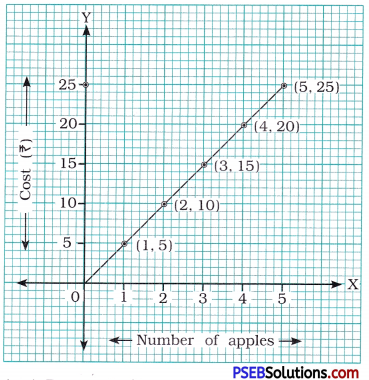
Cost of apples

Number of apples 1 2 3 4 5
Cost (in ₹) 5 10 15 20 25

Solution:
PSEB 8th Class Maths Solutions Chapter 15 Introduction to Graphs Ex 15.3 1
1. Draw 2 lines perpendicular to each other as X-axis and Y-axis on graph paper.
2. Take scale :
On X-axis : 1 cm = 1 apple
On Y-axis 1 cm = ₹ 5
3. Plot the points (1, 5), (2, 10), (3, 15), (4, 20) and (5, 25) on graph paper.
4. Join these points and extend line.

PSEB 8th Class Maths Solutions Chapter 15 Introduction to Graphs Ex 15.3

(b) Distance travelled by a car

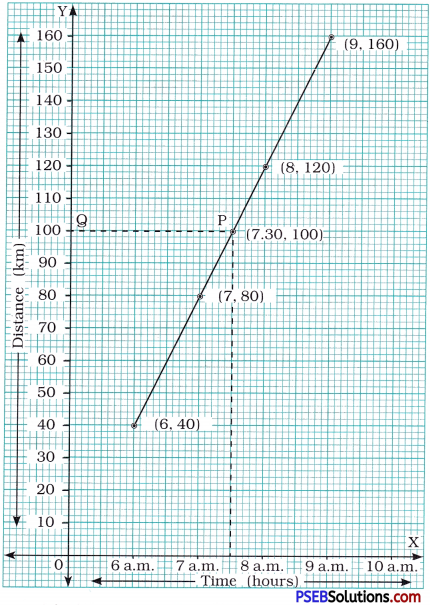
Time (in hours) 6 a.m. 7 a.m. 8 a.m. 9 a.m.
Distance (in km) 40 80 120 160

Solution:
1. Draw two lines perpendicular to each other as X-axis and Y-axis on graph paper.
2. Take scale:
On X-axis : 2 cm = 1 unit (Time in hours.)
On Y-axis : 1 cm = 10 km
3. Plot the points (6, 40), (7, 80), (8, 120) and (9, 160) on graph paper.
4. Join these points and extend line.
PSEB 8th Class Maths Solutions Chapter 15 Introduction to Graphs Ex 15.3 2

Question (i)
How much distance did the car cover during the period 7:30 a.m. to 8:00 a.m.?
Solution:
In the graph, draw a perpendicular at the point indicating 7:30 a.m. on the X-axis such that it meets the graph at P.
From P draw a line parallel to X-axis to meet Y-axis at 100 km.
∴ Distance travelled between 7:30 am and 8:00 am.
= (120 – 100) km
= 20 km

PSEB 8th Class Maths Solutions Chapter 15 Introduction to Graphs Ex 15.3

Question (ii)
What was the time when the car had covered a distance of 100 km since it’s start?
Solution:
When the car had covered a distance of 100 km, the time was 7 : 30 am.

(c) Interest on deposits for a year.

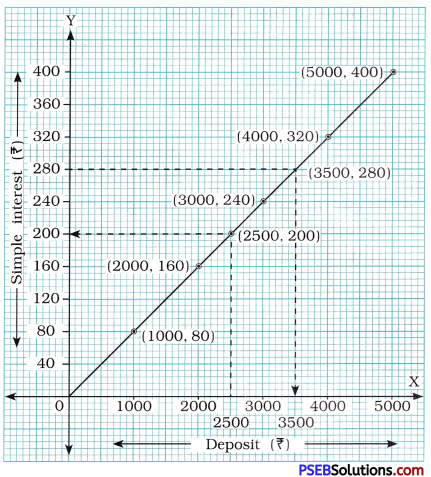
Deposit (in ₹) 1000 2000 3000 4000 5000
Simple Interest (in ₹) 80 160 240 320 400

Solution :
1. Draw two lines perpendicular to each other as X-axis and Y-axis on graph paper.
2. Take scale:
On X-axis : 2 cm = ₹ 1000 (deposit)
On Y-axis : 1 cm = ₹ 40 (simple interest)
3. Plot the points (1000, 80), (2000, 160), (3000, 240), (4000, 320) and (5000, 400) on graph paper.
4. Join these points and extend line.
PSEB 8th Class Maths Solutions Chapter 15 Introduction to Graphs Ex 15.3 3

Question (i)
Does the graph pass through the origin?
Solution:
Yes, it passes through the origin.

PSEB 8th Class Maths Solutions Chapter 15 Introduction to Graphs Ex 15.3

Question (ii)
Use the graph to find the interest on ₹ 2500 for a year.
Solution:
From the graph, the interest on ₹ 2500 for a year is ₹ 200.

Question (iii)
To get an interest of ₹ 280 per year, how much money should be deposited?
Solution:
From the graph an interest of ₹ 280 can be got by depositing ₹ 3500.

2. Draw a graph for the following:

Question (i)

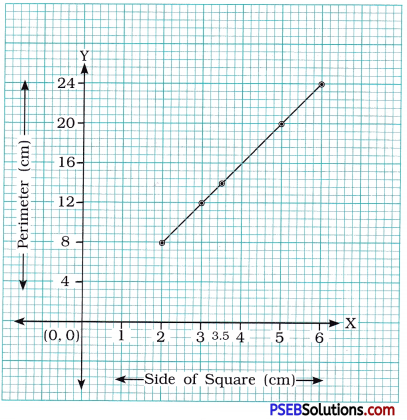
Side of square (in cm) 2 3 3.5 5 6
Perimeter (in cm) 8 12 14 20 24

Is it a linear graph?
Solution:
1. Draw two lines perpendicular to each other as X-axis and Y-axis on graph paper.
2. Take scale:
On X-axis : 1 cm = 1 cm (Side of a square)
On Y-axis : 1 cm = 4 cm (Perimeter of a square) )
3. Plot the points (2, 8), (3, 12), (3.5, 14), (5, 20) and (6, 24) on graph paper.
4. Join these points and extend line.
PSEB 8th Class Maths Solutions Chapter 15 Introduction to Graphs Ex 15.3 4
Yes, it is a linear graph.

PSEB 8th Class Maths Solutions Chapter 15 Introduction to Graphs Ex 15.3

Question (ii)

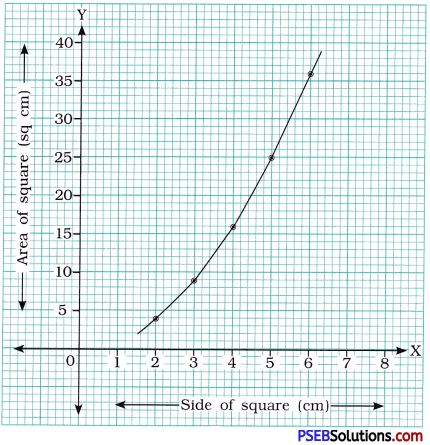
Side of square (in cm) 2 3 4 5 6
Area (in cm2) 4 9 16 25 36

Is it a linear graph?
Solution:
1. Draw two lines perpendicular to each other as X-axis and Y-axis on graph paper.
2. Take scale:
On X-axis : 1 cm = 1 cm (Side of a square)
On Y-axis : 1 cm 5 cm (Area of a square)
3. Plot the points (2, 4), (3, 9), (4, 16), (5, 25) and (6, 36) on graph paper.
4. Join these points.
PSEB 8th Class Maths Solutions Chapter 15 Introduction to Graphs Ex 15.3 5
No, this graph is not a straight line. So it is not a linear graph.

PSEB 8th Class Maths Solutions Chapter 4 Practical Geometry Ex 4.2

Punjab State Board PSEB 8th Class Maths Book Solutions Chapter 4 Practical Geometry Ex 4.2 Textbook Exercise Questions and Answers.

PSEB Solutions for Class 8 Maths Chapter 4 Practical Geometry Ex 4.2

1. Construct the following quadrilaterals:

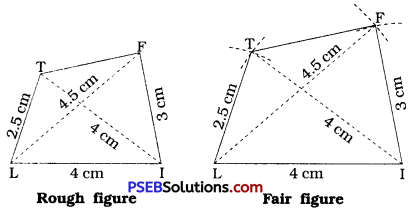
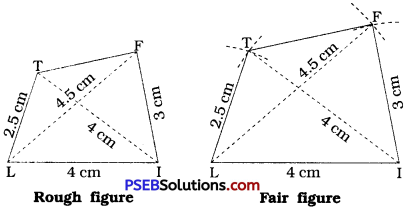
Question (i).
Quadrilateral LIFT.
LI = 4 cm,
IF = 3 cm,
TL = 2.5 cm,
LF = 4.5 cm,
IT = 4 cm.
Solution:
PSEB 8th Class Maths Solutions Chapter 4 Practical Geometry Ex 4.2 1

Steps of construction:

  • Draw a line segment LI = 4 cm.
  • With L as centre and radius = 2.5 cm, draw an arc.
  • With I as centre and radius = 4 cm, draw an arc to intersect the previous arc at T.
  • With L as centre and radius = 4.5 cm draw an arc.
  • With I as centre and radius 3 cm, draw an arc to intersect the previous, arc at F.
  • Draw \(\overline{\mathrm{LT}}, \overline{\mathrm{IF}}, \overline{\mathrm{FT}}, \overline{\mathrm{LF}}\) and \(\overline{\mathrm{IT}}\).

Thus, LIFT is the required quadrilateral.

Question (ii).
Quadrilateral GOLD
OL = 7.5 cm,
GL = 6 cm,
GD = 6 cm,
LD = 5 cm,
OD = 10 cm.
Solution:
PSEB 8th Class Maths Solutions Chapter 4 Practical Geometry Ex 4.2 2
Steps of construction:

  • Draw a line segment LD = 5 cm.
  • With L as centre and radius = 7.5 cm, draw an arc.
  • With D as centre and radius = 10 cm, draw another arc to intersect the previous arc at O.
  • With L as centre and radius = 6 cm, draw an arc.
  • With D as centre and radius = 6 cm, draw another arc to intersect previous arc at G.
  • Draw \(\overline{\mathrm{LO}}, \overline{\mathrm{GO}}, \overline{\mathrm{DG}}, \overline{\mathrm{LG}}\) and \(\overline{\mathrm{DO}}\).

Thus, GOLD is the required quadrilateral.

Question (iii).
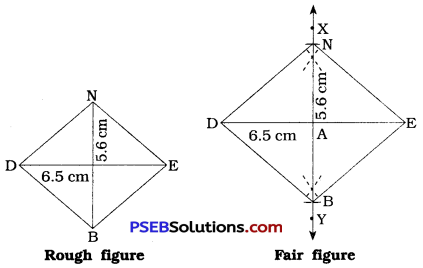
Rhombus BEND
BN = 5.6 cm,
DE = 6.5 cm.
Solution:
PSEB 8th Class Maths Solutions Chapter 4 Practical Geometry Ex 4.2 3a
[Note: Diagonals of a rhombus are perpendicular bisectors of each another. Here, diagonals of □ BEND \(\overline{\mathrm{DE}}\) and \(\overline{\mathrm{BN}}\) intersect at A. So AN = 2.8 cm and AB = 2.8 cm (BN = 5.6 cm, \(\frac {1}{2}\) BN = AN and AB)]
Steps of construction:

  • Draw a line segment DE = 6.5 cm.
  • Draw perpendicular bisector \(\overleftrightarrow{X Y}\) of \(\overline{\mathrm{DE}}\), which intersects \(\overline{\mathrm{DE}}\) at A.
  • With centre at A and radius = 5.6 × \(\frac {1}{2}\) = 2.8 cm, draw two arcs intersecting \(\overleftrightarrow{X Y}\) in points B and N.
  • Draw \(\overline{\mathrm{DN}}, \overline{\mathrm{EN}}, \overline{\mathrm{EB}}\) and \(\overline{\mathrm{DB}}\).

Thus, BEND is the required quadrilateral.

PSEB 8th Class Maths Solutions Chapter 15 Introduction to Graphs Ex 15.2

Punjab State Board PSEB 8th Class Maths Book Solutions Chapter 15 Introduction to Graphs Ex 15.2 Textbook Exercise Questions and Answers.

PSEB Solutions for Class 8 Maths Chapter 15 Introduction to Graphs Ex 15.2

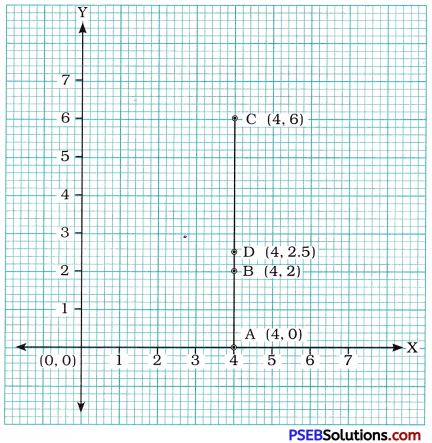
1. Plot the following points on a graph sheet. Verify if they lie on a line:

Question (a)
A(4, 0), B (4, 2), C(4, 6), D(4, 2.5)
Solution:
PSEB 8th Class Maths Solutions Chapter 15 Introduction to Graphs Ex 15.2 1
Plotting the given points and then l joining them we find that they all S lie on the same line.

PSEB 8th Class Maths Solutions Chapter 15 Introduction to Graphs Ex 15.2

Question (b)
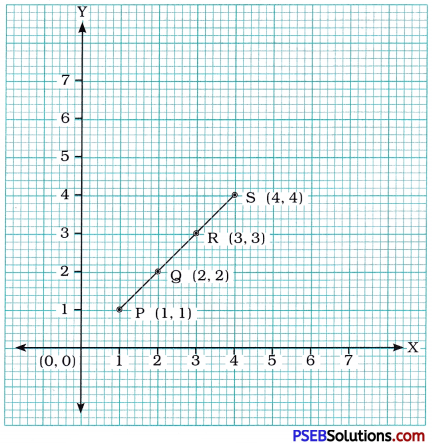
P(1, 1), Q(2, 2), R(3, 3), S(4, 4)
Solution:
PSEB 8th Class Maths Solutions Chapter 15 Introduction to Graphs Ex 15.2 2
Plotting the given points and then joining them we find that they all lie on the same line.

Question (c)
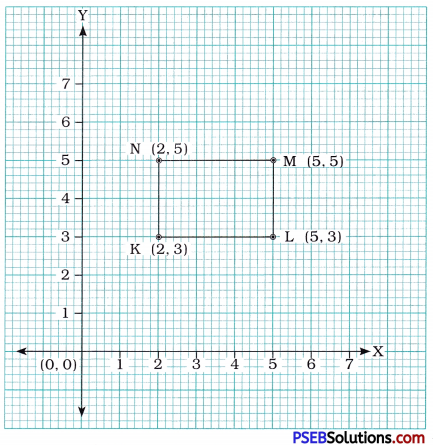
K(2, 3), L(5, 3), M(5, 5), N(2, 5)
Solution:
PSEB 8th Class Maths Solutions Chapter 15 Introduction to Graphs Ex 15.2 3
Plotting the given points and then joining them we find that all of them do not lie on the same line.

PSEB 8th Class Maths Solutions Chapter 15 Introduction to Graphs Ex 15.2

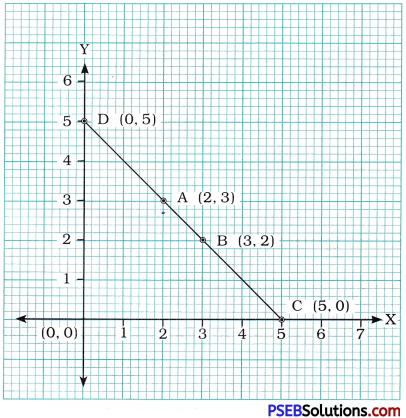
2. Draw the line passing through (2, 3) and (3, 2). Find the coordinates of the points at which this line meets the x-axis and y-axis.
Solution:
PSEB 8th Class Maths Solutions Chapter 15 Introduction to Graphs Ex 15.2 4
Plot the given points and join them to make a line. When you extend this line, it meets the X-axis at C (5, 0) and the Y-axis at D (0, 5).

3. Write the coordinates of the vertices of each of these adjoining figures:
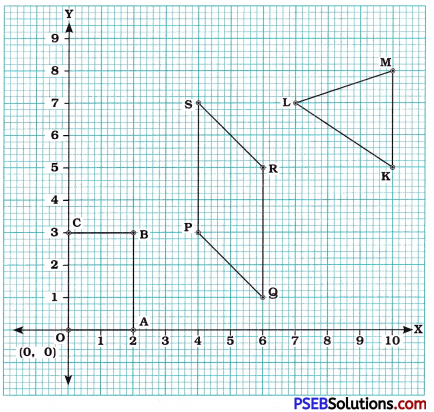
PSEB 8th Class Maths Solutions Chapter 15 Introduction to Graphs Ex 15.2 6
Solution:
Figure:
(i) The coordinates of the vertices of quadrilateral OABC:
O are (0, 0)
A are (2, 0)
B are (2, 3)
C are (0, 3)

(ii) The coordinates of the vertices of quadrilateral PQRS:
P are (4, 3)
Q are (6, 1)
R are (6, 5)
S are (4, 7)

(iii) The coordinates of the vertices of triangle KLM:
K are (10, 5)
L are (7, 7)
M are (10, 8)

PSEB 8th Class Maths Solutions Chapter 15 Introduction to Graphs Ex 15.2

4. State whether True or False. Correct that are false:
PSEB 8th Class Maths Solutions Chapter 15 Introduction to Graphs Ex 15.2 5

Question (i)
A point whose x-coordinate is zero and y- coordinate is non-zero will lie on y-axis.
Solution:
True

Question (ii)
A point whose y-coordinate is zero and x-coordinate is 5 will lie on y- axis.
Solution:
False
Correct statement: A point whose y-coordinate is 0 and x-coordinate is 5 will lie on X-axis at a distance 5 units from origin.

PSEB 8th Class Maths Solutions Chapter 15 Introduction to Graphs Ex 15.2

Question (iii)
The coordinates of the origin are (0, 0).
Solution:
True

PSEB 6th Class Maths Solutions Chapter 3 Playing with Numbers Ex 3.5

Punjab State Board PSEB 6th Class Maths Book Solutions Chapter 3 Playing with Numbers Ex 3.5 Textbook Exercise Questions and Answers.

PSEB Solutions for Class 6 Maths Chapter 3 Playing with Numbers Ex 3.5

1. Find LCM of following numbers by prime factorization method:

Question (i)
45, 60
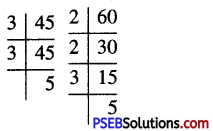
Solution:
PSEB 6th Class Maths Solutions Chapter 3 Playing with Numbers Ex 3.5 1
∴ 45 = 3 × 3 × 5
60 = 2 × 2 × 3 × 5
We find that in these prime factorizations, 2 occurs maximum two times, 3 occurs maximum two times and 5 occurs maximum once
∴ L.C.M. of 45 and 60
= 2 × 2 × 3 × 3 × 5 = 180

PSEB 6th Class Maths Solutions Chapter 3 Playing with Numbers Ex 3.5

Question (ii)
52, 56
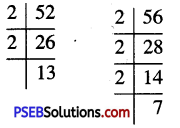
Solution:
PSEB 6th Class Maths Solutions Chapter 3 Playing with Numbers Ex 3.5 2
We find that in these prime fatorisation, 2 occurs maximum 3 times, 13 and 7 occurs maximum once.
∴ L.C.M. of 52 and 56
= 2 × 2 × 2 × 13 × 7 = 728

Question (iii)
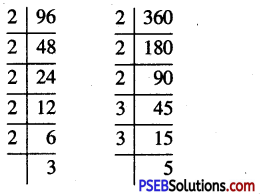
96, 360
Solution:
PSEB 6th Class Maths Solutions Chapter 3 Playing with Numbers Ex 3.5 3
∴ 96 = 2 × 2 × 2 × 2 × 2 × 3
360 = 2 × 2 × 2 × 3 × 3 × 5
We find that in these prime factorisation, 2 occurs maximum 5 times, 3 occurs maximum 2 times and 5 occurs maximum once.
∴ L.C.M. of 96 and 360
= 2 × 2 × 2 × 2 × 2 × 3 × 3 × 5 = 1440

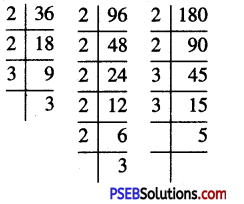
Question (iv)
36, 96, 180
Solution:
PSEB 6th Class Maths Solutions Chapter 3 Playing with Numbers Ex 3.5 4
∴ 36 = 2 × 2 × 3 × 3
96 = 2 × 2 × 2 × 2 × 2 × 3
and 180 = 2 × 2 × 3 × 3 × 5
We find that in these factorisation, 2 occurs maximum 5 times, 3 occurs maximum 2 times and 5 occurs maximum once.
∴ L.C.M. of 36, 96 and 182
= 2 × 2 × 2 × 2 × 2 × 3 × 3 × 5 = 1440

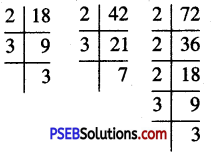
Question (v)
18, 42, 72.
Solution:
PSEB 6th Class Maths Solutions Chapter 3 Playing with Numbers Ex 3.5 5
∴ 18 = 2 × 3 × 3
42 = 2 × 3 × 7
72 = 2 × 2 × 2 × 3 × 3
We find that in these factorization 2 occurs maximum 3 times, 3 occurs maximum 2 times and 7 occurs maximum once.
∴ L.C.M. of 18, 42 and 72
= 2 × 2 × 2 × 3 × 3 × 7 = 504

PSEB 6th Class Maths Solutions Chapter 3 Playing with Numbers Ex 3.5

2. Find LCM of the following by common division method:

Question (i)
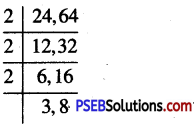
24, 64
Solution:
PSEB 6th Class Maths Solutions Chapter 3 Playing with Numbers Ex 3.5 6
∴ L.C.M. of 24, 64
= 2 × 2 × 2 × 3 × 8 = 192

Question (ii)
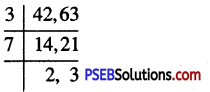
42, 63
Solution:
PSEB 6th Class Maths Solutions Chapter 3 Playing with Numbers Ex 3.5 7
∴ L.C.M. of 42 and 63
= 3 × 7 × 2 × 3 = 126

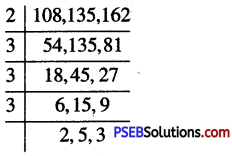
Question (iii)
108, 135, 162
Solution:
PSEB 6th Class Maths Solutions Chapter 3 Playing with Numbers Ex 3.5 8
∴ L.C.M. of 108, 135 and 162
= 2 × 3 × 3 × 3 × 2 × 5 × 3 = 1620

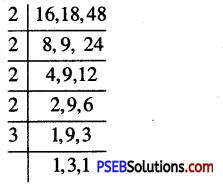
Question (iv)
16, 18, 48
Solution:
PSEB 6th Class Maths Solutions Chapter 3 Playing with Numbers Ex 3.5 9
∴ L.C.M. of 16, 18 and 48
= 2 × 2 × 2 × 2 × 3 × 3 = 144

PSEB 6th Class Maths Solutions Chapter 3 Playing with Numbers Ex 3.5

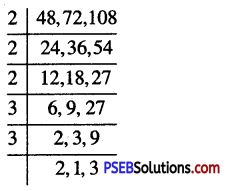
Question (v)
48, 72, 108
Solution:
PSEB 6th Class Maths Solutions Chapter 3 Playing with Numbers Ex 3.5 10
∴ L.C.M. of 48, 72 and 108
= 2 × 2 × 2 × 3 × 3 × 2 × 3 = 144

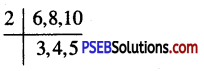
3. Find the smallest number which is divisible by 6, 8 and 10.
Solution:
We know that the smallest number divisible by 6, 8 and 10 is their L.C.M.
So, we calculate L.C.M. 6, 8 and 10
PSEB 6th Class Maths Solutions Chapter 3 Playing with Numbers Ex 3.5 11
∴ L.C.M. = 2 × 3 × 4 × 5 = 120
Hence, required number =120

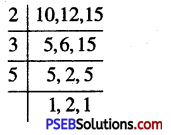
4. Find the least number when divided by 10,12 and 15 leaves remainder 7 in each case.
Solution:
We know that the least number divisible by 10, 12 and 15 is their L.C.M.
PSEB 6th Class Maths Solutions Chapter 3 Playing with Numbers Ex 3.5 12
So, the required number will be 7 more than their L.C.M.
We calculate their L.C.M.
L.C.M of 10, 12 and 15 = 2 × 3 × 5 × 2 = 60
Hence, Required number = 60 + 7 = 67

PSEB 6th Class Maths Solutions Chapter 3 Playing with Numbers Ex 3.5

5. Find the greatest 4-digit number exactly divisible by 12, 18 and 30.
Solution:
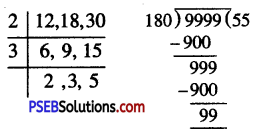
First find the L.C.M. of 12, 18, 30
PSEB 6th Class Maths Solutions Chapter 3 Playing with Numbers Ex 3.5 13
∴ L.C.M. of 12, 18, 30
= 2 × 3 × 2 × 3 × 5 = 180
Now the greatest 4 digit number = 9999
We find that when 9999 is divided by 180, the remainder is 99.
Hence, the greatest number of 4 digits which is exactly divisible by 12, 18, 30
= 9999 – 99 = 9900

6. Find the sandiest 4-digit number exactly divisible by 15, 24 and 36.
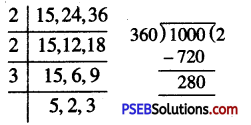
Solution:
First find L.C.M. of 15, 24, 36
PSEB 6th Class Maths Solutions Chapter 3 Playing with Numbers Ex 3.5 14
L.C.M. of 15, 24, 36
= 2 × 2 × 3 × 5 × 2 × 3 = 360 Now, 4 digit smallest number is 1000 We find that when 1000 is divided by 360, the remainder is 280.
∴ Smallest 4 digits number, which is exactly divisible by 15, 24 and 36
= 1000 + (360 – 280) = 1000 + 80 = 1080.
Hence, required number = 1080

PSEB 6th Class Maths Solutions Chapter 3 Playing with Numbers Ex 3.5

7. Four bells toll at intervals of 4, 7, 12 and 14 seconds. The bells toll together at 5 a.m. When will they again toll together?
Solution:
The bells will toll together at a time which is multiple of four intervals 4, 7, 12 and 14 seconds
So, first we find L.C.M. of 4, 7, 12 and 14
PSEB 6th Class Maths Solutions Chapter 3 Playing with Numbers Ex 3.5 15
∴ L.C.M. = 2 × 2 × 7 × 3 = 84
Thus the bells will toll together after 84 seconds or 1 minute 24 seconds.
First they toll together at 5 a.m., then they will toll together after 1 minutes 24 seconds i.e. 5 : 01 : 24 a.m.

8. Three boys step off together from the same spot their steps measures 56 cm, 70 cm and 63 cm respectively. At what distance from the starting point will they again step together?
Solution:
The distance covered by each one of them has to be same as well as minimum walk So, the minimum distance each should their steps will be L.C.M. of the distances L.C.M. of the measure of their steps.
PSEB 6th Class Maths Solutions Chapter 3 Playing with Numbers Ex 3.5 16
∴ L.C.M. = 2 × 7 × 4 × 5 × 9 = 2520cm
Hence, the will again step to gether after a distance of 2520 cm.

9. Can two numbers have 15 as their HCF and 65 as their LCM. Give reasons in support of your answer.
Solution:
We know that H.C.F. of given numbers is a factor of their L.C.M.
But 15 is not a factor of 65
So, there can not be two numbers with H.C.F. 15 and L.C.M. 65.

PSEB 6th Class Maths Solutions Chapter 3 Playing with Numbers Ex 3.5

10. Can two numbers have 12 as their HCF and 72 as their LCM. Give reasons in support of your answer.
Solution:
We know that H.C.F. of given numbers is a factor of their L.C.M.
Here, 12 divides 72 exactly. So 12 is a factor of 72
Hence, there can be two numbers with H.C.F. 12 and L.C.M 72.

11. The HCF and LCM of two numbers are 13 and 182 respectively. If one of the numbers is 26. Find other numbers.
Solution:
H.C.F. = 13 and L.C.M. = 182,
1st number = 25
Now, 1st number × 2nd number = H.C.F. × L.C.M.
26 × 2nd number = 13 × 182
∴ 2nd number = \(\frac {13×182}{26}\)
= 91

12. The LCM of two co-prime numbers is 195. If one number is 15 then find the other number.
Solution:
L.C.M. of two co-prime numbers = 195
H.C.F. of two co-prime numbers = 1
One number = 15
1st number × 2nd number = H.C.F. × L.C.M.
15 × 2nd number= 1 × 195
∴ 2nd number = \(\frac {1×195}{15}\)
= 13

PSEB 6th Class Maths Solutions Chapter 3 Playing with Numbers Ex 3.5

13. The H.C.F. of two numbers is 6 and product of two numbers is 216. Find their L.C.M.
Solution:
H.C.F. of two numbers = 6
Product of two numbers = 216
We know that
H.C.F. × L.C.M. = Product of two numbers
∴ 6 × L.C.M. = 216
∴ L.C.M. = \(\frac {216}{6}\) = 36