PSEB 10th Class Maths Solutions Chapter 3 Pair of Linear Equations in Two Variables Ex 3.5

Punjab State Board PSEB 10th Class Maths Book Solutions Chapter 3 Pair of Linear Equations in Two Variables Ex 3.5 Textbook Exercise Questions and Answers.

PSEB Solutions for Class 10 Maths Chapter 3 Pair of Linear Equations in Two Variables Ex 3.5

Question 1.
Which of the following pairs of linear equations has unique solution, no solution, or infinitély many solutions. In case there is a unique solution, find it by using cross multiplication method.
(i) x – 3y – 3 = 0
3x – 9y – 2 = 0

(ii) 2x + y = 5
3x + 2y = 8

(iii) 3x – 5y = 20
6x – 10y = 40

(iv) x – 3y – 7 = 0
3x – 3y – 15 = 0
Solution:
(i) Given pair of linear equation is:
x – 3y – 3 = 0
and 3x – 9y – 2 = 0

Here a1 = 1, b1 = -3, c1 = -3
a2 = 3, b2 = -9, c2 = -2

Now, \(\frac{a_{1}}{a_{2}}=\frac{1}{3}\);
\(\frac{b_{1}}{b_{2}}=\frac{-3}{-9}=\frac{1}{3}\);
\(\frac{c_{1}}{c_{2}}=\frac{-3}{-2}=\frac{3}{2}\)

∵ \(\frac{a_{1}}{a_{2}}=\frac{b_{1}}{b_{2}} \neq \frac{c_{1}}{c_{2}}\)
Hence, given system of equations has no solution.

PSEB Solutions PSEB 10th Class Maths Solutions Chapter 3 Pair of Linear Equations in Two Variables Ex 3.5

(ii) Given pair of linear equations
2x + y = 5
and 3x + 2y = 8
or 2x + y – 5 = 0
and 3x + 2y – 8=0
Here a1 = 2, b1 = 1, c1 = -5
a2 = 3,b2 = 2, c2 = 8
Now,
\(\frac{a_{1}}{a_{2}}=\frac{2}{3}\);
\(\frac{b_{1}}{b_{2}}=\frac{1}{2}\);
\(\frac{c_{1}}{c_{2}}=\frac{-5}{-8}=\frac{5}{8}\)

∵ \(\frac{a_{1}}{a_{2}} \neq \frac{b_{1}}{b_{2}} \neq \frac{c_{1}}{c_{2}}\)
∴ given system of equation have unique solution.
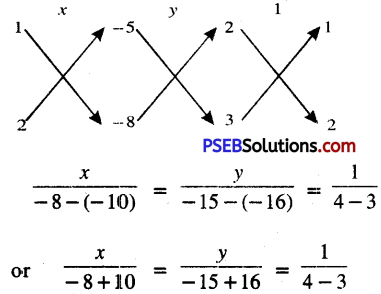
PSEB 10th Class Maths Solutions Chapter 3 Pair of Linear Equations in Two Variables Ex 3.5 1

or \(\frac{x}{2}=\frac{y}{1}=\frac{1}{1}\)
I          II         III
From I and III, we get:
\(\frac{x}{2}=\frac{1}{1}\)
⇒ x = 2

From I and III, we get:
\(\frac{y}{1}=\frac{1}{1}\)
⇒ y = 1
Hence, x = 2 and y = 1.

PSEB Solutions PSEB 10th Class Maths Solutions Chapter 3 Pair of Linear Equations in Two Variables Ex 3.5

(iii) Given pair of linear equations is :
3x – 5y = 20
and 6x – 10y = 40
or 3x – 5y – 20 = 0
and 6x – 10y – 40 =0
Here a1 = 3, b1 = -5, c1 = -20
a2 = 6, b2 = -10, c2 = -40
Now,
\(\frac{a_{1}}{a_{2}}=\frac{3}{6}=\frac{1}{2}\);
\(\frac{b_{1}}{b_{2}}=\frac{-5}{-10}=\frac{1}{2}\);
\(\frac{c_{1}}{c_{2}}=\frac{-20}{-40}=\frac{1}{2}\)

∵ \(\frac{a_{1}}{a_{2}}=\frac{b_{1}}{b_{2}}=\frac{c_{1}}{c_{2}}\)
Hence, given system have infinite solution.

(iv) Given pair of linear equation is:
x – 3y – 7 = 0
and 3x – 3y – 15 = 0
Here a1 = 1, b1 = -3, c1 = -7
a2 = 3, b2 = -3, c2 = -15
Now,
\(\frac{a_{1}}{a_{2}}=\frac{1}{3}\);
\(\frac{b_{1}}{b_{2}}=\frac{-3}{-3}=1\);
\(\frac{c_{1}}{c_{2}}=\frac{-7}{-15}=\frac{7}{15}\)

∵ \(\frac{a_{1}}{a_{2}} \neq \frac{b_{1}}{b_{2}} \neq \frac{c_{1}}{c_{2}}\)
∴ given system have unique solution.
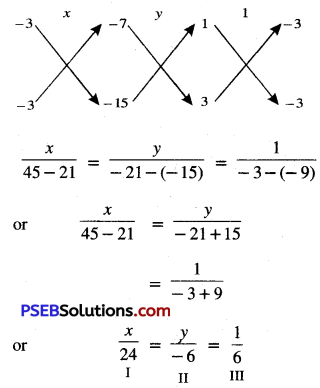
PSEB 10th Class Maths Solutions Chapter 3 Pair of Linear Equations in Two Variables Ex 3.5 2

From I and III, we get:
\(\frac{x}{24}=\frac{1}{6}\)
⇒ x = 4

From I and III, we get:
\(\frac{y}{-6}=\frac{1}{6}\)
⇒ y = -1
Hence, x = 4, y = -1.

PSEB Solutions PSEB 10th Class Maths Solutions Chapter 3 Pair of Linear Equations in Two Variables Ex 3.5

Question 2.
(i) For which values of a and b does the following pair of linear eqU1tions have an infinite number of solutions?
2x + 3y = 7
(a – b)x ÷ (a + b)y = 3a + b – 2
(ii) For which value of k wifi the following pair of linear equations have no solution?
3x + y = 1
(2k – 1) x + (k – 1) y = 2k + 1
Solution:
(i) Given pair of linear equation are
2x + 3y = 7
and (a – b)x + (a + b)y = 3a + b – 2
or 2x + 3y – 7 = 0
and (a – b)x + (a + b)y – (3a + b – 2) = 0
Here a1 = 2, b1 = 3, c1 = -7
a2 = a – b, b2 = a + b, c2 = -(3a + b – 2)
∵ System of equation have an infinite number of solutions.

∴ \(\frac{a_{1}}{a_{2}}=\frac{b_{1}}{b_{2}}=\frac{c_{1}}{c_{2}}\)
\(\frac{2}{a-b}=\frac{3}{a+b}=\frac{-7}{-(3 a+b-2)}\)
Fron I and III, we get:
\(\frac{2}{a-b}=\frac{7}{3 a+b-2}\)
or 6a + 2b – 4 = 7a – 7b
or -a + 9b – 4 = 0
or a = 9b – 4 …………..(1)
From II and III. we get:
\(\frac{3}{a+b}=\frac{7}{3 a+b-2}\)
or 9a + 3b – 6 = 7a + 7b
or 2a – 4b – 6 = 0
or a – 2b – 3 = 0
Substitute the value of a from (1) in above, we get:
9b – 4 – 2b – 3 = 0
or 7b – 7 = 0
or 7b = 7
b = 1
Substitute this value of b in (1), we get
a = 9 × 1 – 4 = 9 – 4
a = 5
Hence a = 5 and b = 1

(ii) Given pair of linear equation are
3x + y = 1
and (2k – 1)x + (k – 1)y = 2k + 1
or 3x + y – 1 = 0
and(2k – 1)x + (k – 1)y – (2k + 1) = 0
Here a1 = 3, b1 = -1, c1 = -1
a2 = (2k – 1), b2 = k – 1, c2 = -(2k + 1)
∵ system of equations have no solution.
∴ \(\frac{a_{1}}{a_{2}}=\frac{b_{1}}{b_{2}} \neq \frac{c_{1}}{c_{2}}\)
\(\frac{3}{2 k-1}=\frac{1}{k-1} \neq \frac{-1}{-(2 k+1)}\)
I II III
From I and III, we get:
\(\frac{3}{2 k-1} \neq \frac{1}{(2 k+1)}\)
⇒ 6k + 3 ≠ 2k – 1
⇒ 4k ≠ -4
⇒ k ≠ –\(\frac{4}{4}\)
⇒ k ≠ -1
From II and III, we get:
\(\frac{3}{2 k-1}=\frac{1}{k-1}\)
⇒ 3k – 3 = 2k – 1
⇒ k = 2
Hence k = 2 and k ≠ -1.

PSEB Solutions PSEB 10th Class Maths Solutions Chapter 3 Pair of Linear Equations in Two Variables Ex 3.5

Question 3.
Solve the following pair of linear equations by the substitution and cross- multiplication methods:
8x + 5y = 9
3x + 2y = 4
Solution:
Given pair of linear equation is:
8x + 5y = 9 ………….(1)
3x + 2y = 4 …………..(2)
Substitution Method:
From (2), 2y = 4 – 3x
y = \(\frac{4-3 x}{2}\) …………….(3)
Substitute this value of y in (1), we get:
8x + 5\(\frac{4-3 x}{2}\) = 9
or \(\frac{16 x+20-15 x}{2}\) = 9
or x + 20 = 18
or x = 18 – 20 = -2
Substitute this value of x in (3), we get:
y = \(\frac{4-3(-2)}{2}=\frac{4+6}{2}\)
= \(\frac{10}{2}\) = 5
Hence, x = -2 and y = 5.

Cross-multiplication Method:

Given pair of linear equation is:
8x + 5y – 9 = o
and 3x + 2y – 4= 0
Here a1 = 8, b1 = 5, c1 = -9
a2 = 3, b2 = 2, c2 = -4
Now,
\(\frac{a_{1}}{a_{2}}=\frac{8}{3}\);
\(\frac{b_{1}}{b_{2}}=\frac{5}{2}\);
\(\frac{c_{1}}{c_{2}}=\frac{-9}{-4}=\frac{9}{4}\)

∵ \(\frac{a_{1}}{a_{2}} \neq \frac{b_{1}}{b_{2}} \neq \frac{c_{1}}{c_{2}}\)
∴ system have unique solution.
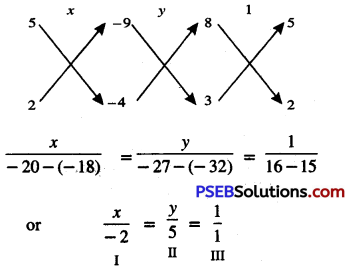
PSEB 10th Class Maths Solutions Chapter 3 Pair of Linear Equations in Two Variables Ex 3.5 3

From I and III, we get:
\(\frac{x}{-2}=\frac{1}{1}\)
⇒ x = -2

From II and III, we get:
\(\frac{y}{5}=\frac{1}{1}\)
⇒ y = 5
Hence, x = -2 and y = 5.

PSEB Solutions PSEB 10th Class Maths Solutions Chapter 3 Pair of Linear Equations in Two Variables Ex 3.5

Question 4.
Form the pair of linear equations in the following problems and find their solutions (If they exist) by any algebraic method.

(i) A part of monthly hostel charges Is fixed and the remaining depends on the number of days one has taken food
in the mess. When a student A takes food for 20 days she has to pay 1000 as hostel charges whereas a student B, who takes food for 26 days, pays 1180 as hostel charges. Find the fixed charges and the cost of food per day.

(ii) A fraction becomes when 1 is subtracted from the numerator and it becomes when 8 is added to its denominator. Find the fraction.

(iii) Yash scored 40 marks in a test, getting 3 marks for each right answer and losing 1 mark for each wrong answer. Had 4 marks been awarded for each correct answer and 2 marks been deducted for each incorrect answer, then Yash ‘would have scored 50 marks. How many questions were there in the test?

(iv) Places A and B are 100 km apart on a highway. One car starts from A and another from B at the same time, If the cars travel in the same direction at differ it speeds they meet in 5 hours. If they travel towards each other, they meet in 1 hour. What are the speeds of the two cars?

(v) The area of a rectangle gets reduced by 9 square units if Its length is reduced by 5 units and breadth is increased by 3 units. If we increase the length by 3 units and the breadth by 2 units, the area increases by 67 units. Find the dimensions of the rectangle.

PSEB Solutions PSEB 10th Class Maths Solutions Chapter 3 Pair of Linear Equations in Two Variables Ex 3.5
Solution:
(i) Let monthly fixed hostel charges = ₹ x
and cost of food per day = ₹ y
According to 1st condition
x + 20y = 1000 ………….(1)
According to 2nd condition
x + 26y = 1180 …………..(2)
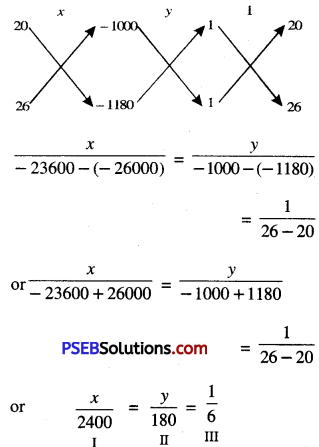
PSEB 10th Class Maths Solutions Chapter 3 Pair of Linear Equations in Two Variables Ex 3.5 4

From I and III, we get:
\(\frac{x}{2400}=\frac{1}{6}\)
⇒ x = \(\frac{2400}{6}\) = 400

From II and III, we get:
\(\frac{y}{180}=\frac{1}{6}\)
⇒ y = \(\frac{180}{6}\) = 30

Hence, monthly fixed hostel charges and cost of food per day are 400 and 30 respectively.

PSEB Solutions PSEB 10th Class Maths Solutions Chapter 3 Pair of Linear Equations in Two Variables Ex 3.5

(ii) Let numerator of fraction = x
Denominator of fraction = y
∴ required fraction = \(\frac{x}{y}\)
According to 1st condition,
\(\frac{x-1}{y}=\frac{1}{3}\)
or 3x – 3 = y
or 3x – y – 3 = 0 …………..(1)
According to 2nd condition,
\(\frac{x}{y+8}=\frac{1}{4}\)
or 4x = y + 8
or 4x – y – 8 = 0 …………….(2)
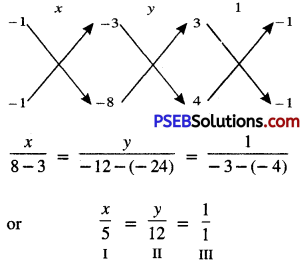
PSEB 10th Class Maths Solutions Chapter 3 Pair of Linear Equations in Two Variables Ex 3.5 5

From I and III, we get:
\(\frac{x}{5}=\frac{1}{1}\)
⇒ x = 5

From II and III, we get:
\(\frac{y}{12}=\frac{1}{1}\)
⇒ y = 12
Hence, required fraction is \(\frac{5}{12}\).

PSEB Solutions PSEB 10th Class Maths Solutions Chapter 3 Pair of Linear Equations in Two Variables Ex 3.5

(iii) Let, number of right questions attempted by Yash = x
and Number of wrong questions attempted by Yash = y
According to 1st condition,
3x – y = 40
or 3x – y – 40 = 0 …………….(1)
According to 2nd condition,
4x – 2y = 50
or 4x – 2y – 50 = 0 ……………(2)
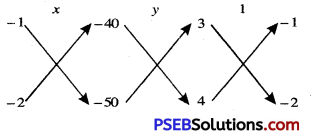
PSEB 10th Class Maths Solutions Chapter 3 Pair of Linear Equations in Two Variables Ex 3.5 6

\(\frac{x}{50-80}=\frac{y}{-160-(-150)}=\frac{1}{-6-(-4)}\)
or \(\frac{x}{-30}=\frac{y}{-10}=\frac{1}{-2}\)

From I and III, we get:
\(\frac{x}{-30}=\frac{1}{-2}\)
x = \(\frac{-30}{-2}\)
⇒ x = 15

From II and III, we get:
\(\frac{y}{-10}=\frac{1}{-2}\)
y = \(\frac{-10}{-2}\)
⇒ y = 5

∴ Number of right questions = 15
Number of wrong questions = 5
Hence, total number of questions = [No. of right questions] + [No. of wrong questions]
=15 + 5 = 20.

PSEB Solutions PSEB 10th Class Maths Solutions Chapter 3 Pair of Linear Equations in Two Variables Ex 3.5

(iv) Let speed of car at place A = x km/hour
and speed of car at place B = y km/hour
Distance between places A and B = 100 km
In case of 5 hours
Distance covered by car A = 5x km
[∵ Distance = Speed × Time]
Distance covered by car B = 5y km
According to I st condition,
5x – 5y = 100
or x – y = 20
or x – y – 20 = 0
In case of one hour
Distance covered by car A = x km
[∵ Distance = Speed × Time]
Distance covered by car B = y km
According to 2nd condition,
x + y = 100
or x + y – 100 = 00 ……………….(2)
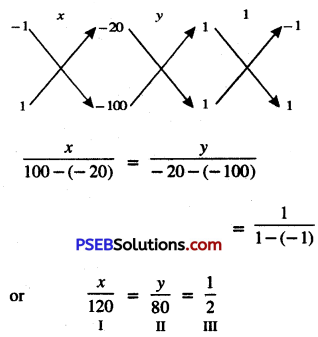
PSEB 10th Class Maths Solutions Chapter 3 Pair of Linear Equations in Two Variables Ex 3.5 7

From I and III, we get:
\(\frac{x}{120}=\frac{1}{2}\)
x = \(\frac{1}{2}\) × 120
⇒ x = 60

From II and III, we get:
\(\frac{y}{171}=\frac{1}{19}\)
y = \(\frac{171}{19}\)
⇒ y = 9

Hence, length and breadth of rectangle are 17 units and 9 units respectively.
PSEB 8th Class Agriculture Notes Chapter 9 Care and Maintenance of Farm Machinery

This PSEB 8th Class Agriculture Notes Chapter 9 Care and Maintenance of Farm Machinery will help you in revision during exams.

PSEB 8th Class Agriculture Notes Chapter 9 Care and Maintenance of Farm Machinery

→ After the cost of land, the next heavy investment is in farm machinery.

→ Proper maintenance of the machinery increases in working life.

→ Farm machines are of three types.

→ The first category of machines is of prime movers e.g. tractors, engines, motors, etc.

→ The second type of machine is tractor or engine operated equipment, like, cultivators, happy seeder, disc harrows, seed cum fertilizer drill Etc.

PSEB 8th Class Agriculture Notes Chapter 9 Care and Maintenance of Farm Machinery

→ The third type of machine is self-propelled machines, like, combine harvesters, paddy transplanted, etc.

→ The tractor is the head of the farm machinery.

→ Servicing of the tractor should be done after 10 hours, 50 hours, 125 hours, 250 hours, 500 hours, and 1000 hours.

→ The tractor should be got overhauled from a good workshop after using it for 4000 hours.

→ When the tractor is not required for the long term it should be stored properly.

→ Combine harvester should be maintained and stored like a tractor.

PSEB 8th Class Agriculture Notes Chapter 8 Organic Farming

This PSEB 8th Class Agriculture Notes Chapter 8 Organic Farming will help you in revision during exams.

PSEB 8th Class Agriculture Notes Chapter 8 Organic Farming

→ Organic farming helps in maintaining natural balance and also in conserving natural resources.

→ Inorganic farming we do not use chemical fertilizers, herbicides, fungicides, and insecticides, etc.

→ Organic farming is based on the concept that feeds the soil and not the plants.

→ Advantages of organic farming are fertility of the soil is increased, lower production cost, good income from organic produce, availability of pesticide residue-free food, etc.

→ Excessive use of fertilizers and pesticides, burning of rice and wheat straw, etc. have deteriorated greatly the soil health and the environment.

→ Due to the adoption of the Rice-Wheat cropping system for many years, it has reduced the area under the traditional pulse and oilseed crops.

→ There is a huge demand for tea, basmati rice, vegetables, fruits, pulses, etc. which are grown by adopting organic farming practices, in the world organic food market.

→ The government of India has established a National Centre for Organic Fanning (NCOF) at Ghaziabad to promote organic farming. Its Regional centre in North India is situated at Panchkula, Haryana.

PSEB 8th Class Agriculture Notes Chapter 8 Organic Farming

→ In the year 2004 India has formulated certain organic standards which are also acceptable in other countries.

→ Agricultural practices followed in organic farming are the same as that of conventional farming e.g. seeds, sowing method, varieties, etc.

→ Nutritional requirements of crops are met by using compost, vermicompost, farmyard manure, bio-fertilizers, non-edible cakes like castor cakes, etc.

→ Protection of crops from pests and insects is done by using beneficial insects, birds, etc.

→ Extract of neem is also used against pests and insects etc.

→ Organic certification guarantees that organic products are produced as per the organic set standards.

→ Information about organic standards can be obtained from site www.apeda.gov.in.

PSEB 8th Class Agriculture Notes Chapter 6 BeeKeeping

This PSEB 8th Class Agriculture Notes Chapter 6 BeeKeeping will help you in revision during exams.

PSEB 8th Class Agriculture Notes Chapter 6 BeeKeeping

→ Earlier, beekeeping was practiced mainly in hilly and southern states of India and the reared bee species was the Indian honey bee Apis cerana.

→ PAU, Ludhiana successfully introduced the Italian honey bee in 1965.

→ We may get 20 kg of honey per colony per year from stationary beekeeping and 60 kg of honey per colony per year from migratory beekeeping.

→ Products that are obtained from beekeeping are bee wax, propolis, bee venom, pollen, royal jelly, etc.

PSEB 8th Class Agriculture Notes Chapter 6 BeeKeeping

→ The body of honey can be considered divided into three parts – head, thorax, and abdomen.

→ There are mainly four species of honey bee Apis dorsata (rock bee), Apis florea (little bee), Apis cerana (Indian bee), and Apis mellifera (European/Italian bee)

→ A honeybee can lay nearly 2000 eggs in a day.

→ Rock bees and little bees are wild species.

→ Indian bee and Italian bee are hive bees.

→ Rock bee is very aggressive.

→ Italian and Indian bees are reared in boxes.

→ There are three castes of honey bees-queen, drones, and worker bees.

→ The life cycle of honey bees has four stages – egg, larva, pupa, and adult.

→ The life cycle of the queen bee completes in 16 days that of a worker in 21 and of drone in 24 days.

→ A colony has nearly 8000 to 80,000 worker bees.

PSEB 8th Class Agriculture Notes Chapter 6 BeeKeeping

→ Good sources of nectar and pollen for bees are berseem, toria, Sarson, arhar, eucalyptus, Sheesham, pear, etc.

→ The suitable season for starting beekeeping is February-March and November.

→ Honey bees seal the ripe honey with a layer of beeswax.

→ We should not extract unripe honey.

PSEB 8th Class Agriculture Notes Chapter 5 Mushroom Cultivation

This PSEB 8th Class Agriculture Notes Chapter 5 Mushroom Cultivation will help you in revision during exams.

PSEB 8th Class Agriculture Notes Chapter 5 Mushroom Cultivation

→ There are 400 mushroom-growing places in Punjab.

→ Annual production of mushrooms is about 45000-48000 tonnes.

→ Nutrients found in mushrooms are Protein, Calcium, Phosphorus, Iron, Potash, Minerals, and Vitamin-C.

→ It contains low amounts of fats and carbohydrates. Mushrooms are good for patients with blood pressure and sugar.

PSEB 8th Class Agriculture Notes Chapter 5 Mushroom Cultivation

→ According to the environment of Punjab, there are five varieties of mushrooms-Button mushrooms, shiitake mushrooms, Chinese mushrooms, Milky, Oyster mushrooms.

→ In winter two crops of Button, mushrooms can be taken from September to March.

→ Three crops of oyster mushrooms can be taken from October to March and one crop of shiitake can be taken from September to March.

→ Turn the stack after every fourth day and add molasses, gypsum, Lindane, and furadan respectively at first, third, fifth, sixth, and seventh turning.

→ The seed rate is 300-gram spawn per square meter.

→ In summer four crops of paddy straw mushroom are taken from April to August and of milky mushroom three crops are taken from April to October.

→ Mix FYM and garden soil in the ratio of 4 : 1 or spent compost and FYM in the ratio of 1 : 1 to get casing mixture.

→ Use 4-5% formalin for disinfecting casing mixture.

→ Use dichlorvos as a preventive measure against mushroom flies and do not harvest up to 48 hours after spraying.

→ Mushroom seeds are known as spawn.

PSEB 8th Class Agriculture Notes Chapter 5 Mushroom Cultivation

→ Within 2-3 weeks 80-100% of trays are filled with mycelium which is white like cotton.

→ The mushroom yield obtained is 8-12 kg per sq metre.

→ 200 grams of fresh mushrooms are packed in poly bags having small holes in them.

PSEB 8th Class Agriculture Notes Chapter 4 Solar Energy

This PSEB 8th Class Agriculture Notes Chapter 4 Solar Energy will help you in revision during exams.

PSEB 8th Class Agriculture Notes Chapter 4 Solar Energy

→ The sources of energy in nature are of two types conventional (non-renewable) and non-conventional (renewable).

→ Conventional sources of energy are limited. These are coal, electricity, petroleum etc.

→ Non-conventional sources of energy are Biogas solar energy, chemical energy, etc.

→ The solar cell can be used to produce electricity using solar cells.

→ The solar dryer is used for drying vegetables, fruits, etc.

PSEB 8th Class Agriculture Notes Chapter 4 Solar Energy

→ Solar dryers are of two types domestic solar dryers, multi-product solar dryers.

→ The solar cooker is used for cooking food using solar energy.

→ The solar water heater is used to heat water using solar energy.

→ Solar water heaters are of two types thermosiphon solar water heater, storage cum collector solar water heater.

→ A solar lantern is an emergency light. It is charged using solar energy and it can be used for 3-4 hours.

→ Solar energy is also used to light street lights and house lights.

→ The solar water pump is used to lift water from a depth of 35-40 feet.

PSEB 9th Class Maths MCQ Chapter 1 Number Systems

Punjab State Board PSEB 9th Class Maths Book Solutions Chapter 1 Number Systems MCQ Questions with Answers.

PSEB 9th Class Maths Chapter 1 Number Systems MCQ Questions

Answer each question by selecting the proper alternative from those given below each question to make the statement true:

Question 1.
The \(\frac{p}{q}\) form of \(0 . \overline{6}\) is ……………
A. \(\frac{3}{2}\)
B. \(\frac{2}{3}\)
C. \(\frac{9}{6}\)
D. \(\frac{6}{10}\)
Answer:
B. \(\frac{2}{3}\)

PSEB 9th Class Maths MCQ Chapter 1 Number Systems

Question 2.
The \(\frac{p}{q}\) form of \(3.1\overline{23}\) is ……………..
A. \(\frac{3123}{999}\)
B. \(\frac{3123}{1000}\)
C. \(\frac{1546}{495}\)
D. \(\frac{3123}{990}\)
Answer:
C. \(\frac{1546}{495}\)

Question 3.
The \(\frac{p}{q}\) form of \(2.\overline{237}\) is ……………
A. \(\frac{2235}{999}\)
B. \(\frac{2235}{99}\)
C. \(\frac{2237}{990}\)
D. \(\frac{2237}{1000}\)
Answer:
A. \(\frac{2235}{999}\)

Question 4.
The decimal expression of \(\frac{5}{6}\) is ………………… .
A. non-terminating recurring
B. non-terminating non-recurring
C. un-determinate
D. terminating
Answer:
A. non-terminating recurring

PSEB 9th Class Maths MCQ Chapter 1 Number Systems

Question 5.
(√3 + √2) (√3 – √2) = …………..
A. √3
B. √2
C. 5
D. 1
Answer:
D. 1

Question 6.
6√20 ÷ 2√5 = …………..
A. 6
B. 3
C. 3√5
D. 4√5
Answer:
A. 6

Question 7.
– \(\frac{\sqrt{48}}{\sqrt{27}}\) is a/an …………… .
A. Irrational number
B. negative Integer
C. positive Integer
D. rational number
Answer:
D. rational number

Question 8.
(2– 2)– 3 =
A. 82
B. 84
C. 152
D. 154
Answer:
A. 82

PSEB 9th Class Maths MCQ Chapter 1 Number Systems

Question 9.
\(5^{\frac{3}{4}} \times 5^{\frac{1}{4}}\) = ……….
A. 5
B. 54
C. 53
D. 52
Answer:
A. 5

Question 10.
………….. are equivalent rational numbers.
A. \(\frac{26}{39}\) and \(\frac{51}{34}\)
B. \(\frac{33}{22}\) and \(\frac{65}{52}\)
C. \(\frac{14}{21}\) and \(\frac{27}{18}\)
D. \(\frac{63}{42}\) and \(\frac{69}{46}\)
Answer:
\(\frac{63}{42}\) and \(\frac{69}{46}\)

Question 11.
……………… is a rational number between 5 and 6.
A. \(\frac{17}{4}\)
B. \(\frac{17}{3}\)
C. \(\frac{17}{2}\)
D. \(\frac{13}{2}\)
Answer:
B. \(\frac{17}{3}\)

Question 12.
The \(\frac{p}{q}\) form of \(0.3 \overline{5}\) is …………… .
A. \(\frac{16}{45}\)
B. \(\frac{35}{9}\)
C. \(\frac{35}{99}\)
D. \(\frac{35}{90}\)
Answer:
A. \(\frac{16}{45}\)

PSEB 9th Class Maths MCQ Chapter 1 Number Systems

Question 13.
Since \(\frac{2}{7}\) = \(0 . \overline{285714}\), \(\frac{6}{7}\) =
A. \(0 . \overline{571428}\)
B. \(0 . \overline{142857}\)
C. \(0 . \overline{857142}\)
D. \(0 . \overline{428571}\)
Answer:
C. \(0 . \overline{857142}\)

Question 14.
√1 + √4 is a/an …………… .
A. natural number
B. irrational number
C. negative number
D. fractional number
Answer:
A. natural number

Question 15.
√2 + √2 is a/an ……………. .
A. Integer
B. irrational number
C. rational number
D. whole number
Answer:
B. irrational number

PSEB 9th Class Maths MCQ Chapter 1 Number Systems

Question 16.
2 √18 ÷ √50 is a / an …………………. .
A. Integer
B. rational number
C. whole number
D. Irrational number
Answer:
B. rational number

Question 17.
(√3 – √2)2 is a/an ………………… number.
A. natural
B. irrational
C. rational
D. whole
Answer:
B. irrational

Question 18.
To rationalize the denominator of \(\frac{5}{2-\sqrt{3}}\), it should be multiplied by
A. \(\frac{5}{2-\sqrt{3}}\)
B. \(\frac{5}{\sqrt{3}-2}\)
C. \(\frac{2+\sqrt{3}}{2+\sqrt{3}}\)
D. \(\frac{2-\sqrt{3}}{5}\)
Answer:
C. \(\frac{2+\sqrt{3}}{2+\sqrt{3}}\)

PSEB 9th Class Maths MCQ Chapter 1 Number Systems

Question 19.
\(\frac{3}{5+2 \sqrt{2}}\) will be expressed as …………………. with rational denominator.
A. \(\frac{15-6 \sqrt{2}}{17}\)
B. \(\frac{15+6 \sqrt{2}}{17}\)
C. \(\frac{15+6 \sqrt{2}}{33}\)
D. \(\frac{15-6 \sqrt{2}}{33}\)
Answer:
A. \(\frac{15-6 \sqrt{2}}{17}\)

Question 20.
If \(\sqrt[n]{a^{2}}\) = b, then b2n = …………………. ;
(a, b > 0, n is a natural number).
A. a
B. \(a^{\frac{n}{2}}\)
C. a2n
D. a4
Answer:
D. a4

PSEB 8th Class Agriculture Notes Chapter 3 Land Measurement and Documentation of Land Records

This PSEB 8th Class Agriculture Notes Chapter 3 Land Measurement and Documentation of Land Records will help you in revision during exams.

PSEB 8th Class Agriculture Notes Chapter 3 Land Measurement and Documentation of Land Records

→ In India, the measurement of land started in the reign of Mughal Emperor Akbar and Todarmal played an important role in this work.

→ Emperor Akbar started receiving taxes in cash in 1580 A.D.

→ Land measurement improved after independence and the Land consolidation act (Murababandhi act) was one of such reforms.

→ Zagreb is a chain made up of iron rings and is used to measure land.

→ The land is measured in acres, Kanal, maria, etc.

PSEB 8th Class Agriculture Notes Chapter 3 Land Measurement and Documentation of Land Records

→ Zareeb is 10 Karms Jong or 5.5 feet long.

→ Shijra/Latha is a piece of cloth on which a map of the village is carved, Khasra numbers of all land are printed on it.

→ According to the Land consolidation act, the whole land was divided into pieces each of 25 acres in measurement.

→ The total of all cultivated crops in the form of a table is called Goshwara.

→ Transfer of ownership rights from one owner of land to another owner is called Intkaal.

→ Jammabandi or Fard is an important document of the Punjab Land Revenue Act regarding ownership of land.

→ Earlier, Jammabandi was carried out after every four years and now it is carried out after every five years.

→ There are 1-12 columns in Jammabandi Fard.

→ Girdawary or Gardaury is a survey of land and of cultivated land.

→ We can check the records online from the website: www.plrs.org.in.

→ 1 foot = 12 inch, 1 yard = 3 feet.

→ 1 Marla = 9 Sarsahian = 272 square feet.

PSEB 8th Class Agriculture Notes Chapter 3 Land Measurement and Documentation of Land Records

→ 1 Kanal = 20 Marla.

→ 1 Acre = 8 Kanal.

→ Hectare = 2.5 acre = 20 Kanal.

PSEB 6th Class Maths Solutions Chapter 1 Knowing Our Numbers Ex 1.3

Punjab State Board PSEB 6th Class Maths Book Solutions Chapter 1 Knowing Our Numbers Ex 1.3 Textbook Exercise Questions and Answers.

PSEB Solutions for Class 6 Maths Chapter 1 Knowing Our Numbers Ex 1.3

1. Estimate each of the following using general rule:

Question (a)
837 + 987
Solution:
While rounding off to hundreds place
837 + 987 = 800 + 1000
= 1800

PSEB 6th Class Maths Solutions Chapter 1 Knowing Our Numbers Ex 1.3

Question (b)
783 – 427
Solution:
While rounding off to hundreds place
783 – 427 = 800 – 400
= 400

Question (c)
1391 + 2783
Solution:
(i) While rounding off to thousands place
1391 + 2783 = 1000 + 3000
= 4000
(ii) While rounding off to hundreds place
1391 + 2783 = 1400 + 2800
= 4000

Question (d)
28292 – 21496.
Solution:
While rounding off to ten thousands place.
28292 – 21496 = 30000 – 20000
= 10000

PSEB 6th Class Maths Solutions Chapter 1 Knowing Our Numbers Ex 1.3

2. Estimate the product using general rule:

Question (a)
898 × 785
Solution:
898 rounds off to hundreds place = 900
785 rounds off to hundreds place = 800
Estimated product = 900 × 800
= 720000

Question (b)
9 × 795
Solution:
9 rounding off to tens place = 10
795 rounding off to tens place = 800
Estimated product = 10 × 800
= 8000

Question (c)
(c) 87 × 317
Solution:
87 rounded off to hundreds place = 100
317 rounded off to hundreds place = 300
Estimated product = 90 × 300
= 27000

PSEB 6th Class Maths Solutions Chapter 1 Knowing Our Numbers Ex 1.3

Question (d)
9250 × 29
Solution:
9250 rounds off to thousands place = 9000
29 rounds off to tens place = 30
Estimated product = 9000 × 30
= 270000

3. Estimate by rounding off to nearest hundred:

Question (a)
439 + 334 + 4317
Solution:
439 rounds off to nearest hundreds = 400
334 rounds off to nearest hundreds = 300
4317 rounds off to nearest hundreds = 4300
Estimated sum = 400 + 300 + 4300 = 5000

Question (b)
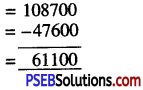
108734 – 47599.
Solution:
108734 rounds off to nearest hundreds = 108700
47599 rounds off to nearest hundreds = – 47600
Estimated difference = 61100
PSEB 6th Class Maths Solutions Chapter 1 Knowing Our Numbers Ex 1.3 1

PSEB 6th Class Maths Solutions Chapter 1 Knowing Our Numbers Ex 1.3

4. Estimate by rounding off to nearest tens:

Question (a)
439 + 334 + 4317
Solution:
439 + 334 + 4317
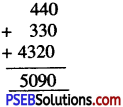
439 rounds off to nearest tens = 440
334 rounds off to nearest tens = + 330
4317 rounds off to nearest tens = + 4320
Estimated sum = 5090
PSEB 6th Class Maths Solutions Chapter 1 Knowing Our Numbers Ex 1.3 2

Question (b)
108734 – 47599
Solution:
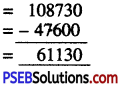
108734 rounds off to nearest tens = 108730
47599 rounds off to nearest tens = – 47600
Estimated difference = 61130
PSEB 6th Class Maths Solutions Chapter 1 Knowing Our Numbers Ex 1.3 3

PSEB 8th Class Agriculture Notes Chapter 2 Nursery Raising

This PSEB 8th Class Agriculture Notes Chapter 2 Nursery Raising will help you in revision during exams.

PSEB 8th Class Agriculture Notes Chapter 2 Nursery Raising

→ A small land piece is required for nursery raising. It is a remunerative occupation.

→ One can get more income from the nursery raising of vegetables, flowers, and fruits.

→ Seeds are expensive and can be used efficiently through nursery raising.

PSEB 8th Class Agriculture Notes Chapter 2 Nursery Raising

→ Farmers having less land can gain more by nursery raising than by the cultivation of vegetable crops.

→ Nursery of those vegetables can be raised successfully which can tolerate the. transplanting shock.

→ Land in which the nursery is raised should get at least 8 hours of sunshine.

→ The seedbed for nursery raising should be 15 cm higher than ground level.

→ Treat the soil with formalin before sowing the seed.

→ Treat the seed with captain or thiram before sowing.

→ Transplant the seedlings in the main field after 4-6 weeks of sowing in the nursery.

→ Flowers are grown in the summer season are Sunflower, Zinnia, Kochia, etc.

→ Flowers grown in the winter season are Marigold, Gulashrafi, Ice plant, Garden pea, Phlox, etc.

→ Nursery for seasonal flowers is ready in 30-40 days.

PSEB 8th Class Agriculture Notes Chapter 2 Nursery Raising

→ Important agroforestry trees are Poplar, Eucalyptus, Drake, Sisham.

→ Drake nursery is propagated from seeds.

→ Sisham is the state tree of Punjab.

→ Treat the cuttings by chlorpyriphos and Remi san against white ants (termite) and diseases.