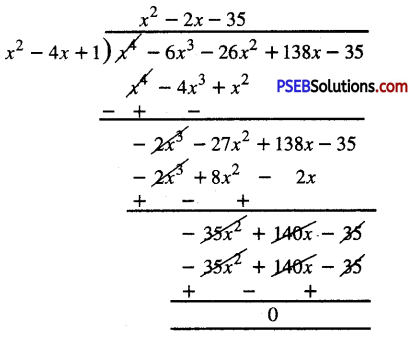
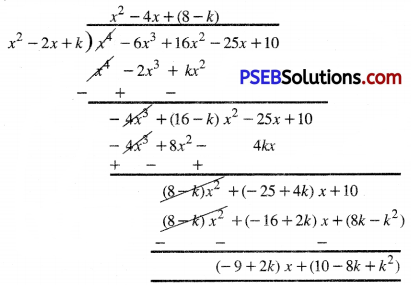
PSEB 10th Class Maths Solutions Chapter 1 Real Numbers Ex 1.4

Punjab State Board PSEB 10th Class Maths Book Solutions Chapter 1 Real Numbers Ex 1.4 Textbook Exercise Questions and Answers.

PSEB Solutions for Class 10 Maths Chapter 1 Real Numbers Ex 1.4

Question 1.
Without actually performing the long division, state whether the following rational numbers will have a terminating decimal expansion or a non-terminating repeating decimal expansion :
(i) \(\frac{13}{3125}\)

(ii) \(\frac{17}{8}\)

(iii) \(\frac{64}{455}\)

(iv) \(\frac{15}{1600}\)

(v) \(\frac{29}{343}\)

(vi) \(\frac{23}{2^{3} 5^{2}}\)

(vii) \(\frac{129}{2^{5} 5^{7} 7^{5}}\)

(viii) \(\frac{6}{15}\)

(ix) \(\frac{35}{50}\)

(x) \(\frac{77}{210}\)
Solution:
(i)Let x = \(\frac{13}{3125}\) ………..(1)
Compare (1) with x = \(\frac{p}{q}\)
Here p = 13 and q = 3125
Prime factors of q = 3125 = 5 × 5 × 5 × 5 × 5 = 55 × 20
which are of the form 2n × 5m here n = 0, m = 5
which are non negative integers.
∴ x = \(\frac{13}{3125}\) have a terminating decimal expansion.

PSEB Solutions PSEB 10th Class Maths Solutions Chapter 1 Real Numbers Ex 1.4

(ii) Let x = \(\frac{17}{8}\) …………………(1)
Compare (1) with x = \(\frac{p}{q}\)
Here p = 17 and q = 8
Prime factors of q = 8 = 2 × 2 × 2 = 23 = 23 × 50

which are of the form 2n × 5m here n = 3, m = 0
and these are non negative integers.
∴ x = \(\frac{17}{8}\) have a terminating decimal expansion.

(iii) Let x = \(\frac{64}{455}\) …………(1)
Compare (1) with x = \(\frac{p}{q}\)
Here p = 64, q = 455
Prime factors of q = 455 = 5 × 7 × 13 which are not of the form 2n × 5m
∴ x = \(\frac{64}{455}\) has a non – terminating decimal expansion.

PSEB Solutions PSEB 10th Class Maths Solutions Chapter 1 Real Numbers Ex 1.4

(iv) Let x = \(\frac{15}{1600}\) ……….(1)
Compare (1) with x = \(\frac{p}{q}\)
Here p = 15 and q = 1600
Prime factors of q = 1600
= 2 × 2 × 2 × 2 × 2 × 2 × 5 × 5 = 26 × 52
which are of the form 2n × 5m, here n = 6, m = 2 and these are non negative integers.
∴ x = having terminating decimal expansion.

(v) Let x = \(\frac{29}{343}\) ………… (1)
Compare (1) with x = \(\frac{p}{q}\)
Here p = 29 and q = 343
prime factors of q = 343
= 7 × 7 × 7 = 73
which are not of the form 2n × 5m, here n = 0, m = 0
∴ x = \(\frac{29}{343}\) will have a non – terminating decimal expansion.

(vi) Let x = \(\frac{23}{2^{3} 5^{2}}\) ……….(1)
Compare (1) with x = \(\frac{p}{q}\)
Here p = 23, q = 2352
Prime factors of q = 2352
which are of the form 2n × 5m, here n = 3, m = 2 and these are non negative integers.
∴ x = \(\frac{23}{2^{3} 5^{2}}\) will have a terminating decimal expansion.

(vii) Let x = \(\frac{129}{2^{5} 5^{7} 7^{5}}\) ……………….(1)
Compare (1) with x = \(\frac{p}{q}\)
Here p = 129 and q = 25 57 75
Prime factors of q = 25 57 75
which are not of the form 2n × 5m,
∴ x = \(\frac{129}{2^{5} 5^{7} 7^{5}}\) have a non – terminating decimal expansion.

PSEB Solutions PSEB 10th Class Maths Solutions Chapter 1 Real Numbers Ex 1.4

(ix) Let x = \(\frac{35}{50}=\frac{7}{10}\) …………. (1)
Compare (1) with x = \(\frac{p}{q}\)
Here p = 7, q = 10
Prime factors of q = 10 = 2 × 5 = 21 × 51
Which is of the form 2n × 5m here n = 1, m = 1
both n and m are non negative integer.
∴ x = \(\frac{35}{50}\) have a terminating decimal expansion.

(x) Let x = \(\frac{77}{210}=\frac{11}{30}\) ……………..(1)
Compare (1) with x = \(\frac{p}{q}\)
Here p = 11, q = 30
Prime factors of q = 30 = 2 × 5 × 3
which are not of the form 2n × 5m,
∴ x = \(\frac{77}{210}\) have a non – terminating decimal expansion.

PSEB Solutions PSEB 10th Class Maths Solutions Chapter 1 Real Numbers Ex 1.4

Question 2.
Write down the decimal expansions of those rational numbers in Question 1 above which have terminating decimal expansions.
Solution:
(i) Let x = \(\frac{13}{3125}\)
Compare (1) with x = \(\frac{p}{q}\)
Here p = 13,q = 3125
Prime factors of q = 3125 = 5 × 5 × 5 × 5 × 5 = 55 × 20
Which are of the form 2n × 5m, where n = 0, m = 5 and these are non negative integers
∴ x = have a terminating decimal expansion.
To Express in Decimal form
x = \(\frac{13}{3125}=\frac{13}{5^{5} \times 2^{0}}\)

x = \(\frac{13 \times 2^{5}}{5^{5} \times 2^{5}}\)
[∵ we are to make 10 in the denominator so multiply and divide by 25]

x = \(\frac{13 \times 32}{(2 \times 5)^{5}}\)

x = \(\frac{416}{(10)^{5}}=\frac{416}{100000}\)

x = 0.00416

(ii) Let x = \(\frac{17}{8}\) ………………..(1)
Compare (1) with x = \(\frac{p}{q}\)
Here p = 17, q = 8
Prime factors of q = 8 = 2 × 2 × 2 = 23 × 50
Which are of the form 2n × 5m, where n = 3, m = 0 and these are non negative integers
∴ x = \(\frac{17}{8}\) can be expressed as a terminating decimal expansion.
To Express in Decimal form

x = \(\frac{17}{8}=\frac{17}{2^{3} \times 5^{0}}\)

x = \(\frac{17 \times 5^{3}}{2^{3} \times 5^{3}}\)
[Multiply and divide with 53 to make the denominator 10]

x = \(\frac{17 \times 125}{(2 \times 5)^{3}}\)

x = \(\frac{2125}{(10)^{3}}=\frac{2125}{1000}\)

x = 2.125

⇒ \(\frac{17}{8}\) = 2.125

PSEB Solutions PSEB 10th Class Maths Solutions Chapter 1 Real Numbers Ex 1.4

(iii) Let x = \(\frac{15}{1600}\) …………….(1)
Compare (1) with x = \(\frac{p}{q}\)
Here p = 15, q = 1600
Prime factors of q = 1600
= 2 × 2 × 2 × 2 × 2 × 2 × 5 × 5
= 26 × 52
Which are of the form 2n × 5m, where n = 6, m = 2 and these are non negative integers
∴ x = \(\frac{15}{1600}\) can be expressed as a terminating decimal expansion.
To Express in Decimal form

x = \(\frac{15}{1600}\)

x = \(\frac{15 \times 5^{4}}{2^{6} \times 5^{2} \times 5^{4}}\)
[To make denominator a power of 10 multiply and divide by 54]

x = \(\frac{15 \times 625}{2^{6} \times 5^{6}}\)

x = \(\frac{9375}{(2 \times 5)^{6}}\)

x = \(\frac{9375}{(10)^{6}}=\frac{9375}{1000000}\) = 0.009375

In Decimal form, x = \(\frac{15}{1600}\) = 0.009375

(iv) Let x = \(\frac{23}{2^{3} 5^{2}}\) …………….(1)
Compare (1) with x = \(\frac{p}{q}\)
Here p = 15, q = 23 52
Prime factors of q = 23 52
Which are of the form 2n × 5m, where n = 3, m = 2 and these are non negative integers
∴ x = \(\frac{23}{2^{3} 5^{2}}\) have a terminating decimal expansion.
To Express in Decimal form

x = \(\frac{23}{2^{3} 5^{2}}=\frac{23 \times 5}{2^{3} \times 5^{2} \times 5}=\frac{115}{2^{3} \times 5^{3}}\)

x = \(\frac{115}{(2 \times 5)^{3}}=\frac{115}{1000}\) = 0.115

In Decimal form,
x = \(\frac{23}{2^{3} 5^{2}}\) = 0.115

PSEB Solutions PSEB 10th Class Maths Solutions Chapter 1 Real Numbers Ex 1.4

(v) Let x = \(\frac{6}{15}=\frac{2}{5}\)
Compare (1) with x = \(\frac{p}{q}\)
Here p = 2, q = 5
Prime factors of q = 5 = 20 × 51
Which are of the form 2n × 5m, where n = 0, m = 1 and these are non negative integers
∴ x = \(\frac{6}{15}\) have a terminating decimal expansion.
To Express in Decimal form

x = \(\frac{6}{15}=\frac{2}{5}\)

x = \(\frac{2 \times 2^{1}}{2^{1} \times 5^{1}}=\frac{4}{10}\) = 0.4

In Decimal form,
x = \(\frac{6}{15}\) = 0.4

(vi) Let x = \(\frac{35}{50}=\frac{7}{10}\)
Compare (1) with x = \(\frac{p}{q}\)
Here p = 7, q = 10
Prime factors of q = 5 = 21 × 51
Which are of the form 2n × 5m, where n = 1, m = 1 and these are non negative integers
∴ x = \(\frac{7}{10}\) have a terminating decimal expansion.
To Express in Decimal form

x = \(\frac{35}{50}\)

x = \(\frac{7}{10}\)

x = \(\frac{7}{2^{1} \times 5^{1}}\)

x = \(\frac{7}{(2 \times 5)^{1}}=\frac{7}{(10)^{1}}\) = 0.7
Hence in decimal form, x = 0.7

PSEB Solutions PSEB 10th Class Maths Solutions Chapter 1 Real Numbers Ex 1.4

Question 3.
The following real numbers have decimal expansions as given below. In each case, decide whether they are rational or not. If they are rational, and of the form f, what can you say about the prime factors of q?
(i) 43.123456789
(ii) O.120120012000120000……
(iii) 4.3.123456789
Solution:
(i) Let x= 43.123456789 ……….. (1)
It is clear from the number that x is rational number.
Now remove the decimal from the number

∴ x = \(\frac{43123456789}{1000000000}\)

= \(\frac{43123456789}{10^{9}}\) …………….(2)
From (2) x is a rational number and of the \(\frac{p}{q}\).

Where p = 43123456789 and q = 109
Now, Prime factors of q = 100 = (2 × 5)9
⇒ Prime factors of q are 29 × 59

PSEB Solutions PSEB 10th Class Maths Solutions Chapter 1 Real Numbers Ex 1.4

(ii) Let x = 0.120120012000120000
It is clear from the number that it is an irrational number.

(iii) Let x = 43.123456789 …. (1)
It is clear that the given number is a rational number because it is non-terminating and repeating decimal.
To show that (i) is of the form \(\frac{p}{q}\)
Multiply (1) with 109 on both sides,
109 x = 43123456789.123456789 …………….(2)
Subtract (1) from (2), we get:

PSEB 10th Class Maths Solutions Chapter 1 Real Numbers Ex 1.4 6

which is rational number of the form \(\frac{p}{q}\)
x = \(\frac{4791495194}{111111111}\)
Here p = 4791495194, q = 111111111
x = \(\frac{4791495194}{3^{2}(12345679)}\)
Hence, prime factors of q are 32 (123456789)

PSEB 12th Class Sociology Notes Chapter 4 Caste Inequalities

This PSEB 12th Class Sociology Notes Chapter 4 Caste Inequalities will help you in revision during exams.

PSEB 12th Class Sociology Notes Chapter 4 Caste Inequalities

Caste Consciousness:

  • A great understanding of one’s caste identity is known as caste consciousness.

Dominant Caste:

  • A caste group in any area which is more in number and. has control over the resources.

Casteism:

  • Such activities with which preference is given to members of one caste and others are ignored.

PSEB 12th Class Sociology Notes Chapter 4 Caste Inequalities

Sanskritisation:

  • The process with which lower caste people try to imitate the ideas, habits, ways of living, behavior, etc. of upper castes and to uplift their social status.

Endogamy:

  • The type of marriage in which one is required to marry within his own group or caste.

Exogamy:

  • The type of marriage in which one is required to marry out of his group such as family, kinship, etc.

Protective Discrimination:

  • It is a process or official program in which the suppressed groups of society are given special privileges such as S.C.’s, S.T.’s, O.B.C.’s, women, etc.

→ During ancient times, there existed a varna system in Indian society which included four varnas-Brahmin, Kshatriya, Vaishya, and fourth varna.

→ Varna system was based on occupation and one was allowed to change his varna. But, with time, the varna system became hereditary and took the form of a caste system.

→ Many sociologists and anthropologists have given definitions of the caste system.

→ But Indian Sociologist G.S. Ghurye was of the view that the caste system is so complex to define. So, he gave six features of the caste system.

PSEB 12th Class Sociology Notes Chapter 4 Caste Inequalities

→ Caste was an endogamous group that kept certain restrictions on its members such as restrictions on keeping relations with other castes, marriage, feeding, etc.

→ There were many restrictions on the members of one caste on keeping relations with other castes.

→ In India, caste-based stratification existed if Brahmins were at the top and lower castes were at the bottom of the stratified system.

→ According to M.N. Srinivas, the concept of pollution was the most important feature of the caste system.

→ Presently, the Indian government has provided protection to scheduled castes in the form of the reservation policy.

→ That’s why these people are taking advantage and are able to get money and status in society.

→ They are taking education, doing jobs in govt, jobs, and industries and are raising their social status.

→ There are many theories about the origin of the caste system but out of these theories, traditional theory, religious theory, and occupational theory are the important ones.

→ After the Indian independence, the government passed many legislations to remove caste-based inequalities from society.

PSEB 12th Class Sociology Notes Chapter 4 Caste Inequalities

→ Along with this, many other reasons came forward which reduced the impact of the caste system such as industrialisation, urbanisation, secularisation, democratisation, etc.

→ The processes of Sanskritisation, Westernisation, and Modernisation also played an important role in reducing the impact of the caste system.

→ Now scheduled castes are taking advantage of reservation policy to raise their social status in society.

PSEB 12th Class Sociology Notes Chapter 3 Urban Society

This PSEB 12th Class Sociology Notes Chapter 3 Urban Society will help you in revision during exams.

PSEB 12th Class Sociology Notes Chapter 3 Urban Society

Urban Society:

  • That society where inequality, secondary relations, artificiality, mobility, and non-agricultural occupations prevail.
  • These are large in size and people are progressive in nature.

Urbanization:

  • It is the progress of migration of rural people to urban areas which increases the size of cities.
  • It is the process in which rural areas convert into urban areas.

PSEB 12th Class Sociology Notes Chapter 3 Urban Society

Urbanism:

  • Urbanism expresses the urban way of living.
  • It also tells us about the evolution of urban society and the expansion of urban culture.

Poverty:

  • It is a situation in which people are unable to meet their basic needs of food, cloth, and shelter.

Housing:

  • The foremost need of every civilized society is housing because it gives an individual a place to live.

Slums:

  • A slum is a place of living in an urban area where people live in unhygienic conditions in temporary houses.
  • Their size varies according to the size of the city and they lack sanitation, cleanliness, clean drinking water, electricity, and other basic facilities.

→ There is a continuous trend during the last few decades of migration of rural people to urban areas which led to an increase in the urban population. There exist many facilities in urban areas which attract the rural population.

→ According to the Census of 2011, the total Indian population was 121 crore out of which 37.7 crore or 32% population lives in urban areas.

→ According to this survey, all those areas are urban where there is a municipality, corporation, cantonment board, or notified town area committee.

PSEB 12th Class Sociology Notes Chapter 3 Urban Society

→ When rural people start to migrate to urban areas, this process is known as urbanisation. This process has played an important role in the progress of urban society.

→ It is a two-way process in which not only do people migrate to an urban area and their occupations change but changes also come in their ways of living, eating habits, views, ideas, etc.

→ Urbanism is an important element of urban society which differentiates the identity and personality of the urban population from the rural and tribal people. It shows a way of living life.

→ There are many features of urban society such as more population, inequality, secondary means of social control, social mobility, main occupation except agriculture, division of labour, specialisation, individualism, etc.

→ We can find joint families in rural society but urban areas have nuclear families.

→ Due to individualism, people prefer to have nuclear families.

→ The urban economy is based on occupational diversity and mobility.

→ Different occupations depend upon each other and consequently, people depend upon each other.

→ Normally, we can find many problems in urban areas but problems of housing and slums are quite common. These are increasing with the increase in urbanization.

PSEB 12th Class Sociology Notes Chapter 3 Urban Society

→ Rural people migrate to urban areas in search of occupation and a place of living.

→ They get employment over there but are unable to find any place of living which forces them to live in slums.

→ Due to such slums, urban areas face many problems.

PSEB 12th Class Sociology Notes Chapter 2 Rural Society

This PSEB 12th Class Sociology Notes Chapter 2 Rural Society will help you in revision during exams.

PSEB 12th Class Sociology Notes Chapter 2 Rural Society

Rural Society:

  • That society which lives in a rural area with special features such as small in size, less density of population, agriculture-main occupation, similarities among the people, caste-based stratification, joint family, etc.

Endogamy:

  • The type of marriage in which an individual needs to marry within his own group such as caste.

Exogamy:

  • The type of marriage in which one needs to marry out of his group such as clan, family.

PSEB 12th Class Sociology Notes Chapter 2 Rural Society

Green Revolution:

  • With the help of high-yielding variety seeds, agriculture production was increased and this is known as the green revolution.

Indebtedness:

  • When a person takes a loan for agriculture or any other purpose, it is known as a loan.
  • When he fails to pay back the loan and it increases with interest, then it is known as indebtedness.

Joint Family:

  • That family in which members of a minimum of three generations live such as grandparents, parents, grandchildren, etc.
  • They live under one roof, eat in a common kitchen, and perform the same economic activity.

→ India is basically a rural society in which around 70% (68.84%) population still lives in villages.

→ Rural people live a very simple life, share a lot with each other, and have many similarities with each other.

→ Mahatma Gandhi is often quoted to have said, “Real India lives in its villages.”

→ There are many features of rural society such as small in size, close relationship, homogeneity, more social control, agriculture main occupation, more impact of religion, the dominance of joint family, less social mobility, etc.

→ Rural society is dominated by the joint family in which a minimum of three generations lives together. Such families are large in size and live under a single roof.

PSEB 12th Class Sociology Notes Chapter 2 Rural Society

→ In 1992, the 73rd Constitutional Amendment was made and a three-tier structure of local self-government was established.

→These three levels are Panchayat at the village level, Panchayat Samiti at the block level, and Zila Parishad at the district level. Their main objective is to do all-around development of rural areas.

→ During the decade of 1960s, a green revolution came in India to increase agricultural production for farmers.

→ There were many positive consequences of this revolution such as cereal production increased, production of commercial crops increased, changes in the methods of agriculture, etc.

→ But there were a few negative consequences as well such as it helped only the rich farmers, the difference between rich and poor farmers increased, etc.

→ Indian farmers presently are facing a very serious issue and this is the problem of indebtedness.

→ Due to this problem, many farmers have committed suicide. There can be many reasons for indebtedness such as poverty,’ ancestral debt, legal cases, backwardness, extra expenditure, more interest on loans, etc.

PSEB 12th Class Sociology Notes Chapter 2 Rural Society

→ Present rural society is going through a phase of transition. Now old relations are coming to an end, control of caste panchayats is reducing, crimes are increasing, the jamjar system has come to an end, people are migrating towards urban areas, etc.

PSEB 10th Class Maths Solutions Chapter 3 Pair of Linear Equations in Two Variables Ex 3.7

Punjab State Board PSEB 10th Class Maths Book Solutions Chapter 3 Pair of Linear Equations in Two Variables Ex 3.7 Textbook Exercise Questions and Answers.

PSEB Solutions for Class 10 Maths Chapter 3 Pair of Linear Equations in Two Variables Ex 3.7

Question 1.
The ages of two friends Ani and Biju differ by 3 years. Ani’s father Dharam is twice as old as Am and Biju Is twice as old as his sister Cathy. The ages of Cathy and Dharam differ by 30 years. Find the ages of Ani and Biju.
Solution:
Let Ani’s age = x years
and Biju’s age = y years
Dharam’s age = 2x years
Cathy’s age = years
According to 1st condition,
(Ani’s age) (Biju’s age) = 3
x – y = 3 ……………(1)
According to 2nd condition,
(Dharam’ age) – (Cathy’s age) = 30
2x – \(\frac{y}{2}\) = 30
or \(\frac{4 x-y}{2}\) = 30
or 4x – y = 60 ………….(2)
Now (2) – (1) gives,

PSEB 10th Class Maths Solutions Chapter 3 Pair of Linear Equations in Two Variables Ex 3.7 1

Substitute this value of x in (1), we get:
19 – y = 3
or -y = 3 – 19
or -y = -16
or y = 16
Hence, Ani’s age = 19 years
Biju’s age =16 years.

PSEB Solutions PSEB 10th Class Maths Solutions Chapter 3 Pair of Linear Equations in Two Variables Ex 3.7

Question 2.
One says, “Give me a hundred, friend! I shall then become twice as rich as you”. The other replies, “if you give me ten, I shall be six times as rich as you.” Tell me what is the amount of their (respective) capital ? [From the Bijaganita of Bhaskara II] [Hint: x + 100 = 2(y – 100), y + 10 = 6 (x – 10)].
Solution:
Let Capital of one friend = ₹ x
and capital of 2nd friend = ₹ y
According to 1st condition
x + 100 = 2(y – 100)
or x + 100 = 2y – 200
or x – 2y = -200 – 100
or x – 2y = -300 …………..(1)
According to 2nd condition
y + 10 = 6(x – 10)
or v-f 10 = 6x – 60
or 6x – y = 10 + 60
or 6x – y = 70 ……………(2)
Multiplying (1) by 6, we get
6x – 12y = – 1800 …………….(3)
Now, (3) – (2) gives

PSEB 10th Class Maths Solutions Chapter 3 Pair of Linear Equations in Two Variables Ex 3.7 2

Substitute this value of y in (2), we get:
6x – 170 = 70
or 6x = 70 + 170
or 6x = 240
or x = \(\frac{240}{6}\) = 40
Hence, amount of their capital are 40 and 170 respectively.

PSEB Solutions PSEB 10th Class Maths Solutions Chapter 3 Pair of Linear Equations in Two Variables Ex 3.7

Question 3.
A train covered a certain distance at a uniform speed. If the train would have been 10 km/b faster, It would have taken 2 hours less than the scheduled time. And, if the train were slower by 10 km/h; it would have taken 3 hours more than the scheduled time. Find the distance covered by the train.
Solution:
Let speed of train =x km/hour
and time taken by train =y hour
∴ Distance covered by train = (Speed) (Time) = (xy) km
According to 1st condition,
(x + 10)(y – 2) = xy
or xy – 2x + 10y – 20 = y
or -2x + 10y – 20 = 0
or x – 5y + 10 = 0
According to 2nd condition,
(x – 10) (y + 3) = xy
or xy + 3x – 10y – 30 = xy
or 3x – 10y – 30 = 0
Multiplying (1) by 3, we get:
3x – 15y + 30 = 0
Now, (3) – (2) gives

PSEB 10th Class Maths Solutions Chapter 3 Pair of Linear Equations in Two Variables Ex 3.7 3

Substitute this value of y in (1), we get:
x – 5 × 12 + 10 = 0
or x – 60 + 10 = 0
or x – 50 = 0
or x = 50
Speed of train = 50 km/hour
Time taken by train = 12 hour
Hence, distance covered by train = (50 × 12) km = 600 km.

PSEB Solutions PSEB 10th Class Maths Solutions Chapter 3 Pair of Linear Equations in Two Variables Ex 3.7

Question 4.
The students of a class are made to stand in rows. If 3 students are extra in a row, there would be 1 row less. If 3 students are less in a row, there would be 2 rows more. Find the number of students in the class.
Solution:
Let number of students in each row = x
and number of rows = y
Total number of students in the class = xy
According to 1st condition,
(x + 3) (y – 1) = xy
or xy – x + 3y – 3 = xy
or -x + 3y – 3 = 0
or x – 3y + 3 = 0
According to 2nd condition,
(x -3) (y + 2) = xy
or xy + 2x – 3y – 6= xy
or 2x – 3y – 6 = 0
Now, (2) – (1) gives

PSEB 10th Class Maths Solutions Chapter 3 Pair of Linear Equations in Two Variables Ex 3.7 4

x = 9
Substitute this value of x in (1), we get:
9 – 3y + 3 = 0
or -3y + 12 = 0
or -3y = -12
or y = \(\frac{12}{3}\) = 4
∴ Number of students in each row = 9 and number of rows = 4
Hence, total number of students in the class = 9 × 4 = 36.

PSEB Solutions PSEB 10th Class Maths Solutions Chapter 3 Pair of Linear Equations in Two Variables Ex 3.7

Question 5.
In a ∆ABC, ∠C = 3 ∠B = 2(∠A +∠B) find the three angles.
Solution:
In ∆ABC,
Given that, ∠C = 3∠B = 2(∠A + ∠B)
I II III
From II and III, we get:
3∠B =2(∠A+∠B)
or 3∠B = 2∠A + 2∠B
or 3∠B – 2∠B = 2∠A
or ∠B = 2∠A ……………..(1)
From I and II, we get:
∠C = 3∠B
or ∠C = 3(2∠A) [using (1)]
or ∠C = 6∠A …………….(2)
Sum of three angles of a triangle is 180°
∠A + ∠B + ∠C = 180°
or ∠A + 2∠A + 6∠A = 180°
or 9∠A = 180°
∠A = \(\frac{180^{\circ}}{9}\) = 20°
Hence, ∠A = 20°: ∠B =2 x 20° = 40°; ∠C = 6 x 20° = 120°.

PSEB Solutions PSEB 10th Class Maths Solutions Chapter 3 Pair of Linear Equations in Two Variables Ex 3.7

Question 6.
Draw the graphs of the equations 5x – y = 5 and 3x – y = 3. Determine the co-ordinates of the vertices of the triangle
formed by these lines and the y axis.
Solution:
Given pair of linear equation are 5x – y = 5 and 3x – y = 3
Consider,
5x – y = 5
or 5x = 5 + y
Putting y = 0 in (1), we get:
x = \(\frac{5+0}{5}=\frac{5}{5}\)
Putting y = – 5 in (1), we get:
x = \(\frac{5-5}{5}=\frac{0}{5}\) = 0
Putting y = 5 in (1), we get:
x = \(\frac{5+5}{5}=\frac{10}{5}\) = 2

PSEB 10th Class Maths Solutions Chapter 3 Pair of Linear Equations in Two Variables Ex 3.7 5

Plotting A (1, 0); B (0, — 5); C (2, 5) on the graph, we get the equation of line 5x — y = 5
and 3x – y = 3
or 3x = 3 + y
or x = \(\frac{3+y}{3}\) ……………(2)
Putting y = 0 in (2), we get:
x = \(\frac{3+0}{3}=\frac{3}{3}\) = 1
Putting y = 3 in (2), we get:
x = \(\frac{3-3}{3}=\frac{0}{3}\) = 0
Putting y = 3 in (2), we get:
x = \(\frac{3+3}{3}=\frac{6}{3}\) = 2
Table:

PSEB 10th Class Maths Solutions Chapter 3 Pair of Linear Equations in Two Variables Ex 3.7 6

PSEB 10th Class Maths Solutions Chapter 3 Pair of Linear Equations in Two Variables Ex 3.7 7

Plotting A (1, 0); D (0, -3); E (2, 3) on the graph. we get the equation of line 3x – y = 3. From the graph, it is clear that given lines intersect at A (1, 0). Triangle formed by these lines and y axis are shaded in the graph i.e. ∆ABD. Coordinates of the vertices of ∆ABD are A(1, 0); B(0, -5) and D(0, -3).

PSEB Solutions PSEB 10th Class Maths Solutions Chapter 3 Pair of Linear Equations in Two Variables Ex 3.7

Question 7.
Solve the following pair of linear equations:
(i) px + qy = p – q
qx – py = p + q

(ii) ax + by = c
bx + ay = 1 + c

(iii) \(\frac{x}{a}-\frac{y}{b}\) = 0
ax + by = a2 + b2

(iv) (a – b)x + (a + b)y = a2 – 2ab – b2
(a + b) (x + y) = a2 + b2

(v) 152x – 378y = 74
-378x + 152y = -604
Solution:
(i) Given pair of linear equation are
px + qy = p – q …………(1)
and qx – py = p + q ………….(2)
Multiplying (1) by q and (2) by p, we get:

PSEB 10th Class Maths Solutions Chapter 3 Pair of Linear Equations in Two Variables Ex 3.7 8

or y = -1
Substitute this value of y in (1), we get:
px + q(-1) = p – q
or px – q = p – q
or px = p – q + q
or px = p
or x = 1
Hence, x = 1 and y = -1.

PSEB Solutions PSEB 10th Class Maths Solutions Chapter 3 Pair of Linear Equations in Two Variables Ex 3.7

(ii) Given pair of linear equation are
ax + by = c
bx + ay = 1 + c
ax + by – c = 0
bx + ay – (1 + c) = 0

PSEB 10th Class Maths Solutions Chapter 3 Pair of Linear Equations in Two Variables Ex 3.7 9

From I and III, we get:
\(\frac{x}{-b-b c+a c}=\frac{1}{a^{2}-b^{2}}\)
or x = \(\frac{a c-b c-b}{a^{2}-b^{2}}\)

From II and III, we get:
\(\frac{y}{-b c+a+a c}=\frac{1}{a^{2}-b^{2}}\)
or y = \(\frac{a+a c-b c}{a^{2}-b^{2}}\)
Hence, x = \(\frac{a c-b c-b}{a^{2}-b^{2}}\) and y = \(\frac{a+a c-b c}{a^{2}-b^{2}}\).

(iii) Given pair of linear equation are
\(\frac{x}{a}-\frac{y}{b}\) = 0
or \(\frac{b x-a y}{a b}\) = 0
or bx – ay = 0
or bx—ay = O …(1)
and ax + by = a2 + b2
or ax + by – (a2 + b2) = 0 …………..(2)

PSEB 10th Class Maths Solutions Chapter 3 Pair of Linear Equations in Two Variables Ex 3.7 10

\(\frac{x}{a\left(a^{2}+b^{2}\right)-0}=\frac{y}{0+b\left(a^{2}+b^{2}\right)}=\frac{1}{b^{2}+a^{2}}\)

or \(\frac{x}{a\left(a^{2}+b^{2}\right)}=\frac{y}{b\left(a^{2}+b^{2}\right)}=\frac{1}{a^{2}+b^{2}}\)

or \(\frac{x}{a}=\frac{y}{b}=\frac{1}{1}\)
I II III
From I and III, we get:
\(\frac{x}{a}=\frac{1}{1}\)
⇒ x = a
From II and III, we get:
\(\frac{y}{b}=\frac{1}{1}\)
⇒ y = b
Hence, x = a, y = b.

PSEB Solutions PSEB 10th Class Maths Solutions Chapter 3 Pair of Linear Equations in Two Variables Ex 3.7

(iv) Given pair of linear equation are
(a – b)x + (a + b)y = a2 – 2ab – b2
or ax – bx + ay + by = a2 – 2ab – b2 …………….(1)
and (a + b) (x + y) = a2 + b2
or ax + bx + ay + by = a2 + b2
Now, (1) – (2) gives

PSEB 10th Class Maths Solutions Chapter 3 Pair of Linear Equations in Two Variables Ex 3.7 11

Substitute this value of x in (1), we get:
(a – b) (a + b) + (a + b) y = a2 – 2ab – b2
or a2 – b2 + (a + b) y = a2 – 2ab – b2
or (a + b) y = a2 – 2ab – b2 – a2 + b2
or (a + b)y = -2ab
or y = \(\frac{-2 a b}{a+b}\)
Hence, x = a + b and y = a + b

(v) Given pair of linear equation are
152x – 378y = – 74
and -378x + 152y = -604
or 76x – 189y + 37 = 0
and -189x + 76y + 302 = 0

PSEB 10th Class Maths Solutions Chapter 3 Pair of Linear Equations in Two Variables Ex 3.7 12

From I and III, we get:
\(\frac{x}{59890}=\frac{1}{29945}\)
⇒ x = \(\frac{59890}{29945}\)
⇒ x = 2

From II and III, we get:
\(\frac{y}{29945}=\frac{1}{29945}\)
⇒ y = \(\frac{29945}{29945}\)
⇒ y = 1
Hence x = 2 and y = 1.

PSEB Solutions PSEB 10th Class Maths Solutions Chapter 3 Pair of Linear Equations in Two Variables Ex 3.7

Question 8.
ABCD is a cyclic quadrilateral (see Fig.). Find the angles of the cyclic quadrilateral.

PSEB 10th Class Maths Solutions Chapter 3 Pair of Linear Equations in Two Variables Ex 3.7 13

Solution:
In cyclic quadrilateral ABCD,
∠A = (4y + 20); ∠B = 3y – 5; ∠C = 4x and ∠D = 7x + 5
Sum of opposite angles of a cyclic quadrilateral are of measure 180°.
∴ ∠A + ∠C = 180°
or 4y + 20 + (4x) = 180°
or 4x + 4y = 180° – 20
or 4x + 4y = 160
or x + y = 40
or y = 40 – x ……………..(1)
and ∠B + ∠D = 180°
or 3y – 5 + (7x + 5)= 180°
or 3y – 5 + 7x + 5 = 180°
or 7x + 3y = 180° …………….(2)
Substitute the value of y from (1) in (2). we get:
7x + 3(40 – x)= 180°
or 7x + 120 – 3x = 180°
or 4x = 180 – 120
or 4x = 60
x = \(\frac{60}{4}\) = 15
Substitute this value of x in (1 ), we get:
y = 40 – 15 = 25
∴ ∠A = 4y + 20 = 4 × 25 + 20 = 120°
∠B = 3y – 5 = 3 × 25 – 5 = 70°
∠C = 4x =4 × 15 = 60°
∠D = 7x + 5 = 7 × 15 + 5 = 110°
Hence, ∠A = 120°, ∠B = 70°; ∠C = 60° and ∠D = 110°.

PSEB 7th Class Maths Solutions Chapter 2 Fractions and Decimals Ex 2.3

Punjab State Board PSEB 7th Class Maths Book Solutions Chapter 2 Fractions and Decimals Ex 2.3 Textbook Exercise Questions and Answers.

PSEB Solutions for Class 7 Maths Chapter 2 Fractions and Decimals Ex 2.3

1. Solve the following :

Question (i).
\(\frac {1}{3}\) of
(a) \(\frac {1}{5}\)
(b) \(\frac {2}{7}\)
(c) \(\frac {3}{2}\)
Answer:
PSEB 7th Class Maths Solutions Chapter 2 Fractions and Decimals Ex 2.3 8

Question (ii).
\(\frac {3}{4}\) of
(a) \(\frac {2}{9}\)
(b) \(\frac {4}{7}\)
(c) \(\frac {8}{3}\)
Answer:
PSEB 7th Class Maths Solutions Chapter 2 Fractions and Decimals Ex 2.3 9

2. Multiply the fractions and reduce it to the lowest form (If possible) :

Question (i).
\(\frac{2}{7} \times \frac{7}{9}\)
Answer:
\(\frac{2}{7} \times \frac{7}{9}\)
= \(\frac {2}{9}\)

Question (ii).
\(\frac{1}{3} \times \frac{15}{8}\)
Answer:
\(\frac{1}{3} \times \frac{15}{8}\)
= \(\frac {5}{8}\)

Question (iii).
\(\frac{12}{27} \times \frac{3}{9}\)
Answer:
\(\frac{12}{27} \times \frac{3}{9}\)
= \(\frac {4}{27}\)

Question (iv).
\(\frac{2}{5} \times \frac{6}{4}\)
Answer:
\(\frac{2}{5} \times \frac{6}{4}\)
= \(\frac {3}{5}\)

Question (v).
\(\frac{81}{100} \times \frac{6}{7}\)
Answer:
\(\frac{81}{100} \times \frac{6}{7}\)
= \(\frac {243}{350}\)

Question (vi).
\(\frac{3}{5} \times \frac{5}{27}\)
Answer:
\(\frac{3}{5} \times \frac{5}{27}\)
= \(\frac {1}{9}\)

PSEB 7th Class Maths Solutions Chapter 2 Fractions and Decimals Ex 2.3

3. Multiply the following fractions :

Question (i).
\(\frac{3}{2} \times 5 \frac{1}{3}\)
Answer:
\(\frac{3}{2} \times 5 \frac{1}{3}\)
= \(\frac{3}{2} \times \frac{16}{3}\)
= 8

Question (ii).
\(\frac{1}{7} \times 5 \frac{2}{3}\)
Answer:
\(\frac{1}{7} \times 5 \frac{2}{3}\)
= \(\frac{1}{7} \times \frac{17}{3}\)
= \(\frac {17}{21}\)

Question (iii).
\(2 \frac{5}{6} \times 4\)
Answer:
\(2 \frac{5}{6} \times 4\)
= \(\frac {17}{6}\) × 4
= \(\frac {34}{3}\)
= 11\(\frac {1}{3}\)

Question (iv).
\(4 \frac{1}{3} \times 9 \frac{1}{4}\)
Answer:
\(4 \frac{1}{3} \times 9 \frac{1}{4}\)
= \(\frac{13}{3} \times \frac{37}{4}\)
= \(\frac {481}{12}\)

Question (v).
\(2 \frac{2}{3} \times 3 \frac{5}{8}\)
Answer:
\(2 \frac{2}{3} \times 3 \frac{5}{8}\)
= \(\frac{8}{3} \times \frac{29}{8}\)
= 9\(\frac {2}{3}\)

Question (vi).
\(3 \frac{1}{5} \times 2 \frac{1}{4}\)
Answer:
\(3 \frac{1}{5} \times 2 \frac{1}{4}\)
= \(\frac{16}{5} \times \frac{9}{4}\)
= \(\frac {36}{5}\)
= 7\(\frac {1}{5}\)

4. Which fraction is greater in the following fractions ?

Question (i).
\(\frac {3}{2}\) of \(\frac {2}{7}\) or \(\frac {5}{2}\) of \(\frac {3}{8}\)
Answer:
\(\frac {3}{2}\) of \(\frac {2}{7}\)
= \(\frac{3}{2} \times \frac{2}{7}\)
= \(\frac {3}{7}\)
or
\(\frac {5}{2}\) of \(\frac {3}{8}\)
= \(\frac{5}{2} \times \frac{3}{8}\)
= \(\frac {15}{16}\)
Since, \(\frac {15}{16}\) > \(\frac {3}{7}\)
So, \(\frac {5}{2}\) of \(\frac {3}{8}\) is greater.

Question (ii).
\(\frac {1}{2}\) of \(\frac {6}{5}\) or \(\frac {1}{3}\) of \(\frac {4}{5}\)
Answer:
\(\frac {1}{2}\) of \(\frac {6}{5}\)
= \(\frac {1}{2}\) × \(\frac {6}{5}\)
= \(\frac {3}{5}\)
or
\(\frac {1}{3}\) of \(\frac {4}{5}\)
= \(\frac {1}{3}\) × \(\frac {4}{5}\)
= \(\frac {4}{15}\)
Since, \(\frac {3}{5}\) > \(\frac {4}{15}\)
So, \(\frac {1}{2}\) of \(\frac {6}{5}\) is greater.

PSEB 7th Class Maths Solutions Chapter 2 Fractions and Decimals Ex 2.3

5. If the speed of a car is 105 \(\frac {1}{3}\) km/hr, find the distance covered by it m 3\(\frac {2}{3}\) hours.
Answer:
Distance travelled in 1 hour= 105\(\frac {1}{3}\) km
= \(\frac {316}{3}\) km
Distance travelled in 3\(\frac {2}{3}\) hours i.e. in \(\frac {11}{3}\) hours
= \(\frac {11}{3}\) × \(\frac {316}{3}\) km
= \(\frac {3476}{9}\) km
= 386\(\frac {2}{9}\)km

6. The length of a rctangular plot of land is 29\(\frac {3}{7}\) m. If its breadth is 12\(\frac {8}{11}\)m, find its area.
Answer:
Length of rectangular plot (l)
= 29\(\frac {3}{7}\)m = \(\frac {206}{7}\)m
Breadth of rectangular plot (b)
= 12\(\frac {8}{11}\)m = \(\frac {140}{11}\)m
Area of rectangular plot
= l × b = \(\frac{206}{7} \mathrm{~m} \times \frac{140}{11} \mathrm{~m}\)
= \(\frac{4120}{11}\) sq.m
= 374\(\frac{6}{11}\) sq.m

7. If a cloth costs ₹ 120 \(\frac {1}{4}\) per metre, find the cost of 4\(\frac {1}{3}\) metre of this cloth.
Answer:
Per m cost of cloth = ₹ 120\(\frac {1}{4}\)
= ₹ \(\frac {481}{4}\)
Cost of 4\(\frac {1}{3}\) metre of this cloth
= \(\frac {1}{3}\) × ₹ \(\frac {481}{4}\)
= ₹ \(\frac {6253}{12}\)
= ₹ 521\(\frac {1}{12}\)

PSEB 7th Class Maths Solutions Chapter 2 Fractions and Decimals Ex 2.3

8. Multiple choice questions :

Question (i).
\(\frac {1}{4}\) of \(\frac {8}{3}\) is :
(a) \(\frac {9}{7}\)
(b) \(\frac {8}{4}\)
(c) \(\frac {2}{3}\)
(d) 1
Answer:
(c) \(\frac {2}{3}\)

Question (ii).
\(\frac {3}{2}\) × \(\frac {2}{3}\) = ?
(a) 1
(b) \(\frac {5}{6}\)
(c) 3
(d) \(\frac {6}{5}\)
Answer:
(a) 1

Question (iii).
The value of the product of two proper fractions is :
(a) greater than both of the proper fractions.
(b) lesser than both of the proper fractions.
(c) lie between the given two fractions.
(d) none of these.
Answer:
(b) lesser than both of the proper fractions.

PSEB 7th Class Maths Solutions Chapter 2 Fractions and Decimals Ex 2.3

9. Check if the following equations are ‘True’ or ‘False’ :

Question (i).
\(1 \frac{2}{3} \times 4 \frac{5}{7}=4 \frac{10}{21} ?\) (True/False)
Answer:
False

Question (ii).
\(\frac{3}{4} \times \frac{2}{3}=\frac{2}{3} \times \frac{3}{4} ?\) (True/False)
Answer:
True

PSEB 10th Class Maths Solutions Chapter 1 Real Numbers Ex 1.2

Punjab State Board PSEB 10th Class Maths Book Solutions Chapter 1 Real Numbers Ex 1.1 Textbook Exercise Questions and Answers.

PSEB Solutions for Class 10 Maths Chapter 1 Real Numbers Ex 1.2

Question 1.
Express each number as a product of its prime factors :
(i) 140 (Pb, 2019)
(ii) 156
(iii) 3825
(iv) 5005 (Pb. 2019, Set-1, II, III)
(v) 7429.
Solution:
(i) Prime factorisation of 140 = (2)2 (35) = (2)2 (5) (7)

(ii) Prime factorisation of 156 = (2)2 (39) = (2)2 (3) (13)

(iii) Prime factorisation of 3825 = (3)2 (425)
= (3)2 (5) (85)
= (3)2 (5)2 (17)

(iv) Prime factorisation of 5005
= (5) (1001)
= (5) (7) (143)
= (5) (7) (11) (13)

(v) Prime factorisation of 7429
= (17) (437)
= (17) (19) (23)

PSEB Solutions PSEB 10th Class Maths Solutions Chapter 1 Real Numbers Ex 1.2

Question 2.
Find the LCM and HCF of the following pairs of integers and verify that LCM × HCF = Product of the two numbers.
(i) 26 and 91 [Pb. 2017 Set-C]
(ii) 510 and 92
(iii) 336 and 54.
Solution:
(i) Given numbers are 26 and 91 Prime factorisation of 26 and 91 are
26 = (2) (13) and
91 = (7) (13)
HCF (26, 91)
Product of least powers of common factors
∴ HCF (26, 91) = 13
and LCM (26, 91) = Product of highest powers of all the factors
= (2) (7) (13) = 182
Verification :
LCM (26, 91) × HCF (26, 91)
= (13) × (182) = (13) × (2) × (91)
= (26) × (91)
= Product of given numbers.

(ii) Given numbers are 510 and 92 Prime factorisation of 510 and 92 are
510 = (2) (255)
= (2) (3) (85)
= (2) (3) (5) (17)
and 92 = (2) (46) = (2)2 (23)
HCF (510, 92) = Product of least powers of common factors = 2
LCM (510, 92) = Product of highest Powers of all the factors
= (2)2 (3) (5) (17) (23) = 23460

Verification:
LCM (510, 92) × HCF (510, 92)
= (2) (23460)
= (2) × (2)2 (3) (5) (17) (23)
= (2) (3) (5) (17) × (2)2 (23)
= 510 × 92 = Product of given numbers.

PSEB Solutions PSEB 10th Class Maths Solutions Chapter 1 Real Numbers Ex 1.2

(iii) Given numbers are 336 and 54
Prime factorisation of 336 and 54 are
336 = (2) (168)
= (2) (2) (84)
= (2) (2) (2) (42)
= (2) (2) (2) (2) (21)
= (2)4 (3) (7)

and 54 = (2) (27)
= (2) (3) (9)
= (2) (3) (3) (3)
= (2) (3)3
HCF (336, 54) = Product of least powers of common factors = (2) (3) = (6)
LCM (336, 54) = Product of highest powers of all the factors
= (2)4 (3)3 (7) = 3024

Verification :
LCM (336, 54) × H.C.F. (336, 54)
= 6 × 3024
= (2) (3) × (2)4 (3)3 (7)
= (2)4 (3) (7) × (2) (3)3
= 336 × 54
= Product of given numbers.

Question 3.
Find the LCM and HCF of the following integers by applying the prime factorisation method.
(i) 12, 15 and 21 [MQP 2015, Pb. 2015 Set A, Set B, Set C]
(ii) 17, 23 and 29
(iii) 8, 9 and 25
Solution:
(i) Given numbers are 12, 15 and 21
Prime factorisation of 12, 15 and 21 are
12 = (2) (6)
= (2) (2) (3)
= (2)2 (3)
15 = (3) (5)
21 = (3) (7)
HCF (12, 15 and 21) = 3
LCM (12, 15 and 21) = (2)2 (3) (5) (7) = 420

PSEB Solutions PSEB 10th Class Maths Solutions Chapter 1 Real Numbers Ex 1.2

(ii) Given numbers are 17, 23 and 29
Prime factorisation of 17, 23 and 29 are
17 = (17) (1)
23 = (23) (1)
29 = (29) (1)
HCF (17, 23 and 29) = 1
LCM (17, 23 and 29)
= 17 × 23 × 29 = 11339

(iii) Given numbers are 8, 9 and 25
Prime factorisation of 8, 9 and 25 are
8 = (2) (4)
= (2) (2) (2)
= (2)3 (1)
9 = (3) (3) = (3)2 (1)
25 = (5) (5) = (5)2 (1)
HCF (8, 9 and 25) = 1
LCM (8, 9 and 25) = (2)3 (3)2 (5)2 = 1800

Question 4.
Prove that HCF (306,657) = 9, find LCM (306,657). [Pb. 2016 Set-B, 2017 Set-B]
Solution:
Given numbers are 306 and 657 Prime factorisation of 306 and 657 are
306 = (2) (153)
= (2) (3) (51)
= (2) (3) (3) (17)
= (2) (3)2 (17)

657 = (3) (219)
= (3) (3) (73)
= (3)2 (73)

HCF (306, 657) = (3)2 = 9
∵HCF × LCM = Product of given number
∵9 × LCM (306, 657) = 306 × 657

PSEB 10th Class Maths Solutions Chapter 1 Real Numbers Ex 1.2 1

= 34 × 657 = 22338

PSEB Solutions PSEB 10th Class Maths Solutions Chapter 1 Real Numbers Ex 1.2

Question 5.
Check whether 6n can end with the digit 0 for any natural number n:
Solution:
Let us suppose that 6n ends with the digit 0 for some n ∈ N.
6n is divisible by 5.
But, prime factor of 6 are 2 and 3 Prime factor of (6)n are (2 × 3)n
⇒ It is clear that in prime factorisation of 6n there is no place for 5.
∵ By Fundamental Theorem of Arithmetic, Every composite number can be expressed as a product of primes and this factorisation is unique, apart from the order in which the prime factors occur.
∴ Our supposition is wrong.
Hence, there exists no natural number n for which 6n ends with the digit zero.

Question 6.
Explain why 7 × 11 × 13 + 13 and 7 × 6 × 5 × 4 × 3 × 2 × 1 + 5 are composite numbers.
Solution:
Consider, 7 × 11 × 13 + 13 = 13 [7 × 11 + 1]
which is not a prime number because it has a factor 13. So, it is a composite number.
Also, 7 × 6 × 5 × 4 × 3 × 2 × 1 + 5
= 5[7 × 6 × 5 × 4 × 3 × 2 × 1 + 1], which is not a prime number because it has a factor 5. So it is a composite number.

PSEB Solutions PSEB 10th Class Maths Solutions Chapter 1 Real Numbers Ex 1.2

Question 7.
There is a circular path around a sports field. Sonia takes 18 minutes to drive one round of the field, while Ravi takes 12 minutes for die same. Suppose they both start at the same point and at file same time, and go in the same direction. After how many minutes will they meet again at the starting point?
Solution:
Time taken by Sonia to drive one round of the field =18 minutes
Time taken by Ravi to drive one round of same field = 12 minutes
They meet again at the starting point = LCM (18, 12)
Now, Prime factorisation of 18 and 12 are 18 = (2) (9)
= (2) (3) (3)
= (2) (3)2

12 = (2) (6)
= (2) (2) (3)
= (2)2 (3)
LCM (18, 12) = (2)2 (3)2 = 4 × 9 = 36
Hence, After 36 minutes Sonia and Ravi will meet again at the starting point.

PSEB 7th Class Maths Solutions Chapter 2 Fractions and Decimals Ex 2.2

Punjab State Board PSEB 7th Class Maths Book Solutions Chapter 2 Fractions and Decimals Ex 2.2 Textbook Exercise Questions and Answers.

PSEB Solutions for Class 7 Maths Chapter 2 Fractions and Decimals Ex 2.2

1. Match the following :

PSEB 7th Class Maths Solutions Chapter 2 Fractions and Decimals Ex 2.2 1
PSEB 7th Class Maths Solutions Chapter 2 Fractions and Decimals Ex 2.2 2
Answer:
(a) (ii),
(b) (iii),
(c) (iv),
(d) (i).

PSEB 7th Class Maths Solutions Chapter 2 Fractions and Decimals Ex 2.2

2. Multiply whole number to a fraction and reduce it to the lowest form. Also convert into a mixed fraction :

Question (i).
4 × \(\frac {1}{3}\)
Answer:
4 × \(\frac {1}{3}\) = \(\frac{4 \times 1}{3}\)
= \(\frac {4}{3}\)
= 1\(\frac {1}{3}\)

Question (ii).
11 × \(\frac {4}{7}\)
Answer:
11 × \(\frac {4}{7}\) = \(\frac{11 \times 4}{7}\)
= \(\frac {44}{7}\)
= 6\(\frac {2}{7}\)

Question (iii).
\(\frac {3}{4}\) × 6
Answer:
\(\frac {3}{4}\) × 6 = \(\frac{3 \times 6}{4}\)
= \(\frac {9}{2}\)
= 4\(\frac {1}{2}\)

Question (iv).
\(\frac {9}{7}\) × 5
Answer:
\(\frac {9}{7}\) × 5 = \(\frac {45}{7}\)
= 6\(\frac {3}{7}\)

Question (v).
2\(\frac {5}{6}\) × 4
Answer:
2\(\frac {5}{6}\) × 4 = \(\frac{17}{6} \times 4\)
= \(\frac{17 \times 4}{6}\)
= \(\frac{17 \times 2}{3}\)
= \(\frac {34}{3}\)
= 11\(\frac {1}{3}\)

Question (vi).
10\(\frac {5}{6}\) × 5
Answer:
10\(\frac {5}{6}\) × 5
= \(\frac {65}{6}\) × 5
= \(\frac{65 \times 5}{6}\)
= \(\frac {325}{6}\)
= 54\(\frac {1}{6}\)

PSEB 7th Class Maths Solutions Chapter 2 Fractions and Decimals Ex 2.2

Question (vii).
5 × 6\(\frac {3}{4}\)
Answer:
5 × 6\(\frac {3}{4}\) = 5 × \(\frac {27}{4}\)
= \(\frac{5 \times 27}{4}\)
= \(\frac {135}{4}\)
= 33\(\frac {3}{4}\)

Question (viii).
3 \(\frac {2}{5}\) × 8
Answer:
3 \(\frac {2}{5}\) × 8 = \(\frac {17}{5}\) × 8
= \(\frac{17 \times 8}{5}\)
= \(\frac {136}{5}\)
= 27\(\frac {1}{5}\)

3. Solve :

Question (i).
\(\frac {1}{2}\) of 46
Answer:
\(\frac {1}{2}\) of 46
= \(\frac {1}{2}\) × 46
= 23

Question (ii).
\(\frac {2}{3}\) of 27
Answer:
\(\frac {2}{3}\) of 27
= \(\frac {2}{3}\) × 27
= 18

Question (iii).
\(\frac {1}{3}\) of 36
Answer:
\(\frac {1}{3}\) of 36
= \(\frac {1}{3}\) × 36
= 12

Question (iv).
\(\frac {3}{4}\) of 16
Answer:
\(\frac {3}{4}\) of 16
= \(\frac {3}{4}\) × 16
= 12

Question (v).
\(\frac {5}{7}\) of 35
Answer:
\(\frac {5}{7}\) of 35
= \(\frac {5}{7}\) × 35
= 25

PSEB 7th Class Maths Solutions Chapter 2 Fractions and Decimals Ex 2.2

4. Shade :

(i) \(\frac {1}{3}\) of the rectangles in box (a)
(ii) \(\frac {2}{3}\) of the circles in box (b)
(iii) \(\frac {1}{2}\) of the triangles in box (c)
PSEB 7th Class Maths Solutions Chapter 2 Fractions and Decimals Ex 2.2 11
Answer:
PSEB 7th Class Maths Solutions Chapter 2 Fractions and Decimals Ex 2.2 12

5. Rahul earns ₹ 44,000 per month. He spends \(\frac {3}{4}\) th of his income every month and saves the rest of his earning. Find his monthly savings ?
Answer:
Rahul earns per month = ₹ 44000
He spends = \(\frac {3}{4}\)th of ₹ 44000
= ₹ \(\frac {3}{4}\) × 44000
= ₹ 33000
His savings = ₹ 44,000 – ₹ 33000
= ₹ 11000

6. The cost of a book is ₹ 117\(\frac {1}{2}\). Find the cost of 8 books ?
Answer:
Cost of one book = ₹ 117 \(\frac {1}{2}\)
= ₹ \(\frac {235}{2}\)
Cost of 8 books = 8 × ₹ \(\frac {235}{2}\)
= ₹ 4 × 235
= ₹ 940

PSEB 7th Class Maths Solutions Chapter 2 Fractions and Decimals Ex 2.2

7. Multiple choice questions :

Question (i).
\(\frac {1}{2}\) × 8 is equal to
(a) 8
(6) 2
(c) 4
(d) 1
Answer:
(c) 4

Question (ii).
\(\frac {3}{2}\) of 16 is :
(a) 48
(b) 8
(c) 3
(d) 24
Answer:
(d) 24

Question (iii).
What fraction of an hour is 40 minutes ?
(a) \(\frac {2}{3}\)
(b) 40
(c) \(\frac {1}{4}\)
(d) \(\frac {1}{2}\)
Answer:
(a) \(\frac {2}{3}\)

Question (iv).
What fraction does the shaded part of figure represent ?
PSEB 7th Class Maths Solutions Chapter 2 Fractions and Decimals Ex 2.2 13
(a) \(\frac {1}{3}\)
(b) \(\frac {2}{3}\)
(c) \(\frac {3}{4}\)
(d) \(\frac {1}{2}\)
Answer:
(c) \(\frac {3}{4}\)

PSEB 10th Class Hindi Vyakaran विलोम शब्द

Punjab State Board PSEB 10th Class Hindi Book Solutions Hindi Grammar vilom shabd विलोम शब्द Exercise Questions and Answers, Notes.

PSEB 10th Class Hindi Grammar विलोम शब्द

निम्नलिखित शब्दों के विलोम शब्द लिखिए
PSEB 10th Class Hindi Vyakaran विलोम शब्द 1
उत्तर:
PSEB 10th Class Hindi Vyakaran विलोम शब्द 2

PSEB 10th Class Hindi Vyakaran विलोम शब्द

निम्नलिखित बहुविकल्पी प्रश्नों के उत्तर एक सही विकल्प चुनकर लिखें.

प्रश्न 1.
असली का विलोम शब्द है
(क) निष्ठुर
(ख) अनुचित
(ग) नवीन
(घ) नकली।
उत्तर:
(घ) नकली

प्रश्न 2.
चेतन का विलोम शब्द है
(क) सुप्त
(ख) जड़
(ग) जागृत
(घ) निद्रा।
उत्तर:
(ख) जड़

प्रश्न 3.
कोमल का विलोम शब्द है
(क) निष्ठुर
(ख) निकृष्ट
(ग) कर्कश
(घ) अधम।
उत्तर:
(ग) कर्कश

प्रश्न 4.
सार्थक का विलोम शब्द है,
(क) व्यर्थ
(ख) निरर्थक
(ग) निर्गुण
(घ) क्षीण।
उत्तर:
(ख) निरर्थक

प्रश्न 5.
पूर्व का विलोम है, पश्चिम (हाँ या नहीं में उत्तर लिखें)
उत्तर:
हाँ

प्रश्न 6.
दानव का विलोम है, मानव (हाँ या नहीं में उत्तर लिखें)
उत्तर:
नहीं

प्रश्न 7.
भय का विलोम है, साहस (हाँ या नहीं में उत्तर लिखें)
उत्तर:
हाँ

PSEB 10th Class Hindi Vyakaran विलोम शब्द

प्रश्न 8.
ताप का विलोम है, शीत (सही या गलत लिखकर उत्तर दें)
उत्तर:
सही

प्रश्न 9.
पतन का विलोम है, गिरावट (सही या गलत लिखकर उत्तर दें)
उत्तर:
गलत

प्रश्न 10.
मिलन का विलोम है, विरह (सही या गलत लिख कर उत्तर दें)
उत्तर:
सही।

निम्नलिखित में से किसी एक शब्द का विलोम शब्द लिखिए

वर्ष
1. कंजूस, जिंदाबाद।
उत्तर:
कंजूस = दानी
जिंदाबाद = मुर्दाबाद।

2. हानि, ईमानदार।
उत्तर:
हानि = लाभ
ईमानदार = बेईमान।

3. निंदा, हार।
उत्तर:
निंदा = स्तुति
हार = जीत।

वर्ष
1. करीब, मित्र।
उत्तर:
करीब = दूर
मित्र = शत्रु।

2. आशा, मान
उत्तर:
आशा = निराशा
मान = अपमान।

3. विधवा, स्वस्थ।
उत्तर:
विधवा = सधवा
स्वस्थ = अस्वस्थ।

वर्ष
कंजूस, विस्तार।
उत्तर:
कंजूस = खर्चीला
विस्तार = संक्षेप।

प्रश्न 1.
विलोम शब्द किसे कहते हैं? उदाहरण सहित लिखिए।
उत्तर:
परस्पर विपरीत अर्थ का ज्ञान कराने वाले किसी शब्द को विलोम शब्द कहते हैं। इसे विपरीत या विलोमार्थी शब्द भी कहते हैं। उदाहरण-
(I) रीना सदा न्याय का पक्ष लेती है।
विलोम अर्थ-रीना सदा अन्याय का पक्ष लेती है।

(II) नीरज साधारण परिवार से संबंधित है।
विलोम अर्थ-नीरज असाधारण परिवार से संबंधित है।

(III) गली में एक व्यक्ति था।
विलोम अर्थ-गली में अनेक व्यक्ति थे।

(IV) गीताजंली का व्यवहार उचित था।
विलोम अर्थ-गीतांजली का व्यवहार अनुचित था।

(V) आप की यह हरकत पाक नहीं कहला सकती।
विलोम अर्थ-आप की यह हरकत नापाक नहीं कहला सकती।

PSEB 10th Class Hindi Vyakaran विलोम शब्द

प्रश्न 2.
विलोम शब्द किस-किस प्रकार बनाए जाते हैं? उदाहरण सहित लिखिए।
उत्तर:
विलोम शब्द प्रायः तीन प्रकार से बनाए जाते हैं-
(क) उपसर्ग के योग से
(ख) उपसर्ग बदलने से
(ग) विलोम शब्द मूल रूप से।
उदाहरण-
(क) उपसर्ग के योग सेइच्छा-अनिच्छा, साधारण-असाधारण, यश-अपयश, गुण-अवगुण, सुगंध-दुर्गंध, पसंद-नापसंद।
(ख) उपसर्ग बदलने से-साक्षर-निरक्षर, ईमानदार-बेईमानदार, स्वदेश-विदेश, संपन्न-विपन्न, अधुनातन-पुरातन, आयात-निर्यात।
(ग) विलोम शब्द मूल से-उदय-अस्त, आधुनिक-प्राचीन, उजड़ा-बसा, झगड़ा-समझौता, निकास-प्रवेश, दिवस-रात।

(क) उपसर्ग के योग से बने विलोम शब्द
(i) ‘अ’ उपसर्ग के योग से बने विलोम शब्द
PSEB 10th Class Hindi Vyakaran विलोम शब्द 3

(ii) ‘अन्’ उपसर्ग के योग से बने विलोम शब्द
PSEB 10th Class Hindi Vyakaran विलोम शब्द 4

(iii) ‘अप’ उपसर्ग के योग से बने विलोम शब्द
PSEB 10th Class Hindi Vyakaran विलोम शब्द 5

(iv) ‘अव’ उपसर्ग के योग से बने विलोम शब्द
PSEB 10th Class Hindi Vyakaran विलोम शब्द 6

(v) ‘कु’ उपसर्ग के योग से बने विलोम शब्द
PSEB 10th Class Hindi Vyakaran विलोम शब्द 7

PSEB 10th Class Hindi Vyakaran विलोम शब्द

(vi) ‘दुः/दुर्’ उपसर्ग के योग से बने विलोम शब्द
PSEB 10th Class Hindi Vyakaran विलोम शब्द 8

(vii) ‘ना’ उपसर्ग के योग से बने विलोम शब्द
PSEB 10th Class Hindi Vyakaran विलोम शब्द 9

(viii) ‘निः/निर्’ उपसर्ग के योग से बने विलोम शब्द
PSEB 10th Class Hindi Vyakaran विलोम शब्द 10

(ix) ‘पर’ उपसर्ग के योग से बने विलोम शब्द
PSEB 10th Class Hindi Vyakaran विलोम शब्द 11

(x) ‘प्रति’ उपसर्ग के योग से बने विलोम शब्द
PSEB 10th Class Hindi Vyakaran विलोम शब्द 12

(xi) ‘वि’ उपसर्ग के योग से बने विलोम शब्द
PSEB 10th Class Hindi Vyakaran विलोम शब्द 13

(xii) ‘बे’ उपसर्ग के योग से बने विलोम शब्द
PSEB 10th Class Hindi Vyakaran विलोम शब्द 14

PSEB 10th Class Hindi Vyakaran विलोम शब्द

कुछ विपरीत शब्द मूल रूप में ही प्रयुक्त होते हैं। जैसे-
PSEB 10th Class Hindi Vyakaran विलोम शब्द 15
PSEB 10th Class Hindi Vyakaran विलोम शब्द 16
PSEB 10th Class Hindi Vyakaran विलोम शब्द 17
PSEB 10th Class Hindi Vyakaran विलोम शब्द 18

PSEB 9th Class Science Solutions Chapter 9 Force and Laws of Motion

Punjab State Board PSEB 9th Class Science Book Solutions Chapter 9 Force and Laws of Motion Textbook Exercise Questions and Answers.

PSEB Solutions for Class 9 Science Chapter 9 Force and Laws of Motion

PSEB 9th Class Science Guide Force and Laws of Motion Textbook Questions and Answers

Question 1.
An object experiences a net zero external unbalanced force. Is it possible for the object to be travelling with a non-zero velocity? If yes, state the conditions that must be placed on the magnitude and direction of the velocity. If no, provide a reason.
Answer:
Yes, it is possible for an object to move with non-zero velocity even when net zero unbalanced force is experienced by it. In this situation the magnitude of velocity and direction will be same. As for example, in case of a rain drop falling freely with constant velocity, the weight of the drop is balanced by upthrust so to say the net unbalanced force on drop is zero.

PSEB 9th Class Science Solutions Chapter 9 Force and Laws of Motion

Question 2.
When a carpet is beaten with a stick, the dust comes out of it? Explain.
Answer:
When a carpet is beaten with a stick, the carpet is set into motion while the dust particles due to inertia tend to remain at rest. In this way dust particles get detached from the carpet and come out of it.

Question 3.
Why is it advised to tie any luggage kept on the roof of a bus with rope?
Answer:
When a fast-moving bus suddenly takes a turn round a sharp bend then the luggage placed on the roof of a bus gets displaced. The reason for this is that the luggage tends to remain with linear motion while an unbalanced force is applied by the engine to change the direction of the bus so that the luggage kept at the roof of the bus gets displaced. So it is advised to tie the luggage with a rope on the roof of bus.

Question 4.
A batsman hits a cricket ball when then rolls on a level ground. After covering short distance, the ball comes to rest. The ball comes to a stop because
(a) the batsman did not hit the ball hard enough.
(b) velocity is proportional to the force exerted on the ball.
(c) there is a force on the ball opposing the motion.
(d) there is no unbalanced force on the ball so that ball would want to come to rest.
Answer:
(c) is correct. There is a force of friction on the ball in direction opposite to that of motion.

Question 5.
A truck starts from rest and rolls down a hill with constant acceleration. It travels a distance of 400 m in 20 s. Find its acceleration. Find the force on it if its mass is 7 metric tonnes. (1 tonne = 100 kg)
Solution:
Here initial velocity (u) = 0
Time (t) = 20 s
Distance (s) = 400 m
S = ut + \(\frac{1}{2}\)at2
400 = 0 × 30 + \(\frac{1}{2}\) × a × (20)2
400 = 0 + \(\frac{1}{2}\) × a × 20 × 20
400 = \(\frac{1}{2}\) × 20 × 20 × a
400 = 200 × a
or a = \(\frac{400}{200}\)
∴ a = 2ms-2
Now mass of the truck(m) = 7 tonne
= 7 × 1000 kg
Acceleration (a) = 2ms-2
But Force, F = m × a
= 7000 kg × 2 ms-2
= 14000 kg – ms-2
= 14000 N

PSEB 9th Class Science Solutions Chapter 9 Force and Laws of Motion

Question 6.
A stone of 1 kg is thrown with a velocity of 20 m s-1 across the frozen surface of a lake and comes to rest after travelling a distance of 50 m. What is the force of friction between the stone and the ice?
Solution:
Here, mass of stone (m) = 1 kg
Initial velocity of stone (u) = 20 ms-1
Distance travelled by the stone (S) = 50 m
Final velocity of stone (υ) = 0 (at rest)
Force of friction between the stone and ice (F) = ?
Using υ2 – u2 = 2aS, we have
(0)2 – (20)2 = 2 × (a) × 50
– 20 × 20 = 100 × a
a = \(\frac{-20 \times 20}{100}\)
a = – 4 ms-2
F = ma = 1 × (- 4)
F = – 4 N
Minus sign shows the force of friction is in direction opposite to direction of motion of stone.

Question 7.
A 8,000 kg engine pulls a train of 5 wagons, each of 2,000 kg along a horizontal track. If the engine exerts a force of 40,000 N and track offers a force of friction of 35,000 N, then calculate the
(a) net accelerating force;
(b) acceleration of the train; and
(c) force of wagon 1 on wagon 2.
Solution:
Mass of the engine = 8000 kg
Mass of 5 wagons = 5 × 2000 kg = 10,000 kg
∴ Total mass of engine and 5 wagons = 8000 kg + 10,000 kg = 18,000 kg
Total force of engine = 40,000 N
Frictional force offered by the track= 5000 N
(a) ∴ Net Accelerating Force (F) = Total force of engine – Frictional force of track
= 40,000 N – 5000 N = 35,000 N

(b) Acceleration of the train (a) = \(\frac{Accelerating force on rail(F)}{Mass of the train(m)}\)
= \(\frac{35000}{18000}\)
= \(\frac{35}{18}\)m-2
= 1.94ms-2

(c) Force exerted by wagon 1 on wagon 2 = Net Accelerating Force – Mass of wagon × Acceleration
PSEB 9th Class Science Solutions Chapter 9 Force and Laws of Motion 1
= 35000 – 2000 × \(\frac{35}{18}\)
= 35000 – 3888.8
= 31111.2 N

Question 8.
An automobile vehicle has mass of 1,500 kg. What must be the force between vehicle and the road if vehicle is to be stopped with negative acceleration of 1.7 ms-2?
Solution:
Here the mass of automobile (m) = 1500 kg
Acceleration of vehicle (a) = -1.7ms-2
Frictional Force between road and vehicle (F) = ?
We know, F = m x a
= 15000 x (- 1.7)
= – 2550 N
∴ Backward frictional force (F) = 2550 N

PSEB 9th Class Science Solutions Chapter 9 Force and Laws of Motion

Question 9.
What is the momentum of an object of mass m moving with velocity υ?
(a) (mυ)2; (b) mυ2; (c) \(\frac{1}{2}\)mυ2, (d) mυ.
Answer:
(d) is correct. Momentum = mυ.

Question 10.
Using a horizontal force of 200 N, we intend to move a wooden cabinet across a floor with constant velocity. What is the friction force that will be exerted on the cabinet?
Answer:
When no acceleration is to be produced (i.e. body is to be moved with constant velocity), the net force has to be zero. Force of friction should be equal and opposite to the force applied i.e., force of friction has to be 200 N.

Question 11.
Two objects, each of mass 1.5 kg, are moving in the same straight line but in the opposite directions. The velocity of each object is 2.5 ms-1 before the collision during which they stick together. What will be the velocity of combined object after collision?
Solution:
Given, mass of the lirst object (m1) – 1.5 kg
, and mass of the second object (m2) = m1 = 1.5 kg
Initial velocity of the first object (u1) = 2.5 ms-1
Initial velocity of the second object (u2) = – 2.5 ms-1
(Since both the objects move in the direction opposite to each other therefore velocity of first object will be taken as positive and that of the other as negative.)
Suppose after collision the velocity of the combination of two objects is ‘υ’
∴ According to the law of conservation of momentum,
Total momentum before collision = Total momentum after collision
m1u1 + m2u2 = m1υ + m2υ
1.5 × 2.5 + 1.5 × (-2.5) = (1.5 × υ + 1.5 × υ)
1.5 [2.5 + (-2.5)] = (1.5 + 1.5) × υ
1.5 [2.5 – 2.5] = 3 × υ
1.5 × 0 = 3 × υ
0 = 3 × υ
∴ υ = 0 ms-1
i. e. Both the objects will come to rest after collision.

Question 12.
According to the third law of motion when we push on an object, the object pushes back on us with an equal and opposite force. If the object is a massive truck parked along the road side, it will probably not move. A student justifies by answering that the two forces cancel each other. Comment on the logic and explain why the truck does not move.
Answer:
Student is justified. Friction is equal and opposite to force applied till the force applied crosses the force of limiting friction. When he applies a force slightly more than force of limiting friction, the truck will move. Till the truck moves uniformly, the force applied is exactly equal to force of friction at that instant.

PSEB 9th Class Science Solutions Chapter 9 Force and Laws of Motion

Question 13.
A hockey ball of mass 200 g travelling at 10 ms-1 is struck by a hockey stick so as to return it along its original path with a velocity at 5 ms-1. Calculate the change in momentum occurred in the motion of hockey ball by the force applied by hockey stick.
Sol. Mass of the ball (m) = 200 g
= \(\frac{200}{1000}\)kg = 0.2 kg
Initial velocity of the ball (u) = 10 ms-1
Final velocity of the ball (v) = – 5ms-1
[∵ the direction of the ball is opposite to the first direction]
Change in momentum of the ball = Final momentum – Initial momentum.
= mυ – mu
= m (υ – u)
= 0.2 (- 5 – 10)
= 0.2 × (- 15)
= – 3.0 kg – ms-1

Question 14.
A bullet of mass 10 kg travelling horizontally with a velocity of 150 ms-1 strikes a stationary wooden block and come to rest in 0.03 s. Calculate the distance of penetration of the bullet into the block. Calculate the magnitude of force exerted by the wood in block in the bullet.
Solution:
Here, mass of the bullet (m) = 10 g = 0.01 kg
Initial velocity of the bullet (u) = 150 ms-1
Final velocity of the bullet (υ) = 0
Time (t) = 0.03 s
We know, acceleration of the bullet (a) = \(\frac{v-u}{t}\)
= \(\frac{0-150}{0.03}\)
= – 5000 ms-2

(a) Net force exerted by the wooden block on the bullet (F) = m × a
= 0.01 × (- 5000)
= 1 × (-50)
= -50N
∴ Magnitude of force = 50 N

(b) Distance covered by the bullet after penetration in the wooden block (S) = ?
using S = ut + \(\frac{1}{2}\)at2
= 15 × 0.03 + \(\frac{1}{2}\) × (- 5000) × (0.03)2
= 4.5 + (- 2.25)
= 4.5 – 2.25
S = 2.25 m

Question 15.
An object of mass 1 kg travelling in straight line with a velocity of 10 ms-1 collides with it and sticks to a stationary wooden block of mass 5 kg. Then both move off together in the same straight line. Calculate the total momentum before the impact and just after the impact. Also calculate the velocity of combined object.
Solution:
Mass of the object (m1) = 1 kg
Initial velocity of the object (u1) = 10 ms-1
Mass of the wooden block (m2) = 5 kg
Initial velocity of the wooden block (u2) = 0 [Wooden block at rest]
Suppose ‘υ’ is the velocity of the combination of the object and wooden block after collision
∴ Before collision total momentum of the object and block
= m1u1 + m2u2
= 1 × 10 + 5 × 0
= 10 + 0
= 10kg ms-1 ……………… (i)
After collision. Total momentum of the object and block = m1υ + m2υ
= (m1 + m2) × υ
= (1 + 5) × υ
= 6υ kg m – ms ……… (ii)
According to the law of conservation of momentum,
Total momentum of the combinations before collision = Total momentum of the combination after collision 10 = 6υ
υ = \(\frac{10}{6}\)
∴ υ = \(\frac{5}{3}\) ms-1
= 1.67 ms-1
Substituting the value of υ in (ii) above
∴ Total momentum of the combination (after collision) = 6υ
= 6 × \(\frac{5}{3}\)
= 10kg – ms-1

PSEB 9th Class Science Solutions Chapter 9 Force and Laws of Motion

Question 16.
An object of mass 100 kg is accelerated uniformly from a velocity of 5 ms-1 to 8 ms-1 in 6s. Calculate the initial and final momentum of the object. Also find the force exerted on the object.
Solution:
Here, mass of the object (m) = 100kg
Initial velocity of the object (u) = 5ms-1
Final velocity of the object (v) = 8ms-1
Time interval (t) = 6s
Initial momentum of the object (p1) = m × u
= 100 × 5 = 500 kg – ms-1
Final momentum of the object (p2) = m × υ
= 100 × 8 = 800 kg – ms-1
Force acting on the object (F) = \(\frac{p_{2}-p_{1}}{t}\)
= \(\frac{(800-500) \mathrm{kg}-\mathrm{ms}^{-1}}{6 \mathrm{~s}}\)
= 50kg – ms-2 = 50N

Question 17.
Akhtar, Kiran and Rahul were riding in a motor car that was moving with a high velocity on an express-way when an insect hit the windshield and got struck on wind-screen. Akhtar and Kiran started pondering over the situation. Kiran suggested that the insect suffered a greater change in momentum as compared to the change in momentum of motor car (because change in the velocity of insect was much more than that of motor car). Akhtar said that since the motor car was moving with a larger velocity, it exerted a larger force on the insect. As a result, the insect died. Rahul while putting in entirely new explanation said that both the motor car and the insect experienced the same force and same change in their momentum. Comment on these suggestions.
Answer:
I agree with Rahul’s explanation. According to law of conservation of momentum, during collision, the momentum of the system (insect and motor car) remains conserved. Therefore, both insect and motor car experience the same force and hence same change in momentum. The insect having smaller mass would suffer greater change in velocity as a result of this, it will crush the insect while the motor car does not suffer any noticeable change in velocity.

Question 18.
How much momentum will a dumbbell of mass 10 kg transfer to the floor if it falls from a height of 80 cm? Take its downward acceleration to be 10 ms-2.
Solution:
Here, momentum of the dumb-bell (m) = 10 kg
Initial velocity of the bell (u) = 0 (at rest)
Distance covered by the bell (S) = (h) = 80 cm
= 0.80 m
Acceleration of the ball (a) = 10 ms-2 (downward direction)
Let υ be the final velocity of the bell on reaching the ground.
Using υ2 – u2 = 2aS
υ2 – (0)2 = 2 × 10 × 0.80
υ2 = 2 × 10 × 0.80
or υ2 = 16
∴ Final velocity of the bell (υ) = \(\sqrt{16}\) = 4ms
Momentum transferred by the bell to the floor (p) = m × υ
= 10 × 4 = 40 kg – ms-1

Science Guide for Class 9 PSEB Force and Laws of Motion InText Questions and Answers

Question 1.
Which of the following has more inertia:
(a) rubber ball and a stone of the same size?
(b) a bicycle and a train?
(c) a five rupees coin and a one-rupee coin?
Answer:
We know that mass of an object is the measure of its inertia. The more is the mass of an object, the more is its inertia hence.
(a) a stone of the same size has more inertia than a rubber ball.
(b) a train has more inertia than a bicycle.
(c) a ₹ 5 coin has more inertia than ₹ 1 coin because a ₹ 5 coin has more mass than a ₹ 1 coin.

PSEB 9th Class Science Solutions Chapter 9 Force and Laws of Motion

Question 2.
In the following example, try to identify the number of times the velocity of the ball changes:
“A football player kicks a football to another player of his team who kicks the football towards the goal-keeper. The goal-keeper of opposite team collects the football and kicks it towards a player of his own team”. Also identify the agent supplying the force in each case.
Answer:
To push, to strike or to pull, all these activities act as a force for changing the velocity or for changing the direction of motion of the object. Therefore, in the above given example the velocity of ball changes four times.

  1. First time the football player of first-team kicks the football to another player of his team and thus changes the velocity of the football.
  2. In second time velocity changes when the second player kicks the football towards the goal-keeper of the opposite team and applies force on the ball.
  3. Third time the goal-keeper pushes the ball and reduces its velocity to zero by applying force.
  4. The goal-keeper now applies a force by kicking the football towards player of his team. In this case the force increases the velocity of the football.

Question 3.
Explain why some of the leaves may get detached from the tree if we vigorously shake its branch.
Answer:
Before shaking, the branch of the tree, both the branch and leaves were at rest. When we shake the branch of the tree, branch moves but the leaves remain at rest due to inertia of rest and get detached from the branch.

Question 4.
Why do you fall in the forward direction when a moving bus brakes to a stop and falls backward when it accelerates from rest?
Answer:
When the bus is moving, whole of our body is moving forward. When brakes are applied, the lower part of our body touching the bus (e.g., feet etc.) comes to rest and upper part of the body not touching the bus continue move forward due to inertia of motion and fall in forward direction.

When the bus suddenly starts and accelerates from rest, the lower part of our body starts moving forward (accelerating) along with the bus while upper part of our body tends to remain at rest due to inertia of rest and we fall backward.

Question 5.
If action is always equal to reaction, explain how a horse can pull a cart?
Answer:
According to Newton’s third law of motion “Action and Reaction are equal and opposite.”
The horse pulls (Action) the cart with some force in the forward direction and the cart applies equal force on the cart in the backward direction (Reaction). These two forces balance each other. When the horse pushes the ground with its feet in the backward direction with force P along OP it gets reaction R due to ground along OR in the upward direction.
PSEB 9th Class Science Solutions Chapter 9 Force and Laws of Motion 2
This force of reaction can be resolved into two rectangular components.
1. Vertical component ‘V’ which balances the weight mg of the horse and cart in the downward direction.
The horizontal component ‘H’ which helps to move the cart in the forward direction. The force of friction between wheels and ground acts in the backward direction but the horizontal component ‘H’ acts in the forward direction is more than the backward force of friction, it succeeds to move the cart forward.

Question 6.
Explain why is it difficult for a fireman to hold a hose, which ejects large amount of water at a high velocity?
Answer:
Water is ejected from rubber hose in forward direction with a force (action), it exerts an equal reaction on the hose in backward direction. Due to backward reaction, fire man finds it difficult to hold the hose.

PSEB 9th Class Science Solutions Chapter 9 Force and Laws of Motion

Question 7.
From a rifle of mass 4 kg, a bullet df> mass 50 g is fired with an initial velocity of 35 m s-1. Calculate the recoil velocity of the rifle.
Solution:
Mass of the bullet (m1) = 50 g = 0.05 kg
Mass of the rifle (m2) = 4 kg
Initial velocity of the bullet (u1) = 0
Initial velocity of the rifle (u2) = 0
Final velocity of the bullet (υ1) = 35 m s-1
Final velocity of the rifle (υ2) = ?
According to the law of conservation of momentum,
Total initial momentum of bullet and rifle = Total final momentum of the bullet and rifle.
PSEB 9th Class Science Solutions Chapter 9 Force and Laws of Motion 3
∴ Negative sign indicates that the rifle moves in a direction opposite to the direction of motion of the bullet.

Question 8.
Two objects of masses 100 g and 200 g are moving along the same line and direction with velocities of 2 ms-1 and 1ms-1 respectively. They collide and after the collision, the first object moves with a velocity of 1.67 m s-1. Determine the velocity of the second object.
Solution:
PSEB 9th Class Science Solutions Chapter 9 Force and Laws of Motion 4
PSEB 9th Class Science Solutions Chapter 9 Force and Laws of Motion 5
PSEB 9th Class Science Solutions Chapter 9 Force and Laws of Motion 6