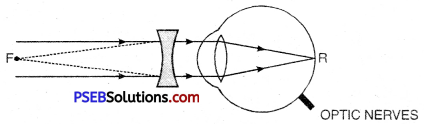
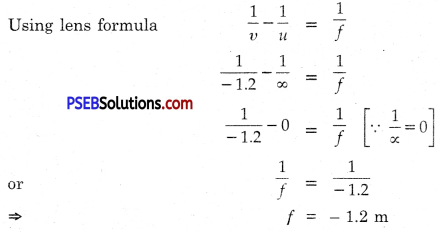
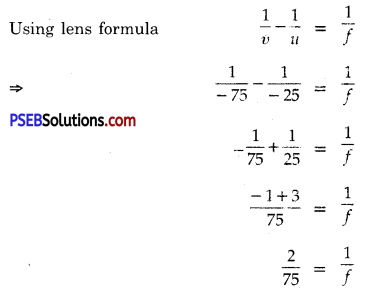
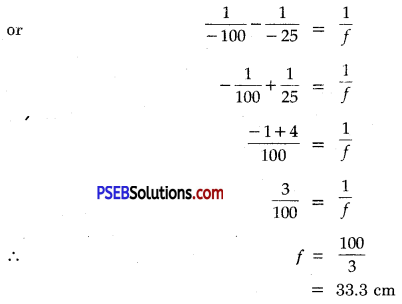
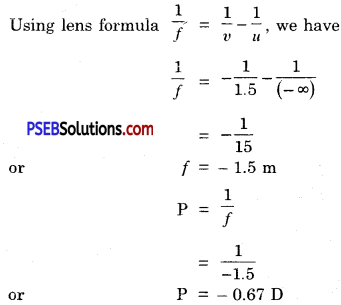
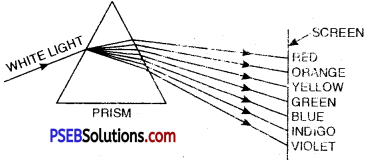
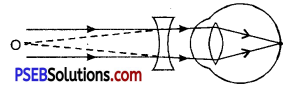
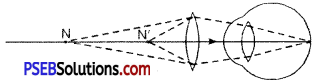
PSEB 10th Class Science Solutions Chapter 10 Light Reflection and Refraction

Punjab State Board PSEB 10th Class Science Book Solutions Chapter 10 Light Reflection and Refraction Textbook Exercise Questions and Answers.

PSEB Solutions for Class 10 Science Chapter 10 Light Reflection and Refraction

PSEB 10th Class Science Guide Light Reflection and Refraction Textbook Questions and Answers

Question 1.
Which of the following materials cannot be used to make a lens?
(a) Water
(b) Glass
(c) Plastic
(d) Clay.
Answer:
(d) Clay, which is opaque.

Question 2.
The image formed by a concave mirror is observed to be virtual, erect and larger than object. Where should be the position of the object?
(а) between principal focus and the centre of curvature.
(b) at centre of curvature.
(c) beyond centre of curvature.
(d) between the pole of the mirror and its principal focus.
Answer:
(d) between the pole of the mirror and its principal focus.

Question 3.
Where should an object be placed in front of a convex lens to get a real image of the size of the object?
(а) at principal focus of the lens.
(b) at twice the focal length of lens.
(c) at infinity.
(d) between optical centre of the lens and its principal focus.
Answer:
(b) at twice the focal length of the lens.

Question 41.
A spherical mirror and a thin spherical lens have each a focal length of -15 cm. The mirror and lens are likely to be :
(а) both are concave.
(b) both are convex.
(c) mirror is concave and lens is convex.
(d) mirror is convex but lens is concave.
Answer:
(a) both are concave.

Question 5.
No matter how far you stand from a mirror, your image appears erect. The mirror is likely to be :
(a) plane only.
(b) concave only.
(c) convex only.
(d) either plane or convex.
Answer:
(d) Either plane or convex.

Question 6.
Which of the following lenses would you prefer to use while reading small letters in a dictionary?
(а) A convex lens of focal length 50 cm.
(b) A concave lens of focal length 50 cm.
(c) A convex lens of focal length 5 cm.
(d) A concave lens of focal length 5 cm.
Answer:
(c) A convex lens of focal length 5 cm.

PSEB 10th Class Science Solutions Chapter 10 Light Reflection and Refraction

Question 7.
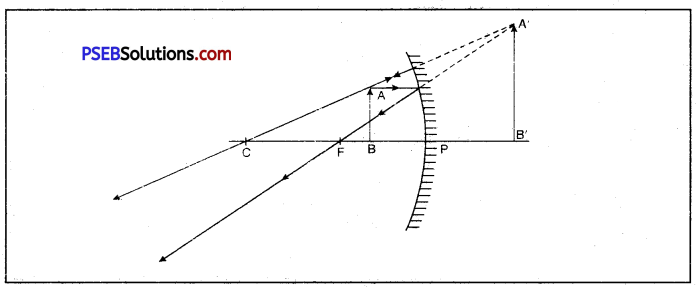
We wish to obtain an erect image of an object, using a concave mirror of focal length 15 cm. What should be the range of distance of the object from the mirror? What is the nature of the image? Is the image larger or smaller than object? Draw a ray diagram to show the image formation in this case.
Answer:
The image formed in the concave mirror would be erect only when the object is placed between pole and principal focus of the concave mirror. Therefore, range of distance is greater than zero and less than focal length i.e., between 0-15 cm.
PSEB 10th Class Science Solutions Chapter 10 Light Reflection and Refraction 1
This image is erect, enlarged. virtual and behind the mirror.

Question 8.
Name the type of mirror used in the following situations :
(a) Head-light of a car.
(b) Side/rear-view mirror of a vehicle.
(c) Solar furnace.
Support your answer with reason.
Answer:
(a) Concave mirrors are used for head-lights of car to give concentrated parallel beam of light.
(b) Side/rear-view mirror of a vehicle is mostly convex mirror because it forms an erect, virtual and diminished image and therefore, gives a wider field of view of the traffic behind.
However, for judging the distance and speed of the rear vehicle, a plane mirror fixed inside the car.
(c) Solar furnaces use concave mirror. It is because parallel sun rays (coming from infinity) after reflection from concave mirror are converged at focus to produce much heat.

Question 9.
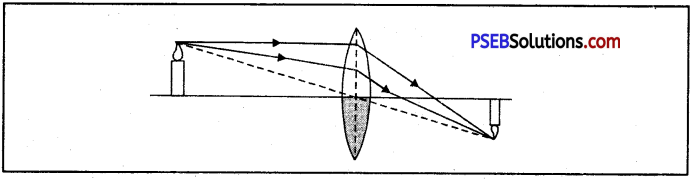
One half of a convex lens is covered with a black paper. Will this lens produce a complete image of the object? Explain your observation.
Answer:
If lower half of a convex lens is covered with black paper no doubt it will form complete image but intensity (brightness) of image with half lens will be less as that with complete lens exposed. The nature, size and location of the image will be the same since light from all parts of the object reaches the exposed part of the lens.
PSEB 10th Class Science Solutions Chapter 10 Light Reflection and Refraction 2

Question 10.
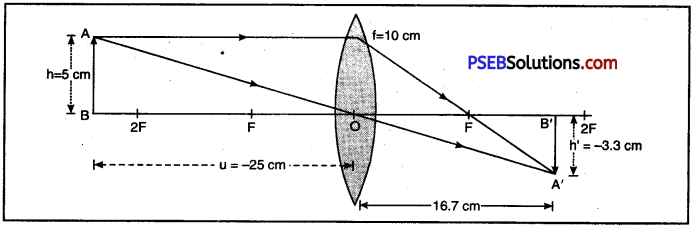
An object 5 cm in length is held 25 cm away from a converging lens of focal length 10 cm. Draw the ray diagram and find the position, size and the nature of image formed.
Answer:
PSEB 10th Class Science Solutions Chapter 10 Light Reflection and Refraction 3
Here, Length of the object (h) = 5 cm,
Image distance, v =?,
Object distance form the lens (u) = – 25 cm [Object distance is always negative]
h’ = ?; f = + 10cm [For convex lens, f is positive]
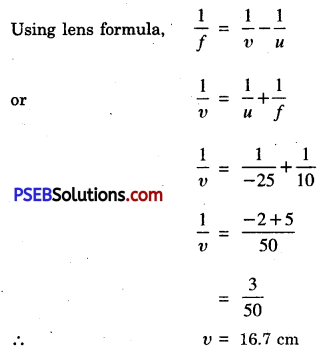
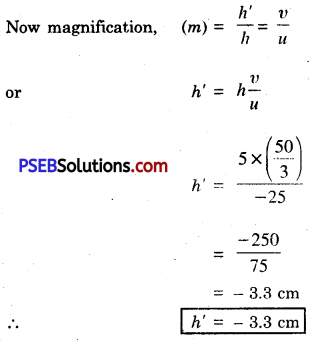
PSEB 10th Class Science Solutions Chapter 10 Light Reflection and Refraction 4
PSEB 10th Class Science Solutions Chapter 10 Light Reflection and Refraction 5
Negative sign shows that the image is inverted, real and diminished (3.3 cm) which is formed at 16.7 cm distance on the right side of lens.

Question 11.
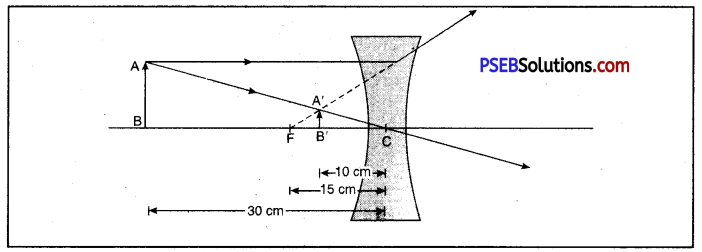
A concave lens of focal length 15 cm forms an image 10 cm from the lens. How far is the object placed from the lens? Draw ray diagram.
Answer:
Distance of the image from the lens (V) = – 10 cm [Virtual image]
Focal length of concave lens (f) = – 15 cm [Focal length of concave lens is taken negative];
Distance of the object from the lens (u) = ?
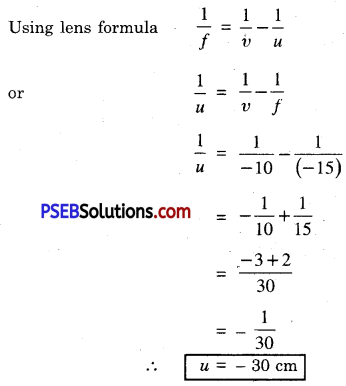
PSEB 10th Class Science Solutions Chapter 10 Light Reflection and Refraction 6
PSEB 10th Class Science Solutions Chapter 10 Light Reflection and Refraction 7
Negative sign shows that the object is placed to the left side of lens.

Question 12.
An object is placed at a distance of 10 cm from a convex mirror of focal length of 15 cm. Find the position and nature of the image.
Answer:
Distance of the object from the lens (u) = – 10 cm [u is always negative]
Focal length of the lens (f) = + 15 cm [convex mirror]
Distance of the image from the lens. (v) = ?
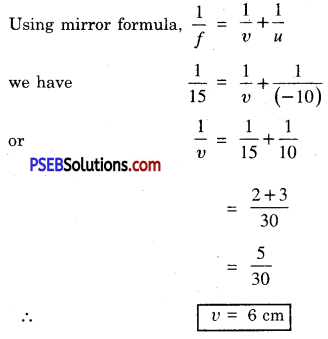
PSEB 10th Class Science Solutions Chapter 10 Light Reflection and Refraction 8
Negative sign shows that the image is virtual and erect and is formed towards left of the mirror.

Question 13.
The magnification produced by a plane mirror is + 1. What does this mean?
Answer:
It means that image produced by plane mirror is virtual, erect and of the same size as that of the object.

PSEB 10th Class Science Solutions Chapter 10 Light Reflection and Refraction

Question 14.
An object 5.0 cm of length is placed at a distance of 20 cm in front of a convex mirror of radius of curvature 30 cm. Find the position of the image, its nature and size.
Answer:
Here height of the object, h = 5.0 cm ;
u = – 20 cm [u is always negative]
Radius of curvature (r) = + 30 cm [convex mirror]
But f = \(\frac{r}{2}\)
= \(\frac{30}{2}\)
= + 15 cm

Height of the image h’ = ?
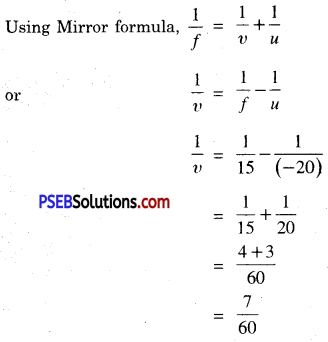
PSEB 10th Class Science Solutions Chapter 10 Light Reflection and Refraction 9
Image distance from the mirror v = \(\frac{60}{7}\) = 8.56 cm
Thus, the image is formed behind the mirror or to the right of the mirror.
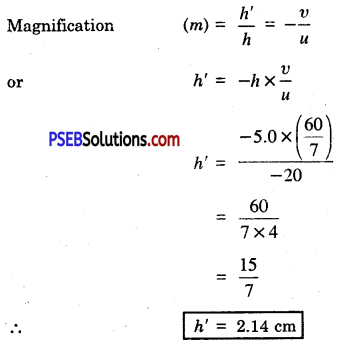
PSEB 10th Class Science Solutions Chapter 10 Light Reflection and Refraction 10
Positive sign (+) indicates that the image is erect and formed above the principal axis.

Question 15 .
An object of size 7.0 cm is placed at 27 cm in front of a concave mirror of focal length 18 cm. At what distance from the mirror should the screen be placed, so that a sharp focussed image can be obtained? Find the size and the nature of the image.
Answer:
Here h = 7.0 cm ; u = – 27 cm [u is always negative]
f = – 18 cm [concave mirror]
v =?; h’ =?

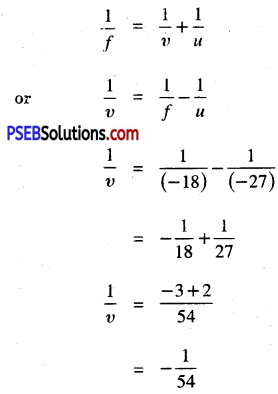
Using mirror formula ;
PSEB 10th Class Science Solutions Chapter 10 Light Reflection and Refraction 11
∴ Image distance from the mirror v = – 54 cm
i. e., at 54 cm on the same side of the mirror as that of the object.
Now, Magnification (m) = \(\frac{h^{\prime}}{h}=-\frac{v}{u}\)
\(\frac{h^{\prime}}{7.0}=-\frac{(-54)}{(-27)}\)
= -2
h’ = – 2 × 7
∴ h’ = – 14 cm
Image is of size 14 cm i.e. magnified. Negative sign (-) shows that the image is real and inverted.

Question 16.
Find the focal length of a lens of power – 2.0 D. What type of lens is this?
Answer:
Here, Power of lens (P) = – 2.0 D
Focal length of lens (f) =?
We have f = \(\frac{1}{P}\)
= \(\frac{1}{-2}\)
= – 0.5 m
∴ f = – 0.5 m = – 50 cm
Negative sign indicates that the lens is concave. Therefore, it is a divergent lens.

Question 17.
A doctor has prescribed a corrective lens of power + 1.5 D. Find the focal length of lens. Is prescribed lens diverging or converging?
Answer:
Here power of lens (P) = + 1.5 D
Focal length of lens (f) =?
We know f = \(\frac{1}{P}\)
= \(\frac{1}{1.5}\)
∴ f = 0.67 m = 67 cm
The positive sign (+) shows that the lens is a convex lens which is diverging in nature.

Science Guide for Class 10 PSEB Light Reflection and Refraction InText Questions and Answers

Question 1.
Define the principal focus of concave mirror.
Answer:
Principal focus: It is a point on the principal axis of a concave mirror where the rays parallel to principal axis meet after reflection from the mirror.

Question 2.
The radius of curvature of a spherical mirror is 20 cm. What is its focal length?
Answer:
Spherical mirror may be either convex mirror or a concave mirror.

For convex mirror,
Radius of curvature (R) = + 20 cm
Focal length (f) =?

We know, f = \(\frac{R}{2}\)
f = \(\frac{20}{2}\) = 10 cm

For concave mirrior,
Radius of curvature (R) = – 20 cm
Focal Length (f) = ?

We know, f = \(\frac{R}{2}\)
∴ f = \(\frac{-20}{2}\) = -10 cm

Question 3.
Name a mirror which can give an erect and enlarged image of an object.
Answer:
Concave mirror produces an erect and enlarged image when the object is placed between its pole and principal focus.

Question 4.
Why do we prefer a convex mirror as back view mirror in vehicles?
Answer:
Preference of convex mirror as rear view mirror in vehicles. We prefer to have convex mirror as a rear view mirror in vehicles because of the following reasons :

  • It produces an erect image of the object (traffic behind).
  • The size of the image formed is much smaller than the size of the object.
  • It has a wider field of view.

Question 5.
Find the focal length of a convex mirror whose radius of curvature is 32 cm.
Answer:
Radius of curvature (R) = + 32 cm [for convex mirror, R is +ve]
Focal length (f) =?

We know, f = \(\frac{R}{2}\)

∴ f = \(\frac{32}{2}\) = 16 cm

Question 6.
A concave mirror produces three times magnified (enlarged) real image of an object placed at 10 cm in front of it. Where is the image located?
Answer:
Magnification (m) = – 3 [for real image m is taken as negative]
u = – 10 cm v =? ; [u is always negative]

We know, m = \(-\frac{v}{u}\)
-3 = \(-\frac{v}{(-10)}\)
∴ v = – 30 cm
Since, the value of v is negative, therefore, the image is formed at 30 cm on the same side (to the left) of the mirror as that of the object.

Question 7.
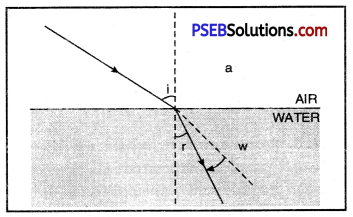
A ray of light travelling in air enters obliquely into water. Does the light ray bend towards normal or away from normal? Why?
Answer:
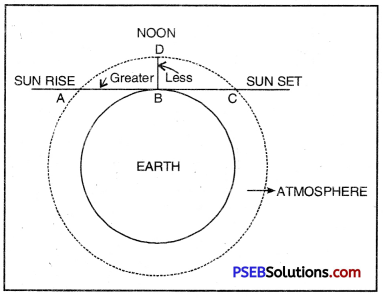
PSEB 10th Class Science Solutions Chapter 10 Light Reflection and Refraction 12
anw = \(\frac{\sin i}{\sin r}\)
Since anw > 1,
sin i > sin r
or i > r
or r < i
Hence, a ray of light travelling from optically rarer medium (air) to an optically denser medium (water), bends towards normal.

Question 8.
Light enters from air to glass having refractive index 1.50. What is speed of light in glass? Speed of light in vacuum is 3 × 10⁸ m s-1.
Answer:
Refractive index of glass (µ) = 1.50
Speed of light in vacuum (c) = 3 × 10⁸ m s-1

We know, Refractive index = \(\frac{\text { Speed of light in vacuum }(c)}{\text { Speed of light in glass }\left(v_{g}\right)}\)
1.50 = \(\frac{3 \times 10^{8}}{v_{g}}\)
or vg = \(\frac{3 \times 10^{8}}{1.50}\)
vg = 2 × 10⁸ m s-1

Question 9.
Find out from table 10.3 of the text-book, the medium having highest optical density. Also find the medium with lowest optical density.
Answer:

  • Optical density of a medium depends upon its refractive index. The higher the refractive index, higher the optical density and vice versa.
  • From the data available in the table it is apparent that diamond is having highest refractive index (µ = 2.42) and air is having lowest refractive index (µ = 1,0003).

PSEB 10th Class Science Solutions Chapter 10 Light Reflection and Refraction

Question 10.
Refractive indices of kerosene, turpentine and water are 1.44,1.47 and 1.33 respectively. In which material does the light travel fastest and why?
Answer:
Refractive indices of kerosene, turpentine and water are 1.44, 1.47 and 1.33 respectively. We know that velocity of light in a medium is inversely proportional to refractive index of the medium.

Therefore, light will travel fastest in water (having least refractive index i.e. µ = 1.33) and slowest in turpentine oil (having maximum refractive index i.e., µ = 1.47.)

Question 11.
The refractive index of diamond is 2.42. What is the meaning of this statement?
Answer:
We know, Refractive index of diamond = \(\frac{\text { Velocity of light in vacuum }}{\text { Refractive index of diamond }}\)
or
Velocity of light m diamond = \(\frac{\text { Velocity of light in vacuum }}{\text { Refractive index of diamond }}\)
The statement means that velocity of light in diamond is \(\frac{1}{2.42}\) times the velocity of light in vacuum.
i.e., vD = \(\frac{3 \times 10^{8}}{2.42}\) m s-1
= 1.24 × 10⁸ m s-1-1
In other words, light travels 2.42 times faster in vacuum than in diamond.

Question 12.
Define 1 dioptre of power of a lens.
Or
What is power of Lens? Give the commercial unit of power.
Answer:

  • Power of Lens: It is defined as the ability of a lens to bend incident light rays.
  • It is measured by taking reciprocal of focal length measured in metres.
  • The power of a lens is said to be 1 dioptre if its focal length is one metre.

Question 13.
A convex lens forms a real and inverted image of a needle at a distance of 50 cm from it. Where is the needle be placed in front of the convex lens if the image is equal to size of the object? Also, find the power of the lens.
Answer:
Here u =?, f =?, P =?
v = + 50 cm [for real image u is taken as positive]
m = -1 [Real image is always inverted]
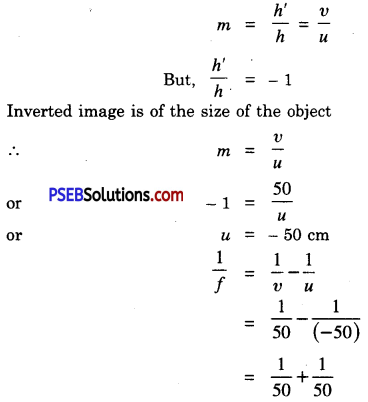
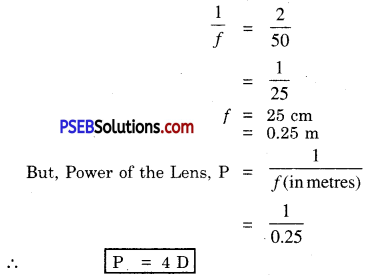
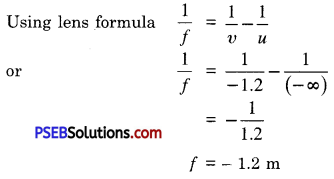
PSEB 10th Class Science Solutions Chapter 10 Light Reflection and Refraction 13
PSEB 10th Class Science Solutions Chapter 10 Light Reflection and Refraction 14

PSEB 10th Class Science Solutions Chapter 10 Light Reflection and Refraction

Question 14.
Find the power of a concave lens of focal length 2 metres.
Answer:
Here f = -2 m [for concave lens f is taken as negative]
P =?
Power of lens P = \(\frac{1}{f}\)
= \(\frac{1}{(-2)}\)
P = – 0.5 D

PSEB 9th Class Science Solutions Chapter 6 Tissues

Punjab State Board PSEB 9th Class Science Book Solutions Chapter 6 Tissues Textbook Exercise Questions and Answers.

PSEB Solutions for Class 9 Science Chapter 6 Tissues

PSEB 9th Class Science Guide Tissues Textbook Questions and Answers

Question 1.
Define the term ’tissue’.
Answer:
Tissue: A group of cells that are similar in structure and/or work together a particular function is called tissue.

PSEB 9th Class Science Solutions Chapter 6 Tissues

Question 2.
How many types of elements together make xylem tissue? Name them.
Answer:
Four types of elements make xylem tissue. They are:

  1. Tracheids
  2. Vessels
  3. Xylem parenchyma
  4. Xylem fibres

Question 3.
How are simple tissues different from complex tissues in plants?
Answer:
Differences between simple tissue and complex tissue in plants:

Simple tissue Complex tissue
1. Similar types of cells which have common origin and function.
2. All cells are similar in origin and structure.
3. Parenchyma, Collenchyma and Sclerenchyma are the three types.
1. A group of more than one type of cells having common origin and working! together as a unit.
2. The cells have different origin and structure.
3. Xylem and phloem are the two main types.!

Complex tissue

Question 4.
Differentiate between parenchyma, collenchyma and sclerenchyma on the basis of their cell walls.
Answer:

Feature Parenchyma Collenchyma Sclerenchyma
Cell wall Thin walls Thickened cell wall at comers Thickened walls due to lignin.

PSEB 9th Class Science Solutions Chapter 6 Tissues

Question 5.
What are functions of stomata?
Answer:
Functions of stomata:

  • They are necessary for exchanging gases with the atmosphere.
  • Transpiration also takes place through stomata.

Question 6.
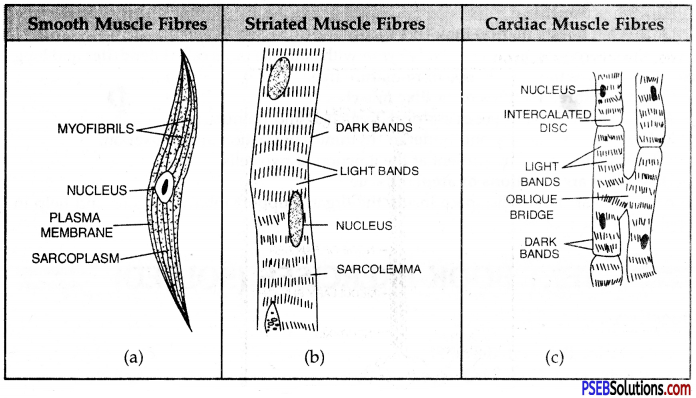
Diagrammatically show the differences between three types of muscle fibres.
Answer:
Three Types of Muscle Fibres:
PSEB 9th Class Science Solutions Chapter 6 Tissues 1

Question 7.
What is the specific function of cardiac muscles?
Answer:
Cardiac muscles undergo rhythmic contraction and relaxation. They are responsible for heart beat and thus plays a role in circulation (pumping) of blood in the body.

Question 8.
Differentiate between striated, unstriated and cardiac muscles on the basis of their structure and site/location in the body.
Answer:
Differences between Striated, Non-Striated and Cardiac Muscle Fibres:

Striated Muscle Fibres Non-striated Muscle Fibres Cardiac Muscle Fibres
Structure:
1. The fibres or cells are long and cylindrical.2. The fibres are unbran­ched.3. Sarcolemma is present.4. The cells are multinucleate.5. They bear striations or alternate light and dark bands.6. The ends are blunt.7.  They are capable of quick contraction. Location8. Occur in body wall, limbs, tongue, pharynx and beginning of oesophagus.
1. The fibres or cells are narrow and spindle­shaped. They are comparatively short.

2. The fibres are unbran­ched.

3. Sarcolemma is absent.

4. They are uninucleate.

5. Striations are absent.

6. The ends are tapering.

7. Contraction is slow.

8. Occur in walls of hollow visceral organs, iris of eye, and dermis of skin.

1. The cells are short but cylindrical.

2. They develop lateral outgrowths at places to form cross-connections.

3. Sarcolemma is present.

4. The cells are uninu­cleate.

5. Striations are present but slightly fainter than found in striated fibres.

6. The ends are blunt.

7. The fibres show rhythmic contractions.

8. Occur in the wall of heart.

PSEB 9th Class Science Solutions Chapter 6 Tissues

Question 9.
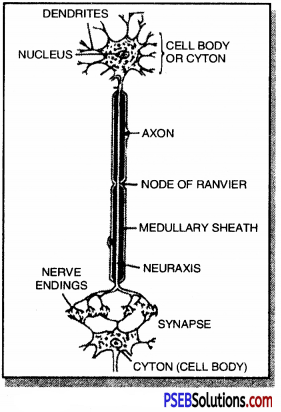
Draw a labelled diagram of a neuron.
Answer:
Structure of neuron
PSEB 9th Class Science Solutions Chapter 6 Tissues 2

Question 10.
Name the following:
(a) Tissue that forms inner lining of our mouth.
(b) Tissue that connects muscle to bone in humans.
(c) Tissue that transports food in plants.
(d) Tissue that stores fat in our body.
(e) Connective tissue with a fluid matrix.
(f) Tissue present in the brain.
Answer:
(a) Squamous epithelium
(c) Phloem
(e) Blood (Vascular tissue)

Question 11.
Identify the type of tissue in the following: skin, bark of tree, bone, lining of kidney tubule, vascular bundle.
Answer:

  1. Skin
  2. Bark of tree
  3. Bone
  4. Lining of kidney tubule
  5. Vascular bundle

Question 12.
Name the regions in which parenchyma tissue is present.
Answer:
Pith and cortex of stem and root.

PSEB 9th Class Science Solutions Chapter 6 Tissues

Question 13.
What is the role of epidermis in plants?
Answer:
Role of epidermis:

  1. Protection of all parts of plant.
  2. Secretion of waxy-water resistant layer on their outer surface.
  3. Epidermis aids in protection against loss of water, mechanical injury and invasion by parasitic fungi.

Question 14.
How does cork act as a protective tissue?
Answer:
Cell of cork are dead and compactly arranged without intercellular spaces. They have a chemical called suberin in their walls that makes them impervious to gases and water. Thus cork acts as a protective tissue.

Question 15.
Complete the table:
Answer:

  1. Parenchyma
  2. Sclerenchyma
  3. Phloem

Science Guide for Class 9 PSEB Tissues InText Questions and Answers

Question 1.
What is a tissue?
Answer:
Tissue: A group of cells that are similar in structure and/or work together a particular function is called tissue.

PSEB 9th Class Science Solutions Chapter 6 Tissues

Question 2.
What is utility of tissues in multicellular organisms?
Answer:

  • They provide protection and mechanical strength.
  • Tissues provide highest possible efficiency of function.

Question 3.
Name types of simple tissues.
Answer:
Types of simple tissues:

  1. Parenchyma
  2. Collenchyma
  3. Sclerenchyma.

Question 4.
Where is apical meristem found?
Answer:
Apical meristem is present at the growing tips of stems and roots of plants.

Question 5.
Which tissue makes up the husk of coconut?
Answer:
Sclerenchyma tissue.

Question 6.
What are constituents of phloem?
Answer:
Four types of elements constitute phloem:

  1. Sieve tubes
  2. Companion cells
  3. Phloem fibers
  4. Phloem parenchyma

Question 7.
Name the tissue responsible for the movement of our body.
Answer:
Muscular tissue.

Question 8.
What does a neuron look like?
Answer:
A neuron consists of cell body cyton with hair-like parts called dendrites and a long axon. Thus gives the appearance of a miniature tree.

PSEB 9th Class Science Solutions Chapter 6 Tissues

Question 9.
Give three features of cardiac muscles.
Answer:

  1. Heart muscles are cylindrical, branched, and uninucleate.
  2. They are involuntary and undergo rhythmic contraction and relaxation.
  3. Intercalated discs are present at the junction of two cells.

Question 10.
What are the functions of areolar tissue?
Answer:
Areolar tissue fills space inside the organ, supports internal organs, and helps in repairing the tissues.

PSEB 10th Class Hindi Solutions Chapter 3 नीति के दोहे

Punjab State Board PSEB 10th Class Hindi Book Solutions Chapter 3 नीति के दोहे Textbook Exercise Questions and Answers.

PSEB Solutions for Class 10 Hindi Chapter 3 नीति के दोहे

Hindi Guide for Class 10 PSEB नीति के दोहे Textbook Questions and Answers

(क) विषय-बोध

I. निम्नलिखित प्रश्नों के एक-दो पंक्तियों में उत्तर दीजिए

प्रश्न 1.
रहीम जी के अनुसार सच्चे मित्र की क्या पहचान है?
उत्तर:
रहीम जी के अनुसार जो व्यक्ति मुसीबत में काम आता है, वही सच्चा मित्र होता है।

प्रश्न 2.
ज्ञानी व्यक्ति संपत्ति का संचय किस लिए करते हैं?
उत्तर:
ज्ञानी व्यक्ति संपत्ति का संचय परोपकार अथवा दूसरों की भलाई के लिए करते हैं।

PSEB 10th Class Hindi Solutions Chapter 3 नीति के दोहे

प्रश्न 3.
बिहारी जी के अनुसार किस का साथ शोभा देता है?
उत्तर:
बिहारी जी के अनुसार एक जैसे स्वभाव अथवा प्रकृति वालों का साथ शोभा देता है।

प्रश्न 4.
बिहारी जी ने मानव को आशावादी होने का क्या संदेश दिया है?
उत्तर:
बिहारी जी ने संदेश दिया है कि मनुष्य को निराश न हो कर आने वाले अच्छे दिनों के लिए आशावादी होना चाहिए।

प्रश्न 5.
छल और कपट का व्यवहार बार-बार नहीं चल सकता-इस के लिए वृन्द जी ने क्या उदाहरण दिया है?
उत्तर:
वृन्द जी के अनुसार जैसे काठ की हांडी बार-बार नहीं चढ़ती उसी प्रकार छल और कपट का व्यवहार भी बार-बार नहीं चल सकता।

प्रश्न 6.
निरंतर अभ्यास से व्यक्ति कैसे योग्य बन जाता है? वृन्द जी ने इस के लिए क्या उदाहरण दिया है?
उत्तर:
जैसे बार-बार रस्सी घिसने से पत्थर पर भी निशान पड़ जाते हैं, वैसे ही निरंतर अभ्यास से अयोग्य व्यक्ति भी योग्य बन जाता है।

प्रश्न 7.
शत्रु को कमज़ोर या छोटा क्यों नहीं समझना चाहिए?
उत्तर:
शत्रु को कमज़ोर या छोटा नहीं समझना चाहिए क्योंकि शत्रु के प्रति लापरवाही बहुत हानि पहुँचा सकती है जैसे तिनकों के बड़े ढेर को आग का छोटा-सा अंगारा क्षण भर में जला कर राख कर देता है।

II. निम्नलिखित पद्यांशों की सप्रसंग व्याख्या करें

(1) रहिमन देखि बड़ेन को, लघु न दीजिये डारि।
जहां काम आवे सुई, का करे तरवारि।।
उत्तर:
रहीम जी कहते हैं कि किसी बड़े व्यक्ति अथवा वस्तु को देखकर हमें छोटे व्यक्ति अथवा वस्तु को छोड़ नहीं देना चाहिए अथवा उसका तिरस्कार नहीं करना चाहिए क्योंकि आवश्यकता के समय जहाँ सुई काम आती है, वहाँ तलवार किसी काम नहीं आती।

(2) कनक-कनक ते सौ गुनी, मादकता अधिकाय।
वह खाये बौराय है, यह पाये बौराय।
उत्तर:
महाकवि बिहारी कहते हैं कि धतूरे की तुलना में स्वर्ण में सौगुना अधिक नशा होता है क्योंकि धतूरे को खाने पर नशा होता है जबकि सोने के प्राप्त होने पर ही नशा हो जाता है। जो नशा धतूरा खाने पर होता है, उससे कहीं अधिक नशा धन-वैभव के प्राप्त होने पर होता है।

(3) मधुर वचन ते जात मिट, उत्तम जन अभिमान।
तनिक सीत जल सो मिटे, जैसे दूध उफान।।
उत्तर:
कवि कहता है कि मधुर वचनों अथवा मीठी वाणी के बोलों से किसी भी अभिमानी व्यक्ति के गर्व को उसी प्रकार से शांत किया जा सकता है जैसे थोड़े से ठंडे पानी के छींटों से उबलते हुए दूध के उफ़ान को कम कर लिया जाता है।

PSEB 10th Class Hindi Solutions Chapter 3 नीति के दोहे

(ख) भाषा-बोध

निम्नलिखित शब्दों के विपरीत शब्द लिखें:

सम्पत्ति = ———–
उत्तम = ———–
हित = ———–
आशा = ———–
बैर। = ———–
उत्तर:
शब्द – विपरीत शब्द
संपति – विपत्ति
उत्तम – अधम
हित – अहित।
आशा – निराशा
बैर – मिलाप।

निम्नलिखित शब्दों के विशेषण शब्द बनाएं:

प्रकृति = ———–
विष = ———–
बल = ———–
मूल = ———–
हित = ———–
व्यापार। = ———–
उत्तर:
शब्द विशेषण
शब्द विशेषण शब्द विशेषण
प्रकृति – प्राकृतिक
विष – विषैला
बल – बलवान
मूल – मूलभूत
हित – हितैषी
व्यापार। – व्यापारिक।

निम्नलिखित शब्दों की भाववाचक संज्ञा बनाएं:

लघु = ———–
मादक = ———–
एक = ———–
मधुर। = ———–
उत्तर:
शब्द – भाववाचक संज्ञा
लघु – लघुता
मादक – मादकता
एक – एकता
मधुर – मधुरता।

(ग) पाठ्येतर सक्रियता

प्रश्न 1.
अध्यापक महोदय उपर्युक्त नीति के दोहों पर आधारित शिक्षाप्रद कहानियाँ छात्र/छात्राओं को सुनाएं और उनसे भी इस प्रकार की कोई सच्ची घटना अथवा कहानी सुनाने के लिए कहें।
उत्तर:
(विद्यार्थी स्वयं करें।)

प्रश्न 2.
छात्र-छात्राएँ इस प्रकार के अन्य दोहों का संकलन कर विद्यालय की भित्ति पत्रिका पर लगाएँ।
उत्तर:
(विद्यार्थी स्वयं करें।)

प्रश्न 3.
कक्षा में ‘दोहा गायन प्रतियोगिता’ में सक्रिय रूप से भाग लें।
उत्तर:
(विद्यार्थी स्वयं करें)

प्रश्न 4.
रहीम अथवा अन्य कवियों के द्वारा रचित दोहों की ऑडियो/वीडियो सी०डी० लेकर अथवा इंटरनेट के माध्यम से सुनें/देखें। उत्तर:
(विद्यार्थी स्वयं करें)

PSEB 10th Class Hindi Solutions Chapter 3 नीति के दोहे

(घ) ज्ञान विस्तार

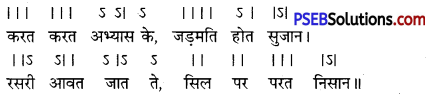
रहीम, बिहारी तथा वृंद ने अपने काव्य की रचना दोहा छंद में की है, जिसके पहले तथा तीसरे चरण में 13-13 तथा दूसरे तथा चौथे चरण में 11-11 मात्राएँ होती हैं, जैसे-
PSEB 10th Class Hindi Solutions Chapter 3 नीति के दोहे (रहीम, बिहारी, वृंद) 1
यहाँ पहली तथा तीसरी में 13-13 और दूसरी तथा चौथी में 11-11 मात्राएँ हैं, इसलिए दोहा छंद हुआ। (I = एक मात्रा, s = दो मात्राएँ)

PSEB 10th Class Hindi Guide नीति के दोहे Important Questions and Answers

प्रश्न 1.
रहीम ने सब को साधने का क्या उपाय बताया है?
उत्तर:
रहीम जी मानते हैं कि एक की साधना पूरी तरह करने से सब सध जाते हैं तथा मनुष्य को अपना लक्ष्य भी प्राप्त हो जाता है।

प्रश्न 2.
सुई के महत्त्व से रहीम जी क्या कहना चाहते हैं?
उत्तर:
कवि यह कहना चाहते हैं कि संसार में कोई भी वस्तु महत्त्वहीन नहीं होती है। छोटी-से छोटी वस्तु का भी अपना महत्त्व होता है। इसलिए कुछ बड़ा पा कर छोटे को त्यागना नहीं चाहिए क्योंकि जो काम छोटी-सी सुई कर सकती है वह काम तलवार नहीं कर सकती।

प्रश्न 3.
बिहारी के अनुसार किस का नशा नशीले पदार्थ के सेवन से भी अधिक होता है?
उत्तर:
बिहारी जी के अनुसार सोने अर्थात् धन-संपत्ति का नशा नशीले पदार्थ से भी सौ गुणा अधिक होता है क्योंकि जिस के पास धन-संपत्ति आ जाती है वह उसी के नशे में अहंकारी बन जाता है।

प्रश्न 4.
बिहारी के अनुसार गुणवान कौन होता है?
उत्तर:
बिहारी जी का मानना है कि किसी गुणहीन व्यक्ति को बार-बार गुणी-गुणी कहते रहने से वह गुणवान नहीं बन जाता क्योंकि सच्चा गुणी तो वही होता है जिसमें स्वाभाविक रूप से सद्गुण होते हैं।

प्रश्न 5.
वृन्द जी के अनुसार मधुर वाणी के क्या लाभ हैं?
उत्तर:
वृन्द जी के अनुसार मीठे वचनों का प्रयोग करने से क्रोधी तथा अभिमानी व्यक्ति के क्रोध एवं अहंकार को उसी प्रकार शांत कर सकते हैं जैसे उबलते हुए दूध के उफान को ठंडे जल के छींटे मारने से शांत किया जाता है।

एक पंक्ति में उत्तरात्मक प्रश्न

प्रश्न 1.
रहीम के अनुसार लोग कब हमारे सगे बन जाते हैं?
उत्तर:
जब हमारे पास सम्पत्ति होती है।

प्रश्न 2.
बिहारी ने किस में धतूरे से भी अधिक मादकता बताई है?
उत्तर:
बिहारी ने सोने में धतूरे से भी अधिक मादकता बताई है।

प्रश्न 3.
काजल की शोभा कहाँ होती है?
उत्तर:
काजल आँखों में सुशोभित होता है।

प्रश्न 4.
मधुर वचनों से क्या लाभ हैं?
उत्तर:
मधुर वचनों से क्रोधी के क्रोध को शांत तथा अभिमानी के गर्व को शांत किया जा सकता है।

बहुवैकल्पिक प्रश्नोत्तरनिम्नलिखित प्रश्नों के उत्तर एक सही विकल्प चुनकर लिखें

प्रश्न 1.
सज्जन किसके लिए धन एकत्र करते हैं?
(क) परहित
(ख) स्वहित
(ग) राजहित
(घ) परलोक हित।
उत्तर:
(क) परहित

PSEB 10th Class Hindi Solutions Chapter 3 नीति के दोहे

प्रश्न 2.
गुलाब के मूल से कौन अटका रहता है?
(क) कलि
(ख) अलि
(ग) कली
(घ) आली।
उत्तर:
(ख) अलि

प्रश्न 3.
अरक का अर्थ है
(क) चंद्रमा
(ख) तारे
(ग) दीपक
(घ) सूर्य।
उत्तर:
(घ) सूर्य

एक शब्द/हाँ-नहीं/सही-गलत/रिक्त स्थानों की पूर्ति के प्रश्न

प्रश्न 1.
ठंडे जल के छींटे से किसका उफान मिट जाता है? (एक शब्द में उत्तर दें)
उत्तर:
दूध का

प्रश्न 2.
सोने को पाकर ही मनुष्य बौरा जाता है। (सही या गलत में उत्तर लिखें।)
उत्तर:
सही

प्रश्न 3.
जहाँ तलवार काम आती है वहाँ सुई भी काम आती है। (सही या गलत में उत्तर लिखें)
उत्तर:
गलत

प्रश्न 4.
वृक्ष अपने फल स्वयं खाते हैं। (हाँ या नहीं में उत्तर दें)
उत्तर:
नहीं

प्रश्न 5.
शत्रु को कम समझने से हानि होती है। (हाँ या नहीं में उत्तर दें)
उत्तर:
हाँ

प्रश्न 6.
जैसे ……….. काठ की, चढ़ें न ………. बार।
उत्तर:
हाँडी, दूजी

प्रश्न 7.
सोहतु संगु ……… सों, यहै कहै ……… लोग।
उत्तर:
समानु, सब

प्रश्न 8.
रहिमन देखि ………… को, लघु न ………… डारि।
उत्तर:
बड़ेन, दीजिये।

नीति के दोहे दोहों की सप्रसंग व्याख्या

1. कहि रहीम सम्पति सगे, बनत बहुत बहु रीत।
विपत कसौटी जे कसे, सोई साँचै मीत।।

शब्दार्थ:
कहि = कहते हैं। सम्पति = धन-दौलत। सगे = सगे-संबंधी। बनत = बनते हैं। बहु = अनेक। रीति = प्रकार। विपत = मुसीबत। जे = जो। कसौटी कसे = कसौटी पर खरा उतरना। सोई = वही। साँचे = सच्चा। मीत = मित्र।

प्रसंग:
प्रस्तुत दोहा रहीम द्वारा रचित ‘नीति के दोहे’ पाठ में से लिया गया है। इस दोहे में कवि ने सच्चे मित्र के लक्षण बताये हैं।

व्याख्या:
रहीम जी कहते हैं कि जब पास में धन-दौलत होती है तो अनेक प्रकार से लोग हमारे सगे-संबंधी-मित्र आदि बन जाते हैं परंतु जो मुसीबत रूपी कसौटी पर कसे जाने के समय साथ देता है वही सच्चा मित्र होता है।

विशेष:

  1. कठिनाई में काम आने वाले ही सच्चा मित्र होता है।
  2. भाषा सरल, सरस, सहज और दोहा छंद है। अनुप्रास अलंकार है।

PSEB 10th Class Hindi Solutions Chapter 3 नीति के दोहे

2. एकै साधे सब सधै, सब साधै सब जाय।
रहिमन सींचे मूल को, फूलै फलै अधाय।।

शब्दार्थ:
मूल = जड़। फूलै = फूल आना। फलै = फल आना। अधाय = तृप्त होना।

प्रसंग:
प्रस्तुत दोहा रहीम जी द्वारा रचित ‘नीति के दोहे’ में से लिया गया है। इस दोहे में कवि ने एकनिष्ठ भाव से एक की आराधना करने पर बल दिया है।

व्याख्या:
कवि कहता है कि एकनिष्ठ भाव से एक ईश्वर की आराधना करने से सब को साध लिया जाता है जबकि सब की साधना करने से सभी हाथ नहीं आते अथवा सब कुछ नष्ट हो जाता है। रहीम जी उदाहरण देकर समझाते हैं कि जैसे किसी वृक्ष की जड़ को सींचने से वह फलता-फूलता है तथा उसके फलों को खा कर सब तृप्त हो जाते हैं।

विशेष:

  1. अपना ध्यान एक लक्ष्य की ओर केंद्रित करने से ही सफलता की प्राप्ति होती है।
  2. भाषा सहज, सरल, भावानुकूल तथा दोहा छंद है। अनुप्रास अलंकार है।

3. तरुवर फल नहिं खात हैं, सरवर पियहिं न पान।
कहि रहीम पर काज हित, सम्पति संचहिं सुजान।

शब्दार्थ:
तरूवर = वृक्ष, पेड़। खात = खाना। सरवर = तालाब। पान = पानी। परकाज = परोपकार, दूसरे की भलाई। हित = के लिए। संचहिं = एकत्र करना। सुजान = अच्छे लोग, सज्जन।

प्रसंग:
प्रस्तुत दोहा रहीम जी द्वारा रचित ‘नीति के दोहे’ से लिया गया है। इस दोहे में कवि ने परोपकार की महत्ता पर प्रकाश डाला है।

व्याख्या:
कवि कहता है कि वृक्ष कभी भी अपने फल नहीं खाता और तालाब भी अपना जल कभी नहीं पीता। रहीम जी कहते हैं कि दूसरों की भलाई के लिए ही सज्जन धन-दौलत एकत्र करते हैं।

विशेष:

  1. मनुष्य को अपनी धन-संपत्ति का सदुपयोग दूसरों की भलाई के लिए करना चाहिए।
  2. भाषा सरल, सरस, दोहा छंद तथा अनुप्रास अलंकार है।

4. रहिमन देखि बड़ेन को, लघु न दीजिये डारि।
जहाँ काम आवे सुई, का करे तरवारि।।

शब्दार्थ:
लघु = छोटा, तुच्छ। तरवारि = तलवार।

प्रसंग:
प्रस्तुत दोहा रहीम जी द्वारा रचित ‘नीति के दोहे’ से लिया गया है। इस दोहे में कवि ने कहा है कि हमें छोटी वस्तु के महत्त्व को भी अनदेखा नहीं करना चाहिए।

व्याख्या:
रहीम जी कहते हैं कि किसी बड़े व्यक्ति अथवा वस्तु को देखकर हमें छोटे व्यक्ति अथवा वस्तु को छोड़ नहीं देना चाहिए अथवा उसका तिरस्कार नहीं करना चाहिए क्योंकि आवश्यकता के समय जहाँ सुई काम आती है, वहाँ तलवार किसी काम नहीं आती।

विशेष:

  1. हमें बड़ी वस्तु अथवा संपन्न व्यक्ति को देखकर छोटी वस्तु अथवा निर्धन व्यक्ति की उपयोगिता को भूलना नहीं चाहिए। दोनों का सम्मान करना चाहिए।
  2. भाषा सरल, भावानुरूप, दोहा छंद तथा अनुप्रास अलंकार है।

5. कनक-कनक ते सौगुनी, मादकता अधिकाय।
बह खाये बौरात है, इहिं पाये बौराय।।

शब्दार्थ:
कनक = धतूरा, सोना। मादकता = नशा। बौराय = पागल हो जाता है।

प्रसंग:
प्रस्तुत दोहा बिहारी द्वारा रचित ‘नीति के दोहे’ से लिया गया है जिसमें कवि ने यह बताया है धन और वैभव का नशा मनुष्य को पागल बना देता है। धनी व्यक्ति नशा करने वाले व्यक्ति की तरह व्यवहार करने लगता है।

व्याख्या:
महाकवि बिहारी कहते हैं कि धतूरे की तुलना में स्वर्ण में सौगुना अधिक नशा होता है क्योंकि धतूरे को खाने पर नशा होता है जबकि सोने के प्राप्त होने पर ही नशा हो जाता है। जो नशा धतूरा खाने पर होता है, उससे कहीं अधिक नशा धन-वैभव के प्राप्त होने पर होता है।

विशेष:

  1. धन-संपत्ति पाकर मनुष्य अहंकारी बन जाता है।
  2. दोहा छंद, ब्रज भाषा तथा यमक अलंकार है।

6. इहि आशा अटक्यो रहै, अलि गुलाब के मूल।
हो इहै बहुरि बसन्त ऋतु, इन डारनि पै फूल॥

शब्दार्थ:
इहि = इस। अलि = भँवरा। मूल = जड़। होइहै = हो जाएगी। बहरि = फिर। _प्रसंग-प्रस्तुत दोहा बिहारी द्वारा रचित ‘नीति के दोहे’ से लिया गया है। इस दोहे में कवि ने मनुष्य को सदा आशावादी रहने का संदेश दिया है।

व्याख्या:
कवि कहता है कि फूल न होने पर भी इस उम्मीद से भँवरा गुलाब की जड़ के पास रहता है कि फिर से बसंत ऋतु आएगी और इन डालियों पर फूल खिल जाएँगे। भाव यह है कि मनुष्य को कभी निराश नहीं होना चाहिए क्योंकि दुःख के बाद सुख आता ही है।

विशेष:

  1. कवि ने मनुष्य को अपना कर्म करते हुए निरन्तर आशावादी बने रहने का संदेश दिया है।
  2. ब्रज भाषा, दोहा छंद तथा अनुप्रास अलंकार है।

7. सोहतु संगु समानु सो, यहै कहै सब लोग।
पान पीक ओठनु बनैं, नैननु काजर जोग।।

शब्दार्थ:
सोहतु = शोभामान होता है। संगु = साथ। यहै = यही। काजर = काजल।

प्रसंग:
प्रस्तुत दोहा बिहारी द्वारा रचित ‘नीति के दोहे’ से लिया गया है। इस दोहे में कवि बताता है कि एक जैसे स्वभाव वालों का साथ सदा बना रहता है।

व्याख्या:
कवि कहता है कि एक जैसे स्वभाव वाले लोगों का साथ ही सदा रहता है ऐसा ही सब लोग भी कहते हैं क्योंकि पानी की पीक की लालिमा सदा ओंठों पर तथा काजल आँखों में सुशोभित होता है। पान की पीक की लालिमा ओंठों के लिए तथा काजल आँखों के लिए बना है।

विशेष:

  1. समान प्रकृति तथा स्वभाव के व्यक्तियों का साथ सदा बना रहता है।
  2. ब्रज भाषा, दोहा छंद तथा अनुप्रास अलंकार है।

8. गुनी गुनी सबकै कहैं, निगुनी गुनी न होतु।
सुन्यौ कहूँ तरू अरक तें, अरक-समान उदोतु॥

शब्दार्थ:
गुनी = गुणवान। कहैं = कहने से। निगुनी = गुणहीन। तरू = वृक्ष । अरकतें = आक के। अरक-समान = सूर्य के समान। उदोतु = प्रकाशवान।

प्रसंग:
प्रस्तुत दोहा बिहारी द्वारा रचित ‘नीति के दोहे’ से लिया गया है। इस दोहे में कवि ने स्पष्ट किया है कि कहने मात्र से ही गुणहीन व्यक्ति गुणवान नहीं हो सकता।

व्याख्या:
कवि कहता है कि सब लोगों के द्वारा किसी गुणहीन व्यक्ति को बार-बार गुणवान कहने से वह गुणहीन व्यक्ति गुणवान नहीं बन सकता क्योंकि कहीं यह नहीं सुना कि आक के वृक्ष में भी सूर्य के समान तेज तथा उजाला है। जैसे आक कहने से आक का वृक्ष अरक अर्थात् सूर्य नहीं हो सकता वैसे ही गुणहीन को गुणी-गुणी कहते रहने से वह गुणवान नहीं हो सकता है।

विशेष:

  1. गुणहीन को गुणी कहते रहने से उसे गुणवान नहीं बनाया जा सकता।
  2. ब्रज भाषा, दोहा छंद, अनुप्रास तथा पुनरुक्ति प्रकाश अलंकार है।

PSEB 10th Class Hindi Solutions Chapter 3 नीति के दोहे

9. करत करत अभ्यास के, जड़मति होत सुजान।
रसरी आवत जात ते, सिल पर परत निसान।।

शब्दार्थ:
जड़मति = मूर्ख। सुजान = विद्वान्, बुद्धिमान। रसरी = रस्सी। सिल = पत्थर, चट्टान।

प्रसंग:
प्रस्तुत दोहा वृन्द द्वारा रचित ‘नीति के दोहे’ से लिया गया है। इस दोहे में कवि ने यह बताया है कि अभ्यास करने से मूर्ख भी विद्वान् बन सकता है।

व्याख्या:
कवि कहता है कि बार-बार अभ्यास करने से मूर्ख व्यक्ति भी विद्वान् बन सकता है जैसे बार-बार रस्सी के घिसने से पत्थर पर भी निशान पड़ जाते हैं।

विशेष:

  1. परिश्रम करने से व्यक्ति अपने लक्ष्य को अवश्य प्राप्त कर लेता है।
  2. भाषा अत्यंत सरल, भावपूर्ण, दोहा छंद और पुनरुक्ति प्रकाश अलंकार है।

10. फेर न ह्वै है कपट सों, जो कीजै व्यापार।
जैसे हाँडी काठ की, चढ़े न दूजी बार।।

शब्दार्थ:
फेर = दुबारा। ह्वै = फिर से होना। कपट = छल। काठ = लकड़ी। दूजी = दूसरी।

प्रसंग:
प्रस्तुत दोहा वृन्द द्वारा रचित ‘नीति के दोहे’ से लिया गया है। इस दोहे में कवि ने यह स्पष्ट किया है कि छल-कपट का व्यवहार बार-बार नहीं चलता है।

व्याख्या:
कवि कहता है कि यदि कोई व्यक्ति छल-कपट और चालाकी से अपना कार्य करता है तो उसकी चालाकी एक बार तो चल जाती है परंतु बार-बार नहीं चलती जैसे काठ की हांडी एक बार तो चढ़ जाती है परंतु दोबारा नहीं चढ़ सकती।

विशेष:

  1. छल-कपट का व्यवहार बार-बार नहीं चलता है।
  2. भाषा सरल, भावपूर्ण, दोहा छंद है।

11. मधुर वचन ते जात मिट, उत्तम जन अभिमान।
तनिक सीत जल सों मिटे, जैसे दूध उफान।।

शब्दार्थ:
मधुर = मीठे। वचन = शब्द, वाणी। अभिमान = घमंड, अहंकार। तनिक = थोड़े से। सीत = ठंडा। उफान = उबाल।

प्रसंग:
प्रस्तुत दोहा वृन्द द्वारा रचित ‘नीति के दोहे’ से लिया गया है। इस दोहे में कवि ने मधुर वाणी के प्रभाव का वर्णन किया है।

व्याख्या:
कवि कहता है कि मधुर वचनों अथवा मीठी वाणी के बोलों से किसी भी अभिमानी व्यक्ति के गर्व को उसी प्रकार से शांत किया जा सकता है जैसे थोड़े से ठंडे पानी के छींटों से उबलते हुए दूध के उफ़ान को कम कर लिया जाता है।

विशेष:

  1. मधुर वाणी के प्रयोग से क्रोधी व्यक्ति के क्रोध तथा अभिमानी के गर्व को भी शांत किया जा सकता है।
  2. भाषा सरल, सहज, भावपूर्ण तथा दोहा छंद है।

12. अरि छोटो गनिये नहीं, जाते होत बिगार।
तृण समूह को तनिक में, जारत तनिक अंगार।

शब्दार्थ:
अरि = शत्रु, दुश्मन। गनिये = मानना, गिनना। बिगार = बिगड़ना। तृण = तिनका। तनिक = क्षण भर में। जारत = जलाना। तनिक = छोटा-सा। अंगार = आग का अंगारा।

प्रसंग:
प्रस्तुत दोहा वृन्द द्वारा रचित ‘नीति के दोहे’ से लिया गया है। इस दोहे में कवि ने संदेश दिया है कि अपने छोटे-से-छोटे शत्रु को भी कभी कमजोर नहीं समझना चाहिए।

व्याख्या:
कवि कहता है कि अपने शत्रु को कभी भी छोटा, तुच्छ या अपने से कमजोर नहीं समझना चाहिए क्योंकि इस से बहुत हानि हो जाती है। जिस प्रकार तिनकों के ढेर को आग का केवल एक अंगारा क्षणभर में जला कर नष्ट कर देता है वैसे ही शत्रु को कम समझने से हानि होती है।

विशेष:

  1. कभी भी किसी कार्य अथवा शत्रु को अपने से कम नहीं समझना चाहिए।
  2. भाषा सहज, सरल, भावपूर्ण, दोहा छंद और अनुप्रास अलंकार है।

नीति के दोहे Summary

नीति के दोहे रहीम कवि परिचय

रहीम का पूरा नाम अब्दुर्रहीम खानखाना था। इनका जन्म सन् 1553 ई० में हुआ था। इनके पिता अकबर बादशाह के अभिभावक मुग़ल सरदार बैरम खाँ खानखाना थे। अकबर के राज्यकाल में ये अकबर के दरबार के नवरत्नों में से एक थे। ये संस्कृत, अरबी, फारसी, ब्रज, अवधी आदि भाषाओं के विद्वान् तथा हिंदी काव्य के रचयिता थे। ये अत्यंत पानी तथा परोपकारी व्यक्ति थे। गोस्वामी तुलसीदास इनके प्रिय मित्र थे। इन्होंने मुग़ल साम्राज्य के विस्तार के लिए अनेक युद्ध भी लड़े थे। जहाँगीर के शासनकाल में इन्हें राजद्रोह के अपराध में बंदी बना लिया गया था तथा इनकी सारी जागीर भी छीन ली गई थी। इनकी वृद्धावस्था बहुत ग़रीबी में बीती थी। सन् 1625 ई० में इनका देहांत हो गया था।

रचनाएँ-इनकी प्रमुख रचनाएँ रहीम सतसई, बरवै नायिका भेद, श्रृंगार सोरठ, मदनाष्टक और रास पंचाध्यायी हैं। इनकी भाषा अत्यंत सरल, सहज तथा शैली भावानुरूप है। इन्होंने दोहा, सोरठा, सवैया, कवित्त, बरवै छंदों का प्रयोग किया है।

नीति के दोहे बिहारी कवि परिचय

रीतिकाल के सप्रसिद्ध कवि बिहारी का जन्म सन् 1603 ई० में बसुआ गोबिंदपुर गाँव (ग्वालियर) में हुआ था। इनके पिता का नाम केशवराय था। बिहारी ने अपनी शिक्षा महात्मा नरहरिदास के आश्रम में रह कर ग्रहण की थी। इनका विवाह मथुरा में हुआ था तथा इनकी पत्नी भी विदुषी एवं कवयित्री थी। बिहारी को मुग़ल सम्राट शाहजहाँ ने अपने दरबार में आमंत्रित किया था। जयपुर नरेश महाराजा जयसिंह के ये दरबारी कवि थे। एक बार जयपुर के राजा जयसिंह अपनी नव विवाहिता पत्नी के राग-रंग में इतने अधिक तल्लीन हो गए थे कि अपना समस्त राज-काज भी भुला बैठे थे तब बिहारी ने उन्हें निम्नलिखित दोहा लिख कर भिजवाया था-
“नाहिं पराग नहिं मधुर मधु, नहिं विकास इहि काल।
अलि कली ही सौ बंध्यौ, आगे कौन हवाल।”

इस दोहे ने महाराज को सचेत कर दिया था तथा वे राज-काज में रुचि लेने लगे थे। बिहारी रीति काल के प्रतिनिधि कवि माने जाते हैं। सन् 1664 ई० में वृंदावन में इनका स्वर्गवास हो गया था।

रचनाएँ: बिहारी द्वारा रचित केवल ‘सतसई’ ही मिलती है। इसमें सात सौ तेरह दोहे हैं। कुछ विद्वानों ने दोहों की संख्या सात सौ छब्बीस भी मानी है। इस रचना में मुख्य रूप से श्रृंगार रस की प्रधानता है। कवि ने श्रृंगार रस के अतिरिक्त नीति, वैराग्य, भक्ति आदि से संबंधित कुछ दोहों की रचना की है। बिहारी सतसई की लोकप्रियता से प्रभावित होकर इसकी अनेक टीकाएँ भी की गई हैं। संस्कृत, उर्दू, फारसी, खड़ी बोली, अंग्रेज़ी, मराठी आदि भाषाओं में भी इसके अनुवाद किए गए हैं।

PSEB 10th Class Hindi Solutions Chapter 3 नीति के दोहे

नीति के दोहे वृन्द कवि परिचय

वृन्द रीतिकाल के ‘सूक्तिकार’ कवियों में प्रमुख माने जाते हैं। इनका जन्म सन् 1685 ई० में मेड़ता (मेवाड़) जोधपुर में हुआ था। ये कृष्णगढ़ नरेश महाराज राजसिंह के गुरु थे। इनके संबंध में प्रसिद्ध है कि ये कृष्णगढ़ नरेश के साथ औरंगज़ेब की सेना में ढाका तक गए थे। इनके वंशजों के बारे में कहा जाता है कि वे अब भी कृष्णगढ़ में रहते हैं। इनका देहावसान सन् 1765 ई० में हुआ था।

रचनाएँ-वृन्द की प्रमुख रचना ‘वृन्द सतसई’ है। इसमें नीति से संबंधित सात सौ दोहे हैं। इनकी अन्य रचनाएँ ‘श्रृंगार शिक्षा’, ‘पवन पचीसी’, ‘हितोपदेश संधि’, ‘वचनिका’ तथा ‘भावपंचाशिका’ हैं। इनकी काव्य भाषा अत्यंत सरल, सहज, सरस तथा भावपूर्ण है। अपने काव्य में इन्होंने सूक्तियों का बहुत सुंदर तथा सटीक प्रयोग किया है।

नीति के दोहे रहीम दोहों का सार

पाठ्य-पुस्तक में रहीम जी के चार दोहे संकलित हैं। पहले दोहे में कवि ने कहा है कि अच्छे समय में तो सभी मित्र बन जाते हैं परंतु सच्चा मित्र वही होता है जो मुसीबत के समय साथ देता है। दूसरे दोहे में कवि एकनिष्ठ भाव से एक की ही साधना करने पर बल देते हैं। तीसरे दोहे में स्वार्थ की अपेक्षा परमार्थ करने का लाभ बताया गया है तथा चौथे दोहे में बड़ी वस्तु देखकर छोटी वस्तु की उपयोगिता को नहीं भूलने के लिए कहा गया है।

नीति के दोहे बिहारी दोहों का सार

पाठ्यपुस्तक में बिहारी के चार दोहे संकलित हैं। पहले दोहे में धन-संपत्ति के नशे, दूसरे दोहे में मनुष्य के आशावादी होने का, तीसरे दोहे में एक जैसे स्वभाव वालों के परस्पर मेल-जोल से रहने तथा चौथे दोहे में कवि ने गुणों के महत्त्व का वर्णन किया है।

नीति के दोहे बिहारी दोहों का सार

पाठ्यपुस्तक में वृन्द के चार दोहे संकलित हैं। पहले दोहे में कवि ने परिश्रम का महत्त्व बताया है, जिससे हम अपना लक्ष्य प्राप्त कर सकते हैं। दूसरे दोहे में कवि ने बताया है कि जैसे काठ की हांडी बार-बार नहीं चढ़ती वैसे ही चालाकी भी बार-बार नहीं की जा सकती। तीसरा दोहा मधुर वचन का प्रभाव स्पष्ट करता है। चौथे दोहे में अपने शत्रु को भी कमज़ोर नहीं समझने का संदेश दिया गया है।

PSEB 10th Class Hindi Solutions Chapter 2 पदावली

Punjab State Board PSEB 10th Class Hindi Book Solutions Chapter 2 पदावली Textbook Exercise Questions and Answers.

PSEB Solutions for Class 10 Hindi Chapter 2 पदावली

Hindi Guide for Class 10 PSEB पदावली Textbook Questions and Answers

(क) विषय बोध

I. निम्नलिखित प्रश्नों के उत्तर एक या दो पंक्तियों में दीजिए

प्रश्न 1.
श्री कृष्ण ने कौन-सा पर्वत धारण किया था?
उत्तर:
श्री कृष्ण ने गोवर्धन पर्वत को धारण किया था।

प्रश्न 2.
मीरा किसे अपने नयनों में बसाना चाहती है?
उत्तर:
मीरा नंद के पुत्र श्रीकृष्ण को अपने नयनों में बसाना चाहती है।

PSEB 10th Class Hindi Solutions Chapter 2 पदावली

प्रश्न 3.
श्रीकृष्ण ने किस प्रकार का मुकुट और कुंडल धारण किए हैं ?
उत्तर:
श्रीकृष्ण ने मोर पंखों का मुकुट और मकर की आकृति के कुंडल धारण किए हुए हैं।

प्रश्न 4.
मीरा किसे देखकर प्रसन्न हुई और किसे देखकर दुःखी हुई ?
उत्तर:
मीरा भक्तों को देखकर प्रसन्न हुई और सांसारिक माया-मोह में फंसे हुए लोगों को देख कर दुःखी हुई।

प्रश्न 5.
संतों की संगति में रहकर मीरा ने क्या छोड़ दिया ?
उत्तर:
संतों की संगति में रहकर मीरा ने कुल की मर्यादा तथा लोकलाज को छोड़ दिया था।

प्रश्न 6.
मीरा अपने आँसुओं के जल से किस बेल को सींच रही है?
उत्तर:
मीरा अपने आँसुओं के जल से श्रीकृष्ण के प्रति अपने हृदय में विद्यमान प्रेम रूपी बेल को सींच रही है।

प्रश्न 7.
पदावली के दूसरे पद में मीराबाई गिरिधर से क्या चाहती है ?
उत्तर:
मीराबाई ने गिरिधर को अपने पति के रूप में स्वीकार कर उनसे चाहा है कि केवल वे ही उसका अब उद्धार कर सकते हैं। वह उनकी शरण को सदा के लिए पाना चाहती है।

II. निम्नलिखित पद्यांशों की सप्रसंग व्याख्या कीजिए

(क) बसौ मेरे नैनन में नंद लाल।
मोहनि मूरति साँवरी सूरति नैना बनै विसाल।
मोर मुकुट मकराकृत कुंडल अरुण तिलक दिये भाल।
अधर सुधारस मुरली राजति उर वैजन्ती माल।
छुद्र घंटिका कटि तट सोभित नुपूर शब्द रसाल।
मीरा प्रभु सन्तन सुखदाई भक्त बछल गोपाल॥
उत्तर:
कवयित्री अपनी कामना व्यक्त करते हुए कहती है कि हे नंद के पुत्र श्री कृष्ण, आप मेरे नेत्रों में निवास करने की कृपा करो। आपकी मोहित करने वाली आकृति तथा सांवले रंग की सूरत है। आपके नेत्र बहुत बड़े-बड़े हैं। आप ने मोर के पंखों का मुकुट सिर पर और कानों में मकर की आकृति के कुंडल धारण किए हुए हैं। आपके माथे पर लाल रंग का तिलक सुशोभित हो रहा है। आप के होठों पर अमृत समान मधुर स्वर रस की वर्षा करने वाली बाँसुरी तथा हृदय पर वैजंती माला विराजमान है। छोटी-छोटी घंटियाँ आप की कमर पर बंधी हुई हैं तथा पैरों में घुघरू बंधे हैं जिनकी मधुर गुंजार सुनाई दे रही है। मीरा के प्रभु संतों को सुख प्रदान करते हैं तथा अपन भक्तों की सदा रक्षा करते हैं।

(ख) मेरे तो गिरिधर गोपाल, दूसरो न कोई।
जाके सिर मोर मुकुट, मेरो पति सोई।
तात मात भ्रात बंधु, आपनो न कोई।
छोड़ि दई कुल की कानि, कहा करै कोई।
संतन ढिग बैठि बैठि, लोक लाज खोई।
अँसुअन जल सींचि सींचि, प्रेम बेलि बोई।
अब तो बेलि फैल गई, आनंद फल होई।
भगत देखि राजी भई, जगत देखि रोई।
दासी मीरा लाल गिरधर, तारौ अब मोही।
उत्तर:
मीरा जी कहती हैं कि मेरा तो सर्वस्व गोवर्धन पर्वत धारी श्रीकृष्ण हैं। उनके अतिरिक्त मेरा किसी से कोई संबंध नहीं। मोर-मुकुट धारण करने वाले श्रीकृष्ण ही मेरे पति हैं। पिता, माता, भाई, सगा-संबंधी इनमें अब मेरा अपना कोई नहीं है। मैंने अपने परिवार की मान-मर्यादा को छोड़ कर उन्हें अपना लिया है। इसलिए मेरा अब कोई क्या कर सकता है अर्थात् मुझे किसी की परवाह नहीं है। मैं लोक-लाज की चिंता छोड़कर संतों के पास बैठती हूँ। मैंने आँसुओं के जल से सींच-सींच कर कृष्ण प्रेम की बेल को बोया है। अभिप्राय यह है कि श्रीकृष्ण के प्रति मीरा के मन की प्रेम रूपी बेल का विकास हो चुका है। अतः अब उसे किसी प्रकार से भी नष्ट नहीं किया जा सकता। मीरा जी कहती हैं कि वे प्रभु भक्त को देख कर तो प्रसन्न होती हैं पर संसार को देखकर रो पड़ती हैं। भाव यह है कि माया-मोह में लिप्त प्राणियों के दयनीय अंत की कल्पना मात्र से मीरा का हृदय दुःख से भर जाता है। मीरा स्वयं को श्रीकृष्ण की दासी मानती हुई उनसे अपने उद्धार की प्रार्थना करती है।

PSEB 10th Class Hindi Solutions Chapter 2 पदावली

(ख) भाषा-बोध

निम्नलिखित शब्दों के दो-दो पर्यायवाची शब्द लिखें

भाल = ———–
प्रभु = ———–
जगत = ———–
वन। = ———–
उत्तर:
शब्द पर्यायवाची शब्द
भाल – माथा, मस्तक, ललाट, कपाल।
प्रभु – ईश्वर, परमेश्वर, जगदीश, भगवान्।
जगत – संसार, विश्व, भुवन, दुनिया।
वन – विपिन, जंगल, कानन, अटवी।

निम्नलिखित भिन्नार्थक शब्दों के अर्थ लिखकर वाक्यों में प्रयोग कीजिए

कुल = ———–
कूल = ———–
कटि = ———–
कटी। = ———–
उत्तर:
कुल = वंश-श्री राम का जन्म रघुकुल में हुआ था।
कूल = किनारा-यमुना नदी के कूल पर स्नानार्थियों की भीड़ थी।
कटि = कमर-बाल कृष्ण की कटि पर छोटे-छोटे घुघरू बंधे हुए थे।
कटी = फटना-उसकी कमीज़ नीचे से कटी हुई है।

(ग) पाठ्येतर सक्रियता

प्रश्न 1.
मीराबाई द्वारा वर्णित श्रीकृष्ण के बाल रूप का एक चित्र लेकर अपने विद्यालय की भित्ति पत्रिका पर लगाएँ। (विद्यार्थी स्वयं करें।)
उत्तर:
किलकत कान्ह घुटरुवन आवत।
मनिमय कनक नंद के आँगन, मुख प्रतिबिंब पकरिबे धावत।
कबहुँ निरखि हरि आप छाँह को, पकरन को चित चाहत।
किलकि हँसत राजत द्वै द॑तियाँ, पुनि-पुनि तिहि अवगाहत।
कनक-भूमि पर कर-पग-छाया, यह उपमा एक राजत।
प्रति-कर प्रति-पद प्रतिमनि वसुधा, कमल बैठकी साजत।
बाल-दसा-सुख निरखि जसोदा, पुनि-पुनि नंद बुलावति।
अँचरा तर लै ढाँकि ‘सूर’ के प्रभु कौं दूध पियावति। (सूरदास)

प्रश्न 2.
मीराबाई की तरह अन्य कृष्ण भक्त कवियों जैसे सूरदास, रसखान आदि ने श्रीकष्ण के बाल सौंदर्य का वर्णन अपनी रचनाओं में किया है। अपने स्कूल की पुस्तकालय से ऐसे कुछ पद संकलित करें।
उत्तर:
सूरदास और रसखान का एक-एक पद यहाँ दिया जा रहा है। अन्य पद विद्यार्थी स्वयं संकलित करें।
धूर भरे अति शोभित स्याम जू तैसी बनी सिर सुंदर चोटी।
डोलन खात फिरै अँगना पग पैंजनी बाजती, पीरी कछोटी॥
वा छवि को रसखानि बिलोकत बारत काम-कला निज कोटी।
काग के भाग बड़े सजनी हरि हाथ सों लै गयो माखन रोटी॥ (रसखान)

प्रश्न 3.
मीराबाई के पदों की सी०डी०/डी०वी०डी० देखें या इंटरनेट पर इन पदों को सुन कर आनंद लें।
उत्तर:
(विद्यार्थी स्वयं करें।)

प्रश्न 4.
कृष्ण जन्माष्टमी के अवसर पर ‘मीरा पद गायन’ प्रतियोगिता का आयोजन करें।
उत्तर:
(विद्यार्थी स्वयं करें।)

(घ) ज्ञान-विस्तार

मीरा श्रीकृष्ण के प्रेम में दीवानी भक्तिन कही जाती है। वह उन्हें ‘गिरिधर,’ ‘गोपाल’ आदि नामों से पुकारती थी। श्री कृष्ण को गिरिधर इसलिए कहते हैं क्योंकि उन्होंने इंद्र के प्रकोप से वृंदावन के लोगों की रक्षा करने के लिए गोवर्धन पर्वत को छतरी के समान अपनी उंगली पर धारण कर लिया था और वृंदावनवासियों को घनघोर वर्षा से बचाया था। वे ‘गोपाल’ इसलिए कहलाते हैं क्योंकि वे गौओं को चराया करते थे।

PSEB 10th Class Hindi Solutions Chapter 2 पदावली

PSEB 10th Class Hindi Guide पदावली Important Questions and Answers

प्रश्न 1.
श्रीकृष्ण की आकृति तथा वर्ण कैसा है?
उत्तर:
श्रीकृष्ण की मन को मोहित करने वाली आकृति तथा सांवले वर्ण की शारीरिक छवि है।

प्रश्न 2.
श्रीकृष्ण के माथे की शोभा में वृद्धि किस से हो रही है?
उत्तर:
श्रीकृष्ण के माथे की शोभा में वृद्धि उनके माथे पर लगे हुए लाल रंग के तिलक से हो रही है।

प्रश्न 3.
श्रीकृष्ण की कौन-सी ध्वनि मन को आकर्षित करती है?
उत्तर:
श्रीकृष्ण की कमर में छोटी-छोटी घंटियाँ बँधी हुई हैं तथा पाँवों में छोटे-छोटे घुघरू बंधे हैं, जिनसे निकलने वाली ध्वनि मन को आकर्षित करती है।

प्रश्न 4.
मीरा ने किसे अपना पति कहा है/
उत्तर:
मीरा ने मोर पंखों का मुकुट धारण करने वाले श्रीकृष्ण को अपना पति कहा है।

प्रश्न 5.
‘तात मात भ्रात बंधु, आपनो न कोई ‘ से मीरा का क्या आशय है?
उत्तर:
मीरा का मानना है कि अब इस संसार में श्रीकृष्ण के अतिरिक्त उसका अपना कोई पिता, माता, भाई-बंधु नहीं

प्रश्न 6.
मीरा की प्रेम बेलि पर कैसा फल लगा है?
उत्तर:
मीरा की प्रेम-बेलि पर श्रीकृष्ण से मिलन रूपी आनंद का फल लगा है।

प्रश्न 7.
मीरा ने श्रीकृष्ण की कैसी छवि को अपने मन में कल्पित किया था ?
उत्तर:
मीरा ने अपने मन में कल्पित किया था कि श्रीकृष्ण अपार शोभावान थे। उनकी छवि शोभा से युक्त थी। उनका सांवला रंग था। उनकी आँखें अति संदर और बड़ी-बड़ी थीं। उनके सिर पर मोर-मुकुट शोभा देता था। कानों में कुंडल और माथे पर लाल रंग का तिलक अपार शोभा देता था। उनके होठों पर बाँसुरी अति सुंदर लगती है। वैजन्ती माला उनकी छाती की शोभा बढ़ाती है।

प्रश्न 8.
मीराबाई ने श्रीकृष्ण के प्रति अपने कैसे भावों को अभिव्यक्त किया था ?
उत्तर:
मीरा ने स्पष्ट रूप से स्वीकार किया था कि श्रीकृष्ण ही उसके स्वामी थे। उनके अतिरिक्त कोई भी दूसरा उसका नहीं था। वे ही उसके पति थे। उन्हीं के कारण उसने अपने सारे सांसारिक रिश्ते-नाते त्याग दिए थे। उन्हीं के लिए उसने सभी सामाजिक और दुनियादारी के बंधन सदा के लिए छोड़ दिए थे। उसने अपने आँसुओं से ही अपने प्रेम को पोषित किया था।

एक पंक्ति में उत्तरात्मक प्रश्न

प्रश्न 1.
मीरा ने किसे अपना पति माना है ?
उत्तर:
मीरा ने सिर पर मोर के पंख का मुकुट धारण करने वाले श्रीकृष्ण को अपना पति माना है।

प्रश्न 2.
श्रीकृष्ण की कमर में क्या बंधा हुआ है?
उत्तर:
श्रीकृष्ण की कमर में छोटी-छोटी घंटियाँ बंधी हुई हैं।

PSEB 10th Class Hindi Solutions Chapter 2 पदावली

प्रश्न 3.
मीरा ने किनके साथ बैठकर लोक लाज गँवा दी थी?
उत्तर:
मीरा ने संतों के साथ बैठकर लोक लाज गँवा दी थी।

प्रश्न 4.
मीरा श्रीकृष्ण को कहां बसाना चाहती है?
उत्तर:
मीरा श्रीकृष्ण को अपने नेत्रों में बसाना चाहती है।

नलिखित प्रश्नों के उत्तर एक सही विकल्प चुनकर लिखें

प्रश्न 1.
‘श्रीकृष्ण का वर्ण कैसा है
(क) गौर
(ख) सांवला
(ग) सुनहरा
(घ) आसमानी।
उत्तर:
(ख) साँवला

प्रश्न 2.
श्रीकृष्ण ने कैसे कुंडल पहने हुए हैं
(क) मत्स्याकृत
(ख) सर्पाकृत
(ग) मकराकृत
(घ) वृत्ताकृत।
उत्तर:
(ग) मकराकृत

प्रश्न 3.
मीरा ने किस जल से प्रेम बेल बोई है
(क) गंगाजल
(ख) आँसुओं का जल
(ग) यमुना जल
(घ) घट जल।
उत्तर:
(ख) आँसुओं का जल

एक शब्द/हाँ-नहीं/सही-गलत/रिक्त स्थानों की पूर्ति के प्रश्न

प्रश्न 1.
अधर ……….. मुरली राजति।
उत्तर:
सुधा रस

प्रश्न 2.
मेरे तो ………. गोपाल।
उत्तर:
गिरिधर

PSEB 10th Class Hindi Solutions Chapter 2 पदावली

प्रश्न 3.
भगत देखि ………… भई, जगत ……….. रोई।
उत्तर:
राजी, देखि

प्रश्न 4.
मीरा ने किसे छोड़ दिया था ? (एक शब्द में उत्तर दें।)
उत्तर:
कुल की कानि को

प्रश्न 5.
मीरा ने कहा मेरे पिता-माता-भाई-सगे-संबंधी सब अपने हैं। (हाँ या नहीं में उत्तर दें)
उत्तर:
नहीं

प्रश्न 6.
श्रीकृष्ण के नेत्र विशाल हैं। (हाँ या नहीं में उत्तर दें)
उत्तर:
हाँ

प्रश्न 7.
मीरा की प्रेम बेल अब फैल गई है। (सही या गलत में उत्तर दें)
उत्तर:
सही

प्रश्न 8.
मीरा गिरधर को तारने के लिए कह रही है। (सही या गलत में उत्तर दें)
उत्तर:
सही।

पदावली पदों की सप्रसंग व्याख्या

1. बसौ मेरे नैनन में नन्द लाल।
मोहनि मूरति साँवरी सूरति नैना बनै विसाल।
मोर मुकुट मकराकृत कुंडल अरुण तिलक दिये भाल।
अधर सुधारस मुरली राजति उर वैजन्ती माल।
छुद्र घंटिका कटि तट सोभित नुपूर शब्द रसाल।
मीरा प्रभु सन्तन सुखदाई भक्त बछल गोपाल॥

शब्दार्थ:
बसौ = निवास करो। नैनन = नेत्र। नन्दलाल = नंद के पुत्र श्रीकृष्ण। मोहनि = मोहित करने वाली, आकर्षित करने वाली। मूरति = आकृति। साँवरी = सांवले रंग की। विसाल = बड़े-बड़े, विशाल। मकराकृत = मकर की आकृति के। अरुण = लाल भाल = माथा। अधर = होंठ। सुधारस = अमृत रस। मुरली = बांसुरी। राजति = सुशोभित होना। उर = हृदय। छुद्र = छोटी। कटि = कमर। नुपूर =घुघरू। रसाल = मीठा, मोहक, मधुर। बछल = रक्षक, वत्सल।

प्रसंग:
प्रस्तुत पद मीराबाई द्वारा रचित पदावली से लिया गया है। इस पद में कवयित्री ने बाल कृष्ण की मनोहारी छवि का वर्णन करते हुए उसे अपने नेत्रों में बसाने का वर्णन किया है।

व्याख्या:
कवयित्री अपनी कामना व्यक्त करते हुए कहती है कि हे नंद के पुत्र श्री कृष्ण, आप मेरे नेत्रों में निवास करने की कृपा करो। आपकी मोहित करने वाली आकृति तथा सांवले रंग की सूरत है। आपके नेत्र बहुत बड़े-बड़े हैं। आप ने मोर के पंखों का मुकुट सिर पर और कानों में मकर की आकृति के कुंडल धारण किए हुए हैं। आपके माथे पर लाल रंग का तिलक सुशोभित हो रहा है। आप के होठों पर अमृत समान मधुर स्वर रस की वर्षा करने वाली बाँसुरी तथा हृदय पर वैजंती माला विराजमान है। छोटी-छोटी घंटियाँ आप की कमर पर बंधी हुई हैं तथा पैरों में घुघरू बंधे हैं जिनकी मधुर गुंजार सुनाई दे रही है। मीरा के प्रभु संतों को सुख प्रदान करते हैं तथा अपन भक्तों की सदा रक्षा करते हैं।

विशेष:

  1. कवयित्री ने श्रीकृष्ण के बालरूप को संतों के लिए सुखदायी तथा भक्तों की रक्षा करने वाला मानते हुए उन्हें इसी रूप में अपने नेत्रों में बसने की कामना व्यक्त की है।
  2. भाषा सहज, सरस, भावपूर्ण राजस्थानी शब्दों से युक्त है। अनुप्रास अलंकार तथा गेयता का गुण विद्यमान है।

2. मेरे तो गिरिधर गोपाल, दूसरो न कोई।
जाके सिर मोर मुकुट, मेरो पति सोई।
तात मात भ्रात बंधु, आपनो न कोई।
छोड़ि दई कुल की कानि, कहा करै कोई।
संतन ढिग बैठि बैठि, लोक लाज खोई।
अँसुअन जल सींचि सींचि, प्रेम बेलि बोई।
अब तो बेलि फैल गई, आनंद फल होई।
भगत देखि राजी भई, जगत देखि रोई।
दासी मीरा लाल गिरधर, तारौ अब मोही।

शब्दार्थ:
गिरिधर = गोवर्धन पर्वत को धारण करने वाले श्रीकृष्ण। दूसरो = अन्य। जाके = जिसके। पति = स्वामी, पति। छांडि = त्यागना, छोड़ना। दई = दी। कानि = मर्यादा। कहा = क्या। करिहै = करेगा। ढिग = पास, निकट। सींचि = सींचना। आणंद = आनंद। राजी = प्रसन्न। जगति = संसार। तारो = उद्धार करना, मुक्ति देना।

प्रसंग:
प्रस्तुत पद मीराबाई की पदावली से अवतरित किया गया है। इसमें कवयित्री ने भगवान् श्रीकृष्ण को अपने पति रूप में मानकर उनके प्रति अपनी अनन्य भक्ति भावना का परिचय दिया है।

व्याख्या:
मीरा जी कहती हैं कि मेरा तो सर्वस्व गोवर्धन पर्वत धारी श्रीकृष्ण हैं। उनके अतिरिक्त मेरा किसी से कोई संबंध नहीं। मोर-मुकुट धारण करने वाले श्रीकृष्ण ही मेरे पति हैं। पिता, माता, भाई, सगा-संबंधी इनमें अब मेरा अपना कोई नहीं है। मैंने अपने परिवार की मान-मर्यादा को छोड़ कर उन्हें अपना लिया है। इसलिए मेरा अब कोई क्या कर सकता है अर्थात् मुझे किसी की परवाह नहीं है। मैं लोक-लाज की चिंता छोड़कर संतों के पास बैठती हूँ। मैंने आँसुओं के जल से सींच-सींच कर कृष्ण प्रेम की बेल को बोया है। अभिप्राय यह है कि श्रीकृष्ण के प्रति मीरा के मन की प्रेम रूपी बेल का विकास हो चुका है। अतः अब उसे किसी प्रकार से भी नष्ट नहीं किया जा सकता। मीरा जी कहती हैं कि वे प्रभु भक्त को देख कर तो प्रसन्न होती हैं पर संसार को देखकर रो पड़ती हैं। भाव यह है कि माया-मोह में लिप्त प्राणियों के दयनीय अंत की कल्पना मात्र से मीरा का हृदय दुःख से भर जाता है। मीरा स्वयं को श्रीकृष्ण की दासी मानती हुई उनसे अपने उद्धार की प्रार्थना करती है।

विशेष:

  1. मीरा श्रीकृष्ण के प्रति समर्पित है। उन्हें वह अपने पति रूप में मानती है। वह उनसे अपने उद्धार की प्रार्थना करती है।
  2. ब्रज मिश्रित राजस्थानी भाषा का प्रयोग है। अनुप्रास अलंकार है।

PSEB 10th Class Hindi Solutions Chapter 2 पदावली

पदावली Summary

पदावली कवयित्री परिचय

मीराबाई कृष्ण भक्तिकालीन कवियों में प्रमुख स्थान रखती हैं। उनका काव्य हृदय का काव्य है जिसमें कोमल भावधारा का स्वाभाविक प्रवाह है। उनका जन्म गाँव कुड़की, जोधपुर (राजस्थान) के राव रत्न सिंह राठौर के घर सन् 1498 ई० में हुआ था। शैशवावस्था में ही माता की मृत्यु हो जाने के कारण उनका पालन-पोषण दादा ने किया। दादा की वैष्णव भक्ति ने मीरा को भी प्रभावित किया। मीरा का विवाह मेवाड़ के राणा सांगा के पुत्र भोजराज के साथ हुआ था। विवाह के कुछ समय पश्चात् ही उनके पति की मृत्यु हो गई। मीरा को संसार से विरक्ति हो गई। वे कृष्ण की उपासना में मग्न रहने लगीं। वे मंदिरों में कृष्ण की मूर्ति के आगे नाचतीं और साधु-संगति में अपना समय व्यतीत करतीं। उनके इस प्रकार के आचरणों से रुष्ट होकर उनके देवर ने उन्हें मारने के अनेक प्रयत्न किए, परंतु प्रभु-भक्ति में लीन रहने वाली मीरा का बाल भी बांका न हुआ। अपने परिवार के बुरे व्यवहार से तंग आकर मीरा वृंदावन और फिर द्वारिका चली गई थी। वहीं उन्होंने अपनी देह त्याग दी थी। उनकी मृत्यु सन् 1573 ई० में मानी जाती है।

रचनाएँ-मीरा की निम्नलिखित रचनाएँ हैं-
नरसी जी का मायरा, गीत गोबिंद की टीका, राग गोविंद, राग सोरठा के पद आदि। विद्वानों के अनुसार, ‘पदावली’ ही उनकी प्रामाणिक रचना है।

मीरा प्रमुख रूप से भक्त गीतकार हैं। उनके पदों में भक्त हृदय की पुकार है। सरसता, मधुरता एवं मौलिकता की दृष्टि से उनके पद बेजोड़ हैं। माधुर्य भाव की भक्ति के कारण इनके काव्य में श्रृंगार रस के दोनों पक्षों संयोग एवं वियोग का सुंदर चित्रण हुआ है। इनके काव्य में प्रकृति-चित्रण के सुंदर चित्र भी मिलते हैं। वेदना-भाव के मिश्रण ने इन चित्रों को बहुत मार्मिक बना दिया है।

मीरा की भाषा में ब्रज और राजस्थानी शब्दों की प्रमुखता है लेकिन उसमें पंजाबी, गुजराती आदि के शब्दों का भी प्रयोग किया गया है। इनके काव्य में भावों को अधिक महत्त्व दिया गया है। इन्होंने भावों के अनुकूल सरल, सरस और भावपूर्ण शब्दों का प्रयोग किया है। राजस्थानी के शब्दों की प्रमुखता दिखाई देती है। राजस्थान के भक्तों में तो इनका स्थान सर्वोपरि है।

पदावली पदावली का सार

पाठ्य-पुस्तक में मीराबाई के दो पद संकलित हैं। पहले पद में कवयित्री ने नंदलाल, बालक कृष्ण की मनमोहक छवि को अपने नेत्रों में बसाने की कामना करते हुए उनकी सांवली सूरत, बड़ी-बड़ी आँखों, मोर के पंखों के मुकुट, मकर की आकृति के कुंडलों तथा माथे पर लगे तिलक की प्रशंसा की है। उनके होंठों पर मधुर स्वर उत्पन्न करने वाली मुरली तथा हृदय पर वैजंती माला विराजमान है। उनकी कमर पर छोटी-छोटी घंटियाँ तथा पैरों में घुघरू बंधे हैं, जिनका मधुर स्वर वातावरण में गूंज रहा है। मीरा के प्रभु का यह रूप संतों को सुख देने वाला तथा भक्तों की रक्षा करने वाला है।

दूसरे पद में कवयित्री श्रीकृष्ण को अपना सर्वस्व मानते हुए कहती हैं कि उसका उनके अतिरिक्त किसी अन्य से कोई संबंध नहीं है। मोर मुकुट धारी ही उसके स्वामी हैं। उसने कुल की मर्यादा का त्याग कर दिया है, इसलिए अब उसे किसी की कोई चिंता नहीं है। वह लोकलाज छोड़कर संतों के साथ विचरण कर रही है। उसने अपने आँसुओं से कृष्ण प्रेम की बेल को बोया है, जो अब खूब फैल गई है, जिस पर आनंद रूपी फल लग गए हैं। वह प्रभ भक्ति से प्रसन्न है तथा सांसारिक माया-मोह के बंधनों को देखकर रोती है। वह अपने आराध्य से अपनी मुक्ति की प्रार्थना करती है।

PSEB 10th Class Science Important Questions Chapter 9 Heredity and Evolution

Punjab State Board PSEB 10th Class Science Important Questions Chapter 9 Heredity and Evolution Important Questions and Answers.

PSEB 10th Class Science Important Questions Chapter 9 Heredity and Evolution

Long Answer Type Questions

Question 1.
Describe briefly Mendel’s experiment.
Answer:
Mendel’s Experiment. Gregor Mendel (1822-1884) was an Austrian monk. He conducted experiments with garden pea (Pisum sativum). The results thus formulated the laws of inheritance.

He studied inheritance of each character separately.

  • He selected two pure varieties of pea (Pisum sativum) which differed in size. One of them was tall and the other dwarf.
  • He cross-pollinated them. He placed the pollen of tall one on the stigmas of dwarf and vice versa.
  • The hybrid seeds obtained in both the cases were sown. Whichever way the cross was made, on germination the seeds grew into plants which were all tall. This first hybrid generation, is called the first filial generation and is usually writte. as F1.
  • The hybrids of F1 generation were all similar to the tall parent. The resu t of this generation surprised Mendel. He expected the hybrids to be intermediate in size.
  • Accordingly the character which appeared in the F1 generation (tallne. s in this case) he called dominant and the other which did not appear he called recessive.
  • Mendel’s next step was to allow the F1 hybrids to self-pollinate and produce seeds. He collected the seeds, planted them and observed the results. He found that three-fourths of the plant of F2 generation were tall like the original tall parent and one- fourth dwarf like the original dwarf parent. The result of F2 generation was all the more surprising to Mendel.

Question 2.
Describe present-day concept of evolution.
Answer:
1. Modern Concept of Evolution: The modern concept of evolution is a modified form of Darwin’s theory of natural selection and is often called Neo-Darwinism. It comprises genetic variation, natural selection and isolation.

  • Mutations: These have been recognized as the ultimate source of biological changes and hence the raw material of evolution. The mutation in chromosomes may be due to changes in structure, number or gene.
  • Gene Recombination takes place during crossing over in meiosis. New combinations of genes produce new phenotypes.
  • Hybridisation is the intermingling of the genes of the members of closely related species.
  • Genetic drift is the elimination of the genes of some original characteristics of a species by extreme reduction due to different regions.
  • In monoparental reproduction only chromosomal and gene mutation are sources of genetic variation.

2. Natural Selection: If differential reproduction i.e. some individuals produce abundant offspring, some only a few and some organisms none) continues for many generations, genes of the individuals which produce more offspring will become predominant of the gene pool of the population. Thus natural selection occurs through differential reproduction in successive generations.

Migration of individuals from one to other population is an accessory factor for speciation (origin of new species).

3. Isolation: By selecting the most suitable genotypes, natural selection guides different populations into different adaptive channels. The reproductive isolation between the populations due to certain physical barriers or others leads to the formation of new species. The isolation plays a significant role in evolution.

Question 3.
Why is Mendel known as father of genetics?
Or
Write contribution of Mendel.
Answer:
Gregor Johann Mendel in 1866 demonstrated the wray in which characters are transmitted from one generation to another and suggested that each cell of an organism contains two factors for each character, both of which separate and are passed on to different progeny through different gametes. Thus Mendel laid the foundation of genetics, the science of heredity and variation, hence it is proper to call him father of Genetics.

PSEB 10th Class Science Important Questions Chapter 9 Heredity and Evolution

Question 4.
Explain Monohybrid cross.
Or
Explain Mendel’s Law of segregation with an example of monohybrid cross.
Answer:
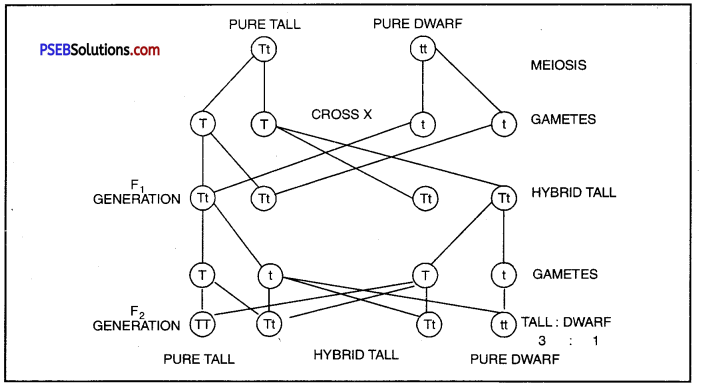
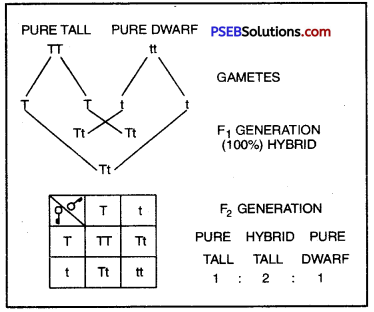
Monohybrid cross. It is a cross in which only one character is considered at a time. In a cross between tall and dwarf plant, the size of stem is considered.

Mendel made a cross between pure tall (TT) and a pure dwarf (tt) pea plant as follows :

  • Mendel selected a tall pea plant represented by the genes (TT) and a dwarf pea plant represented by the genes (tt). Pea plant is self pollinating.
  • He removed the anthers of a tall plant and stigma of a dwarf plant, deposited pollen grains of dwarf plant on the stigma of tall plant and obtained seeds.
  • When the seeds were placed in the soil and allowed to grow he obtained only tall plant (Tt), although he was expecting the plants of an intermediate size. These plants were labelled as plants of First filial generation (F1 generation).
  • In F1 generation all plants were tall because the character tall is dominant over the dwarf.
  • He allowed the plants of F1 generation to self-pollinate. Gametes formed by meiosis contained only one gene of a character because genes separate at the time of gamete formation.
  • The seeds thus obtained were placed in the soil and allowed to grow.
  • The plants formed were tall and dwarf in the ratio of (3:1).
  • Genotypically pure tall, hybrid tall and dwarf were in the ratio of 1 : 2 : 1. These were labelled as plants of F2 generation.

Diagrammatically monohybrid cross can be represented as shown below :
PSEB 10th Class Science Important Questions Chapter 9 Heredity and Evolution 1
Monohybrid Cross in a Pea Plant

Question 5.
Explain the law of independent assortment with a dihybrid cross.
Answer:
Law of independent assortment. According to this law, the factors of different pairs of contrasting characters, do not influence each other. They are independent of one another in their assortment to form new combination during gamete formation.

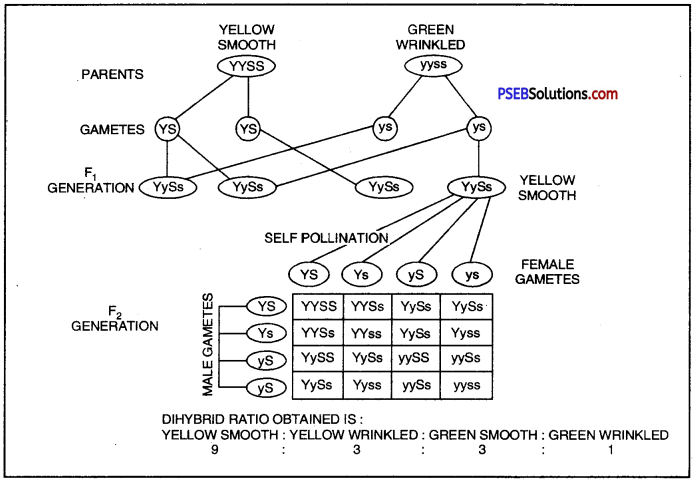
Dihybrid cross: A cross in which two characters are taken into consideration during experimentation, such a cross is called dihybrid cross. A cross between a pea plant with yellow smooth and a pea plant with green wrinkled seeds are considered.

Explanation: A cross is made between pea plant having yellow smooth seeds (YYSS) and a pea plant with green wrinkled seeds (yyss). At the time of cross pollination, yellow smooth (YYSS) produce gametes with genes (YS) and green wrinkled will produce gametes with gene (ys). Gametes unite at random. The seeds obtained when placed in soil will grow to form plants and produce seeds which are yellow smooth (YySs) because yellow and smooth characters are dominant over green and wrinkled. These are called as plants of Fi generation.

When plants of Fx generation are allowed to self pollinate gametes formed YS, Ys, yS and ys by meiosis, they unite at random forming seeds. The plants thus obtained were called as F2 generation. They are yellow smooth (YYSS, YySS, YsSS, YYSs); yellow wrinkled (YYss, Yyss), green smooth (yySS, yySs) and green wrinkled (yyss) in the ratio of 9 : 3 : 3 : 1. The result of dihybrid cross can be shown below in the chequer board.

From the above dihybrid cross, it can be derived that each gene is assorted independently of the other during its passage from one generation to the other or Law of Independent Assortment is justified.
PSEB 10th Class Science Important Questions Chapter 9 Heredity and Evolution 2
Result of dihybrid cross

Question 6.
State the hypothesis of Oparin and Haldane about the primeval Earth condition. What do you understand by Haldane’s hot dilute soup? State its significance.
Answer:
Alexander I. Oparin (1894-1980), a Russian biochemist and J.B.S. Haldane (1892-1964), a British scientist have put forward the concept of abiogenesis. According to Oparin and Haldane primeval earth had reducing condition and the atmosphere was free from oxygen. Oxygen remained bound in H20 and metallic oxides on the surface of rocks and its particles. The early gas cloud was rich in Hydrogen, in form of methane (CH4 and ammonia (NH3) and water (H2O). The organic molecules formed due to the atmospheric reaction accumulated slowly and gradually in the sea and constitute what is called “hot dilute soup”.

Significance of hot dilute soup. Thus conditions of reducing nature are unable to oxidize these organic compounds which form the basis of life.

Question 7.
Summarise Miller’s simulation experiment for organic synthesis. Comment on its efficacy.
Answer:
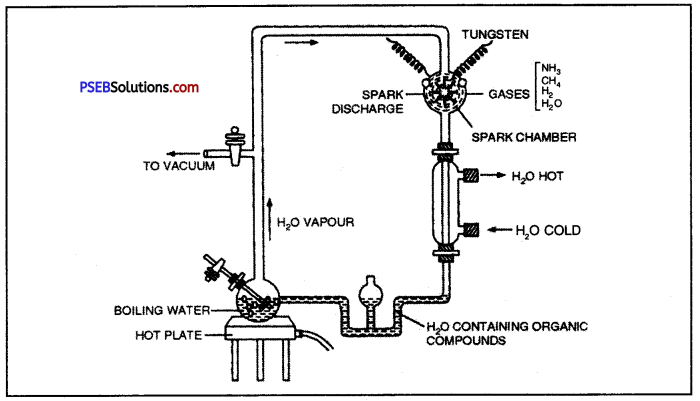
Miller’s experiment. Miller (1953) made the first successful simulation experiment to assess the validity of the claim for origin of organic molecules.
PSEB 10th Class Science Important Questions Chapter 9 Heredity and Evolution 3
Stanley Miller’s Experiment for the artificial synthesis of organic compounds

Miller sealed in a spark chamber a mixture of water, methane, ammonia, hydrogen gas. He made arrangement for boiling water. The trap in turn, was connected with the flask for boiling water. After 18 days, a significant amount of simple major organic compounds such as amino acids like glycine, alanine and aspartic acid and peptide chains began to appear. Simple sugars, urea and short chain fatty acids were also formed.

Question 8.
How human evolution take place over the years?
Answer:
Human evolution.
The study of human evolution indicates that all of human heings belong to a single species Homo sapiens that evolved in Africa.

  • DNA sequences have been used for studying human evolution.
  • Due to the diversified human forms and features, skin colour is the common way for identifying the races.
  • Few thousand years ago some ancestors left Africa while others stayed back.
  • The residents spread across Africa and the migrant spread across the planet from Africa to West Asia, Central Asia, Eurasia, South Asia, East Asia, Indonesia, Philippines, Australia and America.
  • They went forward and backward with groups separating from each other, or sometime coming together.
  • Like all other species, they were also living their lives to the best of their ability.In atmosphere, this spark is provided by U.V. light or other energy source.

Short Answer Type Questions

Question 1.
What is meant by heredity?
Answer:
Heredity. It is defined as the transmission of characters from parents to offspring or from one generation to the successive generations of living beings.

We observe in our daily life that similarities tend to be greatest between members of a family-between the offspring of parents. Children tend to resemble parents, even grandparents and persons of earlier generations. The similarities are not due to coincidence but rather due to inheritance or heredity.

PSEB 10th Class Science Important Questions Chapter 9 Heredity and Evolution

Question 2.
What is genetics?
Answer:
Genetics: It is that branch of science which deals with study of heredity (inheritance of characters) and variations. It deals with inborn characteristics of the organisms. Genetics also deals with inborn differences between offsprings of family and related organisms.
Genes are carriers of characters and present on chromosomes. Mendel is considered as “Father of genetics.”

Question 3.
What are the causes of variations in clones?
Answer:
Causes of variations in clones :
Clones have the same genetic make up but variations appear in clones due to following reasons :

  • Inaccuracies during DNA copying.
  • Effect of environment termed acquired variations.
  • Mutations: These are sudden stable abrupt changes and they are discontinuous inheritable as produced due to changes in genetic make up.

Question 4.
Explain the term variation.
Answer:
Variation: No living organisms are alike and they vary appreciably in many structural and functional aspects. These differences between individual organisms are called variations.

Question 5.
(a) Write one difference between continuous and discontinuous variations.
(b) Give differences between germinal and somatic variations.
Or
What do you mean by discontinuous variation?
Answer:
(a) Differences between continuous and discontinuous variations

Continuous variations Discontinuous variations
They are small indistinct differences from the normal conditions and called fluctuations. They are large distinct differences from the parents and termed as mutations or sport.

(b) Differences between germinal variations and somatic variations

Germinal variations Somatic variations
1. They are caused due to changes in germ cells. 1. They are caused due to changes in the somatic cells.
2. These variations are heritable. 2. They are not heritable.

Question 6.
What is the importance of variations?
Answer:
Importance of variations :

  • They enable the organism to adapt themselves to changing environment.
  • They form raw material for evolution and development of new species.

Question 7.
Mention the information source of making protein in the cell. What is the basic event in reproduction.
Answer:
DNA (Deoxyribose Nucleic Acid) directs the synthesis of proteins through mRNA (messenger RNA).

DNA copying is essential part of the process of reproduction.

  • DNA copying provides cellular apparatus in the daughter cells.
  • DNA in daughter cells will be able to control the functioning of daughter cells.
  • DNA copies will retain the traits.

Question 8.
Why did Mendel choose garden pea for his experiments?
Answer:
Mendel selected pea plant (Pisum sativum) because :

  • Many varieties were available with observable alternative forms for a trait or characteristic.
  • Peas are normally self pollinated; as their corolla completely enclose the reproductive organs until pollination is completed.
  • It was easily available.
  • It has pure lines for experimental purpose, i.e., they always breed true.
  • It has contrasting characters. The traits were seed colour, pod colour, pod shape, flower shape, position of flower, seed shape and plant height.
  • Its life cycle was short and produced large number of offsprings.
  • The plant is grown easily and does not require care except at the time of pollination.

Question 9.
Make a table showing characters of pea selected by Mendel.
Answer:
Characters of garden pea (Pisum sativum) selected by Mendel

Heritable variations Dominant Recessive
1. Plant height Tall (T) Dwarf (t)
2. Flower and pod position Axial (A) Terminal (a)
3. Pod colour Green (G) Yellow (g)
4. Pod shape Inflated (I) Constricted (i)
5. Seed coat Coloured (C) White (c)
6. Seed shape Round (R) Wrinkled (r)
7. Seed (cotyledon) colour Yellow (Y) Green (y)

Question 10.
What is monohybrid cross?
Answer:
Monohybrid cross. It is a cross in which only one character is considered at a time, e.g., in a cross between tall and dwarf plant, the size of stem is considered. Mendel made a cross between pure tall (TT) and a pure dwarf (tt) pea plant.

He obtained all tall (hybrid) plants in FL generation. On selfing these plants produced tall and dwarf in the ratio of 3:1. The genotypic ratio of 1 : 2 : 1 and phenotypic ratio of 3 : 1 is termed monohybrid ratio.

Question 11.
State and explain principle of dominance.
Answer:
Law of Dominanc J: According to this law, when two factors of a character are unlike, one of them will manifest in the body and is called dominant while the other remains hidden and is termed recessive factor.

The law can be well explained by the monohybrid cross by studying the following crosses :
1. Pure tall = TT, Hybrid tall = Tt
PSEB 10th Class Science Important Questions Chapter 9 Heredity and Evolution 4
Results of cross between pure tall and pure dwarf

Gametes of TT parent = \(\frac{1}{2}\) T + \(\frac{1}{2}\) T
Gametes of Tt parent = \(\frac{1}{2}\) T+ \(\frac{1}{2}\) t
The 50% are pure tall and 50% hybrid tall. Then pure tall plants will produce 100% tall in F2 generation and hybrid plants will produce in the ratio of 1 : 2 : 1 in the F2 generation.

2. When the cross is made between pure tall and pure dwarf, we get results as follows (Figure)

Question 13.
What is dihybrid ratio?
Answer:
Dihybrid ratio: The ratio obtained in a dihybrid cross is called dihybrid ratio. It is 9 : 3 : 3 : 1.

PSEB 10th Class Science Important Questions Chapter 9 Heredity and Evolution

Question 14.
What is a gene? What is the nature of gene?
Answer:
Gene: Term gene was coined by Johansen (1900). A hereditary determiner specifying a biological function; a unit of inheritance (DNA) located in a fixed place on the chromosome is called gene.

Mendel considered every character as unit which is controlled by a factor presently called gene. Chemically gene is a segment of DNA which controls one character and physically is a part of chromosome.

Question 15.
Where are genes located? What is the chemical nature of gene?
Answer:
Genes are located on chromosomes. Chemically gene is a segment of DNA (Deoxyribose nucleic acid).

Question 16.
In man four types of blood groups A, B, AB and O are controlled by three alleles of a gene. What is the mechanism of inheritance of the blood groups?
Answer:
More than two forms exists for certain genes. It is an example of multiple alleles. A well known example is ABO blood types in human. The four human blood groups, A, B, AB and O are phenotypes of the trait.

Three different alleles IA, IB and i of gene determine the phenotypes of the four blood groups. The six types of genotypes are as follows :

Phenotype (Blood Group) Genotype
O ii
A IAIA or IAi
B IBIB or IBi
AB IAIB

Both IA and IB are dominant over i. Since a person with genotype IAIB has AB blood groups. It is an example of codominance.

Thus ABO blood groups exhibit three genetic aspects :

  1. Dominant-recessive mechanism.
  2. Multiple alleles
  3. Co-dominance.

Question 17.
A man with type A blood has a wife with type B. They have a child with type O blood. Give the genotype of all the three. What other blood groups can be expected in the future offspring of this couple?
Answer:
Genotypes. Man (IA IO), Mother IB IO and child IOIO.
Blood group of the future offspring. A type, B type, o type and AB type. It is based on the following cross :
PSEB 10th Class Science Important Questions Chapter 9 Heredity and Evolution 5

Question 18.
Define genetic engineering. Write applications of genetic engineering.
Answer:
Genetic Engineering: The method of artificial synthesis of new genes and their subsequent “transplatation” in the genome of an organism or methods of correcting the defective genes is called genetic engineering.

Applications of genetic engineering

  • Genetic engineering has introduced a new form of medicine called gene therapy which may be used in treating, crippling, hereditary diseases like haemophilia, phenylketonuria.
  • With the help of genetic engineering it may be possible to produce new plants and animals having a new design and specific character according to will.
  • Gene coding for vitamins, antibiotics or hormones from higher animals to bacteria is also possible which will help to produce chemicals which are impossible to get or to synthesise.

Question 19.
Give a graphic representation of mechanism of gene expression.
Answer:
Mechanism of gene expression
PSEB 10th Class Science Important Questions Chapter 9 Heredity and Evolution 6

Question 20.
What do you understand by origin of life? Explain.
Answer:
Origin of Life. The oldest surviving terrestrial rocks, about 4.3 billion years old, contain no definite trace of life, at least not recognisable,as yet. Some rocks, about 3.9 billion years old, contain carbonates. Geologists interpret that these carbonates have resulted from life processes. Therefore, life was present on Earth about 3.9 billion years ago. However, the oldest microfossils discovered so far are that of photosynthetic cyanobacteria.

Question 21.
Write the contribution of Urey and Miller.
Answer:
Urey and Miller conducted experiment which supported that life originated by chemosynthesis. The chemosynthetic theory (Oparin-Haldane) states that life originated from non-living matter is based on the presence of methane and ammonia in the atmosphere. It required a high temperature, high energy radiations and electric discharges.

Question 22.
What are homologous organs? Give examples.
Answer:
Homologous organs. The organs of different classes have different forms because they have to perform different functions but their structures basically remains similar. Such organs are called homologous organs.

Examples of homologous organs. 1. The wings of bird and bat, flipper (fin) of whale, structure of human forearm are different in forms because these have to perform
PSEB 10th Class Science Important Questions Chapter 9 Heredity and Evolution 7
Homologous organs

different functions. Studies of the bones forming the skeleton of these organs, would reveal similarity in construction. In fact, these are the forms of fore-arms which have originated from pentadactyl forms and due to the different functions they are performing hence transformed into different forms.

2. In plants, the homologous organs may be a thorn of Bougainvillea or a tendril of cucurbita both arising in axillary position.

Question 23.
What are analogous organs? Give examples.
Answer:
Analogous organs. The organs which are similar in appearance and perform the same function but differ in their fundamental structure and origin are called analogous organs.

Examples:

  • Wings of birds and insects.
  • Leaves of a plant and cladodes of Ruscus are also analogous organs.

PSEB 10th Class Science Important Questions Chapter 9 Heredity and Evolution 8
Wings of insect and bird

Question 24.
Differentiate homologous organs and analogous organs.
Answer:
Differences between homologous organs and analogous organs

Homologous Organs Analogous Organs
1. Some organs of different organisms resemble in structure and bear the same relation to the body. 1. These organs which are functionally similar but morphologically different are called analogous organs.
2. They have same fundamental plan of structure e.g. leaves of all higher plants arise from the nodes and bear an axillary bud in their axils. 2. Their basic structure is different e.g. wings of vertebrates and insects perform the same function of flying.

Question 25.
Are the fossils being formed at present time?
Answer:
Fossil formation. Fossilization of a dead organism or its parts usually begins when it is buried before it has a chance to decay. The organism sinks into a bog or a marsh or to the bottom of a lake, sea or river. In some cases it is buried by wind-driven sands. Even after burial decay can occur so that soft body parts decompose, a fact which emphasizes again that the hard parts are the ones that mou commonly persist as fossil. The buried parts that do not decay are preserved and mud or sand hardens to rock, the fossil becomes entombed.

Fossilization is a hit or miss effect. Only those organisms become fossilized that happen to die in a spot where they can be buried by natural process before their carcasses are destroyed by scavengers. Thus under such conditions fossils are being formed at the present time.

Question 26.
What is the physical method of determining the age of fossils?
Answer:
Determination of age of fossils (dating of fossils). Once the fossils are unearthed palaeontologists try to determine their position in the historical sequence of life. The absolute age of fossil is difficult to calculate because older the fossil, less precise is tne calculation.

Physical method. Before we begin to determine the age of fossil, we have to gain some perspective about the age of earth.
The age of the earth is estimated to be near about 300 crore years. This life span of earth has been divided into six principal eras. Out of these, three eras are subdivided into smaller span known as periods or epochs.

Question 27.
Discuss the importance of artificial selection in the derivation of the concept of natural selection.
Answer:
Importance of artificial selection. From his enquiries on breeding domesticating plants and animals, Darwin obtained clear evidence for selection, in this case of artificial selection. The breeders selected and perpetuated those variant types that interested them or seemed to be useful to them. Similar to artificial selection, natural selection also controls the speciation. But natural selection is too slow to observe.

Question 28.
Distinguish between microevolution and macroevolution. Narrate the significance of population genetics in evolution.
Answer:
Evolution on the grand scale of geological time, is called macroevolution while evolution at genetic level is microevolution. Microevolution is actually operative at genetic level change.

Significance of Population Genetics. The gene frequency of a population is called population genetics. Evolution occurs within populations as the relative frequencies of different variations of DNA change over time. If genes change, then enzymes automatically change and represent two different forms of individuals and definitely result in evolution.

Question 29.
What is variation? Name the basic processes that cause variations among organisms. Discuss the role of migration in evolution.
Answer:
Variations: The features which differ among the individuals are called variations.
Causes of variation: Mutation, recombination, gene migration, genetic drift and natural selection.
Role of Migration: Few populations are isolated from the other populations of same species, usually some migration takes place if the migrating individuals breed within the new population then immigrant will add new alleles to the local gene pool of host population.

Question 30.
Define variations in relation to species. Why is variation beneficial to the species?
Answer:
Variation. No living organisms are alike and they vary appreciably in many structural and functional aspects. These differences between individual organisms are called variations.

The useful variation in individuals of a species will enable them to adapt according to the changes and new needs. Thus they will enable the survival of the species.

Question 31.
Explain Genetic Drift.
Answer:
Genetic Drift: The term genetic drift refers to the chance elimination of the genes of certain traits when a section of population migrates or dies of natural calamity. It dramatically alters the gene frequency of the remaining population. It eliminates certain alleles and fixes the other alleles, thereby reducing the genetic variability of the population. For example, in case of snowstorm, the individuals having alleles (characters) that provide resistance to cold survive, whereas others die.

PSEB 10th Class Science Important Questions Chapter 9 Heredity and Evolution

Question 32.
What is reproductive isolation?
Answer:
Reproductive isolation. Speciation is not likely to occur simply by changes in the genotype of a population. The populations with different genotypes appearing in them must be isolated so that differences may accumulate to the level of speciation. Else interbreeding of emerging populations will result in mixing of their genotypes and disappearance of differences between them. Isolation preserves the integrity of a species by checking hybridisation.

Question 33.
Give a brief account of present day concept of evolution.
Answer:
Present day concept of evolution

  • appearance of genetic variations in certain individuals of a population by
    1. migration
    2. non-random mating
    3. genetic drift
    4. chromosomal changes
    5. gene mutation
    6. recombination of genes, and
    7. hybridization.
  • spreading of genetic variations in a sub-group of a population by natural selection through differential reproduction in successive generations.
  • some sort of reproductive isolation of a subgroup of population having the genotypes selected by nature from other subgroups, and
  • accumulation of genetic variations to sufficiently alter the individuals of the subgroup to become a new species.

Question 34.
How is the equal genetic contribution of male and female parent ensured in the progeny?
Answer:
In sexual reproduction, both the parents contribute equal amount of genetic material (genes) to the offspring. This means that for each trait there will be two alternatives in the sexually reproducing organisms. Out of these two alternatives, one is called dominant trait and the other is called recessive trait. There will be some progeny with new combination. DNA controls the traits and are copied from one generation to the next generation. Inaccuracies do occur during DNA copying which is more prominent in sexual reproduction. These variation in DNA copying gets inherited. Accumulation of variation generation after generation altogether leads to evolution of a new species.

Question 35.
How does the creation of variations in a species ensure survival?
Answer:
Genetic variations arise in sexually producing organisms as a result of following mechanism.

  • Crossing over during gamete formation.
  • Random segregation of chromosome during meiosis at the time of gamete formation.
  • Random rejoining of gametes having different genetic set up in the chromosomes during fertilisation.
  • These variations form the raw materials of evolution.

Only variations that confer an advantage to an individual organism will survive in a population.
The organism with useful variations will adapt and survive. Moreover they leave behind more offsprings and populations with such genetic variations will survive.

Very Short Answer Type Questions

Question 1.
How are new organisms formed?
Answer:
New organisms are produced as a result of reproduction.

Question 2.
Do you find more variation amongst human or in sugarcane fields.
Answer:
Human beings show more variations.

Question 3.
What do the progeny get from parents?
Answer:
Inherited traits and variations.

Question 4.
What special features you find in second generation?
Answer:
The members of second generation inherit some characters from their parents and new variations are also produced.

Question 5.
Organisms reproducing by asexual reproduction show a few variation.
Answer:
These organisms carry out mitosis during reproduction. As there is no meiosis no new combinations of characters are formed.

Question 6.
What is the basis of evolution?
Answer:
Variations are raw materials of evolution.

Question 7.
What are functional unit of hereditary material?
Answer:
Genes.

Question 8.
Coin the term for transfer of characters from parents to offspring.
Answer:
Heredity/Inheritance.

Question 9.
Who is the Father of Genetics?
Answer:
Gregor Mendel.

Question 10.
Mendel worked on which plant having alternate traits?
Answer:
Pisum sativum (garden pea).

Question 11.
Mention any two of the seven contrasting traits of garden pea selected by Mendel.
Answer:

  1. Height-Tall/Dwarf
  2. Seed shape-Round/Wrinkled.

Question 12.
What is dominance?
Answer:
The expression of heritable trait present is heterozygous condition.

Question 13.
What is recessive?
Answer:
An allele that is not expressed phenotypically when present in heterozygous conditions.

Question 14.
Information for synthesis of proteins is stored in which part of cell.
Answer:
DNA.

Question 15.
What is gene for protein?
Answer:
Segment of DNA which directs synthesis of protein is called gene for protein.

Question 16.
Name the structure or mole-cules which control the traits.
Answer:
Gene.

Question 17.
Name the carriers of genes.
Answer:
Chromosomes.

Question 18.
What is gene according to molecular structure?
Answer:
A segment of DNA that provides information for the synthesis of gene for protein is called gene.

Question 19.
Name the alternative form of gene.
Answer:
Allele.

Question 20.
How many pairs of chromo-somes are present in male/female human?
Answer:
23 pairs.

Question 21.
Write sex-chromosome of female.
Answer:
XX.

Question 22.
Write sex-chromosome of male.
Answer:
XY.

Question 23.
Which chromosome determine the sex of child.
Answer:
XX-chromosome in female and XY-chromosome in male.

Question 24.
If in vegetation of green plants, what will happen if green beetles are not distinguished as compared to red beetles.
Answer:
The population of green beetles will increase and subsequently red population will decrease.

PSEB 10th Class Science Important Questions Chapter 9 Heredity and Evolution

Question 25.
What is evolution?
Answer:
Descend with modifications is termed evolution.

Question 26.
What is the basis of evolution?
Answer:
Variations are the basis of evolution.

Question 27.
What is the effect of starvation on DNA in beetles?
Answer:
No effect.

Question 28.
What are the causes of inbuilt tendency of variations?
Answer:

  1. Sexual reproduction
  2. Errors in DNA copying

Question 29.
Why crows could not eat coloured beetles?
Answer:
Crows could not see green coloured beetles as they get matched with green leaves and bushes.

Question 30.
What is meant by the term extinction?
Answer:
Elimination of a species is termed extinction.

Question 31.
What is the basis of Darwin’s theory of evolution?
Answer:
Natural selection/Survival of the fittest.

Question 32.
Who proposed the theory of origin of life from abiotic chemicals?
Answer:
Haldane.

Question 33.
Name the scientist who conducted experiments to prove abiotic origin of life?
Answer:
Stanley Miller and Urey.

Question 34.
What is genetic drift?
Answer:
It refers to chance elimination of genes of certain traits when a section of a population dies or migrates.

Question 35.
Define macroevolution.
Answer:
Macroevolution involves large scale changes among group of species

Question 36.
Genetic drift occur in small or large population.
Answer:
Small in number.

Question 37.
What is the structural unit of life?
Answer:
Cell.

Question 38.
Name a cell without nucleus.
Answer:
Micro-organism (Bacteria).

Question 39.
What is fossil?
Answer:
Fossils are preserved remains, traces of organisms that lived in the past.

Question 40.
The species sharing more common characteristics will be close or distant related?
Answer:
Closely related.

Question 41.
Give the three key factors of the modern concept of evolution.
Answer:
Genetic variations, natural selection and isolation.

Question 42.
What is the cause of sickle-cell anaemia?
Answer:
Gene mutation which changes the composition of haemoglobin and shapes of RBCs.

Question 43.
Name any fossil animal which serves as connecting link. Which two groups does it connect?
Answer:

  1. Archaeopteryx
  2. It is a connecting link between reptiles and birds.

Question 44.
What are factors of Mendel?
Answer:
Genes.

Question 45.
What is the modern term given to the factor of Mendel?
Answer:
Gene is the fector of Mendel; It is chemically a segment of DNA.

Question 46.
Coin one word for a class of individuals which are morphologically similar.
Answer:
Phenotype.

Question 47.
Coin the term for the character which does not allow the expression of a contrasting character in a hybrid.
Answer:
Dominant.

Question 48.
Coin the term for individual which breed true for its character.
Answer:
Homozygous.

PSEB 10th Class Science Important Questions Chapter 9 Heredity and Evolution

Question 49.
What are inherited traits?
Answer:
Inherited traits. The distinguish-able feature of a character is called a trait. The traits which are passed from parents to offsprings are called inherited traits.

Question 50.
What is Mendel’s monohybrid ratio?
Answer:
3 :1.

Question 51.
Write down Mendel’s dihybrid ratio for phenotypes.
Answer:
9 : 3 : 3: 1

Question 52.
Write the genotype of man with blood group ‘A’.
Answer:
IAIA, IAI°.

Question 53.
What are two major functions of DNA?
Answer:
Replication and expression of genetic information in the form of poly-peptide (Protein).

Question 54.
Define speciation.
Answer:
Origin of species is termed speciation.

Question 55.
What is paleontology?
Answer:
Study of fossils is termed paleontology.

Question 56.
What are the kinds of organs shown in the figure?
PSEB 10th Class Science Important Questions Chapter 9 Heredity and Evolution 9
Answer:
Homologous organs.

Question 57.
What are the kind of organs shown in the figure?
PSEB 10th Class Science Important Questions Chapter 9 Heredity and Evolution 10
Answer:
Analogous Organ.

Question 58.
Write the blood group of progeny P and Q.
PSEB 10th Class Science Important Questions Chapter 9 Heredity and Evolution 11
Answer:Blood group of P = A
Blood Group of Q = 0

Question 59.
What are vestigial organs?
Answer:
These are organs of the body which are non-functional in the possessor but were functional in the ancestralss and related organism.

Question 60.
Write any four vestigial organs of human.
Answer:
Muscles of ear lobes, appendix, wisdom tooth, hair of chest.

Question 61.
State ‘Biogenetic law’.
Answer:
Ontogeny repeats phylogeny.

Question 62.
Name the gases used by Urey and Miller for their experimnt.
Answer:
CH4, NH3, H2 and H2O.

Question 63.
What is biogenesis?
Answer:
Life is always formed from pre-existing life.

Question 64.
What is locus?
Answer:
Site of gene on a chromosome is called locus.

Question 65.
In the diagram what is the sex of (A) and (B)?
PSEB 10th Class Science Important Questions Chapter 9 Heredity and Evolution 12
Answer:
The sex of (A) is female (XX) The sex of (B) is male (XY)

Multiple Choice Questions

Question 1.
Branch of biology deals with heredity and variation is called
(A) Paleontology
(B) Evolution
(C) Genetics
(D) Ecology.
Answer:
(C) Genetics

Question 2.
The factors which represent the contrasting pairs of characters are called
(A) Dominant
(B) Recessive
(C) Determinants
(D) Alleles.
Answer:
(D) Alleles

Question 3.
Two allelic genes are located on
(A) the same chromosome
(B) two homologous chromosomes
(C) two non-homologous chromosomes
(D) any two chromosomes.
Answer:
(B) two homologous chromosomes

Question 4.
Mendel’s law of segregation is based on separation of alleles during
(A) gamete formation
(B) seed formation
(C) pollination
(D) embryonic development.
Answer:
(A) gamete formation

PSEB 10th Class Science Important Questions Chapter 9 Heredity and Evolution

Question 5.
The ratio of phenotype in F2 generation of a dihybrid cross is:
(A) 3:1
(B) 1:2:1
(C) 2:1
(D)9:3:3:1.
Answer:
(D) 9: 3 : 3: 1

Question 6.
The composition male sex chromosomes is :
(A) XX
(B) XYX
(C) YXY
(D) XY.
Answer:
(D) XY

Question 7.
How many pairs of chromosomes are present in male and female?
(A) 33
(B) 43
(C) 23
(D) 46.
Answer:
(C) 23

Question 8.
Who postulated ‘the natural selection’ as the basis of evolution ?
(A) Darwin
(B) Haldane
(C) Lamark
(D) Newton.
Answer:
(A) Darwin

Question 9.
How many years back human has started to grow the wild cabbage as food?
(A) 20
(B) 200
(C) 2000
(D) 20000.
Answer:
(C) 2000

Question 10.
How the age of fossils is determined?
(A) fossil dating
(B) DNA
(C) gene
(D) biological evolution.
Answer:
(C) gene

Fill in the blanks:

Question 1.
_________ are units of heredity.
Answer:
Genes.

Question 2.
There are _________ pairs of chromosomes in human.
Answer:
23.

Question 3.
Site of gene on a chromosome is called _________
Answer:
Locus.

Question 4.
Continuity of life is maintained through _________ and _________
Answer:
Genetics and Evolution.

Question 5.
Mendel formulated Law of purety of gametes on the basis of _________
Answer:
Dihybrid cross.

Question 6.
The composition of female sex-chromosomes is _________
Answer:
XX.

Question 7.
Wing of butterfly and wing of birds are examples of organs.
Answer:
Analogous.

PSEB 10th Class Science Important Questions Chapter 11 The Human Eye and The Colourful World

Punjab State Board PSEB 10th Class Science Important Questions Chapter 11 The Human Eye and The Colourful World Important Questions and Answers.

PSEB 10th Class Science Important Questions Chapter 11 The Human Eye and The Colourful World

Long Answer Type Questions

Question 1.
With the help of a well labelled diagram, explain the construction and working of the human eye.
Answer:
Human eye is the most remarkable and most delicate natural optical instrument. The main parts of the eye are given below :

Structure of The Eye
PSEB 10th Class Science Important Questions Chapter 11 The Human Eye and The Colourful World 1

The human eye consists of nearly spherical ball of about 2.5 cm in diameter.
1. Sclerotic: Its outermost coating is made of a tough and opaque white substance known as SCLEROTIC. It holds the eye ball in position and protects it from external injuries.

2. Cornea: Front portion of sclerotic is transparent and is known as CORNEA. It consists of a transparent substance. The outer surface of cornea is convex in shape. It allows the light to enter eye.

3. Choroid: There is a layer of black tissues, below sclerotic, called CHOROID. It serves to absorb any stray light and thus avoids blurring of the image by reflection from the eye-ball.

4. Iris: In front of eye, choroid merges into a coloured diaphragm known as iris with a hole in the middle called PUPIL. The iris corresponds to shutter in the camera. By means of involuntary muscle control, it regulates the amount of light entering the eye.

5. Eye Lens: It is a double convex lens made of transparent refracting tissues. The lens is held in position with the help of CILIARY MUSCLES. The ciliary muscles adjust the curvature of eye lens and hence its focal length to focus the images of all objects on retina.

The lens divides the eye-ball into two chambers—(i) the front chamber called anterior chamber and (ii) other between lens and the retina called posterior chamber. Anterior chamber is filled with a fluid, called AQUEOUS HUMOUR while the posterior chamber is filled with a jelly-like substance called VITREOUS HUMOUR.

6. Retina: The innermost coating of the eye, covering the rear of inner surface, is a very delicate membrane called the RETINA. It behaves like a screen as photographic film does in a camera on which image of object is formed.
The sensation of vision in the retina is carried to the brain by a nerve called OPTICAL NERVES.

7. Yellow Spot: The most sensitive part of retina is known as the YELLOW SPOT.

8. Blind Spot: The point where the optical nerve enters the eye is totally insensitive to light and is known as the BLIND SPOT.

9. Eye-lids: Eye Lids are provided to control the amount of light falling on the eye. Eye-lids also protect the eyes from dust etc.

Question 2.
What are the defects of human eye? How can they be corrected? Explain with diagrams.
Answer:
Defects of Human Eye: A normal healthy eye adjusts its focal length so as to form images of ail objects lying at different distances on the retina. Sometimes its power of accomodation decreases as a result of which the image is not formed on the retina resulting in two main defects viz. long sightedness and short sightedness.

In addition to these, presbyopia, colour blindness and astigmatism are also common defects.
1. Myopia or Short Sightedness: A person with myopic eye can see the near objects clearly but cannot see far off objects. The person suffering from myopia or short-sightedness has far point nearer than infinity. In normal eye, the far point is at infinity. The rays coming from distant object (at infinity) get focussed on retina [Fig. 11.5 (a)].

Causes of Defect: The defect myopia arises due to either :

  • the length of eyeball is elongated (becomes longer than normal)
  • the focal length of eye lens has decreased.

Due to either or both the causes, the eye is not able to focus the rays from distant object at retina [Figure (d)]. Focussing is there at a point 0 in front of retina. Therefore, the image formed on retina is blurred.

The defective eye is however able to focus the object upto its far point [Figure (c)].
PSEB 10th Class Science Important Questions Chapter 11 The Human Eye and The Colourful World 2
Figure (a) Normal eye. Far point at infinity. Rays from distant object meet at retina.
PSEB 10th Class Science Important Questions Chapter 11 The Human Eye and The Colourful World 3
Figure (b) Defective eye (eye-ball is enlarged), or focal length decreased, cannot focus rays from infinity at retina.
PSEB 10th Class Science Important Questions Chapter 11 The Human Eye and The Colourful World 4
Defective Eye. Due to eye ball getting short or an increase in focal length of eye lens, the rays do not focus on retina.
PSEB 10th Class Science Important Questions Chapter 11 The Human Eye and The Colourful World 5
Figure (c) Defective Eye is able to form image at the retina when object is moved from N to N’ the near point of defective eye.
PSEB 10th Class Science Important Questions Chapter 11 The Human Eye and The Colourful World 6
Figure (d) Corrected Eye. A convex lens of suitable focal length converges the rays to match those coming from hf.
Normal eye is able to focus on retina the rays emerging out from N [Figure (a)].

However, the defective eye is not able to focus the rays from near point of normal eye i.e. N [Figure (b)].
It can focus the rays from near point of defective eye i.e., N’ [Figure (c)].

From Figure (b) and (c), we conclude that more inclined rays [Figure (6)] are not focussed on retina whereas less inclined rays from N’ get focussed on retina.

Correction of hypermetropia: This defect is corrected by placing a convex or a converging lens of suitable focal length before the eye so that the rays diverging from N after refraction, appear to come from the near point N’.

3. Presbyopia: This is an age related defect. Almost all persons above 40 years suffer from this defect. The flexibility of eye lens decreases with age and the ciliary musclles are not able to change the focal length of eye lens and the person cannot see distinctly. Because of mixed defect of myopia and hypermetropia a person needs either two spectacles one each mounted with convex lens and concave lens or a bifocal lens to correct this defect.

4. Colour Blindness: This defect is due to biological reasons. It is a genetic disorder. The patient having this defect can not distinguish colours because in retina of eye, there are insufficient number of cones. These are cells present in the eye which recognise red, blue and green colours. The person suffering from this defect cannot recognise specific colour due to insufficient cone like structures in his eye. This defect cannot be corrected. The person having this defect can see all the things but can not recognise some colours.

5. Astigmatism: The person suffering from this defect can not focus in both the horizontal and vertical axis clearly. This defect is caused due to varying curvature in lens in two axis i.e. the lens is not completely spherical. The person cannot focus in vertical direction. This defect can be corrected by wearing spectacles fitted with cylinderical lens.

PSEB 10th Class Science Important Questions Chapter 11 The Human Eye and The Colourful World

Question 3.
What is prism? Explain deviation in glass prism by drawing a ray diagram.
Answer:
Prism: A portion of transparent medium bound by two plain refracting surfaces at an angle to each other is called a prism. The surfaces of the prism from which refraction occurs are called refracting surfaces and the angle between them is called angle of prism.
PSEB 10th Class Science Important Questions Chapter 11 The Human Eye and The Colourful World 7
Deviation of Light by a Prism: Let PQR be the principal section of glass prism. Suppose a ray of light BC is incident at C on the surface PR of the prism. After refraction from this surface it goes bending toward normal along CD.

Now ray CD is incident at D on the refracting surface QR and after refraction it goes away from the normal drawn at D emerging along the direction DE. Therefore, prism deviates the ray of light coming along BC into direction DE. In this way prism produces angular deviation in the direction of light. If incident ray BC is produced in the forward direction and emergent ray DE in the backward direction, then they meet each other at G. The LFGD formed between these two is called angle of deviation. It is denoted by δ (delta).

The value of angle of deviation depends on (i) the material of the prism and (ii) angle of incidence. If we increase the value of angle of incidence (∠i) then the value of angle of deviation (δ) decreases. For a certain value of angle of incidence, the angle of deviation becomes minimum. This minimum value of angle of deviation is called minimum angle of deviation. If for a prism, A is the angle of prism and δm is the minimum angle of deviation, then, refractive index of material of the prism, μ = \(\frac{\sin \left(\frac{\mathrm{A}+\delta_{m}}{2}\right)}{\sin \frac{\mathrm{A}}{2}}\)

Question 4.
What is meant by dispersion of light. Explain with the help of diagram and give the cause of dispersion.
Or
When a ray of light passes through a glass prism then a spectrum is obtained on the screen.
(а) Draw a diagram showing a spectrum of white light.
(b) Name the seven colours of spectrum in a serial order.
(c) Which colour of the spectrum suffers most deviation and which colour the least deviation?
Answer:
Dispersion of Light: The process of splitting of white light into its seven constituent colours is called dispersion or dispersion of light.
(а) Spectrum obtained by Dispersion through Prism. When a ray of white light coming from the sun passes through a prism then due to refraction it deviates from its path and bends towards the base of the prism and splits into its seven constituent colours and each light colour bends through a different angle forming a band of seven colours called spectrum.

(b) Generally we see the seven colours of specturm as a group. The order of seven colurs of spectrum are in the following order starting from the base of prism Violet, Indigo, Blue, Green, Yellow, Orange and Red. This order of colours can be easily remembered by a word “VIBGYOR.”
PSEB 10th Class Science Important Questions Chapter 11 The Human Eye and The Colourful World 8
(c) The spectrum has red colour at its one end and violet colour at the other end. Red light travelling the fastest bends the least and violet light travelling the slowest bends the maximum.

Cause of Dispersion of Light: The refractive index of material (say transparent medium glass) depends on the colour of light. Refractive index of light of red colour is minimum and light of violet colour is maximum.

White light is composed of seven different colours of light (VIBGYOR) each colour having different colour due to different wavelength. Red colour has the longest wavelength and the violet has the shortest. The frequency of light is the same for colours. In air or vacuum, the speed of light is same for all colours. But in different media, the speed of light is different for different colours. So each light bends by different angle. Red colour in any medium bends the least while violet colour bends the most. So when light is passed through glass prism each light colour bends through different angle forming spectrum.

In this way, on passing of white light through a glass prism dispersion of light occurs.

Dispersion of white light does not takes place when it passes through a glass slab because there does not take place deviation of rays of light but lateral displacement occurs. The incident ray and emergent ray become parallel in glass slab.

Question 5.
Describe an experiment to show that different colours of white light can be recombined to form white light.
Answer:
To show that colours are not produced by the prism but are present in white light itself and the prism only separates these colours, Newton isolated a particular colour say green. He placed another prism in the path of green beam. No further splitting of colour took place. The light only deviated further. It clearly showed the prism just separates, a large number of colours coming together as white [Figure (b)].
PSEB 10th Class Science Important Questions Chapter 11 The Human Eye and The Colourful World 9
Figure (a) Dispersion of white light by a prism.
PSEB 10th Class Science Important Questions Chapter 11 The Human Eye and The Colourful World 10
Figure (b) Second pris,iz unable to split green bewn.
PSEB 10th Class Science Important Questions Chapter 11 The Human Eye and The Colourful World 11
Figure (c) If a similar inverted second prism is placed. seven colours recombine spectrum colours into white light.
If a second prism of exactly of same angle with its refract ing edge opposite to the first is placed as shown, it is found that it results in white light again [Figure (c)]. The second prism deviates the rays in opposite direction. Thus dispersion produced by one prism is cancelled by the second similar prirn placed in the opposite direction.
PSEB 10th Class Science Important Questions Chapter 11 The Human Eye and The Colourful World 12
Figure (d) When second prism is placed in sqnw way, the coloured beams are further spread.

If the second prism is placed in; the same way as the first, the coloured rays are again obtained on the screen but there are more spread [Figure (d)].

Short Answer Type Questions

Question 1.
What is name of defect of eyes due to loss of elasticity of eye-lens? How is it corrected?
Answer:
It is called presbyopia. It cad be corrected by using two separate spectacles one for near vision and the other for distant vision.

Question 2.
What is the function of ciliary muscles in the eye?
Answer:
Ciliary muscles pull/push the lens and thereby change its focal length in order to focus objects lying at different distances from the eye.

Question 3.
What happens when elasticity of the eye lens is reduced to zero?
Answer:
Decrease of Elasticity of Lens. In normal eye, the change in the power of the eye lens for seeing far and near points is very large. As the person grows older, the power of accommodation gradually decreases. A stage may even reach when ciliary muscles lose their power and crystalline lens become much less elastic, so that the power of acommodation is almost zero.

Question 4.
Why is eye considered the best gift of God?
Answer:
It is said that world exists only if there are healthy eyes. Human being can see with the god-gifted eye i.e. he can identify different objects properly, can distinguish, i-ecognise colours and can differentiate between small and big even without touching, can read and write and can see all wonders of the world. That is why eye is considered to be one of the best gifts that god has given.

Question 5.
When we enter some dark room then for some time we are not able to see anything and remaining there for long, if suddenly strong light is switched on then our eyes can not gee anything. Why?
Answer:
Behind cornea there is iris which regulates the size of pupil. With it the intensity of light entering the eye is controlled. When we enter some dark room then for image to be formed on the retina more light is needed. For allowing more light to enter the eye is wide opened and it takes some time for this. During that time we do not see anything. Similarly while sitting itt the dark, iris spreads so that more light may enter the eye. And if suddenly strong light appears then to reduce its size some time is required during which we cannot see anything.

Question 6.
What type of lens is present in front of eyeball? What is its main function?
Answer:
In human eye the convex lens is present in front of eye ball. It consists of fibrous jelly like substance. Its curvature is controlled by ciliary muscles. The most of light rays are refracted by cornea and aqueous humour. The crystalline lens ensures focal length. So that the image of the object may be formed on the retina.

Question 7.
What is the function of retina in human eye?
Answer:
When light falls on rejina, it excites rods and cones. The electric pulses produced are conveyed to brain through optic nerve.

Question 8.
Why do we experience difficulty when we read from too close?
Answer:
Because of its capacity and properties the eye lens can change its focal length to some limit but not below that. If any object is too close then the focal length of the eyelens does not change that much that it niay help in seeing that properly. Therefore, we experience difficulty in reading from a close distance. In doing so pressure is exerted on eye and we cannot see distinctly.

Question 9.
Why do aged persons need spectacles for reading?
Answer:
Approximately at the age of 60 years the near point of eye becomes 20 cm which was 25 cm for normal eye of a young person. Due to this the aged person faces difficulty while reading and, therefore, needs spectacles.

PSEB 10th Class Science Important Questions Chapter 11 The Human Eye and The Colourful World

Question 10.
What is cataract? How is it corrected?
Answer:
Sometimes, the crystalline lens of aged person gets covered with a membrane which obstructs the passage of light rays through a transparent lens. At times the lens becomes completely opaque or cloudy. This condition is called cataract. This defect can be corrected either by using contact lens of suitable focal length or by surgery.

Question 11.
What is the necessity of eye donation? Explain.
Answer:
We know eye is the wonderful and priceless gift of God and 65% of people in the world are blind of which 45 lakh suffer with corneal blindness. They can be cured only by cornea transplantation. Therefore, after death we and our kins should donate eyes so that others who have become blind due to corneal defect may also see the world.

Question 12.
What things we should take into account while donating eyes?
Answer:

  • After death eyes must be removed within 4 to 6 hours.
  • The nearest eye bank should be informed immediately after death. The team of the eye bank removes eyes of the dead person either at his residence or in the nearest hospital in 10-15 minutes.
  • Eye removal is a simple procedure and does not lead to any disfigurement.

Question 13.
What is meant by least distance of distinct vision?
Answer:
Least Distance of Distinct Vision. If an object is very close to the eye then it is not seen clearly. Therefore, that shortest distance where if an object placed is seen very distinctly is called the least distance of distinct vision. For normal eye this distance is 25 cm.

Question 14.
A 14 years old boy cannot read question written on the black-board lying 5 m away from him.
(i) Name the eye defect he is suffering from.
Answer:
He is suffering from Myopia.

(ii) Show with the help of a labelled diagram as to how this defect can be corrected.
Answer:
For correction of this defect a concave lens of suitable focal length is used.
PSEB 10th Class Science Important Questions Chapter 11 The Human Eye and The Colourful World 18
Figure (a) Myopic Eye (b) Correction of Myopia by a concave lens of suitable focal length.

Question 15.
Why we see a rainbow just after rains?
Answer:
Rainbow is caused by dispersion of white sun light by tiny water droplets present in the atmosphere. Water droplets act as tiny prisms. They refract and disperse the incident sunlight, then reflect it internally and finally refract it again when it comes out of raindrop. Due to dispersion of light and internal refraction, different colours reach the eye of the observer. Rainbow is always formed in a direction opposite to that of the sun.
PSEB 10th Class Science Important Questions Chapter 11 The Human Eye and The Colourful World 19
Rainbow formation

Question 16.
How refraction of light elongates the length of day?
Or
Why does day appear longer than actually what it is due to refraction of light?
Answer:
The sun is visible a few minutes earlier than it actually rises above horizon. It happens because as we go up from the earth, the density of air layers decrease. The rays from sun S keep on bending towards normal till it enters the eye. Therefore, the sun appears to be at S’ (above horizon) although it is at S (below horizon). Thus the sun appears about two minutes earlier than actually when it should be.

For the same reason, the sun appears to set two minutes later than the actual. Hence the day appears to be about 4 minutes longer than what it is.

For the same reason explained above, the stars appear higher than their actual position as shown in Figure (b) given below :
PSEB 10th Class Science Important Questions Chapter 11 The Human Eye and The Colourful World 20
Figure (a) The sun remains visible even after it has actually passed below the geometrical horizon.
PSEB 10th Class Science Important Questions Chapter 11 The Human Eye and The Colourful World 21
Figure (b) A star in the direction S is seen in the direction S’ as a result of atmospheric refraction.

Question 17.
A star appears on the horizon. What is the true position of the star? Explain with diagram.
Answer:
True position of star is below the horizon. Incident rays from star, travel through earth’s atmosphere and reach observer’s eye. These incident rays travel from rarer to denser atmopshere so that they bend towards the normal. Thus, they appear to come fiom a different position slightly higher than the true position.
PSEB 10th Class Science Important Questions Chapter 11 The Human Eye and The Colourful World 22

Question 18.
What is meant by scattering of light? Explain Tyndall effect. Give a few illustrations of scattering of light.
Answer:
The path of beam of- light becomes visible when it passes through space containing smoke, tiny water droplets, suspended dust particles. The path of light is visible when it pass through ak medium the size of whose particles are comparable to wavelength of light.
PSEB 10th Class Science Important Questions Chapter 11 The Human Eye and The Colourful World 23
An arrangement for observing scattering of light in colloidal solution Colour of scattered light depends upon the size of scattering particles. Very small particles scatter blue light while larger particles scatter light of longer wavelength.

Question 19.
Why does the colour of the sky appear blue? [P.B., March 2019 (Set-A)\ Also tell how it would appear in the absence of earth’s atmosphere?
Answer:
The molecules of air/gases and other fine particles in the atmosphere have smaller size than the wavelength of visible light. These particles are therefore, more effective in scattering light of shorter wavelengths at blue and than light of longer wavelength at the red end. Thus, blue colour of the sky is due to scattering of sunlight by fine particles. In the absence of earth s atmosphere no scattering of light can occur. So, the sky appears black in that case.

Question 20.
What is short-sightedness? For a person suffering from this defect, where is the image of an object formed and by what type of spectacles this defect can be corrected?
Or
What is the cause of Myopia? How can it be corrected? Explain with a labelled diagram. (P.S.E.B. March 2017, Set-I)
Answer:
Myopia or Short Sightedness: A person with myopic eye can see the near objects clearly but cannot see far off objects. The person suffering from myopia or short-sightedness has far point nearer than infinity. In normal eye, the far point is at infinity. The rays coming from distant object (at infinity) get focussed on retina [Fig. 11.5 (a)].

Causes of Defect: The defect myopia arises due to either :

  • the length of eyeball is elongated (becomes longer than normal)
  • the focal length of eye lens has decreased.

Due to either or both the causes, the eye is not able to focus the rays from distant object at retina [Figure (d)]. Focussing is there at a point 0 in front of retina. Therefore, the image formed on retina is blurred.

The defective eye is however able to focus the object upto its far point [Figure (c)].
PSEB 10th Class Science Important Questions Chapter 11 The Human Eye and The Colourful World 2
Figure (a) Normal eye. Far point at infinity. Rays from distant object meet at retina.
PSEB 10th Class Science Important Questions Chapter 11 The Human Eye and The Colourful World 3
Figure (b) Defective eye (eye-ball is enlarged), or focal length decreased, cannot focus rays from infinity at retina.
PSEB 10th Class Science Important Questions Chapter 11 The Human Eye and The Colourful World 4
Defective Eye. Due to eye ball getting short or an increase in focal length of eye lens, the rays do not focus on retina.
PSEB 10th Class Science Important Questions Chapter 11 The Human Eye and The Colourful World 5
Figure (c) Defective Eye is able to form image at the retina when object is moved from N to N’ the near point of defective eye.
PSEB 10th Class Science Important Questions Chapter 11 The Human Eye and The Colourful World 6
Figure (d) Corrected Eye. A convex lens of suitable focal length converges the rays to match those coming from hf.
Normal eye is able to focus on retina the rays emerging out from N [Figure (a)].

However, the defective eye is not able to focus the rays from near point of normal eye i.e. N [Figure (b)].
It can focus the rays from near point of defective eye i.e., N’ [Figure (c)].
From Figure (b) and (c), we conclude that more inclined rays [Figure (6)] are not focussed on retina whereas less inclined rays from N’ get focussed on retina.

Question 21.
What is the cause of long sightedness (Hypermetropia)? How can it be corrected? Explain with a labelled diagram?
Answer:
Correction of hypermetropia: This defect is corrected by placing a convex or a converging lens of suitable focal length before the eye so that the rays diverging from N after refraction, appear to come from the near point N’.

Question 22.
What is meant by Presbyopia and Colour blindness?
Answer:
Presbyopia. Some people suffer from myopia and hypermetropia both simultaneously, it is called presbyopia. Such people require bifocal lenses, the upper part of which is concave lens and the lower part a convex lens. The upper part is used to see distant objects while the lower part to see nearby objects (for reading).

Colour Blindness: This defect is caused due to decrease of cone like cells in the eyes of human beings. Due to this loss, eye is not sensitive for some particular colours. This is genetic defect and has no remedy. The persons having this defect can no doubt see objects but are unable to identify colours. This is called colour blindness.

PSEB 10th Class Science Important Questions Chapter 11 The Human Eye and The Colourful World

Question 23.
Define the following :
Power of Accomodation, Far Point, Near Point, Least Distance of Distinct Vision, Persistence of Vision.
Answer:
Power of Accomodation Human ejre can see all nearby objects and distant objects. This ability of eyelens to adjust its focal length enabling it to see object lying at different distances is called power of accomodation.

Far Point. The point at the maximum distance from the eye where if an object is placed can be seen distinctly is called far point. For normal eye the far point is at infinity.
Near Point: The point at the leat distance from the eye where the object if lying can be seen distinctly is called near point.
Least Distance of Distinct Vision. It is a point in between the far point and near point and at minimum distance from eye where the object lying can be seen distinctly. For normal eye the least distance of distinct vision is 25 cm.
Persistence of Vision. The image of an object is formed on the retina of the eye but even if the object is removed still its image remains and does not fade away. This is called persistence of vision.

Question 24.
A person wears spectacles of power – 2.5 D. Name the defect of vision he is suffering from. Draw the ray diagram for (i) the defective eye, (ii) its correction after using a suitable lens.
Answer:
Since the power of the lens is negative, therefore, the lens used in spectacles is concave lens.

The defect of the eye is Myopia (or short sightedness)
PSEB 10th Class Science Important Questions Chapter 11 The Human Eye and The Colourful World 24
Figure (a) Defective eye (eye-ball is enlarged), or focal length decrea.’ed, cannot focus rays from infinity at focus.
PSEB 10th Class Science Important Questions Chapter 11 The Human Eye and The Colourful World 25
Figure (b) Corrected eye. Concate (or a divergent) lens diverges the parallel rays from infinity to an extent that they appear to diverge from F. They get focussed at retina.

Question 25.
Distinguish between simple microscope and compound miéroscope.
Answer:
Differences between Simple Microscope and Compound Microscope.

Simple Microscope Compound Microscope
1. It is convex lens of small focal length. 1. It has two convex lenses one of which is eye piece and other objective.
2. It has small magnification. 2. Its magnifying power ìs large.
3. It is used to see small objects after magnification. 3. It is used to see very minute objects which cannot be otherwise seen with a naked eye after very large magnification.

Numerical Problems

Question 1.
A person can not see clearly objects beyond a distance of 1.2 m. Name the defect of vision he is suffering from. What would be the power of correcting lens used to restore proper vision ?
Answer:
Since a person can see clearly only near objects (upto a distance of 1.2 m only) whereas normal human eye can see even distant objects (upto infinity), therefore, the defect of vision is myopia.
Here v = 1.2 m
u = ∞
PSEB 10th Class Science Important Questions Chapter 11 The Human Eye and The Colourful World 26
∴ Power of correcting lens, P = \(\frac{1}{f(\text { in metres })}\)
= \(\frac{1}{-1.2}\)
= – 0.83 D

Question 2.
The near point of a person suffering from hypermetropia is 75 cm. Calculate the focal length and power of the lens required to enable him to read the newspaper which is kept at 25 cm from the eye.
Answer:
Here u = -25 cm
v = – 75 cm
PSEB 10th Class Science Important Questions Chapter 11 The Human Eye and The Colourful World 27
∴ Focal length of the required lens
Now P = \(\frac{1}{f(\text { in metres })}\)
= \(\frac{1}{375}{\frac{1000}}\)
= \(\frac{1000}{375}\)
= 2.6 D

Question 3.
The near point of a myopic eye is 1 m. Find the power of the lens required to correct this defect. Assume that near point of the normal eye is 25 cm.
Answer:
Here u = – 25 cm [Normal near point]
V = – 1 m
= – 100 cm
f =?
Using lens Formula \(\frac{1}{v}-\frac{1}{u}=\frac{1}{f}\)
PSEB 10th Class Science Important Questions Chapter 11 The Human Eye and The Colourful World 28
Now power of the required lens P = \(\frac{1}{f(\text { in metres })}\)
= \(\frac{100}{f(\text { in metres })}\)
= \(\frac{1}{\frac{100}{3}}\)
= \(\frac{100 \times 3}{100}\)
= + 3 D
Positive sign (+) indicates that the lens is convex.

Question 4.
A person cannot see objects beyond 1.5 m distinctly. What type of lens should be used to restore proper vision?
Answer:
Here u = – ∞ ; u = -1.5 m ; f =?
PSEB 10th Class Science Important Questions Chapter 11 The Human Eye and The Colourful World 29
He should use concave or divergent lens say convexo concave lens of Focal length -1.5 m and power – 0.67 D.

Very Short Answer Type Questions

Question 1.
What do you mean by optical instruments? Name any two.
Answer:
Optical instruments are the devices based on various phenomena of optics. The’names are (i) Microscope (ii) Telescope.

Question 2.
What is least distance of distinct vision?
Answer:
Distance upto which a person can see clearly. It is 25 cm for normal eye.

Question 3.
What is far of point?
Answer:
This is most distant point upto which the eye can see clearly with unaided eyes.

Question 4.
Write a function of each of :
(i) Retina
Answer:
Retina: Retina is third layer of eye and acts as a screen for the image of the objects.

(ii) Sclerotic
Answer:
Sclerotic: Sclerotic is to maintain a solid shape of the eye and protects the internal soft parts from external injuries.

(iii) Ciliary muscles in human eye.
Answer:
Ciliary muscles in human eye. Eye lens is held in its position by ciliary muscles. Ciliary muscles help the eye to change the focal length by adjusting its curvature.

PSEB 10th Class Science Important Questions Chapter 11 The Human Eye and The Colourful World

Question 5.
What is the function of sclerotic in human eye?
Answer:
Sclerotic is to provide a solid shape to eye and protect it from external injuries.

Question 6.
What is the function of ciliary muscles in human eye?
Answer:
Ciliary muscles help the eye to change its focal length by adjusting its curvature.

Question 7.
What is the function of rods on the retina?
Answer:
Rods are sensitive to light. More the intensity of light, more are they excited.

Question 8.
What are cones?
Answer:
Cones on retina are sensitive to different colours. If cones are absent or insufficient, the person is colour blind.

Question 9.
Why chickens come out late in the morning and return early in the evening?
Answer:
Chickens have very few rods on the retina, hence they are able to see only in bright light and not in dim-light.

Question 10.
Why cats / bats are able to see at night?
Answer:
They have very large number of rods on retina. Hence they are able to see even if there is very small amount of light.

Question 11.
Colour of eyes depend upon colour of which part of eye?
Answer:
It depends upon the colour of iris.

Question 12.
What is basic cause of colour blindness?
Answer:
It is due to no or insufficient number of cones on the retina.
Seeing sun or seeing towards it during solar eclipse may cause colour blindness.

Question 13.
Which phenomenon of light is shown in fig. below :
PSEB 10th Class Science Important Questions Chapter 11 The Human Eye and The Colourful World 30
Answer:
Dispersion of light.

Question 14.
In the given diagram which defect of the human eye is being corrected using a concave lens?
PSEB 10th Class Science Important Questions Chapter 11 The Human Eye and The Colourful World 31
Answer:
Myopia (Short-Sightedness).

Question 15.
Which defect of human eye is being corrected in the figure given below?
PSEB 10th Class Science Important Questions Chapter 11 The Human Eye and The Colourful World 32
Answer:
Hypermetropia.

Question 16.
Which defect of the eye is shown in the figure given below?
PSEB 10th Class Science Important Questions Chapter 11 The Human Eye and The Colourful World 33
Answer:
Hypermetropia (or Long-sightedness).

Multiple Choice Questions :

Question 1.
The approximate least distance of distinct vision of normal eye is
(A) 35 in
(3) 3.5 m
(C) 25 cm
(D) 2.5 cm.
Answer:
(C) 25 cm

Question 2.
The feal length of objective is changed by:
(A) Pupil
(B) Retina
(C) Ciliary muscles
(D) Iris.
Answer:
(C) Ciliary muscles

Question 3.
A person suffering from short sightedness cannot see objects beyond 1.2 m. For distinct vision he would use :
(A) Concave lens
(B) Cylinderical lens
(C) Convex lens
(D) None of these.
Answer:
(A) Concave tens

Question 4.
The far point of normal human eyes .
(A) At 25 cm
(B) At 25 mm
(C) At 25 m
(D) At infinity.
Answer:
(D) At. infinity.

PSEB 10th Class Science Important Questions Chapter 11 The Human Eye and The Colourful World

Question 5.
In human eye, the image of object is formed at:
(A) Pupil
(B) Retina
(C) Cornea
(D) Eye ball.
Answer:
(B) Retina

Question 6.
Light entering the eye is mostly refracted by :
(A) Crystalline lens
(B) Outer surface of cornea
(C) Pupil
(D) Iri’.
Answer:
(B) Outer surfaceof cornea

Question 7.
Most insensitive part nf the eye is called:
(A) biqek spt
(B) vehow spot
(C) cornea
(D) blue Spot.
Answer:
(A) black spot

Question 8.
Focal length of the eye lens can be adjusted by action of:
(A) ciliarv muscles
(B) choroid
(C) optical nerves
(D) retina.
Answer:
(A) ciliary muscles

Question 9.
When light rays enter the eye most of the refraction occurs at:
(A) crystalline lens
(B) iris
(C) outer surface of cornea
(D) pupil.
Answer:
(A) crystalline lens

Question 10.
Distance of distinct vision of a normal eye is:
(A 25 m
(B) 2.5 m
(C) 25 cm
(D) 2.5 cm.
Answer:
(C) 25 cm

Question 11.
Accommodation of normal eyes is
(A) 5 cm to 15 cm
(B) 15 cm to m
(C) 1 m to 3 m
(D) 20 cm to infinity.
Answer:
(D) 20 cm to infinity.

Question 12.
When an object is placed beyond centre of curvature of a cancave mirror, the image is formed:
(A) beyond C;
(B) between C and F;
(C) at F;
(D) at infinity.
Answer:
(B) between C and F;

Fill in the blanks:

Question 1.
The least distance of distinct vision is __________
Answer:
25 cm.

Question 2.
Far point of normal human eye is __________
Answer:
infinity.

Question 3.
In human eye, image of an object is formed at __________
Answer:
Retina.

Question 4.
The ability of eye-lens to adjust its focal length is called __________
Answer:
Accommodation.

PSEB 10th Class Science Important Questions Chapter 11 The Human Eye and The Colourful World

Question 5.
A shortsighted person cannot see the objects distinctly.
Answer:
distant.

Question 6.
The __________ shaped cells present in retina respond to the intensity of light.
Answer:
rod.

Question 7.
__________ helps in regulating the amount of light entering the eye.
Answer:
pupil.

Question 8.
The splitting of white light into its component colours is called __________
Answer:
dispersion.

Question 9.
A concave lens is used to rectify __________
Answer:
Myopia.

Question 10.
When the light is bright, the pupil becomes __________
Answer:
very small.

PSEB 10th Class Science Solutions Chapter 11 The Human Eye and The Colourful World

Punjab State Board PSEB 10th Class Science Book Solutions Chapter 11 The Human Eye and The Colourful World Textbook Exercise Questions and Answers.

PSEB Solutions for Class 10 Science Chapter 11 The Human Eye and The Colourful World

PSEB 10th Class Science Guide The Human Eye and The Colourful World Textbook Questions and Answers

Question 1.
The human eye can focus object at different distances by adjusting the focal length of the eye lens. This is due to :
(a) presbyopia
(b) accommodation
(c) near-sightedness
(d) far-sightedness.
Answer:
(b) accommodation.

Question 2.
The human eye forms the image of an object at its :
(a) cornea
(b) iris
(c) pupil
(d) retina.
Answer:
(d) retina.

Question 3.
The least distance of distinct vision for a young adult with normal vision is about:
(a) 25 m
(b) 2.5 cm
(c) 25 cm
(d) 2.5 m.
Answer:
(c) 25 cm.

Question 4.
The change in focal length of an eye lens is caused by the action of the :
(a) pupil
(b) retina
(c) ciliary muscles
(d) iris.
Answer:
(c) ciliary muscles.

PSEB 10th Class Science Solutions Chapter 11 The Human Eye and The Colourful World

Question 5.
A person needs a lens of power – 5.5 D for correcting his vision. For correcting his near vision, he needs a lens of power + 1.5 D. What is the focal length of lens required for correcting
(i) distant vision and
Answer:
(i) For distant vision, f1 = \(\frac{1}{\mathrm{P}_{1}}\)
= \(\frac{1}{-5.5}\)
= – 0.182 m
⇒ f1 = – 18.2 cm

(ii) near vision?
Answer:
For near vision, f2 = \(\frac{1}{\mathrm{P}_{2}}\)
= \(\frac{1}{1.5}\)
= + 0.667 m
f2 = + 66.7 cm

Question 6.
The far point of a myopic person is 80 cm in front of the eye. What is the nature and power of the lens required to correct the problem?
Answer:
Here
Distance of far point u = – ∞
Focal length of the lens (v) = – 80 cm;

Using Less formula \(\frac{1}{f}=\frac{1}{v}-\frac{1}{u}\)
\(\frac{1}{(-80)}-\frac{1}{(-\infty)}\) [∵\(\frac{1}{\propto}\) = 0]
\(-\frac{1}{80}\)
Focal Length of the Lens (f) = – 80 cm = – 0.8 m
Negative sign (-) indicates that the nature of required lens is concave

Now,
P = \(\frac{1}{f}\)
= \(\frac{1}{-0.8}\)
P = – 1.25 D

Question 7.
Make a diagram to show how hypermetropia is corrected. The near point/ of hypermetropic eye is 1 m. What is the power of the lens required to correct this defect? Assume that the near point of normal eye is 25 cm.
Answer:
u = – 25 cm,
v = – 1 m
= – 100 cm
Using lens formula \(\frac{1}{f}=\frac{1}{v}-\frac{1}{u}\)
PSEB 10th Class Science Solutions Chapter 11 The Human Eye and The Colourful World 1
PSEB 10th Class Science Solutions Chapter 11 The Human Eye and The Colourful World 2
∴ Power = + 3 D
Convex (convergent) lens of power + 3 D

Question 8.
Why is a normal eye not able to see clearly the objects placed closer than 25 cm?
Answer:
For seeing near objects, the ciliary muscles contract to make the lens thicker so as to reduce the focal length of eye lens, in order to form the image on the retina. Ciliary muscles cannot be contracted beyond certain limit and hence we cannot see clearly the objects lying closer than 25 cm, called the least distance of distinct vision.

Question 9.
What happens to the image distance in the eye when we increase the distance of an object from the eye?
Answer:
For a fixed focal length of the lens, the distance of image from the lens (i.e., v) decreases as the distance of the object from eye lens (i.e., u) is increased.

Since v cannot be decreased (as distance between eye lens and retina is fixed), f is decreased by action of ciliary muscles so as to satisfy lens formula in accordance with increased value of u.

PSEB 10th Class Science Solutions Chapter 11 The Human Eye and The Colourful World

Question 10.
Explain atmospheric refraction. Why do stars twinkle?
Answer:
Twinkling of the star is due to refraction of light from stars through atmosphere. The stars emit their own light. The light coming from the stars on entering the earth’s atmosphere undergoes refraction continuously at each layer of atmosphere having different density, before it reaches the earth. The stars are very much distant objects and may be considered as point sources. The refractive index of the air changes from time to time due to change of density of air. Due to change of the optical density of earth’s atmosphere, the path of rays from stars continuously changes. The apparent positions of the stars continuously change due to change in refractive index of the atmosphere. Thus the stars appear to twinkle.

Question 11.
Why planets do not appear twinkling?
Answer:
Since planets are quite close to the earth in comparison with the stars, they do not act as point sources but behave like extended sources. Planets may be considered as collection of a large number of point-sized sources of light. The total net deviation in amount of light entering our eyes from different point sources is zero. Therefore there is no net twinkling of planets.
PSEB 10th Class Science Solutions Chapter 11 The Human Eye and The Colourful World 3

Question 12.
Why does the sun appear reddish in the morning (as well as in evening)?
Or
Why does rising star appears red in colour?
Answer:
Earth is surrounded by envelope of gases called atmosphere. At the time of sunrise (or at sunset), light has to travel greater distance [AB at sunrise and BC at sunset] through the atmosphere to reach us than what it covers, when sun is over-head at noon [It has to travel only DB],

The wavelength of blue colour is about half that of red, blue light is scattered nearly 24 =16 times more than red colour of sunlight. As a result, the sun appears red at sunrise or at sunset due to negligible scattering of red colour of light.
PSEB 10th Class Science Solutions Chapter 11 The Human Eye and The Colourful World 4

Question 13.
Why does the sky appears dark instead of blue to an astronaut?
Answer:
The atmosphere exists only upto some height. At high altitudes, there is no atmosphere to scatter sun light. The sky, therefore, appears to be perfectly black to astronauts.

Science Guide for Class 10 PSEB The Human Eye and The Colourful World InText Questions and Answers

Question 1.
What is meant by power of accommodation of the eye?
Answer:
Power of accomodation of eye. It is the ability of the eye lens to adjust its focal length to see various objects lying at different distances. The minimum distance upto which a normal eye can see clearly is called near point. For normal eye, near point is about 20 cm. The maximum distance upto which the eye can see clearly is called far point. The distance between near point and far point is also called accommodation.

Question 2.
A person with myopic eye cannot see objects beyond 1.2 m distinctly. What should be the type of the corrective lens used to restore proper vision?
Answer:
Here u = – ∞; v = – 1.2 ; f =?
PSEB 10th Class Science Solutions Chapter 11 The Human Eye and The Colourful World 5
Negative sign (-) shows that the corrective lens is concave lens.
But P = \(\frac{1}{f}\)
= \(-\frac{1}{1.2}\) = – 0.825 D
The person should wear spects mounted with concave lens having of power – 0.825 D

Question 3.
What is the far point and near point of human eye with normal vision?
Answer:
Far point: It is the distance of most distant point upto which a person can see object distinctly. It is infinity for normal vision.
Near point: It is distance of nearest point beyond which a person can see distinctly. It is 25 cm for normal vision.

Question 4.
A student has difficulty in reading the blackboard while sitting in the last row. What could be the defect the child is suffering from? How could it be corrected?
Answer:
Student is suffering from myopia or shortsightedness. This defect can be corrected by using spectacles having diverging (say concave or convexo-concave) lens of suitable focal length.

PSEB 10th Class Science Solutions Chapter 9 Heredity and Evolution

Punjab State Board PSEB 10th Class Science Book Solutions Chapter 9 Heredity and Evolution Textbook Exercise Questions and Answers.

PSEB Solutions for Class 10 Science Chapter 9 Heredity and Evolution

PSEB 10th Class Science Guide Heredity and Evolution Textbook Questions and Answers

Question 1.
A Mendelian experiment consisted of breeding tall pea plants bearing violet flowers with short pea plants bearing white flowers. The progeny all bore violet flowers, but almost half of them were short. This suggests that the genetic make-up of the tall parent can be depicted as :
(a) TTWW
(b) TTww
(c) TtWW
(d) TtWw.
Answer:
(c) TtWW.

Question 2.
An example of homologous organs is :
(а) our arm and a dog’s fore-leg
(б) our teeth and an elephant’s tusks
(c) potato and runners of grass
(d) All of the above.
Answer:
(d) All of the above.

Question 3.
In evolutionary terms, we have more in common with :
(а) a Chinese school-boy
(b) a chimpanzee
(c) a spider
(d) a bacterium.
Answer:
(a) a Chinese school-boy.

Question 4.
A study found that children with light-coloured eyes are likely to have parents with light-coloured eyes. On this basis, can we say anything about whether the light eye colour trait is dominant or recessive? Why or why not?
Answer:
On this basis we cannot say that light eye colour is dominant or recessive until a cross is made between parent having light eye colour and another with dark eye colour. Only then it will be possible to predict the dominant or recessive nature of the gene.

Question 5.
How are the areas of study of evolution and classification interlinked?
Answer:
Evolution and classification are interlinked as evident from following points :

  • Characteristics are shared by most of the organisms. The characteristic in the next level of classification will be shared by most and not by all.
  • Cell designs also indicate this relationship.
  • Groups formed during classification are related to their similarities.

PSEB 10th Class Science Solutions Chapter 9 Heredity and Evolution

Question 6.
Explain the terms homologous and analogous organs with example.
Answer:
Homologous organs: The organs of different classes have different forms because they have to perform different functions but their structures basically remain similar. Such organs are called homologous organs.

Example:

  • Fore limbs of amphibians, birds and mammals have same fundamental structural plans but perform different functions.
  • In plants, the homologous organs may be a thorn of Bougainvillea or a tendril of cucurbita both arising in axillary position.

Analogous organs: The organs are quite different in their structure and origin but similar in function. Such organs are known as analogous organs. The presence of analogous organs proves that different structures can be modified to perform a similar function. Analogy indicates convergent evolution.
Examples. The wings of insects and vertebrates perform the same function.

Question 7.
Outline a project which aims to find the dominant coat colour in dogs.
Answer:
Make a chart or thermocol sheet showing the following monohybrid cross
PSEB 10th Class Science Solutions Chapter 9 Heredity and Evolution 1
Dominance of black coat colour in dogs

Question 8.
Explain the importance of fossils in deciding evolutionary relationship.
Answer:

Question 9.
What evidence do we have for the origin of life from inanimate matter?
Answer:
Urey and Miller provided experimental evidence regarding origin of life from inanimate matter. They assembled an atmosphere similar to that, thought to exist on early earth.

In a spark flask they collected ammonia, methane and hydrogen sulphide, but no free oxygen over water at a temperature just below 100°C and sparks were passed through the mixture of gases to stimulate lightning. At the end they obtained organic molecules such as amino acid, urea, sugars. Amino acids which make up protein molecules. Thus they showed life originated from inanimate matter.

Question 10.
Explain how sexual reproduction gives rise to more viable Variation than asexual reproduction. How does this affect the evolution of those organisms that reproduce sexually?
Answer:
Genetic variations arise in nature as a result of following mechanism during sexual reproduction are more viable and raw materials of evolution.

  • Crossing over during gamete formation.
  • Random segregation of chromosome during meiosis at the time of gamete formation has decreased.
  • Random rejoining of gametes having different genetic set up in the chromosomes during fertilisation.

Question 11.
How is equal genetic contribution of male and female parents ensured in the progeny?
Answer:
During sexual reproduction fusion of gametes having haploid set of chromosomes belonging to male and female parents ensure equal contribution.

Question 12.
Only variations that confer an advantage to an individual organism will survive in a population. Do you agree with this statement? Why or why not?
Answer:
Yes. The organism with useful variations will adapt and survive. Moreover they leave behind more offsprings and populations with such genetic variations will survive.

Science Guide for Class 10 PSEB Heredity and Evolution InText Questions and Answers

Question 1.
If a trait A exists in 10% of population of an asexually reproducing species and a trait B exists in 60% of the same population, which trait is likely to have arisen earlier?
Answer:
In asexually reproducing organism trait B originated earlier. The variations in a population are only due to inaccuracies of DNA copying.

Question 2.
How does the creation of variations in a species promote survival?
Answer:
The useful variation in individuals of a species will enable them to adapt according to the changes and new needs. Thus they will enable the survival of species.

PSEB 10th Class Science Solutions Chapter 9 Heredity and Evolution

Question 3.
How do Mendel’s experiments show that gene may be dominant or recessive?
Answer:
Mendel conducted experiments on garden pea plant selecting seven visible contrasting characters. He selected and crossed homozygous tall pea plant having the genotype TT with a homozygous dwarf pea plant having the genotype tt. Fx generation consists only of tall plants, having genotype Tt. Since they have an allele for dwarfness also, they are all hybrids. The expressed allele T for tallness is dominant over the unexpressed allele t for dwarfness. The fact that the allele for dwarfness is present in the F1 plants can be verified by interbreeding them when F2 progeny will consist of both tall and dwarf plants in the ratio of 3 : 1. On this basis he proposed “Law of Dominance.”

Question 4.
How do Mendel’s experiments proved that traits are inherited indepen dently?
Answer:
Mendel proposed a law on the basis of a dihybrid cross between two homozygous parents. He selected a dominant plant with round and yellow seeds and a recessive plant with wrinkled and green seeds, yields Fx offspring showing the dominant form of both traits, viz. round and yellow. Fx plants, on selling, produce F2 progeny with two parental and two new recombinant phenotypes, that is round yellow: round green: wrinkled yellow: wrinkled green in the ratio of 9 : 3 : 3: 1. This ratio is called Mendel’s dihybrid phenotypic ratio. The factors (genes) of different traits are independent of each other in their distribution into the gametes and in the progeny. This is Mendel’s law of independent assortment.

Question 5.
A man with blood group A married a person with blood group O. Their daughter has blood group O. Is this information enough to tell you which of the blood group trait A or O is dominant. Why or why not?
Answer:
As blood groups is hereditary character, the knowledge of blood groups of parents can give information about the possible blood groups of children and vice-versa.

In this case illustration is as follow :
PSEB 10th Class Science Solutions Chapter 9 Heredity and Evolution 2

In the above cross, 50 per cent of progeny will have A blood group and 50 per cent O blood group.
At the same time this data is insufficient. It is not mentioned father has homozygous or heterozygous A blood group. If it is homozygous A then 100 per cent of progeny will have A blood group as Gene IA is dominant over Gene I°.

Question 6.
How is the sex of child determined in human beings?
Answer:
Determination of the sex of child. Sex chromosomes determine sex in human beings. In males, there are 44 +
XY chromosomes, whereas, in female there are 44 + XX chromosomes. Here,
X and Y chromosomes determine sex in the human beings.
PSEB 10th Class Science Solutions Chapter 9 Heredity and Evolution 3
Sex determination in man (Note that all the eggs carry X-chromosome but one-half of the sperm carry an X-chromosome and one half carry a Y-chromosome)

Two types of gametes are formed in male, one type is having 50%
X-chromosome, whereas the other type is having Y-chromosome. In female, gametes are of one type and contain X-chromosome.

The females are homogametic. If male gamete having Y-chromosome (androsperm) undergoes fusion with female gamete having X-chromosome the zygote will have XY chromosomes and this gives rise to male child.

If the male gamete having Fig. 9.1. Sex determination in man (Note X-chromosome undergoes fusion with that all the eggs carry X-chromosome but female gamete having X-chromosome, one-half of the sperm carry an the zygote will be having XX-chromosome X-chromosome and one half carry a and this gives rise to female child. Y-chromosome)

Question 7.
What are different ways in which individuals with a particular trait may increase in a population?
Answer:
A particular population with specific traits will increase due to following reasons :

  • Sexual reproduction which results into variations.
  • Inheritance of variations.
  • Natural Selection. The individuals with special traits survive the attack of their predators and multiply while the others will perish.
  • Genetic drift provides diversity without any adaptation.

Question 8.
Why are traits acquired during life-time of an individual not inherited?
Answer:
Change in non-reproductive tissue (somatic cells) cannot be passed on to the DNA of germ cells. Thus the acquired trait will die with the death of individual. It is non- heritable and cannot be passed on to its progeny. Changes that occur in DNA of germ cells are inherited.

Question 9.
Why are the small number of surviving tigers is a cause of worry from the point of view of genetics?
Answer:
As the population of tigers is decreasing, there is loss of genes from the gene pool. There cannot be recombinations and variations. Hence no evolution. If number falls suddenly they may become extinct.

Question 10.
What factors could lead to the rise of new species?
Answer:
Factors leading to rise of new species

  • Genetic variations
  • Mutations
  • Natural selection
  • Reproductive isolation
  • Origin of new species.

Question 11.
Will geographical isolation be a major factor in the speciation by a self- pollinating plant species? Why or why not?
Answer:
No, m self-pollinating species, geographical isolation will not play any role for speciation because the self-pollination is occurring on the same plant.

Question 12.
Will geographical isolation be a major factor in the speciation of an organism that reproduces asexually? Why or why not?
Answer:
No, as there is neither genetic drift nor gene flow play any role during speciation. Moreover asexual reproduction involves single parent and natural geographical barrier can occur between different organisms.

Question 13.
Give an example of characteristic being used to determine how close two species are in evolutionary terms.
Answer:
Homologous organs helps to identify the relationship between organisms. These characteristics in different organisms would be similar because they are inherited from a common ancestor. Example. Fore limbs of mammals having same basic structural plans in birds, reptiles and mammals however the functions get modified in different species.

Question 14.
Can the wing of butterfly and wing of a bat be considered homologous organs? Why or why not?
Answer:
Wings of insects and wings of birds have different basic structural plan and origin. They perform the same function. Thus they are analogous organs and not homologous organs.

PSEB 10th Class Science Solutions Chapter 9 Heredity and Evolution

Question 15.
What are fossils? What do they tell us about the process of evolution?
Answer:
Fossils are preserved remains, tracks or traces of organisms that lived in the past. Fossils have been found linking all major groups of vertebrates.

Significance of fossils

  • Fossils are direct evidence in support of evolution.
  • Living forms with simple organization appeared earlier than the complex forms. We can conclude this because fossils of lower layers of the earth are simple as compared to fossils of the upper layers.
  • Several forms bearing intermediate characters indicate the transition from an earlier simple to a later complex.
  • Fossils of Archaeopteryx serve as a missing link between reptiles and birds. This bird has wings and unlike birds, it had teeth and a long tail.
  • On the basis of the fossil records, the complete evolutionary history of present-day horse has been studied.

Question 16.
Why are human beings which look so different from each other in terms of size, colour, and looks are said to be belonging to the same species?
Answer:

  • DNA studies have shown that human beings belong to the same species.
  • The number of chromosomes is the same.
  • All have originated from a common ancestor.
  • They interbreed among themselves to produce fertile young ones of their own kind.

Question 17.
In evolutionary terms can we say that which among bacteria, spiders, fish, and chimpanzees have a ‘better’ body design? Why or why not?
Answer:
Chimpanzees have a better body design as compared to the other three mentioned. They are better adapted for locomotion, communication, and thinking.

PSEB 10th Class Hindi Solutions Chapter 1 दोहावली

Punjab State Board PSEB 10th Class Hindi Book Solutions Chapter 1 दोहावली Textbook Exercise Questions and Answers.

PSEB Solutions for Class 10 Hindi Chapter 1 दोहावली

Hindi Guide for Class 10 PSEB दोहावली Textbook Questions and Answers

(क) विषय-बोध

I. निम्नलिखित प्रश्नों के उत्तर एक या दो पंक्तियों में दीजिए

प्रश्न 1.
तुलसीदास जी के अनुसार राम जी के निर्मल यश का गान करने से कौन-से चार फल मिलते हैं ?
उत्तर:
तुलसीदास जी के अनुसार राम जी के निर्मल यश का गान करने से धर्म, अर्थ, काम और मोक्ष नामक चार फल मिलते हैं।

प्रश्न 2.
मन के भीतर और बाहर उजाला करने के लिए तुलसी कौन-सा दीपक हृदय में रखने की बात करते हैं?
उत्तर:
तुलसी हृदय में श्रीराम नाम रूपी मणियों के दीपक को रखने की बात करते हैं।

PSEB 10th Class Hindi Solutions Chapter 1 दोहावली

प्रश्न 3.
संत किस की भाँति नीर-क्षीर विवेक करते हैं?
उत्तर:
संत हंस की भाँति नीर-क्षीर विवेक करते हैं।

प्रश्न 4.
तुलसीदास के अनुसार भव सागर को कैसे पार किया जा सकता है?
उत्तर:
तुलसीदास के अनुसार श्रीराम से स्नेह, सांसारिक प्राणियों से समता तथा राग, रोष, दोष, दुःख आदि का त्याग करने से भव सागर को पार किया जा सकता है।

प्रश्न 5.
जो व्यक्ति दूसरों के सुख और समृद्धि को देखकर ईर्ष्या से जलता है, उसे भाग्य में क्या मिलता है?
उत्तर:
जो व्यक्ति दूसरों की सुख-समृद्धि से ईर्ष्या में जलता है उसे अपने जीवन में कभी सुख की प्राप्ति नहीं होती।

प्रश्न 6.
रामभक्ति के लिए गोस्वामी तुलसीदास किसकी आवश्यकता बतलाते हैं?
उत्तर:
गोस्वामी तुलसीदास रामभक्त के लिए ईश्वर की भक्ति, नीर-क्षीर विवेकी होने और परम आस्तिकता के भावों की आवश्यकता बतलाते हैं। रामभक्ति के लिए संत समागम और हृदय की पवित्रता आवश्यक है।

II. निम्नलिखित पद्यांशों की सप्रसंग व्याख्या कीजिए

(1) प्रभु तरुतर कपि डार पर, ते किए आपु समान।
तुलसी कहुँ न राम से, साहिब सील निधान।
(2) सचिव, वैद, गुरु तीनि जो, प्रिय बोलहिं भयु आस।
राज, धर्म, तन तीनि कर, होइ बेगिही नास।
उत्तर:
(1) कवि कहता है कि प्रभु श्री राम जी तो वृक्षों के नीचे और बंदर वृक्षों की डालियों पर रहते थे, परंतु ऐसे बंदरों को भी उन्होंने अपने समान बना लिया। तुलसीदास जी कहते हैं कि श्रीरामजी जैसे शीलनिधान स्वामी अन्य किसी स्थान पर कहीं भी नहीं हैं।

(2) कवि कहता है कि स्वामी से तो वह सेवक बड़ा होता है जो अपने धर्म के पालन को करने में निपुण होता है। इसीलिए स्वामी श्रीराम तो सागर पर पुल बंधने के बाद ही समुद्र पार कर सके परंतु उनका सेवक हनुमान तो बिना पुल के ही समुद्र लांघ गया था।

(ख) भाषा-बोध

निम्नलिखित शब्दों के विपरीत शब्द बनाएं-

शब्द = विपरीत शब्द
संपत्ति = ——–
सेवक = ——–
भलाई = ——–
लाभ = ———-
उत्तर:
शब्द = विपरीत शब्द
संपत्ति = विपत्ति।
सेवक = स्वामी।
भलाई = बुराई।
लाभ = हानि।

2. निम्नलिखित शब्दों की भाववाचक संज्ञा बनाएं-

दास = ——–
निज = ——–
गुरु = ——–
जड़। = ———
उत्तर:
शब्द . विपरीत शब्द
दास = दासता।
निज = निजता।
गुरु = गुरुत्व।
जड़ = जड़ता।

3. निम्नलिखित के विशेषण बनाएँ-

धर्म = ——–
मन = ———
भय = ———
दोष। = ———
उत्तर:
शब्द – विशेषण शब्द
धर्म = धार्मिक।
मन = मानसिक।
भय = भयनक।
दोष = दोषी।

PSEB 10th Class Hindi Solutions Chapter 1 दोहावली

(ग) पाठ्येतर सक्रियता

प्रश्न 1.
अपने विद्यालय के पुस्तकालय से गोस्वामी तुलसीदास से संबंधित पुस्तकों से उनके जीवन की अन्य घटनाओं के बारे में जानकारी प्राप्त करें।
उत्तर:
(विद्यार्थी स्वयं करें।)

प्रश्न 2.
तुलसीदास द्वारा रचित दोहों की ऑडियो या वीडियो सी०डी० लेकर अथवा इंटरनेट से इन दोहों को सुनकर आनंद लें और स्वयं भी इन को याद कर लय में गाने का अभ्यास करें।
उत्तर:
(विद्यार्थी स्वयं करें।)

प्रश्न 3.
इंटरनेट के माध्यम से राष्ट्रीय दूरदर्शन पर दिखाए ‘तुलसीदास’ के जीवन पर आधारित सीरियल को ग्रीष्म अवकाश में देखें। उत्तर:
(विद्यार्थी स्वयं करें।)

(घ) ज्ञान विस्तार

रामभक्त गोस्वामी तुलसीदास जी द्वारा रचित हनुमान चालीसा का प्रथम दोहा ‘श्री गुरु चरन सरोज रज’ कवि की हनुमान जी के प्रति श्रद्धा-भक्ति का प्रतीक है। हनुमान जी को केसरी नंदन तथा अंजनि पुत्र भी कहते हैं। केसरी इनके पिता तथा अंजना माता थी। लंका में सीता का समाचार लाते समय ये एक ही छलांग में समुद्र लांघ गए थे और जब इनकी पूंछ में आग लगा दी गई थी तब इन्होंने रावण की सारी लंका ही जला दी थी। लक्ष्मण मूर्छा के समय ये ही लंका से सुषेण वैद्य को तथा उसके कहने पर संजीवनी बूटी को लाए थे। इन्होंने ही सुग्रीव की श्रीराम जी के साथ मित्रता करवा कर उसे उसका राज्य दिलवाया था। इस प्रकार हनुमान महाबली तथा श्री राम जी के अनन्य सेवक माने जाते हैं।

PSEB 10th Class Hindi Guide दोहावली Important Questions and Answers

प्रश्न 1.
कवि के अनुसार श्रीराम जी जैसा शीलनिधान अन्य कोई क्यों नहीं है?
उत्तर:
श्रीराम जैसा शील निधान अन्य कोई भी नहीं था क्योंकि श्रीराम ने वानरों को भी पूरा सम्मान दिया था।

प्रश्न 2.
बिना हरि कृपा के क्या प्राप्त नहीं हो सकता?
उत्तर:
हरि कृपा के बिना संत-समागम नहीं प्राप्त हो सकता।

प्रश्न 3.
ईर्ष्यालु व्यक्ति की क्या दशा होती है?
उत्तर:
ईर्ष्यालु व्यक्ति सदा ईर्ष्या की आग में जलता रहता है तथा उसका कभी भी भला नहीं होता है।

प्रश्न 4.
भगवान् से भक्त को बड़ा बताने के लिए तुलसीदास ने कौन-सा उदाहरण दिया है?
उत्तर:
श्रीराम को लंका जाने के लिए समुद्र पर पुल बंधवा कर जाना पड़ा जबकि उनके भक्त हनुमान छलांग लगा कर ही समुद्र पार कर लंका पहुँच गए थे।

प्रश्न 5.
चापलूस दरबारियों से क्या हानि होती है?
उत्तर:
चापलूस दरबारी सदा राजा की हाँ में हाँ मिलाते हैं, उसकी आलोचना कभी भूलकर भी नहीं करते जिससे राजा अपने राज्य, धर्म और अपने शरीर का भी नाश झूठे अभिमान के कारण कर देता है।

PSEB 10th Class Hindi Solutions Chapter 1 दोहावली

प्रश्न 6.
कैसी भक्ति के बिना श्रीराम अपने भक्तों पर कृपा नहीं करते?
उत्तर:
जिस भक्ति में श्रीराम के प्रति विश्वास नहीं होता उन भक्तों पर श्रीराम कृपा नहीं करते।

(क) एक पंक्ति में उत्तरात्मक प्रश्न

प्रश्न 1.
तुलसी ने हृदय में कैसे दीपक को रखने की बात कही है?
उत्तर:
तुलसी ने हृदय में श्रीराम नाम रूपी मणियों के दीपक के रखने की बात कही है।

प्रश्न 2.
राम की कृपा के बिना स्वप्न में भी क्या नहीं मिलता ?
उत्तर:
राम की कृपा के बिना स्वप्न में भी जीवन में चैन नहीं मिलता।

प्रश्न 3.
श्रीराम ने सागर कैसे पार किया था ?
उत्तर:
श्रीराम ने सागर पर बने पुल से सागर पार किया था।

प्रश्न 4.
हंस की भांति नीर-क्षीर विवेक कौन करते हैं?
उत्तर:
संत हंस की भांति नीर-क्षीर विवेक करते हैं।

(ख) निम्नलिखित प्रश्नों के उत्तर एक सही विकल्प चुनकर लिखें

प्रश्न 1.
‘श्री गुरु चरन सरोज रज’ में सरोज है
(क) सरोवर
(ख) कमल
(ग) सरिता
(घ) धूल।
उत्तर:
(ख) कमल

प्रश्न 2.
‘निज मन मुकुरु सुधारि’ में मुकुरु है
(क) मुकरना
(ख) मौसम
(ग) शीशा
(घ) सुधरना।
उत्तर:
(ग) शीशा

प्रश्न 3.
भगवान् पर क्या किए बिना भक्ति नहीं हो सकती
(क) दया
(ख) विश्वास
(ग) प्रार्थना
(घ) समझौता।
उत्तर:
(ख) विश्वास

PSEB 10th Class Hindi Solutions Chapter 1 दोहावली

प्रश्न 4.
‘दोहावली’ किसकी रचना है
(क) तुलसीदास
(ख) वृन्द
(ग) बिहारी
(घ) रहीम।
उत्तर:
(क) तुलसीदास

(ग) एक शब्द/हाँ या नहीं/सही-गलत/रिक्त स्थानों की पूर्ति के प्रश्न

प्रश्न 1.
संत किस की भाँति नीर-क्षीर विवेक करते हैं? (एक शब्द में उत्तर दीजिए)
उत्तर:
हँस

प्रश्न 2.
राम जी का निर्मल यशगान करने से चार फल मिलते हैं। (हाँ या नहीं में उत्तर लिखें)
उत्तर:
हाँ

प्रश्न 3.
अपने धर्म में निपुण सेवक साहब से बड़ा नहीं होता। (सही या गलत लिख कर उत्तर दें)
उत्तर:
गलत

प्रश्न 4.
तुलसीदास राम के भक्त थे। (सही या गलत लिख कर उत्तर दें)
उत्तर:
सही

प्रश्न 5.
बरनऊं रघुबर ……. जसु।
उत्तर:
बिमल

प्रश्न 6.
गिरिजा संत ……….. सम।
उत्तर:
समागम

प्रश्न 7.
राज, धर्म, तन तीनि कर, होइ ……. नास।
उत्तर:
बेगिही।

दोहावली दोहों की सप्रसंग व्याख्या

1. श्री गुरु चरन सरोज रज, निज मन मुकुरु सुधारि।
बरनऊँ रघुबर विमल जसु, जो दायकु फल चारि॥

शब्दार्थ:
चरन = पैर। सरोज = कमल। रज = धूल। मकरु = दर्पण। बरनऊँ = वर्णन करूँ। विमल = निर्मल, उज्ज्वल। जसु = यश। दायकु = देने वाले। फल चारि = चार फल-धर्म, अर्थ, काम और मोक्ष।

प्रसंग:
प्रस्तुत दोहा तुलसीदास द्वारा रचित ‘दोहावली’ से लिया गया है। यह दोहा हनुमान चालीसा का प्रारंभिक दोहा है। इस दोहे में गुरु वंदना के बाद श्रीराम के पवित्र चरित्र के गुणगान करने की कवि ने कामना की है।

व्याख्या:
कवि कहता है कि मैं श्री गुरु महाराज के चरण कमलों की धूल से अपने मनरूपी दर्पण को स्वच्छ और पवित्र करके श्री रघुवीर रामजी के निर्मल पवित्र यश का वर्णन करता हूँ, जो चारों फलों धर्म, अर्थ, काम और मोक्ष को देने वाला है।

विशेष:

  1. कवि अपने सद्गुरु की कृपा प्राप्त कर श्रीराम के उज्ज्वल चरित्र का गुणगान करने की कामना कर रहा है।
  2. भाषा ब्रज मिश्रित अवधी, दोहा छंद, अनुप्रास, उपमा तथा रूपक अलंकार हैं।

PSEB 10th Class Hindi Solutions Chapter 1 दोहावली

2. राम नाम मनी दीप धरु, जीह देहरी द्वार।
तुलसी भीतर बाहरु हुँ, जौ चाहसि उजियार॥

शब्दार्थ:
मनी = मणियाँ। दीप = दीपक। जीह = जीभ । देहरी = दहलीज। चाहसि = चाहता है। उजियार = उजाला।

प्रसंग:
प्रस्तुत दोहा तुलसीदास द्वारा रचित ‘दोहावली’ से लिया गया है, जिसमें कवि ने श्रीराम के नाम स्मरण की महिमा का वर्णन किया है।

व्याख्या:
तुलसीदास जी कहते हैं कि हे मानव, तू राम नाम रूपी मणि-दीपक को मुखरूपी द्वार की जीभरूपी दहलीज पर रख। यदि तू भीतर और बाहर दोनों ओर उजाला चाहता है। भाव यह है कि राम नाम रूपी मणियों से बने दीपक को हृदय में धारण करने से अज्ञान रूपी अंधेरा नष्ट हो जाता है तथा ज्ञान रूपी उजाला हो जाता है।

विशेष:

  1. राम नाम के स्मरण से समस्त दोषों का नाश हो जाता है तथा हृदय के बाहर और भीतर उजाला हो जाता है।
  2. ब्रज भाषा में अवधी के शब्दों का मिश्रण है। दोहा छंद, रूपक अलंकार है।

3. जड़ चेतन गुन दोषभय, बिस्व कीन्ह करतार।
संत हंस गुन गहहिं पय, परिहरि बारि विकार॥

शब्दार्थ:
जड़ = निर्जीव। चेतन = सजीव। बिस्व = संसार। करतार = ईश्वर, परमात्मा। गहहिं = लेकर। पय = दूध। परिहरि = छोड़कर। बारि = पानी। विकार = बुराई।

प्रसंग:
प्रस्तुत दोहा तुलसीदास द्वारा रचित ‘दोहावली’ में से लिया गया है, जिसमें कवि ने संतों की विशेषता का वर्णन किया है।

व्याख्या:
तुलसीदास कहते हैं कि परमात्मा ने इस जड़-चेतन संसार को गुण और दोष से युक्त बनाया है, परंतु संत हँसों के समान नीर-क्षीर विवेकी होने के कारण दोष रूपी जल को त्याग कर गुण रूपी दूध को ग्रहण करते हैं।

विशेष:

  1. संत सदा सद्गुणों से युक्त होते हैं। वे विकारों से रहित होते हैं।
  2. अवधी भाषा, दोहा छंद, अनुप्रास तथा रूपक अलंकार का प्रयोग सराहनीय है।

4. प्रभु तरुतर कपि डार पर, ते किए आपु समान।
तुलसी कहुँ न राम से, साहिब सील निधान। 

शब्दार्थ:
तरुतर = वृक्ष के नीचे। कपि = वानर। आयु = अपने।

प्रसंग:
प्रस्तुत दोहा तुलसीदास के द्वारा रचित ‘दोहावली’ से लिया गया है। इस दोहे में कवि ने श्रीराम द्वारा वानरों को दिए गए सम्मान का वर्णन किया है।

व्याख्या:
कवि कहता है कि प्रभु श्री राम जी तो वृक्षों के नीचे और बंदर वृक्षों की डालियों पर रहते थे, परंतु ऐसे बंदरों को भी उन्होंने अपने समान बना लिया। तुलसीदास जी कहते हैं कि श्रीरामजी जैसे शीलनिधान स्वामी अन्य किसी स्थान पर कहीं भी नहीं हैं।

विशेष:

  1. श्रीराम की सबके प्रति समतावादी दृष्टि का उल्लेख किया गया है। वे कोई भी भेदभाव न करते हुए सबको अपने समान बना लेते थे।
  2. अवधी भाषा, दोहा छंद, अनुप्रास अलंकार है।

5. तुलसी ममता राम सो, समता सब संसार।
राग न रोष न दोष दुःख, दास भए भव पार॥

शब्दार्थ:
ममता = स्नेह, प्रेम। समता = बराबर। राग = प्रेम। रोष = क्रोध। भव = संसार।

प्रसंग:
प्रस्तुत दोहा तुलसीदास द्वारा रचित ‘दोहावली’ से लिया गया है। इस दोहे में कवि ने श्रीराम के प्रति आस्था रखने तथा सांसारिक प्राणियों से समभाव रखने की प्रेरणा दी है।

व्याख्या:
तुलसीदास जी कहते हैं कि श्रीराम से ममता रखो तथा संसार के प्राणियों के प्रति समभाव रखो, इससे मनुष्य राग, रोष, दोष, दुःख से मुक्त हो जाता है तथा श्रीराम का दास होने के कारण इस संसार रूपी सागर से पार हो जाता है।

विशेष:

  1. सांसारिक माया-मोह के बंधनों से मुक्त होकर भव-सागर पार करने के लिए श्रीराम के प्रति ममता होनी आवश्यक है।
  2. अवधी भाषा, दोहा छंद, अनुप्रास तथा रूपक अलंकार हैं।

6. गिरिजा संत समागम सम, न लाभ कछु आन।
बिनु हरि कृपा न होइ सो, गावहिं वेद पुरान॥

शब्दार्थ:
गिरिजा = पार्वती। सम = समान। आन = अन्य, दूसरा।

प्रसंग:
प्रस्तुत दोहा तुलसीदास द्वारा रचित ‘दोहावली’ से लिया गया है। इस दोहे में कवि ने संत-समागम की महिमा का वर्णन किया है।_

व्याख्या:
कवि कहता है कि शिव जी पार्वती को संतों के सम्मेलन की महिमा का वर्णन करते हुए कहते हैं कि हे पार्वती, संतों के साथ मिल बैठकर उनके विचार सुनने के समान संसार में अन्य कुछ भी लाभकारी नहीं है तथा संत-समागम भी श्रीराम की कृपा के बिना नहीं मिलता। ऐसा वेद-पुराणों में भी कहा गया है।

विशेष:

  1. संत-समागम प्रभु कृपा से प्राप्त होता है तथा इसके समान लाभदायक संसार में और कुछ भी नहीं है।
  2. भाषा अवधी, दोहा छंद तथा अनुप्रास अलंकार हैं।

PSEB 10th Class Hindi Solutions Chapter 1 दोहावली

7. पर सुख संपत्ति देखि सुनि, जरहिं जे जड़ बिनु आगि।
तुलसी तिन के भाग ते, चलै भलाई भागि॥

शब्दार्थ:
पर = पराया, दूसरे का। जरहिं = जलना, ईर्ष्या करना। जड़ = मूर्ख भाग = भाग्य। भागि = भाग जाना, चले जाना।

प्रसंग:
प्रस्तुत दोहा तुलसीदास द्वारा रचित ‘दोहावली’ से लिया गया है, जिसमें कवि ने ईर्ष्यालु व्यक्ति की दुर्दशा का वर्णन किया है।

व्याख्या:
गोस्वामी तुलसी दास कहते हैं कि दूसरे के सुख और संपत्ति को देख-सुन कर जो मूर्ख बिना आग के ही जलते रहते हैं, उन लोगों के भाग्य से भलाई स्वयं ही भाग जाती है। भाव यह है कि दूसरों की उन्नति को देखकर ईर्ष्या करने वाले व्यक्ति का कभी भी भला नहीं होता है।

विशेष:

  1. ईर्ष्यालु व्यक्ति का कभी भी भला नहीं होता है और न ही सुख की प्राप्ति होती है।
  2. भाषा अवधी-ब्रज का मिश्रण, दोहा छंद, अनुप्रास अलंकार हैं।

8. सचिव वैद गुरु तीनि जो, प्रिय बोलहिं भयु आस।
राज, धर्म, तन तीनि कर, होइ बेगिही नास॥

शब्दार्थ:
सचिव = मंत्री। वैद = वैद्य। प्रिय बोलहिं = मीठा बोलना, मुँह देखी बोलना। भयु = डर से। तीनि = तीनों। बेगिही = शीघ्र ही। नास = नाश, विनाश।

प्रसंग:
प्रस्तुत दोहा तुलसीदास द्वारा रचित ‘दोहावली’ से लिया गया है, जिसमें कवि ने राजा के भय से उसकी हाँ में हाँ मिलाने वाले चापलूसों के परिणाम का वर्णन किया है।

व्याख्या:
कवि कहता है कि यदि किसी राजा का मंत्री, वैद्य और गुरु–ये तीनों राज-भय से अथवा किसी लोभलालच से उसकी बात जैसी है वैसी ही मान लेते हैं अथवा उसकी हाँ में हाँ मिलाते हैं तो उसके राज्य, धर्म और शरीर तीनों का शीघ्र ही विनाश हो जाता है।

विशेष:

  1. तुलसी दास का मानना है कि रावण के भय से उसके सभासद सदा उसकी हाँ में हाँ मिलाते थे, इसलिए उसका विनाश हो गया था। इसलिए ऐसे चापलूसों से बचना चाहिए।
  2. भाषा अवधी और ब्रज है। दोहा छंद तथा अनुप्रास अलंकार है।

9. साहब ते सेवक बड़ो, जो निज धरम सुजान।
राम बाँध उतरै उद्धि, लांघि गए हनुमान॥

शब्दार्थ:
साहब = स्वामी। उद्धि = समुद्र। बाँध = पुल। सुजान = निपुण।

प्रसंग:
प्रस्तुत दोहा तुलसीदास द्वारा रचित दोहावली से लिया गया है, जिसमें कवि ने भगवान् से अधिक उनके भक्त की प्रशंसा की है।

व्याख्या:
कवि कहता है कि स्वामी से तो वह सेवक बड़ा होता है जो अपने धर्म के पालन को करने में निपुण होता है। इसीलिए स्वामी श्रीराम तो सागर पर पुल बंधने के बाद ही समुद्र पार कर सके परंतु उनका सेवक हनुमान तो बिना पुल के ही समुद्र लांघ गया था।

विशेष:

  1. स्वामी की कृपा से सेवक स्वामी से भी बड़ा काम कर सकता है।
  2. भाषा अवधी, ब्रज, दोहा छंद, अनुप्रास अलंकार हैं।

10. बिनु बिस्वास भगति नहिं, तेहि बिनु द्रवहिं न राम।
राम कृपा बिनु सपनेहुँ, जीवन नहिं विश्राम।

शब्दार्थ:
द्रवहिं = द्रवित होना, पिघलना, दया करना। लह = प्राप्त करना, लेना।

प्रसंग:
प्रस्तुत दोहा तुलसीदास द्वारा रचित ‘दोहावली’ से लिया गया है। इस दोहे में कवि ने अपने आराध्य पर पूर्ण विश्वास रखते हुए भक्ति करने का संदेश दिया है।

व्याख्या:
कवि कहता है कि बिना भगवान् पर विश्वास किए उनकी भक्ति नहीं हो सकती। विश्वास से रहित भक्ति से श्रीराम अपने भक्त पर दया नहीं करते और राम की कृपा के बिना स्वप्न में भी जीवन में चैन नहीं मिलता है। भाव यह है कि विश्वासपूर्वक भक्ति करने से ही परमात्मा की प्राप्ति होती है।

विशेष:

  1. ईश्वर की भक्ति उस पर पूर्ण विश्वास रख कर ही करनी चाहिए तभी ईश्वर की कृपा होती है।
  2. भाषा अवधी, ब्रज हैं। दोहा छंद और अनुप्रास अलंकार है।

दोहावली Summary

दोहावली  कवि परिचय।

राम-भक्त कवियों में तुलसीदास का नाम विशेष आदर से लिया जाता है। उनका जन्म सन् 1532 ई० में राजापुर, ज़िला बाँदा में हुआ था। कुछ विद्वान् उत्तर प्रदेश के एटा जिले में सोरों नामक ग्राम को उनका जन्म स्थान मानते हैं। इनके पिता का नाम आत्मा राम तथा माता का नाम हुलसी था। मूल नक्षत्र में उत्पन्न होने के कारण माता-पिता ने इन्हें त्याग दिया था। इनका बचपन दर-दर की ठोकरें खाते हुए अनेक कष्टों में बीता। बाद में बाबा नरहरिदास ने उन्हें सहारा दिया। उनके पास रहकर उन्होंने शिक्षा प्राप्त की थी। बाद में काशी के महान् विद्वान शेष सनातन से उन्होंने वेद-शास्त्रों और इतिहास-पुराण का ज्ञान प्राप्त किया। विद्वान बनकर वे वापस राजपुर लौटे थे। तब दीनबंधु पाठक ने अपनी पुत्री रत्नावली से इनका विवाह करवा दिया था। वे अपनी पत्नी रत्नावली से बहुत प्यार करते थे। एक दिन वह इनको बताए बिना अपने मायके चली गई। तुलसीदास जी को जब पता चला तो अन्धेरी रात तथा मूसलाधार वर्षा में रत्नावली के पास पहुँच गए। इस पर रत्नावली ने उन्हें फटकार सुनाई और राम के चरणों में स्नेह लगाने की प्रेरणा दी।

लाज न लागत आपको दौरे आयह साथ,
धिक धिक ऐसे प्रेम को कहां कहौ हौं, नाथ।

इस घटना से तुलसीदास का हृदय ग्लानि से भर गया। उन्होंने संसार को त्याग कर अपना सारा जीवन भगवान राम की आराधना तथा भक्तिपरक साहित्य लिखने में लगा दिया। सन् 1623 ई० में तुलसीदास जी का स्वर्गवास हुआ।

रचनाएँ-तुलसीदास के नाम से 37 पुस्तकें स्वीकार की जाती हैं। लेकिन इनमें से तुलसी के प्रामाणिक ग्रन्थ बारह ही हैं, वे हैं–रामचरितमानस, वैराग्य संदीपनी, रामललानहछू, बरवै रामायण, पार्वती मंगल, जानकी मंगल, रामाज्ञा-प्रश्न, दोहावली, कवितावली, गीतावली, कृष्ण गीतावली और विनय पत्रिका।

तुलसीदास ने अपने काव्य में राम को विष्णु का अवतार मान कर उन्हें ईश्वर पद प्रदान किया है-‘सोई दशरथ सुत हित, कौसलपति भगवान्।’ उन्होंने माना है कि राम ही धर्म का उद्धार करने वाले हैं तथा उनमें शील, शक्ति और सौंदर्य के गुण विद्यमान हैं। राम के माध्यम से कवि ने अपने काव्य में आदर्श समाज की कल्पना की है। उन्होंने राम, सीता, भरत, लक्ष्मण, कौशल्या, हनुमान आदि के द्वारा आदर्श गृहस्थ, आदर्श समाज और आदर्श राज्य की कल्पना को साकार रूप दिया है। इनकी रचनाओं का मूल रस शांत है। लेकिन स्थान-स्थान पर अन्य सभी रसों का सुंदर प्रयोग दिखाई दे जाता है। कवितावली के बालकांड में वात्सल्य रस के सुंदर उदाहरण दिए गए हैं। तुलसीदास एक श्रेष्ठ कवि और सच्चे लोकनायक हैं।

PSEB 10th Class Hindi Solutions Chapter 1 दोहावली

इन्होंने अपने काव्य में जीवन के विविध रूपों को प्रस्तुत किया है। इन्होंने अवधी और ब्रज भाषाओं का संदर प्रयोग किया है। इनकी अधिकांश रचनाएँ अवधी में हैं। लेकिन ‘विनय पत्रिका’ में ब्रज भाषा का प्रयोग किया गया है। इनके प्रबंध काव्य में दोहाचौपाई छंदों का प्रयोग अधिक है तो मुक्तक काव्यों में गीति शैली’ की प्रधानता है। इन्होंने आवश्यकतानुसार उर्दू, फ़ारसी, बुंदेली, भोजपुरी आदि शब्दों का प्रयोग किया है। तुलसीदास वास्तव में ही उत्कृष्ट कोटि के भक्त कवि हैं।

दोहावली दोहों का सार

पाठ्यपुस्तक में तुलसीदास द्वारा रचित दस दोहे संकलित हैं, जिनमें कवि की भक्ति एवं नीति से संबंधित भावनाएँ व्यक्त हुई हैं। पहले दोहे में कवि अपने गुरु की वंदना कर अपने पवित्र मन से चारों फलों को देने वाला श्रीराम के पावन चरित्र के गुणगान करने की कामना करता है। दूसरे दोहे में श्रीराम रूपी मणियों के दीपक के प्रकाश से मन के अंधकार को दूर करने तथा तीसरे दोहे में संतों को नीर-क्षीर विवेकी हँसों के समान बताया गया है जो गुणों को अपना कर समस्त विकार त्याग देते हैं। चौथे दोहे में श्री राम की वानरों को सम्मान देने, पांचवें दोहे में श्रीराम के प्रति ममता तथा संसार के सभी लोगों से समता का व्यवहार रखने और छठे दोहे में संतों के समागम के लाभ का वर्णन किया गया है।

सातवें दोहे में दूसरों की संपत्ति को देखकर ईर्ष्या करने वालों की दुर्दशा का वर्णन है। आठवें दोहे में कवि ने राम भक्त हनुमान की प्रशंसा की है। नौवें दोहे में चापलूस सभासदों से राजा को सावधान रहने के लिए कहा गया है क्योंकि जी हजूरी करने वालों से धर्म, शरीर और राज्य का नाश हो जाता है। दसवें दोहे में कवि ने स्पष्ट किया है कि पूर्ण आस्था से भक्ति करने पर ही श्रीराम अपने भक्तों पर कृपा करते हैं तथा श्रीराम की कृपा के बिना स्वप्न में भी शांति नहीं मिलती है।

PSEB 10th Class Science Important Questions Chapter 8 How do Organisms Reproduce?

Punjab State Board PSEB 10th Class Science Important Questions Chapter 8 How do Organisms Reproduce? Important Questions and Answers.

PSEB 10th Class Science Important Questions Chapter 8 How do Organisms Reproduce?

Long Answer Type Questions

Question 1.
What is the basic need of reproduction? How does variation arise?
Answer:
A basic event in reproduction is the creation of a DNA copy. DNA of nucleus of cell is the store house of information for making proteins and directing other biochemical reactions in the cell. The different proteins will eventually lead to different set ups, shapes, working, etc. of body. Cells use chemical reaction to build copies of their DNA. This creates two copies of the DNA in a reproducing cell, and they will need to be separated from each other.

DNA copying (DNA replication) is accompanied by the creation of an additional cellular apparatus, and then the DNA copies separate, each with its own cellular apparatus. Effectively, a cell divides to give rise to two cells.

Origin of Variation
The two cells formed are similar, but unlikely to be absolutely identical. No bio-chemical reaction is absolutely reliable. Therefore, it is only to be expected that the process of copying the DNA will have some variation each time. As a result, the DNA copies generated will be similar, but may not be identical to the original. Some of these variations might be so drastic that the new DNA copy cannot work with the cellular apparatus it inherits. This inbuilt tendency for variation during reproduction is the basis for evolution.

Question 2.
What are different types of asexual reproductions.
Or
Explain fission and fragmentation.
Or
What is budding?
Answer:
Types of Asexual Reproduction

  1. Binary fission
  2. Multiple fission
  3. Budding
  4. Fragmentation
  5. Regeneration
  6. Spore formation
  7. Vegetative propagation.

1. Binary Fission: It is the simplest method of asexual reproduction generally found in unicellular organisms like Amoeba, Paramecium, Euglena etc. Binary means two and fission means breaking, thus this process results in the formation of two daughter cells.

2. Multiple fission: It is a type of asexual reproduction in which nucleus undergoes repeated division before the cytoplasm breaks to form a number of uninucleate daughter cells. Each cell thus formed grows into a new individual. Multiple fission occurs in Plasmodium.

3. Budding: It is a common method of reproduction in Sponges and Hydra. In this process, the new individual develops from a small outgrowth on the surface of parent.

4. Fragmentation: If a filament of spirogyra breaks into fragments, each fragment grows into new indvidual.

5. Regeneration: It is a form of fission in which a parent individual divides into a number of parts, each of which regenerates the missing structures to form a whole organism. It occurs in flatworm, ribbon worms and annelids.

6. Spore formation: An individual produces spores which during favourable conditions give rise to new individuals, e.g. Mucor.

7. Vegetative propagation: A part of plant body other than reproductive organ gives rise to new individual plant, e.g. Rose stem cutting gives rise to new rose plant.

Question 3.
What is vegetative propagation? Name various types of vegetative propagation.
Answer:
Vegetative propagation. Vegetative propagation is defined as formation of two or more individuals from any vegetative part of plant. In this type of vegetative propagation new plants can be raised from roots or stems or leaves of a plant. It is a very rapid method.

It is of two types.
A. Natural vegetative propagation

  • Natural vegetative propagation by roots in plants e.g. Radish, Dahlia.
  • Natural vegetative propagation by stem e.g., ginger, potato, onion.
  • Natural vegetative propagation by leaves e.g., Bryophyllum.

B. Artificial vegetative propagation.

  • Cutting
  • Grafting
  • Layering
  • Tissue Culture

PSEB 10th Class Science Important Questions Chapter 8 How do Organisms Reproduce?

Question 4.
Explain post-fertilization changes in plants.
Answer:
Post fertilization changes in a plant:
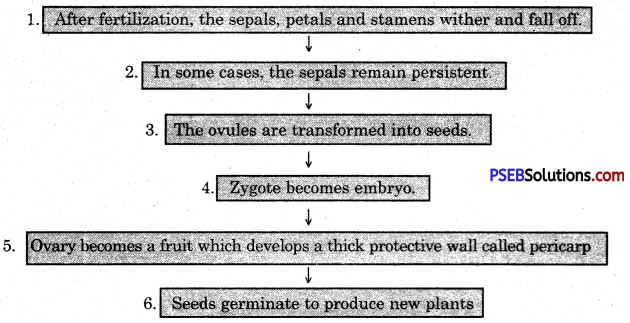
PSEB 10th Class Science Important Questions Chapter 8 How do Organisms Reproduce 1

Question 5.
Describe the structure of a flower.
Or
With the help of a well labelled diagram, describe the parts of a flower.
Answer:
(a) V.S. of Flower:

PSEB 10th Class Science Important Questions Chapter 8 How do Organisms Reproduce 18

1. Pedicel: It is stalk of the flower which raises it in the air to expose the flower to the pollinating agencies. Pedicel may bear two small leaf-like appendages called bracteoles.

2. Thalamus: The swollen or broad base or flat apex of pedicel that bears the floral leaves is called thalamus or torus.

3. Calyx or Sepals: The sepals are the outermost whorl of flower. They are collectively known as calyx. Calyx is green, appears first on the thalamus and is protective in function.

4. Corolla or Petals: It is the second whorl of flower. They are brightly coloured leaf-like flattened structures.
Petals may also be scented and have nectar glands at the base to attract pollinating agents i.e. insects.

5. Stamens or Androecium: Stamens are the male reproductive parts of the flower. Each stamen consists of a slender stalk filament and a knob-like terminal anther. Each anther has two anther lobes. Each anther lobe has two pollen chambers containing pollen grains.

6. Carpels or Gynaecium: The carpels represent the female parts of a flower. They are present on the central region of thalamus. They may be free or united. The free occurring unit of gynaecium is called pistil. Each pistil consists of three parts ovary, style and stigma.

Question 6.
With the help of simple sketches show’ the structure of seed and its germination.
Answer:
Structure of Seed
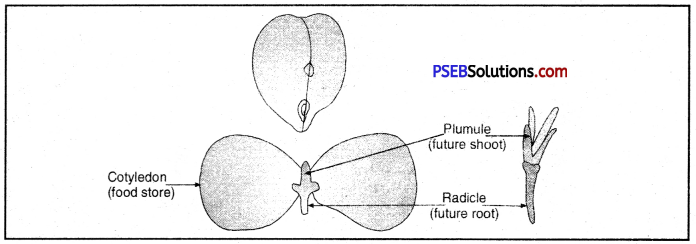
PSEB 10th Class Science Important Questions Chapter 8 How do Organisms Reproduce 2
Structure of Seed

Question 7.
Draw a well labelled diagram of male reproductive system of man.
Answer:
Male reproductive system
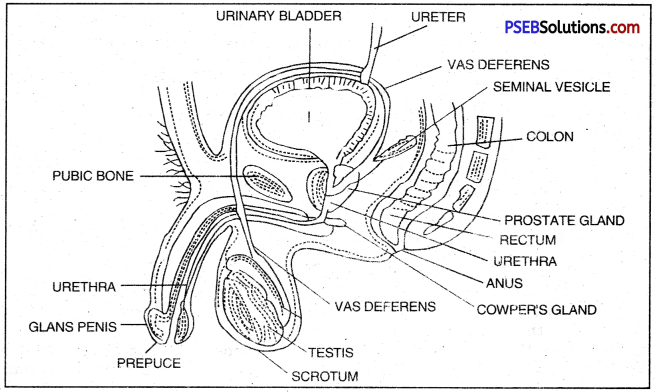
PSEB 10th Class Science Important Questions Chapter 8 How do Organisms Reproduce 3
Reproductive organs of human male

Male reproductive system of human

  • Pair of testes. These are primary sex organs. They produce male gametes, sperms. They also secrete hormones.
  • Pair of vasa deferentia (Sing vas deferens). These are ducts which transfer sperms.
  • Reproductive glands include pair of seminal vesicles, single prostate gland and pair of cowper’s gland. They form semen along with sperm.
  • Copulatory organ (penis). It is involved in copulation.

Question 8.
Draw a well labelled diagram of reproductive organs of female human and explain.
Answer:
Female reproductive organs of human female
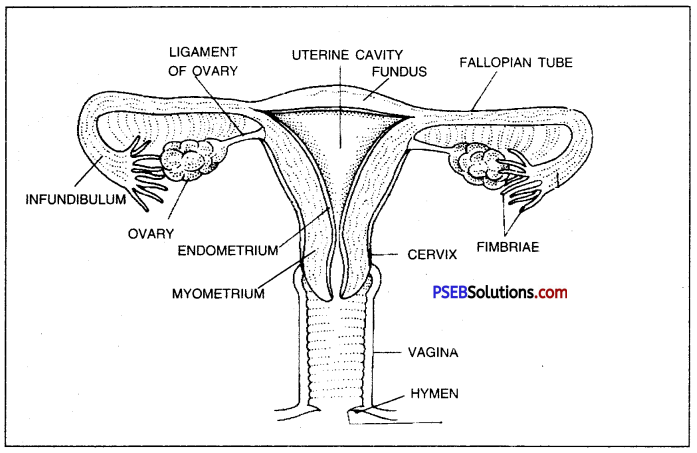
PSEB 10th Class Science Important Questions Chapter 8 How do Organisms Reproduce 4

  • Ovaries are primary sex organs which form germ cells or eggs.
  • Ovaries also secrete hormones.
  • A pair of fallopian tubes conduct eggs into uterus. It is also the site for fertilization.
  • Uterus or womb is the site for development of embryo. It nurtures the growing embryo.
  • Vagina receives semen during copulation.

PSEB 10th Class Science Important Questions Chapter 8 How do Organisms Reproduce?

Question 9.
Explain sexual reproduction in human beings.
Answer:
Sexual Reproduction in Human Beings

  • The male gamete (sperm) is introduced inside the female genital tract (vagina) by the process of copulation or mating. It is termed insemination. Fertilisation occurs in the fallopian tube.
  • Sperms are highly active and mobile which move up through cervix into the uterus and then pass into the fallopian tubes.
  • Fallopian tube is the site of fertilization. Only one sperm fertilises the ovum to form a zygote.
  • Fertilisation occurs only if copulation takes place during the ovulatory period of menstruation cycle.
  • The embryonic development of the zygote starts immediately in the fallopian tube and pregnancy starts while menstruation stops.
  • The embryo moves down to reach the uterus. The embedding of embryo in the thick inner lining of the uterus is called implantation.
  • Then, a special tissue develops between the uterine wall and the embryo (foetus) called placenta, where the exchange of nutrients, oxygen and waste products take place.
  • The time period from the development of foetus inside the uterus till birth is called gestation period.
  • The act of giving birth to the fully developed foetus at the end of gestation period is termed as parturition.
  • The development of the child inside the mother’s body takes approximately 280 days.

Question 10.
Give two reasons for avoiding frequent pregnancies by women.
Explain the following methods of contraception giving one example of each.
(i) Barrier method.
(ii) Chemical method.
(iii) Surgical method.
Answer:
Effect of frequent pregnancies.

  • Adverse effect on health of women.
  • Increase in population.

Methods of Contraception:

  • Barrier methods: In Physical barriers such as condom, diaphragm and cervical caps avoid entry of sperms in the female genital tract during copulation.
  • Chemical methods: Oral pills and vaginal pills are commonly used. Oral pills contain specific hormones.
  • Surgical methods: It is vasectomy in male where a small portion of vas deferens is either removed or ligated (tied). In tubectomy in female small portion of fallopian tube is either removed or ligated.

Question 11.
Describe the various methods of birth control.
Answer:
The various methods of birth control are :
1. Physical barriers – Use of contraceptives. It means prevention of conception.
Following contraceptives are popular :
(а) Diaphragm. The vaginal diaphragm is a rubber cup stretches over a collapsible metal spring coil. It is designed to fit over the cervix, i.e. the mouth of uterus which prevents fertility or conception.

(b) Condom. The condom is a sheath of rubber which fits on the erect penis. It is put on the penis before it is introduced in the vagina during intercourse.

(c) Jellies, creams and foams. A number of different spermicidal jellies, creams and foams are available for use as contraceptive agents. These jellies, creams and foams are inserted into vagina five to fifteen minutes before the ejaculation takes place.

(d) Introduction of copper ‘T’ or loop in female uterus prevents the entry of sperms in uterus.

2. Chemical Methods: Oral Contraceptives. These are popularly known as “pills” and are combinations of synthetic sex hormones which suppress the production of ovum. These pills alter the ovulation cycle. ‘Mala’ and ‘Saheli’ are the two common pills.

3. Surgical methods. Sterilization. It is surgical technique by which the passage of sperms or ovum is discontinued. Both men and women can be sterilized without losing their ability to function sexually.
(а) Vasectomy: In men the sterilization procedure is called vasectomy,
(b) Tubectomy.: In woman part of fallopian tube is cut and tied off.

4. Medical termination of pregnancy (MTP). It is the cessation of pregnancy by surgery, suction or by other means.

5. Other measures.
(а) Abstinence: Abstaining from intercourse.
(b) Coitus interruptus: It involves the withdrawal of penis from the vagina just before ejaculation occurs.
(c) Zero ‘0’ method: It is a natural, effective and practical method where the woman has to find but herself the fertile and infertile period, by keeping a close watch on uterine discharge. The safest period to avoid pregnancy is from the beginning of mucus discharge to the next four days, after the discharge has stopped.

Short Answer Type Questions

Question 1.
What is reproduction? What are its basic types?
Answer:
Reproduction. All organisms born on this earth show characteristic life cycle, involving birth, growth, maturation, reproduction and death. Reproduction is one of the most important processes by which continuation of the species from one generation to another generation can take place. Older and aged organisms are replaced by new and younger organisms by reproduction.

There are two basic types of reproduction.
A. Asexual reproduction
B. Sexual reproduction

Question 2.
Define asexual and sexual reproduction.
Answer:

  • Asexual Reproduction: It is a type of multiplication in which a young one is formed from a specialised or unspecialised part of a parent without the formation and fusion of sex cells, gametes.
  • Sexual Reproduction: It is a type of reproduction which takes place by the formation and fusion of gametes.

It involves two major processes:

  1. Meiosis (reductional division) by which diploid sporophytic cells give rise to haploid gametes.
  2. Fertilization, which reconstitutes the sporophytic diploid generation through gametic fusion.

PSEB 10th Class Science Important Questions Chapter 8 How do Organisms Reproduce?

Question 3.
Differentiate asexual and sexual reproduction.
Answer:
Differences between asexual and sexual forms of reproduction

Asexual Reproduction Sexual Reproduction
1. The process involves only one cell or one parent. 1. This process involves two cells or gametes belonging to either the same or different parents.
2. The whole body of the parent may act as a reproductive unit or it can be a single cell or a bud. 2. The reproductive unit is called gamete which is unicellular and haploid.
3. Only mitotic division takes place. 3. Meiosis and fertilization are essential events.
4. No formation of sex organs. 4. Formation of sex organs is essential.

Question 4.
Describe asexual reproduction in Amoeba.
Or
Explain the term fission as used in relation to reproduction.
Answer:
Binary fission in Amoeba. It is normal method of reproduction in Amoeba. It occurs under favourable conditions. The animal grows until it attains the maximum size and then divides by binary fission in every three or four days. The fission is completed in 15 to 20 minutes.

PSEB 10th Class Science Important Questions Chapter 8 How do Organisms Reproduce 5
Binary Fission in Amoeba

Multiple fusion in Amoeba. Multiple fission inside the cyst has been described but not established. It has been suggested that sometimes, inside the cyst, the nucleus divides and surrounds itself with cytoplasm to form several small amoebulae. At the return of favourable conditions or on finding a favourable substrate, the cyst absorbs water and its walls burst. The amoebulae escape and soon each one grows into new amoeba.
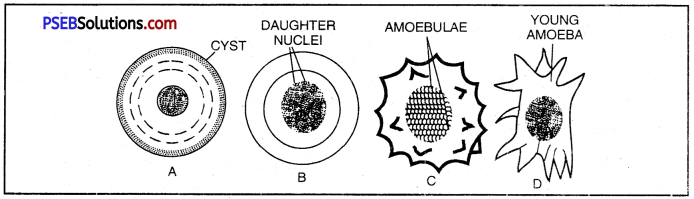
PSEB 10th Class Science Important Questions Chapter 8 How do Organisms Reproduce 6
Amoeba showing encystment and multiple fission.

Question 5.
Explain various steps of budding in yeast.
Answer:
Budding in yeast. Most of the common yeasts reproduce by budding. The process of budding occurs under normal conditions, when the yeast cells are growing in sugar solution. Saccharomyces usually reproduce by budding. In the process, each cell gives rise to one or more tiny outgrowths which gradually increase in size as large as the mother cell itself. Ultimately, it is cut off from the mother cells by a constriction at the base and can lead a separate existence.

The nucleus divides amitotically during budding and one daughter nucleus passes in the bud and the other remains in the mother cell. The nuclear membrane persists throughout the nuclear division. The budding may be repeated by the daughter cell while still attached to the parent cell, resulting in the formation of one or more chains and even sub-chains, called pseudomycelium. The cells ultimately become separated from one another and lead independent life.
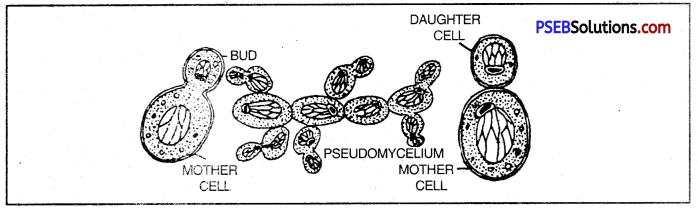
PSEB 10th Class Science Important Questions Chapter 8 How do Organisms Reproduce 7
Budding in Yeast Saccharomyces

Question 6.
Explain various steps of budding in Hydra.
Answer:
Budding. It is a common method of reproduction in Sponges and Hydra. In this process, the new individual develops from a small outgrowth on the surface of parent. The exogenous bud gets its nourishment from the parent till it gets the maturity. Then it breaks off from the parent body and develops into new individual. Sometimes, the buds do not separate off and form a chain of buds.
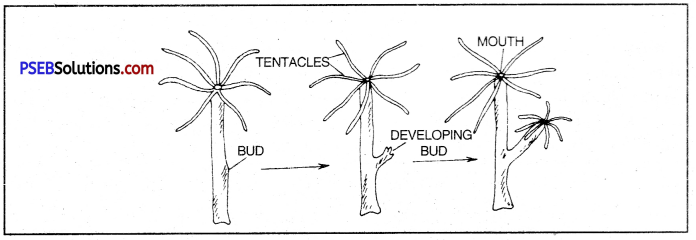
PSEB 10th Class Science Important Questions Chapter 8 How do Organisms Reproduce 8
Budding in Hydra

Question 7.
Discuss spore formation in fungi.
Or
Illustrate spore formation in Rhizopus with a diagram.
Or
Write the benefit of spore reproduction.
Or
Illustrate spore formation in Rhizopus with a diagram.
Or
Write the benefit of spore reproduction.
Answer:
Spore formation: The spores in fungi vary in shape. Spores are usually unicellular, thick walled, spherical. The thick walls provide protection till these come in contact with other surface and can begin to grow. Sometimes the spores may be multicellular also. Sometimes the spores are produced endogenously in special sac-like asexual reproductive bodies called sporangia.

  • Spores in such cases are called sporangiospores.
  • Spores on falling on ground or substratum grow new hypha, e.g., Rhizopus, Mucor and Penicillium.
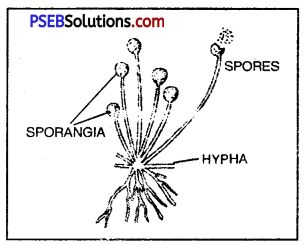
PSEB 10th Class Science Important Questions Chapter 8 How do Organisms Reproduce 9
Spore formation in Rhizopus

Benefit:

  • It is a fast method of reproduction.
  • A very large number of spores produced ensure survival of organism.

Question 8.
What is regeneration? Describe regeneration in Planaria.
Or
Explain the term regeneration as used in relation to reproduction.
Answer:
Regeneration: The process of repair, replacement or revival of damaged or severed body parts or reconstruction of the whole body from a small fragment of it during the post-embryonic period of a multicellular organism is termed regeneration. It is a morphogenetic mechanism.

Regeneration in Planaria: When the anterior end of Planaria is cut along the length into two more parts, each part develops into a new head, resulting in a many headed planaria.

If the body is cut into three, four or more pieces, each piece regenerates the missing parts. A noteworthy observation in this case is that a piece from the middle always regenerates a head towards its anterior side and tail towards its posterior side. In other words, each piece maintains its original polarity.
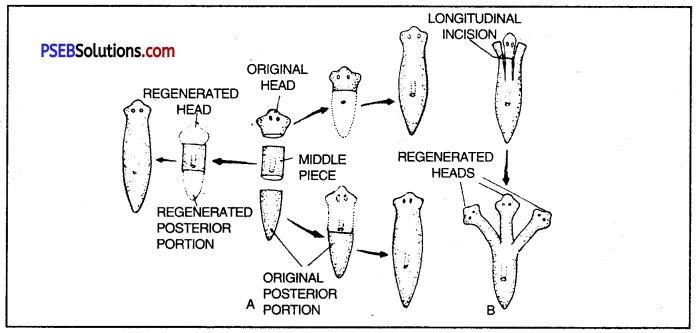
PSEB 10th Class Science Important Questions Chapter 8 How do Organisms Reproduce 10
Regeneration in planarians. A. Three individuals regenerate from an individual cut into three parts. B. Formation of a heteromorph with three heads.

PSEB 10th Class Science Important Questions Chapter 8 How do Organisms Reproduce?

Question 9.
What is vegetative propagation?
Answer:
Vegetative Propagation: Vegetative propagation is defined as formation of two or more individuals from any vegetative part of plant. In this type of vegetative propagation new plants can be raised from roots or stems or leaves of a plant.

It is a very rapid method. It is of two types.

  1. Natural vegetative propagation
  2. Artificial vegetative propagation.

Question 10.
Explain natural vegetative propagation by roots in plants.
Answer:
A number of herbaceous and woody perennial plants propagate vegetatively in nature. The common structures that take part in natural vegetative propagation are roots, stems, leaves and buds.

Vegetative Propagation by Roots:
Roots of some plants like radish, carrot, asparagus, tapioca, Dahlia and sweet potato etc. are tuberous and store abundant food material.

These roots when planted in specially prepared beds (soil), develop adventitious buds which grow into leafy shoots called “slips”. As the root tubers in sweet potato store large amounts of food, each produces several “slips”. The young “slips”are detached from the parent plant and grown separately.
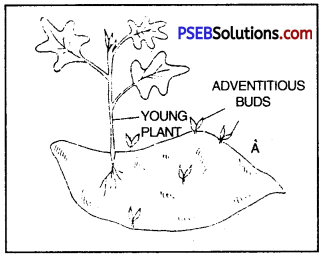
PSEB 10th Class Science Important Questions Chapter 8 How do Organisms Reproduce 11
Vegetative propagation by roots is sweet potato

Question 11.
Briefly explain vegetative propagation by stems.
Answer:
Vegetative propagative by stems:
All underground stems even some aerial stems help in vegetative propagation. Some of these are aerial and creeping e.g. runners (Cynodon dactylon, lawn grass), stolons (Fragaria vesica, strawberry), and offsets (Eichhornia); other are underground e.g. rhizomes (Zingiber officinale), corms (Coloccisia), bulbs {Allium, cepa) and tubers (Solanum tuberosum).
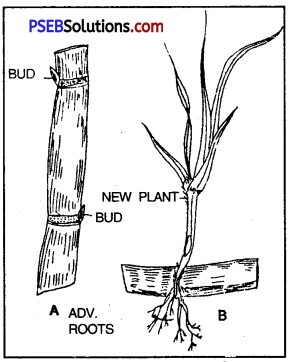
PSEB 10th Class Science Important Questions Chapter 8 How do Organisms Reproduce 12
Propagation of sugar cane from section of aerial stem. A, a piece of sugarcane stem having buds; B, bud growing into a new plant

Aerial stems of sugarcane, ipomoea, grape vine and cacti are also used for vegetative propagation.
In sugarcane, portions of the stem bearing one or more nodes and buds are cut and planted in the soil. Adventitious roots develop from the nodes and the buds grow into aerial shoots.

Question 12.
Give a brief account of vegetative propagation in leaves.
Or
Illustrate the following with the help of suitable diagram :
Leaf of BryophyHum with buds.
Answer:
Vegetative Propagation by Leaves. Under suitable conditions new plants can develop from the leaves.
In Bryophyllum, leaf helps in vegetative propagation. In the leaf there are notches, where meristem is present. When leaf comes in contact with soil, this meristem produces a new plant. Adventitious buds are formed in Begonia and Lilium on leaves which too help in vegetative propagation.
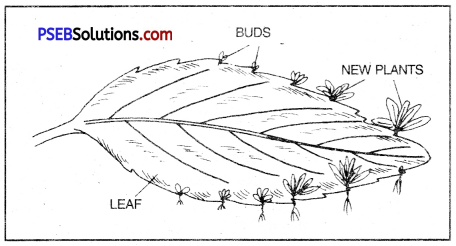
PSEB 10th Class Science Important Questions Chapter 8 How do Organisms Reproduce 13
Vegetative propagation by leaves in Bryophyllum

Question 13.
Differentiate grafting and cutting.
Answer:
Differences between grafting and cutting

Grafting Cutting
1. The process of fixing the stem piece on another stem fixed to the soil is called grafting. 1. The use of piece or cutting and placing it in moist soil is called cutting.
2. It involves stem pieces of two plants. 2. Only single plant is used.
3. The stem fixed to soil is called stock and grafted part is scion. 3. The pieces used are called cutting.

Question 14.
What is the difference between cutting and layering?
Answer:
Difference between cutting and layering

Cutting Layering
1. The piece of plant called cutting is placed in soil. 1. The branch from intact plant is kept in moist soil.
2. It is carried out by using root, stem and leaf. 2. Soft stem is used for layering

Question 15.
Explain tissue culture.
Answer:
Tissue culture: In this method, tissue or organ culture is utilized. Tissue or organ is grown on suitable medium containing hormones. Tissue proliferates to form, callus. From this callus arise new plantlets. Each plantlet when transferred to pot or soil produces new plant. Thus by this method, an indefinite number of plants can be raised from a small mass of parental tissue. This technique is commonly used for ornamental plants.

PSEB 10th Class Science Important Questions Chapter 8 How do Organisms Reproduce?

Question 16.
Write merits of vegetative propagation.
Answer:
Merits of vegetative propagation
Vegetative propagation has outstanding advantages. Some of these are as follows :

  • Plants produced by vegetative propagation are genetically similar and constitute a uniform population known as clone.
  • Some fruit trees like banana, pine-apple do not produce viable seeds so these are propagated by only vegetative methods.
  • It is more rapid and easier method of propagation.
  • Good characters are preserved by vegetative propagation.
  • Most of the ornamental plants are propagated by vegetative propagation.

Question 17.
Write demerits of vegetative propagation.
Answer:
Demerits of vegetative propagation

  • New varieties cannot be produced by vegetative propagation.
  • Quality of fruits cannot be changed since there is no sexual fusion, no meiosis and no recombination of characters occur.
  • Weeds growing with plants is harmful as there occurs widespread of weeds.
  • Disease contacted by a parent plant propagates in all the daughter plants.
  • There are no special mechanisms for dispersal.

Question 18.
What is a flower? Define the unisexual and bisexual giving one example of each.
Answer:
A flower is a specialized shoot which shows a limited growth and bears organs (stamens and pistils) essential for seed and fruit formation.

  • Unisexual Organism. Male and female sex organs are present in different individuals.
    Example : Human
  • Bisexual organism. Single individual having both male and female sex organs.
    Examples : Most of the plants, Tapeworm, Earthworm.

Question 19.
What is placentation?
Answer:
Placentation: The ovary contains one or more ovules, which later become seeds. The ovule bearing region of the carpel is called placenta. The arrangement of placentae and ovules within the ovary is called placentation.

Question 20.
What is pollination?
Answer:
Pollination. It is the transference of pollen grains from the anther of a flower to the stigma of the same or different flower.

Question 21.
What are the ways in which pollination occurs?
Answer:
Pollination may occur in any of the following ways :

  • The pollen of the same flower may fall on its stigma by itself.
  • The pollen of another flower of the same plant may fall on the stigma.
  • The pollen of a flower of another plant of the same species may land on the stigma.
  • This transference can occur through wind, insects or other agents.

Question 22.
What are the two kinds of pollination?
Answer:
Kinds of pollination.

  1. Self-pollination. It is the transfer of pollen from the anther to the stigma of the same flower or to the stigma of another flower of the same plant.
  2. Cross-pollination. It is the transfer of pollen from the anthers of flowers of one plant to the stigma of a flower of another plant.

Question 23.
Write two differences between self-pollination and cross-pollination.
Answer:
Differences between Self-pollination and Cross-pollination

Self-pollination Cross-pollination
1. It occurs within a flower or between two flowers of the same plant. 1. It occurs between two flowers borne on different plants of the same species.
2. Flowers do not depend upon other agencies for pollination. 2. Agents such as insects, water and wind are required ensuring pollination.

Question 24.
Draw well-labelled diagram of V.S. of the mature ovule of Angiosperms.
Answer:
Mature ovule.
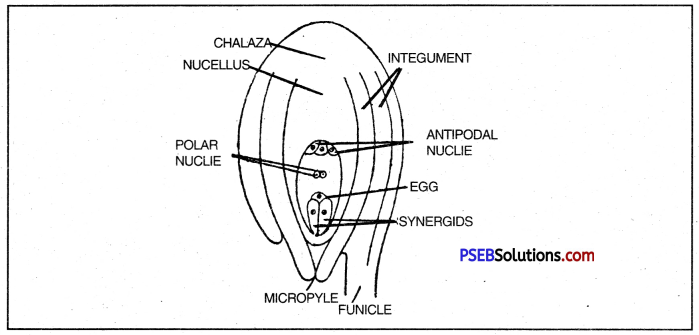
PSEB 10th Class Science Important Questions Chapter 8 How do Organisms Reproduce 14
V.S. of mature ovule to show various parts

Question 25.
Give the structure of pollen grain.
Answer:
Structure of Pollen Grain
Pollen grain is a microscopic unicellular structure. It is covered by two layered walls— the inner intine and the outer thick exine. At certain places the exine has pores called germ pores. It contains two nuclei — a generative nucleus and a tube nucleus.

PSEB 10th Class Science Important Questions Chapter 8 How do Organisms Reproduce?

Question 26.
Trace the steps involved in the formation of the plant seed from pollination.
Or
Explain sexual reproduction in flowering plants.
Answer:
Formation of plant seed

  • Pollination is transfer and deposition of pollen on stigma.
  • Pollen grain germinates on the stigma. It gives rise pollen tube which carries male gametes.
  • A hypodermal cell of the nucellus in ovule enlarge’ cod forms megaspore mother cell.
  • The diploid megaspore mother cell undergoes meiosis to form four megaspores.
  • The functional megaspore enlarges into embryo sac.
  • The process of nuclear fusion (syngamy) of the male nucleus and one egg nucleus is termed fertilization. It forms diploid zygote. Second male gamete fuses with secondary nucleus to form primary endosperm nucleus.
  • Angiosperms exhibit double fertilization.
  • Fall of the petals, stamens, style and stigma.
  • The ovules develop into seeds.
  • As seeds contain the miniature but dormant future plant, they are dispersed by various agents such as wind, water and animals.

Question 27.
Depict the events of fertilization.
Answer:
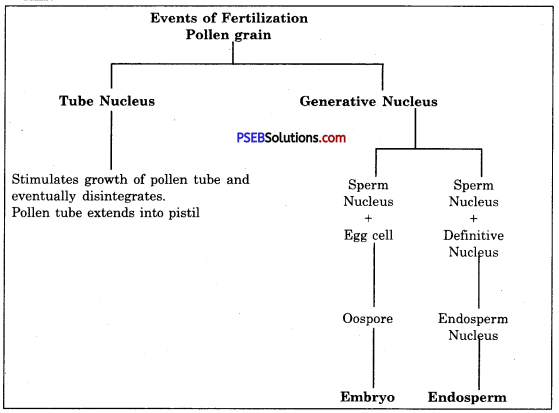
PSEB 10th Class Science Important Questions Chapter 8 How do Organisms Reproduce 15

Question 28.
With the help of a labelled diagram, describe double fertilisation in plants.
Answer:
Double fertilization in plants:

  • The process of double fertilization occurs inside each embryo sac in which two fusions i.e. syngamy and triple fusion takes place.
  • As the pollen tube enters the ovule, the pollen tube releases two male gametes into
    embryo sac.
  • The embryo sac contains the egg.
  • The fusion of male and female gametes in the embryo sac of ovule is called syngamy. The product is called zygote.
  • The other male gamete fuses with the two polar nuclei. It is called triple fusion.

Significance:

  • Double fertilization provides stimulus to endosperm mother cell for the formation of nutritive tissue named endosperm.
  • It ensures continued supply of nourishment to the embryo that develops from zygote.

Question 29.
Draw diagram to show the path of pollen tube into pistil during fertilization.
Answer:
Path of Pollen tube into pistil during fertilization
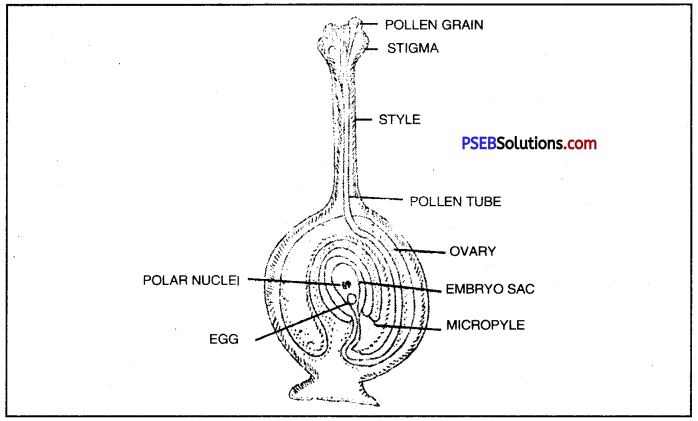
PSEB 10th Class Science Important Questions Chapter 8 How do Organisms Reproduce 16
Path of pollen tube in the pistil

Question 30.
Explain post-fertilization changes in plants.
Answer:
Post-fertilization changes. After fertilization most of the parts of the flower wither and significant changes occur inside the ovary.

  • The fertilized egg or zygote (oospore) along with the ovule changes into the seed.
  • The wall of the ovule forms the seed coat (testa). The seed contains the potential plant or embryo.
  • The embryo consists of radicle (potential root), plumule (potential shoot) and cotyledons (seed leaves).
  • In dicotyledonous plants there are two cotyledons while in monocotyledonous plants there is only one cotyledon.
  • In monocotyledonous plants food is stored in the endosperm (part of the seed).
  • The seeds become dry and dormant to overcome adverse conditions.
  • Ultimately the wall of the ovary ripens and changes into a fruit. Thus we see the seeds inside the fruit.

Question 31.
Name the various organs of male reproductive system of man.
Answer:
Male reproductive organs of man

  • A pair of testis
  • A pair of epididymis
  • A pair of vasa deferentia
  • Urethra
  • Penis
  • A pair of emina1 vesicles.
  • Male reproductive glands, Cowper’s gland and prostate gland.

Question 32.
Name the various organs of female reproductive system.
Answer:
Female reproductive system is composed of following organs :

  • A pair of ovaries.
  • A pair of fallopian tubes.
  • Uterus
  • Vagina
  • Vulva.

PSEB 10th Class Science Important Questions Chapter 8 How do Organisms Reproduce?

Question 33.
What are the male and female gonads in human beings? Mention their function.
Answer:
Male Gonads: The male gonads are called testes and female gonads ovaries.

Functions of testes :

  • Testes produce male gametes called sperms.
  • Testes produce male sex hormone called testosterone.

Functions of ovary :

  • Formation of female gametes (ova).
  • Production of female sex hormones (Estrogen and progesterone).

Question 34.
(a) In the human body what is the role of
(i) seminal vesicles and
Answer:
Function of seminal vesicles.
They secrete viscous alkaline seminal fluid that contains sugar fructose and ascorbic acid. Fructose provide energy to the spermatozoa for swimming.

(ii) prostate gland?
Answer:
Functions of prostate gland

  • It secretes the milky white slightly acidic fluid.
  • The secretion nourishes and serves as the medium for spermatozoa.

(b) List two functions performed by testes in human beings.
Answer:
Functions of testes :

  1. Testes produce male gametes called sperms.
  2. Testes produce male sex hormone called testosterone.

Question 34.
Write names of one male and one female sex hormones.
Answer:

  • Male sex hormones. Testosterone.
  • Female sex hormone. Estrogen.

Question 35.
Define Menstruation, precocious puberty and menopause.
Answer:
Menstruation: It is a process in which the blood, mucus and uterine tissue is eliminated in female mammals.
Precocious puberty: Normally a woman’s fertile life starts from the age of puberty (about 13 years), but under some abnormal conditions like high level of sex hormones (LH and FSH), menstruation starts at an early age than the normal, and then it is called precocious puberty.

Menopause: The natural physiological stoppage of menstruation is called menopause or the arrest of reproductive capacity at the age of 45-50 is called menopause. Woman is unable to bear the children at this stage.

Question 36.
Name and define the four stages in the uterine cycle.
Answer:
Uterine Cycle: The uterine cycle consists of four distinct stages as follows :

  • Menstruation. It lasts for five to seven days.
  • The proliferative phase. From the end of menstruation to the release of ovum, it lasts for 10-14 days.
  • Ovulatory phase. It is the release of ovum from the ovary.
  • Luteal. It lasts from ovulation to menstruation for about 10-days.

Question 37.
Write a short note on child birth or parturition.
Answer:

  • At or about the 40th week of pregnancy labour sets in. Contraction of the muscles of the uterine wall starts in the early stages of labour. This results in severe pain to the mother. It is known as labour pain.
  • The contraction of the uterine wall brings the baby towards the mouth of the uterus.
  • The joint of the pelvic bones becomes more flexible.
  • The cervix and the vaginal passage becomes much more flexible and wider.
  • At the same time, the uterine contractions become more and more forceful due to which the baby is forced out more and more.
  • Finally, it comes out completely. Generally the head comes out first followed by the shoulders, then the body and finally the legs.

Question 38.
What is placenta?
Answer:
Placenta: It is the structure formed by the union of the foetal and uterine tissue for the purpose of nutrition, respiration and excretion of the embryo. Although the blood vessels of the embryo and the mother come close but these are kept separated by some barriers between them. The useful substances pass from maternal blood to foetal blood while the wastes (excretory products and C02) are passed from the foetal blood to maternal blood.

Question 39.
Write the functions of placenta.
Answer:
Functions of placenta: The placenta serves primarily as an organ that permits the interchange of materials carried in the blood of mother and foetus.

The main functions are :

  • Nutrition: Supply of nutrient materials to foetus.
  • Respiration: Supply of 02 to foetus and receive C02 back from it.
  • Excretion: Fluid nitrogenous waste products escape through the placenta.
  • Barrier: The placenta is barrier like semipermeable membrane.
  • Storage: The placenta stores fat, glycogen and iron for the embiyo before the formation of liver.
  • Hormonal function: The placenta secures extra ovarian hormones estrogen and progesterone in female during pregnancy that serves to maintain foetus.

Question 40.
What is artificial insemination? Write the uses of artificial insemination.
Answer:
Artificial insemination: A process by which spermatozoa are collected from male and deposited in the female genitalia by instrumentation rather than by natural service is called artificial insemination.

Uses of artificial insemination

  • The semen of good quality of male animal may be used to inseminate number of females.
  • The preserved spermatic fluid can be transported to different places.
  • In case of man who is incapable of producing children this method can be used.

Question 41.
Name one sexually transmitted disease each caused due to bacterial infection and viral infection. How can these be prevented?
Answer:

  • Sexually transmitted disease caused due to bacterial infection : Syphilis.
  • Sexually transmitted disease caused due to viral infection : AIDS.

Prevention of sexually transmitted disease

  • People, particularly those in high-risk group, should be educated about AIDS transmission, advantage of using condom, danger of sharing needles and virtue of monogamy. Adultery has been prohibited in all religions. It must be avoided.
  • Sexual habits should be changed.
  • Before receiving blood, it should be screened for HIV.

Question 42.
What is puberty? Name the hormones responsible for production of sexual characters in human beings.
Answer:
Puberty: The period at which reproductive organs become mature and capable of functioning.
1. Changes in female (girl) at the time of puberty. These changes occur under the influence of hormones FSH (Follicle stimulating hormone) and estrogen.

  • Growth of breast and external genitalia.
  • Darkening of nipple skin.
  • Broadening of pelvis.
  • Growth of pubic and axillary hair.
  • Increase in subcutaneous fat.
  • Initiation of menstruation and ovulation.

2. Changes in male (boy): In male testosterone hormone is responsible for puberty.

  • Change of voice.
  • The appearance of beard and moustaches.
  • Discharge of semen.

PSEB 10th Class Science Important Questions Chapter 8 How do Organisms Reproduce?

Question 43.
Label the parts of human male reproductive system.
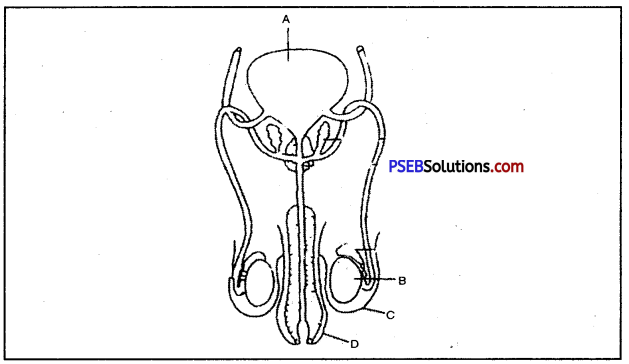
PSEB 10th Class Science Important Questions Chapter 8 How do Organisms Reproduce 17
Answer:

  • A – Bladder
  • B – Testis
  • C – Scrotum
  • D – Penis.

Very Short Answer Type Questions

Question 1.
Why do organism reproduce?
Answer:
Organisms reproduce so that species may continue.

Question 2.
Where are gene present?
Answer:
Genes are present in nucleus of cell.

Question 3.
Name the molecules which carry genetic information.
Answer:
DNA.

Question 4.
Expand DNA.
Answer:
DeoxyRibose Nucleic Acid.

Question 5.
DNA contains information for the synthesis of which molecule?
Answer:
Protein synthesis.

Question 6.
Name the molecules which makes its copy before reproduction.
Answer:
DNA.

Question 7.
What is the basis for evolution?
Answer:
The inbuilt capacity for variations during reproduction.

Question 8.
What is the role of reproduction?
Answer:

  • Propagation of species
  • Evolution of species.

Question 9.
Why are variation useful for organism?
Answer:
Variation enables the organism for its survival.

PSEB 10th Class Science Important Questions Chapter 8 How do Organisms Reproduce?

Question 10.
Name the various methods of vegetative propagation in plants.
Answer:
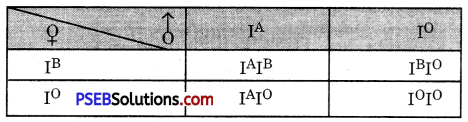
  • Cutting
  • Layering
  • Grafting.

Question 11.
Which part of bryophyllum can be used for vegetative propagation?
Answer:
Leaf of Bryophyllum.

Question 12.
Give one example of each: Vegetative propagation by (i) root (ii) stem.
Answer:

  1. Vegetative propagation by roots e.g. Sweet potato
  2. Vegetative propagation by stem e.g. Potato.

Question 13.
(i) When does binary fission and multiple fission in amoeba take place?
Answer:
Binary fission takes place during favourable period and multiple fission occurs during unfavourable period in amoeba.

(ii) ‘Malarial parasite’ divides into many daughter individuals simul-taneously through multiple fission. State an advantage the parasite gets because of this type of reproduction.
Answer:
Multiplication i.e. increase in number.

Question 14.
How do yeast, sponges and hydra reproduce asexually?
Answer:
All the three reproduce by budding.

Question 15.
How do Spirogyra and Mucor reproduce asexually?
Answer:
Spirogyra. Fragmentation and Regeneration, Mucor. Spore formation.

Question 16.
Which kind of organism have complex mode of reproduction.?
Answer:
Multicellular orsganisms.

Question 17.
Give two examples which reproduce as a result of reproduction.
Answer:
Hydra and Planaria.

Question 18.
Which part of cell is used for tissue culture technique?
Answer:
Tissue or cells from the tip of shoot are used for obtaining plants by tissue culture method.

Question 19.
What is callus?
Answer:
An unorganised mass of cells formed by repeated cell division in tissue culture technique.

Question 20.
What are the fibrous growth present on bread?
Answer:
Hyphae of rhizopus (A fungus)

Question 21.
What is sperm?
Answer:
Motile male gamete is called sperm.

Question 22.
What is ovum?
Answer:
Female gamete is called ovum. It is non-motile ooplasm rich in nutrients.

Question 23.
Name the male and female reproductive organs of a flower.
Answer:
Male organs Stamen, Female organ-Carpel (Pistil).

Question 24.
Name two plants which bear unisexual flowers.
Answer:
Papaya, Water melon.

Question 25.
Give two example of plants which bear bisexual flowers.
Answer:
Mustard plant, Rose plant.

Question 26.
Name the agencies which help in pollination.
Answer:
Air, water, insects and other animals.

Question 27.
Name the hormone which play role in formation of sperm.
Answer:
FSH (Follicle Stimulating Hormone)

Question 28.
When and where are eggs formed in females?
Answer:
Eggs are formed in ovarian follicles of ovary during foetal condition.

Question 29.
Where is fertilized egg implanted after fertilization?
Answer:
Uterus.

Question 30.
Coin the term for fusion of male and female gametes.
Answer:
Fertilization.

Question 31.
Give examples of plants which are propagated by stem cutting.
Answer:
Sugarcane, Rose, Fig and Mulberry.

Question 32.
Name plants .which reproduce by artificial vegetative propagation.
Answer:
Grapes, Rose and Fig.

Question 33.
Name three methods of vege-tative propagation,
Answer:

  1. Cutting
  2. Grafting
  3. Layering.

Question 34.
Give two examples of each. Vegetative propagation by
(i) Tissue culture
Answer:
Tissue culture – Orchid, Asparagus

(ii) Layering.
Answer:
Layering – Magnolis, Rhododendson

Question 35.
What term is used if the pollen is transferred to the stigma of same flower?
Answer:
Self-pollination.

Question 36.
What is fruit?
Answer:
Fruit: Fruit is a ripened ovary.

Question 37.
Which parts of the seed form root and shoot?
Answer:

  • Root is formed from radicle.
  • Shoot is formed from plumule.

Question 38.
What are the advantages of vegetative propagation?
Answer:

  • Plants produced are genetically similar and form uniform population.
  • It is a rapid method of propagation.

Question 39.
Name four methods of asexual repoduction.
Answer:

  1. Binary fission
  2. Multiple fission
  3. Budding
  4. Fragmentation

PSEB 10th Class Science Important Questions Chapter 8 How do Organisms Reproduce?

Question 40.
Name three plants which repor-duce by natural vegetative methods.
Answer:

  1. Potato
  2. Banana
  3. Sweet potato.

Question 41.
What is a flower?
Answer:
Flower: It is a modified shoot specialized to carry out sexual reproduction in plants.

Question 42.
Name four whorls of flower.
Answer:
Whorls of flower:

  1. Calyx
  2. Corolla
  3. Androecium and
  4. Gynoecium.

Question 43.
List the different parts of a carpel.
Answer:
Carpel: It consists of three parts, viz., ovary, style and stigma.

Question 44.
Where are pollens and ovules present in flower?
Answer:

  • Pollens – Anther lobes
  • Ovules – Ovary.

Question 45.
What is pollination?
Answer:
It is the transference of pollen grains from anthers of a flower to the stigma of same or another flower of same species.

Question 46.
What is formed in the egg after fertilization?
Answer:
Embryo.

Question 47.
Give example for asexual method of resproduction.
Answer:
Hydra.

Question 48.
What will happen if hydra is cut into two or more pieces?
Answer:
Each piece of hydra will grow into new individuals and the process is called regeneration.

Question 49.
What is gamete?
Answer:
Gametes are male and female sex cells.

Question 50.
Coin the term for male and female gamete.
Answer:
Sperm and ovum respectively.

Question 51.
Give two examples of bisexual animals.
Answer:

  1. Liver fluke
  2. Earthworm.

Question 52.
What is fertilization?
Answer:
Fusion of male and female gametes is called fertilization.

Question 53.
What are viviparous animals?
Answer:
The animals which give birth to young ones are called viviparous animals.

Question 54.
What are oviparous animals?
Answer:
The animals which lay eggs are called oviparous animals.

Question 55.
Give examples of vivi-parous animals?
Answer:

  • Cow
  • Cat
  • Monkey.

Question 56.
Write examples of oviparous animals.
Answer:

  • Insects
  • Frog
  • Birds.

Question 57.
Name two types of pollination.
Answer:

  1. Self-pollination
  2. Cross-pollination.

Question 58.
Name three parts of pistil.
Answer:

  1. Ovary
  2. Style
  3. Stigma.

Question 59.
What is foetus?
Answer:
A 12 week old embryo in the genital tract (uterus) of mother in viviparous animals is called foetus.

Question 60.
List two characters which start developing in girls during puberty.
Answer:

  1. Growth of mammary glands.
  2. Growth of public hairs.

Question 61.
State any two characters which appear during.puberty in boys.
Answer:

  1. Appearance of beard.
  2. Growth of public hairs.

Question 62.
What is semen?
Answer:
Sperms and seminal plasma constitute semen.

Question 63.
What is placenta?
Answer:
Placenta is an organ of attachment between an embryo and the uterine wall of mother w hich is for med jointly by them.

Question 64.
Define pregnancy.
Answer:
The duration for whic h embryo remain implanted inibhe wall of uterus is called pregnancy or period of gestation.

Question 65.
Name the organs of human male reproductive system.
Answer:

  1. 1. Testes
  2. Scrotum
  3. Epididymes
  4. Vasa deferntiai
  5. Urethra
  6. Reproductive glands (seminal vesicles prostate gland and and Cowper’s glands).

PSEB 10th Class Science Important Questions Chapter 8 How do Organisms Reproduce?

Question 66.
Name the organs of human female reproductive system.
Answer:

  1. Ovariea
  2. Oviducts (Fallopian tubes)
  3. Uterus
  4. Vagina
  5. Vulva
  6. Female reproduct ive glands (Mammary glands).

Question 67.
What is ovulation?
Answer:
Ovulation is release of mature ovum by bursting the mature follicle of ovary.

Question 68.
Supply the scientific term for the following :
(i) Release of ovum from ovary.
Answer:
Ovulation

(ii) Onset of menstrual cycle in female.
Answer:
Puberty.

Question 69.
What is the function of sperm duct?
Answer:
Sperm duct (vas deferens). It conducts sperms from testes to urethra.

Question 70.
What is the function of scrotum?
Answer:
Thermoregulation. Scrotum provides a lower temperature than body temperature for the development of sperms.

Question 71.
Give two examples of accessory sex characters in man.
Answer:
Accessory sex characters :

  1. Presence of facial hair in man.
  2. Broad shoulders and low pitch voice.

Question 72.
What is after birth?
Answer:
Placenta expelled after delivery.

Question 73.
What will happen if the fallopian tubes are partially blocked and the ovulated eggs are prevented from reaching the uterus?
Answer:
Fertilization may take place but the zygote may develop in the tube instead of uterus.

Question 74.
Where does fertilization take place in human beings?
Answer:
In the fallopian tube.

Question 75.
How does the developing child itt the uterus get its nourishment?
Answer:
It gets its nourishment from placenta.

Question 76.
In how many weeks develop-ment of foetus is completed?
Answer:
About 40 (forty) weeks after fertilization.

Question 77.
Give one example of each, (i) mechanical methods of contra-ception (ii) chemical methods of contra-ception.
Answer:
Mechanical. Condoms in males and diaphragm in female.
Chemical. Use of oral pills.

Question 78.
What is the removal of small piece of sperm duct from male and fallopian tube from female called?
Answer:
Removal of sperm duct – Vasectomy
Removal of fallopian tube – Tubectomy.

Question 79.
When do the boys attain adolescence?
Answer:
16 to 18 years.

Question 80.
When do the girls attain adole-scence?
Answer:
13 to 15 years.

Question 81.
Name the part of female genital tract where foetus develops.
Answer:
Uterus.

Question 82.
What is the function of copper-T?
Answer:
A copper-T is placed safely inside the uterus. It prevents implantation in the uterus.

Question 83.
List the aspects which reproductive health includes.
Answer:
Reproductive health includes aspects that ensure a responsible, safe and satisfying reproductive life.

Question 84.
Name any three sexually transmitted diseases (STDs).
Answer:
Gonorrhoea, Syphilis and AIDS.

Multiple Choice Questions

Question 1.
Reproduction in Amoeba is by:
(A) Binary fission
(B) Multiple fission
(C) Budding
(D) Regeneration.
Answer:
(A) Binary fïssion

PSEB 10th Class Science Important Questions Chapter 8 How do Organisms Reproduce?

Question 2.
Biyophyllum in nature is reproduced by :
(A) Foliar adventitious buds
(B) Seeds
(C) Roots
(D) None of these.
Answer:
(A) Foliar adventitious buds

Question 3.
In which organism can we see budding?
(A) BrvophyHurn
(B) Hydra
C) Yeast
(D) All of above.
Answer:
(B) Hydra

Question 4.
In which of the following regeneration take place?
(A) Hydra
(B) Planaria
(C) Both A & B
(D) Human.
Answer:
(D) Human.

Question 5.
In which of the following asexual reproduction take place through spore formation?
(A) Plasmodium
(B) Leishmania
(C) Spirogvra
(D) Rhizopus.
Answer:
(D) Rhizopus.

Question 6.
In man why testes are located outside the abdominal cavity in scrotum?
(A) For security reasons
(B) Because sperms formation needs lower temperature than normal body temperature
(C) For proper delivery of sperms to the female vaginal tract during copulation
(D) None of the above.
Answer:
(B) Because sperms formation needs lower temperature than normal body temperature

Question 7.
If the egg is not fertilized then lining of which of the following breaks and come out as blood?
(A) Cervix
(B) Oviduct
(C) Vagina
(D) None of these.
Answer:
(D) None of these.

Question 8.
Which of the following shrivel and fall off when ovary risens to form fruit :
(A) Sepals
(B) Petals
(C) Stamen
(D) All of the above.
Answer:
(D) All of the above.

Question 9.
Placenta is embedded in:
(A) Cervix
(B) Uterus
(C) Vagina
(D) Oviduct.
Answer:
(B) Uterus

Fill in the blanks:

Question 1.
________ is a means of perpetuation of the species.
Answer:
Reproduction.

PSEB 10th Class Science Important Questions Chapter 8 How do Organisms Reproduce?

Question 2.
________ are well defined places of population of organism of any ecosystem.
Answer:
Niches.

Question 3.
________ and ________ are common methods of reproduction.
Answer:
Fission and Budding.

Question 4.
________ is a reproductive shoot of higher plants.
Answer:
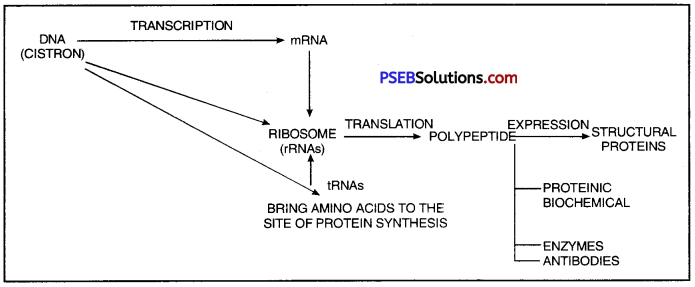
Flower.

Question 5.
________ is the process of fusion of male gamete with egg or oosphere.
Answer:
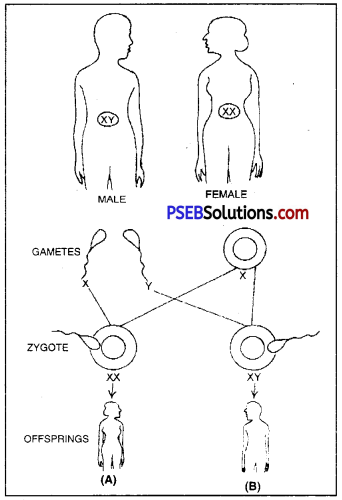
Fertilization.

Question 6.
Fertilization occurs in ________
Answer:
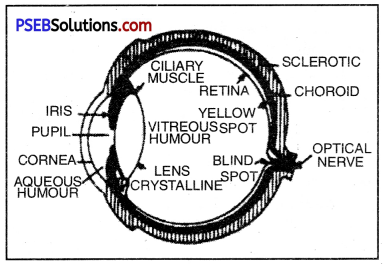
Fallopian tubes.

Question 7.
________ occurs in angiospermic plants.
Answer: