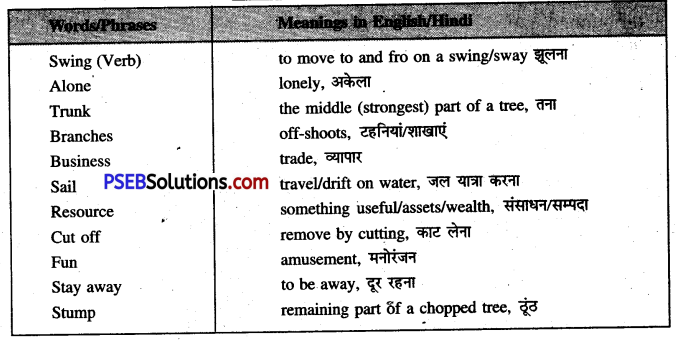
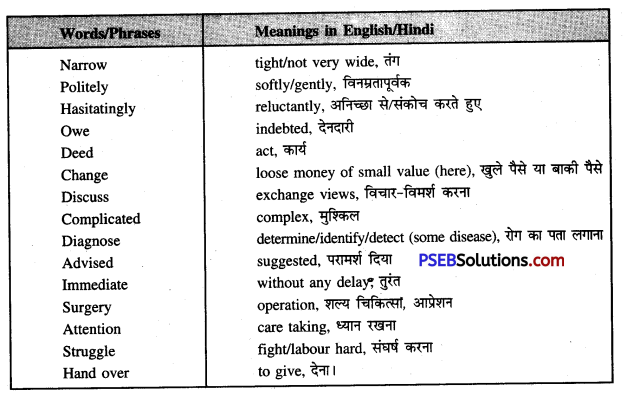
The Old Sage and the Brothers Question Answer Class 8 English Solutions Chapter 4 PSEB Solutions

Punjab State Board PSEB 8th Class English Book Solutions Chapter 4 The Old Sage and the Brothers Textbook Exercise Questions and Answers.

Class 8th English Solutions Chapter 4 The Old Sage and the Brothers Question Answers

The Old Sage and the Brothers Class 8 Questions and Answers

Activity 1.

Look up the following words in a dictionary. You should seek the following information about the words and put them in your WORDS notebook. :
1. Meaning of the word as used in the lesson (adjective/noun/verb. etc.)
2. Pronunciation (The teacher may refer to the dictionary or a mobile phone for correct pronunciation.)
3. Spellings.

summoned acquiring approached delighted granted
annoyed poultry deny journey snatched

Vocabulary Expansion

Look at the following sentences.
(a) I enjoyed the film.
(b) The film gave us a lot of enjoyment.
In the sentence (a) the word enjoyed is a verb and in sentence (b) the word enjoyment is a noun. When you add suffixes such as ‘-ment, ‘-ance’, ‘-age’, ‘-ion’, ‘-ness’, -ať, -ure’, etc. to a word, they become nouns. Sometimes if you remove the suffix from a word, it becomes a noun.

PSEB 8th Class English Solutions Chapter 4 The Old Sage and the Brothers

For example :
(a) escaped
If you remove -d’, the word becomes ‘escape’ which is both a noun and a verb.
I had a narrow escape. (noun).
The thief wanted to escape. (verb)

Activity 2.

Let’s do the following activity. Make nouns of the given words.

1. try — trail
2. distract — distraction
3. move — movement
4. educate — education
5. inform — informity
6. agree — agreement
7. pay — payment
8. argue — argument
9. pass — passage
10. bag — baggage
11. marry — marriage
12. refuse — refusal
13. propose — purpose
14. arrive — arrival
15. fail — failure
16. press — pressure
17. confuse — confusion
18. decide — decision
19. revise — revision
20. teach — teaching

Learing to Read and Comprehend

Activity 3

Read the story and answer the following questions.

a. How many sons did the old farmer have ?
किसान के कितने पुत्र थे ?
Answer:
The farmer had three sons.

b. Why did the farmer summon his sons ?
किसान ने अपने पुत्रों को क्यों बुलाया ?
Answer:
The farmer had grown old. He summoned his sons to divide his property among them.

c. What had the farmer decided to do?
किसान ने क्या करने का निर्णय लिया था ?
Answer:
The farmer had decided to give his three sons a field and a house each.

PSEB 8th Class English Solutions Chapter 4 The Old Sage and the Brothers

d. How did Harry help the sage ?
हैरी ने सघु की सहायता कैसे की ?
Answer:
Harry gave the sage a Chapatti to eat.

e. What did Harry ask for ?
हैरी ने क्या मांगा ?
Answer:
Harry asked for a big house and ten cows.

f. Why could the sage not cross the river ?
साधु नदी क्यों न पार कर सका ?
Answer:
The sage could not cross the river because there was no boat.

g. How did Sandeep help the sage ?
संदीप ने साधु की सहायता कैसे की ?
Answer:
Sandeep carried the sage on his back across the river.

h. Did all the brothers keep their promise ?
क्या सभी भाइयों ने अपना वचन निभाया ?
Answer:
No, only Sandeep kept his promise.

i. Why did the sage snatch away the gifts from Harry and Raman ?
साधु ने हैरी तथा रमन से उपहार क्यों छीन लिए ?
Answer:
The sage snatched away the gifts from them because they did not keep their promise.

PSEB 8th Class English Solutions Chapter 4 The Old Sage and the Brothers

j. What do you learn from this story?
आपको कहानी से क्या शिक्षा मिलती है ?
Answer:
One must keep one’s promise. It is our duty to help the poor and the needy.

Activity 4

Complete the following exercise on the basis of the lesson. Fill in the blanks.
(a) The farmer had …………. fields and three …….
(b) The sage made the brothers promise that they would help the ……………. and the
(c) The sage gave a piece of …………….. to Raman. (Choose the correct option.)
(i) cloth
(ii) stick
(iii) rope
(iv) cake
(d) Sandeep broke his promise. (True or False)
(e) The sage punished/did not punish Harry and Raman. (Choose the correct option.)
Answer:
(a) three, houses
(b) poor, needy
(c) stick
(d) False
(e) punished.

PSEB 8th Class English Solutions Chapter 4 The Old Sage and the Brothers

Activity 5

Imagine that you are Harry. Use five sentences to narrate your feelings after your gifts were snatched away from you.
Answer:
I was shocked after my gifts were snatched away. I was rightly punished because I did not keep my word. I did not help the poor and the needy. The riches turned my head and made me selfish. Now I have realized my mistake and decided to work hard in life. I will help the poor and the needy too. Learning Language Verbs There are two forms of main verbs in English.
(a) The Finite Verbs
(b) The Non-finite Verbs

A. Finite Verbs

A finite verb is the form of a verb which is limited by the number, person and tense. For example :
1. I eat an apple daily.
2. She eats an apple daily.
3. We eat apples daily.
4. We ate an apple yesterday.
5. We will eat apples tomorrow.

PSEB 8th Class English Solutions Chapter 4 The Old Sage and the Brothers

In the examples above, the verb ‘eat’ changes its forms with change in number, person or tense. Therefore, it can be called a finite verb. Finite Verb का वाक्य number, person या tense बदलने पर अपना रूप बदल लेता है।

B. Non-finite Verbs

A Non-finite form of a verb is not limited by number and person of a subject and has no tense. Non-finite verb-forms are typically infinitive forms with or without ‘to’ (e.g. to go, go), ing forms (e.g. going) and third form of the verb (e.g. finished, gone).
Let’s look at some examples :
(a) I want to eat an apple.
(b) She wants to eat an apple.
(c) We want to eat apples.
(d) They wanted to eat apples.
(e) They will want to eat apples tomorrow.
In the examples above, ‘to eat does not change even when the other verb ‘want keeps changing according to number, person or tense. Therefore, ‘to eat’ is a non-finite verb.

Types of Non-finite Verbs There are three types of Non-finite verbs. These are
(a) The infinitive
(b) The Gerund
(c) The Participles
Let us look at the following flowchart to have a better understanding.
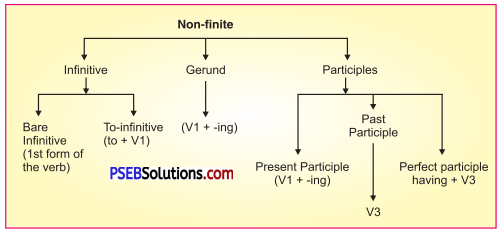
PSEB 8th Class English Solutions Chapter 4 The Old Sage and the Brothers 1

B.1. The Infinitives
The infinitive can further be divided into two categories :
(a) Bare infinitive
(b) To-infinitive

(a) Bare infinitive
Bare Infinitives are also called plain infinitives or infinitives without ‘to’. , Use of Bare infinitives
The bare infinitive is used: with verbs such as ‘bid’, ‘have’, ‘left’, ‘make’
(a) The teacher made the student repeat the lesson.
(b) He bade me write an essay.
(c) He didn’t let me enter the room.

PSEB 8th Class English Solutions Chapter 4 The Old Sage and the Brothers

2. with auxiliaries ‘will’, ‘would’, ‘shall’, ‘should’, ‘can’, ‘could’, ‘do’, ‘must’, ‘may, etc.
(a) You can go now.
(b) You shall know your results tomorrow.

3. with auxiliaries ‘neeď and dare’, the bare infinitive is used primarily in interrogative
and negative sentences, for example :
(a) Dare you go into the foresť at night ?
(b) He daren’t touch his sister’s mobile phone.
(c) Need you go home so soon ?
(d) You needn’t come.

4. with expressions like ‘would rather’, ‘rather than’, ‘had better’, etc.
(a) I would rather stay at home.
(b) You had better ask him for money.
(c) I would die rather than beg.

5. It may follow ‘but’ and ‘except
(a) He did nothing but cry.
(b) He does nothing except complain.

6. with questions denoting suggestions or advice and beginning with ‘why’, ‘why not.
(a) Why make such a noise over a small matter?
(b) Why not take your brother with you ?

(b) To-infinitive
Use of To-infinitive
The To-infinitive is used in many sentence constructions, often expressing the purpose of something or someone’s opinion about something.
1. as a noun :
(a) To speak effectively needs a lot of practice. (subject)
(b) To err is human. (infinitive as subject)
(c) To criticize others is an easy job. (subject)
(d) He likes to play cricket. (infinitive as objects)
(e) To play with fire is a very risky game. (subject)
(f) My duty is to serve my country. (as a complement to a linking verb)
(g) It is easier to preach than to practise. (after the dummy subject ‘it’)

PSEB 8th Class English Solutions Chapter 4 The Old Sage and the Brothers

2. as adverb to modify verbs and adjectives:
(a) We go to school to learn. (modifies the verb ‘go’)
(b) She’s hard to please. (modifies the adjective ‘hard’)

3. as adjective to qualify nouns:
(a) It was a match to remember (qualifies ‘match’)

4. as object complement
(a) He advised me to keep quiet.
(b) I advised him to accept the offer.

5. too + adjective/adverb + infinitive
(a) He’s too weak to walk.
(b) Mona is too young to understand this.
(c) They worked too slowly to achieve the target.

6. enough + infinitive
(a) He has enough money to pay the bill.
(b) He’s kind enough to help you.

Activity 6.

Pick out infinitives in the following sentences and underline them.

1. I saw him go.
2. He promised to come.
3. To forgive is difficult.
4. I watched her dance.
5. It is bad to cheat your family.
Answer:
1. I saw him go.
2. He promised to come.
3. To forgive is difficult.
4. I watched her dance.
5. It is bad to cheat your family.

Activity 7.

Fill in the blanks with appropriate non-finite forms.
(a) You ought …………….. (get) up earlier.
(b) It is easy ……………… (make) mistakes.
(c) He made me ………………. (repeat) the lessons.
(d) You needn’t ………………. (say) anything.
(e) Would you like ………………. (come) in my car ?
(f) He will be able …………… (swim) very soon.
Answer:
(a) to get
(b) to make
(c) repeat
(d) say
(e) to come
(f) swim.

Activity 8:

Combine the following pairs of sentences into one sentence using too/enough + infinitive.

(a) You are very young. You can’t have a gun.
Answer:
You are too young to have a gun.

(b) He’s very ill. He can’t eat anything.
Answer:
He is too ill to eat anything.

(c) Mickey was very foolish. He told lies to the police.
Answer:
Mickey was foolish enough to tell lies to the police.

(d) The fire isn’t very hot. It won’t boil the kettle.
Answer:
The fire is not hot enough to boil the kettle.

(e) I am rather old. I can’t walk that far.
Answer:
I am too old to walk that far.

PSEB 8th Class English Solutions Chapter 4 The Old Sage and the Brothers

B.2. The Gerunds

Gerunds are verb + -ing form used as nouns. They can be used in the following ways :
(a) as a subject
(b) after prepositions
(c) after certain verbs
(d) in noun-compounds

Read the following sentences :

(a) Swimming is a good exercise.
The word ‘swimming’ is formed from the verb ‘swim’ by adding -ing to it. It therefore appears to be a verb. The word ‘swimming’ is the name of an action and is also the subject of the sentence. Hence, it does the work of a noun. The word ‘swimming is like a verb as well as a noun. It is therefore a verb — noun and is called a gerund.

PSEB 8th Class English Solutions Chapter 4 The Old Sage and the Brothers 4

Note : The form of the gerunds and of the present participles are identical. However, Gerunds are verbal nouns and Participles are verbal adjectives.

Examples :
(a) He is fond of riding.– Gerund
(b) Riding along the road, he saw a porcupine. — Present participle

Use of a gerund :

As already mentioned above, a gerund can be used as
(a) the subject of a verb : as
(i) Seeing is believing.
(ii) Collecting stamps is his hobby.

(b) as the object of a transitive verb : as
(i) I enjoy reading poetry.
(ii) i like watching the stars at night.

(c) as object of a preposition : as
(i) She’s fond of dancing
(ii) He was punished for telling a lie.

(d) after certain verbs : the gerund is used after verbs such as given below :
admit, avoid, consider, death, differ, delay, deny, detest, dread, enjoy, excuse, fancy, finish, forgive, imagine, invoke, keep, miss, pardon, postpone, prevent, recollect, resend,risk, stop, suggest, understand, etc.. )

PSEB 8th Class English Solutions Chapter 4 The Old Sage and the Brothers

Examples :
(a) He stopped writing as I entered the room.
(b) Please pardon my saying so.
(c) I enjoy watching this game.

Pick out gerunds in the following sentences :

(a) Swimming is a good exercise.
(b) I enjoy sleeping.
(c) Old men enjoy gossiping.
(d) I hate waiting.
(e) Stealing is a crime.
(f) am fond of walking.
(g) I am good at spelling.
(h) We took part in boating.
(i) My sister does not like cooking.
(j) She’s fond of dancing.
Answer:
(a) swimming
(b) sleeping
(c) gossiping
(d) waiting
(e) Stealing
(f) walking
(g) spelling
(h) boating
(i) cooking
(j) dancing.

Fill in the blanks with the correct gerund or infinitive form of the verbs given in the brackets.

(a) He agreed …………… me. (help).
(b) Suresh enjoys ……………. football. (play).
(c) We failed ………….. the train. (catch)
(d) They decided …………… hard. (work)
(e) She loves ……………. to music. (listen)
(f) I am learning how ………….. (drive)
(g) The class wanted …………… for a picnic. (go)
(h) He urged us ……………. faster. (work)
(i) She loves ……………. books. (read)
(j) I am looking forward to …………… you. (meer)
Answer:
(a) to help
(b) playing
(c) to catch
(d) to work
(e) listening
(f) to drive
(g) to go
(h) to work
(i) reading
(j) meet.

PSEB 8th Class English Solutions Chapter 4 The Old Sage and the Brothers

Learning to Listen

Activity 10.

You will listen carefully to your teacher. Your teacher will read a passage slowly. Write in your notebook what you hear. Do not make spelling mistakes and put appropriate punctuation marks such as comma, question mark or full stop, where needed. (Refer to Appendix I at page no. 166.)
Answer:
Do it yourself.

Learning to Speak

Activity 11:

Look at the pictures given below. There are 8 differences. Do this activity with your partner. While identifying the differences, you all must speak in English only.

Spot the differences

PSEB 8th Class English Solutions Chapter 4 The Old Sage and the Brothers 2

You may use sentences such as 1 can see a difference here
Answer.
1. I can see a difference here in the time. Left hand side clock shows 8.25 but right hand side clock shows 11.25 O’clock.
A —- B
2. Balls on the window rod —- No balls
3. Handles of the drawer are big —- small
4. Cusion of sofa set — one blue —- all yellow
5. Fruits in tray on table—more —- less
6. Book & sequence design —- different
7. Objects on shelf behind sofa —- different
8. Something kept on drawers —- nothing on drawers.

Learning to Write

Given below is an application written to the Principal of a school asking for exemption from examination. Read it carefully and also look at its format.
Answer:
The Principal
Dev Samaj Senior Secondary School
Jalandhar
Sir
I am a student of Class VIII A of your school. Our bimonthly exams are starting from November 01, 20….. Sir, I always stand first in all the exams. My sister’s wedding is falling on November 05, 20…. .As I am the only helping hand of my father, I can’t take the exam this time. This time, I request you to exempt me from the examination. I shall be very thankful to you.
Thanking you
Yours obediently
XYZ …….
Roll No. 21, VIII A
July 5, 20.

PSEB 8th Class English Solutions Chapter 4 The Old Sage and the Brothers

Activity 12.

Write an application to your Principal asking for a School Leaving Certificate in the space given below. You must write.

  • your reason for leaving the school
  • when you will leave the school
  • where you will take admission after leaving the school

Answer:
The Principal
Govt. Senior Secondary School Hamirpur
Sir
I am a student of class VIII of your school. My father has been transferred to XYZ city. He is to report for duty there within three days. All the members of our family are leaving tomorrow. My parents do not wish me to join a hostel. I am sorry to leave your good school, but I am helpless. I shall have to join some school at XYZ city. I have paid all the dues. Kindly issue my school leaving certificate and oblige. I shall be thankful to you for this.
Yours obediently
Om Mehta
VIII-D
March 8,20…..

Learning to Use the Language

Activity 13

What’s the problem? Do you mind if I – Go ahead!
Is it OK if – telling me – Thanks!
Here you are ! Could you turn – Can I borrow –

Conversation 1

Raghav : Yeah?
Gurtej : Hello, ……….. turn the music down, please? It’s one o’clock and I’m trying to sleep.
Raghav : Oh, sorry. Is that okay ?
Gurtej : Yes, ………. Perhaps I can get some sleep now. Good Night!
Answer:
1. could you
2. Thanks.

Conversation 2

Japtej : I’m sorry, leave early today? I’m going to take my dog to see the vet.
Palak : You’re going to take your dog to the vet ? What’s the matter with him ?
Japtej : I don’t know. That’s why I’m going to take him to the vet’s.
Palak : Oh, I see! Sure Thanks for
Answer:
1. Is it ok if I
2. Here you are !
3. telling me.

Conversation 3

Sheenam : Divyam, do you have your mobile phone with you ?
Divyam : Um … yes. Why ?
Sheenam : it, please? I need to make a quick call to my mother.
Divyam : OK,
Answer:
1. Can I borrow
2. go ahead !

Conversation 4

Jyoti : ………… change seats?
Rajneesh : Yes, all right ……. ?
Jyoti : I can’t see because of the sun.
Rajneesh : OK, then. Why don’t you sit there, next to Piyush.
Answer:
1. Do you mind if I
2. What is the problem ?

PSEB 8th Class English Solutions Chapter 4 The Old Sage and the Brothers

Activity 14 :
Given below are some polite requests with equally polite responses. Match the questions in Column A with the correct responses in Column B.
Answer:

S.No. Column A S.No. Column B
1. Can I have a glass of juice? 1. Yes, of course!
2. Is it alright if I make a phone call? 2. I said that some friends were coming over.
3. Could you say that again, please? 3. Well, OK, if it’s a local call.
4. Can I speak to you for a moment? 4. Oh sure, The remote’s on the table.
5. Do you mind if I look at your books? 5. Well, not really. Why can’t you come?
6. Is it OK if I miss the class tomorrow? 6. Of course, there’s some in the fridge.
7. Could you move a little, please? 7. You can borrow some if you want.
8. Do you mind if I turn the TV up? 8. Yes, sorry. I didn’t realise you wanted to sit down.

1. Of course, there’s some in the fridge.
2. Well, OK, if it’s a local call.
3. I said that some friends were coming over.
4. Yes, of course !
5. You can borrow some if you want.
6. Well, not really. Why can’t you come ?
7. Yes, sorry. I didn’t realise you wanted to sit down.
8. Oh sure, The remote’s on the table.

Comprehension Of Passages

Read the following passage and answer the questions given below each :

(1) Long time ago, a rich farmer summoned his three lazy sons. Harry, Raman and Sandeep and said, “I have grown old. I have decided to divide my property among you. As you all know, I own three fields and three houses. Each one of you will get a field and a house only if you prove that you are worth it”. The three sons were surprised. “What do you mean, father ?” cried they. The farmer said, “These fields and houses are the fruits of my hard work. All the three of you are very lazy. I want the three of you to find some work. Return to me after six months with your earnings. I will decide if you are worthy of acquiring my hard-earned property.” The three brothers set out in search of work, On the way, they sat down under a banyan tree to rest.

1. How could the sons gain their father’s property ?
पुत्र अपने पिता की संपत्ति कैसे प्राप्त कर सकते थे ?

2. Where did they take rest ?
उन्होंने आराम कहां किया?

3. Choose true and false statements and write them in your answer-book :
(a) All the three sons were hard-working.
(b) The sons were given six months to prove their worth.

PSEB 8th Class English Solutions Chapter 4 The Old Sage and the Brothers

4. Complete the following sentences according to the meaning of the passage :
(a) Each son will get …………
(b) The three sons set out in ……… of work

Match the words with their meanings :

(i) summoned called
(ii) acquire gain
put in jail

Answer:
1. The sons could gain it by proving themselves worth it.
2. They took rest under a banyan tree.
3.
(a) False
(b) True.
4.
(a) Each son will get a field and a house.
(b) The three sons set out in search of work.
Or
(i) summoned — called
(ii) acquire — gain

(2) Then the old sage said, “Promise me that if ever a poor man asks you for a cup of milk, you will not deny him.”
“It’s a gendeman’s promise”, said the lad “and whatsoever he wishes for milk, butter, curd, sweets, I will never deny.” The old sage smiled, “Do not break your promise.”
“I will not”, assured Harry.
The other two brothers continued on their way with the old.sage. They went on till they came to a stream. The old sage looked sad and worried. “Oh! There’s no boat. How will I cross the stream ?” Raman said very kindly. “Don’t worry! I’ll help you. I’ll carry you on my back.” After crossing the river, the three of them sat down for some rest.
The sage thanked Raman and said, “God bless you, son! Here is a gift for you.”
Raman was delighted. The sage gave him a piece of stick. Raman was surprised. “What is this ?” “It is a magic stick. It will grant you two wishes. Ask now.”

1. What was Harry’s gendeman promise ?
हैरी का सज्जन पुरुष वाला वचन क्या था?

2. Who gave a gift to Raman ? What was it ?
रमन को उपहार किसने दिया? यह क्या या?

3. Choose true and false statements and write them in your answer-book :
(a) The sage crossed the river with the help of a boat.
(b) Harry assured the sage that he would not break his promise.

PSEB 8th Class English Solutions Chapter 4 The Old Sage and the Brothers

4. Complete the following sentences according to the meaning of the passage :
(a) Raman offered to carry the sage across
(b) The old sage looked
Or
Match the words with their meanings :

(i) delighted refuse
(ii) deny happy/glad
wondered

Answer:
1. Harry’s promise was that he would never deny anything to the needy.
2. The sage gave a gift to Raman. It was a piece of magic stick.
3.
(a) False
(b) True.
4.
(a) Raman offered to carry the sage across the river.
(b) The old sage looked sad and worried.
Or
(i) delighted — happy/glad
(ii) deny — refuse.

(3) Sandeep moved on with the old sage. When they came to a desert, they sat down for some rest. The old sage said to Sandeep, “I know you are very tired but I’m very thirsty. Please get me some water”.
“Don’t worry! Please rest here. I’ll find some water for you.” Sandeep set out to find water for the old man. He returned after an hour with some water. The old sage drank the water and blessed Sandeep, “God bless you, son ! Here’s a gift for you.”
Sandeep was delighted. The sage gave him a piece of rope. Sandeep became very happy. He knew he was going to be rewarded. The old sage smiled and said, “It’s a magic rope. It will grant you two wishes. Ask now.”
Sandeep was delighted, “I want a big house.” “Granted.”
A beautiful house appeared.
“What’s your second wish ?” added the sage.
“A field !”, said Harry excitedly. “Granted !”

1. Who brought water for the sage ?
साधु के लिए पानी कौन लाया?

2. How many wishes could the magic rope grant ?
जादुई रस्सी कितनी इच्छाएँ पूरी कर सकती थी?

3. Choose true and false statements and write them in your answer-book :
(a) On the way the sage felt hungry.
(b) Sandeep asked for a beautiful house for his first wish.

4. Complete the following sentences according to the meaning of the passage :
(a) The sage gave Sandeep ……… as a gift.
(b) Sandeep became happy because he was going to be ……….
Or
Write the meanings of the following words in English : (any two) excitedly, grant, wish
Answer:
1. Sandeep brought water for the sage.
2. The magic rope could grant two wishes.
3.
(a) False
(b) True.
4. (a) The sage gave Sandeep a magic rope as a gift.
(b) Sandeep became happy because he was going to be rewarded.
Or
eagerly, fulfil, desire.

PSEB 8th Class English Solutions Chapter 4 The Old Sage and the Brothers

Use Of Words And Phrases in Sentences

1. Deny – He denied me food.
2. Wish – His wish came true.
3. Grant – All his wishes were granted.
4. Summoned – The king summoned his minister to his court.
5. Approached – The beggar approached the langar house for food.
6. Worth – You are not worth this big house.
7. Snatched – All his awards were snatched from him.
8. Appeared – All of a sudden a beautiful girl appeared from no where.
9. Word – He did not keep his word.
10. Delighted – He was delighted to- win the race.

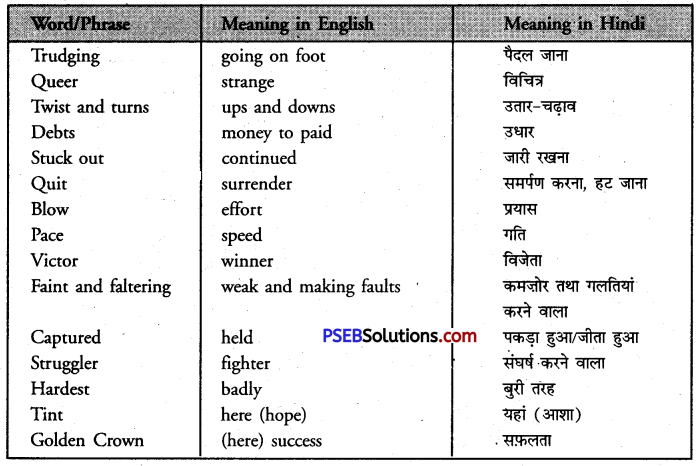
Word-Meanings
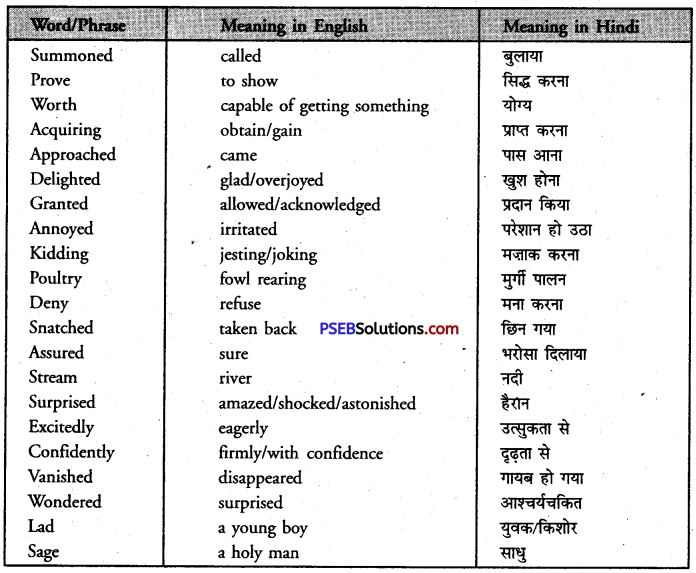
PSEB 8th Class English Solutions Chapter 4 The Old Sage and the Brothers 3

The Old Sage and the Brothers Summary in Hindi

Long time ago…..knew no bound.

बहुत समय पहले एक अमीर किसान ने अपने तीन आलसी पुत्रों-हैरी (Harry), रमन तथा संदीप को बुलाया और कहा, “मैं बूढ़ा हो चुका हूँ। मैंने अपनी सम्पत्ति को तुम्हारे बीच में बांटने का निर्णय लिया है। जैसा कि तुम जानते हो मेरे पास तीन खेत और तीन घर हैं। तुम में से प्रत्येक को एक खेत और एक घर मिलेगा, यदि तुम यह सिद्ध करोगे कि तुम उसके योग्य हो।” तीनों पुत्र हैरान थे। वे चिल्लाए, “पिता जी, आप का क्या अर्थ है ?” किसान ने कहा, “ये खेत और घर मेरी कड़ी मेहनत का फल हैं। तुम तीनों बड़े ही आलसी हो। मैं चाहता हूँ कि तुम तीनों कोई काम ढूंढो।

ठछः मास के बाद अपनी आमदनी लेकर मेरे पास वापिस आओ। मैं निणय करूंगा कि क्या तुम मेरे द्वारा कड़ी मेहनत से अर्जित सम्पत्ति पाने के योग्य हो।” तीनों भाई काम की तलाश में निकल पड़े। रास्ते में वे बरगद के एक वृक्ष के नीचे आराम करने के लिए बैठ गए। जब वे खाना खा रहे थे तभी एक वृद्ध साधु उनके पास आया।

उसने कहा, “मैं भूखा हूं। क्या तुम मुझे खाने के लिए कुछ दे सकते हो ?” हैरी (Harry) ने उसे एक चपाती दे दी। साधु ने खुशी-खुशी उसे खा लिया और बोला, “पुत्र ! ईश्वर तुम्हारा भला करे। तुम्हारे लिए एक उपहार है।” हैरी खुश हो गया। साधु ने उसे कपड़े का एक टुकड़ा दिया।हैरी चिढ़ कर बोला, “यह क्या है ? क्या तुम मेरे साथ मज़ाक कर रहे हो ?”

साधु मुस्कराया और बोला, “यह एक जादुई कपड़ा है। यह तुम्हारी दो इच्छाएं पूरी करेगा। अब मांगो।” हैरी अत्यधिक खुश होकर बोला, “मुझे एक बड़ा घर चाहिए।” “प्रदान किया !” एक सुन्दर घर प्रकट हो गया। साधु ने पूछा, “तुम्हारी दूसरी इच्छा क्या है ?” हैरी ने उत्साह से कहा, “दस गाय।” “दे दी।” दस गाय न जाने कहां से प्रकट हो गईं। हैरी की खुशी का कोई ठिकाना न रहा।

Then the old sage………………Raman confidently.

तब वृद्ध साधु ने कहा, “मुझे वचन दो कि जब कभी भी कोई गरीब आदमी तुमसे एक कप दूध मांगेगा तो तुम इन्कार नहीं करोगे।” युवक ने कहा, “यह एक सज्जन पुरुष का वचन है। वह दूध, मक्खन, दही, मिठाई में से किसी चीज़ की भी इच्छा प्रकट करेगा, मैं इंकार नहीं करूंगा।” वृद्ध साधु मुस्कराया, “अपना वचन मत तोड़ना।” हैरी ने भरोसा दिलाया, “मैं नहीं तोडंगा।”

दूसरे दो भाई वृद्ध साधु के साथ आगे बढ़ गए। वे तब तक चलते रहे जब तक कि वे एक नदी पर नहीं पहुंच गए। वृद्ध साधु उदास और चिंतित दिखाई देने लगा। “ओह ! यहां तो कोई नाव नहीं है। मैं नदी कैसे पार करूंगा ?” रमन ने उदारता से कहा, “चिंता मत करो। मैं तुम्हारी मदद करूंगा। मैं आपको अपनी पीठ पर ले जाऊंगा।” नदी पार करने के पश्चात् वे तीनों आराम करने के लिए बैठ गए।

साधु ने रमन का धन्यवाद किया और कहा, “पुत्र! ईश्वर तुम्हारा भला करे। तुम्हारे लिए एक उपहार है।” रमन खुश हो गया। साधु ने उसे छड़ी का एक टुकड़ा दिया। रमन हैरान रह गया। “यह क्या है ?” साधु ने कहा, “यह एक जादुई छड़ी है। यह तुम्हारी दो इच्छाएं पूरी करेगी। अब मांगो।” रमन खुश हो गया। उसने कहा, “मुझे एक बड़ा घर चाहिए।” “प्रदान किया !” एक सुन्दर घर प्रकट हो गया। साधु ने आगे कहा, “तुम्हारी दूसरी इच्छा क्या है ?” रमन ने उत्सुकता से कहा, “एक मुर्गी फ़ार्म।” “प्रदान किया !” एक मुर्गी पालन फ़ार्म न जाने कहां से प्रकट हो गया।

रमन की खुशी का कोई ठिकाना न रहा। तब वृद्ध साधु ने कहा, “मुझे वचन दो कि जब कभी भी कोई गरीब आदमी तुमसे एक अंडा मांगेगा तो तुम मना नहीं करोगे।”

PSEB 8th Class English Solutions Chapter 4 The Old Sage and the Brothers

युवक ने कहा, “यह एक सज्जन पुरुष का वचन है और वह अंडे, आमलेट, अंडे का हलवा में से किसी भी चीज़ की इच्छा प्रकट करेगा, मैं इंकार नहीं करूंगा।” वृद्ध साधु ने मुस्कराते हुए कहा, “अपना वचन मत तोड़ना।” रमन ने दृढ़ता से कहा, “मैं ऐसा नहीं करूंगा।”

Sandeep moved on… ………..”Granted!”

संदीप वृद्ध साधु के साथ चलता रहा। जब वे एक मरुस्थल में पहुँचे तो नीचे बैठ कर आराम करने लगे। वृद्ध साधु ने संदीप से कहा, “मैं जानता हूँ कि तुम थके हुए हो परन्तु मुझे बहुत प्यास लगी है। कृपया पानी ले आओ।”
“आप चिंता न करें। कृपया यहां आराम करें। मैं आपके लिए पानी की तलाश करता हूं।” संदीप वृद्ध साधु के लिए पानी तलाशने के लिए निकल पड़ा। वह एक घण्टे के बाद पानी लेकर लौटा। वृद्ध साधु ने पानी पिया और संदीप को आशीर्वाद दिया, “पुत्र, ईश्वर तुम्हारा भला करे! तुम्हारे लिए एक उपहार है।”

संदीप प्रसन्न हो गया। साधु ने उसे रस्सी का एक टुकड़ा दिया। संदीप खुश हो गया। वह जानता था कि उसे उपहार मिलने वाला है। वृद्ध साधु मुस्कराया और कहा, “यह एक जादुई रस्सी है। यह तुम्हारी दो इच्छाएं पूरी करेगी। अब मांगो।”
संदीप प्रसन्न था, “मुझे एक बड़ा घर चाहिए।” “प्रदान किया।” एक सुन्दर घर प्रकट हो गया। साधु ने आगे कहा, “तुम्हारी दूसरी इच्छा क्या है ? ” संदीप ने उत्सुकता से कहा, “एक खेत!” “प्रदान किया!” एक खेत न जाने कहां से प्रकट हो गया। संदीप की खुशी का ठिकाना न रहा।

तब वृद्ध साधु ने कहा, “मुझे वचन दो कि जब कभी भी कोई गरीब आदमी तुमसे खाने के लिए कुछ मांगेगा तो तुम इंकार नहीं करोगे।”
युवक ने कहा, “यह एक सज्जन पुरुष का वचन है। वह चावल, गेहूं, सब्जियां, फल में से किसी भी चीज़ की इच्छा प्रकट करेगा, मैं इंकार नहीं करूंगा।” वृद्ध साधु मुस्कराया, अपना वचन मत तोड़ना।”

संदीप ने वचन देते हुए कहा, “मैं ऐसा नहीं करूंगा।” बूढ़ा साधु अपनी यात्रा पर निकल पड़ा। कुछ दिनों के बाद संदीप ने अपने भाइयों से मिलने का निश्चय किया क्योंकि उसे उनकी याद आ रही थी। घर, गायें, मुर्गी फ़ार्म और उसके भाई सब गायब हो चुके थे। वह उन्हें ढूंढ़ नहीं सका। जब वह वहां खड़ा था आश्चर्यचकित था, उसने साधु को अपनी ओर आते देखा। साधु ने उसे बताया, “तुम्हारे भाइयों ने अपना वचन नहीं निभाया। उन्होंने ग़रीबों और जरूरतमंदों की मदद नहीं की। इसलिए जो कुछ भी उन्हें दिया गया था, छिन गया। तुम अपने वचन पर खरे उतरे। इसलिए जब तक तुम अपने वचन को याद रखोगे, आनंद करते रहोगे।

Retranslation From English to Hindi

1. A rich farmer summoned his three lazy sons.
एक अमीर किसान ने अपने तीन आलसी पुत्रों को बुलाया।

2. I have grown old.
मैं बूढ़ा हो चुका हूँ।

3. I own three fields and three houses.
मेरे पास तीन खेत और तीन घर हैं।

4. The three sons were surprised.
तीनों पुत्र हैरान थे।

5. I want three of you to find some work.
मैं चाहता हूँ कि तुम तीनों कोई काम ढूंढ़ो।

6. The three brothers set out in search of work.
तीनों भाई काम की तलाश में निकल पड़े।

7. The sage ate it happily..
साधु ने खुशी-खुशी उसे खा लिया।

8. The sage gave him a piece of cloth.
साधु ने उसे कपड़े का एक टुकड़ा दिया।

9. It’s a magic cloth.
यह एक जादुई कपड़ा है।

10. I want a big house.
मुझे एक बड़ा घर चाहिए।

11. The old sage looked sad and worried.
वृद्ध साधु उदास और चिंतित दिखाई देने दिया।

12. I’ll carry you on my back.
मैं आपको अपनी पीठ पर ले जाऊंगा।

13. Here is a gift for you.
तुम्हारे लिए एक उपहार है।

14. A poultry farm appeared out of nowhere
एक मुर्गी पालन फ़ार्म न जाने कहां से प्रकट हो गया।

15. I know you are tired.
मैं जानता हूँ कि तुम थके हुए हो।

16. It’s a gentleman’s promise.
यह एक सज्जन पुरुष का वचन है।

PSEB 8th Class English Solutions Chapter 4 The Old Sage and the Brothers

17. The old sage set out on his journey.
बूढ़ा साधु अपनी यात्रा पर निकल पड़ा।

18. You were as good as your word.
तुम अपने वचन पर खरे उतरे।

English Guide for Class 8 PSEB Prose

In the Flood Question Answer Class 9 English Literature Book Chapter 3 PSEB Solutions

Punjab State Board PSEB 9th Class English Book Solutions English Literature Book Solutions Chapter 3 In the Flood Textbook Exercise Questions and Answers.

Class 9th English Literature Book Solutions Chapter 3 In the Flood Question Answers

In the Flood Class 9 Questions and Answers

Question 1.
Where did the villagers take shelter? Why?
(गांव वालों ने आश्रय कहां लिया ? क्यों ?)
Answer:
They took shelter in the temple. The village was flooded and the temple was the highest point in the village. That was why the villagers took shelter there.

गांव वालों ने एक मन्दिर में आश्रय लिया। गांव में बाढ आई हई थी और मन्दिर गांव में सबसे ऊंची जगह पर था। इसी कारण से गांव वालों ने वहां आश्रय ले लिया।

Question 2.
Why did Chenna Paraya not want to leave lis hut?
(चेन्ना परया झोंपड़ी छोड़कर जाना क्यों नहीं चाहता था ?)
Answer:
There were a few banana trees in the plot. There was also a haystack. Chenna did not want to leave them at the mercy of thieves.
वहां कुछ केले के पेड़ थे। वहां सूखी घास का एक ढेर भी था। चेना उन्हें चोरों की दया पर नहीं छोड़ना चाहता था।

PSEB 9th Class English Literature Book Solutions Chapter 3 In the Flood

Question 3.
Why did Chenna leave his hut ?
(चेन्ना अपनी झोंपड़ी छोड़ कर क्यों चला गया ?)
Answer:
Chenna faced the flood for two nights and a day. But the flood water continued rising. The hut could go down the water any time. Chenna’s pregnant wife and his four kids were also with him. That was why he left the cottage.

चेन्ना ने दो रातों और एक दिन तक बाढ़ का मुकाबला किया। किन्तु बाढ़ का पानी चढ़ता रहा। झोंपड़ी किसी भी समय पानी में डूब सकती थी। चेन्ना की गर्भवती पत्नी और उसके चार बच्चे भी उसके साथ थे। इसी कारण से वह झोंपड़ी छोड़ कर चला गया।

Question 4.
How did Chenna leave the village ?
(चेन्ना गांव कैसे छोड़ कर गया ?)
Answer:
Chenna saw a boat at some distance. He cried aloud to the boatmen. Luckily, they heard him and came to his help. Chenna, his wife and the kids quickly got on to the boat. Thus they left the village.

चेन्ना को कुछ दूरी पर एक किश्ती दिखाई दी। उसने ऊंचे स्वर में किश्ती वालों को पुकारा। सौभाग्यवश उन्होंने उसकी आवाज़ सुन ली तथा उसकी सहायता को आ गए। चेन्ना, उसकी पत्नी और बच्चे जल्दी से किश्ती में सवार हो गए। इस तरह वे गांव से चले गए।

Question 5.
Who went with Chenna ?
(चेन्ना के साथ कौन-कौन गया ?)
Answer:
Chenna’s wife, his four kids and the cat went with him.
चेन्ना की पत्नी, उसके चार बच्चे तथा बिल्ली उसके साथ गए।

Question 6.
Why did the dog cry continuously ?
(कुत्ता निरन्तर क्यों भौंकता रहा ?)
Answer:
The dog was hungry and alone. That was why he kept crying. He hoped that some boatman would hear him and rescue him from the flooded place.

कुत्ता भूखा और अकेला था। इसी कारण से वह चिल्लाता रहा। उसे आशा थी कि कोई किश्ती वाला उसकी आवाज़ सुन लेगा और उसे उस बाढ़ आई जगह से बचा लेगा।

Question 7.
How long was the dog alone in the hut ?
(कुत्ता कितनी देर झोंपड़ी में अकेला रहा ?)
Answer:
He was alone for two days and two nights.
कुत्ता दो दिन और दो रात अकेला रहा।

Question 8.
Did anyone help the dog ?
(क्या किसी ने कुत्ते की मदद की ?)
Answer:
Nobody helped the dog.
(कुत्ते की मदद किसी ने नहीं की।)

PSEB 9th Class English Literature Book Solutions Chapter 3 In the Flood

Question 9.
Why did the two men come to the hut ?
(दो आदमी झोंपड़ी की ओर क्यों आए ?)
Answer:
The two men were thieves. They came to steal hay, coconuts and bananas from the plot.
वे दो आदमी चोर थे। वे उस जगह से सूखी घास, नारियल और केले चुराने के लिए आए थे।

Question 10.
Why did the two men hit the dog ?
(उन दोनों आदमियों ने कुत्ते को चोट क्यों पहुंचाई ?)
Answer:
The two men were thieves. The dog bit one of them hard in the leg. He cried in pain. The other man picked up a pole and hit the dog on the belly.

वे दोनों आदमी चोर थे। कुत्ते ने उनमें से एक को उसकी टांग में ज़ोर से काट लिया। वह दर्द से चिल्ला उठा। दूसरे आदमी ने एक बल्ली उठाई और कुत्ते के पेट में मार दी।

Question 11.
What happened to the dog in the end ?
(अन्त में कुत्ते का क्या हुआ ?)
Answer:
A crocodile caught the dog and killed him. When the flood water receded, his dead : body was found under a coconut tree. One ear was bitten off. The colour of the body had changed. It was all rotten.

एक मगरमच्छ ने कुत्ते को पकड़ कर मार दिया। जब बाढ़ का पानी कम हुआ तो उसका मृत शरीर नारियल के. एक पेड़ के नीचे पड़ा हुआ मिला। एक कान काट खाया हुआ था। शरीर का रंग बदल गया था। यह पूरी तरह गल-सड़ गया था।

Question 12.
Was Chenna Paraya unkind to his dog ? Discuss.
(क्या चेन्ना परया अपने कुत्ते के प्रति निर्दय था ? विवेचना करें।)
Answer:
Chenna was really unkind to the dog. He left the cottage with his wife and kids. He took no notice of the dog. The poor dog was left alone. He was hungry. He guarded the cottage till the end of his life. But Chenna had no thought of him. He came back only when the flood water had receded.

चेन्ना सचमुच कुत्ते के प्रति निर्दय था। वह अपनी पत्नी और बच्चों को लेकर झोंपड़ी से चला गया। उसने कुत्ते का कोई विचार न किया। बेचारा कुत्ता अकेला रह गया। वह भूखा था। उसने अपने जीवन के अन्त तक झोंपड़ी की रखवाली की। किन्तु चेन्ना को उसका कोई विचार न आया। वह केवल तब वापस आया जब बाढ़ का पानी कम हो चुका था।

PSEB 9th Class English Literature Book Solutions Chapter 3 In the Flood

Objective Type Questions

Answer the following in one word / phrase / sentence :

Question 1.
Name the writer of the story.
Answer:
Thakazhi Sivasankara Pillai.

Question 2.
Where had many of the villagers gone for shelter ?
Answer:
To the village temple.

Question 3.
Why did Chenna not leave his cottage?
Answer:
For fear of thieves.

Question 4.
How did Chenna manage to come out of his cottage ?
Answer:
By breaking a part of the thatched roof.

Question 5.
What happened when the heavy rain started again?
Answer:
A huge crocodile came near the hut.

Question 6.
How long did the hungry dog keep crying in the night?
Answer:
For a long time.

PSEB 9th Class English Literature Book Solutions Chapter 3 In the Flood

Question 7.
What did the dog do in the sunlight ?
Answer:
He dozed off.

Question 8.
Two men came in a boat. Who were they?
Answer:
They were thieves.

Question 9.
What was the fate of the thief who climbed onto the rooftop?
Answer:
The dog bit him hard.

Question 10.
What happened to the dog in the end ?
Answer:
He was caught and killed by a crocodile.

Complete the following:

1. The temple was the highest …………. in the village.
2. Chenna Paraya had made a ………………. platform in his cottage.
3. The kids were getting on to the ……………..
4. In the afternoon, two men came that way in a small …………
5. The night was terrible with ………………… and storm.
6. There was no sound except that of the …………..
Answer:
1. point
2. raised
3. catamaran
4. boat
5. rain
6. storm.

Write True or False against each statement :

1. During the flood, the villagers went to the palace for shelter.
2. There was water and water everywhere.
3. Chenna Paraya lived alone in his hut.
4. The dog climbed on to the roof and kept growling.
5. The thieves picked all the mangoes from the trees.
6. After a few days, the flood water started receding.
Answer:
1. False
2. True
3. False
4. True
5. False
6. True.

Choose the correct option for each of the following:

Question 1.
Where did the villagers go for safety ?
(a) To the palace.
(b) To the village school.
(c) To the fields.
(d) To the village temple.
Answer:
(d) To the village temple.

Question 2.
There were a few ……………… trees in the plot.
(a) mango
(b) old
(c) banana
(d) jamun.
Answer:
(c) banana

PSEB 9th Class English Literature Book Solutions Chapter 3 In the Flood

Question 3.
Chenna lived with his wife and …………………. children.
(a) two
(b) four
(c) six
(d) three.
Answer:
(b) four

Question 4.
How many children were huddled up in one room of the temple ?
(a) Sixty-seven.
(b) Twenty
(c) Thirty children.
(d) One hundred.
Answer:
(a) Sixty-seven.

In the Flood Summary in English

In the Flood Introduction:

It is a touching story of a dog who guards his master’s house till the end of his life. But his master doesn’t care for him when there are floods. He leaves with his wife and children and has no thought of the poor dog. The dog keeps waiting for two nights. But nobody comes to his rescue. Two thieves come there in a boat. The dog barks at them and tries to frighten them away. He even bites one of the thieves. The other thief hits him in his belly with a pole. The poor animal cries in pain. At night, he is caught by a crocodile and pulled into the water.

The flood water begins to recede after a few days. The master comes there looking for the dog. He finds the dog dead under a coconut tree. The dog is all rotten. One of his ears has been bitten off. The master turns the dog over with his toe. He is not certain whether it is his dog.

In the Flood Summary in English

There were floods and the villagers had left for dry land. Many of them had gone to the temple which was the highest point in the village. Even this temple was neck-deep in water. There was water and water everywhere.

PSEB 9th Class English Literature Book Solutions Chapter 3 In the Flood 1

Chenna Paraya was yet in his cottage. He had been braving the flood for two nights and a day. He had no boat to escape. His landlord had left three days ago. Chenna had made a raised platform in his hut. He had been staying there with his wife and kids. A cat and a dog were also with them. Chenna had not left for fear of thieves. In the plot around his cottage, chere were a few banana trees and a haystack. He could not leave them at the mercy of thieves.

Chenna felt that their end was near. For three days, it had been raining heavily and continuously. Their hut could go under water any time. Chenna broke open a part of the thatched roof. He came out through it and looked around. At some distance there was a boat. He cried aloud to the boatmen. Luckily, they heard him and came to his help. Chenna, his wife and the kids came upon the rooftop. They got into the boat. The cat also jumped in. But no one took notice of the dog. He was still sniffing around in one corner of the hut. The boat started moving. It was soon in mid-water.

Heavy rain started again. A huge crocodile came near the hut. The dog lowered his tail in fear. But the crocodile went away without doing any harm. The hungry dog kept crying for a long time in the night. Then he was too tired to cry. He heard a man chanting the Ramayana. Again the dog started crying. Soon there was no sound of chanting. The only sound was the sound of the waves and the roar of the wind. Then it was morning. The sun shone for some time. The dog dozed off in the sunlight.

The dog woke up. Dead animals were floating around. A small boat came moving fast. It was a little away from the hut. The dog stood up and started wagging his tail. But the boat soon disappeared. It started drizzling again. The dog looked helpless. After some time the drizzle stopped. Another boat came that way. It stopped at the coconut tree. The dog wagged his tail and made noises. But the boatman picked a coconut and rowed away.

PSEB 9th Class English Literature Book Solutions Chapter 3 In the Flood

In the afternoon, there was a third boat. The dog barked gratefully and wagged his tail. But the two men in the boat didn’t take much notice of the dog and went away. The dog climbed onto the roof and kept growling. Perhaps he was trying to say that never again he would love a human being.

Again there was night. It started raining heavily. A terrible storm was blowing. The roof of the hut started moving. A long head appeared from under the water. It was that of a crocodile. The dog started barking in great fear.

Just then two men came in a boat. They heard the dog barking in the dark. The dog at once knew they were thieves. He jumped down from the rooftop. One of the men got frightened. He fell into the water. The other man pulled him out. The dog swam back to the roof. He continued barking. The thieves picked all the bananas from the trees.

Then they loaded the boat with hay from the haystack. The dog kept barking wildly. One of the thieves climbed on to the rooftop. The dog bit him hard. The man cried in pain. The other thief picked up a pole and hit the dog in the belly. The dog cried in pain. The two thieves left the place.

No one heard the groan of the dog after that. Here and there, rotten corpses floated on the water. Crows were eating them. There was no sound at all. The thieves were having a nice time. The hut stayed above water until the dog was caught by a crocodile and pulled down into the water. And then the hut too went down and sank in the water.

After a few days, the flood water had started receding. Chenna came back swimming in search of the dog. He found the dog dead under a coconut tree. He turned it from side to side with his toe. He was not sure if it was his dog. One ear was bitten off. The body was all rotten. Its colour had changed.

In the Flood Summary in Hindi

In the Flood Introduction:

यह एक कुत्ते के बारे में मर्मस्पर्शी कहानी है जो अपने जीवन के अन्त तक अपने स्वामी के घर की रखवाली करता रहता है। किन्तु स्वामी उसकी कोई परवाह नहीं करता जब बाढ़ आ जाती है। वह अपनी पत्नी और बच्चों को लेकर चला जाता है और उसे बेचारे कुत्ते का कोई विचार नहीं आता है। कुत्ता दो रात तक प्रतीक्षा करता रहता है। किन्तु उसे बचाने कोई नहीं आता। दो चोर एक किश्ती में सवार हुए वहां आ जाते हैं। कुत्ता उन पर भौंकता है और उन्हें डरा कर भगाने की कोशिश करता है। वह एक चोर को काट भी लेता है।

दूसरा चोर एक बल्ली उसके पेट में मार देता है। बेचारा जानवर पीड़ा में कराह देता है। रात को एक मगरमच्छ उसे पकड़ लेता है और पानी के अन्दर को घसीट लेता है। कुछ दिनों के बाद बाढ़ का पानी उतरने लगता है। कुत्ते का मालिक कुत्ते की खोज करता हुआ वहां आ जाता है। नारियल के एक पेड़ के नीचे वह कुत्ते को मरा पड़ा हुआ देखता है। कुत्ता पूरा सड़ चुका होता है। उसका एक कान काट खाया गया होता है। मालिक कुत्ते को अपने पैर के पंजे के साथ पलट कर देखता है। उसे निश्चय नहीं हो पाता कि यह उसका कुत्ता है अथवा नहीं।

In the Flood Summary in Hindi

बाढ़ आ गई थी और गांव वाले सूखी जगहों पर चले गए थे। उनमें से अनेक मन्दिर में थे जो गांव के सब से ऊंचे बिन्दु पर था। यह मन्दिर भी गर्दन तक पानी में डूबा हुआ था। वहां सभी जगह पानी ही पानी था। चेन्ना परया अभी भी अपनी झोंपड़ी में था। वह दो रातों और एक दिन से बाढ़ का मुकाबला कर रहा था। उसके पास बच कर निकलने के लिए कोई किश्ती नहीं थी। उसका ज़मींदार तीन दिन पहले चला गया था। चेन्ना ने अपनी झोपड़ी में एक ऊंचा चबूतरा बना रखा था। वह वहां अपनी पत्नी और बच्चों के साथ ठहरा हुआ था। एक बिल्ली और एक कुत्ता भी उनके साथ थे। चेन्ना चोरों के डर की वजह से छोड़ कर नहीं गया था। उसकी झोंपड़ी के गिर्द वाले प्लाट में वहां कुछ केले के पेड़ और सूखी घास का एक ढेर था। वह इन्हें चोरों की दया पर छोड़ कर नहीं जा सकता था।

PSEB 9th Class English Literature Book Solutions Chapter 3 In the Flood

चेन्ना को महसूस हुआ कि उनका अन्त समीप आ गया था। तीन दिन से निरन्तर जोरदार वर्षा हो रही थी। उनकी झोंपड़ी कभी भी पानी में डूब सकती थी। चेन्ना ने घास-फूस की बनी छत का एक कोना तोड़ा। वह इसमें से बाहर को आया और चारों तरफ देखा। कुछ दूरी पर वहां एक किश्ती थी। उसने सहायता के लिए नाविकों को ऊंचे स्वर में पुकारा। सौभाग्यवश उन्होंने उसकी आवाज़ सुन ली तथा उसकी सहायता के लिए आ गए। चेन्ना, उसकी पत्नी और बच्चे छत के ऊपर आ गए। वे किश्ती में सवार हो गए। बिल्ली भी कूद कर इसमें आ गई। किन्तु किसी ने भी कुत्ते की तरफ़ ध्यान न दिया। वह अब भी झोंपड़ी के एक कोने में सूंघता फिर रहा था। किश्ती ने चलना शुरू कर दिया। शीघ्र ही यह पानी के मध्य में पहुंच गई।

भारी वर्षा फिर से शुरू हो गई। एक विशाल मगरमच्छ झोंपड़ी के समीप आया। कुत्ते ने भय के मारे अपनी पूंछ नीचे को कर ली। किन्तु मगरमच्छ बिना कोई हानि पहुंचाए वहां से चला गया। भूखा कुत्ता रात को लम्बे समय तक चिल्लाता रहा। फिर वह इतना थक गया कि चिल्ला भी न पाया। उसे रामायण का पाठ करते हुए एक आदमी की आवाज़ सुनाई दी। कुत्ते ने फिर से चिल्लाना शुरू कर दिया। शीघ्र ही वहां पाठ करने की कोई आवाज़ नहीं थी। केवल एकमात्र आवाज़ लहरों की आवाज़ और तेज़ हवा का शोर था। फिर सुबह हो गई। कुछ समय के लिए सूर्य चमका। धूप में पड़ा कुत्ता ऊंघता हुआ सो गया।

कुत्ता जाग उठा। मरे हुए जानवर इर्द-गिर्द तैर रहे थे। एक छोटी-सी किश्ती तेजी से चलती हुई आई। यह झोंपड़ी से कुछ दूरी पर थी। कुत्ता उठ खड़ा हुआ और अपनी पूंछ हिलाने लगा। किन्तु किश्ती शीघ्र ही ओझल हो गई। फिर से बूंदा-बांदी होने लगी। कुत्ता असहाय दिखाई दे रहा था। कुछ समय के बाद बूंदा-बांदी रुक गई। एक अन्य किश्ती उधर. को आई। यह नारियल के पेड़ के पास आ कर रुकी। कुत्ते ने अपनी पूंछ हिलाई और शोर करने लगा। किन्तु किश्ती वाले ने एक नारियल तोड़ा और वहां से चला गया। तीसरे पहर वहां एक तीसरी किश्ती आई। कुत्ता कृतज्ञता व्यक्त करने के रूप में भौंकने और अपनी पूंछ हिलाने

लगा। किन्तु किश्ती में सवार दो लोगों ने कुत्ते की तरफ कोई ज्यादा ध्यान न दिया और वहां से चले गए। कुत्ता छत के ऊपर को चढ़ आया और गुर्राता रहा। शायद वह यह कहने की कोशिश कर रहा था कि वह फिर कभी किसी मानव से प्यार नहीं करेगा। फिर से रात हो गई। जोरदार वर्षा शुरू हो गई। भयानक तूफ़ान चल रहा था। झोंपड़ी की छत हिलने लगी। पानी के नीचे से एक लम्बा सिर दिखाई दिया। यह एक मगरमच्छ का सिर था। कुत्ता अति भय के मारे भौंकने लगा।

उसी समय दो आदमी एक किश्ती में आए। उन्होंने कुत्ते को अन्धेरे में भौंकते हुए सुना। कुत्ता तुरन्त जान गया कि वे चोर थे। वह छत पर से नीचे कूद आया। उनमें से एक आदमी डर गया। वह पानी में जा गिरा। दूसरे आदमी ने उसे खींच कर बाहर निकाला। कुत्ता तैर कर वापस छत को आ गया। वह भौंकता रहा। चोरों ने पेड़ों पर से सभी केले तोड़ लिए। फिर उन्होंने घास के ढेर पर से घास उठा कर किश्ती में लाद ली। कुत्ता ज़ोर-ज़ोर से भौंकता रहा। चोरों में से एक छत के ऊपर चढ़ आया। कुत्ते ने उसे ज़ोर से काट लिया। दूसरे चोर ने एक बल्ली उठाई और कुत्ते के पेट में दे मारी। कुत्ता दर्द से कराह दिया। दोनों चोर वहां से चले गए।

इसके बाद किसी ने भी कुत्ते के कराहने की आवाज़ न सुनी। इधर-उधर गले-सड़े शव पानी पर तैर रहे थे। कौवे उन्हें खा रहे थे। वहां बिल्कुल कोई आवाज़ नहीं थी। चोरों के लिए बड़े मज़े का समय था। झोंपड़ी तब तक पानी से ऊपर बनी रही,जब तक एक मगरमच्छ ने कुत्ते को पकड़ कर पानी के अन्दर को घसीट न लिया और फिर झोंपड़ी भी ढह गई और पानी में डूब गई।

कुछ दिनों के बाद बाढ़ का पानी उतरने लगा। चेन्ना कुत्ते की खोज में तैरता हुआ वापस आया। उसने कुत्ते को नारियल के एक पेड़ के नीचे मरा हुआ पाया। उसने अपने पंजे के साथ इसे इधर-उधर पलट कर देखा। उसे निश्चित नहीं था कि यह उसी का कुत्ता था। एक कान काट खाया हुआ था। पूरा शरीर गल-सड़ गया था। इसका रंग बदल गया था।

In the Flood Translation in Hindi

(Page 15-16)

कठिन शब्दार्थ-1. huddled—एक दूसरे के साथ सट कर बैठे हुए; 2. artic-अटारी; 3. fowls-मुर्गेमुर्गियां; 4. braving—मुकाबला कर रहा; 5. husk— भूसा; 6. recede—नीचे आना, कम होना; 7. at the mercy of—किसी के भरोसे; 8. pregnant-गर्भवती; 9. submerged-डूब गई; 10. thatched roof—घास फूस की बनी छत; 11. catamaran-लट्ठों से बनी किश्ती।

अनुवाद-मन्दिर गांव में सब से ऊंचा बिन्दु था। किन्तु यह पानी में गर्दन तक डूबा हुआ था। सब जगह पानी ही पानी था। सभी गांव वाले सूखी जगह की ओर चले गए थे। वहां 67 बच्चे थे जो मन्दिर के सब से ऊपर वाले एक कमरे में ढेर की भांति एक दूसरे से सटे पड़े थे। वहां 367 पुरुष तथा स्त्रियां भी थे; कुत्ते, बकरियां और मुर्गियां भी। ये सभी एक साथ रह रहे थे। कोई झगड़ा नहीं हो रहा था।

PSEB 9th Class English Literature Book Solutions Chapter 3 In the Flood

दो रातों तथा एक दिन तक चेन्ना परया अकेला ही बाढ़ का मुकाबला करता रहा था। उसके पास कोई किश्ती नहीं थी। उस जमीन के मालिक को गए हुए तीन दिन हो गए थे। चन्ना परया ने झोंपड़ी के अन्दर नारियल के भूसे और बल्लियों की मदद से एक चबूतरा बना रखा था। वह दो दिन तक झोंपड़ी के अन्दर ही ठहरा रहा, यह आशा करते हुए कि पानी उतर जाएगा। वह उस जगह को इतनी जल्दी कैसे छोड़ सकता था ! भूमि के उस टुकड़े में कुछ केले के पेड़ थे और एक सूखी घास का ढेर था, तथा उस जगह को छोड़ कर जाने का निश्चय ही यह अर्थ होना था कि उन्हें चोरों की दया पर छोड़ जाना।

अब पानी चबूतरे के ऊपर को आ गया था। इसने झोंपड़ी के एक हिस्से को भी डुबो दिया था। चेन्ना ने झोंपड़ी के अन्दर से आवाज़ लगाई। किन्तु वहां उसे सुनने वाला कौन था ? उसकी औरत जो गर्भवती थी, चार बच्चे, एक बिल्ली, एक कुत्ता केवल ये ही थे जो वहां रह गए थे। तथा वह जानता था कि उसका तथा उनका अन्त नज़दीक आ गया था क्योंकि पूरी झोंपड़ी के पानी में डूब जाने को कुछ घण्टे से ज्यादा नहीं लगने थे। तीन दिन से बहुत ज़ोर से तथा निरन्तर वर्षा होती रही थी।

चेन्ना घास-फूस की बनी छत की एक पंक्ति को तोड़ कर बाहर को निकला और चारों तरफ नजर दौड़ाई। कुछ दूरी पर वहां एक लट्ठों की बनी नाव थी। चेन्ना ने ऊंचे स्वर में किश्ती वालों को आवाज़ लगाई। सौभाग्यवश उन्होंने उसकी आवाज़ सुन ली तथा उसकी सहायता को आ गए। उसने जल्दी से अपनी औरत तथा बच्चों तथा बिल्ली और कुत्ते को भी दीवार की दरार में से खींच कर बाहर निकाल लिया।

बच्चे किश्ती में सवार हो रहे थे। ‘चन्ना-चा, पूहे,’ चेन्ना ने पश्चिम की तरफ से किसी को ऊंची आवाज़ लगाते हुए सुना। उसने मुड़ कर देखा। ‘इधर आ जाओ।’ यह मदियाथारा कुनहप्पा था जो अपनी छत की चोटी पर से आवाज़ लगा रहा था। चेन्ना की पत्नी भी किश्ती में सवार हो गई। बिल्ली भी सवार हो गई। कुत्ते की तरफ किसी ने ध्यान न दिया जो झोंपड़ी के एक कोने में अभी भी सूंघता फिर रहा था। किश्ती ने चलना शुरू कर दिया। अब यह फिर से पानी के मध्य में पहुंच गई थी।

भारी वर्षा फिर से शुरू हो गई। तब तक उसका मालिक रात हुए अम्बलपुजहा पहुंच चुका था। एक विशाल मगरमच्छ मकान के नज़दीक आया। कुत्ते ने डर के मारे अपनी पूंछ नीचे को कर ली और भौंकना शुरू कर दिया। किन्तु मगरमच्छ (बिना कोई हानि किए) वहां से चला गया।

(Page 16-17)

कठिन शब्दार्थ-1. rooftop—छत के ऊपर; 2. sniffing-सूंघ रहा; 3. howled-ज़ोर से भौंका; 4. chanting-गा रहा; 5. groaning-पीड़ा से चिल्ला रहा; 6. amazed—आश्चर्यचकित रह गए; 7. fleas-पिस्सू; 8. dozed—ऊंघा; 9. stirred—हिलाया; 10. carcass-शव (जानवर का) ; 11. drizzling-बूंदा-बांदी हो रही; 12. rowed off—नाव द्वारा चला गया।

अनुवाद-भूखा कुत्ता छत के ऊपर से गुर्राया, काले और बादलों वाले आकाश में देखता हुआ। उसकी चीखें दूर-दूर की जगहों में पहुंच रही थी। तथा ऐसे लोग जो अब भी अपने घरों की रखवाली कर रहे थे, कहने लगे, “अय्यो, छत के ऊपर एक कुत्ता अकेला रह गया है !” कुत्ता लम्बे समय तक निरन्तर चिल्लाता रहा। फिर वह इतना थक गया कि वह चीख भी न सका। उत्तर की दिशा में किसी मकान में एक आदमी रामायण का पाठ कर रहा था। कुछ समय तक कुत्ता उस आवाज़ की तरफ मुंह किए रहा, मानो वह उस भजन को सुन रहा हो।

PSEB 9th Class English Literature Book Solutions Chapter 3 In the Flood

उसने फिर से चिल्लाना शुरू कर दिया। शीघ्र ही पवन के शोर तथा लहरों की आवाज़ के अतिरिक्त कुछ भी सुनाई नहीं देता था। प्रातः के आरम्भ का समय था। कुत्ते ने गुर्राना शुरू कर दिया। मेंढक हैरान हुए उसकी तरफ देखने लगे। उसने घास-फूस की बनी छतों की तरफ देखा। वही उसकी एकमात्र आशा थीं। कहीं भी कोई आग नहीं जल रही थी। पिस्सू उसे काट रहे थे तथा वह उन्हें अपने पंजे मार-मार कर भगा रहा था।

सूर्य कुछ समय के लिए चमका। वह सूर्य की धूप में ऊंघता हुआ सो गया। वह कूदने और भौंकने लगा जब उसने केले के पत्ते की छाया छत के ऊपर देखी। फिर बादल छा गए। एक बार फिर से अन्धेरा हो गया। पवन के वेग से पानी हिलने लगा। जानवरों के शव पानी में इधर-उधर तैर रहे थे। कुत्ता लालसा पूर्वक उनकी तरफ देखने लगा। घर से कुछ दूरी पर एक छोटी-सी किश्ती तेजी के साथ जा रही थी। कुत्ते ने इसे देखा, और अपनी पूंछ को हिलाता हुआ खड़ा हो गया। वह देखता रहा जब तक यह ओझल न हो गई। फिर से बूंदा-बांदी होने लगी। कुत्ता अपनी पीछे वाली टांगों के बल खड़ा हो गया। वह असहाय प्रतीत हो रहा था।

बंदा-बांदी रुक गई। उत्तर की दिशा में स्थित एक घर की तरफ से एक नाव आई तथा नारियल वाले पेड़ के समीप आ कर रुक गई। कुत्ते ने अपनी पूंछ को हिलाया और शोर करने लगा। नाव वाले व्यक्ति ने पेड़ पर से एक नारियल तोड़ा, तथा इसे फोड़ कर इसके रस को पी लिया। तब वह वहां से चला गया। कुछ दूरी पर एक पेड़ पर बैठा हुआ कौवा उड़ कर नीचे आया और एक बड़े भारी बैल के शव पर बैठ गया। यद्यपि कुत्ता इस पर भौंकता रहा, कौवे ने मरे हुए जानवर का मांस खाना शुरू कर दिया। इसने कुत्ते की तरफ कोई ध्यान न दिया। कुछ समय के बाद यह उड़ कर वहां से चला गया।

तीसरे पहर दो आदमी एक छोटी-सी किश्ती में बैठे हुए उस रास्ते आए। कुत्ता धन्यवादपूर्वक भौंका और अपनी पूंछ हिलाने लगा। वह किश्ती में चला जाना चाहता था। ‘देखो, वहां एक कुत्ता है,’ उनमें से एक ने कहा। कुत्ता कराह दिया। ‘इसे उधर ही रहने दो,’ दूसरे ने कहा। कुत्ते ने अपना मुंह खोला और कराहने के जैसी आवाज़ की। उसने कूद कर किश्ती के अन्दर आने की कोशिश की। किन्तु किश्ती वहां से चल दी। कुत्ता एक बार फिर कराह दिया। नौका वालों में से एक ने घूम कर देखा।

(Page 17-18)

कठिन शब्दार्थ-1. farewell-अलविदा; 2. terrible—भयानक; 3. wailing-पीड़ा से चिल्ला रहा; 4. hay-भूसा; 5. leap-उछलना; 6. frightened-डर गया; 7. loaded-भर ली; 8. belly-पेट; 9. rotten-गले सड़े; 10. corpse-शव।

अनुवाद-‘अय्यो।’ यह आवाज़ किश्ती वाले की तरफ से नहीं आई थी। यह कुत्ते की तरफ से आई थी। इसके बाद लहरों की आवाज़ के अतिरिक्त कोई भी आवाज़ सुनाई देने को नहीं थी। इसके बाद किसी ने भी घूम कर न देखा। केवल वहां कुत्ता रह गया था, नाव की तरफ देखता हुआ, जब तक यह ओझल न हो गई। वह एक बार फिर से छत के ऊपर चढ़ आया, गुर्राता हुआ, मानो संसार को विदा कह रहा हो। शायद वह यह कहने की कोशिश कर रहा था कि वह दोबारा किसी मानव से प्यार नहीं करेगा।।

वर्षा तथा आन्धी की वजह से रात बहुत भयानक हो गई थी। छत लहरों में हिलने लगी। कुत्ता दो बार छत पर से गिर ही पड़ा था। फिर पानी के नीचे से एक लम्बा सिर प्रकट हुआ। यह एक मगरमच्छ का था। कुत्ता बहुत भय में भौंकने लगा। कहीं नज़दीक से वहां, मुर्गे-मुर्गियों के विलाप भरी आवाज़ भी आ रही थी।

PSEB 9th Class English Literature Book Solutions Chapter 3 In the Flood

‘वह कुत्ता कहां से भौंक रहा है ? क्या वहां के लोग छोड़ कर नहीं गए हैं ?’ किसी ने किश्ती में से कहा जो सूखी घास, नारियल और केले लिए जा रही थी, ‘ओह! कुत्ता नीचे को छलांग लगाने जा रहा है।’ और फिर कुत्ते ने छत से नीचे को छलांग लगा दी। उनमें से एक डर गया और वह पानी में जा गिरा, किन्तु दूसरे आदमी ने उसे खींच कर बाहर निकाल लिया। तब तक कुत्ता तैर कर वापस छत्त तक पहुंच गया था और उसने भौंकना जारी रखा। चोर उस जगह में लगे हुए. सभी केले ले गए। ‘बाद में तुम्हें ऐसा करने पर पश्चात्ताप होगा,’ उन्होंने कुत्ते से कहा जो ज़ोर-ज़ोर से भौंक रहा था।

फिर उन्होंने किश्ती में और अधिक सूखी घास लाद ली। अन्त में उनमें से एक छत के ऊपर चढ़ आया। कुत्ते ने उसकी टांग पर ज़ोर से काट दिया और वह दर्द से चिल्ला दिया। दूसरे आदमी ने एक बल्ली कुत्ते के पेट में ज़ोर से दे मारी। कुत्ता बिलखने लगा। कुत्ते के द्वारा काटा हुआ आदमी किश्ती में पड़ा चिल्ला रहा था। ‘खामोश रहो,’ दूसरे आदमी ने कहा।

वे दोनों उस जगह से चल दिए। काफी समय हो गया था कि जब कुत्ता दोबारा भौंका। वह बहुत पीड़ा में था। वहां तूफ़ान के अतिरिक्त अन्य कोई आवाज़ नहीं थी। उसके बाद किसी ने भी कुत्ते की कराह न सुनी। सड़ रहे शव इधर-उधर पानी में तैर रहे थे। कौवे उन्हें खा रहे थे। वहां बिल्कुल कोई आवाज़ नहीं थी। चोरों के लिए बहुत मज़े का समय था।

(Page 18)

कठिन शब्दार्थ-1. loyal-वफ़ादार; 2. guarded—रखवाली की; 3. toe-पैर की अंगुली।

अनुवाद-कुछ समय के पश्चात् झोंपड़ी ढह गई और डूब गई। पानी के ऊपर कुछ भी दिखाई नहीं दे रहा था। वफ़ादार कुत्ता अन्त तक अपने स्वामी के घर की रखवाली करता रहा। अब वह भी जा चुका था। मकान पानी के ऊपर तब तक दिखाई देता रहा जब तक एक मगरमच्छ ने कुत्ते को दबोच न लिया, मानो उसी की खातिर मकान पहले नहीं डूबा था। अब बाढ़ का पानी कम होने लगा था। चेन्ना वापस आ गया, कुत्ते की खोज में तैर कर अपनी झोंपड़ी की ओर आता हुआ। उसे नारियल के एक पेड़ के नीचे मरे हुए कुत्ते का शव मिल गया। उसने अपने पैर के अग्रभाग से इसे इधर-उधर लुढ़काया और उसकी जांच की। उसे ऐसा निश्चित नहीं था कि यह उसी का कुत्ता था। एक कान कटा हुआ था और गायब था। रंग भी बदल गया था क्योंकि शरीर पूरा सड़ चुका था।

Class 9 English Literature Book PSEB Supplementary Reader

Charge for Love Question Answer Class 8 English Solutions Chapter 6 PSEB Solutions

Punjab State Board PSEB 8th Class English Book Solutions Chapter 6 Charge for Love Textbook Exercise Questions and Answers.

Class 8th English Solutions Chapter 6 Charge for Love Question Answers

Charge for Love Class 8 Questions and Answers

Activity 1.

Look up the following words in a dictionary. You should seek the following information about the words and put them in your WORDS notebook.
1. Meaning of the word as used in the lesson (adjective/noun/verb. etc.)
2. Pronunciation (The teacher may refer to the dictionary or a mobile phone for correct pronunciation.)
3. Spellings.

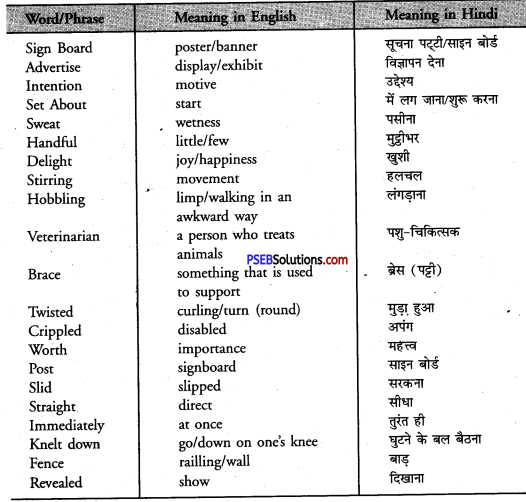
sign board advertise intention set about
sweat handful delight stirring
hobbling veterinarian hip socket brace
twisted crippled worth cents

PSEB 8th Class English Solutions Chapter 6 Charge for Love

Vocabulary Expansion

Activity 2.

Write the meaning of the following phrasal verbs from their context in the given space.

PSEB 8th Class English Solutions Chapter 6 Charge for Love 1

Activity 3

Choose the correct option to answer the following questions.

Question 1.
What did the shop owner write on the sign board ?
(a) ‘Come and Buy Puppies’
(b) Free Puppies
(c) Looking For My Lost Puppy
(d) ‘Puppies for Sale’
Answer:
(d) ‘Puppies for Sale’.

Question 2.
What was the name of the mother of the puppies ?
(a) Holly
(b) Dolly
(c) Paula
(d) Peppy.
Answer:
(b) Dolly.

Question 3.
How many puppies were there to choose from?
(a) three
(b) five
(c) four
(d) one.
Answer:
(b) five.

PSEB 8th Class English Solutions Chapter 6 Charge for Love

Question 4.
Which puppy did the boy pick ?
(a) the one with black and white spots
(b) the one with a limp
(c) the one with shaky eyes
(d) the one with big ears.
Answer:
(b) the one with a limp.

Question 5.
Why did the boy pick the puppy with a limp ?
(a) He could empathize with its condition.
(b) The shop owner said he’d give it for free.
(c) He thought it was very cute.
(d) The puppy showed him more affection.
Answer:
(d) The puppy showed him more affection.

PSEB 8th Class English Solutions Chapter 6 Charge for Love

Question 6.
Why did the shop owner want the boy to take the puppy for free?
(a) He felt that he should not put a price on love.
(b) He felt that the boy was too small to pay.
(c) The puppy would be a burden on him due to its limp.
(d) He thought that he would have to spend a lot of money on its regular treatment.
Answer:
(d) He felt that he should not put a price on love.

Activity 4.

Answer the following questions.

Question 1.
Who approached the owner of the shop ?
दुकान मालिक के पास कौन गया ?
Answer:
A little boy approached the owner of the shop.

Question 2.
What was the owner charging for healthy puppies ?
दुकान मालिक स्वस्थ पिल्लों का कितना मूल्य ले रहा था ?
Answer:
For healthy puppies the owner was charging from $ 30 to $.50 dollars.

Question 3.
How much money did the boy have ?
लड़के के पास कितने पैसे थे ?
Answer:
The boy had 2.37 dollars.

Question 4.
What problem did the lame puppy have ?
लंगड़े पिल्ले को क्या समस्या थी ?
Answer:
The lame puppy could neither run nor play.

PSEB 8th Class English Solutions Chapter 6 Charge for Love

Question 5.
Which puppy was chosen by the little boy and why?
लड़के ने कौन-सा पिल्ला चुना और क्यों ?
Answer:
The boy chose crippled puppy because it showed him more affection.

Question 6.
Why did the shop owner agree to give the puppy for free?
दुकान मालिक पिल्ला मुफ्त में देने को क्यों तैयार हो गया ?
Answer:
He agreed to this because there is no charge for love.

Activity 5.

Put a tick (✓) or a cross (✗) against each sentence.

1. The shop owner wanted to sell kittens. ( )
2. The shop owner wanted to sell puppies. ( )
3. The boy was an athlete and needed a pet to exercise with. ( )
4. One of the puppies was blind. ( )
5. The boy had enough money to buy four pets. ( )
6. The shop owner insisted that the boy might take the puppy for free. ( )
7. The boy had a crippled leg. ( )
8. The boy initially came looking for a horse. ( )
Answer:
1. ✗
2. ✓
3. ✗
4.✗
5. ✗
6. ✓
7. ✓
8. ✗

Comprehension Passage

Dengue is a viral disease. It spreads through the bite of an Aedes mosquito. This mosquito breeds in stagnant water kept in buckets, coolers, pots, etc. Therefore, we must empty all the buckets, coolers, pots so that the larvae of the Aedes mosquito is not able to breed around us. Also, when the mosquito bites a person suffering from dengue, the dengue virus enters the blood of that mosquito. After about one week, when this mosquito bites a healthy person, the dengue virus enters the blood of that person and infects him. The platelet count of that person goes very low. Other symptoms of dengue usually begin to show four to six days after infection. The symptoms last for up to ten days. The symptoms are :

  • sudden high fever
  • severe headache
  • pain behind the eyes
  • severe joint and muscle pain
  • fatigue
  • nausea
  • vomiting
  • skin rash which appears two to five days after the onset of fever
  • mild bleeding (such as nose bleeding, bleeding gums or easy bruising)

You should therefore rest, drink plenty of fluids and see your doctor regularly. The doctor can diagnose dengue infection with a blood test. The best way to prevent the disease is to prevent mosquito bites by wearing long sleeves clothes so that the infected mosquito is unable to bite.

Activity 6.

Answer the following questions on the basis of the above passage.

1. How does dengue spread ?
2. How can you prevent dengue ?
3. What are the symptoms of dengue ?
4. Choose the correct option:
(a) The symptoms of dengue last upto …………… days
(i) two to five
(ii) upto ten
(iii) upto eight
(iv) four to six.

(b) The symptoms of dengue are :
(i) high fever
(ii) severe headache
(iii) fatigue
(iv) all of these.
Answer:
1. Dengue spreads through the bite of Aedes mosquito.
2. We can prevent dengue by not allowing the Aedes mosquito to breed around us. We should also save ourselves.
3. The symptoms are :

  • sudden high fever
  • severe headache
  • pain behind the eyes
  • severe joint pain and muscle pain
  • fatigue
  • nausea
  • vomitting
  • skin rash which appears two to five days after the onset of fever.
  • mild bleeding (nose bleeding or gums bleeding).

PSEB 8th Class English Solutions Chapter 6 Charge for Love

4.
(a) (i) two to five.
(b) (iv) all of these.

Learning Language

Past Tense and Future Tense

In this chapter, we will continue with tenses. In the previous chapter, we did the Present tense. Now let’s look at Past tense and Future tense.

Past Tense

The Simple Past Tense or the Past Indefinite is used :

(a) to express that something was done or took place in the past time
Usually adverbs and adverb phrases like ‘yesterday’, ‘ago’, ‘last week’, “last month’, ‘last year’, etc. are associated with Simple Past Tense. For example :

  • I saw him yesterday.
  • He passed the exam last year.
  • She was born in 1990.
  • He died in 1992.

(b) to express a habitual action in the past, for example :

  • As a child I played cricket.
  • I was the captain of my team.

(c) to express an action actually going on at the past time stated, for example :

  • While they bathed (were bathing), we fished (were fishing).

Past Continuous Tense

It is used to indicate that the action was still going on in the past time referred to. For example :

  • When we reached there, she was singing.
  • When you arrived, they were having lunch.
  • She was cooking when the telephone rang.

Past Perfect:

Tenselt is used to denote an action which had been completed at some point in the past time before another action was commenced. For example :

  • The train had left when we reached the station.
  • The patient had died before the doctor arrived.
  • The sun had set before we reached home.

Past Perfect Continuous Tense

It is used to indicate that an action had continued for a certain time previous to the point of time named

  • We had been waiting for you for two hours when you came.
  • I had been writing for an hour when you came to see me.

Activity 7.

Fill in the blanks with the Simple Past Tense forms of the words given in the brackets :

Bahadur Singh smiled. He tossed his revolver in the air and …………….. (catch) it by the handle. He …………….. (take) a careful aim at an empty sardine can and ……………… (fire) another six shots. The bullets ……………. (go) through into the earth kicking up whiffs of dust. His Alsatian dog …………….. (begin) to bark with excitement. He ……………. (leap) up with a growl and ……………… (run) down the canal embankment. He …………… (sniff) at the tin and ………………. (take) it up in his mouth and ……..10…… (run) back with it and ……………… (lay) it at his master’s feet.
Answer:
1. caught 2. took, 3. fired, 4. went, 5. began, 6. leapt, 7. ran, 8. sniffed, 9. took, 10. ran, 11. laid.

PSEB 8th Class English Solutions Chapter 6 Charge for Love

Activity 8.

Fill in the blanks with the Simple Past, Past Continuous, Past Perfect forms of the verbs given in the brackets.

1. I ………….. an elephant on the way back home. (see)
2. Did he ……………… a letter to his father ? (write)
3. He ……………… to read when he was three. (learn)
4. When I saw him, he …………. a blue shirt. (wear)
5. ……………… they ……………… out yesterday ? (go)
6. The scooter …………….. a lot of money. (cost)
7. The First World War …………….. in 1919. (end)
8. When I met Aradhya, she ……………… at the bus stop. (wait)
9. Reema . ……….. first in the last test. (not stand)
10. Children ……………. away when they ……………. the policeman. (run, see)
11. The plane ………………. when we reached the airport. (leave )
12. Ramesh …………….. home when I phoned him. (return)
13. …………….. he ……………… his old car before he bought a new one ? (sell).
14. The children ……………… before I came home. (sleep).
15. The film had already begun when we ……………… the theatre. (reach)
16. The teacher … the book before the examination began. (finish)
17. The robber had run away before the police ………………. . (come)
18. Tom ……………… sleepy after having a good lunch. (feel)
19. I …………….. the message before you came. (receive)
20. He ………………. for India last year. (play)
Answer:
1. saw
2. was, writing
3. learnt
4. was wearing
5. Did, go
6. cost
7. ended
8. was waiting
9. did not stand
10. run, saw
11. had left
12. had returned
13. Had, sold
14. had slept
15. reached
16. had finished
17. came
18. felt
19. had received
20. played.

Future Tense

Simple Future Tense:

It denotes an action that is about to take place or an action that will take place in the future. For example :

  • I shall do it now. (at once, immediately)
  • We shall go there next week.
  • Vandana will come here at 6 o’clock.

Future Continuous Tense:

It denotes an action going on at some point in the future timė.
For example :

  • She will be singing then.
  • I shall be taking my examination tomorrow at this time.

Future Perfect Tense:

It denotes that an action will be completed at some point of time in the future. For example :

  • I shall have done my work before you come.
  • The play will have begun before you get to the theatre.
  • They will have spent all their money by then.

Future Perfect Continuous Tense:

It indicates that the action, whether finished or unfinished will have been in progress for sometime.
For example :

  • We shall have been playing for three hours when you come here.
  • Ashok will have been living in Japan for 10 years.

Activity 9

Put the verbs into the correct form (Simple Future).

Use ‘will. Ashu asked a fortune teller about her future. Here is what he told her :

1. You …………… (earn) a lot of money.
2. You ………………. (travel) around the world.
3. You ……………… (meet) lots of interesting people.
4. Everybody ……………… (adore) you.
5. You ….. (not / have) any problems.
6. Many people …………….. (serve) you.
7. They …………….. (anticipate) your wishes.
8. There ……………… (not / be) anything left to wish for.
9. Everything ……………… (be) perfect.
10. But all these things …………….. (happen) only if you marry me.
Answer:
1. will earn
2. will travel
3. will meet
4. will adore
5. will not have
6. will. serve
7. will anticipate
8. will be not
9. will be
10. will happen.

PSEB 8th Class English Solutions Chapter 6 Charge for Love

Activity 10.

Fill in the blanks using the correct form of the verb given in the brackets.

1. I was not feeling well. So I ……………. much. (not eat)
2. It was so cold at Almora, even water in the taps ……………… (freeze)
3. She assures me that she ………………. me in my work. (help).
4. We ……………… to Mumbai last week. (go)
5. I …………….. Bihar before the earthquake occurred. (leave)
6. He . …… home before the sun sets. (reach)
7. Dinesh ………………. if you invite him. (come)
8. At this time next Monday we ………….. your birthday. (celebrate)
9. When she visits school next month, I ………………. there for 10 years. (teach)
10. The inter school hockey tournament ……………. next Monday. (begin)
Answer:
1. will not eat
2. freeze
3. will help
4. went
5. had left
6. will have reached
7. will come
8. will be celebrating
9. will have been teaching
10. begins/will begin.

Learning to Listen

Activity 11.

You will listen to a voicemail message on your father’s mobile phone. Your father is in Delhi and has forgotten to take his mobile phone. He has another mobile phone with him. Make notes of what you hear. Expand the notes into a proper message that you will send him on his other mobile phone.

Main points of Voicemail Message Text Message
Mohan Kumar from Bell Digital
Some of our products in the market
Demon in your office
Call when back
Phone No…………….
Send your e-mail
New brochure prices will be sent

I wanted to give you some information about our new products. We would like to give a demonstration of our new products in your office. Could you please call me when you are back in the office ? My phone number is 0-6-0-8-6-5-2-7-8-2-0.

Also, can you please send me your e-mail ? I would send you the new brochure of our company and information about our prices. My e-mail address is Mohan, that’s M-O-H-AN dot K-U-M-A-R at B-E-L-L hyphen D-I-G-I-T-A-L- dot com.

Learning to Speak

Activity 12.

Look at the pictures of food given below. These foods are from different countries. Identify the food and the country it comes from and speak 5 sentences on any one of the foods.
PSEB 8th Class English Solutions Chapter 6 Charge for Love 2

(Teachers must help students to identify the country, if required.)

Learning to Write

Activity 13.

Write a paragraph about the little boy of the story ‘Charge for Love’ to describe his character. You may write about.
1. his love for animals
2. his confidence
3. physical description
4. sympathetic nature
5. his understanding of self-worth.

PSEB 8th Class English Solutions Chapter 6 Charge for Love

The little boy is a kind hearted child. He has sympathetic nature. He is affectionate and loves animals. He himself is crippled. So he is very sympathetic toward the crippled puppy. He knows that there are no charges for love. Still he promises to pay the full price of the little dog. He is not ready to take it free of cost. Learning to Use the Language

Activity 14:

Rewrite a part of the story you have read in the form of a short dialogue between the shop owner and the little boy.

Little boy Shop owner Little boy Shop owner Little boy Shop owner Little boy Shop owner Little boy Shop owner Little boy Shop owner Little boy Shop owner Little boy Shop owner Little boy

Little boy: Are you selling your puppies ?
Shop owner: Yes son, do you want to buy a puppy?
Little boy: Yes, very much ! How much are you selling them for ?
Shop onwer: From 30 to 50 dollars each.
Little boy: But I have only 2.37 dollars and have a look on them with that.
Shop owner: With pleasure.
Little boy: Please call them out.
Shop owner: Here is Dolly with her four puppies.
Little boy: What is that stressing in the dog house?
Shop owner: It is a little puppy.
Little boy: Why is it hobbling and limpinge
Shop owner: It has no hip socket. It will only limp. It would always be loved.
Little boy: I want that one.
Shop owner: Why child. It will never play with you…
Little boy: Then look here. I am too lame and crippled. I see affection in its eyes.
Shop owner: You can take it free of cost.
Little boy: I will not. I will pay the full amount what it is worth. I can’t lower it price.

Comprehension Of Passages

Read the following passage and answer the questions given below each :

(1) A shop onwer had some puppies he wanted to sell. He painted a sign board to advertise his intention of selling the pups that said : ‘Puppies For Sale’. He set about nailing in on the wall. Boards like this always haye a way to attracting young children. As he was driving the last nail into the post. A boy saw the board and started walking towards the shop. He approached the owner and asked. “How much are you going to sell the puppies for ?”

The shop owner looked down into the eyes of the little boy “Well !” said the shop owner, as he wiped the sweat off the back of his neck. “These puppies come from fine parents and cost a good deal of money. So I will charge anywhere from $30 to $50 for each puppy.”

1. What did the shop owner want to sell ?
दुकान का मालिक क्या बेचना चाहता था ?

2. Why were the puppies costly, according to the shop owner ?
दुकानदार के अनुसार पिल्ले महंगे क्यों थे ?

3. Choose true and false statements and write them in your answer-book :
(a) The shop owner did not attend the boy.
(b) The boy wanted to buy a pup.

4. Complete the following sentences according to the meaning of the passage :
(a) A boy saw the board and started walking …………..
(b) He set about nailing it ………………
Or
Match the words with their meaning :

(i) A good deal purpose
(ii) Intention clear
large

Answer.
1. The shop owner wanted to sell some puppies.
2. According to the shop owner, the puppies were costly because they were go the fine breed (नस्ल).
3.
(a) False
(b) True.
4.
(a) A boy saw the board and started walking towards the shop.
(b) He set about nailing it on the wall.
Or
(i) A good deal
(ii) Intention purpose

PSEB 8th Class English Solutions Chapter 6 Charge for Love

(2) The little boy pressed his face against the chain link fence. His eyes danced with delight. As the dogs made their way to the fence, the little boy noticed something else stirring inside the doghouse. Slowly, another little ball appeared; this one noticeably smaller.

Down the ramp it slid. Then in an awkward manner, the little pup began hobbling towards others, doing its best to catch up. Immediately the little boy singled out the hobbling and limping puppy and said, “What’s wrong with that little dog ?”

The shop owner explained that a veterinarian had examined the little puppy and discovered that it didn’t have a hip socket. It would always limp. It would always be lame.
“I want the one,” the little boy said, pointing the lame puppy.

The shop owner knelt down at the boy’s side and said, “Son, you want that puppy. It will never be able to run and play with you like these other dogs would. So if you really want him, I’ll just give it to you.”

1. What did the little boy notice inside the dog house?
लड़के ने कुत्ता-घर के अन्दर क्या बात नोटिस की ?

2. What was wrong with the little pup ?
छोटे पिल्ले को क्या समस्या थी ?

3. Choose true and false statements and write them in your answer book :
(a) The little pup slid down the ramp.
(b) The little boy wanted a healthy pup.

4. Complete the following sentences according to the meaning of the passage :
(a) Slowly and little ball ……
(b) The little boy’s eyes danced with.
Or
Match the words with their meaning :

(i) appeared found
(ii) discovered tested
emerged.

Answer:
1. The little boy noticed something stirring inside the dog-house.
2. The pup had to hip-socked. So it was lame and could not walk properly.
3.
(a) True
(b) False
4.
(a) Slowly another little ball appeared.
(b) The little boy’s eyes danced with delight.
Or
(i) appeared — emerged
(ii) discovered — found.

PSEB 8th Class English Solutions Chapter 6 Charge for Love

(3) With tears in his eyes, the shop owner reached down and picked up the little pup. Holding it carefully he handed it on the little boy.
“How much ?” said the little boy.
“No charge, as I said earlier,” answered the shop owner. “These can be no charge for love.”
The little boy got quite upset. He looked straight into the store owner’s eyes, and pointing his finger at him and said, “You are right. There is no charge for love but I cannot lower its wroth by taking it without charge as if it was less than other puppies because it may not run as fast as them. This little dog is worth every bit as much as all the other dogs. I don’t want you to give him to me free of cost. I’ll pay the full price. I’ll give you $2.37 now and 50 cents a month until I have paid in full.”

1. Why did the shop owner want to charge nothing for the little pup ?
दुकानदार छोटे पिल्ले का कुछ भी मूल्य क्यों नहीं लेना चाहता था ?

2. Did the boy buy the pup free of cost ?
क्या लड़के ने पिल्ला मुफ्त में खरीदा ?

3. Choose true and false statements and write them in your answer-book :
(a) They did not want to lower the worth of the pup.
(b) The boy paid $ 50 for the little pup.

4. Complete the following sentences according to the meaning of the passage :
(a) The shop owner reached down and ….
(b) The little boy got ………..
Or
Write the meanings of the following words in English : (Any two)
Revealed, Twisted, Straight.
Answer:
1. He said that there is no charge for love.
The boys wanted to buy that pup out of love.
2. No, he promised to pay its full price.
3.
(a) True
(b) False.
4.
(a) The shop owner reached down and picked up the little pup.
(b) The little boy got quite upset.
Or
revealed – showed, twisted – bent, straight – directly.

Use of words and phrases in sentences

1. Set about – (started) – He set about his work carefully.
2. Revealed – (came to light) – At last the truth was revealed.
3. Upset – (rejected) – He was upset when he lost his job.
4. Understand – (to know) – I don’t understand what you want.
5. Handful – (in a less quantity) – Please give me a handful of sugar.
6. Crippled – (disabled) – Many people became crippled in the war.
7. Wiped – (cleared) – He wiped dirt off his body.
8. Worth – (value) – What is this beautiful picture worth.
9. Stirring – (movement – I can see some stirring in the tree.
10. Delight – (joy) – Helping the needy gives me delight.

Word Meanings

PSEB 8th Class English Solutions Chapter 6 Charge for Love 3

Charge for Love Summary in Hindi

A shop owner……….. looked.” he said.
एक दुकानदार के पास कुछ पिल्ले (कुत्ते के बच्चे) थे। वह उन्हें बेचना चाहता था। उसने पिल्लों को बेचने की अपनी इच्छा जाहिर करने के लिए एक साइन बोर्ड बनाया। इसमें लिखा था ‘बिक्री के लिए पिल्ले’। वह इसे दीवार पर कीलों द्वारा लगाने के लिए चल पड़ा। इस प्रकार के बोर्ड सदा छोटे बच्चों को आकर्षित करते हैं। जैसे ही वह

विज्ञापन पर आखिरी कील गाढ़ रहा था, एक बच्चे ने बोर्ड को देखा और दुकान की ओर चल पड़ा। वह मालिक के पास पहुंचा और पूछा, “आप पिल्लों को कितने में बेचना चाहते हैं।” . दुकान के मालिक ने नीचे झुक कर छोटे बच्चे की आंखों में देखा। उसने अपनी गर्दन के पीछे से पसीना पोंछते हुए कहा, “तो सुनो! ये पिल्ले अच्छी नस्ल के हैं और ये काफी कीमती हैं।

इसलिए मैं प्रत्येक का लगभग 30 से 50 डालर के बीच मूल्य लूंगा। बच्चे ने एक क्षण के लिए अपना सिर नीचे कर लिया। तब उसने अपने जेब में नीचे तक हाथ डाला और मुट्ठी भर खुले पैसे निकाल कर दुकान मालिक को आगे बढ़ा दिए। वह बोला, “मेरे पास 2.37 डालर हैं। क्या ये उन्हें देखने भर के लिए काफी हैं ?”

“Sure, said the shop owner …………. that little dog” ?

दुकान मालिक ने कहा, “निस्संदेह ! उसने एक सीटी बजाई। उसने आवाज़ लगाई डॉली यहां आओ।” डॉली कुत्ता-घर से निकली और ढलान पर दौड़ते हुए आगे आई। उसके पीछे-पीछे चार छोटे-छोटे फर वाले गोले आए। – छोटे बच्चे ने अपना चेहरा चेन वाली बाड़ से दबा लिया। उसकी आंखों में खुशी छा गई। जैसे ही कुत्ते बाड़ की ओर चले, छोटे बच्चे का ध्यान-कुत्ता घर में होने वाली कुछ और हलचल पर गया।

धीरे-धीरे एक और छोटा गोला दिखाई दिया, यह काफ़ी छोटा था।वह ढलान पर सरकने लगा। फिर एक अजीब तरीके से वह छोटा पिल्ला लंगड़ाकर अपनी पूरी कोशिश के साथ दूसरों के साथ मिल जाने के लिए चल पड़ा।तुरंत ही छोटे बच्चे ने लंगड़ाते हुए और लड़खड़ाते पिल्ले को चुन लिया और कहा, “उस छोटे कुत्ते को क्या हुआ है ?”

The shop owner ………… a big metal brace.

दुकान मालिक ने विस्तार से बताया कि एक पशु-चिकित्सक ने छोटे पिल्ले की जांच की थी। उसे पता चला कि उसकी हिप सॉकेट नहीं है। यह सदा लंगड़ा कर चलेगा। यह सदा लंगड़ा रहेगा। छोटे बच्चे ने लंगड़े पिल्ले की ओर इशारा करते हुए कहा, “मुझे वही-चाहिए।” दुकान मालिक बच्चे की ओर झुका और बोला, “बेटे, तुम्हें वह पिल्ला चाहिए। यह कभी भी तुम्हारे साथ भाग और खेल नहीं सकेगा जैसा कि ये दूसरे कुत्ते कर सकेंगे। इसलिए यदि तुम्हें सच में यही चाहिए तो मैं तुम्हें ऐसे ही दे दूंगा।”

इसके साथ ही वह छोटा बच्चा बाड़ से पीछे हटा, नीचे आया और अपनी एक टांग की पतलून को ऊपर की ओर मोड़ने लगा। यह करते हुए उसने दिखाया कि उसकी टांग के दोनों ओर स्टील-ब्रेसं (पट्टी) को विशेष रूप से बनाए गए जूते से जोड़ा गया था। उस समय उसकी हैरानी और भी बढ़ गई जब छोटा बच्चा अपनी दूसरी टांग की पतलून को ऊपर मोड़ने लगा। वह अपनी बुरी तरह से मुड़ चुकी अपंग बाईं टांग जो कि एक बड़ी मेटल ब्रेस की मदद से जुड़ी हुई थी, दिखाना चाहता था।

Looking up at ……………… paid in full.”

दुकान मालिक को देखते हुए उसने कहा, “आपने देखा श्रीमान, मैं स्वयं ठीक ढंग से भाग नहीं सकता और इस असहाय छोटे पिल्ले को भी कोई चाहिए होगा जो उसे समझ सके।” दुकान मालिक की आंखों में आंसू आ गए, वह नीचे आया और उसने छोटे पिल्ले को उठाया। उसने उसे छोटे बच्चे को पकड़ाते हुए कहा, ध्यानपूर्वक पकड़ना। छोटे बच्चे ने कहा, “कितने?” दुकान मालिक ने उत्तर दिया, “जैसा कि मैंने पहले कहा था कोई मोल नहीं। प्यार का कोई मोल नहीं।”

PSEB 8th Class English Solutions Chapter 6 Charge for Love

छोटा बच्चा परेशान हो उठा। उसने सीधा स्टोर मालिक की आंखों में देखा और उसकी ओर अंगुली करके कहा, “आप ठीक कह रहे हैं। प्यार का कोई मोल नहीं होता। परन्तु मैं इसको बिना मोल के लेकर इसका महत्त्व कम नहीं करना चाहता क्योंकि यह दूसरे पिल्लों के जैसे तेज़ नहीं भाग सकता। इस छोटे कुत्ते का उतना ही महत्त्व है जितना अन्य सभी कुत्तों का है। मैं नहीं चाहता कि आप इसे मुझे बिना मूल्य के दे दो। मैं इसका पूरा मूल्य दूंगा। मैं 2.37 डालर आपको अभी दूंगा और 50 सेंट हर महीने दूंगा जब तक कि मैं इसका पूरा मूल्य न दे दूं।”

Retranslation from english to hindi

1. A shop owner wanted to sell some puppies. — दुकानदार कुछ पिल्ले बेचना चाहता था।
2. He set about nailing it on the wall. — वह इसे दीवार पर कीलों द्वारा लगाने के लिए चल पड़ा।
3. These puppies come from fine parents. — ये पिल्ले अच्छी नस्ल के हैं।
4. The boy dropped his head for a moment. — बच्चे ने एक क्षण भर के लिए अपना सिर नीचे कर लिया।
5. He pulled out a handful of change. — उसने मुट्ठी भर खुले पैसे निकाले।
6. Is that enough to take a look ? — क्या ये उन्हें देखने भर के लिए काफी हैं ?
7. He let out a whistle. — उसने सीटी बजाई।
8. His eyes danced with delight. — उसकी आंखों में खुशी छा गई।
9. The little boy noticed something else stirring inside the doghouse. — छोटे बच्चे का ध्यान कुत्ता-घर में होने वाली किसी अन्य हलचल पर गया।
10. Down the ramp it slid. — वह ढलान पर सरकने लगा।
11. It didn’t have a hip socket. — उसकी हिप सॉकेट नहीं है।
12. It would always be lame. — यह सदा लंगड़ा कर चलेगा।
13. It will never be able to run and play with you — यह कभी भी तुम्हारे साथ भाग और खेल नहीं सकेगा।
14. The little boy got quite upset. — छोटा बच्चा परेशान हो उठा।
15. I don’t want you to give him to me free of cost.– मैं नहीं चाहता कि आप इसे मुझे बिना मूल्य के दे दो।

English Guide for Class 8 PSEB Prose
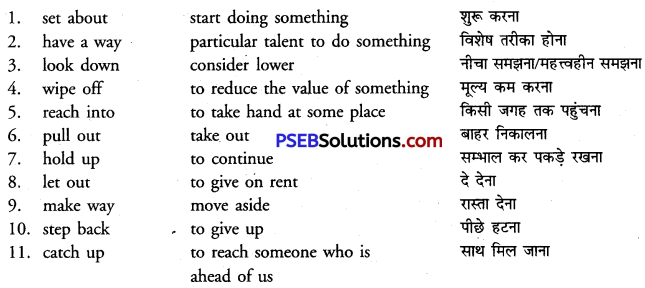
Wishes Come True Question Answer Class 9 English Literature Book Chapter 2 PSEB Solutions

Punjab State Board PSEB 9th Class English Book Solutions English Literature Book Solutions Chapter 2 Wishes Come True Textbook Exercise Questions and Answers.

Class 9th English Literature Book Solutions Chapter 2 Wishes Come True Question Answers

Wishes Come True Class 9 Questions and Answers

Question 1.
Why did Sushilchandra’s neighbours get angry with him ?
(सुशीलचन्द्र के पड़ोसी उससे नाराज़ क्यों होते थे ?)
Answer:
Sushil was not so well-behaved. He would keep playing pranks. It irritated his neighbours.
सुशील व्यवहार से इतना अच्छा नहीं था। वह नटखट शरारतें करता रहता। इससे उसके पड़ोसी चिढ जाते।

Question 2.
Why did Sushil not want to go to school one Saturday ? What happened then ?
(एक शनिवार को सुशील स्कूल क्यों नहीं जाना चाहता था ? तब क्या हुआ ?)
Answer:
There was going to be a geography test at school. Sushil wanted to escape the test. He wanted to spend the day at the Boses’ where they were preparing to have fireworks in the evening. Sushil made a pretence that he had a tummyache. The father understood Sushil’s trick. He gave him a bitter mixture of medicine to drink. Then he locked him in a room.

स्कूल में भूगोल का एक टेस्ट होना था। सुशील इस टेस्ट से बचना चाहता था। वह पूरा दिन बोस परिवार के घर पर बिताना चाहता था जहां वे सायं को आतिशबाजी करने की तैयारियां कर रहे थे। सुशील ने बहाना किया कि उसके पेट में दर्द था। पिता सुशील की चालाकी समझ गया। उसने उसे पीने के लिए दवाई का एक कड़वा घोल दिया। फिर उसने उसे एक कमरे में ताला लगाकर बन्द कर दिया।

PSEB 9th Class English Literature Book Solutions Chapter 2 Wishes Come True

Question 3.
Why did the Lady of Wishes grant wishes to both the father and the son ?
(देवी कामनापूर्णा ने पिता और पुत्र दोनों की इच्छाओं को पूरा क्यों कर दिया ?)
Answer:
Both the father and the son felt unhappy in their present states. The father wished he were a child again. The son wished he were as old as his father. The Lady of Wishes granted their wishes. She wanted to see what would happen if they got their wishes.

पिता तथा पुत्र दोनों अपनी वर्तमान स्थितियों में स्वयं को अप्रसन्न महसूस करते थे। पिता चाहता था कि वह फिर से एक बच्चा बन जाए। पुत्र चाहता था कि काश उसकी आयु उसके पिता जितनी होती। देवी कामनापूर्णा ने उनकी इच्छाएं पूरी कर दीं। वह देखना चाहती थी कि तब क्या होगा यदि उनकी इच्छाएं पूरी हो जाएं।

Question 4.
What changes took place in Sushil ?
(सुशील में क्या-क्या तबदीलियां आ गईं ?)
Answer:
Sushil had grown up overnight. His clothes had burst at the seams. His face was covered with grey stubbles of beard. He had become bald also. He did not feel like getting up from his bed. He yawned again and again.

सुशील रातों-रात बड़ा हो गया था। उसके वस्त्र सिलाई वाली जगहों से फट आए थे। उसका चेहरा दाढ़ी के सफेद खूटों से भरा हुआ था। वह गंजा भी हो गया था। उसका मन अपने बिस्तर से उठने को नहीं करता था। वह बार-बार जंभाइयां ले रहा था।

Question 5.
What happened to Subalchandra after his wish was granted ?
(सुबलचन्द्र का उसकी इच्छा पूरी होने के बाद क्या हुआ ?)
Answer:
Subal had now become very small. He had got back all his teeth. His beard and moustache were gone. His clothes were now too big for his small body.

सुबल अब बहुत छोटा हो गया था। उसे अपने सब दाँत फिर से प्राप्त हो गए थे। उसकी दाढ़ी और मूंछे जाती रहीं थीं। उसके वस्त्र अब उसके छोटे से शरीर के हिसाब से बहुत बड़े हो गए थे।

PSEB 9th Class English Literature Book Solutions Chapter 2 Wishes Come True

Question 6.
Why was Subal kept busy in the evening?
(सुबल को सायंकाल के समय व्यस्त क्यों रखा जाता था ?)
Answer:
A group of old men used to gather in Sushil’s room to play chess. Subal was kept busy so that he could not come and disturb the elders in their game of chess. Sushil hired a tutor to keep Subal quiet at that time. The tutor kept Subal busy till ten at night.

बूढ़े आदमियों की एक टोली शतरंज खेलने के लिए सुशील के कमरे में इकट्ठी हुआ करती थी। सुबल को व्यस्त रखा जाता था ताकि वह बड़ों को उनके शतरंज के खेल में आकर तंग न करे। सुशील ने उस समय पर सुबल को खामोश बनाए रखने के लिए एक अध्यापक रख दिया। अध्यापक सुबल को रात के दस बजे तक व्यस्त रखता था।

Question 7.
Was Subalchandra happy with the change ? Why?
(क्या सुबलचन्द्र उस तबदीली से प्रसन्न था ? क्यों ?)
Answer:
Subal was not at all happy with the change. He used to imagine that if he were a child again, he would spend all his time in studying. But now he hated going to school. Sometimes he would imagine he was as old as before. He would join old men playing cards or chess. They would then box his ears and say, “Run away and play.”

सुबल तबदीली से तनिक भी खुश नहीं था। वह प्रायः यह कल्पना किया करता था कि अगर वह दोबारा बच्चा बन जाता तो वह अपना सारा समय पढ़ने में लगाता। परन्तु अब वह स्कूल जाने से भी घृणा करता था। कई बार वह कल्पना करने लगता कि वह पहले जितना ही बड़ा था। वह बड़े आदमियों में जाकर शामिल हो जाता जो ताश या शतरंज खेल रहे होते थे। तब वे उसके कानों पर एक तमाचा जड़ देते और कहते, “भाग जाओ और जाकर खेलो।”

Question 8.
What happened when the Lady of Wishes changed them once more ?
(तब क्या हुआ जब देवी कामनापूर्णा ने उन्हें एक बार फिर से बदल दिया ?)
Answer:
Both the father and the son started behaving as they always did. The father started bossing over the child, and the child started making excuses. Subal said to Sushil, “Aren’t you going to start learning your grammar ?” Sushil replied, “Father, I’ve lost my book.”

पिता और पुत्र दोनों ने वैसा ही व्यवहार करना शुरू कर दिया जैसा वे सदा किया करते थे। पिता ने बच्चे पर अधिकार जमाना शुरू कर दिया, तथा बच्चे ने बहाने बनाने शुरू कर दिए। सुबल ने सुशील से कहा, “क्या तुम अपनी व्याकरण सीखना शुरू नहीं कर रहे हो ?” सुशील ने उत्तर दिया, “पिता जी, मेरी पुस्तक खो गई है।”

Objective Type Questions

Answer the following in one word / phrase / sentence :

Question 1.
Who has written the story, ‘Wishes Come True’?
Answer:
Rabindranath Tagore.

Question 2.
How were Subhalchandra and Sushilchandra related to each other?
Answer:
They were father and son.

Question 3.
What problem did the old father suffer from ?
Answer:
The painful joints.

Question 4.
What was Sushil given to drink by his father?
Answer:
A bitter mixture of medicine.

PSEB 9th Class English Literature Book Solutions Chapter 2 Wishes Come True

Question 5.
Who happened to pass the house ?
Answer:
The Lady of Wishes.

Question 6.
What transformation took place in Sushil ?
Answer:
He turned into the age of his father.

Question 7.
What change took place in Subhalchandra ?
Answer:
He turned into the age of his son.

Question 8.
Why did the people laugh at the old man ?
Answer:
To see the old man doing childish pranks.

Question 9.
Was Subhalchandra happy with the change ?
Answer:
Not at all.

Question 10.
What pray did the father and the son make to the Lady of Wishes at last ?
Answer:
To turn them back into what they were before.

Complete the following :

1. The boy was always ………………. his neighbours.
2. Subhalchandra locked the boy in a ………
3. Sushil wished he were as …………………. as his father.
4. Sushil found that he had ……………… very big overnight.
5. Sometimes old Sushil would put a ………………… in his mouth.
6. There was going to be a ……………… test at school.
Answer:
1. annoying
2. room
3. old
4. grown
5. paan
6. geography.

Write True or False against each statement :

1. Sushil was a well-behaved boy.
2. Sushil made a pretence that he had a tummy-ache.
3. Both the father“and the son felt sad in their present states.
4. There was going to be a mathematics test at school.
5. A group of old men gathered in Sushil’s room to play at cards.
6. Subal was not at all happy with the change.
Answer:
1. False
2. True
3. True
4. False
5. False
6. True.

Choose the correct option for each of the following :

Question 1.
What excuse did Sushil make for not going to school ?
(a) Tummy-ache.
(b) Severe cold.
(c) High fever.
(d) Severe headache.
Answer:
(a) Tummy-ache.

Question 2.
The boy kept crying ………..
(a) for two hours
(b) for half of the day
(c) for three hours
(d) all the day.
Answer:
(d) all the day.

Question 3.
Sushil came back to his mat in …….
(a) the room
(b) the lawn
(c) the porch
(d) the evening.
Answer:
(c) the porch

PSEB 9th Class English Literature Book Solutions Chapter 2 Wishes Come True

Question 4.
Subhalchandra asked Sushil if he was not going to start learning
(a) driving
(b) grammar
(c) gardening
(d) spoken English.
Answer:
(b) grammar

Wishes Come True Summary in English

Wishes Come True Introduction:

No man is satisfied with his own position in life. Each one always thinks that others are far happier than he is. The poor think that the rich are happy. The rich think that there is no happiness in being rich. Children think that elders enjoy their life.

Elders long to regain their childhood. Tagore illustrates this fact through an interesting story. Subal and Sushil are father and son. The old father wishes that he were a child again. His little son, Sushil, wishes that he were the age of his father. He thinks that then he would be free to do or eat anything he liked. The Lady of Wishes grants them their wishes.

Now the son has the age of his old father. And the father becomes the age of his son. But instead of being happy, both of them find that they were far better in their old states. They request the Lady of Wishes to turn them back into what they were before. The Lady grants them their wishes. But strangely, even now they behave in the same manner. They behave as if they were not satisfied with what they are.

Wishes Come True Summary in English

Subalchandra and Sushilchandra were father and son. Neither of them was what their name reflected. Subal was not strong, and Sushil was not so well- behaved. The boy was always annoying his neighbours. The old father suffered from painful joints. But he had to keep running after his naughty son.

PSEB 9th Class English Literature Book Solutions Chapter 2 Wishes Come True 1

One Saturday, Sushil didn’t want to go to school. He said that he had a tummy-ache. The father understood the boy’s trick. He decided to teach him a lesson. He gave him a bitter mixture of medicine to drink. Then he locked him in a room and said that he should rest all day. Now the boy said that he would go to school. But the father said that he must rest there.

The boy kept crying the whole day. He wished that he were as old as his father. Then he could do just as he liked. He could come home any time he liked, and eat whatever he wanted to. On the other hand, his father sat thinking outside. He thought about the days of his childhood. He remembered how he had wasted his time and not studied properly in his childhood. He said, “If I get back my childhood, I would study properly and waste no time at all.” His son inside was saying, “If only I were as old as my father!”

The Lady of Wishes happened to pass that house. She heard what the father and the son had said. She granted them their wishes. When they woke up the next morning, Subal was the age of his son, and Sushil was the age of his father.

Subal found that he had become very small. He had got back all his teeth. His beard and moustache were gone. His clothes were now too big for his little body. Sushil found that he had grown very big overnight. His clothes had burst at the seams. His face was covered with beard stubbles and he had become bald also. Thus the wishes of both the father and the son had come true.

But this only added to their troubles. Sushil had always imagined that if he was as old as his father,’ he would be free to do anything. He would climb trees, dive into the pool, eat green mangoes, steal eggs from birds’ nests and roam all day long. But very strangely, that morning he didn’t want to climb any tree. He didn’t want to swim also. He thought that he would catch cold and have fever. He rolled out a mat and sat there quietly.

But once he did think of climbing a mango tree. He caught hold of a thin branch and tried to push himself up. The branch broke under his weight and he fell down. People · laughed to see the old man doing childish pranks. Sushil came back to his mat in the porch. He sent a boy to get him a rupee’s worth of toffees. But then he said to himself, “I’ll give these to my child-father.” But then he decided at once, “No, they’ll make the boy sick.” On that evening, his friends came to play with him. But they all ran away when they saw the old man.

PSEB 9th Class English Literature Book Solutions Chapter 2 Wishes Come True

Subal had always thought that if he got back his childhood, he would shut himself in his room and study all day. But now after getting his childhood, he didn’t like going to school. He would often complain of tummy-aches. Sushil had to send his little father to school by force. On returning home from school, Subal would like to run about and play.

But Sushil would put on his glasses and make him do sums of arithmetic. In the evening, old men gathered in Sushil’s room to play chess. To keep Subal quiet at that time, Sushil got for him a tutor who kept Subal busy till ten at night. Old Sushil, too, got into all kinds of troubles. Nothing he had liked as a child, agreed with him now. Whenever he got a dip in the pond, his joints would grow stiff and give him a lot of pain. Sometimes he would put a paan in his mouth. But then he would realize that he had no teeth to chew it with. Sometimes he would pick up a comb, but then he remembered that he had no hair left on his head.

At last, both the father and the son prayed to the Lady of Wishes, “Mother, we have had enough. Please turn us back into what we were before.” The Lady granted their wishes and disappeared.

The next morning, Subal was as old as before, and Sushil was again a little boy. Subal called his son and said, “Sushil, aren’t you going to start learning your grammar ?” Sushil scratched his head and said, “Father, I’ve lost my book.”

Wishes Come True Summary in Hindi

Wishes Come True Introduction:

कहानी का संक्षिप्त परिचय . कोई भी व्यक्ति जीवन में अपनी स्थिति से सन्तुष्ट नहीं होता है। प्रत्येक आदमी यही समझता है कि दूसरे उसकी अपेक्षा कहीं अधिक प्रसन्न हैं। ग़रीब लोग समझते हैं कि धनी लोग खुश रहते हैं। धनी लोग समझते हैं कि अमीर होने में कोई खुशी नहीं होती। बच्चे समझते हैं कि बड़े अपने जीवन का आनन्द लेते हैं।

बड़े अपने बचपन को फिर से प्राप्त करने की लालसा रखते हैं। टैगोर इस तथ्य को एक दिलचस्प कहानी के द्वारा समझाता है। सुबल तथा सुशील पिता और पुत्र हैं। बूढ़ा पिता कामना करता है कि वह फिर से बच्चा बन जाए। उसका छोटा-सा पुत्र सुशील कामना करता है कि काश वह अपने पिता की उम्र का होता। वह समझता है कि तब वह कुछ भी करने या खाने को स्वतंत्र होता। देवी कामनापूर्णा उनकी इच्छाओं को पूरा कर देती है। अब बेटा अपने बूढे पिता की उम्र का हो जाता है और पिता अपने पुत्र की आयु जितना हो जाता है।

PSEB 9th Class English Literature Book Solutions Chapter 2 Wishes Come True

किन्तु प्रसन्न होने की बजाए वे दोनों देखते हैं कि अपनी पुरानी स्थितियों में वे कहीं अधिक बेहतर थे। वे देवी कामनापूर्णा से प्रार्थना करते हैं कि वह उन्हें फिर से उनकी पुरानी स्थितियों में लौटा दे। देवी उनकी इच्छाएं पूर्ण कर देती है। किन्तु अब भी वे वैसा ही व्यवहार करते हैं। वे ऐसा व्यवहार करते हैं मानो वे अपने वर्तमान से प्रसन्न नहीं

Wishes Come True Summary in Hindi

सबलचन्द्र और सुशीलचन्द्र पिता और पुत्र थे। दोनों में से कोई भी अपने नाम के अनुरूप नहीं था। सबल शक्तिशाली नहीं था और सुशील इतने अच्छे व्यवहार वाला नहीं था। लड़का सदा अपने पड़ोसियों को तंग करता था। बूढ़े पिता को जोड़ों के दर्द की शिकायत थी। परन्तु उसे अपने शरारती बेटे के पीछे भागते रहना पड़ता था।

एक शनिवार, सुशील स्कूल नहीं जाना चाहता था। उसने कहा कि उसके पेट में दर्द था। पिता लड़के की चालाकी समझ गया। उसने उसे सबक सिखाने का निश्चय किया। उसने उसे पीने के लिए कड़वी दवाई दी। फिर उसने लड़के को ताला लगाकर एक कमरे में बन्द कर दिया और कहा कि पूरा दिन उसे आराम करना चाहिए। अब लड़के ने कहा कि वह स्कूल चला जाएगा। परन्तु पिता ने कहा कि उसे वहीं आराम करना चाहिए।

लड़का पूरा दिन चिल्लाता रहा। उसने इच्छा की कि काश वह अपने पिता जितनी आयु का होता। फिर वह जो चाहे कर सकता था। वह कभी भी घर आ सकता था, और जो चाहे खा सकता था। दूसरी तरफं उसका पिता बाहर बैठा सोच रहा था। वह अपने बचपन के दिनों के बारे में सोच रहा था। उसे याद आया कि किस प्रकार बचपन में उसने अपना समय बरबाद किया था और ठीक प्रकार से पढ़ाई नहीं की थी। उसने कहा, “यदि मुझे अपना बचपन फिर से प्राप्त हो जाए तो मैं ठीक ढंग से पढ़ाई करूंगा और कोई समय बरबाद नहीं करूंगा।” उसका पुत्र अन्दर बैठा कह रहा था, “काश मैं अपने पिता की आयु का होता !”

देवी कामनापूर्णा उस घर के पास से जा रही थी। उसने वह सुन लिया जो पिता और पुत्र ने कहा था। उसने उनकी इच्छाएं पूरी कर दी। अगली प्रातः जब वे उठे, सुबल अपने पुत्र की आयु का हो गया था, और सुशील अपने पिता की आयु का।

सबल ने देखा कि वह बहुत छोटा हो गया था। उसके दांत फिर से आ गए थे। उसकी दाढ़ी और मंछ जाती रही थीं। उसके छोटे-से शरीर के लिए उसके कपड़े बहुत बड़े हो गए थे। सुशील ने पाया कि रात भर में वह बहुत बड़ा हो गया था। उसके कपड़े सिलाइयों से उधड़ गए थे। उसका चेहरा दाढ़ी के खूटों से भर आया था और वह गंजा भी हो गया था। इस प्रकार पिता और पुत्र दोनों की इच्छाएं पूरी हो गईं । परन्तु इससे उनकी मुसीबतें ही बढ़ीं।

PSEB 9th Class English Literature Book Solutions Chapter 2 Wishes Come True

सुशील ने सदा ही यह कल्पना की थी यदि वह अपने पिता की आयु का हो जाए, तो वह कहीं भी जाने को स्वतन्त्र हो जाएगा। वह पेड़ों पर चढ़ेगा, तालाब में डुबकी लगाएगा, हरे आम खाएगा, पक्षियों के घोंसलों से अण्डे चुराएगा और सारा दिन इधर-उधर घूमा करेगा। परन्तु बड़ी विचित्र बात थी कि उस प्रातः वह किसी पेड़ पर चढ़ना नहीं चाहता था। वह तैरना भी नहीं चाहता था। उसने सोचा कि इससे उसे जुकाम और बुखार हो जाएगा। उसने एक चटाई खोली और चुपचाप वहां पर बैठ गया।

परन्तु एक बार उसने आम के पेड़ पर चढ़ने के बारे में अवश्य सोचा। उसने एक पतली-सी टहनी पकड़ी और उस पर चढ़ने का प्रयास किया। टहनी उसके भार से टूट गई और वह नीचे गिर गया। लोग एक बूढ़े आदमी को बच्चों जैसी हरकतें करते देख हंस पड़े। सुशील ड्योढ़ी में बिछी अपनी चटाई पर दुबारा आकर बैठ गया। उसने नौकर को एक रुपए की टॉफियां लाने भेजा। परन्तु फिर उसने स्वयम् से कहा, “इन्हें मैं अपने शिशु-पिता को दे दूंगा।” परन्तु तुरन्त उसने फिर निर्णय किया, “नहीं, इससे तो लड़का बीमार हो जाएगा।” उस शाम उसके मित्र उसके साथ खेलने के लिए आए। परन्तु वे सब एक बूढ़े आदमी को देख कर भाग गए।

सुबल ने सदा यह सोचा था कि यदि उसे अपना बचपन दुबारा मिल गया तो वह स्वयम् को कमरे में बन्द करके सारा दिन पढ़ा करेगा। परन्तु अब अपना बचपन वापस मिलने पर उसका स्कूल जाने को दिल नहीं करता था। वह अक्सर पेट-दर्द की शिकायत करता था। सशील को अपने नन्हें पिता को ज़बरदस्ती स्कूल भेजना पडता। स्कूल से घर वापस आने पर, सुबल इधर उधर भागना और खेलना पसन्द करता। परन्तु सुशील अपना चश्मा पहनता और उससे गणित के प्रश्न करवाता। शाम के समय बूढ़े आदमी सुशील के कमरे में शतरंज खेलने के लिए इकट्ठा हो जाते।

उस समय सुबल को व्यस्त रखने के लिए, सुशील ने एक मास्टर लगा दिया जो सुबल को रात के दस बजे तक व्यस्त रखता। बूढ़ा सुशील भी अनेक प्रकार के कष्टों से घिर गया। बचपन में जो चीजें उसे पसन्द आती थीं, अब उसे रास नहीं आती थीं। जब भी वह तालाब में डुबकी लगाता उसके जोड़ सख्त हो जाते और उनमें बहुत दर्द होता। कई बार वह अपने मुंह में पान डाल लेता। तब उसे याद आता कि उसे चबाने के लिए उसके मुंह में दांत ही नहीं हैं। कई बार वह कंघा उठा लेता, परन्तु फिर उसे याद आता कि उसके सिर पर कोई बाल नहीं बचे थे।

अन्त में दोनों, पिता और पुत्र, ने देवी कामनापूर्णा से प्रार्थना की, “मां, बहुत हो गया। कृपया हमें पहले जैसा बना दें।” देवी ने उनकी इच्छाएं पूरी कर दी और अदृश्य हो गई। अगली प्रातः, सुबल पहले जितना ही बूढ़ा था और सुशील फिर से एक छोटा लड़का था। सुबल ने अपने पुत्र को बुलाया और कहा, “सुशील क्या तुमने अभी व्याकरण सीखना शुरू नहीं किया है ?” सुशील ने अपना सिर खुजलाया और कहा, “पिता जी, मेरी पुस्तक खो गई है।”

Wishes Come True Translation in Hindi

(Page 8) कठिन शब्दार्थ-1. childhood—बचपन; 2. frail-कमज़ोर; 3. annoy-तंग करना; 4. pranksशरारतें; 5. rheumatic-गठिए या जोड़ों के दर्द से पीड़ित होना; 6. geography-भूगोल; 7. tummy-acheपेट-दर्द; 8. make up-बहाने बनाना; 9. in a fix-बुरी हालत होना, दुविधा में होना; 10. bowl-कटोरा; 11. swallow-निगलना।

अनुवाद-सुबलचन्द्र के पुत्र का नाम सुशीलचन्द्र था। किन्तु नाम से सदा किसी व्यक्ति का प्रतिबिम्ब प्राप्त नहीं होता है। सुबल का अर्थ होता है – शक्तिशाली, किन्तु वह बहुत दुबला-पतला था; सुशील इतने अच्छे व्यवहार वाला नहीं था, यद्यपि उसके नाम का बिल्कुल वही अर्थ होता है। लड़का अपनी शरारतों से सदा पड़ोसियों को परेशान करता रहता था, इसलिए उसे दण्ड देने के लिए पिता सदा उसके पीछे भागता रहता था। किन्तु पिता जोड़ों के दर्द से पीड़ित था, जबकि लड़का एक मृग की भांति भागा करता, इसलिए प्रहार सदा निशाने पर नहीं लगा करते थे।

शनिवार का दिन था, जब स्कूल दो बजे जल्दी ही बन्द हो जाता था, किन्तु सुशील को स्कूल जाना तनिक भी पसन्द नहीं था। इसके अनेक कारण थे। पहला, यह कि वहां भूगोल की परीक्षा होनी थी, तथा दूसरा यह कि वहां बोस परिवार के घर सायं को आतिशबाज़ी होनी. थी, जिसकी तैयारी उन्होंने प्रातः से ही करनी शुरू कर देनी थी। सुशील ने पूरा दिन वहीं बिताने की योजना बनाई हुई थी। इसलिए वह वापस बिस्तर पर जाकर लेट गया।

PSEB 9th Class English Literature Book Solutions Chapter 2 Wishes Come True

जब स्कूल जाने का समय आया, उसके पिता ने आकर पूछा, “क्या तकलीफ है ? तुम बिस्तर में क्यों लेटे हो ? क्या तुम स्कूल नहीं जा रहे हो ?” “मेरे पेट में दर्द है। मैं आज स्कूल नहीं जा सकता हूं,” सुशील ने कहा। सुबल आसानी से समझ सकता था कि लड़का झूठी कहानी बना रहा था। इसलिए उसने स्वयं से कहा, “तनिक रुको – मुझे उसे सबक सिखाना होगा।” तब ऊंचे स्वर में उसने कहा, “क्या पेट में दर्द है ? तो बेहतर होगा तुम पूरा दिन घर पर ही रहो। बोस परिवार के घर पर आतिशबाजी देखने के लिए हरि अकेला ही चला जाएगा।

और उन टाफियों में से कोई मत खाना जो मैं तुम्हारे लिए लेकर आया था। बस चुपचाप पड़े रहो जबकि मैं तुम्हारे लिए थोड़ी-सी वह कड़वी दवाई मिला कर लाता हूं।” उसने लड़के को ताला लगा कर अन्दर बन्द कर दिया, और उसे (दवाई को) तैयार करने के लिए चला गया। सुशील उलझन में पड़ गया। उसे टाफियां उतनी ही पसन्द थीं जितनी उसे कड़वी दवाई से घृणा थी। तथा वह बोस परिवार के घर भी जाना चाहता था। जब सुबल बाबू दवाई का बड़ा प्याला लेकर आया, तो सुशील बिस्तर से उठ खड़ा हुआ और बोला, “मेरे पेट में दर्द होना बन्द हो गया है। मैं समझता हूं कि मैं स्कूल चला ही जाऊँ।” “नहीं, नहीं,” पिता ने कहा, “केवल इसे पी लो और आराम करो।” उसने लड़के को दवाई गले से नीचे उतारने को मजबूर कर दिया, दरवाज़े को फिर से ताला लगा दिया और वहां से चला गया।

(Page 9) कठिन शब्दार्थ-1. pampered – बिगाड़ दिया; 2. leapt – उछला; 3. crack of the dawn-प्रातः बहुत जल्दी; 4. burst-फट गए; 5. seams-सिलाइयां; 6. stubble-छोटे-छोटे बाल; 7. bald—गंजा; 8. yawned – जम्हाई ली; 9. imagined – कल्पना की; 10. roam – इधर-उधर व्यर्थ घूमना; 11. scold – डांटना।

अनुवाद-सुशील पूरा दिन भर चिल्लाता रहा और सोचने लगा, “काश मेरी आयु मेरे पिता की आयु जितनी होती! तब मैं जैसा चाहता कर सकता था कोई भी मुझे ताला लगाकर बन्द नहीं कर सकता था।”
उसका पिता सोचता हुआ बाहर बैठा था, “मेरे माता-पिता मुझे बहुत लाड़-प्यार किया करते थे, इसी कारण से मैं उपयुक्त शिक्षा नहीं ले पाया था। काश मुझे मेरा बचपन वापस मिल जाए ! इस बार मैं ठीक ढंग से पढ़ाई करूंगा और समय बरबाद नहीं करूंगा।”

अब देवी कामनापूर्णा अचानक उस घर के पास से गुजर रही थी तथा उसे वह सुनाई दे गया जो पिता और पुत्र ने कहा था। “तो मैं कुछ समय के लिए उनकी इच्छाएं पूरी कर देती हूं और फिर देखती हूं कि क्या होता है !” इसलिए वह पिता के सामने प्रकट हुई और बोली, “तुम्हें वह मिल जाएगा जो तुम चाहते हो। कल तुम अपने पुत्र की आयु के हो जाओगे।” पुत्र से उसने कहा, “कल तुम्हारी आयु अपने पिता की आयु जितनी हो जाएगी।” वे दोनों ऐसा सुन कर प्रसन्न हो गए।

बूढ़ा सुबलचन्द्र रात को ठीक तरह से सो नहीं पाता था; लगभग प्रातः होने पर ही उसे नींद आती थी। किन्तु आज एक अजीब बात घटित हो गई; वह प्रभात फूटते ही उछल कर बिस्तर से बाहर आ गया। उसने देखा कि वह बहुत छोटा हो गया था। उसके सब दांत दोबारा निकल आए थे, और उसकी दाढ़ी तथा मूंछे जाती रही थीं। उसके वस्त्र अब उसके आकार के हिसाब से बहुत ही बड़े थे।

इसी बीच सुशीलचन्द्र आज उठ ही नहीं पाया था। जब आखिर वह अपने पिता के ऊंचा-ऊंचा चिल्लाने से जागा तो उसने देखा कि वह रातों-रात इतना बड़ा हो गया था कि उसके कपड़े सिलाई वाली जगहों पर फट आए थे। उसका चेहरा सफ़ेद दाढ़ी के खूटों से भर आया था, और वह गंजा भी हो गया था। उसका उठने को बिल्कुल भी दिल नहीं कर रहा था। वह बार-बार जंभाई ले रहा था। उसके पिता द्वारा किए जाने वाले शोर ने अन्ततः उसे जगाकर उठा ही दिया।

PSEB 9th Class English Literature Book Solutions Chapter 2 Wishes Come True

उनकी इच्छाएं सच्ची हो गईं थीं, किन्तु इससे उनकी केवल मुसीबतें ही बढ़ी थीं। सुशील ने सदा यही कल्पना की थी कि यदि वह बड़ा हो जाए और अपने पिता की तरह आज़ाद बन जाए तो वह पेड़ों पर चढ़ा करेगा, सरोवर में डुबकियां लगाया करेगा, हरे-हरे आम खाया करेगा, पक्षियों के घोंसलों में लूट-पाट किया करेगा, तथा पूरा दिन भर घूमा करेगा। वह घर आया करेगा तथा जो चाहे खाया करेगा, जब भी उसका मन किया करेगा, और उसे डांटने वाला कोई नहीं होगा। किन्तु कितना अजीब लगता है कि उस प्रातः वह किसी पेड़ पर चढ़ना नहीं चाहता था। वह तैरना भी नहीं चाहता था। उसने सोचा (कि ऐसा करने से) उसे जुकाम लग जाएगा और बुखार हो जाएगा। उसने एक चटाई खोली और इस पर बैठ गया, चुपचाप अपने मन में सोचता हुआ।

(Page 10-11)

कठिन शब्दार्थ-1. porch-ड्योढ़ी; 2. irritated—चिढ़ गया; 3. mischief-शरारत; 4. scratchखुजलाना; 5. sing-song-एक-सुरा गाना; 6. noisy-शोर-भरी।

अनुवाद-एक समय उसे विचार आया कि उसे सभी खेल एकदम नहीं छोड़ देने चाहिएं – उसे कम से कम खेलने की कोशिश तो करनी चाहिए। इसलिए वह उठ खड़ा हुआ और समीप ही एक आम के पेड़ पर चढ़ने की कोशिश की। ज्योंही उसने एक पतली-सी टहनी को पकड़ कर स्वयं को उस पर खींचने की कोशिश की, यह उसके बोझ की वजह से टूट गई और वह ज़मीन पर आ गिरा। समीप से गुजरने वाले लोग उस बूढ़े आदमी को बच्चों जैसी उछल-कूद करते हुए देख कर हंस दिए।

सिर को झुकाए हुए वह बरामदे में पड़ी अपनी चटाई पर वापस आ गया, नौकर को आवाज़ लगाई और बोला, “अरे लड़के, मुझे बाज़ार से एक रुपए की टॉफियां ला दो।” सुशील को हमेशा ही टॉफियों का शौक रहा था। प्रतिदिन स्कूल के नज़दीक वाली दुकान पर वह अनेक रंगों की टॉफियां देखा करता था, तथा कुछ खरीद लिया करता था जब उसे थोड़े पैसे दिए जाते थे। वह सदा स्वप्न लिया करता कि वह उनसे अपनी जेबें ठोंस लिया करेगा जब उसके पास ढेरों पैसे होंगे। आज उसके नौकर ने पूरे एक रुपए की टॉफियां उसे लाकर दी।

उसने एक टुकड़ा लिया और इसे खाने लगा; किन्तु बूढ़े आदमी ने बच्चों वाली उन मीठी चीज़ों की कोई परवाह न की। “मैं इन्हें अपने शिशु-पिता को दे दूंगा,” उसने सोचा, किन्तु फिर उसने तुरन्त अपना मन बना लिया, “नहीं, इससे लड़का बीमार पड़ जाएगा।”

सभी छोटे-छोटे लड़के जो कल तक सुशील के साथ कबड्डी खेला करते थे, प्रतिदिन की भान्ति आए, उन्होंने बूढ़े आदमी को देखा और भाग गए। सुशील सदा सोचा करता था कि वह सारा दिन अपने मित्रों के साथ कबड्डी खेला करता यदि वह अपने पिता की भांति आजाद होता; किन्तु अब उन्हें देखने से ही उसे चिढ़ मच जाती थी। “मैं आराम से बैठा हुआ हूं,” वह सोचा करता, “और मुझे परेशान करने के लिए ये लड़के आ गए हैं।”

सुबलचन्द्र को प्रतिदिन बरामदे में अपनी चटाई पर बैठने और सोचने की आदत. थी, “जब मैं बच्चा था तो मैं अपना समय शरारतों में बरबाद कर दिया करता था। यदि मुझे अपना बचपन वापस मिल जाए, तो मैं स्वयं को अपने कमरे में बन्द कर लूंगा, और चुपचाप पूरा दिन पढ़ता रहूंगा।” किन्तु अपना बचपन प्राप्त करने के बाद, उसे स्कूल जाना पसन्द नहीं था। सुशील उससे प्रातःकाल पूछता, “बाबा, क्या आप स्कूल नहीं जाओगे ?” सुबल अपना सिर खुजलाता, अपनी आंखें नीचे को करता और कहता, “मेरे पेट में दर्द है, मैं स्कूल नहीं जा सकता हूं।” इस पर सुशील को क्रोध आ गया, “ओह, तुम नहीं जा सकते ? मुझे भी अपने दिनों में पेट की बहुत दर्द हुआ करती थीं, जब मेरा स्कूल जाने का समय होता था। मैं तुम्हारी चालाकियां समझता हूं।”

PSEB 9th Class English Literature Book Solutions Chapter 2 Wishes Come True

सुशील ने अपने नन्हें पिता को ज़बरदस्ती स्कूल भेजना शुरू कर दिया। घर लौटने पर सुबल इधर-उधर भागता और खेलना चाहा करता, किन्तु उस समय बूढ़ा सुशील अपना चश्मा लगा कर ऊंचे-ऊंचे स्वर में रामायण का एकालाप करना चाहता। सुबल के शोर भरे खेल उसका ध्यान विकेन्द्रित कर देते, इसलिए वह सुबल को उसकी स्लेट देकर बिठा देता और उससे (गणित के) प्रश्न हल करवाता। वे इतने लम्बे-लम्बे प्रश्न होते कि उसका पिता, उनमें से एक को करने में ही पूरा घण्टा लगा देता। सायंकाल को बूढ़े आदमियों का एक टोला शतरंज खेलने के लिए सुशील के कमरे में इकट्ठा हो जाता। उस समय सुबल को खामोश बनाए रखने के लिए सुशील ने एक मास्टर लगा दिया जो सुबल को रात दस बजे तक व्यस्त रखता।

Class 9 English Literature Book PSEB Supplementary Reader

Three Great Indians Question Answer Class 9 English Main Course Book Chapter 6 PSEB Solutions

Punjab State Board PSEB 9th Class English Book Solutions English Main Course Book Chapter 6 Three Great Indians Textbook Exercise Questions and Answers.

Class 9th English Main Course Book Chapter 6 Three Great Indians Question Answers

Three Great Indians Class 9 Questions and Answers

Question 1.
What is the name given to the national uprising of 1857 ?
(1857 के राष्ट्रीय विद्रोह को क्या नाम दिया गया है ?)
Answer:
It is called the First War of Independence.
इसे स्वतन्त्रता की पहली लड़ाई कहा जाता है।

Question 2.
When and where was Laxmi Bai born ?
(लक्ष्मीबाई का जन्म कब और कहां हुआ ?)
Answer:
She was born on 16 November, 1834 in Varanasi.
उसका जन्म 16 नवम्बर, 1834 को वाराणसी में हुआ था।

PSEB 9th Class English Main Course Book Solutions Chapter 6 Three Great Indians

Question 3.
What was her childhood name ?
(उसका बचपन का नाम क्या था ?)
Answer:
Manikarnika or Manu. (मणिकर्णिका या मनु।)

Question 4.
Who was she married to ?
(उसका विवाह किस से हुआ ?)
Answer:
She was married to Raja Gangadhar Rao.
उसका विवाह राजा गंगाधर राव से हुआ।

Question 5.
What happened to her son and husband ?
(उसके पुत्र तथा पति को क्या हुआ ?)
Answer:
Both of them had died by 1853.
सन् 1853 तक उन दोनों की मृत्यु हो गई थी।

Question 6.
Where did she join her forces with Tantya Tope ?
(तात्या टोपे के साथ उसकी सेनाएँ कहां शामिल हुईं ?)
Answer:
At Kalpi.
(कल्पी में।)

Question 7.
How is Udham Singh’s name linked with Jallianwala Bagh?
(उधम सिंह का नाम जलियांवाला बाग़ से कैसे जुड़ा है ?)
Answer:
He was the man who took revenge for the killings of Jallianwala Bagh. He killed General O’Dwyer who had ordered the firing and killed thousands of innocent men, women and children.

वह वही आदमी था जिसने जलियांवाला बाग़ की हत्याओं का बदला लिया। उसने जनरल ओ’डायर को मार दिया जिसने गोली चलाने का आदेश दिया था और हज़ारों मासूम पुरुषों, स्त्रियों और बच्चों को मार दिया था।

PSEB 9th Class English Main Course Book Solutions Chapter 6 Three Great Indians

Question 8.
What was his pledge?
(उसकी शपथ क्या थी ?)
Answer:
His pledge was to avenge the massacre of Jallianwala Bagh.
उसकी शपथ थी – जलियांवाला बाग़ के नरसंहार का बदला लेना।

Question 9.
How did he take his revenge ?
(उसने अपना बदला कैसे लिया ?)
Answer:
He waited for 21 years. Then he went to England. There he shot General O’Dwyer dead in full view of a large gathering.
उसने 21 वर्ष तक प्रतीक्षा की। फिर वह इंग्लैंड गया। वहां उसने लोगों की एक भारी भीड़ के बिल्कुल सामने जनरल ओ’डायर को गोली मार कर मार दिया।

Write a short note on the each of the following:

Question 1.
Write a short note on the death of Rani Jhansi.
(रानी झांसी की मृत्यु पर एक संक्षिप्त नोट लिखिए।)
Answer:
The British forces had laid a siege on Jhansi. The Rani of Jhansi continued to fight from inside the fort. But, at last; she was forced to leave Jhansi. The British forces pursued her. She was defeated and surrounded from all sides. She was badly wounded. She died on the battlefield. It was 18 June 1858 when she died.

अंग्रेजी सेनाओं ने झांसी पर घेरा डाल रखा था। झांसी की रानी किले के अन्दर से लड़ती रही। किन्तु अन्त में वह झांसी छोड़ने को मजबूर हो गई। अंग्रेजी सेनाओं ने उसका पीछा किया। वह हार चुकी थी और चारों तरफ से घिरी हुई थी। वह बुरी तरह से घायल हो गई। वह युद्ध-क्षेत्र में मारी गई। यह 18 जून 1858 था जब उसकी मृत्यु हुई।

PSEB 9th Class English Main Course Book Solutions Chapter 6 Three Great Indians

Question 2.
Write a short note on the Jallianwala Bagh massacre.
(जलियांवाला बाग़ के नरसंहार पर एक संक्षिप्त नोट लिखिए।)
Answer:
It was the day of Baisakhi in 1919. A large number of people had gathered in Jallianwala Bagh. They were holding a peaceful meeting. The British General O’Dwyer ordered firing on them. Thousands of men, women and children were killed. Many jumped into a well to escape. They were suffocated to death. 1919

में बैसाखी का दिन था। भारी संख्या में लोग जलियांवाला बाग में एकत्रित हो रखे थे। वे एक शान्तिपूर्ण सभा कर रहे थे। अंग्रेज़ी जनरल ओ’डायर ने उन पर गोली चलाने का आदेश दे दिया। हज़ारों पुरुष, स्त्रियां तथा बच्चे मारे गए। बच पाने के लिए अनेकों ने एक कुएं में छलांग लगा दी। उनकी दम घुटने से मृत्यु हो गई।

Question 3.
Write a short note on the First War of Independence.
(स्वतन्त्रता के प्रथम संग्राम पर एक संक्षिप्त नोट लिखिए।)
Answer:
The First War of Independence was fought in 1857. The rulers of many Indian states rose up against the British. Tantya Tope and Laxmi Bai were the two most famous of them. Laxmi Bai was the Rani of Jhansi. The British forces had laid a siege on Jhansi. She was forced to leave Jhansi. The British forces surrounded her from all sides. She died on the battlefield. The other rulers were also defeated one by one. Thus, the First War of Independence was lost.

स्वतन्त्रता की पहली लड़ाई 1857 में लड़ी गई। अनेक भारतीय राज्यों के शासक अंग्रेजों के विरुद्ध खड़े हो गए। उनमें दो सबसे अधिक प्रसिद्ध थे – तात्या टोपे और लक्ष्मी बाई। लक्ष्मी बाई झांसी की रानी थी। अंग्रेजी सेनाओं ने झांसी को घेर रखा था। उसे झांसी छोड़ने पर मजबूर होना पड़ा। अंग्रेजी सेनाओं ने उसे सभी तरफ से घेर लिया। उसकी युद्ध-क्षेत्र में मृत्यु हो गई। अन्य शासक भी एक-एक करके हार गए। इस प्रकार स्वतन्त्रता का पहला संग्राम हारा गया।

Question 4.
Write a short note on the teachings of Sri Satguru Ram Singh Ji.
(श्री सतगुरू रामसिंह जी के उपदेशों पर एक संक्षिप्त नोट लिखिए।)
Answer:
Satguru Sri Ram Singh Ji preached his followers.
1. to believe in one God.
2. to lead a simple and honest life.
3. to be free from any kind of evil.
4. to help the poor and the needy.
5. to work for the freedom of the country.
6. to live like brothers.
7. to fight against such evils as child marriage, the dowry system, cow slaughter, non-vegetarianism, casteism and religious fanaticism.

श्री सतगुरू राम सिंह जी ने अपने अनुयायियों को उपदेश दिया कि वे
1. एक ईश्वर में विश्वास रखें।
2. सादा और ईमानदारी का जीवन बिताएं।
3. सभी तरह की बुराइयों से मुक्त रहें।
4. ग़रीबों और जरूरतमंदों की मदद करें।
5. देश की स्वतन्त्रता के लिए काम करें।
6. भाइयों की भान्ति रहें।
7. बाल-विवाह, दहेज प्रथा, गाय-वध, मांसाहारी होने, फिरकापरस्ती और धार्मिक कट्टरता के विरुद्ध लड़ें।

Textual Vocabulary & Grammar

Question 1.
Match the words in box A with their opposites given in box B :
Answer:
1. fresh → stale
2. entrance → exit
3. loyal → disloyal
4. bravery cowardice
5. barbarous → civilized
6. punish → reward
7. benevolence → malevolence
8. virtue → vice
9. refined → crude
10. optimist → pessimist
11. mortal → immortal.

Rewrite the following sentences by using one word for the underlined part of the sentence :

1. Your television set cannot be repaired.
2. The speaker addressed the assembly of listeners.
3. Holika had a device that could not be seen.
4. ‘My Experiments with Truth’ by Mahatma Gandhi is his life-story written by himself.
5. Satan said that he had a will that could not be conquered.
6. These windowpanes are such that will not allow the passage of light.
7. Usha is quite fond of entertaining guests.
Answer:
1. Your television set is irreparable.
2. The speaker addressed the audience.
3. Holika had an invisible device.
4. “My Experiments with Truth’ by Mahatma Gandhi is his autobiography.
5. Satan said that he had an inconquerable will.
6. These windowpanes are opaque.
7. Usha is quite hospitable.

PSEB 9th Class English Main Course Book Solutions Chapter 6 Three Great Indians

Fill in the blanks with suitable prepositions in the following sentences :

1. She was distressed at the break ……………… of her marriage.
2. The war broke …………….. at Kalpi.
3. The two countries broke …………….. their diplomatic relations.
4. We have been working since long; let us break ……………….. lunch.
5. The population growth has fallen ………………. five per cent.
6. Anju fell flat ……………….. her face …..
7. Romeo fell ………………. love with Juliet at first sight.
8. Write an essay on ‘The Rise and Fall …………….. the Mughal Empire’
9. Jhansi fell ……………….. the British.
10. He fell ……………… and wounded his leg.
Answer:
1. off 2. out 3. up 4. for 5. by 6. on 7. in 8. of 9. to 10. down.

Fill in the blanks with the articles a, an, the :

Rabindranath Tagore is the most famous man of letters. His literary production is vast and varied. He is a novelist as well as a playwright. He is an educationist as well as a freedom fighter. But above all, he is a poet. He is a great religious poet, one of the greatest that the world has ever produced. In 1913, he was awarded the Nobel Prize in Literature for his collection of poems entitled ‘Gitanjali.

Fill in the blanks with the appropriate comparaties or superlatives of the adjectives given in the brackets :

1. Prevention is ……………. than cure. (good) :
2. Pen is …………… than the sword. (mighty).
3. Honour is …………….. to all than life. (dear).
4. Wordsworth was the …………… nature poet. (great)
5. Bill Gates is the …………….. man of the world today. (rich)
6. It is …………….. to preach than to practise. (easy)
7. Gold is …………. than any other metal. (costly)
8. The condition of some of the roads is much …………….. than it was five years ago. (good)
Answer:
1. better
2. mightier
3. dearer
4. greatest
5. richest
6. easier
7. costlier
8. better.

Objective Type Questions

Answer the following in one word / phrase / sentence :

Question 1.
Who wrote the chapter, ‘Three Great Indians ?
Answer:
The author iş anonymous.

Question 2.
Give the names of the three great Indians who have been described in this chapter.
Answer:
They are :
(i) Sri Satguru Ram Singh Ji
(ii) Rani Laxmi Bai and
(iii) Sardar Udham Singh.

Question 3.
Who was Sri Satguru Ram Singh Ji ?
Answer:
A great patriot and a social reformer.

Question 4.
What did he ask his followers to do?
Answer:
He asked his followers to fight for the freedom of the country.

Question 5.
Who was Laxmi Bai ?
Answer:
The brave Rani of Jhansi.

Question 6.
What did Laxmi Bai sacrifice for the country?
Answer:
She died fighting against the British forces and thus sacrificed her life for the country.

Question 7.
Who was Udham Singh ?
Answer:
One of the greatest martyrs of Mother India.

Question 8.
Who had ordered firing on the people gathered in Jallianwala Bagh on the day of Baisakhi ?
Answer:
It was the British General O’Dwyer.

Question 9.
Why did Udham Singh go to England ?
Answer:
To kill the British General O’Dwyer, the villain of the Jallianwala Bagh Massacre.

Question 10.
When was Udham Singh hanged ?
Answer:
On 30 July 1940.

PSEB 9th Class English Main Course Book Solutions Chapter 6 Three Great Indians

Complete the following:

1. …………… declared Ram Singh a ‘guru’, a religious guide, in his childhood.
2. Satguru Ram Singh Ji’s first sermon was delivered ……..
3. ……………… became the most popular leader of the First War of Freedom (1857).
4. The Rani of Jhansi adopted ……………….. under the ‘Policy of Lapse’.
5. Rani joined her forces with …………………. at Kalpi.
6. Udham Singh was born at ………………… in
Answer:
1. Guru Balak Singh Ji
2. on the Baisakhi day in 1857
3. The Rani of Jhansi.
4. a son
5. Tantya Tope
6. Sunam, Sangrur district.

Write True or False against each statement :

1. Rani Lakshmi Bai was born in Varanasi.
2. Udham Singh killed General O’Dwyer in America.
3. The British forces under the leadership of O’Dwyer besieged Jhansi.
4. Rani Lakshmi Bai’s heroic battle against the British has become the subject of many folk songs and ballads.
5. The Punjabi word ‘Kuka’ stands for a “roar.
6. It was Udham Singh who introduced the concept of ‘Be Indian, buy Indian’.
Answer:
1. True
2. False
3. False
4. True
5. True
6. False.

Choose the correct option for each of the following:

Question 1.
Sri Bhaini Sahib is situated in ……….
(a) Ropar
(b) Chandigarh
(c) Amritsar
(d) Ludhiana.
Answer:
(d) Ludhiana.

Question 2.
Against the British policy of ‘Divide and Rule’, …………………. gave the slogan ‘Unite and Fighť.
(a) Sardar Udham Singh
(b) Satguru Ram Singh Ji
(c) Rani Laxmi Bai
(d) none of these three.
Answer:
(b) Satguru Ram Singh Ji

Question 3.
Rani Lakshmi Bai’s childhood name was ……
(a) Manikarnika
(b) Manikumari
(c) Maniratnam
(d) Maniratnika.
Answer:
(a) Manikarnika

Question 4.
Udham Singh waited for …………… to average the national insult of Jallianwala Bagh massacre.
(a) 21 years
(b) 27 years
(c) 29 years
(d) 23 years.
Answer:
(a) 21 years

Pronunciation Practice

Note the silent letters in the words listed below. Say these words aloud.
PSEB 9th Class English Main Course Book Solutions Chapter 6 Three Great Indians 1

Creative Writing and Extended Reading

Read the stories of any two of the following great Indians and write 10-12 lines on each.

  • Bal Gangadhar Tilak
  • Netaji Subhash Chandra Bose
  • Lala Lajpat Rai
  • Manga! Pandey
  • Veer Savarkar

2. Would you like to become a great man ? How can you achieve that aim? Discuss the subject in your class with the help of your teacher.

Use Of Textual Words / Phrases

1. Witnessed – I witnessed the whole incident from a distance.
2. Valiant – The valiant fighter fought to the last breath.
3. Shot in prominence – A young actor, who has recently risen, shot in prominence.
4. Exhort – He exhorted his followers to speak the truth.
5. Foeticide – The government has banned female foeticide.
6. Send to the gallows – Many freedom-fighters were sent to the gallows by the British rulers.
7. To be cowed down -Our freedom-fighters were not cowed down by the cruelties of the British.
8. Warrior – India has given birth to many valiant warriors.
9. Impact – Her speech made a great impact on everyone.
10. Ballad – He wrote several ballads in his lifetime.
11. Indomitable – He showed an indomitable courage in the battle field.
12. Appreciate – They appreciated my views.
13. Martial art – He is an expert in martial arts.
14. Annex – Kalinga was formally annexed to Ashoka’s territory after his victory.
15. Regiment – The Gorkha regiment took control of the town.
16. Rebel – He finally rebelled against his cruel father.
17. Representative – He is the sole representative of the company.
18. Pursue – The robbers were hotly pursued by the police.
19. Inflicted – The hunter inflicted many injuries on the tiger.
20. Inseparably – He is inseparably joined with this institute.
21. Revenge – His opponent was thirsting for revenge.
22. Massacre – The bloody massacre of innocent people was condemned by one and all.
23. Suffocate – Many passengers were suffocated inside the burning train.
24. Villain – The police have caught the villains.
25. Sentenced – The thief was sentenced to six months imprisonment.
26. Revolutionary – The revolutionary leaders were arrested by the forces.
27. Associated – Tea is traditionally associated with Darjeeling.
28. Pledged – He pledged to seek a revenge on the enemy.
29. Avenge – He avenged his father’s murder.
30. Point-blank range – He fired at him from a point-blank range.
31. Solidarity – The international solidarity should not be undermined at any cost.

PSEB 9th Class English Main Course Book Solutions Chapter 6 Three Great Indians

Three Great Indians Summary in English

Three Great Indians Introduction:

This chapter gives brief sketches of three great Indians. They are :

  • Sri Satguru Ram Singh Ji,
  • Rani Laxmi Bai and
  • Udham Singh.

Sri Satguru Ram Singh Ji was a great patriot and a social reformer. He fought against many social evils. He asked his followers to fight for the freedom of the country. Laxmi Bai was the brave Rani of Jhansi. She opposed the British rule. She died fighting against the British forces. Udham Singh was one of the greatest martyrs of Mother India. He went to England and killed the villain of the Jallianwala Bagh massacre. He was arrested and sentenced to death. But his name will live for ever.

Three Great Indians Summary in English:

Mother India gave birth to many great men and women in the 19th and 20th centuries. They fought not only against the prevailing social evils but also against the British rule. They included such great souls as Bal Gangadhar Tilak, Tantya Tope, Rani Laxmi Bai, Dadabhai Naoroji, Khudi Ram Bose, Sri Aurobindo, Lala Lajpat Rai, Pandit Jawahar Lal Nehru, Mahatma Gandhi and Bhagat Singh.

Sri Satguru Ram Singh Ji of Punjab was also a great social reformer and supporter of complete independence. He was born on 3 February, 1816 in a village in Ludhiana district. He was a guru of the Namdhari Sikhs. He gave his first sermon on the day of Baisakhi in 1857. He asked his followers to lead a simple and honest life. He wanted them to help the poor and to be free from all evils. He also wanted them to work for the country’s freedom: He was strongly opposed to such social evils as child marriage, drinking, casteism, nonvegetarianism, cow-slaughter and religious fanaticism.

He was against the British policy of ‘Divide and Rule’. He gave his followers the slogan of ‘Unite and Fight’. He started a movement of non-cooperation against the British rulers. It was he who introduced the concept of ‘Be Indian, buy Indian’. The followers of Satguru Ram Singh Ji raised a loud voice against the British. That was why they came to be known as ‘Kukas? They vowed to follow the teachings of their guru. So they were named Namdharis.

The Namdharis became a great force. The British rulers could not tolerate this. They let loose a reign of terror against the Kukas. A large number of them were put to death. Sri Satguru Ram Singh Ji was arrested. He was sent to jail in an unknown foreign land. But his spirit continues to guide his followers even today.

Rani Laxmi Bai was another great Indian. She was the Rani of Jhansi. She fought bravely against the British rule. She became the most popular leader in the First War of Independence (1857). Even her enemies appreciated her courage and her love of freedom.

Laxmi Bai was born on 16th December 1834 in Varanasi. Her childhood name was Manikarnika or Manu. She was married to Raja Gangadhar Rao of Jhansi. In 1851, she gave birth to a son.

Unfortunately both her son and her husband died by 1853. She adopted a son to be the king’s heir. But the British refused to accept him as the king of Jhansi, and took over the control of Jhansi. On 4 June, 1857, the soldiers stationed in Jhansi revolted against the British control. The Rani took the command in her own hands. The British forces laid a siege on Jhansi. The Rani continued to command her forces from inside the fort. But, at last, she had to leave Jhansi. She joined the forces of Tantya Tope at Kalpi. The British forces surrounded her from all sides. The Rani tried to escape but she was badly wounded. She breathed her last on the battlefield, on 18 June, 1858.

Udham Singh was one of the greatest martyrs of Mother India. He was the man who took revenge on General O’Dwyer who was the villain of the Jallianwala Bagh massacre.

PSEB 9th Class English Main Course Book Solutions Chapter 6 Three Great Indians

On the day of Baisakhi in 1919, a large number of people had gathered in Jallianwala Bagh. They were holding a peaceful meeting. The British General O’Dwyer ordered firing on them. Thousands of men, women and children were killed. Many jumped into a well in order to save themselves. They were suffocated to death.

Udham Singh waited for 21 years to avenge this national insult. He went to England in 1940. There he shot O’Dwyer dead in full view of large gathering. Udham Singh was arrested and sentenced to death. He was hanged to death on 30 July the same year.

Three Great Indians Summary in Hindi

Three Great Indians Introduction:

परिचय यह पाठ तीन महान् भारतीयों के संक्षिप्त चित्र प्रस्तुत करता है, वे हैं-

  • श्री सतगुरू राम सिंह जी;
  • रानी लक्ष्मी बाई तथा
  • उधम सिंह।

श्री सतगुरू राम सिंह जी एक महान समाज सुधारक और देशभक्त थे। वे अनेकों सामाजिक बुराइयों के विरुद्ध लड़े। उन्होंने अपने अनुयायियों से कहा कि वे देश की आजादी के लिए लड़ें। लक्ष्मी बाई झांसी की वीर रानी थी। उसने अंग्रेज़ी राज्य का विरोध किया। वह अंग्रेज़ी सेनाओं के विरुद्ध लड़ती हुई मारी गई। उधम सिंह भारत माता के सब से महान् शहीदों में से एक था। उसने इंग्लैण्ड जा कर जलियांवाले बाग़ के खलनायक को मौत के घाट उतार दिया। उसे बन्दी बना लिया गया और मृत्यु-दण्ड दे दिया गया। किन्तु उसका नाम अमर रहेगा।

Three Great Indians Summary in Hindi:

भारत माता ने उन्नीसवीं एवं बीसवीं शताब्दी में अनेक महान् पुरुषों और स्त्रियों को जन्म दिया। उन्होंने न केवल समाज में व्याप्त बुराइयों के विरुद्ध लड़ाई लड़ी बल्कि उन्होंने अंग्रेज़ी शासन के विरुद्ध भी संघर्ष किया। इन लोगों में बाल गंगाधर तिलक, तात्या टोपे, रानी लक्ष्मी बाई, दादाभाई नॉरोजी, खुदीराम बोस, श्री अरविन्द घोष, लाला लाजपत राय, पंडित जवाहर लाल नेहरू, महात्मा गांधी और भगत सिंह जैसे महान् लोग शामिल थे।

पंजाब के श्री सतगुरू राम सिंह जी भी एक महान समाज सुधारक और पूर्ण स्वतन्त्रता के समर्थक थे। उनका जन्म 3 फरवरी, सन् 1816 में लुधियाना जिले के एक गांव में हुआ। वह नामधारी सिखों के गुरू थे। उन्होंने अपना पहला प्रवचन सन् 1857 में बैसाखी वाले दिन दिया। उन्होंने अपने अनुयायियों से एक सादा और ईमानदार जीवन जीने के लिए कहा। वह चाहते थे कि उनके अनुयायी निर्धनों की सहायता करें और स्वयं को सब बुराइयों से मुक्त कर लें। वह चाहते थे कि उनके अनुयायी देश की स्वतन्त्रता के लिए भी संघर्ष करें। वह बाल विवाह, मदिरापान, जातिवाद, मांसाहार, गौ-हत्या और धार्मिक अन्धविश्वास जैसी सामाजिक बुराईयों के सख्त विरुद्ध थे।

वह अंग्रेजों की नीति-‘फूट डालो और राज करो’ के सख्त विरुद्ध थे। उन्होंने अपने अनुयायियों को ‘एक बनो और युद्ध करो’ का नारा दिया। उन्होंने अंग्रेज शासकों के विरुद्ध असहयोग आन्दोलन छेड़ दिया। यह श्री सतगुरू राम सिंह जी ही थे जिन्होंने ‘भारतीय बनो और भारत का माल खरीदो’ जैसे विचार का परिचय कराया। उनके अनुयायियों ने अंग्रेजों के विरुद्ध ऊंची आवाज़ उठाई। यही कारण था कि उन्हें ‘कूकों’ के नाम से जाना जाने लगा। उन्होंने अपने गुरू की शिक्षाओं का अनुसरण करने की शपथ ली। इसलिए उनका नाम नामधारी पड़ गया।

नामधारियों की एक बहुत विशाल सेना बन गई। अंग्रेज़ी शासक इसे बर्दाश्त नहीं कर पाए। उन्होंने कूकों के विरुद्ध एक आतंक पैदा करने वाला शासन शुरू कर दिया। उनमें से कई नामधारियों को मौत के घाट उतार दिया गया। श्री सतगुरू राम सिंह जी को गिरफ्तार कर लिया गया। उन्हें किसी अज्ञात विदेशी जगह पर जेल भेज दिया गया। परन्तु उनकी आत्मा आज भी उनके अनुयायियों का मार्गदर्शन करती है।

रानी लक्ष्मी बाई एक अन्य महान् भारतीय थी। वह झांसी की रानी थी। उसने अंग्रेज़ी शासन के विरुद्ध बहुत वीरतापूर्वक लड़ाई लड़ी। वह स्वतन्त्रता के प्रथम युद्ध (1857) में सबसे अधिक लोकप्रिय नेता बनी। यहां तक कि उसके शत्रुओं ने भी उसके साहस और स्वतन्त्रता के लिए उसके प्रेम की प्रशंसा की। लक्ष्मी बाई का जन्म 16 दिसम्बर 1834 को वाराणसी में हुआ था। उसका बचपन का नाम मणिकर्णिका अथवा मनु था। उसका विवाह झांसी के राजा गंगाधर राव के साथ हुआ। सन् 1851 में उसने एक पुत्र को जन्म दिया। परन्तु दुर्भाग्यवश सन् 1853 तक उसके पुत्र तथा उसके पति दोनों की मृत्यु हो गई। उसने राजा के उत्तराधिकारी के रूप में एक पुत्र को गोद ले लिया।

PSEB 9th Class English Main Course Book Solutions Chapter 6 Three Great Indians

परन्तु अंग्रेजों ने उसे झांसी का राजा मानने से इन्कार कर दिया, तथा झांसी को अपने अधिकार में ले लिया। 4 जून सन् 1857 को झांसी में नियुक्त सैनिकों ने अंग्रेज़ी शासन के विरुद्ध विद्रोह कर दिया। रानी ने प्रशासन की बागडोर अपने हाथ में ले ली। अंग्रेजी सेनाओं ने झांसी पर कब्जा कर लिया। रानी ने किले के अन्दर से अपनी सेनाओं को निर्देश देना जारी रखा। परन्तु अन्त में उसे झांसी छोड़कर जाना पड़ा। कल्पी में वह तांत्या टोपे की सेना में शामिल हो गई। अंग्रेज़ी सेनाओं ने उसे चारों ओर से घेर लिया। रानी ने बच निकलने का यत्न किया। परन्तु वह बहुत बुरी तरह से घायल थी। 18 जून सन् 1858 में उसने युद्ध के मैदान में अपनी आखिरी सांस ली। उधम सिंह भारत माता के महान् शहीदों में से एक था। यही वह आदमी था जिसने उस जनरल ओ’ डायर से बदला लिया जो जलियांवाला बाग़ के नरसंहार का खलनायक था।

सन् 1919 में बैसाखी वाले दिन जलियांवाला बाग़ अमृतसर में बहुत बड़ी संख्या में लोग एकत्रित हुए। वे एक शान्तिपूर्ण सम्मेलन का आयोजन कर रहे थे। अंग्रेजी जनरल ओ’ डायर ने उन पर गोली चलाने का आदेश दे दिया। हजारों स्त्री, पुरुष, बच्चे और बूढ़े मारे गए। कई लोग स्वयं को बचाने के लिए कुएं में कूद पड़े। परन्तु वहां भी दम घुटने से उनकी मौत हो गई।

उधम सिंह ने इस राष्ट्रीय अपमान का बदला लेने के लिए 21 वर्ष तक प्रतीक्षा की। सन् 1940 में वह इंग्लैंड गया। वहां उसने विशाल जनसमूह के सामने ओ’ डायर को गोली मार दी। उधम सिंह को गिरफ्तार कर लिया गया और उसे मौत की सजा सुना दी गई। उसी वर्ष 30 जुलाई को उसे फांसी पर लटका दिया गया।

Three Great Indians Translation in Hindi

Sri Satguru Ram Singh Ji

(Page 125-126) The historic period of …. …….. the British rule

कठिन शब्दार्थ-1. witnessed—देखा; 2. campaign-युद्ध; 3. prevailing-फैली हुई; 4. bannerझंडा; 5. revolt-विद्रोह; 6. valiant-बहादुर; 7. eradication—उन्मूलन, जड़ से उखाड़ फेंकना; 8. shot into prominence-एकदम से प्रसिद्ध होना; 9. sermon-धर्मोपदेश; 10. exhorted—बल दिया, 11. flocked—झुण्ड बना कर आना, एकत्रित हो कर आना; 12. foeticide-भ्रूण हत्या; 13. fanaticismउन्माद, 14. slaughter-हत्या। .

Text

The historic period of, 19th and 20th centuries witnessed the rise of many a great man in India who not only started a campaign against the social evils prevailing in the country but also raised a banner of revolt against the British Empire. “Freedom is our birthright,” declared Bal Gangadhar Tilak. Valiant fighters from all over the country—Tantya Tope, Rani Laxmi Bai, Dadabhai Naoroji, Khudi Ram Bose, Sri Aurobindo, Lala Lajpat Rai, Pandit Jawahar Lai Nehru, Mahatma Gandhi, Bhagat Singh to name just a few came to join the national struggle for freedom and the eradication of social ills.

An important name amongst them was that of Satguru Ram Singh of Punjab who gave birth to the great Kuka Movement that stood for social reforms and complete independence. Born on February 3, 1816 in the village Raiyan in district Ludhiana, this child shot into prominence when Guru Balak Singh Ji declared him a ‘gum’, a religious guide. From

his headquarters at Shri Bhaini Sahib in Ludhiana, the guru started preaching his divine message. His first sermon was delivered on the Baisakhi day in 1857. In his teachings, he exhorted the people to believe in one God, lead a simple, honest life free from any kind of evil, to help the poor and the needy and to work for the freedom of the country. Thousands became his followers and flocked to his discourses every day.

He strongly opposed child marriage, female foeticide, (The proper word should have been ‘infanticide‘ here.) taking of alcoholic drinks and non-vegetarian foods, dowry system, religious fanaticism, cow slaughter and casteism. He encouraged people to live like brothers and fight for the freedom of their country from the British rule.

PSEB 9th Class English Main Course Book Solutions Chapter 6 Three Great Indians

अनुवाद

उन्नीसवीं और बीसवीं शताब्दी के ऐतिहासिक युग ने भारत में ऐसे कई महान व्यक्तियों का उदय देखा है जिन्होंने न केवल देश में व्याप्त सामाजिक बुराइयों के विरुद्ध युद्ध छेड़ा बल्कि अंग्रेजी साम्राज्य के विरुद्ध भी विद्रोह का झण्डा उठा लिया। “स्वतन्त्रता हमारा जन्मसिद्ध अधिकार है,” बाल गंगाधर तिलक ने घोषणा कर दी। समूचे देश भर से बहादुर योद्धा – कुछ एक का नाम लिया जाए तो – तांत्या टोपे, रानी लक्ष्मी बाई, दादाभाई नॉरोजी, खुदीराम बोस, श्री अरविन्द, लाला लाजपत राय, पण्डित जवाहर लाल नेहरू, महात्मा गांधी, भगत सिंह स्वतन्त्रता के लिए राष्ट्रीय संघर्ष में शामिल होने तथा सामाजिक बुराइयों को जड़ से उखाड़ फेंकने के लिए आगे आए।

उनमें से एक महत्त्वपूर्ण नाम था पंजाब के सतगुरू राम सिंह जी का, जिन्होंने महान् कूका आन्दोलन को शुरू किया जिसने सामाजिक सुधारों और पूर्ण स्वतन्त्रता के लिए अनेक कार्य किए। 1816 3 फरवरी, 1816 को लुधियाना जिले के गांव राईयां में जन्मा यह बालक एकदम से प्रसिद्ध हो गया जब गुरू बालक सिंह जी ने इसे ‘गुरू’, (अर्थात्) एक धार्मिक मार्गदर्शक, घोषित कर दिया। लुधियाना में अपने मुख्य

स्थल श्री भैणी साहिब में गुरू जी ने अपने अलौकिक संदेश का प्रचार करना शुरू किया। उनका पहला धर्मोपदेश (व्याख्यान) सन् 1857 में बैसाखी वाले दिन दिया गया। अपने उपदेश में उन्होंने लोगों पर एक ही ईश्वर पर विश्वास करने, सभी प्रकार की बुराइयों से मुक्त एक सादा और ईमानदार जीवन व्यतीत करने, निर्धनों और जरूरतमंदों की सहायता करने और देश की आज़ादी के लिए काम करने पर बल दिया। हजारों लोग उनके अनुयायी बन गए और उनके उपदेश सुनने के लिए प्रतिदिन झुण्ड के झुण्ड उमड़ पड़ते।

उन्होंने बाल विवाह, कन्या भ्रूण हत्या, (यहां उचित शब्द ‘शिशु हत्या’ होना चाहिए था।) नशीले पेयपदार्थों और मांसाहारी भोजन का सेवन, दहेज प्रथा, धार्मिक उन्माद, गौ हत्या और जातिवाद का विरोध किया। उन्होंने लोगों को भाइयों की तरह रहने और अंग्रेजी शासन से अपने देश की स्वतन्त्रता के लिए लड़ने को प्रेरित किया।

(Page 126-127) Against the British …………. and high thinking.

कठिन शब्दार्थ-1. slogan-नारा; 2. called upon-आह्वान किया; 3. came down-दबा दिया; 4. reckoned – पहचान स्थापित होना; 5. inspired-प्रेरित; 6. patriotic-देशभक्ति से भरपूर; 7. let loose a reign of terror-आतंक का राज्य शुरू करना; 8. sent to the gallows-जेल भेज दिया गया; 9. allegiance-भक्ति ; 10. severed-काट कर अलग कर दिए; 11. liberty:-स्वतन्त्रता; 12. repressionदबाव; 13. enthusiasm —जोश, उत्साह; 14. flourish -फ्लना-फूलना; 15. stewardship—नेतृत्व।।

Text

The British rulers could not tolerate the rise of such an inspired patriotic force against them. They let loose a reign of terror against the Kukas. Nine Namdhari sikhs were sent to the gallows in 1871 while another 65 were blown up by cannon fire in an open field in 1872 at Malerkotla (Punjab). Amongst these martyrs was a twelve year old boy named Bishan Singh.

He was offered pardon on the condition that he should deny his allegiance to the Kuka cause. He angrily pounced upon the British officer (Mr. C6wen) and pulled out his beard. The enraged officer got both his hands severed and then beheaded him. The lovers of liberty refused to be cowed down by this repression but continued to fight with greater enthusiasm. Sri Satguru Ram Singh Ji was arrested and sent to jail in an unknown foreign land. His spirit continues to guide his followers even today.

The followers of Sri Satguru Ram Singh Ji continue to flourish today under the able stewardship of their holy gurus (presently Satguru Sri Jagjit Singh Ji Maharaj) and spread the message of universal brotherhood, national unity, secularism, simple living and high thinking.

अनुवाद

उन्होंने अग्रेज़ी नीति ‘फूट डालो और राज करो’ के विरुद्ध भारत के लोगों को ‘एक बनो, और संघर्ष करो’ का नारा दिया। उन्होंने अंग्रेज़ी शासकों के विरुद्ध एक असहयोग आन्दोलन चलाया और लोगों का आह्वान किया कि वे अग्रेजों का बॉयकाट कर दें। यह वो ही थे जिन्होंने देश में भारतीय बनो और भारतीय माल खरीदो’ के विचार का प्रचार किया। अंग्रेज़ी शासकों ने उनके गर्जते अनुयायियों को बुरी तरह से कुचल दिया। पंजाबी शब्द ‘कूका’ का अर्थ है एक ‘गर्जना’। श्री सतगुरू राम सिंह जी के अनुयायी जिन्होंने अंग्रेजों के विरुद्ध जोरदार आवाज़ उठाई, वे ‘कूका’ के नाम से प्रसिद्ध हो गए। इस आन्दोलन

के अनुयायियों को नामधारी नाम दिया गया। नामधारी सिखों की शीघ्र ही एक वीर सेना के रूप में पहचान स्थापित हो गई। अंग्रेज़ी शासक अपने विरुद्ध ऐसी एक प्रेरित देशभक्त सेना के उदय को सहन नहीं कर सके। उन्होंने ककों के विरुद्ध आंतक का राज्य शुरू कर दिया। सन् 1871 में 9 नामधारी सिखों को फांसी पर लटका दिया गया जबकि 65 अन्यों को सन् 1872 में मलेरकोटला (पंजाब) में एक खुले खेत में तोपों से उड़ा दिया गया। इन शहीदों में बिशन 1872 सिंह नामक एक बारह वर्षीय बालक भी था। उसे एक शर्त पर माफ़ी की पेशकश की गई कि वह कूका लहर के प्रति अपनी भक्ति से इन्कार करे। उसने क्रोधपूर्वकअंग्रेज़ी अफसर (मिस्टर कोवन) पर आक्रमण कर दिया और उसकी दाढ़ी खींच ली।

PSEB 9th Class English Main Course Book Solutions Chapter 6 Three Great Indians

गुस्से से उबलते अफसर ने उसके दोनों हाथों को कटवा दिया और फिर उसका सिर धड़ से अलग कर दिया। आजादी के प्रेमियों ने इस दबाव के आगे झुकने से मना कर दिया बल्कि उन्होंने और अधिक उत्साह के साथ संघर्ष करना जारी रखा। श्री | सतगुरू राम सिंह जी को गिरफ्तार कर लिया गया और उन्हें किसी अज्ञात विदेशी जगह पर जेल भेज दिया गया। उनकी आत्मा आज भी अपने अनुयायियों का मार्गदर्शन करती है। श्री सतगुरू रामसिंह जी के अनुयायी आज भी अपने सतगुरुओं (जो आज कल सतगुरू श्री जगजीत सिंह जी महाराज) के योग्य नेतृत्व में फल-फूल रहे हैं और सम्पूर्ण भाईचारे, राष्ट्रीय एकता, धर्मनिरपेक्षता, सादा जीवन और उच्च विचार का संदेश फैला रहे हैं।

Rani Laxmi Bai

(Page 127-128) No other woman ……….. on the battlefield.

कठिन शब्दार्थ-1. warrior-योद्धा; 2. impact-प्रभाव; 3. indomitable-अजेय, दृढ़; 4. adopted-गोद लिया; 5. recognize—प्रमाणित करना; 6. annexed-अपने में मिला लेना; 7. sepoy regiment-सैन्य दल; 8. representative-प्रतिनिधि; 9. besieged-घेर लिया; 10. inflicted defeat-हरा दिया; 11. retreat-जगह छोड़ कर कहीं और जाना।

Text

No other woman warrior in the history of India has made such a powerful impact on the minds of the Indian people as the Rani of Jhansi, Laxmi Bai. Her heroic battle against the British has become the subject of many folk songs and ballads all over the country. Her indomitable spirit as a fighter for the independence of her country was appreciated even by her enemies. Rani Laxmi Bai died fighting bravely for the sake of her country. The Rani of Jhansi became the most popular leader of the First War of Independence (1857).

Laxmi Bai was born on 16th November 1834, in Varanasi (U.P.). Her childhood name was Manikarnika or Manu. After the death of her mother she came to Bithur with her father. In Bithur, she learnt horse-riding and martial arts. When she was eight, she was married to Raja Gangadhar Rao of Jhansi and so she was called the ‘Rani of Jhansi’. In 1851, she gave birth to a son but by 1853, both her son and husband had died. The Rani of Jhansi adopted a son under the ‘Policy of Lapse’, but the British Government did not recognize the adopted son and annexed Jhansi in 1853. On 4th June 1857, the sepoy regiment stationed at Jhansi rebelled. The British control broke down in Jhansi, and the British representative himself asked the people to obey the Rani.

The British forces under the leadership of Sir Hugh Rose later besieged Jhansi. The Rani continued to command her forces from inside the fort but ultimately she was forced to leave Jhansi. She then managed to reach Kalpi where she merged her forces with those of the Nawab of Banda, Tantya Tope. The British forces pursued her at Kalpi also and inflicted defeat on Kalpi. The Rani was surrounded from all sides, and so, she now tried to organize a retreat. While doing so, she was fatally wounded on 18th June 1858. She breathed her last on the battlefield.

अनुवाद

भारत के इतिहास में किसी अन्य वीरांगना ने भारतीय लोगों के दिलों पर ऐसा शक्तिशाली प्रभाव नहीं छोड़ा है जितना कि झांसी की रानी लक्ष्मी बाई ने। अंग्रेजों के विरुद्ध उसका वीरतापूर्ण युद्ध देश भर में अनेकों लोकगीतों और लोक गाथाओं का विषय बन गया है। अपने देश की स्वतन्त्रता के लिए एक योद्धा के रूप में उसकी अजेय आत्मशक्ति की प्रशंसा यहां तक कि उसके शत्रुओं ने भी की। रानी लक्ष्मीबाई अपने देश की खातिर वीरतापूर्वक युद्ध करते हुए मृत्यु को प्राप्त हुई। स्वतन्त्रता के लिए हुए प्रथम युद्ध (1857) में झांसी की रानी सबसे अधिक लोकप्रिय नेता बनी।

लक्ष्मी बाई का जन्म 16 नवम्बर, सन् 1834 में 1834, वाराणसी (उत्तर प्रदेश) में हुआ। उसका बचपन का नाम था-मणिकर्णिका अथवा मनु। अपनी माता की मृत्यु के पश्चात् वह अपने पिता के साथ बिठुर आ गई। बिठुर में उसने घुड़सवारी और युद्ध कलाएं सीखीं। जब वह आठ वर्ष की थी तो उसका विवाह झांसी के राजा गंगाधर राव से कर दिया गया और इसीलिए उसे झांसी की रानी कहा जाता था। सन् 1851 में उसने एक पुत्र को जन्म दिया। परन्तु सन् 1853 तक उसके पति और पुत्र दोनों की मृत्यु हो चुकी थी।

झांसी की रानी ने ‘अवधि समाप्त होने की नीति’ के अन्तर्गत एक पुत्र को गोद लिया, परन्तु अंग्रेजी सरकार ने गोद लिए पुत्र को मान्यता नहीं दी और सन्1853 में झांसी को अपने साथ मिला लिया। 4 जून सन् 1857 को झांसी में स्थापित एक सैन्य दल ने विद्रोह कर दिया। झांसी में अंग्रेज़ों का नियन्त्रण टूट गया और अग्रेजों के प्रतिनिधि ने स्वयं लोगों से कहा कि वे रानी की आज्ञा का पालन करें। बाद में सर हग रोज़ के नेतृत्व में अंग्रेजी सेना ने झांसी को घेर लिया। रानी किले के भीतर से अपनी सेना का नेतृत्व करती रही परन्तु अन्त में उसे झांसी छोड़ने पर विवश कर दिया गया।

फिर वह किसी तरह कल्पी पहुंच गई और वहां उसने बन्द के नवाब, तात्या टोपे की सेनाओं के साथ अपनी सेनाएं मिला लीं। अंग्रेजी सेनाओं ने कल्पी तक उसका पीछा किया और कल्पी के मैदान में उसे हरा दिया। रानी चारों ओर से घिर चुकी थी और इसलिए उसने अब उस जगह से बच निकलने की कोशिश की। परन्तु ऐसा करते हुए 18 जून, 1858 को वह बुरी तरह घायल हो गई। उसने युद्ध क्षेत्र में अपनी आखिरी सांस ली।

Udham Singh

(Page 128-129) Udham Singh’s name …………….. of religion

कठिन शब्दार्थ-1. inseparably-अटूट रूप से; 2. revenge-बदला; 3. gathering-सम्मेलन, सभा; 4. massacre-नरसंहार; 5. suffocated-दम घुटना; 6. fiery-उग्र; 7. associated-जुड़ा होना; 8. outrage-अपमान, कलंक; 9. at a point blank range-अति निकट से; 10. solidarity–अखण्डता; 11. propagating-बढ़ावा देना, प्रचार करना; 12. divisive-विघटनकारी।।

Text

Udham Singhs name is linked inseparably with Jallianwala Bagh. Tiewas the man who took his revenge on General O’Dwyer, the British officer who had ordered firing on a peaceful gathering at Amritsar on the Baisakhi Day in the year 1919. Thousands of men, women, children and old men died in the massacre. Many tried to escape by jumping into a nearby well but were suffocated to death. Udham Singh waited for 21 years to avenge this national insult. He killed the villain of the show in England on 13 March 1940. Udham Singh was arrested and sentenced to death on 30 July the same year.

This fiery revolutionary was born on 18 December 1899 at Sunam in Sangrur district of the Punjab. He was already associated with the struggle for freedom. Before sailing for England, he had been sentenced to jail as many as five times during the freedom struggle for various anti-government activities.

For Udham Singh, the Jallianwala Bagh massacre was a national outrage and ought to have been avenged; so he pledged to take his revenge. In 1937, he reached England after travelling through Europe. In London, he shot General O’Dwyer at a point-blank range in full view of a large gathering. Udham Singh was all for the unity and solidarity of the country. His life bears a lesson for all those who are propagating divisive ideas in the name of religion.

अनुवाद

उधम सिंह का नाम जलियांवाला बाग से अट्रट रूप से जुड़ा हुआ है। यह वही व्यक्ति था जिसने जनरल ओ’ डायर से अपना बदल लिया था, वो अंग्रेज़ अफसर जिसने सन् 1919 में अमृतसर में बैसाखी वाले दिन हो रहे एक शान्तिपूर्वक सम्मेलन पर गोली चलाने का आदेश दिया था। इस ननसंहार में हजारों की संख्या में पुरुष स्त्रियां, बच्चे और बूढ़े मारे गए। कई लोगों ने निकट के एक कुएं में कूद कर जान बचाने की कोशिश की परन्तु वे दम घुटने से मर गए। उधम सिंह ने इस राष्ट्रीय अपमान का बदला लेने के लिए 21 वर्ष तक प्रतीक्षा की। उसने इस कहानी के खलनायक को 13 मार्च, 1940 में इंग्लैंड में मार गिराया। उधम सिंह को गिरफ्तार कर लिया गया और उसी वर्ष 30 जुलाई को उसे फांसी पर लटका दिया गया।

PSEB 9th Class English Main Course Book Solutions Chapter 6 Three Great Indians

इस उग्र आन्दोलनकारी का जन्म 18 दिसम्बर, सन् 1899 में पंजाब के संगरूर जिले में सुनाम में हुआ। वह स्वतन्त्रता संघर्ष के साथ पहले से ही जुड़ा हुआ था। इंग्लैंड जाने से पहले, उसे स्वतन्त्रता संघर्ष के लिए विभिन्न सरकार-विरोधी गतिविधियों के कारण पांच बार तक जेल जाना पड़ा। उधम सिंह के अनुसार जलियांवाला बाग़ में हुआ नरसंहार राष्ट्रीय अपमान की बात थी और जिसका बदला अवश्य लिया जाना चाहिए था; इसलिए उसने अपना बदला लेने की दृढ़ प्रतिज्ञा की। सन् 1937 में वह यूरोप से होता हुआ इंग्लैंड जा पहुंचा। लंदन में, उसने एक विशाल जनसमूह के बिल्कुल सामने बहुत निकट से जनरल ओ’ डायर पर गोली चला दी। उधम सिंह पूर्ण रूप से देश की एकता और अखण्डता के पक्ष में था। उसका जीवन उन सब के लिए एक सबक है जो धर्म के नाम पर विघटनकारी विचारों को बढ़ावा दे रहे हैं।

English Main Course Book Class 9 Solutions PSEB Prose

Don’t Quit Question Answer Class 8 English Solutions Poem Chapter 2 PSEB Solutions

Punjab State Board PSEB 8th Class English Book Solutions Poem 2 Don’t Quit Textbook Exercise Questions and Answers.

Class 8th English Solutions Poem Chapter 2 Don’t Quit Question Answers

Don’t Quit Class 8 Questions and Answers

Activity 1.

Look up the following words in a dictionary. You should seek the following information about the words and put them in your WORDS notebook.

1. Meaning of the word as used in the poem (adjective/noun/verb. etc.)
2. Pronunciation (The teacher may refer to the dictionary or a mobile phone for correct pronunciation.)
3. Spellings.

PSEB 8th Class English Solutions Poem 2 Don’t Quit

trudging care queer twists and turns
stuck out blow faint and faltering victor
golden crown tint after hardest

Activity 2.

Make a list of five pairs of rhyming words in the poem.

1. will — hill
2. bit — quit
3. turns — learns
4. up — cup
5. down — crown

Learning to Read and Comprehend

Activity 3.

Answer the following questions.

Question 1.
What is the poem about?
कविता किसके बारे में है ?
Answer:
The poem is about the importance of determination and tenacity in life.

Question 2.
What is hard about going uphill?
ऊपर पहाड़ी पर जाने में क्या कठिनाई है ?
Answer:
The journey is full of difficulties.

Question 3.
What is meant by ‘funds are low’?
‘funds are low’ का क्या अर्थ है?
Answer:
It means nominal resources.

PSEB 8th Class English Solutions Poem 2 Don’t Quit

Question 4.
What does the poet mean by ‘twists and turns’?
‘Twists and turns’ से कवि का क्या अभिप्राय है?
Answer:
‘Twists and turns’ mean ups and downs in life.

Question 5.
Do you think sudden ‘twists and turns in life can be beneficial to us ?
क्या आपके विचार में हमारे जीवन में अचानक आने वाले उतार-चढ़ाव हमारे लिए किस तरह लाभदायक हैं ?
Answer:
Yes, sudden twists and turns in life can be beneficial to us. as failure has the seed of success in life.

Question 6.
Why does the poet say ‘you have to sigh’?
कवि क्यों करता है ‘you have to sigh’?
Answer:
The poet says so because one sometimes faces failure when one is very close to success.

Question 7.
What does another blow’ mean?
another blow’ का क्या अर्थ है ?
Answer:
Another blow means very next effort that bring success.

PSEB 8th Class English Solutions Poem 2 Don’t Quit

Question 8.
How long do you try to do something before you turn to do something else ?
कोई और काम करने से पहले आप अपने काम को पूरा करने के लिए कब तक प्रयास करते हैं ?
Answer:
I never quit and go on making endless efforts for success.

Activity 4.

Read the stanzas and answer the questions that follow.

1. Life is queer with its twists and turns,
As everyone of us sometimes learns,

And many a failure turns about,
When he might have won had he stuck it out.

(a) What is life full of ?
जीवन किस चीज़ से भरा है ?
Answer:
Life is full of twists and turns.

(b) What does everyone of us sometimes learn?
हममें से प्रत्येक जीवन में कभी न कभी कुछ सीखता क्या है ?
Answer:
It is that failure changes its direction all at once and there is success.

(c) Find the synonym of ‘strange from the stanza.
Stanza में ‘Strange’ का समानार्थक बताएं।
Answer:
Queer.

2. And you never can tell just how close you are,
It may be near when it seems afar;
So stick to the fight when you’re hardest hit
It’s when things seem worst that you must not quit.

(a) Name the poem and the poet.
कविता तथा कवि का नाम बताओ |
Answer:
The name of the poem is ‘Don’t Quit’ and that of the poet is Edgar A. Guest.

(b) What do you understand by ‘sticking to the fight when hardest hit ?
‘Sticking ……… hardest hit’ से क्या अभिप्राय है
Answer:
We must stick to the fight when everything seems to be going wrong.

PSEB 8th Class English Solutions Poem 2 Don’t Quit

(c) What should not be done when things seem worst ?
जब सब कुछ खराब होता दिखाई दे तो हमें क्या नहीं करना चाहिए ?
Answer:
We must not quit our fight or stop fighting.

Learning Language

Formation of Comparative and Superlative Degrees.

An adjective is a word which qualifies a noun or a pronoun. In other words, an adjective adds something to the meaning of a noun or a pronoun.
Examples :
किसी Noun या Pronoun की विशेषता या उसके बारे में कुछ बताने वाला शब्द Adjective कहलाता है।

(a) a black horse
(b) some money
(c) thirty books
(d) this noble man
(e) a clever boy

Formation of Degrees of Adjectives

Rules

I. Most adjectives generally form the comparative degree by adding suffix ‘-er’ and the superlative degree by adding the suffix ‘-est’ to the possitive degree of Adjective.

Positive Comparative Superlative
noble nobler noblest
near nearer nearest
able abler ablest
sane saner sanest
clean cleaner cleanest
dear dearer dearest
bright brighter brightest
bold bolder boldest
clever cleverer cleverest
short shorter shortest
deep                ‘ deeper deepest
tall taller tallest
few fewer fewest
fast faster fastest
great greater greatest
hard harder hardest
high higher highest
keen keener keenest
kind kinder kindest
light lighter lightest
strong stronger strongest
weak weaker weakest
poor poorer poorest
rare rarer rarest
pure purer purest
rich richer richest
safe safer safest
sweet sweeter sweetest

II. In the case of longer adjectives of three or more syllables, comparative and superlative degrees are formed by adding the word ‘more and most’ before the positive degree.

Positive Comparative Superlative
beautiful more beautiful most beautiful
courageous more courageous most courageous
brilliant more brilliant most brilliant
capable more capable most capable
difficult more difficult most difficult
wonderful more wonderful most wonderful
interesting more interesting most interesting
ignorant more ignorant most ignorant
diligent more diligent most diligent

PSEB 8th Class English Solutions Poem 2 Don’t Quit

III. Adjectives of two syllables follow one or the other of the above rules. Those ending in ‘-ful’, ‘-er’ ‘-ve’ usually take ‘more’ and ‘most’.

Positive Comparative Superlative
active more active most active
doubtful more doubtful most doubtful
careful more careful most careful
harmful more harmful most harmful
proper more proper most proper
obscure more obscure most obscure
secure more secure most secure

IV. Those ending in ‘-y or ‘-ly add ‘-ier’ and ‘-est’ after the removal of ‘-y’.

Positive                        Comparative Superlative
pretty prettier prettiest
happy happier happiest
heavy heavier heaviest
easy easier easiest
jolly jollier jolliest
busy busier busiest
holy holier holiest

V. When a consonant comes after a short vowel sound, it doubles itself and adds ‘-er’ and ‘-est’ in comparative and superlative forms.

Positive Comparative Superlative
big bigger biggest
hot hotter hottest
fat fatter fattest
sad sadder saddest
wet wetter wettest
thin thinner thinnest
red redder reddest
mad madder maddest

VI. Miscellaneous Adjectives

Positive Comparative Superlative
bad worse worst
far farther farthest
good better best
late latter/later last/latest
little less least
low lower lowest
much more most
old older/elder oldest/eldest
up upper uppermost/upmost

PSEB 8th Class English Solutions Poem 2 Don’t Quit

1. He is a ………………….. student. (tall)
2. The Taj is a ………………….. building. (beautiful)
3. My table is the …………………….. of all. (big)
4. Her sweatshirt is ……………………… than her jeans. (soft)
5. Teena’s hair is ………………….. than Leena’s hair. (long)
6. Saumya is ………………. than Vijaya. (funny)
7. Haridwar is one of the …………………….. places for the Hindus. (holy)
8. Gold is .. ………………. than silver. (expensive)
9. Ravinder is ………………….. than Parul. (smart)
10. This is the ……………………… book I have ever read. (good)
Answer:
1. tall
2. beautiful
3. biggest
4. softer
5. longer
6. funnier
7. holiest
8. more expensive
9. smarter
10. best.

Make comparative forms of the word given in the brackets by adding ‘-er’ or ‘more” to it.

1. Cats are ……………………. (affectionate) than goats.
2. Sheena is …………………… (old) than Gagan.
3. China is ……………………… (large) than Poland.
4. My Hindi class is … …… (boring) than my Maths class.
5. In the UK, the streets are generally ……. …….. …… (narrow) than in the USA.
6. Delhi is ……………………… (busy) than Chandigarh.
7. Jyoti is …………………….. (quiet) than her sistęs.
8. Kiran is ………………….. (ambitious) than her brother.
9. My garden is a lot ……………………… (colourful) than this park:
10. My house is a bit . ………………….. (comfortable) than a hotel.
Answer:
1. more affectionate
2. older
3. larger
4. more boring
5. narrower
6. busier
7. quiter
8. more ambitious
9. more colourful
10. more comfortable.

Learning to Listen

Activity 6.

Listen carefully to your teacher telling you about an unsinkable ship and fill in the gaps provided.

The Titanic was a British passenger ship that sank to the bottom of the ……….1…….. during its first voyage. The ship was constructed during the 1900s by a transportation ………….2…………. known as White Star. With this they wanted to introduce a new set of luxury passenger …………3………….. that would transport wealthy people across the …….4……. Ocean. White Star finished building the Titanic in …………5………….. . At that time, it was the ……….6…………… ship that had ever been ………….7……….. The Titanic was designed with ……….8………….. compartments that could fill up with …….9……. if any issues occurred. For this reason, many people …………10………… that the Titanic was unsinkable. In April………11 ……., the Titanic began its first voyage from England to the ………..12…………. , carrying over 2,000 passengers. While at sea, the ship collided with an ……….13…………… and began to overflow. The passengers and the ……….14………….. evacuated the ship, but there were not enough ……….15………… to save everyone. Out of 2,000 passengers, only 705 ……16…… The sinking of the Titanic is one of the ………17………….. tragedies of the 20th century.
Answer.
1. ocean
2. company
3. ships
4. Atlantic
5. 1911
6. biggest
7. built
8. safety
9. water
10. believed
11. 1912
12. United States
13. iceberg
14. crew
15. boats
16. survived
17. greatest

PSEB 8th Class English Solutions Poem 2 Don’t Quit

Learning to Speak (Groupwork)

Activity 7.

One student from each group will be given a picture. The student will see it carefully and place it face down so that the rest of the students cannot see the picture card. Describe the picture for other students to draw. The student will speak for two minutes using adjectives. (The teacher will get some pictures for students so that pictures are unseen for them.)
Answer:
विधार्थी स्वयं करें

Learning to Write

Activity 8.

Write a story using the following hints. Also give a heading to the story.

a stage …………….. drinking water ………………. saw the reflection ……………… beautiful horns . ……………….. felt proud ……………. saw reflection of his legs ………………. felt ashamed …………….. heard the barking …………… hunter’s dog ……………. started running ……………… his horns ……………… entangled in a bush ……………… tried his best to untangle horns ……………….. succeeded with great difficulty ……………… dogs reached …….. used thin legs to escape ………………… understood importance of ugly looking legs.
Answer.
‌Once‌ ‌there‌ ‌was‌ ‌a‌ ‌stage.‌ ‌One‌ ‌day‌ ‌he‌ ‌was‌ ‌very‌ ‌thirsty.‌ ‌He‌ ‌went‌ ‌to‌ ‌a‌ ‌pool.‌ ‌He‌ ‌was‌ ‌drinking‌ ‌water.‌ ‌The‌ ‌water‌ ‌was‌ ‌very‌ ‌clear.‌ ‌He‌ ‌saw‌ ‌his‌ ‌own‌ ‌reflection‌ ‌in‌ ‌the‌ ‌water.‌ ‌He‌ ‌saw‌ ‌his‌ ‌horns.‌ ‌They‌ ‌were‌ ‌very‌ ‌beautiful.‌ ‌He‌ ‌feels‌ ‌proud‌ ‌for‌ ‌them.‌ ‌Then‌ ‌he‌ ‌saw‌ ‌his‌ ‌legs.‌ ‌They‌ ‌were‌ ‌thin‌ ‌and‌ ‌ugly.‌ ‌He‌ ‌felt‌ ‌ashamed‌ ‌to‌ ‌see‌ ‌them.‌ ‌Soon‌ ‌he‌ ‌saw‌ ‌a‌ ‌hunter.‌ ‌He‌ ‌had‌ ‌hounds‌ ‌with‌ ‌him.‌ ‌The‌ ‌stage‌ ‌was‌ ‌in‌ ‌danger.‌ ‌He‌ ‌ran‌ ‌very‌ ‌fast.‌ ‌His‌ ‌legs‌ ‌helped‌ ‌him.‌ ‌He‌ ‌passed‌ ‌by‌ ‌the‌ ‌bushes.‌ ‌His‌ ‌beautiful‌ ‌horns‌ ‌were‌ ‌caught‌ ‌in‌ ‌a‌ ‌bush.‌ ‌He‌ ‌tried‌ ‌his‌ ‌best‌ ‌to‌ ‌free‌ ‌himself.‌ ‌He‌ ‌freed‌ ‌his‌ ‌horns‌ ‌with‌ ‌great‌ ‌difficulty.‌ ‌Soon‌ ‌the‌ ‌hounds‌ ‌reached‌ ‌there.‌ ‌His‌ ‌ugly‌ ‌legs‌ ‌helped‌ ‌to‌ ‌save‌ ‌him.‌ ‌He‌ ‌understood‌ ‌the‌ ‌importance‌ ‌of‌ ‌ugly‌ ‌looking‌ ‌legs.‌ ‌
Moral.‌ ‌All‌ ‌that‌ ‌glitters‌ ‌is‌ ‌not‌ ‌gold.‌ ‌

Learning‌ ‌to‌ ‌Use‌ ‌the‌Language‌ ‌(Pairwork)‌ ‌

Activity‌ ‌9‌ .

Write‌ ‌short‌ ‌notes‌ ‌on‌ ‌your‌ ‌positive‌ ‌self‌ ‌talking‌ ‌information‌ ‌from‌ ‌the‌ ‌picture‌ ‌given‌ ‌below.‌ ‌
After‌ ‌you‌ ‌have‌ ‌made‌ ‌your‌ ‌notes,‌ ‌talk‌ ‌to‌ ‌your‌ ‌partner‌ ‌(one‌ ‌minute)‌ ‌about‌ ‌yourself.‌
PSEB 8th Class English Solutions Poem 2 Don’t Quit 1

My Positive Self-Talk I am proud of what I am. I believe in myself and my abilities. I am bold enough to face any difficulty and any situation I am put in. Today is going to be an awesome day. I am going to play the role of the leader of my class. I am confident of my success. I am happy too. But I can successfully control my happiness while playing my role.

PSEB 8th Class English Solutions Poem 2 Don’t Quit

Comprehension of Stanzas

Read the following stanzas (extracts) and answer the questions given below each :

(1) When things go wrong as they sometimes will,
When the road you’re trudging seems all up hill,
When the funds are low and the debts are high.
And you want to smile, but you have to sigh,
When care is pressing you down a bit.
Rest, if you must, but don’t you quit.

1. Mention two odd situations you are faced with in life?
जीवन में अपने सामने आने वाली दो विषम स्थितियों का वर्णन करें।

2. What should one do in such situation ?
ऐसी स्थिति में आदमी को क्या करना चाहिए ?

3. Name the poem and its poet.
कविता और इसके कवि का नाम लिखें।
Answer:
1.
(a) The road we are walking on seems to be very long.
(b) The funds are low, but the debts are high.
Or
You want to smile, but you have to sigh.
2. One should rest for some time. We must not quit.
3. The name of the poem is ‘Don’t Quit’ and that of the poet is Edgar A. Guest.

(2) Often the goal is nearer than,
It seems to a faint and faltering man;
Often the struggler has given up
When he might have captured the victor’s cup;
And he learned too late when the night came down,
How close he was to the golden crown,
Success is failure turned inside out.

1. When does a struggler often give up ?.
संघर्ष करने वाला व्यक्ति प्रायः कब आत्म समर्पण कर देता है ?

2. What is success in reality?
सफलता वास्तव में क्या है

3. Name the poem and its poet.
कविता और इसके कवि का नाम लिखें।
Answer:
1. A struggler often gives up when he is about to win or succeed.
2. Success in reality is failure in disguise. It is failure turned inside out.
3. The name of the poem is ‘Don’t Quit. Its poet is Edgar A. Guest.

PSEB 8th Class English Solutions Poem 2 Don’t Quit

Word Meanings

PSEB 8th Class English Solutions Poem 2 Don’t Quit 2

Don’t Quit Poem Summary in English

Don’t Quit Summary in English

This is an inspirational poem. It demands us to be firm in our efforts. We should never lose heart and quit. The struggle must go on. Sometimes in life, we are faced with odd situations. Our job seems to us an uphill task. We wish to smile, but we have to sigh. Our cares press us down. We look for good days but bad luck surrounds us. There are so many other such situations like this too.Man often quits in hard times. He leaves his efforts when

Don’t Quit Summary in Hindi

यह एक प्रेरणादायक कविता है । यह हमसे चाहती है कि हम अपने प्रयासों में स्थिर रहें। हमें कभी धैर्य छोड़ कर पीछे नहीं हटना चाहिए। संघर्ष जारी रहना चाहिए। .. हमें जीवन में कभी-कभी विषम परिस्थितियों का सामना करना पड़ता है। हमें अपना कार्य बहुत ही मुश्किल लगता है। हम मुस्कुराना चाहते हैं, परन्तु हम निराशाभरी गहरी सांस लेकर रह जाते हैं। हमारी चिन्ताएं हमें दबा लेती हैं। हम अच्छे दिन खोजते हैं, परन्तु हम बुरे भाग्य से घिर जाते हैं। ऐसी कई अन्य परिस्थितियां भी आती हैं। आदमी मुश्किल वक्त में प्रायः हार मान लेता है।

PSEB 8th Class English Solutions Poem 2 Don’t Quit

वह उस समय अपने प्रयास बन्द कर देता है, जब सफलता उसके दरवाज़े पर खड़ी होती है। वह केवल एक ही और प्रयास से सफल हो सकता है। उसे याद रखना चाहिए कि जब सफलता दूर लगती है, यह नज़दीक हो सकती है। सफलता वास्तव में उलटा दी गई असफलता ही होती है। इसलिए हमें उस समय अपने संघर्ष पर अटल रहना चाहिए जब हम बुरी तरह मुसीबत में घिर जाएं। इस समय परिस्थिति बहुत ही खराब लगती है परन्तु यही वह समय होता है, जब हमें पीछे नहीं हटना चाहिए।

Central Idea Of The Poem

This poem is based on the idea that life is not all success. It is mostly failure. But we must not quit if we fail in our efforts. Failure has the seeds of success in it. Success, infact is failure turned inside out. Struggle must go on. Our very next blow may shower flowers of success on us.

Class 8 PSEB Solutions Poetry

The Magic Violin Question Answer Class 9 English Literature Book Chapter 1 PSEB Solutions

Punjab State Board PSEB 9th Class English Book Solutions English Literature Book Solutions Chapter 1 The Magic Violin Textbook Exercise Questions and Answers.

Class 9th English Literature Book Solutions Chapter 1 The Magic Violin Question Answers

The Magic Violin Class 9 Questions and Answers

Question 1.
Why did the boy go to the farmer ?
(लड़का किसान के पास क्यों गया ?)
Answer:
The boy was very poor. He was in search of work. That was why he went to the farmer.
लड़का बहुत ग़रीब था। वह काम की तलाश में था। इसी कारण से वह किसान के पास गया।

PSEB 9th Class English Literature Book Solutions Chapter 1 The Magic Violin

Question 2.
What did the farmer ask the boy to do ?
(किसान ने लड़के से क्या करने को कहा ?)
Answer:
The farmer asked the boy to look after his goats.
किसान ने लड़के से कहा कि वह उसकी बकरियों की देखभाल किया करे।

Question 3.
How much did the farmer pay him and when ?
(किसान ने उसे कितने पैसे दिए और कब दिए ?)
Answer:
The farmer paid him only three copper coins. After three years, the boy wanted to leave the farmer. He asked for his wages. Then the farmer gave him three copper coins as his wages for three years.

किसान ने उसे सिर्फ तांबे के तीन सिक्के दिए। तीन वर्ष के बाद लड़का किसान को छोड़ कर जाना चाहता था। उसने अपना वेतन मांगा। तब किसान ने उसे उसके तीन वर्षों के वेतन के रूप में तांबे के तीन सिक्के दिए।

Question 4.
Who did the boy give his three coins and why ?
(लड़के ने अपने तीन सिक्के किसे दिए और क्यों ?)
Answer:
The boy gave them to an old beggar. The beggar said that he was very hungry. He asked the boy if he had any spare coins. The boy gave him all the three coins he had.

लड़के ने वे एक बढे भिखारी को दे दिए। भिखारी ने कहा कि उसे बहुत भूख लगी हुई थी। उसने लड़के से पूछा कि क्या उसके पास कोई फालतू सिक्के थे। लड़के ने उसे तीनों सिक्के दे दिए जो उसके पास थे।

PSEB 9th Class English Literature Book Solutions Chapter 1 The Magic Violin

Question 5.
What did the old man give to the boy ?
(बूढ़े आदमी ने लड़के को क्या दिया ?)
Answer:
The old man was, in fact, an angel. He gave the boy a magic violin and a gun. The music of the violin could make all men dance. The magic gun never missed its aim.

बूढ़ा आदमी वास्तव में एक फरिश्ता था। उसने लड़के को एक जादुई वायलिन और एक बन्दूक दी। वायलिन का संगीत सभी लोगों को नचा सकता था। जादुई बन्दूक अपने निशाने से कभी नहीं चूकती थी।

Question 6.
Where did the boy go with his violin and gun ? What happened there ?
(लड़का अपनी वॉयलिन और बन्दूक लेकर कहां गया ? वहां क्या हुआ ?)
Answer:
The boy went back to the farmer’s house. As he reached the gate, a bird flew up from the field. The boy hit the bird with his gun. The farmer said that the bird was his. The boy began to play on his magic violin. The farmer danced and danced while the boy played. The farmer requested the boy to stop playing. He said that he would give him a thousand silver coins.

लड़का वापस किसान के घर को चला गया। जब वह दरवाजे पर पहुंचा तो एक पक्षी खेत में से उड़ कर ऊपर को उठा। लड़के ने पक्षी को अपनी बन्दूक से निशाना लगाया। किसान ने कहा कि पक्षी उसका था। लड़का अपनी जादुई वायलिन को बजाने लगा। किसान नाचता रहा जबकि लड़का बजाता रहा। किसान ने लड़के से प्रार्थना की कि वह बजाना बन्द कर दे। उसने कहा कि वह उसे चांदी के एक हजार सिक्के देगा।

Question 7.
Why did the magistrate punish the boy ? What was the punishment ?
(मैजिस्ट्रेट ने लड़के को दण्ड क्यों दिया ? दण्ड क्या था ?)
Answer:
The farmer said that the boy was a thief. The police arrested him. They found a thousand silver coins with him. The magistrate believed the farmer’s story. He ordered to hang the boy at once.

किसान ने कहा कि लड़का एक चोर था। पुलिस ने उसे बन्दी बना लिया। उन्हें उसके पास एक हजार चांदी के सिक्के मिले। मैजिस्ट्रेट ने किसान की कहानी पर विश्वास कर लिया। उसने आदेश दिया कि लड़के को तुरन्त फांसी पर लटका दिया जाए।

Question 8.
How did the boy get the silver coins and his freedom back ?
(लड़के को चांदी के सिक्के और अपनी स्वतन्त्रता वापस कैसे प्राप्त हुए ?)
Answer:
The magistrate had ordered to hang the boy. The boy requested the magistrate to let him play his violin before he was hanged. The magistrate allowed him to do so. The boy began to play. The magistrate, the hangman and the farmer had to keep dancing while the boy played. At last, the farmer said that he would give him the silver coins. The magistrate said that he would give him his freedom. Thus the boy got both these things.

मैजिस्ट्रेट ने लड़के को फांसी पर लटकाने का आदेश दिया था। लड़के ने मैजिस्ट्रेट से प्रार्थना की कि उसे फांसी पर लटकाए जाने से पहले अपनी वायलिन बजाने की इजाजत दी जाए। मैजिस्ट्रेट ने उसे ऐसा करने की इजाजत दे दी। लड़का बजाने लगा। मैजिस्ट्रेट, जल्लाद और किसान को नाचते रहना पड़ा, जब लड़का बजा रहा था। आखिर किसान ने कहा कि वह उसे चांदी के सिक्के दे देगा। मैजिस्ट्रेट ने कहा कि वह उसे उसकी आजादी दे देगा। इस तरह लड़के को ये दोनों चीजें मिल गईं।

PSEB 9th Class English Literature Book Solutions Chapter 1 The Magic Violin

Objective Type Questions

Answer the following in one word / phrase / sentence :

Question 1.
Who is the writer of the story, ‘The Magic Violin’ ?
Answer:
Dr. Anand Malik.

Question 2.
Where did the poor boy in the story live ?
Answer:
In Sicily.

Question 3.
Why did the boy go about the country?
Answer:
He went there in search of work.

Question 4.
Where did the boy stay for three years ?
Answer:
At a farm.

Question 5.
What kind of a person was the farmer ?
Answer:
A miser and a very mean person.

Question 6.
How much did the farmer pay to the boy as wages ?
Answer:
Only three copper coins.

Question 7.
Who did the boy give all his money to ?
Answer:
To an old beggar.

Question 8.
Who was the old beggar actually ?
Answer:
An angel.

Question 9.
Why did the police arrest the boy ?
Answer:
The farmer had told the police that the boy was a thief.

Question 10.
What request was made to the magistrate by the boy?
Answer:
To let him play his violin before being hanged.

PSEB 9th Class English Literature Book Solutions Chapter 1 The Magic Violin

Complete the following:

1. The poor boy’s parents ……………….. when he was young.
2. Every day, the boy took the ………………. to the hill to graze.
3. The farmer gave three ………………. coins to the boy as wages.
4. The boy gave the …………………. all the three copper coins he had.
5. The boy began to play on his …………
6. The magistrate said the boy should be
Answer:
1. died
2. goats
3. copper
4. beggar
5. violin
6. hanged.

Write True or False against each statement :

1. The boy was rich and was always happy.
2. The boy asked the farmer for work.
3. The farmer gave three copper plates to the boy as wages.
4. The old beggar told the boy he could grant him two wishes.
5. The magistrate was a hard-hearted person.
6. The hangman went dancing and brought the boy’s things.
Answer:
1. False
2. True
3. False
4. True
5. False
6. True.

Choose the correct option for each of the following :

Question 1.
Who did the boy go to for work ?
(a) To the beggar.
(b) To the magistrate.
(c) To the hangman.
(d) To the farmer.
Answer:
(d) To the farmer.

Question 2.
The farmer asked the boy to look after ……….
(a) his buffaloes
(b) his cows
(c) his goats
(d) his horses.
Answer:
(c) his goats

Question 3.
The police found a thousand …….. coins with the boy.
(a) bronze
(b) silver
(c) brass
(d) metal.
Answer:
(b) silver

Question 4.
The magistrate had ordered to …………….. the boy.
(a) hang
(b) reward
(c) beat
(d) poison.
Answer:
(a) hang

The Magic Violin Summary in English

The Magic Violin Introduction:

It is the story of a little boy. He is very poor. Yet he is always happy. His parents die when he is very young. He goes to work with a farmer. He works there for three years. But the farmer is a miser and a mean person. He gives the boy only three copper coins as his wages for three years.

The boy takes the coins and goes away. On his way he meets a beggar who is very hungry. The boy gives all the three copper coins to the beggar. The beggar is very pleased. He tells the boy that he is no beggar. He is, in fact, an angel. He gives the boy a magic gun and a violin. The magic gun never misses the aim.

The magic violin can make everyone dance. Now the boy goes back to the farmer again. The farmer says he is a thief and has him arrested. The magistrate orders that the boy should be hanged. The boy starts playing his magic violin. The magistrate, the hangman and the farmer have to keep dancing while the boy is playing it. He stops playing only when he has gone beyond their reach. The boy has a magic gun, so none dares to follow him.

PSEB 9th Class English Literature Book Solutions Chapter 1 The Magic Violin

The Magic Violin Summary in English

There once lived a boy in Sicily. He was poor but he was always happy. His parents died when he was young. However, he was always cheerful. In spite of all his troubles, he would keep laughing.

Once he went about the country, looking for work. He came to a farmhouse. He asked the farmer for work. He said that he would do any kind of work. The farmer was a miser and a very mean person. He thought he won’t have to pay the boy anything. So he told the boy that he could stay there and look after his goats.

The boy stayed at the farm for three years. Every day, he took the goats to the hills to graze. He had no companion to talk to. He felt very lonely. One day, he told his master that he wanted to leave. He asked for his wages of those three years.

At this the farmer became very angry. He said, “I never said anything about the wages when I gave you work.” Then he took out three copper coins and gave them to the boy as his wages for three years’ work. The boy looked at them and laughed. He put the coins in his pocket and went away.

That night he slept under a haystack. When he woke up in the morning, he saw an old beggar. The beggar said that he was very hungry. He said to the boy, “Can you spare me a copper coin or two ?” The boy gave the beggar all the three copper coins that he had.

The old beggar was very pleased. He told the boy that he was no beggar. He was an angel. He told the boy that he could grant him two wishes. The boy thought for a while. Then he asked for a violin the music of which could make all men dance. He also asked for a gun that never missed its aim. The old man smiled and gave the boy what he had asked for.

The boy went back to the farm where he had worked for three years. When he reached near the gate, he saw a bird flying up from the field. The boy, fired with his gun and the bird fell down. At once the farmer came out and said that the bird was his. And he ran to pick it up.

But before he could reach the bird, the boy began to play on his violin. It was a magic violin and the farmer had to dance to its music. He had to keep dancing because the boy would not stop playing. At last, he requested the boy to stop playing the violin and promised to give the boy a thousand silver coins. The boy asked the farmer to fetch the coins first. The farmer went dancing into the house. He came out with a thousand silver coins. He had hidden them under a board in the floor. The boy took the coins and went away.

Then the farmer went running into the village. He told the police that the boy was a thief. The boy was soon arrested. The silver coins were taken away from him. According to the laws of Sicily, the punishment for stealing was death. So the magistrate said that the boy · should be hanged.

The boy requested the magistrate to let him play the violin before he was hanged. The kind-hearted magistrate allowed him to do so. The farmer shouted in protest but the magistrate did not care. The boy began to play the violin. The magistrate, the hangman, the farmer and a large number of people who had gathered there, began to dance. They danced and danced while the boy played. They all became very tired, but they could not stop
dancing.

PSEB 9th Class English Literature Book Solutions Chapter 1 The Magic Violin

At last, the farmer declared that he would give the boy his one thousand silver coins. The magistrate said that he would give the boy his freedom. At this the boy said, “Very well, tell the hangman to fetch my gun and the silver pieces. Then I will stop.”

The hangman went dancing and brought the boy’s things. The boy said that he no longer trusted them. He asked them to tie the gun to his belt and to put the money in his pockets. They had to do as the boy wished. He still played on the violin because he would not trust them.
They all kept dancing until the sound of the violin died in the distance. Then they fell on the ground because they were all very tired.

The Magic Violin Summary in Hindi

The Magic Violin Introduction:

यह एक छोटे-से लडके की कहानी है। वह बहत निर्धन है। फिर भी वह सदा प्रसन्न रहता है। उसके मातापिता की मृत्यु हो जाती है जब वह अभी बहुत छोटी आयु का होता है। वह एक किसान के पास काम करने चला जाता है। वह वहां तीन वर्ष तक काम करता है। किन्तु किसान एक बहुत कंजूस और कमीना आदमी है। वह लड़के को उसके तीन साल के वेतन के लिए तांबे के केवल तीन सिक्के देता है। लड़का सिक्के ले कर चला जाता है। रास्ते में वह एक भिखारी से मिलता है जो बहुत भूखा है।

लड़का तांबे के तीनों सिक्के भिखारी को दे देता है। भिखारी बहुत प्रसन्न हो जाता है। वह लड़के को बताता है कि वह कोई भिखारी नहीं है। वह, वास्तव में, एक फरिश्ता है। वह लड़के को एक जादुई वायलिन और एक बन्दूक देता है। जादुई बन्दूक अपने निशाने से कभी नहीं चूकती। जादुई वायलिन हर किसी को नचा सकती है। अब लड़का उस किसान के पास वापस चला जाता है। किसान कहता है कि वह एक चोर है और उसे गिरफ्तार करवा देता है। मैजिस्ट्रेट आदेश देता है कि लड़के को फांसी पर चढ़ा दिया जाए।

किन्तु लड़का अपनी वायलिन बजाने लगता है। मैजिस्ट्रेट, जल्लाद और किसान को नाचते रहना पड़ता है जब वह (वायलिन) बजा रहा होता है। वह केवल तब बजाना बन्द करता है, जब वह उनकी पहुंच से बाहर निकल गया होता है। लड़के के पास एक जादुई बन्दूक है, इस लिए उसका पीछा करने की कोई हिम्मत नहीं करता है।

The Magic Violin Summary in Hindi

कहानी का विस्तृत सार एक बार सिसली में एक लड़का रहता था। वह ग़रीब था परन्तु वह सदा प्रसन्न रहता था। जब वह छोटा ही था तो उसके माता-पिता की मृत्यु हो गई थी। फिर भी वह सदा प्रसन्न रहता था। अपने सभी कष्टों के बावजूद वह हंसता रहता था। एक बार वह काम ढूंढता हुआ एक गांव में गया। वह एक फार्महाऊस में पहुंचा। उसने किसान से काम मांगा। उसने कहा वह कोई भी काम करने को तैयार था। वह किसान एक कंजूस और कमीना व्यक्ति था। उसने सोचा उसे लड़के को कुछ नहीं देना पड़ेगा। इसलिए उसने कहा कि वह वहां रहकर उसकी बकरियों की देखभाल कर सकता था।लड़का फार्म पर तीन वर्षों तक रहा। प्रतिदिन वह पहाड़ियों पर बकरियों को चराने के लिए ले जाता। बात करने के लिए वहां कोई उसका साथी नहीं था। वह बहुत अकेलापन महसूस करता था। एक दिन उसने अपने स्वामी से कहा कि वह वहां से जाना चाहता था। उसने अपने तीन वर्षों का वेतन मांगा।

इससे किसान बहुत क्रोधित हो गया। उसने कहा, “जब मैंने तुम्हें काम दिया था तो वेतन की कोई बात नहीं की थी।” फिर उसने तांबे के तीन सिक्के निकाले और उस लड़के को उसके तीन वर्षों के वेतन के रूप में दे दिए। लड़के ने उनकी तरफ देखा और हंस दिया। उसने सिक्के अपनी जेब में डाल लिए और वहां से चला गया।

उस रात वह एक घास के ढेर के नीचे सोया। जब वह प्रातः उठा तो उसने एक बूढ़ा भिखारी देखा। भिखारी ने कहा कि वह बहुत भूखा था। उसने लड़के से कहा, “क्या तुम मुझे तांबे के एक दो सिक्के दे सकते हो ?” लड़के ने भिखारी को वे तीनों सिक्के दे दिए जो उसके पास थे। बूढ़ा भिखारी बहुत प्रसन्न हुआ। उसने लड़के से कहा कि वह कोई भिखारी नहीं था। वह एक फरिश्ता था। उसने लड़के से कहा कि वह उसे दो वरदान दे सकता है। लड़के ने कुछ देर के लिए सोचा। फिर उसने एक ऐसी वायलिन मांगी जिसका संगीत सभी मनुष्यों को नचवा सकता हो। उसने ऐसी बन्दूक भी मांगी जिसका निशाना कभी चूकता न हो। वह बूढ़ा आदमी मुस्कराया और उसने लड़के को वह दे दिया जो उसने मांगा था। लड़का उस फार्म पर वापस गया जहां उसने तीन वर्षों तक काम किया था। जब वह गेट के नजदीक पहुंचा

PSEB 9th Class English Literature Book Solutions Chapter 1 The Magic Violin

तो उसने खेत के ऊपर एक पक्षी उड़ता हुआ देखा। लड़के ने अपनी बन्दूक से गोली चलाई और पक्षी नीचे गिर गया। तुरन्त किसान बाहर आया और बोला कि वह पक्षी उसका था। और वह भाग कर उसे उठाने गया। इससे पहले कि वह पक्षी तक पहुंचता, लड़के ने वायलिन बजानी शुरू कर दी। यह एक जादुई वायलिन थी तथा किसान को इसके संगीत पर नाचना पड़ा। उसे नाचते ही रहना पड़ा क्योंकि लड़का वायलिन बजानी बन्द नहीं कर रहा था। आखिर उसने लड़के से प्रार्थना की कि वह वायलिन बजानी बन्द कर दे और उसने लड़के को एक हजार चांदी के सिक्के देने का वायदा किया। लड़के ने किसान से कहा कि वह पहले सिक्के लेकर आए। किसान नाचता हुआ घर के अन्दर गया। वह एक हजार चांदी के सिक्के लेकर बाहर आया। उसने उन्हें फर्श में एक फट्टे के नीचे छिपा रखा था। लड़के ने सिक्के लिए और वहां से चला गया।

फिर किसान भागता हुआ गांव में आया। उसने पुलिस से कहा कि वह लड़का एक चोर था। लड़के को शीघ्र ही गिरफ्तार कर लिया गया। उससे चांदी के सिक्के ले लिए गए। सिसली के कानून के मुताबिक चोरी का दण्ड मृत्यु था। इसलिए मैजिस्ट्रेट ने कहा कि लड़के को फांसी पर लटका दिया जाए। लड़के ने मैजिस्ट्रेट से प्रार्थना की कि फांसी पर लटकाने से पहले उसे वायलिन बजाने दी जाए। दयालु मैजिस्ट्रेट ने उसे ऐसा करने की आज्ञा दे दी। किसान इसके विरोध में चिल्लाया परन्तु मैजिस्ट्रेट ने उसकी परवाह न की।

लड़के ने वायलिन बजानी शुरू की। मैजिस्ट्रेट, जल्लाद, किसान और भारी गिनती में लोग जो वहां एकत्रित हुए थे नाचने लगे। वे नाचते चले गए जबकि लड़का वायलिन बजाता गया। वे सभी बहुत थक गए, किन्तु वे नाचना बन्द न कर पाए। अन्त में किसान ने कहा कि वह लड़के को अपने एक हजार चांदी के सिक्के दे देगा। मैजिस्ट्रेट ने कहा कि वह लड़के को उसकी आजादी देगा। इस पर लड़के ने कहा, “अच्छी बात है, जल्लाद से कहो कि वह मेरी बन्दूक और चांदी के सिक्के लेकर आए। तभी मैं वायलिन बजाना बन्द करूंगा।”

जल्लाद नाचता हुआ गया और लड़के की चीजें ले आया। लड़के ने कहा कि वह अब उन पर विश्वास नहीं करता। उसने उनसे कहा कि वे बन्दूक उसकी पेटी से बांध दें और पैसों को उसकी जेबों में डाल दें। उन्हें लड़के की इच्छानुसार करना ही पड़ा। वह अभी भी वायलिन बजा रहा था क्योंकि वह उन पर विश्वास नहीं करता था। वे तब तक नाचते रहे जब तक दूर से वायलिन की आवाज़ आनी बन्द न हो गई। फिर वे ज़मीन पर गिर पड़े क्योंकि वे बहुत थक चुके थे।

The Magic Violin Translation in Hindi

(Page 1)

कठिन शब्दार्थ-1. orphan – अनाथ ; 2. graze – चराना ; 3. fortune—भाग्य ; 4. merrily—प्रसन्नता से ; 5. troubles-कष्ट, मुसीबतें ; 6. cheerful—प्रसन्न ; 7. country-ग्रामीण क्षेत्र ; 8. farm house – खलिहान के पास किसान का घर ; 9. knocked—खटखटाया ; 10. mean-घटिया, निर्दय ; 11. miser – कंजूस ; 12. wages-काम की मज़दूरी।।

अनुवाद-सिसली में एक बार एक लड़का रहता था जो सदा प्रसन्न रहता था, यद्यपि वह बहुत ग़रीब था। उसके माता-पिता की मृत्यु हो गई जब वह छोटी आयु का था, इसलिए वह अपने भाग्य की खोज में स्वयं अकेला ही निकल पड़ा। वह प्रत्येक बात पर खुशी से हंस देता तथा अपने सभी कष्टों के दौरान वह प्रसन्न और हंसमुख बना रहता। वह काम ढूंढता हुआ प्रदेश का चक्र काटता रहा तथा अन्त में एक दिन वह एक फ़ार्महाऊस पर आया। उसने दरवाजा खटखटाया तथा एक किसान बाहर आ गया। ‘तुम क्या चाहते हो ?’ किसान ने क्रोधपूर्वक पूछा। वह एक कमीना और कंजूस आदमी था, तथा उसने सोचा कि वह लड़का अवश्य एक भिखारी होगा।

‘मुझे काम चाहिए,’ लड़के ने मुस्कराते हुए कहा। ‘तथा किसी भी तरह का काम।” ‘मैं समझ गया,’ उस कंजूस ने पहले से कम क्रोध में कहा, तथा उसे एक ढंग नज़र आ गया, कुछ भी किए बिना कुछ प्राप्त करने का। ‘हां, तुम आ सकते हो और मेरी बकरियों की देखभाल कर सकते हो।’ इस प्रकार वह लड़का फ़ार्महाऊस में रहने के लिए चला गया, तथा प्रतिदिन वह बकरियों को चराने के लिए पहाड़ियों पर ले जाया करता।

तीन वर्ष बीतने पर वह लड़का उस काम में परिवर्तन चाहने लगा क्योंकि पहाड़ियों में वह बहुत अकेला महसूस करता था। जब रात हुए वह घर आया करता, तो उसे वहां उस बूढ़े किसान के अतिरिक्त कोई भी अन्य व्यक्ति बात करने के लिए दिखाई न दिया करता। एक सायं उसने अपने बूढ़े स्वामी से कहा कि वह उसे छोड़ कर जाना चाहता था। उसने अपना वेतन मांगा जो उसने फार्म पर उन तीन वर्षों के दौरान अर्जित किया था।

(Page 2)

कठिन शब्दार्थ-1. settle-तय करना ; 2. just-सच्चा ; 3. owe—देनदार होना ; 4. shabby-फटापुराना ; 5. haystack—घास का ढेर ; 6. spare—देना ; 7. rags—फटे-पुराने वस्त्र ; 8. appeared-आ गए ; 9. velvet-मखमल ; 10. cloak-चोगा ; 11. lad—लड़का ; 12. angel-फरिश्ता ; 13. deserve-. योग्य होना।

अनुवाद-‘
वेतन !’ किसान ने क्रोधपूर्वक चिल्लाते हुए कहा। ‘वेतन ! मैंने वेतन के बारे में कभी कोई बात नहीं कही थी जब मैंने तुम्हें काम दिया था।’ ‘वह तो ठीक है,’ लड़के ने उत्तर दिया, ‘किन्तु कोई भी आदमी कभी बेगार में काम नहीं करता है। मैंने तब वेतन तय नहीं किया था क्योंकि मैंने समझा कि आप एक इन्साफ-पसन्द आदमी हैं।’ ‘और मैं एक इन्साफ-पसन्द आदमी हूं,’ किसान ने गरजते हुए कहा। ‘मुझे कभी किसी ने नहीं कहा कि मैं ऐसा नहीं हूं। तुम जान जाओगे। मैं तुम्हारा वेतन दे दूंगा यद्यपि मैंने तुम्हारा कुछ नहीं देना है।’फिर उसने लड़के को तीन वर्षों के काम के बदले तांबे के तीन सिक्के दे दिए। लड़के ने उनकी तरफ देखा और हंस दिया। उसने सिक्के अपने जेब में डाल लिए, अपना भद्दा-सा टोप उठाया तथा सीटी बजाता हुआ वहां से चला गया।

उस रात वह घास के एक ढेर के नीचे सोया, तथा प्रातः जब वह जागा, तो उसे अपने सामने एक बूढ़ा भिखारी दिखाई दिया। लड़का मुस्करा दिया और बोला, ‘शुभ प्रातः, मेरे मित्र, तुम जल्दी ही जाग उठे हो।’

‘हां ऐसा ही है,’ भिखारी ने उत्तर दिया। ‘मैं इतना भूखा था कि मुझे नींद नहीं आ सकती थी यद्यपि मेरे पास लेटने के लिए कोमल मखमली शैय्या होती। क्या तुम्हारे पास मुझे देने के लिए एक या दो फालतू तांबे के सिक्के हैं ? मुझे बहुत भूख लगी हुई है।’

लड़के ने अपना हाथ अपनी जेब में डाला तथा वे तीन तांबे के सिक्के निकाले जो उसका तीन वर्षों का वेतन था। ‘ये लो,’ उसने प्रसन्नतापूर्वक कहा। ‘इन्हें कमाने में मुझे लम्बा समय लग गया था, किन्तु मैं फिर से बकरियों के पास वापस जा सकता हूं और कुछ कमा सकता हूं।’ जैसे ही भिखारी ने तांबे के तीन सिक्के लिए, उसके चीथड़े उसके शरीर पर से गिर गए, तथा उनकी जगह काले रंग का एक मखमली चोगा आ गया जिसके ऊपर चांदी (की कढ़ाई) का काम हो रखा था।

PSEB 9th Class English Literature Book Solutions Chapter 1 The Magic Violin

मैं जान गया हूं कि तुम एक अच्छे बालक हो,’ बूढ़े आदमी ने कहा। ‘मैं कोई भिखारी नहीं हूं। मैं एक फरिश्ता हूं। मैं तुम्हें दो इच्छाओं का वरदान दे सकता हूं। तुम क्या चाहते हो ? मैं ऐसे व्यक्तियों को उपहार दे सकता हूं जो इसके पात्र हों।’ लड़के ने एक पल सोचा और फिर कहा, ‘मैं एक ऐसी वायलिन प्राप्त करना चाहूंगा जो ऐसा संगीत निकाले कि सभी मनुष्य नाचने लगें, तथा एक बन्दूक चाहता हूं जो सदा उस चीज़ पर लगे जिस पर मैं निशाना साधूं।’

(Page 3) . कठिन शब्दार्थ-1. disappeared—गायब हो गया ; 2. certainly—निस्सन्देह ; 3. rudeness-धृष्टता ; 4. rascal दुष्ट ; 5. fetch-लाना ; 6. floor-फर्श ; 7. magistrate–न्यायाधीश ; 8. punishment-सजा ; 9. sentenced—सज़ा सुनाई गई।

अनुवाद-

बूढ़ा आदमी मुस्करा दिया और तुरन्त अपने चोगे के नीचे से उसने एक वायलिन और एक बन्दूक बाहर निकाली। उसने वे लड़के को दे दी। ‘ईश्वर करे वे तुम्हारे लिए प्रसन्नता ले कर आएं जिसके तुम पात्र हो,’ उसने कहा और अदृश्य हो गया। लड़के ने वापस उस फार्म की तरफ अपना रास्ता लिया जहां उसने तांबे के तीन सिक्कों के लिए तीन लम्बे . वर्षों तक काम किया था, तथा ज्योंही वह गेट के नज़दीक पहुंचा, खेत में से एक पक्षी उड़ कर ऊपर को आया। तुरन्त लड़के ने अपनी जादुई बन्दूक के साथ इस पर निशाना बांधा तथा निस्सन्देह यह पक्षी पर जा लगा। जब पक्षी नीचे गिरा तो वह किसान घर से बाहर आया और इसे उठाने के लिए गया।
‘वह मेरा है,’ उसने चिल्लाते हुए कहा।

‘निश्चय ही,’ लड़के ने उत्तर दिया, ‘लेकिन आप इसे केवल नाच कर ही प्राप्त कर सकते हैं।”अरे दुष्ट, मैं तम्हारी किसी गुस्ताख़ी को नहीं मानूंगा,’ किसान ने चिल्लाते हुए कहा। किन्तु इससे पहले कि वह पक्षी तक पहुंच पाता, लड़का अपनी वायलिन को बजाने लगा तथा किसान को नाचना पड़ा। वह नाचता रहा और लड़का बजाना बन्द ही नहीं कर रहा था। ‘बन्द करो!’ थके हुए किसान ने चिल्ला कर कहा। ‘बन्द करो, कृपया बन्द कर दो। मैं तुम्हें चांदी के एक हज़ार सिक्के दूंगा यदि तुम केवल इसे बन्द कर दो!’ ।

‘आओ चलते हैं और पहले उन्हें ले कर आते हैं,’ लड़के ने कहा। इस प्रकार, अब भी नाचता हुआ, वह किसान अपने घर के अन्दर चला गया तथा फर्श में लगे एक तख्ते के नीचे से चांदी के सिक्के निकाले जहां उसने उन्हें छिपा रखा था; वह लड़का वायलिन बजाता जा रहा था। केवल जब किसान ने चांदी के एक हज़ार सिक्के बाहर लड़के के सामने किए, तभी उसने वायलिन बजाना बन्द किया। फिर वह अपने रास्ते चला गया किन्तु किसान उससे पहले ही भाग कर गांव में पहुंच गया और पुलिस से कह दिया कि वह लड़का एक चोर था।

मैजिस्ट्रेट ने सिपाहियों को वहां भेजा और उन्होंने शीघ्र ही लड़के को चांदी के उन एक हज़ार सिक्कों के साथ पकड़ लिया जो किसान ने कहा कि उसने चुराए थे। .उन दिनों सिसली में चोरी करने का दण्ड मृत्यु था। ऐसा असम्भव प्रतीत होता था कि इस तरह के ग़रीब लड़के के पास धन की इतनी बड़ी राशि हो, इसलिए उसे तुरन्त फांसी पर लटकाने का दण्ड दे दिया गया।

PSEB 9th Class English Literature Book Solutions Chapter 1 The Magic Violin

(Page 4)

कठिन शब्दार्थ-1. alarm-डर कर ; 2. hangman-जल्लाद ; 3. gathered-इकट्ठा हुए ; 4. strength-शक्ति ; 5. freedom-आज़ादी ; 6. courthouse-न्यायालय ; 7. trust– भरोसा करना।

अनुवाद-
लड़के ने मैजिस्ट्रेट से कहा कि उसे वायलिन बजा लेने दी जाए, इससे पहले कि उसे फांसी पर लटकाया जाए। दयालु मैजिस्ट्रेट ने उसे ऐसा करने की इजाजत दे दी। वह किसान घबरा कर चिल्ला दिया जब उसने लड़के को वायलिन वापस देते हुए जल्लाद को देखा, तथा उसने चिल्ला कर मैजिस्ट्रेट से कहा,

‘उसे बजाने न दीजिए! उसे बजाने न दीजिए! ओह ! उसे बजाने मत दीजिए।’ किन्तु मैजिस्ट्रेट केवल मुस्करा दिया और बोला, ‘इससे कोई हानि नहीं हो सकती है। बेचारे बालक को कुछ मिनट वायलिन बजा लेने दो; वह मरने जा रहा है।’ इस तरह लड़का वायलिन बजाने लगा। तुरन्त मैजिस्ट्रेट तथा जल्लाद और किसान और सभी लोग जो चौराहे में लड़के को फांसी पर लटकाते हुए देखने के लिए एकत्रित थे, नाचने लगे। वे नाचते रहे और नाचते रहे तथा जब तक लड़का बजाता रहा, वे नाचना बन्द न कर पाए।

‘ओह! ओह! ओह!’ मैजिस्ट्रेट ने चिल्ला कर कहा। ‘मैं इसे जारी नहीं रख सकता हूं, नहीं रख सकता हूं।’ किन्तु उसे नाचना पड़ा क्योंकि वह रुक नहीं सकता था। _ ‘उसे रोको,’ किसान ने चिल्ला कर कहा। ‘उसे रोको! वह मेरे चांदी के एक हज़ार सिक्के रख सकता है यदि वह रुक जाए।’ ‘मैं मर जाऊंगा। मैं मर जाऊंगा,’ जल्लाद चिल्लाया। ‘मैं अब और अधिक नाच नहीं सकता हूं। उसे रोको।’

किन्तु लड़का बजाता चला गया तथा मैजिस्ट्रेट और जल्लाद तथा किसान ऐसे लग रहे थे जैसे मरे हुए आदमी नाच रहे हों क्योंकि उनमें कोई ताकत नहीं बची थी, किन्तु वे रुक न पाए। आखिर मैजिस्ट्रेट ने कहा, ‘रुक जाओ, लड़के, रुक जाओ! तुम्हें मुक्त कर दिया जाएगा। किसान तुम्हें चांदी के एक हज़ार सिक्के देता है और मैं तुम्हें तुम्हारी आज़ादी देता हूं।’ ‘ठीक है,’ लड़के ने कहा, ‘जल्लाद से कहो कि मेरी बन्दूक और चांदी के सिक्के ले कर आए तथा फिर मैं बन्द कर दूंगा।’

इसलिए जल्लाद नाचता हुआ न्यायालय भवन में गया जहां चांदी के सिक्के और बन्दूक रखे हुए थे। जब वह लड़के की चीजें अपने हाथों में लिए वापस आया, तो लड़के ने कहा, ‘बन्दूक को मेरी पेटी के साथ बांध दो और पैसे जेबों में डाल दो क्योंकि मैं किसी पर और ज्यादा विश्वास नहीं कर सकता हूं। मैं तब तक बजाना बंद नहीं करूंगा जब तक मुझे वह प्राप्त नहीं हो जाता जो मेरा अपना है और मैं तुम से इतनी दूर नहीं निकल जाता कि तुम मुझे दोबारा पकड़ न पाओ।’

PSEB 9th Class English Literature Book Solutions Chapter 1 The Magic Violin

(Page 5)
कठिन शब्दार्थ-1. died-(आवाज) आनी बन्द हो गई ; 2. distance-दूरी।

अनुवाद-जब बन्दूक उसकी पेटी के साथ बांध दी गई और पैसे उसकी जेबों में आ गए, तो वह वहां से चल कर जाने लगा, किन्तु वह अब भी वायलिन बजाता गया क्योंकि वह उन पर भरोसा करने को तैयार नहीं था। किसान और मैजिस्ट्रेट तथा जल्लाद चौराहे में नाचते चले गए जब तक वायलिन की आवाज़ दूर किसी स्थान से आनी बन्द नहीं हो गई। फिर वे ज़मीन पर गिर गए क्योंकि वे सब बहुत थक गए थे। किन्तु लड़का अपने भाग्य की खोज में चलता गया, अपनी वायलिन को अपनी बांह के नीचे लटकाए हुए, अपनी बन्दूक अपनी पीठ पर उठाए हुए और चांदी के एक हजार सिक्के अपनी जेबों में लिए हुए।

Class 9 English Literature Book PSEB Supplementary Reader

The King who Limped Question Answer Class 9 English Literature Book Chapter 7 PSEB Solutions

Punjab State Board PSEB 9th Class English Book Solutions English Literature Book Solutions Chapter 7 The King who Limped Textbook Exercise Questions and Answers.

Class 9th English Literature Book Solutions Chapter 7 The King who Limped Question Answers

The King who Limped Class 9 Questions and Answers

Question 1.
Why were the courtiers anxious ?
(दरबारी उत्सुक क्यों थे ?)
Answer:
They were anxious to meet the new King.
वे नए राजा से मिलने के लिए उत्सुक थे।

Question 2.
How did the King look like ?
(राजा देखने में कैसा लगता था?)
Answer:
When the King enters, he is wearing a bowler hat. And he walks with a big limp.
जब राजा प्रवेश करता है तो उसने एक काला टोप पहने होता है और वह बहुत लंगड़ा कर चलता

PSEB 9th Class English Literature Book Solutions Chapter 7 The King who Limped

Question 3.
Who did the King bring with him ? Why ?
(राजा अपने साथ किसे ले कर आया? क्यों?)
Answer:
The King brought with him two men. The two men were neighbours. They were fighting in the street over a dog. Each claimed to be the dog’s owner. The King brought them with him to decide their dispute.
राजा अपने साथ दो आदमी ले कर आया। वे दोनों आदमी पड़ोसी थे। वे गली में एक कुत्ते के बारे में लड़ रहे थे। उनमें से प्रत्येक कुत्ते का मालिक होने का दावा कर रहा था। राजा उनके झगड़े का फैसला करने के लिए उन्हें अपने साथ ले आया।

Question 4.
Why were the two men fighting ?
(वे दो आदमी क्यों लड़ रहे थे?)
Answer:
They were fighting over a dog. Each claimed to be the dog’s real owner.
वे एक कुत्ते के बारे में लड़ रहे थे। प्रत्येक कुत्ते का असली मालिक होने का दावा कर रहा था।

Question 5.
Why did the Chancellor and the Prime Minister walk with a limp ?
(राजपुरोहित और प्रधान मन्त्री लंगड़ा कर क्यों चल रहे थे?)
Answer:
They saw that the King had a limp. In order to please the King, they pretended that they too had a limp.
उन्होंने देखा कि राजा लंगड़ी चाल से चलता था। राजा को खुश करने के लिए वे नाटक करने लगे कि उनकी चाल भी लंगड़ी थी।

Question 6.
Who else did not walk properly ? Why?
(अन्य कौन था जो ठीक ढंग से न चला ? क्यों ?)
Answer:
One of the two Ladies-in-waiting did not walk properly. She said she had a sprained ankle. But in fact, she was only trying to walk like the King who had a limp. She thought she would thus please the King.

दो दरबारी-सेविकाओं में से एक ठीक ढंग से न चली। उसने कहा कि उसके टखने में मोच आ गई थी। किन्तु वास्तव में वह राजा की भांति चलने की कोशिश कर रही थी, जो लंगड़ा कर चलता था। वह समझती थी कि इस तरह वह राजा को खुश कर देगी।

PSEB 9th Class English Literature Book Solutions Chapter 7 The King who Limped

Question 7.
How did the King return the dog to the right owner ?
(राजा ने कुत्ता सही मालिक को कैसे लौटाया?)
Answer:
It was suggested that the dog should be divided in two. The two neighbours could then have half each. The first neighbour agreed to it at once. But the second one said, “It is a good little dog. I cannot see it harmed. Let him have the dog.” Thus the King saw that the second neighbour was the real owner of the dog. He gave the dog to this man and sent the other one to prison.

यह सुझाव दिया गया था कि कुत्ते को दो हिस्सों में बांट दिया जाए। दोनों पडोसी तब आधा-आधा ले सकते थे। पहला पड़ोसी इसके लिए तुरन्त सहमत हो गया। किन्तु दूसरे ने कहा, “यह एक छोटासा सुन्दर कुत्ता है। मैं इसे कोई हानि पहुंचते नहीं देख सकता। कुत्ता उसे ही दे दीजिए।” इस तरह राजा जान गया कि दूसरा पड़ोसी कुत्ते का असली मालिक था। उसने कुत्ता इस आदमी को दे दिया और दूसरे को जेल भेज दिया।

Question 8.
Why did the King send the first neighbour to prison ?
(राजा ने पहले पड़ोसी को जेल क्यों भेज दिया?)
Answer:
The first neighbour had told a lie. He had also shown how cruel he was. So the King sent him to prison.
पहले पड़ोसी ने झूठ बोला था। उसने यह भी दिखा दिया था कि वह कितना निर्दय था। इसलिए राजा ने उसे जेल भेज दिया।

Question 9.
Why was the King not pleased with the Chancellor and the Prime Minister ?
(राजा राजपुरोहित और प्रधान मन्त्री से प्रसन्न क्यों नहीं था ?)
Answer:
The King saw that both of them were sycophants. Their suggestions relating to the dispute between the two neighbours were also foolish ones. So the King was not pleased with them.
राजा ने देखा कि वे दोनों चापलूस थे। दो पड़ोसियों के मध्य झगड़े के सम्बन्ध में उनके सुझाव भी मूर्खतापूर्ण थे। इसलिए राजा उनसे प्रसन्न नहीं था।

PSEB 9th Class English Literature Book Solutions Chapter 7 The King who Limped

Question 10.
How was the first lady rewarded ?
(पहली औरत को कैसे पुरस्कृत किया गया?)
Answer:
She was made the chief Lady-in-waiting.
उसे मुख्य दरबारी-सेविका बना दिया गया।

Question 11.
Why were the courtiers amazed at the King’s behaviour ?
(दरबारी राजा के व्यवहार पर चकित क्यों रह गए?)
Answer:
The courtiers had thought the King to be a clownish fool. They were amazed when they saw how wise the King was.
दरबारियों ने राजा को एक पागल-सा मसखरा समझा था। वे चकित रह गए जब उन्होंने देखा कि राजा कितना बुद्धिमान था।

Objective Type Questions

Answer the following in one word / phrase / sentence :

Question 1.
Who is the writer of the play, ‘The King Who Limped’?
Answer:
Monica Thorne.

Question 2.
Where does the play open ?
Answer:
In the audience room of the king’s palace.

Question 3.
Who were the courtiers waiting for?
Answer:
They were waiting for the new king.

Question 4.
Why are the courtiers anxious to meet the new king ?
Answer:
Because none of them has seen the king before.

Question 5.
How does the king look when he enters the court ?
Answer:
He wears a bowler hat and walks with a big limp.

Question 6.
Who were the two men whom the king had brought ?
Answer:
They were the men who had been seen fighting in a street.

Question 7.
What does everyone stare at ?
Answer:
At the king’s bowler hat.

Question 8.
What did the previous king wear ?
Answer:
A crown.

PSEB 9th Class English Literature Book Solutions Chapter 7 The King who Limped

Question 9.
What happens to the officials in the end ?
Answer:
The king removes them from their posts.

Question 10.
Who becomes the new Prime Minister ?
Answer:
The Courtier.

Complete the following :

1. The play opens in …………………. of the palace.
2. All the officials have not seen …………… before.
3. The king enters with the blowing of ……………..
4. The Second Lady says that the king is wearing a ……………….. hat.
5. The two men accompanying the king had been ……………….. in a street.
6. The two men were charged with …………………. of peace.
Answer:
1. the audience room
2. the king
3. the trumpets
4. funny
5. fighting
6. breach.

Write True or False against each statement :

1. The king walked with a big limp.
2. The king was wearing a crown.
3. The two men were gossiping in the middle of a street.
4. Each of the neighbours was claiming the dog as his.
5. The Chancellor was promoted to a higher rank.
6. The Courtier was made the Prime Minister.
Answer:
1. True
2. False
3. False
4. True
5. False
6. True.

Choose the correct option for each of the following :

Question 1.
The king was …………
(a) very wise
(b) very kind
(c) justice-loving
(d) a big fool.
Answer:
(d) a big fool.

Question 2.
The officials behaved ….. before the king.
(a) foolishly
(b) wisely
(c) strangely
(d) arrogantly.
Answer:
(a) foolishly

Question 3.
The Prime Minister did not like ………………. sitting on the arm of the throne.
(a) the Chancellor
(b) the First Lady
(c) the Courtier
(d) one of the neighbours.
Answer:
(a) the Chancellor

PSEB 9th Class English Literature Book Solutions Chapter 7 The King who Limped

Question 4.
The king sees everybody staring at ……….
(a) the First Lady
(b) the neighbours
(c) his bowler hat
(d) the dog.
Answer:
(c) his bowler hat

The King who Limped Summary in English

The King who Limped Introduction:

It is a simple, humorous play. It makes fun of people who try to please others by flattery. They are sycophants. They have no worth of their own. Such people don’t deserve the position they hold. They use flattery as a tool to maintain their position. But a wise person at once sees through their cunning and keeps them at arm’s length. In this play, a new king comes to his court limping and wearing a funny hat. He wants to see if there are any sycophants in his court. In order to please the King, the Prime Minister, the Chancellor and a fat lady-in-waiting start limping. They also get the kind of hat the King is wearing. The King at once sees that these people have no worth at all. They don’t know how to decide even a simple case. The King removes these sycophants from their positions. He appoints those who really deserve it.

The King who Limped Summary in English

The play opens in the Audience Room of the King’s palace. The Prime Minister, the has ncellor, two Ladies-in-waiting and a Courtier are waiting for the new King. None of them – seen the new King before and they are anxious to meet him.From the way they behave in the King’s absence, we get an idea of what kind of people they are. Of the two ladies-in-waiting, the First Lady is tall and slim. The Second Lady is short and very fat. The Prime Minister starts talking foolishly. The First Lady calls him silly.

The Second Lady says that it does not matter how silly he is if he is the Prime Minister. The Chancellor is sitting on the arm of the King’s throne. The Prime Minister at once goes up the steps, pushes the Chancellor away, and sits on the throne. Seeing this, the courtier says meaningfully, “I expect the Prime Minister found the steps hard.” Then through the window, he says that it is raining outside, yet there are crowds of people in the street. Among them he sees the new King coming and says, “Well, that’s queer !”

Second Lady : What’s queer ?
Courtier : Never mind; you’ll soon see.
Second Lady : I do hope he is handsome.
Chancellor : Of course, he is handsome.
Prime Minister : I do hope he won’t want his own way too much.
Chancellor : Of course, he won’t want his own way too much.
Courtier : Why shouldn’t he want his own way

PSEB 9th Class English Literature Book Solutions Chapter 7 The King who Limped

The sound of a trumpet is heard. Both the Prime Minister and the Chancellor try to look important and take positions on either side of the throne. The King enters with the blowing of trumpets. He is wearing a bowler hat and walks with a big limp. Behind him is a Page carrying a dog on a cushion. Behind the Page, there are two Neighbours. Each of them is holding a chain attached to the dog’s collar. The King goes up to the throne. Everyone looks astonished at the King’s unusual appearance. The Second Lady says in a whisper that the King is wearing a funny hat. The Prime Minister whispers that the King limps.

The Prime Minister wants to know about the two meñ the King has brought with him. The King says that he had seen them fighting in the street and brought them with him to settle their dispute. The Chancellor says that it is unusual to bring common people into the · palace. At this the King says, “What did you expect me to do ? Let them go on fighting ?”

The King sees everyone staring at his bowler hat. He asks them what wrong is with his hat. The Chancellor says that their previous King used to wear a crown. The King says, “What ! In this blazing sun ?” He says that he was wearing a hat to save himself from sunstroke. At once the Chancellor takes off his coronet and hands it to a servant. Both the Prime Minister and the Chancellor get for themselves the bowler hats to wear. They start limping also like the King. The King asks them what trouble they have.

The Prime Minister says that he has got a cramp in his leg. The Chancellor says that he has rheumatism. The Second Lady is also seen limping. She says she has sprained her ankle. Both the First Lady and the Courtier behave in their normal, natural manner. The King asks them if there is nothing wrong with them. Both of them say that they have always been very healthy.

The Pointing to the two Neighbours, the King asks the Prime Minister what he should do w them. The Prime Minister says that both of them should be put in prison.

King : What for?
Chancellor : For causing a breach of peace.
Second Lady : What is a breach of peace ?
First Lady : Be quiet. You are one !
King : (To the Courtier) What would you do ?
Courtier : I would listen to what they have to say.

At this, the King asks the two Neighbours what they have to say for themselves. The First Neighbour says that he had found the dog starving in the street. He took the dog home and fed it for three months. The Second Neighbour calls the First Neighbour a liar. He says that the dog was his, and it was given to him by his brother. When the King asks him to go and fetch his brother, he says that his brother is dead. Thus it becomes difficult to decide who the real owner is.

King : What is to be done now?
Courtier : Keep the dog yourself, Your Majesty. Then no one can quarrel about it.
King : But I don’t care for dogs. I like cats better.
First Lady : Why not divide the dog in two and give them half each?

The First Neighbour at once agrees to it. But the Second one says, “Let him keep the dog, Your Majesty. It is a good little dog. I cannot bear to see it harmed. Let him have the dog.” The King at once knows the truth. He gives the dog to the Second Neighbour and sends the First one to prison. Then he gets up, takes off his bowler hat and puts it on the throne. Now he walks quite naturally and comes to the Chancellor.

PSEB 9th Class English Literature Book Solutions Chapter 7 The King who Limped

King : Have you still got rheumatism?
Chancellor : Your Majesty, the pain is going off.
King : Why are you wearing a bowler hat ? It looks funny.
Chancellor : Because it is a sunny day, as you yourself said, Your Majesty.
King : Rubbish ! You limped because I limped.

You wore a bowler hat because I wore one. It is raining outside, but you say it is a sunny day, because I said it was a sunny day. You are what they call a sycophant. ………… I put on a limp and wore a funny hat to find out, if there were any honest people in the court. I have found two.

The King removes the Chancellor, the Prime Minister and the Second Lady-in-waiting from the positions they are holding. He makes the Courtier his Prime Minister and the First Lady the chief Lady-in-waiting. And he orders his men to take the bowler hats to the town museum and put them there.

The King who Limped Summary in Hindi

The King who Limped Introduction:

यह एक साधारण-सा हास्यरस का नाटक है। यह ऐसे लोगों का मजाक उड़ाता है जो चापलूसी के द्वारा दूसरों को खुश करने की कोशिश करते हैं। उन्हें ‘जी-हजूर’ या ‘चमचे’ कहा जाता है। इस तरह के लोग उस पदवी के पात्र नहीं होते जहां वे लगे होते हैं। अपनी पदवी को बनाए रखने के लिए वे चापलूसी को एक हथियार के रूप में इस्तेमाल करते हैं। किन्तु एक बुद्धिमान व्यक्ति उनकी दुष्टता को तुरन्त समझ जाता है और उन्हें स्वयं से दूर रखता है। इस नाटक में एक नया राजा अपने दरबार में एक हास्यजनक टोप पहने हुए और लंगड़ाते हुए आता है। वह देखना चाहता है कि क्या उसके दरबार में कोई चापलूस किस्म के लोग हैं। राजा को प्रसन्न करने के लिए उसका प्रधान मंत्री, और प्रधान धर्माधिकारी (राजपुरोहित) और एक मोटी-सी दरबारी सेविका भी लंगड़ाने लगते हैं। वे उस तरह के टोप भी मंगवा लेते हैं जो कि राजा पहने हुए है। राजा को तुरन्त पता चल जाता है कि इन लोगों में बिल्कुल कोई योग्यता नहीं है। उन्हें एक साधारण-सी समस्या का समाधान करना भी नहीं आता है। राजा इन चापलूसों को उनके पदों से हटा देता है। वह उन लोगों को नियुक्त कर देता है जो वास्तव में ही इसके पात्र हैं।

PSEB 9th Class English Literature Book Solutions Chapter 7 The King who Limped

The King who Limped Summary in Hindi

नाटक का दृश्य शाही महल के भेंट-कक्ष में शुरू होता है। प्रधान मन्त्री, राजपुरोहित, दो दरबार-सेविकाएं और एक दरबारी नए राजा की प्रतीक्षा कर रहे होते हैं। उन में से किसी ने नए राजा को नहीं देखा है और वे उस से मिलने को उत्सुक हैं। दरबार-सेविकाओं में से पहली सेविका लम्बी और पतली है।

दूसरी नाटी और बहुत मोटी है। प्रधान मन्त्री मूर्खतापूर्ण ढंग से बातें करने लगता है। पहली सेविका उसे मूर्ख कहती है। दूसरी कहती है कि इस से कोई अन्तर नहीं पड़ता कि वह कितना मूर्ख है यदि वह प्रधान मन्त्री के पद पर है। राजपुरोहित सिंहासन के बाजू के ऊपर बैठा होता है। प्रधान मन्त्री तुरन्त सिंहासन की सीढ़ियों से ऊपर को जाता है, राजपुरोहित को धकेल कर परे कर देता है और सिंहासन पर बैठ जाता है। यह देख कर दरबारी अर्थपूर्ण ढंग से कह देता है, “मेरे विचार से प्रधान मन्त्री को सीढ़ियां चढ़नी कठिन महसूस हुई होंगी।” फिर खिड़की में से बाहर को देखते हुए. वह कहता है कि वहां वर्षा हो रही है फिर भी गली में लोगों की भीड़ इकट्ठी हो रही है। उनके मध्य उसे नया राजा दिखाई पड़ जाता है, और वह कह उठता है, “अरे, बड़ा अजीब है!”

दूसरी सेविका – क्या अजीब है ? दरबारी – चिन्ता मत करो; तुम्हें जल्दी पता चल जाएगा ? दूसरी सेविका – मैं समझती हूं कि वह सुन्दर होगा। राजपुरोहित – निश्चय ही वह सुन्दर होगा। प्रधान मन्त्री – मुझे आशा है कि वह अपनी ज्यादा इच्छा नहीं चलाना चाहेगा। राजपुरोहित – निश्चय ही वह अपनी ज़्यादा इच्छा नहीं चलाना चाहेगा। दरबारी – वह अपनी इच्छा क्यों न चलाना चाहे ढोल-नगाड़े की आवाज़ आती है। प्रधान मन्त्री और राजपुरोहित दोनों महत्त्वपूर्ण दिखलाई देने का यत्न करते हैं और सिंहासन के दोनों तरफ अपनी जगहों पर खड़े हो जाते हैं। ढोल-नगाड़ों के मध्य राजा प्रवेश करता है। वह एक काला टोप पहने हुए है और बहुत लंगड़ा कर चलता है।

उसके पीछे-पीछे एक द्वारपाल है जिसने एक गद्दे के ऊपर एक कुत्ता उठाया हुआ है। उसके पीछे दो आदमी हैं जो एक-दूसरे के पड़ोसी हैं। उन दोनों में से प्रत्येक ने एक जंजीर पकड़ी हुई है जो कुत्ते के पट्टे के साथ लगी हुई है। राजा ऊपर सिंहासन के पास चला जाता है। प्रत्येक व्यक्ति राजा के असाधारण वेश को देखता है और हैरान हुआ खड़ा रहता है। दूसरी सेविका दबी हुई आवाज़ में फुसफुसाते हुए कहती है कि राजा ने एक हास्यजनक टोप पहना हुआ है। प्रधान मन्त्री दबी हुई आवाज़ में कहता है कि राजा लंगड़ाता है।

प्रधान मन्त्री उन दो आदमियों के बारे में जानना चाहता है जिन्हें राजा अपने साथ लाया है। राजा कहता है कि उस ने उन्हें गली में लड़ते हुए देखा था और वह उनके झगड़े को निपटाने के लिए उन्हें अपने साथ ले आया था। राजपुरोहित कह देता है कि साधारण लोगों को महल में लाना एक असामान्य बात है। इस पर राजा कह देता है, “तो तुम मुझ से क्या करने की आशा करते थे? उन्हें वहां लड़ने के लिए छोड़ देता ?”

राजा देखता है कि सभी उसके काले टोप की तरफ आंखे फाड़े देख रहे हैं। वह उनसे पूछता है कि उसके टोप में क्या खराबी है। राजपुरोहित कहता है कि उनका पहला राजा एक ताज पहना करता था। राजा कहता है, “क्या ! इस कड़कती धूप में?” वह कहता है कि वह स्वयं को सूर्य के ताप से बचाने के लिए टोप पहने हुए था। तुरन्त राजपुरोहित अपना मुकुट उतार देता है और इसे एक नौकर को पकड़ा देता है। प्रधान मन्त्री तथा पुरोहित दोनों अपने लिए पहनने को काले टोप मंगवा लेते हैं। वे राजा की भांति लंगड़ाने भी लगते हैं।

राजा उनसे पूछता है कि उन्हें क्या तक़लीफ है। प्रधान मन्त्री कहता है कि उसकी टांग की नाड़ी खिंच गई है। राजपुरोहित कहता है कि उसे गठिया हुआ पड़ा है। दूसरे नम्बर वाली दरबार-सेविका (Second Lady) भी लंगड़ाती हुई दिखाई देती है वह कहती है कि उसके घुटने में मोच आ गई है। किन्तु पहले नम्बर वाली दरबार-सेविका (First Lady) और राजदरबारी (Courtier) दोनों अपने स्वाभाविक और सामान्य ढंग से व्यवहार करते रहते हैं। राजा उनसे पूछता है कि क्या उन्हें कोई तक़लीफ नहीं है। वे दोनों कहते हैं कि वे सदा ही स्वस्थ रहते हैं।

PSEB 9th Class English Literature Book Solutions Chapter 7 The King who Limped

दोनों पड़ोसियों की तरफ़ इशारा करते हुए राजा प्रधान मन्त्री से पूछता है कि वह उनका क्या करे। प्रधान मन्त्री कह देता है कि उन दोनों को जेल में डाल दिया जाए।

राजा : किस कारण से?
राजपुरोहित : शान्ति भंग करने की वजह से।
दूसरी सेविका : शान्ति भंग क्या होता है ?
पहली सेविका : चुप रहो। तुम शान्ति भंग ही हो!
राजा : (दरबारी से) तुम क्या करते?
दरबारी : मैं सुनता कि उन्हें क्या बात कहनी है।

इस पर राजा दोनों पड़ोसियों से पूछता है कि उन्हें अपने-अपने पक्ष में क्या कहना है। पहला पड़ोसी कहता है कि उसे कुत्ता गली में भूख से तड़पता हुआ मिला था। वह कुत्ता घर ले गया और तीन महीने तक खिलायापिलाया। दूसरा पड़ोसी पहले पड़ोसी को एक झूठा आदमी कहता है। वह कहता है कि कुत्ता उसका है, और यह उसे उसके भाई ने दिया था। जब राजा उसे कहता है कि वह जा कर अपने भाई को लाए, तो वह कहता है कि उसका भाई मर गया है। इस तरह यह फैसला करना कठिन हो जाता है कि कुत्ता किसका है।

राजा : अब क्या किया जाए ?
दरबारी : कुत्ता अपने पास रख लीजिए, महाराज। तब उन में से कोई भी इस के बारे में नहीं लड़ेगा।
राजा: लेकिन मुझे कुत्ते अच्छे नहीं लगते; मुझे बिल्लियां अच्छी लगती हैं।
पहली सेविका : कुत्ते को दो टुकड़ों में क्यों न बांट दिया जाए और उन दोनों को आधा-आधा दे दिया जाए।

पहला पड़ोसी तुरन्त इसके लिए सहमंत हो जाता है। किन्तु दूसरा कहता है, “महाराज, कुत्ता उसे ही रख लेने दीजिए। यह एक सुन्दर छोटा-सा कुत्ता है। मैं इसे कोई कष्ट पहुंचता नहीं देख सकता। उसे ही कुत्ता ले लेने दीजिए।” राजा को तुरन्त सच्चाई समझ आ जाती है। वह कुत्ता दूसरे पड़ोसी को दे देता है तथा पहले को जेल भेज देता है। फिर वह खड़ा हो जाता है। अपना काला टोप उतारता है और इसे सिंहासन के ऊपर रख देता है। अब वह बहुत साधारण ढंग से चलता है और राजपुरोहित के पास आ जाता है।

राजा : क्या तुम्हें अब भी गठिया है?
राजपुरोहित : महाराज, दर्द अब समाप्त होता जा रहा है।
राजा : तुम यह काला टोप क्यों पहने हुए हो? यह तो हास्यजनक लग रहा है।
राजपुरोहित : क्योंकि आज बहुत धूप वाला दिन है, जैसा कि, महाराज, आप ने स्वयं ही कहा था।
राजा बकवास! तुम लंगड़ाने लगे थे क्योंकि मैं लंगड़ा रहा था। तुम ने काला टोप पहन लिया क्योंकि मैंने काला टोप पहना हुआ था। बाहर वर्षा हो रही है, लेकिन तुम कहते हो कि आज धूप वाला दिन है, क्योंकि मैंने कह दिया था कि आज धूप वाला दिन है। तुम वह हो जिसे लोग ‘चमचा’ कहते हैं।

मैंने लंगड़ा होने का नाटक किया था और एक काला टोप पहन लिया था, यह जानने के लिए कि क्या यहां दरबार में कोई ईमानदार लोग हैं। मुझे दो ही मिले हैं। राजा प्रधान मन्त्री, राजपुरोहित और दूसरी दरबार-सेविका को उन की पदवियों से हटा देता है। वह दरबारी को अपना प्रधान मन्त्री बना लेता है तथा पहली सेविका को मुख्य दरबारी-सेविका बना देता है और वह अपने आदमियों को आदेश देता है कि वे काले टोपों को ले जा कर नगर के अजायबघर में रख दें।

PSEB 9th Class English Literature Book Solutions Chapter 7 The King who Limped

The King who Limped Translation in Hindi

(Page 54) 1. limped-लंगड़ा कर चलता था; 2. sycophant-चापलूस ; 3. courtier-दरबारी ; 4. Lady-in-waiting-राजदरबार में नौकरानी ; 5. page-सन्देशवाहक।

(Page 55) 1. chancellor-राज्य का उच्चाधिकारी; 2. anxious-उत्सुक; 3. plump—मोटा; 4. throneसिंहासन; 5. Excellency-किसी शाही पदवी वाले व्यक्ति को सम्मान सूचक सम्बोधन; 6. His Majesty – राजा को सम्बोधन; 7. tyrant-निर्दय शासक; 8. rice pudding-चावलों का पुलाव; 9. rude—गुस्ताख।

(Page 56) 1. trumpet-तुरही; 2. craning-गर्दन उठा कर देखना; 3. queer-विचित्र; 4. puff-अभिमान से भरे हुए; 5. smoothes-सिलवटें दूर करती है।

(Page 57) 1. heralds-उद्घोषक; 2. bowler hat-काला टोप; 3. pronounced limp—अत्यधिक लंगडा कर; 4. buzzफुसफुसाहट; 5. astonishment-आश्चर्य; 6. unusual-विचित्र; 7. appearance-आकृति; 8. bold—गुस्ताख; 9. arbitrate-झगड़े का निर्णय करना।

(Page 58) 1. stare-घूरना; 2. crown-ताज; 3. sunstroke-लू लगना; 4. coronet-छोटा मुकुट ।

(Page 59) 1. cramp—ऐंठन; 2. imitating-नकल उतारना; 3. rheumatism-गठिया; 4. sprainedमोच; 5. convalescent-स्वास्थ्य लाभ करना; 6. quarrelsome-झगड़ालू; 7. ribs—पसलियां।

(Page 60) 1. breach of peace-शान्ति भंग करना; 2. goodness sake-भगवान के लिए; 3. crushedलज्जित; 4. fetch-लाना; 5. witness-गवाह; 6. starving-भूखा मर रहा।

(Page 61) 1. remarkable-शानदार; 2. a man of few words-बहुत कम बोलने वाला व्यक्ति; 3. murmur-फुसफुसाना; 4. evidenceसबूत; 5. splendid-शानदार।

PSEB 9th Class English Literature Book Solutions Chapter 7 The King who Limped

(Page 62) 1. seize-पकड़ना; 2. innocent—निर्दोष; 3. struggling-यत्न कर रहा; 4. severelyसख्ती से; 5. still-चुप रहना; 6. rascal-दुष्ट, बदमाश; 7. rightful सही; 8. interrupting-बीच में बोलते हुए; 9. impatiently—अधीरता से; 10. nuisance-हो-हल्ला ; 11. meaningly-अर्थपूर्ण ढंग से।

(Page 63) 1. ridiculous—हास्यप्रद, बेढंगी; 2. rubbish-बकवास; 3. pouring with rain-मूसलाधार वर्षा; 4. flatter-चापलूसी करना; 5. sensible-तर्कपूर्ण; 6. snatches-छीन लेता है; 7. gossip—गप्पबाजी।

(Page 64) 1. amazement—हैरानी से।

Class 9 English Literature Book PSEB Supplementary Reader

The Giving Tree Question Answer Class 6 English Solutions Chapter 3 PSEB Solutions

Punjab State Board PSEB 6th Class English Book Solutions Chapter 3 The Giving Tree Textbook Exercise Questions and Answers.

Class 6th English Solutions Chapter 3 The Giving Tree Question Answers

The Giving Tree Class 6 Questions and Answers

Activity 1.

Look up the following words in a dictionary. You should seek the following information about the words and put them in your WORDS notebook.
1. Meaning of the word as used in the lesson (Adjective/Noun/Verb, etc.)
2. Pronunciation (The teacher may refer to the dictionary or the mobile phone for correct pronunciation.)
3. Spellings

Swing (verb) trunk branches
business sail resource

Vocabulary Expansion

Activity 2.

Read the following phrases. Find out their meaning by reading the story again. Write two meaningful sentences using each phrase.

1. climb up
(a) He climbed up a tall tree.
(b) We climbed up a hill.

PSEB 6th Class English Solutions Chapter 3 The Giving Tree

2. Cut off
(a) Our village was cut off from the city during rains.
(b) I cut off the spoiled part of the mango.

3. cut down
(a) He cut down the old neem tree.
(b) Many trees were cut down by the villagers

4. Stay away
(a) stay away from the bad people.
(b) I stay away from the crowd of people.

5. Take away
(a) Drinking took away his life.
(b) The thief took away my purse.

Learning to Read and Comprehend

Activity 3.

Read the story carefully and answer the following questions in “Yes”/“No’. For example :

Question : Did the boy love the tree when he was a child ?
Answer : Yes, he did.

Question 1.
Did the tree love the little boy ?
Answer:
Yes, she did.

Question 2.
Did the tree have money to give the boy ?
Answer:
No, she didn’t.

Question 3.
Did the boy want to go to a nearby village ?
Answer:
No, he didn’t.

Question 4.
Did the boy get married ?
Answer:
Yes, he did.

PSEB 6th Class English Solutions Chapter 3 The Giving Tree

Question 5.
Did the tree allow the boy to sit down on the stump ?
Answer:
Yes, she did.

Activity 4.

Answer the following questions.

Question 1.
Who would come and play with the tree ?.
वृक्ष के साथ कौन आकर खेलता था ?
Answer:
A little boy would come and play with the tree.

Question 2.
Who was too big to climb and play ?
कौन इतना बड़ा था कि ऊपर चढ़ कर खेल नहीं सकता था ?
Answer:
The boy was too big to climb up the tree and play.

Question 3.
Why did the boy want a boat ?
लड़के को नाव क्यों चाहिए थी ?
Answer:
The boy wanted a boat to sail him away to another city.

Question 4.
Why did the boy want to go to another city ?
लड़का किसी दूसरे शहर क्यों जाना चाहता था ?
Answer:
The boy wanted to go to another city for business.

Question 5.
What did the tree say in the end ?
अंत में वृक्ष ने क्या कहा ?
Answer:
In the end the tree asked the boy to sit on her stump and rest.

Activity 5.

Fill in the blanks with the words given below. You can use each word twice, if necessary.
sailed, tree, stump, grew, happy, climb up, swing, house, tired, apples

1. Once there was a boy and a ……………….
2. The boy played with the ……………………
3. The tree asked the boy to …………………… and ………………….. from her branches.
4. The boy ………………….. older.
5. The tree asked the boy to sell-off …………………… to get money.
6. The boy cut off the branches to make a …….
7. The boy made a boat from the trunk of the tree and …………………. away.
8. The tree was not ……………
9. The boy came back to the tree. He said that he was
10. The boy sat on the ………………….. to rest.
Answer:
1. tree
2. tree
3. climb up, swing
4. grew
5. apples
6. house
7. sailed
8. happy
9. tired
10. stump.

PSEB 6th Class English Solutions Chapter 3 The Giving Tree

Activity 6.

Give opposites of the given words in the given space.

Word — Opposite
1. happy — sad
2. give — take
3. sell — buy
4. come — go
5. quiet — noisy
6. climb up — climb down

Activity 7.

Add ‘ed to the following words and write a meaningful sentence.
Example: Stay: I stayed in Jammu for a week.
PSEB 6th Class English Solutions Chapter 3 The Giving Tree 1
Answer:
1. want – He wanted to take rest.
2. climb – He climbed up a hill.
3. play – We played football,
4. sail – The ship sailed away to U.S.A.
5. rest – We rested under a tree.

Learning Language

Pronoun

A pronoun is a word used in place of a noun.
Noun (संज्ञा) के स्थान पर प्रयोग होने वाला शब्द Pronoun (सर्वनाम) कहलाता है|
The words ‘they’ ; ‘she’; ‘her’; ‘he’; ‘it are used in place of nouns.
We call them Pronouns. There are three main kinds of pronouns :
Pronouns मुख्य रूप से तीन प्रकार के होते हैं —
1. Personal Pronoun
2. Demonstrative pronoun
3. Interrogative pronoun

1. Personal Pronoun :
Pronouns which are used in place of proper nouns to avoid repetition are called personal pronouns. ये Pronouns वाक्य में Proper Noun की बारम्बारता से बचने के लिए प्रयोग में लाये जाते हैं।
For example :
My mother is very tired because my mother has been working the whole day.
My mother is very tired because she has been working for the whole day.

PSEB 6th Class English Solutions Chapter 3 The Giving Tree

There are three kinds of personal pronouns.

1. Pronouns of the First Person
Singular — Plural
I, my, mine, me, myself — We, our, ours, us, ourselves

2. Pronouns of the Second Person
Singular — Plural
you, yours, yourselves, your — you, yours, yourself, your

3. Pronouns of the Third Person
Singular — Plural
he, she, it, him, her — them, their, theirs

Activity 8.

Fill in the blanks using personal pronouns.

Question 1.
……………. often reads until late at night.
(a) he
(b) Aman
(c) Meena
(d) they
Answer:
(a) he

Question 2.
…………….. is running up and down the stairs.
(a) the cat
(b) she
(c) my brother
(d) you
Answer:
(b) she

PSEB 6th Class English Solutions Chapter 3 The Giving Tree 2

Question 3.
……………….. is from Mumbai.
(a) Rosy
(b) my friend
(c) he
(d) this statue
Answer:
(c) he

Question 4.
Have ……………….. got a dog, Meena ?
(a) anyone
(b) they
(c) someone
(d) it
Answer:
(b) they

Question 5.
We enjoy the roses so much. ………………. really make the garden beautiful.
(a) they
(b) its
(c) someone
(d) flowers
Answer:
(a) they

PSEB 6th Class English Solutions Chapter 3 The Giving Tree

Question 6.
Aman isn’t an architect. ……………. . is an engineer
(a) he
(b) they
(c) it
(d) she
Answer:
(a) he

Question 7.
Are …………. friends or not ?
(a) he
(b) she
(c) we
(d) it
Answer:
(c) we

Question 8.
My doctor was born in London. …. ………….. teaches language lessons in his spare time.
(a) they
(b) it
(c) she
(d) he
Answer:
(d) he

Question 9.
All my teachers are from Europe. …………….. come from all over the continent.
(a) she
(b) we
(c) they
(d) them
Answer:
(c) they

Question 10.
Our friends are athletes. All of ………………. are either strong, fast, or both.
(a) we
(b) they
(c) them
(d) you
Answer:
(c) them

2. Demonstrative Pronoun

A demonstrative pronoun is a pronoun that is used to point to something within a sentence. These pronouns can indicate items in space or time and they can be either singular or plural.
TE Pronoun aice À force on ha ca as forgeim H GIRT GIGI ITE Singular Haal Plural fti
नीचे दिए गए वाक्यों में italicized शब्द Demonstrative Pronouns हैं : This was my mother’s purse. That looks like the car I used to drive. These are nice shoes, but they look uncomfortable. Those look like riper than the apples on my tree.

PSEB 6th Class English Solutions Chapter 3 The Giving Tree

Activity 9.

Fill in the blanks using demonstrative pronouns. Choose the best answer to complete each sentence.

Question 1.
……………… was such an interesting experience.
(a) that
(b) these
(c) those
(d) such
Answer:
(a) that

Question 2.
Are ……………. your shoes ?
(a) that
(b) them
(c) those
(d) this
Answer:
(c) those

Question 3.
You’ll have to get your own pen. ……… is mine.
(a) that
(b) those
(c) such
(d) this
Answer:
(d) this

Question 4.
There is no end to ……..
(a) such
(b) those
(c) this
(d) none
Answer:
(c) this

Question 5.
Because of their bad behaviour, ……….. ……… of the children were given allowances.
(a) none
(b) that
(c) those
(d) them
Answer:
(a) none

Question 6.
………………. of them had seen it before.
(a) those
(b) neither
(c) such
(d) this
Answer:
(b) neither

Question 7.
Is …………… yours ?
(a) this
(b) those
(c) these
(d) such
Answer:
(a) this

Question 8.
Everyone ate early. When we arrived ……………… was left.
(a) that
(b) such
(c) none
(d) neither
Answer:
(c) none

Question 9.
Please give me one of .
(a) that
(b) those
(c) this
(d) such
Answer:
(b) those

PSEB 6th Class English Solutions Chapter 3 The Giving Tree

Question 10.
……………….. are nice looking.
(a) this
(b) that
(c) these
(d) such.
Answer:
(c) these

3. Interrogative (प्रशनवाचक) Pronoun

An interrogative pronoun is used to make asking questions easy. There are just five interrogative pronouns. ये Pronoun प्रश्न पूछने के लिए प्रयोग किए जाते हैं और प्रायः प्रश्नवाचक शब्द से आरंभ होते हैं।

The five interrogative pronouns are what, which, who, whom, and whose.
What is used to ask questions about people or objects.
(लोगों तथा वस्तुओं के बारे में प्रश्न)
What do you want for dinner ?
What is your name ?

Which is used to ask questions about people or objects.
Which seat would you like?
Which of these ice cream flavours is you favourite ?

Who is used to ask questions about people.
(व्यकतियों के बारे में प्रशन)
Who is that man over there ?
Who is the strongest in the class ?

Whom is used to ask questions about people.
With whom did you go to the class ?

Whose is used to ask questions about people or objects, always related to possession.
Whose sweater is this?
I wonder whose dog is digging our lawn ?

Activity 10.

Fill in the blanks with an interrogative pronoun.

Question 1.
……………….. threw the football ?
(a) who
(b) what
(c) which
(d) whose
Answer:
(a) who

Question 2.
…… Would you prefer, coffee or tea ?
(a) who
(b) whom
(c) which
(d) whose
Answer:
(c) which

PSEB 6th Class English Solutions Chapter 3 The Giving Tree

Question 3.
………………. time do we need to be at the station?
(a) which
(b) what
(c) whose
(d) whom
Answer:
(b) what

Question 4.
…………….. bike is that ?
(a) whom
(b) whose
(c) what
(d) who
Answer:
(b) whose

Question 5.
……………. is your brother’s name?
(a) who
(b) whom
(c) what
(d) whose
Answer:
(c) what

Question 6.
……………. did you tell ?
(a) whom
(b) what
(c) whose
(d) which
Answer:
(b) what

Question 7.
……………. of these books have you read ?
(a) what
(b) whom
(c) whose
(d) which
Answer:
(d) which

Question 8.
…………….. wants ice-cream ?
(a) what
(b) whom
(c) who
(d) whose
Answer:
(c) who

Learning to Write

Activity 11.

Did you like the story ? Talk to your partner and discuss two things you liked and one thing you did not like in the story. After discussion, add another paragraph to change the ending of the story.
Answer:
The boy sat there thinking. He thought of trees who give something to man all through their lives. They gift their all happily and become a stump. They give the message : “Real happiness lies in giving’. But it is a pity that man cuts down trees unwisely. He has no regard for their usefulness and selflessness.

Learning to Use Language

Activity 12.

Write a letter to your friend inviting him for the birthday party.

Kailash Colony
…………. City
March 12, 20…
My dear Vinod
You will be glad to know that my birthday falls on March 20. I am planning to celebrate it at home. There will be a programme of dance and music. A dinner will also be served. All our friends are coming to the party. I hope you will also join us. I am sure you will enjoy yourself.
Yours sincerely
Prem

PSEB 6th Class English Solutions Chapter 3 The Giving Tree

Learning to Listen

Activity 13.

The teacher will read the story to the students again. Listen to the story carefully. Write whether the statements are ‘True’ or ‘False’ in the given space.

1. The tree loved the little boy. — (True)
2. The tree liked the boy to swing from the branches of the tree. — (True)
3. The tree became sad whenever the boy came back. — (False)
4. The tree gave the boy a lot of money. — (False)
5. The tree asked the boy to cut off her branches and make a house. — (True)
6. The boy wanted a ship to go to another city. — (False)
7. The tree allowed the boy to cut down her trunk. — (True)
8. At last, the boy wanted a quiet place to sit and rest. — (True)
9. The tree refused the boy from sitting on her old stump. — (False)
10. The story shows that the boy is selfish. — (True)

Learning to Speak.

Activity 13 (Role Play)

The children will work in pairs.
Practise speaking the following sentences with your partner. One of you will become the tree and one will become the boy. After practice, all the pairs will speak in front of the class.
1. The tree: Come, boy, come. Climb up my trunk, swing from my branches, eat apples and be happy.
2. The boy: I am too big to climb and play. I want some money to buy things and have fun. Can you give me some money ?
3. The tree: I have no money but you can take my apples and sell them in the city. Then you will have some money and you will be happy.
4. The tree: Come, boy, come. Climb up my trunk, swing. from my branches, eat apples and be happy.
5. The boy: I am too busy to climb trees. I want to get married. I need a house. Can you give me a house ?
6. The trees : You may cut off my branches. Build a house and be happy.

Comprehension Of Passages

Read the given passages and answer the questions that follow each.

(1) Once there was a tree and she loved a little boy. Every day the boy would come, eat applies and play with her. He would swing from her branches and eat apples. The boy loved the tree very much. And the tree was very happy.

The time went by. The boy grew older. The tree was often alone. One day the boy came to the tree. The tree said, “Come, boy, come. Climb up my trunk, swing from my branches, eat apples and be happy.” “I am too big to climb and play,” said the boy. “I want some money to buy things and have fun. Can you give me some money ?” The tree said, “I have no money but you can take my apples and sell them in the city. Then you will have some money and you will be happy.” The boy did so and went away. The tree was happy.

(i) What made the tree very happy ?
वृक्ष को क्या बात बहुत अधिक खुशी देती थी ?

(ii) Why did the tree give the boy her apples ?
वृक्ष ने लड़के को अपने सेब क्यों दिए ?

(iii) Choose true or false statements.
(a) The boy grew younger.
(b) The boy wanted money to buy things for fun.

(iv) Complete the following sentences according to the meaning of the passage.
(a) The tree was often ————
(b) The tree loved ————
Or
Match the words with their meanings :

(a) alone go down
(b) climb lonely
go up

Answer:
(i) The boy’s love for her made the tree very happy.
(ii) She gave the boy her apples to sell and get money.
(iii)
(a) False
(b) True
(iv)
(a) The tree was often alone.
(b) The tree loved a little boy.
Or
(a) alone – lonely
(b) climb – go up

PSEB 6th Class English Solutions Chapter 3 The Giving Tree

(2) The boy again stayed away for a long time. One day he came back. The tree was very happy and said, “Come, boy, come. Climb up my trunk, swing from my branches, eat apples and be happy.” The boy said, “I am too sad to play. I want to go to another city for business.

Can you give me a boat that will take me away to another city.” The tree said, “Cut down my trunk and make a boat. Then you can sail away and be happy. The boy did so and sailed away. The tree was very happy, but not really.

After a long time, the boy who was now an old man came back again. “I am sorry, boy. I have nothing to give you,” said the tree. I wish I could give you something. I am just an old stump.” “I don’t need anything now. I just want a quiet place to sit and rest.

I am very tired,” said the boy. “Well, an old stump is good for sitting and resting. Come, boy, sit down and rest.” The boy sat on the stump to rest. And the tree was very happy.

(i) Why was the boy sad ?
लड़का क्यों उदास था ?

(ii) What was the only thing that the boy wanted in the end ?
अंत में लड़का कौन-सी एक मात्र चीज़ चाहता था ?

(iii) Choose true or false statements and write them in your answer book :
(a) The boy had grown old.
(b) He was too sad to play.

(iv) Complete the following sentences according to the meaning of the passage.
(a) Cut down my trunk and ……………..
(b) An old stump is good for ……………
Or
Match the words with their meanings :

(a) business calm
(b) quiet trade
sad

Answer:
(i) The boy was sad because he wanted to go to another city for business, but he had no boat.
(ii) In the end, he just wanted a quiet place to sit and rest.
(iii)
(a) True
(b) True
(iv)
(a) Cut down my trunk and make a boat.
(b) An old stump is good for sitting and resting.
Or
(a) business – trade
(b) quiet – calm

PSEB 6th Class English Solutions Chapter 3 The Giving Tree

Use Of Words/Phrases In Sentences

1. Swing (Verb)(move to and fro on a swing) –
The girls are swinging in the park.
लड़कियां पार्क में झूला झूल रही हैं।

2. Branches (off-shoots) –
A big tree has many branches.
बड़े वृक्ष की कई शाखाएं होती हैं।

3. Business (trade) –
He has gone out for a business.
वह व्यापार के लिए बाहर गया हुआ है।

4. Climb (go up) –
I can’t climb this wall,
मैं इस दीवार पर नहीं चढ़ सकता।

5. Stump (remaining part of a chopped tree) –
The stump of tree was very hard.
वृक्ष का ढूंठ बहुत ही कठोर था।

6. Another (one more). –
Please give me another pen.
कृपया मुझे एक और पेन दीजिए।

7. Build (make, construct) –
We are building a new house.
हम एक नया मकान बना रहे हैं। .

8. Carry away (take away) –
Carry away your books from here.
अपनी पुस्तकें यहां से ले जाओ।

Word Meanings

PSEB 6th Class English Solutions Chapter 3 The Giving Tree 3

The Giving Tree Summary in Hindi

Once there was ……………. tree was happy.

एक बार एक मादा वृक्ष था और वह एक छोटे से बच्चे को प्यार/दुलार करता था। बच्चा प्रतिदिन आता था, सेब खाता था और उसके साथ खेलता था। वह उसकी टहनियों पर झूलता था और सेब खाता था। बच्चा वृक्ष को बहुत प्यार करता था। इसलिए वृक्ष खुश था।

समय बीतता गया। बच्चा बड़ा हो गया। वृक्ष प्रायः अकेला रहता था। एक दिन बच्चा वृक्ष के पास आया। वृक्ष ने कहा, “आओ, बच्चे, आओ। मेरे तने पर चढ़ जाओ, मेरी टहनियों पर झूलो, सेब खाओ और खुश रहो।” बच्चे ने कहा, “मैं इतना बड़ा हो गया हूँ कि मैं चढ और खेल नहीं सकता।

PSEB 6th Class English Solutions Chapter 3 The Giving Tree

मुझे मनोरंजन के लिए कुछ चीजें खरीदने के लिए कुछ पैसे चाहिएं। क्या तुम मुझे कुछ पैसे दे सकते हो ?” वृक्ष ने कहा, “मेरे पास पैसे नहीं है परन्तु तुम मेरे सेब ले सकते हो और उन्हें ले जाकर शहर में बेच सकते हो तब तुम्हारे पास कुछ पैसा आ जायेगा और तुम खुश रहोगे।”

बच्चे ने वैसा ही किया और चला गया। वृक्ष खुश था। बच्चा लम्बे समय तक वापिस नहीं आया। वृक्ष उदास था। एक दिन बच्चा वापिस आया। वृक्ष ने खुशी से कहा, “आओ, बच्चे, आओ। मेरे तने पर चढ़ जाओ, मेरी टहनियों पर झूलो, सेब खाओ और खुश रहो।” बच्चे ने कहा, “मैं इतना व्यस्त हूँ कि मैं वृक्षों पर नहीं चढ़ सकता।

मैं शादी करना चाहता हूँ। मुझे एक घर चाहिए। क्या तुम मुझे एक घर दे सकते हो ?” वृक्ष ने कहा, “तुम मेरी शाखाओं को काट . सकते हो। घर बना लो और खुश रहो। “बच्चे ने उसकी शाखाओं को काटा और ले जाकर अपना घर बना लिया। वृक्ष खुश था।

The boy again ……… was very happy.

बच्चा फिर से एक लम्बे समय तक दूर रहा। एक दिन वह वापिस आया। वृक्ष बहुत खुश हुआ और कहा, “आओ, बच्चे, आओ। मेरे तने पर चढ़ जाओ, मेरी टहनियों पर झूलो, सेब खाओ और खुश रहो।” बच्चे ने कहा, “मैं इतना उदास हूँ कि मैं खेल नहीं सकता। मैं व्यापार के लिए दूसरे शहर जाना चाहता हूँ।

क्या तुम मुझे एक नाव दे सकते हो जो मुझे दूसरे शहर ले जाये ?” वृक्ष ने कहा, “मेरा तना काट लो और नाव बना लो। तब तुम नाव चला कर दूर जा सकते हो और खुश रह सकते हो।” बच्चे ने वही किया और नाव पर चला गया। वृक्ष खुश हो गया परन्तु वास्तव में वह खुश नहीं था।

बहुत समय बाद वह बच्चा जो अब बूढ़ा आदमी बन चुका था वापिस लौट आया। वृक्ष ने कहा, “बच्चे, मुझे खेद है, मेरे पास तुम्हें देने के लिए कुछ नहीं है। काश! मैं तुम्हें कुछ दे पाता। मैं केवल एक पुराना ढूंठ हूँ।” बालक (बूढ़ा आदमी) ने कहा, “मुझे अब कुछ नहीं चाहिए।

मैं तो केवल बैठने और आराम करने के लिए एक शांत जगह चाहता हूँ। मैं बहुत थक चुका हूँ।” “अच्छा, एक पुराना लूंठ बैठने और आराम करने के लिए अच्छी जगह है। आओ, बच्चे बैठ जाओ और आराम करो।” बालक आराम करने के लिए ढूंठ पर बैठ गया। इससे वृक्ष बहुत ही खुश हो गया।

Retranslation Of Isolated Sentences

1. She loved a little boy.
वह एक छोटे से बालक से प्रेम करती थी।

2. The boy grew older.
लड़का बड़ा हो गया।

3. The tree was often alone.
वृक्ष प्राय: अकेला रहता था।

4. I am too big to climb and play.
मैं इतना बड़ा हो गया हूं कि चढ़ (ऊपर) और खेल नहीं सकता।

5. The tree was happy.
वृक्ष खुश था।

6. The boy did not come back for a long time.
लड़का लम्बे समय तक वापिस नहीं आया।

PSEB 6th Class English Solutions Chapter 3 The Giving Tree

7. I want to get married.
मैं शादी करना चाहता हूँ।

8. You may cut off my branches.
तुम मेरी शाखाएं काट सकते हो।

9. I want to go to another city for business.
मैं व्यापार के लिए किसी दूसरे शहर जाना चाहता

10. Cut down my trunk and make a boat.
मेरा तना काट कर नाव बना लो।

11. I wish I could give you something.
काश! मैं तुम्हें कुछ दें पाती/पाता।

12. I just want a quiet place to sit and rest.
मुझे केवल बैठने और आराम करने के लिए एक शांत जगह चाहिए।

English Class 6 Solutions PSEB Prose

A Glass of Milk Question Answer Class 7 English Solutions Chapter 3 PSEB Solutions

Punjab State Board PSEB 7th Class English Book Solutions Chapter 3 A Glass of Milk Textbook Exercise Questions and Answers.

Class 7th English Solutions Chapter 3 A Glass of Milk Question Answers

A Glass of Milk Class 7 Questions and Answers

Activity 1.

Look up the following words in a dictionary. You should seek the following information about the words.
1. Meaning of the word as used in the play (adjective/noun/verb, etc.)
2. Pronunciation (The teacher may refer to the dictionary or the mobile phone for correct pronunciation.)
3. Words that normally go with the given word. For example, ‘owe’ goes with ‘money’, ‘bank’, ‘debt’, ‘apology’, etc.
4. Spellings

complicated diagnose surgery
attention struggle discuss

Vocabulary Expansion

Activity 2

Find suffixes in the following words.
1. complicated
2. hesitatingly
3. warmly
4. stronger
5. goodness
Answer:
1. -ated,
2. -ly,
3. ly,
4. -er,
5. ness.

PSEB 7th Class English Solutions Chapter 3 A Glass of Milk

Let us revise the prepositions besides’,’beside’, ‘between’ and ‘among’. ‘Besides’ means ‘in addition to’. “Beside’ means by the side of.,

1. What other sport do you play besides (के अतिरिक्त) hockey ?
2. She sat beside (के पास) her sick son all night.
‘Between (दो व्यक्तियों अथवा चीजों के बीच) is used for two people or things.
‘Among (दो से अधिक व्यक्तियों अथवा चीजों के बीच) is used for more than two people or things.

1. There is no love between the two brothers.
2. Distribute sweets among all the children.

Activity 3

Fill in the blanks choosing from the words given in the box.

beside besides between among

1. The two brothers distributed the sweets …………………. themselves.
2. Radha came and sat ……………….. her mother.
3. The four thieves quarrelled ………………. themselves.
4. I have three other pens …………..
5. this. ……….. advising them, he gave them money also.
6. A beggar was sitting ………………. the temple gate.
Answer:
1. between
2. beside
3. among
4. besides
5. Besides
6. beside.

Learning to Read and Comprehend

Activity 4

Read the play carefully and write the answers.

Scene-1

Question 1.
Count and write the number of characters in Scene 1 of the play.
नाटक के दृश्य 1 में पात्रों की संख्या गिनो और लिखो।
Answer:
Two.

Question 2.
What are their names ?
उनके क्या नाम है?
Answer:
Howard Kelly and Anita.

PSEB 7th Class English Solutions Chapter 3 A Glass of Milk

Question 3.
What is the time ?
समय क्या है ?
Answer:
It is afternoon.

Question 4.
What does the boy say to himself ?
लड़का स्वयं से क्या कहता है ?
Answer:
He says that he must sell two more books to pay his school fee and ask for some water too.

Question 5.
Why does he sell books ?
वह पुस्तकें क्यों बेचता है ?
Answer:
He sells books to earn money for his school fee.

Question 6.
Why does he ring the bell ?
वह घंटी क्यों बजाता है ?
Answer:
He rings the bell to get the door opened.

Question 7.
Who opens the door ?
दरवाज़ा कौन खोलता है ?
Answer:
A lady opens the door.

Question 8.
What does he request the Lady for ?
वह औरत से किस चीज़ के लिए प्रार्थना करता है ?
Answer:
He requests the lady for some water.

Question 9.
What does the Lady give him ?
औरत उसे क्या देती है ?
Answer:
The lady gives him a glass of milk.

Question 10.
How much money does the Lady give the boy for the book ?
औरत लड़के को पुस्तक के कितने पैसे देती है ?
Answer:
She gives him 5 pounds.

Scene-2

Question 1.
Count and write the number of characters in Scene 2 of the play.
नाटक के दृश्य 2 में पात्रों की संख्या गिनो और लिखो।
Answer:
Two.

Question 2.
What is the profession of the characters of this scene ?”
इस दृश्य के पात्रों का क्या व्यवसाय है ?
Answer:
They are doctors.

PSEB 7th Class English Solutions Chapter 3 A Glass of Milk

Question 3.
Why had the Lady come to this hospital ?
औरत इस अस्पताल में क्यों आई है ?
Answer:
The lady had some complicated disease and had been referred to this hospital for treatment.

Question 4.
How did the Lady get ill ?.
औरत बीमार कैसे हुई ?
Answer:
The lady got ill because of food poisoning

Question 5.
What kind of treatment did she need ?
उसे किस प्रकार के इलाज की ज़रूरत थी ?
Answer:
She needed immediate surgery.

Scene-3

Question 1.
How much time did the patients get to pay the bill, as per the rules ?
नियमों के अनुसार मरीजों को बिल चुकाने के लिए कितना समय मिलता था ?
Answer:
They got two days to pay the bill.

Question 2.
Why did the Lady get worried ?
औरत चिन्ता में क्यों पड़ गई ?
Answer:
She got worried to see the heavy bill to pay within two days.

Question 3.
Why did the Lady have tears in her eyes ?
औरत की आँखों में आंसू क्यों आ गये थे ?
Answer:
These were the tears of happiness as the bill had already been paid.

Question 4.
Why did she not have to pay the bill ?
उसे बिल क्यों नहीं चुकाना था ?
Answer:
She did not have to pay the bill because Dr. Howard had already paid it.

Question 5.
Who had paid the bill ? Why ?
बिल किसने चुकाया था ? क्यों ?
Answer:
Dr. Howard had paid the bill. He had paid it to repay the goodness of the lady in the form of a glass of milk.

Question 6.
Why was the Lady happy in the end ?
अन्त में औरत प्रसन्न क्यों थी ?
Answer:
In the end, the lady was happy because her faith in God and goodness of people had become stronger.

PSEB 7th Class English Solutions Chapter 3 A Glass of Milk

Learning Language:
Degrees of Adjectives

Adjectives have three forms of comparison: Positive, Comparative and Superlative. Simple adjectives that make no comparisons are positive forms.
Most adjectives form the comparative by adding ‘-r’, ‘-er’, -ier’ and the superlative by adding ‘-st’, ‘-est’, ‘-iest to the positive.
Adjectives के तीन रूप (degrees) होते हैं। Positive degree आम विशेषता बताती है; जबकि Comparative तथा Superlative degrees का प्रयोग तुलना के लिए किया जाता है।
(i) अधिकतर adjectives के पीछे ‘-er’/’-ier’ तथा ‘-est’/’-iest’ जोड़ने से तथा आवश्यक परिवर्तन (विशेषकर अंतिम) करने से क्रमश: Comparative तथा Superlative degrees बनती हैं ; जैसे

Positive Comparative Superlative
quick quicker quickest
fine finer finest
nice nicer nicest
bold bolder boldest
clever cleverer cleverest
deep deeper deepest
dirty dirtier dirtiest
heavy heavier heaviest
happy happier happiest

(ii)Adverb “more” तथा “most” के प्रयोग से ; जैसे —

Positive Comparative Superlative
beautiful
courageous
difficult
satisfactory
useful
more beautiful
more courageous
more difficult
more satisfactory
more useful
most beautiful
most courageous
most difficult
most satisfactory
most useful

(iii) भिन्न – भिन्न शब्दों के प्रयोग से ; जैसे —

Positive Comparative Superlative
good\well better best
bad worse worst
little less least
far farther/further farthest/furthest
many more most

Activity 5

Complete the following sentences by choosing the correct comparative form of the words given in the brackets :
1. Australia is the ………………. island in the world. (large, larger, largest)
2. The class test was ……………… than we had expected. (easy, easier, easiest)
3. The elephant has the …………….. trunk. (long, longer, longest)
4. Kilimanjaro in Africa is ………………. than Mont Blanc in Europe. (tall, taller, tallest)
5. The white dog was the ……………… of all. (greedy, greedier, greediest)
Answer:
1. largest
2. easier
3. longest
4. talle
5. greediest.

PSEB 7th Class English Solutions Chapter 3 A Glass of Milk

Activity 6.

Fill in the blanks with the correct degree of comparison of the adjective. Use the adjective given in the brackets.

1. Shyam is …………… than Karan. Neil is the ……………….. of them all.
2. My room is …………….. than yours. (neat)
3. Pole star is the ………….. ….. star. (bright)
4. The sweets I ate at this sweetshop are ………………. than any other sweets I have ever eaten. (delicious)
5. Is the Prime Minister …………….. than the President ? (powerful)
Answer:
1. healthier, healthiest
2. neater
3. brightest
4. more delicious
5. more powerful.

Comparative and Superlative Adjectives

Activity 7

Rewrite each sentence below using the comparative or superlative form of the adjectives given in the brackets.
Example A : You are (tall) than me.
Answer A : You are taller than me.

Question 1.
The fish I caught is (big) than the one you caught.
Answer:
The fish I caught is bigger than the one you caught.

Question 2.
That is the (small) umbrella I have ever seen!
Answer:
That is the smallest umbrella I have ever seen.

Question 3.
She is the (pretty) girl I have ever seen.
Answer:
She is the prettiest girl I have ever seen.

Question 4.
My friend is (fabulous) than yours.
Answer:
My friend is more fabulous than yours.

Question 5.
That building is (large) than the one next to it.
Answer:
That building is larger than the one next to it.

PSEB 7th Class English Solutions Chapter 3 A Glass of Milk

Question 6.
Who has the (easy) job in our family ?
Answer:
Who has the easiest job in your family ?

Question 7.
Do you think a screwdriver is (useful) than a hammer ?
Answer:
Do you think a screwdriver is more useful than a hammer?

Learning to Speak

Activity 8 (Think-Pair-Share)

Think about what do you want to do to help someone ? Think of a good human value such as :

1. sharing food
2. caring for an injured animal
3. giving new clothes to the needy, etc.
Sit facing your partner. Tell your partner about it. Each pair will take 5 minutes to speak and listen to each other.
After five minutes, say what have you learnt about your partner in front of the class)?
नोट-छात्र स्वयं करें।

Learning to Write

Activity 9

Do some people, who want to sell something, ring your door-bell in the afternoons ? Do they disturb you ? How do you react ? Are you polite to them ? Most people are rude to them. Write about the time when a salesman rang a bell when you were sleeping. You can use some of the following words/phrases.

afternoon, bell, fast asleep, woke up, salesman, selling books, pestered, offered water, angry, close the door

Answer:
It was afternoon yesterday when a bell rang at our door. I was fast asleep. Suddenly I woke up and opened the door. A salesman with some books in his hand greeted me. He requested me to buy one. He asked for some water too. I gave him a glass of water and requested him to go away. But he stood there like a statue and went on speaking. I got irritated and angry and closed the door.

PSEB 7th Class English Solutions Chapter 3 A Glass of Milk

Learning to Use Language

Read the following paragraph on Blackpool :
PSEB 7th Class English Solutions Chapter 3 A Glass of Milk 1
Blackpool is a beautiful town in England. Tourists love going to Blackpool. Blackpool is situated at the seaside. The seawater of Blackpool is very salty and visibly black. That is why the town is called Blackpool. It is a place that children love going to. There is a lot that children may find amusing. There is a tall tower in the middle of the town which is also black.

Activity 10.

Write a paragraph on your village/town/city or Amritsar/Jalandhar/Patiala/Ludhiana etc.
You may talk about :

  • where the place is located
  • what the place is famous for
  • what most people do when they visit the place.

Note : The teacher must help learners to get information about the city/ place they want to write about.
I live in Amritsar. It is one of the biggest cities of Punjab. It is holy place and a historical city as well. It is mainly known for the Sri Harmandir Sahib, the holiest shrine of the Sikhs. People from all over the world visit this place. They have a dip in the holy tank here. The Jallianwalla Bagh near this holy shrine reminds us of the martyrs of 1919. The Durgiana Mandir of Amritsar is also worth visiting.

Comprehension Of Passages

Read the following passages carefully and aswers the questions that follow each :

(1) A small and a narrow street, afternoon time, a small boy selling things from door to door.
Boy (to himself): I must sell two more books ! How will I give my school fee if I don’t sell these books ? But it is a hot afternoon ! I am so hungry and thirstly ! I think I must ask for some water from the next house!
The boy sees a small house. He rings the bell. A lady opens the door.
Boy (tired and hungry): Good afternoon, Ma’am!
Lady (politely) : Good afternoon ! Do you want something ?
Boy : My name is Howard, Howard Kelly. I am selling these books. Will you buy one of my books?

PSEB 7th Class English Solutions Chapter 3 A Glass of Milk

1. What was the small boy doing ?
छोटा सा लड़का क्या कर रहा था ?

2. How was he feeling ?
वह कैसा महसूस कर रहा या?

3. Choose true and false statements and write them in your note book.
(a) The street was big and narrow.
(b) The boy’s name was Howard Kelly.

4. Complete the sentences according to the meaning of the passage.
(a) I must ask for some water ……………….
(b) The boy was to pay his ………………

5. Match the words with their meanings :

(a) ask for softly
(b) politely demand
quickly

Answer:
1. The small boy was selling books from door to door.
2. He was feeling very hungry, thirsty and tired.
3.
(a) False
(b) True.
4.
(a) I must ask for some water from the next house .
(b) The boy was to pay his school fee.
5.
(a) ask for — demand
(b) politely — softly.

(2) Lady : You are very small. You should be in school and not selling things !
Boy : Yes, Ma’am. I need to pay for my fee. For this reason, I go door to door selling books. And, ah (hesitatingly) Can I get some water, please ? I am very thirsty.
The lady looks at him and says :
Lady : Sure! Just a few minutes, child. (goes inside and comes back with a glass) Here you are ! Here’s some milk. You are so weak. It appears you haven’t eaten for days !
Boy (taking the glass from the lady and drinking it) : Thank you so much, Ma’am. You are very kind ! How much, ehm… How much do I, ah… owe you for the milk ?

1. Why had the boy to sell books ?
लड़के को किताबें क्यों बेचनी पड़ती थीं ?

2. What did the Lady give the boy to drink ?
औरत ने लड़के को पीने के लिए क्या दिया ?

3. Choose true and false statements and write them in your note book.
(a) The boy appeared to be hungry.
(b) The boy asked the lady for some milk.

4. Complete the sentences according to the meaning of the passage.
(a) The Lady went inside and came back
(b) You should be in school and ……………….

PSEB 7th Class English Solutions Chapter 3 A Glass of Milk

5. Match the words with their meanings :

(a) sure reluctantly
(b) hesitatingly smilingly
certainly

Answers
1. The boy had to sell books to earn money for his school fee.
2. The lady gave the boy a glass of milk to drink.
3.
(a) True
(b) False.
4.
(a) The Lady went inside and came back with a glass.
(b) You should be in school and not selling things.
5.
(a) sure — certainly
(b) hesitatingly – reluctantly.

(3) Dr. Brown (facing Dr Kelly) : She is from Blackpool. The doctors there advised her to come to this hospital as they could not understand her disease.
It started with food poisoning but got complicated. Perhaps, her liver has got affected.
Dr. Kelly : What ? From Blackpool ? That’s where I come from. Where is the lady ? (Dr Brown taking Dr Kelly to the hospital room)
Dr. Brown : There she is! She needs immediate surgery. I don’t think we can do much in this case even after surgery.
Dr. Kelly (peeps into the room and sees the sleeping woman, smiles) : We must do our best ! And, I’ll do my best to save her.
Dr. Brown : Sure doctor ! We’ll make all possible efforts to save her. Do you know her ? Dr Kelly smiles again.

1. What was the problem with the lady according to Dr. Brown ?
डॉ० ब्राउन के अनुसार औरत की क्या समस्या थी ?

2. What were the two doctors ready to do for the lady ?
दोनों डॉक्टर औरत के लिए क्या करने को तैयार थे ?

3. Choose true and false statements and write them in your note book.
(a) The lady needed immediate surgery.
(b) The Lady’s problem had started with over eating.

4. Complete the sentences according to the meaning of the passage.
(a) The Lady was from …………………
(b) The doctors in Blackpool hospital …………. the Lady’s disease.

PSEB 7th Class English Solutions Chapter 3 A Glass of Milk

5. Match the words with their meanings :

(a) efforts damaged
(b) affected attempts
instruments

Answer.
1. According to Dr. Brown Lady’s liver was affected due to food poisoning.
2. The two doctors were ready to make all possible efforts to save the lady.
3.
(a) True
(b) False.
4.
(a) The Lady was from Blackpool.
(b) The doctors in Blackpool hospital could not understand the Lady’s disease.
5.
(a) efforts — attempts
(b) affected — damaged.

(4) Nurse (handing over the bill to the Lady) : Here is your medicine ! And, er… this is your bill. As per the hospital rules, you need to pay the bill in two days.
Lady (looking worried) : This hospital seems to be very expensive. Nurse : Yes, Madam. It is the most expensive hospital in London.
Lady (looks at the bill) : …It will take me a lifetime to pay the bill! It is signed by Dr Howard Kelly.
Nurse : Yes ! He’s very kind. He took special care of you. He’s from your city. Lady (looking interested) : Really ? Is he from Blackpool ?
Nurse : Yes, He is ! let me see your bill, Madam ! (takes the bill and looks at it, smiles) Yes, something is written on it. Did you see it?
Lady : No, let me see it again. (reads aloud with tears in her eyes). ‘Paid in full years ago with a glass of milk’. Dr Howard Kelly.

1. What were the hospital rules about payment of the bill ?
बिल चुकाने के बारे में अस्पताल के क्या नियम थे ?

2. What was written on the bill ?
बिल पर क्या लिखा था ?

3. Choose true and false statements and write them in your note book.
(a) The bill was signed by the Nurse.
(b) Dr. Howard Kelly was from Blackpool.

4. Complete the sentences according to the meaning of the passage.
(a) It is the ………………… in London.
(b) It will take me a lifetime …………..

PSEB 7th Class English Solutions Chapter 3 A Glass of Milk

5. Match the words with their meanings :

(a) expensive anxious
(b) worried interested
costly

Answers
1. As per the hospital rules the bill was to be paid in two days.
2. ‘Paid in full years ago with a glass of milk.’
3.
(a) False
(b) True.
4.
(a) It is the most expensive hospital in London.
(b) It will take me a lifetime to pay the bill.
5.
(a) expensive – costly
(b) worried – anxious.

Use Of Words/Phrases In Sentences

1. Understand (to know) —
I can’t understand what you want.
मुझे समझ नहीं आता कि तुम क्या चाहते हो।

2. Disease (ailment) —
Corona has spread a fatal disease.
कोरोना ने घातक बीमारी फैला दी है।

3. Complicated (complex) —
Your problem is very complicated.
तुम्हारी समस्या बहुत ही जटिल है।

4. Faith (trust) —
I have deep faith in God.
मेरा परमात्मा में गहरा विश्वास है।

5. Accept (take) —
I don’t accept money for any social service.
मैं किसी सामाजिक कार्य के लिए धन स्वीकार नहीं करता।

PSEB 7th Class English Solutions Chapter 3 A Glass of Milk

6. Deed (act) —
Do a good deed daily.
प्रतिदिन एक अच्छा काम (कर्म) करो।

7. Hand over (to give) —
Do a good deed daily.
प्रतिदिन एक अच्छा काम (कर्म) करो

8. Discuss (exchange views) —
Let us discuss this problem.
आओ हम इस समस्या पर चर्चा/विचार-विमर्श करें।

9. Ask for (demand) —
He asked me for some money.
उसने मुझसे कुछ पैसे मांगे।

10. Expensive (costly) —
Your shirt is very expensive.
तुम्हारी कमीज़ बहुत कीमती है।

Word Meanings:
PSEB 7th Class English Solutions Chapter 3 A Glass of Milk 2

A Glass of Milk Summary in Hindi

Scene 1…………………… and feels stronger.

दृश्य-1.
समय : बाद दोपहर
स्थान : इंग्लैंड का एक छोटा सा शहर-ब्लैक पूल
पात्र : एक लड़का : हॉवर्ड केली
एक महिला : अनीता
दृश्य : एक छोटी और तंग गली, बाद दोपहर का समय, एक छोटा-सा लड़का एक दरवाज़े से दूसरे दरवाजे तक (घर-घर जाकर) सामान बेच रहा है।
लड़का (स्वयं से) : मुझे दो और किताबें अवश्य बेचनी पड़ेंगी। यदि मैं इन किताबों को नहीं बेचूंगा, तो मैं अपने
स्कूल की फीस कैसे भरूंगा। परन्तु दोपहर गर्म है। मैं बहुत प्यासा हूँ और मुझे तेज़ भूख भी लगी है। मैं सोचता हूँ कि मैं अगले घर से पानी माँग लूं।

लड़के को एक छोटा घर दिखाई देता है। वह घंटी (बैल) बजाता है। एक औरत दरवाजा खोलती है।
लड़का (थका हारा : गुड ऑफ्टरनून मैम !और भूखा)
औरत (विनम्रता से) : Good afternoon. तुम्हें कुछ चाहिए क्या ?
लड़का : मेरा नाम हॉवर्ड केली है। मैं ये पुस्तकें बेच रहा हूँ। क्या तुम मेरी कोई एक पुस्तक खरीदोगी।
औरत : तुम बहुत छोटे हो। तुम्हें स्कूल में होना चाहिए न कि कुछ बेचना चाहिए।
लड़का : हां ! मैम। मुझे अपनी फ़ीस भरनी है। इसी कारण मैं घर-घर जाकर किताबें बेचता हूँ। और, आह
(झिझकते हुए)। कृपया क्या मुझे कुछ पानी मिल सकता है ? मुझे बहुत प्यास लगी है। औरत उसकी ओर देखकर बोलती है।

PSEB 7th Class English Solutions Chapter 3 A Glass of Milk

औरत : अवश्य ! बच्चे ! कुछ क्षण (पल) रुको। (अंदर जाती है और एक गिलास लेकर वापिस आती है।) यह लो !
यह दूध है। तुम बहुत कमज़ोर हो। ऐसा लगता है तुमने कई दिनों से कुछ खाया नहीं है।
लड़का (औरत से : आपका बहुत-बहुत शुक्रिया मैम ! आप बहुत दयालु हैं। मुझे कितना ehm ………….. मुझे गिलास लेकर पीते हुए) कितना ah (आह) ………….. दूध के लिए मुझे कितना मूल्य चुकाना है? औरत (स्नेह से भरकर : कुछ भी नहीं ! तुम्हें मुझे कुछ भी नहीं देना। मेरी माँ ने मुझे सिखाया है कि किसी दयापूर्ण बोलते हुए) कार्य की कीमत नहीं लेनी चाहिए। मुझे तुमसे एक किताब खरीदनी है। इस पुस्तक का मूल्य
क्या है?

लड़का(मुस्कराते हुए) : धन्यवाद, मैम ! मैं इसे सदा याद रखूगा। इस पुस्तक का मूल्य 4 पौंड और 70 पैंस है। औरत पुस्तक ले लेती है और उस लड़के को 5 पौंड देकर शेष पैसे अपने पास रखने को कहती है। लड़का मुस्कराता है और उस घर से चल देता है। वह खुश है और उसे लगता है कि जैसे उसे और अधिक शक्ति मिल गई हो।

Scene 2 ………………………………….. smiles again.

दृश्य-2. (कई वर्षों के बाद)

समय : सुबह
स्थान : शहर का बड़ा अस्पताल
पात्र : डा० पीटर ब्राउन
डा० हॉवर्ड केली
(डा० ब्राउन और डा० केली एक केस पर विचार-विमर्श करते हुए)
डा० केली : डा० ब्राउन, क्या यह कठिन केस है?
डा० ब्राउन : हाँ, यह एक जटिल केस है। हम अभी तक इस समस्या को समझ नहीं पाये।
डा० केली (डा० ब्राउन : औरत कौन है? वह कहाँ से है? और वह इतनी बीमार कैसे हो गई?
के निकट आते हुए) डा० ब्राउन (डा० केली : वह ब्लैक पूल से है। वहाँ के डाक्टरों ने उसे इस अस्पताल में आने की सलाह दी है क्योंकि
की ओर वे उसकी बीमारी का पता नहीं लगा पाए। यह फूड पाइजनिंग (भोजन से जहर बन जाने) देखते हुए) से शुरू हुई लेकिन जटिल हो गयी। शायद उसका लीवर प्रभावित हो गया है।
डा० केली : क्या ? ब्लैक पूल से ? मैं भी तो वहीं से हूँ। कहाँ है औरत ?
(डा० ब्राउन डा० केली को अस्पताल के उस कमरे में ले जाते हुए)
डा० ब्राउन : यह रही, वह। इसे शीघ्र ही शल्य चिकित्सा (सर्जरी) की आवश्यकता है। मुझे नहीं लगता कि हम शल्य चिकित्सा के बाद भी इस केस में ज्यादा कुछ कर पाएं। डा० केली (कमरे में : हमें अपनी पूरी कोशिश करनी चाहिए। और मैं इसे बचाने के लिए अपना हर संभव सर्वश्रेष्ठ झांकता है और सोई हुई प्रयत्न करूंगा। महिला को देखकर मुस्कराता है) डा० ब्राउन : अवश्य, डॉक्टर ! हम इसे बचाने के लिए पूरा प्रयत्न करेंगे। क्या आप इसे जानते हो?
डा० केली फिर से मुस्कराते हैं।

Scene 3 ………………. become stronger today.

दृश्य-3.

स्थान : अस्पताल का एक कमरा
पात्र : औरत
: एक नर्स
: एक व्यक्ति (बिल विभाग से)
(नर्स औरत को दवाई देने लगती है।)
व्यक्ति (नर्स को कुछ : क्या यह अच्छा महसूस कर रही है? यह भाग्यशाली है कि इसका केस डा० हॉवर्ड केली कागज़ देते हुए) ने अपने हाथ में लिया था। यह इनका बिल है। इन्हें दो दिन में बिल का भुगतान करना है।
इन्हें बिल दिखा दो। नर्स (व्यक्ति से : तुम ठीक कह रहे हो। यह भाग्यशाली है।
और हाँ, यह पहले से बहुत अच्छा महसूस कर बिल लेते हुए) रही है और स्वस्थ है।
(नर्स औरत को दवाई देती है।) नर्स (औरत को : यह आपकी दवाई है।
और हां, यह आपका बिल है। अस्पताल के नियमानुसार आपको बिल बिल देते हुए) का भुगतान दो दिन में करना है।
औरत (चिन्तित : यह अस्पताल बहुत महंगा लगता है। दिखाई देती है)
नर्स : हां मैडम! यह लंदन का सबसे महँगा अस्पताल है।
औरत (बिल देखते : इस बिल को भरने में मेरा पूरा जीवन लग जाएगा। इस पर डा० हॉवर्ड के हस्ताक्षर हैं। हुए)
नर्स : हां। वह बहुत दयालु हैं। उन्होंने आपका विशेष ध्यान रखा है। वह आपके शहर से ही हैं। औरत (रुचि : वास्तव में ? क्या वह ब्लैक पूल से हैं? दिखाते हुए)
नर्स : हां, वह वहीं से हैं। मुझे अपना बिल दिखाओ, मैडम ! (बिल लेती है और देखकर मुस्कराती – है) हां, इस पर कुछ लिखा है। क्या आपने देखा है?
औरत : नहीं, मुझे फिर से देखने दो। (आंखों में आंसू लिए ऊंची आवाज़ में पढ़ती है।) ‘वर्षों पहले एक गिलास दूध द्वारा पूरा बिल चुका दिया गया था।’ डॉ० हॉवर्ड केली।
औरत : भगवान हॉवर्ड का भला करे। मैं बहुत खुश हूँ। आज मेरा भगवान और आदमी की अच्छाई पर भरोसा और भी मज़बूत हो गया है।

PSEB 7th Class English Solutions Chapter 3 A Glass of Milk

Retranslation Of Isolated Sentences

1. I must sell two more books.
मुझे दो और किताबें अवश्य बेचनी पड़ेंगी।

2. I think I must ask for some water.
मैं सोचता हूँ कि मैं पानी माँग लूं।

3. I am selling these books.
मैं ये पुस्तकें बेच रहा हूँ।

4. You should be in school and not selling things.
तुम्हें स्कूल में होना चाहिए न कि कुछ बेचना चाहिए।

5. It appears you haven’t eaten for days.
ऐसा लगता है कि तुमने कई दिनों से कुछ नहीं खाया है।

6. My mother has taught me not to accept payment for a deed of kindness.
मेरी माता ने मुझे सिखाया है कि दयापूर्ण कार्य की कीमत नहीं लेनी चाहिए।

7. The boy smiles and leaves the house.
लड़का मुस्कराता है और उस घर से चल देता है।

8. We have not yet been able to diagnose the problem.
हम अभी तक इस बीमारी को समझ नहीं पाए।

9. The doctors there advised her to come to this hospital.
वहाँ के डाक्टरों ने उसे इस अस्पताल में आने की सलाह दी है।

10. She needs immediate surgery.
इसे शीघ्र ही शल्य चिकत्सा (सर्जरी) की आवश्यकता है।

11. We will make all possible efforts to save her.
हम इसे बचाने के लिए पूरा प्रयत्न करेंगे।

12. This is her bill.
यह इनका बिल है।

13. It is the most expensive hospital in London.
यह लंदन का सबसे महंगा अस्पताल है।

14. It will take me a lifetime to pay the bill.
इस बिल को भरने में मेरा पूरा जीवन लग जाएगा।

PSEB 7th Class English Solutions Chapter 3 A Glass of Milk

15. Paid in full years ago with a glass milk.
वर्षों पहले एक गिलास दूध द्वारा पूरा बिल चुका दिया गया था।

16. My faith in God and goodness of people has become stronger today.
मेरा भगवान और आदमी की अच्छाई पर भरोसा और .भी मज़बूत हो गया है।

English Guide for Class 7 PSEB Prose