The Cracked Pot Tree Question Answer Class 6 English Solutions Chapter 7 PSEB Solutions

Punjab State Board PSEB 6th Class English Book Solutions Chapter 7 The Cracked Pot Tree Textbook Exercise Questions and Answers.

Class 6th English Solutions Chapter 7 The Cracked Pot Tree Question Answers

The Cracked Pot Tree Class 6 Questions and Answers

Activity 1.

Look up the following words in a dictionary. You should seek the following information about the words.
1. Meaning of the word as used in the lesson (Adjective/Noun/Verb, etc.)
2. Pronunciation (The teacher may refer in the dictionary or the mobile phone for correct pronunciation.)
3. Spellings

PSEB 6th Class English Solutions Chapter 7 The Cracked Pot

water-bearer delivered perfect
ashamed planted apologised

Vocabulary Expansion

Activity 2.

Look at the words given below. Write as many words as you can think of that may be related to the given words.

Example: Flowers –
yellow, beautiful, smell, lovely, soft, pretty bunch, bouquet, etc.

crack — big, small, leak, pot, earth etc..
planted — tree, flower, plants, seeds, flower-pot etc.
seeds — grow, plants, improved, wheat, saplings etc.
river — long, clean, slow, small, lovely, bath etc.
Pot — big, small, cracked, perfect, earthen, copper etc.
house — big, small, drawing room, beautiful, store, white-washed etc.

Learning to Read and Comprehend

Activity 3.

Read the story and answer the following questions.

Question 1.
How many pots did the water-bearer have ?
पनहारे के पास कितने बर्तन थे ?
Answer:
The water-bearer had two pots.

Question 2.
How did he carry the pots ?
वह बर्तन कैसे उठाता था?
Answer:
He carried the pots on his shoulders with the help of a pole.

PSEB 6th Class English Solutions Chapter 7 The Cracked Pot

Question 3.
Where did he live ?
वह कहां रहता था ?
Answer:
He lived in India.

Question 4.
What did he do with the pots ?
वह बर्तनों का क्या करता था ?
Answer:
He delivered water to his master in the pots.

Question 5.
What problem did one of the pots have ?
एक घड़े (बर्तन) में क्या खराबी थी ?
Answer:
One of the pots had a crack in it.

Activity 4.

Read the story and fill in the blanks in the passage given below.
One of the __1__ had a __2__ in it but the other pot __3__ perfect. The __4 __ pot was half filled but the other pot had __5__ water when the water-bearer reached his master’s house. For __6__ years, this went on __7__ The bearer __8__ only one and a half pots _ 9_ water to his master’s house. Of course, the perfect pot was __10 __ itself. It was perfect for what it was made. But the poor cracked pot was __11__ its crack.
Answer:
1. pots
2. crack
3. was
4. cracked
5. full
6. two
7. daily
8. delivered
9. of
10. proud of
11. ashamed of.

PSEB 6th Class English Solutions Chapter 7 The Cracked Pot

Activity 5.

Who said to whom ?

1. For these past two years. I delivered less water than the other pot because of this crack in my side.
2. My water leaks out all the way back in your master’s house.
3. You don’t get full value for your efforts because of my crack.
4. Today when we return to the master’s house, I want you to notice the beautiful flowers along the path.
5. Did you notice that there were flowers only on your side of the path ?
Answer:
1. The cracked pot to the water-bearer.
2. The cracked pot to the water-bearer.
3. The cracked pot to the water-bearer.
4. The water-bearer to the cracked pot.
5. The water-bearer to the cracked pot.

Activity 6.

Select the right option from the three given.

Question 1.
The water-bearer had ……….. perfect pot.
(a) two
(b) three
(c) one.
Answer:
(c) one

Question 2.
The water-bearer ………….. about the crack in the pot.
(a) did not know
(b) knew
(c) felt ashamed
Answer:
(b) knew

Question 3.
The cracked pot took notice of …………… on their return from the river.
(a) beautiful flowers
(b) water leaking from its crack
(c) the other pot.
Answer:
(a) beautiful flowers

PSEB 6th Class English Solutions Chapter 7 The Cracked Pot

Question 4.
The water-bearer had …………… on one side of the path.
(a) planted flower seeds
(b) planted vegetables
(c) planted small trees.
Answer:
(a) planted flower seeds

Question 5.
The pot …………… its fault.
(a) informed the water-bearer about
(b) apologised to the water-bearer for
(c) tried to hide from the water-bearer.
Answer:
(b) apologised to the water-bearer for

Learning Language

Tenses

The verb in a sentence shows time or state of action.
That is, the time when the action takes place or whether the action is habitual, has been completed or is in progress.

वाक्य में Verb समय या काम की स्थिति बताता है, जैसे कि काम कब होता है; क्या यह प्रतिदिन होता है; यह पूरा हो गया है अथवा अभी चल रहा है।

Present tense is used shows actions happening in the present time (वर्तमान में) and their state.

Examples :
1 She writes a letter.”
She is writing a letter.
She has written a letter.
She has been writing a letter.
In all the sentences, the verb form is in the present tense.

PSEB 6th Class English Solutions Chapter 7 The Cracked Pot

Present Tense
In English grammar, the simple present tense is used for the following four general situations.

1. To say facts, general statements of truth and common-sense ideas that everybody knows.
सत्य या साधारण ज्ञान से जुड़ी आम बातें तथा तथ्य।

2. To state habits, customs and events that happen from time to time.
आदतों, परम्पराओं तथा घटनाओं को समय-समय पर बताने के लिए। :

3. To describe future plans and events.
भविष्य की योजनाओं का वर्णन करने के लिए।

4. To tell jokes, stories and relate sporting events in real-time.
वर्तमान रूप में चुटकुले, कहानियां तथा खेल-घटनाएं सुनाने (बताने) के लिए (जैसे आंखो देखा हाल)
We use V1, and I, You and a Plural Subject.
1. We pray to God daily.
2. They buy milk from a dairy.
नोट : V1 = verb on की पहली फार्म
We use V1 + s/es for a singular subject.
1. She speaks the truth.
2. Meena cooks delicious food.

Fill in the blanks with simple present tense.

1. I …………….. bread. (likes / like)
2. We …………… our duty. (do / does)
3. Rahul …………….. the truth. (speak / speaks)
4. The sun …………. in the east. (rise / rises)
Answer:
1. like
2. do
3. speaks
4. rises.

PSEB 6th Class English Solutions Chapter 7 The Cracked Pot

Activity 7.

Write in the given space what you usually do every morning and evening. Start your sentences with “I”.

Morning Evening
I get up at 6 o’ clock every morning.
I go for a walk every morning.
I take my bath every morning.
I pray to God every morning.
I water the plants every morning.
I check my school bag every morning.
I play cricket every evening.
I do my homework every evening.
I water the plants every evening.
I revise my lessons every evening.
I study for two hours every evening.
I watch T.V. every evening.

Activity 8.

Fill in the blanks with the correct form of the verb (present simple).

1. She ………….. (read) the newspaper every day:
2. We …………….. (come) to school by bus.
3. You ……….. (work) very hard.
4. She …………….. (like) sitting in the sun.
5. We ……………… (play) in the park every day.
6. Neelam and I always …………… (try) to arrive in time.
7. Sanjiv always ……………….. (walk) to school.
8. The dog ……………… (chase) the cat all around the house.
9. We …………….. (eat) together every day.
10. Raju ………………… (speak) several foreign languages.

PSEB 6th Class English Solutions Chapter 7 The Cracked Pot 2
Answer:
1. reads
2. come
3. work
4. likes
5. play
6. try
7. walks
8. chases
9. eat
10. speaks.

Learning to Listen (Refer to Appendix 1 at page no. 122) The activity requires you to follow instructions.

PSEB 6th Class English Solutions Chapter 7 The Cracked Pot

Activity 9.

Each student takes a piece of paper and the teacher reads the instructions. As you hear the instructions, you will perform the task. For this you must

  • close you eyes
  • not ask questions.

At the end of the task, you will check if everyone’s paper looks similar.

Activity 10 (Group Work).

You will ask questions from members of your group. The answer to these questions should either be ‘Yes, I do’ or ‘No, I don’t.’ Teacher must monitor each group.
Example.
Question : Do you like biscuits ?
Answer : Yes, I do. / No, I don’t.
Question : Do you think India will win the game ?
Answer : Yes, I do. / No. I don’t.

Question : Do you get up early ?
Question : Do you like to play football ?
Question: Do you go to school in time ?
Question : Do you help your mother in the kitchen ?
Question : Do you waste your time ?

Learning to Write

Using the following format write an application for sick leave.

Addressed to
The Principal
[Name of the school]
[Address]
[Date]
Subject
Subject : Application for leave.
Salutation
Sir / Madam
Body of Application
I beg to say that I will not be able to attend the school as I am down with viral fever. I have been advised to rest by the doctor for at least [number of days] days. Therefore, kindly grant me leave for [number of days]. I shall be really thankful to you.
Closing
Thanking youYours obediently
[Your name]
[Class and section]
[Roll No.]

PSEB 6th Class English Solutions Chapter 7 The Cracked Pot

नोट: विघार्थी इस application और उसके format के अनुसार तरह – तरह की Applications लिखने का अभ्यास करें| Now, write an application to your Principal for

1. Remission of fine
2. Full fee concession Use the leave format given above.
Answer:
1. The Headmaster
Govt. High School
Moga
Subject : Application for remission of fine.
Sir
Our English teacher gave us a test on Sunday. My mother was ill. So I could not come to school.
I was fined ten rupees.
I am very poor. Kindly remit my fine and oblige.
Thanking You,
Yours obediently
Raman Kumar
VI C
April 18, 20 ………..
Answer:
2. The Headmaster
D.A.V. High School Amritsar
Subject : Application for fee concession.
Sir
I am a student of VI-B class. My father is a poor man. He is a peon. His pay is very small.
He cannot pay my school fee.
Kindly grant me full fee concession and oblige.
Thanking you
Yours obediently
Krishan Lal
VI B
March 8, 20………

Learning to Use Language

Activity 11 (Pairwork)

Work in pairs. Ask questions about the hobbies and interests of your partner. Then, introduce your partner to the rest of the class. Make notes while you are listening to your partner.
Note : Do it yourself.

Comprehension Of Passages

Read the given passages and answer the questions that follow each.

There was a water bearer in India. He had two large pots. Each pot hung on each end of a pole. He carried these pots on his shoulders. He delivered water to his master in these two pots.One of the pots had a crack in it but the other pot was perfect.

The cracked pot was always half filled but the other pot had full water at the end of the long walk from the river to his master’s house. For two years, this went on daily. The bearer delivered only one and a half pots full of water in his master’s house.

PSEB 6th Class English Solutions Chapter 7 The Cracked Pot

Of course, the perfect pot was proud of itself. It was perfect for what it was made. But the poor cracked pot was ashamed of its crack. It was sad that it could bring only half the water.

(i) What did the water-bearer do with his pots ?
पनहारा अपने बर्तनों का क्या करता था?

(ii) Describe the opposite feelings of the two pots.
दोनों बर्तनों की विरोधी मनोस्थिति का वर्णन करो।

Choose true or false statements and write them in your answer book.
(a) One pot had a crack in it.
(b) For two years he delivered full water.

(iv) Complete the following sentences according to the meaning of the passage.
(a) The …………….. was always half filled.
(b) The water-bearer carried the two pots ……….
Or
Match the words with their meanings.

(a) deliver hole
(b) crack supply
drown

Answer:
(i) The water-bearer supplied water in his pots to his master.
(ii) The perfect pot was proud of itself. But the cracked pot was ashamed of its crack.
(iii)
(a) True
(b) False
(iv)
(a) The cracked pot was always half filled.
(b) The water-bearer carried the two pots on his shoulders.
Or
(a) deliver — supply
(b) crack — hole.

PSEB 6th Class English Solutions Chapter 7 The Cracked Pot

(2) After two years, one day the cracked pot spoke to the water-bearer. “ I am ashamed of myself and I want to say sorry to you.” The water-bearer asked, “Why? What are you ashamed of ?” The pot replied, “For these past two years, I delivered less water than the other pot because of this crack in my side. My water leaks out all the way back to your master’s house. You don’t get full value for your efforts because of my crack.”

The water-bearer felt sorry for the old cracked pot. He said to the pot. “Today when we return to the master’s house. I want you to notice the beautiful flowers along the path.” As they returned from the river, the cracked pot took notice of the sun warming the beautiful wild flowers on his side of the path. It was happy to see the beautiful flowers. But at the end of the path, it still felt bad because it had again leaked out half the water. It apologized to the water-bearer for its fault.

(i) What was the cracked pot sorry for ?
दरार वाले बर्तन को किस बात का खेद था?

(ii) On which side of the path were there beautiful flowers ?
रास्ते के किस ओर सुंदर फूल थे?

(ii) Choose true or false statements and write them in your answer book.
(a) The water-bearer was angry with the cracked pot.
(b) The cracked pot apologized to the water-bearer for its fault.

(iv) Complete the following sentences according to the meaning of the passage.
(a) It was happy to see ……………..
(b) You don’t get full value for your efforts because ………….
Or
Match the words with their meanings :

(a) apologize say sorry
(b) fault effort
flaw

Answer:
(i) The cracked pot was sorry for delivering less water than the other pot.
(ii) The beautiful flowers were on the side of the cracked pot.
(iii)
(a) False
(b) True.
(iv)
(a) It was happy to see the beautiful flowers.
(b) You don’t get full value for your efforts because of my crack.
Or
(a) apologize — say sorry
(b) fault — flaw

PSEB 6th Class English Solutions Chapter 7 The Cracked Pot

(3) The bearer said to the pot, “Did you notice that there were flowers only on your side of the path. There were no flowers on the other pot’s side ? I knew about your crack. I planted flower seeds on your side of the path and every day while we walked back from the river, the leaked water fell on them. Without you being just the way you are, we would not have seen these beautiful flowers.”

(i) Where were the flowers ?
फूल कहां थे?

(ii) Who had planted flower seeds ?
फूलों के बीज किसने बोये थे?

(iii) Choose true or false statements and write them in your answer book.
(a) The leaked water fell on the seeds.
(b) The water-bearer did not know about the crack in the pot.

(iv) Complete the following sentences according to the meaning of the passage.
(a) There were no flowers on ………….
(b) Without you, we would not have seen ……
Or
Match the words with their meanings :

(a) notice planter
(b) bearer observe
carrier

Answer:
(i) The flowers were only on the side of the cracked pot.
(ii) The water-bearer had planted flower seeds.
(iii)
(a) True
(b) False
(iv)
(a) There were no flowers on the other side.
(b) Without you, we would not have seen these beautiful flowers.
Or
(a) notice – observe
(b) bearer carrier

Use Of Words / Phrases In Sentences

1. Perfect (Complete / flawless) —
He is perfect in his job.
वह अपने काम में पूर्ण है।

2. Proud of (pleased with, glad at) —
I am proud of my mother.
मुझे अपनी मां पर गर्व है।

3. Ashamed of (felt small) —
The boy was ashamed of his misdeed.
लड़का अपने बुरे काम पर शर्मिंदा था।

PSEB 6th Class English Solutions Chapter 7 The Cracked Pot

4. Deliver (carry, to take) —
Please deliver my message to your father.
कृप्या मेरा संदेश तुम्हारे पिता जी को दे दो।

5. Apologise (say sorry) —
He did not apologise for his fault.
उसने अपनी गलती के लिए क्षमा याचना नहीं की।

6. Fault (something wrong / mistake) —
There is fault in this bulb.
इस बल्ब में कोई खराबी है।

7. Planted (grew) —
We planted ten new trees yesterday.
कल हमने दस नये वृक्ष उगाए।

8. Of course (Undoubtedly) —
निः संदेह आप मेरे मित्र है।

Word Meanings.
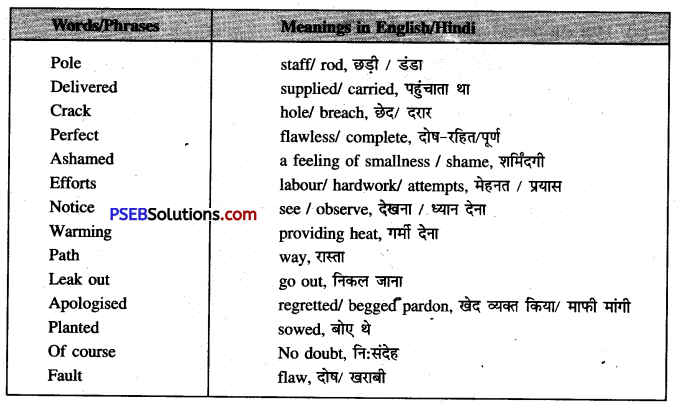
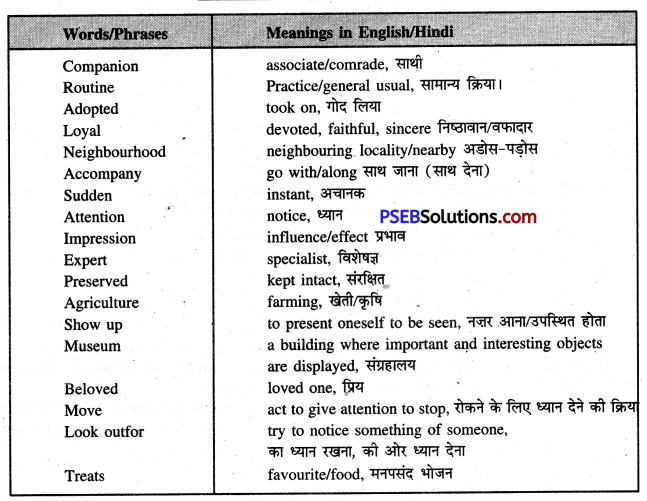
PSEB 6th Class English Solutions Chapter 7 The Cracked Pot 3

The Cracked Pot Summary in Hindi

There was a water ………. of my crack.”

भारत में एक पनहारा (पानी लाने वाला) था। उसके पास दो बड़े बर्तन (घड़े) थे। प्रत्येक घड़ा एक डंडे के सिरे पर लटका रहता था। वह इन घड़ों को अपने कंधे पर उठाता था। वह इन दोनों घड़ों में अपने मालिक को पानी पहुँचाता था। इनमें से एक घड़े में एक दरार थी परन्तु दूसरा घड़ा बिल्कुल ठीक था। नदी से दूर उसके मालिक के घर तक चलतेचलते दरार वाला घड़ा सदा आधा (भरा) रह जाता था। परन्तु दूसरा घड़ा पानी से पूरा भरा रहता था।

नि:सदेह ठीक घड़े को अपने ऊपर गर्व था। वह उस कार्य के लिए पूर्ण था जिसके लिए उसे बनाया गया था। परन्तु बेचारा दरार वाला घड़ा अपनी दरार के लिए शर्मिंदा था। उसे इस बात का दुःख था कि वह केवल आधा पानी ही ला सकता है। दो साल तक प्रतिदिन ऐसे ही चलता रहा। पनहारा अपने मालिक के घर केवल डेढ़ घड़ा पानी ही पहुंचाता था।

दो वर्षों बाद, एक दिन दरार वाला घड़ा पनहारे से बोला, “मैं अपने आप से शर्मिंदा हूँ। और मैं आपसे माफी मांगना चाहता हूँ।” पनहारे ने कहा, “क्यों ? तुम्हें किस बात की शर्मिंदगी है।” घड़े ने उत्तर दिया, “इन दो सालों में मैंने दूसरे घड़े की अपेक्षा अपनी दरार की वजह से कम पानी दिया है। मेरा पानी तुम्हारे मालिक के घर तक बहता रहता है। तुम्हें मेरी दरार के कारण अपनी मेहनत का पूरा मूल्य नहीं मिल पाता।”

PSEB 6th Class English Solutions Chapter 7 The Cracked Pot

The water bearer ………………………… beautiful flowers.”

पनहारे ने दरार वाले पुराने घड़े के प्रति खेद प्रकट किया। उसने घड़े से कहा, “मैं चाहता हूँ कि आज जब हम वापिस मालिक के घर की ओर आएं तो तुम रास्ते के साथ-साथ सुन्दर फूलों की ओर ध्यान देना ।”
जब वे नदी से लौटे, दरार वाले घड़े ने रास्ते में सुन्दर जंगली फूलों को ध्यान से देखा जिन्हें धूप की गर्मी मिल रही थी। वह सुन्दर फूलों को देखकर खुश हुआ, परन्तु पंगडंडी के अंत में उसे अब भी बुरा महसूस हुआ क्योंकि उसका आधा पानी फिर से निकल गया था। उसने अपनी गलती के लिए पनहारे से माफ़ी मांगी।

पनहारे ने घड़े से कहा, “क्या तुमने ध्यान दिया कि पगडंडी के रास्ते में फूल केवल तुम्हारी ओर ही थे। दूसरे घड़े की ओर एक भी फूल नहीं था। मुझे तुम्हारी दरार के बारे में पता था। मैंने रास्ते पर तुम्हारी ओर ही फूलों के बीज बोये थे और प्रतिदिन नदी से वापिस आते हुए दरार से बहता हुआ पानी इन पर गिरता था। तुम्हारे बिना, जैसे कि तुम (छेद वाले) हो, हम इन सुन्दर फूलों को नहीं देख सकते थे।

Retranslation Of The Isolated Sentences

1. He had two large pots. — उसके पास दो बड़े बर्तन (घड़े) थे।
2. He carried these pots on his shoulders. — वह इन घड़ों को अपने कंधों पर उठाता था।
3. One of the pots had a crack in it. — घड़ों में से एक घड़े में दरार थी।
4. The perfect pot was proud of itself. — सही घड़े को अपने ऊपर गर्व था।
5. The poor cracked pot was ashamed of its crack. — बेचारा दरार वाला घड़ा अपनी दरार के लिए शर्मिंदा था।
6. I want to say sorry to you. — मैं आपसे माफी माँगना चाहता हूँ।
7. You don’t get full value for your efforts. — तुम्हें तुम्हारे प्रयत्नों का पूरा मूल्य नहीं मिलता।
8. I want you to notice the beautiful flowers along the path — मैं चाहता हूँ कि तुम रास्ते के साथ-साथ सुन्दर फूलों पर ध्यान दो।
9. There were no flowers on the other pot’s side. — दूसरे घड़े की ओर कोई भी फूल नहीं था।
10. I planted flower seeds on your side of the path.– मैंने रास्ते पर तुम्हारी ओर ही फूलों के बीज बोये थे।

English Class 6 Solutions PSEB Prose
A Treasure Hunt Question Answer Class 7 English Solutions Chapter 6 PSEB Solutions

Punjab State Board PSEB 7th Class English Book Solutions Chapter 6 A Treasure Hunt Textbook Exercise Questions and Answers.

Class 7th English Solutions Chapter 6 A Treasure Hunt Question Answers

A Treasure Hunt Class 7 Questions and Answers

Activity 1

Look up the following words/phrases in a dictionary. You should seek the following information about the words and put them in your WORDS notebook.

1. Meaning of the word as used in the story (adjective/noun/verb, etc.)
2. Pronunciation (The teacher may refer to the dictionary or the mobile phone for correct pronunciation.)
3. Spellings

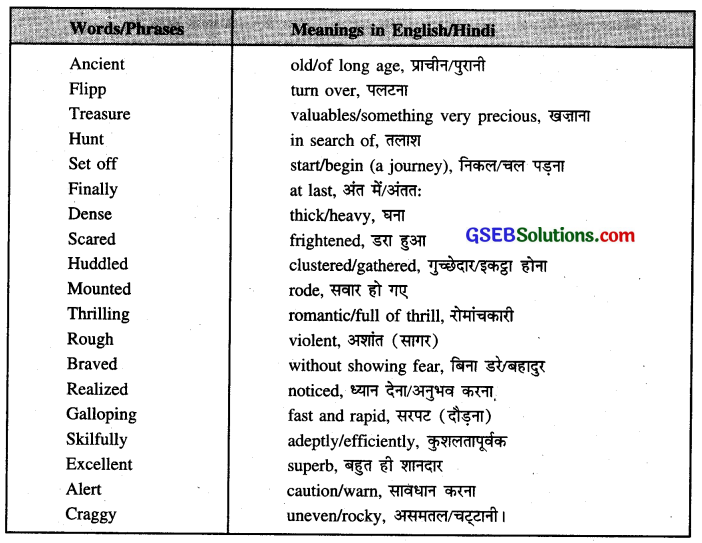
ancient treasure swept across huddled skilfully
mounted set off thrilling braved realized

PSEB 7th Class English Solutions Chapter 6 A Treasure Hunt

Vocabulary Expansion

Activity 2

Question 1.
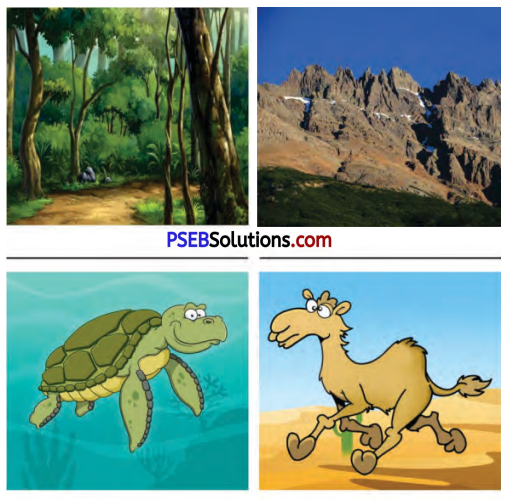
Choose suitable phrases from the box to write below each image a dense forest

a dense forest a galloping camel
craggy mountains a swimming turtle

PSEB 7th Class English Solutions Chapter 6 A Treasure Hunt 1
Answer:
a dense forest
a craggy mountain
a galloping camel
a swimming turtle

Learning to Read and Comprehend

Activity 3

What is meant by the bold words in the following sentences? The first one has been done for you.

Question 1.
The eagle agreed and joined the two.
Answer:
The word ‘two’ refers to the lion and Sagar.

Question 2.
The eagle watched every step they took with his sharp eyes.
Answer:
The word ‘they’ refers to Sagar and the lion.

Question 3.
There, they met a sheep.
Answer:
The word ‘they’ refers to Sagar, the lion and the eagle.

PSEB 7th Class English Solutions Chapter 6 A Treasure Hunt

Question 4.
Will you join us in a treasure hunt and keep us warm when it’s cold ?
Answer:
The word ‘you’ refers to the sheep.

Question 5.
You are called the ship of the desert.
Answer:
The word ‘You’ refers to the camel.

Question 6.
The four finally reached the desert.
Answer:
The word ‘four’ refers to Sagar, the lion, the eagle and the sheep.

Question 7.
The rough waves almost drowned them.
Answer:
The word ‘them’ refers to Sagar, the lion, the eagle, the sheep and the camel.

Question 8.
Indeed, they had found the greatest treasure ever!
Answer:
The word “they’ refers to Sagar, the lion, the eagle, the sheep, the camel and the turtle.

Activity 4

Answer the following questions.

Question 1.
What did Sagar find in the library ?
सागर को लाइब्रेरी में क्या मिला ?
Answer:
Sagar found an ancient book in the library.

Question 2.
What did he plan to do ?
उसने क्या करने की योजना बनाई ?
Answer:
He planned to go in search of the treasure.

PSEB 7th Class English Solutions Chapter 6 A Treasure Hunt

Question 3.
Where did Sagar go first? Whom did he meet there?
सागर सबसे पहले कहां गया ? वहां वह किससे मिला ?
Answer:
Sagar went to a forest first. He met a lion there.

Question 4.
Why did Sagar feel scared in the forest ?
वन में सागर डर क्यों गया था ?
Answer:
Sagar felt scared because the forest was dense and dark.

Question 5.
Where did Sagar and the lion go from the forest ?
सागर तथा शेर वन से कहां गए ?
Answer:
They went to a mountain from the forest.

Question 6.
What did Sagar ask the eagle to do ? Why ?
सागर ने गिद्ध से क्या करने को कहा ? क्यों ?
Answer:
Sagar asked the eagle to alert them against the danger because the eagle had very good eyesight.

Question 7.
Who did they meet in the valley ?
घाटी में वे किससे मिले ?
Answer:
In the valley, they met a sheep.

Question 8.
How would the sheep help Sagar and others ?
भेड़ सागर तथा उसके अन्य साथियों की सहायता कैसे कर सकती थी ?
Answer:
The sheep would keep them warm in cold.

Question 9.
How did the camel help them ?
ऊँट ने उनकी सहायता कैसे की ?
Answer:
The camel helped them cross the vast desert.

PSEB 7th Class English Solutions Chapter 6 A Treasure Hunt

Question 10.
What did the turtle do to help them ?
कछुए ने उनकी सहायता करने के लिए क्या किया ?
Answer:
The turtle took them across the ocean.

Activity 5

Discuss the following in groups and explain it in the given space. . “Congratulations ! You have found the treasure !” What did the owl want to tell Sagar and his companions ?
ऊपर दिया गया वाक्य कह कर उल्लू सागर तथा उसके साथियों को क्या बताना चाहता था ?
Answer:
The owl wanted to tell them that friendship is a great blessing. It is the greatest treasure ever. They were lucky to find it.

Learning Language

Parts of Speech

Till now, we have done nouns, pronouns, verbs, adjectives, adverbs, prepositions etc. They are called Parts of Speech.

Activity 6

Read each sentence below and look carefully at the underlined words.

If the word names a person, place, thing or idea, it is a NOUN. Write N in the given space.
If the word shows an action, it is a VERB. Write V in the given space.
If the word describes a noun, it is an ADJECTIVE. Write A in the given space.
Answer:
1. Maria picked a fresh rose from the garden for her aunt. — N
2. Does anyone have a rose garden? — A
3. The puppy rose and patted his mother for attention. — V
4. He will book a hotel room for you. — V
5. I bought a new book. — N
6. Do you know of a book club ? — A
7. Corner the mouse if you want to catch it. — V
8. Corners of my book were torn. — N
9. I live in the corner house. — A
10. Some paper yellow with age. — V
11. Diana needs yellow paint to make the painting. — A
12. Yellow is a nice colour. — N
13. I like baby pink colour. — A
14. The baby kept crying. — N
15. My grandmother likes to baby me. — V

PSEB 7th Class English Solutions Chapter 6 A Treasure Hunt

Learning to Listen Dictation

Activity 7

Your teacher will speak some words from the story. Listen carefully and write their spellings.
Answer:
1. ancient
2. treasure
3. swept
4. huddled
5. mounted
6. thrilling
7. braved
8. realized
9. ocean
10. galloped.
नोट :-विद्यार्थी इन शब्दों की spellings याद करें और ये शब्द लिखने का अभ्यास करें।

Activity 8

Read the following poem with proper pronunciation. Put more STRESS on the bold words in each line. Remember poems are to be read and not sung like nursery rhymes.
(The teacher must help the students.)

Sympathy
I lay in sorrow, deep distressed
My grief a proud man heard
His looks were cold.
He gave me gold.
But not a kindly word.
My sorrow passed – I paid him back
The gold he gave to me.
Then stood erect and spoke my thanks
And blessed his charity.
I lay in want, in grief and pain.
A poor man passed my way.
He bound my head.
He gave me bread.
He watched me night and day.
How shall I pay him back again
For all, he did to me ?
Oh ! Gold is great. But greater far
Is heavenly sympathy ! -Charles Mackay

नोट :-अध्यापक की सहायता से स्वयं करें।

PSEB 7th Class English Solutions Chapter 6 A Treasure Hunt

Learning to Write

Activity 9

Read the following messages that people write for their friends and family on their birthdays.
1. May your special day be filled with love, laughter and happiness. You deserve it.
2. Choose to celebrate your birthday, the way you like. May your birthday bring you the happiness and the good health you deserve.
3. Wishing you happiness and success in your lifelin the coming years.
4. It is always good to remember you, my friend, especially on your birthday. Enjoy! Make it unforgettable!
5. I am so sorry that I forgot your birthday. Belated Happy Birthday.
6. I can’t believe, I missed your birthday. I am so sorry. Wishing you a very happy birthday and success in everything you do.

Activity 10

You forgot to wish your friend on his or her birthday. Write a birthday message for your friend in the card given below.
PSEB 7th Class English Solutions Chapter 6 A Treasure Hunt 2
You must :
1. say sorry to your friend for forgetting to wish him/her
2. give belated wishes to your friend in the message
3. wish your friend happiness, success in life and good health
Some useful words/phrases
1. apologise
2. forget
3. wish
4. deserve
5. celebrate
6. belated
7. many happy returns
8. happiness
9. sincerely
10. success/successful
11. future
12. good health

PSEB 7th Class English Solutions Chapter 6 A Treasure Hunt

PSEB 7th Class English Solutions Chapter 6 A Treasure Hunt 4

You may begin your message with :

Dear/Dearest Anshu/Anshika
How forgetful I am to forget your birthday on May 22, 2020, So I failed to wish you. I am very sorry for this. However, nothing has gone wrong yet. I can still give you my heartly wishes, belated this may be. I always wish for your happiness and success in life. Enjoy good health always. I promise never to forget your birthday in future.
Anshika
24 May, 2020

Learning to Use Language
Writing a story

Activity 11.

Write a short story (100 words) using the following words. An outline is given below.
Your story must have :
a beginning
a middle/ the main story
a conclusion
Outline
the sun and the wind–friends–one day-an argument—who is stronger-decided to test their strength—saw a man walking—the challenge—to remove the coat-using the strength wind used its strength blew hard-man caught hold of his coat-the wind grew tired—could not remove the coat—the sun’s turn-started shining very brightly-used its heat—man felt hot-removed his coat–the sun became the winner.
Answer:
Once a dispute arose between the sun and the wind. The wind boasted that it was stronger than the sun. But it refused to accept the wind’s superiority. Just then they saw a passerby. He was wearing a coat. Both claimed that they would make the traveller remove his coat. First, it was the wind’s turn to try. It blew as hard as it could. The faster it blew, the tighter the man wrapped up his coat. The wind failed to make the man take off his coat.

PSEB 7th Class English Solutions Chapter 6 A Treasure Hunt

Then it was the sun’s turn to show its strength. It started shining brightly. The man who was shivering with cold, felt relieved. Soon he started sweating all over and removed his coat. Thus the sun won the contest. The wind accpeted its defeat.
Moral : Gentleness is better than pride.
Or
Pride hath a fall.

Comprehension Of Passages:

Read the following passages carefully and answer the questions that follow each :

(1) One day, Sagar went to a library. There, he found an ancient book. He flipped through the pages of the book. In the book, he saw a big sheet folded neatly. He opened the sheet and saw that it was a treasure map. “Hurray! I’m going to find this treasure and have some fun”, he said to himself. Sagar set off for the treasure hunt.

He walked and walked and finally reached a forest. In the forest, he met a lion. “You are strong and brave! I am going on a treasure hunt. Will you come with me ?” said Sagar to the lion. The lion agreed to go with him. They both went into the forest. The forest was dense and dark. Sagar was scared, but they crossed the forest easily because the lion was by his side.

1. What did Sagar see in the book ? What was it ?
सागर ने किताब में क्या देखा ? यह क्या था ?

2. Where did Sagar meet the lion ? How did he praise him ?
सागर को शेर कहां मिला ? उसने शेर की प्रशंसा कैसे की ?

3. Choose true and false statements and write them in your note book.
(a) Sagar found a new book in the library.
(b) Sagar became happy to see a treasure map.

4. Complete the sentences according to the meaning of the passage.
(a) The lion agreed to ……………
(b) Sagar crossed the forest easily because ……

PSEB 7th Class English Solutions Chapter 6 A Treasure Hunt

5. Match the words with their meanings :

(a) hunt hurry
(b) scared search
afraid

Answers
1. Sagar saw a big sheet folded neatly. It was a treasure map.
2. Sagar met the lion in the forest. He praised him by saying that he was strong and brave.
3.
(a) False
(b) True
4.
(a) The lion agreed to go with them.
(b) Sagar crossed the forest easily because the lion was by his side.
5.
(a) hunt — search
(b) scared — afraid

(2) Then the two of them reached a mountain. There, they met an eagle. “You have excellent eyesight and you can alert us to dangers! We are looking for treasure. Will you come with us?” said Sagar to the eagle. The eagle agreed and joined the two.

The mountains were tall and craggy. The lion slipped on the mountain but Sagar quickly caught him and gave him a hand. The lion thanked Sagar when he pulled him up. The eagle watched every step they took with his sharp eyes. Soon, they reached a valley.

There, they met a sheep. “Will you join us in a treasure hunt and keep us warm when it’s cold?” Sagar asked the sheep. The sheep agreed and joined the lion, the eagle and Sagar. A cold wind swept across the valley. They all huddled against the sheep who kept them warm and cosy.

1. What could the eagle do for Sagar and his companions ? How ?
गिद्ध सागर तथा उसके साथियों के लिए क्या कर सकता था ? कैसे ?

2. Who could keep them warm in cold ?
ठंड में उन्हें कौन गर्मी दे सकता या

3. Choose true and false statements and write them in your note-book.
(a) The mountains were tall and craggy.
(b) The lion had sharp eyes.

4. Complete the sentences according to the meaning of the passage.
(a) The eagle watched their every step with ……
(b) ……………. swept across the valley.

PSEB 7th Class English Solutions Chapter 6 A Treasure Hunt

5. Match the words with their meanings.

(a) swept crowded
(b) huddled blew
walked

Answer:
1. The eagle could alert them to dangers with his sharp eyes.
2. The sheep could keep them warm in cold.
3.
(a) True
(b) False
4.
(a) The eagle watched their every step with his sharp eyes.
(b) A cold wind swept across the valley.
5.
(a) swept — blew
(b) huddled — crowded.

(3) The five finally reached the ocean where they met a turtle. “Can you help us to cross the ocean? We are on a treasure hunt!” said Sagar to the turtle. The turtle agreed and joined the lion, the eagle, the sheep, the camel and Sagar. The rough waves almost drowned them but the turtle swam skilfully and took them across the ocean.

The six of them met an owl on the other side. The old owl spoke from his ancient wisdom, “Congratulations! You have found the treasure!” “Where is it?” they all asked in surprise. “Together, you have crossed the forest, climbed the mountains, braved the desert and swum across the ocean.

You could never have done it without the help of one another!” said the owl. They all looked at one another and realized that the owl was right. They had found friendship! Indeed, they had found the greatest treasure ever !

PSEB 7th Class English Solutions Chapter 6 A Treasure Hunt

1. What was going to drown them ? Who came to their help?
उन्हें क्या चीज़ डुबोने लगी थी ? उनकी सहायता के लिए कौन आगे आया ?

2. Who told them about the real treasure ? What was it ?
उन्हें सच्चे खजाने के बारे में किसने बताया ? यह क्या था ?

3. Choose true and false statements and write them in your note-book.
(a) They had crossed the forest and the ocean together.
(b) They were six before they met a turtle.

4. Complete the sentences according to the meaning of the passage.
(a) They realized that the …………..
(b) They had found the ……………

5. Match the words with their meanings.

(a) skilfully adeptly
(b) finally in the beginning
in the end

Answer:
1. The rough waves were going to drown them. The turtle came to their help.
2. The owl told them about the real treasure. It was ‘friendship’.
3.
(a) True
(b) False
4.
(a) They realized that the owl was right.
(b) They had found the greatest treasure ever!
5.
(a) skilfully – adeptly
(b) finally – in the end.

Use Of Words/Phrases In Sentences

1. Neatly (clearly) —
Please write the letter neatly.
कृपया पत्र साफ़-साफ़ लिखें।

2. Folded (wrapped) —
He thanked me with folded hands.
उसने हाथ जोड़ कर मेरा धन्यवाद किया।

3. Give someone a hand (help) —
He gave me his hand while we were crossing the river.
उसने नदी पार करते समय मेरी सहायता की।

4. Realize (to feel) —
He realized his mistake.
उसने अपनी गलती महसूस की।

5. Galloping (running fast) —
The galloping horses were soon out of sight.
तेज़ दौड़ते घोड़ें जल्दी ही अदृश्य हो गए।

6. Braved (faced bravely) —
He braved the danger.
उसने खतरे का वीरतापूर्वक सामना किया।

PSEB 7th Class English Solutions Chapter 6 A Treasure Hunt

7. Set off (start) —
They set off on a long journey.
वे एक लंबी यात्रा पर चल पड़े।

8. Excellent (superb) —
He gave an excellent performance.
उसने बहुत ही शानदार प्रदर्शन किया।

Word Meanings

PSEB 7th Class English Solutions Chapter 6 A Treasure Hunt 3

A Treasure Hunt Summary in Hindi

One day, Sagar ……………..warm and cosy.

एक दिन सागर एक पुस्तकालय गया। वहाँ उसे एक प्राचीन पुस्तक मिली। उसने पुस्तक के पन्नों को पलटा। पुस्तक में उसने एक बड़ा सफ़ाई से मुड़ा हुआ कागज़ देखा। उसने उस कागज़ को खोला और देखा। वह एक ख़जाने का नक्शा (मानचित्र) था। उसने खुशी से चिल्लाते हुए अपने आप से कहा, “मैं खज़ाना ढूंढने जाऊंगा, कुछ मज़ा भी आएगा।” सागर खज़ाने की तलाश में निकल पड़ा। वह चलता गया और अन्ततः एक जंगल में पहुँच गया।

जंगल में वह एक शेर से मिला। सागर ने शेर से कहा, “तुम ताकतवर और बहादुर हो! मैं एक खजाने की तलाश में जा रहा हूँ। क्या तुम मेरे साथ चलोगे।” शेर उसके साथ चलने के लिए सहमत हो गया। दोनों जंगल में गए। जंगल घना तथा अंधेरा था। सागर डर गया, परन्तु उन्होंने आसानी से जंगल पार कर लिया क्योंकि शेर उसके साथ था। तब वे दोनों एक पहाड़ पर पहुँचे। वहां वे एक गिद्ध (Eagle) से मिले। सागर ने गिद्ध से कहा, “तुम्हारी दृष्टि बहुत ही शानदार है और तुम हमें आने वाले खतरों से सावधान कर सकते हो।

PSEB 7th Class English Solutions Chapter 6 A Treasure Hunt

हम खज़ाने की खोज पर हैं। क्या तुम हमारे साथ चलोगे ?” गिद्ध ने अपनी सहमति दी और उनके साथ शामिल हो गया। पहाड़ ऊँचे तथा असमतल थे। शेर पहाड़ पर फिसल गया परन्तु सागर ने शीघ्रता से उसे पकड़ लिया और उसे सहारा दिया। जैसे ही सागर ने शेर को खींचा उसने उसका धन्यवाद किया। गिद्ध उनके प्रत्येक कार्य को अपनी तीव्र दृष्टि से देखता रहा। शीघ्र ही वे एक घाटी में पहुँच गए। वे एक भेड़ से मिले ।

सागर ने भेड़ से पूछा, “क्या तुम खजाने की खोज में हमारे साथ चलोगी और ठंड में हमें गर्मी प्रदान करोगी ?” भेड़ सहमत हो गई और शेर, गिद्ध और सागर के साथ शामिल हो गई। घाटी में ठंडी हवा चल रही थी। वे सभी भेड़ के साथ जुड़ (चिपक) कर बैठ गए जिसने उनके शरीर को गर्मी दी और आराम पहुँचाया।

The four finally ……………. treasure ever !

चारों अन्ततः एक रेगिस्तान पहुँचे जहाँ उन्होंने एक ऊँट को देखा। सागर ने ऊँट से कहा, “तुम्हें रेगिस्तान का जहाज़ कहा जाता है! क्या तुम खज़ाना खोजने में हमारे साथ चलोगे और रेगिस्तान को पार करवाने में हमारी सहायता करोगे ?” ऊँट सहमत (मान) हो गया। शेर, भेड़ और सागर ऊँट पर सवार हो गए और खुशी-खुशी बड़े रेगिस्तान को पार करने के लिए चल पड़े। गिद्ध उनका मार्गदर्शन करता रहा। ऊँट सरपट दौड़ने लगा। ऊँट पर बैठ कर रेगिस्तान को पार करना रोमांचक (अनुभव) था।

पाँचों आखिरकार महासागर पर पहुँच गए जहाँ उन्हें एक कछुआ मिला। सागर ने कछुए से कहा, “क्या तुम महासागर को पार करने में हमारी मदद करोगे ? हम खजाने की खोज पर हैं।” कछुआ मान गया और शेर, गिद्ध, भेड़, ऊँट और सागर के साथ चल पड़ा। अशांत/कष्टदायक लहरों ने उन्हें लगभग डुबो ही दिया था, परन्तु कछुए ने कुशलतापूर्वक तैर कर उन्हें सागर पार करवा दिया।

सभी छ: को दूसरी ओर एक उल्लू मिला। बूढ़ा उल्लू अपनी प्राचीन बुद्धिमत्ता दिखाते हुए बोला, “बधाई हो! तुम्हें खजाना मिल गया।” उन सभी ने हैरानी से पूछा, “कहाँ है वह ?” उल्लू ने कहा, “तुम सबने एक साथ जंगल पार किया, पहाड़ पर चढ़े, बहादुरी से रेगिस्तान और तैरकर यह सागर पार किया है। तुम एक-दूसरे की मदद के बिना यह नहीं कर सकते थे।” उन सबने एक-दूसरे की ओर देखा और अनुभव किया कि उल्लू ठीक कह रहा है। उन्हें ‘मित्रता’ मिल गई थी। वास्तव में उन्हें अब तक का सबसे बड़ा खज़ाना मिल गया था।

PSEB 7th Class English Solutions Chapter 6 A Treasure Hunt

Retranslation Of Isolated Sentences

1. There he found an ancient book. — वहाँ उसे एक प्राचीन पुस्तक मिली।
2. I am going to find this treasure. — मैं इस खज़ाने को ढूंढने जा रहा हूँ।
3. Sagar set off for treasure hunt. — सागर खज़ाने की तलाश में निकल पड़ा।
4. They both went into the forest. — वे दोनों जंगल में गए।
5. You have excellent eyesight. — तुम्हारी दृष्टि बहुत ही अच्छी है।
6. The eagle agreed and joined the two. — गिद्ध सहमत हो गया और दोनों में शामिल हो गया।
7. A cold wind swept across the valley. — घाटी में शीत लहर चल रही थी।
8. You are called the ship of the desert. — तुम्हें रेगिस्तान का जहाज़ कहा जाता है।
9. You have found the treasure. — तुम्हें खज़ाना मिल गया है।
10. You could never have done it without the help of one another. — तुम एक-दूसरे की सहायता के बिना यह काम नहीं कर सकते थे।
11. They all huddled against the sheep. — वे सभी भेड़ के साथ चिपक कर बैठ गए।
12. The forest was dense and dark. — वन सघन और अंधेरा था।

English Guide for Class 7 PSEB Prose

Trains Question Answer Class 7 English Solutions Poem Chapter 1 PSEB Solutions

Punjab State Board PSEB 7th Class English Book Solutions Poem 1 Trains Textbook Exercise Questions and Answers.

Class 7th English Solutions Poem Chapter 1 Trains Question Answers

Trains Class 7 Questions and Answers

Activity 1.

Look up the following words in a dictionary. You should seek the following information about the words and put them in your WORDS notebook.
1. Meaning of the word as used in the poem (adjective/noun/verb, etc.)
2. Pronunciation (The teacher may refer to the dictionary or the mobile phone for correct Pronunciation.)
3. Spellings

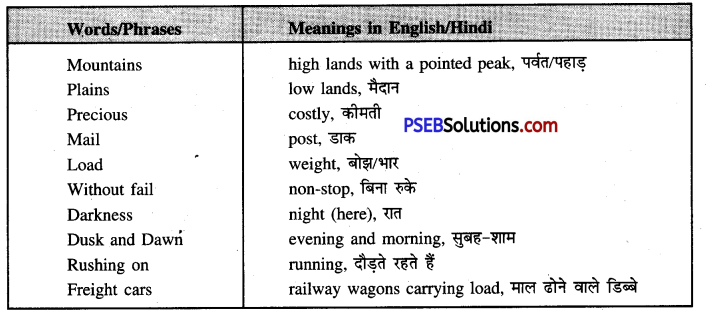
Passenger Precious mail freight
dusk dawn without fail

PSEB 7th Class English Solutions Poem 1 Trains

Post-reading

Vocabulary Expansion

Trains are a very important means of land transport in India. India has a large network of trains.

Activity 2.

Given below are some more means of transport. Put them under the right box.

car aeroplane scooter helicopter boat auto
bus ship submarine train jeep bicycle
Land sky water
car
bus
scooter
train
auto
jeep
bicycle
aeroplane
helicopter
ship
submarine
boat

Activity 4

Read the following lines and answer the questions that follow : Through day and darkness, Through dusk and dawn.

Question 1.
What do the above lines refer to ?
Answer:
The above lines refer to trains running day and night.

Question 2.
What do the day and darkness’ and dusk and dawn’ in the poem tell the readers ?
Answer:
They tell us about the different times of the day. They also form pairs of opposite time.

Learning Language

Conjunctions : ‘so’, ‘because’. “although’. ‘and’, ‘yet
We use Conjunctions like ‘and, “or”, “but, “because’ and although’ to join two parts of sentences.
नोट:-वाक्य के दो या अधिक भागों को जोड़ने के लिए जिन शब्दों का प्रयोग किया जाता है, उन्हें Conjunctions कहते हैं।

PSEB 7th Class English Solutions Poem 1 Trains

Activity 5

1 Complete the sentences given below with ‘so’ or ‘because’. Here are a few examples. Read them before you do the activity.
Examples :
1. Rajan is happy because he has stood first in the race.
2. It was raining, so I did not go to school.
3. I went to the cinema because it was a holiday.
We use ‘because‘ for giving reasons, and ‘so’ for talking about results or purposes.

1. My dog was hungry …………. it stole biscuits from the shelf.
2. I am feeling sleepy …………….. I am very tired.
3. Babli bought new clothes ………….. she wanted to wear them on Diwali.
4. It was raining, …………. my books got wet.
5. He did not study hard, …………… he failed the test.
6. I asked for directions ………….. I was lost.
7. I did not clean the room, ………… it became dirty.
8. I met with an accident …………….. I was driving fast.
9. Deepa went to the doctor …………… she was feeling sick.
10. Mohan did not help Sohan …………….. he was not well.
Answer:
1. so
2. because
3. because
4. so
5. so
6. because
7. so
8. because
9. because
10. because.

Activity 6.

Combine the sentences given below using “although’ and ‘yet’. Write them in your notebook. Here are a few examples. Read them before you do the activity.

Examples :
1. Rajan did not win the race. Rajan was happy.
Although Rajan did not win the race, yet he was happy.

2. It was raining. I went to school.
Although it was raining, yet I went to school.

3. It was a holiday. I did not go to the cinema.
Although it was a holiday, yet I did not go to the cinema.
We use ‘although’ and ‘yet in the same sentence for unexpected or different information.

1. My dog was hungry. It did not eat biscuits.
2. He is very sleepy. He is watching a movie.
3. Babli wanted to wear new clothes on Diwali. Babli did not buy them.
4. It was raining. I did not take an umbrella.
5. He did not study hard. He passed the test.
6. I was lost. I did not ask for directions.
7. My room was dirty. I did not clean the room.
8. I was ill. I did not go to the doctor.
9. Mohan and Sohan were friends. Mohan did not help Sohan.
10. I went to the market. I did not buy anything.
Answer:
1. Although my dog was hungry. yet it did not eat biscuits.
2. Although he is very sleepy. yet he is watching a movie.
3. Although Babli wanted to wear new clothes on Diwali, yet she did not buy them.
4. Although it was raining, yet I did not take an umbrella.
5. Although he did not study hard, yet he passed the test.
6. Although I was lost, yet I did not ask for directions.
7. Although my room was dirty, yet I did not clean it.
8. Although I was ill, yet I did not go to the doctor.
9. Although Mohan and Sohan were friends, yet Mohan did not help Sohan.
10. Although I went to the market, yet I did not buy anything.

PSEB 7th Class English Solutions Poem 1 Trains

Learning to Listen

Activity 7.

Listen to the teacher, recite the following poem and repeat after her/him.

Clouds
PSEB 7th Class English Solutions Poem 1 Trains 1

White sheep. white sheep,
On a blue hill,
When the wind stops,
You all stand still.
When the wind blows.
You walk away slow,
White sheep,
white sheep
Where do you go?
नोट : विद्यार्थी स्वयं करें।

Learning to Speak

Activity 8

Speak the following pairs aloud. (ऊंची आवाज़ में बोलें)
1. mail — fail
2. dawn — lawn
3. plains — trains

Activity 9 (Pairwork)

Discuss with your partner about how you would like to travel. You can discuss the following questions with each other.
1. Do you like to travel by train/ship/plane ?
2. How would you like to travel if you have to go from Punjab to Mumbai ? Why ?
3. If you decide to go by train, what would you like to take with you ?

Learning to Write

Activity 10

Paragraph Writing:

पैराग्राफ़ किसी विषय की संक्षिप्त व्याख्या होती है। यह लगभग 100 शब्दों में लिखा जाता है। इसके पहले वाक्य में विषय का परिचय दिया जाता है, जबकि इसका अंतिम वाक्य विषय का निष्कर्ष होता है। पैराग्राफ़ के मध्य भाग में विषय से जुड़ी मुख्य बातों का वर्णन किया जाता है। ध्यान रहे कि यह पैराग्राफ़ एक ही विचार या बिन्दु पर केंद्रित हो।

A Journey by Bus I went to Jalandhar by bus last month. I hired an e-rickshaw and reached the bus stand. I went to the booking window. There was a great rush. I got the ticket on my turn. The bus came and I got into the bus. There was no room in the bus. Many people were standing.

I could not get any seat. It was very hot. I was sweating. Soon the conductor whistled. The bus started. I felt easy. Some passengers got down at Phagwara. Now I got a seat near the window. I looked out of the window. Greenfields looked very beautiful. Farmers were at their work. Cattle were grazing. Our bus crossed many bridges on the way. At last the bus reached Jalandhar. It took me three hours to reach there. I enjoyed the journey but I got tired.
PSEB 7th Class English Solutions Poem 1 Trains 2

Stanzas For Comprehension

Read the stanzas given below and answer the questions that follow each :

(1) Over the mountains,
Over the plains,
Over the rivers,
Here come the trains.
Carrying passengers,
Carrying mail,
Bringing their precious loads
In without fail.

PSEB 7th Class English Solutions Poem 1 Trains

(i) Where do the trains move?
रेलगाड़ियां कहाँ चलती हैं ?

(ii) What do they carry ?
वे क्या उठाती है।?

(iii) Name the poem and the poet.
कविता और कवि का नाम बताओ।
Answer:
(i) The trains move over the mountains, plains and rivers.
(ii) They carry passengers, goods and precious loads.
(iii) The name of the poem is ‘Trains’ and that of the poet is James S. Trippett.

(2) Thousands of freight cars
All rushing on Through day and darkness,
Through dusk and dawn,
Over the mountains,
Over the plains,
Over the rivers,
Here come the trains.

(i) What is rushing on ?
क्या – क्या चीज़ दौड़ती रहती है ?

(ii) When do they rush on?
वे कब दौड़ती हैं?

(iii) What is the central idea of the poem?
कविता का केन्द्रीय भाव क्या है ?
Answer:
(i) Thousands of freight cars are rushing on.
(ii) They rush on all through day and night.
(ii) Trains run day and night. They provide a great service to the country by carrying people and their costly load.

PSEB 7th Class English Solutions Poem 1 Trains

Word Meanings.

PSEB 7th Class English Solutions Poem 1 Trains 3

Trains Summary in Hindi

यह कविता रेलगाड़ियों के बारे में है। रेलगाड़ियाँ दिन-रात दौड़ती रहती हैं। वे कभी नहीं रुकतीं। वे पर्वत, नदियाँ, मैदान सब कुछ पार कर जाती हैं। वे डाक, यात्रियों तथा उनके कीमती सामान को लाद कर ले जाती हैं। वे माल (भारी सामान) को ढोती हैं। वे सुबह शाम कुछ नहीं देखतीं। वे दौड़ती ही रहती हैं।

My English Companion for Class 7 PSEB Solutions Poetry

How Beautiful is the Rain! Question Answer Class 6 English Solutions Poem Chapter 2 PSEB Solutions

Punjab State Board PSEB 6th Class English Book Solutions Poem 2 How Beautiful is the Rain! Textbook Exercise Questions and Answers.

Class 6th English Solutions Poem Chapter 2 How Beautiful is the Rain! Question Answers

How Beautiful is the Rain! Class 6 Questions and Answers

Activity 1.

Look up the following words in a dictionary. You should seek the following information about the words and put them in your words note book.
1. Meaning of the word as used in the lesson (Adjective/Noun/Verb etc.)
2. Pronunciation (the teacher may refer to the dictionary or the mobile phone for correct pronunciation.)
3. Spellings

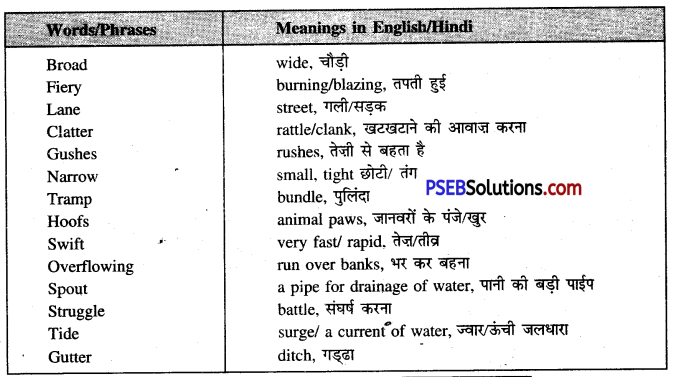
fiery lane clatter gushes tramp
hoofs swift overflowing spout

PSEB 6th Class English Solutions Poem 2 How Beautiful is the Rain!

Vocabulary Expansion

Activity 2.

Pick up words from the text that match the rhyme of the following words.
Answer:
1. rain – lane
2. heat – street
3. roofs – hoofs
4. out – spout
5. lane – rain/window-pane
6. pours – roars
7. wide – tide

Learning to Read and Comprehend

Activity 3.

Read the poem and write answers to the following :

Question 1.
Why does the poet say that the rain is beautiful ?
कवि क्यों कहता है कि वर्षा सुंदर होती है ?
Answer:
The rain is beautiful as it presents a lovely sight. Its flow and sounds are lovely to watch and hear.

Question 2.
Which are the places where the rain falls ?
वर्षा कौन-कौन से स्थानों पर गिरती है ?
Answer:
The rain falls on street, lane, roof, window-pane etc.

Question 3.
Why does the poet repeat the first line ?
कवि पहली पंक्ति को क्यों दोहराता है ?
Answer:
The poet repeats the first line to lay stress on his point that the rain is beautiful.

Question 4.
What gushes and struggles out ?
क्या चीज तेजी से संघर्ष करती हुई बाहर निकलती है ?
Answer:
The rain gushes and struggles out.

Question 5.
Why is the rain like a tramp of hoofs ?
वर्षा खुरों के पुलिंदे जैसी क्यों लगती हैं ?
Answer:
The clattering sound of the rain on roofs makes it so.

PSEB 6th Class English Solutions Poem 2 How Beautiful is the Rain!

Activity 4.

Read the words in the following table and do as directed.

S. No. Word I know the word. Write the meaning. I don’t know, put a cross (x) Give yourself
1 mark if you know the meaning.
1. Beautiful lovely X 1
2. Dust fine earth particles X 1
3. Fiery burning X 1
4. Street lane X 1
5. Lane street X 1
6. Clatters clanks X 1
7. Tramp of hoofs a group of hoofs X 1
8. Gushes rushes X -1.
9. Overflowing running over the banks X 1
10. Swift fast X 1

Learning to Listen

Activity 5.

The teacher will read the following passage once. Students must complete the following blanks.

Rain …….1…… as a …..2….. relief after …..3…….. and dust of the ….4…… . Rain is a wonderful …..5……. of nature to all …..6………. If there is no ……7……. crops will not ….8……. . All vegetation will wither …….9……. We can not ……10…… of life in this … 11….. without ….12…..
Answer:
1. comes
2. great
3. heat
4. summer
5. gift
6. creatures
7. rain
8. grow
9. away
10. think
11. season
12. rain.

Learning to Speak

Activity 6 (Think Pair Share)

Students will work in pairs to do the following activity. You may take notes of what your partner says. Just write points.
1. Do you like the rain ? Why ? Why not ? Tell your partner about it.
2. Why is the rain like ‘tramp of hoofs’ ? Discuss with your partner.
Note : Do it yourself.

PSEB 6th Class English Solutions Poem 2 How Beautiful is the Rain!

Learning to write

Activity 7.

What words would you use to describe the rain ? Make a list.
Answer:
Beautiful, lovely, welcome, pouring, heavy, flooding, gushling, roaring, cooling, overflowing, clattering etc. Learning language Punctuation
Punctuation means putting full stops, commas, question marks etc. at the right places in a piece of writing. Punctuation helps to separate one sentence from another sentence, or one part of a sentence from another.

The important marks of punctuation are :
कुछ लिखते समय कुछ विशेष विराम चिन्हों का प्रयोग किया जाता है, इनके बिना अर्थ स्पष्ट नहीं होता। इन चिन्हों के प्रयोग को अंग्रेज़ी में Punctuation कहते हैं। इसके मुख्य विराम चिन्ह निम्नलिखित हैं।
Capital Letters (A, B, C ……..)
Full stop (.)
Comma (,)
Question Mark (?)
Exclamation Mark (!) etc.
In this lesson, we will concentrate on Capital Letters only.
इस पाठ में हम केवल Capital Letters के बारे में जानकारी प्राप्त करेंगे
There are different uses of capitals. We use capitals with :

1. The first word in a sentence :
(वाक्य का पहला अक्षर)
Examples :
(a) She was late for the film.
(b) She came back soon.

2. The word ‘I’ and people’s names :
(शब्द ‘I’ तथा लोगों के नाम)
Examples :
(a) Radhika likes to drive slow but I like to drive fast.
(b) Sheena likes apples.

3. The name of places, institutions and languages.
(स्थानों, संस्थाओं तया भाषाओं के नाम)
Examples :
(a) I studied in Kendriya Vidyalaya, Amritsar.
(B) Most people in the world speak Spanish language.

4. Product names :
Examples :
(a) I use Lux soap
(6) My Samsung phone was stolen.

PSEB 6th Class English Solutions Poem 2 How Beautiful is the Rain!

5. Calendar items :
(जत्री से जुड़े नाम)
Examples :
(a) I sent my friend a Diwali card while she sent me a Christmas Card.
(b) Seema does not like going to the office on Monday.
(c) My birthday falls in March.
However, the names of seasons are not written with a capital :
(ऋतुओं के नार्मों को बड़े अक्षर से शुरू करना ज़रूरी नहीं है।)
(d) Like cricket, baseball is played in summer.

6. Main words in titles :
(उपाधियों/ शीर्षकों के मुख्य शब्द)
Examples :
(a) The name of my doctor is Dr. Aggarwal.
(b) My favourite book is Five Run Away Together by Enid Blyton.

Activity 8.

Use Capital letters where needed in the following sentences.
1. she is a good singer.
2. are you a good singer ?
3. does pratima live in mumbai ?
4. saurabh lives in delhi but i live in chandigarh.
5. i went to the library to borrow books written by premchand.
6. do you have a samsung phone ?
7. why is february 29 important ?
8. albert einstein was a famous scientist.
9. jagdeesh chander bose was an indian scientist.
10. i will buy sony televesion from delhi.
Answer:
1. She is a good singer.
2. Are you a good singer ?
3. Does Pratima live in Mumbai ?
4. Saurabh lives in Delhi but I live in Chandigarh.
5. I went to the library to borrow books written by Premchand.
6. Do you have a Samsung phone ?
7. Why is February 29 important ?
8. Albert Einstein was a famous scientist.
9. Jagdeesh Chander Bose was an Indian scientist.
10. I will buy Sony television from Delhi.

Activity 9.

Look at the following sentences carefully and do as directed.
1. Ram plays like Dhoni.
2. Ram runs like a horse.
3. Ram eats like a sparrow.
4. Ram bats like Tendulkar.
5. Ram looks like his father.
What is common in these sentences ? ‘Ram’ is like someone else.
“Ram’ is like Dhoni, horse, sparrow. Tendulkar, his father. The qualities of these people are there in Ram.
ऊपर दिए गए वाक्यों में राम को किसी ‘अन्य’ की तरह बताया गया है। वास्तव में इन वाक्यों में राम के गुणों की तुलना अन्य लोगों से की गई है।
‘Like’ is used to compare two different people/things.
दो अलग-अलग लोगों या वस्तुओं की तुलना करने के लिए ‘Like’ शब्द का प्रयोग किया जाता है। Examples.
1. Like the tramp of hoofs (rain sounds like)
2. Like a river down the gutter roars

PSEB 6th Class English Solutions Poem 2 How Beautiful is the Rain!

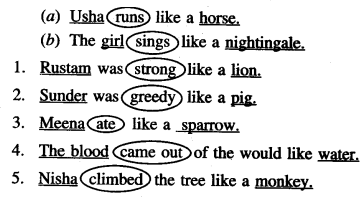
Read the sentences given below and underline the two things that have the same quality. Also encircle the quality. For Example. (एक समान गुणों वाली दो चीज़ों को रेखांकित करें। गुण पर दायरा लगाएं।)
PSEB 6th Class English Solutions Poem 2 How Beautiful is the Rain! 1

Comprehension Of Stanzas

Read stanzas given below and answer the questions that follow each :

(1) How beautiful is the rain !
After the dust and heat,
In the broad and fiery street,
In the narrow lane,

How beautiful is the rain !
How it clatters along the roofs,
Like the tramp of hoofs.

1. What is beautiful ?
क्या चीज़ सुंदर लगती है

2. When is the rain welcome ?
वर्षा छतों पर किस प्रकार खटखटाति है।

3. How does it clatter along the roofs ?
वर्षा छतों पर किस प्रकार खटखटाती हैं ?

4. Name the poem and the poet.
कविता और कवि का नाम लिखें।
Or
Write two pairs of rhyming words.
लय वाले शब्दों के दो जोड़े लिखें।
Answer:
1. The rain is beautiful.
2. The rain is welcome after the dust and heat.
3. It clatters like the tramp of hoofs along the roofs.
4. The name of the poem is ‘How Beautiful is the Rain !’ Its poet is H.W. Longfellow.

PSEB 6th Class English Solutions Poem 2 How Beautiful is the Rain!

(2) How it gushes and struggles out
From the throat of the overflowing spout !
Across the window-pane
It pours and pours ;
And swift and wide,
With a muddy tide,
Like a river down the gutter roars
The rain, the welcome rain !

1. Write down the rhyming words in the stanza.
पद्य में से लयात्मक शब्द लिखें।

2. How does the rain fall across the window-pane ?
खिड़की के शीशे पर वर्षा कैसे पड़ती है ?

3. What is the rain compared to ?
वर्षा की तुलना किससे की गई है ?

4. When does it produce a roaring sound ?
यह गरजती हुई आवाज़ कब निकालती है ?
Or
Name the poem and the poet.
कविता और कवि का नाम लिखें।
Answer:
1. Out-spout; pane-rain, pours-roars; wide-tide.
2. It pours and pours across the window-pane.
3. The rain is compared to a river.
4. It produces a roaring sound while going down a gutter.
Or
The name of the poem is ‘How Beautiful is the Rain !’ and its poet is H.W. Longfellow.

Word Meanings 

PSEB 6th Class English Solutions Poem 2 How Beautiful is the Rain! 2

How Beautiful is the Rain Poem Summary in English

How Beautiful is the Rain Summary in English

The rain, with its sounds and sights, is very beautiful. It is most welcome after the dust and heat of the summer. It flows down the baked streets and presents a lovely sight. The rain clatters along the roofs like a group of hoofs. It struggles to drain out of the pipe and fell down.

It strikes the window-panes briskly and strongly. It becomes like a muddy river when it reaches the ground. It falls into some gutter producing a roaring sound. On the whole everybody welcomes, the summer rain.

PSEB 6th Class English Solutions Poem 2 How Beautiful is the Rain!

How Beautiful is the Rain Summary in Hindi

कवि कहता है कि गर्मियों की वर्षा बहुत ही सुंदर और सुहावनी होती है। यह सुंदर तथा दर्शनीय दृश्य प्रस्तुत करती है। धूल-मिटी के मौसम के बाद इसका पानी तपती हुई तंग तथा चौड़ी गलियों में बहने लगता है। वर्षा छतों पर खटखट की आवाज़ पैदा करती है। ऐसे लगता है जैसे बहुत से जानवर अपने खुर नीचे पटक रहे हों।

वर्षा का पानी तेज़ गति से संघर्ष करता हुआ छत की पाईप में से निकलता है। यह खिड़की के शीशों पर बड़ी ऊंची लहर की तरह नीचे की ओर बहता है। गड्ढों में से यह मटमैला होकर शोर करता (गरजता) हुआ निकलता है। ऐसे लगता है, जैसे कोई नदी की तेज़ धारा बह रही हो। ऐसी वर्षा स्वागत योग्य है।

Class 6th English Book Solutions PSEB Poetry

The Lake of the Moon Question Answer Class 6 English Solutions Chapter 2 PSEB Solutions

Punjab State Board PSEB 6th Class English Book Solutions Chapter 2 The Lake of the Moon Textbook Exercise Questions and Answers.

Class 6th English Solutions Chapter 2 The Lake of the Moon Question Answers

The Lake of the Moon Class 6 Questions and Answers

Activity 1.

Look up the following words in a dictionary. You should seek the following information about the words and put them in your WORDS notebook. :
1. Meaning of the word as used in the lesson (Adjective, Noun, Verb. etc.)
2. Pronunciation (The teacher may refer to the dictionary or the mobile phone for correct pronunciation.)
3. Spellings

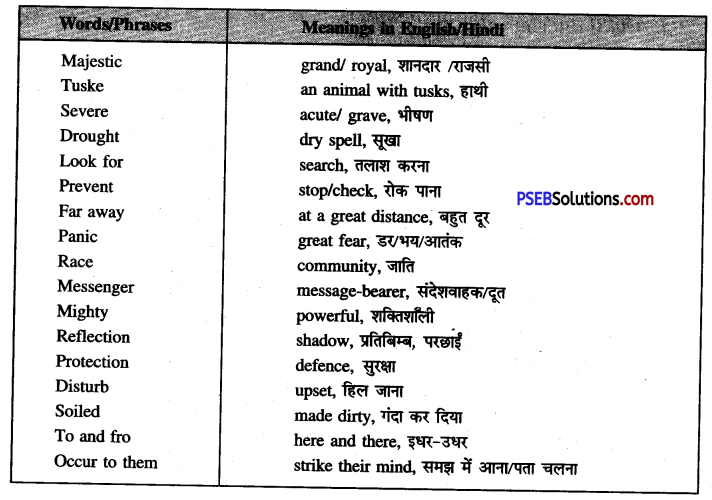
majestic tusker severe drought prevent
messenger reflect protection disturb to and fro

PSEB 6th Class English Solutions Chapter 2 The Lake of the Moon

Vocabulary Expansion

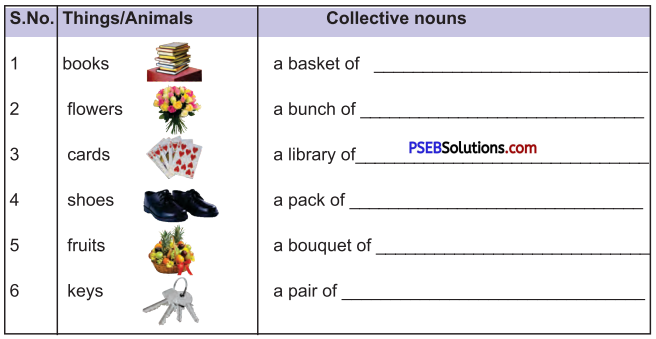
Some animals live or move together. The group of animals have different names. Elephants move in herds, rabbits live in colonies and birds flock together. ‘Herds’ and ‘colonies’ are collective nouns. Collective nouns are names for a ‘collection’ or a ‘number’ of people or things.

कुछ पशु एक साथ समूह में रहते हैं। पशुओं या वस्तुओं के समूह को विभिन्न नाम दिए जाते हैं, जैसे – Herd of elephants (हाथियों का झुंड), Colony of rabbits (खरगोशों की बस्ती), flock of birds (पक्षियों का समूह) Collective Nouns कहलाते हैं।

Let us look at some more collective nouns.

1. Collection of horses – team of horses
2. group of ants – army of ants
3. group of vultures – wake of vultures
4. group of cards – pack of cards
5. group of ladies – bevy of ladies
PSEB 6th Class English Solutions Chapter 2 The Lake of the Moon 1

Activity 2.

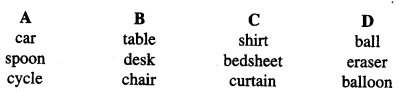
Match the following things with their group name :
PSEB 6th Class English Solutions Chapter 2 The Lake of the Moon 4
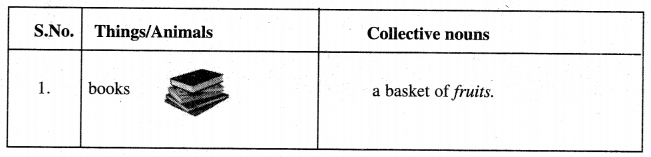
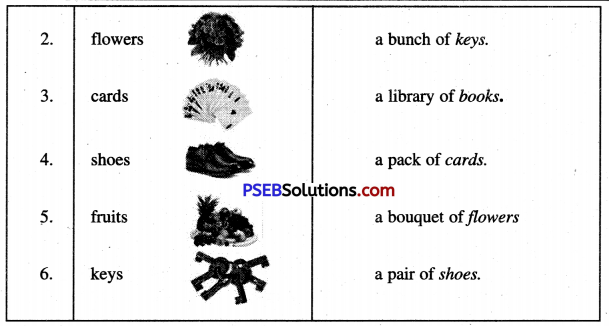
Answer:
PSEB 6th Class English Solutions Chapter 2 The Lake of the Moon 2
PSEB 6th Class English Solutions Chapter 2 The Lake of the Moon 3

Learning to Read and Comprehend

Activity 3.

Choose the correct option and put a tick :

Question 1.
What happened in the area where the elephants lived ?
(a) there were floods
(b) there was no water
(c) there was fire in the jungle.
Answer:
(b) there was no water.

PSEB 6th Class English Solutions Chapter 2 The Lake of the Moon

Question 2.
The elephant king told the elephant to go to :
(a) different lakes
(b) the moon
(c) different directions
Answer:
(c) different directions

Question 3.
What was close to the lake ?
(a) a big forest
(b) a colony of rabbits
(c) the moon
Answer:
(b) a colony of rabbits.

Question 4.
Why did rabbits panic ?
(a) thousands of rabbits died
(b) elephants would drink all the water in the lake
(c) the moon would get angry
Answer:
(a) thousands of rabbits died.

Question 5.
What did the king of rabbits want other rabbits to find?
(a) water
(b) another place to go
(c) solution
Answer:
(c) solution

Question 6.
What did one little rabbit say?
(a) fight the elephants
(b) hide till the elephants go away
(c) make him a messenger to the elephant king
Answer:
(c) make him a messenger to the elephant king

Question 7.
What did the little rabbit climb?
(a) a mountain
(b) a huge rock
(c) on the back of the elephant king
Answer:
(b) a huge rock

Question 8.
What did the little rabbit say to the Elephant King ?
(a) that he was the messenger of the Moon
(b) he ordered the king to leave their area
(c) that the elephants should be ready for a fight
Answer:
(a) that he was the messenger of the Moon

Question 9.
What message does he give to the King?
(a) that the elephant herd had soiled the water of the holy lake
(b) rabbits, were under the special protection of the moon
(c) both ‘a’ and ‘b’
Answer:
(c) both ‘a’ and ‘b’.

PSEB 6th Class English Solutions Chapter 2 The Lake of the Moon

Question 10.
Where does the rabbit take the elephant king ?
(a) a lake
(b) another forest
(c) none of the above
Answer:
(a) a lake.

Activity 4.

Answer the following questions :

Question 1.
What happened to the place where the herd of elephants lived ?
उस स्थान को क्या हुआ जहां हाथियों का झुंड रहता था ?
Answer:
There was a severe drought (भीषण सुखा) and there was no water.

Question 2.
Where was the water found ?
पानी कहां मिला था ?
Answer:
The water was found in a lake in another jungle.

Question 3.
Who became the messenger ?
संदेशवाहक कौन बना?
Answer:
A little rabbit became the messenger.

Question 4.
Why did the water move to and fro ?
पानी इधर-उधर क्यों हिलने लगा ?
Answer:
The water moved to and fro because it was disturbed.

Question 5.
Why did the elephant king believe that the Moon had become angrier ?
राजा हाथी को इस बात का विश्वास क्यों हुआ कि चांद और अधिक क्रोधित हो उठा है ?
Answer:
It was so because the Moon had started moving to and fro.

Learning Language

Noun : Gender

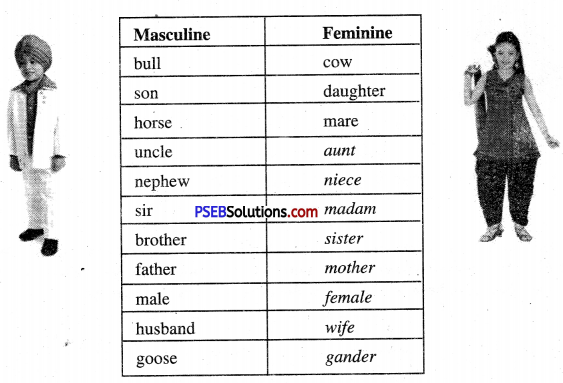
Gender is a type of noun. There are four types of Genders.

1. Masculine Gender : The names of all male persons or animals (सभी नर व्यक्तियों या पशुओं के नाम) are of Masculine Gender. Example : man, uncle, lion, prince, master, etc.

2. Feminine Gender :
The names of all female persons or animals (सभी मादा व्यक्तियों या पशुओं के नाम) are of Feminine Gender. Example : woman, daughter, queen, lioness, etc.

3. Neuter Gender :
Things that do not have life (सभी निर्जीव वस्तुएं) are neither male or female. They belong to the Neuter Gender. Example : knife, computer, tree, chair, table, cycle, etc.

PSEB 6th Class English Solutions Chapter 2 The Lake of the Moon

4. Common Gender :
Names that can be used for both males and females (वे नाम जिनका प्रयोग नर तथा मादा दोनों के लिए किया जा सकता है) are of Common Gender. Example : child, teacher, student, parent, leader, etc.

Change of Gender

Activity 5.

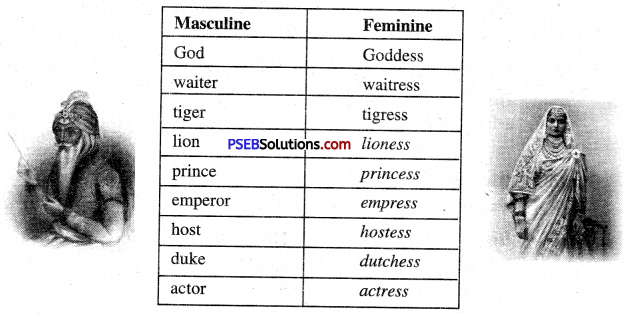
Sometimes the word is slightly changed and-ess is added. Some examples are given in the table.
Complete the ones that have been left blank in the table. (teacher must help] :
PSEB 6th Class English Solutions Chapter 2 The Lake of the Moon 5

Activity 6.

Many nouns have different words for the Masculine and the Feminine. Some examples are done for you. Complete the ones that have been left blank in the table. [teacher must help] :
PSEB 6th Class English Solutions Chapter 2 The Lake of the Moon 6

PSEB 6th Class English Solutions Chapter 2 The Lake of the Moon

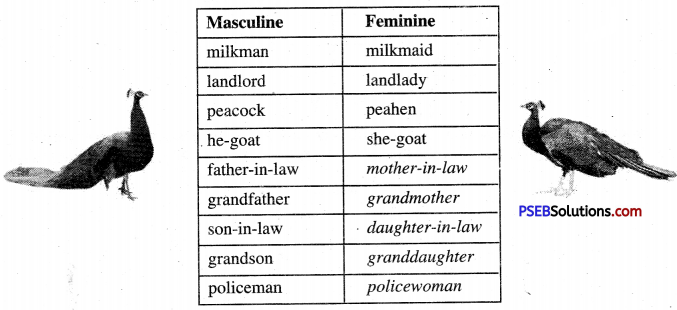
Activity 7.

Sometimes half the word that shows gender gets changed. Some examples are done for you. Complete the ones that have been left blank in the table. [teacher must help] :
Masculine milkman
PSEB 6th Class English Solutions Chapter 2 The Lake of the Moon 7

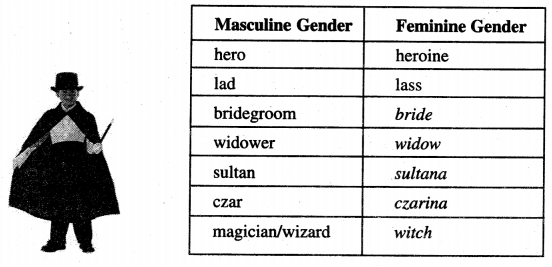
Activity 8.

Some words change but their patterns are different. Some examples are done for you. Complete the ones that have been left blank in the table. [teacher must help] :

PSEB 6th Class English Solutions Chapter 2 The Lake of the Moon 8

नोट :-Magician वास्तव में Common gender है।

Activity 9.

Some words are common to both genders. These words can be used for both males and females. Such words are called Common Gender. Some examples are done for you. Complete the ones that have been left blanks in the table, [teacher must help]:

pilot friend
bird parent
baby teacher
doctor member
child candidate
president shopkeeper
artist enemy
pupil player

Activity 10.

Some words have no gender. Such words are called Neuter gender. Some examples are done for you. Complete the ones that have been left blank in the table, [teacher must help]:

Neuter Gender
chair mountain
paper fan
book computer
school camera
pencil photo
map table
scooter rickshaw

PSEB 6th Class English Solutions Chapter 2 The Lake of the Moon

Activity 11.

Fill in the blanks using the correct option:
aunt, cow, queen, uncle, pilot, man, lady, hen, cock, duck
1. A ………………. wears a crown.
2. A …………… flies an aeroplane.
3. My grandmother is an old ……………
4. My father is a very kind and caring ……….
5. A ………….. gives us milk.
6. A ………….. lays eggs.
7. My father’s brother is my ………….
8. My mother’s sister is my
9. A ……………. quacks all day long in the pond.
0. A ………… says cock-a-doodle-doo.
Answer:
1. queen
2. pilot
3. lady
4. man
5. cow
6. hen
7. uncle
8. aunt
9. duck
10. cock

Activity 12

Write the opposite gender.
1. husband — wife
2. master — mistress
3. milkmaid — milkman
4. Peahen — peacock
5. nephew — niece
6. washer man — washer woman
7. president — president
8. queen — king
9. goose — gander
10. princess — prince

Reading a short passage

Activity 13

Read the story and do as directed :

The king was very angry. He ordered his guards to put his minister in prison. The minister had argued with the king on some law and order issue. The minister was put in prison. One day, the emperor went to the prison to see his minister. The king told him. “I will set you free on one condition. You must bring me a horse that is neither white nor black nor brown nor grey”.

The minister was surprised at this demand. However, he agreed to this condition. A week later, the minister came to the palace. “Have you found a horse ?” the King asked. “Yes, my lord”, the minister replied. “But I will show him to you only on a religious day.

The king agreed. Let me know the next religious day. The minister replied, “I will show you the horse on any day other than Sunday, Monday, Tuesday, Wednesday, Thursday, Friday or Saturday.”

The king started laughing. He was cleverly outsmarted by his minister. The minister was set free and promoted to the next higher position.

A. Write the meanings of :
(a) outsmart – outwit,पछाड़ देना
(b) issue – matter,मामला

B. Answer the following:

(a) Why was the King angry ?
Answer:
The King was angry because his minister had argued with him on some law and order issue.

(b) Why was the minister surprised at King’s demand ?
Answer:
The minister was surprised because there was no horse of the colour the king wanted.

PSEB 6th Class English Solutions Chapter 2 The Lake of the Moon

Choose the right option.

Question 1.
The argument between the king and the minister was about
(a) law and order issue
(b) religious issue
(c) war issue.
Answer:
(a) law and order issue.

Question 2.
The king ordered his guards to put his minister in prison because the minister had
(a) failed to reach the palace on time.
(b) not obeyed the king’s orders.
(c) argued with him on law and order issue.
Answer:
(c) argued with him on law and order issue.

Question 3.
The minister was surprised at the king’s demand because
(a) all horses are either black or brown or grey or white.
(b) there were no horses in the kingdom.
(c) there was no time to find a horse that the king wanted.
Answer:
(a) all horses are either black or brown or grey or white.

Activity 14(Pairwork):

Write as many words as you can think of that rhyme with the following words. One rhyming word is given for each word. And practise speaking them with your partner.

PSEB 6th Class English Solutions Chapter 2 The Lake of the Moon 9

नोट :- विद्यार्थी इन्हें बोलने का अभ्यास करें।

Learning to Write

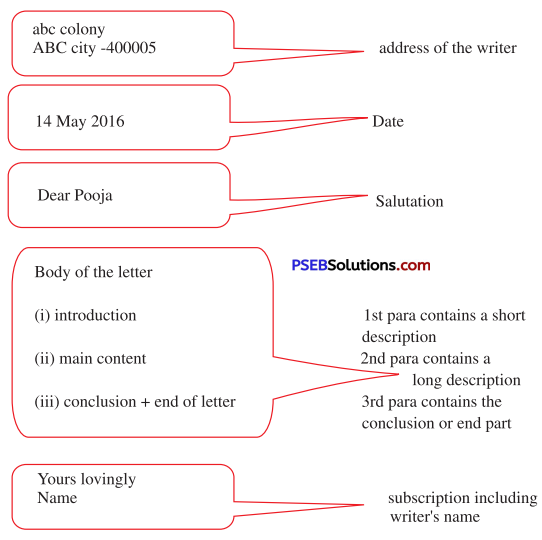
Letter Writing (Informal)

Writing a letter is an art. It has a set format that must be followed. Given ahead is the format.
Answer:
PSEB 6th Class English Solutions Chapter 2 The Lake of the Moon 10

नोट-विद्यार्थी पत्र लिखते समय इस Format का प्रयोग करें।

PSEB 6th Class English Solutions Chapter 2 The Lake of the Moon

Activity 15

Write a letter to your uncle thanking him for the beautiful gift he has sent to you.
Answer:
28 Moti Nagar
Ludhiana
March 29, 20….
My dear Uncle,
Last Monday was my birthday. I received many other gifts too. But your gift was the best one. The watch had a silver dial and a golden chain. All praised this beautiful watch. I felt proud of you. The watch will be very useful to me. It will make my life regular and punctual. I shall never be late for school now. I shall keep this watch with great care. After all, this is a token of your love for me. I celebrated it at home. A big cake was cut. Most of our near and dear ones were present. But you were absent. I missed you very much. However, you did not forget the day. You have sent me a gift.
With regards
Yours lovingly
Ravi
Address :
Shri Manohar Lal
Prem Street
Joginder Nagar
Rohtak.

Comprehension Of Passages

Read the given passages and answer the questions that follow each :

(1) A severe drought hit the area. There was no rain for some years. All the rivers and ponds dried up. Birds and animals started dying of thirst. The wild elephants suffered too due to lack of water. The king of elephants understood that many of them would die of thirst if they did not get water soon. He had to find water for his herd as quick as possible. He told the elephants to go in different directions to look for water.

One of them found a large lake full of water in another jungle far away. The king was happy. He ordered all the elephants to start moving towards the lake. It was a beautiful lake. However close to the lake was a colony of rabbits. The elephants had to pass through that colony. Thousands of rabbits were crushed to death and thousands more were injured. The rabbits were in a state of panic.

(i) What was the effect of drought on birds and animals ?
पशु-पक्षियों पर सूखे का क्या प्रभाव पड़ा ?

(ii) Who found water ? Where was it ?
पानी किसे मिला ? यह कहां था?

(iii) Choose true or false statements and write them in your answer book :
(a) Close to the lake was a colony of rabbits.
(b) The elephants had to pass through the lake.

(iv) Complete the following sentences according to the meaning of the passage.
(a) Thousands of rabbits were crushed ……….
(b) The …………. were in a panic.
Or
Match the words with the meanings :

(a) panic wounded
(b) injured great fear
captured

Answer:
(i) The birds and animals started dying of thirst.
(ii) One of the elephants found water. It was in a large lake in another jungle far away.
(iii)
(a) True
(b) False.
(iv)
(a) Thousands of rabbits were crushed to death.
(b) The rabbits were in a panic.
Or
(a) panic — great fear
(b) injured — wounded.

PSEB 6th Class English Solutions Chapter 2 The Lake of the Moon

(2) The rabbits thought and thought. How could they stop the elephants ? One little rabbit stoop up. “Your Majesty,” he said, “if you send me as your messenger to the king of the elephants, I may be able to find a solution.” “Who said these words is not mentioned.”

The little rabbit hurried to the spot where elephants lived. He saw a group elephants returning from the lake. Right in the middle was the king of elephants. To get near him was impossible. “I will be crushed to death,” thought the rabbit. So he climbed up a huge rock.

“O king of the elephants,” he shouted, “Hear me, please.” The king heard his voice and turned towards him.“Who are you ?” he asked. “I am a messenger.” replied the rabbit. “A messenger ? From whom ?” “I am a messenger from the mighty Moon.”

(i) Why did the rabbit not go near the king of elephants ?
खरगोश हथियों के राजा के निकट क्यों न गया ?

(ii) What did he do instead ?
इसकी बजाय उसने क्या किया ?

(iii) Choose true. or false statements and write them in your answer book :
(a) The king did not hear the rabbit.
(b) The king of the elephants was in the middle of the group.

(iv) Complete the following sentences according to the meaning of the passage.
(a) The king heard his voice and ……..
(b) I am a messenger from ………..
Or
Match the words with the meanings :

(a) spot place/site
(b) huge far away
very big

Answer:
(i) The rabbit did not go near the king of elephants lest he should be crushed to death.
(ii) He climbed up a huge rock.
(iii)
(a) False
(b) True.
(iv)
(a) The king heard his voice and turned towards him.
(b) I am a messenger from the mighty Moon.
or
(a) spot — place/site
(b) huge – very big.

(3) “Sir, the Moon says,” said the little rabbit, “You, the king of the elephants, have brought your herd to my holy lake. You and your herd have soiled its water. You and your herd have killed thousands of rabbits on your way to the lake.

You must know that rabbits are under my special protection. Everyone knows that the king of the rabbits lives with me. I ask you not to kill any more rabbits. If you do not agree, something bad will happen to you and your herd.” The king of the elephants was shocked.

He looked at the little rabbit. “You are right,” he said. “We may have killed many rabbits on our way to the lake. I shall see that you do not suffer anymore. I shall request the Moon to forgive me for my sins. Please tell me what I should do.”

(i) What was the Moon’s message to the king of elephants ?
हाथियों के राजा के नाम चांद का क्या संदेश था ?

(ii) Who wanted the Moon to foregive him and for what ?
चांद से माफ़ी कौन चाहता था और किस बात के लिए ?

(iii) Choose true or false statements and write them in your answer book :
(a) The elephants had killed thousands of rabbits.
(b) The king of the elephants was happy.

(iv) Complete the following sentences according to the meaning of the passage.
(a) If you do not agree something bad will happen to ………..
(b) I shall see that ……
Or
Match the words with their meanings :

(a) protection punishment
(b) sins defence
bad deeds

PSEB 6th Class English Solutions Chapter 2 The Lake of the Moon

Answer:
(i) The Moon’s message was not to kill any more rabbits.
(ii) The king of elephants wanted the Moon to forgive him for his sins.
(iii)
(a) True
(b) False
(iv)
(a) If you do not agree something bad will happen to you and your herd.
(b) I shall see that you do not suffer anymore.
Or
(a) protection – defence
(b) sins – bad deeds.

Use Of Words/Phrases In Sentences

1. Huge (very big) —
A palace is a huge building.
महल एक बहुत बड़ा भवन होता है। I

2. Due to (because of —
could not attend the meeting due to illness.
बीमारी के कारण मैं मीटिंग में न जा सका।

3. Look for (search) —
We are looking for our lost bal.
हम अपनी गुम हुई गेंद ढूंढ रहे हैं।

4. Disturb (interrupt) —
Don’t disturb me. I am doing my homework.
मेरे काम में बाधा मत डालो। मैं घर का काम कर रहा हूँ।

5. Severe (acute) —
I have severe pain in my body.
मेरे शरीर में बहुत अधिक दर्द है।

6. To and fro (here and there) —
The swing was moving to and fro.
झूला इधर-उधर आ जा रहा था।

7. Majestic (grand) —
The Taj Mahal is a majestic building.
ताजमहल एक शानदार इमारत है।

8. Prevent (stop) —
I could not prevent him to soil his clothes.
मैं उसे अपने कपड़े गंदे करने से न रोक सका।

9. Reflect (cast back/give back) —
Water reflects light.
पानी प्रकाश को परावर्तित करता है

10. Injured (wounded) —
Many people were injured in the accident.
दुर्घटना में कई लोग घायल हो गए।

11. Occur to (strike one’s mind) —
It did not occur to me that I was running into danger.
मैं यह न समझ सका कि मैं खतरे में पड़ रहा हूं।

Word Meanings 

PSEB 6th Class English Solutions Chapter 2 The Lake of the Moon 11

The Lake of the Moon Summary in Hindi

Once upon a time …………………………. state of panic.

एक समय की बात है, जंगल में हाथियों का एक बहुत बड़ा झुंड रहता था। उनका राजा एक बहुत बड़ा राजसी हाथी था जो अपने झुंड से बहुत प्यार करता था। उस क्षेत्र में भयंकर सूखा पड़ा। कुछ वर्षों से वहाँ वर्षा नहीं हुई थी। सभी नदियां तथा तालाब सूख गए। पक्षी और जानवर प्यास से मरने लगे।

जंगली हाथियों को भी पानी की कमी के कारण मुसीबत का सामना करना पड़ा। हाथियों का राजा समझ गया यदि उन्हें शीघ्र ही पानी नहीं मिला तो उनमें से बहुत से मर जाएंगे। उसे जल्दी से जल्दी अपने झुंड के लिए पानी की तलाश करनी होगी। उसने हाथियों को अलग-अलग दिशा में जाकर पानी ढूंढने के लिए कहा।

उनमें से एक को दूर किसी दूसरे जंगल में पानी से भरी एक बड़ी झील मिली। राजा खुश हुआ। उसने सभी हाथियों को उस झील की ओर चलने का आदेश दिया।झील सुन्दर थी। परन्तु झील के निकट खरगोशों की एक बस्ती थी। हाथियों को उस बस्ती में से होकर जाना पड़ता था। हजारों खरगोश मारे जाते थे और उससे भी कई हजार अधिक खरगोश घायल हो जाते थे। खरगोश आतंकित थे।

PSEB 6th Class English Solutions Chapter 2 The Lake of the Moon

Thinking …………..not mentioned.

उनके राजा ने एक सभा बुलाई। उसने कहा, “जंगली हाथियों का एक झुंड हमारी बस्ती में से निकलता है। उन्होंने हमें हजारों की संख्या में पहले ही मार डाला है और कई हजार घायल हो गए हैं। हमें शीघ्र ही जरूरी कदम उठा कर और अधिक मौतों को रोकना होगा। मैं चाहता हूँ कि तुम सब अपनी जाति की सुरक्षा के लिए किसी तरीके पर विचार करो” खरगोशों ने बार-बार सोचा। हाथियों को कैसे रोका जाए? एक छोटा सा खरगोश उठ खड़ा हुआ। उसने कहा, “महाराज, यदि आप मुझे हाथियों के राजा के पास अपना दूत बनाकर भेजे तो मैं कोई समाधान निकाल पाऊँगा।”

The little Rabbit ………………………. I should do.”

छोटा खरगोश तेज़ी से उस स्थान की ओर गया जहाँ हाथी रहते थे। उसने हाथियों के एक समूह को झील से वापिस आते देखा। उनके बिल्कुल बीच हाथियों का राजा था। उसके पास पहुँचना असंभव था ( खरगोश ने सोचा, “मैं तो कुचलकर मारा जाऊँगा।” इसलिए वह एक बहुत बड़ी चट्टान पर चढ़ गया। वह चिल्लाया, ” ओ, हाथियों के राजा कृपया मेरी बात सुनें।” राजा ने आवाज़ सुनी और उसकी ओर मुड़ा। उसने कहा, “कौन हो तुम ?” खरगोश ने उत्तर दिया, “मैं एक दूत हूँ।” “एक दूत ? किसके यहाँ से ?” “मैं शक्तिशाली चंद्रमा का दूत हूँ।” “सच में ? तुम क्या चाहते हो? क्या मेरे लिए चंद्रमा का कोई संदेश है?”

“हाँ, हाँ महाराज, परन्तु तुम मुझसे क्रोधित मत होना। मैं तो केवल एक दूत हूँ। मैं तो केवल अपना कर्त्तव्य निभा रहा हूँ।” राजा हाथी ने कहा, “बिल्कुल ठीक, एक दूत को उसके कुछ भी कहने के लिए दण्डित नहीं किया जाता। तुम कहो जो भी कहने के लिए आए हो। मैं तुम्हें कोई हानि नहीं पहुँचाऊंगा। तुम तो केवल अपना कर्तव्य निभा रहे हो।” छोटे से खरगोश ने कहा, “श्री मानजी, चंद्रमा कहता है “हाथियों के राजा, तुम अपने झुंड को मेरी पवित्र झील पर लाए हो। तुमने और तुम्हारे झंड ने मेरे जल को गंदा कर दिया है। तुमने और तुम्हारे झंड ने झील की ओर जाते हुए हजारों खरगोशों को मार डाला है। तुम्हें पता होना चाहिए कि खरगोश मेरे विशेष संरक्षण में हैं। सभी जानते हैं कि खरगोशों का राजा मेरे साथ रहता है।

मैं तुम्हें कह रहा हूँ कि अव और खरगोशों को मत मारना। यदि तुम नहीं मानोगे तो तुम्हें और तुम्हारे झुंड के साथ कुछ बुरा होगा।” राजा को दुख पहुँचा। उसने छोटे से खरगोश की ओर देखा। “तुम ठीक कह रहे हो।” उसने कहा हो सकता है, “हमने झील के रास्ते में बहुत से खरगोशों को मार डाला हो। मैं इस बात का ध्यान रखूगा कि तुम्हें अब और अधिक कष्ट न उठाना पड़े। मैं चंद्रमा से निवेदन करूंगा कि वह मुझे मेरे पापों के लिए क्षमा कर दें। कृपया मुझे बताओ कि मुझे क्या करना चाहिए।”

“Come with me ………………….. fooled or befooled ?

खरगोश ने उत्तर दिया, “मेरे साथ अकेले आओ। आओ, मैं तुम्हें चंद्रमा के पास ले चलता हूँ।” छोटा खरगोश भारी भरकम हाथी को झील पर ले गया। वहाँ उन्होंने शांत (ठहरे हुए) जल में चांद का प्रतिबिंब (परछाईं) देखा। छोटे झील सुन्दर थी। परन्तु झील के निकट खरगोशों की एक बस्ती थी। हाथियों को उस बस्ती में से होकर जाना पड़ता था। हजारों खरगोश मारे जाते थे और उससे भी कई हजार अधिक खरगोश घायल हो जाते थे। खरगोश आतंकित थे।

Thinking …….. not mentioned.

उनके राजा ने एक सभा बुलाई। उसने कहा, “जंगली हाथियों का एक झुंड हमारी बस्ती में से निकलता है। उन्होंने हमें हजारों की संख्या में पहले ही मार डाला है और कई हजार घायल हो गए हैं। हमें शीघ्र ही जरूरी कदम उठा कर और अधिक मौतों को रोकना होगा। मैं चाहता हूँ कि तुम सब अपनी जाति की सुरक्षा के लिए किसी तरीके पर विचार करो” खरगोशों ने बार-बार सोचा। हाथियों को कैसे रोका जाए? एक छोटा सा खरगोश उठ खड़ा हुआ। उसने कहा, “महाराज, यदि आप मुझे हाथियों के राजा के पास अपना दूत बनाकर भेजे तो मैं कोई समाधान निकाल पाऊँगा।”

The little Rabbit …………. ……………. I should do.

” छोटा खरगोश तेज़ी से उस स्थान की ओर गया जहाँ हाथी रहते थे। उसने हाथियों के एक समूह को झील से वापिस आते देखा। उनके बिल्कुल बीच हाथियों का राजा था। उसके पास पहुँचना असंभव था ( खरगोश ने सोचा, “मैं तो कुचलकर मारा जाऊँगा।” इसलिए वह एक बहुत बड़ी चट्टान पर चढ़ गया।

वह चिल्लाया, ” ओ, हाथियों के राजा कृपया मेरी बात सुनें।” राजा ने आवाज़ सुनी और उसकी ओर मुड़ा। उसने कहा, “कौन हो तुम ?” खरगोश ने उत्तर दिया, “मैं एक दूत हूँ।” “एक दूत ? किसके यहाँ से ?” “मैं शक्तिशाली चंद्रमा का दूत हूँ।” “सच में ? तुम क्या चाहते हो? क्या मेरे लिए चंद्रमा का कोई संदेश है?”

“हाँ, हाँ महाराज, परन्तु तुम मुझसे क्रोधित मत होना। मैं तो केवल एक दूत हूँ। मैं तो केवल अपना कर्त्तव्य निभा रहा हूँ।” राजा हाथी ने कहा, “बिल्कुल ठीक, एक दूत को उसके कुछ भी कहने के लिए दण्डित नहीं किया जाता। तुम कहो जो भी कहने के लिए आए हो। मैं तुम्हें कोई हानि नहीं पहुँचाऊंगा। तुम तो केवल अपना कर्तव्य निभा रहे हो।

” छोटे से खरगोश ने कहा, “श्री मानजी, चंद्रमा कहता है “हाथियों के राजा, तुम अपने झुंड को मेरी पवित्र झील पर लाए हो। तुमने और तुम्हारे झंड ने मेरे जल को गंदा कर दिया है। तुमने और तुम्हारे झंड ने झील की ओर जाते हुए हजारों खरगोशों को मार डाला है। तुम्हें पता होना चाहिए कि खरगोश मेरे विशेष संरक्षण में हैं।

सभी जानते हैं कि खरगोशों का राजा मेरे साथ रहता है। मैं तुम्हें कह रहा हूँ कि अव और खरगोशों को मत मारना। यदि तुम नहीं मानोगे तो तुम्हें और तुम्हारे झुंड के साथ कुछ बुरा होगा।” राजा को दुख पहुँचा। उसने छोटे से खरगोश की ओर देखा। “तुम ठीक कह रहे हो।” उसने कहा हो सकता है, “हमने झील के रास्ते में बहुत से खरगोशों को मार डाला हो। मैं इस बात का ध्यान रखूगा कि तुम्हें अब और अधिक कष्ट न उठाना पड़े। मैं चंद्रमा से निवेदन करूंगा कि वह मुझे मेरे पापों के लिए क्षमा कर दें। कृपया मुझे बताओ कि मुझे क्या करना चाहिए।”

PSEB 6th Class English Solutions Chapter 2 The Lake of the Moon

“Come with me ………………….. fooled or befooled ?

खरगोश ने उत्तर दिया, “मेरे साथ अकेले आओ। आओ, मैं तुम्हें चंद्रमा के पास ले चलता हूँ।” छोटा खरगोश भारी भरकम हाथी को झील पर ले गया। वहाँ उन्होंने शांत (ठहरे हुए) जल में चांद का प्रतिबिंब (परछाईं) देखा। छोटे

खरगोश ने कहा, “महाराज, चांद से मिलें।” हाथी ने अपनी सूंड को जल में डुबोया और कहा, “कृपया मुझे चांद की पूजा करने दो।” जैसे ही पानी को छेड़ा गया पानी में चांद इधर-उधर हिलने लगा। खरगोश ने कहा, ” अब, चाँद पहले से भी अधिक क्रोधित है।” राजा हाथी ने पूछा, ” क्यों ? मैंने ऐसा क्या किया ?” खरगोश ने उत्तर दिया, “आपने झील के पवित्र जल को छुआ है।” हाथी ने अपना सिर झुका लिया।

“कृपया चंद्रमा से कहो मुझे माफ कर दें। हम आगे से कभी भी इस झील के पवित्र जल को नहीं छुएंगे न ही हम फिर कभी उन खरगोशों को हानि पहुँचाएंगे जो चांद के सबसे प्रिय हैं।” इस तरह राजा और उसका झुंड वहां से चले गए। शीघ्र ही वर्षा होने लगी और हाथी खुशी से रहने लगे। उन्हें यह कभी भी नहीं पता चला कि एक छोटे से खरगोश ने उन्हें मूर्ख बनाया है या चकमा दिया है।

Retranslation Of Isolated Sentences

1. Once upon a time, a large herd of elephants lived in a jungle. .
एक समय की बात है जंगल में हाथियों का एक बहुत बड़ा झुंड रहता था।

2. There was no rain for some years.
कुछ वर्षों से वर्षा नहीं हुई थी।

3. The wild elephants suffered too due to lack of water.
जंगली हाथियों को भी पानी की कमी के कारण मुसीबत का सामना करना पड़ा।

4. He had to find water for his herd as quickly as possible.
उसे जल्दी से जल्दी अपने झुंड के लिए पानी की तलाश करनी थी।

5. It was a beautiful lake.
झील सुंदर थी।

6. The rabbits were in a state of panic.
खरगोश आतंकित/भयभीत थे।

7. They have already killed thousands of us.
उन्होंने हमें हजारों की संख्या में पहले ही मार डाला है।

8. The rabbits thought and thought.
खरगोशों ने बार-बार सोचा।

9. Who said these words is not mentioned.
ये शब्द किसने कहे इसका कोई पता नहीं।

10. I will be crushed to death..
मैं तो कुचल (रौंद) कर मारा जाऊँगा।

11. I am a messenger from mighty moon.
मैं शक्तिशाली चंद्रमा का दूत हूँ।

12. You and your herd have soiled its water.
तुमने और तुम्हारे झुंड ने इसके जल को गंदा कर दिया है।

PSEB 6th Class English Solutions Chapter 2 The Lake of the Moon

13. The king of the elephants was shocked.
हाथियों का राजा दुखी हो उठा।

14. Please ask the Moon to forgive me.
कृपया चद्रंमा से कहो कि वह मुझे माफ कर दें।

English Class 6 Solutions PSEB Prose

There was a Naughty Boy Question Answer Class 7 English Solutions Poem Chapter 4 PSEB Solutions

Punjab State Board PSEB 7th Class English Book Solutions Poem 4 There was a Naughty Boy Textbook Exercise Questions and Answers.

Class 7th English Solutions Poem Chapter 4 There was a Naughty Boy Question Answers

There was a Naughty Boy Class 7 Questions and Answers

Activity 1.

Look up the following words in a dictionary. You should seek the following information about the words and put them in your WORDS notebook.
1. Meaning of the word as used in the poem (adjective/noun/verb, etc.)
2. Pronunciation (The teacher may refer to the dictionary or the mobile phone for correct pronunciation.)
3. Spellings

Scotland ground yard weighty fourscore wondered

PSEB 7th Class English Solutions Poem 4 There was a Naughty Boy

Vocabulary Expansion

Activity 2

The naughty boy ran away to Scotland from England to see the people there. There, he found that things in Scotland were just the same as in England. To show that things were similar, the poet uses the word “as’. Write about the things that are similar in the space given. One example is given.

1. The naughty boy found that the ground in Scotland was as hard as in England
2. The naughty boy found that the yard in Scotland was as long as in England.
3. The naughty boy found that the song in Scotland was as merry as in the England.
4. The naughty boy found that the cherry in Scotland was as red as in England.
5. The naughty boy found that as weighty as in England.
6. The naughty boy found that the fourscore in Scotland was as eighty as in England.
7. The naughty boy found that the door in Scotland was as wooden as in England.

Activity 3.

Read the following lines from the poem.

That a door
Was as wooden
The door in the poem was ‘wooden’. Let us see some other things which are made of wood. Select the things in the box below that are made of wood and underline them.

table car mobile phone television
boat laptop bed cupboard

Answer:
table, boat, bed, cupboard.

Activity 4.

Three words are given in each column. Fill in the blanks with the names of the material with which the things in each column are made of.
PSEB 7th Class English Solutions Poem 4 There was a Naughty Boy 1
Answer:
stell, Wood, cloth, rubber.

PSEB 7th Class English Solutions Poem 4 There was a Naughty Boy

Learning to Read and Comprehend

Activity 5.

Answer the following questions.

Question 1.
Where did the naughty boy run away from ?
शरारती लड़का कहाँ से भाग कर आया था ?
Answer:
The naughty boy ran away from England.

Question 2.
Where did the naughty boy go?
शरारती लड़का कहाँ गया ?
Answer:
He went to Scotland.

Question 3.
Why did he go there ?
वह वहाँ क्यों गया ?
Answer:
He went there to see the people living there.

Question 4.
What different things did the boy see in Scotland ?
लड़के को स्काटलैंड में कौन-सी भिन्न चीजें देखीं ?
Answer:
The boy saw nothing different in Scotland.

Question 5.
What did the boy wonder about ?
लड़के को किस बात की हैरानी हुई ?
Answer:
He wondered that everything in Scotland was the same as it was in England. Learning Language

Activity 6.

The poem “There was a Naughty Boy’ is very interesting. It describes many things. To describe the things, the poet uses many adjectives. The title of the poem “There was a Naughty Boy’ also has an adjective to describe the boy. Find some more adjectives from the grid given below.
PSEB 7th Class English Solutions Poem 4 There was a Naughty Boy 2
Look at the following two sentences.
1. I am hungry.
2. I am starving.

What is the difference between ‘hungry’ and ‘starving’ here?
Here, sentence 2 tells the reader that ‘I am very hungry (starving). ‘Starving’ means “very hungry’. ‘Starving’, ‘therefore’, is the stronger adjective.

PSEB 7th Class English Solutions Poem 4 There was a Naughty Boy

Activity 7.

Match the adjective in Column A with its stronger adjective in Column B. Column A

Column A
Adjective
Column B
Stronger Adjective
hungry starving
tired beautiful
pretty enraged
nice exhausted
intelligent excellent
angry brilliant
clean spurious
bad hygienic
fake dreadful

Answer:
Hungry — starving, tired – exhausted, pretty – beautiful, nice – excellent, intelligent – brilliant, angry – enraged, clean – hygienic, bad – dreadful, fake – spurious.

Learning to Listen (Class Activity)

Activity 8.

The teacher will speak clearly and give instructions to the students. Students will close their books and listen to the instructions and follow them.
Now repeat the same activity. The teacher will ask a student to come to the front and read the instructions to other students.
Appendix

Learning to Speak (Pairwork)

Activity 9.

Read the following pairs of words aloud with proper stress.
1. hard, yard हाँअड्, याअड्)
2. long, song (लँग,साँग))
3. red, lead (रेड, लैड)
4. weighty, eighty (वेराटी, राअटी)
5. found, ground (फउंड, ग्राउंड)
नोट – विद्यार्थी स्वंय करें

Activity 10.

Discuss in your group what the naughty boy would like to see in Punjab if he came to India and what he would do here.
Some hints :
1. The Golden Temple
2. Vaisakhi Fair
3. Giddha
4. Bhangra
Answer:
Punjab is a land of ten great Sikh Gurus, Gurudwaras and temples. People here are very brave, hard-working and cheerful. The naughty boy, therefore, would see, a scene totally different from England. He would visit the Golden Temple, Jallianwalla Bagh and famous Durgyana Temple. If he came in April, he would visit the Vaisakhi Fair. He would enjoy Giddha and Bhangra, the classical dances of the Punjab. He would also like to see the green and golden fields of wheat crop. Moreover, he would do heavy shopping and take back with him a number of symbols of the Punjabi Culture.

PSEB 7th Class English Solutions Poem 4 There was a Naughty Boy

Learning to Use Language (Group work)

Activity 11.

Discuss in your group which places would you like to see in London and why ? Here are some pictures.
PSEB 7th Class English Solutions Poem 4 There was a Naughty Boy 3
Buckingham Palace where the Queen of United Kingdom lives
PSEB 7th Class English Solutions Poem 4 There was a Naughty Boy 4
Westminster Abbey and the Big Ben Clock Tower
PSEB 7th Class English Solutions Poem 4 There was a Naughty Boy 5

London Eye – a giant wheel, riding on which you can see the whole of London
Answer:
London, the capital of England is a beautiful city to visit. There are many places worth visiting. If I go to London. I would like to visit Buckingham Palace, the Westminster Abbey, the Big Ben Clock Tower and the London eye first.

The Buckingham Palace is a majestic building. It is the royal palace of the Queen of U.K. The Westminster Abbey is a huge royal church. It is situated in the centre of the city offering daily services for all. It is also – World Heritage cite.

PSEB 7th Class English Solutions Poem 4 There was a Naughty Boy

The Big Ben Tower is another building worth visiting. Big Ben is the nickname of the striking clock of the tower. The clock is known for it accuracy. The London Eye is a giant wheel. It is thrilling to have a ride on it. The ride enables you to see the whole of London.

Stanzas For Comprehension

Read the following stanzas carefully and answers the questions that follow each :

(1) There was a naughty boy,
And a naughty boy was he
He ran away to Scotland
The people there to see.

1. Why did the naughty boy run to Scotland ?
शरारती लड़का स्कॉटलैंड क्यों भाग गया ?

2. Why does the poet repeat the word ‘naughty’.
कवि लडके के लिए ‘naughty’ शब्द को क्यों देहराता है|

3. Name the poem and the poet.
कविता और कवि का नाम लिखें।
Answers
1. The naughty boy ran to Scotland to see the people there.
2. The poet repeats the word ‘naughty’ to say that the boy was most mischievous or the naughties one.
3. The name of the poem is ‘There was a Naughty Boy’ and that of the poet is John Keats.

(2) Was as weighty,
That fourscore
Was as eighty,
That a door
Was as wooden,
As in England
So he stood in his shoes
And he wondered,
He wondered,
He stood in his shoes,
And he wondered.

1. What ‘similarity’ did he find about the ground, the door there ?
वहां धरती और दरवाजे के बारे में क्या (किस समानता का) पता चला ?

2. What wondered him ? What words show he surprise ?
उसे किस बात की हैरानी हुई ? कौन-से शब्द उसकी हैरानी को व्यक्त करते हैं ?

PSEB 7th Class English Solutions Poem 4 There was a Naughty Boy

3. What is the central idea of the poem ? कविता का केन्द्रीय भाव क्या है ?
Answer.
1. He found that the ground was as hard and the door was as wooden as in England.
2. Similarity in everything in England and in the place where he was (Scotland) wondered him. The words ‘He stood in his shoes’ show his surprise.
3. The poem brings out that no places are different, no men are different in the world. Their way of life is the same. The things they use and the activities they are involved in are similar. :

Word Meanings

PSEB 7th Class English Solutions Poem 4 There was a Naughty Boy 7

There was a Naughty Boy Summary in Hindi

एक शरारती लड़का (इंग्लैंड) का था। वह यह देखने के लिए स्कॉटलैंड भाग गया कि वहां के लोग कैसे हैं। वह देख कर हैरान रह गया कि वहाँ की धरती इंग्लैंड की धरती की तरह सख्त है। वहां के गज़ की लम्बाई भी उतनी है जितनी कि इंग्लैंड में। स्कॉटलैंड तथा इंग्लैंड के गीतों, फलों तथा धातुओं के गुणों में भी समानता थी।

उदाहरण के लिए गीत आनन्द भरे थे, चैरी लाल थी तथा सीसा भारी था। वहां की गणना का मानक कोड़ी (20 वस्तुएं) भी एक जैसा था। वास्तव में यह सब कुछ हैरान कर देने वाला था।

My English Companion for Class 7 PSEB Solutions Poetry

Kabuliwala Tree Question Answer Class 6 English Solutions Chapter 6 PSEB Solutions

Punjab State Board PSEB 6th Class English Book Solutions Chapter 6 Kabuliwala Tree Textbook Exercise Questions and Answers.

Class 6th English Solutions Chapter 6 Kabuliwala Tree Question Answers

Kabuliwala Tree Class 6 Questions and Answers

Activity 1.

Look up the following words in a dictionary. You should seek the following information about the words.
1. Meaning of the word as used in the lesson (Adjective/Noun/Verb, etc.
2. Pronunciation. (The teacher may refer to the dictionary or the mobile phone for correct pronunciation.)
3. Spellings

worried quieten conversation lively clouds
crime recognise ceremonies terror chatterbox
sack tenderly chatter expenses

PSEB 6th Class English Solutions Chapter 6 Kabuliwala

Vocabulary Expansion

Activity 2.

In the following table, you will see some words with their meanings. Make one sentence of each word.

S.No. Word Meaning Sentence
1. chatting (v) talking in a friendly way My friend and I sat on a bench chatting for hours.
2. conversation (n) talk between people The two friends were lost in a funny conversation.
3. lively (adj) full of life Plants look lively after the rain.
4. crime (n) an act for which you can be punished by law Stealing is a crime.
5. ceremony (n) an important religious or social event-wedding, birthdays, etc. Ceremonies of his wedding were going on.
6. afford (v) to have enough money to pay for something I can’t afford a new car.

Activity 3.

Choose the correct option to answer the following questions :

Question 1.
Why was Mini afraid of the Kabuliwala ?
मिनी काबुलीवाला से क्यों डरती थी ?
(a) Kabuliwala looked very horrible.
(b) She had heard that Kabuliwala caught the children.
Answer:
(b) She had heard that the Kabuliwala caught the children.

Question 2.
What was Kabuliwala’s name?
काबुलीवाला का क्या नाम था ?
(a) Rehman.
(b) Armaan.
Answer:
(a) Rehman.

PSEB 6th Class English Solutions Chapter 6 Kabuliwala

Question 3.
Why was the Kabuliwala arrested ?
काबुलीवाला को क्यों गिरफ्तार किया गया ?
(a) He had stolen money from Mini’s house.
(b) He had stabbed a man.
Answer:
(b) He had stabbed a man.

Question 4.
What did Mini’s father give to the Kabuliwala ?
मिनी के पिता ने काबुलीवाला को क्या दिया ?
(a) Some clothes and food
(b) Some money
Answer:
(b) Some money

Question 5.
Mini’s father could not afford the military band on her marriage. Why?
मिनी के पिता उसकी शादी पर मिल्ट्री बैंड की व्यवस्था न कर सके। क्यों ?
(a) Because he had given some money to the Kabuliwala.
(b) Because he had suffered a huge loss in his business.
Answer:
(a) Because he had given some money to the Kabuliwala.

Activity 4

Put a tick (✓) or a cross (✗) against each sentence :

1. Little Mini was three years old. — (✗)
2. Rehman was a big bearded pathan. — (✓)
3. The Kabuliwala was hanged to death. — (✗)
4. Mini could not forget the Kabuliwala. — (✗)
5. Mini’s father helped Rehman with some money. — (✓)

Activity 5.

Complete the following sentences :

1. Mini could not live…………
2. The Kabuliwala and Mini would sit and………
3. There was a terrible……………..
4. Mini had grown……………. .
5. Mini’s father had to cut down…………….
Answer:
1. without chatting
2. chat for hours
3. noise in the street
4. into a beautiful woman
5. the expenses on the wedding.

PSEB 6th Class English Solutions Chapter 6 Kabuliwala

Learning Language Conjunction

A conjunction is a word which joins two words, phrases or sentences.
दो शब्दों, शब्द-समूहों या वाक्यों को आपस में जोड़ने वाला शब्द conjunction कहलाता है। Some common conjunctions are : and, but, so, because. Let us see how they are used.

1. I missed the train.
I was late.
We can combine these two sentences by using ‘because’
I missed the train because I was late.

2. She wants coffee.
I want tea.
We can combine these two sentences by using ‘but’.
She wants coffee but I want tea.

Activity 6.

Underline the conjunctions in the following sentences :
1. Slow and steady wins the race.
2. Caesar and Pebble are friendly dogs.
3. I went out and had ice-cream.
4. I missed my flight because I was late.
5. Yesterday, it rained but today it is sunny.
6. I remember his name but not his mobile number.
7. He bought a book because he loves reading.
8. They went to the restaurant and had dinner.
Answer:
1. and
2. and
3. and
4. because
5. but
6. but
7. because
8 and.

Activity 7.

Fill in the blanks with but/and/so.

1. I can read _____ write English.
2. Nisha can swim _____ Rani can’t.
3. Tom _____ Lucy came to my house.
4. He didn’t work hard _____ he failed.
5. I have a bat, _____ I don’t have a ball.
6. It was a holiday _____ we did not go to school.
Answer:
1. and
2. but
3. and
4. so
5. but
6. so.

PSEB 6th Class English Solutions Chapter 6 Kabuliwala

Activity 8.

Match the Columns to make meaningful sentences.

Column A ___ Column B
1. He worked hard — but not tea.
2. Amrit likes coffee — so he passed.
3. I went to see my mother — because she was ill.
4. Run fast — and rested for a while.
5. Tanu and Manu came home — or you will miss the bus.
Answer:
1. He worked hard so he passed.
2. Amrit likes coffee but not tea.
3. I went to see my mother because she was ill.
4. Run fast or you will miss the bus.
5. Tanu and Manu came home and rested for a while.

Activity 9.

Look at the bar graph chart below. It is about 4 cereals that children like. Read and understand the number of votes each cereal has got.

PSEB 6th Class English Solutions Chapter 5 Playing Kabaddi 6
Answer the following questions :

Question 1.
What are the names of 4 cereals that children like in the bar graph ?
Answer:
Names of four cereals are : Corn Flakes, Cherries, Life and Kix.

Question 2.
Which cereal is the most favourite of children ?
Answer:
Life is the most favourite cereal of children.

Question 3.
How many votes has it got ?
Answer:
Six votes.

PSEB 6th Class English Solutions Chapter 6 Kabuliwala

Question 4.
How many votes has Corn flakes got ?
Answer:
Four votes.

Question 5.
How many votes has Kix got ?
Answer:
Kix has got three votes.

Question 6.
Which cereal has got the least number of votes ?
Answer:
Cherries has got the least number of votes.

Learning to Listen

Activity 10.

Your teacher will tell you a story. Listen to the story carefully and put the sentences given below in the correct order i.e. as they happen in the story. Write the numbers in the given bracktes. The first is done for you.

1. One day, he told them to bring him a bundle of sticks. ___ ( 6 )
2. The father gave the bundle to each one of his sons. ___ ( 7 )
3. The sons tried to break the bundle of sticks. ___ ( 8 )
4. He failed to make them understand. ___ ( 4 )
5. The sons always fought with one another. ___ ( 2 )
6. The father advised them to live in peace. ___ ( 3 )
7. He thought of using another way. ___ ( 5 )
8. The sons could not break the bundle. ___ ( 9 )
9. He opened the bundle and separated the sticks. ___ ( 10 )
10. Within no time the sons broke the separated sticks. ___ ( 12 )
11. One by one he gave the sticks to his sons. ___ ( 11 )
12. The father then told his sons the importance of standing with one another. ___ ( 13 )
13. A father had three sons. ___ ( 1 )

Activity 11.

Get into pairs and tell each other a joke or a short story in English. After listening to the story, you must ask each other some questions. The questions will be on something that you do not understand in the story. You must write those questions in the space given below for your teacher to check. You will also write the answers your partner gives you.

PSEB 6th Class English Solutions Chapter 6 Kabuliwala

1. Once there was a wise crow. He was very thirsty. He flew in search of water. But he could not get water anywhere. At last he reached a garden. There he saw a pitcher of water. But the water was very low. His beak could not reach it. He saw some small stones near the pitcher. He put them into the pitcher. The water came up. He drank the water and flew away.

Moral : Where there is a will, there is a way.

2. Once a fox was very hungry. It went here and there in search of food. But it did not get food anywhere. At last it reached a garden. There it saw a crow sitting in a tree. The crow had a piece of cheese in his beak.

The fox said to the crow, “Your voice is very sweet. Please sing me a song.” The crow was happy. He opened his beak to sing. The piece of cheese fell down. The fox ate it up and went away.

Moral : Beware of flatterers.

My Questions
1. The crow is a wise bird. Then why did he opened his beak ?
2. How did the fox know the art of flattery and its power ?

My Partner’s answers
1. The words of flattery are more powerful.
2. It knew this as she is a very clever animal.

Activity 12.

Look at the following words. Learn to pronounce them by repeating after the teacher.
1. quieten — क्वाइटन
2. conversation — कन्वसेशन
3. lively — लिवलि
4. clouds — क्लाउड्स
5. crime — काइम
6. recognise — रैकाग्नाइज़
7. ceremonies — सेरेमनीज़
8. terror — टेरर
9. chatterbox — चैटरबाक्स
10. tenderly — टेंड्अली

Comprehension Of Passages

Read the given passages and answer the questions that follow each.

(1) Little Mini was five years old and a great chatterbox. She simply could not live without chatting all the time. Her mother was often worried about this non-stop chatter of Mini and tried to quieten her. But no one could think of Mini being quiet.

(i) How old was Mini ?
मिनी की कितनी आयु थी ?

(ii) Who was worried about her non-stop talking ?
उसके लगातार बोलते जाने से कौन चिन्तित था ?

(ii) Complete the following sentences according to the meaning of the passage :
(a) Mini was a great ……….
(b) No one could think of Mini

PSEB 6th Class English Solutions Chapter 6 Kabuliwala

(iv) Choose ‘True’ and ‘False’ statements :
(a) Mini could not live without chatting
(b) No one could try to question Mini.
Or
Match the words in column A with their opposites in column B.
Column A — Column B
(a) quiet — start
(b) stop — loud
Answer:
(i) Mini was five years old.
(ii) Mini’s mother was worried about her non-stop talking.
(iii)
(a) Mini was a great chatterbox.
(b) No one could think of Mini being quiet.
(iv)
(a) True
(b) False
or
(a) quiet — loud
(b) stop — start

(2) Mini called out to the Kabuliwala but when he looked at her, she was in terror and ran to her father. She had heard that Kabuliwalas caught children, put them in their sacks and took them away. The Kabuliwala came to Mini’s house and her father made sure that Mini came out and met him.

(i) Who did Mini call out to ?
मिनी ने किसको पुकारा ?

(ii) Why did she run to her father in terror ?
वह आतंकित होकर अपने पिता के पास क्यों भाग गई ?

(iii) Choose true or false statements and write them in your answer book.
(a) The Kabuliwala did not come to Mini’s house.
(b) In terror Mini ran to her father.

(iv) Complete the following sentences according to the meaning of the passage :
(a) Mini had heard that Kabuliwalas caught children ………..
(b) Mini’s father wanted to make sure that …………..
Or
Write the meanings of the following words in English :
(a) terror
(b) sack
Answer:
(i) Mini called out to the Kabuliwala.
(ii) She had heard that Kabuliwalas caught children, put them in their sacks and took them away.
(iii)
(a) False
(b) True.
(iv)
(a) Mini had heard that Kabuliwalas caught children, put them in their sacks and took them away.
(b) Mini’s father wanted to make sure that Man come out and met him.
Or
(a) great fear
(b) bag

PSEB 6th Class English Solutions Chapter 6 Kabuliwala

(3) Mini’s father could not control his tears. He realised that the poor Kabuliwala was also a father. He called Mini who came out dressed as a bride. The Kabuliwala was shocked to see that Mini, the little girl he had known, had grown into a beautiful woman. He suddenly realised that his own daughter would have grown up too and broke into tears.

(i) Why could Mini’s father not control his tears ?
मिनी का पिता अपने आंसू क्यों न रोक सका ?

(ii) How was Mini dressed ?
मिनी ने कैसी पोशाक पहन रखी थी ?

(iii) Choose true or false statements and write them in your answer-book :
(a) Mini’s father laughed at the Kabuliwala’s plight.
(b) The Kabuliwala was shocked to see Mini.

(iv) Complete the following sentences according to the meaning of the passage :
(a) He realized that his own daughter would have grown up ….
(b) Mini had grown …..
or
Match the words with their meanings :
(a) dressed — felt
(b) realised — clothed/clad
Answer:
(i) Because he realized that the Kabuliwala was also a father.
(ii) Mini was dressed as a bride.
(iii)
(a) False
(b) True
(iv)
(a) He realized that his own daughter would have grown up too and broke into tears.
(b) Mini had grown into a beautiful woman.
Or
(a) dressed — clothed/ clad felt
(b) realised — felt

Use Of Words/Phrases In Sentences

1. Chatting (v): (talking in a friendly manner) —
They were chatting and laughing.
वे बातें कर रहे थे और हंस रहे थे।

2. Worried (v) : (to be anxious) —
Why do you seem worried ?
तुम परेशान क्यों दिख रहे हो ?

3. Lively (adj.): (full of life) —
She sang a lively song.
उसने रोचक गाना गाया।

4. Terror (n) : (great fear) —
The people ran in terror to see a lion.
लोग शेर को देखकर डर से भागे।

PSEB 6th Class English Solutions Chapter 6 Kabuliwala

5. Owe (v) : (to be indebted) —
I owe him twenty rupees.
मैंने उसे बीस रुपये ऋण में दिए।

6. Crime (n) : (a punishable act) —
Killing people is a crime.
लोगों को मारना जुर्म है।

7. Recognize (n) : (to be able to identify) —
I recognized my old friend when I met him after 25 years.
मैंने अपने पुराने मित्र को पहचान लिया जब मैं उसे 25 वर्षों बाद मिला |

8. Ceremonies (n) : (rituals/religious events) —
The wedding ceremomies are going on.
विवाह के रीति-रिवाज चल रहे हैं।

9. Afford (v): (to be able to have) —
We can’t afford a car.
हम कार नहीं रख सकते।

Word Meanings

PSEB 6th Class English Solutions Chapter 5 Playing Kabaddi 7

Kabuliwala Summary in Hindi

Little Mini ……………………….. five-year-old.

छोटी मिनी पाँच वर्ष की थी और बड़ी बातूनी थी। उसका हर समय बात किए बिना गुजारा नहीं था। उसकी माँ प्राय: मिनी की कभी न रुकने वाली बातों से परेशान रहती थी और उसे चुप कराने का प्रयास करती थी। परंतु कोई सोच भी नहीं सकता था कि मिनी चुप हो जाएगी। अपने पिता जी के साथ उसकी बातचीत सदा बहुत ही सजीव होती थी।

एक दिन मिनी दौड़ती हुई अपने पिता के अध्ययन कक्ष में आई। वह अपने पिता को बाजुओं में भरकर बोली, “पिता जी, आप क्या सोचते हैं ? भोला कहता है कि बादलों में एक हाथी है जो अपनी सूंड से पानी बिखेरता है, इसलिए वर्षा होती है।” इससे पहले कि उसके पिता उत्तर देते वह “ए काबुलीवाला ए काबुलीवाला” चिल्लाते हुई खिड़की की ओर दौड़ी।

मिनी ने काबुलीवाला को आवाज़ दी, परंतु जब उसने (काबुलीवाला ने) उसकी ओर देखा तो वह डर गई और दौड़ कर अपने पिता के पास चली आई। उसने सुन रखा था कि काबुलीवाले बच्चों को पकड़ लेते हैं और उन्हें अपने थैले में डाल कर ले जाते है। काबुलीवाला मिनी के घर आया। मिनी का पिता इस बात से विश्वस्त होना चाहता था कि मिनी बाहर जा कर उससे मिले। शीघ्र ही मिनी को उसका डर जाता रहा। उन्हें लम्बी दाढ़ी वाले बड़े पठान को पांच वर्षीय बच्ची से मीठी-मीठी बातें करते देख बहुत खुशी हो रही थी।

PSEB 6th Class English Solutions Chapter 6 Kabuliwala

The Kabuliwala was…………………..dors long ego.

काबुलीवाला अब हर रोज़ मिनी के घर आने लगा। वे कई घंटे बातें करते और एक-दूसरे के साथ मज़ाक करते। “काबुलीवाला, ओ काबुलीवाला ! तुम्हारे थैले में क्या है ?” मिनी पूछती। “एक हाथी,” काबुलीवाला उत्तर देता और दोनों ठहाका मार कर हंसने लगते। वर्ष में एक बार रहमान जो काबुलीवाले का नाम था, अपने देश वापिस चला जाता था। जाने से पहले वह लोगों से उधार के पैसे इकट्ठे करता था। यद्यपि रहमान व्यस्त रहता था, फिर भी वह मिनी से मिलने के लिए सदा समय निकाल लेता।

एक दिन गली में बहुत अधिक शोर मच गया। रहमान ने एक आदमी को जिसने उसके पैसे देने थे, छुरा मार दिया था। इस अपराध में उसे जेल भेज दिया गया। समय गुजरता गया और मिनी शीघ्र ही अपने पुराने मित्र, काबुलीवाला को भूल गई। वह एक बहुत ही सुन्दर स्त्री के रूप में बड़ी हो रही थी।

उसके पिता ने मिनी के विवाह का प्रबन्ध किया। मिनी का उस रात विवाह हो रहा था। जब उसके पिता अपने अध्ययन कक्ष में बैठे थे, एक आदमी आया और उसने उनको आदरपूर्वक सलाम किया। पहले तो वह उस व्यक्ति को पहचान नहीं पाये। शीघ्र ही उन्हें यह महसूस हुआ कि वह काबुलीवाला रहमान है। मिनी के पिता ने उसे बताया कि घर में कुछ रस्में चल रही हैं, इसलिए वह किसी और दिन आए।

जाते-जाते वह मुड़ा और बोला, ” श्रीमान् जी, क्या मैं छोटी बच्ची से मिल सकता हूँ ?” . वह अब भी मिनी को छोटी-सी बच्ची समझ रहा था जो “काबुलीवाला, ओ काबुलीवाला” पुकारती हुई उसके पास दौड़ी चली आती थी। वह सोच रहा था कि वह बहुत पहले की तरह बातें करेंगे और हंसेंगें।

Mini’s father told him …………….. once again.

मिनी के पिता ने एक बार फिर उसे बताया कि घर में रस्में चल रही हैं। तब काबुलीवाले ने उन्हें मिनी के लिए सूखी किशमिश, अखरोट और बादामों का एक छोटा-सा पैकेट देते हुए कहा, “ये छोटी बच्ची को दे दें। मेरी भी उस जैसी एक बच्ची है, मैं उसके बारे में सोच कर आपके पास ये मेवे लाया हूँ।”

मिनी के पिता अपने आंसू न रोक पाए। उन्होंने महसूस किया कि गरीब काबुलीवाला भी पिता है। उन्होंने मिनी को बुलाया जो दुल्हन की पोशाक में बाहर आई। काबुलीवाला यह देख कर स्तब्ध रह गया कि वह जि छोटी सी मिनी को जानता था वह बड़ी हो कर एक सुन्दर स्त्री बन गई है।

PSEB 6th Class English Solutions Chapter 6 Kabuliwala

अचानक उसने महसूस किया कि उसकी अपनी पुत्री भी बड़ी हो गई होगी और वह रोने लगा। मिनी के पिता ने कुछ पैसे निकाले और रहमान को देते हुए बोले, “जाओ, जाकर अपनी पुत्री से मिलो। भगवान करे तुम्हें हर खुशी प्राप्त हो।” मिनी के पिता को विवाह के खर्चे घटाने पड़े। वह अब मिल्ट्री बैंड या बिजली की व्यवस्था नहीं कर सकते थे परन्तु उन्हें इस बात की प्रसन्नता थी कि उनके धन से बहुत समय पहले अपनी इकलौती बच्ची से जुदा हुआ पिता पुनः उससे मिल जाएगा।

Retranslation Of Isolated Sentences

1. Little Mini was five years old. — छोटी मिनी पांच साल की थी।
2. What do you think father ? — पिता जी आप क्या सोचते हैं ?
3. She ran to the window. — वह खिड़की की ओर दौड़ी।
4. She was in terror. — वह बहुत भयभीत थी।
5. They would sit and talk for hours. — वे बैठकर घंटों तक बातें करते रहते थे।
6. What have you got in your bag ? — तुमने थैले में क्या रखा हुआ है ?
7. Mini was getting married that night.– उस रात मिनी की शादी हो रही थी।
8. Give these to the little ones. — ये छोटे बच्चों को दे देना।
9. Mini’s father took out some money. — मिनी के पिता ने कुछ पैसे बाहर निकाले।
10. Mini soon forgot her old friend.– मिनी शीघ्र ही अपने पुराने मित्र को भूल गई।

English Class 6 Solutions PSEB Prose
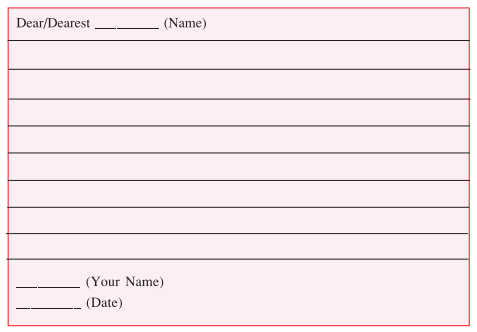
The Princess Who Never Smiled Question Answer Class 7 English Solutions Chapter 5 PSEB Solutions

Punjab State Board PSEB 7th Class English Book Solutions Chapter 5 The Princess Who Never Smiled Textbook Exercise Questions and Answers.

Class 7th English Solutions Chapter 5 The Princess Who Never Smiled Question Answers

The Princess Who Never Smiled Class 7 Questions and Answers

Activity 1.

Look up the following words in a dictionary. You should seek the following information about the words and put them in your WORDS note work.
1. Meaning of the word as used in the story (adjective/noun/verb, etc.)
2. Pronunciation (The teacher may refer to the dictionary or the mobile phone for correct pronunciation.)
3. Spellings:

Princess amuse tricks clown mime
Journey scarce nervous appeared magician

Activity 2.

Rearrange the jumbled words given in capitals on the right side to mean the following.

PSEB 7th Class English Solutions Chapter 5 The Princess Who Never Smiled 1
PSEB 7th Class English Solutions Chapter 5 The Princess Who Never Smiled 2

PSEB 7th Class English Solutions Chapter 5 The Princess Who Never Smiled

Activity 3.

Answer the following questions :

Question 1.
Why was the king worried about Tanya, the princess ?
राजकुमारी तान्या के बारे में राजा चिंतित क्यों था ?
Answer:
The King was worried because Tanya never smiled.

Question 2.
What did he do to amuse his daughter ?
पुत्री को खुश करने के लिए उसने क्या किया ?
Answer:
He called a magician and a clown to amuse her.

Question 3.
What did the magician do ?
जादूगर ने क्या किया ?
Answer:
The magician showed the princess some tricks.

Question 4.
What did the clown do ?
मस्खरे (जोकर) ने क्या किया ?
Answer:
The clown tried to make the princess laugh with a mime.

Question 5.
What did the king do when the princess did not smile ?
राजकुमारी के न मुस्कराने पर राजा ने क्या किया ?
Answer:
At this, the king declared that anyone who made the princess laugh would get to marry her.

Question 6.
Who was Ivan ?
इवान कौन था ?
Answer:
Ivan was a poor boy who worked for a farmer.

Question 7.
What did Ivan want to do?
इवान क्या करना चाहता था ?
Answer:
Ivan wanted to take a chance to make the princess laugh.

Question 8.
Who all did he meet on his way to the palace ?
महल की ओर जाते हुए वह रास्ते में किस-किस से मिला ?
Answer:
He met a fish, a mouse and a grass-hopper.

Question 9.
What did they want ?
वे क्या चाहते थे ?
Answer:
They wanted to have a new home.

Question 10.
What did Ivan give each of them ?
इवान ने प्रत्येक को क्या दिया ?
Answer:
Ivan gave a gold coin to each of them.

Question 11.
Where was the princess ?
राजकुमारी कहां थी ?
Answer:
The Princess was standing by her window.

Question 12.
What was she doing ?
वह क्या कर रही थी ?
Answer:
She was looking at Ivan.

PSEB 7th Class English Solutions Chapter 5 The Princess Who Never Smiled

Question 13.
What happened when Ivan fell into a hole ?
जब इवान सुराख/बिल में गिरा तो क्या हुआ ?
Answer:
The princess started laughing at this.

Question 14.
Why did she start laughing ?
वह हँसने क्यों लगी ?
Answer:
She started laughing because it was the funniest thing she had ever seen.

Question 15.
What did the king do ?
राजा ने क्या किया ?
Answer:
The king became very happy and started laughing.

Activity 4

Select the correct option and fill it in the given blank :

Question 1.
Princess Tanya was a pretty girl but she did not
(a) smile
(b) walk
(c) speak
Answer:
(a) smile

Question 2.
The king called …….. to amuse her.
(a) a magician
(b) a clown
(c) a magician and a clown
Answer:
(c) a magician and a clown

Question 3.
The farmer gave Ivan three ………. coins.
(a) silver
(b) copper
(c) gold
Answer:
(c) gold

PSEB 7th Class English Solutions Chapter 5 The Princess Who Never Smiled 3

Question 4.
Ivan met a ……….. first of all.
(a) mouse
(b) fish
(c) grass-hopper
Answer:
(b) fish

Question 5.
Ivan gave .. …………. to the mouse.
(a) one coin
(b) two coins
(c) three coins
Answer:
(a) one coin

PSEB 7th Class English Solutions Chapter 5 The Princess Who Never Smiled

Question 6.
The princess was standing by her ………..
(a) window
(b) garden
(c) tower
Answer:
(a) window

Question 7.
Ivan fell into a ………
(a) river
(b) lake
(c) hole
Answer:
(c) hole

Question 8.
The princess laughed on seeing the small animals the fish, the mouse and the grass hopper trying to ………………….. Ivan to save him.
(a) pull up
(b) push down
(c) push away
Answer:
(a) pull up.

Learning Language

Tenses (verb)
हमें क्रिया का समय बताते हैं। यहां Present continuous Tense के बारे में बात की गई है। इस Tense के बारे में जानने के लिए नीचे दिए गए Format का चयन करें

Affirmative

I am laughing (first form of the verb + -ing).
He/She/It/Singular Nouns is
We/You/They/Plural Nouns are

Negative.

I am not
He/She/Singular Nouns is not watching (verb in its first a film
We/You/They/Plural Nouns are not form + ing).

Interrogative
Is/am/are + subject + first form of the verb + -ing ?

Activity 5

Complete the following sentences using Present Continuous Tense of the verb given in the brackets (Capitalize when needed).

1. My teacher………. talk on the phone right now.
2. …….. you ……………. (dance) ?
3. Cheeku ………………………… (do) his homework at the moment.
4. Shanti …………………………… (work) on a project nowdays.
5. My kids ………………………… (play) in the garden now.
6. Some people ………………. ……… (wait) to talk to you.
7. I ……………… (not go) for a walk today.
8 Leena ……………… (study) for his exam right now ?
9 Uma ……………… (play) the piano now ?
10. Mohan and I ……………… (paint) the fence today.
11. Amita ……………… (help) me at present.
12. My children ……………… (not listen) to the radio now.
13. Saira ……………… (not drink) tea now.
14. I ……………… (vacuum) the carpet right now.
15. My father ……………… (watch) TV now.
16. What she ……………… (eat) right now ?
17. ……. your dog ……… (hide) from me ?
18. Which book ………………………… you ……………….. (read) nowadays?
19. Thomas ………………………. (drive) me home now.
20. I …………………………. (wash) my hands at the moment.
Answer:
1. is talking
2. Are, dancing
3. is doing
4. is working
5. are playing
6. are waiting
7. am not going
8. Is, studying
9. Is, playing
10. are painting.
11. is helping
12. are not listening
13. is not drinking
14. am vacuuming
15. is watching
16. is eating
17. Is, hiding
18. are, reading
19. is driving
20. am washing.

PSEB 7th Class English Solutions Chapter 5 The Princess Who Never Smiled

Now Read the following :

Princess Tanya was watching everything from her window. She started laughing. It was the funniest thing she had ever seen. She laughed and laughed. She kept laughing. The King was passing by her room. He saw that the princess was laughing. The King became very happy. He also started laughing. Within no time, the queen was laughing, the ministers were laughing, the servants were laughing, the guards were laughing and all the people were laughing. Ivan was also laughing.

ऊपर के passage में past (बीते हुए समय की क्रिया, जो उस समय जारी थी) का प्रयोग किया गया है। यह Past Continuous Tense में है। इस Tense के Patterm का अध्ययन नीचे दिए गए वाक्यों में करें।
नोट : Interrogative Sentences में was/were + Subject + first form of the verb + ing ? का Pattern अपनाएं।

Affirmative.

I/He/She/Singular Nouns was watching (verb in its first Torm + -ing). a film.
We/You/They/ Plural Nouns were

Negative.

I/He/She/Singular Nouns was not watching (verb in its first form +-ing). a film.
We/You/They/ Plural Nouns were not

Activity 6

Supply the suitable forms of verbs given in the brackets. The first one is done for you.
1. I was shopping (shop) when you called.
2. Students …………………………… (play) happily when I reached the class.
3. I told him but he didn’t hear me as he ………………. (watch) the news.
4. Sheela and Khyati ………………………… (work) in the office when the boss walked in.
5. The Knight Riders ……………………… (warm-up) when the Mumbai Indians arrived at the stadium.
6. While Minesh was praying, Kiran ………………………. (bake) a cake.
7. I ……………………. (drive) when you called, so I couldn’t answer.
8. I saw Meena yesterday when she …………….. (walk) by the river.
9. My mother ……………. (cook) and my father …………………………. (dust) the house yesterday.
10. Shanti ……………………….. (boil) milk when Rita came.
Answer:
2. were playing
3. was watching
4. were working
5. were warming up
6. was baking
7. was driving
8. was walking
9. was cooking, was dusting
10. was boiling.

Learning to Listen

Activity 7.

Let us play a game today. Get up from your seats. The name of the game is, “The Princess Says…. You will follow the commands of your teacher. She/he will give you commands to follow. Commands will begin with the phrase “The Princess Says …. If the teacher does not say “The Princess Says…….. before a command (i.e. hold your left ear); you will not follow the command. If you still follow the command, you will be out of the game. The last person left wins.

नोट: अपने teacher के साथ मिलकर स्वयं करें।

Learning to Speak (Pair work)

Activity 8

Imagine that you are talking to your friend on the phone. Tell each other about four things that you and your family members are doing. You can pick words from the following table.

wash dance cook pray dust jump
watch laugh clean make draw help

A: Hello, I am ………. X ……… (name) speaking ! Who is on the line ?
B: Hello, I am …….. Y …….. (name) speaking !
A: Oh! What are you doing?
B: I am watching T.V.
A: What is your mother doing ?
B: She is washing clothes. And, what is your mother doing ?
A: She is cooking food.
B: What is your younger brother doing?
A: He is drawing. He is making a dog.
B: What is your elder sister doing? And what about your father?
A: My younger sister is helping mother in the kitchen. My father is praying to God.
B: What is the noise about that is coming ?
A: My younger sister is jumping, dancing and laughing.
B: Good afternoon. Now I am putting the phone down.

PSEB 7th Class English Solutions Chapter 5 The Princess Who Never Smiled

Learning to Write

Activity 9

A mind map of a story is given below. The name of the story is “The Three Pigs’. Using the mind map, write your story about the three pigs and the wolf . All the hints and useful words are given in the mind map.

PSEB 7th Class English Solutions Chapter 5 The Princess Who Never Smiled 4
Answer:
The Three Pigs : Once there were three pigs. One lived in a straw house and one in a wooden. Their houses were not strong as they were quickly built. But the third one lived in a brick house that was very strong. One day a big bad wolf came there. It was hungry for pigs. It blew down the straw and the wooden houses easily and ate the pigs. But she could not break down the brick house. Therefore, it climbed down the chimney of the house. Soon she got buried by hot water and ran away crying.

Learning to use language

Activity 10

Read the dialogue between a dinosaur and a sparrow. Dinosaur is an extinct animal and sparrow is about to become extinct. Radiation from mobile phone towers has harmed sparrows and other birds.

Complete the dialogue by taking information from the given table.

PSEB 7th Class English Solutions Chapter 5 The Princess Who Never Smiled 5

1. First appeared 235 million years ago
2. Class Reptile
3. Size Different sizes, 20 inches to 39.7 meters
4. Height 59 feet (largest dinosaurs)
5. Life on Earth 150 million years
6. Extinction 66 million years ago
7. Cause of Extinction Asteroid hit on Earth
8. Result of the asteroid hit Mass extinction of most species on Earth

Dialogues

Sparrow : Hello, stranger! You are so huge. How can I help you ?
Dinosaur : Oh, hello! Actually I am not a stranger. I used to live here 66 million years ago.
Humans call us Dinosaurs. So I’m just exploring how much the planet has changed.
Sparrow : Oh, really! How much has it changed ?
Dinosaur : Oh, it has changed so much. I don’t like the change. There were no humans and buildings when I used to live no pollution, no global warming.
Sparrow : Oh, tell me more, Sir !
Dinosaur : There were trees all around. We were everywhere – on land, in the air and in water.
Sparrow : Oh, wow! What were they called ?
Dinosaur : Humans have named the flying Dinosaurs as PTERODACTYL.
Sparrow And what about the ones that lived in the water ?
Dinosaur : They have been named as SPINOSAURUS.
Sparrow : Mr Dinosaur, I have so many questions to ask you.
Dinosaur : Don’t worry, I know what is in your mind.
Here I am going to tell you all about me and our family.

PSEB 7th Class English Solutions Chapter 5 The Princess Who Never Smiled 6

We were reptiles. We appeared on earth 235 million years ago. We were of different sizes — from 20 inches to 39.7 meters. The largest member of our family was 59 feet tall. We lived about 150 million years on earth. But about 66 million years ago an asteroid hit the earth that caused our extinction. This incident also led to the extinction of most species of this planet.

PSEB 7th Class English Solutions Chapter 5 The Princess Who Never Smiled

Comprehension Of Passages

Read the following passage carefully and answer the questions that follow each.

(1) This is a very old story from Russia. There was a princess in Russia. Her name was Tanya. Tanya was very beautiful but she never smiled or laughed. Her father, the king, loved her very much but he kept worrying because she never smiled. Even the queen was worried.

King (said to himself): I must find a way to make my daughter happy. I want to see her smiling! And he had an idea. He called a magician to amuse his daughter. The magician showed the princess some tricks.

1. What kind of girl was Tanya ?
तान्या कैसी लड़की थी ?

2. What did Tanya’s father wish ?
तान्या के पिता की क्या इच्छा थी ?

3. Choose true and false statements and write them in your note-book.
(a) Tanya’s father was a king.
(b) Queen never got worried.

4. Complete the sentences according to the meaning of the passage.
(a) Tanya was a …………..
(b) The magician showed the princess …………..

5. Match the words with their meanings.

(a) worried entertain
(b) amuse anxious
show

Answer:
1. Tanya was very beautiful but she never smiled or laughed.
2. Tanya’s father wished to see his daughter (Tanya) smiling.
3.
(a) True
(b) False
4.
(a) Tanya was a princess in Russia.
(b) The magician showed the princess some tricks.
5.
(a) worried — anxious
(b) amuse — entertain

PSEB 7th Class English Solutions Chapter 5 The Princess Who Never Smiled

(2) Very far from the palace, there lived a poor boy. His name was Ivan. He worked for a farmer. When he heard about the king’s promise, he wanted to take a chance at making the princess laugh. He thought that he could make her laugh. The farmer gave the boy three gold coins for the journey.
On his way, he found a lake. In the lake, there was a fish. The fish called him.
Fish (to Ivan) : Oh ! Can you help me, please ?
Ivan (to the fish) : How can I help you, fish ?
Fish (to Ivan) : I have lived in this lake for a long time.
Now the water is getting dirty. I don’t want to live here anymore, but I am too poor to find a new house.
Ivan (to the fish): I am so sorry, Fish. I have three gold coins. I can give you one. I’ll still have two for my journey. I am going to meet the princess.

1. Who was Ivan ? Where did he live ?
इवान कौन था ? वह कहां रहता था ?

2. What did Ivan saw on his way?
रास्ते में उसे क्या दिखाई दिया ?

3. Choose true and false statements and write them in your note-book.
(a) The fish had lived in the lake for a long time.
(b) The fish wanted the princess to help it.

4. Complete the sentences according to the meaning of the passage.
(a) The farmer gave the boy ………….. for the journey.
(b) I am too poor to

5. Match the words with their meanings.

promise saw
found made
 word

Answers
1. Ivan was a poor boy who worked for a farmer. He lived very far from the king’s palace.
2. On his way, Ivan saw a lake with a fish in it.
3.
(a) True
(b) False
4.
(a) The farmer gave the boy three gold coins for the journey.
(b) I am too poor to find a new house.
5.
(a) promise — word
(b) found — saw.

PSEB 7th Class English Solutions Chapter 5 The Princess Who Never Smiled

(3) Ivan continued travelling. He was hungry and very tired. He had no money to buy food. He reached the palace. He saw the princess. She was standing by her window. She was looking at him. He became nervous because the princess was looking at him. He fell into a hole.
Ivan (shouting) : Help! Someone, help me!
Suddenly, the fish, the mouse and the grass-hopper appeared.
All three (fish, mouse and grasshopper) : Don’t worry! We will save you !
The three of them pulled the boy from the hole.

1. In what condition was Ivan when he reached the palace ?
महल तक पहुँचने पर इवान की क्या दशा थी ?

2. Why did he become nervous ?
वह घबरा क्यों गया ?

3. Choose true and false statements and write them in your note-book.
(a) The princess was standing.
(b) The three of them pulled the boy.

4. Complete the sentences according to the meaning of the passage.
(a) The princess was standing …………………..
(b) The three of them pulled the boy …………..

5. Match the words with their meanings.

(a) nervous confused
(b) appeared became invisible
became visible

Answer:
1. Ivan was very hungry and thirsty when he reached the palace.
2. He became nervous because the princess was looking at him.
3.
(a) False
(b) True
4.
(a) The princess was standing by her window.
(b) The three of them pulled the boy out from the hole.
5.
(a) nervous — confused
(b) appeared — became visible

PSEB 7th Class English Solutions Chapter 5 The Princess Who Never Smiled

(4) Princess Tanya was watching everything from her window. She started laughing. It was the funniest thing she had ever seen. She laughed and laughed. She kept laughing. The king was passing by her room. He saw that the princess was laughing. The king became very happy. He also started laughing. Within no time, the queen was laughing, the ministers were laughing, the servants were laughing, the guards were laughing and all the people were laughing. Ivan was also laughing. The king kept his promise. The kingdom came to know that Ivan and the princess were getting married. They got married. Ivan became a prince. He went to the king.

1. How did the King feel ?
राजा ने कैसा महससू किया ?

2. Who were getting married ?
किसकी शादी हो रही थी ?

3. Choose true and false statements and write them in your note-book.
(a) The king did not keep his promise.
(b) Ivan became a prince.

4. Complete the sentences according to the meaning of the passage.
(a) Within …………….. the queen was laughing.
(b) The king saw that ………….

5. Match the words with their meanings.

(a) funniest smile
(b) watch most amusing
see

Answer:
1. The king became very happy.
2. The princess and Ivan were getting married.
3.
(a) False
(b) True
4.
(a) Within no time the queen was laughing.
(b) The king saw that the princess was laughing.
5.
(a) funniest — most amusing
(b) watch — see

Use Of Words/Phrases In Sentences

1. Amuse (entertain) –
Mother amused her child with toys.
माँ ने खिलौनों से अपने बच्चे का मनोरंजन किया।

2. Tricks. (feats) –
The tricks of the magician were funny.
जादूगर के करतब मज़ाकिया थे।

3. Nervous (confused) –
Why are you so nervous ?
आप इतने घबराए हुए क्यों हैं ?

4. Scarce (not enough, scanty) –
Water is getting scarce here.
यहां पानी की कमी होती जा रही है।

PSEB 7th Class English Solutions Chapter 5 The Princess Who Never Smiled

5. Worried (anxious) –
You look worried. What is the problem ?
तुम चिंतित दिखाई देते हो। क्या समस्या है ?

6. Journey (trip) –
We went on a long journey last year.
पिछले साल हम एक लंबी यात्रा पर गए।

7. Princess (royal maiden) –
The princess was married to a handsome prince.
राजकुमारी की शादी एक सुंदर राजकुमार से कर दी गई।

8. Appeared (came in front of) –
The thief appeared before the judge.
चोर जज के सामने आया।

9. Pulled (dragged) –
We pulled the heavy fish with a rope.
हमने भारी मछली को एक रस्सी से खींचा।

Word Meanings

PSEB 7th Class English Solutions Chapter 5 The Princess Who Never Smiled 7

The Princess Who Never Smiled Summary in Hindi

This is very old …………………….. them could do it.

यह रूस की एक बहुत पुरानी कहानी है। रूस में एक राजकुमारी थी। उसका नाम तान्या था। तान्या बहुत सुंदर थी लेकिन वह कभी भी हंसती या मुस्कराती नहीं थी। उसके पिता राजा थे और उसे बहुत प्यार करते थे परन्तु वह चिंतित रहते थे क्योंकि वह कभी मुस्कराती नहीं थी। यहां तक कि रानी भी चिंतित थी। राजा (अपने आप से कहा) : मुझे कोई रास्ता ढूंढना चाहिए ताकि मैं अपनी बेटी को खुश कर सकू। मैं उसे मुस्कराते हुए देखना चाहता हूँ। और उसे एक विचार सूझा। उसने अपनी बेटी को बहलाने के लिए एक जादूगर को बुलाया। जादूगर ने राजकुमारी को कुछ कतरब दिखाए। राजा

(राजकुमारी से) : हा, हा, हा …… क्या यह मनोरंजक नहीं ?
राजकुमारी (राजा से) : हाँ, पिता जी। करतब अच्छे हैं परन्तु वे मेरे चेहरे पर मुस्कान नहीं ला सकते।
उन्होंने एक जोकर को भी बुलाया ताकि वह मुस्करा सके।
राजा (राजकुमारी से) : हा, हा, हा …… क्या यह मज़ेदार नहीं ?
राजकुमारी (राजा से) : हाँ पिता जी। जोकर मजाकिया है, परन्तु वह मुझे मुस्कराहट नहीं दे सकता।जोकर उसे हंसाने के लिए नकलें भी उतारता है।

राजा (राजकुमारी से) : हा, हा, हा ………. क्या यह मज़ाकिया नहीं है ?
राजकुमारी (राजा से) : वह अच्छा है परन्तु वह मेरी मुस्कराहट नहीं ला सकता।
अन्ततः उसने अपने देश के सभी लोगों को यह बताने का निर्णय लिया कि जो कोई भी राजकुमारी को हँसा देगा, उसका विवाह राजकुमारी से कर दिया जाएगा। रूस भर से लोग राजा के महल गए और उन्होंने राजकुमारी को हँसाने का प्रयत्न किया, परन्तु कोई भी ऐसा न कर सका।

Very far from ………………. meet the princess.

महल से बहुत दूर एक गरीब लड़का रहता था। उसका नाम इवान था। वह एक किसान के पास काम करता था। जब उसने राजा के वचन के बारे में सुना, तो उसने राजकुमारी को हँसाने का एक अवसर पाने की सोची। वह सोचता था वह उसे हँसा सकता है। किसान ने यात्रा के लिए लड़के को तीन स्वर्ण मुद्राएं दीं। रास्ते में उसे एक झील मिली। झील में एक मछली थी। मछली ने उसे पुकारा। मछली (इवान से) : ओह! कृपया आप मेरी मदद कर सकते हैं ?
इवान (मछली से) : मछली, मैं तुम्हारी क्या मदद कर सकता हूँ ?

मछली (इवान से) : मैं एक लम्बे समय से इस झील में रह रही हूँ। अब पानी गंदा हो रहा है। मैं यहाँ और
अधिक नहीं रहना चाहती, परंतु मैं इतनी गरीब हूँ कि अपने लिए नया घर नहीं ले
सकती। इवान (मछली से) : मछली, मैं माफी चाहता हूँ। मेरे पास तीन स्वर्ण मुद्राएं हैं। मैं एक तुम्हें दे सकता हूँ।
मेरे पास यात्रा के लिए फिर भी दो बच जाएंगी। मैं राजकुमारी से मिलने जा रहा हूँ।
मछली (इवान से) : मैं तुम्हारा धन्यवाद कैसे कर सकती हूँ ?

इवान (मछली से) : चिंता मत करो। मुझे तुम्हारी मदद करके खुशी हुई। मुझे आशा है कि तुम्हें एक नया और अच्छा घर मिल जाएगा। इवान ने अपनी यात्रा जारी रखी। उसने एक बड़ा सा खेत
देखा। खेत में एक चूहा था। चूहे ने उसे पुकारा। चूहा (इवान से) हैलो नवयुवक! क्या तुम मेरी सहायता कर सकते हो ?
इवान (चूहे से) : चूहे, मैं तुम्हारी मदद कैसे कर सकता हूँ?
चूहा (इवान से) : मैं लम्बे समय से इस खेत में रह रहा हूँ। अब यहां भोजन कम होता जा रहा है। मैं अब यहां और अधिक नहीं रहना चाहता, परन्तु मैं गरीब हूँ।

इवान (चूहे से) : चूहे, मैं माफी चाहता हूँ। मेरे पास दो स्वर्ण मुद्राएं हैं। मैं एक तुम्हें दे सकता हूँ। मेरे
पास यात्रा के लिए फिर भी एक रह जाएगी। मैं राजकुमारी से मिलने जा रहा हूँ।
चूहा (इवान से) : तुम बहुत दयालु हो। मैं किस प्रकार तुम्हारा आभार व्यक्त करूं?
इवान : चिंता मत करो। मैं तुम्हारी मदद करके खुश हूँ। मुझे आशा है कि तुम्हें एक अच्छा और नया घर मिल जाएगा।

Ivan continued ………………….. from the hole.

इवान ने यात्रा जारी रखी। वह एक जंगल में पहुंचा। जंगल में एक टिड्डा रहता था। टिड्डे ने उसे पुकारा।
टिड्डा (इवान से) : सुनिये! क्या तुम मेरी मदद कर सकते हो ?
इवान (टिड्डे से) : टिड्डे, मैं तुम्हारी क्या मदद कर सकता हूँ ?

टिड्डा (इवान से) : मैं लम्बे समय से इस जंगल में रह रहा हूँ। अब बहुत अधिक गर्मी होती जा रही है। मैं अब यहां नहीं रहना चाहता, परन्तु मैं गरीब हूँ।
इवान (टिड्डे से) : टिड्डे, मैं माफी चाहता हूँ। मेरे पास एक स्वर्ण मुद्रा है। मैं वह तुम्हें दे सकता हूँ। मैं अपना काम चला लूंगा। मैं राजकुमारी से मिलने जा रहा हूँ।

टिड्डा (इवान से) : तुम बहुत दयालु हो। मैं तुम्हारा आभार किस प्रकार व्यक्त करूं।
इवान (टिड्डे से) : चिंता मत करो। मैं तुम्हारी मदद करके खुश हूँ। मैं आशा करता हूँ कि तुम्हें एक अच्छा
और नया घर मिल जायेगा। इवान ने यात्रा जारी रखी। वह भूखा और बहुत थक चुका था। उसके पास भोजन के लिए पैसे नहीं थे। वह महल पहुंच गया। उसने राजकुमारी को देखा। वह अपनी खिड़की में खड़ी थी। वह उसे देख रही थी। वह घबरा गया क्योंकि राजकुमारी उसकी ओर ही देख रही थी। वह एक सुराख में जा गिरा।

इवान (चिल्लाया) : सहायता! कोई मेरी सहायता करो। अचानक ही मछली, चूहा तथा टिड्डा प्रकट हो गए।
तीनों मिलकर (मछली, : चिन्ता मत करो। हम तुम्हारी रक्षा करेंगे। चूहा तथा टिड्डा), तीनों ने मिलकर उसे सुराख से बाहर खींच लिया।

PSEB 7th Class English Solutions Chapter 5 The Princess Who Never Smiled

Princess Tanya ………….. People were smiling.

राजकुमारी तान्या यह सब कुछ अपनी खिड़की से देख रही थी। वह हँसने लगी। यह उसके लिए सबसे मनोरंजक बात थी, जो कुछ भी उसने अब तक देखा था। वह जोर से हँसने लगी और वह लगातार हँसती रही। राजा उसके कमरे के पास से गुजर रहा था। उसने देखा कि राजकुमारी हँस रही है। राजा बहुत खुश हुआ। वह भी हँसने लगा। तुरंत ही रानी हँसने लगी, मंत्री हँसने लगे, नौकर हँसने लगे, सुरक्षाकर्मी हँसने लगे और सभी लोग हँसने लगे। इवान भी हँसने लगा।
राजा ने अपना वचन निभाया। राज्य को पता चल गया कि इवान और राजकुमारी की शादी हो रही है। उनकी शादी हो गई। इवान राजकुमार बन गया। वह राजा के पास गया।

इवान (राजा से) : मुझे मेरे मित्र बहुत प्रिय हैं। मैं उन्हें महल में रख रहा हूँ।
राजा (इवान से) : मुझे कोई परेशानी नहीं है। उन्होंने भी राजकुमारी को हँसाया है।
उस दिन से महल एक खुशी भरा स्थान बन गया। चारों ओर हँसी और मुस्कराहटें बिखरी हुई थीं। इवान, राजकुमारी तान्या और उसके मित्र मुस्करा रहे थे, राजा मुस्करा रहा था, रानी मुस्करा रही थी, मंत्री मुस्करा रहे थे, नौकर मुस्करा रहे थे, सुरक्षाकर्मी मुस्करा रहे थे और सभी लोग मुस्करा रहे थे।

Retranslation Of Isolated Sentences

1. There was a princess in Russia. — रूस में एक राजकुमारी थी।
2. Her father, the king loved her very much. — उसके पिता, राजा उसे बहुत प्यार करते थे।
3. Even the queen was worried. — यहां तक कि रानी भी चिंतित थी।
4. I want to see her smiling. — मैं उसे मुस्कराते हुए देखना चाहता हूं।
5. The magician showed the princess some tricks. — जादूगर ने राजकुमारी को कुछ करतब दिखाए।
6. He called a clown to make her smile.– उसने उसकी मुस्कराहट लाने के लिए एक जोकर (मस्खरे) को बुलाया।
7. He is good, but he does not make me smile.– यह अच्छा है, परन्तु यह मुझे मुस्कराहट प्रदान नहीं कर सकता।
8. People from all over the Russia went to the king’s palace. — रूस भर से लोग राजा के महल में गए।
9. He worked for a farmer. — वह किसान के पास काम करता था।
10. The farmer gave the boy three gold coins for the journey. — किसान ने यात्रा के लिए लड़के को तीन मुद्राएं दीं।
11. The king kept his promise. — राजा ने अपना वचन निभाया।
12. She kept laughing. — वह लगातार हँसती रही।
13. I am happy to help you. — मुझे तुम्हारी मदद करके खुशी हुई।
14. He was hungry and very tired. — वह भूखा था और बहुत थका हुआ था।
15. He fell into a hole. — वह एक सुराख में गिर गया।
16. Three of them pulled the boy from the hole. — तीनों ने मिलकर उसे सुराख से खींच लिया।
17. Princess Tanya was watching everything from her window. — राजकुमारी तान्या यह सब कुछ अपनी खिड़की से देख रही थी।

English Guide for Class 7 PSEB Prose
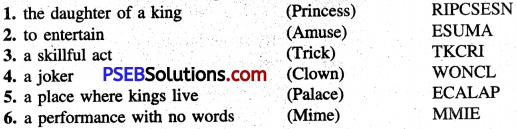
Hachiko-The World’s Most Loyal Dog Question Answer Class 7 English Solutions Chapter 8 PSEB Solutions

Punjab State Board PSEB 7th Class English Book Solutions Chapter 8 Hachiko-The World’s Most Loyal Dog Textbook Exercise Questions and Answers.

Class 7th English Solutions Chapter 8 Hachiko-The World’s Most Loyal Dog Question Answers

Hachiko-The World’s Most Loyal Dog Class 7 Questions and Answers

Activity 1.

Look up the following words in a dictionary. You should seek the following information about the words and put them in your WORDS notebook.
1. Meaning of the word as used in the story (adjective/noun/verb, etc.)
2. Pronunciation (The teacher may refer to the dictionary or the mobile phone for correct . pronunciation.)
3. Spellings

Akita neighborhood agriculture accompany
routine receive hemorrhage show up
beloved employees devoted museum

Vocabulary Expansion

Activity 2.

Write antonyms of the following words.

1. respect — disrespect
2. affection — hatred/hate
3. usual — unusual
4. followed — led
5. lonely — crowded/populous
6. presence — absence
7. master — servant
8. loyalty — disloyalty

PSEB 7th Class English Solutions Chapter 8 Hachiko-The World’s Most Loyal Dog

Activity 3.

Look at the following words in the grid. Identify the base words and prefixes and suffixes added to them. Write the base word and the prefix/suffix in the space given for each.
PSEB 7th Class English Solutions Chapter 8 Hachiko-The World’s Most Loyal Dog 1
Answer:
PSEB 7th Class English Solutions Chapter 8 Hachiko-The World’s Most Loyal Dog 2

Learning to Read and Comprehend

Activity 4.

Answer the following questions based on the above story.

Question 1.
Who was Hachiko ?
हचीको कौन था ?
Answer:
Hachiko was a very faithful and loyal dog. He was true companion.

Question 2.
What was his breed ?
उसकी प्रजाति (ब्रीड) कौन – सी थी?
Answer:
His breed was Akita.

Question 3.
When was he born ?
वह कब पैदा हुआ ?
Answer:
He was born on November 10, 1923.

PSEB 7th Class English Solutions Chapter 8 Hachiko-The World’s Most Loyal Dog

Question 4.
Who adopted him ?
उसे किसने गोद लिया ?
Answer:
Professor Hidesburo adopted him, first.

Question 5.
Where did Ueno teach ?
यूनो कहाँ पढ़ाते थे ?
Answer:
Ueno tought in the Agriculture Department of the Tokyo Imperial University.

Question 6.
What was their routine ?
अनकी दिनचर्या क्या थी ?
Answer:
Everyday morning they would walk to the Shibuya Railway Station. At 3 p.m. the professor would return and the dog would go to the railway station to accompaning him back home.

Question 7.
What happened to the Professor one day ?
एक दिन प्रोफैसर को क्या हुआ ?
Answer:
One day the Professor died because of a sudden brain harmorrhage.

Question 8.
What did Hachiko do after Ueno died ?
हचीको ने यूनो की मृत्यु के बाद क्या किया ?
Answer:
He would daily go to the railway station at 3 p.m. to receive his master.

Question 9.
Who adopted Hachiko after Ueno died ?
यूनो की मृत्य के बाद हचीको को किसने गोद लिया ?
Answer:
After Ueno died his former gardener, kujaburo kobayashi adopted Hachiko.

Question 10.
Who went to see Hachiko after coming to know about his routine ?
हचीको की दिनचर्या का पता चलने पर कौन उसे देखने गया ?
Answer:
Hirokichi Saito who was an expert on the Akita breed of dogs, went to see Hachiko.

Activity 5.

Choose the right answer and write in the given space.
Answer:
1. Hachiko was a very loyal/disloyal dog — loyal
2. Shibuya is a place near/away from Tokyo — near
3. Ueno always came back on the 3/4pm train. — 3 p.m.
4. Hachiko would wait for Ueno at the station/home. — Station
5. Hachiko lived for 11/13 years. — Station

PSEB 7th Class English Solutions Chapter 8 Hachiko-The World’s Most Loyal Dog

Activity 6.

Discuss and answer the following questions.

Question 1.
Why did people make statues of Hachiko ?
Answer:
People made the statues of Hachiko to make him immortal for his loyalty and faithfulness.

Question 2.
Why do you think Saito wiped a tear from his cheek?
Answer:
Saito was an expert of the Akita breed of dogs. He read the sad hard of Hachiko.

Learning Language

Conjugation of Verbs

Verb conjugation का अर्थ है कि कोई verb वाक्य में Person, Tense, Number या Mood में परिवर्तन के साथ कैसे बदलता है।

Person.

In English, we have six different persons -first-person singular (I), second-person singular (you), third-person singular (he/she/it/one), first-person plural (we), second-person plural (you), and third-person plural (they). We must conjugate a verb for each person. The verb to be is a particularly notable verb for conjugation because it is an irregular verb.

PSEB 7th Class English Solutions Chapter 8 Hachiko-The World’s Most Loyal Dog

Conjugation of the verb ‘to be’ (is/am/are)

Person Tense
Past Present Future
I was am will be
you were arc will be
he /she/it was is will be
we were are will be
they were are will be

Tense के अनुसार भी Verb के रूप में बदलाव आता है। इसे समझने के लिए नीचे दी गई तालिका अध्ययन of करें इसमें Verb ‘walk’ के माध्यम से verb की Conjugation को समझाया गया है।

Conjection
PSEB 7th Class English Solutions Chapter 8 Hachiko-The World’s Most Loyal Dog 3

Activity 7.

Select the correct form of the verb given in the options and fill it in the given blank.

Question 1.
Meena …………………_since morning.
(a) has been dancing
(b) is dancing
(c) dances
Answer:
(a) has been dancing.

Question 2.
I ………….. in the garden when she came to my house.
(a) am working
(b) was working
(c) worked
Answer:
(b) was working.

PSEB 7th Class English Solutions Chapter 8 Hachiko-The World’s Most Loyal Dog

Question 3.
I ………………….. in the factory for two hours when Seema called.
(a) have been working
(b) was working
(c) had been working
Answer:
(c) had been working.

Question 4.
I ……………… my exam this time next week.
(a) will be writing
(b) will write
(c) would be writing
Answer:
(a) will be writing.

Question 5.
They had already left when I …………. home.
(a) reached
(b) have reached
(c) had reached
Answer:
(a) reached.

Question 6.
If you are hungry, I ………….. ……. you something to eat.
(a) am getting
(b) will get
(c) will be getting
Answer:
(b) will get.

Question 7.
Saavan ………….. songs.
(a) writes
(b) write
(c) written
Answer:
(a) writes.

Question 8.
We …………. often go to the garden.
(a) don’t
(b) doesn’t
(c) haven’t
Answer:
(a) don’t

PSEB 7th Class English Solutions Chapter 8 Hachiko-The World’s Most Loyal Dog

Question 9.
We …………… to Delhi last week.
(a) went
(b) have gone
(c) had gone.
Answer:
(a) went.

Question 10.
The children …………………. a splendid performance.
(a) gives
(b) give
(c) gave.
Answer:
(b) give.

Learning to Listen

Activity 8

Your teacher will read out a dialogue. Listen to the dialogue and answer the following questions.

Question 1.
Which movie do these people plan to watch ?
(a) The Lion King
(b) The Two Towers
(c) Singham
(d) Mowgli
Answer:
(d) Mowgli.

Question 2.
When do they plan to watch the movie ?
(a) on the weekend
(b) tomorrow
(c) today evening
(d) next Friday
Answer:
(b) tomorrow.

Question 3.
Where do they plan to meet ?
(a) at the Subway close to the mall
(b) in front of the mall
(c) at the coffee shop close to the mall
(d) at home
Answer:
(a) at the Subway close to the mall.

PSEB 7th Class English Solutions Chapter 8 Hachiko-The World’s Most Loyal Dog

Question 4.
What time do they plan to meet ?
(a) at 7:30 pm
(b) at 12 noon
(c) at 1pm
(d) at 3:45 pm
Answer:
(c) at 1pm.

Learning to Speak

Activity 9

Look at the picture given below and describe, in your own words, what is happening.
PSEB 7th Class English Solutions Chapter 8 Hachiko-The World’s Most Loyal Dog 4
Answer:
1. There are two furry dogs in the picture.
2. One dog is big, the other is small.
3. The big dog is white with a black shade in colour.
4. The small dog is also white but it has a shade of grey colour on his body.
5. Both the dogs have belt- round their necks. This suggests they are pet ones.
6. The colours of their belt is red and blue respectively.
7. The big dog looks furious. But the little one appears to be playful.
8. The little dog is carrying a twig in his mouth.

Learning to Write

Activity 10

Write a letter to your cousin telling her/him about the new pet (a dog or a cat) you have adopted.
You should write in the letter

what pet you have adopted
what you have named it
how you play with your pet
how it has changed your life or routine

15, New Colony,
Phagwara.
14 March, 20…….
Dear Vipin,
You will be glad to know that I have adopted a day. It is a stray dog. I have named it Tommy. It is like a small toy. It takes milk, bread and meat. It plays with us. We throw the ball away and Tommy runs after it and return with the ball to us. As it gets up early in the morning, it has changed my life. We together go for a walk in the morning and in the evening. We run a race which I never win. I hope you will be happy to meet it.
Your loving brother,
Rahul.

PSEB 7th Class English Solutions Chapter 8 Hachiko-The World’s Most Loyal Dog

Learning to Use Language

Activity 11

Browse the following sites for more information and also to watch a film on Hachiko. After going through the sites, write all the new information you get on Hachiko
(The teacher must arrange the use of the Internet for students in the computer lab.)
नोट-अध्यापक की सहायता से स्वयं करें।

Comprehension Of Passages

Read the following passages carefully and answer the question that follow each.

(1) Hachiko, the dog was more than just a pet. He was a true companion. He was very loyal and faithful. Every day, Hachiko would greet his human friend, his master, a routine the faithful dog kept, even after his owner’s death. A golden-brown of Akita breed, Hachiko was born on November 10, 1923 in a farm in Japan. In 1924, Professor Hidesaburo Ueno adopted Hachiko and brought him to live with him in Shibuya, a small town in the neighbourhood of Tokyo.

Professor Hidesaburo Ueno taught in the Agriculture Department of Tokyo Imperial University. Every morning the professor would walk to the Shibuya railway station and Hachiko would also go with him to see his master take the train to work. After finishing the day’s classes, the professor would take the train back and return to the station at 3 pm.

1. Who was Hachiko ? Give his any two good qualities.
हचिको कौन था ? उसके कोई दो अच्छे गुण लिखो।

2. Where did Professor Ueno live ?
प्रोफैसर यूनो कौन था ?

3. Choose true and false statements and write them in your note book. . .
(a) The dog followed his routine even after his master’s death.
(b) The professor returned to his home town at 3 p.m. daily.

4. Complete the sentence according to the meaning of the passage.
(a) Professor Ueno taught in the ……………
(b) Hachiko, the dog was more than …….

5. Match the words with their meanings.

(a) faithful comeback
(b) return to take turn
loyal

Answer:
1. Hachiko was a pet dog. He was a true companion. He was very loyal and faithful.
2. Professor Ueno lived in Shibuya, a small town in the neighbourhood of Tokyo.
3.
(a) True
(b) True
4.
(a) Professor Ueno tought in the Agriculture Department of Tokyo University.
(b) Hachiko the dog was more than just a pet.
5.
(a) faithful-loyal
(b) return-come back.

PSEB 7th Class English Solutions Chapter 8 Hachiko-The World’s Most Loyal Dog

(2) The master and Hachiko kept this schedule until one sad day in May 1925 Professor Veno suffered a sudden brain hemorrhage while teaching and passed away. That day, Hachiko showed up at 3 pm as usual, but his beloved master never came back. Hachiko returned the next day at the same time, hoping that Veno would be there to meet him. Of course, the professor did not return, but his loyal Hachiko never gave up hope.

Hachiko was at Shibuya Station the next day again at 3 pm, then the day after, and the day after that. Soon, the lonely dog began to draw the attention of the other passengers.
At first, the station workers were not friendly with the dog, but after some time, people started looking out for him. Even the station employees would bring food and treats for the devoted dog and sometimes sit and keep him company.

1. How did Ueno die?
यूनो की मृत्यु कैसे हुई ?

2. What change did the dog bring about in the station workers ?
कुत्ते ने स्टेशन कर्मचारियों में क्या परिवर्तन लाया ?

3. Choose true and false statements and write them in your note book.
(a) The dog lost his hope as the days passed.
(b) Ueno died in May 1925.

4. Complete the sentence according to the meaning of the passage.
(a) Hachiko showed up at …………… as usual to the dog.
(b) The station employees would bring …………. for the devoted dog.

5. Match the words with their meanings.

(a) devoted died
(b) passed away sincere
appeared

Answer:
1. Ueno while teaching suffered a sudden brain haemorrhage and died.
2. The station workers who were not friendly with him, stated looking out for him. They started giving him food and their company.
3.
(a) False
(b) True.
4.
(a) Hachiko showed up at 3pm as usual.
(b) The station employees would bring food and treats for the devoted dog.
5.
(a) devoted — sincere
(b) Passed away — died.

3. One of Professor Ueno’s former students, Hirokichi Saito was an expert on the Akita breed of dogs. He came to know of Hachiko and his routine. He decided to take the train to Shibuya to see if Hachiko would still be waiting.

When Saito arrived at the station, he saw Hachiko there waiting for his master. He wiped a tear from his cheek. He waited for Hachiko to make the next move. After a long wait, Hachiko stood up and went from there. Saito followed the dog from the station to the home of Ueno’s former gardener, Kuzaburo Kobayashi who had adopted Hachiko but Hachiko waited only for Ueno.

For nearly a decade, after his master passed away, the dog continued to show up at the same spot every day until Hachiko died at the age of eleven on March 08, 1935. The dog became a symbol of loyalty in Japan – and now for the world.

1. Who was Hirokichi Saito ?
हीरोकीची सेंटो कौन था ?

2. He wiped a tear from his cheek ? What does this line show ?
उसने कुत्ते के गाल से एक आँसू पोंछा। यह पंक्ति क्या दर्शाती है? ।

3. Choose true and false statements and write them in your note book.
(a) After the death of Ueno his former gardner adopted Hachiko.
(b) Hachiko died at the age of thirty-five.

4. Complete the sentence according to the meaning of the passsage.
(a) After a long wait. Hachiko stood up and ………
(b) The dog become a ……………. in Japan.

5. Match the words with their meanings.

(a) decade took on
(b) adopted a period of ten years died.
died

Answer:
1. Hirokichi Saito was a former student of professor Ueno. He was an expert on the Akita breed of dogs.
2. This line show that Hachiko was very sad at heart after his master’s death.
3.
(a) True
(b) False.
4.
(a) After a long wait Hachiko Stood up and went from these.
(b) The dog became a symbol of loyalty in Japan.
5.
(a) decade – a period of ten years
(b) adopted – took on

PSEB 7th Class English Solutions Chapter 8 Hachiko-The World’s Most Loyal Dog

Use Of Words/Phrases In Sentences

1. Loyal (devoted, sincere) —
Should be loyal to the country.
हमें देश के प्रति निष्ठावान होना चाहिए।

2. Faithful (loyal, sincere) —
A dog is a faithful animal.

3. True (firm) —
He is true to his word promise.
वह अपने वचन का पक्का है। I

4. Recieve (to get) —
I received your letter yesterday.
मुझे कल तुम्हारा पत्र मिला।

5. Show up (to appear, to present) —
You must show up in the school ground at 9. am.
तुम्हें प्रातः 9 बजे स्कलू ग्राऊंड में पहुंच जाना चाहिए।

6. Passedaway (died) —
My grandmother passed away last month.
मेरी दादी पिछले महीने चल बसे।

7. Look out (take care) —
Look out ! The train has started.
देखो! रेलगाड़ी चल चुकी है।

8. Expert (specialist) —
My uncle is an Expert on birds.
मेरे चाचा जी पंछियों के माहिर हैं।

Word Meanings
PSEB 7th Class English Solutions Chapter 8 Hachiko-The World’s Most Loyal Dog 5

Hachiko-The World’s Most Loyal Dog Summary in Hindi

Hachiko, the dog ……….. passed away.

हचीको (Hachiko) नामक कुत्ता पालतू होने से कहीं अधिक महत्त्व रखता है। वह एक सच्चा साथी था। वह बहुत ही निष्ठावान तथा वफादार था। हचीको प्रतिदिन अपने मानव मित्र जो इसका मालिक था, का अभिवादन करता था। यही दिनचर्या वफादार कुत्ते ने अपने मालिक की मृत्यु के बाद भी जारी रखी।

सुनहरी भूरी, अकीता प्रजाति (Akita bread) के हचीको का जन्म 10 नवम्बर, 1923 को जापान के एक खेत में हुआ। 1924 में प्रोफेसर एजाबुरो यूनो (Professor Hidesaburo Ueno) ने हचीको को गोद ले लिया और उसे टोक्यो के एक छोटे से शहर शिबुआ (Shibuya) में ले आये। प्रोफ़ेसर एज़ाबुरो यूनो टोक्यो इम्पीरियल यूनिवर्सिटी के कृषि विभाग में पढ़ाते थे। प्रत्येक सुबह प्रोफ़ेसर शिबुआ स्टेशन तक टहलते हुए जाते थे और हचीको भी उनके साथ जाता था तकि वह अपने मालिक को काम पर जाते हुए ट्रेन पकड़ते देखे।

PSEB 7th Class English Solutions Chapter 8 Hachiko-The World’s Most Loyal Dog

अपने दिन की कक्षाओं को समाप्त करके प्रोफेसर वापिसी के लिए ट्रेन पकड़ते और 3 बजे स्टेशन पर पहुंचते। हचीको स्टेशन पर पहुंच जाता और प्रोफेसर का इंतजार करता और उनके साथ टहलता हुआ वापिस घर आता। जोड़ी की प्रतिदिन की यही दिनचर्या थी। हर रोज़ हचीको एक ही समय पर अपने मालिक को लेने पहुंच जाता। मालिक और हचीको ने अपना कार्यक्रम तब तक जारी रखा जब तक एक अशुभ दिन मई, 1925 को प्रोफेसर यूनो की अचानक ब्रेन हेमेज से मृत्यु नहीं हो गई।

That day …………. …….. still be waiting.

उस दिन, हचीको हमेशा की भांति 3 बजे आ गया, परन्तु उसका प्रिय मालिक कभी वापिस नहीं आया। हचीको अगले दिन उसी समय इस आशा के साथ वापिस आया कि यूनो उसे वहां मिलेंगे। निःसंदेह प्रोफेसर कभी वापिस नहीं आए, परन्तु उनके वफ़ादार हचीको ने कभी आशा नहीं छोड़ी।

दिन बीतते गए और हचीको प्रतिदिन 3 बजे शिबुआ स्टेशन पर आ जाता था। शीघ्र ही अन्य यात्रियों का ध्यान इस अकेले डॉग (कुत्ते) की ओर जाने लगा। पहले पहल स्टेशन के कर्मचारी कुत्ते के साथ मित्रवत् नहीं थे परन्तु कुछ समय के बाद उसकी ओर ध्यान देने लगे। यहाँ तक कि स्टेशन के कर्मचारी उस वफ़ादार कुत्ते के लिए भोजन खाने के लिए उसके मनचाहे पदार्थ लाने लगे। कभीकभी वे उसके पास बैठ कर उसका साथ देते। दिन हफ्तों में, फिर महीनों में, फिर सालों में बदलें और हचीको, हर रोज इंतजार करने आता। उसकी उपस्थिति ने शिबुआ के स्थानीय लोगों पर ऐसा प्रभाव छोड़ा कि वह उनके लिए निष्ठा और विश्वास का एक प्रतीक बन गया, जैसे वह उनका नायक हो।

प्रोफेसर यूनो का एक पुराना छात्र हिरोकिची सैटो (Hirokichi Saito), अकीता नस्ल के कुत्तों का विशेषज्ञ था। उसे हचीको और उसकी दिनचर्या का पता चला। उसने निर्णय किया कि वह ट्रेन से शिबुआ जाएगा और देखेगा कि क्या हचीको अभी भी इंतज़ार कर रहा है।

When Saito arrived ……………………. go to Japan.

जब सैटो स्टेशन पहुंचा तो उसने हचीको को अपने मालिक का इंतजार करते देखा। उसने उसके गाल पर एक आंसू को पोंछा। उसने हचीको के अगले कदम की प्रतीक्षा की। एक लम्बे इंतजार के बाद हचीको उठ खड़ा हुआ और वहाँ से चला गया। सैटो ने कुत्ते का स्टेशन से उस घर तक पीछा किया जो यूनो के पुराने माली कुजाबुरो कोबायशी (Kuzaburo Kobayashi) था जिसने हचीको को गोद ले लिया था।

परन्तु हचीको यूनो का ही इंतजार करता था।अपने मालिक की मृत्यु के बाद लगभग दस वर्ष तक हचीको (कुत्ता) उसी जगह पर प्रतिदिन दिखाई देता रहा, जब तक कि 11 वर्ष की आयु में 8 मार्च 1935 को उसकी मृत्यु नहीं हो गई। (कुत्ता) डॉग जापान में वफ़ादारी का प्रतीक बन गया और अब पूरे विश्व में बन गया है।डॉग के प्रति आदर और प्यार के कारण लोग हचीको को “चुकेन हचीको” (Chukan Hachiko) पुकारने लगे।

इसका अर्थ है-वफ़ादार कुत्ता हचीको। हचीको की याद में एक बुत्त बनाया गया है शिबुआ में तथा एक उस स्थान पर जहाँ वह अपने मालिक यूनो को काम से वापिस आने पर मिलता था। हचीको के मृत शरीर को (म्यूजियम) संग्रहालय में संरक्षित करके रखा गया है। हां, यदि आप जापान जाएं तो आप अब भी हचीको को मिल सकते हैं।

Retranslation Of Isolated Sentences

1. He was a true companion.
वह एक सच्चा साथी था।

2. Hachiko wot his human friend his master.
हचीको अपने मानव मित्र अर्थात् अपने मालिक का अभिवादन करता था।

3. Hachiko was born on November 10, 1923.
हचीको का जन्म 10 नवम्बर 1923 को हुआ।

4. Every morning the professor would walk to the Shibuya railway station.
प्रत्येक सुबह प्रोफेसर शिबुआ स्टेशन तक टहलते हुए जाते थे।

5. Hachiko would also go with him.
हचीको भी उनके साथ जाता था।

6. The pair followed the same routine every day.
जोड़ी की प्रतिदिन की यही दिनचर्या थी।

7. But his beloved master never came back.
परन्तु उसका प्रिय मालिक कभी वापिस नहीं आया।

8. Even the station employees would bring food for the devoted dog.
यहाँ तक कि स्टेशन के कर्मचारी भी उस वफादार कुत्ते के लिए भोजन लाते थे।

PSEB 7th Class English Solutions Chapter 8 Hachiko-The World’s Most Loyal Dog

9. His presence made a great impression on the local people of Shibuya.
उसकी उपस्थिति ने शिबुआ के स्थानीय लोगों को बहुत अधिक प्रभावित किया।

10. Yes, you can still meet Hachiko if you go to Japan
हां, यदि आप जापान जाएं तो आप अब भी हचीको से मिल सकते हैं।

English Guide for Class 7 PSEB Prose

My Furry Friend Question Answer Class 6 English Solutions Poem Chapter 1 PSEB Solutions

Punjab State Board PSEB 6th Class English Book Solutions Poem 1 My Furry Friend Textbook Exercise Questions and Answers.

Class 6th English Solutions Poem Chapter 1 My Furry Friend Question Answers

My Furry Friend Class 6 Questions and Answers

Activity 1.

Look up the following words in a dictionary. You should seek the following information about the words and put them in your WORDS notebook.
1. Meaning of the word as used in the Lesson (Adjective/Noun/Verb, etc.)
2. Pronunciation (The teacher may refer to the dictionary or the mobile phone for correct pronunciation.)
3. Spellings

tummy nibbles tear down conversation quick on feet
fuss growls frown treat

PSEB 6th Class English Solutions Poem 1 My Furry Friend

Vocabulary Expansion

Activity 2.

Give the rhyming words of the following words :

PSEB 6th Class English Solutions Poem 1 My Furry Friend 1

Activity 3.

Read the following words/phrases and use them in meaningful sentences :

1. conversation : I was listening to their funny conversation.
2. frown : A frown on her face shows that she is angry.
3. tear down : The baby girl torn down her doll.
4. quick on feet : My servant is very quick on his feet.

Learning to Read and Comprehend

Activity 4.

Read the poem and answer the following question :
Write a few things about the furry friend of the poet.
Answer:
1. The furry friend of the poet is a little puppy.
2. He is black and white.
3. He sleeps day and night.
4. His tummy is very fat.
5. His eyes are soft brown.

Activity 5.

Read and answer :

1. I brought home a puppy
He looked very happy!

Q. What did the poet bring home ?
कवि घर में क्या लाया ?
Answer:
The poet brought a puppy home.

2. Nibbles like a mouse
Eats whatever he finds in the house.

Q. What does the puppy nibble at ?
पिल्ला क्या कुतरता/चबाता है ?
Answer:
The puppy nibbles at whatever he finds in the house.

PSEB 6th Class English Solutions Poem 1 My Furry Friend

3. You ask him to go
he growls loudly to say NO.

Q. Why does the puppy growl ?
पिल्ला क्यों गुर्राता है?
Answer:
The puppy growls to say ‘No’ to go.

4. He is quick on his feet
When you give him a treat.

Q. When is the puppy quick on his feet ?
पिल्ला तेजी कृब दिखाता है ?
Answer:
The puppy is quick on his feet when you give him a treat. (विशेष भोजन)

Learning Language

The Noun-Number

Study the following words in the table :

Singular Noun (one) Plural Noun (many)
doll dolls
bat bats
baby babies
city cities
orange oranges

PSEB 6th Class English Solutions Poem 1 My Furry Friend 2

Now let us look at the following sentences :
1. Radhika has one doll. Rita has three dolls.
2. Amrit got two chocolates on his birthday.
3. I have an orange in my bag.
Nouns Singular भी हो सकते हैं Plural भी। किसी एक वस्तु को व्यक्त करने वाले Nouns Singular तथा एक से अधिक वस्तुओं का बोध कराने वाले Nouns Plural होते हैं।

PSEB 6th Class English Solutions Poem 1 My Furry Friend

Examples :
1. one orange, three oranges
2. one bird, two birds
3. one star, many stars
4. one puppy, four puppies

PSEB 6th Class English Solutions Poem 1 My Furry Friend 3

Making Plural
Singular Nouns से Plural बनाने के कई नियम हैं। मुख्य रूप से हम Singular के साथ ‘-s’, ‘-es’ या ‘-ies’ जोड़ते हैं। कई अन्य नियम भी हैं। इन सबका अध्ययन कीजिए
To make plural from singular we add ‘-s’, ‘-es’, ‘-ies’. Also, -becomes ‘-ves’ (self-selves, knife-knives). Some nouns remain the same in their plural form too. For example : sheep, fish, deer.

Let us look at some examples :
(i) By adding ‘s’

Singular Plural Singular Plural
cat cats ball balls
flag flags lion lions
horse horses sister sisters
goat goats owl owls

(ii) Nouns ending in -S, -X, -sh, -ch, take “-es’ after them.

bunch bunches brush brushes
dish dishes bush bushes
tax taxes box boxes
dress dresses class classes

(iii) Nouns ending in -y with a consonant letter before it take-ies’ after replacing ‘y’.

city cities baby babies
story stories lady ladies
family families sky skies
puppy puppies country countries

PSEB 6th Class English Solutions Poem 1 My Furry Friend

(iv) Nouns ending in -y with a vowel letter before -y take only ‘-s’ after them.

key keys storey storeys
boy boys holiday holidays
play plays monkey monkeys
day days valley valleys

(v) Nouns ending in -f or -fe change by replacing -f, -fe with -ves.

calf calves knife knives
thief thieves half halves

Rule ( नियम) (v) का अपवाद

roof roofs proof proofs
chief chiefs hoof hoofs

(vi) Nouns ending in -o with a consonant before -o take ‘-es’ after them.

echo echoes hero heroes
potato potatoes mango mangoes

अपवाद photo—photos; piano—pianos (‘-s’ only).

(vii) Nouns ending in -o with a vowel letter before -o take ‘-s’ after them.

radio radios bamboo bamboos
cuckoo cuckoos video videos

(viii) Compound nouns change by taking ‘-s’ after the main noun.

daughter-in-law daughters-in-law son-in-law sons-in-law
step-daughter step-daughters step-son step-sons

(ix) Some irregular plurals (अनियमित रूप से बदलने वालो Nouns)

man men woman women
foot feet goose geese
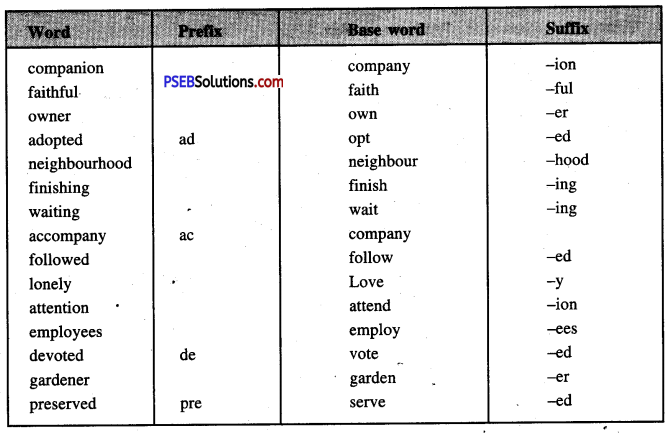
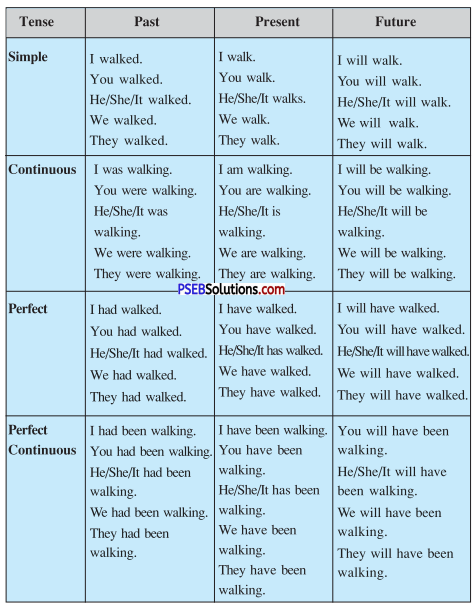
mouse mice child children

ox oxen tooth teeth
person people louse lice

PSEB 6th Class English Solutions Poem 1 My Furry Friend

(x) Some compound nouns take double plural. (दोनों भागों में change)

man-servant men-servants woman-servant women-servants

(xi) Others – No change :

fish fish deer deer
cattle cattle dozen dozen
sheep sheep furniture furniture

Activity 6.

Solve the crossword given below. You have to make plurals of the words given.
For example :
1 down is given – baby-babies :

PSEB 6th Class English Solutions Poem 1 My Furry Friend 4

Activity 7.

Make a list of action words used for the furry friend of the poet in the table given below.

S.No. Verbs
1. fights, loves, listens
2. bites, spoils, sleeps
3. nibbles, finds
4: eats
5. makes, comes, sits
6. tears, growls.

Such words that show action are called Verbs.
क्रिया को व्यक्त करने वाले शब्द Verbs कहलाते हैं।

PSEB 6th Class English Solutions Poem 1 My Furry Friend

Comprehension Of Stanzas

Read stanzas given below and answer the questions that follow each :

(1) I brought home a puppy
He looked very happy!
Soft brown eyes !
Is very small in size

Black and white
Sleeps day and night
As small as a rat.
But has a tummy so fat !

1. What did the poet bring home ?
कवि घर में क्या लाया ?

2. What was his colour ?
इसका रंग क्या था ?

3. How were his eyes ?
इसकी आँखें कैसी थी?

4. What does the poet compare him with ?
कवि इसकी तुलना किससे करता है?
Or
Name the poem and the poet.
कविता तथा कवि का नाम बताओ।
Answer:
1. The poet brought home a small puppy.
2. His colour was black and white.
3. His eyes were soft brown.
4. The poet compares him with a mouse.
Or
The name of the poem is ‘My Furry Freind and that of the poet (poetess) is Vandana Lunyal.

(2) He makes a funny noise
When he tears down his toys
He loves to be part of the fun
And listens to our conversation.

He comes and sits between us.

And makes a fuss
You ask him to go
He growls loudly to say No.

1. When does the poet’s puppy make a funny noise ?
कवि का पिल्ला अजीब (मज़ेदार) शोर कब करता है?

2. What does he enjoy listening to ?
उसे क्या चीज़ सुनने में आनंद आता है?

3. Who makes a fuss ?
शोर – शराबा कौन करता है?

PSEB 6th Class English Solutions Poem 1 My Furry Friend

4. How does he behave to say “No’?
‘No’
Or
Write the rhyming words in the stanzas. Two or three pairs. दो या तीन जोड़े
Answer:
The poet’s puppy makes a funny noise when he tears his toys.
2. He enjoys listening to the conversation between the poet and his family.
3. The poet’s puppy makes a fuss.
4. He growls (Txfa) loudly to say ‘No’
Or
noise-toys; us—fuss ; gono.
Now fully grown His forehead has a frown If you touch his food He spoils his mood. He loves to eat
Answer:
1. The poet brought home a small puppy.
2. His colour was black and white.
3. His eyes were soft brown.
4. The poet compares him with a mouse.
Or
The name of the poem is ‘My Furry Freind and that of the poet (poetess) is Vandana Lunyal.
He makes a funny noise When he tears down his toys He loves to be part of the fun And listens to our conversation.
He comes and sits between us. And makes a fuss You ask him to go
He growls loudly to say No.

PSEB 6th Class English Solutions Poem 1 My Furry Friend

1. When does the poet’s puppy make a funny noise ?
कवि का पिल्ला अजीब (मज़ेदार) शोर कब करता है?

2. What does he enjoy listening to ?
उसे क्या चीज़ सुनने में आनंद आता है?

3. Who makes a fuss ?
शोर – शराबा कौन करता है।

4. How does he behave to say “No’?
‘No’ करने के लिए वह कैसा व्यवहार करता है।
Or
Write the rhyming words in the stanzas. Two or three pairs.
दो या तीन जोड़े
Answer:
1. The poet’s puppy makes a funny noise when he tears his toys.
2. He enjoys listening to the conversation between the poet and his family.
3. The poet’s puppy makes a fuss.
4. He growls (गुर्राता) loudly to say ‘No’
Or
noise – toys; us – fuss ; go – no.

(3) Now fully grown
His forehead has a frown
If you touch his food
He spoils his mood.
He loves to eat

Always hungry for meat
He is quick on his feet
When you give him a treat.

1. Name the poem and the poet.
कविता और कवि का नाम लिखें।

Write the words that rhyme together.
वे शब्द लिखें जिनकी लय एक जैसी है।

2. Who is now fully grown ?
अब पूरी तरह बड़ा कौन हो चुका है?

3. What does he love to eat most ?
वह सबसे ज्यादा क्या चीज़ खाना पसंद करता है?

4. What is his reaction when you give him a treat ?
विशेष आहार/खाना मिलने पर उसकी क्या प्रतिक्रिया होती है?
Answer:
The name of the poem is ‘My Furry Friend’ and the poet is Vandana Lunyal.
Or
grown – frown, food – mood, eat – meat, feet – treat.
2. The poet’s puppy is now fully grown.
3. He loves to eat meat most.
4. He is quick on his feet.

PSEB 6th Class English Solutions Poem 1 My Furry Friend

Word Meanings
PSEB 6th Class English Solutions Poem 1 My Furry Friend 5

My Furry Friend Poem Summary in English

My Furry Friend Summary in English

The poet brought a furry puppy in home. He was black and white in colour. His eyes were soft brown. He looked very happy and slept day and night. Though the puppy was small in size, his tummy was very fat. He nibbled at everything it found in the house.

He tore down his toys and made a funny noise. He enjoyed family talks and growled when he was asked to go away. Next he was fully grown and always looked angry. He would not allow you to touch his food. Meat was his favourite food. He was always hungry for it and ate it greedily.

PSEB 6th Class English Solutions Poem 1 My Furry Friend

My Furry Friend Summary in Hindi

कवि एक छोटा सा रोएंदार (फर वाला) पिल्ला घर ले आया। देखने में यह एक चूहे जितना लगता था। इसका रंग काला और सफेद था। इसकी हल्की-भूरी आंखें थीं और इसका पेट मोटा था। यह हर समय सोया रहता था और बहुत ही खुश दिखाई देता था।

पिल्ले की आदतें अजीब थीं और वह अजीब हरकतें करता था। वह चूहे की तरह चीज़ों को कुतरता था और उसे जो कुछ भी मिलता था खा जाता था। वह बहुत ही फुर्तीला था और हर समय लड़ने को तैयार रहता था। वह अपने खिलौने तोड़-फोड़ देता था और अजीब शोर करता था।

पिल्ले को कवि तथा परिवार की बातचीत सुनने में आनंद आता था। इसलिए वह उनके बीच आ बैठता था। भगाने पर भी वह नहीं जाता था और गुर्राने लगता था। अब पिल्ला कुत्ता बन चुका था और हर समय गुस्से में रहता था। वह खाने का बहुत शौकीन था और हर समय मांस खाने को मांगता था। जब भी उसे उसका मनपसंद खाना दिया जाता था, वह तेज़ी से उठ खड़ा होता था। उसके बाद वह अपने खाने को हाथ भी नहीं लगाने देता था।

Class 6th English Book Solutions PSEB Poetry