PSEB 6th Class Computer Solutions Chapter 8 Output Devices

Punjab State Board PSEB 6th Class Computer Book Solutions Chapter 8 Output Devices Textbook Exercise Questions and Answers.

PSEB Solutions for Class 6 Computer Science Chapter 8 Output Devices

Computer Guide for Class 6 PSEB Output Devices Textbook Questions and Answers

1. Fill in the Blanks

Question 1.
Monitor is soft and is hard output device.
(a) Printer
(b) Plotter
(c) Both of these
(d) None of these.
Answer:
(a) Printer

Question 2.
………….. is used to listen to sound of computer
(a) Printer
(b) Speaker
(c) Microphone
(d) Mouse.
Answer:
(b) Speaker

PSEB 6th Class Computer Solutions Chapter 8 Output Devices

Question 3.
……………. prints output on paper
(a) Printer
(b) Keyboard
(c) Mouse
(d) Speaker.
answer:
(a) Printer

Question 4.
……………. printer prints by joining dots
(a) Dot matrix
(b) Inkjet
(c) Laser
(d) None of these
answer:
(a) Dot Matrix

Question 5.
Monitors are of …………. types.
(a) 2
(b) 3
(c) 4
(d) 5
answer:
(a) 2

Question 6.
Headphones are also called …………
(a) IPhone
(b) Earphone
(c) Both of these
(d) None of these
answer:
(b) Earphone.

PSEB 6th Class Computer Solutions Chapter 8 Output Devices

2. Short Answer Type Questions

Question 1.
What are output devices?
Answer:
Output devices are those devices which are used to get output from the computer.
They can give us soft as well as hard copies of output.

Question 2.
What are Speakers?
Answer:
Speaker is an output device which is used to get sound output from the computer. It is connected to sound card in the computer.

Question 3.
Where is projector used ?
Answer:
Projectors are used to display the output in big size. These are mainly used in meetings or to display presentations to a large number of people. They are also used in the classroom for teaching.

PSEB 6th Class Computer Solutions Chapter 8 Output Devices

Question 4.
What are the types of printers ?
Answer:
The different types of printers are :

  1. Dot Matrix printer
  2. Ink printer
  3. laser printer.

Question 5.
Write a note on Printer ?
Answer:
Printer is an output device which is used to get a hard copy of the output. They can print black and white as well as in color. There are many types of printers available these days. Printers give the output on paper.

Question 6.
Write the name of any three output devices.
Answer:
The name of three output devices are :

  1. Printer
  2. Monitor
  3. Speaker.

3. Long Answer Type Questions

Question 1.
Write note on the monitor and its types.
Answer:
Monitor is also called visual display terminal. It is used to get a soft copy of the output. It is the most common output device. It looks like a television screen.

PSEB 6th Class Computer Solutions Chapter 8 Output Devices

There are different kinds of monitors available these days:

  1. Cathode ray tube
  2. Flat panel display

1. Cathode ray tube monitor :
These monitors were used in earlier days. These monitors use cathode ray technology to display the information. These look like bulky television sets. The size of these monitors is measured by the diagonal length on the screen. Monitors are available in 15, 17, 19 and 21 inches screens. Initially these were black and white but now colored monitors are also available.

2. Flat panel display monitors:
These are the monitors which have a thin display portion. These are reduced in volume, weight and Pi requirement. These monitors can be hung up on the walls. We can see these monitors on calculators, video games, laptop computers etc. These monitors consume less power. Some examples of flat panel display monitors are LCD, LED and plasma.

PSEB 6th Class Computer Solutions Chapter 8 Output Devices

Question 1.
Write the difference between Input and Output Devices.
Answer:
Following are the differences between input and output devices :

Input devices:

  1. These are used to give input to computer
  2. Data and instructions are given as input using these devices
  3. Input devices are available in large categories
  4. Some common input devices are keyboard, mouse, scanner, web camera

Output devices:

  1. These devices are used to get output from the computer
  2. After processing information is taken using these devices
  3. The categories of availability of in output devices is less
  4. The common output devices are printer, monitor, speaker

Activity
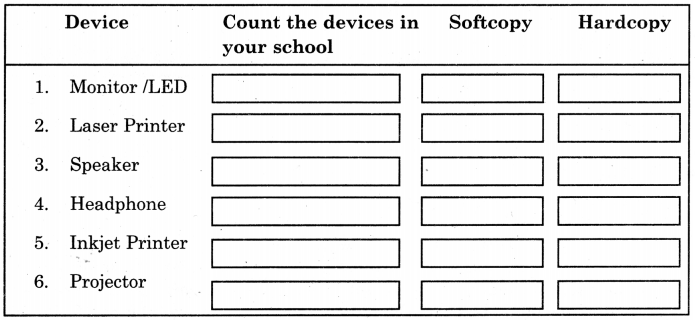
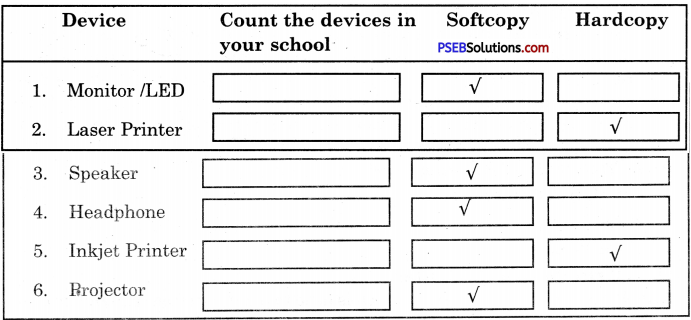
Let’s check our knowledge in the form of an activity. Count the devices in your school and fill in the boxes against their names. Also Tick (V) in the related box for each device type:
PSEB 6th Class Computer Solutions Chapter 8 Output Devices - 4
Answer:
PSEB 6th Class Computer Solutions Chapter 8 Output Devices - 6

PSEB 6th Class Computer Guide Output Devices Important Questions and Answers

1. Fill in the Blanks

Question 1.
Speakers give ………….. type of output.
(a) Speed
(b) Light
(c) Sound
(d) Text
Answer:
(c) Sound

Question 2.
Headphone work like ……………..
(a) Monitor
(b) Speaker
(c) Printer
(d) Projector
Answer:
(b) Speaker

PSEB 6th Class Computer Solutions Chapter 8 Output Devices

Question 3.
displays large images ………………
(a) Monitor
(b) Printer
(c) Projector
(d) Plotter
Answer:
(c) Projector

Question 4.
…………….. prints large images
(a) Printer
(b) Plotter
(c) Speaker
(d) Projector
Answer:
(b) Plotter.

2. Short Answer Type Questions

Question 1.
Name different types of output devices.
Answer:
Output devices are of following types:

  1. Monitor
  2. Printer
  3. Speaker
  4. Headphone
  5. Plotter
  6. Projector.

Question 2.
Name the types of monitors.
Answer:
Monitors are of two types:

  1. Cathode Ray Tube Monitor
  2. Flat Panel Display Monitor.

Question 3.
Where the projectors are used?
Answer:
Projectors are used to display large display to large number of audience.

PSEB 6th Class Computer Solutions Chapter 8 Output Devices

Question 4.
Name the types of printers.
Answer:
Printers are of following types:

  1. Dot Matrix Printer
  2. Inkjet Printer
  3. Laser Printer

Question 5.
Writer a note on Plotter.
Answer:
Plotter is an output device which is used to print big sized text and images. It works like printer but on large scale. It is used in CAD. Plotters are of different types.

Question 6.
Name the devices which can be used as both input and output devices.
Answer:
Pendrive, CD, DVD, Modem, Touch Screen.

Question 7.
What are speakers?
Answer:
Speakers are output devices which are used to give audio output. We can listen music, songs etc. using speakers. Speakers are of many types.

PSEB 6th Class Computer Solutions Chapter 8 Output Devices

Question 8.
What do you mean by headphones?
Answer:
Headphones are output device which work like speakers. They are used by placing in ears. They are also called ear phones.

3. Long Answer Type Questions

Question 1.
What are printers? Explain three types of printers.
Answer:
Printer prints output on paper. It is a hard output device. The output of printer is permanent. Its output can be preserved. Printers are available with different speed resolution and size in the market. Black and white as well as coloured Printers are available now a days. Coloured printers
give coloured printout.

Printers are of three types:

  1. Dot matrix Printer
  2. Inkjet Printer
  3. Laser Printer

Dot Matrix Printer:
This type of printers prints by joining dots. Its printing cost is very low.Its speed is slow and their printing output is very poor. It produces sound while working. The resolution of its printing is very low
PSEB 6th Class Computer Solutions Chapter 8 Output Devices - 1

Inkjet Printer:
This type of printer is an example of coloured printer. These printers are having less cost and it does not produce sound while working. Its speed is faster than dot matrix printer. The running cost of this type of printers is very high.
PSEB 6th Class Computer Solutions Chapter 8 Output Devices - 2

Laser Printer:
This type of printers is both black and white as well as coloured. These printers are very costly. Their speed is very fast as compared to other printers. Their printing quality is very high. They work silently and their running cost is very low. These printers are most widely used due to their less running cost and very high printing quality.
PSEB 6th Class Computer Solutions Chapter 8 Output Devices - 3

PSEB 6th Class Computer Solutions Chapter 8 Output Devices

Question 2.
Differentiate between CRT and Flat Panel Display.
Answer:
CRT Monitor:

  1. CRT monitors are big in size
  2. CRT monitors are heavy
  3. They produce large amount of heat.
  4. They use more electricity
  5. CRT monitors are cheaper

Flat Panel Display Monitors:

  1. Flat panel monitors are small in size
  2. Flat panel monitors are light weight
  3. Flat panel produce very less heat
  4. They use less electricity
  5. These monitors are costly

PSEB 6th Class Science Solutions Chapter 1 Food Where Does It Come From

Punjab State Board PSEB 6th Class Science Book Solutions Chapter 1 Food Where Does It Come From Textbook Exercise Questions and Answers.

PSEB Solutions for Class 6 Science Chapter 1 Food Where Does It Come From

Science Guide for Class 6 PSEB Food Where Does It Come From Intext Questions and Answers

Think and Answer (Textbook Page No. 2)

Question 1.
What are materials needed to prepare food items called?
Answer:
Ingredients.

Question 2.
What ingredients are used to prepare Kheer?
Answer:
Ingredients for preparing kheer are milk, rice, sugar, and dry fruits.

PSEB 6th Class Science Solutions Chapter 1 Food Where Does It Come From

Think and Answer (Textbook Page No. 4)

Question 1.
Which term is used for the part of plant we use as food?
Answer:
The plant parts which are used by us as food are called edible parts.

Question 2.
Which part of mango tree is edible?
Answer:
Fruit.

Think and Answer (Textbook Page No. 6)

Question 1.
Name two animals which eat only plants or plant products?
Answer:
Cow and goat

Question 2.
Name two animals which eat only flesh?
Answer:
Lion and tiger.

Question 3.
Name two animals which eat both plants and animals?
Answer:
Cat and dog.

PSEB 6th Class Science Guide Food Where Does It Come From Textbook Questions and Answers

Exercise – 1

1. Fill in the Blanks:

(a) Materials needed to prepare food items are called ………………
Answer:
ingredients

(b) White part of egg is called …………………
Answer:
albumin

(c) Plants can prepare their own food by the process of ………………
Answer:
photosynthesis

(d) ……………… and ………………… of mustard is used as food.
Answer:
Leaves, seeds,

(e) Honeybee collects ………………… from flowers.
Answer:
nectar

PSEB 6th Class Science Solutions Chapter 1 Food Where Does It Come From

2. Write True or False:

(a) All animals are carnivores.
Answer:
False

(b) Root of sweet potato is used as food.
Answer:
True

(c) Egg is not nutritional food as it contains no proteins.
Answer:
False

(d) Stem of sugarcane is used to prepare juice, sugar and jaggery.
Answer:
True

(e) Butter, curd and Honey are milk products.
Answer:
False

3. Match the Column A with Column B:

Column A Column B
1. Carrot (a) Pulses
2. Gram, Peas (b) Fruit
3. Wheat, Rice (c) Root
4. Potato (d) Cereals
5. Orange (e) Stem

Answer:

Column A Column B
1. Carrot (c) Root
2. Gram, Peas (a) Pulses
3. Wheat, Rice (d) Cereals
4. Potato (e) Stem
5. Orange (b) Fruit

4. Choose the Correct Answer:

Question (i)
Which of the following is an omnivorous animal?
(a) Lion
(b) Eagle
(c) Dear
(d) Crow
Answer:
(d) Crow

Question (ii)
Which part of cabbage is used as food?
(a) Stem
(b) Root
(c) Leaves
(d) None of above.
Answer:
(c) Leaves

PSEB 6th Class Science Solutions Chapter 1 Food Where Does It Come From

Exercise-2

5. Very Short Answer Type Questions:

Question (i)
What are ingredients?
Answer:
The materials needed to prepare food items are called ingredients.

Question (ii)
Name any three milk products.
Answer:
Cheese, butter, curd, and cream.

Question (iii)
Name any two seeds which are used as spices.
Answer:
Ginger, and turmeric.

6. Short Answer Type Questions:

Question (i)
How are the seeds important source of human food?
Answer:
Seeds are important ingredients of our food. Pulses are seeds of gram, peas, kidney beans and green gram (moong) are rich sources of protein. Cereals are seeds of grass plants like wheat, rice and maize. These are good sources of carbohydrates. Seeds of many plants are good sources of edible oils like mustard, groundnut and coconut.

Question (ii)
What is the importance of food for living beings?
Answer:
Food is very important because it

  1. provides energy to do work.
  2. helps in growth and development of body.
  3. protects us from diseases.
  4. keeps us healthy.
  5. helps in healing the injured body parts.

Question (iii)
Write briefly about any two food products that we get from animals.
Answer:
We get different food ingredients from animals. Some of the examples are milk, eggs, meat, honey, etc.

Milk and Milk Products.
Milk is used worldwide as food. It is also converted into dairy products like cheese, butter, curd, cream etc. We use milk of buffalo, cow, goat and sheep. Milk contains proteins, sugar, fats and vitamins. It is very good for health.

Honey.
Honey is sweet and thick fluid produced by honeybees. Honeybees collect nectar from flowers and convert it into honey and store it in their hives. Honey contains sugar, Water, minerals, enzymes and vitamins. Honey is being used as food and medicine since ancient times.

Question (iv)
Write briefly about any two food products that we get from plants.
Answer:
We get different food products from plants. Examples are fruits, seeds, edible leaves, roots and stems.

Fruits.
Fruits are important source of vitamins and minerals and are also essential for good health. Fruits like apple, mango, guava, papaya, orange, etc. are eaten raw. Some fruits are also used to make pickles, jams and juices.

Seeds.
Seeds of many plants used as food and food ingredients.
Gram, peas, kidney beans and green gram (moong) are examples of pulses. These are rich sources of proteins.

Seeds of grass like crops e.g. wheat, rice and maize are known as cereals. These are good sources of carbohydrates. Wheat flour is used to make chapati, bread and biscuits.

Seeds of coriander (dhania), cumin (zeera) and black pepper are used as spices in kitchen. Oil of mustard seeds is used in cooking.

PSEB 6th Class Science Solutions Chapter 1 Food Where Does It Come From

7. Long Answer Type Question :

Question (i)
How can we categorise animals on the basis of their food habits? Explain with the help of examples.
Answer:
We can categorise animals on the basis of their food habits into three categories. These are :
(1) Herbivores,
(2) Carnivores and
(3) Omnivores.

(1) Herbivores are the animals which eat only plants and plant products are called herbivores, e.g. cow, goat, rabbit, sheep, deer, elephant, etc.

(2) Carnivores are the animals which eat other animals are called carnivores, e.g. lion, tiger, lizard, snake, etc.

(3) Omnivores are the animals which eat both plant and animals are called omnivores, e.g. Crow, bear, dog and rat, man, etc.

PSEB Solutions for Class 6 Science Food Where Does It Come From Important Questions and Answers

Multiple Choice Questions:

Question 1.
The following root is eaten by us.
(a) Turnip
(b) Rose
(c) Brinjal
(d) Potato
Answer:
(a) Turnip

Question 2.
Fruit of following plant is a food to us.
(a) Wheat
(b) Tomato
(c) Spinach
(d) Sugarcane.
Answer:
(b) Tomato

Question 3.
Which is a herbivore :
(a) Goat
(b) Lion
(c) Hawk
(d) Dog
Answer:
(a) Goat

Question 4.
Cat is an example of :
(a) Herbivore
(b) Carnivore
(c) Omnivore
(d) none.
Answer:
(c) Omnivore

Question 5.
Milk product is :
(a) Curd
(b) Paneer
(c) Ghee
(d) All
Answer:
(d) All

PSEB 6th Class Science Solutions Chapter 1 Food Where Does It Come From

Fill in the Blanks:

(a) Food is prepared by using one or two or more ……………
Answer:
ingredients

(b) We get …………….. and ………………. from plants.
Answer:
fruits, vegetables

(c) Animals provide us …………….. and ……………..
Answer:
milk, meat

(d) Paddy is source of ……………….
Answer:
rice

(e) Some plants have more than one parts.
Answer:
edible

(f) Banana leaf is used as a ………………
Answer:
plate (saucer)

(g) Seeds of mustard give us …………….
Answer:
oil

(h) Honey-bees prepare honey from the ……………. of the flowers.
Answer:
nectar

(i) On the basis of eating habits, the living organisms are grouped into ………………. and ………………
Answer:
herbivores, carnivores, omnivores.

Write (T) against True and (F) against False statement:

(a) Plants are source of seeds, fruits, vegetables, spices etc.
Answer:
True

PSEB 6th Class Science Solutions Chapter 1 Food Where Does It Come From

(b) Butter, cream, cheese and curd are milk products.
Answer:
True

(c) Roots of all plants can be eaten as food.
Answer:
False

(d) We can eat stems and flowers of some plants.
Answer:
True

(e) Turmeric is an example of spice.
Answer:
True

(f) Seeds of moong and kidney beans are example of pulses.
Answer:
True

(g) Plants can prepare their food by a process called respiration.
Answer:
False

(h) Lions and tigers eat other animals for their food so they are called carnivores.
Answer:
True

Match the following items given in column A with that in column B:

Column A Column B
(1) Lion Collect nectar
(2) Deer Photosynthesis
(3) Man Eat other animals
(4) Female mosquito Eat plants
(5) Honey bee Take food from plants and animals.
(6) Green plants Human blood.

Answer:
(1) Lion – Eat other animals
(2) Deer – Eat plants
(3) Man – Take food from plants and animals.
(4) Female mosquito – Human blood
(5) Honey bee – Collect nectar
(6) Green plants – Photosynthesis.

PSEB 6th Class Science Solutions Chapter 1 Food Where Does It Come From

Very Short Answer Type Questions

Question 1.
List five carnivores.
Answer:
Carnivores :

  1. Lion,
  2. Tiger,
  3. Wolf,
  4. Lizard,
  5. Vulture.

Question 2.
Give examples of five herbivores.
Answer:
Herbivores :

  1. Deer,
  2. Goat,
  3. Elephant,
  4. Cow,
  5. Buffalo.

Question 3.
List three omnivores.
Answer:

  1. Man,
  2. Dog,
  3. Crow.

Question 4.
Which parts of plant are edible?
Answer:
Root, stem, leaf, flower i.e. all parts of a plant are edible.

Question 5.
Which food product is prepared by bees?
Answer:
Honey.

Question 6.
Name plants whose seeds are eaten as food.
Answer:
Moong, chana, peas, wheat etc.

Question 7.
Should we eat unknown plants? Why?
Answer:
No, we should not do so because some plants are poisonous.

PSEB 6th Class Science Solutions Chapter 1 Food Where Does It Come From

Question 8.
Where is nectar collected from and stored by bees?
Answer:
Nectar is collected from flowers and stored in their beehives.

Question 9.
Name some stems which are used as spices?
Answer:
Ginger and turmeric.

Question 10.
List four food products are that obtained from animals?
Answer:

  1. Milk,
  2. eggs,
  3. meat and
  4. honey.

Question 11.
Name four food items prepared from milk.
Answer:

  1. Curd,
  2. cream,
  3. butter and
  4. cheese.

Question 12.
Why do we need to take food?
Answer:
For getting energy and for doing various physical activities.

Question 13.
How can you classify foods?
Answer:
Classification of food. Classification of food is done in the following categories :

  1. Energy giving food
  2. Body building food
  3. Protective food.

Question 14.
Name four examples of animals which (i) give us milk and (ii) give us meat to eat.
Answer:
Animals which give us milk are (i) Cow (ii) Buffalo (iii) Goat (iv) Camel.
Animals which give us meat are (i) Pig (ii) Goat (iii) Chicken (iv) Sheep.

Question 15.
Name two animals which give us eggs to eat.
Answer:

  1. Hen
  2. Duck.

PSEB 6th Class Science Solutions Chapter 1 Food Where Does It Come From

Short Answer Type Questions

Question 1.
Differentiate between carnivores, herbivores and omnivores.
Answer:
Carnivores. These are the animals which obtain their food by eating other animals. Examples are lion, tiger, lizard, snake, etc.

Herbivores. Animals which eat only plants and plant products are called herbivores. Examples are cow, goat, rabbit, sheep, deer, elephant, etc.

Omnivores. Animals which eat both plants and animals are called omnivores. Examples are crow, bear, dog, rat, etc. Humans can also eat all types of substances, so they are also an example of omnivores.

Question 2.
Differentiate between pulses and cereals.
Answer:
Pulses are the seeds of plants like gram, peas, kidney beans, green gram (moong). These are good source of proteins.

Cereals are the seeds of plants like wheat, rice, maize, etc. These are good source of carbohydrates.

Question 3.
What are the main sources of food for different animals including man? Give examples.
Answer:
All animals and humans get their food from plants and other animals.
Food from plants : grains, pulses, fruits, vegetables, spices.
Food from Animals : milk, meat, milk products, etc.

Question 4.
Why are plants called producers and animals are called consumers?
Answer:
We know plants can synthesis their food by using carbon dioxide and water from the surrounding using the green pigment called chlorophyll and sunlight. For this reason these are called producers. On the other hand, animals cannot synthesise their food like plants so they depend upon plants or other animals for their food. Hence they are called consumers.

Question 5.
Why is a man called an omnivorous animal?
Answer:
Man is called an omnivorous animal because he eats both, plant food (such as grains, pulses, fruits and vegetables) as well as meat of animals (such as goat, chicken and fish). ‘Omnivorous animals’ are also called ‘Omnivores’.

Question 6.
Give examples of plants which have (i) roots, (ii) leaves and (iii) stems as edible parts.
Answer:
(i) We eat roots of carrot, radish, turnip, sweet potato, etc.
(ii) We eat leaves of mustard, spinach, cabbage, coriander, mint, etc.
(iii) We eat stems of ginger, potato, onion, sugarcane, turmeric, etc.

PSEB 6th Class Science Solutions Chapter 1 Food Where Does It Come From

Question 7.
We eat fruits and seeds of some plants. Give some examples of such plants.
Answer:
We eat fruits of plants like mango, apple, guava, papaya, orange, etc. On the other hand we eat seeds of pulses, cereals, etc.

Long Answer Type Questions

Question 1.
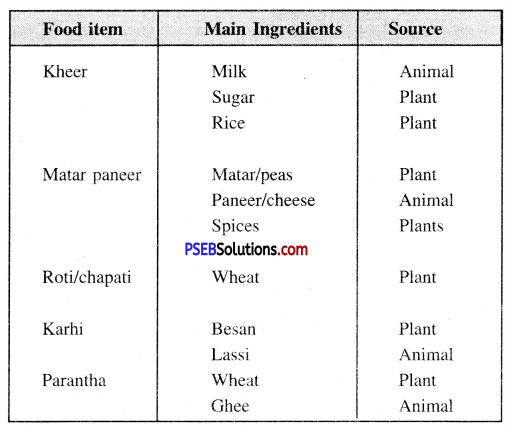
Give the main ingredients and their sources for the following food items. Kheer, matar paneer, chapati/roti, karhi and parantha
Answer:
PSEB 6th Class Science Solutions Chapter 1 Food Where Does It Come From 1

Question 2.
Write a short note on honey and milk.
Answer:
Honey.
It is sweet and thick fluid produced by honeybees. They collect nectar from flowers and convert it into honey. Sugar, water, minerals, enzymes and vitamins are the main ingredients of honey. Honey is stored in the beehives. It is in use as food and medicine since ancient times.

Milk.
It is known as complete food as it gives us all ingredients like fats, proteins, carbohydrates, minerals and vitamins. It is a food consumed all over the world. It can also be converted into many other products like cheese, butter, curd, cream, etc. We obtain milk from animals like buffalo, cow, goat, camel, sheep, etc.

Question 3.
Write down the functions or importance of food.
Answer:
Food is essential for all living organisms because of the following reasons :
(i) It provides energy. The food that we eat is digested, absorbed and then oxidised to
provide energy. The energy thus released, is utilised by all living organisms to perform various
activities like running, walking and various movements.

(ii) It helps in growth and development. The food provides all necessary materials for cell division and helps in growth and development.

(iii) It helps to overcome wear and tear. Food is also needed by living beings for replacement and reparing of their damaged parts.

(iv) It protects the body against diseases. Food gives us resistance against diseases and protects us from infection.

Question 4.
Write short notes on eggs and meat as food items.
Answer:
Eggs and meat are food items obtained from animals. People who eat eggs and meat are known as non-vegetarians.

(i) Eggs. Eggs are also a very common food item for people. We commonly eat eggs produced by hens and ducks. The eggs we eat have a hard shell outside. Inside this shell we have a white part called albumin and a yellow part called yolk. Albumin is rich in proteins whereas yolk is rich in fats.

(ii) Meat. We eat the flesh of some animals which is known as meat. Meat is also eaten by a large number of people all over the world. We generally eat the meat of goat, sheep, chicken, and fish. All types of meat have proteins and fats as the main ingredient. In addition, we also eat sea animals like prawns, oysters, crabs, etc.

PSEB 9th Class Agriculture Solutions Chapter 5 Quality Control of Seeds, Fertilizers and Insecticides

Punjab State Board PSEB 9th Class Agriculture Book Solutions Chapter 5 Quality Control of Seeds, Fertilizers and Insecticides Textbook Exercise Questions and Answers.

PSEB Solutions for Class 9 Agriculture Chapter 5 Quality Control of Seeds, Fertilizers and Insecticides

Agriculture Guide for Class 9 PSEB Quality Control of Seeds, Fertilizers and Insecticides Textbook Questions and Answers

(A) Answer in 1-2 words:

Question 1.
Name the Act to control the quality of seeds.
Answer:
Seed Control Order 1983.

Question 2.
Name the Act of controlling the quality of fertilizers.
Answer:
Fertilizers Control Order, 1985

PSEB 9th Class Agriculture Solutions Chapter 5 Quality Control of Seeds, Fertilizers and Insecticides

Question 3.
Name the places where laboratories for checking the quality of fertilizers are located?
Answer:
Ludhiana and Faridkot.

Question 4.
Name the Act to control the quality of insecticides.
Answer:
Insecticides Act-1968.

Question 5.
Who gives advice to Government of India regarding implementation of insecticide act 9
Answer:
Central Insecticide Board.

Question 6.
Name the places where laboratories to check quality of insecticides are located?
Answer:
Ludhiana, Bathinda, Amritsar.

Question 7.
Who gives permission to import pesticides from foreign countries?
Answer:
Central Registration Committee.

Question 8.
Under Insecticide Act who is declared as Insecticide Inspector?
Answer:
ADO (Agricultural Development Officer) is declared as Insecticide Inspector.

Question 9.
To whom shall you file a complaint against a dealer who sells low quality fertilizer?
Answer:
Chief Agricultural Officer.

Question 10.
Name the item for which TL label is used?
Answer:
For seeds it is labelled as truthfully labelled (TL).

(B) Answer in 1-2 sentences:

Question 1.
Why the quality control of fertilizers is important?
Answer:
Fertilizers play an important role in the agriculture. It is given to the crop so that the plants can develop properly. If fertilizers are not of good quality, it will badly affect the growth of the plants. All the hard work will go in vain. Therefore, Quality Control of Fertilizers is very important.

Question 2.
Why the quality .control of seeds is important?
Answer:
If seeds are not of good quality the produce will also be of lower quality and yield is also less. All the hard work will go in vain and farmer will not get expected price and profit. Therefore, seeds should be of good quality.

Question 3.
Name the commodities related to agriculture which are included under Essential Commodities Act?
Answer:
Government of India has included three main commodities : seeds, fertilizers and insecticides under Essential Commodities Act.

Question 4.
Name the laws which are implemented to control the quality of seeds, fertilizers and insecticides?
Answer:
For seeds it is Seed Control Order-1983, for fertilizers it is Fertilizer Control Order-1985, for insecticides it is Insecticides Act-1968.

PSEB 9th Class Agriculture Solutions Chapter 5 Quality Control of Seeds, Fertilizers and Insecticides

Question 5.
What are the rights of seed inspector for controlling the quality of seeds?
Answer:
Seed Inspector can check stock, sale, purchase and ask for the information about the, seeds in the store from the dealer. He can search the seed store or shop. He can take samples of seeds and send them to the testing laboratories. If some fault is found he can ban the sale of the seeds. He can take possession of the documents related to seeds and can check them. In case shop keeper is found guilty, inspector can cancel the licence of the shop-keeper.

Question 6.
What are the rights of a farmer under Seed Control Order?
Answer:
Under this act, rights of the farmers who purchase the seeds are protected and secured. In case of low quality, fake or damaged seeds, farmer can get compensation for his expenditure occurred on seeds. If buyer feels that crop failure has occurred due to the low quality of seeds sold to him’by the seed dealer; he can file written complaint against the dealer to the Seed Inspector.

Question 7.
What evidence is required to file a complaint against dealer who sold low quality seeds ?
Answer:
Following evidences are required to file a complaint against dealer who sold low quality seeds :

  • Receipt or bill given by dealer at the time of purchase of seeds.
  • Label, tagged on the bags of seed.
  • Empty seed bag or container or packet.
  • Sample taken from purchased seeds.

Question 8.
Name the law for assurance of quality of fertilizers. Name the officer of agriculture department deputed for the proper implementation of this act.
Answer:
The law for assurance of quality of fertilizers is Fertilizer Control Order-1985. The implementation of this order in Punjab is done by Director, Department of Agriculture through Agriculture Officer and Agriculture Development Officer (ADO).

Question 9.
To check the quality of insecticides, what are the important actions taken by an Insecticide Inspector ?
Answer:
Insecticide inspector can do inspection of insecticide shops, godowns, sale centres and other related places which fall under his jurisdiction. He can collect samples of insecticides and send them to laboratories located at Ludhiana, Bathinda and Amritsar for investigation. He can check the stock to know about the expiry date of the chemicals sold by the dealer. He can also verify the weight and other such related facts. He can cancel the licence in case the dealer is found guilty of breaking the laws.

Question 10.
Write about Article-7 of Seed Act.
Answer:
This act is related to the selling of seeds. This act protects the rights of the farmers and prevents the dealer to sell low quality or damaged seed. Under Article-7 of the Seed Act, dealer can sell only notified seeds.

PSEB 9th Class Agriculture Solutions Chapter 5 Quality Control of Seeds, Fertilizers and Insecticides

(C) Answer in 5-6 sentences:

Question 1.
Why is it important to control the quality of seeds, fertilizers and insecticides?
Answer:
For profitable farming three important things are required which are seeds, fertilizers and insecticides. All these three commodities are equally very important in profitable farming. These all should be of good quality. Fertilizers play an important role in the agriculture. It is applied so that the plants can develop properly. If fertilizers are not of good quality, it will badly affect the growth of the plants. All the hard work will go in vain. Therefore, Quality Control of Fertilizers is very important. If seeds are not of good quality the produce will also be of lower quality and yield is also less. All the hard work will go in vain and farmer will not get expected price and profit. Therefore, seeds should be of good quality. If these three are not of good quality then expenditure occured by profit is not upto the expectation, these will not be able to control the weeds, insects etc. Insects will damage the crop. It is very important to control the quality of seeds, fertilizers and insecticides.

Question 2.
How the quality of insecticides is controlled with the help of Insecticide Act?
Answer:
This act was passed in 1968 and was implemented in whole of the country. This act was implemented to check adulteration and discrepancies in the insecticides. According to this act, outdated expired and packs or bottles weighing less of insecticides cannot be sold. Government of Punjab has given authority to provide licence to dealers to the Chief Agriculture Officer at district level. ADO is declared as insecticide inspector who can check shops, godowns and sale centres of insecticides and can collect sample for sending to laboratories for investigation. Laboratories are located at Ludhiana, Amritsar, Bathinda. Those who are found flouting the act, legal action can be taken against them and their licence can be cancelled.

Question 3.
Describe the five main articles of seed control order?
Answer:
1. Right to give licence: According to this order, the state Government can appoint any officer who is suitable according to government as licence officer and also decide his jurisdiction area. In Punjab this right is given to department of Agriculture.

2. Seed Inspector: Under this act, State Government has appointed Agriculture Development Officer as seed inspector and also notified their jurisdiction and powers. Seed inspector can ask for any type of information from the dealer e.g., he can check stock of seeds, purchase of seeds, sale of seeds etc. Seed inspector can take samples of seeds and can check the seed shops. He can send the samples to the seed testing laboratories. If the dealer is found to flout the laws, seed inspector can restrict the sale of the seeds and can also take documents related with seeds in his possession. He can write to licence officer for cancelling of the licence of the dealer.

3. Rights of Farmers: Under this act, rights of the farmers who’ purchase the seeds are protected and secured. In case of low quality, fake or damaged seeds, farmer can get compensation for his expenditure on seeds. If buyer feels that crop failure has occured due to the low quality of seeds sold to him by the seed dealer; he can file written complaint against the dealer to the Seed Inspector.

Following evidences are required to file a complaint against dealer who sold low quality seeds :

  • Receipt or bill given by dealer at the time of purchase of seeds.
  • Label, tagged on the bags of seed.
  • Empty seed bag or container or packet.
  • Sample taken from purchased seeds.

4. Law regarding sale of seeds: Article-7 of the Seed Act, allows sale of only notified seeds. Seeds should be properly packed and labelled. Pack of seeds should have attached with it a label of certified seeds or truthfully (TL) seeds.

5. Certification of Seeds. Producer of the seeds if wants can get certification for the seeds produced by him.

PSEB 9th Class Agriculture Solutions Chapter 5 Quality Control of Seeds, Fertilizers and Insecticides

Question 4.
What are the rights that are enjoyed by the farmers under Seed Control Order ?
Answer:
Answer yourself.

Question 5.
Name three products required for the development of agriculture and also give a brief description about their quality control.
Answer:
Answer yourself.

Very Short Answer Type Questions:

Question 1.
When was Seed Control Act passed?
Answer:
1983.

Question 2.
When was Fertilizer Control Act passed?
Answer:
1985.

Question 3.
Who implements Seed, fertilizer, pesticide related acts in Punjab?
Answer:
Department of Agriculure, Punjab.

Question 4.
Which quality label is attached with the sealed packets, containers or bags of seeds?
Answer:
T.L. (Truthfully Labelled) or Certified seeds.

Short Answer Type Questions:

Question 1.
When was Insecticide Act passed?
Answer:
This act was passed in 1968 and was implemented in whole of the country.

Question 2.
To whom Punjab Government has given the authority to give license to the dealer for selling insecticides?
Answer:
Punjab Government has given the authority to Chief Agriculture Officer of respective districts to give license to the dealer for selling insecticides.

Question 3.
Which points should be kept in mind while purchasing insecticides?
Answer:
Farmer should get receipt of the purchased insecticide. Containers and bottels containing insecticides should be porperly sealed. Farmer should check the expiry date on the container. In case of any doubt or problem contact Agriculture Development Officer or Chief Agriculture Officer.

PSEB 9th Class Agriculture Solutions Chapter 5 Quality Control of Seeds, Fertilizers and Insecticides

Long Answer Type Question:

Question 1.
What is the meaning of Fertilizer Control Order 1985? How is it helpful in the Quality Control of Fertilizers?
Answer:
Fertilizer Control Order-1985 was made for assuring quality and correct weight of the fertilizers and also to prevent sale of adulterated fertilizers. It also prevents the sale of low-quality and non-certified fertilizers. Dealer has to get license for sale of fertilizers from the Chief Agriculture Officer of the district.

For checking the quality of fertilizers, monitoring is done at various levels. Dealers are not allowed to sell the fertilizers which are below specific standards. Competent authorities have been given proper rights to check the quality of fertilizers. They can check and inspect the fertilizer factories and dealers or shopkeepers which fall under their jurisdiction. If needed inspectors can take samples of fertilizers and send them to testing laboratories. Those dealers or shopkeepers who defy the law, their license can be cancelled and legal action can be taken against them.

PSEB 9th Class Agriculture Guide Quality Control of Seeds, Fertilizers and Insecticides Important Questions and Answers

Multiple Choice Questions:

1. Fertilizer testing laboratories are located at:
(a) Ludhiana
(b) Kapurthala
(c) Jalandhar
(d) None
Answer:
(a) Ludhiana

2. Insecticide testing laboratories are located at:
(a) Ludhiana
(b) Bathinda
(c) Amritsar
(d) All correct
Answer:
(d) All correct

3. Seed control order was made in:
(a) 1980
(b) 1983
(c) 1950
(d) 1995
Answer:
(b) 1983

4. Insecticide Act was made in :
(a) 1950
(b) 1968
(c) 1990
(d) 2000
Answer:
(b) 1968

5. Fertilizer control order was made in :
(a) 1985
(b) 1968
(c) 1995
(d) 1989
Answer:
(a) 1985

PSEB 9th Class Agriculture Solutions Chapter 5 Quality Control of Seeds, Fertilizers and Insecticides

True/False:

1. For profitable farming main commodities required are seeds, fertilizers, and insecticides.
Answer:
True

2. Insecticides Act was not made in 1968.
Answer:
False

3. Government of India has made certain laws under the Essential Commodities Act.
Answer:
True

4. These acts are Seed Control Order, Fertilizer Control Order, Insecticides Act.
Answer:
True

5. Under article 7 of the Seed Act, notified seeds can not be sold.
Answer:
False

Fill in the Blanks:

1. Fertilizer testing laboratories are located at …………….. and ……………..
Answer:
Ludhiana, Faridkot

2. Fertilizer Control Order was made in …………….. which is used to prevent adultration, low quality and non-certified fertilizers, and to ensure quality and corrupt weight of fertilizers.
Answer:
1985

3. Insecticides samples are sent to the laboratories located at Ludhiana, Bathinda, …………….. for testing.
Answer:
Amritsar

4. Central Insecticide Board gives advice to …………….. to implement the laws.
Answer:
government

5. Central Registration Committee provides registration for the …………….. of agrochemicals and also provides permission for their import and export.
Answer:
manufacturing

PSEB 7th Class Science Solutions Chapter 4 Heat

Punjab State Board PSEB 7th Class Science Book Solutions Chapter 4 Heat Textbook Exercise Questions and Answers.

PSEB Solutions for Class 7 Science Chapter 4 Heat

Science Guide for Class 7 PSEB Heat Intext Questions and Answers

Think and Answer (Textbook Page No. 37)

Question 1.
The normal temperature of our body is ……………… .
Answer:
The normal temperature of our body is 37°C.

Question 2.
The clinical thermometer can measure temperature above 45°C. (T/F)
Answer:
False.

PSEB 7th Class Science Solutions Chapter 4 Heat

Think and Answer (Textbook Page No. 39)

Question 1.
Thermometer should be held from its bulb.(T/F)
Answer:
False.

Question 2.
The thermometer should not touch the ………………. of the beaker.
Answer:
The thermometer should not touch the bottom or sides of the beaker.

Think and Answer (Textbook Page No. 40)

Question 1.
The handle of cooking vessels are good conductor of heat. (True/False)
Answer:
False.

Question 2.
The handle of electric iron is good conductor of heat. (True/False)
Answer:
False.

Think and Answer (Textbook Page No. 42)

Question 1.
The ventilators in the rooms are used to expell cold air. (True/False)
Answer:
False.

Question 2.
The liquids are always heated from the bottom. (True/False)
Answer:
True.

Think and Answer (Textbook Page No. 44)

Question 1.
We wear light coloured clothes in winter. (True/False)
Answer:
False.

Question 2.
Dark coloured clothes absorbs less heat. (True/False)
Answer:
False.

PSEB 7th Class Science Solutions Chapter 4 Heat

PSEB 7th Class Science Guide Heat Textbook Questions and Answers

1. Fill in the blanks:

(i) The hotness of an object is a measured by its …………………….
Answer:
Temperature

(ii) The mode of heat transfer without any medium is called ………………….. .
Answer:
Radiation

(iii) Air is ………………….. conductor of heat.
Answer:
bad

(iv) The normal temperature of the human body is ……………………. °C.
Answer:
37°C

2. Write True or False:

(i) Metals are insulators of heat.
Answer:
False

(ii) Sea breeze arises due to conduction.
Answer:
False

(iii) We get heat from the sun by radiation.
Answer:
True

(iv) Wool is good conductor of heat.
Answer:
False

PSEB 7th Class Science Solutions Chapter 4 Heat

(v) Range of clinical thermometer is 35° C to 42°C.
Answer:
False

3. Match the Column ‘A’ with Column ‘B’:

Column ‘A’ Column ‘B’
1. Land breeze blows during

2. Sea breeze blows during

3. We prefer light coloured clothes in

4. We prefer dark coloured clothes in

(a) winter

(b) night

(c) daytime

(d) summer

Answer:

Column ‘A’ Column ‘B’
1. Land breeze blows during

2. Sea breeze blows during

3. We prefer light coloured clothes in

4. We prefer dark coloured clothes in

(c) daytime

(b) night

(d) summer

(a) winter

4. Choose the Correct Answer:

Question (i)
Temperature of human body is:
(a) 100°C
(b) 0°C
(c) 37° C
(d) 98°C.
Answer:
(c) 37° C.

Question (ii)
Which is bad conductor of heat ?
(a) Aluminium
(b) Iron
(c) Copper
(d) Wood.
Answer:
(d) Wood.

Question (iii)
One litre of water at 30°C is mixed with one litre of water at 50°C. Then temperature of mixture will be :
(a) 80°C
(b) More than 50°C but less than 80°C’
(c) 20°C
(d) Between 30°C and 50°C
Answer:
(d) Between 30°C and 50°C.

Question (iv)
A wooden spoon is dipped in a cup of ice cream. Its other end:
(a) becomes cold by the process of conduction.
(b) becomes cold by the process of convection.
(c) becomes cold by the process of radiation.
(d) does not become cold.
Answer:
(d) does not become cold.

Question (v)
Land breeze is:
(a) cool air from land to sea
(b) cool air from sea to land
(c) hot air from land to sea
(d) hot air from sea to land.
Answer:
(a) cool air from land to sea.

Short Answer Type Questions

Question (i)
State the condition which determine the direction of flow of heat.
Answer:
When two objects are in contact with each other, the heat is transmitted from the object at higher temperature to the object at a lower temperature.

PSEB 7th Class Science Solutions Chapter 4 Heat

Question (ii)
What is clinical thermometer ? Write its range.
Answer:
Clinical thermometer. Clinical thermometer is a device by which a human body temperature is measured. It is also called Medical thermometer’s range in from 35°C to 42°C.

Question (iii)
What is the use of kink in a clinical thermometer ?
Answer:
Medical thermometer has a kink (bend) just above the bulb, the function of which is to prevent the mercury level from falling because of its weight. If kink is not present there then the mercury level will drop so that the human temperature will not be measured accurately.

Question (iv)
What is Lab thermometer ? Write its range.
Answer:
Lab Thermometer. An instrument used to measure the temperature of objects other than human beings (or living things) is called Lab thermometer. The range of lab thermometer is usually 10°C to 110°C.

Question (v)
Why do we prefer dark clothes in winters and light one in summers ?
Answer:
Darker fabrics absorb more heat than light coloured fabrics. So in winter we wear dark coloured clothes to keep our body warm by absorbing more heat, whereas light coloured clothes absorb lesser amount of heat and are also good reflector so our body does not get much heat.

Question (vi)
Why do we wear woollen clothes in winters ?
Answer:
Air is trapped in the wool fibres. Since air is a bad conductor of heat, so it does not allow heat to be transmitted to the cold environment outside. That is why we feel warm in winter by wearing woollen clothes.

6. Long Answer Type Questions:

Question (i)
What are the various modes of heat transfer ? Explain.
Answer:
There are three modes of heat transfer :
1. conduction.
2. convection,
3. radiation.

1. Conduction.
It is that method of heat transfer in which heat is transmitted from the hotter end to the colder end of the object without the actual movement of the heated partilces. Solids are heated by this method.

2. Convection.
It is the process of heat transfer due to the actual movement of the heated particles of liquid or gas. Liquids and gases are heated by this method.

3. Radiation.
It is the process in which heat is transmitted directly from the ource of heat or hot object to a cold object without medium in between them. In other words no medium is required for heat radiation

PSEB 7th Class Science Solutions Chapter 4 Heat

Question (ii)
Explain the formation of sea breeze and land breeze in coastal areas ?
Answer:
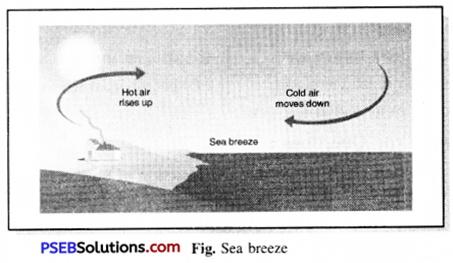
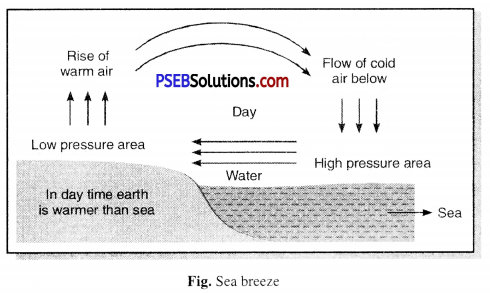
Sea breeze.
During day time the ground is heated by the heat of the sun, which causes the ground air to heat up, roll and rise. Cold air from the ocean begins to rush towards the ground to take it’s place. The warm air from the land moves towards the sea to complete the cycle. The wind that blows from the ocean to the land is called the sea breeze.
PSEB 7th Class Science Solutions Chapter 4 Heat 1
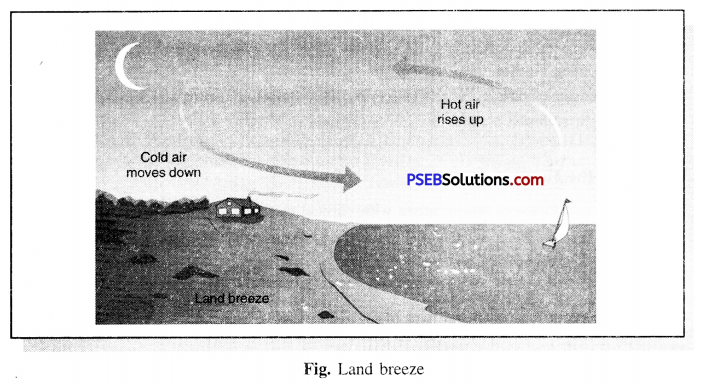
Land breeze.
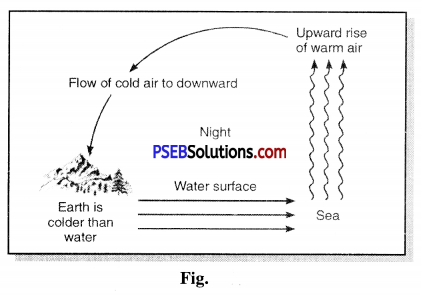
Due to higher heat absorption capacity the water cools down more slowly than the land, so cool air from the land starts rushing from the land towards the sea at night. This is called land breeze.
PSEB 7th Class Science Solutions Chapter 4 Heat 2

PSEB Solutions for Class 7 Science Heat Important Questions and Answers

1. Fill in the blanks:

(i) The degree of hotness of an object is determined by its …………………
Answer:
temperature

(ii) Temperature of boiling water cannot be measured by a ………………. thermometer.
Answer:
clinical

(iii) Temperature is measured in degree ……………… .
Answer:
Celsius

(iv) A cold steel spoon is dipped in a cup of hot milk. It transfers heat to its other end by
the process of ………………..
Answer:
conduction

(v) Clothes of …………………. colours absorb more heat than light coloured clothes.
Answer:
dark

2. Match the Column ‘A’ with Column ‘B’:

Column ‘A’ Column ‘B’
(i) Medical thermometer

(ii) Black coloured objects

(iii) Woollen clothes

(iv) Transfer of heat

(v) Light coloured clothes

(a) From high temperature to low temperature

(b) In winter

(c) In summer

(d) Better absorbent and radiator

(e) To measure the temperature of human beings.

Answer:

Column ‘A’ Column ‘B’
(i) Medical thermometer

(ii) Black coloured objects

(iii) Woollen clothes

(iv) Transfer of heat

(v) Light coloured clothes

(e) To measure the temperature of human beings

(d) Better absorbent and radiator

(b) In winter

(a) From high temperature to low temperature

(c) In summer

3. Choose the Correct Answer:

Question (i)
We can measure temperature with clinical thermometer
(a) From 30°C to 42°C
(b) From 35°C to 42°C
(c) From 35°C to 45°C
(d) None of these.
Answer:
(b) From 35°C to 42°C.

PSEB 7th Class Science Solutions Chapter 4 Heat

Question (ii)
The reliable measure of heat of an object is :
(a) The heat of that object
(b) The degree of hotness or coldness of that object
(c) The physical touch
(d) None of the above.
Answer:
(b) The degree of hotness or coldness of that object.

Question (iii)
The range of laboratory thermometer is :
(a) -10°C to 100°C
(b) 35°C to 42°C
(c) -10°C to 110°C
(d) 94°F to 108°F.
Answer:
(c) ~10°C to 110°C.

Question (iv)
Heat from sun reaches us by the process of :
(a) conduction
(b) convection
(c) radiation
(d) None of the above.
Answer:
(c) radiation.

Question (v)
Heat is transferred in liquids and gases by :
(a) conduction
(b) radiation
(c) convection
(d) None of the above.
Answer:
(c) convection.

Question (vi)
Clinical thermometer is filled with :
(a) Water
(b) Lead
(c) Mercury
(d) Air.
Answer:
(c) Mercury.

Question (vii)
What kind of clothes do we wear in summer ?
(a) Cotton
(b) Silky
(d) Wool.
(c) Jute
Answer:
(a) Cotton.

4. State True or False:

(i) We wear both light and dark clothes in summer.
Answer:
False

PSEB 7th Class Science Solutions Chapter 4 Heat

(ii) In coastal areas, the wind blowing from the sea towards the coast at night is called land breeze.
Answer:
False

(iii) Woollen garments provide warmth in winter as wool fibres traps in air.
Answer:
True

(iv) Heat transfer between liquids and gases is by convection method.
Answer:
True

(v) The thermometer should be washed with lukewarm water before use to measure temperature.
Answer:
False

Very Short Answer Type Questions

Question 1.
What is temperature ?
Answer:
Temperature. The degree of hotness or coolness of an object is its temperature.

Question 2.
What is thermometer ?
Answer:
Thermometer. It is a device used to measure the temperature of an object.

Question 3.
Name two types of thermometers.
Answer:

  1. Clinical thermometer and
  2. Laboratory thermometer.

PSEB 7th Class Science Solutions Chapter 4 Heat

Question 4.
Which metal is used in thermometers ?
Answer:
Mercury (Hg).

Question 5.
Which scales are used to measure temperatures ?
Answer:
Two scales are mainly used which are (i) Celsius scale and (ii) Fahemheit scale.

Question 6.
What is range of clinical thermometer ?
Answer:
35°C to 42°C.

Question 7.
Why is a thermometer jerked before taking temperature of a person ?
Answer:
To bring the mercury level below 35°C.

Question 8.
What is normal body temperature of healthy person ?
Answer:
37°C.

Question 9.
Name the thermometer used for noting weather temperature.
Answer:
Maximum-Minimum thermometer.

Question 10.
What is range of laboratory thermometer ?
Answer:
-10°C to 110°C.

PSEB 7th Class Science Solutions Chapter 4 Heat

Question 11.
Which solution is used to wash thermometer before and after use ?
Answer:
Antiseptic solution.

Question 12.
How are laboratory thermometers read ?
Answer:
In vertically upright position.

Short Answer Type Questions

Question 1.
When cold milk is added to hot tea, how does the heat transfer take place ?
Answer:
When cold milk is added to hot tea. the two come in contact with each other. The transfer of heat energy takes place from hot molecules of tea to cold molecules of milk by the process called convection.

Question 2.
What are the main conditions necessary for the flow of heat ?
Answer:
Conditions for the flow of heat. The following are three conditions responsible for the flow of heat from one place to another or from one body to another body :

  1. The two substances should be in contact with each other.
  2. The temperature of both the substances should be different.
  3. The heat flows from hot to cooler substance.

Question 3.
If a spoon is held over fire, it becomes hot after sometime. Describe the process of heating up.
Answer:
We know that in a solid the molecules are packed close together. When one end of the spoon is held over the fire, the molecules of material of spoon absorb the heat energy and begin to vibrate rapidly. These molecules handover heat energy to the neighbouring molecules, in turn, cause their neighbouring molecules to vibrate. This process continues along the length of the spoon and energy is transferred from the hotter part to the colder part. After sometime, the other end of the spoon also becomes hot.

Question 4.
Why is it preferred to wear bright clothes in summer and dark clothes in winter ?
Answer:
Dark coloured clothes are good absorbers of heat as compared to white clothes. The dark coloured clothes absorb the heat falling on them and become wanner. So we feel warm in winter by wearing these clothes. On the other hand, white clothes reflect heat coming from the sun. That is why, we prefer to wear bright clothes in summer and dark clothes in winter.

Question 5.
Define conduction. Why the handles of cooking utensils are made of insulators ?
Answer:
Conduction. The mode of transfer of heat in which heat is transferred from one particle to another without the actual motion of the particles, is called conduction.
The handles of cooking utensils are made up of insulating materials because they do not allow heat to flow through them. So heat cannot reach our body and thus our hand is prevented from burning.

Question 6.
Define radiation.
Answer:
Radiation. The process of transfer of heat from one body to another without heating the intervening medium, is called radiation. No medium is needed for the transference of heat by this process.

PSEB 7th Class Science Solutions Chapter 4 Heat

Question 7.
Distinguish between heat and temperature.
Answer:
Differences between heat and temperature.
TABLE

Question 8.
What is convection ? Give two practical applications of convection of heat.
Answer:
Convection.
The process of transference of heat in which heated gas or a liquid particles actually move from one place to another, is called convection. All the liquids and gases are heated by the method of convection.

Practical applications :

  • When a stove is lighted, the air in contact with the hot stove becomes warm. On being heated, it expands and becomes lighter. As a result, it rises upwards and the cool air from its surrounding comes to take its place.
  • The ventilation of ordinary buildings is due to convection.

Question 9.
As soon as the tube is removed from the source of heat, the level of liquid drops. How is this avoided in the thermometer that doctors use ?
Answer:
It is seen that the level of liquid fails in a narrow-tube (capillary tube) when it is removed from the source of heat. But when the doctor’s thermometer is removed from the source of heat, the level of mercury does not fall by itself. It is because a kink is provided in the tube of clinical thermometer which prevents mercury from falling down due to its own weight.

Question 10.
Discuss why wearing more layers of clothing during winter keeps us warm than wearing just one thick piece of clothing.
Answer:
Different layers of clothing trap air inside them. Air is a poor conductor of heat so it prevents the flow of heat from our body to the cold surrounding and keeps us warm.

Long Answer Type Questions

Question 1.
Give an experiment to show that black bodies are good absorbers and good raidators.
Answer:
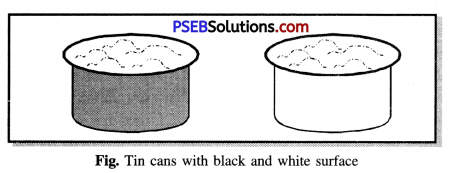
Experiment. Take two tin cans of the same size. Paint one of them black and other white from outside. Pour equal amount of water in each can. Now place them in the sun for about an hour. When we touch water in the tin cans we find that the water in the black tin has become warmer than that in the other tin. Since the size of the tins is the same, this shows that black body has absorbed more heat radiations than the other one.
PSEB 7th Class Science Solutions Chapter 4 Heat 3
You can also do the reverse experiment by taking equal amount of hot water in each can. Leave the cans in a shady place for 10 minutes and record the temperature of each can. You would find the water in the dark had cooled down more. Thus, we conclude that black bodies are good absorbers and also good radiators of heat.

Question 2.
Give an experiment to show the transfer of heat by conduction.
Answer:
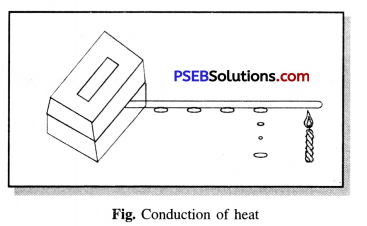
Experiment. Take a flat aluminium rod. Fix some iron nails on this rod with the help of molten wax. Clamp this rod in a stand as shown in the figure.
Heat one end of the rod with the help of spirit lamp. The iron nails drop one by one, starting from the hot end. It shows that heat is transferred slowly from one end of the rod to the other end by conduction.
PSEB 7th Class Science Solutions Chapter 4 Heat 4
Conduction of heat takes place from the hot part of the object to its colder parts; or from one hot object to a colder object, happens only if:

  1. the two parts are in contact, and
  2. their temperatures are different.

PSEB 7th Class Science Solutions Chapter 7 Weather, Climate and Adaptations of Animals to Climate

Punjab State Board PSEB 7th Class Science Book Solutions Chapter 7 Weather, Climate and Adaptations of Animals to Climate Textbook Exercise Questions and Answers.

PSEB Solutions for Class 7 Science Chapter 7 Weather, Climate and Adaptations of Animals to Climate

Science Guide for Class 7 PSEB Weather, Climate and Adaptations of Animals to Climate Intext Questions and Answers

Think and Answer (Textbook Page No. 75)

Question 1.
Name the instrument used to measure relative humidity.
Answer:
Wet Bulb and Dry-bulb thermometers.

Question2.
Which instrument is used to measure rainfall?
Answer:
Rain gauge.

PSEB 7th Class Science Solutions Chapter 7 Weather, Climate and Adaptations of Animals to Climate

Question3.
Name the source you used to collect weather reports ?
Answer:
Weather data was obtained from the North Meteorological Department’s laboratory.

1. Fill in the Blanks:

(i) …………………. of a place may change during a day.
Answer:
Temperature

(ii) The areas of Earth near North Pole and the South Pole are called ……………….. .
Answer:
Polar Region

(iii) The amount of water vapours present in air is called ……………… .
Answer:
Humidity

(iv) ……………….. is the coldest desert on earth.
Answer:
Antarctic

(v) Indian hot desert or Thar Desert spread over states of ………………… and ……………….. .
Answer:
Rajasthan and Gujarat.

2. State True or False:

(i) Reindeer is the main animal of tropical forest.
Answer:
False

(ii) Weather and climate both terms have same meaning.
Answer:
False

PSEB 7th Class Science Solutions Chapter 7 Weather, Climate and Adaptations of Animals to Climate

(iii) Camel stores fat in its hump which is consumed during the days it does not get food.
Answer:
True

(iv) Whale is the largest animal.
Answer:
True.

3. Match the Columns ‘A’ with Column ‘B’:

Column ‘A’ Column ‘B’
(i) It insulates its body and keeps the polar beer warm (a) Land breeze
(ii) This instrument is used to measure humidity in air (b) Hot and dry.
(iii) Imaginary lines on the earth parallel to the equator (c) Fat layer under the skin
(iv) Cood air that blows during day towards coastal area (d) Dry and wet bulb thermometer.
(v) The climate of Rajasthan is (e) Latitude.

Answer:

Column ‘A’ Column ‘B’
(i) It insulates its body and keeps the polar beer warm (c) Fat layer under the skin
(ii) This instrument is used to measure humidity in air (d) Dry and wet bulb thermometer.
(iii) Imaginary lines on the earth parallel to the equator (e) Latitude.
(iv) Cood air that blows during day towards coastal area (a) Land breeze
(v) The climate of Rajasthan is (b) Hot and dry.

4. Choose the Correct Answer:

Question (i)
Weather of a place is affected by:
(a) Wind
(b) Temperature
(c) Humidity
(d) All of these
Answer:
(d) All of these.

Question (ii)
Climate of coastal areas is:
(a) Hot to dry
(b) Moderate
(c) Cold and dry
(d) Extreme cold
Answer:
(c) Cold and dry.

Question (iii)
The coldest desert on earth is:
(a) Arabian desert
(b) Sahara desert
(c) Thar desert
(d) Ladakh
Answer:
(b) Sahara desert.

Question (iv)
Arctic region lies at:
(a) 23°
(b) 23°
(c) 0°
(d) 85° N to 90°S
Answer:
(d) 85° N to 90°S.

PSEB 7th Class Science Solutions Chapter 7 Weather, Climate and Adaptations of Animals to Climate

5. Very Short Answer Type Questions:

Question (i)
Name any two factors that affect the weather of a place.
Answer:
Factors affecting the weather of a place are:

  1. Sun,
  2. Wind,
  3. Water / Rain/ Moisture,
  4. Temperature,
  5. Distance from sea or ocean.

Question (ii)
Define climate.
Answer:
Climate. An average of 25 to 30 years of weather conditions in a place is called climate.

Question (iii)
What is sand dune ?
Answer:
Sand dune. When the wind blows, the sand flies from one place to another. When the wind stops blowing, the sand falls in one place and collects to form low hill structures. These are called sand dunes. They are usually found in desert areas.

Question (iv)
What is a polar region ?
Answer:
Polar Region. The region near the North Pole and the South Pole of the Earth is called the Polar Region. The north snow is centred on these poles. The in the north it is located at Arctic Ocean and in the south it is located at the Antarctic Continent. It is very cold in these areas all the time.

6. Short Answer Type Questions:

Question (i)
How does sea breeze occur ?
Answer:
The earth heats up faster than water during the day. The air near the bottom of the earth gets warmer and lighter and rises upwards. The air above the sea compared to the air above the earth is cold and heavy. So the wind blows toward the earth. The cool breeze that blows from the ocean to the earth during the day is called sea breeze.
PSEB 7th Class Science Solutions Chapter 7 Weather, Climate and Adaptations of Animals to Climate 1

Question (ii)
Write three adaptations found in aquatic animals.
Answer:
Adaptations found in aquatic organisms:

  1. Streamlined body which helps in swimming.
  2. Gills, they can take oxygen in the water.
  3. The presence of fins helps in swimming.

Question (iii)
What is green house effect ?
Answer:
Green house Effect. Infrared and ultraviolet radiation are present in sunlight. The ozone layer of the atmosphere absorbs the ultraviolet radiation but the infrared radiation reaches the earth. Some of these radiations are reflected and absorbed by carbon dioxide. Because the infrared rays have heat, the absorbed radiations heat up the atmosphere. This effect of carbon dioxide is called the green house effect.

PSEB 7th Class Science Solutions Chapter 7 Weather, Climate and Adaptations of Animals to Climate

Question (iv)
Write two effects of climate change.
Answer:
Effects of climate change:
1. Global warming. Deforestation and combustion of fossil fuels increase the percentage of carbon dioxide in the air. Carbon dioxide gas acts like a glass house and absorbs infrared radiation from sunlight, which raises the temperature. Due to this the green house effect is increasing.

2. As a result, glaciers are melting. Glacier melting alarm for aquatic life. Melting ice raises sea levels, endangering many coastal cities.

7. Long Answer Type Questions:

Question (i)
How is camel adapted to survive in hot desert ? Explain.
Answer:
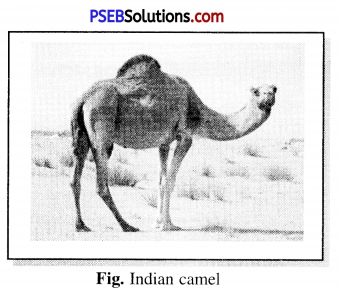
PSEB 7th Class Science Solutions Chapter 7 Weather, Climate and Adaptations of Animals to Climate 2
The adaptation of the camel to live in the desert:
The camel’s physique and habits have made it adaptable to the hot and dry climate of the desert.
The following adjustments are found in the camel:

  1. Its feet are flat to walk on the sand.
  2. Its nose is covered with nasal membranes so that sand does not enter the nose.
  3. It drinks a lot of water when available. This water spreads to the tissues of the body, which helps the camel to stay without water for many days.
  4. It accumulates fat in its mouth. When food is not available to it, it uses this fat.
  5. Very little water immerses through the urine.
  6. Its long legs keep it high above the hot sand.

Question (ii)
Name various factors that affect the climate of a place. Explain any two of them.
Answer:
PSEB 7th Class Science Solutions Chapter 7 Weather, Climate and Adaptations of Animals to Climate 3
Factors affecting the climate of a place:

  1. Distance from sea level
  2. Direction of mountains
  3. Distance from the equator
  4. Height from the sea.

1. Distance from the sea level.
The climate of the places near the sea is pleasant. During the day the temperature of the earth is higher while the water of the ocean warms up relatively late. The wind blows from the bottom of the ocean towards the earth, which is called sea breeze. The earth cools faster than water at night. So the air above the oceans is hot and light and the air above is moving towards the ocean. The cold breeze that blows toward the sea at night is called the land breeze.

2. The direction or latitude of the mountains.
The shape of the earth is not completely spherical. It is slightly raised near the equator. As a result, the sun’s rays are directed closer to the equator. The latitude of the equator is 0° and it is higher towards the pole. The longitude of the North Pole is 90° N and the longitude of the South Pole is 90°S. The climate near the equator is hot and humid all year round. As the longitude increases, the climate cools down.

Question (iii)
Write various adaptations found in Polar beer.
Answer:
Adaptations in Polar bear. The following adaptations are found in polar bears:

  1. Its fur is white to camouflage with snow capped areas.
  2. Its long hairs protect it from extreme cold of cold climate.
  3. A thick layer of fat deposit under the skin helps to keep it warm.
  4. Its feet are so shaped that it can run easily on snow.

PSEB Solutions for Class 7 Science Weather, Climate and Adaptations of Animals to Climate Important Questions and Answers

1. Fill in the blanks:

(i) The average weather taken over a long time in called ……………. .
Answer:
climate

(ii) A place receives very little rainfall and the temperature is high throughout the year;
the climate of that place will be …………… and …………….. .
Answer:
Hot, dry

(iii) The two regions with extreme climatic conditions are ……………… and ………….. .
Answer:
Polar, Tropical Rain forests

PSEB 7th Class Science Solutions Chapter 7 Weather, Climate and Adaptations of Animals to Climate

(iv) The maximum temperature of the day occurs generally in ……………..
Answer:
Afternoon

(v) ………………. is used to measure rain.
Answer:
Rain gauge

2. Match the Column ‘A’ with Column ‘B’:

Column ‘A’ Column ‘B’
(i) The coldest desert on earth (a) Moisture
(ii) The amount of water vapours in the air (b) Deforestation and burning of fossil fuels
(iii) Thar desert (c) Antarctica
(iv) Global warming (d) Rajasthan.

Answer:

Column ‘A’ Column ‘B’
(i) The coldest desert on earth (c) Antarctica
(ii) The amount of water vapours in the air (a) Moisture
(iii) Thar desert (d) Rajasthan
(iv) Global warming (b) Deforestation and burning of fossil fuels.

3. Choose the Correct Answer:

Question (i)
What is the cause of change in weather?
(a) Moon
(b) Planet
(c) Satellite
(d) Sun.
Answer:
(d) Sun.

Question (ii)
Indicate the type of climate in Jammu and Kashmir.
(a) Hot and wet
(b) Hot and dry
(c) Moderately hot and moderately wet
(d) Wet.
Answer:
(c) Moderately hot and moderately wet.

Question (iii)
Indicate the type of climate in Kerala:
(a) Hot and dry
(b) Hot and wet
(c) Wet
(d) Moderately hot and moderately wet.
Answer:
(a) Hot and dry.

Question (iv)
From where do we get daily weather report ?
(a) Television
(b) Radio
(c) Newspaper
(d) All of the above.
Answer:
(d) All of the above.

PSEB 7th Class Science Solutions Chapter 7 Weather, Climate and Adaptations of Animals to Climate

Question (v)
When is the minimum temperature likely to occur in a day ?
(a) Evening
(b) Early morning
(c) Noon
(d) None of the above.
Answer:
(b) Early morning

Question (vi)
Maximum temperature of the day occurs generally in:
(a) When the sun rises
(b) In mid noon
(e) Afternoon
(d) When the sun sets.
Answer:
(e) Afternoon.

4. State True or False:

(i) All changes in weather are due to the sun.
Answer:
True

(ii) The highest temperature of the day is in the evening.
Answer:
False

(iii) Different places have the same temperature.
Answer:
False

(iv) Polar areas are located near the Poles.
Answer:
True

(v) Penguins live in the plains.
Answer:
False

PSEB 7th Class Science Solutions Chapter 7 Weather, Climate and Adaptations of Animals to Climate

(vi) Days in winter are shorter in length.
Answer:
True

Very Short Answer Type Questions

Question 1.
From where do we get daily weather reports ?
Answer:
We get weather report from Television, Radio and Newspapers.

Question 2.
Which factors are responsible for weather ?
Answer:
Temperature, Humidity and Rainfall.

Question 3.
What is humidity ?
Answer:
Humidity. It is the measure of quantity of moistures present in the atmospheric air.

Question 4.
Which department is responsible for preparing weather reports ?
Answer:
Meterological Department of the Government.

Question 5.
Which instrument is used to measure rain fall ?
Answer:
Rain gauge.

Question 6.
Do maximum and minimum temperature remain constant over a week ?
Answer:
No.

PSEB 7th Class Science Solutions Chapter 7 Weather, Climate and Adaptations of Animals to Climate

Question 7.
Where from do we get heat and light on the earth ?
Answer:
We get heat and light from sun.

Question 8.
What happens to the energy emitted by sun ?
Answer:
It is absorbed and reflected by the earth’s surface.

Question 9.
Climate is average weather report of a place taken over a long period. How long this period is ?
Answer:
About 25 years.

Question 10.
Which type of climate is found in Kerala ?
Answer:
Hot and wet.

Question 11.
What is typical desert climate ?
Answer:
Hot and dry.

Question 12.
Which part of India is wet ?
Answer:
North-East.

Question 13.
Why is adaptation by animals necessary ?
Answer:
For survival of animals.

Short Answer Type Questions

Question 1.
Name the elements that determine the weather of a place.
Answer:
Elements of Weather:
Temperature, Humidity, Wind-speed, Rainfall.

PSEB 7th Class Science Solutions Chapter 7 Weather, Climate and Adaptations of Animals to Climate

Question 2.
When are the maximum and minimum temperature likely to occur during the day?
Answer:
Maximum temperature of the day occurs generally in the afternoon while the minimum temperature occurs in the early morning.

Question 3.
What is rain gauge ?
Answer:
Rain gauge. It is an instrument used to measure rainfall. It consists of a .measuring cylinder and a funnel on the top to collect rainwater.

Question 4.
Define weather ?
Answer:
Weather. The day-to day condition of atmosphere at a place with respect to temperature, humidity, wind speed etc. is called weather.

Question 5.
The tropical rainforest has a large population of animals. Explain, why it is so ?
Answer:
Tropical rainforests have hospitable climatic conditions; so it has a large population of animals. The climate in this region is hot and humid. It lies around the equator and has minimum temperature a little higher than 15°C, length of days and night are generally equal and these places recieve a lot of rainfall. So all these conditions are preferable for a large number of population.

Question 6.
What is cold desert region ? How does polar bear adapt the condition to survive in this region.
Answer:
Those region/area where temperature may fall below-20°C and rocks are stony and have little vegetation are called cold deserts. In India cold desert lies between Ladakh region in north to Lahaul and spiti valley of Himachal Pradesh. To survive in cold desert, Yak has following adapations:

  1. Body is covered by long hair or fur.
  2. The colour of fur is generally black to absorb more and more heat.
  3. Its feet have sharp toes which help it to climb in uneven paths.
  4. A layer of fat is deposited under its skin. It helps yak to survive in extreme cold during winters.

Long Answer Type Questions

Question 1.
What is the condition of tropical rainforests ? What type of animals are living in such rain forest ? Write down the main characteristics of these animals.
Answer:
Tropical rainforest. The area near or around the Tropic of Cancer and the Tropic of Capricorn is called the tropical area. The climate in these areas is hot and humid. Here even in winter the temperature is 15°C and in summer the temperature reaches 40°C. The tropical region receives rainfall throughout the year. The most prominent places in the tropical region are the tropical rainforests that form canopies over the area. Elephants, tigers, leopards, snakes, birds, and insects are the animals found in the rain forest.

Main Characteristics of animals found in the rain forest:

  • Creeping, snakes, lizards, monitors can easily crawl in dense forests.
  • Strong body. A strong body is required to pass through dense forests. So Elephants, gorillas, tigers, leopards, etc. have powerful bodies.
  • Special Senses. Many tropical animals have sharp eyesight, sharp hearing and some animals have skin color similar to surroundings for camouflage.
  • Strong tail
  • Loud voice
  • Sharp eyes
  • Fruit diet
  • Long and big beaks.

Question 2.
Discuss the human activities responsible for climate change.
Answer:
Human activities responsible for climate change are as follows:

  • Population Growth. Consumption of fossil fuels is increasing due to population growth and changes in living standards.
  • Deforestation. Large-scale deforestation is done to meet the needs of the growing population such as houses, buildings, industries, roads, etc.
  • Excavation of mines. Excavation of blind mines has increased floods.
  • Global warming. Due to excessive cutting of trees and burning of fossil fuels the percentage of carbon dioxide increases.
  • This carbon dioxide gas absorbs infrared radiation from sunlight, resulting in a rise in temperature. As a result, the greenhouse effect continues to grow, and as a result, glaciers are melting.

PSEB 9th Class Agriculture Solutions Chapter 4 Marketing of Farm Produce

Punjab State Board PSEB 9th Class Agriculture Book Solutions Chapter 4 Marketing of Farm Produce Textbook Exercise Questions and Answers.

PSEB Solutions for Class 9 Agriculture Chapter 4 Marketing of Farm Produce

Agriculture Guide for Class 9 PSEB Marketing of Farm Produce Textbook Questions and Answers

(A) Answer in 1-2 words:

Question 1. Is the efficient marketing of produce start before or after harvesting of the crop?
Answer:
Before harvesting.

Question 2.
What is the major job of the Market Committee for the farmers?
Answer:
To protect the interests of the farmers.

Question 3.
If there is faulty weighment of produce to whom the farmers should complain?
Answer:
Higher officials of the Market Committee.

PSEB 9th Class Agriculture Solutions Chapter 4 Marketing of Farm Produce

Question 4.
Before the farmers bring their produce in the market what are the two major issues to be taken care of?
Answer:

  • Moisture content should not be more than the prescribed limit.
  • Cleaning of produce.

Question 5.
Name the agency which has established bulk handling units at Mandi Gobindgarh, Moga, and Jagraon.
Answer:
Food Corporation of India (FCI).

Question 6.
Which form is to be procured by the farmers from the commission agents after the weighment of produce?
Answer:
J-Form.

Question 7.
What are different sources of market information about the prices of different kind of farm produce?
Answer:
TV, Radio and Newspaper etc.

Question 8.
What is basis on which the government procurement agencies quote the prices of agricultural produce in regulated market?
Answer:
On the basis of moisture content.

Question 9.
In the case of doubtful weighment of the produce what per cent of produce is rechecked for test weighment free of cost?
Answer:
10% of the produce free of cost.

Question 10.
Which Act, gives right to the farmers for test weighment of the produce?
Answer:
Under Market Act 1961.

PSEB 9th Class Agriculture Solutions Chapter 4 Marketing of Farm Produce

(B) Answer in 1-2 sentences:

Question 1.
What are different issues relating to the farming on which the expert needs to be consulted?
Answer:
For sowing, hoeing, irrigation, right combination of chemical fertilizers, use of weedicides and insecticides, harvesting and threshing etc. experts needs to be consulted.

Question 2.
What points are to be taken care of in choosing the crops for cultivation?
Answer:
Farmers should choose such crops which can produce more monetary benefits, they should sow best quality variety of the crop.

Question 3.
Before bringing produce to the market what major factors are to be examined?
Answer:

  • Moisture content should be according to the prescribed limits.
  • Bring the crop after grading.
  • Weigh the product before bringing it to the market.

Question 4.
What factors should be taken care of while disposal of farm produce in the market?
Answer:
Farmer should supervise his produce at the time of cleaning, weighing and at the time of auction. This is done to avoid any losses in the form of price. If farmer finds the offered price to be less than his expectations, he can refuse to sell his produce. In case of any problem in the disposal of his produce he can contact the higher officials of the Market Committee.

Question 5.
What are advantages of disposing of the produce at the bulk handling units/silos?
Answer:
Advantages of disposing of the produce at the bulk handling units/silos are

  • on-the-spot payment in cash.
  • time is saved and bag filling and weighment is done without paying i.e. no market charges.
  • produce is saved from losses occuring due to natural calamities like rain, storms, etc.

Question 6.
Why the supervision of the produce is important in the market?
Answer:
It is commonly seen that palledars mix produce of one farmer with the produce of other farmer and sometimes they mix- the produce with waste material. This causes losses to the farmers. Therefore, supervision of the produce is important in the market.

PSEB 9th Class Agriculture Solutions Chapter 4 Marketing of Farm Produce

Question 7.
What are advantages of the knowledge of prices of produce in different markets?
Answer:
Depending on the produce volume arrivals in the market prices keep fluctuating. Farmers should remain informed about the prices in the nearby markets, so that they can sell their produce when rates are higher.

Question 8.
What are two major functions of the Market Committee?
Answer:

  • Main job of the Market Committee is to protect the interests of the farmers in the market.
  • Market Committee coordinates the auction process.
  • It also ensures the right weighment of the produce.

Question 9.
What is meant by Grading?
Answer:
Produce is categorised in different groups based on size, colour, little damaged, etc. one can earn higher profits by grading or categorizing the produce.

Question 10.
What are the advantages of taking J-Form?
Answer:
Farmers should get J-Form after the sale of the produce. This form contains all the details about the weight of the produce, price and total charges are mentioned, name of purchaser etc. This form also helps in getting bonus later on announced by Government and fudging of the market fees by the commission agents can be saved.

(C) Answer in 5-6 sentences :

Question 1.
Write Short note on Public intervention in marketing.
Answer:
In olden times farmers were totally dependent on the lenders or businessmen. They usually paid less amount to the farmers for their produce. Now government has set certain laws which help the farmers against such loot. Government has established Market Committees and Cooperative societies. Farmers are getting right price for their produce because government announces MSP for wheat and rice etc. In case of any doubt farmer can get weighed his produce again free of cost. Government has established mechanical handling units. Farmer can get Form-J from the purchaser after selling his produce. This form helps the farmer to avail bonus announced by the government.

PSEB 9th Class Agriculture Solutions Chapter 4 Marketing of Farm Produce

Question 2.
Give a brief account of Cooperative Marketing.
Answer:
Farmers can get right price for their produce by cooperative marketing. These societies usually act as commission agencies. These societies are formed by farmers themselves. These help the farmers to get good price of their produce. Through these societies farmers can get their payments from the purchaser easily and quickly. These societies help the farmers by providing other facilities; e.g. loans, fertilizers, insecticides are provided to the farmers at lower interest rate and subsidized rates.

Question 3.
What are advantages of grading of the produce ?
Answer:
Graded produce can be sold at higher price. Good part of the produce can be sold separately. The other part of the produce which may be little damaged or may not be looking good can be sold differently. If damaged produce is placed below the good crop and sold in this way. For few days we can sell such produce but later on it will badly affect our goodwill and purchaser will always have doubt on the quality of our produce. If we sell our produce honestly, purchaser will wait for us and we can survive in the market for longer time.

Question 4.
Write a brief note on mechanical handling units.
Answer:
The Punjab Mandi Board has established some mechanical handling units in some of the mandies. These help in the cleaning of produce, bag filling and weighment by mechanical methods within no time. If labourers are to_do this work, it takes hours to finish the work. Farmer has to spend very low time in such units. Payment is done on the spot. Food Corporation of India has set up bulk handling units for storage and handling of grains of wheat on large scale at Moga, Gobindgarh and JJagraon. Farmers can sell their produce directly here. Payment is done on the same day, there are no market charges, produce is also saved from natural calamities; like rain, storms etc.

Question 5.
What are advantages of efficient marketing of farm produce?
Answer:
Crop growing requires lot of time and hard work, farmers should get proper price for their produce. For this, marketing plays an important role. Farmers should take care of the marketing from the time they sow their crop. Farmers should cultivate such crops which can bring more monetary benefits. Best quality seed of improved variety of the crop which can bring more benefit, should be sown. Take care of the growing crop. Farmers should take expert opinion for sowing, hoeing, application of fertilizer, irrigation, harvesting etc. Bring the produce in the market after grading and weighing. Try to reach the market in time so that produce can be sold on the same day.

Very Short Answer Type Questions:

Question 1.
How can we get right price of our produce?
Answer:
By taking care of the marketing of the produce.

Question 2.
When does the right marketing start?
Answer:
From the time of sowing.

Question 3.
What should be moisture content in the produce?
Answer:
It should be according to the prescribed limits.

Question 4.
Where should the farmer be at the time of cleaning, weighment and auction?
Answer:
He should be near his produce.

Question 5.
What type of crops should be cultivated ? Which can bring more benefits?
Answer:
Cultivate those crops which are in demand and can be sold easily and at good price.

PSEB 9th Class Agriculture Solutions Chapter 4 Marketing of Farm Produce

Question 6.
Should farmers collect information about nearby market before going to market for selling his produce?
Answer:
Yes, he should collect information about the market.

Question 7.
Is there any need to take care of for proper marketing or not?
Answer:
It is very important to take care of the marketing.

Question 8.
Why should farmer weigh his produce before going to sell it in the market?
Answer:
This helps the farmer to know how much money he may get in the market.

Question 9.
Why is it necessary to get form-J ?
Answer:
Form-J contains the details of earning, expenditure etc. and farmer can get an idea of total.

Question 10.
If farmer is not getting right price for his produce, to whom he should complain?
Answer:
He should take the help of market inspector.

Question 11.
What is the benefit of grading of the produce?
Answer:
We can get higher price by grading our produce.

Question 12.
What should a farmer do to make his goodwill?
Answer:
Farmer should sell his produce with honesty to make his goodwill.

Question 13.
What is the meaning of the marketing of the produce?
Answer:
To get higher and proper price for the produce in the market.

Question 14.
What is the requirement to get best quality produce?
Answer:
Treated best quality improved seeds and good management.

Question 15.
How much extra a farmer can earn if produce is sold by grading?
Answer:
10 to 20%.

Question 16.
When should the produce be brought to the market?
Answer:
In the morning.

Question 17.
If we harvest before proper ripening of the erop, what happens?
Answer:
Grain shrinks and quality deteriorates.

Question 18.
What-happens if harvesting is done late i.e. delayed?
Answer:
Grain loss occurs and yield becomes less.

PSEB 9th Class Agriculture Solutions Chapter 4 Marketing of Farm Produce

Question 19.
Where is the grading assistant posted?
Answer:
In the market.

Short Answer Type Questions:

Question 1.
What do you mean by proper method to store the produce?
Answer:
Proper method 4;o store the crops means all the things involving hoeing, use of insecticides, pesticides, fertilizers, watering, harvesting and threshing etc. Expert opinion should be taken to do all these activities.

Question 2.
What should a farmer do to get more price for his produce?
Answer:

  • Farmer should bring his produce in the market after weighment.
  • He should grade his produce in different categories before bringing it to the market.
  • Moisture content in the grains or products should be according to the prescribed value.

Long Answer Type Questions:

Question 1.
What points should be kept in mind to sell the produce in the market?
Answer:

  • The farmer should supervise his produce at the time of cleaning, weighment and auction.
  • If farmer is facing some problem in the disposal of his produce or if he does not get proper price for his produce, he should contact the higher officials of the market.
  • At the time of weighment farmers should check the legal marks of approval by the government on the balance and on the weights.
  • Farmer should get receipt after selling his produce.

Question 2.
What points should be kept in mind by farmers to earn more profit?
Answer:

  • Cultivate those crops which are in demand and can be sold easily and at higher price.
  • Sow after knowing the best quality improved varieties.
  • Protect the crop and preserve the produce properly.
  • Take expert opinion for various activities, like hoeing, use of insecticides, pesticides, fertilizers, irrigation, harvesting, and threshing, etc.

PSEB 9th Class Agriculture Solutions Chapter 4 Marketing of Farm Produce

PSEB 9th Class Agriculture Guide Marketing of Farm Produce Important Questions and Answers

Multiple Choice Questions:

1. Produce should he brought to the market :
(a) at night
(b) in the morning
(c) in the evening
(d) while it is raining.
Answer:
(b) in the morning

2. Effect of late harvesting is :
(a) Grain loss occur
(b) Nothing happen
(c) We get more profit
(d) All wrong
Answer:
(a) Grain loss occur

3. Correct statement is :
(a) Produce should be brought to market after grading.
(b) Market act 1961 gives right to the farmers for test weighment of the produce.
(c) Farmers should get form J
(d) All correct
Answer:
(d) All correct

4. Farmers can earn extra if produce is sold by grading :
(a) 10-20%
(b) 50%
(c) 1%
(d) 40%.
Answer:
(a) 10-20%

True/False:

1. If marketing is done in a proper way one can earn more income.
Answer:
True

2. Sowing, hoeing, irrigation, use of weedicides and insecticides etc. should be done with the expert opinions.
Answer:
True

3. For good marketing, one should take care of the crop from the time of sowing.
Answer
True

4. Get form and receipt from the purchaser so that farmer could know their gains and investment.
Answer:
True

5. Farmers should not keep and get the information and knowledge of the markets near them.
Answer:
False

PSEB 9th Class Agriculture Solutions Chapter 4 Marketing of Farm Produce

Fill in the Blanks:

1. After threshing, ……………… the produce.
Answer:
weigh

2. Produce should be marketed through ……………… societies.
Answer:
cooperative

3. Punjab Mandi Board has set up ……………… units in Punjab in some of the man dies.
Answer:
mechanical handling

4. Bulk handling units have been established by ……………… at Mandi Gobindgarh, Moga, and Jagraon for storage and handling of wheat on large scale.
Answer:
Food Corporation of India

5. ………………. can be known from Radio, T.V., and Newspapers, etc.
Answer:
Rates

PSEB 10th Class Computer Solutions Chapter 1 Office Tools

Punjab State Board PSEB 10th Class Computer Book Solutions Chapter 1 Office Tools Textbook Exercise Questions and Answers.

PSEB Solutions for Class 10 Computer Science Chapter 1 Office Tools

Computer Guide for Class 10 PSEB Office Tools Textbook Questions and Answers

1. Multiple Choice Questions

Question 1.
Which tool is used to maintain a budget, financial statements, and sales records?
(a) Multimedia
(b) Spreadsheet
(c) Presentation
(d) Database
Answer:
(b) Spreadsheet

Question 2.
Word automatically inserts a page break when we reach the ………… of a page.
(a) Starting
(b) End
(c) Mid of page
(d) None of these
Answer:
(b) End

PSEB 10th Class Computer Science Solutions Chapter 1 Office Tools

Question 3.
As we type our document, …………. wavy lines will appear under any word that is spelled incorrectly.
(a) Blue
(b) White
(c) Red
(d) Black
Answer:
(c) Red

Question 4.
The most common types of effects include entrances and exits.
(a) Animation
(b) Sound Effect
(c) Design
(d) Transition
Answer:
(a) Animation

Question 5
…………. is the blank space around the edges of the page.
(a) Graphics
(b) Design
(c) Margin
(d) None of these
Answer:
(c) Margin

2. Fill in the Blanks

1. Computer software is classified into two categories ………. and ………….
Answer:
System software and Application software

2. Database software is a collection of related data. The purpose of this tool is to ………… and ………. data.
Answer:
Organize and Manage

3. We can choose either ……….. (vertical) or ………….. (horizontal) orientation for all or part of our document.
Answer:
Portrait or Landscape

4. The image file extensions supported by PowerPoint include ………… TIFF (.tiff) and Bitmap (.bmp)
Answer:
JPEG (.jpg),GIF

5. Multimedia software is tool that allows the user to create ……….. and …………. with the help of media players and real players.
Answer:
Audio and Videos.

PSEB 10th Class Computer Science Solutions Chapter 1 Office Tools

3. True or False

Question 1.
The main purpose of Spread sheet tool is to produce documents.
Answer:
False

Question 2.
Application software is software that can perform a specific task for the user
Answer:
True

Question 3.
We can drag existing tab stops left or right along the ruler to a different position.
Answer:
True.

Question 4.
Print Preview automatically displays when we click on the Print tab.
Answer:
True

4. Very Short Answer Type Questions

Question 1.
Write extension of Word document in Ms Office 2010.
Answer:
.docx

Question 2.
Write extension of Spread Sheet in Ms Office 2010.
Answer:
.xlsx

PSEB 10th Class Computer Science Solutions Chapter 1 Office Tools

Question 3.
Write extension of Power Point Presentation Ms Office 2010.
Answer:
.pptx

Question 4.
Write the full form of bmp (Image file).
Answer:
BitMaP

Question 5.
Write the full form of PDF.
Answer:
Portable Document Format

PSEB 10th Class Computer Book Chapter 1 Office Tools

5. Short Answer Type Questions

Question 1.
Define System Software?
Answer:
System software are the set of software which are used for the working of computer system and its hardware. It includes operating system, language translators etc.

Question 2.
Explain database software?
Answer:
Database is a collection of related data. The purpose of database tools is to organize and manage data. The advantage of these tools is that we can change the way data is stored and displayed. SQL Server, MS access, data Base, FoxPro, Paradox, and Oracle are some of the examples of database software tools.

Question 3.
Explain multimedia software.
Answer:
Media players and real players are the examples of multimedia tools. These tools allow the user to create audio and video files. The different forms of multimedia tools are audio converters, audio and video players, video encoders and decoders.

PSEB 10th Class Computer Science Solutions Chapter 1 Office Tools

Question 4.
What is Page Break? How to insert a page break?
Answer:
Page break is a way to tell MS word that the page has ended. These can be automatic and manual.
Inserting a Page Break:
1. Click where we want to start a new page.
2. On the Insert tab, in toe pages group, click Page Break.
We can also insert breaks into our document by going to the Insert tab, Pages group and clicking on the Page Breaks command to view a variety of page.

6. Long Answer Type Questions

Question 1.
What is office tool ? Explain any five types of office tools?
Answer:
Office tools are software programs designed to make computer users more productive and efficient at our workplace. Office productivity tool is a category of application programs that help users produce things such as documents, databases, graphs, worksheets and presentations.

Types of office tools are-
1. Word Processing Tools:
The main purpose of word processing tools is to produce good looking documents. MS-Word, WordPad, Notepad and Adobe Pagemaker are some of the examples of word processing tools.

2. Database Software Tools:
Database is a collection of related data. The purpose of database tools is to organize and manage data. The advantage of these tools is that we can change the way data is stored and displayed. SQL Server, MS access, dataBase, FoxPro, Paradox, and Oracle are some of the examples of database software tools.

3. Spreadsheet Tools:
The spreadsheet tools are used to make calculations, maintain budget, financial statements, and sales records. The purpose of these tools is to work with numbers. It allows the users to perform simple as well as complex calculations on the numbers. MS-Excel, Open Office are examples of spreadsheet tools.

4. Presentation Tool:
Presentation tools are used to display the information in the form of slide shows. The main functions of presentation tools is editing that allows insertion and formatting of text, including graphics in the text and executing the slide shows. The examples for these tools are Microsoft PowerPoint, Open Office Present.

5. Multimedia Software:
Media players and real players are the examples of multimedia tools. These tools allow the user to create audio and video files. The different forms of multimedia tools are audio converters, audio and video players, video encoders and decoders.

PSEB 10th Class Computer Science Solutions Chapter 1 Office Tools

Question 2.
Write steps to create Student Annual Report using mail merge with spreadsheet?
Answer:
Student Annual Report can be created using MS Word and MS Excel using following steps:
1. Prepare the annual report format in MS word. Mention student’s detail like admission no, roll no, name, father’s name, marks of each subject, overall result and percentage of marks of student.

2. On the other side, prepare a excel worksheet, in which student’s admission no, roll no, name, father’s name, subject-wise marks obtained in subjects Punjabi, English, Maths, Science, Social Studies and grades etc. are-entered.

3. Next calculate the percentage of marks of each student using a formula.

4. Now, click on Mailing Tab, and start mail merge. Then, choose Letter option which we already prepared.

5. Next Click on Select Recipients and select Use Existing List option. Choose excel sheet from Select Table dialog box and click OK.

6. Place the cursor where you want to insert the value of field from excel sheet. Now go to Insert Merge Field option in Write & Insert Fields group. A dropdown menu will be displayed having field names.

7. Select the field names one by one after placing the cursor in proper place in the student annual report. All fields will be displayed.

8. After inserting all the clicking Preview Results next and previous button, you can preview the result of students by option.

9. Now click on Finish & Merge option and select Edit Individual Documents from the menu. A dialog box Merge to New Document will open. Choose option All and click OK to show the report card of all the students in excel worksheet.

10. Now a new Word document will open having report card of all the students. Save this document and we can also take printouts.

Question 3.
What are Tab Stops? Explain setting manual tab stops.
Answer:
Tabs are the facility which help to display the content in more structured and tabular form without using tables.
Setting up the Tab Stops:
1. Click the tab selector at the left end of the ruler it displays the type of tab that you want.
2. Click in the ruler at the top of our page, where we want to set the tab stop.
The different types of tab stops are:

  • Left Tab stop sets the start position of text that will then run to the right as we type.
  • Center Tab stop sets the position of the middle of the text. The text centers on this position as we type.
  • Right Tab stop Sets the right end of the text. As we type, the text moves to the left.
  • Decimal Tab stop aligns numbers around a decimal point. Independent of the number of digits, the decimal point will be in the same position. (We can align numbers around a decimal character only)

Bar Tab stop doesn’t position text. It inserts a vertical bar at the tab position. Desired Tab stop will be placed at the point in the present paragraph.

PSEB 10th Class Computer Science Solutions Chapter 1 Office Tools

Question 4.
Explain Print Preview and Print Command?
Answer:
Print Preview. Print Preview displays the document as it will appear when printed. When we make a change to a print-related setting, the preview is automatically updated. To print preview of the document, following steps are used:
Click the File tab, and then click Print. To go back to our document, click the File tab.
A preview of our document automatically appears. To view each page, click the arrows below the preview.
Print Command. Print command is used to print a document using some printer. Following steps are followed to print a document in
MS-Word:

  • Click the File tab.
  • Click the Print command to print a document.
  • Click the Print button to print our document.
  • This dropdown shows the currently selected printer. Clicking the dropdown will display other available printers.
  • These dropdown menu show currently selected gettings.
  • Select the printer and other setting and click on Print.

PSEB 10th Class Computer Guide Office Tools Important Questions and Answers

Multiple Choice Questions

Question 1.
What are the types in which PowerPoint files can be saved?
(a) PDF
(b) Video file
(c) Presentation
(d) All of the above
Answer:
(d) All of the above

Question 2.
What are the extension of an image file?
(a) .jPg
(b) .gif
(c) .bmp
(d) All of the above
Answer:
(d) All of the above

Question 3.
Which one is system software?
(a) Word
(b) Excel
(c) Windows
(d) PowerPoint
Answer:
(c) Windows

Question 4.
Mail merge is a feature of which software?
(a) Word
(b) Excel
(c) Windows
(d) PowerPoint
Answer:
(c) Windows

PSEB 10th Class Computer Science Solutions Chapter 1 Office Tools

Question 5.
Which one is not a type of office tools?
(a) Word Processing
(b) DBMS
(c) Multimedia Software
(d) None of these
Answer:
(d) None of these

Fill In The Blanks

1. Word processing tool prepares ………….. .
Answer:
Documents

2. Theme helps to choose ……………… in PowerPoint.
Answer:
Background

3. …………. is pre defined document structure.
Answer:
Template

4. ……………is used for calculation.
Answer:
Excel.

True Or False

Question 1.
Application software is used for specific work
Answer:
True

Question 2.
Any document can have two orientations.
Answer:
True

PSEB 10th Class Computer Science Solutions Chapter 1 Office Tools

Question 3.
Presentation can be saved as PDF.
Answer:
False

Question 4.
We cannot do calculations in Excel.
Answer:
False

Question 5.
Page margins are empty space in mid of page.
Answer:
False

Very Short Answer Type Questions

Question 1.
What are the different type of Softwares?
Answer:
System Software and Application Software.

Question 2.
Beneficial software for our work are called?
Answer:
Office tools.

Question 3.
Note pad is an example of?
Answer:
Word processing tool.

Question 4.
Give an example of spreadsheet software.
Answer:
MS Excel.

PSEB 10th Class Computer Science Solutions Chapter 1 Office Tools

Question 5.
PowerPoint is an example of?
Answer:
Presentation tool.

Short Answer Type Questions

Question l.
What are Page Margins?
Answer:
Page margins pre the blank space around the edges of the page. In general, we insert text and graphics in the printable area inside the margins. When we change a document’s page margins, we change where text and graphics appear on each page.

Question 2.
Write steps of setting predefined page margins.
Answer:

  • On the Page Layout tab, in the Page Setup group, click Margins. The margins gallery dropdown menu Will appear.
  • Click the margin type that we want to apply

Question 3.
Write steps to change Page Orientation.
Answer:

  • On the Page Layout tab, in the Page Setup group, click Orientation.
  • Click Portrait or Landscape.

Question 4.
Write steps to apply different page orientations.
Answer:
1. Select the pages or paragraphs that we want to change to portrait or landscape orientation.
2. On the Page Layout tab, in the Page Setup group, click Margins.

  • Click Custom Margins at the bottom of the dropdown menu.
  • A Page Setup dialog box will appear.
  • On the Margins tab, click Portrait or Landscape.
  • In the Apply to list, click Selected text or This point forward.

PSEB 10th Class Computer Science Solutions Chapter 1 Office Tools

Question 5.
Write steps to apply custom margins.
Answer:

  • On the Page Layout tab, in the Page Setup group, click Margins.
  • At the bottom of the margins gallery dropdown menu, click Custom Margins.
  • The Page Setup dialog box will appear.
  • Enter new values for the margins in all or some of the top, bottom, left or right text boxes.
  • Click OK.

Question 6.
Write steps to save presentation as PDF.
Answer:
Steps to save a presentation as a pdf file are:

  • Go to the backstage view under the File tab.
  • Click on Save As to open the Save As dialog.
  • Add a proper name to the file.
  • Select the file type as. .pdf from the list of supported file types and click save.
  • The .pdf file is created in the specified location.

Question 7.
Explain PPT broadcast slide show.
Answer:
PowerPoint 2010 offers users to broadcast their presentations on the internet to audience worldwide. Microsoft offers the free broadcast Slide Show service; all we need to do is share the link with our audience and they can watch the presentation from anywhere. There is no special setup or charges required to do this, all we need is a Windows Live account.

Question 8.
What is PPT Packaging Presentation?
Answer:
Certain presentations are better suited for distribution as a CD to audience. In such cases, we can create a CD packaging which can be burned into a CD and distributed. These CDs are called PPT packaging presentation.

PSEB 10th Class Computer Science Solutions Chapter 1 Office Tools

Long Answer Type Questions

Question 1.
Write steps to save a presentation as a Video file.
Answer:
Saving Presentation as Video File:
PowerPoint allows presentations to be saved as files that can be posted on video sharing platform like YouTube or just played on any other-media.
Steps to save a presentation as a video file are:

  • Go to the backstage view under the File tab.
  • Click on Save As to open the Save As dialog.
  • Add a proper name to the file.
    PSEB 10th Class Computer Science Solutions Chapter 1 Office Tools 1
  • Select the file type as .wmv from the list of supported file types and click Save.
  • The video creation is not an instant process like other file types as PowerPoint needs to create the video file. We can track the progress of video creation at the bottom of our presentation window.
  • Once the creation is complete, the video file is created in the specified location.

Question 2.
What are the steps of clearing Tab stops.
Answer:
Clear Tab Stops:
We can clear tab stops in a variety of ways, the simplest is going to the ruler, click and hold on the tab stop and drag in down towards the document. The tab stop will disappear. To quickly clear multiple tab stops and start fresh:

  • Click the Home tab, click the Paragraph Dialog Box Launcher.
  • A Paragraph box will appear, click on the Tabs button at the bottom left of the dialog box.
    PSEB 10th Class Computer Science Solutions Chapter 1 Office Tools 2
  • A Tabs dialog box will appear.
  • In the list under Tab stop position, click the tab stop position that we want to clear, and then click Clear. To remove the spacing from all manual tab stops, click Clear All.
  • Click OK.

Question 3.
What are the ways to use Spell Check feature?
Answer:
Using the “Spell Check” Feature:
As we type our document, red wavy lines will appear under any word that is spelled incorrectly. The fastest way to fix spelling errors is to:

  • Put the cursor over the misspelled word and right click.
    PSEB 10th Class Computer Science Solutions Chapter 1 Office Tools 3
  • A drop down box will appear with correct spellings of the word.
  • Highlight and left click the word you want to replace the incorrect word with.

To complete a more comprehensive Spelling and Grammar check, we can use the Spelling and Grammar feature:

  • Click on the Review tab.
  • Click on the Spelling & Grammar command.
    PSEB 10th Class Computer Science Solutions Chapter 1 Office Tools 4
  • A Spelling and Grammar box will appear.
  • We can correct any Spelling or Grammar issue within the box.

Question 4.
Write steps to print a document.
Answer:
Print Command:
The Print tab is the place to go to make sure that we are printing what we want.

  • Click the File tab.
  • Click the Print command to print a document.
  • Click the Print button to print your document.
  • This dropdown shows the currently selected printer. Clicking the dropdown will display other available printers.
    PSEB 10th Class Computer Science Solutions Chapter 1 Office Tools
  • These dropdown menu show currently selected Settings. Rather than just showing us the name of a feature,, these dropdown menu show us what the status of a feature is and describes it.

PSEB 10th Class Computer Science Solutions Chapter 1 Office Tools

Question 5.
Write a note on Transition in PowerPoint.
Answer:
Transitions in MS – Power Point:
PowerPoint supports slide transition feature which allows us to specify how the slides should transition during the slide show.
PowerPoint presentation that had special effects between each slide, are slide transitions. A transition can be as simple as fading to the next slide or as complex as a flashy effect. This means we can choose transitions to fit the style of any presentation. There are three categories of unique transitions to choose from, all of which can be found on the Transitions tab:

1. Subtle (slight transitions)
2. Exciting (Strong Transition)
3. Dynamic Content (strong transitions that affect only the content, such as text or images)
PSEB 10th Class Computer Science Solutions Chapter 1 Office Tools 5
The steps to add and preview slide transitions are:
1. Select the slide to which we want to apply the transition.
2. Go to the Transition Scheme under the Transitions ribbon.
PSEB 10th Class Computer Science Solutions Chapter 1 Office Tools 6
3. Select one of the transition schemes from the list available. PowerPoint will instantly show us a preview of the scheme. If we are not satisfied, we can pick an alternate scheme. The last selected scheme will apply to the slide.

4. We can change the effects on the selected transition scheme from the Effect Options menu. Every scheme has a unique set of effect options.
PSEB 10th Class Computer Science Solutions Chapter 1 Office Tools 7
We can also modify the transition timing settings from-the Timing section. To preview the slide transition, click on Preview.

PSEB 8th Class Agriculture Solutions Chapter 6 BeeKeeping

Punjab State Board PSEB 8th Class Agriculture Book Solutions Chapter 6 BeeKeeping Textbook Exercise Questions and Answers.

PSEB Solutions for Class 8 Agriculture Chapter 6 BeeKeeping

Agriculture Guide for Class 8 PSEB BeeKeeping Textbook Questions and Answers

(A) Answer in one to two words:

Question 1.
Name two hive-bee species.
Answer:
Indian bees, Italian bees.

Question 2.
How many legs a honey bee has?
Answer:
Three pairs.

Question 3.
Name two wild species of honey bees.
Answer:
Rock bee, little bee.

PSEB 8th Class Agriculture Solutions Chapter 6 BeeKeeping

Question 4.
Which is the most suitable period to start beekeeping in Punjab?
Answer:
February-March and November.

Question 5.
How many days a drone bee takes to complete its life cycle?
Answer:
24 days.

Question 6.
Do you have to pay fee for getting beekeeping training?
Answer:
No.

Question 7.
How many bee frames should be used to start a new colony for higher profit?
Answer:
Eight bee frames.

Question 8.
What material is used by honey bees to seal ripe honey?
Answer:
Bees wax.

Question 9.
After how much period, queen bee in a colony should be replaced?
Answer:
After every year.

PSEB 8th Class Agriculture Solutions Chapter 6 BeeKeeping

Question 10.
Are the worker bees male or female?
Answer:
Female.

(B) Answer in one to two sentences:

Question 1.
Where do rock bees construct their comb?
Answer:
Rock bees construct their comb on projections of water tanks, buildings, rocks, tree branches, etc.

Question 2.
How will you differentiate new and old queen bee?
Answer:
New queen has long firm abdomen and is golden brown in colour. Old queen has dark brown or black adbomen and is sluggish in movement.

Question 3.
From where training on beekeeping may be obtained?
Answer:
Training on beekeeping may be obtained from PAU, Ludhiana, Krishi Vigyan Kendras or Department of agriculture.

Question 4.
How will you shift honey bee colonies to shady place during summer season?
Answer:
To protect bees from heat in summer, colonies should be shifted to the thick shade by 2-3 feet daily. Ventilation should be proper for the hives. There should be a sources of water near the apiary.

PSEB 8th Class Agriculture Solutions Chapter 6 BeeKeeping

Question 5.
What should be hive to hive and row to row distance of colonies in an apiary?
Answer:
Hive to hive distance should be 6-8 feet and row to row distance should be 10 feet.

Question 6.
What hive products other than honey can be obtained from honey bee colonies?
Answer:
Hive products obtained from colonies other than honey are bees wax, propolis bee venom, royal jelly etc.

Question 7.
Why should not unripe honey be extracted?
Answer:
We should not extract unripe honey because its shelf life is low.

Question 8.
How can honey be filtered?
Answer:
After extracting honey we should remove wax and floating impurities from the extracted-honey for this use double layer muslin cloth for filtering the honey.

Question 9.
What are the equipment’s required for starting beekeeping?
Answer:
Equipment’s required for starting beekeeping are-hive tool, bee veil, smoker and comb foundation etc.

Question 10.
Write a note on honey marketing.
Answer:
There are traders and exporters who procure honey. Several self help groups (SHG) are also involved in the marketing of honey. Bottling of honey in attractive bottles having proper information labels fixed on them add to the profit from honey trading.

PSEB 8th Class Agriculture Solutions Chapter 6 BeeKeeping

(C) Answer in five to six sentences: 

Question 1.
What care should be taken while purchasing honey bee colonies?
Answer:

  • Start beekeeping at suitable time, in Punjab suitable time for starting bee keeping is February to March and November.
  • For higher productivity starts new colony with eight bee frames.
  • Purchase new colony which have mated new queen, open and sealed brood, pollen and brood but have minimum number of drone brood and drone bees.
  • Shift colonies during late night or early morning with closed gates of the hives.

Question 2.
Explain the process of honey extraction.
Answer:
Honey is ready for extraction, it is indicated from the holes in the frame if 75% of holes are sealed, we can extract honey. Honey should not be extracted unripe, because its shelf life is low and it becomes sour in short duration. Remove bees from the frames by shaking and with the help of bees brush. We can use machines for extracting honey or it can be done manually. Remove wax layer from honey combs by using uncapping knife. After extraction, empty combs should be returned to the colonies. Remove the impurities and filter the honey using double muslin cloth.

Question 3.
How can bees wax be extracted?
Answer:
While extracting honey, wax layer is removed from the comb using uncapping knife. Put this wax, very old, broken or damaged combs or wild bee combs in hot water and filter it using thick cloth. Discard the impurities which remained on the top of the cloth. Allow the molten wax in hot water to settle for a night. Wax floats on the water surface as a harden block. This can be collected easily.

PSEB 8th Class Agriculture Solutions Chapter 6 BeeKeeping

Question 4.
What are the. subsidy facilities being provided by the Government in Punjab?
Answer:
For encouraging the beekeeping occupation, government is providing subsidy on bee hive and honey bee colonies through National Horticulture Mission. Government also provides subsidy on honey extracting machine, uncapping knife, drip tray, food grade plastic container for honey.

Question 5.
Explain importance of beekeeping.
Answer:
Beekeeping is an important and beneficial agricultural based subsidiary occupation. One can earn good income from this occupation. This can be adopted by women, farmers, students etc. as subsidiary occupation. Italian Honey bees can yield 20 kg of honey per colony per year under stationary beekeeping and 60 kg honey per colony per year can be obtained under migratory beekeeping conditions. Other than honey, we can get bee wax, propolis, pollen, bee venom and royal jelly. These are also source of income, one can earn by selling queen bees and colonies etc. Honey bees also help in increasing the crop yield by pollination of field, crops, fruit and vegetable crops.

PSEB 8th Class Agriculture Solutions Chapter 6 BeeKeeping

PSEB 8th Class Agriculture Guide BeeKeeping Important Questions and Answers

Very Short Answer Questions

Question 1.
Which species of the bee was reared earlier, in India?
Answer:
Only Indian bees.

Question 2.
Which states were involved in beekeeping in earlier times?
Answer:
Hilly and southern areas.

Question 3.
How much honey can be obtained per colony per year from Italian bees under stationary conditions?
Answer:
20 kg.

Question 4.
How much honey can be obtained per colony per year from Italian bees under migratory conditions?
Answer:
60 kg.

Question 5.
How many body parts are there in bee body?
Answer:
Three parts-head, thorax, abdomen.

Question 6.
Which are male bees? Do they sting?
Answer:
Drone bee, No they do not have sting.

PSEB 8th Class Agriculture Solutions Chapter 6 BeeKeeping

Question 7.
Does queen bee has sting?
Answer:
Yes, it has.

Question 8.
When does a queen bee use its sting?
Answer:
Against rival queen bee.

Question 9.
Which state is leader in honey production?
Answer:
Punjab.

Question 10.
How many worker bees can be there in a colony of bees?
Answer:
8000 to 80,000 and sometimes more.

Question 11.
Which species of bee is more aggressive?
Answer:
Rock bee.

Question 12.
What is the size of Indian bee?
Answer:
Medium size.

PSEB 8th Class Agriculture Solutions Chapter 6 BeeKeeping

Question 13.
Which bees are produced from unfertilized eggs?
Answer:
Male bees.

Question 14.
What can be the maximum age of worker bees?
Answer:
One to one and half month i.e. six weeks.

Question 15.
Which season is suitable for starting beekeeping?
Answer:
Spring (February to April).

Question 16.
Name species of bees found in India.
Answer:
Little bee, rock bees, Indian bee, Italian bee.

Question 17.
What is common name of Apis Florea?
Answer:
Little bee.

Question 18.
What is common name of Apis Mellifera?
Answer:
Italian bee.

Question 19.
Which bee species is reared in Punjab?
Answer:
Italian bee.

Question 20.
What is life period for a queen bee?
Answer:
2-4 years.

PSEB 8th Class Agriculture Solutions Chapter 6 BeeKeeping

Question 21.
What is the function of drones in the colony?
Answer:
They mate with queen bee.

Question 22.
Which bees are produced from fertilized eggs?
Answer:
Worker bees.

Question 23.
In which direction should bee hives face?
Answer:
Facing the sun.

Question 24.
What is the position of Punjab in the production of honey?
Answer:
It is a leading state.

Question 25.
How do bees help us?
Answer:
They help by pollinating crops in the fields, flowers, vegetables etc. and help in increasing the yield.

Question 26.
Name the wild species of bee.
Answer:
Rock bee and Little bee.

Question 27.
Where does the rock bee construct its comb?
Answer:
Projection of water tanks, buildings, rocks and thick branches of trees.

PSEB 8th Class Agriculture Solutions Chapter 6 BeeKeeping

Question 28.
Where does the little bee construct its comb?
Answer:
In bushes, stacked sticks or thin twigs of trees.

Question 29.
Which species of the bees are reared?
Answer:
Indian and Italian bees.

Question 30.
How many castes of Honey bees are there in a colony?
Answer:
Three-queen, worker, drones.

Question 31.
Describe queen bee.
Answer:
It is long, light brown and shining.

Question 32.
What is difference between abdomen of worker and drone bee?
Answer:
Worker bees have conical abdomen and drones have roundish and hairy adbomen.

Question 33.
Write name of crops which are used by bees for getting nectar and pollen?
Answer:
Sheesham, khair, litchi, ber, cucurbits, peach etc.

Question 34.
Which is the second best season for bee keeping?
Answer:
October-November (Autumn Season).

PSEB 8th Class Agriculture Solutions Chapter 6 BeeKeeping

Question 35.
In which season bee activities are slow?
Answer:
Winter season (December to January).

Question 36.
Why should there be water source near the bee live?
Answer:
Bees use water to cool their comb.

Question 37.
What should be distance between boxes?
Answer:
10 feet.

Question 38.
What is Propolis?
Answer:
It is honey gum.

PSEB 8th Class Agriculture Solutions Chapter 6 BeeKeeping

Short Answer Type Questions

Question 1.
What do you know about queen bee?
Answer:
Queen plays the role of laying eggs and maintains the colony. It can lay 1500 to 2000 eggs in a day. It can live for many years but its capacity to lay eggs starts reducing after one year. It have long firm abdomen, light brown in colour, wings of queen bee does not cover its abdoment completely.

Question 2.
How is Italian bee better than other species of bees?
Answer:
Quantity of honey obtained from Italian bee is more than the quantity of honey obtained from other species and it is not aggressive.

Question 3.
What arrangement should be done at bee farm for sunlight and shade?
Answer:
There should be arrangement of sunlight in winter and of shade in summer, plant autumn trees near it.

PSEB 8th Class Agriculture Solutions Chapter 6 BeeKeeping

Question 4.
What are the four stages of honey bee?
Answer:
Egg, larva, pupa, adult.

Question 5.
Write a note on life span of queen and its replacement?
Answer:
Queen honey bee has a life span of 2-4 years. Queen bee is replaced every year with new queen bee.

Question 6.
Write note on life span of worker bee.
Answer:
Worker bee has life span of one to one and half month, but in winter it can live for six months.

Question 7.
Write a note on the body structure male bees?
Answer:
Drones (male bees) are black and big in size than worker bees. They have large compound eyes which unite at top of their head. Tip of abdomen is round and hairy.

Question 8.
Which equipment is required for starting bee keeping?
Answer:
Hive, gloves, hive tool, bee veil, smoker, comb foundation, honey extractor, queen cage, uncapping knife, bee brush, containers etc.

Question 9.
What is the importance of honey in human diet?
Answer:
Honey is a good food. One should take 50 gram honey daily. It contains carbohydrates, minerals and vitamins. It contains many antibiotics. It can be used in case of cough. It is also beneficial for eyes and brain.

PSEB 8th Class Agriculture Solutions Chapter 6 BeeKeeping

Long Answer Type Questions

Question 1.
How many species of honey are there? Write about their size and nature.
Answer:
There are four species of honey bees. Little bee, rock bee, Indian bee. Italian bee. Rock bee is larger of all and is very aggressive. Little bee is smallest among them. Rock bee and little bee are wild species. Indian bees and Italian bees can be reared and medium sized. Italian bee is calm in nature.

Question 2.
What do you know about life cycle of honey bee and write about management of colony?
Answer:
Honey bee has four stages in life cycle-egg, larva, pupa, adult. Life cycle of queen bee completes in 16 days, worker bee and drone bee complete their life cycle in 21 days and in 24 days respectively.
PSEB 8th Class Agriculture Solutions Chapter 6 BeeKeeping 1
There are three castes of honey bees. Queen, worker, and drone (male) bees. There is one queen in a colony. There are thousands of worker bees and drones are a few hundred in number. Worker bees construct the comb, collect pollen and nectar, and can sacrifice their life for the betterment of their hive.

Question 3.
How many worker bees are there is a colony? What are the tasks they do?
Answer:
There can be 8000-80,000 worker bees in a colony depending upon in size. These do not lay eggs but perform all other duties. They keep the hive clean, take care of the brood, make a hive, collect nectar and pollen and fill in the comb, take care of the live, temperature regulation and guard the live, feeding young ones and queen.

PSEB 8th Class Agriculture Solutions Chapter 5 Mushroom Cultivation

Punjab State Board PSEB 8th Class Agriculture Book Solutions Chapter 5 Mushroom Cultivation Textbook Exercise Questions and Answers.

PSEB Solutions for Class 8 Agriculture Chapter 5 Mushroom Cultivation

Agriculture Guide for Class 8 PSEB Mushroom Cultivation Textbook Questions and Answers

(A) Answer in one to two words:

Question 1.
Name two important commercially grown mushrooms.
Answer:
Button mushroom, Paddy straw mushroom, shiitake mushroom.

Question 2.
Name the health benefits of mushrooms.
Answer:
Mushrooms are rich in proteins, minerals such as calcium, phosphorus, iron, potassium etc. These are also suitable for patients having Sugar and blood pressure.

Question 3.
How many crops of button mushroom can be obtained in the winter season in Punjab?
Answer:
Two crops can be obtained from September to March.

PSEB 8th Class Agriculture Solutions Chapter 5 Mushroom Cultivation

Question 4.
What is the maximum height of the compost stack during compost preparation for button mushroom?
Answer:
Five feet.

Question 5.
What is the ratio of farm yard manure and sandy soil for preparation of casing soil?
Answer:
FYM and garden soil should be in the ratio of 4:1.

Question 6.
Which insecticide is used for control of insect pests of mushrooms?
Answer:
Nuvan (Dichlorovos).

Question 7.
What is the gap period between spray of insecticide for control of flies and next harvest of mushrooms?
Answer:
48 hours.

Question 8.
What is the amount of spawn required for 3 quintals of straw?
Answer:
300 grams.

PSEB 8th Class Agriculture Solutions Chapter 5 Mushroom Cultivation

Question 9.
What is the total mushroom production in Punjab presently?
Answer:
Nearly 45000-48000 tones per annum.

Question 10.
How many turnings are given during preparation of compost?
Answer:
Seven turning.

Question 11.
What is the pH of good quality ready compost?
Answer:
7.0 to 8.0 pH.

(B) Answer in one to two sentences:

Question 1.
What are the important nutritional attributes of mushrooms?
Answer:
Calcium, phosphorus, iron, potash, minerals and vitamin C etc. are present in mushrooms in ample quantity.

Question 2.
What are the requirements for growing mushrooms?
Answer:
Fresh paddy straw (not older than one year), bamboo sticks and mushroom seed (spawn), Kisan Khad, urea, murate of potash, gypsum,
gamma, B.C. 20E, Furadan, Molasses etc. are required.

PSEB 8th Class Agriculture Solutions Chapter 5 Mushroom Cultivation

Question 3.
Why is it important to turn the compost stack during compost preparation?
Answer:
By turning the compost stack the original outer portion goes inside and central portion becomes the outer part. This helps in increase in microbial activity.

Question 4.
How is the compost prepared for mushroom growing treated?
Answer:
Before sowing the mushroom seeds, prepared compost is treated with Bavistin 50% soluble 20 mg per litre. 20 gram dust of Bavistin is required for one quintal compost which is enough for four boxes.

Question 5.
What is the significance of casing? How is casing soil prepared?
Answer:
Casing provides proper environment for growth of mushrooms. Casing mixture is obtained by mixing FYM and garden soil in the ratio 4: 1 or spent compost and FYM in the ratio of 1:1.

Question 6.
What are the recommended varieties of mushrooms for cultivation in Punjab and give their technical names?
Answer:
According to environment of Punjab, there are five varieties of mushrooms-Button mushrooms, shiitake mushroom, Chinese mushrooms, Milky, oyster mushrooms.
PSEB 8th Class Agriculture Solutions Chapter 5 Mushroom Cultivation 1
Question 7.
Give the turning schedule for preparation of compost and the details of what all is required for compost production.
Answer:
Turning schedule for preparation of compost:

Turning After how many days turning is done after preparing the stack Things to add
First 4 Molasses
Second 8
Third 12 gypsum
Fourth 15
Fifth 18 Furadan
Sixth 21
Seventh 24 Lindane.

Thus seven turnings are done. Initial three turning after even’ four days and the remaining turnings after every three days.

PSEB 8th Class Agriculture Solutions Chapter 5 Mushroom Cultivation

Question 8.
How is casing soil mixture disinfected before use?
Answer:
Disinfecting soil:
Wet the mix of compost and garden soil. Spray 4-5% of Formalin on it. In addition 20 g Furadan per quintal of casing soil is also added. Treated soil is covered with tarpaulin sheet or Polythene sheets for at least 48 hours. Then it is opened and turned again and again, so that formalin evaporates completely from it.

Question 9.
What are the quality attributed of well prepared compost?
Answer:
Attributes of well prepared compost are its colour, smell and moisture content. When colour of compost is dark brown and there is no smell of ammonia and moisture is 65-72% then the compost is ready for spawning and pH value should be 7.0 to 8.0.

Question 10.
What is the production of mushrooms from one square meter bed area?
Answer:
Production of mushrooms from one square metre bed area is 8-12 kg. mushrooms.

PSEB 8th Class Agriculture Solutions Chapter 5 Mushroom Cultivation

(C) Answer in five to six sentences:

Question 1.
What is the importance of mushrooms in our diet?
Answer:
Mushrooms are used as food in whole of the world. It contains many nutrients and thus help in keeping the body fit. Mushrooms contain protein in large quantity, which is easily digestible. Mushrooms also contain potassium, calcium, iron, phosphorus, minerals and vitamin C in large amount. Carbohydrates and fats are present in small amounts. Therefore, mushrooms are beneficial for blood pressure and sugar patients.

Question 2.
Give the procedure for preparation of stack for composting in button mushroom?
Answer:
Spread wheat straw on “pucca” floor and wet it with clean water. Keep this straw as such for 48 hours. Mix bran and fertilizers separately and wet it with water. After 24 hours bran fertilizer mixture is broadcasted on the wetted wheat straw. Prepare stacks of the size 5 feet high, 5 feet broad and 5 feet long on the wooden boards. Height and breadth of the stack should not be more than 5 feet each.

Question 3.
What do you know about the marketing of mushrooms?
Answer:
Do not cut or pull the Mushrooms rather pick them by gentle twisting of the buttons. The mature unopened mushrooms are harvested once a day. This way no harm is done to the small button mushroom. After picking, clean off the straw pieces sticking to the mushrooms. Pack them in perforated polythene bags in 200 g lots. These packed mushrooms are sent for marketing. Mushrooms can be dried in sun or in shade and can be used in off season marketing.

PSEB 8th Class Agriculture Solutions Chapter 5 Mushroom Cultivation

Question 4.
What is mushroom spawn? How is spawning done in trays for button mushroom?
Answer:
See next questions.

Question 5.
What are the different steps in button mushroom production and briefly discuss each one?
Answer:
Steps in button mushroom production-
1. Ingredient, for compost preparing:
Wheat straw 300 kg., wheat bran 15kg, CAN 9 kg; urea, super phosphate and murate of potash 3 kg each of the three; gypsum 30 kg, gamma BHC (20% E.C.) 60 ml, molasses 5 kg, Furadan (3G) 150 gram.

2. Stack preparation:
Spread the wheat straw on a pucca floor and wet properly with water, leave it open for at least 48 hours. Mix wheat bran/husk powder with fertilizers (separately) mentioned in step 1 and moisten with water. Broadcast wheat bran mixture on the wet wheat straw after 24 hours. Mix using pitchforks. Prepare a stack of 5 x 5 x 5 foot high with the help of 3 wooden boards. Stack should not be higher than 5 feet.

3. Turning the compost stack:
Layer of stack is removed from top and all sides, it is thoroughly mixed and wetted. This way the inner part of the stack forms outer part of the new stack and outer part of the original stack goes inside the new stack. Repeat the same process when needed. Turning is necessary to increase the microbial activity which helps in decomposition. Turn the stack every fourth day and add to it. molasses, gypsum, furadan, lindane dust respectively at first, third, fifth, sixth and seventh turning.

The compost prepared from 300 kg wheat straw is used to fill 20-25 crates of the size 100 x 150 x 18 cm. When color of compost is dark brown and there is no smell of ammonia and moisture content is 65-72% then the compost is ready for spawning and pH should be 7.0 to 8.0.

4. Disinfecting the compost:
Before spawning, prepared compost is mixed with Bavistin 50% soluble 20 mg per litre. 20 gram Bavistin dust is required for one quintal compost which can be filled in four crates or boxes.

5. Filling crates and spawning:
Dismantle the compost stack and let it attain the room temperature. Take out spawn from the bottles and by using two layer growing method, broad cast spawn on the compost and fill in the boxes. Cover it with thick layer of compost. Broadcast the remaining part of spawn on this layer. Cover the boxes with wet newspaper or other papers.

6. Covering crates with soil:
Crates covered with 80-100% mycelium are covered uniformly with FYM and garden soil in the ratio 4:1 or covered with well rotten rice bran- and gobar gas slurry in the ratio 1:1. Before covering, treat it with 4-5% formalin.

7. Disinfecting soil:
Wet the mix of compost and garden soil. Spray 4-5% of Formalin on it..In addition 20g Furadan per quintal of casing soil is also added. Treated soil is covered with tarpaulin sheet or polythene sheets for at least 48 hours. Then it is opened and turned again and again so that formalin evaporates completely from it.

8. Covering of trays:
After 2-3 weeks of spawning remove the news paper and cover the compost covered with mycelium with a l’to 15 inch thick layer of disinfected soil.

9. Arranging containers:
Trays can be stacked and the area under cultivation can be increased. The trays are arranged one above the other in lines and the lines are 2 to 2.5 feet apart up and below. This way adequate working area is available and no harm is done to small pinheads of mushroom. After picking, the lower most part of the stalk of the mushroom is cut off with the help of a knife and clean mushrooms are collected.

10. Packing: Fresh Mushrooms are packed in perforated polythene bags in a lot of 200 grams.

11. Yield: 12 kg Mushrooms are available in one square metre area in one season.

PSEB 8th Class Agriculture Solutions Chapter 5 Mushroom Cultivation

PSEB 8th Class Agriculture Guide Mushroom Cultivation Important Questions and Answers

Very Short Answer Type Questions

Question 1.
How many trays are covered with Mycelium in 2-3 weeks?
Answer:
80-100 percent.

Question 2.
How many grams of Mushrooms are filled in poly bags for marketing?
Answer:
200 grams.

Question 3.
What is name of Mushroom seed?
Answer:
Spawn.

Question 4.
Which nutrients are found in less quantity in Mushrooms?
Answer:
Carbohydrates and fats.

Question 5.
Which variety of Mushroom is grown in summer and how many crops can be obtained?
Answer:
It is paddy straw mushroom. We can obtain four crops from this.

Question 6.
For how many boxes the compost prepared from 300 kg of wheat straw is enough?
Answer:
20-25 boxes of. the size 100 x 150 x 18 cm.

PSEB 8th Class Agriculture Solutions Chapter 5 Mushroom Cultivation

Question 7.
How will you identify the prepared compost?
Answer:
When color of the compost becomes dark brown and there is no ammonical smell, compost is ready.

Question 8.
Name any disease, which can be cured by taking mushrooms.
Answer:
Blood pressure.

Question 9.
How many crops of mushrooms are obtained in winter?
Answer:
White button mushrooms give two crops in winter.

Question 10.
When the winter mushrooms sown?
Answer:
From October to April.

Question 11.
Which materials are required for Mushroom compost?
Answer:
Molasses, Gypsum, furadan, gamma B.H.C. etc. are required.

Question 12.
How much seed is required for one square metre?
Answer:
300 gram seed is required for one square metre.

Question 13.
What is the yield of Mushrooms obtained from one square metre?
Answer:
In one season 8-12 kg of fresh Mushrooms can be obtained from one metre square.

PSEB 8th Class Agriculture Solutions Chapter 5 Mushroom Cultivation

Question 14.
How many crops are taken from summer season Mushroom?
Answer:
From milky mushroom three crops can be taken.

Question 15.
How many mushroom growers are there in Punjab?
Answer:
400.

Question 16.
What is the time when we can take crop of button mushroom?
Answer:
September to March two crops.

Question 17.
What is the time when we can take crop of oyster.
Answer:
October to March, one crop.

Question 18.
What is time of taking shiitake Mushroom?
Answer:
One crop September to March.

Question 19.
Which variety of Mushroom is cultivated more in Punjab?
Answer:
Button mushroom.

Question 20.
From where can we get seed of mushroom?
Answer:
Punjab Agricultural University, Department of Micro Biology.

PSEB 8th Class Agriculture Solutions Chapter 5 Mushroom Cultivation

Short Answer Type Questions

Question 1.
How is spawning done in boxes or crates?
Answer:
Dismantle the compost pile and let it attain the room temperature. Take out spawn from the bottles and by using two layer growing method, broad cast spawn on the compost and fill in the boxes. Cover it with thick layer of compost. Broadcast the remaining part of spawn on this layer. Cover the boxes with wet newspaper or other papers.

Question 2.
How will you fill the bags for cultivation of Dhingri (Oyster Mushroom)?
Answer:
Polythene bags are filled up-to 3 level with wheat straw and bits of spawn are broadcast on it. Fill the bag again up-to 2 level with wheat straw and broadcast spawn. Fill the bag with alternate layers of straw and spawn to its full capacity. The upper end of the bag is tied with gunny thread and bottom comers of the bag are given cut to drain off the excess of water. Place these bags in a room with proper facility of light. After 3¬4 weeks of spawning small mushroom primordia appear and at this stage bags are cut open. Water the straw only to keep them moist.

Question 3.
What should be taken care of while picking mushrooms (harvesting)?
Answer:
Do not cut or pull the Mushroom they are picked by gentle twisting of the buttons. The mature unopened mushrooms and harvested once a day.

PSEB 8th Class Agriculture Solutions Chapter 5 Mushroom Cultivation

Question 4.
Which insect is harmful for Mushrooms? How can we control it?
Answer:
Mushroom flies are harmful for Mushrooms, When these are seen in the beds, on the window panes, walls or ceiling then spray 30 millilitre Nuvan 100 EC (WP) per 100 cubic metre. After spray close the doors and windows for at least 2 hours and do not pick the mushrooms for at least 48 hours. Do not spray directly on the beds.

Question 5.
What is done to increase the crop area?
Answer:
Boxes are placed on each other to increase the crop area and the Distance between boxes placed in sines is 2 to 2.5 feet and the distance between trays placed over each other is one foot.

Long Answer Type Question

Question 1.
How are paddy straw mushrooms cultivated?
Answer:
1. Material required: Fresh paddy straw (not older than one year) bamboo stick, spawn.

2. Method or procedure:
Make bundles weighing 1-1.5 kg from dry paddy straw. Tie both ends and cut the protruded ends on both sides to make them equal-sized. Soak these bundles in clean water for 16 to 20 hours. Place these bundles on a sloping surface to drain the excess water. Place five bundles on two bamboo sticks which are kept one foot apart. Spawn is broadcasted on these bundles. This way a bed of 22 bundles per square metre is prepared. To get more area under the cultivation, beds are laid on one another. For one bed 300 grams of seed is required.

3. Seed Broadcast (Spawning): 300 grams of seed is required for a bed. Keep uniformity for each layer.

4. Watering: Water after 2-3 days of spawning. Ventilation is not required initially but later on proper ventilation is required.

5. Crop appearance:
After 7-9 days of spawning small plant heads start appearing. Fruit bodies of mushrooms become worth harvesting on the tenth day. Mushroom continues to appear for 15-20 days in 4 flushes. One crop of this mushroom is over in one month. This way four crops from April to August can be obtained.

6. Packing: Mushrooms are packed in perforated polythene bags in a lot of 200 grams.

7. Yield and cost: 22 kg of dry paddy straw can give a yield of 2.5 to 3 kg of fresh mushrooms.

PSEB 6th Class Science Solutions Chapter 7 Getting to Know Plants

Punjab State Board PSEB 6th Class Science Book Solutions Chapter 7 Getting to Know Plants Textbook Exercise Questions and Answers.

PSEB Solutions for Class 6 Science Chapter 7 Getting to Know Plants

Science Guide for Class 6 PSEB Getting to Know Plants Intext Questions and Answers

Think and Answer (Textbook Page No.63)

Question 1.
Rose plant is a ………………
Answer:
Shrub.

Question 2.
Mango plant is a ………………
Answer:
Tree.

PSEB 6th Class Science Solutions Chapter 7 Getting to Know Plants

Question 3.
Wheat plant is a ……………….
Answer:
Herb.

Think and Answer (Textbook Page No.65)

Question 1
………….. help in absorption of water and minerals from the soil.
Answer:
Roots.

Question 2.
Why does plant in pot B, wilt ?
Answer:
Because, its roots have been cut.

Think and Answer (Textbook Page No.66)

Question 1.
It is not easy to pull out a plant from the soil because it has strong ……………….
(i) Roots
(ii) Flower
(iii) Stem
(iv) Leaves.
Answer:
(i) Roots.

Think and Answer (Textbook Page No.67)

Question 1.
…………… always grows upwards.
Answer:
Stem.

Question 2.
Why white flower of balsam plant show specks of red colour ?
Answer:
Because, the coloured water moves through the stem. This proves that stems help in movement of water.

Think and Answer (Textbook Page No.69)

Question 1.
What are stomata ?
Answer:
Small pores on the surface of a leaf are called stomata.

Question 2.
Define transpiration.
Answer:
Loss of water vapour from plants through stomata is called transpiration.

PSEB 6th Class Science Solutions Chapter 7 Getting to Know Plants


Exercise – 1

PSEB 6th Class Science Guide Getting to Know Plants Textbook Questions and Answers

Fill in the Blanks:

(a) ……………… roots do not have any main root.
Answer:
Fibrous

(b) The arrangement of veins in a leaf is called ……………….
Answer:
Venation

(c) …………… is the female part of the flower.
Answer:
Pistil

(d) The stem of a tree is called ……………….
Answer:
Trunk

2. Write True or False:

(a) Loss of water from leaves is called transpiration.
Answer:
True

(b) Chlorophyll is responsible for the green colour in leaves.
Answer:
True

(c) The portion of stem between two intemodes is called node.
Answer:
False

PSEB 6th Class Science Solutions Chapter 7 Getting to Know Plants

(d) Stamen is the female reproductive part of a flower.
Answer:
False

3. Match the Column A with Column B:

Column A Column B
1. Root (a) protects the flower in bud
2. Climber (b) absorbs water
3. Sepal (c) keeps the plant upright
4. Stem (d) money plant

Answer:

Column A Column B
1. Root (b) absorbs water
2. Climber (d) money plant
3. Sepal (a) protects the flower in bud
4. Stem (c) keeps the plant upright

4. Choose the Correct Answer:

Question (i)
Mango plant is a …………….
(a) Herb
(b) Shrub
(c) Tree
(d) Root.
Answer:
(c) Tree

Question (ii)
Photosynthesis takes place in:
(a) Stem
(b) Root
(c) Pistill
(d) Leaves.
Answer:
(d) Leaves.

Question (iii)
The points on the stem where leaves grow are called:
(a) Buds
(b) Nodes
(c) Axiles
(d) Internodes.
Answer:
(b) Nodes

Question (iv)
The process of losing water by leaves is known as:
(a) Absorption
(b) Transpiration
(c) Photosynthesis
(d) Anchorage.
Answer:
(b) Transpiration

Exercise – 2

5. Very Short Answer Type Questions:

Question (i)
What is the flat green portion of a leaf called ?
Answer:
Leaf blade or Lamina is a flat green portion of a leaf.

Question (ii)
What is venation ? Write its different types.
Answer:
The arrangement of veins in a leaf is called venation. It is of two types.

  1. Parallel venation
  2. Reticulate venation.

PSEB 6th Class Science Solutions Chapter 7 Getting to Know Plants

Question (iii)
What is calyx ?
Answer:
Collection of sepals (the outermost green leafy structure) is called calyx.

6. Short Answer Type Questions:

Question (i)
What is the difference between tap root and fibrous root ?
Answer:

Tap root Fibrous root
(1) Penetrate deep into soil (1) Shallow and do not penetrate deep.
(2) Have long main root. (2) Do not contain any main root.
(3) Roots are of different thickness. (3) Roots are of same thickness
(4) For example: Radish, neem, mango etc. (4) For example: Grass, wheat, banana etc.

Question (ii)
Write the main functions of leaves.
Answer:
Main functions of leaves are :

  1. To prepare food from carbon dioxide and water, in the presence of chlorophyll and sunlight called Photosynthesis.
  2. Stomata present in leaves help in exchange of gases.
  3. Transpiration is performed by stomata in leaves.
  4. In some plants leaves are used for protection. For example opuntia.

Question (iii)
What are creepers ? Give one example.
Answer:
The Herbs which have weak stem that cannot stand upright and spread on ground called creepers.
For example : Pumpkin.

7. Long Answer Type Questions :

Question (i)
What are the different parts of a leaf ? Explain with labelled diagram.
Answer:
Parts of the leaf are : Petiole, Lamina, Leaf base, midrib and veins.
(1) Petiole. The leaf is attached to stem by a short stalk called Petiole.
(2) Lamina. The flat, green, expanded portion of leaf called Lamina or leaf blade.
(3) Leaf base. The end of Lamina joining the petiole is called leaf base.
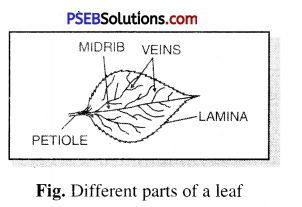
PSEB 6th Class Science Solutions Chapter 7 Getting to Know Plants 1
(4) Midrib. The thick vein in the middle of the leaf called midrib.
(5) Veins. The lines on leaf called veins.

Question (ii)
Draw the diagram of a flower and describe its parts.
Answer:
Flower is an attractive, colourful and beautiful part of flowering plant. It is attached to stem by pedicel.
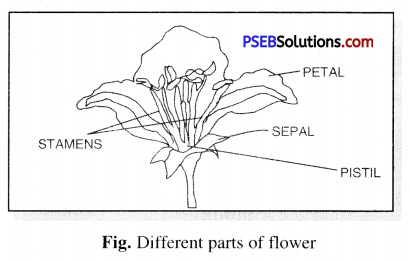
PSEB 6th Class Science Solutions Chapter 7 Getting to Know Plants 2
Parts of a Flower :
Parts of flower consist of : Sepals, petals. Stamens, Pistil.

  1. Sepals. Outermost green leaves are sepals and collectively claled calyx. It protect flower in bud stage.
  2. Petals. The coloured leaf like structure are petals, and collectively called Corolla. Petals attract insects for pollination.
  3. Stamens. It is the male part of flower. It consist of :
    (a) Filament : The thin stalk
    (b) Anther. The two lobed head that produes pollen grans.
  4. Pistil. It is the female part of flower and is a flask shaped structure in the middle of flower. It consists of :
    (a) Ovary. Lower broader portion and contains ovary. It takes part in reproduction.
    (b) Style. Narrow middle portion.
    (c) Stigma. Sticky end at top of style

PSEB 6th Class Science Solutions Chapter 7 Getting to Know Plants

PSEB Solutions for Class 6 Science Getting to Know Plants Important Questions and Answers

Multiple Choice Questions:

Question 1.
Example of climber is :
(a) grape vine
(b) gourd plant
(c) maize
(d) rose.
Answer:
(a) grape vine

Question 2.
Reticulate venation is found in the leaves of:
(a) rose plant
(b) mango plant
(c) money plant
(d) all the above
Answer:
(d) all the above

Question 3.
The most prominent part of a bud is:
(a) sepal
(b) petal
(c) stamen
(d) pistil
Answer:
(b) petal

Question 4.
The number and colour of petals of rose plants are:
(a) one
(b) two
(c) five
(d) many.
Answer:
(d) many.

Question 5.
The process of producing food by leaves is:
(a) Photosynthesis
(b) Venation
(c) Herb
(d) Stimulus.
Answer:
(a) Photosynthesis

Question 6.
A change that produces a reaction in an organism is:
(a) Respiration
(b) Stimulus
(c) Photosynthesis
(d) Venation.
Answer:
(b) Stimulus

Question 7.
The process by which living organisms make energy is:
(a) Respiration
(b) Stimulus
(c) Venation
(d) Photosynthesis.
Answer:
(a) Respiration

Question 8.
Tulsi is a:
(a) Herb
(b) Shrub
(c) Tree
(d) None of these.
Answer:
(a) Herb

PSEB 6th Class Science Solutions Chapter 7 Getting to Know Plants

Question 9.
Palm is a:
(a) Herb
(b) Shrub
(c) Tree
(d) None of these.
Answer:
(c) Tree

Question 10.
Rose is a:
(a) Herb
(b) Shrub
(c) Tree
(d) None of these.
Answer:
(b) Shrub

Question 11.
Guava, papaya and banana are:
(a) flowering plants
(b) non-flowering plants
(c) stem
(d) None of these.
Answer:
(a) flowering plants

Question 12.
The autotrophs are:
(a) All animals
(b) All animals and plants
(c) All green plants
(d) None of these.
Answer:
(c) All green plants

Question 13.
Carrot, radish and turnip are:
(a) Modified stem
(b) Modified root
(c) Modified leaf
(d) None of these.
Answer:
(b) Modified root

Question 14.
Which of the following is not a part of flower?
(a) Petals
(b) Sepals
(c) Pistil
(d) Lamina.
Answer:
(d) Lamina.

Question 15.
Potato is an underground:
(a) Root
(b) Leaf
(c) Stem
(d) Fruits.
Answer:
(c) Stem

PSEB 6th Class Science Solutions Chapter 7 Getting to Know Plants

Question 16.
Horse is an animal:
(a) Carnivorous
(b) Herbivorous
(c) Omnivorous
(d) None.
Answer:
(b) Herbivorous

Question 17.
The growth in animals is:
(a) Reversible
(b) Irreversible
(c) Uncertain
(d) None of these.
Answer:
(b) Irreversible

Question 18.
Which one of the following is a unicellular animal ?
(a) Jelly fish
(b) Mimosa pudica
(c) Amoeba
(d) All of the above.
Answer:
(c) Amoeba

Question 19.
Green plants prepare their own food with the help of:
(a) carbon dioxide
(b) water
(c) sunlight
(d) all of the above.
Answer:
(d) all of the above.

Fill in the Blanks:

(a) Plants having hard, taller and thicks stem are called ……………….
Answer:
trees

(b) Some unwanted plants grown along with crop are …………………
Answer:
weeds

(c) ……………. are plants with weak stem.
Answer:
creepers

PSEB 6th Class Science Solutions Chapter 7 Getting to Know Plants

(d) Climbers take ……………… on neighbouring structures and climb up.
Answer:
support

(e) Stem …………….. water.
Answer:
conducts

(f) There are ……………… tubes inside stem which transport water and mineral to leaves.
Answer:
narrow

(g) The part of a leaf by which it is attached to the stem is called …………….. .
Answer:
Petiole

(h) The thick vein in the middle of leaf is ……………… .
Answer:
midrib

(i) Plants release a lot of water into ………………. through transpiration.
Answer:
air

(j) Roots ………….. the plant to the soil.
Answer:
anchor

(k) There exists a relation between type of a root and leaf ……………….
Answer:
venation

(l) Some roots like …………… ,…………… and …………….. eaten as food.
Answer:
carrot, radish, turnip

PSEB 6th Class Science Solutions Chapter 7 Getting to Know Plants

(m) …………… are the coloured parts of a flower.
Answer:
Petals

(n) Small bead like structure inside the ovary are ……………. .
Answer:
ovules

(o) Never ……………… flowers.
Answer:
pluck

Write (T) against true and (F) against false statements.

(a) Plants having small, green and tender stem are called Shrubs.
Answer:
False

(b) Grape vine is an example of a creeper.
Answer:
False

(c) The middle thick vein of leaf is called petiole.
Answer:
False

(d) Plants with parallel venation have fibrous roots.
Answer:
True

(e) Photosynthesis process is done in stems of plants.
Answer:
False

(f) Grass, wheat, maize have flowers.
Answer:
False

(g) Sepals are coloured part of a flower.
Answer:
False

PSEB 6th Class Science Solutions Chapter 7 Getting to Know Plants

(h) Marigold is group of flowers.
Answer:
True

(i) Different flowers have different number of stamens.
Answer:
True

(j) Pistil of all flowers is same.
False

Match the following:

Column A Column B
(1) Root Making food.
(2) Stem Absorbing salts and water.
(3) Leaf Supplying food to the plant.
(4) Seed Creating a new plant.

Answer:
(1) Root – Absorbing salts and water
(2) Stem – Supplying food to the plant
(3) Leaf – Making food
(4) Seed – Creating a new plant.

Match the items given in column A with those given in column B in the following:

Column A Column B
(1) Neem Storage of food
(2) Radish Modified stem
(3) Potato Tap root
(4) Tendrils Photosynthesis
(5) Chlorophyll Grapevine

Answer:
(1) Neem – Tap root
(2) Radish – Stroage of food
(3) Potato – Modified stem
(4) Tendrils – grapevine
(5) Chlorophyll – Photosynthesis.

Very Short ANswer Type Questions

Question 1.
Define Trees.
Answer:
Trees. The tall plants having a single strong stem branched at top are called trees.

Question 2.
Give two examples of herbs.
Answer:
Herbs. Wheat, balsam.

PSEB 6th Class Science Solutions Chapter 7 Getting to Know Plants

Question 3.
Which type of plants are Moss, Algae and Fern ?
Answer:
Non-flowering type.

Question 4.
Which part of a flower attracts insects ?
Answer:
Petals (colourful part) attracts insects.

Question 5.
Bud is protected by some leaves. What are they known as ?
Answer:
Sepals protect the bud.

Question 6.
Name two root systems found in plants.
Answer:
Two roots systems in plants are :

  1. Tap root
  2. Fibrous root.

Question 7.
What are parts of a leaf ?
Answer:
Parts of a leaf are :

  1. Lamina
  2. Midrib
  3. Petiole.

Question 8.
Which underground stems are used as food ?
Answer:
Potato, Ginger.

Question 9.
Name different parts of a flower.
Answer:
Parts of a flower,

  1. Sepals
  2. Petals
  3. Stamens
  4. Pistils.

PSEB 6th Class Science Solutions Chapter 7 Getting to Know Plants

Question 10.
Name reproductive parts of a flower.
Answer:

  1. Stamen
  2. Pistil.

Question 11.
Name the male reproductive part of a flower.
Answer:
Stamen.

Question 12.
In which part of a flower ovary is found ?
Answer:
Pistil.

Question 13.
How plants are classified on the basis of size and structure ?
Answer:
Herbs, shrubs and trees.

Question 14.
What are shrubs ? Give examples.
Answer:
Medium sized plants within branches starting just above the ground are shrubs, e.g. heena, lemon etc.

Question 15.
What are herbs ? Give examples.
Answer:
Herbs. Small and non-woody plants are herbs e.g. wheat, balsam.

Question 16.
What is photosynthesis ?
Answer:
Photosynthesis. The process by which green leaves produce food for plants in the presence of sun light, water and carbon dioxide is called photosynthesis.

Question 17.
Why are leaves generally green ?
Answer:
The green colour of leaves is because of presence of chlorophyll.

PSEB 6th Class Science Solutions Chapter 7 Getting to Know Plants

Question 18.
What are non-flowering plants ? Give example ?
Answer:
The plants which do not bear flowers are non-flowering plants e.g. Moss, algae, fern.

Question 19.
What are Creepers ?
Answer:
Creepers. Plants which run on the ground are creepers.

Question 20.
What are Climbers ?
Answer:
Climbers : Plants which need support to stand up are climbers.

Question 21.
Define node ?
Answer:
Node. The part of stem where branches and leaf attached are called nodes.

Question 22.
Define Internode.
Answer:
Internode. The part of stem between two consecutive nodes is intemode.

Question 23.
What is difference between the stems of shrub and tree ?
Answer:
Stem of shrub is hard and thin but that of tree is hard and bulky.

Question 24.
Name two flowers with joined sepals ?
Answer:
Dhatura and Loki.

Question 25.
Name two flowers with separate sepals ?
Answer:
Gurkal and mustard.

PSEB 6th Class Science Solutions Chapter 7 Getting to Know Plants

Question 26.
What is a cell ?
Answer:
Cell. A cell is a structural and functional unit of life.

Question 27.
What is nutrition ?
Answer:
Nutrition. It is the process of taking food.

Question 28.
What is respiration ?
Answer:
Respiration is the process of taking oxygen and giving out carbon dioxide.

Question 29.
What is food of fish ?
Answer:
Aquatic insects and micro-organisms.

Question 30.
What is food of frog ?
Answer:
Food of Frog. Small insects.

Question 31.
Name an organism whose body consists of only one cell.
Answer:
Amoeba is a unicellular organism.

Question 32.
What are autotrophs ?
Answer:
Autotrophs. Living organisms that prepare their own food.

Question 33.
What are heterotrophs ?
Answer:
Heterotrophs. Living organisms that depend upon other living or dead organisms for their food.

PSEB 6th Class Science Solutions Chapter 7 Getting to Know Plants

Question 34.
Why do animals need food ?
Answer:
Animals need food for growth and maintenance of the body.

Question 35.
What is the process of removal of wastes by plants called ?
Answer:
The process of removal of wastes in plants is called secretions.

Short Answer Type Questions

Question 1.
Differentiate between Herbs, Shrubs and Trees.
Answer:
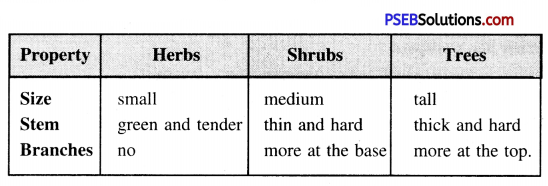
PSEB 6th Class Science Solutions Chapter 7 Getting to Know Plants 3

Question 2.
What is meant by conduction of water ?
Answer:
Conduction of water. The movement or transportation of water from roots to different parts of a plant against the gravity pull is called conduction of water i.e. an upward movement of water.

Question 3.
Write the functions of a leaf.
Answer:
Functions of leaf.

  1. It helps in transpiration of water.
  2. It carries out photosynthesis process to manufacture food.
  3. It stores food also.

Question 4.
What are veins ? What is their arrangement known as ?
Answer:
Veins are small lines present on the lamina of a leaf. They may be parallel to one another or net like on both sides of the midrib. This arrangement is known as Leaf Venation.

Question 5.
Define Photosynthesis.
Answer:
Photosynthesis. The process of preparation of food by leaves of green plants using sunlight, water and carbondioxide is called photosynthesis.

Question 6.
Name the underground part of a plant and state its function.
Answer:
Underground part of a plant is called a Root.
Functions of a root :

  1. It fixes the plant to the soil.
  2. It absorbs water and dissolved salts from soil.
  3. Some roots store food.

PSEB 6th Class Science Solutions Chapter 7 Getting to Know Plants

Question 7.
What is a flower ? Name its different parts.
Answer:
Flower. It is a modified shoot which develops from the flower buds.
Parts of a flower :

  1. Sepals
  2. Petals
  3. Stamens
  4. Pistils.

Question 8.
What is a thalamus ? What is its function ?
Answer:
Thalamus. The uppermost end of the pedicel is somewhat swollen. This swollen part of the pedicel is known as thalamus.
It is used to bear all the four whorls of a flower.

Question 9.
What are stamens ?
Answer:
Stamens. It is the male reproductive organ. Each consists of a thin stalk or filament and two lobed head called anthers. Inside the anthers there are pollen sacs. The pollen sac contains minute pollen grains.

Question 10.
Differentiate between root and stem.
Answer:
Differences between Root and Stem :

Root Stem
(1) It is an underground part of a plant. (1) It is the part of the plant mostly above the ground.
(2) It grows away from light but in direction of water. (2) It grows in the direction of light.
(3) It does not bear nodes and internodes. (3) It bears nodes and internodes.

Question 11.
State the meaning of the following terms :
(i) Tap roots
(ii) Fibrous roots
(iii) Root Cap
(iv) Root hair.
Answer:
(i) Tap roots. The main root is called tap root. Tap roots have branches which grow sideways and spread all around the main root.

(ii) Fibrous roots. Roots which seem similar are fibrous roots. They are short and fibrelike. They do not have branches. These roots are called fibrous roots.

(iii) Root cap. The yellowish cover over the tip of the root is called the root cap. The root cap protects the delicate tip of the root from injury.

(iv) Root hair. The hair-like structure of the tender ends of the roots is called root hair. Root hairs absorb salt and water from the soil.

Question 12.
State the meaning of the following terms :
(i) Leat blade
(ii) Leaf apex
(iii) Leaf base.
Answer:
(i) Leaf blade. The broad flat portion of the leaf is called the leaf blade.
(ii) Leaf apex. The tip of the leaf is called the leaf apex.
(iii) Leaf base. The part of the leaf which is joined to the stalk is called the leaf base.

Question 13.
State the meaning of following terms :
(i) Calyx
(ii) Corolla.
Answer:
(i) Calyx. The outermost portion of the flower consisting of a whorl of green leaflike structure is called the calyx.
(ii) Corolla. The whorl inside the calyx is called the corolla. Corolla is made up of partially or fully joined multi-coloured petals.

PSEB 6th Class Science Solutions Chapter 7 Getting to Know Plants

Question 14.
Why is the leaf an important organ of the plant ?
Answer:
The leaf is an important organ because :

  • It prepares food by photosynthesis.
  • It performs the function of respiration.
  • It performs the function of transpiration.

Question 15.
What is a root ?
Answer:
Root. A root is an underground part of the plant. Roots grow downwards in the soil. Usually roots are light yellow or white in colour. There are small branches on the main root. These branches are known as secondary roots. Small fibre-like structures are seen on the surface of the root. These structures are called root hairs. Root hairs absorb water and minerals from the soil.

Question 16.
Discuss the types of roots.
Answer:
Types of Roots. There are two types of roots
(i) Tap root
(ii) Fibrous root.

(i) Tap root. The root that develops from the radicle is called tap root. It grows vertically down into the soil. The tap root gives out branches.
Examples : Pea, neem, mango.
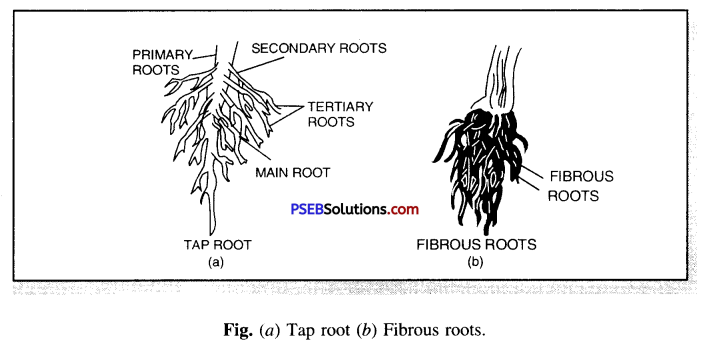
PSEB 6th Class Science Solutions Chapter 7 Getting to Know Plants 4

(ii) Fibrous root. Some plants do not have any main root. They have many fibre-like roots. These roots spread out in the soil and give support to the plant.
Examples : Wheat, maize, millet, grass.

Question 17.
What are fleshy roots ?
Answer:
Fleshy roots. In some plants, for example, radish, carrot and turnip, the roots store the food. Such roots become thick and fleshy due to the storing of food are also called fleshy roots.

Question 18.
Why are stamens and pistils important parts of the flower ?
Answer:
Importance of stamens and pistils. The formation of seeds by the process of fertilisation takes place in the flowers. In this process, pollen grains from the androecium combine with the ovules of the ovary to form a seed.

Question 19.
Give one or two-word terms for the following statements :
(i) The underground part of the plant.
(ii) The type of roots found in wheat, maize and sugarcane.
(iii) The portion of plant above the ground.
(iv) Green expanded part of the plant which arises on the nodes of the stem.
(v) The plants which have stems modified for photosy-nthesis and leaves modified into spines for protection.
(vi) The process of manufacture of food by plants in the presence of sunlight and chlorophyll.
(vii) The reproductive part of the plant.
(viii) The stem between two nodes.
Answer:
(i) Root system
(ii) Fibrous roots
(iii) Shoot system
(iv) Leaf
(v) Cacti
(vi) Photosynthesis
(vii) Flower
(viii) Intemode.

PSEB 6th Class Science Solutions Chapter 7 Getting to Know Plants

Question 20.
Which parts of a flower are useful for reproduction ?
Answer:
Useful parts for reproduction are : (i) Stamens or Androecium and (ii) Carpels or Gynaecium.

Question 21.
Which organ of the flower does the function of producing fruit and seed ?
Answer:
Carpel of the flower does the function of producing fruit and seed.

Question 22.
Give two examples of each :
(i) Plants with fibrous roots
(ii) Roots storing food
(iii) Supporting roots
(iv) Stems storing food
(v) Stems with tendrils
(vi) Leaves with tendrils.
Answer:
(i) Coconut tree, Maize plant
(ii) Radish, Carrot
(iii) Maize, Aerial roots of a banyan tree
(iv) Potato, Ginger
(v) Grapevine, Pumpkin
(vi) Pea plant, Gloriosa.

Question 23.
State whether the following are roots, stems or leaves :
(i) Potato
(ii) Carrot
(iii) Cabbage
(iv) Radish
(v) Amorphophallus
(vi) Turmeric
(vii) Ginger
(viii) Beet
(ix) Turnip
(x) Sweet potato.
Answer:
Roots : Carrot, Radish, Beet, Turnip, Sweet potato.
Stems : Potato, Amorphophallus, Turmeric, Ginger.
Leaves : Cabbage.

Question 24.
Name the systems of flowering plants. Draw them.
Answer:
All flowering plants have two main systems : (i) Root System (ii) Shoot System.
The Root System which grows mainly underground. The Shoot system grows above the ground as shown in diagram.
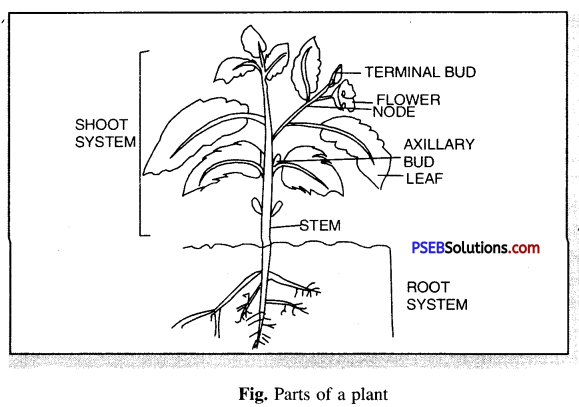
PSEB 6th Class Science Solutions Chapter 7 Getting to Know Plants 5

Question 25.
What are herbs, shrubs and trees ? Give examples.
Answer:
Plants are classified as herbs, shrubs and trees.
Herbs. Plants with green and tender stems are called Herbs. They are usually short and sometimes do not have branches e.g. grasses, Dhania etc.

Shrubs. Medium sized plants with branches starting just above the ground are shrubs. Trees. The plants which are very tall and have hard and thick stem. They have branches arising from upper part of the stem. They are called trees. For example, Mango tree, Lemon tree etc.
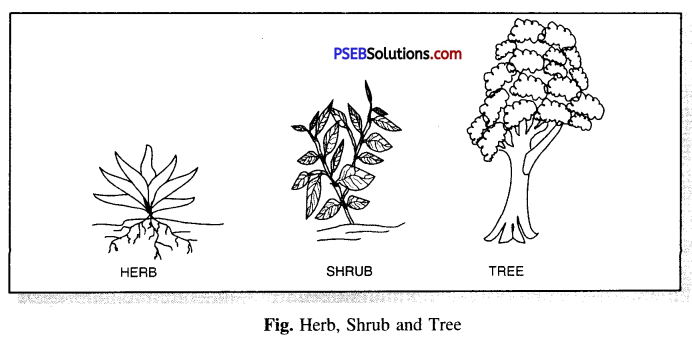
PSEB 6th Class Science Solutions Chapter 7 Getting to Know Plants 6

Question 26.
What is a leaf and what is its role in the life of a plant ?
Answer:
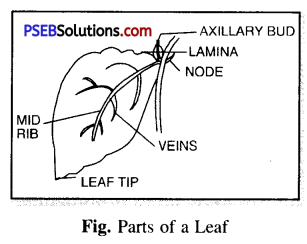
PSEB 6th Class Science Solutions Chapter 7 Getting to Know Plants 7
The leaf is a flattened, thin green lateral structure borne on the stem.
A leaf is borne on the stem at a node. It usually has a stalk called petiole and very small leaves at the base of the petiole called the stipules. It has broad expanded green part called leaf blade or Lamina. It has thick midrib in the centre.

PSEB 6th Class Science Solutions Chapter 7 Getting to Know Plants

Question 27.
What is Venation ? Also classify it.
Answer:
Venation. The pattern of thread-like structures in the leaves forming a network is venation.

Reticulate venation. When the design is net-like on both the sides of mid rib, the venation is said to be reticulate. Examples : rose, tulsi, mint, cabbage.
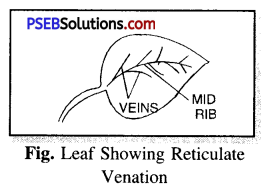
PSEB 6th Class Science Solutions Chapter 7 Getting to Know Plants 8
Parallel Venation. When the leaf has veins parallel to one another. Such venation is called Parallel venation. Examples : grass, maize, sugarcane.
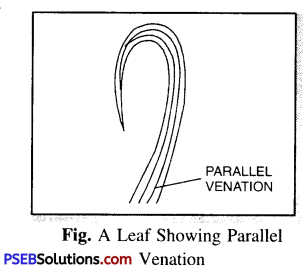
PSEB 6th Class Science Solutions Chapter 7 Getting to Know Plants 9

Question 28.
What are the functions of roots ?
Answer:
Roots of plants have following functions :

  • Fixation. It fixes the plant firmly in the soil.
  • Absorption. Root hairs help in the absorption of water and minerals from the soil.
  • Transportation. Water and minerals absorbed by the roots are transported up to the stem and into the branches.
  • Prevention of soil erosion. Roots prevent soil erosion.

Question 29.
What are the characteristics of roots ?
Answer:
The root and its branches make up the root system of a plant.

Characteristics of roots.
The root is the underground, non-green part of the plant. It generally grows from the radicle of the embryo of a seed. It grows into the soil, away from sunlight. It does not possess nodes or internodes.

Question 30.
Name some modified roots and stems which we eat.
Answer:
Radish, carrot, potato, sweet potato, beet etc.are modified roots and stems which we eat.

Question 31.
Write three modifications each of stems and roots.
Answer:
Modification of roots : (!) Storage roots (ii) supporting roots (iii) Breathing roots. Modification of stems : (i) Storage of food (ii) Support (iii) Protection.

Long Answer Type Questions

Question 1.
Explain experimentally that stem helps in conducting water upwards.
Answer:
Experiment. Gently pull out a balsam plant or any other plant with white flowers from the soil. Wash its roots well. Then cut the roots under water. Dip the lower end of the cut stem in a bottle containing water to which few drops of red ink has been added as shown in
fig.
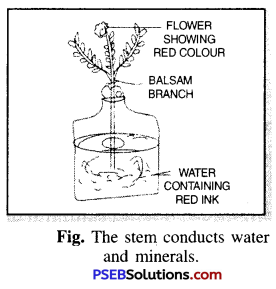
PSEB 6th Class Science Solutions Chapter 7 Getting to Know Plants 10

Leave the plant undisturbed for a few hours. Observe the plant carefully. You will notice that the colour of the white flowers changes to red, this is because of conduction of water from stem to flower. This experiment proves that stem helps in conducting water upwards.

PSEB 6th Class Science Solutions Chapter 7 Getting to Know Plants

Question 2.
Explain through activity the process of Transpiration.
Answer:
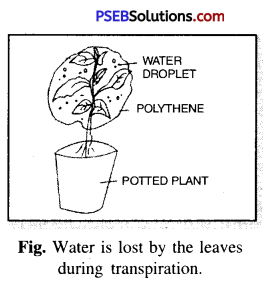
PSEB 6th Class Science Solutions Chapter 7 Getting to Know Plants 11
Experiment.
Take a potted plant and cover it with a polythene bag as shown in figure. Observe it after few hours. What do you see in the bag ? You will notice a few droplets of water in the bag. This shows that the water is lost by the leaves during Transpiration.

Question 3.
Discuss the various parts of a flower.
Answer:
A flower may be defined as a modified shoot highly condensed. It develops from the floral buds.

Parts of a flower. Flowers vary in size, shape and colour but all flowers have the same basic parts. The main parts are :
(i) Pedicel and thalamus
(ii) Calyx or sepals
(iii) Corolla or petals
(iv) Androecium or stamens
(v) Gynoecium or carpels.

(i) Pedicel. A flower is borne on a stalk called pedicel. The upper swollen part of pedicel is called thalamus. It bears all the four whorls of a flower.

(ii) Sepals. It is the 1 st outermost whorl of a flower. It consists of leaf like structures called sepals. Sepals are generally green, manufacture food and supply it to other floral parts.

(iii) Petals. It is 2nd whorl of a flower. Each segment of the petal is known as a petal. These are usually brightly coloured due to presence of pigments. The bright colour, sweet smell and nectar attract the insects which in turn help in pollination.

(iv) Androecium or stamens. It is the third floral whorl which is composed of one or more male reproductive organs called stamens. Each stamen consists of a thin stalk or filament and two lobe head called the anther. Each anther lobe has two pollen-sacs which are filled with pollen grains.

(v) Gynoecium or Carpels. It is the innermost floral whorl which is composed of one or more female reproductive organs called carpels. Each carpel consists of three parts : Stigma, Style and Ovary.
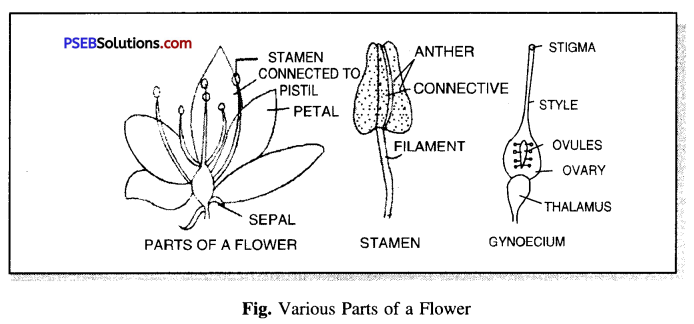
PSEB 6th Class Science Solutions Chapter 7 Getting to Know Plants 12

Question 4.
What is a stem? What are the different parts of a stem?
Answer:
Stem. The ascending aerial part of the plant that directly develops from the plumule is called a stem. It is the link between the roots and the leaves and flowers. The stem is the strongest part of a tree and is known as the trunk.

Parts of a stem. A stem consists of the following three parts :
(i) Node. It is a place on the stem or a branch from which a leaf is produced.

(ii) Internode. This is the part of the stem which lies in between the two successive nodes.
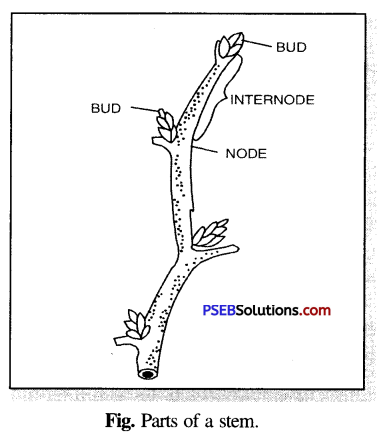
PSEB 6th Class Science Solutions Chapter 7 Getting to Know Plants 13

(iii) Bud. It is the condensed part of the stem lying either at the apex of a stem or in the axil of a leaf.

Question 5.
Explain the normal and special functions of stems.
Answer:
Normal functions of stems: The normal functions of stems are :
(i) Stems support the branches of the plant bearing leaves, flowers and fruits.
(ii) They spread the leaves so that every leaf gets sufficient light and air.
(iii) They transport water and salts absorbed by the roots upto the leaves and other parts of the plant.
(iv) The food prepared in the leaves is distributed to the different parts of the plant by the stem.

Special functions of stems.
The special functions of the stems are as follows :
(i) The manufacture of food material. Some plants such as Opuntia, Asparagus, etc., have either no leaves or very small leaves. The stems of such plants are green due to the presence of chlorophyll. Such green stems manufacture food material in the presence of sunlight.
(ii) Support. Some plants such as passionflower, bitter gourd, and grapevines have weak stems. Fiber-like tendrils develop.