PSEB 6th Class Physical Education Solutions Chapter 8 Drug Addiction-A Curse

Punjab State Board PSEB 6th Class Physical Education Book Solutions Chapter 8 Drug Addiction-A Curse Textbook Exercise Questions and Answers.

PSEB Solutions for Class 6 Physical Education Chapter 8 Drug Addiction-A Curse

Physical Education Guide for Class 6 PSEB Drug Addiction-A Curse Textbook Questions and Answers

Question 1.
Which intoxication eliminates the power of thinking and digestion of a person?
Answer:
Alcohol is an intoxicant that eliminates the power of thinking and digestion of a person. Alcohol affects the brain first of all. Nervous system gets affected and the brain weakens. The thinking power or faculty declines. With the effect of this intoxicant, respiration increases, and one suffers from diseases pertaining to respiratory system.

PSEB 6th Class Physical Education Solutions Chapter 8 Drug Addiction-A Curse

Question 2.
Which poisonous element is found in a cigarette?
Answer:
‘Nicotine’ is a poisonous element that is found in a cigarette. This is an alkaloid from tabacco plant. Nicotine has its adverse effect on the head which begins to feel giddy, and then the heart is badly affected. The possibility of suffering from cancer increases with the excessive use of tobacco, particularly the cancer of lungs and throat.

Question 3.
Write down the effects of Alcohol on our health.
Answer:
Effects of Alcohol on our Health:
Alcohol is a liquid intoxicant. It is legally binding to write on each bottle of alcohol-“Drinking is injurious to health.” Even then more and more people are becoming addict to alcohol, and seem to ignore the statutory warning totally. Thus, more and more such people are becoming prey to many diseases. Their lungs get defected. The liver is damaged. Age declines. Alcohol, in fact, adversely affects all parts of the body. At first man fakes alcohol, then alcohol begins to take (consume) him. Alcohol has several bad effects, some of which are listed below:

  • Alcohol affects the brain first of all. Nervous system gets affected and the brain weakens. The thinking power or faculty declines.
  • The kidneys in the body weaken.
  • Alcohol becomes a hindrance in the production of digestive juices, as a result of which digestion becomes poor.
  • Respiration increases, and one suffers from diseases pertaining to respiratory system.
  • Blood vessels expand under the influence of regular drinking. Brain has to exert more, and one may suffer a heart attack any moment.
  • Regular drinking decreases the work capacity of muscles, The body gets weak to face the attack of disease germs.
  • The studies have revealed that a drunkard works less than a normal person. A drunkard also suffers from various diseases sooner than a normal individual.
  • Drinking is a social evil as it ruins home, health and wealth.

Question 4.
What are the intoxicants that cause cancer?
Answer:
Cancer causes with the consuming of cigarettes, bidis, jarda, Kheni etc. These are made from tobacco.

Effects of Smoking on Health:
In our country smoking and consuming tobacco has become a habit and fashion. There are several ways to consume tobacco such as smoking cigarettes, bidis, cigars, hubble-bubble, etc. Tobacco is also eaten in many forms such as eating “paan”, tobacco mixed with lime, “jarda”, etc. There is a dangerous toxic substance; called nicotine in tobacco. There are other toxins like ammonia, carbon dioxide, etc. Nicotine has its adverse effect on the head which begins to feel giddy, and then the heart is badly affected.
The harms of tobacco on health are as under:

  • Eating or taking tobacco weakens eyesight.
  • It increases heart beat. One suffers from heart diseases which often prove fatal.
  • Studies have revealed that tobacco consuming contracts blood vessels.
  • Tobacco benumbs the body tissues. One does not have good sleep and ultimately suffers from sleeplessness.
  • Stomach begins to remain upset with tobacco consumption.
  • Tobacco also causes cough, and the consumer of tobacco is prone to lung diseases like T.B.
  • The possibility of suffering from cancer increases with the excessive use of tobacco, particularly the cancer of lungs and throat.

PSEB 6th Class Physical Education Solutions Chapter 8 Drug Addiction-A Curse

Question 5.
What is the identity of the drug user in Society?
Answer:
Ever since time immemorial man has been using intoxicants. He was of the opinion that their use was helpful in removing some diseases and in making one feel fresh. But later on the harmful effects of intoxicants came to light. In today’s world, many types of intoxicants have come into use and are easily available. The sports world, in particular, feels concerned and worried. There is no doubt that man can work overtime by consuming some intoxicants, but in the long ran overwork results in his fast decay and death. Among these intoxicants some are worse than leprosy. Such intoxicants as alcohol, tobacco, opium, hashish, bhang, etc. are very harmful to one’s health.

The problem of drag addiction affects the drag user as well as his family and society. Drug user does not take interest in any kind of work. As a result he himself becomes a responsibility of the society and family. Nobody wants his friendship and respects him. It becomes more difficult for him to purchase costly drags daily. As a result he commits crimes to pay for his drags. Thus he loses his character and the relationship with
society becomes unhealthy.

PSEB 6th Class Physical Education Guide Drug Addiction-A Curse Important Questions and Answers

Multiple Choice Questions

Question 1.
Name four intoxicants:
(A) Alcohol
(B) Tobacco
(C) Bhang and Opium
(D) All above.
Answer:
(D) All above.

PSEB 6th Class Physical Education Solutions Chapter 8 Drug Addiction-A Curse

Question 2.
Name any two systems which are being affected by intoxicants?
(A) Digestive and circulatory system
(B) Mentle system
(C) Bone system
(D) None of them.
Answer:
(A) Digestive and circulatory system
(B) Mentle system

Question 3.
Write any harms of intoxicants on sports person.
(A) Carelessness
(B) Irresponsibility
(C) Headache
(D) None of them.
Answer:
(A) Carelessness
(B) Irresponsibility

Question 4.
Write measures to get rid of drag addiction.
(A) Motivation
(B) Conference
(C) Psychological method
(D) All above
Answer:
(D) All above.

Question 5.
Effects of smoking on health:
(A) The possibility of suffering from cancer.
(B) Tobacco is prone to lung diseases like T.B.
(C) Stomach begins to get weaker.
(D) All above.
Answer:
(D) All above.

Question 6.
Effects of alcohol on our health.
(A) Alcohol affects the brain.
(B) The kidneys in the body get weaker.
(C) Digestive system become poor.
(D) All above.
Answer:
(D) All above.

Very Short Answer Type Questions

Question 1.
Name any two systems which are being affected by intoxicants.
Answer:
Digestive system and circulatory system.

PSEB 6th Class Physical Education Solutions Chapter 8 Drug Addiction-A Curse

Question 2.
Write any two harms of intoxicants.
Answer:

  • Face becomes pale.
  • Disturbance of mental concentration.

Question 3.
Write any two harms of intoxicants on sportsperson.
Answer:

  • Carelessness and irresponsibility.
  • End of Sportsmanship

Question 4.
Alcohol affects brain. (Right or wrong)
Answer:
Right.

Question 5.
Chewing tobacoo causes weak eyesight. (Right or wrong)
Answer:
Right.

Question 6.
Smoking causes cancer or not.
Answer:
Causes cancer.

Question 7.
Use of Tobacco does not cause cough and the consumption of tobacco is not prone to T.B. (Right or wrong)
Answer:
Wrong.

Question 8.
Under the influence of intoxicants player become careless. (Right or wrong)
Answer:
Right.

PSEB 6th Class Physical Education Solutions Chapter 8 Drug Addiction-A Curse

Short Answer Type Questions

Question 1.
Prepare a list of some commonly used intoxicants.
Answer:

  • Alcohol
  • Bhang
  • Caffeine
  • Opium
  • Hashish
  • Ademwin
  • Tobacco
  • Snuff
  • Kheni
  • Cigarette
  • Bidi
  • Jarda.

Question 2.
What is the harmful effect of narcotics?
Answer:
Narcotic drugs weaken the human body and affects the mind also. The behaviour of the person seems out of control. This affects his personal and social life.

Question 3.
Write any two measures to get rid of drug addiction.
Answer:
1. Motivation: The parents, school teachers and elders of the family play an important role to motivate the children to avoid narcotics.

2. Psychological Method: If it seems difficult, then the person should be prepared to give up drugs with the counselling of a psychologist.

PSEB 6th Class Physical Education Solutions Chapter 8 Drug Addiction-A Curse

Question 4.
Why is it important to get rid from Drug addiction?
Answer:
Drugs have become a great problem in the society nowadays. Drugs affect the user’s body by weakening the digestive system, immune system, circulatory system, respiratory system, metabolism, nervous system, etc. The persistent use of drugs may cause many severe diseases such as hypertension, numbness, diabetes, jaundice, cancer, etc. The risk of heart related diseases also increases, hands start shaking, the person suffers mental imbalance as well.

Use of narcotic drugs affects the behaviour of the person very badly. He loses control over his senses and quarrels with people without any genuine reason. The drug addict remains irritated all the time as the narcotics severely affects all the systems of his body. People of the society avoid him which further adds to his irritation. So it is very important to get rid of drug addiction.

PSEB 6th Class Physical Education Solutions Chapter 7 National Song and Anthem

Punjab State Board PSEB 6th Class Physical Education Book Solutions Chapter 7 National Song and Anthem Textbook Exercise Questions and Answers.

PSEB Solutions for Class 6 Physical Education Chapter 7 National Song and Anthem

Physical Education Guide for Class 6 PSEB National Song and Anthem Textbook Questions and Answers

Question 1.
Write the national anthem Jana-Gana-Mana.
Answer:
Jana-Gana-Mana adhinayak jaya hai
Bharat-Bhagya Vidhata
Punjab-Sindh, Gujrath Maratha
Dravid Utkala Vanga
Vindhaya Himachal Yamuna, Ganga
Uchchala Jaladhi Taranga
Tav shubh naame jage
Tav shubh aashish maghe
Gahe tava jaya gaatha
Jan-Gan-Mangal-dayak-Jaya hai
Bharata Bhagya Vidhata
Jaya hey, jaya hey, jaya hey
Jaya jaya jaya jaya hey.

PSEB 6th Class Physical Education Solutions Chapter 7 National Song and Anthem

Question 2.
Write the national song Vande Mataram.
Answer:
Vande Mataram
Sujalam Suphalam Malayaj-Sheetalam
Sasya Shyamalam Mataram
Vande Mataram
Shubhrajyotsna Pulkita Yaminim
Phula Kusumit Drumadala Shobhinim
Suhasini Sumadhura Bhashinim
Sukhdam Vardam Mataram
Vande Mataram
Koti-koti kantha kalakala ninada Karale
Koti-Koti bhujair dhrita-Khara Kuravalc
Abala kena mueta bale.
Bahubaladharinim, namami tarinim,
Ripudalavarinim Mataram!
Tumi Vidya, tumi dharma,
Tumi hridi, tumi marma,
Tvam hi pranah sharire,
Bahute tumi ma shakti,
Hridaye tumi ma bhakti,
Tomarayipratima gari mandire mandire!
Tyam hi Durga dashap raharana dharini,
Kamala, kamaladalvaiharini,
Vani, Vidyadayini namami tvam,
Namami, Kamalam, amalam, atulam,
Sujalam, Suphalam, Mataram,
Vande Mataram!

Question 3.
What is the significance of the Anthem Jana-Gana-Mana?
Answer:
O Lord! you are the master of the minds of innumerable people and the architect of the destiny of India. Further, illustrating the picture of the dear land it has been said that the people of our provinces Punjab, Sindh, Gujrat, Maharasfitra, Orissa and Bengal our mountains Vindhayachal and the Himalayas and our holy rivers, Ganga, Yamuna and the rising waves of the vast ocean, recite your (God’s) name. We pray to receive your blessings and sing the glory of your countless qualities.

PSEB 6th Class Physical Education Solutions Chapter 7 National Song and Anthem

Question 4.
What is the meaning of Vande Mataram?
Answer:
O! Mother Bharat, we salute you.Your water is very pure. You are laden with beautiful flowers. The breezy winds of the south fascinate our minds. Hey! Motherland, we salute you time and again.

Dear Mother! your nights are brightened by the white blooming lights of the moon. And we derive pleasure out of it. The whole of you are laden with flowers and the green and fresh trees lend grace to you. Your smiles and your words bless us with it.

Question 5.
Fill up the blanks:
(a) Jana-Gana-Mana has been composed by- Rabindranath Tagore.
(b) Vande Matram has been written by- Bankim Chandra Chatterjee.

Question 6.
On what occasions can the tune of the National Anthem be played?
Answer:

  • On 15th August at the time of unfurling the National Flag.
  • On 26th January, the Republic Day celebrations at the time of unfurling the National Flag.
  • At the time of salutation to the President and the Governor.
  • At the time of giving prizes to the winning Indian players at International Sports Matches.
  • At some vast national congregation, at the time of giving honour to the presiding officer.

PSEB 6th Class Physical Education Guide National Song and Anthem Important Questions and Answers

Multiple Choice Questions

Question 1.
On what occasion can the tune of the National Anthem be played?
(A) On 15th August
(B) On 26th January
(C) At the time of salutation to the President and the Governor.
(D) All above.
Answer:
(A) On 15th August
(B) On 26th January

PSEB 6th Class Physical Education Solutions Chapter 7 National Song and Anthem

Question 2.
The name of our two National Songs.
(A) Jana-Gana-Mana and Vande Mataram
(B) Jana-ManS-Gana
(C) Vande Mataram
(D) None of them.
Answer:
(A) Jana-Gana-Mana and Vande Mataram

Question 3.
Who wrote the Jana-Gana-Mana?
(A) Rabindranath Tagore
(B) Bankim Chandra
(C) Gandhi Ji
(D) None of them.
Answer:
(A) Rabindranath Tagore

Question 4.
When was our National song firstly sung?
(A) On 27th December 1911
(B) 1920
(C) 1925, December
(D) None of them.
(A) On 27th December 1911
Answer:
(A) On 27th December 1911

Question 5.
When Vande Mataram was sung in congress’s function firstly?
(A) 1896
(B) 1900
(C) 1920
(D) None of them.
Answer:
(A) 1896

PSEB 6th Class Physical Education Solutions Chapter 7 National Song and Anthem

Question 6.
When we sing National Anthem or its tune, what things should be kept in mind?
(A) Standing straight
(B) While singing do not move
(C) Do not talk with each other
(D) All above.
Answer:
(D) All above.

Very Short Answers Type Questions

Question 1.
Write the name of our two national songs.
Answer:
Jana-Gana-Mana and Vande Mataram.

Question 2.
Who wrote Jana-Gana-Mana?
Answer:
Rabindranath Tagore.

Question 3.
Who wrote our national song Vande Mataram?
Answer:
Bankim Chandra Chatarjee.

Question 4.
When and in which book Vande Mataram is printed?
Answer:
In 1882, Anandamath.

PSEB 6th Class Physical Education Solutions Chapter 7 National Song and Anthem

Question 5.
Who gave the music to Vande Mataram?
Answer:
Rabindranath Tagore.

Question 6.
When was our National song firstly sung?
Answer:
On 27 December, 1911.

Question 7.
When was Jana-Gana-Mana sung as a national anthem?
Answer:
On 26 January, 1950.

Short Answer Type Questions

Question 1.
Write a note on Vande Matram.
Answer:
This song was written in the book ‘Anandamath’ in 1882 by Bankim Chandra Chaterjee. In 1886 the Indian National Congress recited it for the first time on a political occasion. Its music was composed by Rabindranath Tagore.

Question 2.
Write a note on Jana-Gana-Mana.
Answer:
The anthem was recited on 27th December, 1911 at a political, meeting of the Congress. On 24th January, 1950, the Constitution approved the Jana-Gana-Mana as the National Anthem.

PSEB 6th Class Physical Education Solutions Chapter 7 National Song and Anthem

Question 3.
When we sing Vande Matram, what things should be kept in mind?
Answer:

  • Standing straight.
  • While singing do not talk with each other.

PSEB 9th Class Welcome Life Solutions Chapter 1 Self Awareness and Self Discipline

Punjab State Board PSEB 9th Class Welcome Life Book Solutions Chapter 1 Self Awareness and Self Discipline Textbook Exercise Questions and Answers.

PSEB Solutions for Class 9 Welcome Life Chapter 1 Self Awareness and Self Discipline

Welcome Life Guide for Class 9 PSEB Self Awareness and Self Discipline InText Questions and Answers

Textbook Page No. 1

Dear students! Have you ever thought?

Question 1.
Why can’t a fish fly?
Answer:
To fly, wings are required and fish don’t have the wings. That’s why a fish cannot fly.

Question 2.
Why can all the creatures not climb up a tree?
Answer:
Climbing trees requires a special ability in the body that is not found in all creatures. That’s why only those creatures can climb a tree that has this kind of ability.

Question 3.
Why has Sachin Tendulkar been popular for being a cricketer and not as a painter?
Answer:
Because Sachin Tendulkar did not have the qualities of becoming a painter but had the quality of playing cricket. That’s why, instead of becoming a painter, he become a cricketer.

PSEB 9th Class Welcome Life Solutions Chapter 1 Self Awareness and Self Discipline

Question 4.
Why did Lata Mangeshkar grow up to be a singer and not a writer?
Answer:
Because she did not have the quality of becoming a writer but had the quality of becoming a singer.

Answer them

1. I am ……………..
Answer:
Ramesh Kumar

2. My family members feel ……………… because of me.
Answer:
Happy

3. I am very happy when I ……………….
Answer:
When I get maximum marks and stand first in the class.

4. I always worry about …………………
Answer:
I am getting fewer marks in exams.

5. How do you deal with the people you don’t like?
Answer:
I try to talk very less with them.

6. Are all the people always happy with you? Why?
Answer:
Although I try to keep everyone happy and that’s why I always try to fulfill their expectations.

 Textbook Page No. 2

Activity

Question 1.
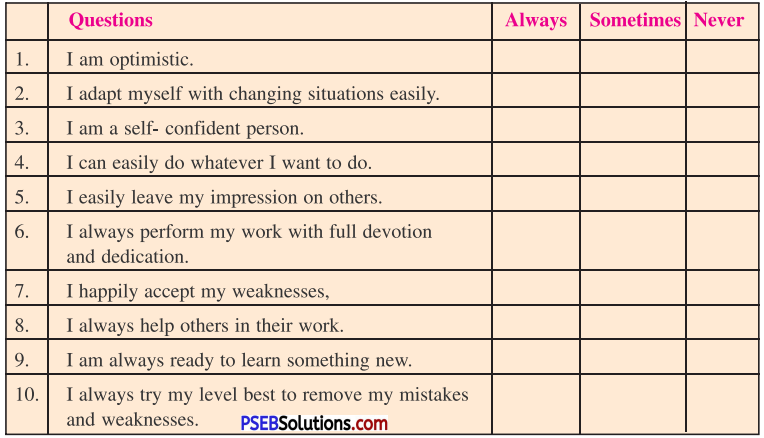
You have to answer the questions asked about you on the following rating scale. Each question has three possible answers. You chose the most suitable answer for you.
PSEB 9th Class Welcome Life Solutions Chapter 1 Self Awareness and Self Discipline Img 1
After answering the above questions. you have to analyze yourself. The components, you have answered with ‘Always’ are your strengths. You have to keep them up. Try to improve the aspects with the answers ‘Sometimes’. The traits for which your answer is ‘Never’ are definitely your weaknesses and you have to overcome them.

Answer:

S.No. Questions Always Sometimes Never
1. I am Optimistic.
2. I adapt myself to changing situations easily.
3. I am a self-confident person.
4. I can easily do whatever I want to do.
5. I easily leave my impression on others.
6. I always perform my work with full devotion and dedication.
7. I happily accept my weaknesses.
8. I always help others in their work.
9. I am always ready to learn something new.
10. I always try my level best to remove my mistakes and weaknesses.

Textbook Page No. 2 and 3

Now answer these questions with what you feel in the following situations :

Question 1.
If someone criticizes me.
Answer:
I give thought to it and try to correct my mistake.

PSEB 9th Class Welcome Life Solutions Chapter 1 Self Awareness and Self Discipline

Question 2.
When I see the progress of other students in my class.
Answer:
I feel happy that they are doing progress.

Question 3.
When I cannot make changes in things and situations according to my wish.
Answer:
I try to find the reason why I cannot change things.

Question 4.
I have set my goal for life and to achieve that goal.
Answer:
I will do more hard work to achieve the goal.

Question 5.
When I do something wrong.
Answer:
I try to do it again to make it correct.

Textbook Page No. 5

Dear students ! as you know we are a part of our society, just like the beads in a rosary. If a single bead is not good, it will change the grace of the rosary. Every person performs his duty towards society in his best possible responsible way. The development of this sense of responsibility starts at an early age. Childhood and adolescence are the foundation periods of life for the development of this trait of human personality. We know that we can perform our duty towards others well only if we know our responsibility towards ourselves. It is possible only if every aspect of our personality is developed well. So before learning our sense of responsibility towards others, we must take care of the development of various aspects of our personality like physical, emotional, and social development.

Question 1.
What do you know about the proper development of physical, emotional, and social development?
Answer:
Physical Development: When our physical and mental development is done properly according to age, it is called physical development.
Emotional Development: It means there exist every type of emotion within ourselves such as love, sympathy, sense of cooperation, etc.
Social Development: It means that an individual must contribute fully to the development of society. As man is a social animal, that’s why he must have this type of feeling.

PSEB 9th Class Welcome Life Solutions Chapter 1 Self Awareness and Self Discipline

Textbook Page No.5

Activity

Responsibility Towards Yourself

PSEB 9th Class Welcome Life Solutions Chapter 1 Self Awareness and Self Discipline Img 2
Answer:

I will do proper exercise to keep myself fit and healthy. I will develop every type of feeling within myself for my emotional development. I will live and cooperate with others and develop the feeling of cooperation.

Responsibility Towards Family

The person comes in contact with his family first. Family is such a social institution, where the person is born. He/She shares all his/her joys and sorrows with his/her family members. So he/she has certain liabilities and responsibilities towards the family members. Let us see

Question 1.
What is your responsibility towards your family?
Answer:
I will keep my family happy by fulfilling my duties and responsibilities. With this, I will become a better citizen of the country.

 Textbook Page No. 6

Responsibility Towards School

Question 1.
What is your responsibility towards your school?
Answer:
Maintain discipline in school, not damage school’s property, cooperate with my friends and teachers, etc.

PSEB 9th Class Welcome Life Solutions Chapter 1 Self Awareness and Self Discipline

Question 2.
How will you fulfill your responsibility towards your school?
Answer:
I will remain with my friends, will follow rules made by the school, will not damage the school’s property, will obey the orders given by teachers, etc.

Responsibility Towards Society And Nation

Question 1.
What is your responsibility towards your society and nation? How will you perform it?
Answer:
My responsibility is to be a good citizen of the nation. For this, I will perform all the duties honestly and will not do anything against the laws of the land.

Answer the following questions in Yes or No :

1. If any of my family members is unwell. I always take care of him/her. (Yes/No)
Answer:
Yes

2. I help my mother with household works. (Yes/No)
Answer:
Yes

3. In school, I always keep in discipline even if the teacher is not in the classroom. I contribute to school beautification also. (Yes/No)
Answer:
Yes

PSEB 9th Class Welcome Life Solutions Chapter 1 Self Awareness and Self Discipline

4. Keeping in mind the convenience of the neighbors, I always listen to the music at a lower volume. (Yes/No)
Answer:
Yes

PSEB 9th Class Welcome Life Guide Self Awareness and Self Discipline Important Questions and Answers

Multiple Choice Questions:

1. Right from the ages, ……………….. is running to find his identity.
(a) Man
(b) Lion
(c) Elephant
(d) All of these.
Answer:
(a) Man.

2. Man is a ………….. animal.
(a) Political
(b) Social
(c) Economic
(d) None of these
Answer:
(b) Social

3. The subconscious mind is more hidden than the visible part of the …………….
(a) individual
(b) personality
(c) brain
(d) mind
Answer:
(b) personality

4. The main motive of ……………. is to identify oneself.
(a) self-consciousness
(b) society
(c) personality
(d) None of these.
Answer:
(a) self-consciousness

5. Every individual Is always having a …………………..
(a) quality
(b) shortcoming
(c) both (a) and (b)
(d) None of these
Answer:
(c) both (a) and (b).

PSEB 9th Class Welcome Life Solutions Chapter 1 Self Awareness and Self Discipline

6. A person’s true identity is formed when he does not let his ……………… overwhelm him.
(a) quality
(b) shortcoming
(C) brain
(d) personality.
Answer:
(b) shortcoming.

7. ……………………. is very much necessary for us.
(a) Discipline
(b) Quality
(c) Shortcoming
(d) None of these.
Answer:
(a) Discipline.

8. We must know the value of ………………
(a) society
(b) time
(c) brain
(d) discipline.
Answer:
(b) time.

9. There is a need to make a ………………. for the proper usage of time.
(a) plan
(b) personality
(c) house
(d) office
Answer:
(a) plan

10. How can we make the planning of time?
(a) By making a plan
(b) Dividing work on a priority basis
(c) By making tune table
(d) All of these.
Answer:
(d) All of these.

Fill in the Blanks:

1. We must make a time ………………
Answer:
table

2. We must know the importance of ……………
Answer:
time

3. ……………….. is a must in life.
Answer:
Discipline

4. First of all, an individual comes in contact with
Answer:
family

5. Family is an …………….. which always stands with us.
Answer:
institution

Tick the Right (✓) or Wrong (x) Statement:

1. We must know the importance of time.
Answer:

2. Disciplined person gets success in life.
Answer:

3. There is no importance of the feeling of responsibility.
Answer:
x

4. Man is not a social animal.
Answer:
x

5. Every individual has some qualities and shortcomings.
Answer:

Match the Following:

(A) (b)
Self Consciousness Institution
Quality Internal
Importance of time Part of personality
Responsibility Making time table
Family Remain in discipline

Answer:

(A) (b)
Self Consciousness Internal
Quality Part of personality
Importance of time Making time table
Responsibility Remain in discipline
Family Institution

Very Short Answer Type Questions:

Question 1.
Who is looking for his identity from the ages?
Answer:
Man is looking for his identity from the ages.

Question 2.
What is the actual motive of Self Consciousness?
Answer:
The actual motive of self-consciousness is to identify oneself.

Question 3.
What is important before you can properly coordinate with others?
Answer:
There is definitely a need to understand oneself.

Question 4.
Every person is born with few things within himself. Name anyone.
Answer:
Every person is born with natural qualities.

Question 5.
Do a person’s qualities come out automatically?
Answer:
No, there is a need to find qualities hidden within an individual.

PSEB 9th Class Welcome Life Solutions Chapter 1 Self Awareness and Self Discipline

Question 6.
How can we express ourselves?
Answer:
By finding our strength and improving it, we can express ourselves.

Question 7.
When a person’s true identity is formed?
Answer:
When we do not let our shortcomings overwhelm us and by doing cooperate with others.

Question 8.
What is required to create a person’s true identity?
Answer:
He needs to remain in Self-discipline to create his true identity.

Question 9.
Is nature work within the discipline?
Answer:
Yes, nature has a fixed time to do any work.

Question 10.
Tell one method of time management?
Answer:
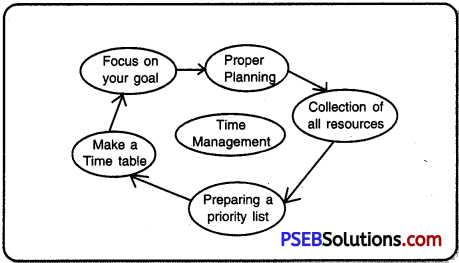
We must make a timetable and work according to it.

Question 11.
How could we waste our precious time?
Answer:
When we don’t focus on work, we waste our precious time.

Question 12.
When does a sense of responsibility begin to develop?
Answer:
Right from childhood, a sense of responsibility begins to develop.

Question 13.
When can we fulfill our responsibility properly?
Answer:
When all the aspects of our personality are developed, we can say that we can fulfill our responsibility properly.

PSEB 9th Class Welcome Life Solutions Chapter 1 Self Awareness and Self Discipline

Question 14.
Who does the person first come in contact with?
Answer:
First of all, he comes in contact with his family.

Question 15.
Who stands with us in our bad times?
Answer:
Family stands with us in our bad times.

Short Answer Type Questions:

Question 1.
What is the chief purpose of having Self-awareness?
Answer:
Man is a social animal and he is running for ages to find his true existence. For his proper adjustment in society, he needs to properly understand himself. There are many hidden qualities in himself. A large part of his personality is hidden within him. That’s why the chief objective of having self-awareness is actually knowing this hidden part of his.

Question 2.
When a person’s true identity is formed?
Answer:
Every individual is having many qualities but with these qualities, there are few shortcomings as well. A person’s true identity in society is formed when he does not allow his shortcomings to overwhelm him. At the same time, he must not be jealous of others but always ready to cooperate with them. So, all this can happen if he keeps himself in the discipline.

Question 3.
Why is punctuality important?
Answer:
Time and punctuality are very important in a person’s life. Every work is done on time and every work should be done on time. It is said that if a task is not done on time then the task is in vain. Sometimes if work is not done on time, then both work and time become useless. Just as nature does everything on time, so we should do everything on time.

Question 4.
Showtime management through a picture.
Answer:
PSEB 9th Class Welcome Life Solutions Chapter 1 Self Awareness and Self Discipline Img 3

Long Answer Type Question:

Question 1.
Explain the sense of responsibility.
Answer:
We all live in society and while living in society, we have many responsibilities towards society. It is expected of everyone to fulfill his responsibilities. Right from childhood, the sense of responsibility starts to develop. From childhood, we begin to develop the qualities we have and also the quality of responsibilities begins to improve. We can fulfill our responsibilities to others if our personality is fully developed. If our personality is well developed then we can fix the responsibilities as well. We also have many duties and responsibilities towards ourselves and we have to fulfill those duties so that we can develop physically, socially, and emotionally. If we develop properly, we will definitely be able to take responsibility.

Source-Based Question:

Question 1.
Read the source and answer the questions that follow :
From the very beginning of civilization, man is struggling to find his identity. He has been wandering here and there for centuries in search of his true existence. As we all know, man is a social animal. For his proper adjustment in society, he needs to have proper coordination with others in order to understand others properly, it is necessary to know ourselves first, when we say that we know someone, actually it is not all true. What we see, is only a small part of one’s personality and most of the person is hidden in his/her unconsciousness. The person, sometimes even himself does not know his hidden self. The chief purpose of having self-awareness is actually knowing about this hidden part of us.

1. Why is a man wandering for centuries?
Answer:
For centuries, man is wandering here and there to find his true existence.

2. What type of animal is a man?
Answer:
Man is a social animal.

3. What is the objective of Self-awareness?
Answer:
The objective of Self-awareness is to actually know about oneself.

4. What is self-consciousness?
Answer:
Self-consciousness is a feeling in an individual to examine everything and to check whether the thing is right or wrong.

5. What is the subconscious mind?
Answer:
Much is hidden in the mind of a person about which he is hardly aware. That part of the mind is known as the subconscious mind.

PSEB 7th Class Science Solutions Chapter 6 Physical and Chemical Changes

Punjab State Board PSEB 7th Class Science Book Solutions Chapter 6 Physical and Chemical Changes Textbook Exercise Questions and Answers.

PSEB Solutions for Class 7 Science Chapter 6 Physical and Chemical Changes

Science Guide for Class 7 PSEB Physical and Chemical Changes Intext Questions and Answers

Think and Answer (Textbook Page No. 59)

Question 1.
Mention whether the cutting of paper is a reversible or irreversible change.
Answer:
Cutting a paper is not a reversible change because the pieces cannot be reconnected to form the original piece. So this is an irreversible change

Question 2.
Is the cutting of paper a physical or a chemical change?
Answer:
Cutting of paper into pieces changes its shape, but no new material is formed. Therefore, it is a physical change.

PSEB 7th Class Science Solutions Chapter 6 Physical and Chemical Changes

Think and Answer (Textbook Page No. 59)

Question 1.
Can you recover chalk from dust?
Answer:
Yes we can get chalk from chalk powder by making a paste of chalk powder. Then giving it a shape of chalk and allowing it to become dry.

Question 2.
Does chalk powder dissolve in water?
Answer:
No, chalk powder is insoluble in water.

Question 3.
What is the nature of above change. Is it physical or chemical?
Answer:
Chalk powder can be made into chalk, meaning you can get the basic substance (chalk powder) from it which has same properties as before but has changed in shape and size. It can be beaten to make chalk powder again. So this is a physical change only.

Think and Answer (Textbook Page No. 60)

Question 1.
Ice melts into water with ……………….. in temperature.
Answer:
Ice melts into water with increase in temperature.

Question 2.
Water changes to ice with …………………. in temperature.
Answer:
Water changes to ice with decrease in temperature.

Think and Answer (Textbook Page No. 61)

Question 1.
What is Evaporation ?
Answer:
Evaporation. This is the process by which a liquid is heated to a certain temperature and get converted into its gaseous form.

Question 2.
Define Condensation.
Answer:
Condensation. This is the process by which the vapours are cooled and converted into a liquid. This process is the opposite of evaporation process.
In the same way if the water vapours are cooled, then they are converted into water (liquid form).

PSEB 7th Class Science Solutions Chapter 6 Physical and Chemical Changes

Question 3.
Water changes into gaseous form with ………………… in temperature.
Answer:
Water changes into gaseous form with increase in temperature.

Question 4.
Water changes from gaseous state to liquid state with ………………. of temperature.
Answer:
Water changes from gaseous state to liquid state with decrease of temperature.

Think and Answer (Textbook Page No. 61)

Question 1.
Which colour do you notice on heating the free end of hacksaw blade ?
Answer:
When heated, the free of the blade becomes red and when it is removed from the fire it is cooled and returns to its original colour.

Question 2.
Is the physical change reversible or irreversible ?
Answer:
Physical change is a reversible change because no new substances having new properties are seen to be formed in the process and on reversing the circumstances it returns to its original state.

Think and Answer (Textbook Page No. 62)

Question 1.
Define a physical change.
Answer:
Physical change. It is a temporary change in which the physical properties of an object change such as change in colour, size, length, etc.

Question 2.
Is a new substance formed during a physical change ?
Answer:
During physical change no new substance with new properties is formed.

Question 3.
Explain any two examples of physical change from your surroundings.
Answer:
Examples of physical change:

  1. Melting of wax,
  2. Melting of ice,
  3. Freezing of water into ice,
  4. Dissolving sugar in water.

Think and Answer (Textbook Page No. 64)

Question 1.
What type of metal oxide is formed on burning of magnesium ribbon ?
Answer:
Magnesium combines with oxygen of the air to form Magnesium ribbons. Magnesium oxide is a basic oxide.

PSEB 7th Class Science Solutions Chapter 6 Physical and Chemical Changes

Question 2.
What is the colour of magnesium oxide formed on heating magnesium ?
Answer:
Magnesium ribbon during combustion form white coulred powder of magnesium oxide.

Question 3.
Which paper do you use to check acidic or basic nature of any solution ?
Answer:
To test the nature of magnesium oxide, red litmus paper is used, which turns blue because the solution is basic (alkaline) in nature.

Think and Answer (Textbook Page No. 65)

Question 1.
What is the common name of copper sulphate ?
Answer:
The common name for Copper sulphate is Blue vitriol.

Question 2.
Write the colour and chemical formula of ferrous sulphate.
Answer:
The chemical formula of Iron sulphate is FeSO4 and colour of iron sulphate is green.

Think and Answer (Textbook Page No. 66)

Question 1.
What is the formula of lime water ?
Answer:
Chemical formula of lime water is Ca(OH)2.

Question 2.
How the presence of CO2 gas can be detected ?
Answer:
When Carbon dioxide gas is passed through freshly prepared lime water, then lime water turns milky due to the formation of calcium carbonate.

PSEB 7th Class Science Solutions Chapter 6 Physical and Chemical Changes 1

Think and Answer (Textbook Page No. 67)

Question 1.
What is a chemical change ?
Answer:
Chemical change. A change in which one or more new substances are formed which differ in structure and properties from the original reacting substances, is called chemical change.

PSEB 7th Class Science Solutions Chapter 6 Physical and Chemical Changes

Question 2.
Write two observations to see chemical change.
Answer:

  1. Formation of a substance having new properties.
  2. Change in chemical composition.

Question 3.
What is lime water ?
Answer:
Lime water a solution of Calcium hydroxide.

Question 4.
What happens when carbon dioxide is passed through lime water ?
Answer:
When carbon dioxide passes through lime water, calcium carbonate is formed due to which its colour becomes milky.

PSEB 7th Class Science Solutions Chapter 6 Physical and Chemical Changes 2

Question 5.
Name the gas evolved when acetic acid (vinegar) reacts with baking soda.
Answer:
When vinegar (Acetic acid) reacts with baking soda, it produces carbon dioxide gas.

PSEB 7th Class Science Solutions Chapter 6 Physical and Chemical Changes 3

Question 6.
What is the colour and formula of copper sulphate ?
Answer:
Colour of Copper sulphate. Blue Chemical formula of Copper sulphate. CuSO4

Question 7.
Name some compounds formed as a result of chemical reactions.
Answer:
Names of some compounds formed as a result of chemical reactions-

  1. Calcium carbonate,
  2. Sodium chloride,
  3. Sodium nitrate,
  4. Copper Sulphate,
  5. Water,
  6. Carbon dioxide,
  7. Magnesium oxide.

Question 8.
In Chapter 5, you neutralised an acid with a base. Is neutralisation a chemical change ?
Answer:
Neutralisation is a chemical change because acids and alkalis combine to form salt and water as products. The composition and properties of salts are different from acid nor alkali, i.e. a new substance with new properties is formed. From this it is clear that neutralisation is a chemical change.

PSEB 7th Class Science Solutions Chapter 6 Physical and Chemical Changes

Think and Answer (Textbook Page No. 69)

Question 1.
What is end product in the process of crystallisation ?
Answer:
In the process of crystallization only clear crystals are formed. No new substance having new composition and new properties is formed. So this is a physical change.

Question 2.
When will you stop dissolving copper sulphate powder to hot water ?
Answer:
Continue to dissolve the Copper Sulphate powder in hot water till it is not possible to dissolve more of Copper sulphate. This state is called the saturation state. When more copper sulphate cannot be dissolved, then leave the solution to cool.

PSEB 7th Class Science Guide Physical and Chemical Changes Textbook Questions and Answers

1. Fill in the Blanks:

(i) A changes in which only physical properties of a substance are changed, is a ……………….
change.
Answer:
Physical

(ii) Changes that lead to formation of new substance are called ………………. changes.
Answer:
Chemical Change

(iii) Fossil fuels produce …………………. gas on burning.
Answer:
Carbon dioxide

(iv) When carbon dioxide is passed through lime water, it turns ……………… .
Answer:
Milky White

(v) ……………….. is the method for the prevention of rusting of iron objects.
Answer:
Coating

2. Match the Column ‘A’ with Column ‘B’:

Column ‘A’ Column ‘B’
(i) Physical change (a) Galvanization
(ii) Chemical change (b) Formation of a new substance
(iii) Prevention from rusting (c) Mixing of vinegar and Baking Soda
(iv) Evolution of carbon dioxide (d) Reversible change

Answer:

Column ‘A’ Column ‘B’
(i) Physical change (d) Reversible change
(ii) Chemical change (b) Formation of a new substance
(iii) Prevention from rusting (a) Galvanization
(iv) Evolution of carbon dioxide (c) Mixing of vinegar and Baking Soda

PSEB 7th Class Science Solutions Chapter 6 Physical and Chemical Changes

3. Choose the Correct Answer:

Question (i)
The example of chemical change is:
(a) erruption of volcano
(b) burning of candle
(c) cooking of food
(d All of the above
Answer:
(d) All of the above.

Question (ii)
When acetic acid is mixed with baking soda, the gas evolved is:
(a) hydrogen
(b) oxygen
(c) carbon dioxide
(d) carbon monoxide
Answer:
(c) carbon dioxide.

Question (iii)
For rusting of iron objects, the essential requirement is:
(a) air (oxygen)
(b) moisture (water)
(c) open surface of object
(d) All of the above
Answer:
(d) All of the above.

Question (iv)
For prevention of rust, we use:
(a) a coat of oil and grease
(b) a coat of paint
(b) galvanization
(d) All of the above
Answer:
(d) All of the above.

Question (v)
The chemical formula of Rust is:
(a) Fe2O3
(b) FeCO3
(c) Fe2O3xH2O)
(d) FeCO3.xH2O
Answer:
(c) Fe2O3xH2O).

4. State True or False:

(i) Cutting a log of wood into pieces is a chemical change.
Answer:
True

(ii) Formation of manure from leaves is a physical change.
Answer:
False

(iii) Iron pipes coated with zinc do not get rusted easily.
Answer:
True

PSEB 7th Class Science Solutions Chapter 6 Physical and Chemical Changes

(iv) Iron and rust are the same substances.
Answer:
False

(v) Condensation of steam is not a chemical change.
Answer:
True

5. Very Short Answer Type Questions:

Question (i)
What is Rust ? Write its chemical formula.
Answer:
Rust.
When iron and items made of iron are exposed to the environment then the objects are attacked both by oxygen (air) and moisture present in the atmosphere. The surface of iron and iron items get covered by a layer of red, brown or orange color substance. This layer is called rust and this process is called corrosion of iron (Rusting of iron).
Chemical formula of rust: Fe2O3xH2O)

Question (ii)
Write the conditions necessary for rusting of iron.
Answer:
Conditions for rusting are:

  1. The open surface of an object made of iron.
  2. Presence of air (oxygen).
  3. Presence of moisture (water).

Question (iii)
Why are iron objects painted frequently ?
Answer:
Iron objects are painted so that the surface is not exposed to air (oxygen) and water in order to prevent the surface of iron from rusting.

Question (iv)
What is galvanization ?
Answer:
Galvanization. The process of depositing a layer of inert metal such as aluminium or zinc on the surface of iron objects, is called Galvanization.

Question (v)
Name two metals which are deposited on the surface of iron objects during the process of galvanization.
Answer:
Metals that are deposited on Iron are:

  1. Chromium and
  2. Nickel.

PSEB 7th Class Science Solutions Chapter 6 Physical and Chemical Changes

Question (vi)
Burning of candle is an example of which type of change-physical or chemical change ? Give reasons.
Answer:
Burning of candle is a chemical change because the wich of candle is made up of carbon and hydrogen. Candle flame burns to produce carbon dioxide and water which enters the atmosphere. On the other hand candle wax melts as a result of which its length decreases. Which is a physical change. Therefore it is an example of both physical and a chemical change.

Question (vii)
Why burning of fireworks is harmful ?
Answer:
The explosion of fireworks is a chemical change. Such explosions produce heat, light, noise and toxic gases, which pollute the atmosphere. So the pleasure of exploding fireworks is harmful exercise. The process of obtaining you are, therefore, advised not to use firecrackers.

Question (viii)
What is crystallisation ?
Answer:
Crystallisation.
Pure and large-sized geometrical shape of a substance from saturated solution of a substance is called crystallisation.

6. Short Answer Type Questions:

Question (i)
Mixing of baking soda and vinegar is a chemical change or a physical change. Discuss.
Answer:
When Vinegar (acetic acid) is mixed with baking soda (sodium bicarbonate) carbon dioxide, sodium acetate and water are formed. The composition and properties of these products are .very different from the reactants vinegar and baking soda, i.e. new substances with new properties are formed. So this reaction is a chemical change.

Question (ii)
Explain how cutting and burning wood are different type of change ?
Answer:
Cutting a piece of wood is a physical change because there is no formation of new substance having new properties.
Burning of wood on the other hand is a chemical change because after burning wood new substances carbondioxide water and ash are formed. We cannot reverse the process to get original substance (wood).

Question (iii)
What will happen when carbon dioxide is passed through lime water ?
Answer:
When carbon dioxide is passed through lime water, lime water becomes milky as it becomes Calcium carbonate.

Question (iv)
Why does the colour of copper sulphate (CuSO4) solution change, when an iron nail is dipped into it ? Write chemical equation also.
Answer:
Iron nail dipped here iron displaces copper from copper sulphate solution in Copper sulphate solution changes the colour of Copper sulphate solution from blue to green due to the
formation of Iron sulphate.
Chemical Equation:

PSEB 7th Class Science Solutions Chapter 6 Physical and Chemical Changes 4

PSEB 7th Class Science Solutions Chapter 6 Physical and Chemical Changes

Question (v)
Magnesium ribbon is burnt and the ash formed is mixed with water. Now answer the following:
(a) Write equation for the burning of magnesium.
(b) What will happen when the mixture of ash and water is added to (a) blue litmus solution and (b) red litmus solution.
(c) Name the substances formed by mixing ash and water. Is acidic or basic ?
Answer:
(a) 2Mg + O2 > 2MgO (Magnesium oxide)

(b) When blue litmus is added to a solution of magnesium ash and water it does not change in colour. But on adding red litmus, the colour of litmus turns blue. This is because the solution of magnesium oxide is alkaline therefore, turns red litmus to blue.

(c) When Magnesium oxide ash is mixed with water it forms Mg (OH)2 which is alkaline.

7. Long Answer Type Questions:

Question (i)
What are physical and chemical changes ? Write differences between physical and chemical changes.
Answer:
Physical change.
It is a temporary change in which only the physical properties of a substance change i.e. change in colour, size, length, etc. This is therefore, a physical change. Physical change can be reversed by reversing the conditions. No new substance is formed in such a change.
Examples : Melting of wax, freezing of water into ice, magnetization of iron etc.

Chemical change.
A change in which new substances with one or more new properties are formed is called chemical change.
Examples : Burning of coal or wood, making of yogurt from milk, burning of magnesium ribbon, food spoilage, etc.

Differences between Physical and Chemical changes:

Physical change Chemical change
(i) This is a temporary change. (i) This is a permanent change.
(ii) No new substance is formed in it. (ii) New substances with new properties are formed in it.
(iii) Products can be returned by simple methods. (iii) Products cannot be reversed by ordinary

means.

(iv) No difference in the composition of the substance. (iv) Great difference in the composition of

material.

(v) There is no energy change. (v) There is energy change.

Question (ii)
What do you understand by rusting of iron ? Write the necessary conditions required for rusting of iron objects. How rusting of iron and iron objects can be prevented ?
Answer:
Iron rust.
This is a change in which iron and iron products are attacked when they come in contact with atmospheric air (oxygen) and moisture (water). As a result of this a reddish layer is formed on the surface of iron. This process weakens the strength of iron. This process and is called corrosion. This red dish brown layer formed on iron surface is called rust.

Conditions required for rusting :
(1) The open surface of an iron object.
(2) Presence of air (oxygen)
(3) Presence of moisture (water).

Measures to prevent iron from rusting : By preventing iron objects from coming into contact with oxygen (air) and water, we can prevent or reduce the process of rusting iron.

Iron can be prevented from rusting in the following ways :
(1) Applying a grease or oil coating. Applying a thin layer of grease / oil on the surface of iron products can prevent rusting.

(2) Paint. Corrosion can be prevented by applying a uniform and continuous layer of paint on the surface.

(3) Galvanisation. By depositing a layer of inert metal on the iron surface, the iron surface can be prevented from coming in contact with air and water. This process is called Galvanisation. Metals such as chromium and nickel are commonly used for iron coating.

Question (iii)
Give detail of process of crystallisation of copper sulphate (CuSO4).
Answer:
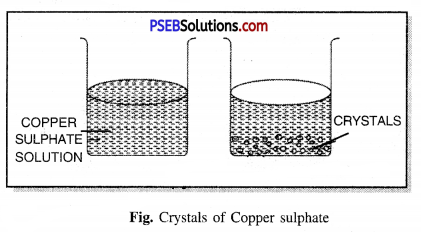
PSEB 7th Class Science Solutions Chapter 6 Physical and Chemical Changes 5
Method of making crystals of Copper Sulphate. Fill a beaker with water add a few drops of sulphuric acid. Heat it on a spirit lamp. When water starts boiling, add Copper sulphate powder slowly in it and keep stirring the solution. When the copper sulphate dissolves, add more copper sulphate powder until it does not dissolve any more powder. It is a saturated solution of Copper sulphate. Now leave this solution to cool. After a while you will see crystals of Copper sulphate formed. Filter it and keep the crystals to dry.

PSEB Solutions for Class 7 Science Physical and Chemical Changes Important Questions and Answers

1. Fill in the blanks:

(i) When carbondioxide is passed through lime water, it turns milky due to formation of ……………… .
Answer:
Calcium carbonate

(ii) The chemical name of baking soda is …………………
Answer:
Sodium bi-carbonate

(iii) Two methods by which rusting of iron can be prevented are ………………. and …………..
Answer:
Painting, galvanization

(iv) Changes in which only …………………. properties of a substance change are called physical
changes.
Answer:
physical

PSEB 7th Class Science Solutions Chapter 6 Physical and Chemical Changes

(v) Changes in which new substances are formed are called ………………… changes.
Answer:
chemical

2. Match the Column I with Column II:

Column I Column II
(i) Carbon dioxide (a) Temporary change
(ii) Chemical changes (b) Turns lime water milky
(iii) Burning of magnesium wire in air (c) Evaporation
(iv) Physical change (d) Chemical change
(v) Conversion of water to vapours. (e) Formation of new products

Answer:

Column I Column II
(i) Carbon dioxide (b) Turns lime water milky
(ii) Chemical changes (e) Formation of new products
(iii) Burning of magnesium wire in air (d) Chemical change
(iv) Physical change (a) Temporary change
(v) Conversion of water to vapours. (c) Evaporation

3. Choose the Correct Answer:

Question (i)
Rust is:
(a) Carbon dioxide
(b) Oxygen
(c) Iron
(d) Iron oxide
Answer:
(d) Iron oxide.

Question (ii)
Which of the following is not a physical transformation?
(a) Rusting of iron
(b) Melting of ice
(c) Dissolving sugar in water
(d) Freezing of water
Answer:
(a) Rusting of iron

Question (iii)
…………………. is a physical change.
(a) Rusting of iron
(b) Burning of magnesium ribbon
(c) Switching on light bulb
(d) None of these
Answer:
(c) Switching on light bulb.

Question (iv)
Whose crystals cannot be obtained?
(a) Sodium Chloride
(b) Copper Sulphate
(c) Carbon
(d) Iron sulphate
Answer:
(c) Carbon.

Question (v)
…………….. is the reaction of acid and alkali.
(a) Mixing
(b) Neutralisation
(c) Galvanization
(d) None
Answer:
(b) Neutralisation.

PSEB 7th Class Science Solutions Chapter 6 Physical and Chemical Changes

Question (vi)
The method of zinc coating on iron object is:
(a) Making alloys
(b) Neutralisation
(c) Galvanization
(d) Crystallization
Answer:
(c) Galvanization.

State True or False:

(i) Cutting a log of wood into pieces is a chemical change.
Answer:
False

(ii) Formation of manure from leaves is a physical change.
Answer:
False

(iii) Iron pieces coated with zinc do not get rusted easily.
Answer:
True

(iv) Iron and rust are the same substances.
Answer:
False

(v) Condensation of steam is not a chemical change.
Answer:
True

Very Short Answer Type Questions

Question 1.
Which type of change occurs when a rubber band is stretched ?
Answer:
Physical change.

Question 2.
Give an example of physical change caused due to air.
Answer:
Blowing a balloon.

PSEB 7th Class Science Solutions Chapter 6 Physical and Chemical Changes

Question 3.
What happens when a chemical change takes place ?
Answer:
New substance having new properties is formed.

Question 4.
What is rust ?
Answer:
Rust. It is a film of brownish iron oxide formed on iron articles due to moist air of the atmosphere.

Question 5.
What are two conditions necessary for rusting ?
Answer:
Presence of (i) air and (ii) water.

Question 6.
What happens when ash obtained from burning magnesium ribbon is dissolved in water ?
Answer:
Magnesium hydroxide is formed.

Question 7.
What is the nature of magnesium hydroxide ?
Answer:
It is basic in nature.

Question 8.
What is colour of copper sulphate solution ?
Answer:
Blue.

PSEB 7th Class Science Solutions Chapter 6 Physical and Chemical Changes

Question 9.
What happens when a nail is dipped in copper sulphate solution ?
Answer:
Blue colour of copper sulphate solution changes to green colour.

Question 10.
Which gas is formed when vinegar is mixed with baking soda ?
Answer:
Carbon dioxide gas.

Short Answer Type Questions

Question 1.
Classify the following as physical or chemical changes:
(i) Melting of glass.
(ii) Burning of agarbatti.
(iii) Tearing of cloth.
(iv) Formation of seed from flower.
(v) Cooking of food.
(vi) Formation of cloud.
Answer:
Physical changes. Melting of glass, Tearing of cloth, Formation of cloud.
Chemical changes. Burning of agarbatti, Formation of seed from flower, Cooking of food.

Question 2.
Write characteristics of a physical change.
Answer:
Characteristics of a physical change:

  1. The final products are similar to the original substances.
  2. No new substances are formed.
  3. This change is easily reversible.
  4. It is a temporary change.
  5. The energy evolved during this change is very low.
  6. The total mass of reactants as well as products remains same.

Question 3.
Give characteristics of chemical change.
Answer:
Characteristics of chemical change:

  • One or more new substances are formed.
  • It is a permanent change and cannot be reversed easily.
  • Energy change during chemical change is usually large.
  • Total mass of reactants and products remains constant during the change.

Question 4.
Why is burning magnesium ribbon a chemical change ?
Answer:
Burning of Magnesium ribbon. When magnesium ribbon is burned in air, it gives out white bright light and changes into white ash. Since ash (magnesium oxide) is a new substance having different properties. So, burning of magnesium ribbon is a chemical change.

PSEB 7th Class Science Solutions Chapter 6 Physical and Chemical Changes

Question 5.
Why dissolving sugar in water is a physical change ?
Answer:
Dissolution of sugar in water. When sugar crystals are stirred in water, a clear solution is obtained. It is a physical change on the following basis:

  1. No new substance is formed.
  2. Sugar can be recovered by the process of crystallization.
  3. The change is not accompained by heat.
  4. Mass of sugar solution is equal to mass of water and sugar crystals.

Question 6.
When baking soda is mixed with lemon juice, bubbles are formed with the evolution of gas. What type of a change is it ? Explain.
Answer:
When baking soda is mixed with lemon juice (a weak acid) then carbondioxide is evolved in the form of bubbles.
This change is an example of a chemical change.

Question 7.
Explain why burning of wood and cutting it into small pieces are considered as two different types of changes.
Answer:
Burning of wood is a chemical change as wood on burning produces gases and ash.
Cutting of wood into its pieces have same physical properties. It is therefore, a physical change.

Question 8.
Explain how painting of an iron gate prevents it from rusting.
Answer:
Prevention of iron gate from rusting by painting. Rusting occurs in the presence of both water and air. If a coat of paint is applied to iron gate, its contact with air is broken and rusting is prevented.

Question 9.
Explain why rusting of iron objects is faster in coastal areas than in deserts.
Answer:
Faster rusting in coastal areas. The presence of humid air in coastal areas increases the rate of rusting. But on the other hand in deserts, air is dry, which inhibits the rate of rusting of iron.

Long Answer Type Question

Question 1.
What is crystallization? How will you prepare crystals of alum?
Answer:
Crystallization. It is the process of separating a pure substance in the form of crystals having well defined, geometrical shape from its hot saturated solution by cooling. This process is very commonly used to purify solid substances.
To prepare crystals of alum
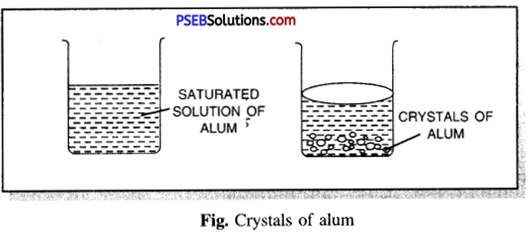
PSEB 7th Class Science Solutions Chapter 6 Physical and Chemical Changes 6
Take some distilled water in a beaker. Go on adding alum powder in installments slowly simultaneously with continuous stirring of the solution with a glass rod. Heat the beaker gently and try to dissolve more alum powder till it stops dissolving more alum powder. Filter the hot saturated solution in a glass beaker and allow it to cool. Observe the solution. Well-defined crystals of alum will be obtained after some time.

PSEB 8th Class Physical Education Solutions Chapter 1 First Aid

Punjab State Board PSEB 8th Class Physical Education Book Solutions Chapter 1 First Aid Textbook Exercise Questions and Answers.

PSEB Solutions for Class 8 Physical Education Chapter 1 First Aid

Physical Education Guide for Class 8 PSEB First Aid Textbook Questions and Answers

Question 1.
What is first aid?
Answer:
First Aid:
The aid given to the wounded or the patient till the doctor arrives or is approached is called First Aid. During play, players receive many wounds or cuts, and if they do not receive first aid timely, they may become crippled or handicapped for life. As such, it is very essential for Physical Education teachers and students to have knowledge of First Aid. They should be fully familiar with the symptoms and the principles of treatment of injuries received by players so that they may help the injured. Sometimes these injuries prove fatal when first aid is not available.

Importance:
In today’s world of science, human life is greatly influenced by technological advances, as a result of which many accidents occur. No wonder people continue to get injured or wounded. If the injured gets timely first aid, his life can be saved easily. The ways and means adopted to save the life of the injured or to lessen his pain before the doctor arrives or is approached constitute First Aid. Accidents can occur anywhere and anytime, at home and outside.

The first job in the First Aid is to prevent the flow of blood from the injury because excess of blood loss may prove to be fatal. Blood can flow from injuries received in different parts of the body. If timely and proper First Aid is available to the injured, problems which may crop up later can be avoided. The injured can be saved from untimely and sudden painful death by providing proper First Aid in time. In the treatment and cure of the injured, First Aid plays an important role.

PSEB 8th Class Physical Education Solutions Chapter 1 First Aid

Question 2.
What are the objectives of first aid?
Answer:
The objectives of first aid are as follows:

  • To carry the victim to a nearby hospital or a doctor at the earliest.
  • To promote recovery.
  • To prevent any further injury.
  • To save the life of the victim.

Question 3.
Which things can be included in a first aid box?
Answer:
The following things can be included in the first aid box:

  • Bandages: Triangular, round and warm.
  • Splints of different sizes.
  • Thermometer, forceps, scissors, torch and safety pins.
  • ORS sachets.
  • Lecoper or adhesive tape.
  • An inhaler.
  • A measuring beaker or glass.
  • A cotton packet.
  • Antiseptics, germicides, spirit, betadine, boric acid, soap, burnol, tincher iodine and dettol.
  • Sterilized cotton balls.

PSEB 8th Class Physical Education Solutions Chapter 1 First Aid

Question 4.
Write the rules of first aid.
Answer:
The rules of first aid are as follows:
1. Immediate Aid:
First Aid should be given to the injured at the earliest possible. There should be no hesitation or fear in providing First Aid because no time should be wasted in thinking. Immediate decisions have to be taken to save the life of the injured.

2. Artificial Respiration:
If a person is unconscious, and is not breathing, he should be given artificial respiration. A person suffering from heart attack can also be saved by artificial respiration.

3. Sympathetic Attitude:
The injured person gets extremely frightened. So a sympathetic attitude and good will prove to be very important. These are beneficial in removing the fear in the mind of the injured.

4. Prevention of bleeding:
The flow of blood from the injury should be stopped at the earliest as the excessive loss of blood may endanger the life of the injured.

5. Keeping the injured away from the crowd:
When a person gets involved in an accident, many people come and surround him from all sides. It prevents the flow of fresh air to the injured and the person also gets frightened and upset. So steps should be taken to keep the injured away from the crowd, and to provide First Aid at the earliest.

6. Immediate Medical Aid:
The Medical aid should be arranged for the injured immediately. No untrained person should be allowed to use hit and trial methods of treatment.

Question 5.
Who is a first aider?
Answer:
A person who has got a certified course of first aid training from an authentic organization is called a first aider.

PSEB 8th Class Physical Education Solutions Chapter 1 First Aid

Question 6.
Write the qualities of a first aider.
Answer:
The qualities of a first aider are as under-

  • A First Aider should be a person who seeks comfort and joy in serving others and who looks upon his job as his religious duty.
  • He/She should have the maximum knowledge of medical sciences, particularly the person should be quite well versed in Anatomy and Physiology.
  • He/She should be capable of understanding the nature of injury, and should be properly trained in First Aid.
  • He/She should be a person of genial nature and self-confidence.
  • He/She should be capable of understanding the mental state of the injured.
  • He/She should have patience, devotion and dedication.
  • He/She should be capable of giving First Aid in a very natural, affectionate manner.
  • He/She should be capable of encouraging the injured.
  • He/She should be familiar with all those points which are relevant in providing First Aid.
  • All necessary medicines should always be ready for use in his First Aid box.
  • A high academic qualification is not sufficient for a First Aider. He should have developed in him qualities of high moral character.

Question 7.
What do you know about (CPR)?
Answer:
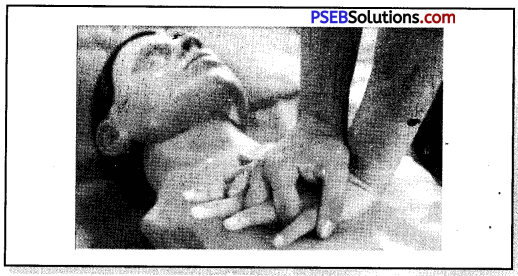
C.P.R. stands for Cardio Pulmonary Resuscitation.
If the pulse of the patient is not felt and the victim is unconscious, CPR methods should be used to restart his heartbeat and working of the lungs. Place the palms of your hands on the patient’s heart and press hard for about thirteen times. Then give mouth to mouth respiration twice. Repeat the procedure till the pulse of the victim is felt. If CRP is performed properly on time life of the victims can be saved.
PSEB 8th Class Physical Education Solutions Chapter 1 First Aid 1

C.P.R. should be given when:

  • The victim is unconscious.
  • Victim’s eyes are still.
  • The pulse of the victim is not felt.
  • There is no heart beat (Cardiac arrest).

C.P.R. should not to be performed:

  • If the victim is finding difficulty in breathing.
  • If the victim is suffering from a heart attack.

PSEB 8th Class Physical Education Solutions Chapter 1 First Aid

Question 8.
What do you know about mouth to mouth respiration?
Answer:
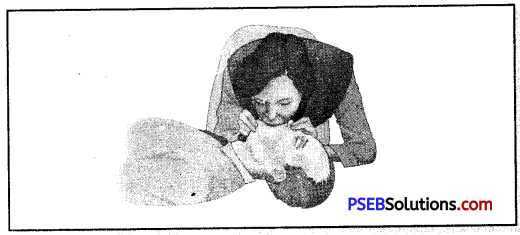
Mouth to Mouth Artificial Respiration:
The first aider puts his mouth on the mouth of the victim and gives artificial respiration till the victim’s chest fills up with air and swells up. This action should be repeated 12 to 16 times or until the victim starts breathing.
PSEB 8th Class Physical Education Solutions Chapter 1 First Aid 2
Steps involved in Mouth to Mouth Artificial Respiration are as follows:

  • Remove any blockage from the victim’s mouth.
  • Hold the victim’s chin with one hand and with the other hand close his nose tightly.
  • Finally, blow the breath forcefully into the victim’s mouth.

Question 9.
How artificial respiration can be given by using Schafer’s method? Explain.
Answer:
When a person is feeling difficulty in breathing then artificial breathing must be given to save his life. One of the methods, namely Schafer’s method is given below:

Schafer’s Method:
1. Position of the Patient:
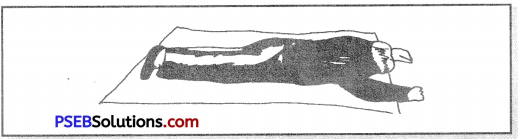
Lie down the patient on earth by his face and belly touching the earth. His arms must be above his head, palm facing downward. Turn his face towards one side and loosen his clothes. If patient is lying on prone position, change it or reverse it, lift his arms away from his body.

2. Position of the Operator:
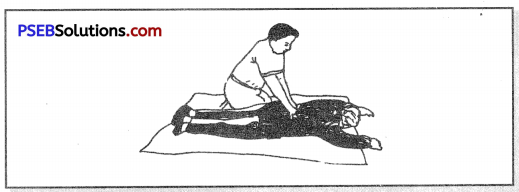
First Aider should sit beside the waist of the patient putting his knee on the floor. Heels must be little away, while sitting his face must be towards the head of the patient. After sitting, first aider should keep his hands on the back of the patient in a way that one hand will be on the backbone and other will be to its opposite. Wrist and thumb must be together, fingers towards earth, while keeping both arms straight.
PSEB 8th Class Physical Education Solutions Chapter 1 First Aid 3

3. Application of the Artificial Respiration:
First aider should put his body weight, while moving ahead, on the waist of the patient. By doing so the belly and other parts of the body of the patient would be pressed towards earth and from the centre diaphragm will also go down and the whole air of the lungs will be exhaled. These activities should be done within two seconds, after putting the weight on the patient for two seconds, the first aider will shift the weight on the toes slowly. The part of the belly would come back on original position and diaphragm will go down. Air wilkgo in the lungs. It should be performed within three seconds. Both activities must be executed within five seconds. It should be repeated twelve times within one minute. Artificial respiration must be continued till the patient starts
PSEB 8th Class Physical Education Solutions Chapter 1 First Aid 4

PSEB 8th Class Physical Education Guide First Aid Important Questions and Answers

Multiple Choice Questions

Question 1.
The objectives of First Aid:
(A) To take the patient to the near Hospital.
(B) To promote recovery.
(C) Prevent any further injury.
(D) To save the life of victim.
Answer:
(A) To take the patient to the near Hospital.
(B) To promote recovery.
(C) Prevent any further injury.
(D) To save the life of victim.

Question 2.
What the first aid box should contain?
(A) Thermometer, Scissors
(B) Torch
(C) Chimti
(D) None of them.
Answer:
(A) Thermometer, Scissors
(B) Torch
(C) Chimti

Question 3.
The rules of First Aid:
(A) Stop bleeding .
(B) Provide Artificial respiration
(C) Keeping the injured away from the crowd
(D) All above Mentioned.
Answer:
(D) All above Mentioned.

Question 4.
The Qualities of First Aider:
(A) He should have the maximum knowledge of medical science.
(B) He should be a person of genial nature and self confident.
(C) He should have patience, devotion and dedication.
(D) Above all.
Answer:
(D) Above all.

Question 5.
What is CPR?
(A) Cardio
(B) Pulmonary
(C) Resuscitation
(D) Above all.
Answer:
(D) Above all.

Question 6.
When CPR should be given:
(A) The victim is unconscious
(B) Victim’s eyes are still
(C) The pulse of the victim is not felt
(D) Above all.
Answers:
(D) Above all.

Very Short Answer Type Questions

Question 1.
If anybody falls ill then what will you do?
Answer:
After the check up for fever, it should be tried to slow down the temperature of the person suffering from fever, and then he should be brought to the doctor.

Question 2.
What should be the attitude of first aider?
Answer:
The attitude of a first aider should be polite and sympathetic.

Question 3.
What is the colour of the burnt spot?
Answer:
It is ugly red in colour.

Question 4.
Name the help which is rendered to a patient before the doctor visits.
Answer:
First Aid.

Question 5.
What is the aim of First Aid?
Answer:
To save the life of a patient before the doctor arrives at the site or the patient is taken to the hospital for treatment.

Question 6.
What types of duties a First Aider should perform till the doctor attends the patient?
Answer:
He should look after the patient continuously.

Question 7.
What will you do when a person becomes unconscious and feels difficult in respiration? (From Board M.QuestionP.)
Answer:
Artificial Respiration should be provided to the person.

Question 8.
Mention the first quality of a First Aider.
Answer:
He should be active and alert.

Question 9.
How many days a dog should be watched after his bite?
Answer:
10 days.

Question 10.
Name the two insects who bite.
Answer:
Honey bee and Mosquitoe.

Question 11.
How we should wash a burning part of our body?
Answer:
Soapy in touch or simple water should be used.

Question 12.
How we should wash when some acid caused burning?
Answer:
Dilute acid mixture should be used to wash the area under burns.

Question 13.
Name any three things which can be applied on bite.
Answer:
1. Spirit
2. Ammonium Carbonate
3. Washing Soda.

Question 14.
Write any one method of Artificial Respiration.
Answer:
Mouth to mouth artificial respiration.

Question 15.
The normal temperature of human body should be ……………..  .
Answer:
98.4°F.

Question 16.
Which number should be dialled for Ambulance service?
Answer:
108.

Short Answer Type Questions

Question 1.
What do you mean by First Aid?
Answer:
First Aid is the treatment provided to an ill or injured person at the spot according to the rules before the arrival of a doctor.

Question 2.
Write any two objectives of First Aid.
Answer:
1. To save the life of injured person before the arrival of a doctor.
2. To promote recovery.

Question 3.
Write any two rules of First Aid.
Answer:
1. Try to control bleeding from the deep wounds.
2. Do not allow the people to gather around the injured. The victim may feel uneasy as he will not get fresh air.

Question 4.
Who is a first aider?
Answer:
A person who has got a certificate course of first aid training from an authentic organisation is called a first aider.

Question 5.
Write any four rules of a first aider.
Answer:

  • A first aider should start first aid immediately with full confidence.
  • First aider should be experienced.
  • First Aider should take quick decision and act wisely.
  • A first aider should be calm. He should not become impatient.

Question 6.
What does C.P.R. stands for?
Answer:
C.P.R. stands for Cardio Pulmonary Resuscitation.

PSEB 9th Class Computer Solutions Chapter 1 MS Excel Part-I

Punjab State Board PSEB 9th Class Computer Book Solutions Chapter 1 MS Excel Part-I Textbook Exercise Questions and Answers.

PSEB Solutions for Class 9 Computer Science Chapter 1 MS Excel Part-I

Computer Guide for Class 9 PSEB MS Excel Part-I Textbook Questions and Answers

1. Fill in the Blanks

1. An Excel Workbook consists of ………………………
(a) Worksheets
(b) Rows
(c) Columns
(d) Formulas
Answer:
Worksheets

2. The actual value of a cell is displayed in …………………….. bar.
(a) Title
(b) Menu
(c) Formula
(d) None of these
Answer:
Formula

3. …………………….. Formatting applies one or more rules to any cells you want.
(a) Formula
(b) Function
(c) Conditional
(d) None of these
Answer:
Conditional

4. Format Command is available on ………………… Tab.
(a) Home
(b) Insert
(c) Data
(d) Formulas
Answer:
Home

5. All Formulas must begin with an ………………………… sign.
(a) Sigma
(b) Plus
(c) Equal
(d) None of these
Answer:
Equal

6. A data in your worksheet can be arranged in an order using ………………………
(a) Formula
(b) Function
(c) Filter
(d) Sorting
Answer:
Sorting

7. Sort & Filter command is available on ……………………Tab.
(a) Home
(b) Insert
(c) Data
(d) Formulas
Answer:
Data

PSEB 9th Class Computer Solutions Chapter 1 MS Excel Part-I

2. Short Answer Type Questions

Question 1.
What is Formatting?
Answer:
Formats are changes that are made to Excel worksheets in order to enhance their appearance and/or to focus attention on specific data in the worksheet. Formatting changes the appearance of data but does not change the actual data in the cell, which can be important if that data is used in calculations. For example, formatting numbers to display only two decimal places does not shorten or round values with more than two decimal places. To actually alter the numbers in this way, the data would need to be rounded using one of Excel’s rounding functions.

Question 2.
Define Number Format in Excel.
Answer:
By applying different number formats, you can change the appearance of a number without changing the number itself. A number format does not affect the actual cell value that Excel uses to perform calculations. The actual value is displayed in the formula bar. By applying different number formats, you can display numbers as percentages, dates, currency, and so on.

Question 3.
What are the standard operators used in simple formulas?
Answer:
Excel uses standard operators for formulas, such as a plus sign for addition (+), a minus sign for subtraction (-), an asterisk for multiplication (*), a forward slash for division (/), and a caret (Λ) for exponents.
PSEB 9th Class Computer Solutions Chapter 1 MS Excel Part-I Img 1
All formulas in Excel must begin with an equals sign (=). This is because the cell contains, or is equal to, the formula and the value it calculates.

Question 4.
What is a cell reference?
Answer:
A cell reference refers to a cell or a range of cells on a worksheet and can be used in a formula so that Microsoft Office Excel can find the values or data that you want that formula to calculate.
In one or several formulas, you can use a cell reference to refer to :

  • Data from one cell on the worksheet.
  • Data is contained in different areas of a worksheet.
  • Data in cells on other worksheets in the same workbook.

PSEB 9th Class Computer Solutions Chapter 1 MS Excel Part-I

Question 5.
What are the parts of a Function?
Answer:
The order in which you insert a function is important. Each function has a specific order—called syntax — which must be followed in order for the function to work correctly. The basic syntax to create a formula with a function is to insert an equals sign (=), function name (SUM, for example, is the function name for addition), and argument. Arguments contain the information you want the formula to calculate, such as a range of cell references.
PSEB 9th Class Computer Solutions Chapter 1 MS Excel Part-I Img 2

Question 6.
Define Sorting.
Answer:
Sorting is a common spreadsheet task that allows you to easily reorder your data. The most common type of sorting is alphabetical ordering, which you can do in ascending or descending order.
To sort in alphabetical order :

  • Select a cell in the column you want to sort (In this example, we choose a cell in column A).
  • Click the Sort & Filter command in the Editing group on the Home tab.
  • Select Sort A fo Z. NOWT the information in the Category column is organized in alphabetical order.

PSEB 9th Class Computer Solutions Chapter 1 MS Excel Part-I Img 3

You can sort in reverse alphabetical order by choosing Sort Z to A in the list.

Question 7.
Define Filter.
Answer:
The basic Excel filter (also known as the Excel Autofilter) allows you to view specific rows in an Excel spreadsheet while hiding the other rows in the worksheet. When a filter is added to the header row of a spreadsheet, a drop-down menu appears on each cell of the header row. This provides you with a number of filter options that can be used to specify which rows of the spreadsheet are to be displayed.

PSEB 9th Class Computer Solutions Chapter 1 MS Excel Part-I

3. Long Answer Type Questions

Question 1.
What are Merge and Centre? Write down the steps to merge a group of cells.
Answer:
If you go to the Home menu in the ribbon and look in the Alignment grouping of commands, you will see a small icon in the lower, right-hand corner called Merge and Center. This command does just what it implies. It not only merges the cells into one larger cell, but it also centers the text. Merge and Center improves the appearance of a title or header by centering the text over a particular section of the spreadsheet. If you click on the More icon to the Merge and Center command, you will see other Merge options.

  • The first one is Merge Across. This will merge multiple cells and more than one row at the same time. The text will remain left-justified.
  • Then there are Merge Cells. This will merge multiple cells on one row and will keep the text left-justified.
  • Finally, you have Unmerge Cells, which will undo the merged cells.

Let’s take a look at an example using the Merge and Center command. Imagine you are a painting contractor for residential homes. You created a spreadsheet to include several different costs for work requested by a new client. You have everything formatted nicely. The title, which includes the name of the client, the estimated number, and street address has been entered into cell Al. It would be nice if we could quickly and easily center the title across the top of the spreadsheet. Here are the steps.

  1. Highlight the cells you want to merge. (In our example, Al through FI),
  2. Go to the Home menu in the ribbon.
  3. Look in the Alignment grouping of commands.
  4. Click on Merge and Center.

Just like that, your title is centered and the cells have been merged into one larger cell. The benefit? Well, besides it looks better, you can make changes to the cells below and the title will remain centered: For instance, you can add a column (or delete one) and your title will not be affected. One important note about the Merge command: merging cells can delete data. Only the data in the upper-left cell will be kept once the cells have merged. Do not place data in every cell if you plan on merging multiple cells into one larger cell.

Question 2.
What is Conditional Formatting? Write down the steps to create a conditional formatting rule.
Answer:
Conditional formatting in Excel enables you to highlight cells with a certain color, depending on the cell’s value.
Highlight Cells Rules
To highlight cells that are greater than a value, execute the following steps.
1. Select the range A1:A10.
PSEB 9th Class Computer Solutions Chapter 1 MS Excel Part-I Img 4

2. On the Home tab, click Conditional Formatting, Highlight Cells Rules, Greater Than…
PSEB 9th Class Computer Solutions Chapter 1 MS Excel Part-I Img 5

3. Enter the value 80 and select a formatting style.
PSEB 9th Class Computer Solutions Chapter 1 MS Excel Part-I Img 6

4. Click OK.
Result. Excel highlights the cells that are greater than 80.
PSEB 9th Class Computer Solutions Chapter 1 MS Excel Part-I Img 7

5. Change the value of cell A1 to 81.
Result. Excel changes the format of cell A1 automatically.
PSEB 9th Class Computer Solutions Chapter 1 MS Excel Part-I Img 8

Question 3.
What is a cell? How can we insert a new cell in our current worksheet?
Answer:
A cell is an intersection between a row and a column on a spreadsheet that starts with cell Al. Below is an illustrated example of a highlighted cell in Microsoft Excel; the cell address, cell name, or cell pointer “D8” (column D, row 8) is the selected cell and the location of what is being modified.
Insert Cells into an Excel Worksheet
Having to insert extra cells to an Excel worksheet from time to time is a common practice: data gets forgotten and must be added, space must be made for new data, or existing data gets moved about when the sheet is reorganized.
Whatever the reason, there is, as is the case with all Microsoft programs, more than one way to accomplish the task of inserting cells to an Excel worksheet.
PSEB 9th Class Computer Solutions Chapter 1 MS Excel Part-I Img 9

Question 4.
What is a Formula? Write down the steps to create a simple Formula in Excel.
Answer:
A formula is an expression that calculates the value of a cell. Functions are predefined formulas and are already available in Excel. For example, cell A3 below contains a formula that adds the value of cell A2 to the value of cell A1.
PSEB 9th Class Computer Solutions Chapter 1 MS Excel Part-I Img 10

Steps to create a simple formula in MS Excel
You can create a simple formula to add, subtract, multiply or divide values in your worksheet. Simple formulas always start with an equal sign (=), followed by constants that are numeric values and calculation operators such as plus (+), minus (-), an asterisk(*), or forward-slash (/) signs.
For example, when you enter the formula =5+2*3, Excel multiplies the last two numbers and adds the first number to the result. Following the standard order of mathematical operations, multiplication is performed before addition.

  1. On the worksheet, click the cell in which you want to enter the formula.
  2. Type the = (equal sign) followed by the constants and operators that you want to use in the calculation.

You can enter as many constants and operators in a formula as you need, up to 8192 characters.

PSEB 9th Class Computer Solutions Chapter 1 MS Excel Part-I

Question 5.
What is a Function? Write down the steps to create a basic Function in Excel.
Answer:
In Excel, a function is a preset formula used for calculations. Like formulas, functions begin with the equal sign ( = ) followed by the function’s name and its arguments. The function name tells Excel what calculation to perform. The arguments are contained inside round brackets. For example, the most used function in Excel is the function, which is used to add together the data in selected cells.

The SUM function is written as –
= SUM (D1: D6 )
Here the function adds the contents of cell range D1 to D6 and displays the answer in cell D7.

The parts of a function :
The order in which you insert a function is important. Each function has a specific order called syntax—which must be followed in order for the function to work correctly. The basic syntax to create a formula with a function is to insert an equals sign (=), function name (SUM, for example, is the function name for addition), and argument. Arguments contain the information you want the formula to calculate, such as a range of cell references.
PSEB 9th Class Computer Solutions Chapter 1 MS Excel Part-I Img 11

PSEB 9th Class Computer Guide MS Excel Part-I Important Questions and Answers

Fill in the Blanks

1. Format Cell window contains …………………… Labs.
(a) 5
(b) 6
(c) 7
(d) 8
Answer:
(b) 6

2. Excel has ……………………. Number formats.
(a) 6
(b) 8
(c) 10
(d) 12
Answer:
(d) 12

3. Insert/Delete dialog box has ………………. options.
(a) 4
(b) 5
(c) 6
(d) 7
Answer:
(a) 4

4. Workbook contains sheets by default.
(a) 2
(b) 3
(c) 4
(d) 5
Answer:
(b) 3

5. Arranged data in ascending or descending order is called …………………
(a) Formatting
(b) Splitting
(c) Sorting
(d) Replacing
Answer:
(c) Sorting

6. Cell address used in the formula is called ……………………………………..
(a) Function
(b) Formula
(c) Address
(d) Reference
Answer:
(d) Reference

Short Answer Type Questions

Question 1.
What is Microsoft Excel?
Answer:
Microsoft Excel is an electronic worksheet developed by Microsoft, to be used for organizing, storing, and manipulating.

Question 2.
What is a ribbon?
Answer:
The ribbon runs on the top of the application and is the replacement for the toolbars and menus. The ribbons have various tabs on the top, and each tab has its own group of commands.

Question 3.
How can I hide or show the ribbon?
Answer:
Use the CTRL and FI key to toggle & show or hide the ribbon.

PSEB 9th Class Computer Solutions Chapter 1 MS Excel Part-I

Question 4.
How can you wrap the text within a cell?
Answer:
You have to select the text you want to wrap, and then click wrap text from the home tab and you can wrap the text within a cell.
PSEB 9th Class Computer Solutions Chapter 1 MS Excel Part-I Img 12

Question 5.
Is it possible to prevent someone from copying the cell from your worksheet?
Answer:
Yes, it is possible. In order to protect your worksheet from getting copied, you need to go into Menu bar >Review > Protect sheet > Password. By entering the password, you can secure your worksheet from getting copied by others.

PSEB 9th Class Computer Solutions Chapter 1 MS Excel Part-I

Question 6.
How you can sum up the Roi4p and Column number quickly in the excel sheet?
Answer:
By using the SUM function you can get the total sum of the rows arid columns, in an excel worksheet.

Question 7.
How you can add a new excel worksheet?
Answer:
To add a new Excel worksheet you have to insert a worksheet tab at the bottom of the screen.

Question 8.
How you can resize the column?
Answer:
To resize the column you have to change the width of one column and then drag the boundary on the right side of the column heading to the width you want. The other way of doing it is to select the Format from the home tab, and in Format, you have to select AUTOFIT COLUMN WIDTH under the cell section. On clicking on this the cell size will get formatted.

Question 9.
What are three report formats that are available in Excel?
Answer:
The three report formats in Excel are :

  • Compact
  • Report
  • Tabular

Question 10.
How would, you provide a Dynamic range in the “Data Source” of Pivot Tables?
Answer:
To provide a dynamic range in the “Data Source” of Pivot tables, first, create a named range using offset function and base the pivot table using a named range created in the first step.

Question 11.
Is it possible to make a Pivot table using multiple sources of data?
Answer:
If the multiple sources are different worksheets, from the same workbook/then it is possible to make a Pivot table using multiple sources of data.

Long Answer Type Questions

Question 1.
How do you create formulas in Excel?
Answer:
Create a simple formula in Excel with constants and calculation operators.
To create a simple calculation, click the cell in which you wish to enter the formula and type an equal sign. Enter the constants and operators that you wish to use in the calculation within the cell. Use the plus sign for addition, a minus sign for subtraction, the backslash for division, and the asterisk for multiplication. For instance, to add ten and ten in a cell, enter “=10+10” within the desired cell and press the Enter key.

PSEB 9th Class Computer Solutions Chapter 1 MS Excel Part-I

Question 2.
Write the various steps for inserting a single cell into a worksheet.
Ans. The first example will insert a single cell to column A in order to make room for the month of March. To do this April will be shifted downward to cell A4.

  1. Click on cell A3 to make it the active cell
  2. Right-click on cell A3 to open the right-click menu
  3. Click on Insert in the right-click menu to open the Insert cells dialog box
  4. Click on the Shift cells down option in the dialog box
  5. Click OK to add the one cell to the worksheet and to close the dialog box
  6. Cell A3 should now be blank and April should be located in cell A4
  7. Type March into cell A3

Question 3.
Write the various steps for inserting multiple cells into a worksheet.
Answer:
The second example will insert two additional cells to row two in order to make room for February and June in cells A2 and B2. In the process, October will be shifted to cell C3.

  1. Drag select cells A2 and B2 in the worksheet to highlight them
  2. Right-click on cells B2 to open the right-click menu
  3. Click on Insert in the right-click menu to open the Insert cells dialog box
  4. Click on the Shift cells right option in the dialog box
  5. Click OK to add the two cells to the worksheet and to close the dialog box
  6. Cells A2 and B2 should now be blank and October should be located in cell C3
  7. Type February into cell A2 and June into cell B2.

Question 4.
Discuss the cell reference in Excel.
Answer:
For many spreadsheets, you won’t want to go back to the original formula to change all the information you’re working with. This is where cell references come in handy. By entering a reference to another cell on the worksheet, you can tell the formula to work its calculation with whatever number is placed in that cell. The formula can then be changed quickly by trying out different numbers in the reference cell.

To reference a cell, simply enter the location of the call as designated by its column and row; for example, A1 is the cell in the top left corner of the spreadsheet. To reference a cell on another worksheet within the same workbook, type the name of the worksheet followed by an exclamation point, then the location of the cell. So Sheet !A1 would refer to the A1 cell on the worksheet titled “Sheet.” If you want to reference a range of cells, use a colon between the first and last cell of the range. The formula =SUM(A1:A12) will calculate the total sum of all the figures in the range from A1 down to A12.

Question 5.
Demonstrate the use of AutoSum in Excel.
Answer:
Using AutoSum to select common functions
The AutoSum command allows you to automatically return the results for a range of cells for common functions like SUM and AVERAGE.

  1. Select the cell where the answer will appear (E24, for example).
  2. Click the Home tab.
  3. In the Editing group, click the AutoSum drop-down arrow and select the function you want (Average, for example).

PSEB 8th Class Science Solutions Chapter 9 Reproduction in Animals

Punjab State Board PSEB 8th Class Science Book Solutions Chapter 9 Reproduction in Animals Textbook Exercise Questions and Answers.

PSEB Solutions for Class 8 Science Chapter 9 Reproduction in Animals

PSEB 8th Class Science Guide Reproduction in Animals Textbook Questions and Answers

Exercises

Question 1.
Explain the importance of reproduction in organisms.
Answer:
Importance of Reproduction.
It is the ability of living organism to produce the youngones of its own kind. Reproduction helps to increase the population of species. It is an important biological process for existence and continuity of a species. It also involves the transmission of genetic material from parents to offsprings.

Question 2.
Describe the process of fertilization in human beings.
Answer:
Fertilization.
The testes produce the male gametes called sperms. Millions of sperms are produced by the testes. Though sperms are very small in size, each has a head, a middle piece and a tail.
PSEB 8th Class Science Solutions Chapter 9 Reproduction in Animals 1
The first step in the process of reproduction is the fusion of a sperm and an ovum or an egg. Millions of sperms from the male are transferred into female body. The sperms swim in the oviduct with the help of their tails to reach egg. When they come in contact with the egg,- one of the sperms may fuse with the egg. Such fusion of the egg and the sperm is called fertilization. During fertilization, the nuclei of the sperm and the egg fuse to form a single nucleus which result in the formation of a fertilized egg called zygote. Zygote is the beginning of a new individual.
PSEB 8th Class Science Solutions Chapter 9 Reproduction in Animals 2
The process of fertilization is the meeting of an egg cell from the mother and a sperm cell from the father. So the new individual inherits some characteristics from the mother and some from the father.

PSEB 8th Class Science Solutions Chapter 9 Reproduction in Animals

Question 3.
Choose the most appropriate answer.
(a) Internal fertilization occurs:
(i) in female body.
(ii) outside female body.
(iii) in male body.
(iv) outside male body.
Answer:
(i) In female body.

(b) A tadpole develops into an adult frog by the process of:
(i) fertilization
(ii) metamorphosis
(iii) embedding
(iv) budding.
Answer:
(ii) metamorphosis.

(c) The number of nuclei present in a zygote is
(i) none
(ii) one
(iii) two
(iv) four.
Answer:
(ii) one

Question 4.
Indicate whether the following statements are True [T] or False [F]:
(a) Oviparous animals give birth to young ones.
Answer:
False

(b) Each sperm is a single cell.
Answer:
True

(c) External fertilization takes place in frog.
Answer:
True

(d) A new human individual develops from a cell called gamete.
Answer:
False

(e) Egg laid after fertilization is made up of a single cell.
Answer:
True

(f) Amoeba reproduces by budding.
Answer:
False

(g) Fertilization is necessary event in asexual reproduction.
Answer:
False

(h) Binary fission is a method of asexual reproduction.
Answer:
True

(i) A zygote is formed as a result of fertilization.
Answer:
True

(j) An embryo is made up of a single cell.
Answer:
False

Question 5.
Give two differences between a zygote and a foetus.
Answer:
Differences between a zygote and a foetus

Zygote Foetus
1. The fusion of sperm and egg is called a zygote. 1. The stage of embryo in which cell body parts are identifiable is called foetus.
2. It is single celled structure. 2. It is a multicellular structure.

Question 6.
Define asexual reproduction. Describe two methods of asexual reproduction in animals.
Answer:
Asexual Reproduction.
The type reproduction in which only a single parent is involved is called asexual reproduction.

Methods of asexual reproduction in animals
1. Binary Fission.
Binary fission involves an equal or nearly equal longitudinal or transverse splitting of the body of the parents into two parts each of which grows to parental size and form. This method of reproduction occurs regularly among protozoa (Amoeba, Paramecium etc.) in which it is essentially the process of cell division which results in the complete separation of the daughter cells. It has also been observed among multicellular animals as an sea anemones in the form of longitudinal fission or as transverse fission among planarians.
PSEB 8th Class Science Solutions Chapter 9 Reproduction in Animals 2

2. Budding.
Budding is a form of asexual reproduction in which new individual arises from a relatively small mass of cells that initially forms a bud on the parental body. The bud may assume parental form either before separation from the body of the parent as in external budding or after separation as in internal budding. External budding is common among sponges, coelenterates (e.g. Hydra), flatworms and tunicates. But in some coelenterate as in Obelia, it gives rise to medusae rather than to the parental.
PSEB 8th Class Science Solutions Chapter 9 Reproduction in Animals 4

Question 7.
In which female reproductive organ does embryo get embedded ?
Answer:
Uterus (Uterine wall).

PSEB 8th Class Science Solutions Chapter 9 Reproduction in Animals

Question 8.
What is metamorphosis ? Give examples.
Answer:
Metamorphosis. The drastic changes that take place during the development of an animal is called metamorphosis.
PSEB 8th Class Science Solutions Chapter 9 Reproduction in Animals 5
In the above figure, we see the different stages of development of frog. We find three distinct stages –
(i) Egg (ii) tadpole larva (iii) adult frog.
We see that tadpole larva is totally different from its adults.
Tadpole has gills for respiration because it lives outside the water. The sudden changes come in the body of tadpole like gills are replaced lungs. These sudden changes are called metamorphosis.
Example of animals in which metamorphosis take place are : Frog, silkworm.

Question 9.
Differentiate between internal fertilization and external fertilization.
Answer:
Differences between external fertilization and internal fertilization

External fertilization Internal fertilization
1. The fusion of male gamete (sperm) and female gamete (ovum) occurs outside the body. 1. The fusion of gametes occurs inside the body.
2. Both individuals discharge their gametes outside the body. 2. Only the male discharge gametes into genital tract of female.
3. Development occurs outside the body. 3. Development may occur inside the body.
4. Example : Frog. 4. Example : Human, cattle, shark, birds.

Question 10.
Complete the crossword puzzle using the hints given below.
Across
1. The process of the fusion of the gametes.
6. The type of fertilization in hen.
7. The term used for bulges observed on the sides of the body of Hydra.
8. Eggs are produced here.

Down
2. Sperms are produced in these male reproductive organs.
3. Another term for the fertilized egg.
4. These animals lay eggs.
5. A type of fission in amoeba.
PSEB 8th Class Science Solutions Chapter 9 Reproduction in Animals 6
Answer:
PSEB 8th Class Science Solutions Chapter 9 Reproduction in Animals 7

PSEB Solutions for Class 8 Science Reproduction in Animals Important Questions and Answers

Multiple Choice Questions

Question 1.
A hydra on fission produces two or more hydra. What is this type of asexual reproduction called ?
(a) Budding
(b) Binary Fission
(c) Vegetative reproduction
(d) Gamete.
Answer:
(a) Budding.

Question 2.
The following diagram is of which organism ?
PSEB 8th Class Science Solutions Chapter 9 Reproduction in Animals 8
(a) Amoeba
(6) Paramecium
(c) Hydra
(d) Frog
Answer:
(c) Hydra.

PSEB 8th Class Science Solutions Chapter 9 Reproduction in Animals

Question 3.
The following diagram shows the life cycle of which organism ?
PSEB 8th Class Science Solutions Chapter 9 Reproduction in Animals 9
Answer:
Life cycle of a frog.

Question 4.
The following Diagram shows which process of asexual reproduction of amoeba ?
PSEB 8th Class Science Solutions Chapter 9 Reproduction in Animals 10
(a) Budding
(b) Binary fission
(c) Asexual reproduction
(cl) None of these.
Answer:
(b) Binary fission

Question 5.
Female gamete is called:
(a) Sperm
(b) Egg
(c) Zygote
(d) Fertilization
Answer:
(b) Egg.

Question 6.
An amoeba on fission produces two amoeba. What type of asexual reproduction is this ?
(a) Budding
(b) Binary fission
(c) Gametes
(d) Vegetative reproduction.
Answer:
(b) Binary fission.

Question 7.
Internal fertilization is:
(a) Inside the body of female
(b) Outside the body of female
(c) Inside the body of male
(d) Outside the body of male.
Answer:
(a) Inside the body of female.

Question 8.
By which process one tadpol is developed into adult ?
(a) Fertilization
(b) Metamorphosis
(c) Stagnation
(d) Budding.
Answer:
(b) Metamorphosis.

Question 9.
The number of nucleus found in gamete is:
(a) None
(b) One
(c) Two
(d) Four
Answer:
(b) One.

PSEB 8th Class Science Solutions Chapter 9 Reproduction in Animals

Very Short Answer Type Questions

Question 1.
Fill in the blanks:
1. The process of ……………… ensures continuity of life on earth.
2. The male and female gametes in the flower are called ………………. and ………………… respectively.
3. In ……………….. reproduction, one individual can make many new individuals from its body parts.
4. ………………….. grow throughout life, but ………………… grow only upto a certain age.
5. A multicellular animal starts its life from a ……………………. through sexual reproduction.
Answer:
1. reproduction
2. pollen, egg
3. asexual (vegetative)
4. plants, animals
5. zygote.

Question 2.
Which part of the body:
(a) produces sperms ?
(b) produces ova ?
(c) passes sperms from a man to a woman ?
Answer:
(a) Testis
(b) Ovaries
(c) Penis.

Question 3.
How many methods of reproduction are there in the plants and animals ?
Answer:
Two:

  1. asexual
  2. sexual.

Question 4.
How many parents are needed in asexual reproduction ?
Answer:
Only one parent is needed in asexual reproduction.

Question 5.
How many parents are needed in sexual reproduction ?
Answer:
Two parents are needed in sexual reproduction.

Question 6.
What are the specialised cells present in the sex organs ?
Answer:
Gametes.

Question 7.
Name two animals which reproduce by binary fission.
Answer:

  1. Amoeba
  2. Paramecium.

Question 8.
In which organisms do the buds remain attached to the parent organisms ?
Answer:
Sponges, Corals.

PSEB 8th Class Science Solutions Chapter 9 Reproduction in Animals

Question 9.
What is zygote ?
Answer:
Zygote. Zygote is the first structure formed after union of sperm and egg.

Question 10.
What is fertilization ?
Answer:
The fusion of male gamete and female gamete is known as fertilization.

Question 11.
Which is the larger-sperm or ovum ?
Answer:
Ovum or egg.

Question 12.
Name two hermaphrodites.
Answer:

  1. Earthworm
  2. Leech.

Question 13.
Name two animals in which fertilization is external.
Answer:

  1. Frog
  2. Fish.

Question 14.
Define metamorphosis.
Answer:
Metamorphosis. The drastic changes which transform a larva into an adult is called metamorphosis.

Question 15.
What is gonad ? Name the male and female gonads of human body.
Answer:
Gonad.
The reproductive organ that produces special sex cells called gametes, is called gonad.
Male gonad. The male gonad testis produces male gametes, called sperms.
Female gonad. It is the ovary and produces female gametes called ova.

Question 16.
Name the male and female gametes of man.
Answer:
Male gamete – Sperm : Female gamete – Ovum.

PSEB 8th Class Science Solutions Chapter 9 Reproduction in Animals

Question 17.
Give one example each of animal showing external fertilization and another of internal fertilization.
Answer:
External fertilization – Frog;
Internal Fertilization – Human.

Question 18.
What is the function of sperm duct ?
Answer:
Sperm duct (vas deferens). It conducts sperms from testes to urethra.

Question 19.
What is hymen ?
Answer:
Hymen. In the case of virgins at the orifice of vagina present a thin membranous diaphragm called hymen. It is perforated to pass menstrual discharge.

Question 20.
In which type of asexual reproduction takes place in Hydra ?
Answer:
Budding.

Question 21.
Define cloning.
Answer:
Cloning. It is the production of an identical cell, any other part, or a complete organism.

Question 22.
Name the sheep which was cloned successfully by Ian Wilmont at the Roslin Institute in Edenburgh, Scotland.
Answer:
Dolly sheep.

Question 23.
Name the first mammal to be cloned.
Answer:
A sheep named Dolly which was born on 5th July, 1996.

PSEB 8th Class Science Solutions Chapter 9 Reproduction in Animals

Question 24.
What is reproduction ?
Answer:
Reproduction. To produce young ones of their own kind is called reproduction.

Question 25.
What is the function of tail of sperm in man ?
Answer:
For movement.

Question 26.
What is ovulation ?
Answer:
Production of eggs from the ovaries is called ovulation.

Question 27.
What is a test tube baby ?
Answer:
The babies produced by an artificial fertilization outside the body are called test tube babies.

Question 28.
Give full form of I.V.F.
Answer:
Invitro fertilization.

Question 29.
Where does test tube baby develops ?
Answer:
In uterus.

Question 30.
What are oviparons animals ?
Answer:
Egg laying animals are called oviparous animals.

PSEB 8th Class Science Solutions Chapter 9 Reproduction in Animals

Question 31.
What are viviparous animals ?
Answer:
Young ones producing animals are called viviparous animals.

Short Answer Type Questions

Question 1.
What is the difference between sexual reproduction and asexual reproduction ?
Answer:
Differences between Asexual and Sexual reproduction:

Asexual reproduction Sexual reproduction
1. New individuals are formed from a single parent. 1. Two parents are involved in the formation of new individual.
2. It does not require the production of sex organs. 2. Sex organs are pre-requisite for it.
3. It does not involve meiosis. 3. It involves meiosis at one or the other stage.
4. It does not involve fusion of cells. 4. It involves formation and fusion of gametes.
5. New individual develops from one cell. 5. New individual develops from fusion product of two gametes.
6. New individuals are genetically similar to the parents. 6. New individuals are generally different from either of the two parents.
7. It does not introduce variability. 7. It introduces variability.

Question 2.
What is sexual reproduction ? Discuss sexual reproduction in animals.
Answer:
Sexual reproduction.
Union of male and female individuals to accomplish fertilization is called sexual reproduction.

Sexual reproduction in animals.
In sexual reproduction, there are two parents. The parents have sex organs which produce sex cells. Females produce eggs while males produce sperms. Sperms are produced by sex organs called testes. Female sex cells are called eggs or ova (singular ovum). Ova are produced by sex organ called ovaries. A sperm enters an egg. This is called fertilization. A fertilized egg divides many times. The cells develops into an embryo which later develops into an adult.

Question 3.
What are the organs in human beings which produce the gametes ?
Answer:
The male organs in human beings are a pair of testis. The female organs in human beings are a pair of ovaries.

Question 4.
Name two organisms which produce by two types of asexual methods. What are the methods ?
Answer:
PSEB 8th Class Science Solutions Chapter 9 Reproduction in Animals 11

Question 5.
What are gametes ? What is the difference between the unisexual and hermaphrodite ?
Answer:
Gametes.
Gametes are the reproductive cells which are produced by the sex organs of the body. There are two types of gametes-male and female. Due to the union of gametes, fertilization takes place.

Unisexual organism are those which have only one kind of sex organs either male or female.
Hermaphrodite are those organisms which have both kinds of sex organs.

PSEB 8th Class Science Solutions Chapter 9 Reproduction in Animals

Question 6.
What is hermaphrodite ? Give two examples.
Answer:
The organisms which can produce both the male and female gamete are called hermaphrodites or bisexual. Examples:

  1. Earthworm
  2. Hydra.

Question 7.
In how many ways can a tissue grow in size ?
Answer:
Growth means getting bigger in size. The tissue can grow in size by:

  1. Increasing the size of the cells.
  2. Increasing the number of cells.

Question 8.
What are the basic features in the process of asexual reproduction ?
Answer:
Basic features of asexual reproduction

  1. Only one parent is involved.
  2. All the cell divisions are mitotic.
  3. All the offsprings are genetically similar to the parent.
  4. The reproductive unit is a fragment or specialised part of the parent.

Question 9.
How is process of binary fission different from budding ?
Answer:
Differences between binary fission and budding

Binary Budding
1. Only two young ones are formed. 1. Large number of buds may be formed, each growing into new individual.
2. Example : Amoeba, Euglena. 2. Examples : Sponges, Hydra.

Question 10.
Define ovulation.
Answer:
Ovulation.
Release of ovum (unfertilized egg) from the ovary is called ovulation. Egg is released on 14th day of 28-day menstrual cycle.

Question 11.
What is reproduction ? What are its basic types ?
Answer:
Reproduction.
All organisms born on this earth show characteristics life cycle, involving birth, growth, maturation, reproduction and death. Reproduction is one of the most important processes by which continuation of the species from one generation to another generation can take place. Older and aged organisms are replaced by new and younger organisms by reproduction. There are two basic types of reproduction. Reproduction is of two types:
A. Asexual reproduction
B. Sexual reproduction.

Question 12.
Name the various organs of male reproductive system in man.
Answer:
Male reproductive organs of man

  1. A pair of testes
  2. A pair of epididymis
  3. A pair of vas deferentia
  4. A pair of seminal vesicles
  5. Urethra
  6. Penis
  7. Male reproductive glands
    (Cowper’s gland and prostate gland).

PSEB 8th Class Science Solutions Chapter 9 Reproduction in Animals

Question 13.
Name the various organs of female reproductive system.
Answer:
Female reproductive system is composed of organs given ahead :

  1. A pair of ovaries
  2. A pair of fallopian tubes
  3. Uterus
  4. Vagina
  5. Vulva

Question 14.
Differentiate the following:
(i) Sperm and Ovum
(ii) Vas deferens and Fallopian tube
(iii) Male urethra and Female urethra
(iv) Foetus and Embryo.
Answer:
(i) Differences between Sperm and Ovum

Sperm Ovum
1. The sperm is active. 1. The ovum is inactive.
2. The sperm is capable of movement. 2. The ovum is stationary.
3. It has a locomotory organ (tail). 3. It has no locomotory organ.
4. It is smaller in size. 4. It is bigger in size due to presence of yolk.

(ii) Differences between Vas deferens and Fallopian tube

Vas deferens Fallopian tube
1. Vas deferens is a part of male reproductive system. 1. Fallopian tube is a part of female reproductive system.
2. It serves to conduct the sperm from the testis to the urethra. 2. It serves to conduct the ovum from the ovary to the uterus.

(iii) Differences between Male Urethra and Female Urethra

Male urethra Female urethra
In male the urethra serves to carry the urine as well as semen outside. In female urethra serves to carry only the urine as the urethra and the vaginal apertures are separate.

(iv) Differences between Foetus and Embryo

Foetus Embryo
1. The mammalian embryo which has recognisable appearance of main features of fully developed animal is called as foetus. 1. In early stage of development (from the fertilized egg), the developing animal is called as embryo.
2. In humans after two months of gestation the embryo is called foetus. 2. It is the early stage of development, before it emerges from the egg or from the uterus of the mother. In humans, the term is restricted to the stages between second to eighth week after conception.

Question 15.
Write a note on ‘test tube babies’.
Answer:
Test tube babies.
Actually this name is a wrong name because babies cannot grow in test tubes. In some women oviducts are blocked. These women unable to bear babies because sperms can not reach the egg for fertilization. In such cases, doctors collect freshly released egg and sperms and keep them together for a few houjs for in vitro fertilization (fertilization outside the body). After the zygote develops for about a week, it is placed in the mother’s uterus. Complete development takes place in the uterus and the baby is born like any other baby.

Question 16.
How does fertilization take place in frog ?
Answer:
In frog fertilization takes place outside the body of female. So this type of fertilization is called external fertilization.

During spring or rainy season, frogs and toads move to ponds. As the eggs are laid, the male frog deposits sperms over them. Each sperm swims randomly in water with the help of its long tail. The sperms come in contact with the eggs. This results in fertilization.

PSEB 8th Class Science Solutions Chapter 9 Reproduction in Animals

Question 17.
Why animals which undergo external fertilization such as frog and fish lay eggs in hundreds while a hen lays only one egg at a time ?
Answer:
Frog and fish release hundred of eggs and millions of sperms. But all the eggs are not fertilized because eggs and sperms get exposed to water movement, wind and rainfall. Some animals found in water may feed on eggs. Thus production of large number of eggs are necessary to ensure fertilization.

Question 18.
What are oviparous and viviparous animals ?
Answer:
Oviparous animals. The animals, which lay eggs are called oviparous animals. Frog, butterfly, hen, crow etc.

Viviparous animals. The animals which give birth to young ones are called viviparous animals, e.g. man, dog, cow, cat etc.

Question 19.
What is Menstruation ?
Answer:
Menstruation.
The rhythmic changes in the uterus which occur about every 28 days throughout the reproductive cycle of women except the pregnancy is called menstrual cycle. The female sex hormones initiate the thickening of the uterine wall for the implantation of a fertilized ovum. If the ovum is not fertilized, the lining wall is broken down and discharged from the body. This is called menstruation. Normally the menstrual cycle starts at the age of 10-14 years and stops at the age of 45-50 when menopause is reached.

Long Answer Type Questions

Question 1.
What are gonads ? Briefly explain male reproductive system.
Answer:
PSEB 8th Class Science Solutions Chapter 9 Reproduction in Animals 12
Gonads.
The primary sex organs which produce gametes are called gonads. Male gonads are testes and female gonads, ovaries.

Male reproductive system. The male reproductive system of man consist of following organs:
1. A pair of testes.
The male gonads (primary sex organs) are a pair of testes. They are paired organs and are located outside the body cavity in a pouch called scrotum. It helps in keeping the testes at a cooler temperature than the body temperature essential for maintenance and function of spermatogenic tissue. It measures 4 cm, 3 cm and 2.5 cm in length, thickness and width. Each testis is formed of large number of seminiferous tubules, they produce sperms and glandular cells which produce sex hormone, testosterone.

2. A pair of epididymis.
At the end of each seminiferous tubule is a very small tubule called the vas efferens. The vasa efferentia lead into epididymis. In the epididymis sperms are stored.

3. A pair of vasa deferentia (Sing. Vas deferens).
Corpus epididymis continues as vas deferens. It is a muscular tube. It is about 30 cm long. It leaves the scrotum by inguinal canal passes over the urinary bladder and receives a duct from seminal vesicle to form ejaculatory Fig. Male reproductive organs duct.

4. Male Urethra.
It is about 7-9 inches long. It leaves the urinary bladder and is joined by ejaculatory duct. It passes through penis and opens at the tip. The tip of penis is called glans penis and is covered over by fold of skin which is known as prepuce.

5. Reproductive glands (Accessory or secondary glands). They are prostate gland and Cowper’s gland.

  • Prostate gland. It surrounds the urethra and opens into by means of numerous fine ducts. It secretes milky alkaline secretion and form 15-30% of semen.
  • Cowper’s gland. A pair of glands called Cowper’s gland are attached to urethra. They secrete a clear viscid muscus which is lubricatory in function.
  • The seminal vesicles. They are paired tubular structures located behind the neck of bladder. Its secretion forms essential component of seminal fluid.

Question 2.
Briefly explain various parts of female reproductive system.
Answer:
PSEB 8th Class Science Solutions Chapter 9 Reproduction in Animals 13
Reproductive system of woman. It consists of following organs:
1. A pair of ovaries.
There are present a pair of ovaries (primary female sex organ) measuring 3 cm, 2 cm and 1 cm in length, breadth and thickness. Each ovary is a small almond-like flattened body. Each ovary lies in the abdominal cavity on either side of the middle line. Ovaries produce female sex cells, ova and their glandular cells produce hormones. Each ovary is attached to dorsal abdominal wall by a fold of peritoneal membrane called mesovarium.

2. A pair of fallopian (uterine) tubes.
Each fallopian tube is about 5 inches long. It extends from the vicinity of the ovary to the uterus. The fallopian tube is retained in its position by a mesentery called mesometrium.

3. Uterus.
The uterus is hollow, muscular, thick walled organ. Its mucous membrane contains small gland cells and many capillaries. It receives ova and pass them on to vagina. The lower part of uterus is called cervix.

4. Vagina.
It is muscular tube measures 8 cm in length and lined with stratified epithelium. It receives the semen from the male during mating and during child birth, it conveys the child to the outside.

5. Vulva.
The opening of vagina to the outside alongwith labia majora and labia minora constitute the external female sex organs collectively called as vulva. Clitoris, homologous to penis is present at the junction of labia majora and labia minora.

Question 3.
Write a note on cloning.
Answer:
Cloning. It is the production of an identical cell or a complete organism. Dolly, a sheep, was successfully cloned. It was the first mammal to be cloned in 1996.
PSEB 8th Class Science Solutions Chapter 9 Reproduction in Animals 14
A cell was collected from the mammary gland of a female Finn Dorsett sheep. [Fig. (a)]. Simultaneously, an egg was obtained from a Scottish blackface ewe [Fig. (b)]. The nucleus was removed from the egg. Then, the nucleus of the cell from the Finn Dorsett sheep was inserted into the egg of the Scottish blackface ewe. The egg thus produced was implanted into the Scottish blackface ewe. Development of the egg took place normally and finally Dolly was born. Though Dolly was given birth by Scottish blackface ewe, it was found to be identical to the Finn Dorsett sheep from which the nucleus was taken. Because the nucleus of Scottish blackface ewe was removed, Dolly did not show any character of the Scottish blackface ewe. Unfortunately, Dolly died on 14th February 2003 due to certain lung diseases.
The cloned animals are also found to be born with severe abnormalities.

PSEB 6th Class Science Solutions Chapter 6 Changes Around Us

Punjab State Board PSEB 6th Class Science Book Solutions Changes Around Us Textbook Exercise Questions and Answers.

PSEB Solutions for Class 6 Science Chapter 6 Changes Around Us

Science Guide for Class 6 PSEB Changes Around Us Intext Questions and Answers

Think and Answer (Textbook Page No. 53)

Question 1.
Before preparing roti your mother makes a ball from the dough. Can the ball be reversed into dough?
Answer:
Yes, the ball can be reversed into the dough.

Question 2.
You make a toy boat from a piece of paper. Can you obtain back the paper in original form?
Answer:
Yes, we can obtain back the paper in original form.

PSEB 6th Class Science Solutions Chapter 6 Changes Around Us

Think and Answer (Textbook Page No. 54)

Question 1.
Observe the height of students of class 5th and of class 8th. Is the change in height a reversible or irreversible change ?
Answer:
The change in height is an irreversible change.

Question 2.
Is burning of candle reversible or irreversible change ?
Answer:
The burning of candle is an irreversible change.

Think and Answer (Textbook Page No. 55)

Question 1.
Which type of change is involved in tearing of paper ?
Answer:
Physical change.

Question 2.
Which type of change is involved in melting of ice to water ?
Answer:
Physical change.

Think and Answer (Textbook Page No. 56)

Question 1.
What type of change is observed in formation of paneer from milk ?
Answer:
Irreversible change.

Question 2.
Name the change involved in formation of wax from burning candles.
Answer:
Physical change.

Think and Answer (Textbook Page No. 57)

Question 1.
Have you seen Bunsen Burner in the shop of goldsmith? What is its purpose there ?
Answer:
It is used for melting of gold.

PSEB 6th Class Science Solutions Chapter 6 Changes Around Us

Question 2.
When you put clinical thermometer in your mouth, why do Mercury in the thermometer rises and why it falls down when you take it out ? (noted that Mercury is a metal which is liquid at room temperature)
Answer:
Metals expand on heating and contract on cooling. When we put clinical thermometer in our mouth due to higher temperature inside the mouth the mercury in the thermometer rises. When we take out the mercury falls because the outside temperature is lower than the temperature of the mouth.

PSEB 6th Class Science Guide Changes Around Us Textbook Questions and Answers

1. Fill in the Blanks:

(a) A new substance is always formed in …………….. change.
Answer:
chemical

(b) Melting of ice is ……………… and ……………… change.
Answer:
physical, reversible

(c) Burning of paper is ……………… change.
Answer:
chemical/irreversible

(d) On heating, metals ………………
Answer:
expand

(e) Change that is repeated after regular interval of time is known as …………….
Answer:
periodic change

Write True or False:

(a) Converting milk into paneer is a reversible change.
Answer:
False

(b) Rusting of iron is a slow change.
Answer:
True

(c) Metals contract on heating.
Answer:
False

PSEB 6th Class Science Solutions Chapter 6 Changes Around Us

(d) Melting of snow from mountains is a natural change.
Answer:
True

(e) Bursting of crackers is a fast change.
Answer:
True

3. Match the Column A with Column B:

Column A Column B
1. Freezing of water (a) Non-periodic
2. Milk to curd (b) Physical and reversible
3. Burning of matchstick (c) Periodic
4. Earthquake (d) Fast
5. Change of season (e) Chemical.

Answer:

Column A Column B
1. Freezing of water (b) Physical and reversible
2. Milk to curd (e) Chemical.
3. Burning of matchstick (d) Fast
4. Earthquake (a) Non-periodic
5. Change of season (c) Periodic.

4. Choose the Correct Answer:

Question (i)
Cooking of food is which type of change ?
(a) Physical
(b) Fast
(c) Reversible
(d) Irreversible.
Answer:
(d) Irreversible.

Question (ii)
Which of the following is change a non-periodic ?
(a) Heart beat
(b) Earthquake
(c) Occurence of day and night
(d) Motion of pendulum.
Answer:
(b) Earthquake

Question (iii)
Which of the following expand on heating ?
(a) Wood
(b) Paper
(c) Metal
(d) Cloth.
Answer:
(c) Metal

Question (iv)
Rusting of iron is which type of change ?
(a) Reversible
(b) Slow
(c) Periodic
(d) Fast.
Answer:
(b) Slow

PSEB 6th Class Science Solutions Chapter 6 Changes Around Us

Question (v)
Growth in plants and animals is which type of change :
(a) Slow
(b) Reversible
(c) Chemical
(d) Periodic.
Answer:
(a) Slow

5. Very Short Answer Type Questions:

Question (i)
What are changes ?
Answer:
Change is an act by which a thing becomes different from its previous one.

Question (ii)
Define slow and fast changes with examples.
Answer:
Slow changes are those which takes more time to happen. For example, growing of tree, a baby becoming adult, etc.
Fast changes are those that happen very fast. For example, burning of match stick, bursting of crackers, etc.

Question (iii)
Give two examples of reversible change.
Answer:
Melting of ice and expansion of metals on heating.

Question (iv)
Why, the iron rim is slightly smaller in diameter than the wooden wheels ?
Answer:
The metal rim used is slightly smaller in diameter than the wooden wheels because
on heating the rim expands and can easily lie on the wheels. When the rim cools, it contracts and fits tightly onto the wheel.

Question (v)
Give two examples of chemical change.
Answer:
Converting milk into cheese and curd, cooking of vegetables.

6. Short Answer Type Questions:

Question (i)
Give differences between periodic and non-periodic changes with examples.
Answer:
Periodic change. Changes that are repeated after regular interval of time are called periodic changes.
Examples are change of day and night, swinging of pendulum of clock, beating of heart, change of seasons.

Non-periodic change. Changes that are not repeated after regular interval of time are called non-periodic changes.
Examples are occurrence of earthquakes, occurrence of rain, etc.

PSEB 6th Class Science Solutions Chapter 6 Changes Around Us

Question (ii)
Give differences between reversible and irreversible changes with examples.
Answer:
Reversible change. When a change in a substance can be reversed by changing the conditions it is said to be a reversible change.
Examples are melting of ice, evaporation of water, etc.

Irreversible Change. If a substance after change cannot be brought back to its original state then the change is said to be an irreversible change.
Examples are cooking of food, converting milk into cheese and curd, etc.

Question (iii)
Why a candle in reduces in size on burning ?
Answer:
On burning, some of the wax melts and some of it changes to carbon dioxide and water. Due to these changes the size of the candle reduces on burning.

Question (iv)
Give differentce between physical and chemical changes with examples.
Answer:
Physical Change.
Physical change is a temporary change in which no new substance is formed and chemical composition of the original substance remains the same. During this change colour, shape, size, state, etc. may change. It is a reversible change. Melting of ice, blowing of balloon, stretching of rubber, tearing of paper, folding a paper, etc. are some of the examples of physical changes.

Chemical changes.
Any change which is permanent, in which new substances are formed whose physical and chemical properties are completely different from those of the original substance is called a chemical change. Chemical changes are irreversible in nature.
Ripening of mango, cooking of food, converting milk to paneer, growth of plants, etc. are some of the examples of chemical changes.

7. Long Answer Type Question:

Question (i)
What is expansion ? Define thermal expansion ? Explain with two examples.
Answer:
Expansion. It can be defined as the increase in the dimension of a body when
subjected to high temperature and high pressure. For example blowing of balloon, stretching of spring.
When expansion is due to increase in temperature it is called as thermal expansion.
We can explain this with the help of many examples.

  • When we put clinical thermometer in our mouth, the level of mercury increases. This is because mercury is a metal and metals expand on heating.
  • A metal ball which can pass through a ring on heating becomes larger in size and cannot pass through the same ring.

PSEB Solutions for Class 6 Science Changes Around Us Important Questions and Answers

Multiple Choice Questions:

Question 1.
Balloon bursts:
(a) when we blow it.
(b) when we put water into it.
(c) when it is pricked.
(d) all the above.
Answer:
(c) when it is pricked.

PSEB 6th Class Science Solutions Chapter 6 Changes Around Us

Question 2.
Water changes into vapours:
(a) on cooling
(b) on heating
(c) by both (i) and (ii)
(d) none.
Answer:
(b) on heating

Question 3.
Cow dung changes to biogas. It is an example of:
(a) Reversible change
(b) Irreversible change
(c) both
(d) none.
Answer:
(b) Irreversible change

Fill in the Blanks:

(a) When a fully blown balloon is pricked, it ………………
Answer:
bursts

(b) Pencil changes its …………….. and size with repeated use.
Answer:
shape

(c) Iron is heated till it becomes red hot and soft to be ……………… into a desired shape.
Answer:
beaten

(d) Ice ……………. when it is heated.
Answer:
melts

(e) The change of milk to paneer is a ……………….. change.
Answer:
irreversible

(f) When two substances are mixed together, they undergo …………… only on heating.
Answer:
changes

PSEB 6th Class Science Solutions Chapter 6 Changes Around Us

Write (T) against true and (F) against false statement:

(a) Salt cannot be separated from its solution.
Answer:
False

(b) Flowers bloom and wither away.
Answer:
True

(c) A baked roti is an example of irreversible change.
Answer:
True

(d) When a candle bums, its size decreases.
Answer:
True

(e) Iron expands on heating.
Answer:
True

(f) Many changes occur due to some magical power.
False

Very Short Answer Type Questions

Question 1.
What type of a change is cooking of food ?
Answer:
Irreversible change.

PSEB 6th Class Science Solutions Chapter 6 Changes Around Us

Question 2.
What happens when we blow a balloon ?
Answer:
It expands and grows in size.

Question 3.
Can rolled out roti be reversed to dough ?
Answer:
Yes.

Question 4.
Give an example of irreversible change.
Answer:
Cutting of paper into bits.

Question 5.
When candle burns which change takes place ?
Answer:
Irreversible change.

Question 6.
Define solution.
Answer:
Solution. A clear homogeneous mixture of solid and liquid is called solution. For example, salt dissolved in water.

Question 7.
What type of change is a change of climate ?
Answer:
Slow change.

Question 8.
What type of change is a cooking of food ?
Answer:
Irreversible change.

PSEB 6th Class Science Solutions Chapter 6 Changes Around Us

Question 9.
What type of change is rusting of iron ?
Answer:
Irreversible change. During rusting a reddish brown substance iron oxide is formed.

Question 10.
State whether burning of a piece of paper is a reversible or an irreversible change.
Answer:
Burning of a piece of paper is an irreversible change.

Question 11.
Is printing a reversible or an irreversible change ?
Answer:
Printing is an irreversible change.

Question 12.
Can we say that ironing of a cloth is a reversible change ?
Answer:
Yes, ironing of a cloth is a reversible change.

Short Answer Type Questions

Question 1.
Name the various changes taking place in nature.
Answer:
Changes in nature.

  1. Falling of leaves from trees.
  2. Blooming of flowers.
  3. Ripening of fruits.
  4. Drying of wet clothes.
  5. Growth of nails and hair.

Question 2.
Give examples of changes which can be reversed easily.
Answer:
Reversible changes.

  1. Blowing air into a balloon.
  2. Rolling out a roti.
  3. Folding paper toys.
  4. Melting of ice.

PSEB 6th Class Science Solutions Chapter 6 Changes Around Us

Question 3.
Write few changes which cannot be reversed at all.
Answer:
Irreversible Changes.

  1. Growth of a person.
  2. Baked roti.
  3. Baked earthen pot in oven.
  4. Burning of candle.

Question 4.
Why is curd formation an irreversible change ?
Answer:
Curd formation is done by adding little curd to warm milk. In this method, the milk sets into curd and curd cannot be churned back into milk. So curd formation is an irreversible change.

Question 5.
Classify the following changes :
(i) Heating black material (tar) for repairing a road.
(ii) Melting of ice cubes.
(iii) Growth of hair.
(iv) Heating wax.
(v) Burning of candle.
(vi) Burning of incense stick.
Answer:
(i) Reversible change.
(ii) Reversible Change.
(iii) Irreversible Change.
(iv) Reversible Change.
(v) Irreversible Change.
(vi) Irreversible Change.

Question 6.
Write some changes that you see around yourself.
Answer:

  1. The flowers bloom
  2. Nails grow
  3. Hair grow
  4. body weight increases or decreases
  5. Leaves fall from tree
  6. Colour of leaf changes from green to yellow etc.

Question 7.
Write few changes that cannot be reversed.
Answer:

  1. Breaking of a glass.
  2. Germination of seed.
  3. Grain to its flour.

Question 8.
Write few changes which can be reversed.
Answer:

  1. Cold milk to hot milk.
  2. Melting of ice cream.
  3. Stretched rubber band to its normal size.

PSEB 6th Class Science Solutions Chapter 6 Changes Around Us

Question 9.
Most physical changes are reversible. Give reasons with two examples.
Answer:
Most physical changes are reversible because no new products are formed. The original products can be obtained on reversing the reaction. For example,

  • Water on freezing changes to ice and on heating ice, again water can be obtained.
  • Wax melts on heating. On cooling, again the wax can be obtained.

Question 10.
Classify the following as reversible or irreversible changes :
(i) Growth of a plant.
(ii) Ploughing a field.
(iii) Melting of wax.
(iv) Falling of rain.
(v) Pulling of rubber string.
(vi) Breaking of a glass rod.
(vii) Cooking of food.
Answer:
Reversible changes : Ploughing a field, Melting of wax, Pulling of rubber string.

Irreversible changes : Growth of a plant, Falling of rain, Cooking of food, Breaking a glass rod.

Long Answer Type Questions

Question 1.
Explain the following terms :
(i) Reversible change
(ii) Irreversible change
(iii) Contraction
(iv) Evaporation
(v) Condensation
(vi) Combustion.
Answer:
(i) Reversible changes. The changes in which original substances can be recovered by reversing the process, are called reversible changes, e.g. when wax is heated, it melts and when the liquid wax is cooled, it solidifies.

(ii) Irreversible changes. The changes in which the original substance cannot be recovered by reversing the process are called irreversible changes, e.g. formation of ash by burning coal.

(iii) Contraction. It is the property of substance by which the size of the substances decreases on cooling.

(iv) Evaporation. The process of conversion of liquid into vapour state by heating is known as evaporation.

(v) Condensation. The process of conversion of vapours into liquid by cooling is known
as condensation.

(vi) Combustion. Some substances start burning on heating. This is called combustion. If we light a candle, the wax in the wick bums.

Question 2.
State the reason for following :
(i) Heating of metal rim to fix on wooden wheel.
(ii) Storing of cooked food in refrigerator.
(iii) Coating of iron sheet with tin before making a can.
(iv) Cutting of trees for fuel and furniture.
(v) Burning of a candle.
Answer:
(i) Metal rim is at first heated so that it increases in size. It is then slipped on wooden wheel. Water is poured on it so that iron rim contracts on cooling and fixes firmly to hold the wooden wheel.

(ii) Bacteria and microbes can easily spoil cooked food at room temperature. But in refrigerator, the temperature is low as compared to outside which prevents (inhibits) the growth of the microbes. So, cooked food is kept in refrigeration to prevent it from spoiling.

(iii) Iron sheet can easily rust in presence of air and moisture. But tin cannot rust. So, iron sheet is coated with tin to prevent from rusting.

(iv) Trees are being cut for fuel and other numerous wood items. But cutting of trees lead to many adverse effects, such as soil erosion, less rain fall, unfertile soil etc. So, cutting of trees must be banned.

(v) A candle burns involves both chemical and physical change. In it some wax melts into liquid form while some converts into gas which bum in air to give a flame.

PSEB 7th Class Science Solutions Chapter 2 Nutrition in Animals

Punjab State Board PSEB 7th Class Science Book Solutions Chapter 2 Nutrition in Animals Textbook Exercise Questions and Answers.

PSEB Solutions for Class 7 Science Chapter 2 Nutrition in Animals

Science Guide for Class 7 PSEB Nutrition in Animals Intext Questions and Answers

Think and Answer (Textbook Page No. 12)

Question 1.
Name the solution secreted by the Salivary glands of mouth.
Answer:
The saliva Juice is released by the salivary glands in the mouth.

Question 2.
What changes are seen in starch on adding iodine solution ?
Answer:
Post-iodine solution added to starch iodine solution turns purple or blue.

PSEB 7th Class Science Solutions Chapter 2 Nutrition in Animals

Question 3.
In which form the starch is converted after digestion in mouth ?
Answer:
Saliva is released by the salivary glands in the mouth which contains an enzyme called amylase. This enzyme converts starch into sugar.

Think and Answer (Textbook Page No. 13)

Question 1.
Give other name for cutting teeth.
Answer:
Incisors are also called sharp teeth.

Question 2.
Which age group has both premolars and molars ?
Answer:
Pre-molar and molar teeth begin to break at the age of 50 years and above.

Question 3.
What is the maximum number of teeth present in an adult ?
Answer:
Adults over the age of 30 have a total of 32 teeth of all types in their mouths.

Think and Answer (Textbook Page No. 14)

Question 1.
At which region of the tongue sour taste is felt ?
Answer:
At around 3/4th part of the tongue from the starting i.e. a bit ahead of middle of the tongue the sour taste is experienced.

Question 2.
Why don’t we feel bitter taste at front part of the tongue ?
Answer:
The front part of tongue is free to move in all directions and this part only helps in chewing food and mixing saliva. The four glands on tongue are sweet, salty, sour and a little. Only sweet taste is experienced in the front part of the tongue whereas bitter taste is experienced in the last part of the tongue.

PSEB 7th Class Science Guide Nutrition in Animals Textbook Questions and Answers

1. Fill in the Blanks:

(i) The animals that eat both plants as well as animals are called ………………..
Answer:
omnivorous

(ii) ……………… of the food in human beings start in mouth and is completed in the ……………. .
Answer:
digestion, small intestine

(iii) ………………… is the largest gland in human beings.
Answer:
liver

PSEB 7th Class Science Solutions Chapter 2 Nutrition in Animals

(iv) The large intestine absorb excess ………………… and ……………… from undigested food
Answer:
excess water, salt

2. State True or False:

(i) The tongue helps in mixing of food with saliva.
Answer:
True

(ii) In a humans digestion is completed in the stomach.
Answer:
False

(iii) Cud chewing animals are called ruminants.
Answer:
True

(iv) Amoeba captures food particles with the help of pseudopodia.
Answer:
False

3. Match the Column ‘A’ with Column ‘B’:

Column ‘A’ Column ‘B’
1. Ruminant (a) Bile
2. Carbohydrates (b) Store undigested food
3. Gall bladder (c) Glucose
4. Small intestine (d) Cow
5. Rectum (e) Digestion is completed

Answer:

Column ‘A’ Column ‘B’
1. Ruminant (d) Cow
2. Carbohydrates (c) Glucose
3. Gall bladder (a) Bile
4. Small intestine (e) Digestion is completed
5. Rectum (b) Store undigested food

4. Choose the Correct Answer:

Question (i)
Animals that eat only plants are called:
(a) Carnivores
(b) Herbivores
(c) Omnivores
(d) Saprophytes
Answer:
(b) Herbivorous.

PSEB 7th Class Science Solutions Chapter 2 Nutrition in Animals

Question (ii)
Extracellular digestion occurs in:
(a) Parasites
(b) Carnivores
(e) Saprophytes
(d) Herbivores
Answer:
(e) Saprophytes.

Question (iii)
The process of taking food into the body is called:
(a) Ingestion
(b) Digestion
(e) Absorption
(ri) Egestion
Answer:
(a) Ingestion.

Question (iv)
Secretion of Liser is:
(a) Proteins
(b) Bile
(c) Carbohydrates
(d) Saliva
Answer:
(b) Bile.

Question (v)
Nutrition in Amoeba is:
(a) Parasitic
(b) Holozoic
(c) Saprophytic
(d) Assimilation
Answer:
(c) Saprophytic.

5. Very Short Answer Type Questions:

Question (i)
What is holozoic nutrition ?
Answer:
PSEB 7th Class Science Solutions Chapter 2 Nutrition in Animals 1
Holozoic nutrition. During this type of nutrition Complex food is taken into the body and then broken down into simple soluble compounds with the help of enzymes; which are absorbed by the body, e.g. Amoeba, human,etc.

Question (ii)
What do you mean by absorption ?
Answer:
Absorption.
During this process the digested food is absorbed through the walls of the small intestine. After this the digested food goes into the blood vessels. On the inner walls of the small intestine, there are a large number of eruptions, called Villi. These finger like projections increase the absorption area of intestine.

Question (iii)
Define assimilation.
Answer:
Automation. Food absorbed by intestine reaches different parts of the body through the blood. This is called Automation.

Question (iv)
Name the parts of alimentary canal.
Answer:
The different parts of the Digestive system are as follows:

  1. Oral cavity
  2. Food Pipe
  3. Stomach
  4. Small intestine
  5. Large intestine
  6. Rectum
  7. Anus.

PSEB 7th Class Science Solutions Chapter 2 Nutrition in Animals

6. Short Answer Type Questions:

Question (i)
What do you mean by milk teeth and permanent teeth ?
Answer:
(a) Milk teeth. Two sets of teeth develop during a person’s lifetime. The first set consists of 20 small teeth, also called milk teeth. They grow during infancy and break down at 6 and 8 years of age.

(b) Permanent Teeth. Between the ages of 6 to 8 years, permanent teeth (32) appear after the fall of the milk teeth. Permanent teeth begin to fall out between the ages of 50 and 60.

Question (ii)
Write four types of human teeth and their functions.
Answer:
The four types of teeth found in post-humans and the four types of teeth found in functional humans are given below:
PSEB 7th Class Science Solutions Chapter 2 Nutrition in Animals 2

7. Long Answer Type Questions:

Question (i)
Explain nutrition in Amoeba with the help of a diagram.
Answer:
PSEB 7th Class Science Solutions Chapter 2 Nutrition in Animals 3
Amoeba.
Amoeba is a microscopic single celled organism found in pond water. It has a cell membrane, a rounded, dense nucleus and many small bubbles- like vacuoles. Amoeba constantly changes it’s shape and position. It moves with it’s virtual feet (called pseudopodia).These are finger like structures which help in movement. During food intake, the membrane between the two virtual legs melts around the food and the food particle get trapped into a vacuole and there is a leakage of enzymes inside it, which break it down in simpler substances from which nutrients are absorbed. Undigested food particles are abandoned by a similar process.

Question (ii)
label the following diagrams:
PSEB 7th Class Science Solutions Chapter 2 Nutrition in Animals 4
Answer:
PSEB 7th Class Science Solutions Chapter 2 Nutrition in Animals 5

PSEB 7th Class Science Solutions Chapter 2 Nutrition in Animals

PSEB Solutions for Class 7 Science Nutrition in Animals Important Questions and Answers

1. Fill in the Blanks:

(i) The main steps of digestion in humans are ……………, ……………, ………….., ………… and ………… .
Answer:
ingestion, digestion, absorption, assimilaton, egestion

(ii) The largest gland in human body is ………………
Answer:
liver

(iii) The stomach releases hydrochloric acid and ………………. juices which act on food.
Answer:
digestive

(iv) The inner wall of small intestine has many finger like outgrowths called ……………… .
Answer:
villi

(v) Amoeba digests its food in the …………… .
Answer:
food vacuole

2. State True or False:

(i) Digestion of starch starts in the stomach.
Answer:
False

(ii) The tongue helps in mixing food with saliva.
Answer:
True

(iii) The gall bladder temporarily stores bile.
Answer:
True

PSEB 7th Class Science Solutions Chapter 2 Nutrition in Animals

(iv) The ruminants bring back swallowed grass into their mouth and chew it for some time.
Answer:
True

3. Match the Column I with Column II:

Column I (Food Components) Column II (Products of Digestion)
1. Carbohydrate (a) Fatty acids and glycerol
2. Proteins (b) Sugar
3. Fats (c) Amino acids.

Answer:

Column I (Food Components) Column II (Products of Digestion)
1. Carbohydrate (b) Sugar
2. Proteins (c) Amino acids
3. Fats (a) Fatty acids and glycerol.

4. Multiple Choice Questions:

Question (i)
Name the process of breaking down of complex substances of food into simpler forms.
(a) Assimilation
(b) Ingestion
(c) Digestion
(d) Egestion.
Answer:
(c) Digestion.

Question (ii)
Name the largest digestive gland of human beings ?
(a) Salivary
(b) Pancreas
(c) Liver
(d) Intestinal.
Answer:
(c) Liver.

Question (iii)
Which acid kills bacteria in stomach ?
(a) Sulphuric
(b) Nitric
(c) Hydrochloric
(d) Phosphoric.
Answer:
(c) Hydrochloric.

Question (iv)
Of the following, in which animal rumen is found?
(a) Cow
(b) Dog
(c) Lion
(cI) Cheetah.
Answer:
(a) Cow.

Question (v)
What is the length of small intestine?
(a) 10.5 m
(b) 4 m
(c) 3 m
(d) 7.5 m.
Answer:
(d) 7.5 m.

PSEB 7th Class Science Solutions Chapter 2 Nutrition in Animals

Question (vi)
Movement of food in alimentary canal is called:
(a) Locomotion
(b) Pumping
(c) Peristalsis
(d) Sliding.
Answer:
(c) Peristalsis.

Question (vii)
Which is the simplest carbohydrate?
(a) Glucose
(b) Sucrose
(c) Starch
(d) All of the above.
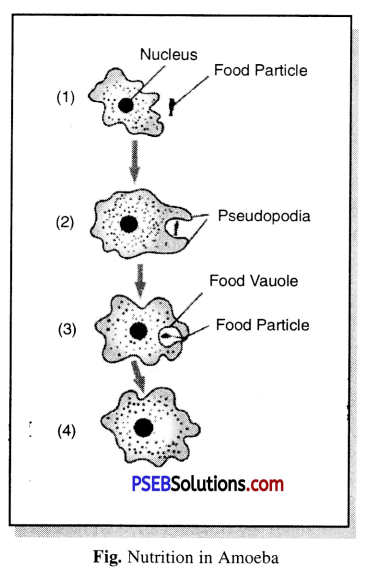
Answer:
(a) Glucose.
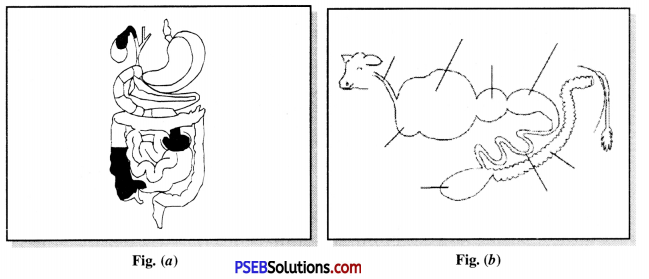
Question (viii)
Where is Saliva produced?
(a) Stomach
(b) Pancreas
(c) Salivary Glands
(d) None of the above.
Answer:
(c) Salivary Glands.

Very Short Answer Type Questions

Question 1.
What is food pipe ?
Answer:
Food pipe. It consists of orla cavity oesophagus, stomach, small intestine, large intestine, anus etc.

Question 2.
Write the names of digestive glands.
Answer:

  1. Salivary glands
  2. Liver
  3. pancreas.

Question 3.
What are the different parts of the digestive system ?
Answer:
Digestive juices and food pipe.

Question 4.
When does temporary or milk teeth fall ?
Answer:
Upto the age of six or eight years.

PSEB 7th Class Science Solutions Chapter 2 Nutrition in Animals

Question 5.
What is length of small intestine ?
Answer:
7.5 metre (approx.)

Question 6.
What length of large intestine ?
Answer:
1.5 metre (approx.)

Question 7.
Name different types of teeth found in human body.
Answer:
Canines, Incisors, Molars, Premolars.

Question 8.
Which teeth are for cutting and bitting ?
Answer:
Incisors.

Question 9.
Which teeth help in tearing the flesh of prey in animals ?
Answer:
Canines.

Question 10.
What is function of molars and premolars ?
Answer:
Chewing and grinding.

Question 11.
What is tongue ?
Answer:
Tongue. Tongue is a fleshy part of body.

Question 12.
How does tongue taste ?
Answer:
With the help of taste buds.

PSEB 7th Class Science Solutions Chapter 2 Nutrition in Animals

Question 13.
What food items are responsible for tooth decay ?
Answer:
Chocolates, Cold drinks, Sweets etc.

Question 14.
Which acid present in stomach kills germs ?
Answer:
Hydrochloric acid.

Question 15.
Which component of food is broken down by saliva in mouth ?
Answer:
Starch.

Short Answer Type Questions

Question 1.
What is Villi ? Where are they present and what are their functions?
Answer:
Villi. Finger-like raised structures in the inner wall of the small intestine are called villi. These are found in the small intestine. Its main function is to absorb digested food.

Question 2.
Where is bile juice made ? Which food components are digested by it?
Answer:
Bile juice is made in the liver and accumulates temporarily in the gallbladder. Its main function is to digest fats.

Question 3.
Write the name of the carbohydrate which is digested by Ruminants but not by humans. Also give reason.
Answer:
Cellulose can be easily digested by Ruminant. A type of bacterium that helps in the digestion of cellulose is found in a sac between the small and large intestines in the rumen of ruminants only. This is the reason humans cannot digest cellulose.

Question 4.
What is the reason that we get energy from glucose immediately?
Answer:
Glucose is a simple form of carbohydrate that is easily absorbed by the body. It dissolves easily in the blood and gives energy immediately.

PSEB 7th Class Science Solutions Chapter 2 Nutrition in Animals

Question 5.
Which part of the digestive canal is involved in:
(i) Absorption of food …………. .
(ii) Chewing of food ………………. .
(iii) Killing of bacteria ……………. .
(iv) Complete digestion of food …………… .
(v) Formation of faeces ……………….. .
Answer:
(i) Small intestine
(ii) Buccal cavity
(iii) Stomach
(iv) Small intestine
(v) Large intestine.

Question 6.
Write one similarity and one difference between the nutrition in amoeba and human beings.
Answer:
Similarity in the nutrition in amoeba and human beings:
(a) Digestion of food
(b) Release of energy
Difference in nutrition in amoeba and human beings.
Human beings have a well developed digestive system while amoeba has only food vacuole for digestion.

Question 7.
Can we live only by eating vegetable/grass ? Discuss.
Answer:
Raw green vegetables are rich source of minerals, cellulose and vitamins etc. Apart from, this body needs carbohydrates, fats and proteins. So only vegetables can not provide all these for sustaining etc.

Question 8.
What is digestion and what are its main objectives?
Answer:
The breakdown or conversion of complex foods into simple foods is called digestion.
Purpose of Digestion.

  • Breaking of large particles into smaller particles so that they can pass through the
    membranes.
  • Conversion of insoluble substances into soluble substances so that the solution can reach all the places.
  • Complete conversion of complex foods into simple substances so that they can be absorbed by cells.

Question 9.
What is a tooth cavity and why does it occur ?
Answer:
Tooth cavity and toothache. By eating too much sweets and not keeping our teeth clean, we invite bacteria which causes damage to our teeth. If we do not keep our teeth clean, food particles get stuck in the teeth and by attacking them, the bacteria start decomposing the food particles which results in the formation of acid. This acid destroys tooth enamel and causes tooth decay. So we should always brush our teeth after eating food and sweets.

Long Answer Type Questions

Question 1.
Describe the digestive system of man.
Answer:
The digestive system of man includes the following organs :

  • Mouth. The mouth is first part of food pipe. It contains tongue, teeth and salivary glands. The tongue tastes the food. The salivary glands secrete saliva which lubricates the food. The teeth break the solid food into smaller fragments.
  • Oesophagus. It is a tubular structure from mouth to stomach. It takes the food from mouth to stomach.
  • Small intestine. It is a coiled tube and is the longest part of food pipe. The digestion of food is completed here with the help of enzymes present in the secretions of liver and pancreas.

PSEB 7th Class Science Solutions Chapter 2 Nutrition in Animals 6

  • Large intestine. It absorbs water. The undigested food or faecal matter is stored temporarily and finally removed from the body through the anus.

Question 2.
What is the process of Rumination? How is digestion done in Ruminants? Explain.
Answer:
Rumination. Grass-eating animals chew the cud and are called Ruminants. Cows, buffaloes, camels, and deer are a few examples. Their stomach is made up of four cells. The first cell is the rumen, which is the largest part of the stomach. The animal first swallows the food and stores it in the rumen. This half-digested food is called cud. Later, the cud returns to the animal’s mouth in the form of small lumps and the animal continues to chew it slowly. This process is called rumination. Such animals are called ruminants.

During rumination, the cellulose in the food breaks down into simple compounds. It is then digested in liquid form in the other three cells. The esophagus of ruminant animals has a sac-like structure between the small intestine and the large intestine called the Caecum, where there are some bacteria that help digest grass straw.
PSEB 7th Class Science Solutions Chapter 2 Nutrition in Animals 7

PSEB 6th Class Physical Education Solutions Chapter 6 National Flag

Punjab State Board PSEB 6th Class Physical Education Book Solutions Chapter 6 National Flag Textbook Exercise Questions and Answers.

PSEB Solutions for Class 6 Physical Education Chapter 6 National Flag

Physical Education Guide for Class 6 PSEB National Flag Textbook Questions and Answers

Question 1.
Which are the three colours in National Flag? Throw some light on the significance of these three colours.
Answer:
National Flag has three colours:
(1) Saffron
(2) White
(3) Green.

1. Saffron:
Saffron colour should always be on the top. It has been taken from fire. Fire has two qualities offering sacrifice and destruction. So, the saffron colour is a symbol of chivalry and zeal. The poor, the needy and the weak should be looked after with zeal and zest.

2. White:
It is the symbol of virtue, truth and peace. It means that the whole nation should be replete with such qualities. If it is there, the evils will- die its own death. This white stripe of this colour is in the middle of the flag.

3. Green:
It is the third and the lowest stripe in the flag. It represents the soil of the land. It is the symbol of prosperity. The fact is that the soil of our country is fertile & the fields are blooming.

PSEB 6th Class Physical Education Solutions Chapter 6 National Flag

Question 2.
On what occasions can the National flag be unfurled?
Answer:
(a) Republic Day:
The President of India unfurls the flag on Rajpath in Delhi every year on 26th January. On the government buildings of the country or wherever Republic day is celebrated, the Flag is hoisted.

(b) National Week (6th April to 13th April):
In the memory of martyrs of Jalianwala Bagh, National Week is celebrated and National flag is hoisted.

(c) Independence day:
The Prime Minister of India hoists the National flag on 15th August every year from the ramparts of the Red Fort. On all the government buildings & on all buildings where this day is celebrated our National Flag is hoisted.

(d) On National festivals/conferences.

(e) On 2nd October-Mahatma Gandhi’s Birthday.

(f) In foreign countries where any Indian representative stays and when Indian team participates in International matches.

(g) The flag is hoisted everyday on the buildings of Lok Sabha, Rajya I Sabha, Supreme Court, Posts of National boundaries, official residences of the President, Vice-President, Governors and the Lieutenant Governors.

Question 3.
Write a note on shape and size of National flag.
Answer:
Its length and breadth is 3:2. And its size is:

  • 6.40 mt × 4.27 mt (21 feet × 14 feet)
  • 3.66 mt × 2.44 mt (12 feet × 8 feet)
  • 1.83 mt × 1.22 mt (6 feet × 4 feet)
  • 90 cm × 60 cm (3 feet × 2 feet)
  • 23 cm × 15 cm (9 inches × 6 inches)

PSEB 6th Class Physical Education Solutions Chapter 6 National Flag

Question 4.
At what time should the flag be unfurled?
Answer:
The national flag is unfurled the following functions:

1. Republic day:
In 26th Jan. is celebration is great pump and day. On this Republic day president’of India unfurled the flag at Delhi and so many other cities the flag is also unfurled in various cities.

2. National week of year: (6 to 13 April):
The national week of year is celebrated in the hoqour of martyrs of Jallianwala Bagh. In this week the national flag is unfurled.

3. Independent day 15 Aug:
India got freedom after so many centuries in 15 Aug. 1947. Therefore every year 15 Aug. is celebrated with great enthusiasm. On 15 Aug. the Prime Minister of India unfurl the flag at red fort in Delhi. In all cities of the country the national flag is unfurled.

4. Gandhi Jayanti 2 Oct: On Birthday of Mahatma Gandhi unfurled the flag.

5. In national all celebrations also, the flag is unfurled

6. International sports competition: In International competition the flag is unfurled with other countries.

Provincial day:
When any state celebrate its provincial day this national flag is unfurled every day. Lok Sabha, Rajya Sabha, Supreme Court, Vice president, Governor and Lt. Governors also unfurled the national flag in their house everyday.

Question 5.
Which points should be borne in mind at the time of hoisting the National Flag?
Answer:

  • National Flag is hoisted when saffron colour is on the top.
  • National Flag with respectfully should be high from everything.
  • It is always held in the right hand.

PSEB 6th Class Physical Education Solutions Chapter 6 National Flag

PSEB 6th Class Physical Education Guide National Flag Important Questions and Answers

Multiple Choice Questions

Question 1.
How many colours are there in our flag?
(A) Three
(B) Four
(C) Five
(D) Six.
Answer:
(A) Three

Question 2.
On which occasions can the National Flag be unfurled?
(A) Republic Day
(B) Independence Day
(C) Gandhi Jayanti
(D) All above.
Answer:
(D) All above.

Question 3.
Which points should be born in mind at the time of hoisting the National Flag?
(A) Saffron colours is on the top.
(B) It is always in the right hand.
(C) National flag should be high from everything.
(D) All above.
Answer:
(D) All above.

PSEB 6th Class Physical Education Solutions Chapter 6 National Flag

Question 4.
What is the significance of National Flag of the country?
(A) Culture
(B) Aan Ban
(C) Civilization
(D) All above.
Answer:
(A) Culture

Question 5.
Which colours are there in our National Flag?
(A) Saffron
(B) White
(C) Green
(D) All above.
Answer:
(D) All above.

Question 6.
From where we took Chakra for our National flag?
(A) Samath by Emperor Ashoka
(B) Teerkaman
(C) From sky
(D) None of them.
Answer:
(A) Samath by Emperor Ashoka

PSEB 6th Class Physical Education Solutions Chapter 6 National Flag

Very Short Answer Type Questions

Question 1.
National flag of each country gives the significance of.
Answer:
Culture.

Question 2.
Government provides us knowledge about National Flag through.
Answer:
Schools and Colleges.

Question 3.
Which colours are present in our national flag?
Answer:
Saffron, White & Green.

Question 4.
When our Constitution adopted our National Flag?
Answer:
22 July, 1947.

PSEB 6th Class Physical Education Solutions Chapter 6 National Flag

Question 5.
When our National flag first hoisted on Red Fort?
Answer:
15 August, 1947.

Question 6.
Which thing is indicated by saffron colour present in our flag?
Answer:
It indicates sacrifice, courage and selflessness.

Question 7.
From where we took the Ashok Chakra for our National Flag?
Answer:
Samath by Emperor Ashok.

Question 8.
From which cloth our national flag is prepared?
Answer:
Khadar.

Question 9.
Where did small sized flags are placed?
Answer:
In Cars.

Question 10.
When and where Prime Minister hoists our National Flag every year?
Answer:
On 15th August on the Red Fort.

Question 11.
Flag is held in which hand?
Answer:
Right hand.

PSEB 6th Class Physical Education Solutions Chapter 6 National Flag

Short Answer Type Questions

Question 1.
What do you know about the history of your National Flag?
Answer:
In 1947, our country got the Independence after more than 200 years. When our country got Independence then we also had prepared a flag for our country. On 22 July, 1947 our constitution accepted our National Flag. On 14-15 August 1947 at night our national flag was hoisted on Red Fort.

Question 2.
Write the four-five lines on our National Flag.
Answer:
The shape of our National Flag is rectangular. It is made up of three different colours. So, it is also known as ‘Tiranga’. In centre a circle is also drawn with 24 spokes named Ashok Chakra. It has three colours-Saffron, White & Green.

Question 3.
What we know through our National Flag?
Answer:

  • Be a strong person
  • Always do hardwork
  • Make your country happy & beautiful
  • Always live in peace

PSEB 6th Class Physical Education Solutions Chapter 6 National Flag

Question 4.
Three colours of our National Flag indicate us what things?
Answer:
Saffron colour indicates us sacrifice, courage and selflessness. White colour indicates truth and peace. Green colour indicates soil of the land and its fertility.