Kabaddi Game Rules – PSEB 10th Class Physical Education

Punjab State Board PSEB 10th Class Physical Education Book Solutions Kabaddi Game Rules.

Kabaddi Game Rules – PSEB 10th Class Physical Education

Question 1.
Mention the length and breadth of the Kabaddi ground. Describe the main rules of the game?
Answer:
Playground:
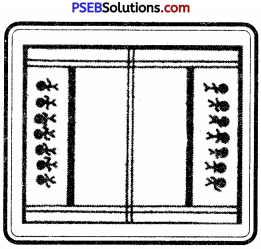
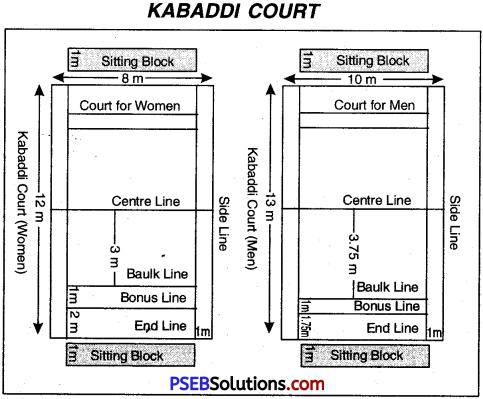
The playground shall be rectangular, level and soft. It should be made of earth, manure or saw dust. For men, it is 12.50 metre long and 10 metre wide. For women and juniors, it is 11 metre long and 8 metre wide. It is divided by a centre line into two equal parts. There shall be a strip of one metre on each side of the playfield. It is called Lobby. In each half at a distance of 3 metres on the centre line and parallel to it, lines of the full width of ground shall be drawn.

These lines are called Baulk lines. The mid-line should be distinctly marked. The width of the mid-line and other lines should not exceed 5 cms, or 2 inches. Outside the side line and towards the end line a space of 4 metres should be left empty. The sitting block shall be 2 metres away from the end line. The sitting block for men shall be 2 m × 8 m., and for women and juniors it shall be 2 m × 6 m.

Bonus Line:

  1. This line is at a distance of 10 cms. from the baulk line, and for seniors, it is at a distance of 1 metre from the baulk line.
  2. When a raider comes after having crossed it fully, he does not get any point for it.
  3. If a raider after having crossed the bonus line is caught, the opposing team is awarded a point.
  4. If a raider succeeds in crossing the bonus line and also touching an opponent, he is given one point.
kabbadi court image 1

Officials:

  1. One referee
  2. Two umpires
  3. Two linesmen
  4. One scorer

The decisions of the umpire are final, but they can be changed under special circumstances. When the referee considers the decision wrong, he announces his own decision.

Players Dress:
The player’s dress includes a banyan and nicker (half pant). Then there is ‘jangian’ or join-cloth below. The use of safety pin and ring is prohibited. Nails should be pared.

Kabaddi Game Rules - PSEB 10th Class Physical Education

Rules of The Game

1. The toss winning team shall have the right to choose the end of raid.

2. A player who goes out of the boundary during the play shall be considered ‘out’.

3. If anjapponent goes out of the boundary and catches the raider, the raider shall not be considered ‘out’ but all the players catching him shall be ‘out’. The raider shall come back to his side and take part in their game.

4. Lobby is also considered to be the limit of the game when the struggle starts. When the struggle is over, players in the struggle can enter the respective lobby.

5. A raider should go on sounding the words ‘Kabaddi-Kabaddi’ while entering the court of the opponents. If he starts the cant of Kabaddi only after he has entered the opponent’s court, he is ordered back by the umpire and the opponent shall be given the chance of raiding.

6. If even after the warning the raider deliberately violates the rule, the umpire shall declare his turn over, and his opponent shall be awarded one point, but he shall not be declared out.

7. After a raider has returned to his court, the opposing team shall immediately send its raider. So each side shall send its raiders alternately until the end of the play.

8. If a raider caught by opponents escapes and reaches his side safely, he shall not be pursued thereafter.

9. Only one raider shall go to the anti-court at a time. If more than one raiders reach the anti-court, the umpire shall order them to return to their court, and their turn of raiding shalLbe over. The opponents who touch them shall not be declared out. They shall not pursue the raiders to send them out.

10. If after the warning a player violates the rule, the umpire shall end his turn, and award one point to the opponents, but he shall not be declared ‘out’.

11. If a raider loses his cant in the anti-court, he shall be reckoned to be ‘out’. But if it happens as a result of the use of unfair means by the opponents, then he shall be deemed to have returned safely to his court.

12. No player shall push his opponent violently out of his boundary. The one who does so shall be considered ‘out’, and the raider shall return safely to his court.

13. Until the raider is in the anti-court, no opposing player shall touch with any part of his body the ground of the raider’s court beyond the mid-line.

14. If a player who violates the Rule no. 12 catches the raider or helps others in catching him, the raider shall safely return to his court, and all the opponents involved in the struggle shall be ‘out’.

15. If a player enters the anti-court out of turn, the umpire shall order him to come back. If after the warning by the umpire he does so again, the opponents shall be given one point.

16. According to new rules, it is not a foul to get water from outside and drink it.

17. When a team makes the entire opposing team out, it is successful. Two points are added to the points it has scored in making the opponents out. The players of both the sides shall enter their respective courts, and the game shall continue upto the end of time.

18. If a player warns a raider against any danger by the opponents, the umpire shall award one point against him.

19. No raider or opponent can be held by any part of his body other than his waist, hand or foot. He who violates this rule shall be declared ‘out’.

20. During any play if only one or two players of a team are left and the captain of the opposing team declares them out in order to bring in the play the whole of his team, the opponents shall score as many points as there are players and additional two scores of Lona.

21. With the opponents being out, the out-players of the team shall be put in the game in the same order in which they were out.

22. New Rules – If the match remains suspended for 20 minutes because of injury to some players, the match can be replayed.

23. The match can be started with five players. But when the five players are out, we shall consider full Lona, that is, 5 + 2 score, of players and 2 scores of Lona.

24. Lona has two scores.

Kabaddi Game Rules - PSEB 10th Class Physical Education

Question 2.
Write five main rules of the Kabaddi match and its violations?
Answer:
Rules Of The Match
1. Each team has twelve members in all, out of which only 7 shall enter the ground together. The remaining shall remain in reserve.

2. For men the game shall have two durations of 20 minutes, and for women, two durations of 15 minutes. There shall be an interval of 5 minutes between these durations of play. The ends shall be changed after the interval.

3. For each player going ‘out’, the opposing team shall be given one score. The team getting Lona shall be given two scores.

4. At the end of the game the team having more scores shall be declared the winner.

5. If the match ends in a draw, two extra durations of 5-5 minutes for play shall be granted. During the extra time the game shall be continued by the end players of the other team. If the tie occurs at the end of 50 minute game for men or 40 minute game for women, the team that scores the first point shall be the winning one.

6. If no score is made during the whole 50 minute game for men or 40 minute game for women, the toss winning team shall be declared the winner.

7. If a match cannot be completed due to some reason, it shall be re-played.

8. In case of an injury to a player, the captain shall ask for a time out. But the duration of the time-out shall not be more than two minutes. The injured player can be substituted. Before starting the second turn of the game, two players can be substituted.

The game can be started by one or two or minimum number of players. At the start of the game those players who are absent can join the game later at any time, but the referee must be informed. If the injury to a player is serious, the injured player can be substituted. By the end of the first game, only two players can be substituted.

9. A match may be started if there are five players in a team but

(i) when the seven players of the team are out, the absent players shall also be ‘out’ and the opposing team shall be awarded Lona, (ii) the absent players can join the game with the referee’s permission.

(iii) the substitutes can be taken in place of absent players any time, but when they are so taken, no player can be substituted till the end of the match, and (iv) any player can be substituted in case the match is re-played.

10. Playing by using oil on the body is not permissible. The nails of the players should be pared well. The players shall wear banyan, underwear the nicker (half pant). Rubber-soled shoes and socks may be put on, if necessary.

11. During the play except the captain or leader, no player shall instruct. The captain can instruct only in his own half.

12. For junior boys and girls the duration of play is 15-5-15 minutes, out of which the interval is of 5 minutes.

Various Fouls and Violations in Kabaddi Fouls.

  • To try to stifle a raider by shutting his mouth or throttling him.
  • Using violent tackling by one player against the other.
  • Instruction or coaching cannot be done from the outside.
  • To hold the raider with the half of leg-scissors.
  • It is a foul when player on rest takes more than five minutes.
  • To take more than five seconds to send a raider by a team.
  • The referee can remove such players from the game by deducting their scores or marks. The whistle shall not be blown during the time of struggle.
  • To catch by hair or clothes intentionally is foul.

Violations

  • Violating the rules or decisions time and again.
  • Using derogatory remarks against the officials.
  • To show insulting behaviour to the officials or to try to influence their decisions.
  • To make insulting remarks to the opponent.

FOULS PLAY:
Referee or umpire will control the match of tournament by using the cards:

GREEN CARD:
Warning to player or coach.

YELLOW CARD:
Temporary suspension for 2 minutes.

RED CARD:
Suspension for the match or for the tournament

Kabaddi Game Rules - PSEB 10th Class Physical Education

Important Information About the Kabbadi Game

  • The length of the ground for men = 13 Metre
  • The Breadth of the ground for men = 10 Metre
  • The length of‘the ground for women = 12 Metre
  • The breadth of ground for women = 8 Metre
  • The length and breadth for Junior boys & girls = 11 × 8 metre
  • Total number of players in a team = 12
  • Duration of the match for men = 20-5-20 Minutes
  • Duration of play for women = 15-5-15 M.
  • Breadth of the lines = 5 cms.
  • Points of Iona = 2 points
  • Size of sitting block for men = 1 × 8 M.
  • Size of sitting block for women = 1 × 6 M.
  • Officials of the match = One referee, Two umpires, one scorer, one time-keeper, two linemen
  • Each team has 7 players. Seven players shall play in ground at one time. There are 5 substitutes.
  • The team that wins the toss chooses the end and also gets an opportunity of the raid first.
  • The game has two durations of 20 minutes each with an interval of 5 minutes. For women and juniors the duration of the game is 15-5-15 minutes, out of which there is an interval of 5 minutes.
  • If any player leaves the ground, he shall be declared ‘out’.
  • If any part of the body of a player touches the outside of the boundary of the ground, he shall be ‘out’.
  • If the match is not completed for some reason, it shall be replayed.
  • A player cannot use oil or any greasy matter on his body.
  • During the game no player can hold the other player by leg scissors.
  • A substitute may take the place of a player if he is injured.
  • The captain can take a time-out with the permission of the referee, but the duration of the time-out should not be more than 2 minutes.
  • The player can be given water from outside the boundary. If water is given inside the boundary, it is a foul.
  • A team can substitute three players.
  • If a team gets a Lona, it is given additional two points.
  • Substitutes cannot be substituted again.
Handball Game Rules – PSEB 10th Class Physical Education

Punjab State Board PSEB 10th Class Physical Education Book Solutions Handball Game Rules.

Handball Game Rules – PSEB 10th Class Physical Education

Question 1.
Give an introduction to the Handball game?
Answer:
Handball-An Introduction:
Handball is a team sport. Two teams participate in this game. Each team has 12 players, out of which 10 are court players and 2 are goal-keepers. Not more than 7 players enter the court at a tinine. Out of these 7, 6 are court players and 1 is a goal-keeper. The remaining 5 players are substitutes. A player may be included in a game or a substitute may be allowed for him. No one else but a goal keeper is allowed in the goal area.

The game starts in the middle of the court as soon as the referee whistles for a throw-on. The duration of the game for men is 30-10-30 minutes, while for women it is 25-10-25 minutes.

Each team tries to put the handball into the goal of the rival team, and tries to defend its own goal against the rival attacks. The ball is played by hands, but it can be touched by knees or any other part of the body. Only a goal-keeper can touch the ball by all parts of his body. A player can be substituted any time during the play. There is no time out in this game.

The players, running, walking or standing, can toss the ball with single hand. A player with a ball can move forward, but he cannot move more than three steps. A ball can be held for three seconds at the most. If a player gets hint, the game can be stopped on the referee’s orders, and the substitute enters the court in case of need. The weight of the ball for men is 475 gms. and for women, it is 425 gms. The circumference of the handball is from 58 to 60 cms.

After a goal has been scored, the game shall re-start from the middle of the court with a throw-on. The throw-on-shall be done by that player against whom a goal has been scored. If the ball goes out during the play, the rival team gets a throw from that place. After half-time the goal and throw-on shall be changed.

A team that scores more goals is declared the winner. If the number of goals scored by both the teams is equal or if no goal is scored, the match shall end in a draw. Each game shall be conducted by two referees who are assisted by a scorer and a time-keeper. Referees enforce the rules of the game. Referees are the managers of the match from the start to the finish.

Handball Game Rules - PSEB 10th Class Physical Education

Question 2.
Mention the Play ground, Goal, Ball, Players, Duration of the game, Goal area, Score, Throw-in, Comer throw, Goal throw, Free throw and Penalty throw in the game of Handball.
Answer:
Playground:
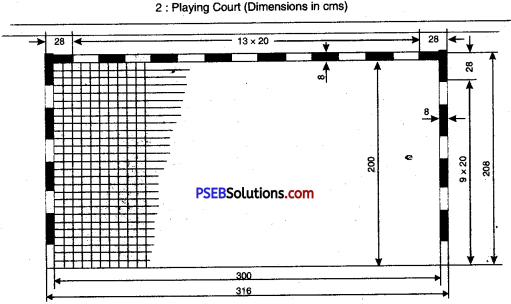
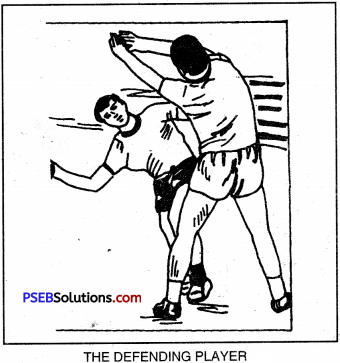
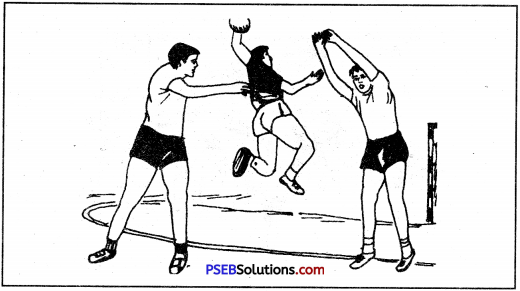
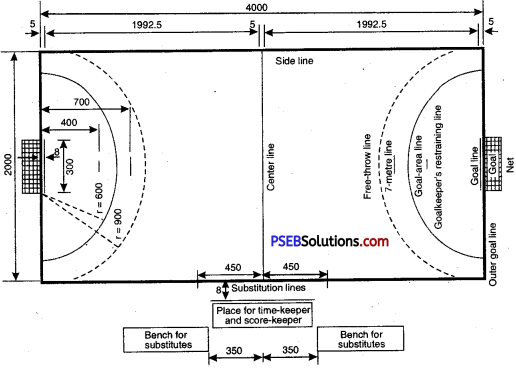
The playground is divided into two circular areas, The court of the game is rectangular with a length of 40 metres and width of 20 metres. The thickness of each line is 0.5 cm. The height of the poles is 7 feet, while their width is 3 metres. A‘D’ is marked 6 metres in front of the poles. The penalty area is 7 metres away from poles. In special circumstances, the play area may be 38-44 metres in length and 18-22 metres in width.

Handball image 1
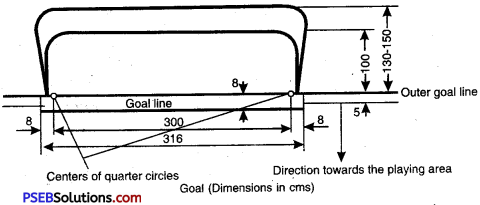
Handball image 2
Handball image 3

Goals:
Goals shall be in the centre of goal lines. There shall be two straight poles in each goal parallel to and at an equal distance from the corners of the playfield. The poles shall be 3 metres from each other and 2 metres in height. They shall be firmly planted in the ground, and linked properly with each other with a horizontal cross-bar. The outer end of the goal line and the back end of the goal post shall be in one line.

Poles and cross-bar shall be square and of the size of 8 × 8 cms. They shall be made of wood, light metal and synthetic material. They shall have two colours on all sides and shall be distinctly different from the background.

Each goal shall be marked with a line of 3 metres, 6 metres from goal area and parallel to the goal line. The ends of this line shall be linked by quarter circles to goal line. The circumference of these circles shall be 6 metres from the back of the inner cover of goal poles. This line is called goal-area-line. Penalty line is marked at a distance of 7 metres, from the centre of goal post, and the second free throw line at a distance of 9 m.

The Ball:
The handball should be spherical, with a rubber bladder, and its outer cover should be made of leather of one colour or of synthetic material. The outer cover should neither be bright nor slippery. The ball should not be inflated too much. Its weight for men and seniors shall not be more than 475 gms. or less than 425 gms. Its diameter shall be from 58 cms. to 60 cms. For all women and junior boys, its weight shall not be more than 400 gms..and not less than 325 gms. Its diameter shall be from 54 to 56 cms.

Players:
Each team has 12 players in all, out of which 10 are court players and 2 are goal-keepers. But only 7 players can participate in the game at one time, out of which 1 is goal-keeper and 6 are court players. In case a player is hurt, a substitute player comes in his place to play the game.

Duration of Game:
The duration of the game for men is 30-10-30 minutes, while for women it is 25-10-25 minutes. There is no time out in the game. The referee can take official time-out, if needed.

Note:
In tournaments, the game is played into two durations of 30 minutes each with no interval.

Handball image 4
Handball image 5

For women and juniors, the game is divided into two durations of 25 minutes each with an interval of 10 minutes.

Note:
In tournaments, the game is played in two durations of 10 minutes each state interval. For all other teams, it shall be played in two equal durations of 20 minutes each.

Goal:
A goal cannot be scored against the rivals by a direct throw-on.

Playing the Ball:
The following methods of play are allowed:

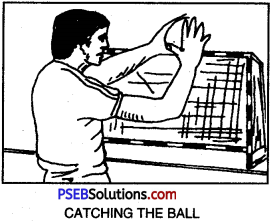
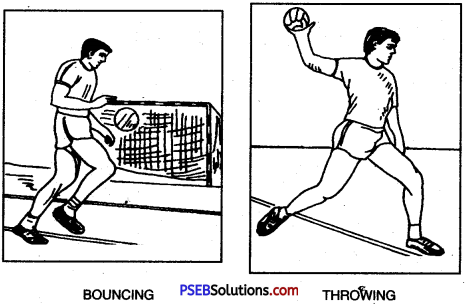
Blocking the ball, catching, throwing, tossing or hitting it in any way or direction (with palms or flat hands) by using arms, head, body, knees etc are valid.

When the ball lies on the ground, it can be held for three seconds at the most. To walk with the ball for three steps is valid.

Handball Game Rules - PSEB 10th Class Physical Education

The Goal Area:
The goal-keeper alone is entitled to enter or remain inside the goal-area. The goal-keeper is considered to be entered if a player touches him in any way. The goal area line is included in the goal area. The following penalties are awarded on entering the goal area:

Handball image 6

  • Free-throw, when the ball is in the court player’s possession.
  • Free-throw, when the ball is not in the court player’s possession but he has clearly taken the advantage by entering the goal area.
  • Penalty-throw, when any player of the defending team knowingly and clearly enters the goal area for defence.

Scoring:
A goal is considered to have been scored when the hall passes through the goal line of the rivals through the goal posts under the cross bars, provided the scorer or any player of his team has not violated the rules.

Throw-in:
If the ball crosses the boundary line or goes out of side line in the air, the game shall be re-started by a throw-in. The throw-in is taken by that player who has been last touched by the ball. The throw-in is taken from the point from where the ball has crossed the side-line.

Corner-throw:
When the ball passes the goal line outside the goal by the player of the defending team when touched for the last time, the attacking team is awarded a corner throw. This rule is not applicable on the goal-keeper in his own goal area.

Handball image 7

Within 3 seconds of the court referee’s whistle the corner throw shall be taken from the same point of the goal side where the touch line and goal line meet each other, and from where the ball has gone out. The players of the defending team can take positions along the goal area line.

Goal-throw. Goal-throw is given in the following circumstances:

  • When the ball crosses from above the goal line on the ground, in the air, having touched by the players of the attacking team or when the goal-keeper of the defending team has touched it in the goal-area.
  • When the ball passes straight in the goal of the rival team by throw-in.

Free-throw:
Free-throw is awarded in the following circumstances:

  • On a player’s entering or leaving the playground in a wrong manner.
  • On a player’s making the throw-in wrongly.
  • On a player’s violating the rules.
  • On a player’s knowingly playing the ball outside the side line.

Handball Game Rules - PSEB 10th Class Physical Education

Penalty-throw:
Penalty-throw is awarded ‘when a player:

(i) makes a serious violation of rules in his own half.
(ii) makes a serious violation of rules in the court, area, spoiling the possibility of a clear goal.

Handball image 8

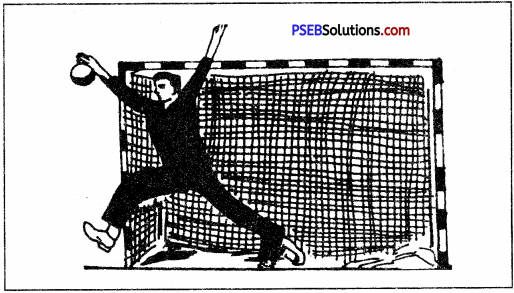
GOAL KEEPER’S POSITION FOR PREVENTING SCORING

(iii) enters his goal area intentionally with the aim to defend.
(iv) pushes the ball intentionally in his goal area and the ball touches the goal-keeper.
(v) or when a goal-keeper carries the ball in his own goal area.
(vi) or when a goal-keeper spoils a clear possibility of scoring a goal in the opponent’s half of court.
(vii) or wdien there is a wrong substitution of a goal-keeper.

Question 3.
Describe the number of officials conducting the Handball game.
Answer:
Officials
The following officials conduct the game of handball:

(i) Referee-1
(ii) Umpire-1
(iii) Time-keeper-1

Decision:
The team that scores more goals is declared the winner.

Handball image 9

Handball Game Rules - PSEB 10th Class Physical Education

Important Information About the Handball Game

  • Number of players in a team = 12
  • Number of players on the court = 7
  • Number of goalkeeper in a team = 2
  • Number of players who actually play = 7 (6 court – player one goal keeper)
  • Circumference of the ball = 58 to 60 cm
  • Duration of play for men = 30-10-30 minutes
  • Duration of rest = 10 minute
  • Weight of the ball for men = 425 to 472 grams
  • Weight of the ball for women = 325 to 375 grams
  • Circumference of the ball for men = 58 to 60 cm
  • Circumference of the ball for women = 54 to 56 cm
  • The game of handball is played between two teams
  • The game starts with the pass from one team to the other from the centre line.
  • The duration of the game for men is 30-10-30 minutes while for women it is 25-10-25 minutes.
  • The total number of players in each team is 12. The number of players to participate in the game is 7; the remaining five players are substitutes.
  • The player can be substituted any time during the play.
  • If a player gets injured, the game can be stopped on the orders of the referee, and the substitute enters the playfield, in case of need.
  • To run with the ball is considered to be a foul.
  • The weight of the handball for men is 475 gms, while for women it is 425 gms.
  • The circumference of handball is from 58 cms. to 60 cms.
  • If the ball goes out of the court, the rival team gets a throw from that place.
  • To push any player deliberately during the game is considered to be a foul.
  • A referee and an umpire conduct the game.
  • The length of the playground is 40 metres, and the width is 20 metres.
  • The goal-keeper cannot leave the outer D.
  • There are two D’s in the game of handball.
  • If a player with the ball is proceeding towards the D, and if a rival catches him by the arm, the referee awardg a penalty.

PSEB 6th Class Physical Education Solutions Chapter 4 Folk Games of Punjab

Punjab State Board PSEB 6th Class Physical Education Book Solutions Chapter 4 Folk Games of Punjab Textbook Exercise Questions and Answers.

PSEB Solutions for Class 6 Physical Education Chapter 4 Folk Games of Punjab

Physical Education Guide for Class 6 PSEB Folk Games of Punjab Textbook Questions and Answers

Question 1.
Name any two games of Children.
Answer:
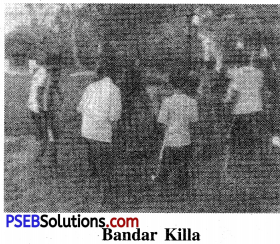
Bandar Killa and Gulli Danda.

Question 2.
How many ways are there of ‘Pugatta’? Explain anyone.
Answer:
There are two methods of Pugatta.
First Method:
First of all three players place their right hands on one- another’s hands and toss their hands together in the air and then they are reversed or kept straight. If hands are placed upturned by two or three players and the third player’s hands remain straight, then that player is supposed to be ‘puggna’. In this way one by one all the players except one supposed to be ‘puggna’. If the position of the hands of all the three players is same, it means either their hands are upright straight reversed.

PSEB 6th Class Physical Education Solutions Chapter 4 Folk Games of Punjab

Question 3.
Write a note on the importance of the folk games.
Answer:
While children play different games. Every game teaches different qualities to the child. They become strong, active & alertness in brain. Kotla Chipaki game increases quickness in the child! Pithu Garam and aiming with Catapult make the child a good shot and Bandar Killa teaches how to be defensive. Wrestling & Kabaddi increase the physical strength. All these games even make the brain sharp. It makes understanding among the children & we can heritage our folk games.

Question 4.
Describe the method of playing the game ‘Bandar Killa’.
Answer:
It is very famous game of children. Children get together in the lanes of colony & find the place for Killa (Peg) to play the game of Bandar Killa. The children address each other by singing on starting the game.
‘Juttian-chapplan da,
Kar lo ve heela.
Hun apan rail ke,
Khedna Bandar killa.’
PSEB 6th Class Physical Education Solutions Chapter 4 Folk Games of Punjab 1
In this game children take off their shows & place them near the peg then they tie a rope of 5-7 metres at the bottom of the peg. All the children play the game of Bandar Killa. Do ‘puggatta’ for fixing the turn for any child. All the children after ‘pugatta’ select the child for the ‘turn’. This selected child is called ‘Bandar’. A children who make Bandar hold the rope which was tie to the peg & guard the heap of shoes. The child without leaving the rope will try to touch any child.

The other players without being touched by the .Bandar try to pick up the shoes & chappal if the Bandar touches any child while picking the chappals that child becomes Bandar. If all the children become successful in picking all the shoes & chappals without being touched by the Bandar all will run towards the place to be touched which is already fixed. All the children beat the Bandar with shoes until he reaches the fixed place as soon as Bandar reaches the fixed place beating with shoes stopped. After this another child will take the turn to perform as Bandar.

PSEB 6th Class Physical Education Solutions Chapter 4 Folk Games of Punjab

Question 5.
Which folk game do you like the most? How is it played?
Answer:
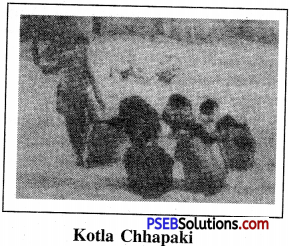
Our most wanted game is Kotla Chhapaki. In this game there is no counted of children. This game is also known as Kaji ‘Kotle di Maar.’ This game is played by 10-15 children. Children prepare a kotla making a thick rope of cloth after twisting. Then a child draw a circle with a sharp object on the ground. All the children set on the edge of the drawn circle facing inside. Now the child whose turn is fixed runs outside the circle with kotla and sing the song-
‘Kotla chhapaki, jumme raat ayie
Jehra agge-pichhe dekhe, ohdi shamat ayie’.

A child, who takes the turn runs around the children by repeating same song. No child can see at the back in this game. All the children keep their heads down. If any child looks at the back a child who takes his turn give 4-5 beats with this kotla. After running he keeps kotla behind any child & completes his round & comes back to the same child. Where he has kept kotla. If the child behind kotla at the back is placed does not aware about kotla. The child who is taking round start beating him with his kotla.
PSEB 6th Class Physical Education Solutions Chapter 4 Folk Games of Punjab 2
The child who is being beaten starts running very fast around the circle to escape his beating he has to bear beating of the kotla until he reaches back to his seat. If the child notices about kotla he picks the same & beats the child on his turn. He keeps on beating until he takes round & places the weekend seat.

PSEB 6th Class Physical Education Guide Folk Games of Punjab Important Questions and Answers

Multiple Choice Questions

Question 1.
Method of Pugna:
(A) Two
(B) Three
(C) Four
(D) Five.
Answers:
(A) Two

PSEB 6th Class Physical Education Solutions Chapter 4 Folk Games of Punjab

Question 2.
Name the Folk game of your choice.
(A) Bandar Killa
(B) Kotla Chhapaki
(C) Rope Skipping
(D) None of them.
Answers:
(A) Bandar Killa

Question 3.
Name two games:
(A) Hockey
(B) Football
(C) Cricket
(D) All above.
Answers:
(A) Hockey
(B) Football

Question 4.
Write two Folk games:
(A) Bandar Killa and Kotla Chhapaki
(B) Thief and Police man
(C) Rope Skipping
(D) Circle Kho-Kho.
Answers:
(A) Bandar Killa and Kotla Chhapaki

Question 5.
Write the importance of folk games.
(A) Development of body and mind
(B) Activeness
(C) Attentiveness
(D) All above.
Answers:
(D) All above.

PSEB 6th Class Physical Education Solutions Chapter 4 Folk Games of Punjab

Very Short Answer Type Questions

Question 1.
Write any two names of folk games.
Answer:
Kotla Chhapaki
Kikli.

Question 2.
Write the song of Kotla Chhapaki.
Answer:
‘Kotla Chhapaki, jumme raat ayie
Jehra agge-pichhe dekhe, ohdi shamat ayie.’

Question 3.
Write four lines of ‘Bandar Killa’.
Answer:
Juttian-chapplan da,
Kar lo ve heela,
Hun apan rail ke,
Khedna Bandar Killa.

Question 4.
Write how many methods of Pugatta?
Answer:
There are three methods of pugatta.

Question 5.
Write any folk game do you like most.
Answer:
Bandar Killa.

Question 6.
Which is the best game for health?
Answer:
Rope skipping.

Question 7.
Which game provide activeness, alertness and concentration?
Answer:
Pithhu Garam.

PSEB 6th Class Physical Education Solutions Chapter 4 Folk Games of Punjab

Question 8.
Write one name of big and one name of folk games.
Answer:
Hockey & Kotla Chhapaki.

Question 9.
Write one importance of folk games.
Answer:
Body become healthy.

Question 10.
Who plays the kikli?
Answer:
It is for girls.

Short Answer Type Questions

Question 1.
What is play?
Answer:
Play is a that activity which is performed for recreation and from these activities we get pleasure.

Question 2.
Write the types of games.
Answer:
We can describe the games in many ways-

  • Physically games
  • Mentally games

Our games like Cricket, Hockey, Volleyball, Football are those type of games by playing these games, we require a lot of equipments and particular playfield which are played under certain rules. Folk games are contrary of these games.

Question 3.
At what age people play the games?
Answer:
Games are played at every age-children, young & elder people. Boys & girls both play the games.

Question 4.
How can we divide our games?
Answer:
Our games like Cricket, Hockey, Football etc.

PSEB 6th Class Physical Education Solutions Chapter 4 Folk Games of Punjab

Question 5.
Which are the important rules of playing the folk games?
Answer:
In these games we don’t require any equipment & certain rules.

Question 6.
What are main rules of big games?
Answer:
In big games equipments, playfield & particular rules are required. These games are played under certain rules.

Question 7.
Write the method pugatta in folk games.
Answer:
First of all three players place their right hands on one-another’s hands & toss their hands together in the air and then they are reversed or kept straight. If hands are placed upturned by two or three players and the third player’s hands remain straight then that player is supposed to be puggna. In this way one by one all players supposed to be puggna.

Question 8.
Write the song of pugatta of second method.
Answer:
“Eengan meengan tadi talingan
Kala, peela, dakkra
Gurh khawan, vail wdhawan,
Mooli patra
Pattan Waley, ghorre aye,
Hath Kutarri, Paer kutarri
Nikkal baleya teri wari.”

Question 9.
Is their any division of team in folk games?
Answer:
Yes, in many games we divide the players in two teams like- Gulli Danda, Kabaddi etc.

PSEB 6th Class Physical Education Solutions Chapter 4 Folk Games of Punjab

Question 10.
Write the five names of folk games.
Answer:
Bandar Killa, kotla Chhapaki, Kikli, Pittu Garam, Skipping rope.

Question 11.
Write any two importance of folk games?
Answer:
By playing these games we get strength, activeness & alertness of mind. When a player aim at the thikri he know how to concentrate.

Question 12.
Write the importance of Rope Skipping.
Answer:

  • This game is very important for the point view of exercise.
  • It develop the strength & flexibility.

Question 13.
What is Pithhu garam?
Answer:
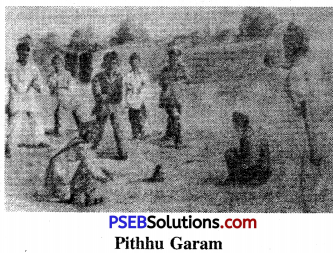
Pithhu garam is one of the favourite game of children. No. of children is not fixed in this game. Children are divided into two groups. Seven broken pieces of earthen ware are placed on one-another. These are called Pithhu.

Question 14.
What is the importance of Kikli?
Answer:
It is very important of punjabi girls and it is the combination of giddha.

  • It help in co-ordination.
  • It also help to increase understanding.
  • It is main cause of recreation and using leisure time.

PSEB 6th Class Physical Education Solutions Chapter 4 Folk Games of Punjab

Long Answer Type Questions

Question 1.
Write the second method of Pugna.
Answer:
Second method of Pugna:
All players have stand in a circle. One of them players sing his hand shoulder on the other player and sing a song.

Eengan meengan tadi talingan
Kala peela, dakkra
Gurh khawan, vail wdhawan
Mooli patra
Pattan waley, ghorre aye.
Hath Kutarri, paer kutare
Nikkal baleya teri wali

The player who is touched at the sound of the last word spoken is not supposed to take his turn. He is supposed to be pugna. By using this method again and again, the player is left in the end, get his turn fixed.

Question 2.
Write about the rope keeping and pithhu kho game.
Answer:
It is very important Khel for exercises after pugna, two players remain they stand against each other and swing the rope by put in slope and rotate the rope in one side. The other player in a line by one by one take two steps in the rope. Those players who will touch the rope while
jumping we go out and takes the turn rotating the rope. This game is very important and recreational but in these days it is diminished.

Pithhu Garam:
In this game the player beats at the back of the other player. It is also very favourite game of the students in Punjab. Children are divided into two groups. Seven broken pieces of earthenware are placed on one another. These are called Pithu. A line is drawn at a distance of 10-15 feet from the pieces which are put in an orderly manner, both teams perform pugatta.
PSEB 6th Class Physical Education Solutions Chapter 4 Folk Games of Punjab 3
Any player of the winner team stand of the line and try to hit ordinary player placed pieces of earthenware with ball. A player gets three chances to hit the target. If he is unable to hit the target, he is declared out of the game. If the ball is got after one balance by the opposite even then the player hitting the pieces is declared to be out. If a player hitting them successfully and scattered them to be out. It is known as breaking of the pithu. After breaking the pithu the hitter tries to collect all the pieces meanwhile the member of the opposite team hits the player collecting the pieces with the ball. If the player places the pieces before he is hit with a ball he deserves another turn. The other player takes his turn to hit him. In this way the game starts again.
PSEB 6th Class Physical Education Solutions Chapter 4 Folk Games of Punjab

Question 3.
Write about the Kikli.
Answer:
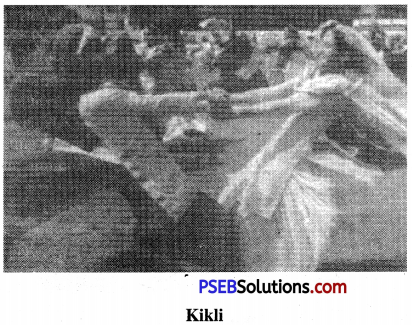
Kikli is a famous game among girls of Punjab. Kikli means happiness and it creates the voice of interest. Kikli game is a combination of giddha which is played by girls with great interest. The girls gathered in a particular place join hands with hands of other girls and start moving around. They catch the opposite hands of the girls and make a shape of figure eight (infinity°o). While rotating they sing a song:
Kikli Kallir di
Pagg mere veer di
Duppatta Bharjai da
Phite muh Jawai da.
PSEB 6th Class Physical Education Solutions Chapter 4 Folk Games of Punjab 4
In this way, while participating in Kikli they start competition. When any one of the girls leaves her hands and falls down, the other girls make a shout of joy after her fall. In this way the girls enjoy the game very well.

PSEB 6th Class Physical Education Solutions Chapter 5 Safety Education

Punjab State Board PSEB 6th Class Physical Education Book Solutions Chapter 5 Safety Education Textbook Exercise Questions and Answers.

PSEB Solutions for Class 6 Physical Education Chapter 5 Safety Education

Physical Education Guide for Class 6 PSEB Safety Education Textbook Questions and Answers

Question 1.
What do you understand by self-security?
Answer:
Self-security means we can save ourselves from accidents to great extent. We come across such accidents often at home, school, while walking on the road or while playing. Walking in the wrong direction and carelessly, results in such injuries. Sometimes, it is fatal that is why we should meet with an accident. Knowledge about safety education makes us to live a happy life.

While the safety education is important from today. Today it is machine age and the heavy transportation are causes of the road of heavy traffics. We meet so many accidents in our daily life. There is not a single day when there is a news in newspaper about accident. There is not a single day accident news published in newspapers. Some where Cars collap with each other, sometime a Car collaps with truck.

Sometime bus falls in deep valley, sometimes a school going child is run over by the truck or any other transport. These accidents causes many deaths and financial looses. We can stop these accidents by following the safety education. In safety education we know the rules and regulations which save us from accidents. In this way, in modem life, it is important to have safety- education.

PSEB 6th Class Physical Education Solutions Chapter 5 Safety Education

Question 2.
Why is self-security so important?
Answer:
Modem age is machine age. Transport system are very flurish and fast these days. There were huge rash on the road which causes incidents every day. In every day there is a big news of accident of paper and no day is left. Some where to cars slash with each other and some where car crashed with truck some times bus falls in a dump. Sometimes school going child erased by car or track. Such type of these accidents causes so many death of human being. The need of time to avoid accident is safety education, we learn the traffic rales from safety education and abide by these rales to avoid these accidents. For this very reason. The need of safety education is very important:

  • In every days we can controls these accidents with the help of safety education.
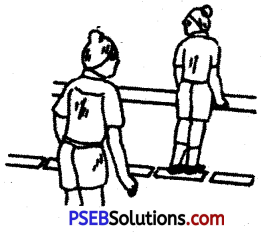
  • Safety education teaches us how to cross the road.
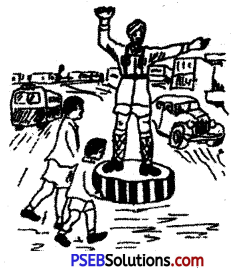
  • With the knowledge of safety education we should avoid the accidents by following the traffic signs given by the policeman who controls the traffic.
  • With the help of safety education we move and drive the left hand.
  • With the knowledge of the rales of safety education we could cross cycle, rickshaw from his right side.

Question 3.
What are the causes of injury in house?
Answer:
There can be happened many injuries at homes.
1. Falling on slippery floor: Big injuries can occur by falling due to soap, shampu, oil, water etc.

2. Stumbling sometimes:
We stumble due to disorderly things placed at home, unmindfully or due to dim light at homes. This cause may serious injury. Sometimes injury is caused due to slipping of our foot while getting down or climbing up the stairs even we receive injuries and fractures.

PSEB 6th Class Physical Education Solutions Chapter 5 Safety Education

Question 4.
What are the methods of safety in the house?
Answer:
The methods of safety in the house are :

  • Kerosene and L.P.G. gas should be kept away from the fire. There should be arrangement of fire extinguisher at home.
  • Fire crackers should be cracked at open spaces away from home.
  • Do not smoke beedi or cigarettes at home.
  • Most of people die due to electrocution every year. Make sure that electric wires should not be uncovered while using cooler, refrigerator etc.

Question 5.
Who are responsible for the safety?
Answer:
The responsibility of safety not only for one person of social organisation. It is the responsibility of parents, teachers, government and social organisations. Home is a first school of education. And child spends most of his time in home so it is first responsibility of the parents for the safety of the children. Children do not meet any accident in this way.

After home school is such a way where children spend 5-6 hours. It is teachers responsibility to provide safety education to their students. So, that they can safe while coming and going to school or at playground. In this way municipal corporation and government are also responsible to provide safety education to the people which causes the less accident in daily life so that we may live long life.

PSEB 6th Class Physical Education Solutions Chapter 5 Safety Education

Question 6.
Which institutions can be helpful in self-security and how?
Answer:
For the safety education the following institutions can be helpful:
1. Schools and colleges: In schools & colleges teachers should teach the rules of safety to their students.

2. Municipal Committee, or Municipal Corporation:
Municipal Committee should also provide the safety education to their inhabitants by showing the slides in Cinema and exhibitions must be organized for the rules of safety education.

3. Society:
Society can be helpful for safety education. They should educate the people about the safety rules and their duties. People should know how to walk on roads and streets should not through the peels of fruits and vegetables. If there is any hindrance it should be removed.

4. Government:
Government can also be helpful for the safety of the people. They should make footpath on the road for people who can walk easily. They should provide good light on streets and roads. They should provide the rules of traffic to control the traffic. There must be policemen on duty on the different chowks.

PSEB 6th Class Physical Education Guide Safety Education Important Questions and Answers

Multiple Choice Questions

Question 1.
Need of Safety Education :
(A) Safety from accidents.
(B) With the help of safety education we learn to walk on left
(C) With safety education we learn to understand the sign of policeman who stand in chowk.
(D) All above.
Answer:
(D) All above.

PSEB 6th Class Physical Education Solutions Chapter 5 Safety Education

Question 2.
Who are responsible for the safety?
(A) Parents
(B) Teachers
(C) Municipal Committee
(D) All above.
Answer:
(D) All above.

Question 3.
Which institutions can be helpful in self security?
(A) School and College
(B) Municipal committee
(C) Government
(D) All above.
Answer:
(D) All above.

Question 4.
Which education saves us from accidents?
(A) Safety education
(B) Sports education
(C) Recreation education
(D) None of these.
Answer:
(A) Safety education

Question 5.
By which education we can reduce the accidents?
(A) Rules of traffic
(B) Rule of house
(C) Rules of school and college
(D) None of them.
Answer:
(A) Rules of traffic

PSEB 6th Class Physical Education Solutions Chapter 5 Safety Education

Question 6.
Write causes of accidents one road.
(A) While driving drinking alcohol.
(B) Ignoring the signs of policeman or traffic lights.
(C) While taking a turn the proper indication is not given.
(D) All above.
Answer:
(D) All above.

Very Short Answer Type Questions

Question 1.
Which education saves us from accidents?
Answer:
Safety Education.

Question 2.
By which education we can reduce the accidents?
Answer:
By Safety Education.

Question 3.
What should we use while driving vehicles at night?
Answer:
Dipper.

PSEB 6th Class Physical Education Solutions Chapter 5 Safety Education

Question 4.
In which ways driving is harmful?
Answer:
Under the influence of liquor.

Question 5.
Which should be provided to the people who walk on road?
Answer:
Footpaths.

Question 6. How we can control the traffic in a chowks?
Answer:
By deputing policemen or Traffic Signal Lights.

Question 7.
What things should people bear in mind to free from accidents?
Answer:
Rules of Traffic.

Question 8.
What type of school playground should be there to save from accidents?
Answer:
Clean and Plain.

Short Answer Type Questions

Question 1.
Write any five causes of road accidents.
Answer:

  • Driving while drinking.
  • Ignore the signs of the policeman who is on duty in chowk.
  • Driving the vehicles in a full speed without control.
  • Overtaking the others vehicles.
  • While taking turn proper indication is not given.

PSEB 6th Class Physical Education Solutions Chapter 5 Safety Education

Question 2.
Write any five causes of accidents in kitchen of house.
Answer:

  • If floor of the kitchen is slippery.
  • If no proper ventilation of smoke.
  • If inflammable clothes are used in kitchen.
  • If utensils, soap etc are thrown here and there.
  • If there is no proper lighting arrangement.

Question 3.
Write any five causes of accidents in bathroom in house.
Answer:

  • Soap or oil spreading on the floor.
  • If the water tap is not on the proper place.
  • Green Grass should be there in bathroom.
  • If bathroom is not airy and is tight.
  • If shower is not on proper place.

Question 4.
Write any five causes of accidents in living room.
Answer:

  • Slippery floor of the room.
  • Improper place of furniture.
  • Sufficient light is not placed.
  • In winter fire coal is burned in room.
  • Scissors and knives are placed on the bed.

PSEB 6th Class Physical Education Solutions Chapter 5 Safety Education

Long Answer Type Questions

Question 1.
Write any causes of accidents on roads.
Answer:

  • Do not following the safety rules.
  • While driving vehicles very fast.
  • While driving drinking alchohol or smoking or attending Mobile Phones.
  • While driving while not using the lights of vehicle at night.
  • While taking: a turn the proper indication is not given.
  • When Cars, Scooter etc. get out of order by chance.
  • By throwing the piece of mango or banana.
  • While overtaking the other vehicles in a short time.
  • Ignoring the signs of policeman or traffic lights.
  • While do not follow the traffic rules.
  • If the surrounding of the road is having loose earth and there is a great heap on the road.
  • With weak eye sight of the driver.
  • If a driver is over tired of long journey.
  • If any animal or child come on the road by chance.
  • The children while playing on the road.

Question 2.
Write the safety measures in the school.
Answer:

  • Playground of the school should be clean and plain.
  • The broken equipments should not be placed in one room.
  • While playing games like Kabaddi and Wrestling, the players should not wear the rings, bracelet or any sharp thing.
  • Bathrooms should not be slippery of the school.
  • The floor of schools should be clean and dry.
  • A students should not throw the peels of Banana on the floor.
  • Unconditional player should not take part in sports.
  • A trained teacher must provide the training of the play.

PSEB 6th Class Physical Education Solutions Chapter 5 Safety Education

Question 3.
Over population causes the accidents. Why?
Answer:
Many people move, around the world due to over population. For their livinghood they move from one place to another. And the number of people increasing on the road day-by-day and it is possible to hit each other. The second thing due to over population is that motor cars, scooters etc. are increasing on the road day-by-day. These are causing various accidents. In this way over population causes many accidents. We should control over population.
PSEB 6th Class Physical Education Solutions Chapter 5 Safety Education 1

Question 4.
Write the causes of accidents on roads.
Answer:
Causes of road accidents are:

  • Without knowing the rules of traffic.
  • Driving the car, cycle etc. in a fast speed.
  • Driving while drinking alcohol or drug substances.
  • Not using the proper light of the vehicle.
  • While driving on other road turn indicator not used.
  • Throwing the peels of bananas and oranges here and there.
  • Ignoring the signs of policeman on the chowks.
  • Not following the rules of traffic or ignorance of the traffic rules.
  • Broken roads also cause so many accidents.
  • Weak eyesight of the drivers also responsible for accidents.
  • By chance the entry of car, bikes, bicycle or any animal on the road.
  • While saving them on road vehicles meet an accident.
    PSEB 6th Class Physical Education Solutions Chapter 5 Safety Education 2

PSEB 7th Class Science Solutions Chapter 5 Acids, Bases and Salts

Punjab State Board PSEB 7th Class Science Book Solutions Chapter 5 Acids, Bases and Salts Textbook Exercise Questions and Answers.

PSEB Solutions for Class 7 Science Chapter 5 Acids, Bases and Salts

Science Guide for Class 7 PSEB Acids, Bases and Salts Intext Questions and Answers

Think and Answer (Textbook Page No. 54)

Question 1.
What will be the colour of basic solution after the addition of pehnolphthalein?
Answer:
Adding phenolphthalein to the alkaline solution turns its colour to pink.

Question 2.
Name the products of neutralisation.
Answer:
In the process of neutralisation salt and water are produced in the form of products.

PSEB 7th Class Science Guide Acids, Bases and Salts Textbook Questions and Answers

1. Fill in the blanks:

(i) Acids are …………….. in taste.
Answer:
sour

PSEB 7th Class Science Solutions Chapter 5 Acids, Bases and Salts

(ii) Litmus and turmeric extract are …………….. indicators.
Answer:
natural

(iii) Phenolphthalein is ………………………… in acidic solution.
Answer:
pink

(iv) Reaction between an acid and a …………………… is called neutralisation reaction.
Answer:
alkali (Base)

(v) Ant’s sting has ………………….. acid.
Answer:
formic

(vi) Excess secretion of hydrochloric acid in stomach, is called ……………………….. .
Answer:
indigestion

(vii) Milk of magnesia is used in case of ……………………. .
Answer:
acidity

2. Match the Column ‘A’ with Column ‘B’:

Column ‘A’ Column ‘B’
1. Red litmus changes to blue in (a) Neutralisation
2. Blue litmus changes to red in (b) Zinc Carbonate
3. Reaction between acid and a base (c) Basic solution
4. Formic acid (d) Antbite
5. Calamine (e) Acidic Solution

Answer:

Column ‘A’ Column ‘B’
1. Red litmus changes to blue in (c) Basic solution
2. Blue litmus changes to red in (e) Acidic Solution
3. Reaction between acid and a base (a) Neutralisation
4. Formic acid (d) Antbite
5. Calamine (b) Zinc Carbonate

PSEB 7th Class Science Solutions Chapter 5 Acids, Bases and Salts

3. Choose the Correct Answer:

Question (i)
Vinegar contains :
(a) acetic acid
(c) citric acid
Ans.
(a) acetic acid .

Question (ii)
Tamarind contains :
(a) acetic acid
(b) lactic acid
(c) citric acid
(d) tartaric acid
Answer:
(d) tartaric acid

Question (iii)
The example of natural indicator is
(a) Litmus
(b) Turmeric extract
(c) China rose petals
(d) All the above
Answer:
(d) All the above

Question (iv)
The colour of blue litmus in acidic solution in :
(a) purple
(b) blue
(c) red
(d) pink
Answer:
(c) red

Question (v)
Amla contains :
(a) ascorbic acid
(b) quick lime
(c) calmine
(d) All the above
Answer:
(a) Ascorbic acid

4. Write True or False:

(i) Citric acid is found in tamarind.
Answer:
False

(ii) Ant’s sting has oxalic acid.
Answer:
False

(iii) Turmeric extract gives reddish brown colours in basic solution.
Answer:
True

PSEB 7th Class Science Solutions Chapter 5 Acids, Bases and Salts

(iv) Sodium hydroxide turns blue litmus red.
Answer:
False

(v) Organic matter is used to treat acidic soil.
Answer:
False

5. Very Short Answer Type Questions:

Question (i)
Which acid is secreted in our stomach ?
Answer:
Gastric acid is excreted in our stomach.

Question (ii)
Name any two ant acids.
Answer:
Names of two antacids :

  1. Magnesium Hydroxide,
  2. Baking Soda.

Question (iii)
What type of substances are used as ant bites ?
Answer:
Solution of calamine or baking soda is used to treat ant-stings.

Question (iv)
Name any two citric fruits.
Answer:
Names of Citrus Fruits :

  1. Orange,
  2. Lemon,
  3. Grapes.

Question (v)
Why is it essential to treat acidic products ?
Answer:
Factory and industry residues are naturally acidic. If thrown away directly without treatment, it can harm aquatic life. To neutralize them, some base is added to such wastes.

PSEB 7th Class Science Solutions Chapter 5 Acids, Bases and Salts

6. Short Answer Type Questions:

Question (i)
Name the source from which litmus solution is obtained. What is the use of this solution ?
Answer:
The solution of litmus is obtained from a plant called lichens found in nature. A strip of paper dipped in a solution of litmus is called litmus paper and the solution is called litmus solution. It is available as red and blue litmus.
Blue litmus turns red when dissolved in acidic solution and red litmus turns blue when dissolved in alkaline solution.

Question (ii)
Is the distilled water acidic/basic/neutral ? How would you verify it ?
Answer:
Distilled water is neutral. This is confirmed by the addition of litmus with which it gives green colour. The colour of Red litmus and blue litmus remain unchanged when added to distilled water showing that it is neutral in character.

Question (iii)
Describe the process of neutralisation with the help of an example.
Answer:
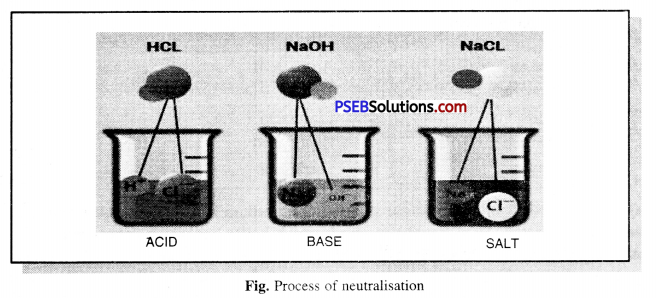
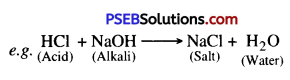
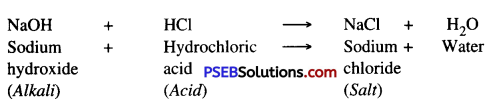
Neutralisation. The chemical reaction between an acid and an alkali is called neutralisation. As energy is released, salt and water are formed as products.
Acid + Alkali → Salt + Water + Heat (Energy)
Example : Hydrochloric Acid + Sodium Hydroxide → Sodium chloride + Water + Energy

Experiment: Fill a quarter of a test tube with dilute hydrochloric acid. Now add 2-3 drops of phenolphthalein solution (indicator) and note the color of the test tube solution. Now with the help of a dropper add a few drops of sodium hydroxide (alkali) in the test tube and gently shake the test tube. To the solution while stirring constantly, add Sodium hydroxide (alkali) solution till it turns light pink.
PSEB 7th Class Science Solutions Chapter 5 Acids, Bases and Salts 1
Now mix a drop of dilute Hydrochloric acid to it. You will notice that the color of the solution has disappeared (colourless) again. It is clear from this that phenolphthalein is pink in color as long as the solution is alkaline and the solution becomes colourless when the solution becomes acidic.
By mixing alkali solution with acid solution, they react with each other to neutralize the solution, i.e. the nature of acid and base gets cancelled out. This reaction is called Neutralisation.

Question (iv)
Name any two common acids and two common bases.
Answer:
Common acids. (1) Hydrochloric acid. (2) Sulphuric acid.
Common Bases. (1) Sodium hydroxide, (2) Calcium hydroxide

Question (v)
What are indicators ? Write their types and two examples of each.
Answer:
Indicators. Solution of substances that on reaction with acids, alkalis and neutral substances, give different colours, they are called indicators.
Types of indicators. There are two types of indicators:

  1. Natural indicators. These are indicators that are obtained from plants such as litmus, turmeric, China rose petals etc.
  2. Synthetic Indicators. These are indicators that are prepared in the laboratory, such as phenolphthalein and methyl orange etc.

PSEB 7th Class Science Solutions Chapter 5 Acids, Bases and Salts

7. Long Answer Type Questions:

Question (i)
State differences between acids and bases.
Answer:
Differences between Acids and Bases :

Acids Bases
1. They are sour in taste.

2. They change the solution of blue litmus to red.

3. They don’t seem like soap when touched.

4. It doesn’t change colour of phenolphthalein solution.

5. They react with bases to produce salt, water and heat.

1. They are bitter in taste.

2. They change solution of red litmus to blue color.

3. They appear like soap when touched.

4. They react with phenolphthalein solution to make it pink.

5. They react with acid to produce salt, water and heat.

Question (ii)
Name the acid present in : (1) Vinegar (2) tamarind (3) citrus fruits and (4) curd.
Answer:
Substance The name of the acid

1. Vinegar  1. Acetic acid
2. Tamarind  2. Tartaric acid
3. Citric fruit  3. Citric acid
4. Spinach  4. Oxalic acid
5. Yogurt  5. Lactic acid

Question (iii)
You are given hydrochloric acid solution, sodium hydroxide solution and water in three different bottles. How would you check which bottle has which compound ?
Answer:
1. Take three test tubes. Take a few drops of the solution from each bottle separately in these three test tubes. Now add three drops of phenolphthalein solution to each of these test tubes. The test tube in which pink colour is observed contains base (Sodium Hydroxide) while the colour will not change in the other two test tubes.

2. Wash the test tubes and again take 5-5 drops of each solution in three different test tubes as before. Now put two drops of blue litmus in these test tubes. The test tube in which the blue litmus turns red contains acid (Hydrochloric acid).

3. Now we know that the third test tube contains water in which red and blue litmus don’t show any change.
In this way, we can find out which solution is present in which bottle.

PSEB Solutions for Class 7 Science Acids, Bases and Salts Important Questions and Answers

1. Fill in the Blanks:

(ii) is used to cure indigestion.
Answer:

(iii) Treatment of soil acidity is done by adding
Answer:
Lime

(iv) on reaction with a solution of phenolphthalein turn it pink.
Answer:
Alkali

(v) In the process of Neutralisation and are produced as a products.
Answer:
Salt, water

2. Match the Column A with Column B:

Column ‘A’ Column ‘B’
(i) Gooseberries (a) Acetic acid
(ii) Indigestion (b) Quick lime
(iii) Vinegar (c) Milk of Magnesia
(iv) Treatment of acidic soil (d) Ascorbic acid

Answer:

Column ‘A’ Column ‘B’
(i) Gooseberries (d) Ascorbic acid
(ii) Indigestion (c) Milk of Magnesia
(iii) Vinegar (a) Acetic acid
(iv) Treatment of acidic soil (b) Quick lime

PSEB 7th Class Science Solutions Chapter 5 Acids, Bases and Salts

3. Choose the Correct Answer:

Question (i)
Curd tastes sour so it is :
(a) basic
(b) acidic
(c) salt
(d) None of these.
Answer:
(b) acidic.

Question (ii)
Bases are :
(a) sour
(b) saltish
(c) bitter
(d) Neither sour nor sweet.
Ans.
(c) bitter.

Question (iii)
The acid present in vinegar is :
(a) Formic acid
(b) Citric acid
(c) Acetic acid
(d) Lactic acid.
Answer:
(c) Acetic acid.

Question (iv)
The acid present in curd is :
(a) Acetic acid
(b) Formic acid
(c) Citric acid
(d) Lactic acid.
Answer:
(d) Lactic acid.

(a) Calcium hydroxide
(b) turns blue litmus paper to red.
(c) Magnesium hydroxide
(a) Calcium hydroxide.

Acidic solution:
(a) turns red litmus paper to blue
(b) turns blue litmus paper to red
(c) neither turns blue litmus paper to red nor red litmus to blue
(d) None of these.

4. State True or False:

(i) Nitric acid turns red litmus blue.
Answer:
False

(ii) Sodium hydroxide turns blue litmus red.
Answer:
False

(iii) Sodium hydroxide and hydrochloric acid neutralize each other and form salt and water.
Answer:
True

(iv) Indicator is a substance which shows different colours in acidic and basic solution.
Answer:
True

PSEB 7th Class Science Solutions Chapter 5 Acids, Bases and Salts

(v) Tooth decay is caused by the presence of a base.
Answer:
False

Very Short Answer Type Questions

Question 1.
Name different types of substances based on their chemical nature.
Answer:

  1. Acidic
  2. Basic
  3. Neutral.

Question 2.
Name few substances that contain natural acids.
Answer:
Curd, lemon juice, orange juice, vinegar.

Question 3.
Name few substances which are basic in nature.
Answer:
Washing soda, baking soda.

Question 4.
Name the substance which is used to test the nature of chemical compounds.
Answer:
Indicator.

Question 5.
Name few natural indicators.
Answer:
Turmeric, litmus, China rose petals.

Question 6.
Which acid is present in curd ?
Answer:
Lactic acid.

Question 7.
What is household name of Acetic acid ?
Answer:
Vinegar.

PSEB 7th Class Science Solutions Chapter 5 Acids, Bases and Salts

Question 8.
Amla is rich in which acid ?
Answer:
Ascorbic acid.

Question 9.
What is lime water ?
Answer:
It is calcium hydroxide, a base.

Question 10.
Name a base found in soaps.
Answer:
Sodium hydroxide.

Question 11.
What is use of Ammonium hydroxide ?
Answer:
For cleaning window glass panes.

Question 12.
What is source of litmus ?
Answer:
Lichens.

Question 13.
What are neutral substances ?
Answer:
Neutral Substances. The substances which do not change the colour of either blue or red litmus, are neutral substances.

Short Answer Type Questions

Question 1.
Write the properties of bases.
Answer:
Properties of Bases,

  1. Bases are bitter to taste.
  2. All alkalies have a slippery touch much like that of soap.
  3. Bases turn red litmus paper blue.
  4. Bases turn phenolphthalein solution from colourless to pink.

PSEB 7th Class Science Solutions Chapter 5 Acids, Bases and Salts

Question 2.
Write the properties of acids.
Answer:
Properties of Acids.

  1. Acids turn blue litmus red.
  2. Acids contain hydrogen atom.
  3. Acids are sour in taste.
  4. Acids react with bases to form salt and water.

PSEB 7th Class Science Solutions Chapter 5 Acids, Bases and Salts 2

Question 3.
What is an indicator ? Name an indicator.
Answer:
Indicator. The chemicals or substances which give different colours with acids and bases, are known as acid-base indicators or simply indicators.
Phenolphthalein is another indicator which gives pink colour in alkaline solution and is colourless in acidic solution.

Question 4.
What is neutralization reaction ?
Answer:
Neutralization reaction. The process of treating an acid with an alkali/base to form a salt and water, is called neutralization reaction.
PSEB 7th Class Science Solutions Chapter 5 Acids, Bases and Salts 3

Question 5.
How the salts are formed?
Answer:
Salts. Salts are formed when an acid reacts with a base or salt is a compound which is formed by combination of acid with base.
PSEB 7th Class Science Solutions Chapter 5 Acids, Bases and Salts 4

Question 6.
Three liquids are given to you. One is hydrochloric acid, another is sodium hydroxide and third is a sugar solution. How will you identify them ? You have only turmeric powder.
Answer:
Turmeric powder is a natural indicator. With turmeric powder, turmeric strips are prepared which give different colour in three given liquids.

Question 7.
Blue litmus paper when dipped in a solution remains blue. What is the nature of the solution ? Explain.
Answer:
Acids turn blue litmus red while bases do not change the colour of blue litmus. Therefore, the given solution is base as it has not changed the colour of blue litmus paper.

Question 8.
Explain why :
(i) An antacid tablet is taken when you suffer from acidity.
(ii) Calamine solution is applied on skin when an ant bites.
(ii) Factory waste is neutralized before disposing it into the water bodies.
Answer:
(i) An antacid tablet is taken when you suffer from acidity. To neutralize acidity, antacid tablet such as milk of magnesia is taken because it contains Magnesium hydroxide (base) which neutralizes the effect of acids.

(ii) Calamine solution is applied on skin when an ant bites. Ant bite contains formic acid which gets neutralized by calamine solution (zinc carbonate).

(iii) Factory waste is neutralized before disposing it into the water bodies. Factory waste usually contains acids, so they have to be neutralized as they can kill aquatic animals and plants. Some basic substances are used to neutralize such wastes.

Long Answer Type Question

Question 9.
What are the uses of neutralization in our daily life? Explain in detail.
Answer:
Uses of Neutralisation in daily life:
(i) As Antacids.
We know that in human stomach acid is produced called as stomach acids which contain hydrochloric acid which helps in digestion of food. But too much of it can cause indigestion, abdominal pain, and heartburn, which is called acidity. To neutralize this excess acid, some mild alkali is used to relieve the pain. Such substances are called antacids, such as milk of magnesia (magnesium hydroxide), baking soda, etc.
(ii) As a treatment for insect stings.
Different species of insects such as; bees, wasps, spiders, and ants, etc. release formic acid in the body when they sting our body. The effect of formic acid can be reduced by neutralizing it with some mild alkali, such as baking soda or calamine solution.
(iii) As a treatment for soil acidity and alkalinity.
The presence of certain substances makes the soil more acidic or more alkaline. Excessive use of chemical fertilizers makes the soil acidic. Soil should be neutral for the proper growth and development of plants. Soils are tested and if it is acidic, it is treated with lime (calcium oxide), Quick lime (Calcium hydroxide), etc. But if the soil is alkaline, it is mixed with organic matter which releases acid and neutralizes the alkali present in the soil.

(iv) As a treatment for factory wastes.
Industry and factory wastes are naturally acidic. If it is thrown away directly, it can affect and harm aquatic life. Therefore, it is important to neutralize the acid present in that waste. So some alkali is added to treat it.

PSEB 6th Class Science Solutions Chapter 3 Fibre to Fabric

Punjab State Board PSEB 6th Class Science Book Solutions Chapter 3 Fibre to Fabric Textbook Exercise Questions and Answers.

PSEB Solutions for Class 6 Science Chapter 3 Fibre to Fabric

Science Guide for Class 6 PSEB Fibre to Fabric Intext Questions and Answers

Think and Answer (Textbook Page No. 21)

Question 1.
List any two types of fabric.
Answer:
Two main types of fabric are
(i) obtained from natural fibres
(ii) obtained from synthetic fibres.

Question 2.
How does silk fabric feel ?
Answer:
Smooth and shiny.

PSEB 6th Class Science Solutions Chapter 3 Fibre to Fabric

Question 3.
With what kind of fabric your dupatta is made up of ?
Answer:
Dupatta is made up of cotton.

Think and Answer (Textbook Page No. 26)

Question 1.
Name the items that are made from jute plant and coconut fibre.
Answer:
Jute is used to make curtains, chair coverings, carpets, mats, ropes, gunny bags, etc. Coconut fibre or coir is used to make floor mats, door mats, brushes, mattresses and ropes

Question 2.
Yarn is made of ……………………
Answer:
Yarn is made of very small strands called fibres.

Question 3.
What is yarn ?
Answer:
Yarn is a thin thread used for making different fabrics. It is made of very small strands called fibres.

Question 4.
How do you make yarn from cotton ?
Answer:
We made yam from cotton fibres by spinning and weaving.

Think and Answer (Textbook Page No. 28)

Question 1.
Wool is ……………. and ………….. air.
Answer:
soft, full of.

PSEB 6th Class Science Guide Fibre to Fabric Textbook Questions and Answers

Fill in the Blanks:

(a) Silk is smooth and ……………….
Answer:
shiny

(b) ……………. is extracted from the outer covering of coconut.
Answer:
Coir

(c) …………… and …………… are synthetic fibres.
Answer:
polyester, nylon

(d) Cotton is a ……………… fibre.
Answer:
natural

PSEB 6th Class Science Solutions Chapter 3 Fibre to Fabric

(e) Yarns are made of ……………
Answer:
fibres

2. Write True or False:

(a) Polyester is a natural fibre.
Answer:
False

(b) In knitting, a single yam is used to make a piece of fabric.
Answer:
True

(c) Cotton clothes are comfortable to wear in hot humid weather.
Answer:
True

(d) The process of removing seed from cotton is called retting.
Answer:
False

(e) The fibres are spun in yams by pulling out and twisting the fibres together.
Answer:
True

3. Match the Column A with Column B:

Column A Column B
1. Jute (a) outer covering of coconut
2. Acrylic (b) stem
3. Coir (c) separation of seeds
4. Ginning (d) synthetic fibres
5. Hand spindle (e) spinning

Answer:

Column A Column B
1. Jute (b) stem
2. Acrylic (d) synthetic fibres
3. Coir (a) outer covering of coconut
4. Ginning (c) separation of seeds
5. Hand spindle (e) spinning

PSEB 6th Class Science Solutions Chapter 3 Fibre to Fabric

4. Choose the Correct Answer:

Question (i)
Which of the following in not a natural fibre ?
(a) Wool
(b) Cotton
(c) Nylon
(d) Jute
Answer:
(a) Wool

Question (ii)
Which of these fabrics will you choose to wear in hot and humid weather ?
(a) Cotton
(b) Silk
(c) Wool
(d) Nylon.
Answer:
(a) Cotton

Question (iii)
The process of separation of seeds from cotton balls is :
(a) Spinning
(b) Ginning
(c) Retting
(d) Picking.
Answer:
(b) Ginning

Question (iv)
Acrylic is :
(a) Natural fibre
(b) Plant fibre
(c) Animal fibre
(d) Synthetic fibre
Answer:
(d) Synthetic fibre

Question (v)
Which of these is a plant fibre ?
(a) Polyester
(b) Acrylic
(c) Wool
(d) Jute.
Answer:
(d) Jute.

5. Very Short Answer Type Questions:

Question (i)
Name any two animal fibres.
Answer:
Silk and wool.

Question (ii)
Name the two basic types of animal fibres.
Answer:
Silk and wool

PSEB 6th Class Science Solutions Chapter 3 Fibre to Fabric

Question (iii)
What is the right time for harvesting of jute plant ?
Answer:
From June to September

Question (iv)
List any two uses of jute.
Answer:
It is used to make curtains, chair coverings, carpets, mats, ropes, gunny bags, etc.

6. Short Answer Type Questions :

Question (i)
Write differences between natural and synthetic fibres.
Answer:
Natural fibres :

  1. Natural fibres are obtained from plants and animals.
  2. Examples are cotton, jute, coir, wool, silk, etc.

Synthetic fibres :

  1. On the other hand synthetic fibres are prepared by man using chemicals.
  2. Examples are polyester, nylon, acrylic, etc.

Question (ii)
What is sericulture ?
Answer:
Sericulture. The rearing of the silk worm for production of silk is known as
sericulture.

Question (iii)
What is meant by ginning of cotton ?
Answer:
Ginning. Separating fibres and seeds from busted cotton balls by combing is called ginning. Ginning was traditionally done by hand but these days we have machines for doing this.

7. Long Answer Type Questions :

Question (i)
Why do we prefer cotton clothes in summer ?
Answer:
We prefer cotton clothes in summer because of following reasons

  1. Cotton clothes are soft.
  2. Cotton clothes absorb heavy amounts of water.

During summer the temperature is very high. In this season we sweat too much. Cotton clothes absorb this sweat. Due to heat this is evaporated. Evaporation causes cooling. This means if we wear cotton clothes in summer we can protect ourselves from the harmful effects of heat around us.

Question (ii)
How spinning of cotton is done ?
Answer:
Spinning. It is an important stage in making clothes. After obtaining fibres we convert these into yarn by spinning. In this process the fibres are converted into yams by pulling out and twisting the fibres together.

The process of making yam from fibres is known as spinning.
Spinning can be done using hand spindle (takli) or on a spinning wheel (charkha). Now a days we have machines for spinning. Hand spindle or charkha is used to produce yam on small scale. For large scale production of yarn spinning machines are better option. After spinning, the next stage is converting yam into fabrics either by weaving or knitting.

PSEB 6th Class Science Solutions Chapter 3 Fibre to Fabric

PSEB 6th Class Science Guide Fibre to Fabric Important Questions and Answers

Multiple Choice Questions:

Question 1.
We get this fibre from sheep, rabbits, goats and yaks :
(a) Cotton
(b) Silk
(c) Nylon
(d) Wool.
Answer:
(d) Wool

Question 2.
Pick out a synthetic fibre :
(a) Nylon
(b) Cotton
(c) Wool
(d) Jute.
Answer:
(a) Nylon

Question 3.
The process of making a piece of fabric from a single yarn is :
(a) Ginning
(b) Weaving
(c) Spinning
(d) Knitting.
Answer:
(d) Knitting

Question 4.
Un-stitched fabric is used for wearing is :
(a) Shirt
(b) Dupatta
(c) Saree
(d) Rain coat.
Answer:
(c) Saree

Question 5.
The plant which gives us natural fibre is :
(a) Rose
(b) Peepal
(c) Flax
(d) Melon.
Answer:
(c) Flax

Question 6.
Silk and Wool fibres are obtained from :
(a) cotton
(b) animals
(c) plants
(d) coconut.
Answer:
(b) animals

Question 7.
The removal of seeds from the cotton is called :
(a) charkha
(b) bobbins
(c) ginning
(d) retting.
Answer:
(c) ginning

Question 8.
The process of getting jute fibres from
(a) bobbins
(b) retting
(c) gunning
(d) bales.
Answer:
(b) retting

PSEB 6th Class Science Solutions Chapter 3 Fibre to Fabric

Question 9.
Patsun is a fibre of :
(a) Rayon
(b) Nylon
(c) Cotton
(d) Jute
Answer:
(d) Jute

Fill in the Blanks:

(a) Fabrics are made up of …………….
Answer:
yarns

(b) Yarns is made up of ………….
Answer:
fibres

(c) Cotton and …………… are natural fibres.
Answer:
Jute

(d) Silk fibre is drawn from ……………… of silkworm.
Answer:
cocoon

(e) Polyester, Nylon and Acrylic are …………….. fibres.
Answer:
synthetic

(f) The separation of fibres from seeds is ……………… .
Answer:
ginning

(g) Jute is harvested at …………… stage.
Answer:
flowering

(h) Spinning is process of making ……………. from fibres.
Answer:
yarn

PSEB 6th Class Science Solutions Chapter 3 Fibre to Fabric

(i) Use of Charkha was popularized by ………………
Answer:
Mahatma Gandhi

(j) Weaving of fabric is done on ……………..
Answer:
looms

(k) Early man covered his body with …………… or ……………..
Answer:
bark and leaves of plants, skin of animals

(l) A …………… stitches clothes.
Answer:
tailor

Write (T) against true and (F) against false Statements:

(a) Cotton, jute and coir are synthetic fibres.
Answer:
False

(b) Jute is not grown in India.
Answer:
False

(c) Spinning can done by Takli or charkha and machines called spinning machines.
Answer:
True

(d) Weaving is setting of yams together in a pattern.
Answer:
True

(e) Socks are made of knitted materials.
Answer:
True

(f) Different kinds of fabrics are used for a variety of clothing items.
Answer:
True

(g) Turban, Saree, Dhoti, etc. are examples of unstitched fabric.
Answer:
True

PSEB 6th Class Science Solutions Chapter 3 Fibre to Fabric

Matching

Match the following:

A B
(1) Retting out gunning skin of jute stem to separate fibres Spinning
(2) Separation of cotton fibres from its seeds Bailing
(3) Making yam from fibres Ginning
(4) Compression of saw cotton fibres into bundles. Retting

Answer:
(1) – Retting,
(2) – Ginning,
(3) – Spinning,
(4) – Bailing

Very Short Answer Type Questions

Question 1.
Name different types of fibres.
Answer:
Different types of fibres are : (i) Natural fibres (ii) Synthetic fibres.

Question 2.
What are fibres ?
Answer:
Fibres are long, narrow and thin strands.

Question 3.
What is a fabric ?
Answer:
Fabric is a clothing material made from yams.

Question 4.
From where do we get synthetic fibres ?
Answer:
We get synthetic fibres from chemical substances.

Question 5.
What is a cotton ball ?
Answer:
Cotton ball is fruit of cotton plant.

Question 6.
In which states of India, we grow jute ?
Answer:
We grow jute in West Bengal, Bihar and Assam.

PSEB 6th Class Science Solutions Chapter 3 Fibre to Fabric

Question 7.
Who popularized the Charkha ?
Answer:
Mahatma Gandhi.

Question 8.
Name two processes by which fabrics are made.
Answer:
Knitting and weaving.

Question 9.
How is knitting done ?
Answer:
By hand or on machines.

Question 10.
What is a loom ?
Answer:
Loom. It is a device used to weave fabric.

Question 11.
Name some natural and synthetic fibres.
Answer:
Natural fibres. Cotton, Jute, Wool and Silk.
Synthetic fibres. Rayon, Nylon and Polyester.

Question 12.
Where is cotton grown in India ?
Answer:
In India cotton is grown in Maharashtra, Gujarat and Punjab.

Short Answer Type Questions

Question 1.
Why are fibres twisted ? Give examples.
Answer:
Fibres are twisted to make them strong and to increase their cohesive power, e.g. animal fleece, grass strands are twisted to make long strands of fabrics.

PSEB 6th Class Science Solutions Chapter 3 Fibre to Fabric

Question 2.
Name few plants and their parts which are used for making fibres.
Answer:
Plants and their parts used for making fibres.
Different plants use their different body parts for making fibres. Some of these are tabulated below :

Plant Part
Cotton Seed
Coconut Seed
Jute Stem
Banana tree Leaf

Question 3.
Name the process by which fibre is separated from cotton seeds and tell how is it done ?
Answer:
Ginning. It is process by which fibre is separated from cotton seeds.
Cotton seeds are plucked one by one and then seeds are separated from fibres using a steel comb. These fibres are then spunned.

Question 4.
Why is jute cultivated and when ?
Answer:
Jute. It is a plant, stem of which yields a fibre. This fibre is very strong. So, for obtaining this fibre, jute is cultivated in rainy season.

Question 5.
What is a Charka ? When and why was it popularized ?
Answer:
Charkha. It is a device to spin yam from fibres. This is hand operated. Mahatma Gandhi popularized it as part of Independence movement to encourage people to wear home spun yarn.

Question 6.
Name different processes involved in making a fabric.
Answer:
Process involved in making of a fabric.

  1. Ginning
  2. Spinning
  3. Weaving
  4. Bailing

Question 7.
Write various uses of cotton.
Answer:
Uses of cotton.

  1. Mixed with other fibres, it is used for the manufacture of durable textiles.
  2. It is used as absorbent and as swabs in hospitals.
  3. It is used as raw material for the manufacture of Rayon and Paper.

Question 8.
Why do we wear clothes ?
Answer:
We wear clothes because

  1. It protects us against wind and weather,
  2. It protects us against injury,
  3. It maintains body heat.

Question 9.
Which parts of plants give us cotton, jute and coir fibres ?
Answer:
Cotton fibre is obtained from seed. Jute fibre is obtained from stem, and coir is from its fruit.

PSEB 6th Class Science Solutions Chapter 3 Fibre to Fabric

Question 10.
What climatic conditions are necessary for cultivation of jute ?
Answer:
Climatic condition for cultivation of Jute. Jute is cultivated during the rainy season. It is grown in alluvial soils in the delta region of rivers like Ganges and Brahmputra.

Question 11.
Write three uses of Jute.
Answer:
Uses of Jute. Jute is extensively used for making gunny bags, carpets, coarse clothes and fopes etc. Now-a-days, it is being used for making jute fabrics.

Question 12.
Why is it necessary to make yarn from fibres for making clothes ?
Answer:
Need of making yarn. Fibres cannot be used directly for making clothes. Twisting of fibres into yam increases the toughness and strength of fibres. So it is necessary to make yam from fibres for making clothes.

Long Answer Type Questions

Question 1.
How cotton fibres are produced in the fields ?
Answer:
Production of cotton.
Cotton is the most important Industrial crop. It is planted early in the spring in a warm climate. The black soil is excellent for its cultivation. Cotton plants grow steadily and soon become bushes of 3 to 6 feet height. After 2 months, they bear white or yellowish flowers which turn pink or red after a few days.

The tiny green seeds grow into spherical shaped structure of the size of a walnut, which is called cotton nut. They grow steadily, the seeds and fibres grow inside. After maturation these bolls become ready to burst open, exposing white fibres.

Question 2.
How jute is cultivated and spun to fabrics ?
Answer:
Cultivation of Jute.
Jute is most extensively used fibres next to cotton. It is obtained from stem of plant called ‘Patsun’. It is cultivated during the rainy season. It is grown in alluvial soils in the delta regions of rivers like Ganges and Brahmputra. Patsun is an 8 – 10 feet high plant. It bears yellow flowers in 3-4 months. This plant may be cut at the time of flowering. The cut plants are placed in the field when dry leaves fall down.

Their bundles are made and placed in stagnant water of a pond for few days when gummy skin rots out to separate fibres. The process is called retting. The fibre is extracted from the retted jute by hand, with jerks and pulls. These are yellow in colour, very strong, have silky lusture and easy to spun into fabrics.

Question 3.
How seeds are removed from fibres and why are they removed ?
Answer:
Removal of seeds.
The cotton-balls, in which cotton fibres are formed, turn so white that they look as if they are covered with snow. The cotton is then handpicked from the plants. Cotton fibres are hairs that grow on the surface of cotton seeds. The picked cotton is taken to godown where seeds are pulled out of the cotton by steel combs. This process is called ginning. These seeds are removed so that cotton becomes more fluffy and easy to spun to fabric.

Question 4.
What is spinning. Explain the process of making yarn from fibre.
Answer:
Spinning. The process of making yam from fabric is called spinning. In this process, fibres from pinch cotton wool are drawn out and twisted.

Process of making yarn from fibre. Hold some cotton wool in one hand, say right hand. Now pinch some cotton between the thumb and forefinger of your other hand (i.e. left hand). Now, gently and slowly start pulling out the cotton and simultaneously twisting the fibre. You will be getting a yarn.
The various manual devices used for spinning are :

  1. Hand Spindle (Takli)
  2. Spinning wheel (Charkha).

These are also called hand-operated spinning devices. Spinning machines are used for spinning very quantities of yarn.

PSEB 6th Class Science Solutions Chapter 5 Separation of Substances

Punjab State Board PSEB 6th Class Science Book Solutions Chapter 5 Separation of Substances Textbook Exercise Questions and Answers.

PSEB Solutions for Class 6 Science Chapter 5 Separation of Substances

Science Guide for Class 6 PSEB Separation of Substances Intext Questions and Answers

Think and Answer (Textbook Page No. 41)

Question 1.
How will you separate rotten tomatoes from a basket of tomatoes?
Answer:
By handpicking.

Question 2.
How will you separate green grapes from black grapes?
Answer:
By handpicking.

Think and Answer (Textbook Page No. 43)

Question 1.
What is the role of wind in winnowing ?
Answer:
The wind blows away the lighter particles.

PSEB 6th Class Science Solutions Chapter 5 Separation of Substances

Question 2.
Can you separate mixture of channa dal and moong dal by winnowing ?
Answer:
No. this mixture cannot be separated by winnowing.

Question 3.
Can you separate a mixture of salt and flour with sieve? Why or Why not ?
Answer:
No. this mixture cannot be separated with sieve. This is because the particles of salt and flour have almost same sizes.

Think and Answer (Textbook Page No. 45)

Question 1.
You are provided with a solution of chalk powder and water in a beaker. Keep the beaker undisturbed for some time. What will you observe ? Name the process.
Answer:
On keeping the beaker undisturbed for some time we observe that the chalk will settle at the bottom in the form sediment. This process of settling insoluble particles at the bottom is called sedimentation.

Think and Answer (Textbook Page No. 46)

Question 1.
Your father asked you to bring fresh orange juice from market. Do you observe the strainer used to separate pulp and seeds from the juice ? Which strainer is the best for this purpose ? Whether tea strainer, filter paper, muslin cloth or strainer with large holes can be used for this purpose.
Answer:
The best strainer will be that which has holes smaller than the sizes of the pulp particles and seeds. Out of the given strainers we can use muslin cloth. We can also use tea strainer and filter paper but these will do the separation slowly. Strainer with large holes will not separate the pulp.

Think and Answer (Textbook Page No. 47)

Question 1.
Name the process involved in preparation of “Khoya” from milk.
Answer:
We prepare “khoya” from milk by the process called evaporation.

Think and Answer (Textbook Page No. 48)

Question 1.
Name the process by which water changes to vapours.
Answer:
The process by which water changes to vapours is called evaporation.

Question 2.
Name the process by which vapours changes to water.
Answer:
The process by which vapours change to water is called condensation.

PSEB 6th Class Science Solutions Chapter 5 Separation of Substances

PSEB 6th Class Science Guide Separation of Substances Textbook Questions and Answers

1. Fill in the Blanks:

(a) Filtration process is helpful in separating an insoluble …………… from a ……………….
Answer:
insoluble, solution

(b) Small pieces of stones can be removed from rice by ……………… method.
Answer:
hand picking

(c) ……………… is used to remove husk from flour.
Answer:
Winnowing

(d) The method in which stalks are beaten to separate the grains is called ………………..
Answer:
threshing

(e) ……………… is the process of pouring out the liquid present on top layer without disturbing
the sediments below.
Answer:
decantation

2. Write True or False:

(a) Sieving is used when the component of mixture has different sizes.
Answer:
True

(b) Process of converting liquid to vapours is called condensation.
Answer:
False

(c) A mixture of salt and flour is separated by handpicking.
Answer:
False

PSEB 6th Class Science Solutions Chapter 5 Separation of Substances

(d) Threshing is a process of separating grains from stalks.
Answer:
True

3. Match the Column A with Column B:

Column A Column B
1. Separating salt from water (a) condensation
2. Heavier particles settle down (b) winnowing
3. Separating different components by blowing wind or air (c) evaporation
4. Conversion of vapour into liquid (d) Sedimentation

Answer:

Column A Column B
1. Separating salt from water (c) evaporation
2. Heavier particles settle down (d) Sedimentation
3. Separating different components by blowing wind or air (b) winnowing
4. Conversion of vapour into liquid (a) condensation

4. Choose the Correct Answer:

Question (i)
Which method is used to separate heavier and lighter components in a mixture by wind ?
(a) Hand picking
(b) Threshing
(c) Sieving
(d) Winnowing.
Answer:
(d) Winnowing

Question (ii)
Formation of water droplets on the outer surface of glass containing ice cold water is because of:
(a) Evaporation of water from glass
(b) Condensation of atmospheric water vapours.
(c) Water that seeped out from glass
(d) Evaporation of atmospheric water vapours.
Answer:
(b) Condensation of atmospheric water vapours.

Question (iii)
You must have seen your mother taking out fine gravels from rice. Which method can be used to separate pebbles from rice ?
(a) Handpicking
(b) Decantation
(c) Evaporation
(d) Sedimentation.
Answer:
(a) Handpicking

Question (iv)
We need to separate one substance from mixture because :
(a) To separate two different but useful components
(b) To remove undesirable substances
(c) To remove harmful substances
(d) All the above.
Answer:
(d) All the above.

PSEB 6th Class Science Solutions Chapter 5 Separation of Substances

5. Very Short Answer Type Questions:

Question (i)
Define sedimentation.
Answer:
Sedimentation is a process in which heavier particles of an insoluble solid settles down in liquid.

Question (ii)
What is evaporation ?
Answer:
The process of converting a liquid into its vapour form is called evaporation.

Question (iii)
For what purpose combine machine is used for ?
Answer:
Combine machine is used for both harvesting and threshing process.

6. Short Answer Type Questions:

Question (i)
Give difference between evaporation and condensation.
Answer:
The process of converting a liquid into its vapour form is called evaporation. The process by which vapours change to water is called condensation.

Question (ii)
Give difference between saturated solution and unsaturated solution.
Answer:
A saturated solution is that solution in which no more solute can be dissolved at a particular temperature. An unsaturated solution is that solution in which more solute can be dissolved at a particular temperature.

Question (iii)
Explain different types of threshing.
Answer:
Threshing can be done in following three ways:

  1. Manual threshing : It is done by beating the stalks with sticks on the ground or beating against any hard object.
  2. Threshing by Animals : Some animals like bullocks are allowed to trample the stalks.
  3. Threshing by Machine. Threshers are generally used for this purpose.

7. Long Answer Type Questions:

Question (i)
Explain the following methods of separation.
(1) Threshing.
(2) Winnowing.
(3) Sieving.
Answer:
(1) Threshing. Threshing is separation of grains from chaff. It can be done using any one method out the three i.e. (a) manual (b) with the help of Animals and (c) using machines.

(2) Winnowing. Winnowing is a method to separate heavier and lighter components of a mixture by wind or by blowing air.
Winnowing is an agricultural method for separating grains from chaff. It is also used to remove hay and chaff or other pests from stored grains.

(3) Sieving. It is a method to separate larger substances from smaller substances using a sieve. It is very easy and cheap method of separation. Components of same sizes in a mixture cannot be separated. For example, you cannot separate chalk powder from flour.

PSEB 6th Class Science Solutions Chapter 5 Separation of Substances

Question (ii)
What is separation ? Why do we need to separate different components of a mixture ?
Answer:
Separation. Separation means process of moving something apart.
We need to sep.arate a mixture into its different components because of the following reasons :

  1. To remove the useless or harmful components. For example, removing tea leaves after making tea.
  2. To obtain the useful component. For getting wheat/rice grains after separating husk, dirt etc.
  3. To remove impurities for getting a pure sample. For example – obtaining sugar crystals from sugarcane juice or salt from sea water.

PSEB 6th Class Science Guide Separation of Substances Important Questions and Answers

Multiple choice questions:

Question 1.
Salt is separated from sea water by :
(a) Evaporation
(b) Decantation
(c) Condensation
(c) Filtration.
Answer:
(a) Evaporation

Question 2.
Cottage cheese (Paneer) is made by adding to milk :
(a) lemon juice
(b) salt
(c) water
(d) tea leaves.
Answer:
(a) lemon juice

Question 3.
Fruit and vegetable juices are filtered to separate :
(a) Seeds
(b) Pulp
(c) Impurities
(d) seeds, pulp and impurities.
Answer:
(d) seeds, pulp and impurities

Question 4.
Filter paper is used in method :
(a) Sieving
(b) Filtration
(c) Condensation
(d) None.
Answer:
(b) Filtration

Question 5.
Sand and sawdust are separated by using method:
(a) Sieving
(b) Winnowing
(c) Hand picking
(d) All.
Answer:
(b) Winnowing

Question 6.
The purity of a substance is determined by:
(a) melting point
(b) colour
(c) source
(d) quantity.
Answer:
(a) melting point

PSEB 6th Class Science Solutions Chapter 5 Separation of Substances

Question 7.
The process in which liquid changes into vapours is:
(a) Sedimentation
(b) Filtration
(c) Evaporation
(d) Decantation.
Answer:
(c) Evaporation

Fill in the Blanks:

(a) Tea …………… are separated from liquid with a strainer.
Answer:
leaves

(b) We ……………… cotton to separate its seeds from the fibre.
Answer:
gin

(c) Butter is taken out by ……………… milk.
Answer:
churning

(d) Pieces of stone and husk are separated from wheat, rice or pulses by ………………
Answer:
hand picking

(e) ……………… are also used for threshing grains.
Answer:
machines

(f) Winnowing is used to separate ……………. and ……………. components of a mixture by blowing air.
Answer:
heavier, lighter

(g) Pebbles and stones are removed from sand by ………………
Answer:
sieving

PSEB 6th Class Science Solutions Chapter 5 Separation of Substances

(h) Larger quantities of salt can be dissolved in water on ………………
Answer:
heating

(i) A solution is prepared by …………….. a substance into a liquid.
Answer:
dissolving

(j) Water dissolves different substances in …………….. amounts.
Answer:
different

Write (T) against true and (F) against false statements :

(a) We cannot separate guavas and mangoes by hand picking.
Answer:
False

(b) We separate stones from rice to throw away them.
Answer:
True

(c) Grain seeds can be plucked like guavas.
Answer:
False

(d) Husk is used as a fodder for cattle.
Answer:
True

(e) Rice and pulses are washed before cooking.
Answer:
True

(f) For separating tea leaves, decantation method is used.
Answer:
False

PSEB 6th Class Science Solutions Chapter 5 Separation of Substances

(g) We cannot remove soil from water.
Answer:
False

(h) Paneer can be separated by using a strainer.
Answer:
True

(i) Sea water evaporates continuously.
Answer:
True

(j) Water drops cannot be condensed on cooling.
Answer:
False

Very Short Answer Type Questions

Question 1.
Give few examples of mixture.
Answer:
Air, sea water, soil, rock salt.

Question 2.
What is Churning ?
Answer:
Churning. It is process in which milk is stirred (rotated) to get the lighter particles of butter separated on the surface.

Question 3.
What is Decantation ?
Answer:
Decantation. It is process in which two immiscible liquids are separated by allowing them to stand for some time till they form two separate layers.

Question 4.
By which method heavy and light particles of a solid mixture are separated ?
Answer:
Winnowing.

PSEB 6th Class Science Solutions Chapter 5 Separation of Substances

Question 5.
Which materials are used as filters ?
Answer:
Porous materials such as thin muslin cloth and filter paper and nylon net.

Question 6.
Name some mixtures found in nature.
Answer:
Milk, Sea-water, Jaggery.

Question 7.
Give an example of a gaseous mixture.
Answer:
Air.

Question 8.
How will you separate a mixture of water and cooking oil ?
Answer:
By separating funnel.

Short Answer Type Questions

Question 1.
What is a mixture ? Give four examples of mixture.
Answer:
Mixture. A mixture is a substance which consists of two or more elements or compounds not chemically combined together in any ratio.
Examples : Air, sea water, soil, rock salt.

Question 2.
Write two properties of mixture.
Answer:

  1. The constituents are not present in a fixed ratio.
  2. It does not have a fixed melting and boiling point.
  3. The various components of the mixture can be separated easily by physical methods.

Question 3.
How is salt separated from sea water ?
Answer:
Separation of Salt from Sea water. Water is collected in flat-square fields (lagoons) near the sea. It is allowed to stand for few days. Now water gets evaporated in the sun leaving behind crude crystals of salt. This crude salt is purified to get pure salt.

Question 4.
What is the criteria of separating the components of a mixture ?
Answer:
While choosing a method of separating different components of mixture, physical properties of components are considered.

PSEB 6th Class Science Solutions Chapter 5 Separation of Substances

Question 5.
Which methods are used to separate a mixture of sand, black gram (urad) and husk ?
Answer:
At first winnowing process is used to remove husk. Then sand is separated by using sieving process.

Question 6.
What is a solution ?
Answer:
Solution. A solution is a homogeneous mixture of a solid in a liquid. It can be prepared by dissolving a solid substance in a liquid.

Question 7.
What is saturated solution ?
Answer:
Saturated Solution. A solution which cannot dissolve more of the solute at the same temperature in it, is said to be saturated solution.

Long Answer Type Questions

Question 1.
What is filtration ? Write few activities where this method is being used.
Answer:
Filtration. The process of separating components of a mixture of an insoluble solid and a liquid is called filtration.
Activities in which filtration is used :

  1. Fruits and vegetable juices to separate the seeds and solid particles of pulp.
  2. Cottage cheese preparation to separate the whey.
  3. Tea preparation to separate tea leaves.

Question 2.
What are different methods of separating mixtures ? Explain any two of them.
Answer:
There are many methods of separating mixtures :
They are :

  1. Hand Picking
  2. Threshing
  3. Winnowing
  4. Sieving
  5. Sedimentation
  6. Decantation
  7. Filtration
  8. Evaporation
  9. Condensation.

1. Sedimentation.
The process of separating light and heavier components of a mixture by allowing it to stay undisturbed, is called sedimentation.
In this process, the mixture is dissolved in water. The heavier particles tend to settle down at the bottom and the lighter particles make the water muddy or just float on it. When this solution is allowed to stand for some time then a separate layer of heavier particles can be seen at the bottom.

This process is known as Sedimentation. The upper layer of impure water is removed to get a pure sample of substances e.g. rice, pulses, etc. are washed with water to get rid of dust and soil particles and husk components which are light and get removed by water easily.

2. Evaporation.
The process of conversion of water into its vapours is called evaporation. This process is continually taking place all around us. For vapour formation, heat is needed which is provided by sunlight.

PSEB 8th Class Science Solutions Chapter 8 Cell Structure and Functions

Punjab State Board PSEB 8th Class Science Book Solutions Chapter 8 Cell Structure and Functions Textbook Exercise Questions and Answers.

PSEB Solutions for Class 8 Science Chapter 8 Cell Structure and Functions

PSEB 8th Class Science Guide Cell Structure and Functions Textbook Questions and Answers

Answer These

Question 1.
Indicate whether the following statements are True [T] or False [F].
(a) Unicellular organisms have one-celled bodies.
Answer:
True

(b) Muscle cells are branched.
Answer:
False

(c) The basic living unit of an organism is an organ.
Answer:
False

(d) Amoeba has irregular shape.
Answer:
True

PSEB 8th Class Science Solutions Chapter 8 Cell Structure and Functions

Question 2.
Make a sketch of the human nerve cell. What function do nerve cells perform ?
Answer:
PSEB 8th Class Science Solutions Chapter 8 Cell Structure and Functions 1
Functions of Nerve Cell:

  1. It receives and transfers messages.
  2. It control and co-ordinate the functioning of different parts of the body.

Question 3.
Write short notes on the following :
(a) Cytoplasm
(b) Nucleus of a cell.
Answer:
(a) Cytoplasm.
It is a jelly-like fluid present inside the cell membrane. Various cell organelles are present in it. It contains water, sugar, minerals, lipids proteins etc.

(b) Nucleus.
As true nucleus is present in all the eukaryotic cells except mammalian RBCs, sieve tube cells, tracheids and vessels. It is formed of four components:
(i) Nuclear Membrane.
It is a two-layered envelope around the nuclear sap. It is porous (with nuclear pores) and semi-permeable membrane. Outer membrane is studded with ribosomes. It regulates exchange of materials between nucleoplasm and cytoplasm.

(ii) Nucleoplasm.
It is a semifluid colloidal substance in which nucleoli and chromatin fibres are present. It acts as nuclear skeleton and forms spindle for the cell division.

(iii) Nucleolus.
It is dense, spherical, naked and darkly stained structure and it is site of formation and store house of RNA.
PSEB 8th Class Science Solutions Chapter 8 Cell Structure and Functions 2
(iv) Chromatin Fibres.
These are long, fine and darkly stained threads which collectively form nuclear reticulum. During prophase of mitosis and meiosis, these condense to form a specific number of rods, called chromosomes. These are embedded with genes which are chemically formed of DNA and act as units of heredity and variation. They also help in the synthesis of structural and enzymatic protein.

Question 4.
Which part of the cell contains organelles ?
Answer:
Cytoplasm contains organelles.

Question 5.
Make sketches of animal and plant cells. State three differences between them.
Or
State four differences between animal and plant cells.
Answer:
Animal cells differ from plant cells in the following definite ways :

Plant cells Animal cells
1. Plant cells have cell wall made up of cellulose. 1. Animal cells have no such walls and no cellulose.
2. Plant cells have chloroplasts. 2. Animal cells do not possess the chloroplasts.
3. Plants cells have thin cytoplasm and large vacuole. 3. Animal cells have thick cytoplasm with no vacuole.
4. Centrosome absent. 4. Centrosome present.
5. Reserve food is in the form of starch. 5. Reserve food is in the form of glycogen and param sylum.

PSEB 8th Class Science Solutions Chapter 8 Cell Structure and Functions 3

Question 6.
State the difference between eukaryotes and prokaryotes.
Answer:
Eukaryotes.
These are the organisms whose cells contain well defined nucleus with a clear nuclear membrane. Examples are onion cells, cheek cells.

Prokaryotes.
These are the organisms whose cells have no definite nucleus i.e. without nuclear membrane. Examples are bacteria, blue green algae.

PSEB 8th Class Science Solutions Chapter 8 Cell Structure and Functions

Question 7.
Where are chromosomes found in a cell ? State their function.
Answer:
Chromosomes are found in nucleus of a cell. Chromosomes carry genes and help in inheritance or transfer of characters from the parents to the offspring.

Question 8.
‘Cells are the basic structural units of living organisms’. Explain.
Answer:
As a building cannot be constructed without bricks. Similarly, a body of living organism has basic structural unit such as cell. Cells are of different size, shapes and group together to form organs, organ systems etc.

Question 9.
Explain why chloroplasts are found only in plant cells ?
Answer:
Chloroplast are green coloured plastids. They impart green colour to plants and only plants make use of green colour to synthesis food.

Question 10.
Complete the crossword with the help of clues given below.
Across
1. This is necessary for photosynthesis.
3. Term for component present in the cytoplasm.
6. The living substance in the cell.
8. Units of inheritance present on the chromosomes.

Down
1. Green plastids.
2. Formed by collection of tissues.
4. It separates the contents of the cell from the surrounding medium.
5. Empty structure in the cytoplasm.
7. A group of cells.
PSEB 8th Class Science Solutions Chapter 8 Cell Structure and Functions 4
Answer:
PSEB 8th Class Science Solutions Chapter 8 Cell Structure and Functions 5

PSEB Solutions for Class 8 Science Cell Structure and Functions Important Questions and Answers

Multiple Choice Questions

Question 1.
A slide is given in the figure below. What does this show ?
PSEB 8th Class Science Solutions Chapter 8 Cell Structure and Functions 6
(a) Cork cells
(b) Onion membrane
(c) Unicellular organism
(d) Multicellular Organism.
Answer:
(b) Onion membrane.

PSEB 8th Class Science Solutions Chapter 8 Cell Structure and Functions

Question 2.
What is the name of basic structural unit in living organism ?
(a) Tissue
(b) Organ of body
(c) Cell
(d) Molecule.
Answer:
(c) Cell.

Question 3.
Which out of the following cell-organ is found in plants only ?
(a) Mitochondria
(b) Chloroplast
(c) Cell membrane
(d) Nucleus
Answer:
(b) Chloroplast.

Question 4.
Which organism is not unicellular ?
(a) Bacteria
(b) Amoeba
(c) Paramecium
(d) Algae or mould
Answer:
(d) Algae or mould.

Question 5.
Which of the cell organelle synthesise protein ?
(a) Lysosome
(b) Chromosome
(c) Ribosome
(d) Centrosome
Answer:
(c) Ribosome.

Question 6.
Who discovered cell ?
(a) Robert Hook
(6) M.J. Schleiden
(c) Schwann
(d) Robert Brown
Answer:
(a) Robert Hook

Question 7.
Which cell organelle is called suicidal bag ?
(a) Ribosome
(b) Lysosome
(c) Chromosome
(d) Centrosome
Answer:
(b) Lysosome

PSEB 8th Class Science Solutions Chapter 8 Cell Structure and Functions

Question 8.
Which out of the following is unicellular organism?
(a) Amoeba
(b) Paramecium
(c) Bacteria
(d) All of these.
Answer:
(d) All of these.

Question 9.
Which is the power-house of cell?
(a) Centrosome
(b) Chloroplast
(c) Mitochondria
(d) Ribosome.
Answer:
(c) Mitochondria.

Question 10.
Name a human cell which can change its shape.
(a) White blood cells
(b) Red blood cells
(c) Platelets
(d) Plasma
Answer:
(b) Red blood cells.

Question 11.
Which organ of the cell is found in plant cell only?
(a) Cell wall
(b) Chromosome
(e) Nucleus
(d) Cytoplasm
Answer:
(a) Cell wall.

Question 12.
Which is the longest cell of human body?
(a) Nerve cell
(b) Muscular cell
(c) Red blood cells ,
(d) White blood cells
Answer:
(a) Nerve cell.

Question 13.
Of what the cell wall is made?
(a) Fat
(b) Cellulose
(c) Protein.
(d) Mineral Salt.
Answer:
(b) Cellulose.

PSEB 8th Class Science Solutions Chapter 8 Cell Structure and Functions

Very Short Answer Type Questions

Question 1.
Fill in the blanks.
1. The cell is the …………………. and functional unit of organism.
2. Cell wall is found in ……………….. cells.
3. Power house of the cell is ………………….
4. Amoeba and Paramecium consists of a single …………………
5. Plastids are present only in ……………….. cells.
Answer
1. structural
2. plant
3. mitochondrion
4. cell
5. plant.

Question 2.
Choose the correct answer.
1. Suicidal bags of cells are ?
(a) Lysosomes
(b) Chloroplast
(c) Mitochondria
(d) Ribosomes.
Answer:
(a) Lysosomes

2. Plant cells do not have:
(a) Cell wall
(b) Centrosomes
(c) Plastids
(d) Mitochondria.
Answer:
(b) Centrosomes.

Question 3.
What is structural and functional unit of life ?
Answer:
Cell.

Question 4.
What is the contribution of Robert Brown in cell biology ?
Answer:
He discovered nucleus in the cells of orchid.

Question 5.
Who proposed the cell theory ?
Answer:
M.J. Schleiden and Theodore Schwann.

Question 6.
Name the smallest and largest cell.
Answer:
Smallest cell – Mycoplasma.
Largest cell – Ostrich egg.

Question 7.
Name the smallest and largest cell of human body.
Answer:

  1. Smallest cell – nephron.
  2. Largest cell – neuron.

Question 8.
Who called the protoplasm as the physical basis of life ?
Answer:
Huxley.

PSEB 8th Class Science Solutions Chapter 8 Cell Structure and Functions

Question 9.
Give the contribution of Rudolf Virchow in the field of biology.
Answer:
He stated “omnis cellula e cellula” which means new cells are formed by the growth and division of pre-existing cells.

Question 10.
What are two types of cells on the basis of nature of nucleus ?
Answer:
Prokaryotic and Eukaryotic cells.

Question 11.
What is nucleoid ?
Answer:
Nucleoid. It is incipient nucleus of prokaryotes like bacteria and blue-green algal cells and is without nuclear membrane.

Question 12.
What is contribution of Robert Hooke in the field of cell biology ?
Answer:
Robert Hooke discovered the cell.

Question 13.
What are the three functional regions of a cell ?
Answer:
Plasma membrane, cytoplasm, nucleus.

Question 14.
Give the primary function of plasma membrane.
Answer:
It regulates exchange of material between cytoplasm and extra-celluar fluid.

Question 15.
Name the smallest sized cell organelle.
Answer:
Ribosome.

Question 16.
Which cell organelle is called suicidal bag ?
Answer:
Lysosome.

PSEB 8th Class Science Solutions Chapter 8 Cell Structure and Functions

Question 17.
Name the largest sized cell organelle.
Answer:
Plastids.

Question 18.
Which cell organelle is called cell centre ?
Answer:
Centrosome.

Question 19.
What are organs ?
Answer:
Organs. Various body parts of animals and plants are called organs.

Question 20.
Who coined the word ‘Cell’ ?
Answer:
Robert Hooke.

Question 21.
Why Robert Hooke coined the word cell ?
Answer:
Robert Hooke was excited when he observed spaces in a cork slice those appeared like honeycomb. He called these compartments as cells.

Question 22.
Name some organs of plants.
Answer:
Roots, stem, leaves, flower, fruit.

Question 23.
Write examples of unicellular organisms.
Answer:
Amoeba, Paramecium, Bacteria, etc.

PSEB 8th Class Science Solutions Chapter 8 Cell Structure and Functions

Question 24.
What is size of the smallest cell ?
Answer:
0.1 micron (μm) i.e. ten thousandth part of a millimetre.

Question 25.
What is yellow yolk in the egg of a hen ?
Answer:
It represents single cell.

Question 26.
Write the size of largest cell observable with naked eyes.
Answer:
170 mm.

Question 27.
What are cell organelles ?
Answer:
The parts of a cell are called cell organelles.

Question 28.
What role does cell membrane play in a cell ?
Answer:
Cell membrane encloses a liquid substance known as protoplasm. It regulates the flow of substances both into the cell and out of it.

Question 29.
Name four major elements responsible for protoplasm.
Answer:
Carbon, Hydrogen, Oxygen, Nitrogen.

PSEB 8th Class Science Solutions Chapter 8 Cell Structure and Functions

Question 30.
What is nucleoplasm ?
Answer:
Nucleoplasm. It is the liquid protoplasm in the nucleus.

Question 31.
Who controls the activities of a cell ?
Answer:
Nucleus.

Question 32.
What do chromosomes do ?
Answer:
Chromosomes help in inheritance or transfer of characters from the parents to next generation.

Question 33.
What are chloroplasts ?
Answer:
The green plastids in the plants are called chloroplasts.

Question 34.
What is the shape of mitochondria ?
Answer:
Rod-shaped or spherical.

Question 35.
Name the power house of a cell.
Answer:
Mitochondria.

PSEB 8th Class Science Solutions Chapter 8 Cell Structure and Functions

Short Answer Type Questions

Question 1.
What is a cell ?
Answer:
Cell.
Just as the bricks are the units of all types of houses, the cells are the units or building blocks of living organisms. Animals and plants like ant, housefly, dog, elephant, sunflower, neem etc. consist of cells.

Question 2.
Write the names of cell organelles.
Answer:
Cell Organelles.
Cell organelles are living strictures of cytoplasm. These include : Endoplasmic reticulum, Golgi apparatus, mitochondria, ribosomes, lysosomes, peroxisomes, plastids, sphaerosomes, glyoxysomes, centrosome. microtubules, microfilaments, cilia and flagella.

Question 3.
What is the difference between the plasma membrane and cell wall ? Give the functions of each one.
Answer:

Characters Plasmsa membrane Cell Wall
1. Occurrence Around the protoplasm of all the cells. Outside the plasma membrane in plant cells, bacteria, blue-green algae, fungi etc.
2. Nature Thin and selective permeable. Thick and freely permeable.
3. Chemistry Lipoproteinous and trilaminar. Formed of cellulose hemicellulose, pectin, water, etc.
4. Function Regulates the exchange of materials between cytoplasm and extracellular fluid. It is protective and supportive in function. It provides definite shape and prevents evaporation of water.

Question 4.
Which cell organelle is called “suicidal bag” and why ?
Answer:
Lysosome is commonly called suicidal bag of cell. It is so as it contains hydrolytic enzymes which help in digestion of foreign food or bacteria (by heterophagy) ; or reserve food or certain cell organelles (by autophagy) ; or the whole cell after the cell death (by autolysis).

PSEB 8th Class Science Solutions Chapter 8 Cell Structure and Functions

Question 5.
Which cell organelle is called “power house” of the cell ? Write about its function briefly.
Answer:
Mitochondrion is commonly called “power house” of the cell because it is site of oxidative breakdown of glucose in aerobic cell respiration to produce energy- rich ATP molecules. One mole of glucose, in aerobic respiration, produces 36 ATP molecules.

Question 6.
Define the following terms :
(a) Protoplasm
(b) Cytoplasm
(c) Nucleoplasm.
Answer:
(a) Protoplasm is the physical basis of life and lies inside the cell membrane. It includes both cytoplasm and nucleoplasm.

(b) Cytoplasm lies between the cell membrane and nucleus. It contains various types of cell-organelles and cell-inclusions. It undergoes cyclosis. It is the site of protein synthesis, glycolysis, etc.

(c) Nucleoplasm lies inside the nucleus and contains only nucleoli and chromatin fibres. It does not undergo cyclosis. It forms spindle during cell division.

Question 7.
Draw a labelled diagram of plant and animal cell.
Answer:
PSEB 8th Class Science Solutions Chapter 8 Cell Structure and Functions 7

Question 8.
Describe the variations in shape and size of cells.
Answer:
The cells are generally round or spherical in shape. However, there is lot of variations in shape of cells. These can be cuboidal and columnar. Some of the animal cells are long and branched as in nerve cells.

PSEB 8th Class Science Solutions Chapter 8 Cell Structure and Functions

Question 9.
What are unicellular and multicellular organisms ?
Answer:
Unicellular Organisms. The organism whose body is made of only a single cell is called a unicellular organism, e.g. Amoeba, Paramecium, Chlamydomonas, Yeast, Euglena etc.
PSEB 8th Class Science Solutions Chapter 8 Cell Structure and Functions 8
Multicellular Organisms. The organisms whose body is made of many cells is called a multicellular organisms, e.g. Man, Hydra, Dog, Elephant etc.

Question 10.
WTiat are organs and organ systems ?
Answer:
Organ. A group of tissues which perform a definite function of the body is called an organ.
Organ System. A group of organs which do a big job is called an organ system.

Question 11.
Draw the diagrams of different kinds of cells.
Answer:

Question 12.
How was the first cell discovered?
Answer:
PSEB 8th Class Science Solutions Chapter 8 Cell Structure and Functions 10
Robert Hooke in 1665 observed slices of cork under a simple magnifying device. Cork is part of the bark of a tree. He took thin slices of cork and observed them under his microscope. He noticed partitioned boxes or compartments in the cork slice. These boxes appeared like a honey comb.

He also noticed that one box was separated from the other by a wall or partition. Hooke coined the term ‘cell’ for each box. Cell in Latin means ‘hollow space.’

Question 13.
Discuss about the various shapes of cells.
Answer:
PSEB 8th Class Science Solutions Chapter 8 Cell Structure and Functions 11
Generally cells are round, spherical or elongated. Some cells are long and pointed at both ends. They exhibit spindle shape. Cells sometimes are quite long and thread like. Some are branched like the nerve cell or neuron.

PSEB 8th Class Science Solutions Chapter 8 Cell Structure and Functions

Question 14.
Differentiate between unicellular and multicellular organisms.
Answer:
Differences between unicellular and multicellular organisms.

Unicellular Organisms Multicellular Organisms
1. These organisms are made of only one cell. 1. These organisms are made of many cells.
2. All functions of body are performed by only a single cell. 2. Each function of the body is performed by a group of special cells.
3. Cilia are found.

Examples. Amoeba, Paramecium etc.

3. Cilia are not found.

Examples. Almost all animals.

Long Answer Type Questions

Question 1.
Describe the structure of a typical cell in detail.
Answer:
Structure of cell
A cell is the basic unit of life. It is capable of performing all functions of life and to fulfil all the functions, cell is made up of different parts. Basically, a cell is formed of three parts:
1. Cell membrane or plasma membrane
2. Nucleus.
3. Cytoplasm.

The cytoplasm is surrounded by cell membrane and nucleus constitutes the protoplasm of a cell. The typical structure of plant and animal cells are shown ahead:

1. Cell Membrane.
It is a delicate, thin membrane. It is also called plasma membrane. It forms the outermost layer in animals but in plant cells an additional membrane is present. It is called cell membrane in animal’s cell and cell wall in plant’s cell. Cell membrane has following functions:
(i) It provides shape to the cell.
(ii) It allows the flow of some substances into the cell and out of the cell.
(iii) It acts as a barrier to protect internal parts.
PSEB 8th Class Science Solutions Chapter 8 Cell Structure and Functions 12

2. Nucleus.
The oval or spherical structure, which is the controlling centre of all activities of the cell is called nucleus. Nucleus is made up of following parts:
(i) Nuclear Membrane. It is the membrane having pores which separates contents of nucleus from cytoplasm.
(ii) Nucleoplasm. The fluid present in nucleus is called nucleoplasm.
(iii) Nucleolus. Small spherical body made up of nucleoprotein. RNA is also present in nucleus.
(iv) Chromatin Material. Several thread like structures forming a network are present in nucleoplasm. Chromatin material is in the form of chromosomes which carries genes on it.

The nucleus has following functions:
Chromatin material of nucleus transmits characters from one generation to other.
It contains informations for carrying out all basic functions.

3. Cytoplasm.
The jelly like fluid inside the membrane of cell is cytoplasm. All tiny structures performing different functions, are present in it. These are called organelles.

It also contains water, sugar, minerals, lipids, proteins etc. The various cell organelles present in cytoplasm are:
(i) Mitochondria. They are commonly called Tower house of the cell’ because they help in release of energy from food. They also store energy. Mitochondria (singular mitochondrion) are oval or rod shaped organelle bounded by two membranes.

(ii) Endoplasmic Reticulum. A complex network of membranes which are present either attached to nucleus or free from it are endoplasmic reticulum. Its network extends from nuclear membrane to cell membrane. It helps in protein synthesis and also in transport of various substances.

(iii) Plastids. These organelles are present only in plant cells. These are of three types:
(а) Chloroplasts. Green coloured plastids are chloroplasts. The green colour is due to the presence of pigment chlorophyll. They are commonly known as ‘Kitchen of the’ cell’ because chloroplasts are the site of photosynthesis i.e. process of making food.

(b) Leucoplasts. Colourless plastids are called leucoplasts. These are present in the roots and underground modified stems.

(c) Chromoplasts. These are coloured plastids. These are present mainly in flowers, petals and fruits.

(iv) Golgi Bodies. These are membrane-bound, piles of many flattened sacs. In plants, Golgi bodies are known as dictyosomes. They are mainly secretory in function.

(v) Vacuoles. The fluid-filled organelles present in a cell are vacuoles. In-plant cells, vacuoles are few in number and larger in size whereas, in animals, they are more in number and smaller in size. They maintain the turgidity of plants cells. Vacuoles also serve as a waste deposit bin in which unwanted materials may be diverted.

(vi) Lysosomes. Small spherical bodies having a single membrane are lysosomes. They sacrifice their own selves to destroy and digest various materials. They are also called ‘suicidal bags’. Plant cells do not have lysosomes.

(vii) Ribosomes. These are small rounded bodies that are present free or attached with the endoplasmic reticulum. They perform the function of protein synthesis.

(viii) Centrosome. It is a rod-like structure. It occurs close to the nucleus and helps in cell division.

PSEB 7th Class Science Solutions Chapter 9 Soil

Punjab State Board PSEB 7th Class Science Book Solutions Chapter 9 Soil Textbook Exercise Questions and Answers.

PSEB Solutions for Class 7 Science Chapter 9 Soil

Science Guide for Class 7 PSEB Soil Intext Questions and Answers

Think and Answer (Textbook Page No. 103)

Question 1.
What is the chemical nature of the soil having pH is 3 ?
Answer:
The chemical nature of soil with pH value is acidic.

Question 2.
What is the chemical nature of soil having pH 10 ?
Answer:
Soil with pH value of 10 is alkaline.

PSEB 7th Class Science Solutions Chapter 9 Soil

Question 3.
Write down the pH of neutral soil.
Answer:
Neutral soils have pH of 7.

Think and Answer (Textbook Page No. 104)

Question 1.
In which type of soil rate of percolation is highest ?
Answer:
Sandy soils have the highest water leaching (leakage) rate.

Question 2.
Which soil has maximum water retention capacity ?
Answer:
Clay by soil has the highest water retention capacity.

Think and Answer (Textbook Page No. 106)

Question 1.
Why is soil tilled or ploughed ?
Answer:
Soil is ploughed to make the soil loose and porous.

Question 2.
What is the use of air present in soil ?
Answer:
The roots of the plants use the air present in the soil.

PSEB 7th Class Science Guide Soil Textbook Questions and Answers

1. Fill in the Blanks:

(i) The top layer of earth upto a depth of 30-40 cm where crops can grow is called ………………..
Answer:
Soil

(ii) A section of earth shows …………………. of soil.
Answer:
Layers

(iii) Acidic nature or alkaline nature of soil can be tested by using a …………………. .
Answer:
pH paper

(iv) ………………… has the finest particles which can even pass through muslin cloth.
Answer:
Clayey soil

PSEB 7th Class Science Solutions Chapter 9 Soil

(v) ………………. soil has least water retention capacity.
Answer:
sand

(vi) ……………….. soil is best for growing crops.
Answer:
Loamy and clayey

(vii) In western states of India like Gujarat and Maharashtra, the soil is of ………………… colour.
Answer:
Black

(viii) ………………… is used by potters for making earthen pots.
Answer:
Clay

(ix) The soil which is used for making cement is ………………….. .
Answer:
Clayey soil

(x) Bricks are made from ………………….. .
Answer:
sandy soil

2. State True or False:

(i) pH paper is used to test the acidic or alkaline nature of soil.
Answer:
True

(ii) Below a depth of 100 cm, the layer of earth is called soil.
Answer:
False

PSEB 7th Class Science Solutions Chapter 9 Soil

(iii) All crops grow better in sandy soil.
Answer:
False

(iv) Overgrazing of pasture lands is also responsible for soil erosion.
Answer:
True

(v) Mining can check soil erosion.
Answer:
False

(vi) Water can easily percolate through clayey soils.
Answer:
False

3. Match the Column ‘A’ with Column ‘B’:

Column ‘A’ Column ‘B’
1. Water can easily percolate through (a) Pollution of soil
2. This soil is best for growing cotton. (b) Soil erosion
3. Polythene, plastic and use of insecticides cause (c) Clay
4. Mining, overgrazing and deforestation cause (d) Black Soil
5. This soil is used in the manufacture of cement (e) Sandy Soil

Answer:

Column ‘A’ Column ‘B’
1. Water can easily percolate through (e) Sandy Soil
2. This soil is best for growing cotton. (d) Black Soil
3. Polythene, plastic and use of insecticides cause (a) Pollution of soil
4. Mining, overgrazing and deforestation cause (b) Soil erosion
5. This soil is used in the manufacture of cement (c) Clay

4. Choose the Correct Answer:

Question (i)
Which of these does not cause soil erosion ?
(a) Deforestation
(b) Building of check dams
(c) Grazing cattle
(d) Mining.
Answer:
(b) Building of check dams.

Question(ii)
Soil is polluted by:
(a) Rotation of crops
(b) Use of manure
(c) Use of insecticides and chemical fertilizers
(d) Using green manure.
Answer:
(b) Use of manure.

PSEB 7th Class Science Solutions Chapter 9 Soil

Question (iii)
Soil is not used for:
(a) Making insecticides
(b) Making check dams
(c) Making cement
(d) Making earthen pots
Answer:
(c) Making cement.

Question (iv)
Which of the following can check soil erosion ?
(a) Deforestation
(b) Afforestation
(c) Grazing of cattle
d) Mining.
Answer:
(c) Grazing of cattle.

Question (v)
Soil is used for.
(a) Making cement
(b) Growing crops
(c) Making Dams
(d) All of these.
Answer:
(c) Making Dams.

Very Short Answer Type Questions:

Question (i)
What is humus ?
Answer:
Humus. The dead and rotten leaves of plants or plants, insects or dead animals buried in the soil, animal dung, etc. combine to form organic matter of the soil called Humus.

Question (ii)
Name the organic constituents of soil.
Answer
Organic constituents of soil.

  1. Dead and decaying leaves of plants
  2. Bodies of dead animals
  3. Animal dung etc.

Question (iii)
Name the inorganic constituents of soil.
Answer
Inorganic components of Soil.

  1. sand,
  2. gravel,
  3. clay and
  4. mineral.

Question (iv)
What do you mean by loamy soil ?
Answer
Loamy soils. Soil whose particle size is between the size of sandy soil and clayey soil. This soil is best for crops.

Question (v)
Define soil erosion.
Answer:
Soil Erosion. Loss of topsoil due to strong winds, heavy rains, floods or other factors is called Soil erosion.

PSEB 7th Class Science Solutions Chapter 9 Soil

6. Short Answer Type Questions:

Question (i)
What is Soil Profile ?
Answer:
Soil Profile. A horizontal (or flat) Section passing through different layers of soil is called cut soil profile. The soil layout layers are as follows :

  1. organic layer,
  2. top soil,
  3. bottom soil. Soil,
  4. rock fragments,
  5. rocky solid floor.

Question (ii)
Draw a labelled diagram of a Soil Profile.
Answer:
PSEB 7th Class Science Solutions Chapter 9 Soil 1
Layers of Soil Profile:

  1. Mulch (organic layer)
  2. Top soil
  3. Sub soil
  4. Rock Fragments
  5. Bed rock

Question (iii)
How does sod get polluted ?
Answer:
Soil Pollution.
Soil pollution occurs due to the presence of unwanted and harmful substances in the soil. The soil is polluted by the following human activities:

1. Increased use of pesticides and chemical fertilizers. We use more pesticides and chemical fertilizers for higher crop yields. All these pesticides and chemical fertilizers remain in the soil due to their non-biodegradable nature which leads to soil contamination.

2. Waste of Industry. Many factories dumps their factory toxic waste in the surrounding areas, which results in soil pollution.

3. Polythene and plastic waste. Many chemicals are used in the manufacture of plastics and polythene. All plastics and polythene are non-biodegradable. When we throw plastic or polythene waste here and there then they remain lying in the soil due to which the soil becomes polluted.

Question (iv)
Why should we plant more bamboo plants ?
Answer:
Cattles need to be grazed in north-hilly and semi-mountainous areas. Grass is repeatedly eaten by cattle as a result of which the top layer of soil becomes bare and loose. As a result, the soil erodes quickly. Bamboo plants are very helpful in controlling soil erosion. So to prevent soil erosion plant as many plants as possible.

Question (v)
List the differences between clayey soil and sandy soil.
Answer:
Differences between clayey soil and sandy soil :

Clayey Soil Sandy Soil
(1) Particles of clayey soil are less than 0.005 mm in size. (1) Sand particles size vary from 0.05mm to 2mm.
(2) It contains humus. (2) It doesn’t contain humus.
(3) There is no empty space in its particles. (3) It has space in between its particles
(4) Doesn’t allow water to percolate. (4) It allows water to percolate through.
(5) It is used to make toys, utensils and sculptures (5) It is not used to make toys and utensils.
(6) It is sticky. (6) It is not sticky.

Question (vi)
What is a Check Dam ? Why is it built ?
Answer:
Check Dam.
Temporary or small dams are built on drains and canals in mountainous areas so that high speed water can be slowed down and used for irrigation. Doing so can help prevent soil erosion and maintain the fertility of the land. Apart from this, water is collected for irrigation for non-rainy days by stopping water during monsoon.

7. Long Answer Type Questions:

Question (i)
Explain how is soil formed ?
Answer:
Formation of Soil.
Many years ago the earth was hard and rocky. With the passage of time, the rocks were broken into small particles by earthquakes. Rain and river water turned these small particles into more fine particles and carried them away with them. This is how soil was formed.

PSEB 7th Class Science Solutions Chapter 9 Soil

Question (ii)
Explain the various factors responsible for soil erosion.
Answer:
Factors responsible for soil erosion:

  • Floods. Floods wash away the fertile topsoil. Sometimes the crops are washed away with flood water.
  • Wind and Storms. Very strong winds and storms blow away the topsoil and cause soil erosion.
  • Deforestation. When wild trees are failed down or the trees are uprooted, the soil becomes soft and loose and is easily washed away.
  • Over grazing. When animals repeatedly graze a grass field, the top layer of soil becomes bare and loose and is easily eroded.
  • Mining. Mining sand, gravel, or minerals become major fector for soil erosion.

Question (iii)
How is soil erosion checked ? Explain.
Answer:
The following steps are taken to check soil erosion:
(i) Planting of trees. Maximum number of local trees should be planted on barren hills and on flat lands grass should be grown. Bamboo plants are very, helpful in preventing erosion of the soil. Therefore, bamboo trees should be planted in hilly and semi-hilly areas.

(ii) Controlling the excavation of mines. Mining should be controlled. The digging should be done in such a way that the mining areas do not become pfond to landslides and soil erosion.

(iii) Grazing alternately. Animals should not be grazed continuously in the same area. After a while, the grazed place should be left empty and undisturbed and the animals should be grazed elsewhere.

(iv) Constructing check dams. Check dams should be constructed on small streams and drains in hilly areas. This will help to reduce soil erosion.

Question (iv)
Classify the soil on the basis of size of particles.
Answer:
Soil classification. Depending on the size of the particles, soil classified as sandy, rocky or loamy.

  • Clay. It is a soil whose particles are very fine, like dust and can also pass through muslin cloth. When water is added, it turns into mud and hardens on drying. Such clay is used to make pottery and utensils.
  • Sandy Soil. It’s particles are larger than clay particles. These particles cannot pass through the muslin cloth. Desert soils are usually sandy. Water is not retained in this type of soil.
  • Rocky Soils. Such soil particles are very large and can be picked by hand. Such particles cannot even pass through a filter.
  • Loamy Soil. The size of loamy soil particles is between the size of sand and clay particles. This type of soil is best for crops.

PSEB Solutions for Class 7 Science Soil Important Questions and Answers

1. Fill in the Blanks:

(i) The …………………. layer of earth in which crops can be grown is called soil.
Answer:
upper most

(ii) Particle size of ………………. soil lie between particle size of sand and clay.
Answer:
loam

(iii) The pH of ………………. soil lie between 8 to 14.
Answer:
Alkaline

(iv) Loss of top layer of soil is called ………………..
Answer:
soil erosion

PSEB 7th Class Science Solutions Chapter 9 Soil

(v) Inclusion of unwanted and harmful substances in the soil is called …………………
Answer:
soil pollution

2. Match the Column ‘I’ with Column ‘II’:

Column ‘I’ Column ‘II’
(i) A home for living organisms (a) Large particles
(ii) Upper layer of soil (b) All kinds of soil
(iii) Sandy soil (c) Dark in colour
(iv) Middle layer of the soil (d) Small particles and packed closely.
(v) Clayey soil (e) Lesser amount of humus

Answer:

Column ‘I’ Column ‘II’
(i) A home for living organisms (b) All kinds of soil.
(ii) Upper layer of soil (c) Dark in colour.
(iii) Sandy soil (a) Large particles.
(iv) Middle layer of the soil (e) lesser amount of humus
(v) Clayey soil (d) Small particles and packed closely.

3. Choose the Correct Answer:

Question (i)
The removal of top layer of soil by water and wind is called ……………………. .
(a) Soil pollution
(b) Soil erosion
(c) Soil profile
(d) Weathering.
Answer:
(b) Soil erosion.

Question (ii)
Which soil is the best for agriculture ?
(a) Loamy
(b) Sandy
(c) Clayey
(d) Sandy & Loamy.
Answer:
(a) Loamy.

Question (iii)
Which soil is better for pulse s ?
(a) Clayey
(b) Sandy
(c) Sandy and Loamy
(d) Loamy.
Answer:
(d) Loamy.

Question (iv)
Which layer of the soil is rich in minerals ?
(a) A-Horizon
(b) B-Horizon
(c) C-Horizon
(d) None of the above.
Answer:
(b) B-Horizon.

Question (v)
Which soil is well aerated ?
(a) Clayey
(b) Loamy
(c) Sandy and Loamy
(d) Sandy.
Answer:
(d) Sandy.

PSEB 7th Class Science Solutions Chapter 9 Soil

Question (vi)
The uppermost laver of earth’s crust is called
(a) Soil
(b) Wind
(c) Water
(d) None of the above.
Answer:
(a) Soil.

State True or False:

(i) Chemical fertilizers pollute the soil.
Answer:
True

(ii) From surface 30-40 cm deep layer of Earth in which plants can grow is called soil.
Answer:
True

(iii) The soil which contains iron salts is good for growing cotton.
Answer:
True

(iv) It only takes a few months for the top layer of soil to form.
Answer:
False

Very Short Answer Type Questions

Question 1.
What is soil ?
Answer:
Soil. The uppermost layer of earth’s crust is soil.

Question 2.
Are all the particles of soil of same size ?
Answer:
No, all the particles of soil are not of same size even the shape and colour of different soils is different.

PSEB 7th Class Science Solutions Chapter 9 Soil

Question 3.
On which factors, soil layers can be differentiated ?
Answer:
Soil colour, texture, depth and chemical composition.

Question 4.
Name the organisms found is soil.
Answer:
Worms, rodents, moles, beetles.

Question 5.
What is nature of bed rock ?
Answer:
Bed rock is hard in nature.

Question 6.
Which soil is well aerated ?
Answer:
Sandy soil.

Question 7.
Which soil is good for rice ?
Answer:
Clayey soil.

Question 8.
Which soil can retain more water ?
Answer:
Top soil.

Question 9.
Which type of soil is good for pulses ?
Answer:
Loamy soil.

PSEB 7th Class Science Solutions Chapter 9 Soil

Short Answer Type Qucstions

Question 1.
Explain the soil as a medium for growth of plants.
Answer:
Plants need soil to grow in as roots of plant take water and minerals from the soil. Soil also holds firmly the roots of plants, thus giving them support.

Question 2.
How can you call soil as a natural resource ?
Answer:
Soil as a natural resource. Soil is one of the most important natural land resource. Greenary on earth is possible only due to soil. Plants need soil to grow, for support and for nutrients.

Soil is main vital support to the living world. It provides the basic building material for shelter, bricks and mortar. Soil is also source of many elements such as aluminium, potassium etc. It also acts as good habitat for many organisms.

Question 3.
How is clayey soil useful for crops?
Answer:
Clayey soil has more power of retaining water. Clayey soil is rich in humus and is, therefore, very fertile. So it is good for crops.

Question 4.
Explain how soil pollution and soil erosion could be prevented.
Answer:
Prevention of Soil pollution:

  1. Ban on plastic and polythene bags.
  2. Treatment of waste before dumping it in the soil.

Prevention of soil erosion:

  1. Growing trees (cultivation)
  2. Crop rotation.
  3. Embankment of rivers.
  4. Afforestation.

Long Answer Type Question

Question 1.
Write uses of soil.
Answer:
Soil is the topmost layer of the earth’s crust. It is formed due to the breaking down of rocks by the action of heat from the sun, wind, and water.
Different uses of soil are:

  • Soil is one of the most important natural resources.
  • Soil supports the growth of plants by holding the roots firmly and supplying water and nutrients.
  • Soil is the home of many organisms.
  • Soil is essential for agriculture. Agriculture provides food, clothing, and shelter for all.
  • Soil is thus an inseparable part of our life.

PSEB 6th Class Science Solutions Chapter 8 Body Movements

Punjab State Board PSEB 6th Class Science Book Solutions Chapter 8 Body Movements Textbook Exercise Questions and Answers.

PSEB Solutions for Class 6 Science Chapter 8 Body Movements

Science Guide for Class 6 PSEB Body Movements Intext Questions and Answers

Think and Answer (Textbook Page No. 77)

Question 1.
What are the small bones present in backbone called ?
Answer:
The small bones present in the backbone are called vertebrae.

Question 2.
Name the ridges like bones which we feel when we touch our chest region.
Answer:
Ribs are the ridges like bones which we feel when we touch our chest region.

PSEB 6th Class Science Solutions Chapter 8 Body Movements

Think and Answer (Textbook Page No. 78)

Question 1.
When you tie a scale with your arm, are you able to bend your elbow ?
Answer:
No, the tied parts are unable to move and we are unable to bend our elbow. From this we can conclude that we cannot bend a single bone. This means we can bend our body only at joints where the bones meet together.

Question 2.
Name the points where two parts of body are seen to be joined together.
Answer:
The points where two parts of body are joined together are called joints.

Think and Answer (Textbook Page No. 80)

Question 1.
Move your arm at shoulder. Are you able to move it in various directions ? If yes name the type of joint present there.
Answer:
Yes, I am able to move my arm in all directions. Ball and socket joint is present between the arm and the shoulder.

Question 2.
Move your arm at elbow. Are you able to move it in various directions ? If yes name the type of joint present there.
Answer:
No, at elbow, I am not able to move my arm in all directions. Arm can be moved back and forth only. The joint present here is hinge joint.

PSEB 6th Class Science Guide Body Movements Textbook Questions and Answers

Exercise – 1

1. Fill in the Blanks :

(a) The points where bones meet are called ……………..
Answer:
joints

(b) Human skeleton is made up of …………….. and cartilages.
Answer:
bones

(c) Skull protects …………….. of body.
Answer:
brain

(d) Earthworm can extend or shorten its body by using its ……………….
Answer:
muscles

(e) Knee joint is an example of …………. joint.
Answer:
hinge

PSEB 6th Class Science Solutions Chapter 8 Body Movements

2. Write True or False:

(a) Rib cage is conical structure made up of 12 pairs of ribs.
Answer:
True

(b) Cartilages are harder than bones.
Answer:
False

(c) Bones do not need the help of muscles to move.
Answer:
False

(d) A streamlined body is one in which middle part of body is larger than head and tail part.
Answer:
True

(e) Snakes move very fast in a straight line.
Answer:
False

3. Match the Column A with Column B:

Column A Column B
1. Ball and Socket Joint (a) Skull bones
2. Immoveable Joint (b) Fingers
3. Hinge joint (c) Wrist bones
4. Pivot Joint (d) Shoulder
5. Gliding Joint (e) Movement of Head

Answer:

Column A Column B
1. Ball and Socket Joint (d) Shoulder
2. Immoveable Joint (a) Skull bones
3. Hinge joint (b) Fingers
4. Pivot Joint (e) Movement of Head
5. Gliding Joint (c) Wrist bones

4. Choose the Correct Answer:

Question (i)
Which of the following organ is protected by rib cage ?
(a) Heart
(b) Brain
(c) Eyes
(d) Ear.
Answer:
(a) Heart

PSEB 6th Class Science Solutions Chapter 8 Body Movements

Question (ii)
Snail moves with the help of :
(a) Shell
(b) Bones
(c) Muscular foot
(d) Cartilage
Answer:
(c) Muscular foot

Question (iii)
Fish maintains its balance in water and change its directions with the help of
(a) Head
(b) Gills
(c) Fins
(d) Body scales.
Answer:
(c) Fins.

Exercise – 2

5. Very Short Answer Type Questions:

Question (i)
Name the longest bone in human body.
Answer:
Femur is the longest bone in the human body.

Question (ii)
Name the type of joint where arms join the shoulder.
Answer:
Ball and socket joint.

Question (iii)
What is the difference between movement and locomotion ?
Answer:
Movement is a change in the position of any part of body of an organism whereas locomotion is movement of whole body of an organism from one place to another.

Question (iv)
Give an example of an organism which can walk, climb and fly.
Answer:
Cockroach.

6. Short Answer Type Questions:

Question (i)
Why we need a pair of muscles to move a bone ?
Answer:
The contraction and relaxation property of the muscles is the basis of movement of bones. Muscles always work in pairs. When one them contracts it pulls the bone in that direction in which it is bulged. The other muscle relaxes. Now to bring back the bone to the original position the relaxing muscle contracts and the contracting muscle relaxes.

Question (ii)
How does earthworm move ?
Answer:
The body of the earthworm is made up of many rings joined together. These rings are connected with the muscles which help to extend or shorten the body.

During movement the earthworm extends the front part of the body while its rear portion is fixed to the ground. Then it fixes the front part and releases the rear part. Then it shortens its bpdy and repeats the whole process. The body secretions of earthworm help in its movement.

PSEB 6th Class Science Solutions Chapter 8 Body Movements

Question (iii)
How does the body of a bird help it in flight ?
Answer:
Birds possess streamlined body, and hollow and light weight bones which help them during flight. The birds can fly because their streamlined bodies are well suited from flying. The hollow bones are lighter and the breast bones are modified to hold massive muscles of flight which are used to move the wings up and down. The birds have tails which direction during flight.

7. Long Answer Type Questions:

Question (i)
Explain different types of joints present in human body.
Answer:
Joint. A point where two bones meet is called a joint.
Joints are of two types :

(1) Fixed Joints or Immovable joints. The joints where the movement of the bones is not possible are called fixed or immovable joints. For example, upper jaw has fixed joint. The joints in the skull are fixed joints.

(2) Moveable joints. The joints where movement of the bones is possible are called moveable joints.
These are of four types

(a) Ball and Socket Joint. In this joint, a ball like rounded end of one bone fits into socket like cavity of the other bone. This joint allows the movement of the bones in all the directions. Joint between arm and shoulder is an example of this type of joint.

(b) Pivot Joint. In this type of joint, a cylinderical bone turns in a ring type bone. The cylinderical bone rotates inside the ring or the ring rotates outside the cylinder. The joint between skull and the vertebral column is an example of pivot joint. It allows the movement of head backward, forward, left and right.

(c) Hinge Joint. This joint is like hinge in the door. It allows movement of bones only in one direction i.e. up and down or front and back. Knee joint and elbow joint are the examples of the hinge joints.

(d) Gliding joint. This joint allows the bones to glide over each other providing only a little movement in all the direction. The examples of gliding joints are the joints between the ankle bones and wrist bones.

Question (ii)
Explain the locomotion in Fish.
Answer:
Fishes possess streamlined body in which tail and head of fish are smaller than the middle part of the body. Fishes also have certain special structures called fins that help ih movement from one place to another. During swimming, the front part of the body curves into one side and tail part remains on the opposite side. Thus a loop is formed. Fishes produce regular jerks by making such loops and pushes the body forward. Fins help to maintain balance and change directions while swimming.

PSEB Solutions for Class 6 Science Body Movements Important Questions and Answers

Multiple Choice Questions:

Question 1.
Name the animal which slithers on the ground.
(a) earthworm
(b) snail
(c) lizard
(d) snake.
Answer:
(d) snake

Question 2.
Rotation of an arm is due to:
(a) Hinge Joint
(b) Pivotal Joint
(c) Ball and Socket Joint
(d) Fixed Joint.
Answer:
(c) Ball and Socket Joint

Question 3.
Skull is made up of:
(a) many bones
(b) one bone
(c) three bones
(d) none of the above.
Answer:
(a) many bones

Question 4.
Outer skeleton of snail is made up of:
(a) bones
(b) muscles
(c) none
(d) both.
Answer:
(b) muscles

Question 5.
A fish swims in the sea with help of :
(a) tail fin
(b) side fins
(c) muscles on the body
(d) All the above.
Answer:
(d) All the above.

PSEB 6th Class Science Solutions Chapter 8 Body Movements

Fill in the Blanks:

(a) We bend or rotate our body at ……………….
Answer:
Joints

(b) ……………… joint allows movements in all directions.
Answer:
Ball and Socket

(c) Elbow joint is an example of ……………….. joint.
Answer:
hinge

(d) X-rays help to know the ……………. of the bones.
Answer:
shape

(e) Backbone, chest bone and ribs form a cage called ………………..
Answer:
rib cage

(f) Backbone is made up of many ……………. bones.
Answer:
Small

(g) The part of our body below stomach is enclosed by ………………..
Answer:
pelvic bones

(h) Skull protects the ……………………
Answer:
brain

PSEB 6th Class Science Solutions Chapter 8 Body Movements

(i) Cartilages are found in the …………… of the body.
Answer:
joints

(j) The movement of bones is due to …………… and ……………… of muscles.
Answer:
contraction, relaxation

(k) The body of earthworm is made up of many ……………… joined end to end.
Answer:
rings

(l) Snails move with the help of ………………..
Answer:
muscular foot

(m) The ………………. muscles move the wings when a cockroach flies.
Answer:
breast

(n) Snake moves forward in ……………… not in a straight line.
Answer:
loops

Write (T) against true and (F) against false statements:

(a) A snake jumps on the earth.
Answer:
False

(b) The hard structure of our body is muscle.
Answer:
False

PSEB 6th Class Science Solutions Chapter 8 Body Movements

(c) Movement of body is due to cartilage in the body.
Answer:
False

(d) The pivot joint join head on the neck.
Answer:
True

(e) Bones in head are joined by movable joints.
Answer:
False

(f) Wrist is made of only single bone.
Answer:
False

(g) A long and hard structure at the back of body is back bone.
Answer:
True

(h) The upper part of ear has small bones in it.
Answer:
False

(i) Muscles work in pairs.
Answer:
True

(j) Fishes have a round body.
Answer:
False

Match the Column :

Match the items in Column A with items in Column B.

Column A Column B
(1) Bone of forearm cranium
(2) Join bone to bone ulna
(3) Join bone to muscles tibia
(4) Bone of leg ligament
(5) Brain case tendon
(6) Teeth and gum scales in the body
(7) Snake chest cage
(8) Ribs immovable Joint
(9) Snail fly in the air.
(10) Cockroach slow movement.

Answer:
(1) Bone of forearm – ulna
(2) Join bone to bone – tendon
(3) Join bone to muscles – ligament
(4) Bone of leg – tibia
(5) Brain case – cranium
(6) Teeth and gum – cranium
(7) Snake – Scales in the body
(8) Ribs – chest cage
(9) Snail – slow movement
(10) Cockroac – fly in the air.

PSEB 6th Class Science Solutions Chapter 8 Body Movements

Very Short Answer Type Questions

Question 1.
How do plants move ?
Answer:
They sway with wind.

Question 2.
Name some movement of animals.
Answer:
Walk, Run, Fly, Jump, Creep, Crawl etc.

Question 3.
Which parts of human body move in one direction only ?
Answer:
Arm at elbow, leg at knee, Finger inside.

Question 4.
Can we move head to all sides ?
Answer:
No.

Question 5.
Which joint allow movement in all directions ?
Answer:
Ball and Socket joint.

Question 6.
By which joint neck and head are joined ?
Answer:
Pivotal Joint.

Question 7.
What is framework of body known as ?
Answer:
Skeleton.

Question 8.
The bone present at the back of body is made up of many small bones. What is its name ?
Answer:
Backbone.

PSEB 6th Class Science Solutions Chapter 8 Body Movements

Question 9.
Is there any bone in our ear ?
Answer:
No.

Question 10.
Name the book written by philosopher Aristotle ?
Answer:
Gait of Animals.

Question 11.
What are vertebrae ?
Answer:
Vertebrae. Vertebrae are small ring shaped bones.

Question 12.
What are floating ribs ?
Answer:
Floating Ribs : The last two pairs of ribs are free called floating ribs because they are attached to bone on one side only.

Question 13.
What is cell ?
Answer:
Cell. It is the smallest and functional unit of life.

Question 14.
What are tissues ?
Answer:
Tissue. A group of similar cells with same kind of function is called a tissue.

Question 15.
What are organs ?
Answer:
Organs. Various cells and tissues combine to form organs which do important body activities. Example : heart, lungs, stomach etc.

Question 16.
What is organ system ?
Answer:
Organ System. Several organs group together as a team to carry out major activities in the body called organ system.
For example : Digestive system comprises organs like mouth, food pipe, stomach, intestine, anus.

PSEB 6th Class Science Solutions Chapter 8 Body Movements

Question 17.
How bones differ from cartilages ?
Answer:
The hardest part of our skeleton is made up of bones while cartilages are comparatively soft and elastic.

Question 18.
What do you mean by a joint ?
Answer:
Joint. A place where two or more bones meet together is called a joint.

Question 19.
What are ligaments ?
Answer:
Ligament : Bones are held together at joints by strong cords called ligaments.

Question 20.
What are dislocations ?
Answer:
Dislocation : The bones at the joints dislodged from their normal position are called dislocations.

Question 21.
What are tendons ?
Answer:
Tendons. Muscles are attached to bones by tough cords called tendons.

Question 22.
Name the minerals used to make bones hard and strong.
Answer:
Calcium and phosphorus make the bones hard and strong.

Question 23.
Name the animals which do not have hard structure.
Answer:
The Jelly fishes, Leeches and worms have no hard structure to support their bodies.

PSEB 6th Class Science Solutions Chapter 8 Body Movements

Question 24.
Where do the following animals live
(i) Whale
(ii) Elephant
(iii) Frog
(iv) Fish.
Answer:
(i) Whale-In sea water
(ii) Elephant : Forest .
(iii) Frog : In water and on land.
(iv) Fish : River, pond, lake, sea.

Question 25.
Name the various parts of skeletal system.
Answer:
The skeletal system can be divided into following main parts :

  1. Skull
  2. Backbone
  3. Limb bones
  4. Chest bones
  5. Shoulder bones
  6. Hip bones.

Question 26.
Name the organs of locomotion of :
(i) Man
(ii) Birds
(iii) Fish.
Answer:
(i) Man : Legs
(ii) Birds : Wings
(iii) Fish : Fins.

Question 27.
How are bones joined together ?
Answer:
Bones are held together at joints by strong cords called ligaments.

Question 28.
How do fish move ?
Answer:
Fish move with the help of its tail and fins.

Short Answer Type Questions

Question 1.
What is Ball and Socket Joint ? Give example.
Answer:
Ball and Socket Joint : In this joint, round end of one bone fits into the hollow space of other bone, thus allowing movement in all directions. Example : The joint between upper arm and the shoulder.

Question 2.
Write a short note on rib cage.
Answer:
PSEB 6th Class Science Solutions Chapter 8 Body Movements 1
Rib cage. In the upper part of body, there is a cage of bones. The chest bone, back bone and ribs join together to form a box called ribcage. It encloses the soft and important organs of the body.

Question 3.
Draw a neat diagram of Pelvic bones.
Answer:
PSEB 6th Class Science Solutions Chapter 8 Body Movements 2

Question 4.
Which other parts are found in skeleton besides bones ?
Answer:
Besides bones, cartilage, tendon are other parts of our skeleton.

PSEB 6th Class Science Solutions Chapter 8 Body Movements

Question 5.
What are the functions of back bone ?
Answer:
Functions of back bone :

  1. It supports the body.
  2. It helps in erect posture of body.
  3. It helps in forming rib cage.
  4. It provides protection to spinal cord.
  5. It helps in bending of the body.
  6. It helps in neck movements.

Question 6.
Why do animals move ?
Answer:
Animals move from one place to another in search of food. They also move to escape from their enemies.

Question 7.
Which movements are shown by a cockroach ? Which parts help in these movements.
Answer:
Movement of Cockroach. Cockroaches can walk, climb and fly in the air. Three pairs of legs help cockroaches in walking. Two pairs of wings attached to breasts help in flying.

Question 8.
How does a snake move ?
Answer:
PSEB 6th Class Science Solutions Chapter 8 Body Movements 3
Movement of Snake. The snake curves its body into its many loops. Each loop gives a forward push by pressing against the ground. The number of loops help in quick movement of the snake.
Its movements are not in the straight line.

Question 9.
What is Skeletal System ?
Answer:
Skeletal System. The skeletal system is made up of many pieces of bones and cartilages. The bone is hard. Cartilages are comparatively soft and elastic. Both gives shape and structure to the body. It protects internal organs. It keeps the body erect and helps in movement of the body.

Question 10.
How many bones are there in human baby and human adult ?
Answer:
A human baby is bom with about 300 bones. Some of these gradually become inseparably united or fused and a human adult has 206 bones.

Question 11.
Name the parts of axial skeleton.
Answer:
It consists of bones of skull, vertebral column and chest

PSEB 6th Class Science Solutions Chapter 8 Body Movements

Question 12.
Write few lines on human skull. Also draw it.
Answer:
PSEB 6th Class Science Solutions Chapter 8 Body Movements 4
Human Skull. Human skull is made of many bones joined together. It encloses and protects a very important part of the body, the brain. The facial bones comprises the upper and lower jaw. The lower jaw is movable.
Fig. The Skull

Question 13.
What is backbone and also draw it ?
Answer:
PSEB 6th Class Science Solutions Chapter 8 Body Movements 5
Backbone. The backbone extends from the base of the skull to the hip. It is made of 33 small bones called vertebrae. The rib cage is joined to these bones. The backbone , and strong back muscles help us to stand erect.

Question 14.
What are shoulder bones ? Which body part is attached with it ?
Answer:
Shoulder bones. The shoulder bone is formed by the collar bone and shoulder blade. It connects the upper part of the chest and bones of the hand. The bone of the upper arm attaches with the shoulder bones.

Question 15.
What is pelvis ? Which bones of the body are attached with it ?
Answer:
Pelvis. The hip bone is formed by the fusion of three bones. The hip bones together with the last two parts of backbone form a large bony bowel. It is called the Pelvis. It is the lowest and strongest part on which we sit. The thigh bones are attached to the hip bones.

Question 16.
Write about the bones of fore limb.
Answer:
Bones of fore limb. Fore limb includes Lie bones of upper arm, fore-arm, wrist, palm and fingers. Our palm consists of many small bones.

Question 17.
Give some examples of fixed and hinge joints.
Answer:
PSEB 6th Class Science Solutions Chapter 8 Body Movements 6
(i) The elbow has a hinge joint that allows only a back and forth movement. Our knee also has hinge joint.
(ii) Upper jaw and rest part of the head has a fixed joint.

PSEB 6th Class Science Solutions Chapter 8 Body Movements

Question 18.
What is pelvic and pectoral girdle ?
Answer:
Girdles are attached to the axial skeleton system and in turn gives support to the bones of the limbs.
Pectoral girdle. The girdle that supports the bones of arm is called pectoral girdle. It consists of two pairs of shoulder bones.

Pelvic girdle. The girdle into which the bones of legs are fitted, is called the pelvic girdle.

Question 19.
What do you mean by bone joints. Name two basic types of joints ?
Answer:
Joint. The place where two or more bones meet together is called a joint. Bones are held together at joints by strong cords called ligaments.
There are basically two types of joints :

  1. Fixed or immovable joint
  2. Movable joints.

Question 20.
What is dislocation and fracture ? What are its causes ?
Answer:
Dislocation. Any sudden movement – a jump, fall may cause an injury to the skeleton and dislocation occurs. In dislocation the bones at the joints are dislodged from their normal position. The ligaments may be tom apart or injured causing pain and swelling. A fracture is a case when bone breaks into one or many pieces.

Question 21.
Name the various organs where cartilages are found.
Answer:
Nose, Ear and various joints.

Question 22.
Write down the functions of skeleton.
Answer:
Functions of skeleton :

  1. It supports the body and gives definite shape to it.
  2. It helps to protect delicate and vital organs like heart, lungs and brain.
  3. It helps in the movement of body parts.
  4. It is a store of minerals and is the place for the formation of RBC cells.

Question 23.
Write down the functions of pectoral girdle.
Answer:
Functions of pectoral girdle

  1. Provides support to the interior parts of the body.
  2. Provides surface for articulation of forearms.
  3. Provides surface for the attachment of muscles.
  4. Provides protection to the vital organs like heart and lungs.

Question 24.
Write down the functions of pelvic girdle.
Answer:
Functions of pelvic girdle

  1. Provides surface for articulation of hindlimbs.
  2. Provides surface for joining of muscles.
  3. Provides protection to the uterus.
  4. Protects from shocks.

PSEB 6th Class Science Solutions Chapter 8 Body Movements

Question 25.
How do animals move ?
Answer:
There are two kinds of animal movements :
(i) In one kind of movement, the organisms move their body parts without changing their position. Example : sponges, corals and sea anemone show this kind of movements.

(ii) In other kind of movement, the animals move from place to place. This kind of movement is called locomotion. It helps the animal to escape from their enemies as well as helps them to search food.

Question 26.
How do birds fly ?
Answer:
The birds can fly because their bodies are well suited for flying. The body is streamlined. The bones have air spaces to make them strong and light. The bony parts of the forelimbs are modified as wings. The breast muscles are modified to hold massive muscles of flight which are used to move the wings up and down .

Question 27.
How do fish move about ?
Answer:
Fish has certain special structures called fins that help in its movement from one place to another. During swimming, the front part of the body curves in one side and tail part remains in the opposite side.

It forms a loop. This makes a jerk and pushes the body forward. A series of such jerks make the fish swim ahead.

Question 28.
How does a snail move ?
Answer:
Snails move slowly with the help of a flat foot. The foot glides with the help of muscles. The foot is present under the belly. So, it looks as if it is moving on its belly. The movement of snail is very slow.

Long Answer Type Questions

Question 1.
How do muscles help in movement of bones ?
Answer:
Muscles on contraction become smaller in length and bulge outside. This contraction and relaxation property of muscles is the basis of movement of bones.

Muscles work in pair. When one of them contracts, it pulls the bone in that direction in which it is bulged. The other muscle relaxes. Now to bring back the bone to original position, the relaxing muscles contracts and contracting muscle relaxes. In this way the bones move.
PSEB 6th Class Science Solutions Chapter 8 Body Movements 7

Question 2.
What are joints ? Name different types of joints. Explain any two of them.
Answer:
Joint. A place where two bones meet is called joint.
The joints are held together by stong tissues called ligaments. Joints may be movable or immovable (fixed) in a body. Different movable joints in the body are :

  1. Hinge joint
  2. Ball and Socket joint
  3. Pivot joint
  4. Gliding joint.

Fixed joints (Immovable). The attachements in which bones do not allow movements is a fixed joint e.g. Bones of skull are attached with fixed joints.

Ball and Socket joint. In this attachment the round end of one bone fits into the hollow space of other bone. This joint allows movement in all directions e.g. arm and leg joints.

Question 3.
Explain movement in earthworms.
Answer:
Movement in earthworm:
The body of an earthworm is made up of many rings joined together. These rings are connected with muscles that help to extend or shorten the body.

During movement, the earthworm extends the front part of the body while its rear portion is fixed to the ground. Then it fixes the front part and releases the rear part. Then it shortens its body and repeats the whole process. A body’s secretion helps in its movements.