PSEB 12th Class Physical Education Practical Badminton

PSEB 12th Class Physical Education Practical Badminton

Badminton Game History
The word ‘Badminton’ originated from the name of city “Badminton”, an estate in Gloucestershire (England). In 1873, the first Badminton club came into existence at England. However, it is believed that similar type of ‘battedore’ named game was a part of China before modem era.

The game was further developed in India by army officials and called ‘Poona’ after the name of the city Pune. The Badminton Association of England was formed in 1893. The International Badminton Federation was formed in 1934. In India the game became popular after Second World War The Badminton Association of India was formed in 1935. However, first National Badminton Championship was held in 1936. Badminton was a part of 1972 Munich Olympics and 1988 Seoul Olympics as a demonstration sport. It became a medal sport in 1992 Olympic Games at Barcelona.
PSEB 12th Class Physical Education Practical Badminton 1

Badminton Game Important Points

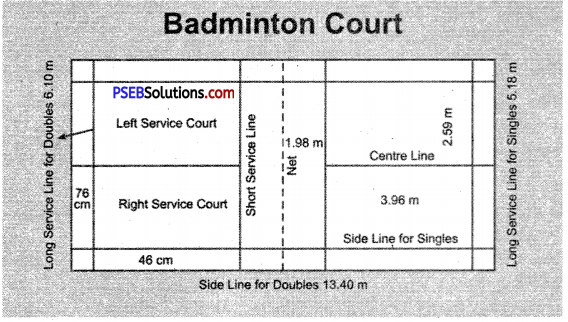
  • Size of Badminton Court for Doubles:13.40 x 6.10 m or 44′ x 20′ feet
  • Size of Badminton Court for Single’s:13.40 x 5.18 m or 44′ x 17′ feet
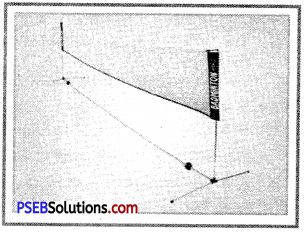
  • The width of the Net: 760 mm (76 cm)
  • Height of the Net at the Centre:1.524 m
  • Height of the Net at Posts:1.550 m
  • Shape of the Court:Rectangular
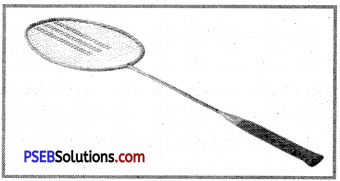
  • Size of Racket:Length 680 mm x Width 230 mm
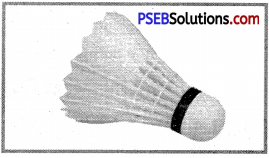
  • Weight of the Shuttle:4.73 gm to 5.50 gm
  • Number of Feathers of Shuttle:14 to 16
  • The length of the Feathers:62 mm to 70 mm
  • Width of Back Gallery:2′ – 6″ (.76 mm)
  • Width of Side Gallery:1′ – 6″ (.46 mm)
  • Short service lines from the Centre:6′ – 6″ (1.98 m)
  • Number of Officials:Umpire – 1, Service Umpire – 1, Referee – 1, Linemen – 10.
    PSEB 12th Class Physical Education Practical Badminton 2

Badminton Game Rules And Regulations

Toss: A toss shall be conducted before the start of game and winning side has the choice to serve or receive first.

Scoring:

  • A match consists of best of three games.
  • A game is won by the side which first score 21 points.
  • The side winning a game serves first in the next game only.
  • The side winning a rally shall add a point.

Change of Ends: The ends change at the end of first game, second game and in third game after 11 points.

PSEB 12th Class Physical Education Practical Badminton

Service Rules:

  • It is not permitted to cause undue delay to serve once server and receiver are ready.
  • The server and receiver shall stand in diagonally opposite court during the service.
  • Some part of both feet of server and receiver must remain in contact with the surface of court in a stationary position.
  • During service die racket of the server shall initially hit the base of the shuttle.
  • The shuttle shall be below the waist level initially while serving.
  • In doubles, the partner may take up any position within their courts.
  • If the server misses the shuttle while attempting to serve, it is termed as fault.

Fault:

  • It is not permitted to cause undue delay to serve once server and receiver are ready. .
  • If service is not correct serve than it is fault.
  • If the shuttle fails to cross the net or passes through or under the net.
  • If it touches by the person, player or any other object.
  • When any player invades an opponent’s court through net with racket or any other obstruction by shouting or gestures etc.
  • If the shuttle is hit twice in succession by the same player or side.
    PSEB 12th Class Physical Education Practical Badminton 3

Let Rule:
‘Let’ is a term called by umpire to halt the play.

  • If a shuttle is caught on the net and remains suspended on or over the net it shall be a ‘let’ except during service.
  • If during service, the receiver and server commits foul simultaneously, it shall be a ‘let’.
  • A let may be called if a service court error occurs during play.
  • If the shuttle during play disintegrates completely, it shall be a ‘let’.

PSEB 12th Class Physical Education Practical Badminton

Badminton Game Important Terminologies

  • Let: A let is a term used by an umpire to halt the game as a result of unforeseen situations. In this case, the last service shall not be considered and the player who served shall serve again.
  • Rally. A sequence of one or more strokes starting with the service, until the shuttle ceases to be in play.
  • Serve: The stroke used to put the shuttle cock into play at the start of each rally. Wood Shot. A legal shot in which the shuttle hits the frame of the racket.
  • Fault: A violation or infringement of playing rules, either during service, receiving or during play.
  • Short Service Line: The line at distance of 1.98 m feet from the net, to which a serve must cross to be a legal serve.
  • Deuce: It is a term used when a score reaches 20 – 20. In case of deuce a lead by 2 points must be scored in order to win the game.
  • Smash: It is an overhead attacking stroke hit hard which forces shuttle to fall sharply downwards.

PSEB 12th Class Physical Education Practical Badminton

Dimensions of Play Field / Court or Equipment:
1. The Court:
The size of badminton court is rectangular court with the length of 13,4 metres (44 feet) both for singles and doubles. The width of court is 6.1 metres (20 feet) for doubles and reduced to 5.18 metres (17 feet) for singles. The court is marked with 40 mm wide lines.

2. Posts:
The posts are 1.55 m high from the surface of the court. The posts are fixed on the doubles side lines irrespective of singles or doubles is being played.

3. Net:
The net shall be made of fine cord or cable. It must be dark coloured with a mesh from 3/4″ to 1″. The width of the net shall be 2′ – 6″ The height of the net is 5 feet from the ground at centre and 5 feet

PSEB 12th Class Physical Education Practical Badminton

4. Racket:
The frame of the racket must be attached with the help of shaft. The racket mainly have three parts head, shaft and throat. The head shall not exceed 280 mm in length and 220 mm in width. The total length of the racket should be 680 mm and width 230 mm.
PSEB 12th Class Physical Education Practical Badminton 4
5. Shuttle:
The shuttle may be made from natural or synthetic material. The base of the shuttle i.e. cork must have diameter between 25 to 28 mm. The total length of feather shall be between 62 to 70 mm. The shuttle must weight 4.74 to 5.50 gm.
PSEB 12th Class Physical Education Practical Badminton 5
Fundamentai Skills
1. Holding the Racket:
The most important and basic skill in the game is to hold the racket or grip. The wrist while holding the racket should not be stiff. There are mainly two styles of gripping the racket i.e. frying pan grip and back hand grip.

2. Service:
The stroke use to put the shuttle into play at the start of each rally is called service. There are mainly two types of service i.e. high service and low service. In high service, the server tries to place the shuttle deep on the back of the court. On the other hand, low service, is just to clear the net and place the shuttle few inches away from the short service line.

3. Strokes:
The contact between the shuttle and racket is termed as stroke. The different strokes can be categorized mainly into three categories:
(a) Forehand Stroke
(b) Backhand Stroke
(c) overhead stroke.

(a) Forehand Stroke :
This is used most often in the game, this stroke is performed when a shuttle falls in front of active side of tire receiver. Its easy to direct the shuttle to any point of the opponent’s court.

(b) Backhand Stroke:
It is normally difficult shot as the shuttle falls towards non playing side arm of the player. It is difficult to return this shot strongly or forcefully.

(c) Overhead Stroke : The action of hitting a shuttle approaching above the head.

4. Drop Shot:
The drop shots are delicate badminton shots w’hich is mainly executed with a deceptive move to win a point. The purpose of this shot is to force an opponent to make weak return.

5. Lob Shot:
Shuttle hit high and deep to the base line of opponent. In this the high serve played at full stretch with a lunge.

6. Smash: It is an overhead attacking stroke hit hard which forces shuttle to fall sharply downwards in opponent’s court.

7. Hair Pin Shot:
In this shot, the shuttle is returned sharply from very close to the net. The movement of the shuttle is just like a hair pin falling very close to the other side of net.

Badminton Game Important Tournaments
International Level

  1. Thomas Cup
  2. World Cup
  3. Wills World Cup
  4. China Cup
  5. Uber Cup
  6. Shaji Qureshi Cup
  7. Olympic Games
  8. Common Wealth Games
  9. Asian Games
  10. Alba World Cup
  11. All England Championship
  12. Yonex Cup

PSEB 12th Class Physical Education Practical Badminton

National Level

  1. Senior National Championship
  2. Aggarwal Cup
  3. Amrit Diwan Cup
  4. All India Intervarsity Championship.

Arjuna Award Winners

  1. Nandu Natekar-1961
  2. Meena Shah-1962
  3. Dinesh Khanna-1965
  4. Suresh Goel-1967
  5. Dipu Ghosh-1969
  6. D.V. Tambay-1970
  7. Moorthy-1971
  8. Prakash Padukone-1972
  9. Raman Ghosh-1974
  10. Davinder Ahuja-1975
  11. Ami Ghia-1974
  12. Ms. K.T. Singh-1977-78
  13. Syed Modi-1980-81
  14. P. Ganguli, Madhumita Bisht-1982
  15. Rajeev Bagga-1991
  16. George Thomas-1999
  17. Pullela, Gopichand-2000
  18. Madasu Srinivas Rao (Physically Challenged)-2003
  19. Abhinn Shayam Gupta-2004
  20. Apama Popat-2005
  21. Chetan Anand-2003
  22. Rohit Bhakar (Physically Challenged-2006
  23. Anup Sridhar- 2008
  24. Saina Nehwal-2009
  25. Ashwani Ponappa, Parupali Kashyap-2012
  26. P.V.Sandhu-2013
  27. V.Diju-2014
  28. K. Siriknath-2015

Dronacharya Award Winners

  1. S. M. Arif
  2. Pullela Gopichand

PSEB 12th Class Physical Education Practical Badminton

Badminton Game Important Questions

Question 1.
When did the International Badminton Federation came into existence?
Answer:
In the year 1934.

Question 2.
When was badminton considered as a medal sport in Olympic games?
Answer:
It became a medal sport in 1992 Olympic Games Barcelona.

Question 3.
What are the dimensions of badminton court for doubles?
Answer:
13.40 x 6.10 m or 44′ x 20′ feet.

Question 4.
What is the width of net?
Answer:
760 mm (76 cm).

PSEB 12th Class Physical Education Practical Badminton

Question 5.
Give the number of feathers in a shuttle.
Answer:
14 to 16 feathers.

Question 6.
How many officials are required for badminton match?
Answer:
1 Umpire, 1 Service Umpire, 1 Referee and 10 Linemen.

Question 7.
What do you know about toss in badminton?
Answer:
A toss shall be conducted before the start of the game and winning side has the choice either to serve or receive first.

Question 8.
What is the distance of short service line from the centre?
Answer:
6′ -6″ (1.98 m).

Question 9.
What is meant by the term deuce?
Answer:
It is a term used when score reaches 20-20. In case of deuce a lead by 2 points must be scored in order to win the game.

Question 10.
What is the height of posts?
Answer:
The posts are 1.55 m high from the surface of the court.

PSEB 12th Class Physical Education Practical Badminton

Question 11.
Name important International level tournaments in badminton.
Answer:
Thomas Cup, World Cup, Wills World Cup, China Cup, Uber Cup, Olympic Games, Asian Games, Common Wealth Games, All England Championship, Yonex Cup.

Punjab State Board PSEB 12th Class Physical Education Book Solutions 12th Class Physical Education Practical Badminton Important Notes, Questions and Answers.

PSEB 12th Class Physical Education Practical Wrestling Free Style and Greeco Roman

PSEB 12th Class Physical Education Practical Wrestling Free Style and Greeco Roman

Wrestling Free Style And Greeco Roman Game History
Wrestling is a barehanded combat game in which two opponents try to throw each other down and pin their shoulders to the ground using holds and techniques. This is one of the oldest forms of combat sports wrestling was an integral part of military trainning in ancient Greece and it was played in the ancient Olympics for the first time in 776 B.C. In 15th century, wrestling reappeared in England, France and Japan. It was on the programme of the first modem Olympics in 1896 in Athens. Today there are two forms-Free style arid Greeco- Roman style. The International Federation of Women Wrestling was established in 1987. Asian wrestlers are good at world competitions. Mr. Jadav of India had got Bronze medal in 1952 Olympics. Indian wrestlers are also good. Russian wrestlers are world famous for then- latest techniques. Indian has also produced many good wrestlers like Dara Singh, Kartar Singh and Pappu Yadav.

PSEB 12th Class Physical Education Practical Wrestling Free Style and Greeco Roman

Wrestling Free Style And Greeco Roman Game Important Points

  • Shape of the mat of Wrestling:Round
  • Size of mat:4.5 m Radius
  • Colour of Round:Red
  • Height of Mats from Platform:1.10 Meter
  • Colour of the comer:Red and Blue
  • Duration of Bout:6 Minutes, 3-3 Min (2 half)
  • Total weight for men:9
  • Total weight for women:7
  • Total weight for junior:10
  • Officials for wrestling:One mat chairman, Two Referees, Three judges
  • Rest after bout:30 seconds
  • Undisturb area around the mat:1.50 Metre

Wrestling Weight Categories:
Age Group

  • School Boys:14-15 years
  • Cadet:16-17 years
  • Junior:18-20 years
  • Senior:19-20 years

PSEB 12th Class Physical Education Practical Wrestling Free Style and Greeco Roman

Above 20 Years-

Senior Men Senior Women
First Group 48-54 K.G. 41-46 KG.
Second Group 58 KG. 51 KG.
Third Group 63 K.G. 56 KG.
Fourth Group 69 K.G. 62 KG.
Fifth Group 76 K.G. 68 KG.
Sixth Group 85 K.G. 68-75’KG.
Seventh Group 97 K.G.
Eighth Group 97-130 K.G.

From 17 years to 20 years old:

Junior Boys Junior Girls
First Group 46-49 KG. 40-43 KG.
Second Group 52 KG. 46 KG.
Third Group 56 KG. 50 KG.
Fourth Group 60 KG. 54 KG.
Fifth Group 65 K.G. 58 KG.
Sixth Group 70 KG. 63 KG.
Seventh Group 76 KG. 68 KG.
Eighth Group 83 KG. 68-75 KG.
Ninth Group 90 KG.
Tenth Group 90-115 KG.

PSEB 12th Class Physical Education Practical Wrestling Free Style and Greeco Roman

From 15 years to 16 years old:

Sub Junior Boys Sub Junior Girls
First Group 39-42 K.G. 36-38 KG.
Second Group 45 KG. 40 KG.
Third Group 48 K.G. 43 KG.
Fourth Group 52 K.G. 46 KG.
Fifth Group 57 KG. 49 KG.
Sixth Group 63 KG. 52 KG.
Seventh Group 69 KG 56 KG.
Eighth Group 76 KG. 60 KG.
Ninth Group 83 KG. 65 KG.
Tenth Group 83-95 KG. 65-75 KG.

From 13 years to 14 years old:

Sub Junior Boys Sub Junior Girls
First Group 29-32 KG. 20-30 KG.
Second Group 35 KG. 32 KG.
Third Group 38 KG. 34 KG.
Fourth Group 42 KG. 37 KG.
Fifth Group 48 KG. 40 KG.
Sixth Group 54 KG. 44 KG.
Seventh Group 58 KG. 48 KG.
Eighth Group 66 KG. 52 KG.
Ninth Group 71 KG 57 KG.
Tenth Group 71-85 KG 57-62 KG.

Every participants will take part according to his own body weight.

PSEB 12th Class Physical Education Practical Wrestling Free Style and Greeco Roman

Free Style Wrestling:
In Free Style Wrestling, wrestler can hold from any part of his body. He can use his legs and apply any kind of Technique but he cannot hold Ears, Hairs and Patba of an opponent.

Greeco-Roman Wrestling:
In Greeco-Roman Wrestling, Wrestler can not use his legs. Any type of Technique can be applied without legs from the upper part of his waist line, even in Greeco Roman Wrestling, wrestler cannot hold ears, Hairs and Patba of an opponent.
Every competitor can participate in his own weight group as listed above.

Weighing of the Competitors:

  • Weighing of competitors shall begin two or four hours before the wrestling competition begins.
  • The competitors shall be weighed without clothes. They shall be medically examined by a doctor before they are weighed. The doctor will remove any player suffering from any contagious disease.
  • Each contestant can participate in wrestling with a player belonging to his weight-group.
  • The competitors should be in a perfect physical condition. Their nails should be well pared. They shall be checked at the time of medical examination.
    PSEB 12th Class Physical Education Practical Wrestling Free Style and Greeco Roman 1
  • Weighing shall start at least two hours before the competition and must conclude an hour before the first wrestling bout.
  • Before the completion of weighing, a contestant may stand any time on the weighing machine for recording his weight, but he should not be out of turn.

Costume:
The wrestlers shall enter the arena in a one-piece jersey, banian or ‘jangia’ (red or blue) beneath which they shall wear a jock strap. They will wear costumes which fit their body very well, and is not loose. They will wear sports shoes firmly closing the anklets. The use of light knee guards is allowed. A contestant shall be closely shaved or with a beard of many months growth.

1. The contestants cannot use oil or any other greasy substance on their bodies. 2. Their bodies should not be wet with perspiration. 3. The use of rings, bracelets, shoes with buttons and any other such thing which may harm or hurt a player is prohibited.

Mat:
The mat at all international matches should be 9 metres in circle (with a radius of 4.50 m.), and from its other ring a ring of 50 cms. is drawn. This place is marked with red colour. It should be fixed on a platform, 1.10. metre in height. The ends of the mat should have red or blue comers, and there should be a circle of 1 metre in the middle.

PSEB 12th Class Physical Education Practical Wrestling Free Style and Greeco Roman

Start of Wresriinq Bout And its Duration:

  •  The bout shall continue until a player falls down, otherwise it shall continue for 6 minutes.
  • If a player does not enter the mat after five minutes of call, he shall be considered defeated and turned out of the competition.
  • The wrestling bout shall start, interrupt or end on the whistle of the referee.

End of the Bout:
The end of the bout is indicated by the ringing of gong by the time keeper. The referee, too, blows his whistle as a signal for the end of the bout. The winner’s arm is raised by the referee.

Foul-holds:
The following fouls are taken into consideration-

  • Pulling of hair, ears, dress, private organs, etc.
  • Twisting of fingers, grasping of the throat and other holds which may be life-endangering.
  • Holding in such a manner as may put the opponent’s life in danger, or may hurt any of his body part, or cause him pain so that the opponent helplessly leaves the bout.
  • Treading on the feet of the rival.
  • Touching the face of the opponent (from the eye-brows to the chin).
  • Grasping the opponent by the throat.
  • Lifting the rival when he is in bridge position, and then throwing him on the mat.
  • Breaking the bridge by giving a push from the head.
  • Twisting the opponent’s arm at above 90° angle.
  • Grasping the opponent’s head with both hands.
  • Thrusting the elbow or knee into the abdomen or stomach of the rival.
  • Turning the opponent’s arm to the back and pressing it.
  • Grasping the opponent’s head in any manner.
  • Applying leg-scissors on the body or head.
  • Holding on to the mat.
  • Talking to each other and making dangerous assault.

PSEB 12th Class Physical Education Practical Wrestling Free Style and Greeco Roman

Cautions:
Precautions may.be taken in the following conditions:
(a) Permanent obstacles
(b) Foul holds
(c) Indiscipline at the time of bout
(d) Breach of rules.

  • These precautions shall be taken into account along with other fouls of the bout.
  • A player may be declared defeated after he has been warned thrice.
  • A player, in case of major offence, may be removed from the bout.

Obstacles:

  • Lying in abdomen position.
  • Going out of the mat knowingly.
  • Holding of both the hands of the opponent so that he may not play.
  • A player may be given warning if he goes out of the mat.

Stoppage of Bout:
A bout may be suspended for five minutes at most because of a bleeding nose, headlong fall or any other acceptable reason. This obstacle in one or two bouts may be of maximum 5 minutes for each contestant.

Score:
1. One Point:

  • to a player who throws a rival on the mat and maintains control over him,
  • to that player who rises from beneath and maintains his hold on his opponent,
  • a player who makes a good grasp and does not allow his opponent’s head and shoulder to touch the mat,
  • for one precaution the opponent gets one point.

2. Two Points:

  • to that player who keeps good hold on his opponent and maintains his hold on him for some time
  • to that player whose opponent immediately falls or falteringly falls.

3. Three Points:

  • to a player who keeps his opponent in danger (when shoulders make an angle of less than 90° from the mat) for five seconds,
  • bridge position for three seconds or fall takes five seconds.

Decision:
When there is a difference of less than one point in the score of the opposite players, the match ends in a draw. Again, if no contestant scores any point, or the points are equal, the match ends in a draw. If the difference is more than one point, a player with more points is declared the winner.

Fall:

  • For full fall it is sufficient if the shoulder of the wrestler touches the mat.
  • The fall shall be considered if the referee raises no objection.
  • For proper fall on the edge of the mat the head and shoulders of the contestant shall touch the limits of mat.

Winning by Points:
If there is no foul within six minutes, the decision is made by points. The player scoring higher points shall be the winner.

PSEB 12th Class Physical Education Practical Wrestling Free Style and Greeco Roman

Rules for Final:

  • The final match is played among three wrestlers.
  • The players, who have scored 6 penalty marks, cannot take part in the final match.
  • When the three players with less than 6 penalty marks reach the final, the points scored by them are nullified.
  • If those players have already competed, the former penalty marks are counted in the final.
  • The penalty marks of the contestants in the final must be kept in view.
  • If each of the three contestants has already scored 6 points, they will forfeit their points as mentioned above.
  • If the three contestants of the final have already scored 6 points each, he shall be awarded the third position and the remaining two shall wrestle for first position.
  • The player, who scores minimum penalty point in the last three bouts, shall be the winner.
  • If the penalty points of the finalists are equal, the decision is made keeping in views the following:
    • The victory scored on points.
    • The number of points being equal.
    • The number of fouls.
    • In case of tie, the player with minimum warnings is declared the winner.
    • If there is still a tie, both the players are declared equal.

Officials:
There are three officials in all types of wrestling matches:

  • Mat Chairman
  • Referee
  • Judge
  • No official can be changed during the wrestling.

Arjuna Award Winners

  1. Udey Chand-1961
  2. Malwa-1962
  3. G. Andalkar-1963
  4. Bishamber Singh-1964
  5. Bhim Singh-1966
  6. Mukhtiar Singh-1967
  7. Master Chandgi Ram (Indian Style)-1969
  8. Sudesh Kumar-1970
  9. Prem Nath-1972
  10. Jagroop Singh-1973
  11. Satpal-1974
  12. Rajinder Singh-1978-79
  13. Jagminder Singh-1980-81
  14. Kartar Singh-1982
  15. Mahabir Singh-1985
  16. Subhash-1987
  17. Rajesh Kumar-1988
  18. Satywan-1989
  19. Ombir Singh-1990
  20. PappuYadav-1992
  21. Ashok Kumar-1993 .
  22. Kaka Pawar, Rohtas Singh Dahiya-1999
  23. Palvinder Cheema-2002

PSEB 12th Class Physical Education Practical Wrestling Free Style and Greeco Roman

Wrestling Free Style and Greeco-Roman Game Important Tournaments

  1. Olympic Games
  2. Asian Games
  3. Commonwealth Games
  4. International Wrestling Championship
  5. National Level (Junior & Senior)
  6. Championship.

Wrestling Free Style and Greeco-Roman Game Important Questions

Question 1.
What is the duration of bout?
Answer:
6 minutes (Two rounds of 3-3 min).

Question 2.
Number of weight categories for men.
Answer: 9.

Question 3.
What is the colour of the corner for the bout?
Answer:
Red and Blue.

Question 4.
In which year International Wrestling Federation was formed?
Answer:
In 1987.

PSEB 12th Class Physical Education Practical Wrestling Free Style and Greeco Roman

Question 5.
What is the dimension of undisturbed area around the mat?
Answer:
1.50 metres.

Question 6.
Enlish various styles of wrestling.
Answer:
Free Style Wrestling, Greeco Roman Wrestling.

Question 7.
How many official are there in wrestling bout?
Answer:
Three officials.

Question 8.
What indication referee gives for the declaration of winner?
Answer:
He raises the winner’s arm to declare winner of the bout.

Question 9.
What is the purpose of whistle in the wrestling contest?
Answer:
The wrestling bout shall start, interrupt or end on the whistle of the referee.

Question 10.
Is it permissible to use greasy substance on the body before wrestling contest?
Answer:
No.

PSEB 12th Class Physical Education Practical Wrestling Free Style and Greeco Roman

Question 11.
What is the radius of circle in wrestling mat
Answer:
4.50 metre.

Punjab State Board PSEB 12th Class Physical Education Book Solutions 12th Class Physical Education Practical Wrestling Free Style and Greeco Roman Important Notes, Questions and Answers.

PSEB 12th Class Physical Education Solutions Chapter 3 Careers in Physical Education and Sports Awards

PSEB Solutions for Class 12 Physical Education Chapter 3 Careers in Physical Education and Sports Awards

Physical Education Guide for Class 12 PSEB Careers in Physical Education and Sports Awards Textbook Questions and Answers

One Mark Question-Answers

Question 1.
What kind of schools did the British open when they came to India in a large Number?
Answer:
The Britishers were very fond of games and sports and for the first time they introduced Football, Cricket, Gymnastic and Hockey in India. When the large number of British people came to India, they started English medium schools for their children.

Question 2.
What is the duration of B.P. Ed. course?
Answer:
2 years.

PSEB 12th Class Physical Education Solutions Chapter 3 Careers in Physical Education and Sports Awards

Question 3.
When was Physical Education originated in India?
Answer:
1920.

Two Marks Question-Answers

Question 4.
What is the full form of N.S.N.I.S?
Answer:
Netaji Subhash National Institute of Sports.

Question 5.
What is the eligibility for receiving the Arjuna Award?
Answer:
The award is presented to the sports persons who performed outstanding at International level such as Olympic Games, Asian Games and Commonwealth Games during last four years.

Question 6.
Write about certificate course in Yoga.
Answer:
In order to become Yoga trainer or instructor, a person should possess certificate course of 40 days duration. The eligibility for this course is XIIth (Senior Secondary School pass Certificate).

Question 7.
Write about Diploma in Yoga.
Answer:
The diploma in Yoga can be pursued after graduation or equivalent degree. The duration of the diploma is 2 years and person become eligible to teach Yoga at school level.

PSEB 12th Class Physical Education Solutions Chapter 3 Careers in Physical Education and Sports Awards

Question 8.
Who is given the Dronacharya Award?
Answer:
To recognize the contribution of the coaches in sports.

Three Marks Question-Answers

Question 9.
What is the importance of a Physiotherapist for players?
Answer:
The knowledge of sports injuries and their management is the key in this field. Thus, students can adopt this as profession like a sports physiotherapist. The qualification to become a physiotherapist could be diploma, Bachelor of physiotherapist, B.Sc in physiotherapy or Master in Physiotherapy. There is ample scope for physiotherapist as a career. They can be attached with many sports associations and national teams. They may get opportunity as personnel physiotherapist with renowned players.

Question 10.
Write about Rajiv Gandhi Khel Rattan Award.
Answer:
The Rajiv Gandhi Khel Rattan award is conferred in the memory of late Prime Minister Rajiv Gandhi. It was started in the year 1991 to boost the morale and confidence of the players. This award is presented by Ministry of Youth Affairs and Sports to the players for their
exceptional performance in sports in India. The recipients of the award are given a cash prize of 7.5 lakhs. A medal and citation are given along with the cash prize to the players. The first recipient of the award was Vishwanathan Anand in 1992-1993 and the first woman was Kamam Malleswari who was conferred Rajiv Gandhi Khel Rattan for weightlifting in the year 1995-1996 and Pankaj Advani is the only player to receive this award for two different games- Snooker and Billiards.

PSEB 12th Class Physical Education Solutions Chapter 3 Careers in Physical Education and Sports Awards

Question 11.
Write about Maharaja Ranjit Singh Award.
Answer:
Maharaja Ranjit Singh award was instituted in 1978 by the government of Punjab on the name of the leader of the Sikh Empire. It consists of a trophy of Maharaja Ranjit Singh, honouree citation, scroll and carrying a 5 lakh cash prize (amount increases as per 2018 policy) earlier this amount was 1 lakh which is presented to distinguished sportsperson every year.

The awardees shall be selected from those who participated at Olympics level, World championship level, national and other recognised international sports competitions in all disciplines. Pargat Singh, Hockey Olympian was the first person who received Maharaja Ranjit Singh award.

Five Marks Question-Answers

Question 12.
What is Sports training? Explain it briefly.
Answer:
In general, the word sports training is commonly used by the sportsperson in the field of sports. But, in broad sense training may be defined as an organised and instructional process which aims to improve the individual’s physical, psychological and intellectual performance or tactical capabilities. In order to impart training in sports, a coach or trainer must possess following certification in various courses.

1. Master Degree in Sports Coaching:
Physical education as a career, one must be well qualified with certificate, degree or diploma in physical education from recognised university. They must possess B.PE, B.PED, M.PED, M.Phil, and highest degree Ph.D in the respective field. There are ample opportunities to work as physical educationist. They can be a teacher in schools, colleges and can also work as professors in universities with excellence in their field.

2. Certificate Course in Sports Coaching:
To choose this as a career one must be very fit and healthy and have the experience in any field like aerobic trainer, calisthenics expert and weight training expert. Now-a-days, career as fitness trainer is very lucrative. Every individual understood the value of physical fitness for their day to day daily task as well as career.

Fitness trainer helps people of all ages to get and improve their fitness. Fitness trainer must posses’ certificate course in fitness instruction, diploma in health, fitness and exercise instruction and diploma in personal training. Apart from qualification they have to have known about nutritional value and diet plan. There are enormous employment opportunities available for fitness trainer in public as well in private sectors.

3. Diploma in Sports Coaching:
The good coach must possess knowledge of subject in depth alongwith game related skills. There are several games played in the world and every game requires specialized coaching. After doing diploma of coaching in a particular game, a person can avail job as a coach. Apart from coach of national or international team, there are enormous opportunities available for coaches e.g. they can coach a team in schools, collages, clubs etc. They can also run their own sports academies. A coach must have done NIS diploma in particular game and must have acquired knowledge of skills also. They can also complete their degree in physical education such as B.PEd, M.PEd etc.

PSEB 12th Class Physical Education Solutions Chapter 3 Careers in Physical Education and Sports Awards

Question 13.
What is the importance of careers and sports awards in the field of Physical Education? Write a note on the importance of Physical Education in India.
Answer:
Physical Education is an education which is delivered through physical activities,- physical fitness, lifestyle, sports and interpersonal skills.
The career options in Physical Education has been increasing in outer country and whole world. To adopt Physical Education as career is not an easy option. In India many government institution such as Sports Authority of India, National Sports Federations, Youth Sports department, Railways, Banks, Indian Airlines, millitary and police department etc. provides job’s opportunities. These jobs are given on the basis of sports performance under ‘Sports Quota’.

In present time, various career options are available in the field of Physical Education. A person can work as Physical Education teacher at school and college. For this a person must done various professional courses in the field. For instance B.P.Ed., D.P.Ed., M.A., M.Phil, Ph. D, UGC (NET) etc. On the basis of these qualification a person can get job as teacher in school or colleges. In addition to this, a person can also work as sports trainer, physiotherapist journalist, yoga expert etc.

The sports awards are given for the outstanding performance in recognized sports only. In order to encourage and motivate sports persons and coaches for their performance in the field of sports, they are presented with sports award, which is given on the name of eminent sports personality Major Dhyanchand on the occasion of his birthday i.e. 29th August every year, on the mark of ‘National Sports Day’ in Rashtrapati Bhavan. Various Sports Awards such as Rajiv Gandhi Khel Rattan Award, Arjuna Award, Dronacharya Award, Dhyanchand Award, Maharaja Ranjit Singh Award, MAKA trophy etc. are given for the recognition in the field of sports.

Sports have always been a part and parcel of human civilization. If we go through our past civilization, then we can find that sports had an important place in Vedic period, Epic period, Historical period etc. Many researchers established that people were always engaged in sports throughout history. People mostly participated in Archery. Horse riding, Armed training, Hunting, Fencing, Swimming etc.

However, British people were also sports lovers and promoted sports culture in India. In the year 1858, East India company entered in India and whole nation became under them.British people were very much interested in sports and they introduced sports for the first time in India such as Cricket, Football, Gymnastics, Hockey etc. and they also established English medium schools in India for the education of their children.

PSEB 12th Class Physical Education Solutions Chapter 3 Careers in Physical Education and Sports Awards

Question 14.
What is the eligibility for the following courses? Also mention their duration.
(i) B.P.Ed.
(ii) D.P.Ed.
(iii) Certificate course in Yoga
(iv) Ph.D.
Answer:
(i) B.P.Ed. (Integrated Course):
This course is for four years duration and this course is conducted by various recognized Colleges and Universities. This course is equivalent to other graduation level course. Earlier, the duration of course was three years, but later on in the year 2016-17. The duration of course was extented to four years by NCERT. After completing this course a person can work as PTI at school level.
Eligibility for the course.

  • A person must have scored 50 percent marks in XII from the recognized board.
  • It is mandatory to qualify entrance test and physical efficiency test.
  • 50% marks in D.P.Ed. degree.

(ii) D.P.Ed:
This course was earlier known as C.P.Ed and later on the name was changed to D.P.Ed. and at the same time the duration of course was also extended to two years. After completing this course, a person can work as PTI in elementry school.
Eligibility for D.P.Ed. course:

  • A person must passed XU with 50% marks from any recognized board.
  • A person should be physically fit.
  • It is necessary to pass physical fitness test.

(iii) Certificate course in Yoga:
In order to take admission in this course a person must have passed XII from any recognized board. The duration of course is 6 weeks in which a person gets knowledge about various asanas. After completing this course, a person can work as Yoga trainer.

(iv) Ph.D. (Doctorate of Philosophy):
This is the highest degree in the subject of Physical Education, the duration for which can be 3 to 4 years. In this a person can study and research any area of specialization and according to his interest in the field. The results and findings of the study can be applied for the development of the subject. After completing this course a person may be designated as Doctor in the subject. Eligibility.

  • To persue doctorate degree a person must qualify enterance test or qualify UGC (NET) examination.
  • It can be done after M.Phil. or Masters’ degree in the subject.

PSEB 12th Class Physical Education Solutions Chapter 3 Careers in Physical Education and Sports Awards

PSEB 12th Class Physical Education Guide Careers in Physical Education and Sports Awards Important Questions and Answers

One Mark Question-Answers

Question 1.
In which year Y.M.C.A College was established?
Answer:
In the year 1920.

Question 2.
In which year IOA was originated?
Answer:
In the year 1927.

Question 3.
What is another name for Indian Education Commission?
Answer:
Kothari Commission.

Question 4.
Name the leading institute of physical education in Mardas.
Answer:
Y.M.C.A.

Question 5.
What is the qualification for teaching at school level?
Answer:
D.P.Ed. B.P.Ed., M.P.Ed.

PSEB 12th Class Physical Education Solutions Chapter 3 Careers in Physical Education and Sports Awards

Question 6.
What should be the qualification for coaching profession in sports?
Answer:
NS NIS Diploma in sports coaching.

Question 7.
What should be the qualification for college teachers?
Answer:
M.A. (Physical Education), UGC (NET), Ph.D.

Question 8.
In which year Rajiv Gandhi Khel Rattan Award started?
Answer:
In year 1991.

Question 9.
Write the amount for the receipient of Rajiv Gandhi Khel Rattan Award.
Answer:
7.5 lakh rupees.

Question 10.
Who was the first female to receive Rajiv Gandhi Khel Rattan Award?
Answer:
Karnam Malleshvari.

Question 11.
What is full form of NADA?
Answer:
National Anti Doping Agency.

Question 12.
Give full form of WADA.
Answer:
World Anti Doping Agency.

PSEB 12th Class Physical Education Solutions Chapter 3 Careers in Physical Education and Sports Awards

Question 13.
Who received the Arjuna Award in Athletics in the year 2018?
Answer:
Neeraj Chopra, Subedar Jinson Johnson and Hima Das.

Question 14.
What is the duration of Master degree in Physical Education?
Answer:
2 years.

Question 15.
Which award is given for the contribution of coaches?
Answer:
Dronacharya Award.

Question 16.
What is the new name for the Sports Authority of India?
Answer:
Sports India.

Question 17.
In which year the word ‘Authority’ removed from ‘Sports Authority of India’?
Answer:
In the year 2018.

Question 18.
Name the highest award for sports person in India.
Answer:
Arjuna Award.

Question 19.
Name the highest award for coaches in India.
Answer:
Dronacharya Award.

PSEB 12th Class Physical Education Solutions Chapter 3 Careers in Physical Education and Sports Awards

Question 20.
Who got Arjuna Award in Atheletics in the year 1961?
Answer:
S. Gurbachan Singh Radhawa.

Question 21.
In which year IOA was established?
Answer:
In the year 1927.

Question 22.
Who announced the sports policy in the year 1968?
Answer:
Prime Minister Indira Gandhi.

Question 23.
What is the objective of Sports Authority of India?
Answer:
To utilize sports facilities and equipment for the improvement of sports standard in the country.

Question 24.
What is the duration of graduation degree after XII in physical education?
Answer:
4 years.

Question 25.
What is the duration of D.P.Ed course in physical education?
Answer:
2 years.

Question 26.
On which date each year and where sports awards are given?
Answer:
The sports awards are presented on 29 August of each year at Rashtrapati Bhawan.

PSEB 12th Class Physical Education Solutions Chapter 3 Careers in Physical Education and Sports Awards

Question 27.
National sports day is celebrated on the name of which eminent sports personality.
Answer:
Major Dhyanchand ji.

Question 28.
In which year Virat Kohli was given Rajiv Gandhi Khel Rattan Award?
Answer:
In the year 2018.

Question 29.
Which is the highest sport award given by the Punjab Government?
Answer:
Maharaja Ranjit Singh Award.

Question 30.
To whom Maulana Abul Kalam Azad award is given?
Answer:
To the university which perform best in the field of sports.

Question 31.
What is the cash award for Maulana Abul Kalam Award?
Answer:
Rupees 10 lakh.

Question 32.
What is the full form of MAKA?
Answer:
Maulana Abul Kalam Azad.

Question 33.
What change has been made in the name of ‘SAI’?
Answer:
It has been changed to ‘Sports India’.

PSEB 12th Class Physical Education Solutions Chapter 3 Careers in Physical Education and Sports Awards

Two Marks Question-Answers

Question 1.
Enlist various career options in physical education.
Answer:

  • As a teaching profession
  • As a coaching profession
  • As a fitness trainer
  • As a yoga instructor
  • As a Sports Journalist.

Question 2.
Write about LNIPE.
Answer:
In 1957 Lakshmibai National Institute of Physical Education was established in Gwalior to promote and produced physical education teacher in the country.

Question 3.
What is Masters’ Degree in sports coaching?
Answer:

  • Eligibility: Diploma in Sports coaching/Graduation.
  • Duration: 2 years.
  • Sports Participation: National/All India Intervarity level

Question 4.
Write about Raj Kumari Amrit Kaur Coaching Scheme.
Answer:
Raj Kumari Amrit Kaur coaching scheme was initiated by the government of India in 1953. The prime objective of the scheme was to raise the standard of Athletics, Hockey, Tennis, Cricket and Table Tennis etc. in the country. This scheme continued for eight years and later merged with National Coaching Scheme (Patiala).

Question 5.
What are die requirements to become sports physiotherapist?
Answer:
The knowledge of sports injuries and their management is the key in this field. Thus, students can adopt this as profession like a sports physiotherapist. The qualification to become a physiotherapist could be Diploma, Bachelor of physiotherapist, B.Sc in physiotherapy or Master in Physiotherapy.

PSEB 12th Class Physical Education Solutions Chapter 3 Careers in Physical Education and Sports Awards

Question 6.
Describe highest award for the sportsperson.
Answer:
The highest award given for the recognition in the field of sports to the sportsperson is Arjun Award. This award was instituted during the year 1961. This is the highest sports award given to the players showing best performance during the continues four years at national and international level including Olympics games, Asian games, and Commonwealth games. –

Question 7.
Enlist any one rule for the Rajiv Gandhi Kehl Ratan Award.
Answer:
The players who have represented and performed during Olympic. Games, Commonwealth games, Asian Games are nominated for this category of award. The decision of the committee formed by the government is considered for the award till 31st May of every year..

Question 8. What do you know about IOA?
Answer:
The name of the Society is “Indian Olympic Association” &“Bharatiya Olympic Sangh”. In 1927, Indian Olympic Association was formed with great efforts of Dr. A.G.Noehren, Mr. H.C. Buck and Mr. Dorabji Tata. The Indian Olympic Association is a non-governmental and not-for-profit organization, of unlimited duration, which exercises its jurisdiction over the whole territory of India.

Question 9.
Which courses are available for the coaches?
Answer:
Certificate course, Advance certificate course, Diploma in coaching and Masters degree in coaching.

Question 10.
What do you know about NSNIS Patiala?
Answer:
In 1959 a committee was formed to study the falling standard of sports in India. The committee advised the All India Council of Sports to set up a national sports institute in India. Subsequently, Netaji Subhas National Institute of Sports was set up at Patiala in 1961 by Sh. K.L. Sharimali. The government of India set up the society of Physical education and sports to manage and facilitate the development of sports in a scientific manner. The institute has produced eminent coaches, who imparted expertise knowledge to train national teams to compete at various international sports competitions.

PSEB 12th Class Physical Education Solutions Chapter 3 Careers in Physical Education and Sports Awards

Three Marks Question-Answers

Question 1.
Elucidate about the Sports Authority of India.
Answer:
The Sports Authority of India (SAI) was established by the Govt, of India Ministry of Youth Affairs and Sports in January 1984 to promote standard of sports throughout the country. It has ten regional and sub-regional centres at Bengaluru, Bhopal, Gandhinagar, Kolkata, Chandigarh, Sonipat, Delhi, Mumbai and Imphal Guwahati and Lucknow. SAI has two academic institutions at NSNIS Patiala and LNCPE ( Kerala) to conduct research and provide certificate course to Ph. D level course in Physical Education Sports Medicine.

Question 2.
What was the objective Raj Kumari Amrit Kaur coaching scheme?
Answer:
Objectives and Functions of the Scheme:

  • To help the State Sports Councils in conducting their annual coaching camps and to prepare their state teams for participation in National Championship.
  • To help the National Federations/Associations in tendering coaching services, running clinics and organizing competitions.
  • To requisition the services of expert coaches from abroad for conducting seminar discussions, running clinics and refresher courses for the benefit of in-service coaches etc.
  • Provide help and guidance to develop excellence amongst Indian Sportsperson.
  • Coordinate sports activities with the State Government/Institutions.
  • Monitor progress of trainees.

PSEB 12th Class Physical Education Solutions Chapter 3 Careers in Physical Education and Sports Awards

Question 3.
Enlist various educational qualification for the school and college teachers.
Answer:
As a teaching profession. Physical education as a career, one must be well qualified with certificate, degree or diploma in physical education from recognised university. They must possess B.PE, B.P.ED, M.P.ED, M.Phil, and highest degree Ph.D in the respective field. There are ample opportunities to work as physical educationist. They can be a teacher in schools, colleges and can also work as professors in universities with excellence in their field.

Question 4.
Elucidate journalism as profession in physical education.
Answer:
All over the world sports are keenly watched. Today media, news, magazines and professional people of sports perform journalism, so this career option is also coming up as a need of hour. Sports journalist must have completed their degree or diploma in Mass communication. They must have sports exposure and knowledge of different sports. Apart from this, they must possess good knowledge of media production, broadcasting etc.

Question 5.
Briefly explain about Rajiv Gandhi Khel Rattan Award.
Answer:
The Rajiv Gandhi Khel Rattan award is conferred in the memory of late Prime Minister Rajiv Gandhi. It was started in the year 1991 to boost the morale and confidence of the players. This award is presented by Ministry of Youth Affairs and Sports to the players for their exceptional performance in sports in India. The recipients of the award are given a cash prize of ₹ 7.5 lakhs.

A medal and citation are given along with the cash prize to the players. The first recipient of the award was Vishwanathan An and in 1992-1993 and the first woman was Karnam Malleswari who was conferred Rajiv Gandhi Khel Rattan for weightlifting in the year 1995-1996 and Pankaj Advani is the only player to receive this award for two different games- Snooker and Billiards.

PSEB 12th Class Physical Education Solutions Chapter 3 Careers in Physical Education and Sports Awards

Question 6.
Highlight about the highest award for the sportsperson.
Answer:
This award was instituted during the year 1961. This is the highest sports award given to the players showing best performance during the continues four years at national and international level including Olympics games, Asian games, and Commonwealth games. Under this award a trophy (bronze statue of Arjuna) and ₹ 5 lakhs cash is given to the Awardes. The award is given by Youth and Sports department of Ministry of Human Resources and Development.

Arjuna award was first presented to six people in 1961 namely Saleem Durani (Cricket), Gurbachan Singh Randhawa (Athletics), Sarbjit Singh (Basketball), Manuel Aaron (Chess), Nandu Natekar (Badminton), and L.Buddy D’ Souza (Boxing). Meena Shah (Badminton) was the first women to get this award in 1962.

Question 7.
Write about Dhyanchand Award.
Answer:
Dhyanchand life time achievement award in sports and games is highest award for lifetime achievement and contribution in the field of sports. This award is named after Major Dhyanchand who was soldier in Indian army but also an Indian hockey player who scored more than 1000 goals in a career span of 20 years.

This award was started in the year 2002 and given every year by the Ministry of Youth Affairs and sports. The recipients of this award are selected on the basis of their contribution to sports both during their active sporting career and after retirement. Dhyanchand awardees are given a cash prize of ₹ 5 lakhs along with a medal and certificate.

Question 8.
What do you know about Maharaja Ranjit Singh Award?
Answer:
Maharaja Ranjit Singh award was instituted in 1978 by the government of Punjab on the name of the leader of the Sikh Empire. It consists of a trophy of Maharaja Ranjit Singh, honouree citation, scroll and carrying a ₹ 5 lakh cash prize (amount increases as per 2018 policy) earlier this amount was ₹ 1 lakh which is presented to distinguished sportsperson every year.

The awardees shall be selected from those who participated at Olympics level, World championship level, national and other recognised international sports competitions in all disciplines. Pargat Singh, Hockey Olympian was the first person who received Maharaja Ranjit Singh award.

PSEB 12th Class Physical Education Solutions Chapter 3 Careers in Physical Education and Sports Awards

Question 9.
Write about the Rules for the Maharaja Ranjit Singh Awards.
Answer:

  • A sportsperson who received Rajiv Gandhi Khel Rattan Award and Arjuna Award and are domicile of Punjab are eligible for this award.
  • The sportsperson who earn 40 points in the last 5 years preceding the year of award.The award was suspended for 10 years between 1996 and 2005 and initiated again in 2006.

Question 10.
What are the objectives of Raj Kumari Amrit Kaur coaching scheme?
Answer:

  • To help the State Sports Councils in conducting their annual coaching camps and to prepare their state teams for participation in National Championship.
  • To help the National Federations/Associations in tendering coaching services, running clinics and organizing competitions.
  • To requisition the services of expert coaches from abroad for conducting seminar discussions, running clinics and refresher courses for the benefit of in-service coaches etc.
  • Provide help and guidance to develop excellence amongest Indian Sportsperson.
  • Coordinate sports activities with the State Government/Institutions.
  • Monitor progress of trainees.

Question 11.
What is the role of sport authority of India in sports?
Answer:
The Sports Authority of India (SAI) was established by the Govt, of India (Ministry of Youth Affairs and Sports) in January 1984 to promote shmdard of sports throughout the country. It has ten regional and sub regional centres at Bengaluru, Bhopal, Gandhinagar, Kolkata, Chandigarh, Sonipat, Delhi, Mumbai and Imphal Guwahati and Lucknow. SAI has two academic institutions at NSNIS Patiala and LNCPE ( Kerala) to conduct research and provide certificate course to Ph. D level course in Physical Education Sports Medicine:.

Question 12.
Write about the function of IOA.
Answer:

  • To formulate and enforce the policy of the association.
  • To carry into effect the objectives of the association.
  • To hold and control the funds and other assets of the Association.
  • To appoint committees or sub-committees, as and when necessary.
  • To enforce bye laws, all rules and regulations of the International Olympic Committee.

PSEB 12th Class Physical Education Solutions Chapter 3 Careers in Physical Education and Sports Awards

Question 13.
What are the teaching avenues available for the physical education teachers?
Answer:
Physical education as a career, one must be well qualified with certificate, degree or diploma in physical education from recognised university. They must possess B.PE, B.PED, M.PED, M.Phil, and highest degree Ph.D in the respective field. There are ample opportunities to work as physical educationist. They can be a teacher in schools, colleges and can also work as professors in universities with excellence in their field.

Five Marks Question-Answers

Question 1.
Describe the career options in Physical Education.
Answer:
Physical education is education through physical activities, physical fitness, healthy life style, issues related to sports and inter-personal skills. Career avenues in physical education are increasing day by day in India and abroad. The career making option in the subject of physical education is not an easy task.

It has wide variety of its activities along with good status and lots of jobs are being provided by the government organisations such as Sports Authority of India, National Institute of Sports, various Youth Services and Sports Departments, Indian Railways, Banks, Indian Airlines, State Police Departments etc. Jobs to sports persons are provided in the form of sports quota on the basis of their performance at various levels. These days sports provides a wide range of career opportunities in the field of physical education.

1. As a teaching profession:
Physical education as a career, one must be well qualified with certificate, degree or diploma in physical education from recognised university. They must possess B.PE, B.P.ED., M.P.ED., M.Phil, and highest degree Ph.D in the respective field. There are ample opportunities to work as physical educationist. They can be a teacher in schools, colleges and can also work as professors in universities with excellence in their field.

2. As a coaching profession:
The good coach must possess knowledge of subject in depth alongwith game related skills. There are several games played in the world and every game requires specialized coaching. After doing diploma of coaching in a particular game, a person can avail job as a coach. Apart from coach of national or international team, there are enormous opportunities available for coaches e.g. they can coach a team in schools, collages, clubs etc. They can also run their own sports academies. A coach must have done NIS diploma in particular game and must have acquired knowledge of skills also. They can also complete their degree in physical education such as B.P.Ed., M.P.Ed. etc.

3. As a fitness trainer:
To choose this as a career one must be very fit and healthy and have the experience in any field like aerobic trainer, calisthenics expert and weight training expert. Now-a-days, career as fitness trainer is very lucrative. Every individual understood the value of physical fitness for their day to day daily .task as well as career.

Fitness trainer helps people of all ages to get and improve their fitness. Fitness trainer must posses certificate course in fitness instruction, diploma in health, fitness and exercise instruction and diploma in personal training. Apart from qualification they have to have known about nutritional value and diet plan. There are enormous employment opportunities available for fitness trainer in public as well in private sectors.

4. As a Yoga instructor:
Now-a-days everybody has become fitness conscious and to choose this as a career is really a good opportunity in the field. The need of society is coming up more towards yogic practices. To become a yoga instructor or expert, individual must possess Bachelor degree in yoga; diploma in B.Ed (in yoga) or certificate course. He must have intense knowledge of techniques of Asanas another Kariya’s, knowledge of anatomy and physiology. There are enormous job availabilities for yoga expert in govt, as well as private sectors. An expert can also run their own yoga centres. Yog guru’s can be also attached with national teams.

5. As a Sports journalist:
All over the world sports are keenly watched. Today media, news, magazines and professional people of sports perform journalism, so this career option is also coming up as a need of hour. Sports journalist must have completed then- degree or diploma in Mass communication. They must have sports exposure and knowledge of different sports. Apart from this, they must possess good knowledge of media production, broadcasting etc.

6. As a Sports physiotherapist:
The knowledge of sports injuries and their management is the key in this field. Thus, students can adopt this as profession like a sports physiotherapist. The qualification to become a physiotherapist could be diploma, Bachelor of physiotherapist, B.Sc in physiotherapy or Master in Physiotherapy. There is ample scope for physiotherapist as a career. They can be attached with many sports associations and national teams. They may get opportunity as personnel physiotherapist with renowned players.

PSEB 12th Class Physical Education Solutions Chapter 3 Careers in Physical Education and Sports Awards

Question 2.
Write about various courses of Physical Education.
Answer:
A physical educationist must possess 10+2, B.A. or must hold an equivalent degree. There are ample opportunities in the field of physical education but to grab that, person should have at least following degrees:

  • A Bachelor’s degree in physical education – 4 Year (integrated course)
  • A Bachelor of physical education – 2 year (B.P.Ed.)
  • A Bachelor of Science in Physical Education – 3 years course.
  • M.P.ED. – 2 year course
  • M.A. in Physical education – 2 year course
  • D.PED. – 2 years
  • M. Phil (Master of Philosophy)
  • Ph.D (Doctorate in Philosophy)
  • UGC (NET)
  • NIS Diploma in Coaching

List of Courses for Physical Education Teachers

S.No Course Eligibility Duration of course Profession
1. B.P.Ed. Graduation 2 years D.P.E. at School level
2. B.P.Ed XII 4 years(Integrated Course) D.P.E. at School level/Middle school
3. D.P.Ed. XII 2 years PTI at School level
4. M.P. Ed R.P.Ed. 2 years PGT at School level
5. M.Phil M.P.Ed. 1 year Assistant Professor at College
6. Ph.D. M.P.Ed. Minimum 3 years Assistant Professor at College
7. UGC (NET) M.P.Ed. Eligibility Examination College Assistant Professor

Question 3.
Write about the R^jiv Gandhi Khel Rattan Award.
Answer:
The Rajiv Gandhi Khel Rattan award is conferred in the memory of late Prime Minister Rajiv Gandhi. It was started in the year 1991 to boost the morale and confidence of the players. This award is presented by Ministry of Youth Affairs and Sports to the players for their exceptional performance in sports in India. The recipients of the award are given a cash prize of ₹ 7.5 lakhs. A medal and citation are given along with the cash prize to the players.

The first recipient of the award was Vishwanathan Anand in 1992-1993 and the first woman was Kamam Malleswari who was conferred Rajiv Gandhi Khel Rattan for weightlifting in the year 1995-1996 and Pankaj Advani is the only player to receive this award for two different games- Snooker and Billiards.

1. The players who have represented and performed during Olympic Games, Common Wealth Games, Asian Games are nominated from this award.

2. The decision of die committee formed by government is considered for the award.

Name of sportsperson Game
Mirabai Chanu Weightlifting
Virat Kohli Cricket

Question 4.
Briefly explain about the highest award for the sportsperson in India.
Answer:
This award was instituted during the year 1961. This is the highest sports award given to the players showing best performance during the continues four years at national and international level including Olympics games, Asian games, and Commonwealth games. Under this award a trophy (bronze statue of Aijuna) and ₹ 5 lakhs cash is given to the Awardees. The award is given by Youth and Sports depart- ment of Ministry of Human Resources and Development.

Arjuna award was first presented to six people in 1961 namely Saleem Durani (Cricket), Gurbachan Singh Randhawa (Athletics), Sarbjit Singh (Basketball), Manuel Aaron (Chess), Nandu Natekar (Badminton), and L.Buddy D’ Souza (Boxing). Meena Shah (Badminton) was the first women to get this award in 1962.
Rules for the Arjuna Award:

1. Aim of Arjuna award is to develop the standard of Sports in India.

2. Govt, of India calls for a list of players each year from recognised sports federations up to a fixed date.

3. Generally, one award is given to one player for each event each year; however, a 2nd prize can be given to an undisputed woman for the same event.

4. List or nominations should be submitted to the Youth and Sports department by the stipulated time or date.

5. Date fixed for submission of nominations can be extended by Centre govt, without any dispute or objections.

6. Govt, of India nominates a committee for detailed scrutiny of the nominations, submitted by the sports federations.

7. If no list is received from Sports Federation then Govt, of India can give award to the best player of the year.

8. Sports federation can send list of three players to, Govt, of India. However, selects one player and 2nd selection can be the women player.

9. A player on the basis of his best performance during the award year and three previous years alone cannot get Arjuna award. In addition a player should have shown good qualities of leadership and discipline during the period under consideration.

10. Award presentation date and time is fixed by the Govt, of India.

11. A player cannot given award second time.

12. This award can also present posthumously.

13. In case this award after its presentation is cancelled by the Govt, due to some reasons. The trophy and scroll must be returned to the concerned department in good condition.

14. Decision of the Govt, of India under the award rules, is always final. No appeal of any kind is entertained.

15. These rules were formulated and adopted during the year 1996 and are amended time to time.

PSEB 12th Class Physical Education Solutions Chapter 3 Careers in Physical Education and Sports Awards

Question 5.
Which courses are required to become teacher at school and college level and what should be the eligibility for these courses?
Answer: The following courses are required for the school and college teachers.

1. D.P. Ed:
This course was earlier called C.P.Ed and later is was called D.P.Ed. At the same time the duration of course was extended from one year to two years duration. After completing this course a person become eligible to work as PT1 teacher in elementary school.

Eligibility for advisior in D.P.Ed course:

  • 50 percent marks in XIIth class from the recognised board
  • Physically fit person
  • Physical fitness test

2. B.P.Ed. (Intermediate Course):
This course is of four years duration under various schools and colleges. This course is also equivalent to other graduation level courses. Earlier, the duration of course was three years but later in the year 2016, the duration was extended to 4 years. After completing 4 years duration course, the person become eligible to take admission in M.P.Ed course. A person become eligible to work as PTI in school.

Eligibility for admission to B.P.Ed:

  • Fifty percent marks in XIIth from any recognised board
  • To qualify written test and physical fitness test do take admission
  • Sports participation in any sport
  • Fifty percent marks in D.P.Ed course.

3. B.P.Ed Diploma Course (2 years):
This is two years duration course and done after graduation degree or equivalent course. This course can be conducted by any recognized college or university. The subject related to history of physical education, methods medical and teaching methods and knowledge about skills are taught in this course. After completing this course a person become eligible to work as teacher in high school or semi or secondary school.
Eligibility for B.P.Ed Diploma Course:

  • Fifty percent marks in graduation from any recognized university.
  • Medal in participation in any sport at National, Inter-university and International level.
  • To qualify physical fitness test.

4. M.P.Ed:
This course is of two years duration conducted by any recognized college or university. This is a master degree level course, after which a person become eligible to teach at high secondary school. In addition to this, after qualifying UGC (NET) and Ph.D, a person become eligible to work as assistant professor in college.

Eligibility for M.P.Ed Course:

  • In order to take admission in this course a person must possess 50 percent marks in B.P.Ed (2 years) course or B.P.Ed. (integrated course)
  • A person should have participation or medal in any sport
  • Qualifty physical fitness test.

5. M.Phil (Master of Philosophy). This course is related to research work in the field in which a person conduct research in his area of interest and study related literature in the field.

Eligibility:

  • Atleast fifty five percent marks in Master’s degree
  • To qualify entrance test.

6. Ph.D (Doctor of Philosophy):
This is the highest degree of minimum 3 to 4 years duration. In this a person in the field of physical education and related field and according to interest conduct a research and apply the results for the development of the field. After completing this degree a person is designated as doctor in the subject.

Eligibility:

  • It is essential to qualify entrance test, if a person is not NET qualified.
  • This can be done after completing masters’ degree and M.Phil in the subject.

Yoga Expert: Today, every individual become conscious for their physical fitness and they are ready to adopt this as profession. A Yoga expert must possess following degrees.

1. Certificate Course in Yoga:
In order to take admission in this course a person must have passed XIIth from any recognized board. This course is for 6 weeks duration, in which knowledge about asanas is given to the participants.

2. Bachelors Degree in Yoga:
This degree is for three years duration and equivalent to any other Bachelors degree. The eligibility to take admission in this course in XIIth from the recognized board.

3. Diploma in Yoga: This is one year duration course and done after graduation degree in Yoga.

4. M.Sc in Yoga:
This course is of two years duration and to take admission in this course a person should have graduation degree. These courses are conducted by various recognize colleges and universities.

Punjab State Board PSEB 12th Class Physical Education Book Solutions Chapter 3 Careers in Physical Education and Sports Awards Textbook Exercise Questions and Answers.

PSEB 12th Class Physical Education Practical Kho-Kho

PSEB 12th Class Physical Education Practical Kho-Kho

Kho Kho Game History
The existence of the game can be traced long back in the state of Maharashtra. It was one of the most popular traditional sport in India.
Earlier during prehistoric period it was played on ‘raths’ or ‘chariots’ and was called Rathera. The basic idea of the game was to ‘Run and Chase.’ The first National Kho- Kho Championship was organized in the year 1960. The Kho-Kho Federation of India (KKFI) came into existence in 1960. Kho- Kho was a part of Berlin Olympic Games in 1936 as a demonstration sport.

PSEB 12th Class Physical Education Practical Kho-Kho 1

PSEB 12th Class Physical Education Practical Kho-Kho

Kho Kho Game Important Points

  • Type of Sport: Team Sport
  • Size of Field: 27 m (length) x 16 m (Width)
  • Height of the Posts: 1.2Ocm-1.25cm
  • Circumference of Post: 30-40 cm
  • Number of Cross Lane: 08
  • Measurement of Cross Lane: 16m x 30cm
  • Length and Width of Centre Lane:23.50 m x 30 cm
  • Number of Innings:02
  • Duration of each Inning 7-2-7 (5) 7-2-7 (Sub Junior)9-5-9 (9) 9-5-9 (Senior & Junior),
  • Number of Players Total = 12 (9 + 3): 9 on the field (3 Extra)
  • Distance from Pole to Endline: 1.50m

Kho Kho Game Rules And Regulations
1. An inning consists of nine minutes chasing and nine minutes for defending. Eight members of chasing team sit on the squares facing in an alternating direction.
2. The ninth member called chaser or active chaser shall stand at either posts to start the chase.
3. The defender or runner try to avoid being touched by the chaser for maximum duration within the play field.
4. In order to catch the runner or defender, the chasing team member, continue to tap on the back of sitting member with hand and saying “kho” loudly.
5. The team taking lesser time to catch maximum members of opponent team shall be declared winner of the game.
6. It is mendatory to give loud and clear ‘kho’ to a sitting chaser.
7. Once an active chaser has taken a direction towards one pole, he shall not move to opposite direction, unless he turns or touches the posts or posts line.


8. 1f the points of chasing teams exceeds the points of opponent’s team by six or more the chasing team may call for “follow on”.
9. Substitution for the chasing team is done by re free on the request of coach.
10. The substitution for runner is allowed only before the start of defence.

Kho Kho Game Important Tourminalogies

  • Runner: The defenders moving within the field’s boundaries to avoid being touched by chaser are called runners.
  • Chaser: The eight members of the team sitting in a crouch position in the squares at central lane of the field are called chasers.
  • Innings: An inning consists of chasing and running turns of 9 minute duration for each team.
  • Cross Lane: Each rectangle having measurement of 35 cm in width, that intersects the central line at 90c angle is called cross lane.
  • Follow On: If alter completing first inning, the points of chasing team exceeds by six or more, the former side shall have the option for later side to follow on.
  • Active Chaser: An active chaser is the ninth member taking a hold of either posts to knock out an opponent.
  • Diving: The dive is a horizontal flight or jump by an active chaser to catch a runner at his closest proximity.

PSEB 12th Class Physical Education Practical Kho-Kho

Skills:
1. Running Skills:
Running skills requires lots of endurance, speed and agility to spend maximum time on the field. It includes long steps running. agility zig-zag running skills etc.

2. Chasing Skills:
Chasing skills includes the way of giving ‘kho’ to the player sitting in blocks with loud and clear voice. It includes running with long steps for a runner at a distance and continuous kho for a runner is a close priority. Further, it can be explained as follow:

(i) Diving: If a chaser feels that the runner is very close to him, can be caught with the horizontal flight. It is mainly a horizontal jump towards runner.

(ii) Thrning at Pole:
It needs a specific training to learn this skill, to turn around the pole. In this one hand is used to hold the pole and another hand is extented over the pole to catch the runner.

3. Dodging: Dodging is particularly a movement that is least expected by the catcher. It is the sudden change of the direction by the runner

PSEB 12th Class Physical Education Practical Kho-Kho

Kho Kho Game Important Tournaments

  1. National Championship: First National held at Vijayawada in 1960.
  2. Federation Cup
  3. Nehru Gold Cup
  4. All India Intervarsity Championship
  5. National School Championship.

Arjuna Award Winners:

  1. S.B. Parab-1970
  2. A. Suberao Devre-1971
  3. B.H. Parekh-1973
  4. N. C. Sarolkar-1974
  5. RJ. Inamdar, Usha Vasant Nagarkar-1975
  6. SR. Dharwardkar-1976
  7. H.M. Takalkar, Ms. Sushma Soalkar-1981
  8. Veena Narayan Parab-1983
  9. S. Prakash-1984
  10. S.B. Kulkarni, Surekha-1985
  11. Shobha Narayana-1999

PSEB 12th Class Physical Education Practical Kho-Kho

Kho Kho Game Important Questions

Question 1.
What is the dimension of Kho-Kho field?
Answer:
The length of a kho-kho field is 29 m and width is 16 m.

Question 2.
What is the total number of squares in kho-kho field?
Answer:
There are 8 squares of 30 cm x 30 cm in the kho-kho field.

Question 3.
What do you mean by cross lane?
Answer:
This is the exact place where the chaser sits in a crouch position.

Question 4.
What is follow on in kho-kho?
Answer:
If after competing first inning, the points of chasing team exceeds by six or more, the former side shall have the option for later side to follow on.

PSEB 12th Class Physical Education Practical Kho-Kho

Question 5.
What is an inning?
Answer:
An inning consists of chasing and running turns of 9 minutes duration for each team.

Question 6.
What is the circumference of post?
Answer:
The circumference of post is 30-40 cm.

Question 7.
How many players consists a kho-kho team?
Answer:
Nine players on the field and 3 substitutes.

PSEB 12th Class Physical Education Practical Kho-Kho

Question 8.
What is the distance from pole to end line?
Answer:
1.50 m.

Punjab State Board PSEB 12th Class Physical Education Book Solutions 12th Class Physical Education Practical Kho-Kho Important Notes, Questions and Answers.

PSEB 10th Class Welcome Life Solutions Chapter 7 Decision Making

Punjab State Board PSEB 10th Class Welcome Life Book Solutions Chapter 7 Decision Making Textbook Exercise Questions and Answers.
PSEB Solutions for Class 10 Welcome Life Chapter 7 Decision Making

Welcome Life Guide for Class 10 PSEB Decision Making In Text Questions and Answers

Look at the story of this picture. Here is a squirrel crossing the road but in the condition of in-decision sometimes it goes forward then comes back. Again goes forward and comes back. It doesn’t decide in which direction should it move. From the front side, there is a car and from the backside, there is a bus. It comes under the tire of the car and dies.

PSEB 10th Class Welcome Life Solutions Chapter 7 Decision Making Img 1

Choose the correct option:

Question 1. The real cause of the squirrel’s death was ………………..
(a) bus
(b) car
(c) indecision
(d) none of these.
Answer:
(c) indecision

PSEB 10th Class Welcome Life Solutions Chapter 7 Decision Making

Question 2.
Fill the blanks with suitable words:
The squirrel could have escaped if it took …………………. decision at ……………… Time.
Answer:
right, right.

Now discuss these situations in the class and find the better decision and write it down in your worksheets :

Situation 1. A and B, both are your fast friends, but now they are not on speaking terms with each other. A asked you to leave B, while B asked you not to talk to A. Then what will be your decision?
Answer:
I will call them, listen to them, remove the misunderstanding, and will make them friends again.

Situation 2. Tomorrow there will be a mathematics test in your class. You are very intelligent in maths. But your friends decided not to take the test. What will be your decision?
Answer:
I will make them understand that we must give the test. Maybe you could get fewer marks but they will learn new things. I will tell them it is not good in running from the situation but we must face it with great courage.

Dear students! Now let us guess in which profession Avi can be more successful: We will give Avi a score out of 5 for each task.

Work or occupation Score (1 to 5)
1. Trade ……………………
2. Doctor ……………………
3. Driving ……………………
4. Agriculture ……………………
5. Literary (Acting) ……………………
6. Vehicle/Transportation work ……………………
7. Scientist ……………………
8. Settling Abroad ……………………
9. Mechanic ……………………

Answer:
Do it yourself

You have to give a score to the profession suitable for Avi with a maximum of five marks keeping in view his nature and personality. Another aspect of Avi’s nature is their lack of attention and concentration. He used to think a lot but did not focus on one goal. Aren’t we doing the same? You must think !!!
Answer:
Do it yourself by asking your friends.

PSEB 10th Class Welcome Life Solutions Chapter 7 Decision Making

PSEB 10th Class Welcome Life Guide Decision Making Textbook Questions and Answers

Part-I

True/False:

1. I will choose the course that my parents say, even if I am not interested in that job.
Answer:
False

2. If I do not become a doctor due to my family or other circumstances, then other courses like medical profession, pharmacist, nursing can also be thought about.
Answer:
True

3. Everything is preplanned by luck in the form of our destiny. So there is no use of taking much tension about work.
Answer:
False

4. I have to choose the same course as my classmates will choose.
Answer:
False

5. What I want to be in life, only I have to choose my path. This applies to me.
Answer:
True

Part-II

Question 1.
What should I do after the tenth?
Answer:
I want to become a manager in a multinational company. That’s why I will pursue commerce, do B.Com. and then M.B.A. to fulfill my dreams. Then I will be able to earn more money and will work according to my wish.

Question 2.
Write down the names of some of the occupations of the people around me.
Answer:

  • Doctor
  • Engineer
  • Manager
  • Carpenter
  • Goldsmith
  • Government job
  • Dairy fanning
  • Grocery shop
  • Teacher/Professor
  • Shopkeeper

Question 3.
What makes me happier?
Answer:
I want to be a manager in a big company. His work is to check the work and to tell that person to improve in one way or the other.

Question 4.
“Students, answer a question that a man was out of the house and was constantly soaking in the rain. His whole body was wet from the rain. His head was completely bare and there was no turban, safe, hat, or anything on his head to keep his head safe from getting wet. But not a single hair of his head got wet. How can this be possible?”
Answer:
He is not having hair on his head as he is completely bald. Many of such questions can come in front of us for which we are required to use common sense while replying.

PSEB 10th Class Welcome Life Solutions Chapter 7 Decision Making

PSEB Solutions for Class 10 Welcome Life Decision Making Important Questions and Answers

Multiple Choice Questions:

1. What does an individual need to do to live life?
(a) To do work
(b) To live a luxurious life
(c) To sleep
(d) To remain awake.
Answer:
(a) To do work.

2. What type of work we should do?
(a) Which we like
(b) Which gives more money
(c) Which make us happy
(d) All of these.
Answer:
(d) All of these.

3. Why did the King call his sons?
(а) To decide on who will succeed him
(b) To attack another kingdom
(c) To divide the kingdom
(d) None of these.
Answer:
(a) To decide on who will succeed him.

4. The King decided to make his son the next king.
(a) first
(b) second
(c) third
(d) None of these.
Answer:
(c) third.

5. What did the third son of King do that he was declared as next heir?
(a) He returned ₹ 100 to his father
(b) He filled the palace with garbage
(c) He filled the palace with fragrance
(d) None of these.
Answer:
(c) He filled the palace with fragrance.

6. Who said, “Imagination is more important than knowledge.”
(a) Einstein
(b) Galileo
(c) Marrie Curie
(d) Socrate.
Answer:
(a) Einstein.

Fill in the Blanks:

1. Human life is too …………….
Answer:
complex

2. Students must have the quality of …………….
Answer:
common sense

3. Einstein said that ……………… is more important than knowledge.
Answer:
imagination

4. Einstein won the ……………… prize.
Answer:
Nobel

5. Every individual must have the quality of ………………
Answer:
common sense.

PSEB 10th Class Welcome Life Solutions Chapter 7 Decision Making

True / False:

1. Every student must use the quality of common sense.
Answer:
True

2. Wisdom is required in difficult times.
Answer:
True

3. The king had four sons.
Answer:
False

4. We can reach our goal with continuous efforts.
Answer:
True

5. We must adopt the career of our choice.
Answer:
True

Match the Column:

Column A Column B
(a) Trade (i) Understanding
(b) Ability (ii) Occupation
(c) Dilemma (iii) Guess
(d) Imagination (iv) Skill
(e) Common Sense (v) Double-Mindedness

Answer:

Column A Column B
(a) Trade (ii) Occupation
(b) Ability (iv) Skill
(c) Dilemma (v) Double-Mindedness
(d) Imagination (iii) Guess
(e) Common Sense (i) Understanding

Very Short Answer Type Questions:

Question 1.
What every person has to do to make his living?
Answer:
Every person has to do some work to make his living.

Question 2.
What type of work we should do?
Answer:
We should do that work which could give us more money and happiness.

Question 3.
Tell whether a work is small or big?
Answer:
No, we cannot say that any work is big or small.

PSEB 10th Class Welcome Life Solutions Chapter 7 Decision Making

Question 4.
What should we keep in mind while adopting a career?
Answer:
While selecting a career we should keep in mind our choice and elder’s experience.

Question 5.
Why did the King decide to check his sons?
Answer:
Because he wanted to choose his heir to the throne.

Question 6.
Why did the King choose his third son to succeed him?
Answer:
Because he took the right decision at right time.

Question 7.
What did the third son do with ₹ 100?
Answer:
He bought, many fragrances with ₹ 100 and kept them in the palace.

Question 8.
How can we develop our personality?
Answer:
We can develop our personality with good qualities.

Question 9.
What will happen if we will adopt good qualities?
Answer:
Bad thoughts will not come into our minds and our personalities will develop automatically.

Question 10.
What type of human life is it?
Answer:
Human life is quite complex and full of challenges.

Question 11.
Who was Albert Einstein?
Answer:
He was a famous physicist who won the Nobel prize.

Question 12.
What did Einstein tell about imagination?
Answer:
He told that imagination is more important than knowledge.

PSEB 10th Class Welcome Life Solutions Chapter 7 Decision Making

Question 13.
What is the main objective of this chapter?
Answer:
The main objective of this chapter is to create a feeling of common sense among students.

Question 14.
What is the importance of common sense?
Answer:
With common sense, we can solve even major problems with great ease.

Short Answer Type Questions:

Question 1.
Which career or occupation should we adopt?
Answer:
Every person has to do some work to make his living. That’s why he is required to adopt any occupation. But while adopting an occupation, one needs to keep few things in mind. It will be better if the occupation will be of one’s choice. Also if he gets good money and happiness in it, then there is nothing better than this. In this way, if we take care of these things, we will be able to live a good life by choosing the best occupation.

Question 2.
Who can help us to choose a profession?
Answer:
It is said that no work is small or big but person thinking can be. Our outlook to look at anything should be positive. Then we cannot choose an occupation quite easily. That’s why we can take advice from our parents. We can talk to our teachers or school counselors. We can use the internet, newspapers or T.V. to take the right decision. It will save our time and we will be able to choose a better profession.

Question 3.
Why should a person have the ability of decisions making?
Answer:
There is no denying the fact that a person must have the ability of decision making. If a person makes the right decision at the right time, he will always make progress in life but life can be ruined if the wrong decision is made at the right time. That’s why one can take elders’ help and can talk to counselors to polish his skill of decision making. In this way, he will do great progress in life.

Question 4.
What is the importance of common sense or wisdom in life?
Answer:
Every person faces many challenges in his life. If there is a problem then it is our common sense. or wisdom that helps us. The reason is that sometimes in practical life, we do not listen to the heart and have to make wise decisions that are quite fruitful for everyone. Sometimes we can solve even the major problems with the help of our imagination and common sense. That’s why every human being should have common sense and also have the skill to use it.

Long Answer Type Question:

Question 1.
Discuss the story of the King about the decision-making given in the chapter.
Answer:
Once there was a King who had three sons. The King wanted to select his heir that who will succeed him. That’s why he decided to check them along with their ability of decision-making. He gave ₹ 100 each to his three sons and asked them to buy anything with which the whole of the palace can be filled. The eldest son thought that how can he fill the whole palace only with ₹ 100. That’s why he returned the money to his father.

The second son bought the garbage with ₹ 100 and filled the whole palace. The King got angry and he gave him the work of cleaning the palace. The third son of the King bought many fragrances with ₹ 100 and filled the palace with their fragrance. In this way, he filled the palace with fragrance with ₹ 100. The King gave him the prize of selecting him as his heir as he took the right decision at right time. So, an individual must have the ability to take the right decision at right time.

PSEB 10th Class Welcome Life Solutions Source Based Questions

PSEB Solutions for Class 10 Welcome Life Source Based Questions

Question 1.
Change is the law of nature. As it is well said that flowing water never goes stale. Human nature is also just like the same. If a person does not have a flexible attitude, he/she can never adapt himself herself to the environment. A narrow-minded person is never happy. Such a person becomes toxic and spreads negativity all around. Besides this, that person fails to maintain relations with others because he/she is never ready to welcome wholeheartedly others’ viewpoints and criticism for his own ideology. A flexible attitude, therefore, is a very necessary trait to be developed in the individual for a healthy adjustment with others.

1. What is human nature like?
Answer:
Human nature is changeable which keeps on changing with time.

2. What is the disadvantage of narrow-mindedness?
Answer:
A narrow-minded person spreads negativity everywhere and never remains happy.

3. How does a narrow-minded person maintain a relationship?
Answer:
A narrow-minded person cannot maintain relationships well as he is never ready to accept others’ points of view.

4. What type of thinking should we keep?
Answer:
One must keep positive thinking and must remain away from negative ideas. He must not live with narrow-mindedness but live with a positive attitude.

5. What is the need for a flexible attitude?
Answer:
A person with flexible attitude makes healthy adjustment with others and never have sour relations with them.

PSEB 10th Class Welcome Life Solutions Source Based Questions

Question 2.
In the age of the modem information revolution, the means of communication and their role has been increased tremendously. Information, knowledge, and entertainment are obtained through these means. But the main purpose of most of the companies, institutions, or organizations that run these resources is also to make money. In such a situation they are providing all kinds of content; Whether it is for the good of humanity or not. In the present age, every human being has access and capability to use the internet and means of communication. Therefore, it is our duty to make proper use of these resources to develop our knowledge. Children have less ability to find right/wrong and therefore this fear persists due to misuse of the internet or other means of communication. The main purpose of this activity-based lesson is to develop this habit/interest in the students so that they understand how to use these tools properly.

1. What type of age is present age and why?
Answer:
The present age is known as the age of information revolution because they have reduced the distance in the world quite dramatically.

2. Whose importance has increased in the modem age?
Answer:
The importance of information technology has increased in the modem age.

3. What is the main objectives of those who run means of communication?
Answer:
The main objective of those who run means of communication is to make money and earn profit.

4. What is our duty?
Answer:
It is our duty to make proper use of means of communication and develop our knowledge.

5. What is the advantage of activity-based lessons?
Answer:
It helps the students to understand how to use the tools properly and develops a habit among them to understand everything very quickly.

PSEB 10th Class Welcome Life Solutions Source Based Questions

Question 3.
Madam Kamla told the girls that they had a lot of misconceptions that need to be avoided: as some people take medicines to stay awake till night, some are taking extra products to make their body much healthier and muscular, some posts on social media are misleading the young generation. Actually, these advertisements are promoted by companies and they are not part of a T.V. channel. There is written ‘disclaimer’, advertisement on them. So, we should not blindly believe it. In such advertisements and we should think critically. So in nutshell, we should believe in hard work and a homemade healthy diet which should be a simple and balanced diet. Madam also gave examples of Milkha Singh, P.T. Usha, Deepika Karmakar, Leander Pace, Marriecom, and many other players who raised them up from ordinary or poor families and shined well in the world.

1. What kind of misconceptions do people make?
Answer:
People make misconceptions that by consuming medicine and tonics, we can become healthy and strong.

2. Do we have to trust the advertisements of companies?
Answer:
We must not blindly believe in the company advertisements. We should think critically about it and must not be misled by such advertisements.

3. Give some examples of sportspersons who achieved great heights only with hard work.
Answer:
Milkha Singh, P.T. Usha, Deepika Karmakar, Leander Pace, Marriecom, and many other players achieved great heights with hard work.

4. What should we do to achieve great heights?
Answer:
To shine and achieve heights, we must do hard work and must not consume medicine and tonics.

5. What is a ‘disclaimer’ written on advertisements?
Answer:
Because T.V. channels are only showing advertisements on the behalf of the manufacturer. They have nothing to do with manufacturing or faulty products.

PSEB 10th Class Welcome Life Solutions Source Based Questions

Question 4.
There are some social boundaries about our relations. They tell us to what extent we should keep our relationships. We are not supposed to violate these limits and boundaries. These social rules make a setup that is known as a social setup. Our family or neighbors, school/college teachers, students, friends almost every person in the world make us realise the socially well-defined boundaries and limitations of relationships at every stage of life. So we should observe and follow them with a logical approach. We should not violate such boundary otherwise we may have to murder any other relationship. So there is a limit which marks a social grace; as some relations are to be kept at home, on the other hand, some are limited to our office or any other workplace. Therefore it’s not wise to bring our outer relationships (workplace relationships or professional relations) to our home and vice versa. Some relations are blood relations which are known very close to us but it is not always the same. Sometimes, a relation that is not a blood relation helps us more and is ‘ closer to us than the blood relations.

1. Who fixes the limits of our relationships?
Answer:
Society fixes the limits of our relationships that how much far we need to go in any relationship.

2. What should we do with social limitations?
Answer:
We must follow and observe them with a logical approach that we should remain within social limitations.

3. How can we identify close and far-off relationships?
Answer:
Close and far-off relationships can be identified by our instinctive love and sensitivity.

4. What is the limitation of relationships?
Answer:
There is always a limitation of every relationship that how much far we need to go in every relationship. That’s why we must understand their limitation and live a better life.

5. Why is it not wise to bring outer relationships to our home?
Answer:
We must not bring outer or office relationships to our home because it can create problems in our other relationships. Family members can oppose it and can have adverse effects on our homely relationship.

Question 5.
In life, every person lives with many relationships. Some relations are life long but some are to be cut down or some relations break up with the effect of time and circumstances. So it remains as a memory, good or bad in any corner of our mind perhaps throughout life. Some relations are breakup by ego, fear, anger, or social helplessness. Sometimes we have to go away to start a new life and for this, we have to end up our relationship. Sometimes we feel that we cannot go for a long time with someone else so we cut our relations. We should end up our relationship very constructively and in a graceful manner.

1. Do all relationships last a lifetime?
Answer:
No, all relationships do not last a lifetime. Few relationships are to be cut down midway.

2. Why do we have to leave relationships?
Answer:
Some relationships are to be cut down due to anger, fear of social restrictions, or to start a new life at some other place.

3. How should we leave relationships?
Answer:
If we need to leave a relationship, we need to end up in a constructive and graceful manner.

4. Why do relationships remain in memory?
Answer:
We end a particular relationship but they remain in memory because of any good or bad moment.

5. Why do we feel that few relationships will not be lost for long?
Answer:
Because at one stage of life, we start to realize that such relationships are not faithful and it’s better to end up that relationship instead of taking it for long.

PSEB 10th Class Welcome Life Solutions Source Based Questions

Question 6.
Understand, if you want to treat everyone in a fairly, respectful manner. We should have the quality of sensitivity. We all have to look at it with love and respect, with the eyes of equality. So boys and girls-men and women have to treat each other fairly with respect and equality. In this way, the meaning of the word ‘pain’ is limited – one’s own pain. In the same way, the meaning of ‘Sympathy is to understand the collective pain of all. If we look at our home, siblings often complain that their parents treat their sisters and brothers better than they do. Even at school, boys often complain about why girls are being monitored in class? So issues like this are really an indication of our lack of gender sensitivity.

1. What is the equality of sensitivity?
Answer:
While living in society, we treat everyone in a fairly and respectful manner. This is the quality of sensitivity.

2. What is meant by pain and sympathy?
Answer:
The limited meaning of ‘pain’ is one’s own pain and the meaning of sympathy is to understand the collective pain of all.

3. What complain do we have with our siblings?
Answer:
We often have complained about siblings that parents have more to them and do less love to us.

4. How do we behave properly?
Answer:
We must give respect to all and treat them equally to behave properly.

Question 7.
Dear students, needs and desires are very important in our life but they should not exceed their limits. They should not be so too many that it will be difficult to live a simple life within our means. Desires should be kept within a social boundary. Food, clothes, and home are basic necessities, in the same way, a good lifestyle is also of some importance. Let us see, of which type our needs and desires are? Whether they are limited or they are much more and exceeding all means and sources? Are they teasing our parents or not?

1. What is required to live life?
Answer:
Needs and desires are required to live life. We cannot live without these.

2. To what extent, desires should be kept?
Answer:
Desires should be kept in a social boundary so that they can easily be fulfilled.

3. Which things are necessary to five life?
Answer:
Food, clothes and shelter are required to live life as we cannot live without them.

4. What should we keep in mind while keeping desires?
Answer:
While having a wish, we should keep in mind that they must not tease our parents. In this case, they will become a burden on our parents.

5. Why needs and desires are important in life?
Answer:
Because everyone needs certain things to “live life and to live a happy life, desires are also important. Without desires, development cannot take place.

Question 8.
Every human being in the world is different. We are different from each other in many ways, just like that Everyone has a different personality. It is important for mutual respect that we treat each other in the same way. Acknowledge what their personality is different relationships are a blessing for us. We often see that the personalities of two good friends are often different. One speaker and the other listener. In this way, our diversity is complementary to each other. When we accept each other, we also learn a lot from them. If we think of ourselves as right and others as wrong, we will be left alone. Friendship is especially important in student life. Accept the friend in his or her full form. Everyone’s reaction to the same situation is different. When a student is pointed out in the class, one should understand and make changes in his / her ways. Someone else gets angry and deliberately misbehaves, while, someone is completely silent. Our problem is that we want everyone to change according to us. This is not fair. They behave differently.

1. What is of great importance in student life?
Answer:
Friendship is of great importance in student life as they remain with us without any selfishness and we remember them for the whole of our life.

2. How is everyone different from each other?
Answer:
Everyone is different from each other from the point of view of physical appearance. Their habits, personality, and abilities are also different. That’s why everyone is different from each other.

3. What is necessary for mutual good relations?
Answer:
For mutual good relations, it is a must that we should accept others as they are and according to their personality. It helps in maintaining relations of equality.

4. What is the importance of differences in our lives?
Answer:
Differences are of great importance. Everyone is different from each other and we accept them as they are. Even after having many differences, we do not discriminate against them.

5. Why personalities of two good friends are different from each other?
Answer:
Although they are good friends, their outlook ideas, views, habits, ways of living are different from each other. That’s why their personalities are also different.

PSEB 10th Class Welcome Life Solutions Source Based Questions

Question 9.
Creative thinking means that we have a tendency to do something new, unique, and original. In a human being with a creative mindset, there are always new ideas and the way to express those ideas is also unique. Different human beings have different traits and qualities. A person with a creative mindset uses this quality to develop himself and also gain social respect. Creative focus can be found not only in the field of art or literature but also in people associated with any field. By developing this attitude in the students, their personality should be refined and their nature should be made creative by making proper use of their energy.

1. What is meant by creative thinking?
Answer:
The meaning of creative thinking is a tendency in an individual to do something new, unique, and original.

2. What is the advantage of creative thinking?
Answer:
A person with creative thinking uses this quality to develop himself and also gain social respect. He tries to create something new.

3. Can this creative thinking occur in any field?
Answer:
Yes, creative thinking can occur in any field such as art, literature, science, etc.

4. What is the advantage of developing creative thinking among students?
Answer:
By developing creative thinking among students, their personalities can be developed. Their nature can be made creative by making proper use of their energy.

5. Why everyone should have creative thinking?
Answer:
Every individual is creative in one way or the other. He always wants to create something unique. To create something unique, creative thinking is very much necessary.

Question 10.
It is normal if we feel sad, scared, nervous, restless, angry, jealous, or distress at times, but if this happens often, it becomes essential to control these feelings. If our emotions get out of control, these can prove to be detrimental and may affect our physical health, mental health, family relationships, and social dealings. So we should learn to control our emotions to avoid committing mistakes by being excessively emotional and then regret later. We can be bright and successful students by introspection and analysis of our emotions, by understanding these and channelizing these properly because the balance of emotions plays a significant role in our lives as our physical well-being, mental health, family bondings, and social interactions are all linked to emotional balance. Balancing emotions means that we need to be fully aware of when and how much to express. We must set a limit to how we can express our feelings.

1. Why should we control our feelings?
Answer:
We need to control our emotions such as anger, jealousy, scaredness or it can create many problems for us.

2. How can we become successful students?
Answer:
We can become successful students by introspection and analysis of our emotions, by understanding these and channelizing them properly.

3. What is meant by the balance of emotions?
Answer:
Balancing emotions means that we need to be fully aware of when and how much to express.

4. Why should we learn about keeping emotions in control?
Answer:
We should learn about keeping emotions in control so that under the influence of emotions, we must not make a mistake that can become a problem later on.

5. Why is it normal when we feel sad, nervous, angry, etc.?
Answer:
It is because of human nature that at different times feels, sad, nervous, angry, jealous, or even distressed. It also depends upon the swing of our mood according to which different emotions occur in us.

Punjab State Board PSEB 10th Class Welcome Life Book Solutions Source Based Questions and Answers.

PSEB 8th Class Physical Education Solutions Chapter 4 Qila Raipur Sports

Punjab State Board PSEB 8th Class Physical Education Book Solutions  Chapter 4 Qila Raipur Sports Textbook Exercise Questions and Answers.
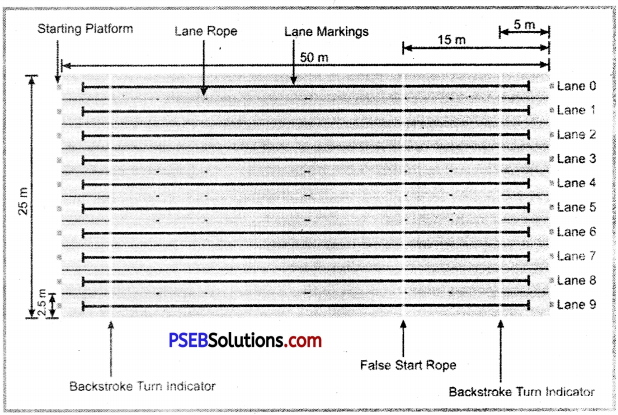
PSEB Solutions for Class 8 Physical Education Chapter 4 Qila Raipur Sports

Physical Education Guide for Class 8 PSEB Qila Raipur Sports Textbook Questions and Answers

Question 1.
When did Qila Raipur Sports initiate?
Answer:
Origin of rural Olympic Qila Raipur Sports were initiated in 1933 after the hockey tournaments held in Jalandhar. Qila Raipur hockey team won second position in this tournament. Though this tournament was not that important but this victory played an important role for the initiation of Qila Raipur Sports. At that time the main motive of these sports was to encourage the winners in order to motivate the children towards sports. When these sports were initiated, no one had ever thought that Qila Raipur Sports would become the famous Rural Olympic one day.

PSEB 8th Class Physical Education Solutions Chapter 4 Qila Raipur Sports

Question 2.
Which are the rural games played in Qila Raipur Sports Festival?
Answer:
Bullock-cart races became the centre of attraction in the sports festival. Once the number of the bullock-carts participants was 133 which broke all the previous records. Baba Bakshish Singh set the trend for pulling four bullock-carts simultaneously.

The sports festival includes old sports like, Camel race, Suhaga race, Moonglian chalauna, Sac-lifting, Colt-lifting, Ass-lifting, passing tractor on one’s body, pulling tractor with teeth, pulling tractor with ear, weightlifting by teeth, Senior citizen race, Dog race, Mare dance, Horse race, Bullock-cart-jumps, deeds of Nihang Singhs, Tricycle race, Rock-lifting, Plough-lifting, Pigeon flights, Mule race, Elephant race, etc.

Question 3.
What are the modern sports played in Qila Raipur Sports Festival?
Answer:
Hockey, Kabaddi, Volley-ball, Shooting, Gattka, Gymnastic, Para Gliding, etc. are played in this festival in the month of February. The winner hockey team is awarded with ‘Bhagwant Singh Memorial Trophy’. S. Prahlad Singh Grewal donated 100 tola gold cup to Grewal Sports Association in the memory of his late son Bhagwant Singh who had died young.

Question 4.
Which countries did take part in the Qila Raipur Sports?
Answer:
The popularity of the Qila Raipur Sports crossed the boundary of India and reached some other countries. As a result, in 1954 Pakistani Kabaddi team participated in this tournament. After this, teams from developed countries like Canada, America, Malaysia, Singapore and England also participated-in this Sports Festival.

PSEB 8th Class Physical Education Solutions Chapter 4 Qila Raipur Sports

Question 5.
When did the women sports include for the first time in Qila Raipur Sports?
Answer:
Girls in Qila Raipur sports festival:
Though the girls were not included in the earlier sports festivals but Grewal Sports Association felt the absence of girls’ sports. In 1950, Ludhiana verses Sidhwan girls’ hockey was played for the first time in the festival. In spite of some problems due to girls ‘participation’ girls sports were initiated, in 1953. Now a days, some other games along with girls athletics are held every year.

Question 6.
What is special about Qila Raipur Sports Festival?
Answer:
Speciality of Qila Raipur sports festival:
This sports festival has produced countless olympians, international and national level players. This sports festival is motivating countless players. So many olympians, international and national level players participated in the sports festival time to time. Beside this the president of India, the Central Sports Minister and the Chief Minister of Punjab would come to encourage the players. It was a matter of pride for this sports festival.

PSEB 8th Class Physical Education Guide Qila Raipur Sports Important Questions and Answers

Multiple Choice Questions

Question 1.
When Qila Raipur games intiates?
(A) 1933
(B) 1934
(C) 1935
(D) 1936.
Answers:
(A) 1933

PSEB 8th Class Physical Education Solutions Chapter 4 Qila Raipur Sports

Question 2.
Who started Bullock-cart race?
(A) Baba Bakshish Singh
(B) Mr. Karnoind
(C) Mr. Ponu
(D) None of above.
Answers:
(A) Baba Bakshish Singh

Question 3.
Bullock-cart race started in:
(A) 1934
(B) 1920
(C) 1990
(D) 1936.
Answers:
(A) 1934

Question 4.
Which are the Modern sports played in Qila Raipur?
(A) Athletics
(B) Hockey, Kabaddi
(C) Shooting
(D) Volleyball, Gatka and Gymnastic.
Answers:
(A) Athletics
(B) Hockey, Kabaddi
(C) Shooting
(D) Volleyball, Gatka and Gymnastic.

Question 5.
In Qila Raipur which foreign countries participate?
(A) America
(B) Pakistan
(C) Canada
(D) None of these.
Answers:
(A) America
(B) Pakistan
(C) Canada

PSEB 8th Class Physical Education Solutions Chapter 4 Qila Raipur Sports

Very Short Answer Type Questions

Question 1.
When did the Qila Raipur games start?
Answer:
In 1933.

Question 2.
Who has organise first Qila Raipur game?
Answer:
Qila Raipur sports were organised under the name of Grewal Sports Association, whose leader was Sardar Inder Singh Grewal and Sardar Harchand Singh.

Question 3.
Write any two names of ancient games which are conduct in Qila Raipur?
Answer:

  • Bullock-cart race
  • Suhaga races.

Question 4.
Write names of any two new games which are organise in Qila Raipur.
Answer:

  • Athletics
  • Hockey
  • Kabaddi.

PSEB 8th Class Physical Education Solutions Chapter 4 Qila Raipur Sports

Question 5.
Write any two names of foreign countries who participate in Qila Raipur sports.
Answer:

  • Pakistan
  • America
  • Canada.

Short Answer Type Questions

Question 1.
Write the history of Qila Raipur.
Answer:
History of the village Qila Raipur:
Rai Lala in 1560, took the possession of the village Qila Raipur. He built five forts to protect his sons from the attackers, that is why the village Raipur became famous as Qila Raipur. The village Qila Raipur is 11 kilometeres towards the south of Ludhiana near ‘Dehlon’ (name of a town). The village Qila Raipur is connected with rail and roads.

Question 2.
Write the names of ancient games which are organise in Qila Raipur.
Answer:

  • Bullock-cart race
  • Camel race
  • Suhaga race
  • Moonglian chalauna
  • Sac-lifiting
  • Colt-lifting
  • Ass-lifting
  • Passing tractor on one’s body
  • Pulling tractor with teeth
  • Pulling tractor with ear
  • Weight-lifting by teeth
  • Senior citizen race
  • Dog race
  • Mare dance
  • Horse race
  • Deeds of Nihang Singhs
  • Tricycle race
  • Rock-lifting
  • Plough-lifting
  • Pigeon-flights
  • Mule race
  • Elephant race etc.

PSEB 8th Class Physical Education Solutions Chapter 4 Qila Raipur Sports

Question 3.
Write the name of modern games which are organise in Qila Raipur.
Answer:
Many world level sports, Hockey, Kabaddi, Volley-ball, Shooting, Gattka, Gymnastic, Para-gliding etc. are played in the festival in the month of February. The winner hockey team is awarded with Bhagwant Singh Memorial Trophy. S. Prahlad Singh Grewal donated 100 tola gold cup to Grewal Sports Association in the memory of his late son Bhagwant Singh who had died young.

Question 4.
Write the various recreation activities in Qila Raipur.
Answer:
Girls in Raipur Sports Festival:
Though the girls were not included in the earlier sports festivals Grewal Sports Association felt the absence of girls sports. In 1950, Ludhiana verses Sidhwan girls’ hockey was played for the first time in the festival. In spite of some problems due to girls’ participation, girls sports were initiated in 1953. Nowadays, some other games along with girls’ athletics are held every year.

PSEB 8th Class Physical Education Solutions Chapter 4 Qila Raipur Sports

Question 5.
How the garner of Qila Raipur are popular in foreign countries?
Answer:
The popularity of Qila Raipur Sports in foreign countries:
The popularity of the Qila Raipur Sports crossed the boundary of India and reached some other countries. As a result, in 1954, the Pakistan Kabaddi team participated in this tournament. After this, teams from developed countries like Canada, America, Malaysia, Singapore, and England also participated in this sports festival.

PSEB 10th Class Welcome Life Solutions Chapter 10 Stress Management

Punjab State Board PSEB 10th Class Welcome Life Book Solutions Chapter 10 Stress Management Textbook Exercise Questions and Answers.
PSEB Solutions for Class 10 Welcome Life Chapter 10 Stress Management

Welcome Life Guide for Class 10 PSEB Stress Management Textbook Questions and Answers

Question 1.
How stress can be useful for us?
Answer:
We are generally told that stress is harmful to us but sometimes it can be useful as well. Stress teaches us to fight adverse circumstances, increase our concentration, increase our working capacity and self-respect. In this way, stress has a useful aspect as well.

Question 2.
What are the physical and mental changes felt when you are stressed?
Answer:
Internally, stress has a very bad effect on the body. The person’s heart beats faster, heart disease occurs, the headache starts and breathing problem starts. It also reduces the body’s ability to fight diseases. Externally too, the body undergoes many changes. The person begins to gain weight, hair begins to fall out, sweetening begins as well. The person becomes physically and mentally ill, the effect of which is clearly visible on his face.

Question 3.
What does a stressed person’s face look like?
Answer:
The stressed person’s face becomes pale, he always looks sick and worries are always visible on his face.

PSEB 10th Class Welcome Life Solutions Chapter 10 Stress Management

Question 4.
What are the stressful things for you?
Answer:
If we look from a student’s point of view, the major reason for stress is the fear of failure, getting fewer marks, staying behind in class, etc. As a father or husband, the major reasons for stress are the worries of job or business, financial worries, worry of income and expenditure, family.

Question 5.
How does stress affect our bodies?
Answer:
See Q. 2 of Exercise-1.

Question 6.
What can we do to reduce stress?
Answer:

  • Whenever you are under stress, slowly close your eyes. Open your eyes after 5 minutes. It will reduce your stress.
  • Whenever you are under stress, take a deep breath and slowly breathe out.
  • We need to go out for a morning walk or do yoga.
  • Stress can be reduced by having a balanced diet.
  • You must keep talking to your family members and relatives to reduce tension.
  • One should continue to pursue his/her hobbies.

Question 7.
What can we do to keep others stress-free?
Answer:
See the last question.

Question 8.
Can stress be good for us?
Answer:
See Q. 1. Exercise-1.

Question 9.
Can a human being live on earth without animals?
Answer:
NO, human beings cannot live on earth without animals. Its reason is that nature has made a life cycle according to which one creature depends upon others to live. In the same way, humans depend upon other animals for their own existence. In their absence, human existence will be in danger. That’s why humans depend upon other animals.

Question 10.
What is the harm of destroying natural vegetation?
Answer:

  • Natural vegetation helps in bringing rain. In its absence, there will be a scarcity of rain.
  • Natural vegetation stops soil erosion. In its absence, soil erosion will never stop.
  • Natural vegetation fulfills our needs of wood and in its absence, such needs will not be fulfilled.
  • There will be no habitat for wildlife if there will be no natural vegetation.

Question 11.
What can we, as students, do to maintain the balance of nature?
Answer:

  • We can motivate others to conserve natural vegetation.
  • Seminars can be conducted for the same purpose.
  • Students can plant new plants to increase natural vegetation.

PSEB 10th Class Welcome Life Solutions Chapter 10 Stress Management

PSEB 10th Class Welcome Life Guide Stress Management Important Questions and Answers

Multiple Choice Questions:

1. …………… is a condition that is not according to our mind.
(a) Stress
(b) Happiness
(c) Hardness
(d) None of these
Answer:
(a) Stress.

2. The condition of mind which we consider ……………. is known as stress.
(a) Hardness
(b) Burden
(c) Happiness
(d) Bullying.
Answer:
(b) Burden

3. Which of these is a reason for stress?
(a) More aspiration
(b) Our natural nature
(c) Pressure of work
(d) All of these.
Answer:
(d) All of these.

4. Stress weakens our ……………. power.
(a) physical
(b) mental
(c) both (a) and (b)
(d) All of these.
Answer:
(c) both (a) and (b)

5. Which of these diseases is caused by stress?
(a) Aids
(b) Heart disease
(c) Cancer
(d) T.B.
Answer:
(b) Heart disease.

6. What is the wrong aspect of stress?
(а) An individual stops doing work
(b) One runs away from his responsibilities
(c) Stress causes many diseases
(d) All of these.
Answer:
(d) All of these.

7. What can students do to reduce stress?
(а) Going for a morning walk or by doing yoga
(b) We can play with friends
(c) We can talk to family members
(d) All of these.
Answer:
(d) All of these.

PSEB 10th Class Welcome Life Solutions Chapter 10 Stress Management

Fill in the Blanks:

1. ……………… and animals are helpful to each other to live on earth.
Answer:
Humans

2. …………….. vegetation must be protected.
Answer:
Natural

3. Stress can be reduced by doing ………………..
Answer:
morning walk, yoga

4. …………….. can cause heart problems.
Answer:
Stress

5. Stress is a ……………….. phenomena.
Answer:
natural

6. Stress can be ……………… and ……………..
Answer:
fruitful, dangerous

PSEB 10th Class Welcome Life Solutions Chapter 10 Stress Management

True / False:

1. Stress can cause Aids.
Answer:
False

2. Stress causes tension in individuals.
Answer:
True

3. Work cannot cause stress.
Answer:

4. Stress weakens mental strength.
Answer:
True

5. People run away from responsibilities due to stress.
Answer:
False

6. Humans and animals are helpful to each other.
Answer:
True

PSEB 10th Class Welcome Life Solutions Chapter 10 Stress Management

Match the Column:

Column A Column B
(a) Stress (i) Result of Stress
(b) Pressure of work (ii) Balance of nature
(c) Heart Disease (iii) Way to remove stress
(d) Deep Breathing (iv) State of mind
(e) Animals (v) Reason of stress

Answer:

Column A Column B
(a) Stress (iv) State of mind
(b) Pressure of work (v) Reason of stress
(c) Heart Disease (i) Result of Stress
(d) Deep Breathing (ii) Balance of nature
(e) Animals (iii) Way to remove stress

Very Short Answer Type Questions:

Question 1.
What is Stress?
Answer:
Any situation which is not according to the expectations of our mind is called stress.

Question 2.
How can stress be reduced?
Answer:
By understanding its cause and finding the solution, stress can be reduced.

Question 3.
Why do we become stressed?
Answer:
When we start considering any problem as pressure, we become stressed.

Question 4.
Give one reason for stress.
Answer:
We come under stress when our aspirations are not fulfilled.

Question 5.
How do we come under stress when compared with others?
Answer:
When we observe that others are becoming more successful, we come in stressed.

Question 6.
What is the impact of stress on an individual?
Answer:
Stress weakens our physical and mental state.

Question 7.
What disease is caused by stress?
Answer:
Stress causes heart disease and blood pressure can go up.

PSEB 10th Class Welcome Life Solutions Chapter 10 Stress Management

Question 8.
What is the wrong aspect of stress?
Answer:
It stops us from doing work and never lets us fulfill our responsibilities.

Question 9.
Why do students come under stress?
Answer:
The fear of failure, getting fewer marks, not getting the first position in class, etc. are the causes because of which students come under stress.

Question 10.
What should we do to reduce stress?
Answer:
Slowly close your eyes, open eyes after five minutes, or take a deep breath to reduce stress.

Question 11.
How can students reduce stress?
Answer:
By doing morning walks or by doing yoga, students can reduce stress.

Question 12.
What is the balance of nature?
Ans.
It says that humans and other animals depend upon each other.

Question 13.
How can the balance of nature be maintained?
Answer:
If we care about all the natural things, file balance of nature can be maintained.

Question 14.
Give one advantage of natural vegetation.
Answer:
Natural vegetation gives us oxygen.

Question 15.
What is the disadvantage of destroying natural vegetation?
Answer:
Soil erosion will be caused and there will be less rain.

Question 16.
How can natural vegetation be saved?
Answer:
By planting new plants, natural vegetation can be saved.

PSEB 10th Class Welcome Life Solutions Chapter 10 Stress Management

Short Answer Type Questions:

Question 1.
Write a note on the condition of stress.
Answer:
Stress is a type of situation which is not according to our mind. It is a situation of mind which we consider a burden. For example, if we become late in doing any work, we come in stressed. Stress can create positive as well as negative conditions for an individual. If we come to know about the reason for stress, we can easily find its solution. But if we are unable to find the reason, the problem becomes a burden for us. It depends upon us that how can we take stress as a helper or a problem.

Question 2.
Give four reasons for stress.
Answer:

  • We have many aspirations and if they are not fulfilled, we come under stress.
  • Few people have a natural tendency to remain under stress.
  • People are under pressure from work and become victims of their boss’s anger. That’s why they come in stress.
  • The family situation of many individuals is not good and they always remain in tension.

Question 3.
What are the effects of stress?
Answer:

  • Stress weakens our physical and mental strength and heartbeat fastens as well.
  • He can’t sleep and starts sweating more. He gets fat. Many diseases can be caused such as stomachache, headache, heart diseases, increase in blood pressure, etc.
  • We lose a lot of energy in fighting the diseases and we are not able to relieve stress.
  • The worst part of stress is that it lets us run away from our responsibilities and prevents us from working.

Question 4.
What can students do to avoid stress?
Answer:

  • We can play with our family members and friends to reduce stress.
  • They can go out for outings in the natural environment to reduce tension.
  • We can work with family members, cooperate with them, help them in removing tension.
  • They can go out for a morning walk, do yoga and take a balanced diet to reduce stress.

Long Answer Type Question:

Question 1.
What are the reasons for stress?
Answer:

  • We come in stress due to our family situations or neighborhood conditions.
  • If anyone is teased by peers about our short stature or any part of the body, one can come under stress.
  • One can come under stress due to adverse circumstances in the country.
  • We have many aspirations and if they are not fulfilled, we come under stress.
  • Few people naturally remain under stress.
  • Few people are under the pressure of work and due to pressure from management, they remain under stress.
  • If anyone is suffered from any disease or someone has taken a loan from anyone, he remains under stress.
  • We come in stressed if we are compared with others.

PSEB 12th Class Physical Education Practical Hockey

PSEB 12th Class Physical Education Practical Hockey

Hockey Game History
Historical records show that the roots of the game originated in Europe. It is evident that a form of game was played with stick and ball during that era. But, the beginning of the modem field hockey emerged in 18th century in England, The first set of rules were presented by First Hockey Association in 1876. The game was included in London Olympic Games in the year 1908. In India the game was highly popularized by the British Empire rule in the late 19th century. The first Hockey Club in India was formed in Kolkata (Calcutta) in the year 1885. The India Hockey Federation was established in the year 1925. In 1924 (FIH) International Hockey Federation was formed. India could take part in 1928 Amsterdam Olympic Games.

PSEB 12th Class Physical Education Practical Hockey 1
Hockey Game Imporant Points

  • Length of Hockey field:91.40 m
  • Width of Hockey field:55.0 m
  • Team Members:18 (including two Goal keeper)
  • Duration of Game:15-2-15 (10) 15-2-15
  • Dimensions of Goal post:
    • Height = 2.14 m (7 feet)
    • Width = 3.66 m (12 feet)
    • Depth = 1.20 m (4 feet)
    • Height of backboard = 460 mm
  • Weight of Ball:156 gm to 163 gm
  • Weight of Hockey Stick:737 gm maximum
  • Circumference of Ball:224 to 235 mm
  • Card:Green-2 minutes suspension,Yellow-5 to 10 minutes suspension, Red-permanent suspension
  • Circumference of Shooting Circle ‘D’:14.63 m (16 yards)
  • No. of Officials:04 (Two field Umpires, one Record keeper, one Time keeper)
  • Distance of Penalty Spot (from goal post):6.40 m

PSEB 12th Class Physical Education Practical Hockey

Dimensions of Playfield & Equipment:
1. Play Field:
(Rectangular in shape) The hockey field now-a-days is marked on the playing surface of astro turf with the length of 299 feet, 10 inches (91.4 in) and width of 180 feet 5 inches i.e. 55.0 m.

The (22.9 m) 25 yards line is marked across the field both side parallel to the back line of the goal post.

2. Goal Post:
The height of the goal post in the field hockey is 2.14 m (7 feet) and width is 3.66 m (12 feet). The depth of the goal post is 1.20 m (4 feet) as per FIH rules.

3. Striking Circle D:
The striking circle (two quarters) is marked measuring 3.66 m from ‘D’ to having a radius of 14.63 m inside the field. These quarters are joined with a straight line.

4. Penalty Spot: This point is marked at a distance of 6,475 m from the base line,

5. Hockey Stick: The stick is made up of wood, carbon, fibre, fibre glass or combination of these fibres. The weight of the- stick must not exceed 737 gm.

6. Ball:
The game is played with the plastic ball, white in colour. The weight of the ball must not exceed 5.5 to 5.7 ounces or 156 – 163 gm. The circumference of ball must range from 224 to 235 mm.

7. Goal Keeping Kit:
A goal keeper wears a different colour shirt and full protective equipment including head gear, leg guards and kickers etc.

PSEB 12th Class Physical Education Practical Hockey

Hockey Game Rules And Regulations

  • Players shall hit the ball with the face of the stick i.e. flat side of the stick.
  • No player other than goal keeper can touch the ball with foot, hand or any other body part while ball in play. However, deliberately lying over the ball is not permitted in any case.
  • Only two players from the opposing team can tackle for the ball, no interference by the third party or player is permitted.
  • When the ball crosses the sidelines, then sideline hit shall be awarded to the player of opposite team.
  • While taking free hit, everyone must be 5 metres away from the ball.
  • The player with the ball in possession may not be allowed to use his body to push a defender deliberately out of his way.
  • It is not permitted to hit the ball above the knee level. But in some skills like scoop and flick it is considerable, where it is not dangerous to other players. However, the velocity of the ball is not defined anywhere in the rules.

Hockey Game Important Terminologies

1. Free Hit:
It is given when a foul has occured outside the scoring circle. In this condition the defender must be 5 m away from the player.

2. Penalty Corner:

The penalty comer is awarded to the attacking team if a defensive player commits foul inside the striking circle or within 25 yards of the goal area. While taking penalty comer only five defensive players including the goal keeper stands behind the backline of goal post.

3. Penalty Stroke:
When a defensive player commits a foul inside the circle to prevent a goal or if a player takes early run during penalty corner from the backline, the penalty stroke is given to the opposite team.

4. Flick:
Its a kind of shot above the recommended heights, but its not dangerous in terms of injury’ to an opponent e.g. drag flick during shot at goal.

5. Sudden Death:
If a tie persists after the completion of extra time the tie will be ended only if one team has scored a goal, during penalty stroke till the tie is over. This is termed as sudden death.

6. Scoop: This technique is used as an overhead pass to defeat defenders on the field.

7. Attackers: The players having ball in their possession are termed as attackers.

8. Defenders: The players without the ball are called defenders.

9. Substitution:
The players may be substituted unlimited number of times. It is termed as rolling substitution, except in two situations i.e. award and end of a penalty comer.

PSEB 12th Class Physical Education Practical Hockey

Basic Skills:
1. Hitting:
For hitting the ball a player holds the stick with both hands and takes a back swing at recommended level to strike the ball with the flat surface of the stick.

2. Dribbling:
This is the best way to move forward in order to make an attack into opposition’s field. It is used to beat the defenders at the same time passing the ball to the other teammates. It needs lots of control over the ball while moving the stick by using the top hand grip.

3. Dodging:
This skill is used to leave the defender side of the ball. It is the least expected move by the attacker, to leave the defender far behind the ball.

4. Stopping Ball:
In this a player takes the control of the ball with the help of lace or blade of the stick. During penalty comer stopping the ball needs a skillful tactics, in which players sometimes needs to flatten the stick on the ground to completely stop the ball.

5. Goal Keeping:
A goal keeper inside the circle is allowed to stop or deflect the ball with the use of stick, feet, leg guards or any other body part. It must not be in a dangerous manner to other players. However, lying on the ball is not permitted in any case.

6. Reverse Shot:
For the reverse flick hold the stick with both hands at the top. The hook of the stick should be turned in clockwise direction with flat side facing upward.

7. Pushing the Ball:
The push pass or pushing the ball is the basic skill in hockey. This pass is mainly used for passing the bail for short distance. It does not involve any sound while hitting the ball. During push pass one hand grip should be in the middle of the stick.

PSEB 12th Class Physical Education Practical Hockey

Hockey Game Important Tournaments

International Level:
1. The FIH (International Hockey Federation) is responsible for organizing Olympic Games, World Cup, World League, Champions Trophy, Junior World Cup, Asia Cup.

National Level:
2. Federation Cup, Indira Gandhi Gold Cup, Junior Nehru Hockey Trophy, Abaidullah Gold Cup, Agha Khan Cup, Bombay Gold Cup.

Arjuna Award Winners

  1. Prithipal Singh, Ann Lumsden-1961
  2. Charanjit Singh-1963
  3. S. Laxman-1964
  4. Udham Singh. E. Britoo-1965
  5. VJ. Peter, Sunita Puri, Gurbaksh Singh-1966
  6. Harbinder Singh, Mohinder Lai-1967
  7. Balbir Singh Kullar-1968
  8. Ajit Pal Singh-1970
  9. P. Krishnamurthy-1971
  10. Michael Kindo-1972
  11. M.P. Ganesh, O. Mascarenhas-1973
  12. Ashok Kumar, A. Kaur-1974
  13. B.P. Govinda, R. Saini 1975
  14. Capt. Harcharan Singh, L.L. Fernandes-1977-78
  15. Vasudevan Baskaran, R.B. Mundphan-1979-80
  16. Mohammed Shahid, Eliza Nelson-1980-81
  17. Versha Soni-1981
  18. Zafar Iqbal-1983
  19. Rajbir Kaur-1984
  20. S. Mancy-1984-85
  21. Prem Maya Senior, M.M. Somaya-1985
  22. J.M. Carvalho-1986
  23. M.P. Singh-1988
  24. Pargat Singh-1989
  25. Jagbir Singh-1990
  26. Mervyn Fernandes-1992
  27. Jude Felix Sabastain-1994
  28. Dhanraj Pile-1995
  29. Mukesh Kumar-1995
  30. A.B. Subbaiah, Ashish Kumar Balal-1996
  31. Harmik Singh, Surinder Singh Sodhi, Rajinder Singh-1997
    S. Surjit Singh, Pritam Rani Siwach, B.S. Dhillon, S. Omana Kumari,
    Lt, Col. Mohd. Ryaz. Baldev Singh, Maharaj Krishna Kaushik,
    Haripal Kaushal, Ramandeep Singh, V.J. Phillips-1998
  32. Balbir Singh Kuliar-1999
  33. Baljit Singh Saini, Tingonleima Chanu, Group Capt., R.S. Bhola,
    Balkishan Singh, Jalaluddin Rizvi, Madhu Yadav-2000
  34. Dilip Tirkey, Gagan Ajit Singh, Mamta Kharab-2002
  35. Devesh Chauhan, Suraj Lata Devi-2003
  36. Deepak Thakur, Innocent Helen Mary-2004
  37. Viren Rasquinha-2005
  38. Jyoti Sunita Kullu-2006
  39. Prabhjot Singh-2008
  40. Surinder Kaur, Ignace Tirkey-2009
  41. Sandeep Singh, Jasjeet Kaur-2011
  42. Sardar Singh-2012
  43. Sava Anjum Kreen-2013
  44. Sarijesh Ravindran-2015

Dronacharya Award Winners

  1. Gudial Singh Bhangu-2000
  2. M.K. Kaushik-2002
  3. Rajinder Singh-2003
  4. Baldev Singh-2009
  5. Harender Singh (2012). Narender Singh Saini-2013

PSEB 12th Class Physical Education Practical Hockey

Hockey Game Important Questions

Question 1.
What is the length of hockey play ground?
Answer:
The length of hockey playground is 91.40 rat (100 yards).

Question 2.
What is the circumference of the ball?
Answer:
The circumference of the ball is 224-235 mm.

PSEB 12th Class Physical Education Practical Hockey

Question 3.
What is the duration of hockey match?
Answer:
There are four quarters of 15 minutes each with an interval of 10 minutes.

Question 4.
How many officials are required for hockey match?
Answer:
A total number of four officials are required for hockey match.

Question 5.
How many players are required in a hockey team?
Answer:
A total number of of 18 players including two goal keepers are required in a team are required in a team.

Question 6.
What is the width of goal post?
Answer:
The width of goal post is 3.66 m.

PSEB 12th Class Physical Education Practical Hockey

Question 7.
What is dodging in hockey?
Answer:
This skill is required to leave the defender side of the ball. It is the least expected move hv the attacker to leave the defender far behind the bail

Question 8.
What should he the maximum weight of hockey stick?
Answer:
Not more than 737 gm.

Question 9.
What is the weight of hockey bail?
Answer:
156-163 gm.

Question 10.
What is a scoop in hockey?
Answer:
This technique is used as an overhead pass to defeat defenders on the field.

PSEB 12th Class Physical Education Practical Hockey

Question 11.
W hat is the height of backboard in the goal post?
Answer:
The height of backboard in the goal post in 460 mm

Punjab State Board PSEB 12th Class Physical Education Book Solutions 12th Class Physical Education Practical Hockey Important Notes, Questions and Answers.
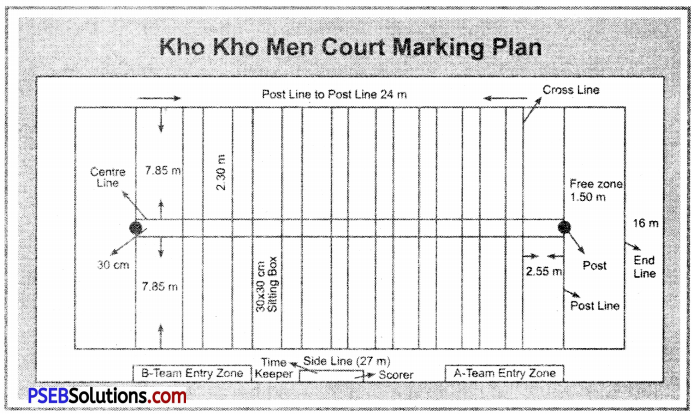
PSEB 12th Class Physical Education Practical Lawn Tennis

PSEB 12th Class Physical Education Practical Lawn Tennis

Lawn Tennis Game History
Lawn tennis was started in France in 12th century and was known as paume. This word means ‘Palm of hand’. (Robin Hood) Tennis is an Olympic sport and it is played by all societies world wide. The Lawn Tennis was invented by French monk around 11-12th century 7 and was known as “Paume” that time. It is developed and shaped up into Modern game in 1872 and First Tennis Club was started named as Hoa Pereira.In the 19th century tennis started to spread throughout English colonies. The first amateur championship was played at court called Wimbledon. The first men’s official championship was played in 1877 and women’s championship in 1884. 1900, was the year when Davis cup started. Tennis has been an Olympic Sport since 1988. In India, first National Championship was held in 1946 at Kolkata.
PSEB 12th Class Physical Education Practical Lawn Tennis 1

PSEB 12th Class Physical Education Practical Lawn Tennis

Lawn Tennis Game Important Points

  • Length of the Court:23.77 m
  • Breadth of the Court:8.23 m (singles), 10.97m (doubles)
  • Height of Posts:1.7 m
  • Distance of the Centre of the Post:0.91 m (in centre)
  • Diameter of the Posts:15 cm
  • Height of the Net:0.91 m
  • Width of the Strap:5 cm
  • Distance of Service Lines:6.40 m
  • Width of the Court Service Line:5 cm
  • Weight of Racket:395 gm
  • Length of the Racket:27 inches
  • Weight of the Ball:56.7 to 58.5 gm
  • Diameter of the Ball:6.35 to 6.67 cm
  • Maximum Number of Set of a Game in Single:5 (men) 3(women)
    PSEB 12th Class Physical Education Practical Lawn Tennis 2

PSEB 12th Class Physical Education Practical Lawn Tennis

1. Tennis Racket:
The size and weight of tennis racket is not mentioned in the rule however most of the rackets are 21″ long. Mostly men j choose a racket that weigh about 395 gms. Whereas women choose that weigh about I 365 gms. Die modem tennis rackets are made of fibre glass and graphite.
PSEB 12th Class Physical Education Practical Lawn Tennis 3
2. Tennis Ball:
The tennis ball is made of rubber and is covered with fabric wool. Its diameter is 6.35 cm to 6.67 cm. It must weigh between 56.7 to 58.5 gms. The colour of the ball is yellow or white.

3. Court:
The tennis court is rectangular in shape and is divided into 2 halves by a net. The court is 23.40 m in length and 8.10 m in width for singles and 10 97 m in width for doubles.

4. The Net:
The net is suspended across the court by a cable, The height of the net at the middle is 0.91 m. A narrow cloth strap in the middle holds the net tight.

PSEB 12th Class Physical Education Practical Lawn Tennis

Lawn Tennis Game Rules And Regulations
1. Toss:
The game starts with the toss which is done with the help of racket. After winning the toss, a player can choose to serve or to decide the court,

2. Service:
The service is delivered from a position in rear of the base line and from within imaginary continuations of the centre line and side lines.

3. Foot Fault:
The server may not walk, run and jump clear of the ground, nor step over the base line while delivering the service. One foot must remain in contact with the ground.

4. Alternating Service:
Service is delivered from alternate sides of the court, beginning from the right. The ball served shall pass over the net and strike the ground within the diagonally opposite service court.

5. Service Fault:
The service is a fault if, besides foot faults, the ball is missed in the attempt to strike it if the ball served touches a permanent fixture (other than net, strap or band) before it strikes the ground.

6. Faults Allowed:
The server is allowed another try at service, from the same half of the court, if the first serve has resulted in a fault. A second fault will result in a score for the opponent.

7. Let:
If the ball served touches the net, strap or band, it is a let, provided the ball falls into the proper service court, otherwise it is a fault. In the case of a let the service shall not be counted and the server shall serve again. A let does not annual the previous fault.

8. Receiver becomes Server:
At the end of a game the receiver shall become the server and vice versa, alternating in all subsequent games of a match.

9. Server Wins Point: If the ball served touches the receiver or anything which he wears or carries.

10. Receiver Wins Point: If the server commits two consecutive faults.

11. Player Loses Point:
If he fails to return the ball directly over the net before it strikes the ground a second time, or fails to return the ball directly over the net inside the lines which outline the opponent’s court.

12. Ball Falling On Line: A ball falling on a line is regarded as in the court bounded by that line.

13. Deuce: When both players have scored three points, the score is called Deuce.

14. Scoring:
Tennis consists of 6 games and each game consists of 4 points. These four points are called 15’30’40 and the game points. If both the players score 40-40. The score is called ‘deuce’. To break this tie, one player must win two consecutive points. To win a set one must win six games with at least lead of two games. In case if the game score is 6 all, tie breaker is played. The game is extended to 7 points and the player who wins 7 points with at least margin of 2 points shall be declared winner of the set. A match consists of 5 sets in case of men and 3 sets in case of women.

PSEB 12th Class Physical Education Practical Lawn Tennis

Fundamentals:
1. Holding of Racket:
Adjusting the grip you take on a tennis racket is a way of altering the angle of the racket face as it meets the ball. Most of the time, as you trade forehands from the back of the court, you will have your own standard grip based on your strengths and weaknesses. This should change to a different, flatter grip for serves, volleys, smashes and slices. Both grips can be reversed to play backhands, while the two-handed backhand has a grip of its own.
PSEB 12th Class Physical Education Practical Lawn Tennis 4
A good way to understand different grips in detail is to move your hand around the handle of the racket in a clockwise motion. Left-handers should move the same distance anti-clockwise in all cases. Imagine that the top of the handle (i.e. the narrow side, looking down on the edge of the frame) is 12 o’clock. The racket is held so that the heel of the hand rests on the leather strip which circles the end of the handle. Then the fingers are wrapped wholly around the handle so that the middle finger locks with the thumb.

2. Eastern Forehand:
Move your hand clockwise around the racket, so that the thumb-finger V is somewhere between 12 and one o’clock. This is an eastern grip, which is similar to w’hat you would get by “shaking hands” with the racket in a very relaxed way. This allows for a small amount of racket acceleration up the back of the ball, which will spin it slightly, keeping the ball relatively flat.

3. Semi-Western:
If you move your hand further round, the wrist comes into play, and it puts the racket into a much deeper position, which allows you to hit up the back of the ball a lot more and generate more spin. If the V is between two and three o’clock, you’re using a semi-western forehand. Somewhere around here is the ideal grip for the modem game, where you’re trying to generate both spin and weight of shot through the ball.

4. Full Western:
With the V anywhere beyond three o’clock, you’d be playing a full western fore hand , which is what a lot of the clay-court Spanish players use. In fact, they twist their grip so far that they actually hit the ball with the opposite face of the racket, which generates an awful lot of racket speed and lines up the strings, so they can spin the ball in a steep low-to-high movement.

5. Eastern Backhand:
To change your grip from a forehand to a one – handed backhand, use the clock principle, starting again from the continental grip but this time moving the same amounts anti-clockwise, depending on how much spin you wish to impart. In practice, most one-handed players stick with a roughly eastern backhand.

6. Two-handed Backhand:
Using a two-handed backhand is a bit like playing a forehand with your wrong hand, so for right-handed players, the left hand does all the work and the right is there solely for support. There are three or four different grips you can use, but a standard two-handed backhand would position the right hand in a neutral continental grip, while the left hand would adopt an eastern forehand grip higher up the racket handle.
PSEB 12th Class Physical Education Practical Lawn Tennis 6
7. The Serve:
Player should stand side wise behind the base line. First, the ball is tossed upward and the stroke begun by swinging the racket downward through an arc, past the right knee, backward and upward behind the head in such a manner as to make contact with the falling ball, in accordance with the type or style of serve planned upon.
PSEB 12th Class Physical Education Practical Lawn Tennis 5

8. Continental Serve:
The basic, neutral grip, known as a continental grip, is formed by placing your hand on the racket so that the V formed by your thumb and forefinger are at toughly 11 o’clock. This is the flat grip you would use to serve, volley or smash. You can also use it to slice a delicate drop shot from the back of the court, as it allows you to hit down on the ball, punching through it to impart backspin.

9. The Forehand Drive:
With the estimate of the place where the ball might bounce, the player stands little bit behind that spot and making pivot of the body, with slightly back swing, he brings the racket forward and hits the ball. The ball is hit when it comes parallel to his knees and waist. Then he comes in the same position after follow through.

10. The Backhand Drive:
The player holds the racket in between. As soon as tire ball approaches him, he turns his shoulders towards the net making pivot of his body, he brings forward the racket from his backside. From full back swing to forward action he strikes the ball with extended arm with follow through.

11. Volley:
A volley is a stroke that meets the ball while it is in flight and before it strikes the ground, usually from a position at the net.

12. Lob: A lob is a variation of the forehand or backhand made with a lifting effect, usually used prolong the flight of the ball.

13. Smash: A smash is a variation of the forehand or backhand with a driving downward effect used in general to return a lob.

14. Drive: A drive is a stroke made with the maximum of speed and power, with due regard for accuracy.

15. Foot Work:
In general there will be almost constant movement of the feet in order to be in the logical place at the right time to receive or deliver the ball, depending upon offensive or defensive intent. Movement of the feet and the general quality of foot work should of course be light, agile and economical, and always regulated to make the stroking accurate and effective.

16. Body Action:
Body action and positions are varied under the same principles that apply to foot work. In general, the body position should be such that one is, whenever possible, sidewise to the net at the moment of stroking. The beginner seems disinclined to depart from the erect posture, whereas positions and movements where the body is extremely extended or sprawled out in wide movements are not unusual, except in one who has had long practice and experience and w’ho, as a result has a fine court sense that enables him to be in the right place at the right time.

17. Arm Action:
The stroking arm should remain supple at all times and mannered actions or positions at the shoulder, elbow and wrist should be avoided. Care should be exercised in the use of the free hand as a balancing agent that it does not fly about violently, thus having a contrary influence.

18. Eyes:
The eyes must remain on the ball at all times. To keep the eyes continuously on the ball is of primary’ importance. Most, if not all, of the errors in stroking will trace back to the fact that the ball was lost sight of at some critical point. Concentration on the spin of the ball will help to confirm the habit of watching the ball.

19. Stroking Effects:
Control of the ball is managed chiefly by the adjustment of the level of the face of the racket at the moment of contact with the ball.

20. Cuts:
The ball is usually met squarely with the face of the racket, but for particular effects or purposes, the racket may be angled as if to cut off the top, bottom or one side of the other of the ball.

21. Spin:
It is possible to cut the ball in a manner contrary to its angle of flight so as to cause the ball to spin, with the result that when it strikes the ground it will bounce off at more or less of an angle to the path flight.

22. Follow Through:
The follow through is very important and consists of continuing the stroke past and beyond the point of contact with the ball in a natural manner.

PSEB 12th Class Physical Education Practical Lawn Tennis

Important Terminologies

  • Ace: A serve that lands in the service box but is not touched by the receiver is called an ace.
  • All: A term used to describe an even score. For example, 15-all is a score of 15-15.
  • Backhand: The practice of reaching the arm across the body and hitting the ball with the back of the racket.
  • Cross court: A ball hit diagonally into your opponent’s court.
  • Deuce: In a 40-40 match, two consecutive points are required to win and are called a deuce.
  • Fault: A outside of the box serve.
  • Game: Point When one point is required to win the game, the leading player has the game point.
  • Hail Mary: The high lob players sometimes use as a defensive move.
  • Let: A call for the point to be played again. Interference or a serve hitting the net and bouncing into the service box are usually the reasons.
  • Love: The tennis term for “zero”, for example: 15-0 is called as 15-love.
  • Match: Point One point away from winning the game.
  • Rally: A continuous back and forth series of hits by each player. The rally is over when one player fails to successfully return the ball over the net.
  • Singles: A game played with two players, one to each side of the court.
  • Touch: A player may not touch the net while the ball is being played. The result is a lost point.
  • Volley: Hitting the ball before it bounces on your side of the net.

PSEB 12th Class Physical Education Practical Lawn Tennis

Lawn Tennis Game Important Tournaments
International Level

  1. Wimbledon
  2. The Grand Slams
  3. Olympic Games
  4. National Tennis Championship.

Arjuna Award Winners

  1. R. Krishnan, Sarabjeet Singh-1961
  2. Naresh Kumar-1962
  3. Jwaideep Mukheijee-1966
  4. Premjeet Lai, Khushi Ram-1967
  5. Gurdial Singh -1968
  6. Haridutt-1969
  7. Vijay Amritraj-1974
  8. Nirupama Makar-1978-79
  9. Ramesh Krishnan-1980-81
  10. Anand Amritraj-1985
  11. Leander Paes-1990
  12. Mahesh Bhupati-1995
  13. Gaurav Nandu Natekar-1996
  14. Asif Ismael-1998
  15. Sandeep Kirtne-2002
  16. Sania Mirza, Archan S. Kamal-2005

PSEB 12th Class Physical Education Practical Lawn Tennis

Lawn Tennis Game Important Questions

Question 1.
What is the length of the court?
Answer:
Length of the court is 23.40 m.

Question 2.
What is the breadth of the court?
Answer:
Breadth of the court is 8.10 m.

Question 3.
What is the height of the posts?
Answer:
Height of the posts are 1.07 m.

Question 4.
What is the diameter of the posts?
Answer:
Diameter of posts is 15 cm.

Question 5.
What is the height of net?
Answer:
Height of the net is 0.91 m (in centre).

Question 6.
Define length and weight of the racket for men and women.
Answer:
The length of the rackets is 27″ long. Mostly men choose a racket that weigh about 395 gms whereas women choose that weigh about 365 gms.

PSEB 12th Class Physical Education Practical Lawn Tennis

Question 7.
What is the weight of the ball?
Answer:
It must weigh between 56.7 to 58.6 gms.

Question 8.
What is diameter of the ball?
Answer:
Diameter of the ball is 6.35 cm to 6.67 cm.

Question 9.
Explain number of sets for singles.
Answer:
Maximum set for singles in men is 5 and for women it will be 3 sets.

Question 10.
Explain Let.
Answer:
A call for the point to be played again. Interference or a serve hitting the net and bouncing into the service box are usually the reasons.

PSEB 12th Class Physical Education Practical Lawn Tennis

Question 11.
What is Deuce?
Answer:
When both players have scored three points, the score is called deuce.

Question 12.
What is All?
Answer:
A term used to describe an even score. For example, 15-all is a score of 15-15.

Question 13.
What is Love?
Answer:
The tennis term for “zero”, for example: 15-0 is called as 15-love.

PSEB 12th Class Physical Education Practical Lawn Tennis

Question 14.
Explain Rally.
Answer:
A continuous back and forth series of hits by each player. The rally is over when one player fails to successfully return the ball over the net.

Question 15.
Define Volley.
Answer:
Hitting the ball before it bounces on your side of the net is called volley.

Punjab State Board PSEB 12th Class Physical Education Book Solutions 12th Class Physical Education Practical Lawn Tennis Important Notes, Questions and Answers.