PSEB 6th Class Agriculture Solutions Chapter 8 पंजाब की मुख्य सब्ज़ियाँ

Punjab State Board PSEB 6th Class Agriculture Book Solutions Chapter 8 पंजाब की मुख्य सब्ज़ियाँ Textbook Exercise Questions and Answers.

PSEB Solutions for Class 6 Agriculture Chapter 8 पंजाब की मुख्य सब्ज़ियाँ

PSEB 6th Class Agriculture Guide पंजाब की मुख्य सब्ज़ियाँ Textbook Questions and Answers

(क) एक-दो शब्दों में उत्तर दो –

प्रश्न 1.
प्रत्येक व्यक्ति को प्रतिदिन कितनी सब्जी की आवश्यकता है ?
उत्तर-
300 ग्राम।

प्रश्न 2.
पंजाब में सब्जियों की काश्त कितने क्षेत्रफल में होती है ?
उत्तर-
दो लाख हैक्टेयर क्षेत्रफल।

प्रश्न 3.
दो गर्मियों की सब्जियों के नाम बताओ।
उत्तर-
भिण्डी, कद्दू जाति की सब्जियाँ।

PSEB 6th Class Agriculture Solutions Chapter 8 पंजाब की मुख्य सब्ज़ियाँ

प्रश्न 4.
एक एकड़ आलू की बुवाई के लिए कितने बीज की आवश्यकता होती है ?
उत्तर-
8-12 क्विंटल बीज प्रति एकड़ की आवश्यकता होती है।

प्रश्न 5.
मिर्च की दो किस्मों के नाम बताओ।
उत्तर-
पंजाब तेज़, सी०एच०-1, पंजाब सुर्ख।

प्रश्न 6.
टमाटर की बुवाई कौन-से महीने में की जाती है ?
उत्तर-
नवंबर के महीने।

PSEB 6th Class Agriculture Solutions Chapter 8 पंजाब की मुख्य सब्ज़ियाँ

प्रश्न 7.
भिण्डी का औसत झाड़ प्रति एकड़ कितना होता है ?
उत्तर-
50 क्विंटल।

प्रश्न 8.
कदू जाति की दो सब्जियों के नाम लिखो।
उत्तर-
पेठा, करेला, टीडा, चप्पन कदू।

प्रश्न 9.
जड़ वाली सब्जियों के नाम बताओ।
उत्तर-
मूली, गाजर, शलगम।

PSEB 6th Class Agriculture Solutions Chapter 8 पंजाब की मुख्य सब्ज़ियाँ

प्रश्न 10.
मिर्च की फसल के लिए प्रति एकड़ बीज की मात्रा बताओ।
उत्तर-
200 ग्राम।

(ख) एक-दो वाक्यों में उत्तर दो –

प्रश्न 1.
सब्जियों को सुरक्षित भोजन क्यों कहा जाता है ?
उत्तर-
सब्जियों में प्रोटीन, विटामिन, खनिज पदार्थ होते हैं जो शरीर की रक्षा के लिए बहुत ज़रूरी हैं। इसलिए इनको सुरक्षित भोजन कहा जाता है।

प्रश्न 2.
सब्जियों का उदाहरण देते हुए उन्हें मौसम अनुसार बांटिए।
उत्तर-
गर्मी की सब्ज़ियां-टमाटर, बैंगन, भिंडी, कद्र जाति की सब्जियां आदि। सर्दी की सब्जियां-पालक, मटर, गोभी, गाजर, मेथी आदि।

PSEB 6th Class Agriculture Solutions Chapter 8 पंजाब की मुख्य सब्ज़ियाँ

प्रश्न 3.
संतुलित खुराक से क्या भाव है ?
उत्तर-
संतुलित खुराक ऐसी खुराक है जिसमें मनुष्य के शरीर के लिए आवश्यक सभी खुराकी तत्त्व; जैसे–प्रोटीन, विटामिन, चर्बी, धातुएं; जैसे-कैल्शियम, लोहा, कार्बोज़ आदि आवश्यक मात्रा में मौजूद होते हैं।

प्रश्न 4.
चार गर्मियों की तथा चार सर्दियों की सब्जियों के नाम लिखो।
उत्तर-
गर्मी की सब्जियां-भिंडी, मिर्च, टमाटर, बैंगन। सर्दी की सब्जियां-पालक, मेथी, मूली, गाजर।

प्रश्न 5.
सब्जियों में पाए जाने वाले भोजन के तत्त्वों के बारे में बताओ।
उत्तर-
सब्जियों में प्रोटीन, विटामिन, खनिज पदार्थ आदि तत्त्व मिलते हैं।

PSEB 6th Class Agriculture Solutions Chapter 8 पंजाब की मुख्य सब्ज़ियाँ

प्रश्न 6.
आलू की प्रमुख किस्मों के नाम बताओ।
उत्तर-
कुफरी पुखराज, कुफरी ज्योति, कुफरी संधुरी तथा कुफरी बादशाह।

प्रश्न 7.
पत्तेदार सब्जियां कौन-कौन सी हैं तथा ये कब और अधिकतर कहां उगाई जाती हैं ?
उत्तर-
पत्तेदार सब्जियां हैं-धनिया, पालक, मेथे, मेथी आदि। इनको सर्दी ऋतु में बोया जाता है।

प्रश्न 8.
मिर्च की पनीरी की बुवाई की सिफ़ारिश कब की जाती है ?
उत्तर-
मिर्च की पनीरी के लिए बुवाई अंत अक्तूबर से मध्य नबंवर में की जाती है।

PSEB 6th Class Agriculture Solutions Chapter 8 पंजाब की मुख्य सब्ज़ियाँ

प्रश्न 9.
मटर भूमि की उत्पादन क्षमता कैसे बढ़ाते हैं ?
उत्तर-
मटर की जड़ों में लाभदायक जीवाणु होते हैं जोकि भूमि में नाइट्रोजन की मात्रा बढ़ाते हैं। इस तरह भूमि की उपजाऊ शक्ति बढ़ जाती है।

प्रश्न 10.
सर्द ऋतु की सब्जियों के बारे में बताइए।
उत्तर-
ऐसी सब्जियां जिनको विकसित होने के लिए अधिक ठण्डे मौसम की आवश्यकता होती है, को सर्द ऋतु वाली सब्जियां कहते हैं; जैसे-मटर, गोभी, पालक, मेथी, मेथे, गाजर आदि।

PSEB 6th Class Agriculture Solutions Chapter 8 पंजाब की मुख्य सब्ज़ियाँ

(ग) पाँच-छ: वाक्यों में उत्तर दो –

प्रश्न 1.
निम्नलिखित सब्जियों के बारे में संक्षेप में बताइए :

  • मिर्च
  • प्याज
  • आलू
  • भिंडी।

उत्तर-
1. मिर्च की काश्त-

  1. किस्म-सी० एच०-1, सी०एच०-3, पंजाब तेज़, पंजाब सुर्ख।
  2. काश्त अधीन क्षेत्रफल-7.67 हज़ार हैक्टेयर।
  3. मौसम-गर्म तथा नमीयुक्त मौसम।
  4. बीज की मात्रा-एक एकड़ के लिए 200 ग्राम बीज की आवश्यकता होती है। इसको एक मरले में बो कर पनीरी तैयार की जाती है।
  5. बुवाई का समय-अंत अक्तूबर से मध्य नबंवर तक पनीरी की बुवाई तथा खेत में पनीरी की बुवाई फरवरी-मार्च महीने में की जाती है।

2. प्याज की काश्त –

  1. किस्में-पंजाब व्हाइट, पंजाब नरोया तथा पी०आर०ओ०-6.
  2. मौसम-यह सर्दियों की महत्त्वपूर्ण फसल है।
  3. पनीरी लगाने का समय-अक्तूबर से नंवबर तथा दिसम्बर या जनवरी।
  4. बीज की मात्रा-4-5 किलो बीज।

3. आलू की काश्त

  1. काश्त अधीन क्षेत्रफल-पंजाब में सबसे अधिक क्षेत्रफल आलू की कृषि के अधीन है।
  2. किस्में-कुफरी पुखराज, कुफरी ज्योति, कुफरी संधुरी तथा कुफरी बादशाह।
  3. मौसम-ठण्डा मौसम।
  4. बीज की आवश्यकता-एक एकड़ के लिए 8-12 क्विंटल बीज।
  5. बुवाई का समय-सितंबर-अक्तूबर।
  6. बुवाई का ढंग-हाथ से या ट्रांसप्लांटर से बुवाई की जाती है।
  7. उपज-100 क्विंटल से 140 क्विंटल तक।

4. भिण्डी की काश्त-

  1. किस्में-पंजाब-7 तथा पंजाब-8
  2. बुवाई का समय-फरवरी-मार्च तथा बरसात ऋतु में जून-जुलाई।
  3. उत्पादन-प्रति एकड़ 50 क्विटल।

प्रश्न 2.
सब्जियां मनुष्य के भोजन का अभिन्न अंग क्यों हैं ?
उत्तर-
सब्ज़ियां मनुष्य के भोजन का अभिन्न अंग हैं। सब्जियों में मनुष्य के शरीर के लिए आवश्यक खुराकी तत्त्व मौजूद होते हैं; जैसे कि इनमें प्रोटीन, खनिज, विटामिन आदि सभी तत्त्व भिन्न-भिन्न मात्रा में होते हैं। इसी कारण सब्जियों को सुरक्षित भोजन भी कहा जाता है।
खुराकी विशेषज्ञों के अनुसार एक व्यक्ति को अपने शरीर को स्वस्थ रखने के लिए प्रतिदिन 300 ग्राम सब्जियों की आवश्यकता होती है।

PSEB 6th Class Agriculture Solutions Chapter 8 पंजाब की मुख्य सब्ज़ियाँ

प्रश्न 3.
मटरों में कौन-सा टीका लगता है तथा क्यों ?
उत्तर-
मटर एक फलीदार फसल है। मटर भूमि की उपजाऊ शक्ति बढ़ाते हैं । यह भूमि में नाइट्रोजन की मात्रा बढ़ाने में सहायक है। इसके बीज को बोने से पहले राइज़ोबीयम के टीके द्वारा शोधित किया जाता है। इससे फलियों का उत्पादन तथा फलियों में दानों की मात्रा बढ़ती है। यह टीका पंजाब कृषि विश्वविद्यालय लुधियाना से प्राप्त किया जाता है।

प्रश्न 4.
विभिन्न जड़ वाली सब्जियाँ कौन-कौन सी हैं ? इनकी उन्नत किस्में तथा बुवाई के समय के बारे में बताओ।
उत्तर-
गाजर-पी.सी.-34, पंजाब ब्लैक ब्यूटी
मूली-पंजाब पसंद, पूसा चेतकी
शलगम-एल-1
जड़ वाली सब्जियों की बुवाई सितम्बर-अक्तूबर में की जाती है।

प्रश्न 5.
कद्दू जाति के सब्जियों के बारे में आप क्या जानते हैं ?
उत्तर-
कद्दू जाति की सब्जियां-घीया-कद्, घीया तोरी, चप्पन कद्दू, टींडा, करेला, काली तोरी, खरबूजा, तर, तरबूज, पेठा, खीरा आदि।
बुवाई का समय-फरवरी से मार्च
बीज की मात्रा-प्रति एकड़ लगभग 2 किलो बीज
तैयारी-पेठा तैयार होने को 4-5 महीने लगते हैं तथा अन्य सब्जियाँ 2-3 महीने में तैयार हो जाती हैं।

PSEB 6th Class Agriculture Solutions Chapter 8 पंजाब की मुख्य सब्ज़ियाँ

Agriculture Guide for Class 6 PSEB पंजाब की मुख्य सब्ज़ियाँ Important Questions and Answers

बहुत छोटे उत्तरों वाले प्रश्न

प्रश्न 1.
आलू कौन-से मौसम की सब्जी है ?
उत्तर-
ठण्डे मौसम की।

प्रश्न 2.
प्रतिदिन सब्जियों की आवश्यकता बारे बताएं।
उत्तर-
300 ग्राम प्रतिदिन।

प्रश्न 3.
आलू की बुवाई के लिए बीज की आवश्यकता बताएं।
उत्तर-
8-12 क्विंटल।

PSEB 6th Class Agriculture Solutions Chapter 8 पंजाब की मुख्य सब्ज़ियाँ

प्रश्न 4.
मिर्च के लिए बीज की आवश्यकता बताएं।
उत्तर-
200 ग्राम बीज प्रति एकड़।

प्रश्न 5.
पंजाब में मिर्च की काश्त के अधीन क्षेत्रफल बताएं।
उत्तर-
7.67 हज़ार हैक्टेयर।

प्रश्न 6.
पंजाब छुहारा किस की किस्म है ?
उत्तर-
टमाटर की।

PSEB 6th Class Agriculture Solutions Chapter 8 पंजाब की मुख्य सब्ज़ियाँ

प्रश्न 7.
टमाटर के लिए बीज की मात्रा बताएं।
उत्तर-
एक एकड़ के लिए 100 ग्राम बीज की आवश्यकता है।

प्रश्न 8.
कद् जाति के लिए बीज की मात्रा बताएं।
उत्तर-
2 किलो बीज प्रति एकड।

प्रश्न 9.
भिण्डी की किस्मों के बारे में लिखें।
उत्तर-
पंजाब-7, पंजाब-8.

PSEB 6th Class Agriculture Solutions Chapter 8 पंजाब की मुख्य सब्ज़ियाँ

प्रश्न 10.
गोभी की उन्नत किस्मों के बारे में लिखें।
उत्तर-
पूसा स्नोवाल-1, पूसा स्नोवाल-के-1.

प्रश्न 11.
गोभी की फसल कितने दिनों में तैयार हो जाती है ?
उत्तर-
90-100 दिनों में।

प्रश्न 12.
गोभी की बुवाई का समय बताएं।
उत्तर-
सितंबर-अक्तूबर।

PSEB 6th Class Agriculture Solutions Chapter 8 पंजाब की मुख्य सब्ज़ियाँ

प्रश्न 13.
मटर की बुवाई के लिए बीज की मात्रा बताएं।
उत्तर-
30-45 किलो प्रति एकड़।

प्रश्न 14.
मटर के बीज को बोने से पहले कौन-सा टीका लगाया जाता है ?
उत्तर-
राइजोबियम का।

प्रश्न 15.
पंजाब नगीना किसकी किस्म है ?
उत्तर-
बैंगन।

PSEB 6th Class Agriculture Solutions Chapter 8 पंजाब की मुख्य सब्ज़ियाँ

प्रश्न 16.
प्याज़ की किस्मों के नाम लिखो।
उत्तर-
पंजाब व्हाइट, पंजाब नरोया, पी०आर०ओ०-6.

प्रश्न 17.
मूली, गाजर के लिए बीज की मात्रा बताएं।
उत्तर-
4-5 किलो बीज प्रति एकड़।

प्रश्न 18.
शलगम के लिए बीज की मात्रा बताओ।
उत्तर-
प्रति एकड़ 2-3 किलो बीज।

PSEB 6th Class Agriculture Solutions Chapter 8 पंजाब की मुख्य सब्ज़ियाँ

प्रश्न 19.
पी०सी० 34 किसकी किस्म है ?
उत्तर-
गाजर की।

प्रश्न 20.
टमाटर किस ऋतु की फसल है ?
उत्तर-
गर्मी की।

छोटे उत्तरों वाले प्रश्न

प्रश्न 1.
बैंगन की काश्त के बारे में बताएं।
उत्तर-
बैंगन की किस्में-पंजाब सदाबहार, पी०बी०एच०-3, पंजाब नगीना।
बुवाई का ढंग-पहले पनीरी लगाई जाती है तथा फिर उखाड़ कर, पौधे कतारों में लगाए जाते हैं।
वर्ष में फसलों की संख्या-वर्ष में 4 बार फसल ली जा सकती है।

PSEB 6th Class Agriculture Solutions Chapter 8 पंजाब की मुख्य सब्ज़ियाँ

प्रश्न 2.
गोभी की फसल के बारे में बताएं।
उत्तर-
किस्में-पूसा स्नोवाल-1, पूसा स्नोवाल-के-1
मौसम-सर्द मौसम की सब्जी।
तैयारी के लिए समय-90-100 दिन
बीज की आवश्यकता-250-500 ग्राम बीज प्रति एकड़
बुवाई का समय-सितम्बर-अक्तूबर
बुवाई का ढंग-पहले पनीरी तैयार की जाती है।

प्रश्न 3.
टमाटर की काश्त के बारे में बताएं।
उत्तर–
किस्में-पंजाब वर्षा बहार-

1. पंजाब रत्ता, पंजाब वर्षा बहार-2, टी०एच०-1, पंजाब छुहारा।
मौसम-गर्म ऋतु की फसल
बुवाई का समय-नवंबर
बीज की आवश्यकता-एक एकड़ की पनीरी के लिए 100 ग्राम बीज की आवश्यकता है।

प्रश्न 4.
पंजाब में कुल सब्जियों के अधीन क्षेत्रफल बताएं।
उत्तर-
पंजाब में सब्जियों की कृषि लगभग दो लाख हैक्टेयर क्षेत्रफल में की जाती है।

PSEB 6th Class Agriculture Solutions Chapter 8 पंजाब की मुख्य सब्ज़ियाँ

बड़े उत्तर वाला प्रश्न

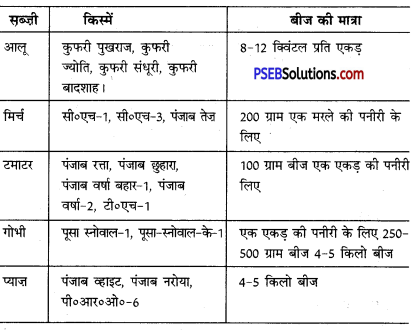
प्रश्न-
आलू, मिर्च, टमाटर, गोभी, प्याज़ के लिए किस्में तथा बीज की मात्रा बताएं।
उत्तर –
PSEB 6th Class Agriculture Solutions Chapter 8 पंजाब की मुख्य सब्ज़ियाँ 1

पंजाब की मुख्य सब्ज़ियाँ PSEB 6th Class Agriculture Notes

  • सब्जियों में प्रोटीन, विटामिन, खनिज होते हैं।
  • शरीर को स्वस्थ रखने के लिए प्रतिदिन 300 ग्राम सब्जियां खानी चाहिएं।
  • पंजाब में सब्जियों की काश्त लगभग दो लाख हैक्टेयर क्षेत्रफल में की जाती है।
  • गर्मियों की सब्जियां हैं-कदू जाति की सब्जियां, भिण्डी, टमाटर, बैंगन आदि।
  • सर्दियों की सब्जियां हैं-मटर, गोभी, पालक, मेथी, मूली, गाजर, आदि।
  • पंजाब में सब्जियों में सबसे अधिक क्षेत्रफल आलू की फसल के अधीन है।
  • आलू ठण्डे मौसम की सब्जी है, इसलिए बुवाई का उपयुक्त समय सितम्बर अक्तूबर का है।
  • आलू की किस्में हैं-कुफरी पुखराज, कुफरी ज्योति, कुफरी संधुरी, कुफरी बादशाह।
  • आलू के लिए एक एकड़ के लिए 8-12 क्विंटल बीज की आवश्यकता है।
  • मिर्च की काश्त के अधीन पंजाब में 7.67 हज़ार हैक्टेयर क्षेत्रफल है।
  • मिर्च की किस्में हैं-सी०एच०-1, सी०एच०-3, पंजाब तेज़ आदि।
  • मिर्च की बुवाई के लिए 200 ग्राम बीज एक मरले में पनीरी के लिए बहुत
  • टमाटर की किस्में हैं-पंजाब रत्ता, पंजाब वर्षा बहार-1, पंजाब वर्षा बहार-2, टी०एच०-1, पंजाब छुहारा।।
  • टमाटर के एक एकड़ पनीरी के लिए 100 ग्राम बीज की आवश्यकता है।
  • घीया कद्रू, चप्पन कद्दू, करेला, टीडा, घीया तोरी, खरबूजा, तरबूज, तर, खीरा, पेठा आदि कद्रू जाति की सब्जियां हैं।
  • कद् जाति के लिए प्रति एकड़ 2 किलो बीज की आवश्यकता है।
  • भिण्डी की किस्में हैं-पंजाब-7, पंजाब-8.
  • बैंगन की किस्में हैं, बी०एच०-2, पंजाब सदाबहार, पी०बी०एच०-3, पंजाब नगीना।
  • बैंगन की पहले पनीरी लगाई जाती है।
  • गोभी की किस्में हैं-पूसा स्नोवाल-1, पूसा स्नोवाल-के-1.
  • एक एकड़ की पनीरी के लिए गोभी के 250-500 ग्राम बीज की आवश्यकता है।
  • मटर की किस्में हैं-मिट्ठी फली, पंजाब-88, पंजाब-89.
  • मटर का 30-45 किलो बीज एक एकड़ के हिसाब से आवश्यक है।
  • प्याज की किस्में हैं-पंजाब व्हाइट, पंजाब नरोआ, पी०आर०ओ०-6.
  • प्याज की पनीरी तैयार करने के लिए 4-5 किलो बीज की आवश्यकता है।
  • जड़ वाली सब्जियां हैं-मूली, गाजर, शलगम।
  • धनिया, पालक, मेथी आदि पत्तेदार सब्जियां हैं।

PSEB 7th Class Social Science Solutions Chapter 15 धार्मिक विकास

Punjab State Board PSEB 7th Class Social Science Book Solutions History Chapter 15 धार्मिक विकास Textbook Exercise Questions and Answers.

PSEB Solutions for Class 7 Social Science History Chapter 15 धार्मिक विकास

SST Guide for Class 7 PSEB धार्मिक विकास Textbook Questions and Answers

(क) निम्नलिखित प्रश्नों के उत्तर लिखें

प्रश्न 1.
मुग़ल काल में धार्मिक व्यवस्थाएं तथा सम्प्रदायों के विकास का वर्णन करें।
उत्तर-
मुग़ल काल में मुसलमान इस्लाम धर्म को मानते थे। उनका राज्य प्रबन्ध इस्लामी सिद्धान्तों पर आधारित था। परन्तु सम्राट अकबर ने धार्मिक सहनशीलता की नीति अपनाई। उसने गैर-मुसलमानों के धार्मिक स्थानों के निर्माण पर लगे प्रतिबन्धों को समाप्त कर दिया। कहा जाता है कि अकबर ने अमृतसर की यात्रा भी की थी। अकबर के अनुसार हर धर्म अच्छा होता है। वह सूफी सन्तों के उदारवादी विचारों से बहुत प्रभावित था। उसने 1575 ई० में फतेहपुर सीकरी में एक इबादत खाना (पूजा घर) बनवाया। वहां हर वीरवार शाम को एक सभा बुलाई जाती और धार्मिक मामलों पर विचार-विमर्श किया जाता था। उसका विचार था कि सत्य को कहीं भी प्राप्त किया जा सकता है। उसने पारसी, जैन, हिन्दू और ईसाई आदि सभी धर्मों के लोगों के लिए इबादत खाने के द्वार खोल दिए। 1579 ई० में उसने एक शाही फ़रमान जारी किया, जिसमें उसने अपने आपको धार्मिक मामलों का श्रेष्ठ निर्णायक होने की घोषणा की।

अकबर ने सभी धर्मों के मूल सिद्धान्तों को एकत्रित करके एक नये धर्म ‘दीने-इलाही’ की स्थापना की। उसकी मृत्यु के बाद जहांगीर और शाहजहां ने भी उसकी धार्मिक नीति को अपनाया, परन्तु औरंगजेब ने मुग़ल साम्राज्य की बहु-धार्मिक प्रणाली को बदल दिया। इसका मुग़ल साम्राज्य पर बहुत बुरा प्रभाव पड़ा।

प्रश्न 2.
सूफ़ी लहर बारे तुम क्या जानते हो ? उसके मूल सिद्धांत कौन-से थे ?
उत्तर-
सूफी इस्लाम धर्म का रहस्यवादी रूप था। सूफ़ी सन्तों को शेख या पीर कहा जाता था। मध्य काल में उत्तरी भारत में सूफ़ी मत के बहुत से सिलसिले स्थापित हो गए थे। इनमें से चिश्ती और सुहरावर्दी सिलसिले बहुत ही लोकप्रिय थे।

चिश्ती सिलसिले की नींव अजमेर में ख्वाजा मुईनुद्दीन चिश्ती ने तथा सुहरावर्दी सिलसिले की नींव मुलतान में 3 मख़दूम बहाउद्दीन जकरिया ने रखी। इन सिलसिलों के धार्मिक विश्वास भिन्न-भिन्न थे।
सूफी मत के मूल सिद्धान्त-

  1. सूफ़ी सन्त एक अल्लाह को मानते थे और किसी अन्य परमात्मा की पूजा नहीं करते थे।
  2. उनके अनुसार अल्लाह सर्वशक्तिमान और सर्वत्र है।
  3. अल्लाह को पाने के लिए वे प्रेम भावना पर बल देते थे।
  4. अल्लाह की प्राप्ति के लिए वे पीर या गुरु का होना भी अनिवार्य मानते थे।
  5. वे संगीत में विश्वास रखते थे और संगीत द्वारा अल्लाह को प्रसन्न करने का प्रयास करते थे।
  6. वे अन्य धर्मों का भी सत्कार करते थे।

PSEB 7th Class Social Science Solutions Chapter 15 धार्मिक विकास

प्रश्न 3.
हिन्दू धर्म के बारे आप क्या जानते हो?
उत्तर-
दिल्ली सल्तनत काल में हिन्दू धर्म में अन्य बहुत से मत उत्पन्न हो गये थे। इनमें शैव मत, वैष्णव मत, जोगी आदि शामिल थे।

  1. शैव मत-9वीं सदी में भारत में शंकराचार्य ने शैव मत की स्थापना की। उनके अनुयायियों को शैव कहा जाता
  2. वैष्णव मत-वैष्णव मत के अनुयायी भगवान विष्णु के अवतारों श्री राम और श्री कृष्ण की पूजा करते थे। श्री राम की पूजा करने वालों में रामानन्द जी और श्री कृष्ण की पूजा करने वालों में चैतन्य महाप्रभु विख्यात थे।

प्रश्न 4.
भक्ति लहर सम्बन्धी आप क्या जानते हो? उसके मूल सिद्धान्तों सम्बन्धी लिखिए।
उत्तर-
मध्यकालीन भारत में भक्ति लहर नामक एक प्रसिद्ध धार्मिक लहर चली। इस लहर के सभी प्रचारक मुक्ति पाने के लिए प्रभु-भक्ति पर जोर देते थे। अतः इस लहर को भक्ति लहर कहा जाने लगा।
भक्ति लहर के मूल सिद्धान्त

  1. एक ही परमात्मा में विश्वास रखना।
  2. गुरु में श्रद्धा रखना।
  3. आत्म-समर्पण करना।
  4. जाति-पाति में विश्वास न रखना।
  5. खोखले रीति-रिवाजों से बचना।
  6. शुद्ध जीवन व्यतीत करना।

PSEB 7th Class Social Science Solutions Chapter 15 धार्मिक विकास

प्रश्न 5.
श्री गुरु नानक देव जी के भक्ति लहर में योगदान संबंधी लिखें।
उत्तर-
श्री गुरु नानक देव जी भक्ति लहर के महान् सन्त थे। आप सिख धर्म के संस्थापक थे। आप का जन्म 1469 ई० में राय भोई की तलवण्डी में हुआ था। आजकल यह स्थान पाकिस्तान में स्थित है और इसे ननकाना साहिब कहा जाता है।

श्री गुरु नानक देव जी एक ही परमात्मा की भक्ति करने में विश्वास रखते थे। उनका विश्वास था कि परमात्मा सर्वशक्तिमान् तथा सर्वव्यापी है। वह निराकार है और सबसे महान् है। गुरु नानक देव जी परमात्मा को ही सच्चा गुरु मानते थे।

गुरु नानक देव जी ने समाज में फैले अन्ध-विश्वास, मूर्ति-पूजा, जाति-पाति के भेदभाव, तीर्थ-यात्रा और महिलाओं के साथ दुर्व्यवहार का विरोध किया। उनकी शिक्षाएं श्री गुरु ग्रन्थ साहिब जी में अंकित हैं।

प्रश्न 6.
भारत के प्रमुख भक्ति लहर के संतों के नाम बताओ।
उत्तर-

  1. रामानुज
  2. रामानन्द
  3. संत कबीर
  4. श्री गुरु नानक देव जी
  5. नामदेव जी
  6. गुरु रविदास जी
  7. चैतन्य महाप्रभु
  8. मीराबाई।

PSEB 7th Class Social Science Solutions Chapter 15 धार्मिक विकास

प्रश्न 7.
सिख पंथ के मुख्य नियमों के बारे में लिखो।
उत्तर-
सिख पंथ के मूल सिद्धान्त निम्नलिखित हैं –

  1. परमात्मा एक है।
  2. परमात्मा सृष्टि की रचना करने वाला है।
  3. सभी मनुष्य समान हैं।
  4. परमात्मा सर्वशक्तिमान तथा सर्व-व्यापक है।
  5. ‘हउमै’ (अहंकार) का त्याग करें।
  6. गुरु महान् है।
  7. (सत) नाम का सिमरन करना चाहिए।
  8. खोखले रीति-रिवाज़ों में विश्वास नहीं रखना चाहिए।
  9. जाति-पाति का भेदभाव व्यर्थ है।
  10. मनुष्य को शुद्ध जीवन व्यतीत करना चाहिए।

(ख) निम्नलिखित रिक्त स्थानों की पूर्ति करो

  1. …………… की शिक्षाएँ आदि ग्रन्थ साहिब में शामिल हैं।
  2. ………….. द्वारा एक नये धर्म दीन-ए-इलाही की स्थापना की गई।
  3. सन्त कबीर …………….. के अनुयायी थे।
  4. भक्ति लहर के सन्तों ने लोगों की …………….. में प्रचार किया।
  5. श्री गुरु नानक देव जी सिख धर्म के …………… थे।
  6. हज़रत ख्वाजा मुईनुद्दीन का जन्म …………… में हुआ।
  7. …………….. खालसा पंथ की स्थापना 1699 ई० में की।

उत्तर-

  1. श्री गुरु नानक देव जी
  2. अकबर
  3. सन्त रामानन्द
  4. भाषा
  5. संस्थापक
  6. मध्य एशिया
  7. श्री गुरु गोबिन्द सिंह जी ने।

PSEB 7th Class Social Science Solutions Chapter 15 धार्मिक विकास

(ग) निम्नलिखित प्रत्येक कथन के आगे ठीक(✓) अथवा गलत (✗) का चिह्न लगाएं

  1. श्री गुरु गोबिन्द सिंह जी ने खालसा पंथ की नींव रखी थी।
  2. चिश्ती तथा सुहरावर्दी प्रमुख सूफी सिलसिले नहीं थे।
  3. निज़ामुद्दीन औलिया की दरगाह अजमेर में स्थित है।
  4. चैतन्य महाप्रभु तथा मीराबाई ने राम भक्ति को लोकप्रिय किया।
  5. आलवारों ने शैव मत के भक्ति गीतों को लोकप्रिय किया।
  6. श्री गुरु नानक देव जी ने लंगर प्रथा प्रचलित की।

उत्तर-

  1. (✓)
  2. (✗)
  3. (✗)
  4. (✗)
  5. (✗)
  6. (✓)

(घ) निम्नलिखित का मिलान कीजिए

कालम ‘क’ – कालम ‘ख’

  1. रविदास जी का जन्म – 1. 570 ई० में मक्का में हुआ।
  2. श्री गुरु नानक देव जी का जन्म – 2. इलाहाबाद में हुआ।
  3. रामानन्द जी का जन्म – 3. तमिल ब्राह्मण थे।
  4. रामानुज एक – 4. 1486 ई० में बंगाल के नदियां गांव में हुआ।
  5. चैतन्य महाप्रभु का जन्म – 5. बनारस में हुआ।
  6. पैगम्बर मुहम्मद का जन्म – 6. 15 अप्रैल, 1469 ई० को राय भोई की तलवंडी में हुआ था।

उत्तर-

  1. रविदास जी का जन्म – बनारस में हुआ।
  2. श्री गुरु नानक देव जी का जन्म – 15 अप्रैल, 1469 ई० को राय भोई की तलवंडी में हुआ था।
  3. रामानन्द जी का जन्म – इलाहाबाद में हुआ।
  4. रामानुज एक – तमिल ब्राह्मण थे।
  5. चैतन्य महाप्रभु का जन्म – 1486 ई० में बंगाल के नदियां गांव में हुआ।
  6. पैगम्बर मुहम्मद का जन्म – 570 ई० में मक्का में हुआ।

PSEB 7th Class Social Science Solutions Chapter 15 धार्मिक विकास

PSEB 7th Class Social Science Guide धार्मिक विकास Important Questions and Answers

प्रश्न 1.
मध्यकाल में उत्तरी भारत में हुए धार्मिक तथा साम्प्रदायिक विकास का वर्णन कीजिए।
उत्तर-
मध्य युग में विशेष कर राजपूत लोग हिन्दू धर्म को मानते थे। इस धर्म में अनेक देवी-देवताओं की पूजा की जाती थी। राजपूत काल में इस धर्म ने बहुत उन्नति की।

उत्तरी भारत में शैवमत और वैष्णव मत दोनों ही बहुत लोकप्रिय थे। शैव मत को मानने वाले लोग भगवान् शिव और माता दुर्गा आदि की तथा वैष्णव मत को मानने वाले भगवान् विष्णु और माता लक्ष्मी की पूजा करते थे। शक्ति मत के अनुयायी भी अनेक देवी-देवताओं की पूजा करते थे। वे देवी पार्वती, दुर्गा, लक्ष्मी, सरस्वती, चण्डी और अम्बिका आदि की पूजा करते थे।
इस काल में भारत में बौद्ध धर्म और जैन धर्म का प्रभाव बहुत कम हो गया था।

प्रश्न 2.
दक्षिणी भारत में धार्मिक व्यवस्था तथा सम्प्रदाय का संक्षेप में वर्णन करें।
उत्तर-
मुख्य धर्म-मध्य काल में दक्षिण भारत में अधिकतर लोग हिन्दू धर्म को मानते थे। वे हिन्दू देवी-देवताओं की पूजा करते थे। दक्षिण भारत के बहुत से राजा बौद्ध धर्म और जैन धर्म के संरक्षक थे। इस समय में भारत में ईसाई और इस्लाम धर्म भी प्रचलित थे।

धार्मिक सम्प्रदाय-इस काल में भारत में कई धार्मिक लहरों का जन्म हुआ। आलवार और नाइनार सन्तों ने अपनेअपने मत का प्रचार किया। नाइनार मत के अनुयायी शिवजी की प्रशंसा में भजन गाकर अपने मत का प्रचार करते थे, जबकि आलवार सन्त भगवान विष्णु के अनुयायी थे। वे विष्णु की प्रशंसा में भक्ति-गीत गाकर अपने मत का प्रचार करते थे।
सभी धार्मिक सम्प्रदायों में से लिंगायत सम्प्रदाय बहुत लोकप्रिय था। इस सम्प्रदाय के अनुयायी शिवलिंग की पूजा करते थे।

महान सन्त-मध्यकाल में भारत में कुछ महान् सन्त हुए। उन्होंने लोगों को मुक्ति की प्राप्ति के लिए ज्ञान मार्ग पर चलने का सन्देश दिया। उस समय के प्रसिद्ध सन्त शंकराचार्य ने अद्वैत दर्शन का सन्देश दिया, जिसका अर्थ है कि परमात्मा और उसकी रचना एक है। दक्षिण भारत में रामानुज भक्ति लहर के एक अन्य महान् सन्त थे। वे तमिल ब्राह्मण थे। उन्होंने अपने शिष्यों को भक्ति मार्ग का उपदेश दिया। उन्होंने स्पष्ट शब्दों में कहा कि प्रभु की भक्ति करने के लिए प्रेम और श्रद्धा का होना बहुत आवश्यक है।

माधव दक्षिण भारत के कृष्ण-भक्ति के उपासक थे। उन्होंने 13वीं सदी में वैष्णव मत का प्रचार किया। उनका मानना था कि ज्ञान, कर्म एवं भक्ति मुक्ति प्राप्त करने के तीन महत्त्वपूर्ण साधन हैं। उन्होंने लोगों को पवित्र जीवन व्यतीत करने का उपेदश दिया।

PSEB 7th Class Social Science Solutions Chapter 15 धार्मिक विकास

प्रश्न 3.
भक्ति लहर के प्रमुख सन्तों का संक्षेप में वर्णन करो।
उत्तर-
मध्यकाल में भारत के विभिन्न भागों में कई सन्तों का जन्म हुआ। इनमें से सन्त रामानुज, रामानन्द, कबीर, रविदास, श्री गुरु नानक देव जी और चैतन्य महाप्रभु आदि मुख्य हैं।
1. रामानुज-सन्त रामानुज दक्षिण भारत में वैष्णव मत के महान् प्रचारक थे। वे तमिल ब्राह्मण थे। वे अपने शिष्यों को विष्णु की पूजा करने का उपदेश देते थे। उन्होंने जाति-पाति का विरोध किया।

2. रामानन्द-रामानन्द जी का जन्म प्रयाग (इलाहाबाद) के एक ब्राह्मण परिवार में हुआ। वह 14वीं सदी में रामभक्ति के प्रमुख प्रचारक थे। आप राघवानन्द के अनुयायी थे। आप ने राम और सीता की पूजा करने का उपदेश दिया। रामानन्द जी ने समाज में प्रचलित अन्ध-विश्वासों की निन्दा की। आप प्रथम भक्ति सुधारक थे, जिन्होंने महिलाओं को भी अपने मत में शामिल किया।

3. सन्त कबीर-सन्त कबीर भक्ति लहर के महान् प्रचारक थे। एक निर्धन जुलाहा परिवार में जन्म लेने के कारण कबीर जी उच्च शिक्षा प्राप्त न कर सके। अत: कबीर जी ने जुलाहे का व्यवसाय अपना लिया। आप महान् सन्त रामानन्द जी के अनुयायी थे। आप ने लोगों को एक ही परमात्मा की भक्ति और परस्पर भातृभाव पैदा करने का सन्देश दिया। आपने समाज में प्रचलित मूर्ति-पूजा, जाति-पाति, बाल-विवाह और सती-प्रथा की निन्दा की। कबीर जी के शब्द (दोहे) श्री गुरु ग्रन्थ साहिब जी में भी विद्यमान हैं।

4. श्री गुरु नानक देव जी-श्री गुरु नानक देव जी पंजाब के प्रमुख भक्ति सन्त थे। आप जी ने एक परमात्मा की भक्ति करने तथा नाम सिमरन पर बल दिया। आपने बताया कि परमात्मा निराकार, सर्वशक्तिमान् तथा सर्वव्यापी है।

5. नामदेव-नामदेव जी महाराष्ट्र के सबसे प्रसिद्ध सन्त थे। उन्होंने लोगों को सन्देश दिया कि परमात्मा निराकार, सर्वशक्तिमान् और सर्व-व्यापक है। उन्होंने लोगों को शुद्ध जीवन व्यतीत करने के लिए प्रेरित किया। उन्होंने जाति-पाति, तीर्थयात्रा, मूर्ति-पूजा, यज्ञ, बलि और व्रत रखने का कड़ा विरोध किया। उनके भजनों को श्री गुरु ग्रन्थ साहिब जी में स्थान दिया गया है।

6. गुरु रविदास जी-गुरु रविदास जी का जन्म बनारस में हुआ था। आप एक परमात्मा की भक्ति में विश्वास रखते थे। आपने लोगों को बताया कि परमात्मा सर्व-व्यापक है। वह सबके हृदय में निवास करता है। आप ने नाम का जाप करने र मन की शुद्धि पर बल दिया। आप ने तीर्थ यात्रा, मूर्ति पूजा, व्रत रखने और जाति-पाति का खण्डन किया। आप की ईश्वर के प्रति सच्ची भक्ति और उपदेशों से प्रभावित होकर अनेक लोग गुरु रविदास जी के अनुयायी बन गए।

7. चैतन्य महाप्रभु-चैतन्य महाप्रभु एक महान् भक्ति सन्त थे। उनका जन्म 1486 ई० में बंगाल के नदिया नामक गांव में हुआ। वे एक परमात्मा की भक्ति करने में विश्वास रखते थे। जिसे वे कृष्ण जी कहते थे। उन्होंने जाति-पाति का खण्डन किया और लोगों को परस्पर भातृ-भाव और प्रेम का सन्देश दिया। उन्होंने कीर्तन प्रथा आरम्भ की। उन्होंने बंगाल, असम और उड़ीसा में वैष्णव मत का प्रचार किया।

8. मीराबाई-मीराबाई श्री कृष्ण जी की भक्त थी। वे भक्ति के गीत रचती थीं और गाती थीं। उन्होंने भगवान कृष्ण की प्रशंसा में बहुत-सी रचनाएं लिखी हैं। उन्होंने भजनों द्वारा कृष्ण-भक्ति का प्रचार किया।

प्रश्न 4.
सिख धर्म के उदय एवं विकास के बारे में बताइए।
उत्तर-
सिख धर्म के संस्थापक श्री गुरु नानक देव जी थे। सिख दस सिख गुरुओं-श्री गुरु नानक देव जी, श्री गुरु अंगद देव जी, श्री गुरु अमरदास जी, श्री गुरु रामदास जी, श्री गुरु अर्जन देव जी, श्री गुरु हरगोबिन्द जी, श्री गुरु हरिराय जी, श्री गुरु हरिकृष्ण जी, श्री गुरु तेग़ बहादुर जी तथा श्री गुरु गोबिन्द सिंह जी के अनुयायी हैं।

सिख गुरुद्वारों में पूजा करते हैं। श्री गुरु ग्रन्थ साहिब जी उनका प्रमुख धार्मिक ग्रन्थ है। श्री गुरु गोबिन्द सिंह जी ने सिखों को पांच ककार-केस, कंघा, कड़ा, कछहरा और किरपान-धारण करने का आदेश दिया। ज्योति-ज्योत समाने से पहले उन्होंने सिखों को आदेश दिया कि वे श्री गुरु ग्रन्थ साहिब जी को ही अपना गुरु मानें।

PSEB 7th Class Social Science Solutions Chapter 15 धार्मिक विकास

प्रश्न 5.
निम्नलिखित पर संक्षिप्त नोट लिखो –
(अ) श्री गुरु नानक देव जी की उदासियां या यात्राएं
(ब) इस्लाम धर्म के मूल सिद्धान्त।
उत्तर-
(अ) श्री गुरु नानक देव जी की उदासियां तथा यात्राएं-

  1. गुरु नानक देव जी ने ज्ञान-प्राप्ति के बाद भटकी हुई मानवता को सही मार्ग दिखाने के लिए अपनी यात्राएं (उदासियां) आरम्भ की। अपनी पहली उदासी में वह सय्यदपुर, तालुंबा, कुरुक्षेत्र, पानीपत, हरिद्वार, बनारस, गया, कामरूप, ढाका और जगन्नाथ पुरी आदि स्थानों पर गए।
  2. दूसरी उदासी में उन्होंने दक्षिण भारत और श्रीलंका की यात्रा की।
  3. तीसरी उदासी में गुरु साहिब कैलाश पर्वत, लद्दाख, हसन अब्दाल आदि की यात्रा करके लौट आए।
  4. चौथी उदासी में आप ने मक्का, मदीना, बगदाद तथा सय्यदपुर की यात्रा की।
    इसके बाद गुरु जी करतारपुर में आकर रहने लगे। अब वह बाहर जाने की बजाय पंजाब में ही धर्म-प्रचार करते रहे। कई इतिहासकारों ने इसे गुरु साहिब की पांचवीं उदासी कहा है।

(ब) इस्लाम धर्म के मूल सिद्धान्त-इस्लाम धर्म के मुख्य सिद्धान्त निम्नलिखित हैं-

  1. अल्लाह के सिवा अन्य कोई परमात्मा नहीं है और मुहम्मद उसका पैगम्बर है।
  2. प्रत्येक मुसलमान को हर रोज़ पांच बार नमाज़ पढ़नी चाहिए।
  3. प्रत्येक मुसलमान को रमजान के महीने में रोज़े रखने चाहिएं।
  4. प्रत्येक मुसलमान को अपने जीवन काल में कम-से-कम एक बार मक्का की यात्रा अवश्य करनी चाहिए।
  5. प्रत्येक मुसलमान को अपनी नेक कमाई में से ज़कात (दान) देना चाहिए।

प्रश्न 6.
श्री गुरु नानक देव जी के जीवन, शिक्षाओं तथा अन्य कार्यों का वर्णन कीजिए।
उत्तर-
श्री गुरु नानक देव जी का जन्म 15 अप्रैल, 1469 ई० को राई-भोई की तलवण्डी में हुआ था। इसे आजकल ननकाना साहिब कहा जाता है। उनके पिता मेहता काल, राय भोई की तलवंडी के पटवारी थे। उनकी माता जी का नाम तृप्ता जी था, जो धार्मिक विचारों वाली महिला थी। उनकी एक बहन थी, जिनका नाम नानकी था।

श्री गुरु नानक देव जी का आरम्भ से ही पढ़ाई और सांसारिक कार्यों में मन नहीं लगता था। इसलिए आप के पिता जी ने आप का विचार बदलने के लिए बटाला निवासी श्री मूल चन्द की पुत्री बीबी सुलक्खणी के साथ आप का विवाह कर दिया। उस समय आप की आयु 14 वर्ष की थी। आप के यहां दो पुत्रों ने जन्म लिया जिनके नाम श्री चन्द तथा लक्ष्मी दास थे।

विवाह के बाद गुरु नानक देव जी अपनी बहन नानकी जी के पास सुल्तानपुर चले गए। वहां उन्हें दौलत खान के मोदीखाने में नौकरी मिल गई। सुल्तानपुर में गुरु जी प्रतिदिन सुबह ‘वेई’ नदी में स्नान करने के लिए जाया करते थे। एक दिन जब वे वेईं में स्नान करने के लिए गये, तो तीन दिन तक नदी से बाहर ही नहीं निकले। इन तीन दिनों में उन्हें सच्चे ज्ञान की प्राप्ति हुई। ज्ञान-प्राप्ति के बाद गुरु जी ने ये शब्द कहे –

“न को हिन्दू न को मुसलमान”

उदासियां-गुरु नानक देव जी ने लोगों को धर्म का सही मार्ग दिखाने के लिए भारत के विभिन्न भागों की यात्राएं की। इन यात्राओं को उनकी उदासियां कहा जाता है। गुरु जी के सादा जीवन तथा सरल उपदेश से प्रभावित होकर अनेक लोग उनके अनुयायी बन गए।
शिक्षाएं-गुरु नानक देव जी की मुख्य शिक्षाएं इस प्रकार हैं –

  1. परमात्मा एक है। वह परमात्मा निर्गुण एवं सगुण है। वह परमात्मा सर्वशक्तिमान् एवं सर्व-व्यापक है।
  2. परमात्मा निराकार तथा दयालु है।
  3. मनुष्य को हउमैं (अहंकार) का त्याग कर देना चाहिए।
  4. नाम के जाप का जीवन में बहुत महत्त्व है।
  5. गुरु का स्थान बहुत ऊंचा है।
  6. भ्रातृ-भाव में विश्वास।
  7. मनुष्य को सदाचारी जीवन व्यतीत करना चाहिए।
  8. गुरु साहिब ने जाति-पाति तथा खोखले रीति-रिवाजों का खंडन किया।

श्री गुरु नानक देव जी करतारपुर में-गुरु जी ने अपने जीवन के अन्तिम 18 साल करतारपुर में व्यतीत किए। उन्होंने 1539 ई० में ज्योति जोत समा जाने से पूर्व भाई लहना को अपना उत्तराधिकारी नियुक्त किया।
वाणी-गुरु साहिब ने ‘जपुजी साहिब’, ‘वार मांझ’, ‘आसा दी वार’, ‘सिद्ध गोष्ट’, ‘वार मल्हार’, ‘बारह माह’ आदि प्रसिद्ध वाणियों की रचना की।

PSEB 7th Class Social Science Solutions Chapter 15 धार्मिक विकास

सही उत्तर चुनिए :

प्रश्न 1.
इस्लाम धर्म के संस्थापक कौन थे?
(i) अकबर
(ii) हज़रत मुहम्मद
(iii) कबीर जी।
उत्तर-
(ii) हज़रत मुहम्मद।

प्रश्न 2.
सूफी संतों में सबसे प्रसिद्ध एक चिश्ती शेख थे। निम्नलिखित में से उनका नाम क्या था?
(i) ख्वाजा मुइनुद्दीन
(ii) बाबा फ़रीद
(iii) निजामुद्दीन औलिया।
उत्तर-
(i) ख्वाजा मुइनुद्दीन।

प्रश्न 3.
दो सिक्ख गुरु शहीदी को प्राप्त हुए थे। इनमें से एक थे –
(i) श्री गुरु रामदास जी
(ii) श्री गुरु गोबिंद सिंह जी
(iii) श्री गुरु तेग बहादुर जी।
उत्तर-
(iii) श्री गुरु तेग बहादुर जी।

PSEB 10th Class Welcome Life Solutions Chapter 9 Effective Communication

Punjab State Board PSEB 10th Class Welcome Life Book Solutions Chapter 9 Effective Communication Textbook Exercise Questions and Answers.

PSEB Solutions for Class 10 Welcome Life Chapter 9 Effective Communication

Welcome Life Guide for Class 10 PSEB Effective Communication In Text Questions and Answers

Activity-2

Question 1.
What would you do, if you would be the C.R./monitor of the class?
Answer:
If I would be made the C.R./monitor of the class, I will make the discipline of the class correct because I know who is disturbing the class. Along with this, I will take care of the cleanliness of the class and make sure that no one should throw garbage in class. I will take the help of other students to make the class beautiful.

Question 2.
Which improvement do you want to inculcate in yourself?
Answer:
First of all, I will bring myself under discipline so that others must learn it. If the monitor of the class will not remain in discipline, how to pan other students will remain in the discipline. I will study hard to get good marks and make my teachers and parents happy.

Question 3.
How will you improve the class?
Answer:

  • I will continually remind others to remain in the discipline.
  • I will tell them the advantages of keeping a class plan and the disadvantages of having a filthy class.
  • I will continue to motivate students to study hard and get good marks.

PSEB 10th Class Welcome Life Solutions Chapter 9 Effective Communication

PSEB 10th Class Welcome Life Guide Effective Communication Textbook Questions and Answers

Activity-1

Content—A half glass of water.
Students, write a sentence on this half-filled glass in your notebook. Question: What have you observed?

Question 1.
The glass of water is half empty
Answer:
No, we haven’t written this.

Question 2.
The glass of water is half-filled
Answer:
Yes, we have written this.

Question 3.
Have you written something different ? What is it ……………..
Answer:
No.

Think and Answer:

Question 1.
Who is your dearest Mend in class?
Answer:
Ritesh Chopra is my dearest friend among all the other students in class.

Question 2.
What are the qualities which make you like the person?
Answer:
His behavior is quite good, he speaks softly with others, never uses foul language, always cooperates with others and whenever I required him, he stands with me. That’s why I like him very much.

PSEB 10th Class Welcome Life Solutions Chapter 9 Effective Communication

Question 3.
Whom you don’t like?
Answer:
I don’t like Neel as he always makes fun of others.

PSEB Solutions for Class 10 Welcome Life Effective Communication Important Questions and Answers

Multiple Choice Questions:

1. The meaning of ……………….. is to express one’s views, feelings, etc.
(a) Expression
(b) Interview
(c) Appreciation
(d) Personality.
Answer:
(a) Expression.

2. We can express ……………. with expressions.
(a) views
(b) feelings
(c) point of view
(d) All of these.
Answer:
(d) All of these.

3. Not presenting yourself in the right way has a ……….. impact.
(a) Negative
(b) Positive
(c) Sorrow
(d) Pleasure.
Answer:
(a) Negative

4. Hard work brings ……….
(a) appreciation
(b) attainment of goals
(c) success
(d) All of these.
Answer:
(d) All of these.

5. Why do students hesitate in giving answers to the questions asked by the teacher?
(a) Lack of self-confidence
(b) Don’t know the answer
(c) Don’t know how to reply
(d) All of these.
Answer:
(d) All of these.

6. The process of asking questions before giving a job is known as ………
(a) Interview
(b) Schedule
(c) Questionnaire
(d) Observation.
Answer:
(a) Interview.

PSEB 10th Class Welcome Life Solutions Chapter 9 Effective Communication

7. While talking with someone,…………. is of great importance.
(a) personality
(b) clothes
(c) language
(d) body language
Answer:
(c) language

8. What is required to impress others?
(a) Voice
(b) Facial expressions
(c) Body language
(d) All of these.
Answer:
(d) All of these.

9. How to become proficient in practical life?
(a) With continuous practice
(b) With the better ways of speaking
(c) By properly using body language
(d) All of these.
Answer:
(d) All of these.

Fill in the Blanks:

1. Expression tells about us…………………
Answer:
personality

2. The main reason for not replying to the questions asked by the teacher is ……………..
Answer:
lack of self-confidence

3. Everyone has his own …………… to look at the things.
Answer:
point of view

4. An individual must have a ………… thinking.
Answer:
positive

PSEB 10th Class Welcome Life Solutions Chapter 9 Effective Communication

5. There is always a proper way of giving …………….
Answer:
interview

6. ……………… of a speaker is of great importance.
Answer:
Language

True/False:

1. It always creates a positive impact when we are unable to express ourselves.
Answer:
False

2. With the proper way of expression, many of our problems can be solved.
Answer:
True

3. All have the same point of view to look at other things.
Answer:
False

4. Our outlook defines our surroundings.
Answer:
True

5. Positive people are liked everywhere.
Answer:
True

PSEB 10th Class Welcome Life Solutions Chapter 9 Effective Communication

Match the Column:

Column A Column B
(a) Communication (i) Soft
(b) Loss (ii) Testing
(c) Expression (iii) Way of Talking
(d) Checking (iv) Manifestation
(e) Voice (v) Damage

Answer:

Column A Column B
(a) Communication (iii) Way of Talking
(b) Loss (v) Damage
(c) Expression (iv) Manifestation
(d) Checking (ii) Testing
(e) Voice (i) Soft

Very Short Answer Type Questions:

Question 1.
What do you mean by Expression?
Answer:
The meaning of the expression is to express one’s views, feelings, ideas in front of others.

Question 2.
When do we have a negative impact on someone?
Answer:
When we are unable to express ourselves in front of others.

Question 3.
What is the advantage of expressing oneself in a better way?
Answer:
One does great progress in life.

Question 4.
Masterji asked the students to write the districts of which state?
Answer:
He asked the students to write the districts of Punjab.

Question 5.
From whom did Ravinder ask for a copy?
Answer:
Ravinder asked Pargat for a copy to do his work.

PSEB 10th Class Welcome Life Solutions Chapter 9 Effective Communication

Question 6.
Who told the names of all the districts correctly?
Answer:
Pargat Singh told the names of all the districts correctly and the teacher praised him as well.

Question 7.
Why was Pargat Scolded?
Answer:
Pargat was scolded because he was unable to keep his point of view.

Question 8.
What should we do to avoid trouble?
Answer:
We must know how to keep our case firmly.

Question 9.
Students do not reply to the questions asked by the teacher. Why?
Answer:
Because they lack self-confidence, don’t know the answer, or don’t know how to express themselves.

Question 10.
How can we develop the skill of self-expression in students?
Answer:
They must be asked to take part in different activities to develop this skill.

Question 11.
How can we come to know about one’s personality?
Answer:
From the point of view of looking at an object, we can easily come to know about one’s personality.

Question 12.
What kind of human attitude should be?
Answer:
An individual must have a positive attitude.

Question 13.
What do our teachers expect from us?
Answer:
They expect that we should have a positive attitude.

Question 14.
What type of people are negative-minded individuals?
Answer:
They always try to find problems in others.

Question 15.
What is the advantage of being optimistic?
Answer:
All respect him and he becomes popular among all.

Question 16.
What is meant by Interview?
Answer:
When someone is asked few questions on any issue and he replies to those questions, it is called an interview.

Question 17.
What affects the person speaking in front of you?
Answer:
Our language greatly affects the person speaking in front of us.

Question 18.
What should be kept in mind in order to influence someone?
Answer:
Our language and body language.

PSEB 10th Class Welcome Life Solutions Chapter 9 Effective Communication

Short Answer Type Questions:

Question 1.
Write a note on the importance of expression?
Answer:
The meaning of the expression is to express one’s ideas, views, and feelings of others. Our way of expression tells about someone’s personality. If we want to make our personality impressive, it is a must to have an ability of self in ourselves. Many times, this quality is there in oneself but we are hardly aware of it and that’s why we are unable to express ourselves. One can achieve great success with a better way of expression. That’s why express is of great importance.

Question 2.
Generally, students don’t reply to the questions asked by the teachers. What are its reasons?
Answer:

  • Lack of Self Confidence. Maybe students lack self-confidence and are unable to express their views.
  • Don’t know the answer. Maybe students have not read the chapter and don’t know the correct answer.
  • Doesn’t know how to express himself. Maybe he knows the answer but hardly knows the way to express himself. That’s why he doesn’t reply.

Question 3.
Write a note on Positive attitude.
Answer:
Everyone has his own point of view of looking at things. If a person likes an object and finds many qualities in it, then it is called a positive attitude. But if he sees flaws in the item and doesn’t like it, it’s called a negative attitude. The way a person looks at an object describes his or her personality. If a person has a negative attitude then he cannot progress in life. But if his outlook on life is positive, he will surely make progress in life.

Question 4.
“Our perspective defines our surroundings.” Explain the comment.
Answer:
There is no denying the fact that our perspective defines our surroundings. For example, a glass of water is half empty or half full it determines a person’s point of view. If a person sees half-empty glass, he is a negative thinking person but if the glass is half full, he is a positive-minded person. A person with positive thinking always finds qualities among others but a negative-minded person always tries to find deficiencies among others. It helps in the development of a right or wrong personality and we do progress accordingly.

Question 5.
What is the result of our positive attitude?
Answer:
Due to our positive or negative attitude, we like or dislike few people. If we have a positive attitude, we do not find mistakes among others. We even overlook petty issues. On contrary, the person with a negative attitude always tries to find mistakes in others. People with a positive attitude are always respected, become popular, and does progress in life.

PSEB 10th Class Welcome Life Solutions Chapter 9 Effective Communication

Question 6.
How our language affects other people?
Answer:
When we communicate with others, our language affects others. We should use very light words if we want to have a good effect on our personality. There should be sweetness in our voices. All this has a great effect on the development of our personality. Our way of talking affects our personality and relations with others.

Question 7.
What are the two effective ways to communicate effectively?
Answer:

  • Language. Language plays the most important role in communicating with others. If we have softness, calmness in our language then others will definitely be influenced. But if we use foul language, then others will hate us.
  • Body language. Our body language is also important ineffective communication. What type of facial expressions do we have while talking to others, what kind of gestures do we make end how do we explain things with gestures, also influence others.

Long Answer Type Question:

Question 1.
What effective methods should be used while doing interviews?
Answer:
At the time of the interview, the following steps should be used :

  • Questions should be simple and to the point.
  • The language of questions should be simple.
  • If the interview is for a job, then job-related qualities should be looked into.
  • Respect should be given while questioning.
  • Answers to questions should be given with full confidence.
  • Answers should be given with a smile.
  • Talk politely and say thank you while going out of the interview.
  • If you don’t know the answer, then politely tell that you don’t know the answer.

PSEB 10th Class Welcome Life Solutions Chapter 3 Inter-Personal Relationship

Punjab State Board PSEB 10th Class Welcome Life Book Solutions Chapter 3 Inter-Personal Relationship Textbook Exercise Questions and Answers.

PSEB Solutions for Class 10 Welcome Life Chapter 3 Inter-Personal Relationship

Welcome Life Guide for Class 10 PSEB Inter-Personal Relationship Textbook Questions and Answers

Question 1.
What did you feel after reading this play?
Answer:
After reading this play, we felt that we must not misbehave with the elders but should behave with them in a good way. When we were children, they raised us with great love and when they are old enough to do nothing, we should not turn away from them but serve them with the same love. It gives us their blessings and also inspires our children how to behave with the elders.

Question 2.
How do you care for your elders?
Answer:

  • We never misbehave with our elders. Instead, we talk with them with great affection. This makes them happy no matter how much difficulty they are facing.
  • We lovingly feed them so that they do not feel isolated.
  • We sit lovingly with our elders and listen to their life experiences so that we must not make the mistakes in life that they may have made.
  • Occasionally, we should sit and talk with them so that they should not feel isolated.

Question 3.
Which character of the play, you find the most tolerating person?
Answer:
I find Romi, the grandson, as the most tolerating character in the play. The reason is he loves his grandmother a lot but he can’t do anything for her. He observes how his father Karanbir and mother Simran misbehave with his grandmother. Many times, he opposes it but is helpless. His grandmother is sent to an old age home but he is unable to do anything. He is having no option left except to show patience.

PSEB 10th Class Welcome Life Solutions Chapter 3 Inter-Personal Relationship

Question 4.
Give your opinion about the characters of the play.

  1. Grandmother
  2. Romi
  3. Mom
  4. Papa

Answer:
1. Grandmother. She is the finest character of this short play because she knew that Karanbir is her adopted son and instead of saying anything else, she asks him to send her to an old age home. It will stop daily’s infighting that is going on in the house. She lives in hot conditions in the old age home but calls her son to donate two fans and a fridge so that others can have relief from the scorching heat. In this way, she endures every sorrow as a matter of fate.

2. Romi. Romi is the most tolerating character of the short play because he loves his grandmother a lot, but he can’t do anything for his grandmother. He even fights with his parents for his grandmother but they never care for his emotions. That’s why he seems quite tolerating.

3. Mom (Simran). Simran has played the character of a daughter-in-law in this play and she is of double character. On one side she persecutes her mother-in-law and forces her husband to send her to the old age home and on the other side, she threatens her brother to take care of their mother. In this way, she is portrayed as a cruel daughter-in-law and a loving daughter.

4. Papa (Karanbir). Karanbir is a character of the play who sends his mother to the old age home. He never cares about his son and hardly shows any love for his mother. Finally, when he comes to know that he is the adopted son, he decides to take his mother back to their home.

Situation 1. You are going on a road. In front of you, a boy is eating a banana and he throws the banana peel on the road, then what will be your reaction?

  1. You will try to persuade the boy.
  2. You will call someone else to pick up the banana peel.
  3. You will yourself pick up the banana peel and throw it in the dustbin.
  4. You will call the police and complain to the boy.

Answer:

  1. You will try to persuade the boy.

Situation 2. Your friends were gifted an empty chalk box on your birthday. The box is totally empty. What will be your reaction?

  1. You will stop talking to them.
  2. You will look at them and smile.
  3. You will ignore them.
  4. You will see in anger towards them.

Answer:
2. You will look at them and smile.

PSEB 10th Class Welcome Life Guide Inter-Personal Relationship Important Questions and Answers

Multiple Choice Questions:

1. What is the age of Romi?
(a) 7-8 years
(b) 8-9 years
(c) 9-10 years
(d) 11-12 years
Answer:
(a) 7-8 years

2. Who told Karanbir that he is the adopted son?
(a) Mother
(b) Simran
(c) Manager
(d) Romi
Answer:
(c) Manager

3. Where was grandmother sent by her son Karanbir?
(a) At Simran’s home
(b) Old age home
(c) Pilgrimage
(d) To move around.
Answer:
(b) Old age home

4. There are social limitations of ……………
(a) Country
(b) Relations
(c) State
(d) All of these
Answer:
(b) Relations

PSEB 10th Class Welcome Life Solutions Chapter 3 Inter-Personal Relationship

5. What is the need to maintain relations?
(a) to break relations
(b) to make relations
(c) to save relations
(d) none of these
Answer:
(c) to save relations

6. Whenever we get farewell from someone :
(a) Say thanks
(b) By sharing sweet memories
(c) By sharing phone numbers
(d) All of these
Answer:
(d) All of these

7. Which of these is a feature of good behaviour?
(a) Remain happy
(b) Be positive
(c) Speak happily
(d) All of these
Answer:
(d) All of these

8. Who among all the characters was clever?
(a) Grandmother
(b) Romi
(c) Simran
(d) Manager
Answer:
(c) Simran

PSEB 10th Class Welcome Life Solutions Chapter 3 Inter-Personal Relationship

Fill in the Blanks:

1. Spending time with the …………… is true worship.
Answer:
elders

2. Simran asked her to take care of her mother.
Answer:
brother

3. Karanbir left his mother at …………….
Answer:
old age home

4. After …………… months, Karanbir went to meet his mother.
Answer:
six

5. ……………. told Karanbir that his father adopted him from Ashram.
Answer:
Manager

6. There is always a limitation of every ……………….
Answer:
relationship

7. ……………… shines our personality.
Answer:
Good behaviour

True/False:

1. Karanbir was the father of Romi.
Answer:
True

2. We must forget bad memories.
Answer:
True

3. We must leave relations on a good note.
Answer:
True

4. Individuals maintain relations for their whole life.
Answer:
False

PSEB 10th Class Welcome Life Solutions Chapter 3 Inter-Personal Relationship

5. Good behaviour shines on our personality.
Answer:
True

6. We must not test social limitations.
Answer:
False

Match the Column:

Column A Column B
(a) Ominous (i) Prohibited
(b) T.B. (ii) Method
(c) Norms (iii) One who thinks wrong about someone
(d) Restriction (iv) Disease
(e) Etiquette (v) Rules

Answer:

Column A Column B
(a) Ominous (iii) One who thinks wrong about someone
(b) T.B. (iv) Disease
(c) Norms (v) Rules
(d) Restriction (i) Prohibited
(e) Etiquette (ii) Method

Very Short Answer Type Questions:

Question 1.
How can we truly worship our elders?
Answer:
Spending time and serving them is the true worship of our elders.

PSEB 10th Class Welcome Life Solutions Chapter 3 Inter-Personal Relationship

Question 2.
Who is an ‘Ominous’?
Answer:
According to Grandmother, “One who is bad, thinking bad about others and who fights for the whole of day at home is an Ominous”.

Question 3.
Why did Simran stop Romi from going to his grandmother?
Answer:
Because Simran thought grandmother had a cough, maybe T.B. and can make Romi sick.

Question 4.
Who asked Karanbir to leave his mother at an old age home?
Answer:
Simran asked Karanbir to leave his mother at an old age home.

Question 5.
To whom and what good news Simran gave?
Answer:
Simran gave the good news to her brother that Karanbir has left his mother at the old age home.

Question 6.
What threat did Simran give to her brother?
Answer:
Simran threatened her brother to take care of her mother or she will take her to Simran’s home.

Question 7.
What did Romi tell his father?
Answer:
Romy told his father that one day he will also send his father to any old age home.

Question 8.
Why did grandmother call her son to the old age home?
Answer:
Because she wanted Karanbir to donate two fans and a fridge to the old age home.

Question 9.
What secret did Manager tell Karanbir?
Answer:
The manager told Karanbir that thirty-five years ago, his father adopted him from the same old age home.

Question 10.
When did Karanbir realize his mistake?
Answer:
When he realized that he is the adopted son, he realized his mistake.

Question 11.
What did Karanbir do when he realize his mistake?
Answer:
He took back his mother to his home.

Question 12.
Which limit we should not cross?
Answer:
We must not cross limits of relations.

PSEB 10th Class Welcome Life Solutions Chapter 3 Inter-Personal Relationship

Question 13.
What should we check in society?
Answer:
We must check the limitations made and kept by society.

Question 14.
What etiquette we must understand?
Answer:
We must understand the etiquette of relationships.

Question 15.
What to look for while maintaining relationships?
Answer:
We must not cross the limits of relationships.

Question 16.
Do all relationships last a lifetime?
Answer:
No, not all relationships last for the whole life.

Question 17.
How can we get farewell from someone?
Answer:
We must get farewell from someone with proper etiquette.

Question 18.
What are the features of good behaviour?
Answer:
To remain happy, positive, hard work, speak softly etc. are the features of good behaviour.

Short Answer Type Questions:

Question 1.
How does the short play begin?
Answer:
The play begins in the drawing-room of the house where grandmother and her grandson Romi are sitting and playing. Grandson asks grandmother to play with him but she refuses as she is tired. Then the grandson asks his grandmother that what is the meaning of ‘Ominous*. At first, the grandmother avoids him by calling him small to understand but in the end, she tells him that the person is Ominous who himself is bad and thinks bad for others and the one whose house is always in trouble.

Question 2.
Why doesn’t Simran (mother) want her son to play with his grandmother?
Answer:
Simran did not like her mother-in-law. When the mother-in-law coughs, she thinks that she is suffering from T.B. and by playing with his grandmom, Romi will also get suffered from the same. Along with this, she also says that her mother-in¬law never does any household work and coughs up all day. That’s why Simran doesn’t want her son to play with his grandmother.

Question 3.
What grandmother says after seeing her son and daughter-in-law have a fight?
Answer:
When Karanbir comes back home, Simran speaks very bad about his mother. Simran also says that the old woman does not know what disease she has contracted and coughs up all day. When the grandmother hears a fight between them, she tells her son that there is no need to fight. It’s better if he sends her to any old age home where she will spend the rest of her life. That’s why Karanbir left his mother at the old age home.

Question 4.
Why does grandmother call her son to the old age home?
Answer:
She spends the first six months at the old age home with great problems but after that, she calls her son. Simran and Karanbir think that she is on her death bed and that’s why she has called Karanbir. When they visit the old age home, she asks Karanbir to donate two fans over there as it’s quite hot out there. She also asks him to donate a fridge as well as the water is too hot during summers. She tells Karanbir that when his son Romi leaves him in the old age home, his last days will be spent comfortably.

Question 5.
When does Karanbir realize his mistake?
Answer:
When Karanbir went to meet his mother at the old age home, she asks him to donate two fans and a fridge over there. At the moment, when Karanbir was talking to his mother, the Manager of the old age home comes there, recognises him and tells him that the husband of the old lady, Hardev Singh Brar, adopted him from the same old age home. After listening to this, Karanbir realizes his mistake and take back his mother with him.

PSEB 10th Class Welcome Life Solutions Chapter 3 Inter-Personal Relationship

Question 6.
What is the etiquette of leaving a relationship?
Answer:
An individual makes many relationships during his lifetime. Some relationships last a lifetime but some relationships break down along the way and remain in a comer of the heart. Many times, we realize that this relationship will not last for long. It’s better to stop it here. That’s why we should end such a relationship in a proper way. We must talk to the other person and politely tell him/her that now it is not possible to carry on with the relationship. It’s better to move on. This is the best way to move on from the relationship.

Question 7.
“Good manners and attitude shine our personality ?” Clarify.
Answer:
There is no denying the fact that good manners and attitude shine on our personality. At a particular time, how do we react or behave, it all tells about our personality. That’s why we must learn to behave in a way that becomes a lesson for others. So, it is a must for us to remain happy, do hard work, be positive and speak politely with others. These are the qualities of good behaviour and it also tells about our personality.

Long Answer Type Questions:

Question 1.
“All relationships have social boundaries.” Explain the statement.
Answer:
Our society has made some rules that our relationships are bound to remain within some limits. In addition to this, it is also told that how. much boundary is required in every relationship. That’s why we never cross our boundaries. Our parents, teachers, friends etc. continuously tell us about such boundaries. That’s why we must identify such boundaries and check the limits made by society. If we will not do the same and violate the limits, it will not be good for us as well as for society. Relationships inside the home have closeness but relationships outside the home are artificial and have less closeness. It depends upon our love and intensity about that particular relationship. Many times we make a very good relationship with a stranger and occasionally we have sour relationships with our blood relatives. Relationships are not easy to maintain. It is not like drawing a line on paper with a pencil. It is a relationship that cannot end quickly. That’s why it is a must to maintain the boundaries of relationships.

Question 2.
Which things should be kept in mind while breaking up or leaving a relationship?
Answer:
We all live in social life and while living a social life, we make many relationships. Some relationships last a lifetime but some relationships end up along the way. While ending a relationship, we must keep a few things in mind so that if in the future, a need arises to revive that relationship, we would easily do that. We must keep following things in mind while ending a relationship.

  • Remember the time spent with the person and thank him or her well.
  • Leave sour memories and only remember and share the good memories.
  • If you want to keep in contact with that person, share each other’s mobile numbers.
  • If you don’t trust the person, then don’t be emotional and don’t share personal information with that person.
  • Don’t get angry with that person or try to get revenge.

That’s why it is said that it would be nice to end a story at a nice turn that can’t be taken to the end.

PSEB 10th Class Welcome Life Solutions Chapter 2 Critical Thinking

Punjab State Board PSEB 10th Class Welcome Life Book Solutions Chapter 2 Critical Thinking Textbook Exercise Questions and Answers.

PSEB Solutions for Class 10 Welcome Life Chapter 2 Critical Thinking

Welcome Life Guide for Class 10 PSEB Critical Thinking Textbook Questions and Answers

1. Where is the other part of Punjab located?
(a) Delhi
(b) Canada
(c) Pakistan
(d) Rajasthan
Answer:
(c) Pakistan

2. How many assembly constituencies are there in Punjab?
(a) 116
(b) 21
(c) 13
(d) 117
Answer:
(d) 117

3. How many parliamentary constituencies (Lok Sabha) are there in Punjab?
(a) 117
(b) 13
(c) 21
(d) 22
Answer:
(b) 13

PSEB 10th Class Welcome Life Solutions Chapter 2 Critical Thinking

4. By what parent did the Greeks know Punjab?
(a) Sapat-Sindhu
(b) Pentapotamia
(c) Panchanad
(d) Sindh
Answer:
(b) Pentapotamia.

5. Which is the oldest university in the world associated with Punjab?
(a) Punjabi University
(b) Punjab University
(c) Takshila University
(d) Nalanda University
Answer:
(c) Takshila University

(Questions for worksheet)

Question 1.
Which misconception was Sandeep holding in her mind?
Answer:
There was a misconception in Sandeep’s mind that products and tonics increase physical strength and athletes perform better in sports. He was preferring to take medicine and products instead of hard work which is wrong.

Question 2.
What advice did the teacher give to her girl students?
Answer:
The teacher advised her girl students not to keep misconceptions in their minds. Many people use drugs to show their strong body which is wrong. Kids get caught up in the web of social media ads. We need to think carefully before we fall into the trap of these advertisements. Instead of taking these medications, we should focus more on hard work and an indigenous diet. Madam told the girls that we have many examples where many players from ordinary families have gone through hard work and achieved great success.

Question 3.
Which things should be kept in mind while watching print media, electronic and social media?
Answer:
Companies advertise their products on print media and social media. This type of advertisement is not a part of any TV channel and the name states that it is a company advertisement. So, before we buy them and fall into their trap, we must find out the truth about them. We must rationally think about whether this is possible. If not, we must not buy that product.

PSEB 10th Class Welcome Life Solutions Chapter 2 Critical Thinking

Question 4.
How can we get rid of misconceptions?
Answer:
We must think rationally about anything whether this is right or wrong. We must talk to others and if our views match, we must remove misconceptions and consider the reason behind them.

PSEB Solutions for Class 10 Welcome Life Critical Thinking Important Questions and Answers

Multiple Choice Questions:

1. Which students are unique and successful?
(a) One who values the time.
(b) One who plays games.
(c) One who is busy on social media
(d) None of these
Answer:
(a) One who values the time.

2. What has removed gender discrimination in society?
(a) Religion
(b) Science and technology
(c) Society
(d) Government
Answer:
(b) Science and technology

3. Which example tells us about the courage and kindness of females 7
(a) Mai Bhago
(b) Mata Gujri
(c) Rani Laxmi Bai
(d) All of these
Answer:
(d) All of these

4. Can we see gender discrimination in modern times 7
(a) Yes
(b) No
(c) Don’t know
(d) Can’t say
Answer:
(a) Yes

5. We should value ………………..
(a) Money
(b) Time
(b) Superstitions
(d) All of these
Answer:
(b) Time

PSEB 10th Class Welcome Life Solutions Chapter 2 Critical Thinking

6. In the present age, we can save time by properly using ……………..
(a) Religion
(b) Social Media
(c) Newspapers
(d) Magazines
Answer:
(b) Social Media

7. With ……………… we can spend our time well.
(a) Planning
(b) Mobile
(c) T.V.
(d) None of these
Answer:
(a) Planning

8. In the present age of modem revolutionary changes, the role of …………… has increased.
(а) Religion
(b) Individual means
(c) Means of communication
(d) Government
Answer:
(c) Means of communication.

9. What do we get with means of communication?
(a) Information
(b) Knowledge
(c) Entertainment
(d) All of these
Answer:
(d) All of these

10. What is the demerit of means of communication?
(a) An individual becomes habitual
(b) Children adopt bad habits
(c) Children deviate from their actual objective
(d) All of these
Answer:
(d) All of these

Fill in the Blanks:

1. With the right use of …………., we can achieve our goals.
Answer:
time

2. We get a lot of information with the help of ……………..
Answer:
means of communication

3 …………………. should not be misused.
Answer:
social media

4. Discrimination between …………… and …………….. has been going on in society since time immemorial.
Answer:
boys,
girls

5. We must not follow ………..
Answer:
assumptions

PSEB 10th Class Welcome Life Solutions Chapter 2 Critical Thinking

True / False:

1. We must avoid misconceptions.
Answer:
True

2. Gender-based discrimination is a perception of modem society.
Answer:
False

3. Discrimination between boys and girls has been going on since ancient times.
Answer:
True

4. Many people fall into the trap of media.
Answer:
True

5. Eating products is essential for sports.
Answer:
False

Match the Column:

Column A Column B
(a) Discrimination (i) Means of communication
(b) Unique (ii) Sapt Sindhu
(c) Schedule (iii) Difference
(d) Internet (iv) Special
(e) Punjab (v) Time Table

Answer:

Column A Column B
(a) Discrimination (iii) Difference
(b) Unique (iv) Special
(c) Schedule (v) Time Table
(d) Internet (i) Means of communication
(e) Punjab (ii) Sapt Sindhu

PSEB 10th Class Welcome Life Solutions Chapter 2 Critical Thinking

Very Short Answer Type Questions:

Question 1.
Is there gen&er based discrimination in society?
Answer:
Yes, there is gender-based discrimination in society.

Question 2.
What has significantly reduced gender-based discrimination in society?
Answer:
Science and technology have significantly reduced gender-based discrimination in society.

Question 3.
From which aspects, we can’t see the difference between a boy and a girl?
Answer:
From the point of view of courage, mental level, hard work, etc.

Question 4.
Give examples of women’s bravery and kindness.
Answer:
Mai Bhago, Mata Gujri, Rani Laxmi Bai, etc. are examples of women’s bravery and kindness.

Question 5.
Is there any gender-based discrimination in modern times?
Answer:
Yes, there is gender-based discrimination in modem times.

Question 6.
Which students are unique and successful?
Answer:
Students who value time are unique and successful.

Question 7.
Why should we value time?
Answer:
Because once the time is gone, it never comes back.

Question 8.
What happens if time is wasted?
Answer:
Time will not appreciate us and we will not be able to succeed in life.

Question 9.
Which student is successful in life?
Answer:
The student who plans the time becomes successful in life.

Question 10.
What is meant by Time Planning?
Answer:
It means that time should be planned in a way that every minute could be used.

PSEB 10th Class Welcome Life Solutions Chapter 2 Critical Thinking

Question 11.
How can we save time?
Answer:
We can save time by using social media.

Question 12.
What is the advantage of using social media?
Ans.
We can get a lot of information from social media.

Question 13.
The role of what has increased significantly in modem times?
Answer:
The role of means of communication has increased significantly in modem times.

Question 14.
What is the main purpose of the companies that run the media?
Answer:
Their main aim is to earn money.

Question 15.
What do means of communication provide us?
Answer:
They provide us with different types of information.

Question 16.
What is the disadvantage of misusing means of communication?
Answer:
People adopt wrong habits and deviate from their actual motives.

Question 17.
What vow students must make before using the internet and mobile?
Answer:
They must take a vow that they will use them only to increase their knowledge.

Question 18.
What is the advantage of properly using the internet and mean? of communication?
Ans.
They increase one’s knowledge and shine an individual’s personality.

Question 19.
Is it necessary to use products and tonics to play games?
Answer:
No, there is no need to use such things.

Question 20.
How can we master a sport?
Answer:
By continuous practice, we can master a sport.

PSEB 10th Class Welcome Life Solutions Chapter 2 Critical Thinking

Short Answer Type Questions:

Question 1.
What is means by Gender Discrimination?
Answer:
There are two genders in society-male and female. If any discrimination takes place between them, it is called gender discrimination. In our society, females are greatly discriminated against in comparison to males. For example, there are certain works, about which it is said that they are only for males. Males are physically powerful and they discriminate against females. Females were not given any rights. It is called gender discrimination.

Question 2.
Does gender discrimination exist in present society?
Answer:
Yes, gender discrimination still exists in society. Its common example can be seen at any workplace where females are less paid in comparison to males. There are very few women in public life. Most of the crimes are associated with females. Although they are given equal rights by the constitution but are unable to get equality in society.

Question 3.
Should we eliminate discrimination between boys and girls?
Answer:
Yes, this discrimination must be eliminated from society. An ideal society is based on equality and there must be no discrimination in such a society. If we look at the functions given to males and females, we can easily observe that the more difficult works are given to females and great patience is required to complete them. Males are unable to complete such works in a proper way. That’s why discrimination must be eliminated and efforts must be made to bring social equality.

Question 4.
Why should we value time?
Answer:
It is said that the past does not come back. Once time runs out, no matter how hard you try, it won’t come back. If we value time, we will be able to do all our work on time and in the right way, time will be of the essence and our lives will be successful. So, first of all, it is important that we should save our time. If we take care of our time then surely we will be able to progress in life and achieve our goals. That’s why it is said that time is money and we should not waste it.

Question 5.
“The right use of time is the best use of time.” Explain the statement.
Answer:
It is rightly said the right use of time is the best use of time. Actually, it is in our hands that how can we use our time. If a person uses his time wisely, gets an education, and makes efforts to do progress, his knowledge and money definitely increase. But if he did not do so, neither knowledge nor money would have gone to him. A student is always asked to create his own timetable and pay equal attention to all the subjects. If he does not set his own timetable and spends time in vain, the time to come will not be right for him. That’s why everyone must use his time wisely to do progress in life.

PSEB 10th Class Welcome Life Solutions Chapter 2 Critical Thinking

Question 6.
How can we use social media in a better way?
Answer:
The importance of social media in our lives has increased a lot these days. Facebook, Instagram, Google, etc. are included in social media. Out of these, Google can be very helpful for us. Every type of information is available on google. No matter what the subject is, Google provides us with information within a second. In addition, when we get tired of working, we can entertain ourselves on Facebook, Instagram, etc. We can find our old friends and reconnect with them. In this way, we can make our life interesting in many ways by using them properly.

Question 7.
What are the benefits of creating a Whatsapp group of students by a school teacher?
Answer:

  • By creating a Whatsapp group, teachers can give homework to students.
  • If a student faces any problem while studying, he can ask questions to the teachers.
  • Students answer each other’s questions which allow all the students to repeat the lesson.
  • Students get close to each other and help, each other during exam times.
  • Proper use of group is beneficial for children as they know what to do or not to do at a particular moment.

Question 8.
Can we improve our game by consuming products and tonics?
Answer:
No, games cannot be improved by consuming products and tonics. It can only increase physical strength for a particular moment. If the body gets used to it, the body can get damaged. The game can only be improved only with hard work and can achieve great success. It is a misconception that games can be improved by consuming products and tonics. We must avoid such misconceptions.

Long Answer Type Question:

Question 1.
How can we properly use mobile, the internet, and other means of communication?
Answer:
The role of communication in our lives has immensely increased in present times and we are using it a lot. We should not become habitual of it. Instead, we should properly use it. With the following methods, we can properly use mobile, the internet, and other means of communication :

  • We must not play games on mobiles. Instead, we should use it to attain knowledge.
  • Every type of information is available on Google. By using means of communication, we must collect information and become efficient in our subject.
  • Presently, students are taking education with mobile and internet. It should be used wisely.
  • More usage of mobile or computer can have an adverse impact on our eyes. It must be used to a limited extent.
  • By using such means, we can develop our personality and can create a better future.
  • With their help, students can achieve their goal i.e. progress in life.

PSEB 10th Class Welcome Life Solutions Chapter 6 Managing Emotions

Punjab State Board PSEB 10th Class Welcome Life Book Solutions Chapter 6 Managing Emotions Textbook Exercise Questions and Answers.

PSEB Solutions for Class 10 Welcome Life Chapter 6 Managing Emotions

Welcome Life Guide for Class 10 PSEB Managing Emotions In Text Questions and Answers

Self-Analysis

Some of the feelings have been given ahead. By completing this table try to analyze your emotions :

Question 1.
My name is ………….
A, B, C.

Question 2.
I feel happy when …………
Answer:

  • When someone praises my work.
  • When my friends play with me.
  • When my result is very good.

Question 3.
I feel sad when ……………..
Answer:

  • When someone, speaks wrong about me.
  • Someone gossips about me behind my back.
  • When my hard work doesn’t go well.

Question 4.
I get scared when …………….
Answer:

  • The teacher tells me something wrong with me.
  • My papers are not good and I have bad results.

Question 5.
hate when ……………..
Answer:
Someone slanders me by talking behind my back and not daring to speak in front.

PSEB 10th Class Welcome Life Solutions Chapter 6 Managing Emotions

Question 6.
I feel proud when ……………….
Answer:
My hard work pays off and everyone respects me.

Question 7.
I get frustrate when ……………….
Answer:
Despite my hard work, the results are not as expected.

Question 8.
I sympathize when ……………..
Answer:
My friends get less marks and I see a lot of poor people around me.

Question 9.
I feel confident when ………..
Answer:
Everyone tells me that if not this time then next time the results will be better because the effort is not wasted.

Positive Emotions

Emotions How do I express myself? How should I react?
Happiness By talking good things with all.
  • Share the happiness with others.
  • Work for the welfare of others.
  • Make more efforts to do good deeds to prolong my happiness.
Pride By telling everyone about my achievement.
  • Be courteous and polite.
  • Don’t be arrogant.
  • Keep following the path of goodness.
Trust Telling the person how much I trust him.
  • Share your secret with someone you trust.
  • Never breach anyone’s trust.
  • Never disclose the secrets someone shared with you.
Hope Telling the person how much hope I have from him.
  • Have a positive and optimistic outlook.
  • Always think constructively.
Sympathy love, gratitude By talking loving words and by giving thanks and again.
  • Never hurt the sentiments of others.
  • Always think for the well-being of others and act according to your ability.
  • Be thankful and express gratitude.

Negative Emotions

Emotions How do I express myself? How should I react?
Sadness By not talking to anyone.
  • Think of happy moments in your life.
  • Do something you like and try to be happy.
  • Try to find the cause of your sadness.
  • Try to solve your problem.
  • Make efforts to forget the unpleasant experiences.
Anxiety, Nervousness frustration By reviewing something over and over again
  • Try to find the reason.
  • Try to resolve your problem.
  • Seek the advice of your teachers or elders.
Despair Sitting on a side with anger and not talking to anyone
  • Remember a good thing that happened to you.
  • Make efforts to improve your attitude and move ahead.
  • Try to forget the unpleasant incidences.
  • Learn from the failures.
Jealousy Thinking about that thing over and over again.
  • Try to amend your behavior by imitating the good habits of others.
Shame, regret By apologizing and promising not to do it again.
  • Should apologize for the mistake.
  • Promise not to repeat the same mistake again.
Anger, resentment Don’t talk to the person you are angry with and stay away from him.
  • Should cannily put up the case before others avoiding aggressive arguments.
  • Try to find out the cause of others’ misbehavior.
  • Make efforts to improve the behavior.

PSEB 10th Class Welcome Life Solutions Chapter 6 Managing Emotions

Art of being Amicable

Question 1.
A. Write down the names of your friends.
1. ……………….. 2. …………………. 3. …………………

B. How often do you get angry with your friends?
Never/Often/Sometimes

C. How soon do you restart your interaction after an argument with your friends?
D. What efforts do you make to please your peers?
Answer:
(A) A, B, C.
(b) Sometimes.
(c) After a while when the resentment goes away.
(D) I take them out for a walk and sit down together and eat something. I pay all the bills for this outing.

Question 2.
Suppose a friend of yours goes to the canteen with you one day, you order tea and samosas but he only takes tea, after asking the price of the Sarnosa. What would you do in such a situation?
Answer:
In this situation, I will buy him a samosa and we will eat samosas together.

Question 3.
A student In your class has arrived at school without having his breakfast. He is not carrying his tiffin-hox. What will you do for him?
Answer:
I will share my tiffin with him and tell him not to worry. We are with him.

PSEB 10th Class Welcome Life Guide Managing Emotions Important Questions and Answers

Multiple Choice Questions:

1. What is affected the most when we don’t keep control of our emotions?
(a) Mental health
(b) Family relations
(c) Social relationship
(d) All of these.
Answer:
(d) All of these.

2. What should we do to save ourselves from bad effects?
(а) Enaptipps should be expressed openly.
(b) Emotions should be kept under control.
(c) There must be no emotions.
(d) None of these.
Answer:
(b) Emotions should be kept under control.

3. Which of these is a positive emotion?
(a) Happiness
(b) Depression
(c) Jealousy
(d) Disappointment.
Answer:
(a) Happiness.

PSEB 10th Class Welcome Life Solutions Chapter 6 Managing Emotions

4. Which of these is a negative emotion?
(a) Regret
(b) Proudness
(c) Love
(d) Sympathy.
Answer:
(a) Regret

5. Find out the positive feeling :
(a) Proudness
(b) Faith
(c) Sympathy
(d) All of these.
Answer:
(d) All of these.

6. Find out the negative feeling :
(a) Regret
(b) Anxiety
(c) Fear
(d) All of these.
Answer:
(d) All of these.

Fill in the Blanks:

1. Writing a ……………….. is a good habit.
Answer:
Diary

2. Proudness is a ………………. feeling.
Answer:
positive

3. Jealousy is a ………………. feeling.
Answer:
negative

4. We must keep control of our ……………….
Answer:
emotions

5. Diary becomes a valuable ………………..
Answer:
document

PSEB 10th Class Welcome Life Solutions Chapter 6 Managing Emotions

True/False :

1. We must keep emotions under control.
Answer:
True

2. Showing happiness is a negative feeling.
Answer:
False

3. Anxiety and fear are positive feelings.
Answer:
False

4. We must not have a habit of writing a diary.
Answer:
False

5. There must be a limit to expressing emotions.
Answer:
True

Match the Column:

Column A Column B
(а) Sensation (i) Negative Feeling
(b) Balance of Feelings (ii) Positive Feeling
(c) Anger (iii) Good habit
(d) Faith (iv) Feeling
(e) Writing Diary (v) Expressing emotions

Answer:

Column A Column B
(а) Sensation (iv) Feeling
(b) Balance of Feelings (v) Expressing emotions
(c) Anger (i) Negative Feeling
(d) Faith (ii) Positive Feeling
(e) Writing Diary (iii) Good habit

Very Short Answer Type Questions:

Question 1.
What is meant by managing emotions?
Answer:
It means that we must know that when and how many emotions are to express.

Question 2.
What is the need to control emotions?
Answer:
If we will not control our emotions, we can face many consequences.

Question 3.
What type of feelings do we have?
Answer:
Fear, happiness, sorrow, regret, faith, love, etc.

PSEB 10th Class Welcome Life Solutions Chapter 6 Managing Emotions

Question 4.
What is the loss of not controlling emotions?
Answer:
It can have a bad effect on our mental health, family relations, and social relationships.

Question 5.
What is necessary for expressing emotions?
Answer:
There is definitely a fixed limit to expressing emotions.

Question 6.
What is the advantage of writing a diary?
Answer:
With this, we can save the good moments which we have in our lives.

Short Answer Type Questions:

Question 1.
Write a note on expressing emotions.
Answer:
We have lot many emotions such as fear, anxiety, depression, nervousness, happiness, love, etc. It is very much necessary to keep emotions in control or we have to face consequences. If emotions will go out of control, it can have a bad effort on our health, social relationships, and family relations. That’s why it is necessary to keep them under control. At the same time, we need to learn not to make mistakes that we will regret later.

Question 2.
Show positive emotions with the help of a picture.
Answer:
PSEB 10th Class Welcome Life Solutions Chapter 6 Managing Emotions Img 1

Question 3.
Show negative feelings with the help of a picture.
Answer:
PSEB 10th Class Welcome Life Solutions Chapter 6 Managing Emotions Img 2

Question 4.
What should we need to have a habit of diary writing?
Answer:
Writing a diary is a good habit as we can save in it the events which happen in our lives. We are happy when we remember the past in our diary. Diary becomes a valuable document for us. So, everyone should get in the habit of writing a diary and make it an important part of their life.

Long Answer Type Question:

Question 1.
What do we learn from this chapter? Explain in brief.
Answer:

  • Individuals have a lot of emotions that they express at different times.
  • In positive emotions, we take pride, trust, love, happiness, etc. In negative emotions, we take anger, shame, restlessness, jealousy, fear, etc.
  • We need to control our emotions or else they have a detrimental effect on our mental, family, and social relationships.
  • We must deliberately limit our feelings so that no one else gets angry. So, it is important to keep a balance of emotions.
  • We should get in the habit of writing a diary and express our feelings only in the diary.
  • The diary becomes a precious document that we can read at any time to refresh our old memories.

PSEB 12th Class Physical Education Solutions Chapter 2 Sports Training

PSEB Solutions for Class 12 Class Physical Education  Chapter 2 Sports Training

Physical Education Guide for Class 12 PSEB Sports Training Textbook Questions and Answers

One Mark Question-Answers

Question 1.
How many types of warming-up are there? Name them.
Answer:
There are two types of warming up:

  • Physiological warming up
  • Psychological warming up.

Question 2.
Write any one benefit of Interval training Method.
Answer:
Since, hardly any training aids are required, more athletes can be trained at the same time.

PSEB 12th Class Physical Education Solutions Chapter 2 Sports Training

Question 3.
How is the word Training used in sports?
Answer:
Sports training is the entire systematic process of preparation of athletes for highest level of performance.

Two Marks Question-Answers

Question 4.
Write the meaning of sports training.
Answer:
In general, the word sports training is commonly used by the sportsperson in the field of sports. But, in broad sense training may be defined as an organised and systematic instructional process which aims to improve the individual’s physical, psychological and intellectual performance or tactical capabilities.

Question 5.
Write one aim of sports training.
Answer:
Development of Overall Personality. Overall personality can be observed with habits, self esteem, social skills, behaviour, leadership, abilities, resilience, values, team building etc. towards the requirements of training of competition. These are the personality traits that can be achieved or improved through sports during training. Hence, sports training play an important role in the development of personality.

PSEB 12th Class Physical Education Solutions Chapter 2 Sports Training

Question 6.
What do you know about physical structure?
Answer:
Physical structure means physique body structure or work efficiency. Shape of muscles and structure of bones can be identified through medical procedure. Inspite of these factors hereditary factors also play an important role in games and sports.

Three Marks Question-Answers

Question 7.
Write a note on the following:
(i) Physical fitness
(ii) Technical Expertise
(iii) Technical skills
(iv) Development of overall personality.
Answer:
(i) Physical Fitness:
It refers as one must possess physical fitness components e.g. strength, speed, endurance, agility, balance, power etc. these components can be achieved through regular physical training and are prerequisites of all sports. These physical fitness components vary from sports to sports e.g. some sports requires strength and endurance and other needs agility etc. With the help of physical training plan e.g. short term and long term plan, plan according to participation in general or specific competitions etc. can be achieved easily.

(ii) Technical Expertise:
Technical skill is a fundamental component of sports training. It refers to improve set of exercises and various skills used in various sports to achieve highly optimum performance or efficiency. Technical skill consists of various repeats (in order to become skill), initial training of athlete, abilities of athlete, motor abilities (fitness components), sensory abilities (understanding level of complex situation) etc. these above said fundaments can be achieved regular practice. For this, technical skill can divide in phases e.g. athlete must be prepared themselves for physical fitness, skill improvement training etc.

(iii) Technical skills:
Technical skill is a fundamental component of sports training. It refers to improve set of exercises and various skills used in various sports to achieve highly optimum performance or efficiency. Technical skill consists of various repeats (in order to become skill), initial training of athlete, abilities of athlete, motor abilities (fitness components), sensory abilities (understanding level of complex situation) etc. these above said fundaments can be achieved regular practice. For this, technical skill can divide in phases e.g. athlete must be prepared themselves for physical fitness, skill improvement training etc.

(iv) Development of overall personality:
Overall personality can be observed with habits, selfesteem, social skills, behaviour, leadership, abilities, resilience, values, team building etc. towards the requirements of training of competition. These are the personality traits that can be achieved or improved through sports during training. Hence, sports training play an important role in the development of personality.

All games and sports certainly benefit both mind and body and create discipline, team building, confidence and physical fitness. Sports training enhance strength, speed, skill, endurance, and flexibility but also increases self esteem, builds social skills and leadership, increases resilience and inculcates values. These specific personality traits which are more suitable to attain high level of sports performance in sports can be develop with the help of sports training.

PSEB 12th Class Physical Education Solutions Chapter 2 Sports Training

Question 8.
What is warming up? What is the difference between psychological and Physical warm up? .
Answer:
“Warming up is a preliminary exercises of physical and mental preparation for a strenuous exertion”.
“Warming up is a process of heating the whole body by running and performing exercises prior to the activity”.
“Warming up is a process by which human machine is brought to a condition at which it safely responds to the nerves impulses of the persons for quick and efficient action”.

1. Physiological warming up:
It is mainly when the light exercises are performed in order to have benefits of muscular contraction due to increase in temperature of the muscles. It can furthur be classified into following two categories:

(i) Active warming up:
It involves bodily movement such as light exercises, jogging etc. to increase body temperature.
It is furthur of two types:
(a) General warming up
(b) Specific warming up

(a) General warming up:
In this type of warm-up athlete does not engage themselves in a specific activity. It generally last from eight to ten minutes. This warm-up might include very easy jogging or vigorous walking, strides and simple exercises which are helpful to increase the heart rate.

(b) Specific warming up:
In this type of warming up athlete must follow specific exercises related to game or activity. For example sprinter must do strides before actual competition. Lunge walk, buttock kicks and rotation torso from side to side are required for tennis players etc.

(i) Passive warming up:
In passive wanning up activities other than bodily movements are adapted to have physiological effects of warming up such as sauna bath, steam bath, massage, both with warm water etc.

2. Physical Wanning up:
In this, the psychological benefits of warming up are displayed with the effect of exercises. In this, mind is prepared for action within the duration of . warming up.

PSEB 12th Class Physical Education Solutions Chapter 2 Sports Training

Question 9.
Write about the principle of uniformity and differentiation.
Answer:
1. Principle of differentiation:
As we all know ‘no two individuals are alike, they may have different physical structure, psychological make up, interest, capacities and abilities etc. So, while preparing physical training programme, a coach or trainer must take into consideration these factors.

2. Principle of Uniformity:
The second principle for the sports training lies in the use and disuse of the trained skills. It simply implies that regular training or practice is most important for any training programme. Without regular practice or use of trained skill the training or fitness level is not possible to maintain at same level.

Five Marks Question-Answers

Question 10.
What is circuit training method? Write its benefits.
Answer:
Circuit training was developed by R.E. Morgan and G.T. Anderson in 1953 at the University of Leads, England. This type of conditioning involves almost all of the training factors. Circuit training can be designed to develop strength, power, muscular endurance, speed, agility and neuromuscular coordination, flexibility and cardiovascular endurance.
Circuit training is formal type of training which is done in a circular pattern.

Circuit can be set up in gymnasium hall, room, or outside of the court and fields. There are usually six to ten stations are arranged in a circuit. A trainee perform one exercise and then move to the next station to do next exercise and keep moving from one point to the other to do the rest of exercises within the stipulated time.
Benefits of Circuit Training:
Circuit training has enormous advantages. These are mentioned below-

  • It is time saving.
  • More players can be trained at a time.
  • Swiftness in training.
  • Recreation in training.
  • Development of individual capabilities.
  • It is easy to make separate plans for men and women.
  • It combines a number of different components of training.
PSEB 12th Class Physical Education Solutions Chapter 2 Sports Training 1

  • It provides an interesting training environment for the athlete and there are established times and levels to motivate the athlete to continue improving.
  • The circuit can be modified to fit the needs of any one group or individual.
  • It can be adapted within the time constraints of the individual.
  • It can accommodate large groups of individuals at a relatively low expense.
  • In circuit training progression in all activities is assured.

PSEB 12th Class Physical Education Solutions Chapter 2 Sports Training

Question 11.
What is the meaning of cooling/limbering down?
Answer:
It is very important process to bring the body in normal state after competition or training. These are simple, easy and mild exercises done after intense training to allow body from transition to resting phase or we can say that limbering down means lowering the intensity of the work by performing stretching exercise followed by deep breath and relaxation exercises.

Cooling down is a process, which should be carried out at the end of stemuos activity. Our body after an exercise or training period takes some time for coming to its normal state, during this period many accommodative activities take place inside the body. Blood circulation in effected muscles and joints take place at a faster pace and cools down slowly. Continuing with slow exercises and deep breathing, cooling down should be carried out. Sudden coming to rest posture shall cause immense harm to the joints and muscles of our body.
Methods of Cooling Down:

  • Walking.
  • Jogging 5-10 min.
  • Static exercises 5-10 min.
  • Stretching exercises 10-30 min.
  • Yogic asana like shavasana.
  • To take hot water bath.
  • To carry out massage of the muscles to save them from hardening.
  • To carry out entertainment activities or mood stimulating games.
  • To carry out relaxation exercises.

The effects of cooling down are listed below:

  • Assists in the decrease of post exercise stiffness and muscle soreness.
  • Helpful in decreasing the risk of injury.
  • Body temperature becomes normal.
  • It reduces the chances of fainting.
  • Supply good amount of oxygen.
  • It decreases the level of underline in the blood.
  • It relaxes muscles.
  • Heart rate returns to initial stage.
  • Decrease in tension.
  • Save body from harmful effects.
  • Calm down mental state.
  • Reduces unwanted liquid from the muscle.
  • Prepares the body for ensuing events.
  • Reduces obstruction in the functioning of muscles.
  • Makes the system favourable for other exercises.

PSEB 12th Class Physical Education Solutions Chapter 2 Sports Training

Question 12.
What do you know about Interval method?
Answer:
Interval training is very useful for increasing the endurance and capabilities of sprinters and other players. This pattern of training was developed by German coach Dr.Woldemar Gerschler and Dr. Herbert Reindel, Interval training method gives importance to distance, speed, time and rest and develops tolerance, strength and proper blood circulation towards heart.

In this, interval training- relatively fast runs over relatively short distances are repeated for a number of times. We can say, a player in this pattern runs half or a quarter of the fixed distance with maximum speeds and then followed by jogging to regain strength and repeats this pattern several times. As the player develops stamina, period of rest is reduced and running time with maximum speed is increased. This system of exercise is carried out on repeatedly till a player reaches the peak of his capacities.
1. Fast or Intensive Interval training
2. Slow or Extensive Interval training.

1. Fast or Intensive:
It is also called high intensity interval training (HUT) or sprint interval training (SIT) in which intense aerobic exercise with less period of recovery is given, until the athlete gets too exhausted to continue the workout. In this athlete performs 80 to 100% of his total capacity and the heart rate goes up to 170 to 200 beats/per minute. This method is primarily used to develop speed endurance.

2. Slow or Extensive:
It is primarily used to develop general endurance of an athlete. The minutes of repetition should be more with less intensity. In this athlete performs 60 to 80% of his total capacity and the heart rate increases upto 140-180 beats/per minute.
Advantage of Interval Training:

1. Interval training utilizes the body’s two energy- producing systems: The aerobic and the anaerobic.
(i) The aerobic system is the one that allows walking or running for several miles, that uses oxygen to convert carbohydrates from various sources throughout the body into energy.

(ii) The anaerobic system, on the other hand, draws energy from carbohydrates stored in muscles for short bursts of activity such as sprinting, jumping or lifting heavy objects. This system does not require oxygen, nor does it provide enough energy for more than the briefest activities.
2. It improves blood circulation.
3. Since, hardly any training aids are required; more athletes can be trained at the same time.
4. Economy of time.

PSEB 12th Class Physical Education Solutions Chapter 2 Sports Training

PSEB 12th Class Physical Education Guide Sports Training Important Questions and Answers

One Mark Question-Answers

Question 1.
Enlist various types of warming up.
Answer:
(i) Physiological Warming up
(ii) Psychological Warming up.

Question 2.
What is the effect of cooling down?
Answer:
Helpful in decreasing post exercise stiffness and muscle soreness.

Question 3.
When we should warm-up?
Answer:
We should warm up prior to any activity or an event.

Question 4.
What is the another name for cooling down?
Answer:
Limbering down.

PSEB 12th Class Physical Education Solutions Chapter 2 Sports Training

Question 5.
Who developed the circuit training method?
Answer:
R.E. Morgan and G.T. Anderson.

Question 6.
Name the person who developed interval training method.
Answer:
German Coach Dr. Woldemar Gerschler and Dr. Herbert Reindel.

Question 7.
Enlist various types of Interval training method.
Answer:

  • Fast and intensive-intental -training.
  • Slow and extensive interval training.

Question 8.
In which year the circuit training method was developed?
Answer:
In the year 1953.

PSEB 12th Class Physical Education Solutions Chapter 2 Sports Training

Question 9.
Enlist various exercises for wanning up.
Answer:
Jogging, Strides, Stretching exercises, rotation movement exercises.

Question 10.
Enlist two principles of sports training.
Answer:

  • Principle of uniformity
  • Principle of continuity.

Question 11.
Elucidate the meaning of term ‘circuit’?
Answer:
Circuit means a circular pattern for the formal training.

Question 12.
Give the types of physiological warming up.
Answer:

  • Active warming up
  • Passive warming up.

Question 13.
How many types of active warming up are there?
Answer:
Two types.

PSEB 12th Class Physical Education Solutions Chapter 2 Sports Training

Question 14.
Which type of warming up is general warming up?
Answer:
Active warming up.

Question 15.
Which component is important under interval training method?
Answer:
This method gives importance to distance, speed, duration and rest.

Question 16.
Which component of physical fitness is developed with interval training method?
Answer:
Endurance.

Question 17.
What is circuit training?
Answer:
Circuit training is formal type of training which is done in a circular pattern. Circuit can be set up in gymnasium hall, room, or outside of the court and fields. There are usually six to ten stations are arranged in a circuit. A trainee perform one exercise and then move to the next station to do next exercise and keep moving from, one point to the other to do the rest of exercises within the stipulated time.

Question 18.
Which component are included in circuit training?
Answer:
Circuit training can be designed to develop strength, power, muscular endurance, speed, agility and neuromuscular coordination, flexibility and cardiovascular endurance.

Question 19.
How many stations can be there in circuit training?
Answer:
6 to 10.

Question 20.
What percentage of efficiency in used under fast and intense interval training method?
Answer:
80% to 100%.

PSEB 12th Class Physical Education Solutions Chapter 2 Sports Training

Question 21.
At what level heart rate increases in fast and intense interval training method?
Answer:
170 to 200 beats/per minute.

Question 22.
At what pace training is done under fast and intense interval training method?
Answer:
In this method, training is done with fast pace for short distance.

Question 23.
At what pace training is done under slow and extensive interval training method?
Answer:
In this method, speed is maintain at medium pac.

Question 24.
What percentage of efficiency is used under slow and extensive interval training method?
Answer:
60 to 80%.

Question 25.
At what level heart rate increases in slow and extensive interval training method?
Answer:
140 to 180 beats/per minute.

PSEB 12th Class Physical Education Solutions Chapter 2 Sports Training

Two Marks Question-Answers

Question 1.
Give the meaning of sports training.
Answer:
In general, the word sports training is commonly used by the sports person in the field of sports. But, in broad sense training may be defined as an organised and systematic instructional process which aims to improve the individuals’ physical, psychological and physiological performance or tactical capabilities.The scientific and systematic channel of preparation of players for highest level of sports performance is known as sports training.

Question 2.
What do you know about performance efficiency?
Answer:
Performance efficiency largely depends on the rate of practice and the amount of the competition and training. It also depends on training of loads during practice, training period, and quality of training and equipment. Efficiency is not achieved over a day, it needs constant training under the supervision of coach.

Question 3.
What is the need of warming up?
Answer:

  • Increases temperature of muscles.
  • Increases heart rate and blood flow.
  • Enhances coordination and motor ability.
  • Increases the sensitivity of nerve receptors.
  • Lowering of the energy rates of metabolic chemical reactions.

PSEB 12th Class Physical Education Solutions Chapter 2 Sports Training

Question 4.
Enlist methods of warming up.
Answer:
Physiological warming up:
It is mainly when the light exercises are performed in order to have benefits of muscular contraction due to increase in temperature of the muscles.

Psychological warming up:
In this the psychological benefits of warming up are displayed with the effect of exercises. In this mind is prepared for action within the duration of warming up.

Question 5.
Define cooling down?
Answer:
Cooling down is a process, which should be carried out at the end of stemuos activity. Our body after an exercise or training period takes some time for coming to its normal state, during this period many accommodative activities take place inside the body. Blood circulation in effected muscles and joints take place at a faster pace and cools down slowly. Continuing with slow exercises and deep breathing, cooling down should be carried out.

Question 6.
Highlight two advantages of cooling down.
Answer:

  • Assists in the decrease of post exercise stiffness and muscle soreness.
  • Helpful in decreasing the risk of injury.

PSEB 12th Class Physical Education Solutions Chapter 2 Sports Training

Question 7.
What is principle of rest in sports training?
Answer:
This principle of training suggests that there should be sufficient rest and recovery period after the strenous work load. This is important so that one should feel fresh and recovered from fatigue to adopt further work load. In addition to rest and recover between the load it is also important that a person should take proper sleep, diet and rest before the training.

Question 8.
Highlight advantages of Interval training.
Answer:

  • Interval training utilizes the body’s two energy- producing systems: The aerobic and the anaerobic,
  • Economy of time,
  • Improves blood circulation.

Question 9.
Who developed the circuit training method?
Answer:
Circuit training was developed by R.E. Morgan and G.T. Anderson in 1953 at the University of Leeds, England.

PSEB 12th Class Physical Education Solutions Chapter 2 Sports Training

Question 10.
What is the purpose of interval training method?
Answer:

  • It gives importance to time, distance, speed and rest.
  • It also develops endurance strength and improves blood circulation.

Question 11.
What is the aim of sports training?
Answer:

  • Improvement in work efficiency.
  • Development of overall personality.

Question 12.
Give the examples of specific warming up in football sport.
Answer:
Lunge walk, side steps, running backward, buttock kicks and chest hugs are required in football.

Question 13.
Stick rotation dribbing, tapping etc. specific warming up in related to which sport?
Answer:
Hockey.

PSEB 12th Class Physical Education Solutions Chapter 2 Sports Training

Three Marks Question-Answers

Question 1.
Write a note on the following:
(a) Physical training
(b) Technical skill.
Answer:
(a) Physical training:
Physical training refers as one must possess physical fitness components e.g. strength, speed, endurance, agility, balance, power etc. these components can be achieved through regular physical training and are prerequisites of all sports. These physical fitness components vary from sports to sports e.g. some sports requires strength and endurance and other needs agility etc. With the help of physical training plan e.g. short term and long term plan, plan according to participation in general or specific competitions etc. can be achieved easily.

(b) Technical skill:
Technical skill is a fundamental component of sports training. It refers to improve set of exercises and various skills used in various sports to achieve highly optimum performance or efficiency. Technical skill consists of various repeats (in order to become skill), initial training of athlete, abilities of athlete, motor abilities (fitness components), sensory abilities (understanding level of complex situation) etc. these above said fundaments can be achieved regular practice. For this, technical skill can divide in phases e.g. athlete must be prepared themselves for physical fitness, skill improvement training etc.

PSEB 12th Class Physical Education Solutions Chapter 2 Sports Training

Question 2.
Write about principles of continuity and uniformity.
Answer:
1. Principle of continuity:
The second principle for the sports training lies in the use and disuse of the trained skills. It simply implies that regular training or practice is most important for any training programme. Without regular practice or use of trained skill the training or fitness level is not possible to maintain at same level.

2. Principle of uniformity:
As we all know ‘no two individuals are alike, they may have different physical structure, psychological make up, interest, capacities and abilities etc. So, while preparing physical training programme, a coach or trainer must take into consideration these factors.

Question 3.
Give an account of wanning up exercises.
Answer:

  • Jogging
  • Strides
  • Stretching exercises
  • Rotation movement exercises
  • Wind sprint
  • Walking lunge
  • Butt kicks

Question 4.
What do you mean by principle of active participation?
Answer:
Active participation means where an, athlete or sportsperson have a keen interest or willingness to take part in a particular activity. Any training programme proves to be of no use if the person is not willing or ready to take part in that very activity. So, this is the most valuable principle of training that a person should be ready in terms of interest, his physical or physiological abilities and capabilities to take any training programme.

PSEB 12th Class Physical Education Solutions Chapter 2 Sports Training

Question 5.
Explain principles of rest and recovery.
Answer:
This principle of training suggests that there should be sufficient rest and recovery period after the strenous work load. This is important so that one should feel fresh and recovered from fatigue to adopt further work load. In addition to rest and recover between the load it is also important that a person should take proper sleep, diet and rest before the training.

Question 6.
Describe the principle of adaptation.
Answer:
This principle implies that after performing severe exercise or training programe for weeks our body becomes adjustable to increased or decreased physical demands. So, in order to have continued improvement the training programme should be such that new routine is introduced after adaptation to previous level of training or particular exercise.

Question 7.
Elucidate advantages of circuit training method.
Answer:

  • It is easy to make separate plans for men and women.
  • It combines a number of different components of training.
  • It provides an interesting training environment for the athlete and there are established times and levels to motivate the athlete to continue improving.
  • The circuit can be modified to fit the needs of any one group or individual.
  • It can be adapted within the time constraints of the individual.

PSEB 12th Class Physical Education Solutions Chapter 2 Sports Training

Five Marks Question-Answers

Question 1.
What is the meaning of cooling down? Explain about the effects of cooling down on body.
Answer:
It is very important process to bring the body in normal state after competition or training. These are simple, easy and mild exercises done after intense training to allow body from transition to resting phase or we can say that limbering down means lowering the intensity of the work by performing stretching exercise followed by deep breath and relaxation exercises.

Cooling down is a process, which should be carried out at the end of stemuos activity. Our body after ah exercise or training period takes some time for coming to its normal state, during this period many accommodative activities take place inside the body. Blood circulation in effected muscles and joints take place at a faster pace and cools down slowly. Continuing with slow exercises and deep breathing, cooling down should be carried out. Sudden coming to rest posture shall cause immense harm to the joints and muscles of our body.

Following are the benefits of cooling down:

  • Assists in the decrease of post exercise stiffness and muscle soreness.
  • Helpful in decreasing the risk of injury.
  • Body temperature becomes normal.
  • It reduces the chances of fainting.
  • Supply good amount of oxygen.
  • It decreases the level of aderaline in the blood.
  • It relaxes muscles.
  • Heart rate returns to initial stage.
  • Decrease in tension.
  • Save body from harmful effects.
  • Calm down mental state.
  • Reduces unwanted liquid from the muscle.
  • Prepares the body for ensuing events.
  • Reduces obstruction in the functioning of muscles.
  • Makes the system favourable for other exercises.

PSEB 12th Class Physical Education Solutions Chapter 2 Sports Training

Question 2.
What do you mean by warming up? How should body be wanned up? Explain various methods of warming up.
Answer:
Toning up of the muscles by performing warming up exercises, is most essential before starting with any physical workout. Warming up here means ‘preparing the physical body for the type of physical work it is going to do, by giving some kind of physical exercises. It is normally seen that stemuos physical exercises are started without doing any warming up exercises, which causes harmful effects on the related muscles and at times may result in to serious injury. Warming up exercises is required for preparing the body for proper demonstration of the skills. These exercises prepare a player physically and mentally for the event.

Definitions of Warming Up:
“Warming up is a preliminary exercises of physical and mental preparation for a strenuous exertion”.
“Warming up is a process of heating the whole body by running and performing exercises prior to the activity”.
“Warming up is a process by which human machine is brought to a condition at which it safely responds to the nerves impulses of the persons for quick and efficient action”.
“Warming up is done to tone up the body so as to meet the ensuing activity”.
Warming up is very essential before any competition or other activities though muscles can be damaged or tom which is lead to disability or inefficiency in sports.

Types of Warming Up:
Types of Warming up: The types of warming up can broadly be classified as follows:
PSEB 12th Class Physical Education Solutions Chapter 2 Sports Training 2
1. Physiological warming up:
It is mainly when the light exercises are performed in order to have benefits of muscular contraction due to increase in temperature of the muscles. It can furthur be classified into following two categories:
(i) Active warming up. It involves bodily movement such as light exercises, jogging etc. to increase body temperature.
It is furthur of two types:
(a) General warming up
(b) Specific warming up

(a) General warming up:
In this type of warm-up athlete does not engage themselves in a specific activity. It generally last from eight to ten minutes. This warm-up might include very easy jogging or vigorous walking, strides and simple exercises which are helpful to increase the heart rate. It also improves coordination and flexibility of joints. In general warm up, there are no such specific criteria but there are few exercises which may be mandatory for increasing temperature of the muscles. These are as follows:

  • Jogging
  • Strides
  • Stretching exercises
  • Rotation movement exercises
  • Wind sprint
  • Walking lunge
  • Butt kicks High knee pulls
  • Backward step over
  • Jumping jacks
  • Run forward, backward and sideward
  • Exercises for hands, arms, shoulder, neck, knees and legs.

(b) Specific warming up:
In this type of warming up athlete must follow specific exercises related to game or activity. For example sprinter must do strides before actual competition. Lunge walk, buttock kicks and rotation torso from side to side are required for tennis players etc. It stimulates competition actions and intensity in order to start the competition at the highest level. We have few examples of specific exercises related to game as follows:

  • Lunge walk, side steps, running backward, buttock kicks and chest hugs are required in football.
  • Lunge walk, buttock kicks, controlled leg swings and fast feet for runners.
  • Jog on the spot, jumps from side to side; lunge forward and backward for cyclist.
  • Lunge walk, buttocks kicks, jumping high and from side to side and rotating torso are for tennis.
  • Dribbling, shooting and lay up shots for basket ball.
  • All types of bending exercises and body twisting for badminton.

(ii) Passive wanning up:
In passive warming up activities other than bodily movements are adapted to have physiological effects of warming up such as sauna
bath, steam bath, massage, both with warm water etc.

2. Psychological Wanning up:
In this, the psychological benefits of warming up are displayed with the effect of exercises. In this, mind is prepared for action within the duration of warming up. The following ways can be adopted for the psychological warming up:

  • With the help of pep talks.
  • Motivational techniques
  • Meditation and relaxation training.

Question 3.
Write the meaning of Interval training method. Briefly explain various purposes of interval training method.
Answer:
Interval training is very useful for increasing the endurance and capabilities of sprinters and other players. This pattern of training was developed by German coach Dr.Woldemar Gerschler and Dr. Herbert Reindel, Interval training method gives importance to distance, speed, time and rest and develops tolerance, strength and proper blood circulation towards heart.

In this, interval training- relatively fast runs over relatively short distances are repeated for a number of times. We can say, a player in this pattern runs half or a quarter of the fixed distance with maximum speeds and then followed by jogging to regain strength and repeats this pattern several times. As the player develops stamina, period of rest is reduced and running time with maximum speed is increased. This system of exercise is carried out on repeatedly till a player reaches the peak of his capacities.

Advantages of Interval Training:
1. Interval training utilizes the body’s two energy- producing systems: The aerobic and the anaerobic.

(i) The aerobic system is the one that allows walking or running for several miles, that uses oxygen to convert carbohydrates from various sources throughout the body into energy.

(ii) The anaerobic system, on the other hand, draws energy from carbohydrates stored in muscles for short bursts of activity such as sprinting, jumping or lifting heavy objects. This system does not require oxygen, nor does it provide enough energy for more than the briefest activities.

2. It improves blood circulation.
3. Since, hardly any training aids are required; more athletes can be trained at the same time.
4. Economy of time.
Purpose of the Interval training method

Improves anaerobic performance:
Adapt the body to running condition, including high pace and high levels of lactase in muscles. Accomplish more overall work with less physiological strain in comparison to continuous running.

Question 4.
What is the meaning of sports training? Briefly explain principles of sports training.
Answer:
Meaning and Definition of Sports Training:
In general, the word sports training is commonly used by the sportsperson in the field of sports. But, in broad sense training may be defined as an organised and systematic instructional process which aims is to improve the individual’s physical, psychological and intellectual performance or tactical capabilities. It can be said that, ‘the means with which a sports person is prepared physically, technically, tactically, intellectually, psychologically and morally is called sports training.

The scientific and systematic channel of preparation of players for highest level of sports performance is known as sports training. All the learning influences and processes that are aimed at enhancing sports performance.
are considered to be an important part of sports training. .

Definition of Sports Training:
Various experts have defined the concept of sports training in different ways. Some of the definitions are as follows:
According to Matveyev, “the fundamental form of an athlete’s training is called sports training. It is an organised process of controlling a player’s development with the help of systematically organised exercises”. There are several universally accepted scientific training principles that must be followed in order to improve conditions and sports performance. These training principles are as follows:

1. Principle of differentiation:
As we all know ‘no two individuals are alike’, they may have different physical structure, psychological make up, interest, capacities and abilities etc. So, while preparing physical training programme, a coach or trainer must take into consideration these factors.

2. Principle of Continuity:
The second principle for the sports training lies in the use and disuse of the trained skills. It simply implies that regular training or practice is most important for any training programme. Without regular practice or use of trained skill the training or fitness level is not possible to maintain at same level.

3. Principle of load (overload):
In order to improve the level of performance, the overload i.e. load greater than normal stress must be given properly. It should be done in a systematic way. The load should be increased gradually after adapting certain training level.

4. Principle of safety and prevention:
It is important to take care of every aspect related to safety such as size and specification of equipment, classification of students, warming up and protective equipment etc. to avoid chances of injuries during training. As we all know prevention is better than cure, so we should always consider these aspects while training.

5. Principle of variety:
In order to maintain the zeal and interest for the activity it is important to provide variety in the training method. The monotonous and same kind of training would bring boredom and lack of interest to continue training for the same activity. So, its necessary to change the training method to create interest for the activity.

6. Principle of periodization:
The term periodization can be described as the division of training session to attain peak performance at the time of competition. So, this is the scientific base of training, in which lots of expertise is required to design training programme to attain highest performance at the time of competition. Broadly, the periodization can be distinguished as preparatory phase, competition phase and transition or recovery phase.

7. Principle of progression:
This principle of training implies that training must proceed from simple to complex and general to specific e.g. firstly simple dribbling should be practiced in order to perform lay up shot in basketball. The basic skills should be trained first in order to create stronger base for the particular activity. It should be done slowly and gradually to attain highest performance.

8. Principle of rest/recovery:
This principle of training suggests that there should be sufficient rest and recovery period after the strenous work load. This is important so that one should feel fresh and recovered from fatigue to adopt further work load. In addition to rest and recover between the load it is also important that a person should take proper sleep, diet and rest before the training.

9. Principle of conditioning/adaptation:
This principle implies that after performing severe exercise or training programe for weeks our body becomes adjustable to increased or decreased physical demands. So, in order to have continued improvement the training programme should be such that new routine is introduced after adaptation to previous level of training or particular exercise.

10. Principle of active participation:
Active participation means where an athlete or sportsperson have a keen interest or willingness to take part in a particular activity. Any training programme proves to be of no use if the person is not willing or ready to take part in that very activity. So, this is the most valuable principle of training that a person should be ready in terms of interest* his physical or physiological abilities and capabilities to take any training programme.

Punjab State Board PSEB 12th Class Physical Education Book Solutions Chapter 2 Sports Training Textbook Exercise Questions and Answers.

PSEB 12th Class Physical Education Practical Cricket

PSEB 12th Class Physical Education Practical Cricket

Cricket Game History

Cricket is one of the most interesting popular sport of world played both men and women by using a ball and a wooden bat. Cricket was originated in south-eastern part of England. Some people think that it is originated in France, while others think that it originated in England. The Hembildon Club of cricket was formed in England in year 1760. Second cricket club came into existance in 1787 or Melbourne Cricket Club (M.C.C.).

The first test match was played in 1877 between Australia and England at Melbourne which was won by Australia. MCC deck gave proper shape to cricket by framing rules of this game in 1835. During the First half of the 20th century, cricket spread to other Commonwealth countries. International Cricket Council (I.C.C) look after the affairs of cricket and organise the ICC trophy after every four years. The first world cup was held in 1975. British were credited to introduce Cricket in India.

The first official match was played in 1933 at Gymkhana ground in Mumbai. Under the Captainship of Mr. Kapil Dev India had won World Cup in 1983. First one day match was played on 5 January 1971 and became India’s popular game in India. Board of Cricket Control manages the affairs of cricket. A new form of a fast cricket is coming up which is popular as Twenty-Twenty in which both the teams have to play for only 20 overs each.

PSEB 12th Class Physical Education Practical Cricket

Cricket Game Important Points

  • Number of players in a team:16(11-5)
  • Distance from wicket to wicket:22 yards 20.12 Metre
  • Breadth of the Pitch:10’ (3.05 metre)
  • Breadth of wicket:9” (22.9 cm)
  • Circumference of the ball:8.81-9 inches
  • Circumference of wickets:3.49 – 3.81 cm
  • Weight of the ball:155.9 gm – 163 gm
  • Breadth of the bat:4.25 (10.8 cm)
  • Length of the bat:38” (96.52 cm)
  • Colour of the ball:Red for day match, white for night match
  • The diameter of outer circle from centre:137 m – 150 m
  • The height of wicket from floor:28″(71 cm)
  • Type of Match:20-20,one day,test machs.
  • Number of umpires:Two,one third umpire.
  • The area of small circle:27.4
  • Length of bowling crease (from centre of stumps):8’8″(2.64 m)

Cricket Game Rules And Regulations

  • The match is played between two teams. Each team has eleven players (Twelfth man in case of injury only).
  • Two umpires are appointed for the match one for each end (One third umpire).
  • The scorer keeps record of all the runs scored.
  • A player can be substituted in case of injury or illness. A substitute is not allowed to bat or bowl. He can run for the other player between the wickets or can do fielding.
  • A substitute cannot do fielding at his special position.
  • The captains of the team decide which team is to bat and which is to do fielding.
  • A new ball is taken at the start of each innings. A new ball can also be taken after 200 runs have been scored or after 75 overs. A new ball can also be taken in case the ball is lost or damaged but its condition should resemble that of the lost or damaged ball.

PSEB 12th Class Physical Education Practical Cricket

Number of Players:
1. A cricket match is played between two teams. Each team has 11 players. Each team has its own captain, who nominates his players before the toss for the innings.

2. If during the game a player is incapacitated by illness or injury, a substitute is allowed. But the substituted player can only do fielding. He can neither bat nor bowl.

3. Before the toss for the innings, one umpire for each end is appointed to make impartial decisions of the game.

4. Scorers are appointed to keep record of all the runs scored. They obey all the signs and orders of the umpires.
Cricket kit. It is essential for a cricket player to put on cricket kit. It means white pants, shirts, shoes, socks, pad, abdominal guard, gloves and bat.

Ball:
The cricket ball shall weigh not less than 155.9 gms. and not more than 163 gms. Its circumference shall not be less than 8.81 to 22.4 cms. and not more than 9″ (22.9 cms.). It shall be made of leather which is painted shining red. During the matches played during nights, the white ball is used. Each captain asks for the new ball before the beginning of a new innings. In case the ball is lost or damaged, the umpire can allow a new ball, the condition of which should be like that of the lost or damaged ball.
PSEB 12th Class Physical Education Practical Cricket 1
Bat: The length of the bat including the handle is 38 ” and its width from the widest part cannot be more than 4.25”.

Pitch:
The area of the ground between the bowling creases is known as the pitch. It is 5′ (1.52 metres) wide on either side of the imaginary line joining the centre of the wickets. The breadth of the entire pitch is 8′. 8 “.
PSEB 12th Class Physical Education Practical Cricket 2
Wickets:
Three-three wickets shall be fixed in front of each other, and the distance between these fixed wickets shall be 22 yards (20.12 m). The breadth of the wickets shall be 9″. The wickets have three stumps each and there shall be two bails to be placed on them. The stumps shall be equal and shall be so planted as to prevent the ball from passing through them. The top of the stumps from ground shall be 28 “. Each bail shall be 4 3/8in length and when in position on the position of the stumps shall not project more than above them.

PSEB 12th Class Physical Education Practical Cricket

Bowling and Popping Creases:
The bowling creases shall be drawn 8′. 8″ straight in length, with stumps in the centre. The popping creases shall be marked 4 feet in front of and parallel to the bowling crease. It shall extend by 6′ on either side of the stumps. The return crease shall be drawn perpendicular to the two ends of the bowling crease, and it shall be extended to meet the popping crease. Both the return and popping creases are deemed unlimited in length.
PSEB 12th Class Physical Education Practical Cricket 3
Innings:
Each team has to play two times by turn. It is decided by toss as to which team shall play first. If the team playing first has scored 200 runs in 5 or more than 5 day match, 150 runs in 3 day match, 100 runs in two day match and 50 runs in 1 day match over and above the runs made by the opposing team, it can ask the other team to play again, that is, it can declare follow on. The captain of the batting team can also declare the close of innings before time.

Start and Finish and Intervals:
Everyday at the start of each innings before the start of the match the captain says “play”, and if the team refuses to play, it shall lose the match. Ten minutes in each innings and maximum 2 minutes in the coming of each new batsman are allowed. Runs are reckoned for scoring. When a batsman after hitting the ball reaches from one end to the other, one run is deemed to be completed. If a batsman turns back without reaching the other end, that is not considered as a run. This is called short run. If while making the run, the ball is in the air and is caught, no run shall be deemed to be scored. Similarly, if a batsman is run out, the run being attempted shall not be counted.

Boundary:
If the ball crosses the boundary line having touched the ground, after a batsman has hit it, it is called boundary. Four runs are given for a boundary. If the hit ball falls out of the boundary line without touching the ground, six runs are made. If the boundary results from an overthrow or is intentionally made by the fieldsman, then the scored runs and the runs of the boundary shall be counted in the score.

PSEB 12th Class Physical Education Practical Cricket

Lost Ball:
If the ball is lost, any fieldsman can declare it to be lost. In such a situation, the umpire can re-start the game with a new ball the condition of which resembles that of the lost one.

Results:
Any team which makes more runs in its two innings is considered winner team. In case a match is not completed, it is regarded as a draw.

Over:
In each over the ball is bowled six times. These overs are done alternatively on each wicket. “No ball” and “wide ball” are not reckoned in an over. The number of extra balls bowled in an over shall be equal to the number of “no-balls” in that over. No bowler can bowl two overs continuously in one innings. If the umpire fails to remember the number of balls in an over, the over considered by the umpire shall not be counted.

Fall of Wickets:
The wicket is known as down when the batsman himself or his bat or ball removes either bail from the top of the stumps or both bails be off or strikes a stump out of the ground.

Dead Ball:
The ball shall be deemed to be a dead ball in the following cases:

  • When the ball has been properly caught by the bowler or wicket keeper.
  • When the ball reaches or bounces over the boundary.
  • When the ball, without being played, lodges in the dress of a batsman or a bowler.
  • When a batsman is out.
  • If the umpire decides to stop the game after the bowler gets back the ball.
  • On the call of ‘over’ or ‘time’ by the umpire.

No Ball:
While playing the ball if the front foot of the bowler goes ahead of the batting crease or cuts the returning crease, the umpire declares No Ball. After hitting the ball the batsman can make as many runs as possible. The runs made in this way will be added to the score. If no run has been made, only one run will be added to the score. By spreading one of his arms the umpire gives the signal of no ball.

Wide Ball:
The umpire declares a wide ball if the bowler bowls the ball high over or wide over the wicket which, in the opinion of the umpire, is out of the reach of the batsman. The runs made during the wide ball are reckoned in the wide ball. If no run is attempted, it is reckoned one run. The umpire gives the signal of wide ball by spreading his both arms straight.

PSEB 12th Class Physical Education Practical Cricket

Bye and Leg-bye:
The umpire shall declare ‘bye’ if the properly bowled ball passes the batsman (striker) without touching his bat or body and the run is obtained. But it should not be no-ball or wide-ball. But if the ball touches any part of the striker’s body except his hands which, hold the bat and any run is got, the umpire shall declare “leg-bye.”

Out of his Ground:
A batsman shall be reckoned to be out of his ground until some part of his bat in hand or of his person is grounded behind the ground of popping crease.

Batsman’s Retirement:
A batsman owing to illness or injury may retire at any time. He may bat but he will have to seek the permission of the captain of the opposing team to know his number of batting.

Bowled:
If the wicket is bowled down, the striker (batsman) is said to be bowled out, even if the ball has touched first his body or foot.

Catch:
If the ball from the stroke of a bat or of the hand holding the bat (not the wrist) is caught by a fieldsman before it touches the ground, the batsman is “caught out”. At the time of a catch both the feet of the fieldsman should be on the ground of the playfield. If the fieldsman catches the ball out of the boundary line, the batsman is not reckoned to be out, but is awarded 6 runs. If the ball lodges in the pads of the wicket-keeper, the batsman shall be reckoned to be “caught out.”

Handle the Ball:
During play, if the batsman touches the ball with his hand, he shall be reckoned to be out-“handle the ball out.”

Hit the Ball Twice:
If the ball is struck or stopped by any part of the batsman’s body after it has been hit, and if the batsman deliberately strikes it again, he shall be out. The ball can be hit twice only to defend the wicket but the condition is that it must have been done to defend the wicket. If any run is made in this process, it is not counted.

Wicket is Down or Hit Wicket:
If during the play, the batsman hits down his wicket with any part of the bat or body, it is called “hit wicket out.” If the wicket falls down as a result of the fall of his cap or hat or any broken part of his bat, even then he shall be reckoned to be “hit wicket out.”

PSEB 12th Class Physical Education Practical Cricket

L.B.W. (Leg Before Wicket):
The batsman is considered to be “L.B.W. out” when he tries to obstruct the ball with any part of his body before touching the ball with his bat, and in the opinion of the umpire, the ball and the wicket are in a straight line. If the batsman had not obstructed the ball with any part of his body, the ball would have straight hit the wicket.

Obstructing the field:
If a batsman deliberately obstructs a fieldsman from catching the ball, he can be out “obstructing the field.”

Stumped:
A batsman is out if his bat in hand and his foot is not on the ground behind the supposed popping crease. The batsman is considered to be outstumped when the ball is not “no ball” and is bowled and the batsman goes out of his ground otherwise than attempting a run, and then wicket-keeper outstumps the wicket (removes the stumps placed over the wickets).

Run Out:
The batsman is run out when the ball is in play, the batsman goes out of his ground to score a run, and his wicket is put down by the opposite side. If batsmen cross each other, that batsman will be considered to be “run out” who is running to the fallen wicket.

Wicket-keeper:
The wicket-keeper shall always remain behind the wickets until a ball delivered by a bowler touches the bat or the body of the striker or passes the wicket or the batsman is “out”. He cannot catch the ball.

Fielders:
The fieldsman can stop the ball with any part of his body. He is not allowed to stop the ball with his cap. If he does so, its penalty shall be four runs. In case no run has been made, four runs shall be added.

Field Setting in The Game Of Cricket:
PSEB 12th Class Physical Education Practical Cricket 4
A.

  1. Wickets
  2. Bowling crease
  3. Return crease
  4. Popping crease.

B.
Position of players:

  1. Slips
  2. 3rd man
  3. Gully
  4. Point
  5. Cover-point
  6. Extra-cover
  7. Mid-off
  8. Bowler
  9. Straight
  10. Mid-on
  11. Long-on
  12. Mid-wicket
  13. Square leg
  14. Fine leg
  15. Leg-slips
  16. Short leg
  17. Silly mid-off
  18. Silly mid-on
  19. Silly point
  20. Backward point
  21. Wicket-keeper.

PSEB 12th Class Physical Education Practical Cricket

Field, Weather and Light:
Before a match starts captains of both the teams will decide about the suitability of the field, weather and light. If they have not given their consent regarding these issues, the umpire shall decide the matter.

Appeal:
The umpire shall not order any batsman out unless a fielder makes an appeal in this regard. This appeal should be made before the delivery of the next ball and before the time is over. The fielder while appealing shall ask the umpire how it happened. The umpire signals ‘out’ by raising the index finger.

Mandatory over:
On the last day of the match, one hour before the close of the match, the umpire signals about the mandatory over. After this, a game of 20 overs is played. 6 Balls are bowled in an over. If it seems the match would be a draw, the game can be ended before the completion of these overs.

Dead Ball:
Dead ball is considered only in certain situations-when the ball settles down completely in the hands of a bowler or wicket-keeper or reaches the boundary line; when it is lodged in the dress of the umpire or batsman or the umpire gives the call of ‘over’ or ‘time’, and in addition to these, when a player is out or receives a serious injury.

Obstructing the Field:
If a batsman intentionally obstructs the game of the opposing team as a result of which the opposing team is obstructed from catching the ball, then the batsman is reckoned to be out. This is called ‘obstructing the field.’

Various types of matches:
1. Test Match: In test match both teams get a chance to play two innings. A test match is played for 5 days.

2. One-day Match:
There is a one day national and international match in which both the teams play in 40-40 or 50-50 overs. The team which scores more runs becomes the winner.

3. 20-20 Match: Like one day match, it is called 20-20 over match because both teams play for 20-20 overs.

PSEB 12th Class Physical Education Practical Cricket

There are new rules for 20-20 match as mentioned under:
1. Free Hit:
When a bowler balls while crossing bowling crease, then it is considered as ‘No ball’. In this case bats man gets free hit and during free
hit batsman will not be out in any case except mn out.

2. Power Play:
As per new cricket rules. In 50 overs match, power play shall be 10 overs, 5 overs and 5 overs. First power play is to be taken in the beginning of the game. 5-5 overs batting & fielding power play can be taken any time.

Some Important Techniques in Cricket Expertise And Techniques in Batting:

To play a hit successfully batsman should play heed to three points to find out the ball and attend to it; to decide which hit will be appropriate; and to turn the body to play the hit in a proper manner. It seems to be very easy, but in fact, it is not so easy. It is easy to think that you are looking at the ball. In reality, it is easy to watch the coming ball provided you are mentally prepared.
PSEB 12th Class Physical Education Practical Cricket 5
It is indeed a tough task to form the habit of judging, in the real sense of the term, of each and every ball in the entire innings. You can do it by learning to concentrate on the task in your hand. It is, indeed, difficult, but if you learn to do so, not only will it prove to be of use to you in cricket but in life as well. To take a right decision as to how to hit a particular ball is a matter of a sort of inner-inspiration which in cricket is often called “child understanding.” However, it is a matter of experience.

The position of the player:
A player’s restful, tension-free and balanced position is very essential. On it depends the right judgement of the ball and the foot movement for each stroke. Normally, the feet should remain parallel to the sides of the crease, and their toes directed towards the aim.
PSEB 12th Class Physical Education Practical Cricket 6
Back Lift:
A right back lift is of immense importance. The left arm and wrist should do the whole job, and as the bat rises its front side should be directed towards the aim. The head and body should remain perfectly motionless. As the bat is raised, the right elbow should be slightly separated from the body and the left hand should be upward exactly in front of the right pocket. The bat should move on the desired hit line below. It is but natural that the back lift will be firmer at the time of attack.

The Forward Stroke In Defence for The Straight Ball:
The forward stroke in defence is not only very precious but also the basis of the all hits. If one plays it well, one becomes at least half batsman. Its aim is to play the ball as much as possible from the proximity of the point. In this stroke, the bat is to touch the ball a few inches before the left foot by moving the head forward and by keeping the left buttock and shoulder out of the ball line. The feet should be towards the middle of mid-off and extra-over. The body weight should be directly with the bent left knee.
PSEB 12th Class Physical Education Practical Cricket 7
Stroke:
Judge the ball throughout its path. As far as possible, you should keep your head in balance while you do so. Don’t feel tempted much to raise your head.

Control in Hits:
The control is essential in taking hits. If you want to take a hard hit, your hit can be longer instead of turning.
In order to hit the ball easily and clearly, the ball should be thrown in the ground instead of towards the boundary line.
If the ball is quite high in the air, the hit can be taken with one long step. You should also learn to make use of your feet in playing a comparatively slow and quicker and shorter ball on the pitch.
PSEB 12th Class Physical Education Practical Cricket 8

Off Drive:
In off-drive, it is essential that your head, left shoulder and waist should remain on the ball line. If they are in the right direction, the left foot automatically performs its function in the right direction. In order to receive the out-of reach ball and ordinary ball the back of the left shoulder should be towards the bowler, and the aim of the hit should be towards off-side. In fact, the bat will begin its downward movement from the line of fine leg. As far as possible, the whole of the bat should move through the hit-line.

PSEB 12th Class Physical Education Practical Cricket

On-drive:
Many boys lack the ability of on-drive. If they get it, they can increase their capacity or ability of taking more runs. In it, the left shoulder is kept slightly low, the left foot and the line of balance are kept in right proportion and the head is moved ahead. It will enable one to approach the line of ball. The left foot shall remain slightly away.

The batsman should take the aim of hit, and the whole wide side of the bat should move down towards the line. In his on-drives, a batsman will have to resolutely discourage the tendency of depending too much on his right hand and right shoulder for the hit. He should also have a check on his left buttock going after.

Until a batsman has a good judgement of the pitch, he should continue to play with back stroke. In this way, he will get time to judge the ball after the pitch. In case of slow ball and more difficult pitch, he must depend upon the back stroke. The right foot with toe in parallel to the crease can make good movement inside and back side of the ball line. The weight of the body can be shifted on this foot but the head must lean slightly forward. The left foot on toe acts as a good balancer.

The ball should meet immediately below the eyes, and it should be at the level as eyes watch the ball downward the pitch. The control over hit is made by raising the elbow by the left hand and arm. The right hand, in the hold of the thumb and fingers, is relaxed. As far as possible, the body should be kept side ways.

Even Bat Stroke:
A boy cannot become a batsman until he learns how to take a direct hit. He should also know how to play a wrong ball, and it can be possible and effective through cross-bat hits. It seems to be particularly true in the case of long and full bounces, and provides good opportunities of scoring 4 runs (hitting boundary) particularly in the junior cricket. These hits are more easy as they are more natural than direct bat hits. But in order to play hits effectively, you should learn to play more efficiently.
PSEB 12th Class Physical Education Practical Cricket 9
Back-Foot Square Cut:
In order to tackle the ball received from the ball line and point from the front and back sides, the right foot moves across the buttock-line. Then the wrists and hands are moved down from a high bat- lift, and the head and body move over the bent right knee in the stroke line
PSEB 12th Class Physical Education Practical Cricket 10
Late Cut:
This hit is similar to the above-mentioned hit except that it begins with a sharper turn of the left shoulder, and the right foot on the toe, towards third slip, is on the ground. The ball is received at the level of wickets, and the batsman hits it in the direction of the gully or second slip. In these two cuts, the left foot remains on the toe in the relaxed condition, and the weight remains fully on the bent right shoulder.

PSEB 12th Class Physical Education Practical Cricket

Cricket Game Important Tournaments

  1. I.C.C. Trophy (ODI)
  2. Reliance Cup
  3. Hero Cup
  4. Australia Cup (One day)
  5. Champions Trophy (ODI)
  6. Benson and Hedges CUP (ODI)
  7. Rothmans Cup (ODI)
  8. Wills Trophy
  9. Pepsi Cup
  10. Coca-Cola Trophy (Asian test)

Cricket Game Important Questions

Question 1.
Number of players in cricket team.
Answer:
11.

Question 2.
What is the width of wicket?
Answer:
9” (22.9 cm)

Question 3.
What is the weight of cricket ball?
Answer:
155.9 gm to 163 gm.

Question 4.
What is the name of first cricket club?
Answer:
Hambildon Cricket Club.

Question 5.
When did First One day match was played in India?
Answer:
5 January 1971.

Question 6.
What is the full form of LBW?
Answer:
Leg Before Wicket.

Question 7.
Name any four cricket strokes.
Answer:
On-Drive, Back Stroke, Straight Drive Late Cut.

PSEB 12th Class Physical Education Practical Cricket

Question 8.
How many umpires are there in cricket?
Answer:
2 Umpires on the field and 1 third umpire.

Question 9.
What is the length of cricket pitch from wicket to wicket?
Answer:
22 yards (20.12 cm).

Question 10.
When did First test match was played in cricket?
Answer:
In 1877 (Australia & England).

Question 11.
Under whose captainship 1983 World Cup was won by India.
Answer:
Kapil Dev.

Question 12.
When the twelth man gets substitution in cricket?
Answer:
When any player gets injury on the field.

Question 13.
How many types of matches are played in cricket?
Answer:
One-day match, test match, 20-20 match.

Question 14.
What is the length of Bowling crease?
Answer:
8’8” (2.64 m).

PSEB 12th Class Physical Education Practical Cricket

Question 15.
What is the area of small circle?
Answer:
27.4 m.

Question 16.
What is the height of wicket from ground?
Answer:
28” (71 cm).

Punjab State Board PSEB 12th Class Physical Education Book Solutions 12th Class Physical Education Practical Cricket Important Notes, Questions and Answers.

PSEB 10th Class Welcome Life Solutions Chapter 1 Self-Awareness and Self Discipline

Punjab State Board PSEB 10th Class Welcome Life Book Solutions Chapter 1 Self-Awareness and Self Discipline Textbook Exercise Questions and Answers.

PSEB Solutions for Class 10 Welcome Life Chapter 1 Self-Awareness and Self Discipline

Welcome Life Guide for Class 10 PSEB Self-Awareness and Self Discipline Textbook Questions and Answers

Choose True/False

1. Repeated practice sharpens the skills.
Answer:
True

2. Singing can be refined with practice.
Answer:
True

3. Skills are given to lucky people by birth. He who has not got his boon cannot do anything.
Answer:
False

4. Talent should also be trained to be carved.
Answer:
True.

Think and Tell

Question 1.
Upon which thing, a good choice of career depends?
Answer:
The choice of a good career depends on one’s own inclination that in which field he is most inclined. If a person chooses a career that he does not like, then that career will not be good for him. It also depends on the circumstances of the person’s home and the need of the hour which career he chooses.

PSEB 10th Class Welcome Life Solutions Chapter 1 Self-Awareness and Self Discipline

Question 2.
How many types of counseling did the career counselor suggest?
Answer:
The career counselor suggested three types of counseling

  • Personal Counselling. When a counselor councils an individual personally, it is called personal counseling.
  • Group counseling. When some students or individuals interact with a counselor, it is called group counseling.
  • Class counseling. When the counselor talks to the whole class together and tells them about their career choices, it is called class counseling.

Question 3.
About which thing Navdeep was happy?
Answer:
Navdeep was happy that the school is now doing well as the students are being made career conscious.

Question 4.
Nowadays, why is it become good to move with a lot of career options?
Answer:
Nowadays, it is becoming good to move with a lot of career options because :

  • Maybe the person may lose interest in that occupation in the near future.
  • It is possible that in the future, the importance of a particular career in society will be lost.
  • Maybe in another job, a person starts to get self-satisfaction and more money.

Question 5.
What good things do you notice in your school?
Answer:

  • Our school focuses on the multifaceted development of students.
  • Students are introduced to a range of future career choices.
  • Students are told to think not just about one career but about at least three career options.
  • The school teachers have a good relationship with the children and counsel them from time to time.

Question 6.
Which quality do you find in Manisha?
Answer:
In Manisha, we saw the quality of knowing. She wanted to know why the kids were asked to fill three choices in the form. This quality should be in every child that why should he do any work. The advantage of this is that the child develops the quality of rational thinking.

PSEB 10th Class Welcome Life Guide Self-Awareness and Self Discipline Important Questions and Answers

Multiple Choice Questions:

1. Skill conies with ………….. in person.
(a) Practice
(b) Study
(c) Wandering
(d) All of these
Answer:
(a) Practice

2. How can we improve one’s singing skills?
(a) By learning songs
(b) By practice
(c) By listening to songs
(d) None of these
Answer:
(b) By practice

PSEB 10th Class Welcome Life Solutions Chapter 1 Self-Awareness and Self Discipline

3. How to find someone’s skills?
(a) With hard work
(b) With a concentration
(c) With practice
(d) All of these
Answer:
(d) All of these

4. Human nature is …………..
(a) changeable
(b) same
(c) static
(d) none of these
Answer:
(a) changeable

5. An individual with narrow mindedness :
(a) Spreads negativity
(b) Never becomes happy
(c) Never accepts criticism
(d) All of these
Answer:
(d) All of these

6. An individual’s thinking :
(a) should be open
(b) should be closed
(c) should be same
(d) should be unsatisfied
Answer:
(a) should be open.

7. Which of these is a feature of a good personality?
(a) Sociable
(b) Accept the challenge
(c) Ready to learn
(d) All of these
Answer:
(d) All of these

8. Everyone must keep ………………… career options.
(a) Two
(b) Three
(c) Four
(d) Five
Answer:
(b) Three

9. Which of these is a type of counseling?
(a) Individual
(b) Class
(c) Group
(d) All of these
Answer:
(d) All of these

10. One must choose a career according to his
(a) Ability
(b) Interest
(c) Needs
(d) All of these
Answer:
(d) All of these

PSEB 10th Class Welcome Life Solutions Chapter 1 Self-Awareness and Self Discipline

Fill in the Blanks:

1. Varinder Kumar was a teacher and a ………………. as well.
Answer:
Counselor

2. One must keep …………… career options.
Answer:
three

3. An individual’s ……………… nature becomes an obstacle in the way of his progress.
Answer:
rigid

4. ………………. has given great progress to society;
Answer:
Technology

5. …………………. is the law of nature.
Answer:
Change

True / False:

1. A narrow-minded person always makes progress.
Answer:
False

2. Not every child is skilled.
Answer:
False

3. Practice enhances one’s skills.
Answer:
True

4. An individual should openly accept his own criticism.
Answer:
True

5. Individuals should choose a career according to their interests.
Answer:
True

Match the Column:

Column A Column B
(a) Talent (i) Trend
(b) Foreigner (ii) Quality
(c) Point of view (iii) British
(d) Personality (iv) Outlook
(e) Interest (v) Individual’s outlook

Answer:

Column A Column B
(a) Talent (ii) Quality
(b) Foreigner (iii) British
(c) Point of view (iv) Outlook
(d) Personality (v) Individual’s outlook
(e) Interest (i) Trend

Very Short Answer Type Questions:

Question 1.
What makes a Person Special?
Answer:
The skills presented in a person make him a person special from the ordinary.

Question 2.
How do a person’s skills shine?
Answer:
A person’s skills shine only with practice.

PSEB 10th Class Welcome Life Solutions Chapter 1 Self-Awareness and Self Discipline

Question 3.
How can we improve one’s singing skills?
Answer:
The singing skills of an individual can be improved only with continuous practice.

Question 4.
What is needed to improve a person’s talent?
Answer:
Continuos practice, hard work, and concentration can improve one’s talent.

Question 5.
What kind of human nature should it be?
Answer:
Human nature must be changeable.

Question 6.
Give one demerit of narrow-mindedness.
Answer:
A narrow-minded person always spreads negativity.

Question 7.
What is the advantage of open-mindedness?
Answer:
An open-minded person always remains happy and keeps others happy.

Question 8.
Can a narrow-minded person maintain a relationship?
Answer:
No, he cannot maintain a relationship.

PSEB 10th Class Welcome Life Solutions Chapter 1 Self-Awareness and Self Discipline

Question 9.
What is meant by openness?
Answer:
Openness is the quality of one’s nature that helps, us to think openly.

Question 10.
Give one quality of an open-minded person.
Answer:
An open-minded person is always sociable.

Question 11.
Give one flaw in a narrow-minded person.
Answer:
He is critical of everything.

Question 12.
How can the stubborn nature of a person is detrimental to him?
Answer:
Because stubborn nature becomes an obstacle in the way of his progress.

Question 13.
What kind of stubbornness should the person have?
Answer:
The stubbornness of doing work with honesty, hard work, not to take a bribe, etc.

Question 14.
How can we become responsible citizens of society?
Answer:
By following social rules and removing wrong things from society, we can become responsible citizens.

Question 15.
How many career options a person should have?
Answer:
He must have a minimum of three career options.

Question 16.
What should a person keep in mind while choosing a career?
Answer:
His interest and need of the hour.

PSEB 10th Class Welcome Life Solutions Chapter 1 Self-Awareness and Self Discipline

Short Answer Type Questions:

Question 1.
How can we master a task? Explain with an example.
Answer:
Every person has some other skill and there is a need to polish that skill. To polish one’s skill, there is a need to do the practice. One cannot be a master of a skill if he is short of practice. For example, the writing of a first-class student can never be good but can be after writing continually. As children, we did not know how to ride a bicycle but with practice, we learned to ride a bicycle. In this way, practice is a must to masterwork.

Question 2.
What should a person keep his mind open?
Answer:
A person must keep his mind and perspective open. As the saying goes, running water looks good but stagnant water becomes dirty. In the same way, a narrow-minded person cannot make progress in life. He neither makes himself happy nor allows others to be happy. He can’t even handle relationships properly. He never accepts his criticism which actually he should do. One should keep his thinking open and must accept criticism positively.

Question 3.
What are the benefits of being open-minded?
Answer:

  • An open-minded person always accepts a change.
  • He accepts his criticism positively and brings changes in himself.
  • He contributes to social progress and does his own progress as well.
  • He keeps himself happy and keeps others happy too.
  • Does he maintain relationships in a better way?

Question 4.
What is the role of technology in our lives?
Answer:
Nowadays new technology is coming before us and we own it in a positive manner. Life is constantly progressing with technology. The older generation is not as fast as today’s youth in adopting modem technology. That’s why today’s generation is progressing so fast with this technology, we can do all our work easily. For example., clothes used to be washed by hand but now the machine washes them easily. In this way, we can say that technology plays a very important role in our lives and makes our work quite easy.

Question 5.
“The person should be stubborn or flexible”, Give a reason in favor of your answer.
Answer:
The person should not be stubborn but flexible in nature. His stubbornness becomes an obstacle in the way of his progress such as not accepting boys and girls as equals. People start to discriminate and pay a heavy price for it. Such stubbornness should be changed. One can contribute to the family’s progress, society’s progress, and national progress by changing according to changed circumstances.

Question 6.
What are the duties of a responsible citizen?
Answer:

  • He must change himself according to changed circumstances.
  • He must not accept Social evils. Instead, he must try to eliminate them.
  • He must remain within social boundaries.
  • He must motivate others to follow social rules.
  • He must try to bring social change and change himself as well.

Long Answer Type Questions:

Question 1.
Give merits and demerits of an individual’s personality.
Answer:
Merits.

  • First of all, he must be ready to learn something new so that he could change himself according to changed circumstances.
  • He must be sociable and keep healthy relationships with others.
  • He must accept every challenge because if he will not, he will become static and will not be able to do individual progress.
  • He must follow all the social rules and must motivate others to do the same.

Demerits.

  • A stubborn person never takes anyone’s advice. He always does his own thing which is to his detriment.
  • A stubborn person always runs away from his responsibilities which can be harmful to his life.
  • He gets angry suddenly which can be dangerous.
  • He loses his temper very quickly.
  • Many times, he never follows the rules. Instead, he breaks the social norms.

Question 2.
Observe the following pictures and answer the given questions.
PSEB 10th Class Welcome Life Solutions Chapter 1 Self-Awareness and Self Discipline Img 1

  1. What is shown in picture 1?
  2. What do you observe in picture 2?
  3. What do we come to know from both the pictures?

Answer:
1. Picture 1 tells us about a person with narrow-mindedness. He always remains unhappy. He not only hurts himself but also hurts those around him. He cannot maintain his relationships as well.

2. Person in the second picture is of open thinking and nature who always accepts a change. He himself remains happy and keeps others happy as well. He maintains his relationships well.

3. After looking at both the pictures, we can say that an individual must not be stubborn but be of open mind and perspective. It makes his life happy. On contrary, the stubborn person remains sad every time which is not correct. So, we must take a vow that We must accept challenges and will remain happy.

PSEB 10th Class Welcome Life Solutions Chapter 8 Problem Solving

Punjab State Board PSEB 10th Class Welcome Life Book Solutions Chapter 8 Problem Solving Textbook Exercise Questions and Answers.
PSEB Solutions for Class 10 Welcome Life Chapter 8 Problem Solving

Welcome Life Guide for Class 10 PSEB Problem Solving In Text Questions and Answers

Question 1.
Who was bothered by Robin’s habit?
Answer:
His parents, grandparents, and younger sister were bothered by his habit.

Question 2.
Can Robin’s begrudging behavior be justified?
Answer:
No, Robin’s begrudging behavior cannot be justified. We must not get angry over petty things. Instead, we must not give much importance to them. If not, it will reduce love and increase hardness.

Question 3.
Who taught Robin to control his anger?
Answer:
Robin learned to control his anger from his dogs who after fighting for food, started playing with each other.

PSEB 10th Class Welcome Life Solutions Chapter 8 Problem Solving

Question 4.
Students, what did you learn from this story?
Answer:
This story tells us that we must get angry in any case. After becoming angry, we are just like rotten and squeezed tomatoes with a bad smell.

Question 5.
How do you feel after fighting with anyone?
Answer:
After fighting with anyone, we become rotten and squeezed tomato with a bad smell. It means that after getting angry, the person’s state of mind deteriorates and he does the thing which he should not do. Anger does not benefit anyone but harms everyone.

Question 6.
After recess, you find a book was missing in your bag, what will you do?
Answer:
First of all, I will try to find here and there, ask other students about the book and if there is no clue, I will reach my teachers to report the matter.

Question 7.
You reach the school late. How will you enter the class?
Answer:
If I reach late for school, I will tell the true reason to the teacher that why I am late. The teacher will definitely listen to me and let me sit in class.

PSEB 10th Class Welcome Life Guide Problem Solving Textbook Questions and Answers

Question 1.
Write down your fears and anxieties in your notebook that bother you all day.
Answer:

  • The first fear is that something unexpected will happen.
  • The second reason is that I don’t fall behind in class. I always stand first in class and I have a fear that someone might cross me. That’s why I always remain in fear.
  • I am always afraid that my boss will get angry with me and fire me. In this way, there is a fear inside each person that bothers them.

Question 2.
What is the importance of concentration in our life?
Answer:
Concentration means being completely focused. Concentration is much necessary to do any work. We can’t do anything without concentration even if it is to study, do business, do research or do anything. It takes concentration to do every type of work. Whether we do one thing or many things, we will not be able to complete the work. In this way, we can say that concentration is of great importance in our lives.

PSEB 10th Class Welcome Life Solutions Chapter 8 Problem Solving

Question 3.
What will you do to increase your concentration?
Answer:
We cannot get success in life without concentration. That’s why we must do exercise. We must focus on our goal. We must not think. What others are doing. Expertise in every task can only be acquired through practice. In this way, concentration can be acquired through practice.

True / False:

1. Work hard to reduce the fear of failure. The fear will go away.
Answer:
True

2. Sometimes fear is also beneficial for us.
Answer:
True

3. A soldier accepts that service to the country is more valuable than his life. He is not afraid of death during the war. In this way, fear can be avoided even by knowing more about fear.
Answer:
True

4. Fear is very difficult to control.
Answer:
False

5. When you grow up, all fears disappear by themselves.
Answer:
False

PSEB 10th Class Welcome Life Solutions Chapter 8 Problem Solving

6. A balanced diet, walks, sound sleep, meditation, etc. are very important to increase concentration.
Answer:
True

7. Concentration cannot be increased.
Answer:
False

PSEB Solutions for Class 10 Welcome Life Problem Solving Important Questions and Answers

Multiple Choice Questions:

1. ………………….. is a state of mind in which a person feels restless and moves away from peace.
(a) Anger
(b) Happiness
(c) Jealousy
(d) None of these.
Answer:
(a) Anger.

2. There is always a …………… of being angry.
(a) profit
(b) loss
(c) jealousy
(d) peace.
Answer:
(b) loss.

3. From whom did Robin learn?
(a) Friends
(b) Dogs
(c) Neighbours
(d) Parents.
Answer:
(b) Dogs.

PSEB 10th Class Welcome Life Solutions Chapter 8 Problem Solving

4. What can be done to keep control?
(a) Positive approach
(b) Read good books
(c) Breathing
(d) All of these.
Answer:
(d) All of these.

5. …………… is the notion of any loss In the future.
(a) Fear
(b) Anger
(c) Jealousy
(d) Peace.
Answer:
(d) Peace.

6. Many a time …………… is also fruitful.
(a) anger
(b) fear
(e) peace
(d) jealousy
Answer:
(b) fear.

7. …………… was the teacher of Kauravas and Pandavas.
(a) Dronacharya
(b) Kripacharya
(c) Bhishma
(d) Dhritrashtra.
Answer:
(a) Dronacharya.

Fill in the Blanks:

1. ………………. can be increased.
Answer:
Concentration

2. To increase concentration ……………… is a must.
Answer:
meditation

3. The meaning of ……………… is completely thinking about anything.
Answer:
concentration

PSEB 10th Class Welcome Life Solutions Chapter 8 Problem Solving

4. ………………… reminds us of any loss in the future.
Answer:
Fear

5. We must have a ………………. thinking.
Answer:
positive

True / False:

1. Fear is the imagination of any loss in the future.
Answer:
True

2. We must read good books to keep control of our anger.
Answer:
True

3. Concentration cannot be increased in any way.
Answer:
False

4. Anger destroys peace of mind.
Answer:
True

5. There are profits of anger.
Answer:
False

Match the Column:

Column A Column B
(a) Anger (i) Understanding properly
(b) Complaint (ii) State of Mind
(c) Focus (iii) Reading Good Books
(d) Concentration (iv) Protest
(e) Positive thinking (v) Attention

Answer:

Column A Column B
(a) Anger (ii) State of Mind
(b) Complaint (iv) Protest
(c) Focus (i) Understanding properly
(d) Concentration (v) Attention
(e) Positive thinking (iii) Reading Good Books

Very Short Answer Type Questions:

Question 1.
What is Anger?
Answer:
Anger is a state in which a person feels very nervous and goes far away from the place.

Question 2.
What is the loss of being angry?
Answer:
In this case, he suffers such a loss which he has to bear for a long time.

Question 3.
When do we become angry?
Answer:
We become angry when we don’t get what we want.

Question 4.
What was the problem with Robin?
Answer:
He used to become angry on petty issues.

PSEB 10th Class Welcome Life Solutions Chapter 8 Problem Solving

Question 5.
What did Robin learn from dogs?
Answer:
Robin learns that we must not become angry. Instead, we must live with each other.

Question 6.
What is a loss of thinking bad of someone?
Answer:
Having a bad thought of someone will also make our mind dirty which will only harm us.

Question 7.
Tell one way to keep control of anger.
Answer:
Read good books and keep positive thinking.

Question 8.
What happens when we apply methods to control anger?
Answer:
It brings mental and behavioral change to an individual.

Question 9.
What happens with adopting the qualities like tolerance and humility?
Answer:
It removes mental disorders in an individual and develops his personality.

Question 10.
What is fear?
Answer:
Fear is the imagination of any loss in the future.

Question 11.
What should we do if something makes us angry?
Answer:
We should take ourselves away from that thing.

Question 12.
How can we overcome the fear?
Answer:
By understanding the reason, we can overcome the fear.

Question 13.
What is meant by concentration?
Answer:
Concentration is the fixed state of our mind when all our powers are in a state of focus.

PSEB 10th Class Welcome Life Solutions Chapter 8 Problem Solving

Question 14.
What is the advantage of concentration?
Answer:
With concentration, we can achieve our goals.

Question 15.
What is the loss of lack of concentration?
Answer:
One cannot achieve his goals and remains unsuccessful.

Short Answer Type Questions:

Question 1.
Discuss the state of anger.
Answer:
Anger is a state in which a person feels very nervous and restless and goes far away from peace. In this case, he suffers such a loss which he has to bear for a long time. Actually, we get angry when don’t get what we want. In such a situation, we lose our temper and do wrong things.

Question 2.
Tell few methods of keeping control and anger.
Answer:

  • Always keep a positive approach to anything.
  • We must read good books.
  • Keep a hobby and spend time in that hobby.
  • When you become angry, take a deep breath and count from one to ten.
  • When you become angry, drink water slowly.

Question 3.
What changes come in an individual when he comes to know about controlling anger?
Answer:
When someone comes to know about keeping control of anger, he feels many changes in his mental and behavioral aspects. If we adopt qualities like humility and tolerance, we Can remove many of our shortcomings and can develop our personalities. With this, we can create such a society that is full of responsible citizens who can live happily and enjoy their lives.

Question 4.
Write a small note on fear.
Answer:
Everyone is afraid of anything. Fear is nothing but an imagination of having lost in the future and this imagination remains there in everyone’s mind. But we must overcome this fear. Many times this fear is having many advantages as well. Fear makes us aware of the danger which will come in the future. But we must not allow fear to overwhelm us. Fear can be easily eliminated if we understand the cause of fear carefully.

PSEB 10th Class Welcome Life Solutions Chapter 8 Problem Solving

Question 5.
How should we find the solution to our problems?
Answer:

  • First of all, we need to be well aware of our problem.
  • Then we should try to find a solution to that problem with full attention, confidence, and patience.
  • Sometimes multiple solutions to a problem are found. So, we need to choose the best solution out of all the available solutions.
  • While finding a solution, we must keep in mind that the solution must be according to our needs and resources.

Question 6.
Explain the power of concentration with an example.
Answer:
The meaning of concentration is focussing all the powers of the mind on one thing. We have a great example of the power of concentration in Mahabhartha when teacher Dronacharya took an archery test of Kauravas and Pandavas. He put one bird far away with a diamond eye and asked all of them what they are looking for. Then only Aijun replied that he could only see the bird’s eye. It clearly tells us about Aijun’s power of concentration and that’s why he becomes the great Archer.

Long Answer Type Question:

Question 1.
Discuss the story of Maulvi Ji to control anger which is given in the chapter.
Answer:
During earlier times, children visited Maulvi Ji to take education. Maulvi Ji asked his students whether they are angry with someone or not. Many students always replied positively to his question. Then Maulvi Ji asked them to bring one tomato from their home. The next day, when students brought tomatoes, Maulvi Ji asked only those students to wrap the tomato, write their names on it and keep it in the bag who are angry with someone.

After many days Maulavi Ji asked his students to take out tomatoes from their bags. When tomatoes were brought out, they were completely rotten and were smelling. Then Maulavi Ji asked his students that anger makes us like rotten tomatoes who will smell. Our minds will also become like rotten tomatoes. It is of no profit but it brings loss to us. In this way, children realized what Maulvi Ji wanted to say and they stopped becoming angry at each other.