PSEB 12th Class Physics Solutions Chapter 6 Electromagnetic Induction

Punjab State Board PSEB 12th Class Physics Book Solutions Chapter 6 Electromagnetic Induction Textbook Exercise Questions and Answers.

PSEB Solutions for Class 12 Physics Chapter 6 Electromagnetic Induction

PSEB 12th Class Physics Guide Electromagnetic Induction Textbook Questions and Answers

Question 1.
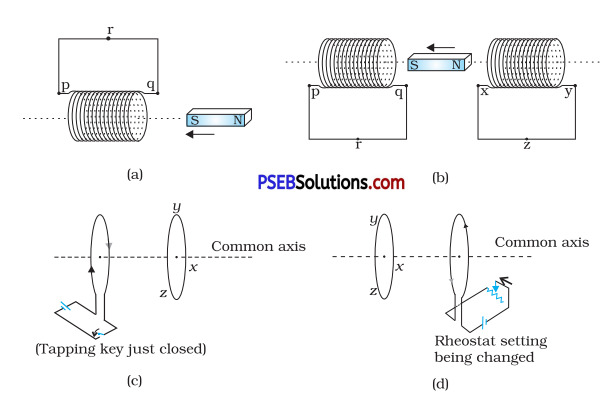
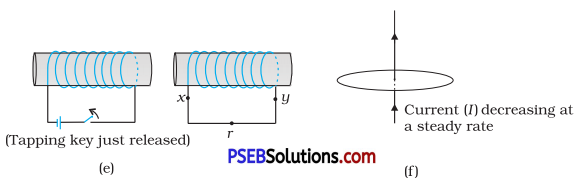
Predict the direction of induced current in the situations described by the following Figs. 6.18 (a) to (f).
PSEB 12th Class Physics Solutions Chapter 6 Electromagnetic Induction 1
PSEB 12th Class Physics Solutions Chapter 6 Electromagnetic Induction 2
Answer:
(a) As the magnet moves towards the solenoid, the magnetic flux linked with the solenoid increases. According to Lenz’s law, the induced e.m.f. produced in the solenoid in such that it opposes the very cause producing it i. e., it opposes the motion of the magnet. Hence the face q of it becomes the south pole and p becomes north pole. Therefore, the current will flow along pqin the coili. e., along qrpqin this figurei. e., clockwise when seen from the side of the magnet according to clock rule.

(b) As the north pole moves away from xy coil, so the magnetic flux linked with this coil decreases. Thus according to Lenz’s law, the induced e.m.f. produced in the coil will oppose the motion of the magnet. Hence the face, X becomes S-pole, so the current will flow in the clockwise direction i.e., along yzx in the cone.

For coil pq, the south pole of the magnet moves towards end q and thus this end will acquire south polarity so as to oppose the motion of the magnet, hence the current will flow along prq in the coil.

(c) The induced current will be in the anticlockwise direction i.e., along yzx.

(d) The induced current will be in the clockwise direction i.e., along zyx.

(e) The battery current in the left coil will be from right to left, so by mutual induction, the induced current in the right coil will be in the opposite direction i.e., from left to right or along xry.

(f) In this case, there is no change in magnetic flux linked with the wire, so no current will flow through the wire since there is no induced current as the field lines lie in the plane of the loop.

PSEB 12th Class Physics Solutions Chapter 6 Electromagnetic Induction

Question 2.
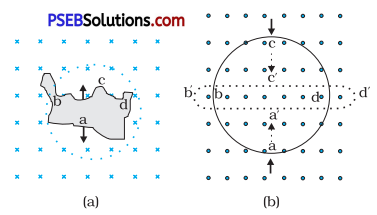
Use Lenz’s law to determine the direction of induced current in the situations described by Fig. 6.19.
(a) A wire of irregular shape turning into a circular shape;
(b) A circular loop being deformed into a narrow straight wire.
PSEB 12th Class Physics Solutions Chapter 6 Electromagnetic Induction 3
(a) When a wire of irregular shape turns into a circular loop, the magnetic flux linked with the loop increases due to increase in area. The circular loop has greater area than the loop of irregular shape. The induced e.m.f. will cause current to flow in such a direction so that the wire forming the loop is pulled inward from all sides i.e., current must flow in the direction adcba as shown in Fig. (a) i.e., in anticlock-wise direction so that the magnetic field produced by the current ((directed out of the paper) opposes the applied field.

In Fig. (b), a circular loop deforms into a narrow straight wire i.e., upper side of loop should move downwards and lower end should move upwards to oppose the motion of the circular loop, thus its area decreases as a result of which the magnetic flux linked with it decreases. To oppose the decrease in magnetic flux, the induced current should flow anti clockwise in the loop i. e., along a’d’ d b’ a’. Due to the flow of anti-clockwise current, the magnetic field produced will be out of the page and hence the applied field is supplemented.

Question 3.
A long solenoid with 15 turns per cm has a small loop of area 2.0 cm2 placed inside the solenoid normal to its axis. If the current carried hy the solenoid changes steadily from 2.0 A to
4.0 A in 0.1 s, what is the induced emf in the loop while the current is changing?
Answer:
Number of turns per unit length of the solenoid, n = 15 turns/cm = 1500 turns/m
The solenoid has a small loop of area, A = 2.0 cm2 = 2 × 10⁻⁴ m2
Current carried by the solenoid changes from 2 A to 4 A.
.-. Change in current in the solenoid, dI = 4 – 2 = 2A
Change in time, dt = 0.1 s
We know that the magnetic field produced inside the solenoid is given by
B = μ0nI
If Φ be the magnetic flux linked with the loop, then
Φ = BA = μ0nI A
Induced emf in the solenoid is given by Faraday’s law as
e = –\(\frac{d \phi}{d t}\)
e = – \(\frac{d}{d t}\) (Φ) = –\(\frac{d}{d t}\) μ0nI A
μ0n A \(\frac{d I}{d t}\)
∴ Magnitude of e is given by
= A μ0n × (\(\frac{d I}{d t}\))
= 2 × 10-4 × 4π × 10-7 × 500 × \(\frac{2}{0.1}\)
7.54 × 10 -6 V
Hence, the induced voltage in the loop is = 7.54 × 10 -6 V

PSEB 12th Class Physics Solutions Chapter 6 Electromagnetic Induction

Question 4.
A rectangular wire loop of sides 8 cm and 2 cm with a small cut is moving out of a region of uniform magnetic field of magnitude 0.3 T directed normal to the loop. What is the emf developed across the cut if the velocity of the loop is 1 cm s-1 in a direction normal to the (a) longer side, (b) shorter side of the loop? For how long does the induced voltage last in each case?
Answer:
Length of the rectangular wire, l = 8 cm = 0.08 m
Width of the rectangular wire, b = 2 cm = 0.02 m
Hence, area of the rectangular loop A = lb
= 0.08 × 0.02
= 16 × 10-4 m2
Magnetic field strength, B = 0.3 T
Velocity of the loop, v = 1 cm/s = 0.01 m / s

(a) Emf developed in the loop is given as
e = Blv
= 0.3 × 0.08 × 0.01 = 2.4 × 10⁻⁴ V
PSEB 12th Class Physics Solutions Chapter 6 Electromagnetic Induction 4
= \(\frac{b}{v}\) = \(\frac{0.02}{0.01}\) = 2 s
Hence, the induced voltage is 2.4 × 10⁻⁴ V which lasts for 2s.

(b) Emf developed,
e = Bbv = 0.3 × 0.02 × 0.01 = 0.6 × 10⁻⁴ V
PSEB 12th Class Physics Solutions Chapter 6 Electromagnetic Induction 5
\(\frac{l}{v}\) = \(\frac{0.08}{0.01}\) 8s
Hence, the induced voltage is 0.6 × 10⁻⁴ V which lasts for 8 s.

Question 5.
A 1.0 m long metallic rod is rotated with an angular frequency of 400 rad s-1 about an axis normal to the rod passing through its one end. The other end of the rod is in contact with a circular metallic ring. A constant and uniform magnetic field of 0.5 T parallel to the axis exists everywhere. Calculate the emf developed between the centre and the ring.
Answer:
Length of the rod, l = 1m
Angular frequency, ω = 400 rad/s
Magnetic field strength, B = 0.5 T
One end of the rod has zero linear velocity, while the other end has a linear velocity of l ω.
Average linear velocity of the rod, v = \(\frac{l \omega+0}{2}=\frac{l \omega}{2}\)
Emf developed between the centre and the ring,
e = Blv = Bl(\(\frac{l \omega}{2}\)) = \(\frac{B l^{2} \omega}{2}\)
= \(\frac{0.5 \times(1)^{2} \times 400}{2}\) = 100V
Hence, the emf developed between the centre and the ring is 100 V.

PSEB 12th Class Physics Solutions Chapter 6 Electromagnetic Induction

Question 6.
A circular coil of radius 8.0 cm and 20 turns is rotated about its vertical diameter with an angular speed of 50 rad s-1 in a uniform horizontal magnetic field of magnitude 3.0 × 10⁻² T. Obtain the maximum and average emf induced in the coil. If the coil forms a closed loop of resistance 10 Ω, calculate the maximum value of current in the coil. Calculate the average power loss due to Joule heating. Where does this power come from?
Answer:
Here, n = number of turns in the coil = 20
r = radius ofcoil = 8.0 cm = 8 × 10⁻² m
ω = angular speed of the coil = 50 rad s-1.
B = magnetic field = 3.0 × 10⁻² T
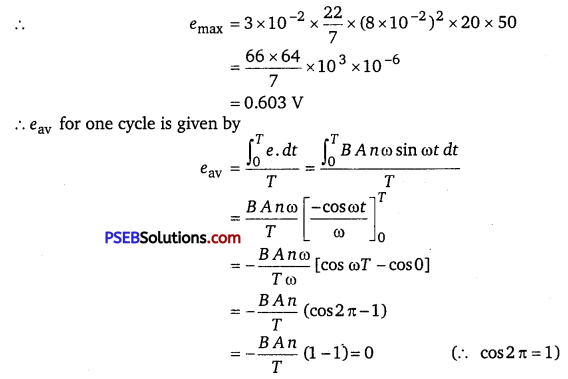
Let e0 be the maximum e.m.f. in the coil = ?
and eav be the average e.m.f. in the coil = ?
We know that the instantaneous e.m.f. produced in a coil is given by
e = BA ω sinωt.
for e to be maximum emax, sin ωt = 1.
∴ emax = B A n ω = B.πr2
where A = πr2 is the area of the coil
PSEB 12th Class Physics Solutions Chapter 6 Electromagnetic Induction 6
i.e., eav is zero as the average value of sincot for one complete cycle is always zero.
Now R = resistance of the closed loop formed by the coil = 10 Ω
Let Imax = maximum current in the coil = ?
∴ Using the relation,
Imax = \(\frac{e_{\max }}{R}\), we get
Imax = \(\frac{0.603}{10}\) = 0.0603 A
Let Pav be the average power loss due to Joule heating = ?
∴ Pav = \(\frac{e_{\max } \cdot I_{\max }}{2}\) = \(\frac{0.603 \times 0.0603}{2}\)
= 0.018 Watt
The induced current causes a torque opposing the rotation of the coil. An external agent must supply torque and do work to counter this torque in order to keep the coil rotating uniformly. Thus the source of the power dissipated as heat in the coil is the external agent i. e., rotor.

Question 7.
A horizontal straight wire 10 m long extending from east to west is falling with a speed of 5.0 m s-1, at right angles to the horizontal component of the earth’s magnetic field, 0.30 × 10⁻⁴ Wb m-2.
(a) What is the instantaneous value of the emf induced in the wire?
(b) What is the direction of the emf?
(c) Which end of the wire is at the higher electrical potential?
Answer:
Length of the wire, l = 10 m
Falling speed of the wire, v = 5.0 m/s
Magnetic field strength, B = 0.3 × 10⁻⁴ Wb m-2

(a) emf induced in the wire,
e = Blv = 0.3 × 10-4 × 5 × 10
= 1.5 × 10⁻³ V

(b) Using Fleming’s right hand rule, it can be inferred that the direction of the induced emf is from west to east.

(c) The eastern end of the wire is at a higher electrical potential.

PSEB 12th Class Physics Solutions Chapter 6 Electromagnetic Induction

Question 8.
Current in a circuit falls from 5.0 A to 0.0 A in 0.1 s. If an average emf of 200 V induced, give an estimate of the self-inductance of the circuit.
Initial current, I1 = 5.0 A
Final current, I2 = 0.0 A
Change in current, dl = I1 – I2 = 5 – 0 = 5 A
Time taken for the change, dt = 0.1 s
Average emf, e = 200 V
For self-inductance (I) of the circuit, we have the relation for average emf as
e = L\(\frac{d I}{d t}\)
L = \(\frac{e}{\left(\frac{d I}{d t}\right)}\)
= \(\frac{200}{\frac{5}{0.1}}=\frac{200 \times 0.1}{5}\) 4H
Hence, the self induction of the circuit is 4 H.

Question 9.
A pair of adjacent coils has a mutual inductance of 1.5 H. If the current in one coil changes from 0 to 20 A in 0.5 s, what is the change of flux linkage with the other coil?
Answer:
Mutual inductance of the pair of coils, μ = 1.5 H
Initial current, I1 = 0 A
Final current, I2 – 20 A
Change in current, dI = I2 – I1 = 20 – 0 = 20 A
Time taken for the change, dt = 0.5 s
Induced emf, e = \(\frac{d \phi}{d t}\) ………… (1)

Where d Φ is the change in the flux linkage with the coil.
Emf is related with mutual inductance as
e = μ\(\frac{d I}{d t}\) ……………. (2)
Equating equations (1) and (2), we get
\(\frac{d \phi}{d t}\) = μ\(\frac{d I}{d t}\)
or dΦ = μdI
∴ dΦ = 1.5 × (20) = 30 Wb
Hence, the change in the flux linkage is 30 Wb.

PSEB 12th Class Physics Solutions Chapter 6 Electromagnetic Induction

Question 10.
A jet plane is travelling towards west at a speed of 1800 km/h. What is the voltage difference developed between the ends of the wings having a span of 25 m, if the Earth’s magnetic field at the location has a magnitude of 5 × 10⁻⁴ T and the dip angle is 30°.
Answer:
Speed of the jet plane, v = 1800 km/h = 1800 × \(\frac{5}{18}\) = 500 m/s
Wing span of the jet plane, l = 25 m
Earth’s magnetic field strength, B = 5.0 × 10⁻⁴ T
Angle of dip, δ = 30°
Vertical component of Earth’s magnetic field,
BV = B sinδ
= 5 × 10⁻⁴ × sin30°
= 5 × 10⁻⁴ × \(\frac{1}{2}\) = 2.5 × 10⁻⁴ T
Voltage difference between the ends of the wing can be calculated as
e = (BV) × l × v
= 2.5 × 10-4 × 25 × 500 = 3.125 V
Hence, the voltage difference developed between the ends of the wings is 3.125 V.

Question 11.
Suppose the loop in Exercise 6.4 is stationary but the current feeding the electromagnet that produces the magnetic field is gradually reduced so that.the field decreases from its initial value of 0.3 T at the rate of 0.02 Ts-1. If the cut is joined and the loop has a resistance of 1.6 Ω, how much power is dissipated by the loop as heat? What is the source of this power?
Answer:
Sides of the rectangular wire loop are 8 cm and 2 cm.
Hence, area of the rectangular wire loop,
A = length × width = 8 × 2 = 16 cm
= 16 × 10-4 m2
Initial value of the magnetic field, B = 0.3 T
Rate of decrease of the magnetic field, \(\frac{d B}{d t}\) = 0.02 T/s
emf developed in the loop is given as
e = \(\frac{d \phi}{d t}\)
where, Φ = Change in flux through the loop area
= AB
∴ e = \(\frac{d(A B)}{d t}=\frac{A d B}{d t}\)
= 16 × 10-4 × 0.02 =0.32 × 10⁻⁴ V
= 3.2 × 10⁻⁵ V
Resistance of the loop, R = 1.6 Ω
The current induced in the loop is given as
i = \(\frac{e}{R}\)
= \(\frac{0.32 \times 10^{-4}}{1.6}\) = 2 × 10⁻⁵A
Power dissipated in the loop in the form of heat is given as
P = i2R
= (2 × 10⁻⁵)2 × 1.6
= 6.4 × 10⁻¹⁰ W
The source of this heat loss is an external agent, which is responsible for changing the magnetic field with time.

PSEB 12th Class Physics Solutions Chapter 6 Electromagnetic Induction

Question 12.
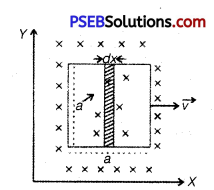
A square loop of side 12 cm with its sides parallel to X and F axes is moved with a velocity of 8 cm s-1 in the positive x-direction in an environment containing a magnetic field in the positive 2-direction. The field is neither uniform in space nor constant in time. It has a gradient of 10-3 T cm-1 along the negative jtr-direction (that is it increases by 10-3 T cm-1 as one moves in the negative x-direction), and it is decreasing in time at the rate of 10-3 T s1. Determine the direction and magnitude of the induced current in the loop if its resistance is 4.50 mΩ.
Answer:
Here, a = side of the square loop = 12 cm = 12 × 10-2 m
\(\vec{v}\) = velocity of loop parallel to x-axis = 8 cms-1
= 8 × 10⁻² ms-1.
Let B = variable magnetic field acting away from us ⊥ ar to the XY plane along z axis i. e., plane of paper represented by x.
\(\) = 10-3 Tcm-1
= 10-3 × 10² Tm-1
= 0.1 Tm-1
= field gradient along – ve x direction.
PSEB 12th Class Physics Solutions Chapter 6 Electromagnetic Induction 7
\(\frac{d B}{d t}\) = rate of variation with me
= 10-3 Ts-1
R = resistance of the loop = 4.5 mΩ = 4.5 × 10⁻³ Ω
Let I = induced current = ? and its direction = ?
∴ A = area of loop = a2 = (12 × 10-2)2 m2 = 144 × 10-4 m2.
The magnetic flux changes (i) due, to the variation of B with time and
(ii) due to motion of the loop in non-uniform \(\vec{B}\).
Thus if Φ be the total magnetic flux of the loop, then Φ is calculated as Area of shaded part = adx
Let dΦ = magnetic flux linked with shaded part = B(x,t)adx
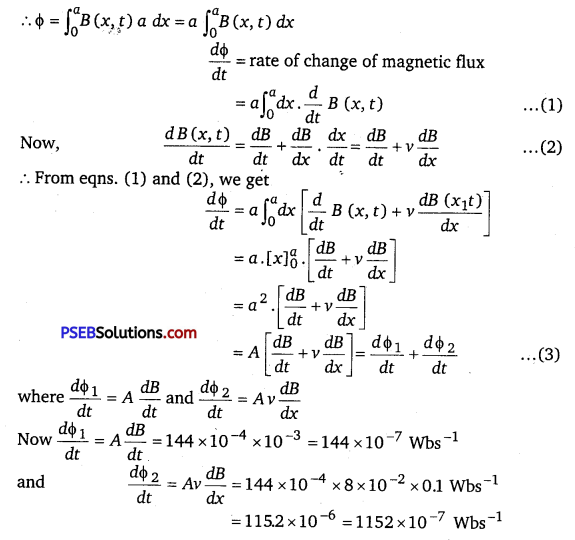
PSEB 12th Class Physics Solutions Chapter 6 Electromagnetic Induction 8
∴ From (3), \(\) = 144 × 10-7 + 1152 × 10-7
= 1296 × 10-7 Wbs-1
Clearly the two effect add up as these cause a decrease in flux along the + z direction.
∴ If e be the induced e.m.f. produced, then
e = –\(\frac{d \phi}{d t}\) = -1296 × 10-7 V
= -12.96 × 10⁻⁵ V
∴ e = 12.96 × 10⁻⁵ V
∴ I = \(\frac{e}{R}\) = \(\frac{12.96 \times 10^{-5}}{4.5 \times 10^{-3}}\) 2.88 × 10⁻² A.
The direction of induced current is such as to increase the flux through the loop along +z-direction. Thus if for the observer, the loop moves to the right, the current will be seen to be anti-clockwise.

PSEB 12th Class Physics Solutions Chapter 6 Electromagnetic Induction

Question 13.
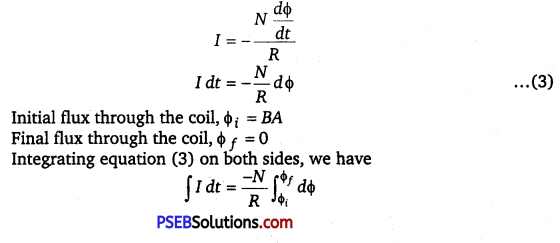
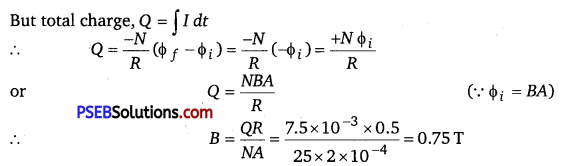
It is desired to measure the magnitude of field between the poles of a powerful loud speaker magnet. A small fiat search coil of area 2 cm2 with 25 closely wound turns, is positioned normal to the field direction, and then quickly snatched out of the field region. Equivalently, one can give it a quick 90° turn to bring its plane parallel to the field direction. The total charge flown in the coil (measured by a ballistic galvanometer connected to coil) is 7.5 mC. The combined resistance of the coil and the galvanometer is 0.50 Q. Estimate the field strength of magnet.
Answer:
Area of the small flat search coil, A = 2cm2 = 2 × 10⁻⁴m2
Number of turns on the coil, N = 25
Total charge flown in the coil, Q = 7.5 mC = 7.5 × 10 -3 C
Total resistance of the coil and galvanometer, R = 0.50 Ω
Induced current in the coil,
I = \(\frac{\text { Induced emf }(e)}{R}\) ………….. (1)
Induced emf is given us
e = -N\(\frac{d \phi}{d t}\) ……………… (2)
Combining equations (1) and (2), we get
PSEB 12th Class Physics Solutions Chapter 6 Electromagnetic Induction 9
PSEB 12th Class Physics Solutions Chapter 6 Electromagnetic Induction 10
Hence, the field strength of the magnet is 0.75 T.

PSEB 12th Class Physics Solutions Chapter 6 Electromagnetic Induction

Question 14.
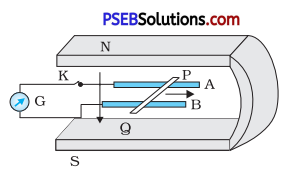
Figure 6.20 shows a metal rod PQ resting on the smooth rails AB and positioned between the poles of a permanent magnet. The rails, the rod, and the magnetic Held are in three mutual perpendicular directions. A galvanometer G connects the rails through a switch K. Length of the rod = 15 cm, B = 0.50 T, resistance of the closed loop containing the rod = 9.0 mfl. Assume the field to be uniform.
PSEB 12th Class Physics Solutions Chapter 6 Electromagnetic Induction 11
(a) Suppose K is open and the rod is moved with a speed of 12 cm s-1 in me airection snown. dive me polarity ana magnitude of the induced emf.

(b) Is there an excess charge built up at the ends of the rods when K is open? What if K is closed?

(c) With K open and the rod moving uniformly, there is no net force on the electrons in the rod PQ even though they do experience magnetic force due to the motion of the rod. Explain.

(d) What is the retarding force on the rod when K is closed?

(e) How much power is required (by an external agent) to keep the rod moving at the same speed (= 12 cm s-1) when K is closed? How much power is required when K is open?

(f) How much power is dissipated as heat in the closed circuit? What is the source of this power?

(g) What is the induced emf in the moving rod if the magnetic field is parallel to the rails instead of being perpendicular?
Answer:
Here, B = 0.50 T
l = length of the rod = 15 cm = 15 × 10-2 m
R = resistance of the closed loop containing the rod = 9.0 mΩ
= 9 × 10⁻³ Ω.

(a) v = speed of the rod = 12 cms-1 = 12 × 10-2 ms-1.
The magnitude of the induced e.m.f. is
E = Blv = 0.50 × 15 × 10-2 × 12 × 10-12 = 9 × 10⁻³ V
According to Fleming’s left hand rule, the direction of Lorentz force —^ ^ ^
\(\vec{F}\) = -e(\(\vec{V} \times \vec{B}\)) on electrons in PQ is from P to Q. So the end P of the rod will acquire positive charge and Q will acquire negative charge,

(b) Yes. When the switch K is open, the electrons collect at the end Q, so excess charge is built up at the end Q. But when the switch K is closed, the accumulated charge at the end Q is maintained by the continuous flow of current.

(c) This is because the presence of excess charge at the ends P and Q of the rod sets up an electric field \(\vec{E}\). The force due to the electric field (q\(\vec{E}\)) balances the Lorentz magnetic force q(\(\vec{V} \times \vec{B}\)). Hence the net force on the electrons is zero.

(d) When the key K is closed, current flows through the rod. The retarding force experienced by the rod is
F = BIl = B(\(\frac{E}{R}\)) l
where, I = \(\) is the induced current. R
F = \(\frac{0.50 \times 9 \times 10^{-3} \times 15 \times 10^{-2}}{9 \times 10^{-3}}\)
= 7.5 × 10⁻² N.

(e) The power required by the external agent against the above retarding force to keep the rod moving uniformly at speed 12 cms-1 (= 12 × 10-2 m/s) when K is closed is given by
p = FV = 7. 5 × 10-2 × 12 × 10-2
= 90 × 10-4 W
= 9 × 10⁻³ W

(f) Power dissipated as heat is given by
P = I2R = (\(\frac{E}{R}\))2 R = \(\frac{E^{2}}{R}\)
= \(\frac{\left(9 \times 10^{-3}\right)^{2}}{9 \times 10^{-3}}\)
= 9 × 10⁻³ W.
The source of this power is the power provided by the external agent calculated in (e).

Zero. This is because when the magnetic field is parallel to the rails, θ = 0°, so induced e.m.f. E = Blv sinθ = Blv sin 0 = 0. In this situation, the moving rod does not cut the field lines, so there is no change in the magnetic flux, hence E = 0.

PSEB 12th Class Physics Solutions Chapter 6 Electromagnetic Induction

Question 15.
An air-cored solenoid with length 30 cm, area of cross-section 25 cm2 and number of turns 500, carries a current of 2.5 A. The current is suddenly switched off in a brief time of 10-3 s. How much is the average back emf induced across the ends of the open switch in the circuit? Ignore the variation in magnetic Held near the ends of the solenoid.
Answer:
Length of the solenoid, l = 30 cm = 0.3 m
Area of cross-section, A = 25 cm2 = 25 x 10-4 m2
Number of turns on the solenoid, N = 500
Current in the solenoid, I = 2.5 A
Current flows for time, t = 10-3 s
Average back emf, e = \(\frac{d \phi}{d t}\) ……………. (1)
where,
dΦ = NAB ………….. (2)
and B = μ0 \(\frac{N I}{l}\) …………. (3)
Using equations (2) and (3) in equation (1), we get
e = \(\frac{\mu_{0} N^{2} I A}{l t}\)
\(=\frac{4 \pi \times 10^{-7} \times(500)^{2} \times 2.5 \times 25 \times 10^{-4}}{0.3 \times 10^{-3}}\)
= 6.5 V
Hence, the average back emf induced in the solenoid is 6.5 V.

Question 16.
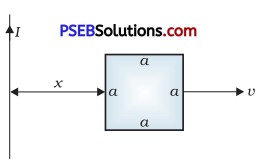
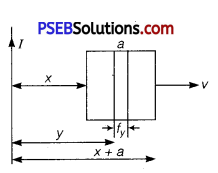
(a) Obtain an expression for the mutual inductance between a long straight wire and a square loop of side a as shown in Figure 6.21.
PSEB 12th Class Physics Solutions Chapter 6 Electromagnetic Induction 12
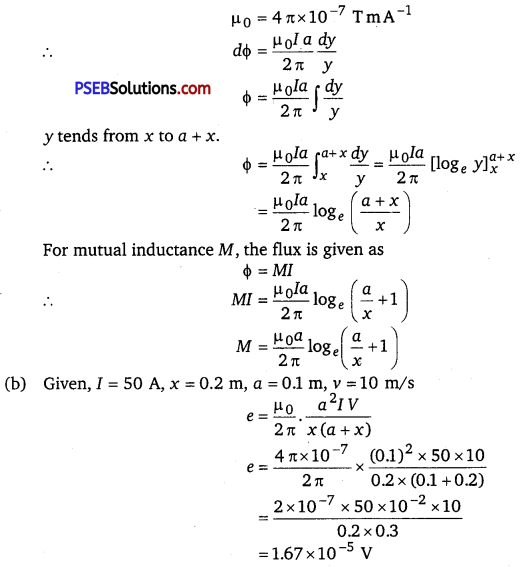
(b) Now assume that the straight wire carries a current of 50 A and the loop is moved to the right with a constant velocity, v = 10 m/s.
Calculate the induced emf in the loop at the instant when x = 0.2 m.
Take a = 0.1 m and assume that the loop has a large resistance.
Answer:
(a) Take a small element dy in the loop at a distance y from the long straight wire (as shown in the given figure).
Magnetic flux associated with element dy, dΦ = BdA
PSEB 12th Class Physics Solutions Chapter 6 Electromagnetic Induction 13
= where,
dA = Area of element dy = a dy
B = Magnetic field at distance y = \(\frac{\mu_{0} I}{2 \pi y}\)
I = Current in the wire
PSEB 12th Class Physics Solutions Chapter 6 Electromagnetic Induction 14

PSEB 12th Class Physics Solutions Chapter 6 Electromagnetic Induction

Question 17.
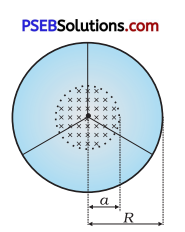
A line charge λ per unit length is lodged uniformly onto the rim of a wheel of mass M and radius R. The wheel has light non-conducting spokes and is free to rotate without friction about its axis as shown in Fig. 6.22. A uniform magnetic field extends over a circular region within the rim. It is given by,
B = -Bk (r ≤ a; a < R)
= 0 (otherwise)
What is the angular velocity of the wheel after the field is suddenly switched off?
PSEB 12th Class Physics Solutions Chapter 6 Electromagnetic Induction 15
Answer:
Let ω be the angular velocity of the wheel of mass M and radius R.
Let e = Induced e.m.f. produced.
The rotational K.E. of the rotating wheel = \(\frac{1}{2}\) Iω2 ………… (1)
where, I = Moment of inertia of wheel
= \(\frac{1}{2}\) MR2 …………… (2)
PSEB 12th Class Physics Solutions Chapter 6 Electromagnetic Induction 16
or Work done = eQ
Applying the work energy theorem, we get
Rotational K.E. = Work done
or RotationalK.E. = Q × e …………… (3)
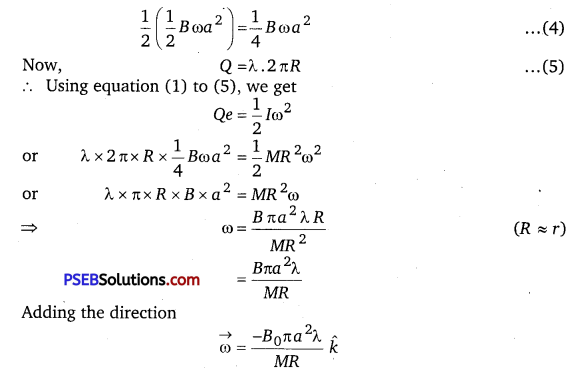
We know that the e.m.f. of a rod rotating in a uniform magnetic field is
given by \(\frac{1}{2}\) Bωa2 , since here the magnetic field is changing, we assume the average over the time span and thus average value of e.m.f. is given by
PSEB 12th Class Physics Solutions Chapter 6 Electromagnetic Induction 17

PSEB 12th Class Chemistry Important Questions Chapter 4 Chemical Kinetics

Punjab State Board PSEB 12th Class Chemistry Important Questions Chapter 4 Chemical Kinetics Important Questions and Answers.

PSEB 12th Class Chemistry Important Questions Chapter 4 Chemical Kinetics

Very Short Answer Type Questions

Question 1.
For which type of reactions, order and molecularity have the same value?
Answer:
If the reaction is an elementary reaction, order is same as molecularity.

Question 2.
Why is the probability of reaction with molecularity higher than three very rare?
Answer:
The probability of more than three molecules colliding simultaneously is very small. Hence, possibility of molecularity being three is very low.

Question 3.
State a condition under which a bimolecular reaction is kinetically first order.
Answer:
A bimolecular reaction may become kinetically of first order if one of the reactants is in excess.

PSEB 12th Class Chemistry Important Questions Chapter 4 Chemical Kinetics

Question 4.
Thermodynamic feasibility of the reaction alone cannot decide the rate of the reaction. Explain with the help of one example.
Answer:
Thermodynamically the conversion of diamond to graphite is highly feasible but this reaction is very slow because its activation energy is high.

Question 5.
Why is it that instantaneous rate of reaction does not change when a part of the reacting solution is taken out?
Answer:
Instantaneous rate is measured over a very small interval of time, hence, it does not change when a part of solution is taken out.

Question 6.
A reaction is 50% complete in 2 hours and 75% complete in 4 hours. What is the order of the reaction?
Solution:
As t75% = 2t50%
Therefore, it is a first order reaction.

PSEB 12th Class Chemistry Important Questions Chapter 4 Chemical Kinetics

Question 7.
Define threshold energy of a reaction.
Answer:
Threshold energy is the minimum energy which must be possessed by reacting molecules in order to undergo effective collision which leads to formation of product molecules.

Question 8.
Why does the rate of a reaction increase with rise in temperature?
Answer:
At higher temperatures, larger fraction of colliding particles can cross the energy barrier (i.e., the activation energy), which leads to faster rate.

Question 9.
What is the difference between rate law and law of mass action?
Answer:
Rate law is an experimental law. On the other hand, law of mass action is a theoretical law based on the balanced chemical reaction.

PSEB 12th Class Chemistry Important Questions Chapter 4 Chemical Kinetics

Question 10.
What do you understand by ‘Rate of reaction’?
Answer:
The change in the concentration of any one of the reactants or products per unit time is termed as the rate of reaction.

Question 11.
In the Arrhenius equation, what does the factor e a corresponds to?
Answer:
e-Ea/RT corresponds to the fraction of molecules that have kinetic energy greater than Ea,

Short Answer Type Questions

Question 1
What do you understand by the ‘order of a reaction’? Identify the reaction order from each of the following units of reaction rate constant:
(i) L-1mols-1
(ii) Lmol-1s-1.
Solution:
The sum of powers of the concentration of the reactants in the rate law expression is called order of reaction.
For a general reaction: aA + bB → Products
If rate = k[A]m [B]n; order of reaction = m + n

(i) General unit of rate constant, k = (mol L-1 )1-ns-1
L-1mol s-1 = (mol L-1 )1-ns-1
-1 = -1 + n ⇒ n = 0 ∴ Reaction order = 0

(ii) L mol-1 s-1 = (mol L-1)1-n s-1
1 = -1 + n ⇒ n = 2 ∴ Reaction order = 2

PSEB 12th Class Chemistry Important Questions Chapter 4 Chemical Kinetics

Question 2.
The rate constant for the first order decomposition of H2O2 is given by the following equation :
log k = 14.2 – \(\frac{1.0 \times 10^{4}}{T}\)K
Calculate Ea for this reaction and rate constant k if its half-life period be 200 minutes.
(Given: R = 8.314 JK-1 mol-1)
Solution:
Comparing the equation, log k = 14.2 – \(\frac{1.0 \times 10^{4}}{T}\) K with the equation,
log k = log A = \(\frac{E_{a}}{2.303 R T}\), we get
\(\frac{E_{a}}{2.303 R}\) = 1.0 × 10⁴ K or Ea = 1.0 × 104 K × 2.303 × R
Ea = 1.0 × 104 K × 2.303 × 8.314 JK-1
= 19.1471 × 10⁴ Jmol-1
= 191.47 kJ mol-1
For a first order reaction, tt/2 = \(\frac{0.693}{k}\) or k = \(\frac{0.693}{t_{1 / 2}}\)
k = \(\frac{0.693}{200 \mathrm{~min}}\) = 3.465 × 10 -3min-1

Question 3.
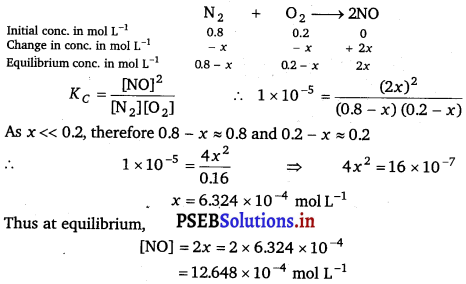
The reaction, N2(g) + O2(g) ⇌ 2NO(g) contributes to air pollution whenever a fuel is burnt in air at a high temperature. At 1500 K, equilibrium constant K for it is 1.0 × 10⁻⁵. Suppose in a case [N2] = 0.80 mol L-1 and [O2] = 0.20 mol L-1 before any reaction occurs. Calculate the equilibrium concentrations of the reactants and the product after the mixture has been heated to 1500 K.
Solution:
PSEB 12th Class Chemistry Important Questions Chapter 4 Chemical Kinetics 1
[N2] = 0.8 – 6.324 × 10⁴ mol L-1
= 0.799 molL-1
[O2] = 0.2 – 6.324 × 10⁻⁴ mol L-1
= 0.199 mol L-1

PSEB 12th Class Chemistry Important Questions Chapter 4 Chemical Kinetics

Question 4.
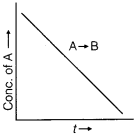
For a general reaction, A → B, plot of concentration of A vs time is given in figure. Answer the following questions on the basis of this graph.
PSEB 12th Class Chemistry Important Questions Chapter 4 Chemical Kinetics 2
(i) What is the order of the reaction?
(ii) What is the slope of the curve?
(iii) What are the units of rate constant?
Answer:
(i) Zero order
(ii) Slope = – k
(iii) Units of rate constant = mol L-1 s-1

Question 5.
For a reaction, A + B → products, the rate law is rate = k [A][B]a3/2. Can the reaction be an elementary reaction? Explain.
Answer:
During an elementary reaction, the number of atoms or ions colliding to react is referred to as molecularity. Had this been an elementary reaction the order of reaction with respect to B would have been 1, but in the given rate law it is \(\frac{3}{2}\). This indicated that the reaction is not an elementary reaction.

PSEB 12th Class Chemistry Important Questions Chapter 4 Chemical Kinetics

Question 6.
The rate constant for a first order reaction is 60 s-1. How much time will it take to reduce 1 g of the reactant to 0.0625 g?
Answer:
We know that, t = \(\frac{2.303}{k}\) log \(\frac{[R]_{0}}{[R]}\)
t = \(\frac{2.303}{60}\) log \(\frac{1}{0.0625}\)
t = 0.0462 s

Long Answer Type Questions

Question 1.
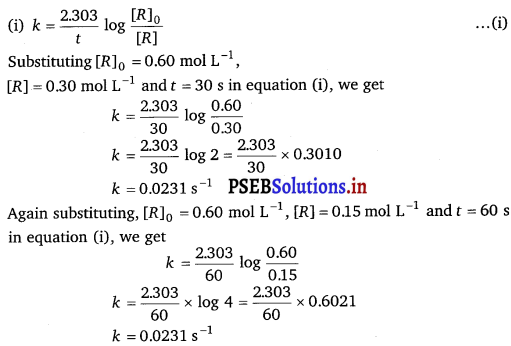
For the hydrolysis of methyl acetate in aqueous solution, the following results were obtained:

t/s 0 30 60
[CH3COOCH3]/mol L-1 0.60 0.30 0.15

(i) Show that it follows pseudo first order reaction, as the concentration of water remains constant.
(ii) Calculate the average rate of reaction between the time interval 30 to 60 seconds.
(Given log 2 = 0.3010, log 4 = 0.6021)
Solution:
PSEB 12th Class Chemistry Important Questions Chapter 4 Chemical Kinetics 3
As the value of k is same in both the cases, therefore, hydrolysis of methylacetate in aqueous solution follows pseudo first order reaction.

(ii) Average rate = \(-\frac{\Delta\left[\mathrm{CH}_{3} \mathrm{COOCH}_{3}\right]}{\Delta t}\)
= \(\frac{-[0.15-0.30]}{60-30}\) = \(\frac{0.15}{30}\)
Average rate = 0.005 mol L-1s-1

PSEB 12th Class Chemistry Important Questions Chapter 4 Chemical Kinetics

Question 2.
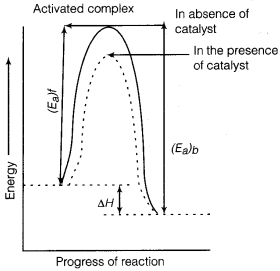
Describe how does the enthalpy of reaction remain unchanged when a catalyst is used in the reaction?
Answer:
A catalyst is a substance which increases the speed of a reaction without itself undergoing any chemical change.
According to “intermediate complex formation theory” reactants first combine with the catalyst to form an intermediate complex which is short-lived and decomposes to form the products and regenerating the catalyst.

The intermediate formed has much lower potential energy than the intermediate complex formed between the reactants in the absence of the catalyst.

Thus, the presence of catalyst lowers the potential energy barrier and the reaction follows a new alternate pathway which require less activation energy.

We know that, lower the activation energy, faster is the reaction because more reactant molecules can cross the energy barrier and change into products.

Enthalpy, △H is a ‘state function. Enthalpy of reaction, i.e., difference in energy between reactants and product is constant, which is clear from potential energy diagram.
Potential energy diagram of catalysed reaction is given as:
PSEB 12th Class Chemistry Important Questions Chapter 4 Chemical Kinetics 4

PSEB 12th Class Chemistry Important Questions Chapter 4 Chemical Kinetics

Question 3.
All energetically effective collisions do not result in a chemical change. Explain with the help of an example.
Answer:
Only effective collision lead to the formation of products. It means that collisions in which molecules collide with sufficient kinetic energy (called threshold energy = activation energy + energy possessed by reacting species).

And proper orientation lead to a chemical change because it facilitates the breaking of old bonds between (reactant) molecules and formation of the new ones i.e., in products.
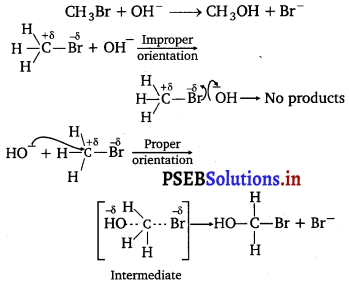
e.g., formation of methanol from bromomethane depends upon the orientation of the reactant molecules.
PSEB 12th Class Chemistry Important Questions Chapter 4 Chemical Kinetics 5
The proper orientation of reactant molecules leads to bond formation whereas improper orientation makes them simply back and no products are formed.

To account for effective collisions, another factor P (probability of steric factor) is introduced K = PZABe-Ea/RT.

PSEB 12th Class Physics Solutions Chapter 7 Alternating Current

Punjab State Board PSEB 12th Class Physics Book Solutions Chapter 7 Alternating Current Textbook Exercise Questions and Answers.

PSEB Solutions for Class 12 Physics Chapter 7 Alternating Current

PSEB 12th Class Physics Guide Alternating Current Textbook Questions and Answers

Question 1.
A 100 Ω resistor is connected to a 220 V, 50 Hz ac supply.
(a) What is the rms value of current in the circuit?
(b) What is the net power consumed over a full cycle?
Answer:
The given voltage of 220 V is the rms or effective voltage.
Given Vrms = 220 V, v = 50 Hz, R = 100 Ω
(a) RMS value of current,
Irms = \(\frac{V_{r m s}}{R}\) = \(\frac{220}{100}\) = 2.2 A
Net power consumed, P = I2rmsR
= (2.20)2 × 100 = 484 W

Question 2.
(a) The peak voltage of an ac supply is 300 V. What is the rms voltage?
(b) The rms value of current in an ac circuit is 10 A. What is the peak current?
Answer:
(a) Given, V0 = 300 V
Vrms = \(\frac{V_{0}}{\sqrt{2}}=\frac{300}{\sqrt{2}}\) = 150√2 ≈ 212 V

(b) Given, Irms = 10 A
I0 = Irms √2 = 10 × 1.41 = 14.1 A

PSEB 12th Class Physics Solutions Chapter 7 Alternating Current

Question 3.
A 44 mH inductor is connected to 220 V, 50 Hz ac supply. Determine the rms value of the current in the circuit.
Answer:
Inductance of inductor, L = 44 mH = 44 × 10-3 H
Supply voltage, V = 220 V
Frequency, v = 50 Hz
Angular frequency, ω = 2 πv
Inductive reactance, XL = ωL = 2πvL × 2π × 50 × 44 × 10-3Ω
rms value of current is given as
I = \(\frac{V}{X_{L}}\) = \(\frac{220}{2 \pi \times 50 \times 44 \times 10^{-3}}\) = 15.92 A
Hence, the rms value of current in the circuit is 15.92 A.

Question 4.
A 60 μF capacitor is connected to a 110 V, 60 Hz ac supply. Determine the rms value of the current in the circuit.
Answer:
Capacitance of capacitor, C = 60μF = 60 × 10-6F
Supply voltage, V = 110 V
Frequency, v = 60 Hz
Angular frequency, ω = 2 πv
Capacitive reactance,
XC = \(\frac{1}{\omega C}\) = \(\frac{1}{2 \pi v C}\) = \(\frac{1}{2 \pi \times 60 \times 60 \times 10^{-6}}\)Ω
rms value of current is given as
I = \(\frac{V}{X_{C}}\) = \(\frac{110}{\frac{1}{2 \pi \times 60 \times 60 \times 10^{-6}}}\)
= 110 × 2 × 3.14 × 3600 × 10-6
= 2.49 A
Hence, the rms value of current in the circuit is 2.49 A.

PSEB 12th Class Physics Solutions Chapter 7 Alternating Current

Question 5.
In Exercises 7.3 and 7.4, what is the net power absorbed by each circuit over a complete cycle. Explain your answer.
Answer:
In the inductive circuit,
rms value of current, I = 15.92 A
rms value of voltage, V = 220 V
Hence, the net power absorbed by the circuit, can be obtained by the relation,
P = VIcosΦ
where,
Φ = Phase difference between V and I.
For a pure inductive circuit, the phase difference between alternating voltage and current is 90°i. e., Φ = 90°
Hence, P = 0 i. e., the net power is zero.

In the capacitive circuit,
rms value of current, I = 2.49 A
rms value of voltage, V = 110 V
Hence, the net power absorbed by the circuit, can be obtained as
P = VIcosΦ
For a pure capacitive circuit, the phase difference between alternating voltage and current is 90°i. e., Φ = 90 °
Hence, P = 0 i. e., the net power is zero.

Question 6.
Obtain the resonant frequency ωr of a series LCR circuit with L = 2.0 H, C = 32 μF and R = 10 Ω. What is the Q-value of this circuit?
Answer:
Resonant frequency,
ωr = \(\frac{1}{\sqrt{L C}}\) = \(\frac{1}{\sqrt{2.0 \times 32 \times 10^{-6}}}\)
= \(\frac{1}{8}\) × 103 = 125 rads-1
Q = \(\frac{\omega_{r} L}{R}\) = \(\frac{125 \times 2.0}{10}\) = 25

Question 7.
A charged 30 μF capacitor is connected to a 27 mH inductor.
What is the angular frequency of free oscillations of the circuit?
Answer:
Capacitance of the capacitor, C = 30 μF = 30 × 10-6 F,
Inductance of the inductor, L = 27 mH = 27 × 10-3H
Angular frequency is given as
ωr = \(\frac{1}{\sqrt{L C}}\)
= \(\frac{1}{\sqrt{27 \times 10^{-3} \times 30 \times 10^{-6}}}\)
= \(\frac{1}{9 \times 10^{-4}}=\frac{10^{4}}{9}\)
= 1.11 × 10³ rad/s
Hence, the angular frequency of free oscillations of the circuit is 1.11 × 10³ rad/s.

PSEB 12th Class Physics Solutions Chapter 7 Alternating Current

Question 8.
Suppose the initial charge on the capacitor in Exercise 7.7 is 6 mC. What is the total energy stored in the circuit initially? What is the total energy at later time?
Answer:
Capacitance of the capacitor, C = 30 μF = 30 × 10-6F
Inductance of the inductor, L = 27 mH = 27 × 10-3 H
Charge on the capacitor, Q = 6 mC = 6 × 10⁻³ C
Total energy stored in the capacitor can be calculated as
E = \(\frac{1}{2} \frac{Q^{2}}{C}\) = \(\frac{1}{2} \frac{\left(6 \times 10^{-3}\right)^{2}}{\left(30 \times 10^{-6}\right)}\)
= \(\frac{36 \times 10^{-6}}{2\left(30 \times 10^{-6}\right)}\)
= \(\frac{6}{10}\) = 0.6 J
Total energy at a later time will remain the same because energy is shared between the capacitor and the inductor.

Question 9.
A series LCR circuit with R = 20 Ω, L = 1.5 H and C = 35 μF is connected to a variable frequency 200 V ac supply. When the frequency of the supply equals the natural frequency of the circuit, what is the average power transferred to the circuit in one complete cycle?
Answer:
When frequency of supply is equal to natural frequency of circuit, then resonance is obtained. At resonance XC = XL
⇒ Impedance, Z = \(\sqrt{R^{2}+\left(X_{C}-X_{L}\right)^{2}}\)
= R = 20Ω
Current in circuit,
Irms = \(\frac{V_{r m s}}{R}\) = \(\frac{200}{20}\) = 10A
Power factor
cosΦ = \(\frac{R}{Z}=\frac{R}{R}\) = 1
∴ Average power pav = Vrms Irms cosΦ = Vrms Irms
= 20 × 10 = 2000 W = 2 kW

PSEB 12th Class Physics Solutions Chapter 7 Alternating Current

Question 10.
A radio can tune over the frequency range of a portion of MW broadcast band : (800 kHz to 1200 kHz). If its LC circuit has an effective inductance of 200 μH, what must be the range of its variable capacitor?
[Hint: For timing, the natural frequency i. e., the frequency of free oscillations of the LC circuit should be equal to the frequency of the radiowave.]
Answer:
The range of frequency (v) of the radio is 800 kHz to 1200 kHz
Lower tuning frequency, v1 = 800 kHz = 800 × 103 Hz
Upper tuning frequency, v2 = 1200 kHz = 1200 × 106 Hz
Effective inductance of circuit, L = 200 μH = 200 × 10-6 H
Capacitance of variable capacitor for v1 is given as
C1 = \(\frac{1}{\omega_{1}^{2} L}\)
where, ω1 = Angular frequency for capacitor C1
= 2 πv1
= 2 π × 800 × 103 rad/s
∴ C1 = \(\frac{1}{\left(2 \pi \times 800 \times 10^{3}\right)^{2} \times 200 \times 10^{-6}}\)
= 197.8 × 10⁻¹²F
= 197.8 pF
Capacitance of variable capacitor for v2 is given as
C2 = \(\frac{1}{\omega_{2}^{2} L}\)
where,
ω2 = Angular frequency for capacitor C2
= 2πv2
= 2 π × 1200 × 103 rad/s
∴ C 2 = \(\frac{1}{\left(2 \pi \times 1200 \times 10^{3}\right)^{2} \times 200 \times 10^{-6}}\)
= 87.95 × 10⁻¹² F = 87.95 pF
Hence, the range of the variable capacitor is from 87.95 pF to 197.8 pF.

Question 11.
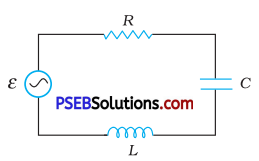
Figure 7.21 shows a series LCR circuit connected to a variable frequency 230 V source. Z, = 5.0H, C = 80 μF, R = 40Ω.
PSEB 12th Class Physics Solutions Chapter 7 Alternating Current 1
(a) Determine the source frequency which drives the circuit in resonance.
(b) Obtain the impedance of the circuit and the amplitude of current at the resonating frequency.
(c) Determine the rms potential drops across the three elements of the circuit. Show that the potential drop across the LC combination is zero at the resonating frequency.
Answer:
Given, the rms value of voltage Vrms = 230 V
Inductance L = 5H
Capacitance C = 80 μF = 80 × 10-6 F
Resistance R = 40 Ω

(a) For resonance frequency of circuit
ωr = \(\frac{1}{\sqrt{L C}}\) = \(\frac{1}{\sqrt{5 \times 80 \times 10^{-6}}}\) = 50 rad/s
Source frequency at resonance, then
v0 = \(\frac{\omega_{0}}{2 \pi}\) = \(\frac{50}{2 \times 3.14}\) = 7.76 Hz

(b) At the resonant frequency, XL = XC
So, impedance of the circuit Z = R
∴ Impedance Z = 40 Ω
The rms value of current in the circuit
Irms = \(\frac{V_{r m s}}{Z}\) = \(\frac{230}{40}\) = 5.75 A
Amplitude of current, I0 = Irms √2
= 5.75 × √2 = 8.13 A

(c) The rms potential drop across I,
VL = Irms × XL = Irms × ωrL
= 5.75 × 50 × 5 = 1437.5V
The rms potential drop across R
VR = Irms R = 5.75 × 40 = 230 V
The rms potential drop across C,
VC = Irms × XC = Irms × \(\frac{1}{\omega_{r} C}\)
= 5.75 × \(\frac{1}{50 \times 80 \times 10^{-6}}\)
= 1437.5V
Potential drop across LC combinations
= Irms(XL – XC)
= Irms (XL – XL) = 0
(∵ XL = XC in resonance)

PSEB 12th Class Physics Solutions Chapter 7 Alternating Current

Question 12.
An LC circuit contains a 20 mH inductor and a 50 μF capacitor with an initial charge of 10 mC. The resistance of the circuit is negligible. Let the instant the circuit is closed be t = 0.
(a) What is the total energy stored initially? Is it conserved during LC oscillations?
(b) What is the natural frequency of the circuit?
(c) At what time is the energy stored (i) completely electrical (Lestored in the capacitor)? (ii) completely magnetic (i.e., stored in the inductor)?
(d) At what times is the total energy shared equally between the inductor and the capacitor?
(e) If a resistor is inserted in the circuit, how much energy is eventually dissipated as heat?
Answer:
Inductance of the inductor, L = 20 mH = 20 × 10-3H
Capacitance of the capacitor, C = 50 μF = 50 × 10-6 F
Initial charge on the capacitor, Q = 10 mC = 10 × 10-3C

(a) Total energy stored initially in the circuit is given as
E = \(\frac{1}{2} \frac{Q^{2}}{C}\)
= \(\frac{\left(10 \times 10^{-3}\right)^{2}}{2 \times 50 \times 10^{-6}}=\frac{10^{-4}}{10^{-4}}\) = 1J
Hence, the total energy stored in the LC circuit will be conserved because there is no resistor connected in the circuit.

(b) Natural frequency of the circuit is given by the relation,
v = \(\frac{1}{2 \pi \sqrt{L C}}\)
= \(\frac{1}{2 \pi \sqrt{20 \times 10^{-3} \times 50 \times 10^{-6}}}\)
= \(\frac{10^{3}}{2 \pi}\) = 159.24 Hz
Natural angular frequency,
ωc = \(\frac{1}{\sqrt{L C}}\) = \(\frac{1}{\sqrt{20 \times 10^{-3} \times 50 \times 10^{-6}}}\)
= \(\frac{1}{\sqrt{10^{-6}}}\) = 103 rad/s
Hence, the natural frequency of the circuit is 10 rad/s.

(c) (i) For time period (T = \(\frac{1}{v}\) = \(\frac{1}{159.24}\) = 6.28 ms), total charge on the
capacitor at time t,
Q’ = Q cos\(\frac{2 \pi}{T}\)t
For energy stored is electrical, we can write Q’ = Q
Hence, it can be inferred that the energy stored in the capacitor is completely electrical at time, t = 0, \(\frac{T}{2}\), T, \(\frac{3 T}{2}\),…

(ii) Magnetic energy is the maximum when electrical energy, Q’ is equal to 0.
Hence, it can be inferred that the energy stored in the capacitor is
completely magnetic at time, t = \(\frac{T}{4}\), \(\frac{3 T}{4}\), \(\frac{5 T}{4}\),….

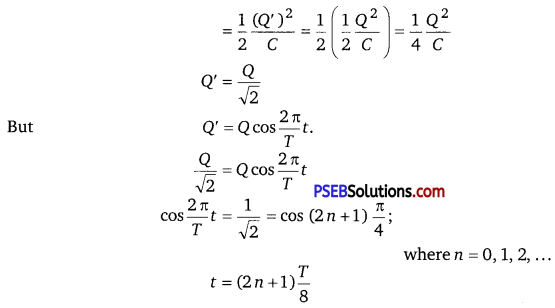
(d) Q’ = Charge on the capacitor when total energy is equally shared between the capacitor and the inductor at time t.
When total energy is equally shared between the inductor and capacitor,
the energy stored in the capacitor = \(\frac{1}{2}\) (maximum energy)
PSEB 12th Class Physics Solutions Chapter 7 Alternating Current 2
Hence, total energy is equally shared between the inductor and the capacitor at time,
t = \(\frac{T}{8}\), \(\frac{3 T}{8}\),\(\frac{5 T}{8}\)

(e) If a resistor is inserted in the circuit, then total initial energy is dissipated as heat energy in the circuit. The resistance damps out the LC oscillation.

PSEB 12th Class Physics Solutions Chapter 7 Alternating Current

Question 13.
A coil of inductance 0.50 H and resistance 100 Ω is connected to a 240 V, 50 Hz ac supply.
(a) What is the maximum current in the coil?
(b) What is the time lag between the voltage maximum and the current maximum?
Answer:
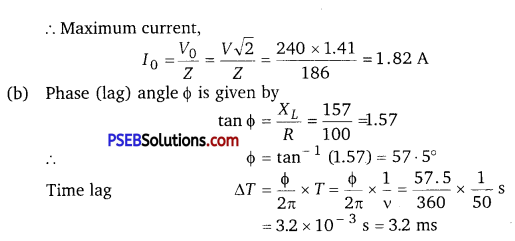
Given, L = 0.50 H ,R = 100 Ω, V = 240 V, v = 50 Hz
(a) Maximum (or peak) voltage V0 = V – √2
Maximum current, I0 = \(\frac{V_{0}}{Z}\)
Inductive reactance, XL = ωL = 2πvL
= 2 × 3.14 × 50 × 0.50
= 157 Ω.
Z = \(\sqrt{R^{2}+X_{L}^{2}}\)
= \(\sqrt{(100)^{2}+(157)^{2}}\) = 186 Ω
PSEB 12th Class Physics Solutions Chapter 7 Alternating Current 3

Question 14.
Obtain the answers (a) to (b) in Exercise 7.13 if the circuit is connected to a high frequency supply (240 V, 10 kHz). Hence, explain the statement that at very high frequency, an inductor in a circuit nearly amounts to an open circuit. How does an inductor behave in a dc circuit after the steady state?
Answer:
Inductance of the inductor, L = 0.5 Hz
Resistance of the resistor, R = 100 Ω
Potential of the supply voltage, V = 240 V
Frequency of the supply, v = 10 kHz = 104 Hz
Angular frequency, ω = 2πv = 2 π × 104 rad/s

(a) Peak voltage, V0 = √2 × V = 240√2 V
Maximum current, I0 = \(\frac{V_{0}}{\sqrt{R^{2}+\omega^{2} L^{2}}}\)
= \(\frac{240 \sqrt{2}}{\sqrt{(100)^{2}+\left(2 \pi \times 10^{4}\right)^{2} \times(0.50)^{2}}}\)
= 1.1 × 10⁻² A

(b) For phase difference, Φ, we have the relation
tanΦ = \(\frac{\omega L}{R}\) = \(\frac{2 \pi \times 10^{4} \times 0.5}{100}\) = 100π
Φ = 89.82° = \(\frac{89.82 \pi}{180}\) rad
ωt = \(\frac{89.82 \pi}{180}\)
t = \(\frac{89.82 \pi}{180 \times 2 \pi \times 10^{4}}\) = 25 μs

It can be observed that I0 is very small in this case. Hence, at high frequencies, the inductor amounts to an open circuit.
In a dc circuit, after a steady state is achieved, ω = 0. Hence, inductor L behaves like a pure conducting object.

PSEB 12th Class Physics Solutions Chapter 7 Alternating Current

Question 15.
A 100 μF capacitor in series with a 40 Ω resistance is connected to a 110 V, 60 Hz supply.
(a) What is the maximum current in the circuit?
(b) What is the time lag between the current maximum and the voltage maximum?
Answer:
Capacitance of the capacitor, C = 100 μF = 100 × 10-6 F = 10-4 F
Resistance of the resistor, R = 40 Ω
Supply voltage, V = 110 V
Frequency of oscillations, v = 60 Hz
Angular frequency, co = 2πv = 2π × 60 rad/s = 120 π rad/s
For a RC circuit, we have the relation for impedance as
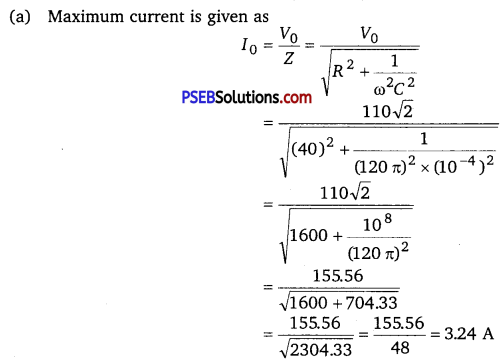
Z = \(\sqrt{R^{2}+\frac{1}{\omega^{2} C^{2}}}\)
peak voltage V0 = V√2 = 110√2
PSEB 12th Class Physics Solutions Chapter 7 Alternating Current 4

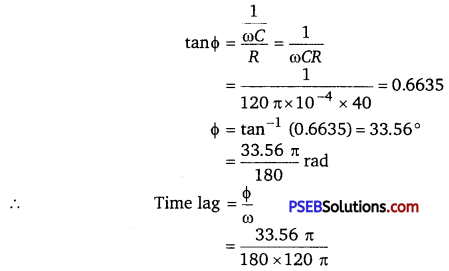
(b) In an RC circuit, the voltage lags behind the current by a phase angle of Φ. This angle is given by the relation
PSEB 12th Class Physics Solutions Chapter 7 Alternating Current 5
= 1.55 × 10⁻³ s
= 1.55 ms
Hence, the time lag between maximum current and maximum voltage is 1.55 ms.

Question 16.
Obtain the answers to (a) and (b) in Exercise 7.15 if the circuit is connected to a 110 V, 12 kHz supply? Hence, explain the statement that a capacitor is a conductor at very high frequencies. Compare this behaviour with that of a capacitor in a dc circuit after the steady state.
Answer:
Capacitance of the capacitor, C = 100 μF = 100 × 10-6 F
Resistance of the resistor, R = 40 Ω
Supply voltage, V = 110 V
Frequency of the supply, v = 12 kHz = 12 × 103 Hz
Angular frequency, ω = 2πv = 2 × π × 12 × 103
= 24 π × 103 rad/s
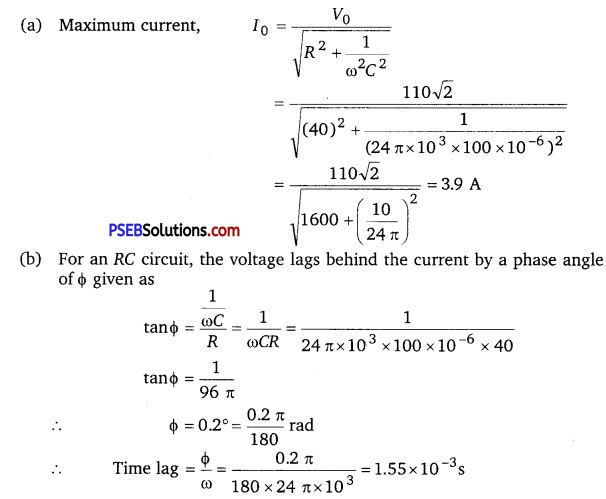
Peak voltage, V0 = V√2 = 110 √2V
PSEB 12th Class Physics Solutions Chapter 7 Alternating Current 6
= 0.04 μs
Hence, Φ tends to become zero at high frequencies. At a high frequency, capacitor C acts as a conductor.
In a dc circuit, after the steady state is achieved, ω = 0. Hence, capacitor C acts an open circuit.

PSEB 12th Class Physics Solutions Chapter 7 Alternating Current

Question 17.
Keeping the source frequency equal to the resonating frequency of the series LCR circuit, if the three elements, L, C and R are arranged in parallel, show that the total current in the parallel LCR circuit is minimum at this frequency. Obtain the current rms value in each branch of the circuit for the elements and source specified in Exercise 7.11 for this frequency.
Answer:
Here, L = 5.0 H
C = 80 μF = 80 × 10-6 F
R = 40Ω
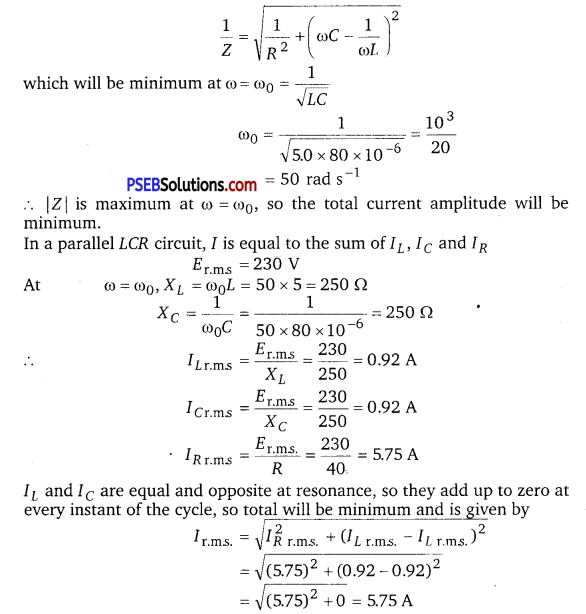
The effective impedance of the parallel LCR is given by
PSEB 12th Class Physics Solutions Chapter 7 Alternating Current 7

Question 18.
A circuit containing a 80 mH inductor and a 60 µF capacitor in series is connected to a 230 V, 50 Hz supply. The resistance of the circuit is negligible.
(a) Obtain the current amplitude and rms values.
(b) Obtain the rms values of potential drops across each element.
(c) What is the average power transferred to the inductor?
(d) What is the average power transferred to the capacitor?
(e) What is the total average power absorbed by the circuit?
[‘Average’ implies ‘averaged over one cycle’.]
Answer:
Given,
V = 230 V, v = 50 Hz, L = 80 mH = 80 × 10-3 H,
C = 60µF = 60 × 10-6 F

(a) Inductive reactance XL = ωL = 2πvL
= 2 × 3.14 × 50 × 80 × 10-3
= 25.1 Ω
PSEB 12th Class Physics Solutions Chapter 7 Alternating Current 8
(b) RMS value of potential drops across L and C are
VL = XL Irms = 25.1 × 8.23 = 207 V
VC = XC Irms = 53.1 × 8.23 = 437 V
Net voltage = VC – VL = 230 V

(c) The voltage across L leads the current by angle \(\frac{\pi}{2}\) , therefore, average
power
Pav Vrms Irms cos \(\frac{\pi}{2}\) = 0 (zero)

(d) The voltage across C lags behind the current by angle \(\frac{\pi}{2}\),
∴ pav = Vrms Irms cos \(\frac{\pi}{2}\) = 0

(e) As circuit contains pure I and pure C, average power consumed by LC circuit is zero.

PSEB 12th Class Physics Solutions Chapter 7 Alternating Current

Question 19.
Suppose the circuit in Exercise 7.18 has a resistance of 15 Ω. Obtain the average power transferred to each element of the circuit, and the total power absorbed.
Answer:
Here, R – 15Ω, L = 80 mH = 80 × 10-3 H
C = 60 μF = 60 × 10-6 F.
Er.m.s. = 230 V
v = 50 Hz
> ω = 2πv = 2π × 50 =100 π
Z = impedance of LCR circuit
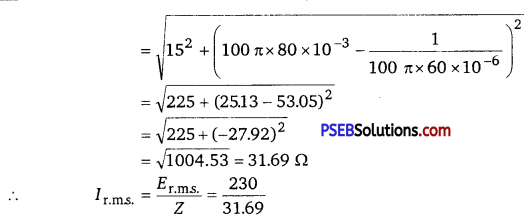
= \(\sqrt{R^{2}+\left(\omega L-\frac{1}{\omega C}\right)^{2}}\)
PSEB 12th Class Physics Solutions Chapter 7 Alternating Current 9
= 7.258 = 7.26 A
∴ Average power consumed by R or transferred to R is given by
(Pav)R = I2r.m.s..R = (7.26)2 × 15 = 790.614 W
= 791 W.
Also (Pav)L and (Pav)C be the average power transferred to I and C respectively.
(Pav)L = Er.m.s. . Ir.m.s. cosΦ
Here e.m.f. leads current by \(\frac{\pi}{2}\)
∴ (Pav)L= Er.m.s. . Ir.m.s. cos \(\frac{\pi}{2}\)
= 0
and (Pav )C = = Er.m.s. . Ir.m.s. cosΦ
= 0
( ∵ Φ = \(\frac{\pi}{2}\) and cos \(\frac{\pi}{2}\) = 0

If Pav be the total power absorbed in the circuit, then
Pav = (Pav)L + (Pav )C + (Pav )R
= 0 + 0 + 791
= 791 W

PSEB 12th Class Physics Solutions Chapter 7 Alternating Current

Question 20.
A series LCR circuit with L = 0.12 H, C = 480 nF, R = 23 Ω is connected to a 230 V variable frequency supply.
(a) What is the source frequency for which current amplitude is maximum? Obtain this maximum value.
(b) What is the source frequency for which average power absorbed by the circuit is maximum? Obtain the value of this maximum power.
(c) For which frequencies of the source is the power transferred to the circuit half the power at resonant frequency? What is the current amplitude at these frequencies?
(d) What is the Q-factor of the given circuit?
Answer:
Inductance, L = 0.12 H
Capacitance, C = 480 nF = 480 × 10-9 F
Resistance, R = 23 Ω
Supply voltage, V = 230 V
Peak voltage is given as V0 = √2V
V0 = √2 × 230 = 325.22 V

(a) Current flowing in the circuit is given by the relation,
I0 = \(\frac{V_{0}}{\sqrt{R^{2}+\left(\omega L-\frac{1}{\omega C}\right)^{2}}}\)
where, I0 = maximum at resonance
At resonance, we have
ωRL – \(\frac{1}{\omega_{R} C}[latex] = 0
where, ωR = Resonance angular frequency
∴ ωR = [latex]\frac{1}{\sqrt{L C}}\)
= \(\frac{1}{\sqrt{0.12 \times 480 \times 10^{-9}}}\)
= \(\frac{10^{5}}{\sqrt{12 \times 48}}=\frac{10^{5}}{24}\)
= 4166.67 rad/s
∴ Resonant frequency; vR = \(\frac{\omega_{R}}{2 \pi}\) = \(\frac{4166.67}{2 \times 3.14}\) = 663.48 HZ
and, maximum current (I0)max = \(\frac{V_{0}}{R}\) = \(\frac{325.22}{23}\) 14.14 A

(b) Average power absorbed by the circuit is given as
Pav = \(\frac{1}{2}\)I02R

The average power is maximum at ω = ω0 at which I0 = (I0)max
∴ (pav )max = \(\frac{1}{2}\)(I0)2maxR
= \(\frac{1}{2}\) × (14.14)2 × 23 = 2299.3 W
= 2300 W

(c) The power transferred to the circuit is half the power at resonant frequency.
Frequencies at which power transferred is half, ω = ωR ± Δ ω
= 2π (vR ± Δv)
where, Δω = \(\frac{R}{2 L}\)
= \(\frac{23}{2 \times 0.12}\) = 95.83 rad/s
Hence, change in frequency, Δ v = \(\frac{1}{2 \pi}\) Δω = \(\frac{95.83}{2 \pi}\) = 15.26 Hz
Thus power absorbed is half the peak power at
vR + Δv = 663.48 + 15.26 = 678.74 Hz
and, vR ΔV = 663.48 – 15.26 = 648.22 Hz
Hence, at 648.22 Hz and 678.74 Hz frequencies, the power transferred is half.
At these frequencies, current amplitude can be given as
I’ = \(\frac{1}{\sqrt{2}}\) × (I0)max = \(\frac{14.14}{\sqrt{2}}=\frac{14.14}{1.414}\) = 10 A

(d) Q-factor of the given circuit can be obtained using the relation,
Q = \(\frac{\omega_{R} L}{R}\) = \(\frac{4166.67 \times 0.12}{23}\) = 21.74
Hence, the Q-factor of the given circuit is 21.74.

Question 21.
Obtain the resonant frequency and Q-factor of a series LCR circuit with L = 3.0 H, C = 27 μF and R = 7.4 Ω. It is desired to improve the sharpness of the resonance of the circuit by reducing its ‘full width at half maximum’ by a factor of 2. Suggest a suitable way.
Answer:
Inductance, L = 3.0 H
Capacitance, C = 27 μF = 27 × 10-6F
Resistance, R = 7.4 Ω
At resonance, resonant frequency of the source for the given LCR series circuit is given as
ωr = \(\frac{1}{\sqrt{L C}}\) = \(\frac{1}{\sqrt{3 \times 27 \times 10^{-6}}}\)
\(\frac{10^{3}}{9}\) = 111.11 rad s-1
Q-factor of the series
Q = \(\frac{\omega_{r} L}{R}\) = \(\frac{111.11 \times 3}{7.4}\) = 45.0446
To improve the sharpness of the resonance by reducing its ‘full width at half maximum’ by a factor of 2 without changing cor, we need to reduce R to half i. e., Resistance = \(\frac{R}{2}=\frac{7.4}{2}\) = 3.7 Ω.

PSEB 12th Class Physics Solutions Chapter 7 Alternating Current

Question 22.
Answer the following questions :
(a) In any ac circuit, is the applied instantaneous voltage equal to the algebraic sum of the instantaneous voltages across the series elements of the circuit? Is the same true for rms voltage?

(b) A capacitor is used in the primary circuit of an induction coil.

(c) An applied voltage signal consists of a superposition of a dc voltage and an ac voltage of high frequency. The circuit consists of an inductor and a capacitor in series. Show that the dc signal will appear across C and the ac signal across L.

(d) A choke coil in series with a lamp is connected to a dc line. The lamp is seen to shine brightly. Insertion of an iron core in the choke causes no change in the lamp’s brightness. Predict the corresponding observations if the connection is to an ac line.

(e) Why is choke coil needed in the use of fluorescent tubes with ac mains? Why can we not use an ordinary resistor instead of the choke coil?
Answer:
(a) Yes; the statement is not true for rms voltage.
It is true that in any ac circuit, the applied voltage is equal to the average sum of the instantaneous voltages across the series elements of the circuit. However, this is not true for rms voltage because voltages across different elements may not be in phase.

(b) High induced voltage is used to charge the capacitor.
A capacitor is used in the primary circuit of an induction coil. This is because when the circuit is broken, a high induced voltage is used to charge the capacitor to avoid sparks.

(c) The dc signal will appear across capacitor C because for dc signals, the impedance of an inductor (L) is negligible while the impedance of a capacitor (C) is very high (almost infinite). Hence, a dc signal appears across C. For an ac signal of high frequency, the impedance of L is high and that of C is very low. Hence, an ac signal of high frequency appears across L.

(d) If an iron core is inserted in the choke coil (which is in series with a lamp connected to the ac line), then the lamp will glow dimly. This is because the choke coil and the iron core increase the impedance of the circuit.

(e) A choke coil is needed in the use of fluorescent tubes with ac mains because it reduces the voltage across the tube without wasting much power. An ordinary resistor cannot be used instead of a choke coil for this purpose because it wastes power in the form of heat.

Question 23.
A power transmission line feeds input power at 2300 V to a stepdown transformer with its primary windings having 4000 turns. What should be the number of turns in the secondary in order to get output power at 230 V?
Answer:
Input voltage, V1 = 2300 V
Number of turns in primary coil, n1 = 4000
Output voltage, V2 = 230 V
Number of turns in secondary coil = n2
Voltage is related to the number of turns as
\(\frac{V_{1}}{V_{2}}=\frac{n_{1}}{n_{2}}\)
\(\frac{2300}{230}=\frac{4000}{n_{2}}\)
n2 = \(\frac{4000 \times 230}{2300}\) = 400
Hence, there are 400 turns in the second winding.

PSEB 12th Class Physics Solutions Chapter 7 Alternating Current

Question 24.
At a hydroelectric power plant, the water pressure head is at a height of 300 m and the water flow available is 100 m3s-1 . If the turbine generator efficiency is 60%, estimate the electric power available from the plant (g = 9.8 ms-2).
Answer:
Height of the water pressure head, h = 300 m
Volume of water flow per second, V = 100 m3/s
Efficiency of turbine generator, η = 60% = 0.6
Acceleration due to gravity, g = 9.8 m/ s2
Density of water, ρ = 103 kg/m3
Electric power available from the plant = η × h ρ gV
= 0.6 × 300 × 103 × 9.8 × 100
= 176.4 × 10⁶ W
= 176.4 MW

Question 25.
A small town with a demand of 800 kW of electric power at 220 V is situated 15 km away from an electric plant generating power at 440 V. The resistance of the two wire line carrying power is 0.5 Ω per km. The town gets power from the line through a 4000-220 V step-down transformer at a sub-station in the town.
(a) Estimate the line power loss in the form of heat.
(b) How much power must the plant supply, assuming there is negligible power loss due to leakage?
(c) Characterise the step up transformer at the plant.
Answer:
Total electric power required, P = 800 kW = 800 × 103 W
Supply voltage, V = 220 V
Voltage at which electric plant is generating power, V’ = 440 V
Distance between the town and power generating station, d = 15 km
Resistance of the two wire lines carrying power = 0.5 Ω/km
Total resistance of the wires, R = (15 + 15)0.5 = 15Ω
A step-down transformer of rating 4000 – 220 V is used in the sub-station.
Input voltage, V1 = 4000 V
Output voltage, V2 = 220 V
rms current in the wire lines is given as
I = \(\frac{P}{V_{1}}\) = \(\frac{800 \times 10^{3}}{4000}\) = 200 A

(a) Line power loss = I2R = (200)2 × 15 = 600 × 103 W = 600 kW

(b) Assuming that the power loss is negligible due to the leakage of the current.
Total power supplied by the plant = 800 kW + 600 kW = 1400 kW

(c) Voltage drop in the power line = IR = 200 × 15 = 3000 V
Hence, total voltage transmitted from the plant = 3000 + 4000 = 7000 V Also, the power generated is 440 V.
Hence, the rating of the step-up transformer situated at the power plant is 440 V – 7000 V.

PSEB 12th Class Physics Solutions Chapter 7 Alternating Current

Question 26.
Do the same exercise as above with the replacement of the earlier transformer by a 40,000-220 V step-down transformer (Neglect, as before, leakage losses though this may not be a good assumption any longer because of the very high voltage transmission involved). Hence, explain why high voltage transmission is preffered?
Answer:
The rating of the step-down transformer is 40000 V – 220 V
Input voltage, V1 = 40000 V
Output voltage, V2 = 220 V
Total electric power required, P = 800 kW = 800 × 103 W
Source potential, V = 220 V
Voltage at which the electric plant generates power, V’ = 440 V
Distance between the town and power generating station, d = 15 km
Resistance of the two wire lines carrying power = 0.5 Ω/km
Total resistance of the wire lines, R = (15 + 15)0.5 = 15 Ω
rms current in the wire line is given as
I = \(\frac{P}{V_{1}}\) = \(\frac{800 \times 10^{3}}{40000}\) = 20A

(a) Line power loss = I2R
= (20)2 × 15 = 6000 W = 6 kW

(b) Assuming that the power loss is negligible due to the leakage of current.
Hence, total power supplied by the plant = 800 kW + 6 kW = 806 kW

(c) Voltage drop in the power line = 7R = 20 × 15 = 300 V
Hence, voltage that is transmitted by the power plant
= 300 + 40000 = 40300 V
The power is being generated in the plant at 440 V.
Hence, the rating of the step-up transformer needed at the plant is 440 V – 40300 V. ‘
Hence, power loss during transmission = \(\frac{600}{1400}\) x 100 = 42.8%
In the previous exercise, the power loss due to the same reason is
\(\frac{6}{800}\) × 100 = 0.744%
Since the power loss is less for a high voltage transmission, high voltage transmissions are preferred for this purpose.

PSEB 12th Class Chemistry Important Questions Chapter 9 Coordination Compounds

Punjab State Board PSEB 12th Class Chemistry Important Questions Chapter 9 Coordination Compounds Important Questions and Answers.

PSEB 12th Class Chemistry Important Questions Chapter 9 Coordination Compounds

Very Short Answer Type Questions

Question 1.
Why is CO a stronger ligand than Cl ?
Answer:
CO forms π bonds so it is a stronger ligand than Cl.

Question 2.
What is the relationship between observed colour of the complex and the wavelength of light absorbed by the complex?
Answer:
When white light falls on the complex, some part of it is absorbed. Higher the crystal field splitting, lower will be the wavelength absorbed by the complex. The observed colour of complex is the colour generated from the wavelength left over.

Question 3.
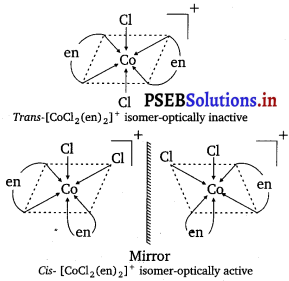
How many isomers are there for octahedral complex [CoCl2 (en) (NH3)2]+?
Answer:
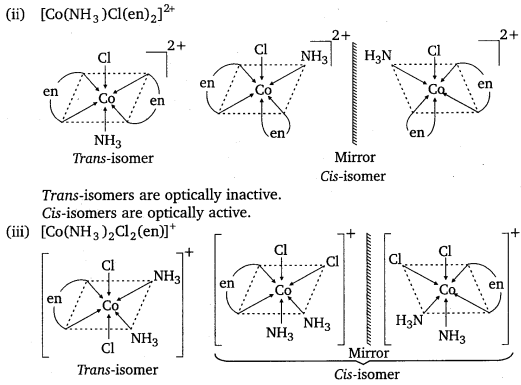
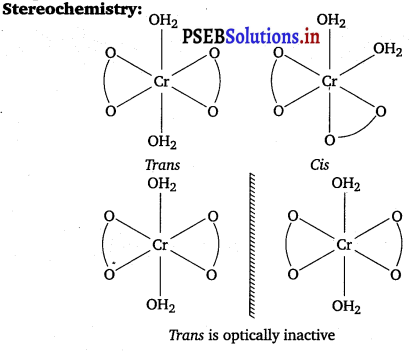
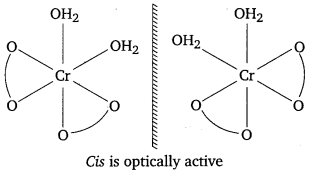
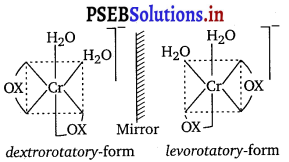
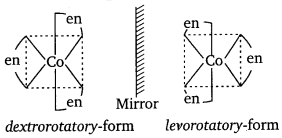
There will be three isomers: cis and trans isomers. Cis will also show optical isomerism.

PSEB 12th Class Chemistry Important Questions Chapter 9 Coordination Compounds

Question 4.
Why are low spin tetrahedral complexes not formed?
Answer:
Because for tetrahedral complexes, the crystal field stabilisation energy is lower than pairing energy.

Question 5.
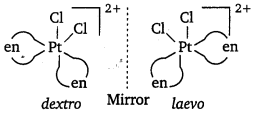
A complex of the type [M(AA)2X2]n+ is known to be optically active. What does this indicate about the structure of the complex? Give one example of such complex.
Answer:
An optically active complex of the type [M(AA)2X2]n+ indicates cis- octahedral structure, e.g., cis-[Pt(en)2Cl2]2+ or cis-[Cr(en)2Cl2]+.

Question 6.
Why is the complex [Co(en)3]3+ more stable than the complex [CoF6]3-?
Answer:
Due to chelate effect as the complex [Co(en)3]3+ contains chelating ligand \(\ddot{\mathrm{NH}}_{2}-\mathrm{CH}_{2}-\mathrm{CH}_{2}-\ddot{\mathrm{NH}}_{2}\).

PSEB 12th Class Chemistry Important Questions Chapter 9 Coordination Compounds

Question 7.
What do you understand by ‘denticity of a ligand’?
Answer:
The number of coordinating groups present in ligand is called the denticity of ligand. For example, denticity of ethane-1, 2-diamine is 2, as it has two donor nitrogen atoms which can link to central metal atom.

Question 8.
What type of isomerism is shown by the complex [CO(NH3)5(SCN)]2+?
Answer:
Linkage isomerism.

Question 9.
Arrange the following complex ions in increasing order of crystal field splitting energy △0 :
[Cr(Cl)6]3-, [Cr(CN)6]3-, [Cr(NH3)6]3+
Answer:
[Cr(Cl)6]3- < [Cr(NH3)6]3+ < [Cr(CN)6]3-

PSEB 12th Class Chemistry Important Questions Chapter 9 Coordination Compounds

Question 10.
A coordination compound with molecular formula CrCl3.4H2O precipitates one mole of AgCl with AgNO3 solution. Its molar conductivity is found to be equivalent to two ions. What is the structural formula and name of the compound?
Answer:
[Cr(H2O)4Cl2] Cl
[Tetraaquadichloridochromium (III) chloride]

Short Answer Type Questions

Question 1.
Give the electronic configuration of the following complexes on the basis of crystal field splitting theory.
[CoF6]3-, [Fe(CN)6]4- and [Cu(NH3)6]2+
Answer:
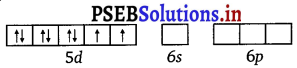
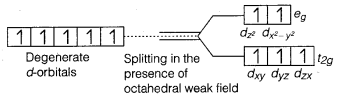
[CoF6]3-: Co3+(d6) \(t_{2 g}^{4} e_{g}^{2}\)
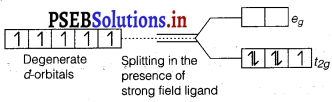
[Fe(CN)6]4- : Fe2+ (d6) \(t_{2 g}^{6} e_{g}^{0}\)
[Cu(NH3)6]2+ : Cu2+ (d9) \(t_{2 g}^{6} e_{g}^{3}\)

PSEB 12th Class Chemistry Important Questions Chapter 9 Coordination Compounds

Question 2.
(i) What type of isomerism is shown by [Co(NH3) 5ONO]Cl2?
(ii) On the basis of crystal field theory, write the electronic configuration for d4 ion, if △0 < P.
(iii) Write the hybridisation and shape of [Fe(CN)6]3-.
(Atomic number of Fe = 26)
Answer:
(i) Linkage isomerism and the linkage isomer is [Co(NH3) 5ONO]Cl2.
(ii) If △0 < P, the fourth electron enters one of two eg orbitals giving the configuration \(t_{2 g}^{3} e_{g}^{1}\).
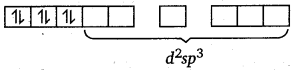
(iii) Fe3+ : 3d5 4s0
PSEB 12th Class Chemistry Important Questions Chapter 9 Coordination Compounds 1

Question 3.
Explain why [Fe(H2O)6]3+ 5.92 BM whereas [Fe(CN)6]3- has a value of only 1.74 BM.
Answer:
[Fe(CN)6]3- involves d2sp3 hybridisation with one unpaired electron and [Fe(H2O)6]3+ involves sp3d2 hybridisation with five unpaired electrons. This difference is due to the presence of strong CN and weak ligand H2O in these complexes.

PSEB 12th Class Chemistry Important Questions Chapter 9 Coordination Compounds

Question 4.
CuSO4∙5H2O is blue in colour while CuSO4 is colourless. Why?
Answer:
In CuSO4∙5H2O, water acts as ligand as a result it causes crystal field splitting. Hence, d-d transition is possible in CuSO4∙5H2O and shows colour. In the anhydrous CuSO4 due to the absence of water (ligand), crystal field splitting is not possible and hence it is colourless.

Question 5.
Why do compounds having similar geometry have different magnetic moment?
Answer:
It is due to the presence of weak and strong ligands in complexes, if CFSE is high, the complex will show low value of magnetic moment and vice versa, e.g., [CoF6]3- and [Co(NH3)6]3+, the former is paramagnetic and the latter is diamagnetic.

Question 6.
A metal ion Mn+ having d4 valence electronic configuration combines with three bidentate ligands to form a complex compound. Assuming △0 > P:
(i) Write the electronic configuration of d4 ion.
(ii) What type of hybridisation will Mn+ ion has?
(iii) Name the type of isomerism exhibited by this complex.
Answer:
(i) \(t_{2 g}^{4} e_{g}^{0}\)
(ii) sp3d2
(iii) Optical isomerism

PSEB 12th Class Chemistry Important Questions Chapter 9 Coordination Compounds

Long Answer Type Questions

Question 1.
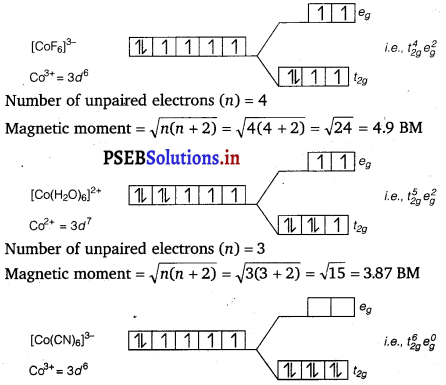
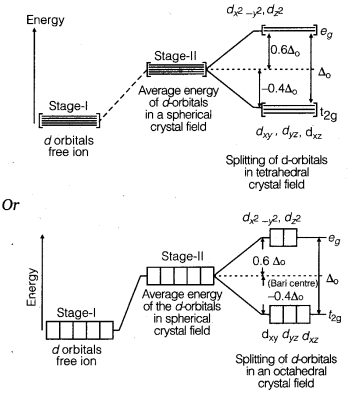
Using crystal field theory, draw energy level diagram, write electronic configuration of the central metal atom/ion and determine the magnetic moment value in the following: [COF6]3-, [CO(H2O)6]2+, [CO(CN)6]3
Answer:
Magnetic moment, μ = \(\sqrt{n(n+2)}\)
Where, n = Number of unpaired electrons
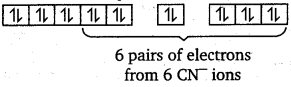
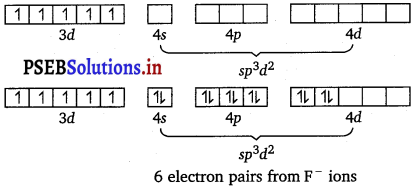
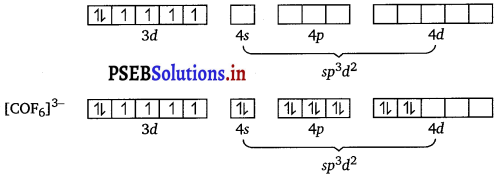
PSEB 12th Class Chemistry Important Questions Chapter 9 Coordination Compounds 2
No unpaired electrons, so it is diamagnetic.

PSEB 12th Class Chemistry Important Questions Chapter 9 Coordination Compounds

Question 2.
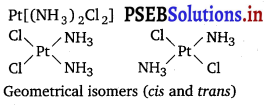
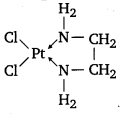
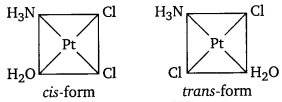
(i) Draw the geometrical isomers of complex [Pt(NH3)2Cl2].
(ii) Write the hybridisation and magnetic behaviour of the complex [Ni(CO)4].
(Atomic no. of Ni = 28)
Answer:
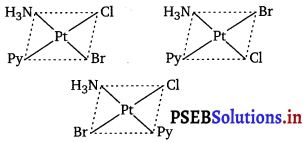
PSEB 12th Class Chemistry Important Questions Chapter 9 Coordination Compounds 3
Geometrical isomers of [Pt(NH3)2Cl2]

(ii) The complex [Ni(CO)4] involves sp3 hybridisation.
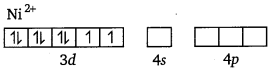
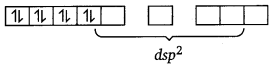
PSEB 12th Class Chemistry Important Questions Chapter 9 Coordination Compounds 4
The complex is diamagnetic as evident from the absence of unpaired electrons.

PSEB 12th Class Political Science Book Solutions Guide in Punjabi English Medium

Punjab State Board Syllabus PSEB 12th Class Political Science Book Solutions Guide Pdf in English Medium and Punjabi Medium are part of PSEB Solutions for Class 12.

PSEB 12th Class Political Science Guide | Political Science Guide for Class 12 PSEB

Political Science Guide for Class 12 PSEB | PSEB 12th Class Political Science Book Solutions

PSEB 12th Class Political Science Book Solutions in English Medium

12th Class Political Science Guide PSEB Part A Political Theory

Political Science Guide for Class 12 PSEB Part B Indian Political System

PSEB 12th Class Political Science Book Solutions in Hindi Medium

PSEB 12th Class Political Science Syllabus

Part – A Political Theory

Unit I: Political System
(i) Meaning, Characteristics
(ii) Functions of Political System
(iii) David Easton’s input-output model
(iv) Difference between state and political system.

Unit II: Some major contemporary Political Theories
(i) Liberalism
(ii) Marxism
(iii) Political ideas of Mahatma Gandhi

Unit III: Bureaucracy (Civil Services)
(i) Meaning and importance
(ii) Recruitment
(iii) Role and functions
(iv) Distinction between Political Executive and Permanent Executive and their respective roles
Public opinion
(i) Role and importance of Public Opinion in a Democratic Polity.
(ii) Agencies for the formulation and expression of Public Opinion.

Unit IV: Party System
(i) Political parties – their functions and importance
(ii) Basis of formation of Political Parties
(iii) Types of Party System
(iv) The Role of Opposition
Interest and Pressure Groups
(i) Interest Groups and Pressure Groups – their nature, types, and functions
(ii) Ways of functioning of pressure groups

Part – B Indian Political System

Unit V: Indian Democracy
(i) Parliamentary Model
(ii) Problems and challenges to Indian Democracy & Future of Indian democracy
Democracy at Grassroot
(i) Concept of Panchayati Raj
(ii) Structure and Working of Panchayati Raj (73th Amendment)
(iii) Panchayati Raj-Some problems
(iv) Local Bodies in Urban Areas (74th Amendment)

Unit VI: Party System in India
(i) Nature of Party System in India
(ii) Study of major 4 national political parties (INC, BJP, CPI. CPI (M) their programs and policies. Regional Political Parties in Punjab (SAD, AAP)
(iii) Problems facing the Indian Party System
Electoral System
(i) Adult Franchise Direct and Indirect Elections And People’s Participation
(ii) Voting behaviour – meaning and determinants
(iii) Election Commission and Election Procedure

Unit VII: National Integration
(i) Problems of National Integration
(ii) Steps taken to promote National Integration
Foreign Policy of India
(i) Determinants of Foreign Policy
(ii) Basic principles of Foreign Policy
(iii) India and the United Nations, India, and SAARC

Unit VIII: India and the World
(i) India’s relations with her Neighbours: Nepal, Sri Lanka, China, Bangladesh and Pakistan
(ii) India’s relations with U.S.A. and Russia
(iii) India’s approach to major world issues: Human Rights, Disarmament and Globalization.

PSEB 12th Class Chemistry Important Questions Chapter 11 Alcohols, Phenols and Ethers

Punjab State Board PSEB 12th Class Chemistry Important Questions Chapter 11 Alcohols, Phenols and Ethers Important Questions and Answers.

PSEB 12th Class Chemistry Important Questions Chapter 11 Alcohols, Phenols and Ethers

Very Short Answer Type Questions

Question 1.
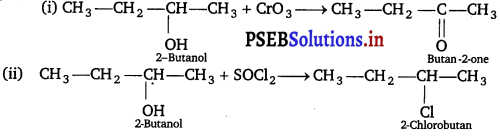
Write the structures of the products when Butan-2-ol reacts with the following:
(i) CrO3
(ii) SOCl2
Answer:
PSEB 12th Class Chemistry Important Questions Chapter 11 Alcohols, Phenols and Ethers 1

Question 2.
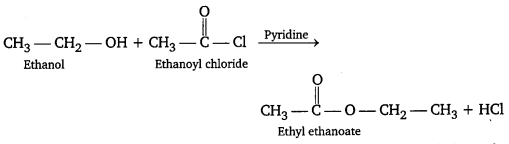
What happens when ethanol reacts with CH3COCl/pyridine ?
Answer:
PSEB 12th Class Chemistry Important Questions Chapter 11 Alcohols, Phenols and Ethers 2

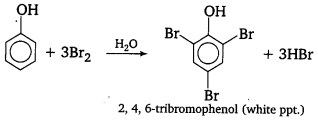
Question 3.
When phenol is created with bromine water, while precipitate is obtained. Prove the structure and the name of the compound formed.
Answer:
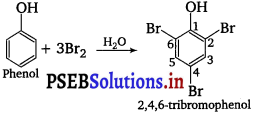
When phenol is treated with bromine water, white ppt. of 2, 4, 6-tribromophenol is obtained.
PSEB 12th Class Chemistry Important Questions Chapter 11 Alcohols, Phenols and Ethers 3

PSEB 12th Class Chemistry Important Questions Chapter 11 Alcohols, Phenols and Ethers

Question 4.
Answer the following questions :
(i) Dipole moment of phenol is smaller than that of methanol. Why?
(ii) In Kolbe’s reaction, instead of phenol, phenoxide ion is treated with carbon dioxide. Why ?
Answer:
(i) In phenol, C—O bond is less polar due to electron-withdrawing effect of benzene ring whereas in methanol, C—O bond is more polar due to electron-releasing effect of —CH3 group.

(ii) Phenoxide ion is more reactive than phenol towards electrophilic aromatic substitution and hence undergoes electrophilic substitution with carbon dioxide which is a weak electrophile.

Question 5.
What is denatured alcohol ?
Answer:
Alcohol is made unfit for drinking by mixing some copper sulphate and pyridine in it. This is called denatured alcohol.

Question 6.
Arrange the following compounds in the increasing order of their acidic strength: p-cresol, p -nitrophenol, phenol
Answer:
p-cresol < phenol < p-nitrophenol

PSEB 12th Class Chemistry Important Questions Chapter 11 Alcohols, Phenols and Ethers

Question 7.
Arrange the following compounds in decreasing order of acidity.
(i) H2O, ROH, HC ☰ CH
(ii) PSEB 12th Class Chemistry Important Questions Chapter 11 Alcohols, Phenols and Ethers 4
(iii) CH3OH, H2O, C6H6OH
Answer:
(i) H2O > ROH > HC ☰ CH
(ii) PSEB 12th Class Chemistry Important Questions Chapter 11 Alcohols, Phenols and Ethers 5
(iii) C6H5OH > H2O > CH3OH

Question 8.
Suggest a reagent for conversion of ethanol to ethanal.
Answer:
Ethanol can be oxidises into ethanal by using pyridinium chlorochromate.
PSEB 12th Class Chemistry Important Questions Chapter 11 Alcohols, Phenols and Ethers 6

Question 9.
Explain why sodium metal can be used for drying diethyl ether but not ethyl alcohol.
Answer:
Due to presence of an active hydrogen atom, ethyl alcohol reacts with sodium metal.
2CH3 — CH2 — OH + 2Na → 2CH3 — CH2 — ONa + H2
Diethyl ether, on the other hand, does not have replaceable hydrogen atom therefore does not react with sodium metal hence can be dried by metallic sodium.

PSEB 12th Class Chemistry Important Questions Chapter 11 Alcohols, Phenols and Ethers

Question 10.
Phenol is an acid but does not react with sodium bicarbonate solution. Why?
Answer:
Phenol is a weaker acid than carbonic acid (H2CO3) and hence does not liberate CO2from sodium bicarbonate.

Question 11.
In the process of wine making, ripened grapes are crushed so that sugar and enzyme should come in contact with each other and fermentation should start. What will happen if anaerobic conditions are not maintained during this process?
Answer:
Ethanol will be converted into ethanoic acid.

Short Answer Type Questions

Question 1.
Why is the reactivity of all the three classes of alcohols with cone. HCl and ZnCl2 (Lucas reagent) different ?
Answer:
The reaction of alcohols with Lucas reagent (cone. HCl and ZnCl2) follow SN1 mechanism. SN1 mechanism depends upon the stability of carbocations (intermediate). More stable the intermediate carbocation, more reactive is the alcohol.

Tertiary carbocations are most stable among the three classes of carbocations and the order of the stability of carbocation is 3° > 2° > 1°. This order, intum, reflects the order of reactivity of three classes of alcohols i. e., 3° > 2° > 1°.

Thus , as the stability of carbocations are different so the reactivity of all the three classes of alcohols with Lucas reagent is different.

PSEB 12th Class Chemistry Important Questions Chapter 11 Alcohols, Phenols and Ethers

Question 2.
Write the mechanism of the following reaction:
PSEB 12th Class Chemistry Important Questions Chapter 11 Alcohols, Phenols and Ethers 7
Answer:
SN2 mechanism
PSEB 12th Class Chemistry Important Questions Chapter 11 Alcohols, Phenols and Ethers 8
PSEB 12th Class Chemistry Important Questions Chapter 11 Alcohols, Phenols and Ethers 9

Question 3.
Explain a process in which a biocatalyst is used in industrial preparation of a compound known to you.
Answer:
Enzymes are biocatalyst. These biocatalysts (enzymes) are used in the industrial preparation of ethanol. Ethanol is prepared by the fermentation of molasses—a dark brown coloured syrup left after crystallisation of sugar which still contains about 40% of sugar.

The process of fermentation actually involves breaking down of large molecules into simple ones in the presence of enzymes. The source of these enzymes is yeast. The various reactions taking place during fermentation of carbohydrates are :
PSEB 12th Class Chemistry Important Questions Chapter 11 Alcohols, Phenols and Ethers 10
In wine making, grapes are the source of sugars and yeast. As grapes ripen, the quantity of sugar increases and yeast grows on the outer skin. When grapes are crushed, sugar and the enzyme come in contact and fermentation starts. Fermentation takes place in anaerobic conditions i.e., in absence of air. CO2 gas is released during fermentation.

The action of zymase is inhibited once the percentage of alcohol ,formed exceeds 14 per cent. If air gets into fermentation mixture, the oxygen of air oxidises ethanol to ethanoic acid which in turn destroys the taste of alcoholic drinks.

PSEB 12th Class Chemistry Important Questions Chapter 11 Alcohols, Phenols and Ethers

Question 4.
Explain why alcohols and ethers of comparable molecular mass have different boiling points ?
Answer:
Boiling point depends upon the strength of intermolecular forces of attraction. Higher these forces of attraction, more will be the boiling point. Alcohols undergo intermolecular hydrogen bonding. So, the molecules of alcohols are held together by strong intermolecular forces of attraction.

But in ethers no hydrogen atom is bonded to oxygen. Therefore, ethers are held together by weak dipole-dipole forces, not by strong hydrogen bond.

Since, lesser amount of energy is required than to break weak dipole-dipole forces in ethers than to break strong hydrogen bonds in alcohol.
PSEB 12th Class Chemistry Important Questions Chapter 11 Alcohols, Phenols and Ethers 11

Question 5.
Explain why is O = C = O non-polar while R—O—R is polar ?
Answer:
CO2 is a linear molecule. The dipole moment of two C —O bonds are equal and opposite and they cancel each other and hence the dipole moment of CO2 is zero and it is a non-polar molecule.
PSEB 12th Class Chemistry Important Questions Chapter 11 Alcohols, Phenols and Ethers 12
While for ethers, two dipoles are pointing in the same direction. These two dipoles do not cancel the effect of each other. Therefore, there is a finite resultant dipoles and hence R—O—R is a polar molecule.
PSEB 12th Class Chemistry Important Questions Chapter 11 Alcohols, Phenols and Ethers 13

Question 6.
Give reasons for the following:
(i) p-Nitrophenol is more acidic than o-nitrophenol
(ii) Bond angle C—O—C in ethers is slightly higher than the tetrahedral angle (109°28′).
(iii) (CH3)3C—Br on reaction with NaOCH3 gives an alkene instead of an ether.
Answer:
(i) PSEB 12th Class Chemistry Important Questions Chapter 11 Alcohols, Phenols and Ethers 14
Intramolecular H-bonding in o-nitrophenol makes loss of proton difficult. Therefore, p-nitrophenol is more acidic than o-nitrophenol.

(ii) The PSEB 12th Class Chemistry Important Questions Chapter 11 Alcohols, Phenols and Ethers 15 bond angle in ether is slightly higher than 109 °28′ due to repulsive interaction between the two bulky alkyl groups.

(iii) It is because NaOCH3 is a strong nucleophile as well as a strong base. Thus, elimination reaction predominates over substitution reaction.

PSEB 12th Class Chemistry Important Questions Chapter 11 Alcohols, Phenols and Ethers

Question 7.
Explain the following behaviours :
(i) Alcohols are more soluble in water than the hydrocarbons of comparable molecular masses.
(ii) Ortho-nitrophenol is more acidic than ortho-methoxyphenol.
(iii) Cumene is a better starting material for the preparation of phenol.
Answer:
(i) Alcohols are more soluble in water than the hydrocarbons of comparable molecular masses because of H-bond formation between alcohol and water molecules.
(ii) Ortho-nitrophenol is more acidic than ortho-methoxyphenol because nitro being the electron with drawing group stabilises the phenoxids ion.
(iii) Cumene is a better starting material for the preparation of phenol because side product formed in this reaction is acetone which is another important organic compound.

Long Answer Type Questions

Question 1.
(a) Name the starting material used in the industrial preparation of phenol.
(b) Write complete reaction for the bromination of phenol in aqueous and non-aqueous medium.
(c) Explain why Lewis acid is not required in bromination of phenol?
Answer:
(a) The starting material used in the industrial preparation of phenol is cumene.
PSEB 12th Class Chemistry Important Questions Chapter 11 Alcohols, Phenols and Ethers 16

(b) Phenols when treated with bromine water gives polyhalogen derivatives in which all the hydrogen atoms present at ortho and para positions with respect to —OH group are replaced by bromine atoms.
PSEB 12th Class Chemistry Important Questions Chapter 11 Alcohols, Phenols and Ethers 17
However, in non-aqueous medium such as CS2, CCl4, CHCl3 monobromophenols are obtained.
PSEB 12th Class Chemistry Important Questions Chapter 11 Alcohols, Phenols and Ethers 18
In aqueous solution, phenol ionises to form phenoxide ion. This ion activates the benzene ring to a very large extent and hence the substitution of halogen takes place at all three positions.

On the other hand, in non-aqueous solution ionisation of phenol is greatly suppressed. Therefore, ring is activated slightly and hence monosubstitution occur.

(c) Lewis acid is an electron deficient molecule. In bromination of benzene, Lewis acid is used-to polarise Br2 to form Br+ electrophile.

In case of phenol, oxygen atom of phenol itself polarises the bromine molecule to form Br+ ion (electrophile). So, Lewis acid is not required in the bromination of phenol.
PSEB 12th Class Chemistry Important Questions Chapter 11 Alcohols, Phenols and Ethers 19

PSEB 12th Class Chemistry Important Questions Chapter 11 Alcohols, Phenols and Ethers

Question 2.
Explain the mechanism of the following reactions :
(i) Addition of Grignard’s reagent to the carbonyl group of a compound forming an adduct followed by hydrolysis.
(ii) Acid catalysed dehydration of an alcohol forming an alkene.
(iii) Acid catalysed hydration of an alkene forming an alcohol.
Answer:
(i) Step I : Nucleophilic addition of Grignard reagent to carbonyl group.
PSEB 12th Class Chemistry Important Questions Chapter 11 Alcohols, Phenols and Ethers 20
Step II : Formation of carbocation : It is the slowest step and hence, the rate determining step.
PSEB 12th Class Chemistry Important Questions Chapter 11 Alcohols, Phenols and Ethers 21
To drive the equilibrium to the right, ethylene is removed as it is formed.
PSEB 12th Class Chemistry Important Questions Chapter 11 Alcohols, Phenols and Ethers 22

PSEB 12th Class Chemistry Solutions Chapter 4 Chemical Kinetics

Punjab State Board PSEB 12th Class Chemistry Book Solutions Chapter 4 Chemical Kinetics Textbook Exercise Questions and Answers.

PSEB Solutions for Class 12 Chemistry Chapter 4 Chemical Kinetics

PSEB 12th Class Chemistry Guide Chemical Kinetics InText Questions and Answers

Question 1.
From the rate expression for the following reactions, determine their order of reaction and the dimensions of the rate constants.
(i) 3 NO(g) → N2O(g) Rate = k[NO]2
(ii) H2O2 (aq) +3I (aq) + 2H+ → 2H2O (l) + \(\mathbf{I}_{3}^{-}\)
Rate = k[H2O2] [I]
(iii) CH3CHO(g) → CH4(g) + CO(g) Rate = k [CH3CHO]3/2
(iv) C2H5Cl(g) → C2H4(g) + HCl (g) Rate = k [C2H5Cl]
Solution:
(i) Given, rate = k [NO]2
Therefore, order of the reaction = 2
Dimension of rate constant (k) = \(\frac{\text { Rate }}{[\mathrm{NO}]^{2}}\)
= \(\frac{m o l L^{-1} s^{-1}}{\left(m o l L^{-1}\right)^{2}}\)
= \(\frac{\mathrm{mol} \mathrm{L}^{-1} \mathrm{~s}^{-1}}{\mathrm{~mol}^{2} \mathrm{~L}^{-2}}\)
= L mol-1 s-1

(ii) Given, rate = k [H2O2] [I ]
Therefore, order of the reaction = 2
Dimension of k = \(\frac{\text { Rate }}{\left[\mathrm{H}_{2} \mathrm{O}_{2}\right]\left[\mathrm{I}^{-}\right]}\)
= \(\frac{\mathrm{mol} \mathrm{L}^{-1} \mathrm{~s}^{-1}}{\left(\mathrm{~mol} \mathrm{~L}^{-1}\right)\left(\mathrm{mol} \mathrm{L}^{-1}\right)}\)
= L mol-1 s-1

(iii) Given rate = k[CH3CHO]3/2
Therefore, order of the reaction = \(\frac{3}{2}\)
Dimension of k = \(\frac{\text { Rate }}{\left[\mathrm{CH}_{3} \mathrm{CHO}\right]^{3 / 2}}\)
PSEB 12th Class Chemistry Solutions Chapter 4 Chemical Kinetics 9
= \(\frac{\text { mol L }^{-1} \mathrm{~s}^{-1}}{\mathrm{~mol}^{\frac{3}{2}} \mathrm{~L}^{-\frac{3}{2}}}\)
= mol -1/2L1/2 s-1

(iv) Given, rate = k [C2H5Cl]
Therefore, order of the reaction = 1
Dimension of k = \(\frac{\text { Rate }}{\left[\mathrm{C}_{2} \mathrm{H}_{5} \mathrm{Cl}\right]}\)
= \(\frac{\mathrm{mol} \mathrm{L}^{-1} \mathrm{~s}^{-1}}{\mathrm{~mol} \mathrm{~L}^{-1}}\) = s-1

PSEB 12th Class Chemistry Solutions Chapter 4 Chemical Kinetics

Question 2.
For the reaction:
2A + B → A2B
the rate = k[A] [B]2 with k = 2.0 x 10⁻⁶ mol-2L2s-1. Calculate the initial rate of the reaction when [A] = 0.1 mol L-1, [B] = 0.2 mol L-1. Calculate the rate of reaction after [A] is reduced to 0.06 mol L-1.
Solution:
The initial rate of the reaction is
Rate = k [A][B]2
= (2.0 × 10⁻⁶ mol-2 L2 s-1) (0.1 mol L-11) (0.2 mol L-1 )2
= 8.0 × 10⁻⁹ mol L-1 s-1
When [A] is reduced from 0.1 mol L-1 to 0.06 molL-1, the concentration of A reacted = (0.1 – 0.06) mol L-1 = 0.04 mol L-1 Therefore, concentration of B reacted
= \(\frac{1}{2}\) × 0.04 mol L-1 = 0.02 mol L-1
Then, concentration of B available, [B] = (0.2 -0.02) mol L-1
= 0.18 mol L-1
After [A] is reduced to 0.06 mol L-1, the rate of the reaction is given by,
Rate = k [A][B]2
= (2.0 × 10⁻⁶ mol-2 L2 s-1) (0.06 mol L-1) (0.18 mol L-1)2
= 3.89 × 10⁻⁹ mol L-1 s-1

Question 3.
The decomposition of NH3 on platinum surface is zero order reaction. What are the rates of production of N2 and H2 if k = 2.5 x 10⁻⁴ mol-1 L s-1?
Solution:
The decomposition of NH3 on platinum surface is represented by the following equation
PSEB 12th Class Chemistry Solutions Chapter 4 Chemical Kinetics 1
For zero order reaction, rate = k
∴ \(-\frac{1}{2} \frac{d\left[\mathrm{NH}_{3}\right]}{d t}=\frac{d\left[\mathrm{~N}_{2}\right]}{d t}=\frac{1}{3} \frac{d\left[\mathrm{H}_{2}\right]}{d t}\)
= 2.5 × 10⁻⁴ mol L-1 s-1
Therefore, the rate of production of N2
\(\frac{d\left[\mathrm{~N}_{2}\right]}{d t}\) = 2.5 × 10⁻⁴ mol L-1 s-1
The rate of production of H2
\(\frac{d\left[\mathrm{H}_{2}\right]}{d t}\) = 3 × 2.5 × 10-4 mol L-1 s-1
= 7.5 × 10⁻⁴ mol L-1 s-1

PSEB 12th Class Chemistry Solutions Chapter 4 Chemical Kinetics

Question 4.
The decomposition of dimethyl ether leads to the formation of CH4, H2 and CO and the reaction rate is given by
Rate = k [CH3OCH3]3/2
The rate of reaction is followed by increase in pressure in a closed vessel, so the rate can also be expressed in terms of the partial pressure of dimethyl ether, i.e.,
Rate = k(PCH3OCH3 )3/2
If the pressure is measured in bar and time in minutes, then what are the units of rate and rate constants?
Solution:
If the pressure is measured in bar and time in minutes, then
Unit of rate = bar min-1
Rate = k(PCH3OCH3 )3/2
⇒ k = \(\frac{\text { Rate }}{\left(p_{\mathrm{CH}_{3} \mathrm{OCH}_{3}}\right)^{3 / 2}}\)
= PSEB 12th Class Chemistry Solutions Chapter 4 Chemical Kinetics 10

Question 5.
Mention the factors that affect the rate of a chemical reaction.
Answer:
The factors that affect the rate of a chemical reaction are as follows :
(i) Nature of reactants: Ionic substances react more rapidly than covalent compounds because ions produced after dissociation are immediately available for reaction.

(ii) Concentration of reactants: Rate of a chemical reaction is direcdy proportional to the concentration of reactants.

(iii) Temperature: Generally rate of a reaction increases on increasing the temperature.

(iv) Presence of catalyst: In presence of catalyst, the rate of reaction generally increase and the equilibrium state is attained quickly in reversible reactions.

(v) Surface area of the reactants: Rate of reaction increases with increase in surface area of the reactants. That is why powdered form of reactants is preffered than their granular form.

PSEB 12th Class Chemistry Solutions Chapter 4 Chemical Kinetics

Question 6.
A reaction is second order with respect to a reactant. How is the rate of reaction affected if the concentration of the reactant is (i) doubled (ii) reduced to half?
Solution:
Let the concentration of the reactant be [A] = a
Rate of reaction, R = k [A]2 = ka2
(i) If the concentration of the reactant is doubled, i.e. [A] = 2a, then the rate of the reaction would be
R’ = k (2a)2
= 4ka2 = 4R
Therefore, the rate of the reaction would increase by 4 times.

Question 7.
What is the effect of temperature on the rate constant of a reaction? How can this effect of temperature on rate constant be represented quantitatively?
Answer:
The rate constant is nearly doubled with a rise in temperature by 10° for a chemical reaction.

The temperature effect on the rate constant can be represented quantitatively by Arrhenius equation, k = Ae-Ea/RT

Where, k is the rate constant, A is the Arrhenius factor or the frequency factor, R is the gas constant, T is the temperature, and Ea is the energy of activation for the reaction.

Question 8.
In a pseudo first order hydrolysis of ester in water, the following results were obtained:

t/s 0 30 60 90
[Ester]/molL-1 0.55 0.31 0.17 0.085

(i) Calculate the average rate of reaction between the time interval 30 to 60 seconds.
(ii) Calculate the pseudo first order rate constant for the hydrolysis of ester.
Solution:
(i) Average rate of reaction between the time interval, 30 to 60 seconds
= \(\frac{d[\text { Ester }]}{d t}\)
= \(\frac{0.31-0.17}{60-30}\)
= \(\frac{0.14}{30}\)
= 4.67 × 10⁻³ mol L-1 s-1
PSEB 12th Class Chemistry Solutions Chapter 4 Chemical Kinetics 2

PSEB 12th Class Chemistry Solutions Chapter 4 Chemical Kinetics

Question 9.
A reaction is first order in A and second order in B.
(i) Write the differential rate equation.
(ii) How is the rate affected on increasing the concentration of B three times?
(iii) How is the rate affected when the concentrations of both A and B are doubled?
Solution:
(i) The differential rate equation will be
– \(\frac{d[\mathrm{R}]}{d t}\) = k[A][B]2

(ii) If the concentration of B is increased three times, then
– \(\frac{d[\mathrm{R}]}{d t}\) = k[A][3B]2
= 9.k [A][B]2
Therefore, the rate of reaction will increase 9 times.

(iii) When the concentrations of both A and B are doubled,
– \(\frac{d[\mathrm{R}]}{d t}\) = k[2A][2B]2
= 8.k [A] [B]2
Therefore, the rate of reaction will increase 8 times.

Question 10.
In a reaction between A and B, the initial rate of reaction (r0) was measured for different initial concentrations of A and B as given below:

A/mol L-1 0.20 0.20 0.40
B/mol L-1 0.30 0.10 0.05
r0/mol L-1 s-1 5.07 × 10⁻⁵ 5.07 × 10⁵ 1.43 × 10⁻⁴

What is the order of the reaction with respect to A and B?
Solution:
Let the order of the reaction with respect to A be x and with respect to B be y.
Therefore
r0 = k [A]x [B]y
5.07 × 10-5 = k[0.20]x [0.30]y …………. (i)
5.07 × 10-5 = k[0.20]x [0.10]y …………. (ii)
1.43 × 10-4 = k[0.40]x [0.05]y ……….. (iii)
PSEB 12th Class Chemistry Solutions Chapter 4 Chemical Kinetics 3
Hence, the order of the reaction with respect to A is 1.5 and with respect to B is 0.

Question 11.
The following results have been obtained during the kinetic studies of the reaction:
2A + B → C + D
PSEB 12th Class Chemistry Solutions Chapter 4 Chemical Kinetics 11
Determine the rate law and the rate constant for the reaction.
Solution:
Let the order of the-reaction with respect to A be x and with respect to B be y.
Therefore, rate of the reaction is given by,
Rate = k [A]x [B]y According to the question,
6.0 × 10⁻³; = k[0.1]x [0.1]y …………. (i)
7.2 × 10-2 = k[0.3]x [0.2]y …………… (ii)
2.88 × 10-1 = k[0.3]x [0.4]y ………….. (iii)
2.40 × 10-2 = k[0.4]x [0.1]y …………… (iv)
Dividing equation (iv) by (i), we get
PSEB 12th Class Chemistry Solutions Chapter 4 Chemical Kinetics 4
PSEB 12th Class Chemistry Solutions Chapter 4 Chemical Kinetics 5

PSEB 12th Class Chemistry Solutions Chapter 4 Chemical Kinetics

Question 12.
The reaction between A and B is first order with respect to A and zero order with respect to B. Fill in the blanks in the following table:
PSEB 12th Class Chemistry Solutions Chapter 4 Chemical Kinetics 12
Solution:
The given reaction is of the first order with respect to A and of zero order with respect to B.
Therefore, the rate of the reaction is given by,
Rate = k[A]1[B]0
⇒ Rate = fc[A]
From experiment I, we get
2.0 × 10⁻² molL-1 min-1 = k(0.1 molL-1)
⇒ k = 0.2 min-1

From experiment II, we get
4.0 × 10⁻² molL-1 min-1 = 0.2 min-1 [A]
⇒ [A] = 0.2 mol L-1

From experiment III, we get
Rate = 0.2 min-1; × 0.4 mol L-1
= 0.08 mol L-1 min-1

From experiment IV, we get
2.0 × 10⁻² molL-1 min-1 = 0.2 min-1 [A]
⇒ [A] = 0.1 mol L-1

Question 13.
Calculate the half-life of a first order reaction from their rate constants given below:
(i) 200 s-1
(ii) 2 min-1
(iii) 4 years-1
Solution:
Half life period for first order reaction, t1/2 = \(\)
(i) t1/2 = \(\frac{0.693}{200 \mathrm{~s}^{-1}}\) = 0.347 × 10⁻² s
= 3.47 × 10⁻³ s
(ii) t1/2 = \(\frac{0.693}{2 \min ^{-1}}\) = 0.35 mm
(iii) t1/2 = \(\frac{0.693}{4 \text { years }^{-1}}\)= 0.173 years 4 years-1

Question 14.
The half-life for radioactive decay of 14C is 5730 years. An archaeological artifact containing wood had only 80% of the 14C found in a living tree. Estimate the age of the sample.
Solution:
Decay constant (k) = \(\frac{0.693}{t_{1 / 2}}\)
\(\frac{0.693}{5730}\) = years -1
Radioactive decay follows first order kinetics
t = \(\frac{2.303}{k}\) = log\(\frac{[R]_{0}}{[R]}\)
= \(\frac{\frac{2.303}{0.693}}{5730}\) × log \(\frac{100}{80}\)
= 1845 years
Hence, the age of the sample is 1845 years.

PSEB 12th Class Chemistry Solutions Chapter 4 Chemical Kinetics

Question 15.
The experimental data for decomposition of N205
[2N2O5 → 4NO2 + O2]
in gas phase at 318K are given below:
PSEB 12th Class Chemistry Solutions Chapter 4 Chemical Kinetics 13
(i) Plot [N2O5] against t.
(ii) Find the half-life period for the reaction.
(iii) Draw a graph between log [N2O5 ] and t.
(iv) What is the rate law?
(v) Calculate the rate constant
(vi) Calculate the half-life period from k and compare it with (ii).
Solution:
(i) The plot of [N2O5] against time is given below:
PSEB 12th Class Chemistry Solutions Chapter 4 Chemical Kinetics 6

(ii) Initial concentration of N2O5 = 1.63 x 10⁻² M
Half of this concentration = 0.815 x 10⁻² M
Time corresponding to this concentration = 1440 s
Hence t1/2 = 1440 s

(iii) For graph between log[N2O5] and time, we first find the values of log[N2O5]

Time (s) 102 × [N2O5] mol L-1 log [N2O5]
0 1.63 -1.79
400 1.36 -1.87
800 1.14 -1.94
1200 0.93 -2.03
1600 0.78 -2.11
2000 0.64 -2.19
2400 0.53 -2.28
2800 0.43 -2.37
3200 0.35 -2.46

PSEB 12th Class Chemistry Solutions Chapter 4 Chemical Kinetics 14
(iv) The given reaction is of the first order as the plot, log [N205] v/s t, is a straight line. Therefore, the rate law of the reaction is
Rate = k [N2O5]

(v) From the plot, log [N2O5] v/s t, we get
Slope = \(\frac{-2.46-(-1.79)}{3200-0}\)
= \(\frac{-0.67}{3200}\)
Again, slope of the line of the plot log [N2O5] v/s t is given by
– \(\frac{k}{2.303}\)
Therefore we get
\(-\frac{k}{2.303}=-\frac{0.67}{3200}\)
k = \(\frac{0.67 \times 2.303}{3200}\)
= 4.82 × 10⁻⁴s-1

(vi) Half-life period (t1/2) = \(\)
= \(\frac{0.693}{4.82 \times 10^{-4} \mathrm{~s}^{-1}}\) = 1438 s
Half-life period (t1/2) is calculated from the formula and slopes are approximately the same.

Question 16.
The rate constant for a first order reaction is 60 s-1. How much time will it take to reduce the initial concentration of the reactant to its 1/16th value?
Solution:
For first order reaction
t = \(\frac{2.303}{k}\) log \(\frac{1}{(a-x)}\) …………. (i)
Given (a – x) = \(\frac{1}{16}\); k= 60 s-1
Placing the values in equation (i)
t = \(\frac{2.303}{60 \mathrm{~s}^{-1}}\) log \(\frac{a \times 16}{a}\)
= \(\frac{2.303}{60 \mathrm{~s}^{-1}}\) log16 \(\frac{2.303}{60 \mathrm{~s}^{-1}}\) × 4 log 2
= \(\frac{2.303}{60 \mathrm{~s}^{-1}}\) × 4 × 0.3010
= 4.6 × 10⁻²s
Hence, the required time is 4.6 × 10⁻² s.

PSEB 12th Class Chemistry Solutions Chapter 4 Chemical Kinetics

Question 17.
During nuclear explosion, one of the products is 90Sr with half-life of 28.1 years. If 1μ g of 90Sr was absorbed in the bones of a newly born baby instead of calcium, how much of it will remain after 10 years and 60 years if it is not lost metabolically.
Solution:
As radioactive disintegration follows first order kinetics,
∴ Decay constant of 90Sr, k = \(\frac{0.693}{t_{1 / 2}}\)
= \(\frac{0.693}{28.1 \mathrm{y}}\) = 2.466 × 10⁻²y-1

To calculate the amount left after 10 years
[R]0 = 1μg, t = 10 years, k = 2.466 × 10⁻²y-1,[R] =?
k = \(\frac{2.303}{t}\) log \(\frac{[R]_{0}}{[R]}\)
2.466 × 10-2 = \(\frac{2.303}{10}\) log \(\frac{1}{[R]}\)
or log[R] = – 0.1071
or [Rl = Antilog \(\overline{1}\).8929 = 0.78 14 μg

To calculate the amount left after 60 years
2.466 × 10-2 = \(\frac{2.303}{60}\) log \(\frac{1}{[R]}\)
or log[R] = – 0.6425
or [R] = Antilog \(\overline{1}\).3575 = 0.2278 μg

Question 18.
For a first order reaction, show that time required for 99% completion is twice the time required for the completion of 90% of reaction.
Solution:
For a first order reaction, the time required for 99% completion is
PSEB 12th Class Chemistry Solutions Chapter 4 Chemical Kinetics 7
Therefore, t1 = 2t2
Hence, the time required for 99% completion of a first order reaction is twice the time required for the completion of 90% of the reaction.

Question 19.
A first order reaction takes 40 min for 30% decomposition.
Calculate t1/2
Solution:
Given, t = 40 min,
For a first order reaction,
PSEB 12th Class Chemistry Solutions Chapter 4 Chemical Kinetics 8

PSEB 12th Class Chemistry Solutions Chapter 4 Chemical Kinetics

Question 20.
For the decomposition of azoisopropane to hexane and nitrogen at 543 K, the following data are obtained.

t (sec) P(mm of Hg)
0 35.0
360 54.0
720 63.0

Calculate the rate constant.
Solution:
The decomposition of azoisopropane to hexane and nitrogen at 543 K is represented by the following equation:
PSEB 12th Class Chemistry Solutions Chapter 4 Chemical Kinetics 15
Hence, the average value of rate constant
k = \(\frac{\left(2.175 \times 10^{-3}\right)+\left(2.235 \times 10^{-3}\right)}{2} s^{-1}\)
= 2.21 × 10⁻³s-1

Question 21.
The following data were obtained during the first order thermal decomposition of SO2Cl2 at a constant volume.
SO2Cl2(g) → SO2(g) + Cl2(g)

Experiment Time/s-1 Total pressure/atm
1 0 0.5
2 100 0.6

Calculate the rate of the reaction when total pressure is 0.65 atm.
Solution:
The first order thermal decomposition of SO2cl2 at a constant volume is represented by the following equation:
PSEB 12th Class Chemistry Solutions Chapter 4 Chemical Kinetics 16
= 2.23 × 10⁻³s-1

When Pt = 0.65 atm,
P0 + p = 0.65
⇒ p = 0.65 – P0
= 0.65 – 0.5
= 0.15 atm
Pressure of SO2Cl2 at time t (PSO2Cl2 SO2Cl2
= P0 – P
= 0.5 – 0.15
= 0.35 atm

Therefore, the rate of equation, when total pressure is 0.65 atm, is given by,
Rate = k × (PSO2Cl2 SO2Cl2)
= (2.23 × 10⁻³ s-1) (0.35 atm)
= 7.8 × 10⁻⁵ atm s-1

PSEB 12th Class Chemistry Solutions Chapter 4 Chemical Kinetics

Question 22.
The rate constant for the decomposition of N2O5 at various temperatures is given below:
PSEB 12th Class Chemistry Solutions Chapter 4 Chemical Kinetics 17
Draw a graph between In k and 1/T and calculate the values of A and Ea.
Predict the rate constant at 30° and 50°C.
Solution:
To draw the plot of log k versus 1/T, we can rewrite the given data as follows:
PSEB 12th Class Chemistry Solutions Chapter 4 Chemical Kinetics 18
From graph, we find
Slope = \(\frac{-2.4}{0.00047}\) = 5106.38
Ea = – Slope × 2.303 × R
= – (- 5106.38) × 2.303 × 8.314
= 97772.58 J mol-1
= 97.77258 kJ mol-1

We know that,
log k = log A – \(\frac{E_{a}}{2.303 R T}\)
log k = log \(\left[-\frac{E_{a}}{2.303 R}\right] \frac{1}{T}\) = log A
Compare it with y = mx + c (which is equation of line in intercept form)
log A = value of intercept on y-axis i.e.
on log k-axis [y2 – y1 = -1 – (-7.2)]
= (-1 + 7.2) = 6.2 ,
log A = 6.2
A = Antilog 6.2
= 1.585 × 10⁶ s-1
The values of rate constant k can be found from graph as follows:
PSEB 12th Class Chemistry Solutions Chapter 4 Chemical Kinetics 19
We can also calculate the value of A from the following formula
log k = log A = \(\frac{E_{a}}{2.303 R T}\)

Question 23.
The rate constant for the decomposition of hydrocarbons is 2.418 × 10⁻⁵ s-1 at 546 K. If the energy of activation is 179.9 kJ/mol, what will be the value of pre-exponential factor.
Solution:
Given, k = 2.418 × 10⁻⁵s-1, T = 546 K
Ea = 179.9 kJ mol-1 = 179.9 × 10³ J mol-1
According to the Arrhenius equation,
k = Ae-Ea/RT
ln k = ln A – \(\frac{E_{a}}{R T}\)
log k = log A – \(\frac{E_{a}}{2.303 R T}\)
log A = log K + \(\frac{E_{a}}{2.303 R T}\)
= log(2.418 × 10¹⁵s-1) + \(\frac{179.9 \times 10^{3} \mathrm{~J} \mathrm{~mol}^{-1}}{2.303 \times 8.314 \mathrm{Jk}^{-1} \mathrm{~mol}^{-1} \times 546 \mathrm{~K}}\)
= (0.3835 – 5) +17.2082 = 12.5917
Therefore, A = antilog (12.5917) = 3.9 × 10¹²s-1

PSEB 12th Class Chemistry Solutions Chapter 4 Chemical Kinetics

Question 24.
Consider a certain reaction A → Products with k = 2.0 × 10⁻²s-1 Calculate the concentration of A remaining after 100 s if the initial concentration of A is 1.0 mol L-1.
Solution:
Given, k = 2.0 x 10⁻²s-1, t = 100 s, [A]0 = 1.0 mol L-1
Since, the unit of k is s-1, the given reaction is a first order reaction.
PSEB 12th Class Chemistry Solutions Chapter 4 Chemical Kinetics 20

Question 25.
Sucrose decomposes in acid solution into glucose and fructose according to the first order rate law, with t1/2 =3.00 hours. What fraction of sample of sucrose remains after 8 hours?
Solution:
For a first order reaction,
PSEB 12th Class Chemistry Solutions Chapter 4 Chemical Kinetics 21
= 0.158 M
Hence, the fraction of sample of sucrose that remains after 8 hours is 0.158 M.

Question 26.
The decomposition of hydrocarbon follows the equation k = (45 × 1011 s1)e-28000k/T
Calculate Ea.
Solution:
The given equation is
k = (45 × 1011 s1)e-28000k/T …(i)
Arrhenius equation is given by,
k = AeEa/RT …(ii)
From equation (i) and (ii), we get
\(\frac{E_{a}}{R T}\) = \(\frac{28000 \mathrm{~K}}{T}\)
⇒ Ea = R × 28000 K
= 8.314 J K-1 mol-1 × 28000 K
= 232792 J mol-1
= 232.792 kJ mol-1

PSEB 12th Class Chemistry Solutions Chapter 4 Chemical Kinetics

Question 27.
The rate constant for the first order decomposition of H2O2 is given by the following equation :
log k = 14.34 – 1.25 × 10⁴ K/T
Calculate Ea for this reaction and at what temperature will its half-period be 256 minutes?
Solution:
Arrhenius equation is given by,
k = Ae-Ea/RT
⇒ log k = log A – \(\frac{E_{a}}{2.303 \mathrm{RT}}\) …(i)
log k = 14.34 – 1.25 × 10⁴ K/T …(ii)
From equation (i) and (ii), we get
\(\frac{E_{a}}{2.303 \mathrm{RT}}\) = \(\frac{1.25 \times 10^{4} \mathrm{~K}}{T}\)
⇒ Ea = 1.25 × 104K × 2.303 × R
= 1.25 × 104K × 2.303 × 8.314 J K-1 mol-1
= 239339.3 J mol-1
= 239.34 kJ mol-1
Also, when t1/2 = 256 minutes,
For first order reaction
k = \(\frac{0.693}{t_{1 / 2}}\)
= \(\frac{0.693}{256}\)
= 2.707 × 10⁻¹³ min-1
= 4.51 × 10⁻⁵ s-1
According to Arrhenius theory,
log k = 14.34 – 1.25 × 10,4K/T
PSEB 12th Class Chemistry Solutions Chapter 4 Chemical Kinetics 22

Question 28.
The decomposition of A into product has value of & as 45 × 103 s-1 at 10°C and energy of activation 60 kJ mol-1. At what temperature would k be 1.5 × 10⁴ s-1.
Solution:
From Arrhenius equation, we get
\(\log \frac{k_{2}}{k_{1}}\) = \(\frac{E_{a}}{2.303 \mathrm{R}}\left(\frac{T_{2}-T_{1}}{T_{1} T_{2}}\right)\)
Also, k1 = 4.5 × 10³ s-1
T1 = 273 + 10 = 283k
k2 = 1.5 × 10⁴ s-1
Ea = 60 kJmol-1 = 6.0 × 10⁴ Jmol-1
PSEB 12th Class Chemistry Solutions Chapter 4 Chemical Kinetics 23
⇒ 0.0472T2 = T2 – 283
⇒ 0.9528T2 = 283
⇒ T2 = 297.019 K
= 297K = (297 – 273)0C
= 240C
Hence, k would be 1.5 × 10⁴ s-1 at 240C.

PSEB 12th Class Chemistry Solutions Chapter 4 Chemical Kinetics

Question 29.
The time required for 10% completion of a first order reaction at 298 K is equal to that required for its 25% completion at 308 K. If the value of A is 4 × 10¹⁰ s-1. Calculate k at 318 K and Ea.
Solution:
For a first order reaction,
PSEB 12th Class Chemistry Solutions Chapter 4 Chemical Kinetics 24
To calculate k at 318 K,
It is given that, A = 4 × 10¹⁰ s-1, T = 318 K
Again, from Arrhenius equation, we get
log k = log A – \(\frac{E_{a}}{2.303 \mathrm{RT}}\)
= log (4 × 10¹⁰) – \(\frac{76.64 \times 10^{3}}{2.303 \times 8.314 \times 318}\)
= (0.6021 + 10) – 12.5870 = -1.9849 k
k = Antilog (-1.9849)
= Antilog (2.0151) = 1.035 × 10⁻²s-1
Ea = 76.640 kJ mol-1
Ea = 76.640 kJmol-1
k = 1.035 × 10⁻²s-1

Question 30.
The rate of a reaction quadruples when the temperature changes from 293 K to 313 K. Calculate the energy of activation of the reaction assuming that it does not change with temperature.
Solution:
Given, k2 = 4k1, T1 = 293 K, T2 = 313 K
From Arrhenius equation, we get
PSEB 12th Class Chemistry Solutions Chapter 4 Chemical Kinetics 25
Hence, the required energy of activation is 52.86 kJ mol-1

Chemistry Guide for Class 12 PSEB Chemical Kinetics Textbook Questions and Answers

Question 1.
For the reaction R → P, the concentration of a reactant changes from 0.03 M to 0.02 M in 25 minutes. Calculate the average rate of reaction using units of time both in minutes and seconds.
Solution:
PSEB 12th Class Chemistry Solutions Chapter 4 Chemical Kinetics 26

PSEB 12th Class Chemistry Solutions Chapter 4 Chemical Kinetics

Question 2.
In a reaction, 2A → Products, the concentration of A decreases from 0.5 mol L-1 to 0.4 mol L-1 in 10 minutes. Calculate the rate during this interval?
Solution:
Rate of reaction = Rate of disappearance of A = – \(\frac{1}{2} \frac{\Delta[A]}{\Delta t}\)
= – \(\frac{1}{2} \frac{[A]_{2}-[A]_{1}}{t_{2}-t_{1}}\)
= – \(\frac{1}{2} \frac{(0.4-0.5) \mathrm{mol} \mathrm{L}^{-1}}{10 \mathrm{~min}}\)
= – \(\frac{1}{2} \frac{-0.1}{10}\)
= 0.005 mol L-1 min-1
= 5 × 10⁻³ M min-1

Question 3.
For a reaction, A + B → Product; the rate law is given by,
r = k [A]1/2 [B]2. What is the order of the reaction?
Solution:
The order of the reaction = \(\frac{1}{2}\) + 2
= 2\(\frac{1}{2}\) = 2.5

Question 4.
The conversion of molecules X to Y follows second order kinetics. If concentration of X is increased to three times how will it affect the rate of formation of Y? ‘
Solution:
The reaction X → Y follows second order kinetics.
Therefore, the rate equation for this reaction will be:
Rate (r) = k[X]2 = k × X2 …………. (i)
If the concentration of X is increased to three times, then
Rate (r’) = fc(3X)2 = k × 9X2 ………….. (ii)
Dividing eq. (ii) by eq. (i)
\(\frac{r^{\prime}}{r}=\frac{k \times 9 X^{2}}{k \times X^{2}}\) = 9
It means that the rate of formation of Y will increase by nine times.

PSEB 12th Class Chemistry Solutions Chapter 4 Chemical Kinetics

Question 5.
A first order reaction has a rate constant 1.15 × 10⁻³s-1. How long will 5 g of this reactant take to reduce to 3 g?
Solution:
Initial amount [R]0 = 5 g
Final amount [R] = 3 g
Rate constant (k) = 1.15 × 10⁻³s-1
We know that for a 1st order reaction,
PSEB 12th Class Chemistry Solutions Chapter 4 Chemical Kinetics 27
= 444.38 s
= 444 s

Question 6.
Time required to decompose SO2Cl2 to half of its initial amount is 60 minutes. If the decomposition is a first order reaction, calculate the rate constant of the reaction.
Solution:
We know that for a 1st order reaction,
t1/2 = \(\frac{0.693}{k}\)
> k = \(\frac{0.693}{t_{1 / 2}}\)
= \(\frac{0.693}{60 \mathrm{~min}}\) = \(\frac{0.693}{(60 \times 60) \mathrm{s}}\)
or k = 1.925 × 10⁻⁴ s-1]

Question 7.
What will be the effect of temperature on rate constant?
Answer:
The rate constant of a reaction is nearly doubled with a 10° rise in temperature. However, the exact dependence of the rate of a chemical reaction on temperature is given by Arrhenius equation,
k = Ae-Ea/RT
Where, A is the Arrhenius factor or the frequency factor, T is the temperature, R is the gas constant, Ea is the activation energy.

PSEB 12th Class Chemistry Solutions Chapter 4 Chemical Kinetics

Question 8.
The rate of the chemical reaction doubles for an increase of 10 K in absolute temperature from 298 K. Calculate Ea.
Solution:
Given, T1 = 298 K
∴ T2 = (298 + 10)K = 308K
We also know that the rate of the reaction doubles when temperature is increased by 10°.
Therefore, let us take the value of k1 = k and that of k2 = 2k
Also, R =8.314 JK-1 mol-1
Now, substituting these values in the equation:
PSEB 12th Class Chemistry Solutions Chapter 4 Chemical Kinetics 28

Question 9.
The activation energy for the reaction
2HI (g) → H2 + I2(g)
is 209.5 kJ mol-1 at 58IK. Calculate the fraction of molecules of reactants having energy equal to or greater than activation energy?
Solution:
Fraction of molecules of reactants (x) having energy equal to or greater than activation energy may be calculated as follows
or log x = \(\frac{-E_{a}}{R T}\) or log x = –\(\frac{E_{a}}{2.303 R T}\)
or log x = – \(\frac{209.5 \times 10^{3}}{2.303 \times 8.314 \times 581}\)
= -18.8323
x = Antilog (-18.8323) = Antilog (\(\overline{19}\).1677)
= 1.471 × 10⁻¹⁹
Hence, fraction of molecules of reactants having energy equal to or greater than activation energy = 1.471 × 10⁻¹⁹

PSEB 12th Class Physics Solutions Chapter 9 Ray Optics and Optical Instruments

Punjab State Board PSEB 12th Class Physics Book Solutions Chapter 9 Ray Optics and Optical Instruments Textbook Exercise Questions and Answers.

PSEB Solutions for Class 12 Physics Chapter 9 Ray Optics and Optical Instruments

PSEB 12th Class Physics Guide Ray Optics and Optical Instruments Textbook Questions and Answers

Question 1.
A small candle, 2.5 cm in size is placed at 27 cm in front of a concave mirror of radius of curvature 36 cm. At what distance from the mirror should a screen be placed in order to obtain a sharp image? Describe the nature and size of the image. If the candle is moved closer to the mirror, how would the screen have to be moved?
Answer:
Size of the candle, h = 2.5 cm
Image size = h’
Object distance, u = -27 cm
Radius of curvature of the concave mirror, R = -36 cm
Focal length of the concave mirror, f = \(\frac{R}{2}=\frac{-36}{2}\) = -18 cm
Image distance = v

The image distance can be obtained using the mirror formula
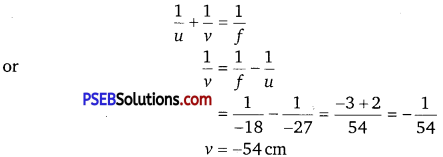
PSEB 12th Class Physics Solutions Chapter 9 Ray Optics and Optical Instruments 1

The negative sign shows that the image is formed in front of the mirror i.e., on the side of the object itself. Thus the screen must be placed at a distance of 54 cm in front of the mirror.
The magnification of the image is given as

The height of the candle’s image is 5 cm. The negative sign indicates that the image is inverted and virtual.
If the candle is moved closer to the mirror, then the screen will have to be moved away from the mirror in order to obtain the image.

Question 2.
A 4.5 cm needle is placed 12 cm away from a convex mirror of focal length 15 cm. Give the location of the image and the magnification. Describe what happens as the needle is moved farther from the mirror.
Answer:
Given u = -12 cm, f = +15 cm. (convex mirror)
PSEB 12th Class Physics Solutions Chapter 9 Ray Optics and Optical Instruments 3

That is image is formed at a distance of 6.67 cm behind the mirror.
Magnification m = \(-\frac{v}{u}=-\frac{\frac{20}{3}}{-12} \) = \(\frac{5}{9}\)
Size of image I = mO = \(\frac{5}{9}\) x 4.5 = 2.5 cm
The image is erect, virtual and has a size 2.5 cm.

Its position is 6.67 cm behind the mirror when needle is moved farther, the image moves towards the focus and its size goes on decreasing.

Question 3.
A tank is filled with water to a height of 12.5 cm. The apparent depth of a needle lying at the bottom of the tank is measured by a microscope to be 9.4 cm. What is the refractive index of water? If water is replaced by a liquid of refractive index 1.63 up to the same height, by what distance would the microscope have to be moved to focus on the needle again?
Answer:
Case I:
When tank is filled with water Actual depth of the needle in water, h1 = 12.5cm
Apparent depth of the needle in water, h2 =9.4cm
Refractive index of water = μ
The value μ can be obtained as follows
μ = \(\frac{\text { Actual depth }}{\text { Apparent depth }}\)
= \(\frac{h_{1}}{h_{2}}=\frac{12.5}{9.4}\) ≈ 1.33
Hence, the refractive index of water is about 1.33

Case II: When tank is filled with liquid
Water is replaced by a liquid of refractive index, μ’ = 1.63
The actual depth of the needle remains the same, but its apparent depth changes.
Let y be the new apparent depth of the needle. Hence, we can write the relation
μ’ = \(\frac{h_{1}}{y}\)
y = \(\frac{h_{1}}{\mu^{\prime}}=\frac{12.5}{1.63}\) = 7.67 cm
Hence, the new apparent depth of the needle is 7.67cm. It is less than h2 Therefore, to focus the needle again, the microscope should be moved up. Distance by which the microscope should be moved up =9.4-7.67 = 1.73 cm.

Question 4.
Figures 9.34 (a) and (b) show refraction of a ray in air incident at 60° with the normal to a glass air and water-air interface, respectively. Predict the angle of refraction in glass when the angle of incidence in water is 45° with the normal to a water-glass interface [Fig. 9.34 (c)]
PSEB 12th Class Physics Solutions Chapter 9 Ray Optics and Optical Instruments 4
Answer:
As per the given figure, for the glass-air interface
Angle of incidence, i = 60°
Angle of refraction, r = 35°
The relative refractive index of glass with respect to air is given by Snell’s law as
aμg = \( \frac{\sin i}{\sin r}\)
= \(\frac{\sin 60^{\circ}}{\sin 35^{\circ}}=\frac{0.8660}{0.5736}\) = 1.51 …………………….. (1)
As per the given figure, for the air-water interface
Angle of incidence, j = 600
Angle of refraction, r = 470
The relative refractive index of water with respect to air is given by Snell’s law as
wμw = \( \frac{\sin i}{\sin r}\)
= \(\frac{\sin 60^{\circ}}{\sin 47^{\circ}}=\frac{0.8660}{0.7314}\) = 1.184 …………………………… (2)

Using equations (1) and (2), the relative refractive index of glass with respect to water can be obtained as
wμg = \(\frac{a_{g}}{a_{w_{w}}}\)
= \( \frac{1.51}{1.184} \) = 1.275

The following figure shows the situation involving the glass-water interface
PSEB 12th Class Physics Solutions Chapter 9 Ray Optics and Optical Instruments 5
Angle of incidence, i = 45
Angle of reflection = r
From Snell’s law, r can be calculated as, \(\frac{\sin i}{\sin r}\) = wμg
\(\frac{\sin 45^{\circ}}{\sin r}\) = 1.275
sin r = \(\frac{\frac{1}{\sqrt{2}}}{1.275}=\frac{0.707}{1.275}\) = 0.5546
r = sin-1(0.5546) = 38.68°
Hence, the angle of refraction at the water-glass interface is 38.68°

Question 5.
A small bulb is placed at the bottom of a tank containirg water to a depth of 80 cm. What is the area of the surface of water through which light from the bulb can emerge out? Refractive index of water is 1.33 (Consider the bulb to be a point source.)
Answer:
Actual depth of the bulb in water, d1 = 80 cm = 0.8 m
Refractive index of water, μ = 1.33
The given situation is shown in the following figure
PSEB 12th Class Physics Solutions Chapter 9 Ray Optics and Optical Instruments 6
where,
i = Angle of Incidence
r = Angle of Refraction = 90°
Since the bulb is a point source, the emergent light can be considered as a circle of radius,
R = \(\frac{A C}{2}\) = AO = OC
Using Snell’s law, we can write the relation for the refractive index of water as
μ = \(\frac{\sin r}{\sin i}\)
1.33 = \(\frac{\sin 90^{\circ}}{\sin i}\)
i = sin-1\(\left(\frac{1}{1.33}\right)\) = 48.75°

Using the given figure, we have the relation
tan i = \(\frac{O C}{O B}=\frac{R}{d_{1}}\)
∴R = tan 48.75° x 0.8 = 0.91 m
∴ Area of the surface of water = πR2
= π(0.91)2
= 2.61 m2
Hence, the area of the surface of water through which the light from the bulb can emerge is approximately 2.61 m2.

Question 6.
A prism is made of glass of unknown refractive index. A parallel beam of light is incident on a face of the prism. The angle of minimum deviation is measured to be 40°. What is the refractive index of the material of the prism? The refracting angle of the prism is 60°. If the prism is placed in water (refractive index 1.33), predict the new angle of minimum deviation of a parallel beam of light.
Answer:
Angle of minimum deviation, δm = 40 °
Refracting angle of the prism, A = 60°
Refractive index of water, μ = 1.33
Let μ’ be the refractive index of the material of the prism.
The angle of deviation and refracting angle of the prism are related to refractive index (μ’) as
μ’ = \(\frac{\sin \left(\frac{A+\delta_{m}}{2}\right)}{\sin \left(\frac{A}{2}\right)} \)
= \(\frac{\sin \left(\frac{60^{\circ}+40^{\circ}}{2}\right)}{\sin \left(\frac{60^{\circ}}{2}\right)}=\frac{\sin 50^{\circ}}{\sin 30^{\circ}}=\frac{0.766}{0.5}\)
= 1.532
Hence, the refractive index of the material of the prism is 1.532.
Since the prism is placed in water, let 8 ^ be the new angle of minimum deviation for the same prism.

The refractive index of glass with respect to water is given by the relation
PSEB 12th Class Physics Solutions Chapter 9 Ray Optics and Optical Instruments 8
PSEB 12th Class Physics Solutions Chapter 9 Ray Optics and Optical Instruments 9
Hence, the new minimum angle of deviation is 10.32°.

Question 7.
Double-convex lenses are to be manufactured from a glass of refractive index 1.55, with both faces of the same radius of curvature. What is the radius of curvature required if the focal length is to be 20 cm?
Answer:
Lens maker formula is
\(\frac{1}{f}=(n-1)\left(\frac{1}{R_{1}}-\frac{1}{R_{2}}\right)\) …………………………………… (1)
If R is radius of curvature of double convex lens, then,
PSEB 12th Class Physics Solutions Chapter 9 Ray Optics and Optical Instruments 10
∴ R = 2(n-1)f
Here, n =1.55, f = +20 cm
∴ R = 2 (1.55 -1) x 20 = 22 cm

Question 8.
A beam of light converges at a point P. Now a lens is placed in the path of the convergent beam 12 cm from P. At what point does the beam converge if the lens is (a) a convex lens of focal length 20 cm, and (b) a concave lens of focal length 16 cm?
Answer:
In the given situation, the object is virtual and the image formed is real.
Object distance, u = +12cm
(a) Focal length of the convex lens, f = 20 cm
Image distance = v
According to the lens formula, we have the relation
PSEB 12th Class Physics Solutions Chapter 9 Ray Optics and Optical Instruments 11
∴ v = \(\frac{60}{8}\) = 7.5cm
Hence, the image is formed 7.5cm away from the lens, toward its right.

(b) Focal length of the concave lens, f = -16 cm
Image distance = v
According to the lens formula, we have the relation
PSEB 12th Class Physics Solutions Chapter 9 Ray Optics and Optical Instruments 12
∴ v = 48 cm
Hence, the image is formed 48 cm away from the lens, toward its right.

Question 9.
An object of size 3.0 cm is placed 14 cm in front of a concave lens of focal length 21 cm. Describe the image produced by the lens. What happens if the object is moved further away from the lens?
Answer:
Size of object O = 3.0 cm
u = -14 cm, f = -21 cm (concave lens)
∴ Formula \(\frac{1}{f}=\frac{1}{v}-\frac{1}{u}\)
⇒ \(\frac{1}{v}=\frac{1}{f}+\frac{1}{u}\)
or \(\frac{1}{v}=\frac{1}{-21}+\frac{1}{-14}=-\frac{2+3}{42}\)
or v = \(-\frac{42}{5}\) = -8.4 cm
Size of image I = \(\frac{v}{u}\) O
= \(\frac{-8.4}{-14}\) x 3.0 cm = 1.8 cm

That is, image is formed at a distance of 8.4 cm in front of lens. The image is virtual, erect and of size 1.8 cm. As the object is moved farther from the lens, the image goes on shifting towards focus and its size goes on decreasing. The image is never formed beyond the focus of the concave lens.

Question 10.
What is the focal length of a convex lens of focal length 30 cm in contact with a concave lens of focal length 20 cm? Is the system
a converging or a diverging lens? Ignore thickness of the lenses.
Answer:
Given f1 = +30 cm, f2 = -20 cm
The focal length (F) of combination is given by
\(\frac{1}{F}=\frac{1}{f_{1}}+\frac{1}{f_{2}}\)
⇒ F = \(\frac{f_{1} f_{2}}{f_{1}+f_{2}}\)
= \(\frac{30 \times(-20)}{30-20}\) = -60 cm
That is, the focal length of combination is 60 cm and it acts like a diverging lens.

Question 11.
A compound microscope consists of an objective lens of focal length 2.0 cm and an eyepiece of focal length 6.25 cm separated by a distance of 15 cm. How far from the objective should an object be placed in order to obtain the final image at (a) the least distance of distinct vision (25cm), and (b) at infinity? What is the magnifying power of the microscope in each case?
Answer:
Focal length of the objective lens, f0 = 2.0 cm
Focal length of the eyepiece, fe = 6.25cm
Distance between the objective lens and the eyepiece, d = 15cm
(a) Least distance of distinct vision, d’ = 25cm
∴ Image distance for the eyepiece, ve = -25cm
Object distance for the eyepiece = ue
According to the lens formula, we have the relation
\(\frac{1}{v_{e}}-\frac{1}{u_{e}}=\frac{1}{f_{e}}\)
or \(\frac{1}{u_{e}}=\frac{1}{v_{e}}-\frac{1}{f_{e}}\)
= \(\frac{1}{-25}-\frac{1}{6.25}=\frac{-1-4}{25}=\frac{-5}{25}\)
∴ ue = -5cm
Image distance for the objective lens, v0 = d + ue =15-5 = 10 cm
Object distance for the objective lens = u0
According to the lens formula, we have the relation
\(\frac{1}{v_{o}}-\frac{1}{u_{o}}=\frac{1}{f_{o}}\)
\(\frac{1}{u_{0}}=\frac{1}{v_{0}}-\frac{1}{f_{0}}=\frac{1}{10}-\frac{1}{2}=\frac{1-5}{10}=\frac{-4}{10}\)
∴ u0=-2.5cm
Magnitude of the object distance, |u0| = 2.5 cm
The magnifying power of a compound microscope is given by the relation
m = \(\frac{v_{o}}{\left|u_{o}\right|}\left(1+\frac{d^{\prime}}{f_{e}}\right)\)
= \(\frac{10}{2.5}\left(1+\frac{25}{6.25}\right)\) = 4(1+4) = 20
Hence, the magnifying power of the microscope is 20.

(b) The final image is formed at infinity.
∴ Image distance for the eyepiece, ve = ∞
Object distance for the eyepiece = ue
According to the lens formula, we have the relation
\(\frac{1}{v_{o}}-\frac{1}{u_{o}}=\frac{1}{f_{o}}\)
\(\frac{1}{u_{o}}=\frac{1}{v_{o}}-\frac{1}{f_{o}}=\frac{1}{8.75}-\frac{1}{2.0}=\frac{2-8.75}{17.5}\)
∴ u0 = \(\frac{17.5}{6.75}\) = -2.59 cm
Magnitude of the object distance, |u0| = 2.59 cm
The magnifying power of a compound microscope is given by the relation
m = \(\frac{v_{o}}{\left|u_{o}\right|}\left(1+\frac{d^{\prime}}{f_{e}}\right)\)
= \(\frac{8.75}{2.59} \times\left(1+\frac{25}{6.25}\right)\) = 13.51
Hence, the magnifying power of the microscope is 13.51.

Question 12.
A person with a normal near point (25cm) using a compound microscope with objective of focal length 8.0 mm and an eyepiece of focal length 2.5 cm can bring an object placed at 9.0 mm from the objective in sharp focus. What is the separation between the two lenses? Calculate the magnifying power of the microscope.
Answer:
Focal length of the objective lens, f0= 8 mm = 0.8cm
Focal length of the eyepiece, fe = 2.5 cm
Object distance for the objective lens, u0 = -9.0 mm = -0.9 cm
Least distance of distant vision, d = 25 cm
Image distance for the eyepiece, ve = -d = -25 cm
Object distance for the eyepiece = ue

Using the lens formula, we can obtain the value of ue as
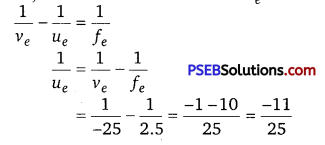
PSEB 12th Class Physics Solutions Chapter 9 Ray Optics and Optical Instruments 13
∴ ue = \(-\frac{25}{11}\) = -2.27 cm
We can also obtain the value of the image distance for the objective lens (v0) using the lens formula.
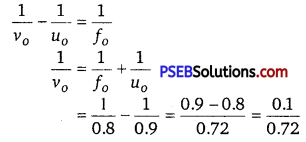
PSEB 12th Class Physics Solutions Chapter 9 Ray Optics and Optical Instruments 14
∴ v0 = 7.2 cm
The distance between the objective lens and the eyepiece = |ue|+v0
= 2.27+ 7.2 = 9.47cm
The magnifying power of the microscope is calculated as \(\frac{v_{o}}{\left|u_{o}\right|}\left(1+\frac{d}{f_{e}}\right)\)
= \(\frac{7.2}{0.9}\left(1+\frac{25}{2.5}\right)\)
= 8(1 +10) = 88
Hence, the magnifying power of the microscope is 88.

Question 13.
A small telescope has an objective lens of focal length 144 cm and an eyepiece of focal length 6.0cm. What is the magnifying power of the telescope? What is the separation between the objective and the eyepiece?
Answer:
Focal length of the objective lens, f0 = 144 cm
Focal length of the eyepiece, fe = 6.0 cm
The magnifying power of the telescope is given as, m = \(\frac{f_{o}}{f_{e}}=\frac{144}{6}\) = 24
The separation between the objective lens and the eyepiece is calculated as
= fo + fe
= 144 + 6 = 150 cm
Hence, the magnifying power of the telescope is 24 and the separation between the objective lens and the eyepiece is 150 cm.

Question 14.
(a) A giant refracting telescope at an observatory has an objective lens of focal length 15 m. If an eyepiece of focal length 1.0 cm is used, what is the angular magnification of the telescope?
(b) If this telescope is used to view the moon, what is the diameter of the image of the moon formed by the objective lens? The diameter of the moon is 3.48 x 10⁶ m, and the radius of lunar orbit is 3.8 x 10⁸ m.
Answer:
(a) Given f0 = 15 m,
fe = 1.0 cm = 1.0 x 10⁻² m
Angular magnification of telescope,
m = \(-\frac{f_{o}}{f_{e}}=-\frac{15}{1.0 \times 10^{-2}}\) = -1500
Negative sign shows that the final image is inverted.
(b) Let D be diameter of moon, d diameter of image of moon formed by objective and r be the distance of moon from objective lens, then
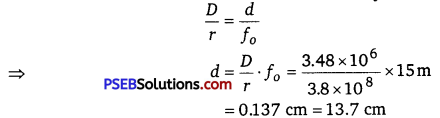
PSEB 12th Class Physics Solutions Chapter 9 Ray Optics and Optical Instruments 15

Question 15.
Use the mirror equation to deduce that:
(a) an object placed between f and 2f of a concave mirror produces a real image beyond 2f.
(b) a convex mirror always produces a virtual image independent of the location of the object.
(c) the virtual image produced by a convex mirror is always diminished In size and is located between the focus and the
pole.
(d) an object placed between the pole and focus of a concave mirror produces a virtual and enlarged image.
[Note: This exercise helps you deduce algebraically properties of images that one obtains from explicit ray diagrams.]
Answer:
(a) For a concave mirror, the focal length (f) is negative
∴ f<o
When the object is placed on the left side of the mirror, the object distance (u) is negative.
∴ u<O
For image distance v, we can write the mirror formula
\(\frac{1}{v}=\frac{1}{f}-\frac{1}{u}\) …………………………………… (1)
The object lies between f and 2f.
∴ 2f < u < f (∵ u and f are negative) ∴ \(\frac{1}{2 f}>\frac{1}{u}>\frac{1}{f}\)
\(-\frac{1}{2 f}<-\frac{1}{u}<-\frac{1}{f}\)
\(\frac{1}{f}-\frac{1}{2 f}<\frac{1}{f}-\frac{1}{u}<0\) ………………………………… (2)
Using equation (1), we get
\(\frac{1}{2 f}<\frac{1}{v}<0\)

∴ \(\frac{1}{v}\) is negative, i.e., v is negative.
\(\frac{1}{2 f}<\frac{1}{v}\) 2f > v
-v > -2 f
Therefore, the image lies beyond 2f.

(b) For a convex mirror, the focal length (f) is positive.
∴ f>o
When the object is placed on the left side of the mirror, the object distance (u) is negative.
∴ u<O
For image distance y, we have the mirror formula
\(\frac{1}{v}=\frac{1}{f}-\frac{1}{u}\)
Using equation (2), we can conclude that
\(\frac{1}{\nu}\) < 0 v v> 0
Thus, the image is formed on the back side of the mirror.
Hence, a convex mirror always produces a virtual image, regardless of the object distance.

(c) For a convex mirror, the focal length (f) is positive.
∴ f> 0
When the object is placed on the left side of the mirror, the object distance (u) is negative.
∴ u< 0
For image distance v, we have the mirror formula
\(\frac{1}{v}=\frac{1}{f}-\frac{1}{u}\)
But we have u < 0 ∴ \(\frac{1}{v}>\frac{1}{f}\)
v < f
Hence, the image formed is diminished and is located between the focus (f) and the pole.

(d) For a concave mirror, the focal length (f) is negative.
∴ f< 0
When the object is placed on the left side of the mirror, the object distance (u) is negative.
∴ u< 0 It is placed between the focus (f) and the pole. ∴f > u > 0
\(\frac{1}{f}<\frac{1}{u}\) < 0 \(\frac{1}{f}-\frac{1}{u}\) > 0
For image distance v, we have the mirror formula
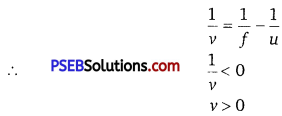
PSEB 12th Class Physics Solutions Chapter 9 Ray Optics and Optical Instruments 16
The image is formed on the right side of the mirror. Hence, it is a virtual image.
For u < 0 and v > 0, we can write
\(\frac{1}{u}>\frac{1}{v}\)
v > u
Magnification, m = \(\frac{v}{u}\) > 1 u
Hence, the formed image is enlarged.

Question 16.
A small pin fixed on a tabletop is viewed from above from a distance of 50 cm. By what distance would the pin appear to be raised if it is viewed from the same point through a 15 cm thick glass slab held parallel to the table? Refractive index of glass = 1.5. Does the answer depend on the location of the slab?
Answer:
Actual depth of the pin, d = 15cm
Apparent depth of the pin = d’
Refractive index of glass, µ = 1.5

Ratio of actual depth to the apparent depth is equal to the refractive index of glass, i.e.
µ = \(\frac{d}{d^{\prime}}\)
∴ d’ = \(\frac{d}{\mu}\)
= \(\frac{15}{1.5}\) = 10 cm
The distance at which the pin appears to be raised = d-d’=15-10 = 5 cm
For a small angle of incidence, this distance does not depend upon the location of the slab.

Question 17.
(a) Figure 9.35 shows a cross-section of a ‘light pipe’ made of a glass fibre of refractive index 1.68. The outer covering of the pipe is made of a material of refractive index 1.44. What is the range of the angles of the incident rays with the axis of the pipe for which total reflections inside the pipe take place, as shown in the figure.
(b) What is the answer if there is no outer covering of the pipe?
PSEB 12th Class Physics Solutions Chapter 9 Ray Optics and Optical Instruments 17
Answer:
(a) Refractive index of the glass fibre, µ2 = 1.68
Refractive index of the outer covering of the pipe, µ1 =1.44
Angle of incidence = i
Angle of refraction = r
Angle of incidence at the interface = i’

The refractive index (µ) of the inner core-outer core interface is given as
µ = \(\frac{\mu_{2}}{\mu_{1}}=\frac{1}{\sin i^{\prime}}\)
sin i’ = \(\frac{\mu_{1}}{\mu_{2}}=\frac{1.44}{1.68}\) = 0.8571
∴ i’ = 59°

For the critical angle, total internal reflection (TIR) takes place only when i > i’. i.e., i > 59°
Maximum angle of reflection, rmax = 90°-i’ = 90°-59°= 31°
Let, imax be the maximum angle of incidence.
The refractive index at the air – glass interface, µ2 =1.68
µ2 = \(\frac{\sin i_{\max }}{\sin r_{\max }}\)
sin imax = µ2 sin rmax = 1.68 sin31°
= 1.68 x 0.5150
= 0.8652
∴imax = sin-1 (0.8652) ≈ 60°
Thus, all the rays incident at angles lying in the range 0 < i < 60° will suffer total internal reflection.

(b) If the outer covering of the pipe is not present, then
Refractive index of the outer pipe, µ1 = Refractive index of air = 1
For the angle of incidence i =90°, we can write Snell’s law at the air-pipe interface as
\(\frac{\sin i}{\sin r}\) = µ2 = 1.68
sin r = \(\frac{\sin 90^{\circ}}{1.68}=\frac{1}{1.68}\)
r = sin-1(0.5952)
∴ i’ = 90°-36.5°= 53.5°
Since i’ > r, all incident rays will suffer total internal reflection.

Question 18.
Answer the following questions:
(a) You have learnt that plane and convex mirrors produce virtual images of objects. Can they produce real images under some circumstances? Explain.
(b) A virtual image, we always say, cannot be caught on a screen. Yet when we ‘see’ a virtual image, we are obviously bringing it onto the ‘screen’(i.e., the retina) of our eye. Is there a contradiction?
(c) A diver underwater, looks obliquely at a fisherman standing on the bank of a lake. Would the fisherman look taller or shorter to the diver than what he actually is?
(d) Does the apparent depth of a tank of water change if viewed obliquely? If so, does the apparent depth increase or decrease?
(e) The refractive index of diamond is much greater than that – of ordinary glass. Is this fact of some use to a diamond cutter?
Answer:
(a) Yes, they produce real images under some circumstances. If the object is virtual, i.e., if the light rays converging at a point behind a plane mirror (or a convex mirror) are reflected to a point on a screen placed in front of the mirror, then a real image will be formed.

(b) No, there is no contradiction. A virtual image is formed when light rays diverge. The convex lens of the eye causes these divergent rays to converge at the retina. In this case, the virtual image serves as an object for the lens to produce a real image.

(c) The diver is in the water and the fisherman is on land (i.e., in the air). Water is a denser medium than air. It is given that the diver is viewing the fisherman. This indicates that the light rays are traveling from a denser medium to a rarer medium. Hence, the refracted rays will move away from the normal. As a result, the fisherman will appear to be taller.

(d) Yes, the apparent depth of a tank of water changes when viewed obliquely. This is because light bends on traveling from one medium to another. The apparent depth of the tank, when viewed obliquely, is less than the near-normal viewing.

(e) Yes, the refractive index of diamond (2.42) is more than that of ordinary glass (1.5). The critical angle for diamond is less than that for glass. A diamond cutter uses a large angle of incidence to ensure that the light entering the diamond is totally reflected from its faces. This is the reason for the sparkling effect of a diamond.

Question 19.
The image of a small electric bulb on the wall of a room is to be obtained on the opposite wall 3 m away by means of a large convex lens. What is the maximum possible focal length of the lens required for the purpose? ’’
Answer:
Here, u + v = 3 m, :.v = 3 -u
From lens formula,
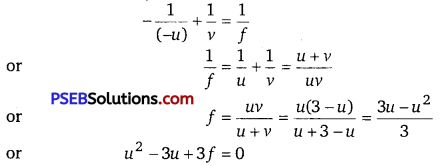
PSEB 12th Class Physics Solutions Chapter 9 Ray Optics and Optical Instruments 18
or u = \(\frac{3 \pm \sqrt{3^{2}-4.3 f}}{2}\)
For real solution, 9 -12, f should be positive.
It., 9 -12f > 0
or 9 >12f.
or f < \(\frac{9}{12}\) < \(\frac{3}{4}\) m
∴ The maximum focal length of the lens required for the purpose is \(\frac{3}{4}\) m
i.e, fmax = 0.7 m

Question 20.
A screen is placed 90 cm from an object. The image of the object on the screen is formed by a convex lens at two different locations separated by 20 cm. Determine the focal length of the lens.
Answer:
Here, O is a position of object and I is position of image (screen).
Distance OI = 90 cm
L1 and L2 are the two positions of the lens.
∴ Distance between L1 and L2 = O1 O2 = 20 cm
For Position L1 of the Lens: Let x be the distance of the object from the lens.
∴ u1 = -x
∴ Distance of the image from the lens, v1 = +(90 – x)
PSEB 12th Class Physics Solutions Chapter 9 Ray Optics and Optical Instruments 19
If f be the focal length of the lens, then using lens formula,
\(-\frac{1}{u}+\frac{1}{v}=\frac{1}{f}\) we get
\(-\frac{1}{-x}+\frac{1}{90-x}=\frac{1}{f}\)
or \(\frac{1}{f}=\frac{1}{x}+\frac{1}{90-x}\) ……………………………….. (1)
For Position L2 of the Lens : Let u2 and v2 be the distances of the object and image from the lens in this position.
∴ u2=-(X + 20),
v2 = +[90-(x+20)] = +(70-x)
∴ Using lens formula,
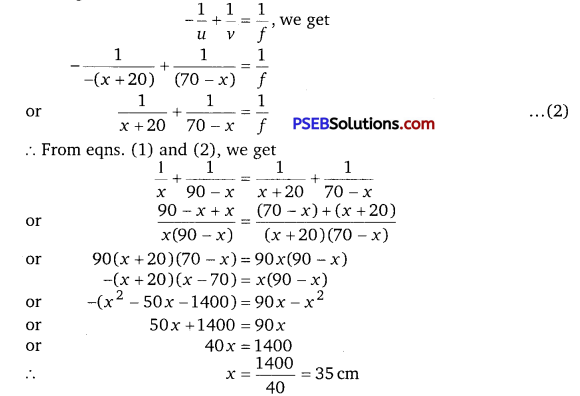
PSEB 12th Class Physics Solutions Chapter 9 Ray Optics and Optical Instruments 20
PSEB 12th Class Physics Solutions Chapter 9 Ray Optics and Optical Instruments 21

Question 21.
(a) Determine the ‘effective focal length’ of the combination of the two lenses in Exercise 9.10, if they are placed 8.0 cm apart with their principal axes coincident. Does the answer depend on which side of the combination a beam of parallel light is incident? Is the notion of effective focal length of this system useful at all?

(b) An object 1.5 cm in size is placed on the side of the convex lens in the arrangement (a) above. The distance between the object and the convex lens is 40 cm. Determine the magnification produced by the two-lens system and the size of the image.
Answer:
Focal length of the convex lens, f1 = 30 cm
Focal length of the concave lens,f2 = -20 cm
Distance between the two lenses, d = 8.0 cm

(a)
(i) When the parallel beam of light is incident on the convex lens first.
According to the lens formula, we have
\(\frac{1}{v_{1}}-\frac{1}{u_{1}}=\frac{1}{f_{1}}\)
where, μ1 = Object distance = ∞, v1 = Image distance = ?
\(\frac{1}{v_{1}}=\frac{1}{30}-\frac{1}{\infty}=\frac{1}{30}\)
∴ v1 = 30 cm
The image will act as a virtual object for the concave lens. Applying lens formula to the concave lens, we have
\(\frac{1}{v_{2}}-\frac{1}{u_{2}}=\frac{1}{f_{2}}\)
where, u2 = Object distance = (30 – d) = 30 – 8 = 22 cm,
v2 = Image distance=?
\(\frac{1}{v_{2}}=\frac{1}{22}-\frac{1}{20}=\frac{10-11}{220}=\frac{-1}{220}\)
∴ v2 = -220 cm
The parallel incident beam appears to diverge from a point that is \(\left(220-\frac{d}{2}=220-\frac{8}{2}=220-4=216 \mathrm{~cm}\right)\) from the centre of the combination of the two lenses.

(ii) When the parallel beam of light is incident, on the concave lens first. According to the lens formula, we have
\(\frac{1}{v_{2}}-\frac{1}{u_{2}}=\frac{1}{f_{2}}\)
\(\frac{1}{v_{2}}=\frac{1}{f_{2}}+\frac{1}{u_{2}}\)
where, u2 = Object distance = -∞, v2 = Image distance = ?
\(\frac{1}{v_{2}}=\frac{1}{-20}+\frac{1}{-\infty}=-\frac{1}{20}\)
∴ v2 = -20 cm
The image will act as a real object for the .convex lens.
Applying lens formula to the convex lens, we have
\(\frac{1}{v_{1}}-\frac{1}{u_{1}}=\frac{1}{f_{1}}\)
where, u1 = Object distance = -(20 + d) = -(20 + 8) = -28 cm v1 = Image distance = ?
\(\frac{1}{v_{1}}=\frac{1}{30}+\frac{1}{-28}=\frac{14-15}{420}=\frac{-1}{420}\)
∴ v1 = -420 cm
Hence, the parallel incident beam appear to diverge from a point that is (420 – 4 = 416 cm) from the left of the centre of the combination of the two lenses. The answer depends on the side of the combination at which the parallel beam of light is incident. The notion of effective focal length does not seem to be useful for this combination.

(b) Height of the object, h1 =1.5 cm
Object distance from the side of the convex lens, u1 = -40 cm
|ui| = 40 cm

According to the lens formula
\(\frac{1}{v_{1}}-\frac{1}{u_{1}}=\frac{1}{f_{1}}\)
where, v1 = Image distance =?
\(\frac{1}{v_{1}}=\frac{1}{30}+\frac{1}{-40}=\frac{4-3}{120}=\frac{1}{120}\)
∴ v1 = 120 cm
Magnification, m= \(\frac{v_{1}}{\left|u_{1}\right|}=\frac{120}{40}\) = 3

Hence, the magnification due to the convex lens is 3.
The image formed by the convex lens acts as an object for the concave lens.
According to the lens formula
\(\frac{1}{v_{2}}-\frac{1}{u_{2}}=\frac{1}{f_{2}}\)
where,
u2 = Object distance = +(120 —8)=112 cm
v2= Image distance =?
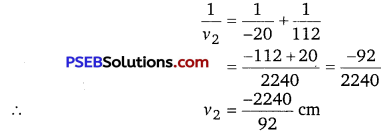
PSEB 12th Class Physics Solutions Chapter 9 Ray Optics and Optical Instruments 22
Magnification, m’ = \(\left|\frac{v_{2}}{u_{2}}\right|=\frac{2240}{92} \times \frac{1}{112}=\frac{20}{92}\)
Hence, the magnification due to the concave lens is \(\frac{20}{92}\)
The magnification produced by the combination of the two lenses is calculated as m x m’ = \(3 \times \frac{20}{92}=\frac{60}{92}\) = 0.652
The magnification of the combination is given as
\(\frac{h_{2}}{h_{1}}\) = 0.652
h2 = 0.652 x h1
where, h1 = Object size = 1.5 cm,
h2 = Size of the image
∴ h2 = 0.652 x 1.5 = 0.98 cm
Hence, the height of the image is 0.98 cm.

Question 22.
At what angle should a ray of light be incident on the face of a prism of refracting angle 60° so that it just suffers total internal reflection at the other face? The refractive index of the material of the prism is 1.524.
Answer:
The incident, refracted, and emergent rays associated with a glass prism ABC are shown in the given figure
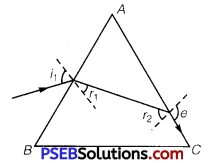
PSEB 12th Class Physics Solutions Chapter 9 Ray Optics and Optical Instruments 23
Angle of prism, A = 60°
Refractive index of the prism, μ = 1.524
i1 = Incident angle
r2 = Refracted angle
r2 = Angle of incidence at the face
AC = e = Emergent angle = 90°

According to Snell’s law, for face AC, we can have sine
\(\frac{\sin e}{\sin r_{2}}\) = μ
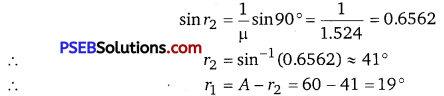
PSEB 12th Class Physics Solutions Chapter 9 Ray Optics and Optical Instruments 24
It is clear from the figure that angle A = r1 + r2
According to Snell’s law, we have the relation
μ = \(\frac{\sin i_{1}}{\sin r_{1}} \)
sin i1 = μ sin r1
= 1.524 x sin19°= 0.496
∴ i1= 29.75°
Hence, the angle of incidence is 29.75°.

Question 23.
You are given prisms made of crown glass and flint glass with a wide variety of angles. Suggest a combination of prisms which will
(a) deviate a pencil of white light without much dispersion,
(b) disperse (and displace) a pencil of white light without much deviation.
Answer:
(a) Place the two prisms beside each other. Make sure that their bases are on the opposite sides of the incident white light, with their faces touching each other. When the white light is incident on the first prism, it will get dispersed. When this dispersed light is incident on the second prism, it will recombine and white light will emerge from the combination of the two prisms.

(b) Take the system of the two prisms as suggested in answer (a). Adjust (increase) the angle of the flint-glass-prism so that the deviations due to the combination of the prisms become equal. This combination will disperse the pencil of white light without much deviation.

Question 24.
For a normal eye, the far point is at infinity and the near point of distinct vision is about 25 cm in front of the eye. The cornea of . the eye provides a converging power of about 40 dioptres, and the least converging power of the eye-lens behind the cornea is about 20 dioptres. From this rough data estimate the range of accommodation (i.e., the range of converging power of the eye-lens) of a normal eye.
Answer:
Least distance of distinct vision, d = 25 cm
Far point of a normal eye, d’ = ∞
Converging power of the cornea, Pc = 40 D
Least converging power of the eye- lens, Pe = 20 D
To see the objects at infinity, the eye uses its least converging power.
Power of the eye-lens, P = Pc + Pe =40+20 = 60 D
Power of the eye-lens is given as
P = \(\frac{1}{\text { Focal length of the eye lens }(f)} \)
f = \(=\frac{1}{P}=\frac{1}{60 D}=\frac{100}{60}=\frac{5}{3}\) cm

To focus an object at the near point, object distance (u) = -d = -25 cm
Focal length of the eye-lens = Distance between the cornea and the retina = Image distance
Hence, image distance, v = \( \frac{5}{3}\) cm
According to the lens formula, we can write
\(\frac{1}{f^{\prime}}=\frac{1}{v}-\frac{1}{u}\)
Where f’ = Focal length
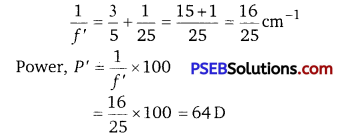
PSEB 12th Class Physics Solutions Chapter 9 Ray Optics and Optical Instruments 25
Power of the eye-lens = 64-40 = 24 D
Hence, the range of accommodation of the eye-lens is from 20 D to24D.

Question 25.
Does short-sightedness (myopia) or long-sightedness (hypermetropia) imply necessarily that the eye has partially lost its ability of accommodation? If not, what might cause these defects of vision?
Answer:
A myopic or hypermetropic person can also possess the normal ability of accommodation of the eye-lens. Myopia occurs when the eyeballs get elongated from front to back. Hypermetropia occurs when the eye-balls get shortened.
When the eye-lens loses its ability of accommodation, the defect is called presbyopia.

Question 26.
A myopic person has been using spectacles of power -1.0 dioptre for distant vision. During old age he also needs to use separate reading glass of power +2.0 dioptres. Explain what may have happened.
Answer:
The power of the spectacles used by the myopic person, P = -1.0 D
Focal length of the spectacles, f = \(\frac{1}{P}=\frac{1}{-1 \times 10^{-2}}\) = -100 cm
Hence, the far point of the person is 100 cm. He might have a normal near point of 25 cm. When he uses the spectacles, the objects placed at infinity produce virtual images at 100 cm.
He uses the ability of accommodation of the eye-lens to see the objects placed between 100 cm and 25 cm.
During old age, the person uses reading glasses of power, P’ = +2D The ability of accommodation is lost in old age.
This defect is called presbyopia. As a result, he is unable to see clearly the objects placed at 25 cm.

Question 27.
A person looking at a person wearing a shirt with a pattern comprising vertical and horizontal lines is able to see the vertical lines more distinctly than the horizontal ones. What is this defect due to? How is such a defect of vision corrected?
Answer:
In the given case, the person is able to see vertical lines more distinctly than horizontal lines. This means that the refracting system (cornea and eye-lens) of the eye is not working in the same way in different planes. This defect is tailed astigmatism. The person’s eye has enough curvature in the vertical plane. However, the curvature in the horizontal plane is insufficient. Hence, sharp images of the vertical lines are formed on the retina, but horizontal lines appear blurred. This defect can be corrected by using cylindrical lenses.

Question 28.
A man with normal near point (25cm) reads a book with small print using a magnifying glass: a thin convex lens of focal length 5 cm.
(a) What is the closest and the farthest distance at which he should keep the lens from the page so that he can read the book when viewing through the magnifying glass?
(b) What is the maximum and the minimum angular magnification (magnifying power) possible using the above simple microscope?
Answer:
(a) Focal length of the magnifying glass, f = 5 cm
Least distance of distinct vision, d = 25 cm
Closest object distance = u
Image distance, v = -d = -25 cm
According to the lens formula, we have
PSEB 12th Class Physics Solutions Chapter 9 Ray Optics and Optical Instruments 26
PSEB 12th Class Physics Solutions Chapter 9 Ray Optics and Optical Instruments 27
Hence, the closest distance at which the person can read the book is 4.167 cm.
For the object at the farthest distance (u’), the image distance (v’) = ∞

According to the lens formula, we have

PSEB 12th Class Physics Solutions Chapter 9 Ray Optics and Optical Instruments 28
∴ u’ = -5 cm
Hence, the farthest distance at which the person can read the book is 5 cm.
(b) Maximum angular magnification is given by the relation
αmax= \(\frac{d}{|u|}=\frac{25}{\frac{25}{6}} \) = 6
Minimum angular magnification is given by the relation
αmin = \(\frac{d}{\left|u^{\prime}\right|}=\frac{25}{5} \) = 5.

Question 29.
A card sheet divided into squares each of size 1 mm2 is being viewed at a distance of 9 cm through a magnifying glass (a converging lens of focal length 10 cm) held close to the eye.
(a) What is the magnification produced by the lens? How much is the area of each square in the virtual image?
(b) What is the angular magnification (magnifying power) of the lens?
(c) Is the magnification in (a) equal to the magnifying power in (b)?
Explain.
Answer:
(a) Area of each square, A = 1 mm2
Object distance, u = -9 cm
Focal length of the converging lens, f = 10 cm
For image distance v, the lens formula can be written as
PSEB 12th Class Physics Solutions Chapter 9 Ray Optics and Optical Instruments 29
∴ v = -90 cm
Magnification, m = \(=\frac{v}{u}=\frac{-90}{-9}\) =10
∴ Area of each square in the virtual image = (10)2A
= 102 x 1 =100 mm2 = 1 cm2
(b) Magnifying power of the lens = \(\frac{d}{|u|}=\frac{25}{9}\) = 2.8
(c) The magnification in (a) is not the same as the magnifying power in(b).
The magnification magnitude is \(\left(\left|\frac{v}{u}\right|\right)\) and the magnifying power is \(\left(\frac{d}{|u|}\right) \) .
The two quantities will be equal when the image is formed at the near point (25 cm).

Question 30.
(a) At what distance should the lens be held from the figure in Exercise 9.29 in order to view the squares distinctly with the maximum possible magnifying power?
(b) What is the magnification in this case?
(c) Is the magnification equal to the magnifying power in this case? Explain.
Answer:
(a) The maximum possible magnification is obtained when the image is formed at the near point (d = 25cm).
Image distance, v = -d = -25 cm
Focal length, f = 10 cm
Object distance = u
According to the lens formula, we have
PSEB 12th Class Physics Solutions Chapter 9 Ray Optics and Optical Instruments 30
∴ u = \(-\frac{50}{7}\) = -7.14 cm
Hence, to view the squares distinctly, the, lens should be kept 7.14 cm away from them. .
(b) Magnifying = \(\left|\frac{v}{u}\right|=\frac{25}{50}\) =3.5
(c) Magnifying power = \(\frac{d}{u}=\frac{25}{\frac{50}{7}}\) = 3.5
Since the image is formed at the near point (25 cm), the magnifying power is equal to the magnitude of magnification.

Question 31.
What should be the distance between the object in Exercise 9.30 and the magnifying glass if the virtual image of each square in the figure is to have an area of 6.25 mm2. Would you be able to see the squares distinctly with your eyes very close to the magnifier? [Note: Exercises 9.29 to 9.31 will help you clearly understand the difference between magnification in absolute size and the angular magnification (or magnifying power) of an instrument.]
Answer:
Area of the virtual image of each square, A = 6.25 mm
Area of each square, A0 = 1 mm2
Hence, the linear magnification of the object can be calculated as
m = \(\sqrt{\frac{A}{A_{0}}}=\sqrt{\frac{6.25}{1}} \) = 2.5
But m = \(\frac{\text { Image distance }(v)}{\text { Object distance }(u)} \)
∴ v = mu = 2.5 u
Focal length of the magnifying glass, f = 10 cm

According to the lens formula, we have the relation
PSEB 12th Class Physics Solutions Chapter 9 Ray Optics and Optical Instruments 31
∴ u = \(-\frac{1.5 \times 10}{2.5}\) = -6 cm
and v = 2.5 u = 2.5 x 6 = -15 cm
The virtual image is formed at a distance of 15 cm, which is less than the near point (i.e., 25 cm) of a normal eye. Hence, it cannot be seen by the eyes distinctly.

Question 32.
Answer the following questions:
(a) The angle subtended at the eye by an object is equal to the angle subtended at the eye by the virtual image produced by a magnifying glass. In what sense then does a magnifying glass provide angular magnification?
(b) In viewing through a magnifying glass, one usually positions one’s eyes very close to the lens. Does angular magnification change if the eye is moved back?
(c) Magnifying power of a simple microscope is inversely proportional to the focal length of the lens. What then stops us from using a convex lens of smaller and smaller focal length and achieving greater and greater magnifying power?
(d) Why must both the objective and the eyepiece of a compound microscope have short focal lengths?
(e) When viewing through a compound microscope, our eyes should be positioned not on the eyepiece but a short distance away from it for best viewing. Why? How much should be that short distance between the eye and eyepiece?
Answer:
(a) Though the image size is bigger than the object, the angular size of the image is equal to the angular size of the object. A magnifying glass helps one see the objects placed closer than the least distance of distinct vision (i.e., 25 cm). A closer object causes a larger angular size. A magnifying glass provides angular magnification. Without magnification, the object cannot be placed closer to the eye. With magnification, the object can be placed much closer to the eye.

(b) Yes, the angular magnification changes when the distance between the eye and a magnifying glass is increased, the angular magnification decreases a little. This is because the angle subtended at the eye is slightly less than the angle subtended at the lens. Image distance does not have any effect on angular magnification.

(c) The focal length of a convex lens cannot be decreased by a greater amount. This is because making lenses having very small focal lengths is not easy. Spherical and chromatic aberrations are produced by a convex lens having a very small focal length.

(d) The ang lar magificarin produced by’the eyepiece of a compound microscope is \(\left[\left(\frac{25}{f_{e}}\right)+1\right]\)
Where fe = Focal length of the eyepiece
It can be inferred that fe is small, then angular magnification of the eyepiece will be large.
The angular magnification of the objective lens of a compound microscope is given as
\(\frac{1}{\left(\left|u_{o}\right| f_{o}\right)}\)
Where, u0 = Object distance for the objective lens, f0 = Focal length of the objective
The magnification is large when u0> f0 . In the case of a microscope, the object is kept close to the objective lens. Hence, the object distance is very little.
Since u0 is small, f0 will be even smaller. Therefore, fe and f0 are both small in the given condition.

(e) When we place our eyes too close to the eyepiece of a compound microscope, we are unable to collect much-refracted light. As a result, the field of view decreases substantially. Hence, the clarity of the image gets blurred.
The best position of the eye for viewing through a compound microscope is at the eye-ring attached to the eyepiece. The precise location of the eye depends on the separation between the objective lens and the eyepiece.

Question 33.
An angular magnification (magnifying power) of 30X is desired using an objective of focal length 1.25 cm and an eyepiece of focal length 5 cm. How will you set up the compound microscope?
Answer:
Focal length of the objective lens, f0 = 1.25 cm
Focal length of the eyepiece, fe = 5 cm
Least distance of distinct vision, d = 25 cm

Angular magnification of the compound microscope = 30X
Total magnifying power of the compound microscope, m = 30
The angular magnification of the eyepiece is given by the relation
me = \(\left(1+\frac{d}{f_{e}}\right)=\left(1+\frac{25}{5}\right)\) = 1+5 = 6
The angular magnification of the objective lens (m0) is related to me as
mome=m
or m0 = \(\frac{m}{m_{e}}=\frac{30}{6}\) = 5

We also have the relation
m = \( \frac{\text { Image distance for the objective lens }\left(v_{o}\right)}{\text { Object distance for the objective lens }\left(-u_{0}\right)}\)
5 = \(\frac{v_{o}}{-u_{o}}\)
∴ v0 = -5u0 …………………………….. (1)
Applying the lens formula for the objective lens
PSEB 12th Class Physics Solutions Chapter 9 Ray Optics and Optical Instruments 32
and v0 = -5u0
= -5 x (-1.5) = 7.5 cm
The object should be placed 1.5 cm away from the objective lens to obtain the desired magnification.
Applying the lens formula for the eyepiece
\(\frac{1}{v_{e}}-\frac{1}{u_{e}}=\frac{1}{f_{e}}\)
where,
ve = Image distance for the eyepiece = -d = -25 cm
ue = Object distance for the eyepiece
\(\frac{1}{u_{e}}=\frac{1}{v_{e}}-\frac{1}{f_{e}}=\frac{-1}{25}-\frac{1}{5}=-\frac{6}{25}\)
ue =-4.17 cm
Separation between the objective lens and the eyepiece = \(\left|u_{e}\right|+\left|v_{o}\right|\)
= 4.17 + 7.5 = 11.67 cm
Therefore, the separation between the objective lens and the eyepiece should be 11.67 cm.

Question 34.
A small telescope has an objective lens of focal length 140 cm and an eyepiece of focal length 5.0 cm. What is the magnifying power of the telescope for viewing distant objects when
(a) the telescope is in normal adjustment (i.e., when the final image is at infinity)?
(b) the final image is formed at the least distance of distinct vision (25 cm)?
Answer:
Focal length of the objective lens, f0 =140 cm
Focal length of the eyepiece, fe = 5 cm
Least distance of distinct vision, d = 25 cm
(a) When the telescope is in normal adjustment, its magnifying power is given as
m = \(\frac{f_{o}}{f_{e}}=\frac{140}{5} \) = 28
(b) When the final image is formed at d, the magnifying power of the telescope is given as
\(\frac{f_{o}}{f_{e}}\left[1+\frac{f_{e}}{d}\right]=\frac{140}{5}\left[1+\frac{5}{25}\right]\)
= 28[1 +0.2] = 28×1.2 = 33.6

Question 35.
(a) For the telescope described in Exercise 9.34 (a), what is the separation between the objective lens and the eyepiece?
(b) If this telescope is used to view a 100 m tall tower 3 km away, what is the height of the image of the tower formed by the objective lens?
(c) What is the height of the final image of the tower if it is formed at 25 cm?
Answer:
Focal length of the objective lens, f0 =140 cm
Focal length of the eyepiece, fe= 5 cm
(a) In normal adjustment, the separation between the objective lens and the eyepiece = f0 + fe = 140 + 5 = 145 cm
(b) Height of the tower, h1 = 100 m
Distance of the tower (object) from the telescope, u = 3 km = 3000 m
The angle subtended by the tower at the telescope is given as
θ’ = \(\frac{h_{2}}{f_{o}}=\frac{h_{2}}{140}\) rad
where,
h2 = Height of the image of the tower formed by the objective lens
\(\frac{1}{30}=\frac{h_{2}}{140}\) (∵θ=θ’)
∴ h2 = \(\frac{140}{30}\) = 4.7 cm
Therefore, the objective lens forms a 4.7 cm tall image of the tower.

(c) Image is formed at a distance, d = 25 cm
The magnification of the eyepiece is given by the relation
m = 1 + \(\frac{d}{f_{e}}\)
= 1+ \(\frac{25}{5}\) =1 + 5 = 6
Height of the final image = mh2 = 6 x 4.7 = 28.2 cm
Hence, the height of the final image of the tower is 28.2 cm.

Question 36.
A Cassegrain telescope uses two mirrors as shown in Fig. 9.33. Such a telescope is built with the mirrors 20 mm apart.
If the radius of curvature of the large mirror is 220 mm and the small mirror is 140 mm, where will the final image of an object at infinity be?
Answer:
Given, r1 = 220 mm, f1 = \(\frac{r_{1}}{2}\) = 110 mm = 11 cm
r2 = 140 mm, f2 = \(\frac{r_{2}}{2}\) = 70 mm = 7.0 cm
Distance between mirrors, d = 20 mm = 2.0 cm
The parallel incident rays coming from distant objects fall on the concave mirror and try to be focused at the principal focus of concave lens, i. e., v1 = -f1 = -11 cm
But in the path of rays reflected from concave mirror, a convex mirror is placed. Therefore the image formed by the concave mirror acts as a virtual object for convex mirror.
PSEB 12th Class Physics Solutions Chapter 9 Ray Optics and Optical Instruments 33
For convex mirror f2 = -7.0 cm, u2 = -(11 -2) = -9 cm
PSEB 12th Class Physics Solutions Chapter 9 Ray Optics and Optical Instruments 34
v2 = \(-\frac{63}{2}\) cm = -31.5 cm
This is the distance of the final image formed by the convex mirror. Thus, the final image is formed at a distance of 31.5 cm from the smaller (convex) mirror behind the bigger mirror.

Question 37.
Light incident normally on a plane mirror attached to a galvanometer coil retraces backward as shown in Fig. 9.36. A current in the coil produces a deflection of 3.5° of the mirror. What is the displacement of the reflected spot of light on a screen placed 1.5 m away?
PSEB 12th Class Physics Solutions Chapter 9 Ray Optics and Optical Instruments 35
Answer:
Angle of deflection, θ = 3.5°
Distance of the screen from the mirror, D = 1.5 m
The reflected rays get deflected by an amount twice the angle of deflection i.e., 2θ = 2 x 3.5 = 7.0°
The displacement (d) of the reflected spot of light on the screen is given as
tan 2θ = \(\frac{d}{1.5}\) d =1.5 x tan7°= 0.184 m = 18.4 cm
Hence, the displacement of the reflected spot of light is 18.4 cm.

Question 38.
Figure 9.37 shows an biconvex lens (of refractive index 1.50) in contact with a liquid layer on top of a plane mirror.
A small needle with its tip on the principal axis is moved along the axis until its inverted image is found at the position of the needle. The distance of the needle from the lens is measured to be 45.0 cm. The liquid is removed and the experiment is repeated. The new distance is measured to he 30.0 cm. What is the refractive index of the liquid?
PSEB 12th Class Physics Solutions Chapter 9 Ray Optics and Optical Instruments 36
Answer:
Focal length of the convex lens, f1 = 30 cm
The liquid acts as a mirror. Focal length of the liquid = f2
Focal length of the system (convex lens + liquid), f = 45 cm
For a pair of optical systems placed in contact, the equivalent focal length is given as
\(\frac{1}{f}=\frac{1}{f_{1}}+\frac{1}{f_{2}}\)
\(\frac{1}{f_{2}}=\frac{1}{f}-\frac{1}{f_{1}}\)
= \(\frac{1}{45}-\frac{1}{30}=-\frac{1}{90}\)
∴ f2 = -90 cm
Let the refractive index of the lens be μ1 and the radius of curvature of one surface be R. Hence, the radius of curvature of the other surface is R.
R can be obtained using the relation \(\frac{1}{f_{1}}=\left(\mu_{1}-1\right)\left(\frac{1}{R}+\frac{1}{-R}\right)\)
\(\frac{1}{30}=(1.5-1)\left(\frac{2}{R}\right)\)
∴ R = \(\frac{30}{0.5 \times 2}\) = 30 cm

Let μ2 be the refractive index of the liquid.
Radius of curvature of the liquid on the side of the plane minor = ∞
Radius of curvature of the liquid on the side of the lens, R = -30 cm
The value of μ2, can be calculated using the relation
\(\frac{1}{f_{2}}=\left(\mu_{2}-1\right)\left[\frac{1}{-R}-\frac{1}{\infty}\right]\)
\(\frac{-1}{90}=\left(\mu_{2}-1\right)\left[\frac{1}{+30}-0\right]\)
μ2 – 1 = \(\frac{1}{3} \)
∴ μ2 = \(\frac{4}{3} \) = 133
Hence, the refractive index of the liquid is 1.33.

PSEB 12th Class Physics Important Questions Chapter 9 Ray Optics and Optical Instruments

Punjab State Board PSEB 12th Class Physics Important Questions Chapter 9 Ray Optics and Optical Instruments Important Questions and Answers.

PSEB 12th Class Physics Important Questions Chapter 9 Ray Optics and Optical Instruments

Very short answer type questions

Question 1.
What is reflection?
Answer:
When a light ray incident on a smooth surface bounces back to the same medium, it is called reflection.

Question 2.
State new cartesian sign conventions used for mirrors.
Answer:

  • All the distances are measured from the pole of the mirror.
  • All the distances measured in the direction of incident ray are taken as positive and the distances measured opposite to the incident ray are taken as – ve.
  • All heights measured perpendicular to the principal axis in the upward direction are taken as + ve and those measured in downward direction are taken as – ve.

Note: Direction of incident light is always to be shown falling from left to right. So distance of the object and real image is always -ve while that of virtual image is always + ve, height of real image is always – ve while that of the virtual image and the size of real object are always + ve.

Question 3.
How does focal length of a lens change when red light incident on it is replaced by violet light? Give reason for your answer.
Answer:
The refractive index of the material of a lens increases with the decrease in wavelength of the incident light. So, focal length will decrease with a decrease in wavelength according to the formula.
\(\frac{1}{f}=(\mu-1)\left(\frac{1}{R_{1}}-\frac{1}{R_{2}}\right)\)
Thus, when we replace red light with violet light then due to increase in wavelength the focal length of the lens will decrease.

PSEB 12th Class Physics Important Questions Chapter 9 Ray Optics and Optical Instruments

Question 4.
Define refraction of light.
Answer:
It is defined as the process of bending of light from its path when it travels from one medium to the another.

Question 5.
State
(a) Laws of reflection.
(b) Laws of refraction.
Answer:
(a) The following are the two laws of reflection :
(i) Angle of incidence is always equal to the angle of reflection.
(ii) The incident ray, reflected ray and normal to the surface at the point of incidence all lie in the same plane.

(b) The following are the two laws of refraction :
(i) The ratio of the sine of angle of incidence to the sine of the angle of refraction is always constant for a given pair of media.
i.e., \(\frac{\sin i}{\sin r}\) = constant = aµb
where aµb is called relative refractive index of medium b w.r.t. a.
(ii) The incident ray, refracted ray and the normal to the refracting surface at the point of incidence all lie in the same plane.

Question 6.
(i) What is the relation between critical angle and refractive index of a material?
(ii) Does critical angle depend on the colour of light? Explain.
Answer:
(i) Refractive index (µ) = \(\frac{1}{\sin C}\)
where, C is the critical angle.
(ii) Since, refractive index depends upon the wavelength of light, the critical angle for a given pair of media is different for different wavelengths (colours) of light.

Question 7.
Under what condition does a biconvex lens of glass having a certain refractive index act as a plane glass sheet when immersed in a liquid?
Answer:
A biconvex lens will act like a plane sheet of glass if it is immersed in a liquid having the same index of refraction as itself. In this case, the focal length 1/f = 0 or f→ ∞.

Question 8.
A biconvex lens made of a transparent material of refractive index 1.25 is immersed in water of refractive index 1.33. Will the lens behave as a converging lens? Give reason.
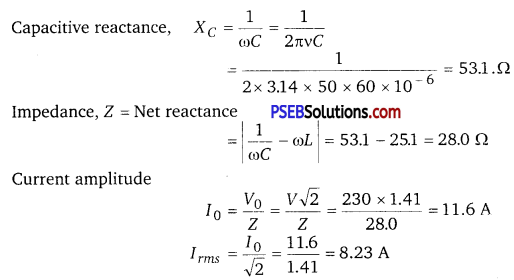
Answer:
No, it will behave as a diverging lens.
On Using thin lens maker formula
\(\frac{1}{f_{w}}=\left(\frac{n_{g}}{n_{m}}-1\right)\left(\frac{1}{R_{1}}-\frac{1}{R_{2}}\right)\)
On Using sign convention R1 = +ve, R2 = -ve and ng = 1.25 and nm = 1.33
\(\left(\frac{1}{R_{1}}+\frac{1}{R_{2}}\right)\) +ve,value and \(\left(\frac{1.25}{1.33}-1\right)\) =-ve value Hence fw = -ve , so it behaves as a diverging lens.

PSEB 12th Class Physics Important Questions Chapter 9 Ray Optics and Optical Instruments

Question 9.
Define total internal reflection.
Answer:
It is defined as the process of reflection of light that takes place when a ray of light travelling from denser to rarer medium gets incident at the interface of the two media at an angle greater than the critical angle for the given air of media.

Question 10.
State the criteria for the phenomenon of total internal reflection of light to take place.
Answer:
Following are the criteria for total internal reflection

  • Light must pass from a denser to a rarer medium.
  • Angle of incidence must be greater than critical angle.

Question 11.
Define mirage.
Answer:
It is defined as an optical illusion that occurs in deserts and coal tarred roads appear to be covered with water but on approaching at that place no water is obtained. In deserts thirsty animals observe virtual images of trees on hot sand so expecting a pond of water there but on reaching there, they do not get water pond and hence called optical illusion.

Question 12.
Why diamond sparkles?
Answer:
The critical angle for diamond is low i.e., 23° and its refractive index is 2.47. The faces of diamond are cut in such a way that when a ray of light entering from a face undergoes multiple total internal reflections from its different faces. Due to small value of the critical angle, almost all light rays entering the diamond suffer multiple total internal reflection and thus it shines brilliantly.

Question 13.
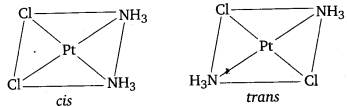
What are optical fibres? Give their one use.
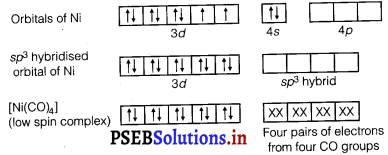
Answer:
Optical fibres are thousands of very fine quality fibres of glass or quartz. The diameter of each fibre is of the order of 10-4 cm having refractive index of material equal to 1.7. These are coated with a thin layer of material having µ = 1.5.
They are used in transmission and reception of electrical signals by converting them first into light signals.
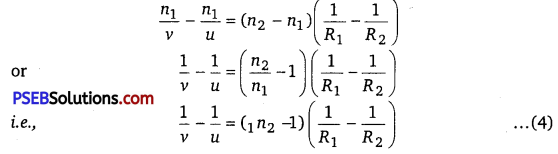
Question 14.

Write the relationship between angle of incidence ‘i’ angle of prism ‘A’ and angle of minimum deviation for a triangular prism.
Answer:
i = \(\frac{A+\delta_{m}}{2}\)
where, δm = angle of minimum deviation.

Question 15.
Define dispersion of light. What is its cause?
Answer:
It is defined as the process of splitting up of white light into its constituent colours on passing through a prism.
We know that for small angled prism,
δ = (µ -1)A.
Also according to Cauchy’s formula, we know that µ ∝ \(\frac{1}{\lambda^{2}}\)
Thus µ of the material of prism is different for different colours, so δ is also different for different incident colours.
Thus due to different values of angle of deviation, each colour occupies different direction in emergent beam of light and thus constituent colours of white light get dispersed. λv < λr, so δv > δr.
The violet colour deviates more than the red colour.

PSEB 12th Class Physics Important Questions Chapter 9 Ray Optics and Optical Instruments

Question 16.
Explain the rainbow.
Answer:
The rainbow is an example of the dispersion of sunlight by the water drops in the atmosphere. This is a phenomenon due to combined effect of dispersion, refraction and reflection of sunlight by spherical water droplets of rain. The conditions for observing a rainbow are that the sun should be shining in one part of the sky (say near western horizon) while it is raining in the opposite part of the sky (say eastern horizon). An observer can therefore see a rainbow only when his back is towards the sun.

Question 17.
Why does the Sun look reddish at sunset or sunrise?
Answer:
During sunset or sunrise, the sun is just above the horizon, the blue colour gets scattered most by the atmospheric molecules while red light gets scattered least, hence Sun appears red.
I ∝ \(\frac{1}{2^{4}}\) and λB << λR.

Question 18.
Will the focal length of a lens for red light be more, same or less than that for blue light? (NCERT Exemplar)
Answer:
As the refractive index for red is less than that for blue, parallel beams of light incident on a lens will be bent more towards the axis for blue light compared to red. Thus the focal length for red light will be more than that for blue.

Question 19.
An unsymmetrical double convex thin lens forms the image of a point object on its axis. Will the position of the image change if the lens is reversed? (NCERT Exemplar)
Answer:
No, the reversibility of the tens makes equation.
\(\frac{1}{v}-\frac{1}{u}=\frac{1}{f}=(n-1)\left(\frac{1}{R_{1}}-\frac{1}{R_{2}}\right)\)
= -(n-1) \(\left(\frac{1}{R_{2}}-\frac{1}{R_{1}}\right)\)
On reversing the lens, values of R1 and R2 are reversed and so their signs.
Hence, for a given position of object (u), position of image (v) remains unaffected.

Question 20.
Why danger signals are of red light?
Answer:
Scattering of light is inversely proportional to the fourth power of wavelength of incident light. As red light has longer wavelength as compared to other visible colours, so its scattering is least and thus red light signals can be seen from a longer distance.

Short answer type questions

Question 1.
Will the focal length of a lens for red light be more, same or less than that for blue light? [NCERT Exemplar]
Answer:
As the refractive index for red is less than that for blue parallel beams of light incident on a lens will be bent more towards the axis for blue light compared to red.
In other words, μb > μr By lens maker’s formula,
\(\frac{1}{f}=\left(n_{21}-1\right)\left(\frac{1}{R_{1}}-\frac{1}{R_{2}}\right)\)
Therefore, fb < fr
Thus, the focal length for blue light will be smaller than that for red.

Question 2.
Define power of a lens. Write its units. Deduce the relation \(\frac{1}{f}=\frac{1}{f_{1}}+\frac{1}{f_{2}}\) for two thin lenses kept in contact coaxially.
Answer:
The power of a lens is equal to the reciprocal of its focal length when it is measured in metre. Power of a lens,
P = \(\frac{1}{f(\text { metre })}\)
Its SI unit is dioptre (D).
PSEB 12th Class Physics Important Questions Chapter 9 Ray Optics and Optical Instruments 1
Consider two lenses A and B of focal lengths, f1 and f2 placed in contact with each other. An object is placed at a point O beyond the focus of the first lens A. .
The first lens produces an image (real image) at I1 which serves as a virtual object for the second lens B producing the final image at I.

Since, the lenses are thin, we assume the optical centres P of the lenses to be coincident. For the image formed by the first lens A, we obtain
\(\frac{1}{v_{1}}-\frac{1}{u}=\frac{1}{f_{1}}\) ……………………………. (1)
For the image formed by the second lens B, we obtain
\(\frac{1}{v}-\frac{1}{v_{1}}=\frac{1}{f_{2}}\) …………………………………. (2)
Adding eqs. (1) and (2), we obtain
\(\frac{1}{v}-\frac{1}{u}=\frac{1}{f_{1}}+\frac{1}{f_{2}}\) …………………………. (3)

If the two lenses system is regarded as equivalent to a single lens of focal length f, we have
\(\frac{1}{v}-\frac{1}{u}=\frac{1}{f}\) ……………………………… (4)
From eqs. (3) and (4), we obtain
\(\frac{1}{f_{1}}+\frac{1}{f_{2}}=\frac{1}{f}\) .

PSEB 12th Class Physics Important Questions Chapter 9 Ray Optics and Optical Instruments

Question 3.
(a) Draw a schematic labelled ray diagram of a reflecting type telescope (cassegrain).
(b) The objective of telescope is of larger focal length and of larger aperture (compared to the eyepiece). Why? Given reasons.
(c) State the advantages of reflecting telescope over refracting telescope.
Answer:
(a)
PSEB 12th Class Physics Important Questions Chapter 9 Ray Optics and Optical Instruments 2
(b) In normal adjustment, magnifying power of the telescope, M = \(\frac{f_{0}}{f_{e}}\)
(i) If focal length of the objective lens is large in comparison to the eyepiece, magnifying power increases.
(ii) Resolving power of the telescope RP = \(\frac{D}{1.22 \lambda}\)
D being the diameter of the objective. To increase the resolving power of the telescope, large aperture of the objective lens is required.

Advantages

  • There is no chromatic aberration in a mirror.
  • Brighter image.
  • High resolving power.
  • Large magnifying power.

Question 4.
How is the working of a telescope different from that of a microscope?
Answer:
Difference in working of telescope and microscope

  • Objective of telescope forms the image of a very far off object at or within the focus of its eyepiece. The microscope does the same for a small object kept just beyond the focus of its objective.
  • The final image formed by a telescope is magnified relative to its size as seen by the unaided eye while the final image formed by a microscope is magnified relative to its absolute size.
  • The objective of a telescope has large focal length and large aperture while the corresponding parameters for a microscope have very small ‘ values.

Question 5.
For a glass prism (μ = \(\sqrt{3}\) ) the angle of minimum deviation is equal to the angle of the prism. Find the angle of the prism. (NCERT Exemplar)
Answer:
At minimum deviation μ = \(\frac{\sin \left[\frac{\left(A+\delta_{m}\right)}{2}\right]}{\sin \left(\frac{A}{2}\right)} \)
Given, δm = A
∴ μ = \(\frac{\sin A}{\sin \frac{A}{2}}=\frac{2 \sin \frac{A}{2} \cos \frac{A}{2}}{\sin \frac{A}{2}}=2 \cos \frac{A}{2}\)
∴ \(\cos \frac{A}{2}=\frac{\sqrt{3}}{2} \text { or } \frac{A}{2}=30\)
⇒ A = 600.

Long Answer Type Questions

Question 1.
(a) Draw a ray diagram for formation of image of a point object by a thin double convex lens having radii of curvature R1 and R2. Hence, derive lens maker’s formula for a double convex lens. State the assumptions made and sign convention used.
(b) A convex lens is placed over a plane mirror. A pin is now positioned so that there is no parallax between the pin and its image formed by this lens-mirror combination. How will you use this observation to find focal length of the lens? Explain briefly.
Answer:
(a) Lens Maker’s Formula: Suppose L is a thin lens. The refractive index of the material of lens is n2 and it is placed in a medium of refractive index n1. The optical centre of lens is C and X’ X is principal axis. The radii of curvature of the surfaces of the lens are R1 and R2 and their poles are P1 and P2.

The thickness of lens is t, which is very small. O is a point object on the principal axis of the lens. The distance of O from pole P1 is u. The first refracting surface forms the image of O at I’ at a distance v’ from P1.
From the refraction formula at spherical surface, \(\frac{n_{2}}{v^{\prime}}-\frac{n_{1}}{u}=\frac{n_{2}-n_{1}}{R_{1}}\) ……………………………….. (1)
The image I’ acts as a virtual object for second surface and after refraction at second surface, the final image is formed at I.

The distance of I from pole P2 of second surface is v. The distance of virtual object (I’) from pole P2 is (v’ -t).
For refraction at second surface, the ray is going from second medium (refractive index n2) to first medium (refractive index n1), therefore, from refraction formula at spherical surface
PSEB 12th Class Physics Important Questions Chapter 9 Ray Optics and Optical Instruments 3
\(\frac{n_{1}}{v}-\frac{n_{2}}{\left(v^{\prime}-t\right)}=\frac{n_{1}-n_{2}}{R_{2}}\) ……………….. (2)
For a thin lens t is negligible as compared to v’, therefore from eq. (2)
\(\frac{n_{1}}{v}-\frac{n_{2}}{v^{\prime}}=-\frac{n_{2}-n_{1}}{R_{2}}\) ……………………………….. (3)
Adding equation (1) and (3),we get
PSEB 12th Class Physics Important Questions Chapter 9 Ray Optics and Optical Instruments 4
where, 1n2 = \(\frac{n_{2}}{n_{1}}\) is refractive index of second medium (te. medium of lens) with respect to first medium. If the object O is at infinity, the image will be formed at second focus i.e., if u = ∞, v = f2 =f
Therefore, from equation (4)
PSEB 12th Class Physics Important Questions Chapter 9 Ray Optics and Optical Instruments 5
This formula is called Lens-Maker’s formula. If first medium is air and refractive index of material of lens be n, then 1n2 = n, therefore, the modified equation (5) may be written as
\(\frac{1}{f}=(n-1)\left(\frac{1}{R_{1}}-\frac{1}{R_{2}}\right)\) ………………………………. (6)

(b) Focal length = distance of the pin from the mirror.
The rays from the object after refraction from lens should fall normally on the plane mirror. So, they retrace their path. Hence, rays must be originating from focus and thus distance of the pin from the plane mirror gives focal length of the lens.

PSEB 12th Class Physics Important Questions Chapter 9 Ray Optics and Optical Instruments

Question 2.
(a) Draw the labelled ray diagram for the formation of image by a compound microscope. Derive an expression for its total magnification (or magnifying power), when the final image is formed at the near point. Why both objective and eyepiece of a compound microscope must have short focal lengths?
(b) Draw a ray diagram showing the image formation by a compound microscope. Hence, obtain expression for total magnification when the image is formed at infinity.
Answer:
(a) Compound Microscope: It consists of a long cylindrical tube, containing at one end a convex lens of small aperture and small focal length. This is called the objective lens (0). At the other end of the tube another co-axial smaller and wide tube is fitted, which carries a convex lens (E) at its outer end. This lens is towards the eye and is called the eyepiece. The focal length and aperture of eyepiece are somewhat larger than those of objective lens. Cross-wires are mounted at a definite distance before the eyepiece. The entire tube can be moved forward and backward by the rack and pinion arrangement.

Adjustment: First of all the eyepiece is displaced backward and forward to focus it on cross-wires. Now the object is placed just in front of the objective lens and the entire tube is moved by rack and pinion arrangement until there is no parallax between image of object and cross wire. In this position, the image of the object appears quite distinct.

Working: Suppose a small object AB is placed slightly away from the first focus Fo‘of the objective lens. The objective lens forms the real, inverted and magnified image A’ B’, which acts as an object for eyepiece. The eyepiece is so adjusted that the image A’B’ lies between the first focus Fe‘ and the eyepiece E. The eyepiece forms its image A”B” which is virtual, erect and magnified. Thus the final image A”B” formed by the microscope is inverted and magnified and its position is outside the objective and eyepiece towards objective lens.
PSEB 12th Class Physics Important Questions Chapter 9 Ray Optics and Optical Instruments 6
The magnifying power of a microscope is defined as the ratio of angle (β) subtended by final image on the eye to the angle (α) subtended by the object on eye, when the object is placed at the least distance of distinct vision, i.e., Magnifying power,
M = \(\frac{\beta}{\alpha}\)
As object is very small, angles a and 1 are very small and so tan α = α and tan β = β. By definition the object AB is placed at the least distance of distinct vision.
PSEB 12th Class Physics Important Questions Chapter 9 Ray Optics and Optical Instruments 7
∴ α = tan α = \(\frac{A B}{E A}\)
By sign convention, EA = – D,
∴ α = \(\frac{A B}{-D}\)
and from figure
β = tan β = \(\frac{A^{\prime} B^{\prime}}{E A^{\prime}}\)
If ue is distance of image A’ B’ from eyepiece E, then by sign convention, EA’ = -ue
and so, β = \(\frac{A^{\prime} B^{\prime}}{-u_{e}}\)

Hence, magnifying power,
M = \(\frac{\beta}{\alpha}=\frac{A^{\prime} B^{\prime} /\left(-u_{e}\right)}{A B /(-D)}=\frac{A^{\prime} B^{\prime}}{A B} \cdot \frac{D}{u_{e}}\)
By sign conventions, magnification of objective lens
\(\frac{A^{\prime} B^{\prime}}{A B}=\frac{v_{o}}{\left(-u_{o}\right)}\)
∴ M = \(-\frac{v_{o}}{u_{o}} \cdot \frac{D}{u_{e}}\) ………………………………….. (2)

Using lens formula \(\frac{1}{f}=\frac{1}{v}-\frac{1}{u}\) for eyelens,
(i.e. using f = fe’ V = -ve, U = -ue ) we get
\(\frac{1}{f_{e}}=\frac{1}{-v_{e}}-\frac{1}{\left(-u_{e}\right)}\)
or \(\frac{1}{u_{e}}=\frac{1}{f_{e}}+\frac{1}{v_{e}}\)
Magnifying power,
M = \(-\frac{v_{o}}{u_{o}} D\left(\frac{1}{f_{e}}+\frac{1}{v_{e}}\right)\)

or M = \(-\frac{v_{o}}{u_{o}}\left(\frac{D}{f_{e}}+\frac{D}{v_{e}}\right)\)
When final image is formed at the distance of distinct vision, Ve = D
∴ Magnification,
M= – \(\frac{v_{o}}{u_{o}}\left(1+\frac{D}{f_{e}}\right)\)

For greater magnification of a compound microscope, fe should be small. As fo < fe’ so f0 is small.
Hence, for greater magnification both f0 and fe should be small with f0 to be smaller of the two.

(b) If image A’B’ is exactly at the focus of the eyepiece, then image A”B” is formed at infinity.
If the object AB is very close to the focus of the objective lens of focal length f0, then magnification M0 by the objective lens
Me = \(\frac{L}{f_{0}}\)
PSEB 12th Class Physics Important Questions Chapter 9 Ray Optics and Optical Instruments 8

where, L is tube length (or distance between lenses L0 and Le) Magnification Me by the eyepiece
Me = \(\frac{D}{F_{e}} \)
where, D = Least distance of distinct vision
Total magnification, m = M0 Me = \(\left(\frac{L}{f_{o}}\right)\left(\frac{D}{f_{e}}\right)\)

Question 3.
Explain with the help of a labelled ray diagram, how is image formed in an astronomical telescope. Derive an expression for its magnifying power.
Or
Draw a ray diagram showing the image formation of a distant object by a refracting telescope. Define Its magnifying power and write the two important factors considered to increase the magnifying power. Describe briefly the two main limitations and explain how far these can be minimised in a reflecting telescope.
Answer:
Astronomical (Refracti ng) Telescope
Construction: It consists of two co-axial cylindrical tubes, out of which one tube is long and wide, while the other tube is small and narrow. The narrow tube may be moved in and out of the wide tube by rack and pinion arrangement. At one end of wide tube an achromatic convex lens L1 is placed, which faces the object and is so-called objective (lens). The focal length and aperture of this lens are kept large. The large aperture of objective is taken that it may collect sufficient light to form a bright image of a distant object. The narrow tube is towards eye and carries an achromatic convex lens 12 of small focal length and small aperture on its outer end. This is called eye-lens or eyepiece.

The small aperture of eye lens is taken so that the whole light refracted by it may reach the eye. Cross-wires are fitted at a definite distance from the eye lens. Due to large focal length of objective lens and small focal length of eye lens, the final image subtends a large angle at the eye and hence the object appears large. The distance between the two lenses may be arranged by displacing narrow tube in or out of wide tube by means of rack and pinion arrangement.

Adjustment: First of all the eyepiece is moved backward and forward in the narrow tube and focused on the cross-wires. Then the objective lens is directed towards the object and narrow tube is displaced in or out of wide tube until the image of object is formed on cross-wires and there is no parallax between the image and cross-wires. In this position, a clear image of the object is seen. As the image is formed by refraction of light through both the lenses, this telescope is called the refracting telescope.
PSEB 12th Class Physics Important Questions Chapter 9 Ray Optics and Optical Instruments 9
Working: Suppose AB is an object whose end A is on the axis of telescope. The objective lens (L1) forms the image A’B’ of the object AB at its second principal focus F0.
This image is real, inverted and diminished. This image A’ B’ acts as an object for the eyepiece L2 and lies between first focus fe‘ and optical centre C2 of lens L2.
Therefore, eyepiece forms its image A” B” which is virtual, erect and magnified.
Thus, the final image A” B” of object AB formed by the telescope is magnified, inverted and lies between objective and eyepiece.

Magnifying Power: The magnifying power of a telescope is measured by the ratio of angle (β) subtended by final image on the eye to the angle (α) subtended by object on the eye. i.e.,
Magnifying power M = \(\frac{\beta}{\alpha}\)
As α and β are very small angles, therefore, from figure.

The angle subtended by final image A” B” on eye.
β = angle subtended by image A’B’ on eye
= tanβ = \(\frac{A^{\prime} B^{\prime}}{C_{2} A^{\prime}}\)
As the object is very far (at infinity) from the telescope, the angle subtended by object at eye is same as the angle subtended by object on objective lens.
∴ α = tan α = \(\frac{A^{\prime} B^{\prime}}{C_{1} A^{\prime}}\)
∴ M = \(\frac{\beta}{\alpha}=\frac{A^{\prime} B^{\prime} / C_{2} A^{\prime}}{A^{\prime} B^{\prime} / C_{1} A^{\prime}}=\frac{C_{1} A^{\prime}}{C_{2} A^{\prime}}\)
If the focal lengths of objective and eyepiece be f0 and fe, distance of image A’B’ from eyepiece be ue, then by sign convention
C1A’ = +f0
C2A’ = – ue
∴ M = –\(\frac{f_{o}}{u_{e}}\) ……………………………… (1)

If ve is the distance of A” B” from eye-piece, then by sign convention, fe is positive, ue and ve are both negative. Hence, by lens formula = \(\frac{1}{f}=\frac{1}{v}-\frac{1}{u}\)
we have
\(\frac{1}{f_{e}}=\frac{1}{-v_{e}}-\frac{1}{\left(-u_{e}\right)}\)
or
\(\frac{1}{u_{e}}=\frac{1}{f_{e}}+\frac{1}{v_{e}}\)
Substituting this value in eq. (1), we get
M = -f0 \(\left(\frac{1}{f_{e}}+\frac{1}{v_{e}}\right)\) …………………………. (2)

This is the general formula for magnifying power. In this formula, only numerical values of f0, fe and ve are to be used because signs have already been used.
Length of Telescope : The distance between objective and eyepiece is called the length (L) of the telescope. Obviously,
L = L1L2 =C1C2 = f0+ue …………………… (3)

Now there arise two cases :
(i) When the final image is formed at minimum distance (D) of distinct vision then ve =D
∴ M = -f0 \(\left(\frac{1}{f_{e}}+\frac{1}{D}\right)=-\frac{f_{o}}{f_{e}}\left(1+\frac{f_{e}}{D}\right)\) …………………………… (4)
Length of telescope L = f0 + ue

(ii) In normal adjustment position, the final image is formed at infinity: For relaxed eye, the final image is formed at infinity. In this state, the image A’B’ formed by objective lens should be at first the principal focus of eyepiece, i.e.,
ue = fe and ve
∴ Magnifying power,
M = – f0 \(\left(\frac{1}{f_{e}}+\frac{1}{\infty}\right)\) = –\(\frac{f_{o}}{f_{e}}\)
Length of telescope = f0 + fe
For large magnifying power, f0 should be large and fe should be small. For high resolution of the telescope, diameter of the objective should be large.

PSEB 12th Class Physics Important Questions Chapter 9 Ray Optics and Optical Instruments

Factors for Increasing the Magnifying Power
1. Increasing focal length of objective
2. Decreasing focal length of eyepiece

Limitations
1. Suffers from chromatic aberration
2. Suffers from spherical aberration
3. Small magnifying power
4. Small resolving power

Advantages of Reflecting Telescope
1. No chromatic aberration, because mirror is used.
2. Spherical aberration can be removed by using a parabolic mirror.
3. Image is bright because no loss of energy due to reflection.
4. Large mirror can provide easier mechanical support.

PSEB 12th Class Chemistry Solutions Chapter 9 Coordination Compounds

Punjab State Board PSEB 12th Class Chemistry Book Solutions Chapter 9 Coordination Compounds Textbook Exercise Questions and Answers.

PSEB Solutions for Class 12 Chemistry Chapter 9 Coordination Compounds

PSEB 12th Class Chemistry Guide Coordination Compounds InText Questions and Answers

Question 1.
Explain the bonding in coordination compounds in terms of Werner’s postulates.
Answer:
(i) The primary valencies are satisfied by negative ions and equal-to the oxidation state of the metal.

(ii) The secondary valencies can be satisfied by neutral or negative ions. It is equal to the coordination number of the central metal atom and is fixed.

(iii) The ions bound to the central metal ion to secondary linkages have definite spatial arrangements and give geometry to the complex. While primary valency is non-directional.

Question 2.
FeSO4 solution mixed with (NH4)2SO4 solution in 1 : 1 molar ratio gives the test of Fe2+ ion but CuSO4 solution mixed with aqueous ammonia in 1 : 4 molar ratio does not give the test of Cu2+ ion. Explain why?
Answer:
FeSO4 solution mixed with (NH4)2SO4 solution in 1 : 1 molar ratio forms double salt, FeSO4∙(NH4)2SO4∙6H2O which ionises in the solution to give Fe2+ ions. Hence, it gives the test of Fe2+ ions.

CuSO4 solution mixed with aqueous ammonia in 1 : 4 molar ratio forms a complex, with the formula [Cu(NH3)4]SO4. The complex ion, [CU(NH3)]2+ does not ionise to give Cu2+ ions. Hence, it does not give the test of Cu2+ ion.

Question 3.
Explain with two examples each of the following: Coordination entity, ligand, coordination number, coordination polyhedron, homoleptic and heteroleptic.
Answer:
Coordination entity: A coordination entity constitutes usually a central metal atom or ion, to which a fixed number of other atoms or ions or groups are attached by coordinate bonds. A coordination entity may be neutral, positively or negatively charged. For examples : [Ni(CO)4], [CoCl3(NH3)3], [Co(NH3)6]3+.

Ligand : A ligand is an ion or a small molecule having at least one lone pair of electrons and capable of forming a coordinate bond with central atom or ion in the coordination entity. For example: Cl, OH, CN, CO, NH3, H2O etc.

Coordination number : The coordination number of the central atom or ion is determined by the number of a bonds between the ligands and the central atom or ion. n bonds are not consider for the determination of coordination number. The a bonding electrons may be indicated by a pair of dots (:). For example, [Co(:NH3)6]3+ and [Fe(:CN)6]3-.

Coordination polyhedron : The spatial arrangement of the ligands which are directly attached to the central atom or ion called coordination polyhedron.
For example: [Co(NH3)6]3+ is octahedral, [Ni(CO)4] is tetrahedral and [PtCl4 ]2- is square planar.

Homoleptic and heteroleptic : Complexes in which a metal is bound to only one type of donor groups are known as homoleptic.
For example : [Co(NH3)6]3+, [PtCl6]2- .
Complexes in which a metal is bound to more than one kind of donor groups are known as heteroleptic. ‘
For example : [Co(NH3)4Cl2]+, [PdI2(ONO)2 (H2O)2],

PSEB 12th Class Chemistry Solutions Chapter 9 Coordination Compounds

Question 4.
What is meant by unidentate, didentate and ambidentate ligands? Give two examples for each.
Answer:
A molecule or an ion which has only one donor atom to form one coordinate bond with the central metal atoms is called unidentate ligand, e.g., Cl and NH3.

A molecule or an ion which contains two donor atoms and hence forms two coordinate bonds with the central metal atoms is called a didentate ligand, e.g., NH2—CH2—CH2—NH2 and OOC — COO.
A molecule or an ion which contains two donor atoms but only one of them forms a coordinate bond at a time with the central metal atom is called ambidentate ligand, e.g., CNor NC and \(\) or : ONO.

Question 5.
Specify the oxidation numbers of the metals in the following coordination entities:
(i) [Co(H2O)(CN)(en)2]2+
(ii) [CoBr2(en)2]+
(iii) [PtCl2]2-
(iv) K3Fe(CN)6]
(v) [Cr(NH3)2Cl3]
Answer:
(i) x + (-1) + (0) + (0) = + 2 so x = +3 (III)
(ii) x + 2(-1) + 0 = +1 so x = +3 (III)
(iii) x + 4(-1) = -2 so x = +2(11)
(iv) x + 6(-1) = -3 so x = +3 (III)
(v) x + 3(-1) + 0 = 0 so x = +3 (III)

Question 6.
Using IUPAC norms write the formulas for the following:
(i) Tetrahydroxozincate(II)
(ii) Potassium tetrachloridopalladate(II)
(iii) Diamminedichloridoplatinum(II)
(iv) Potassium tetracyanonickelate(II)
(v) Pentaamminenitrito-O-cobalt(III)
(vi) Hexaamminecobalt(III) sulphate
(vii) Potassium tri(oxalato)chromate(III)
(viii) Hexaammineplatinum(IV)
(ix) Tetrabromidocuprate(Il)
(x) Pentaamminenitrito-N-cobalt(lll)
Answer:
(i) [Zn(OH)4]2-
(ii) K2[PdCl4]
(iii) pt(NH3)2Cl2]
(iv) K2[Ni(CN)4]
(v) [Co(ONO) (NH3)5]2+
(vi) [CO(NH3)6]2 (SO4)3
(vii) K3[Cr(C2O4)3]
(viii) [Pt(NH3)6]4+
(ix) [Cu(Br)4]2-
(x) [Co (NO2) (NH3)5]2+

PSEB 12th Class Chemistry Solutions Chapter 9 Coordination Compounds

Question 7.
Using IUPAC norms write the systematic names of the following:
(i) [CO(NH3)6]Cl3
(ii) [Pt(NH3)2Cl(NH2CH3)]Cl
(iii) [Ti(H2O)6]3+
(iv) [CO(NH3)4Cl(NO2)]CI
(v) [Mn(H2O)6]2+
(vi) [NiCl4]2-
(vii) [Ni(NH3)6]Cl2
(viii) [Co(en)3]3+
(ix) [Ni(CO)4]
Answer:
(i) Hexaamminecobalt(III) chloride
(ii) Diamminechlorido(methylamine) platinum(II) chloride
(iii) Hexaquatitanium(III) ion
(iv) Tetraamminechloridonitrito-N-Cobalt(III) chloride
(v) Hexaquamanganese(II) ion
(vi) Tetrachloridonickelate(II) ion
(vii) Hexamminenickel(II) chloride
(viii) Tris(ethane-1, 2-diamine) cobalt(III) ion
(ix) Tetracarbonylnickel(O)

Question 8.
List various types of isomerism possible for coordination compounds giving an example of each.
Answer:
Two principal types of isomerism are known among coordination compounds :
(A) Sterioisomerism,
(B) Structural isomerism.
Each of which can be further sub-divided as :
(A) Stereoisomerism
(i) Geometrical isomerism : It arises in heteroleptic complexes due to different possible geometric arrangements of the ligands.
Example: Pt[(NH3)2Cl2]
PSEB 12th Class Chemistry Solutions Chapter 9 Coordination Compounds 1

(ii) Optical isomerism : It is common in octahedral complexes involving didentate ligands.
Example : [Pt Cl2(en) 2]2+
PSEB 12th Class Chemistry Solutions Chapter 9 Coordination Compounds 2
Optical isomers (d and l) of cis-[PtCl2(en)2]2+

(B) Structural isomerism
(i) Linkage isomerism.
Example: [Co(NH3)5 (NO2)]Cl2
(ii) Coordination isomerism.
Example: [Co(NH3)6] [Cr(CN)6]
(iii) Ionisation isomerism.
Example: [Co(NH3)5SO4]Br and [CO(NH3)5 Br]SO4
(iv) Solvate isomerism.
Example : [Cr(H2O)6] Cl3 (violet) its solvate isomer
[Cr(H2O)5Cl]Cl2. H2O (grey-green)

Question 9.
How many geometrical isomers are possible in the following coordination entities? ’
(i) [Cr(C2O4)3]3-
(ii) [Co(NH3)3Cl3]
Answer:
(i) [Cr(C2O4)3]3-,
No geometric isomer is possible as it is a bidentate ligand.
(ii) [CO(NH3)3Cl3] .
Two geometrical isomers are possible.
PSEB 12th Class Chemistry Solutions Chapter 9 Coordination Compounds 3

PSEB 12th Class Chemistry Solutions Chapter 9 Coordination Compounds

Question 10.
Draw the structures of optical isomers of:
(i) [Cr(C2O4)3]3-
(ii) [PtCl2(en)2]2+
(iii) [Cr(NH3)2 Cl2 (en)]+
Answer:
(i) [Cr(C2O4)3]3-
PSEB 12th Class Chemistry Solutions Chapter 9 Coordination Compounds 4
PSEB 12th Class Chemistry Solutions Chapter 9 Coordination Compounds 5

Question 11.
Draw all the isomers (geometrical and optical) of:
(i) [CoCl2 (en)2]+
(ii) [Co(NH3)Cl(en)2]2+
(iii) [Co(NH3)2Cl2(en)]+
Answer:
(i) [CoCl2 (en)2]+
PSEB 12th Class Chemistry Solutions Chapter 9 Coordination Compounds 6
PSEB 12th Class Chemistry Solutions Chapter 9 Coordination Compounds 7

Question 12.
Write all the geometrical isomers of [Pt(NH3)(Br)(Cl)(py)] and how many of these will exhibit optical isomers?
Answer:
Three isomers are possible as follows :
PSEB 12th Class Chemistry Solutions Chapter 9 Coordination Compounds 8
Isomers of this type do not show any optical isomerism. Optical isomerism rarely occurs in square planar or tetrahedral complexes and that too when they contain unsymmetrical chelating ligand.

PSEB 12th Class Chemistry Solutions Chapter 9 Coordination Compounds

Question 13.
Aqueous copper sulphate solution (blue in colour) gives :
(i) a green precipitate with aqueous potassium fluoride, and
(ii) a bright green solution with aqueous potassium chloride. Explain these experimental results.
Answer:
Aqueous copper sulphate exists as [Cu(H2O)4]SO4. It is a labile complex. The blue colour of the solution is due to [Cu(H2O)4]2+ ions,

(i) When KF is added, the weak H2O ligands are replaced by F ligands forming [CuF4]2- ions, which is a green precipitate.
PSEB 12th Class Chemistry Solutions Chapter 9 Coordination Compounds 9

(ii) When KCl is added, Cl ligands replace the weak H2O ligands forming [CuCl4]2- ion, which has bright green colour.
PSEB 12th Class Chemistry Solutions Chapter 9 Coordination Compounds 10

Question 14.
What is the coordination entity formed when excess of aqueous KCN is added to an aqueous solution of copper sulphate? Why is it that no precipitate of copper sulphide is obtained when H2S (g) is passed through this solution?
Answer:
K2[Cu(CN)4] is formed when excess of aqueous KCN is added to an aqueous solution of CuSO4.
PSEB 12th Class Chemistry Solutions Chapter 9 Coordination Compounds 11
As CNions are strong ligands the complex is very stable. It is not replaced by S2- ions when H2S gas is passed through the solution and thus no precipitate of CuS is obtained.

PSEB 12th Class Chemistry Solutions Chapter 9 Coordination Compounds

Question 15.
Discuss the nature of bonding in the following coordination entities on the basis of valence bond theory:
(i) [Fe(CN)6]4-
(ii) [FeFe6]3-
(iii) [Co(C2O4)3]3-
(iv) [CoF6]3-
Answer:
(i) [Fe(CN)6]4-
In the above coordination complex, iron exists in the +2 oxidation state.
Fe = [Ar] 3d6 4s2
Outer configuration of Fe2+ = 3d6 4s0
Orbitals of Fe2+ ion:
PSEB 12th Class Chemistry Solutions Chapter 9 Coordination Compounds 12
As CN is a strong field ligand, it causes the pairing of the unpaired 3d electrons.
PSEB 12th Class Chemistry Solutions Chapter 9 Coordination Compounds 13
Since, there are six ligands around the central metal ion, the most feasible hybridisation is d2sp3. d2sp3 hybridised orbitals of Fe2+ are :
PSEB 12th Class Chemistry Solutions Chapter 9 Coordination Compounds 14
6 electron pairs from CN ions occupy the six hybrid d2sp3 orbitals.
Then,
PSEB 12th Class Chemistry Solutions Chapter 9 Coordination Compounds 15
Hence, the geometry of the complex is octahedral and the complex is diamagnetic (as there are no unpaired electrons).

(ii) [FeF6]3-
In this complex, the oxidation state of Fe is + 3.
Fe3+ = 3d5 4s0
Orbitals of Fe3+ ion:
PSEB 12th Class Chemistry Solutions Chapter 9 Coordination Compounds 16
There are 6F ions. Thus, it will undergo d2sp3 or sp3d2 hybridisation. As F is a weak field ligand, it does not cause the pairing of the electrons in the 3d orbital. Hence, the most feasible hybridisation is sp3d2. sp3d2 hybridised orbitals of Fe are:
PSEB 12th Class Chemistry Solutions Chapter 9 Coordination Compounds 17
Hence, the geometry of the complex is found to be octahedral.

(iii) [Co(C2O4)3]3-
Cobalt exists in the + 3 oxidation state in the given complex.
Outer configuration of Co = 3d7 4s2
Co3+ = 3d64s0
Orbitals of Co3+ ion:
PSEB 12th Class Chemistry Solutions Chapter 9 Coordination Compounds 18
Oxalate is a weak field ligand. Therefore, it cannot cause the pairing of the 3d electrons. As there are 6 ligands, hybridisation has to be either sp3d2 or d2sp3 hybridisation. sp3d2 hybridisation of Co3+.
PSEB 12th Class Chemistry Solutions Chapter 9 Coordination Compounds 19
The 6 electron pairs from the 3 oxalate ions (oxalate anion is a bidentate ligand) occupy these sp3d2 orbitals.
PSEB 12th Class Chemistry Solutions Chapter 9 Coordination Compounds 20
Hence, the geometry of the complex is found to be octahedral.

(iv) [CoF2]3-
Cobalt exists in the + 3 oxidation state.
Orbitals of Co3+ ion:
PSEB 12th Class Chemistry Solutions Chapter 9 Coordination Compounds 21
Again, fluoride ion is a weak field ligand. It cannot cause the pairing of the 3d electrons. As a result, the Co3+ ion will undergo sp3d2 hybridisation.
sp3d2 hybridised orbitals of Co3+ ion are :
PSEB 12th Class Chemistry Solutions Chapter 9 Coordination Compounds 22
Hence, the geometry of complex is octahedral, 6 electron pants.

Question 16.
Draw figure to show the splitting of d-orbitals in an octahedral crystal field.
Answer:
PSEB 12th Class Chemistry Solutions Chapter 9 Coordination Compounds 23

PSEB 12th Class Chemistry Solutions Chapter 9 Coordination Compounds

Question 17.
What is spectrochemical series? Explain the difference between a weak field ligand and a strong field ligand.
Answer:
The arrangement of ligands in order of their increasing field strengths, i.e., increasing crystal field splitting energy (CFSE) values is called spectrochemical series.

The ligands with a small value of CFSE (△0) are called weak field ligands whereas those with a large value of CFSE are called strong field ligands.

Question 18.
What is crystal field splitting energy? How does the magnitude of △0 decide the actual configuration of d-orbitals in a coordi-nation entity?
Answer:
When ligands approach a transition metal ion, the d-orbitals split into two sets, one with lower energy and the other with higher energy. The difference of energy between the two sets of orbitals is called crystal field splitting energy (△0) in case of octahedral field.

If △0 < P, (pairing energy), the 4th electron enters one of the eg orbitals giving the configuration \(t_{2 g}^{3} e_{g}^{1}\), thereby forming high spin complexes.

Such ligands for which A 0 < P are called weak field ligands.
If △0 > P, the 4th electron pairs up in one of the t2g orbitals giving the configuration \(t_{2 g}^{4} e_{g}^{0}\), thus forming low spin complexes. Such ligands for which △0 > P are called strong field ligands.

Question 19.
[Cr(NH3)6]3+ is paramagnetic while [Ni(CN)4]2- is diamagnetic. Explain why?
Answer:
Cr is in the +3 oxidation state i.e., d3 configuration. Also, NH3 is a weak field ligand that does not cause the pairing of the electrons in the orbital.
PSEB 12th Class Chemistry Solutions Chapter 9 Coordination Compounds 24
Therefore, it undergoes d2sp3 hybridisation and the electrons in the 3d orbitals remain unpaired. Hence, it is paramagnetic in nature.
In [Ni(CN)4]2-, Ni exists in the + 2 oxidation state i. e., d8 configuration.
PSEB 12th Class Chemistry Solutions Chapter 9 Coordination Compounds 25
CN is a strong field ligand. It causes the pairing of the 3d electrons. Then, Ni2+ undergoes dsp2 hybridisation.
PSEB 12th Class Chemistry Solutions Chapter 9 Coordination Compounds 26
As there are no unpaired electrons, it is diamagnetic.

PSEB 12th Class Chemistry Solutions Chapter 9 Coordination Compounds

Question 20.
A solution of [Ni(H2O)6]2+ is green but a solution of [Ni(CN)4]2- is colourless. Explain.
Answer:
In [Ni(H2O)6]2+, \(\mathrm{H}_{2} \ddot{\mathrm{O}}\) is a weak field ligand. Therefore, there are unpaired electrons in Ni2+. In this complex, the d electrons from the lower energy level can be excited to the higher energy level i. e., the possibility of d-d transition is present. Hence, [Ni(H2O)6]2+ is coloured.

In [Ni(CN)4]2+, the electrons are all paired as CN is a strong field ligand. Therefore, d-d transition is not possible in [Ni(CN)4]2-. Hence, it is colourless.

Question 21.
[Fe(CN)6]4- and [Fe(H2O)6]2+ are of different colours in dilute solutions. Why?
Answer:
In both the complex compounds, Fe is in +2 oxidation state with configuration 3d6, i.e., it has four unpaired electrons. In the presence of weak H2O ligands, the unpaired electrons do not pair up. But in the presence of strong ligand CN they get paired up. Then no unpaired electron is left. Due to this, difference in the number of unpaired electrons, both complex ions have different colours.

Question 22.
Discuss the nature of bonding in metal carbonyls.
Answer:
The metal carbon in metal carbonyls possesses both CT and π character. The ligand to metal is CT bond and metal to ligand is π bond. The effect of CT bond strengthens the rcbond and vice-versa. This is called synergic effect. This unique synergic provides stability to metal carbonyls.

PSEB 12th Class Chemistry Solutions Chapter 9 Coordination Compounds

Question 23.
Give the oxidation state, d-orbital occupation and coordination number of the central metal ion in the following complexes:
(i) K3[CO(C2O4)3]
(ii) cis-[Cr(en)2Cl2]Cl
(iii) (NH4)2[CoF4]
(iv) [Mn(H2O)6]S04
Solution:
(i) K3[CO(C2O4)3]
The central metal ion is Co.
The oxidation state can be given as :
(+1) × 3 + × + (- 2) × 3 = 0
x – 6 = -3 ⇒ x = + 3
The d orbital occupation for Co3+ is \(t_{2 g}^{6} e g^{0}\).
(as \(\mathrm{C}_{2} \mathrm{O}_{4}^{2-}\) is strong field ligand)
Coordination number of Co = 3 × denticity of C2O4
= 3 × 2 (as \(\mathrm{C}_{2} \mathrm{O}_{4}^{2-}\) is a bidentate ligand) = 6

(ii) cis-[Cr(en)2Cl2]Cl
The central metal ion is Cr.
The oxidation state can be given as:
x + 2(0) + 2(-1) + (-1) = 0
x – 2 – 1 = 0
x = + 3
The d orbital occupation for Cr3+ is \(t_{2 g}^{3}\).
Coordination number of Cr
= 2 × denticity of en + 2
= 2 × 2 + 2 = 6

(iii) (NH4)2[CoF4]
The central metal ion is Co.
The oxidation state can be given as:
(+1) × 2 + × + (-1) × 4 = 0
x – 4 = -2
x = + 2
The d orbital occupation for Co2+ is d7 or \(t_{2 g}^{5} e_{g}^{2}\). (as F is a weak ligand)
Coordination number of Co = 4

(iv) [Mn(H2O)6]S04
The central metal ion is Mn.
The oxidation state can be given as:
x + (0) × 6 + (- 2) = 0
x = + 2
The d orbital occupation for Mn is d5 or [latext_{2 g}^{3} e_{g}^{2}][/latex].
Coordination number of Mn = 6

Question 24.
Write down the IUPAC name for each of the following complexes and indicate the oxidation state, electronic configuration and coordination number. Also give stereochemistry and magnetic moment of the complex:
(i) K[Cr(H2O)2(C2O4)2] 3H2O
(ii) [Co(NH3)5Cl]Cl2
(iii) CrCl3(py)3
(iv) Cs[FeCl4]
(v) K4[Mn(CN)6]
Answer:
(i) K[Cr(H2O)2 (C2O4)2 ] ∙ 3H2O
IUPAC name : Potassium diaquadioxalatochromate (III) hydrate.
Oxidation state of chromium
+1 + x + (0) × 2 + (- 2) × 2 + 3(0) = 0
+ 1 + x – 4 = 0
x = + 3
Electronic configuration of Cr+3= 3d3 = (\(t_{2 g}^{3} e_{g}^{0}\))
Coordination number = 6
Shape : Octahedral
PSEB 12th Class Chemistry Solutions Chapter 9 Coordination Compounds 27
PSEB 12th Class Chemistry Solutions Chapter 9 Coordination Compounds 28
Magnetic moment (μ) = \(\sqrt{n(n+2)}\)
= \(\sqrt{3(3+2)}\)
= \(\sqrt{15}\) = 3.87 BM

(ii) [Co(NH3)5Cl]Cl2
IUPAC name : Pentaammine chlorido cobalt(III) chloride
Oxidation state of Co
x + (0)5 + (-1) + (-1) × 2 = 0
x – 3 =0
x = + 3
Coordination number = 6
Shape: Octahedral.
Electronic configuration of Co3+ = 3d6 = \(t_{2 g}^{6} e_{g}^{0}\)
The complex does not exhibit geometrical as well as optical isomerism.
Magnetic Moment (μ) = \(\sqrt{n(n+2)}\)BM = \(\sqrt{0(0+2)}\) BM = 0 BM

(iii) CrCl3(py)3
IUPAC name : Trichlorido tripyridine chromium (III) Oxidation state of Cr
x + (-1) × 3 + (0)3 = 0
x = + 3
Electronic configuration of Cr = 3d3 = (\(t_{2 g}^{3} e_{g}^{0}\))
Coordination number = 6
Shape : Octahedral
Stereochemistry
PSEB 12th Class Chemistry Solutions Chapter 9 Coordination Compounds 29
Both isomers are optically active. Therefore, a total of 4 isomers exist.
Magnetic moment (μ) = \(\sqrt{n(n+2)}\) = \(\sqrt{3(3+2)}\)
= \(\sqrt{15}\) = 3.87 BM

(iv) Cs[FeCl4]
IUPAC name : Caesium tetrachlorido ferrate (III)
Oxidation state of Fe
+ 1 + x + (-1) × 4= 0
x – 3 = 0
x = + 3
Electronic configuration of Fe = 3d5(\(t_{2 g}^{3} e_{g}^{2}\))
Coordination number = 4
Shape : Tetrahedral
The complex does not exhibit geometrical or optical isomerism, (stereo isomerism).
Magnetic moment (μ) = \(\sqrt{n(n+2)}\)
= \(\sqrt{5(5+2)}\)
= \(\sqrt{35}\) = 5.92 BM

(v) K4[Mn(CN)6]
IUPAC name : Potassium hexacyanomanganate(II)
Oxidation state of Mn
(+1) × 4 + x + (-1) × 6 = 0
x – 2 = 0
x = + 2
Electronic configuration of Mn = 3d5 (\(t_{2 g}^{5} e_{g}^{0}\))
Coordination number = 6
Shape : Octahedral.
The complex does not exhibit stereo isomerism.
Magnetic moment (μ) = \(\sqrt{n(n+2)}\)
= \(\sqrt{1(1+2)}\)
= \(\sqrt{3}\)
= 1.732 BM

PSEB 12th Class Chemistry Solutions Chapter 9 Coordination Compounds

Question 25.
What is meant by stability of a coordination compound in solution? State the factors which govern the stability of complexes.
Answer:
The stability of a coordination compound in solution refers to the degree of association between the two species involved in the state of equilibrium. The stability of the coordination compound is measured in term of magnitude of stability or formation of equilibrium constant.
M + 4L → ML4
K = \(\frac{\left[\mathrm{ML}_{4}\right]}{[\mathrm{M}][\mathrm{L}]^{4}}\)
Larger the stability constant, the higher is the proportion of ML4 that exists in solution.

Factors on which stability of the complex depends are as follows :

  1. Charge on the central metal ion : Greater the charge on the central metal ion, greater is the stability of the complex.
  2. Nature of the metal ion : Groups 3 to 6 and inner transition element form stable complexes when donor atoms of the ligands are N, O and F. The element after group 6 of the transition metals which have d-orbitals (e.g., Rh, Pd, Ag, Au, Hg, etc.) form stable complexes when the donor atoms of the ligands are heavier members of N, O and F family.
  3. Basic nature of the ligand : Greater the basic strength of the ligand, greater is the stability of the complex.
  4. Chelate effect: Presence of chelate rings in the complex increases its stability. It is called chelate effect. It is maximum for the 5- and 6- membered rings.
  5. Effect of multidentate cyclic ligands : If the ligands happen to be multidentate and cyclic without any steric effect, the stability of the complex is further increased.

Question 26.
What is meant by chelate effect? Give an example.
Answer:
When a didentate or a polydentate ligand contains donor atoms positioned in such a way that when they coordinate with the central metal ion, a five or a six-membered ring is formed, the effect is called chelate effect. Example, [PtCl2(en)].
PSEB 12th Class Chemistry Solutions Chapter 9 Coordination Compounds 30

PSEB 12th Class Chemistry Solutions Chapter 9 Coordination Compounds

Question 27.
Discuss briefly giving an example in each case the role of coordination compounds in:
(i) biological systems
(ii) medicinal chemistry
(iii) analytical chemistry
(iv) extraction/metallurgy of metals
Answer:
(i) Role of coordination compounds in biological systems :

  • Haemoglobin, the oxygen carrier in blood, is a complex of Fe2+ with porphyrin.
  • The pigment chlorophyll in plants, responsible for photosynthesis, is a complex of Mg2+ with porphyrin.
  • Vitamin B12 (cyanocobalamine) the antipemicious anaemia factor, is a complex of cobalt.

(ii) Role of coordination compounds in medicinal chemistry :

  • The platinum complex cis-[Pt(NH3)2Cl2] (cis-platin) is used in the treatment of cancer.
  • EDTA complex of calcium is used in the treatment of lead poisoning. Ca-EDTA is a weak complex; when it is administered, calcium in the complex is replaced by the lead present in the body and is eliminated in the urine.
  • The excess of copper and iron present in animal system are removed by the chelating ligands D-penicillamine and desferroxime B via the formation of complexes.

(iii) Role of coordination compounds in analytical chemistry :
Complex formation is frequently encountered in qualitative and quantitative chemical analysis.
(a) Qualitative analysis
I. Detection of Cu2+ is based on the formation of a blue tetraammine copper (II) ion.
PSEB 12th Class Chemistry Solutions Chapter 9 Coordination Compounds 31

II. Ni2+ is detected by the formation of a red complex with dimethyl glyoxime (DMG).
PSEB 12th Class Chemistry Solutions Chapter 9 Coordination Compounds 32

III. The separation of Ag+ and Hg2+ in group I is based on the fact that while AgCl dissolves in NH3, forming a soluble complex, Hg2Cl2 forms an insoluble black substance.
PSEB 12th Class Chemistry Solutions Chapter 9 Coordination Compounds 32

PSEB 12th Class Chemistry Solutions Chapter 9 Coordination Compounds 33

(b) Quantitative analysis : Gravimetric estimation of Ni2+ is carried out by precipitating Ni2+ as red nickel dimethyl glyoxime complex in the presence of ammonia.
PSEB 12th Class Chemistry Solutions Chapter 9 Coordination Compounds 34
EDTA is used in the complexometric determination of several metal ions such as Ca2+, Zn2+, Fe2+, Co2+, Ni2+ etc.

(iv) Role of coordination compounds in extraction/metallurgy of metals : Extraction of various metals from their ore involves complex formation. For example, silver and gold are extracted from their ore by forming cyanide complex.
PSEB 12th Class Chemistry Solutions Chapter 9 Coordination Compounds 35
Purification of some metals can be achieved through complex formation. For example in Mond process, impure nickel is converted into [Ni(CO)4] which is decomposed to yield pure nickel.

Question 28.
How many ions are produced from the complex Co(NH3)6 Cl2 in solution?
(i) 6
(ii) 4
(iii) 3
(iv) 2
Answer:
The correct option is (iii)
Coordination number of cobalt = 6. It ionises in the solution as
PSEB 12th Class Chemistry Solutions Chapter 9 Coordination Compounds 36
Hence, 3 ion are produced.

PSEB 12th Class Chemistry Solutions Chapter 9 Coordination Compounds

Question 29.
Amongst the following ions, which one has the highest magnetic moment value?
(i)[Cr(H2O)6]3+
(ii)[Fe(H2O)6]2+
(iii) [Zn(H2O)6]2+
Answer:
The oxidation state are: Cr (III), Fe (II) and Zn (II).
Electronic configuration of Cr3+ = 3d3, unpaired electrons = 3
Electronic configuration of Fe2+ = 3d6, unpaired electrons = 4
Electronic configuration of Z2+ = 3d10, unpaired electrons = 0
As μ = \(\sqrt{n(n+2)}\), therefore, (ii) has the highest magnetic moment.

Question 30.
The oxidation number of cobalt in K[Co(CO)4] is
(i) +1
(ii) +3
(iii) -1
(iv) -3
Solution:
Oxidation number of Co : K[Co(CO)4]
x+ (4 × 0) = -1; x = -1
Thus, correct answer is (iii).

Question 31.
Amongst the following, the most stable complex is
(i) [Fe(H2O)6]3+
(ii) [Fe(NH3)6]3+
(iii) [Fe(C2O4)3]3-
(iv) [FeCl6]3-
Answer:
In all these complexes, Fe is in +3 oxidation state. However, the complex (iii) is a chelate because three \(\mathrm{C}_{2} \mathrm{O}_{4}^{2-}\) ions acts as the chelating ligands. Thus, the most stable complex is [Fe(C2O4)3]3-. Thus, correct answer is (iii).

PSEB 12th Class Chemistry Solutions Chapter 9 Coordination Compounds

Question 32.
What will be the correct order for the wavelengths of absorption in the visible region of the following:
[Ni(NO2)6]4-, [Ni(NH3)6]2+, [Ni(H2O)6]2+
Answer:
As metal ion is fixed, the increasing CFSE values of the ligands from the spectrochemical series are in the order :
H2O < NH3 < \(\mathrm{NO}_{2}^{-}\)
Hence, the energies absorbed for excitation will be in the order :
[Ni(H2O)6]2+ < [Ni(NH3)6]2+ < [Ni(NO2)6]4-
As E = \(\frac{h c}{\lambda}\), therefore, the wavelengths absorbed will be in the opposite order,
[Ni(NO2)6]4- < [Ni(NH3)6]2+ < [Ni(H2O)6]2+

Chemistry Guide for Class 12 PSEB Coordination Compounds Textbook Questions and Answers

Question 1.
Write the formulas for the following coordination compounds :
(i) Tetraamminediaquacobalt (III) chloride
(ii) Potassiumtetracyanidonickelate(II)
(iii) Tris(ethane-l,2-diammine)chromium(III) chloride
(iv) Amminebromidochloridonitrito-N-platinate(II)
(v) Dichloridobis(ethane-l,2-diammine) platinum (IV) nitrate
(vi) Iron(III)hexacyanidoferrate(II).
Answer:
(i) [Co(NH3)4(H2O)2]Cl3
(ii) K2[Ni(CN)4
(iii) (Cr(en)3]Cl3
(iv) [Pt(NH3)BrCl(NO2)]
(v) [PtCl2(en)2] (NO3)2
(vi) Fe4[Fe(CN)6]3

PSEB 12th Class Chemistry Solutions Chapter 9 Coordination Compounds

Question 2.
Write the IUPAC names of the following coordination compounds:
(i) [CO(NH3)6]Cl3
(ii) [CO(NH3)5Cl]Cl2
(iii) K3[Fe(CN)6]
(iv) K3[Fe(C2O4)3]
(v) K2[PdCl4]
(vi) [Pt(NH3)2Cl(NH2CH3)]Cl
Answer:
(i) Hexaamminecobalt(III)chloride
(ii) Pentaamminechloridocobalt(III)chloride
(iii) Potassiumhexacyanoferrate(III)
(iv) Potassiumtrioxalatoferrate (III)
(v) Potassiumtetrachloridopalladate (II)
(vi) Diamminechloridomethylamine platinum(II) chloride.

Question 3.
Indicate the types of isomerism exhibited by the following complexes and draw the structures of these isomers :
(i) K[Cr(H2O)2](C2O4)2]
(ii) [Co(en)3]Cl3
(iii) [CO(NH3)5(NO2)](NO3)2
(iv) [Pt(NH3)(H2O)Cl2]
Answer:
(i) (a) Both geometrical isomer (cis and traits):
PSEB 12th Class Chemistry Solutions Chapter 9 Coordination Compounds 37

(b) Cis-isomer of this compound can exist as pair of optical is :
PSEB 12th Class Chemistry Solutions Chapter 9 Coordination Compounds 38

(ii) Complex will exist as optical isomers:
PSEB 12th Class Chemistry Solutions Chapter 9 Coordination Compounds 39
The compound will show ionisation as well as linkage isomerism.

(iii) Ionisation isomer :
[Co(NH3)5(NO2)](NO3)2,
[Co(NH3)5 (NO)3] (NO2) (NO3)
Linkage isomers :
[Co(NH3)5 (NO2)](NO3)2;
[CO(NH3)5 (ONO)](NO3)2

(iv) Geometrical isomerism (cis and trans) :
PSEB 12th Class Chemistry Solutions Chapter 9 Coordination Compounds 40

PSEB 12th Class Chemistry Solutions Chapter 9 Coordination Compounds

Question 4.
Give evidence that [Co(NH3)5Cl]SO4 and [Co(NH3)5SO4]Cl are ionisation isomers.
Answer:
When they are dissolved in water, they give different ions in the solution which can be tested by adding AgNO3 solution and BaCl2 solution. If Cl dons are the counter ions, a white precipitate will be obtained with AgNO3 solution. If \(\mathrm{SO}_{4}^{2-}\) ions are the counter ions, a white precipitate will be obtained with BaCl2 solution.

Question 5.
Explain on the basis of valence bond theory that [Ni(CN)4]2- ion with square planar structure is diamagnetic and the [Ni(Cl)24]2- ion with tetrahedral geometry is paramagnetic.
Answer:
Nickel in [Ni(CN)4]2- is in the +2 oxidation state. The formation of [[Ni(CN)4]2- may be explained through hybridisation as follows :
Ni atom in the ground state
PSEB 12th Class Chemistry Solutions Chapter 9 Coordination Compounds 41
Since no unpaired electrons is present, the square planar complex is diamagnetic. In [Ni(CN)4]2-, Cl is a weak field ligand. It is, therefore, unable to pair up the unpaired electrons of the 3d orbital. Hence, the hybridisation involved is sp3 and the shape is tetrahedral. Since all the electrons are unpaired, it is paramagnetic

Question 6.
[Ni(CN)4]2- is paramagnetic while [Ni(CO)4] is diamagnetic though both are tetrahedral. Why?
Answer:
In [Ni(CO)4] Ni is in zero oxidation state whereas in [NiCl4]2-, it is in
+ 2 oxidation state. In the presence of strong ligand, CO ligand, the unpaired d electrons of Ni pair up but Cl being a weak ligand is unable to pair up the unpaired electrons.

PSEB 12th Class Chemistry Solutions Chapter 9 Coordination Compounds

Question 7.
[Fe(H2O)6]3+ is strongly paramagnetic whereas [Fe(CN)6]3- is weakly paramagnetic. Explain.
Answer:
In presence of CN (a strong ligand), the 3d5 electrons pair up leaving only one unpaired electron. The hybridisation is d2sp3 forming an inner orbital complex. In the presence of H2O (a weak ligand), 3d electrons do not pair up. The hybridisation is sp3d2 forming an outer orbital complex containing five unpaired electrons. Hence, it is strongly paramagnetic.

Question 8.
Explain [Co(NH3)6]3+ is an inner orbital complex whereas [Ni(NH3)6]2+ is an outer orbital complex.
Answer:
In [CO(NH3)6]3+, CO is in +3 oxidation state and has d6 electrons. In the presence of NH3, the 3d electrons pair up leaving two d-orbitals empty to be involved in d2sp3 hybridisation forming inner orbital complex. In [Ni(NH3)6]2+, Ni is in +2 oxidation state and has d8 configuration. The hybridisation involved is sp3d2, forming the outer orbital complex.

Question 9.
Predict the number of unpaired electrons in the square planar [Pt(CN)4]2- ion.
Answer:
78Pt lies in group 10 with the configuration 5d96s1. Thus Pt2+ has the configuration :
PSEB 12th Class Chemistry Solutions Chapter 9 Coordination Compounds 42
For square planar shape, the hybridisation is dsp2. Hence, the unpaired electrons in 5d orbital pair up to make one d orbital empty for dsp2 hybridisation.
Thus there is no unpaired electron.

PSEB 12th Class Chemistry Solutions Chapter 9 Coordination Compounds

Question 10.
The hexaquomanganese(II) ion contains five impaired electrons, while the hexacyano ion contains only one unpaired electron. Explain using crystal field theory.
Answer:
Mn in the + 2 oxidation state has the configuration 3d5. In the presence of H2O a weak ligand, the distribution of these five electrons is \(t_{2 g}^{3} e_{g}^{2}\)
i.e., all the electrons remain unpaired
PSEB 12th Class Chemistry Solutions Chapter 9 Coordination Compounds 43
However, in the presence of CN the distribution of these electrons is \(\), i.e., two t2g orbitals contain paired electrons while the third t2g orbital contains one unpaired electron.
PSEB 12th Class Chemistry Solutions Chapter 9 Coordination Compounds 44

Question 11.
Calculate the overall complex dissociation equilibrium constant for the \(\mathrm{Cu}\left(\mathrm{NH}_{3}\right)_{4}^{2+}\) ion, given that β4 for this complex is 2. 1 × 10¹³.
Solution:
The overall complex dissociation equilibrium constant is the reciprocal of the overall stability constant, β4.
∴ \(\frac{1}{\beta_{4}}\) = \(\frac{1}{2.1 \times 10^{13}}\)
∴ = 4.7 × 10⁻¹⁴