PSEB 11th Class Physics Solutions Chapter 6 Work, Energy and Power

Punjab State Board PSEB 11th Class Physics Book Solutions Chapter 6 Work, Energy and Power Textbook Exercise Questions and Answers.

PSEB Solutions for Class 11 Physics Chapter 6 Work, Energy and Power

PSEB 11th Class Physics Guide Work, Energy and Power Textbook Questions and Answers

Question 1.
The sign of work done by a force on a body is important to understand. State carefully if the following quantities are positive or negative:
(a) work done by a man in lifting a bucket out of a well by means of a rope tied to the bucket.
(b) work done by gravitational force in the above case,
(c) work done by friction on a body sliding down an inclined plane,
(d) work done by an applied force on a body moving on a rough horizontal plane with uniform velocity,
(e) work done by the resistive force of air on a vibrating pendulum in bringing it to rest.
Solution:
(a) Positive
In the given case, force and displacement are in the same direction. Hence, the sign of work done is positive. In this case, the work is done on the bucket.

(b) Negative
In the given case, the direction of force (vertically downward) and displacement (vertically upward) are opposite to each other. Hence, the sign of work done is negative.

(c) Negative
Since the direction of frictional force is opposite to the direction of motion, the work done by frictional force is negative in this case.

(d) Positive
Here the body is moving on a rough horizontal plane. Frictional force opposes the motion of the body. Therefore, in order to maintain a uniform velocity, a uniform force must be applied to the body. Since the applied force acts in the direction of motion of the body, the work done is positive.

(e) Negative
The resistive force of air acts in the direction opposite to the direction of motion of the pendulum. Hence, the work done is negative in this case.

PSEB 11th Class Physics Solutions Chapter 6 Work, Energy and Power

Question 2.
A body of mass 2 kg initially at rest moves under the action of an applied horizontal force of 7 N on a table with coefficient of kinetic friction = 0.1.
Compute the
(a) work done by the applied force in 10 s,
(b) work done by friction in 10 s,
(c) work done by the net force on the body in 10 s,
(d) change in kinetic energy of the body in 10 s, and interpret your results.
Solution:
Mass of the body, m = 2 kg
Applied force, F = 7 N
Coefficient of kinetic friction, μ = 0.1
Initial velocity, u = 0
Time, t = 10 s
The acceleration produced in the body by the applied force is given by Newton’s second law of motion as:
a’ = \(\frac{F}{m}\) = \(\frac{7}{2}\) = 3.5 m/s2
Frictional force is given as:
f = μ mg = 0.1 × 2 × 9.8 = -1.96 N
The acceleration produced by the frictional force:
a” = –\(\frac{1.96}{2}\) = -0.98 m/s2
Total acceleration of the body:
a = a’ + a”
= 3.5 + (-0.98) = 2.52 m/s2
The distance travelled by the body is given by the equation of motion:
s = ut + \(\frac{1}{2}\) at2
= 0 + \(\frac{1}{2}\) × 2.52 × (10)2 = 126 m
(a) Work done by the applied force, Wa = F × s = 7x 126 = 882 J
(b) Work done by the frictional force, Wf = f × s = -1.96 × 126 = -247 J
(c) Net force = 7 + (-1.96) = 5.04 N
Work done by the net force, Wnet = 5.04 × 126 = 635 J
(d) From the first equation of motion, final velocity can be calculated as:
υ = u + at
= 0 + 2.52 × 10 = 25.2 m/s
Change in kinetic energy = \(\frac{1}{2}\) mυ 2 – \(\frac{1}{2}\) mu2
= \(\frac{1}{2}\) × 2(υ2 – u2) = (25.2)2 – 02 = 635 J

PSEB 11th Class Physics Solutions Chapter 6 Work, Energy and Power

Question 3.
Given in figure below are examples of some potential energy functions in one dimension. The total energy of the particle is indicated by a cross on the ordinate axis. In each case, specify the regions, if any, in which the particle cannot be found for the given energy. Also, indicate the minimum total energy the particle muqt have in each case. Think of simple physical contexts for which these potential energy shapes are relevant.
PSEB 11th Class Physics Solutions Chapter 6 Work, Energy and Power 1
PSEB 11th Class Physics Solutions Chapter 6 Work, Energy and Power 2
Solution:
Total energy of a system is given by the relation:
E = P.E. + K.E.
> K.E. = E – P.E.
Kinetic energy of a body is a positive quantity. It cannot be negative. Therefore, the particle will not exist in a region where K.E. becomes negative.
(i) In the given case, the potential energy (V0) of the particle becomes greater than total energy (E) for x > a. Hence, kinetic energy becomes negative in this region. Therefore, the particle will not exist in this region. The minimum total energy of the particle is zero.

(ii) In the given case, the potential energy (V0) is greater than total energy (E) in all regions. Hence, the particle will not exist in this region.

(iii) In the given case, the condition regarding the positivity of K.E. is satisfied only in the region between x > a and x<b.
The minimum potential energy in this case is -V1. Therefore, K.E. = E-(-V1) = E + V1.
Therefore, for the positivity of the kinetic energy, the total energy of the particle must be greater than -Vj. So, the minimum total energy the particle must have is -V1.

(iv) In the given case, the potential energy (V0) of the particle becomes greater than the total energy (E) for –\(\frac{b}{2}\)< x <\(\frac{b}{2}\) and –\(\frac{a}{2}\)< x <\(\frac{a}{2}\).
Therefore, the particle will not exist in these regions.
The minimum potential energy in this case is -V1. Therefore, K.E. = E – (-V1 ) = E + V1. Therefore, for the positivity of the kinetic energy, the total energy of the particle must be greater than -V1. So, the minimum total energy the particle must have is -V1.

PSEB 11th Class Physics Solutions Chapter 6 Work, Energy and Power

Question 4.
The potential energy function for a particle executing linear simple harmonic motion is given by V (x) = kx2 / 2, where k is the force constant of the oscillator. For k = 0.5 Nm-1, the graph of V (x) versus x is shown in figure below. Show that a particle of total energy 1 J moving under this potential must ‘turn back’ when it reaches x = ±2m.
PSEB 11th Class Physics Solutions Chapter 6 Work, Energy and Power 3
Solution:
Total energy of the particle, E = 1 J
Force constant, k = 0.5 Nm-1
Kinetic energy of the particle, K = \(\frac{1}{2}\)mυ2
According to the conservation law:
E = V + K
1 = \(\frac{1}{2}\)kx2 + \(\frac{1}{2}\)mυ 2
At the moment of ‘turn back’, velocity (and hence K) becomes zero.
> 1 = \(\frac{1}{2}\)kx2
\(\frac{1}{2}\) × 0.5 ×2 = 1
x2 = 4
x = ±2
Hence, the particle turns back when it reaches x = ±2 m.

PSEB 11th Class Physics Solutions Chapter 6 Work, Energy and Power

Question 5.
Answer the following:
(a) The casing of a rocket in flight burns up due to friction. At whose expense is the heat energy required for burning obtained? The rocket or the atmosphere?
(b) Comets move around the sun in highly elliptical orbits. The gravitational force on the comet due to the sun is not normal to the comet’s velocity in general. Yet the work done by the gravitational force over every complete orbit of the comet is zero. Why?
(c) An artificial satellite orbiting the earth in very thin atmosphere loses its energy gradually due to dissipation against atmospheric resistance, however small. Why then does its speed increase progressively as it comes closer and closer to the earth?
(d) In fig. (i) the man walks 2 m carrying a mass of 15 kg on his hands. In fig. (ii), he walks the same distance pulling the rope behind him. The rope goes over a pulley, and a mass of 15 kg hangs at its other end. In which case is the work done greater?
PSEB 11th Class Physics Solutions Chapter 6 Work, Energy and Power 4
Solution:
(a) The burning of the casing of a rocket in flight (due to friction) results in the reduction of the mass of the rocket.
According to the conservation of energy:
Total Energy (T.E.) = Potential energy (P.E.) + Kinetic energy (K.E.)
= mgh + \(\frac{1}{2}\) mυ2
The reduction in the rocket’s mass causes a drop in the total energy. Therefore, the heat energy required for the burning is obtained from the rocket.

(b) Gravitational force is a conservative force. Since the work done by a conservative force over a closed path is zero, the work done by the gravitational force over every complete orbit of a comet is zero.

(c) When an artificial satellite, orbiting around earth, moves closer to earth, its potential energy decreases because of the reduction in the height. Since the total energy of the system remains constant, the reduction in P.E. results in an increase in K.E. Hence, the velocity of the satellite increases. However, due to atmospheric friction, the total energy of the satellite decreases by a small amount.

(d) Case (i)
Mass, m = 15 kg
Displacement, s = 2 m
Work done, W = Fs cosθ
where, θ = Angle between force and displacement
= mgs cosθ = 15 × 2 × 9.8 cos 90°
= 0 ( cos90° = 0)

Case (ii)
Mass, m = 15 kg Displacement, s = 2 m
Here, the direction of the force applied on the rope and the direction of the displacement of the rope are same.
Therefore, the angle between them, θ =0°
Since, cos0° = 1
Work done, W = Fs cosθ = mgs
= 15 × 9.8 × 2 = 294J
Hence, more work is done in the second case.

PSEB 11th Class Physics Solutions Chapter 6 Work, Energy and Power

Question 6.
Underline the correct alternative:
(a) When a conservative force does positive work on a body, the potential energy of the body increases/decreases/ remains unaltered.
(b) Work done by a body against friction always results in a loss of its kinetic/potential energy.
(c) The rate of change of total momentum of a many-particle system is proportional to the external force/sum of the internal forces on the system.
(d) In an inelastic collision of two bodies, the quantities which do not change after the collision are the total kinetic energy/total linear momentum/total energy of the system of two bodies.
Solution:
(a) Decreases, A conservative force does a positive work on a body when it displaces the body in the direction of force. As a result, the body advances toward the centre of force. It decreases the separation between the two, thereby decreasing the potential energy of the body.

(b) Kinetic energy, The work done against the direction of friction reduces the velocity of a body. Hence, there is a loss of kinetic energy of the body.

(c) External force, Internal forces, irrespective of their direction, cannot produce any change in the total momentum of a body. Hence, the total momentum of a many-particle system is proportional to the external forces acting on the system.

(d) Total linear momentum, The total linear momentum always remains conserved whether it is an elastic collision or an inelastic collision.

Question 7.
State if each of the following statements is true or false. Give reasons for your answer.
(a) In an elastic collision of two bodies, the momentum and energy of each body is conserved.
(b) Total energy of a system is always conserved, no matter what internal and external forces on the body are present.
(c) Work done in the motion of a body over a closed loop is zero for every force in nature.
(d) In an inelastic collision, the final kinetic energy is always less than the initial kinetic energy of the system.
Solution:
(a) False, In an elastic collision, the total energy and momentum of both the bodies, and not of each individual body, is conserved.

(b) False, Although internal forces are balanced, they cause no work to be done on a body. It is the external forces that have the ability to do work. Hence, external forces are able to change the energy of a system.

(c) False, The work done in the motion of a body over a closed loop is zero for a conservation force only.

(d) True, In an inelastic collision, the final kinetic energy is always less than the initial kinetic energy of the system. This is because in such collisions, there is always a loss of energy in the form of heat, sound, etc.

PSEB 11th Class Physics Solutions Chapter 6 Work, Energy and Power

Question 8.
Answer carefully, with reasons:
(a) In an elastic collision of two billiard balls, is the total kinetic energy conserved during the short time of collision of the balls (i. e., when they are in contact)?
(b) Is the total linear momentum conserved during the short time of an elastic collision of two balls?
(c) What are the answers to (a) and (b) for an inelastic collision?
(d) If the potential energy of two billiard balls depends only on the separation distance between their centres, is the collision elastic or inelastic? (Note, we are talking here of potential energy corresponding to the force during collision, not gravitational potential energy).
Solution:
(a) No, In an elastic collision, the total initial kinetic eneigy of the bails will be equal to the total final kinetic energy of the balls. This kinetic energy is not conserved at the instant the two balls are in contact with each other. In fact, at the time of collision, the kinetic energy of the balls will get converted into potential energy.

(b) Yes, In an elastic collision, the total linear momentum of the system always remains conserved.

(c) No, In an inelastic collision, there is always a loss of kinetic energy, i. e., the total kinetic energy of the billiard balls before collision will always be greater than that after collision.
Yes, The total linear momentum of the system of billiards balls will remain conserved even in the case of an inelastic collision.

(d) Elastic, In the given case, the forces involved are conservation. This is because they depend on the separation between the centres of the billiard balls. Hence, the collision is elastic.

Question 9.
A body is initially at rest. It undergoes one-dimensional motion with constant acceleration. The power delivered to it at time t is proportional to
(i) \(t^{\frac{1}{2}}\)
(ii) t
(iii) \(t^{\frac{3}{2}}\)
(iv) t2
Solution:
(ii) t
Let a body of mass m which is initially at rest undergoes one-dimensional motion under a constant force F with a constant acceleration a.
Acceleration (a) = \(\frac{F}{m}\) …………. (i)
Using equation of motion, υ = u + at
⇒ υ = 0 + \(\frac{F}{m}\).t …………. (∵ u = 0)
⇒ υ = \(\frac{F}{m}\)t …………… (ii)
Power delivered (P) = Fυ
Substituting the value from eq. (ii), we get
⇒ P = F × \(\frac{F}{m}\) × t
⇒ P = \(\frac{F^{2}}{m}\)t
Dividing and multiplying by m in R.H.S.
P = \(\frac{F^{2}}{m^{2}}\) × mt= a2mt [Using eq.(i)]
As mass m and acceleration a are constant.
∴ P ∝ t

PSEB 11th Class Physics Solutions Chapter 6 Work, Energy and Power

Question 10.
A body is moving unidirectionally under the influence of a source of constant power. Its displacement in time t is proportional to
(i) \(t^{\frac{1}{2}}\)
(ii) t
(iii) \(t^{\frac{3}{2}}\)
(iv) t2
Solution:
(iii) \(t^{\frac{3}{2}}\)
Power is given by the relation:
P = Fυ
= maυ = mυ \(\frac{d v}{d t}\) = Constant (say,k )
υ dv = \(\frac{k}{m}\) dt
Integrating both sides:
\(\frac{v^{2}}{2}=\frac{k}{m}\)t
υ = \(\sqrt{\frac{2 k t}{m}}\)
For displacement x of the body, we have:
υ = \(\frac{d x}{d t}=\sqrt{\frac{2 k}{m}} t^{\frac{1}{2}}\)
dx = k’\(t^{\frac{1}{2}}\)dt
where, k’ = \(\sqrt{\frac{2 k}{3}}\) = New constant
On integrating both sides, we get:
x = \(\frac{2}{3} k^{\prime} t^{\frac{3}{2}}\)
x ∝ \(t^{\frac{3}{2}}\)

Question 11.
A body constrained to move along the z-axis of a coordinate system is subject to a constant force F given by F = -î + 2ĵ + 3k̂N
where î, ĵ, k̂ are unit vectors along the x-, y- and z-axis of the system respectively. What is the work done by this force in moving the body a distance of 4 m along the z-axis?
Solution:
Force exerted on the body, F = -î + 2ĵ + 3k̂N
Displacement, s = 4 k̂ m
Work done, W = F.s
= (-î + 2ĵ + 3k̂).(4k̂)
= 0 + 0 + 3 × 4 = 12 J
Hence, 12 J of work is done by the force on the body.

PSEB 11th Class Physics Solutions Chapter 6 Work, Energy and Power

Question 12.
An electron and a proton are detected in a cosmic ray experiment, the first with kinetic energy 10 keV, and the second with 100 keV. Which is faster, the electron or the proton? Obtain the ratio of their speeds, (electron mass = 9.11 × 10⁻³¹ kg, proton mass = 1.67 × 10⁻²⁷ kg, 1 eV = 1.60 × 10⁻¹⁹ J).
Solution:
Mass of the electron, me = 9.11 × 10⁻³¹ kg
Mass of the proton, mp =1.67 × 10⁻²⁷ kg
Kinetic energy of the electron, EKe =10 keV = 104 eV
= 104 × 1.60 × 10-19
1.60 × 10⁻¹⁵ J
Kinetic energy of the proton, EKp = 100 keV = 105 eV = 1.60 × 10⁻¹⁴ J
For the velocity of an electron ve, its kinetic energy is given by the relation:
PSEB 11th Class Physics Solutions Chapter 6 Work, Energy and Power 5

Question 13.
A rain drop of radius 2 mm falls from a height of500 m above the ground. It falls with decreasing acceleration (due to viscous resistance of the air) until at half its original height, it attains its maximum (terminal) speed, and moves with uniform speed thereafter. What is the work done hy the gravitational force on the drop in the first and second half of its journey? What is the work done by the resistive force in the entire journey if its speed on reaching the ground is 10 ms-1?
Solution:
Radius of the rain drop, r = 2 mm = 2 × 10 -3 m
Volume of the rain drop, V = \(\frac{4}{3}\) πr3
= \(\frac{4}{3}\) × 3.14 × (2 × 10-3)3 m-3
Density of water, ρ = 103 kgm-3
Mass of the rain drop, m = ρV
= \(\frac{4}{3}\) × 3.14 × (2 × 10-3)3 × 10³
Gravitational, F = mg
= \(\frac{4}{3}\) × 3.14 × (2 × 10-3)3 × 10³ 9.8N
The work done by the gravitational force on the drop in the first half of its journey.
W1 = Fs
= \(\frac{4}{3}\) × 3.14 × (2 × 10-3 )3 × 103 × 9.8 × 250
= 0.082 J

This amount of work is equal to the work done by the gravitational force on the drop in the second half of its journey, i. e., WII, = 0.082 J.
As per the law of conservation of energy, if no resistive force is present, then the total energy of the rain drop will remain the same.
∴ Total energy at the top:
ET = mgh + 0
= \(\frac{4}{3}\) × 3.14 × (2 × 10-3)3 × 103 × 9.8 × 500
= 0.164 J
Due to the presence of a resistive force, the drop hits the ground with a velocity of 10 m/s.
∴ Total energy at the ground:
Eg = \(\frac{1}{2}\) mυ2 + 0
= \(\frac{1}{2}\) × \(\frac{4}{3}\) × 3.14 × (2 × 10-3)3 × 103 × 9.8 × (10)2
= 1.675 × 10⁻³ J = 0.001675
∴ Resistive force = Eg – Et = 0.001675 – 0.164 = -0.162 J

PSEB 11th Class Physics Solutions Chapter 6 Work, Energy and Power

Question 14.
A molecule in a gas container hits a horizontal wall with speed 200 m s-1 and angle 30° with the normal, and rebounds with the same speed. Is momentum conserved in the collision? Is the collision elastic or inelastic?
Solution:
Yes; Collision is elastic
The momentum of the gas molecule remains conserved Whether the collision is elastic or inelastic.
The gas molecule moves with a velocity of 200 m/s and strikes the stationary wall of the container, rebounding with the same speed.
It shows that the rebound velocity of the wall remains zero. Hence, the total kinetic energy of the molecule remains conserved during the collision. The given collision is an example of an elastic collision.

Question 15.
A pump on the ground floor of a building can pump up water to fill a tank of volume 30 m3 in 15 min. If the tank is 40 m above the ground, and the efficiency of the pump is 30%, how much electric power is consumed by the pump?
Solution:
Volume of the tank, V = 30 m3
Time of operation, t = 15 min = 15 × 60 = 900 s
Height of the tank, h = 40 m
Efficiency of the pump, η = 30%
Density of water, ρ = 103 kg/m3
Mass of water, m = ρ V = 30 × 103 kg
Output power can be obtained as:
P0 = \(\frac{\text { Work done }}{\text { Time }}=\frac{m g h}{t}\)
= \(\frac{30 \times 10^{3} \times 9.8 \times 40}{900}\) = 13.067 × 10³ W
For input power Pi efficiency η, is given by the relation :
η = \(\frac{P_{o}}{P_{i}}\) = 30%
Pi = \(\frac{13.067}{30}\) × 100 103
= 0.436 × 10² W = 43.6 kW

PSEB 11th Class Physics Solutions Chapter 6 Work, Energy and Power

Question 16.
Two identical ball bearings in contact with each other and resting on a frictionless table are hit head-on by another ball bearing of the same mass moving initially with a speed V. If the collision is elastic, which of the following figure is a possible result after collision?
PSEB 11th Class Physics Solutions Chapter 6 Work, Energy and Power 6
Solution:
It can be observed that the total momentum before and after collision in each case is constant.
For an elastic collision, the total kinetic energy of a system remains conserved before and after collision.
For mass of each ball bearing m, we can write:
Total kinetic energy of the system before collision:
= \(\frac{1}{2}\)mV2 + \(\frac{1}{2}\)(2m)0
= \(\frac{1}{2}\)mV2

Case (i)
Total kinetic energy of the system after collision:
= \(\frac{1}{2}\)m × 0 + \(\frac{1}{2}\)(2m) (\(\frac{V}{2}\))2
= \(\frac{1}{4}\)mV2
Hence, the kinetic energy of the system is not conserved in case (i).

Case (ii)
Total kinetic energy of the system after collision:
= \(\frac{1}{2}\) (2m) × 0 + \(\frac{1}{2}\)mV2
= \(\frac{1}{2}\) mV2
Hence, the kinetic energy of the system is conserved in case (ii).

Case (iii)
Total kinetic energy of the system after collision:
= \(\frac{1}{2}\)(3m) (\(\frac{V}{3}\))2
= \(\frac{1}{6}\) mV2
Hence, the kinetic energy of the system is not conserved in case (iii).

PSEB 11th Class Physics Solutions Chapter 6 Work, Energy and Power

Question 17.
The bob A of a pendulum released from 30° to the vertical hits another hob B of the same mass at rest on a table as shown in’ figure given below. How high does the bob A rise after the collision? Neglect the size of the bobs and assume the collision to be elastic.
PSEB 11th Class Physics Solutions Chapter 6 Work, Energy and Power 7
Solution:
Bob A will not rise at all
In an elastic collision between two equal masses in which one is stationary, while the other is moving with some velocity, the stationary mass acquires the same velocity, while the moving mass immediately comes to rest after collision. In this case, a complete transfer of momentum takes place from the moving mass to the stationary mass. Hence, bob A of mass m, after colliding with bob B of equal mass, will come to rest, while bob B will move with the velocity of bob A at the instant of collision.

Question 18.
The bob of a pendulum is released from a horizontal position. If the length of the pendulum is 1.5 m, what is the speed with which the bob arrives at the lowermost-point, given that it dissipated 5% of its initial energy against air resistance?
Solution:
Length of the pendulum, l = 1.5 m
Mass of the bob = m
Energy dissipated = 5%
According to the law of conservation of energy, the total energy of the system remains constant.

At the horizontal position:
Potential energy of the bob, EP = mgl
Kinetic energy of the bob, EK = 0
Total energy = mgl …………. (i)

At the lowermost point (mean position):
Potential energy of the bob, EP = 0
Kinetic energy of the bob, EK = \(\frac{1}{2}\)mυ2
Total energy, Ex = \(\frac{1}{2}\)mυ2 ………….. (ii)
As the bob moves from the horizontal position to the lowermost point, 5% of its energy gets dissipated.
The total energy at the lowermost point is equal to 95% of the total energy at the horizontal point, i. e.,
\(\frac{1}{2}\)mυ2 = \(\frac{95}{100}\) × mgl
υ = \(\sqrt{\frac{2 \times 95 \times 1.5 \times 9.8}{100}}\) = 5.28 m/s

PSEB 11th Class Physics Solutions Chapter 6 Work, Energy and Power

Question 19.
A trolley of mass 300 kg carrying a sandbag of 25 kg is moving uniformly with a speed of 27 km/h on a frictionless track. After a while, sand starts leaking out of ahole on the floor of the trolley at the rate of 0.05 kg s-1 . What is the speed of the trolley after the entire sand bag is empty?
Solution:
The sand bag is placed on a trolley that is moving with a uniform speed of 27 km/h. The external forces acting on the system of the sand bag and the trolley is zero. When the sand starts leaking from the bag, there will be no change in the velocity of the trolley. This is because the leaking action does not produce any external force on the system. This is in accordance with Newton’s first law of motion. Hence, die speed of the trolley will remain 27 km/h.

Question 20.
A body of mass 0.5 kg travels in a straight line with velocity υ = ax3/2 where a = 5 m-1/2s-1. What is the work done by the net force during its displacement from x = 0 to x = 2 m?
Solution:
Mass of the body, m = 0.5 kg
Velocity of the body is governed by the equation, υ = a \(x^{\frac{3}{2}}\) where,
a = 5m-1/2s-1
Initial velocity, u (at x = 0) = 0
Final velocity, υ (at x = 2 m) = 5 × (2)3/2 m/s = 10√2 m/s
Work done, W = Change in kinetic energy
= \(\frac{1}{2}\)m(υ2 – u2)
= \(\frac{1}{2}\) × 0.5[(10√2)2 – (0)2]
= \(\frac{1}{2}\) × 0.5 × 10 × 10 × 2
= 50 J

Question 21.
The blades of a windmill sweep out a circle of area A. (a) If the wind flows at a velocity v perpendicular to the circle, what is the mass of the air passing through it in time t? (b) What is the kinetic energy of the air? (c) Assume that the windmill converts 25% of the wind’s energy into electrical energy, and that A = 30 m2, υ = 36km/h and the density of air is 1.2 kg m-3. What is the electrical power produced?
Solution:
(a) Area of the circle swept by the windmill = A
Velocity of the wind = υ
Density of air = ρ
Volume of the wind flowing through the windmill per sec = Aυ
Mass of the wind flowing through the windmill per sec = ρ Aυ
Mass m, of the wind flowing through the windmill in time t = ρ A υ t

(b) Kinetic energy of air = \(\frac{1}{2}\) mυ2
= \(\frac{1}{2}\) (ρAυt)v2 = \(\frac{1}{2}\)ρ Aυ3t

(c) Area of the circle swept by the windmill, A = 30 m2
Velocity of the wind, υ =36 km/h = 36 × \(\frac{5}{18}\) m/s
= 10 m/s [1 km/s = \(\frac{5}{18}\) m/s]
Density of air, ρ = 1.2 kg m-3
Electric energy produced = 25% of the wind energy
= \(\frac{25}{100}\) ×Kinetic energy of air
= \(\frac{1}{8}\)ρAυ3t
PSEB 11th Class Physics Solutions Chapter 6 Work, Energy and Power 8
\(\) = \(\frac{1}{8}\)ρAυ3
= \(\frac{1}{8}\) × 1.2 × 30 × (10)3
= 4.5 × 10³ W = 4.5 kW

PSEB 11th Class Physics Solutions Chapter 6 Work, Energy and Power

Question 22.
A person trying to lose weight (dieter) lifts a 10 kg mass, one thousand times, to a height of 0.5 m each time. Assume that the potential energy lost each time she lowers the mass is dissipated, (a) How much work does she do against the gravitational force? (b) Fat supplies 3.8 × 10⁷ J of energy per kilogram which is converted to mechanical energy with a 20% efficiency rate. How much fat will the dieter use up?
Solution:
(a) Mass of the weight, m = 10 kg
Height to which the person lifts the weight, h = 0.5
m Number of times the weight is lifted, n = 1000
∴ Work done against gravitational force:
= n(mgh)
=1000 × 10 × 9.8 × 0.5
= 49 × 103 J = 49 kJ

(b) Energy equivalent of 1 kg of fat = 3.8 × 10⁷ J
Efficiency rate = 20%
Mechanical energy supplied by the person’s body
= \(\frac{20}{100}\) × 3.8 × 10⁷ J
= \(\frac{1}{5}\) × 3.8 × 10⁷ J 5
Equivalent mass of fat lost by the dieter
= \(\frac{1}{\frac{1}{5} \times 3.8 \times 10^{7}}\) × 49 × 3
= \(\frac{245}{3.8}\)× 3.8 × 107
= × 10-4
= 6.45 × 10⁻³ kg

Question 23.
A family uses 8 kW of power, (a) Direct solar energy is incident on the horizontal surface at an average rate of 200 W per square meter. If 20% of this energy can be converted to useful electrical energy, how large an area is needed to supply 8 kW? (b) Compare this area to that of the roof of a typical house.
Solution:
(a) Power used by the family, P = 8 kW = 8 × 10³ W
Solar energy received per square meter = 200 W
Efficiency of conversion from solar to electrical energy = 20%
Area required to generate the desired electricity = A
As per the information given in the question, we have
8 × 103 = 20% × (A × 200)
= \(\frac{20}{100}\) × A × 200
> A = \(\frac{8 \times 10^{3}}{40}\) = 200m2

(b) In order to compare this area to that of the roof of a typical house, let ‘a’ be the side of the roof
∴ area of roof =a × a = a2
Thus a2 = 200 m2
or a = \(\sqrt{200 \mathrm{~m}^{2}}\) = 14.14 m
∴ area of roof = 14.14 × 14.14 m2
Thus 200 m2 is comparable to the roof of a typical house of dimensions 14.14 m × 14.14 m = 14 m × 14 m.

PSEB 11th Class Physics Solutions Chapter 6 Work, Energy and Power

Question 24.
A bullet of mass 0.012 kg and horizontal speed 70 ms-1 strikes a block of wood of mass 0.4 kg and instantly comes to rest with respect to the block. The block is suspended from the ceiling by means of thin wires. Calculate the height to which the block rises. Also, estimate the amount of heat produced in the block.
Solution:
Mass of the bullet, m = 0.012 kg
Initial speed of the bullet, ub = 70 m/s
Mass of the wooden block, M = 0.4 kg
Initial speed of the wooden block, uB = 0
Final speed of the system of the bullet and the block = υ
Applying the law of conservation of momentum,
mub +MUB = (m + M)υ
012 × 70 + 0.4 × 0 = (0.012 + 0.4)υ
∴ υ = \(\frac{0.84}{0.412}\) = 2.04 m/s

For the system of the bullet and the wooden block,
Mass of the system, m’ = 0.412 kg
Velocity of the system = 2.04 m/s
Height up to which the system rises = h
Applying the law of conservation of energy to this system,
Potential energy at the highest point
= Kinetic energy at the lowest point
m’ gh = \(\frac{1}{2}\)m’ υ2
h = \(\frac{1}{2}\)(\(\frac{v^{2}}{g}\))
= \(\frac{1}{2}\) (\(\frac{(2.04)^{2}}{9.8}\)) = 0.2123m
The wooden block will rise to a height of 0.2123 m.
Heat produced = Kinetic energy of the bullet
– Kinetic energy of the system
= \(\frac{1}{2}\) mub– \(\frac{1}{2}\)m’ υ2
= \(\frac{1}{2}\) × 0.012 × (70)2 – \(\frac{1}{2}\) × 0.412 × (2.04)2
= 29.4 – 0.857 = 28.54 J

PSEB 11th Class Physics Solutions Chapter 6 Work, Energy and Power

Question 25.
Two inclined frictionless tracks, one gradual and the other steep meet at A from where two stones are allowed to slide down from rest, one on each track (see figure). Will the stones reach the bottom at the same time? Will they reach there with the same speed? Explain. Given θ1 = 30°, θ2 = 60°and h = 10m, what are the speeds and times taken by the two stones?
PSEB 11th Class Physics Solutions Chapter 6 Work, Energy and Power 9
Solution:
No; the stone moving down the steep plane will reach the bottom first Yes; the stones will reach the bottom with the same speed The given situation can be shown as in the following figure:
PSEB 11th Class Physics Solutions Chapter 6 Work, Energy and Power 10
Here, the initial height (AD) for both the stones is the same (h).
Hence, both will have the same potential energy at point A.
As per the law of conservation of energy, the kinetic energy of the stones at points B and C will also be the same, i. e.,
\(\frac{1}{2}\) mυ12 = \(\frac{1}{2}\)mυ22
υ1 = υ1 = υ, say
where,
m = Mass of each stone
υ = Speed of each stone at points B and C
Hence, both stones will reach the bottom with the same speed, υ.

For stone I: Net force acting on this stone is given by:
Fnet = ma1 = mgsinθ1
a1 = gsinθ1

For stone II: a2 = gsinθ2
∵ θ2 > θ1
∴ sinθ2 > sinθ1
∴ a2 > a1
Using the first equation of motion, the time of slide can be obtained as:
υ = u + at
∴ t = \(\frac{v}{a}\) (∵ u = 0)
For stone I: t1 = \(\frac{v}{a_{1}}\)
For stone II: t2 = \(\frac{v}{a_{2}}\)
∵ a2 > a1
∴ t2 < t1
Hence, the stone moving down the steep plane will reach the bottom first. The speed (υ) of each stone at points B and C is given by the relation obtained from the law of conservation of energy.
PSEB 11th Class Physics Solutions Chapter 6 Work, Energy and Power 11

PSEB 11th Class Physics Solutions Chapter 6 Work, Energy and Power

Question 26.
A1 kg block situated on a rough incline is connected to a spring of spring constant 100 Nm-1 as shown in figure given below. The block is released from rest with the spring in the unstretched position. The block moves 10 cm down the incline before coming to rest. Find the coefficient of friction between the block and the incline. Assume that the spring has a negligible mass and the pulley is frictionless.
PSEB 11th Class Physics Solutions Chapter 6 Work, Energy and Power 12
Solution:
Mass of the block, m = 1 kg
Spring constant, k = 100 N m-1
Displacement in the block, x = 10 cm = 0.1 m
The given situation can be shown as in the following figure.
PSEB 11th Class Physics Solutions Chapter 6 Work, Energy and Power 13
At equilibrium:
Normal reaction, R = mg cos 37°
Frictional force, f = μR = p mg cos 37°
where, μ is the coefficient of friction
Net force acting on the block = mg sin 3 7° – f
= mgsin37° – μmgcos37°
= mg (sin37° – μcos37°)
At equilibrium, the work done by the block is equal to the potential energy of the spring, i.e.,
mg (sin37° – μcos37°) x = \(\frac{1}{2}\)kx 2
1 × 9.8 (sin 37° – μcos37°) = \(\frac{1}{2}\) × 100 × 0.1
0.6018 – μ × 0.7986 = 0.5102
0.7986 μ = 0.6018 – 0.5102 = 0.0916
∴ μ = \(\frac{0.0916}{0.7986}\) = 0.115

Question 27.
A bolt of mass 0.3 kg falls from the ceiling of an elevator moving down with an uniform speed of 7 m-1. It hits the floor of the elevator (length of the elevator = 3m) and does not rebound. What is the heat produced by the impact? Would your answer be different if the elevator were stationary?
Solution:
Mass of the bolt, m = 0.3 kg
Speed of the elevator = 7 m/s
Height, h = 3 m
Since the relative velocity of the bolt with respect to the lift is zero, at the time of impact, potential energy gets converted into heat energy.
Heat produced = Loss of potential energy
= mgh = 0.3 × 9.8 × 3 = 8.82 J
The heat produced will remain the same even if the lift is stationary. This is because of the fact that the relative velocity of the bolt with respect to the lift will remain zero.

PSEB 11th Class Physics Solutions Chapter 6 Work, Energy and Power

Question 28.
A trolley of mass 200 kg moves with a uniform speed of 36 km/h on a frictionless track. A child of mass 20 kg runs on the trolley from one end to the other (10 m away) with a speed of 4 m s-1 relative to the trolley in a direction opposite to the its motion, and jumps out of the trolley. What is the final speed of the trolley? How much has the trolley moved from the time the child begins to run?
Solution:
Mass of the trolley, M = 200 kg
Speed of the trolley, υ = 36 km/h = 36 × \(\frac{5}{18}\)m/s = 10 m/s
Mass of the boy, m = 20 kg
Initial momentum of the system of the boy and the trolley
= (M + m)υ
= (200 + 20) × 10
= 2200 kg-m/s
Let v’ be the final velocity of the trolley with respect to the ground.
Final velocity of the boy with respect to the ground = υ’ – 4
Final momentum = Mυ’ + m(υ’ – 4)
= 200 υ’ + 20υ’ – 80
= 220 υ’ – 80
As per the law of conservation of momentum,
Initial momentum = Final momentum
2200 =220 υ’ – 80
∴ υ’ = \(\frac{2280}{220}\) = 10.36 m/s
Length of the trolley, l = 10 m
Speed of the boy, υ” = 4 m/s
Time taken by the boy to run, t = \(\frac{10}{4}\) = 2.5 s
∴ Distance moved by the trolley = υ’ × t= 10.36 × 2.5 = 25.9 m

Question 29.
Which of the following potential energy curves in the given figure cannot possibly describe the elastic collision of two billiard balls? Here r is the distance between centres of the balls.
PSEB 11th Class Physics Solutions Chapter 6 Work, Energy and Power 14
Solution:
(i), (ii), (iii), (iv), and (vi)
The potential energy of a system of two masses is inversely proportional to the separation between them. In the given case, the potential energy of the system of the two balls will decrease as they come closer to each other. It will become zero [i.e., V (r) = 0] when the two balls touch each other, i.e., at r = 2R, where R is the radius of each billiard ball. The potential energy curves given in figures (i), (ii), (iii), (iv), and (vi) do not satisfy these two conditions. Hence, they do not describe the elastic collisions between them.

PSEB 11th Class Physics Solutions Chapter 6 Work, Energy and Power

Question 30.
Consider the decay of a free neutron at rest: n → p + e–. Show that the two-body decay of this type must necessarily give an electron of fixed energy and, therefore, cannot account for the observed continuous energy distribution in the β-decay of a neutron or a nucleus (see figure).
PSEB 11th Class Physics Solutions Chapter 6 Work, Energy and Power 15
[Note: The simple result of this exercise was one among the several arguments advanced by W. Pauli to predict the existence of a third particle in the decay products of P-decay. This particle is known as
neutrino. We now know that it is a particle of intrinsic spin \(\frac{1}{2}\) (like e–, p or n), but is neutral, and either massless or having an extremely small mass
(compared to the mass of electron) and which interacts very weakly with matter. The correct decay process of neutron is: n → p + e– + υ]
Solution:
The decay process of free neutron at rest is given as:
n → p + e–
From Einstein’s mass-energy relation, we have the energy of electron as
Δ𝜏 mc2
where,
Δ𝜏 m = Mass defect
= Mass of neutron – (Mass of proton + Mass of electron)
c = Speed of light
Δ𝜏 m and c are constants. Hence, the given two-body decay is unable to explain the continuous energy distribution in the p-decay of a neutron or a nucleus. The presence of neutrino v on the LHS of the decay correctly explains the continuous energy distribution.
Here, Δ𝜏 m= mass of neutron – (mass of proton + mass of electron)
= 1.6747 × 10⁻²⁴ -(1.6724 × 10⁻²⁴ + 9.11 × 10⁻²⁸)
= (1.6747 – 1.6733) × 10-24
= 0.0014 × 10⁻²⁴ gms ‘
∴ E = 0.0014 × 10-24 × (3 × 1010)2 ergs
= 0.0126 × 10⁻⁴ ergs
= [Latex]\frac{0.0126 \times 10^{-4}}{1.6 \times 10^{-12}}[/Latex]
( ∵ 1 eV = 1.6 × 10⁻¹⁹ J = 1.6 × 10-19 × 107 ergs)
= 0.007875 × 10 8 eV
= 0.7875 × 10⁶ eV
= 0.79 MeV

A positron has the same mass as an electron but an opposite charge of+e. When an electron and a positron come close to each other, they destroy each other. Their masses, are converted into energy according to Einstein’s relation and the energy so obtained is released in the form of y-rays and is given by
E’ = mc2 = 2 × 9.1 × 10-31 kgx (3 × 108 ms-1)2
= 1.638 × 10⁻¹³ J
= \(\frac{1.638 \times 10^{-13}}{1.6 \times 10^{-13}}\) MeV
= 1.02MeV (∵1 MeV = 1.6 × 10⁻¹³ eV)
= Minimum energy a photon must possess for pair production.

Alternate method
Decay of a free neutron at rest,
n → p + e–
Let Δ m be the mass defect during this process.
∴ Mass defect (Δ m) = (Mass of neutron) – (Mass of proton and electron) This mass defect is fixed and hence electron of fixed energy should be produced. Therefore, two-body decay of this type cannot explain the observed continuous energy distribution in the (3-decay of a neutron in a nucleus.
PSEB 11th Class Physics Important Questions Chapter 8 Gravitation

Punjab State Board PSEB 11th Class Physics Important Questions Chapter 8 Gravitation Important Questions and Answers.

PSEB 11th Class Physics Important Questions Chapter 8 Gravitation

Very Short Answer Type Questions

Question 1.
By which law is the Kepler’s law of areas identical?
Answer:
The law of conservation of angular momentum.

Question 2.
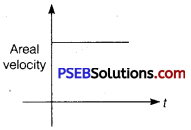
Draw areal velocity versus time graph for mars. (NCERT Exemplar)
Answer:
Areal velocity of planet revolving around the Sun is constant with time (Kepler’s second law).
PSEB 11th Class Physics Important Questions Chapter 8 Gravitation 1

Question 3.
At what factor between the two particles gravitational force does not depend?
Answer:
Gravitational force does not depend upon the medium between the two particles.

Question 4.
Two particles of masses m1 and m2 attract each other gravitationally and are set in motion under the influence of the gravitational force? Will the centre of mass move?
Answer:
Since the gravitational force is an internal force, therefore the centre of mass would not move.

Question 5.
Work done in moving a particle round a closed path under the action of gravitation force is zero. Why?
Answer:
Gravitational force is a conservative force which means that work done by it, is independent of path followed.

Question 6.
What would happen if the force of gravity were to disappear suddenly?
Answer:
The universe would collapse. We would be thrown away because of the centrifugal force. Eating, drinking and in fact all activities would become impossible.

Question 7.
Why a body weighs more at poles and less at equator?
Answer:
The value of g is more at poles than at the equator. Therefore, a body weighs more at poles than at equator.

Question 8.
Give a method for the determination of the mass of the moon.
Solution:
Soli By making use of the relation, gm = \(\frac{G M_{m}}{R_{m}^{2}} \)

Short Answer Type Questions

Question 1.
A planet moving along an elliptical orbit is closest to the Sim at a distance r1 and farthest away at a distance of r2.
If v1 and v2 are the linear velocities at these points respectively, then find the ratio \(\frac{v_{1}}{v_{2}}\).
Solution:
From the law of conservation of angular momentum
mr1v1 = mr2v2
⇒ r1v1 = r2v2 or
\(\frac{v_{1}}{v_{2}}=\frac{r_{2}}{r_{1}}\)

Question 2.
A mass M is broken into two parts, m and (M – m). How is m related to M so that the gravitational force between two parts is maximum?
Solution:
Let =m,m2 =M – m
F = G\(\frac{m(M-m)}{r^{2}}=\frac{G}{r^{2}}\left(M m-m^{2}\right)\)
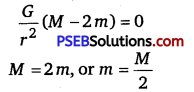
Differentiating w.r:t. m, \(\frac{d F}{d m}=\frac{G}{r^{2}}(M-2 m)\)
For F to be maximum, \(\frac{d F}{d m}\) = 0
PSEB 11th Class Physics Important Questions Chapter 8 Gravitation 2
m1 = m2 = M/2

Question 3.
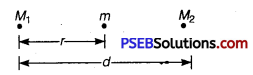
Two stationary particles of masses M1 and M2 are a distance d apart. A third particle lying on the line joining the particles, experiences no resultant gravitational force. What is the distance of this particle from M1?
Solution:
The force on m towards Mi is F =G \(\frac{M_{1} m}{r^{2}}\)
The force on m towards Mi is F = G \(\frac{M_{2} m}{(d-r)^{2}} \)

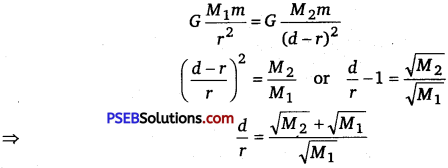
Equating two forces, we have
PSEB 11th Class Physics Important Questions Chapter 8 Gravitation 4
So, distance of an particle from m is . r = d
r = d \(\left(\frac{\sqrt{M_{1}}}{\sqrt{M_{1}}+\sqrt{M_{2}}}\right)\).

Question 4.
Aspherical planet has mass Mp and clinometer Dp. A particle of mass m falling freely near the surface of this planet will experience an acceleration due to gravity, equal to whom?
Solution:
Force is given by
F = \(-\frac{G M m}{R^{2}}=\frac{G M_{p} m}{\left(D_{P} / 2\right)^{2}}=\frac{4 G M_{P} m}{D_{P}^{2}}\)
\(\frac{F}{m}=\frac{4 G M_{P}}{D_{P}^{2}}\)

Question 5.
What is the gravitational potential energy of a body at height h from the Earth surface?
Solution:
Gravitational potential energy, i. e.,
Uh = \(-\frac{G M m}{R+h}=-\frac{g R^{2} m}{R+h}\)
[where g = \(\frac{G M}{R^{2}}\) ]
= – \(\frac{g R^{2} m}{R\left(1+\frac{h}{R}\right)}=-\frac{m g R}{1+\frac{h}{R}}\)
.
Question 6.
An artificial satellite is moving in a circular orbit around the Earth with a speed equal to half the magnitude of escape velocity from Earth.
Determine
(i) the height of satellite above Earth’s surface.
(ii) if the satellite is suddenly stopped, find the speed with
which the satellite will hit the Earth’s surface after falling down.
Solution:
Escape velocity = \(\sqrt{2 g R}\), where g is acceleration due to gravity on surface of Earth and R the radius of Earth.
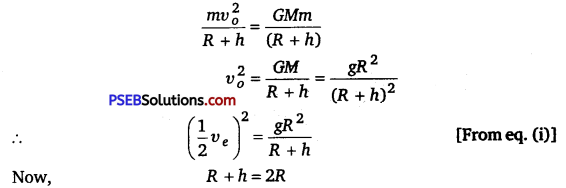
Orbital velocity = \(\frac{1}{2} v_{e}=\frac{1}{2} \sqrt{2 g R}=\sqrt{\frac{g R}{2}} \) …………………. (i)

(i) If h is the height of satellite above Earth
PSEB 11th Class Physics Important Questions Chapter 8 Gravitation 5
h=R
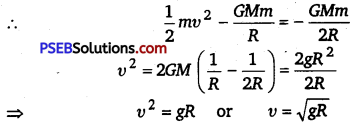
(ii) If the satellite is stopped in orbit, the kinetic energy is zero and its
potential energy is – \(\frac{G M m}{2 R}\)
Total energy =-\(\frac{G M m}{2 R}\)

Let v be its velocity when it reaches the Earth.
Hence the kinetic energy = \(\frac{1}{2} m v^{2}\)
Potential energy = – \(\frac{G M m}{2 R}\)
PSEB 11th Class Physics Important Questions Chapter 8 Gravitation 6

Question 7.
Why do different planets have different escape velocities?
Solution:
Escape velocity, v = \(\sqrt{2 g R}=\sqrt{\frac{2 G M}{R}}\)
Thus escape velocity of a planet depends upon (i) its mass (M) and
(ii) its size (R).
As different planets have different masses and sizes, so they have different escape velocities.

Question 8.
Under what circumstances would your weight become zero?
Answer:
The weight will become zero under the following circumstances
(i) during free fall
(ii) at the centre of the Earth
(iii) in an artificial satellite
(iv) at a point where gravitational pull of Earth is equal to the gravitational pull of the Moon.

Long Answer Type Questions

Question 1.
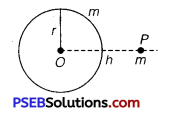
A mass m is placed at P, a distance h along the normal through the centre O of a thin circular ring of mass M and radius r. If the mass is removed further away such that OP becomes 2h, by what factor the force of gravitation will decrease, if h = r? (NCERT Exemplar)
PSEB 11th Class Physics Important Questions Chapter 8 Gravitation 7
Solution:
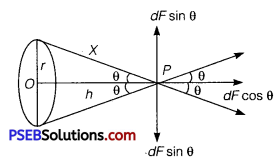
Consider a small element of the ring of mass dM, gravitational force between dM and m, distance x apart in figure i.e.,
dF = \(\frac{G(d m) m}{x^{2}}\)
PSEB 11th Class Physics Important Questions Chapter 8 Gravitation 8
dF can be resolved into two rectangular components.
(i) dF cos θ along PO and
(ii) dF sinθ perpendicular to PO (given figure)
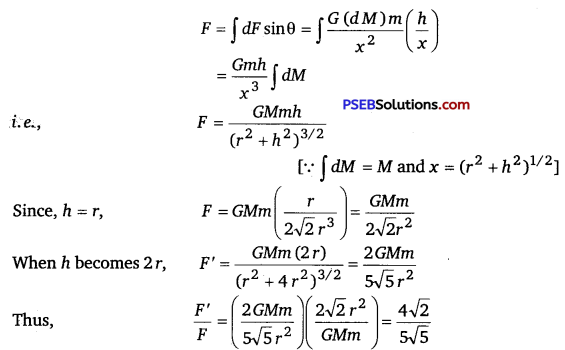
The total force (F) between the ring and mass (m) can be obtained by integrating the effects of all the elements forming the ring, whereas all the components perpendicular to PO cancel out i.e., ∫dFsinθ=O, the component along PO add together to give F i.e.,
PSEB 11th Class Physics Important Questions Chapter 8 Gravitation 9

Question 2.
A satellite is to be placed in equatorial geostationary orbit around the Earth for communication.
(i) Calculate height of such a satellite.
(ii) Find out the minimum number of satellites that are needed to cover entire Earth so that at least one of satellite is visible from any point on the equator.
[M = 6 x 10 24 kg, R = 6400 km, T = 24 h, G = 6.67 x 10⁻¹¹SI (NCERT Exemplar)
Solution:
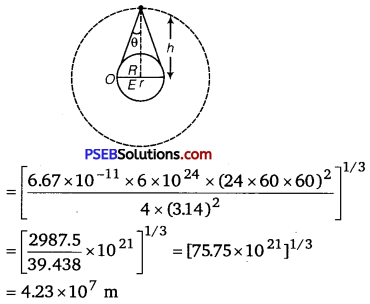
(i) As, according co Kepler’s third law, we get
T2 = \(\frac{4 \pi^{2} r^{3}}{G M}\)
⇒ r = \( \left(\frac{G M T^{2}}{4 \pi^{2}}\right)^{1 / 3}\)
PSEB 11th Class Physics Important Questions Chapter 8 Gravitation 10
As we known =R +h
h=r-R
h=4.23 x 10⁷ m – 6.4 x 10⁶ m
h = 3.59 x 10⁷ m

(ii) In ΔOES,cos θ = \(\frac{O A}{O S}=\frac{R}{R+h}\)
= \(\frac{1}{\left(1+\frac{h}{R}\right)}\)
= \(\frac{1}{(1+5.609)}\)
=0.1513
(as,\(\frac{h}{R}=\frac{3.59 \times 10^{7} \mathrm{~m}}{6.4 \times 10^{6} \mathrm{~m}}\) = 5.609)
where, θ ≈ 81° or 2θ = 162°
Number of satellites required to cover entire the Earth.
= \(\frac{360^{\circ}}{162^{\circ}}=2.2\) ≈ 3.

PSEB 11th Class Biology Solutions Chapter 2 Biological Classification

Punjab State Board PSEB 11th Class Biology Book Solutions Chapter 2 Biological Classification Textbook Exercise Questions and Answers.

PSEB Solutions for Class 11 Biology Chapter 2 Biological Classification

PSEB 11th Class Biology Guide Biological Classification Textbook Questions and Answers

Question 1.
Discuss how classification systems have undergone several changes over a period of time?
Answer:
(i) Linnaeus proposed a two kingdom system of classification with Plantae and Animalia kingdoms was developed that included all plants and animals respectively. But as this system did not distinguish between the eukaryotes and prokaryotes, unicellular and multicellular organisms and photosynthetic (green algae) and non-photosynthetic (fungi) organisms, so scientists found it an inadequate system of classification. Classification systems for the living organisms have hence, undergone several changes over time.

(ii) The two kingdom system of classification was replaced by three kingdom system, then by four and finally by five kingdom system of classification of RH Whittaker (1969).

(iii) The five kingdoms included Monera, Protista, Fungi, Plantae and Animalia. This is the most accepted system of classification of living organisms.

(iv) But, Whittaker has not described viruses and lichens. Then Stanley described viruses, viroids, etc.
Thus, over a period of time, classification systems have undergone several changes.

PSEB 11th Class Biology Solutions Chapter 2 Biological Classification

Question 2.
State two economically important uses of:
(a) Heterotrophic bacteria
(b) Archaebacteria
Answer:
(a) Heterotrophic Bacteria

  • Maintain soil fertility by nitrogen fixation, ammonification and nitrification, e.g., Rhizobium bacteria (in the root nodules of legumes).
  • The milk products such as butter, cheese, curd, etc., are obtained by the action of bacteria. The milk contains bacterial forms like Streptococcus lacti, Escherichia coli, Lactobacillus lactis and Clostridium sp., etc.

(b) Archaebacteria

  • Methanogens are responsible for the production of methane (biogas) from the dung of animals.
  • Archaebacteria help in the degradation of waste materials.

Question 3.
What is the nature of cell walls in diatoms?
Answer:
In case of diatoms, the cell wall forms two thin overlapping cells, which fit together as in a soap box. The cell wall is made up of silica. Due to siliceous nature of cell wall, it is known as diatomite or diatomaceous Earth. Diatomaceous Earth is a whitish, highly porous, chemically inert, highly absorbant and fire proof substance.

Question 4.
Find out what do the terms ‘algal bloom’ and ‘red tides’ signify?
Answer:
Sometimes, greqn algae such as Chlorella, Scenedesmus and Spirogyra, etc,, grow in excess in water bodies and impart green colour to the water. These are called algal blooms. Red dianoflagellates (Gonyaulax) grow in abundance in sea and impart red colour to the ocean. This looks like red tides. Both due to algal blooms and ‘red tide’ the animal life declines due to toxins and deficiency of oxygen inside water.

Question 5.
How are viroids different from viruses?
Answer:
Viroids different from viruses as follows:

Virus Viroids
1. These are smaller than bacteria. Smaller than viruses.
2. Both RNA and DNA present. Only RNA is present.
3. Protein coat present. Protein coat absent.
4. Causes diseases like mumps and AIDS. Causes plant diseases like spindle tuber diseases – potato.

PSEB 11th Class Biology Solutions Chapter 2 Biological Classification

Question 6.
Describe briefly the four major groups of Protozoa.
Answer:
Protozoans are divided into four phyla on the basis of locomotory organelles – Zooflagellata, Sarcodina, Sporozoa and Ciliates.
(i) Zooflagellates: These protozoans possess one to several flagella for locomotion. Zooflagellates are generally uninucleate, occasionally multinucleate.
The body is covered by a firm pellicle. There is also present cyst formation.
Examples: Giardia, Trypanosoma, Leishmania and Trichonympha, etc.

(ii) Sarcodines: These protozoans possess pseudopodia for locomotion. Pseudopodia are of four types, i.e., lobopodia, filopodia, axopodia and reticulopodia. Pseudopodia are also used for engulfing food particles. Sarcodines are mostly free living, found in freshwater, sea water and on damp soil only a few are parasitic. Nutrition is commonly holozoic. Sarcodines are generally uninucleates. Sarcodines are of four types – Amoeboids (i.e.,Amoeba, etc.), radiolarians (i.e., Acanthometra, etc.), foraminiferans (i.e., Elphidium, etc.) and heliozoans (i.e., Actinophrys, etc.).

(iii) Sporozoans: All of them are endoparasites. Locomotoryorganelles (cilia, flagella, pseudopodia, etc.) are absent. Nutrition is parasitic (absorptive), Phogotrophy is rare. The body is covered with an elastic pellicle or cuticle. Nucleus is single. Contractile vacuoles are absent. Life cyle consists of two distinct asexual and sexual phases. They may be passed in one (monogenetic) or two different hosts (digenetic),e.g., Plasmodium, Monocystis, etc.

(iv) Ciliates: These are aquatic, actively moving organisms because of the presence of thousands of cilia. They have a cavity (gullet) that opens to the outside of the cell surface. The coordinated movements of rows of cilia causes the water laden with food to enter into the gullet, e.g., Paramecium.

Question 7.
Plants are autotrophic. Can you think of some plants that are partially heterotrophic?
Answer:
Plants are autotrophs, i.e., they prepare their own food through the process of photosynthesis. But, in nature there are also some other plants which are partjally heterotrophic, i.e., they partially depend upon another organisms for food requirements, e.g.,
(i) Loranthus and Viscum are partial stem parasites which have leathery leaves. They attack several fruit and forest trees and with the help of their haustoria draw sap from the xylem tissue of the host.

(ii) Insectivorous plants have special leaves to trap insects. The trapped insects are killed and digested by proteolytic enzymes secreted by the epidermis of the leaves, e.g., pitcher plant.

(iii) Parasitic plant, e.g., Cuscutta develops haustoria, which penetrate, the vascular bundles of the host plant to absorb water and solutes.

Question 8.
What do the terms phycobiont and mycobiont signify?
Answer:
In case of lichens (t. e., an association of algae and fungi), the algal partner which is capable of carrying out photosynthesis is known as phycobiont, whereas the fungal partner which is heterotrophic in nature is known as mycobiont.

PSEB 11th Class Biology Solutions Chapter 2 Biological Classification

Question 9.
Give a comparative account of the classes of Kingdom Fungi under the following:
(i) Mode of nutrition
(ii) Mode of reproduction

Fungal Class Mode of Nutrition Mode of Reproduction
Myxomycetes Heterotrophic and mostly saprophytic Asexual and sexual reproduction
Phycomycetes Mostly parasites Asexual and sexual methods
Zygomycetes Mostly saprophytic Asexual and sexual reproduction
Ascomycetes Saprophytes or parasites Asexual and sexual reproduction
Basidiomycetes Saprophytes or parasites Asexual and sexual method
Deuteromycetes Saprophytes or parasites Only asexual reproduction

Question 10.
What are the characteristic features of Euglenoids?
Answer:
The characteristic features of euglenoids are as follows :

  • They occur in freshwater habitats and damp soils.
  • A single long flagella present at the anterior end.
  • Creeping movements occur by expansion and expansion of their body known as euglenoid movements.
  • Mode of nutrition is holophytic, saprobic or holozoic.
  • Reserve food material is paramylum.
  • Euglenoids are known as plant and animal.
    Plant characters of them are as follows:
    (a) Presence of chloroplasts with chlorophyll.
    (b) Holophytic nutrition
    Animal characters of them are as follows:
    (a) Presence of pellicle, which is made up of proteins and not a cellulose.
    (b) Presence of stigma.
    (c) Presence of contractile vacuole.
    (d) Presence of longitudinal binary fission.
  • Under favourable conditions euglenoids multiply by longitudinal binary fission, e.g., Euglena, Phacus, Paranema, etc.

Question 11.
Give a brief account of viruses with respect to their structure ’ and nature of genetic material. Also name four common viral diseases.
Answer:
Viruses are non-cellular, ultramicroscopic, infectious particles. They are made up of envelope, capsid, nucleoid and occasionally one or two enzymes. Viruses possess an outer thin loose covering called envelope. The central portion of nucleoid is surrounded by capsid that is made up of ( smaller sub-units known as capsomeres.

The nucleic acid present in the viruses is known as nucleoid. It is the r infective part of the virus which utilises the host cell machinery. The
genetic material of viruses is of four types –

(i) Double stranded DNA (dsDNA) as found in pox virus, hepatitis-B virus and herpes virus, etc.
(ii) Single stranded DNA (ssDNA) occur in coliphage Φ, coliphage Φ x 174.
(iii) Double stranded RNA (dsRNA) occur in Reo virus,
(iv) Single stranded RNA (ssRNA) occur in TMV virus, polio virus, etc.
Four common viral diseases are – (i) Polio, (ii) AIDS, (iii) Hepatitis-B (iv) Rabies.

PSEB 11th Class Biology Solutions Chapter 2 Biological Classification

Question 12.
Organise a discussion in your class on the topic—Are viruses living or non-living?
Answer:
Viruses are intermediate between living and non-living objects. They resemble non-living objects in:

  • Lacking protoplast. ‘
  • Ability to get crystallised.
  • High specific gravity which is found only in non-living objects.
  • Absence of respiration and energy storing system.
  • Absence of growth and division.
  • Cannot live independent of a living cell.

They resemble living objects in:

  • Presence of genetic material (DNA or RNA).
  • Property of mutation.
  • Irritability.
  • Can grow and multiply inside the host cell.

PSEB 11th Class Physics Solutions Chapter 8 Gravitation

Punjab State Board PSEB 11th Class Physics Book Solutions Chapter 8 Gravitation Textbook Exercise Questions and Answers.

PSEB Solutions for Class 11 Physics Chapter 8 Gravitation

PSEB 11th Class Physics Guide Gravitation Textbook Questions and Answers

Question 1.
Answer the following:
(a) You can shield a charge from electrical forces by putting it inside a hollow conductor. Can you shield a body from the gravitational influence of nearby matter by putting it inside a hollow sphere or by some other means?
(b) An astronaut inside a small spaceship orbiting around the earth cannot detect gravity. If the space station orbiting around the earth has a large size, can he hope to detect gravity?
(c) If you compare the gravitational force on the earth due to the sun to that due to the moon, you would find that the Sun’s pull is greater than the moon’s pull. (You can check this yourself using the data available in the succeeding exercises). However, the tidal effect of the moon’s pull is greater than the tidal effect of sun. Why?
Answer:
(a) No, Gravitational influence of matter on nearby objects cannot be screened by any means. This is because gravitational force unlike electrical forces is independent of the nature of the material medium. Also, it is independent of the status of other objects.

(b) Yes, If the size of the space station is large enough, then the astronaut will detect the change in Earth’s gravity (g).

(c) Tindal effect depends inversely upon the cube of the distance while gravitational force depends inversely on the square of the distance. Since the distance between the Moon and the Earth is smaller than the distance between the Sun and the Earth, the tidal effect of the Moon’s pull is greater than the tidal effect of the Sun’s pull.

Question 2.
Choose the correct alternative:
(a) Acceleration due to gravity increases/decreases with increasing altitude.
(b) Acceleration due to gravity increases/decreases with increasing depth (assume the earth to be a sphere of uniform density).
(c) Acceleration due to gravity is independent of mass of the earth/mass of the body.
(d) The formula -G Mm(1 /r2 -1/r1) is more/less accurate than the formula mg (r2 – r1) for the difference of potential energy between two points r2 and r1 distance away from the centre of the earth.
Solution:
(a) Decreases,
Explanation : Acceleration due to gravity at altitude h is given by the relation:
gh = \(\left(1-\frac{2 h}{R_{e}}\right) g\)
where, Re = Radius of the Earth
g = Acceleration due to gravity on the surface of the Earth
It is clear from the given relation that acceleration due to gravity decreases with an increase in height.

(b) Decreases,
Explanation : Acceleration due to gravity at depth d is given by the relation:
gd = \(\left(1-\frac{d}{R_{e}}\right) g\)
It is clear from the given relation that acceleration due to gravity decreases with an increase in depth.

(c) Mass of the body,
Explanation : Acceleration due to gravity of body of mass m is given by the relation:
g = \(\frac{G M_{e}}{R^{2}}\)
where, G = Universal gravitational constant
Me = Mass of the Earth
Re = Radius of the Earth
Hence, it can be inferred that acceleration due to gravity is independent of the mass of the body.

(d) More,
Explanation : Gravitational potential energy of two points r2 and r1 distance away from the centre of the Earth is respectively given by:
V(r1) = -GmM
V(r2) = – \(\frac{G m M}{r_{2}}\)
V = V (r2) – V(r1) = -GmM\(\left(\frac{1}{r_{2}}-\frac{1}{r_{1}}\right)\).
Hence, this formula is more accurate than the formula mg (r2 – r1).

Question 3.
Suppose there existed a planet that went around the Sun twice as fast as the Earth. What would be its orbital size as compared to that of the Earth?
Solution:
Time taken by the Earth to complete one revolution around the Sun,
Te = 1 year
Orbital radius of the Earth in its orbit, Re = 1 AU
Time taken by the planet to complete one revolution around the Sun,
Tp = \(\frac{1}{2} T_{e}=\frac{1}{2}\) year
Orbital radius of the planet = Rp
From Kepler’s third law of planetary motion, we can write
PSEB 11th Class Physics Solutions Chapter 8 Gravitation 1
Hence, the orbital radius of the planet will be 0.63 times smaller than that of the Earth.

Question 4.
I0, one of the satellites of Jupiter, has an orbital period of 1.769 days and the radius of the orbit is 4.22 x 10⁸ m. Show that the mass of Jupiter is about one-thousandth that of the sun.
Solution:
Orbital period of I0, TI0 = 1.769 days = 1.769 x 24 x 60 x 60 s
Orbital radius of II0, RI0 = 4.22 x 10⁸ m
Satellite I0 is revolving around the Jupiter Mass of the latter is given by the relation:
Mj = \(\frac{4 \pi^{2} R_{I_{O}}^{3}}{G T_{I_{O}}^{2}}\) ……………………….. (i)

where Mj = Mass of Jupiter
G = Universal gravitational constant Orbital period of the Earth,
Te = 365.25 days = 365.25 x 24 x 60 x 60 s Orbital radius of the Earth,
Re =1 AU = 1.496 x 10¹¹ m
Mass of Sun is given as:
Ms = \(\frac{4 \pi^{2} R_{e}^{3}}{G T_{e}^{2}}\) ………………………. (ii)
PSEB 11th Class Physics Solutions Chapter 8 Gravitation 2
= 1045.04
∴ \(\frac{M_{s}}{M_{j}} \sim 1000\)
\(M_{s} \sim 1000 \times M_{j}\)
Hence, it can be inferred that the mass of Jupiter is about one thousandth that of the Sun.

Question 5.
Let us assume that our only consists of 2.5 x 10¹¹ stars each of one solar mass. How long will a star at a distance of 50,000 ly from the galactic center take to complete one revolution? Take the diameter of the Milky Way to be 105 ly.
Solution:
Number of stars in our galaxy, = 2.5 x 10¹¹
Mass of each star = one solar mass =2 x 1030 kg
Mass of our galaxy,M =2.5 x 1011 x 2 x 1030 = 5 x 1041 kg
Diameter of Milky Way, d = 105 ly
Radius of Milky Way,r= 5 x 10⁴ ly
∵ 1 ly=946 x 1015m
∴ r=5 x 104 x 9.46 x 1015
=4.73 x 10²⁰m

Since a star revolves around the galactic centre of the Milky Way, its time period is given by the relation:
T = \(\left(\frac{4 \pi^{2} r^{3}}{G M}\right)^{1 / 2}\)
PSEB 11th Class Physics Solutions Chapter 8 Gravitation 3
1 year = 365 x 324 x 60 x 60 s
∵ 1 s = \(\frac{1}{365 \times 24 \times 60 \times 60} \) years
∴ 1.12 x 10¹⁶ s = \(\frac{1.12 \times 10^{16}}{365 \times 24 \times 60 \times 60}\) = 3.55 x 10 8 years

Question 6.
Choose the correct alternative:
(a) If the zero of potential energy Is at infinity, the total energy of an orbiting satellite is negative of its kinetic/potential energy.
(b) The energy required to launch an orbiting satellite out of Earth’s gravitational influence Is more/less than the energy required to project a stationary object at the same height (as the satellite) out of Earth’s influence.
Solution:
(a) Kinetic energy
Explanation: Total mechanical energy of a satellite is the sum of its kinetic energy (always positive) and potential energy (maybe negative). At infinity, the gravitational potential energy of the satellite is zero. As the Earth-satellite system is a bound system, the total energy of the satellite is negative.

Thus, the total energy of an orbiting satellite at infinity is equal to the negative of its kinetic energy.

(b) Less
Explanation: An orbiting satellite acquires certain amount of energy that enables it to revolve around the Earth. This energy is provided by its orbit. It requires relatively lesser energy to move out of the influence of the Earth’s gravitational field than a stationary object on the Earth’s surface that initially contains no energy.

Question 7.
Does the escape speed of a body from the Earth depend on
(a) the mass of the body,
(b) the location from where it is projected,
(c) the direction of projection,
(d) the height of the location from where the body is launched?
Answer:
(a) No, we know that the escape velocity of the body is given by
Ve = \(\sqrt{\frac{2 G M}{R}} \) , where M and R are mass and radius of Earth. Thus clearly, it does not depend on the grass of the body as Ve is independent of it.

(b) Yes, we know that Ve depends upon the gravitational potential at the point from where the body is launched. Since the gravitational potential depends on the latitude and height of the point, therefore the escape velocity depends on the location of the point from where it is projected. It can also be experienced as:
Ve = \(\sqrt{2 g r}\) . As g has different values at different heights. Therefore, Ve depends upon the height of location.

(c) No, it does not depend on the direction of projection as Ve is independent of the direction of projection.

(d) Yes, it depends on the height of location from where the body is launched as explained in (b).

Question 8.
A comet orbits the Sun in a highly elliptical orbit. Does the comet have a constant
(a) linear speed,
(b) angular speed,
(c) angular momentum,
(d) kinetic energy,
(e) potential energy,
(f) total energy throughout its orbit? Neglect any mass loss of the comet when it comes very close to the Sun.
Solution:
(a) No, according to law of conservation of linear momentum L = mvr constant, therefore the comet moves faster when it is close to the sun and moves slower when it is farther away from the sun. Therefore, the speed of the comet does not remain constant.

(b) No, as the linear speed varies, the angular speed also varies. Therefore, angular speed of the comet does not remain constant.

(c) Yes, as no external torque is acting on the comet, therefore, according to law of conservation of angular momentum, the angular momentum of the comet remain constant.

(d) No, kinetic energy of the comet = \(\frac{1}{2}\) mν2 As the linear speed of the comet changes as its kinetic energy also changes. Therefore, its KE does not remains constant.

(e) No, potential energy of the comet changes as its kinetic energy changes.

(f) Yes, total energy of a comet remain constant throughout its orbit.

Question 9.
Which of the following symptoms is likely to afflict an astronaut in space
(a) swollen feet,
(b) swollen face,
(c) headache,
(d) orientational problem?
Answer:
(b), (c), and (d)
Explanations:
(a) Legs hold the entire mass of a body in standing position due to gravitational pull. In space, an astronaut feels weightlessness because of the absence of gravity. Therefore, swollen feet of an astronaut do not affect him/her in space.

(b) A swollen face is caused generally because of apparent weightlessness in space sense organs such as eyes, ears, nose, and mouth constitute a person’s face. This symptom can affect an astronaut in space.

(c) Headaches are caused because of mental strain. It can affect the working of an astronaut in space.

(d) Space has different orientations. Therefore, orientational problems can affect an astronaut in space.

Question 10.
In the following two exercises, choose the correct answer from among the given ones:
The gravitational intensity at the center of a hemispherical shell of uniform mass density has the direction indicated by the arrow (see figure) (i) a, (ii) b, (iii) c, (iv) 0.
PSEB 11th Class Physics Solutions Chapter 8 Gravitation 4
Solution:
(iii) Gravitational potential (V) is constant at all points in a spherical shell.
Hence, the gravitational potential gradient \(\left(\frac{d V}{d r}\right)\) is zero everywhere inside the spherical shell. The gravitational potential gradient is equal to the negative of gravitational intensity. Hence, intensity is also zero at all points inside the spherical shell. This indicates that gravitational forces acting at a point in a spherical shell are symmetric.

If the upper half of a spherical shell is cut out (as shown in the given figure), then the net gravitational force acting on a particle located at center O will be in the downward direction.
PSEB 11th Class Physics Solutions Chapter 8 Gravitation 5
Since gravitational intensity at a point is defined as the gravitational force per unit mass at that point, it will also act in the downward direction. Thus, the gravitational intensity at center O of the given hemispherical shell has the direction as indicated by arrow c.

Question 11.
For the above problem, the direction of the gravitational intensity at an arbitrary point P is indicated by the arrow
(i) d,
(ii) e,
(iii) f,
(iv) g.
Solution:
(ii) Gravitational potential (V) is constant at all points in a spherical shell.
Hence, the gravitational potential gradient \(\left(\frac{d V}{d r}\right)\) inside the spherical shell. The gravitational potential gradient is equal to the negative of gravitational intensity. Hence, intensity is also zero at all points inside the spherical shell. Ibis indicates that gravitational forces acting at a point in a spherical shell are symmetric. If the upper half of a spherical shell is cut out (as shown in the given figure), then the net gravitational force acting on a particle at an arbitrary point P will be in the downward direction.
PSEB 11th Class Physics Solutions Chapter 8 Gravitation 6
Since gravitational intensity at a point is defined as the gravitational force per unit mass at that point, it will also act in the downward direction. Thus, the gravitational intensity at an arbitrary point P of the hemispherical shell has the direction as indicated by arrow e.

Question 12.
A rocket Is fired from the Earth towards the Sun. At what distance from the Earth’s centre is the gravitational force on the rocket zero? Mass of the Sun = 2 x 1030kg, mass of the Earth = 6 x 1024 kg. Neglect the effect of other planets etc. (orbital radius = 1.5 x 10¹¹ m)
Solution:
Mass of the Sun, Ms = 2 x 1030 kg
Mass of the Earth, Me = 6 x 10 24 kg
Orbital radius, r = 1.5 x 10¹¹ m
Mass of the rocket = m
PSEB 11th Class Physics Solutions Chapter 8 Gravitation 7
Let x be the distance from the center of the Earth where the gravitational force acting on satellite P becomes zero.
From Newton’s law of gravitation, we can equate gravitational forces acting on satellite P under the influence of the Sun and the Earth as:
PSEB 11th Class Physics Solutions Chapter 8 Gravitation 8
= 2.59 x 10⁸ m

Question 13.
How will you ‘weigh the Sun’, that is estimate its mass? The mean orbital radius of the Earth around the Sun is 1.5 x 10⁸ km.
Solution:
Orbital radius of the Earth around the Sun, r = 1.5 x 10⁸ km = 1.5 x 10¹¹ m
Time taken by the Earth to complete one revolution around the Sun,
T = 1 year = 365.25 days = 365.25 x 24 x 60 x 60 s
Universal gravitational constant, G = 6.67 x 10⁻¹¹N-m2 kg-2
Thus, mass of the Sun can be calculated using the relation,
M = \(\frac{4 \pi^{2} r^{3}}{G T^{2}}\)
= \(\frac{4 \times(3.14)^{2} \times\left(1.5 \times 10^{11}\right)^{3}}{6.67 \times 10^{-11} \times(365.25 \times 24 \times 60 \times 60)^{2}}\)
= \(\frac{133.24 \times 10^{33}}{6.64 \times 10^{4}}\) = 2.0 x 1030kg
Hence, the mass of the Sun is 2.0 x 1030 kg.

Question 14.
A Saáurn year is 29.5 times the Earth year. How far is the Saturn from the Sun if the Earth is 1.5 x 10⁸ km away from the Sun?
Solution:
Distance of the Earth from the Sun, re = 1.5x 10⁸ km= 1.5 x 10¹¹ m
Time period of the Earth = Te
Time period of Saturn, Ts = 29.5 Te
Distance of Saturn from the Sun = rs
From Kepler’s third law of planetary motion, we have
T=\(\left(\frac{4 \pi^{2} r^{3}}{G M}\right)^{\frac{1}{2}}\)
For Saturn and Sun, we can write
PSEB 11th Class Physics Solutions Chapter 8 Gravitation 9
= 1.43 x 10¹² m

Question 15.
A body weigths 63 N on the surface of the Earth. What is the gravitational force on it due to the Earth at a height equal to half the radius of the Earth?
Solution:
Weight of the body, W =63 N
Acceleration due to gravity at height h from the Earth’s surface is given by the relation:
g’ = \(\frac{g}{\left(1+\frac{h}{R_{e}}\right)^{2}}\)
where, g = Acceleration due to gravity on the Earth’s surface
Re =Radius of the Earth
For h= \(\frac{R_{e}}{2}\)
g’ = \(\frac{g}{\left(1+\frac{R_{e}}{2 \times R_{e}}\right)^{2}}=\frac{g}{\left(1+\frac{1}{2}\right)^{2}}=\frac{4}{9} g\)

Weight of a body of mass m at height h is given as
W’ = mg’
= m x \(\frac{4}{9}\) g = \(\frac{4}{9}\) x mg
= \(\frac{4}{9}\) W
= \(\frac{4}{9}\) x 63 =28 N

Question 16.
Assuming the Earth to be a sphere of uniform mass density, how much would a body weigh halfway down to the centre of the Earth if it weighed 250 N on the surface?
Solution:
Weight of a body of mass m at the Earth’s surface, W = mg = 250 N
Body of mass m is located at depth, d = \(\frac{1}{2}\) Re
where, Re = Radius of the Earth
Acceleration due to gravity at depth d is given by the relation
g’ = \(\left(1-\frac{d}{R_{e}}\right) g=\left(1-\frac{R_{e}}{2 \times R_{e}}\right) g=\frac{1}{2} g\)
Weight of the body at depth d,
W’ = mg’
= m x \(\frac{1}{2} g=\frac{1}{2}\) mg = \(\frac{1}{2}\) W
= \(\frac{1}{2}\) x 250 = 125 N

Question 17.
A rocket is fired vertically with a speed of 5 km s-1 from the Earth’s surface. How far from the Earth does the rocket ‘ go before returning to the earth? Mass of the Earth = 6.0 x 1024 kg; mean radius of the Earth = 6.4 x 10⁶ m;
G = 6.67 x 10 -11 N-m2 kg-2.
Solution:
Velocity of the rocket, ν = 5 km/s = 5 x 10³ m/s
Mass of the Earth, Me = 6.0 x 1024 kg
Radius of the Earth, Re = 6.4 x 10⁶ m
Height reached by rocket mass, m = h

At the surface of the Earth,
Total energy of the rocket = Kinetic energy + Potential energy
= \(\frac{1}{2} m v^{2}+\left(\frac{-G M_{e} m}{R_{e}}\right)\)
At highest point h,
ν = 0
and, Potential energy = – \(\frac{G M_{e} m}{R_{e}+h}\)
Total energy of the rocket = 0+ \(\left(-\frac{G M_{e} m}{R_{e}+h}\right)=-\frac{G M_{e} m}{R_{e}+h}\)
From the law of conservation of energy, we have
Total energy of the rocket at the Earth’s surface=Total energy at height h
PSEB 11th Class Physics Solutions Chapter 8 Gravitation 10
PSEB 11th Class Physics Solutions Chapter 8 Gravitation 11
Height achieved by the rocket with respect to the centre of the Earth = Re +h
= 6.4 x 10⁶ +1.6 x 106 = 8.0 x 10⁶ m

Question 18.
The escape speed of a projectile on the Earth’s surface is 11.2 km s-1. A body is projected out with thrice this speed. What is the speed of the body far away from the Earth? Ignore the presence of the Sun and other planets.
Solution:
Escape velocity of a projectile from the Earth, υesc = 11.2 km/s
Projection velocity of the projectile, vp = 3 vesc
Mass of the projectile = m
Velocity of the projectile far away from the Earth = vf
Total energy of the projectile on the Earth = \(\frac{1}{2} m v_{p}^{2}-\frac{1}{2} m v_{\mathrm{esc}}^{2}\)
The gravitational potential energy of the projectile far away from the Earth is zero.
Total energy of the projectile far away from the Earth = \(\frac{1}{2}\) mv2f
From the law of conservation of energy, we have
PSEB 11th Class Physics Solutions Chapter 8 Gravitation 12

Question 19.
A satellite orbits the Earth at a height of 400 km above the surface. How much energy must be expended to rocket the satellite out Of the Earth’s gravitational influence? Mass of the satellite = 200 kg mass of the Earth = 6.0 x 1024 kg; radius of the Earth=6.4x 10⁶ m;G=6.67 x 10⁻¹¹ N-m2 kg-2.
Solution:
Mass of the Earth, Me =6.0 x 1024 kg
Mass of the satellite, m = 200 kg
Radius of the Earth, Re = 6.4 x 10⁶ m
Universal gravitational constant, G = 6.67 x 10⁻¹¹ N-m2kg2
Heightofthesatellite,h =400 km=4 x 10⁵ m=0.4 x 10⁶ m

Total energy of the satellite at height h = \(\frac{1}{2} m v^{2}+\left(\frac{-G M_{e} m}{R_{e}+h}\right)\)
Orbital velocity of the satellite, ν = \(\sqrt{\frac{G M_{e}}{R_{e}+h}}\)
Total energy of height, h = \(\frac{1}{2} m\left(\frac{G M_{e}}{R_{e}+h}\right)-\frac{G M_{e} m}{R_{e}+h}=-\frac{1}{2}\left(\frac{G M_{e} m}{R_{e}+h}\right) \)

The negative sign indicates that the satellite is bound to the Earth. This is called bound energy of the satellite.
Energy required to send the satellite out of its orbit = – (Bound energy)
PSEB 11th Class Physics Solutions Chapter 8 Gravitation 13

Question 20.
Two stars each of one solar mass (= 2x 1030 kg) are approaching each other for a head-on collision. When they are a distance 109 km, their speeds are negligible. What is the speed with which they collide? The radius of each star is 104 km. Assume the stars to remain undistorted until they collide. (Use the known value of G).
Solution:
Mass of each star, M = 2 x 1030 kg
Radius of each star, R = 104 km = 107 m
Distance between the stars, r = 109 km = 1012 m
For negligible speeds, ν = 0 total energy of two stars separated at distance r
= \(\frac{-G M M}{r}+\frac{1}{2} m v^{2}\)
= \(\frac{-G M M}{r}+0\) = 0 ………………………… (i)

Now, consider the case when the stars are about to collide:
The velocity of the stars = ν
Distance between the centers of the stars = 2R
Total kinetic energy of both stars = \(\frac{1}{2} M v^{2}+\frac{1}{2} M v^{2}\) = Mv2
Total potential energy of both stars = \(\frac{-G M M}{2 R}\)
Total energy of the two stars = Mv2 – \(\frac{-G M M}{2 R}\) ………………………. (ii)
Using the law of conservation of energy, we can write
PSEB 11th Class Physics Solutions Chapter 8 Gravitation 14

Question 21.
Two heavy spheres each of mass 100 kg and radius 0.10 m are placed 1.0 m apart on a horizontal table. What is the gravitational force and potential at the midpoint of the line joining the centers of the spheres? Is an object placed at that point in equilibrium? If so, is the equilibrium stable or unstable?
Solution:
The situation is represented in the following figure :
PSEB 11th Class Physics Solutions Chapter 8 Gravitation 15
Mass of each sphere, M = 100 kg
Separation between the spheres, r = 1 m
X is the mid-point between the spheres. Gravitational force at point X will be zero. This is because gravitational force exerted by each sphere will act in opposite directions. Gravitational potential at point X
PSEB 11th Class Physics Solutions Chapter 8 Gravitation 16
Any object placed at point X will be in equilibrium state, but the equilibrium is unstable. This is because any change in the position of the object will change the effective force in that direction.

Additional Exercises

Question 22.
As you have learnt in the text, a geostationary satellite orbits the Earth at a height of nearly 36,000 km from the surface of the Earth. What is the potential due to Earth’s gravity at the site of this satellite? (Take the potential energy at infinity to be zero). Mass of the Earth = 6.0 x 1024 kg, radius = 6400 km.
Solution:
Mass of the Earth, M = 6.0 x 1024 kg
Radius of the Earth, R = 6400 km = 6.4 x 10⁶ m
Height of a geostationary satellite from the surface of the Earth,
h = 36000 km = 3.6 x 10⁷m
Gravitational potential energy due to Earth’s gravity at height h,
PSEB 11th Class Physics Solutions Chapter 8 Gravitation 17

Question 23.
A star 2.5 times the mass of the Sun and collapsed to a size of 12 km rotates with a speed of 1.2 revs. per second. (Extremely compact stars of this kind are known as neutron stars. Certain stellar objects called pulsars belong to this category). Will an object placed on its equator remain stuck to its surface due to gravity? (Mass of the Sun = 2 x 1030 kg).
Solution:
Yes, A body gets stuck to the surface of a star if the inward gravitational force is greater than the outward centrifugal force caused by the rotation of the star.
Gravitational force, fg = \(\frac{G M m}{R^{2}}\)
where,M =Mass of the star=2.5 x 2 x 1030 = 5 x 1030 kg
m = Mass of the body

R=Radiusofthestar=12 km=1.2 x 10⁴ m
∴ fg = \(\frac{6.67 \times 10^{-11} \times 5 \times 10^{30} \times m}{\left(1.2 \times 10^{4}\right)^{2}}\)
= 2.31 x 10¹² mN
Centrifugal force, fc = mrω2

where, ω = Angular speed = 2 πv
ν = Angular frequency = 1.2 rev s-1
f c=mR(2πv)2
= m x (1.2 x 104) x 4 x(3.14)2 x (1.2)2 = 1.7 x 10⁵ mN
Since fg > fc, the body will remain stuck to the surface of the star.

Question 24.
A spaceship is stationed on Mars. How much energy must be expended on the spaceship to launch it out of the solar system? Mass of the spaceship = 1000 kg; mass of the Sun = 2 x 1030 kg; mass of mars = 6.4 x 10²³ kg; radius of mars = 3395 km; radius of the orbit of mars = 2.28 x 10⁸ km;
G = 6.67 x 10⁻¹¹ N-m2kg-2.
Solution:
Given, mass of the Sun, M = 2 x 1030 kg
PSEB 11th Class Physics Solutions Chapter 8 Gravitation 18
Mass of the mars, m = 6.4 x 10²³ kg
Mass of spaceship, Δm = 1000 kg
Radius of orbit of the mars, r0 = 2.28 x 10¹¹
Radius of the mars, r = 3.395 x 10⁶ m
If v is the orbital velocity of mars, then
PSEB 11th Class Physics Solutions Chapter 8 Gravitation 19
Since the velocity of the spaceship is the same as that of the mars, Kinetic energy of the spaceship,
PSEB 11th Class Physics Solutions Chapter 8 Gravitation 20
PSEB 11th Class Physics Solutions Chapter 8 Gravitation 21
Total potential energy of the spaceship,
U = Potential energy of the spaceship due to its being in the gravitational
field of the mars + potential energy of the spaceship due to its being in the gravitational field of the Sun.
PSEB 11th Class Physics Solutions Chapter 8 Gravitation 22
Total energy of the spaceship E=K +U = 2.925 x 10¹¹ J – 5.977 x 10¹¹J
= – 3.025 x 10¹¹ J = -3.1 x 10¹¹ J
Negative energy denotes that the spaceship is bound to the solar system. Thus, the energy needed by the spaceship to escape from the solar system = 3.1 x 10¹¹ J.

Question 25.
A rocket is fired ‘vertically’ from file surface of mars with a speed of 2 kms-1. If 20% of its initial energy is lost due to martian atmospheric resistance, how far will the rocket go from the surface of Mars before returning to it?
Mass of mars = 6.4x 10²³ kg; radius of mars = 3395 km;
G = 6.67 x 10⁻¹¹ N-m2 kg2.
Solution:
Initial velocity of the rocket, ν = 2 km/s = 2 x 10³ m/s
Mass of Mars, M = 6.4 x 10²³ kg .
Radius of Mars, R = 3395 km = 3.395 x 10⁶ m
Universal gravitational constant, G = 6.67 x 10⁻¹¹ N-m2 kg-2
Mass of the rocket = m
Initial kinetic energy of the rocket = \(\frac{1}{2} m v^{2}\)
Initial potential energy of the rocket = \(\frac{-G M m}{R}\)
Total initial energy = \(\frac{1}{2} m v^{2}-\frac{G M m}{R}\)

If 20 % of initial kinetic energy is lost due to martian atmospheric resistance, then only 80 % of its kinetic energy helps in reaching a height.
Total initial energy available = \(\frac{80}{100} \times \frac{1}{2} m v^{2}-\frac{G M m}{R}=0.4 m v^{2}-\frac{G M m}{R} \)
Maximum height reached by the rocket = h
At this height, the velocity and hence, the kinetic energy of the rocket will become zero.
Total energy of the rocket at height h = \(-\frac{G M m}{(R+h)}\)
Applying the law of conservation of energy for the rocket, we can write
PSEB 11th Class Physics Solutions Chapter 8 Gravitation 23
= 495 x 103 m = 495 km

PSEB 11th Class Biology Important Questions Chapter 1 The Living World

Punjab State Board PSEB 11th Class Biology Important Questions Chapter 1 The Living World Important Questions and Answers.

PSEB 11th Class Biology Important Questions Chapter 1 The Living World

Very short answer type questions

Question 1.
Define living things.
Answer:
The organisms exhibiting growth, development, metabolism, response to stimuli, reproduction and other characteristics such as movement, etc., are called living things.

Question 2.
In which organisms reproduction is synonymous with growth?
Answer:
In unicellular organisms like Amoeba, bacteria and unicellular algae, reproduction is synonymous with growth, i. e., increase in number of cells.

PSEB 11th Class Biology Important Questions Chapter 1 The Living World

Question 3.
Amoeba multiplies by mitotic cell division. Is this phenomenon growth or reproduction? Explain. [NCERT Exemplar]
Answer:
The phenomenon is reproduction in which unicellular organisms like Amoeba, cell division is a means of multiplication, while in multicellular organisms, it is a means of growth.

Question 4.
Can we relate metabolism with growth of the body?
Answer:
Metabolism occurs due to two phenomena, i.e., anabolism and catabolism. While growth of living things occur when quantity of anabolic reactions exceeds quantity of catabolic reactions.

Question 5.
Linnaeus is considered as father of taxonomy. Name two other botanists known for their contribution to the field of taxonomy. [NCERT Exemplar]
Answer:
John Ray and Bentham and Hooker.

Question 6.
What does ICZN stand for? [NCERT Exemplar]
Answer:
ICZN: International Code of Zoological Nomenclature

PSEB 11th Class Biology Important Questions Chapter 1 The Living World

Question 7.
How is diversity in living world related to taxonomy?
Answer:
The spectrum of diversity in the living world can be known only through the study of taxonomy.

Question 8.
Which is the largest botanical garden in the world? Name a few well known botanical gardens in India. [NCERT Exemplar]
Answer:
Largest botanical garden in the world is Royal Botanical Garden, Kew
(London). Some well known botanical gardens in India are as follows:

  • National Botanical Garden, Lucknow
  • Lloyed Botanical Garden, Darjeeling
  • Indian Botanical Garden Sibpur, Kolkata

Question 9.
The concept of new systematics was developed by which scientist?
Answer:
Julian Huxley (1940)

Question 10.
How correlated characters help in defining genus?
Answer:
Correlated characters are those common features, which are used in delimitation of a taxon above the rank of species.

Short answer type questions

Question 1.
What do you know about herbarium?
Answer:
Herbarium is a store house of collected plant specimens that are dried, pressed and preserved on sheets. Further, these sheets are arranged according to k universally accepted system of classification. These specimens, along with their descriptions on herbarium sheets, become a store house or repository for future use. The herbarium sheets also carry a label providing information about date and place of collection, English, local and botanical names, family, collector’s name, etc. Herbaria also serve as quick referral systems in taxonomical studies.

PSEB 11th Class Biology Important Questions Chapter 1 The Living World

Question 2.
How is botanical garden useful for scientists?
Answer:
In a botanical garden various plant species are reared. Special artificial climate is created for a plant’s specific needs. The purpose of botanical garden is to maintain a rich flora of diverse species. Since, they are live specimens so they help scientists in studying physiology and anatomy over a long duration. Imagine if Mendel were given a botanical garden full of variety of species. He could have done experiment on so many plants and may have come with more insights.

Question 3.
Write a short note on museum.
Answer:
Museums are those places which have collections of preserved animals and plants for taxonomic studies. The organisms are exhibited in the following manners:

  • The plant and animal specimens are kept in chemical solutions and are preserved for longer duration.
  • Plant and animal specimens may also be preserved as dry specimens.
  • Insects are preserved in insect boxes; the collected insects are dried and pinned in these boxes.
  • Larger animals like birds and mammals are usually preserved as stuffed specimens.
  • Skeletons of animals are also collected in the museums.

Question 4.
How is a zoological park helpful to scientists?
Answer:
It is difficult and dangerous to study ferocious animals in their natural habitats. Further, it is cruel to study them in captivity. So zoological park is a better option. Scientists can study different behavioural patterns, like feeding habits, mating rituals. This can help in a better understanding about them.

Long answer type questions

Question 1.
A student of taxonomy was puzzled when told by his professor to look for a key to identify a plant. He went to his friend to clarify what key the professor was referring to? What would the friend explain to him? [NCERT Exemplar]
Answer:
The key for identification of plants is a taxonomic key. It is a important taxonomic aid. Key can be defined as a set of alternate characters arranged in such a manner that by selection and elimination one can quickly find out the name of an organism. Depending upon the category, a key may be class key, order key, family key, genus key and species key.

Taxonomic keys can be of following two types:
(i) Indented or Yolked key
(ii) Bracketed key
Indented key, provides a sequence of two or more alternate characters from which selection and elimination are carried out. In bracketed key, the alternate characters are given numbers in brackets. For example, take four genera of family – Ranunculaceae to explain this,
(i) Ranunculus: Leaves alternate or radical, flowers not subtended by involucre, carpels ovuled, fruit achenes.
(ii) Clematis: Leaves opposite, compound petals absent, sepals 4, carpels uniovulated and fruit achenes.
(iii) Nigella: Flowers regular, carpels united at base, many ovulated, fruit follicles.
(iv) Anemone: Leaves alternate or radical, flowers subtended by involucre, carpels 1-ovulated, fruit achenes.

PSEB 11th Class Biology Important Questions Chapter 1 The Living World

Question 2.
Some of the properties of tissues are not the properties of constituents of its cells. Give three examples to support the statement. [NCERT Exemplar]
Answer:
A living thing has multiple level of organisation. Each level of organisaton i has its own properties, which are not found in its constituents.
Examples of three tissues supporting the statements are
(i) Cardiac muscle tissue: It is a contractile tissue present only in heart. Cell junctions fuse the plasma membrane of cardiac muscle cells and make them stick together. When one cell receives a signal to contract, its neighbours also starts to contract. It means a single cell cannot contract, while there are some fusion points, which allow the cells to contract as a unit.

(ii) Blood: It is a fluid connective tissue. The individual components of blood, i.e., RBCs, WBCs and platelets have different properties but as a unit they make the blood, a tissue serving many functions.

(iii) Bone: It is a hard connective tissue that forms the framework of the body. The individual cells inside the bone do not have this property.

PSEB 11th Class Biology Solutions Chapter 1 The Living World

Punjab State Board PSEB 11th Class Biology Book Solutions Chapter 1 The Living World Textbook Exercise Questions and Answers.

PSEB Solutions for Class 11 Biology Chapter 1 The Living World

PSEB 11th Class Biology Guide The Living World Textbook Questions and Answers

Question 1.
Why are living organisms classified?
Answer:
Living organisms are classified because:

  • there are millions of organisms on the earth, which need a proper system of classification for identification.
  • a number of new organisms are discovered each year. They require a particular system to be identified and to find out their correct position in a group.

Question 2.
Why are the classification systems changing every now and then?
Answer:
Evolution is the major factor responsible for the change in classification systems. Since, evolution still continues, so many different species of plants and animals are added in the already existed biodiversity. These newly discovered plant and animal specimens are then identified, classified and named according to the already existing classification systems. Due to evolution, animal and plant species keep on changing, so necessary changes in the already existed classification systems are necessary to place every newly discovered plant and animal in their respective ranks.

PSEB 11th Class Biology Solutions Chapter 1 The Living World

Question 3.
What different criteria would you choose to classify people that you meet often?
Answer:
The different scientific criteria to classify people that we meet often would be :
(i) Nomenclature: It is the science of providing distinct and proper names to the organisms. It is the determination of correct name as per established universal practices and rules.

(ii) Classification: It is the arrangement of organisms into categories based on systematic planning. In classification various categories used are class, order, family, genus and species.

(iii) Identification: It is the determination of correct name and place of an organism. Identification is used to tell that a particular species is similar to other organism of known identity. This includes assigning an organism to a particular taxonomic group.
The same criteria can be applied to the people we meet daily. We can identify them will their names classify them according to their living areas, profession, etc.

Question 4.
What do we learn from identification of individuals and populations?
Answer:
Identification of individuals and population categorized it into a species. Each species has unique characteristic features. On the basis of these features, it can be distinguished from other closely related species, e. g.,
PSEB 11th Class Biology Solutions Chapter 1 The Living World 1

Question 5.
Given below is the scientific name of Mango. Identify the correctly written name.
(i) Mangifera Indica
(ii) Mangifera indica.
Answer:
(ii) Mangifera indica (the name of species can never begins with a capital letter).

PSEB 11th Class Biology Solutions Chapter 1 The Living World

Question 6.
Define a taxon. Give some examples of taxa at different hierarchical levels.
Answer:
Taxon is a grouping of organisms of any level in hierarchical classification, which is based on some common characteristics, e.g., insects represent a class of phylum – Arthropoda. All the insects possess common characters of three pairs of jointed legs. The term ‘taxon’ was introduced by ICBN in 1956. Examples of taxa are kingdom, phylum or division, class, order, family, genus and species. These taxa form taxonomic hierarchy, e.g., taxa for human :
Phylum – Chordata
Class – Mammalia
Order – Primata
Family – Hominidae
Genus – Homo
Species – sapiens

Question 7.
Can you identify the correct sequence of taxonomical categories?
(a) Species → Order → Phylum → Kingdom
(b) Genus → Species → Order → Kingdom
(c) Species → Genus → Order → Phylum
Answer:
The correct sequence of taxonomical categories is as follows :
Species → Genus → Order → Phylum

Question 8.
Try to collect all the currently accepted meanings for the word ‘species’. Discuss with your teacher the meanings of species in case of higher plants and animals on one hand, and bacteria on the other hand.
Answer:
A group of individual organisms with fundamental similarities is called species. It can be distinguished from other closely related species on the basis of distinct morphological differences.
In case of higher plants and animals, one genus may have one or more than one species, e.g.,Panthera leo (lion) and Panthera tigris (tiger).
In this example, Panthera is genus, which includes leo (lion) and tigris (tiger) as species.
In case of bacteria, different categories are present on the basis of shape. These are spherical, coccus, rod-shaped, comma and spiral-shaped. Thus, meaning of species in case of higher organisms and bacteria are different.

PSEB 11th Class Biology Solutions Chapter 1 The Living World

Question 9.
Define and understand the following terms:
(i) Phylum,
(ii) Class,
(iii) Family,
(iv) Order,
(v) Genus.
Answer:
(i) Phylum: Phylum comes next to Kingdom in the taxonomical hierarchy. All broad characteristics of an animal or plant are defined in a phylum. For example all chordates have a notochord and gill at some stage of life cycle. Similarly all arthropods have jointed legs made of chitin.

(ii) Class: The category class includes related orders. It is higher than order and lower than phylum. For example, class – Mammalia has order – Carnivora, Primata, etc.
(iii) Family: It is the category higher than genus and lower than order, which has one or more related genera having some common features. For example, Felidae, Canidae, etc.

(iv) Order: Order further zeroes down on characteristics and includes related genus. For example humans and monkeys belong to the order primates. Both humans and monkeys can use their hands to manipulate objects and can walk on their hind legs.

(v) Genus: It comprises a group of related species which has more characters in common in comparison to species of other genera. We can say that genera are aggregates of closely related species. For example, j potato, tomato and brinjal are three different species but all belong to the genus Solatium. Lion (Panthera leo), leopard (P. pardus) and tiger (P. tigris) with several common features, are all species of the genus Panthera. This genus differs from another genus Felis which includes cats.

Question 10.
How is a key helpful in the identification and classification of an
organism?
Answer:
Key is a device (scheme) of diagnostic alternate (contrasting) characters, which provide an easy means for the identification of unknown organism. The keys are taxonomic literature based on the contrasting characters generally a pair called couplet. Each statement in the key is called a lead. Separate taxonomic keys are required for each taxonomic category such as family, genus and species for identification purposes. Being analytical ‘ in nature, two types of keys are commonly used-indented key and bracketed key.

(i) Indented key provides sequence of choice between two or more statements of characters of species. The user has to make correct choise for identification.

(ii) Bracketed key (1) are used for contrasting characters like indented key but they are not repeated by intervening sub-dividing character and each character is given a number in brackets.
PSEB 11th Class Biology Solutions Chapter 1 The Living World 2

PSEB 11th Class Biology Solutions Chapter 1 The Living World

Question 11.
Illustrate the taxonomical hierarchy with suitable examples of a plant and an animal.
Answer:
PSEB 11th Class Biology Solutions Chapter 1 The Living World 3
Taxonomical hierarchy is the system of arrangement of taxonomic categories in a descending order depending upon their relative dimensions. It was introduced by Linnaeus (1751) and is therefore, also called Linnaeus hierarchy. Each category, referred to as a unit of classification commonly called as taxon (pi. taxa), e.g., taxonomic categories and hierarchy can be illustrated by a group of organisms, i.e., insects. The common features of insects is ‘three pair of jointed legs’. It means insects are recognisable objects which can be classified, so given a rank or category.
Category further denotes a rank. Each rank or taxon, represents a unit of classification taxonomic studies of all plants and animals led to the development of common categories such as kingdom, phylum or division (for plants), class, order, family, genus and species. All organisms, including those in the plant and animal, kingdoms have ‘species’ as the lowest category.

To place an organism in various categories is to have the knowledge of characters of an individual or group of organism. This helps to identify similarities and dissimilarities among the individual of the same kind of organisms as well as of other kinds of organism. Some organisms with their taxonomical categories are given in following table:
PSEB 11th Class Biology Solutions Chapter 1 The Living World 4

PSEB 11th Class Physics Important Questions Chapter 11 Thermal Properties of Matter

Punjab State Board PSEB 11th Class Physics Important Questions Chapter 11 Thermal Properties of Matter Important Questions and Answers.

PSEB 11th Class Physics Important Questions Chapter 11 Thermal Properties of Matter

Very Short Answer Type Questions

Question 1.
Is it correct to call heat as the energy in transit?
Answer:
Yes, it is perfect correct to call heat as the energy in transit because it is continuously flowing on account of temperature differences between bodies or parts of a system.

Question 2.
Why should a thermometer bulb have a small heat capacity?
Answer:
The thermometer bulb having small heat capacity will absorb less heat from the body whose temperature is to be measured. Hence, the temperature of that body will practically remain unchanged.

Question 3.
Why is a gap left between the ends of two railway lines in a railway track?
Answer:
It is done to accommodate the linear expansion of railway line during summer. If the gap is not left in summer, the lines will bend causing a threat of derailment.

Question 4.
Why water is used as an coolant in the radiator of cars?
Answer:
Because specific heat of water is very high due to this it absorbs a large amount of heat. This helps in maintaining the temperature of the engine low.

PSEB 11th Class Physics Important Questions Chapter 11 Thermal Properties of Matter

Question 5.
Black body radiation is white. Comment.
Answer:
The statement is true. A black body absorbs radiations of all wavelengths. When heated to a suitable temperature, it emits radiations of all wavelengths. Hence, a black body radiation is white.

Question 6.
White clothes are more comfortable in summer while colourful clothes are more comfortable in winter. Why?
Answer:
White clothes absorb very little heat radiation and hence they are comfortable in summer. Coloured clothes absorb almost whole of the incident radiation and keep the body warm in winter.

Question 7.
Can we boil water inside in the earth satellite?
Answer:
No, the process of transfer of heat by convection is based on the fact that a liquid becomes lighter on becoming hot and rise up. In condition of weightlessness, this is not possible. So, transfer of heat by convection is not possible in the earth satellite.

Question 8.
What is the difference between the specific heat and the molar specific heat?
Answer:
The specific heat is the heat capacity per unit mass whereas the molar specific heat is the heat capacity per mole.

Question 9.
Calorimeters are made of metals not glass. Why?
Answer:
This is because metals are good conductors of heat and have low specific heat capacity.

Question 10.
Calculate the temperature which has numeral value of Celsius and Fahrenheit scale. (NCERT Exemplar)
Answer:
Let Q be the value of temperature having same value an Celsius and Fahrenheit scale.
\(\frac{{ }^{\circ} F-32}{180}=\frac{{ }^{\circ} C}{100}\)
⇒ Let F = C = Q
⇒ \(\frac{Q-32}{180}=\frac{Q}{100}\) = Q= 40°C or -40°F

Short Answer Type Questions

Question 1.
In what ways are the gas thermometers superior to mercury thermometers?
Answer:
A gas thermometer is more superior to a mercury thermometer, as its working is independent of the nature of gas (working substance) used. As the variation of pressure (or volume) with temperature is uniform, the range, in which temperature can be measured with a gas thermometer is quite large. Further, a gas thermometer is more sensitive than mercury thermometer.

Question 2.
The difference between length of a certain brass rod and that of a steel rod is claimed to be constant at all temperatures. Is this possible?
Solution:
Yes, it is possible to describe the difference of length to remain constant. So, the change in length of each rod must be equal at all temperature. Let αb and αs be the length of the brass and the steel rod and a band as be the coefficients of linear expansion of the two metals. Let there is change in temperature be ΔT.
Then, αbLbΔT = αsLsΔT
or αbLb=αsLs => Lb/Ls=αs/αb
Hence, the lengths of the rods must be in the inverse ratio of the coefficient of linear expansion of their materials.

PSEB 11th Class Physics Important Questions Chapter 11 Thermal Properties of Matter

Question 3.
Two identical rectangular strips-one of copper and the other of steel are riveted to form a bimetallic strip. What will happen on heating?
Solution:
The coefficient of linear expansion of copper is more than steel. On heating, the expansion in copper strip is more than the steel strip. The bimetallic strip will bend with steel strip on inner (concave) side.

Question 4.
What kind of thermal conductivity and specific heat requirements would you specify for cooking utensils?
Solution:
A cooking utensil should have (i) high conductivity, so that it can conduct heat through itself and transfer it to the contents quickly, (ii) low specific heat, so that it immediately attains the temperature of the source.

Question 5.
Woollen clothes are warm in winter. Why?
Solution:
Woollen fibres enclose a large amount of air in them. Both wool and air are bad conductors of heat. The small coefficient of thermal conductivity prevents the loss of heat from our body due to conduction. So, we feel warm in woollen clothes.

Question 6.
Why rooms are provided with the ventilators near the roof?
Solution:
It is done so to remove the harmful impure air and to replace it by the cool fresh air. The air we breathe out is warm and so it is lighter. It rises upwards and can go out through the ventilator provided near the roof. The cold fresh air from outside enters the room through the doors and windows. Thus, the convection current is set up in the air.

Question 7.
Why it is much hotter above a fire than by its side?
Solution:
Heat carried away from a fire sideways mainly by radiation. Above the fire, heat is carried by both radiation and convection of air but convection carries much more heat than radiation. So, it is much hotter above a fire than by its sides.

Question 8.
How does tea in a Thermo flask remain hot for a long time?
Solution:
The air between the two walls of the Thermo flask is evacuated. This prevents heat loss due to conduction and convection. The loss of heat due to radiation is minimised by silvering the inside surface of the double wall. As the loss of heat due to the three prócesses is minimised and the tea remains hot for a long time.

PSEB 11th Class Physics Important Questions Chapter 11 Thermal Properties of Matter

Question 9.
100 g of water is supercooled to -10°C. At this point, due to some disturbance mechanised or otherwise, some of it suddenly freezes to ice. What will be the temperature of the resultant mixture and how much mass would freeze? [Sw = 1 cal/g/°C and Lwfusion =80 cal/g/°C] (NCERT Exemplar)
Answer:
Gwen, mass of water (m) = 100
Change in temperature, ΔT =0 – (-10) = 10°C
Specific heat of water (Sw) =1 cal/g/°C
Latent heat of fusion of water Lwfusion = 80 cal/g
Heat required to bring water in supercooling from —10° C to 0°C.
Q = mswΔT
=100 x 1 x 10 = 1000cal
Let m gram of ice be melted.
∴ Q = mL
or m= \(\frac{Q}{L}\) = \(\frac{1000}{80}\) =12.5g
As small mass of ice is melted, therefore the temperature of the mixture will remain 0°C.

Long Answer Type Questions

Question 1.
Show that the coefficient of volume expansion for a solid substance is three times its coefficient of linear expansion.
Solution:
Consider a solid in the form of a rectangular parallelopiped of sides a, b and c respectively so that its volume V = abc.
If the solid is heated so that its temperature rises by ΔT, then increase in its sides will be
Δa=a.αΔT, Δb=b.α.ΔT and Δc=c. α . ΔT
or a’ =a+Δa =a(1 +α ΔT)
b’=b+Δb = b(l +α ΔT)
and c’ =c + Δc=c (1 +a.ΔT)
∵ New volume, V’ = V + ΔV = a’ b’ c’ = abc (1+ α . Δ T)3
∴ Increase in volume,
ΔV=V’ -V=[abc(1+α ΔT)3 -abc]
∴ Coefficient of volume expansion,
PSEB 11th Class Physics Important Questions Chapter 11 Thermal Properties of Matter 1
However, as a has an extremely small value for solids, hence terms containing higher powers of a may be neglected. Therefore, we obtain the relation γ =3 α i. e., coefficient of volume expansion of a solid is three times of its coefficient of linear expansion.

PSEB 11th Class Physics Important Questions Chapter 11 Thermal Properties of Matter

Question 2.
Distinguish between conduction, convection and radiation.
Solution:

Conduction Convection Radiation
1. It is the transfer of heat by direct physical contact. 1. It is the transfer of heat by the motion of a fluid. 1. It is the transfer of heat by electromagnetic waves.
2. It is due to temperature differences. Heat flows from high-temperature region to low temperature region. 2. It is due to difference in density. Heat flows from low-density region to high-density region. 2. It occurs from all bodies at temperatures above 0 K.
3. It occurs in solids through molecular collisions, without actual flow of matter. 3. It occurs in fluids by actual flow of matter. 3. It can take place at large distances and does not heat the intervening medium.
4. It is a slow process. 4. It is also a slow process. 4. It propagates at the speed of light.
5. It does not obey the laws of reflection and refraction. 5. It does not obey the laws of reflection and refraction. 5. It obeys the laws of reflection and
refraction.

PSEB 11th Class Biology Solutions Chapter 21 Neural Control and Coordination

Punjab State Board PSEB 11th Class Biology Book Solutions Chapter 21 Neural Control and Coordination Textbook Exercise Questions and Answers.

PSEB Solutions for Class 11 Biology Chapter 21 Neural Control and Coordination

PSEB 11th Class Biology Guide Neural Control and Coordination Textbook Questions and Answers

Question 1.
Briefly describe the structure of the following:
(a) Brain
(b) Eye
(c) Ear
Answer:
(a) Brain
The human brain has the following parts :
(i) Cerebrum
A deep cleft called longitudinal fissure divides the brain/cerebrum into two halves-cerebral hemispheres.
The two cerebral hemispheres are joined together by bundles of densely packed nerve fibers, called corpus callosum.
The outer surface of cerebrum, the cerebral cortex, is called grey matter, due to its greyish appearance; the cell bodies of the neurons are concentrated in this region; it contains motor areas, sensory areas and association areas.
Inner to the cortex is the white matter, that consists of myelinated nerve fibers in the form of nerve fibre tracts.

(ii) Thalamus
Thalamus is the major coordinating centre for sensory and motor signals.

(iii) Hypothalamus
It has centers to control body temperature, hunger, thirst, etc.
It contains several groups of neurosecretory cells, which secrete hormones.

(iv) Limbic System
The inner parts of the cerebral hemispheres and a group of deep structures called amygdala, hippocampus, etc. form a complex structure, called limbic system. Along with the hypothalamus, it is involved in the regulation of sexual behavior, expression of emotions, motivation, etc.

(v) Midbrain
Midbrain is located between the hypothalamus of the forebrain and the pons of the hindbrain. The dorsal portion of the midbrain consists of four small lobes, called corpora quadrigemina. A canal, called cerebral aqueduct passes through the midbrain.

(vi) Hindbrain
It consists of pons, cerebellum and medulla oblongata. The medulla contains centres which control vital functions like respiration, cardiovascular reflexes and gastric secretions. The medulla continues down as the spinal cord.

(b) Eye

  • Each eye ball consists of three concentric layers, the outermost sclera, middle choroid and innermost retina.
  • The sclera in the front (l/6th) forms the transparent cornea.
  • The middle choroid is highly vascular and pigmented, that prevents internally reflected light within the eye; just behind the junction between cornea and sclera, the choroid becomes thicker forming the ciliary body.
  • The iris extends from the ciliary body in front of the lens; it controls the dilation or constriction of pupil.
  • The lens is suspended from the ciliary body, by suspensory ligaments.
  • The anterior chamber of eye is filled with an aqueous clear fluid, aqueous humor and the posterior chamber has a gelatinous material, vitreous humor.
  • The retina is composed of three layers of cells; the photoreceptor layer contains rods and cones, the intermediate layer has bipolar neurons, which synapse with retinal ganglion cells and their axons bundle to form optic nerve.
  • The photoreceptor cells (rods and cones) contain the light sensitive proteins, called photopigments.
  • The point in the retina where the optic nerve leaves the eye and the retinal blood vessels enter the eye is called a blind spot; there are no photoreceptor cells in this region.
  • Lateral to blindspot, there is a yellowish pigmented spot, called macula lutea with a central pit called fovea.
  • The fovea is the region where only cones are densely packed and it is the point where acuity (resolution) vision is the greatest.

(c) Ear
The ear performs two sensory functions, namely
(a) hearing and

(b) maintenance of body balance.

  • Ear consists of three parts: external ear, middle ear and internal ear.
  • The external ear consists of the pinna, and external auditory meatus.
  • The tympanic membrane separates the middle ear from the external ear.
  • The middle ear (tympanic cavity) is an air- filled chamber, which is connected to pharynx by Eustachian tube.
  • The middle ear lodges three small bones, the ear ossicles namely, the malleus, incus and stapes.
  • The middle ear communicates with the internal ear through the oval window and round window.
  • The inner ear is a fluid-filled chamber and called labyrinth; it has two parts, an outer bony labyrinth, inside
  • which a membranous labyrinth is floating in the perilymph; the membranous labyrinth is filled with a fluid, called endolymph.
  • The labyrinth is divided into two parts, the cochlea and vestibular apparatus.
  • Cochlea is the coiled portion of the labyrinth and its membranes, Reissner’s membrane and basilar membrane divide the perilymph-filled bony labyrinth into an upper scala vestibule, middle scala media and a lower scala tympani; scala media is filled with endolymph.
  • At the base of the cochlea, scala vestibuli ends at the oval window, while the scala tympani terminates at the round window, that opens to the middle ear.
  • Organ of Corti is the structural unit of hearing; it consists of hair cells which are the auditory receptors and is located on the basilar membrane.
  • A thin elastic tectorial membrane lies over the row of hair cells.
  • The vestibular apparatus is composed of three semicircular canals and an otolith organ or vestibule.
  • The otolith organ has two parts namely the utricle and saccule.
  • The utricle and saccule also contain a projecting ridge, called macula.
  • The crista ampullar and macula are the specific receptors of the vestibular apparatus, for maintaining body balance.

PSEB 11th Class Biology Solutions Chapter 21 Neural Control and Coordination

Question 2.
Compare the following:
(a) Central Neural System (CNS) and Peripheral Neural System (PNS)
(b) Resting potential and action potential
(c) Choroid and retina
Answer:
(a) Comparison between Central Neural System (CNS) and Peripheral Neural System (PNS): The CNS includes the brain and the spinal cord and is the site of information processing and control. The PNS comprises of all the nerves of the body associated with the CNS (brain and spinal cord). The nerve fibers of the PNS are of two types :
(i) Afferent fibers, (ii) Efferent fibers

(b) Comparison between Resting Potential and Action Potential:
The electrical potential difference across the resting plasma membrane A is called the resting potential. The electrical potential difference across the plasma membrane at the site A is called the action potential, which is in fact termed as a nerve impulse.

(c) Comparison between Choroid and Retina: The middle layer of eyeball which contains many blood vessels and looks bluish in colour is known as choroid. The choroid layer is thin over the posterior two-thirds of the eyeball, but it becomes thick in the anterior part to form the ciliary body. The ciliary body itself continues forward to form a pigmented and opaque structure called the iris.

Retina is the inner layer of eye ball and it contains three layers of cells from inside to outside, i. e., ganglion cells, bipolar cells and photoreceptor cells. There are two types of photoreceptor cells, namely, rods and cones. These cells contain the light-sensitive proteins called the photopigments.

Question 3.
Explain the following processes:
(a) Polarisation of the membrane of a nerve fibre
(b) Depolarisation of the membrane of a nerve fibre
(c) Conduction of a nerve impulse along a nerve fibre
(d) Transmission \of a nerve impulse across a chemical synapse
Answer:
(a) Polarisation of the Membrane of a Nerve Fibre: During resting condition, the concentration of K+ ions is more inside the axoplasm while the concentration of Na+ ions is more outside the axoplasm. As a result, the potassium ions move faster from inside to outside as compared to sodium ions. Therefore, the membrane becomes positively charged outside and negatively charged inside. This is known as polarisation of membrane or polarised nerve.

(b) Depolarisation of the Membrane of a Nerve Fibre: When an electrical stimulus is given to a nerve fibre, an action potential is generated. The membrane becomes permeable to sodium ions than to potassium ions. This results into positive charge inside and negative charge outside the nerve fibre. Hence, the membrane is said to be depolarised.

(c) Conduction of a Nerve Impulse Along a Nerve Fibre: There are two types of nerve fibers-myelinated and non-myelinated. In myelinated nerve fibre, the action potential is conducted from node to node in jumping manner. This is because the myelinated nerve fibre is coated with myelin sheath.

The myelin sheath is impermeable to ions. As a result, the ionic exchange and depolarization of nerve fiber is not possible along the whole length of nerve fiber. It takes place only at some point, known as nodes of Ranvier, whereas in non-myelinated nerve fiber, the ionic exchange and depolarization of nerve fiber takes place along the whole length of the nerve fiber. Because of this ionic exchange, the depolarised area becomes repolarised and the next polarised area becomes depolarised.

(d) Transmission of a Nerve Impulse Across a Chemical Synapse:
Synapse is a small gap that occurs between the last portion of the axon of one neuron and the dendrite of next neuron. When an impulse reaches at the endplate of axon, vesicles consisting of chemical substances or neurotransmitters, such as acetylcholine, fuse with the plasma membrane.

This chemical moves across the cleft and attaches to chemo-receptors present on the membrane of the dendrite of next neuron. This binding of chemical with chemo-receptors leads to the depolarization of membrane and generates a nerve impulse across nerve fibre. The chemical, acetylcholine, is inactivated by enzyme acetylcholinesterase. The enzyme is present in the postsynaptic membrane of the dendrite. It hydrolyses acetylcholine and this allows the membrane to repolarise.

Question 4.
Draw labeled diagrams of the following:
(a) Neuron
(b) Brain
(c) Eye
(d) Ear
Answer:
(a) Neuron
PSEB 11th Class Biology Solutions Chapter 21 Neural Control and Coordination 1
(b) Brain
PSEB 11th Class Biology Solutions Chapter 21 Neural Control and Coordination 2
(c) Eye
PSEB 11th Class Biology Solutions Chapter 21 Neural Control and Coordination 3
(d) Ear
PSEB 11th Class Biology Solutions Chapter 21 Neural Control and Coordination 4

Question 5.
Write short notes on the following:
(a) Neural coordination
(b) Forebrain
(c) Midbrain
(d) Hindbrain
(e) Retina
(f) Ear ossicles
(g) Cochlea
(h) Organ of Corti
(i) Synapse
Answer:
(a) Neural Coordination: The organized network of point-to-point connections for quick coordination provided by neural system is called neural coordination. The mechanism of neural coordination involves transmission of nerve impulses, impulse conduction across a synapse, and the physiology of reflex action.

(b) Forebrain: The forebrain consists of :
1. Olfactory lobes: The anterior part of the brain is formed by a pair of short club-shaped structures, the olfactory lobes. These are concerned with the sense of smell.

2. Cerebrum: It is the largest and most complex of all the parts of the human brain. A deep cleft divides the cerebrum longitudinally into two halves, which are termed as the left and right cerebral hemispheres connected by a large bundle of myelinated fibres the corpus callosum. The outer cover of cerebral hemisphere is called cerebral cortex. The cerebral cortex is referred to as the grey matter due to its greyish appearance (as neuron cell bodies are concentrated here).

The cerebral cortex is greatly folded. The upward folds, gyri, alternate with the downward grooves or sulci. Beneath the grey matter, there are millions of medullated nerve fibers, which constitute the inner part of the cerebral hemisphere. The large concentration of medullated nerve fibers gives this tissue an opaque white appearance. Hence, it is called the white matter.

3. Lobes: A very deep and a longitudinal fissure, separates the two cerebral hemispheres. Each cerebral hemisphere of the cerebrum is divided into four lobes, i.e., frontal, parietal, temporal, and occipital lobes.

In each cerebral hemisphere, there are three types of functional areas:
(i) Sensory areas receive impulses from the receptors and motor areas transmit impulses to the effectors.
(ii) Association areas are large regions that are neither clearly sensory nor motor injunction. They interpret the input, store the input and initiate a response in light of similar past experiences. Thus, these areas are responsible for complex functions like memory, learning, reasoning, and other intersensory associations.

(iii) Diencephalon is the posteroventral part of forebrain. Its main parts are as follows :
Epithalamus is a thin membrane of non-neural tissue. It is the posterior segment of the diencephalon. The cerebrum wraps around a structure called thalamus, which is a major coordinating center for sensory and motor signaling. The hypothalamus, that lies at the base of thalamus contains a number of centers, which control body temperature, urge for eating and drinking. It also contains several groups of neurosecretory cells, which secrete hormones called hypothalamic hormones.

(c) Midbrain: The midbrain is located between the thalamus and hypothalamus of the forebrain and pons of the hindbrain. A canal called the cerebral aqueduct passes through, the midbrain.
The dorsal portion of the midbrain mainly consists of two pairs (i.e., four) of rounded swellings (lobes) called corpora qua trigeminal.

(d) Hindbrain: The hindbrain consists of :

(i) Pons: It consists of fiber tracts that interconnect different regions of the brain.

(ii) Cerebellum: It is the second-largest part of the human brain (means little cerebrum). It has very convoluted surface in order to provide the additional space for many more neurons.

(iii) Medulla: It (oblongata) is connected to the spinal cord and contains centers, which control respiration, cardiovascular reflexes, and gastric secretions.

(e) Retina: The inner layer of eyeball is the retina and it contains three layers of cells from inside to outside—ganglion cells, bipolar cells and photoreceptor cells. There are two types of photoreceptor cells namely, rods and cones. These cells contain the light-sensitive proteins called the photopigments.

(f) Ear Ossicles: The middle ear contains three ossicles called malleus, incus and stapes which are attached to one another in a chain-like fashion. The malleus is attached to the tympanic membrane and the stapes is attached to the oval window or the cochlea. The ear ossicles increase the efficiency of transmission of sound waves to the inner ear.

(g) Cochlear: The membranous labyrinth of inner ear is filled with a fluid called endolymph. The coiled portion of the labyrinth is called cochlea. The membranes constituting cochlea, the Meissner’s and basilar, divide the surrounding perilymph-filled bony labyrinth into an upper scale vestibule and a lower scala tympani. The space within cochlea called scala media is filled with endolymph. At the base of the cochlea, the scala vestibule ends at the oval window, while the scala tympani terminates at the round window which opens to the middle ear.

(h) Organ of Corti: The organ of Corti is a structure located on the basilar membrane of inner ear, which contains hair cells that act as auditory receptors. The hair cells are present in rows on the internal side of the organ of Corti. The basal end of the hair cell is in close contact with the afferent nerve fibers. A large number of processes called stereocilia are projected from the apical part of each hair cell. Above the rows of the hair cells is a thin elastic membrane called tectorial membrane.

(i) Synapse: It is a junction between two neurons, where one neuron expands and comes in near contact with another neuron. A synapse is formed by the membranes of a pre-synaptic neuron, and a post-synaptic neuron, which may or may not be separated by a gap called synaptic cleft.

There are two types of synapses-an electrical synapse and a chemical synapse. In electrical synapse, membranes of pre and post-synaptic neurons are is very close proximity field. In chemical synapse, these membranes are separated by a fluid-filled space called synaptic cleft.

PSEB 11th Class Biology Solutions Chapter 21 Neural Control and Coordination

Question 6.
Give a brief account of:
(a) Mechanism of synaptic transmission
(b) Mechanism of vision
(c) Mechanism of hearing
Answer:
(a) Mechanism of Synaptic Transmission: Synapse is a junction between two neurons. It is present between the axon terminal of one neuron and the dendrite of next neuron separated by a cleft.

There are two ways of synaptic transmission :
1. Chemical transmission: When a nerve impulse reaches the end plate of axon, it releases a neurotransmitter (acetylcholine) across the synaptic cleft. This chemical is synthesized in cell body of the neuron and is transported to the axon terminal. The acetylcholine diffuses across the cleft and binds to the receptors present on the membrane of next neuron. This causes depolarization of membrane and initiates an action potential.

2. Electrical transmission: In this type of transmission, an electric current is formed in the neuron. This electric current generates an action potential and leads to transmission of nerve impulses across the nerve fiber. This represents a faster method of nerve conduction than the chemical method of transmission.

(b) Mechanism of Vision: Retina is the innermost layer of eye. It contains three layers of cells-inner ganglion cells, middle bipolar cells and outermost photoreceptor cells. A photoreceptor cell is composed of a protein called opsin and an aldehyde of vitamin A called retinal. When light rays are focused on the retina through cornea, it leads to the dissociation of retinal from opsin protein.

This changes the structure of opsin. As the structure of opsin changes, the permeability of membrane changes, generating a potential difference in the cells. This generates an action potential in the ganglionic cells and is transmitted to the visual cortex of the brain via optic nerves. In the cortex region of brain, the impulses are analyzed and image is formed on the retina.

(c) Mechanism of Hearing: The pinna of the external region collects the sound waves and directs it towards ear drum or external auditory canal. These waves strike the tympanic membrane and vibrations are created. Then, these vibrations are transmitted to the oval window, fenestra ovalis, through three ear ossicles, named as malleus, incus, and stapes. These ear ossicles act as lever and transmit the sound waves to internal ear.

These vibrations from fenestra ovalis are transmitted into cochlear fluid. This generates sound waves in the lymph. The formation of waves generates a ripple in the basilar membrane. This movement bends the sensory hair cells present on the organ of corti against tectorial membrane. As a result of this, sound waves are converted into nerve impulses. These impulses are then carried to auditory cortex of brain via auditory nerves. In cerebral cortex of brain, the impulses are analysed and sound is recognised.

Question 7.
Answer briefly:
(a) How do you perceive the colour of an object?
(b) Which part of our body helps us in maintaining the body balance?
(c) How does the eye regulate the amount of light that falls on the retina?
Answer:
(a) The daylight (photopic) vision and colour vision are functions of cones. In the human eye, there are three types of cones which possess their own characteristic photopigments that respond to red, green and blue lights. The sensations of different colours are produced by various combinations of these cones and their photopigments. When these cones are stimulated equally a sensation of white light is produced.

(b) The crista and macula are the specific receptors of the vestibular apparatus of inner ear which are responsible for the maintenance of balance of the body and posture.

(c) The diameter of the pupil is regulated by the muscle fiber of iris. Photoreceptors, rods, and cones regulate the amount of light that falls on the retina.

Question 8.
Explain the following:
(a) Role of Na+ in the generation of action potential.
(b) Mechanism of generation of light-induced impulse in the retina.
(c) Mechanism through which a sound produces a nerve impulse in the inner ear.
Answer:
(a) Role of Na+ in the Generation of Action Potential: When a stimulus is applied to a nerve, the membrane of the nerve becomes freely permeable to Na + . This leads to a rapid influx of Na+ followed by the reversal of the polarity at that site, i. e., the outer surface of the membrane becomes negatively charged and the inner side becomes positively charged. The electrical potential difference across plasma membrane at the membrane is called the action potential, which is in fact termed as a nerve impulse. Thus, this shows that Na+ ions play an important role in the conduction of nerve impulses.

(b) Mechanism of Generation of Light-induced Impulse in the Retina: Light induces dissociation of the retina from opsin resulting in changes in the structure of the opsin. This causes membrane permeability changes. As a result, potential differences are generated in the photoreceptor cells. This produces a signal that generates action potentials in the ganglion cells through the bipolar cells.

These action potentials (impulses) are transmitted by the optic nerves to the visual corted area of the brain, where the nerve impulses are analysed and the image formed on the retina is recognised.

(c) Mechanism through which a Sound Produces a Nerve Impulse in the Inner Ear: In the inner ear, the vibrations are passed through the oval window on to the fluid of the cochlea, where they generate waves in the lymph.
The waves in the lymphs induce a ripple in the basilar membrane.

These movements of the basilar membrane bend \ the hair cells, pressing them against the tectorial membrane. As a result, nerve impulses are generated in the associated afferent neurons. These impulses are transmitted by the afferent fibres via auditory nerves to the auditory cortex of the brain, where the impulses are analyzed and the sound is recognized.

Question 9.
Differentiate between:
(a) Myelinated and non-myelinated axons
(b) Dendrites and axons
(c) Rods and cones
(d) Thalamus and hypothalamus
(e) Cerebrum and cerebellum
Answer:
(a) Differences between Myelinated and Non-myelinated Axons

Myelinated Axon Non-myelinated Axon
1. The myelinated nerve fibers are enveloped with Schwann cells, which form a myelin sheath
around the axon.
1. Unmyelinatcd nerve fibers are enclosed by a Schwann cell that does not form a myelin sheath around the axon.
2. Myelinated nerve fibres are found in spinal and cranial nerves. 2. They are commonly found in autonomous and the somatic neural systems.

(b) Differences between Dendrite and Axon

Dendrite Axon
1. These are short fibres which branch repeatedly and project out of the cell body also contain Nissl’s granules The axon is a long branched fibre, which terminates as a bulb-like structure called. synaptic knob. It possess synaptic vesicles containing chemicals called neurotransmitters.
2. These fibres transmit impulses towards the cell body. The axons transmit nerve impulses away from the cell body to a synapse.

(c) Differences between Rods and Cones

Rod Cone
1. The twilight vision is the function of rods. The daylight vision and colour vision are functions of cones.
2. The rods contain a purplish-red protein called the rhodopsin or visual purple, which contains a derivative of Vitamin-A In the human eye, there are three types of cones which possess their own characteristic photopigments that respond to red, green and blue lights.

(d) Differences between Thalamus and Hypothalamus

Thalamus Hypothalamus
1. The cerebrum wraps around a structure called thalamus. It lies at the base of the thalamus.
2. All types of sensory input passes synapses in the thalamus It contains neurosecretory cells that secrete hypothalamus hormones.
3. It controls emotional and memory functions. It regulates, sexual behavior, expression of emotional reactions and motivation.

.(e) Differences between Cerebrum and Cerebellum

Cerebrum Cerebellum
1. It is the most developed part in brain. It is the second developed part of brain also called as little cerebrum
2. A deep cleft divides cerebrum into two cerebral hemispheres. Externally the whole surface contains gyri and sulci.
3. Its functions are intelligence, learning, memory, speech, etc. It contains centres for coordination and error checking during motor and cognition.

PSEB 11th Class Biology Solutions Chapter 21 Neural Control and Coordination

Question 10.
Answer the following:
(a) Which part of the ear determines the pitch of a sound?
(b) Which part of the human brain is the most developed?
(c) Which part of our central neural, system acts as a master clock?
Answer:
(a) Inner ear
(b) Cerebrum
(c) Brain

Question 11.
The region of the vertebrate eye, where the optic nerve passes out of the retina, is called the
(a) fovea
(b) iris
(c) blind spot
(d) optic chiasma
Answer:
(d) Optic Charisma

Question 12.
Distinguish between:
(a) Afferent neurons and efferent neurons.
(b) Impulse conduction in a myelinated nerve fibre and unmyelinated nerve fibre.
(c) Aqueous humour and vitreous humour.
(d) Blind spot and yellow spot.
(e) Cranial nerves and spinal nerves.
Answer:
(a) Differences between Afferent neurons and Efferent neurons

Afferent Neurons Efferent Neurons
The afferent nerve fibres transmit impulses from tissues/organs to the CNS. The efferent fibres transmit regulatory impulses from the CNS to the concerned peripheral
tissues/organs.

(b) Differences between Myelinated and Non-myelinated Axons

Myelinated Axon Non-myelinated Axon
1. The myelinated nerve fibers are enveloped with Schwann cells, which form a myelin sheath
around the axon.
1. Unmyelinatcd nerve fibers are enclosed by a Schwann cell that does not form a myelin sheath around the axon.
2. Myelinated nerve fibres are found in spinal and cranial nerves. 2. They are commonly found in autonomous and the somatic neural systems.

(c) Differences between Aqueous humour and Vitreous humour

Aqueous Humour Vitreous Humour
1. It is the space between the cornea and the lens. The space between the lens and the retina is called the vitreous chamber.
2. It contains a thin watery fluid. It is filled with a transparent gel.

(d) Differences between Blindspot and Yellow spot

Blind Spot Yellow Spot
1. Photoreceptor cells are not present in this region. Yellow spot or macula lutea is located at the posterior pole of the eye lateral to the blind spot. It has a central pit called fovea.
2. The light focuses on that part of the retina is not detected. The fovea of yellow spot is a thinned-out portion of retina where only the cones are densely packed is the point where visual cavity is greatest.

(e) Differences between Cranial nerves and spinal nerves

Cranial Nerves Spinal Nerves
1. The cranial nerves originate in the brain and terminate mostly in organs head and upper body. The spinal nerves originate in the spinal cord and extend to parts of the body below the head.
2. There are 12 pairs of cranial nerves. There are 31 pairs of spinal nerves.
3. Most of the cranial nerves contain axons and both sensory and motor neurons. All of the spinal nerves contain axons of both sensory and motor neurons.

PSEB 11th Class Biology Important Questions Chapter 21 Neural Control and Coordination

Punjab State Board PSEB 11th Class Biology Important Questions Chapter 21 Neural Control and Coordination Important Questions and Answers.

PSEB 11th Class Biology Important Questions Chapter 21 Neural Control and Coordination

Very Short Answer Type Questions

Question 1.
Which part of the neuron is considered as afferent process?
Answer:
Dendrites conduct nerve impulses towards the cell body and are called afferent processes (receiving processes).

Question 2.
Give the name of the chemicals, which are released at the synaptic junction. [NCERT Exemplar]
Answer:
Neurotransmitters.

Question 3.
Name the small protein tubular structures between the two neurons.
Answer:
Gap junctions.

Question 4.
Which is the largest and most complex of all, the parts of the human brain?
Answer:
Cerebrum.

Question 5.
What is the role of afferent nerve fibers in the neural system?
Answer:
It transmits impulse (sensory) from tissues/organs to the CNS and form, the sensory or afferent pathway.

PSEB 11th Class Biology Important Questions Chapter 21 Neural Control and Coordination

Question 6.
How does the efferent fibers work?
Answer:
The efferent nerve fibers transmit motor impulses from CNS to the concerned tissues/organs and form the motor or efferent pathway.

Question 7.
The autonomic neural system is considered as involuntary neural system. Why?
Answer:
This system transmits impulses from the CNS to the involuntary organs and smooth muscles of the body. So, it is also called involuntary neural system.

Question 8.
How does the somatic neural system works?
Answer:
The somatic neural system controls the movements of the body by acting on the skeletal muscles (i.e., relays voluntary impulses from the CNS to skeletal muscles).

Question 9.
Give the name of the covering that maintains the shape of the eyeball.
Answer:
Sclera (outermost layer).

Question 10.
Which is the bluish (pigmented) layer present beneath the sclera?
Answer:
Choroid.

Question 11.
Which part of our body helps us in maintaining the body balance?
Answer:
Ears.

Question 12.
Which of the photoreceptors is responsible for twilight vision?
Answer:
Rods.

Short Answer Type Questions

Question 1.
Give a brief description of the neural system.
Answer:
The neural system is composed of specialized cells called neurons. It detects stimuli and transmits neural signals. The neural system of complex animals is composed of two parts, viz. central neural system and peripheral neural system. The brain and nerve cord comprise the central neural system and other nerves comprise the peripheral neural system.

Question 2.
Explain parasympathetic neural system.
Answer:
The parasympathetic neural system is part of autonomic neural system. This system has some sort of inhibitory effect. The inhibitory effect minimises the over-functioning of certain functions. Functions, like salivating, digestion, are under control of parasympathetic neural system.

Question 3.
Give a description of the structure of neuron.
Answer:
A neuron is a microscopic structure composed of three major parts, namely, cell body, dendrites and axon.
Cell Body: The cell body contains cytoplasm with typical cell organelles and certain granular bodies called Nissl’s granules.

Dendrites: Short fibers which branch repeatedly, and project out of the cell body also contain Nissl’s granules and are called dendrites. These fibers transmit impulses towards the cell body.

Axon: The axon is a long fibre, the distal end of which is branched. Each branch terminates as a bulb-like structure called synaptic knob which possess synaptic vesicles containing chemicals called neurotransmitters. The axons transmit nerve impulses away from the cell body to a synapse or to a neuromuscular junction.

PSEB 11th Class Biology Important Questions Chapter 21 Neural Control and Coordination

Question 4.
Describe reflex action.
Answer:
The entire process of response to a peripheral neural stimulation, that occurs involuntarily, i.e., without conscious effort or thought and requires the involvement of a part of the central neural system is called a reflex action.
The reflex pathway comprises at least one afferent neuron (receptor) and one efferent (effector or excitor) neuron appropriately arranged in a series.

The afferent neuron receives signals from a sensory organ and transmits the impulse via a dorsal nerve root into the CNS (at the level of spinal cord). The efferent neuron then carries signals from CNS to the effector. The stimulus and response thus forms a reflex arc.

Question 5.
What do you understand by olfactory receptors?
Answer:
The nose contains mucus-coated receptors which are specialized for receiving the sense of smell and are called olfactory receptors. These are made up of olfactory epithelium which consists of three kinds of cells. The neurons of the olfactory epithelium extend from the outside environment directly into a pair of broad bean-sized organs called olfactory bulb. Olfactory bulbs are extensions of the brain’s limbic system.

Long Answer Type Questions

Question 1.
(a) Give an account of spinal nerves in man.
(b) What biological functions are served by the skeletal system?
Answer:
(a) There are 31 pairs of spinal nerve in man. From each segment of the spinal cord, there arises two spinal nerves. Each spinal nerve is a mixed nerve, containing both sensory’ and motor nerve fibres. It runs between the spinal cord and peripheral tissue. The two roots, i. e., motor or ventral and sensory or dorsal connect the spinal nerve to the spinal cord.

The DORSAL ROOT carries sensory or afferent fibre and has dorsal root ganglion at its middle. The VENTRAL, ROOT contains motor or efferent nerve fibers. The dorsal root fibres bring impulses from the peripheral tissue and give rise to sensations like touch, temperature, and pain. The ventral nerve root fibres pass impulses to muscles and glands in the peripheral tissues. The spinal nerve has been named according to their relation with the vertebral column.

These are

  • Eight pairs of cervical,
  • 12 pairs of thoracic,
  • 5 pairs of lumbar,
  • 5 pairs of sacral and
  • a pair of coccygeal or caudal.

(b)

  • The skeletal system forms the rigid structural framework of the body and supports the weight of the body along with its limbs.
  • It affords protection to the internal organs against mechanical injury by forming cage-like compartments, e.g., skull.
  • It serves as a storage depot for calcium and phosphate, which are released for a number of functions of the body.
  • It participates in movement and locomotion.

PSEB 11th Class Physics Solutions Chapter 11 Thermal Properties of Matter

Punjab State Board PSEB 11th Class Physics Book Solutions Chapter 11 Thermal Properties of Matter Textbook Exercise Questions and Answers.

PSEB Solutions for Class 11 Physics Chapter 11 Thermal Properties of Matter

PSEB 11th Class Physics Guide Thermal Properties of Matter Textbook Questions and Answers

Question 1.
The triple points of neon and carbon dioxide are 24.57 K and 216.55K respectively. Express these temperatures on the Celsius and Fahrenheit scales.
Solution:
Kelvin and Celsius’s scales are related as
TC =TK -273.15
Celsius and Fahrenheit’s scales are related as …(i)
TF = \(\frac{9}{5}\) TC +32 ………………………….. (ii)
For neon:
TK = 24.57K
∴ TG = 24.57 – 273.15 = -284.58°C
TF =\(\frac{9}{5}\) TC +32
= \(\frac{9}{5}\) (-248.58) + 32
=-415.44° F

For carbon dioxide:
TK = 216.55K
∴ TC =216.55-273.15 = -56.60°C
TF =\(\frac{9}{5}\) TC +32
= \(\frac{9}{5}\) (-56.60) + 32 = -69.88°C

Question 2.
Two absolute scales A and B have triple points of water defined to be 200A and 350B.
What is the relation between TAand TB?
Solution:
Triple point of water on absolute scale A, T1 = 200 A
Triple point of water on absolute scale B, T2 = 350 B
Triple point of water on Kelvin scale, TK = 273.15K
The temperature 273.15K on Kelvein scale is equivalent to 200 A on absolute scale A.
T1 =TK
200 A = 273.15 K .
∴ A= \(\frac{273.15}{200}\)

The temperature 273.15 K on Kelvin scale is equivalent to 350 B on absolute scale B.
T2=TK
350 B = 273.15
∴ B = \(\frac{273.15}{350}\)
TA is triple point of water on scale A.
TB is triple point of water on scale B.
∴ \(\frac{273.15}{200} \times T_{A}=\frac{273.15}{350} \times T_{B}\)
TA = \(\frac{200}{350} T_{B}\)
TA = \(\frac{4}{7} T_{B}\)
Therefore, the ratioTA:TB is given as 4 : 7.

PSEB 11th Class Physics Solutions Chapter 11 Thermal Properties of Matter

Question 3.
The electrical resistance in ohms of a certain thermometer varies with temperature according to the approximate law:
R = R0[l + α (T-T0)]
The resistance is 101.6Ω at the triple-point of water 273.16 K, and 165.50 at the normal melting point of lead (600.5 K). What is the temperature when the resistance is 123.4Ω?
Solution:
It is given that:
R = R0[l + α (T-T0)] ………………………….(i)
where R0 and T0 are the initial resistance and temperature respectively R and T are the final resistance and temperature respectively α is a constant At the triple point of water, T0 = 273.16 K
Resistance of lead, R0 =101.6 Ω

At normal melting point of lead, T = 600.5 K
Resistance of lead, R = 165.5 Ω
Substituting these values in equation (i), we get:
R=R0[l + α (T-T0)]
165.5 = 101.6[1 + α (600.5-273.16)]
1.629 = 1+α (327.34)
∴ α = \(\frac{0.629}{327.34} \) = 1.92 x10⁻³K-1
For resistance, R1 = 123.4Ω
R1 =R0[l + α (T-T0)]

where, T is the temperature when the resistance of lead is 123.4Ω
123.4 =101.6[1 +1.92 x 10⁻³(T-273.16)]
1.214 =1+1.92 x 10⁻³(T- 273.16)
\(\frac{0.214}{1.92 \times 10^{-3}}\) = T -273.16
111.46 = T-273.16
⇒ T =111.46 +273.16
∴ T = 384.62 K

Question 4.
Answer the following:
(a) The triple-point of water is a standard fixed point in modern thermometry. Why? What is wrong in taking the melting point of ice and the boiling point of water as standard fixed points (as was originally done in the Celsius scale)?

(b) There were two fixed points in the original Celsius scale as mentioned above which were assigned the numbers 0°C and 100°C respectively. On the absolute scale, one of the fixed points is the triple-point of water, which on the Kelvin absolute scale is assigned the number 273.16 K. What is the other fixed point on this (Kelvin) scale?

(c) The absolute temperature (Kelvin scale) T is related to the temperature tc on the Celsius scale by
tc = T – 273.15
Why do we have 273.15 in this relation, and not 273.16?

(d) What is the temperature of the triple-point of water on an absolute scale whose unit interval size is equal to that of the Fahrenheit scale?
Solution:
(a) The triple point of water has a unique value of 273.16 K. At particular values of volume and pressure, the triple point of water is always 273.16 K. The melting point of ice and boiling point of water do not have particular values because these points depend on pressure and temperature.

(b) The absolute zero or 0 K is the other fixed point on the Kelvin absolute scale.

(c) The temperature 273.16 K is the triple point of water. It is not the melting point of ice. The temperature 0°C on Celsius scale is the melting point of ice. Its corresponding value on Kelvin scale is 273.15 K. Hence, absolute temperature (Kelvin scafe) T, is related to temperature tc, on Celsius scale as:
tc =T -273.15

(d) Let TF be the temperature on Fahrenheit scale and TK be the temperature on absolute scale. Both the temperatures can be related as
\(\frac{T_{F}-32}{180}=\frac{T_{K}-273.15}{100}\) ………………………….. (i)
Let TF1 be the temperature on Fahrenheit scale and TK1 be the temperature on absolute scale. Both the temperatures can be relates as
\(\frac{T_{F 1}-32}{180}=\frac{T_{K 1}-273.15}{100}\) ……………………….. (ii)
It is given that:
TK1-TK= 1K

Subtracting equation (i) from equation (ii), we get
\(\frac{T_{F 1}-T_{F}}{180}=\frac{T_{K 1}-T_{K}}{100}\)
\(T_{F 1}-T_{F}=\frac{1 \times 180}{100}=\frac{9}{5}\)
Triple point of water = 273.16 K
∴ Triple point of water on absolute scale = 273.16 x \( \frac{9}{5}\) = 491.69

Question 5.
Two ideal gas thermometers A and B use oxygen and hydrogen respectively. The following observations are made:

Temperature Pressure thermometer A Pressure thermometer B
Triple-point of water 1.250 x 10⁵ Pa 0.200 x 10⁵ Pa
Normal melting point of sulphur 1.797 x 10⁵ Pa 0.287 x 10⁵ Pa

(a) What is the absolute temperature of normal melting point of sulphur as read by thermometers A and B?
(b) What do you think is the reason behind the slight difference in answers of thermometers A and B? (The thermometers are not faulty). What further procedure is needed in the experiment to reduce the discrepancy between the two readings?
Solution:
Triple point of water, T = 273.16 K.
At this temperature, pressure in thermometer A, PA = 1.250 x 10⁵ Pa
Let T1 be the normal melting point of sulphur.
At this temperature, pressure in thermometer A,P1 = 1.797 x 10⁵ Pa
According to Charles’ law, we have the relation
\(\frac{P_{A}}{T}=\frac{P_{1}}{T_{1}}\)
∴ T1 = \(\frac{P_{1} T}{P_{A}}=\frac{1.797 \times 10^{5} \times 273.16}{1.250 \times 10^{5}}\)
= 392.69 K

Therefore, the absolute temperature of the normal melting point of sulphur as read by thermometer A is 392.69 K.
At triple point 237.16 K, the pressure in thermometer B,
PB =0.200 x 10⁵ Pa
At temperature T2, the pressure in thermometer B, P2 = 0.287 x 10⁵ Pa
According to Charles’ law, we can write the relation
\(\frac{P_{B}}{T}=\frac{P_{2}}{T_{2}}\)
\(\frac{0.200 \times 10^{5}}{273.16}=\frac{0.287 \times 10^{5}}{T_{2}}\)
∴ T2 = \(\frac{0.287 \times 10^{5}}{0.200 \times 10^{5}} \times 273.16\) = 391.98 K
Therefore, the absolute temperature of the normal melting point of sulphur as read by thermometer B is 391.98 K

(b) The oxygen and hydrogen gas present in thermometers A and B respectively are not perfect ideal gases. Hence, there is a slight difference between the readings of thermometers A and B. To reduce the discrepancy between the two readings, the experiment should be carried under low-pressure conditions. At low pressure, these gases behave as perfect ideal gases.

PSEB 11th Class Physics Solutions Chapter 11 Thermal Properties of Matter

Question 6.
A steel tape lm long is correctly calibrated for a temperature of 27.0°C. The length of a steel rod measured by this tape is found to be 63.0 cmon a hot day when the temperature is 45°C. What is the actual length of the steel rod on that day? What is the length of the same steel rod on a day when the temperature is 27.0°C? Coefficient of linear expansion of steel = 1.20 x 10⁻⁵ K-1.
Solution:
Length of the steel tape at temperature T = 27°C, l = 1 m = 100 cm
At temperature T1 = 45°C,
the length of the steel rod, l1 = 63 cm
Coefficient of linear expansion of steel, α = 1.20 x 10⁻⁵K-1

Let l2 be the actual length of the steel rod and l’ be the length of the steel tape at 45°C.
l’ =l+αl(T1 -T)
∴ l’ = 100 +1.20 x 10-5x 100(45 -27)
= 100,0216 cm

Hence, the actual length of the steel rod measured by the steel tape at 45° C can be calculated as
l2 = \(\frac{100.0216}{100} \times 63\) = 63.0136cm
Therefore, the actual length of the rod at 45°C is 63.0136 cm. Its length at 27.0 °C is 63.0 cm

Question 7.
A large steel wheel is to be fitted onto a shaft of the same material. At 27°C, the outer diameter of the shaft is 8.70 cm, and the diameter of the central hole in the wheel is 8.69cm. The shaft is cooled using ‘dry ice’. At what temperature of the shaft does the wheel slip on the shaft? Assume the coefficient of linear expansion of the steel to be constant over the required temperature range: αsteel = 1.20 x 10⁻⁵ K-1.
Solution:
The given temperature, T = 27°C can be written in Kelvin as
27 + 273 =300K
Outer diameter of the steel shaft at T, d1 = 8.70 cm
Diameter of the central hole in the wheel at T, d2 = 8.69 cm
Coefficient of linear expansion of steel, a steel = 1.20 x 10⁻⁵ K -1
After the shaft is cooled using ‘dry ice’, its temperature becomes T1.
The wheel will slip on the shaft if the change in diameter,
Δd = 8.69-8.70 =-0.01 cm

Temperature T1; can be calculated from the relation
Δd = d1αsteel(T1 -T)
-0.01 =8.70 x 1.20 x 10-5(T1 -300)
(T1 – 300) = \(\frac{-0.01}{8.70 \times 1.20 \times 10^{-5}}\)
(T1 -300) = -95.78
∴ T1 = 300 – 95.78 = 204.22 K
= (204.22-273)°C
= -68.78°C ≈ 69°C
Therefore, the wheel will slip on the shaft when the temperature of the shaft is -69°C.

Question 8.
A hole is drilled in a copper sheet. The diameter of the hole is 4.24 cm at 27.0°C. What is the change in the diameter of the hole when the sheet is heated to 227°C? Coefficient of linear expansion of copper = 1.70 x 10⁻⁵ K -1.
solution:
Initial temperature, T1 = 27.0°C
Diameter of the hole at T1, d1 = 4.24 cm
Final temperature, T2 = 227°C
Let, diameter of the hole at T2=d2
Coefficient of linear expansion of copper, αCu = 1.70 x 10⁻⁵ K-1
For coefficient of superficial expansion β, and change in temperature ΔT, we have the relation:
\(\frac{\text { Change in area }(\Delta \mathrm{A})}{\text { Original area }(\mathrm{A})}=\beta \Delta \mathrm{T}\)
PSEB 11th Class Physics Solutions Chapter 11 Thermal Properties of Matter 1
Change in diameter = d2 – d1 = 4.2544 – 4.24 = 0.0144 cm
Hence, the diameter increases by 1.44 x 10⁻² cm.

PSEB 11th Class Physics Solutions Chapter 11 Thermal Properties of Matter

Question 9.
A brass wire 1.8m long at 27°C is held taut with little tension between two rigid supports. If the wire is cooled to a temperature of-39°C, what is the tension developed in the wire, if its diameter is 2.0 mm? Coefficient of linear expansion of brass = 2.0 x 10⁻⁵K-1; Young’s modulus of brass = 0.91 x 10¹¹ Pa.
Solution:
Initial temperature, T1 = 27°C
Length of the brass wire at T1,l = 1.8 m
Final temperature, T2 = -39 °C
Diameter of the wire, d = 2.0 mm = 2 x 10⁻³ m
Let, tension developed in the wire = F
Coefficient of linear expansion of brass, a = 2.0 x 10⁻⁵ K-1

Young’s modulus of brass, Y = 0.91 x 10¹¹Pa
Young’s modulus is given by the relation ‘
Y = \(\frac{\text { Stress }}{\text { Strain }}=\frac{\frac{F}{A}}{\frac{\Delta L}{L}}\)
ΔL = \(\frac{F \times L}{A \times Y}\) ……………………………….. (i)
where, F = Tension developed in the wire
A = Area of cross-section of the wire.
ΔL = Change in the length, given by the relation
ΔL = αL(T2 -T1) …………………………… (ii)

Equating equations (i) and (ii), we get
PSEB 11th Class Physics Solutions Chapter 11 Thermal Properties of Matter 2
= -3.8 x 10² N
(The negative sign indicates that the tension is directed inward.) Hence, the tension developed in the wire is 3.8 x 10² N.

Question 10.
A brass rod of length 50 cm and diameter 3.0 mm is joined to a steel rod of the same length and diameter. What is the change in length of the combined rod at 250°C, if the original lengths are at 40.0°C? Is there a ‘thermal stress’ developed at the junction? The ends of the rod are free to expand (Coefficient of linear expansion of brass = 2.0 x 10⁻⁵ K-1, steel = 1.2 x 10⁻⁵K-1).
Solution:
Initial temperature, T1 = 40°C
Final temperature, T2 = 250 °C
Change in temperature, ΔT = T2 – T1 = 210°C
Length of the brass rod at T1,l1 = 50 cm
Diameter of the brass rod at T2, d1 = 3.0 mm
Length of the steel rod at T2,l2 = 50 cm
Diameter of the steel rod at T2,d2 = 3.0 mm
Coefficient of linear expansion of brass, α1 = 2.0 x 10⁻⁵ K-1
Coefficient of linear expansion of steel, α2 = 1.2 x 10⁻⁵ K-1

For the expansion in the brass rod, we have
\(\frac{\text { Change in length }\left(\Delta l_{1}\right)}{\text { Original length }\left(l_{1}\right)}=\alpha_{1} \Delta T\)
∴ Δl1 = 50 x (2.1 x 10-5)X210
= 0.2205cm
For the expansion in the steel rod, we have Change in length
\(\frac{\text { Change in length }\left(\Delta l_{2}\right)}{\text { Original length }\left(l_{2}\right)}=\alpha_{2} \Delta T\)
∴ Δl2 =50 x (1.2 x 10-5)x 210
= 0.126 cm

Total change in the lengths of brass and steel,
Δl = Δl1 + Δl2
=0.2205 + 0.126
= 0.346 cm
Total change in the length of the combined rod = 0.346 cm Since the rod expands freely from both ends, no thermal stress is developed at the junction.

Question 11.
The coefficient of volume expansion of glycerin is 49 x 10-5K-1.
What is the fractional change in its density for a 30°C rise in temperature?
Solution:
Coefficient of volume expansion of glycerin, αv = 49 x 10-5 K-1
Rise in temperature, ΔT = 30°C
Fractional change in its volume = \(\frac{\Delta V}{V}\)
PSEB 11th Class Physics Solutions Chapter 11 Thermal Properties of Matter 3
where, m = Mass of glycerine
PT1 = Initial density at T1
PT2 = Final density at T2
\(\frac{\rho_{T_{1}}-\rho_{T_{2}}}{\rho_{T_{2}}}=\alpha_{\mathrm{V}} \Delta T\)
Where, \(\frac{\rho_{T_{1}}-\rho_{T_{2}}}{\rho_{T_{2}}}\) = Fractional change in the density
∴ Fractional change in the density of glycerin
= 49 x 10-5 x 30 = 1.47 x 10⁻²

Question 12.
A 10 kW drilling machine is used to drill a bore in a small aluminium block of mass 8.0 kg. How much is the rise in temperature of the block in 2.5 minutes, assuming 50% of power is used up in heating the machine itself or lost to the surroundings? Specific heat of aluminium = 0.91 Jg-1K-1.
Solution:
Power of the drilling machine, P =10 kW = 10 x 103 W
Mass of the aluminum block, m = 8.0 kg = 8 x 10³ g
Time for which the machine is used, t = 2.5min = 2.5x 60 = 150 s
Specific heat of aluminium, C = 0.91 J g-1K-1
Rise in the temperature of the block after drilling = ΔT

Total energy of the drilling machine = Pt
= 10 x 103 x 150 = 1.5 x 10⁶ J

It is given that only 50% of the power is useful.

Useful energy, ΔQ = \(\frac{50}{100} \times 1.5 \times 10^{6}\) = 7.5×10⁵J
But ΔQ = mCΔT
∴ ΔT = \(\frac{\Delta Q}{m C}=\frac{7.5 \times 10^{5}}{8 \times 10^{3} \times 0.91}\)
=103°C
Therefore, in 2.5 minutes of drilling, the rise in the temperature of the block is 103°C.

PSEB 11th Class Physics Solutions Chapter 11 Thermal Properties of Matter

Question 13.
A copper block of mass 2.5 kg is heated in a furnace to a temperature of 500°C and then placed on a large ice block. What is the maximum amount of ice that can melt? (Specific heat of copper = 0.39 Jg-1K-1; heat of fusion of water = 335Jg-1).
Solution:
Mass of the copper block, m = 2.5kg = 2500 g
Rise in the temperature of the copper block, Δθ = 500 °C
Specific heat of copper, C = 0.39 J g-1 °C-1
The heat of fusion of water, L = 335 J g-1

The maximum heat the copper block can lose, Q = mCΔθ
= 2500×0.39×500 =487500J
Let m1 g be the amount of ice that melts when the copper block is placed on the ice block.

The heat gained by the melted ice, Q = m1L
∴ m1 = \(\frac{Q}{L}=\frac{487500}{335}\) =1455.22g
Hence, the maximum amount of ice that can melt is 1.45 kg.

Question 14.
In an experiment on the specific heat of a metal, a 0.20kg block of the metal at 150°C is dropped in a copper calorimeter (of water equivalent 0.025 kg) containing 150 cm3 of water at 27°C. The final temperature is 40° C. Compute the specific heat of the metal. If heat losses to the surroundings are not negligible, is your answer greater or smaller than the actual value for specific heat of the metal?
Solution:
Mass of the metal, m = 0.20 kg = 200 g
Initial temperature of the metal, T1 = 150°C
Final temperature of the metal, T2 = 40°C
Calorimeter has water equivalent of mass, m’ = 0.025kg = 25g
Volume of water, V = 150 cm3

Mass (M) of water at temperature T = 27°C,
150×1 =150g
Fall in the temperature of the metal,
ΔT =T1 -T2 =150-40 =110°C
Specific heat of water, Cw = 4.186 J/g/K
Specific heat of metal = C
Heat lost by the metal, Q = mCΔT …………………………….. (i)

Rise in the temperature of the water and calorimeter system,
ΔT’ = 40 -27 = 13°C
Heat gained by the water and calorimeter system,
ΔQ’ = m1CwΔT’
= (M + m’)CwΔT’ ……………………………… (ii)

Heat lost by the metal = Heat gained by the water and colourimeter system
mCΔT =(M + m’)CwΔT’
200 xC x 110 = (150+25) x 4.186 x 13
∴ C = \(\frac{175 \times 4.186 \times 13}{110 \times 200} \) = 0.43 Jg-1K-1
If some heat is lost to the surroundings, then the value of C will be smaller than the actual value.

Question 15.
Given below are observations on molar specific heats at room temperature of some common gases.

Gas Molar specific heat (Cv) (cal mol-1K-1)
Hydrogen 4.87
Nitrogen 4.97
Oxygen 5.02
Nitric oxide 4.99
Carbon monoxide 5.01
Chlorine 6.17

The measured molar specific heats of these gases are markedly different from those for monatomic gases. Typically, molar specific heat of a monatomic gas is 2.92 cal/mol K. Explain this difference. What can you infer from the somewhat larger (than the rest) value for chlorine?
Solution:
The gases listed in the given table are diatomic. Besides the translational degree of freedom, they have other degrees of freedom (modes of motion). Heat must be supplied to increase the temperature of these gases. This increases the average energy of all the modes of motion.

Hence, the molar specific heat of diatomic gases is more than that of monatomic gases. If only rotational mode of motion is considered, then the molar specific heat of a diatomic gas = \(\frac{5}{2} R=\frac{5}{2} \times 1.98\) = 4.95 cal mol-1K-1 With the exception of chlorine, all the observations in the given table agree with(\(\frac{5}{2} R\)) This is because at room temperature, chlorine also has vibrational modes of motion besides rotational and translational modes of motion.

PSEB 11th Class Physics Solutions Chapter 11 Thermal Properties of Matter

Question 16.
Answer the following questions based on the P-T phase diagram of carbon dioxide:
(a) At what temperature and pressure can the solid, liquid and vapour phases of CO2 co-exist in equilibrium?
(b)What is the effect of decrease of pressure on the fusion and boiling point of CO2?
(c) What are the critical temperature and pressure for CO2? What is their significance?
(d) Is CO2 solid, liquid or gas at
(a) -70°C under 1 atm,
(b) -60°C under 10 atm,
(c) 15°C under 56 atm?
Solution:
The P-T phase diagram for CO2 is shown in the following figure.
PSEB 11th Class Physics Solutions Chapter 11 Thermal Properties of Matter 4
(a) C is the triple point of the CO2 phase diagram. This means that at the temperature and pressure corresponding to this point (i.e., at -56.6°C and 5.11 atm), the solid, liquid, and vaporous phases of CO2 co-exist in equilibrium.
(b) The fusion and boiling point of CO2 decrease with a decrease in pressure.
(c) The critical temperature and critical pressure of CO2 are 31.1°C and 73 atm respectively.
Even if it is compressed to a pressure greater than 73 atm, CO2 will not liquefy above the critical temperature.
(d) It can be concluded from the P-T phase diagram of CO2 that:
(i) CO2 is gaseous at -70 °C, under 1 atm pressure
(ii) CO2 is solid at -60 °C, under 10 atm pressure
(iii) CO2 is liquid at 15°C, under 56 atm pressure.

Question 17.
Answer the following questions based on the P-T phase diagram of CO2:
(a) CO2 at 1 atm pressure and temperature -60°C is compressed isothermally. Does it go through a liquid phase?
(b) What happens when C02 at 4 atm pressure is cooled from room temperature at constant pressure?
(c) Describe qualitatively the changes in a given mass of solid CO2 at 10 atm pressure and temperature -65°C as it is heated up to room temperature at constant pressure.
(d) CO2 is heated to a temperature 70°C and compressed isothermally. What changes in its properties do you expect to observe?
The P-T phase diagram for CO2 is shown in the following figure:
PSEB 11th Class Physics Solutions Chapter 11 Thermal Properties of Matter 5
Solution:
(a) No
Explanation:
At 1 atm pressure and at -60°C, CO2 lies to the left of -56.6°C (triple point C). Hence, it lies in the region of vaporous and solid phases. Thus, CO2 condenses into the solid-state directly, without going through the liquid state.
(b) It condenses to solid directly.
Explanation:
At 4 atm pressure, C02 lies below 5.11 atm (triple point C). Hence, it lies in the region of vaporous and solid phases. Thus, it condenses into the solid-state directly, without passing through the liquid state.

(c) The fusion and boiling points are given by the intersection point where this parallel line cuts the fusion and vaporisation curves.
Explanation:
When the temperature of a mass of solid CO2 (at 10 atm pressure and at -65° C) is increased, it changes to the liquid phase and then to the vaporous phase. It forms a line parallel to the temperature axis at 10 atm. The fusion and boiling points are given by the intersection point where this parallel line cuts the fusion and vaporisation curves.

(d) It departs from ideal gas behaviour as pressure increases.
Explanation:
If CO2 is heated to 70 °C and compressed isothermally, then it will not exhibit any transition to the liquid state. This is because 70 °C is higher than the critical temperature of CO2. It will remain in the vapour state but will depart from its ideal behaviour as pressure increases.

Question 18.
A child running a temperature of 101°F is given an antipyrin (i. e., a medicine that lowers fever) which causes an increase in the rate of evaporation of sweat from his body. If the fever is brought down to 98°F in 20 min, what is the average rate of extra evaporation caused, by the drug? Assume the evaporation mechanism to be the only way by which heat is lost. The mass of the child is 30 kg. The specific heat of human body is approximately the same as that of water, and latent heat of evaporation of water at that temperature is about 580 cal g-1.
Solution:
Initial temperature of the body of the child, T1 = 101°F
Final temperature of the body of the child, T2 = 98°F
Change in temperature, ΔT = \(\left[(101-98) \times \frac{5}{9}\right] \)°c
Time taken to reduce the temperature, t = 20 min
Mass of the child, m = 30 kg = 30 x 103 g

Specific heat of the human body = Specific heat of water = C
= 1000 cal/kg/°C
Latent heat of evaporation of water, L = 580 cal g-1
The heat lost by the child is given as:
ΔQ = mCΔT
= 30 x 1000 x (101-98)x \(\frac{5}{9}\) = 50000cal

Let m1 be the mass of the water evaporated from the child’s body in 20 min.
Loss of heat through water is given by
ΔQ = m1L
∴ m1 = \(\frac{\Delta Q}{L}=\frac{50000}{580}\) = 86.2g
∴ Average rate of extra evaporation caused by the drug = \(\frac{m_{1}}{t}\)
= \(\frac{86.2}{20}\) = 4.3 g/mm.

PSEB 11th Class Physics Solutions Chapter 11 Thermal Properties of Matter

Question 19.
A ‘thermal’ icebox is a cheap and efficient method for storing small quantities of cooked food in summer in particular. A cubical icebox of side 30 cm has a thickness of 5.0 cm. If 4.0 kg of ice is put in the box, estimate the amount of ice remaining after 6 h. The outside temperature is 45°C, and coefficient of thermal conductivity of thermal is 0.01 J s-1m-1 K-1.
[Heat of fusion of water = 335 x 103 Jkg -1 ]
Solution:
Side of the given cubical icebox, s = 30 cm = 0.3 m
Thickness of the icebox, l = 5.0 cm = 0.05 m
Mass of ice kept in the icebox, m = 4 kg
Time gap, t=6h = 6x 60 x 60 s
Outside temperature, T = 45°C

Coefficient of thermal conductivity of thermacole,
K =0.01 Js-1 m-1 K-1
Heat of fusion of water, L = 335 x 103 J kg-1
Let m be the total amount of ice that melts in 6 h.
The amount of heat lost by the food,
Q = \(\frac{K A(T-0) t}{l}\)

where, A = Surface area of the box = 6s2 =6 x (0.3)2 = 0.54 m2
Q = \(\frac{0.01 \times 0.54 \times(45) \times 6 \times 60 \times 60}{0.05}\) = 104976 J
But Q=m’L
∴ m’ = \(\frac{Q}{L}=\frac{104976}{335 \times 10^{3}}\) = 0.313 kg
Mass of ice left = 4-0.313 = 3.687kg .
Hence, the amount of ice remaining after 6 h is 3.687 kg.

Question 20.
A brass boiler has a base area of 0.15m2 and a thickness 1.0 cm. It boils water at the rate of 6.0 kg/min when placed on a gas stove. Estimate the temperature of the part of the flame in contact with the boiler. Thermal conductivity of brass = 109 Js-1m-1 K-1; Heat of vaporisation of water = 2256 x 103 Jkg-1.
Solution:
Base area of the boiler, A = 0.15 m2
Thickness of the boiler,l = 1.0 cm = 0.01 m
Roiling rate of water, R = 6.0 kg/min
Mass, m = 6 kg
Time, t = 1 min = 60 s

Thermal conductivity of brass, K = 109 J s-1 m-1 K-1
Heat of vaporisation, L = 2256 x103 J kg-1
The amount of heat flowing into water through the brass base of the boiler is given by
Q = \(\frac{K A\left(T_{1}-T_{2}\right) t}{l}\) ………………………. (i)
where, T1 = Temperature of the flame in contact with the boiler
T2 = Boiling point of water = 100 °C
Heat required for boiling the water
Q = mL …………………………………. (ii)

Equating equations (i) and (ii), we get
∴ mL = \(\frac{K A\left(T_{1}-T_{2}\right) t}{l}\)
T1 -T2= \(\frac{m L l}{K A t}\)
= \(\frac{6 \times 2256 \times 10^{3} \times 0.01}{109 \times 0.15 \times 60}\) = 137.98°C
T1 -T2 = 137.98°C
∴ T1=137.98+100 = 237.98°C
Therefore, the temperature of the part of the flame in contact with the boiler is 237.98°C.

Question 21.
Explain why:
(a) a body with large reflectivity is a poor emitter
(b) a brass tumbler feels much colder than a wooden tray on a chilly day.
(c) an optical pyrometer (for measuring high temperatures) calibrated for an ideal black body radiation gives too low a value for the temperature of a red hot iron piece in the open but gives a correct value for the temperature when the same piece is in the furnace
(d) the earth without its atmosphere would be inhospitably cold
(e) heating systems based on circulation of steam are more efficient in warming a building than those based on circulation of hot water
Solution:
(a) A body with a large reflectivity is a poor absorber of light radiations. A poor absorber will in turn be a poor emitter of radiations. Hence, a body with a large reflectivity is a poor emitter.

(b) Brass is a good conductor of heat. When one touches a brass tumbler, heat is conducted from the body to the brass tumbler easily. Hence, the temperature of the body reduces to a lower value and one feels cooler. Wood is a poor conductor of heat. When one touches a wooden tray, very little heat is conducted from the body to the wooden tray. Hence, there is only a negligible drop in the temperature of the body and one does not feel cool. •
Thus, a brass tumbler feels colder than a wooden tray on a chilly day.

(c) An optical pyrometer calibrated for an ideal black body radiation gives too low a value for temperature of a red hot iron piece kept in the open. Black body radiation equation is given by
E = σ(T4 -T04) where, E – Energy radiation
T = Temperature of optical pyrometer
T0 = Temperature of open space
σ = Constant
Hence, an increase in the temperature of open space reduces the radiation energy.
When the same piece of iron is placed in a furnace, the radiation energy, E =σT4

(d) Without its atmosphere, earth would be inhospitably cold. In the absence of atmospheric gases, no extra heat will be .trapped. All the heat would be radiated back from earth’s surface.

(e) A heating system based on the circulation of steam is more efficient in warming a building than that based on the circulation of hot water. This is because steam contains surplus heat in the form of latent heat (540 cal/g).

PSEB 11th Class Physics Solutions Chapter 11 Thermal Properties of Matter

Question 22.
A body cools from 80°C to 50°C in 5 minutes. Calculate the time it takes to cool from 60°C to 30°C. The temperature of the surroundings is 20 C.
Solution:
According to Newton’s law of cooling, the rate of cooling cc difference in temperature.
Here, average of 80 °C and 50 °C, T = \(\frac{T_{1}+T_{2}}{2}=\frac{80+50}{2}\) = 65°C
Temperature of surroundings, T0 = 20 °C .
∴Difference, ΔT = T – T0 = 65 – 20 = 45°C
Under these conditions, the body cools 30 °C in time 5 minutes.
∴  PSEB 11th Class Physics Solutions Chapter 11 Thermal Properties of Matter 6
or \(\frac{30}{5}\) = k x 45 ……………………………….. (i)
The average of 60°C and 30 °C is 45°C which is 25°C (45 – 20) above the room temperature and the body cools by 30 °C (60 – 30) in a time t (say).
∴\(\frac{30}{t}\) = k x 25 ……………………………….. (ii)

where k is same for this situation as for the original.
Dividing eq. (i) from eq. (ii), we get
\(\frac{30 / 5}{30 / t}=\frac{k \times 45}{k \times 25}\)
or \(\frac{t}{5}=\frac{9}{5}\)
or t = 9 min