PSEB 7th Class Maths Solutions Chapter 15 Visualising Solid Shapes Ex 15.3

Punjab State Board PSEB 7th Class Maths Book Solutions Chapter 15 Visualising Solid Shapes Ex 15.3 Textbook Exercise Questions and Answers.

PSEB Solutions for Class 7 Maths Chapter 15 Visualising Solid Shapes Ex 15.3

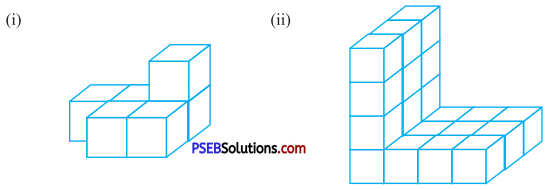
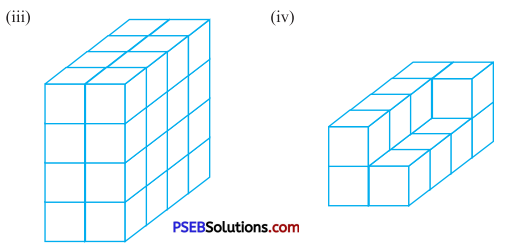
1. Count the number of cubes in each of the following figures :
PSEB 7th Class Maths Solutions Chapter 15 Visualising Solid Shapes Ex 15.3 1
PSEB 7th Class Maths Solutions Chapter 15 Visualising Solid Shapes Ex 15.3 2
Solution:
(i) 6
(ii) 21
(iii) 32
(iv) 13

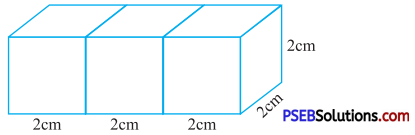
2. If three cubes of dimensions 2 cm × 2 cm × 2 cm are placed side by side, what would be the dimensions of resulting cuboid ?
PSEB 7th Class Maths Solutions Chapter 15 Visualising Solid Shapes Ex 15.3 3
Solution:
Length 6 cm, breadth 2 cm and height 2 cm.

PSEB 7th Class Maths Solutions Chapter 15 Visualising Solid Shapes Ex 15.3

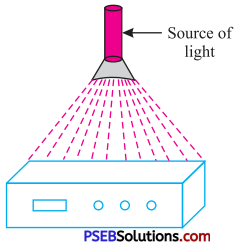
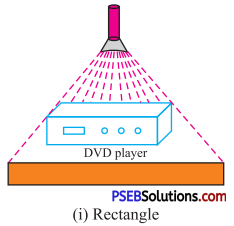
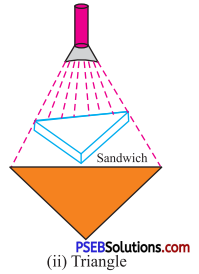
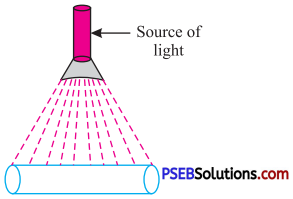
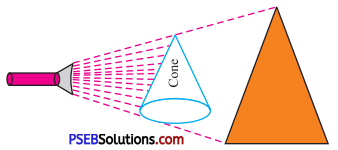
3. If we throw light an the following solids from the top name the shape of shadow obtained in each case and also give a rough sketch of the shadow.
(i) DVD player
PSEB 7th Class Maths Solutions Chapter 15 Visualising Solid Shapes Ex 15.3 4
Solution:
PSEB 7th Class Maths Solutions Chapter 15 Visualising Solid Shapes Ex 15.3 5

(ii) Sandwich
PSEB 7th Class Maths Solutions Chapter 15 Visualising Solid Shapes Ex 15.3 6
Solution:
PSEB 7th Class Maths Solutions Chapter 15 Visualising Solid Shapes Ex 15.3 7

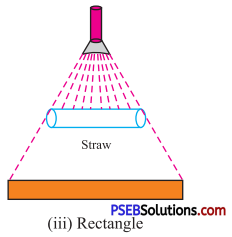
(iii) Straw
PSEB 7th Class Maths Solutions Chapter 15 Visualising Solid Shapes Ex 15.3 8
Solution:
PSEB 7th Class Maths Solutions Chapter 15 Visualising Solid Shapes Ex 15.3 9

PSEB 7th Class Maths Solutions Chapter 15 Visualising Solid Shapes Ex 15.3

4. What cross-sections do you get when you given a.
(i) Vertical cut
(ii) Horizontal cut.
to the following solids ?
(a) A die
(b) A square pyramid
(c) A round melon
(d) A circular pipe
(e) A brick
(f) An ice cream cone.
Solution:
(a) Square, Square,
(b) Triangle, Square,
(c) Circle, circle
(d) Circle, Rectangle
(e) Rectangle, Rectangle
(f) Triangle, Circle.

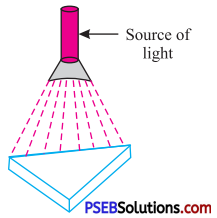
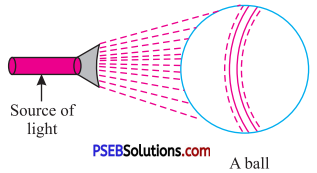
5. If we throw light on following solids, from left name the shape of shadow in each and also give a rough sketch of the shadow.
(i)
PSEB 7th Class Maths Solutions Chapter 15 Visualising Solid Shapes Ex 15.3 10
Solution:
PSEB 7th Class Maths Solutions Chapter 15 Visualising Solid Shapes Ex 15.3 11

(ii)
PSEB 7th Class Maths Solutions Chapter 15 Visualising Solid Shapes Ex 15.3 12
Solution:
PSEB 7th Class Maths Solutions Chapter 15 Visualising Solid Shapes Ex 15.3 13

PSEB 7th Class Maths Solutions Chapter 15 Visualising Solid Shapes Ex 15.3

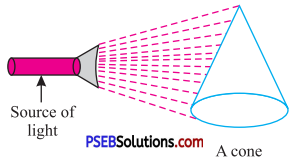
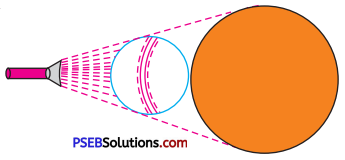
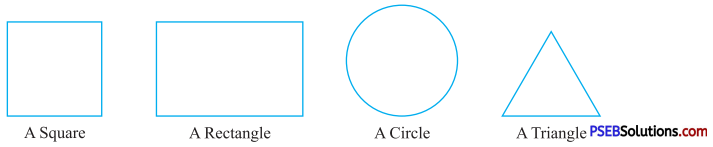
6. Here are the shadows of some 3-D objects, when seen under the lamp of an overhead projector. Identify the solids that match each shadow (There may be multiple answers for these)
PSEB 7th Class Maths Solutions Chapter 15 Visualising Solid Shapes Ex 15.3 14
Solution:
(i) Dice, chalk box etc
(ii) Book, Mobile, DVD Player etc
(iii) Cricket ball, Disc etc.
(iv) Birthday cap, Icecream cone etc.

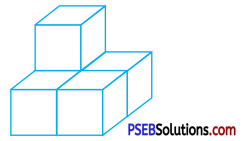
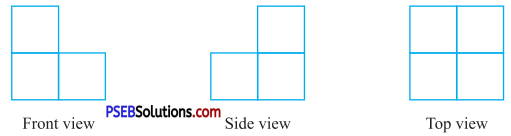
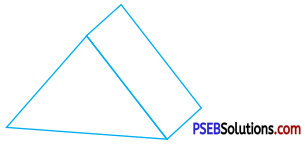
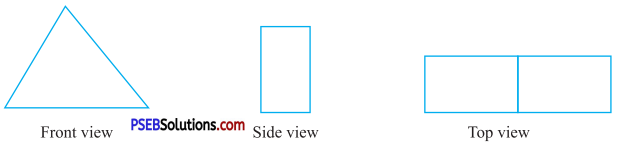
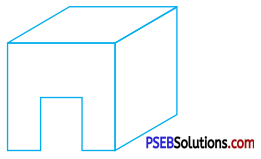
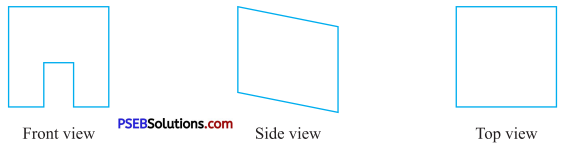
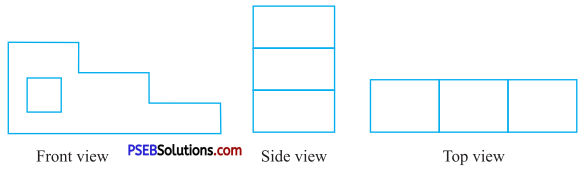
7. Sketch the front, side and top view of the following figures :
(i)
PSEB 7th Class Maths Solutions Chapter 15 Visualising Solid Shapes Ex 15.3 15
Solution:
PSEB 7th Class Maths Solutions Chapter 15 Visualising Solid Shapes Ex 15.3 16

(ii)
PSEB 7th Class Maths Solutions Chapter 15 Visualising Solid Shapes Ex 15.3 17
Solution:
PSEB 7th Class Maths Solutions Chapter 15 Visualising Solid Shapes Ex 15.3 18

(iii)
PSEB 7th Class Maths Solutions Chapter 15 Visualising Solid Shapes Ex 15.3 19
Solution:
PSEB 7th Class Maths Solutions Chapter 15 Visualising Solid Shapes Ex 15.3 20

(iv)
PSEB 7th Class Maths Solutions Chapter 15 Visualising Solid Shapes Ex 15.3 21
Solution:
PSEB 7th Class Maths Solutions Chapter 15 Visualising Solid Shapes Ex 15.3 22

PSEB 7th Class Maths Solutions Chapter 15 Visualising Solid Shapes Ex 15.3

8. Multiple choice questions :

Question (i).
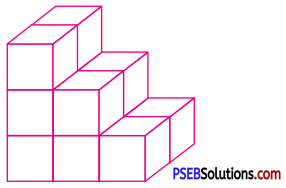
The number of cubes in the given structure is ?
PSEB 7th Class Maths Solutions Chapter 15 Visualising Solid Shapes Ex 15.3 23
(a) 12
(b) 10
(c) 9
(d) 8
Answer:
(a) 12

Question (ii).
The number of unit cubes to be added in above students to make a cuboid of dimensions 4 unit × 2 unit × 3 unit is ?
(a) 11
(b) 12
(c) 13
(d) 14
Answer:
(b) 12

Question (iii).
What cross-section is made by vertical cut in a cuboid
(a) Square
(b) Rectangle
(c) Circle
(d) Triangle
Answer:
(b) Rectangle

Question (iv).
What cross section is made by horizontal cut in a cone
(a) Triangle
(b) Circle
(c) Square
(d) Rectangle
Answer:
(b) Circle

Question (v).
Which solid cost a shadow of triangle under the effect of light
(a) Sphere
(b) Cylinder
(c) Cone
(d) Cube
Answer:
(c) Cone

PSEB 6th Class Maths Solutions Chapter 9 Understanding Elementary Shapes Ex 9.6

Punjab State Board PSEB 6th Class Maths Book Solutions Chapter 9 Understanding Elementary Shapes Ex 9.6 Textbook Exercise Questions and Answers.

PSEB Solutions for Class 6 Maths Chapter 9 Understanding Elementary Shapes Ex 9.6

1. Give two examples of each of the following shapes from your surroundings:

Question (i)
Cube
Solution:
Cube. Examples:
(i) Dice,
(ii) Sugar cubes.

PSEB 6th Class Maths Solutions Chapter 9 Understanding Elementary Shapes Ex 9.6

Question (ii)
Cuboid
Solution:
Cuboid. Examples:
(i) Matchbox,
(ii) Geometry box.

Question (iii)
Cone
Solution:
Cone: Examples:
(i) Ice cream cone,
(ii) Joker cap.

Question (iv)
Cylinder
Solution:
Cylinder. Examples:
(i) Drum,
(ii) Circular pipe.

Question (v)
Shpere.
Solution:
Shpere. Examples:
(i) Globe,
(ii) Ball.

PSEB 6th Class Maths Solutions Chapter 9 Understanding Elementary Shapes Ex 9.6

2. Classify the following as plane figures and solid figures:

Question (i)
(i) Rectangle
(ii) Sphere
(iii) Cylinder
(iv) Circle
(v) Cube
(vi) Cuboid
(vii) Triangle
(viiii) Cone
(ix) Square
(x) Prism.
Solution:
Plane figures:
(i) Rectangle
(iv) Circle
(vii) Triangle
(ix) Square.

Solid figures:
(ii) Sphere
(iii) Cylinder
(v) Cube
(vi) Cuboid
(viii) Cone
(x) Prism.

3. Write the name of shapes in the base of the following solids:

Question (i)
Cube
Solution:
Square

PSEB 6th Class Maths Solutions Chapter 9 Understanding Elementary Shapes Ex 9.6

Question (ii)
Cylinder
Solution:
Circle

Question (iii)
Tetrahedron
Solution:
Equilateral triangle

Question (iv)
Cuboid
Solution:
Rectangle

Question (v)
Square Pyramid.
Solution:
Square.

PSEB 6th Class Maths Solutions Chapter 9 Understanding Elementary Shapes Ex 9.6

4. Fill in the table:

Shape Number of Flat Faces Number of Curved Faces Number of Vertices Number of Edges
(i) Cuboid
(ii) Cube
(iii) Cylinder
(iv) Cone
(v) Sphere
(vi) Triangular Prism
(vii) Square Pyramid
(viii) Tetrahedron

Solution:

Shape Number of Number of Number of Number of
Flat Faces Curved Facet! Vertices Edges
(i) Cuboid 6 Nil 8 12
(ii) Cube 6 Nil 8 12
(iii) Cylinder 2 1 Nil 2
(iv) Cone 1 1 1 1
(v) Sphere Nil 1 Nil Nil
(vi) Triangular Prism 5 Nil 6 9
(vii) Square Pyramid 5 Nil 5 8
(viii) Tetrahedron 4 Nil 4 6

PSEB 9th Class Maths Solutions Chapter 13 Surface Areas and Volumes Ex 13.5

Punjab State Board PSEB 9th Class Maths Book Solutions Chapter 13 Surface Areas and Volumes Ex 13.5 Textbook Exercise Questions and Answers.

PSEB Solutions for Class 9 Maths Chapter 13 Surface Areas and Volumes Ex 13.5

Question 1.
A matchbox measures 4 cm × 2.5 cm × 1.5 cm. What will be the volume of a packet containing 12 such boxes ?
Answer:
For the cuboidal matchbox, length l = 4 cm; breadth b = 2.5 cm and height h = 1.5 cm.
Volume of a cuboidal matchbox
= l × b × h
= 4 × 2.5 × 1.5 cm3
= 15 cm3
Then, volume of 12 matchboxes = 12 × 15 cm3 = 180 cm3
Thus, the volume of a packet containing 12 matchboxes is 180 cm3.

PSEB 9th Class Maths Solutions Chapter 13 Surface Areas and Volumes Ex 13.5

Question 2.
A cuboidal water tank is 6 m long, 5 m wide and 4.5 m deep. How many litres of water can it hold? (1 m3 = 1000 l)
Answer:
For the cuboidal water tank, length l = 6m; breadth b = 5 m and height h = 4.5 m.
Capacity of the cuboidal tank = l × b × h
= 6 × 5 × 4.5 m3
= 135 m3
1 m3 = 1000 litres
∴ 135 m3 = 135000 litres
Thus, the given cuboidal water tank can hold 1,35,000 litres of water.

Question 3.
A cuboidal vessel is 10 m long and 8 m wide. How high must it be made to hold 380 cubic metres of a liquid?
Answer:
For the cuboidal vessel, length l = 10 m;
breadth b = 8 m and capacity = 380 m3.
Capacity of a cuboidal vessel = l × b × h
∴ 380 m3 = 10 m × 8 m × h m
∴ h = \(\frac{380}{10 \times 8}\) m
∴ h = 4.75 m
The height of the cuboidal vessel must be made 4.75 m.

PSEB 9th Class Maths Solutions Chapter 13 Surface Areas and Volumes Ex 13.5

Question 4.
Find the cost of digging a cuboidal pit 8 m long, 6 m broad and 3 m deep at the rate of ₹ 30 per m3.
Answer:
For the cuboidal pit, length l = 8m; breadth b = 6 m and height (depth) h = 3 m.
Volume of the earth to be dugout to make the cuboidal pit = Volume of a cuboid
= l × b × h
= 8 × 6 × 3 m3
= 144 m3
Cost of digging out 1 m3 of earth = ₹ 30
∴ Cost of digging out 144 m3 of earth
= ₹ (30 × 144)
= ₹ 4320
Thus, the cost of digging the cuboidal pit is ₹ 4320.

Question 5.
The capacity of a cuboidal tank is 50,000 litres of water. Find the breadth of the tank, if its length and depth are respectively 2.5 m and 10 m.
Answer:
For the cuboidal tank, length l = 2.5 m;
height (depth) h = 10 m and
capacity = 50,000 litres.
1000 litres = 1 m3
∴ 50,000 litres = \(\frac{50,000}{1000}\) m3 = 50 m3
Capacity of cuboidal tank = l × b × h
∴ 50 m3 = 2.5 m × b m × 10 m
∴ b = \(\frac{50}{2.5 \times 10}\) m
∴ b = 2 m
Thus, the breadth of the cuboidal tank is 2 m.

PSEB 9th Class Maths Solutions Chapter 13 Surface Areas and Volumes Ex 13.5

Question 6.
A village, having a population of 4000, requires 150 litres of water per head per day. It has a tank measuring 20 m × 15 m × 6 m. For how many days will the water of this tank last?
Answer:
Total requirement of water per day
= No. of people × daily requirement per person
= 4000 × 150 litres
= 6,00,000 litres
= \(\frac{6,00,000}{1000}\) m3
= 600 m3
For the cuboidal tank, length l = 20 m;
breadth b = 15 m and height h = 6 m
Capacity of the cuboidal tank = l × b × h
= 20 × 15 × 6 m3
= 1800 m3
600 m3 of water can last for 1 day in the village.
∴ 1800 m3 of water can last for \(\frac{1800}{600}\) = 3 days in the village.

Question 7.
A godown measures 40 m × 25 m × 15 m. Find the maximum number of wooden crates each measuring 1.5 m × 1.25 m × 0.5 m that can be stored in the godown.
Answer:
For the cuboidal godown, length l = 40 m;
breadth b = 25 m and height h = 15 m.
Capacity of cuboidal godown = l × b × h
= 40 × 25 × 15 m3
For the wooden cuboidal crate, length l = 1.5 m; breadth b = 1.25 m and height h = 0,5 m.
Volume of 1 cuboidal crate
= l × b × h
= 1.5 × 1.25 × 0.5 m3
∴The no. of crates that can be stored in the godown = \(\)
= \(\left(\frac{40}{1.25}\right) \times\left(\frac{25}{0.5}\right) \times\left(\frac{15}{1.5}\right)\)
= 32 × 50 × 10
= 16,000

PSEB 9th Class Maths Solutions Chapter 13 Surface Areas and Volumes Ex 13.5

Question 8.
A solid cube of side 12 cm is cut into eight cubes of equal volume. What will be the side of the new cube ? Also, find the ratio between their surface areas.
Answer:
For the original cube, edge a =12 cm.
Volume of original cube = a3 = 123 cm3
= 1728 cm3
8 cubes of equal volume are made from the original cube.
∴ Volume of each new cube = \(\frac{1728}{8}\) cm3
= 216 cm3
Let the edge of new cube be A cm.
Volume of new cube = A3
∴ 216 cm3 = A3
∴ A = \(\sqrt[3]{216}\) cm = 6 cm
Thus, the side of each new cube is 6 cm.
Total surface area of original cube
= 6a2
= 6 (12)2 cm2
Total surface area of a new cube = 6A2
= 6 (6)2 cm2
\(\frac{\text { Total surface area of original cube }}{\text { Total surface area of a new cube }}\) = \(\frac{6(12)^{2} \mathrm{~cm}^{2}}{6(6)^{2} \mathrm{~cm}^{2}}\)
= \(\left(\frac{12}{6}\right)^{2}\)
= 4
= 4:1
Thus, the required ratio of the total surface area of the original cube and the total surface area of a new cube is 4:1.
Note: If the ratio of TSA of the original ‘ cube and TSA of all the new cubes is required, then it will be 1 : 2.

PSEB 9th Class Maths Solutions Chapter 13 Surface Areas and Volumes Ex 13.5

Question 9.
A river 3 m deep and 40 m wide is flowing at the rate of 2 km per hour. How much water will fall into the sea in a minute?
Answer:
2 km = 2000 m and 1 hour = 60 minutes
Rate of flow of water in the river
= 2 km/hour
= \(\frac{2000}{60}\) m/min
Thus, during 1 minute, water of length will flow in the sea.
Then, the water falling in sea per minute takes cuboidal shape with length l = \(\frac{2000}{60}\) m,
breadth b = 40 m and height (depth) h = 3 m.
Volume of water falling in sea per minute
= l × b × h
= \(\frac{2000}{60}\) × 40 × 3 m3
= 4000 m3
Thus, 4000 m3 of water will fall into the sea in a minute.

PSEB 9th Class Maths Solutions Chapter 13 Surface Areas and Volumes Ex 13.4

Punjab State Board PSEB 9th Class Maths Book Solutions Chapter 13 Surface Areas and Volumes Ex 13.4 Textbook Exercise Questions and Answers.

PSEB Solutions for Class 9 Maths Chapter 13 Surface Areas and Volumes Ex 13.4

Note: Assume π = \(\frac{22}{7}\), unless stated otherwise.

Question 1.
Find the surface area of a sphere of radius:
(i) 10.5 cm
Answer:
For the given sphere,
radius r = 10.5 cm = \(\frac{21}{2}\) cm.
Surface area of a sphere
= 4πr2
= 4 × \(\frac{22}{7}\) × \(\frac{21}{2}\) × \(\frac{21}{2}\) cm2 = 1386 cm2

PSEB 9th Class Maths Solutions Chapter 13 Surface Areas and Volumes Ex 13.4

(ii) 5.6 cm
Answer:
For the given sphere, radius r = 5.6cm.
Surface area of a sphere
= 4πr2
= 4 × \(\frac{22}{7}\) × 5.6 × 5.6 cm2
= 394.24 cm2

(iii) 14 cm
Answer:
For the given sphere, radius r= 14 cm.
Surface area of a sphere
= 4πr2
= 4 × \(\frac{22}{7}\) × 14 × 14 cm2
= 2464 cm2

Question 2.
Find the surface area of a sphere of diameter:
(i) 14cm
Answer:
For the given sphere, diameter d = 14 cm.
Then, radius r = \(\frac{\text { diameter }}{2}\)
= \(\frac{14}{2}\) cm = 7 cm
Surface area of a sphere
= 4πr2
= 4 × \(\frac{22}{7}\) × 7 × 7 cm2
= 616 cm2

PSEB 9th Class Maths Solutions Chapter 13 Surface Areas and Volumes Ex 13.4

(ii) 21cm
Answer:
For the given sphere, diameter d = 21 cm.
Then, radius r = \(\frac{\text { diameter }}{2}\)
= \(\frac{21}{2}\) cm
Surface area of a sphere
= 4πr2
= 4 × \(\frac{22}{7}\) × \(\frac{21}{2}\) × \(\frac{21}{2}\) cm2
= 1386 cm2

(iii) 3.5 m
Answer:
For the given sphere, diameter d = 3.5 cm.
Then, radius r = \(\frac{\text { diameter }}{2}\)
= \(\frac{3.5}{2}\) m
= \(\frac{35}{20}\) m
Surface area of a sphere
= 4πr2
= 4 × \(\frac{22}{7}\) × \(\frac{35}{20}\) × \(\frac{35}{20}\) m2
= 38.5 m2

Note: We can also use the formula “Surface area of a sphere = πd2” as
4πr2 = π × 4r2 = π × (2r)2 = πd2, where r and d are radius and diameter of the sphere respectively.

Question 3.
Find the total surface area of a hemisphere of radius 10 cm. (Use π =3.14)
Answer:
For the given hemisphere, radius r = 10 cm.
Total surface area of a hemisphere
= 3πr2
= 3 × 3.14 × 10 × 10 cm2
= 942 cm2

PSEB 9th Class Maths Solutions Chapter 13 Surface Areas and Volumes Ex 13.4

Question 4.
The radius of a spherical balloon increases from 7 cm to 14 cm as air is being pumped into it. Find the ratio of surface areas of the balloon in the two cases.
Answer:
For the first case, radius r1 of the spherical balloon is 7 cm.
Surface area of the spherical balloon in the
first case = 4πr12
= 4 × \(\frac{22}{7}\) × 7 × 7cm2
For the second case, radius r2 of the spherical balloon is 14 cm.
Surface area of the spherical balloon in the second case = 4πr22
Then, the required ratio of surface areas in two cases
= \(\frac{4 \times \frac{22}{7} \times 7 \times 7}{4 \times \frac{22}{7} \times 14 \times 14}\)
= \(\frac{1}{4}\) = 1 : 4
Thus, the required ratio is 1 : 4.
Note: Here, the ratio of radii = 7 : 14 = 1 : 2
Hence, the ratio of surface areas = \(\left(\frac{1}{2}\right)^{2}\) = \(\frac{1}{4}\) = 1 : 4, because in the formula of surface area of sphere, the degree of r is 2.

PSEB 9th Class Maths Solutions Chapter 13 Surface Areas and Volumes Ex 13.4

Question 5.
A hemispherical bowl made of brass has inner diameter 10.5 cm. Find the cost of tin-plating it on the inside at the rate of ₹ 16 per 100 cm2.
For the given hemispherical bowl, diameter = 10.5 cm.
Then, the radius r of the bowl = \(\frac{\text { diameter }}{2}\)
= \(\frac{10.5}{2}\) cm
= \(\frac{\frac{21}{2}}{2}\) cm
= \(\frac{21}{4}\) cm
Inner curved surface area of the hemispherical bowl
= 2 πr2
= 2 × \(\frac{22}{7}\) × \(\frac{21}{4}\) × \(\frac{21}{4}\) cm2
= \(\) cm2
= 173.25 cm2
Cost of tin-plating 100 cm2 region = ₹ 16
∴ Cost of tin-plating 173.25 cm2 region
= ₹ \(\left(\frac{16 \times 173.25}{100}\right)\)
= ₹ 27.72
Thus, the cost of tin-plating on the inner surface of the bowl is ₹ 27.72.

PSEB 9th Class Maths Solutions Chapter 13 Surface Areas and Volumes Ex 13.4

Question 6.
Find the radius of a sphere whose surface area is 154 cm2.
Answer:
For the given sphere, surface area = 154 cm2.
Surface area of a sphere = 4 πr2
∴ 154 cm2 = 4 × \(\frac{22}{7}\) × r2 cm2
∴ r2 = \(\frac{154 \times 7}{4 \times 22}\) cm2
∴ r2 = \(\frac{49}{4}\) cm2
∴ r = \(\frac{7}{2}\) cm
∴ r = 3.5 cm
Thus, the radius of the given sphere is 3.5 cm.

Question 7.
The diameter of the moon is approximately one fourth of the diameter of the earth. Find the ratio of their surface areas.
Answer:
Suppose, the diameter of the moon = d1
The diameter of the earth = 4 × d1 = 4d1
Then, the radius of the moon r1 = \(\frac{d_{1}}{2}\) and
the radius of the earth r2 = \(\frac{4 d_{1}}{2}\) = 2d1.
Now, \(\frac{\text { The surface area of the moon }}{\text { The surface area of the earth }}\) = \(\frac{4 \pi r_{1}^{2}}{4 \pi r_{2}^{2}}\)
= \(\frac{r_{1}^{2}}{r_{2}^{2}}\)
= \(\frac{\left(\frac{d_{1}}{2}\right)^{2}}{\left(2 d_{1}\right)^{2}}\)
= \(\frac{d_{1}^{2}}{4} \times \frac{1}{4 d_{1}^{2}}\)
= \(\frac{1}{16}\)
= 1 : 16
Thus, the ratio of the surface area of the moon and the surface area of the earth is 1 : 16.

PSEB 9th Class Maths Solutions Chapter 13 Surface Areas and Volumes Ex 13.4

Question 8.
A hemispherical bowl is made of steel, 0.25 cm thick. The inner radius of the bowl is 5 cm. Find the outer curved surface area of the bowl.
Answer:
For the given hemispherical bowl, the inner radius is 5 cm and the thickness of steel is 0.25 cm.
∴ Outer radius r of the given hemispherical bowl = 5 + 0.25 cm = 5.25 cm.
Curved surface area of a hemisphere
= 2πr2
= 2 × \(\frac{22}{7}\) × 5.25 × 5.25 cm2
= 2 × \(\frac{22}{7}\) × \(\frac{525}{100}\) × \(\frac{525}{100}\) cm2
= \(\frac{693}{4}\) cm2
= 173.25 cm2
Thus, the outer curved surface area of the given hemispherical bowl is 173.25 cm2.

PSEB 9th Class Maths Solutions Chapter 13 Surface Areas and Volumes Ex 13.4

Question 9.
A right circular cylinder just encloses a sphere of radius r (see the given figure). Find :
(i) surface area of the sphere,
(ii) curved surface area of the cylinder,
(iii) ratio of the areas obtained in (i) and (ii).
PSEB 9th Class Maths Solutions Chapter 13 Surface Areas and Volumes Ex 13.4 1
Answer:
Here,
radius of the cylinder = radius of the sphere = r and height of the cylinder h
= 2 × radius of the sphere = 2r
(i) Surface area of the sphere = 4πr2

(ii) Curved surface area of the cylinder
= 2 πrh
= 2 × 1 × r × 2r
= 4 πr2

(iii) Ratio of areas obtained in ( i ) and (ii)
= \(\frac{4 \pi r^{2}}{4 \pi r^{2}}\)
= \(\frac{1}{1}\)
= 1 : 1

PSEB 6th Class Maths Solutions Chapter 9 Understanding Elementary Shapes Ex 9.3

Punjab State Board PSEB 6th Class Maths Book Solutions Chapter 9 Understanding Elementary Shapes Ex 9.3 Textbook Exercise Questions and Answers.

PSEB Solutions for Class 6 Maths Chapter 9 Understanding Elementary Shapes Ex 9.3

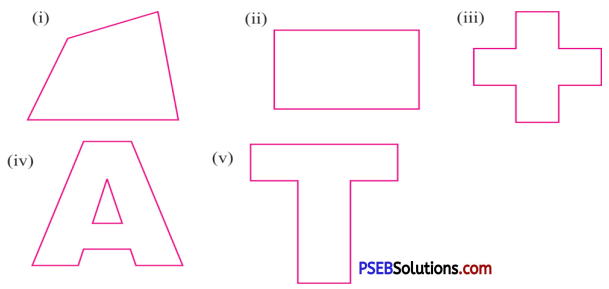
1. Identify the shape having perpendicular lines:
PSEB 6th Class Maths Solutions Chapter 9 Understanding Elementary Shapes Ex 9.3 1
Solution:
(ii), (iii), (v).

PSEB 6th Class Maths Solutions Chapter 9 Understanding Elementary Shapes Ex 9.3

2. Identify the examples having perpendicular lines:

Question (i)
(i) Lines of railway track.
(ii) Adjacent edges of a table.
(iii) Line segment forming letter ‘L’.
Solution:
(ii) Adjacent edges of a table.
(iii) Line segment forming letter ‘L’.

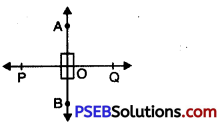
3. Let \(\overrightarrow{\mathbf{AB}}\) be perpendicular to \(\overrightarrow{\mathbf{PQ}}\) and they intersect at O. What is the measure of \(\angle \mathbf{AOP}\)?
Solution:
PSEB 6th Class Maths Solutions Chapter 9 Understanding Elementary Shapes Ex 9.3 2
\(\angle \mathbf{AOP}\) = 90°, because AB ⊥ PQ.

PSEB 6th Class Maths Solutions Chapter 9 Understanding Elementary Shapes Ex 9.3

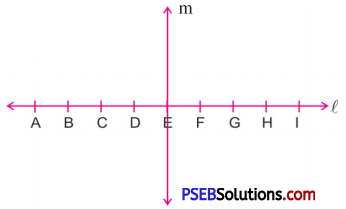
4. Line m is perpendicular to line l in the given figure. Each point on the line l is marked at equal intervals. Study the diagram and state true or false.
PSEB 6th Class Maths Solutions Chapter 9 Understanding Elementary Shapes Ex 9.3 3

Question (i)
Line m is ⊥ bisector of line segment AI.
Solution:
True

Question (ii)
CE = EG
Solution:
True

PSEB 6th Class Maths Solutions Chapter 9 Understanding Elementary Shapes Ex 9.3

Question (iii)
DF = 2DE.
Solution:
True.

PSEB 6th Class Maths Solutions Chapter 9 Understanding Elementary Shapes Ex 9.2

Punjab State Board PSEB 6th Class Maths Book Solutions Chapter 9 Understanding Elementary Shapes Ex 9.2 Textbook Exercise Questions and Answers.

PSEB Solutions for Class 6 Maths Chapter 9 Understanding Elementary Shapes Ex 9.2

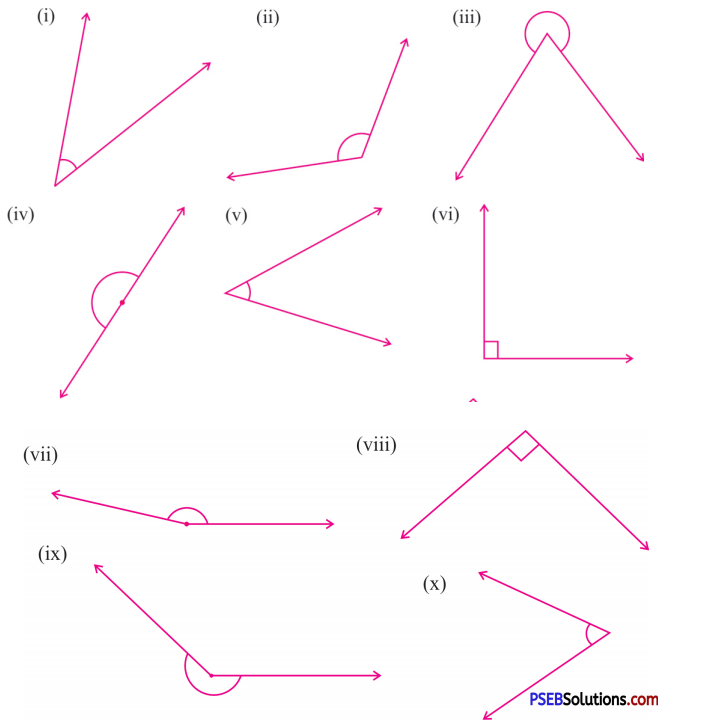
1. Classify the angles as acute, obtuse, right, straight or reflex angles:
PSEB 6th Class Maths Solutions Chapter 9 Understanding Elementary Shapes Ex 9.2 1
Solution:
(i) Acute angle
(ii) Obtuse angle
(iii) Reflex angle
(iv) Straight angle
(v) Acute angle
(vi) Right angle
(vii) Obtuse angle
(viii) Right angle
(ix) Reflex angle
(x) Acute angle.

PSEB 6th Class Maths Solutions Chapter 9 Understanding Elementary Shapes Ex 9.2

2. Classify the angles:

Question (i)
80°
Solution:
80° is between 0° and 90°.
∴ It is an acute angle.

Question (ii)
172°
Solution:
172° is between 90° and 180°
∴ It is an obtuse angle.

Question (iii)
90°
Solution:
90° is a right angle.

Question (iv)

Solution:
0° is a zero angle.

Question (v)
179°
Solution:
179° is between 90° and 180°.
∴ It is an obtuse angle.

PSEB 6th Class Maths Solutions Chapter 9 Understanding Elementary Shapes Ex 9.2

Question (vi)
215°
Solution:
215° is between 180° and 360°.
∴ It is an reflex angle.

Question (vii)
360°
Solution:
360° is a complete angle.

Question (viii)
350°
Solution:
350° is between 180° and 360°.
∴ It is a reflex angle.

Question (ix)
15°
Solution:
15° is between 0° and 90°.
∴ It is an acute angle.

Question (x)
180°
Solution:
180° is a straight angle.

PSEB 6th Class Maths Solutions Chapter 9 Understanding Elementary Shapes Ex 9.2

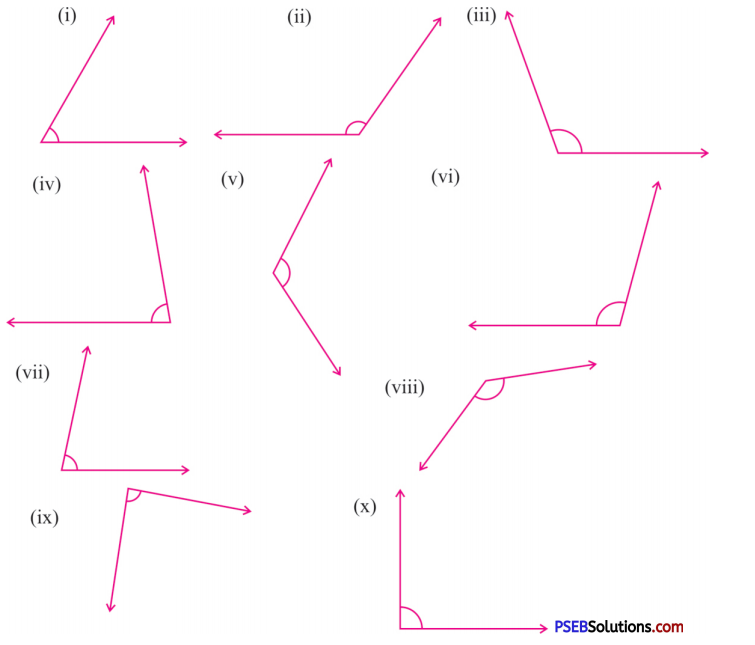
3. Measure the following angles with protractor and write their measurement:
PSEB 6th Class Maths Solutions Chapter 9 Understanding Elementary Shapes Ex 9.2 2
Solution:
(i) 60°
(ii) 125°
(iii) 110°
(iv) 80°
(v) 120°
(vi) 105°
(vii) 80°
(viii) 135°
(ix) 88°
(x) 90°.

4. How many degrees are there in

Question (i)
Two right angles
Solution:
1 right angle = 90°
∴ Two right angles = 2 × 90°
= 180°

PSEB 6th Class Maths Solutions Chapter 9 Understanding Elementary Shapes Ex 9.2

Question (ii)
\(\frac {2}{3}\) right angles
Solution:
1 right angle = 90°
∴ \(\frac {2}{3}\) right angles = \(\frac {2}{3}\) × 90°
= 2 × 30°
= 60°

Question (iii)
Four right angles?
Solution:
1 right angle = 90°
∴ Four right angles = 4 × 90°
= 360°

5. What fraction of a clockwise revolution does the hour hand of a clock turn through when it goes from:

Question (i)
3 to 9
Solution:
3 to 9 : Half or \(\frac {1}{2}\)

Question (ii)
5 to 8
Solution:
5 to 8 : Quarter or \(\frac {1}{4}\)

Question (iii)
10 to 4
Solution:
10 to 4 : Half or \(\frac {1}{2}\)

PSEB 6th Class Maths Solutions Chapter 9 Understanding Elementary Shapes Ex 9.2

Question (iv)
2 to 11
Solution:
2 to 11 : 3 Quarters or \(\frac {3}{4}\)

Question (v)
6 to 3
Solution:
6 to 3 : 3 Quarters or \(\frac {3}{4}\)

Question (vi)
2 to 7.
Solution:
2 to 7 : \(\frac {5}{12}\)

6. Find the number of right angles turned through by the hour hand of a dock when it goes from

Question (i)
5 to 8
Solution:
5 to 8 : 1 right angle

Question (ii)
1 to 7
Solution:
1 to 7 : 2 right angles

Question (iii)
4 to 10
Solution:
4 to 10 : 2 right angles

PSEB 6th Class Maths Solutions Chapter 9 Understanding Elementary Shapes Ex 9.2

Question (iv)
9 to 12
Solution:
9 to 12 : 1 right angles

Question (v)
11 to 2
Solution:
11 to 2 : 1 right angles

Question (vi)
9 to 6
Solution:
9 to 6 : 3 right angles

Question (vii)
2 to 11
Solution:
2 to 11 : 3 right angles

Question (viii)
10 to 1
Solution:
10 to 1 : 1 right angles

Question (ix)
12 to 6
Solution:
12 to 6 : 2 right angles

PSEB 6th Class Maths Solutions Chapter 9 Understanding Elementary Shapes Ex 9.2

Question (x)
5 to 2.
Solution:
5 to 2 : 3 right angles.

7. Where will be the hand of a clock stop if it starts at:

Question (i)
12 and make \(\frac {1}{4}\) revolution clock-wise.
Solution:
For 1 revolution, the hour hand takes 12 hours.
For \(\frac {1}{4}\) revolution, the hour hand takes \(\frac {1}{4}\) × 12 hours = 3 hours.
If hour hand starts at 12 and make \(\frac {1}{4}\) revolution clockwise it will stop at 3.

Question (ii)
2 and make \(\frac {1}{2}\) revolution clock-wise.
Solution:
For 1 revolution, the hour hand takes 12 hours.
For \(\frac {1}{2}\) revolution, the hour hand takes \(\frac {1}{2}\) × 12 hours = 6 hours.
If hour hand starts at 2 and make \(\frac {1}{2}\) revolution clockwise it will stop at 8.

PSEB 6th Class Maths Solutions Chapter 9 Understanding Elementary Shapes Ex 9.2

Question (iii)
5 and make \(\frac {1}{4}\) revolution clock-wise.
Solution:
For 1 revolution, the hour hand takes 12 hours.
For \(\frac {1}{4}\) revolution, the hour hand takes \(\frac {1}{4}\) × 12 hours = 3 hours
If hour hand starts at 5 and make \(\frac {1}{4}\) revolution clockwise it will stop at 8.

Question (iv)
5 and make \(\frac {3}{4}\) revolution clock-wise.
Solution:
For 1 revolution, the hour hand takes 12 hours .
For \(\frac {3}{4}\) revolution, the hour hand takes \(\frac {3}{4}\) × 12 hours = 9 hours.
If hour hand starts at 5 and make \(\frac {3}{4}\) revolution clockwise it will stop at 2.

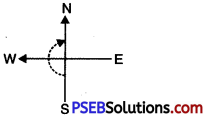
8. What part of revolution have you turned through if you stand facing:

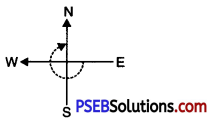
Question (i)
East and turn clockwise to North
Solution:
I turned through \(\frac {3}{4}\) part of a revolution.
PSEB 6th Class Maths Solutions Chapter 9 Understanding Elementary Shapes Ex 9.2 3

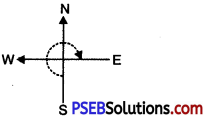
Question (ii)
South and turn clockwise to North
Solution:
I turned through \(\frac {1}{2}\) part of a revolution.
PSEB 6th Class Maths Solutions Chapter 9 Understanding Elementary Shapes Ex 9.2 4

PSEB 6th Class Maths Solutions Chapter 9 Understanding Elementary Shapes Ex 9.2

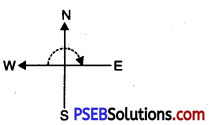
Question (iii)
South and turn clockwise to East
Solution:
I turned through \(\frac {3}{4}\) part of a revolution.
PSEB 6th Class Maths Solutions Chapter 9 Understanding Elementary Shapes Ex 9.2 5

Question (iv)
West and turn clockwise to East
Solution:
I turned through \(\frac {1}{2}\) part of at revolution.
PSEB 6th Class Maths Solutions Chapter 9 Understanding Elementary Shapes Ex 9.2 6

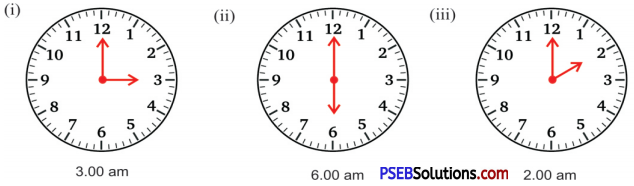
9. Find the angle measure between the hands of the clock in each figure:
PSEB 6th Class Maths Solutions Chapter 9 Understanding Elementary Shapes Ex 9.2 7
Solution:
(i) Angle measure between the hands of the clock at 3.00 a.m.
= \(\frac {3}{12}\) × 360° = 90°
(ii) Angle measure between the hands of the clock at 6.00 a.m.
= \(\frac {6}{12}\) × 360° = 180°
(iii) Angle measure between the hands of the clock at 2.00 a.m.
= \(\frac {2}{12}\) × 360° = 60°

PSEB 6th Class Maths Solutions Chapter 9 Understanding Elementary Shapes Ex 9.2

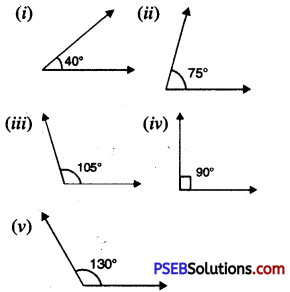
10. Draw the following angles by protractor:

Question (i)
(i) 40°
(ii) 75°
(iii) 105°
(iv) 90°
(v) 130°
Solution:
PSEB 6th Class Maths Solutions Chapter 9 Understanding Elementary Shapes Ex 9.2 8

11. State true or false:

Question (i)
The sum of two right angles is always a straight angle.
Solution:
True

PSEB 6th Class Maths Solutions Chapter 9 Understanding Elementary Shapes Ex 9.2

Question (ii)
The sum of two acute angles is always a reflex angle.
Solution:
False

Question (iiii)
The obtuse angle has measurement between 90° to 180°.
Solution:
True

Question (iv)
A complete revolution has four right angles.
Solution:
True

12. Fill in the blanks:

Question (i)
The angle which is greater than 0° and less than 90° is called ………….. .
Solution:
acute angle

PSEB 6th Class Maths Solutions Chapter 9 Understanding Elementary Shapes Ex 9.2

Question (ii)
The angle whose measurement equal to two right angle is …………….. .
Solution:
straight angle

Question (iii)
The angle between 90° and 180° is ……………. .
Solution:
obtuse angle.

PSEB 10th Class Maths Solutions Chapter 6 Triangles Ex 6.6

Punjab State Board PSEB 10th Class Maths Book Solutions Chapter 6 Triangles Ex 6.6 Textbook Exercise Questions and Answers.

PSEB Solutions for Class 10 Maths Chapter 6 Triangles Ex 6.6

Question 1.
In figure, PS is bisector of ∠QPR of ∆PQR. Prove that = \(\frac{\mathrm{QS}}{\mathrm{SR}}=\frac{\mathrm{PQ}}{\mathrm{PR}}\).
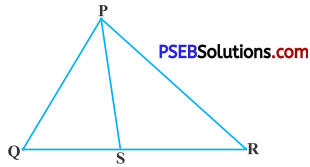
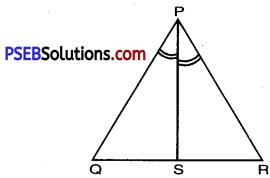
PSEB 10th Class Maths Solutions Chapter 6 Triangles Ex 6.6 1

PSEB 10th Class Maths Solutions Chapter 6 Triangles Ex 6.6 2

Solution:
Given: ∆PQR. PS is bisector of ∠QPR
i.e., ∠1 = ∠2
To prove: \(\frac{\mathrm{QS}}{\mathrm{SR}}=\frac{\mathrm{PQ}}{\mathrm{PR}}\)
Construction : Through R draw a line parallel to PS to meet QP produced at T.
Proof: In ∆QRT, PS || TR
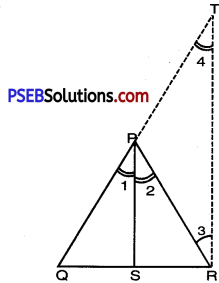
PSEB 10th Class Maths Solutions Chapter 6 Triangles Ex 6.6 3

∠1 = ∠4 (Corresponding angle)
but ∠1 = ∠2 (given)
∴ ∠3 = ∠4
In ∆PRT,
∠3 = ∠4 (Proved)
PT = PR
[Equal side have equal angle opposite to it]
In ∆QRT,
PS || TR
∴ \(\frac{\mathrm{QP}}{\mathrm{PT}}=\frac{\mathrm{QS}}{\mathrm{SR}}\)
[By Basic Proportionality Theorem]
\(\frac{\mathrm{QP}}{\mathrm{PR}}=\frac{\mathrm{QS}}{\mathrm{SR}}\) (PT = PR)
\(\frac{\mathrm{PQ}}{\mathrm{PR}}=\frac{\mathrm{QS}}{\mathrm{SR}}\)
Which is the required result.

PSEB Solutions PSEB 10th Class Maths Solutions Chapter 6 Triangles Ex 6.6

Question 2.
In the given fig., D is a point on hypotenuse AC of ∆ABC, DM ⊥ BC, DN ⊥ AB, prove that:
(i) DM2 = DN.MC
(ii) DN2 = OMAN.
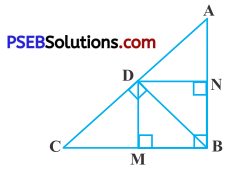
PSEB 10th Class Maths Solutions Chapter 6 Triangles Ex 6.6 4

Solution:
Given: ∆ABC, DM ⊥ BC, DN ⊥ AB
To prove: DM2 = DN . AC
DN2 = DM . AN.
Proof: BD ⊥ AC (Given)
⇒ ∠BDC = 90°
⇒ ∠BDM + ∠MDC = 90°
In ∠DMC, ∠DMC = 90°
[∵ DM ⊥ BC (Given)]
⇒ ∠C + ∠MDC = 90°
From (1) and (2),
∠BDM + ∠MDC = ∠C + ∠MDC
∠BDM =∠C
[Cancelling ∠MDC from both sides]
Now in ∆BMD and ∆MDC,
∠BDM = ∠C [Proved)
∠BMD = ∠DMC [Each 90°]
∆BMD ~ ∆MDC [By AA criterion of similarity]
⇒ \(\frac{\mathrm{DM}}{\mathrm{BM}}=\frac{\mathrm{MC}}{\mathrm{DM}}\)
[∵ Corresponding sides of similar triangles are proportional]
⇒ DM2 = BM × MC
⇒ DM2 = DN × MC [∵ BM = DN]
Similarly, ∆NDA ~ ∆NBD
⇒ \(\frac{\mathrm{DN}}{\mathrm{BN}}=\frac{\mathrm{AN}}{\mathrm{DN}}\)
[∵ Corresponding sides of similar triangles are próportional]
⇒ DN2 = BN × AN
⇒ DN2 = DM × AN .
Hence proved.

PSEB Solutions PSEB 10th Class Maths Solutions Chapter 6 Triangles Ex 6.6

Question 3.
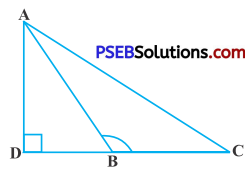
In fig., ABC is triangle in which ∠ABC > 90° and AD ⊥ BC produced, prove that AC2 = AB2 + BC2 + 2BC.BD.
PSEB 10th Class Maths Solutions Chapter 6 Triangles Ex 6.6 5

Solution:
Given: ∠ABC, AD ⊥ BC when produced, ∠ABC > 90°.
To prove : AC2 = AB2 + BC2 + 2BC. BD.
Proof: Let BC = a,
CA = b,
AB = c,
AD = h
and BD = x.
In right-angled ∆ADB,
Using Pythagoras Theorem.
AB2 = BD2 + AD2
i.e., c2 = x2 + h2
Again, in right-angled AADC,
AC2 = CD2 + AD2
i.e.. b2 = (a + x)2 + h2
= a2 + 2ax + x2 + h2
= a2 + 2ax + c2; [Using (1)]
b2 = a2 + b2 + 2w.
Hence, AB2 = BC2 + AC2 + 2BC × CD.

PSEB Solutions PSEB 10th Class Maths Solutions Chapter 6 Triangles Ex 6.6

Question 4.
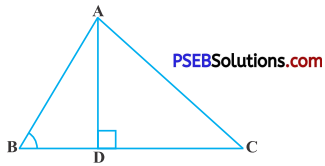
In fig., ABC is a triangle in which ∠ABC < 90°, AD ⊥ BC, prove that AC2 = AB2 + BC2 – 2BC.BD.
PSEB 10th Class Maths Solutions Chapter 6 Triangles Ex 6.6 6

Solution:
Given: ∆ ABC, ∠ABC < 90°, AD ⊥ BC.
To prove : AC2 = AB2 + BC2 – 2BC BD.
Proof: ADC is right-angled z at D
AC2 = CD2 + DA2 (Pythagora’s Theorem) ……………..(1)
Also, ADB is right angled ∆ at D
AB2 = AD2 + DB2 ……………….(2)
From (1), we get:
AC2 = AD2 + (CB – BD)2
= AD2 + CB2 + BD2 – 2CB × BD
or AC2 = (BD2 + AD2) + CB2 – 2CB × BD
AC2 = AB2 + BC2 – 2BC × BD. [Using (2)]

PSEB Solutions PSEB 10th Class Maths Solutions Chapter 6 Triangles Ex 6.6

Question 5.
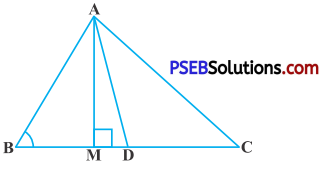
In fig., AD is a median of a triangle ABC and AM ⊥ BC. Prove that:
(i) AC2 = AD2 + BC. DM + \(\left(\frac{B C}{2}\right)^{2}\)
(ii) AB2 = AD2 ± BC.DM + \(\left(\frac{B C}{2}\right)^{2}\)
(iii) AC2 + AB2 = 2 AD2 + \(\frac{1}{2}\) BC2
PSEB 10th Class Maths Solutions Chapter 6 Triangles Ex 6.6 7

Solution:
Given: ∆ABC, AM ⊥ BC,
AD is median of ¿ABC.
To prove:
(i) AC2 = AD2 + BC. DM + \(\left(\frac{B C}{2}\right)^{2}\)
(ii) AB2 = AD2 ± BC.DM + \(\left(\frac{B C}{2}\right)^{2}\)
(iii) AC2 + AB2 = 2 AD2 + \(\frac{1}{2}\) BC2
Proof: In ∆AMC.
AC2 = AM2 + MC2
= AM2 + (MD + DC)2
AC2 = AM2 + MD2 + DC2 + 2MD × DC
AC2 = (AM2 + MD2) + \(\left(\frac{\mathrm{BC}}{2}\right)^{2}\) + 2 . MD \(\left(\frac{\mathrm{BC}}{2}\right)\)
AC2 = AD2 + BC . MD + \(\frac{\mathrm{BC}^{2}}{4}\) …………(1)

(ii) In right angled triangle AME,
AB2 = AM2 + BM2
= AM2 + (BD – MD)2
=AM2 + BD2 + MD2 – 2BD × MD
= (AM2 + MD2) + BD2 – 2(\(\frac{1}{2}\) BC) MD
= AD2 + (\(\frac{1}{2}\) BC)2 – BC . MD
[∵ In ∆ AMD; AD2 = MA2 + MD2]
AB2 + AD2 (\(\left(\frac{\mathrm{BC}}{2}\right)^{2}\)) – BC . MD ………….(2)

(iii) Adding (1) and (2),
AB2 + AC2 = AD2 + BC.MD + (\(\left(\frac{\mathrm{BC}}{2}\right)^{2}\)) + AD2 + (\(\left(\frac{\mathrm{BC}}{2}\right)^{2}\)) – BC . MD
= 2 AD2 + \(\frac{\mathrm{BC}^{2}}{4}+\frac{\mathrm{BC}^{2}}{4}\)
= 2AD2 + 2 \(\frac{\mathrm{BC}^{2}}{4}\)
AB2 + AC2 = 2AD2 + \(\frac{\mathrm{BC}^{2}}{2}\)
Which is the required result.

PSEB Solutions PSEB 10th Class Maths Solutions Chapter 6 Triangles Ex 6.6

Question 6.
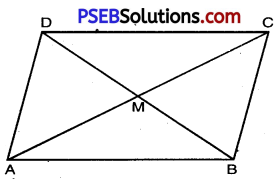
Prove that sum of squares of the diagonals of a parallelogram is equal to sum of squares of its sides.
Solution:
PSEB 10th Class Maths Solutions Chapter 6 Triangles Ex 6.6 8

Given:
Let ABCD be a parallelogram in which diagonalš AC and BD intersect at point M.
To prove: AB2 + BC2 + CD2 + DA2 = AC2 + BD2
Solution:
Proof: Diagonals of a parallelogram bisect each other.
∴ In || gm ABCD,
Diagonal BD and AC bisect each other.
Or MB and MD are medians of ∆ABC and ∆ADC respectively.
We know that, if AD is a medians of ¿ABC,
then AB2 + AC2 = 2AD2 + BC2
Using this result, we get:
AB2 + BC2 = 2 BM2 + \(\frac{1}{2}\) AC2 ………..(1)
and AD2 + CD2 = 2 DM2 + \(\frac{1}{2}\) AC2 ………….(2)
Adding (1) and (2), we get:
AB2 + BC2 + AD2 + CD2 = 2 (BM2 + DM2) + (AC2 + AC2)
AB2 + BC2 + AD2 + CD2 = 2 (\(\frac{1}{2}\) BD2 + \(\frac{1}{4}\) BD2) + AC2
AB2 + BC2 + AD2 + CD2 = BD2 + AC2
Hence, sum of the squares of the diagonals of a parallelogram is equal to the sum of the squares of its sides.

PSEB Solutions PSEB 10th Class Maths Solutions Chapter 6 Triangles Ex 6.6

Question 7.
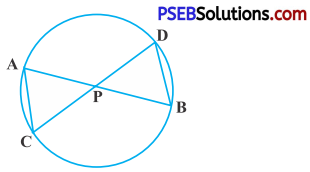
In fig., two chords AB and CD intersect each other at the point P prove that:
(i) ∆APC ~ ∆DPB
(ii) AP.PB = CP.DP.
PSEB 10th Class Maths Solutions Chapter 6 Triangles Ex 6.6 9

Solution:
Given: Circle, AB and CD are two chords intersects each other at P.
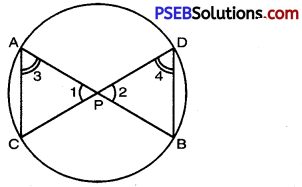
PSEB 10th Class Maths Solutions Chapter 6 Triangles Ex 6.6 10

To prove:
(i) ∆APC ~ ∆DPB
(ii) AP.PB = CP.DP.
Proof:
(i) In ∆APC and ∆DPB,
∠1 = ∠2 (Vertically opposite angle)
∠3 = ∠4 (angle on same segment)
∴ ∆APC ~ ∆DPB [AA similarity criterion]

(ii) ∆APC ~ ∆DPB (Proved above)
\(\frac{\mathrm{AP}}{\mathrm{DP}}=\frac{\mathrm{PC}}{\mathrm{PB}}\)
(If two triangles are sitnilar corresponding sides are proportional)
AP.PB = PC.DP
Which is the required result.

PSEB Solutions PSEB 10th Class Maths Solutions Chapter 6 Triangles Ex 6.6

Question 8.
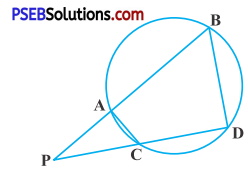
In fig., two chords AB and CD of a circle intersect each other at point P (when produced) outside the circle prove:
(i) ∆PAC ~ ∆PDB
(ii) PA.PB = PC.PD.
PSEB 10th Class Maths Solutions Chapter 6 Triangles Ex 6.6 11

Solution:
Given: AB and CD are two chord of circle intersects each other at P (when produced)
To prove:
(i) ∆PAC ~ ∆PDB
(ii) PA.PB = PC.PD.
Proof:
(i) In ∆PAC and ∆PDB,
∠P = ∠P (Common)
∠PAC = ∠PDB.
(Exterior angle of cyclic quadrilqteral is equal to interior opposite angle)
∴ ∆PAC ~ ∆PDB [AA similarity criterion]

(ii) ∆PAB ~ ∆WDB
∴ \(\frac{\mathrm{PA}}{\mathrm{PD}}=\frac{\mathrm{PC}}{\mathrm{PB}}\)
[If two triangles are similar corresponding sides are proportional]
PA × PB = PC × PD.

PSEB Solutions PSEB 10th Class Maths Solutions Chapter 6 Triangles Ex 6.6

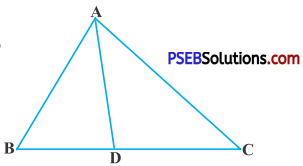
Question 9.
In fig., D is a point on side BC of BD AB ∆ABC such that \(\frac{\mathbf{B D}}{\mathbf{D C}}=\frac{\mathbf{A B}}{\mathbf{A C}}\). Prove that: AD is bisector of ∠BAC.
PSEB 10th Class Maths Solutions Chapter 6 Triangles Ex 6.6 12

Solution:
Given: A ∆ABC, D is a point on BC such that \(\frac{\mathbf{B D}}{\mathbf{D C}}=\frac{\mathbf{A B}}{\mathbf{A C}}\)
To prove: AD bisects ∠BAC
i.e., ∠1 = ∠2
Construction: Through C draw CE || DA meeting BA produced at E.
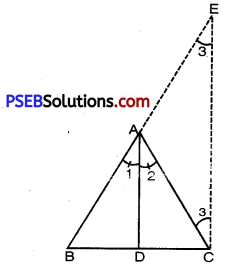
PSEB 10th Class Maths Solutions Chapter 6 Triangles Ex 6.6 13

Proof:
In ∆BCE, we have:
AD || CE ………(const.)
So, by Basic Proportionality Theorem,
But \(\frac{\mathrm{BD}}{\mathrm{DC}}=\frac{\mathrm{AB}}{\mathrm{AE}}\)
\(\frac{\mathrm{BD}}{\mathrm{DC}}=\frac{\mathrm{AB}}{\mathrm{AC}}\)

⇒ \(\frac{\mathrm{AB}}{\mathrm{AE}}=\frac{\mathrm{AB}}{\mathrm{AC}}\)
⇒ AE = AC

In ∆ACE, we have:
AE = AC
⇒ ∠3 = ∠4 ………. (∠s opp. to equal sides)
Since CE || DA and AC cuts them, then:
∠2 = ∠4 ……….(alt ∠s)
Also CE || DA and BAE cuts them, then:
∠1 = ∠3 …………(Corr. ∠s)
Thus we have:
∠3 = ∠4
⇒ ∠3 = ∠1
But ∠4 = ∠2
⇒ ∠1 = ∠2.
HenCe AD bisects ∠BAC.

PSEB Solutions PSEB 10th Class Maths Solutions Chapter 6 Triangles Ex 6.6

Question 10.
Nazima is fly fishing in a stream. The tip of her fishing rod is 1.8 m above the surface of the water and the fly at the end of the string rests on the water 3.6 m away and 2.4 m from a point directly under the tip of the rod. Assuming that her string (from the tip of her rod to the fly) is taut, how much string does she have out? If she pulls in the string at the rate of 5 cm per second, what will the horizontal distance of the fly from her after 12 seconds?
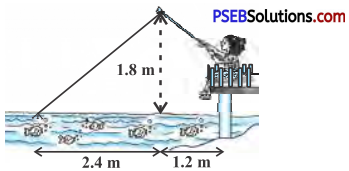
PSEB 10th Class Maths Solutions Chapter 6 Triangles Ex 6.6 14

Solution:
A right angled triangle, ABC, in which,
AB = 1.8 cm,
BC = 2.4 cm.
∠B = 90°
By Pythagoras Theorem,
AC2 = AB2 + BC2
AC2 = (1.8)2 + (2.4)2
AC2 = 3.24 + 5.76 =9
AC2 = (3)2
AC = 3 cm
Now, when Nazima pulls in the string at the rate of 5 cm/sec ; then the length of the string decrease = 5 × 12 = 60 cm
= 0.6 m in 12 seconds.
Let after 12 seconds, position of the fly will be at D.
∴ AD = AC – distance covered in 12 seconds
AD = (3 – 0.6) m
AD = 2.4 m
Also, in right angled ∆ABD,
Using Pythagoras Theorem,
AD2 = AB2 + BD2
(2.4)2 = (1.8)2 + BD2
BD2 = 5.76 – 3.24
BD2 = 2.52 m
BD = 1.587 m.
∴ Horizontal distance of the fly from Nazima = BD + 1.2 m
= (1.587 + 1.2) m
= 2.787 m
= 2.79 m
Hence, original length of string and horizontal distance of the fly from Nazima is 3 m and 2.79 m.

PSEB 9th Class Maths Solutions Chapter 13 Surface Areas and Volumes Ex 13.3

Punjab State Board PSEB 9th Class Maths Book Solutions Chapter 13 Surface Areas and Volumes Ex 13.3 Textbook Exercise Questions and Answers.

PSEB Solutions for Class 9 Maths Chapter 13 Surface Areas and Volumes Ex 13.3

Note: Assume π = \(\frac{22}{7}\), unless stated otherwise.

Question 1.
Diameter of the base of a cone is 10.5 cm and its slant height is 10 cm. Find its curved surface area.
Answer:
For the given cone, diameter d = 10.5 cm.
Then, radius r = \(\frac{10.5}{2}\) cm and slant height
l = 10 cm.
Curved surface area of a cone
= πrl
= \(\frac{22}{7}\) × \(\frac{10.5}{2}\) × 10 cm2
= \(\frac{22}{7}\) × \(\frac{105}{2}\) × cm2
= 11 × 15 cm2
= 165 cm2
Thus, the curved surface area of the given cone is 165 cm2.

PSEB 9th Class Maths Solutions Chapter 13 Surface Areas and Volumes Ex 13.3

Question 2.
Find the total surface area of a cone, if its slant height is 21 m and diameter of its base is 24 m.
Answer:
For the given cone, diameter d = 24 m.

Then, radius r = \(\frac{24}{2}\) = 12 m and slant height l = 21 m.

Total surface area of a cone
= πr (l + r)
= \(\frac{22}{7}\) × 12(21 + 12) m2
= \(\frac{22 \times 12 \times 33}{7}\) m2
= \(\frac{8712}{7}\) m2
= 1244.57 m2
Thus, the total surface area of the given cone is 1244.57 m2.

Question 3.
Curved surface area of a cone is 308 cm2 and its slant height is 14 cm. Find,
(i) radius of the base and
(ii) total surface area of the cone.
Answer:
For the given cone, slant height l = 14 cm and curved surface area = 308 cm2
(i) Curved surface area of a cone = πrl
∴ 308 cm2 = \(\frac{22}{7}\) × r × 14 cm
∴ \(\frac{308 \times 7}{22 \times 14}\) cm = r
∴ r = 7 cm
Thus, the radius of the base of the cone is 7 cm.

PSEB 9th Class Maths Solutions Chapter 13 Surface Areas and Volumes Ex 13.3

(ii) Total surface area of a cone
= πrl + πr2
= 308 + \(\frac{22}{7}\) × 7 × 7 cm2
= 308 + 154 cm2
= 462 cm2
Thus, the total surface area of the cone is 462 cm2.

Question 4.
A conical tent is 10 m high and the radius of its base is 24 m. Find
(i) slant height of the tent.
(ii) cost of the canvas required to make the tent, if the cost of 1 m2 canvas is ₹ 70.
Answer:
For the conical tent,
radius r = 24 m and height h = 10 m.

(i) l = \(\sqrt{h^{2}+r^{2}}\)
= \(\sqrt{10^{2}+24^{2}}\)
= \(\sqrt{100+576}\)
= \(\sqrt{676}\)
∴ l = 26 m
Thus, the slant height of the tent is 26 m.

PSEB 9th Class Maths Solutions Chapter 13 Surface Areas and Volumes Ex 13.3

(ii) Area of the canvas used to make tent
= Curved surface area of the conical tent
= πrl
= \(\frac{22}{7}\) × 24 × 26 m2
= \(\frac{13728}{7}\) m2
Cost of 1 m2 canvas = ₹ 70
∴ Cost of \(\frac{13728}{7}\) m2 canvas
= ₹ \(\left(70 \times \frac{13728}{7}\right)\)
= ₹ 1,37,280
Thus, the cost of canvas required is ₹ 1,37,280.

Question 5.
What length of tarpaulin 3 m wide will be required to make conical tent of height 8 m and base radius 6m? Assume that the extra length of material that will be required for stitching margins and wastage in cutting is approximately 20 cm.
(Use π = 3.14)
Answer:
For the conical tent to be made, radius r = 6 m and height h = 8 m.
l2 = h2 + r2 = 82 + 62 = 64 + 36 = 100
∴ l = √100 = 10 m
Area of the tarpaulin used in making tent
= Curved surface area of conical tent
= πrl
= 3.14 × 6 × 10 m2
= 188.4 m2
Now, the width of the tarpaulin is 3 m.
∴ Length of tarpaulin required = \(\frac{188.4}{3}\) m
= 62.8 m
But, 20 cm, i.e., 0.2 m of tarpaulin is required more for margins and wastage.
∴ Total length of the tarpaulin required = 62.8 + 0.2 m = 63 m
Thus, total length of tarpaulin required is 63 m.

PSEB 9th Class Maths Solutions Chapter 13 Surface Areas and Volumes Ex 13.3

Question 6.
The slant height and base diameter of a conical tomb are 25 m and 14 m respectively. Find the cost of whitewashing its curved surface at the rate of ₹ 210 per 100 m2.
Answer:
For the given conical tomb,
radius r = \(\frac{\text { diameter }}{2}\) = \(\frac{14}{2}\) = 7 m
and slant height l = 25 m. .
Area of the region to be whitewashed
= Curved surface area of the conical tomb
= πrl
= \(\frac{22}{7}\) × 7 × 25 m2
= 550 m2
Cost of whitewashing 100 m2 region = ₹ 210
∴ Cost of whitewashing 550 m2 region
= ₹ \(\left(\frac{210 \times 550}{100}\right)\)
= ₹ 1155
Thus, the cost of whitewashing the curved surface of the tomb is ₹ 1155.

PSEB 9th Class Maths Solutions Chapter 13 Surface Areas and Volumes Ex 13.3

Question 7.
A joker’s cap is in the form of a right circular cone of base radius 7 cm and height 24 cm. Find the area of the sheet required to make 10 such caps.
Answer:
For the conical cap, radius r = 7 cm and height h = 24 cm.
l = \(\sqrt{h^{2}+r^{2}}\)
= \(\sqrt{24^{2}+7^{2}}\)
= \(\sqrt{576+49}\)
= \(\sqrt{625}\) = 25 cm
Area of the sheet required to make 1 conical cap
= Curved surface area of the conical cap
= πrl
= \(\frac{22}{7}\) × 7 × 25 cm2
= 550 cm2
Area of sheet required to make 1 cap = 550 cm2
∴ Area of sheet required to make 10 caps
= 550 × 10 cm2
= 5500 cm2
Thus, the area of the sheet required to make 10 caps is 5500 cm2

PSEB 9th Class Maths Solutions Chapter 13 Surface Areas and Volumes Ex 13.3

Question 8.
A bus stop is barricaded from the remaining part of the road, by using 50 hollow cones made of recycled carboard. Each cone has a base diameter of 40 cm and height 1 m. If the outer side of each of the cones is to be painted and the cost of painting is ₹ 12 per m2, what will be the cost of painting all these cones? (Use π = 3.14 and take \(\sqrt{1.04}\) = 1.02)
Answer:
For the given cone,
radius r = \(\frac{\text { diameter }}{2}\) = \(\frac{40}{2}\) = 20 cm = 0.2 m and
height h = 1 m.
l = \(\sqrt{h^{2}+r^{2}}\)
= \(\sqrt{1^{2}+0.2^{2}}\)
= \(\sqrt{1.04}\)
= 1.02 m
Curved surface area of a cone
= πrl
= 3.14 × 0.2 × 1.02 m2
∴ Curved surface area of 50 cones
= 50 × 3.14 × 0.2 × 1.02 m2
= 32.028 m2
Cost of painting 1 m2 region = ₹ 12
∴ Cost of painting 32.028 m2 region
= ₹ (12 × 32.028)
= ₹ 384.34 (approx.)
Thus, the cost of painting all the 50 cones is ₹ 384.34 (approx.)

PSEB 9th Class Maths Solutions Chapter 13 Surface Areas and Volumes Ex 13.2

Punjab State Board PSEB 9th Class Maths Book Solutions Chapter 13 Surface Areas and Volumes Ex 13.2 Textbook Exercise Questions and Answers.

PSEB Solutions for Class 9 Maths Chapter 13 Surface Areas and Volumes Ex 13.2

Note: Assume π = \(\frac{22}{7}\), unless stated otherwise.

Question 1.
The curved surface area of a right circular cylinder of height 14 cm is 88 cm2. Find the diameter of the base of the cylinder.
Answer:
Height of cylinder h = 14 cm.
Curved surface area of a cylinder = 2 πrh
∴ 88 cm2 = 2 × r × 14cm
∴ \(\frac{88 \times 7}{2 \times 22 \times 14}\) cm = r
∴ r = 1 cm
Now, diameter of the cylinder = 2r = 2 × 1 cm
= 2 cm
Thus, the diameter of the base of the cylinder is 2 cm.

PSEB 9th Class Maths Solutions Chapter 13 Surface Areas and Volumes Ex 13.2

Question 2.
It is required to make a closed cylindrical tank of height 1 m and base diameter 140 cm from a metal sheet. How many square metres of the sheet are required for the same ?
Answer:
Height of cylindrical tank h = 1 m
Diameter of the cylinder =140 cm
∴ Radius of the cylinder r = \(\frac{\text { diameter }}{2}\)
= \(\frac{140}{2}\) cm
= 70 cm
= 0.7 m
Total surface area of the closed cylindrical tank
= 2πr (r + h)
= 2 × \(\frac{22}{7}\) × 0.7 (0.7 + 1) m2
= 4.4 × 1.7 m2
= 7.48 m2
Thus, 7.48 m2 sheet is required to make the closed cylindrical tank.

Question 3.
A metal pipe is 77 cm long. The inner diameter of a cross section is 4 cm, the outer diameter being 4.4 cm (see the given figure). Find its
PSEB 9th Class Maths Solutions Chapter 13 Surface Areas and Volumes Ex 13.2 1
(i) inner curved surface area,
Answer:
For inner cylinder, diameter = 4 cm
∴ For inner cylinder,
radius r = \(\frac{\text { diameter }}{2}\) = 2 cm
and height (length) h = 77 cm.
Inner curved surface area of the pipe
= 2πrh
= 2 × \(\frac{22}{7}\) × 2 × 77 cm2
= 968 cm2
Thus, the inner curved surface area is 968 cm2.

PSEB 9th Class Maths Solutions Chapter 13 Surface Areas and Volumes Ex 13.2

(ii) outer curved surface, area,
Answer:
For outer cylinder, diameter = 4.4 cm
∴ For outer cylinder,
radius R = \(\frac{\text { diameter }}{2}\) = \(\frac{4.4}{2}\) = 2.2
and height h = 77 cm.
Outer curved surface area of the pipe
= 2πRh
= 2 × \(\frac{22}{7}\) × 2 × 77 cm2
= 1064.8 cm2
Thus, the outer curved surface area is
1064.8 cm2.

(iii) total surface area.
Answer:
Total surface area includes the area of two circular rings at the ends together with the inner and outer curved surface areas.
For each circular ring, outer radius R = 2.2 cm and inner radius r = 2 cm
Area of one circular ring
= π(R2 – r2)
= \(\frac{22}{7}\)(2.22 – 22)cm2
= \(\frac{22}{7}\) (4.84 – 4) cm2
= \(\frac{22}{7}\) × 0.84 cm2
= 2.64 cm2
∴ Area of two circular rings.
= 2 × 2.64 cm2
= 5.28 cm2
Now, total surface area of the pipe = Inner curved surface area + outer curved surface area + area of two circular rings
= 968 + 1064.8 + 5.28 cm2
= 2038.08 cm2

PSEB 9th Class Maths Solutions Chapter 13 Surface Areas and Volumes Ex 13.2

Question 4.
The diameter of a roller is 84 cm and its length is 120 cm. It takes 500 complete revolutions to move once over to level a playground. Find the area of the playground in m2.
Answer:
For the cylindrical roller, diameter d = 84 cm and height (length) h = 120 cm.
Curved surface area of the cylindrical roller
= πdh
= \(\frac{22}{7}\) × 84 × 120 cm2
= 31680 cm2
= \(\frac{31680}{10000}\) m2
= 3.168 m2
Thus, the area of playground levelled in 1 complete revolution of the roller = 3.168 m2
∴ The area of playground levelled in 500 complete revolutions of the roller
= 3.168 × 500 m2 = 1584 m2
Thus, the area of the playground is 1584 m2.

Question 5.
A cylindrical pillar is 50 cm in diameter and 3.5 m in height. Find the cost of painting the curved surface of the pillar at the rate of ₹ 12.50 per m2.
Answer:
For the cylindrical pillar, diameter d = 50 cm = 0.5 m and height h = 3.5 m.
Curved surface area of the cylindrical pillar
= πdh
= \(\frac{22}{7}\) × 0.5 × 3.5 m2
= 5.5 m2
Cost of painting 1 m2 area = ₹ 12.50
∴ Cost of painting 5.5 m2 area = ₹ (12.50 x 5.5)
= ₹ 68.75
Thus, the cost of painting the curved surface of the pillar is ₹ 68.75.

PSEB 9th Class Maths Solutions Chapter 13 Surface Areas and Volumes Ex 13.2

Question 6.
Curved surface area of a right circular cylinder is 4.4 m2. If the radius of the base of the cylinder is 0.7 m, find its height.
Answer:
For the given cylinder, radius r = 0.7 m and
curved surface area = 4.4 m2.
Curved surface area of a cylinder = 2πrh
∴ 4.4 m2 = 2 × \(\frac{22}{7}\) × 0.7m × h
∴ h = \(\frac{4.4 \times 7}{2 \times 22 \times 0.7}\)m
∴ h = 1 m
Thus, the height of the cylinder is 1 m.

Question 7.
The inner diameter of a circular well is 3.5 m. It is 10 m deep. Find
(i) its inner curved surface area,
(ii) the cost of plastering this curved surface at the rate of ₹ 40 per m2.
Answer:
A circular well means a cylindrical well. For the cylindrical well, diameter d = 3.5 m and height (depth) h = 10 m.
(i) Curved surface area of the well
= πdh
= \(\frac{22}{7}\) × 3.5 × 10 m2
= 110 m2

PSEB 9th Class Maths Solutions Chapter 13 Surface Areas and Volumes Ex 13.2

(ii) Cost of plastering 1 m2 region = ₹ 40
∴ Cost of plastering 110 m2 region
= ₹ (40 × 110)
= ₹ 4400

Question 8.
In a hot water heating system, there is a cylindrical pipe of length 28 m and diameter 5 cm. Find the total radiating surface in the system.
Answer:
For the cylindrical pipe, diameter d = 5 cm = 0.05 m and height (length) h = 28 m.
The radiation surface in the system is the •curved surface of the pipe.
Hence, we find the curved surface area of the cylindrical pipe.
Curved surface area of the cylindrical pipe
= πdh
= \(\frac{22}{7}\) × 0.05 × 28 m2
= 4.4 m2
Thus, the total radiating surface in the system is 4.4 m2.

Question 9.
Find: (i) the lateral or curved surface area of a closed cylindrical petrol storage tank that is 4.2 m in diameter and 4.5 m high.
(ii) how much steel was actually used, if \(\frac{1}{12}\) of the steel actually used was wasted in making the tank.
Answer:
For the closed cylindrical tank, diameter d = 4.2 m, hence radius
r = \(\frac{4.2}{2}\) = 2.1 m and height h = 4.5 m.

PSEB 9th Class Maths Solutions Chapter 13 Surface Areas and Volumes Ex 13.2

(i) Curved surface area of the cylindrical tank
= 2 πrh
= 2 × \(\frac{22}{7}\) × 2.1 × 4.5 m2
= 59.4 m2

(ii) Total surface area of the closed cylindrical tank
= 2πr (r + h)
= 2 × \(\frac{22}{7}\) × 2.1 (2.1 + 4.5) m2
= 13.2 × 6.6 m2
= 87.12 m2
Suppose, x m2 steel was used for making the tank. But during production, \(\frac{1}{12}\) of the steel was wasted.
∴ Actual quantity of steel used = \(\frac{11}{12}\)x m2.
Hence, \(\frac{11}{12}\)x = 87.12
∴ x = \(\frac{8712}{100} \times \frac{12}{11}\)
∴ x = 95.04 m2
Thus, the quantity of steel actually used during the preparation of the tank is 95.04 m2.

Question 10.
In the given figure, you see the frame of a lampshade. It is to be covered with a decorative cloth. The frame has a base diameter of 20 cm and height of 30 cm. A margin of 2.5 cm is to be given for folding it over the top and bottom of the frame. Find how much cloth is required for covering the lampshade.
PSEB 9th Class Maths Solutions Chapter 13 Surface Areas and Volumes Ex 13.2 2
Answer:
The shape of the decorative cloth will be cylindrical.
For the cylinder of cloth, diameter d = 20 cm and height h = 30 cm + 2.5 cm + 2.5 cm = 35 cm.
Curved surface area of the cylinder of cloth
= πdh
= \(\frac{22}{7}\) × 20 × 35 cm2
Thus, 2200 cm2 cloth is required for covering the lampshade.

PSEB 9th Class Maths Solutions Chapter 13 Surface Areas and Volumes Ex 13.2

Question 11.
The students of Vidyalaya were asked to participate in a competition for making and decorating penholders in the shape of a cylinder with a base, using cardboard. Each penholder was to be of radius 3 cm and height 10.5 cm. The Vidyalaya was to supply the competitors with cardboards. If there were 35 competitors, how much cardboard was required to be bought for the competition ?
Answer:
The cylindrical penholders to be made have base but open at the top. Thus, to prepare a penholder, the area of the cardboard required will be given by the curved surface area of the cylinder and the area of base.

For cylindrical penholder, radius r = 3 cm and height h = 10.5 cm.
Area of cardboard required for 1 penholder
= Curved surface area of cylinder + Area of base
= 2πrh + πr2
= πr (2h + r)
= \(\frac{22}{7}\) × 3(2 × 10.5 + 3) cm2
= \(\frac{66 \times 24}{7}\) cm2
∴ Area of the cardboard required for 35 penholders
= 35 × \(\frac{66 \times 24}{7}\) cm2
= 7920 cm2
Thus, 7920 cm2 cardboard was required to be bought for the competition.

PSEB 9th Class Maths Solutions Chapter 13 Surface Areas and Volumes Ex 13.1

Punjab State Board PSEB 9th Class Maths Book Solutions Chapter 13 Surface Areas and Volumes Ex 13.1 Textbook Exercise Questions and Answers.

PSEB Solutions for Class 9 Maths Chapter 13 Surface Areas and Volumes Ex 13.1

Question 1.
A plastic box 1.5 m long, 1.25 m wide and 65 cm deep is to be made. It is open at the top. Ignoring the thickness of the plastic sheet, determine: (i) The area of the sheet required for making the box. (ii) The cost of sheet for it, if a sheet measuring 1 m2 costs ₹ 20.
Answer:
The plastic box to be made is open at the top. Hence, the plastic sheet is required for the lateral surfaces and the base.
Here, for the box to be made,
length l = 1.5 m;
breadth b = 1.25 m and
height h = 65 cm = 0.65 m.
Area of the plastic sheet required for open box = Lateral surface area + Area of base
= 2 h(l + b) + l × b
= 2 × 0.65 (1.5 + 1.25) + 1.5 × 1.25 m2
= 1.3 × 2.75 + 1.875 m2
= 3.575 + 1.875 m2
= 5.45 m2
Cost of 1 m2 sheet = ₹ 20
∴ Cost of 5.45 m2 sheet = ₹ (5.45 × ₹ 20)
= ₹ 109

PSEB 9th Class Maths Solutions Chapter 13 Surface Areas and Volumes Ex 13.1

Question 2.
The length, breadth and height of a room are 5 m, 4 m and 3 m respectively. Find the cost of white washing the walls of the room and the ceiling at the rate of ₹ 7.50 per m2.
Answer:
For the given room, length 1 = 5 m; breadth b = 4 m and height h = 3 m.
Area of the region to be white washed
= Area of four walls + Area of ceiling
= 2 h(l + b) + l × b
= 2 × 3 (5 + 4) + 5 × 4 m2
= 54 + 20 m2
= 74 m2
Cost of white washing 1 m2 region = ₹ 7.5
∴ Cost of white washing 74 m2 region
= ₹ (74 × 7.5)
= ₹ 555

PSEB 9th Class Maths Solutions Chapter 13 Surface Areas and Volumes Ex 13.1

Question 3.
The floor of a rectangular hall has a perimeter 250 m. If the cost of painting the four walls at the rate of ₹ 10 per m2 is ₹ 15,000, find the height of the hall. [Hint: Area of the four walls = Lateral surface area.]
Answer:
Area painted at the cost of ₹ 10 = 1 m2
∴ Area painted at the cost of ₹ 15,000
= \(\frac{15000}{10}\)
= 1500 m2
∴ Area of the four walls = 1500m2
∴ Lateral surface area = 1500 m2
∴ Perimeter Of the floor × Height = 1500 m2
∴ 250 m × Height = 1500 m2
∴ Height = \(\frac{15000}{250}\)
∴ Height = 6 m

PSEB 9th Class Maths Solutions Chapter 13 Surface Areas and Volumes Ex 13.1

Question 4.
The paint in a certain container is sufficient to paint an area equal to 9.375 m2. How many bricks of dimensions 22.5 cm × 10 cm× 7.5 cm can be painted out of this container?
Answer:
For each brick, length l = 22.5 cm; breadth b = 10 cm and height h = 7.5 cm.
Total surface area of one brick
= 2 (lb + bh + hl)
= 2 (22.5 × 10 + 10 × 7.5 + 7.5 × 22.5) cm2
= 2 (225 + 75 + 168.75) cm2
= 2 (468.75) cm2
= 937.5 cm2
= \(\frac{937.5}{10000}\) m2 = 0.09375 m2
No. of bricks that can be painted with paint sufficient to paint 0.09375 m2 area = 1
∴ No. of bricks that can be painted with paint sufficient to paint 9.375 m2 area 9.375
= \(\frac{9.375}{0.09375}\) = 100

PSEB 9th Class Maths Solutions Chapter 13 Surface Areas and Volumes Ex 13.1

Question 5.
A cubical box has each edge 10 cm and |> another cuboidal box is 12.5 cm long, 10 cm wide and 8 cm high.
(i) Which box has the greater lateral surface area and by how much?
(ii) Which box has the smaller total surface area and by how much ?
Answer:
For the cubical box, edge a = 10 cm and for the cuboidal box, length l = 12.5 cm; breadth b = 10 cm and height h = 8 cm
(i) Lateral surface area of cubical box
= 4a2
= 4 (10)2 cm2
= 400 cm
Lateral surface area of cuboidal box
= 2h(l + b)
= 2 × 8(12.5 + 10) cm2
= 16 × 22.5 cm2
= 360 cm2
Thus, the lateral surface area of cubical box is greater by 40 cm2 (400 – 360).

(ii) Total surface area of cubical box = 6a2
= 6 (10)2 cm2
= 600 cm2
Total surface area of cuboidal box
= 2 (lb + bh + hl)
= 2(12.5 × 10 + 10 × 8 + 8 × 12.5) cm2
= 2 (125 + 80 + 100) cm2
= 2 (305) cm2
= 610 cm2
Thus, the total surface area of cubical box is smaller by 10 cm2 (610 – 600).

PSEB 9th Class Maths Solutions Chapter 13 Surface Areas and Volumes Ex 13.1

Question 6.
A small indoor greenhouse (herbarium) is made entirely of glass panes (including base) held together with tape. It is 30 cm long, 25 cm wide and 25 cm high.
(i) What is the area of the glass ?
(ii) How much of tape is needed for all the 12 edges ?
Answer:
(i) For the cuboidal greenhouse, length l = 30 cm; breadth fa = 25 cm and height h = 25 cm.
Area of glass used
= Total surface area of cuboid
= 2 (lb + bh + hl)
= 2 (30 × 25 + 25 × 25 + 25 × 30) cm2
= 2 (750 + 625 + 750) cm2
= 2 (2125) cm2
= 4250 cm2

(ii) 12 edges of the cuboidal greenhouse is made-up of 4 lengths, 4 breadths and 4 heights.
∴ Length of tape needed for 12 edges
= 4l + 4b + 4h
= 4 (l + b + h)
= 4 (30 + 25 + 25) cm
= 4 (80) cm
= 320 cm

PSEB 9th Class Maths Solutions Chapter 13 Surface Areas and Volumes Ex 13.1

Question 7.
Shanti Sweets Stall was placing an order for making cardboard boxes for packing their sweets. Two sizes of boxes were required. The bigger of dimensions 25 cm × 20 cm × 5 cm and the smaller of dimensions 15 cm × 12 cm × 5 cm. For all the overlaps, 5 % of the total surface area is required extra. If the cost of the cardboard is ₹ 4 for 1000 cm2, find the cost of cardboard required for supplying 250 boxes of each kind.
Answer:
For bigger cuboidal boxes, length l = 25 cm;
breadth b = 20 cm and height h = 5 cm.
Total surface area of a bigger box
= 2 (lb + bh + hl)
= 2 (25 × 20 + 20 × 5 + 5 × 25) cm2
= 2 (500 + 100 + 125) cm2
= 1450 cm2
Area of cardboard required for overlap
= 5 % of 1450 cm2
= 72.5 cm2
Thus, the total area of cardboard required for 1 bigger box = 1450 + 72.5 cm2
= 1522.5 cm2
∴ The total area of cardboard required for 250 bigger boxes = (1522.5 × 250) cm2
For smaller cuboidal boxes, length l = 15 cm; breadth b = 12 cm and height h = 5 cm.
Total surface area of a smaller box
= 2 (lb + bh + hl)
= 2 (15 × 12 + 12 × 5 + 5 × 15) cm2
= 2(180 +60 + 75) cm2
= 2 (315) cm2
= 630 cm2
Area of cardboard required for overlap
= 5% of 630 cm2
= 31.5 cm2
Thus, the total area of cardboard required for 1 smaller box = 630 + 31.5 cm2 = 661.5 cm2
∴ The total area of cardboard required for 250 smaller boxes = (661.5 × 250) cm2
Now, the total area of cardboard required for all the boxes
= (1522.5 × 250) + (661.5 × 250) cm2
= 250(1522.5 + 661.5) cm2
= 250 × 2184 cm2
Cost of 1000 cm2 cardboard = ₹ 4
∴ Cost of 250 × 2184 cm2 cardboard
= ₹ \(\left(\frac{4 \times 250 \times 2184}{1000}\right)\)
= ₹ 2184

PSEB 9th Class Maths Solutions Chapter 13 Surface Areas and Volumes Ex 13.1

Question 8.
Parveen wanted to make a temporary shelter for her car, by making a box-like structure with tarpaulin that covers all the four sides and the top of the car (with the front face as a flap which can be rolled up). Assuming that the stitching margins are very small, and therefore negligible, how much tarpaulin would be required to make the shelter of height 2.5 m, with base dimensions 4 m × 3 m ?
Answer:
For the box-like structure without base, length
l = 4m; breadth b = 3m and height h = 2.5m.
Area of tarpaulin required
= Area of lateral surfaces + Area of top
= 2 h(l + b) + l × b
= 2 × 2.5 (4 + 3) + 4 × 3 m2
= 35 + 12 m2
= 47 m2