PSEB 7th Class Maths Solutions Chapter 15 Visualising Solid Shapes Ex 15.2

Punjab State Board PSEB 7th Class Maths Book Solutions Chapter 15 Visualising Solid Shapes Ex 15.2 Textbook Exercise Questions and Answers.

PSEB Solutions for Class 7 Maths Chapter 15 Visualising Solid Shapes Ex 15.2

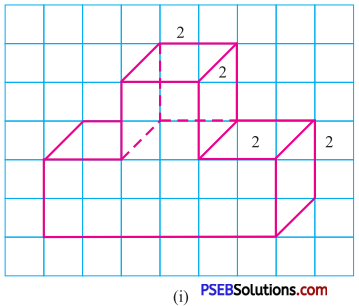
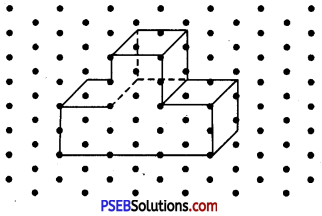
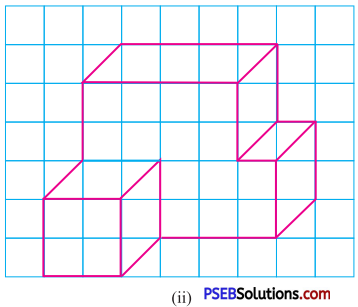
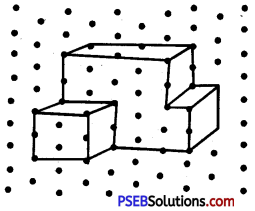
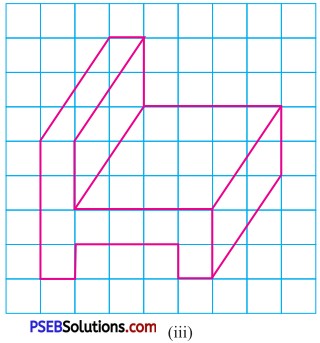
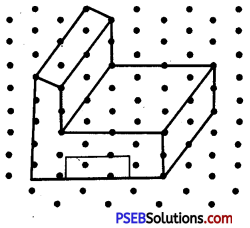
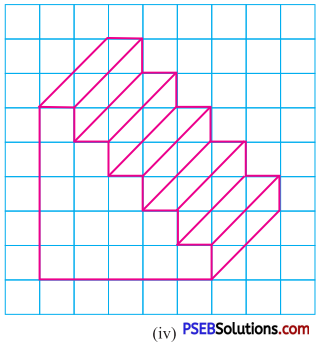
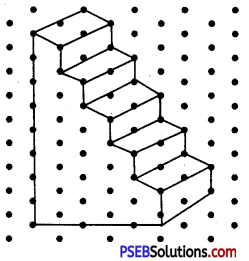
1. Use isometric dot paper and make an isometric sketch of the following figures :
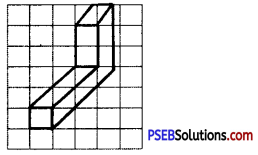
Question (i).
PSEB 7th Class Maths Solutions Chapter 15 Visualising Solid Shapes Ex 15.2 1
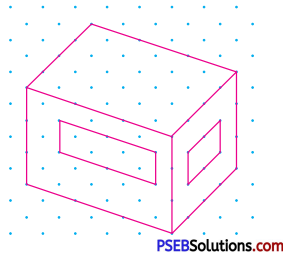
Solution:
PSEB 7th Class Maths Solutions Chapter 15 Visualising Solid Shapes Ex 15.2 2

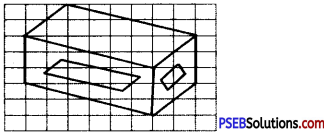
Question (ii).
PSEB 7th Class Maths Solutions Chapter 15 Visualising Solid Shapes Ex 15.2 3
Solution:
PSEB 7th Class Maths Solutions Chapter 15 Visualising Solid Shapes Ex 15.2 4

Question (iii).
PSEB 7th Class Maths Solutions Chapter 15 Visualising Solid Shapes Ex 15.2 5
Solution:
PSEB 7th Class Maths Solutions Chapter 15 Visualising Solid Shapes Ex 15.2 6

Question (iv).
PSEB 7th Class Maths Solutions Chapter 15 Visualising Solid Shapes Ex 15.2 7
Solution:
PSEB 7th Class Maths Solutions Chapter 15 Visualising Solid Shapes Ex 15.2 8

PSEB 7th Class Maths Solutions Chapter 15 Visualising Solid Shapes Ex 15.2

2. Draw (i) an oblique sketch (ii) Isometric sketch for :
(a) A cube with a edge of 4 cm long
(b) A cuboid of length 6 cm, breadth 4 cm and height 3 cm
Solution:
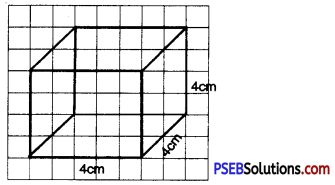
(a) (i) Oblique sketch of cube with a edge 4 cm long.
PSEB 7th Class Maths Solutions Chapter 15 Visualising Solid Shapes Ex 15.2 9

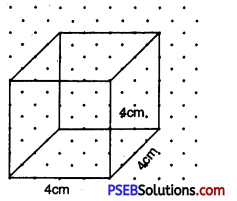
(ii) Iso metric sketch for a cube with a edge of 4 cm long.
PSEB 7th Class Maths Solutions Chapter 15 Visualising Solid Shapes Ex 15.2 10

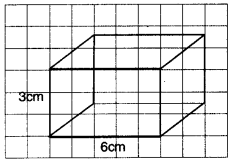
(b) (i) an oblique sketch for a cuboid of length 6 cm, breadth 4 cm and height 3 cm.
PSEB 7th Class Maths Solutions Chapter 15 Visualising Solid Shapes Ex 15.2 11

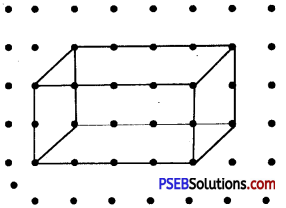
(ii) Isometric sketch for a cuboid of length 6 cm, breadth 4 cm and height 3 cm.
PSEB 7th Class Maths Solutions Chapter 15 Visualising Solid Shapes Ex 15.2 12

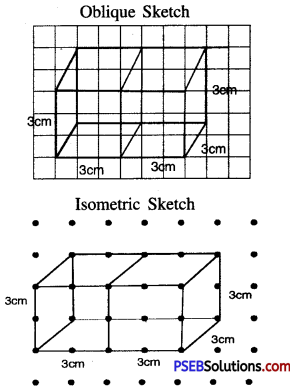
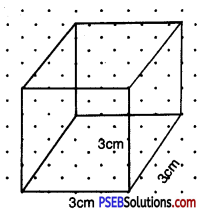
3. Two cubes each with edge 3 cm are placed side by side to form a cuboid, sketch oblique and isometric sketch of this cuboid.
Solution:
PSEB 7th Class Maths Solutions Chapter 15 Visualising Solid Shapes Ex 15.2 13

PSEB 7th Class Maths Solutions Chapter 15 Visualising Solid Shapes Ex 15.2

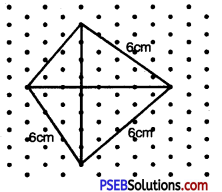
4. Draw an Isometric sketch of triangular pyramid with base as equilateral triangle of 6 cm and height 4 cm.
Solution:
PSEB 7th Class Maths Solutions Chapter 15 Visualising Solid Shapes Ex 15.2 14

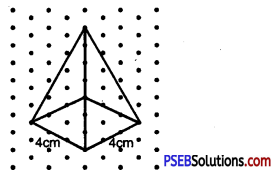
5. Draw an Isometric sketch of square pyramid.
Solution:
PSEB 7th Class Maths Solutions Chapter 15 Visualising Solid Shapes Ex 15.2 15

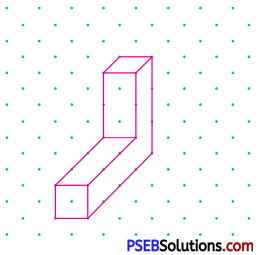
6. Make an oblique sketch for each of the given Isometric shapes.

Question (i).
PSEB 7th Class Maths Solutions Chapter 15 Visualising Solid Shapes Ex 15.2 16
Solution:
PSEB 7th Class Maths Solutions Chapter 15 Visualising Solid Shapes Ex 15.2 17

Question (ii).
PSEB 7th Class Maths Solutions Chapter 15 Visualising Solid Shapes Ex 15.2 18
Solution:
PSEB 7th Class Maths Solutions Chapter 15 Visualising Solid Shapes Ex 15.2 19

PSEB 7th Class Maths Solutions Chapter 15 Visualising Solid Shapes Ex 15.2

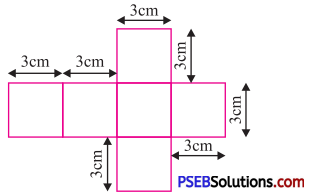
7. Using an isometric dot paper draw the solid shape formed by the given net.
PSEB 7th Class Maths Solutions Chapter 15 Visualising Solid Shapes Ex 15.2 20
Solution:
PSEB 7th Class Maths Solutions Chapter 15 Visualising Solid Shapes Ex 15.2 21

8. Multiple choice questions:

Question (i).
An oblique sheet is made up of:
(a) Rectangles
(b) Squares
(c) Right angled triangles
(d) Equilateral triangles.
Answer:
(b) Squares

Question (ii).
An isometric sheet is made up of dots forming :
(a) Squares
(b) Rectangles
(c) Equilateral triangles
(d) Right angled triangle
Answer:
(c) Equilateral triangles

PSEB 7th Class Maths Solutions Chapter 15 Visualising Solid Shapes Ex 15.2

Question (iii).
An oblique sketch has :
(a) Proportional lengths
(b) Parallel lengths
(c) Non-Proportional lengths
(d) Perpendicular lengths.
Answer:
(c) Non-Proportional lengths

Question (iv).
An Isometric sketch has :
(a) Non proportional lengths
(b) Parallel lengths
(c) Perpendicular lengths
(d) Proportional lengths.
Answer:
(d) Proportional lengths.

Question (v).
Isometric sketches shows objects of:
(a) Two dimensions
(b) Shadows
(c) Three dimensions
(d) One dimension.
Answer:
(c) Three dimensions

PSEB 6th Class Maths Solutions Chapter 10 Practical Geometry Ex 10.1

Punjab State Board PSEB 6th Class Maths Book Solutions Chapter 10 Practical Geometry Ex 10.1 Textbook Exercise Questions and Answers.

PSEB Solutions for Class 6 Maths Chapter 10 Practical Geometry Ex 10.1

1. What is the use of instrument ruler?
Solution:
We use instrument ruler to draw line segment and to measure their lengths.

PSEB 6th Class Maths Solutions Chapter 10 Practical Geometry Ex 10.1

2. What is the use of protractor?
Solution:
We use a protractor to draw and measure angle.

3. What is the use of compasses?
Solution:
We use compasses to mark equal lengths, draw arcs and circles.

4. Construct the following angles using set squares.

Question (i)
(i) 30°
(ii) 45°
(iii) 60°
(iv) 75°
(v) 90°.
Solution:
(i) Steps of Construction:

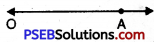
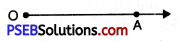
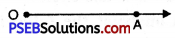
1. Draw a ray OA.
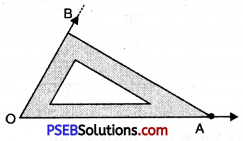
PSEB 6th Class Maths Solutions Chapter 10 Practical Geometry Ex 10.1 1
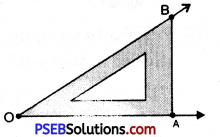
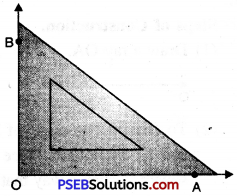
2. To construct an angle of 30° we use 30° set square. Place the set square in such a way that one of its edges containing the 30° angle coincides with the ray OA as shown in the figure.
PSEB 6th Class Maths Solutions Chapter 10 Practical Geometry Ex 10.1 2
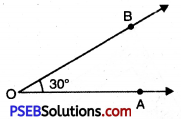
3. Draw a ray OB starting from the vertex O along the 30° edge of the set square as shown in figure.
4. Remove the set square.
Thus, the required \(\angle \mathrm{AOB}\) = 30°.
PSEB 6th Class Maths Solutions Chapter 10 Practical Geometry Ex 10.1 3

PSEB 6th Class Maths Solutions Chapter 10 Practical Geometry Ex 10.1

(ii) Steps of Construction:

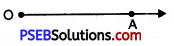
1. Draw a ray OA.
PSEB 6th Class Maths Solutions Chapter 10 Practical Geometry Ex 10.1 4
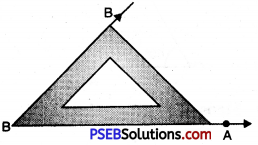
2. To construct an angle of 45° we use 45° set square.
Place a 45° set square along ray OA as shown in the figure.
PSEB 6th Class Maths Solutions Chapter 10 Practical Geometry Ex 10.1 5
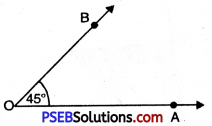
3. Draw a ray OB starting from the vertex O along 45° the, edge of set square.
4. Remove the 45° set square. Thus, the required \(\angle \mathrm{AOB}\) = 45°
PSEB 6th Class Maths Solutions Chapter 10 Practical Geometry Ex 10.1 6

(iii) Steps of Construction.

1. Draw a ray OA.
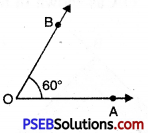
PSEB 6th Class Maths Solutions Chapter 10 Practical Geometry Ex 10.1 7
2. To construct an angle of 60°. We use 30° set square.
PSEB 6th Class Maths Solutions Chapter 10 Practical Geometry Ex 10.1 8
Place a 30° set square with 60° edge along ray OA as shown in the figure.
3. Draw a ray OB starting from the vertex O along 60° edge of the set square.
4. Remove the 30° set square. Thus the required \(\angle \mathrm{AOB}\) = 60°.
PSEB 6th Class Maths Solutions Chapter 10 Practical Geometry Ex 10.1 9

(iv) Steps of Construction

1. Draw a ray of OA.
PSEB 6th Class Maths Solutions Chapter 10 Practical Geometry Ex 10.1 10
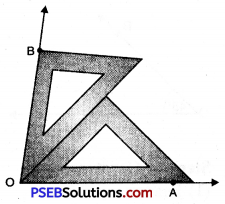
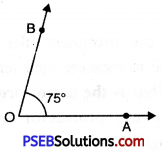
2. To draw angle of 75° we use both set squares in combination as 45° + 30° = 75°.
Place 45° set square with 45° edge along OA
PSEB 6th Class Maths Solutions Chapter 10 Practical Geometry Ex 10.1 11
3. Place 30° set square adjacent to 45° set square as show. Draw a ray starting from the vertex O along the edge of 30° set square.
4. Remove both the set squares. Thus required \(\angle \mathrm{AOB}\) = 75°.
PSEB 6th Class Maths Solutions Chapter 10 Practical Geometry Ex 10.1 12

PSEB 6th Class Maths Solutions Chapter 10 Practical Geometry Ex 10.1

(v) Steps of Construction

1. Draw a ray OA.
PSEB 6th Class Maths Solutions Chapter 10 Practical Geometry Ex 10.1 13
2. To construct angle of 90° place any set square with 90° corner at O along OA.
PSEB 6th Class Maths Solutions Chapter 10 Practical Geometry Ex 10.1 14
3. Draw a ray OB starting from the vertex O along 90° edge of the set square.
4. Remove the set square. Thus, the required \(\angle \mathrm{AOB}\) = 90°.
PSEB 6th Class Maths Solutions Chapter 10 Practical Geometry Ex 10.1 15

PSEB 6th Class Maths MCQ Chapter 9 Understanding Elementary Shapes

Punjab State Board PSEB 6th Class Maths Book Solutions Chapter 9 Understanding Elementary Shapes MCQ Questions with Answers.

PSEB 6th Class Maths Chapter 9 Understanding Elementary Shapes MCQ Questions

Multiple Choice Questions

Question 1.
In the figure, which of the following is true?
(a) PR = PQ
(b) PR > QR
(c) PS > PR
(d) PR < PQ.
Answer:
(b) PR > QR

PSEB 6th Class Maths MCQ Chapter 9 Understanding Elementary Shapes

Question 2.
Which angle is represented in the given figure?
(a) Reflex
(b) Acute
(c) Obtuse
(d) Right angle.
Answer:
(a) Reflex

Question 3.
Which angle is represented in the given figure?
(a) Acute
(b) Right angle
(c) Obtuse
(d) Reflex
Answer:
(b) Right angle

Question 4.
Which of the following is the example of perpendicular lines?
(a) Railway lines
(b) Line segment forming letter ‘X’
(c) Adjacent edges of a table
(d) Line segment forming line ‘M’.
Answer:
(c) Adjacent edges of a table

Question 5.
Which of the following forms triangles?
(a) 60°, 72°, 48°
(b) 73°, 54°, 59°
(c) 60°, 51°, 70°
(d) 100°, 42°, 39°.
Answer:
(a) 60°, 72°, 48°

PSEB 6th Class Maths MCQ Chapter 9 Understanding Elementary Shapes

Question 6.
Which of the following are sides of a triangle?
(a) 1, 2, 3
(b) 2, 2,1
(c) 3, 4, 2
(d) 5, 6, 12.
Answer:
(c) 3, 4, 2

Question 7.
A parallelogram having adjacent sides equal is called a …………… .
(a) Trapezium
(b) Rhombus
(c) Rectangle
(d) Square.
Answer:

Question 8.
Which of the following is not true for rectangle?
(a) Diagonals are equal
(b) Diagonals bisect each other
(c) Each angle is 90°
(d) All sides are equal.
Answer:
(d) All sides are equal

Question 9.
Which of the following is not true?
(a) Every rhombus is a parallelogram
(b) Each square is rhombus.
(c) Each rectangle is a square.
(d) Each square is parallelogram.
Answer:
(c) Each rectangle is a square

Question 10.
A cuboid has ………….. edges.
(a) 10
(b) 6
(c) 12
(d) 8.
Answer:
(c) 12

PSEB 6th Class Maths MCQ Chapter 9 Understanding Elementary Shapes

Question 11.
The following angle is an:
PSEB 6th Class Maths MCQ Chapter 9 Understanding Elementary Shapes 1
(a) acute angle
(b) obtuse angle
(c) right angle
(d) straight angle.
Answer:
(a) acute angle

Question (ii)
What is the angle name for half a revolution?
(a) acute angle
(b) obtuse angle
(c) straight angle
(d) right angle.
Answer:
(c) straight angle

Question (iii)
What is the angle name for one-fourth revolution?
(a) right angle
(b) straight angle
(c) complete angle
(d) acute angle.
Answer:
(a) right angle

PSEB 6th Class Maths MCQ Chapter 9 Understanding Elementary Shapes

Question (iv)
An angle whose measure is less than that of a right angle is …………….. .
(a) complete angle
(b) acute angle
(c) obtuse angle
(d) straight angle.
Answer:
(b) acute angle

Question (v)
An angle whose measure is greater than that of a right angle:
(a) acute angle
(b) complete angle
(c) obtuse angle
(d) straight angle.
Answer:
(c) obtuse angle

Fill in the blanks:

Question (i)
An angle whose measure is equal to 90°, is called ……………….. .
Answer:
right angle

PSEB 6th Class Maths MCQ Chapter 9 Understanding Elementary Shapes

Question (ii)
An angle whose measure is the sum of the measure of two right angle is ………………. .
Answer:
straight angle

Question (iii)
Your instrument box looks like a ………………. .
Answer:
cuboid

Question (iv)
A road-roller looks like a ……………… .
Answer:
cylinder

Question (v)
A cuboid has ……………. faces.
Answer:
six

PSEB 6th Class Maths MCQ Chapter 9 Understanding Elementary Shapes

Write True/False:

Question (i)
Every rhombus is a parallelogram. (True/False)
Answer:
True

Question (ii)
Every square is a rhombus. (True/False)
Answer:
True

Question (iii)
All sides of a rectangle are equal. (True/False)
Answer:
False

Question (iv)
Each rectangle is a square. (True/False)
Answer:
False

PSEB 6th Class Maths MCQ Chapter 9 Understanding Elementary Shapes

Question (v)
Each angle of a rectangle is of 90°. (True/False)
Answer:
True.

PSEB 6th Class Maths Solutions Chapter 8 Basic Geometrical Concepts Ex 8.6

Punjab State Board PSEB 6th Class Maths Book Solutions Chapter 8 Basic Geometrical Concepts Ex 8.6 Textbook Exercise Questions and Answers.

PSEB Solutions for Class 6 Maths Chapter 8 Basic Geometrical Concepts Ex 8.6

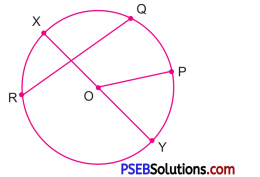
1. In the given figure, write the name of:
PSEB 6th Class Maths Solutions Chapter 8 Basic Geometrical Concepts Ex 8.6 1

Question (i)
Centre
Solution:
Centre: O

PSEB 6th Class Maths Solutions Chapter 8 Basic Geometrical Concepts Ex 8.6

Question (ii)
Radii
Solution:
Radii: OX, OY, OP

Question (iii)
Diameter
Solution:
Diameter: XY

Question (iv)
Chord.
Solution:
Chord: QR.

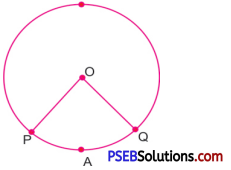
2. In the given figure, write the name
PSEB 6th Class Maths Solutions Chapter 8 Basic Geometrical Concepts Ex 8.6 2

Question (i)
minor arc
Solution:
Minor arc : PAQ

PSEB 6th Class Maths Solutions Chapter 8 Basic Geometrical Concepts Ex 8.6

Question (ii)
major arc
Solution:
Major arc : PBQ

Question (iii)
minor sector
Solution:
Minor sector: OPAQ

Question (iv)
major sector.
Solution:
Major sector : OPBQ.

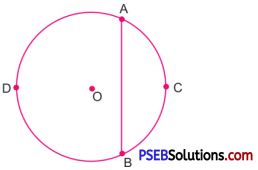
3. In the given figure, write the name
PSEB 6th Class Maths Solutions Chapter 8 Basic Geometrical Concepts Ex 8.6 3

Question (i)
Minor segment
Solution:
Minor segment: ACBA

PSEB 6th Class Maths Solutions Chapter 8 Basic Geometrical Concepts Ex 8.6

Question (ii)
Major segment.
Solution:
Major segment: ADBA

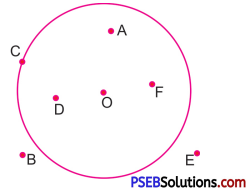
4. In the given figure, name the points:
PSEB 6th Class Maths Solutions Chapter 8 Basic Geometrical Concepts Ex 8.6 4

Question (i)
In its interior
Solution:
Points in its interior : O, A, D, F

Question (ii)
On its boundary (circumference)
Solution:
Points on its boundary (circumference) C

Question (iii)
In its exterior.
Solution:
Points in its exterior : B, E

PSEB 6th Class Maths Solutions Chapter 8 Basic Geometrical Concepts Ex 8.6

5. Find the diameter of the circle whose radius is:

Question (i)
5 cm
Solution:
Given Radius of the circle = 5 cm
∴ Diameter of the Circle = 2 × radius = 2 × 5 cm = 10 cm

Question (ii)
4 cm
Solution:
Given radius of the circle = 4 cm
∴ Diameter of the circle = 2 × radius = 2 × 4m = 8m

Question (iii)
10 cm.
Solution:
Given radius of the circle = 10 cm
∴ Diameter of circle = 2 × Radius = 2 × 10 cm = 20 cm

PSEB 6th Class Maths Solutions Chapter 8 Basic Geometrical Concepts Ex 8.6

6. If the diameter of the circle is 12 cm. Find the radius:
Solution:
Given diameter of a circle = 12 cm
∴ Radius of circle = Diameter + 2
= 12 cm + 2
= 6 cm

7. Fill in the blanks:

Question (i)
The distance around a circle is called ……………… .
Solution:
Circumference

Question (ii)
The diameter of a circle is ……………… times its radius.
Solution:
two

PSEB 6th Class Maths Solutions Chapter 8 Basic Geometrical Concepts Ex 8.6

Question (iii)
The longest chord of circle is …………….. .
Solution:
diameter

Question (iv)
All the radii of a circle are of ……………… length.
Solution:
equal

Question (v)
The diameter of a circle passes through ……………. .
Solution:
centre

Question (vi)
A circle divides all the points in a plane into ……………… parts.
Solution:
three.

8. State true or false:

Question (i)
The diameter of a circle is equal to its radius.
Solution:
False

Question (ii)
The diameter is a chord of circle.
Solution:
True

PSEB 6th Class Maths Solutions Chapter 8 Basic Geometrical Concepts Ex 8.6

Question (iii)
A radius is a chord of the circle.
Solution:
False

Question (iv)
Every circle has a centre.
Solution:
True

Question (v)
The region enclosed by a chord and arc is called a segment
Solution:
True

PSEB 6th Class Maths Solutions Chapter 8 Basic Geometrical Concepts Ex 8.5

Punjab State Board PSEB 6th Class Maths Book Solutions Chapter 8 Basic Geometrical Concepts Ex 8.5 Textbook Exercise Questions and Answers.

PSEB Solutions for Class 6 Maths Chapter 8 Basic Geometrical Concepts Ex 8.5

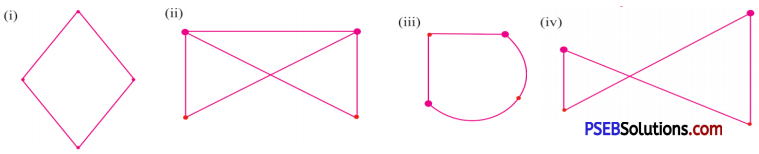
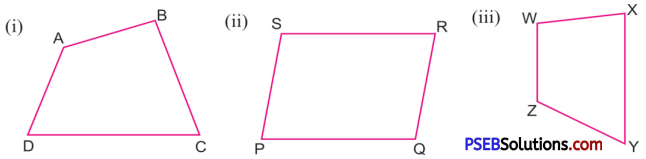
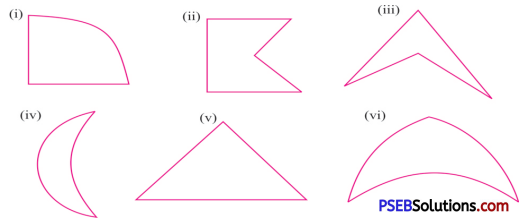
1. Out of the following, Identify the quadrilateral:
PSEB 6th Class Maths Solutions Chapter 8 Basic Geometrical Concepts Ex 8.5 1
Solution:
PSEB 6th Class Maths Solutions Chapter 8 Basic Geometrical Concepts Ex 8.5 2

PSEB 6th Class Maths Solutions Chapter 8 Basic Geometrical Concepts Ex 8.5

2. Name the given quadrilaterals:
PSEB 6th Class Maths Solutions Chapter 8 Basic Geometrical Concepts Ex 8.5 3
Solution:
(i) ABCD
(ii) PQRS
(iii) XYZW.

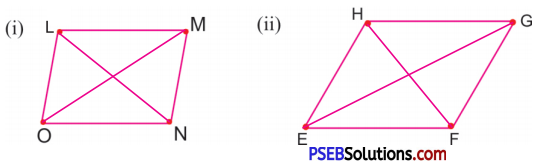
3. Write the name of all vertices, angles, sides, diagonals of the following quadrilaterals:
PSEB 6th Class Maths Solutions Chapter 8 Basic Geometrical Concepts Ex 8.5 4
Solution:
(i) Vertices = O, N, M, L;
Angles = \(\angle \mathrm{O}, \angle \mathrm{N}, \angle \mathrm{M}, \angle \mathrm{L}\)
Sides = ON, NM, ML, LO;
Diagonals = OM, NL

(ii) Vertices = H, G, F, E;
Angles = \(\angle \mathrm{H}, \angle \mathrm{G}, \angle \mathrm{F}, \angle \mathrm{E}\)
Sides = HG, GF, FE, EH;
Diagonals = EG, FH.

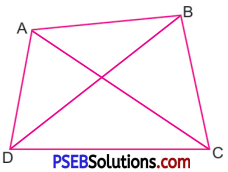
4. For the given quadrilateral ABCD, name:

Question (i)
(i) Side opposite to AB
(ii) Angles adjacent to B
(iii) Diagonal joining B and D
(iv) Angle opposite to A
(v) Sides adjacent to CD.
PSEB 6th Class Maths Solutions Chapter 8 Basic Geometrical Concepts Ex 8.5 5
Solution:
(i) CD
(ii) \(\angle \mathrm{A} \text { and } \angle \mathrm{C}\)
(iii) BD
(iv) \(\angle \mathrm{C}\)
(v) AD and BC.

PSEB 6th Class Maths Solutions Chapter 8 Basic Geometrical Concepts Ex 8.5

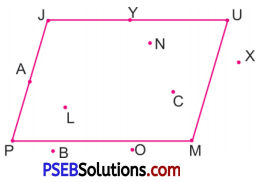
5. In the given quadrilateral JUMP, name the points.
PSEB 6th Class Maths Solutions Chapter 8 Basic Geometrical Concepts Ex 8.5 6

Question (i)
In its interior
Solution:
Points in the interior of quad. JUMP are :
L, N, C

Question (ii)
In its exterior
Solution:
Points in its exterior of quad. JUMP are :
B, O, X

Question (iii)
On its boundary.
Solution:
Points on the boundary of quad. JUMP are :
P, M, U, Y, J, A.

PSEB 6th Class Maths Solutions Chapter 8 Basic Geometrical Concepts Ex 8.5

6. Fill in the blanks:

Question (i)
A quadrilateral has …………….. vertices.
Solution:
4

Question (ii)
A quadrilateral has …………… sides.
Solution:
4

Question (iii)
A quadrilateral has …………… angles.
Solution:
4

Question (iv)
A quadrilateral has ………….. diagonals.
Solution:
2

PSEB 6th Class Maths Solutions Chapter 8 Basic Geometrical Concepts Ex 8.5

Question (v)
A diagonal divides the quadrilateral into……………… triangles.
Solution:
2

Question (vi)
A line segment joining the opposite vertices of a quadrilateral is called its ………. .
Solution:
Diagonal

Question (vii)
The interior and the boundary of a quadrilateral together constitute the ……………. region.
Solution:
Quadrilateral.

7. State True or False:

Question (i)
A diagonal divides quadrilateral into four triangles.
Solution:
False

Question (ii)
The angle that have a common vertex are called adjacent angles.
Solution:
True

PSEB 6th Class Maths Solutions Chapter 8 Basic Geometrical Concepts Ex 8.5

Question (iii)
The sides that have a common vertex are called adjacent sides.
Solution:
True

Question (iv)
A quadrilateral has four diagonals.
Solution:
False

Question (v)
The quadrilateral region consists of the exterior and the boundary of the quadrilateral.
Solution:
False

PSEB 10th Class Maths Solutions Chapter 6 Triangles Ex 6.5

Punjab State Board PSEB 10th Class Maths Book Solutions Chapter 6 Triangles Ex 6.5 Textbook Exercise Questions and Answers.

PSEB Solutions for Class 10 Maths Chapter 6 Triangles Ex 6.5

Question 1.
Sides of triangles are given below. Determine which of them are right triangles. In case of a right triangle, write the length of its hypotenuse.
(i) 7 cm, 24 cm, 25 cm
(ii) 3 cm, 8 cm, 6 cm
(iii) 50 cm, 80 cm, 100 cm
(iv) 13 cm, 12 cm, 5 cm.
Solution:
(i) Let ∆ABC, with AB = 7 cm BC = 24 cm, AC = 25 cm
AB2 + BC2 = (7)2 + (24)2
= 49 + 576 = 625
AC2 = (25)2 = 625
Now AB2 + BC2 = AC2
∴ ∆ABC is right angled triangle. Hyp. AC = 25cm.

(ii) Let ∆PQR with PQ = 3 cm, QR = 8 cm PR = 6 cm
PQ2 + PR2 = (3)2 + (6)2
= 9 + 36 = 45
QR2 = (8)2 = 64.
Here PQ2 + PR2 ≠ QR2
∴ ∆PQR is not right angled triangle.

PSEB Solutions PSEB 10th Class Maths Solutions Chapter 6 Triangles Ex 6.5

(iii) Let ∆MNP, with MN =50 cm, NP = 80 cm, MP = 100 cm
MN 2+ NP2 = (50)2 + (80)2
= 2500 + 6400 = 8900
MP2 = (100)2 = 10000
Here MP2 ≠ MN2 + NP2.
∴ ∆MNP is not right angled triangle.

(iv) Let ∆ABC, AB = 13 cm, BC = 12 cm, AC = 5 cm
BC2 + AC2 = (12)2 + (5)2
= 144 + 25 = 169
AB2 = (13)2 = 169
∴ AB2 = BC2 + AC2
∆ABC is right angled triangle.
Hyp. AB = 13 cm.

PSEB Solutions PSEB 10th Class Maths Solutions Chapter 6 Triangles Ex 6.5

Question 2.
PQR is a triangle right angled at P and M is a point on QR such that PM ⊥ QR. Show that PM2 = QM . MR.
Solution:
Given: ∆PQR is right angled at P and M is a point on QR such that PM ⊥ QR.
To prove : PM2 = QM × MR
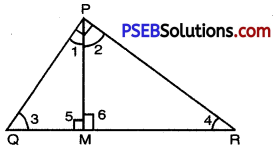
PSEB 10th Class Maths Solutions Chapter 6 Triangles Ex 6.5 1

Proof: ∠P = 90° (Given)
∴ ∠1 + ∠2 = 90°
∠M = 900 (Given)
In ∆PMQ,
∠1 + ∠3 + ∠5 = 180°
=> ∠1 + ∠3 = 90° [Angle Sum Property] ………….(2) [∠5 = 90°]
From (1) and (2),
∠1 + ∠2 = ∠1 + ∠3
∠2 = ∠3
In ∆QPM and ∆RPM,
∠3 = ∠2 (Proved)
∠5 = ∠6 (Each 90°)
∴ ∆QMP ~ ∆PMR [AA similarity]
\(\frac{{ar} .(\Delta \mathrm{QMP})}{{ar} .(\Delta \mathrm{PMR})}=\frac{\mathrm{PM}^{2}}{\mathrm{MR}^{2}}\)

[If two triangles are similar, ratio o their areas is equal to square of corresponding sides]
\(\frac{\frac{1}{2} \mathrm{QM} \times \mathrm{PM}}{\frac{1}{2} \mathrm{RM} \times \mathrm{PM}}=\frac{\mathrm{PM}^{2}}{\mathrm{MR}^{2}}\)

[area of ∆ = \(\frac{1}{2}\) Base × Altitude]

\(\frac{\mathrm{QM}}{\mathrm{RM}}=\frac{\mathrm{PM}^{2}}{\mathrm{RM}^{2}}\)

PM2 = QM × RM Hence proved.

PSEB Solutions PSEB 10th Class Maths Solutions Chapter 6 Triangles Ex 6.5

Question 3.
In fig., ABD is a triangle right angled at A and AC ⊥ BD. Show that
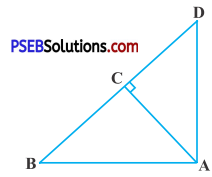
PSEB 10th Class Maths Solutions Chapter 6 Triangles Ex 6.5 2

(i) AB2 = BC.BD
(ii) AC2 = BC.DC
(üi) AD2 = BD.CD.
Solution:
Given. A right angled ∆ABD in which right angled at A and AC ⊥ BD.
To Prove:
(i) AB2 = BC.BD
(ii) AC2 = BC.DC .
(iii) AD2 = BD.ÇD .
Proof. In ∆DAB and ∆DCA,
∠D = ∠D (common)
∠A = ∠C (each 90°)
∴ ∆DAB ~ ∆DCA [AA similarity]
In ∆DAB and ∆ACB,
∠B = ∠B (common)
∠A = ∠C . (each 90°)
∴ ∆DAB ~ ∆ACB, .
From (1) and (2),
∆DAB ~ ∆ACB ~ ∆DCA.
(i) ∆ACB ~ ∆DAB (proved)
∴ \(\frac{{ar} .(\Delta \mathrm{ACB})}{{ar} .(\Delta \mathrm{DAB})}=\frac{\mathrm{AB}^{2}}{\mathrm{DB}^{2}}\)

[If two triangles are similar corresponding sides are proportional]

\(\frac{\frac{1}{2} \mathrm{BC} \times \mathrm{AC}}{\frac{1}{2} \mathrm{DB} \times \mathrm{AC}}=\frac{\mathrm{AB}^{2}}{\mathrm{DB}^{2}}\)
[Area of triangle = \(\frac{1}{2}\) Base × Altitude]
BC = \(\frac{\mathrm{AB}^{2}}{\mathrm{BD}}\)
AB2 = BC × BD.

(iii) ∆ACB ~ ∆DCA (proved)
\(\frac{{ar} .(\Delta \mathrm{DAB})}{{ar} .(\Delta \mathrm{DCA})}=\frac{\mathrm{DA}^{2}}{\mathrm{DB}^{2}}\)
[If two triangles are similar corresponding sidec are proportional]

\(\frac{\frac{1}{2} \mathrm{CD} \times \mathrm{AC}}{\frac{1}{2} \mathrm{BD} \times \mathrm{AC}}=\frac{\mathrm{AD}^{2}}{\mathrm{BD}^{2}}\)

CD = \(\frac{\mathrm{AD}^{2}}{\mathrm{BD}}\)
⇒ AD2 = BD × CD.

PSEB Solutions PSEB 10th Class Maths Solutions Chapter 6 Triangles Ex 6.5

Question 4.
ABC is an isosceles triangle right angled at C. Prove that AB2 = 2AC2.
Solution:
Given: ABC is an isosceles triangle right angled at C.
To prove : AB2 = 2AC2.
Proof: In ∆ACB, ∠C = 90° & AC = BC (given)
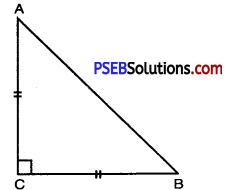
PSEB 10th Class Maths Solutions Chapter 6 Triangles Ex 6.5 3

AB2 = AC2 + BC2
[By using Pythagoras Theorem]
=AC2 + AC2 [BC = AC]
AB2 = 2AC2
Hence proved.

Question 5.
ABC is an isosceles triangle with AC = BC. If AB2 = 2AC2, prove that ABC is right triangle.
Solution:
Given: ∆ABC is an isosceles triangle AC = BC
To prove: ∆ABC is a right triangle.
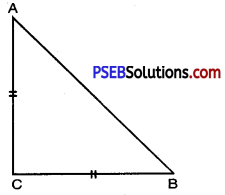
PSEB 10th Class Maths Solutions Chapter 6 Triangles Ex 6.5 4

Proof: AB2 = 2AC2 (given)
AB2 = AC2 + AC2
AB2 = AC2 + BC2 [AC = BC]
∴ By Converse of Pythagoras Theorem,
∆ABC is right angled triangle.

PSEB Solutions PSEB 10th Class Maths Solutions Chapter 6 Triangles Ex 6.5

Question 6.
ABC is an equilateral triangle of side 2a. Find each of its altitudes.
Solution:
∆ABC is equilateral triangle with each side 2a
AD ⊥ BC
AB = AC = BC = 2a
∆ADB ≅ ∆ADC [By RHS Cong.]
∴ BD = DC = a [c.p.c.t]
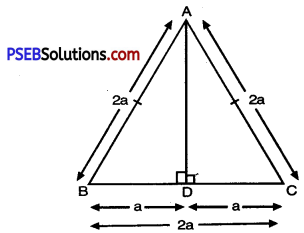
PSEB 10th Class Maths Solutions Chapter 6 Triangles Ex 6.5 5

In right angled ∆ADB
AB2 = AD2 + BD2
(2a)2 = AD2 + (a)2
4a2 – a2 = AD2.
AD2 = 3a2
AD = √3a.

Question 7.
Prove that the sum of the squares of the sides of a rhombus is equal to the sum of the squares of its diagonals. [Pb. 2019]
Solution:
Given: Rhombus, ABCD diagonal AC and BD intersect each other at O.
To prove:
AB2 + BC2 + CD2 + AD2 = AC2 + BD2
Proof:The diagonals of a rhombus bisect each other at right angles.
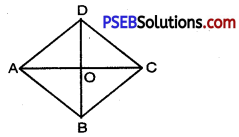
PSEB 10th Class Maths Solutions Chapter 6 Triangles Ex 6.5 6

∴ AO = CO, BO = DO
∴ ∠s at O are rt. ∠s
In ∆AOB, ∠AOB = 90°
∴ AB2 = AO2 + BO2 [By Pythagoras Theorem] …………..(1)
Similarly, BC2 = CO2 + BO2 ……………..(2)
CD2 = CO2 + DO2 ……………(3)
and DA2 = DO2 + AO2 ……………….(4)
Adding. (1), (2), (3) and (4), we get
AB2 + BC2 + CD2 + DA2 = 2AO2 + 2CO2 + 2BO2 + 2DO2
= 4AO2 + 4BO2
[∵ AO = CO and BO = DO]
= (2AO)2 + (2BO)2 = AC2 + BD2.

PSEB Solutions PSEB 10th Class Maths Solutions Chapter 6 Triangles Ex 6.5

Question 8.
In fig., O is a point In the interior of a triangle ABC, OD ⊥ BC, OE ⊥ AC and OF ⊥ AB. Show that
(i) OA2 + OB2 + OC2 – OD2 – OE2 – OF2 = AF2 + BD2 + CE2

(ii)AF2 + BD2 + CE2 = AE2 + CD2 + BF2.
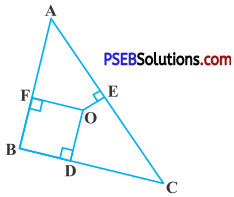
PSEB 10th Class Maths Solutions Chapter 6 Triangles Ex 6.5 7

Solution:
Given: A ∆ABC in which OD ⊥ BC, 0E ⊥ AC and OF ⊥ AB.
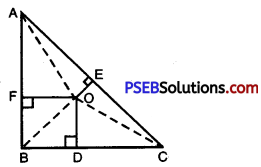
PSEB 10th Class Maths Solutions Chapter 6 Triangles Ex 6.5 8

To prove:
(i) AF2 + BD2 + CE2 = OA2 + OB2 + OC2 – OD2 – OE2 – OF2
(ii) AF2 + BD2 + CE2 = AE2 + CD2 + BF2.
Construction: Join OB, OC and OA.
Proof: (i) In rt. ∠d ∆AFO, we have
OA2 = OF2 + AF2 [By Pythagoras Theorem]
or AF2 = OA2 – OF2 …………..(1)

In rt. ∠d ∆BDO, we have:
OB2 = BD2+ OD2 [By Pythagoras Theorem]
⇒ BD2 = OB2 – OD2 …………..(2)

In rt. ∠d ∆CEO, we have:
OC2 = CE2 + OE2 [By Pythagoras Theorem]

⇒ CE2 = OC2 – OE2 ……………(3)

∴ AF2 + BD2 + CE2 = OA2 – OF2 + OB2 – OD2 + OC2 – 0E2
[On adding (1), (2) and (3)]
= OA2 + OB2 + OC2 – OD2 – OE2 – OF2
which proves part (1).
Again, AF2 + BD2 + CE2 = (OA2 – OE2) + (OC2 – OD2) + (OB2 – OF2)
= AE2 + CD2 + BF2
[∵AE2 = AO2 – OE2
CD2 = OC2 – OD2
BF2 = OB2 – OF2].

PSEB Solutions PSEB 10th Class Maths Solutions Chapter 6 Triangles Ex 6.5

Question 9.
A ladder 10 m long reaches a window 8 m above the ground. Find the distance of the foot of the ladder from base of the wall.
Solution:
Height of window from ground (AB) = 8m.
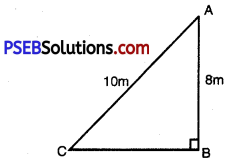
PSEB 10th Class Maths Solutions Chapter 6 Triangles Ex 6.5 9

Length of ladder (AC) = 10 m
Distance between foot of ladder and foot of wall (BC) = ?
In ∆ABC,
AB2 + BC2 = AC2 [By Pythagoras Theorem]
(8)2 + (BC)2 = (10)2
64 + BC2 = 100
BC2 = 100 – 64
BC = √36
BC = 6 cm.
∴ Distance between fóot of ladder and foot of wall = 6 cm.

Question 10.
A guy wire attached to a vertical pole of height 18 m Is 24 m long and has a stake attached to the other end. How far from the base of the pole should the stake be driven so that the wire will be taut?
Solution:
Let AB is height of pole (AB) = 18 m
AC is length of wire = 24 m
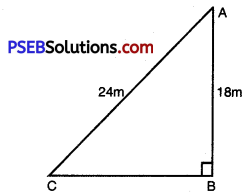
PSEB 10th Class Maths Solutions Chapter 6 Triangles Ex 6.5 10

C is position of stake AB at ground level.
In right angle triangle ABC,
AB2 + BC2 = AC2 [By Pythagoras Theorem]
(18)2 + (BC)2 = (24)2
324 + (BC)2 = 576
BC2 = 576 – 324
BC = \(\sqrt{252}=\sqrt{36 \times 7}\)
BC = 6√7 m.

PSEB Solutions PSEB 10th Class Maths Solutions Chapter 6 Triangles Ex 6.5

Question 11.
An aeroplane leaves an airport and flies due north at a speed of 1000 km per hour. At the same time, another aeroplane leaves the same airport and flies due west at a speed of 1200 km per hour. How far apart will be the two pLanes after 1\(\frac{1}{2}\) hours?
Solution:
Speed of first aeroplane = 1000km/hr.
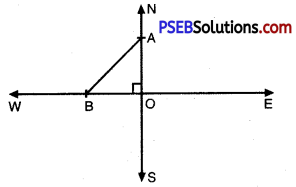
PSEB 10th Class Maths Solutions Chapter 6 Triangles Ex 6.5 11

Distance covered by first aeroplane due north in 1\(\frac{1}{2}\) hours =1000 × \(\frac{3}{2}\)
OA = 1500 km
Speed of second aeroplane = 1200 km/hr.
Distance covered by second aeroplane in 1\(\frac{1}{2}\) hours = 1200 × \(\frac{3}{2}\)
OB = 1800 km.
In right angle ∆AOB
AB2 = AO2 + OB2 [By Phyrhagoras Theorem]
AB2 = (1500)2 + (1800)2
AB = \(\sqrt{2250000+3240000}\)
= \(\sqrt{5490000}\)
= \(\sqrt{61 \times 90000}\)
AB = 300√61 km.
Hence, Distance between two aeroplanes = 300√61 km.

Question 12.
Two poles of heights 6 m and 11 m stand on a plane ground. If the distance between the feet of the poles is 12 m, find the
distance between their tops.
Solution:
Height of pole AB = 11 m
Height of pole (CD) = 6 m
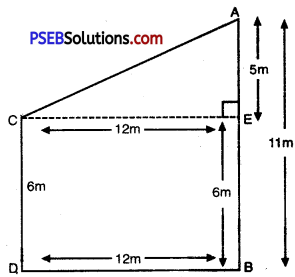
PSEB 10th Class Maths Solutions Chapter 6 Triangles Ex 6.5 12

Distance between foot of pole = 12 m
from C draw CE ⊥ AB. such that
BE = DC = 6 m
AE = AB – BE = (11 – 6) m = 5 m.
and CE = DB = 12 m.
In rt. ∠d ∆AEC,
AC2 = AE2 + FC2
[By Phythagoras Theorem)
AC = \(\sqrt{(5)^{2}+(12)^{2}}\)
= \(\sqrt{25+144}\)
= \(\sqrt{169}\) = 13.
Hence, Distance between their top = 13m.

PSEB Solutions PSEB 10th Class Maths Solutions Chapter 6 Triangles Ex 6.5

Question 13.
D and E are points on the sides CA and CB respectively of a triangle ABC right angled at C.
Prove that AE2 + BD2 = AB2 + DE2.
Solution:
Given: In right angled ∆ABC, ∠C = 90° ;
D and E are points on sides CA & CB respectively.
To prove: AE2 + BD2 = AB2 + DE2
Proof: In rt. ∠d ∆BCA,
AB2 = BC2 + CA2 …………..(1) [By Pythagoras Theorem]
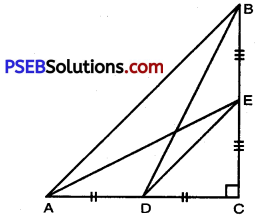
PSEB 10th Class Maths Solutions Chapter 6 Triangles Ex 6.5 13

In rt. ∠d ∆ECD,
DE2 = EC2 + DC2 ……………….(2) [By Pythagoras Theorem]
In right angled triangle ∆ACE,
AE2 = AC2 + CE2 ……………….(3)
In right angled triangle ∆BCD
BD2 = BC2 + CD2 ……………….(4)
Adding (3) and (4),
AE2 + BD2 = AC2 + CE2 + BC2 + CD2
= [AC2 + CB2] + [CE2 + DC2]
= AB2 + DE2
[From (1) and (2)]
Hence 2 + BD2 = AB2 + DE2.
Which is the required result.

Question 14.
The perpendicular from A on side BC of a ∆ABC intersects BC at D such that DB = 3 CD. Prove that 2AB2 = 2AC2 + BC2.
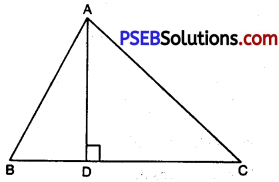
PSEB 10th Class Maths Solutions Chapter 6 Triangles Ex 6.5 14

Solution:
Given: ∆ABC, AD ⊥ BC
BD = 3CD.
To prove: 2AB2 = 2AC2 + BC2.
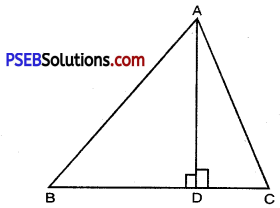
PSEB 10th Class Maths Solutions Chapter 6 Triangles Ex 6.5 15

Proof: In rt. ∠d triangles ADB and ADC, we have
AB2 = AD2 + BD2;
AC2 = AD2 + DC2 [By Pythagoras Theorem]
∴ AB2 – AC2 = BD2 – DC2
= 9 CD2 – CD2; [∵ BD = 3CD]
= 8CD2 = 8 (\(\frac{\mathrm{BC}}{4}\))2
[∵ BC = DB + CD = 3 CD + CD = 4 CD]
∴ CD = \(\frac{1}{4}\) BC
∴ AB2 – AC2 = \(\frac{\mathrm{BC}^{2}}{2}\)
⇒ 2(AB2 – AC2) = BC2
⇒ 2AB2 – 2AC2 = BC2
∴ 2AB2 = 2AC2 + BC2.
Which is the required result.

PSEB Solutions PSEB 10th Class Maths Solutions Chapter 6 Triangles Ex 6.5

Question 15.
In an equilateral triangle ABC, D is a point on side BC such that BD = \(\frac{1}{3}\) BC. Prove that 9 AD2 = 7 AB2.
Solution:
Given: Equilateral triangle ABC, D is a point on side BC such that BD = \(\frac{1}{3}\) BC.
To prove: 9AD2 = 7 AB2.
Construction: AB ⊥ BC.
Proof: ∆AMB ≅ ∆AMC [By R.HS. Rule since AM = AM and AB = AC]
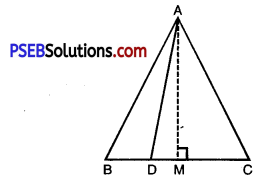
PSEB 10th Class Maths Solutions Chapter 6 Triangles Ex 6.5 16

∴ BM = MC = \(\frac{1}{2}\) BC [c.p.c.t.]
Again BD = \(\frac{1}{3}\) BC and DC = \(\frac{1}{3}\) BC (∵ BC is trisected at D)
Now in ∆ADC, ∠C is acute
∴ AD2 = 2AC2 + DC2 – 2 DC × MC
= AC2 + \(\left[\frac{2}{3} \mathrm{BC}\right]^{2}\) – 2 \(\left[\frac{2}{3} \mathrm{BC}\right] \frac{1}{2} \mathrm{BC}\)

[∵ DC = \(\frac{2}{3}\) BC and MC = \(\frac{1}{2}\) BC]
= AB2 + \(\frac{4}{9}\) AB2 – \(\frac{2}{3}\) AB2
[∵ AC = BC = AB]
= (1 + \(\frac{4}{9}\) – \(\frac{2}{3}\)) AB2

= \(\left(\frac{9+4-6}{9}\right) \mathrm{AB}^{2}=\frac{7}{9} \mathrm{AB}^{2}\)

∴ AD2 = \(\frac{7}{9}\) AB2
⇒ 9 AD2 = 7 AB2.

Question 16.
In an equilateral triangle, prove that three times the square of one side Ls equal to four times the square of one of its
altitudes.
Solution:
Given:
ABC is equilateral ∆ in which AB = BC = AC
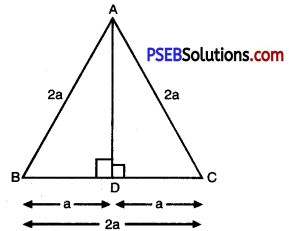
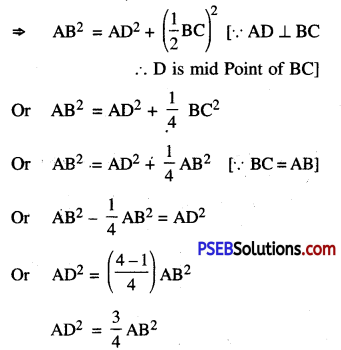
PSEB 10th Class Maths Solutions Chapter 6 Triangles Ex 6.5 17

To prove: 3 AB2 = 4 AD2
Proof: In right angled ∆ABD,
AB2 = AD2 + BD2 (Py. theorem)
AB2 = A BD2 (Py. theorem)
PSEB 10th Class Maths Solutions Chapter 6 Triangles Ex 6.5 18

AD2 = \(\frac{3}{4}\) AB2
⇒ 4 AD2 = 3 AB2
Hence, the result.

PSEB Solutions PSEB 10th Class Maths Solutions Chapter 6 Triangles Ex 6.5

Question 17.
Tick the correct answer and justify: In ∆ABC, AB = 6 cm, AC = 12 cm and BC = 6√3 cm. [The angles of B are respectively
(A) 120°
(B) 64°
(C) 90°
(D) 45°
Solution.
AC = 12 cm
AB = 6√3 cm
BC = 6 cm
AC2 = (12)2 = 144 cm
AB2 + BC2 = (6√3)2 + (6)2
= 108 + 36
AB√3 + BC√3 = 144
∴ AB√3 + BC√3 = AC√3
Hence by converse of pythagoras theorem ∆ABC is right angred triangle right angle at B
∴ ∠B = 90°
∴ correct option is (C).

PSEB 6th Class Maths Solutions Chapter 8 Basic Geometrical Concepts Ex 8.4

Punjab State Board PSEB 6th Class Maths Book Solutions Chapter 8 Basic Geometrical Concepts Ex 8.4 Textbook Exercise Questions and Answers.

PSEB Solutions for Class 6 Maths Chapter 8 Basic Geometrical Concepts Ex 8.4

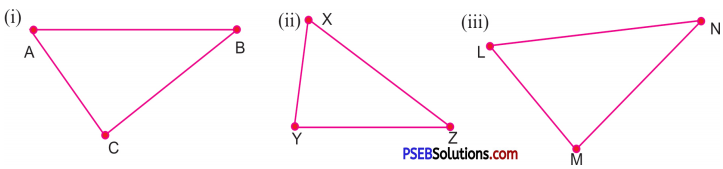
1. Write all the names of the following triangles in all orders:
PSEB 6th Class Maths Solutions Chapter 8 Basic Geometrical Concepts Ex 8.4 1
Solution:
(i) ∆ABC, ∆ACB, ∆BAC, ∆BCA, ∆CAB, ∆CBA.
(ii) ∆XYZ, ∆XZY, ∆YZX, ∆YXZ, ∆ZXY, ∆ZYX
(iii) ∆LMN, ∆LNM, ∆MNL, ∆MLN, ∆NML, ∆NLM.

PSEB 6th Class Maths Solutions Chapter 8 Basic Geometrical Concepts Ex 8.4

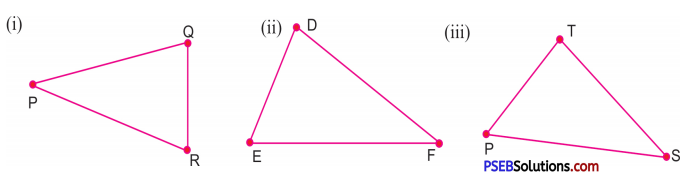
2. Write the name of vertices, sides and angles of the following triangles:
PSEB 6th Class Maths Solutions Chapter 8 Basic Geometrical Concepts Ex 8.4 2
Solution:

(i) (ii) (iii)
Vertices P, R, Q D, E, F T, P, S
Sides PR, QR, PQ DE, EF, DF TP, PS, TS
Angles \(\angle \mathrm{P}, \angle \mathrm{R}, \angle \mathrm{Q}\) \(\angle \mathrm{D}, \angle \mathrm{E}, \angle \mathrm{F}\) \(\angle \mathrm{T}, \angle \mathrm{P}, \angle \mathrm{S}\)

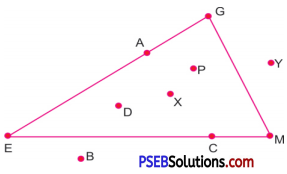
3. In the given figure, name the points that lie:
PSEB 6th Class Maths Solutions Chapter 8 Basic Geometrical Concepts Ex 8.4 3

Question (i)
On the boundary of ∆GEM
Solution:
Points on the boundary of AGEM are: G, A, E, C, M

PSEB 6th Class Maths Solutions Chapter 8 Basic Geometrical Concepts Ex 8.4

Question (ii)
In the interior of ∆GEM
Solution:
Points in the interior of AGEM are : P, X, D

Question (iii)
In the exterior of ∆GEM.
Solution:
Points in the exterior of AGEM are : Y, B.

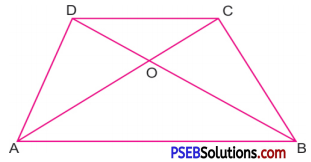
4. In the given figure, write the name of:
PSEB 6th Class Maths Solutions Chapter 8 Basic Geometrical Concepts Ex 8.4 4

Question (i)
All different triangles
Solution:
All different triangles are :
∆AOD, ∆DOC, ∆BOC, ∆AOB, ∆ABD, ∆BCD, ∆ACD, ∆ABC

PSEB 6th Class Maths Solutions Chapter 8 Basic Geometrical Concepts Ex 8.4

Question (ii)
Triangles having O as the vertex
Solution:
Triangles having O as the vertex are :
∆AOB, ∆BOC, ∆COD, ∆AOD

Question (iii)
Triangles having A as the vertex.
Solution:
Triangles having A as the vertex are:
∆AOB, ∆AOD, ∆ABD, ∆ABC, ∆ACD.

5. Fill in the blanks of the following:

Question (i)
A triangle has …………… vertices.
Solution:
3

Question (ii)
A triangle has …………… angles.
Solution:
3

PSEB 6th Class Maths Solutions Chapter 8 Basic Geometrical Concepts Ex 8.4

Question (iii)
A triangle has ……………. sides.
Solution:
3

Question (iv)
A triangle divide the plane into ……………. parts.
Solution:
3

Question (v)
A triangle has …………… parts.
Solution:
6

PSEB 6th Class Maths Solutions Chapter 8 Basic Geometrical Concepts Ex 8.3

Punjab State Board PSEB 6th Class Maths Book Solutions Chapter 8 Basic Geometrical Concepts Ex 8.3 Textbook Exercise Questions and Answers.

PSEB Solutions for Class 6 Maths Chapter 8 Basic Geometrical Concepts Ex 8.3

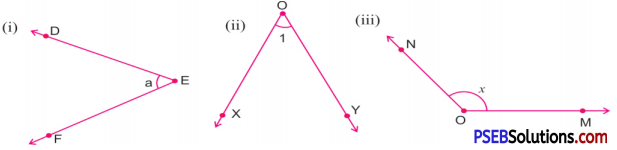
1. Name the given angles in all ways:
PSEB 6th Class Maths Solutions Chapter 8 Basic Geometrical Concepts Ex 8.3 1
Solution:
(i) \(\angle \mathrm{DEF}, \angle \mathrm{FED}, \angle \mathrm{E}, \angle a\)
(ii) \(\angle \mathrm{XOY}, \angle \mathrm{YOX}, \angle \mathrm{O}, \angle 1\)
(iii) \(\angle N O M, \angle M O N, \angle O, \angle x\)

PSEB 6th Class Maths Solutions Chapter 8 Basic Geometrical Concepts Ex 8.3

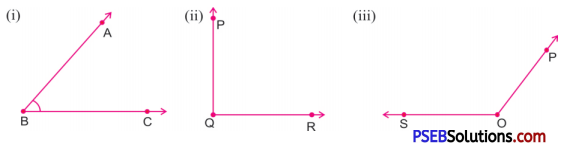
2. Name the vertex and the arms of given angles:
PSEB 6th Class Maths Solutions Chapter 8 Basic Geometrical Concepts Ex 8.3 2
Solution:

(i) (ii) (iii)
Vertex B Q o
Arm \(\overrightarrow{\mathrm{BC}}, \overrightarrow{\mathrm{BA}}\) \(\overrightarrow{\mathrm{QP}}, \overrightarrow{\mathrm{QR}}\) \(\overrightarrow{\mathrm{OS}}, \overrightarrow{\mathrm{OP}}\)

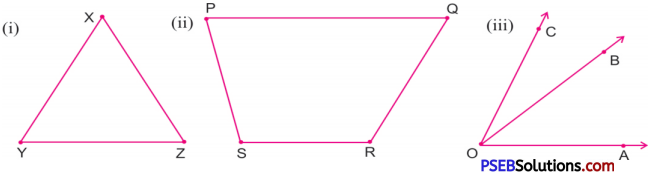
3. Name all the angles of the given figure:
PSEB 6th Class Maths Solutions Chapter 8 Basic Geometrical Concepts Ex 8.3 3
Solution:
(i) \(\angle \mathrm{X}, \angle \mathrm{Y}, \angle \mathrm{Z}\)
(ii) \(\angle \mathrm{P}, \angle \mathrm{Q}, \angle \mathrm{R}, \angle \mathrm{S}\)
(iii) \(\angle \mathrm{AOB}, \angle \mathrm{BOC}, \angle \mathrm{AOC}\)

PSEB 6th Class Maths Solutions Chapter 8 Basic Geometrical Concepts Ex 8.3

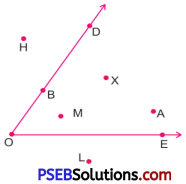
4. In the given figure, name the points that lie:
PSEB 6th Class Maths Solutions Chapter 8 Basic Geometrical Concepts Ex 8.3 4

Question (i)
In the interior of \(\angle \mathrm{DOE}\)
Solution:
Points in the interior of \(\angle \mathrm{DOE}\) are :
A, X, M

Question (ii)
In the exterior of \(\angle \mathrm{DOE}\)
Solution:
Points in the exterior of \(\angle \mathrm{DOE}\) are :
H, L

Question (iii)
On the \(\angle \mathrm{DOE}\)
Solution:
Points on the \(\angle \mathrm{DOE}\) are :
D, B, O, E.

PSEB 6th Class Maths Solutions Chapter 8 Basic Geometrical Concepts Ex 8.3

5. In the given figure, write another name for the following angles :
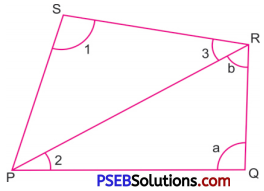
PSEB 6th Class Maths Solutions Chapter 8 Basic Geometrical Concepts Ex 8.3 5

Question (i)
\(\angle \mathrm{1}\)
Solution:
\(\angle S \text { or } \angle PSR \text { or } \angle RSP\)

Question (ii)
\(\angle \mathrm{2}\)
Solution:
\(\angle \mathrm{RPQ} \text { or } \angle \mathrm{QPR}\)

Question (iii)
\(\angle \mathrm{3}\)
Solution:
\(\angle \mathrm{SRP} \text { or } \angle \mathrm{PRS}\)

Question (iv)
\(\angle \mathrm{a}\)
Solution:
\(\angle \mathrm{Q} \text { or } \angle \mathrm{RQP} \text { or } \angle \mathrm{PQR}\)

PSEB 6th Class Maths Solutions Chapter 8 Basic Geometrical Concepts Ex 8.3

Question (v)
\(\angle \mathrm{b}\)
Solution:
\(\angle \mathrm{PRQ} \text { or } \angle \mathrm{QRP}\)

PSEB 6th Class Maths Solutions Chapter 8 Basic Geometrical Concepts Ex 8.2

Punjab State Board PSEB 6th Class Maths Book Solutions Chapter 8 Basic Geometrical Concepts Ex 8.2 Textbook Exercise Questions and Answers.

PSEB Solutions for Class 6 Maths Chapter 8 Basic Geometrical Concepts Ex 8.2

1.

Question (i)
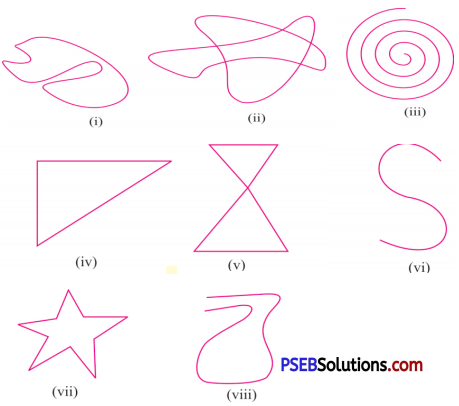
(a) Which of the following are simple curves?
(b) Classify the following as open or closed curve.
PSEB 6th Class Maths Solutions Chapter 8 Basic Geometrical Concepts Ex 8.2 1
Solution:
(a) Simple curves :
(i), (iii), (iv), (vi), (vii), (iii)

(b) Open curves :
(iii) , (vi), (viii)
Closed curves :
(i), (ii), (iv), (v), (vii)

PSEB 6th Class Maths Solutions Chapter 8 Basic Geometrical Concepts Ex 8.2

2. Identify the polygons:

Question (i)
PSEB 6th Class Maths Solutions Chapter 8 Basic Geometrical Concepts Ex 8.2 2
Solution:
(ii), (iii), (v) are polygons.

3. Draw any polygon and shade its interior.
Solution:
PSEB 6th Class Maths Solutions Chapter 8 Basic Geometrical Concepts Ex 8.2 3

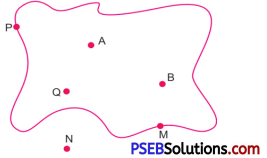
4. Name the points which are:
PSEB 6th Class Maths Solutions Chapter 8 Basic Geometrical Concepts Ex 8.2 4

Question (i)
In the interior of the closed figure.
Solution:
Points in the interior of closed figure are :
A B, Q

PSEB 6th Class Maths Solutions Chapter 8 Basic Geometrical Concepts Ex 8.2

Question (ii)
In the exterior of the closed figure,
Solution:
Points in the exterior of closed figure are :
R, N

Question (iii)
On the boundary of the closed figure.
Solution:
Points in the boundary of closed figure are :
P, M

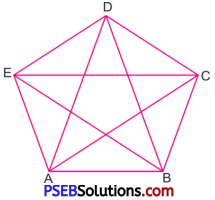
5. In the given figure, name :
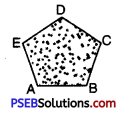
PSEB 6th Class Maths Solutions Chapter 8 Basic Geometrical Concepts Ex 8.2 5

Question (i)
The vertices
Solution:
Vertices are :
D, E, A, B, C

PSEB 6th Class Maths Solutions Chapter 8 Basic Geometrical Concepts Ex 8.2

Question (ii)
The sides
Solution:
Sides are :
AB, BC, CD, DE, EA

Question (iii)
The diagonals
Solution:
Diagonals are :
AC, AD, BE, BD, CE

Question (iv)
Adjacent sides of AB
Solution:
Adjacent sides of AB are :
AE and BC

PSEB 6th Class Maths Solutions Chapter 8 Basic Geometrical Concepts Ex 8.2

Question (v)
Adjacent vertices of E.
Solution:
Adjacent vertices of E are :
A and D.

PSEB 6th Class Maths Solutions Chapter 8 Basic Geometrical Concepts Ex 8.1

Punjab State Board PSEB 6th Class Maths Book Solutions Chapter 8 Basic Geometrical Concepts Ex 8.1 Textbook Exercise Questions and Answers.

PSEB Solutions for Class 6 Maths Chapter 8 Basic Geometrical Concepts Ex 8.1

1. Give the examples of:

Question (i)
A point
Solution:
A point. Point A •
Examples:
(i) A small dot marked by a sharp pencil on a sheet of paper.
(ii) A tiny prick made by a fine needle or pin on a paper.
(iii) Bindi.
(iv) A star in the sky.

PSEB 6th Class Maths Solutions Chapter 8 Basic Geometrical Concepts Ex 8.1

Question (ii)
A line segment
Solution:
A line segment
Examples:
(i) An edge of a box.
(ii) A tube light.
(iii) The edge of a postcard.
(iii) Parallel lines.

Question (iii)
Parallel lines
Solution:
Examples:
(i) The opposite edges of ruler (scale).
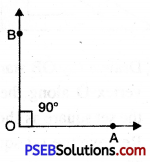
(ii) The crossbars of window.
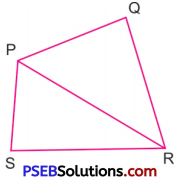
(iii) The opposite edges of blackboard.
(iv) Rail lines.
(iv) Interescting lines.

Question (iv)
Intersecting lines
Solution:
Examples:
(i) Two adjacent edges of your notebook.
(ii) The letter X of the English alphabet.
(iii) Crossing roads.

Question (v)
Concurrent lines.
Solution:
Concurrent lines.
(i) Three angle bisectors of a triangle.
(ii) Three medians of a triangle.
(iii) Three perpendiculars of a triangle.
(iv) The intersection of the three walls of a room.

PSEB 6th Class Maths Solutions Chapter 8 Basic Geometrical Concepts Ex 8.1

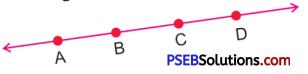
2. Name the lines segments in given lines.
PSEB 6th Class Maths Solutions Chapter 8 Basic Geometrical Concepts Ex 8.1 1
Solution:
AB, AC, AD, BC, BD, CD are line segments.

3. How many lines can pass through a point?
Solution:
Infinite lines can pass through a point.

4. How many points lie on line?
Solution:
Infinite points lie on a line.

5. How many lines pass through two points?
Solution:
One and only one line passes through two points.

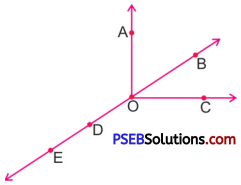
6. Use the figure to name:
PSEB 6th Class Maths Solutions Chapter 8 Basic Geometrical Concepts Ex 8.1 2

Question (i)
Five Points
Solution:
Five Points are :
O, A, B, C, D, or E

Question (ii)
A line
Solution:
BE is the line.

Question (iii)
Four rays
Solution:
Four rays are :
\(\overrightarrow{\mathrm{OA}}, \overrightarrow{\mathrm{OB}}, \overrightarrow{\mathrm{OC}}, \overrightarrow{\mathrm{OD}} \text { or } \overrightarrow{\mathrm{OE}}\)

PSEB 6th Class Maths Solutions Chapter 8 Basic Geometrical Concepts Ex 8.1

Question (iv)
Five line segments.
Solution:
Five line segments are :
OA, OB, OC, OD, OE, DE.

7. Name the given ray in all possible ways.
PSEB 6th Class Maths Solutions Chapter 8 Basic Geometrical Concepts Ex 8.1 3
Solution:
The possible rays are:
\(\overrightarrow{\mathrm{PQ}}, \overrightarrow{\mathrm{PR}}, \overrightarrow{\mathrm{QR}}\)

8. Use the figure to name :
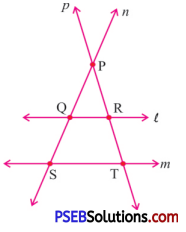
PSEB 6th Class Maths Solutions Chapter 8 Basic Geometrical Concepts Ex 8.1 4

Question (i)
Pair of parallel lines.
Solution:
Pair of parallel lines are :
l and m.

PSEB 6th Class Maths Solutions Chapter 8 Basic Geometrical Concepts Ex 8.1

Question (ii)
All pairs of intersecting lines.
Solution:
All pairs of intersecting lines are:
p and n, n and l, n and m, p and l, p and m.

Question (iii)
Lines whose point of intersection is S.
Solution:
Lines whose point of intersection is S :
m and n.

Question (iv)
Collinear points.
Solution:
Collinear points are :
P, Q, S and P, R, T.

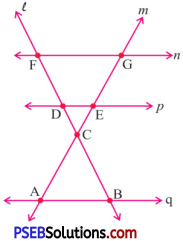
9. Use the figure to name:
PSEB 6th Class Maths Solutions Chapter 8 Basic Geometrical Concepts Ex 8.1 5

Question (i)
All pairs of parallel lines.
Solution:
All pairs of parallel lines are : n and p, q and p, n and q.

PSEB 6th Class Maths Solutions Chapter 8 Basic Geometrical Concepts Ex 8.1

Question (ii)
All pairs of intersecting lines.
Solution:
All pairs of intersecting lines are :
m and l, m and n, m and p, m and q, l and n, l and p, l and q.

Question (iii)
Lines whose point of intersection is D.
Solution:
Lines whose point of intersection is D are :
p and l.

Question (iv)
Point of intersection of lines m and p.
Solution:
Point of intersection of lines m and p is E.

Question (v)
All sets of collinear points.
Solution:
All sets of collinear points are :
G, E, C, A and F, D, C, B.

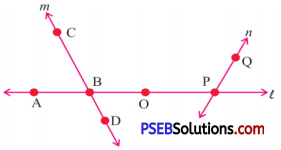
10. Use the figure to name:
PSEB 6th Class Maths Solutions Chapter 8 Basic Geometrical Concepts Ex 8.1 6

Question (i)
Line containing point P.
Solution:
Lines containing point are : l, n.

PSEB 6th Class Maths Solutions Chapter 8 Basic Geometrical Concepts Ex 8.1

Question (ii)
Lines whose point of intersection is B.
Solution:
Lines whose point of intersection is B are : l and m.

Question (iii)
Point of intersection of lines m and l.
Solution:
Point of intersection of lines m and l is : B.

Question (iv)
All pairs of intersecting lines.
Solution:
All pairs of intersecting lines are : m and l, n and l.

11. State which of the following statements are True (T) or False (F):

Question (i)
Two lines in a plane, always intersect at a point
Solution:
False

Question (ii)
If four lines intersect at a point, those are called concurrent lines.
Solution:
True

PSEB 6th Class Maths Solutions Chapter 8 Basic Geometrical Concepts Ex 8.1

Question (iii)
Point has a size because we can see it as a thick dot on the paper.
Solution:
False

Question (iv)
Through a given point, only one line can be drawn.
Solution:
False

Question (v)
Rectangle is a part of the plane.
Solution:
True.