PSEB 9th Class Maths Solutions Chapter 10 Circles Ex 10.1

Punjab State Board PSEB 9th Class Maths Book Solutions Chapter 10 Circles Ex 10.1 Textbook Exercise Questions and Answers.

PSEB Solutions for Class 9 Maths Chapter 10 Circles Ex 10.1

Question 1.
Fill in the blanks :
(i) The centre of a circle lies in ……………………….. of the circle, (exterior/interior)
Answer:
interior

(ii) A point, whose distance from the centre of a circle is greater than its radius lies in ………………….. of the circle, (exterior/interior)
Answer:
exterior

(iii) The longest chord of a circle is a ………………………. of the circle.
Answer:
diameter

PSEB 9th Class Maths Solutions Chapter 10 Circles Ex 10.1

(iv) An arc is a ……………….. when its ends are the ends of a diameter.
Answer:
semicircle

(v) Segment of a circle is the region between an arc and …………………………… of the circle.
Answer:
a chord

(vi) A circle divides the plane, on which it lies, in ………………………….. parts.
Answer:
three

PSEB 9th Class Maths Solutions Chapter 10 Circles Ex 10.1

Question 2.
Write True or False. Give reasons for your answers.
(i ) Line segment joining the centre to any point on the circle is a radius of the circle.
Answer:
The given statement is true, because according to the definition of a radius, a line segment joining the centre to any point on the circle is a radius of the circle.

(ii) A circle has only finite number of equal chords.
Answer:
The given statement is false, because a circle has infinitely many equal chords, e.g., all the diameters of a circle are chords and they are all equal and uncountable.

(iii) If a circle is divided into three equal arcs, each is a major arc.
Answer:
The given statement is false, because if a circle is divided into three equal parts, each part is a minor arc.

PSEB 9th Class Maths Solutions Chapter 10 Circles Ex 10.1

(iv) A chord of a circle, which is twice as long as its radius, is a diameter of the circle.
Answer:
The given statement is true, because a chord of a circle which is twice as long as its radius passes through the centre of the circle and a chord passing through the centre is called a diameter of the circle.

(v) Sector is the region between the chord and its corresponding arc.
Answer:
The given statement is false, because the region between a chord an corresponding arc is called a segment, not a sector.

(vi) A circle is a plane figure.
Answer:
The given statement is true, because circle is a collection of all the points in a plane which are at a fixed distance from a fixed point in the plane.

PSEB 6th Class Maths Solutions Chapter 6 Decimals Ex 6.2

Punjab State Board PSEB 6th Class Maths Book Solutions Chapter 6 Decimals Ex 6.2 Textbook Exercise Questions and Answers.

PSEB Solutions for Class 6 Maths Chapter 6 Decimals Ex 6.2

1. Convert the following decimal numbers into fractions and reduce it to lowest form.

Question (i)
1.4
Solution:
1.4 = \(\frac{14}{10}=\frac{14 \div 2}{10 \div 2}\)
(H.C.F. of 14 and 10 is 2)
= \(\frac {7}{5}\)

PSEB 6th Class Maths Solutions Chapter 6 Decimals Ex 6.2

Question (ii)
2.25
Solution:
2.25 = \(\frac{225}{100}=\frac{225 \div 25}{100 \div 25}\)
(H.C.F. of 225 and 100 is 25)
= \(\frac {9}{4}\)

Question (iii)
18.6
Solution:
18.6 = \(\frac{186}{10}=\frac{186 \div 2}{10 \div 2}\)
(H.C.F. of 186 and 10 is 2)
= \(\frac {93}{5}\)

Question (iv)
4.04
Solution:
4.04 = \(\frac{404}{100}=\frac{404 \div 4}{100 \div 4}\)
(H.C.F. of 404 and 100 is 4)
= \(\frac {101}{25}\)

Question (v)
21.6
Solution:
21.6 = \(\frac{216}{10}=\frac{216 \div 2}{10 \div 2}\)
(H.C.F. of 216 and 10 is 2)
= \(\frac {108}{5}\)

2. Convert the following fractions into decimal numbers:

Question (i)
\(\frac {7}{100}\)
Solution:
\(\frac {7}{100}\) = 0.07
(Here denominator is 100)

PSEB 6th Class Maths Solutions Chapter 6 Decimals Ex 6.2

Question (ii)
\(\frac {12}{10}\)
Solution:
\(\frac {12}{10}\) = 1.2
(Here denominator is 10)

Question (iii)
\(\frac {215}{100}\)
Solution:
\(\frac {215}{100}\) = 2.15
(Here denominator is 100)

Question (iv)
\(\frac {18}{1000}\)
Solution:
\(\frac {18}{1000}\) = 0.018
(Here denominator is 1000)

Question (v)
\(\frac {245}{10}\)
Solution:
\(\frac {245}{10}\) = 24.5
(Here denominator is 10)

3. Convert the following fractions into decimal numbers by equivalent fraction method:

Question (i)
\(\frac {5}{2}\)
Solution:
Here denominator is 2.
Convert into equivalent fraction with denominator 10 by multiplying it by 5.
∴ \(\frac{5}{2}=\frac{5 \times 5}{2 \times 5}=\frac{25}{10}\) = 2.5

PSEB 6th Class Maths Solutions Chapter 6 Decimals Ex 6.2

Question (ii)
\(\frac {3}{4}\)
Solution:
Here denominator is 4.
Convert into equivalent fraction with denominator 100 by multiplying it by 25.
∴ \(\frac{3}{4}=\frac{3 \times 25}{4 \times 25}=\frac{75}{100}\) = 0.75

Question (iii)
\(\frac {28}{5}\)
Solution:
Here denominator is 5.
Convert into equivalent fraction with denominator 10 by multiplying it by 2.
∴ \(\frac{28}{5}=\frac{28 \times 2}{5 \times 2}=\frac{56}{10}\) = 5.6

Question (iv)
\(\frac {135}{20}\)
Solution:
Here denominator is 20.
Convert into equivalent fraction with denominator 100 by multiplying it by 5.
∴ \(\frac{135}{20}=\frac{135 \times 5}{20 \times 5}=\frac{675}{100}\)
= 6.75

Question (v)
\(\frac {17}{4}\)
Here denominator is 4.
Convert into equivalent fraction with denominator 100 by multiplying it by 25.
∴ \(\frac{17}{4}=\frac{17 \times 25}{4 \times 25}=\frac{425}{100}\)
= 4.25

PSEB 6th Class Maths Solutions Chapter 6 Decimals Ex 6.2

4. Convert the following fractions into decimals by long division method:

Question (i)
\(\frac {17}{2}\)
Solution:
PSEB 6th Class Maths Solutions Chapter 6 Decimals Ex 6.2 1
= 8.5

Question (ii)
\(\frac {33}{4}\)
Solution:
PSEB 6th Class Maths Solutions Chapter 6 Decimals Ex 6.2 2
= 8.25

Question (iii)
\(\frac {76}{5}\)
Solution:
PSEB 6th Class Maths Solutions Chapter 6 Decimals Ex 6.2 3
= 15.2

PSEB 6th Class Maths Solutions Chapter 6 Decimals Ex 6.2

Question (iv)
\(\frac {24}{25}\)
Solution:
PSEB 6th Class Maths Solutions Chapter 6 Decimals Ex 6.2 4
= 0.96

Question (v)
\(\frac {5}{8}\)
Solution:
PSEB 6th Class Maths Solutions Chapter 6 Decimals Ex 6.2 5
= 0.625

5. Represent the following decimals on number line:

Question (i)
(i) 0.7
(ii) 1.6
(iii) 3.7
(iv) 6.3
(v) 5.4
Solution:
PSEB 6th Class Maths Solutions Chapter 6 Decimals Ex 6.2 6

PSEB 6th Class Maths Solutions Chapter 6 Decimals Ex 6.2

6. Write three decimal numbers between:

Question (i)
1.2 and 1.6
Solution:
Three decimal numbers between 1.2 and 1.6 are:
1.3, 1.4, 1.5

Question (ii)
2.8 and 3.2
Solution:
Three decimal numbers between 2.8 and 3.2 are:
2.9, 3, 3.1

Question (iii)
5 and 5.5.
Solution:
Three decimal numbers between 5 and 5.5 are:
5.1, 5.2, 5.3, 5.4.

7. Which number is greater:

Question (i)
0.4 or 0.7
Solution:
PSEB 6th Class Maths Solutions Chapter 6 Decimals Ex 6.2 7
Since, 7 > 4
So, 0.7 > 0.4

PSEB 6th Class Maths Solutions Chapter 6 Decimals Ex 6.2

Question (ii)
2.6 or 2.5
Solution:
PSEB 6th Class Maths Solutions Chapter 6 Decimals Ex 6.2 8
Since, 6 > 5
So, 2.6 > 2.5

Question (iii)
1.23 or 1.32
Solution:
PSEB 6th Class Maths Solutions Chapter 6 Decimals Ex 6.2 9
Since, 3 > 2
So, 1.32 > 1.23

Question (iv)
12.3 or 12.4
Solution:
PSEB 6th Class Maths Solutions Chapter 6 Decimals Ex 6.2 10
Since, 4 > 3
So, 12.4 > 12.3

Question (v)
18.35 or 18.3
Solution:
PSEB 6th Class Maths Solutions Chapter 6 Decimals Ex 6.2 11
Since, 5 > 0
So, 18.35 > 18.30

PSEB 6th Class Maths Solutions Chapter 6 Decimals Ex 6.2

Question (vi)
12 or 1.2
Solution:
PSEB 6th Class Maths Solutions Chapter 6 Decimals Ex 6.2 12
Since, 12 > 1
So, 12 > 1.2

Question (vii)
5.06 or 5.061
Solution:
PSEB 6th Class Maths Solutions Chapter 6 Decimals Ex 6.2 13
Since, 1 > 0
So, 5.061 > 5.060

Question (viii)
2.34 or 23.3
Solution:
PSEB 6th Class Maths Solutions Chapter 6 Decimals Ex 6.2 14
Since, 23 > 2
So, 23.3 > 2.34

PSEB 6th Class Maths Solutions Chapter 6 Decimals Ex 6.2

Question (ix)
13.08 or 13.078
Solution:
PSEB 6th Class Maths Solutions Chapter 6 Decimals Ex 6.2 15
Since, 8 > 7
So, 13.08 > 13.078

Question (x)
2.3 or 2.03.
Solution:
PSEB 6th Class Maths Solutions Chapter 6 Decimals Ex 6.2 16
Since, 3 > 0
So, 2.3 > 2.03

8. Arrange the decimal numbers in ascending order:

Question (i)
2.5, 2, 1.8, 1.9
Solution:
Ascending order is :
1.8, 1.9, 2, 2.5

PSEB 6th Class Maths Solutions Chapter 6 Decimals Ex 6.2

Question (ii)
3.4, 4.3, 3.1, 1.3
Solution:
Ascending order is :
1.3, 3.1, 3.4, 4.3

Question (iii)
1.24, 1.2, 1.42, 1.8.
Solution:
Ascending order is :
1.2, 1.24, 1.42, 1.8.

9. Arrange the decimal numbers in descending order:

Question (i)
4.1, 4.01, 4.12, 4.2
Solution:
Descending order is :
4.2, 4.12, 4.1, 4.01

Question (ii)
1.3, 1.03, 1.003, 13
Solution:
Descending order is :
13, 1.3, 1.03, 1.003

PSEB 6th Class Maths Solutions Chapter 6 Decimals Ex 6.2

Question (iii)
8.02, 8.2, 8.1, 8.002.
Solution:
Descending order is :
8.2, 8.1, 8.02, 8.002.

PSEB 9th Class Maths MCQ Chapter 9 Areas of Parallelograms and Triangles

Punjab State Board PSEB 9th Class Maths Book Solutions Chapter 9 Areas of Parallelograms and Triangles MCQ Questions with Answers.

PSEB 9th Class Maths Chapter 9 Areas of Parallelograms and Triangles MCQ Questions

Multiple Choice Questions and Answer

Answer each question by selecting the proper alternative from those given below each question to make the statement true:

Question 1.
Area of a parallelogram = ………………….
A. \(\frac{1}{2}\) × base × corresponding altitude
B. \(\frac{1}{2}\) × the product of diagonals
C. base × corresponding altitude
D. \(\frac{1}{2}\) × the product of adjacent sides.
Answer:
C. base × corresponding altitude

PSEB 9th Class Maths MCQ Chapter 9 Areas of Parallelograms and Triangles

Question 2.
Area of a triangle = ……………………
A. base × corresponding altitude
B. base + corresponding altitude
C. \(\frac{1}{2}\) × base × corresponding altitude
D. 2 × base × corresponding altitude
Answer:
C. \(\frac{1}{2}\) × base × corresponding altitude

Question 3.
ABCD is a rectangle. If AB = 10 cm and ar (ABCD) = 150 cm2, then BC = ………………….. cm.
A. 7.5
B. 15
C. 30
D. 12
Answer:
B. 15

Question 4.
ABCD is a square. If ar (ABCD) = 36 cm2, then AB = ………………… cm.
A. 18
B. 9
C. 6
D. 12
Answer:
C. 6

PSEB 9th Class Maths MCQ Chapter 9 Areas of Parallelograms and Triangles

Question 5.
In ∆ ABC, BC = 10 cm and the length of altitude AD is 5 cm. Then, ar (ABC) = …………………. cm2.
A. 50
B. 100
C. 25
D. 15
Answer:
C. 25

Question 6.
In ∆ ABC, AD is an altitude. If BC = 8 cm and ar (ABC) = 40 cm2, then AD = …………………. cm.
A. 5
B. 10
C. 15
D. 20
Answer:
B. 10

Question 7.
In ∆ PQR, QM is an altitude and PR is the hypotenuse. If PR = 12 cm and QM = 6 cm, then ar (PQR) = ……………………. cm2.
A. 18
B. 72
C. 36
D. 24
Answer:
C. 36

PSEB 9th Class Maths MCQ Chapter 9 Areas of Parallelograms and Triangles

Question 8.
In ∆ XYZ, XZ is the hypotenuse. If XY = 8cm and YZ = 12 cm, then ar (XYZ) = ……………….. cm2.
A. 20
B. 40
C. 96
D. 48
Answer:
D. 48

Question 9.
In parallelogram ABCD, AM is an altitude corresponding to base BC. If BC = 8 cm and AM = 6 cm, then ar (ABCD) = …………………. cm2.
A. 48
B. 24
C. 12
D. 96
Answer:
A. 48

Question 10.
In parallelogram PQRS, QR = 10 cm and ar (PQRS) = 120 cm2. Then, the length of altitude PM corresponding to base QR is ……………………… cm.
A. 6
B. 12
C. 18
D. 24
Answer:
B. 12

PSEB 9th Class Maths MCQ Chapter 9 Areas of Parallelograms and Triangles

Question 11.
For parallelogram ABCD, ar (ABCD) = 48 cm2.
Then, ar (ABC) = …………………….. cm2.
A. 96
B. 48
C. 24
D. 12
Answer:
C. 24

Question 12.
ABCD is a rhombus. If AC = 6 cm and BD = 9 cm, then ar (ABCD) = ………………….. cm2.
A. 15
B. 7.5
C. 54
D. 27
Answer:
D. 27

Question 13.
PQRS is a rhombus. If ar (PQRS) = 40 cm2 and PR = 8 cm, then QS = ………………….. cm.
A. 20
B. 10
C. 25
D. 40
Answer:
B. 10

PSEB 9th Class Maths MCQ Chapter 9 Areas of Parallelograms and Triangles

Question 14.
In ∆ PQR, ∠Q = 90°, PQ = 5 cm and PR = 13 cm.
Then, ar (PQR) = …………………….. cm2.
A. 15
B. 30
C. 45
D. 60
Answer:
B. 30

Question 15.
In ∆ ABC, P Q and R are the midpoints of AB, BC and CA respectively. If ar (ABC) = 32 cm2,
then ar (PQR) = ………………………. cm2.
A. 128
B. 16
C. 8
D. 64
Answer:
C. 8

Question 16.
In ∆ ABC, P, Q and R are the midpoints of AB, BC and CA respectively. If ar (ABC) = 32 cm2, then ar (PBCR) = ………………….. cm2.
A. 10
B. 20
C. 30
D. 40
Answer:
C. 30

PSEB 9th Class Maths MCQ Chapter 9 Areas of Parallelograms and Triangles

Question 17.
In ∆ ABC, P, Q and R are the midpoints of AB, BC and CA respectively. If ar (PBQR) = 36 cm2, then ar (ABC) = ……………………….. cm2.
A. 18
B. 36
C. 54
D. 72
Answer:
D. 72

PSEB 9th Class Maths Solutions Chapter 9 Areas of Parallelograms and Triangles Ex 9.4

Punjab State Board PSEB 9th Class Maths Book Solutions Chapter 9 Areas of Parallelograms and Triangles Ex 9.4 Textbook Exercise Questions and Answers.

PSEB Solutions for Class 9 Maths Chapter 9 Areas of Parallelograms and Triangles Ex 9.4

Question 1.
Parallelogram ABCD and rectangle ABEF are on the, same base AB and have equal areas. Show that the perimeter of the parallelogram is greater than that of the rectangle.
PSEB 9th Class Maths Solutions Chapter 9 Areas of Parallelograms and Triangles Ex 9.4 1
Rectangle ABEF is a parallelogram too.
Now, parallelograms ABCD and ABEF are on the same base AB and they have equal areas. Hence, they are between the same parallels FC and AB.
In ∆ AFD, ∠F, being an angle of rectangle ABEF, is a right angle and so, AD is the hypotenuse.
∴ AD > AF
∴ AD + AB > AF + AB
∴ 2 (AD + AB) > 2 (AF + AB)
∴ Perimeter of parallelogram ABCD > Perimeter of rectangle ABEF

PSEB 9th Class Maths Solutions Chapter 9 Areas of Parallelograms and Triangles Ex 9.4

Question 2.
In the given figure, D and E are two points on BC such that BD = DE = EC. Show that ar (ABD) = ar (ADE) = ar (AEC).
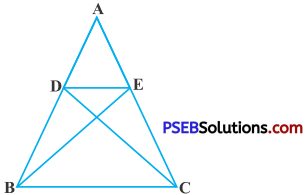
Can you now answer the question that you have left in the ‘Introduction’ of this chapter, whether the field of Budhia has been actually divided into three parts of equal area?
[Remark : Note that by taking BD = DE = EC, the triangle ABC is divided into three triangles ABD, ADE and AEC of equal areas. In the same way, by dividing BC into n equal parts and joining the points of division so obtained to the opposite vertex of BC, you can divide AABC into n triangles of equal areas.]
PSEB 9th Class Maths Solutions Chapter 9 Areas of Parallelograms and Triangles Ex 9.4 2
Answer:
Here, in ∆ ABE, D is a point on BE such that BD = DE.
So, in ∆ ABE, D is the midpoint of BE and AD is a median.
∴ ar (ABD) = ar (ADE) ……………… (1)
Similarly, in A ADC, E is the midpoint of DC and AE is a median.
∴ ar (ADE) = ar (AEC) ……………. (2)
From (1) and (2),
ar (ABD) = ar (ADE) = ar (AEC)
Thus, in ∆ ABC, by joining the points of trisection of BC, i.e., D and E to vertex A, the triangle is divided into ∆ ABD, ∆ ADE and ∆ AEC which have the same area.

Now, the answer to the question which was left unanswered in the ‘Introduction’ is ‘Yes’. The manner in which Budhia divided her field, the area of all the three parts are equal.

PSEB 9th Class Maths Solutions Chapter 9 Areas of Parallelograms and Triangles Ex 9.4

Question 3.
In the given figure, ABCD, DCFE and ABFE are parallelograms. Show that ar (ADE) = ar (BCF).
PSEB 9th Class Maths Solutions Chapter 9 Areas of Parallelograms and Triangles Ex 9.4 3
Answer:
Opposite sides of a parallelogram are equal.
∴ In parallelogram ABCD, AD = BC, in parallelogram DCFE, DE = CF and in parallelogram ABFE, AE = BF.
Now, in ∆ ADE and ∆ BCE
AD = BC, DE = CF and AE = BE
∴ By SSS rule, ∆ ADE = ∆ BCF
∴ ar (ADE) = ar (BCF)

Question 4.
In the given figure, ABCD is a parallelogram and BC is produced to a point Q such that AD = CQ. If AQ intersect DC at E show that ar (BPC) = ar (DPQ).
[Hint: Join AC.]
PSEB 9th Class Maths Solutions Chapter 9 Areas of Parallelograms and Triangles Ex 9.4 4
Answer:
Join AC.
In parallelogram ABCD, BC || AD and BC = AD.
BC is produced to point Q such that AD = CQ.
Thus, AD = CQ and AD || CQ.
∴ Quadrilateral ACQD is a parallelogram.
Diagonals of a parallelogram divide it into four triangles of equal areas.
∴ ar (DPQ) = ar (DPA) = ar (APC) = ar (CPQ)
∴ ar (DPQ) = ar (APC) ……………. (1)
Now, ∆ APC and ∆ BPC are on the same base PC and between the same parallels PC and AB.
∴ ar (APC) = ar (BPC) ………….. (2)
From (1) and (2),
ar (BPC) = ar (DPQ)

PSEB 9th Class Maths Solutions Chapter 9 Areas of Parallelograms and Triangles Ex 9.4

Question 5.
In the given figure, ABC and BDE are two equilateral triangles such that D is the midpoint of BC. If AE intersects BC at F, show that
(i) ar (BDE) = \(\frac{1}{4}\)ar (ABC)
(ii) ar (BDE) = \(\frac{1}{2}\)ar (BAE)
(iii) ar (ABC) = 2ar (BEC)
(iv) ar (BFE) = ar (AFD)
(v ) ar (BFE) = 2ar (FED)
(vi) ar (FED) = \(\frac{1}{8}\)ar (AFC)
[Hint: Join EC and AD. Show that BE || AC and DE || AB, etc.]
PSEB 9th Class Maths Solutions Chapter 9 Areas of Parallelograms and Triangles Ex 9.4 5
Answer:
Join EC and AD.
In equilateral ∆ ABC, ∠ ACB = 60°
In equilateral ∆ BDE, ∠ DBE = 60°
∴ ∠ CBE = 60°
Thus, ∠ ACB = ∠ CBE
But, ∠ ACB and ∠ CBE are alternate angles formed by transversal BC of AC and BE and they are equal.
∴BE || AC .
Similarly, ∠ ABD = ∠ BDE = 60°
∴ DE || AB
Now, in ∆ ABC, D is the midpoint of BC.
Hence, AD is a median of ∆ ABC.
∴ ar (ADB) = ar (ADC) = \(\frac{1}{2}\)ar (ABC)
∆ ABC and AAEC are on the same base AC and between the same parallels AC and BE.
∴ ar (ABC) = ar (AEC)
∴ ar (ABC) = ar (ADC) + ar (EDC) + ar (AED) …………….. (1)
In ∆ EBC, ED is a median.
∴ ar (EDC) = ar (BDE) = \(\frac{1}{2}\)ar (EBC) ………………… (2)
∆ AED and ∆ BDE are on the same base DE and between the same parallels AB and DE.
∴ ar (AED) = ar (BDE) …………… (3)
From (1), (2) and (3),
ar (ABC) = \(\frac{1}{2}\)ar (ABC) + ar (BDE) + ar (BDE)
∴ ar (ABC) – \(\frac{1}{2}\) ar (ABC) = 2ar (BDE)
∴\(\frac{1}{2}\)ar (ABC) = 2ar (BDE)
∴ ar (BDE) = \(\frac{1}{4}\)ar (ABC) ….. Result (i)
∆ BAE and ∆ BCE are on the same base BE and between the same parallels BE and AC.
∴ ar (BAE) = ar (BCE) ……………. (4)
In ∆ BEC, ED is a median.
∴ ar (BDE) = \(\frac{1}{2}\)ar (BCE)
∴ ar (BDE) = \(\frac{1}{2}\)ar (BAE) [by (4)] ……. Result (ii)
The diagonals of trapezium ABED intersect at F.
∴ ar (AFD) = ar (BFE) ……………… (5)
The diagonals of trapezium ABEC intersect at F.
∴ ar (ABF) = ar (EFC) ………………….. (6)
In ∆ ABC, AD is a median. s
∴ ar (ABC) = 2ar (ADB) S
∴ ar (ABC) = 2[ar (ABF) + ar (AFD)l
∴ ar (ABC) = 2[ar (EFC) + ar (BFE)] [by (5) and (6)]
∴ ar (ABC) = 2ar (BEC) … Result (iii)
In trapezium ABED, AB || ED and diagonals intersect at F.
∴ ar (BFE) = ar (AFD) …….. Result (iv)
By result (i),
ar (BDE) = \(\frac{1}{4}\)ar (ABC)
∴ ar (BDE) = \(\frac{1}{4}\) 2ar (ABD)
∴ ar (BDE) = \(\frac{1}{2}\)ar (ABD)
∆ BDE and ∆ ABD have the common base s BD.
∴ Altitude on BD in ∆ BDE = \(\frac{1}{2}\) × altitude on BD in ∆ ABD.
Now, the altitude on base BD in ∆ BDE is the same as the altitude on base BF in ∆ BEF and the altitude on base BD in ∆ ABD is the same as the altitude on base FD in ∆ AFD.
∴ Altitude on base BF in ∆ BEF
= \(\frac{1}{2}\) × altitude on base FD in ∆ AFD.
But, ar (BFE) = ar (AFD) …Result (iv)]
∴ BF = 2 × FD
Now, in ∆ BFE and ∆ FED, the altitudes corresponding to base BF and FD respectively are the same.
∴ ar (BFE) = 2ar (FED) … Result (v)
Suppose, in ∆ ABD, the altitude on base BD = h.
∴ In ∆ AFC, the altitude on base FC = h.
Also, in ∆ BDE, the altitude on base BD = \(\frac{h}{2}\)
∴ In A FED, the altitude on base FD = \(\frac{h}{2}\).
Now, ar (FED) = \(\frac{1}{2}\) × FD × \(\frac{h}{2}\) = \(\frac{h \times \mathrm{FD}}{4}\).
∴ FD = \(\frac{4 {ar}(\mathrm{FED})}{h}\) ………….. (7)
and ar (AFC) = \(\frac{1}{2}\) × FC × h = \(\frac{h}{2}\) × FC
= \(\frac{h}{2}\) (CD + FD)
= \(\frac{h}{2}\) (BD + FD) [∵ BD = CD]
= \(\frac{h}{2}\) (BF + FD + FD)
= \(\frac{h}{2}\) (2FD + FD + FD) [∵ BF = 2FD]
= \(\frac{h}{2}\) × 4FD
∴ ar (AFC) = 2 × h × FD
= 2 × h × \(\frac{4 {ar}(\mathrm{FED})}{h}\) [by (7)]
∴ ar (AFC) = 8 ar (FED)
∴ ar (FED) = \(\frac{1}{8}\) ar (AFC) … Result (vi)

PSEB 9th Class Maths Solutions Chapter 9 Areas of Parallelograms and Triangles Ex 9.4

Question 6.
Diagonals AC and BD of a quadrilateral ABCD intersect each other at E Show that
ar (APB) × ar (CPD) = ar (APD) × ar (BPC).
[(Hint: From A and C, draw perpendiculars to BD.]
Answer:
PSEB 9th Class Maths Solutions Chapter 9 Areas of Parallelograms and Triangles Ex 9.4 6
Draw AM ⊥ BD and CN ⊥ BD, where M and N are points on BD.
∴ ar (APB) × ar (CPD)
= (\(\frac{1}{2}\) × PB × AM) × (\(\frac{1}{2}\) × PD × CN)
= (\(\frac{1}{2}\) × PB × CN) × (\(\frac{1}{2}\) × PD × AM)
Thus, ar (APB) × ar (CPD) = ar (APD) × ar (BPC)

Question 7.
P and Q are respectively the midpoints of sides AB and BC of a triangle ABC and R is the midpoint of AR show that
(i) ar (PRQ) = \(\frac{1}{2}\) ar (ARC)
(ii) ar (RQC) = \(\frac{3}{8}\) ar (ABC)
(iii) ar (PBQ) = ar (ARC)
Answer:
PSEB 9th Class Maths Solutions Chapter 9 Areas of Parallelograms and Triangles Ex 9.4 7
In ∆ ABC, AQ and CP are medians. In ∆ APC, CR is a median, In ∆ APQ, QR is a median. In ∆ PBC, PQ is a median, In ∆ RBC, RQ is a median.

(i) ar (PRQ) = ar(ARQ) }
= \(\frac{1}{2}\)ar (APQ)
= \(\frac{1}{2}\)ar (BPQ)
= \(\frac{1}{2}\)ar(PQC)
= \(\frac{1}{2}\) ∙ \(\frac{1}{2}\)ar (PBC)
= \(\frac{1}{4}\)ar (PBC)
= \(\frac{1}{4}\) ∙ \(\frac{1}{2}\)ar (ABC)
= \(\frac{1}{8}\)ar (ABC)
\(\frac{1}{2}\)ar (ARC) = \(\frac{1}{2}\) ∙ \(\frac{1}{2}\)ar(APC)
= \(\frac{1}{4}\)ar (APC)
= \(\frac{1}{4}\) ∙ \(\frac{1}{2}\)ar (ABC)
= \(\frac{1}{8}\)ar (ABC)
∴ar (PRQ) = \(\frac{1}{2}\)ar (ARC)

PSEB 9th Class Maths Solutions Chapter 9 Areas of Parallelograms and Triangles Ex 9.4

(ii) ar(RQC) = ar(RBQ)
= ar (PBQ) + ar (PRQ)
= \(\frac{1}{2}\)ar (PBC) + \(\frac{1}{8}\)ar (ABC)
= \(\frac{1}{2}\) ∙ \(\frac{1}{2}\)ar (ABC) + \(\frac{1}{8}\)ar (ABC)
= \(\frac{1}{4}\)ar (ABC) + \(\frac{1}{8}\)ar (ABC)
= \(\frac{3}{8}\)ar (ABC)

(iii) ar (PBQ) = \(\frac{1}{2}\)ar (PBC) = \(\frac{1}{2}\) ∙ \(\frac{1}{2}\)ar (ABC)
= \(\frac{1}{4}\)ar (ABC)
ar (ARC) = \(\frac{1}{2}\)ar (APC) = \(\frac{1}{2}\) ∙ \(\frac{1}{2}\)ar (ABC)
= \(\frac{1}{4}\)ar (ABC)
∴ ar (PBQ) = ar (ARC)

Question 8.
In the given figure, ABC is a right triangle right angled at A. BCED, ACFG and ABMN „ are squares on the sides BC, CA and AB respectively. Line segment AX ⊥ DE meets BC at Y. Show that:
(i) ∆ MBC S ∆ ABD
(ii) ar (BYXD) = 2ar (MBC)
(iii) ar (BYXD) = ar (ABMN)
(iv) ∆ FCB ≅ ∆ ACE
( v ) ar (CYXE) = 2ar (FCB)
(vi) ar (CYXE) = ar (ACFG)
(vii) ar (BCED) = ar (ABMN) + ar (ACFG)
Note: Result (vii) is the famous Theorem of Pythagoras. You shall learn a simpler j! proof of this theorem in Class X.
PSEB 9th Class Maths Solutions Chapter 9 Areas of Parallelograms and Triangles Ex 9.4 8
Answer:
(i) ∠ ABM = ∠ CBD = 90°
∴ ∠ABM + ∠ABC = ∠CBD + ∠ABC
∴ ∠ MBC = ∠ ABD
In ∆ MBC and ∆ ABD,
MB = AB, ∠ MBC = ∠ ABD and BC = BD
∴ By SAS rule, ∆ MBC ≅ ∆ ABD

PSEB 9th Class Maths Solutions Chapter 9 Areas of Parallelograms and Triangles Ex 9.4

(ii) ar (BYXD) = 2ar (ABD)
∴ ar (BYXD) = 2ar (MBC) [∆ MBC ≅ ∆ ABD]

(iii) ar (BYXD) = 2ar (ABD)
ar (ABMN) = 2ar (MBC)
But, ar (MBC) = ar (ABD)
∴ ar (BYXD) = ar (ABMN)

(iv) ∠ FCA = ∠ ECB = 90°
∴ ∠FCA + ∠ACB = ∠ECB + ∠ACB
∴ ∠FCB = ∠ACE
In ∆ FCB and ∆ ACE,
FC = AC, ∠ FCB = ∠ACE and CB = CE
∴By SAS rule, ∆ FCB ≅ ∆ ACE

(v) ar (CYXE) = 2ar (ACE)
∴ar (CYXE) = 2ar (FCB) [∵ ∆ FCB ≅ ∆ ACE]

(vi) ar (CYXE) = 2ar (FCB)
and ar (ACFG) = 2ar (FCB)
∴ ar (CYXE) = ar (ACFG)

PSEB 9th Class Maths Solutions Chapter 9 Areas of Parallelograms and Triangles Ex 9.4

(vii) ar (BCED) = ar (CYXE) + ar (BYXD)
∴ ar (BCED) = ar (ACFG) + ar (ABMN) [By result (iii) and (vi)]
∴ ar (BCED) = ar (ABMN) + ar (ACFG)

PSEB 7th Class Maths Solutions Chapter 12 Algebraic Expressions Ex 12.1

Punjab State Board PSEB 7th Class Maths Book Solutions Chapter 12 Algebraic Expressions Ex 12.1 Textbook Exercise Questions and Answers.

PSEB Solutions for Class 7 Maths Chapter 12 Algebraic Expressions Ex 12.1

1. Generate algebraic expressions for the following :

(i) The sum of a and b.
(ii) The number z multiplied by itself.
(iii) The product of x and y added to the product of m and n.
(iv) The quotient of p by 5 is multiplied by q.
(v) One half of z added to twice the number t.
(vi) Sum of squares of the number x and z.
(vii) Sum of the numbers x and z is subtracted from their product.
Solution:
(i) a + b
(ii) z2
(iii) xy + mn
(iv) \(\frac{p}{5} q\)
(v) \(2 t+\frac{z}{2}\)
(vi) x2 + z2
(vii) xy – (x + y)

2. Separate constant terms and variable terms from the following :
7, xy, \(\frac{3 x^{2}}{2}, \frac{72}{3} z, \frac{-8 z}{3 x^{2}}\)
Solution:
Constant Terms 7, \(\frac {72}{3}\)
Variable Terms xy, \(\frac{3 x^{2}}{2}, \frac{72}{3} z, \frac{-8 z}{3 x^{2}}\)

PSEB 7th Class Maths Solutions Chapter 12 Algebraic Expressions Ex 12.1

3. Write the terms and factors for each of the following algebraic expression.
(a) 2x2 + 3yz
(b) 15x2y + 3xy2
(c) -7xyz2
(d) 100pq + 10p2q2
(e) xy + 3x2y2
(f) -7x2yz + 3xy2z + 2xyz2
Solution:

Expression Terms Factors
(a) 2x2 + 3xy 2x2

3xy

2, x, x

3, x, y

(b) 15x2y + 3xy2 15x2y

3xy2

15, x, x, y

3, x, y, y

(c) -7xyz2 -7xyz2 -7, x, y, z, z
(d) 100pq + 10p2q2 100pq

10p2q2

100, p, q

10, p, p, q, q

(e) xy + 3x2y2 Xy

3x2y2

X, y

3, x, x, y, y

(f) -7x2yz + 3xy2z + 2 xyz2 -7x2yz

3xy2z

2xyz2

-7, x, x, y, z

3, x, y, y, z

2, x, y, z, z

4. Classify the following algebraic expression into monomial, binomial and trinomial.
(a) 7x + 3y
(b) 5 + 2x2y2z
(c) ax + by2 + cz2
(d) 3x2y2
(e) 1 + x
(f) 10
(g) \(\frac {3}{2}\)p + \(\frac {7}{6}\)q
Solution:
(a) Binomial
(b) Binomial
(c) Trinomial
(d) Monomial
(e) Binomial
(f) Monomial
(g) Binomial.

PSEB 7th Class Maths Solutions Chapter 12 Algebraic Expressions Ex 12.1

5. Write numerical coefficient of each of the following algebraic expression.
(a) 2x
(b) \(\frac {-3}{2}\)xyz
(c) \(\frac {7}{2}\)x2p
(d) -p2q2
(e) -5mn2
Solution:
(a) 2
(b) \(\frac {-3}{2}\)
(c) \(\frac {7}{2}\)
(d) -1
(e) -5

6. State whether the given pairs of terms is of like or unlike terms.
(a) – 3y, \(\frac {7}{8}\)y
(b) – 32, – 32x
(c) 3x2y, 3xy2
(d) 14mn2, 14mn2q
(e) 8pq, 32pq2
(f) 10, 15
Solution:
(a) Like
(b) Unlike
(c) unlike
(d) unlike
(e) unlike
(f) like

7. In the following algebraic expressions write the coefficient of :
(a) x in x2y
(b) xyz in 15x2yz
(c) 3pq2 in 3p2q2r2
(d) m2 in m2 + n2
(e) xy in x2y2 + 2x + 3
Solution:
(a) xy
(b) 15x
(c) pr2
(d) 1
(e) xy

PSEB 7th Class Maths Solutions Chapter 12 Algebraic Expressions Ex 12.1

8. Identify the terms and their factors in the following algebraic expressions by tree diagrams
(a) 12xy + 7x2
(b) p2q2 + 3mn2 – pqr
(c) 2x2y2 + xyz2 + zy
(d) \(\frac {3}{2}\)x3 + 2x2y2 – 7y3
Solution:
(a)
PSEB 7th Class Maths Solutions Chapter 12 Algebraic Expressions Ex 12.1 1
(b)
PSEB 7th Class Maths Solutions Chapter 12 Algebraic Expressions Ex 12.1 2
(c)
PSEB 7th Class Maths Solutions Chapter 12 Algebraic Expressions Ex 12.1 3
(d)
PSEB 7th Class Maths Solutions Chapter 12 Algebraic Expressions Ex 12.1 4

9. Multiple Choice Questions :

Question (i).
An expression with only one term is called a
(a) Monomial
(b) Binomial
(c) Trinomial
(d) None of these
Answer:
(a) Monomial

Question (ii).
The coefficient of x in 8 – x + y is
(a) -1
(b) 1
(c) 8
(d) 0
Answer:
(a) -1

PSEB 7th Class Maths Solutions Chapter 12 Algebraic Expressions Ex 12.1

Question (iii).
Which of the following are like terms ?
(a) 7x, 12y
(b) 15x, 12x
(c) 3xy, 3x
(d) 2y, -2yx
Answer:
(c) 3xy, 3x

Question (iv).
Terms are added to form
(a) Expressions
(b) Variables
(c) Constants
(d) Factors
Answer:
(a) Expressions

PSEB 7th Class Maths Solutions Chapter 11 Perimeter and Area Ex 11.3

Punjab State Board PSEB 7th Class Maths Book Solutions Chapter 11 Perimeter and Area Ex 11.3 Textbook Exercise Questions and Answers.

PSEB Solutions for Class 7 Maths Chapter 11 Perimeter and Area Ex 11.3

1. Find the circumference of circle whose
(i) Radius (r) = 21 cm
(ii) Radius (r) = 3.5 cm
(iii) Diameter = 84 cm
Solution:
(i) Given radius (r) = 21 cm
circumference of circle = 2πr
= 2 × \(\frac {22}{7}\) ×21
= 132 cm

(ii) Given radius (r) = 3.5 cm
Circumference = 2πl
= 2 × \(\frac {22}{7}\) × 3.5
= 22 cm

(iii) Given Diameter (d) = 84 cm
radius (r) = \(\frac{d}{2}=\frac{84}{2}\)
= 42 cm
Circumference = 2πr
= 2 × \(\frac {22}{7}\) × 42
= 264 cm

2. If the circumference of a circular sheet is 176 m, find its radius.
Solution:
Given circumference of circular sheet = 176 m
Let radius = r
So 2πr = 176
r = \(\frac{176}{2 \pi}\)
\(\frac{176}{2 \times \frac{22}{7}}\)
= 28 m

PSEB 7th Class Maths Solutions Chapter 11 Perimeter and Area Ex 11.3

3. A circular disc of diameter 8.4 cm is divided into two parts what is the perimeter of each semicircular part ?
Solution:
Given diameter of a circular disc = 8.4 cm
radius (r) = \(\frac{8.4}{2}\) = 4.2 cm
Perimeter of semicircular part = πr + 2r
= \(\frac {22}{7}\) × 4.2 + 2 × 4.2
= 22 × 0.6 + 8.4
= 21.6 cm

4. Find the area of the circle having
(i) Radius r = 49 cm
(ii) Radius r = 2.8 cm
(iii) Diameter = 4.2 cm
Solution:
(i) Given radius (r) = 49 cm
Area of circle = πr2
= \(\frac {22}{7}\) × 49 × 49
= 7546 cm2

(ii) Given radius (r) = 2.8 cm
Area of circle = πr2
= \(\frac {22}{7}\) × 2.8 × 2.8
= 24.64 cm2

(iii) Given diameter (d) = 4.2 cm
radius (r) = \(\frac{d}{2}=\frac{4.2}{2}\)
Area of circle = πr2
= \(\frac {22}{7}\) × 2.1 × 2.1
= 13.86 cm2

5. A gardener wants to fence a circular garden of radius 15 m. Find the length of wire, if he makes three rounds offense. Also, find the cost of wire if it costs ₹ 5 per meter (Take π = 3.14).
Solution:
Given radius of circular garden (r) = 15 m
Circumference of the circular garden = 2πr
= 2 × 3.14 × 15
= 94.2 m
So, length of the wire to make three rounds offense
= 3 × 94.2
= 282.6 cm
Cost of wire= ₹ 5 × 282.6
= ₹ 1413

PSEB 7th Class Maths Solutions Chapter 11 Perimeter and Area Ex 11.3

6. Which of the following has larger area and by how much ?
(a) Rectangle with length 15 cm and breadth 5.4 cm
(b) Circle of diameter 5.6 cm.
Solution:
(a) Given length of rectangle = 15 cm
breadth = 5.4 cm
Area of rectangle = length × breadth
= 15 × 5.4
= 81 cm2

(b) Given diameter of circle (d) = 5.6 cm
radius (r) = \(\frac{d}{2}=\frac{5.6}{2}\)
= 2.8 cm
Area of the circle = πr2
= \(\frac {22}{7}\) × (2.8)2
= 24.64 cm2
Hence, Rectangle has more area = 81 – 24.64
= 56.36 cm2

7. From a rectangular sheet of length 15 cm and breadth 12 cm a circle of radius 3.5 cm is removed. Find the area of remaining sheet.
Solution:
Given length of rectangular sheet = 15 cm
Breadth of rectangle sheet = 12 cm
Area of rectangular sheet = length × breadth
= 15 × 12
= 180 cm2
Given radius of circle (r) = 3.5 cm
Area of circle = πr2
= \(\frac {22}{7}\) × (3.5)2
= 38.5 cm2
Since circle is removed from rectangular sheet.
So, area of remaining sheet = Area of rectangular Sheet – Area of circle
= 180 – 38.5
= 141.5 cm2

8. From a circular sheet of radius 7 cm, a circle of radius 2.1 cm is removed, find the area of remaining sheet.
Solution:
Radius of the circular sheet = 7 cm
Area of the circular sheet = 1 cm
= πr2 = \(\frac {22}{7}\) × 7 × 7 cm2
=154 cm2
Radius of the circle = 2.1 cm
Area of the circle
\(\frac {22}{7}\) × 2.1 × 1.1 = \(\frac{22}{7} \times \frac{21}{10} \times \frac{21}{10}\)
= \(\frac {1386}{100}\)
= 13.86 cm2
Area of the remaining sheet = 154 cm2 – 13.86 cm2
= 140.14 cm2

PSEB 7th Class Maths Solutions Chapter 11 Perimeter and Area Ex 11.3

9. Smeep took a wire of length 88 cm and bent it into the shape of a circle, find the radius and area of the circle. If the same wire is bent into a square, what will be the side of the square ? Which figure encloses more area ?
Solution:
Given length of wire = 88 cm
The wire is bent into the shape of circle.
Circumference of circle = length of the
2πr = 88
r = \(\frac{88}{2 \pi}=\frac{44}{\pi} \mathrm{cm}\)
= 14 cm
Area of the circle = πr2
= π × (14)2
= \(\frac {22}{7}\) × 14 × 14
= 616 cm2
If the same wire is bent into the square
Let side of the square = a
Perimeter of square = length of the wire
4 × a = 88
a = \(\frac {88}{4}\)
= 22 cm
Area of the square = (side)2
= (22)2
= 484 cm2
Hence circle enclosed more area.

10. A garden is 120 m long and 85 m broad. Inside the garden, there is a circular pit of diameter 14 m. Find the cost of planting the remaining part of the garden at the rate of ₹ 5.50 per square meter.
Solution:
Given length of garden = 120 m
Breadth of garden = 85 m
Area of garden = length × breadth
= 120 × 85
= 10200 m2
Given diameter of circular pit (d) = 14 m
radius (r) = \(\frac{d}{2}=\frac{14}{2}\)
= 7 m
Area of circular pit = πr2
= \(\frac {22}{7}\) × 7 × 7
= 154 m2
Remaining part of garden = Area of garden for planting – Area of circular pit
= 10200 – 154
= 10046 m2
Cost of planting the remaining part of the garden
= ₹ 5.50 × 10046
= ₹ 55243

PSEB 7th Class Maths Solutions Chapter 11 Perimeter and Area Ex 11.3

11. In the figure PQ = QR and PR = 56 cm. The radius of inscribed circle is 7 cm. Q is centre of semicircle. What is the area of shaded region ?
PSEB 7th Class Maths Solutions Chapter 11 Perimeter and Area Ex 11.3 1
Solution:
Given PQ = QR
PR = 56 cm
Radius of inscribed circle = 7 cm
So PR = PQ + QR
= PQ + PQ = 2PQ
Hence, PQ = \(\frac{\mathrm{PR}}{2}=\frac{56}{2}\)
= 28 cm
So QR = PQ = 28 cm
Area of shaded region = Area of semicircle of diameter PR – Area of semicircle of diameter PQ – Area of semicircle of diameter QR – Area of inscribe circle
PSEB 7th Class Maths Solutions Chapter 11 Perimeter and Area Ex 11.3 2

12. The minute hand of a circular clock is 18 cm long. How far does the tip of minute hand move in one hour ?
Solution:
Given minute hand of a circular clock = 18 cm
Distance covered by minute hand in 1 hour = 2πr
= 2 × 3.14 × 18
= 2 × \(\frac {314}{100}\) × 18
= \(\frac {11304}{100}\)
= 113.04 cm.

13. Multiple choice questions :

Question (i).
The circumference of a circle of diameter 10 cm is :
(a) 31.4 cm
(b) 3.14 cm
(c) 314 cm
(d) 35.4 cm
Answer:
(a) 31.4 cm

Question (ii).
The circumference of a circle with radius 14 cm is :
(a) 88 cm
(b) 44 cm
(c) 22 cm
(d) 85 cm
Answer:
(a) 88 cm

PSEB 7th Class Maths Solutions Chapter 11 Perimeter and Area Ex 11.3

Question (iii).
What is the area of the circle of radius 7 cm ?
(a) 49 cm
(b) 22 cm2
(c) 154 cm2
(d) 308 cm2
Answer:
(c) 154 cm2

Question (iv).
Find the diameter of a circle whose area is 154 cm2 ?
(a) 4 cm
(b) 6 cm
(c) 14 cm
(d) 12 cm
Answer:
(c) 14 cm

Question (v).
A circle has area 100 times the area of another circle. What is the ratio of their circumferences ?
(a) 10 : 1
(b) 1 : 10
(c) 1 : 1
(d) 2 : 1
Answer:
(a) 10 : 1

Question (vi).
Diameter of a circular garden is 9.8 cm. Which of the following is its area ?
(a) 75.46 cm2
(b) 76.46 cm2
(c) 74.4 cm2
(d) 76.4 cm2
Answer:
(a) 75.46 cm2

PSEB 6th Class Maths Solutions Chapter 9 Understanding Elementary Shapes Ex 9.5

Punjab State Board PSEB 6th Class Maths Book Solutions Chapter 9 Understanding Elementary Shapes Ex 9.5 Textbook Exercise Questions and Answers.

PSEB Solutions for Class 6 Maths Chapter 9 Understanding Elementary Shapes Ex 9.5

1. Which of the following are polygons and there is no polygon. Give the reason:
PSEB 6th Class Maths Solutions Chapter 9 Understanding Elementary Shapes Ex 9.5 1
Solution:
(i) It is not a closed figure. Therefore it is not a polygon.
(ii) It is made up of lines segment. Therefore it is polygon.
(iii) It is not a polygon, because it is not made of line segments.
(iv) It is not closed by line segment. Therefore, it is not a polygon.
(v) It is not polygon because line segments are intersecting each other.
(vi) It is made up of line segments, therefore it is a polygon.

PSEB 6th Class Maths Solutions Chapter 9 Understanding Elementary Shapes Ex 9.5

2. Classify the following as concave or convex polygons:
PSEB 6th Class Maths Solutions Chapter 9 Understanding Elementary Shapes Ex 9.5 2
Solution:
(i) Concave Polygon
(ii) Convex Polygon
(iii) Concave Polygon
(iv) Concave Polygon
(v) Convex Polygon
(vi) Convex Polygon.

3. Tick in the boxes, if the property holds true for a particular quadrilateral otherwise eroes out ‘x’:

Quadrilateral Properties Rectangle Parallelogram Rhombus Trapezium Square
All sides are equal
Only opposite sides are equal
Diagonals are equal
Diagonals bisect each other
Diagonals are perpendicular to each other
Each angle is 90°

Solution:

Quadrilateral Properties Rectangle Parallelogram Rhombus Trapezium Square
All sides are equal × × ×
Only opposite sides are equal × × ×
Diagonals are equal × × ×
Diagonals bisect each other ×
Diagonals are perpendicular to each other × × ×
Each angle is 90° × X ×

PSEB 6th Class Maths Solutions Chapter 9 Understanding Elementary Shapes Ex 9.5

4. Fill in the blanks:

Question (i)
…………… is a quadrilateral with only one pair of opposite sides parallel.
Solution:
Trapezium

Question (ii)
…………….. is a quadrilateral with all sides equal and diagonals of equal length.
Solution:
Square

Question (iii)
A polygon with atleast one angle is reflex is called ……………….. .
Solution:
Concave polygon

Question (iv)
………….. is a regular quadrilateral.
Solution:
Square

Question (v)
…………… is a quadrilateral with opposite sides equal and diagonals of unequal length.
Solution:
Parallelogram.

PSEB 6th Class Maths Solutions Chapter 9 Understanding Elementary Shapes Ex 9.5

5. State True or False:

Question (i)
A rectangle is always a rhombus.
Solution:
False

Question (ii)
The diagonals of a rectangle are perpendicular to each other.
Solution:
False

Question (iii)
A square is a parallelogram.
Solution:
True

Question (iv)
A trapezium is a parallelogram.
Solution:
False

PSEB 6th Class Maths Solutions Chapter 9 Understanding Elementary Shapes Ex 9.5

Question (v)
Opposite sides of a parallelogram are parallel.
Solution:
True.

PSEB 7th Class Maths Solutions Chapter 15 Visualising Solid Shapes Ex 15.1

Punjab State Board PSEB 7th Class Maths Book Solutions Chapter 15 Visualising Solid Shapes Ex 15.1 Textbook Exercise Questions and Answers.

PSEB Solutions for Class 7 Maths Chapter 15 Visualising Solid Shapes Ex 15.1

1. Match the two dimensional figure with the names.
PSEB 7th Class Maths Solutions Chapter 15 Visualising Solid Shapes Ex 15.1 1
Answer:
(i) (e)
(ii) (d)
(iii) (a)
(iv) (b)
(v) (c)

PSEB 7th Class Maths Solutions Chapter 15 Visualising Solid Shapes Ex 15.1

2. Match the three dimension shapes with the names.
PSEB 7th Class Maths Solutions Chapter 15 Visualising Solid Shapes Ex 15.1 2
Answer:
(i) (d)
(ii) (e)
(iii) (a)
(iv) (c)
(v) (b)

3. Identify the nets which can be used to make cubes (cut out copies of the nets and try it).
PSEB 7th Class Maths Solutions Chapter 15 Visualising Solid Shapes Ex 15.1 3
PSEB 7th Class Maths Solutions Chapter 15 Visualising Solid Shapes Ex 15.1 4
Answer:
(i), (iv)

PSEB 7th Class Maths Solutions Chapter 15 Visualising Solid Shapes Ex 15.1

4. Draw the net for a square pyramid with base as square of sides 5 cm and slant edges 7 cm.
Answer:
PSEB 7th Class Maths Solutions Chapter 15 Visualising Solid Shapes Ex 15.1 5

5. Draw a net for the following cylinder.
PSEB 7th Class Maths Solutions Chapter 15 Visualising Solid Shapes Ex 15.1 6
Answer:
PSEB 7th Class Maths Solutions Chapter 15 Visualising Solid Shapes Ex 15.1 7

6. Draw the net of the solid given in figure.
PSEB 7th Class Maths Solutions Chapter 15 Visualising Solid Shapes Ex 15.1 8
Answer:
PSEB 7th Class Maths Solutions Chapter 15 Visualising Solid Shapes Ex 15.1 9

PSEB 7th Class Maths Solutions Chapter 15 Visualising Solid Shapes Ex 15.1

7. Dice are cubes with dots on each face opposite faces of a die always have a total of seven dots on them following are two nets to make dice (cuber) the number inserted in each square indicate the number of dots in that box insert suitable number in the blank squares.
PSEB 7th Class Maths Solutions Chapter 15 Visualising Solid Shapes Ex 15.1 10
PSEB 7th Class Maths Solutions Chapter 15 Visualising Solid Shapes Ex 15.1 11
Solution:
PSEB 7th Class Maths Solutions Chapter 15 Visualising Solid Shapes Ex 15.1 12
PSEB 7th Class Maths Solutions Chapter 15 Visualising Solid Shapes Ex 15.1 13

8. Which solid will be obtained by folding the following net ?
PSEB 7th Class Maths Solutions Chapter 15 Visualising Solid Shapes Ex 15.1 14
Solution:
PSEB 7th Class Maths Solutions Chapter 15 Visualising Solid Shapes Ex 15.1 15

PSEB 7th Class Maths Solutions Chapter 15 Visualising Solid Shapes Ex 15.1

9. Complete the following table.
PSEB 7th Class Maths Solutions Chapter 15 Visualising Solid Shapes Ex 15.1 16
PSEB 7th Class Maths Solutions Chapter 15 Visualising Solid Shapes Ex 15.1 17
Solution:
(i) Faces : 6.
(ii) Edges : 2. vertices : NIL,
(iii) Faces : 7. Edges : 15.
(iv) faces : 5, vertices : 5.

10. Multiple Choice questions :

Question (i).
Out of following which is 3-D figure ?
(a) Square
(b) Triangle
(c) Sphere
(d) Circle
Answer:
(c) Sphere

Question (ii).
Total number of faces a cylinder has :
(a) 0
(b) 2
(c) 1
(d) 3
Answer:
(d) 3

PSEB 7th Class Maths Solutions Chapter 15 Visualising Solid Shapes Ex 15.1

Question (iii).
How many edges are there in a square pyramid ?
(a) 5
(b) 8
(c) 1
(d) 4
Answer:
(b) 8

Question (iv).
Sum of number on the opposite faces of a die is :
(a) 8
(b) 7
(c) 9
(d) 6
Answer:
(b) 7

Question (v).
Which is not a solid figure ?
(a) Cuboid
(b) Sphere
(c) Quadrilateral
(d) Pyramid
Answer:
(c) Quadrilateral

PSEB 6th Class Maths Solutions Chapter 9 Understanding Elementary Shapes Ex 9.4

Punjab State Board PSEB 6th Class Maths Book Solutions Chapter 9 Understanding Elementary Shapes Ex 9.4 Textbook Exercise Questions and Answers.

PSEB Solutions for Class 6 Maths Chapter 9 Understanding Elementary Shapes Ex 9.4

1. Classify each of the following triangles as scalene, isosceles or equilateral:
PSEB 6th Class Maths Solutions Chapter 9 Understanding Elementary Shapes Ex 9.4 1
Solution:
(i) Here, two sides of triangle are equal in length.
∴ It is an isosceles triangle.
(ii) Here, all the three sides of the triangle are equal in length.
∴ It is an equilateral triangle.
(iii) Here, no two sides are equal in length.
∴ It is scalene triangle.
(iv) Here, two sides of triangle are equal in length.
∴ It is an isosceles triangle.
(v) Here, no two sides are equal in length.
∴ It is scalene triangle.
(vi) Here, all the three sides of the triangle are equal in length.
∴ It is equilateral triangle.

PSEB 6th Class Maths Solutions Chapter 9 Understanding Elementary Shapes Ex 9.4

2. Classify each of the following triangles as acute, obtuse or right triangle:
PSEB 6th Class Maths Solutions Chapter 9 Understanding Elementary Shapes Ex 9.4 2
Solution:
(i) Here, one angle is 120°, which is obtuse angle.
∴ It is an obtuse-angled triangle.
(ii) Here, one angle is 90°, which is right angle.
∴ It is an right-angled triangle.
(iii) Here, each angle is acute angle.
∴ It is an acute-angled triangle.
(iv) Here, one angle is 90°, which is right angle.
∴ It is an right-angled triangle.
(v) Here, one angle is 120°, which is obtuse angle.
∴ It is an obtuse-angled triangle.
(vi) Here, each angle is 60°, which is actute angle.
∴ It is an actute angled triangle.

3. Which of the following triangles are possible with the given angles?

Question (i)
60°, 60°, 60°
Solution:
In a triangle sum of the three angles of a triangle is equal to 180°.
Here, sum of the three angles of triangle is:
60° + 60° + 60° = 180°
∴ This triangle is possible.

PSEB 6th Class Maths Solutions Chapter 9 Understanding Elementary Shapes Ex 9.4

Question (ii)
110°, 50°, 30°
Solution:
Here, sum of the three angles of triangle is:
110° + 50° + 30°= 190° ≠ 180°
∴ This triangle is not possible.

Question (iii)
65°, 55°, 60°
Solution:
Here, sum of the three angles of triangle is:
65°+ 55°+ 60°= 180°
∴ This triangle is possible.

Question (iv)
90°, 40°, 50°
Solution:
Here, sum of the three angles of triangle is:
90°+ 40°+ 50°= 180°
∴ This triangle is possible.

Question (v)
48°, 62°, 50°
Solution:
Here, sum of the three angles of triangle is:
48°+ 62°+ 50°= 160° ≠ 180°
∴ This triangle is not possible.

PSEB 6th Class Maths Solutions Chapter 9 Understanding Elementary Shapes Ex 9.4

Question (vi)
90°, 95°, 30°.
Solution:
Here, sum of the three angles of triangle is:
90°+ 95°+ 30° =215° ≠ 180°
∴ This triangle is not possible.

4. Classify each of the following triangles as scalene, isosceles or equilateral triangle:

Question (i)
4 cm, 5 cm, 6 cm
Solution:
The sides of triangle are 4 cm, 5 cm, 6 cm
No, two sides of this triangle are equal.
∴ This is a scalene triangle.

Question (ii)
5 cm, 7 cm, 5 cm
Solution:
The sides of triangle are 5 cm, 7 cm, 5 cm
Here, two sides are equal each of 5 cm in length.
∴ This is an isosceles triangle.

PSEB 6th Class Maths Solutions Chapter 9 Understanding Elementary Shapes Ex 9.4

Question (iii)
4.2 m, S3 m, 6.1 m
Solution:
The sides of triangle are 4.2 m, 5.3 m, 6.1 m
Here, all sides are of different length.
∴ This is a scalene triangle.

Question (iv)
3.5 cm, 3.5 cm, 33 cm
Solution:
The sides of triangle are 3.5 cm, 3.5 cm, 3.5 cm
All the sides of triangle are of equal length.
∴ This is an equilateal triangle.

Question (v)
8 cm, 4.2 cm, 4.2 cm
Solution:
The sides of triangle are 8 cm, 4.2 cm, 4.2 cm
Here, two sides of the triangle are of equal length.
∴ This is an isosceles triangle.

Question (vi)
2 cm, 3 cm, 4 cm.
Solution:
The sides of triangle are 2 cm, 3 cm, 4 cm
All the sides of the triangle are of different lengths
∴ This is a scalene triangle.

PSEB 6th Class Maths Solutions Chapter 9 Understanding Elementary Shapes Ex 9.4

5. Name the following triangles in both ways: (Based on sides and angles)
PSEB 6th Class Maths Solutions Chapter 9 Understanding Elementary Shapes Ex 9.4 3
Solution:
(i) Based on sides: In this triangle, no two sides of the triangle are equal.
∴ This is a scalene triangle.
Based on angles: All the three angles of the triangle are acute.
∴ This is an acute-angled triangle.

(ii) Based on sides: In this triangle, two sides are of equal length each is 4 cm.
∴ This is an isosceles triangle.
Based on angles: In this triangle, one angle is of 90° which is a right angle.
∴ This is a right-angled triangle.

(iii) Based on sides: In this triangle, two sides are of equal length.
∴ This is an isosceles triangle.
Based on angles: In this triangle one angle is of 110°, which is obtuse angle.
∴ This is an obtuse-angled triangle.

(iv) Based on sides: In this triangle, all the sides are of equal length i.e. each = 4 cm.
∴ This is an equilateral triangle.
Based on angles: In this triangle, all the angles are acute angles.
∴ This is an acute-angled triangle.

(v) Based on sides: In this triangle, all the three sides are of different lengths.
∴ This is a scalene triangle.
Based on angles: In this triangle, one angle is 105°, which is obtuse angle.
∴ This is an obtuse-angled triangle.

PSEB 6th Class Maths Solutions Chapter 9 Understanding Elementary Shapes Ex 9.4

6. Fill in the blanks:

Question (i)
A triangle has …………. sides.
Solution:
3

Question (ii)
A triangle has …………. vertices.
Solution:
3

Question (iii)
A triangle has …………. angles.
Solution:
3

Question (iv)
A triangle has …………. parts.
Solution:
6

Question (v)
A triangle whose all sides are different is known as ………………. .
Solution:
Scalene triangle

PSEB 6th Class Maths Solutions Chapter 9 Understanding Elementary Shapes Ex 9.4

Question (vi)
A triangle whose all angles are acute is known as ……………….. .
Solution:
Acute angled triangle

Question (vii)
A triangle whose two sides are equal is known as ……………….. .
Solution:
Isosceles triangle

Question (viii)
A triangle whose one angle is obtuse is known as ……………….. .
Solution:
obtuse-angled triangle

Question (ix)
A triangle whose all sides are equal is known as ……………….. .
Solution:
Equilateral triangle

Question (x)
A triangle whose one angle is right angle is known as ……………….. .
Solution:
Right-angled triangle

7. State True or False:

Question (i)
Each equilateral triangle is an isosceles triangle.
Solution:
True

PSEB 6th Class Maths Solutions Chapter 9 Understanding Elementary Shapes Ex 9.4

Question (ii)
Each acute-angled triangle is a scalene triangle.
Solution:
False

Question (iii)
Each isosceles triangle is an equilateral triangle.
Solution:
False

Question (iv)
There are two obtuse angles in an obtuse triangle.
Solution:
False

Question (v)
In right triangle, there is only one right angle.
Solution:
True

PSEB 6th Class Maths Solutions Chapter 9 Understanding Elementary Shapes Ex 9.4

Question (vi)
Right triangle can never be isosceles.
Solution:
False.

PSEB 10th Class Maths Solutions Chapter 7 Coordinate Geometry Ex 7.2

Punjab State Board PSEB 10th Class Maths Book Solutions Chapter 7 Coordinate Geometry Ex 7.2 Textbook Exercise Questions and Answers.

PSEB Solutions for Class 10 Maths Chapter 7 Coordinate Geometry Ex 7.2

Q.uestion 1.
Find the co-ordinates of the point which divides the join (- 1, 7) and (4, – 3) in the ratio 2 : 3.
Solution:
Let required point be P (x, y) which divides the join of given points A (- 1, 7)
and B (4, – 3) in the ratio of 2 : 3.
(-1, 7) (x, y) (4, – 3)

PSEB 10th Class Maths Solutions Chapter 7 Coordinate Geometry Ex 7.2 1

∴ x = \(\frac{2 \times 4+3 \times-1}{2+3}=\frac{8-3}{5}=\frac{5}{5}=1\)

and y = \(\frac{2 \times-3+3 \times 7}{2+3}=\frac{-6+21}{5}=\frac{15}{5}=3\)
Hence, required point be (1, 3).

PSEB Solutions PSEB 10th Class Maths Solutions Chapter Coordinate Geometry Ex 7.2

Question 2.
Find the co-ordinates of the points of trisection of the line segment joining (4, – 1) and (2, – 3).
Solution:
Let P (x1, y1) and Q (x2, y2) be the required points which trisect the line segment joining A (4, – 1)and B (- 2, – 3) i.e., P(x1, y1) divides AB in ratio 1: 2 and Q divides AB in ratio 2 : 1.

PSEB 10th Class Maths Solutions Chapter 7 Coordinate Geometry Ex 7.2 2

∴ x1 = \(\frac{1 \times-2+2 \times 4}{1+2}=\frac{-2+8}{3}=\frac{6}{3}=2\)

and y1 = \(\frac{1 \times-3+2 \times-1}{1+2}=\frac{-3-2}{3}=-\frac{5}{3}\)
∴ P(x1, y1) be (2, \(-\frac{5}{3}\))

PSEB 10th Class Maths Solutions Chapter 7 Coordinate Geometry Ex 7.2 3

Now, x2 = \(\frac{2 \times-2+1 \times 4}{2+1}\)
= \(\frac{-4+4}{3}\) = 0

y2 = \(\frac{2 \times-3+1 \times-1}{2+1}=\frac{-6-1}{3}=-\frac{7}{3}\)

∴ Q(x2, y2) be (0, \(-\frac{7}{3}\))
Hence, required points be (2, \(-\frac{5}{3}\)) and (0, \(-\frac{7}{3}\)).

PSEB Solutions PSEB 10th Class Maths Solutions Chapter Coordinate Geometry Ex 7.2

Question 3.
To conduct Sports Day activities, in your rectangular shaped school ground ABCD, lines have been drawn with chalk powder at a distance of 1 m each. 100 flower pots have been placed at a distance of 1m from each other along AD, as shown in fig. Niharika runs \(\frac{1}{4}\) th the distance AD on the 2nd line and posts a green flag.

Preet runs \(\frac{1}{5}\) th the distance AD on the eighth line and posts a red flag. What is the distance betweenboth the flags? If Rashmi has to post a blue flag exactly half way between the line (segment) joining the two flags, where should she post her flag?

PSEB 10th Class Maths Solutions Chapter 7 Coordinate Geometry Ex 7.2 4

Solution:
In the given figure, we take A as origin. Taking x-axis along AB and y-axis along AD.
Position of green flag = distance covered by Niharika
= Niharika runs \(\frac{1}{4}\)th distance AD on the 2nd line
= \(\frac{1}{4}\) × 100 = 25 m
∴ Co-ordinates of the green flag are (2, 25)
Now, position of red flag = distance covered by Preet = Preet runs \(\frac{1}{5}\)th the distance AD on the 8th line
= \(\frac{1}{5}\) × 100 = 20 m.
Co-ordinates of red flag are (8, 20)
∴ distance between Green and Red flags = \(\sqrt{(8-2)^{2}+(20-25)^{2}}\)
= \(\sqrt{36+25}=\sqrt{61}\) m.
Position of blue flag = mid point of green flag and red flag
= \(\left(\frac{2+8}{2}, \frac{25+20}{2}\right)\)
= (5, 22.5).
Hence, blue flag is in the 5th line and at a distance of 22.5 m along AD.

PSEB Solutions PSEB 10th Class Maths Solutions Chapter Coordinate Geometry Ex 7.2

Question 4.
Find the ratio in which (he segment joining the points (- 3, 10) and (6, – 8) is divided by (- 1, 6).
Solution:
Let point P (- 1, 6) divides the line segment joining the points A (- 3, 10) and B (6, – 8) the ratio K : 1.

PSEB 10th Class Maths Solutions Chapter 7 Coordinate Geometry Ex 7.2 5

∴ -1 = \(\frac{6 \times \mathrm{K}-3 \times 1}{\mathrm{~K}+1}\)
or – K – 1 = 6K – 3
or – K – 6K = – 3 + 1
or – 7K = – 2
K : 1 = \(\frac{2}{7}\) : 1 = 2 : 7
Hence, required ratio is 2 : 7.

Question 5.
Find the ratio in which the line segment joining A (1, – 5) and B (- 4, 5) is divided by the x-axis. Also find the co
ordinates of the point of division.
Solution:
Let required point on x-axis is P (x, 0) which divides the line segment joining the points A (1, – 5) and B (- 4, 5) in the
ratio K : 1.

PSEB 10th Class Maths Solutions Chapter 7 Coordinate Geometry Ex 7.2 6

Consider, y co-ordinates of P ¡s:
0 = \(\frac{5 \times \mathrm{K}+(-5) \times 1}{\mathrm{~K}+1}\)

or 0 = \(\frac{5 \mathrm{~K}-5}{\mathrm{~K}+1}\)
or 5K – 5 = 0
or 5K = 5
or K = \(\frac{5}{5}\) = 1
∴ Required ratio is K : 1 = 1 : 1.
Now, x co-ordinate of P is:
x = \(\frac{-4 \times K+1 \times 1}{K+1}\)
Putting the value of K = 1, we get:
x = \(\frac{-4 \times 1+1 \times 1}{1+1}=\frac{-4+1}{2}\)
x = \(-\frac{3}{2}\)
Hence, required point be (\(-\frac{3}{2}\), 0).

PSEB Solutions PSEB 10th Class Maths Solutions Chapter Coordinate Geometry Ex 7.2

Question 6.
If (1, 2); (4, y); (x, 6) and (3, 5)are the vertices of a parallelogram taken in order, find x and y.
Solution:
Let points of parallelogram ABCD are A (1, 2) (4, y) ; C (x, 6) and D (3, 5)
But diagonals of a || gm bisect each other.
Case I. When E is the mid point of A (1, 2) and C (x, 6)
∴ Co-ordinates of E are:
E = \(\left(\frac{x+1}{2}, \frac{6+2}{2}\right)\)
E = (\(\frac{x+1}{2}\), 4) …………..(1)

PSEB 10th Class Maths Solutions Chapter 7 Coordinate Geometry Ex 7.2 7

Case II. When E is the mid point B (4, y) and D (3, 5)
∴ Co-ordinates of E are:

E = \(\left(\frac{3+4}{2}, \frac{5+y}{2}\right)\)

E = \(\left(\frac{7}{2}, \frac{5+y}{2}\right)\) …………….(2)
But values of E in (1) and (2) are same, so comparing the coordinates, we get
\(\frac{x+1}{2}=\frac{7}{2}\)
or x + 1 = 7
or x = 6.

and 4 = \(\frac{5+y}{2}\)
or 8 = 5 + y
or y = 3
Hence, values of x and y are 6 and 3.

PSEB Solutions PSEB 10th Class Maths Solutions Chapter Coordinate Geometry Ex 7.2

Question 7.
Find the coordinates of a point A, where AB is the diameter of a circle whose centre is (2, – 3) and B is (1, 4).
Solution:
Let, coordinates of A be (x, y). But, centre is the’ niij ioint of the vertices of the diameter.

PSEB 10th Class Maths Solutions Chapter 7 Coordinate Geometry Ex 7.2 8

∴ O is the mid point of A(x, y) and B(1, 4)
∴ \(\left(\frac{x+1}{2}, \frac{y+4}{2}\right)\) = (2, -3)
On comparing, we get
\(\frac{x+1}{2}\)
or x + 1 = 4
or x = 3

and \(\frac{y+4}{2}\) = – 3
or y + 4 = – 6
or y = – 10
Hence, required point A be (3, – 10).

PSEB Solutions PSEB 10th Class Maths Solutions Chapter Coordinate Geometry Ex 7.2

Question 8.
If A and B are (- 2, – 2) and (2, – 4) respectively, find the coordinates of P such that AP = AB and P lies ¡n the line segment AB.
Solution:
Let required point P be (x, y)
Also AP = \(\frac{3}{7}\) AB …(Given)
But, PB = AB – AP
= AB – \(\frac{3}{7}\) AB = \(\frac{7-3}{7}\) AB
PB = \(\frac{4}{7}\) AB
∴ \(\frac{\mathrm{AP}}{\mathrm{PB}}=\frac{\frac{3}{7} \mathrm{AB}}{\frac{4}{7} \mathrm{AB}}=\frac{3}{4}\).

∴ P divides given points A and B in ratio 3 : 4.
Now,
x = \(\frac{3 \times 2+4 \times-2}{3+4}\)

PSEB 10th Class Maths Solutions Chapter 7 Coordinate Geometry Ex 7.2 9

or x = \(\frac{6-8}{7}=-\frac{2}{7}\)

and y = \(\frac{3 \times-4+4 \times-2}{3+4}\)
= \(\frac{-12-8}{7}=-\frac{20}{7}\)

Hence, coordinates of P be (\(-\frac{2}{7}\), \(-\frac{20}{7}\)).

Question 9.
Find the coordinates of the points which divides the line segment joining A (- 2, 2) and B (2, 8) into four equal parts.
Solution:
Let required points are C, D and E which divide the line segment joming the points A (- 2, 2) and B (2, 8) into four equal parts. Then D is mid point of A and B ; C is the mid point of A and D ; E is the mid point of D and B such that
AC = CD = DE = EB

PSEB 10th Class Maths Solutions Chapter 7 Coordinate Geometry Ex 7.2 10

Now, mid point of A and B (i.e., Coordinates of D)
= \(\left(\frac{-2+2}{2}, \frac{2+8}{2}\right)\) = (0, 5)

Mid point of A and D (i.e., Coordinates of C)
= \(\left(\frac{-2+0}{2}, \frac{2+5}{2}\right)=\left(-1, \frac{7}{2}\right)\)

Mid point of D and B (i.e., Coordinates of E)
= \(\left(\frac{2+0}{2}, \frac{8+5}{2}\right)=\left(1, \frac{13}{2}\right)\)

Hence, requned points be (0, 5), (-1, \(\frac{7}{2}\)), (1, \(\frac{13}{2}\)).

PSEB Solutions PSEB 10th Class Maths Solutions Chapter Coordinate Geometry Ex 7.2

Question 10.
Find the area of a rhombus if the vertices are (3, 0); (4, 5); (- 1, 4) and(- 2, – 1) taken in order.
[Hint: Areas of a rhombus = \(\frac{1}{2}\) (Product of its diagonals)]
Solution:
Let coordinates of rhombus ABCD are A (3, 0); B(4, 5); C(-1, 4) and D(- 2, – 1).
Diagonal, AC = \(\sqrt{(-1-3)^{2}+(4-0)^{2}}\)
= \(\sqrt{16+16}=\sqrt{32}=\sqrt{16 \times 2}\) = 4√2

PSEB 10th Class Maths Solutions Chapter 7 Coordinate Geometry Ex 7.2 11

and diagonal BD
BD = \(\sqrt{(-2-4)^{2}+(-1-5)^{2}}\)
= \(\sqrt{36+36}=\sqrt{72}=\sqrt{36 \times 2}\) = 6√2.

∴ Area of rhombus ABCD = \(\frac{1}{2}\) × AC × BD
ABCD = [\(\frac{1}{2}\) × 4√2 × 6√2] sq. units
(\(\frac{1}{2}\) × 24 × 2) sq. units
= 24 sq. units
Hence, area of rhombus is 24 sq. units.