PSEB 10th Class Maths Solutions Chapter 6 Triangles Ex 6.2

Punjab State Board PSEB 10th Class Maths Book Solutions Chapter 6 Triangles Ex 6.2 Textbook Exercise Questions and Answers.

PSEB Solutions for Class 10 Maths Chapter 6 Triangles Ex 6.2

Question 1.
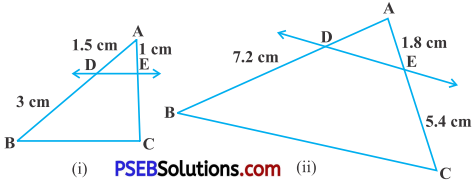
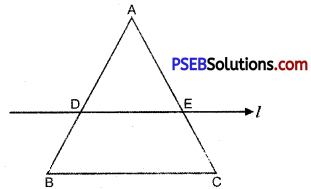
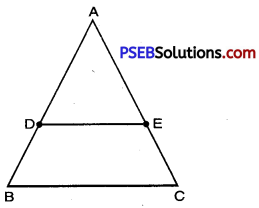
In fig. (i) and (ü), DE U BC. Find EC in (i) and AD in (ii).

PSEB 10th Class Maths Solutions Chapter 6 Triangles Ex 6.2 1

Solution:
(i) In ∆ABC, DE || BC ……………(given)
∴ \(\frac{\mathrm{AD}}{\mathrm{BD}}=\frac{\mathrm{AE}}{\mathrm{EC}}\)
[By using Basic Proportionality Theorem]
\(\frac{1.5}{3}=\frac{1}{\mathrm{EC}}\)
EC = \(\frac{3}{1.5}\)
EC = \(\frac{3 \times 10}{15}\) = 2
∴ EC = 2 cm.

(ii) In ∆ABC,
DE || BC ……………(given)
∴ \(\frac{\mathrm{AD}}{\mathrm{BD}}=\frac{\mathrm{AE}}{\mathrm{EC}}\)
[By using Basic Proportionality Theorem]
\(\frac{\mathrm{AD}}{7.2}=\frac{1.8}{5.4}\)
AD = \(\frac{1.8 \times 7.2}{5.4}\)
= \(\frac{1.8}{10} \times \frac{72}{10} \times \frac{10}{54}=\frac{24}{10}\)
AD = 2.4
∴ AD = 2.4 cm.

PSEB Solutions PSEB 10th Class Maths Solutions Chapter 6 Triangles Ex 6.2

Question 2.
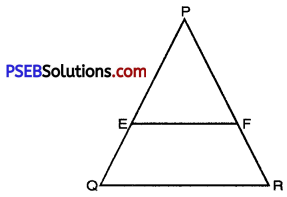
E and F are points on the sides PQ and PR respectively of a APQR. For each of the following cases, state whether EF || QR :
(i) PE = 3.9 cm, EQ = 3 cm, PF = 3.6 cm and FR = 2.4 cm
(ii) PE =4 cm, QE = 4.5 cm, PF =8 cm and RF = 9cm.
(iii) PQ = 1.28 cm, PR = 2.56 cm, PE = 0.18 cm and PF = 0.36 cm.
Solution:
In ∆PQR, E and F are two points on side PQ and PR respectively.

PSEB 10th Class Maths Solutions Chapter 6 Triangles Ex 6.2 2

(i) PE = 3.9 cm, EQ = 3 cm
PF = 3.6 cm, FR = 2.4 cm
\(\frac{\mathrm{PE}}{\mathrm{EQ}}=\frac{3.9}{3}=\frac{39}{30}=\frac{13}{10}=1.3\)

\(\frac{P F}{F R}=\frac{3.6}{2.4}=\frac{36}{24}=\frac{3}{2}=1.5\) \(\frac{\mathrm{PE}}{\mathrm{EQ}} \neq \frac{\mathrm{PF}}{\mathrm{FR}}\)

∴ EF is not parallel to QR.

(ii) PE = 4 cm, QE = 4.5 cm,
PF = 8 cm, RF = 9 cm.
\(\frac{\mathrm{PE}}{\mathrm{QE}}=\frac{4}{4.5}=\frac{40}{45}=\frac{8}{9}\) ………….(1)
\(\frac{P F}{R F}=\frac{8}{9}\) ……………..(2)
From (1) and (2),
\(\frac{\mathrm{PE}}{\mathrm{QE}}=\frac{\mathrm{PF}}{\mathrm{RF}}\)
∴ By converse of Basic Proportionality theorem EF || QR.

(iii) PQ = 1.28 cm, PR = 2.56 cm
PE = 0.18 cm, PF = 0.36 cm.
EQ = PQ – PE = 1.28 – 0.18 = 1.10 cm
ER = PR – PF = 2.56 – 0.36 = 2.20 cm
Here \(\frac{\mathrm{PE}}{\mathrm{EQ}}=\frac{0.18}{1.10}=\frac{18}{110}=\frac{9}{55}\) …………..(1)

and \(\frac{\mathrm{PF}}{\mathrm{FR}}=\frac{0.36}{2.20}=\frac{36}{220}=\frac{9}{55}\) …………….(2)

From (1) and (2), \(\frac{\mathrm{PE}}{\mathrm{EQ}}=\frac{\mathrm{PF}}{\mathrm{FR}}\)
∴ By converse of Basic Proportionality Theorem EF || QR.

PSEB Solutions PSEB 10th Class Maths Solutions Chapter 6 Triangles Ex 6.2

Question 3.
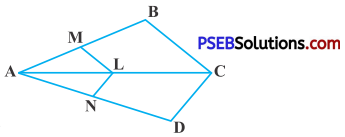
In fig., LM || CB; and LN || CD. Prove that \(\frac{\mathbf{A M}}{\mathbf{A B}}=\frac{\mathbf{A N}}{\mathbf{A D}}\).

PSEB 10th Class Maths Solutions Chapter 6 Triangles Ex 6.2 3

Solution:
In ∆ABC,
LM || BC (given)
∴ \(\frac{\mathrm{AM}}{\mathrm{MB}}=\frac{\mathrm{AL}}{\mathrm{LC}}\) ………..(1)
(By Basic Proportionality Theorem)
Again, in ∆ACD
LN || CD (given)
∴ \(\frac{A N}{N D}=\frac{A L}{L C}\) …………..(2)
(By Basic Proportionality Theorem)
From (1) and (2),
\(\frac{\mathrm{AM}}{\mathrm{MB}}=\frac{\mathrm{AN}}{\mathrm{ND}}\)

or \(\frac{\mathrm{MB}}{\mathrm{AM}}=\frac{\mathrm{ND}}{\mathrm{AN}}\)

or \(\frac{\mathrm{MB}}{\mathrm{AM}}+1=\frac{\mathrm{ND}}{\mathrm{AN}}+1\)
or \(\frac{\mathrm{MB}+\mathrm{AM}}{\mathrm{AM}}=\frac{\mathrm{ND}+\mathrm{AN}}{\mathrm{AN}}\)

or \(\frac{\mathrm{AB}}{\mathrm{AM}}=\frac{\mathrm{AD}}{\mathrm{AN}}\)

or \(\frac{\mathrm{AM}}{\mathrm{AB}}=\frac{\mathrm{AN}}{\mathrm{AD}}\)
Hence, \(\frac{\mathrm{AM}}{\mathrm{AB}}=\frac{\mathrm{AN}}{\mathrm{AD}}\) is the required result.

PSEB Solutions PSEB 10th Class Maths Solutions Chapter 6 Triangles Ex 6.2

Question 4.
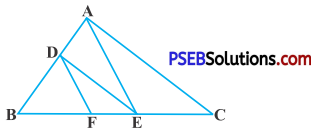
In Fig. 6.19, DE || AC and DF || AE. Prove that \(\frac{\mathrm{BF}}{\mathrm{FE}}=\frac{\mathrm{BE}}{\mathrm{EC}}\).

PSEB 10th Class Maths Solutions Chapter 6 Triangles Ex 6.2 4

Solution:
In ∆ABC, DE || AC(given)

PSEB 10th Class Maths Solutions Chapter 6 Triangles Ex 6.2 4

∴ \(\frac{B D}{D A}=\frac{B E}{E C}\) …………….(1)
[By Basic Proportionality Theorem]
In ∆ABE, DF || AE
\(\frac{\mathrm{BD}}{\mathrm{DA}}=\frac{\mathrm{BF}}{\mathrm{FE}}\) …………….(2)
[By Basic Proportionality Theorem]
From (1) and (2),
\(\frac{\mathrm{BE}}{\mathrm{EC}}=\frac{\mathrm{BF}}{\mathrm{FE}}\)
Hence proved.

PSEB Solutions PSEB 10th Class Maths Solutions Chapter 6 Triangles Ex 6.2

Question 5.
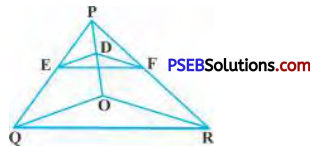
In fig. DE || OQ and DF || OR. Show that EF || QR.

PSEB 10th Class Maths Solutions Chapter 6 Triangles Ex 6.2 5

Solution:
Given:
In ∆PQR, DE || OQ DF || OR.
To prove: EF || QR.
Proof: In ∆PQO, ED || QO (given)

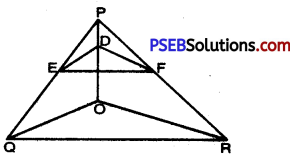
PSEB 10th Class Maths Solutions Chapter 6 Triangles Ex 6.2 6

∴ \(\frac{P D}{D O}=\frac{P E}{E Q}\)

[By Basic Proportionality Theorem]
Again in ∆POR,
DF || OR (given)
∴ \(\frac{P D}{D O}=\frac{P F}{F R}\) ………….(2)
[By Basic Proportionality Theorem]
From (1) and (2),
\(\frac{\mathrm{PE}}{\mathrm{EQ}}=\frac{\mathrm{PF}}{\mathrm{FR}}\)
In ∆PQR, by using converse of Basic proportionaIity Theorem.
EF || QR,
Hence proved.

PSEB Solutions PSEB 10th Class Maths Solutions Chapter 6 Triangles Ex 6.2

Question 6.
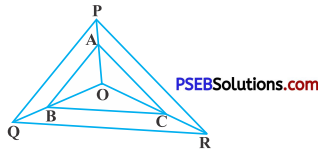
In flg., A, B and C points on OP, OQ and OR respectively such that AB || PQ and AC || PR. Show thatBC || QR.

PSEB 10th Class Maths Solutions Chapter 6 Triangles Ex 6.2 7

Solution:
Given : ∆PQR, A, B and C are points on OP, OQ and OR respectively such that AB || PQ, AC || PR.

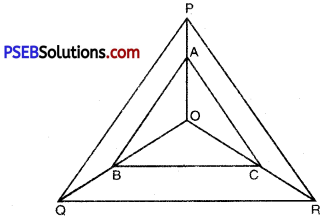
PSEB 10th Class Maths Solutions Chapter 6 Triangles Ex 6.2 8

To prove: BC || QR.
Proof: In ∆OPQ, AB || PQ (given)
∴ \(\frac{\mathrm{OA}}{\mathrm{AP}}=\frac{\mathrm{OB}}{\mathrm{BQ}}\) …………….(1)
[BY using Basic Proportionality Theorem]
Again in ∆OPR.
AC || PR (given)
∴ \(\frac{\mathrm{OA}}{\mathrm{AP}}=\frac{\mathrm{OC}}{\mathrm{CR}}\) ……………….(2)
[BY using Basic Proportionality Theorem]
From (1) and (2),
\(\frac{\mathrm{OB}}{\mathrm{BQ}}=\frac{\mathrm{OC}}{\mathrm{CR}}\)
∴ By converse of Basic Proportionality Theorem.
In ∆OQR, BC || QR. Hence proved.

PSEB Solutions PSEB 10th Class Maths Solutions Chapter 6 Triangles Ex 6.2

Question 7.
Using Basic Proportionality theorem, prove that a line drawn through the mid-point of one side of a triangle parallel to another side bisects the third side. (Recall that you have proved ¡t in class IX).
Solution:
Given: In ∆ABC, D is mid point of AB, i.e. AD = DB.
A line parallel to BC intersects AC at E as shown in figure. i.e., DE || BC.

PSEB 10th Class Maths Solutions Chapter 6 Triangles Ex 6.2 9

To prove: E is mid point of AC.
Proof: D is mid point of AB.
i.e.. AD = DB (given)
Or \(\frac{\mathrm{AD}}{\mathrm{BD}}\) = 1 ……………..(1)
Again in ∆ABC DE || BC (given)
∴ \(\frac{\mathrm{AD}}{\mathrm{DB}}=\frac{\mathrm{AE}}{\mathrm{EC}}\)
[By Basic Proportionality Theorem]
∴ 1 = \(\frac{\mathrm{AE}}{\mathrm{EC}}\) [From (1)]
∴ AE = EC
∴ E is mid point of AC. Hence proved.

PSEB Solutions PSEB 10th Class Maths Solutions Chapter 6 Triangles Ex 6.2

Question 8.
Using converse of Basic Proportionality theorem prove that the line joining the mid-points of any two sides of a triangle is parallel to the third side. (Recall that you have done ¡tin Class IX).
Solution:
Given ∆ABC, D and E are mid points of AB and AC respectively such that AD = BD and AE = EC, D and Eare joined

PSEB 10th Class Maths Solutions Chapter 6 Triangles Ex 6.2 10

To Prove, DE || BC
Proof. D is mid point of AB (Given)
i.e., AD = BD
Or \(\frac{\mathrm{AD}}{\mathrm{BD}}\) = 1 ………………(1)
E is mid point of AC (Given)
∴ AE = EC
Or \(\frac{\mathrm{AE}}{\mathrm{EC}}\) = 1 ………………(2)
From (1) and (2),
By using converse of basic proportionality Theorem
DE || BC Hence Proved.

Question 9.
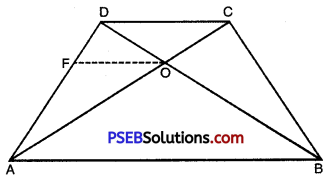
ABCD is a trapeiiumin with AB || DC and its diagonals Intersect each other at the point O. Show that \(\frac{A O}{B O}=\frac{C O}{D O}\).
Solution:
Given. ABCD is trapezium AB || DC, diagonals AC and BD intersect each other at O.

PSEB 10th Class Maths Solutions Chapter 6 Triangles Ex 6.2 11

To Prove. \(\frac{\mathrm{AO}}{\mathrm{BO}}=\frac{\mathrm{CO}}{\mathrm{DO}}\)
Construction. Through O draw FO || DC || AB
Proof. In ∆DAB, FO || AB (construction)
∴ \(\frac{\mathrm{DF}}{\mathrm{FA}}=\frac{\mathrm{DO}}{\mathrm{BO}}\) ……………..(1)
[By using Basic Proportionality Theorem]
Again in ∆DCA,
FO || DC (construction)
\(\frac{\mathrm{DF}}{\mathrm{FA}}=\frac{\mathrm{CO}}{\mathrm{AO}}\)
[By using Basic Proportionality Theorem]
From (1) and (2),
\(\frac{\mathrm{DO}}{\mathrm{BO}}=\frac{\mathrm{CO}}{\mathrm{AO}} \quad \frac{\mathrm{AO}}{\mathrm{BO}} \quad \frac{\mathrm{CO}}{\mathrm{DO}}\)
Hence Proved.

Question 10.
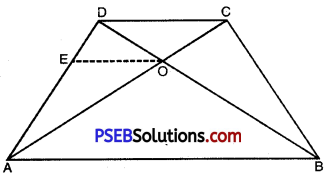
The diagonals of a quadrilateral ABCD Intersect each other at the point O such that \(\frac{\mathrm{AO}}{\mathrm{BO}}=\frac{\mathrm{CO}}{\mathrm{DO}}\).Show that ABCD is a
trapezium.
Solution:
Given: Quadrilateral ABCD, Diagonal AC and BD intersects each other at O
such that = \(\frac{\mathrm{AO}}{\mathrm{BO}}=\frac{\mathrm{CO}}{\mathrm{DO}}\)

PSEB 10th Class Maths Solutions Chapter 6 Triangles Ex 6.2 12

To Prove. Quadrilateral ABCD is trapezium.
Construction. Through ‘O’ draw line EO || AB which meets AD at E.
Proof. In ∆DAB,
EO || AB [Const.]
∴ \(\frac{\mathrm{DE}}{\mathrm{EA}}=\frac{\mathrm{DO}}{\mathrm{OB}}\) ………………(1)
[By using Basic Proportionality Theoremj
But = \(\frac{\mathrm{AO}}{\mathrm{BO}}=\frac{\mathrm{CO}}{\mathrm{DO}}\) (Given)

or \(\frac{\mathrm{AO}}{\mathrm{CO}}=\frac{\mathrm{BO}}{\mathrm{DO}}\)

or \(\frac{\mathrm{CO}}{\mathrm{AO}}=\frac{\mathrm{DO}}{\mathrm{BO}}\)

⇒ \(\frac{\mathrm{DO}}{\mathrm{OB}}=\frac{\mathrm{CO}}{\mathrm{AO}}\) …………….(2)
From (1) and (2),
\(\frac{\mathrm{DE}}{\mathrm{EA}}=\frac{\mathrm{CO}}{\mathrm{AO}}\)
∴ By using converse of basic
proportionlity Theorem,
EO || DC also EO || AB [Const]
⇒ AB || DC
∴ Quadrilateral ABCD is a trapezium with AB || CD.

PSEB 6th Class Maths Solutions Chapter 6 Decimals Ex 6.4

Punjab State Board PSEB 6th Class Maths Book Solutions Chapter 6 Decimals Ex 6.4 Textbook Exercise Questions and Answers.

PSEB Solutions for Class 6 Maths Chapter 6 Decimals Ex 6.4

1. Solve the following:

Question (i)
12.15 + 4.87
Solution:
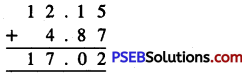
We have 12.15 + 4.87
PSEB 6th Class Maths Solutions Chapter 6 Decimals Ex 6.4 1
Hence 12.15 + 4.87 = 17.02

PSEB 6th Class Maths Solutions Chapter 6 Decimals Ex 6.4

Question (ii)
23.5 + 13.47
Solution:
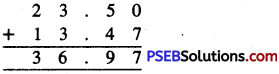
We have 23.5 + 13.47
PSEB 6th Class Maths Solutions Chapter 6 Decimals Ex 6.4 2
Hence 23.5 + 13.47 = 36.97

Question (iii)
12.56 + 6.234
Solution:
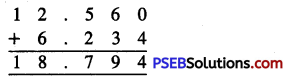
We have 12.56 + 6.234
PSEB 6th Class Maths Solutions Chapter 6 Decimals Ex 6.4 3
Hence 12.56 + 6.234 = 18.794

Question (iv)
24.25 – 13.12
Solution:
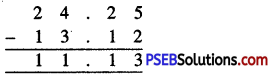
We have 24.25 – 13.12
PSEB 6th Class Maths Solutions Chapter 6 Decimals Ex 6.4 4
Hence 24.25 – 13.12 = 11.13

Question (v)
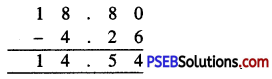
18.8 – 4.26
Solution:
We have 18.8 – 4.26
PSEB 6th Class Maths Solutions Chapter 6 Decimals Ex 6.4 5.1
Hence 18.8 – 4.26 = 14.54

PSEB 6th Class Maths Solutions Chapter 6 Decimals Ex 6.4

Question (vi)
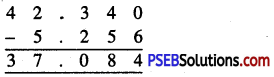
42.34 – 5.256
Solution:
We have 42.34 – 5.256
PSEB 6th Class Maths Solutions Chapter 6 Decimals Ex 6.4 6
Hence 42.34 – 5.256 = 37.084

Question (vii)
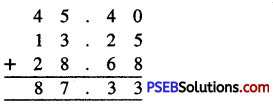
45.4 + 13.25 + 28.68
Solution:
We have 45.4 + 13.25 + 28.68
PSEB 6th Class Maths Solutions Chapter 6 Decimals Ex 6.4 7
Hence 45.4 + 13.25 + 28.68 = 87.33

Question (viii)
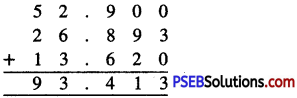
52.9 + 26.893 + 13.62
Solution:
We have 52.9 + 26.893 + 13.62
PSEB 6th Class Maths Solutions Chapter 6 Decimals Ex 6.4 8
Hence 52.9 + 26.893 + 13.62 = 93.413

Question (ix)
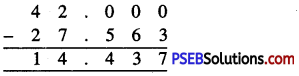
42 – 27.563
Solution:
We have 42 – 27.563
PSEB 6th Class Maths Solutions Chapter 6 Decimals Ex 6.4 9
Hence 42 – 27.563 = 14.437

PSEB 6th Class Maths Solutions Chapter 6 Decimals Ex 6.4

Question (x)
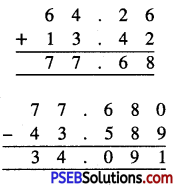
64.26 – 43.589 + 13.42
Solution:
We have 64.26 – 43.589 + 13.42
PSEB 6th Class Maths Solutions Chapter 6 Decimals Ex 6.4 10
Hence 64.26 – 43.589 + 13.42
= 34.091

Question (xi)
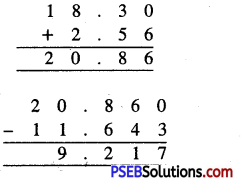
18.3 + 2.56 – 11.643
Solution:
We have 18.3 + 2.56 – 11.643
PSEB 6th Class Maths Solutions Chapter 6 Decimals Ex 6.4 11
Hence 18.3 + 2.56 – 11.643
= 9.217

Question (xii)
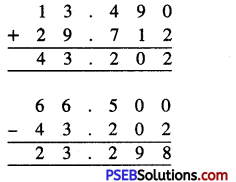
66.5 – 13.49 – 29.712.
Solution:
We have 66.5 – 13.49 – 29.712
= 66.5 – (13.49 + 29.712)
= 66.5 – 43.202 = 23.298
PSEB 6th Class Maths Solutions Chapter 6 Decimals Ex 6.4 12

2.

Question (i)
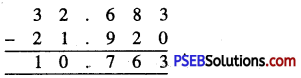
Subtract 21.92 from 32.683
Solution:
PSEB 6th Class Maths Solutions Chapter 6 Decimals Ex 6.4 13

PSEB 6th Class Maths Solutions Chapter 6 Decimals Ex 6.4

Question (ii)
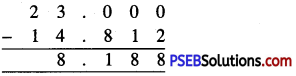
Subtract 14.812 from 23.
Solution:
Subtract 14.812 from 23.
PSEB 6th Class Maths Solutions Chapter 6 Decimals Ex 6.4 14

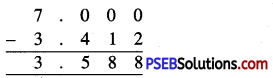
3. What should be added to 3.412 to get 7?
Solution:
Let x should be added to 3.412 to get 7
3.412 + x = 7
x = 7 – 3.412
= 3.588
PSEB 6th Class Maths Solutions Chapter 6 Decimals Ex 6.4 15
Hence, 3.588 should be added to 3.412 to get 7

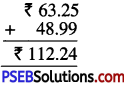
4. Khan spent ₹ 63.25 for Maths book and ₹ 48.99 for English book. Find the total amount spent by Khan.
Solution:
Amount spent for Maths book = ₹ 63.25
Amount spent for English book = 48.99
Total amount spent by khan = ₹ 112.24
PSEB 6th Class Maths Solutions Chapter 6 Decimals Ex 6.4 16

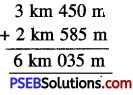
5. Samar walked 3 km 450 m in morning and 2 km 585 m in evening. How much distance did he walk in all ?
Solution:
Distance walked in morning = 3 km 450 m
Distance walked in evening = 2 km 585 m
Distance Samar Walked in all = 6 km 035 m
PSEB 6th Class Maths Solutions Chapter 6 Decimals Ex 6.4 17

PSEB 6th Class Maths Solutions Chapter 6 Decimals Ex 6.4

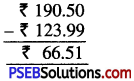
6. Sheetal has ₹ 190.50 in her pocket. She buys a school bag for ₹ 123.99. How much money is left with her now?
Solution:
Total amount Sheetal has = ₹ 190.50
Amount spent on school bag = – ₹ 123.99
Money left with her = ₹ 66.51
PSEB 6th Class Maths Solutions Chapter 6 Decimals Ex 6.4 18

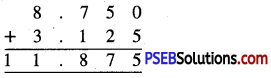
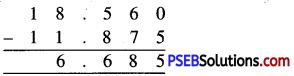
7. A piece of 18.56 m long ribbon is cut into three pieces. If the length of two pieces are 8.75 m and 3.125 m respectively. Find the length of the third piece.
Solution:
Total length of ribbon = 18.56 m
Length of two pieces = 8.75 m + 3.125 m
PSEB 6th Class Maths Solutions Chapter 6 Decimals Ex 6.4 19
Length of the third piece = 18.56 m – 11.875 m
= 6.685 m
PSEB 6th Class Maths Solutions Chapter 6 Decimals Ex 6.4 20

8. Veerpal bought vegetables weighing 20 kg. Out of this 6 kg 750 g are onions, 5 kg 25 g are potatoes and rest are tomatoes. What is the weight of the tomatoes?
Solution:
Total weight of vegetables
Veerpal bought = 20 kg
Weight of onions = 6 kg 750 g = 6.750 kg
Weight of potatoes = 5 kg 25 g = 5.025 kg
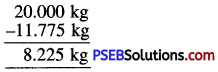
Weight of onions and potatoes = 11.775 kg
PSEB 6th Class Maths Solutions Chapter 6 Decimals Ex 6.4 21
Total weight of vegetable = 20.000 kg
Weight of onions and potatoes = -11.775 kg
Weight of tomatoes = 8.225 kg
PSEB 6th Class Maths Solutions Chapter 6 Decimals Ex 6.4 22

PSEB 6th Class Maths Solutions Chapter 6 Decimals Ex 6.4

9. Ashish’s school is 28 km far from his house. He covers 14 km 250 m by bus, 12 km 650 m by car and the remaining distance by foot. How much distance does he cover on foot?
Solution:
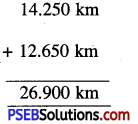
Distance covered by bus 14 km 250 m = 14.250 km
Distance covered by car 12 km 650 m = 12.650 km
Distance covered by bus and car = 26.900 km
PSEB 6th Class Maths Solutions Chapter 6 Decimals Ex 6.4 23

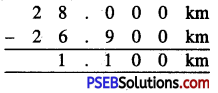
Total distance of school form Ashish house = 28 km
Distance covered by bus and car = 26.900 km
Distance covered on foot = 28 km – 26.900 km
= 1 km 100 m
PSEB 6th Class Maths Solutions Chapter 6 Decimals Ex 6.4 24

PSEB 10th Class Maths Solutions Chapter 6 Triangles Ex 6.1

Punjab State Board PSEB 10th Class Maths Book Solutions Chapter 6 Triangles Ex 6.1 Textbook Exercise Questions and Answers.

PSEB Solutions for Class 10 Maths Chapter 6 Triangles Ex 6.1

Question 1.
Fill in the blanks using the correct word given in brackets:
(i) All circles are ………………. (congruent, similar).
Solution:
All circles are similar.

(ii) All squares are ………………. (similar, congruent).
Solution:
MI squares are similar.

(iii) All ………………. triangles are similar. (isosceles, equilateral).
Solution:
All equilateral triangles are similar.

(iv) Two polygons of the same number of sides are similar, if
(a) their corresponding angles are __________ and
Solution:
equal

(b) their corresponding sides are ………………. (equal, proportional).
Solution:
proportional.

PSEB Solutions PSEB 10th Class Maths Solutions Chapter 6 Triangles Ex 6.1

Question 2.
Give two different examples of pair
(i) similar figures
(ii) non-similar figures.
Solution:
(i) 1. Pair of equilateral triangle are similar figures.
2. Pair of squares are similar figures.

(ii) 1. A triangle and quadrilateral form a pair of non-similar figures.
2. A square and rhombus form pair of non – similar figures.

PSEB Solutions PSEB 10th Class Maths Solutions Chapter 6 Triangles Ex 6.1

Question 3.
State whether the following quadrilaterals are similar or not :-

PSEB 10th Class Maths Solutions Chapter 6 Triangles Ex 6.1 1

Solution:
The two quadrilaterals in the figure are not similar because their corresponding angles are not equal.

PSEB 10th Class Maths Solutions Chapter 5 Arithmetic Progressions Ex 5.4

Punjab State Board PSEB 10th Class Maths Book Solutions Chapter 5 Arithmetic Progressions Ex 5.4 Textbook Exercise Questions and Answers.

PSEB Solutions for Class 10 Maths Chapter 5 Arithmetic Progressions Ex 5.4

Question 1.
Which term of the A.P. 121, 117, 113, …………. is its first negative term?
Solution:
Given A.P is 121, 117, 113, …
Here a = T1 = 121 ;T2 = 117; T3 = 113
d = T2 – T1 = 117 – 121 = – 4
Using formula, Tn = a + (n – 1) d
Tn = 121 + (n – 1) (- 4)
= 121 – 4n + 4
= 125 – 4n.
According to question :—
Tn < 0
or 125 – 4n < 0
or 125 < 4n or 4n > 125.
or n > \(\frac{125}{4}\)
or n > 31\(\frac{1}{4}\).
But n must be integer, for first negative term.
∴ n = 32.
Hence, 32nd term be the first negative term of given A.P.

PSEB Solutions PSEB 10th Class Maths Solutions Chapter 5 Arithmetic Progressions Ex 5.4

Question 2.
The sum of the third and the seventh term of an A.P. is 6 and their product ¡s 8. Find the sum of first sixteer
terms of an A.P.
Solution:
Let ‘a’ and ‘d’ be the first term and common diftèrence of given A.P.
According to 1st condition
T3 + T7 = 6
[a + (3 – 1)d] + [a + (7 – 1) d] = 6
∵ [Tn = a + (n – 1) d]
or a + 2d + a + 6d = 6
or 2a + 8d = 6
or a + 4d = 3 …………….(1)
According to 2nd condition
T3 (T7) = 8
[a + (3 – 1) d] [a + (7 – 1)d] = 8
∵ [Tn = a + (n – 1) d]
or (a + 2d) (a + 6d) = 8
or [3 – 4d + 2d] [3 – 4d + 6d] = 8
[Using (1), a = 3 – 4d]
or (3 – 2d) (3 + 2d) = 8
or 9 – 4d2 = 8
or 4d2 = 98
or d2 = \(\frac{1}{4}\)
d = ± \(\frac{1}{2}\)

PSEB Solutions PSEB 10th Class Maths Solutions Chapter 5 Arithmetic Progressions Ex 5.4

Case I:
When d = \(\frac{1}{2}\)
Putting d = \(\frac{1}{2}\) in (1), we get:
a + 4 (\(\frac{1}{2}\)) = 3
or a + 2 = 3
or a = 3 – 2 = 1
Using formula, Sn = \(\frac{n}{2}\) [2a + (n – 1) d]
S16 = \(\frac{16}{2}\) [2 (1) + (16 – 1) \(\frac{1}{2}\)].

Case II:
Putting d = – \(\frac{1}{2}\) in (1), we get,
When d = – \(\frac{1}{2}\)
a + 4 (-\(\frac{1}{2}\)) = 3
a – 2 = 3
or a = 3 + 2 = 5
Using formula,
Sn = \(\frac{n}{2}\) [2a + (n – 1)d]
S16 = \(\frac{16}{2}\) [2(5) + (16 – 1) (-\(\frac{1}{2}\))]
= 8[10 – \(\frac{15}{2}\)]
= 8 \(\left[\frac{20-15}{2}=\frac{5}{2}\right]\)
S16 = 20.

PSEB Solutions PSEB 10th Class Maths Solutions Chapter 5 Arithmetic Progressions Ex 5.4

Question 3.
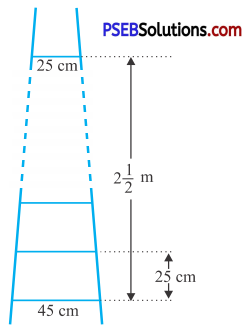
A ladder has rungs 25 cm apart (see fig.) The rungs decrease uniformly in length from 45 cm at the bottom to 25 cm at the top. If the top and bottom rungs are 2 latex]\frac{1}{2}[/latex] m apart, what is the length of the wood required for the rungs?

PSEB 10th Class Maths Solutions Chapter 5 Arithmetic Progressions Ex 5.4 1

[Hint: Number of rungs = \(\frac{250}{25}\) + 1]
Solution:
Total length of rungs = 2 \(\frac{1}{2}\) m = \(\frac{5}{2}\) m
= (\(\frac{5}{2}\) × 100) cm = 250 cm
Length of each rung = 25 cm
∴ Number of rungs = \(\frac{\text { Total length of rungs }}{\text { Length of each rung }}\) + 1
= \(\frac{250}{25}\) + 1 = 10 + 1 = 11
Length of first rung =45 cm
Here a = 45; l = 25; n = 11
Length of the wood for rungs
= S11
= \(\frac{n}{2}\) [a + l]
= \(\frac{11}{2}\) [45 + 25]
= \(\frac{1}{2}\) × 70
= 11 × 35 = 385
Hence, length of the wood for rungs has 385 cm.

PSEB Solutions PSEB 10th Class Maths Solutions Chapter 5 Arithmetic Progressions Ex 5.4

Question 4.
The houses of a row are numbered consecutively from 1 to 49. Show that there is a value of x such that the sum of the numbers of the houses preceding the house numbered x is equal to the sum of the numbers of the houses following it and find this value of x.
[Hint: Sx – 1 = S49 – S1]
Solution:
Let ‘x’ denotes the number of any house.
Here a = T1 = 1 ;d = 1
According to question,
Sx – 1 = S49 – Sx
= \(\frac{x-1}{2}\) [2 (1) + (x – 1 – 1) (1)]
= \(\frac{49}{2}\) [1 + 49] – \(\frac{x}{2}\) [2 (1) + (x – 1) (1)]
[Using Sn = \(\frac{n}{2}\) [2a + (n – 1) d] and Sn = \(\frac{n}{2}\) (a + l) ]
or \(\frac{x-1}{2}\) [2 + x – 2] = \(\frac{49}{2}\) (50) – \(\frac{x}{2}\) [2 + x – 1]
or \(\frac{x(x-1)}{2}=49(25)-\frac{x(x+1)}{2}\)
or \(\frac{x}{2}\) [x – 1 + x + 1] = 1225
\(\frac{x}{2}\) × 2x = 1225
or x2 = 1225
or x = 35.

PSEB Solutions PSEB 10th Class Maths Solutions Chapter 5 Arithmetic Progressions Ex 5.4

Question 5.
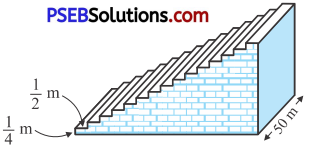
A small terrace at a football ground comprises of 15 step each of which is 50 m long and built of solid concrete. Each step has a rise of \(\frac{1}{4}\) m and a tread of \(\frac{1}{2}\) m (see fig.) Calculate the total volume of concrete required to build the terrace.
[Hint: Volume of concrete required to build of the first step \(\frac{1}{4}\) × \(\frac{1}{2}\) × 50 m3].

PSEB 10th Class Maths Solutions Chapter 5 Arithmetic Progressions Ex 5.4 2

Solution:
Volume of concrete required to build the first step \(\frac{1}{4}\) × \(\frac{1}{2}\) × 50 m3]
= [latex]\frac{25}{4}[/latex] m3
Volume of concrete required to build the second step = [\(\frac{25}{4}\) × \(\frac{1}{2}\) × 50] m3

= \(\frac{75}{2}\) m3
Volume of concrete required to build the third step = [\(\frac{3}{4}\) × \(\frac{1}{2}\) × 50] m3 and so on upto 15 steps.

Here a = T1 = \(\frac{25}{4}\);
T2 = \(\frac{25}{2}\);
T3 = \(\frac{75}{4}\); and n = 15.
d = T2 – T1 = \(\frac{25}{2}\) – \(\frac{25}{4}\)
= \(\frac{50-25}{4}\) = \(\frac{25}{4}\).

Total volume of concrete required to buld the terrace = S15
= \(\frac{n}{2}\) [2a + (n – 1)d]
= \(\frac{15}{2}\left[2\left(\frac{25}{4}\right)+(15-1) \frac{25}{4}\right]\)
= \(\left[\frac{25}{4} \times \frac{14 \times 25}{4}\right]\)
= \(\frac{15}{2}\left[\frac{25}{2} \times \frac{175}{2}\right]\)
= \(\frac{15}{2} \times \frac{200}{2}\) = 750
Hence, total volume of concrete required to build the terrace is 750 m3.

PSEB 7th Class Maths Solutions Chapter 12 Algebraic Expressions Ex 12.3

Punjab State Board PSEB 7th Class Maths Book Solutions Chapter 12 Algebraic Expressions Ex 12.3 Textbook Exercise Questions and Answers.

PSEB Solutions for Class 7 Maths Chapter 12 Algebraic Expressions Ex 12.3

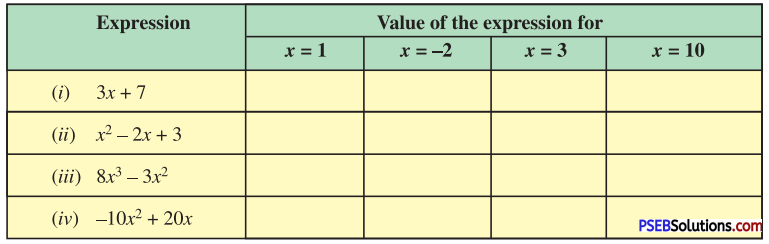
1. Fill in the Table by substituting the values in the given expressions.
PSEB 7th Class Maths Solutions Chapter 12 Algebraic Expressions Ex 12.3 1
Solution:
(i) 10, 1, 16, 37
(ii) 2, 11, 6, 83
(iii) 5, – 76, 189, 7700
(iv) 10, – 80, – 30, – 800.

2. If a = 1, b = – 2 find the value of given expressions

(i) a2 – b2
Solution:
a2 – b2
Putting a = 1, b = – 2 in a2 – b2, we get
a2 – b2 = (1)2 – (- 2)2
= 1 – 4
= -3

(ii) a + 2ab – b2
Solution:
a + 2ab – b2 = 1 + 2 × 1 × – 2 – (- 2)2
= 1 – 4 – 4
= – 7

(iii) a2b + 2ab2 + 5
Solution:
a2b + 2ab2 + 5 = 1² × – 2 + 2 × 1 × (- 2)2 + 5
= -2 + 2 × 4 + 5
= – 2 + 8 + 5
= 11

PSEB 7th Class Maths Solutions Chapter 12 Algebraic Expressions Ex 12.3

3. Simplify the following expressions and find their values for. m = 1, n = 2, p = – 1.

(i) 2m + 3n – p + 7m – 2n
Solution:
2m + 3n – p + 7m – 2n
= 2m + 7m + 3n – 2n – p
= 9m + n – p
Putting m = 1, n = 2, p = – 1, we get
9m + n – p = 9 × 1 + 2- (-1)
= 9 + 2 + 1
= 12.

(ii) 3p + n – m + 2n
Solution:
3p + n- m + 2n = 3p + n + 2n – m
= 3p + 3n – m
Putting m = 1, n = 2, p = – 1
3p + 3n – m = 3 × -1 + 3 × 2 -1
= -3 + 6 – 1
= 2.

(iii) m + p – 2p + 3m
Solution:
m + p – 2p + 3m = m + 3m + p – 2p
= 4m – p
Putting m =1, n = 2, p = -1
4m – p = 4 (1) – (- 1)
= 4 + 1
= 5.

(iv) 3n + 2m – 5p – 3m – 2n + p
Solution:
3n + 2m – 5p – 3m – 2n + p
= 3n – 2n + 2m – 3m – 5p + p
= n – m – 4p
Putting m =1, n = 2, p = – 1
n – m – 4p = 2 – 1 – 4 (-1)
= 2 – 1 + 4
=5

PSEB 7th Class Maths Solutions Chapter 12 Algebraic Expressions Ex 12.3

4. What should be the value of a if the value of 2a2 + b2 = 10 when b = 2 ?
Solution:
2a2 + b2 = 10
Putting b = 2, we get
2a + (2)2 = 10
2a + 4 = 10
2a = 10 – 4 = 6
a = \(\frac {6}{2}\) = 3
a = 3

5. Find the value of x if – 3x + 7y2 = 1 when y = 1.
Solution:
-3x + 7y2 = 1
Putting y = 1
-3x + 7y2 = 1
-3x + 7 (1)2 = 1
-3x + 7 = 1
-3x = 1 – 7
-3x = – 6
x = \(\frac {-6}{-3}\) = 2
x = 2.

6. Observe the pattern of shapes of letters formed from line segment of equal lengths.
PSEB 7th Class Maths Solutions Chapter 12 Algebraic Expressions Ex 12.3 2
If n shapes of letters are formed, then write the algebraic expression for the number of line segment required for making these n shapes in each case.
Solution:
(i) 2n + 1
(ii) 4n + 2

PSEB 7th Class Maths Solutions Chapter 12 Algebraic Expressions Ex 12.3

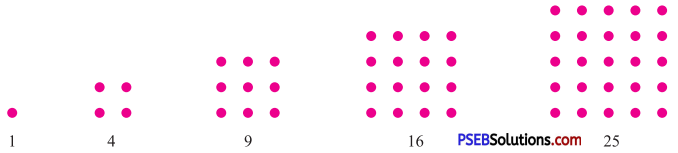
7. Observe the following pattern of squares made using dots.
PSEB 7th Class Maths Solutions Chapter 12 Algebraic Expressions Ex 12.3 3
If n is taken as the number of dots in each row then find the algebraic expression for number of dots in nth figure. Also find number of dots if.
(i) n = 3
(ii) n = 7
(iii) n = 10
Solution:
n2 (i) 9, (ii) 49, (iii) 100.

8. Observe the pattern of shapes of digits formed from line segment of equal lengths.
PSEB 7th Class Maths Solutions Chapter 12 Algebraic Expressions Ex 12.3 4
If n shapes of digits are formed then write the algebric expression for the numbers of line segment required to make n shapes.
Solution:
(i) 3n + 1
(ii) 4n + 2
(iii) 5n + 1

9. Multiple Choice Questions :

Question (i).
If l is the length of the side of the regular pentagon, perimeter of a regular Pentagon is.
(a) 3 l
(b) 4 l
(c) 5 l
(d) 8 l.
Answer:
(c) 5 l

Question (ii).
The value of the expression 5n – 2 when n = 2 is.
(a) 12
(b) -12
(c) 8
(d) 3
Answer:
(c) 8

Question (iii).
The value of 3x2 – 5x + 6 when x = 1.
(a) 3
(b) 4
(c) – 8
(d) 14.
Answer:
(b) 4

PSEB 9th Class Maths Solutions Chapter 10 Circles Ex 10.5

Punjab State Board PSEB 9th Class Maths Book Solutions Chapter 10 Circles Ex 10.5 Textbook Exercise Questions and Answers.

PSEB Solutions for Class 9 Maths Chapter 10 Circles Ex 10.5

Question 1.
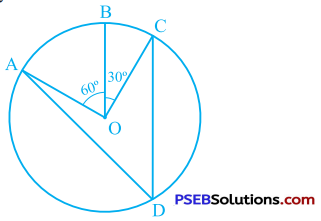
In the given figure, A, B and C are three points on a circle with centre O such that ∠BOC = 30° and ∠AGB = 60°. If D is a point on the circle other than the arc ABC, find ∠ADC.
PSEB 9th Class Maths Solutions Chapter 10 Circles Ex 10.5 1
Answer:
∠AOC = ∠AOB + ∠BOC (Adjacent angles)
∴ ∠AQC = 60° + 30°
∴ ∠AOC = 90°
Now, 2 ∠ADC = ∠AOC (Theorem 10.8)
∴ ∠ADC = \(\frac{1}{2}\) ∠AOC
∴ ∠ADC = \(\frac{1}{2}\) × 90°
∴ ∠ADC = 45°

PSEB 9th Class Maths Solutions Chapter 10 Circles Ex 10.5

Question 2.
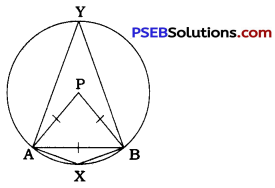
A chord of a circle is equal to the radius of the circle. Find the angle subtended by the chord at a point on the minor arc and also at a point on the major arc.
Answer:
PSEB 9th Class Maths Solutions Chapter 10 Circles Ex 10.5 2
In the circle with centre O, chord AB is equal to radius PA.
∴ In ∆ PAB, PA = PB = AB
∆ PAB is an equilateral triangle.
∴ ∠ APB = 60°
Now, 2∠AYB = ∠APB (Theorem 10.8)
∴ ∠AYB = \(\frac{1}{2}\) ∠APB
= \(\frac{1}{2}\) × 60° = 30°
Quadrilateral AXBY is a cyclic quadrilateral.
∴ ∠X + ∠Y = 180° (Theorem 10.11)
∴ ∠X + 30°= 180°
∴ ∠X = 150°
Thus, the angle subtended by the chord at point X on the minor arc is 150° and the angle subtended by the chord at point Y on the major arc is 30°.

PSEB 9th Class Maths Solutions Chapter 10 Circles Ex 10.5

Question 3.
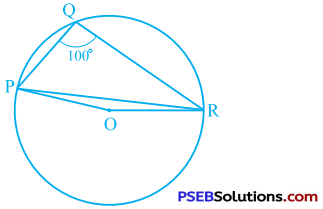
In the given figure, ∠PQR = 100°, where P, Q and R are points on a circle with centre O. Find ∠OPR.
PSEB 9th Class Maths Solutions Chapter 10 Circles Ex 10.5 3
Answer:
Here, reflex angle ∠POR = 2 × ∠PQR (Theorem 10.8)
∴ Reflex angle ∠POR = 2 × 100° = 200°
Now, ∠POR + Reflex angle ∠POR = 360°
∴ ∠POR + 200° = 360°
∴∠POR = 160°
In ∆ OPR. OP = OR (Radii)
∴ ∠OPR = ∠ORP
In ∆ OPR, ∠OPR + ∠ORP + ∠POR = 180°
∴ ∠OPR + ∠OPR + 160° = 180°
∴ 2∠OPR = 20°
∴ ∠OPR = 10°

PSEB 9th Class Maths Solutions Chapter 10 Circles Ex 10.5

Question 4.
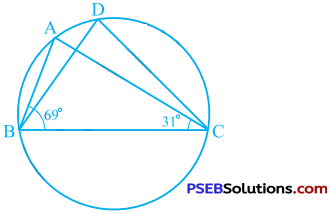
In the given figure, ∠ABC = 69°, ∠ACB = 31°, find ∠BDC.
PSEB 9th Class Maths Solutions Chapter 10 Circles Ex 10.5 4
Answer:
In ∆ ABC, ∠ABC + ∠ACB + ∠BAC = 180°
∴ 69° + 31° + ∠BAC = 180°
∴ 100° + ∠BAC = 180°
∴ ∠BAC = 80°
Now, ∠BDC = ∠BAC (Theorem 10.9)
∴ ∠BDC = 80°

Question 5.
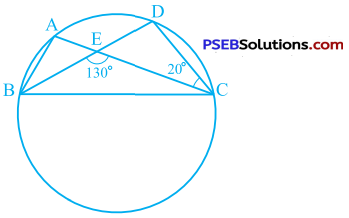
In the given figure, A, B, C and D are four s points on a circle. AC and BD intersect at a point E such that ∠BEC = 130° and ∠ECD = 20°. Find ∠BAC.
PSEB 9th Class Maths Solutions Chapter 10 Circles Ex 10.5 5
Answer:
In ∆ CDE, ∠BEC is an exterior angle.
∴ ∠BEC = ∠ECD + ∠EDC
∴ 130° = 20° + ∠BDC
∴ ∠BDC = 110°
Now, ∠BAC = ∠BDC (Theorem 10.9)
∴ ∠BAC = 110°

PSEB 9th Class Maths Solutions Chapter 10 Circles Ex 10.5

Question 6.
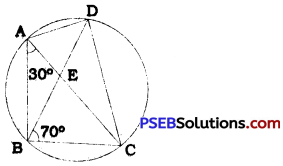
ABCD is a cyclic quadrilateral Whose diagonals intersect at a point E. If ∠DBC = 70°, ∠BAC is 30°, find ∠BCD. Further, if AB = BC, find ∠ECD.
Answer:
PSEB 9th Class Maths Solutions Chapter 10 Circles Ex 10.5 6
∠DAC = ∠DBC (Theorem 10.9)
∴ ∠DAC = 70°
∠BAD = ∠BAC + ∠DAC (Adjacent angles)
∴ ∠BAD = 30° + 70°
∴ ∠BAD = 100°
In cyclic quadrilateral ABCD,
∠ BAD + ∠BCD = 180° (Theorem 10.11)
∴ 100° + ∠ BCD = 180°
∴ ∠BCD = 80°
In ∆ ABC, if AB = BC, then ∠ BAC = ∠ BCA
∴ 30° = ∠BCA
∴ ∠BCA = 30°
∠BCD = ∠BCA + ∠ACD (Adjacent angles)
∴ 80° = 30° + ∠ACD
∴ ∠ACD = 50°
∴ ∠ECD = 50°

PSEB 9th Class Maths Solutions Chapter 10 Circles Ex 10.5

Question 7.
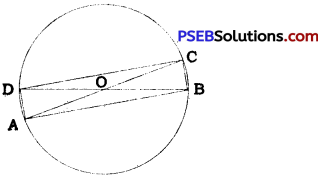
If diagonals of a cyclic quadrilateral are diameters of the circle through the vertices of the quadrilateral, prove that it is a rectangle.
Answer:
PSEB 9th Class Maths Solutions Chapter 10 Circles Ex 10.5 7
The vertices of cyclic quadrilateral ABCD lie on a circle with centre O and AC and BD are diameters of the circle.
As AC is a diameter, ∠ABC = ∠ADC = 90° (Angle in a semicircle)
As BD is a diameter, ∠BCD = ∠BAD = 90° (Angle in a semicircle)
Thus, all the four angles, ∠BAD, ∠ABC, ∠BCD and ∠ADC of quadrilateral ABCD are right angles.
Hence, quadrilateral ABCD is a rectangle.

Question 8.
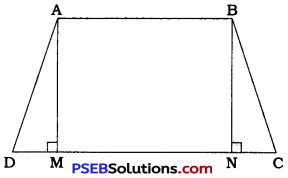
If the non-parallel sides of a trapezium are equal, prove that it is cyclic.
Answer:
PSEB 9th Class Maths Solutions Chapter 10 Circles Ex 10.5 8
In trapezium ABCD, AB || CD and AD = BC.
Draw AM ⊥ CD and BN ⊥ CD, where M and N are points on CD.
In ∆ AMD and ∆ BNC,
∠AMD = ∠BNC (Right angles)
Hypotenuse AD = Hypotenuse BC (Given)
AM = BN (Distance between parallel lines)
∴ By RHS rule, ∆ AMD ≅ ∆ BNC
∴ ∠ADM = ∠BCN
∴ ∠ADC = ∠BCD
Now, AB || CD and AD is their transversal.
∴ ∠BAD + ∠ADC = 180° (Interior angles on the same side of transversal)
∴ ∠ BAD + ∠BCD = 180°
Thus, in quadrilateral ABCD, ∠A + ∠C = 180°.
Hence, ABCD is a cyclic quadrilateral.

PSEB 9th Class Maths Solutions Chapter 10 Circles Ex 10.5

Question 9.
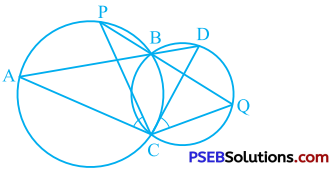
Two circles intersect at two points B and C. Through B, two line segments ABD and PBQ are drawn to intersect the circles at A, D and P, Q respectively (see the given figure). Prove that ∠ACP = ∠QCD.
Answer:
PSEB 9th Class Maths Solutions Chapter 10 Circles Ex 10.5 9
∠ACP and ∠ABP are angles in the same segment.
∴ ∠ACP = ∠ABP (Theorem 10.9) …………… (1)
∠QCD and ∠QBD are angles in the same segment.
∴ ∠QCD = ∠QBD (Theorem 10.9) …………….. (2)
Now, ∠ABP and ∠QBD are vertically opposite angles.
∴ ∠ABP = ∠QBD ………………… (3)
From (1), (2) and (3),
∠ACP = ∠QCD

PSEB 9th Class Maths Solutions Chapter 10 Circles Ex 10.5

Question 10.
If circles are drawn taking two sides of a triangle as diameters, prove that the point of intersection of these circles lie on the third side.
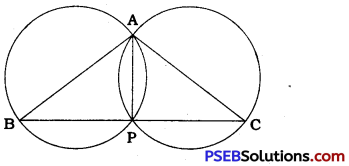
PSEB 9th Class Maths Solutions Chapter 10 Circles Ex 10.5 10
Answer:
Circles are drawn taking sides AB and AC of ∆ ABC as diameters. These circles intersect each other at points A and P.
Draw common chord AP.
Since AB is a diameter, ∠APB is an angle in a semicircle.
∴ ∠APB = 90°
Since, AC is a diameter, ∠APC is an angle in a semicircle.
∴ ∠APC = 90°
Then, ∠APB + ∠APC = 90° + 90° = 180°
∠APB and ∠APC are adjacent angles with common arm AP and their sum is 180°.
∴ ∠APB and ∠APC form a linear pair.
Hence, the point of intersection of the circles with two sides of a triangle as diameters lies on the third side of the triangle.

PSEB 9th Class Maths Solutions Chapter 10 Circles Ex 10.5

Question 11.
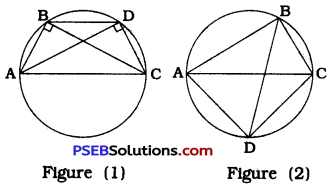
ABC and ADC are two right triangles with common hypotenuse AC., Prove that ∠CAD = ∠CBD.
Answer:
PSEB 9th Class Maths Solutions Chapter 10 Circles Ex 10.5 11
In figure (1), line segment AC subtends equal angles at two points B and D lying on the same side of AC. Hence, by theorem 10.10, all the four points lie on the same circle.
Now, ∠CAD and ∠CBD are angles in the same segment.
∴ ∠CAD = ∠CBD (Theorem 10.9)
In figure (2), in quadrilateral ABCD,
∠B = ∠D = 90°.
∴ ∠B + ∠D = 180°
Hence, ABCD is a cyclic quadrilateral.
Again, ∠CAD and ∠CBD are angles in the same segment.
∴ ∠CAD = ∠CBD (Theorem 10.9)

PSEB 9th Class Maths Solutions Chapter 10 Circles Ex 10.5

Question 12.
Prove that a cyclic parallelogram is a rectangle.
Answer:
Suppose ABCD is a cyclic parallelogram.
ABCD is a cyclic quadrilateral! .
∴ ∠A + ∠C = 180°
and ∠ B + ∠ D = 180° …….. (1)
ABCD is a parallelogram.
∴ ∠A = ∠C and ∠B = ∠D ……….. (2)
From (1) and (2),
∠A = ∠B = ∠C = ∠D = 90°
Thus, all the angles of quadrilateral ABCD are right angles.
Hence, ABCD is a rectangle.
Thus, a cyclic parallelogram is a rectangle.

PSEB 7th Class Maths Solutions Chapter 13 Exponents and Powers Ex 13.1

Punjab State Board PSEB 7th Class Maths Book Solutions Chapter 13 Exponents and Powers Ex 13.1 Textbook Exercise Questions and Answers.

PSEB Solutions for Class 7 Maths Chapter 13 Exponents and Powers Ex 13.1

1. Fill in the blanks :

(i) In the expression 37, base = …………….. and exponent = ……………..
(ii) In the expression \(\left(\frac{2}{5}\right)^{11}\), base = …………….. and exponent = ……………..
Solution:
(i) 3, 7
(ii) \(\frac {2}{5}\), 11

2. Find the value of the following :
(i) 26
(ii) 93
(iii) 55
(iv) (-6)4
(v) \(\left(-\frac{2}{3}\right)^{5}\)
Solution:
(i) 26 = 2 × 2 × 2 × 2 × 2 × 2
= 64

(ii) 93 = 9 × 9 × 9
= 729

(iii) 55 = 5 × 5 ×5 × 5 × 5
= 3125

(iv) (-6)4 = -6 × -6 × -6 × -6
= 1296

(v) \(\left(-\frac{2}{3}\right)^{5}\) = \(\frac{-2}{3} \times \frac{-2}{3} \times \frac{-2}{3} \times \frac{-2}{3} \times \frac{-2}{3}\)
= \(-\frac{32}{243}\)

PSEB 7th Class Maths Solutions Chapter 13 Exponents and Powers Ex 13.1

3. Express the following in the exponential form :
(i) 6 × 6 × 6 × 6
(ii) b × b × b × b
(iii) 5 × 5 × 7 × 7 × 7
Solution:
(i) 6 × 6 × 6 × 6 = 64
(ii) b × b × b × b = b4
(iii) 5 × 5 × 7 × 7 × 7 = 52 × 73

4. Simplify the following :

(i) 2 × 10³
Solution:
2 × 103 = 2 × 10 × 10 × 10
= 2000

(ii) 52 × 32
Solution:
52 × 32 = 5 × 5 × 3 × 3
= 25 × 9
= 225

(iii) 32 × 104
Solution:
32 × 104 = 3 × 3 × 10000
= 90000

PSEB 7th Class Maths Solutions Chapter 13 Exponents and Powers Ex 13.1

5. Simplify :
(i) (-3) × (-2)3
Solution:
(-3) × (-2)3 = -3 × -2 × -2 × -2
= -3 × -8
= 24

(ii) (-4)3 × 52
Solution:
(-4)3 × 52= -4 × -4 × -4 × 5 × 5
= 64 × 25
= -1600

(iii) (-1)99
Solution:
(-1)99 = -1
[(-1)odd number = -1]

(iv) (-3)2 × (-5)2
Solution:
(-3)2 × (-5)2 = -3 × -3 × – 5 × -5
= 9 × 25
= 225

(v) (-1)132
Solution:
(-1)132 = 1
[(-1)even number = +1]

PSEB 7th Class Maths Solutions Chapter 13 Exponents and Powers Ex 13.1

6. Identify the greater number in each of the following :

(i) 43 or 34
Solution:
43 = 4 × 4 × 4 = 64
34 = 3 × 3 × 3 × 3 = 81
81 > 64
∴ 34 > 43.

(ii) 53 or 32
Solution:
53 = 5 × 5 × 5 = 125
32 = 3 × 3 = 9
125 > 9
∴ 53 > 32.

(iii) 23 or 82
Solution:
23 = 2 × 2 × 2 = 8
82 = 8 × 8 = 64
64 > 8
∴ 82 > 23.

(iv) 45 or 54
Solution:
45 = 4 × 4 × 4 × 4 × 4 = 1024
54 = 5 × 5 × 5 × 5 = 625
1024 > 625
∴ 45 > 54.

(v) 210 or 102
Solution:
210 = 2 × 2 × 2 × 2 × 2 × 2 × 2 × 2 × 2 × 2
= 1024
102 = 10 × 10 = 100
1024 > 100
∴ 210 > 102

PSEB 7th Class Maths Solutions Chapter 13 Exponents and Powers Ex 13.1

7. Write the following numbers as power of 2 :

(i) 8
Solution:
8 = 2 × 2 × 2
\(\begin{array}{c|c}
2 & 8 \\
\hline 2 & 4 \\
\hline 2 & 2 \\
\hline & 1
\end{array}\)
= 23

(ii) 128
Solution:
128 = 2 × 2 × 2 × 2 × 2 × 2 × 2
= 27
\(\begin{array}{l|l}
2 & 128 \\
\hline 2 & 64 \\
\hline 2 & 32 \\
\hline 2 & 16 \\
\hline 2 & 8 \\
\hline 2 & 4 \\
\hline 2 & 2 \\
\hline & 1
\end{array}\)

(iii) 1024
Solution:
1024 = 2 × 2 × 2 × 2 × 2 × 2 × 2 × 2 × 2 × 2
=210
\(\begin{array}{l|l}
2 & 1024 \\
\hline 2 & 512 \\
\hline 2 & 256 \\
\hline 2 & 128 \\
\hline 2 & 64 \\
\hline 2 & 32 \\
\hline 2 & 16 \\
\hline 2 & 8 \\
\hline 2 & 4 \\
\hline 2 & 2 \\
\hline & 1
\end{array}\)

PSEB 7th Class Maths Solutions Chapter 13 Exponents and Powers Ex 13.1

8. Write the following numbers as power of 3 :

(i) 27
Solution:
27 = 3 × 3 × 3
= 33
\(\begin{array}{l|l}
3 & 27 \\
\hline 3 & 9 \\
\hline 3 & 3 \\
\hline & 1
\end{array}\)

(ii) 2187
Solution:
2187 = 3 × 3 × 3 × 3 × 3 × 3 × 3
= 37
\(\begin{array}{l|l}
3 & 2187 \\
\hline 3 & 729 \\
\hline 3 & 243 \\
\hline 3 & 81 \\
\hline 3 & 27 \\
\hline 3 & 9 \\
\hline 3 & 3 \\
\hline & 1
\end{array}\)

9. Find the value of x in each of the following:

(i) 7x = 343
Solution:
343 =7 × 7 × 7 = 73
7x = 343
7x = 73
∴ x = 3

(ii) 9x = 729
Solution:
729 =9 × 9 × 9
= 93
9x = 729
9x = 93
∴ x = 3.

(iii) (-8)x = -512
Solution:
512 = 8 × 8 × 8
= 83
(-8)x = -512
(-8)x = (-8)3
∴ x = 3.

PSEB 7th Class Maths Solutions Chapter 13 Exponents and Powers Ex 13.1

10. To what power (-2) should be raised to get 16 ?
Solution:
Let power raised be x
16 = 2 × 2 × 2 × 2
= 24
(-2)x = 24
(-2)x = (-2)4
[(-1)even number = +1]
∴ x = 4.

11. Write the prime factorization of the following numbers in the exponential form :

(i) 72
Solution:
72 = 2 × 2 × 2 × 3 × 3
= 23 × 32
\(\begin{array}{l|l}
2 & 72 \\
\hline 2 & 36 \\
\hline 2 & 18 \\
\hline 3 & 9 \\
\hline 3 & 3 \\
\hline & 1
\end{array}\)

(ii) 360
Solution:
360 = 2 × 2 × 2 × 3 × 3 × 5
= 23 × 32 × 51
\(\begin{array}{c|c}
2 & 360 \\
\hline 2 & 180 \\
\hline 2 & 90 \\
\hline 3 & 45 \\
\hline 3 & 15 \\
\hline 5 & 5 \\
\hline & 1
\end{array}\)

(iii) 405
Solution:
405 = 3 × 3 × 3 × 3 × 5
= 34 × 51
\(\begin{array}{l|l}
3 & 405 \\
\hline 3 & 135 \\
\hline 3 & 45 \\
\hline 3 & 15 \\
\hline 5 & 5 \\
\hline & 1
\end{array}\)

(iv) 648
Solution:
648 = 2 × 2 × 2 × 3 × 3 × 3 × 3
= 23 × 34
\(\begin{array}{c|c}
2 & 648 \\
\hline 2 & 324 \\
\hline 2 & 162 \\
\hline 3 & 81 \\
\hline 3 & 27 \\
\hline 3 & 9 \\
\hline 3 & 3 \\
\hline & 1
\end{array}\)

(v) 3600
Solution:
3600 = 2 × 2 × 2 × 2 × 3 × 3 × 5 × 5
= 24 × 32 × 52
\(\begin{array}{c|c}
2 & 3600 \\
\hline 2 & 1800 \\
\hline 2 & 900 \\
\hline 2 & 450 \\
\hline 3 & 225 \\
\hline 3 & 75 \\
\hline 5 & 25 \\
\hline 5 & 5 \\
\hline & 1
\end{array}\)

PSEB 6th Class Maths Solutions Chapter 6 Decimals Ex 6.3

Punjab State Board PSEB 6th Class Maths Book Solutions Chapter 6 Decimals Ex 6.3 Textbook Exercise Questions and Answers.

PSEB Solutions for Class 6 Maths Chapter 6 Decimals Ex 6.3

1. Express as rupee using decimals:

Question (i)
35 paise
Solution:
35 paise = ₹ \(\frac {35}{100}\)
= ₹ 0.35
(∵ 1 paise = ₹ \(\frac {1}{100}\))

PSEB 6th Class Maths Solutions Chapter 6 Decimals Ex 6.3

Question (ii)
4 paise
Solution:
4 paise = ₹ \(\frac {4}{100}\)
= ₹ 0.04
(∵ 1 paise = ₹ \(\frac {1}{100}\))

Question (iii)
240 paise
Solution:
240 paise = ₹ \(\frac {240}{100}\)
= ₹ 2.40
(∵ 1 paise = ₹ \(\frac {1}{100}\))

Question (iv)
12 rupees 25 paise
Solution:
= (12 rupees) + 25 paise
= ₹ 12 + ₹ \(\frac {25}{100}\)
(∵ 1 paise = ₹ \(\frac {1}{100}\))
= ₹ 12 + ₹ 0.25
= ₹ 12.25

Question (v)
24 rupees 5 paise.
Solution:
(24 rupees) + (5 paise)
= ₹ 24 + ₹ \(\frac {5}{100}\)
(∵ 1 paise = ₹ \(\frac {1}{100}\))
= ₹ 24 + ₹ 0.05
= ₹ 24.05

PSEB 6th Class Maths Solutions Chapter 6 Decimals Ex 6.3

2. Express as metre using decimals

Question (i)
5 cm
Solution:
5 cm = \(\frac {5}{100}\) m
= 0.05 m
(∵ 1cm =\(\frac {1}{100}\)m)

Question (ii)
62 cm
Solution:
62 cm = \(\frac {62}{100}\) m
= 0.62 m
(∵ 1cm =\(\frac {1}{100}\)m)

Question (iii)
135 cm
Solution:
135 cm = \(\frac {135}{100}\) m
= 1.35 m
(∵ 1cm =\(\frac {1}{100}\)m)

PSEB 6th Class Maths Solutions Chapter 6 Decimals Ex 6.3

Question (iv)
5 m 20 cm
Solution:
= 5 m + 20 cm
(∵ 1cm = \(\frac {1}{100}\)m)
= 5m + 0.20m
= 5.20m

Question (v)
12 m 8 cm
Solution:
= 12 m + 8 cm
= 12 m + \(\frac {8}{100}\)m
(∵ 1cm = \(\frac {1}{100}\)m)
12 cm + 0.08 m
= 12.08 m

3. Express as centimetre using decimals:

Question (i)
2 mm
Solution:
2 mm = \(\frac {2}{10}\) cm
(∵ 1mm = \(\frac {1}{10}\)m)
= 0.2 cm

Question (ii)
28 mm
Solution:
28mm = \(\frac {28}{10}\)cm
(∵ 1mm = \(\frac {1}{10}\)m)

PSEB 6th Class Maths Solutions Chapter 6 Decimals Ex 6.3

Question (iii)
8 cm 4 mm.
Solution:
8 cm 4 mm = 8 cm + 4 mm
= 8cm + \(\frac {4}{10}\)
= 8 cm + 0.4 cm
= 8.4 cm

4. Express as kilometre using decimals:

Question (i)
7 m
Solution:
= \(\frac {7}{1000}\)
= (∵ 1m = \(\frac {1}{1000}\) km)
= 0.007 km

Question (ii)
50 m
Solution:
= \(\frac {50}{1000}\)
= (∵ 1m = \(\frac {1}{1000}\) km)
= 0.050 km

Question (iii)
425 m
Solution:
= \(\frac {425}{1000}\)
= (∵ 1m = \(\frac {1}{1000}\) km)
= 0.425 km

PSEB 6th Class Maths Solutions Chapter 6 Decimals Ex 6.3

Question (iv)
2475 m
Solution:
= \(\frac {2475}{1000}\) km
= (∵ 1m = \(\frac {1}{1000}\) km)
= 2.475 km

Question (v)
3 km 225 m.
Solution:
= 3 km + 225 m
= 3 km + \(\frac {225}{1000}\)
= (∵ 1m = \(\frac {1}{1000}\) km)
= 3.225 km

5. Express as kilogram using decimals:

Question (i)
5g
Solution:
5g = \(\frac {5}{1000}\)
= (∵ 1g = \(\frac {1}{1000}\) km)
= 0.005 kg

Question (ii)
75g
Solution:
75g = \(\frac {75}{1000}\)
= (∵ 1g = \(\frac {1}{1000}\) km)
= 0.075 kg

PSEB 6th Class Maths Solutions Chapter 6 Decimals Ex 6.3

Question (iii)
423 g
Solution:
423 g = \(\frac {423}{1000}\)
= (∵ 1g = \(\frac {1}{1000}\) km)
= 0.423 kg

Question (iv)
1265 g
Solution:
1265 g = \(\frac {1265}{1000}\)
(∵ 1g = \(\frac {1}{1000}\) km)
= 1.265 kg

Question (v)
5 kg 418 g.
Solution:
= 5 kg + 418 g.
= 5 kg + \(\frac {418}{1000}\)
(∵ 1g = \(\frac {1}{1000}\) km)
= 5 kg + 0.418 kg
= 5.418 kg.

PSEB 6th Class Maths Solutions Chapter 6 Decimals Ex 6.3

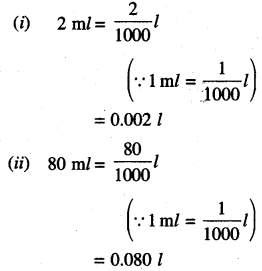
6. Express as litre using decimals:

(i) 2 ml
(ii) 80 ml
(iii) 725 ml
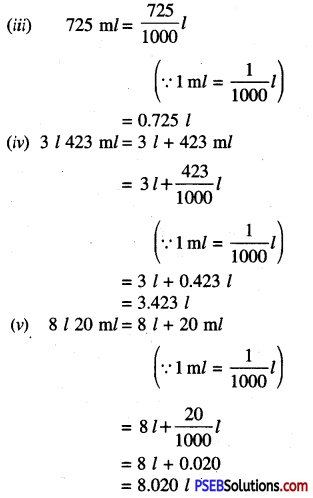
(iv) 3l 423 ml
(v) 8l 20 ml.
Solution:
PSEB 6th Class Maths Solutions Chapter 6 Decimals Ex 6.3 1
PSEB 6th Class Maths Solutions Chapter 6 Decimals Ex 6.3 2

PSEB 6th Class Maths Solutions Chapter 6 Decimals Ex 6.1

Punjab State Board PSEB 6th Class Maths Book Solutions Chapter 6 Decimals Ex 6.1 Textbook Exercise Questions and Answers.

PSEB Solutions for Class 6 Maths Chapter 6 Decimals Ex 6.1

1. Write each of the following in figures:

Question (i)
Seventy-two point one four.
Solution:
Seventy-two point one four = 72.14

PSEB 6th Class Maths Solutions Chapter 6 Decimals Ex 6.1

Question (ii)
Two hundred fifty-seven point zero eight
Solution:
Two hundred fifty-seven point zero eight = 257.08

Question (iii)
Eight point two five-six.
Solution:
Eight point two five six = 8.256

Question (iv)
Forty-five and twenty-three hundredths.
Solution:
Forty five and twenty three hundredths
= 45 + \(\frac {23}{100}\)
= 45.23

Question (v)
Six hundred twenty-one and two hundred fifty-three thousandths
Solution:
Six hundred twenty-one and two hundred fifty-three thousandths
= 621 + \(\frac {253}{1000}\)
= 621.253

PSEB 6th Class Maths Solutions Chapter 6 Decimals Ex 6.1

Question (vi)
Twelve and eight thousandths.
Solution:
Twelve and eight thousandths
= 12 + \(\frac {8}{1000}\)
= 12.008

2. Write the following decimal numbers in words:

Question (i)
12.52
Solution:
12.52 = Twelve point five two or twelve and fifty-two hundredths.

Question (ii)
7.148
Solution:
7.148 = Seven point one four eight or seven and one hundred forty-eight thousandths.

PSEB 6th Class Maths Solutions Chapter 6 Decimals Ex 6.1

Question (iii)
0.24
Solution:
0.24 = Zero Point two four or twenty-four hundredths.

Question (iv)
5.018
Solution:
5.018 = Five-point zero one eight or five and eighteen thousandths.

Question (v)
.009.
Solution:
.009 = Point zero zero nine or nine thousandths.

3. Write the following decimals in the place value table:

Question (i)
(i) 21.569
(ii) 0.64
(iii) 3.51
(iv) 14.087
(v) 3.002.
Solution:

Number Thousands Hundreds Tens Ones Tenths Hundredths Thousandths
1. 21.569 2 1 5 6 9
2. 0.64 0 6 4
3. 3.51 3 5 1
4. 14.087 1 4 0 8 7
5. 3.002 3 0 0 2

PSEB 6th Class Maths Solutions Chapter 6 Decimals Ex 6.1

4. Write the following as decimals:

Question (i)
40 + \(\frac {2}{10}\)
Solution:
40 + \(\frac {2}{10}\) = 40.2

Question (ii)
700 + 5 + \(\frac {3}{10}\) + \(\frac {4}{100}\)
Solution:
700 + 5 + \(\frac {3}{10}\) + \(\frac {4}{100}\) = 705.34

Question (iii)
100 + \(\frac {5}{100}\) + \(\frac {3}{1000}\)
Solution:
100 + \(\frac {5}{100}\) + \(\frac {3}{1000}\) = 10.053

Question (iv)
100 + \(\frac {7}{10}\) + \(\frac {4}{1000}\)
Solution:
100 + \(\frac {7}{10}\) + \(\frac {4}{1000}\) = 0.704

PSEB 6th Class Maths Solutions Chapter 6 Decimals Ex 6.1

Question (v)
\(\frac {5}{1000}\)
Solution:
\(\frac {5}{1000}\) = 0.005

5. Write the decimals shown in the following place value table:

Question (i)

Thousands Hundreds Tens Ones Tenth Hundredths Thousandths
5 2 4 1 2
2 0 3 4 2 1
6 1 0 2 3
4 0 0 1
1 0 0 0 3

Solution:
(i) 524.12
(ii) 2034.21
(iii) 61.023
(iv) 4.001
(v) 100.03

PSEB 6th Class Maths Solutions Chapter 6 Decimals Ex 6.1

6. Expand the following decimals.

Question (i)
2.5
Solution:
2.5 = 2 + 0.5
= 2 + \(\frac {5}{10}\)

Question (ii)
18.43
Solution:
18.43 = 10 + 8 + 0.4 + 0.03
= 10 + 8 + \(\frac {4}{10}\) + \(\frac {3}{100}\)

Question (iii)
4.05
Solution:
4.05 = 4 + 0.05
= 4 + \(\frac {5}{100}\)

Question (iv)
13.123
Solution:
13.123 = 10 + 3 + 0.1 + 0.02 + 0.003
= 10 + 3 + \(\frac {1}{10}\) + \(\frac {2}{100}\) + \(\frac {3}{1000}\)

PSEB 6th Class Maths Solutions Chapter 6 Decimals Ex 6.1

Question (v)
245.456
Solution:
245.456 = 200 + 40 + 5 + 0.4 + 0.05 + 0.006
= 200 + 40 + 5 + \(\frac {4}{10}\) + \(\frac {5}{100}\) + \(\frac {6}{1000}\)

Question (vi)
20.057
Solution:
20.057 = 20 + 0.05 + 0.007
= 20 + \(\frac {5}{100}\) + \(\frac {7}{1000}\)

PSEB 10th Class Maths Solutions Chapter 5 Arithmetic Progressions Ex 5.3

Punjab State Board PSEB 10th Class Maths Book Solutions Chapter 5 Arithmetic Progressions Ex 5.3 Textbook Exercise Questions and Answers.

PSEB Solutions for Class 10 Maths Chapter 5 Arithmetic Progressions Ex 5.3

Question 1.
Find the sum of the following APs:
(i) 2, 7, 12, … to 10 terms.
(ii) – 37, – 33, – 29, ………….. to 12 terms.
(iii) 0.6, 1.7, 2.8, … to 100 terms.
(iv) \(\frac{1}{5}\), \(\frac{1}{12}\), \(\frac{1}{10}\), ………… to 11 terms.
Solution:
(i) Given AP. is 2, 7, 12, …
Here a = 2, d = 7 – 2 = 5 and n = 10
Sn = \(\frac{n}{2}\) [2a + (n – 1) d]
∴ S10 = \(\frac{10}{2}\) [2 × 2 + (10 – 1)5]
= 5 [4 + 45] = 245.

(ii) Given A.P. is – 37, – 33, – 29…
Here a = -37, d = – 33 + 37 = 4 and n = 12
Sn = \(\frac{n}{2}\) [2a + (n – 1) d]
∴ S12 = [2(-37) + (12 – 1)4]
= 6 [- 74 + 44] = – 180.

PSEB Solutions PSEB 10th Class Maths Solutions Chapter 5 Arithmetic Progressions Ex 5.3

(iii) Given A.P. is 0.6, 1.7. 2.8.
Here a = 0.6, d = 1.7 – 0.6 = 1.1 and n = 100
Sn = \(\frac{n}{2}\) [2a+(n – 1) d]
∴ S100 = \(\frac{100}{2}\) [2(0.6) + (100 – 1) 1.1]
= 50 [1.2 + 108.9] = 5505.

(iv) Given AP. is \(\frac{1}{5}\), \(\frac{1}{12}\), \(\frac{1}{10}\), ………… to 11 terms.
Here a = \(\frac{1}{5}\), d = \(\frac{1}{5}\) and n = 11
Sn = \(\frac{n}{2}\) [2a +(n – 1)d]
∴ S11 = \(\frac{11}{2}\left[2\left(\frac{1}{15}\right)+(11-1) \frac{1}{60}\right]\)

= \(\frac{11}{2}\left[\frac{2}{15}+\frac{10}{60}\right]=\frac{11}{2}\left[\frac{2}{15}+\frac{1}{6}\right]\)

= \(\frac{11}{2}\left[\frac{4+5}{30}=\frac{9}{30}\right]=\frac{33}{20}\).

PSEB Solutions PSEB 10th Class Maths Solutions Chapter 5 Arithmetic Progressions Ex 5.3

Question 2.
Find the sums given below:
(i) 7+ 10\(\frac{1}{2}\) + 14 + …………… + 84
(ii) 34 + 32 + 30 + ………. + 10
(iii) – 5 + (- 8) + (- 11) +………+ (- 230)
Solution:
(i) Given A.P. is
7 + 10\(\frac{1}{2}\) + 14 + ………….. + 84
Here a = 7, d = 10\(\frac{1}{2}\) – 7 = \(\frac{21}{2}\) – 7
= \(\frac{21-14}{2}=\frac{7}{2}\)
and l = Tn = 84
or a + (n – 1) d = 84
or 7 + (n – 1) \(\frac{7}{2}\) = 84
or (n – 1) \(\frac{7}{2}\) = 84 – 7 = 77
or n – 1 = 77 × \(\frac{2}{7}\) =22
n = 22 + 1 = 23
∵ Sn = \(\frac{n}{2}\) [a + l]
Now, S23 = \(\frac{23}{2}\) [7 + 84]
= \(\frac{23}{2}\) × 91 = \(\frac{2093}{2}\).

(ii) Given A.P. is 34 + 32 + 30 + …………… + 10
Here a = 34, d = 32 – 34 = -2
l = Tn = 10
a + (n – 1) d = 10
or 34 + (n – 1) (- 2) = 10
or – 2(n – 1) = 10 – 34 = -24
or n – 1 = 12
n = 12 + 1 = 13
[∵ Sn = \(\frac{n}{2}\) [a + l]]
Now, S13 = \(\frac{13}{2}\) [34 + 10]
= \(\frac{23}{2}\) × 44
= 13 × 22 = 286.

PSEB Solutions PSEB 10th Class Maths Solutions Chapter 5 Arithmetic Progressions Ex 5.3

(iii) Give A.P. is – 5 + (- 8) + (- 11) + ……………. + (- 230)
Here a = – 5, d = – 8 + 5 = – 3
and l = Tn = – 230
a + (n – 1) d = – 230
or – 5 + (n – 1) (- 3) = – 230
or – 3(n – 1) = – 230 + 5 = – 225
or n – 1 = \(\frac{225}{3}\) = 75
or n = 75 + 1 = 76
Now, S76 = \(\frac{76}{2}\) [- 5 + (- 23o)]
= 38 (- 235) = – 8930.

Question 3.
In an AP:
(i) given a = 5, d = 3, an = 50 find n and Sn.
(ii) given a = 7. a13 = 35, find d and S13.
(iii) given a12 = 37, d = 3. find a and S12.
(iv) given a3 = 15, S10 = 125, find d and a10.
(y) given d = 5, S9 = 75, find a and a9.
(vi) given a = 2, d = 8, Sn = 90, find n and an.
(vii) given a = 8, an = 62, Sn = 210, find n and d.
(viii)given an = 4, d = 2, Sn = -14, find n and a.
(ix) given a = 3, n = 8, S = 192, find d.
(x) given l = 28, S = 144, and there are total 9 terms. Find a.
Solution:
(i) Given a = 5, d = 3, an = 50
an = 50
a + (n – 1) d = 50
or 5 + (n – 1) 3 = 50
or 3 (n – 1) = 50 – 5 = 45
or n – 1 = \(\frac{45}{3}\) = 15
or n = 15 + 1 = 16
Now, Sn = latex]\frac{n}{2}[/latex] [a + l]
= latex]\frac{16}{2}[/latex] [5 + 50] = 8 × 55 = 440.

PSEB Solutions PSEB 10th Class Maths Solutions Chapter 5 Arithmetic Progressions Ex 5.3

(ii) Given a = 7, a13 = 35
a13 = 35
a + (n – 1) d = 35
or 7 + (13 – 1) d = 35
or 12 d = 35 – 7 = 28
or d = \(\frac{7}{3}\).
∵ [Sn = latex]\frac{n}{2}[/latex] [a + l]
Now, S13 = \(\frac{13}{2}\) [7 + 35]
= \(\frac{13}{2}\) × 42 = 273

(iii) Given a12 = 37, d = 3
∵ a12 = 37
a + (n – 1) d = 37
or a + (12 – 1) 3 = 37
a + 33 = 37
a = 37 – 33 = 4
∵ [Sn = latex]\frac{n}{2}[/latex] [a + l]
Now, S12 = \(\frac{13}{2}\) [4 + 37]
= 6 × 41 = 246.

PSEB Solutions PSEB 10th Class Maths Solutions Chapter 5 Arithmetic Progressions Ex 5.3

(iv)Given a3 = 15, S10 = 125
∵ a3 = 15
a + (n – 1) d = 15
a + (3 – 1) d = 15
or a + 2d = 15 …………….(1)
∵ S10 = 125
∵ [Sn = latex]\frac{n}{2}[/latex] [2a + (n – 1)d]
\(\frac{10}{2}\) [2a + (10 – 1) d] = 125
or 5[2a + 9d] = 125
Note this
or 2a + 9d = \(\frac{125}{5}\) = 25
or 2a + 9d = 25 …………(2)
From (1), a = 15 – 24 …………..(3)
Substitute this value of (a) in (2i, we c1
2(15 – 2d) + 9d = 25
or 30 – 4d + 9d = 25
5d = 25 – 30
or d = \(\frac{-5}{5}\) = -1
Substitute this value of d in (3), we get
a = 15 – 2(- 1)
a = 15 + 2 = 17
Now, a10 = 17 + (10 – 1)(- 1)
∵ Tn = a + (n – 1) d = 17 – 9 = 8.

(v) Given d = 5, S9 = 75
∵ S9 = 75
∵ [Sn = \(\frac{n}{2}\) [2a + (n – 1)d]
\(\frac{9}{2}\) [2a + 40] = 75
or [2a + 40] = \(\frac{50}{3}\)
or 2a = \(\frac{50}{3}\) – 40
or a = \(-\frac{70}{3} \times \frac{1}{2}\)
or a = – \(\frac{35}{3}\)
Now, a9 = a + (n – 1) d
= – \(\frac{35}{3}\) + (9 – 1)0 × 5
= – \(\frac{35}{3}\) + 4o = \(\frac{-35+120}{3}\)
a9 = \(\frac{85}{3}\).

PSEB Solutions PSEB 10th Class Maths Solutions Chapter 5 Arithmetic Progressions Ex 5.3

(vi) Given a = 2, d = 8, Sn = 90
∵ Sn = 90
\(\frac{n}{2}\) [2a + (n – 1)d] = 9o
or \(\frac{n}{2}\) [2 × 2 + (n – 1) 8] = 90
or n [2 + 4n – 4] = 90
or n (4n – 2) = 90
or 4n2 – 2n – 90 = 0
or 2n2 – 10n + 9n – 45 = 0
S = – 2
P = – 45 × 2 = – 90
or 2n [n – 5] + 9(n – 5) = 0
or (2n + 9) (n – 5) = 0
Either 2n + 9 = 0 or n – 5 = 0
Either n = – \(\frac{9}{2}\) or n = 5
∵ n cannot be negative so reject n = – \(\frac{9}{2}\)
∴ n = 5
Now, an = a5 = a + (n – 1) d
= 2 + (5 – 1) 8 = 2 + 32 = 34.

(vii) Given a = 8, an = 62, Sn = 210
∵ Sn = 210
\(\frac{n}{2}\) [a + an] = 210
or \(\frac{n}{2}\) [8 + 62] = 210
or \(\frac{n}{2}\) × 70 = 210
or n = \(\frac{210}{35}\) = 6
Now, an = 62
[∵ Tn = a + (n – 1) d]
or 5d = 62 – 8 = 54
or d = \(\frac{54}{5}\).

PSEB Solutions PSEB 10th Class Maths Solutions Chapter 5 Arithmetic Progressions Ex 5.3

(viii) Given an = 4, d = 2, Sn = – 14
∵ an = 4
a + (n – 1) d = 4
or a + (n – 1)2 = 4
or a + 2n – 2 = 4
or a = 6 – 2n ……………(1)
and Sn = – 14
\(\frac{n}{2}\) [a + an] = – 14
or \(\frac{n}{2}\) [6 – 2n +4] = – 14 (Using (1))
or \(\frac{n}{2}\) [10 – 2n] = – 14
or 5n – n2 + 14 = 0
or n2 – 5n – 14 = 0
S = – 5
P = 1 × – 14 = – 14
or n2 – 7n + 2n – 14 = 0
or n(n – 7) + 2 (n – 7) = 0
or (n – 7) (n + 2) = 0
either n – 7 = 0
or n + 2 = 0
n = 7 or n = -2
∵ n cannot be negative so reject n = – 2
∴ n = 7
Substitute this value of n in (1), we get
a = 6 – 2 × 7
a = 6 – 14 = – 8.

(ix) Given a = 3, n = 8, S = 192
∵ S = 192
S8 = 192 [∵ n = 8]
∵ Sn = \(\frac{n}{2}\) [2a + (n – 1)d]
or \(\frac{8}{2}\) [2 × 3 + (8 – 1) d] = 192
or 4 [6 + 7d] = 192
6 + 7d = \(\frac{192}{4}\) = 48
or 7d = 48 – 6 = 42
or d = \(\frac{42}{6}\) = 6.

PSEB Solutions PSEB 10th Class Maths Solutions Chapter 5 Arithmetic Progressions Ex 5.3

(x) Given l = 28, S = 144 and there are total 9 terms
∴ n = 9; l = a9 = 28; S9 = 144
∵ a9 = 28
or a + (9 – 1) d = 28
∵ [an = Tn = a + (n – 1) d ]
or a + 8d = 28 …………….(1)
and S9 = 144
∵ [Sn = \(\frac{n}{2}\) [a + an]]
\(\frac{9}{2}\) [a + 28] = 144
or a + 28 = \(\frac{144 \times 2}{9}\) = 32
a = 32 – 28 = 4.

Question 4.
How many terms of the A.P : 9, 17, 5… must be taken to give a sum of 636?
Solution:
Given A.P. is 9, 17, 25, …………
Here a = 9, d = 17 – 9 = 8
But Sn = 636
\(\frac{n}{2}\) [2a + (n – 1) d] = 636
or \(\frac{n}{2}\) [2(9) + (n – 1) 8] = 636
or \(\frac{n}{2}\) [18 + 8n – 8] = 636
or n [4n + 5] = 636
or 4n2 + 5n – 636 = 0
a = 4, b = 5, c = – 636
D = (5) – 4 × 4 × (- 636)
= 25 + 10176 = 10201
∴ n = \(\frac{-b \pm \sqrt{\mathrm{D}}}{2 a}\)

= \(\frac{-5 \pm \sqrt{10201}}{2 \times 4}=\frac{-5 \pm 101}{8}\)

= \(\frac{-106}{8} \text { or } \frac{96}{8}\)

= \(-\frac{53}{4}\) or 12
∴ n cannot be negative so reject n = \(-\frac{53}{4}\)
∴ n = 12
Hence, sum of 12 terms of given A.P. has sum 636.

PSEB Solutions PSEB 10th Class Maths Solutions Chapter 5 Arithmetic Progressions Ex 5.3

Question 5.
The first term ofan AP is 5, the last term is 45 and the sum Is 400. Find the number of terms and the common difference.
Solution:
Given that a = T1 = 5; l = an = 45
and Sn = 400
∴ Tn = 45
a + (n – 1) d = 45
or 5 + (n – 1) d = 45
or (n – 1) d = 45 – 5 = 40
or (n – 1) d = 40 ……………….(1)
and Sn = 400
\(\frac{n}{2}\) [a + an] = 400
or \(\frac{n}{2}\) [5 + 45] = 400
or 25 n = 400
or n = \(\frac{400}{25}\) = 16
Substitute this value of n in (1), we get
(16 – 1) d = 40
or 15d = 40
d = \(\frac{40}{15}\) = \(\frac{8}{3}\)
Hence, n = 16 and d = \(\frac{8}{3}\)

Question 6.
The first and last terms of an AP are 17 and 350 respectively. 1f the common difference is 9, how many terms are there
and what is their sum?
Solution:
Given that a = T1 = 17;
l = an = 350 and d = 9
∵ l = an = 350
a + (n – 1) d = 350
17 + (n – 1) 9 = 350
or 9 (n – 1) = 350 – 17 = 333
or n – 1 = \(\frac{333}{9}\) = 37
n = 37 + 1 = 38
Now, S38 = \(\frac{n}{2}\) [a + l]
= \(\frac{38}{2}\) (17 + 350]
= 19 × 367 = 6973.
Hence, sum of 38 terms of given A.P. arc 6973.

PSEB Solutions PSEB 10th Class Maths Solutions Chapter 5 Arithmetic Progressions Ex 5.3

Question 7.
Find the sum of first 22 terms of an AP. in which d = 7 and 22nd term is 149.
Solution:
Given that d = 7; T22 = 149 and n = 22
∵ T22 = 149
a + (n – 1) d = 149
or a + (22 – 1) 7 = 149
or a + 147 = 149
or a = 149 – 147 = 2
Now, S22 = [a + T22]
= \(\frac{22}{2}\) [2+ 149] = 11 × 151 = 1661
Hence, sum of first 22 temis of given A.P. is 1661.

Question 8.
Find the sum of first 51 terms of an AP whose second and third terms are 14 and 18 respectively.
Solution:
Let ‘a’ and ‘d’ be fïrst term and common difference
Given that T2 = 14; T3 = 18 and n = 51
∵ T2 = 14
a + (n – 1) d = 14
a + (2 – 1)d = 14
or a + d = 14
a = 14 – d …………….(1)
and T3 = 18 (Given)
a + (n – 1) d = 18
a + (3 – 1) d = 18
or a + 2d = 18
or 14 – d + 2d = 18
or d = 18 – 14 = 4
or d = 4
Substitute this value of d in (1), we get
a = 14 – 4 = 10
Now, S51 = \(\frac{n}{2}\) [2a + (n – 1) d]
= \(\frac{51}{2}\) [2 × 10 + (51 – 1) 4]
= \(\frac{51}{2}\) [2o + 2oo]
= \(\frac{51}{2}\) × 220 = 51 × 110 = 5610
Hence, sum of first 51 terms of given A.P. is 5610.

PSEB Solutions PSEB 10th Class Maths Solutions Chapter 5 Arithmetic Progressions Ex 5.3

Question 9.
If the sum of first 7 terms of an AP is 49 and that of 17 terms is 289, find the sum of first n terms.
Solution:
Let ‘a’ and ‘d’ be the first term and common difference of given A.P.
According to 1st condition
S7 = 49
\(\frac{n}{2}\) [2a + (n – 1) d] = 49
or \(\frac{7}{2}\) [2a + (7 – 1) d] = 49
or \(\frac{7}{2}\) [2a + 6d] = 49
or a + 3d = 7
or a = 7 – 3d
According to 2nd condition
S17 = 289
\(\frac{n}{2}\) [2a+(n – 1)d]=289
\(\frac{17}{2}\) [2a + (17 – 1) d] = 289
a + 8d = \(\frac{289}{17}\) = 17
Substitute the value of a from (1), we get
7 – 3d + 8d = 17
5d = 17 – 7 = 10
d = \(\frac{10}{5}\) = 2
Substitute this value of d in (1), we get
a = 7 – 3 × 2
a = 7 – 6 = 1
Now, Sn = \(\frac{n}{2}\) [2a + (n – 1) d]
= \(\frac{n}{2}\) [2 × 1 + (n – 1) × 2] = n [I + n – 1] = n × n = n2
Hence, sum of first n terms of given A.P. is n2.

Question 10.
Show that a1, a2, ……., an, … form an AP where is defined as below.
(i) an = 3 + 4n
(ii) an = 9 – 5n
Also find the sum of the first 15 terms In each case.
Solution:
(i) Given that an = 3 + 4n ………..( 1)
Putting the different values of n in(1), we get
a1 = 3 + 4(1) = 7;
a2 = 3 + 4 (2) = 11
a3 = 3 + 4 (3) = 15, …………
Now, a2 – a1 = 11 – 7
and a3 – a2 = 15 – 11 = 4
a2 – a1 = 11 – 7 = 4
and a3 – a2 = 4 = d(say)
∵ given sequence form an A.P.
Here a = 7, d = 4 and n = 15
∴ S15 = \(\frac{n}{2}\) [2a + (n – 1)d]
= \(\frac{15}{2}\) [2(7) + (15 – 1) 4]
= \(\frac{15}{2}\) [14 + 56] = \(\frac{15}{2}\) × 70
= 15 × 35 = 525.

PSEB Solutions PSEB 10th Class Maths Solutions Chapter 5 Arithmetic Progressions Ex 5.3

(ii) Given that an = 9 – 5n ……………….(1)
Putting the different values of n is (1), we get
a1 = 9 – 5(1) = 4;
a2 = 9 – 5(2) = -1;
a3 = 9 – 5(3) = -6.
Now, a2 – a1 = – 1 – 4 = – 5
and a3 – a2 = – 6 + 1 = – 5
∵ a – a1 = a3 – a2 = – 5 = d (say)
∴ given sequence form an A.P.
Here a = 4, d = – 5 and n = 15
∴ S15 = \(\frac{n}{2}\) [2a + (n – 1) d]
= \(\frac{15}{2}\) [2(4) + (15 – 1) (-5)]
= \(\frac{15}{2}\) [8 – 70]
= \(\frac{15}{2}\) (-62) = – 465

Question 11.
If the sum of the first n terms of an AP is 4n – n2, what is the first term (that is S1) ? What is the sum of two terms? What is the second term ? Similarly, find the 3rd, the 10th and the nth terms.
Solution:
Given that, sum of n terms of an A.P. are
Sn = 4n – n2
Putting n = 1 in (1), we get
S1 = 4(1) – (1)2 = 4 – 1
S1 = 3
∴ a = T1 = S1 = 3
Putting n = 2, in (1), we get
S2 = 4(2) – (2)2 = 8 – 4
S2 = 4
or T1 + T2 = 4
or 3 + T2 = 4
or T2 = 4 – 3 = 1
Putting n = 3 in (1), we get
S3 =4(3) – (3)2 = 12 – 9
S3 = 3
or S2 + T3 = 3
or 4+ T3 = 3
or T3 = 3 – 4 = – 1
Now, d = T2 – T1
d = 1 – 3 = -2
∴ T10 = a + (n – 1) d
= 3 + (10 – 1) (- 2)
T10 = 3 – 18 = – 15
and Tn = a + (n – 1) d
= 3 + (n – 1) (- 2)
= 3 – 2n + 2
Tn = 5 – 2n.

PSEB Solutions PSEB 10th Class Maths Solutions Chapter 5 Arithmetic Progressions Ex 5.3

Question 12.
Find the sum of the first 40 positive integers divisible by 6.
Solution:
Positive integers divisible by 6 are 6, 12, 18, 24, 30, 36 42, …
Here a = T1 = 6, T2 = 12, T3 = 18, T4 = 24
T2 – T1 = 12 – 6 = 6
T3 – T2 = 18 – 12 = 6
T4 – T3 = 24 – 18 = 6
∵ T2 – T1 = T3 – T2 = T4 – T3 = 6 = d (say)
Using formula, Sn = \(\frac{n}{2}\) [2a + (n – 1) d]
S40 = \(\frac{40}{2}\) [2(6) + (40 – 1)6].
= 20 [12 + 234]
= 20 (246) = 4920
Hence, sum of first 40 positive integers divisible by 6 is 4920.

Question 13.
Find the sum of first 15 multiples of 8.
Solution:
Multiples of 8 are 8, 16, 24, 32, 40, 48, …………..
Here a = T1 = 8; T2 = 16; T3 = 24 ; T4 = 32
T2 – T1 = 16 – 8= 8
T3 – T2 = 24 – 16=8
T2 – T1 = T3 – T2 = 8 = d(say)
Ùsing formula. Sn = [2a + (n – 1) d}
S15 = \(\frac{15}{2}\) [2(8) + (15 – 1) 8]
= \(\frac{15}{2}\) [16 + 112]
= \(\frac{15}{2}\) × 128 = 960
Hence, sum of first 15 multiples of 8 is 960.

PSEB Solutions PSEB 10th Class Maths Solutions Chapter 5 Arithmetic Progressions Ex 5.3

Question 14.
Find the sum of the odd numbers between 0 and 50.
Solution:
Odd numbers between 0 and 50 are 1, 3, 5, 7, 9, …………, 49
Here a = T1 = 1; T2 = 3; T3 = 5 ; T4 = 7
and l = Tn = 49
T2 – T1 = 3 – 1 = 2
T3 – T2 = 5 – 3 = 2
∵ T2 – T1 = T3 – T2 = 2 = d (say)
Also, l = Tn = 49
a + (n – 1) d = 49
1 + (n – 1) 2 = 49
or 2 (n – 1) = 49 – 1 = 48
n – 1 = \(\frac{48}{2}\) = 24
n = 24 + 1 = 25.
Using formula, Sn = \(\frac{n}{2}\) [2a + (n – 1) d]
S25 = \(\frac{25}{2}\) [2(1) + (25 – 1)2]
= \(\frac{25}{2}\) [2 + 48]
= \(\frac{25}{2}\) × 50 = 625
Hence, sum of the odd numbers between 0 and 50 are 625.

Question 15.
A contract on construction job specifies a penalty for delay of completion beyond a certain date as follows: ₹ 200 for
the first day, ₹ 250 for the second day, ₹ 300 for the third day, etc., the penalty for each succeeding day being ₹ 50 more than for the preceding day, How much money the contractor has to pay as penalty, if he hasdelayed the work by 30 days?
Solution:
Penalty (cost) for delay of one, two, third day are ₹ 200, ₹ 250, ₹ 300
Now, penalty increase with next day with a difference of ₹ 50.
∴ Required A.P. are ₹ 200, ₹ 250, ₹ 300, ₹ 350, …
Here a = T1 = 200; d = ₹ 50 and n = 30
Amount of penalty gives after 30 days
= S30
= \(\frac{n}{2}\) [2a + (n – 1) d]
= \(\frac{30}{2}\) [2(2oo) + (30 – 1) 50)
= 15 [400 + 1450]
= 15 (1850) = 27750
Hence, ₹ 27350 pay as penalty by the contractor if he has delayed the work 30 days.

PSEB Solutions PSEB 10th Class Maths Solutions Chapter 5 Arithmetic Progressions Ex 5.3

Question 16.
A sum of ₹ 700 is to be used to give seven cash prizes to students of a school for their overall academic performance. If
each prize is ₹ 20 less than its preceding prize, find the value of each of the prizes.
Solution:
Let amount of prize given to 1st student = ₹ x
Amount of prize given to 2nd student = ₹ (x – 20)
Amount of prize given to 3rd student = ₹ [x – 20 – 20] = ₹ (x – 40)
and so on.
∴ Required sequence are ₹ x, ₹ (x – 20), ₹ (x – 40), … which form on A.P. with
a = ₹ x, d = – 20 and n = 7
Using formula, Sn = \(\frac{n}{2}\) [2a + (n – 1) d]
S7 = \(\frac{7}{2}\) [2(x) + (7 – 1) (- 20)]
S7 = \(\frac{7}{2}\) [2x – 120] = 7 (x – 60)
According to question,
7 (x – 60) = 700
x – 60 = 7 = 100
x – 60 = 7 = 100
x = 100 + 60
x = 160
Hence, 7 prizes are ₹ 160, ₹ 140, ₹ 120, ₹ 100, ₹ 80, ₹ 60, ₹ 40.

Question 17.
In a school, student thought of planting trees in and around the school to reduce air pollution. It was decided that
number of trees, that each section of each class will plant, will be the same as the class, in which they are studying, e.g. – a section of Class I will plant 1 tree, a section of Class II will plant 2 trees and so on till Class XII. There are three sections of each class. How many trees will be planted by the students?
Solution:
Number of trees planted by three sections of class I = 3 × 1 = 3
Number of trees planted by three sections of class II = 3 × 2 = 6
Number of trees planted by three sections of class III = 3 × 3 = 9
…………………………………………………………………..
…………………………………………………………………..
……………………………………………………………………
Number of trees planted by three sections of class XII = 3 × 12 = 36
:. Required A.P. are 3, 6, 9, …………., 36
Here a = T1 = 3; T2 = 6; T3 = 9
and l = Tn = 36; n = 12
d = T2 – T1 = 6 – 3 = 3
Total number of trees planted by students
= S12
= \(\frac{n}{2}\) [a + l]
= \(\frac{12}{2}\) [3+ 36]
= 6 × 39 = 234
Hence, 234 trees will be planted by students to reduce air pollution.

PSEB Solutions PSEB 10th Class Maths Solutions Chapter 5 Arithmetic Progressions Ex 5.3

Question 18.
A spiral is made up of successive semicircics, with centres alternately at A and B, starting with centre at A, of radii 0.5 cm, 1.0 cm, 1.5 cm, 2.0 cm, …. as shown in Fig. What is the total length of such a spiral made up of thirteen consecutive semicircies? (Take π = \(\frac{22}{7}\))
[Hint: Length of successive semicircies is ‘l1’ ‘l2’ ‘l3‘ ‘l4‘ … wIth centres at A, B, A, B, …, respectively.]
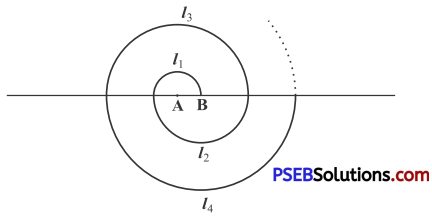
PSEB 10th Class Maths Solutions Chapter 5 Arithmetic Progressions Ex 5.3 1

Solution:
Let l1 = length of first semi circle = πr1 = π(0.5) = \(\frac{\pi}{2}\)
l2 = length of second semi circlem = πr2= π(1) = π
l3 = length of third semi circle = πr3 = π(1.5) = \(\frac{3 \pi}{2}\)
and l4 = length of fourth senil circle = πr4 = π(2) = 2π and so on
∵ length of each successive semicircle form an A.P.
Here
a = T1 = \(\frac{\pi}{2}\); T2 = π;
T3 = \(\frac{3 \pi}{2}\); T4 = 2π……… and n = 13
d = T2 – T1 = π – \(\frac{\pi}{2}\)
= \(\frac{2 \pi-\pi}{2}=\frac{\pi}{2}\)
Length of whole spiral = S13
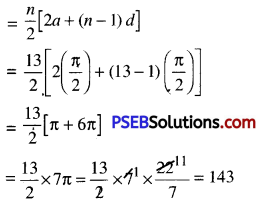
PSEB 10th Class Maths Solutions Chapter 5 Arithmetic Progressions Ex 5.3 2

Hence, total length of a spiral made up of thirteen consecutive semi circies is 143 cm

Question 19.
200 logs are stacked in the following manner : 20 logs in the bottom row, 19 in the next row, 18 in the row next to it and so on (see Fig). In how many rows are the 200 logs placed and how many logs are in the top row?

PSEB 10th Class Maths Solutions Chapter 5 Arithmetic Progressions Ex 5.3 3

Solution:
Number of logs in the bottom (1st row) = 20
Number of logs in the 2nd row = 19
Number of log in the 3rd row = 18 and so on.
∴ Number of logs in the each steps form an
Here a = T1 = 20; T2 = 19; T3 = 18…
d = T2 – T1 = 19 – 20 = – 1
Let S, denotes the number logs.
Using formula, Sn = \(\frac{n}{2}\) [2a + (n – 1) d]
= \(\frac{n}{2}\) [2 (20) + (n – 1) (-1)]
∴ Sn = \(\frac{n}{2}\) [40 – n + 1]
= \(\frac{n}{2}\) [41 – n]
According to question,
\(\frac{n}{2}\) [41 – n] = 200
or 41 – n2 = 400
or – n2 + 41n – 400 = 0
or n2 – 41n + 400 = 0
S = – 41, P = 400
or n2 – 16n – 25n + 400 = 0
or n (n – 16) – 25 (n – 16)=0
or (n – 16) (n – 25) = 0
Either n – 16 = 0 or n – 25 = 0
Either n = 16 or n = 25
∴ n = 16, 25.
Case I:
When n = 25
T25 = a + (n – 1) d
= 20 + (25 – 1)(- 1)
= 20 – 24 = – 4;
which is impossible
∴ n = 25 rejected.

Case II. When n = 16
T16 = a + (n – 1) d
= 20 + (16 – 1)(- 1)
= 20 – 15 = 5
Hence, there are 16 row and 5 logs are in the top row.

PSEB Solutions PSEB 10th Class Maths Solutions Chapter 5 Arithmetic Progressions Ex 5.3

Question 20.
In a potato race a bucket ¡s placed at the starting point which Ls 5 m from the first potato, and the other potatoes are placed 3 m apart in a straight line. There are ten potatoes in the line (see Fig.)

PSEB 10th Class Maths Solutions Chapter 5 Arithmetic Progressions Ex 5.3 4

Each competitor starts from the bucket, picks up the nearest potato, runs back with It, drops It in the bucket, runs back to pick up the next potato, runs to the bucket to drop it In, and the continues in the same way until all the potatoes are in the bucket. What is the total distance the competitor has to run?
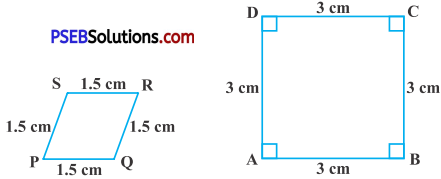
(Hint : To pick up the first potato and second potato, the distance run is [2 × 5 + 2 × (5 + 3)] m)
Solution:
Distance covered to pick up the Ist potato = 2(5) m = 10 m
Distance between successive potato = 3 m
distance covered to pick up the 2nd potato = 2(5 + 3) m = 16 m
Distance covered to pick up the 3rd potato = 2 (5 + 3 + 3) m = 22 m
and this process go on. h is clear that this situation becomes an A.P. as 10 m, 16 m, 22 m, 28 m, …
Here a = T1 = 10; T2 = 16; T3 = 22, …
d = T2 – T1 = 16 – 10 = 6 and n = 10
∴ Total distance the competitor has to run = S10
= \(\frac{n}{2}\) [2a + (n – 1) d]
= \(\frac{10}{2}\) [2(10) + (10 – 1) 6]
= 5 [20 + 54]
= 5 × 74 = 370
Hence, 370 m is the total distance run by a competitor.