PSEB 7th Class Social Science Notes Chapter 21 Media and Democracy

This PSEB 7th Class Social Science Notes Chapter 21 Media and Democracy will help you in revision during exams.

Media and Democracy PSEB 7th Class SST Notes

→ Media: When we contact people through different means, this is called media.

→ For example newspaper, radio, television, cinema, advertisement, etc.

→ Media and Democracy: Media is the basis of democracy.

→ It shows the inappropriate acts of the Govt and helps to create healthy public opinion.

PSEB 7th Class Social Science Notes Chapter 21 Media and Democracy

→ Press: Press (newspapers, magazines, books, etc.) is the most important media. It is known as the lighthouse of democracy.

→ Accountability of Media: It is hoped from the media that it should communicate right and true information to the public.

→ The whole activities should be directed towards public welfare.

→ Right to information ordinance: It means people have the right to get information about such matters which directly or indirectly affect their lives.

→ Advertisement: It means to give information to the people about the whereabouts of the commodity, its qualities, and workability.

→ The objective is to induce the demand and sales of the commodity.

जनसंचार माध्यम तथा लोकतन्त्र PSEB 7th Class SST Notes

→ जन संचार माध्यम (मीडिया) – लोगों के समूह के साथ अलग-अलग ढंग से सम्पर्क करने को जन संचार माध्यम (मीडिया) कहते हैं।

→ ये ढंग हैं-समाचार-पत्र, रेडियो, टेलीविज़न, सिनेमा, राजनीतिक दल, चुनाव एवं प्रैस (विज्ञापन) आदि।

→ मीडिया और लोकतन्त्र – मीडिया लोकतन्त्र का आधार है। यह सरकार के अनुचित कार्यों को उजागर करते हैं और स्वस्थ लोकमत का निर्माण करते हैं।

→ प्रेस – प्रेस (समाचार पत्र, पत्रिकाएं, पुस्तकें आदि) सबसे महत्त्वपूर्ण मीडिया है। इसे लोकतन्त्र का प्रकाश स्तम्भ कहा जाता है।

→ मीडिया का उत्तरदायित्व – मीडिया से यह आशा की जाती है कि वह लोगों तक प्रतिदिन सही एवं सच्ची सूचना का संचार करे। मीडिया की पूरी कार्यवाही लोकहित में होनी चाहिए।

→ सूचना अधिकार अधिनियम – सूचना अधिकार अधिनियम से तात्पर्य है कि लोगों को ऐसी सूचना लेने का पूरा अधिकार है, जिसका प्रभाव उन पर प्रत्यक्ष या परोक्ष रूप से पड़ता है।

→ विज्ञापन – विज्ञापन का अर्थ है लोगों को किसी वस्तु के प्राप्ति स्थान तथा गुणों एवं कार्यशैली की जानकारी देना। इसका उद्देश्य किसी वस्तु की मांग और बिक्री को बढ़ाना है।

ਜਨੰਤਕ ਸੰਚਾਰ (Media) ਅਤੇ ਲੋਕਤੰਤਰ PSEB 7th Class SST Notes

→ ਜਨਤਕ ਸੰਚਾਰ (ਮੀਡੀਆ)-ਲੋਕਾਂ ਦੇ ਸਮੂਹ ਦੇ ਨਾਲ ਅਲੱਗ-ਅਲੱਗ ਢੰਗ ਨਾਲ ਸੰਪਰਕ ਕਰਨ ਨੂੰ ਜਨਤਕ ਸੰਚਾਰ (ਮੀਡੀਆ) ਆਖਦੇ ਹਨ ।

→ ਇਹ ਢੰਗ ਹਨ-ਅਖ਼ਬਾਰਾਂ, ਰੇਡੀਓ, ਟੈਲੀਵਿਜ਼ਨ, ਸਿਨੇਮਾ, ਰਾਜਨੀਤਿਕ ਦਲ, ਚੋਣਾਂ ਅਤੇ ਪ੍ਰੈੱਸ (ਵਿਗਿਆਪਨ) ਆਦਿ ।

→ ਜਨਤਕ ਸੰਚਾਰ (ਮੀਡੀਆ) ਅਤੇ ਲੋਕਤੰਤਰ-ਜਨਤਕ ਸੰਚਾਰ (ਮੀਡੀਆ) ਲੋਕਤੰਤਰ ਦਾ ਆਧਾਰ ਹੈ । ਇਹ ਸਰਕਾਰ ਦੇ ਅਨੁਚਿਤ ਕੰਮਾਂ ਨੂੰ ਉਜਾਗਰ ਕਰਦਾ ਹੈ ਅਤੇ ਸਿਹਤਮੰਦ ਲੋਕਤੰਤਰ ਦਾ ਨਿਰਮਾਣ ਕਰਦਾ ਹੈ ।

→ ਪੈਂਸ – ਪੈਂਸ (ਅਖ਼ਬਾਰਾਂ, ਮੈਗਜ਼ੀਨ, ਪੁਸਤਕਾਂ ਆਦਿ) ਸਭ ਤੋਂ ਮਹੱਤਵਪੂਰਨ ਮੀਡੀਆ ਹੈ । ਇਸ ਨੂੰ ਲੋਕਤੰਤਰ ਦਾ ਚਾਨਣ-ਮੁਨਾਰਾ ਕਿਹਾ ਜਾਂਦਾ ਹੈ ।

→ ਜਨਤਕ ਸੰਚਾਰ (ਮੀਡੀਆ) ਦੀ ਜ਼ਿੰਮੇਵਾਰੀ-ਜਨਤਕ ਸੰਚਾਰ (ਮੀਡੀਆ) ਤੋਂ ਇਹ ਆਸ ਕੀਤੀ ਜਾਂਦੀ ਹੈ ਕਿ ਉਹ ਲੋਕਾਂ ਤਕ ਹਰ ਰੋਜ਼ ਸਹੀ ਅਤੇ ਸੱਚੀ ਸੁਚਨਾ ਦਾ ਸੰਚਾਰ ਕਰੇ । ਮੀਡੀਆ ਦੀ ਪੂਰੀ ਕਾਰਵਾਈ ਲੋਕ ਹਿੱਤ ਵਿਚ ਹੋਣੀ ਚਾਹੀਦੀ ਹੈ ।

→ ਸੂਚਨਾ ਅਧਿਕਾਰ ਅਧਿਨਿਯਮ-ਸੂਚਨਾ ਅਧਿਕਾਰ ਅਧਿਨਿਯਮ ਤੋਂ ਭਾਵ ਹੈ ਕਿ ਲੋਕਾਂ ਨੂੰ ਅਜਿਹੀ ਸੂਚਨਾ ਲੈਣ ਦਾ ਪੂਰਾ ਅਧਿਕਾਰ ਹੈ, ਜਿਸ ਦਾ ਪ੍ਰਭਾਵ ਉਨ੍ਹਾਂ ‘ਤੇ ਪ੍ਰਤੱਖ ਜਾਂ ਅਪ੍ਰਤੱਖ ਤੌਰ ‘ਤੇ ਪੈਂਦਾ ਹੈ ।

→ ਵਿਗਿਆਪਨ-ਵਿਗਿਆਪਨ ਦਾ ਅਰਥ ਹੈ, ਲੋਕਾਂ ਨੂੰ ਕਿਸੇ ਵਸਤੂ ਦੇ ਪ੍ਰਾਪਤੀ ਸਥਾਨ, ਗੁਣਾਂ ਅਤੇ ਕਾਰਜਸ਼ਾਲੀ ਦੀ ਜਾਣਕਾਰੀ ਦੇਣਾ । ਇਸਦਾ ਉਦੇਸ਼ ਕਿਸੇ ਵਸਤੂ ਦੀ ਮੰਗ ਅਤੇ ਵਿਕਰੀ ਨੂੰ ਵਧਾਉਣਾ ਹੈ ।

PSEB 10th Class Agriculture Solutions Chapter 8 ਖੇਤੀ ਆਧਾਰਿਤ ਉਦਯੋਗਿਕ ਧੰਦੇ

Punjab State Board PSEB 10th Class Agriculture Book Solutions Chapter 8 ਖੇਤੀ ਆਧਾਰਿਤ ਉਦਯੋਗਿਕ ਧੰਦੇ Textbook Exercise Questions and Answers.

PSEB Solutions for Class 10 Agriculture Chapter 8 ਖੇਤੀ ਆਧਾਰਿਤ ਉਦਯੋਗਿਕ ਧੰਦੇ

Agriculture Guide for Class 10 PSEB ਖੇਤੀ ਆਧਾਰਿਤ ਉਦਯੋਗਿਕ ਧੰਦੇ Textbook Questions and Answers

ਅਭਿਆਸ
(ੳ) ਇੱਕ-ਦੋ ਸ਼ਬਦਾਂ ਵਿੱਚ ਉੱਤਰ ਦਿਓ :-

ਪ੍ਰਸ਼ਨ 1.
ਘਰੇਲੂ ਪੱਧਰ ਤੇ ਕਿਹੜੀਆਂ ਫ਼ਸਲਾਂ ਦਾ ਸੁਕਾ ਕੇ ਪਾਊਡਰ ਬਣਾਇਆ ਜਾ ਸਕਦਾ ਹੈ ?
ਉੱਤਰ-
ਹਲਦੀ, ਮਿਰਚਾਂ ਆਦਿ ।

ਪ੍ਰਸ਼ਨ 2.
ਖੇਤੀ ਆਧਾਰਿਤ ਕੰਮਾਂ ਲਈ ਕਿੱਥੇ ਸਿਖਲਾਈ ਲਈ ਜਾ ਸਕਦੀ ਹੈ ?
ਉੱਤਰ-
ਪੰਜਾਬ ਖੇਤੀਬਾੜੀ ਯੂਨੀਵਰਸਿਟੀ, ਲੁਧਿਆਣਾ ।

PSEB 10th Class Agriculture Solutions Chapter 8 ਖੇਤੀ ਆਧਾਰਿਤ ਉਦਯੋਗਿਕ ਧੰਦੇ

ਪ੍ਰਸ਼ਨ 3.
ਐਗਰੋ ਪ੍ਰੋਸੈਸਿੰਗ ਕੰਪਲੈਕਸ ਵਿੱਚ ਲੱਗਣ ਵਾਲੀਆਂ ਕੋਈ ਦੋ ਚਾਰ ਮਸ਼ੀਨਾਂ ਦੇ ਨਾਮ ਦੱਸੋ ।
ਉੱਤਰ-
ਮਿੰਨੀ ਚਾਵਲ ਮਿੱਲ, ਛੋਟੀ ਆਟਾ ਚੱਕੀ, ਗਰਾਈਂਡਰ, ਪੇਂਜਾ, ਕੋਹਲੂ ।

ਪ੍ਰਸ਼ਨ 4.
ਮੈਂਥੇ ਦਾ ਤੇਲ ਕਿਹੜੀਆਂ ਚੀਜ਼ਾਂ ਵਿੱਚ ਵਰਤਿਆ ਜਾਂਦਾ ਹੈ ?
ਜਾਂ
ਮੈਂਥੇ ਦਾ ਤੇਲ ਕੀ-ਕੀ ਕੰਮ ਆਉਂਦਾ ਹੈ ?
ਉੱਤਰ-
ਦਵਾਈਆਂ, ਇਤਰ, ਸ਼ਿੰਗਾਰ ਦਾ ਸਮਾਨ ਆਦਿ ਵਿਚ ।

ਪ੍ਰਸ਼ਨ 5.
ਇੱਕ ਕੁਇੰਟਲ ਗੰਨਾ ਪੀੜ ਕੇ ਕਿੰਨਾ ਗੁੜ ਤਿਆਰ ਕੀਤਾ ਜਾ ਸਕਦਾ ਹੈ ?
ਉੱਤਰ-
10-12 ਕਿਲੋ ।

ਪ੍ਰਸ਼ਨ 6.
ਦਾਣਿਆਂ ਵਿੱਚ ਕਟਾਈ ਉਪਰੰਤ ਕਿੰਨਾ ਨੁਕਸਾਨ ਹੁੰਦਾ ਹੈ ?
ਉੱਤਰ-
10%.

ਪ੍ਰਸ਼ਨ 7.
ਵਿਦਿਆਰਥੀਆਂ ਨੂੰ ਪੜ੍ਹਾਈ ਦੇ ਨਾਲ-ਨਾਲ ਹੋਰ ਕੀ ਕਰਨਾ ਚਾਹੀਦਾ ਹੈ ?
ਉੱਤਰ-
ਕਿਸੇ ਉਦਯੋਗਿਕ ਧੰਦੇ ਸੰਬੰਧੀ ਸਮਰੱਥਾ ਵਿਕਸਿਤ ਕਰਨੀ ਚਾਹੀਦੀ ਹੈ ।

ਪ੍ਰਸ਼ਨ 8.
ਕੋਈ ਵੀ ਧੰਦਾ ਸ਼ੁਰੂ ਕਰਨ ਤੋਂ ਪਹਿਲਾਂ ਕਿਸ ਚੀਜ਼ ਦੀ ਜ਼ਰੂਰਤ ਹੁੰਦੀ ਹੈ ?
ਉੱਤਰ-
ਮੁੱਢਲੀ ਸਿਖਲਾਈ ਦੀ ।

PSEB 10th Class Agriculture Solutions Chapter 8 ਖੇਤੀ ਆਧਾਰਿਤ ਉਦਯੋਗਿਕ ਧੰਦੇ

ਪ੍ਰਸ਼ਨ 9.
ਪ੍ਰੋਸੈਸਿੰਗ ਦੌਰਾਨ 100 ਕਿਲੋ ਕੱਚੀ ਹਲਦੀ ਤੋਂ ਕਿੰਨਾ ਪਾਊਡਰ ਤਿਆਰ ਕੀਤਾ ਜਾ ਸਕਦਾ ਹੈ ?
ਜਾਂ
100 ਕਿਲੋ ਕੱਚੀ ਹਲਦੀ ਤੋਂ ਪ੍ਰੋਸੈਸਿੰਗ ਦੌਰਾਨ ਕਿੰਨਾ ਹਲਦੀ ਪਾਊਡਰ ਤਿਆਰ ਕੀਤਾ ਜਾ ਸਕਦਾ ਹੈ ?
ਉੱਤਰ-
15-20 ਕਿਲੋਗਰਾਮ ।

ਪ੍ਰਸ਼ਨ 10.
ਮੈਂਥਾ ਪ੍ਰੋਸੈਸਿੰਗ ਦੌਰਾਨ ਤੇਲ ਅਤੇ ਪਾਣੀ ਨੂੰ ਕਿਵੇਂ ਅਲੱਗ ਕੀਤਾ ਜਾਂਦਾ ਹੈ ?
ਉੱਤਰ-
ਸੈਪਰੇਟਰ ਦੀ ਸਹਾਇਤਾ ਨਾਲ ।

(ਅ) ਇੱਕ-ਦੋ ਵਾਕਾਂ ਵਿੱਚ ਉੱਤਰ ਦਿਓ :-

ਪ੍ਰਸ਼ਨ 1.
ਸਹਿਕਾਰੀ ਪੱਧਰ ਤੇ ਕਿਸ ਤਰ੍ਹਾਂ ਦੇ ਖੇਤੀ ਆਧਾਰਿਤ ਕਾਰਖ਼ਾਨੇ ਲਗਾਏ ਜਾ ਸਕਦੇ ਹਨ ?
ਉੱਤਰ-
ਫ਼ਲਾਂ ਅਤੇ ਸਬਜ਼ੀਆਂ ਦੀ ਪ੍ਰੋਸੈਸਿੰਗ ਲਈ ਡੀਹਾਈਡਰੇਸ਼ਨ ਪਲਾਂਟ ਅਤੇ ਫ਼ਰੀਜ਼ਿੰਗ ਪਲਾਂਟ ਆਦਿ ਲਗਾਉਣ ਲਈ ਬਹੁਤ ਖਰਚਾ (ਲਗਪਗ 30 ਲੱਖ ਰੁਪਏ) ਹੁੰਦਾ ਹੈ । ਇਸ ਲਈ ਅਜਿਹੇ ਕਾਰਖ਼ਾਨੇ ਸਹਿਕਾਰੀ ਪੱਧਰ ਤੇ ਲਗਾਏ ਜਾ ਸਕਦੇ ਹਨ ।

ਪ੍ਰਸ਼ਨ 2.
ਕਿਹੜੇ ਮੁੱਖ ਸਾਧਨਾਂ ਦੀ ਕਮੀ ਕਰਕੇ ਸਾਡੇ ਦੇਸ਼ ਵਿੱਚ ਅਨਾਜ ਦਾ ਨੁਕਸਾਨ ਹੋ ਰਿਹਾ ਹੈ ?
ਉੱਤਰ-
ਸਾਡੇ ਦੇਸ਼ ਵਿੱਚ ਭੰਡਾਰਨ ਅਤੇ ਪੋਸੈਸਿੰਗ ਦੇ ਵਧੀਆ ਸਾਧਨਾਂ ਦੀ ਕਮੀ ਕਾਰਨ, ਕਟਾਈ ਤੋਂ ਬਾਅਦ ਅਨਾਜ ਦਾ ਨੁਕਸਾਨ ਹੋ ਰਿਹਾ ਹੈ ।

ਪ੍ਰਸ਼ਨ 3.
ਅਨਾਜ ਦੇ ਹੋ ਰਹੇ ਨੁਕਸਾਨ ਨੂੰ ਰੋਕਣ ਲਈ ਕੀ ਕਰਨਾ ਚਾਹੀਦਾ ਹੈ ?
ਉੱਤਰ-
ਅਨਾਜ ਦੇ ਹੋ ਰਹੇ ਨੁਕਸਾਨ ਨੂੰ ਰੋਕਣ ਲਈ ਖੇਤੀ ਜਿਣਸਾਂ ਦੀ ਪ੍ਰੋਸੈਸਿੰਗ ਕਰਨੀ ਚਾਹੀਦੀ ਹੈ ।

ਪ੍ਰਸ਼ਨ 4.
ਖੇਤੀ ਆਧਾਰਿਤ ਧੰਦੇ ਕਿਸ ਤਰ੍ਹਾਂ ਕਿਸਾਨਾਂ ਦੀ ਆਮਦਨ ਵਧਾਉਣ ਵਿੱਚ ਸਹਾਈ ਹੋ ਸਕਦੇ ਹਨ ?
ਉੱਤਰ-
ਖੇਤੀ ਜਿਣਸਾਂ ਦੀ ਛੋਟੇ ਪੱਧਰ ਤੇ ਪ੍ਰੋਸੈਸਿੰਗ ਕਰ ਕੇ ਵੇਚਣ ਤੇ ਕਿਸਾਨ ਵਧੇਰੇ ਆਮਦਨ ਕਮਾ ਸਕਦਾ ਹੈ ਅਤੇ ਖੇਤੀ ਆਧਾਰਿਤ ਹੁੰਦੇ ; ਜਿਵੇਂ-ਮੁਰਗੀ ਪਾਲਣ, ਡੇਅਰੀ ਦਾ ਧੰਦਾ ਆਦਿ ਦੀ ਛੋਟੇ ਪੱਧਰ ਤੇ ਐਗਰੋ ਪ੍ਰੋਸੈਸਿੰਗ ਕਰਕੇ ਵੀ ਆਮਦਨ ਕਮਾ ਸਕਦਾ ਹੈ ।

ਪ੍ਰਸ਼ਨ 5.
ਮੈਂਥੇ ਦੀ ਪ੍ਰੋਸੈਸਿੰਗ ਕਿਵੇਂ ਕੀਤੀ ਜਾਂਦੀ ਹੈ ?
ਉੱਤਰ-
ਮੈਂਥੇ ਦੀ ਫ਼ਸਲ ਵਿੱਚੋਂ ਤੇਲ ਕੱਢਣ ਲਈ ਮੈਂਥਾ ਪ੍ਰੋਸੈਸਿੰਗ ਪਲਾਂਟ ਲਗਾਇਆ ਜਾ ਸਕਦਾ ਹੈ ।

ਮੈਂਥੇ ਦੀ ਫ਼ਸਲ ਨੂੰ ਖੁੱਲ੍ਹੇ ਵਿੱਚ ਸੁਕਾਇਆ ਜਾਂਦਾ ਹੈ ਤਾਂ ਕਿ ਨਮੀ ਦੀ ਮਾਤਰਾ ਘੱਟ ਕੀਤੀ ਜਾ ਸਕੇ । ਫਿਰ ਇਹਨਾਂ ਨੂੰ ਹਵਾ ਬੰਦ ਟੈਂਕਾਂ ਵਿਚ ਪਾ ਕੇ ਅੰਦਰ ਦਬਾਅ ਰਾਹੀਂ ਭਾਫ਼ ਭੇਜੀ ਜਾਂਦੀ ਹੈ । ਗਰਮ ਹੋ ਕੇ ਤੇਲ ਭਾਫ਼ ਵਿਚ ਮਿਲ ਜਾਂਦਾ ਹੈ । ਤੇਲ ਤੇ ਭਾਫ਼ ਦੇ ਕਣਾਂ ਨੂੰ ਇੱਕ ਦਮ ਠੰਢਾ ਕੀਤਾ ਜਾਂਦਾ ਹੈ । ਪਾਣੀ ਤੇ ਤੇਲ ਨੂੰ ਇੱਕ ਟੈਂਕ ਵਿਚ ਇਕੱਠਾ ਕੀਤਾ ਜਾਂਦਾ ਹੈ । ਇਸ ਟੈਂਕ ਨੂੰ ਸੈਪਰੇਟਰ ਕਿਹਾ ਜਾਂਦਾ ਹੈ । ਤੇਲ, ਪਾਣੀ ਤੋਂ ਹਲਕਾ ਹੋਣ ਕਾਰਨ ਉੱਪਰ ਤੈਰਦਾ ਹੈ । ਇਸ ਨੂੰ ਉੱਪਰੋਂ ਨਿਤਾਰ ਲਿਆ ਜਾਂਦਾ ਹੈ ਅਤੇ ਪਲਾਸਟਿਕ ਦੇ ਬਰਤਨਾਂ ਵਿਚ ਬੰਦ ਕਰ ਲਿਆ ਜਾਂਦਾ ਹੈ ।

PSEB 10th Class Agriculture Solutions Chapter 8 ਖੇਤੀ ਆਧਾਰਿਤ ਉਦਯੋਗਿਕ ਧੰਦੇ

ਪ੍ਰਸ਼ਨ 6.
ਹਲਦੀ ਦੀ ਪ੍ਰੋਸੈਸਿੰਗ ਲਈ ਪੰਜਾਬ ਖੇਤੀਬਾੜੀ ਯੂਨੀਵਰਸਿਟੀ ਵੱਲੋਂ ਵਿਕਸਿਤ ਕੀਤੀ ਮਸ਼ੀਨ ਬਾਰੇ ਦੱਸੋ ।
ਉੱਤਰ-
ਪੰਜਾਬ ਐਗਰੀਕਲਚਰਲ ਯੂਨੀਵਰਸਿਟੀ ਵੱਲੋਂ ਹਲਦੀ ਨੂੰ ਧੋਣ ਅਤੇ ਪਾਲਿਸ਼ ਕਰਨ ਲਈ ਮਸ਼ੀਨ ਤਿਆਰ ਕੀਤੀ ਗਈ ਹੈ । ਇਸ ਮਸ਼ੀਨ ਵਿੱਚ ਇੱਕ ਘੰਟੇ ਵਿੱਚ 2.5-3.0 ਕੁਇੰਟਲ ਹਲਦੀ ਨੂੰ ਧੋ ਸਕਦੇ ਹਾਂ ਤੇ ਬਾਅਦ ਵਿਚ ਪਾਲਿਸ਼ ਵੀ ਕਰ ਸਕਦੇ ਹਾਂ ।

ਪ੍ਰਸ਼ਨ 7.
ਗੁੜ ਦੀ ਪ੍ਰੋਸੈਸਿੰਗ ਵਿੱਚ ਮੁੱਢਲੇ ਤਕਨੀਕੀ ਕੰਮ ਕਿਹੜੇ ਹੁੰਦੇ ਹਨ ?
ਉੱਤਰ-
ਘੁਲਾੜੀ ਜਾਂ ਵੇਲਣਾ ਲਗਾ ਕੇ ਗੰਨਾ ਪੀੜਿਆ ਜਾਂਦਾ ਹੈ ਤੇ ਜੋ ਰਸ ਪ੍ਰਾਪਤ ਹੁੰਦਾ ਹੈ ਉਸ ਨੂੰ ਕਾੜ੍ਹ ਕੇ ਗੁੜ ਬਣਾਇਆ ਜਾਂਦਾ ਹੈ ।

ਪ੍ਰਸ਼ਨ 8.
ਐਗਰੋ ਪ੍ਰੋਸੈਸਿੰਗ ਕੰਪਲੈਕਸ ਵਿਚ ਲਗਾਈਆਂ ਜਾਣ ਵਾਲੀਆਂ ਕਿਸੇ ਤਿੰਨ ਮਸ਼ੀਨਾਂ ਦੇ ਨਾਮ ਅਤੇ ਉਨ੍ਹਾਂ ਦੇ ਕੰਮ ਬਾਰੇ ਦੱਸੋ ।
ਉੱਤਰ-
ਫ਼ਲ ਸਬਜ਼ੀਆਂ ਧੋਣ ਵਾਲੀ ਮਸ਼ੀਨ, ਡੀਹਾਈਡਰੇਟਰ, ਸਲਾਈਸਰ ਮਸ਼ੀਨਾਂ ਦੀ ਵਰਤੋਂ ਕ੍ਰਮਵਾਰ ਫ਼ਲਾਂ ਸਬਜ਼ੀਆਂ ਨੂੰ ਧੋਣ ਲਈ, ਨਮੀ ਸੁਕਾਉਣ ਲਈ ਅਤੇ ਸਲਾਈਸ ਬਣਾਉਣ ਲਈ ਵਰਤੋਂ ਕੀਤੀ ਜਾਂਦੀ ਹੈ ।

ਪ੍ਰਸ਼ਨ 9.
ਫ਼ਲ ਸਬਜ਼ੀਆਂ ਲਈ ਫ਼ਰੀਜ਼ਿੰਗ ਪਲਾਂਟ ਕਿਸਾਨੀ ਪੱਧਰ ਤੇ ਕਿਉਂ ਨਹੀਂ ਲਗਾਏ ਜਾ ਸਕਦੇ ?
ਉੱਤਰ-
ਇਹਨਾਂ ਦੀ ਲਾਗਤ ਬਹੁਤ ਜ਼ਿਆਦਾ ਹੈ । ਲਗਪਗ 30 ਲੱਖ ਰੁਪਏ ਦਾ ਖ਼ਰਚਾ ਆ ਜਾਂਦਾ ਹੈ । ਇਸ ਲਈ ਇਹਨਾਂ ਨੂੰ ਕਿਸਾਨੀ ਪੱਧਰ ਤੇ ਨਹੀਂ ਲਗਾਇਆ ਜਾਂਦਾ ਹੈ ।

ਪ੍ਰਸ਼ਨ 10.
ਕਿਹੜੇ ਖੇਤੀ ਪਦਾਰਥਾਂ ਨੂੰ ਘਰੇਲੂ ਪੱਧਰ ਤੇ ਸੁਕਾ ਕੇ ਰੋਜ਼ਾਨਾ ਘਰ ਵਿੱਚ ਵਰਤਿਆ ਜਾ ਸਕਦਾ ਹੈ ?
ਜਾਂ
ਕੋਈ ਚਾਰ ਖੇਤੀ ਉਤਪਾਦਾਂ ਦੇ ਨਾਮ ਲਿਖੋ, ਜਿਨ੍ਹਾਂ ਦੀ ਵਰਤੋਂ ਘਰੇਲੂ ਪੱਧਰ ਤੇ ਸੁਕਾ ਕੇ ਕੀਤੀ ਜਾ ਸਕਦੀ ਹੈ ।
ਉੱਤਰ-
ਮੇਥੀ, ਧਨੀਆ, ਮੈਂਥਾ, ਮਿਰਚਾਂ ਆਦਿ ਨੂੰ ਘਰ ਵਿਚ ਸੁਕਾ ਕੇ ਵਰਤਿਆ ਜਾ ਸਕਦਾ ਹੈ ।

PSEB 10th Class Agriculture Solutions Chapter 8 ਖੇਤੀ ਆਧਾਰਿਤ ਉਦਯੋਗਿਕ ਧੰਦੇ

(ੲ) ਪੰਜ-ਛੇ ਵਾਕਾਂ ਵਿੱਚ ਉੱਤਰ ਦਿਓ :-

ਪ੍ਰਸ਼ਨ 1.
ਪਿੰਡਾਂ ਵਿੱਚ ਖੇਤੀ ਆਧਾਰਿਤ ਧੰਦੇ ਸ਼ੁਰੂ ਕਰਨ ਨਾਲ ਕੀ ਫ਼ਾਇਦਾ ਹੋਵੇਗਾ ?
ਉੱਤਰ-
ਆਮ ਕਰਕੇ ਕਟਾਈ ਤੋਂ ਬਾਅਦ ਅਨਾਜ ਦਾ 10% ਅਤੇ ਫ਼ਲਾਂ-ਸਬਜ਼ੀਆਂ ਦਾ 30-40% ਨੁਕਸਾਨ ਹੋ ਜਾਂਦਾ ਹੈ ਪਰ ਜੇ ਪੇਂਡੂ ਪੱਧਰ ਤੇ ਪ੍ਰੋਸੈਸਿੰਗ ਯੂਨਿਟ ਲਗਾ ਲਏ ਜਾਣ ਤਾਂ ਇਸ ਨੁਕਸਾਨ ਨੂੰ ਬਹੁਤ ਘੱਟ ਕੀਤਾ ਜਾ ਸਕਦਾ ਹੈ । ਕਿਸਾਨਾਂ ਦੀ ਆਮਦਨ ਵਿਚ ਵਾਧਾ ਹੋ ਸਕਦਾ ਹੈ । ਬੇਰੋਜ਼ਗਾਰ ਨੌਜਵਾਨਾਂ ਨੂੰ ਕੰਮ ਮਿਲ ਸਕਦਾ ਹੈ ਅਤੇ ਖਾਣ-ਪੀਣ ਲਈ ਤਾਜ਼ੀਆਂ ਤੇ ਉੱਚ ਮਿਆਰ ਵਾਲੀਆਂ ਵਸਤੂਆਂ ਪ੍ਰਾਪਤ ਹੋ ਸਕਦੀਆਂ ਹਨ । ਰੁਜ਼ਗਾਰ ਦੇ ਵਧ ਮੌਕੇ ਅਤੇ ਵਧੇਰੇ ਆਮਦਨ ਕਾਰਨ ਸ਼ਹਿਰਾਂ ਵੱਲ ਜਾਣ ਦਾ ਰੁਝਾਨ ਵੀ ਘੱਟਦਾ ਹੈ ।

ਪ੍ਰਸ਼ਨ 2.
ਇਕ ਛੋਟੇ ਖੇਤੀ ਆਧਾਰਿਤ ਕਾਰਖ਼ਾਨੇ ਵਿੱਚ ਕਿਸ ਤਰ੍ਹਾਂ ਦੀਆਂ ਮਸ਼ੀਨਾਂ ਲਗਾਈਆਂ ਜਾ ਸਕਦੀਆਂ ਹਨ ਅਤੇ ਇਹ ਮਸ਼ੀਨਾਂ ਕਿਹੜੀਆਂ ਜਿਨਸਾਂ ਦੀ ਪ੍ਰੋਸੈਸਿੰਗ ਕਰਨਗੀਆਂ ?
ਉੱਤਰ-
ਇੱਕ ਛੋਟੇ ਖੇਤੀ ਆਧਾਰਿਤ ਕਾਰਖ਼ਾਨੇ ਵਿੱਚ ਕਈ ਤਰ੍ਹਾਂ ਦੀਆਂ ਮਸ਼ੀਨਾਂ ਲਾਈਆਂ ਜਾ ਸਕਦੀਆਂ ਹਨ , ਜਿਵੇਂ-

  1. ਮਿੰਨੀ ਚਾਵਲ ਮਿੱਲ
  2. ਤੇਲ ਕੱਢਣ ਵਾਲਾ ਕੋਹਲੂ
  3. ਆਟਾ ਚੱਕੀ
  4. ਗਰਾਈਂਡਰ
  5. ਦਾਲਾਂ ਦਾ ਕਲੀਨਰ-ਗਰੇਡਰ ਅਤੇ ਮਿੰਨੀ ਦਾਲ ਮਿਲ
  6. ਪੇਂਜਾ
  7. ਛੋਟੀ ਫੀਡ ਮਿੱਲ ਆਦਿ ।
    ਇਹਨਾਂ ਮਸ਼ੀਨਾਂ ਵਿੱਚ ਦਾਲਾਂ, ਅਨਾਜ, ਤੇਲ ਬੀਜਾਂ, ਮਸਾਲਿਆਂ, ਕਪਾਹ ਆਦਿ ਦੀ ਪ੍ਰੋਸੈਸਿੰਗ ਕੀਤੀ ਜਾ ਸਕਦੀ ਹੈ ।

ਪ੍ਰਸ਼ਨ 3.
ਪਿੰਡਾਂ ਤੋਂ ਸ਼ਹਿਰਾਂ ਵੱਲ ਲੋਕਾਂ ਦਾ ਰੁਝਾਨ ਰੁਕਵਾਉਣ ਲਈ ਕੀ ਕਦਮ ਚੁੱਕੇ ਜਾਣੇ ਚਾਹੀਦੇ ਹਨ ?
ਉੱਤਰ-
ਪਿੰਡਾਂ ਤੋਂ ਸ਼ਹਿਰਾਂ ਵੱਲ ਲੋਕਾਂ ਦਾ ਰੁਝਾਨ ਇਸ ਲਈ ਹੈ ਕਿ ਪਿੰਡਾਂ ਵਿੱਚ ਵਧੇਰੇ ਰੁਜ਼ਗਾਰ ਦੇ ਮੌਕੇ ਨਹੀਂ ਹਨ ਤੇ ਆਮਦਨ ਵੀ ਘਟ ਹੁੰਦੀ ਹੈ । ਜੇ ਪਿੰਡਾਂ ਵਿੱਚ ਰੁਜ਼ਗਾਰ ਦੇ ਮੌਕੇ ਮੁਹੱਈਆ ਕਰਵਾਏ ਜਾਣ ਅਤੇ ਆਮਦਨ ਵੀ ਵਧਾਈ ਜਾ ਸਕੇ ਤਾਂ ਇਹ ਰੁਝਾਨ ਰੁਕ ਸਕਦਾ ਹੈ । ਇਸ ਲਈ ਖੇਤੀ ਆਧਾਰਿਤ ਉਦਯੋਗ ਧੰਦਿਆਂ ਨੂੰ ਸ਼ੁਰੂ ਕਰਨ ਨੂੰ ਵਧਾਵਾ ਦੇਣਾ ਚਾਹੀਦਾ ਹੈ ।

ਨੌਜਵਾਨ ਆਪਣੇ ਖੇਤੀ ਜਿਨਸਾਂ ਦੇ ਛੋਟੇ ਪੋਸੈਸਿੰਗ ਯੂਨਿਟ ਲਗਾ ਸਕਦੇ ਹਨ । ਕਈ ਖੇਤੀ ਸੰਬੰਧੀ ਉਦਯੋਗ ਧੰਦੇ ਸ਼ੁਰੂ ਕਰ ਸਕਦੇ ਹਨ , ਜਿਵੇਂ-ਡੇਅਰੀ ਫਾਰਮ, ਮੱਛੀ ਪਾਲਣ, ਮੁਰਗੀ ਪਾਲਣ, ਖੁੰਬਾਂ ਉਗਾਉਣਾ, ਸ਼ਹਿਦ ਦੀਆਂ ਮੱਖੀਆਂ ਪਾਲਣਾ ਆਦਿ ਅਤੇ ਇਹਨਾਂ ਦੇ ਉਤਪਾਦਾਂ ਦਾ ਖੁਦ ਮੰਡੀਕਰਨ ਕਰਕੇ ਵਧੇਰੇ ਮੁਨਾਫ਼ਾ ਖੱਟ ਸਕਦੇ ਹਨ ।

ਪ੍ਰਸ਼ਨ 4.
ਜ਼ਿਆਦਾ ਸਰਮਾਏ ਨਾਲ ਲੱਗਣ ਵਾਲੇ ਖੇਤੀ ਆਧਾਰਿਤ ਕੰਮ ਸ਼ੁਰੂ ਕਰਨ ਲਈ ਕੀ ਨੀਤੀ ਹੋਣੀ ਚਾਹੀਦੀ ਹੈ ?
ਉੱਤਰ-
ਕਈ ਅਜਿਹੇ ਕੰਮ ਹਨ ਜੋ ਖੇਤੀ ਆਧਾਰਿਤ ਤਾਂ ਹਨ ਪਰ ਉਹਨਾਂ ਨੂੰ ਸ਼ੁਰੂ ਕਰਨ ਲਈ ਸ਼ੁਰੂਆਤੀ ਖ਼ਰਚਾ ਬਹੁਤ ਜ਼ਿਆਦਾ ਹੋ ਜਾਂਦਾ ਹੈ, ਜਿਵੇਂ-ਫ਼ਲ-ਸਬਜ਼ੀਆਂ ਲਈ ਡੀਹਾਈਡਰੇਸ਼ਨ ਅਤੇ ਫਰੀਜ਼ਿੰਗ ਪਲਾਂਟ ਲਗਾਉਣ ਤੇ ਲਗਪਗ 30 ਲੱਖ ਰੁ: ਦਾ ਖ਼ਰਚਾ ਆ ਜਾਂਦਾ ਹੈ । ਅਜਿਹੀ ਸਥਿਤੀ ਵਿਚ ਇਹ ਪਲਾਂਟ ਕਿਸਾਨੀ ਪੱਧਰ ਤੇ ਨਾ ਲਗਾ ਕੇ, ਸਹਿਕਾਰੀ ਪੱਧਰ ਤੇ ਜਾਂ ਕਿਸਾਨਾਂ ਦੇ ਗਰੁੱਪਾਂ ਵੱਲੋਂ ਲਗਾਏ ਜਾਣੇ ਚਾਹੀਦੇ ਹਨ । ਇਸ ਤਰ੍ਹਾਂ ਇੱਕ ਪਲਾਂਟ ਦੀ ਵਰਤੋਂ ਕਈ ਕਿਸਾਨ ਕਰ ਸਕਦੇ ਹਨ ਤੇ ਆਪਣੀ ਉਪਜ ਦੀ ਪ੍ਰੋਸੈਸਿੰਗ ਕਰਵਾ ਕੇ ਮੰਡੀਕਰਨ ਲਈ ਲਿਜਾ ਸਕਦੇ ਹਨ ।

ਪ੍ਰਸ਼ਨ 5.
ਹਲਦੀ ਦੀ ਪ੍ਰੋਸੈਸਿੰਗ ਬਾਰੇ ਤੁਸੀਂ ਕੀ ਜਾਣਦੇ ਹੋ ?
ਜਾਂ
ਕੱਚੀ ਹਲਦੀ ਤੋਂ ਹਲਦੀ ਪਾਊਡਰ ਕਿਵੇਂ ਤਿਆਰ ਕੀਤਾ ਜਾਂਦਾ ਹੈ ?
ਉੱਤਰ-
ਹਲਦੀ ਦੀ ਪ੍ਰੋਸੈਸਿੰਗ ਕਰਨ ਲਈ ਤਾਜ਼ੀ ਹਲਦੀ ਦੀਆਂ ਗੰਢੀਆਂ ਨੂੰ ਚੰਗੀ ਤਰ੍ਹਾਂ ਧੋ ਕੇ ਮਿੱਟੀ ਰਹਿਤ ਕੀਤਾ ਜਾਂਦਾ ਹੈ । ਇਸ ਕਾਰਜ਼ ਲਈ ਪੀ.ਏ.ਯੂ. ਵੱਲੋਂ ਤਿਆਰ ਹਲਦੀ ਧੋਣ ਅਤੇ ਪਾਲਿਸ਼ ਕਰਨ ਵਾਲੀ ਮਸ਼ੀਨ ਦੀ ਵਰਤੋਂ ਕੀਤੀ ਜਾ ਸਕਦੀ ਹੈ । ਇਸ ਮਸ਼ੀਨ ਵਿਚ 2.5 – 3.0 ਕੁਇੰਟਲ ਹਲਦੀ ਨੂੰ ਇੱਕੋ ਵੇਲੇ ਧੋਇਆ ਜਾ ਸਕਦਾ ਹੈ । ਧੋਣ ਤੋਂ ਬਾਅਦ ਹਲਦੀ ਨੂੰ ਉਬਾਲਿਆ ਜਾਂਦਾ ਹੈ ਇਸ ਤਰ੍ਹਾਂ ਗੰਢੀਆਂ ਪੋਲੀਆਂ ਹੋ ਜਾਂਦੀਆਂ ਹਨ ਤੇ ਇਹਨਾਂ ਦਾ ਰੰਗ ਵੀ ਇੱਕ ਸਾਰ ਹੋ ਜਾਂਦਾ ਹੈ । ਹਲਦੀ ਨੂੰ ਖੁੱਲ੍ਹੇ ਭਾਂਡੇ ਵਿਚ ਉਬਾਲਣ ਤੇ ਲਗਪਗ ਇੱਕ ਘੰਟਾ ਲਗਦਾ ਹੈ ਪਰ ਪ੍ਰੈਸ਼ਰ ਕੁੱਕਰ ਵਿਚ 20 ਮਿੰਟ ਲਗਦੇ ਹਨ । ਉਬਾਲਣ ਤੋਂ ਬਾਅਦ ਹਲਦੀ ਨੂੰ ਧੁੱਪ ਵਿਚ ਸੁਕਾਇਆ ਜਾਂਦਾ ਹੈ ਤਾਂ ਕਿ ਨਮੀ ਦੀ ਮਾਤਰਾ 10% ਤੋਂ ਘਟ ਜਾਵੇ । ਇਸ ਕੰਮ ਲਈ ਚੰਗੀ ਧੁੱਪ ਵਿੱਚ 15 ਦਿਨ ਲੱਗ ਜਾਂਦੇ ਹਨ । ਇਸ ਤੋਂ ਬਾਅਦ ਹਲਦੀ ਦੀ ਉੱਪਰਲੀ ਸਤਹਿ ਨੂੰ ਲਾਹੁਣ ਲਈ ਇਸ ਨੂੰ ਪਾਲਿਸ਼ ਕੀਤਾ ਜਾਂਦਾ ਹੈ ਅਤੇ ਫਿਰ ਹਲਦੀ ਨੂੰ ਗਰਾਈਂਡਰ ਵਿੱਚ ਪੀਸ ਲਿਆ ਜਾਂਦਾ ਹੈ । ਇਸ ਤਰ੍ਹਾਂ 100 ਕਿਲੋਗਰਾਮ ਤਾਜ਼ਾ ਹਲਦੀ ਤੋਂ 15-20 ਕਿਲੋ ਹਲਦੀ ਪਾਊਡਰ ਪ੍ਰਾਪਤ ਹੁੰਦਾ ਹੈ ।

PSEB 10th Class Agriculture Solutions Chapter 8 ਖੇਤੀ ਆਧਾਰਿਤ ਉਦਯੋਗਿਕ ਧੰਦੇ

PSEB 10th Class Agriculture Guide ਖੇਤੀ ਆਧਾਰਿਤ ਉਦਯੋਗਿਕ ਧੰਦੇ Important Questions and Answers

ਬਹੁਤ ਛਟ ਉਤਰਾ ਵਾਲ ਪ੍ਰਸ਼ਨ

ਪ੍ਰਸ਼ਨ 1.
ਬੇਰੁਜ਼ਗਾਰੀ ਦਾ ਇਕ ਕਾਰਨ ਦੱਸੋ ।
ਉੱਤਰ-
ਨੌਕਰੀਆਂ ਦੀ ਸੀਮਿਤ ਗਿਣਤੀ ਹੋਣਾ ।

ਪ੍ਰਸ਼ਨ 2.
ਕਟਾਈ ਤੋਂ ਬਾਅਦ ਸਬਜ਼ੀਆਂ ਅਤੇ ਫ਼ਲਾਂ ਦਾ ਕਿੰਨਾ ਨੁਕਸਾਨ ਹੁੰਦਾ ਹੈ ?
ਉੱਤਰ-
30-40%.

ਪ੍ਰਸ਼ਨ 3.
ਐਗਰੋ ਪ੍ਰੋਸੈਸਿੰਗ ਕੰਪਲੈਕਸ ਵਾਲੀਆਂ ਮਸ਼ੀਨਾਂ ਦਾ ਖ਼ਰਚਾ ਕਿੰਨਾ ਹੈ ?
ਉੱਤਰ-
5 ਤੋਂ 20 ਲੱਖ ਰੁਪਏ ।

ਪ੍ਰਸ਼ਨ 4.
ਉਬਾਲਣ ਤੋਂ ਬਾਅਦ ਹਲਦੀ ਸੁਕਾਉਣ ਨੂੰ ਕਿੰਨੇ ਦਿਨ ਲਗਦੇ ਹਨ ?
ਉੱਤਰ-
ਚੰਗੀ ਧੁੱਪ ਵਿੱਚ 15 ਦਿਨ ।

ਪ੍ਰਸ਼ਨ 5.
ਹਲਦੀ ਦੀ ਵਰਤੋਂ ਬਾਰੇ ਦੱਸੋ ।
ਉੱਤਰ-
ਦਵਾਈਆਂ, ਸਰੀਰਕ ਸੁੰਦਰਤਾ ਦੇ ਸਮਾਨ ਅਤੇ ਸੂਤੀ ਕੱਪੜਿਆਂ ਦੇ ਬਣਾਉਣ ਵਿੱਚ ।

ਪ੍ਰਸ਼ਨ 6.
ਸਬਜ਼ੀਆਂ ਨੂੰ ਸੁਕਾਉਣ ਲਈ ਕਿਸ ਦੀ ਵਰਤੋਂ ਕੀਤੀ ਜਾਂਦੀ ਹੈ ?
ਉੱਤਰ-
ਸੋਲਰ ਡਰਾਇਰ ਦੀ ।

PSEB 10th Class Agriculture Solutions Chapter 8 ਖੇਤੀ ਆਧਾਰਿਤ ਉਦਯੋਗਿਕ ਧੰਦੇ

ਪ੍ਰਸ਼ਨ 7.
ਖੇਤੀ ਨਾਲ ਸੰਬੰਧਿਤ ਮਾਸਿਕ ਪੱਤਰ ਦਾ ਨਾਂ ਦੱਸੋ ।
ਉੱਤਰ-
ਚੰਗੀ ਖੇਤੀ ।

ਪ੍ਰਸ਼ਨ 8.
ਪੀ. ਏ. ਯੂ. ਦੇ ਕਿੰਨੇ ਖੇਤੀ ਵਿਗਿਆਨ ਕੇਂਦਰ ਹਨ ?
ਉੱਤਰ-
17.

ਪ੍ਰਸ਼ਨ 9.
ਸੂਰਜੀ ਊਰਜਾ ਨਾਲ ਵਸਤੂਆਂ ਸੁਕਾਉਣ ਲਈ ਕਿਹੜੇ ਉਪਕਰਨ ਦੀ ਵਰਤੋਂ ਕੀਤੀ ਜਾਂਦੀ ਹੈ ?
ਉੱਤਰ-
ਸੋਲਰ ਡਰਾਇਰ ਦੀ ।

ਛੋਟੇ ਉੱਤਰਾਂ ਵਾਲੇ ਪ੍ਰਸ਼ਨ

ਪ੍ਰਸ਼ਨ 1.
ਕੀ ਖੇਤੀਬਾੜੀ ਆਧਾਰਿਤ ਉਦਯੋਗਿਕ ਧੰਦਿਆਂ ਬਾਰੇ ਸਰਕਾਰ ਵੱਲੋਂ ਜਾਂ ਕਿਸੇ ਹੋਰ ਅਦਾਰੇ ਵੱਲੋਂ ਵਿੱਤੀ ਸਹਾਇਤਾ ਉਪਲੱਬਧ ਹੈ ?
ਉੱਤਰ-
ਸਰਕਾਰ ਅਤੇ ਹੋਰ ਕਈ ਅਦਾਰਿਆਂ ਵੱਲੋਂ ਇਹਨਾਂ ਧੰਦਿਆਂ ਦੀ ਸਿਖਲਾਈ ਤੇ ਵਿੱਤੀ ਸਹਾਇਤਾ ਦਿੱਤੀ ਜਾਂਦੀ ਹੈ ।

ਪ੍ਰਸ਼ਨ 2.
ਐਗਰੋ ਪ੍ਰੋਸੈਸਿੰਗ ਯੂਨਿਟ ਤੇ ਕਿੰਨਾ ਖ਼ਰਚਾ ਆਉਂਦਾ ਹੈ ਤੇ ਕਿੰਨੀ ਆਮਦਨ ਹੋ ਜਾਂਦੀ ਹੈ ? .
ਉੱਤਰ-
ਇਹਨਾਂ ਮਸ਼ੀਨਾਂ ਤੇ 5 ਤੋਂ 20 ਲੱਖ ਦਾ ਖ਼ਰਚਾ ਆਉਂਦਾ ਹੈ ਤੇ 10 ਹਜ਼ਾਰ ਤੋਂ ਲੈ ਕੇ 50 ਹਜ਼ਾਰ ਪ੍ਰਤੀ ਮਹੀਨਾ ਕਮਾਈ ਹੋ ਜਾਂਦੀ ਹੈ ।

ਪ੍ਰਸ਼ਨ 3.
ਹਲਦੀ ਦੀ ਵਰਤੋਂ ਬਾਰੇ ਦੱਸੋ । (ਭੋਜਨ ਵਿਚ)
ਉੱਤਰ-
ਹਲਦੀ ਦੀ ਵਰਤੋਂ ਕੜੀ, ਤਰੀ, ਕਈ ਤਰ੍ਹਾਂ ਦੀਆਂ ਸਬਜ਼ੀਆਂ, ਵੱਡੇ ਪੱਧਰ ਤੇ ਭੋਜਨ ਤੇ ਚਟਣੀਆਂ ਬਣਾਉਣ ਲਈ ਕੀਤੀ ਜਾਂਦੀ ਹੈ ।

PSEB 10th Class Agriculture Solutions Chapter 8 ਖੇਤੀ ਆਧਾਰਿਤ ਉਦਯੋਗਿਕ ਧੰਦੇ

ਪ੍ਰਸ਼ਨ 4.
ਖੇਤੀਬਾੜੀ ਨਾਲ ਸੰਬੰਧਿਤ ਕਿਸੇ ਚਾਰ ਸਹਾਇਕ ਧੰਦਿਆਂ ਦੇ ਨਾਂ ਲਿਖੋ ।
ਉੱਤਰ-
ਪਸ਼ੂ ਪਾਲਣ, ਪੋਲਟਰੀ ਫਾਰਮ, ਮੱਛੀ ਪਾਲਣ, ਡੇਅਰੀ ਫਾਰਮ, ਸ਼ਹਿਦ ਦੀਆਂ ਮੱਖੀਆਂ ਪਾਲਣਾ ।

ਪ੍ਰਸ਼ਨ 5.
ਸੋਲਰ ਡਰਾਇਰ ਵਿਚ ਕਿਹੜੀਆਂ-ਕਿਹੜੀਆਂ ਵਸਤੂਆਂ ਨੂੰ ਸੁਕਾਇਆ ਜਾ ਸਕਦਾ ਹੈ ?
ਉੱਤਰ-
ਮੇਥੀ, ਧਨੀਆ, ਮਿਰਚਾਂ, ਲਸਣ, ਮੇਥੇ ਅਤੇ ਕੁਝ ਦਵਾਈਆਂ ਵਜੋਂ ਵਰਤੇ ਜਾਣ ਵਾਲੇ ਬੂਟਿਆਂ ਆਦਿ ਨੂੰ ਸੋਲਰ ਡਰਾਇਰ ਵਿੱਚ ਸੁਕਾਇਆ ਜਾਂਦਾ ਹੈ ।

ਵੱਡੇ ਉੱਤਰਾਂ ਵਾਲੇ ਪ੍ਰਸ਼ਨ

ਪ੍ਰਸ਼ਨ 1.
ਖੇਤੀਬਾੜੀ ਨਾਲ ਸੰਬੰਧਤ 10 ਸਹਾਇਕ ਧੰਦਿਆਂ ਦੇ ਨਾਂ ਲਿਖੋ ।
ਉੱਤਰ-

  1. ਪਸ਼ੂ ਪਾਲਣ
  2. ਪੋਲਟਰੀ ਫਾਰਮ
  3. ਮੱਛੀ ਪਾਲਣ
  4. ਡੇਅਰੀ ਫਾਰਮ
  5. ਸ਼ਹਿਦ ਦੀਆਂ ਮੱਖੀਆਂ ਪਾਲਣਾ
  6. ਖੁੰਬਾਂ ਪਾਲਣਾਂ
  7. ਗੁੜ ਸ਼ੱਕਰ ਆਦਿ ਬਣਾਉਣਾ
  8. ਸਬਜ਼ੀਆਂ ਨੂੰ ਸੁਕਾ ਕੇ ਪੈਕ ਕਰਨਾ
  9. ਐਗਰੋ ਪ੍ਰੋਸੈਸਿੰਗ ਕੰਪਲੈਕਸ
  10. ਹਲਦੀ ਪੋਸੈਸਿੰਗ ਪਲਾਂਟ ।

ਬਹੁ-ਵਿਕਲਪੀ ਪ੍ਰਸ਼ਨ

ਪ੍ਰਸ਼ਨ 1.
100 ਕਿਲੋ ਤਾਜ਼ੀ ਹਲਦੀ ਵਿਚੋਂ ………………………… ਕਿਲੋ ਹਲਦੀ ਪਾਊਡਰ ਮਿਲ ਸਕਦਾ ਹੈ ।
(ਉ) 25-30
(ਅ) 15-20
(ੲ) 5-10
(ਸ) 45-50.
ਉੱਤਰ-
(ਅ) 15-20

ਪ੍ਰਸ਼ਨ 2.
ਇੱਕ ਕੁਇੰਟਲ ਗੰਨੇ ਵਿਚੋਂ ……………………… ਕਿਲੋ ਗੁੜ ਤਿਆਰ ਹੋ ਜਾਂਦਾ ਹੈ ।
(ਉ) 21-22
(ਅ) 30-35
(ੲ) 10-12
(ਸ) 18-20.
ਉੱਤਰ-
(ੲ) 10-12

ਪ੍ਰਸ਼ਨ 3.
ਦਾਣਿਆਂ ਦੀ ਕਟਾਈ ਤੋਂ ਬਾਅਦ ਲਗਪਗ …………………… ਨੁਕਸਾਨ ਹੋ ਜਾਂਦਾ ਹੈ ।
(ਉ) 5%
(ਅ) 10%
(ੲ) 20%
(ਸ) 50%.
ਉੱਤਰ-
(ਅ) 10%

PSEB 10th Class Agriculture Solutions Chapter 8 ਖੇਤੀ ਆਧਾਰਿਤ ਉਦਯੋਗਿਕ ਧੰਦੇ

ਪ੍ਰਸ਼ਨ 4.
ਮੈਂਥੇ ਦਾ ਤੇਲ …………………….. ਚੀਜ਼ਾਂ ਵਿਚ ਵਰਤਿਆ ਜਾਂਦਾ ਹੈ
(ਉ) ਦਵਾਈਆਂ
(ਅ) ਇਤਰ
(ੲ) ਸ਼ਿੰਗਾਰ ਦਾ ਸਮਾਨ
(ਸ) ਸਾਰੇ ।
ਉੱਤਰ-
(ਸ) ਸਾਰੇ ।

ਪ੍ਰਸ਼ਨ 5.
ਕਟਾਈ ਤੋਂ ਬਾਅਦ ਸਬਜ਼ੀਆਂ ਅਤੇ ਫਲਾਂ ਦਾ …………………………. ਨੁਕਸਾਨ ਹੁੰਦਾ ਹੈ ?
(ਉ) 15-20
(ਅ) 20-30%
(ੲ) 30-40%
(ਸ) 10-15%.
ਉੱਤਰ-
(ੲ) 30-40%

ਪ੍ਰਸ਼ਨ 6.
100 ਕਿਲੋ ਗੰਨਾ ਪੀੜ ਕੇ ਕਿੰਨਾ ਗੁੜ ਤਿਆਰ ਕੀਤਾ ਜਾ ਸਕਦਾ ਹੈ ।
(ਉ) 10-12 ਕਿਲੋ
(ਅ) 40-45 ਕਿਲੋ
(ੲ) 60-70 ਕਿਲੋ
(ਸ) 30-35 ਕਿਲੋ ।
ਉੱਤਰ-
(ਉ) 10-12 ਕਿਲੋ

ਪ੍ਰਸ਼ਨ 7.
ਪੰਜਾਬ ਖੇਤੀਬਾੜੀ ਯੂਨੀਵਰਸਿਟੀ ਵੱਲੋਂ ਹਰ ਮਹੀਨੇ ਪ੍ਰਕਾਸ਼ਿਤ ਕੀਤੇ ਜਾਣ ਵਾਲੇ ਪੰਜਾਬੀ ਪੱਤਰ (ਮੈਗਜ਼ੀਨ) ਕੀ ਹੈ ?
(ਉ) ਚੰਗੀ ਖੇਤੀ
(ਅ) ਮਾਡਰਨ ਖੇਤੀ
(ੲ) ਖੇਤੀ ਦੁਨੀਆ
(ਸ) ਕ੍ਰਿਸ਼ੀ ਜਾਗਰਣ ।
ਉੱਤਰ-
(ਉ) ਚੰਗੀ ਖੇਤੀ

ਪ੍ਰਸ਼ਨ 8.
ਕੱਪੜਾ ਉਦਯੋਗ ਲਈ ਕੱਚਾ ਮਾਲ ਕਿਹੜੀ ਫ਼ਸਲ ਤੋਂ ਪ੍ਰਾਪਤ ਹੁੰਦਾ ਹੈ ?
(ਉ) ਕਣਕ
(ਅ) ਨਰਮਾ
(ੲ) ਰੀਨਾ
(ਸ) ਸਰੋਂ ।
ਉੱਤਰ-
(ਅ) ਨਰਮਾ

ਪ੍ਰਸ਼ਨ 9.
ਤੇਲ ਬੀਜਾਂ ਵਿਚੋਂ ਤੇਲ ਕੱਢਣ ਵਾਲੀ ਮਸ਼ੀਨ ਨੂੰ ਕੀ ਕਿਹਾ ਜਾਂਦਾ ਹੈ ?
(ਉ) ਕੋਹਲੂ
(ਅ) ਆਟਾ ਚੱਕੀ
(ੲ) ਸੀਗਰੇਡਰ
(ਸ) ਗਰਾਈਂਡਰ ।
ਉੱਤਰ-
(ਉ) ਕੋਹਲੂ

PSEB 10th Class Agriculture Solutions Chapter 8 ਖੇਤੀ ਆਧਾਰਿਤ ਉਦਯੋਗਿਕ ਧੰਦੇ

ਪ੍ਰਸ਼ਨ 10.
ਬੀਜ ਸਾਫ ਕਰਨ ਵਾਲੀ ਮਸ਼ੀਨ ਨੂੰ ਕੀ ਕਿਹਾ ਜਾਂਦਾ ਹੈ ?
(ਉ) ਕੋਹਲੂ
(ਅ) ਆਟਾ ਚੱਕੀ
(ੲ) ਸੀਡਗਰੇਡਰ
(ਸ) ਗਰਾਈਂਡਰ ।
ਉੱਤਰ-
(ੲ) ਸੀਡਗਰੇਡਰ

ਠੀਕ/ਗਲਤ ਦੱਸੋ-

1. ਦਾਣਿਆਂ ਵਿੱਚ ਕਟਾਈ ਤੋਂ ਬਾਅਦ ਲਗਪਗ 10% ਨੁਕਸਾਨ ਹੋ ਜਾਂਦਾ ਹੈ ।
ਉੱਤਰ-
ਠੀਕ

2. ਮੈਂਥਾ ਇਕ ਨਦੀਨ ਹੈ ।
ਉੱਤਰ-
ਗਲਤ

3. 100 ਕਿਲੋ ਤਾਜ਼ੀ ਹਲਦੀ ਵਿਚੋਂ 15-20 ਕਿਲੋ ਹਲਦੀ ਪਾਊਡਰ ਮਿਲ ਸਕਦਾ ਹੈ ।
ਉੱਤਰ-
ਠੀਕ

4. ਇੱਕ ਕੁਇੰਟਲ ਗੰਨੇ ਵਿੱਚੋਂ 30-40 ਕਿਲੋ ਗੁੜ ਤਿਆਰ ਹੋ ਸਕਦਾ ਹੈ ।
ਉੱਤਰ-
ਗਲਤ

ਖਾਲੀ ਥਾਂ ਭਰੋ-

1. ਕਟਾਈ ਤੋਂ ਬਾਅਦ ਫਲਾਂ-ਸਬਜ਼ੀਆਂ ਦਾ ………………………. ਨੁਕਸਾਨ ਹੋ ਜਾਂਦਾ ਹੈ ।
ਉੱਤਰ-
30-40%

2. ਸਬਜ਼ੀਆਂ ਨੂੰ ਸੁਕਾਉਣ ਲਈ ……………………….. ਦੀ ਵਰਤੋਂ ਕੀਤੀ ਜਾਂਦੀ ਹੈ ।
ਉੱਤਰ-
ਸੋਲਰ ਡਰਾਇਰ ਦੀ

3. ਮੈਂਥਾ ਪ੍ਰੋਸੈਸਿੰਗ ਦੌਰਾਨ ਤੇਲ ਅਤੇ ਪਾਣੀ ਨੂੰ ……………………… ਦੀ ਸਹਾਇਤਾ ਨਾਲ ਅਲੱਗ ਕੀਤਾ ਜਾਂਦਾ ਹੈ ।
ਉੱਤਰ-
ਸੈਪਰੇਟਰ

PSEB 10th Class Agriculture Solutions Chapter 8 ਖੇਤੀ ਆਧਾਰਿਤ ਉਦਯੋਗਿਕ ਧੰਦੇ

4. …………………… ਫਸਲ ਵਿਚੋਂ ਤੇਲ ਕੱਢਣ ਲਈ ਮੈਂਥਾ ਪ੍ਰੋਸੈਸਿੰਗ ਪਲਾਂਟ ਲਗਾਇਆ ਜਾਂਦਾ ਹੈ ।
ਉੱਤਰ-
ਮੈਂਥਾ ।

PSEB 6th Class Social Science Notes Chapter 19 Community Meet Human Needs

This PSEB 6th Class Social Science Notes Chapter 19 Community Meet Human Needs will help you in revision during exams.

Community Meet Human Needs PSEB 6th Class SST Notes

→ Society: Society is a system where people live together in organised communities and interact with each other.

→ Community: A community is a group of people who have definite characteristics and who live in a place, district or country.

PSEB 6th Class Social Science Notes Chapter 19 Community Meet Human Needs

→ Family: Family is a system in which parents, children, or grandchildren live together. It is the first unit of society.

→ Man as a social animal: Man is a social animal. He cannot live alone. He always lives with his fellow beings.

→ Our basic needs: Food, clothes, and home are our basic needs. We need food to eat, clothes to wear, and a home to live in.

→ Civic life: Civic life is the sharing of joys and sorrows with one another and cooperating with each other in family, neighbourhood, school, or society.

→ Duty: Doing work according to the rules and dictates of one’s organization, society or country is called duty.

→ Man in primitive times: Man in primitive times was a nomad. He had to wander from place to place in search of food and shelter.

→ But the invention of agriculture made him live in one place permanently.

→ India as a country with unity in diversity: India is known as a country with unity in diversity.

→ Here, large-scale physical, social, economic, religious, regional, and political diversities are found. Still, there is emotional unity among people.

PSEB 6th Class Social Science Notes Chapter 19 Community Meet Human Needs

→ Life and co-operation: Life depends upon co-operation. Every man has to depend upon others for the fulfillment of his needs.

समुदाय और मानवीय आवश्यकताएँ PSEB 6th Class SST Notes

→ परिवार – समाज तथा समुदाय की मूलभूत सामाजिक इकाई।

→ समुदाय – कई परिवारों का समूह जो आर्थिक अन्त:निर्भरता को बढ़ावा देता है।

→ सामुदायिक जीवन – हमारे परिवार, स्कूल और आस-पास के लोगों में जो गतिविधियाँ चलती हैं, उन्हें सामुदायिक जीवन कहते हैं।

→ मानव की मूलभूत आवश्यकताएँ – मानव की मूलभूत आवश्यकताएँ भोजन, वस्त्र तथा मकान हैं।

→ सहयोग – सहयोग सामुदायिक जीवन का आधार है।

ਸਮੁਦਾਇ ਅਤੇ ਮਨੁੱਖੀ ਲੋੜਾਂ PSEB 6th Class SST Notes

→ ਪਰਿਵਾਰ-ਸਮਾਜ ਅਤੇ ਸਮੁਦਾਇ ਦੀ ਮੁੱਢਲੀ ਸਮਾਜਿਕ ਇਕਾਈ ।

→ ਸਮੁਦਾਇ-ਕਈ ਪਰਿਵਾਰਾਂ ਦਾ ਸਮੂਹ ਜੋ ਆਰਥਿਕ ਅੰਤਰ-ਨਿਰਭਰਤਾ ਨੂੰ ਉਤਸ਼ਾਹ ਦਿੰਦਾ ਹੈ ।

→ ਸਮੁਦਾਇਕ ਜੀਵਨ-ਸਾਡੇ ਪਰਿਵਾਰ, ਸਕੂਲ ਅਤੇ ਆਸ-ਪਾਸ ਦੇ ਲੋਕਾਂ ਵਿੱਚ ਜੋ ਗਤੀਵਿਧੀਆਂ ਚੱਲਦੀਆਂ ਹਨ, ਉਨ੍ਹਾਂ ਨੂੰ ਸਮੁਦਾਇਕ ਜੀਵਨ ਕਹਿੰਦੇ ਹਨ ।

→ ਮਨੁੱਖ ਦੀਆਂ ਮੁੱਢਲੀਆਂ ਲੋੜਾਂ-ਮਨੁੱਖ ਦੀਆਂ ਮੁੱਢਲੀਆਂ ਲੋੜਾਂ ਭੋਜਨ, ਕੱਪੜੇ ਅਤੇ ਮਕਾਨ ਹਨ।

→ ਸਹਿਯੋਗ-ਸਹਿਯੋਗ ਸਮੁਦਾਇਕ ਜੀਵਨ ਦਾ ਆਧਾਰ ਹੈ।

PSEB 6th Class Social Science Notes Chapter 17 The Chalukyas and the Pallavas

This PSEB 6th Class Social Science Notes Chapter 17 The Chalukyas and the Pallavas will help you in revision during exams.

The Chalukyas and the Pallavas PSEB 6th Class SST Notes

→ The Chalukyas and the Pallavas: The Chalukyas and the Pallavas were two major dynasties of South India.

→ Both of them came to power after the decline of the Satavahana Kingdom.

→ Vatapi and Kanchipuram: Vatapi and Kanchipuram were the capital cities of the Chalukyas and the Pallavas, respectively.

PSEB 6th Class Social Science Notes Chapter 17 The Chalukyas and the Pallavas

→ Pulakeshin-II: Pulakeshin-II was the most famous ruler of the Chalukya dynasty. His ambition was to control the whole of the Deccan plateau.

→ The Chalukyas and Art: The Chalukyas were great patrons of art. They gave large sums of money for the building of temples and cave shrines in the Deccan hills.

→ Mahendravarman-I and Narasimhavarman-I: Mahendravarman-I and Narasimhavarman-I were the two powerful kings of the Pallava dynasty.

→ The Pallavas and Art: The Pallavas built several temples. Some of them were cut out of large rocks, such as the Ratha Temples at Mahabalipuram.

→ Others were built of stone blocks, such as those at Kanchipuram.

→ Manimekhalai and Shilpadikaram: Manimekhlai and Shilpadikaram were two important books written during the Pallavas’ period.

PSEB 6th Class Social Science Notes Chapter 17 The Chalukyas and the Pallavas

→ The decline of the Chalukyas and the Pallavas: The Chalukyas were ousted by the Rashtrakutas and the Pallavas by the Cholas.

चालुक्य तथा पल्लव PSEB 6th Class SST Notes

→ चालुक्य वंश के महत्त्वपूर्ण राजा – चालुक्य वंश के आरम्भिक दो महत्त्वपूर्ण राजा पुलकेशिन प्रथम तथा कीर्तिवर्मन थे।

→ चालुक्य वंश की राजधानी – चालुक्य वंश की राजधानी वातापी थी, जिसे आजकल बादामी कहते हैं।

→ चालुक्य वंश का सबसे प्रसिद्ध राजा – चालुक्य वंश का सबसे प्रसिद्ध राजा पुलकेशिन द्वितीय था।

→ चालुक्य वंश का अन्त – चालुक्य वंश का अन्त 800 ई० के मध्य में हुआ।

→ पल्लवों के राज्य की स्थापना – पल्लवों के राज्य की स्थापना भी दक्षिणी भारत में चालुक्य वंश के साथ ही हुई थी। इस वंश का तमिलनाडु तथा आन्ध्र प्रदेश के कई भागों पर शासन था।

→ पल्लवों की राजधानी – पल्लवों की राजधानी कांचीपुरम थी।

→ पल्लव वंश के प्रसिद्ध राजा – विष्णुगोपवर्मन, सिंहवर्मन, महेन्द्रवर्मन तथा नरसिंहवर्मन प्रथम, पल्लव वंश के प्रसिद्ध राजा थे।

→ पल्लव काल के गुफ़ामन्दिर – पल्लव काल में महाबलिपुरम् में समुद्र तट पर गुफ़ा-मन्दिरों का निर्माण हुआ था।

→ पल्लव शासकों का धर्म – पल्लव शासक जैन तथा शैव धर्म के अनुयायी थे, लेकिन वे अन्य धर्मों का भी सम्मान करते थे

→ मणिमेखलाई तथा शिल्पादिकरम – मणिमेखलाई तथा शिल्पादिकरम पल्लव काल में लिखी गई दो महान् पुस्तकें थीं।

ਚਾਲੂਕਿਆ ਅਤੇ ਪੱਲਵ PSEB 6th Class SST Notes

→ ਚਾਲੁਕਿਆ ਵੰਸ਼ ਦੇ ਮਹੱਤਵਪੂਰਨ ਰਾਜਾ-ਚਾਲੂਕਿਆ ਵੰਸ਼ ਦੇ ਆਰੰਭਿਕ ਦੋ ਮਹੱਤਵਪੂਰਨ ਸ਼ਾਸਕ ਪੁਲਕੇਸ਼ਿਨ ਪਹਿਲਾ ਅਤੇ ਕੀਰਤੀਵਰਮਨ ਸਨ ।

→ ਚਾਲੂਕਿਆ ਵੰਸ਼ ਦੀ ਰਾਜਧਾਨੀ-ਚਾਲੂਕਿਆ ਵੰਸ਼ ਦੀ ਰਾਜਧਾਨੀ ਵਾਤਾਪੀ ਸੀ, ਜਿਸਨੂੰ ਅੱਜ-ਕਲ੍ਹ ਬਾਦਾਮੀ ਕਹਿੰਦੇ ਹਨ ।

→ ਚਾਲੂਕਿਆ ਵੰਸ਼ ਦਾ ਸਭ ਤੋਂ ਪ੍ਰਸਿੱਧ ਰਾਜਾ-ਚਾਲੁਕਿਆ ਵੰਸ਼ ਦਾ ਸਭ ਤੋਂ ਪ੍ਰਸਿੱਧ ਰਾਜਾ ਪੁਲਕੇਸ਼ਿਨ ਦੂਜਾ ਸੀ ।

→ ਚਾਲੂਕਿਆ ਵੰਸ਼ ਦਾ ਅੰਤ-ਚਾਲੂਕਿਆ ਵੰਸ਼ ਦਾ ਅੰਤ 800 ਈ: ਦੇ ਮੱਧ ਵਿੱਚ ਹੋਇਆ ।

→ ਪੱਲਵਾਂ ਦੇ ਰਾਜ ਦੀ ਸਥਾਪਨਾ-ਪੱਲਵਾਂ ਦੇ ਰਾਜ ਦੀ ਸਥਾਪਨਾ ਵੀ ਦੱਖਣੀ ਭਾਰਤ ਵਿੱਚ ਚਾਲੂਕਿਆਂ ਵੰਸ਼ ਦੇ ਨਾਲ ਹੀ ਹੋਈ ਸੀ ।ਇਸ ਵੰਸ਼ ਦਾ ਤਾਮਿਲਨਾਡੂ ਅਤੇ ਆਂਧਰਾ ਪ੍ਰਦੇਸ਼ ਦੇ ਕਈ ਭਾਗਾਂ ਵਿੱਚ ਸ਼ਾਸਨ ਸੀ ।

→ ਪੱਲਵਾਂ ਦੀ ਰਾਜਧਾਨੀ-ਪੱਲਵਾਂ ਦੀ ਰਾਜਧਾਨੀ ਕਾਂਚੀਪੁਰਮ ਸੀ ।

→ ਪੱਲਵ ਵੰਸ਼ ਦੇ ਪ੍ਰਸਿੱਧ ਰਾਜੇ-ਵਿਸ਼ਨੂੰ ਗੋਪਵਰਮਨ, ਸਿੰਘ ਵਰਮਨ, ਮਹਿੰਦਰ ਵਰਮਨ ਅਤੇ ਨਰਸਿੰਘ ਵਰਮਨ ਪਹਿਲਾ, ਪੱਲਵ ਵੰਸ਼ ਦੇ ਪ੍ਰਸਿੱਧ ਰਾਜੇ ਸਨ ।

→ ਪੱਲਵ ਕਾਲ ਦੇ ਗੁਫ਼ਾ-ਮੰਦਰ-ਪੱਲਵ ਕਾਲ ਵਿੱਚ ਮਹਾਂਬਲੀਪੁਰਮ ਵਿੱਚ ਸਮੁੰਦਰ ਤੱਟ ’ਤੇ ਗੁਫ਼ਾ-ਮੰਦਰਾਂ ਦਾ ਨਿਰਮਾਣ ਹੋਇਆ ਸੀ ।

→ ਪੱਲਵ ਸ਼ਾਸਕਾਂ ਦਾ ਧਰਮ-ਪੱਲਵ ਸ਼ਾਸਕ ਜੈਨ ਅਤੇ ਸ਼ੈਵ ਧਰਮ ਦੇ ਪੈਰੋਕਾਰ ਸਨ, ਪਰ ਉਹ ਬਾਕੀ ਧਰਮਾਂ ਦਾ ਵੀ ਸਨਮਾਨ ਕਰਦੇ ਸਨ ।

→ ਮਣੀਪੇਖਲਾਈ ਅਤੇ ਸ਼ਿਲਪਾਦਿਕਰਮ-ਮਣੀਮੇਖਲਾਈ ਅਤੇ ਸ਼ਿਲਪਾਦਿਕਰਮ ਪੱਲਵ ਕਾਲ ਵਿੱਚ ਲਿਖੀਆਂ ਗਈਆਂ ਦੋ ਮਹਾਨ ਪੁਸਤਕਾਂ ਸਨ ।

PSEB 6th Class Social Science Notes Chapter 16 The Period of Harshavardhana (600 – 650 A.D.)

This PSEB 6th Class Social Science Notes Chapter 16 The Period of Harshavardhana (600 – 650 A.D.) will help you in revision during exams.

The Period of Harshavardhana (600 – 650 A.D.) PSEB 6th Class SST Notes

→ Pushyabhuti Dynasty: The Pushyabhuti dynasty was an important dynasty that rose in Northern India after the decline of the Gupta Empire.

→ Harshavardhana: Harshavardhana was the most important ruler of the Pushyabhuti dynasty.

→ Shashanka: Shashanka was king of Bengal. He killed Harshavardhana’s elder brother Rajyavardhana and brother-in-law Grahavarman. Harshavardhana killed Shashanka after a few years.

PSEB 6th Class Social Science Notes Chapter 16 The Period of Harshavardhana (600 - 650 A.D.)

→ Banabhatta: Banabhatta was one of the court poets of Harshavardhana. He wrote Harsha’s biography, ‘Harshachrita’.

→ Hiuen Tsang: Hiuen Tsang was a Chinese scholar who visited India during the time of Harshavardhana.

→ Priyadarshika, Ratnavali, and Nagananda: Priyadarshika, Ratnavali, and Nagananda are the three plays written by Harshavardhana.

→ Kumaramatyas: Kumaramatyas were important officers in Harsha’s administration.

→ Nalanda: Nalanda is situated in Bihar, it was a famous university and very big centre of learning during Harshavardhana’s period.

PSEB 6th Class Social Science Notes Chapter 16 The Period of Harshavardhana (600 - 650 A.D.)

→ End of the Pushyabhuti Dynasty: The Pushyabhuti dynasty came to an end with the death of Harshavardhana in around 647 A.D.

हर्षवर्धन का काल (600-650 ई.) PSEB 6th Class SST Notes

→ पुष्यभूति वंश के राज्य की स्थिति – पुष्यभूति वंश का राज्य वर्तमान हरियाणा के कुरुक्षेत्र प्रदेश में स्थापित था।

→ पुष्यभूति राज्य की राजधानी – पुष्यभूति राज्य की राजधानी स्थाणेश्वर थी। इसको आजकल थानेसर कहते हैं।

→ पुष्यभूति वंश का सबसे प्रसिद्ध राजा – पुष्यभूति वंश का सबसे प्रसिद्ध राजा हर्षवर्धन था। वह 606 ई० में सिंहासन पर बैठा तथा कन्नौज को अपनी राजधानी बनाया।

→ बाणभट्ट – बाणभट्ट हर्षवर्धन का दरबारी कवि था। उसकी पुस्तक ‘हर्षचरित’ से हर्षकाल की जानकारी मिलती है।

→ ह्यूनसांग – ह्यूनसांग एक चीनी यात्री था जो हर्षवर्धन के समय में भारत आया था। उसके वृत्तांत से हर्षकाल के बारे में पता चलता है।

→ प्रियदर्शिका, रत्नावली तथा नागानन्द – ये तीन नाटक हैं जो हर्षवर्धन ने लिखे थे।

→ नालन्दा विश्वविद्यालय – नालन्दा विश्वविद्यालय बिहार में स्थित था तथा यह हर्षकाल का एक प्रसिद्ध शिक्षा केन्द्र था। ह्यूनसांग ने इस विश्वविद्यालय में कुछ समय शिक्षा प्राप्त की थी।

→ हर्षवर्धन की मृत्यु – हर्षवर्धन की मृत्यु लगभग 647 ई० में हुई थी।

ਹਰਸ਼ਵਰਧਨ ਦਾ ਕਾਲ (600 ਈ: ਤੋਂ 650 ਈ:) PSEB 6th Class SST Notes

→ ਪੁਸ਼ਿਆਭੁਤੀ ਵੰਸ਼ ਦੇ ਰਾਜ ਦੀ ਸਥਿਤੀ-ਪੁਸ਼ਿਆਭੂਤੀ ਵੰਸ਼ ਦਾ ਰਾਜ ਵਰਤਮਾਨ ਹਰਿਆਣਾ ਦੇ ਕੁਰੂਕਸ਼ੇਤਰ ਪ੍ਰਦੇਸ਼ ਵਿੱਚ ਸਥਾਪਿਤ ਸੀ ।

→ ਪੁਸ਼ਿਆਭੁਤੀ ਰਾਜ ਦੀ ਰਾਜਧਾਨੀ-ਪੁਸ਼ਿਆਭੁਤੀ ਰਾਜ ਦੀ ਰਾਜਧਾਨੀ ਸਥਾਨੇਸ਼ਵਰ ਸੀ । ਇਸ ਨੂੰ ਅੱਜ-ਕਲ੍ਹ ਥਾਨੇਸਰ ਕਹਿੰਦੇ ਹਨ ।

→ ਪੁਸ਼ਿਆਭੁਤੀ ਵੰਸ਼ ਦਾ ਸਭ ਤੋਂ ਪ੍ਰਸਿੱਧ ਰਾਜਾ-ਪੁਸ਼ਿਆਭੁਤੀ ਵੰਸ਼ ਦਾ ਸਭ ਤੋਂ ਪ੍ਰਸਿੱਧ ਰਾਜਾ ਹਰਸ਼ਵਰਧਨ ਸੀ । ਉਹ 606 ਈ: ਵਿੱਚ ਰਾਜ-ਗੱਦੀ ‘ਤੇ ਬੈਠਾ ਅਤੇ ਕਨੌਜ ਨੂੰ ਆਪਣੀ ਰਾਜਧਾਨੀ ਬਣਾਇਆ ।

→ ਬਾਣਭੱਟ-ਬਾਣਭੱਟ ਹਰਸ਼ਵਰਧਨ ਦਾ ਦਰਬਾਰੀ ਕਵੀ ਸੀ । ਉਸ ਦੀ ਪੁਸਤਕ ‘ਹਰਸ਼ਚਰਿਤ’ ਤੋਂ ਹਰਸ਼ਕਾਲ ਦੀ ਜਾਣਕਾਰੀ ਮਿਲਦੀ ਹੈ ।

→ ਹਿਊਨਸਾਂਗ-ਹਿਊਨਸਾਂਗ ਇੱਕ ਚੀਨੀ ਯਾਤਰੀ ਸੀ ਜੋ ਹਰਸ਼ਵਰਧਨ ਦੇ ਕਾਲ ਵਿੱਚ ਭਾਰਤ ਆਇਆ ਸੀ । ਉਸਦੇ ਬਿਰਤਾਂਤ ਤੋਂ ਹਰਸ਼ਕਾਲ ਬਾਰੇ ਪਤਾ ਲੱਗਦਾ ਹੈ ।

→ ਪ੍ਰਿਯਾਦਰਸ਼ਕਾ, ਰਤਨਾਵਲੀ ਅਤੇ ਨਾਗਾਨੰਦ-ਇਹ ਤਿੰਨ ਨਾਟਕ ਹਨ ਜੋ ਹਰਸ਼ਵਰਧਨ ਨੇ ਲਿਖੇ ਸਨ ।

→ ਨਾਲੰਦਾ ਵਿਸ਼ਵਵਿਦਿਆਲਾ-ਨਾਲੰਦਾ ਵਿਸ਼ਵਵਿਦਿਆਲਾ ਬਿਹਾਰ ਵਿੱਚ ਸਥਿਤ ਸੀ ਅਤੇ ਇਹ ਹਰਸ਼ਕਾਲ ਦਾ ਇੱਕ ਪ੍ਰਸਿੱਧ ਸਿੱਖਿਆ ਕੇਂਦਰ ਸੀ । ਹਿਊਨਸਾਂਗ ਨੇ ਇਸ ਵਿਸ਼ਵਵਿਦਿਆਲੇ ਵਿੱਚ ਕੁਝ ਸਮਾਂ ਸਿੱਖਿਆ ਪ੍ਰਾਪਤ ਕੀਤੀ ਸੀ ।

→ ਹਰਸ਼ਵਰਧਨ ਦੀ ਮੌਤ-ਹਰਸ਼ਵਰਧਨ ਦੀ ਮੌਤ ਲਗਪਗ 647 ਈ: ਵਿੱਚ ਹੋਈ ਸੀ।

PSEB 6th Class Social Science Notes Chapter 10 The Harappan Civilization

This PSEB 6th Class Social Science Notes Chapter 10 The Harappan Civilization will help you in revision during exams.

The Harappan Civilization PSEB 6th Class SST Notes

→ Civilization: Civilization is that stage of the development of human culture when people look for more than just the satisfaction of material needs.

→ Rise of the Harappan Civilization: The Harappan Civilization arose about seven thousand years ago in the north-western part of the Indian sub-continent.

→ The extent of the Harappan Civilization: The Harappan Civilization extended over present-day Pakistan; Punjab, Haryana, Rajasthan, Gujarat, and some parts of Western Uttar Pradesh and Afghanistan.

→ Other names of the Harappan Civilization: The Harappan Civilization is also known as the Indus Valley Civilization and the Indus- Sarasvati Civilization.

→ Town Planning of the Harappan Civilization: Town planning of the Harappan Civilization was similar to that of modern times.

PSEB 6th Class Social Science Notes Chapter 10 The Harappan Civilization

→ Mohenjodaro: Mohenjodaro was the earliest city of the Harappan Civilization. It was discovered in the Larkana District of Sind in Pakistan.

→ Granaries: In the citadel at Harappa, the most impressive buildings were the granaries. These buildings were neatly laid out in rectangles and the grain was stored.

→ The Great Rath: The best-known building in the Mohenjodaro citadel is the Great Bath. It is 39 feet long, 23 feet broad, and 8 feet deep.

→ Pictographs: The Harappan people knew how to write and their language was written in picture-like signs, called pictographs.

→ Mother Goddess: Mother Goddess was the goddess worshipped by the people of the Harappan Civilization.

हड़प्पा सभ्यता PSEB 6th Class SST Notes

→ हड़प्पा सभ्यता के विभिन्न नाम – हड़प्पा सभ्यता को सिन्धु घाटी सभ्यता एवं सिन्धुसरस्वती सभ्यता भी कहा जाता है।

→ हड़प्पा सभ्यता का उदय – हड़प्पा सभ्यता का उदय आज से लगभग सात हज़ार वर्ष पूर्व भारतीय उपमहाद्वीप के उत्तर-पश्चिमी भागों में हुआ था।

→ हड़प्पा सभ्यता की जानकारी – हड़प्पा सभ्यता की जानकारी 1921-1922 ई० में पाकिस्तान के हड़प्पा तथा मोहनजोदड़ो नामक स्थानों पर खुदाई से प्राप्त हुई थी।

→ हड़प्पा सभ्यता की नगर योजना – हड़प्पा सभ्यता की नगर योजना आधुनिक महानगरों के समान सुनियोजित थी।

→ हड़प्पा सभ्यता का सबसे महत्त्वपूर्ण भवन – हड़प्पा सभ्यता का सबसे महत्त्वपूर्ण भवन मोहनजोदड़ो का विशाल स्नानगृह थे।

→ हड़प्पा सभ्यता के लोगों के प्रमुख खाद्य पदार्थ – हड़प्पा सभ्यता के लोगों के प्रमुख खाद्य पदार्थ गेहूँ, ज्वार, चावल, दालें, फल, सब्जियां तथा दूध थे।

→ हड़प्पा सभ्यता के लोगों के वस्त्र – हड़प्पा सभ्यता के लोग ऊनी व सूती, दोनों प्रकार के वस्त्र पहनते थे।

→ हड़प्पा सभ्यता के लोगों के मनोरंजन के प्रमुख साधन – हड़प्पा सभ्यता के लोगों के मनोरंजन के प्रमुख साधन नृत्य, जुआ खेलना, चौपड़, शिकार तथा दौड़ इत्यादि थे।

→ हड़प्पा सभ्यता के लोगों के प्रमुख व्यवसाय – कृषि तथा पशुपालन हड़प्पा सभ्यता के लोगों के प्रमुख व्यवसाय थे।

→ हड़प्पा सभ्यता के लोगों के विदेशी व्यापार के मार्ग – हड़प्पा सभ्यता के लोग दूसरे देशों के साथ जल व स्थल, दोनों मार्गों द्वारा व्यापार करते थे।

→ हड़प्पा सभ्यता के लोगों के देवीदेवता – हड़प्पा सभ्यता के लोग मातृदेवी, पशुपति (भगवान् शिव), बैल तथा पीपल की उपासना करते थे।

→ हड़प्पा सभ्यता का पतन – हड़प्पा सभ्यता का पतन लगभग 1500 ई० पू० में हुआ।

ਹੜੱਪਾ ਸਭਿਅਤਾ PSEB 6th Class SST Notes

→ ਹੜੱਪਾ ਸਭਿਅਤਾ ਦੇ ਵੱਖ-ਵੱਖ ਨਾਂ-ਹੜੱਪਾ ਸਭਿਅਤਾ ਨੂੰ ਸਿੰਧ ਘਾਟੀ ਸਭਿਅਤਾ ਅਤੇ ਸਿੰਧ-ਸਰਸਵਤੀ ਸਭਿਅਤਾ ਵੀ ਕਿਹਾ ਜਾਂਦਾ ਹੈ ।

→ ਹੜੱਪਾ ਸਭਿਅਤਾ ਦਾ ਜਨਮ-ਹੜੱਪਾ ਸਭਿਅਤਾ ਦਾ ਜਨਮ ਅੱਜ ਤੋਂ ਲਗਪਗ ਸੱਤ ਹਜ਼ਾਰ ਸਾਲ ਪਹਿਲਾਂ ਭਾਰਤੀ ਉਪ-ਮਹਾਂਦੀਪ ਦੇ ਉੱਤਰ-ਪੱਛਮੀ ਭਾਗਾਂ ਵਿੱਚ ਹੋਇਆ ਸੀ ।

→ ਹੜੱਪਾ ਸਭਿਅਤਾ ਦੀ ਜਾਣਕਾਰੀ-ਹੜੱਪਾ ਸਭਿਅਤਾ ਦੀ ਜਾਣਕਾਰੀ 1921-1922 ਈ: ਵਿੱਚ ਪਾਕਿਸਤਾਨ ਦੇ ਹੜੱਪਾ ਅਤੇ ਮੋਹਿੰਜੋਦੜੋ ਨਾਮਕ ਸਥਾਨਾਂ ‘ਤੇ ਖੁਦਾਈ ਤੋਂ ਪ੍ਰਾਪਤ ਹੋਈ ਸੀ ।

→ ਹੜੱਪਾ ਸਭਿਅਤਾ ਦੀ ਨਗਰ ਯੋਜਨਾ-ਹੜੱਪਾ ਸਭਿਅਤਾ ਦੀ ਨਗਰ ਯੋਜਨਾ ਆਧੁਨਿਕ ਮਹਾਂਨਗਰਾਂ ਦੀ ਤਰ੍ਹਾਂ ਯੋਜਨਾ ਬੱਧ ਸੀ ।

→ ਹੜੱਪਾ ਸਭਿਅਤਾ ਦਾ ਸਭ ਤੋਂ ਮਹੱਤਵ-ਪੂਰਨ ਭਵਨ-ਹੜੱਪਾ ਸਭਿਅਤਾ ਦਾ ਸਭ ਤੋਂ ਮਹੱਤਵ-ਪੂਰਨ ਭਵਨ ਮੋਹਿੰਜੋਦੜੋ ਦਾ ਵੱਡਾ ਇਸ਼ਨਾਨ ਘਰ ਸਨ ।

→ ਹੜੱਪਾ ਸਭਿਅਤਾ ਦੇ ਲੋਕਾਂ ਦੇ ਮੁੱਖ ਭੋਜਨ ਪਦਾਰਥ-ਹੜੱਪਾ ਸਭਿਅਤਾ ਦੇ ਲੋਕਾਂ ਦੇ ਮੁੱਖ ਭੋਜਨ ਪਦਾਰਥ ਕਣਕ, ਜਵਾਰ, ਚਾਵਲ, ਦਾਲਾਂ, ਫਲ, ਸਬਜ਼ੀਆਂ ਅਤੇ ਦੁੱਧ ਸਨ ।

→ ਹੜੱਪਾ ਸਭਿਅਤਾ ਦੇ ਲੋਕਾਂ ਦੇ ਕੱਪੜੇ-ਹੜੱਪਾ ਸਭਿਅਤਾ ਦੇ ਲੋਕ ਉਨੀ ਅਤੇ ਸੂਤੀ, ਦੋਹਾਂ ਤਰ੍ਹਾਂ ਦੇ ਕੱਪੜੇ ਪਹਿਨਦੇ ਸਨ ।

→ ਹੜੱਪਾ ਸਭਿਅਤਾ ਦੇ ਲੋਕਾਂ ਦੇ ਮਨੋਰੰਜਨ ਦੇ ਮੁੱਖ ਸਾਧਨ-ਹੜੱਪਾ ਸਭਿਅਤਾ ਦੇ ਲੋਕਾਂ ਦੇ ਮਨੋਰੰਜਨ ਦੇ ਮੁੱਖ ਸਾਧਨ ਨੱਚਣਾ, ਜੂਆ ਖੇਡਣਾ, ਚੌਪੜ, ਸ਼ਿਕਾਰ ਅਤੇ ਦੌੜ ਆਦਿ ਸਨ ।

→ ਹੜੱਪਾ ਸਭਿਅਤਾ ਦੇ ਲੋਕਾਂ ਦੇ ਮੁੱਖ ਕਿੱਤੇ-ਖੇਤੀਬਾੜੀ ਅਤੇ ਪਸ਼ੂ-ਪਾਲਣ ਹੜੱਪਾ ਸਭਿਅਤਾ ਦੇ ਲੋਕਾਂ ਦੇ ਮੁੱਖ ਕਿੱਤੇ ਸਨ ।

→ ਹੜੱਪਾ ਸਭਿਅਤਾ ਦੇ ਲੋਕਾਂ ਦੇ ਵਿਦੇਸ਼ੀ ਵਪਾਰ ਦੇ ਮਾਰਗ-ਹੜੱਪਾ ਸਭਿਅਤਾ ਦੇ ਲੋਕ ਦੂਸਰੇ ਦੇਸ਼ਾਂ ਨਾਲ ਥਲ ਅਤੇ ਜਲ, ਦੋਹਾਂ ਮਾਰਗਾਂ ਦੁਆਰਾ ਵਪਾਰ ਕਰਦੇ ਸਨ ।

→ ਹੜੱਪਾ ਸਭਿਅਤਾ ਦੇ ਲੋਕਾਂ ਦੇ ਦੇਵੀ-ਦੇਵਤੇ ਹੜੱਪਾ ਸਭਿਅਤਾ ਦੇ ਲੋਕ ਮਾਤਾ ਦੇਵੀ, ਪਸ਼ੂਪਤੀ (ਭਗਵਾਨ ਸ਼ਿਵ), ਬੈਲ ਅਤੇ ਪਿੱਪਲ ਦੀ ਪੂਜਾ ਕਰਦੇ ਸਨ ।

→ ਹੜੱਪਾ ਸਭਿਅਤਾ ਦਾ ਪਤਨ ਹੜੱਪਾ ਸਭਿਅਤਾ ਦਾ ਪਤਨ ਲਗਪਗ 1500 ਈ: ਪੂ: ਵਿੱਚ ਹੋਇਆ ।

PSEB 6th Class Social Science Notes Chapter 9 Early Man: The Stone Age

This PSEB 6th Class Social Science Notes Chapter 9 Early Man: The Stone Age will help you in revision during exams.

Early Man: The Stone Age PSEB 6th Class SST Notes

→ Early Man: Early man was a nomad who wandered around mainly in search of food and shelter.

→ Paleolithic Period: Paleolithic period is also known as the Old Stone Age.

→ It was the period when early man used crude stone implements and led a nomad’s life.

→ Mesolithic Period: Mesolithic period is also called the Middle Stone Age.

PSEB 6th Class Social Science Notes Chapter 9 Early Man: The Stone Age

→ Early men learned several new things during this period and improved upon the older ones.

→ Neolithic Period: Neolithic period is called the New Stone Age.

→ It was the period when early man learned the use of polished stone tools and domesticated animals.

→ Discoveries that helped early man to lead a settled life: The beginning of agriculture, the taming of animals, the discovery of metals, and the discovery of the wheel were the discoveries that helped early man to lead a settled life.

→ Food-gatherer: Food-gatherer is a person who wanders from place to place in search of food.

→ Man in Early Stone Age was a food-gatherer. He lived by hunting animals and collecting wild plants or their fruits.

→ Food-producer: Food-producer is a person who produces plants and crops to meet his food requirements.

PSEB 6th Class Social Science Notes Chapter 9 Early Man: The Stone Age

→ Man in the Neolithic period stopped being a nomad and began to settle down in one place as an agriculturist.

→ He now began to domesticate animals and cultivate plants.

→ Bhimbaithaka: Bhimbaithaka is situated near Bhopal in Madhya Pradesh. Here, the rock drawings of early man have been discovered.

आदि-मानव – पाषाण युग PSEB 6th Class SST Notes

→ पृथ्वी पर मानव जीवन का आरंभ – पृथ्वी पर मानव जीवन लगभग 40 लाख वर्ष पूर्व आरंभ हुआ।

→ प्रारम्भिक मानव का रहन-सहन – आरम्भ में मानव का रहन-सहन पशुओं जैसा था।

→ शिकारी-संग्राहक – पुरा-पाषाण युग के आदि-मानव को शिकारी संग्राहक के नाम से जाना जाता है।

→ पाषाण युग – पाषाण युग उस काल को कहा जाता है जब मानव पत्थर के औज़ारों तथा हथियारों का प्रयोग करता था।

→ पाषाण युग का विभाजन – पाषाण युग को पुरा-पाषाण युग, मध्य-पाषाण युग तथा नव-पाषाण युग, तीन भागों में बांटा जाता है।

→ आग की खोज – आग की खोज शायद दो पत्थरों को आपस में रगड़ने से हुई थी।

→ प्रारम्भिक पहिया – प्रारम्भ में मानव लकड़ी के गोल गट्ठों का पहिए के रूप में उपयोग करता था।

→ स्थायी मानव जीवन का आरम्भ – कृषि की खोज के पश्चात् स्थायी मानव जीवन का आरम्भ हुआ।

→ पाषाण-चित्र – आदि मानव गुफ़ाओं तथा विश्राम-स्थलों की दीवारों पर चित्र बनाया करता था।

→ इन्हें पाषाण-चित्र कहते हैं। ऐसे चित्र भोपाल के निकट भीमबैठका में मिले हैं।

→ आदि-मानव के आभूषण – आदि-मानव पत्थरों, पकी मिट्टी तथा हाथी दांत इत्यादि से बने मनकों का आभूषणों के रूप में प्रयोग करता था।

ਆਦਿ ਮਨੁੱਖ : ਪੱਥਰ ਯੁੱਗ PSEB 6th Class SST Notes

→ ਧਰਤੀ ‘ਤੇ ਮਨੁੱਖੀ ਜੀਵਨ ਦਾ ਆਰੰਭ-ਧਰਤੀ ‘ਤੇ ਮਨੁੱਖੀ ਜੀਵਨ ਲਗਪਗ 40 ਲੱਖ ਸਾਲ ਪਹਿਲਾਂ ਆਰੰਭ ਹੋਇਆ ।

→ ਆਰੰਭ ਵਿੱਚ ਮਨੁੱਖ ਦਾ ਰਹਿਣ-ਸਹਿਣ ਆਰੰਭ ਵਿੱਚ ਮਨੁੱਖ ਦਾ ਰਹਿਣ-ਸਹਿਣ ਜਾਨਵਰਾਂ ਵਰਗਾ ਸੀ ।

→ ਸ਼ਿਕਾਰੀ ਅਤੇ ਸੰਤ੍ਰਿਕ-ਪੁਰਾਤਨ ਪੱਥਰ ਯੁੱਗ ਦੇ ਆਦਿ ਮਨੁੱਖ ਨੂੰ ਸ਼ਿਕਾਰੀ ਅਤੇ ਸੰਗ੍ਰਹਿ ਦੇ ਨਾਂ ਨਾਲ ਜਾਣਿਆ ਜਾਂਦਾ ਹੈ ।

→ ਪੱਥਰ ਯੁੱਗ-ਪੱਥਰ ਯੁੱਗ ਉਸ ਕਾਲ ਨੂੰ ਕਿਹਾ ਜਾਂਦਾ ਹੈ। ਜਦੋਂ ਮਨੁੱਖ ਪੱਥਰ ਦੇ ਔਜ਼ਾਰਾਂ ਅਤੇ ਹਥਿਆਰਾਂ ਦੀ ਵਰਤੋਂ ਕਰਦਾ ਸੀ ।

→ ਪੱਥਰ ਯੁੱਗ ਦੀ ਵੰਡ-ਪੱਥਰ ਯੁੱਗ ਨੂੰ ਪੁਰਾਤਨ ਪੱਥਰ ਯੁੱਗ, ਮੱਧ ਪੱਥਰ ਯੁੱਗ ਅਤੇ ਨਵਾਂ ਪੱਥਰ ਯੁੱਗ ਤਿੰਨ ਭਾਗਾਂ ਵਿੱਚ ਵੰਡਿਆ ਜਾਂਦਾ ਹੈ ।

→ ਅੱਗ ਦੀ ਖੋਜ-ਅੱਗ ਦੀ ਖੋਜ ਸ਼ਾਇਦ ਦੋ ਪੱਥਰਾਂ ਨੂੰ ਆਪਸ ਵਿੱਚ ਰਗੜਨ ਨਾਲ ਹੋਈ ਸੀ ।

→ ਆਰੰਭਿਕ ਪਹੀਆ-ਆਰੰਭ ਵਿੱਚ ਮਨੁੱਖ ਲੱਕੜੀ ਦੇ ਗੋਲ ਗੱਠਿਆਂ ਦੀ ਪਹੀਏ ਦੇ ਰੂਪ ਵਿੱਚ ਵਰਤੋਂ ਕਰਦਾ ਸੀ ।

→ ਸਥਾਈ ਮਨੁੱਖੀ ਜੀਵਨ ਦਾ ਆਰੰਭ-ਖੇਤੀਬਾੜੀ ਦੀ ਖੋਜ ਤੋਂ ਬਾਅਦ ਸਥਾਈ ਮਨੁੱਖੀ ਜੀਵਨ ਦਾ ਆਰੰਭ ਹੋਇਆ ।

→ ਪਾਸ਼ਾਣ ਚਿੱਤਰ-ਆਦਿ ਮਨੁੱਖ ਗੁਫ਼ਾਵਾਂ ਅਤੇ ਵਿਸ਼ਰਾਮਘਰਾਂ ਦੀਆਂ ਦੀਵਾਰਾਂ ‘ਤੇ ਚਿੱਤਰ ਬਣਾਇਆ ਕਰਦਾ ਸੀ ।

→ ਇਨ੍ਹਾਂ ਨੂੰ ਪਾਸ਼ਾਣ ਚਿੱਤਰ ਕਹਿੰਦੇ ਹਨ । ਅਜਿਹੇ ਚਿੱਤਰ ਭੂਪਾਲ ਦੇ ਨੇੜੇ ਭੀਮ ਬੈਠਕਾ ਵਿਖੇ ਮਿਲੇ ਹਨ ।

→ ਆਦਿ ਮਨੁੱਖ ਦੇ ਗਹਿਣੇਆਦਿ ਮਨੁੱਖ ਪੱਥਰਾਂ, ਪੱਕੀ ਮਿੱਟੀ ਅਤੇ ਹਾਥੀ ਦੰਦ ਆਦਿ ਦੇ ਬਣੇ ਮਣਕਿਆਂ ਦੀ ਗਹਿਣਿਆਂ ਦੇ ਰੂਪ ਵਿੱਚ ਵਰਤੋਂ ਕਰਦਾ ਸੀ।

PSEB 6th Class Social Science Notes Chapter 8 Study of Ancient History – Sources

This PSEB 6th Class Social Science Notes Chapter 8 Study of Ancient History – Sources will help you in revision during exams.

Study of Ancient History – Sources PSEB 6th Class SST Notes

→ Origin of the word ‘History’: The word ‘History’ has been originated from the Greek word ‘Historia’.

→ Father of History: Herodotus is considered the Father of History.

→ Division of the long period of man’s life: The long period of man’s life is divided into two periods, namely, Pre-history and History.

PSEB 6th Class Social Science Notes Chapter 8 Study of Ancient History - Sources

→ Meaning of the sources of History: Sources of history are the facts that help us to reconstruct the story of mankind.

→ Dharmasastras: Dharmasastras are books written about the rules and regulations of ancient times.

→ Archaeologist: An archaeologist is a person who studies old buildings, pottery, things of daily use, coins, and inscriptions of ancient times.

→ Numismatics: Numismatics is the study of coins.

→ Epigraphy: The study of inscriptions is known as Epigraphy.

→ Use of copper plates in ancient times: Copper plates were used to record the sale, purchase, or donation of land in ancient times.

प्राचीन इतिहास का अध्ययन – स्त्रोत PSEB 6th Class SST Notes

→ हेसटोरिया – ‘हेसटोरिया’ यूनानी भाषा का शब्द है जिससे इतिहास शब्द की उत्पत्ति हुई है।

→ हैरोडोटस – हैरोडोटस को इतिहास का पितामह कहा जाता है।

→ इतिहास – इतिहास अतीत का अध्ययन है। यह हमें बताता है कि आरंभ में मनुष्य किस प्रकार रहता था और किस प्रकार समय के साथ-साथ सभ्यता का विकास हुआ।

→ इतिहास के स्त्रोत – वे तथ्य जो मानव की कहानी जानने में सहायता करते हैं, इतिहास के स्रोत कहलाते हैं।

→ धर्म शास्त्र – प्राचीन काल के नियमों तथा कानूनों से सम्बन्धित पुस्तकों को धर्म शास्त्र कहा जाता है।

→ कहानी लेखन का आरम्भ – कहानी लेखन का आरम्भ सबसे पहले भारत में हुआ था।

→ पुरातत्त्ववेता – जो व्यक्ति प्राचीन इमारतों, वस्तुओं, सिक्कों तथा अभिलेखों का अध्ययन करता है, उसे पुरातत्त्ववेता कहते हैं।

→ सिक्कों की विद्या न्यूमिसम्टोलोजी – सिक्कों के अध्ययन को सिक्कों की विद्या कहते हैं।

→ इपिग्राफी – अभिलेखों के अध्ययन को इपिग्राफी कहा जाता है।

→ ताम्र-पत्र – प्राचीन काल में ताम्र-पत्रों का प्रयोग भूमि को ख़रीदने, बेचने तथा भूमि दान करने के लिए किया जाता था।

ਪਾਚੀਨ ਇਤਿਹਾਸ ਦਾ ਅਧਿਐਨ-ਸੋਤ PSEB 6th Class SST Notes

→ ਹੈਸਟੋਰੀਆ-‘ਹੈਸਟੋਰੀਆ’ ਯੂਨਾਨੀ ਭਾਸ਼ਾ ਦਾ ਸ਼ਬਦ ਹੈ ਜਿਸ ਤੋਂ ‘ਇਤਿਹਾਸ’ ਸ਼ਬਦ ਦੀ ਉਤਪੱਤੀ ਹੋਈ ਹੈ ।

→ ਹੈਰੋਡੋਟਸ-ਹੈਰੋਡੋਟਸ ਨੂੰ ਇਤਿਹਾਸ ਦਾ ਪਿਤਾਮਾ ਕਿਹਾ ਜਾਂਦਾ ਹੈ ।

→ ਇਤਿਹਾਸ-ਇਤਿਹਾਸ ਬੀਤੇ ਸਮੇਂ ਦਾ ਅਧਿਐਨ ਹੈ । ਇਹ ਸਾਨੂੰ ਦੱਸਦਾ ਹੈ ਕਿ ਸ਼ੁਰੂ ਵਿਚ ਮਨੁੱਖ ਕਿਸ ਤਰ੍ਹਾਂ ਰਹਿੰਦਾ ਸੀ ਅਤੇ ਕਿਸ ਤਰ੍ਹਾਂ ਸਮੇਂ ਦੇ ਨਾਲ-ਨਾਲ ਸਭਿਅਤਾ ਦਾ ਵਿਕਾਸ ਹੋਇਆ।

→ ਇਤਿਹਾਸ ਦੇ ਸ੍ਰੋਤ-ਉਹ ਤੱਥ ਜੋ ਮਨੁੱਖ ਦੀ ਕਹਾਣੀ ਨੂੰ ਜਾਣਨ ਵਿੱਚ ਸਹਾਇਤਾ ਕਰਦੇ ਹਨ, ਇਤਿਹਾਸ ਦੇ ਸ਼ੋਤ ਕਹਾਉਂਦੇ ਹਨ ।

→ ਧਰਮ-ਸ਼ਾਸਤਰ-ਪ੍ਰਾਚੀਨ ਕਾਲ ਦੇ ਨਿਯਮਾਂ ਅਤੇ ਕਾਨੂੰਨਾਂ ਨਾਲ ਸੰਬੰਧਿਤ ਪੁਸਤਕਾਂ ਨੂੰ ਧਰਮ-ਸ਼ਾਸਤਰ ਕਿਹਾ ਜਾਂਦਾ ਹੈ ।

→ ਕਹਾਣੀ ਲੇਖਨ ਦਾ ਆਰੰਭ-ਕਹਾਣੀ ਲੇਖਨ ਦਾ ਆਰੰਭ ਸਭ ਤੋਂ ਪਹਿਲਾਂ ਭਾਰਤ ਵਿੱਚ ਹੋਇਆ ਸੀ ।

→ ਪੁਰਾਤੱਤਵ ਵਿਗਿਆਨੀ-ਜੋ ਵਿਅਕਤੀ ਪੁਰਾਤਨ ਇਮਾਰਤਾਂ, ਵਸਤਾਂ, ਸਿੱਕਿਆਂ ਅਤੇ ਅਭਿਲੇਖਾਂ ਦਾ ਅਧਿਐਨ ਕਰਦਾ ਹੈ, ਉਸਨੂੰ ਪੁਰਾਤੱਤਵ ਵਿਗਿਆਨੀ ਕਹਿੰਦੇ ਹਨ ।

→ ਸਿੱਕਿਆਂ ਦੀ ਵਿੱਦਿਆ-ਸਿੱਕਿਆਂ ਦੇ ਅਧਿਐਨ ਨੂੰ ਸਿੱਕਿਆਂ ਦੀ ਵਿੱਦਿਆ ਕਹਿੰਦੇ ਹਨ ।

→ ਪੁਰਾਲੇਖ ਵਿੱਦਿਆ-ਸ਼ਿਲਾਲੇਖਾਂ ਦੇ ਅਧਿਐਨ ਨੂੰ ਪੁਰਾਲੇਖ ਵਿੱਦਿਆ ਕਿਹਾ ਜਾਂਦਾ ਹੈ ।

→ ਤਾਮਰ-ਪੱਤਰ-ਪ੍ਰਾਚੀਨ ਕਾਲ ਵਿੱਚ ਭੂਮੀ ਨੂੰ ਖ਼ਰੀਦ-ਵੇਚਣ ਅਤੇ ਭੂਮੀ ਦਾਨ ਕਰਨ ਲਈ ਤਾਮਰ-ਪੱਤਰਾਂ ਦੀ ਵਰਤੋਂ ਕੀਤੀ ਜਾਂਦੀ ਸੀ।

PSEB 12th Class Maths Solutions Chapter 11 Three Dimensional Geometry Ex 11.3

Punjab State Board PSEB 12th Class Maths Book Solutions Chapter 11 Three Dimensional Geometry Ex 11.3 Textbook Exercise Questions and Answers.

PSEB Solutions for Class 12 Maths Chapter 11 Three Dimensional Geometry Ex 11.3

Question 1.
In each of the following cases, determine the direction cosines of the normal to the plane and the distance from the origin.
(a) z = 2
(b) x + y + z = 1
(c) 2x + 3y – z = 5
(d) 5y + 8 = 0
Solution.
(a) The equation of the plane is z = 2 or 0x + 0y + z = 2 ……………..(i)
The direction ratios of normal are 0, 0 and 1.
∴ \(\sqrt{0^{2}+0^{2}+1^{2}}\) = 1
Dividing both sides of equation (i) by 1, we get
0 . x + 0 . y + 1 . z = 2
This is of the form lx + my + nz = d, where 1, m, n are the direction cosines of normal to the plane and d is the distance of the perpendicular drawn from the origin.
Therefore, the direction cosines are 0, 0 and 1 and the distance of the plane from the origin is 2 units.

PSEB 12th Class Maths Solutions Chapter 11 Three Dimensional Geometry Ex 11.3

(b) x + y + z = 1 ……………..(i)
The direction ratios of normal are 1, 1 and 1.
∴ \(\sqrt{(1)^{2}+(1)^{2}+(1)^{2}}\) = √3
Dividing both sides of equation (1) by we get
\(\frac{1}{\sqrt{3}} x+\frac{1}{\sqrt{3}} y+\frac{1}{\sqrt{3}} z=\frac{1}{\sqrt{3}}\) ………………(ii)
This equation is of the form lx + my + nz = d, where l, m, n are the direction cosines of normal to the plane and d is the distance of normal from the origin.
Therefore, the direction cosines of the normal are and and the \(\frac{1}{\sqrt{3}}\), \(\frac{1}{\sqrt{3}}\), \(\frac{1}{\sqrt{3}}\) distance of normal from the origin is \(\frac{1}{\sqrt{3}}\) units.

(c) 2x + 3y – z = 5 ………………(i)
The direction ratios of normal are 2, 3 and – 1.
∴ \(\sqrt{(2)^{2}+(3)^{2}+(-1)^{2}}=\sqrt{14}\)
Dividing both sides of equation (i) by √14, we get

\(\frac{2}{\sqrt{14}} x+\frac{3}{\sqrt{14}} y-\frac{1}{\sqrt{14}} z=\frac{5}{\sqrt{14}}\)

This equation is of the form lx + my + nz = d, where l, m, n are the direction cosines of normal to the plane and d is the distance of normal from the origin.

Therefore, the direction cosines of the normal are \(\frac{2}{\sqrt{14}}\), \(\frac{3}{\sqrt{14}}\) and \(\frac{- 1}{\sqrt{14}}\) and the distance of normal from the origin is \(\frac{5}{\sqrt{14}}\) units.

PSEB 12th Class Maths Solutions Chapter 11 Three Dimensional Geometry Ex 11.3

(d) 5y + 8 = 0
⇒ 0x – 5y + 0z = – 8 ………………..(i)
The direction ratios of normal are 0, – 5 and 0.
∴ \(\sqrt{0+(-5)^{2}+0}\) = 5
Dividing both sides of equation (i) by 5, we get – y = \(\frac{8}{5}\)
This equation is of the form lx + my + nz = d, where l, m, n are the direction cosines of normal to the plane and d is the distance of normal from the origin.
Therefore, the direction cosines of the normal to the plane are 0,- 1 and 0 and the distance of normal from the origin is \(\frac{8}{5}\) units.

Question 2.
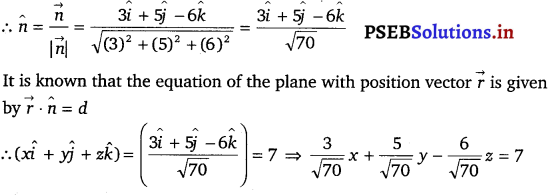
Find the vector equation of a plane which is at a distance of 7 units from the origin and normal to the vector 3î + 5ĵ – 6k̂.
Solution.
The normal vector is, \(\vec{n}\) = 3î + 5ĵ – 6k̂
PSEB 12th Class Maths Solutions Chapter 11 Three Dimensional Geometry Ex 11.3 1

This is the vector equation of the required plane.

PSEB 12th Class Maths Solutions Chapter 11 Three Dimensional Geometry Ex 11.3

Question 3.
Find the Cartesian equation of the following planes
(a) \(\vec{r}\) (î + ĵ – k̂) = 2
(b) \(\vec{r}\) (2î + 3ĵ – 4k̂) = 1
(c) \(\vec{r}\) [(s – 2t) î + (3 – t) ĵ + (2s + t) k̂] = 15
Solution.
(a) It is given that equation of the plane is \(\vec{r}\) (î + ĵ – k̂) = 2 …………. (i)
For any arbitrary point P(x, y, z) on the plane, position vector \(\vec{r}\) is given by,
\(\vec{r}\) = xî + yĵ – zk̂
Substituting the value, of \(\vec{r}\) in equation (i), we get
(xî + yĵ – zk̂) (î + ĵ- k̂) = 2
⇒ x + y – z = 2
This is the Cartesian equation of the plane.

(b) Given vector equation is \(\vec{r}\) . (2î +3ĵ – 4k̂) = 1
For any arbitrary point P(x, y, z) on the plane, position vector \(\vec{r}\) is given by
\(\vec{r}\) = xî + yĵ – zk̂
Substituting the value of r in equation (i), we get
(xî + yĵ – zk̂ ) . (2î +3ĵ – 4k̂) = 1
⇒ 2x + 3y – 4z = 1
This is the Cartesian equation of the plane.

PSEB 12th Class Maths Solutions Chapter 11 Three Dimensional Geometry Ex 11.3

(c) Given vector equation is \(\vec{r}\) . [(s – 2t) î + (3 – t ) ĵ + (2s + t) k̂] = 15 ………….. (i)
For any arbitrary point P (x, y, z) on the plane, position vector is given by
\(\vec{r}\) = xî + yĵ – zk̂
Substituting the value, of in equation (i), we get
(xî + yĵ – zk̂) . [(s – 2t) î + (3 – t) k̂ + (2s + t) k̂] = 15
⇒ (s – 2t) x + (3 – t) y + (2s + t) z = 15
This is the Cartesian equation of the plane.

PSEB 12th Class Maths Solutions Chapter 11 Three Dimensional Geometry Ex 11.3

Question 4.
In the following cases, find the coordinates of the foot of the perpendicular drawn from the origin.
(a) 2x + 3y + 4z – 12 = 0
(b) 3y + 4z – 6 = 0
(c) x + y + z = 1
(d) 5y + 8 = 0
Solution.
(a) Let the coordinates of the foot of perpendicular P from the origin to the plane be (x, y, z).
2x + 3y + 4z – 12 = 0
⇒ 2x + 3y + 4z = 12 ………..(i)
The direction ratios of normal are 2, 3 and 4.
∴ \(\sqrt{(2)^{2}+(3)^{2}+(4)^{2}}=\sqrt{29}\)

Dividing both sides of equation (i) by we get
∴ \(\frac{2}{\sqrt{29}} x+\frac{3}{\sqrt{29}} y+\frac{4}{\sqrt{29}} z=\frac{12}{\sqrt{29}}\)

This equation is of the form lx + my + nz = d, where 1, m, n are the direction cosines of normal to the plane and d is the distance of normal from the origin.

The coordinates of the foot of the perpendicular are given by (ld, md, nd)
Therefore, the coordinates of the foot of perpendicular are
\(\left(\frac{2}{\sqrt{29}}, \frac{12}{\sqrt{29}}, \frac{3}{\sqrt{29}}, \frac{12}{\sqrt{29}}, \frac{4}{\sqrt{29}}, \frac{12}{\sqrt{29}}\right)\) i.e., \(\left(\frac{24}{29}, \frac{36}{49}, \frac{48}{29}\right)\).

PSEB 12th Class Maths Solutions Chapter 11 Three Dimensional Geometry Ex 11.3

(b) Let the coordinates of the foot of perpendicular P from the origin to the plane be (x1, y1, z1).
3y + z – 6 = 0
⇒ 0x + 3y + 4z = 6 ………………(i)
The direction ratios of normal are 0, 3 and 4.
∴ \(\sqrt{0+3^{2}+4^{2}}\) = 5
Dividing the both sides of equation (i) by 5, we get
0 . x + \(\frac{3}{5}\) y + \(\frac{4}{5}\) z = \(\frac{6}{5}\)
This equation is of the form lx + my + nz = d, where l, m, n are the direction cosines of normal to the plane and d is the distance of normal from the origin.
The coordinates of the foot of the perpendicular are given by (ld, md, nd).
Therefore, the coordinates of the foot of the perpendicular are \(\left(0, \frac{3}{5} \cdot \frac{6}{5}, \frac{4}{5} \cdot \frac{6}{5}\right)\) i.e., \(\left(0, \frac{18}{25}, \frac{24}{25}\right)\)

(c) Let the coordinates of the foot of perpendicular P from the origin to the plane be (x1, y1, z1).
x + y + z = 1 ………………(i)
The direction ratios of normal are 1, 1 and 1.
∴ \(\sqrt{1^{2}+1^{2}+1^{2}}=\sqrt{3}\)

Dividing the both sides of equation (i) by √3, we get
\(\frac{1}{\sqrt{3}} x+\frac{1}{\sqrt{3}} y+\frac{1}{\sqrt{3}} z=\frac{1}{\sqrt{3}}\)

This equation is of the form lx + my + nz = d, where l, m, n are the direction cosines of normal to the plane and d is the distance of normal from the origin.

The coordinates of the foot of the perpendicular are given by (ld, md, nd).
Therefore, the coordinates of the foot of the perpendicular are \(\left(\frac{1}{\sqrt{3}} \cdot \frac{1}{\sqrt{3}}, \frac{1}{\sqrt{3}} \cdot \frac{1}{\sqrt{3}}, \frac{1}{\sqrt{3}} \cdot \frac{1}{\sqrt{3}}\right)\) i.e., \(\left(\frac{1}{3}, \frac{1}{3}, \frac{1}{3}\right)\).

PSEB 12th Class Maths Solutions Chapter 11 Three Dimensional Geometry Ex 11.3

(d) Let the coordinates of the foot of perpendicular P from the origin to the plane be (x1, y1, z1).
5y + 8 = 0
⇒ 0 . x – 5y + 0 . z = 8 ……………(i)
The direction ratios of normal are 0, – 5 and 0.
∴ \(\sqrt{0+(-5)^{2}+0}\) = 5
Dividing both sides of equation (i) by 5, we get
– y = \(\frac{8}{5}\)
This equation is of the form lx + my + nz = d, where l, m, n are the direction cosines of normal to the plane and d is the distance of normal from the origin.
The coordinates of the foot of the perpendicular are given by (ld, md, nd) Therefore, the coordinates of the foot of the perpendicular are (0, – 1 (\(\frac{8}{5}\), 0) i.e., (0, – \(\frac{8}{5}\), 0).

PSEB 12th Class Maths Solutions Chapter 11 Three Dimensional Geometry Ex 11.3

Question 5.
Find the vector and Cartesian equations of the planes
(a) that passes through the point (1, 0, – 2) and the normal to the plane is î + ĵ – k̂.
(b) that passes through the point (1, 4, 6) and the normal vector to the plane is î – 2 ĵ + k̂.
Solution.
(a) The position vector of point (1, 0, – 2) is \(\vec{a}\) = î – 2 k̂
The normal vector N perpendicular to the plane is \(\vec{N}\) = î + ĵ – k̂
The vector equation of the plane is given by, \((\vec{r}-\vec{a}) \cdot \vec{N}\) = 0
⇒ [\(\vec{r}\) – (î – 2k̂)] . (î + ĵ – k̂) = 0 ……………(i)
\(\vec{r}\) is the position vector of any point P(x, y, z) in the plane.
∴ \(\vec{r}\) = xî + yĵ + zk̂
Therefore, equation (i) becomes
[(xî + yĵ + zk̂) – (î – 2k̂) . {î + ĵ – k̂) = 0
⇒ [(x – 1)î + yĵ + (z + 2)k̂] . (î + ĵ – k̂) = 0
⇒ (x – 1) + y – (z + 2) = 0
⇒ x + y – z – 3 = 0
⇒ x + y – z = 3
This is the Cartesian equation of the required plane.

(b) The position vector of the point (1, 4, 6) is \(\vec{a}\) = î + 4ĵ + 6k̂
The normal vector N perpendicular to the plane is \(\vec{N}\) = î – 2ĵ + k̂
The vector equation of the plane is given by, (\(\vec{r}\) – \(\vec{a}\)) . \(\vec{N}\) = 0
⇒ [\(\vec{r}\) – ( î + 4ĵ + 6k̂)] + 4; +6fc)] . (î – 2ĵ + k̂ ) = 0 ……………(i)
\(\vec{r}\) is the position vector of any point P(x, y, z) in the plane.
∴ \(\vec{r}\) = xî + yĵ + zk̂
Therefore, equation (i) becomes
[(xî + yĵ + zk̂) – (î + 4ĵ + 6k̂)] (î – 2ĵ + k̂) = 0
⇒ [(x – 1)î +(y – 4)ĵ + (z – 6)k̂] . (î – 2ĵ + k̂) = 0
⇒ (x – 1) – 2 (y – 4) + (z – 6) = 0
⇒ x – 2y + z + 1 = 0
This is the Cartesian equation of the required plane.

PSEB 12th Class Maths Solutions Chapter 11 Three Dimensional Geometry Ex 11.3

Question 6.
Find the equations of the planes that passes through three points.
(a) (1, 1, – 1), (6, 4, – 5), (- 4, – 2, 3)
(b) (1, 1, 0),(1, 2, 1), (- 2, 2, – 1)
Solution.
Solution.
(a) The given points are A(1, 1, – 1), B(6, 4, – 5) and C(- 4, – 2, 3).
\(\left|\begin{array}{ccc}
1 & 1 & -1 \\
6 & 4 & -5 \\
-4 & -2 & 3
\end{array}\right|\) =(12 – 10) – (18 – 20) – (- 12 + 16)
= 2 + 2 – 4 = 0
Since, A, B, C are collinear points, there will be infinite number of planes passing through the given points.

(b) The given points are A(1, 1, 0), B(1, 2, 1) and C(- 2, 2, – 1)
\(\left|\begin{array}{ccc}
1 & 1 & 0 \\
1 & 2 & 1 \\
-2 & 2 & -1
\end{array}\right|\) = (- 2 – 2) – (2 + 2) = – 8 ≠ 0
Therefore, a plane will pass through the points A, B and C.
It is known that the equation of the plane through the points, (x1, y1, z1),
(x2, y2, z2)and (x3, y3, z3) is

\(\left|\begin{array}{ccc}
x-x_{1} & y-y_{1} & z-z_{1} \\
x_{2}-x_{1} & y_{2}-y_{1} & z_{2}-z_{1} \\
x_{3}-x_{1} & y_{3}-y_{1} & z_{3}-z_{1}
\end{array}\right|\) = 0

\(\left|\begin{array}{ccc}
x-1 & y-1 & z \\
0 & 1 & 1 \\
-3 & 1 & -1
\end{array}\right|\) = 0
⇒ (- 2) (x – 1) – 3 (y – 1) + 3z = 0
⇒ – 2x – 3y + 3z + 2 + 3 = 0
⇒ – 2x – 3y + 3z = – 5
⇒ 2x + 3y – 3z = 5
This is the Cartesian equation of the required plane.

PSEB 12th Class Maths Solutions Chapter 11 Three Dimensional Geometry Ex 11.3

Question 7.
Find the intercepts cut off by the plane 2x + y – z = 5.
Sol.
Given plane, 2x + y – z = 5 ……………(i)
Dividing both sides of equation (i) by 5, we get
\(\frac{2}{5} x+\frac{y}{5}-\frac{z}{5}\) = 1

\(\frac{x}{\frac{5}{2}}+\frac{y}{5}+\frac{z}{-5}\) = 1 ………………….(ii)

It is known that the equation of a plane in intercept form is \(\frac{x}{a}+\frac{y}{b}+\frac{z}{c}\) = 1,
where a, b, c are the intercepts cut off by the plane at x, y and z axes respectively.
Therefore, for the given equation, a = \(\frac{5}{2}\), b = 5 and c = – 5.

Question 8.
Find the equation of the plane with intercept 3 on the y-axis and parallel to ZOX plane.
Solution.
The equation of the plane ZOX is y = 0
Any plane parallel to it is of the form, y = a
Since, the y-intercept of the plane is 3,
∴ a = 3
Thus, the equation of the required plane y = 3.

PSEB 12th Class Maths Solutions Chapter 11 Three Dimensional Geometry Ex 11.3

Question 9.
Find the equation of the plane through the intersection of the planes 3x – y + 2z – 4 = 0 and x + y + z – 2 = 0 and the point (2, 2, 1).
Solution.
The equation of any plane through the intersection of the planes, 3x – y + 2z – 4 = 0 and x + y + z- 2 = 0 is
(3x- y + 2z – 4) + α (x + y + z -2) = 0 where α ∈ R ……………..(i)
The plane passes through the point (2, 2, 1).
Therefore, this point will satisfy equation (i).
∴ (3 × 2 – 2 + 2 × 1 – 4) + α (2 + 2 + 1 – 2) = 0
⇒ 2 + 3α = 0
⇒ α = – \(\frac{2}{3}\)
Substituting α = – \(\frac{2}{3}\) in equation (i), we get
(3x – y + 2z – 4) – \(\frac{2}{3}\) (x + y + z – 2) = 0
⇒ 3 (3x -y + 2z – 4) – 2 (x + y + z – 2) = 0
⇒ (9x – 3y + 6z – 12) – 2(x + y + z – 2) = 0
⇒ 7x – 5y + 4z – 8 = 0
This is the required equation of the plane.

Question 10.
Find the vector equation of the plane passing through the intersection of the planes \(\overrightarrow{\boldsymbol{r}}\) . (2î + 7ĵ – 3k̂) = 7, \(\overrightarrow{\boldsymbol{r}}\) . (2î + 5ĵ + 3k̂) = 9 and through the point (2,1, 3).
Solution.
The equations of the planes are \(\overrightarrow{\boldsymbol{r}}\) . (2î + 7ĵ – 3k̂) = 7 and \(\overrightarrow{\boldsymbol{r}}\) . (2î + 5ĵ + 3k̂) = 9

⇒ \(\overrightarrow{\boldsymbol{r}}\) . (2î + 2ĵ – 3k̂) – 7 = 0 …………..(i)

⇒ \(\overrightarrow{\boldsymbol{r}}\) . (2î + 5ĵ + 3k̂) – 9 = 0 …………..(ii)

The equation of any plane through the intersection of the planes given in equations (i) and (ii) is given by
⇒ [\(\vec{r}\) . (2î + 2ĵ – 3k̂)] – 7] + λ [\(\vec{r}\) . (2î + 5ĵ + 3k̂) – 9] = 0, where λ ∈ R
\(\vec{r}\) . [(2î + 2ĵ – 3k̂) + λ (2î + 5ĵ + 3k̂)] = 9λ. + 7
\(\vec{r}\) . [(2 + 2λ) î + (2 + 5λ) ĵ + (3λ – 3) k̂] = 9λ + 7 ………………(iii)
The plane passes through the point (2, 1, 3).
Therefore, its position vector is given by, \(\vec{r}\) = 2î + 2ĵ – 3k̂
Substituting in equation (iii), we get
(2î + ĵ – 3k̂) . [(2 + 2λ)î + (2 + 5λ)ĵ + (3λ – 3)k̂] = 9λ + 7
(2 + 2λ) + (2 + 5λ) + (3λ – 3) = 9λ + 7
⇒ 18λ – 3 = 9λ + 7
⇒ 9λ = 10
⇒ λ = \(\frac{10}{9}\)
Substituting λ = \(\frac{10}{9}\) in equation (iii), we get
\(\vec{r} \cdot\left(\frac{38}{9} \hat{i}+\frac{68}{9} \hat{j}+\frac{3}{9} \hat{k}\right)\) = 17
⇒ \(\vec{r}\) = (38î +68ĵ + 3k̂) = 153
This is the vector equation of the required plane.

PSEB 12th Class Maths Solutions Chapter 11 Three Dimensional Geometry Ex 11.3

Question 11.
Find the equation of the plane through the line of intersection of the planes x + y + z = 1 and 2x + 3y + 4z = 5 which is perpendicular to the plane x – y + z = 0.
Solution.
The equation of the plane through the intersection of the planes, x + y + z = 1 and 2x + 3y + 4z = 5 is
(x + y + z – 1) + λ (2x + 3y + 4z – 5) = 0
⇒ (2λ + 1) x + (3λ + 1) y + (4λ + 1) z – (5λ + 1) = 0 ……………..(i)
The direction ratios, a1, b1, c1 of this plane are (2λ + 1), (3λ + 1) and (4λ + 1).
The plane in equation (i) is perpendicular to x – y + z = 0
Its direction ratios, a2, b2, c2 are 1, – 1 and 1.
Since the planes are perpendicular, a1a2 + b1b2 + c1c2 = 0
⇒ (2λ + 1) – (3λ + 1) + (4λ + 1) = 0
⇒ 3λ + 1 = 0
⇒ λ = – \(\frac{1}{3}\)
Substituting λ = – \(\frac{1}{3}\) in equation (i), we get
\(\frac{1}{3} x-\frac{1}{3} z+\frac{2}{3}\) = 0
⇒ x – z + 2 = 0
This is the required equation of the plane.

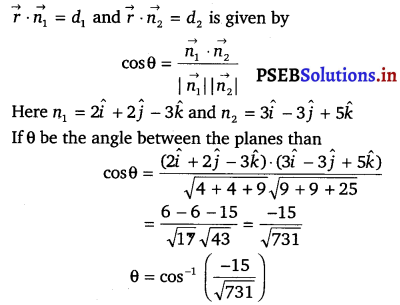
Question 12.
Find the angle between the planes whose vector equations are \(\overrightarrow{\boldsymbol{r}}\) . (2î + 3ĵ – 3k̂) = 5 and \(\overrightarrow{\boldsymbol{r}}\) . (3î – 3ĵ + 5k̂) = 3.
Solution.
We know that the angle 0 between the planes
PSEB 12th Class Maths Solutions Chapter 11 Three Dimensional Geometry Ex 11.3 2

PSEB 12th Class Maths Solutions Chapter 11 Three Dimensional Geometry Ex 11.3

Question 13.
In the following cases, determine whether the given planes are parallel or perpendicular, and in case they are neither, find the angles between them.
(a) 7x + 5y + 6z + 30 = 0 and 3x – y – 10z + 4=0
(b) 2x + y + 3z – 2 = 0 and x – 2y + 5 = 0
(c) 2x – 2y + 4z + 5 = 0 and 3x – 3y + 62 -1 = 0
(d) 2x – y + 3z – 1 = 0 and 2x – y + 3z + 3 = 0
(e) 4x + 8y + z – 8 = 0 and y + z – 4 = 0
Solution.
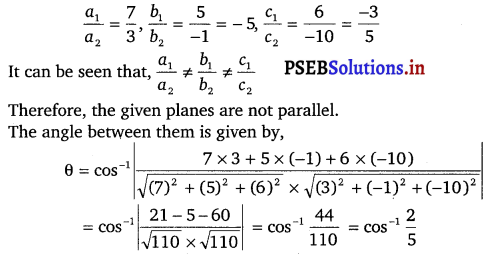
(a) The equations of the planes are 7x + 5y + 6z + 30 = 0 and 3x – y – 10z + 4 = 0
Here, a1 = 7, b1 = 5, c1 = 6 and a2 = 3, b2 = – 1, c2 = – 10
∴ a1a2 + b1b1 + c1c2 = 7 × 3 + 5 × (- 1) + 6 × (- 10) = – 44 ≠ 0
Therefore, the given planes are not perpendicular each other
PSEB 12th Class Maths Solutions Chapter 11 Three Dimensional Geometry Ex 11.3 3

(b) The equations of the planes are 2x + y + 3z – 2 = 0 and x – 2y + 5 = 0
Here, a1 = 2, b1 = 1, c1 = 3 and a2 = 1, b2 = – 2, c2 = 0
∴ a1a2 + b1b2 + c1c2 = 2 × 1 + 1 × (- 2) + 3 × 0 = 0
Therefore, the given planes are perpendicular to each other.

PSEB 12th Class Maths Solutions Chapter 11 Three Dimensional Geometry Ex 11.3

(c) The equations of the planes are 2x – 2y + 4z + 5 = 0 and 3x – 3y + 6z – 1 = 0
Here, a1 = 2, b1 = – 2, c1 = 4 and a2 = 3, b2 = – 3, c2 = 6
∴ a1a2 + b1b2 + c1c2 = 2 × 3 + (- 2) (- 3) + 4 × 6
= 6 + 6 + 24 = 36 ≠ 0
Thus, the given planes are not perpendicular to each other.

(d) The equation of the planes are 2x – y + 3z – 1 = 0 and 2x – y + 3z + 3 = 0
Here, a1 = 2, b1 = – 1, C1 = 3 and a2 = 2, b2 = – 1, c2
∴ a1a2 + b1b2 + c1c2 = 2 × 2 + (- 1) × (- 1) + 3 × 3 = 14 ≠ 0
Thus, the given planes are not perpendicular to each other.
\(\frac{a_{1}}{a_{2}}=\frac{2}{2}\) = 1,

\(\frac{b_{1}}{b_{2}}=\frac{-1}{-1}\) = 1 and

\(\frac{c_{1}}{c_{2}}=\frac{3}{3}\) = 1

∴ \(\frac{a_{1}}{a_{2}}=\frac{b_{1}}{b_{2}}=\frac{c_{1}}{c_{2}}\)
Thus, the given lines are parallel to each other.

PSEB 12th Class Maths Solutions Chapter 11 Three Dimensional Geometry Ex 11.3

(e) The equations of the planes are 4x + 8y + z – 8 = 0 and y + z – 4 = 0
Here a1 = 4, b1 = 8, c1 = 1 and a2 = 0, b2 = 1, c2 = 1
a1a2 + b1b2 + c1c2 = 0
Therefore, the given lines are not perpendicular to each other.
\(\frac{a_{1}}{a_{2}}=\frac{4}{0}\),

\(\frac{b_{1}}{b_{2}}=\frac{8}{1}\) = 8,

\(\frac{c_{1}}{c_{2}}=\frac{1}{1}\) = 1,

∴ \(\frac{a_{1}}{a_{2}} \neq \frac{b_{1}}{b_{2}} \neq \frac{c_{1}}{c_{2}}\)
Therefore, the given lines are not parallel to each other.
The angle between the planes is given by,
θ = cos-1 \(\left|\frac{4 \times 0+8 \times 1+1 \times 1}{\sqrt{4^{2}+8^{2}+1^{2}} \times \sqrt{0^{2}+1^{2}+1^{2}}}\right|\)

θ = cos-1 \(\left|\frac{9}{9 \times \sqrt{2}}\right|\)

θ = cos-1 \(\left(\frac{1}{\sqrt{2}}\right)\)

θ = 45.

PSEB 12th Class Maths Solutions Chapter 11 Three Dimensional Geometry Ex 11.3

Question 14.
In the following cases, find the distance of each of the given points from the corresponding given plane.
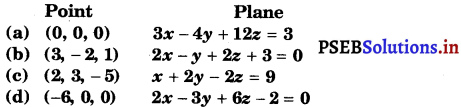
PSEB 12th Class Maths Solutions Chapter 11 Three Dimensional Geometry Ex 11.3 4

Solution.
We know that the distance between a point P(x1, y1, z1) and a plane, Ax + By + Cz = D, is given by
d = \(\left|\frac{A x_{1}+B y_{1}+C z_{1}-D}{\sqrt{A^{2}+B^{2}+C^{2}}}\right|\) …………………(i)

(a) The given point is (0, 0, 0) and the plane is 3x – 4y + 12z = 3

∴ d = \(\left|\frac{3 \times 0-4 \times 0+12 \times 0-3}{\sqrt{(3)^{2}+(-4)^{2}+(12)^{2}}}\right|=\frac{3}{\sqrt{169}}=\frac{3}{13}\)

(b) The given point is(3,- 2, 1) and the plane is 2x – y + 2z – 3 = 0

∴ d = \(\left|\frac{2 \times 3-(-2)+2 \times 1+3}{\sqrt{(2)^{2}+(-1)^{2}+(2)^{2}}}\right|=\left|\frac{13}{3}\right|=\frac{13}{3}\)

(c) The given point is (2, 3, – 5) and the plane is x + 2y – 2z = 9

∴ d = \(\left|\frac{2+2 \times 3-2(-5)-9}{\sqrt{(1)^{2}+(2)^{2}+(-2)^{2}}}\right|=\frac{9}{3}\) = 3

(d) The given point is (- 6, 0, 0) and the plane is lx – 3y + 6z – 2 = 0.

∴ d = \(\left|\frac{2(-6)-3 \times 0+6 \times 0-2}{\sqrt{(2)^{2}+(-3)^{2}+(6)^{2}}}\right|=\left|\frac{-14}{\sqrt{49}}\right|=\frac{14}{7}\) = 2

PSEB 6th Class Social Science Notes Chapter 12 India: From 600 B.C. – 400 B.C.

This PSEB 6th Class Social Science Notes Chapter 12 India: From 600 B.C. – 400 B.C. will help you in revision during exams.

India: From 600 B.C. – 400 B.C. PSEB 6th Class SST Notes

→ Janapadas: Janapadas were the republican or monarchical states established in Northern India around 600 B.C.

→ Republic: Republic, in the form of government in which power is held by the people or a group of elected persons or an elected chief.

PSEB 6th Class Social Science Notes Chapter 12 India: From 600 B.C. - 400 B.C.

→ Monarchy: Monarchy is the form of government in which power is held by a hereditary king or queen.

→ Mahajanapadas: The more powerful Janapadas were known as Mahajanapadas. There were sixteen Mahajanapadas around 600 B.C.

→ Among them, Magadha, Kosala, Vatsa, and Avanti were the most powerful.

→ Ashramas: Life was divided into four stages, called Ashramas. These Ashramas were Brahmacharya, Grihastha, Vanaprastha, and Sanyasa.

→ Barter System: Exchange of goods for goods is called the barter system.

→ Shrenis: Persons following the same profession organized themselves into unions or guilds. These unions or guilds were known as Shrenis.

PSEB 6th Class Social Science Notes Chapter 12 India: From 600 B.C. - 400 B.C.

→ Tirthankaras: Teachers of the Jains were known as the Tirthankaras. There were twenty-four Tirthankaras.

→ Nirvana: Nirvana means a state in which individuality merges into the Supreme Spirit and one becomes free from the cycle of birth and death.

→ Samgha: The supreme body of the Buddhist monks was known as Samgha.

भारत 600 ई. पू. से 400 ई. पू. तक PSEB 6th Class SST Notes

→ जनपद का अर्थ – उत्तर भारत में लगभग 600 ई० पूर्व अस्तित्व में आए। गणतन्त्र तथा राजतन्त्र राज्यों को जनपद कहा जाता था।

→ जनपदों की संख्या – बौद्ध तथा जैन साहित्य में जनपदों की संख्या 16 बताई गई है।

→ महत्त्वपूर्ण जनपद – काशी, कोशल, अंग, वत्स, अवन्ति तथा मगध अधिक महत्त्वपूर्ण जनपद थे।

→ प्रसिद्ध गणराज्य – प्रसिद्ध गणराज्य मल्ल तथा वजी थे।

→ सबसे शक्तिशाली जनपद – मगध सबसे शक्तिशाली जनपद था।

→ नंद वंश – मगध के नंद वंश ने सम्पूर्ण गंगा के मैदान को अपने अधीन कर लिया था।

→ 600 ई० पूर्व से 400 ई० पूर्व तक के भारत के प्रसिद्ध नगर – वाराणसी, राजगृह, श्रावस्ती, कौशांबी, वैशाली, चम्पा, उज्जैन, तक्षशिला, अयोध्या, मथुरा तथा पाटलिपुत्र 1600 ई० पूर्व से 400 ई० पूर्व तक के भारत के प्रसिद्ध नगर थे।

→ 1600 ई० पूर्व से 400 ई० पूर्व तक के भारत में जाति प्रथा की स्थिति – 1600 ई० पूर्व से 400 ई० पूर्व तक के भारत में जाति प्रथा कठोर हो गई थी।

→ जीवन के चार आश्रम – जीवन के चार आश्रम ब्रह्मचर्य, गृहस्थ, वानप्रस्थ तथा संन्यास आश्रम थे।

→ 1600 ई० पूर्व से 400 ई० पूर्व तक के भारत में लोगों के मुख्य व्यवसाय – 600 ई० पूर्व से 400 ई० पूर्व तक के भारत में लोगों के मुख्य व्यवसाय कृषि तथा पशुपालन थे।

→ 600 ई० पूर्व में भारत में आरंभ हुए दो धार्मिक आन्दोलन – 600 ई० पूर्व में भारत में दो धार्मिक आन्दोलन आरम्भ हुए। ये आन्दोलन जैन धर्म तथा बौद्ध धर्म थे।

→ जैन धर्म के गुरु – जैन धर्म के गुरुओं को तीर्थंकर कहते हैं। कुल 24 तीर्थंकर हुए हैं। पहले तीर्थंकर आदिनाथ तथा अन्तिम वर्धमान महावीर थे।

→ बौद्ध धर्म के संस्थापक – बौद्ध धर्म के संस्थापक गौतम बुद्ध थे।

ਭਾਰਤ 600 ਈ: ਪੂਰਵ ਤੋਂ 400 ਈ: ਪੂਰਵ ਤੱਕ PSEB 6th Class SST Notes

→ ਜਨਪਦ ਤੋਂ ਭਾਵ-ਉੱਤਰੀ ਭਾਰਤ ਵਿੱਚ ਲਗਪਗ 600 ਈ: ਪੂਰਵ ਹੋਂਦ ਵਿੱਚ ਆਏ ਗਣਤੰਤਰ ਅਤੇ ਰਾਜਤੰਤਰ ਰਾਜਾਂ ਨੂੰ ਜਨਪਦ ਕਿਹਾ ਜਾਂਦਾ ਸੀ ।

→ ਜਨਪਦਾਂ ਦੀ ਗਿਣਤੀ-ਬੋਧ ਅਤੇ ਜੈਨ ਸਾਹਿਤ ਵਿੱਚ ਜਨਪਦਾਂ , ਦੀ ਗਿਣਤੀ 16 ਦੱਸੀ ਗਈ ਹੈ ।

→ ਮਹੱਤਵਪੂਰਨ ਜਨਪਦ-ਕਾਸ਼ੀ, ਕੋਸ਼ਲ, ਅੰਗ, ਵਤਸ, ਅਵੰਤੀ ਅਤੇ ਮਗਧ ਵਧੇਰੇ ਮਹੱਤਵਪੂਰਨ ਜਨਪਦ ਸਨ ।

→ ਪ੍ਰਸਿੱਧ ਗਣਰਾਜ-ਪ੍ਰਸਿੱਧ ਗਣਰਾਜ ਮੱਲ ਅਤੇ ਵਜੀ ਸਨ ।

→ ਸਭ ਤੋਂ ਸ਼ਕਤੀਸ਼ਾਲੀ ਜਨਪਦ-ਮਗਧ ਸਭ ਤੋਂ ਸ਼ਕਤੀਸ਼ਾਲੀ ਜਨਪਦ ਸੀ ।

→ ਨੰਦ ਵੰਸ਼-ਮਗਧ ਦੇ ਨੰਦ ਵੰਸ਼ ਨੇ ਸਾਰੇ ਗੰਗਾ ਦੇ ਮੈਦਾਨ ਨੂੰ ਆਪਣੇ ਅਧੀਨ ਕਰ ਲਿਆ ਸੀ ।

→ 600 ਈ: ਪੂਰਵ ਤੋਂ 400 ਈ: ਪੂਰਵ ਤੱਕ ਦੇ ਭਾਰਤ ਦੇ ਪ੍ਰਸਿੱਧ ਨਗਰ-ਵਾਰਾਨਸੀ, ਰਾਜਹਿ, ਸ਼ਰਵਸਤੀ, ਕੋਸ਼ਾਂਬੀ, ਵੈਸ਼ਾਲੀ, ਚੰਪਾ, ਉਜੈਨ, ਤਕਸ਼ਿਲਾ, ਅਯੁੱਧਿਆ, ਮਥੁਰਾ ਅਤੇ ਪਾਟਲੀਪੁੱਤਰ 600 ਈ: ਪੂਰਵ ਤੋਂ 400 ਈ: ਪੂਰਵ ਤੱਕ ਦੇ ਭਾਰਤ ਦੇ ਪ੍ਰਸਿੱਧ ਨਗਰ ਸਨ ।

→ 600 ਈ: ਪੂਰਵ ਤੋਂ 400 ਈ: ਪੂਰਵ ਤੱਕ ਦੇ ਭਾਰਤ ਵਿੱਚ ਜਾਤੀ ਪ੍ਰਥਾ ਦੀ ਸਥਿਤੀ-600 ਈ: ਪੂਰਵ ਤੋਂ 400 ਈ: ਪੂਰਵ ਤੱਕ ਦੇ ਭਾਰਤ ਵਿੱਚ ਜਾਤੀ ਪ੍ਰਥਾ ਕਠੋਰ ਹੋ ਗਈ ਸੀ ।

→ ਜੀਵਨ ਦੇ ਚਾਰ ਆਸ਼ਰਮ-ਜੀਵਨ ਦੇ ਚਾਰ ਆਸ਼ਰਮ ਬ੍ਰਹਮਚਰੀਆ, ਹਿਸਥ, ਵਾਨਪ੍ਰਸਥ ਅਤੇ ਸੰਨਿਆਸ ਆਸ਼ਰਮ ਸਨ ।

→ 600 ਈ: ਪੂਰਵ ਤੋਂ 400 ਈ: ਪੂਰਵ ਤੱਕ ਦੇ ਭਾਰਤ ਵਿੱਚ ਲੋਕਾਂ ਦੇ ਮੁੱਖ ਕਿੱਤੇ-600 ਈ: ਪੂਰਵ ਤੋਂ 400 ਈ: ਪੂਰਵ ਤੱਕ ਦੇ ਭਾਰਤ ਵਿੱਚ ਲੋਕਾਂ ਦੇ ਮੁੱਖ ਕਿੱਤੇ ਖੇਤੀਬਾੜੀ ਅਤੇ ਪਸ਼ੂ-ਪਾਲਣ ਸਨ।

→ 600 ਈ: ਪੂਰਵ ਵਿੱਚ ਭਾਰਤ ਵਿੱਚ ਸ਼ੁਰੂ ਹੋਈਆਂ ਦੋ ਧਾਰਮਿਕ ਲਹਿਰਾਂ-600 ਈ: ਪੂਰਵ ਵਿੱਚ ਭਾਰਤ ਵਿੱਚ ਦੋ ਧਾਰਮਿਕ ਲਹਿਰਾਂ ਸ਼ੁਰੂ ਹੋਈਆਂ । ਇਹ ਲਹਿਰਾਂ ਜੈਨ ਧਰਮ ਅਤੇ ਬੁੱਧ ਧਰਮ ਸਨ ।

→ ਜੈਨ ਧਰਮ ਦੇ ਗੁਰੂ-ਜੈਨ ਧਰਮ ਦੇ ਗੁਰੂਆਂ ਨੂੰ ਤੀਰਥੰਕਰ ਕਹਿੰਦੇ ਹਨ । ਕੁੱਲ 24 ਤੀਰਥੰਕਰ ਹੋਏ ਹਨ । ਪਹਿਲੇ ਤੀਰਥੰਕਰ ਆਦਿ ਨਾਥ ਅਤੇ ਆਖ਼ਰੀ ਤੀਰਥੰਕਰ ਵਰਧਮਾਨ ਮਹਾਂਵੀਰ ਸਨ ।

→ ਬੁੱਧ ਧਰਮ ਦੇ ਸੰਸਥਾਪਕ-ਬੁੱਧ ਧਰਮ ਦੇ ਸੰਸਥਾਪਕ ਗੌਤਮ ਬੁੱਧ ਸਨ ।
