PSEB 11th Class Political Science Solutions Chapter 24 The Union Executive-President, Vice-President, Council of Ministers and Prime Minister

Punjab State Board PSEB 11th Class Political Science Book Solutions Chapter 24 The Union Executive-President, Vice-President, Council of Ministers and Prime Minister Textbook Exercise Questions and Answers.

PSEB Solutions for Class 11 Political Science Chapter 24 The Union Executive-President, Vice-President, Council of Ministers and Prime Minister

Long Answer Type Questions

Question 1.
Discuss the qualifications, mode of election and procedure for impeachment of the President of India.
Or
How is the President of India elected?
Answer:
Since India is a Republic, the President of India is elected by the people in an indirect manner for a fixed time. As to what method should be adopted for the election of the President, there was no unanimity of opinion in the Constituent Assembly. One suggestion was that the President should be directly elected by the people.

It will not only be in consonance with the democratic principles but it will also make the President the direct representative of the people. This proposal was rejected on the ground that such a method will unnecessarily convulse the nation, particularly when he was being made the nominal head of the State. The other proposal was that the President should be elected only by the members of the Union Parliament.

This proposal was equally rejected because in that case the President would become a puppet in the hands of the majority party. That would rob him of all his appearance of independence and dignity. In order to uphold the federal principle, it was finally agreed that the States should also be given a share in the election of the President.

Qualifications:
The Constitution prescribes the following qualifications for a presidential candidate-

  • He should be a citizen of India.
  • He must have completed the age of 35 years.
  • He must be qualified to be elected as a member of the Lok Sabha.
  • He must not hold any office of profit under the Government of India or any State Government or local authority.However, this provision is not applicable to a person who holds the office of the President, Vice-President, Governors and Ministers of the Central and State Government.
  • He cannot at the same time be a member of the Parliament or a member of State Legislature; his seat will be deemed to have been vacated on the date he assumes his office as President.
  • According to Presidential and Vice-Presidential Elections Act, the candidate for the office of president must deposit Rs. 15,000 as security.
  • The name of the candidate for the office of President must be proposed by 50 electors and seconded by 50 electors.

Method of Election:
Following are the features of the election of the President of India-

1. President elected by an Electoral College:
The President of India is elected by an electoral college consisting of the elected members of the Lok Sabha, the elected members of the Rajya Sabha and the elected members of the State Legislative Assemblies.

2. System of Proportional Representation:
The election of the President is held in accordance with the system of proportional representation by means of the single transferable vote.

3. Uniformity of Representation:
According to the Constitution, as far as possible, there is to be maintained uniformity of representation of the different States at the presidential election and parity between the States as a whole and the Union. In other words, in the election of the President, the principle of ‘One member- One-vote’ had not been and could not be adopted. In different States different ratios prevail between the population and the number of legislators.

The Constituencies in the different States are unequal in the matter of population. For example, in one State it may be one representative for every 50,000 of the population while in another the proportion may be one to 75,000 or more. Thus since the States differ in their population, the strength of the elected members of the State Legislative Assemblies also differs. Then, the total strength of the elected members of the State Legislative Assemblies is far greater than that of the elected members of both the Houses of Parliament. That being so, the problem was to ensure that the votes cast will have a value in proportion to the population that the votes represented.

4. Procedure of determining the votes of the Members of the State Assembly:
Article 55(4) of the Constitution lays down the procedure of determining the votes of the member of the State Assembly, which is as follows:

PSEB 11th Class Political Science Solutions Chapter 24 The Union Executive-President, Vice-President, Council of Ministers and Prime Minister 1
If the remainder is less than 500, it is ignored.
If it is more than 500, then the vote of each member shall be further increased by one.
For example, in 2017 population of Punjab was 27,704,236 and the Legislative Assembly of Punjab consists of 117 members. Hence each member was entitled to cast 237 votes:
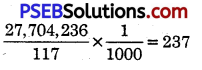
PSEB 11th Class Political Science Solutions Chapter 24 The Union Executive-President, Vice-President, Council of Ministers and Prime Minister 2
5. Procedure of determining the votes of the Members of the Parliament:
The Constitution lays down the following procedure of determining the votes of the member of Parliament.

PSEB 11th Class Political Science Solutions Chapter 24 The Union Executive-President, Vice-President, Council of Ministers and Prime Minister 3
Fraction exceeding one-half being counted as one. Let us explain this formula also by taking an example. Suppose the total number of votes assigned to the elected members of all the State Legislative Assemblies is 424856 and the total strength of elected members of the Parliament is 705. Now to obtain the number of votes which elected member of the Parliament will have at the election of the President:
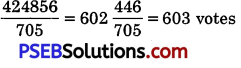
PSEB 11th Class Political Science Solutions Chapter 24 The Union Executive-President, Vice-President, Council of Ministers and Prime Minister 4
In the presidential election in July 2017, the number of votes of each member of the Parliament entitled to vote was 708.
Total votes of the elected member of State Assemblies = 5,49,495
No. of elected members of the Parliament = 776 (Lok Sabha 543 + Rajya Sabha 233)
No. of votes of each member of the Parliament = \(\frac {5,49,495 }{776}\) = 708
Total votes of the members of the Parliament = 708 x 776 = 5,49,408
Total votes of the electoral college = 5,49,495 + 5,49,408 = 10,98,903

6. Vacant Seats in Electoral College:
The President of India, as said, is elected by an electoral college. Now the question arises if the electoral college is not complete, how to proceed with the election of the President. Our Constitution was not clear on this point. To remove this flaw 11th Amendment (1961) was made in the Constitution.
According to this amendment, the election of the President or the Vice-President cannot be challenged on the ground of any vacancy in the electoral college for whatever reason among the members of the electoral college electing him.

7. Method of Fixing the Quota:
Under the system of Proportional Representation a candidate to be elected, must secure the necessary quota of votes. The quota is determined by the following formula:

PSEB 11th Class Political Science Solutions Chapter 24 The Union Executive-President, Vice-President, Council of Ministers and Prime Minister 5
Suppose the total number of valid votes polled at the presidential election is 8,00,000. Applying the above-mentioned formula, the quota shall be:
\(\frac {800000}{1+1}\) + 1 = 4,00,001
In order to be elected, the candidate must secure 4,00,001 votes-an absolute majority of votes. If the first counting does not give any candidate the quota of votes, the candidate who got the least number of votes is eliminated and his votes transferred to the remaining candidates on the basis of the preferences shown. The process is repeated until one candidate gets the requisite number of votes. Let us explain the system in detail.

Assuming that there are four candidates and the total number of valid votes cast are 15,000.
To be declared elected President, a candidate must secure a minimum of 7501 votes. Now suppose the first preference votes secured by the four candidates are as follows:
A—5250
B—4800
C—2700
D—2250
Since the candidate D gets the least number of votes, hence he is eliminated. Now the second preference votes on his 2250 ballot papers shall be counted.
Suppose A gets 300, B gets 1050 and C gets 900.

Now the total votes of A are 5250 + 300 = 5550, of B are 4800 + 1050 = 5800 and of C are 2700 + 900 = 3600. It means even now no candidate is securing the requisite quota of 7501 votes.

Now candidate C shall be eliminated because he got the least number of votes. Now third preference votes on the 3600 votes of C shall be counted. In the third preference suppose A gets 1700 and B gets 1900.
Now the total votes of A are 5550 + 1700 = 7250
Total votes of B are = 5850 + 1900 = 7750

According to the Proportional Representation system, B shall be declared President. The system proves the doctrine that candidate B is preferred by a numerically large number of electors than candidate A. It may be recalled that the election of Mr. V. V. Giri was decided in the Second Count. “It made the people realise the significance of the system of proportional represenataion by means of single transferable vote.”

So far fifteen presidential elections have been held in India:

  1. First election was held in 1952 and Dr. Rajendra Prasad was elected.
  2. Second election was held in 1957 and again Dr. Rajendra Prasad was elected.
  3. Third election was held in 1962 and Dr. Radhakrishnan was elected.
  4. Fourth election was held in 1967 and Dr. Zakin Hussain was elected.
  5. Fifth election was held in 1969 and Shri V. V. Giri was elected.
  6. Sixth election was held in 1974 and Shri Fakhruddin Ali Ahmed was elected.
  7. In July, 1977, for the first time, Shri Sanjiva Reddy was nominated by a consensus of all paries and was elected unopposed.
  8. Eighth election was held in July, 1982 and Congress (I) candidate Giani Zail Singh was elected and opposition candidiate Justice Khanna was defeated.
  9. Ninth Presidential election was held in July, 1987 and Congress (I) candidate R. Venkataraman was elected and opposition candidate Justice V. R. Krishna Iyer was defeated.
  10. Tenth Presidential election was held in July, 1992 and Congress (I) candidate Dr. Shankar Dyal Sharma was elected and opposition candidate was defeated.
  11. Eleventh Presidential election was held in July 1997. Joint candidate of United Front and Congress Mr. K. R. Narayanan supported by BJP and others was elected and Mr. T. N. Seshan was defeated. Mr. K. R. Narayanan secured 94.97 per cent of the votes.
  12. Twelfth Presidential election was held in July, 2002. Joint candidate of rulling National Democratic Alliance Dr. A.P. J. Abdul Kalam supported by Indian National Congress, Bahujan Samaj Party, Samajvadi Party, Janata Dal and others was elected and Capt. Lakshmi Sahgal, the opposition candidate supported by Communist Parties was defeated.
  13. 13th Presidential election was held in July 2007, joint candidate of United Progressive Alliance Mrs. Pratibha Devi Singh Patil was elected and Independent Candidate Mr. Bhairon Singh Shekhawat was defeated.
  14. 14th Presidential election was held in July 2012. Candidate of UPA and Supported by S.P., B.S.P., Janata Dal (U) and Shiv Seva, Mr. Pranab Mukherjee was elected and independent candidate Mr. P.A. Sangma was defeated.
  15. 15th Presidential election was held in July 2017. Candidate of N.D.A. Sh. Ram Nath Kovind was elected and U.P.A. candidate Smt. Meera Kumar was defeated.

The election of the President is conducted by the Chief Election Commissioner. He issues the notification and fixes dates for nomination, scrutiny of nomination and withdrawal of candidature. Only those eligible to vote in the election of the President, i.e. elected members of Parliament and elected members of the State Legislative Assemblies can propose a candidate for election. The Chief Election Commissioner counts the votes cast and declares the result.

The validity of the election of the President can be challenged by the electors only. The election of the President can be challenged only after the completion of the election, i.e., after a candidate is declared to be elected to the office of the President. If a petition is allowed before such election, it would involve the non-compliance with the mandatory provisions of Art. 62 which says that an election to fill a vacancy caused by the expiration of the term of the office of the President shall be completed before the expiration of the term.

Oath of the President:
Before entering upon his office, the President elected or any person acting as President for discharging the functions of President, is required to take an oath in the presence of the Chief Justice, or in his absence, the senior-most judge of the Supreme Court available.

Tenure:
The President is elected for a period of five years. The period of five years begins from the day he enters upon his office. The President is eligible for re-election.

Removal by Impeachment:
The President can be removed from office by impeachment only. The Constitution lays down a detailed procedure for the impeachment of the President. He can be impeached “for violation of the Constitution”.

When a President is to be impeached for the violation of the Constitution, the charges can be prepared by either House of the Parliament. In other words, the impeachment charged may be initiated by the Lok Sabha or the Rajya Sabha. (in the United States of America, this right belongs exclusively to the Lower House, i.e., the House of Representatives). But no such charge is to be preferred unless the proposal to prefer such a charge is contained in a resolution which has been moved after at least 14 days’ notice in writing signed by not less than one-fourth of the total number of members of the House.

The resolution must be passed by a two-third majority of the total membership of the House. If passed by the requisite majority in one house, it is sent to the other House for investigation. The other House is empowered to entrust this job of investigation to a court or tribunal.

However, the resolution had got to be passed by the other house by a two-third majority of the total membership of this House. If the other House also passes the resolution by a two-third majority of the total membership of this House, then it means the charge is proved and the President is removed from his office from the ‘date’ (word ‘time has not been used’) on which the investigating House passes the resolution.

However, the President has the right to be heard and defended when the charges against him are being investigated. He may defend himself in person or through his council. One thing to be noted here is that there is no provision for suspension of the President under impeachment. He continues to hold his office during the period of investigation.

Salary and Allowances:
The President of India gets a salary of Rs. 5,00,000 per month and an official residence (called Rashtrapati Bhavan in New Delhi) free of rent. In addition to the salary, the President also gets handsome allowances of various kinds as determined by Parliament. According to the President’s Pension Act, a person who ceases to hold office as President, either by expiration of his term of office or by resignation, is entitled to a monthly pension of Rs. 2,50,000. The Government may also allow him a free medical aid as was done in the case of Dr. Rajendra Prasad.

The salary and other allowances of the President are charged on the Consolidated Fund of India. According to Art. 59 (4), the emoluments and allowances of the President shall not be diminished during his term of office.

PSEB 11th Class Political Science Solutions Chapter 24 The Union Executive-President, Vice-President, Council of Ministers and Prime Minister

Question 2.
Describe the powers of the President of India
Or
Discuss the executive and judicial powers of the President.
Or
Explain the powers of the President of India other than emergency powers.
Answer:
The Constitution of India establishes a federal form of government.
According to Art. 53, the executive powers of the Union have been vested in the President which shall be exercised by him directly or through officers subordinate to him in accordance with the Constitution. However, India being a parliamentary form of government, the President is only a nominal head and the working executive is the Council of Ministers headed by the Prime Minister.
The powers of the President can be divided into two categories-
(A) Powers in normal times and
(B) Emergency powers.

(A) POWERS IN NORMAL TIMES:
During normal times the President exercises four types of powers:
1. Executive Powers
2. Legislative Powers
3. Financial Powers
4. Judicial Powers.

1. Executive Powers:
The President is the Chief Executive or Head of the State. According to Art. 53 (1) of the Constitution, the executive powers of the Union have been vested in the President. He may exercise these powers himself or get them exercised through officers subordinate to him.

(i) Appointments:
The President is authorised to make a number of appointments. He appoints the Prime Minister and the other Ministers on the advice of the Prime Minister, the Attorney General, the Comptroller and the Auditor General, Judges of the Supreme Court and the High Courts, the Chairman and Members of Joint Public Service Commission, the Chairman and members of Joint Public Service Commission, the Election Commission, Finance Commission, the Official

Language Commission and Commission for the Scheduled Castes, Tribes, Backward Classes, etc. He also appoints the State Governors, Lt. Governors and Chief Commissioners of the Union Territories. He also sends and receives diplomatic representatives. He makes rule for the convenient transaction of business of the Government of India and allocates this business among the Ministers. Under Art. 78, the Prime Minister is bound to communicate to the President all decisions of the Cabinet relating to administration and such proposals for legislation as the President may call for.

(ii) Military Powers:
The President is the Supreme Commander of the Defence Forces, but the exercise of military powers of the President is regulated by the Parliament. The President cannot declare war or deploy forces without the sanction of the Parliament or in anticipation of the sanction by the Parliament.

(iii) Power Relating to Foreign Affairs:
The President has extensive diplomatic powers. He represents his country in international affairs. He appoints Indian representatives to foreign countries and also receives diplomatic representatives of other States which have been recognised by Parliament.

(iv) Power of Direction, Control and Co-ordination:
The President has the power of direction, control and co-ordination of the work in the States. He can issue directions to the States for the compliance of Union laws. In particular, he can direct a State or States to construct and maintain communications of national or military importance and for the protection of railways. He can establish an Inter-State council to advise him upon co-ordination of policy and settlement of disputes between the States.

(v) Administration of Union Territories:
Art. 239 provides that every Union Territory shall be administered by the President acting through an administrator. The administrator, given any designation by the President, is appointed by the President. The President may appoint the Governor of a State as the administrator of an adjoining Union Territory. When the Governor is discharging the duties of the administrator he shall exercise his functions as administrator independently of his Council of Ministers.

The Parliament by law can establish democratic institutions in the Union Territories. The President can make regulations for the peace, progress and good government of the Union Territory of the Andaman and Nicobar Islands and the Laccadive, Minicoy and Amindivi Islands. The regulations made by the President have the same effect as an act of Parliament. The President is also competent to repeal or amend, through such regulations, any existing Act dealing with the administration of these Islands.

(vi) Informative Powers:
The President had a right to ask for information with regard to the decision of the Council of Ministers. The Prime Minister is required to keep in touch with the President for this purpose.

(vii) Sending back the decision of the Council of Ministers for reconsideration:
Under 44th amendment the President is empowered to send back the decision of the Council of Ministers for reconsideration, but if the council of Ministers repeats the decision, then the President is bound to accept the decision.

(viii)Link between the Centre and States:
The President is the link between the centre and the states. He is the executive head both of the union and of the federation.

2. Legislative Powers:
The President enjoys many legislative powers. He is a part of the Parliament. Besides the Lok Sabha and Rajya Sabha, the President is also a part of the Parliament. The legislative powers of the President are provided by Article 123.

(i) Power to Summon:
Prorogue and Dissolve the Parliament. The President can convene, prorogue and dissolve the Parliament. He can order fresh elections to the Lok Sabha on the recommendation of the Prime Minister. He must call the session of the Parliament within 6 months.

(ii) Address to the Parliament:
He can address the two Houses of the Parliament jointly or he may address them independently. The first session of the Parliament after the General elections is inaugurated by the President. He also addresses the first session of the Parliament every year. In his address the President explains the policy of the Government to the House.

(iii) Nominates the Members of the Parliament:
He nominates 12 persons to the Rajya Sabha. These persons must have distinguished themselves in the fields of art, literature, science and social service. He can nominate two persons of the Anglo-Indian community to the Lok Sabha if he feels that the community has not got adequate representation.

(iv) Assent on Bills:
No bill passed by the Parliament can become an Act without the assent of the President. He can reject an ordinary bill only once and when passed for the second time, the President is to give his assent.

(v) He gives approval to many bills passed by the State Legislatures.

(vi) Joint Session:
He can call a joint session of the two Houses of the Parliament. If the two Chambers differ on an ordinary bill, only then he calls a joint session.

(vii) Power to Send Messages: He can send messages to any House from time to time.

(viii)Ordinance:
During the intervals of the sessions of the Parliament he can issue ordinances. These ordinances have the force of laws. The ordinance is put before the Parliament as soon as it meets. The Parliament has the authority to reject the ordinance. It can be withdrawn by the President also. If it is neither rejected by the Parliament nor withdrawn by the President, it will automatically end six weeks after the first meeting of the Parliament. On Sept. 22, 1980 the President promulgated the National Security Ordinance to enable the government to detain any person to prevent him from acting against the defence or security of the country.

(ix) Constitutional Amendment Bill:
A Constitutional Amendment Bill is finally sent to the President for his assent. The President is bound to give his assent to the Constitutional Amendment Bilk

3. Financial Powers:
The financial powers of the President as mentioned in the Constitution are as follows:

(i) It is the duty of the President to place the Budget for the current year before the Parliament. It is to be presented before the beginning of the financial year. Normally the budget is presented to the Parliament by the Finance Minister on behalf of the President.

(ii) Money Bills can only be introduced in the Parliament on the recommendation of the President.

(iii) The President has full control over the contingency fund and he can spend it according to his sweet will.

(iv) He distributes the share of income tax among the States.

(v) He appoints Finance Commission. 15th Finance Commission was appointed on 27 Nov.- 2017 in the Chairmanship of Sh.N.K. Singh.

4. Judicial Powers:
The President has some judicial power also. It is provided by Article 122 of the Constitution.

  • The President appoints the judges and the chief justice to the Supreme Court and the State High Courts.
  • The President cannot be sured in any court of India in connection with any matter concerning his office.
  • He has the power to pardon, reprieve and commute punishment.

(B) EMERGENCY POWERS
Besides powers in normal times the President of India has Emergency Powers as well. The President enjoys three types of emergency powers:
1. Emergency due to external aggression or armed rebellion.
2. Emergency arising out of failure of the constitutional machinery a State.
3. Financial emergency.

For detailed study of Emergency Powers:
1. Emergency arising out of external aggression or Armed Rebellion:
According to Art. 352 if the President is satisfied that a grave emergency exists whereby the security of India or any part of India is threatened by war, external aggression or armed rebellion, he may proclaim a state of emergency. Under 59th amendment in Punjab emergency can be declared on the ground of internal disturbances. The President can declare emergency even before the actual occurrence of war, external aggression or armed rebellion.

But in the 44th Amendment it is provided that the President shall not issue a proclamation of Emergency unless the decision of the Cabinet that such a proclamation may be issued has been communicated to him in writing. According to 42nd Amendment, President can declare emergency in the whole of India or in such part of the territory there of as may be specified in the proclamation. Such a Proclamation may be revoked by a consequent proclamation. If the proclamation has not been approved within one month by both the Houses of Parliament by two-thirds of the majority of the members present and voting, it will become ineffective. If such a

proclamation is issued at a time when the Lok Sabha has been dissolved or the dissolution of the Lok Sabha takes place during the period of one month, and if the Rajya Sabha has approved the proclamation within one month, but it had not been approved by the Lok Sabha, the proclamation shall cease to operate at the expiration of 30 days from the date on which the Lok Sabha sits after its reconstitution. However, if within 30 days the Lok Sabha approves the proclamation, it continues.

After approval of the Parliament emergency continues till the President revokes it by a subsequent proclamation. But it is provided in the 44th Amendment that for the continuance of the emergency, approval by resolution of both Houses would be required every six months. Provision is also made in the 44th Amendment that the proclamation of Emergency would cease to be opeative whenever a resolution to that effect is adopted by the Lok Sabha by a simple majority of the members of the House present and voting.

Ever since the operation of the Constitution (Jan. 26, 1950), such an emergency has been declared three times. First, when India was attacked by China in October, 1962 and second when all of a sudden, Pakistan attacked India on December 3, 1971. Third time internal emergency was declared on 26th June, 1975 and this emergency was-removed on 21st March, 1977 whereas external emergency declared in 1971 was lifted on 27th March, 1977.

Effects of this Proclamation:
1. The most significant effect of this proclamation is that the federal form of the Constitution is converted into unitary form of government. The authority of the Centre is increased till the emergency lasts. It should be remembered the State Governments do not cease to function. They continue, to function as before under normal conditions. But the Centre gets the authority to give directions to the States as the manner in which the executive power of the States is to be exercised. The legislative power of the Centre is also widened.

2. Parliament will have the power to make laws for the whole or part of India with respect to any of the matters given in the State List. Laws so made by Parliament shall cease to operate six months after the Proclamation of Emergency has come to an end.

3. The President, may by an order, modify the provisions relating to distribution of revenues between the Union and the States.

4. The Fundamental Rights given under Art. 19 (six freedoms) are automatically suspended throughout the country. The suspension of Art. 19 continues until the proclamation of emergency ends. However, under 59th Amendment this right can be suspended when emergency is declared in Punjab.

5. The President by order can also suspend the right to move the courts to enforce any Fundamental Rights. All proceedings pending in any court for the enforcement of the rights so mentioned may remain suspended for the period during which Proclamation is in force or for such short period as may be specified in the order. But according to 44th Amendmenl the enforcement of the right to life and personal liberty under Article 21 cannot be suspended. The order so made may extend to the whole or to any part of the territory of India. However, the order of the

parliament is required to be laid before each House of Parliament “as soon as may be after it is made.” And what is the definition of ‘as soon as may be’, the constitution does not fix any time limit for the order to be laid before Parliament.

2. Emergency arising out of the failure of constitutional machinery in a State. (Art. 356):
The second type of emergncy powers given to the President deal with the failure of constitutional machinery in the State. If the President, either on the receipt of a report from the Governor of a State or otherwise, is satisfied that a situation has arisen in which the Government of the State cannot be carried on in accordance with the provisions of the Constitution, the President can proclaim emergency in that state.

In May, 1994, the Supreme Court had declared that dismissal of a state government by the President under Article 356 of the Constitution is open to judicial scrutiny. The apex Court had held that presidential proclamation under Article 356 could be challenged only on the ground that the exercise of power was malafide or based on wholly extraneous and irrelevant grounds.

Any proclamation made under Art. 356 may be revoked or varied by a subsequent Proclamation. The Proclamation issued by the President is required to be laid before each House of Parliament and it ceases to operate after the expiry of two months unless before the expiration of that period it has been approved by resolutions of both Houses of Parliament. If approved by Parliament, the Proclamation, remains in force for six months after the parliamentary approval. The duration of the proclamation can be extended for six months at a time and the maximum period is one year.

According to 44th Amendment, a resolution with respect to the continuance in force of a Proclamation under the article for any period beyond the expiration of one year from the date of issue of such proclamation shall not be passed by either House of Parliament unless a Proclamation of Emergency is in operation at the time of the passing of such resolution and the Election Commission certifies that the continuance in force of the proclamation under the Article during the period specified in such resolution is necessary on account of difficulties in holding elections to the Legislative Assembly of the State concerned.

Under 59th Amendment in Punjab President’s rule can be extended up-to three years. Under 64th Amendment President’s rule in Punjab was extended six months more beyond three years. By 68th amendment President’s rule in Punjab can be extended up-to 5 years.

Effects of this Proclamation:
(i) The President can assume to himself all or any of the functions of the State or he may vest all or any of those functions in the Governor or any other executive authority.

(ii) The President can suspend or dissolve the State Legislative Assembly. He may declare that the powers of the State Legislature shall be exercisable by or under the authority of Parliament. However, Parliament will be competent to confer that power on the President and also authorise him to delegate those powers to anybody he thinks fit. .

(iii) The President can make any other incidental or consequential provisions necessary to give effect to the object of the Proclamation.

(iv) If the Lok Sabha is not in session then the President sanctions the expenditure from the consolidated fund of the State.

President’s rule has been promulgated almost 121 times in states since the enforcement of the Constitution. Almost all the States have been, at one time or the other, been put under President’s Rule.

3. Financial Emergency (Art. 360):
If the President is satisfied that a situation has arisen whereby the financial stability or credit of India or any part of it is threatened, he may declare a Financial Emergency under Art. 360 of the Constitution. Such a Proclamation may be revoked by a subsequent Proclamation. The proclamation has to be laid before each House of Parliament.

It ceases to operate at the expiration of two months unless it is approved earlier by a resolution of both Houses of Parliament. The Proclamation in this case also should be approved by Parliament as in the other two cases of emergency. Like the Proclamation of war-emergency, Financial Emergency also continues for an indefinite period. Fortunately, this kind of Emergency has not been declared so far.

Effects of this Proclamation:
(i) During the Financial emergency, the executive authority of the union shall extend to the giving of directions to any State to observe such canons of financial property as may be specified in the direction or any other directions which the President may deem necessary for this purpose.

(ii) The President can ask a State to reduce salaries and allowances of all or any class of public servants connected with the affairs of a State.

(iii) The President can give direction to a State to reserve all Money Bills for the consideration of the President after they have been passed by the State Legislature.

(iv) The President shall be competent to issue directions for the reduction of salaries and allowances of all or any class of persons serving in connection with the affairs of the Union including the judges of the Supreme Court and the High Courts.

Criticism:
Evidently the Constitution gives the President very drastic powers to deal with Emergency. Emergency powers of the President were criticised within and outside the Constituent Assembly. It has been said that these powers are not compatible with democracy. When the provisions relating to Emergency powers were passed, Sh. H. V. Kamath, member of the Constituent Assembly, declared, “ It is a day of shame and sorrow, God save the Indian people.”

Sh. K. T. Shah described Article 359, which empowers the President to suspend the right to seek enforcement of fundamental rights “as the grand final and crowning glory of this chapter of reaction and retrogression.” The power to abrogate fundamental rights of citizens during Emergencies can easily be abused for depriving the people of their liberty and imposing a totalitarian rule on the country.

According to H. V. Kamath, “ There is no parallel to the chapter of Emergency in any Constitution of democratic countries of the world”. He further said,, “I fear that by the single chapter we are seeking to lay the foundation of a totalitarian State, a police State, State completely opposed to all the ideas and principles that we have held aloft during the last few decades, a State where the rights and liberties of millions of innocent men and women will be in continuous jeopardy, a State where if there be peace it will be the peace of the grave and the void of the desert. I only pray to God that He may grant us wisdom, wisdom to avert any such catastrophe, grant us fortitude and courage.”

Another point of criticism is that during Emergency federal structure is changed into unitary one. T. T. Krishnamachari said, “The Constitution of India is designed to work as a federal system in normal times and as a unitary system in war and other emergencies.” Moreover, ruling party at the Centre by using Article 356 can declare President’s rule in a particular State simply because some other party is ruling the State. Article 356 was misused when nine state governments were dismissed on 30th April 1977 and in Feb 1980.

Justification of Emergency Powers. Emergency powers of the President are defended on the ground that Strong Centre is needed for security of the country. V. N. Shukla writes, “ These provisions may appear to be harsh, particularly in a constitution which professes to be built upon an edifice of fundamental rights and democracy. But the provisions may be studied in the light of India’s past history. India has had her inglorious days whenever the Central power was weak.

It is well that the Constitution guards against the forces of disintegration. Events may take place threatening the very existence of the State, together with all that is desired to remain basic and immutable will be swept away.” Country’s security is more important than the federal system. In the words of Dr. Ambedkar, “ It is only the Centre which can work for the common purpose and for the general interest of the country as a whole. Herein lies the justification of giving to the Centre overriding power to be used in the Emergency.”

It is not possible for the President to become a dictator. In India there exists a parliamentary form of Government. The essence of parliamentary form of Government is that the Head of the State is a nominal head. It is the Council of Ministers which is the real executive.

According to 44th Amendment, an Emergency can be proclaimed only on the basis of written advice tendered by the cabinet. In addition a Proclamation of Emergency must be approved by the two Houses of parliament by two-thirds majority within a period of one month.

As a further check against the misuse of the emergency powers and to put the right to life and liberty on a secure footing, it is provided in 44th Amendment Act that the power to suspend the right to move the court for the enforcement of a fundamental right cannot be exercised in respect of the fundamental right to life and liberty.

According to 44th Amendment the provisions of Article 19 will become suspended only in the case of a proclamation of Emergency issued on the ground of war or external aggression and not in the case of a Proclamation of Emergency issued on the ground of armed rebellion. Moreover, if the President tries to become a despot, he will be impeached by the Parliament.

There is no question of autocracy under any circumstances. Only State autonomy may suffer temporarily.” Sh. Amar Nandi rightly remarked that the power conferred on the central executive to meet national emergencies is, so as to say, a loaded gun which can be used both to protect and to destroy the liberty of citizens. The gun must be used, therefore, with extreme caution.

Position of the President:
What exactly is the position of the President in the Indian Constitution? Different writers have taken different and sometimes radical views. A lay man who reads the provisions of the Constitution may literally interpret them and come to the conclusion that he has been armed with drastic powers. His Emergency Power “is a bottomless well of dictatorial possibilities”. Under Art. 53 of the Constitution,
“The Executive power of the Union shall be vested in the President and shall be exercised by him either directly or through officers subordinate to him in accordance with the Constitution.”

It means the President can use the executive powers himself. Under Art. 74 of the Constitution there shall be a Council of Ministers to aid and advise the President in the exercise of his functions. But nowhere it had been stated that the President shall be bound to act in accordance with the advice of the Council of Ministers. Then, the President of India can dissolve Parliament, issue ordinances, declare emergency and can take into his hands the administration of the whole of the country. Being the Supreme Commander of all the forces he can establish his personal rule with the help of the armed forces of the country.

But this is a legal view. And the fact is a legal truth, may be a political untruth. In India, there exists parliamentary form of government. The essence of the parliamentary form of government is that the Head of the State is a titular head, a constitutional head. His powers are formal. It is the Council of Ministers which is the real functionary.

By 42nd amendment even legal position of the President has changed. Under this amendment he was bound to accept the advice of the Council of Ministers. But according to 44th Amendment the President may require the Council of Ministers to reconsider any advice tendered by them and that the President shall act in accordance with the advice tendered after such reconsideration, Thus, the critics argue that the position of the Indian President is one of honour and dignity but not of power.

Commenting upon the position of the President, Dr. Ambedkar had himself said in the Constituent Assembly: “The President occupies the same position as the King under the British Constitution. He is the head of the State but not of the Executive. He represents the nation but does not rule the nation.” To quote him again: “The President of the Indian Union will be generally bound by the advice of ministers.

He can do nothing contrary to their advice nor can he do anything without their advice.” According to late Pt. Nehru, “We have not given our President any real power but we have made his position one of great authority and dignity’. Expressing his views on the position of the President, Sh. Morarji Desai said, “It is wrong to think that our President is vested with any real power of rulership; in normal times he has none, under the Constitution he is merely a constitutional head, very much like the British King.”

However, all the critics do not subscribe to the view that the President under the Constitution is only a figure head. These critics draw our attention to the Weimar Constitution of Germany. The Weimar Constitution was based on thoroughly democratic lines. Yet it gave rise to a dictator, Hitler who trampled under his feet all the democratic principles of the Constitution. Similarly, Dr. Ambedkar himself used the words “ generally bound”. It shows that the President is not a rubber stamp, he is not a puppet in the hands of the Council of Ministers.

The Constitution allows him opportunities when he can use his discretion. For example, he can use his discretion in the appointment of the Prime Minister when no political party gets absolute majority in the Lok Sabha. After all, the President is a promoted politician. As Jennings has said, “He cannot be expected to play the same role of impartiality as is expected from the British Monarch.”

Under Art. 78 of the Constitution, it shall be the duty of the Prime Minister to communicate to the President all decisions of the Council of Ministers relating to the administration of the affairs of the Union and proposals for legislation, to furnish such information ralting to the administration to the affairs of the Union and proposals for legislation as the President may call for Under Art. Ill the President can use his veto power also.

His emergency powers are so sweeping that, as H. V. Kamath feared, he can lay the foundation of a totalitarian State, a police State…. In his address delivered on the occasion of the laying of the foundation stone of the Indian Law Institute, New Delhi in November, 1960, President Rajendra Prasad urged the Institute to make a study of the powers and functions of the President and find out to what extent they differed from those of the King of England.

He was doubtful that the position of the President is like the position of the British Monarch. He clearly pointed out that because the conditions in India were different from those in England, “ It may not be desirable to treat ourselves so strictly bound by the interpretations which have been given from time to time to expressions in England.”

His successor Dr. Radhakrishnan also expressed publicly similar views. While speaking in the civic reception at Kanpur, he said, “Jpdia was suffering because sufficient care had not been taken to explain our position abroad.” Dr. Radhakrishnan was criticising the foreign policy of the country. At the time of the assumption of his office the President has to take the oath to protect, preserve and defend the Constitution and to devote himself to the service and well-being of the people of India. No wonder, he may veto a Bill which in spirit, runs counter to the Directive Principles of State Policy.

Conclusion:
The conclusion is clear. The President is not a rubber-stamp under the Constitution. Accroding to B. Shiva Rao, the President is more than a figure-head. Even President Giri agreed to this view when he said that the country needed a “really independent and strong President who could see things straight and do justice well without fear or favour.” In his election campaign he clearly said, “If elected he would not be a sleeping partner, nor a rubber stamp

He would be an active partner within the four walls of the Constituion.” Thus, a fairly large section of the educated public opinion in the country feels that the president has a share in the actual government of the country. Even Dr. Radhakrishnan on the the day of his retirement indirectly hinted on such a role of the President when he said, “The President symbolizes national purpose and national unity and can be a great influence for stability and progress.”

The real position of the President depends upon his relationship with the Council of Ministers and, to a great extent, upon his personality. It he is a man of dynamic personality, he will have an edge over the Council of Ministers.

PSEB 11th Class Political Science Solutions Chapter 24 The Union Executive-President, Vice-President, Council of Ministers and Prime Minister

Question 3.
Explain emergency powers of the President.
Or
Discuss the emergency powers of the President of India. Do you agree with the view that the President can become a dictator by exercising them?
Answer:
Besides powers in normal times the President of India has Emergency Powers as well. The President can use the emergency powers even when there is the likelihood of an emergency.
1. Emergency due to external aggression or armed rebellion.
2. Emergency arising out of the failure of the constitutional machinery in the States.
3. Financial emergency.

1. Emergency arising out of external aggression or Armed Rebellion:
According to Art. 352 if the President is satisfied that a grave emergency exists whereby the security of India or any part of India is threatened by war, external aggression or armed rebellion, he may proclaim a state of emergency. Under 59th amendment in Punjab emergency can be declared on the ground of internal disturbances. The President can declare emergency even before the actual occurrence of war, external aggression or armed rebellion.

But in the 44th Amendment it is provided that the President shall not issue a proclamation of Emergency unless the decision of the Cabinet that such a proclamation may be issued has been communicated to him in writing. According to 42nd Amendment, President can declare emergency in the whole of India or in such part of the territory there of as may be specified in the proclamation. Such a Proclamation may be revoked by a consequent proclamation. If the proclamation has not been approved within one month by both the Houses of Parliament by two-thirds of the majority of the members present and voting, it will become ineffective. If such a

proclamation is issued at a time when the Lok Sabha has been dissolved or the dissolution of the Lok Sabha takes place during the period of one month, and if the Rajya Sabha has approved the proclamation within one month, but it had not been approved by the Lok Sabha, the proclamation shall cease to operate at the expiration of 30 days from the date on which the Lok Sabha sits after its reconstitution. However, if within 30 days the Lok Sabha approves the proclamation, it continues.

After approval of the Parliament emergency continues till the President revokes it by a subsequent proclamation. But it is provided in the 44th Amendment that for the continuance of the emergency, approval by resolution of both Houses would be required every six months. Provision is also made in the 44th Amendment that the proclamation of Emergency would cease to be operative whenever a resolution to that effect is adopted by the Lok Sabha by a simple majority of the members of the House present and voting.

Ever since the operation of the Constitution (Jan. 26, 1950), such an emergency has been declared three times. First, when India was attacked by China in October, 1962 and second when all of a sudden, Pakistan attacked India on December 3, 1971. Third time internal emergency was declared on 26th June, 1975 and this emergency was-removed on 21st March, 1977 whereas external emergency declared in 1971 was lifted on 27th March, 1977.

Effects of this Proclamation:
1. The most significant effect of this proclamation is that the federal form of the Constitution is converted into unitary form of government. The authority of the Center is increased till the emergency lasts. It should be remembered the State Governments do not cease to function. They continue, to function as before under normal conditions. But the Center gets the authority to give directions to the States as the manner in which the executive power of the States is to be exercised. The legislative power of the Center is also widened.

2. Parliament will have the power to make laws for the whole or part of India with respect to any of the matters given in the State List. Laws so made by Parliament shall cease to operate six months after the Proclamation of Emergency has come to an end.

3. The President, may by an order, modify the provisions relating to distribution of revenues between the Union and the States.

4. The Fundamental Rights given under Art. 19 (six freedoms) are automatically suspended throughout the country. The suspension of Art. 19 continues until the proclamation of emergency ends. However, under 59th Amendment this right can be suspended when emergency is declared in Punjab.

5. The President by order can also suspend the right to move the courts to enforce any Fundamental Rights. All proceedings pending in any court for the enforcement of the rights so mentioned may remain suspended for the period during which Proclamation is in force or for such short period as may be specified in the order. But according to 44th Amendmenl the enforcement of the right to life and personal liberty under Article 21 cannot be suspended. The order so made may extend to the whole or to any part of the territory of India. However, the order of the

parliament is required to be laid before each House of Parliament “as soon as may be after it is made.” And what is the definition of ‘as soon as may be’, the constitution does not fix any time limit for the order to be laid before Parliament.

2. Emergency arising out of the failure of constitutional machinery in a State. (Art. 356):
The second type of emergency powers given to the President deal with the failure of constitutional machinery in the State. If the President, either on the receipt of a report from the Governor of a State or otherwise, is satisfied that a situation has arisen in which the Government of the State cannot be carried on in accordance with the provisions of the Constitution, the President can proclaim emergency in that state.

In May, 1994, the Supreme Court had declared that dismissal of a state government by the President under Article 356 of the Constitution is open to judicial scrutiny. The apex Court had held that presidential proclamation under Article 356 could be challenged only on the ground that the exercise of power was malafide or based on wholly extraneous and irrelevant grounds.

Any proclamation made under Art. 356 may be revoked or varied by a subsequent Proclamation. The Proclamation issued by the President is required to be laid before each House of Parliament and it ceases to operate after the expiry of two months unless before the expiration of that period it has been approved by resolutions of both Houses of Parliament. If approved by Parliament, the Proclamation, remains in force for six months after the parliamentary approval. The duration of the proclamation can be extended for six months at a time and the maximum period is one year.

According to 44th Amendment, a resolution with respect to the continuance in force of a Proclamation under the article for any period beyond the expiration of one year from the date of issue of such proclamation shall not be passed by either House of Parliament unless a Proclamation of Emergency is in operation at the time of the passing of such resolution and the Election Commission certifies that the continuance in force of the proclamation under the Article during the period specified in such resolution is necessary on account of difficulties in holding elections to the Legislative Assembly of the State concerned.

Under 59th Amendment in Punjab President’s rule can be extended upto three years. Under 64th Amendment President’s rule in Punjab was extended six months more beyond three years. By 68th amendment President’s rule in Punjab can be extended up-to 5 years.

Effects of this Proclamation:
(i) The President can assume to himself all or any of the functions of the State or he may vest all or any of those functions in the Governor or any other executive authority.

(ii) The President can suspend or dissolve the State Legislative Assembly. He may declare that the powers of the State Legislature shall be exercisable by or under the authority of Parliament. However, Parliament will be competent to confer that power on the President and also authorize him to delegate those powers to anybody he thinks fit.

(iii) The President can make any other incidental or consequential provisions necessary to give effect to the object of the Proclamation.

(iv) If the Lok Sabha is not in session then the President sanctions the expenditure from the consolidated fund of the State.

President’s rule has been promulgated almost 121 times in states since the enforcement of the Constitution. Almost all the States have been, at one time or the other, been put under President’s Rule.

3. Financial Emergency (Art. 360):
If the President is satisfied that a situation has arisen whereby the financial stability or credit of India or any part of it is threatened, he may declare a Financial Emergency under Art. 360 of the Constitution. Such a Proclamation may be revoked by a subsequent Proclamation. The proclamation has to be laid before each House of Parliament.

It ceases to operate at the expiration of two months unless it is approved earlier by a resolution of both Houses of Parliament. The Proclamation in this case also should be approved by Parliament as in the other two cases of emergency. Like the Proclamation of war-emergency, Financial Emergency also continues for an indefinite period. Fortunately, this kind of Emergency has not been declared so far.

Effects of this Proclamation:
(i) During the Financial emergency, the executive authority of the union shall extend to the giving of directions to any State to observe such canons of financial property as may be specified in the direction or any other directions which the President may deem necessary for this purpose.

(ii) The President can ask a State to reduce salaries and allowances of all or any class of public servants connected with the affairs of a State.

(iii) The President can give direction to a State to reserve all Money Bills for the consideration of the President after they have been passed by the State Legislature.

(iv) The President shall be competent to issue directions for the reduction of salaries and allowances of all or any class of persons serving in connection with the affairs of the Union including the judges of the Supreme Court and the High Courts.

Criticism:
Evidently the Constitution gives the President very drastic powers to deal with Emergency. Emergency powers of the President were criticised within and outside the Constituent Assembly. It has been said that these powers are not compatible with democracy. When the provisions relating to Emergency powers were passed, Sh. H. V. Kamath, member of the Constituent Assembly, declared, “ It is a day of shame and sorrow, God save the Indian people.”

Sh. K. T. Shah described Article 359, which empowers the President to suspend the right to seek enforcement of fundamental rights “as the grand final and crowning glory of this chapter of reaction and retrogression.” The power to abrogate fundamental rights of citizens during Emergencies can easily be abused for depriving the people of their liberty and imposing a totalitarian rule on the country.

According to H. V. Kamath, “ There is no parallel to the chapter of Emergency in any Constitution of democratic countries of the world”. He further said,, “I fear that by the single chapter we are seeking to lay the foundation of a totalitarian State, a police State, State completely opposed to all the ideas and principles that we have held aloft during the last few decades, a State where the rights and liberties of millions of innocent men and women will be in continuous jeopardy, a State where if there be peace it will be the peace of the grave and the void of the desert. I only pray to God that He may grant us wisdom, wisdom to avert any such catastrophe, grant us fortitude and courage.”

Another point of criticism is that during Emergency federal structure is changed into unitary one. T. T. Krishnamachari said, “The Constitution of India is designed to work as a federal system in normal times and as a unitary system in war and other emergencies.” Moreover, ruling party at the Centre by using Article 356 can declare President’s rule in a particular State simply because some other party is ruling the State. Article 356 was misused when nine state governments were dismissed on 30th April 1977 and in Feb 1980.

Justification of Emergency Powers. Emergency powers of the President are defended on the ground that Strong Centre is needed for security of the country. V. N. Shukla writes, “ These provisions may appear to be harsh, particularly in a constitution which professes to be built upon an edifice of fundamental rights and democracy. But the provisions may be studied in the light of India’s past history. India has had her inglorious days whenever the Central power was weak.

It is well that the Constitution guards against the forces of disintegration. Events may take place threatening the very existence of the State, together with all that is desired to remain basic and immutable will be swept away.” Country’s security is more important than the federal system. In the words of Dr. Ambedkar, “ It is only the Centre which can work for the common purpose and for the general interest of the country as a whole. Herein lies the justification of giving to the Centre overriding power to be used in the Emergency.”

It is not possible for the President to become a dictator. In India there exists a parliamentary form of Government. The essence of parliamentary form of Government is that the Head of the State is a nominal head. It is the Council of Ministers which is the real executive.

According to 44th Amendment, an Emergency can be proclaimed only on the basis of written advice tendered by the cabinet. In addition a Proclamation of Emergency must be approved by the two Houses of parliament by two-thirds majority within a period of one month. As a further check against the misuse of the emergency powers and to put the right to life and liberty on a secure footing, it is provided in 44th Amendment Act that the power to suspend the right to move the court for the enforcement of a fundamental right cannot be exercised in respect of the fundamental right to life and liberty.

According to 44th Amendment the provisions of Article 19 will become suspended only in the case of a proclamation of Emergency issued on the ground of war or external aggression and not in the case of a Proclamation of Emergency issued on the ground of armed rebellion. Moreover, if the President tries to become a despot, he will be impeached by the Parliament.

Conclusion:
We can conclude safely that it is not possible for the President to become a dictator. No doubt suspension of rights of the citizens is against democratic system but rights of the individual are not more important than the security of the State. To quote K. Santhanam, “The net result of Article 356 is that when there is a proclamation the State Government may come to be temporarily merged with the Government of the Union.

There is no question of autocracy under any circumstances. Only State autonomy may suffer temporarily.” Sh. Amar Nandi rightly remarked that the power conferred on the central executive to meet national emergencies is, so as to say, a loaded gun which can be used both to protect and to destroy the liberty of citizens. The gun must be used, therefore, with extreme caution.

PSEB 11th Class Political Science Solutions Chapter 24 The Union Executive-President, Vice-President, Council of Ministers and Prime Minister

Question 4.
Discuss the election, powers and functions of the Vice-President of India.
Or
Write a short note on the Vice-President of India.
Answer:
Article 63 of the Constitution lays down that there shall be a Vice-President of India. Like the President of India, the Vice-President is also elected indirectly by the people. Whenever the office of the President falls vacant due to the death, resignation or removal of the President, the Vice-President acts for him. However, he acts for limited period only.

Qualifications:
A candidate for the office of the Vice-President must possess the following qualifications:
1. He should be a citizen of India.

2. He should have completed the age of 35 years.

3. He should be eligible to be elected as a member of the Rajya Sabha.

4. He must not hold any office of profit under any Government—Centre, State of Local. For purposes of this provision, the Constitution lays down that the offices of the President or Vice- President, Governor of a State or Ministers of the Union or State Governments, shall not be considered places of profit.

5. The Vice- President cannot be a member of either House of Parliament or of a State Legislature. If he is a member of either of these Houses at the time when he is elected as Vice- President, his seat in that Legislature is declared vacant from the date he takes over as Vice-President.

6. The name of the candidate for the office of Vice-President must be proposed and seconded by at least 20 electors each.

Election:
The Vice-President of India is elected by an electoral college consisting of the members of both Houses of Parliament in accordance with the system of proportional representation by means of the single transferable vote and the voting at such election shall be by secret ballot. The two Houses need not sit together for this purpose. (The Eleventh Amendment).

It is significant to note that in the election of the Vice-President the nominated members of both the Houses have the right to vote while in the election of the President only the elected members of Parliament are eligible to vote. According to the Eleventh Amedment (1961) of the constitution the election of the President or Vice-President is not to be questioned on the ground that there was a vacancy in the Electoral College.

In August 2017. Sh. Venkaiah Naidu candidate of National Democratic Alliance was elected Vice¬President of India. Sh. Venkaiah Naidu defeated United Progressive Alliance candidate Sh. Gopal Krishna Gandhi. Sh. Venkaiah Naidu secured 516 votes while Sh. Gopal Krishna Gandhi secured 244 votes.

Term:
The Vice-President is elected for a term of five years. The period of five years starts from the date on which he enters upon his office. He is eligible for re-election. The Vice-President may resign his office by writing to the President before the expiry of five years. In 1969 when the Acting President V.V. Giri resigned, he addressed his letter of resignation to the President. This he had done on the advice of the Attorney-General. The office of the Vice-President may also fall vacant either on the death of the Vice-President or when he has been removed from office by impeachment.

Removal by Impeachment:
The Vice-President can be removed from office by impeachment. He can be removed from office if a resolution to that effect is passed by the Rajya Sabha by a majority of its then members and if the resolution is approved by the Lok Sabha. Fourteen days’ notice is necessary for moving such a resolution.

Salary:
As Vice-President of India, he gets no salary. The Vice-President is the ex-officio Chairman of the Rajya Sabha and he receives- a salary of Rs. 4,00,000 per month. He is also entitled to the use of offical residence. When the Vice-President acts as President, he has all the privileges, powes and immunities of the President. According to Vice¬President Pension Act, a person who ceases to hold office as Vice-President, either by expiration of his term of office or by resignation, is entitled to a monthly pension of Rs. 2,00,000.

Functions:
The duties of the Vice-President are two-fold: 1. He is the ex-officio Chairman of the Rajya Sabha and 2. He acts for the President when the office of the President is vacant. Even when the President is ill or otherwise unable to perform the duties of his office, the Vice-President acts for him.

As Vice-President. In the absence of the President or during casual vacancy in the office of the President, the Vice-President shall perform all the functions of the President. If the President is unable to discharge his functions owing to absence, illness or any other cause, the Vice-President will discharge his functions until the date on which the President resumes his duties. Under such circumstances:

  1. The Vice-President performs the duties of the President.
  2. The Vice-President has the authority to exercise all the powers concerning the office of the President.
  3. He can remain for a period of 6 months in the office of the President in the case of President’s resignation, death and removal from office. He cannot continue in the office of the President more than this period.
  4. He makes arrangement for the election of the new President within a period of six months. The new President must be elected within this period.
  5. The Vice-President can himself contest for Presidentship of the country.

The office of the Vice-President is next to the office of the President of the country. But the Vice-President has no functions to perform as the President of the country. He has the functions to perform only in the absence of the President. It is only an office of pride and honour.

As Chairman of Rajya Sabha. The Vice-President is the ex-officio Chairman of Rajya Sabha. That means that being the Vice-President of the country he is the Chairman of the Rajya Sabha. He is to perform various functions in this capacity as the Chairman of the Rajya Sabha and they are given as follows:

  1. He presides over the meetings of the Rajya Sabha.
  2. He maintains decorum and decency in the House.
  3. He allots time to the members to speak.
  4. He is not a member of the Rajya Sabha. Therefore, he is not entitled to cast his vote but in case of a tie he makes use of his casting vote.

The Vice-President cannot perside over the meeting of the Rajya Sabha when:

  • He is acting as the President of the country and
  • When the Rajya Sabha is considering charges against him.

Position of the Vice-President:
The office of the Vice-President is not of any great importance. No doubt his office is next to the office of the President of India but he does not exercise any powers. The American Vice-President enjoys the remaining tenure of the President in case of President’s death or resignation or removal but in India under such circumstances the Vice-President works only as the acting President till the newly elected President joins.

As acting President the Vice-President will enjoy all the privileges and powers of the President. When a vacancy is caused, new President is to be elected within 6 months. The office of the Vice-President is not of great importance. But we will have to admit this that much depends upon the personality of the person who becomes the Vice-President. A person with a wonderful personality can become a very useful part of administration.

PSEB 11th Class Political Science Solutions Chapter 24 The Union Executive-President, Vice-President, Council of Ministers and Prime Minister

Question 5.
What do you know of the composition, powers and functions of the Union Council of Ministers?
Answer:
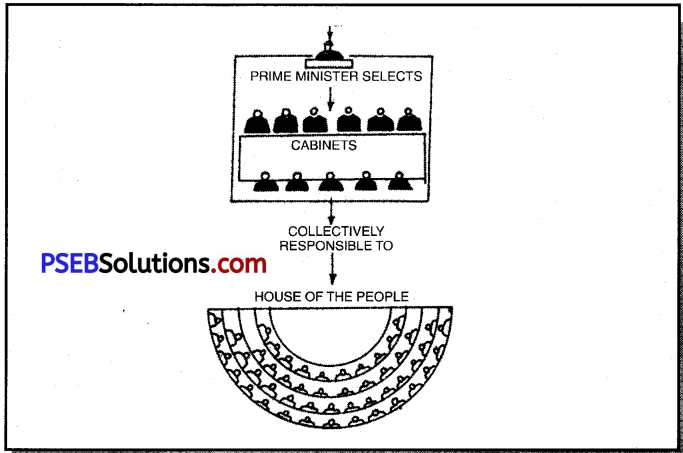
The Constitution of India provides for parliamentary government in the country. At the Centre as well as in the States there is parliamentary government. The President is only the nominal head of the State. He exercises his powers on the advice of the Council of Ministers. It is written in the Constitution that there will be a Council of Ministers headed by the Prime Minister to aid and advise the President. In fact all the powers of the President are actually exercised by the ministers. The Council of Ministers takes decisions and the President can give them a piece of advice. The ministers run the administration according to their sweet will. It is why the parliamentary system of Government is called the Cabinet Government.

Composition:
The only provision made in the constitution for the formation of the Council of Ministers is that the President appoints the Prime Minister and the other ministers are appointed by him with the consultation of the latter. But the fact is that the President does not appoint, the Prime Minister of his own sweet will. Normally the leader of the majority party in the Lok Sabha is made the Prime Minister and all other ministers are appointed by the President on the recommendation of the Prime Minister. The President cannot make any change in the list of ministers.

It is again the Prime Minister who distributes portfolios among the ministers. The ministers are taken out of the members of the legislature. If any outsider is appointed a minister, he must become the member of the legislature within 6 months. In Feb. 1988, Prime Minister Rajiv Gandhi reorganized his Council of Ministers and there were 60 members in the Council of Ministers. In the Constitution, 91st Amendment Act provides that the total number of ministers including the Prime Minister, shall not exceed 15% of the total number of members of the Lok Sabha.
PSEB 11th Class Political Science Solutions Chapter 24 The Union Executive-President, Vice-President, Council of Ministers and Prime Minister 6

In May 2019, there were 57 members in the Council of Ministers. It included 24 cabinet ministers, 24 ministers of state and 9 ministers having independent charge.

Term of Office:
It is written in the Constitution that the ministers will remain in the office during the pleasure of the President, It means that the President can remove the ministers from office whenever he likes. But it is not so. If the majority of the members of the Lok Sabha supports the Council of Ministers, it will continue to remain in office and the President cannot remove it. The ministers remain in office so far as they enjoy the confidence of the members of the Lok Sabha.

Salary:
The Constitution of India lays down that the salaries, allowances, etc. of the ministers shall be decided by the Parliament. The ministers are entitled to a salary, daily allowances and constituency allowances at the same rate as the members of Parliament.

Powers and Functions Of The Cabinet:
The Cabinet is the real ruler of the country. All the executive authority of the President is exercised by the cabinet. Following are the powers and functions of the Cabinet:

1. Determination of National Policy:
The polity of the nation is formulated by the Cabinet. After taking office the Cabinet is to formulate its internal and external policy according to which it is to run the administration of the State. It is the Government which is responsible for internal peace and order, and freedom from external aggression and better living of the people of the country. It has, therefore, to formulate policies in a way that they are helpful for the people of the country at large.

2. Control over Administration:
The administration of the country is to be run by the ministers. Every member of the Council of Ministers has one or more departments under his charge and he has to look after its working and administration. No doubt, it is the civil servants who carry on the administration but this administration has to be within the framework of the policies laid down by the Council of Ministers. Departmental administration has to be run by the civil servants but it is the minister who is responsible for the smooth running of the administration.

3. Foreign Relations:
It is the function of the Cabinet to maintain relations with other countries. These relations are established according to the policies laid down by the Cabinet. The ambassadors to foreign countries are appointed on the advice of the cabinet. The correspondence with other countries is done of course in the name of the President but actually it is the Cabinet who performs this function. It is the Cabinet which enters into treaties with other countries.

4. Legislative Powers: In a Parliamentary Government there is a close relationship between the Cabinet and the legislature. It enjoys many legislative powers.

  1. The ministers are taken from among the members of the Parliament and they have a big share in law-making.
  2. The President convenes the meetings of the Parliament on the advice of the Council of Ministers.
  3. The Cabinet prepares the programme of the session.
  4. The ministers introduce the bills in the House and see them through. Most of the bills in a Parliamentary Government are introduced in the Parliament by the ministers. They explain the policy and the purpose of the bills to the Parliament.
  5. Laws in the Parliament are framed in accordance with the wishes of the Cabinet. As the ministers belong to the majority party so they are sure of the support of the members to their bills.
  6. The President issues ordinances on the advice of the ministers.

5. Financial Powers: The Cabinet enjoys many financial powers:

  1. The budget is prepared by the Finance Minister in consultation with other ministers.
  2. It is the ministers who suggest an increase, decrease or abolition in the taxes. Money bills can only be introduced by the ministers.

6. Appointments:
Important appointments are made only on the advice of the ministers. For example, the appointments of Governors, Ambassadors and members of the Union Public Service Commission are made on the recommendations of the ministers.

7. Administrative Justice:
The ministers also exercise judicial powers. They are to decide many administrative matters. They are to give a decision in administrative matters and decisions of the ministers are final. While deciding cases the ministers have the right to adopt judicial methods like all other courts.

Conclusion:
The above mentioned powers and functions of the Cabinet clearly explain that the administration of the State is run according to the wishes of the Cabinet. It can run the administration in a way it likes. It is rightly said that the ‘Cabinet is the steering wheel of the ship of the State’. It is said that the British Cabinet has become the virtual dictator, the State and the Parliament have become subservient to it.

PSEB 11th Class Political Science Solutions Chapter 24 The Union Executive-President, Vice-President, Council of Ministers and Prime Minister

Question 6.
Distinguish between the Cabinet and the Council of Ministers.
Answer:
There are some differences between the Cabinet and the Council of Ministers. This distinction must be clarified. The Cabinet is a part of the Council of Ministers and the real authority is enjoyed by it.

Council of Ministers:
The Council of Ministers consists of the following types of ministers:
1. Cabinet Ministers:
These are the most important ministers. They control the important departments of administration. They frame policies and decide all other important matters, They are generally 25 to 30 in number. It is these ministers who form the Cabinet. All the powers of the Council of Ministers are exercised according to the wishes of the Cabinet.

2. State Ministers:
The State Ministers also head some departments. But they are not entitled to participate in the meetings of the Cabinet. They can be invited to attend the meetings of the Cabinet when some special issue or the issue concerning their department is to be discussed.

3. Deputy Ministers: The Deputy Ministers are appointed to assist the Cabinet ministers and the State ministers in the performance of their functions. The Deputy Minister is not the head of any department. The Deputy Ministers are appointed almost in each department.

4. Parliament Secretaries:
The Parliamentary Secretaries are not minister and they are not members of the Council of Ministers. Parliamentary Secretaries are not appointed by the President. They are appointed by the Prime Minister. They have no independent powers or functions. They assist the ministers to whom they are attached to do their parliamentary work. They have no control over the administrative departments. They are, infact, probationers under training and may hope to rise to higher ranks if they make good.

5. Deputy Prime Minister:
Neither the Constitution nor any of the Union laws provide for the office of the Deputy Prime Minister. It is the sole discretion of the Prime Minister to bestow the rank and the status of Deputy Prime Minister on any number of members of the Cabinet. Sardar Vallabh Bhai Patel was given the status and rank of Deputy Prime Minister in the Council of Minister headed by Late Pt. Jawaharlal Nehru.

Similarly in the Cabinet headed by Late Mrs. Indira Gandhi, Mr. Morarji Desai was ranked as Deputy Prime Minister of the country. The rank and status’of Deputy Prime Minister was conferred on Sarvashri Charan Singh and Jagjivan Ram in the Council of Ministers headed by Sh. Morarji Desai.

In the Ministery headed by Sh. V.P. Singh, Ch. Devi Lai was sworn in as the Deputy Prime Minister of the country. In June, 2002, Mr. Lai Krishan Adwani sworn in as the Deputy Prime Minister of India in the ministry of Mr. Atal Behari Vajpayee. The office of the Deputy Prime Minister carries neither special responsibilites nor special privileges.

The Council of Ministers consists different types of ministers. Their number is near about 65. But the Cabinet consists of only the Cabinet ministers and all important decisions are taken by them. Whatever decisions are taken by the Cabinet all the ministers are to abide by them. All the members of the Council of Ministers are to carry out those decisions.

PSEB 11th Class Political Science Solutions Chapter 24 The Union Executive-President, Vice-President, Council of Ministers and Prime Minister

Question 7.
What are the main features of the Cabinet System in India?
Answer:
In India the parliamentary system of government has been adopted. The Council of Ministers exercises all the powers of the President. It performs its functions on the basis of the following principles:

1. President a Constitutional Head:
The first important feature of the parliamentary system of government is that the Head of State enjoys only nominal powers. The entire administration of the State is run in the name of the President but in reality it is the Cabinet which is responsible for running the administration of the State. The President takes all the decisions on the advice of the Prime Minister.

The Prime Minister is the head of the government whereas the President is the head of the State. The President cannot participate in the meetings of the Cabinet and he is kept out of the Cabinet. The President appoints the Prime Minister, but he must appoint the leader of the majority party as the Prime Minister of India. He does not interfere in the formation, meetings and the decisions of the Cabinet.

2. Close relationship between the Cabinet and Parliament:
There is a very close relationship between the Cabinet and the Parliament. The Cabinet is formed from among the members of the Parliament. If any outsider is appointed a minister he must become the member of the Parliament within six months otherwise he will have to quit the office.

3. Leadership of the Cabinet:
The Cabinet performs its functions under the control and guidance of the Prime Minister. The appointments of the ministers are made by the President on the advice of the Prime Minister. The Prime Minister presides over the meetings of the Cabinet. He can remove any minister from office. He also co-ordinates the working of the ministry.

4. Political Homogeneity:
The members of the Cabinet hold the same view point because they belong to the same political party. The Cabinet works like a unit. Therefore, all the members of the. Cabinet must agree with one another. If the ministers are taken from different political parties, they will never agree over policy matters because each political party would like to implement its own policy. It is very necessary that the ministers should be taken from the same party so that administration could be run smoothly.

5. Cabinet works as a Team:
The Cabinet works as a team. The members of the Cabinet swim and sink together. They perform their functions in consultation with one another. All the ministers are individually as well as collectively responsibly for their work. No-confidence motion against a particular minister means a no-confidence motion against the entire ministry and the entire ministry is to resign. The resignation of the Prime Minister means the resignation of the entire ministry. All the ministers are to abide by the decisions taken by the Cabinet. All the ministers remain in office or lose office together.

6. Leadership of the Prime Minister:
Indian Cabinet works under the leadership of the Prime Minister. According to Art. 74, there shall be a Council of Ministers with the Prime Minister at its head to aid and advise the President in the exercise of his functions. Ministers are appointed by the President on the advice of the Prime Minister. Portfolios are distributed by the Prime Minister and he has the power to change the portfolios of the ministers.

He presides over the meetings of the Cabinet. In case of disagreement between a minister and the Prime Minister, the minister will have to resign. No person can remain in the Cabinet against the wishes of the Prime Minister. The resignation of the Prime Minister means the resignation of the whole Council of Ministers.

7. Prime Minister’s right to get the Lok Sabha dissolved:
Another feature of the Indian Cabinet system is that the Prime Minister can advise the president to dissolve the Lok Sabha. On Feb. 6, 2004 the President Dr. A.P.J. Adbul Kalam dissolved the Lok Sabha on the advice of the Prime Minister Atal Behari Vajpayee.

8. Secrecy:
Cabinet keeps the proceedings of its meetings absolutely secret. No minister can convey to anybody the decisions taken by the ministry and the discussion which took place while taking the decisions. The decisions can be announced by the concerned minister at the proper time.

9. Ministerial Responsibility:
The ministers cannot exercise their powers in an arbitrary manner. They are responsible for their actions and policies to the legistature. The members of the Parliament can ask them questions and supplementary questions and they are to answer them on the floor of the House. In case, the Parliament loses confidence in the ministers, they will have to resign. The Parliament can indicate its lack of no-confidence over the ministry by passing a no-confidence resolution. Even if the Parliament passes a no-confidence motion against one minister the entire ministry is to resign.

PSEB 11th Class Political Science Solutions Chapter 24 The Union Executive-President, Vice-President, Council of Ministers and Prime Minister

Question 8.
How is the Prime Minister appointed? Discuss his powers and functions.
Or
Discuss the position of the Prime Minister.
Answer:
The Prime Minister is the most important and powerful functionary of the State. He can be called the ruler of the State. The Prime Minister is the head of the Council of Ministers and all the powers of the President are actually exercisd by the Prime Minister. He can rule the country in a way which he thinks the best. He is the architect of the fate of State. The Government can do nothing against his will.

Appointment:
The Prime Minister is appointed by the President but while doing so the President is not having a free hand. Only that person can be appointed to the office of Prime Minister who is the leader of majority party in the Lok Sabha. After the general election the President invites the leader of the party which has gained majority in the Lok Sabha to form the Government.

In Dec. 1984, Mr. Rajiv Gandhi was appointed Prime Minister because he was the leader of the majority party (Congress I) in the Lok Sabha. If no political party gets an absolute majority in the Lok Sabha even then the President is not free to appoint anybody the Prime Minister. Under such circumstances only that person will be invited to form the Government who can seek the co-operation of the majority of members in the Lok Sabha.

After the 17th Lok Sabha election held in April-May, 2019, Sh Narender Modi was appointed as the Prime Minister.
Term of Office. The Prime Minister does not have a fixed tenure of offfice. He remains in office so long as he enjoys the support of the majority party. If the majority of members of the Lok Sabha loses confidence in the Prime Minister, he is to resign the office. On 11th April, 1997 Prime Minister H.D. Deve Gowda resigned because his resolution of vote of confidence was rejected by the majority members of the Lok Sabha.

Salary and Allowances. The Prime Minister gets the same salary and allowances which are paid to members of Parliament. He also receives a constituency allowance like other M.Ps. He is also entitled to free official residence, free travels, medical facilities, etc.

Powers And Functions Of The Prime Minister:
The Prime Minister enjoys vast powers which have made his office very important and powerful. His powers and functions are given as follows:
1. Prime Minisiter and the Cabinet:
The Prime Minister is the maker of the Cabinet. The Cabinet has no existence without the Prime Minister. He can make or unmake a Cabinet. The Cabinet performs all its functions under the control and guidance of the Prime Minister. Therefore, he is called “the keystone of the Cabinet arch” or “shining moon among the stars”. He enjoys the following powers in connection with the Cabinet:

(i) Formation of the Council of Ministers:
His first duty after assuming office is the formation of the Council of Ministers. He prepares a list of ministers according to his sweet will. He has a free hand in the selection of ministers. Nobody can be appointed a minister against the wishes of the Prime Minister. Number of Council of Ministers depends upon him. In the Constitution, 91st Amendment Act provides that the total number of ministers including the Prime Minister, shall not exceed 15% of the total number of members of the Lok Sabha. In May 2019, there were 57 members in the Council of Ministers.

(ii) Distribution of Portfolios:
The Prime Minitser distributes work among the ministers. He decides what department is to be allotted to a particular . minister. He controls the working of the departments of his ministers. If the Prime Minister is not satisfied with the working of a department, he can change the department of that minister. He distributes particular departments to ministers in such a way that they can run the departments quite efficiently. He also co-ordinates the working of different departments.

(iii) Removal of the Minister:
The ministers remain in office during the pleasure of the Prime Minister. If the Prime Minister is not satisfied with the working of a minister or the minister does nto run the department in accordance with wishes of the Prime Minister, he can ask him to quit the office and can appoint someone else in his place. In June, 1978 Prime Minister Morarji Desai asked Home Minister Char an Singh and Mr. Raj Narayan to resign from the cabinet and Mr. Charan Singh and Raj Narayan submitted their resignations.

On 1st August, 1990 the Prime Minitser V.P. Singh sacked his Deputy Prime Minister, Mr. Devi Lai, from the Council of Ministers. On April 20, 1998 Prime Minister Vajpayee sacked Communication Minister Buta Singh because he refused to resign. The Prime Minister can make changes in the Cabinet whenever he likes. With the resignation of the Prime Minister the entire ministry falls.

(iv) Leadership of the Cabinet:
The Prime Minister is the leader of the Cabinet. The Cabinet functions under the conrol of the Prime Minister. He can call the meetings of Cabinet whenever he likes. The Prime Minister prepares the agenda of the meeting as well as controls it. He presides over the Cabinet meetings. All the decisions in Cabinet meetings are taken according to the wishes of the council of ministers.

2. Link between the President and the Cabinet:
The Prime Minister is the link between the President and the Cabinet. It is the duty of the Prime Minister to convey the decisions of the Cabinet to the President. No minister can discuss a particular problem with the President without the permission of the Prime Minister. The President can demand information from the Prime Minister regarding the working of administration. The Cabinet can discuss any issue with the President only through the Prime Minister.

3. Leadership of the Cabinet in the Parliament:
The Prime Minister leads the Cabinet in the Parliament. The ministers answer the questions put to them by the members of the Parliament. Whenever a minister is in difficulty, the Prime Minister helps him. The Prime Minster explains the policy and decisions of the Cabinet to the Parliament. All important statements on behalf of the Cabinet are made by the Prime Minister in the Parliament.

4. Principal adviser of the President:
The Prime Minister is the chief adviser of the President. The President seeks the advice of the Prime Minister in all matters of the state. The Prime Minister informs the President regarding all the decisions taken by the Cabinet. If the President requires any information regarding the administration of any department, he would demand such an information from the Prime Minister.

5. Appointments:
All the important appointments in the State are made.by the Prime Minister. The President makes appointments of the State Governors, Ambassadors and members of the Union Pubilc Service Cmmission only on the advice of the Prime Minister. The President cannot make any such appointment of his own accord.

6. Leader of the Parliament:
The Prime Minister is also the leader of the House. Out of the two Houses the position of Lok Sabha is of great importance and the Prime Minister is the leader of the Lok Sabha. The Parliament always depends upon the policy and guidance of the Prime Minister for facing any problem. All the important decisions in the Parliament are taken according to the wishes of the Prime Minister. He can get any law passed by the parliament because he is the leader of the majority party. He can get the Lok Sabha dissolved.

7. Leader of Nation:
The Prime Minister is also the leader of the nation. The President is the head of the State and the Prime Minister is the head of the Government. Gveneral election means the election of the Prime Minister. Each poiltical party has its leader already and the people vote for the party whose leader they want to see as the Prime Minister of the country. During emergency the people have always high hopes on the Prime Minister and they always act upon his advice. His office has become more important for his being the leader of the nation. He is always supported by public and with the help of the public he can do things which he likes.

Position of the Prime Minister:
An analysis of the powers of the Prime Minister proves that “he is the pivot of the whole system of government.” He occupies a position of exceptional authority. K.T. Shah observed in the Constituent Assembly, “This Constitution concentrates so much power and influence in the hands of the Prime Minister that there is every danger to apprehend that the Prime Minister may become a dictator if he chooses to do so.” N.V. Gadgil, former Governor of Punjab said, “The Prime Minister is invested with formidable power and influence unless he be a genuine democrat by nature, he is very likely to become a dictator.”

In the words of Nehru, ‘The Prime Minister is the linchpin of the government.” While the President is the nominal head, the Prime Minister is the real head. The powers of the President are in reality exercised by the Council of Ministers, But the Prime Minister is the head of the Council of Ministers. Without him, the ministers have no entity. To quote Laski, ‘The Prime Minister is central to the formation of the Council of Ministes, central to its birth and central to its death.” For his appointment, he is not dependent upon the favour of the President.

It is his right to form the Council of Ministers because he commands the confidence of the Lok Sabha. In the words of A.C. Dash, “The Indian Prime Minister like the German Chancellor is superior to the entire Cabinet, for under the Constitution he is declared to be the head of Council of Ministers and all other Ministers are appointed and probably will be dismissed on his advice.” The Prime Minister forms the Cabinet and he is its life breath.

He is the leader of the Parliament and the nation and the principal adviser of the President. The decisions of the Cabinet are virtually the decisions of the Prime Minister. There is hardly any elected functionary in the world comparable to the Prime Minister of India. Backed by a stable and substantial majority in the Lok Sabha, he is more powerful than even the President of the United States of America.

However, the Prime Minister’s supremacy is not due entirely to the powers which belong to his office. Much depends upon his personality. If he is a man of dynamic prsonality he will be able to dominate the political scene. A fickle minded person will never be able to impress. Ideally, the Prime Minister should have a personality which earns him not only the loyalty of his own party but also a measure of considerable respect from the opposition.

Mr. Nehru who held the office of the Prime Minister nearly eighteen years, possessed an unparalleld personality. He was an institution. In the words of Norman D. Palmer, “Important and able men have held ministerial posts but with the exception of Vallabhbhai Patel, who served as Deputy Prime Minister until his death in 1950, no one has really shared Nehru’s authority.” Prime Minister Lai Bahadur Shastri gave his country brilliant leadership in terms of war and peace and gave up his life in quest for peace. He served his country with his life.

He did not possess the external symbols of greatness yet he rose to great heights. Though short in stature there was more iron in his soul than appeared on the surface. The manner in which Morarji Desai was relieved of the Finance Department by Prime Minister Indira Gandhi, highlights the fact that not even the ‘tallest’ among the Prime Minister’s colleagues can measure upto the stature of the Prime Minister. After the election of 1971 and 1980, Prime Minister Indira Gandhi was considered the source of all power. According to Ashok Mehta, “Our Cabinet form of Government has come to a near Presidential regime.”

According to Frank Morris, “Mrs. Gandhi was not only the undisputed leader of the Congress Party, but it was her party and she could dominate it in a way which none else had done. She was free to choose her colleagues who were her agents or assistants and in her presence trembled and obeyed.” In the words of Greame C. Moodie, “For many the Prime Minister is the part of the government and at times, may become the personification of the political nation.” Mr. Rajiv Gandhi was very powerful because like Mrs. Indira Gandhi he was also the president of the Congress (I).

The position of the Prime Minister also depends upon the support of his party. Without his party he is nothing. He must maintain close contact with party opinion. His aloofness, reserve and indifference militates against sound leadership. He must rely on co-operation, not coercion. He is to lead the party and not drive it. The manner in which Pt. Nehru had to bow before the party demand on the removal of Mr. Krishna Menon in 1962 proves that there are limits beyond which the Prime Minister cannot carry the party.

To conclude, powerful as he may be, no particular Prime Minister is indispensable, irremovable, or omnipotent. “He is not Caesar, he is not an unchangeable oracle, his views are not dooms; he is always on suffrance and its germs are whether he can render indubitably useful services. At any time a rival may supplant him.” The essence of the powers of the Prime Minister lies in a united Cabinet, a united Parliament and united people.

PSEB 11th Class Political Science Solutions Chapter 24 The Union Executive-President, Vice-President, Council of Ministers and Prime Minister

Short Answer Type Questions 

Question 1.
How is the President of India elected?
Answer:
The President is the head of the state. He is elected indirectly by an electoral college. Elected members of both the Houses of Parliament and elected members of legislative assemblies of the States constitute the electoral college. The nominated members of the Parliament and the assemblies do not take part in the election. The voting is held on’ the basis of proportional representation by the single transferable vote system. Only an Indian citizen, who has attained the age of 35 years, and whose name has been proposed and seconded by a definite number of the electors, can contest election.

Question 2.
Explain in brief the composition of the Electoral College constituted for the election of the President.
Answer:
According to Article 54 of Indian Constitution, the President shall be elected indirectly by an electoral college consisting of the elected members of the union and state legislatures in accordance with the principle of proportional representation with single transferable vote system.

Question 3.
Describe the formula by which the value of the vote of the members of State Legislative Assembly is determined.
Answer:
Article 55 (4) of the Constitution lays down the procedure of determining the votes of the members of the State Assembly, which is as follows:

PSEB 11th Class Political Science Solutions Chapter 24 The Union Executive-President, Vice-President, Council of Ministers and Prime Minister 7
If the remainder is less than 500, it is ignored.
If it is more than 500, then the vote of each member shall be further increased by one.

PSEB 11th Class Political Science Solutions Chapter 24 The Union Executive-President, Vice-President, Council of Ministers and Prime Minister

Question 4.
Describe the procedure of determining the value of votes of the members of the Parliament.
Answer:
The constitution lays down the following procedure of determining the votes of the members of Parliament.

PSEB 11th Class Political Science Solutions Chapter 24 The Union Executive-President, Vice-President, Council of Ministers and Prime Minister 8
Fraction exceeding one-half being counted as one.

Question 5.
Describe the tenure of the President.
Or
Discuss in brief the removal of the President.
Answer:
The President is elected for a period of five years. But he can be removed from his office before the expiry date. The President can be removed from office by impeachment only. The Constitution lays down a detailed procedure for the impeachment of the President. He can be impeached “for violation of the Constitution.” When a President is to be impeached for the violation of the Constitution, the charges can be prepared by either House of the Parliament.

But no such charge is to be preferred unless the proposal to prefer such a charge is contained in a resolution which has been moved after at least 14 days notice in writing signed by not less than one-fourth of the total number of members of the House. The resolution must be passed by a two-thirds majority of the total number of members of the House. If passed by the requisite majority in one house, it is sent to the other House for investigation. If the other House also passes the resolution by a two- thirds majority of the total membership of this House, then it means the charge is proved and the President is removed from his office.

Question 6.
Describe the method of fixing the quota for the election of the President.
Answer:
Under the system of Proportional Representation, a candidate to be elected must secure the necessary quota of votes. The quota is determined by the following formula:

PSEB 11th Class Political Science Solutions Chapter 24 The Union Executive-President, Vice-President, Council of Ministers and Prime Minister 9
Suppose the total number of valid votes polled at the Presidential election is 8,00,000. Applying the above-mentioned formula, the quota shall be
\(\frac {8,00,000}{1+1}\) +1 = 4,00,001

PSEB 11th Class Political Science Solutions Chapter 24 The Union Executive-President, Vice-President, Council of Ministers and Prime Minister

Question 7.
Describe the salary and allowances of the President.
Answer:
The President of India gets a salary of Rs. 5,00,000 per month and an official residence (called Rashtrapati Bhavan in New Delhi) free of rent. In addition to the salary, the President also gets handsome allowances of various kinds as determined by Parliament. According to the President’s Pension Act, a person who ceases to hold office as President, either by expiration of his term of office or by resignation, is entitled to a monthly pension of Rs. 2,50,000. The Government may also allow him a free medical aid as was done in the case of Dr. Rajendra Prasad.

The salary and other allowances of the President are charged on the Consolidated Fund of India. According to Art. 59 (4), the emoluments and allowances of the President shall not be diminished during his term of office.

Question 8.
Describe any four executive powers of the President.
Answer:
Following are the executive powers of the President:

  1. All executive functions of the Union (central) government are performed in the name of the President.
  2. He appoints the Governors, Chief Justice and other judges of the Supreme Court and the High Courts.
  3. He appoints the Attorney General of India and the members and Chairman of the Union Public Service Commission.
  4. He is the supreme commander of the armed forces.

Question 9.
Mention four legislative powers of the President.
Answer:
Following are the legislative powers of the President:

  1. He can address both the Houses of the Parliament and can send messages to either house at any time.
  2. He can summon any House of the Parliament at any time.
  3. He can dissolve the Lok Sabha.
  4. He nominates two members of the Anglo-Indian community to the Lok Sabha.

PSEB 11th Class Political Science Solutions Chapter 24 The Union Executive-President, Vice-President, Council of Ministers and Prime Minister

Question 10.
Describe financial powers of the President.
Answer:

  1. It is the duty of the President to place the Budget for the current year before the Parliament. It is to be presented before the beginning of the financial year. Normally the budget is presented to the Parliament by the
  2. Finance Minister on behalf of the President.
  3. Money Bill can only be introduced in the Parliament on the recommendation of the President.
  4. The President has full control over the contingency fund and he can spend it according to his sweet will. He distributes the share of income tax among the States.

Question 11.
Describe judicial powers of the President.
Answer:
The President has some judicial powers also. It is provided by Article 122 of the Constitution.

  • The President appoints the judges and the chief justices to the Supreme Court and the State High Courts.
  • The President cannot be sued in any court of India in connection with any matter concerning his office.
  • He has power to pardon, reprieve and commute punishment.
  • The President can seek the advice of the supreme court of India over any legal matter or a bill of Republic Importance.

Question 12.
What do you know about the emergency powers of the President?
Ans.
The President can declare emergency in three special circumstances :
1. If the President thinks that the security of the country is threatened by a war or external aggression or armed rebellion threatening the integrity of India, he can declare an emergency for the whole of India or any part of it. But the advice should come from the Council of Ministers in writing.

2. In case of the failure of the constitutional machinery in a state or states, the President can take over the entire work of the executive and dissolve or suspend the state assembly.

3. If the President thinks that there is an economic situation in which the financial stability or the credit of India is threatened, he can declare a financial emergency.

PSEB 11th Class Political Science Solutions Chapter 24 The Union Executive-President, Vice-President, Council of Ministers and Prime Minister

Question 13.
Discuss about the power of the President to issue an ordinance.
Answer:
During the intervals of the sessions of the Parliament he can issue ordinance. These ordinances have the force of laws. The ordinance is put before the Parliament as soon as it meets. The Parliament has the authority to reject the ordinance. It can be withdrawn by the President also. If it is neither rejected by the Parliament nor withdrawn by the President, it will automatically end six weeks after the first meeting of the Parliament.

Question 14.
Discuss in brief about various emergencies provided in the Constitution of India.
Answer:
There are three types of emergencies provided into the Constitution of India. These are:

  • National Emergency (Article 352) or Emergency arising out of external aggression or armed rebellion.
  • Emergency arising out of the failure of constitutional machinery in a state (Art. 356).
  • Financial Emergency (Art. 360).

Question 15.
What do you understand by National Emergency?
Answer:
According to Art. 352, if the President is satisfied that a grave emergency exists whereby the security of India or any part of India is threatened by war, external aggression or armed rebellion, he may proclaim a state of emergency. But the President can declare such type of emergency if the cabinet decision that such a proclamation may be made has been communicated to him in writing.

PSEB 11th Class Political Science Solutions Chapter 24 The Union Executive-President, Vice-President, Council of Ministers and Prime Minister

Question 16.
Under which condition the Constitutional Emergency is imposed?
Answer:
According to article 356, if the President, either on the receipt of a report from the Governor of a State or otherwise, is satisfied that a situation has arisen in which the Government of the State cannot be carried on in accordance with the provisions of the Constitution, the President can proclaim emergency in that state.

Question 17.
What is the Financial Emergency?
Answer:
According to Article 360, if the President is satisfied that a situation has arisen whereby the financial stability or credit of India or any part of it is threatened, he may declare a Financial Emergency under Article 360 of the constitution. Such a Proclamation may be revoked by a subsequent Proclamation. The Proclamation has to be laid before each House of-Parliament.

It ceases to operate at the expiration of two months unless it is approved earlier by a resolution of both the Houses of Parliament. The Proclamation in this cases should also be approved by Parliament as in the other two cases of emergency. Like the Proclamation of war-emergency, Financial Emergency also continues for an indefinite period. Fortunately, this kind of Emergency has not been declared, so far.

Question 18.
Describe any four points of criticism against the emergency powers of the President.
Answer:
Different persons criticised the emergency powers of the President on different grounds. Following are the points of criticisms against the emergency powers of the President:’

  • Possibility of misuse of emergency powers.
  • Emergency powers are undemocratic.
  • Emergency proclamation is beyond judicial control.
  • Emergency powers can crush the rights and liberties of the individuals.

Question 19.
Describe the justification of emergency powers.
Answer:

  • Historical experiences reveal that emergency powers are necessary to face national crisis.
  • National security is more important than that of the individual liberty.
  • It is the responsibility of the centre to maintain the unity and integrity of the nation.
  • President is a constitutional head.

PSEB 11th Class Political Science Solutions Chapter 24 The Union Executive-President, Vice-President, Council of Ministers and Prime Minister

Question 20.
Is it possible for the President of India to be a dictator?
Answer:
Emergency powers of the President indicate that he can be a dictator. But it is not possible for the President to become a dictator because:

  1. In India there exists a Parliamentary form of Government. In this system the President is a constitutional head and his role is nominal.
  2. According to 44th Amendment an Emergency can be proclaimed only on the basis of written advice tendered by the cabinet and the advice of the council of ministers is binding on the President.
  3. If President tries to misuse his powers, he can be removed by impeachment.
  4. President’s rule can’t be imposed at the Centre level.

Question 21.
Describe the election method of the Vice-President of India.
Answer:
The Vice-President of India is elected by an electoral college consisting of the members of both Houses of Parliament in accordance with the system of proportional representation by means of the single transferable vote and the voting at such election shall be by secret ballot. The two Houses need not sit together for this purpose.

It is significant to note that in the election of the Vice-President the nominated members of both the Houses have the right to vote while in the election of the President only the elected members of Parliament are eligible to vote.

PSEB 11th Class Political Science Solutions Chapter 24 The Union Executive-President, Vice-President, Council of Ministers and Prime Minister

Question 22.
Describe in brief the functions of the Vice-President.
Answer:
The duties of the Vice-President are two-fold:1. He is the ex-officio Chairman of the Rajya Sabha and 2. he acts for the President when the office of the President is vacant. Even when the President is ill or otherwise unable to perform the duties of his office, the Vice-President acts for him.

As Vice-President. In the absence of the President or during casual vacancy in the office of the President, the Vice-President shall perform all the functions of the President. If the President is unable to discharge his functions owing to absence, illness or any other cause, the Vice-President will discharge his functions until the date on which the President resumes his duties.

As Chairman of Rajya Sabha. The Vice-president is the ex-officio Chairman of Rajya Sabha, that means that by being the Vice-President of the country, he is the Chairman of the Rajya Sabha. He is to perform various functions in his capacity as the Chairman of the Rajya Sabha and they are given as follows:

  • He presides over the meetings of the Rajya Sabha.
  • He maintains decorum and decency in the House.
  • He allots time to the members to speak.

Question 23.
Describe any four qualifications to become a member of Union Council of Ministers.
Answer:

  • He must be a citizen of India.
  • He must not hold any office of profit under the Government of India or the Government of any State.
  • He must possess such other qualifications as may be prescribed by the Parliament.
  • No person can be a member of both Houses of Parliament. In case he becomes, he must vacate one of the two seats. Likewise, one person cannot be a member of a House of Parliament and of a State Legislature simultaneously.

Question 24.
How is the Council of Ministers at the centre formed?
Answer:
After the general elections the various parties in the Parliament elect their leaders. The President invites the leader of the majority party and appoints him the Prime Minister. The Prime Minister selects other ministers and sends their names to the President. The President appoints them as ministers. He cannot make any change in the list given to him by the Prime Minister. It might happen that no party has a majority in the Lok Sabha. In such a situation the President invites the leader of the coalition of many parties and appoints him Prime Minister.

The Prime Minister and other ministers have to take oath of loyalty to the Constitution before they assume office.

PSEB 11th Class Political Science Solutions Chapter 24 The Union Executive-President, Vice-President, Council of Ministers and Prime Minister

Question 25.
Give four features of the Cabinet System in India.
Ans.
1. Nominal Head of the State:
The first important feature of the Cabinet system in India is that the President enjoys only nominal powers. The President is a constitutional head of the State.

2. Close Relations Between the Executive and the Legislature:
There is a close relationship between the Cabinet and the Parliament. All the ministers are members of one or the other house of Parliament. They attend the meetings of Parliament, participate in debates and move the bills in the Parliament.

3. Leadership of the Prime Minister:
The Cabinet works under the control and guidance of the Prime Minister. He is the head of the Council of Ministers. He presides over the meetings of the Cabinet and determines the agenda of the meetings.

4. Collective Responsibility:
The Indian Cabinet is responsible to the Lok Sabha. It remains in office so long as it enjoys the confidence of the Lok Sabha. The moment it loses the majority of the members in the house, it has to quit office.

Question 26.
Distinguish between the Cabinet and the Council of Ministers.
Ans.

  1. In the Constitution the words ‘Council of Ministers’ are used and not the word ‘Cabinet’.
  2. The Cabinet is a part of the Council of Ministers. The Council of Ministers consist of all types of ministers. Their number is about 70. But the cabinet consists of only the cabinet ministers. The cabinet consists of about 25 members.
  3. Cabinet is more important than the Council of Ministers. All decisions of the cabinet are to be carried out by the members of the Council of Ministers.
  4. The cabinet ministers get higher salaries than other ministers.

Question 27.
Discuss various types of Ministers in Union Council of Ministers.
Answer:
The Council of Ministers consists of all the ministers. There are four categories of ministers in-India :
1. Cabinet Ministers:
These are the most important ministers. They control the important departments of administration. They frame policies and decide all other important matters. They are generally 20 to 25 in number. It is these ministers who form the Cabinet. All the powers of the Council of Ministers are exercised according to the wishes of the Cabinet.

2. State Ministers:
The state ministers are also head of some departments. But they are not entitled to participate in the meetings of the Cabinet. They can be invited to attend the meetings of the Cabinet when some special issue or the issue concerning their departments is to be discussed.

3. Deputy Ministers:
The Deputy Ministers are appointed to assist the Cabinet ministers and the State ministers in the performance of their functions. A Deputy Minister is not the head of any department. The Deputy Ministers are appointed almost in each department.

4. Parliament Secretaries: Parliament Secretaries are appointed to assist the ministers in the Parliament. They are not the ministers.

PSEB 11th Class Political Science Solutions Chapter 24 The Union Executive-President, Vice-President, Council of Ministers and Prime Minister

Question 28.
Discuss any four functions of Council of Ministers.
Ans.
1. Determination of National Policy:
The policy of the Nation is formulated by the Cabinet. After taking office, the Cabinet is to formulate its internal and external policy according to which it is to run the administration of the State.

2. Control over Administration:
The administration of the country is to be run by the ministers. Every member of the Council of Ministers has one or more departments under his charge and he has to look after its working and administration.

3. Foreign Relations:
It is the function of the Cabinet to maintain relations with other countries. These relations are established according to the policies laid down by the Cabinet.

4. Cabinet give a decision in administrative matters.

Question 29.
How is the Prime Minister of India appointed?
Answer:
The President appoints the Prime Minister. He invites the leader of the majority party in the Lok Sabha and appoints him the Prime Minister. If no single party has a majority, many parties may form a coalition to make a majority and elect a leader. Then the leader of the coalition will be appointed as the Prime Minister. After 17th Lok Sabha election in April-May 2019, President appointed Sh. Narender Modi, leader of the National Democratic Alliance as Prime Minister.

Question 30.
What are the functions of Prime Minister?
Answer:
The Prime Minister enjoys vast powers which have made his office very important and powerful. His powers and functions are as ahead:

  1. The first function of the Prime Minister is the formation of Council of Ministers. He has a free hand in the selection of ministers. Number of Council of Ministers depends upon him.
  2. The Prime Minister distributes portfolios among the ministers.
  3. The ministers remain in office during the pleasure of the Prime Minister. The Prime Minister can make changes in the Council of Ministers whenever he likes.
  4. Prime Minister is the leader of the Cabinet. The Cabinet functions under the control of the Prime Minister.

Question 31.
Write down the names of present President, Vice-President and Prime Minister of India.
Answer:
Name of Post – Name of Person

  • President – Sh. Ram Nath Kovind
  • Vice President – Sh. Venkaiah Naidu
  • Prime Minister – Sh. Narendra Modi

PSEB 11th Class Political Science Solutions Chapter 24 The Union Executive-President, Vice-President, Council of Ministers and Prime Minister

Question 32.
Write down the salary of President and Vice-President.
Answer:
Name of Post – Salary (Monthly)

  • President – Rs. 5,00,000
  • Vice-President – Rs. 4,00,000

Very Short Type Questions

Question 1.
How is the President of India elected?
Answer:
The President is elected indirectly by an electoral college. Elected members of both the Houses of Parliament and elected members of legislative assemblies of the States constitute the electoral college. The voting is held on the basis of proportional representation by the single transferable vote system.

Question 2.
Describe the tenure of the President.
Answer:
The President is elected for a period of five years. But he can be removed from his office before the expiry date. The President can be removed from office by impeachment only. The Constitution lays down a detailed procedure for the impeachment of the President. He can be impeached “for violation of the Constitution.”

Question 3.
Describe the salary and allowances of the President.
Answer:
The President of India gets a salary of Rs. 5,00,000 per month. According to the President’s Pension Act, a person who ceases to hold office as President, either by expiration of his term of office or by resignation, is entitled to a monthly pension of Rs. 2,50,000.

PSEB 11th Class Political Science Solutions Chapter 24 The Union Executive-President, Vice-President, Council of Ministers and Prime Minister

Question 4.
Write any two privileges of the President.
Answer:

  • The President of India is not answerable to any court for the exercise of his constitutional rights and powers.
  • No criminal proceeding can be launched against him during his term.

Question 5.
Describe any two executive powers of the President.
Answer:
Following are the executive powers of the President:

  • All executive functions of the Union (central) government are performed in the name of the President.
  • He appoints the Governors, Chief Justice and other judges of the Supreme Court and the High Courts.

Question 6.
Mention two legislative powers of the President.
Answer:
Following are the legislative powers of the President:

  • He can address both the Houses of the Parliament and can send messages to either house at any time.
  • He can summon any House of the Parliament at any time.

Question 7.
Explain financial powers of the President.
Answer:

  • It is the duty of the President to place the Budget for the current year before the Parliament. It is to be presented before the beginning of the financial year. Normally the budget is presented to the Parliament by the
  • Finance Minister on behalf of the President.
  • Money Bill can only be introduced in the Parliament on the recommendation of the President.

Question 8.
Describe judicial powers of the President.
Answer:
The President has some judicial powers also. It is provided by Article 122 of the Constitution.

  • The President appoints the judges and . the chief justices to the Supreme Court and the State High Courts.
  • The President cannot be sued in any court of India in connection with any matter concerning his office.

PSEB 11th Class Political Science Solutions Chapter 24 The Union Executive-President, Vice-President, Council of Ministers and Prime Minister

Question 9.
Discuss in brief about various emergencies provided in the Constitution of India.
Answer:
There are three types of emergencies provided into the Constitution of India. These are:

  • National Emergency (Article 352) or Emergency arising out of external aggression or armed rebellion.
  • Emergency arising out of the failure of constitutional machinery in a state (Art. 356).
  • Financial Emergency (Art. 360).

Question 10.
What do you understand by National Emergency?
Answer:
According to Art. 352, if the President is satisfied that a grave emergency exists whereby the security of India or any part of India is threatened by war, external aggression or armed rebellion, he may proclaim a state of emergency.

Question 11.
Under which condition the Constitutional Emergency is imposed?
Answer:
According to article 356, if the President, either on the receipt of a report from the Governor of a State or otherwise, is satisfied that a situation has arisen in which the Government of the State cannot b,e carried on in accordance with the provisions of the Constitution, the President can proclaim emergency in that state.

Question 12.
What is the Financial Emergency?
Answer:
According to Article 360, if the President is satisfied that a situation has arisen whereby the financial stability or credit of India or any part of it is threatened, he may declare a Financial Emergency under Article 360 of the constitution. Such a Proclamation may be revoked by a subsequent Proclamation.

PSEB 11th Class Political Science Solutions Chapter 24 The Union Executive-President, Vice-President, Council of Ministers and Prime Minister

Question 13.
Explain any two points of criticism against the emergency powers of the President.
Answer:
Different persons criticised the emergency powers of the President on different grounds. Following are the points of criticisms against the emergency powers of the President:

  • Possibility of misuse of emergency powers.
  • Emergency powers are undemocratic.

Question 14.
Describe the justification of emergency powers.
Answer:

  • Historical experiences reveal that emergency powers are necessary to face national crisis.
  • National security is more important than that of the individual liberty.

Question 15.
Is it possible for the President of India to be a dictator?
Answer:
It is not possible for the President to become a dictator because:

  1. In India there exists a Parliamentary form of Government. In this system the President is a constitutional head and his role is nominal.
  2. According to 44th Amendment an Emergency can be proclaimed only on the basis of written advice tendered by the cabinet and the advice of the council of ministers is binding on the President.

Question 16.
Describe the election method of the Vice-President of India.
Answer:
The Vice-President of India is elected by an electoral college consisting of the members of both Houses of Parliament in accordance with the system of proportional representation by means of the single transferable vote and the voting at such election shall be by secret ballot. The two Houses need not sit together for this purpose.

PSEB 11th Class Political Science Solutions Chapter 24 The Union Executive-President, Vice-President, Council of Ministers and Prime Minister

Question 17.
Describe the term of the Vice-President.
Answer:
The Vice-President is elected for a term of five years. The period of five years starts from the date on which he enters his office. He is eligible for re-election. The Vice¬President may resign his office by writing to the President before the expiry of five years. Vice-President can be removed from office by impeachment.

Question 18.
Describe about the salary of the Vice-President.
Answer:
The Vice-President is the ex-officio Chairman of the Rajya Sabha and he receives a salary of Rs. 4,00,000 per month. When the Vice-President acts as President, he has all the privileges, powers and immunities of the President. After retirement Vice-President is entitled to a monthly pension of Rs. 2,00,000.

Question 19.
Describe in brief the functions of the Vice-President.
Answer:
The duties of the Vice-President are two-fold:

  1. He is the ex-officio Chairman of the Rajya Sabha and
  2. he acts for the President when the office of the President is vacant. Even when the President is ill or otherwise unable to perform the duties of his office, the Vice-President acts for him.

Question 20.
Discuss any two qualifications to become a member of Union Council of Ministers.
Answer:

  • He must be a citizen of India.
  • He must not hold any office of profit under the Government of India or the Government of any State.

PSEB 11th Class Political Science Solutions Chapter 24 The Union Executive-President, Vice-President, Council of Ministers and Prime Minister

Question 21.
How is the Council of Ministers at the centre formed?
Answer:
After the general elections the various parties in the Parliament elect their leaders. The President invites the leader of the majority party and appoints him the Prime Minister. The Prime Minister selects other ministers and sends their names to the President. The President appoints them as ministers.

Question 22.
Give two features of the Cabinet System in India.
Answer:

  1. Nominal Head of the State: The first important feature of the Cabinet system in India is that the President enjoys only nominal powers. The President is a constitutional head of the State.
  2. Close Relations Between the Executive and the Legislature: There is a close relationship between the Cabinet and the Parliament.

Question 23.
Distinguish between the Cabinet and the Council of Ministers.
Answer:

  • In the Constitution the words ‘Council of Ministers’ are used and not the word ‘Cabinet’.
  • The Cabinet is a part of the Council of Ministers. The Council of Ministers consist of all types of ministers. Their number is about 70. But the cabinet consists of only the cabinet ministers. The cabinet consists of about 25 members.

Question 24.
Mention any two functions of Council of Ministers.
Answer:

  1. Determination of National Policy: The pohcy of the Nation is formulated by the Cabinet. After taking office, the Cabinet is to formulate its internal and external pohcy according to which it is to run the administration of the State.
  2. Control over Administration: The administration of the country is to be run by the ministers. Every member of the Council of Ministers has one or more departments under his charge and he has to look after its working and administration.

Question 25.
How is the Prime Minister of India appointed?
Answer:
The President appoints the Prime Minister. He invites the leader of the majority party in the Lok Sabha and appoints him the Prime Minister. If no single party has a majority, many parties may form a coalition to make a majority and elect a leader. Then the leader of the coalition will be appointed as the Prime Minister.

Question 26.
What are the functions of Prime Minister?
Answer:
The Prime Minister enjoys vast powers which have made his office very important and powerful. His powers and functions are as follows:

  • The first function of the Prime Minister is the formation of Council of Ministers. He has a free hand in the selection of ministers. Number of Council of Ministers depends upon him.
  • The Prime Minister distributes portfolios among the ministers.

PSEB 11th Class Political Science Solutions Chapter 24 The Union Executive-President, Vice-President, Council of Ministers and Prime Minister

One Word to One Sentence Answer Type Questions

Question 1.
What is the term of the Prime Minister?
Answer:
The Prime Minister does not have a fixed tenure of office. He remains in office so long as he enjoys .the support of the majority party.

Question 2.
Mention any one power of the Prime Minister.
Answer:
The first and significant duty o$ the Prime Minister is the formation of the Council of Ministers.

Question 3.
Who is the leader of the Cabinet?
Answer:
The Prime Minister is the leader of the Cabinet.

Question 4.
Who was the first Prime Minister of India?
Answer:
Pt. Jawahar Lal Nehru was the first Prime Minister of India.

Question 5.
Who is the link between the Council of Ministers and the President? Answer:The Prime Minister is the link between the Council of Ministers and the President.

PSEB 11th Class Political Science Solutions Chapter 24 The Union Executive-President, Vice-President, Council of Ministers and Prime Minister

Fill in the blanks

1. The …………… of India is head of the state.
Answer:
President

2. Minimum age needed for the President is …………… .
Answer:
35 years

3. The term of office of the Indian President is …………… .
Answer:
Five years

4. Sh …………… appointed Prime Minister after 17th Lok Sabha.
Answer:
Narendra Modi.

PSEB 11th Class Political Science Solutions Chapter 24 The Union Executive-President, Vice-President, Council of Ministers and Prime Minister

True or False statement

1. President is the head of the state.
Answer:
True.

2. Prime Minister is the head of the state.
Answer:
False

3. The tenure of the Cabinet is 10 years.
Answer:
False

4. Prime Minister form the Council of Minsters.
Answer:
True.

5. Prime Minister is the Chief Co-ordinator in the Cabinet.
Answer:
True.

PSEB 11th Class Political Science Solutions Chapter 24 The Union Executive-President, Vice-President, Council of Ministers and Prime Minister

Choose The Correct Answer

Question 1.
Who will administer the oath of office to the person who is to take over as President?
(A) Chief Justice of High Court
(B) Vice-President
(C) Chief Justice of India
(D) Speaker.
Answer:
(C) Chief Justice of India

Question 2.
The Cabinet is responsible to the
(A) Prime Minister
(B) President
(C) Parliament
(D) Speaker.
Answer:
(C) Parliament

Question 3.
The Prime Minister is appointed by the:
(A) President
(B) Parliament
(C) Cabinet
(D) Supreme Court.
Answer:
(A) President

PSEB 11th Class Political Science Solutions Chapter 24 The Union Executive-President, Vice-President, Council of Ministers and Prime Minister

Question 4.
The President of India is elected by:
(A) The Parliament
(B) The Assemblies
(C) The People
(D) The Electoral College.
Answer:
(D) The Electoral College.

Question 5.
The term of office of the Indian President is:
(A) 3 years
(B) 5 years
(C) 2 years
(D) 4 years.
Answer:
(B) 5 years

Question 6.
Minimum age needed for president is:
(A) 25 years
(B) 30 years
(C) 21 years
(D) 35 years.
Answer:
(D) 35 years.

PSEB 11th Class Political Science Solutions Chapter 24 The Union Executive-President, Vice-President, Council of Ministers and Prime Minister

Question 7.
The tenure of the Prime Minister is:
(A) 5 yeafrs
(B) 6 years
(C) 4 years
(D) Not fixed.
Answer:
(D) Not fixed.

Question 8.
The Prime Minister presides over:
(A) Lok Sabha
(B) Rajya Sabha
(C) Cabinet
(D) Parliament.
Answer:
(C) Cabinet

 

PSEB 10th Class English Grammar Voice

Punjab State Board PSEB 10th Class English Book Solutions English Grammar Voice Exercise Questions and Answers, Notes.

PSEB 10th Class English Grammar Voice

Change the Voice in the following sentences.

Question 1.
1. She will water the plants.
2. We expect happy news.
3. Does Raghu speak the truth?
4. They did not listen to me.
5. He helped his father in his old age.
6. The children were collecting stamps.
7. Columbus discovered America.
8. You cannot always expect such wonders.
9. Somebody has stolen my camera.
10. The boss has accepted my proposal.
11. I know his ways.
12. Do not insult your elders.
13. The teacher will punish the naughty boys.
14. Your behaviour displeased me.
15. Am I favouring you ?
Answer:
1. The plants will be watered by her.
2. Happy news is expected by us.
3. Is the truth spoken by Raghu ?
4. I was not listened to by them.
5. His father was helped in his old age by him.
6. Stamps were being collected by the children.
7. America was discovered by Columbus.
8. Such wonders cannot be expected always.
9. My camera has been stolen.
10. My proposal has1 been accepted by the boss.
11. His ways are known to me.
12. Your elders should not be insulted.
13. The naughty boys will be punished by the teach
14. I was displeased with your behaviour
15. Are you being favoured by plan

PSEB 10th Class English Grammar Voice

Question 2.
1. A race is run by them.
2. Who had been fined ?
3. A noise was made by you.
4. By whom are you taught English ?
5. It has to be learnt by heart.
6. Nothing will be done by them.
7. What is wanted by you ?
8. They were being taught by us.
9. The beggar was being insulted by them.
10. He will not have been abused by us.
11. I should not be disturbed.
12. My camera has been stolen by her.
13. This picture has been painted by me.
14. The thieves were caught by the police.
15. The child was knocked down by a car.
Answer:
1. They are running a race.
2. Who had fined him / her ?
3. You mame noise.
4. Who teaches you English ?
5. One has to learn it by heart.
6. Men will do nothing.
7. What do you want ?
8. We were teaching they them.
9. They were insulting the beggar.
10. We will not have abused
11. Nobody should disturb me.
12. She has stolen my camera.
13. I am have painted this picture.
14. The police caught the thieves.
15. A car knocked down the child.

Question 3.
1. I have seen this.
2. Nobody has touched it.
3. One must do one’s duty.
4. It is time to have tea.
5. He may avoid you.
6. Have you called out the roll ?
7. The police have arrested him.
8. May I smoke?
9. Let her sing.
10. They say that honesty is the best policy.
Answer:
1. This has been seen by me.
2. It has not been touched by anybody.
3. Duty must be done.
4. It is time for tea to be had.
5. You may be avoided by him.
6. Has the roll been called out by you ?
7. He has been arrested (by the police).
8. May I be permitted to smoke ?
9. She should be allowed to sing.
10. It is said that honesty is the best policy.

Question 4.
1. What cannot be cured must be endured.
2. It was hoped that he would pass.
3. Let the match be played by them.
4. It is said that virtue is its own reward.
5. You may be avoided by him.
6. His name will have to be struck off.
7. You are requested to listen to him.
8. I am astonished at his way of talking.
9. It should be done.
10. It is time to call in the doctor.
Answer:
1. One must endure what cannot be cured.
2. We hoped that he would pass
3. Let them play the match.
4. They say that virtue is its own reward.
5. He may avoid you.
6. They will have to strike off his name.
7. I request you to listen to him.
8. His way of talking astonishes me.
9. You should do it.
10. It is time for the doctor to be called in.

PSEB 10th Class English Grammar Voice

Question 5.
1. A meeting is being held here.
2. The bond was signed.
3. Duty must be done.
4. They were refused admission to this school.
5. Many persons were thrown out of jobs.
6. They were forced to listen.
7. What cannot be cured must be endured.
8. The child has been named Udit.
9. Promises will always be kept.
10. I was made captain of the school cricket team.
Answer:
1. They are holding a meeting here.
2. They signed the bond.
3. One must do one’s duty.
4. The Principal refused to admit them to this school.
5. The company threw many persons out of jobs.
6. He forced them to listen
7. One must endure what cannot be cured.
8. The parents have named the child Udit.
9. We will always keep our promises.
10. They made me captain of the school cricket team.

Question 6.
1. He is a man to trust.
2. I shall have to strike off his name. (His name will have to be struck off.)
3. Women like men to flatter them.
4. I want to buy this car.
5. He wants to become a pilot.
6. Shall I have to punish him ?
7. You have to do it.
8. It is time to say goodbye.
9. I have a lot yet to do.
10. He is a person to rely on.
Answer:
1. He is a man to be trusted.
2. His name will have to be struck off.
3. Women like to be flattered by men.
4. It is wanted by me to buy this car.
5. Becoming a pilot is wanted by him.
6. Will he have to be punished by me ?
7. It has to be done by you.
8. It is time for goodbye to be said.
9. A lot is yet to be done by me.
10. He is a person to be relied on.

Question 7.
1. Why did you abuse me ?
2. Who told a lie ?
3. When did you see the star ?
4. How has the teacher marked her absent ?
5. When did you pluck these flowers ?
Answer:
1. Why was I abused by you ?
2. By whom was a lie told ?
3. When was the star seen by you ?
4. How has she been marked absent by the teacher ?
5. When were these flowers plucked by you ?

Question 8.
1. Help everybody.
2. Help me, please.
3. Never waste your time.
4. Speak no evil of anybody.
5. Post this letter.
6. Learn it by heart.
7. Do not make a noise.
8. Show the guests in.
9. Kindly grant me leave.
10. Sit down, please.
Answer:
1. Everybody should be helped.
2. I may please be helped.
3. Never let your time be wasted.
4. Let not evil of anybody be spoken
5. Let this letter be posted.
6. It should be learned by heart.
7. Let a noise not be made.
8. The guests should be shown in.
9. I may kindly be granted leave.
10. You are requested to sit down.

PSEB 10th Class English Grammar Voice

Question 9.
1. Is this book being sold well ?
2. Quinine tastes bitter.
3. Is this medicine sweet when tasted ?
4. Sea water is saltish when tasted.
5. Does honey taste sweet ?
Answer:
1. Is this book selling well ?
2. Quinine is bitter when tasted.
3. Does this medicine taste sweet ?
4. Sea water tastes saltish.
5. Is honey sweet when – tasted ?

Question 10.
1. He may join the strike.
2. You can do it.
3. I cannot digest it.
4. Why should I do it ?
5. You should teach him a lesson.
6. You should respect your elders.
7. You ought to help the poor.
8. We should not laugh at others.
9. We must respect our elders.
10. You need not send this letter.
Answer:
1. The strike may be joined by him.
2. It can be done by you.
3. It cannot be digested by me.
4. Why should it be done by me ?
5. He should be taught a lesson by you.
(Or)
A lesson should be taught to him by you.
6. Your elders should be respected by you.
7. The poor ought to be helped by you.
8. Others should not be laughed at by us.
9. Our elders must be respected by us.
10. This letter need not be sent (by you)

Question 11.
1. He did not allow her to sit.
2. Parents should not over-protect their children.
3. You have to do it.
4. Why did you laugh at the poor man?
5. He is playing the game.
6. What did you see there?
7. I love my parents.
8. He has been arrested.
9. She was dismissed from service.
10. How can you solve this sum ?
Answer:
1. She was not allowed to sit by him.
2. The children should not be over protected by their parents.
3. It has to be done by you.
4. Why was the poor me in laughed at by you ?
5. The game is being played by him.
6. What was see n there by you ?
7. My parents are loved by me.
8. The police has arrested him
9. The boss dismissed her from service.
10. How can this sum be solved ( by you)

Active Voice

जिस वाक्य में Subject का सीधा सम्बन्ध Verb के साथ होता है (अर्थात् कर्ता के अनुसार क्रिया का रूप निर्धारित होता है), उसे Active Voice का वाक्य कहा जाता है। Passive Voice-जिस वाक्य में कर्म के अनुसार क्रिया का रूप निर्धारित होता है (और कर्ता का क्रिया पर कोई प्रभाव नहीं होता), उसे Passive Voice का वाक्य कहा जाता है।

Present Indefinite Tense

(is / am / are +V3)

Active Passive
1. She helps the, poor.
2. We expect good news.
3. I know him.
4. Radha does not sing a song.
5. Who teaches you English ?
6. What do you want ?
1. The poor are helped by her.
2. Good news is expected by us.
3. He is known to me.
4. A song is not sung by Radha.
5. By whom are you taught English ?
6. What is wanted by you ?

Change the Voice in the following sentences :

1. He does not love me.
2. We respect our elders.
3. 1 do not laugh at him.
4. Kanta solves her sums.
5. We expect happy news
6. Parents love their children.
7. Carpenters make furniture.
8. Do the farmers grow wheat ?
9. She does not deliver a speech.
10. Does Sita take care of her son

Past Indefinite Tense

(was / were + V3)

  Active Passive
1. She kept us waiting.
2. I employed many men.
3. The hunter did not kill the birds.
4. Did he give you anything ?
5. Who lent you this book ?
6. Which picture did you see last night ?
1. We were kept waiting by her.
2. Many men were employed by me.
3. The birds were not killed by the hunter.
4. Were you given anything by him ?
5. By whom were you lent this book ?
6. Which picture was seen by you last night ?

Present Continuous Tense

(is / am / are + being + V3)

Active Passive
1. The gardener is plucking flowers.
2. He is driving a motor car.
3. Boys are flying kites.
4. Is she reading a book?
5. Why are you wasting your time?
6. Who is laughing at the beggar?
1. Flowers are being plucked by the gardener.
2. A motor car is being driven by him.
3. Kites are being flown by boys.
4. Is a book being read by her?
5. Why is your time being wasted by you?
6. By whom is the beggar being laughed at?

Change the Voice :

1. We are helping them.
2. Am I favouring you ?
3. She is singing a song.
4. He is painting a picture.
5. They are playing hockey.
6. The child is not cutting teeth.
7. The child is enjoying the game.
8. Are they knocking at the door ?
9. Are they not serving their country ?
10. Are the boys laughing at the old man ?

Past Continuous Tense

(was / were + being + V3)

Active Passive
1. The hunter was aiming at the lion.
2. She was milking the cow.
3. The peon was ringing the bell.
4. The farmer was not ploughing the field.
5. Were they learning their lesson ?
6. What was Sohan doing ?
1. The lion was being aimed at by the hunter.
2. The cow was being milked by her.
3. The bell was being rung by the peon.
4. The field was not being ploughed by the farmer.
5. Was their lesson being learnt by them ?
6. What was being done by Sohan ?

Change the Voice:

1. I was closing the shop.
2. Was I writing a letter ?
3. Were you insulting him ?
4. Were they reading novels ?
5. Sita was ironing the clothes.
6. They were chasing the thief.
7. She was asking for more work.
8. They were not selling their books.
9. The mother was looking after the child nicely.
10. Was the gardener plucking flowers from the garden ?

Present Perfect Tense

(has / have + been + V3)

Active Passive
1. I have done my duty.
2. She has sold her cow.
3. They have not broken the windowpane.
4. Have you ever seen a lion ?
5. Why has Sohan not finished his work?
6. Who has stolen my pencil ?
1. My duty has been done by me.
2. Her cow has been sold by her.
3. The windowpane has not been broken by them.
4. Has a lion ever been seen by you ?
5. Why has his work not been finished by Sohan ?
6. By whom has my pencil been stolen ?

Change the Voice :
1. He has taken tea.
2. You have not told lies.
3. Have you seen a zoo?
4. I have won the match.
5. I have spoken the truth.
6. Has Rama seen this picture?
7. Sita has washed all her clothes.
8. Has the judge set the prisoner free?
9. Has he paid his insurance premium?
10. They have not learnt anything from the past.

PSEB 10th Class English Grammar Voice

Present Perfect Tense

(has / have + been + V3)

Active Passive
1. The watchman had already opened the gate.
2. We had never visited Amritsar before.
3. Had you never seen this place before?
4. Who had invited you to the feast?
5. Had he finished his work by 4 p.m.?
1. The gate had already been opened by the watchman.
2. Amritsar had never been visited by us before.
3. Had this place never been seen by you before?
4. By whom had you been invited to the feast?
5. Had his work been finished by him by 4 p.m.?

Change the Voice :
1. I had paid all the dues.
2. Had you hidden the ball ?
3. Who had broken the chair ?
4. I had told him the entire story.
5. She had never told a lie before.
6. They had gathered the flowers.
7. Why had he stolen your books ?
8. Had you never seen the Taj before ?
9. The gardener had watered the plants.
10. Had they looked into the whole matter ?

Future Perfect Tense

(will / shall + have been + V3)

Active Passive
1. I shall have planted a tree.
2. He will have read this book.
3. He will have sold his house.
4. She will have taken the test.
5. Will he have written a letter?
1. A tree will have been planted by me.
2. This book will have been read by him.
3. His house will have been sold by him.
4. The test will have been taken by her.
5. Will a letter have been written by him?

Change the Voice :
1. He will have abused me.
2. Who will have done this ?
3. We shall have heard a noise.
4. You will have done your duty.
5. I shall have received the letter.
6. Will she have posted her letter ?
7. Rama will have won the match by 6 p.m.
8. I will have finished my work before evening.
9. They will have taken their lunch before you reach there.
10. Will the doctor have examined the patient before you reach there ?

Imperative Sentences

(Object + should be + V3) Or (Let + Object + be + V3)

Active Passive
1. Shut the door.
2. Obey your parents.
3. Carry it home.
4. Never tell a lie.
5. Let him play the match.
6.  Please bring me a glass of water.
1. The door should be shut.
2. Let your parents be obeyed.
3. Let it be carried home.
4. A lie should never be told.
5. Let the match be played by him.
6.  You are. requested to bring me a glass of water.

Change the Voice :
1. Post this letter.
2. Help me, please.
3. Sit down, please.
4. Learn it by heart.
5. Never waste your time.
6. Show the guests in.
7. Do not make a noise.
8. Kindly grant me leave.
9. Never waste your time.
10. Speak no evil of anybody.

Prepositional Verbs

कुछ Verbs के साथ विशेष Prepositions या Adverb Particles का प्रयोग किया जाता है। Active Passive दोनों तरह के वाक्यों में ये Prepositions या Adverb Particles सम्बन्धित Verbs के सा लगाए जाने चाहिएं। इन्हें Verbs से अलग नहीं किया जा सकता है।

Active Passive
1. The people listened to him with respect.
2. I objected to his proposal.
3. The rich often laugh at the poor.
4. We must take care of our health.
5. They switched off the lights.
6. A car ran over an old man.
7. The police charged her with murder.
8. The Principal turned down my request.
9. The thieves cut down the telephone wires.
10. I cannot think of such a thing.
1. He was listened to with respect by the people.
2. His proposal was objected to by me.
3. The poor are often laughed at by the rich.
4. Health must be taken care of.
5. The lights were switched off.
6. An old man was run over by a car.
7. She was charged with murder by the police.
8. My request was turned down by the Principal.
9. The telephone wires were cut down by the thieves.
10. Such a thing cannot be thought of by me.

Change the Voice :
1. Are you listening to me?
2. I have sent for the doctor.
3. He has idled away his time.
4. Did he laugh at that insult?
5. They laid out a small garden.
6. Did the people cheer him up?
7. A car knocked down the child.
8. Has she asked for a new servant?
9. Why are you laughing at the poor man?
10. The boys did not throw stones at the beggar.

Passive of Infinitives

Active Passive
1. She begged the Principal to forgive her.
2. I hope to overcome my difficulties.
3. I have to do this work.
4. It expect you to finish the work.
5 It is time to give the order.
1. She begged the Principal to be forgiven.
2. I hope my difficulties to be overcome.
3. This work has to be done by me.
4. I expect the work to be finished by you.
5. It is time for the order to be given.

Change the Voice :
1. You have to do it.
2. It is time to take tea.
3. He is a man to trust.
4. I want to buy this book.
5. I have to attend a party.
6. It is time to say our prayers.
7. It is time to revise our books.
8. Shall I have to punish him ?
9. Women like men to flatter them.
10. I shall have to strike off his name.

PSEB 10th Class English Grammar Voice

Use of Prepositions other than ‘by’

कुछ वाक्यों के Passive voicé में ‘by’ के स्थान पर किसी अन्य Preposition का प्रयोग होता है।

Active Passive
1. His behaviour disgusts me.
2. The jug contains milk.
3. The news surprised us.
4. Gardening interests my mother.
5. You cannot please her.
6. I know him.
7. His jokes amused us.
8. His conduct amazed us.
1. I am disgusted with his behaviour.
2. Milk is contained in the jug.
3. We were surprised at the news.
4. My mother is interested in gardening.
5. She cannot be pleased with you.
6. He is known to me.
7. We were amused at his jokes.
8. We were amazed at his conduct.

Change the Voice :
1. I know this man.
2. This pot contains milk.
3. His behaviour surprised me.
4. Does she know the manager ?
5. The audience thronged the hall.
6. The sun ripens the hanging fruit.
7. His death has shocked everybody.
8. Didn’t his performance displease her?
9. Your harsh words will annoy everybody.
10. Your manners have impressed your boss.

Interrogative Sentences (Mixed Type)

नोट: What, why, when, how, which, where, who,आदि से शुरू होने वाले प्रश्नान्मक वाक्य निम्नलिखित हैं

Active Passive
1. What do you want ?
2. Who teaches you English ?
3. Whom do you love ?
4. Where will you spend your holidays ?
5. Whence have you bought this pen?
6. When will you see him ?
7. Why did he abuse you ?
1. What is wanted by you ?
2. By whom are you taught English ?
3. Who is loved by you ?
4. Where will your holidays be spent by you ?
5. Whence has this pen been bought by you ?
6. When will he be seen by you ?
7. Why were you abused by him ?

Change the Voice :
1. Who told a lie ?
2. Whom do you like ?
3. Whom did you see ?
4. What does he want ?
5. Who stole your pen ?
6. Who had visited Delhi ?
7. Why did you abuse me ?
8. Whom will you elect President ?
9. When did you pluck these flowers ?
10. Why has the teacher marked me absent ?

Use of can, could, may, etc.

(can, could, may, might, should, would, dare, etc. + be +V3)

 Active Passive
1. You should write the address neatly.
2. One cannot please everybody.
3. We should always speak the truth.
4 You must listen to his words.
5. One should do one’s duty.
6. Somebody must help this poor Woman.
1. The address should be written neatly.
2. Everybody cannot be pleased.
3. The truth should always be spoken by us.
4. His words must be listened to.
5. Duty should be done.
6. This poor woman must be helped.

Change the Voice :
1. I cannot do it.
2. You can do it.
3. Why should I do it?
4. May I take your book?
5. May I see this picture?
6. He may win a scholarship.
7. You ought to help the poor.
8. We should not laugh at others.
9. You should teach him a lesson.
10. You should respect your parents.

Implied Subject

Passive Voice के कुछ वाक्यों में by + agent नहीं दिया गया होता है, किन्तु ऐसे वाक्यों में कर्ता का अनुमान लगाने में कोई कठिनाई नहीं होती है। अत: Passive Voice से Active Voice बनाने में उसी कर्ता का प्रयोग किया जाना चाहिए।

Passive Active
1. You are wanted outside.
2. The thief has been arrested.
3. The telephone wires were cut.
4. The matter will be discussed tomorrow.
5. He was elected Member of Parliament.
1. Someone wants you outside.
2. The police have arrested the thief.
3. The thieves cut the telephone wires.
4. The committee will discuss the matter tomorrow
5. People elected him Member of Parliament.

Change the Voice :
1. Duty must be done.
2. The bond was signed.
3. They were forced to listen.
4. Promises will always be kept.
5. A meeting is being held here.
6. The child has been named Mohan.
7. Many persons were thrown out of jobs.
8. What cannot be cured must be endured.
9. They were refused admission to this school.
10. I was made captain of the school cricket team.

Double-Object-Type Sentences

कुछ वाक्यों में दो Objects होते हैं; जैसे
I gave him a book

पहले Object को Indirect Object और दूसरे को Direct Object कहा जाता है।
Passive Voice बनाते समय प्राय: Indirect Object को ही Subject के रूप में प्रयोग किया जाता
He was given a book by me.

किन्तु यदि Direct Object को Subject के रूप में प्रयोग किया जाना हो तो Indirect Object से पूर्व to अथवा for का प्रयोग करना पड़ता है। जैसे
A book was given to him by me.

Active Passive
1. I gave him a book.
(or)2. He teaches us English.
(or)3. You have written him a letter
(or)4. She handed Ram a letter.
(or)5. They gave her a test.
(or)
1. A book was given to him by me.
He was given a book by me.2. English is taught to us by him.
We are taught English by him.3. A letter has been written to him by you.
He has been written a letter by you.4. A letter was handed to Ram by her.
Ram was handed a letter by her.5.  She was given a test by them.
A test was given to her by them.

PSEB 10th Class English Grammar Voice

Change the Voice :
1. You gave him a pen.
2. She teaches him English.
3. Who gave you this money ?
4. My uncle sent me a present.
5. Has Ram told you the truth ?
6. They do not give him good food
7. Do you explain the case to him ?
8. The teacher did not give us a test.
9. Have you given him our umbrella ?
10. They will have sent him a lovely watch.

PSEB 5th Class EVS Solutions Chapter 19 पानी-आंतरिक संसार

Punjab State Board PSEB 5th Class EVS Book Solutions Chapter 19 पानी-आंतरिक संसार Textbook Exercise Questions and Answers.

PSEB Solutions for Class 5 EVS Chapter 19 पानी-आंतरिक संसार

EVS Guide for Class 5 PSEB पानी-आंतरिक संसार Textbook Questions and Answers

पृष्ठ-129-130

क्रिया 1.
एक मिठाई वाला या जूतों वाला खाली डिब्बा लें। उसके अन्दर नीले रंग का कागज़ चिपकाओ। नीचे वाले भाग में घास-फूस की सहायता से समुद्री वनस्पति दिखाएं। गत्ते के टुकड़ों में रंग कर चट्टानें/पत्थर दिखाएं। अब इसमें मछलियां/जल जीवों की तस्वीरें चिपकाएं। अंत में इसको ऊपर से लेमीनेशन-शीट से ढक दें। अक्वेरीअम का मॉडल तैयार है।
उत्तर :
स्वयं करें।
PSEB 5th Class EVS Solutions Chapter 19 पानी-आंतरिक संसार 2

  • मगरमच्छ,
  • कछुआ,
  • मेंढक,
  • आक्टोपस,
  • तारा मछली,
  • डाल्फीन,
  • मुर्गाबी,
  • बत्तख।

PSEB 5th Class EVS Solutions Chapter 19 पानी-आंतरिक संसार

पृष्ठ-130

क्रिया 2.
बच्चों को भिन्न-भिन्न जलीय जीवों की तस्वीरें दिखाकर प्रत्येक बच्चे को अलगअलग जलीय-जीवों के मॉडल तैयार करने के लिए कहा जाये।
उत्तर :
स्वयं करें।

पृष्ठ-131

प्रश्न 1.
रिक्त स्थान भरें- (कमल, दुनिया, व्हेल, जलीय)
(क) पानी के भीतर एक पूरी ………………………………….. बसती है!
(ख) ………………………………….. जीव हमेशा पानी में ही रहते हैं।
(ग) सबसे बड़ा समुद्री जीव ………………………………….. है।
(घ) ………………………………….. का पत्ता रोटी की तरह गोल होता है।
उत्तर :
(क) दुनिया,
(ख) जलीय,
(ग) व्हेल,
(घ) कमल।

प्रश्न 2.
निम्नलिखित सही कथन पर (✓) और गलत कथन पर (✗) का निशान लगाएं :

(क) पानी में रहने वाले जीव थलीय जीव होते
(ख) व्हेल सबसे बड़ा समुद्री जीव है।
(ग) जल लिली ताज़े खड़े पानी में होती है।
(घ) समुद्र के अन्दर वनस्पति भी होती है।
उत्तर :
(क) ✗
(ख) ✓
(ग) ✓
(घ) ✓

PSEB 5th Class EVS Solutions Chapter 19 पानी-आंतरिक संसार

प्रश्न 3.
सही मिलान करें
1. शार्क (क) आठ टांगें
2. आक्टोपस (ख) गलफड़े
3. कछुआ (ग) नोकीले दाँत
4. मछली (घ) सख्त खोल
उत्तर :
1. (ग),
2. (क),
3. (घ),
4. (ख)

प्रश्न 4.
निम्नलिखित प्रश्नों के ठीक उत्तर पर सही (✓) का निशान लगाएं :

(क) निम्नलिखित में से कौन सा जल-थलीय जीव है ?
शार्क
मगरमच्छ
व्हेल
उत्तर :
मगरमच्छ

(ख) निम्नलिखित में से कौन सा फूल पानी में खिलता है ?
गुलाब
सूरजमुखी
जल-लिली।
उत्तर :
जल-लिली

(ग) मछलियाँ कौन-से अंग द्वारा सांस लेती हैं ?
नाक
फेफड़े
गलफड़े
उत्तर :
गलफड़े

PSEB 5th Class EVS Solutions Chapter 19 पानी-आंतरिक संसार

(घ) निम्नलिखित में से कौन-सा पक्षी पानी के ऊपर रहता है ?
बत्तख
टटहिरी
मोर
उत्तर :
बत्तख

(ङ) गहरे-खारे समुद्री जल में रहने वाला जीव।
मेंढक
कछुआ
तारा मछली
उत्तर :
तारा मछली

प्रश्न 5.
कोई पांच जलीय जीवों के नाम लिखें।
उत्तर :
कुछ जलीय जीव हैं-स्टार फिश, आक्टोपस, समुद्री घोड़ा, सील, व्हेल, शार्क मछली आदि।

प्रश्न 6.
कोई तीन जल-थलीय जीवों के नाम लिखें।
उत्तर :
मेंढक, मगरमच्छ, कछुआ।

प्रश्न 7.
हमारा राष्ट्रीय फूल कौन-सा है ?
उत्तर :
कमल।

प्रश्न 8.
सबसे बड़ा समुद्री जीव कौन-सा है ?
उत्तर :
व्हेल मछली।

PSEB 5th Class EVS Solutions Chapter 19 पानी-आंतरिक संसार

प्रश्न 9.
पानी के ऊपर रहने वाले कुछ पक्षियों के नाम लिखो।
उत्तर :
बतखें, हंस, मुरगाबियाँ, बगुले।

प्रश्न 10.
व्हेल (whale) के बारे में आप क्या जानते हैं ? (4-5 वाक्यों में उत्तर दें)
उत्तर :
व्हेल सब से बड़ा समुद्री जीव है। इसका – भार 120 से 150 टन के करीब होता है। यह 90 से 100 फुट लंबी होती है।

प्रश्न 11.
मछलियाँ साँस कैसे लेती हैं ?
अथवा
मछलियां कौन से अंग से सांस लेती हैं ?
उत्तर :
मछलियाँ पानी में घुली ऑक्सीजन को साँस लेने के लिए प्रयोग करती हैं। यह अपने विशेष अंग गलफड़ों के द्वारा ऐसा करती हैं।

प्रश्न 12.
कमल के पौधे के बारे में 4-5 वाक्य लिखो।
उत्तर :
कमल हमारा राष्ट्रीय फूल है। यह पौधा पानी में पैदा होता है। इसका पत्ता बहुत बड़ा रोटी के जैसे गोल होता है। इसके फूल सफेद या गुलाबी होते हैं। इसकी डंडी लंबी होती है।

PSEB 5th Class EVS Guide पानी-आंतरिक संसार Important Questions and Answers

1. ठीक पर (✓) लगाएं

(i) कीट पतंगे ……………………………… द्वारा सांस लेते हैं।
(क) गलफडे
(ख) फेफड़े
(ग) सांस नली
(घ) कोई नहीं।
उत्तर :
(ग) सांस नली

PSEB 5th Class EVS Solutions Chapter 19 पानी-आंतरिक संसार

2. ……………………………… पक्षी होने के बावजूद तैर सकता है।
(क) पैंगुइन
(ख) मेंढक
(ग) मछली
(घ) सभी
उत्तर :
(क) पैंगुइन

(iii) मगरमच्छ धरती पर भी रह लेता है तथा पानी में भी इसलिए वह ……………………………… जीव है।
(क) जलीय
(ख) स्थलीय
(ग) जलथली
(घ) भद्दा।
उत्तर :
(ग) जलथली

2. एक/दो वाक्यों में उत्तर दें

प्रश्न 1.
जल कुम्भी पौधे के बारे में आप क्या जानते हैं ?
उत्तर :
यह वेल-नुमा पौधा होता है जो खड़े पानी के स्रोतों में बहत तेजी से फैलता है।

प्रश्न 2.
कछुआ कैसा जीव है ?
उत्तर :
यह एक जल-थली जीव है तथा बहुत सुस्त जीव है।

प्रश्न 3.
पौधों को भोजन कौन देता है ?
उत्तर :
पौधे अपना भोजन स्वयं ही तैयार करते

PSEB 5th Class EVS Solutions Chapter 19 पानी-आंतरिक संसार

3. रिक्त स्थान भरें
(i) मछली ………………………………………….. द्वारा सांस लेती है।
(ii) कीट-पतंगे ………………………………………….. द्वारा सांस लेते हैं।
(iii) कुमुदिनी तथा ………………………………………….. पानी पर तैरते हैं।
(iv) नीली व्हेल का ………………………………………….. भार होता हैं।
उत्तर :
(i) गलफड़े
(ii) साँस नलिकाएँ
(iii) हाइसिंथ
(iv) 120-150 टन.

4. ठीक/गलत-

(i) पैंगुइन पक्षी होते हुए भी तैर सकते हैं।
(ii) मछली के स्केलज़ इसकी त्वचा को गीला होने नहीं देते।
(iii) समुद्री घोड़े, केंकड़े समुद्र के पानी में पाये जाते हैं।
(iv) कछुआ, मगरमच्छ जैसे जल स्थलीय जीव नहीं है।
उत्तर :
(i) ठीक,
(ii) ठीक,
(iii) ठीक,
(iv) गलत।

5. मिलान करें

(i) मगरमच्छ (क) चमड़ी
(ii) मेंढक (ख) जल-थली जीव
(iii) मछली (ग) फेफड़े
(iv) कछुआ (घ) गलफड़े
उत्तर :
(i) (ख),
(ii) (क),
(iii) (घ),
(iv) (ग)।

6. दिमागी कसरत (माइंड मैप)

PSEB 5th Class EVS Solutions Chapter 19 पानी-आंतरिक संसार 1
उत्तर :
PSEB 5th Class EVS Solutions Chapter 19 पानी-आंतरिक संसार 3

PSEB 5th Class EVS Solutions Chapter 19 पानी-आंतरिक संसार

7. पाँच/छः वाक्यों में उत्तर दें

प्रश्न 1.
दो जल थली जीवों के बारे लिखें।
उत्तर :
जल-थली जीवों से भाव है कि ऐसे जीव जो पानी तथा धरती दोनों पर रह सकते हैं। उदाहरणें हैं-मगरमच्छ, मेंढक, कछुआ आदि।

  • मगरमच्छ-इसके दाँत तीखे होते हैं तथा जबाड़ा मज़बूत होता है। यह अपने शिकार को पलों में ही झपट लेता है।
  • मेंढक-यह पानी में तेज़ी से तैरता है तथा धरती पर ऊँची तथा लम्बी छलांगे लगाता है। अपनी लम्बी जीभ में कीटों को पकड़ लेता है।

PSEB 11th Class Political Science Solutions Chapter 17 Preamble to the Indian Constitution

Punjab State Board PSEB 11th Class Political Science Book Solutions Chapter 17 Preamble to the Indian Constitution Textbook Exercise Questions and Answers.

PSEB Solutions for Class 11 Political Science Chapter 17 Preamble to the Indian Constitution

Long Answer Type Questions

Question 1.
Write a critical note on the Preamble to the Indian Constitution.
Or
What are the guiding principles mentioned in the Preamble to the Indian Constitution? Discuss briefly.
Or
India is a Sovereign, Socialist, Secular, Democratic Republic. Explain.
Answer:
It has been considered essential, and advisable also, that every written Constitution should have a preamble. The preamble to a Constitution mirrors the spirit of Constitution. The Indian Constitution also begins with a preamble. Strictly speaking, the preamble does not constitute a part of the Constitution. That does not, however, mitigate its importance. The Preamble serves the purpose of a window through which we peep into the intentions of the makers of the Constitution.

In short, the preamble is a summary of the objectives and the basic philosophy of a Constitution. It helps in the interpretation of the Constitution. Commenting upon its significance former Chief Justice Subba Rao of the Supreme Court said, ‘The objective sought to be achieved by the constitution is declared in sonorous terms in the preamble. It contains, in a nutshell, its ideals and its aspirations. The preamble is not a platitude but the mode of its realisation as worked out in detail in the Constitution.” Thus, the preamble to the Indian Constitution helps us in understanding the basic philosophy of the Indian Constitution.

The preamble serves another purpose. It enables the people to assess and evaluate the preformance of the Government in the light of the objectives laid down in the Preamble. Any Government, which slacks down or becomes indifferent towards the fulfilment of the aspirations incorporated in the preamble runs the risk of being ousted from office. It keeps the Government thus on its toes.

Preamble to the Indian Constitution:
The Constitution of India begins with the preamble. It runs as under:
“We, the people of India, having solemnly resolved to constitute India into a Sovereign, Socialist, Secular, Democratic, Republic and to secure to all its citizens:

  • JUSTICE, social, economic and political
  • LIBERTY of thought, expression, belief, faith and worship
  • EQUALITY of status and of opportunity ; and to promote among them all
  • FRATERNITY assuming the dignity of the individual and the unity and integrity of the Nation

In our Constituent Assembly, this twenty-sixth day of November, 1949, do hereby adopt, enact and give to ourselves this Constitution”: Amendment to the Preamble. The forty-second Amendment put into force with effect from 18th December, 1976, amended the Preamble to include the words “Socialist and Secular.” So, in its amended form the preamble declares India to be a Sovereign, Socialist, Secular, Democratic and Republic. The addition of these two new adjectives has transformed the very character and spirit of the Constitution.
For the words “Unity of the Nation” the words “Unity and Integrity of the Nation” are substituted.

Significance:
In the words of M.V. Pylee, “The preamble to the constitution is one of the best of its kind ever drafted. Both in ideas and ideals and in expression it is unrivalled. It embodies the spirit of the constitution, the determination of Indian people to unite themselves in a common adventure of building up a new and independent nation which will ensure the triumph of Justice, equality and fraternity.” The Preamble to the Constitution throws light on three very important matters:
1. The source of authority,
2. the nature of the Indian polity and
3. the objectives of the Constitution.

1. Source of Constitutional Authority:
The Preamble expresses in a very clear language that people are the ultimate source of all authority. It is the people who have adopted and enacted the Constitution; it is the people who have given this Constitution to themselves.” Though the Indian Constitution does not contain any independent Article (The Constitution of Ireland by Art. 6 and the Tenth Amendment of the American Constitution) declaring that all authority flows from the people, yet the Preamble emphasises the ultimate sovereignty of the people.

In other words, the Constitution of India which came into effect on Jan. 26, 1950, has not been imposed upon us. The people of India in their sovereign capacity have adopted the Constitution for themselves. They have framed a Constitution which fulfils the aims and aspirations of the people. “The Constitution is for the people, the people are not for the Constitution.” Some critics, however, challenge the view that the Constitution has been framed by the people themselves.

They argue that the Constituent Assembly which framed this Constitution was not a truly representative body as it was not elected on the basis of universal adult franchise. Nor was it elected directly by the people. Moreover, the draft of Constitution was not referred to the people for their acceptance or rejection. However, we do not agree with the critics. After all the first and subsequent general elections have been held on the basis of direct and universal adult franchise. Had the representatives of the people no faith in the Constitution they would have surely changed it. Thus, the unmistakable implication is that the people are the ultimate source of all authority. The Constitution originates from the people of India and is promulgated in the name of the people of India.

2. Nature of Indian Polity:
In the second place, the Preamble proclaims that the people of India have resolved to constitute India into a‘Sovereign Socialist Secular Democratic Republic. These are few features of the Indian Political System.
(i) India is a Sovereign State.
(ii) India is a Socialist State.
(iii) India is a Secular State.
(iv) India is a Democratic State.
(v) India is a Republican State.

(i) India is a Sovereign State:
It means that now, after the promulgation of the Constitution, India is not subject to any foreign rule. India is now a . sovereign State, internally as well as externally. No other country can compel India to follow or not to follow a particular policy. We can now make any law, remaining of course within the limits imposed by our own Constitution.

We can also amend our Constitution in accordance with the procedure laid down in the Constitution. Some people are of the view that sovereignty is not absolute because of India’s membership of the Commonwealth of Nations. This, however, is not correct. India is a member of the Commonwealth of Nations according to her own free will. There is no constitutional binding. Commonwealth of Nations is not a super state.

Pt. Jawahar Lai Nehru said on 10th May, 1949, “It must be remarked that the Commonwealth is not a super-state in any sense of the term. We have agreed to consider the king as the symbolic head of this free association. But the king has no function attached to that status in the Commonwealth. So far as the Constitution of India is concerned, the king has no place and we shall owe no allegiance to him.”

(ii) India is a Socialist State:
By 42nd amendment act word ‘Socialist’ is inserted in the Preamble to the Constitution. Mr. Swaran Singh, the Chairman of the Congress Committee for constitutional changes, said that the proposed decision to inscribe ‘Socialism’ in the Preamble to the Constitution shows the nation’s resolve to work for a new “socio-economic revolution”.

The former Defence Minister said, “Socialism was the target the country had set for itself. Not only the majority party, but several other political organisations also were committed to this concept.” Smt. Indira Gandhi’s Government adopted 20-point programme to implement Socialism. Janata Government was committed to Gandhian Socialism and various steps were taken to implement Gandhian Socialism. Present government is committed to Socialism and is trying to implement 20- point programme.

(iii) India is a Secular State:
By inserting the word “Secular” in the Preamble to the Constitution by 42nd amendment, India is declared a secular state in clear words. Such a system is adopted in the Constitution that India is made secular state without any doubt. In the words of Smith, “The Secular State is important to the future of Indian Democracy itself. It stands or falls as basic and inseparable comment of modem liberal democracy.” By “Secularism” Mr. Swaran Singh explained, “We do not mean that we are against any religion. On the contrary, it symbolises our respect for all the religions and desire to treat them at par.”

(iv) India is a Democratic State:
The Indian polity is based on democratic principles. The people elect their representatives who use the sovereign authority on behalf of the people. The government is of the people and for the people. The represenatives are elected periodically by the people.

(v) India is a Republican State:
The word ‘Republic’ means that-the head of the State shall be an elected one for a fixed tenure. In the Indian Constitution there is no room for a hereditary monarch like the one in England. At the time of the assumption of office the President has to take an oath “To devote himself to the service and well-being of the people of India.” In the event of the violation of the Constitution the President can be impeached and removed from the office. Hence the Indian President is accountable to the people. However, the devices of direct democracy—Initiative, Referendum or Recall— are not available in the Indian Constitution.

3. Objectives of the Constitution:
In the third place, the Preamble defines the objectives to be achieved. They are:
(i) Justice:
The object of the Constitution is that all the citizens of India should get justice in every sphere of life. In the preamble the Idea of achieving Social, Economic and Political Justice for all citizens has been mentioned. To achieve Social, Economic and Political Justice provisions have been mentioned in the Constitution.

Social Justice:
The very incorporation of the term Social Justice in the Constitution made it clear that it is the duty of the state to work positively against discrimination existing in Indian society on the basis of baste, community, race or religion. The state is expected to work for creating an environment in which a more reasonable attitude towards social relations is cultivated. To achieve social justice, right to equality is mentioned in Part III of the Constitution.

The Right to Equality forbids any discrimination on the basis of religion, race, caste, sex, place of birth or any of them. But the state has a right to make special provision for the upliftment of the backward classes, women and children. Article 17 abolishes untouchability and its practice in any form is forbidden. All the citizens of India, irrespective of their caste and creed, have an equal access to public place.
Article 23 bans exploitation like ‘Begaar’ and similar other forms of forced labour. Article 24 prohibits the employment of children below the age of 14 in any factory, mine etc.

Economic Justice:
Economic Justice is ensured to people by the Directive Principles of State Policy. They ensure that no discimination would be made between persons on the basis of their economic standing. Article 39 calls upon the state to direct its policy to ensure that the citizens, men and women equally, have the right to an adequate means of livelihood and that there is equal pay for equal work for both men and women.The material resources of the country should be so distributed as to subserve the common good.

Political Justice:
Political Justice means that all the citizens should enjoy equal political rights. In other words, citizens should have the right to participate in the government. There is adult franchise and right to contest election. All citizens are treated equal before the law and all are given equal rights.

(ii) Liberty:
The Constitution aims not merely at securing justice to the people of the country but also liberty, without which human personality cannot be expected to develop fully. The citizens of India have been guaranteed a number of freedoms by the Constitution. Part III of the Constitution deals with the Fundamental Rights of the citizens. Some of the very important freedoms have been mentioned in the Preamble also. They are liberty of thought, freedom to express one’s views, belief and worship. The Preamble hates the idea of standardisation of ideas, desire of uniformity. Similarly, none can be compelled to follow a particular religion. “State dictated morality is no morality.”

(iii) Equality:
It has been rightly said that “Men are bom and reamin free and equal in rights.” The Preamble ensures equality of all in the eyes of law. Liberty and equality go hand in hand. Equality does not mean that all persons are equal in every respect. The positive concept of equality is that all persons should be given equal opportunities to rise and develop. Equality means that “among equals the law should be equal and should-be equally administered, that like should be treated alike.”

No person is to be deprived of his life and liberty unless he has violated a law in existence. And he is to be deprived of his life and liberty in accordance with law. In short, law is not the respector of personalities. Whatever may be the social status of person, he is subject to law. There can be no discrimination between one citizen and another on the basis of religion, language, caste, class, sex etc.

(iv) Fraternity:
The Preamble to the Constitution lays special stress upon the promotion of fellow-feeling among the people of India. Unless the people become a community of interests, their cohesion into one nation is not possible. The separatist tendencies, so systematically nursed by the alien rule, had resulted into an orgy of loot and murder. The makers of the Constitution had not forgotten the shocks due to the partition of the country. Unity of the country and consolidation of the nation were of paramount necessity. Hence every effort was made to achieve the desired end. One such step was the provision of single citizenship in the country.

(v) Integrity:
The inclusion of the term integrity expressed “our determination to put an end to separatist tendencies.” Effort was made to make people feel at home in every part of India from whichever state or region they might come. “Thus the Preamble reflects the aims and objectives of the new nation-a living, vital and progressive nation,” The makers of the Constitution aimed at the establishment of a society free from hunger, misery, starvation and exploitation a society where each stands for all and all for each.

The Preamble, though not a legal part of the Constitution, yet it is an integral part of the Constitution. It helps in explaining the various articles of the Constitution. “It is a key to open the mind of the makers.” Hence its importance.

PSEB 11th Class Political Science Solutions Chapter 17 Preamble to the Indian Constitution

Short Answer Type Questions

Question 1.
Write a short note on the Necessity of Preamble in a Constitution.
Or
What do you mean by the term Preamble?
Answer:
It is considered essential that every written constitution should possess a preamble. The preamble contains the basic ideas and philosophical postulates of a purpose of a window through which we peep into the indentions of the maters of the constitution. It enables the people to assess and evaluate the performance of the government in the light of the objectives laid down in the preamble.

Question 2.
What is the nature of state according to the Preamble?
Answer:
The nature of the state according to the preamble is as under:

  • India is a Sovereign state
  • India is a Democratic state
  • India is a Secular state
  • India is a Socialist state and
  • India is a Republic.

Question 3.
Discuss the objectives of our Constitution as embodied in the Preamble.
Answer:
Following are the objectives of our constitution as given in the Preamble.

  • Justice-social, political and economic.
  • Liberty of thought, expression, belief, faith and worship,
  • Equality of status and opportunity, and
  • Fraternity assuring the dignity of the individual and the Unity of the Nation.

PSEB 11th Class Political Science Solutions Chapter 17 Preamble to the Indian Constitution

Question 4.
Explain the term Republic.
Answer:
The word ‘Repubbc’ means that the head of the state shall be an elected one for a fixed tenure. India is Republic. The President of India is indirectly elected by the representatives of the people for a period of five years. He can even be impeached and removed from office before the expiry of five years. Any citizen of India fulfilling required qualifications can contest the election of the President of India. He may be the follower of any religion. In India politics has been separated from religion. Thus the Indian repubbc is a democratic repubbc.

Question 5.
Explain the term Fraternity.
Answer:
The dictionary meaning of the term Fraternity is “brotherhood’. Without fraternity, liberty and equality are meaningless. It was the main slogan of the French revolution. The Preamble of the Indian Constitution lays special stress upon the promotion of fellow feeling among the people of India.

Unless the people become a community of interests, their cohesion into the nation is not possible. The separatist tendencies ; so systematically nursed by the alien rule, had resulted into an orgy of loot and murder. The makers of the constitution had not forgotten the shocks due to the partition of the country. Unity of the country and consolidation of the nation were of paramount necessity. Hence every effort was made to achieve the desired end.

Question 6.
What do you mean by Social and Economic Justice?
Answer:
In the preamble the idea of achieveing Social and Economic Justice for all citizens has been mentioned. Social Justice means that all the people living in society are equal. The people should not be treated discriminately on the basis of caste, religion, colour and sex. All the people should have equal opportunities to develop their personalities. All should have equal facilities to use public places, religious places and the places of entertainment. The State should adopt the policy of untouchability and interests of the minorities should be safeguarded.

Economic Justice means that no discrimination should be made between persons on the basis of their economic status. Equal opportunities should be provided to all citizens to acquire wealth and use it for their living.

PSEB 11th Class Political Science Solutions Chapter 17 Preamble to the Indian Constitution

Question 7.
Write short note on Objective Resolution of 1947.
Answer:
The first session of the Constituent Assembly was held on Dec. 9, 1946. On Dec. 13, 1946, Pt. Jawahar Lal Nehru moved his Objective Resolution. Some of the important provisions of the Objective Resolution were as follow:
1. This Constituent Assembly declares its firm and solemn resolve to proclaim India as an Independent Sovereign Republic and to draw up for the future governance a Costitution;

2. Wherein all power and authority of the sovereign Independent India, its Constituent parts and organs of government, are derived from the people

3. Wherein shall be guaranteed and secured to all the people of India, Justice-social, economic and political, equality of status, of opportunity, and before the law; freedom of thought, expression, belief, faith, worship, vocation, association and action, subject to law and public morality; and

4. Wherein adequate safeguards shall be provided for minorities, backward and tribal areas and depressed and other classes. The Objective Resolution gave expression to the ideals and aspirations of the people of India.

Question 8.
Write down the meaning of Secular mentioned in the Preamble of Indian Constitution.
Answer:
By inserting the word “Secular” in the Preamble of the Constitution by 42nd amendment, India is declared a secular state in clear words. Such a system is adopted in the Constitution that India is made secular state without any doubt. Right to freedom of religion has been granted to all persons residing in India under Art. 25-28 of Indian Constitution.

According to this right, all persons are equally entitled to freedom of conscience and the right to profess, practise and propagate religion. State has no religion of its own. The state shows full neutrality in the religious matters. All this shows that India is a Secular State.

PSEB 11th Class Political Science Solutions Chapter 17 Preamble to the Indian Constitution

Very Short Answer Type Questions

Question 1.
What do you mean by the term Preamble?
Answer:
It is considered essential that every written constitution should possess a preamble. The preamble contains the basic ideas and philosophical postulates of a constitution. The preamble to a constitution mirrors the spirit of constitution. The Indian constitution also begins with a preamble. Preamble is essential because it serves the purpose of a window through which we peep into the intentions of the makers of the constitution.

Question 2.
Discuss the objectives of our Constitution as embodied in the Preample.
Answer:
Following are the objectives of our constitution as given in the Preamble.

  • Justice-social, political and economic.
  • Liberty of thought, expression, belief, faith and worship,
  • Equality of status and opportunity, and
  • Fraternity assuring the dignity of the individual and the Unity of the Nation.

Question 3.
Explain the term Republic.
Answer:
The word ‘Republic’ means that the head of the state shall be an elected one for a fixed tenure. India is Republic. The President of India is indirectly elected by the representatives of the people for a period of five years. He can even be impeached and removed from office before the expiry of five years.

Question 4.
Explain the term Fraternity.
Answer:
The dictionary meaning of the term Fraternity is “brotherhood’. Without fraternity, liberty and equality are meaningless. It was the main slogan of the French revolution. The Preamble of the Indian Constitution lays special stress upon the promotion of fellow¬feeling among the people of India. Unless the people become a community of interests, their cohesion into the nation is not possible.

PSEB 11th Class Political Science Solutions Chapter 17 Preamble to the Indian Constitution

One Word to One Sentence Answer Type Questions

Question 1.
Which two important words were incorporated in the Preamble of the Indian Constitution through the 42nd amendment?
Answer:

  1. Socialist
  2. Secular.

Question 2.
Which three aspects of the Indian Constitution are reflected in the Preamble?
Answer:

  1. What is the source of Constitutional power?
  2. What is the nature of Indian Political System?
  3. What are the objectives of the Constitution?

Question 3.
Mention any one feature of Indian Political System.
Answer:
India is a sovereign democrats republic.

Question 4.
Write down any one objective of the Indian constitution mentioned in the Preamble.
Answer:
All citizens of India should get justice.

Question 5.
How is India a Republic?
Answer:
In India, the head of the executive is President who is indirectly elected by an electoral college for a period of five years. So India is a Republic.

PSEB 11th Class Political Science Solutions Chapter 17 Preamble to the Indian Constitution

Question 6.
Who has called the Preamble to Indian Constitution as the ‘Political Horoscope’? Was he a member of Constituent Assembly?
Answer:
K.M. Munshi called the Preamble as the political horoscope. He was member of the Constituent Assembly.

Question 7.
What was India declared in the Original Preamble of the Indian Constitution?
Answer:
The Original (Unamended) Preamble of the Indian Constitution declared India as a Sovereign, Democratic, Republic.

Question 8.
Mention the kinds of Justipe included in the Preamble of the Constitution.
Answer:
The object of the Constitution is that all the citizens of India should get Justice in every sphere of life. In the preamble the idea of achieving Social, Economic and Political Justice for all has been mentioned.

PSEB 11th Class Political Science Solutions Chapter 17 Preamble to the Indian Constitution

Fill in the blanks

1. The …………………… is a summary of the objective and the basic Philosophy of a Constitution.
Answer:
Preamble

2. The Indian …………………… begins with a Preamble.
Answer:
Constitution

3. The preamble is based on the ‘Objective Resolution’ moved by …………………… on Dec. 9, 1946.
Answer:
Pt. Jawahar Lai Nehru

4. The preamble Proclaims India is a Sovereign, Socialist, Secular, Democratic …………………… state.
Answer:
Republic

5. The preamble assures the people of India Justice-social …………………… and potitical.
Answer:
Economic.

PSEB 11th Class Political Science Solutions Chapter 17 Preamble to the Indian Constitution

True or False statement

1. The preamble helps us in understanding the basic philosophy of the Indian Constitution.
Answer:
True

2. The preamble expresses in a very clear language that foreigner are the ultimate source of all authority.
Answer:
False

3. India is a Sovereign State.
Answer:
True

4. India is a Secular State.
Answer:
True

5. India is not a Republican State.
Answer:
False

PSEB 11th Class Political Science Solutions Chapter 17 Preamble to the Indian Constitution

Choose The Correct Answer

Question 1.
Preamble of Indian Constitution begins with these words:
(A) People’s Sovereignty
(B) Republic of India
(C) Democratic India
(D) We the people of India.
Answer:
(D) We the people of India.

Question 2.
Which amendment of the Constitution added the Words ‘Socialist’ and ‘ Secular* in the Preamble?
(A) 44th amendment
(B) 42nd amendment
(C) 46th amendment
(D) 50th amendment.
Answer:
(B) 42nd amendment

Question 3.
What is the meaning of: ‘We, the people of India’?
(A) That the people of India are direct rulers of the country
(B) That the ultimate sovereignty is vested with the people
(C) None of these.
Answer:
(B) That the ultimate sovereignty is vested with the people

Question 4.
Which of the following statement is correct?
(A) India is a Sovereign, Socialist, Republic
(B) India is a Sovereign, Democratic, Monarchic state
(C) India is a. Sovereign, Democratic Republic.
(D) India is a .Sovereign, Social, Secular, Democratic Republic.
Answer:
(D) India is a .Sovereign, Social, Secular, Democratic Republic.

PSEB 11th Class Political Science Solutions Chapter 17 Preamble to the Indian Constitution

Question 5.
Who called Preamble ‘Political Horoscope’?
(A) K.M. Munshi
(B) Pt. Jawahar Lai Nehru
(C) Dr. Ambedkar
(D) Dr. Rajendra Prasad.
Answer:
(A) K.M. Munshi

Question 6.
Objectives of the Constitution is:
(A) Justice
(B) Liberty
(C) Equality
(D) All the above.
Answer:
(D) All the above.

PSEB 11th Class Political Science Solutions Chapter 16 Organs of Government: Judiciary

Punjab State Board PSEB 11th Class Political Science Book Solutions Chapter 16 Organs of Government: Judiciary Textbook Exercise Questions and Answers.

PSEB Solutions for Class 11 Political Science Chapter 16 Organs of Government: Judiciary

Long Answer Type Questions

Question 1.
What are the different ways in which the Judiciary is organised?
Answer:
There are three methods of organizing the judiciary which are as under:
1. Election by the people.
2. Election by the legislature.
3. Appointment by the executive.

1. Election by the People:
Under this method the judges like the members of the legislature and the executive are elected by the people. In some States of U.S.A. and Switzerland this method has been adopted. But this method is considered as defective. A popularly elected judge can never remain independent, impartial and honest. Laski says that of all the methods of appointment of judges, the method of popular election of judges is the most defective.

Firstly, the people are not wise enough to judge the qualities of a person whom they elect, to be the judge. Secondly, the judges will be elected on the basis of political parties. Thirdly, he cannot perform his duties sincerely because he will do everything to secure his re-election. Fourthly, to get elected he will make use of so many corrupt practices. A judge elected through popular election cannot deliver the goods properly.

2. Election by the Legislature:
In certain States the judges are elected by the legislature of the State. This system prevails in Russia, Switzerland and certain States of U.SAL. The judges elected this way cannot be impartial and honest. The judges will remain under the influence of the political parties. This method is also not without defects.

3. Appointment by the Executive:
Appointment by the executive is most common and most satisfactory method for the choice of the judges. It prevails in Great Britain, dominions as well as the federal government of U.S.A. and some states of U.SA. and in India also. Though political considerations play a part in making the selection, But once appointed the judges are independent and are not under the influence of the executive. The method makes way for the independence of the judiciary.

The executive is considered to be best qualified agency for the appointment of trained and skilled lawyers to the post of the judges. The executive should appoint the judges in consultation with the Chief Justice or the Public Service Commission. A judge who is appointed on the basis of merit will always be impartial and independent. He will not do anything under pressure.

PSEB 11th Class Political Science Solutions Chapter 16 Organs of Government: Judiciary

Question 2.
Discuss the importance and functions of Judiciary in a modern state.
Or
Describe in brief the functions of the Judiciary.
Answer:
Judiciary is the third organ of the government. This organ is no less important than the other two. Its function is to do justice. The judiciary punishes all those people who break the law. It decides the disputes which arise between the State and the citizens. Peace in the State can only be established if the disputes of the people are decided peacefully. The judiciary plays a very important role in maintaining peace in the State.

Importance of Judiciary:
Justice is the very foundation of the State. Without the judicial organ there can be no State worth the name. Its function is to interpret the laws, to apply them to individual cases of the criminals, to defend the innocent. Protection of the rights of citizens is impossible without the courts of law. In the words of Lord Bryce, “There is no better test of excellence of a government than the efficiency of its judicial system.” The judiciary is rightly called the shield of innocence and the guardian of civil rights.

In the modem State the judiciary plays an important role. In dictatorship the judiciary is subordinate to the executive. In the past also the executive branch of the government controlled the judicial branch. In Cuba even now-a-days the judiciary renders every possible assistance to the executive and those who challenge the authority of the executive are punished by the judiciary. But in a democratic State the judiciary enjoys a different place.

It punishes the law breakers and does not permit the legislature and the executive to misuse the powers. It saves the people from the excesses of the government. An individual can move the court if the executive does something wrong to him. J.R. Marriott is of the view that justice delayed is justice denied. If the justice is delayed and the justice is not really done to the people, then the life and property of the people cannot be safe. According to Gamer, “We cannot imagine a State in the absence of judiciary.”

Functions Of Judiciary:
The main function of the judiciary is to decide all those disputes which come before it. Besides deciding disputes, the judiciary is to perform so many other functions also. All those functions are given as below:

1. Decision of Disputes:
The judiciary applies the existing law to individual cases. It is not concerned with the question whether the existing law is good or bad, just or unjust, so long as it is on the statute book, the judiciary will punish those who break it. The cases which come before the judges are normally of two kinds-civil and criminal.

The appeals against the decisions of the lower courts can be made to the higher courts. Military courts deal with those persons who are guilty of the breach of military discipline. The cases of the labour are settled by the labour tribunals. The judiciary decides cases according to the law of the land. When a person is accused of violating any provision of law, he is usually brought before one of the courts. The judges hear the evidence, and decide whether he is guilty or not.

2. Interpretation of Laws:
The laws are framed by the legislature and are enforced by the executive. Sometimes the people are not clear about the meaning of certain provisions of the laws. Each word denotes so many meanings and everybody interprets those words in such a way as it suits his own interests.

Such terms, clauses and words are to be interpreted by the judiciary. The interpretation given by the judiciary is always considered to be the correct and a just one. This interpretation of the law is accepted all over the country. The judiciary also interprets the Constitution of the State. While interpreting the Constitution the judiciary keeps in view the objects for which the legislature had made a particular provision.

3. Making of Laws:
If the law is not clear or the law does not cover the case, the judges have to decide the meaning of the law or create new law. The decision given by the High Court is binding on lower courts when dealing with similar cases. The judges add flesh and blood to the dry bones of law by their interpretations and judgments.

The U.S. Supreme Court has done a lot in this respect. It has removed all the flaws and filled all the gaps of the original Constitution. In certain cases the judge is guided by his common sense and tries to arrive at a fair judgement. Such a judgement serves as a precedent for other judges. It is called: a judge-made law.

4. Protection of Fundamental Rights of the Citizens:
In the modem democratic States, the citizens are granted many fundamental rights. These rights are very essential for the development of an individual personality. These fundamental rights are to be protected so that the executive or the legislature may not violate them.

Fundamental rights can only be Properly protected by the judiciary. If the legislature in India makes a law which is opposed to fundamental rights or the executive issues an order which is a sheer violation of the fundamental rights of the citizens, the judiciary can reject such an order. It is the sacred duty of the judiciary to safeguard the fundamental rights of the people.

5. Protection of the Constitution:
Judiciary sometimes acts as the guardian of the Constitution. In the States having rigid Constitution, the different legislative bodies in the State are working within the constitutional limit. In the States having rigid and a federal Constitution the judiciary possesses the right to declare an act of the legislature or the executive as unconstitutional or ultravires, if it is beyond the authority of the legislature or the executive. The power belongs to the Supreme Courts of U.S.A. and India.

6. Advisory Functions:
The courts in some countries give advisory opinion when requested to do so by the interested persons or by the executive or the legislature. In England the practice to request a court to give a declaratory judgement is very common. The Crown sometimes asks the judicial committee of the Privy Council to give its advisory opinion upon questions of law.

In India the President may ask the opinion of the Supreme Court on the question of law. The heads of the department can also seek the advice of the judges on some great political issues having some legal implications. The advisory opinion of the judges is however not binding on them.

7. Other Functions:
Judiciary also performs such functions as are not strictly judicial in character but they are performed by the courts on grounds of economy and convenience. It appoints receivers of bankrupt bodies, manages the estates of deceased persons, appoints guardians and trustees, naturalises aliens, grants certain licences, performs marriages and appoints certain officials. In India the Chief Justice of the Supreme Court administers the oath of the office to the President of India. In certain States the judges hold investigations into certain matters.

Sidgwick says, “In determining a nation’s rank in political civilization no test is more decisive than the degree in which justice as defined by a law is actually realised in its judicial administration.”

PSEB 11th Class Political Science Solutions Chapter 16 Organs of Government: Judiciary

Question 3.
What is meant by Independence of Judiciary? How can it be secured?
Answer:
Meaning of Independence of Judiciary:
Judiciary is an important organ of the government. Its main function is to apply the existing laws to the individual cases and to administer justice. Protection of the rights of the people is not possible without courts of law. It is very essential that there should be a judicial department to ascertain and decide rights, to punish crimes, and to protect the innocent from injury. The judiciary in a civilized State must be independent.

Independence of judiciary means that it should be efficient, honest and impartial in giving its judgement. It should be free from any outside control of the executive or the legislature. The judge should be free to decide cases according to law in a bold and fearless manner. He should be granted independence of judicial tenure so that he should be able to administer justice with impartiality and according to law.

Importance:
Independence of judiciary is essential in every civilized State as only then justice can be given and individual rights can be safeguarded from their violation by government officers. Without an independent judiciary, efficient and impartial justice is impossible. In case the judges are partial and timid, peace and order situation in the State will dome to the lowest ebb. The life and liberty of each individual will not be safe.

An impartial judiciary can provide right and speedy justice. Justice delayed means justice denied. In the absence of independent judiciary, individual liberty is in danger. Judiciary is to act as the guardian of the law and rights of the people. It is to protect rights from encroachment by private individuals or by the government and this can be possible only if the judiciary enjoys independence. Moreover, the only way to fight against executive high-handedness and interference is through an independent judiciary.

The judiciary must be free from the control of the legislature and the executive. In the absence of independent judiciary the Constitution would become a plaything in the hands of contending parties in countries with a rigid Constitution such as U.S.A. or India. The judiciary plays the role of the guardian of the Constitution.

It declares illegal any law passed by the legislature or any order issued by executive if it goes against some provisions of the Constitution. It keeps the executive and the legislature within their proper limits. According to the U.S. President Taft, the judiciary should remain impartial in all matters whether it is between the minority community and the majority community or between the strong and the weak.

Factors Which Establish Independence Of Judiciary:
1. Appointment of Judges:
Only those judges can remain independent who are appointed on the basis of merit. If the appointments of the judges are made unjustly or on recommendation, the judiciary can never remain independent. The judge will always remain under the influence of the appointing authority. There are three methods for making appointments of the judges:
(i) Election by the people.
(ii) Election by the legislature.
(iii) Appointment by the executive.

(i) Some people are of the opinion that the judges like the members of the legislature and the executive should also be elected by the people. In some States of U.S.A. and Switzerland this method has been adopted. But this method is considered defective. A popularly elected judge can never remain independent, impartial and honest.

(ii) In certain States the judges are elected by the legislature of the State. This system prevails in Russia, Switzerland and certain States of U.S.A. The judges elected in this way cannot be impartial and honest. The judges will remain under the influence of the political parties. This method is also not without defects.

(iii) Appointment by the executive is most common and most satisfactory method for the choice of the judges. It prevails in Great Britain and the British dominions as well as in the federal government of U.S.A. and some States of U.S.A. and in India also.

2. Security of Service:
The judges can remain independent only when they enjoy – security of service. The judges should not be afraid of losing their job. They should feel quite safe about their post. If any other organ has the right to remove a judge from the post, the judge cannot remain impartial and Just.

A judge won’t be able to deliver a decision against that person or persons who has/have the authority to remove the judge. No judge would like to put his job at stake. Therefore the judge would not be removed from the post so far as he is performing his duties honestly and sincerely. The executive should not be given the power to remove judges. But it does not mean that a judge can do whatever he likes, and his services cannot be terminated before he reaches the age of retirement.

This may lead to the misuse of authority by the judge. The method of removal of judges should be difficult. The judges of the Supreme Court of India can be removed only if both the Houses of the Parliament pass a resolution by a two-thirds majority. The judiciary can remain independent only if the method of the removal of the judges is not an easy one.

3. Tenure of Office:
The tenure of office of the judges should be sufficiently long. Almost in all the countries the tenure of the office of the judges is longer as compared to that of other government servants. There are so many reasons for the same. If the judges are appointed for a short period they cannot be honest. They will try to amass more and more wealth during this short span of time because they are not sure whether they will be able or not to earn their livelihood after the retirement. A long tenure is also good because a judge gains experience and comes to know about the technicalities of law. An experienced judge will do better justice. In U.S.A. a judge can continue on the post till life. In India the judges of the supreme court retires at the age of sixty-five.

4. Good Salary:
The judges should be paid a very handsome salary and then only they can remain impartial and honest. Financial difficulties may make a judge corrupt. If the judges are not paid decently they won’t be able to meet their needs properly. With a meagre salary the judges cannot maintain a good standard of living. The judges are to decide cases involving huge amounts and in such cases they can be tempted to accept bribe. If the judges accept illegal gratification, they cannot remain impartial. At present the Chief Justice of India is paid a salary of Rs. 2,80,000 per month and other Judges Rs. 2,50,000 per month.

5. Free from Economic Worries:
Besides giving good salary to the judges, two more things should be taken notice of. Their salary should be safe and secure. So far as the judge is in service his salary should not be reduced. The judges should be paid pension after retirement so that they are not worried about their livelihood after the retirement. If the judges are not given old age pension then they may use corrupt means to amass wealth for the old age. The economic condition of the judge should be quite sound so that he is never worried about his economic lot. If the judge is free from economic worries he will never go corrupt.

6. Qualifications:
For maintaining the independence of judiciary it is quite essential that the judges should be appointed on merit. The appointment of the judges should be based on certain definite qualifications. The judges should have a thorough knowledge of law. If the knowledge of law for the appointment of judges is not made compulsory, then people not having the knowledge of law may be appointed for the job.

We cannot expect justice from such judges. In India only that person can become the judge of the Supreme Court who either has served as a High Court Judge for a period of five years or has been an advocate of the High Court for a period of 10 years or is a distinguished jurist in the eyes of the President of India. Experience tells us that only the experienced advocates become good judges.

7. Separation from the executive:
The judiciary should be kept free from the influence of the executive. The judiciary should enjoy the power of performing functions which concern the executive. If the judiciary is under the executive or both the judicial and executive powers are in the same hands then the judges cannot remain impartial.

PSEB 11th Class Political Science Solutions Chapter 16 Organs of Government: Judiciary

Short Answer Type Questions

Question 1.
Which method do you think is the best for the appointment of the Judges?
Answer:
Among various methods of appointment of judges appointment by the executive is most common and most satisfactory method for the choice of the judges. It prevails in Great Britain, dominions as well as the federal government of U.S.A. and some states of U.S.A. and in India also.

Though political considerations play a part in making the selection, when once appointed the judges are independent and are not under the influence of the executive. The method makes way for the independence of the judiciary. The executive is considered to be best qualified agency for the appointment of trained and skilled lawyers to the post of the judges. The executive should appoint the judges in consultation with the Chief Justice or the Public Service Commission. A judge who is appointed on the basis of merit will always be impartial and independent. He will not do anything under pressure.

Question 2.
Explain the main functions of the Judiciary.
Answer:
The main important functions of the Judiciary are as follow:
1. Decision of Disputes:
The main function of judiciary is to decide disputes of the citizens. It decides all those cases which are brought before it. The cases which come before the judges are normally of two kinds-civil and criminal.

2. Interpretation of Laws: The judiciary interprets the law and interpretation given by the judiciary is final.

3. Advisory Functions:
In certain countries the judiciary performs advisory functions also. The President of India can seek the advice of the supreme court in any matter, but the executive is not bound to abide by the advice of the judiciary.

4. Protection of Fundamental Rights:
It is the sacred duty of the judiciary to safeguard the fundamental rights of the people. If the legislature makes a law which is opposed to fundamental rights of the citizens or the executive issues an order against fundamental rights, the judiciary can such an order.

PSEB 11th Class Political Science Solutions Chapter 16 Organs of Government: Judiciary

Question 3.
What is the meaning of Independence of Judiciary?
Answer:
The judiciary in a civilised State must be independent. Independence of judiciary means that it should be efficient, honest and control of executive or the legislature. The judge should be free to decide cases according to law in a bold and fearless manner. He should be granted independence of judicial tenure so that he should be able to administer justice with impartiality and according to law.

Question 4.
Discuss the factors which establish Independence of Judiciary.
Answer:
The following factors are essential for establishing an independent judiciary in a state:
1. Appointment of Judges:
There are three methods for making appointments of the judges. But the appointment by the executive is most common and most satisfactory method for the choice of the judges. Only those judges can remain independent who are appointed on the basis of merit.

2. Security of Service:
The judges can remain independent only when they enjoy security of service. The Judges should not be afraid of losing their job. They should feel quite safe about their post.

3. Tenure of Office:
The tenure of office of the judges should be sufficiently long. If the judges are appointed for a short period they cannot be honest. A long tenure is good for better justice.

4. Good Salary:
The judges should be paid a very handsome salary and then only they can remain impartial and honest. Financial difficulties may make a judge corrupt.

5. Qualifications:
For maintaining the independence of judiciary it is quite essential that the judges should be appointed on merit. The judges should have a thorough knowledge of law. Experience tells that only the experienced advocates become good judges.

Question 5.
Discuss .the relationship between Judiciary and Executive.
Answer:
Though in many democratic countries Judiciary is separated from the executive, yet there is a close relation between the two. In India, U.S.A. U.K. etc. judges are appointed by the executive. In some countries the executive is permitted to consult judges and seek advisory opinion of the Courts on constitutional questions. In India, the President has power to consult the Supreme Court. Chief executive is generally exempted from the jurisdiction of the Court so long as he remains in office.

But the subordinates of the chief executive are not exempted from the jurisdiction of the judiciary. Because the chief executive has to carry on administration largely through the subordinates, the judiciary has indirectly a large measure of control on the activities of the executive. In certain countries executive is given the prerogative of pardon. In India, the President has a power to grant pardon. Neither the executive should be given supreme authority nor the executive should be controlled by the Judiciary.

PSEB 11th Class Political Science Solutions Chapter 16 Organs of Government: Judiciary

Question 6.
Discuss the relationship of Judiciary and Legislature.
Answer:
The main function of the legislature is to make laws and the judiciary interprets and applies-these laws to specific cases. But sometimes one usurps the functions of the other, and as such has some controlling influence on its activities. In certain countries the judiciary.possesses the right to declare an act of the legislature as unconstitutional or ultravires, if it is beyond the authority of the legislature. In U.S.A. and in India, Judiciary is really the guardian of the Constitution.

Moreover, the judiciary by its interpretation of law and constitution creates new law. The interpretation given by the judiciary is always considered to be correct and just one. In almost all the states the legislature enjoys certain judicial functions. In India and in U.S A. judges can be impeached by the legislature. In Canada even the divorce cases ar,e heard by the legislature. In Switzerland, the parliament enjoys the right of pardoning criminals.

Very Short Answer Type Questions

Question 1.
Explain the main functions of the Judiciary.
Answer:
1. Decision of Disputes:
The main function of judiciary is to decide disputes of the citizens. It decides all those cases which are brought before it. The cases which come before the judges are normally of two kinds-civil and criminal.

2. Interpretation of laws: The judiciary interprets the law and interpretation given by the judiciary is final.

Question 2.
What is the meaning of Independence of Judiciary?
Answer:
The judiciary in a civilised State must be independent. Independence of judiciary means that it should be efficient, honest and control of executive or the legislature. The judge should be free to decide cases according to law in a bold and fearless manner.

PSEB 11th Class Political Science Solutions Chapter 16 Organs of Government: Judiciary

Question 3.
Discuss any two factors which establish Independence of Judiciary.
Answer:
The following factors are essential for establishing an independent judiciary in a state:
1. Appointment of Judges: There are three methods for making appointments of the judges. But the appointment by the executive is most common and most satisfactory method for the choice of the judges.

2. Security of Service: The judges can remain independent only when they enjoy security of service. The Judges should not be afraid of losing their job. They should feel quite safe about their post.

One Word to One Sentence Answer Type Questions

Question 1.
Write down any one function of Judiciary.
Answer:
The main function of Judiciary is to decide disputes of the citizens.

Fill in the blanks:

1. The …………………….. interprets the Constitution of the state.
Answer:
Judiciary.

True or False statement:

1. Independent Judiciary is important to make democracy successful.
Answer:
True.

Choose The Correct Answer

Question 1.
In which of the following state Judiciary is having power of Judicial Review?
(A) China
(B) U.S.A.
(B) England
(D) Japan.
Answer:
(B) U.S.A.

PSEB 11th Class Political Science Solutions Chapter 16 Organs of Government: Judiciary

Question 2.
In which of the Allowing state Judiciary is Independent:
(A) China
(B) North Korea
(C) India
(D) Iraq.
Answer:
(C) India

PSEB 10th Class English Grammar Prepositions

Punjab State Board PSEB 10th Class English Book Solutions English Grammar Prepositions Exercise Questions and Answers, Notes.

PSEB 10th Class English Grammar Prepositions

Fill in the blanks with suitable Prepositions :

(A) The dowry system degenerated (1) ……… an evil custom. It became necessary (2) ……… the parents (3)……… girls to give a good dowry ……… (4) their daughters. The married life (5) ……… a girl depended (6) ……… the size (7)…….. the dowry. A successful and happy married life became impossible (8)…….. the absence (9)…….. a handsome dowry. Newspapers are full (10) reports carrying tales (11)……..brides being burnt (12) …….. death or driven (13) …….. hang themselves because (14) …….. constant nagging by their in-laws.
Answer:
1. into, 2. for, 3. of, 4. to, 5. of, 6. on, 7. of, 8. in, 9. of, 10. of, 11. of, 12. to, 13. to, 14. of.

PSEB 10th Class English Grammar Prepositions

(B) Cricket is a game known …….. (1) its wonderful glories. It is, popular (2) …….. men and women (3) …….. all ages. People used to go to see a cricket test match (4) …….. thousands. They used to see a match (5)…….. five days. Many a time, the match would end (6) …….. a draw. But things have changed (7) …….. the introduction (8) ……..one-day matches. This kind …….. (9) cricket has certainly caught the fancy …….. (10) the people. There is no need to wait ……..(11) five days now (12)…….. the outcome (13)…….. the match. A match is now decided (14) …….. the same day.
Answer:
1. for, 2. among, 3. of, 4. in, 5. for, 6. in, 7. with, 8. of, 9. of, 10. of, 11. for, 12. for, 13. of, 14. on.

(C) In modern times, books are being published (1) …….. very large numbers (2) …….. all subjects under the sun. It is not possible (3) ……..a man to read all (4) …….. them. Reading gives us a lot (5) …….. pleasure. Books delight and educate (6) …….. the same time. The Gita gives us a message (7) …….. universal brotherhood. It tells us that a man should go on doing his duty without worrying (8)…….. the results.
Answer:
1. in, 2. on, 3. for, 4. of, 5. of, 6. at, 7. of, 8. about.

(D) It is (1) …….. the very nature (2) …….. adversity to bring out the best (3) …….. man, develop his latent abilities and lead him (4) …….. a path (5)…….. prosperity and progress. The history (6) …….. the world is the story (7)…….. the survival (8) …….. the fittest. In the course of time,man, through his heroic struggle against the adverse circumstances, came out (9) …….. the forest, changed the face (10) the universe and landed (11) …….. the moon.
Answer:
1. in, 2. of, 3. in, 4. to, 5. of,6. of, 7. of, 8. of, 9. of, 10. of, 11. on.

(E) Mr. Blacksmith is known (1) …….. me. Once we met (2) …….. a garden. (3) …….. there, he took me (4) …….. his apartment. I was astonished to see his capabilities as a journalist. I just had a look (5) …….. his face. He was trying to prove his position. He was really a man (6) …….. letters but unfortunately he was blind (7) ……..one eye. I looked (8) …….. the portrait (9) …….. a lady hanging (10) …….. the wall. I went to take a round (11) …….. his house and I saw a family photograph. Mr. Blacksmith was sitting (12). ……. his wife and son (13) the photograph. After spending some time (14) …….. him, I came back home.
Answer:
1. to, 2. in, 3. From, 4. to, 5. at 6. of, 7. in, 8. at, 9. of, 10. on, 11. of, 12. with, 13. in, 14. with.

(F) Life is not a bed (1) …….. roses but a bed (2) ……..thorns. Those who understand the reality (3)…….. life are winners, not losers. One has to go (4) …….. a lot (5) …….. trials and tribulations (6) …….. taking a right decision or (7) ……. making a right choice. God has given us tremendous power to think and decide. But most (8) …….. us are ignorant (9) …….. our capabilities. We should not underestimate ourselves and move (10) …….. the destination (11) …….. any doubts or fears. This behaviour will lead us (12) …….. greater heights.
Answer:
1. of, 2. of, 3. of, 4. through, 5. of, 6. in 7. for 8. of 9. of 10. towards 11. without 12. to.

PSEB 10th Class English Grammar Prepositions

(G) Translation is an art. Good translation is the result. (1) …….. practice and patience. It requires skill to translate words and ideas (2)…….. one language (3)……..another. Literal translation (4) …….. a sentence sometimes spoils the spirit (5) …….. the language and sounds funny. Ope should translate words and ideas (6)…….. precision. It is essential to be equally well-versed (7) …….. both the languages.
Answer:
1. of 2. of 3. into 4. of 5. of 6. with 7. in.

(H) Positive thoughts are the wings (1) …….. success. One should always look (2) …….. the positive side (3) …….. life. We should not let negative thoughts come (4) …….. our mind, Everybody should have this approach (5) …….. life. Always hope (6)…….. the best and believe (7) …….. God. He is always there to take care (8) …….. His children. God is too great to ask (9) …….. the price (10) …….. the gifts He has bestowed (11)…….. us.
Answer:
1. of 2. at 3. of 4. into 5. to 6. for 7. in 8. of 9. for 10. of 11. on.

(I) First and foremost (1)……..the blessings of civilization are order and safety. We should not quarrel (2) …….. each other. In disputes (3) …….. man and man, right has taken the place (4) …….. might. Law protects us (5) …….. robbery and violence. Nobody can come and break (6) our house, steal our goods or run off (7) …….. our children. Many of us act (8) …….. thinking. This habit has injured the feelings (9)…….. many and has turned friends (10) …….. enemies.
Answer:
1.of 2. with 3. between 4. of 5. from 6. into 7. with 8. without 9. of 10. into.

(J) Dreams have been the topic (1) …….. discussion (2) …….. men (3) …….. centuries. The fact cannot be denied that dreams are far (4) reality but (5) …….. the same time, they open up (6) …….. us a facet (7)……..our personality (8) …….. which we did not know earlier. Dreams take us (9) a world which is more like a Utopia. Some people are (10) …….. the habit (11) …….. daydreaming. They find themselves lost (12) …….. dreams most (13) …….. the time. One must not blind oneself (14) …….. the reality.
Answer:
1. of 2. with 3. for 4. from 5. at 6. before 7. of 8. of 9. into 10. in 11. of 12. in 13. of 14. from.

ऐसे शब्द को Preposition कहा जाता है जो स्थान (place), दिशा (direction), साधन (source), विधि (method), आदि का बोध कराने के लिए किसी Noun अथवा Pronoun से पहले लगाया गया हो; जैसे. In the room; towards the city; through the forest; by all means; into the well; beside me; between us, आदि

The Use Of Some Prepositions

(1) At का प्रयोग छोटे नगरों तथा गांवों के नामों के साथ किया जाता है।
In का प्रयोग बड़े नगरों, प्रान्तों और देशों के नामों के साथ किया जाता है।

1. Mohan lives at Kathua.
2. She was born at Batote.
3. The last Olympic Games were held in Beijing.
4. There are many film studios in Mumbai.

PSEB 10th Class English Grammar Prepositions

(2) On का प्रयोग तिथियों तथा दिनों के नामों के साथ किया जाता है।
In का प्रयोग महीनों तथा वर्षों के लिए किया जाता है।
At का प्रयोग Point of Time के लिए किया जाता है।

1. I shall go to Delhi on Sunday.
2. Our examination begins on 24th July.
3. Rains started in July.
4. His grandfather died in 2005.
5. We had tea at 5 o’clock.
6. He came at the right time.

(3) In और At के निम्नलिखित समय-सम्बन्धी प्रयोग याद रखिए
In the morning At noon
In the evening At night
In the afternoon At dawn

(4) Between का प्रयोग दो व्यक्तियों । स्थानों । वस्तुओं / आदि के लिए किया जाता है।
Among का प्रयोग दो से अधिक व्यक्तियों । स्थानों । वस्तुओं / आदि के लिए किया जाता है।
1. The two brothers quarrelled between themselves.
2. The three brothers quarrelled among themselves.

(5) In स्थिरता (rest) को प्रकट करता है। ..
Into अन्दर की ओर गति (motion) को प्रकट करता है।
1. He was sitting in the room.
2. The fox fell into the well.

(6) On स्थिरता (rest) को प्रकट करता है।
Upon ऊपर की ओर गति (motion) को, प्रकट करता है
1. The book is on the table.
2. The cat jumped upon the table.

(7) With उस यन्त्र (instrument) की ओर संकेत करता है जिसका प्रयोग कोई काम करने के लिए किया
By काम करने वाले (doer) की ओर सकेत करता है
1. He beat his servant with a stick.
2. The book was written by me.

(8) Beside = निकट,असंगत
Besides = के अतिरिक्त
1. She came and sat beside me.
2. Your answer is beside the mark.
3. I have three other pens besides this.

(9) Since तथा For का प्रयोग Perfect Tense के बाद किया जाता है।
from का प्रयोग किसी भी Tense के बाद किय जाता है
Since और From का प्रयोग point of time के लिए किया जाता है।

For का प्रयोग period of time के लिए किया जाता है।
Since का प्रयोग केवल भूतकाल के सम्बन्ध में ही किया जा सकता है।
From और For का प्रयोग किसी भी काल के लिए किया जा सकता है।

PSEB 10th Class English Grammar Prepositions

1. He has been ill since Monday last.
2. This timetable has been in force since August.
3. He studied English from the age of ten.
4. This timetable will come in force from Monday.
5. I have been ill for five days.

Fill in the blanks with suitable Prepositions :

(A)
1. How did you come ……….. this ring ?
2. He has no taste ……….. music.
3. She is sick ……….. your company.
4. It is ……….. my power to help you.
5. Radha takes ……….. her mother.
6. He is not attending ……….. his lesson.
7. He jumped ……….. the river.
8. He is well known me.
9. He was shocked ……….. his failure.
10. The silly fellow takes delight ……… the sufferings of others.
Answer:
(A) 1. by 2 for 3. of 4. within 5. after 6. to 7. into 8. to 9. at 10. in.

(B)
1. The Minister gave …… the prizes.
2. He is fully qualified …… this job.
3. My office is …… a stone’s throw from my house.
4. He is a fool …… the firs ……the pupils
the value of discipline. ……
6. What is the time …… your watch ?
7. He was accused …… smuggling.
8. He agreed …… my proposal,
9. Remind him …… his promise.
10. He has disposed his scooter.
Answer:
(B) 1, away 2. for 3. at 4. of 5. upon 6. by 7. of 8. to 9. of 10. of

(C)
1. He died …… overwork.
2. He is fond …… books.
3. I prefer tea …… coffee.
4. There is no delight …… teasing others.
5. She is sorry to part…… her friends.
6. Will you stand …… me in trouble ?
7. Let us hope …… the best.
8. Monika is gifted …… a sweet voice.
9. The Principal received the guests …… the gate.
10. I was able to see …… his trick.
Answer:
1. from 2. of 3. to 4. in 5. from 6. by 7. for 8. with 9. at 10. through.

(D)
1. The patient died …… a serious illness.
2. She is very weak …… English.
3. Rajinder is related …… me.
4. The train arrived late …… 30 minutes.
5. Agra is famous ……..its historical buildings.
6. This pen is superior …… that one.
7. She is proud …… her beauty.
8. I caught him …… the ear.
9. She aims …… becoming a good doctor.
10. We go to school …… education.
Answer:
(D) 1. of 2. in 3. to 4.by 5. for 6 to 7. o18. by 9. at 10. for

PSEB 10th Class English Grammar Prepositions

(E)
1. She is blind …… one eye.
2. She is fond……music.
3. He prefers tea …… coffee but his father likes coffee more …… tea.
4. Ram went…… the room.
5. The pen is …… the table.
6. I had an interview …… the Head master.
7. This book is full…… errors.
8. He is junior …… me.
9. I am in favour …… a change.
10. This book is more interesting …… that one.
Answer:
1. in 2. of 3. to, than 4. into 5. of 6. with 7. of 8. to 9. of 10. than.

(F)
1. He was given a grand party on the eve …… his retirement.
2. He invited me …… tea.
3. His house is situated …… front of the post office.
4. I go to school…… ten.
5. Water …… this well is dirty.
6. We go …… office every day.
7. I shall return …… a month.
8. Rita is standing …… the door.
9. He ran …… the room.
10. I bought the book …… a low price.
Answer:
1. of 2. to 3. in 4. at 5. of 6. to 7. in & at 9. into 10, at.

(G)
1. He worked …… a long time.
2. The cat is sitting …… the table.
3. I returned from Delhi …… a month.
4. He is blind …… his shortcomings.
5. Always hope …… the best.
6. He acceeded …… my request.
7. He deals …… sugar.
8. He is blessed …… a son.
9. I have made …… my deficiency in ……
10. He was accused …… theft.
Answer:
1. for 2. under 3. after 4, to 5. for 6. to 7. in 8. with 9.up 10. of

PSEB 10th Class English Grammar Prepositions

(H)
1. He died …… his country.
2. The river abounds …… fish.
3. A drowning man catches …… a straw.
4. He is open …… conviction.
5. She has no sympathy …… you.
6. Her activities are beneficial …… society.
7. He is not deaf …… your entreaty.
8. It has been drizzling …… Monday.
9. He is not ashamed this.
10. They travel …… horseback.
Answer:
1. for 2. in / with 3. at 4. to 5. for 6. to 7. to 8. since 9. of 10. on.

PSEB 10th Class English Grammar Non-Finites

Punjab State Board PSEB 10th Class English Book Solutions English Grammar Non-Finites Exercise Questions and Answers, Notes.

PSEB 10th Class English Grammar Non-Finites

(Answer Key has been given at the end of the exercises.)

Complete the following sentences, using the Infinitive form (with or without to) of the verbs given in brackets.

1. You are requested …………… me. (help)
2. She bade us ……………… away. (go)
3. I find the word ‘psychology difficult ………. . (spell)
4. Please make me …………… why the stars twinkle. (understand)
5. The medicine is too bitter …………. (take)
Answer:
1. to help
2. go
3. to spell
4. understand
5. to take.

PSEB 10th Class English Grammar Non-Finites

Replace the Relative Clause in each of the following sentences by an Infinitive.

Example : You have some important work which you must finish.
Answer :
You have some important work to finish.

1. You have a train that can carry you back home.
2. She wants something that she can drink.
3. They advised me that I should see an eye specialist.
4. Mohan had no proof that he could show.
5. I gave him a book that he could consult.
6. Asha is not a servant who can be trusted.
Answer:
1. You have a train to carry you back home.
2. She wants something to drink.
3. They advised me to see an eye specialist.
4. Mohan had no proof to show.
5. I gave him a book to consult.
6. Asha is not a servant to be trusted.

Rewrite the following sentences, using an Infinitive.

1. I would be happy if I could join this company. (to join).
2. At Agra, we have the Taj that one can visit.
3. His handwriting is so bad that one cannot read it…
4. Papa was angry when he found that his glasses were broken.
5. I was shocked when I heard of the terrible accident.
6. I will tell him that he should post the letter today.
Answer:
1. I would be happy to join his company.
2. At Agra, we have the Taj to visit.
3. His handwriting is too bad to read.
4. Papa was angry to find that his glasses were broken
5. I was shocked to hear of the terrible accident.
6. I will tell him to post the letter today.

Combine the following pairs of sentences, using a Present Participle or a Past Participle. Treat the first two sentences as examples.

1. I felt sorry for the blind man. I gave him a hundred-rupee note.
2. My uncle arrived. He was accompanied by Mohan.
3. We found the child. It was crying for its father.
4. He raised his sword. He struck his enemy.
5. I heard the bang. I sprang up from my bed.
6. He broke his leg. It made it difficult for him to walk.
7. The child was lost. He found no joy in the fair.
Answer:
1. Feeling sorry for the blind man, I gave him a hundred
2. Accompanied by Mohan, my uncle arrived.
3. We found the child crying for its father.
4. Raising his sword, he struck his enemy.
5. Hearing the bang, I sprang up from my bed.
6. Having broken his leg, it became dificult for him to walk
7. The lost child found no joy in the fair.

Combine the following sets of sentences, using a Non-finite verb (Infinitive, Gerund, or Participle).

1. I enjoyed the mangoes. These were sent by my uncle.
2. We go to the library. We read books there.
3. I am happy. I accept your invitation.
4. He took his gun. He fired at the bird.
5. She left home early. She arrived here on time.
6. He wants to marry Mary. His father is opposed to this.
7. Mohan sells apples. He earns fifty rupees a day.
8. It was an extremely cold day. I could not work at all. (Start with : It being ……….)
9. They held a meeting. They discussed the matters of the school.
10. I went to the Headmaster. I sought a favour.
Answer:
1. I enjoyed the mangoes sent by my uncle.
2. We go to the library to read books.
3. I am happy to accept your invitation.
4. Taking his gun, he fired at the bird.
5. Leaving her home early, she arrived here on time
6. His father is opposed to his marrying Mary
7. Selling apples, Mohan earns fifty rupees a day
8. It being an extremely cold day, I could not work at all. Go
9. They held a meeting to discuss the matters of the school.
10. I went to the Headmaster to seek a favour.

PSEB 10th Class English Grammar Non-Finites

Fill in the blanks with suitable Non-finites (Infinitive, Gerund or Participle).

1. I am afraid of ……………… in the court. (appear)
2. ………………. thieves in her house, she started …………. (see, shout)
3. He decided ……….. his income by ……. a private tuition. (increase, take)
4. I noticed your friend …………. with a gambler. (sit)
5. It is easier …………. than ……….. (say, do)
6. Do you want ……….. my address ? (know)
7. Every miser hates …………. money. (spend)
8. They were eager ……….. the game. (start)
9. This rent is quite reasonable for a well …………. house. (furnish)
10. The children seemed ………….. on seeing the giant. (frighten)
Answer:
1. appearing
2. Seeing, shouting
3. to increase, taking
4. sitting
5. to do
6. to know
7. spending
8. to start
9. furnished
10. frightened.

Combine the following sets of sentences into a single sentence each.

1. Mohan is trying. He wants to follow Gandhiji.
2. The Chairman tried it. He wanted to put him off.
3. Mohan did not look at the girls. He avoided it.
4. The old man took the trouble of it. He explained the matter in detail.
5. It is no use. Don’t cry over spilt milk.
6. Hari does not accept bribes. He hates it.
7. You should not blow horn near a hospital. It is forbidden.
8. He stole the ornaments. He looked for a place to hide them.
9. I saw a gentleman. He was sitting next to me.
10. He stood aside. He was waiting for orders.
Answer:
1. Mohan is trying to follow Gandhiji.
2. The Chairman tried to put him off.
3. Mohan avoided looking at the girls.
4. The old man took the trouble of explaining the matter in detail
5. It is no use crying over spilt milk
6. Hari hates accepting bribes.
7. It is forbidden to blow a horn near a hospital.
8. Having stolen the ornaments, he looked for a place to hide them.
9. I saw a gentleman sitting next to me.
10. Standing aside, he was waiting for orders.

यदि कोई क्रिया कर्ता के वचन (number) और पुरुष (person) के प्रभाव से मुक्त हो तो उसे Non-finite Verb कहा जाता है; जैसे

1. I want to dance.
2. She wants to dance.
3. They want to dance.
4. Radha wants to dance.
ऊपर दिए गए वाक्यों में क्रिया dance पर कर्ता का कोई प्रभाव नहीं पड़ा है। इसलिए इसे Non-finite (असीमित अर्थात् बिना बन्धन) क्रिया कहा जाता है।

PSEB 10th Class English Grammar Non-Finites

Non-finites तीन प्रकार के होते हैं

1. The Infinitive
(a) Bare Infinitive
(b) To-infinitive.

2. The Gerund
3. The Participle
(a) Present Participle
(b) Past Participle
(c) Perfect Participle.

PSEB 10th Class English Grammar Non-Finites 1

Bare Infinitive का प्रयोग

Bare Infinitive (to के बिना infinitive) का प्रयोग निम्नलिखित स्थितियों में किया जाता है

1. निम्नलिखित सहायक क्रियाओं (Modal Auxiliaries) के बाद :
do, does, did, can, could, will, would, shall, should, may, must, might, need, dare.
1. He may come today.
2. I shall accompany you.
3. I can play cricket.
4. You need not do it.
5. She dare not come here.

नोट : need और dare का प्रयोग जब मुख्य क्रियाओं के रूप में किया गया हो तो इनके साथ to- infinitive का प्रयोग किया जाता है; जैसे
1. He didn’t dare to come here.
2. You don’t need to go there.

नोट : सहायक क्रियाओं ought और used के बाद भी to-infinitive का प्रयोग किया जाता है; जैसे
1. You ought to finish your work.
2. He used to come here daily.

2. निम्नलिखित सकर्मक (Transitive) क्रियाओं के बाद :
make, let, bid, feel, hear, see, watch, notice, observe, आदि क्रियाओं के बाद bare infinitive का प्रयोग किया जाता है जब ये क्रियाएँ Active Voice में हों; जैसे
1. I saw him steal my pen.
2. I heard him go up the stairs.
3. I felt the cold air strike against my face.
किन्तु hear, make तथा see का प्रयोग जब Passive Voice में किया गया हो तो इनके बाद to-infinitive का प्रयोग किया जाता है; जैसे

1. He was heard to say all this.
2. She was made to dance.
3. He was seen to enter the office.
नोट : feel, hear, see तथा watch के बाद प्रायः -ing वाली क्रिया अर्थात् Present Participle का प्रयोग भी किया जाता है; जैसे

PSEB 10th Class English Grammar Non-Finites

1. I saw him leaving the office. (Active)
2. He was seen leaving the office. (Passive)
3. I heard her shouting at him. (Active)
4. She was heard shouting at him. (Passive)

3. had और would वाले निम्नलिखित phrases के बाद : had better, had rather, would rather, had sooner, would sooner.

1. I would rather die than beg.
2. You had better stop smoking.

4. than, but तथा except के बाद जब इनका प्रयोग conjunction के रूप में किया गया हो; जैसे
1. He did nothing but laugh.
2. I could do nothing except agree to it.
3. I would rather walk than ride your scooter.
नोट : but के बाद bare-infinitive का प्रयोग केवल तभी किया जाता है जब but से पूर्व मुख्य क्रिया के रूप में do, does अथवा did का प्रयोग किया गया हो।

To-infinitive का प्रयोग

To-infinitive का प्रयोग निम्नलिखित स्थितियों में किया जाता है

1. ought और have के बाद to-infinitive का प्रयोग किया जाता है यदि इन शब्दों का प्रयोग किसी ज़िम्मेदारी (obligation) अथवा कर्त्तव्य को प्रकट करने के लिए किया गया हो। सहायक क्रिया used के बाद भी to-infinitive का प्रयोग किया जाता है; जैसे

1. We ought to help the poor.
2. You ought to respect your elders.
3. Boys had to pay their fees.
4. I have to support my family.
5. She has to live with her parents.
6. She used to come here daily.

नोट : ought और used के अतिरिक्त शेष सभी Modals के साथ bare-infinitive का प्रयोग किया जाता है।

2. निम्नलिखित क्रियाओं के साथ to-infinitive लगाया जाता है यदि इनका प्रयोग किसी मनोरथ, इच्छा अथवा तत्परता को प्रकट करने के लिए किया गया हो
want, hope, like, love, hate, promise, intend, propose, decide, swear, learn, remember, forget, agree, consent, neglect, refuse, attempt, fail, hesitate, prepare, care, pretend, determine, arrange, seem.

1. I want to go now.
2. She decided to marry him.
3. I forgot to answer this question.
4. They promised to pay all the taxes.

3. निम्नलिखित सकर्मक (transitive) क्रियाओं के साथ object लगाने के बाद to-infinitive का प्रयोग किया जाता है
ask, advise, allow, beg, compel, encourage, force, instruct, invite, order, permit, request, tell, teach, warn, आदि।

1. I begged him to help me.
2. My mother asked me to work hard.
3. The teacher allowed him to go.
4. The boys requested the teacher to forgive them.

4. किसी कारण अथवा उद्देश्य को प्रकट करने के लिए भी to-infinitive का प्रयोग किया जाता है; जैसे

1. She came here to consult you.
2. I went to Delhi to meet my brother.
3. They stopped at the market to buy some apples.

5. जब किसी क्रिया को कर्ता के रूप में प्रयोग किया गया हो, तो भी to-infinitive का प्रयोग किया जाता है; जैसे
1. To tell lies is a bad thing.
2. To play with fire is dangerous.
3. To kill little birds is a sin.

PSEB 10th Class English Grammar Non-Finites

6. यदि किसी क्रिया का प्रयोग object के रूप में किया जा रहा हो, तो भी to-infinitive का ही प्रयोग किया जाता है; जैसे
1. I want to go now.
2. She hopes to pass this year.

7. किसी क्रिया के पूरक (complement) के रूप में to-infinitive का प्रयोग किया जाता है; जैसे
1. His aim was to get good marks.
2. My hobby is to collect stamps.
3. They were to reach here today.

8. किसी noun की विशेषता प्रकट करने के लिए; जैसे
1. This cloth is easy to wash.
2. This question is difficult to do.

9. too + adjective / adverb के बाद नकारात्मक अर्थ के लिए; जैसे
1. He is too weak to walk.
2. He was too drunk to drive home.
3. She walked too slowly to catch the train.

10. adjective / adverb + enough के बाद सकारात्मक अर्थ के लिए; जैसे
1. He is rich enough to buy a car.
2. She is old enough to travel by herself.
3. This bag is light enough for me to carry.
4. She jumped high enough to touch the ceiling.

11. यदि किसी ordinal number (first, second, last, आदि) का प्रयोग एक विशेषण के रूप में किया
गया हो तो इसके बाद to-infinitive का प्रयोग किया जाता है। जैसे
1. I was the first to reach there.
2. Radha was the last to leave the class.

12. how, when, where, what, आदि शब्दों के बाद object के रूप में to-infinitive का प्रयोग किया जाता है; जैसे
1. I do not know how to swim.
2. He did not know what to do.
3. Can you tell me where to go ?
4. How can I say when to leave ?

13. It + is/was + adjective + for/ of + noun / pronoun to-infinitive का प्रयोग
1. It is easy for you to say that.
2. It was kind of him to help us.
3. It was brave of Ram to catch the thief.
4. It is difficult for Mohan to finish that work alone.

14. यदि किसी क्रिया का प्रयोग किसी adjective के बाद एक object के रूप में किया गया हो, तो to-infinitive का प्रयोग किया जाता है; जैसे
1. I am happy to see you here.
2. It is bad to abuse others.
3. It is good to finish the work in time.

15. यदि किसी क्रिया का प्रयोग किसी noun या pronoun की व्याख्या करने के लिए किया गया हो, तो भी to-infinitive का प्रयोग किया जाता है; जैसे
1. I have some letters to write.
2. I want some bread to eat.
3. He has a machine to wash the clothes.

PSEB 10th Class English Grammar Non-Finites

Rewrite adding ‘to’ where necessary before the Infinitives in brackets.

1. Mohan wants …………… (swim) in the river.
2. …………….. (kill) a man is a crime.
3. Mihir Sen wanted ………….. (swim) the English Channel.
4. Let him ……………. (go) now.
5. I have come …………… (see) the Principal.
6. It began …………….. (rain) and we couldn’t ……………. (go) out.
7. We saw him …………… (arrive) at the station.
8. The book was easy ……………. (read).
9. We didn’t …………… (expect) Rama . …………. (win).
10. They heard her ………….. (sing).
11. Mohan knows how …………. (answer) the question.
12. He was too tired ……………. (walk).
13. He made me …………….. (do) it.
14. They stopped …………….. (have) some rest.
15. He is saving money …………….. (buy) a scooter.
Answer:
1. to swim
2. To kill
3. to swim
4. go
5. to see
6. to rain, go
7. arrive
8. to read
9. expect, to win
10. sing
11. to answer
12. to walk
13. do
14. to have
15. to buy.

Use the verbs in brackets with or without ‘to’ to complete each sentence.

1. He is too weak (walk).
2. It is easy (make) mistakes.
3. Who is (blame) in this ?
4. This dress is good (wear).
5. Do you want (see) this film ?
6. I saw him (open) the door.
7. This cloth is easy (wash).
8. You ought (obey) your parents.
9. We don’t allow anyone (smoke) in this room.
10. The thief was seen (enter) the building.
11. She did not let me (enter) her room.
12. I made him (give) my money back.
13. I wanted (help) him but I could not (meet) him.
14. How dare you (open) my letter ?
15. I would rather (die) than (beg).
Answer:
1. to walk
2. to make
3. to blame
4. to wear
5. to see
6. open
7. to wash
8. to,obey
9. to smoke
10. enter
11. enter
12. give
13. to help, meet
14. open
15. die, beg.

Rewrite adding ‘to’ where necessary before the Infinitives in brackets.

1. I can (sing) quite well.
2. You needn’t (say) anything.
3. He made me (repeat) words.
4. He will be able (swim) very soon.
5. Would you like (come) with me?
6. I know he won’t (tell) the truth.
7. It is easy (find) fault with others.
8. You ought (go) today; he may (go) tomorrow.
9. How dare you (speak) to me like this?
10. Can you help me (move) this table ?
11. Visitors are requested (not feed) the animals in the zoo.
12. He tried (make) me a fool.
13. Did you hear the cock (crow)?
14. There is nothing (do) now.
15. I am sorry (disturb) you.
Answer:
1. sing
2. say
3. repeat
4. to swim
5. to come
6. tell
7. to find
8. to go, go
9. speak
10. move
11. not to feed
12. to make
13. crow.
14. to do
15. to disturb.

PSEB 10th Class English Grammar Non-Finites

The Gerund

क्रिया के ऐसे -ing वाले रूप को Gerund कहा जाता है जो किसी noun का काम कर रहा हो। इसके विभिन्न प्रयोग निम्नलिखित हैं

1. किसी क्रिया के Subject के रूप में; जैसे
1. Smoking causes cancer.
2. Swimming improves one’s health.

2. किसी क्रिया के Object के रूप में; जैसे
1. I love swimming.
2. I dislike smoking.

3. किसी Preposition के Object के रूप में; जैसे
1. He is fond of playing.
2. She was fined for coming late.

4. क्रिया ‘be’ के पूरक (complement) के रूप में; जैसे:
1. His only aim was cheating.
2. My favourite hobby is gardening.

5. किसी pronoun के समान-अधिकरण के रूप में; जैसे
1. It is no use crying.
2. It is foolish saying that.

6. निम्नलिखित शब्दों या शब्द-समूहों के बाद
No, busy, worth, be used to, object to, It is no use.

1. No smoking in the hall.
2. No parking here, please.
3. I am busy doing my homework.
4. This book is worth buying.
5. She is used to telling lies.
6. I am used to living a hard life.
7. I object to writing on my walls.
8. She objected to dancing in her house.
9. It is no use crying over spilt milk.
10. It is no use waiting for her now.

7. निम्नलिखित क्रियाओं के बाद object के रूप में to-infinitive तथा gerund में से किसी का भी प्रयोग किया जा सकता है
advise, allow, attempt, begin, continue, hate, intend, learn, like, love, remember, start, आदि

To-infinitive Gerund
1. He intends to live here.
2. I love to hear this song.
3. I remembered to see him.
4. We prefer to travel by air.
5. He continued to write letters.
1. He intends living here.
2. I love hearing this song.
3. I remembered seeing him.
4. We prefer travelling by air.
5. He continued writing letters.

8. निम्नलिखित क्रियाओं के साथ bare infinitive अथवा gerund में से किसी का भी प्रयोग किया जा सकता है
feel, hear, notice, observe, see, watch, आदि।

Bare Infinitive Gerund
1. I heard her come in.
2. She saw me cross the road.
3. I heard you shout in the class.
1.  I heard her coming in
2.  She saw me crossing the road.
3. I heard you shouting in the class.

9. निम्नलिखित क्रियाओं के साथ केवल gerund का प्रयोग किया जाता है। इनके साथ infinitive का प्रयोग कभी नहीं किया जाना चाहिए|
avoid, delay, deny, dislike, enjoy, finish, forget, keep (जारी रखना), mind (बुरा मानना), imagine, pardon, postpone, risk, stop, suggest, try (परखना), understand.
1. Please stop writing.
2. I dislike telling lies.
3. Please pardon my saying so.
4. Don’t risk going out in the storm.
5. I avoid meeting such persons.

10. निम्नलिखित शब्दों के साथ भी केवल gerund का ही प्रयोग किया जाता है
be worth, can’t bear, be no use, can’t stand, be no good, can’t help.
1. This table is worth buying.
2. It is no good imitating others.
3. It is no use crying over spilt milk.
4. She can’t bear living away from her children.
5. We couldn’t help laughing at him. (रोक न सकना)
6. I can’t stand smoking in my room. (सहन न कर सकना)

PSEB 10th Class English Grammar Non-Finites

11. यदि mind शब्द का प्रयोग क्रिया के रूप में किया गया हो तो उसके बाद object के रूप में gerund का प्रयोग किया जाना चाहिए; जैसे
1. I don’t mind spending on books.
2. Would you mind sitting on the floor ?
3. Do you mind closing the window ?

12. किसी सम्बन्धवाचक संज्ञा या सर्वनाम के बाद सदा gerund का ही प्रयोग किया जाता है; जैसे
1. Do you mind my smoking here?
2. I dislike Mohan’s coming late daily.
3. Your future depends on your working hard.

13. Need और want के साथ gerund का प्रयोग passive अर्थ में होता है; जैसे
1. My hair wants cutting (needs to be cut).
2. Your dress needs repairing (needs to be repaired).

14. यदि try शब्द के बाद infinitive का प्रयोग किया गया हो तो इस का अर्थ होता है – ‘प्रयत्न करना’
Try के बाद यदि gerund का प्रयोग हो तो इस का अर्थ होता है – ‘प्रयोग करना’ या ‘प्रयोग कर देखना’; जैसे
1. I tried to sleep, but couldn’t.
2. If you cannot sleep, try taking a sleeping pill.

15. Like के बाद यदि gerund का प्रयोग होता हो, तो उसका अर्थ होता है ‘आनन्द उठाना’।
Like के बाद यदि infinitive का प्रयोग हो, तो उसका अर्थ होता है-‘चाहना’, ‘सहमत होना’, ‘पसंद करना’, आदि; जैसे
1. I like swimming ( = I enjoy swimming).
2. I didn’t like to disturb her as she was sleeping.

किन्तु dislike के बाद सदा gerund का ही प्रयोग किया जाता है।
1. I disliked disturbing her as she was sleeping.
2. I disliked swimming in the muddy river.

Fill in the blanks with the correct form (Gerund or Infinitive) of verbs given in brackets.

1. I enjoyed………… (swim) in the river.
2. I want them ……………… (come) back soon.
3. The thief attempted …………. (escape) but he was caught.
4. The boys suggested …………. (go) for a picnic.
5. My grandmother dislikes …………. (use) face powder.
6. Don’t you remember ………… (see) her at Mohan’s birthday party ?
7. You must remember ……….. (telephone) me after ……….. (reach) there.
8. How long do you expect …………… (stay) in Agra ?
9. ……………. (learn) English quickly is not an easy thing.
10. She promised ……….. (return) it as soon as possible.
11. This problem is difficult ………….. (solve).
12. I wanted ………….. (suggest) it, but I was afraid of ……… (offend) her.
13. It is very easy …………. (criticize) other people’s work.
14. ………… (write) good essays is very difficult.
15. This book is not worth ……….. (buy).
Answer:
1. swimming
2. to come
3. to escape
4. going
5. using
6. seeing
7. to telephone,reaching
8. to stay
9. Learning
10. to return
11. to solve
12. to suggest, offending
13. to criticize
14. Writing
15. buying.

The Participle

क्रिया के जिस रूप में Verb तथा Adjective दोनों के गुण हों, उसे Participle कहा जाता है। Participles तीन प्रकार के होते हैं

Present Participle
(V1 -ing)
Past Participle
(V3)
Perfect Participle
(having + V3)
Seeing Seen Having seen
Drowning Drowned Having drowned
Finishing Finished Having finished

1. Present Participle उदाहरण
1. The results were encouraging.
2. A drowning man catches at a straw.
3. Seeing the police, the thief ran away.
4. Naresh went into the bathroom singing.

2. Past Participle of उदाहरण
1. I saw a faded rose.
2. I boarded a crowded bus.
3. These solved papers are very helpful.
4. His spoken English is much better than yours.

3. Perfect Participle के उदाहरण
1. Having won a prize, Neelu felt happy
2. Having done his homework, John went out to play.
3. Having bought a book, I came back from the market.
4. Having attended a meeting of the club, I came back.

Present Participle का प्रयोग 

Present Participle का प्रयोग निम्नलिखित स्थितियों में किया जाता है

1. Continuous Tense बनाने के लिए; जैसे____

1. He is writing a letter.
2. She was sleeping in her room.
3. It will be raining on the hills.

2. एक Adjective (विशेषण) के रूप में; जैसे
1. I saw a burning house.
2. Barking dogs seldom bite.
3. He told me an interesting story.

3. किसी Subject के पूरक (complement) के रूप में; जैसे
1. The girl was charming.
2. The work was tiring.
3. The play was boring.

4. Object के पूरक के रूप में, जैसे
1. I found her sleeping:
2. I saw him running.
3. We heard the bombs exploding.

5. जब कोई क्रिया वाक्य की मुख्य क्रिया के समय पर ही हो रही हो; जैसे
1. She went away laughing.
2. The girls entered the stage singing a song.
3. Looking through some old papers, I came across this letter.
I looked through some old papers and came across this letter.
4. Seeing the Headmaster, the students stopped talking.
The students saw the Headmaster and they stopped talking.

6. जब कोई कार्य मुख्य क्रिया का ही भाग हो या उसका परिणाम हो; जैसे
1. He fired, killing the tiger.
2. She went away, breaking my heart.
3. It rained heavily, flooding the rivers
4. The police fired, killing two thieves.

7. It + be + Present Participle + infinitive की रचना वाले वाक्यों में जैसे
1. It was depressing to find him sick.
2. It is boring to do the same thing every day.

8. have + object के बाद जैसे
1. He had people waiting for him all day.
2. I won’t have him sleeping in my room,

PSEB 10th Class English Grammar Non-Finites

9. see / hear / feel / smell / watch / notice + object के बाद जैसे
1. I felt the earth moving.
2. I saw him passing my house.
3. She smelt something burning.
4. I watched them rehearsing the play.
5. Didn’t you hear the children shouting ?

10. catch / find / leave + object के बाद जैसे
1. He left me crying in pain.
2. I caught him stealing my books.
3. I found him standing at the door.

11. go तथा come के बाद शरीर सम्बन्धी क्रिया ओं के लिए जैसे –
1. She came dancing / crying / shouting / etc.
2. They went swimming / hunting / riding / shopping / etc.

12. spend / waste + समय या धन सम्बन्धी वर्णन के बाद जैसे |
1. He spends two hours a day swimming.
2. He spent a lot of money buying gifts for her.
3. He wasted a whole afternoon trying to repair his car.

13. be + busy के बाद जैसे
1. I am busy doing my homework.
2. She was busy packing her luggage.

Past Participle का प्रयोग

Past Participle का प्रयोग निम्नलिखित स्थितियों में किया जाता है

1. Perfect Tense बनाने के लिए; जैसे
1. Ram has gone to Shimla.
2. I have finished my work.
3. She had written the poem.

2. विशेषण के रूप में; जैसे
1. I saw a wounded bird.
2. They don’t admit failed students.

3. Subject के पूरक के रूप में; जैसे
1. The corrupt officer was dismissed.
2. All the schools were closed.

4. Object के पूरक के रूप में; जैसे
1. I found the books stolen.
2. They left the work unfinished.

5. Adverb के रूप में; जैसे
1. He went away greatly satisfied.
2. He left the hospital cured.

6. दो वाक्यों को जोड़ने के लिए; जैसे
A speeding car hit him. He died on the spot.
= Hit by a speeding car, he died on the spot.

Perfect Participle का प्रयोग

1. He milked the cow. Then he went to market.
= Having milked the cow, he went to market.

2. He finished his work. Then he went home.
= Having finished his work, he went home.

3. He completed his studies. Then he started looking for a job.
= Having completed his studies, he started looking for a job.

Use the correct non-finite form (Infinitive, Gerund or Participle) of the given- verbs.

1. The rice will grow well in the (come) season.
2. We heard of his (come) back today.
3. We hope (see) him back soon.
4. (believe) him to be right, I trusted him.
5. Night (come) on, the men went home.
6. Did you hear of his (win) a prize ?
7. I am tired of (do) this work.
8. Generally (speak), we get what we deserve.
9. We saw him (leave) the house.
10. I was very happy (see) you.
11. I shall be glad (help) you.
12. My wife (expect) my return, did not leave the house.
Answer:
1. go
2. to smoke
3. to accept
4. telling
5. polish
6. crying
7. going
8. taking
9. Swimming
10. to stay
11. living
12. to meet.

PSEB 10th Class English Grammar Non-Finites

Put the verbs in brackets into the correct Non-finite form.

1. Please let me (go) now.
2. He used (smoke) too much.
3. He refused (accept) the bribe.
4. My dad hates (tell) lies.
5; He made me (polish) his shoes.
6. It is no use (cry) over spilt milk.
7. He is used to (go) to cinema too often.
8. She objected to (take) her bicycle.
9. (swim) is a good exercise.
10. I don’t know where (stay) for the night.
11. He dislikes (live) in the village.
12. I arranged (meet) him in a hotel.
Answer:
1. coming
2. coming
3. to see
4. Believing
5. having come
6. winning
7. doing
8. speaking
9. leave / leaving
10. to see
11. to help
12. expecting.

PSEB 11th Class Political Science Solutions Chapter 15 Organs of Government: Legislature

Punjab State Board PSEB 11th Class Political Science Book Solutions Chapter 15 Organs of Government: Legislature Textbook Exercise Questions and Answers.

PSEB Solutions for Class 11 Political Science Chapter 15 Organs of Government: Legislature

Long Answer Type Questions

Question 1.
What is the Legislature? Discuss its main functions.
Or
Describe the functions of the Legislature in a modern democratic state?
Or
Discuss the functions of Legislature.
Answer:
The Government has three organs-the legislature, the executive and the judiciary. The legislature is more important than the executive and the judiciary. The legislature is a very important branch of Government because it is through the legislature that will of the people is expressed.

It is a forum for the discussion of various matters affecting the life of the people and, therefore, if it is to be truly representative of the will of the people, it must consist of a large number of persons representing all classes, sections and interests. Since modern democracies are representative, the legislature must be so composed that it reflects the will of the people correctly and represents fully the views of citizens, who are the ultimate masters in a democracy.

Legislature is that organ of the State which enjoys the power of making and amending laws. In the modern age of democracy the legislature is manned by the elected representatives of the people and these representatives always act in accordance with the wishes of the people. In fact the people govern over themselves through their representatives. This organ is considered the most important organ of the Government.

The main reason for this is that it is manned by the representatives of the people. The legislature frames laws and all the functions of the Government are framed with the help of laws. This organ of the Government formulates and expresses the will of the State. The other two- organs are meant to enforce the will of the State. This organ is important because it imposes taxes on the people and gives the authority to the executive to collect them. This way in all the States the legislature plays a very important role.

Functions of the Legislature:
Legislatures in modern State do not perform identical functions. Everywhere they pass laws, determine the ways of raising and spending public revenues, and discuss matters of public importance. Almost everywhere they have some power of amending the Constitution. Some Legislature, as in Switzerland and India, have elective functions. The Upper Houses of some states for example England have judicial functions. Some share in executive functions, the consent of the Senate is necessary in the U.S.A. for the appointment of officers and the making of treaties. In the modem democratic State, legislature performs the ahead functions:

1. Legislative Functions:
]The legislature makes laws, alters them, amends them and repeals them. It enacts such laws as satisfy the interests and demands of people. Such laws are passed after they are carefully considered by the various members of the House representing various shades of opinion. It has also the right to amend or alter the constitution according to a procedure laid down in it. In the past the laws were framed on the basis of social and religious customs and traditions.

The Kings in the past were guided by these customs and traditions in the governance of the State. The will of the King was to be the law for the people in certain cases but now-a-days it is the legislature which makes laws. Keeping in view the problems which are facing the country, the legislature makes the laws. It makes laws to improve the lot of the people.

2. Control over Finance:
The national finance is controlled by the legislature in all the democratic States. All taxes imposed upon the people or the money spent by the Government must have the sanction of the legislature. In a Parliamentary Government the Government must present the budget to Hie legislature and obtain its sanction for the taxes it proposes to impose and the expenditure it wishes to undertake.

In the past the British King summoned the Parliament only at a time when he felt the need of imposing new taxes. But in the modem age the Parliament passes the annual budget. Now-a-days no Government can impose any tax without the sanction of the legislature. The legislature has the authority to reduce, alter and even abolish the existing taxes. As the legislature controls the strings of the purse, so it controls the administration also because one who holds the purse holds the affairs.

3. Constituent Functions:
Some legislatures, such as the ‘British Parliament, can pass any law they like including those which affect the constitution of the country. They are called sovereign law-making bodies because they enjoy unlimited powers in the sphere of law-making. Others like American Congress have limited powers.

They cannot by themselves amend the Constitution. In almost all the countries the legislatures to some extent enjoy the power of amending the Constitution of ! the State. The administration of the State should be run according to the provisions of the Constitution. The members of the legislature amend the Constitution in accordance with the wishes of the people.

4. Control over the Executive:
In a democracy the legislature is considered the most important organ of Government, because it is given the powers to exercise control over the executive. In a Parliamentary Government the members of the executive are responsible to the legislature for all their functions and policies. The members of the legislature ask questions to the ministers regarding the working of administration and they must answer these questions.

The legislature can seek the removal of Cabinet by passing a vote of non-confidence against them. This way the ministry always functions in accordance with the wishes of the legislature. In a Presidential Government also the legislature exercises some degree of control over executive. While passing the budget the legislature can impose restrictions on the functioning of the Government. The approval of the Senate is essential for all the appointments which the President of U.S.A. makes. This way in all the forms of Government the executive cannot be given a free hand or to do whatever it likes. It is to function within certain limitations.

5. Judicial Functions:
In almost all the States the legislature enjoys certain judicial functions. The British House of Lords is the final court of appeal in the country. In India the Parliament can make an appeal to the President or the Vice-President through a resolution passed by the legislature. The legislature can pass a resolution to seek the removal of the judges. In Canada the divorce cases are heard by the legislature. In Switzerland the Parliament enjoys the right of pardoning criminals.

6. Electoral Functions:
The legislatures are to perform many electoral functions in most of the States. In India both the legislatures of the States and the Centre jointly elect the President of India. The Vice-President of India is elected by both the Houses of the Legislature (Union Parliament). In Switzerland the members of the Federal Council and the members of the Federal Tribunal are elected by the legislature. In U.S.A. also under certain special circumstances the President and the Vice-President are elected by the Congress. In India, the State legislatures elect the members of the Upper House of the Union Parliament.

7. Legislature redress the grievances of the People:
Legislature also redress the grievances of the people. People have many complaints against the administration and it is the duty of the members of the legislature to bring complaints of the people before the legislature, so that legislature can redress the grievances of the people.

8. Miscellaneous Functions:
Legislature performs many miscellaneous functions. In the democratic countries war is declared with the approval of the legislature. In India declaration of the Emergency by the President is approved by the Parliament within two months.

Conclusion:
We can say that the function of the legislature is not only to frame laws but it performs various other functions also. The legislature is to assist other organs also according to the need of the time.

PSEB 11th Class Political Science Solutions Chapter 15 Organs of Government: Legislature

Question 2.
What is a Bi-cameral Legislature? Give its merits and demerits.
Or
Explain the merits and demerits of the Bi-cameral System.
Or
Examine critically the advantages and disadvantages of the Bi-cameral system.
Answer:
In ancient times legislatures did not play any important role because the kings enjoyed absolute powers and their commands were laws for the people. But in the modern democratic age the legislature represents the people and so it plays a significant role in the State. The legislature consists of the elected representatives of the people and it frames laws in accordance with the wishes of the people.

Organization:
The organization of the legislature can be of two types. A legislature can consist of one house as well as of two houses. A legislature having one house is called Unicameral legislature and a legislature having two houses is called Bicameral legislature. Where there is only one chamber, it consists of the representatives of the people and is called the popular house. Where there are two house of the legislature, the popular house is called the Lower House and the other chamber is called the Upper House.

The members of the Lower House are elected by the people in each country but the methods of electing the members of the second house are different in different countries. In England most of the members of the second house are hereditary. In Canada the members of the second house are nominated for life. In India the members of the Rajya Sabha are elected by the 1 State legislatures. Some members of Rajya Sabha are also nominated by the President of India. In America the members of the Senate are elected directly by the people.

Controversy over Bicameralism:
Scholars hold different opinions over the issue . whether a second house should exist or not. Even now-a-days some people hold the view- t point that the existence of a second chamber is useless. But in most of the States there exist two chamber legislatures. The second chamber has its merits as well as demerits and they are explained as follows:

Arguments In Favor of Second House:
The writers who support the existence of a second chamber have put forward the following arguments:—
1. Second chamber checks the despotism of a single chamber:
If the legislative power is centralized in one House, such a House is likely to become despotic. Just as an individual is tempted to act as a despot and some check is necessary, similarly the Upper House maintains a check on the Lower Chamber and keeps up a balance of power.

It serves as a meeting place for the conservative and progressive elements. When the power of making laws is in the hands of one Chamber, it can misuse its authority. But the Second Chamber prevents the Lower Chamber from becoming dictatorial. It prevents such bills which are not in the best interests of the country. According to Lecky, the Second Chamber exercises a “controlling, modifying, retarding and studying influence” upon the laws of the Lower Chamber.

2. It is a revisory chamber:
The law should be framed after a thorough and deep consideration so that it may further the interests of the general masses. If the law is not framed by taking in view the various points concerning it, it may harm some section of the society. The Lower House has enough work to do and the time at its disposal is very short. The majority party in the legislature may pass the laws in haste in order to put its policies and programmes into practice speedily.

It may harm the interests of general public. Sometimes the opposition parties do not get enough time to express their opinions on a particular issue. Sometimes the members of the Lower House are swayed and overpowered by fiery speakers and they pass the bills in haste. The Upper House is essential to serve as a check on hasty, rash and ill-considered legislation passed by the Lower Chamber. The Upper House makes provisions for revision and second thought.

As such it serves a great purpose and adds to the utility and efficiency of the laws. According to Bluntschli, “It is clear that four eyes see better than two especially when a subject may be considered from different stand points.”

3. Second House relieves the Lower House of a Part of its Work:
The Upper House is essential because it reduces the work of the Lower Chamber. It can attend to more important functions very carefully. There are so many bills which are of non-controversial nature and they need not to be discussed and debated thoroughly. The modern State is a welfare State and hence the legislature is always over-burdened with work and it cannot cope with the rush of work. A single chamber legislature cannot do legislative business speedily and efficiently. If one chamber is overburdened with work it cannot discuss the bill in detail.

4. Existence of a Second Chamber is more Democratic:
The existence of a Second Chamber is very much in accordance with the democratic principles. The consideration of a bill by the second Chamber affords sufficient time to the people to think over the bill and express their real public opinion. The bill framed this way will command more obedience because it is based upon the public opinion, which is essential in democracy. Some writers are of the opinion that if the Upper Chamber agrees with the Lower Chamber, it is superfluous and if it disagrees with it, it is mischievous. But this argument does not hold ground.

With the existence of Second Chamber the legislature can in a better way take into consideration public opinion. If the Second Chamber agrees With the Lower Chamber over a particular law, then decidedly it would be a good law and if it disagrees then there is a scope for giving a second thought to it. In the words of Dr. Finer, “If the two assemblies agree so much the better for our belief in the wisdom and justice of the law, if they disagree it is time for the people to reconsider their attitude.”

5. Second Chamber represents the Units in a Federation:
Some writers are of the opinion that the existence of a Second Chamber is essential in a federation. A federation is a union of semi-independent States. If there is a bicameral legislature, the Lower House may represent the people as a whole and the Upper House may represent the units of a federation. Without giving representation to the unit it is not possible to satisfy them.

The Lower Chamber in a federation is supposed to represent the national interests whereas the Upper Chamber gives representation to the local and specific interests of the units. In U.S.A. each State sends two representatives to the Senate and in Switzerland also each Canton sends two representatives to the Upper House of the Federal legislature.

6. It provides for Representation of Minorities and Special Interests:
The Upper Chamber can be used for giving representation to special interests and minorities which cannot get adequate representation in the Lower Chamber. The bi-cameral legislature gives due protection to some important minorities and interests which do not get representation through election. Sometimes very suitable candidates are not elected in the election. In the absence of such seasoned parliamentarians and scholars the nation is a loser. Their views can be very useful over the problems under discussion in the legislature.

These much needed persons, can find a ready place in the Second Chamber. The House of Lords in Britain has in it besides others, the big business magnates, directors of big companies and big landlords. The President of India has the power to nominate twelve persons to the Second chamber who have distinguished themselves in the field of art, literature, science and social service. The scholars, artists and scientists may not like to contest elections and hence by becoming the member of the Second Chamber they can be useful to the nation.

7. Debates of high quality in the Second Chamber:
Another merit of the Second Chamber is that debates in it are of a very high quality. It has been observed that the quality and standard of speeches in the Second chamber is comparatively better than that of the Lower Chamber. The main reason for this is that the members of the Lower Chamber are always overburdened with work. They are to make speeches in accordance with the wishes of the voters. No member can go against the directives and instructions of his political party.

Therefore, the members of the Lower chamber cannot freely express their view-point. On the other hand, the Upper Chamber is composed of experienced politicians and statesmen. The House of Lords in Britain is manned by retired Governors, Governor-Generals, administrators and diplomats of high repute. Besides this representatives of wealthier classes also sit in this chamber. Whatever these members say is always based on their rich experience.

They participate in the proceedings of the House after full preparation. In England and America there is complete freedom of speech in the Second Chamber. The members of the Lower House are very rarely fully well prepared. Moreover, in the Lower Chamber the members cannot go on speaking as long as they wish.

8. Second Chamber is more Stable:
Almost in all the countries the Upper Chamber is a permanent chamber which cannot be dissolved. Most of the members of the House of Lords are hereditary peers. In Canada the members of the Upper House are nominated for life. In India 1/3 members of the Rajya Sabha retire after every two years and this way each member remains in office for a period of six years.

In America also a member of the Senate remains in office for a period of six years. This way the members of the Upper Chamber are never worried about their re¬election. The members of the Lower Chamber are always worried about their re¬election. In this Chamber there is the possibility of the continuity of policy.

9. Historical Support:
The history of the world supports the existence of a Second Chamber. Almost all the legislatures are bicameral. In India, England, Canada, Switzerland, Japan, Russia, America, France and Australia Second Chambers have been established. Leacock says, “Unicameral system has been tried and found wanting.” Marriott says, “Experience has been in favour of two chambers, and it is not wise to disregard the lessons of history.” Whatever may be the system of government in any State, but the system of bi-cameral legislature has always been adopted.

Arguments Against Second Chamber:
Many scholars are of the view that a Second Chamber is not Tit all essential. They think that a Second Chamber does not serve any purpose. They put forward the following arguments:
1. Public opinion can be one and not two:
In a democracy the legislature always functions in accordance with public opinion. People always have one opinion about an issue or a problem. There cannot be two opinions about a problem at the same time. The people either support an issue or oppose it. A single chamber can well express the public opinion and this can be efficiently done by the Lower Chamber because it is the representative chamber of the masses.

Now-a-days sovereignty resides in the people and the people make use of their sovereign power through the legislature. As sovereignty cannot be divided similarly it is not proper to divide the institution which makes use of sovereign power. According to Abbe Sieyes, “The law is the will of the people, the people cannot at the same time have two different wills on the same subject, therefore, the legislative body which represents ought to be essential one.”

2. Second chamber is either mischievous or superfluous:
If the Second Chamber agrees with the Lower Chamber it is useless and if it disagrees with the Lower Chamber it is mischievous. The lower chamber represents public opinion and not the Second Chamber. French writer Abbey Sieyes says, “If the Second Chamber disagrees with the first it is mischievous, if it agrees it is superfluous.” The Second Chamber in Britain supports this view-point.

The Conservative Party has always been in majority in the House of Lords and it has been observed that the Conservative Party in the House of Lords always supported the measures of Conservative Party in the House of Commons. But when the Labour Party or the Liberal Party gained majority in the House of Commons, the Lords always rejected their progressive measures. It becomes quite clear from these things that a Second Chamber is useless.

3. Possibility of deadlocks
Another defect of the Upper Chamber is that it gives rise to deadlocks. Deadlocks are bound to occur between the two chambers especially in States like Russia and Switzerland where both the chambers possess co-equal powers. Such deadlocks greatly hinder the progress of the legislature which is made for the welfare of the whole society. Sometimes very essential laws are not passed due to deadlock. Benjamin Franklin has compared Bicameral legislature with a cart with a horse hitched to each end and both pulling.in opposite directions.

4. Difficulty in organisation of Second chamber:
There is no ideal method of composing a Second Chamber. The House of Lords in Britain is based on the hereditary system and this Chamber represents no one except the few who just by accident are bom in the families of peers. The Canadian Senate is composed of nominated persons. In U.S.A., each State elects two members to the Senate. The Rajya Sabha of India is composed of members who are elected from all the States on population basis by means of a single transferable vote by the method of proportional representation. Thus no single method has been adopted for composing a Second Chamber.

5. No hill is passed in a hurry:
Second Chamber is not even essential for checking hasty legislation. This provision of hasty legislation can be best provided by making a provision in the Constitution that bills before they are finally passed must be thoroughly thrashed in the committees or might be referred to the interest or classes affected.

Whether a country has a uni-cameral system of legislature, or a bi-cameral system of legislature, a bill is thoroughly well discussed in the Chamber where it is introduced. It is to pass through so many stages before it becomes a law. There are three readings of the bill in England and India.

The bill is referred to a committee which scrutinizes it clause by clause and item by item arid expresses its matured opinion about the bill. The bill does not become law after it is passed by the legislature. In some States the head of the State enjoys the power of rejecting the bill if he finds something wrong with it. The head of the State can ask the legislature to reconsider the bill. Under these circumstances there is very little or no need of a Second Chamber.

6. Second chamber is not essential in a federation:
Even in a federation there is a very little or even no need of a Second Chamber. It is the experience of today that members of the Second Chamber vote often on party lines rather than on behalf of the component States which have sent them in the Chamber. They care more for their own party than their States. The Supreme Court can protect the interests of the States better than the Upper Chamber. The members of the Second Chamber now-a-days are guided and’controlled by political parties which also control the Lower House.

7. Second chamber increases the State expenses:
The existence of a Second Chamber results in the increase of State’s expenses. It is an unnecessary charge or burden on the State’s finances and so it should be dispensed with. The Second House in a legislature is a luxury. The payment of salaries to the members of the Second House is a mere wastage of money in the modem days of economy. All this money spent on the Second Chamber can be utilized for national reconstruction. Thus Bicameralism is an unnecessary expense and heavy tax on the masses.

8. It is difficult to define the powers of the second chamber:
It is not an easy job to define the powers of the Lower Chamber. If the Second Chamber is given less powers as compared to the Lower Chamber, then it will only be the Chamber representing minorities and hence it will have no importance. If the two Chambers are given equal powers, then it will lead to disputes and deadlocks. The powers allotted to Second Chamber vary from country to country.

9. Second chamber cannot stop the despotism of the Lower House:
It is wrong to say that the Second Chamber is a check on the despotism of the Lower Chamber. In the modem age of democracy the real authority resides in the hands of the representatives of the people and these representatives occupy their seats in the Lower Chamber. In most of the countries the Lower Chambers enjoy more powers as compared to the Upper Chambers. In India, and Canada etc. the Second Chamber can never become a hinderance in the way of Lower Chamber.

The finances of the state are also controlled by the Lower Chamber. In countries where Parliamentary system of government prevails, the Lower Chamber also controls the executive. The Lower Chamber can seek the removal of the executive whenever it so desires. This way the Lower Chamber is more important than the Upper Chamber. The Lower Chamber can afford to be despotic.

Conclusion:
In the end we can say that the merits of the bicameral legislature are far greater than its demerits. A Second Chamber is useful for the reasons that have been discussed above. It facilitates the burden of the Lower Chamber. The creation of a Second Chamber is though somewhat expensive, yet it has checked the hasty, rash and ill- considered legislation of the Lower Chamber. It is due to this fact that modem tendency is in favour of having a bicameral legislature. Sir Henry Maine says, “Almost any Second Chamber is better than none, on the ground that a well constituted Second Chamber provides not a rival infallibility but an additional security.”

PSEB 11th Class Political Science Solutions Chapter 15 Organs of Government: Legislature

Question 3.
Give arguments in favor of Unicameral legislature.
Answer:
Unicameral legislature exists in China and in many states of India. Many scholars are of the opinion that Unicameral legislature is better than the Bicameral legislature. Following arguments are given in favor of Unicameral legislature:

  1. Unicameral legislature glorifies unity of the state.
  2. People always have one opinion about an issue or a problem. A single chamber can well express the public opinion and this can be efficiently done by the Lower House because it is the representative of the people.
  3. The legislature should be unicameral because a law is the expression of the will of the people and people do not have two wills at the same time.
  4. Unicameral legislature is the true mirror of the national mind. Members are directly elected by the people,
  5. Unicameral legislature saves the expenditure. The payment of salaries to the members of the Second House is a mere wastage of money in the modem days of economy.
  6. Minorities and special interests can be given representation in the Lower House. In India the President can nominate two Anglo-Indians to the Lok Sabha if he feels that they have not got adequate representation.
  7. Unicameral legislature is better than bi-cameral because it is easy to fix the responsibility.
  8. Unicameral legislature is better than bi-cameral because bi-cameral system leads to rivalry, deadlocks and delay.
  9. In a Unicameral system progressive laws are passed because members elected by the people are generally progressive and liberal, whereas members of the second chamber are generally Conservative.
  10. In a Unicameral system laws are passed without any delay. If there are two Houses, Second Chamber unnecessarily delays the bills.
  11. Unicameral legislature is better because it saves from the unnecessary headache of evolving a satisfactory method of election to the Second Chamber.

PSEB 11th Class Political Science Solutions Chapter 15 Organs of Government: Legislature

Short Answer Type Questions

Question 1.
What are the different organs of the government and what are their functions? .
Answer:
There are three organs of the Governments-1. Legislature, 2. Executive, 3. Judiciary. The main function of the Legislature is the formation of laws. Executive runs the government according to these laws. It enforces the law. The main function of judiciary is to settle disputes of the people according to the laws made by legislature. Disputes arising among the people and those arising between the people and the government are all settled by judiciary. It also gives protection to the fundamental rights of the people and the constitution of the country.

Question 2.
What do you understand by Separation of Powers?
Answer:
The theory of the separation of powers means that legislative, executive and judicial powers of government should be distributed among different organs of government and each organ should exercise them separately and independently. The powers of each organs should be limited to its own sphere.

Within its own sphere each organ should be supreme and independent and no organ has any claim or right to encroach upon the work and functions of the other. The legislature should make the laws, the judge should interpret them and the executive enforce them. The theory of separation of powers is famous in the name of French Scholar Montesquieu.

Question 3.
What do you mean by legislature?
Answer:
By legislature we mean that organ of government which makes laws, alters, them, amends them and repeals them. It is, infact, a very important organ of government. It is through this organ that the will of the people is expressed. It is a forum for the discussion of various matters affecting the life of the people. The representatives of the people belonging to all classes, sections and interests constitute the legislature. In a democracy the legislature is the most effective organ while it loses its significance under dictatorship.

PSEB 11th Class Political Science Solutions Chapter 15 Organs of Government: Legislature

Question 4.
What are the different types of legislature? Illustrate your answer with suitable examples.
Answer:
In all democratic countries of the world legislature exist to make laws. There can be two types of legislature-Bicameral and Unicameral. When the legislature consists of two Chambers (Houses), it is known as Bicameral legislature. When there is only one House of the legislature, then it is known as Unicameral legislature.

In almost all the big countries like U.S.A.- India, France, Switzerland, Canada, U.K. etc. there is bicameral system of legislature. The British Parliament consists of House of Lords and House of Commons whereas Indian Parliament consists of Lok Sabha and Rajya Sabha. But there are some countries like China, Nepal, Portugal, Turkey, Bulgaria etc., where there is a single House of the legislature.

Question 5.
Upper House is permanent in the Bi-cameral Legislature. How?
Answer:
In India, England, U.S.A. etc. Upper House is permanent. The House of Lords in Britain is heredatary. The members of Canada are nominated for whole life. In India one- third members of the Upper House (Rajya Sabha) retire after every two years and in palce of them new members are elected. Rajya Sabha is a permanent House whereas Lok Sabha’s tenure is 5 years and it can be dissolved earlier by the President on the advice of the Prime Minister. In U.S.A. One-third of the members of Senate (Upper Chamber) retire after every two years whereas the life of the Lower House in U.S.A. is only two years.

Question 6.
Discuss any four merits of Bi-cameral Legislative system.
Answer:
1. It prevents hasty and ill considered Legislation: The Upper chamber is essential to serve as a check on hasty, rash and ill-considered legislation passed by the Lower chamber.

2. It checks despotism of the Lower House:
The Second Chamber prevent the Lower chamber from becoming dictatorial. It prevents such bills which are not in the best interests of the country.

3. Division of Work: The second chamber of legislature is essential because it reduces the work of the Lower chamber.

4. More Stable:
Lower House of the Legislature can be dissolved before its expiry term but Upper chamber is a permanent House and it can’t be dissolved.

Question 7.
Give four arguments in favour of unicameral Legislature.
Answer:
Following, arguments are given in, favour of Unicameral legislature:
1. Unicameral legislature glorifies unity of the state.

2. People always have one opinion about an issue or a problem. A single chamber can well express the public opinion and this can be efficiently done by the Lower House because it is the representative of the people.

3. The legislature should be unicameral because a law is the expression of the will of the people and people do not have two wills at the same time.

4. Unicameral legislature is the true mirror of the national mind. Members are directly elected by the people.

PSEB 11th Class Political Science Solutions Chapter 15 Organs of Government: Legislature

Question 8.
Explain the main functions of the Legislature.
Answer:
In a modern democratic state legislature performs many functions which are as follow:
1. Law Making:
The most important function of the legislature is to enact laws. It makes laws, alters them, amends them and repeals them. The legislature enacts those which satisfy the interest and demands of people. It makes laws to improve the lot of the people.

2. Control Over Finance:
The national finance is controlled by the legislature in all the democratic states. All taxes imposed upon the people, or the money spent by the government must have the sanction of the legislature. The legislature has the authority to reduce, latter and even abolish the existing taxes. Budget is passed by the legislature.

3. Amendment in the Constitution:
In a democratic state constitution is amended by the legislature. In England Parliament has a power to amend constitution by simple majority.

4. Judicial Functions:
In almost all the states the legislature enjoys certain judicial functions. The British House of Lords is the final court of appeal in the country. In India the Parliament can make an appeal to the President or the Vice-president through a resolution passed by the legislature.

Question 9.
Write a short note on Delegated legislation.
Answer:
Delegated legislation are those rules which are enacted by the administrative agencies under the law of legislature. These rules have the same validity as the laws. Delegated legislation means the exercise of minor legislative power by subordinate authority and bodies in pursuance of statutory authority given by the parliament itself. Delegated legislation has resulted in increasing the powers of the executive at the cost of legislature.

Question 10.
Write short note on Referendum.
Answer:
The method of referendum gives the final authority to the people to accept or reject the law passed by the legislature. If the legislature passes a law which is not in accordance with the wishes of the people can stop the execution of such a law. The system prevailing in Switzerland is that the opinion of the people is sought before the execution of laws. Referendum is of two types in Switzerland-
(1) Compulsory Referendum and
(2) Optional Referendum.
Important laws are referred to the people before they are executed and people cast their votes in favour of or against the law. If the majority of the cantons and the majority of the voters favour the law, it is enforced, otherwise rejected. In the case of optional referendum it entirely depends upon the will of the legislature whether to refer it to the voters or not. This practice is followed in the case of ordinary laws. If 50,000 voters demand that the law should be referred to the voters of their opinion then it is to be referred to them for their verdict. Such a law can be enforced only if the majority favors it.

PSEB 11th Class Political Science Solutions Chapter 15 Organs of Government: Legislature

Question 11.
Write short note on Initiative.
Answer:
This device gives the power of the voters to get the law passed in accordance with their wishes. If a specified number of voters demands the making of a particular law, the legislature cannot reject it of its own. If the legislature makes a law according to the demand of the people, it is good, and if the legislature does not agree to the veiw-point of the voters, then view-point of the entire electorate is sought.

If the majority of the voters favours the law, then it is to be passed by the legislature. In Switzerland 1,00,000 voters have the right to demand the making of law. They can demand the complete or partial amendment of the constitution. If the legislature does not accept their demand then the matter is referred to the entire populace. If the majority of the voters favour the issue, the legislature is bound to make that law and make amendment in the Constitution.

Very Short Answer Type Questions

Question 1.
What are the different organs of the government and what are their functions?
Answer:
There are three organs of the Governments—1. Legislature, 2. Executive, 3. Judiciary. The main function of the Legislature is the formation of laws. Executive runs the government according to these laws. It enforces the law. The main function of judiciary is to settle disputes of the people according to the laws made by legislature.

Question 2.
What do you mean by legislature?
Answer:
By legislature we mean that organ of government which makes laws, alters, them, amends them and repeals them. It is, infact, a very important organ of government. It is through this organ that the will of the people is expressed. It is a forum for the discussion of various matters affecting the life of the people.

Question 3.
What are the different types of legislature? Illustrate your answer with suitable examples.
Answer:
Inwall democratic countries of the world legislature exist to make laws. There can be two types of legislature—Bicameral and Unicameral. When the legislature consists of two Chambers (Houses), it is known as Bicameral legislature. When there is only one House of the legislature, then it is known as Unicameral legislature.

Question 4.
Give two arguments in favour of unicameral Legislature.
Answer:
Following arguments are given in favour of Unicameral legislature:
1. Unicameral legislature glorifies unity of the state.

2. People always have one opinion about an issue or a problem. A single chamber can well express the public opinion and this can be efficiently done by the Lower House because it is the representative of the people.

Question 5.
Explain the main functions of the Legislature.
Answer:
In a modem democratic state legislature performs many functions which are as ahead:
1. Law Making:
The most important function of the legislature is to enact laws. It makes laws, alters them, amends them and repeals them. The legislature enacts those which satisfy the interest and demands of people. It makes laws to improve the lot of the people.

2. Control Over Finance: The national finance is controlled by the legislature in all the democratic states.

PSEB 11th Class Political Science Solutions Chapter 15 Organs of Government: Legislature

One Word to One Sentence Answer Type Questions

Question 1.
Name the three organs of government.
Answer:

  1. Legislature
  2. Executive
  3. Judiciary.

Question 2.
What is the Bi-Cameral Legislature?
Answer:
Legislature, consists of two chambers, it is known as Bi-Cameral Legislature

Fill in the blanks

1. The ………………. makes law, alters them, amends them and repeats them.
Answer:
Legislature

2. In India, U.S.A. and U.K., exist ………………. legislature.
Answer:
Bi-Cameral

True or False statement

1. In India there is a Uni-Cameral legislature.
Answer:
False

2. In case of real executive, the executive powers are controlled by legislature.
Answer:
False

PSEB 11th Class Political Science Solutions Chapter 15 Organs of Government: Legislature

Choose The Correct Answer

Question 1.
Bi-Cameral Legislature is essential in a:
(A) Federation
(B) Unitary System
(C) Monarchy
(D) Aristocracy.
Answer:
(A) Federation

Question 2.
Which of the following is not function of the Legislature?
(A) To enact laws
(B) Control over finance
(C) To amend the constitution
(D) Recruitment in the Army.
Answer:
(D) Recruitment in the Army.

PSEB 11th Class Political Science Solutions Chapter 14 Organs of Government: Executive

Punjab State Board PSEB 11th Class Political Science Book Solutions Chapter 14 Organs of Government: Executive Textbook Exercise Questions and Answers.

PSEB Solutions for Class 11 Political Science Chapter 14 Organs of Government: Executive

Long Answer Type Questions

Question 1.
Define the term “Executive” and discuss its various forms.
Or
Distinguish between the following:
(а) Single and Plural Executive.
(b) Nominal and Real Executive.
(c) Hereditary and Elected Executive.
Answer:
Executive is that organ of the government, which enforces the will of the state expressed in the form of laws. In this sense, the executive includes all those officials from the head of the State down to the common policeman and clerks who are concerned with the administration of public affairs. It is the second branch of the Government’s machine and exercises wide powers over the people in the country.

There is a tendency to refer to the executive itself as the government, so great is the importance of this organ of government. The executive is entrusted with the execution of the will of the State. The legislature makes laws and the executive is charged with the responsibility of giving effect to these laws. In the narrowest sense the term executive refers only to that small body which exercises supreme authority in the State. According to Gilchrist, “The executive is that branch of government which carries out or executes the will of the people as formulated in law.”

According to Gettell, “In its broadest sense the executive department consists of all government officials except those acting in legislature and judicial capacity. It includes all the agencies of the government that are concerned with the execution of state’s will as expressed in terms of law.” In the widest sense of the term the executive refers to government officials concerned with the execution of State policies and programmes.

The executive has to give effect to laws passed by the legislature and is required to take quick action and prompt decisions. It must work efficiently and hence it is essential that such executive control should be concentrated in the hands of a small body of persons possessing unity, adequate power and sometimes secrecy of the produce.

Different Kinds of Executive. There are various kinds of executive:
1. Real and Nominal Executive:
In the case of real executive the executive powers are actually controlled and exercised by the real executive, as the President of U.S.A. or the Cabinet in England. The President of the U.S.A. is the real effective executive head of the State. The British Cabinet enjoys supreme authority in the country and the Queen simply reigns and does not rule.

In the case of nominal executive the executive powers are vested in the head of the state but in practice those powers are exercised by the prime minister and the cabinet. In India President is a nominal executive. The administration s carried on in his name but not by him. The government officers carry on the administration in the name of the head of the executive.

2. Single and Plural Executive:
The executive is single when the final authority is concentrated in the hands of a single person. In U.S.A. and India the executive is single because , the U.S.A. President and the Indian Prime Minister have a position of ascendancy among their colleagues. The control in plural executive less not with one person but with a council of several persons, for example, in Switzerland, the real executive powers are shared equally by all the ministers. The President of the Council is only one among the equals and not first among the equals.

3. Parliamentary and Presidential Executive:
In a parliamentary type of executive the head of the State is a nominal one and the real authority is vested with the council of ministers. The members of the real executive are the members of the legislature and for their ill actions and policies they are responsible to the legislature. In case the legislature loses confidence over the real executive, the real executive is to resign. In a Presidential-type of Govt, the President is the real effective head of the State. The executive is independent of the control of the legislature. In U.S.A. the President is elected for a fixed term. Neither the President and nor his secretaries are the members of the U.S. Congress.

4. Hereditary and Elective Executive:
The executive of a state may be either hereditary or elective. In England the monarch, who is legally speaking, the chief executive, is a hereditary chief. The value of a hereditary executive is that it is the keeper of national tradition. But hereditary executive is considered to be the legacy of the past and unrelated to a democratic polity. Where executive is elected, the election may take different forms ranging from direct election by the people to indirect election by the legislature.

The principle of direct election by the people is followed in some States of South America and also in the election of State governors in the United States. In India President is elected by an electoral college consisting of elected members of the Parliament and elected members of State Legislature Assembly. In U.S.A. President is elected by an electoral college but in practice election has become almost direct.

5. Dictatorial and Constitutional Executive:
If the source of the powers of the executive is the Constitution, the executive is called constitutional. In almost all the democratic countries, there exists a constitutional executive. If the source of the powers of the executive is the physical force and there is no limit to the authority of the executive this type of executive is called Dictatorial executive.

6. Appointive or Nominative Executive:
There can be appointive or nominative executive also. The governors in India and the Governor General in Canada, Australia, New Zealand etc., are the examples of this type of executive.

7. Political and Permanent Executive:
These are two parts of the same executive. The part of the executive which holds office on the basis of its belonging to the majority party in the legislati re is called the Political Executive. The part of the executive which holds office on the basis of its education or qualifications is called the Permanent executive.

PSEB 11th Class Political Science Solutions Chapter 14 Organs of Government: Executive

Question 2.
Discuss judicial and legislative functions of the executive.
Or
Discuss the main functions of the Executive.
Answer:
The main function of the executive is to enforce the laws and to run the administration of the state. The modem executive is to perform so many functions besides the execution of laws.
Following are the main functions of the executive:
1. Administrative Functions:
The main function of the executive is to direct and supervise the execution of law. To achieve this end, the executive performs various functions such as appointment, transfer and dismissal of heads of the departments and of the subordinate officials. It formulates the general policy of the states and controls the public administration. It maintains law and order in the State. One or more than one department are controlled by a minister and he is responsible for the efficient administration of the department.

Each department enforces the laws which concern its working. The executive is to see that all the laws are properly obeyed and respected and those who break the laws are punished. The object of the punishment is to reform the criminal. The executive also issues decrees, proclamations and white papers. It controls the various departments-industrial, educational, financial—which deal with the various aspects of government policies.

2. Appointments:
All major appointments are made by the Executive. In India, the Executive appoints Judges of the Supreme Court and High Courts of the various states, ambassadors, Chairman and members of the Union Public Service Commission, Attorney-General, Chiefs of Army, Air Force and Navy, Governors etc. In U.S.A. all major appointments are made by the President with the approval of the Senate. The executive also enjoys the power of removal.

3. Military Functions:
Military functions consist in exercising supreme command over the army, navy and air force. The Indian President is the supreme commander of the armed forces. The executive appoints officers to the armed forces and some countries, it has the right to declare war.

To secure obedience to the laws of the State, to maintain peace and to defend the country against the foreign attack is the responsibility of the executive. Executive is responsible for the preservation of perfect peace and security in the country. It has to keep internal peace, by putting down all those factors which disturb the peace of the country. In some countries the executive has the authority to declare war.

4. Foreign or Diplomatic Relations:
The foreign affairs of the country are also conducted by the executive. It makes treaties with other nations, sends representatives and ambassadors to them, and receives diplomatic representatives from other countries. It enters into trade treaties. It declares war and peace and signs the treaties in that connection. It controls all foreign relations but in certain matters it has to seek the approval of the legislature. It sends representatives to conferences of Big powers. It also corresponds with other countries.

5. Legislative Functions:
In the modern State the executive has a share in law-making. Normally it is the business of the legislature to make laws. Usually it is the executive which recommends what laws the legislature should pass. In U.S.A., the President sends messages to the legislature for making legislature proposals. In States where there is parliamentary form of government, the Cabinet is the part of the legislature and introduces and pilots all bills. If it is the executive which summons, adjourns prorogues and even dissolves the legislature and calls for new elections as in Britain.

The Cabinet in the sphere of law-making guides and directs public policy. In all the democratic countries the executive normally introduces majority of the bills in the legislature. The executive head of the State has usually the power of the veto over laws passed by the legislature. He can issue ordinances which are as valid as other laws. The executive also has the power of delegated legislation.

6. Financial Functions:
In the parliamentary-type of government the budget is introduced by the minister. The budget is prepared by the council of ministers. It is the executive which proposes new taxation, or decreases taxes, abolishes taxes and reduces taxes. The executive demands money from the legislature.

7. Judicial Functions:
The executive organises effective judicial system so that offences against law may be duly punished. The executive appoints judges. The executive head of the State enjoys the power of pardon, amnesty and of commuting punishment. Mercy petitions on behalf of convicted criminals are sometimes made to the executive head who may grant pardons.

PSEB 11th Class Political Science Solutions Chapter 14 Organs of Government: Executive

Short Answer Type Questions

Question 1.
What are the different organs of the government and what are their functions? .
Answer:
There are three organs of the Governments-1. Legislature, 2. Executive, 3. Judiciary. The main function of the Legislature is the formation of laws. Executive runs the government according to these laws. It enforces the law. The main function of judiciary is to settle disputes of the people according to the laws made by legislature. Disputes arising among the people and those arising between the people and the government are all settled by judiciary. It also gives protection to the fundamental rights of the people and the constitution of the country.

Question 2.
What do you understand by Separation of Powers?
Answer:
The theory of the separation of powers means that legislative, executive and judicial powers of government should be distributed among different organs of government and each organ should exercise them separately and independently. The powers of each organs should be limited to its own sphere.

Within its own sphere each organ should be supreme and independent and no organ has any claim or right to encroach upon the work and functions of the other. The legislature should make the laws, the judge should interpret them and the executive enforce them. The theory of separation of powers is famous in the name of French Scholar Montesquieu.

Question 3.
Write short note on Plebiscite.
Answer:
Plebiscite is a device by which certain question is submitted to popular vote. The method of plebiscite is used in case of political questions. Plebiscite was taken on the issue of Goa’a merger with Maharashtra in our country. Pakistan demands that there should be plebiscite on the Kashmir issue, whether the people of Kashmir want remain in India or they want to side with Pakistan. In 1935, it was through the method of plebiscite that Saar was integrated into Germany.

PSEB 11th Class Political Science Solutions Chapter 14 Organs of Government: Executive

Question 4.
Write short note on Recall:
Answer:
This method gives the power to the voters to recall their representative even before the expiry of his term. They can elect a new representative. This method is applied against those representatives of the people who do not work in the best interests of the public. In most of the countries the representatives of the people are elected for a fixed term and after their election, the voters have no control over them.

The representatives may do whatever they like and the public cannot exercise any control over them. But through the method of recall, a fixed number of voters can manage to recall their representatives. This way the voters control the activities of their representatives. They cannot go against the wishes of the electorate. This system prevails in some States of U.S.A. and Switzerland.

Question 5.
What is Executive?
Answer:
Executive is that organ of the government which enforces the wi-fi of the legislature expressed in the form of laws. The Legislature makes laws and the executive is charged with responsibility of giving effect to these laws. Besides it keeps law and order in the country. It also protects the life and property of the people and maintains internal peace by putting down all those factors that disturb the peace of the country. In fact, it is executive that runs the administration of the country. In other words, it is a government in itself.

Question 6.
Explain four functions of the Executive.
Answer:
Three main functions of the executive are as follow:
1. Administrative Functions:
The main function of the executive is to direct and supervise the execution of law. It formulates the general policy of the state and controls the public administration. It maintains law and order in the State.

2. Military Functions:
Military functions consist in exercising supreme command over the army, navy and air force. The Executive appoints officers to the armed forces and in some countries, it has the right to declare war.

Very Short Answer Type Questions

Question 1.
What are the different organs of the government and what are their functions?
Answer:
There are three organs of the Governments-1. Legislature, 2. Executive, 3. Judiciary. The main function of the Legislature is the formation of laws. Executive runs the government according to these laws. It enforces the law. The main function of judiciary is to settle disputes of the people according to the laws made by legislature.

PSEB 11th Class Political Science Solutions Chapter 14 Organs of Government: Executive

Question 2.
What do you understand by Executive?
Answer:
Executive is that organ of the government which enforces the will of the legislature expressed in the form of laws. The Legislature makes laws and the executive is charged with responsibility of giving effect to these laws. Besides it keeps law and order in the country.

Question 3.
Explain two functions of the Executive.
Answer:
Three main functions of the executive are as follow:
1. Administrative Functions:
The main function of the executive is to direct and supervise the execution of law. It formulates the general policy of the state and controls the public administration. It maintains law and order in the State.

2. Military Functions: The Executive appoints officers to the armed forces and in some countries, it has the right to declare war.

One Word to One Sentence Answer Type Questions

Question 1.
Name the three organs of government.
Answer:
1. Legislature
2. Executive
3. Judiciary.

Question 2.
Which is the supreme law making body in a state?
Answer:
Parliament is the Supreme Law making body of state.

Question 3.
Give one advantage of direct popular election of the Chief Executive.
Answer:
Direct popular election creats an interest in public affairs on the part of the masses.

PSEB 11th Class Political Science Solutions Chapter 14 Organs of Government: Executive

Fill in the blank

1. The main functions of the ………….. is to enforce the laws and to the administration.
Answer:
Executive

True or False statement

1. In a Parliamentary form of govt, legislature is superior to the Executive.
Answer:
True

2. Indian President is a real executive.
Answer:
False

Choose The Correct Answer

Question 1.
Which one of the following is the necessary condition for good executive?
(A) Prompt decisions during emergency
(B) Honest performance of duties
(C) No undue delay in administrative affairs
(D) None of the above.
Answer:
(C) No undue delay in administrative affairs

PSEB 11th Class Political Science Solutions Chapter 14 Organs of Government: Executive

Question 2.
Which one of the following executive the laws:
(A) Judiciary
(B) Executive
(C) Legislature
(D) None of these.
Answer:
(D) None of these.

PSEB 12th Class History Solutions Chapter 2 Sources of the History of the Punjab

Punjab State Board PSEB 12th Class History Book Solutions Chapter 2 Sources of the History of the Punjab Textbook Exercise Questions and Answers.

PSEB Solutions for Class 12 History Chapter 2 Sources of the History of the Punjab

Long Answer Type Questions:

Question 1.
What five problems are faced by historians in understanding the history of Punjab?
Or
What are the main problems regarding the historical sources of Punjab?
Or
What five difficulties do we face regarding the historical sources of Punjab?
Or
What problems are faced by the students in composing the history of Punjab?
Answer:
Writing the history of Punjab the historians confront numerous problems in writing the history of Punjab. These problems are briefly described below :

1. Sikhs did not find time to write their own History: Punjab became an arena of wars in the 18th century. Anarchy was the order of the day. The Sikhs were fighting for their existence. They had to flee to the mountains and jungles leaving their homes. As a result, they could hardly find time to pen down their history.

2. Biased views of Muslim Historians: Most of the sources available to understand the history of Punjab are written in Persian by Muslim historians were: They were staunch Muslims. They considered the Sikhs their inveterate enemies. They willfully distorted the facts of Sikh history in a malicious manner. Therefore, their writings cannot be trusted.

3. Destruction of Historical Sources: Till the seventh decade of the 18th century, there was no peace, and anarchy prevailed in Punjab. The invasion of Na*dir Shah in 1739 A.D..aad subsequently eight invasions of Ahmad Shah Abdali from 1747 to 1767 A.D. ruined the Punjab. How could the Sikhs preserve their sacred documents when even the lives of their families were at risk? A large number of their holy writings were lost.

4. Punjab, a part of Mughal Empire: Till 1752 A.D. Punjab formed a part of the Mughal empire. As a result, no history could be written apart from the history of India. The contemporary writers wrote largely on the Mughal emperors, but just not write about the political, social, religious, and economic conditions of Punjab. Therefore, a detailed account of the history of Punjab is not available from the works of contemporary historians.

5. Untapped Historical Sources: Many deeds of covenants, deeds of the grant, personal letters, Bhat Vahid, and religious documents of Sikh Misls and Maharaja Ranjit Singh’s times are still remained locked in the boxes of many Sikh families and feudal lords. These sources still remain unexplored.

PSEB 12th Class History Solutions Chapter 2 Sources of the History of the Punjab

Question 2.
Write a short note on Hukamnamas.
Answer:
Hukamnamas were the orders of the Sikh Gurus or of their family members which were issued to the Sikh Sangat or individuals from time to time. In most of these Hukamnamas, they were asked to bring rations for the community kitchen, money for the construction of religious places, horses and arms to be used in battles. In all 89 Hukamnamas have been compiled so far by Dr. Ganda Singh. Of these 34 Hukamnamas were issued by Guru Gobind Singh and 23 by Guru Tegh Bahadur Ji. The other Hukamnamas belong to Guru Arjan Dev, Guru Hargobind Sahib, Guru Har Rai, Guru Harkrishan, Mata Gujri, Mata Sundri, Mata Sahib Devan, Baba Gurditta Ji and Banda Bahadur. The Sikhs obeyed these Hukamnamas as orders from God. From these Hukamnamas we learn about the political, religious, literary, and economic history of the Punjab of the period of Sikh Gurus.

Question 3.
Mention briefly any five important historical sources related to the religious literature of the Sikhs.
Or
Give a brief account of five important sources based on religious literature of Punjab History.
Answer:
Religious literature of the Sikhs contributes much to the writing of the history of Punjab.

1. The Adi Granth Sahib Ji: The Adi Granth Sahib Ji is the most sacred and authentic scripture of Sikhism. Guru Arjan Dev Ji compiled this great holy scripture in 1604 A.D. In it, the hymns of the first five Sikh Gurus and those of Guru Tegh Bahadur Ji, the ninth Guru of the Sikhs, are compiled. In addition to it, the hymns of many Hindu Bhagats, Muslim Sufi Saints, Bhats, etc. were also included. Adi Granth Sahib Ji gives us the most valuable information regarding the political, religious, social, and economic life of the people of those days.

2. Dasam Granth Sahib Ji: Dasam Granth Sahib Ji is another holy scripture of Sikhism. It is a compilation of the writings of Guru Gobind Singh Ji and his court poets. This holy scripture was compiled by Bhai Mani Singh Ji in 1721 A.D. ‘Bachitar Natak’ and ‘Zafarnama’ are the most significant from the historical point of view.

3. Vars of Bhai Gurdas Ji: Bhai Gurdas Ji was the son of Bhai Datar Chand Bhalla, a brother of Guru Amar Das Ji. He was a contemporary of Guru Arjan Dev Ji and Guru Hargobind Ji. He composed 39 Vars. These Vars are considered the key to understanding Guru Granth Sahib Ji. Vars No. 1 and 11 are considered important from the historical point of view. The first Var contains a very detailed description of the life of Guru Nanak Dev Ji. In the eleventh Var, we get information of the important Sikhs and places connected with the first six Gurus.

4. Janam Sakhis: The stories relating to the birth and life of Guru Nanak Dev Ji are called Janam Sakhis. Many such Janam Sakhis were written in the seventeenth and eighteenth centuries. They were written in the Punjabi language. Janam Sakhis of Puratan Janam Sakhis, Janam Sakhis of Meherban, Janam Sakhi of Bhai Bala Ji and Janam Sakhi of Bhai Mani Singh Ji were the most important Sakhis.

5. Hukamnamas: Hukamnamas were those orders or proclamations that were issued by the Sikh Gurus or by the members of their families to the Sikhs from time to time. In the majority of such Hukamnamas, demands were made to supply grains for the Langar (common kitchen), to donate money for building religious places, and to bring horses and arms for battles.

Question 4.
What is meant by Janam Sakhis? Explain briefly the four Janam Sakhis.
Or
What are the Janam Sakhis? Discuss the importance of different Janam Sakhis?
Answer:
The stories relating to the birth and life of Guru Nanak Dev Ji are called Janam Sakhis.
1. Puratan Janam Sakhi: This Janam Sakhi-was edited by Bhai Vir Singh in 1926 A.D. It is considered more reliable than other Janam Sakhis.

2. Janam Sakhi of Meharban: Meharban was the son of Prithi Chand, the elder brother of Guru Arjan Dev Ji. He was a great scholar. As he himself belonged to the Guru family, he gave a very detailed description of the Udasis of Guru Nanak Dev Ji. It is considered more reliable.

3. Janam Sakhi of Bhai Bala : This Janam Sakhi was written by Bhai Bala Ji. Many events denoted in this Janam Sakhi are imaginary and many others are historically incorrect. Thus this Janam Sakhi is regarded as the least authentic.

4. Janam Sakhi of Bhai Mani Singh: This Janam Sakhi, popularly known as ‘Gyan Ratnavali’, was written by Bhai Mani Singh Ji. This Janam Sakhi is very reliable due to many reasons. It contains no imaginary events. Thirdly, all events are recorded in a chronological manner.

Question 5.
What do you know about Vars of Bhai Gurdas Ji?
Or
Write a note on Bhai Gurdas Ji Bhalla.
Answer:
Bhai Gurdas Ji Bhalla (1551—1635 A.D.) was the son of Datar Chand Bhalla, the brother of Guru Amar Das. He was contemporary of third, fourth, fifth, and sixth Sikh Gurus. He was a top-class writer. He composed 39 Vars. These vars are written in Punjabi. In order to understand Guru Granth Sahib, the study of these Vars is very essential. That is why they are called a key to Guru Granth Sahib. We get useful information about the first six Gurus’ lives, teachings of Sikh religion, names of cities, and the lives of Saints and Bhaktas from these Vars. The first and eleventh Vars are considered important from the historical point of view. In the first Var, light is thrown on the Sikh history from first to 6th Guru. The eleventh Var gives information about the names of Sikhs related to the Gurus and their activities.

Question 6.
Write a note on the special features of Adi Granth Sahib.
Or
Give a brief description of Adi Granth Sahib and its historical importance.
Answer:
Guru Arjan Dev Ji used various sources for writing the Bani. The Bani of the first three Gurus—Guru Nanak Dev Ji, Guru Angad Dev Ji, and Guru Amar Das Ji were with the eldest son of Guru Amar Das Ji i.e. Baba Mohan Ji. To compile the Bani, Guru Arjan Dev Ji first sent Bhai Gurdas Ji and then Baba Buddha Ji to Baba Mohan Ji but they were not successful in their objective. After this, Guru Sahib himself went from Amritsar to Goindwal Sahib barefooted. Impressed by the humility of Guru Ji, Baba Mohan Ji gave away the entire Bani to Guru Ji. Guru Arjan Dev Ji already had the Bani of Guru Ram Das Ji with him.

Guru Sahib included his own Bani in it. After this Guru Sahib called upon the devotees of Hindu Bhagats and Muslim Saints and asked them to recite the hymns of their saints correctly. The hymns of only those Bhagats and Saints were included in the Guru Granth Sahib which was similar to the Bani of the Gurus. The works of Kahna, Chhajju, Shah Hussain, and Pilu were rejected. The compilation of the Adi Granth Sahib Ji in 1604 A.D. is a great landmark In the history of the Sikhs. It provided the Sikhs with a unique religious scripture. No doubt Guru Granth Sahib is a religious scripture, yet it furnishes valuable information regarding the social, religious, political, and economic life of the 16th and 17th centuries.

Question 7.
Write a short note on Dasam Granth Sahib.
Or
What do you know about Dasam Granth Sahib?
Answer:
Dasam Granth Sahib is another holy scripture of the Sikhs. It is an anthology of the works of Guru Gobind Singh and his court poets. Bhai Mani Singh compiled Dasam Granth in 1721 A.D. The Dasam Granth Sahib was primarily compiled to awaken heroic sentiments among the Sikhs so as to enable them to fight against political injustice and religious intolerance. It is a collection of 18 works. Jaap Sahib, Akal Ustat, Chandi di Var, Chaubis Avtar, Shabad Hazare, Shastar Nama, Bachitar Natak, and Zafarnama are worthy of special mention. Bachelor Natak is Guru Gobind Singh’s autobiography.

It is a useful source giving us information about the ancient history of Bedi and Sodhi castes, the martyrdom of Guru Tegh Bahadur, and the battles of Guru Gobind Singh against the Hill Chiefs and the Mughals. Guru Gobind Singh wrote the Zafarnama at Dina. It is a letter of Victory which Guru Gobind Singh addressed to Aurangzeb in Persian. In this letter, the Guru has daringly and fearlessly described the tyranny of Aurangzeb. It also refers to the treachery of his generals and the breaking of oaths taken on the Quran. Dasam Granth Sahib is, thus, an important source of the life and work of Guru Gobind Singh Ji.

PSEB 12th Class History Solutions Chapter 2 Sources of the History of the Punjab

Question 8.
Give a brief account of five historical sources written in 18th century in Punjabi.
1. Sri Gursobha: Sri Gursobha was written by Sainapat, a famous court poet of Guru Gobind Singh Ji in 1741 A.D. He has given an eye-witness account of the events that took place from 1699 A.D. to 1708 A.D. about its historical value.

2. Sikhan Di Bhagat Mala : This work was written by Bhai Mani Singh Ji in the eighteenth century. It is also known as ‘Bhagat Ratnavali’. It provides valuable information about the lives of the Gurus, names of the prominent Sikhs, their castes and places of residence along with the social conditions of the time.

3. Bansavali Nama : It was written by Kesar Singh Chhibbar in 1780 A.D. It covers the history from Guru Nanak Dev Ji to the middle of the eighteenth century. It is more reliable as far as later history is concerned than that of the Guru’s period because the writer gives an eye-witness account of many such events.

4. Mehma Prakash: In fact, it comprises two books:

  • Mehma Pvakash Vartik was written by Bawa Kirpal Singh in 1741 A.D. It describes the lives of the Sikh Gurus in brief.
  • Mehma Prakash Kavita was written by Sarup Das Bhalla in 1776 A.D. It describes the lives of Sikh Gurus in detail.

5. Prachin Panth Prakash: It was written by Rattan Singh Bhangu in 1841 A.D. It provides very important information regarding the history from Guru Nanak Dev Ji to the eighteenth century.

Question 9.
Give a brief account of five important Persian sources of the history of Punjab.
Or
Give a brief mention of five important Persian sources which are essential for composing the History of Punjab.
Answer:
1. Ain-i-Akbari is written by Abul Fazl, a famous historian and courtier of Akbar. It is the main source of information regarding Akbar’s relations with the Sikh Gurus. Besides, this source, tells us about the political, religious, social, and economic conditions of Punjab.

2. Tuzak-i-Jahangiri is the autobiography of the Mughal emperor Jahangir. We get valuable information about the martyrdom of Guru Arjan Dev Ji from it. By reading it, it becomes clear that Guru Ji was martyred for religious reasons.

3. Jang Nama is written by Qazi Nur Muhammad. He accompanied Ahmad Shah Abdali during the latter’s invasion of Punjab in 1764 A.D. In this work, he gave an eyewitness account of the warfare of the Sikhs and their character.

4. Umdat-ut-Tawarikh’s writer was Sohan Lai Suri, a courtier of Maharaja Ranjit Singh. In it, he has written the history of Punjab from 1469 A.D. to 1849 A.D. It is a very trustworthy source about Maharaja Ranjit Singh’s period.

5. Zafar-Nama-i-Ranjit Singh. It is an important source related to the period of Maharaja Ranjit Singh. It was written by Diwan Amar Nath. This work describes the eye-witness account of events of Maharaja Ranjit Singh’s reign up to 1837 A.D.

Question 10.
Mention five important English sources which give information about the history of Punjab.
Answer:
1. The Court and Camp of Ranjit Singh: Capt. William Osborne wrote this book in 1840 A.D. He has given a detailed account of the grandeur of Maharaja’s court, his courtiers, and his military administration. His book is a very useful source from a historical point of view.

2. History of Punjab: Murray wrote this book in 1842 A.D. It has two parts. The history of the Sikhs has been written in detail in these parts. It is a significant source regarding Maharaja Ranjit Singh and his successors.

3. History of the Sikhs: Dr. Me Gregor wrote this book. It was written in 1846 A.D. and it has two parts. It provides useful information about the battles of Maharaja Ranjit Singh and the Sikhs against the English.

4. Punjab: This book was written in 1846 A.D. by Steinbach. He occupied a high post in the army of Maharaja Ranjit Singh. Therefore, he has mentioned very important details about the army of the Maharaja in this book.

5. Sketch of the Sikhs: It was written in 1812 A.D. by Malcolm, a Colonel in the British army. He came to Punjab after Holkar IP 1805 A.D. He wrote very briefly about the history of the Sikhs and their institutions.

Question 11.
Write a short note on the historical importance of Records of the British Indian Government.
Or
Throw light on four important sources of information on Punjab History written in English.
Answer:
The records of the British Indian government provide the most important information regarding Sikh History from the beginning of Maharaja Ranjit Singh’s reign from 1799 A.D. to the downfall of the Sikh Empire in 1849 A.D. The records of Delhi Residency and Ludhiana Residency are significant in particular for the history of Punjab. Among these, the records of Murrey, Ochterloney, Richmond, Me Gregor, Nicholson, Cunningham, Princep, and Broadfoot are of great historical value. These records are stored in the National Archives Department Delhi. These records throw valuable light on Anglo-Sikh relations, about the Kingdom of Ranjit Singh and his reign and the relations of the English with Afghanistan and Sind. Besides the letters written by Governor Generals to the British Government, to their friends and family members also provide valuable information regarding the important events of Punjab. Though these records are biasedly written, yet they constitute an important source of the History of Punjab.

PSEB 12th Class History Solutions Chapter 2 Sources of the History of the Punjab

Question 12.
Examine the importance of coins in the construction of the History of Punjab.
Answer:
The coins are of special importance in the construction of the history of Punjab. We find the coins of Mughals, Banda Singh Bahadur, Jassa Singh Ahluwalia, Ahmad Shah Abdali and Maharaja Ranjit Singh. These coins throw valuable light on the dates and other important facts about the different rulers. The coins of Banda Bahadur prove that he had great respect for Guru Nanak Dev Ji and Guru Gobind Singh Ji. The coins of Jassa Singh Ahluwalia tell us that he had occupied the territory of Ahmad Shah Abdali. The coins of Maharaja Ranjit Singh throw light on the fact that he was a very kind-hearted king and he was a great follower of Sikhism. As the facts provided by these coins are very trustworthy, so they help a lot in solving many problems related to the history of Punjab.

1. Difficulties Regarding the History of Punjab: The Janam Sakhis related to the Sikh Gurus have several inconsistencies in them—The Muslim writers who were fanatics and biased have distorted the facts of history—The Sikhs did not have any time for writing their own history during this period of anarchy—Moreover, whatever meager historical books had already been written were destroyed during the foreign invasions—Several historical sources were also destroyed during the partition of Punjab in 1947 A.D.

2. Kinds of Sources: The main sources related to the history of Punjab are as follows :

→ Religious literature of the Sikhs: The Adi Granth Sahib gives us the most authentic information of this period. It wags compiled by Guru Arjan Dev Ji in 1604 A.D.The Dasam Granth Sahib is a compilation of the works of the tenth Guru, Guru Gobind Singh Ji, and the poets of his court, of these, the ‘Bachitar Natak’ and ‘Zafarnama’ are historically the most important.The 39 Vars written by Bhai Gurdas Ji give us important information about the lives of the first six Gurus and the famous pilgrimages. Among the Janam Sakhis based on the life of Guru Nanak Dev Ji, the most important are Puratan Janam Sakhi, Meharban’s Janam Sakhi, Janam Sakhi of Bhai Bala, and Janam Sakhi of Bhai Mani Singh Ji.The Hukamnamas issued by the Sikh Gurus provide us with very valuable information about contemporary society Of these 34 Hukamnamas were issued by Guru Gobind Singh Ji and 23 Hukamnamas were issued by Guru Tegh Bahadur Ji.

→ Historical and Semi-Historical works in Punjabi and Hindi: ‘Sri Gursobha’ gives us an eye-witness account of the events that took place from 1699 to 1708 A.D. Gursobha was written by Sainapat a famous court poet of Guru Gobind Singh Ji in 1741 A.D. Sikhan Di Bhagatmala provides valuable information about the social condition of the periods of the Gurus. It was written by Bhai Mani Singh Ji ‘Bansavali Nama’ written by Kesar Singh Chhibbar describes the incidents from the Guru period to the middle of the 18th century  ‘Gurpratap Suraj Granth’ written by Bhai Santokh Singh and ‘Prachin Panth Prakash’ written by Rattan Singh Bhangu has an important position in the construction of the history of Punjab.

3. Historical works in Persian: ‘Babarnama’ written by the Mughal emperor Babar gives us historical information about Punjab at the beginning of the 16th century.‘Ain-i-Akbari’ and ‘Akbarnama’ written by Abul Fazl gives us information about the relations of Akbar with the Sikh Gurus‘Dabistan-i- Mazahib’ written by Mubid Zulfiqar Ardistani gives us valuable information pertaining to the Sikh Gurus‘Khulasat-ut-Tawarikh’ written by Sujan Rai Bhandari, ‘Muntakhib-ut-Lubab’ written by Khafi Khan and ‘Jang Nama’ written by Qazi Nur Muhammad gives us information about the Punjab of the 18th century‘Umdat-ut-Tawarikh’ written by Sohan Lai Suri and ‘Char-Bagh-i- Punjab’ written by Ganesh Das Wadhera give us a detailed account of the incidents related to the reign of Maharaja Ranjit Singh.

4. Bhat Vahis: The Bhats used to write down all the important events with dates in their Vahis These give us useful information about the lives of the Sikh Gurus, their travels and battles.

5. Khalsa Darbar Records: These are the official records of Maharaja Ranjit Singh’s time They were written in Persian and their number is more than 1 lakh—The Khalsa Darbar Records give useful information on the life and times of Maharaja Ranjit Singh.

6. Writings of Foreign Travellers and Europeans: The writings of foreign travelers and Europeans contribute greatly to the construction of the history of Punjab—Prominent among them are ‘A Journey from Bengal to England’ by George Forster, ‘Sketch of the Sikhs’ by Malcolm, ‘Origin of Sikh Power in the Punjab’ by H.T. Princep, ‘The Court and Camp of Ranjit SingJT by Captain William Osborne, ‘The Punjab’ by Steinbach, ‘History of the Sikhs’ by J.D. Cunningham.

7. Historical Buildings, Paintings, and Coins: The historical buildings, paintings, and coins of Punjab are also a very valuable source for tracing out the history of Punjab. The architecture of Khadur Sahib, Goindwal Sahib, Amritsar, Tarn Taran, Kartarpur, and Paonta Sahib, various forts, paintings in the Gurdwaras, and coins of Sikh leaders also throw ample light on the contemporary society.

PSEB 12th Class History Solutions Chapter 2 Sources of the History of the Punjab

Essay Type Questions:

Difficulties Regarding The History Of Punjab:

Question 1.
Explain the difficulties of the historians while constructing the history of Punjab.
Or
Or
Which difficulties are being faced by historians while composing the History of Punjab?
Answer:
Writing the history of Punjab has always remained a serious challenge for historians were: The historian confronts numerous problems in writing the history of Punjab. These problems are briefly described below :

1. Sikhs did not find time to write their own History: Punjab became an arena of wars in the 18th century. Anarchy was the order of the day. The Sikhs were fighting for their existence. They had to flee to the mountains and jungles leaving their homes. The government had put a price on their heads. The royal forces were always at their heels to hunt them. It was a time for the Sikhs to hold a sword rather than a pen in their hands. As a result, they could hardly find time to pen down their history.

2. Biased views of Muslim Historians: Most of the sources available to understand the history of Punjab are written in Persian by Muslim historians were: They were staunch Muslims. They considered the Sikhs their inveterate enemies. They willfully distorted the facts of Sikh history in a malicious manner. They described the Sikhs as brigands, dacoits, ruffians, and butchers. They described the teachings of the Sikh Gurus as anti-Islam. Therefore, their writings cannot be trusted.

3. Destruction of Historical Sources: Till the seventh decade of the 18th century, there was no peace, and anarchy prevailed in Punjab. Firstly, the Mughals and then the Afghans left no stone unturned to crush the Sikhs. The invasion of Nadir Shah in 1739 A.D. and subsequently eight invasions of Ahmad Shah Abdali from 1747 to 1767 A.D. ruined the Punjab. How could the Sikhs preserve their sacred documents when even the lives of their families were at risk? A large number of their holy writings were lost. Thus, the Sikhs were deprived of their numerous invaluable works.

4. Punjab, a part of Mughal Empire: Till 1752 A.D. Punjab formed a, part of the Mughal empire. As a result, no history could be written apart from the history of India. The contemporary writers wrote largely on the Mughal emperors but just wrote about the political, social, religious, and economic conditions of Punjab. Therefore, a detailed account of the history of Punjab is not available from the works of contemporary historians.

5. Partition of Punjab: With the partition of India in 1947 A.D., Punjab too was bifurcated. As a sequel to it, Lahore, the capital of Punjab, the Punjab University, many historical buildings, and valuable books were left in Pakistan. Many historical sources were destroyed due to riots caused by partition vandalization. So, we had to remain deprived of many historical sources which could have proved extremely useful in the construction of the history of Punjab.

Main Sources of the History of the Punjab:

Question 2.
Describe briefly the important sources of Punjab.
Or
Describe the main sources of Punjab History.
Or
Examine the sources of the History of Punjab from 1469 to 1849 A.D.
Answer:
Many types of sources of the history of Punjab from 1469 to 1849 A.D. are available. These sources can be categorized into main two parts :

  1. Literary sources and
  2. Archaeological sources.

1. Literary Sources :
These sources consist of:

  • Religious literature of the Sikhs.
  • Historical and Semi-historical works written in Punjabi and Hindi.
  • Historical works were written in Persian.
  • Bhat Vahid.
  • Khalsa Darbar Records.
  • Writings of Foreign Travellers and Europeans.

2. Archaeological Sources:
These sources consist of :

  • Buildings and Monuments.
  • Coins and Pantings.

1. Literary Sources:

1. Religious Literature of the Sikhs: Religious literature of the Sikhs played an important. role in the making of the history of Punjab. Adi Granth Sahib Ji occupies the chief place among these sources. These. days it is called Guru Granth Sahib Ji. It was compiled by Guru Arjan Dev Ji in 1604 A.D. It reveals the priceless information on political, religious, social, and economic conditions of the Punjab of that time. The Dasam Granth Sahib Ji edited by Bhai Mani Singh Ji in 1721 A.D. holds second place. It is a compilation of the writings of Guru Gobind Singh Ji and his court poets. It consists of a total of 18 compositions. Bachelor Natak and Zafarnama are the most significant from the historical point of view. These books contain information about the life of Guru Gobin.d Singh Ji and relation between Mughals and Sikhs. Then come 39 Vars written by Bhai Gurdas Ji. These contain precious information about the lives of Sikh Gurus. Besides, Janam Sakhis of Guru Nanak Dev Ji and Hukamnamas of Sikh Gurus provide valuable information about the history of Punjab.

2. Historial and Semi-Historial Sikh Literature: Sri Gursobha compiled by Sainapat plays a significant role in writing the history of Punjab. It gives eye witness account of the events that took place from 1699 to 1708 A.D. Besides, Sikhan Di Bhagat Mala written by Bhai Mani Singh Ji, Bansavali Nama written by Kesar Singh Chhibbar, Mehma Prakash Vartik written by Bawa Kirpal Singh, and Prachin Panth Prakash written by Rattan Singh Bhangu throw ample light on the history of Punjab.

3. Historical works were written in Persian: Persian compositions are mainly compiled by Muslims. These works do not contain any history about Punjab or Sikhs, but these have helped in writing the history of Punjab. Babarnama written by Babar, Ain-i-Akbari and Akbarnama written by Abul Fazl, Tuzak-i-Jahangiri written by Jahangir, Umdat-ut-Tawarikh written by Sohan Lai Suri, Twarikh- i-Punjab written by Bute Shah, Zafarnama-i-Ranjit Singh by Diwan Amarnath, and Ibratnama by Ala-ud-din Mufti is worth mentioning.

4. Bhat Vahid: Bhats used to write down important events with dates in their Vahid. These Bhat Vahis have reliable contributions in writing Punjab history. The complete description of many important incidents that happened in the lives of Guru Hargobind Ji to Guru Gobind Singh Ji is mentioned in these Bhat Vahid.

5. Khalsa Darbar Records: Offical records of Maharaja Ranjit Singh’s time throw ample light on medieval Punjab. These are written in Persian. These are over one lakh in number. Sita Ram Kohli prepared a catalog of these records.

6. Writings of Foreign Travellers and Europeans: Foreign travelers to Punjab and Europeans have thrown ample light on the history of Punjab in their writings. A Journey from Bengal to England by George Foster, Sketch of Sikhs by Malcolm. Origin of Sikh Power in Punjab by H.T. Princep, The Court, and Camp of Ranjit Singh by Capt. William Osborne, History of Punjab by Murray are some significant works. History of the Sikhs written by J.D. Cunnigham is considered the most reliable and important source. It has details of incidents occurring from 1699 to 1846 A.D.

2. Archaeological Sources:

The historical buildings, monuments, coins, and paintings of Punjab also contribute to writing the history of Punjab. Towns like Khadur Sahib, Goindwal Sahib, Amritsar, Tarn Taran, Kartarpur, Anandpur Sahib, etc. which were founded by Sikh Gurus, are worth mentioning religious cities of Punjab history. Besides the royal palaces and forts built by Sikhs of the 18th century throw light on the architecture of that time. Paintings related to the Sikh Gurus and others have been found which provide us information about the social and religious conditions of that time. Coins issued by different rulers of Punjab, Banda Singh Bahadur, Maharaja Ranjit Singh, Mughal, and Sikh Chiefs reveal historical dates, religious beliefs, and economic conditions of that time. So these coins contribute an important role in writing the history of Punjab.

PSEB 12th Class History Solutions Chapter 2 Sources of the History of the Punjab

Religious Literature Of The Sikhs:

Question 3.
Evaluate the Sikh religious literature as a source of Punjab history.
Or
What is the contribution of the Sikh Gurmukhi Literature in the history of Punjab?
Or
Describe the significance of Adi Granth Sahib and Janam Sakhis as sources of Punjab history.
Answer:
Religious literature of the Sikhs contributes much to the writing of the history of Punjab.

1. The Adi Granth Sahib Ji: The Adi Granth Sahib Ji is the most sacred and authentic scripture of Sikhism. Guru Arjan Dev Ji compiled this great holy scripture in 1604 A.D. In it the hymns of the first five Sikh Gurus and those of Guru Tegh Bahadur Ji, the ninth Guru of the Sikhs, are compiled. In addition to it, the hymns of many Hindu Bhagats, Muslim Sufi Saints, Bhats, etc. were also included. Although the Adi Granth Sahib Ji or Guru Granth Sahib Ji was not compiled for any historical purpose, yet its thorough study gives us the most valuable information regarding the political, religious, social, and economic life of the people of those days. As this information is the most authentic, the Adi Granth Sahib Ji is a valuable source for the history of Punjab. Moreover, Adi Granth Ji is a priceless treasure of Indian spirituality, culture, literature, and languages. Dr. Indu Bhushan Banerjee aptly says, “It may be recalled the Bible of Sikhism and is admitted to be the greatest authority on Sikhism.”

2. Dasam Granth Sahib Ji: Dasam Granth Sahib Ji is another holy scripture of Sikhism. It is a compilation of the writings of Guru Gobind Singh Ji and his court poets. This holy scripture was compiled by Bhai Mani Singh Ji in 1721 A.D. The Dasam Granth Sahib was primarily compiled to awaken heroic sentiments among the Sikhs so as to enable them to fight against political injustice and religious intolerance. It is a work of 18 compositions of which ‘Jaap Sahib’, ‘Akal Ustat’, ‘Chandi Di Var’, ‘Chaubis Avtar’, ‘Shabad Hazare’, ‘Shastra Nama’, ‘Bachitar Natak’ and ‘Zafarnama’ are worth noting. ‘Bachelor Natak and ‘Zafarnama are the most significant from the historical point of view. ‘Bachelor Natak’ is the autobiography of Guru Gobind Singh Ji.

It is a very important source of information about the ancient history of the Bedis and the Sodhi’s, martyrdom of Guru Tegh Bahadur Ji, and the battles of Guru Gobind Singh Ji against the Hill Chiefs. ‘Zafarnama’ (letter of victory) was written by Guru Gobind Singh Ji at Dina. It is a letter written by Guru Gobind Singh Ji to the Mughal emperor Aurangzeb in Persian. In this letter, Guru Gobind Singh Ji has described the cruelties of Aurangzeb, the treachery of Mughal commanders, and the breaking of oaths taken on the holy Quran in a very courageous and fearless manner. Dasam Granth Sahib Ji is thus an important source of the life and works of Guru Gobind Singh Ji.

3. Vars of Bhai Gurdas Ji: Bhai Gurdas Ji was the son of Bhai Datar Chand Bhalla, a brother of Guru Amar Das Ji. He was a contemporary of Guru Arjan Dev Ji and Guru Hargobind Ji. He composed 39 Vars. These Vars are considered the key to understanding Guru Granth Sahib Ji. Vars No. 1 and 11 are considered important from the historical point of view. The first Var contains a very detailed description of the life of Guru Nanak Dev Ji. Besides, we get a glimpse of Guru Angad Ji, Guru Amar Das Ji, Guru Ram Das Ji, Guru Arjan Dev Ji, and Guru Hargobind Ji’s life from this Var. In the eleventh Var, we get information of the important Sikhs and places connected with the first six Gurus.

4. Janam Sakhis: The stories relating to the birth and life of Guru Nanak Dev Ji are called Janam Sakhis. Many such Janam Sakhis were written in the seventeenth and eighteenth centuries. They were written in the Punjabi language. They were compiled for the faithful and not for students of history. Though they are a mixture of facts and fiction, yet they provide valuable information about the life of Guru Nanak Dev Ji. A brief description of the important Janam Sakhis is as follows :

(a) Puratan Janam Sakhi: This Janam Sakhi was edited by Bhai Vir Singh in 1926 A.D. It is prepared by coordinating ‘two Janam Sakhis’—Wilayat Wali Janam Sakhi and Hafizabad Wali Janam Sakhi. This is the oldest Janam Sakhi. It is considered more reliable than other Janam Sakhis.

(b) Janam Sakhi of Meharban: Meharban was the son of Prithi Chand, the elder brother of Guru Arjan Dev Ji. He was a great scholar. As he himself belonged to the Guru family, he had a thorough and authentic knowledge of the stories about Guru Nanak Dev Ji. He gave a very detailed description of the Udasis of Guru Nanak Dev Ji and his stay at Kartarpur. For a long time, this Janam Sakhi was not considered reliable because it was written by the son of Prithi Chand, a sworn opponent of Guru Arjan Dev Ji. However, the latest researches have proved beyond doubt that this Janam Sakhi is very dependable. First, it offers a more satisfactory chronology. Secondly, the names of persons and places mentioned in it are generally correct. Thirdly, there are a few miraculous stories.

(c) Janam Sakhi of Bhai Bala Ji : Bhai Bala Ji was a childhood companion of Guru Nanak Dev Ji. He accompanied Guru Nanak Dev Ji in some of his Udasis. It is said that this Janam Sakhi was written during the times of Guru Angad Dev Ji on the verbal details given by Bhai Bala Ji himself. But .this does not seem correct, as the events mentioned in this Janam Sakhi show, that it was written either in the time of Guru Gobind Singh Ji or afterward. Some historians even deny the very existence of Bhai Bala Ji. Many events denoted in this Janam Sakhi are imaginary and many others are historically incorrect. Thus, this Janam Sakhi is regarded as the least authentic.

(d) Janam Sakhi of Bhai Mani Singh Ji: This Janam Sakhi, popularly known as ‘Gyan Ratnavali’, was written by Bhai Mani Singh Ji, a devotee of Guru Gobind Singh Ji. It was written between 1675 A.D. and 1708 A.D. This Janam Sakhi is very reliable due to many reasons. First, it is written on the basis of the first Var of Bhai Gurdas Ji. Secondly, it contains no imaginary events. Thirdly, all events are recorded in a chronological manner. Fourthly, it avoids many errors of other Janam Sakhis.

5. Hukamnamas: Hukamnamas were those orders or proclamations that were issued by the Sikh Gurus or by the members of their families to the Sikhs from time to time. In the majority of such Hukamnamas, demands were made to supply grains for the Langar (common kitchen), to donate money for building religious places, and to bring horses and arms for battles. 89 Hukamnamas are available up to this day. Of these, 34 Hukamnamas were issued by Guru Gobind Singh Ji and 23 Hukamnamas were issued by Guru Tegh Bahadur Ji. These Hukamnamas provide very valuable information about the political, religious, economic, and literary history of the period of the great Gurus.

Historical And Semi-Historical Works It Punjabi And Hindi:

Question 4.
How far are Sikh Historical and Semi-Historical literature helpful in giving information about Punjab History?
Answer:
Many historical and semi-historical works were written in Punjabi and Hindi languages in the eighteenth and nineteenth centuries. These works throw ample light on the history of Punjab. Most prominent among them are mentioned below :

1. Sri Gursobha: Sri Gursobha was written by Sainapat, a famous court poet of Guru Gobind Singh Ji in 1741 A.D. He has given an eye-witness account of the events that took place from 1699 A.D. to 1708 A.D. about its historical value.

2. Sikhan Di Bhagat Mala: This work was written by Bhai Mani Singh Ji in the eighteenth century. It is also known as ‘Bhagat Ratnavali’. It provides valuable information about the lives of the Gurus, names of the prominent Sikhs, their castes, and places of residence along with the social conditions of the time.

3. Bansavali Nama: It was written by Kesar Singh Chhibbar in 1780 A.D. It covers the history from Guru Nanak Dev Ji to the middle of the eighteenth century. It is more reliable as far as later history is concerned than that of the Guru’s period because the writer gives an eye-witness account of many such events.

4. Mehma Prakash: In fact, it comprises two” books —(a) Mehma Prakash Vartik (b) Mehma Prakash Kavita. (a) Mehma Prakash Vartik was written by Bawa Kirpal Singh in 1741 A.D. It describes the. lives of the Sikh Gurus, in brief, (b) Mehma Prakash Kavita was written by Sarup Das Bhalla in 1776 A.D. It describes the lives of Sikh Gurus in detail.

5. Gur Partap Suraj Granth: It is a comprehensive work. It was written by Bhai Santokh Singh. It has two parts :

  • Nanak Prakash: It was written in 1823 A.D. It gives a graphic account of the life of Guru Nanak Dev Ji only.
  • Suraj Prakash: It was written in 1843 A.D. It refers to the events that took place from the time of Guru Angad Dev Ji to Banda Singh Bahadur. Although the work is very comprehensive and detailed, it is less useful from a historical point of view.

6. Prachin Panth Prakash: It was written by Rattan Singh Bhangu in 1841 A.D. It provides very important information regarding the history from Guru Nanak Dev Ji to the eighteenth century. The foremost importance of this book lies in the fact that it gives the description of the facts in a systematic manner. Dr. Hari Ram Gupta aptly says,
“This work is the first attempt made by a Sikh to compile a Sikh history and is of supreme importance.”

7. Panth Prakash and Twarikh Guru Khalsa: Both these books were written by Giani Gian Singh. ‘Panth Prakash’ is written in a poetic form whereas ‘Twarikh Guru Khalsa’ is a prose work. Both these books narrate history from Guru Nanak Dev Ji till the end of the Sikh empire (1849 A.D.). From a historical point of view, Twarikh Guru Khalsa is more useful than Panth Prakash.

PSEB 12th Class History Solutions Chapter 2 Sources of the History of the Punjab

Short Answer Type Questions:

Question 1.
What problems are faced by the students in composing the History of Punjab?
Or
Describe any three important problems being faced by the students in composing the history of Punjab.
Answer: We face several problems in respect of sources of the history of Punjab.

  • The sources related to the period of the Gurus are quite insufficient
  • The Muslim writers have deliberately not presented the Sikh history correctly.
  • Several books of Sikh history were destroyed in the 18th century during the invasions of Nadir Shah and Ahmad Shah Abdali.
  • Many sources of Punjab history are still lying without scrutiny.

Question 2.
Write a short note on Hukamnamas.
Answer:
Hukamnamas were the orders of the Sikh Gurus or of their family members. In most of these Hukamnamas, they were asked to bring ration, for ‘ community kitchen, money for the construction of religious places, horses and arms to be used in battles. In all 89 Hukamnamas have been compiled so far by Dr. Ganda Singh. Of these 34 Hukamnamas were issued by Guru Gobind Singh Ji and 23 by Guru Tegh Bahadur Ji. The Sikhs obeyed these Hukamnamas as orders from God.

Question 3.
Mention briefly any five important historical sources related to the religious literature of the Sikhs.
Answer:

  • In the religious Sikh literature, Adi Granth Sahib occupies the highest place. Guru Arjan Dev Ji compiled it in 1604 A.D. We get valuable information about the political, religious, social, and economic conditions of that time from Adi Granth Sahib Ji.
  • Bhai Mani Singh Ji compiled Dasam Granth Sahib in 1721 A.D. It is a precious source of knowledge about Guru Gobind Singh JI’s life,
  • Bhai Gurdas Ji wrote 39 Vars. These Vars are called the key to understanding Guru Granth Sahib,
  • Gyan Ratnavali written by Bhai Gurdas Ji has presented historical facts in a sequence,
  • Hukamnamas also provide us with knowledge about the Sikh Gurus and the contemporary social structure.

Question 4.
What is meant by Janam Sakhis? Explain briefly the three Janam Sakhis.
Or
What are the Janam Sakhis? Discuss the importance of different Janam Sakhis.
Or
Throw light on any three Janam Sakhis.
Answer:
The stories concerning the birth and life of Guru Nanak Dev Ji are called Janam Sakhis.

  • Bhai Vir Singh edited Puratan Janam Sakhi in 1926 A.D. This is the oldest and the most trustworthy Janam Sakhi.
  • The Janam Sakhi of Meharban was written by Meharban, the son of Prithi Chand. In it, he gave a detailed description of the Udasis of Guru Nanak Dev Ji.
  • Bhai Balaji’s Janam Sakhi. It is not trustworthy,
  • Bhai Mani Singh Ji’s Janam-Sakhi. It is a very trustworthy source.

Question 5.
Write a short note on Janam Sakhi of Meharban.
Answer:
Meharban was the son of Prithi Chand, the elder brother of Guru Arjan Dev Ji. He gave a very detailed description of the Udasis of Guru Nanak Dev Ji and his stay at Kartarpur. It gives a more satisfactory chronology. Names of persons and places mentioned in it are generally correct. There are a few myths.

Question 6.
What do you know about Vars of Bhai Gurdas Ji?
Or
Write a note on Bhai Gurdas Bhalla.
Answer:
Bhai Gurdas Bhalla (1558-1635 A.D.) was the son of Datar Chand Bhalla, the brother of Guru Amar Das Ji. He was contemporary of third, fourth, fifth, and sixth Sikh Gurus. He was a top-class writer. He composed 39 Vars. These Vars are written in Punjabi. We get useful information about the first six Gurus’ lives, teachings of Sikh religion, names of cities, and the lives of Saints and Bhaktas from these Vars. The first and eleventh Vars are considered important from the historical point of view.

Question 7.
Describe the importance of Adi Granth Sahib Ji as a source of the History of Punjab.
Or
Write a note on Adi Granth Sahib Ji.
Or
Give a brief description of Adi Granth Sahib Ji and its historical importance.
Answer:
Adi Granth Sahib Ji is considered the supreme, sacred and authentic scripture of the Sikhs. Guru Arjan Dev Ji compiled Adi Granth Sahib Ji in 1604 A.D. The Bani of the first five Sikh Gurus and of Guru Tegh Bahadur Ji is included in it. Besides, the Bani (hymns) of many Hindu Bhagats, Sufi Saints, Bhats, etc. are also included in it. We get valuable information about the political, religious, social, and economic life of that time by studying Adi Granth Sahib Ji.

Question 8.
Write a short note on Dasam Granth Sahib Ji.
Or
What do you know about Dasam Granth Sahib Ji?
Answer:
Dasam Granth Sahib Ji is a compilation of the works of Guru Gobind Singh Ji and his court poets. Bhai Mani Singh Ji compiled Dasam Granth Sahib Ji in 1721 A.D. It is a collection of 18 works. Jaap Sahib, Akal Ustat, Chandi di Var, Chaubis Avtar, Shabad Hazare, Shastarnama, Bachitar Natak, and Zafarnama are worthy of special mention. Bachelor Natak is Guru Gobind Singh Ji’s autobiography. Zafarnama is a letter of victory written by Guru Gobind Singh Ji to Aurangzeb.

Question 9.
What is the importance of Bachittar Natak in the life of Guru Gobind Singh Ji?
Or
Write a short note on Bachittar Natak.
Or
Discuss Bachittar Natak.
Answer:
It is an autobiography of Guru Gobind Singh Ji. It explains the life of Guru Gobind Singh Ji. It also explains the creation of this world and History of Bedis and Sodhi’s and the battles of Guru Gobind Singh Ji. In it, the objective of the life of Guru Gobind Singh Ji is also given. It throws light on the martyrdom of Guru Tegh Bahadur Ji.

PSEB 12th Class History Solutions Chapter 2 Sources of the History of the Punjab

Question 10.
Give a brief account of five historical sources written in the 18th century in Punjabi.
Answer:
The five historical sources written in Punjabi in the 18th century are as follows :

  • Sikhan Di Bhagatmala: This work was written by Bhai Mani Singh Ji in the eighteenth century. It provides valuable information about the lives of the Gurus, names of the prominent Sikhs, their castes, and places of residence.
  • Bansavali Nama: It was written by Kesar Singh Chhibbar in 1780 A.D. It covers the historic middle of the eighteenth century.
  • Mehma Prakash Kavita was written by Sarup Das Bhalla in 1776 A.D. It describes the lives of Sikh Gurus in detail.
  • Prachin Panth Prakash. It was written by Ratna Singh Bhangu in 1841 A.D. It explains the history from Guru Nanak Dev Ji to mid 18th century.
  • Sri Gursobha. It was written by Sainapat a court poet of Guru Gobind Singh Ji in 1741 A.D. He explains the events that took place between the period 1699 A.D. to 1708 A.D.

Question 11.
Write a short note on Sri Gursobha.
Answer:
Sri Gursobha was written by the famous court poet Sainapat of Guru Gobind Singh Ji in 1741 A.D. It has given an eye-witness account of the events from the creation of the Khalsa in 1699 A.D. to the death of Guru Gobind Singh Ji in 1708 A.D. It gives a detailed account of the creation of Khalsa, the battles of the post-Khalsa period, how Zafarnama, was delivered by Bhai Daya Singh Ji, the meeting Guru Gobind Singh Ji with the new Mughal Emperor Bahadur Shah in Agra, and about the death of Guru Gobind Singh Ji.

Question 12.
What do you know about the Sikhan Di Bhagatmala?
Answer:
It was written by Bhai Mani Singh Ji in the 18th century. It is also known as Gyan Ratnavali. It throws light about the lives of the Gurus, names of the prominent Sikhs, their castes, and their places of residence. It also provides valuable information about the social conditions of that time.

Question 13.
Write a short note on Bansavalinama.
Answer:
Bansavalinama was written by Kesar Singh Chhibbar in 1780 A.D. It covers the history from Guru Nanak Dev Ji to the middle of the eighteenth century. This work is divided into 14 chapters. The first 10 chapters are related to the Sikh Gurus. The rest 4 are related to the martyrdom of Sahibzadas, Banda Singh Bahadur, Mata Sundri Ji, and the Khalsa Panth.

Question 14.
Give a brief account of Prachin Panth Prakash.
Answer:
Prachin Panth Prakash was written by Rattan Singh Bhangu in 1841 A.D. It provides very important information regarding the history from Guru Nanak Dev Ji to the eighteenth century. The foremost importance of this book lies in the fact that it is the first history book ever written by a Sikh. Secondly, the description of the facts is systematic and correct.

Question 15.
Give a brief account of important Persian sources of the History of Punjab.
Or
Explain any three important Persian sources which are essential for composing the History of Punjab.
Answer:

  • Ain-i-Akbari. It is the main source of information regarding Akbar’s relations with the Sikh Gurus. It is written by Abul Fazl.
  • Tezak-i-Jahangiri is the autobiography of the Mughal emperor Jahangir. It explains the reasons which led to the martyrdom of Guru Arjan Dev Ji.
  • Qazi Nur Muhammad wrote Jang Nama. He gave an eye-witness account of warfare of the Sikhs and their character,
  • Tarikh-i-Sikhan is written by Khushwat Rai. It describes the history of the Sikhs from Guru Nanak Dev Ji to 1811 A.D.
  • Char-Bagh-i- Punjab is written by Ganesh Das Wadehra about the administration of Maharaja Ranjit Singh.

Question 16.
Write a short note on Char Bagh-i-Punjab.
Answer:
This work was written by Ganesh Das Wadehra in 1855 A.D. He served as a Qanungo under Maharaja Ranjit Singh. The writer has narrated the history of Punjab from the ancient period to 1849 A.D. However, he has described the events relating to the reign of Maharaja Ranjit Singh as an eye-witness account in chronological order. He has taken special care about the authenticity of the facts.

Question 17.
Mention important English sources which give information about the History of Punjab.
Or
Throw light on three important sources of information on Punjab History written in English.
Answer:

  • The Court and Camp of Ranjit Singh: In it Capt. William Osborne has thrown light on the grandeur of Maharaja’s court, his courtiers, and his military administration.
  • History of the Sikhs: In this book, Dr. Mac Gregor provides useful information about the battles of Maharaja Ranjit Singh and the Sikhs against the English.
  • The Punjab: In this book, Steinbach has given very important details about the army of the Maharaja.
  • History of Punjab: Dr. Murray has given an account of the successors of Ranjit Singh.
  • Sketch of the Sikhs : In this book, Malcolm has given a brief account of the Sikhs.

Question 18.
Write a short note on the historical importance of Records of the British Indian Government.
Answer:
The records of the British Indian government provide the most important information regarding the Sikh History from the beginning of Maharaja Ranjit Singh’s reign from 1799 A.D. to the downfall of the Sikh Empire in 1849 A.D. These records throw valuable light on Anglo-Sikh relations, about the Kingdom of Ranjit Singh and his reign and “the relations of the English with Afghanistan and Sind.

Question 19.
Examine the importance of coins in the construction Of the History of Punjab.
Answer:
The coins are of special importance in the construction of the history of Punjab. We find the coins of Mughals, Banda Singh Bahadur, Jassa Singh Ahluwalia, Ahmad Shah Abdali and Maharaja Ranjit Singh. These coins throw valuable light on the dates and other important facts about the different rulers. As the facts provided by these coins are very trustworthy, so they help a lot in solving many problems related to the history of Punjab.

PSEB 12th Class History Solutions Chapter 2 Sources of the History of the Punjab

Objective Type Questions:

Question 1.
Write anyone difficulty in the creation of the History of Punjab.
Answer:
The Punjabis were not much interested in writing History.

Question 2.
Name any one historical source of Punjab related to the Sikhs.
Or
Name any one source of the History of Punjab which is written in Gurmukhi script.
Answer:
Adi Granth Sahib Ji.

Question 3.
When was Adi Granth Sahib Ji compiled?
Answer:
In 1604 A.D.

Question 4.
Which Sikh Guru Sahib had compiled Adi Granth Sahib Ji?
Answer:
Guru Arjan Dev Ji.

Question 5.
What is the name of the main religious book (Granth Sahib) of the Sikhs?
Or
Which is the most famous Granth of Sikhs?
Or
Name the central scripture of the Sikhs.
Answer:
Adi Granth Sahib Ji or Guru Granth Sahib Ji.

Question 6. When was Dasam Granth Sahib Ji compiled?
Answer:
In 1721 A.D.

Question 7.
Who compiled Dasam Granth Sahib Ji?
Answer:
Bhai Mani Singh Ji.

Question 8.
To which Guru is Dasam Granth Sahib related?
Or
Who is associated with Dasam Granth Sahib Ji?
Answer:
Guru Gobind Singh Ji.

Question 9.
Name any one composition of Guru Gobind Singh Ji included in Dasam Granth Sahib Ji.
Answer:
Bachelor Natak.

Question 10.
Who composed Bachitar Natak?
Answer:
Guru Gobind Singh Ji.

Question 11.
What is Bachitar Natak?
Answer:
Biography of Guru Gobind Singh Ji.

Question 12.
What is Zafarnama?
Answer:
Zafarnama is a letter of Guru Gobind Singh Ji written to Aurangzeb.

Question 13.
At which place did Guru Gobind Singh Ji write Zafarnama to Aurangzeb?
Answer:
Dina Kangar.

Question 14.
In which language Zafarnama was written?
Answer:
Persian.

Question 15.
Who was Bhai Gurdas Ji?
Answer:
He was the son of Guru Amar Das Ji’s brother Datar Chand Bhalla.

Question 16.
How many vars were composed by Bhai Gurdas Ji?
Answer:
39.

Question 17.
What is meant by Janam Sakhis?
Answer:
Janam Sakhis mean the episodes related to Guru Nanak Dev Ji’s birth and his life.

Question 18.
Write the name of anyone Janam Sakhi.
Answer:
Janam Sakhi of Bhai Mani Singh Ji.

Question 19.
Which is the most authentic Janam Sakhi?
Answer:
Puratan Janam Sakhi.

PSEB 12th Class History Solutions Chapter 2 Sources of the History of the Punjab

Question 20.
Who wrote Gyan Ratanavali?
Answer:
Bhai Mani Singh Ji.

Question 21.
Who was Bhai Bala Ji?
Answer:
A childhood companion of Bhai Mani Singh Ji.

Question 22.
What are the Hukamnamas?
Or
What is meant by Hukamnamas?
Answer:
Hukamnama means ‘an order’.

Question 23.
How many Hukamnamas issued by Guru Tegh Bahadur Ji have been found?
Answer:
23.

Question 24.
Which Guru Sahib has issued the maximum Hukamnamas found so far?
Answer:
Guru Gobind Singh Ji.

Question 25.
How many Hukamnamas of Guru Gobind Singh Ji have been found?
Answer:
34.

Question 26.
How many Hukamnamas have been found so far?
Answer:
89.

Question 27.
Who was Sainapat?
Answer:
A famous poet in the Darbar of Guru Gobind Singh Ji.

Question 28.
Who composed the book Sikhan Di Bhagatmala?
Answer:
Bhai Mani Singh Ji.

Question 29.
Who wrote Prachin Panth Parkash?
Answer:
Rattan Singh Bhangu wrote Prachin Panth Parkash.

Question 30.
When did Rattan Singh Bhangu write Panth Prakash?
Answer:
1841 A.D.

Question 31.
Who wrote Gur Partap Suraj Granth?
Answer:
Bhai Santokh Singh Ji.

Question 32.
Who wrote Bansawali Nama?
Answer:
Kesar Singh Chhibbar.

Question 33.
Who was the author of Tuzak-i-Babari?
Answer:
Babar.

Question 34.
Who was the most famous scholar in the court of Akbar?
Answer:
Abul Fazl.

Question 35.
Who wrote Ain-i-Akbari and Akbarnama?
Answer:
Abul Fazl.

Question 36.
Give the name of the autobiography of Jahangir.
Answer:
Tezak-i-Jahangiri.

Question 37.
Name the famous book written by Khafi Khan.
Answer:
Muntkhib-ul-Luba.

Question 38.
Who wrote the book ‘Jang Nama’?
Answer:
Qazi Nur Mohammad.

Question 39.
Name any two famous Persian sources related to the period of Maharaja Ranjit Singh’s rule.
Answer:
Umdat-ut-Tawarikh.

Question 40.
Who was the court historian of Maharaja Ranjit Singh?
Or
Who wrote Umdat-ut-Tawarikh?
Answer:
Sohan Lai Suri.

PSEB 12th Class History Solutions Chapter 2 Sources of the History of the Punjab

Question 41.
Who wrote Zafar-Nama-i-Ranjit Singh?
Answer:
Diwan Amar Nath.

Question 42.
Who wrote Tawarikh-i-Punjab?
Answer:
Bute Shah.

Question 43.
Who wrote the book ‘Char-Bagh-i-Punjab’?
Answer:
Ganesh Das Wadehra.

Question 44.
Who wrote Tawarikh-i-Sikhan?
Answer:
Khushwaqat Rai.

Question 45.
Who discovered Bhat Vahis?
Answer:
Gyani Garza Singh Ji.

Question 46.
What were Bhat Vahis?
Answer:
The records compiled by Bhats.

Question 47.
Who compiled Khalsa Darbar Records?
Answer:
Sita Ram Kohli.

Question 48.
What information we get from Khalsa Darbar Records?
Answer:
About the life and times of Maharaja Ranjit Singh.

Question 49.
In which language Khalsa Darbar Records were written?
Answer:
Persian language.

Question 50.
Name the famous work of J.D. Cunningham?
Answer:
History of the Sikhs.

Question 51.
Write the name of any one town founded by Sikh Gurus.
Answer:
Amritsar.

Question 52.
By whom were the first Sikh coins issued?
Answer:
Banda Singh Bahadur.

Question 53.
In whose names Banda Singh Bahadur issued his coins?
Answer:
Guru Nanakdev Ji and Guru Gobind Singh Ji.

Fill in the blanks:

1. The main source of history concerning the period of Gurus is ………………
Answer:
Janam Sakhis

2. The Adi Granth Sahib was compiled in ……………..
Answer:
1604 A.D.

3. Guru Granth Sahib was compiled by ………………
Answer:
Guru Arjan Dev Ji

4. ……………… compiled the Dasam Granth Sahib.
Answer:
Bhai Mani Singh Ji

5. Dasam Granth Sahib is related with ……………..
Answer:
Guru Gobind Singh Ji

6. ………………. is the autobiography of Guru Gobind Singh Ji.
Answer:
Bachitar Natak

7. A letter written by Guru Gobind Singh to Mughal Emperor Aurangzeb is called ………………
Answer:
Zafarnama

8. Bhai Gurdas Ji composed a total of ……………. Vars.
Answer:
39

PSEB 12th Class History Solutions Chapter 2 Sources of the History of the Punjab

9. The stories relating to the birth and life of Guru Nanak Dev Ji are called ………………
Answer:
Janam Sakhis

10. The Janam Sakhi was written by Bhai mani Singh Ji is known as ……………..
Answer:
Gyan Ratnawali

11. Hukamnamas means ……………..
Answer:
Proclamations

12. Gursobha was written by …………………
Answer:
Sainapat

13. ……………….. was written by Bhai Mani Singh Ji.
Answer:
Sikhan Di Bhagatmala

14. ………………. wrote Prachin Panth Prakash.
Answer:
Rattan Singh Bhangu

15. Twarikh Guru Khalsa was written by ………………
Answer:
Giani Gain Singh

16. Guru Partap Suraj Granth was written by ……………….
Answer:
Bhai Santokh Singh

17. Gyan Ratnawali was written by ………………
Answer:
Bhai Mani Singh Ji

18. Autobiography of the Mughal Emperor Babar is known as ……………….
Answer:
Tuzak-i-Babari

19. ………………. wrote both Ain-i-Akbari and Akbarnama.
Answer:
Abul Fazl

20. …………… is Jahangir’s autobiography.
Answer:
Tuzak-i-Jahangiri

21. Muntakhib-ul-labab was written by …………….
Answer:
Khafi Khan

22. ……………… was written by Qazi Nur Mohammad.
Answer:
Jang Nama

23. …………… was court historian of Maharaja Ranjit Singh.
Answer:
Sohan Lal Suri

24. Sohan Lai Suri wrote ……………
Answer:
Umdat-ut-Tawarikh

25. Buta Shah wrote …………….
Answer:
Tawarikh-i-Punjab

26. Zafarnama-i-Ranjit Singh was written by ………………….
Answer:
Diwan Amarnath

27. Ganesh Das Wadhera composed ……………..
Answer:
Char-Bagh-i-Punjab

28. ………………….. was the writer of The Court and Camp of Ranjit Singh.
Answer:
William Osborne

29. J.D. Cunningham wrote …………………
Answer:
History of the Sikhs

30. The first Sikh coins were issued by ……………….
Answer:
Banda Singh Bahadur

PSEB 12th Class History Solutions Chapter 2 Sources of the History of the Punjab

True or False:

1. The Adi Granth Sahib is considered as the most sacred and authentic scripture of Sikhism.
Answer:
True

2. Guru Arjan Sahib compiled, the great holy scripture the Adi Granth Sahib in 1604 A.D.
Answer:
True

3. Dasam Granth Sahib was compiled by Bhai Mani Singh Ji in 1721 A.D.
Answer:
True

4. The autobiography of Guru Gobind Singh Ji is called ‘Zafarnama’.
Answer:
False

5. Bhai Gurdas Ji composed 39 Vars.
Answer:
True

6. The stories relating to the birth and life of Guru Nanak Dev Ji are called ‘Janam Sakhis’.
Answer:
True

7. Puratan Janam Sakhi was edited by Bhai Vir Singh Ji in 1926 A.D.
Answer:
True

8. Janam Sakhi of Bhai Mani Singh Ji is also called ‘Gyan Ratnavali’.
Answer:
True

9. Hukamnamas were those orders that were issued by the Sikh Gurus or by the members of their families to the Sikh Sangat.
Answer:
True

10. Gursobha was written by Sainapat in 1741 A.D.
Answer:
True

11. Sikhan Di Bhagatmala was written by Bhai Mani Singh Ji.
Answer:
True

12. Gur Partap Suraj Granth was written by Bhai Santokh Singh.
Answer:
True

13. The writer of Panth Parkash was Giani Gian Singh.
Answer:
False

14. The autobiography of Babar is called Tuzak-i-Babari.
Answer:
True

15. The writer of Ain-i-Akbari and Akbamama was Abul Fazl.
Answer:
True

16. Tuzak-i-Jahangiri was the creation of Shah Jahan.
Answer:
False

17. Khulasat-ut-Tawarikh was written by Sujan Rai Bhandari.
Answer:
True

18. Jang Nama was written by Qazi Nur Mohammad.
Answer:
True

19. Umdat-ut-Tawarikh was written by Sohan Lai Suri.
Answer:
True

20. Diwan Amarnath wrote Zafarnama-i-Ranjit Singh.
Answer:
True

21. Ganesh Das Wadhera was the writer of Char Bagh-i-Punjab.
Answer:
True

22. Khalsa Darbar Records are written in Gurmukhi.
Answer:
False

23. Malcolm wrote Sketch of Sikhs.
Answer:
True

24. The Court and Camp of Ranjit Singh was written by Captain William Osborne.
Answer:
True

25. History of the Sikhs was written by J.D. Cunningham.
Answer:
True

PSEB 12th Class History Solutions Chapter 2 Sources of the History of the Punjab

Multiple Choice Questions:

1. When was Adi Granth Sahib Ji compiled?
(a) In 1601 A.D.
(b) In 1602 A.D.
(c) In 1604 A.D.
(d) In 1605 A.D.
Answer:
(c) In 1604 A.D.

2. Who compiled Adi Granth Sahib Ji?
(a) Guru Nanak Dev Ji
(b) Guru Angad Dev Ji
(c) Guru Arjan Dev Ji
(d) Guru Gobind Singh Ji.
Answer:
(c) Guru Arjan Dev Ji

3. Who edited Dasam Granth Sahib Ji?
(a) Guru Gobind Singh Ji
(b) Bhai Mani Singh Ji
(c) Baba Deep Singh Ji
(d) Guru Arjan Dev ji.
Answer:
(b) Bhai Mani Singh Ji

4. To which Guru is Dasam Granth Sahib Ji related?
(a) First Guru
(b) Third Guru
(c) Fifth Guru
(d) Tenth Guru.
Answer:
(d) Tenth Guru.

5. Who wrote Zafarnama?
(a) Guru Nanak Dev Ji
(b) Guru Amar Dass Ji
(c) Guru Arjan Dev Ji
(d) Guru Gobind Singh Ji.
Answer:
(d) Guru Gobind Singh Ji

6. Bachitar Natak is the autobiography of :
(a) Guru Nanak Dev Ji
(b) Guru Hargobind Ji
(c) Guru Gobind Singh Ji
(d) Banda Singh Bahadur.
Answer:
(c) Guru Gobind Singh Ji

7. How many Vars were composed by Bhai Gurdas Ji?
(a) 15
(b) 20
(c) 29
(d) 39.
Answer:
(d)

8. Who edited Puratan Janam Sakhi?
(a) Bhai Kaan Singh Nabha
(b) Bhai Veer Singh
(c) Bhai Mani Singh Ji
(d) Meharban.
Answer:
(b) Bhai Veer Singh

9. Who was the author of Gyan Ratanavali?
Or
Who wrote Gyan Ratanavali?
(a) Kesar Singh Chhibbar
(b) Bhai Mani Singh Ji
(c) Bhai Bala Ji
(d) Bhar Gurdas Ji.
Answer:
(b) Bhai Mani Singh Ji

10. Who was the writer of Meharban’s Janam Sakhi?
(a) Manohar Das
(b) Akhil Das
(c) Bhai Bala Ji
(d) Bhai Gurdas Ji
Answer:
(a) Manohar Das

11. What are the Hukamnamas?
(a) Letters of Sikh Gurus
(b) The most famous Janam Sakhi
(c) Orders of Mughal kings
(d) None of these.
Answer:
(a) Letters of Sikh Gurus

12. Who wrote Sri Gursobha?
(a) Bhai Mani Singh Ji
(b) Rattan Singh Bhangu
(c) Sainapat
(d) Giani Gian Singh
Answer:
(c) Sainapat

13. Who wrote Bansavalinama?
(a) Kesar Singh Chibbar
(b) Bhai Mani Singh Ji.
(c) Bhai Gurdas Ji
(d) Rattan Singh Bhangu.
Answer:
(a) Kesar Singh Chibbar

14.Who composed the book ‘Sikhan Di Bhagatmala’?
(a) Bhai Mani Singh Ji
(b) Bhai Daya Singh Ji
(c) Bhai Santokh Singh
(d) Rattan Singh Bhanghu.
Answer:
(a) Bhai Mani Singh Ji

15. Who wrote Gurpartap Suraj Granth?
(a) Saroop Das Bhaila
(b) Bhai Santokh Singh
(c) Rattan Singh Bhangu
(d) Giani Gian Singh.
Answer:
(b) Bhai Santokh Singh

16. When did Rattan Singh Bhangu compose Prachin Panth Prakash?
(a) In 1641 A.D.
(b) In 1741 A.D.
(c) In 1841 A.D.
(d) In 1849 A.D.
Answer:
(c) In 1841 A.D.

17. Who wrote Tawarikh-Guru Khalsa?
(a) Giani Gian Singh
(b) Bhai Santokh Singh
(c) Rattan Singh Bhangu
(d) Bhai Mani Singh Ji.
Answer:
(a) Giani Gian Singh

18. Tuzak-i-Babri was related with which ruler?
(a) Humayun
(b) Babar
(c) Jahangir
(d) Akbar
Answer:
(b) Babar

19. In which language Babar wrote Tuzak-i-Babari?
(a) Persian
(b) Turkish
(c) Urdu
(d) Arabian
Answer:
(b) Turkish

PSEB 12th Class History Solutions Chapter 2 Sources of the History of the Punjab

20. Who wrote Ain-i-Akbari and Akbarnama?
(a) Abul Fazl
(b) Sujjan Rai Bhandari
(c) Sohan Lai Suri
(d) Quzi-Nur-Mohammad
Answer:
(a) Abul Fazl

21. Who wrote Tuzak-i-Jahangiri?
(a) Babar
(b) Jahangir
(c) Shah Jahan
(d) Aurangzeb
Answer:
(b) Jahangir

22. Who wrote Khulasat-ut-Tawarikh?
(a) Sujjan Rai Bhandari
(b) Quzi Nur-Mohammad
(c) Khafi-Khan
(d) Sohan Lal Sur.
Answer:
(a) Sujjan Rai Bhandari

23. Name the famous book written by Khafi Khan.
(a) Dabistan-i-Majahib
(b) Jang Nama
(c) Khulasat-ut-Tawarikh
(d) Muntkhib-ul-Lubab
Answer:
(d) Muntkhib-ul-Lubab

24. Who wrote Jang Nama?
(a) Sohan Lai Suri
(b) Qazi Nur Mohammad
(c) Khafi Khan
(d) Abul Fazl.
Answer:
(b) Qazi Nur Mohammad

25. Which famous granth was written by court historian, Sohan Lai Suri of Maharaja Ranjit Singh?
(a) Umdat-ut-Tawarikh
(b) Tawarikh-i- Sikhan
(c) Tawarikh-i-Punjab
(d) Ibratnama.
Answer:
(a) Umdat-ut-Tawarikh

26. When did Khushwaqt Rai compose Tawarikh-i-Sikhan?
(a) In 1764 A.D.
(b) In 1784 A.D
(c) In 1811 A.D
(d) In 1821 A.D.
Answer:
(c) In 1811 A.D

27. Who wrote Tawarikh-i-Sikhan?
(a) Diwan Amarnath
(b) Khushwaqt Rai
(c) Sohan Lai Suri
(d) Bute Shah.
Answer:
(b) Khushwaqt Rai

28. Who wrote Zafarnama-i-Ranjit Singh?
(a) Sohan Lai Suri
(b) Diwan Amarnath.
(c) Allaudin Mufti
(d) Qazi-Nur-Mohammad.
Answer:
(b) Diwan Amarnath.

29. Name the famous- book of Ganesh Das Wadehra :
(a) Tawarikh-i-Punjab
(b) Tawarikh-i-Sikhan
(c) Char-Bagh-i-Punjab
(d) Ibratnama.
Answer:
(c) Char-Bagh-i-Punjab

30. In which language Khalsa Darbar Records were written?
(a) English
(b) Persian
(c) Urdu
(d) Punjabi
Answer:
(b) Persian

31. When did Malcolm compose Sketch of Sikhs?
(a) In 1802 A.D.
(b) In 1812 A.D.
(c) In 1822 A.D.
(d) In 1832 A.D.
Answer:
(b) In 1812 A.D.

32. Who wrote the famous book The Court and Camp of Ranjit Singh?
(a) H.T. Princep
(b) Wiliam Osborne
(c) Dr. Mac. Gregor
(d) J. D. Cunningham
Answer:
(b) Wiliam Osborne

33. Who was the writer of the History of the Sikhs?
(a) J.D. Cunningham
(b) Alexander Burns
(c) Dr. Muray
(d) Malcolm.
Answer:
(a) J.D. Cunningham

34. Who issued the first Sikh coins?
(a) Guru Gobind Singh Ji
(b) Banda Singh Bahadur
(c) Jassa Singh Ahluwalia
(d) Maharaja Ranjit Singh
Answer:
(b) Banda Singh Bahadur