PSEB 8th Class Agriculture Solutions Chapter 9 Care and Maintenance of Farm Machinery

Punjab State Board PSEB 8th Class Agriculture Book Solutions Chapter 9 Care and Maintenance of Farm Machinery Textbook Exercise Questions and Answers.

PSEB Solutions for Class 8 Agriculture Chapter 9 Care and Maintenance of Farm Machinery

Agriculture Guide for Class 8 PSEB Care and Maintenance of Farm Machinery Textbook Questions and Answers

(A) Answer in one to two words:

Question 1.
After land cost, the next highest investment by fanners is in which form?
Answer:
In the form of farm machinery.

Question 2.
Who is considered as head of farm machinery?
Answer:
Tractor.

PSEB 8th Class Agriculture Solutions Chapter 9 Care and Maintenance of Farm Machinery

Question 3.
Name any three machines that are driven by tractors.
Answer:
Cultivation, disc harrow, seed drill.

Question 4.
Which are those machines where the source of power is part of the machine?
Answer:
Tractor, engine, motor etc.

Question 5.
When the tractor should be over-hauled?
Answer:
After using it for 4000 hours.

Question 6.
In which gear the tractor should be stored?
Answer:
Neutral gear.

Question 7.
After proper cleaning of battery terminal of a tractor, it should be coated with which material?
Answer:
With Petroleum jelly.

Question 8.
After proper cleaning and removal of seed and fertilizer from seed sowing machinery, what should be coated to its components?
Answer:
Grease or lubricating oil.

PSEB 8th Class Agriculture Solutions Chapter 9 Care and Maintenance of Farm Machinery

Question 9.
What should be done to protect soil working tools of tillage machinery from rust?
Answer:
These should be coated with grease or lubricating oil.

Question 10.
Why the spray pump should be operated empty after using it?
Answer:
This helps in draining the water from spray lines.

(B) Answer in One to Two Sentences:

Question 1.
What are the basic categories in which farm machinery can be divided?
Answer:
There are three categories of farm machinery-prime movers (power source); like, tracfor etc., engine operator equipments; like, disc harrow etc., self propelled machine like, combine harvester etc.

Question 2.
After how many hours, the tractor should be serviced?
Answer:
Servicing of the tractor should be done after 10 hours, 50 hours, 125 hours, 250 hours, 500 hours and 1000 hours. Tractor should be got overhauled from a good workshop after using it for 4000 hours.

PSEB 8th Class Agriculture Solutions Chapter 9 Care and Maintenance of Farm Machinery

Question 3.
What should be done to protect tyres if tractor is to be stored for long term?
Answer:
Jack up the tractor and put it on the wooden blocks and also reduce air pressure in the tyres.

Question 4.
What should be done to protect battery if tractor is to be stored for long term?
Answer:
If tractor is to be stored for long time period then batteries should be disconnected and removed from the tractor but these should be charged occasionally.

Question 5.
What point should be kept in mind for maintenance of exhaust pipe and crank case breather?
Answer:
If mouth of the exhaust pipe and crank case breather is open, cover it with a cloth. This prevents entry of moisture in it.

Question 6.
During season, what should be done for maintenance of axle bearings?
Answer:
During season, after every 4-6 hours of working, lubricate the axle and bushes with oil or grease. If ball bearings are fitted then lubricate them after 3-4 days with grease.

PSEB 8th Class Agriculture Solutions Chapter 9 Care and Maintenance of Farm Machinery

Question 7.
Why it is important to clean the seed and fertilizer box of a seed drill daily?
Answer:
Fertilizers are chemicals which can damage or corrode these boxes if not cleaned on daily basis.

Question 8.
Why farmer should properly dean grain tank, conveyor, straw walkers and sieves in combine harvesters?
Answer:
If grain tanks, conveyor straw walkers and sieves in combine harvesters are not cleaned properly, rodents make home there and can damage the electric circuits, pipes etc. and thus damage the machinery heavily.

Question 9.
What should be done to protect combine harvester from rust?
Answer:
Moisture is the reason of rusting. Therefore, combine should be stored under a shed and cover it with a plastic sheet. Paint those parts where paint has taken off.

Question 10.
What should be done to avoid contact of machine with soil during storage?
Answer:
Answer: Wash or clean the machines or equipments to dry these. Coat them with grease and oil to prevent from rusting.

(C) Answers in five to six Sentences:

Question 1.
Why there is a need for the maintenance of farm machinery?
Answer:
To get more yield and income from agricultural produce, farm machinery plays an important role. After the cost of land, next highest investment is in farm machinery. If proper maintenance is not done for such costly machines, then we may not be able to get full benefit from the machines. Proper maintenance adds to the working life of farm machines. Repair of damaged machines cost more. Machines should be maintained at the end of the season so that we get a ready machine at the beginning of next season.

PSEB 8th Class Agriculture Solutions Chapter 9 Care and Maintenance of Farm Machinery

Question 2.
Which points should be kept in mind regarding maintenance of tractors?
Answer:

  • Wash and clean tractor and store it under shed.
  • If there is some sort of leakage from pipes or some repair is required, get it done. Mobile oil should be filled up-to the marked level.
  • All points where greasing is to be done should be washed with diesel. Remove the old grease and fill the new grease.
  • Use hot water to wash the terminals of battery and coat them with petroleum jelly. If tractor is to be stored for a long time remove the battery but keep on charging it from time to time.
  • To keep the tractor ready for any work, it should be started and operated once or twice in a month.
  • For long term storage Jack up the tractor and put it on wooden blocks, reduce the air pressure in tyres.
  • Park the tractor in switched off position, in the neutral gear and by applying parking brakes.
  • Cover the exhaust pipe and crank breather using a cloth to prevent the entry of moisture in it.
  • Air cleaner should be cleaned time to time.

Question 3.
Why repair of machinery should be done before its storage?
Answer:
Machine should be got repaired at the end of the season and before storing it. So that we get a ready machine at the beginning of next season, time is also saved. By the end of season we know about the condition of the machine, we know the parts of the machine which are creating problems, therefore machine should be taken care of, make replacement of the parts which are not working properly or are causing trouble. One can forget these things after long time i.e. at the beginning of new season. Therefore repair of machinery should be done before its storage.

Question 4.
Which points should be kept in mind for maintenance of battery?
Answer:
Tractor should be started and operated once or twice in a month. Clean the terminals of the battery with hot water and coat the terminals with petroleum jelly. If tractor in to be stored for long time duration remove the battery and keep on charging it time to time.

PSEB 8th Class Agriculture Solutions Chapter 9 Care and Maintenance of Farm Machinery

Question 5.
Which points should be kept in mind regarding maintenance of combine harvesters?
Answer:
Maintenance of combine harvester is similar to the maintenance of tractor. Following points should be kept in mind regarding maintenance of combine harvester.

(i) Clean properly grain tanks, conveyor, straw walkers and sieves in combine harvesters. There should be not dirt, straw, grains, chaff etc. in these otherwise rodent start living there and can damage electric circuits and pipes etc.

(ii) Moisture is the reason of rusting. Therefore, combine should be stored under a shed and cover it with a plastic sheet. Paint those parts where paint has taken off.

(iii) Machine should be got repaired at the end of the season and before storing.it. So that we get a ready machine at the beginning of next season, time is also saved. By the end of season we know about the condition of the machine, we know the parts of the machine which are creating problems, therefore machine should be taken care of, make replacement of the parts which is are not working properly or causing trouble. One can forget these things after long time i.e. at the beginning of new season. Therefore repair of machinery should be done before its storage.

(iv) Remove all the belts and put identification marks and store at a safe place.

(v) Chains should be cleaned with diesel and coat it with thin layer of grease.

(vi) Rubbing parts should be applied with lubricating oils. Eill grease in the greasing points.

PSEB 8th Class Agriculture Guide Care and Maintenance of Farm Machinery Important Questions and Answers

PSEB 8th Class Agriculture Solutions Chapter 9 Care and Maintenance of Farm Machinery

Very Short Answer Type Questions

Question 1.
What is the name of machine used for fodder chopping and cutting?
Answer:
Toka.

Question 2.
What is disc harrow in local language?
Answer:
Tavijan.

Question 3.
What is the name of the machine used for sowing seeds?
Answer:
Seed drill machine.

Question 4.
What should be the air pressure in the tyres of a tractor?
Answer:
In front tyres 24-26 pounds and in rear tyre 12-18 pounds.

PSEB 8th Class Agriculture Solutions Chapter 9 Care and Maintenance of Farm Machinery

Question 5.
What should be used to clean the spray pump after it is used?
Answer:
The spray pump should be cleaned with fresh water.

Short Answer Type Questions

Question 1.
What is the importance of a diesel engine?
Answer:
It is a small machine. It is used to run tubewell, to run fodder chopping toka, etc. Its operating cost is less than tractor when less power is required diesel engine is used.

Question 2.
Why should the seed drill machines be not parked in sunlight?
Answer:
Sun heat may damage the rubber pipes and gears.

Question 3.
What should be done to reduce the slip of the tractor?
Answer:
Air pressure in the rear tyres should be lowered.

Long Answer Type Question

Question 1.
What is the importance of the maintenance of farm machinery and equipment?
Answer:
Nowadays farms machinery is used for doing nearly all agricultural activities e.g. sowing, harvesting, hoeing, etc. Farm machinery is very costly and sometimes farmers have to get loans. Therefore, it becomes necessary to maintain and take care of the machines.

Lawn Tennis Game Rules – PSEB 10th Class Physical Education

Punjab State Board PSEB 10th Class Physical Education Book Solutions Lawn Tennis Game Rules.

Lawn Tennis Game Rules – PSEB 10th Class Physical Education

Question. 1.
Write about the history of Lawn Tennis?
Answer:
History of Lawn Tennis:
Originating from the old indoor game of Real Tennis, its proper name is Lawn Tennis. Although the only major tournament in the world still to use grass courts today is that held at Wimbledon. Lawn Tennis has its roots in France but the game was brought to England. The first championship was held at Wimbledom in 1877 and the first International Championship was held in U.S.A. in 1881 in Australia 1905 and in France 1925. In Modern Olympic which was originated in 1896. Tennis was an official game but it was withdrawn from the Olympic after 1924 but was again included in 1988.

International Tennis Federation (ITF) came into existence in 1977. The game is played in so many forms as men and women singles men and women doubles and mixed double. First time Lawn Tennis was included in Asian Games in 1958. Today it is most interesting game played both at amateur and professional levels. Tennis is a racket game in which the player of one team sends the ball oyer net to the opponent area so that opponent is unable to return the ball. In this way points are scored by the player which won the games set and match. Our player named Leander Paes had won Olympic singles in 1996 at Atlanta.

Latest Rules of Lawn Tennis:

  • The length of the Lawn tennis court is 78 feet (28.77 m.) and its width is 27 feet (8.23 m).
  • The height of the net is 3 feet (0.91 m.), and the maximum diameter of the cord or metal cable which suspends the net is 1/3 (0.8 cm).
  • The diameter of posts is 6″ (15 cms.), and the distance of the centre of the post outside the court on each side is 3 ft. (0.91 m).
  • The diameter of the Lawn tennis ball is 2 (6.34 cms.), and its weight is 2 ounces (56.7 gm.) The bounce of the ball when dropped from a height of 100″ (254 cms.) is 53″ (1.35 m).
  • The maximum number of sets in a game for men is 5, and for women is 3.

Lawn Tennis Game Rules - PSEB 10th Class Physical Education

Question. 2.
Write about the court of the Lawn Tennis.
Answer:
Lawn Tennis Court:
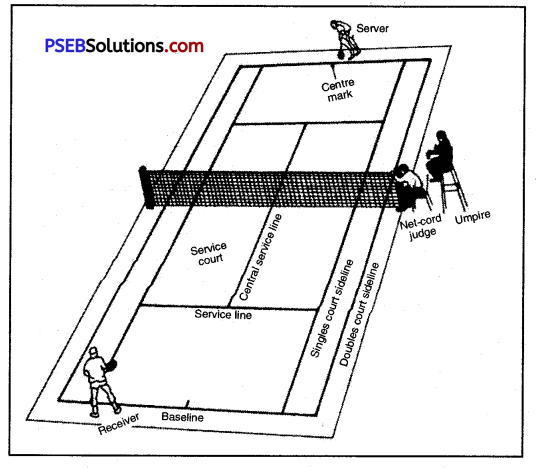
The tennis court shall be rectangular. It shall be 78′ (23.77 m.) in length and 27′ (8.23 m.) width. It should be divided across the middle by a net suspended from a cord or metal cable. The diameter of this cord should be 1/3 (0.8 cm.), the ends of which shall be attached to or pass over the tops of two evenly pointed posts. These posts should be 3’66” (1.07 m.) in height and not more than 6 inches (15 cm.) square or 6 inches (15 cm.) in diameter, the centre of which shall be 3’ (0.91 m.) outside the court on each side.

The net should be tightly and fully extended so that it fills the space between the two posts fully, and should be so small mesh as to prevent the ball passing through. The height of the net shall be 3′ (0.914 m.) at the centre, and it shall be tautly held down by a strap not more than 2″ (5 cm.) wide and white in colour. A band shall cover the cord and the top of the net for not less than 2 inches (5 cm.) and inches (6.3 cm.) deep on each side. Its colour should be white. There should be no advertisement on the net, strap, band or single sticks.

The lines surrounding the ends and sides of the court shall respectively be called the Base fines and the side-lines. On each side of the net, at a distance of 0.21 feet (6.00 cm.) from it and parallel’to it, service-fines shall be drawn. The space on each side of the .net between the service-line and the side-line shall be divided into two equal parts called the service courts by the centre service-fine. This service fine shall be 2 inches (5 cm.) in width, drawn half-way between and parallel to the side lines.

Each base-line shall be bisected by a centre-service fine which is 4 inches (10 cm.) in length and 2 inches (5 cm.) in width, and is called centre mark. Except the base-lines, all lines should be minimum 1″ (2.5 cm.) and maximum 2″ (5 cm.) in length. The base line may be four inches (10 cm.) in width. All measurements should be made to the outside of the fines.

The permanent fixtures of the court shall include not only the net; posts, single sticks, cord or metal cable, strap and band but also the back and side stops, the fixed stands, movable seats and chairs. All other fixtures around and above the court and the Umpire, Net- cord, Foot-fault Judge, Linesmen and Ball Boys shall be in their proper places.

Lawn Tennis Game Rules - PSEB 10th Class Physical Education

Question. 3.
Write about the ball of the Lawn Tennis.
Answer:
The Lawn-tennis Ball:
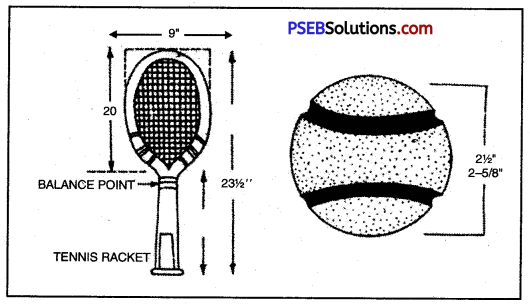
The ball should have a uniform outer surface. It shall be white or yellow in colour. The diameter of the ball shall be minimum 2 1/2” (5.35 cm.) and maximum 2 5/8” (6.67 cm.). Its weight should be more than 2 ounces (56.7 gm.) and not less than 2 1/16 ounces (58.8 gm.). It should have a bounce of more than 53 inches (135 cm.) and less than 58 inches (147 cm.) when dropped from a height of 100” (254 cm.) upon a concrete base.
Lawn Tennis Game Rules - PSEB 10th Class Physical Education 1
The ball should have a forward deformation of more than 220 inches (.956 cm.) and less than .290 of an inch (.74 cm.), and a return deformation of more than .350 of an inch (.89 cm.) and less than .425 of an inch (1.08 cm.) at 18 pounds (8.165 kg.) load. The two deformation figures shall be the averages of three individual readings along three axes of the ball and no two individual readings shall differ by more than 0.30 of an inch (.80 cm.) in each case.

Players:
The players shall stand on opposite sides of the net. The players who delivers the ball first is called the server, and the other will be called the receiver. The choice of ends and the right to be Server or Receiver in the first game is decided by the toss. The toss winning players may choose his end or may ask the other player to choose. If a player decides to choose the end, the other player has the right to choose to be the Server or the Receiver.

Service:
The service shall be delivered in the following manner : Before delivering the service, the Server shall stand with both feet at rest behind (that is, farther from the net than the base-line). This place shall be within the imaginary continuation of the Centre Mark and the side-line. Then the Server shall project the ball by hand into the air and before it hits the ground, strike it with his racket, and the delivery shall be considered to have been completed at the moment of the impact of the racket and the ball. A player with the use of one arm may utilize his racket for protection or defence.

The Server, throughout the delivery of the service, shall-

  • not change his position by walking or running.
  • not touch, with either foot, any area other than that behind the base-line within the imaginary extension of the centre mark and side-line.
    Lawn Tennis Game Rules - PSEB 10th Class Physical Education 2

1. In delivering the service, the Server shall stand behind the right and the left courts turn by turn. He shall start from the right in every game. If the service is delivered from a wrong half of the court and is undetected, the play resulting from such wrong service shall stand, but the inaccuracy of station shall be corrected immediately after it is detected.

2. The ball served should pass over the net and hit the ground in the Service Court which is diagonally opposite, before the Receiver returns it. If the ball touches any other line of the court, the Service shall not be considered.

Lawn Tennis Game Rules - PSEB 10th Class Physical Education

General Rules of Lawn Tennis:
1. The tennis player shall not serve until the other player or receiver is ready. If the receiver attempts to return, he is deemed to be ready.

2. The service is a let if the ball served touches the net, strap or band, or touches the receiver or anything he wears or carries. It shall be let if it is delivered when the receiver is not ready.

3. At the end of the first game the receiver shall become server, and the server shall become the receiver. This will continue alternately in all the games of a match.

4. The server wins the point if the ball served is not a let, and touches the receiver or anything he wears or carries before it hits the ground.

5. If a player knowingly does something which, in the opinion of the Umpire, hinders his opponent in making a stroke, the Umpire shall award the point to the opponent and in case such an act of player is involuntary, the Umpire shall order the point to be replayed.

6. If the ball in play touches a permanent fixture other than the net, posts, single sticks, cord or metal cable, strap or band after it has hit the ground, the player who struck it wins the point. But if the ball touches such an object before it hits the ground, the point is awarded to the opponent.

7. If a player wins his first point, his score is 15, on winning the second point, the score is 30; and on winning the third point, his score rises to 40. The player who gets 40 points wins the set of game. But in case both the players win 3 points each, the score is called deuce, and the next point won by a player is scored advantage for that player. If the same player (with advantage) wins the next point, he wins the game. If the other player wins the point, the score is again called deuce; and so on, until a player wins two points following the score at deuce.

8. When a player wins first six games, he wins a set, except that he must win by a margin of two games over his rival, and if necessary, a set is extended until this margin is achieved. The players shall change ends at the end of the first and third game and at the end of each set provided the total number of games in each set is not even, and in which case the change is made at the end of first game of the next set.

9. The maximum number of sets in a match for men is 5 and for women 3.

10. The game shall continue from the start to the conclusion, provided that after the third set, or when moment participate, after the second set, a player can take rest. But the duration of rest is from 10 to 15 minutes. When it is essential, the Umpire may suspend the play for such a period as he may deem necessary.

11. In case the play is suspended, and is not be resumed until a later day rest may be taken by a player after the third set or after the second set in case of women players. In case the play is postponed to a later day, the completion of an unfinished set shall be considered as one set. These provisions should be properly explained. The play should, however, never be suspended, delayed or interfered with for the purpose of enabling a player regain his strength.

12. The Umpire shall be the sole judge of such suspension of the game, and after living due warning to the offender who causes such suspension, may disqualify him.

13. In changing ends, a maximum of one minute should elapse from the close of the previous game till the players are ready for the start of the next game.

The Doubles Game
The Court:
For the Doubles Game, the court shall be 36 feet (10.97 m) in width, that is, it shall be wider by 4 1/2 feet (1.47 m) on each side that meant for the Singles game. Those portions of the singles side-lines which lie between the two services lines are called the Service Side-Lines. In other respects, the Court shall be similar to the one described in the court for the Singles game. However, the portions of the singles side lines between the base-line and service-line on each side of the net may be omitted, if so desired.

Lawn Tennis Game Rules - PSEB 10th Class Physical Education

Question 4.
Write down any five rules of Lawn Tennis.
Answer:
General Rules:
1. The order of serving shall be decided at the start of each set in the following manner:
(а) The pair who are to serve in the first game of each set shall decide who shall, do so, while the opposing pair shall decide similarly in the second game.
(b) The partner of the player who served in the first game shall serve in the third game, the partner of the player who served in the second game shall serve in the fourth game, and so on in the same order in all the subsequent games of a set.

2. The order of receiving the service shall be decided at the start of each set as mentioned below:

(i) The pair who are to receive the service in the first game shall decide as to which partner shall receive the first service, and that partner shall continue to receive the first service in every odd game throughout the set.
(ii) The rival pair shall decide which partner shall receive the first service in the second game and that partner will continue to receive the first service in every even game throughout the set. Partners shall receive the service alternately throughout each game.

3. If a partner serves out of his/her turn, the partner who should have served shall serve as soon as the mistake is found out. In such case, all points scored, and any faults served before such discovery, shall be considered. If a game is completed before such discovery, the order of service does not change.

4. In case the order of receiving the service is changed by the receivers during a game, it shall remain unchanged until the end of the game in which the mistake is detected. But the partners shall resume their original order of receiving the service in the next game of the set in which they are the receivers.

5. The ball shall be struck alternately by one or other player of the opposing pairs. In case a player touches the ball in play with his racket against the above said rule, his opponents shall get the point.

Important Information about the Lawn Tennis Game

  • Length of Tennis court = 78’ or 26, 77” Metre
  • Breadth of court = 27’ or 8.23 Metre
  • Height of the net = 3’6” or 1.07 Metre
  • Diametre of iron tar (cable) = 1/4 inch
  • Diametre of Poles = 6 inch or 15 cm
  • Distance of poles from centre = 3’ or 90 cm
  • Weight of Tennis ball = 2 ounces (56.7 – 60.24 grns)
  • Distance of Tennis Poles = 2 1/2; inches
  • Bounch of ball after throwing it from the height of 100 feet = 53 inches
  • Number of sets for men = 5 sets
  • Number of sets for women 3 sets
  • Colour of Tennis ball = White or yellow.

PSEB 10th Class Welcome Life Solutions Chapter 4 हमदर्दी और हिमायत

Punjab State Board PSEB 10th Class Welcome Life Book Solutions Chapter 4 हमदर्दी और हिमायत Textbook Exercise Questions and Answers.

PSEB Solutions for Class 10 Welcome Life Chapter 4 हमदर्दी और हिमायत

PSEB 10th Class Welcome Life Guide हमदर्दी और हिमायत Textbook Questions and Answers

अभ्यास के प्रश्न

प्रश्न 1.
संवेदनशील मुद्दों से आपका क्या अभिप्राय है?
उत्तर-
संवेदनशील मुद्दे वे मुद्दे हैं जो गंभीर मुद्दों से जुड़े हैं और इसका हल हर किसी के लिए संभव नहीं है। उन्हें हल करने के लिए बहुत सूझ-बूझ की आवश्यकता होती है। उदाहरण के लिए किसी भी परिवार के व्यक्तिगत मुद्दे या किसी भी समाज के धार्मिक और भाषाई मुद्दे।

प्रश्न 2.
संवेदनशील मुद्दों को हल करने के लिए स्कूल काऊंसलर ने किन बिंदुओं पर सुझाव दिया था?
उत्तर-
स्कूल के काऊंसलर खुशमिंदर सिंह ने छात्रों से कहा कि संवेदनशील मुद्दों को आसानी से हल नहीं किया जा सकता। इसलिए निम्नलिखित बातों को ध्यान में रखा जाना चाहिए

  1. किसी व्यक्ति में सहनशीलता, धैर्य, उचित ज्ञान, अच्छी भाषा इत्यादि गुण होने चाहिएं। इसके साथ ही निश्चित रूप से मुद्दे के मूल कारण को जानना चाहिए, प्रत्येक व्यक्ति को ध्यान से सुनना चाहिए और
    सूझ-बूझ से एक ठोस निर्णय लेना चाहिए।
  2. निर्णय किसी पर थोपा नहीं जाना चाहिए, लेकिन एक ऐसा माहौल बनाया जाना चाहिए ताकि दूसरे संवेदनशील मुद्दे को हल करने के आपके निर्णय को समझें।
  3. सबसे पहले खुद को उस स्थिति में रखें जिसमें कोई और है।
  4. ऐसे मुद्दों को खुलेआम उछालना नहीं चाहिए बल्कि एक कमरे में बैठकर गुपचुप तरीके से हल करना चाहिए।

प्रश्न 3.
प्रिंसीपल ने विद्यार्थियों की यह कमेटी क्यों बनाई?
उत्तर-
प्रिंसीपल ने बताया कि कई नाजुक मुद्दे ऐसे होते हैं, जिसके लिए काफी विचार-विमर्श की आवश्यकता होती है और अकेले उनका हल नहीं किया जा सकता। ऐसे मुद्दों को प्रत्येक व्यक्ति हल नहीं कर सकता। इसलिए सूझ-बूझ की ज़रूरत होती है। इसलिए प्रिंसीपल ने विद्यार्थियों की एक कमेटी बनाई ताकि सभी इकट्ठे होकर नाजुक मुद्दों को हल कर सकें।

PSEB 10th Class Welcome Life Solutions Chapter 4 हमदर्दी और हिमायत

पाठ पर आधारित प्रश्न

प्रश्न 1.
आपकी माँ क्या कार्य करती हैं?
उत्तर-
मेरी माँ ऑफिस जाती हैं और घर का सारा काम खुद करती हैं। वह हमारे लिए खाना बनाती हैं, कपड़े धोती हैं, घर की सफाई करती हैं और परिवार के सभी सदस्यों की ज़रूरतों का ख्याल रखती हैं।

प्रश्न 2.
वह कौन-से काम हैं जो आपके पिता जी करते हैं?
उत्तर-
मेरे पिता जी भी दफ्तर जाते हैं। वह सुबह मुझे और मेरे भाई की तैयार होने में मदद करते हैं। बाज़ार से घर की ज़रूरतों की चीजें लाते हैं। वह मेरी और मेरे भाई की पढ़ाई में मदद करते हैं और माता जी की कई कामों में मदद करते हैं जैसे कि फल काटना, सब्जियां काटना आदि।

प्रश्न 3.
आप अपनी माँ के साथ किन कामों में हाथ बटाएंगे?
उत्तर-
सबसे पहले मैं उन्हें घर को साफ रखने में मदद करूंगा। हम घर में गंदगी नहीं फैलाएंगे और सब कुछ यथावत रखेंगे। हम उन्हें कपड़ों को सुखाने और अन्य छोटे काम करने में मदद करेंगे।

प्रश्न 4.
आप अपने पिता के साथ किन कामों में हाथ बटाएंगे?
उत्तर-
हम अपनी पढ़ाई स्वयं करेंगे, सूखे कपड़े संभालने में उनकी मदद करते हैं। बाज़ार से घर का ज़रूरी सामान लाकर देंगे ताकि जब वे दफ्तर से थक कर वापस आएं तो कुछ समय आराम कर सकें।

PSEB 10th Class Welcome Life Solutions Chapter 4 हमदर्दी और हिमायत

गतिविधि-1

प्रश्न-
आप क्या चाहते हैं कि एक वर्ष के बाद आपके पास क्या-क्या सुविधाएं हों?
उत्तर-
एक वर्ष के बाद मैं चाहता हूँ

  1. अध्ययन करने के लिए एक अच्छा स्मार्टफोन होना चाहिए।
  2. एक अच्छा लैपटॉप और इंटरनेट कनैक्शन होना चाहिए ताकि मेरी ऑनलाइन कक्षाएं आसानी से चलें।
  3. एक कार हो ताकि मैं अपने माता-पिता के साथ घूम सकू।
  4. चौबीस घंटे बिजली की आपूर्ति हो।

गतिविधि-2

प्रश्न-चित्र को देखें, यहाँ और कुल दस चीजें हैं। इनमें से एक ऐसी चीज़ चुनें जो बाकी सभी नौं चीज़ों का कार्य करे।
PSEB 10th Class Welcome Life Solutions Chapter 4 हमदर्दी और हिमायत 1
उत्तर-
इन सभी चीजों में से मैं स्मार्टफोन रखना पसंद करूँगा जो हमारी कई ज़रूरतों को पूरा करता है। हम टी०वी० देख सकते हैं, टैलीफोन, सुन सकते हैं, लेखांकन कर सकते हैं, अलार्म लगा सकते हैं, समय देख सकते हैं, फोटो क्लिक कर सकते हैं, और वीडियो बना सकते हैं। इसके साथ ही यह कंप्यूटर का सारा काम कर सकता है।

गतिविधि-3

प्रश्न 1.
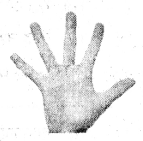
इस बंद मुट्ठी में संवेदनशील मुद्दे हैं। नीचे चित्र में खुले हाथ की पांच उंगलियों में पांच संवेदनशील मुद्दे लिखो।
PSEB 10th Class Welcome Life Solutions Chapter 4 हमदर्दी और हिमायत 2
उत्तर-
पाँच संवेदनशील मुद्दे हैं
(क) धार्मिक मुद्दे
(ख) भाषाई मुद्दे
(ग) परिवार से जुड़े मुद्दे
(घ) सामाजिक मुद्दे
(ङ) महिला सुरक्षा के मुद्दे।

PSEB 10th Class Welcome Life Solutions Chapter 4 हमदर्दी और हिमायत

प्रश्न 2.
मद्री को बंद रखना काऊंसलर साहिब की किस शिक्षा की तरफ इशारा करता है?
PSEB 10th Class Welcome Life Solutions Chapter 4 हमदर्दी और हिमायत 3
उत्तर-
स्कूल काऊंसलर का विचार था कि सभी मुद्दों को बहुत सावधानी से हल किया जाना चाहिए। उन्होंने कहा कि संवेदनशील मुद्दों को हल करने के लिए बहुत धैर्य, उचित भाषा और ज्ञान की आवश्यकता होती है। इसके साथ-साथ मुद्दे के मूल कारण के बारे में जानने की ज़रूरत है, दूसरों की बात को सम्मानपूर्वक सुनें और सूझ-बूझ के साथ निर्णय लें। निर्णय किसी पर थोपा नहीं जाना चाहिए।

Welcome Life Guide for Class 10 PSEB हमदर्दी और हिमायत Important Questions and Answers

वस्तुनिष्ठ प्रश्न

(क) बहुविकल्पीय प्रश्न

प्रश्न 1.
समाज में रहते हुए हम सबसे सम्मानपूर्वक व्यवहार करते हैं तो यह किस प्रकार का गुण है?
(a) संवेदनशीलता
(b) सम्मान
(c) घृणा
(d) हमदर्दी।
उत्तर-
(a) संवेदनशीलता।

प्रश्न 2.
वेदना शब्द का अर्थ है
(a) सामूहिक दर्द को समझना
(b) अपने निजी दुःख
(c) समाज का दुःख
(d) समाज का सुख।
उत्तर-
(b) अपने निजी दुःख।

PSEB 10th Class Welcome Life Solutions Chapter 4 हमदर्दी और हिमायत

प्रश्न 3.
संवेदना का अर्थ है
(a) अपने निजी दुःख
(b) समाज का दुःख
(c) सबका सामूहिक दर्द समझना
(d) समाज का सुख।
उत्तर-
(c) सबका सामूहिक दर्द समझना।

प्रश्न 4.
इनमें से कौन-सा हम में लिंग संवेदनशीलता न होने का सूचक है?
(a) माता-पिता का अपने बहन या भाई को अधिक प्यार करना
(b) कक्षा में लड़की को मॉनिटर बनाना
(c) (a) और (b) दोनों
(d) कोई नहीं।
उत्तर-
(c) (a) और (b) दोनों।

प्रश्न 5.
……………. जीवन जीने के लिए आवश्यक हैं।
(a) कामनाएं
(b) नफ़रत
(c) ईर्ष्या
(d) उपरोक्त सभी।
उत्तर-
(a) कामनाएं।

PSEB 10th Class Welcome Life Solutions Chapter 4 हमदर्दी और हिमायत

प्रश्न 6.
जीवन जीने के लिए क्या सबसे अधिक आवश्यक है?
(a) रोटी
(b) कपड़ा
(c) मकान
(d) उपरोक्त सभी।
उत्तर-
(d) उपरोक्त सभी।

प्रश्न 7.
हमें सामाजिक कल्याण के लिए क्या करना चाहिए?
(a) पेड़ बचाओ
(b) नशे न करना
(c) पर्यावरण बचाओ
(d) उपरोक्त सभी।
उत्तर-प्
(d) उपरोक्त सभी।

प्रश्न 8.
प्रिंसीपल ने कितने बच्चों को अपने दफ्तर में बुलाया?
(a) 10
(b) 12
(c) 14
(d) 16.
उत्तर-
(c) 14.

PSEB 10th Class Welcome Life Solutions Chapter 4 हमदर्दी और हिमायत

प्रश्न 9.
संवेदनशील मुद्दे को हल करने के लिए क्या आवश्यक है?
(a) धैर्य
(b) उचित ज्ञान
(c) मूल कारण का पता होना
(d) उपरोक्त सभी।
उत्तर-
(d) उपरोक्त सभी।

(ख) खाली स्थान भरें

  1. ……………. स्कूल का काऊंसलर था।
  2. स्कूल के ………….. ने 14 शिक्षकों की एक कमेटी बनाई।
  3. व्यक्ति की कम …………… इच्छाएं होनी चाहिएं।
  4. मानवीय जीवन में ………….. ज़रूरी है।
  5. इस दुनिया का हर व्यक्ति ……………. है।
  6. विद्यार्थी जीवन में …………… का विशेष महत्त्व है।

उत्तर-

  1. खुशमिंदर सिंह,
  2. मुख्य अध्यापक,
  3. इच्छाएं,
  4. बदलाव,
  5. अद्वितीय,
  6. मित्रता।

(ग) सही/ग़लत चुनें

  1. जीवन में परिवर्तन आवश्यक नहीं है।
  2. विद्यार्थी के जीवन में मित्रता का कोई स्थान नहीं है।
  3. प्रत्येक व्यक्ति एक-दूसरे से अलग होता है।
  4. संवेदनशील मुद्दों को हल करने के लिए समझदारी की आवश्यकता होती है।
  5. प्रत्येक व्यक्ति में संवेदनशीलता होती है।

उत्तर-

  1. ग़लत,
  2. ग़लत,
  3. सही,
  4. सही,
  5. सही।

PSEB 10th Class Welcome Life Solutions Chapter 4 हमदर्दी और हिमायत

(घ) कॉलम से मेल करें

कॉलम-I — कॉलम-II
(a) वेदना — (i) मित्रता
(b) संवेदना — (ii) निजी दुःख
(c) रोटी, कपड़ा, मकान — (iii) सामूहिक दर्द समझना
(d) संवेदनशील मुद्दा — (iv) जीवन की आवश्यकताएं
(e) छात्र जीवन उत्तर — (v) धार्मिक मुद्दा।
उत्तर-
कॉलम-I — कॉलम-II
(a) वेदना — (i) मित्रता
(b) संवेदना — (ii) निजी दुःख
(c) रोटी, कपड़ा, मकान — (iii) सामूहिक दर्द समझना
(d) संवेदनशील मुद्दा — (iv) जीवन की आवश्यकताएं
(e) छात्र जीवन — (v) धार्मिक मुद्दा

अति लघु उत्तरीय प्रश्न

प्रश्न 1.
संवेदनशीलता का गुण क्या है?
उत्तर-
समाज में रहते हुए, जब हम दूसरों के साथ सम्मानपूर्वक व्यवहार करना चाहते हैं, तो इसे संवेदनशीलता का गुण कहते हैं।

प्रश्न 2.
वेदना शब्द का सीमित अर्थ क्या है?
उत्तर-
वेदना शब्द का सीमित अर्थ है अपना निजी दुःख।

PSEB 10th Class Welcome Life Solutions Chapter 4 हमदर्दी और हिमायत

प्रश्न 3.
संवेदना शब्द का व्यापक अर्थ क्या है?
उत्तर-
संवेदना शब्द का व्यापक अर्थ है सभी के सामूहिक दुःख को समझना।

प्रश्न 4.
हमें अपने भाई-बहनों से क्या शिकायत है?
उत्तर-
कि माता-पिता उनसे अधिक प्यार करते हैं।

प्रश्न 5.
स्कूल में लड़कों को क्या शिकायत है?
उत्तर-
कि लड़कियों को कक्षा में मॉनिटर बनाया जाता है।

PSEB 10th Class Welcome Life Solutions Chapter 4 हमदर्दी और हिमायत

प्रश्न 6.
लड़के और लड़कियों के काम अलग-अलग किसने बनाए?
उत्तर-
इसे प्रकृति ने नहीं बल्कि समाज ने खुद तय किया है कि वे क्या काम करेंगे।

प्रश्न 7.
जीवन जीने की मूल आवश्यकता क्या है?
उत्तर-
जीवन जीने की मूल आवश्यकता रोटी, कपड़ा और मकान है।

प्रश्न 8.
जीवन जीने के लिए क्या आवश्यक है?
उत्तर-
जीवन जीने के लिए आवश्यकताएं और आकांक्षाएं आवश्यक हैं।

PSEB 10th Class Welcome Life Solutions Chapter 4 हमदर्दी और हिमायत

प्रश्न 9.
हम अपने समाज की सेवा कैसे कर सकते हैं?
उत्तर-
पर्यावरण और पेड़ों को बचाकर और खुद को ड्रग्स से बचाकर, हम अपने समाज की सेवा कर सकते हैं।

प्रश्न 10.
हम कम संसाधनों में अपनी बढ़ती ज़रूरतों को कैसे पूरा कर सकते हैं?
उत्तर-
कम आकांक्षाओं को सीमित रखकर, हम कम संसाधनों में अपनी बढ़ती ज़रूरतों को पूरा कर सकते हैं।

प्रश्न 11.
प्रिंसीपल ने सुबह की सभा में क्या कहा?
उत्तर-
उन्होंने छात्रों से कहा कि वे कल के समाज के प्रभारी होंगे। इसलिए उन्हें ज़िम्मेदारियों को निभाना सीखना चाहिए।

PSEB 10th Class Welcome Life Solutions Chapter 4 हमदर्दी और हिमायत

प्रश्न 12.
कितने छात्रों की प्रिंसीपल सर ने एक समिति बनाई और क्यों?
उत्तर-
प्रधानाचार्य सर ने संवेदनशील मुद्दों को हल करने के लिए 14 छात्रों की एक समिति बनाई।

प्रश्न 13.
किसी भी संवेदनशील मुद्दे को हल करने के लिए क्या आवश्यक है?
उत्तर-
धैर्य, उचित ज्ञान और किसी भी संवेदनशील मुद्दे को हल करते समय दूसरों को ध्यान से सुनें।

प्रश्न 14.
अच्छे आपसी रिश्तों के लिए क्या आवश्यक है?
उत्तर-
अच्छे रिश्तों के लिए आवश्यक है कि हम दूसरों को उनके असली व्यक्तित्व के रूप में स्वीकार करना सीखें।

PSEB 10th Class Welcome Life Solutions Chapter 4 हमदर्दी और हिमायत

प्रश्न 15.
विद्यार्थी के जीवन में क्या महत्त्वपूर्ण है?
उत्तर-
विद्यार्थी के जीवन में मित्रता का बहुत महत्त्व है।

प्रश्न 16.
मानव जीवन में प्रमुख समस्या क्या है?
उत्तर-
हम चाहते हैं कि प्रत्येक कोई हमारी इच्छा के अनुसार जीवन जिए।

लघु उत्तरीय प्रश्न

प्रश्न 1.
वेदना और संवेदना के बारे में विस्तार से बताएं।
उत्तर-
हम समाज में रहते हैं और दूसरों के साथ सम्मानपूर्वक व्यवहार करते हैं। यह इसलिए है क्योंकि हम में संयम का गुण है। हम सभी के साथ समान व्यवहार करते हैं। इसलिए लड़कों और लड़कियों, पुरुषों और महिलाओं को समान रूप से एक-दूसरे के साथ व्यवहार करना आवश्यक है। यहां हमें वेदना और संवेदना का अर्थ मिलता है। वेदना का सीमित अर्थ किसी का अपना दर्द है और संवेदना का व्यापक अर्थ सबके सामूहिक दर्द को समझना है।

PSEB 10th Class Welcome Life Solutions Chapter 4 हमदर्दी और हिमायत

प्रश्न 2.
लड़के और लड़कियों का कैसे अच्छा विकास हो सकता है?
उत्तर-
बच्चे अपने माता-पिता के लिए कई काम करते हैं। चाहे वह लड़का हो या लड़की, दोनों को सामूहिक रूप से माता-पिता के साथ काम करना चाहिए। लेकिन यह जरूरी नहीं है कि समाज ने लड़के-लड़कियों के लिए जो अलग-अलग काम बांटे हैं, वे केवल वही काम करेंगे। उनके काम बदले भी जा सकते हैं। समाज ने अपना “दृष्टिकोण दिया है जिसे बदला जा सकता है। यदि इस दृष्टिकोण को निर्धारित भूमिकाओं के साथ बदल दिया जाएगा, तो निश्चित रूप से लड़के और लड़कियां को बेहतर तरीके से विकास कर सकते हैं।

प्रश्न 3.
हमारे जीवन में आकांक्षाओं का क्या महत्त्व है?
उत्तर-
हमारे जीवन में आकांक्षाओं का बहुत महत्त्व है। जीवन जीने के लिए आवश्यकताएं और आकांक्षाएं बहुत आवश्यक हैं। आकांक्षाओं के अभाव में कोई कुछ नहीं कर सकता। लेकिन आकांक्षाएं सीमित होनी चाहिएं अन्यथा वे हमारे लिए समस्याएं पैदा करेंगी। निश्चित रूप से उन्हें सीमित रखने की आवश्यकता है। जिस प्रकार जीवन के लिए भोजन, वस्त्र और आश्रय की आवश्यकता होती है, उसी प्रकार एक अच्छा जीवन भी जो केवल इच्छाओं की पूर्ति के साथ ही हो सकता है।

प्रश्न 4.
प्रिंसीपल साहिब ने सुबह की सभा में क्या कहा?
उत्तर-
सुबह की सभा में प्रिंसीपल साहिब ने छात्रों से कहा कि वे कल के समाज के इंचार्ज (Incharge) होंगे। इसलिए उन्हें अपनी जिम्मेवारी सीखनी चाहिए। उन्होंने दस छात्रों के नाम पूछे जिन्हें लगता है कि वे अपने दोस्तों की व्यक्तिगत और पारिवारिक समस्याओं को हल कर सकते हैं। उस समय 14 छात्र आगे आए और उनके लिए ताली बजाई गई।

PSEB 10th Class Welcome Life Solutions Chapter 4 हमदर्दी और हिमायत

प्रश्न 5.
छात्रों ने क्या समस्याएं बताईं?
उत्तर-

  1. एक बच्चे ने बताया कि उसके घर पर बिना किसी कारण तनाव रहता है।
  2. एक लड़की ने कहा कि उसके पड़ोस के दो लड़के उसके बारे में गलत टिप्पणी करते हैं।
  3. एक अन्य लड़के ने बताया कि उसके सामने कक्षा में एक छोटे लड़के को बड़े लड़कों द्वारा छेड़ा गया है और उसके साथ दुर्व्यवहार किया गया।
  4. एक अन्य लड़की ने कहा कि उसकी गली में लोगों के अवैध संबंध हैं जो अक्सर उनके घर में झगड़े की वजह बनते हैं।

प्रश्न 6.
मानव जीवन की प्रमुख समस्या क्या है और इसे कैसे हल किया जा सकता है?
उत्तर-
मानव जीवन की प्रमुख समस्या यह है कि हम चाहते हैं कि लोग हमारी इच्छा के अनुसार जीवन व्यतीत करें। इसलिए हम चाहते हैं कि हर कोई हमारे हिसाब से अपने आप को बदले। इसका बेहतर समाधान यह है कि हमदर्दी तथा हिमायत हम उन्हें उनके वर्तमान रूप में स्वीकार करें। हमें दूसरों को बदलना नहीं चाहिए, लेकिन उन्हें वैसे ही स्वीकार करना चाहिए जैसे वे हैं। हर कोई अलग है और हम इस अंतर से बहुत कुछ सीख सकते हैं। यदि हम सभी को बदलने की कोशिश करेंगे तो हम असफल होंगे और खुश नहीं रहेंगे।

दीर्घ उत्तरीय प्रश्न

प्रश्न-हमें दूसरों को कैसे स्वीकार करना चाहिए?
उत्तर-
इस दुनिया में हर कोई एक-दूसरे से अलग है। हर व्यक्ति की शक्ल एक-दूसरे से अलग होती है। इसलिए उनका व्यक्तित्व भी अलग होता है। यदि हम दूसरों के साथ अच्छे संबंध रखना चाहते हैं, तो हमें उनको मूल रूप में स्वीकार करना आवश्यक है। यदि हम ध्यान से देखें तो यह अंतर हमारे लिए आशीर्वाद है। यह अंतर एक-दूसरे के लिए अनुकूल है। जब हम दूसरों को स्वीकार करते हैं, तो हम उनसे बहुत कुछ सीखते हैं। यदि हम दूसरों को स्वीकार नहीं करेंगे तो अकेले रहेंगे छात्रों के जीवन में दोस्तों का बहुत महत्त्व है क्योंकि हम उन्हें वैसे ही स्वीकार करते हैं जैसे वे हैं। इसलिए हमें उनके साथ अच्छे संबंध रखने के लिए दूसरों को उनके वास्तविक या मूल रूप में स्वीकार करना चाहिए।

PSEB 10th Class Welcome Life Solutions Chapter 4 हमदर्दी और हिमायत

हमदर्दी और हिमायत PSEB 10th Class Welcome Life Notes

  • हम समाज में रहते हैं और समाज में रहते हुए हम दूसरों के साथ सम्मान के साथ व्यवहार करते हैं। ऐसा इसलिए है क्योंकि हमारे पास संवेदनशीलता का गुण है।
  • दो अलग-अलग शब्द हैं-वेदना और संवेदना। वेदना का अर्थ है स्वयं का वेदना और संवेदना का अर्थ है सभी के सामूहिक वेदना को समझना।
  • घर पर, बच्चों को अक्सर यह शिकायत होती है कि माता-पिता उनके भाई-बहनों को उनसे ज़्यादा प्यार करते हैं। स्कूल में, लड़कों को अक्सर शिकायत होती है कि लड़की को क्लास का मॉनिटर क्यों बनाया जाता है। इस तरह की चीजें हम में लिंग संवेदनशीलता न होने का सूचक है।
  • हमारे माता-पिता अक्सर घर पर अलग-अलग काम करते हैं। हमें अपने माता-पिता को उनके काम में मदद करनी चाहिए। यह हमारे व्यक्तित्व विकास में मदद करता है।
  • हर किसी के जीवन में कुछ इच्छाएं होती हैं। हमें इन इच्छाओं को पूरा करने के लिए सीमित इच्छाएं रखनी चाहिएं ताकि वे आसानी से पूरी हो जाएं, अन्यथा जीवन में असंतोष छा जाता है।
  • भले ही जीवन में इच्छाएं कम हों, हमें इन इच्छाओं को पूरा करते हुए सामाजिक नियमों को भी ध्यान में रखना चाहिए।
  • परिवार में और समाज में कुछ महत्त्वपूर्ण मुद्दे हैं, जिन्हें सावधानीपूर्वक हल करने की आवश्यकता है। ऐसे गंभीर मुद्दों को हल करना हर किसी के लिए संभव नहीं हैं। इसलिए इस अवसर के ज्ञान और नाजुकता को समझना महत्त्वपूर्ण है। उदाहरण के लिए धार्मिक या भाषाई मुद्दे।
  • संवेदनशील मुद्दों को बलपूर्वक हल नहीं किया जा सकता है। इसलिए हमें मुद्दे का मूल कारण जानने की ज़रूरत है, संबंधित पक्षों से बात करें और मुद्दों को हल करने का प्रयास करें।
  • इस दनिया में हर व्यक्ति अलग व्यक्तित्व का है। जिस प्रकार हम सभी दिखने में एक-दूसरे से भिन्न होते हैं, उसी प्रकार प्रत्येक व्यक्ति का व्यक्तित्व भी अलग-अलग होता है। हमें सभी को उनके व्यक्तित्व के अनुसार स्वीकार करना होगा।
  • हालाँकि हम एक-दूसरे से अलग हैं, लेकिन फिर भी हम एक-दूसरे से बहुत कुछ सीखते हैं।
  • विद्यार्थी जीवन में मित्रों का बहुत महत्त्व होता है। हम जीवन में कितने भी दोस्त बना लें, कोई भी हमारे स्कूल के दोस्तों की जगह नहीं ले सकता।
  • समाज में रहते हुए हम समाज में बदलाव चाहते हैं। लेकिन हम अपनी इच्छा के अनुसार बदलाव चाहते हैं जो संभव नहीं है। इसका समाधान यह है कि हम दूसरों को वैसे ही स्वीकार करें जैसे वे हैं। यह हमारी कई सामाजिक समस्याओं को हल करने में मदद करेगा।

PSEB 9th Class Agriculture Solutions Chapter 11 Important Current Issues in Agriculture

Punjab State Board PSEB 9th Class Agriculture Book Solutions Chapter 11 Important Current Issues in Agriculture Textbook Exercise Questions and Answers.

PSEB Solutions for Class 9 Agriculture Chapter 11 Important Current Issues in Agriculture

Agriculture Guide for Class 9 PSEB Important Current Issues in Agriculture Textbook Questions and Answers

(A) Answer in 1-2 words:

Question 1.
Write full form of GM.
Answer:
Genetically modified.

Question 2.
Write full form of Bt.
Answer:
Bacillus Thuriengiensis.

Question 3.
Name the poisonous substance produced in Bt plant.
Answer:
It produces a crystalline protein, which is toxic for bollworms.

PSEB 9th Class Agriculture Solutions Chapter 11 Important Current Issues in Agriculture

Question 4.
Write full form of PPV and FR.
Answer:
Protection of Plant Varieties and Farmers’ Rights Act.

Question 5.
When PPV & FR Act was passed?
Answer:
In the year 2001.

Question 6.
Which instrument of the implement is used for leveling of fields?
Answer:
Laser land leveler.

Question 7.
Write the name of the instrument which is used for judicious use of water in paddy crop.
Answer:
Tensiometer.

Question 8.
How much increase in earth’s surface temperature has been recorded during the past century?
Answer:
0.5°C.

Question 9.
Name any two prominent Green House Gases.
Answer:
Carbon dioxide, Nitrous oxide, Chlorofluoro Carbon, Methane etc.

Question 10,
Write full name of CFC.
Answer:
Chlorofluoro Carbon.

(B) Answer in 1-2 sentences:

Question 1.
Define GM crops.
Answer:
By using specialized genetic engineering technologies crop can be genetically modified by the transfer of gene of other plant or organism into the crop. GM stands for Genetically Modified crops.

Question 2.
Differentiate BG-I from BG-II.
Answer:
BG-I stands for Bollguard-I hybrid and BG-II stands for Bollguard-II. These are cotton hybrids. BG-I contained only one Bt gene. Whereas BG-II contains two Bt genes. BG-I can withstand the attak of American Bollworm only whereas BG-II can withstand the attack of all the four types of Bollworm namely American Bollworm, Spotted bollworm, Pink Bollworm and Tobacco Caterpillar.

Question 3.
Why Bt cottons remain safe from any damage by the bollworms?
Answer:
Bt cotton contains Bacillus Thuriengiensis, a soil bacterium. This gene produces crystalline protein in the plant, which is highly toxic for the bollworm, insects-pests of cotton. When bollworm feeds on flower bud or flower or boll of a Bt cotton plant, digestive system of the insect gets damaged and it gets killed. This way ‘cotton crop is saved from the harmful insects.

Question 4.
What is precision farming? List its benefits.
Answer:
This is a new concept of farming. The main objective behind this concept is to use judiciously the various inputs as decided and calibrated by various scientific technologies so as to save natural resources and to increase the yield of the crop. Insecticides, fertilizers, weedicides etc. are used in measured quantity accurately and different amounts are used in different sections of a field according to the need. This way these inputs are not wasted and yield is also increased. It also does not pollute the environment.

Question 5.
Discuss methods that need to be adopted for judicious use and saving of water.
Answer:
If leveling of field is done by using laser land leveler a lot of water is saved. Similarly use of tensiometer in rice crop helps in deciding when and how much irrigation is needed for the rice crop. This helps in saving water.

PSEB 9th Class Agriculture Solutions Chapter 11 Important Current Issues in Agriculture

Question 6.
What may be the impact of climate change on wheat crop?
Answer:
It can adversely effect the yield of wheat. If there is increase in temperature during February and March wheat production will reduce.

Question 7.
Why temperature increases inside a greenhouse?
Answer:
Houses which are made up of plastic sheets or glass in which plants are grown are known as green houses. Sun rays can enter the green house but the infrared rays (heat rays) cannot come out from such a house. Thus Temperature increases in the green house.

Question 8.
List names of different Green House Gases.
Answer:
Do yourself.

Question 9.
What was the impact of Bt cotton varieties on cotton production in Punjab?
Answer:
Bt cotton was introduced in Punjab in 2006. Before this cotton crop in Punjab was totally ruined due to attack of American Bollworm. Lint yield reduced to only 2-3 quintal per acre. But with Bt cotton lint yield increased to 5 quintals per acre and use of insecticides were also reduced.

Question 10.
List names of important techniques used in Precision Farming.
Answer:
Important techniques used in precision farming are- sensors, G.P.S. satellite technology etc.

(C) Answer in 5-6 sentences:

Question 1.
Which GM crop is being cultivated in “Punjab”? Explain its benefits.
Answer:
In Punjab G.M. crop of cotton in cultivated. It is called Bt cotton. Now there are some other GM crops prepared e.g. Brinjal, Maize, Soyabean and Rice. In Bt crops gene of a soil Bacterium Bacillus Thuriengiensis is introduced in the plants. This produces a crystalline protein in the plant, which is highly toxic for the bollworms. The insects eat this protein and their digestive system is damaged and thus they are killed in 3-4 days. Bt varieties can bear the attack of American bollworm, pink, Tobacco, spotted bollworms. In Bollguard-I hybrid of cotton only one Bt gene was introduced but in Bollguard-II two Bt genes were introduced cultivation of Bt cotton started in Punjab in 2006. Before its cultivation lint yield was only 2-3 quintal per acre but with Bt cotton lint yield increased to 5 quintal per acre. There in no need to use insecticides and thus environment also does not get polluted.

Question 2.
What are the dangers and risks associated with GM crops?
Answer:
Ever since the introduction of GM crops, many organizations, social activists, human welfare groups and even some of the scientists are against such GM crops. They think such crops are very harmful to the humans, plants, environment, species of cultivated plants, biodiversity of plants in long run. Although, there are no such evidences till date in favour of such fears or arguments. But some of the countries have banned the cultivation of such GM crops.

Question 3.
List objectives of PPV & FR Act. When was this act introduced?
Answer:
Main objective of PPV and FR act was to recognize and protect the farmers’ rights.

  • Plant breeder has right on the new variety of plant which he produced.
  • Farmers who are .cultivating a variety traditionally on their field or a landrace of a variety for which farmer have common knowledge can be registered as farmers’ variety.

PSEB 9th Class Agriculture Solutions Chapter 11 Important Current Issues in Agriculture

Question 4.
How Green House Gases affect the climate?
Answer:
Green house gases have bad effect on the environment. Because of increase in the density of green house gases in the atmosphere, temperature of the globe is increasing, over the past 100 years it is estimated that earth has warmed by 0.5°C. And an estimate says that by the year 2050 temperature may increase by 1.8 to 4.0°C. As a consequence of this increase in temperature polar ice will melt, ocean water level will become higher, warm days become will become more warmer and cold days become colder. Rains will become erratic and seasons will start overlapping.

Question 5.
Discuss impact of climate change on agriculture.
Answer:
Climate changes can affect the agricultural activities. Due to global warming temperature on earth is increasing which can affect the environment in many ways.

  • Increase in temperature will effect life time of crop, crop rotation and time of cultivation of crops is also affected.
  • Due to increase in temperature and moisture content in the atmosphere many diseases and some new type of insects will damage the crop.
  • Increase in temperature in the month of Feb-March will affect the production of wheat.
  • There is uncertainly in rains and production decreases.
  • Fall in night temperature will also reduce yield. ,
  • There may be good affects on agricultural production in many countries.

Very Short Answer Type Questions:

Question 1.
What is other name of GM crops?
Answer:
Transgenic crops.

Question 2.
Which technique is used to introduce gene of other plant or organism in a crop?
Answer:
By Genetic engineering technique.

Question 3.
What is full form of Bt?
Answer:
Bacillus Thuriengiensis.

Question 4.
What is Bt?
Answer:
It is a Bacteria found in soil.

Question 5.
Which other Bt crops are prepared other than Bt cotton?
Answer:
Brinjal, Maize, Soyabean, Rice etc.

Question 6.
Which variety cannot be registered?
Answer:
Plants which include terminator technology.

Question 7.
What is duration of registration for generhl crops?
Answer:
6 years but can be extended to 15 years.

Question 8.
Which website can be opened for getting crop registered?
Answer:
www.plantauthority.gov.in.

PSEB 9th Class Agriculture Solutions Chapter 11 Important Current Issues in Agriculture

Question 9.
To whom the concept of precision farming applicable?
Answer:
It is applicable to both small and big farmers.

Question 10.
Which device is used in developed countries to find proper amount of fertilizer requirement?
Answer:
Nitrogen sensor.

Question 11.
Which technique is used to measure fields in developed countries?
Answer:
G.P.S. Technique.

Question 12.
If water remains standing in Paddy fields which gas is produced?
Answer:
Methane gas.

Question 13.
Which green house gas is produced by the use of nitrogen fertilizer?
Answer:
Nitrogen oxide.

Question 14.
What is the effect of rising in temperature at night on the crops?
Answer:
Yield will reduce.

Question 15.
By the end of 21st century, what is the estimate increase of temperature on earth?
Answer:
1.8 to 4.0° C.

Short Answer Type Questions:

Question 1.
Name varieties of Bollguard-2.
Answer:
RCH 650, NCS 855 are the varieties of BG-2.

Question 2.
Which crops can be registered under the act PPV and FR?
Answer:
Jowar, Maize, Bajra, Wheat, Paddy, Sugarcane, Cotton, Pea, Arhar, Masar, Turmeric, Grams etc. crops can be registered.

Question 3.
Which crops cannot be registered under the PPV and FR act.
Answer:
A variety which is harmful to human beings, for the environment or for plants. Plants including terminator technology can also not be registered.

Question 4.
Why varieties using terminator technology cannot be registered?
Answer:
Seeds of such crops do not have growing power.

PSEB 9th Class Agriculture Solutions Chapter 11 Important Current Issues in Agriculture

Question 5.
Write about penalties of infringement in PPV and FR act.
Answer:
Providing wrong information e.g. wrong name of registered variety, wrong name of the country, wrong name and address of breeder, etc. are punishable acts. Punishment can be imprisonment, fine, or both.

Question 6.
What is a clear message of precision farming?
Answer:
Its clear message is to consider a field as consisting of many sections, there may be a problem of one type in one section and another type of problem in another section. Without knowing the problem of a particular section do not apply fertilizers or spray pesticides etc. If the soil in a section of the field is deficient in a particular mineral. Apply that particular fertilizer in only that section of the field and not in the whole of the field.

Question 7.
By how much temperature of the surface of the earth has increased over the last 100 years. Why?
Answer:
The temperature of the surface has increased by 0.5°C over the last 100 years. This is due to global warming.

Long Answer Type Questions:

Question 1.
Write about Green House Gases and greenhouse principle. How is it related to the earth?
Answer:
Greenhouse gases are Carbon dioxide, Nitrogen oxide, Chlorofluorocarbon, Methane, etc. Houses that are made up of plastic sheets or glass in which plants are grown are known as greenhouses. Sun rays can enter the greenhouse but the infrared rays (heat rays) cannot come out from such a house. Thus temperature increases in the greenhouse.

Greenhouse gases are there all around the globe. These allow the sunlight to enter into the earth’s atmosphere but do not allow the infrared rays (heat rays) to go back into space. Thus they are responsible for global warming. The temperature of the earth is increasing and its bad effects can be floods, drought, change in time of monsoon, etc.

Question 2.
Write some factors responsible for climate change?
Answer:

  1. Increased concentration of greenhouse gases like C02, CH4, etc.
  2. Burning of fossil fuels like petrol and coal etc.
  3. Deforestation on a large scale.
  4. Industrialization and urbanization.
  5. Excessive use of agrochemicals.

PSEB 9th Class Agriculture Guide Important Current Issues in Agriculture Important Questions and Answers

Multiple Choice Questions:

1. Greenhouse gases are :
(a) C02
(b) Nitrous oxide
(c) Methane
(d) All
Answer:
(d) All

2. PPV & FR act was passed in :
(a) 1985
(b) 2001
(c) 2015
(d) 1980
Answer:
(b) 2001

PSEB 9th Class Agriculture Solutions Chapter 11 Important Current Issues in Agriculture

3. Device used in paddy for saving water :
(a) Tensiometer
(b) leveler
(c) B.T.
(d) None
Answer:
(a) Tensiometer

4. How much increase in earth’s surface temperature has been recorded during the past century?
(a) 0.5°C
(b) 5°C
(c) 2°C
(d) 10°C
Answer:
(a) 0.5°C

True/False:

1. Man is not practicing farming since time immemorial.
Answer:
False

2. Bt is the abbreviation for a soil bacterium Bacillus thuriengiensis.
Answer:
True

3. Yield of Bt cotton is four quintal lint per acre.
Answer:
False

4. After the introduction of Bt cotton use of insecticides has reduced a lot.
Answer:
True

5. Trees and vines were protected for 9 years and the period can be extended for 10 years.
Answer:
False

Fill in the Blanks:

1. By using specialized genetic engineering technologies crop can be genetically modified by transfer of ………………… of other plant or organism into the crop.
Answer:
gene

2. A crystalline protein is produced in Bt cotton which is highly toxic for ………………… insects pests of cotton.
Answer:
bollworms

3. Such improved crops are known as G.M. or ………………… crops.
Answer:
transgenic

4. Government of India enacted ‘protection of plant varieties and Farmers’ Rights Act (PPV & FR act) in …………………
Answer:
2001

5 ………………… crops of Brinjal, soybean, maize, rice, etc. have been developed.
Answer:
GM

6. Over the last 100 years temperature of the earth has increased by …………………
Answer:
0.5°C

PSEB 10th Class Agriculture Solutions Chapter 11 Plant Clinic

Punjab State Board PSEB 10th Class Agriculture Book Solutions Chapter 11 Plant Clinic Textbook Exercise Questions and Answers.

PSEB Solutions for Class 10 Agriculture Chapter 11 Plant Clinic

Agriculture Guide for Class 10 PSEB Plant Clinic Textbook Questions and Answers

(A) Answer in one-two words:

Question 1.
In which year plant clinic was established at Punjab Agricultural University, Ludhiana?
Answer:
In 1993.

Question 2.
How many plant clinics have been established by Punjab Agricultural University, Ludhiana in Punjab?
Answer:
Plant clinics are running at 18 Krishi Vigyan Kendras (KVKS) in various districts and four at regional research stations Abohar, Bathinda and Gurdaspur and Department of Fruit science, PAU, Ludhiana.

PSEB 10th Class Agriculture Solutions Chapter 11 Plant Clinic

Question 3.
Where is plant clinic located at PAU?
Answer:
PAU clock tower, located near gate no. 1 at PAU campus.

Question 4.
Name any two instruments/tool being used in the plant at clinics?
Answer:
Computer, Microscope, scissors, knife etc.

Question 5.
Name the principle based on which the exact quantity of pesticides is calculated to control insect pests on different crops.
Answer:
Economic threshold level.

Question 6.
Name the instrument with the help of which one can observe the pictures on slides.
Answer:
Projector.

Question 7.
Name the tool used to observe the small disease specimens under field conditions.
Answer:
Microscope.

PSEB 10th Class Agriculture Solutions Chapter 11 Plant Clinic

Question 8.
Name any two chemicals used for preservation of diseased plant specimens.
Answer:
Formalin, acetic acid.

Question 9.
Mention the email address of plant clinic located at Punjab Agricultural University, Ludhiana.
Answer:
[email protected].

Question 10.
Mention the telephone number of plant clinic situated at PAU, Ludhiana.
Answer:
0161-240-1960 with extension 417. Mobile number: 9463048181.

PSEB 10th Class Agriculture Solutions Chapter 11 Plant Clinic

(B) Answer in one-two sentences:

Question 1.
What is plant clinic?
Answer:
Plant clinic is a place where diagnosis and remedial measures for diseased plants, nutrient deficiency, insect attack etc. are provided to the farmers.

Question 2.
What are the advantages of Plant Clinic?
Answer:

  • Diagnosis and remedial measures for plants are provided.
  • Various experts are available at all times in the plant clinic for quick redressal of day to day problems faced by farmers.
  • Farmers can get solutions to their problems through email, mobile phone, whatsapp.

Question 3.
How plant clinic differ from human hospitals?
Answer:
In human hospitals, diseases of human beings are identified and treated. Whereas in plant clinic besides treating diseased plants, training and education to identify diseased plants is also given.

PSEB 10th Class Agriculture Solutions Chapter 11 Plant Clinic

Question 4.
Mention the disiciplines / subjects used for the identification of plant specimens.
Answer:
In these clinics attack of disease, nutrient deficiency, insect attack and other reasons which are harming plants are studied. Disciplines which are used to identify plant, specimen etc. at plant clinic are plant pathology, entomology, soil sciences, agronomy etc.

Question 5.
Enlist the equipments being used in plant clinic.
Answer:
Following equipments are required at plant clinic:
Microscope, magnifying lenses, chemicals, incubator, scissors, knife, computer, photo camera, projector, books, etc.

Question 6.
What is the importance of microscope in plant clinic?
Answer:
Plant is dissected to see the symptoms of disease by using microscope. Actual colour, small identification marks etc. are also seen by using microscope.

Question 7.
What do you understand from the term “Economic Threshold Level”?
Answer:
To protect plants from diseases and insects, fertilizers and insecticides should be used after properly calculating the required dose of these. When number of insects increased upto a specific number or affect a specified number of plants of the crop. Spray of pesticide should start after this level has reached. This way crop as well as farmers will get some benefit. This is known as economic threshold level.

PSEB 10th Class Agriculture Solutions Chapter 11 Plant Clinic

Question 8.
Comment on the use of computer in plant clinic.
Answer:
Some specimens cannot be preserved either wet or dry. Such samples are scanned and stored in computer. These can be used when needed.

Question 9.
How incubator is useful in diagnosis of microorganisms in plants?
Answer:
Media after inoculation with pathogen is placed in incubator which is set at appropriate temperature and proper moisture is provided for the proper growth of pathogen. This is used for identification of other organisms also.

Question 10.
Enlist the chemicals required for the preservation of plant specimen in glass jars.
Answer:
For this work formalin, alcohol etc. is used.

PSEB 10th Class Agriculture Solutions Chapter 11 Plant Clinic

(C) Answer in five-six sentences:

Question 1.
Describe the mobile diagnosis-cum-exhibition van.
Answer:
To make the reach of plant clinics upto the villages, plant clinics have mobile diagnostics cum exhibition van. This van has the facilities in it for diagnosis and for exhibition. It has various equipments in it and it has the facility to show movies of technical know how to farmers, Agricultural experts provide remedies at the spot after testing and knowing their problems. Farmers are gaining a lot from this van.

Question 2.
What is the use of camera and Liquid Crystal Display (LCD) projector in plant clinic?
Answer:
Camera is used to take photographs of diseased plants. These photographs and slides are kept safe in the plant clinic. These are shown to the students for further reference. Scientists can also take help from these photos. Projector is used to see these slides. It can show enlarged view of photos and slides.

Question 3.
Define PAU doots and KMAS service of plant clinic.
Answer:
PAU doots is a new service introduced by clinic plants in which some farmers are enrolled as ‘PAU doots’ who are given the responsibility to disseminate the agriculture technology: These doots disseminate the information, which they get regularly through mobile messages and emails, to the fellow farmers using public address system.

KMAS is Kisan Mobile Advisory Service which is provided by Krishi Vigyan Kendras (KVKs) to the farmers for adopting advanced and new agricultural practices at their field. Messages are sent to the fellow farmers for spreading the technology related information.

PSEB 10th Class Agriculture Solutions Chapter 11 Plant Clinic

Question 4.
What is touch screen Kisok and farmer service centre?
Answer:
Plant clinic has a computerized touch screen Kisok which is called information booth. It pictorially explains the production and protection technology of rabi and Kharif crops from sowing till harvesting. Plant clinic was made a part of Farmer Service Centre (FSC) in 1999 and now it is known as agricultural technology information centre. Various types of problem of allied activities related to agriculture are taken. This is very helpful centre for the farmer.

Question 5.
Describe the services provided by plant clinic to the farmers. Or What are the advantages of plant clinic?
Answer:

  • In Plant Clinic identification of deficiency of nutritional elements in plants is done and also identification of harmful insects is also done.
  • After identifying the symptoms of the diseased plarfts brought from the fields, methods to prevent diseases are suggested on the spot.
  • In Plant Clinic training is given to identify the symptoms of diseases and insects.
  • Training is given to calculate the required amount of fertilizers and insecticides etc. to be applied to the crop so that unnecessary expenditure can be avoided.
  • Training is also given about the economic threshold of main insects of different crops. This helps in knowing exact amount of fertilizers and insecticides to be used or applied.
  • Training for using different types of spray pumps and other agriculture implements is also given.
  • Students are shown various types of diseased plants and are trained to treat such plants. This help in reducing the expenditure of the fanners.
  • Photographs of various types of implements, fertilizers, pumps, plant sample, seed and other items used for studying plants are kept at the plant clinic.

PSEB 10th Class Agriculture Solutions Chapter 11 Plant Clinic

PSEB 10th Class Agriculture Guide Plant Clinic Important Questions and Answers

Multiple Choice Questions

Question 1.
Name of chemical used for preservation of diseased plant specimens.
(a) Formalin
(b) Gulocose
(c) Sodium bromide
(d) None.
Answer:
(a) Formalin

Question 2.
In which year plant clinic was established in. PAU?
(a) 2010
(b) 1993
(c) 1980
(d) 1955.
Answer:
(b) 1993

Question 3.
Which tool is tised to diagnose micro organisms in plants?
(a) microscope
(b) incubation
(c) Projector
(d) All.
Answer:
(b) incubation

PSEB 10th Class Agriculture Solutions Chapter 11 Plant Clinic

Question 4.
In how many Krishi Vigyan Kendras (KVKs) are plant clinics working?
(a) 1
(b) 27
(c) 18
(d) 22.
Answer:
(c) 18

Question 5.
What is the e-mail address of plant clinic of Punjab Agriculture University?
(a) www.gadvasu.in
(b) www.pddb.in
(c) [email protected]
(d) www.pau.edu.
Answer:
(c) [email protected]

Question 6.
Mention the landline telephone number of plant clinic situated at Punjab Agricultural University.
(a) 0161-2401960 Extension-417
(b) 94630-48181
(c) [email protected]
(d) www.pau.edu.
Answer:
(a) 0161-2401960 Extension-417

PSEB 10th Class Agriculture Solutions Chapter 11 Plant Clinic

True False:

1. PAU established Central Plant Clinic at Ludhiana in 1993.
Answer:
True

2. Various types of equipments and apparatus are required in the plant clinic.
Answer:
True

3. No chemicals are required in plant clinic.
Answer:
False

4. e-mail address of plant clinic at Punjab Agricultural University is [email protected].
Answer:
True

PSEB 10th Class Agriculture Solutions Chapter 11 Plant Clinic

Fill in the blanks:

1. To see various symptoms of disease, we use ………….. .
Answer:
microscope

2. One of the chemical used to preserve fresh symptoms of various plants is …………. .
Answer:
formaldehyde

3. Computer, ………… are important part of plant clinic.
Answer:
scanners

4. Plants are dissected using knife, ……………..etc.
Answer:
scissors.

PSEB 10th Class Agriculture Solutions Chapter 11 Plant Clinic

Very Short Answer Type Questions

Question 1.
Give one reason due to which yield is reduced.
Answer:
Deficiency of nutrients, diseases, attack of insects.

Question 2.
Which instrument is used to see the symptoms of diseases?
Answer:
Microscope.

Question 3.
What is used for disection of plants?
Answer:
Knife, scissors etc.

Question 4.
Which equipment is used to observe micro organisms?
Answer:
Incubator.

Question 5.
At which mobile number one can contact plant clinic?
Answer:
9463048181.

Question 6.
Which type of van is used by plant clinic at PAU for giving technical knowledge to villagers?
Answer:
Mobile diagnostic cum exhibition van.

PSEB 10th Class Agriculture Solutions Chapter 11 Plant Clinic

Question 7.
Write name of any one chemical which is used in plant clinic?
Answer:
Formalin.

Short Answer Type Questions

Question 1.
What is the need of knife in the plant clinic?
Answer:
Knife is used to dissect the plant so that it can be viewed under the microscope.

Question 2.
What is the use of magnifying lens in plant clinic?
Answer:
This is used Ip see small parts of plants, insects and other smaller organism and to identify them.

Question 3.
Which service has been started by plant clinic so as to reach the villagers?
Answer:
PAU doot and KMAS service has been started. Farmers can register their email and mobile number with the plant clinic to” get benefits.

PSEB 10th Class Agriculture Solutions Chapter 11 Plant Clinic

Long Answer Type Questions

Question 1.
What is meant by economic threshold? Describe in detail.
Answer:
Before applying insecticides, their exact amount required for the particular crop is first calculated. This way plants can get maximum benefit and expenditure is also minimum. Many problems are created if insecticides f are used in excess of what is required or if these are unnecessarily used. e.g. insects become resistant to the use of insecticides, these become habitual rather than dying, friendly insects are also killed, the insects which were not harmful earlier may start harming the crop, whole of the environment gets polluted.

Every year the same insect does not attack the crop to the same extent. On one year the attack is intense on the other year it may be moderate or mild. Therefore, one should take proper care while using these drags. Insecticides should be used only when the number of insects reach a particular level for a given crop. This way plant get more benefit and expenditure is also lowered.

Number of insects should not be allowed to increase from the specified value and do not allow these to damage the crop. Farmers should not get monetary loss due to unnecessary use of drugs. Sometime the signs of attack are counted and not the number of insects e.g. Stemborer in rice. Its attacked sites are counted and not actual number of insects.

PSEB 10th Class Agriculture Solutions Chapter 11 Plant Clinic

Question 2.
Criticise the future of economic clinics.
Answer:
This is a competition age. Therefore, farmers should not allow the nutrient deficiencies to occur in their crops and also should take proper measures to protect the crop from diseases. This way he can earn more profit. The agriculture is now not limited only to state or country but has extended to international level. Produce has to be exported to other countries.

If produce is of good quality one can earn more profit. Help from plant clinic can be taken to maintain the proper quality of the crop. Nutrient deficiencies can be checked and proper fertilizers can be used to overcome the deficiencies. Amount of insecticide or fertilizers to be used can be calculated and expenditure on these poisons can be reduced. Unnecessary use of these poisons also harm the whole of environment Therefore, plant clinics have an important role to play in future.

Question 3.
Which facilities are available at plant clinic?
Answer:

  • Farmers are given technical knowledge at plant clinics.
  • Diagonsis of diseases is done, their symptoms are noted. Damage of crop by insects is also estimated.
  • Soil and water testing facility is also available.
  • Farmers can contact plant clinic through telephone, e-mail and whats app and can get solution to their problems.
  • Plant clinic has a diagnostic cum exhibition mobile van, which is used to reach villagers and films are shown to farmers having technical information.
  • PAU has started PAU messengers and KMAS service. Farmers can register their phone no. and e-mail with the plant clinic.

PSEB 10th Class Agriculture Solutions Chapter 11 Plant Clinic

Question 4.
Explain the need of plant clinic by telling its history.
Answer:
For the last few years there is an increase in number of students from cities who are seeking admission in higher education courses related to agriculture. These students do not have much of practical knowledge about agriculture works and when they go to the field work after getting higher education degrees, they face so many practical problems.

First plant disease clinic was set up by PAU Ludhiana in 1978 and later on PAU Ludhiana established central plant clinic in 1993. In different districts there are 18 agriculture science centres, where plant clinics are also running. These clinics have proved very useful for the students. Because of this principle farmers are getting knowledge and information about the nutritional deficiencies in their crops and protection against diseases, thus they are earning more profit.

Question 5.
What is plant clinic? What is the use of computer in plant clinic?
Answer:
Do it yourself.

PSEB 8th Class Agriculture Solutions Chapter 11 Processing of Fruits and Vegetables

Punjab State Board PSEB 8th Class Agriculture Book Solutions Chapter 11 Processing of Fruits and Vegetables Textbook Exercise Questions and Answers.

PSEB Solutions for Class 8 Agriculture Chapter 11 Post Harvest Handling of Fruits and Vegetables

Agriculture Guide for Class 8 PSEB Processing of Fruits and Vegetables Textbook Questions and Answers

(A) Answer in one or two words:

Question 1.
What is the place of India in the world for the production of fruit? and vegetables?
Answer:
India is second in the world in the production of fruits and vegetables.

Question 2.
What is the area and production of vegetables in Punjab?
Answer:
Vegetable produce is 41.11 lakhs tonnes and area under vegetables is roughly 110 thousand hectares.

Question 3.
What is the area and production of fruits in Punjab?
Answer:
Fruits produce is 15.41 lakh tonnes and area under fruits is roughly 78 thousand hectare.

PSEB 8th Class Agriculture Solutions Chapter 11 Processing of Fruits and Vegetables

Question 4.
Write the amount of salt to be added in lime pickle?
Answer:
20% salt.

Question 5.
Which preservative is used in tomato ketchup (chutney) and how much quantity is used?
Answer:
Sodium benzoate 700 mg in 1 kg.

Question 6.
Which preservative is used in mango squash and how much quantity is used?
Answer:
2.8 gram potassium metabisulphite in 1 kg mango pulp.

Question 7.
Which fruit is produced maximum in Punjab?
Answer:
Production of kinnow is highest among other fruits.

Question 8.
How much percentage of salt is used for dipping in preparation of Amla preserve?
Answer:
2 percent solution of simple salt.

Question 9.
How much annual production of fruits in India?
Answer:
81.285 million metric tonne.

Question 10.
How much annual production of vegetables in India?
Answer:
162.19 million metric tonne.

PSEB 8th Class Agriculture Solutions Chapter 11 Processing of Fruits and Vegetables

(B) Answer in One to Two sentences:

Question 1.
What kind of products can be made from fruits and vegetables?
Answer:
Products which can be made from fruits and vegetables are squash, jam, pickle, ketchup etc. e.g. lemon syrup, amla preserve, tomato ketchup, apple jam etc.

Question 2.
How processing of fruits and vegetables is useful for the farmers?
Answer:

  • Produce is damaged and injured during harvesting, storing, grading and transportation etc. This loss can be minimized by processing. This loss can be 30-40%.
  • One can get more income from processed products.

Question 3.
What is the difference between tomato juice and tomato ketchup (chutney)?
Answer:
Tomato juice consists of only tomato, sugar and salt and is dilute. Tomato ketchup contains onion, garlic, chilli and other spices and it is concentrated.

Question 4.
What is the importance of addition of Potassium Meta bisulphite in various food products?
Answer:
Potassium metabisulphite acts as a preservative and processed produce can be stored for a long time duration.

Question 5.
What is the temperature of drying of fruits and vegetables and why these are kept at that temperature?
Answer:
Normally these are dried at 50 to 70° C. Initially temperature is 70°C and finally at 50°C.

PSEB 8th Class Agriculture Solutions Chapter 11 Processing of Fruits and Vegetables

Question 6.
How much quantity of sugar is added in Amla preserve and why?
Answer:
Only one kg sugar is added to one kg of Amla. It creates sweetness and sugar also acts as preservative. Amla preserve can be stored for many months.

Question 7.
Write the recipe of tomato juice.
Answer:
Boil ripened Tomato in aluminium container. Squeeze these boiled tomatoes to get juice. Again boil the juice mixed with 0.7% salt, 4% sugar, 0.02% Sodium Benzoate and 0.1% citric acid. Fill bottles and seal these. Put these hot sealed bottles in water and then put these bottles in boiling water for 30 to 50 minutes and cool by pouring on it cold water in small quantities again and again many times. This juice is used for drinking for making soup and is also used in the preparation of vegetables.

Question 8.
Which preservative is added in lime, mango and barley lime squash/syrup and write the quantity?
Answer:

  • 3.5 gram potassium metabisulphite for 1 kg lemon in lemon syrup.
  • 2.8 gram potassium metabisulphite for 1 kg mango pulp for mango syrup.
  • 3 gram potassium metabisuphite is added in lemon/barley syrup.

Question 9.
What are the important factors for the production for fruits and vegetables in Punjab?
Answer:
Soil of Punjab is very fertile, climate in also suitable for the production of fruits and vegetables.

Question 10.
Write the types of packaging in fruits and vegetables?
Answer:
Fruits and vegetables can be packed based on their softness and size in jute sacks, cardboard boxes, plastic crates, bamboo baskets, wooden boxes shrink/cling films etc.

PSEB 8th Class Agriculture Solutions Chapter 11 Processing of Fruits and Vegetables

(C) Answer in Five or Six sentences:

Question 1
Give comments on production of fruits and vegetables in Punjab?
Answer:
Future of fruits and vegetables production in Punjab is very bright. One can earn for many year by one time investment in orchards. Vegetables can be harvested in very short span of time. According to WHO there is requirement of 300 gram of vegetable and 80 gram of fruits per day per person. But availability is only of fruits is 30 grams and of vegetables is 80 grams per day per person in India. Therefore, there is a need to concetrate on the cultivation of fruits and vegetables.

Question 2.
What is the importance of processing of fruits and vegetables?
Answer:
Produce is damaged and injured during harvesting, storing, grading and transportation etc. This loss can be minimized by processing. This loss can be 30-40%. Only 2% of the total produce is processed. Therefore to get vegetables and fruits in off-season storing and processing is 1 necessary. This occupation can be adopted at small scale or large scale.
Processed products are squashes, syrups, jam, pickles etc. One can set more income from processed products.

Question 3.
Write a note on production of fruits and vegetables in India?
Answer:
India is at second place in the production of fruits and vegetables in the world. Vegetable crop is ready for harvesting in two to three months and thus 3-4 crops can be taken. Yield is high and income is also high and is on daily basis. For the cultivation of fruits orchards are established which give fruits for many years by little care. Production of vegetables and fruits is very good in India but due to increasing population demand is not fulfilled, therefore there is a need to increase the production of vegetables and fruits.

PSEB 8th Class Agriculture Solutions Chapter 11 Processing of Fruits and Vegetables

Question 4.
What is the status of processing of fruits and vegetables in India?
Answer:
Food processing in India of fruits and vegetables can be done at small scale as well as at commercial level. India is second in the world in the production of vegetables and fruits. But only 2% of the total produce is processed. There is a need to concentrate on processing of fruits and vegetables at individual level as well as at government level. Farmers can earn good income at village level by adopting the business of processing. Farmers can directly make links with big companies for establishing processing units.

Question 5.
What are the reasons of fruits and vegetables spoilage?
Answer:
There can be many reasons behind the spoilage of vegetables and fruits. Produce is damaged and injured during harvesting, storing, grading and transportation etc. This loss can be minimized by processing. This loss can be 30-40%. One can get more income from processed products. Vegetables and fruits are perishable and their spoilage is easy. Some insects, birds etc. can also damage the produce, micro organisms and fungi can also damage the produce. Thus there are many reasons behind the spoilage of vegetables and fruits.

PSEB 8th Class Agriculture Solutions Chapter 11 Processing of Fruits and Vegetables

PSEB 8th Class Agriculture Guide Processing of Fruits and Vegetables Important Questions and Answers

Very Short Answer Type Questions

Question 1.
How many weeks are required for mango pickle to be prepared?
Answer:
2-3 weeks.

Question 2.
Should vegetables be dried in Sun or shade?
Answer:
In Shade.

Question 3.
Write a method to preserve apples.
Answer:
Murrabba of Apple, Jam etc.

Question 4.
How much percent of the total produce is processed in India?
Answer:
Only 2%.

Question 5.
What is the function of potassium metabisulphite?
Answer:
This is a preservative.

Question 6.
In how many days lemon pickle is ready?
Answer:
2-3 weeks.

PSEB 8th Class Agriculture Solutions Chapter 11 Processing of Fruits and Vegetables

Question 7.
Which oil is used in mango pickle?
Answer:
Mustard oil.

Question 8.
What is the benefit of food processing?
Answer:
It helps to avoid post-harvest losses of horticultural produce.

Short Answer Type Questions

Question 1.
How lemon sharbat is prepared?
Answer:
In the on season buy lemons and prepare sharbat. Sharbat can be sold at higher price and profit” can be earned. Cut and squeeze lemons to get their juice in porcelain container. Add 2 kg sugar in one litre of water and heat it so that whole of the sugar dissolves. Now sieve this sugar solution through a fine but clean mulmul cloth. On cooling add to it one litre of lemon juice and 4 gram of essence and 3.5 gram Potassium metabisulphite. Fill in bottles and seal the bottles using wax.

Question 2.
Describe the method of preparation of sharbat of sweet orange (Malta) or Mandrines (Santra).
Answer:
Take good quality of fresh fruits. Get their juice witff the help of a machine. Dissolve 2 kg of sugar and 25-30 gram of citric acid “in one litre of water and heat it. Sieve the solution through a fine and clean cloth, on cooling add to it one litre fruit juice, 2-3 gram essence and 5 gram potassium metabisulphaite. Fill bottles and seal with wax.

PSEB 8th Class Agriculture Solutions Chapter 11 Processing of Fruits and Vegetables

Question 3.
How is Mango sharbat prepared?
Answer:
Take well ripened juicy fruits and collect its pulp with the help of a knife. Crush the pulp and sieve through a fine cloth or using a sieve having very fine holes. Heat 1.4 kg sugar in 1.6 litre of water and sieve this solution through fine and clean cloth. When cooled add to it 1 kg of mango pulp and 20-30 gram citric acid. Also add to it 2-3 gram of potassium metabisulphaite. Fill in bottles and seal with wax.

Question 4.
How is lime and barley sharbat prepared?
Answer:
Cut lemons into two pieces and squeeze to get juice. Sieve this juice using a sieve. Add 0.3 litre of water to 15 grams of fine ground. Barley to get a paste. Heat one litre of water with 50-60 millilitre of paste, sieve it and let it cool. Dissolve 1.7 kg of sugar in remaining water and heat, sieve and cool. Mix paste, sugar solution and one litre lemon juice. Add 3.5 gram potassium metabisulphate also. Fill bottles and seal with wax.

Question 5.
How is mango pickle prepared?
Answer:
Take fully grown, hard and sour mangoes. Wash these and cut each mango into many long pieces, throw away the stones. Dry in the sunlight. Collect all the ingredients 1kg mango pieces, 250 gram salt, 30 gram Kalonji, 50 gram Methe, 25 gram red chilli, 65 gram Saunf l 30 gram turmeric. Mix mango pieces with salt and put these in a glass murtban. Add all other ingredients. Also add to it mustard oil. Oil should cover all the mangoes. Place the murtban in sun and pickle is prepared in 2-3 weeks.

Question 6.
Give method to prepare Amla pickle.
Answer:
Take 1kg fresh Amlas and soak these in water for a night. Dry by putting these on clean cloth. Cook in 100 ml of oil for five minutes, add 100 gram salt, 50 grams turmeric and cook for another 5 minutes. Allow these to cool down pickle is ready. Preserve in clean air tight container.

PSEB 8th Class Agriculture Solutions Chapter 11 Processing of Fruits and Vegetables

Question 7.
Give method to prepare carrot pickle.
Answer:
Wash 1kg of carrot with simple clean water. Peel these. Cut into pieces and let these to dry in sunlight. Cook these pieces in 250 gram of mustard oil for five minutes or so. Add to these cooking pieces 100 gram salt, 20 gram red chilli and remove from flame. When cooled mix 100 gram Raai powder. Pickle is prepared. Preserve in some container.

Question 8.
What do you know about the storage of produce after harvesting?
Answer:
Fruits and vegetables should be stored when in full-season. This way fruits and vegetables can be saved from damaging and on the other hand a good profit can also be earned by selling these in the off season. The fruits and vegetables are stored or preserved in the form of sharbat, pickle, Gel, Murraba, Chutney, Jam etc.

Question 9.
Write in detail the preparation method of pickle of lime.
Answer:
Take clean and ripened lemons wash them and dry with a clean cloth. Take lemon and salt in the ratio 4: 1 for one kg lime pickle. Take 7 gram of Jeera, 2 gram cloves and 20 grams of Ajwain. Make four pieces while keeping it single. Then fill each lemon at cuts with the mixture. The lemons are put in a container called murtban. And the remaining mixture is also added to this murtban. Place the container in sunlight and give jerks to container to move the lemons up and down in the container. Within 2-3 weeks pickle is prepared.

PSEB 8th Class Agriculture Solutions Chapter 11 Processing of Fruits and Vegetables

Long Answer Type Questions

Question 1.
How is pickle of lemon, green chilli and Ginger prepared? Answer: Wash chillies, lemons and Ginger in water. Cut two or four pieces of each lemon from 250 gram lemon, Peel off 300 gram ginger and cut into equal sized long thin pieces, give a cut in each chilli of 200 gram chillies. Mix all the three with 250 gram salt. Put in a clean container having wide opening. Squeeze the remaining 250 gram lemons to get juice, mix this juice with the already prepared mixture. Juice should cover all the mixture in the container. Air tight the container and keep in sun for a week. When colour of lemon and chilli is light brown and ginger is pinkish in colour, pickle is ready to use.

Question 2.
How is tomato chutney prepared?
Answer:
Cut ripe tomato into pieces and heat, sieve and get juice. Collect the ingredients. 1 litre of tomato juice, 15 gram of cut onions, cut 2-3 cloves of garlic, 4-5 cloves without head, black pepper 2-3 in number, two cardamom, cumin (1-2 gram), unground Jalvatri (1-2 gram), Dal chintii (broken into pieces), vinegar (40 ml), sugar (30 gram), salt (12-15 gram), red chilli (1-2 gram) or as needed.

Collect all the ingredients in a clean cloth and tie in a mulmul cloth leaving vinegar, sugar and .salt. Add half of sugar in the juice and heat over low flame and place the bundle of ingredient in the juice. Go on heating till the required concentration is not reached. This way only half of juice remains. Remove the bundle, and squeeze it to get any juice in it. Now add sugar, salt and vinegar in it. If on adding vinegar juice gets diluted, heat again. Fill bottles with hot chutney and store.

Question 3.
What do you know about drying of vegetables? Give method of drying for any four vegetables.
Answer:

  • Wash vegetables and cut into pieces.
  • Tie these pieces in a mulmul cloth to make a bundle. Dip this bundle for 2-3 minutes in boiling water.
  • After taking out from boiling water soak these pieces in 0.25% of potassium metabisulphite solution for 10 minutes. This save the vegetables from spoiling. Use one litre solution for one kg vegetables.
  • After taking out from the solution place these pieces on Aluminium trays. There should be no water in the vegetables.
  • Make a uniform layer of these pieces in the tray.
  • Place these trays in the direct sunlight for drying.

Drying Vegetables:

    • Carrot-Peel off and cut one centimetre long pieces of carrot and dry in sun for 3 days.
    • Onion-Peel onion cut into thin long pieces and dry in sun.
    • Garlic-Peel of the garlic cloves and cut in pieces. Dry in sun for 2-3 days.
    • Karela-Cut and remove both ends. Cut the remaining in small pieces.

Blanch in boiling water for 7-8 minutes. Treat with 0.25% of Potassium metabisulphite solution and dry in sunlight for 2 days.

PSEB 8th Class Agriculture Solutions Chapter 11 Processing of Fruits and Vegetables

Question 4.
Write the method of preparation of Murraba preserves of Amla.
Answer:
For preparing Murraba of Amla take cleaned big sized Banarsi type Amlas. Soak Amlas in 2% salt solution for a night. Take out these Amlas from the salt solution and repeat the process with fresh 2% salt solution. Repeat on third day also. Take out Amlas from the solution and wash them with water. Pierce the Amlas with steel forks at various places so that small holes appear on them. Tie these Amlas in a clean mulmul cloth. Dissolve 2 grams of alum in one liter of water, boil the amlas in this water so that they become soft.

Take one and a half kg sugar for one kg of Amla. Dissolve 750 grams of sugar in water. Boil this and sieve through mulmul cloth. Soak Amlas in this solution for the whole night. Take out the sugar solution and boil the remaining 750 grams of sugar. Sieve through mulmul cloth. Again soak Amlas in this solution. After two days boil again so that solution gets concentrated. Cool and preserve in a container.

Question 5.
Write a method to prepare lime and barley syrup and tomato. juice.
Answer:
Do it yourself.

PSEB 12th Class Sociology Solutions Chapter 10 Social Problems: Alcoholism and Drug Addiction

Punjab State Board PSEB 12th Class Sociology Book Solutions Chapter 10 Social Problems: Alcoholism and Drug Addiction Textbook Exercise Questions and Answers.

PSEB Solutions for Class 12 Sociology Chapter 10 Social Problems: Alcoholism and Drug Addiction

Sociology Guide for Class 12 PSEB Social Problems: Alcoholism and Drug Addiction Textbook Questions and Answers

Multiple Choice Questions:

1. Rapid industrialization has led to an increase in environmental pollution such as?
(a) Degradation and desertification of land
(b) Nepotism
(c) Overpopulation
(d) Caste system
Answer:
(a) Degradation and desertification of land

2. Which of the following is not a stage of alcoholism?
(a) Prodigal phase
(b) Crucial phase
(c) Chronic phase
(d) Frequent phase
Answer:
(b) Crucial phase

PSEB 12th Class Sociology Solutions Chapter 10 Social Problems: Alcoholism and Drug Addiction

3. Which one of the following is not the classification of drinkers?
(a) Rare users
(b) Light drinkers
(c) Hyper users
(d) None
Answer:
(c) Hyper users

4. Alcoholism is associated with what kind of problems?
(a) Social problem
(b) Economic problem
(c) Health problem
(d) All of the above
Answer:
(d) All of the above

5. The most widely known stimulants are
(a) Tablets
(b) Amphetamines
(c) LSD
(d) Heroine
Answer:
(b) Amphetamines

6. Tabacco is responsible for about 30% of all
(a) Cancer deaths
(b) AIDS
(c) Dengue
(d) Diabetes
Answer:
(a) Cancer deaths

7. What occurs when acceptable social standards of its use are violated, resulting in adverse physiological, psychological, and social consequences.
(a) Drug abuse
(b) Obesity
(c) Food adulterants
(d) Conflict in values
Answer:
(d) Conflict in values

Fill in the Blanks:

1. …………….. and ………………… are problems associated with increasing political corruption among leaders.
Answer:
Red tapism, Nepotism

2. The problem of untouchability in India is due to the ………………… system.
Answer:
Caste

3. When a person starts drinking even in the morning, he is said to be entered in the …………… phase.
Answer:
Chronic

4. ……………… is a narcotic and leads to nervous degeneration, liver cirrhosis, high blood pressure and a host of other diseases.
Answer:
Sedative

5. …………….. drinkers are those who drink three or four times in a month.
Answer:
Moderate

6. …………… group influence is very powerful in initiating a new person to drug taking habit.
Answer:
Peer

7. The Narcotic Drugs and Psychotropic Substances Act was amended in ………………….. to make the legislation still more stringent.
Answer:
1987

8. ………………… abuse leads to a number of short-term and long-term effects that are detrimental to health.
Answer:
Drug

9. Drug use weakens the ……………….. system and makes the individual more vulnerable to acquiring infections:
Answer:
Immune

PSEB 12th Class Sociology Solutions Chapter 10 Social Problems: Alcoholism and Drug Addiction

True/False:

1. Alcoholism is more treatable than drug addiction.
Answer:
True

2. Social problems are interrelated to each other.
Answer:
True

3. Male child preference and Patriarchal system are social problems related to ecological factor.
Answer:
False

4. Alcoholism does not influence the families and communities.
Answer:
False

5. Men drink because their occupation has completely exchausted them.
Answer:
True

6. Heavy drinkers are the drinkers who drink every day or several drinks during the day.
Answer:
True

7. Teachers cannot play any vital role in the prevention of alcoholism.
Answer:
False

8. Parents are helpless in curbing the problem of drug addiction.
Answer:
True

9. Drug abuse does not influence the families and communities.
Answer:
False

Match the Columns:

Column A Column B
Poverty Ecological or environmental problem
Undesirable condition Socio cultural problem
Male child preference Economic problem
Global warming Factor of female foeticide
State of Alcoholism Who drink once or twice a month
Light drinkers Chronic phase
Underage drinking Increased stress
Cause of Alcoholism Violent crime

Answer:

Column A Column B
Poverty Economic problem
Undesirable condition Violent crime
Male child preference Factor of female foeticide
Global warming Ecological or environmental problem
State of Alcoholism Chronic phase
Light drinkers Who drink once or twice a month
Underage drinking Socio cultural problem
Cause of Alcoholism Increased stress

Very Short Answer Type Questions:

Question 1.
List the factors which are responsible for social problems.
Answer:
Socio-cultural factors, economic factors, political factors, environmental factors etc.

Question 2.
What do you mean by Alcoholism?
Answer:
Alcoholism is a pattern of consuming alcohol which is not only dangerous for himself but for his family as well.

PSEB 12th Class Sociology Solutions Chapter 10 Social Problems: Alcoholism and Drug Addiction

Question 3.
Who are called the light drinkers?
Answer:
Those who drink alcohol once or twice in a month are called light drinkers.

Question 4.
List the stages of Alcoholism.
Answer:
Pre-alcoholic stage, Relief drinking stage, Acute stage and Chronic stage are the stages of alcoholism.

Question 5.
What do you mean by drug?
Answer:
Drug is a chemical substance which exerts profound and different impact on brain and body and which brings changes in one’s physical functions.

Question 6.
What is Drug Addiction?
Answer:
The meaning of drug addiction is physical dependency on any medicine or chemical thing.

Short Answer Type Questions:

Question 1.
What do you understand by Social Problem?
Or
Define social problems.
Answer:
Social problem is that unnecessary condition which must be changed. Each society goes through a phase of transition which can have constructive or destructive consequences. Destructive consequences bring out many problems which are known as social problems.

Question 2.
Write any two factors related to social problems.
Answer:

  • Socio cultural factors such as untouchability, female foeticide, dowry etc. bring out many social problems.
  • Economic factors such as poverty, unemployment, illiteracy, slums etc. help in the advent of social problems.

Question 3.
Write down three effects of alcohol consumption.
Answer:

  • Consuming alcohol leads to the wastage of money.
  • It has direct effect on health which deteriorates very quickly.
  • It reduces human ability to do work and he comes under mental stress.

Question 4.
What do you mean by chronic phase of alcoholism?
Answer:
In the chronic phase of alcoholism, one starts drinking daily and even many times in a day. He always remains under the influence of alcohol, thinks adversely and is unable to do any work. He always thinks about drinking and becomes restless in the absence of alcohol.

Question 5.
What is Alcohol dependency?
Answer:
When a person starts to consume alcohol daily and is unable to live without it, this is called alcohol dependency. He becomes so depended on alcohol that he is unable to do any work without it. This is known as alcohol dependency.

Question 6.
What do you mean by Alcoholism?
Answer:
Alcoholism is a situation in which one cannot keep control on his alcohol consumption and cannot control it once he start its consumption. To get rid of stress, he tries to find ways of drinking. It increase his level of drinking.

Question 7.
What do you mean by the pre-alcoholic symptomatic phase?
Answer:
At this level, by taking advantage of social restrictions, one starts to consume alcohol to remove his tensions and to ignore one’s personal problems. He relates his consumption with stress relief situation and tries to find chances to drink.

PSEB 12th Class Sociology Solutions Chapter 10 Social Problems: Alcoholism and Drug Addiction

Question 8.
Give the social causes for persons turning to drugs.
Answer:
There are many social causes with which a person turns to drugs such as due to friehds, to go to upper strata of society, for social experience, to oppose social values, to establish new social customs etc.

Question 9.
List the short term effects of drugs on an individual.
Answer:
There are few short term effects of drugs on an individual which are visible for only few minutes after consuming drug. He feels a false sense of well being, a pleasant drowsiness, distorted vision, impaired judgement, bad breath and hangovers.

Question 10.
What is the role of teachers in the prevention of drug abuse?
Answer:
Teachers can play a very important role in the prevention of drug abuse they can talk openly with their students and can keep them busy in constructive work. They can be motivated to adopt good habits.

Question 11.
What do you mean by the term drug addiction?
Answer:
When an individual consumes any medicine or chemical with which his body becomes dependent on that medicine or chemical, this is known as drug addiction. That medicine or chemical directly affects his brain and nervous system.

Long Answer Type Questions:

Question 1.
Discuss various factors of social problems in India.
Or
Discuss factors of social problems in detail.
Or
Explain two major causes of social problems in India.
Answer:

  • Socio-cultural factors: These factors include untouchability, female foeticide, dowry, domestic violence, violence against women, generation gap.
  • Economic factors: Economic factors include poverty, slums, unemployment, crime, urbanization, industrialization, etc.
  • Regional factor: This factor includes emigration and immigration, change in population structure, population, unemployment, etc.
  • Political factor: This factor includes election-related politics, nepotism, corruption, bribe, communalism, etc.
  • Environmental factor. In this factor, we can take water pollution, air pollution, greenhouse effect, etc.

Question 2.
Write a short note on drugs.
Answer:
Drug is a chemical that exerts deep and different impact on body and mind of an individual. It brings changes in the physical functions of a common man. In medical terms, drug is a substance which a doctor gives to his patient to get him cured. On physical and psychological level, it can be taken as a habit which directly affects the consumer. The usage of more than required quantity of drug is so dangerous that it stimulates an individual against society. Heroin, cocain, L.S.D. alcohol, opium, tobacco etc. are known as drugs.

Question 3.
Discuss in brief the stages of Alcoholism.
Answer:

  • Pre-Alcoholic Stage: At this stage, after taking advantage of social restrictions, an individual starts drinking to remove his stress and to ignore his personal problems.
  • Relief Drinking Stage: At this level, the frequency and quantity of consuming alcohol increases but he himself knows that he is doing wrong.
  • Acute Stage: At this stage, it becomes necessary, for an individual to consume alcohol. He faces social pressure even then he says that he has not lost control of himself.
  • Chronic Stage: At this stage, one drinks for the whole day. He always remains under the influence of liquor and forgets to do his work. He feels uncomfortable in the absence of alcohol.

Question 4.
Discuss the categories of Alcoholism in brief.
Answer:

  • Rare users: Those individuals who consume alcohol once or twice in one V year.
  • Infrequent users: Those individuals who consume alcohol once or twice in two-three months.
  • Light drinkers: Those who consume liquor once or twice in one month are light drinkers.
  • Moderate drinkers: Those who consume three or four times in a month come under this category.
  • Heavy drinkers: One who consumes alcohol daily or many times in a day is a heavy drinker.

Question 5.
Write the harmful effects of Alcoholism.
Answer:

  • There is a wastage of money for the one who consumes liquor.
  • One’s health deteriorates and he suffers from many diseases.
  • The efficiency of work reduces the person who consumes liquor quite frequently.
  • One’s brain goes out of control and one becomes a victim of mental stress.
  • Under the impact of alcohol, people commit many crimes such as murder, rape, theft, etc.
  • It leads to wastage of money which further increases poverty.

Question 6.
Why are young children more prone to alcoholism and drug addiction?
Answer:
It is true that young children are more prone to alcoholism and drug addiction. Sometimes one starts to use drugs due to his friends. His friends force him to use drugs and he becomes addicted to this. Sometimes he wants to use drugs as he observes the same thing in his family. Many individuals want to oppose social values and they start consuming drugs. Young people take education but are unable to get employment of their choice. They become half employed or remain unemployed and move on the path of drug addiction.

PSEB 12th Class Sociology Solutions Chapter 10 Social Problems: Alcoholism and Drug Addiction

Question 7.
Discuss long-term effects of drugs on individuals.
Or
Write the harmful effects of Drug Addiction.
Answer:

  • The drug addict becomes physically and psychologically dependent upon drugs that he needs to do many compromises in life.
  • One who uses drugs gets prone to many diseases such as stomach problems, skin disease, impact on the liver, heart disease, damage to the central nervous system, etc.
  • The immune system of the drug addict becomes so weak that he opens up himself to many new diseases.
  • There is a possibility of suffering from AIDS one who uses drugs. Sometimes under the influence, he makes extramarital relations which can further open up a new disease of AIDS.
  • It has been seen that more usage of drugs leads to the death of the drug addict.

Question 8.
Write in brief the psychological and physiological effects of drug addiction.
Answer:
Psychological Effects. One who uses drugs become so addict that he cannot live without them. He starts feeling that he cannot do anything without drug and he can do a better work once he comes under the effect of drug. Alongwith this, he feels that drug will remove all of his tension and depression. Physical Effects. Drug addiction can have a really bad impact on one’s body. He cannot sleep, his body aches, his sexual wish reaches on top once he comes under their influence, his body becomes so dependent that he cannot do anything without drugs.

Question 9.
What type of special attention should be given to the adolescents to prevent drug addiction?
Answer:
The adolescent stage is that in which a child moves out of family and goes in the hands of society. Here it is necessary for him to move on a right path. If he comes in the wrong hands, he can start consuming drugs and his future life gets destroyed. Under such circumstance, parents need to give special attention to their kids. They need to take care about his peergroup. If any one of his friends is consuming drugs, parents must talk with their kids to leave his friendship. Even parents of drug addict should be informed. Parents must care about eating habits, wearing style, time of sleeping etc. of their kids to save them from moving on the path of drug addiction.

Question 10.
Write the causes of drug addiction.
Or
Write four causes of drug addiction.
Answer:

  • When one wants to reduce his tension, he starts consuming drugs.
  • Sometimes one’s friends force him to consume drugs and consequently, he becomes a drug addict.
  • Sometimes one wants to know about the impact of drugs, so he starts consuming drugs.
  • If there is a family problem and the husband-wife is not on good terms with each other, even then one starts consuming drugs.
  • Sometimes, people observe that their elders are consuming drugs, so, they also start doing the same.

Very Long Answer Type Questions:

Question 1.
What do you mean by Alcoholism? Discuss the factors responsible for it in detail.
Or
Describe Alcoholism as a major social problem of Indian society.
Answer:
Alcoholism has been considered as a social and moral problem since last few decades. Even in some states of our country restrictions were placed on alcoholism and a policy of no-alcohol was applied. But the selling of alcohol was not even stopped after the implementation of that policy and that’s why ban or restrictions were lifted after sometime. Some scholars consider it as a deviant behaviour as well as a complex disease. If any person becomes addict to use alcohol then we need a specialized doctor to remove this addiction of alcoholism. Alcoholism can be taken in that form in which person is unable to control himself. If he gets alcohol then he drinks it but if he is unable to get alcohol then he tries to get alcohol in one way or other. Person has to go through a number of mental tensions and he gets relief from every type of tension after the use of alcohol.

But here question arises that what is Alcoholism and who is an alcoholic person. In today’s modern age and in simple words whichever person uses alcohol is known as alcoholic person and the process of drinking alcohol is known as alcoholism. Some scholers says that the use of less amount of alcohol cannot be called as alcoholism. A person, who becomes so addict of using alcohol that he hardly thinks to live without it, can be called as alcoholic person and the person who uses alcohol regularly and in too much quantity, is also known as alcoholic person. In this way the process of using whisky is known as alcoholism.

Alcoholism can also be taken as a long term disease in which an alcoholic person constantly feels its necessity. Person many a times uses it because he gets relief from all of his tensions for sometime after its use. Yet is has been said that there are certain social and psychological reasons of person behind alcoholism. But many persons use this much of alcohol for such a long time that their body cannot do anything without it. Even if he wants to control his use of alcohol then his body has to face many types of problems like non functioning of body parts, too much moist, quick breathing etc. In this way alcoholism becomes a physical and psychological disease. When one person starts to use alcohol in good quantity then it takes the form of personal and_ social problem. His health deteriorates after too much use of alcohol. He is unable to do any type of work without it and it also affects his capacity to do work.

Alcohol cannot be called as stimulant but it acts as a inhibitor on our nervous system. Person who uses alcohol, has very less control on himself and he feels very much relieved from his problems. Many persons use ft just for the sake of fun but sometimes they start to use it daily and in too much quantity which have very wrong effects on him. It not only reduces his ability to do work but it can destroy his family. Some people use it in the form of only for an entertainment or fun but there is always a possibility of becoming an alcoholic.

Factors of Alcoholism. When a person, in alcoholism, becomes an addict of using alcohol then he becomes unable to control himself and to control his wish to drink alcohol. He becomes so much addict to alcohol that his body starts to shiver in its absence. Alcohol becomes a base of his body. He is unable to do any work without alcohol. When he gets alcohol then he works like a normal human being. But here question arises that why he becomes so much addict of alcohol? What are the reasons that he cannot live without alcohol? There is not only one factor of him being dependent upon liquor but there are many reasons which are given below :

1. Occupation. In many cases, occupation becomes a cause of alcoholism. Some people are engaged in such an occupation which is very tiring and they need something to prepare themselves again for work. It not only reduces their tiredness but it also motivates them to do work on the next day. Some people even are engaged in occupations in which it becomes necessary for them to offer whisky to others to keep them happy. That’s why they also start to drink and slowly and slowly becomes addict of drinking alcohol. In this way person has to drink alcohol because of his occupation and he becomes an addict.

2. Bad company. Many people drink whiskey because of the fact that their friends or their company is not good. They become an addict of using drugs, whisky. If he does not drink then his friends force him to drink and even says to him that, “What type of man are you? You are not a man, drinking is the work of men.” In this way due to these things he either leaves his bad company or starts to drink whisky. In this way first of all he starts with little amount of whisky but later on becomes an addict of drinking.

3. Curiosity due to elder members of the family. Generally it has been seen that children start to drink due to curiosity. If elders of the family are used to drinking alcohol then children ask them that what are you drinking?” But they never get answer of that question because elders ask them to go anywhere. So a curiosity arouses in children that what their elders are drinking? If their elders leave little bit of whisky in their respective glasses then they try to taste it. Yet it is sour in taste but curiosity still remains there until they does not start drinking. In this way they also start to drink alcohol. When children find that their father drinks daily then they also want to taste it. Even sometimes father says to his child that drink it and tell what is this? In this way children also start to drink unknowingly.

4. Excessive money. Excessive money can also become a reason of alcoholism.
Today’s age is materialistic age. Everyone wants to earn more and more money and even they use every type of method to earn more money. Even sometimes they have to sit in a company to drink alcohol to earn money. They themselves also have to drink with them. It leads to addiction of drinking alcohol. When person becomes rich then he finds many new ways to spend his money. They start to drink whisky with their friends for the sake of fun but slowly and slowly they become an alcoholic persons and become addict persons. .

5. Mental tension. Every person, in today’s age, is the victim of any type of tension. Someone don’t have the money and he has the tension to run the, house, some one has the money and he has the tension to manage it, someone has the tension of office, someone is sick of poverty, someone has the tension of his owner, boss or wife, someone is tensed due to loss in business and someone is tensed due to competition. In this way every person is the victim of one or another tension. If he drinks whisky then it squeezes his nervous system for some time and person gets relief for some time from his mental tension. He becomes free from all of his tensions under the influence of liquor. Slowly and slowly when he starts feeling that alcohol relieves his tension for sometime then he starts drinking alcohol daily and then becomes an addict of alcohol.

6. Poverty. Poverty is also one of the important reasons of alcoholism. Poor person always lives in a tension to earn more and more money. His family members are more in number but he is the one who alone earns in the family. That’s why the expenditure of the family is more but income is less as compared to expenditure. He is always surrounded by the tension of education of children, their bread, place of living, cloths etc. That’s why he starts drinking alcohol to get relief from his tension. He gets relief for some time when he is under the influence of liquor. In this way slowly and slowly he starts to drink more and more whisky and becomes an addict to alcohol.

7. Personal reasons. Personal reasons are also responsible for alcoholism. Some people have the company of their friends who drink alcohol. First of all they starts drinking alcohol only for taste. But when they become addict of getting taste then they become addict of getting liquor. Some people uses alcohol to reduce their physical sufferings. Loss in business, unsuccessful in love, divorce with the wife, any physical illness can also lead to drinking of alcohol. Many people like to gamble. But when they loose money in gambling then they take the help of alcohol to reduce their tension. People are used to take the help of alcohol if any tension comes to them. In this way there are certain personal reasons which become the factors of using alcohol.

8. Social inadequacy. People also start to use alcohol due to social inadequacy. There are certain deficiencies in the lives of the people which are unable to be fulfilled. Even then are unable to fulfill those deficiencies and also are unable to face the problems come out of those deficiencies. That’s why they start to use alcohol to fulfill those deficiencies and become an addict of alcohol.

9. Family circumstances. Person’s family circumstances also motivates him to use alcohol. Problems are in house, poverty is there in the house, problem is there in mother and wife, wife is always fighting, more expenditure but income is less etc. are certain reasons because of which person starts to use alcohol. Due to all these reasons, he remains in tension and he wants to get relief from the tension. That’s why he starts using’alcohol which gives him relief for some time and later on he becomes an addict of alcohol. %

10. For Fashion. In modern age some people use alcohol just for fashion. Even young people are using alcohol, in modern age, just for fashion. If any young person doesn’t drink in the metropolitan cities then he i^’called as backward. People wants to influence others or they want to show themselves as” modern, cultural and wealthy and that’s why they start using alcohol. Not only boys but girls are also using alcohol. Many clubs, pubs have been opened in metropolitan cities where young generation freely uses alcohol just for the sake of fun and enjoys under the influence of liquor. People going to colleges, offices use to show themselves as people of higher class and becomes an addict of alcohol.

11. Adverse conditions. Many a times any adverse circumstances are coming in front of person when he is unable to understand what is right and what is wrong. Adverse circumstances like any serious problem, poverty, unemployment, unsuccessful in love, unable to get promotion, loss in gambling, problems in family etc. are some of the reasons which increases the tension of a person. He takes the help of whisky to remove tension and starts to use alcohol. Slowly and slowly he becomes an addict of whisky or alcohol.

12. Slums of big cities. There is a very big problem of living in metropolitan cities. The unavailability of good place of living also encourages the state of alcoholism. Atmosphere of slums, which is not even good for living, encourages this evil means alcoholism. When a person feels that he is unable to fulfill his wishes and is suppressing them then he satisfies his wishes by using alcohol.

13. Hereditary usage. Hereditary usage also becomes a cause of problem of alcoholism. Many tribes are used to make country-made liquor. While making this country-made liquor they also have to taste it. In this way children also observe this and start to imitate their elders. They not only learn to make country-made liquor but also start to drink it. In this way it increases the habit of alcoholism.

PSEB 12th Class Sociology Solutions Chapter 10 Social Problems: Alcoholism and Drug Addiction

Question 2.
Write a detailed note on harmful effects of Alcoholism.
Or
Write the harmful effects of Alcoholism.
Answer:
Alcoholism cannot be considered as the right choice from any point of view whether familial, economic, moral or social. Alcoholic person always goes downwards in his life. Except this his family life and social life also comes in danger. Its effects are given below:

1. Alcoholism and personal disorganization. If any person starts using alcohol then it has many personal reasons. For example, if any person is unable to sleep or hardly feels any hunger then he takes some alcohol so that he could be able to sleep or should be hungry and later on he becomes an addict of it. Even he runs behind alcohol and forgets about his right or wrong. Even he hardly cares about his children and family. He starts to spend his income on whisky with which the economic condition of his family deteriorates. Economic tensions always surrounds him. He starts to use more and more drink to remove tension which leads to personal disorganization. More and more tension surrounds him. When he is unable to struggle his tensions then tries to run away from his tensions by using alcohol. His character becomes weak and it increases personal d isorganization. .

2. Alcoholism and Social disorganization. Millions of people are there in our society who drink alcohol due to one or another reason. Alcoholism not only leads to their personal disorganization but it affects their families as well. Families start to disintegrate. Because family is the primary unit of society, so if family will be disintegrated then definitely society will also be affected by this and it will also disintegrate. If the person will not understand his responsibilities then definitely society will disintegrate.

3. Alcoholism and family disorganization. Not only personal disorganization occurs due to alcoholism but families also disintegrates due to his behaviour. When any person starts using alcohol then no one hardly cares about it. That’s why he is motivated to drink more and more liquor. He starts to drink daily. He just cares one thing that he has to drink in the evening and even he only cares about alcohol. He forgets all the other things. Tension comes in family due to his behaviour. Economic problems come due to poverty which lead to conflict, tensions, quarrels in the family. Disintegration comes in the family. Even condition of divorce comes in the family. Even many people commit suicide due to this. In this way family disorganization comes with alcoholism and social disorganization comes due to family disorganization.

4. Less morality. Whenever a person comes to know about good or bad then it has been said that morality has come in it. When person starts to use alcohol then his morality starts to be reduced. He hardly cares about good or bad. Not only alcohol but he starts to use drugs as well. He never likes anything infront of liquor. He wants to get whisky on any condition. That’s why he fights with his family and children and even beats them also. In this way his morality comes to an end then he damn cares about the good or bad.

5. Economic problems. Many people start to drink alcohol to reduce their tension. Generally the tension is of money i.e. less income but more expenditure. He is always under stress of economic tension and he starts using alcohol and further again comes in economic problems. Other problems also come in his life. He starts to sell things of the house and even jewellery of his wife to buy liquor. His wife is earning money by working in the houses of other people but even he snatches that money to drink alcohol. He looks at the faces of others for money. It very much affects his family. In this way the economic life of person is completely destroyed due to alcoholism.

6. Increase in rate of crimes. Economic condition of a person deteriorates due to alcoholism. But he needs money to drink. He starts to sell things of the house in the absence of money. Even if he unables to get money then he starts to commit crimes. His brain hardly works in the absence of whisky and he starts to snatch money and even kills them for this crimes of dacoity, theft, rape etc. are very common. No body cares about morality while doing these things. In this way crime rate also increases due to alcoholism.

7. Effect on health. When person starts to use alcohol then first of all nothing happens to his body. But when he starts to use more alcohol then it starts to affect his body. His body starts to shiver in its absence, it damages his liver and suffers from many problems. His capacity to do work reduces. He unables to do anything without it. If he drinks alcohol then he is able to do any type of work unless his body stops working. In this way alcoholism affects his health. In this way we can see that not only family of the person but society also disintegrates with alcoholism. His morality comes to an end and crime rate increases with this. In this way alcoholism has a very badampact on the person.

Question 3.
Write a detailed note on the stages of Alcoholism.
Answer:
Any person has to go through a number of stages to become an alcoholic person. Jellinak says that any person has to go through seyen stages to become an alcoholic person and these seven stages are given below :

1. Situation of block-outs. In this condition person is unable to find solution of his problems and always remains in tension.

2. Secretely drinking. When the person is unable to find solution of his problems then he starts drinking secretely so that no body should be able to know about his drinking.

3. Increased Tolerance. In this condition he starts drinking even before problem starts and also tolerates the effects of his alcoholism.

4. Lack of control. This is that stage when he starts to drink more and more alcohol and is unable to control his wish of drinking.

5. Finding ways of drinking. In this condition person finding different ways of drinking so that he could be able to drink from time to time.

6. Keeping programmes only of drinking. Alcoholic person keeps only programmes of drinking from time to time and invites his relatives, friends etc. so that he could drink regularly.

7. Starts drinking from morning. At this stage he regularly starts drinking from the morning and depends upon alcohol for every type of function.

In this way person starts drinking when he is unable to solve his problem and with the passage of time, he starts drinking even for the sake of fun only. Slowly and slowly he crosses all the limits of drinking and becomes an alcoholic. Now he doens’t want to find any way to drink alcohol and he starts drinking continuously. He becomes an addict of it and one time comes when he is unable to do anything without the use of alcohol. His body goes out of his control but he comes under the control of alcohol. His body shivers in the absence of alcohol and is unable to do anything in its absence. In this way he becomes an alcoholic.

Actually there are four stages of becoming an alcoholic and these are :

  • Pre-Alcoholic stage: At this level, by taking advantages of social sanctions, one starts drinking to remove tensions and to ignore his personal problems. He relates drinking with relief that after drinking all his tensions come to an end. He then tries to find chances to drink. His drinking continues with his reducing ability of facing the problems.
  • Relief Drinking Stage: At this stage, the quantity and frequency of assuming alcohol increases with time. But at this stage, one starts to realise his mistake that he is becoming an abnormal person.
  • Acute stage: At this stage, drinking becomes a common phenomena for an individual. He starts giving reasons for his drinking and believes that he is having control on himself. But he starts moving away from others because they consider him as an alcoholic.
  • Chronic stagfe: At this stage, one starts drinking during day times. He always remains under the influence of liquor which reduces his level of thinking. He always thinks about drinking and becomes restless with alcohol.

Question 4.
How can school and teachers help in preventing alcoholism?
Answer:
1. School: After family, school is the firs? institution which takes care of a child. School starts exerting impact on raw mind of the child and teaches him to the ways to live in society. School teaches him ways of living life, ways of eating, ways of wearing etc. It is the school which exerts impact on the unconscious mind of a child and tries to make him a good citizen of society.

If school exerts such profounding impact on child, then definitely it can play an important role in keeping him away from alcohol. In school, children can be told about the harmful effects of alcohol. Seminars can be conducted, street dramas can be played to give them the knowledge of negative effects of alcoholism. From time to time, parents are also told about this. In this way, if children will make an opposite view against alcoholism, he will remain away from alcohol and the problem of alcoholism will automatically comes to an end.

2. Teacher: Teachers can play a very important role in keeping children away from alcohol. After parents, teahers, in schools care a lot about their students and that’s why it is their responsibility to show them the right path. Unconscious mind of students is greatly influenced by the teachers. Students are also influenced by their teacher’s personality and they try to mould themselves according to his personality. Here it is the responsibility of teachers that they must not do anything unethical in front of students. Teachers are just like a motivational force for students and that’s why students imitate them. From time to time, teachers can tell them about the demerits of consuming alcohol. Children very quickly follow their teachers. In this way the problem of alcoholism can be reduced.

PSEB 12th Class Sociology Solutions Chapter 10 Social Problems: Alcoholism and Drug Addiction

Question 5.
Write a note on drug abuse in 250 words.
Or
What is drug addiction?
Answer:
A very big controversy has been aroused on the problem of drug addiction in present age. Parents and responsible citizens of the country are now very much conscious about this sub-culture of taking drugs. The habbit of drug addiction can be seen as a deviant behaviour or as a social problem. Meaning of deviant behaviour is the non-conformity with the present situation. As a social problem its meaning is that universal situation which has very evil consequences on society. Drug addiction is seen as a social problem in western countries. Many cultures have a feature of using drugs in one form or the other. The most important method of using drugs is to use opium as a drug. People of reputed families used to use this type of drug during earlier times. But now it is also seen as a problem.

Drug is a chemical thing which exerts different impact on body and brain. It brings change in the physical functions of a common man. Drug, in medical language, is a thing which any cjoctor gives to its patient to cure its disease so that it could directly affects its body. From the psychological and social point of view, drug is seen as a habbit which directly affects brain and there are many chances of misusing it and which has very bad effects on the body.

According to this meaning of drug, use of more than need df the drug is considered as very dangerous that sometimes it stimulates the anti-social elements against the common people. Some drugs exert bad impact on body but on the contrary to that some drugs like Heroin, cocain, L.S.D., whisky or alcohol, tobacco etc. exert evil effects on the body of a person and person becomes addict of these drugs.

Meaning of drug addiction is the complete physical’dependence on any substance. In this way the meaning of addiction or physical dependence is by that situation in which body needs that thing to do work which he uses again and again. If the supply of that substance would be stopped to the body then it will have adverse impact on the process of working of body and the evil effects can be seen on body. Effect of all this is that person or body requires that thing which he uses again and again.
Any person who continuously uses drugs, always increases its dose after the first usage so that the same effect of drug should remain which was exerted at the time of first usage. This process is known as tolerance. It shows the capacity of body towards that external substance.

Psychologically, person depends on drug at that time when he feels that use of drug is good for his body or the effects of that drug are good for his body. Word addict can also be taken as the mental dependence. In this form the meaning of addiction is that the body depends on the drug or on the effects of the drug this much that he cannot do anything without it. In this way the meaning of drug addiction is the physical dependence on drug or by the habit of taking drug.

This effect of drug greatly influences a person that his body hardly responds to anything except that drug. If body receives enough quantity of drug then he will work properly under the effect of that drug. If body will not be able to get enough quantity of drug or even drug then its evil consequences come in front of us. His body hardly works in its absence and he tries to get that drug at any cost and in any condition. In this way drug controls a person in such a way that he wants to remain always under the influence of that drug.

Question 6.
How can the problem of drug abuse be controlled in your view?
Answer:
If we want to control the use of drug or we want to stop the habit of drug addiction then society and the people jointly have to work for it. It is so because any problem cannot be solved with the efforts of one or two persons but a collective effort is required for this. If any one tries to remove it individually then he would be able to solve his personal problem but not of the society. But still some of the ways to remove this problem are given below :

1. By awakening the people. People should be made conscious about this problem of drug addiction. For this government, social service institutions, educational institutions jointly can do a lot. They can tell the people about the disadvantages of drug addiction that how it can affect our family and our life. Seminars can be organised in schools, colleges, universities, hostels, slums etc. regarding this and they can be told about the evil consequences of drug addiction. In this way we can awake the students as well as general public about this problem.

2. By changing attitude of doctors. Doctors can play a very important role in controlling this problem. It has been seen that doctors give any particular drug to cure their patient. But later on patient hardly lives without that drug. In this way, if doctors will change their attitude by not giving drugs to their patients then this problem can be solved very quickly.

3. By giving the knowledge about drug addicts. If someone starts using drugs then there must be any reason behind it. No one can become the victim of any problem without any reason. This problem can be solved if we will come to know about the cause of that problem because of which any drug addict has started using drugs. If we will come to know about those reasons then we can solve those reasons and can solve this problem as well. That’s why this problem could be solved by getting knowledge about drug addicts.

4. Behaviour of parents towards children. It has been seen that the homely, atmosphere is also one of the reasons of drug addiction. Problem between parents, they hardly give any time to their child, non-affectionate behaviour of parents can lead children towards the drug. That’s why parents should change their behaviour towards their children. Parents should take care of everything of their children like their eating habits, company etc. so that the children could not be able to attract towards drugs. Parents should talk with their children about the evil consequences of drug abuse.

5. Strict punishment to drug peddlars. Drug peddlars, who sells drugs to the people, should be given strict punishment because if any one starts to take drugs then its end is death. That’s why they should be given strict punishment and the government should set examples for other people to not to indulge in this type of activity.

6. Teachers can play a very important role in eradicating this problem. Teachers exert a great effect on their students. Teacher gives a direction to the career of the student. Every student obeys the orders of the teachers. Here teachers can play a very important role. It has been seen that children starts using drugs at very early age. Teacher can tell the children about the evil consequences of the rug abuse that how it will affect their lives, career, parents, family and society. In his way students will definitely follow their teachers.

7. Change in Mentality. To eliminate the problem of drug abuse or drug addiction the mentality of the people should necessarily be changed. They should be told about the evil consequences of drugs so that they could stop taking drugs. For this, seminars can be organised, camps can be organized, so that the people could come to know about the evil consequences of drug abuse.

8. Contribution of Social Service Organizations. Social service institutions can also play a very important role in eradicating this problem from the society. They can awake the people, can tell the people about the effects of drug abuse and can organize programmes regarding this. That’s why government can also give them financial assistance. In this way, if people will work together and if the government will try then the problem of drug abuse and drug addiction can be eradicated from our society.

Question 7.
Write a detailed note on factors responsible for drug addiction.
Answer:
Generally, there could be many reasons for drug addiction like company, less control of the family, for the sake of fun, by looking at elders, etc. but some of the important reasons are given as follows:

The habit of drug addiction can be divided into four parts :

  • Psychological causes
  • Social causes
  • Physiological causes
  • Miscellaneous causes

Their description is given below:

1. Psychological Causes:

1. To reduce tension. Some people become addicted to any drug because they want to reduce their tension. These days people have to face a number of problems and tensions. When they are unable to solve their problems then they take the help of drugs to reduce their tensions. In this way they become an addict of these drugs. In this way person starts to take drugs to reduce his tensions but later on he becomes an addict of drugs.

2. To fulfill their curiosity: Some people are curious to know about the effects of taking drugs. In this way first time, they use drug to fulfill their curiosity but slowly and slowly they become addicted of these drugs. In this way curiosity of drugs leads to addiction of drugs.

3. Other causes: Some people are unemployed and they don’t have any work to spend their time on. That’s why they start to use drugs to spend their time but slowly and slowly they become addicted to it. Not only their occupation but people have many other tensions, like his income is less, business is not running in good condition, the behavior of wife is not good, the tension of education of children, work of office or behavior of boss is not good, etc. There can be certain other reasons which can create tension in the person. Tension can not be removed completely but it can be relieved for some time. That’s why he takes the help of alcohol or any other drug to reduce his tension and drugs reduce his tension for some time.

4. To increase self-confidence: Some people also take drugs to increase their self-confidence. For example, if any person is going for an interview and he ht doubt on the fact that he could not be able to give interview properly. That’s why h takes any stimulant to improve his self-confidence. That’s why he starts to take drugs before the start of every type of work and slowly and slowly he becomes an addict to drugs.

2. Social Causes:

1. Because of friends: Many times a person becomes an addict of drugs due to his friends. If his friends are taking drugs then they ask him to take drugs. If he hardly responds to them then they forces him to take drugs. Then he starts to use that drug. Whenever these friends meet each other they use that drug. In this way he becomes an addict of drugs.

2. Family reasons: If any child starts using drug then it is possible that he has any family problem. May be there is some tension between his parents, his parents are unable to give him some time or there is lack of control on him. If any elder one is using drug then it is quite possible that the behaviour of his wife is not good, he has tension of his children or because of any economic reason. In this way family reasons can also lead to drug addiction.

3. After looking at elders: If any child starts taking drugs then it is quite possible that any wish has erosed in him, after looking at his elders, that what is there in that thing. When they observe that his elders are using drug then they observe it very minutely that what are they doing. Later on they also try to do that same thing and becomes an addict of drugs.

4. To oppose social values: Many people even start to use to oppose the existing social values. They are being told to not to do any particular thing. They become angry due to this restriction and start to oppose that thing and start using drugs.

3. Physiological Causes :

1. To awaken. Some people take drugs only to not to sleep or to awaken for a long time. Some people have the occupation which can be done only in the night and they don’t want to sleep. That’s why they taken the help of drugs to keep awaken. Some people have many problems. If they will sleep then those problems will come in the dreams. That’s why they take the help of drugs to not to sleep.

2. To increase sexual experience: Some people like to do more sex. That’s why they want to increase their sexual experience. That’s why they take drugs so that they can get more and more this type of experience.

3. To sleep: Some people have the problem that they are unable to sleep. We can include physical causes and social causes in it. But they need to sleep. That’s why they start to take sleeping pills or any other drug and they start to use drugs.

4. Miscellaneous Causes :

1. To read: Some people also take the help of drugs or any other substance to read. Some people have the problem that they used to sleep while reading. That’s why in the early phase they take any drug so that they could not be able to sleep. That’s why they become addicted to it and they always take drugs before reading.

2. Solving personal problems. Some people are unable to solve their personal problems because of which they start to take drugs and become the victim of another problem In a way, these are some of the reasons why any person starts to use drugs. Yet there are many other reasons for drug addiction which is not possible to explain all of them here.

PSEB 8th Class Physical Education Solutions Chapter 5 The Golden Boy-Abhinav Bindra

Punjab State Board PSEB 8th Class Physical Education Book Solutions  Chapter 5 The Golden Boy-Abhinav Bindra Textbook Exercise Questions and Answers.

PSEB Solutions for Class 8 Physical Education Chapter 5 The Golden Boy-Abhinav Bindra

Physical Education Guide for Class 8 PSEB The Golden Boy-Abhinav Bindra Textbook Questions and Answers

Question 1.
When was Abhinav Bindra born?
Answer:
Abhinav Bindra was born on 28th September 1982 to Dr. Upjeet Singh Bindra and Mrs. Babali Bindra. They were Sikhs and lived in S.A.S Nagar. Abhinav Bindra had an elder sister. Being a younger child his parents loved him very much. He studied at the Doon school for two years before moving to St. Stephen’s school Chandigarh. He holds a B.B.A degree from a foreign university.

PSEB 8th Class Physical Education Solutions Chapter 5 The Golden Boy-Abhinav Bindra

Question 2.
When did Abhinav Bindra participate in Olympics for the first time?
Answer:
Abhinav Bindra’s hard work bore fruit, in 1988 he was selected for the commonwealth games at the age of 15 and he became the youngest Indian player. In Sydney, he participated in the 2000 Olympics at the age of 18. Though he did not get any position there but participating in Olympics at such a small age was itself an achievement. He participated in 2004 Athens Olympics despite of breaking the Olympics record, Bindra failed to win a medal.

Question 3.
When did Abhinav Bindra become world champion?
Answer:
In 2006, Bindra became the first Indian shooter to win the world championship gold in Zagreb. It strengthened him in Olympic games Beijing 2008. Abhinav Bindra won the gold and defeated the world level shooters. It was India’s first gold medal after 1980, after 26 years. He won many medals in international tournaments. He became the champion at Asian games, Grand-Prix and Common Wealth sports.

Question 4.
When did Abhinav Bindra win gold medal in the Olympics?
Answer:
In Olympic games in Beijing 2008, Abhinav Bindra won the gold and defeated the world-level shooters. It was India’s first gold medal after 1980, after 26 years. He won many medals in international tournaments. He became to champion at Asian games, Grand-Prix and Common Wealth sports.

PSEB 8th Class Physical Education Solutions Chapter 5 The Golden Boy-Abhinav Bindra

Question 5.
Which awards are awarded to Abhinav Bindra by the Government of India?
Answer:
He has been honoured many times for his achievements. A foreign company, who makes guns, honoured him by gifting a gun made of gold. The Government of India had awarded him Arjuna Award, Rajeev Gandhi Khel Rattana Award and Padma Bhushan. He is’called the Golden Boy because of winning many gold medals at international level.

PSEB 8th Class Physical Education Guide The Golden Boy-Abhinav Bindra Important Questions and Answers

Multiple Choice Questions

Question 1.
Where Mr. Abhinav Bindra was bom?
(A) Jerakpur
(B) Bathinda
(C) Gurdaspur
(D) Chandigarh.
Answers:
(A) Jerakpur

Question 2.
When Abhinav Bindra was bom?
(A) 1982
(B) 1980
(C) 1989
(D) 1986.
Answers:
(A) 1982

Question 3.
When Abhinav Bindra participated in Olympic?
(A) 2000
(B) 1996
(C) 2004
(D) 2008.
Answers:
(A) 2000

PSEB 8th Class Physical Education Solutions Chapter 5 The Golden Boy-Abhinav Bindra

Question 4.
When Abhinav Bindra become world champion?
(A) 2004
(B) 2000
(C) 2006
(D) 2012.
Answers:
(D) 2012.

Question 5.
Mention the award which was given by Government.
(A) Arjuna Award
(B) Rajeev Gandhi Khel Rattana Award
(C) Padama Bhushan Award
(D) None of these.
Answers:
(A) Arjuna Award
(B) Rajeev Gandhi Khel Rattana Award
(C) Padama Bhushan Award

Very Short Answer Type Questions

Question 1.
When was Abhinav Bindra born?
Answer:
Abhinav Bindra was born on 28th September, 1982 to Dr. Upjeet Singh Bindra and Mrs. Babali Bindra.

Question 2.
Who was the first coach of Abhinav Bindra in shooting?
Answer:
Karnal Jagir Singh was first coach of Abhinav Bindra in shooting.

PSEB 8th Class Physical Education Solutions Chapter 5 The Golden Boy-Abhinav Bindra

Question 3.
In which Olympic Abhinav Bindra won the gold medal in shooting?
Answer:
In Olympic game Beijing 2008, Abhinav Bindra won the gold medal.

Question 4.
Who insisted to Abhinav Bindra for shooting.
Answer:
Rana Gurmeet Singh Sodhi came to Abhinav Bindra’s farm house and insisted him for shooting.

Question 5.
Who did appreciate the talent of Abhinav Bindra fpr shooting?
Answer:
Rana Gurmeet Singh Sodhi appreciated Abhinav Bindra’s talent and suggested to Abhinav’s father to encourage him to be a shooter.

Short Answer Type Questions

Question 1.
How Abhinav Bindra took interest in shooting?
Answer:
One day when his father was cleaning and oiling the guns he found a fault with a gun. So he went to Dehradun to get it repaired. Abhinav was also with him. The guns were set in a very decorative manner in the gun shop. Those guns tempted Abhinav and he fell in love with guns. He was hardly 10 years old when his father allowed him to shoot but only in his presence.

PSEB 8th Class Physical Education Solutions Chapter 5 The Golden Boy-Abhinav Bindra

Question 2.
To whom did Abhinav Bindra wrote a letter for the training of shooting?
Answer:
Abhinav Bindra wrote a letter to the coach, Dhillon that he wished to get training from him and he also mentioned that one day he would be proud of having coached by him. The coach Dhillon was impressed seeing the dedication and determination of Abhinav at the age of 13.

Question 3.
In which international competition Abhinav Bindra could not get a medal?
Answer:
In 1998, he was selected for the Common Wealth games at the age of 15 and he became the youngest Indian player. In Sydney, he participated in the 2000 Olympics at the age of 18, though he did not get any position there but participating in Olympics at such a small age was itself an achievement. He participated in 2004 Athens Olympics despite of breaking the Olymplic record, Bindra failed to win a medal.

Question 4.
Write the incident of Olympic in which Abhinav Bindra won the gold medal?
Answer:
He kept on trying and at last he shot the best aim of his life but at that moment he was ignorant of the fact that he had become the first Indian who had won a gold medal in Olympics. When he looked into the eyes of his coach, Gabriele Buhimann (Switzerland), she told him by making the sign of vfctory that he had won the first position and marked a new record. In’this way, Abhinav Bindra’s name got written in golden words.. He had won in the 10 metre Air Riffle event.

PSEB 8th Class Physical Education Solutions Chapter 5 The Golden Boy-Abhinav Bindra

Question 5.
Who has honoured Abhinav Bindra for his outstanding achievement?
Answer:
A foreign company, which makes guns, honoured him by gifting a gun made of gold.

Question 6.
Write the various awards which were awarded to Abhinav Bindra by the Government of India?
Answer:

  • Aijuna Award
  • Rajeev Gandhi Khel Rattana Award
  • Padam Bhushan Award.

He is called the Golden Boy because of winning many gold medals at international level.

Marching Game Rules – PSEB 10th Class Physical Education

Punjab State Board PSEB 10th Class Physical Education Book Solutions Marching Game Rules.

Marching Game Rules – PSEB 10th Class Physical Education

Question 1.
What is marching?
Answer:
Marching:
1. Attention:
It is very important position. The ankle of the feet should be in line, making the 30° angle should be straight along with body, chest should be normal. Both the arms are attached with side of the body and finger should be little close.

2. The neck should be straight by looking ahead the body. Weight should be on both feet and respiration should be normal.
Marching Game Rules - PSEB 10th Class Physical Education 1

Marching Game Rules - PSEB 10th Class Physical Education

Stand at Ease:
Stand at ease position move left foot toward, left side at the distance 12″. The weight of the body should be on both legs and drag both the hands behind. His body and right hand would be under the left hand. The thumb of right hand should be under left hand. At ease position, both the hand should be stretched keeping the finger stretched.
Marching Game Rules - PSEB 10th Class Physical Education 2
Right Dress:
On the command of right dress, all students move ahead with right foot and get the position at the distance of 15″, but a student standing at right will remain standing, student in a first row raise right hand, left shoulders and move towards left. The fingers load others, students would stand to his right hand and other would follow, they would keep at the distance of 30″.
Marching Game Rules - PSEB 10th Class Physical Education 3
Left Dress: On getting command left dress, all movement will be followed by left hand.

Left Turn:
In this exercise, student will stand in attention position and counting two. On counting one, student will turn left side at the 90° and on left toe and right finger will raise upward after this exercise. On counting two, will raise a foot 6″ and meet with other foot.
Marching Game Rules - PSEB 10th Class Physical Education 4
Right Turn:
This exercise is performed on counting two as it is done on left turn. In the same way right ankle or left foot is done.
Marching Game Rules - PSEB 10th Class Physical Education 5
About Turn:
On command of about turn, student will turn back from the right side at the degree of 180°, while taking turn left, foot will be raise and turn on right foot. The body weight should be parallel on both feet on counting two, student will turn left foot and will remain in attention position.
Marching Game Rules - PSEB 10th Class Physical Education 6
Quick March:
On command quick march, student will take left foot ahead. This foot will drag near the earth keeping knee straight, in this same way, right foot will be followed. The finger of hand will close, this exercise is performed after taking right foot ahead and repeat again and again. The hand position with be contrast to it. This exercise will be continue on counting one and two.

Marching Game Rules - PSEB 10th Class Physical Education

Halt:
The command of halt is given, when right foot is the cross to the left foot. As command is given to students, as soon as will touch the left foot to the earth. Right leg will come to the parallel, and they will stand. Their both hands will be together and student will remain in attention position.

PSEB 10th Class Agriculture Solutions Chapter 10 Beneficial and Harmful Animals in Agriculture

Punjab State Board PSEB 10th Class Agriculture Book Solutions Chapter 10 Beneficial and Harmful Animals in Agriculture Textbook Exercise Questions and Answers.

PSEB Solutions for Class 10 Agriculture Chapter 10 Beneficial and Harmful Animals in Agriculture

Agriculture Guide for Class 10 PSEB Beneficial and Harmful Animals in Agriculture Textbook Questions and Answers

(A) Answer in one-two words:

Question 1.
How many species of rodents are there in Punjab?
Answer:
8 types.

Question 2.
In which area of Punjab Indian bush rat is found?
Answer:
Dry and sandy areas.

Question 3.
How much damage is caused to germinating winter maize by rodents?
Answer:
10.7%.

PSEB 10th Class Agriculture Solutions Chapter 10 Beneficial and Harmful Animals in Agriculture

Question 4.
At how many locations poison bait should be placed in one acre?
Answer:
At 40 locations at the rate of 10 grams of bait at a point

Question 5.
Name the two reodent eating beneficial birds.
Answer:
Owl and eagle.

Question 6.
Name the bird causing maximum damage to crops. Or Which is the most harmful bird in agriculture?
Answer:
Parrot (Rose ringed parakeet)

Question 7.
How much should be the height of scare crow from the crop?
Answer:
One metre more than the height of crop.

Question 8.
Name any one chemical used for killing rodents.
Answer:
Zinc phosphide.

Question 9.
Where does lapwing make its nest?
Answer:
On the ground.

PSEB 10th Class Agriculture Solutions Chapter 10 Beneficial and Harmful Animals in Agriculture

Question 10.
What does Hoopoe eat its diet?
Answer:
Insects.

(B) Answer in one-two sentences:

Question 1.
Why we need to protect the agricultural products from harmful animals?
Answer:
Development in the agriculture field can be maintained if agriculture produce is stored properly and protected from harmful animals, birds etc. It is necessary to protect the produce from the pests.

Question 2.
Describe the method of pre-baiting for rodents.
Answer:
To trap more rodents it becomes necessary to prebait the rodents. For this purpose place bait in each cage consisting of 10 to 15 gram pearl millet, sorghum or cracked wheat, which contains two per cent of powdered sugar and two ppr cent of groundnut or sunflower oil, for 2-3 days.

Question 3.
How to reduce the ill effect of Bromadiolone in human being?
Answer:
Effect of bromadiolone can be reduced by using vitamin K as antidote. Use this vitamin under the supervision of ajdoctor.

PSEB 10th Class Agriculture Solutions Chapter 10 Beneficial and Harmful Animals in Agriculture

Question 4.
How the anti rat campaign can help in eradication of rats at village level? .
Answer:
It is of no use to eradicate rats in a smaller area. Because rats will come again from the neighbouring field or area. To get best results there should be rat killing campaign at village level. Under this campaign rodents are killed collectively in whole of the village at all the locations e.g. in orchards, in cultivated, uncultivated, forestry land etc.

Question 5.
What do you mean by scarecrow? What is its role in crop protection?
Answer:
Take a small pitcher, draw human face on it using colour. This pitcher is made to hang on the sticks fixed vertically in the fields. Put on human clothes on this structure. This is known as scarecrow. Birds consider this structure as human being and do not come to the field.

Question 6.
How the oil seed crop can be protected from parakeet damage?
Answer:
Parrot has little communal association with crows. Therefore to keep the parrots away from the fields, hang 1-2 dead crows/their dumies at sites of frequent bird damage. This way we can protect oilseed crops from parrots.

Question 7.
Why the crop should not be sown at the place having dense trees?
Answer:
Birds have their nests on the trees. If maize and sunflower crops are sown near such sites where birds come and go very easily and very frequently then birds can easily damage the crop. Therefore, crop should not be sown near the places having dense trees.

PSEB 10th Class Agriculture Solutions Chapter 10 Beneficial and Harmful Animals in Agriculture

Question 8.
How the beneficial birds help farmers in protecting the crops?
Answer:
Rats are the prey for owls, hawks, falcon, eagles etc. Birds like drongos, blue joy, cattle egret, lapwings etc. are insects eating birds. These eat many of the harmful insects from the fields.

Question 9.
How do you identify the Cattle Egret?
Answer:
It is a white coloured bird and its beak is yellow. This bird is seen preying on insects behind the tractor or oxen during ploughing.

Question 10.
What do you know about the precautions to be taken during use of poisonous bait?
Answer:
Precautions while-using poisonous baits:

  • Use a stick or Khurpa for mixing the ingredients of bait while preparing. Otherwise use rubber gloves. Protect eyes, nose and mouth from the bait;
  • Keep rodenticides and poisonous bait away from the reach of children and domestic animals.
  • Never prepare baits in household utensils.
  • Use polythene bags for carrying baits and after use bury these bags under the earth.
  • Killed rats along with baits should be buried deep under the earth.
  • Zinc phosphide is very poisonous for humans. In case of accidental ingestion induce vomitting by inserting fingers in the mouth upto throat and rash to doctor.

PSEB 10th Class Agriculture Solutions Chapter 10 Beneficial and Harmful Animals in Agriculture

(C) Answer in five-six sentences:

Question 1.
How many types of rodents are there in Punjab? Describe the rodent species found in various areas of Punjab.
Answer:
In Punjab there are 8 species of rats and mice. Indian gerbil, Indian bush rat, Indian mole rat, soft furred field rat, short tailed mole rat, house mouse, brown spiny mouse, field mouse. The Indian mole rat can damage sugarcane and rice-wheat at the time of germinating. Indian mole rat is found mostly in bet area whereas Indian gerbil and Indian bush rat are found in Kandi region (district Hoshiarpur)

Question 2.
Describe the two methods of preparation of poisonous bait.
Answer:
1. 2% zinc phosphide bait:
Take 1 kg of bajra or sorghum or cracked wheat with 20 gram of vegetable oil (sunflower or groundnut oil), and 25 gram of zinc phosphide. Mix all these materials thoroughly. Always prepare fresh bait and never add water to this bait.

2. 0.005% Bromadiolone bait:
Take 20 gram of vegetable oil, (sunflower or groundnut oil), 20 gram powdered sugar and 20 gram bromadiolone powder and 1 kg of cracked wheat or any other cereal flour. Mix this material properly, bait is ready for use.

Question 3.
How to manage rodents by integrated management methods?
Answer:
Using only one method to control rats is not very effective. Rats multiply themselves quickly by giving birth to offsprings. Therefore, use more than one method to kill rats. Rats coming out from flooded burrows should be killed using sticks. After sowing of a crop use chemical methods to kill rats. After pre-baiting also put some gas tablets in the burrows. After zinc phosphide if needed use bromadiolone.

PSEB 10th Class Agriculture Solutions Chapter 10 Beneficial and Harmful Animals in Agriculture

Question 4.
Describe the traditional methods used for protection of crops from birds.
Answer:

  • Sow Dhaincha and Bajra near the costly crops to save the crops from birds. Birds like to eat bajra and dhaincha. Birds prefer these crops as their feed and main crop is saved.
  • Do not sow crops like sunflower near the places where birds usually visit e.g. near the electricity wires and near the dense trees.
  • To save maize and sunflower from Parrots, sow these crops at least in two-three acres of area. Parrots do not go inside the crop and does not harm the crop to large extent.

Question 5.
Describe the mechanical method of protecting crop from birds.
Answer:
1. Making explosions: Make false gun shots at different time intervals to scare the birds.

2. Using scarecrow:
Take a small pitcher, draw human face on it using colour. This pitcher is made to hang on the sticks fixed vertically in the fields. Put on human clothes on this structure. This is known as scarecrow. Birds consider this structure as human being and do not come to the field.

3. Hanging dead crows:
Parrot has little communal association with crows. Therefore, to keep the parrots away from the fields, hang 1-2 dead crows/their dumies at sites of frequent bird damage. This way we protect oilseed crops from parrots.

4. Using rope-crackers:
Tie fire crackers on a rope at 6-8 inch distance. Ignite the lower end of the rope. Explosions caused by fire crackers at different intervals scare the birds and the birds fly away. Fix the rope in the centre at the time of germination and at the boundaries of the field at the time of maturity.

PSEB 10th Class Agriculture Solutions Chapter 10 Beneficial and Harmful Animals in Agriculture

PSEB 10th Class Agriculture Guide Beneficial and Harmful Animals in Agriculture Important Questions and Answers

Multiple Choice Questions

Question 1.
Friendly birds are:
(a) Lapwing
(b) Blue Joy
(c) Drongo
(d) All.
Answers:
(d) All.

Question 2.
Rats eaten by an owl in a day.
(a) 4-5
(b) 8-10
(c) 1-2
(d) All.
Answers:
(a) 4-5

Question 3.
Where does red mattled lapwing (tatihri) make its nest?
(a) on ground
(b) on trees
(c) in water
(d) None.
Answers:
(a) on ground

Question 4.
Chemical used to kill rats is:
(a) Sodium
(b) Potassium chloride
(c) Zinc phosphide
(d) All.
Answers:
(c) Zinc phosphide

PSEB 10th Class Agriculture Solutions Chapter 10 Beneficial and Harmful Animals in Agriculture

Question 5.
How many types of birds are found in Punjab?
(a) 100
(b) 50
(c) 300
(d) 50.
Answers:
(c) 300

Question 6.
Which bird makes its nest in the cavities of the trees?
(a) Hoopoe
(b) Red-wattled lapwing
(c) Cattle egret
(d) House sparrow.
Answers:
(a) Hoopoe

Question 7.
Which bird makes its nest on ground?
(a) Hoopoe
(b) Red-watded Lapwing
(c) Cattle Egret
(d) Blue Joy.
Answers:
(b) Red-watded Lapwing

Question 8.
Which bird makes its nest in groups on the top of the trees?
(a) Hoopoe
(b) Red-wattled lapwing
(c) Cattle egret
(d) Owl.
Answers:
(c) Cattle egret

PSEB 10th Class Agriculture Solutions Chapter 10 Beneficial and Harmful Animals in Agriculture

Question 9.
How much damage is caused to sprouting wheat by rodents?
(a) 2.9%
(b) 10.7%
(c) 4.5%
(d) 1.1%.
Answers:
(a) 2.9%

True False:

1. Blue Joy has insects as its main diet.
Answers:
True

2. Eight type of rodents and mice are found in the fields of Punjab.
Answers:
True

3. Rose-ringed parakeet is most harmful bird in the field of agriculture.
Answers:
True

4. Zinc Phoshide is used to kill cats.
Answers:
True

5. Owl, Falcon are friendly birds for a farmer.
Answers:
True

PSEB 10th Class Agriculture Solutions Chapter 10 Beneficial and Harmful Animals in Agriculture

Fill in the blanks:

1. Scare crow should be atleast ………………… higher than the crop.
Answers:
one metre

2. For trapping rodents place ………………….. traps per acre in the field.
Answers:
16

3. ………………………….. percent of total bird species in India are useful to agriculture.
Answers:
3. 98

4. ………………………. bird has a yellow beak.
Answers:
Cattle egret.

PSEB 10th Class Agriculture Solutions Chapter 10 Beneficial and Harmful Animals in Agriculture

Very Short Answer Type Questions

Question 1.
Where does rats live?
Answer:
Rats live in Burrows.

Question 2.
Which species of rats are found in areas of sugarcane and wheat rice and bet areas?
Answer:
Indian mole rat.

Question 3.
Which rat is found in Kandi region?
Answer:
Gerbil rat.

Question 4.
Which rats are found in Kandi region?
Answer:
Indian Bush rats.

Question 5.
How much damage is done by rats at the time of sprouting and maturity?
Answer:
At the time of sprouting is 2.9%. At the time of maturity is 4.5%.

PSEB 10th Class Agriculture Solutions Chapter 10 Beneficial and Harmful Animals in Agriculture

Question 6.
How much damage is done to peas by rats at the time of maturity?
Answer:
1.1%.

Question 7.
How much damage is done by rats in bet area at the time of maturity of wheat?
Answer:
25%.

Question 8.
How will you kill rats which are coming out of flooded burrows?
Answer:
Kill with sticks.

Question 9.
How many traps per acre should be placed for trapping rats?
Answer:
16 traps.

Question 10.
After how many days cages should be used again for trapping rats?
Answer:
After 30 days.

Question 11.
For how much area one kg of zinc phosphide bait be used?
Answer:
2.5 acre.

Question 12.
What is natural method to control rats?
Answer:
Rats are the prey for owls, kites, hawks, falcons, eagles, snakes, cats, mongooses, jackals, etc.

Question 13.
How many species of birds are found in Punjab?
Answer:
300 species.

PSEB 10th Class Agriculture Solutions Chapter 10 Beneficial and Harmful Animals in Agriculture

Question 14.
What is the worth in Rs. of rice which are eaten by doves, Pigeons and weaving bird?
Answer:
Worth rupees 2 crore.

Question 15.
After how many days should the direction, clothes and location of the scarecrow be changed?
Answer:
After ten days.

Question 16.
How many rats are eaten by an owl?
Answer:
4-5 rats in a day.

Question 17.
For how many times a single pair of house sparrow feeds its chick?
Answer:
250 times.

PSEB 10th Class Agriculture Solutions Chapter 10 Beneficial and Harmful Animals in Agriculture

Short Answer Type Questions

Question 1.
What should we do to save birds around us?
Answer:

  • We should plant conventional trees like, Banyan, Peepal, Kikkar, Tahli, Toot etc. around our living area.
  • We should provide place for nests by placing wooden or earthen pots wherever possible.

Question 2.
Write about Neelkanth.
Answer:
It has pale blue abdomen and breast is rufous brown. It is of the size of blue rock pigeon. It feeds on insects. Its nest is in the cavities of the trees.

Question 3.
Write about Red-wattled Lapwing.
Answer:
Its head, bieast and neck are black in colour. It is bronze brown from above and white from below. It feeds on insects and snails. It makes its nest on ground.

Question 4.
How are the crops protected by using scarecrows (Darna)?
Answer:
See in above questions.

PSEB 10th Class Agriculture Solutions Chapter 10 Beneficial and Harmful Animals in Agriculture

Long Answer Type Questions

Question 1.
Give chemical methods of killing rodents (rats).
Answer:
See above question.

Question 2.
Give mechanical methods to protect crops from rats.
Answer:
Following mechanical methods are used:

  • Killing rats-After harvesting, at the time of Rauni rats come out from the flooded burrows which are killed by sticks.
  • Using cage/traps-See above questions.
  • Using bait-See above questions.

Question 3.
How traps and cages can be used to protect crop from rodents?
Answer:
Kill the trapped rats by drowning in water and the interval between two trapping in the same location should not be less than 30 days. P.A.U. has developed double chambered multi-catch trap with tunnel type entrance. Many rats can be trapped at a time. Place 16 traps for an acre at runways and activity sites of rats in the fields, also place traps in homes, poultry farms, godowns, stores etc. Place one trap for 4 to 8 square metre along the walls, comers of rooms, grain storing places and behind the boxes.

In cold stores wrap the traps in newspapers before placing. For catching rats pre-baiting is done. For this purpose put in each cage/trap bait consisting of 10 to 15 grams of bajra or sorghum or cracked wheat, which contains 2% of powdered sugar and 2% of groundnut or sunflower oil. This should be done for 2-3 days. Thus by using traps crops can be saved from damage by rats.

PSEB 10th Class Agriculture Solutions Chapter 10 Beneficial and Harmful Animals in Agriculture

Question 4.
Why we should not kill birds useful for crops?
Answer:
Useful birds include insectivorous and rodentivorous birds. They feed insects to their young ones. Predatory birds; like, owl, eagle, falcons etc. eat rats and mice. An owl can eat 4-5 rats a day. These birds help the farmers by killing insects and rodents. We should not kill such useful birds.

Question 5.
What do you know about the precautions to be taken during the uses of poison bait?
Answer:

  • Poison bait should be kept away from the reach of children, domestic animals, pets and birds.
  • Save the mouth, eyes and skin from the poison b&t.
  • Never use household utensils for the preparation of poison bait.
  • Use polythene bags for storage and carrying these poison baits. Bury them after use.
  • Collect and burry the left over poison bait and the dead rats aways from the field.

Question 6.
How will you identify the woodpecker?
Answer:
It has a long beak, which has a little bend. It has lines on its feathers, body and tail of white and black colour. It has cockscomb also.