PSEB 9th Class Welcome Life Solutions Chapter 4 Empathy

Punjab State Board PSEB 9th Class Welcome Life Book Solutions Chapter 4 Empathy Textbook Exercise Questions and Answers.

PSEB Solutions for Class 9 Welcome Life Chapter 4 Empathy

Welcome Life Guide for Class 9 PSEB Empathy InText Questions and Answers

Textbook Page No. 22

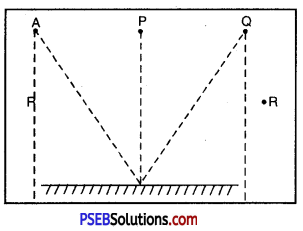
Activity 1

Tell
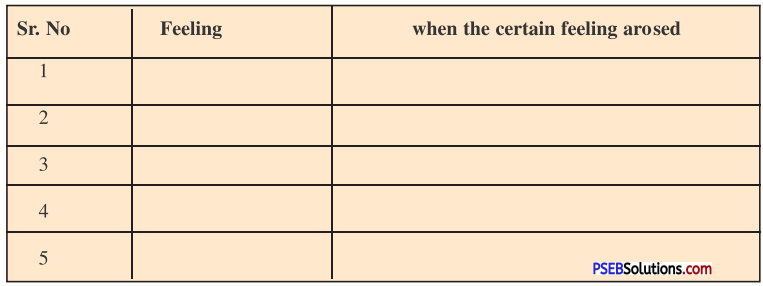
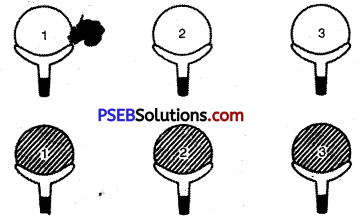
PSEB 9th Class Welcome Life Solutions Chapter 4 Empathy Img 1

Answer:

S.No. Feeling Situation (when the Certain feeling arrived)
1. Laughter When someone is Jocking.
2. Anger When anyone abuses me.
3. Sorry When I get fewer marks in exams.
4. Fear When exams are coming closer.
5. Crying When anyone scolds me without reason.

Activity 2

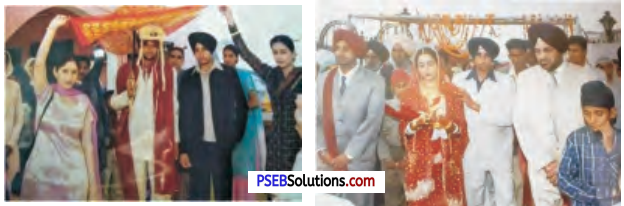
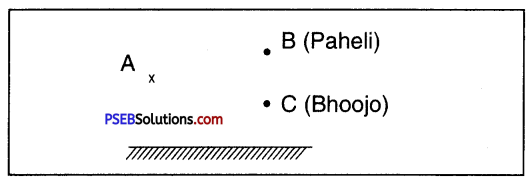
PSEB 9th Class Welcome Life Solutions Chapter 4 Empathy Img 2

(a) You feel the emotion of ……………….. at your elder brother’s marriage. (Fill in the blank)
Answer:
happy

(b) How did you feel at the departure of Doli at the time of your sister’s marriage ? .
Answer:
I started crying as a girl was leaving her father’s house.

PSEB 9th Class Welcome Life Solutions Chapter 4 Empathy

Textbook Page No. 23

Activity 3.

Dear students, today you have to change your seating plan for this period so that you can play an interesting game in your classroom just now. For this activity, one student of each double seater bench ( desk) please get up and interchange your seat with another bench sitter. In this way, one new student will be sitting on each bench. Now the new team will be formed. Just try to get friendly with your new companion and all set to start a new game, which is amazing. One student from each team will try to express the name of any game, player, bird, fruit, weather condition, any idiom and name of his I her friend whatever the name told by the class teacher in his/ her ear. The student will convey the names only by gestures, actions and not by speaking. The other member of the team will try to guess the name within 20 seconds and will note down the score in the note hook. However, the class teacher will describe the names and conduct the game.

Let us conclude :

Question 1.
Which quality did you learn and adopt today by playing this game?
Answer:
From this game, I learned that we should live in cooperation with others. If we will cooperate with others, every work will be done very easily.

Question 2.
Note down three qualities you found in your new friend?
Answer:

  • He knew how to cooperate with others.
  • He cooperated with others and we were able to finish the game very quickly.
  • He had the quality of understanding others very quickly.

Textbook Page No. 23

Question 1.
Did you feel that you can learn a lot from your new friend?
Answer:
Yes, I can learn a lot from my new friend such as a sense of cooperation, power to understand others very quickly.

PSEB 9th Class Welcome Life Solutions Chapter 4 Empathy

Question 2.
Fill in the blank :
The more I interact with the people, the ………………
Answer:
I will go closer to them and will learn a sense of cooperation from them.

Activity 4.

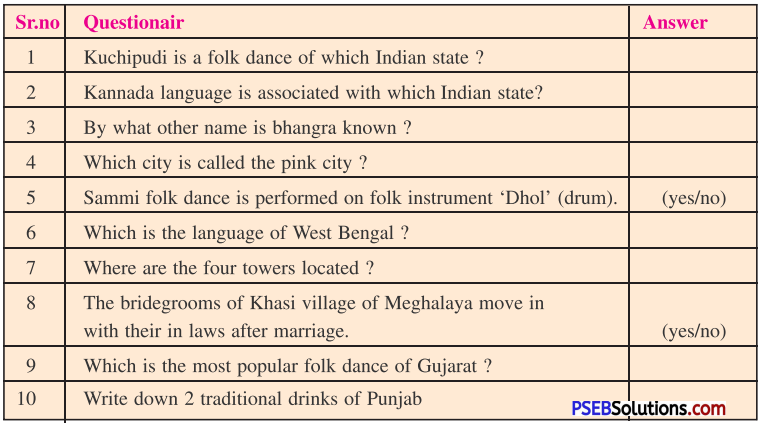
Each child will write the answer on their own worksheet. Instead of considering one student as the winner, the winning team will be declared by adding the scores of two students sitting on the bench.
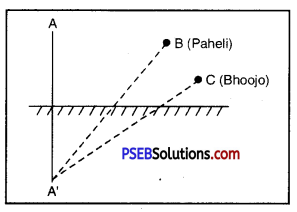
PSEB 9th Class Welcome Life Solutions Chapter 4 Empathy Img 3

Answer:

S.No. Questionnaire Answer
1. Kuchipudi is a folk dance of which Indian state? Andhra Pradesh
2. The Kannada language is associated with which Indian state? Karnataka
3. By what othe”r name is bhangra known? Malwai Giddha
4. Which city is called the pink city? Jaipur
5. Sammy folk dance is performed on folk instrument ‘Dhol’ (drum). Yes
6. Which is the language of West Bengal? Bengali
7. Where are the four towers located? Hyderabad
8. The bridegroom s of Khasi village of Meghalaya move in with their in-laws after marriage. Yes
9. Which is the most popular folk dance of Gujarat? Garba
10. Write down 2 traditional drinks of Punjab. Butter Milk, Church

PSEB 9th Class Welcome Life Guide Empathy Important Questions and Answers

Multiple Choice Questions:

1. Which of these is of great importance in life?
(a) Emotions
(b) Cars
(c) Buildings
(d) Watches.
Answer:
(a) Emotions

2. Which of these is an emotion?
(a) Anger
(b) Love
(c) Fear
(d) All of these
Answer:
(d) All of these

3. Which of these is necessary?
(a) To identify an emotion
(b) To accept an emotion
(c) To control an emotion
(d) All of these
Answer;
(d) All of these

PSEB 9th Class Welcome Life Solutions Chapter 4 Empathy

4. Which of these is not necessary?
(a) To identify an emotion
(b) To move according to emotions
(c) To control emotions
(d) To accept emotions.
Answer:
(b) To move according to emotions.

5. Society based on certain rules, norms, etc. is known as ………………..
(a) Civilised society
(b) Individual society
(c) Cultural society
(d) None of these
Answer:
(a) Civilised society

6. Which of these is a feature of a civilized society?
(a) Honesty
(b) Helping others
(c) Sense of responsibility
(d) All of these
Answer:
(d) All of these

7. Which of these is a famous dance of Punjab?
(a) Giddha
(b) Bhangra
(c) Both (a) and (b)
(d) Natti.
Answer:
(c) Both (a) and (b).

8. Which of these is of great importance in our lives?
(a) Cooperation
(b) Maintaining balance
(c) Helping others
(d) All of these
Answer:
(d) All of these

9. We can find many ………………….. in this world.
(a) Differences
(b) Similarities
(c) Both (a) and (b)
(d) None of these
Answer:
(c) Both (a) and (b).

10. There is …………………. in diversity in India.
(a) Ideology
(b) Unity
(c) Difference
(d) Equality
Answer:
(b) Unity

PSEB 9th Class Welcome Life Solutions Chapter 4 Empathy

Fill in the Blanks:

1. Showing ……………… can be good or bad.
Answer:
feelings

2. Identifying …………….. and controlling them is necessary.
Answer:
expressions

3. Society is based on ………………..
Answer:
rules

4. The world is full of ……………….
Answer:
diversity

5. Spirit of ……………… others is must in every individual.
Answer:
helping

Tick the Right (✓) or Wrong (x) Statement:

1. There is no importance of cooperation in social life.
Answer:
x

2. Both similarities and differences are there in society.
Answer:

3. We share our pain and pleasure with each other.
Answer:

4. Helping others is not good.
Answer:
x

5. Expressing feelings can be good or bad.
Answer:

Match the Following:

(A) (B)
Anger Civilized society
Unity in Expression
Helping others Diversity
Recognizing expressions Helpless
Based on values Controlling emotions

Answer:

(A) (B)
Anger Expression
Unity in Diversity
Helping others Helpless
Recognizing expressions Controlling emotions
Based on values Civilized society

Very Short Answer Type Questions:

Question 1.
Which emotions are of great importance in our lives?
Answer:
Emotions such as anger, love, peace, pain, hardness, sympathy, etc. are of great importance in our lives.

Question 2.
Which ability of emotions should be learned?
Answer:
We must learn when and how any expression needs to be expressed.

PSEB 9th Class Welcome Life Solutions Chapter 4 Empathy

Question 3.
What is necessary for emotions?
Answer:
Recognizing emotions, accepting and controlling them is a must for us.

Question 4.
Which is a civilized society?
Answer:
A civilized society is a society that is based on certain rules, values, and traits.

Question 5.
On what society is based?
Answer:
Society is based on similarities and differences.

Question 6.
How are people different from each other?
Answer:
People are different from each other from the point of view of language, religion, ways of living, eating habits, etc.

Question 7.
What should we do with diversity?
Answer:
We should welcome and respect diversity.

Question 8.
When should we help anyone?
Answer:
Help should be given at a time when someone needed it quite badly.

Question 9.
Who should be helped?
Answer:
One who is helpless should be helped.

Question 10.
Who is a Diwyang?
Answer:
The person is a Diwyang whose any part of the body is not working properly such as an eye, tongue, ear, arm etc.

Question 11.
How should we treat Diwyangs?
Answer:
We should show sympathy towards Diwyangs.

PSEB 9th Class Welcome Life Solutions Chapter 4 Empathy

Short Answer Type Questions:

Question 1.
What is the importance of emotions in our lives?
Answer:
We have many emotions such as anger, love, peace, hardness, pain, sympathy, etc. These are of great importance in our lives. These emotions are good if we know when and how to use these emotions. It is a must for us to learn that how* much of the expression is to be expressed. If we can have such capability, we can do progress very easily.

Question 2.
How can we maintain the balance of emotions?
Answer:
Emotions can be balanced with the following methods :

  • Recognizing emotions. First of all, it is a must for us to recognize that when we need to express an emotion.
  • Accepting emotions. With this, we need to accept that a particular emotion needed to use.
  • Controlling emotions. Finally, we need to learn the method to control emotions that should be used at an appropriate time.

Question 3.
What is the importance of social norms and values in a civilized society?
Answer:
Each society runs on the basis of fixed norms, values, traits, etc. Such a society is known as a civilized society. To run a society smoothly, it is necessary that it should work with fixed rules and regulations. If this will not happen then everyone will make his own rules and there will be chaos everywhere. There will be no balance in society. That’s why social norms and values are quite important as they are quite helpful for the smooth functioning of society.

Question 4.
Discuss unity in diversity in Indian society.
Answer:
We live in India and can see that the country is full of diversity. Our ways of behavior, habitat, religious values, ways of social behavior, dialect, eating habits, etc. are very much different from each other but still, we are tied with a thread of unity that we are Indians. Although we are different from each other, still live in unity and that’s why we can say that there exists unity in diversity in India.

PSEB 9th Class Welcome Life Solutions Chapter 4 Empathy

Question 5.
Write a note on helping the needy.
Answer:
Helping others is good but it is necessary to look that help should be given to the rifeedy one. Along with this, it is a must look that help should do welfare of the needy one. If the needy one is given a thing that is not required by him then the help will be wasted. That’s why it is the duty of everyone to help needy people. Maybe you will require the help of anyone in the near future. In this way, if we help each other, society will run smoothly.

Long Answer Type Question:

Question 1.
Which values did you learn in this chapter?
Answer:

  • Emotions. Individuals have many emotions but they must know that when and how much of the emotion is to be used.
  • Balance of emotions. Maintaining a balance of emotions is necessary. For this, we need to recognize, understand, accept and control our emotions.
  • Social values. Every society is based on fixed values and such a society is known as a civilized society. To run society smoothly, values and rules are necessary or there will be complete chaos in society.
  • Unity and Diversity. People of different religions, cultures, languages, etc. live in India in peace and harmony with each other. This shows unity in diversity in India.
  • Helping the Needy one. We meet many people who need someone’s help to do something. We should help such people.

Source-Based Question:

Question 1.
Read the source and answer the questions that follow :
The entire creation and the world are full of diversity. Every animal, bird, every plant, every creature is unique. Even one leaf of a tree is not like another. In society, we see a lot of differences in language, dress, color, occupation, customs, and culture. Indian culture also speaks of unity in diversity. Even though we are full of diversity. We are united with the thread of patriotism and unity. Our joys and sorrows are shared. We live in a world. Let us now share the information gathered about various heritage, cultural, differences in the context of India, in the form of quizzes.

1. Is there any similarity that exists in society?
Answer:
Yes, we have many many similarities among us.

2. There are many differences in society. Explain.
Answer:
This means that people living in society have many similarities as well as differences.

3. Which similarities are widespread in society?
Answer:
We all are humans, do the same type of work, we are the citizens of a single country who follow the same laws, our life is the same, etc.

Question 4.
Which differences exist between us?
Answer:
Our language and dialect are different, our religions are different, our ways of behavior, eating habits, etc. are different. Our personality is different as well.

PSEB 9th Class Welcome Life Solutions Chapter 4 Empathy

Question 5.
What type of diversity exists in India?
Answer:
We can find much diversity in India such as many religions exist in India, we use more than 1600 languages, our ways of eating, wearing, living, etc. are different. Our religious rituals, ways of doing marriage, ways of cremating dead bodies are also different. In this way, we can find a lot of diversity in India.
Yogic Exercises or Asanas Game Rules – PSEB 10th Class Physical Education

Punjab State Board PSEB 10th Class Physical Education Book Solutions Yogic Exercises or Asanas Game Rules.

Yogic Exercises or Asanas Game Rules – PSEB 10th Class Physical Education

Question 1.
Write about the history of Yoga.
Answer:
History:
The history of Yoga is indeed very old. Nothing can be said firmly about the origin of Yoga. Only it can be said that Yoga was originated in India. The available evidences show that history of Yoga is related to Indus Valley Civilization. At that time people used to do Yoga. On the basis of secondary sources it can be concluded that Yoga was originated approximately in 3000 B.C. in India. The first book on Yoga was written by Patanjali in 147 B.C. Infact, Yoga is derived from a Sanskriti word “Yuj” which means union of soul.
Nowadays, Yoga has become very popular throughout the world. The present age can be said the age of stress, tension, and anxiety. So, most of the persons have not been leading a happy and fruitful! life. In western countries, Yoga has become a way of life. It has a vital significance in the life of human beings.

Yogic Exercises or Asanas Game Rules - PSEB 10th Class Physical Education

Question 2.
Which important points should be kept in mind while doing yogasanas.
Answer:
Latest information about Yoga:

  • The ground should be even for doing Yogic exercises. Yogic asanas should be performed on a ‘dari’ or blanket on the ground.
  • The place for Yogic asanas should be peaceful, airy and clean.
  • Breathing should be normal, and mind should be at peace while doing Yog Asanas.
  • Yog Asanas should be performed with concentration of mind at least four hours after taking meals.
  • The exercises should be done slowly and with ease, and the pace of the exercises should be increased slowly.
  • The Yogic practice should be done under the care of an expert.
  • One should get relaxed by Shavasana in between two Yogic Asanas.
  • The body should be covered with minimum clothes such as loin cloth, nickar, banyan etc. and balanced food should be taken.

The following exercises have been included in the syllabus prescribed by the Board. Daily practice of these exercises helps a layman keep good health:

  • Tarasana
  • Ardh Chandrasana
  • Bhujangasana
  • Shalabhasana
  • Dhanurasana
  • Ardhmatseyendrasana
  • Paschimotanasana
  • Padmasana
  • Sawastikasana
  • Sarvanagasana
  • Matasyasana
  • Halasana
  • Yog Mudra
  • Mayurasana
  • Uddiyana
  • Pamayamanulom vilom
  • Surya Namaskar
  • Sharasana.

Some of the important asanas out of the above-mentioned asanas are described ahead in detail, and others have been described in brief:
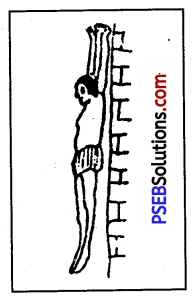
1. Tar Asana:
In this asana the trunk is pulled upwards while in the standing position. The position of tar asana is like the Tar tree.
Technique of the Tar Asana-
Stand up, join the heels and toes of both the feet and lift the arms straight upward. Let the fingers of one hand cross those of the other hand. The wrists should be upward and the sight in front. Breathe in fully. Raise the heels and put the whole body weight on toes. Pull the body upwards. After sometime, breathe out and lower the body. Repeat this action 10-15 times.
Yogic Exercises or Asanas Game Rules - PSEB 10th Class Physical Education 1

Advantages of Tar Asana:

  • It reduces obesity of the body.
  • It raises the stature.
  • It removes constipation.
  • It prevents the diseases of the intestines.
  • It serves to cleanse the bowels if it is done after taking cold water everyday.

2. Ardh-chandra Asana:
It involves the same action as is in Tar Asana. In it, the body is bent to side said, and the other side of the trunk is pulled.

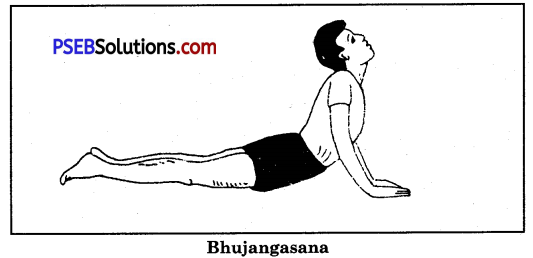
3. Bhujangasana: In this asana, one lies down straight and loosens the trunk.

Yogic Exercises or Asanas Game Rules - PSEB 10th Class Physical Education

Question 3.
What are the benefits of Bhujang asana.
Answer:
Technique of Bhujang asana:
It is also called Sarapasana. In it, the position of the body is like that a serpent. In order to perform this asana, lie down on the belly on the ground. Place both hands near the shoulders. Make the legs hard slowly and with the help of wrists raise the chest so much that the body gets completely straightened. Pull in the toes and hang the head slowly backwards. Return gradually to the former position. Repeat this asana 3-5 times.

Advantages:

  • Bhujangasana stimulates (increases) the digestive power.
  • It helps in getting rid of the diseases of liver and spleen.
  • It strengthens the muscles and the vertebral column.
  • It removes constipation.
  • It helps in making the bulging- out belly go in.
  • It strengthens lungs.
    Yogic Exercises or Asanas Game Rules - PSEB 10th Class Physical Education 2

1. Shalabh Asana: In this asana, one lies prostrate and the thigh spreads backward.

2. Ardh Masteyendr Asana: In this asana, in sitting position, the trunk is pushed towards the sides.

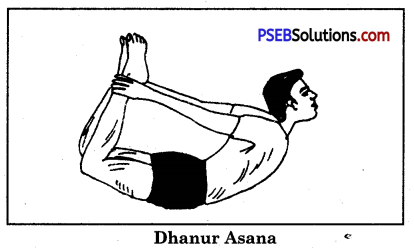
3. Dhanur Asana: In this asana, one lies prostrate, pulls up the legs and tries to catch dr catches the knee with the help of both hands.

Yogic Exercises or Asanas Game Rules - PSEB 10th Class Physical Education

Question 4.
What is the difference between Dhanur Asana and Paschimottan Asana?
Answer:
Technique of Dhanur Asana:
In this asana the position of the body is like that of a bow. In order to perform this Asana, lie over the belly on the ground, keep the knees bent backwards. Hold the feet near the ankles with the help of both the hands. Breathe in deeply and raise the chest upwards as much as possible. Now make the feet hard so that the body acquires the shape of a bow. Try to remain in this position as long as possible. Breathe out, keep the body loose and return to the former position. Repeat this asana 3-4 times.
Yogic Exercises or Asanas Game Rules - PSEB 10th Class Physical Education 3
Dhanur Asana:
Advantages:

  • It reduces the obesity (fatness) of the body.
  • It increases the power of digestion.
  • It helps in getting rid of rheumatism and urinary diseases.
  • It strengthens the stomach and intestine.
  • It also strengthens the vertebral column. Muscles become strong and flexible.

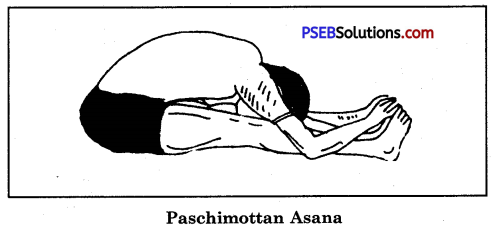
1. Paschimottan Asana: In this asana, one holds the thumbs of the feet with fingers and sits in such a way that the trunk goes towards one side.

Position of Paschimottan Asana: In this asana, the whole body is stretched and bent.

Technique of Paschimottan Asana:
Spread both the legs forward and sit on the ground. Hold the thumbs of the feet with both the hands. Breathe out slowly. Try to touch the knees. Breathe in slowly, raise the head upwards and returns to the former position. This asana should be performed 10-15 times.
Yogic Exercises or Asanas Game Rules - PSEB 10th Class Physical Education 4
Advantages:

  • This asana provides strength to the thighs.
  • It cleanses the blood vessels.
  • It helps in getting rid of the various types of diseases of the belly.
  • It lessens the excessive fat of the body.
  • It removes gas trouble.

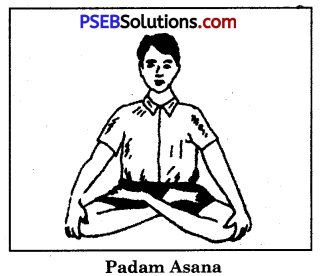
2. Padam Asana: In this asana, one sits squatting.
Position of Padam Asana: The position of this asana is that of a lotus.
Yogic Exercises or Asanas Game Rules - PSEB 10th Class Physical Education 5
Technique of Padam Asana:
After having sat in squat position, place your right foot on the left thigh in such a way that the heel of the right foot touches the hip bone of the left thigh. After this, lift up the left foot and in the same way place it on the thigh of the right foot. The vertebral column should be perfectly straight. Stretch the arms on the knees. It becomes very easy to do this asana after a few days practice.

Advantages:

  • This asana stimulates the digestive system.
  • It is very useful for increasing the concentration of mind.
  • Backache disappears.
  • One does not become a victim of the diseases of heart and belly.
  • It removes urinary troubles.

3. Svastik Asana: In this asana, one places the loose thighs in between the lower legs.

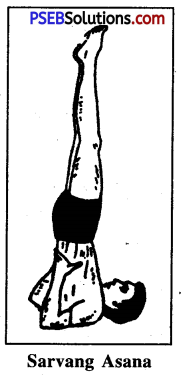
4. Sarvang Asana: In this asana, one stands on one’s shoulders.
Technique of Sarvang Asana: In this asana, the position of the body is like that of Ardh-hal-asana. In order to do this asana, straighten the body and lie on the ground over the back. Place both the hands along the thighs. Lift the feet once and resting the back with the help of wrists, let the elbows rest on the ground. Keep the whole body straight. Let the body weight fall on the shoulders and the neck.
Let the chin touch the neck.

After having remained in this position for sometime, return gradually to the former position. In the initial stage, do the asana for a minute or two. Then the duration of the asana should be increased from 5 to 7 minutes. The persons who cannot do Sheershasana for some reason should do Sarvang Asana.
Yogic Exercises or Asanas Game Rules - PSEB 10th Class Physical Education 6
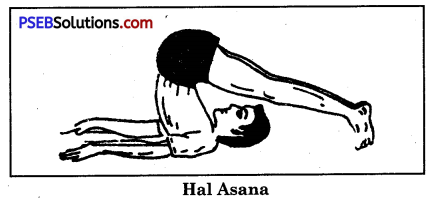
5. Halasana:
Position-
In doing this asana one lies in the supine position.
Technique:

  • Raise both legs and keep head away and lift both feet and bring both legs behind the head.
  • Touch the thumb of your feet of the ground.
  • Maintain the position as you can.
  • Bring your feet at the same place from where you have started to left.
    Yogic Exercises or Asanas Game Rules - PSEB 10th Class Physical Education 7

Advantages:

  • Hal Asana is very useful for every men and women of every age.
  • It is the best asana for the person of heart disease or a person who is suffering from high or low blood pressure.
  • It regulates the circulation of blood.
  • Removes fat of the body slim the waist and belly.
  • It provides flexibility to the backbone.
  • It make the body beautiful.
  • The face starts glittering like the sun.
  • It prevents skin diseases and removes constipation.

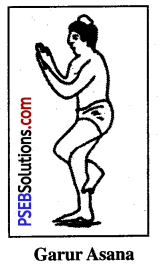
6. Garur Asana:
The position of Garur Asana in standing on both feet.
Techniques:

  • While standing straight, lift the left leg and encircle the other leg.
  • Left thigh will come over right thigh. The part of the lower leg will cover right side of the lower leg.
  • Put the body weight on one foot.
  • Encircle left arm to the right arm and left. Both palm and come to the position of Namaskar.
  • Then bend the left leg and bring the body in sitting position. In this way all nerves of the body will get stretched.
  • Again straighten up the body and come to the position of Attention.
  • Now change you legs and hands and repeat the same. Garur asana should be performed on each leg from one minute to five minutes.
    Yogic Exercises or Asanas Game Rules - PSEB 10th Class Physical Education 8

Advantages of Garur Asana:

  • It strengthens all parts of the body.
  • Body becomes healthy.
  • It prevents the diseases of Hernia.
  • Legs become strong.
  • One feels fresh and light.
  • Circulation of blood increases.
  • Man remains healthy and away from so many diseases.

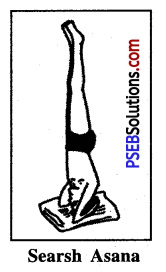
7. Searsh Asana:
Position: Bring your head down and keep legs upward.
Technique:

  • Put blanket or towel on the floor and sit down on your knees.
  • The fingers of both hands should be tightly interlocked put both hands on blanket.
  • Put your head between both hands in such a any that thumb of the hand may press back part of your head.
  • Bring both legs inside and put your thumb and legs straight upward.
  • Lift the feet gradually. Firstly straight one leg and another.
  • Try to keep your body in a straight line.
  • Put your body weight on head and both arms equally.
  • You can take help of the wall or your team-mates.
    Yogic Exercises or Asanas Game Rules - PSEB 10th Class Physical Education 9

Advantages:

  • Increases appetite.
  • Make a person slim.
  • Live and spleen become more active.
  • It removes all diseases concerning primary track.
  • Piles are cured.
  • By doing regular parctice of Searsh Asana, mental diseases are cured.

Precautions:

  • When eyes become red, Asana should be stopped.
  • On feeling giddiness don’t do Searsh Asana.
  • Searsh Asana should sbe stopped while feeling too much air in the ears.
  • This asana should not be performed when inhalation becomes difficult.
  • When body do not bear the weight.
  • On shivering arms and legs.
  • While feeling uneasiness, Searsh Asana may not be performed.
  • Searsh Asana should be performed all alone.
  • Take assistance when you feel necessity.
  • Searsh Asana can be performed from one minute to five minutes. More time would be harmful.

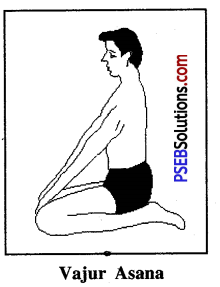
8. Vajur Asana:
Position Sitting on legs while keeping his feet behind.
Technique:

  • Put on knees under your hip and sit down while facing the feet upper side.
  • The thumb of the feet should touch each other.
  • Both the knees may touch each other back and waist must be in a straight line.
  • Put both hands on the both thigh.
  • Breathing may be long.
  • Vajur Asana may be performed daily from three minutes to twenty minutes.

Advantages:

  • Body becomes more active.
  • Removes the fats of the body.
  • Body becomes healthy.
  • Muscles get strengthened.
  • It helps to get rid to Night fall. Vajur Asana
  • It removes the pain of feet and legs.
  • Mind becomes cool.
  • Person becomes care free.
  • It cures diabetes.
  • It improves digestion.

9. Yog Mudra:
In Yog Mudra, one sits in the position of Padamasana, bends the trunk and rests the head on the ground.

10. Mayur Asana:
In this asana, the body is balanced on the elbows in the horizontal position. The palms are placed on the ground.

Yogic Exercises or Asanas Game Rules - PSEB 10th Class Physical Education

11. Uddiyan:
In this asana, one keeps the feet separate, stands and bends the trunk forward. The hands are placed on things. Then one breathes out and copies breathing in, below the ribs.

12. Pranayam :
Anulom Vilom- In this asana, one sits down breathes in for a fixed time, holds the breath with the help of chin and breathes out.
Advantages: This asana cleanses the blood, nerve and mind.

13. Surya Namaskar:
Surya Namaskar has sixteen components but the sun having sixteen phases appears at the time of total annihilation of the universe. Normally, only twelve components of its are practised.

Advantages:
It is the best Yogic exercise. It yields the benefits of asana, mudra and pranayam. The body of the one who practises Surya Namaskar glitters like the sun. It prevents skin diseases. It removes constipation. The spinal cord and waist become flexible. The pregnant women and patients of hernia should not practice it.

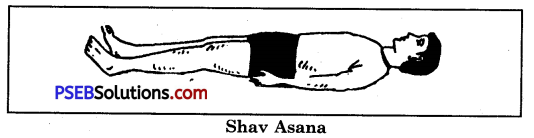
14. Shav Asana.
In this asana, one lies down prostrate and loosens the body. In order to perform this asana, lie down straight on the ground over the back and loosen all the parts of the body completely. Gradually, breathe in deeply. The distance between the feet should be 1.5 ft. Keep the wrists of the hands away from the body, facing the sky. Close your eyes, introspect and think as if the body were getting loose. Feel that the body is in a position of rest. This asana should be performed for 3-5 minutes. It should be performed at the start and end of every asana.

Importance:

  • Shavasana helps in getting rid of high blood pressure and mental tension.
  • It keeps the heart and the brain fresh.
  • It removes the fatigue in the body.

PSEB 9th Class Computer Solutions Chapter 7 E-Governance

Punjab State Board PSEB 9th Class Computer Book Solutions Chapter 7 E-Governance Textbook Exercise Questions and Answers.

PSEB Solutions for Class 9 Computer Science Chapter 7 E-Governance

Computer Guide for Class 9 PSEB E-Governance Textbook Questions and Answers

1. Fill in the Blanks

1. G2C stands for ……………
(a) Government to cooperation
(b) Grievances to cooperation
(c) Government to citizen
(d) None of these
Answer:
(c) Government to citizen

2. G2G stands for …………………
(a) Government to Government
(b) Get to Go
(c) Gather to Go
(d) None of these
Answer:
(a) Government to Government

3. G2E stands for ……………..
(a) Grievance to employee
(b) Government to an employee
(c) Government to environment
(d) None of these
Answer:
(b) Government to an employee

4. G2B stands for ……………..
(a) Government to Banks
(b) Government to Businessmen
(c) Government to Business
(d) None of these
Answer:
(b) Government to Businessmen

5. IRCTC stands for ………………..
(a) Indian Railway Catering and Tourism Cooperation ltd.
(b) Indian Runway Catering and tourism Cooperation ltd.
(c) Indian Railway Catering and travelling Cooperation ltd.
(d) Indian Railway Cargo and tourism Cooperation ltd
Answer:
(a) Indian Railway Catering and Tourism Cooperation ltd.

PSEB 9th Class Computer Solutions Chapter 7 E-Governance

2. Short Answer Type Questions

Question 1.
What is E-governance?
Answer:
Governance is a framework that is developed with a combination of man and machine. The implementation of any e-governance services requires advanced technology infrastructure like web-based applications that require a dedicated server and user-friendly web interface.

Question 2.
What are the two main objectives of e-governance?
Answer:
1. To satisfactorily fulfil the public’s needs and expectations by simplifying their interaction with various online services.
2. To facilitate a speedy, transparent, accountable, efficient and effective process for performing government administration activities.

Question 3.
Write the area of E-governance in urban.
Answer:
The area of E-Governance in urban are in transportation, railway, Information and public relation key services, roads and traffic management etc.

Question 4.
Write the area of E-governance in rural.
Answer:
E-Governance in rural areas are in the field of Agriculture, Local information, Disaster management, Land record management and Panchayat etc.

3. Long Answer Type Questions

Question 1.
Write the main characteristics of Good Governance.
Answer:
1. Good governance is transparent which means that people are able to clearly see how and why a decision was made.
2. Good governance follows the rule of law.
3. Good governance is responsive which means that government always tries to serve the needs of the entire community timely and appropriately.

Question 2.
Explain the four pillars of E-Governance.
Answer:
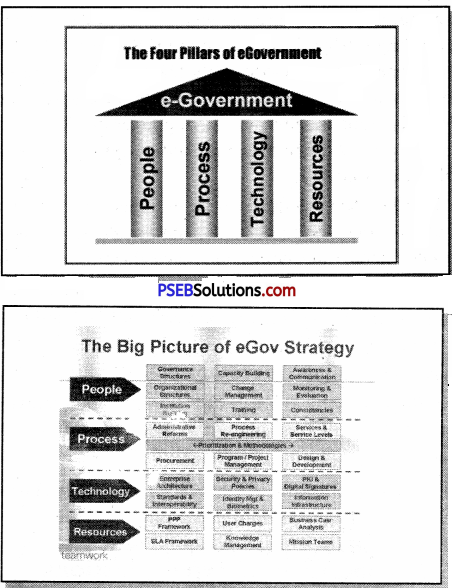
Fundamentally, e-Government projects would stand on four key pillars – People, Process, Technology and Resource (PPTR), Figure below. Each of the components needs to be addressed carefully and in a holistic manner, to achieve the desired results of the project, figure below :
PSEB 9th Class Computer Solutions Chapter 7 E-Governance Img 1

1. PEOPLE: As e-government projects are rolled out across the country people within and outside the government will play an increasingly important role in ensuring the success of these projects. The scale of transformation is huge and enormous resources not only in terms of money but also the expertise, skills and commitment of the people will be required.

2. PROCESS: E-Government is not just about the automation of manual records and existing processes, with all their inefficiencies. Rather, it is about transforming government processes and creating new relationships between the government and its citizens and businesses. Hence, a fresh set of process parameters and related workflow should be created, without creating unmanageable and chaotic changes, to maintain the consistency and sustainability of the process.

3. TECHNOLOGY: The Technology Challenges relate to lack of overall architecture and a road map for e-Government, lack of standards, poor IT Infrastructure, especially the poor communication networks, and, above all, adoption of the hardware approach rather than service-approach in the design and implementation of e-Gov projects. These challenges, if not addressed adequately and in time, result in an ad-hoc approach to e-Gov implementation. A few projects get implemented in isolation with big questions on their sustainability and scalability.

4. RESOURCES: New technologies demand new types of implementation models. Adopting conventional procurement methods would not take us far on the path of e-government. In the conventional approach, the project ownership lies with the public sector itself along with the responsibility for funding it and bearing the entire risk.

PSEB 9th Class Computer Solutions Chapter 7 E-Governance

Question 3.
Explain the four models of e-governance.
Answer:
The followings are the four models of e-governance :

1. Government to citizens (G2C)
This model of e-governance refers to the government services which are shared by citizens. In this model, citizens visit the links of services that they want to use. This model strengthens the bond between the government and its citizen. Type of services which are provided by this model includes:-

  1. Payment of online bills such as electricity, water, telephone bills, etc.
  2. Online registration of applications.
  3. Copies of land record.
  4. Online filling of complaints.
  5. Availability of any kind of online information.

2. Government to government (G2G)
This model refers to the services which are shared between the governments. There is lots of information that need to be shared between various government agencies, department and organizations. These types of services or information areas :

  1. Sharing of information between police departments of various states.
  2. Government document exchange which includes preparation, approval, distribution, and storage of all governmental documents, is also done through e-governance.
  3. Most of the finance and budget works are also done through e-governance.

3. Government to businessmen (G2B)
Through this model, the bond between the private sector and the government is strengthened. It is used by businessmen to communicate to the government. Type of services which are provided by this model includes:-

  1. Rejection and approval of patent are done by this model.
  2. Payment of all kinds of bills and penalties.
  3. Sharing of all kinds of information, rules, and data.
  4. Complaints or any kind of dissatisfaction can be shown by this.

4. Government to employees (G2E)
This model increases the transparency between the government and its employee. Here, employees can keep a check on the functioning and working of the government and the government can keep track of its employees. Information that can be shared by this model:

  1. All kinds of data submission (attendance record, employee record, etc.) from various government offices is done by this model.
  2. An employee can file all kinds of complaints and dissatisfaction with this model.
  3. All kinds of rules- regulations,s, and information for employees can be shared by this.

Question 4.
Write about E-GOVERNANCE IN HEALTH and EDUCATION.
Answer:
E-Governance provides many services in the health sector also. With the help of EGovemance, people can online check the availability of medicines, health camps, and other facilities. The following are the projects under the health area are Hospital OPD Appointment: It is the system of welfare measures started by the Chandigarh Government to make the life of citizens simpler and comfortable. HEALING: This project is started by the Kerala Government for Medical Health and Family Welfare Department,

E-Governance in the education sector is helpful in providing basic education and education facilities to children. Its aim is to provide computer education to children and online results for various classes. The following are the projects under the education field are Online Scholarship Management System: Its purpose is the distribution of scholarships and fees among brilliant and needy students. AISES (All India School Education Survey): The aim of this project is to survey the number of schools in the district which helps in the Census. This project was started by Assam Government.

PSEB 9th Class Computer Solutions Chapter 7 E-Governance

Question 5.
Describe the history and development of E-governance.
Answer:
Among developing countries, India has been an early adopter of e-governance. The first wave can be considered to have evolved bottom-up. Some social entrepreneurs convinced district-level officials of the wonders of new ICTs, especially in providing convergent services to remote areas and improving transparency and oversight in this regard. The Gyandoot project in Dhar district, which begun in 2000, is considered the forerunner of what was to be a rash. of projects that built a front-end in many village communities which were supposed to be serviced by a back-end mostly in the district collectorate. The idea and the effort were to create pressure from the community front-end for the digitization of back-end departmental processes.

The latter was largely a localized effort, mostly dependent on the initiative and energy of the concerned district collector, often with some very spirited support of the district National Informatics Centre (NIC) staff. Perhaps the most organized and successful effort in this first phase of e-governance in India, roughly between 2000-05, was Rural e-Seva in the West Godavari district of Andhra Pradesh. As for community-level front-end development two initiatives, N-Logue and Drishti stand out, each of which at one time claimed to be running thousands of community telecentres across the country that could deliver e-governance services.

There is a general tendency to classify these early efforts as failures. Indeed, around 2005-06, N-Logue closed down and Drishti moved out of e-governance services. Rural e-Seva also was never scaled up. However, what is noteworthy is that in a relatively short time, these early projects created a lasting impression of new ICTs as a possible means to bring governance close to the people, and perhaps, also make it more transparent and accountable. To that extent, they had a very significant impact,

even if these initiatives themselves could not survive, due to a variety of reasons which we cannot discuss in greater detail, here. (However, if we compare this situation with the burst of the dot-com bubble in the early part of the last decade, one can see some common factors.) They created the context for the very ambitious National E-Governance Plan (NeGP), especially its flagship project, the Common Service Centres, which was inaugurated by the Government of India in 2006.

PSEB 9th Class Computer Guide E-Governance Important Questions and Answers

Fill in the blanks

1. ………………… means the government to employees.
(a) G2L
(b) G2G
(c) G2E
(d) G2B
Answer:
(c) G2E

2. E-governance has ………………… main objectives.
(a) 2
(b) 3
(c) 4
(d) 5
Answer:
(a) 2

3. ………………….. do work of e-governance in urban areas.
(a) Transportation
(b) Municipal Corporation
(c) Road Safety
(d) All of above
Answer:
(b) Municipal Corporation

4. ………………….. do work of e-governance in a rural areas.
(a) Health
(b) Panchayat
(c) Agriculture
(d) Municipal Corporation
Answer:
(b) Panchayat

True or False

1. E-governance do not work in education.
Answer:
False

2. E-governance has four models.
Answer:
True

PSEB 9th Class Computer Solutions Chapter 7 E-Governance

Short Answer Type Questions

Question 1.
What is e-Government?
Answer:
The term e-Government is understood differently across the world. E- Govemment or Electronic Government is the delivery of more convenient, customer-oriented, and cost-effective public services and sharing of information through electronic media. Specifically, e-Government harnesses information and communication technologies (such as Wide Area Networks, the Internet, and mobile computing) to transform relations with citizens, businesses, and other arms of government.

Question 2.
What is the difference between e-Government and e-Governance?
Answer:
E-Govemment is the transformation of internal and external public sector relationships, through Information and Communications Technology (ICT) in order to optimize government service delivery and citizen participation. Digital society is a society or community that is well advanced in the adoption and integration of digital technology into daily life at home, work and play. E-Governance is the development, deployment, and enforcement of the policies, laws, and regulations necessary to support the functioning of a Knowledge Society as well as of e-Government.

Question 3.
What are the objectives of e-Governance?
Answer:
The strategic objective of e-Governance is to support and simplify governance for government, citizens, and businesses. The use of ICT can connect all three parties and support processes and activities. Other objectives are to make government administration more transparent, speedy and accountable while addressing the society’s needs and expectations through efficient public services and effective interaction between the people, businesses and government.

Question 4.
what are the benefits of e-Governance?
Answer:
E-Governance offers many benefits and advantages for the government, corporate sector and society. E-Governance facilitates better delivery of government services to citizens, improved interactions with business and industry, citizen empowerment through access to information, or more efficient government management. It simplifies internal operations and improves the performance of government departments while helping all sections of society to avail government services at lower cost with maximum ease of use.

Long Answer Type Questions

Question 1.
List the various services of E-governance for urban.
Ans. The followings are the various services of e-governances for urban :

1. Transportation: There are many services which are provided by e-governance in transportation like provision of booking facility of interstate transport, plans for regional transportation, time table of buses and transportation improvement program etc. The following are the projects under e-governance in transportation such as:OSRTC- The Orissa State Road Transport Corporation project was started to provide online facilities in the transportation department.HRTC- The Himachal Road Transport Corporation project provides many facilities like online booking, availability and cancellation of seats and buses etc.

2. Online payment of bills and taxes: E-Governance also provides online transactions,payment of bills, EMIs and taxes etc. The project under e-governance in online payment is FRIENDS which is started by Kerala Government to make onlinepayments of fees, water and electricity bills etc.

3. Municipal services: The services provided by municipal sector are house taxes, issuethe death certificates, maintain records of property and approval for site plans etc.The following are the projects under municipal services are:SDO Suite: This project was started by Assam Government. It provides manyfacilities by issuing certificates like permission for land sale, birth and death reportetc.

4. Rural Digital Services: It gives many social security services such as old agepension, widow and freedom fighter pension.

5. Roads and. traffic management: The services provided by road and trafficmanagement are construction and maintenance of roads, traffic management andpollution control schemes. The project under e-govemance in road and trafficmanagement is CFST (Citizen Friendly Services of Transport) which is started by Andhra Pradesh Government. It checks the pollution control level, road safety andsafety of people. ’

Question 2.
List the various services of E-governance for rural.
Answer:
The followings are the various services of e-governances for rural:

1. Agriculture: The farmers rely on the information provided by the govemmentthrough e-governance. Governments are working on many projects used in agriculture like MARKET which is approved by the Department of Marketing and inspection (DMI), Ministry of Agriculture and Government of India. ‘

2. Local information: Government provides many local information such as prices of seeds, loan rates etc. The project under e-governance in local information is EJanSamparkwhich is started by Chandigarh Government to help people access the local information in their locality to fulfil their needs.

3. Land record management: With the help of this management, huge number of land records can be maintained in a very small time. The following are the projects under land record management are : Bhooftii: It was started by Karnataka Government and known as the first E-Governanceland records management projects.Land Records Management System State Government of Punjab.

4. Panchayat: Panchayat provides many services such as issuing the birth and death certificates, various schemes for poor people and water supply and sanitation etc.

Question 3.
List the various E-Governance Services from Government To Government.
Answer:
E-Governance Services from Government to Government (G2G): It is also known as E-Administration. In this model, services are being shared between many governments. Information are shared among various government agencies, organizations and departments. The following arethe services discussed in the G2G model:

E-Secretariat: E-Secretariat provides huge, valuable and functional information of the state. In E-Secretariat,multiple departments are linked together on internet and exchange the information of various components. Italso links all the governmental departments with their headquarters and state capitals. .

E-Police: E-Police helps everyone to feel safe and secure. For this purpose, E- Police maintain two databases.First database is of police personnel which provide records (current and previous posting etc.) of persons working in police. This database helps people to find the specialization of policemen according to geographical regions and skills. Second database is of criminal records. This database provides full detail of any criminal byjust typing the name of criminal. This database also provide the past activities and area of operation of anycriminal.

E-Court: E-Court will bring a revolution in the Indian pending court cases. In India, there are a number of pending cases that produce frustration in people and will bring the system to a halt. Both consumers and the system need the change. If the system w3ill work in the same manner in future, than one day it will collapse. In E- Court, IT transforms the system into databases of cases having zero level dependency. In such systems, Judges can consider the appeals from intranet, give their decisions online by considering recorded facts of case and reduce the backlog of cases.
The success of G2G model is based on some important aspects like expenditure, the establishment of the network, planning, monitoring and controlling the performance of process resources like human and financial.

PSEB 9th Class Computer Solutions Chapter 7 E-Governance

Question 4.
What are the various stages of E-governance?
Answer:
Stages of e-Governance :
It is apparent in various research studies that e-Governance is fundamentally linked with the development of computer technology, networking of computers and communication systems. In developing nations, such technologies and systems became available with an observable time lag as compared to developed nations. When appraising the e-governance model in India, it is established that with the liberalization of the economy from the early 1990s onwards, there has been a convergence in the availability of progressive technologies and opportunities in this field. The inception of e-Governance proceeded through four stages in India.

1. Computerization: In the first stage, with the availability of personal computers, the majority of Government offices are well equipped with computers. The use of computers begem with word processing, quickly followed by data processing.

2. Networking: In this stage, some units of a few government organizations are connected through a hub leading to sharing of information and flow of data between different government entities.

3. On-line presence: In the third stage, with increasing internet connectivity, a need was felt for maintaining a presence on the web. This resulted in the maintenance of websites by government departments and other entities. Generally, these web pages/websites contained information about the organizational structure, contact details, reports and publications, objectives and vision statements of the respective government entities.

4. On-line interactivity: A natural significance of online presence was opening up of communication channels between government entities and the citizens, civil society organizations etc. The main objective of this stage was to lessen the scope of personal interface with government entities by providing downloadable Forms, Instructions, Acts, and Rules.

Wrestling-Free Style And Greeco Roman Game Rules – PSEB 10th Class Physical Education

Punjab State Board PSEB 10th Class Physical Education Book Solutions Wrestling-Free Style And Greeco Roman  Game Rules.

Wrestling-Free Style And Greeco Roman Game Rules – PSEB 10th Class Physical Education

Question 1.
Mention the wrestling weight categories of men, Women and junior.
Answer:
AGE GROUP:
Above 20 Years-

Senior Men Senior Women
First Group 48-54 K.G. 41-46 KG.
Second Group 58 KG. 51 KG.
Third Group 63 K.G. 56 KG.
Fourth Group 69 K.G. 62 KG.
Fifth Group 76 K.G. 68 KG.
Sixth Group 85 K.G. 68-75’KG.
Seventh Group 97 K.G.
Eighth Group 97-130 K.G.

Wrestling-Free Style And Greeco Roman Game Rules - PSEB 10th Class Physical Education

From 17 years to 20 years old:

Junior Boys Junior Girls
First Group 46-49 KG. 40-43 KG.
Second Group 52 KG. 46 KG.
Third Group 56 KG. 50 KG.
Fourth Group 60 KG. 54 KG.
Fifth Group 65 K.G. 58 KG.
Sixth Group 70 KG. 63 KG.
Seventh Group 76 KG. 68 KG.
Eighth Group 83 KG. 68-75 KG.
Ninth Group 90 KG.
Tenth Group 90-115 KG.

From 15 years to 16 years:

Sub Junior Boys Sub Junior Girls
First Group 39-42 K.G. 36-38 KG.
Second Group 45 KG. 40 KG.
Third Group 48 K.G. 43 KG.
Fourth Group 52 K.G. 46 KG.
Fifth Group 57 KG. 49 KG.
Sixth Group 63 KG. 52 KG.
Seventh Group 69 KG 56 KG.
Eighth Group 76 KG. 60 KG.
Ninth Group 83 KG. 65 KG.
Tenth Group 83-95 KG. 65-75 KG.

From 13 years to 14 years old:

Sub Junior Boys Sub Junior Girls
First Group 29-32 KG. 20-30 KG.
Second Group 35 KG. 32 KG.
Third Group 38 KG. 34 KG.
Fourth Group 42 KG. 37 KG.
Fifth Group 48 KG. 40 KG.
Sixth Group 54 KG. 44 KG.
Seventh Group 58 KG. 48 KG.
Eighth Group 66 KG. 52 KG.
Ninth Group 71 KG 57 KG.
Tenth Group 71-85 KG 57-62 KG.

Every participants will take part according to his own body weight.

Wrestling-Free Style And Greeco Roman Game Rules - PSEB 10th Class Physical Education

Question 2.
Discuss the rules of weighing and pairing of competitors.
Answer:
Rules for Weighing and Pairing of Competitors:
Weighing of the Competitors-

  • Weighing of competitors shall begin two to four hours before the wrestling competition begins.
  • The competitors shall be weighed without clothes. They shall be medically examined by a doctor before they are weighed. The doctor will remove any player suffering from any contagious disease.
    Wrestling-Free Style And Greeco Roman Game Rules - PSEB 10th Class Physical Education 1
  • Each contestant can participate in wrestling with a player belonging to his weight-group.
  • The competitors should be in a perfect physical condition. Their nails should be well pared. They shall be checked at the time of medical examination.
  • Weighing shall start at least two hours before the competition and must conclude an hour before the first wrestling bout.
  • Before the completion of weighing, a contestant may stand any time on the weighing machine for recording his weight, but he should not be out of turn.

Pairing-off by drawing lots:
In each bout all the players shall be included by draw of lots. Those contestants whose lots follow one after the other shall wrestle in the first round. If the wrestler bears odd numbers, the wrestler who scores more marks shall enter the bye of the next round without marking the penalty. The “right to bye can be got only by lot. In making pairs for the second round, the topmost name of the list is paired with the second next to him but this is done in case they have not wrestled before. If, while making pairs, two contestants figure together in the same place, they shall wrestle with each other in the first round.

Wrestling-Free Style And Greeco Roman Game Rules - PSEB 10th Class Physical Education

Question 3.
What type of dress should a wrestler wear? Mention the duration of wrestling bout.
Answer:
Costume of wrestlers, Mat, Start and Duration of Wrestling.
Stoppage of Wrestling Bout, End of Bout-
Dress:
The wrestlers shall enter the arena in a one-piece jersey, banian or ‘jangia’ (red or blue) beneath which they shall wear a jock strap. They will wear costumes which fit their body very well, and is not loose. They will wear sports shoes firmly closing the anklets. The use of light knee guards is allowed. A contestant shall be closely shaved or with a beard of many months growth.

The contestants cannot use oil or any other greasy substance on their bodies. Their bodies should not be wet with perspiration. The use of rings, bracelets, shoes with buttons and any other such thing which may harm or hurt a player is prohibited. Every contestant should have his own handkerchief.

Mat:
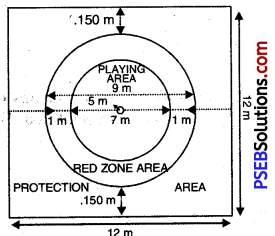
The mat at all international matches should be 9 metres in circle (with a radius of 4.50 m.), and from its other ring a ring of 50 cms. is drawn. This place is marked with red colour. It should be fixed on a platform, 1.10. metre in height. The ends of the mat should have red or blue comers, and there should be a circle of 1 metre in the middle.

Start Of Wrestling Bout And Its Duration:

  • The duration of each bout is of 6 minutes. It is divided into two periods of 3 minutes each. A rest of 1 minute is given after the first three minute bout.
  • The bout shall continue until a player falls down, otherwise it shall continue for 6 minutes.
  • If a player does not»enter the mat after five minutes of call, he shall be considered defeated and turned out of the competition.
  • The wrestling bout shall start, interrupt or end on the whistle of the referee.

End of the Bout-
The end of the bout is indicated by the ringing of gong by the time keeper. The referee, too, blows his whittle as a signal for the end of the bout. If the referee does not hear the gong, the Mat chairman interferes immediately and get the bout closed. No act is considered valid in between the sound of gong and the referee’s whistle.

The two contestants stand on either side of referee to receive, the decision. The Mat chairman declares the winner by raising the winner’s colour. Thereafter, the winner’s arm is raised by the referee. If there is a tie, the arms of both players are raised. No contestant shall loosen the straps of his dress before the decision is given.

Question 4.
What are the foul holds in wrestling ?
Answer:
Foul-holds:
The following fouls are taken into consideration-

  • Pulling of hair, ears, dress, private organs, etc.
  • Twisting of fingers, grasping of the throat and other holds which may be life-endangering.
  • Holding in such a manner as may put the opponent’s life in danger, or may hurt any of his body part, or cause him pain so that the opponent helplessly leaves the bout.
  • Treading on the feet of the rival.
  • Touching the face of the opponent (from the eye-brows to the chin).
  • Grasping the opponent by throat.
  • Lifting the rival when he is in bridge position, and then throwing him on the mat.
  • Breaking the bridge by giving a push from the head.
  • Twisting the opponent’s arm at above 90° angle.
  • Grasping the opponent’s head with both hands.
  • Thrusting the elbow or knee into the abdomen or stomach of the rival.
  • Turning the opponent’s arm to the back the pressing it.
  • Grasping the opponent’s head in any manner.
  • Applying leg-scissors on the body or head.
  • Holding on to the mat.
  • Talking to each other and making dangerous assault.
  • Cautions:

Precautions may be taken in the following conditions :
(a) Permanent obstacles
(b) Foul holds
(c) Indiscipline at the time of bout
(d) Breach of rules-

  • These precautions shall be taken into account along with other fouls of the bout.
  • A player may be declared defeated after he has been warned, thrice.
  • A player, in case of major offence, may be removed from the bout.

Obstacles:

  1. Lying in abdomen position.
  2. Going out of the mat knowingly.
  3. Holding of both the hands of the opponent so that he may not play.
  4. A player may be given warning if he goes out of the mat.

Stoppage of Bout:
A bout may be suspended for five minutes at the most because of a bleeding nose, headlong fall or any acceptable reason. This obstacle in one or two bouts may be of maximum 5 minutes for each contestant.

Wrestling-Free Style And Greeco Roman Game Rules - PSEB 10th Class Physical Education

Question 5.
Describe the officials for the conduct of wrestling. How is victory or defeat decided in wrestling ?
Answer:
Score:
(a) One Point:

  • to a player who throws a rival on the mat and maintains control over him,
  • to that player who rises from beneath and maintains his hold on his opponent,
  • to a player who makes a good grasp and does not allow his opponent’s head and shoulder to touch the mat,
  • for one precaution the opponent gets one point.

Two Points:

  • to that player who keeps good hold on his opponent and maintains his hold on him for some time
  • to that player whose opponent immediately falls or falteringly falls.
    Wrestling-Free Style And Greeco Roman Game Rules - PSEB 10th Class Physical Education 1

(c) Three Points:

  • to a player who keeps his opponent in danger (when shoulders make an angle of less than 90° from the mat) for five seconds,
  • bridge position for three seconds or fall takes five seconds.

Decision.
When there is a difference of less than one point in or the score of the opposite players, the match ends in a draw. Again, if no contestant scores any point, or the points are equal, the match ends in a draw. If the difference is more than one point, a player 1 with more points is declared the winner.

Fall:

  • For full fall it is sufficient if the shoulder of the wrestler touches that mat.
  • The fall shall be considered if the referee raises no objection.
  • For proper fall on the edge of the mat the head and shoulders of the contestant shall touch the limits of mat.

Winning by Points:
If there is no foul within six minutes, the decision is made by points. The player scoring higher points shall be the winner.
Rules for Final-

  • The final match is played among three wrestlers.
  • The players who have scored 6 penalty marks cannot take part in the final match.
  • When the three players with less than 6 penalty marks reach the final, the points scored by them are nullified.
  • If those players have already competed, the former penalty marks are counted in the final.
  • The penalty marks of the contestants in the final must be kept in view.
  • If each of the three contestants has already scored 6 points, they will forfeit their points as mentioned above.
  • If the three contestants of the final have already scored 6 points each, he shall be awarded the third position and the remaining two shall wrestle for first position.
  • The player who scores minimum penalty point in the last three bouts shall be the winner.
  • If the penalty points of the finalists are equal, the decision is made keeping in views the following:
    • The victory scored on points.
    • The number of points being equal.
    • The number of fouls.
    • In case of tie, the player with minimum warnings is declared the winner.
    • If there is still a tie, both the players are declared equal.

Officials:
There are three officials in all types of wrestling matches:

  • Mat Chairman
  • Referee
  • Judge

No official can be changed during the wrestling.

Wrestling-Free Style And Greeco Roman Game Rules - PSEB 10th Class Physical Education

Important Information about the Wrestling-Free Style And Greeco Roman Game

  • Shape of the mat of wrestling = Round
  • Size of mat = 4.50 m Radius
  • Colour of Round = Red
  • Height of Mats from platform = 1.10 meter
  • Colour of the Corner = Red and Blue
  • Duration of Bout = 6 minutes, 2-2-2 minutes (three half)
  • Total weight for men = 9
  • Total weight for women = 7
  • Total weight for Junior = 10
  • Officials for wrestling= One mat chairman,Two referees, Three Judges
  • Rest after bout =30 seconds
  • Undisturb area around the mat = 1.50 meter
  • The player who is to play in a wrestling competition should be perfectly healthy. He should not be suffering
    from any infectious disease.
  • The competitors of wrestling should have well-pared nails. They
  • The duration of this game is 6 minutes.
  • It is a foul to pull the hair, flesh, ear or private organs of an opposing player in a game of wrestling.
  • By raising the colour of the winning team the Head of the match declares the winner.
  • The player who has been warned thrice by the referee is considered defeated.
  • The competitor cannot wear iron bracelet or ring, etc.
  • The player who competes in wrestling should have a cut beard or have a fresh shave.
  • No official conducting the game can be changed during the play.

PSEB 9th Class Computer Solutions Chapter 4 Introduction to DBMS

Punjab State Board PSEB 9th Class Computer Book Solutions Chapter 4 Introduction to DBMS Textbook Exercise Questions and Answers.

PSEB Solutions for Class 9 Computer Science Chapter 4 Introduction to DBMS

Computer Guide for Class 9 PSEB Introduction to DBMS Textbook Questions and Answers

1. Fill in the Blanks

1. ……………… is the full name of DBMS.
(a) Database manager system
(b) Database managing system
(c) Database management System
(d) Database Messenger Software.
Answer:
(c) Database management System

2. To control the Database ………………… is responsible.
(a) Data master
(b) Database administrator
(c) User
(d) Common man
Answer:
(b) Database administrator

3. After processing data is Convert into …………………..
(a) Database
(b) Information
(c) Entity
(d) Software
Answer:
(b) Information

4. Information associate with each other makes………………..
(a) Database
(b) DBMS
(c) DBA
(d) File Processing System
Answer:
(a) Database

PSEB 9th Class Computer Solutions Chapter 4 Introduction to DBMS

5. To store the same data again and again in a database is called …………………
(a) Integrity
(b) Redundancy
(c) Object
(d) Foreign key
Answer:
(b) Redundancy

6. …………………. is a unique key.
(a) Primary key
(b) Foreign key
(c) Electronic key
(d) Database key
Answer:
(a) Primary key

2. Full Forms

1. DBA
Answer:
Database administrator.

2. DBMS
Answer:
Database management System.

3. SQL
Answer:
Structured query language.

3. Short Answer Type Questions

Question 1.
What is a database?
Answer:
A database is a collection of information that is organized so that it can easily be accessed, managed, and updated. In one view, databases can be classified according to types of content: bibliographic, full-text, numeric, and images.

Question 2.
What are the different types of relationships?
Answer:
One-to-One Relationships
One-to-Many Relationships
Many-to-Many Relationships
Self-Referencing Relationships

Question 3.
Write the names of different DBA’s.
Answer:
Administrative DBA
Development DBA
Data Architect
Data Warehouse DBA

PSEB 9th Class Computer Solutions Chapter 4 Introduction to DBMS

Question 4.
What is SQL?
Answer:
SQL is a Structured Query Language, which is a computer language for storing, manipulating, and retrieving data stored in a relational database. SQL is the standard language for Relation Database Systems. All relational database management systems like MySQL, MS Access, Oracle, Sybase, Informix, Postgres, and SQL Server use SQL as standard database language.

Question 5.
Name the different types of keys.
Answer:

  1. Primary key
  2. Foreign key
  3. Composite key
  4. Natural key
  5. Surrogate key
  6. Candidate key
  7. Compound key

4. Long Answer Type Questions

Question 1.
Describe Normalization. How many types of Normalization?
Answer:
Normalization is a process of organizing the data in the database to avoid data redundancy, insertion anomaly, update anomaly & deletion anomaly.
Here are the most commonly used normal forms :

  • First normal form(1NF)
  • Second normal form(2NF)
  • Third normal form(3NF)

First normal form (1NF)
As per the rule of the first normal form, an attribute (column) of a table cannot hold multiple values. It should hold only atomic values.

Second normal form (2NF)
A table is said to be in 2NF if both the following conditions hold :
The table is in INF (First normal form)
No non-prime attribute is dependent on the proper subset of any candidate key of the table. An attribute that is not part of any candidate key is known as a non-prime attribute.

Third Normal form (3NF)
A table design is said to be in 3NF if both the following conditions hold:
The table must be in 2NF
Transitive functional dependency of non-prime attribute on any super key should be removed. An attribute that is not part of any candidate key is known as a non-prime attribute.

In other words, 3NF can be explained like this: A table is in 3NF if it is in 2NF and for each functional dependency X-> Y at least one of the following conditions hold :
X is a super key of the table
Y is a prime attribute of the table
An attribute that is a part of one of the candidate keys is known as a prime attribute.

Question 2.
What is a file processing system? What are the disadvantages of the file processing system?
Answer:
A file processing system is a collection of files and programs that access/ modify these files. Typically, new files and programs are added over time (by different programmers) as new information needs to be stored and new ways to access information are needed. A File can store records and we can extract these records using different applications programs.
Disadvantages of File Processing System.
The conventional file processing system suffers from the following shortcomings :

1. Data Redundancy – Data Redundancy means the same information is duplicated in several files. This makes data redundant.

2. Data Inconsistency – Data Inconsistency means different copies of the same data are not matching. That means different versions of the same basic data are existing. This occurs as the result of update operations that are not updating the same data stored at different places. Example: Address Information of a customer is recorded differently in different files.

3. Difficulty in Accessing Data – It is not easy to retrieve information using a conventional file processing system. Convenient and efficient information retrieval is almost impossible using a conventional file processing system.

4. Data Isolation – Data are scattered in various files, and the files may be in different formats, writing a new application program to retrieve data is difficult.

5. Integrity Problems – The data values may need to satisfy some integrity constraints. For example, the balance field Value must be greater than 5000. We have to handle this through program code in file processing systems. But in the database, we can declare the integrity constraints along with the definition itself.

6. Atomicity Problem – It is difficult to ensure atomicity in the file processing system. For example, transferring $100 from Account A to account B. If a failure occurs during execution there could be a situation like $100 is deducted from Account A and not credited in Account B.

7. Concurrent Access anomalies – If multiple users are updating the same data simultaneously it will result in an inconsistent data state. In a file processing system, it is very difficult to handle this using program code. This results in concurrent access anomalies.

8. Security Problems – Enforcing Security Constraints in the file processing system is very difficult as the application programs are added to the system in an ad-hoc manner.

9. Observations and Conclusions – Data Redundancy may lead to Data inconsistency if redundant data are not updated simultaneously. Data inconsistency leads the system into an inconsistent state since the operations based on inconsistent data results in more inconsistency.

PSEB 9th Class Computer Solutions Chapter 4 Introduction to DBMS

Question 3.
What do you mean by DBMS? Describe the advantages and disadvantages of DBMS.
Answer:
A database management system (DBMS) is a computer software application that interacts with the user, other applications, and the database itself to capture and analyze data. A general-purpose DBMS is designed to allow the definition, creation, querying, update, and administration of databases.
The DBMS has a number of advantages as compared to the traditional computer file processing approach. The DBA must keep in mind these benefits or capabilities during designing databases, coordinating and monitoring the DBMS.

The major advantages of DBMS are described below :

  • Controlling Data Redundancy
  • Data Consistency
  • Data Sharing
  • Data Integration
  • Integrity Constraints

Disadvantages of Database Management System (DBMS):
Although there are many advantages the DBMS may also have some minor disadvantages. These are :

  • Cost of Hardware & Software
  • Cost of Data Conversion
  • Cost of Staff Training
  • Appointing Technical Staff

Question 4.
What is an entity? Write the types of entities in DBMS.
Answer:
An entity can be a real-world object, either animate or inanimate, that can be easily identifiable. For example, in a school database, students, teachers, classes, and courses offered can be considered entities. All these entities have some attributes or properties that give them their identity. An entity set is a collection of similar types of entities. An entity set may contain entities with attributes sharing similar values. For example, a Student set may contain all the students of a school; likewise, a Teachers’ set may contain all the teachers of a school from all faculties. Entity sets need not be disjoint.

The Entity-Relationship (ER) model consists of different types of entities. The existence of an entity may depend on the existence of one or more other entities, such an entity is said to be existence dependent. Entities whose existence not depending on any other entities are termed as not existence dependent. Entities based on their characteristics are classified as follows.

  • Strong Entities
  • Weak Entities
  • Recursive Entities
  • Composite Entities

Strong Entity Vs Weak Entity
An entity set that has a primary key is termed a strong entity set. An entity set that does not have sufficient attributes to form a primary key is termed a weak entity set. A weak entity is existence-dependent. That is the existence of a weak entity depends on the existence of an identifying entity set. The discriminator (or partial key) is used to identify other attributes of a weak entity set. The primary key of a weak entity set is formed by the primary key of identifying the entity set and the discriminator of the weak entity set. The existence of a weak entity is indicated by a double rectangle in the ER diagram. We underline the discriminator of a weak entity set with a dashed line in the ER diagram.

Recursive Entity
A recursive entity is one in which a relationship can exist between occurrences of the same entity set. This occurs in a unary relationship.

Composite Entities
If Many too Many relationships exist we must create* a bridge entity to convert it into 1 to Many. Bridge entity composed of the primary keys of each of the entities to be connected. The bridging entity is known as a composite entity.

PSEB 9th Class Computer Solutions Chapter 4 Introduction to DBMS

Question 5.
What do you mean by data models? Write the parts of it.
Answer:
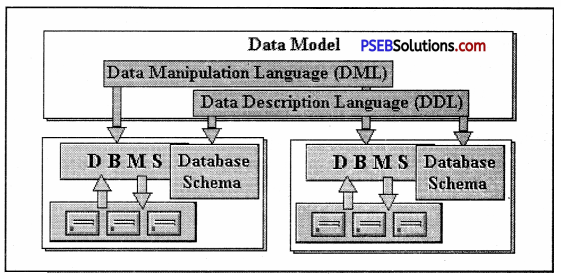
Data Models are fundamental entities to introduce abstraction in a DBMS. Data models define how data is connected to each other and how they are processed and stored inside the system. The very first data model could be a flat data model, where all the data used are to be kept in the same plane A data model organizes data elements and standardizes how the data elements relate to one another. Since data elements document real-life people, places, and things and the events between them, the data model represents reality, for example, a house has many windows or a cat has two eyes. Computers are used for the accounting of these real-life things and events and therefore the data model is a necessary standard to ensure exact communication between human beings.

A data model consists of two parts as shown in the figure:

DDL – Data definition language
DML – Data manipulation language
i.e. Data Model = DDL + DML
PSEB 9th Class Computer Solutions Chapter 4 Introduction to DBMS Img 1

PSEB 9th Class Computer Guide Introduction to DBMS Important Questions and Answers

Fill in the Blanks

1. ……………….. is a set of one or more attributes taken collectively to uniquely identify a record.
Answer:
Super Key

2. ……………….. attribute can be taken as a primary key.
Answer:
Id

3. A ………………… is a property of the entire relation, rather than of the individual tuples in which each tuple is unique.
Answer:
Key

4. …………………… cannot be taken as a primary key?
Answer:
Street.

True or False

1. Processed data is called information.
Answer:
True

2. Database is secure and reliable.
Answer:
True

3. DBA has no responsibility to manage DBMS.
Answer:
False

4. Related data items are called records.
Answer:
True

5. Collection of related data items is called a file.
Answer:
False

PSEB 9th Class Computer Solutions Chapter 4 Introduction to DBMS

6. Meaningful data is called information.
Answer:
False

7. Ordering meaningful data is called a database.
Answer:
True

8. Meaningful data items are called files.
Answer:
False

9. Collection of related records is called data.
Answer:
False

10. DBA controls database system
Answer:
True

Short Answer Type Questions

Question 1.
Define Database.
Answer:
A prearranged collection of figures known as data is called a database.

Question 2.
What is DBMS?
Answer:
Database Management Systems (DBMS) are applications designed especially which enable user interaction with other applications.

Question 3.
What are the various kinds of interactions catered by DBMS?
Answer:
The various kind of interactions catered by DBMS are :

  • Data definition
  • Update
  • Retrieval
  • Administration

Question 4.
Segregate database technology’s development.
Answer:
The development of database technology is divided into :

  • Structure or data model
  • Navigational model
  • SQL/ relational model

Question 5.
Who proposed the relational model?
Answer:
Edgar F. Codd proposed the relational model in 1970.

Question 6.
What are the features of Database language?
Answer:
A database language may also incorporate features like DBMS-specific Configuration and management of storage engine Computations to modification of query results by computations, like summing, counting, averaging, grouping, sorting, and cross-referencing Constraint enforcement Application Programming Interface.

PSEB 9th Class Computer Solutions Chapter 4 Introduction to DBMS

Question 7.
What do database languages do?
Answer:
As special-purpose languages, they have :

  • Data definition language
  • Data manipulation language
  • Query language

Question 8.
Define database model.
Answer:
A data model determining fundamentally how data can be stored, manipulated, and organized and the structure of the database logically is called a database model.

Question 9.
What is SQL?
Answer:
Structured Query Language (SQL) being ANSI standard language updates database and commands for accessing.

Question 10.
Enlist the various relationships of the database.
Answer:
Tire various relationships of the database are :

  • One-to-one: Single table having drawn relationship with another table having similar kind of columns.
  • One-to-many: Two tables having primary and foreign key relations.
  • Many-to-many: Junction table having many tables related to many tables.

Question 11.
Define Normalization.
Answer:
Organized data void of inconsistent dependency and redundancy within a database is called normalization.

Question 12.
Enlist the advantages of normalizing the database.
Answer:
Advantages of the normalizing database are :

  • No duplicate entries
  • Saves storage space
  • Boasts the query performances.

Question 13.
Define Denormalization.
Answer:
Boosting up database performance, adding redundant data which in turn helps rid of complex data is called denormalization.

Question 14.
Define DDL and DML.
Answer:
Managing properties and attributes of a database are called Data Definition Language (DD L). Manipulating data in a database such as inserting, updating, deleting is defined as Data Manipulation Language. (DML)

PSEB 9th Class Computer Solutions Chapter 4 Introduction to DBMS

Question 15.
Define Object-oriented model.
Answer:
Compilations of objects make up this model in which values are stored within instance variables that are inside the object. The object itself comprises bodies of objects for its operation which are called methods. Objects containing the same kind of variables and methods are called classes.

Question 16.
Define Entity.
Answer:
It can be defined as being a ‘thing’ with an independent existence in the real world. –

Question 17.
What do you mean by Entity type?
Answer:
A set of entries having similar attributes are entity types.

Question 18.
Define Entity Set.
Answer:
Compilation of all entries of any particular type of entry in the database is called Entity Set.

Question 19.
What do you mean by Entity type extension?
Answer:
Compilation of similar entity types into one particular type which is grouped together as an entity set.

Long Answer Type Questions

Question 1.
Enlist the disadvantages of the query.
Answer:
The disadvantages of the query are :

  • No indexes
  • Stored procedures are excessively compiled.
  • Triggers and procedures are without SET NOCOUNT ON.
  • Complicated joins making up inadequately written queries.
  • Cursors and temporary tables showcase a bad presentation.

Question 2.
What is 1 NF (Normal Form)?
Answer:
The first normal form or INF is the first and the simplest type of normalization that can be implemented in a database. The main aims of INF are to :

  • 1. Eliminate duplicative columns from the same table.
  • 2. Create separate tables for each group of related data and identify each row with a unique column (the primary key).

Question 3.
What is Data?
Answer:
Data is a plural of datum, which is originally a Latin noun meaning “something given.” Today, data is used in English both as a plural noun meaning “facts or pieces of information” and as a singular mass noun meaning “information”. In computing, data is information that has been translated into a form that is more convenient to move or process. Relative to today’s computers and transmission media, data is information converted into binary digital form.

PSEB 9th Class Computer Solutions Chapter 4 Introduction to DBMS

Question 4.
Define Database.
Answer:
A database is a collection of information that is organized so that it can easily be accessed, managed, and updated. In one view, databases can be classified according to types of content: bibliographic, full-text, numeric, and images. In computing, databases are sometimes classified according to their organizational approach. The most prevalent approach is the relational database, a tabular database in which data is defined so that it can be reorganized and accessed in a number of different ways. A distributed database is one that can be dispersed or replicated among different points in a network. An object-oriented programming database is one that is congruent with the data defined in object classes and subclasses.

Computer databases typically contain aggregations of data records or files, such as sales transactions, product catalogs and inventories, and customer profiles. Typically, a database manager provides users the capabilities of controlling read/ write access, specifying report generation, and analyzing usage.

Question 5.
What is DBMS (Database Management System)?
Answer:
A Database Management System (DBMS) is a set of computer programs that controls the creation, maintenance, and use of a database. It allows organizations to place control of database development in the hands of database administrators (DBAs) and other specialists. A DBMS is a system software package that helps the use of an integrated collection of data records and files known as databases. It allows different user application programs to easily access the same database. DBMSs may use any of a variety of database models, such as the network model or relational model. In large systems, a DBMS allows users and other software to store and retrieve data in a structured way.

Instead of having to write computer programs to extract information, users can ask simple questions in a query language. Thus, many DBMS packages provide Fourth-generation programming language (4GLs) and other application development features. It helps to specify the logical organization for a database and access and use the information within a database. It provides facilities for controlling data access, enforcing data integrity, managing concurrency, and restoring the database from backups. A DBMS also provides the ability to logically present database information to users.

Question 6.
What is the need for DBMS?
Answer:
A database management system (DBMS) can help address the employee count scenario and a range of even more complex situations related to cost, order status, or inventory management by presenting the same data to everyone in the business at the same time. A DBMS also eliminates the frustrating hunt for the right version of the right spreadsheet on a vast and disorganized network drive.

  1. As businesses grow, the volume of data they accumulate grows exponentially. Managing this data deluge becomes increasingly difficult just at the moment when superior data management becomes more important to business success.
  2. As businesses expand, more sophisticated tools are needed to manage data. Tools that serve start-ups well are overwhelmed by the demands faced by larger businesses,
  3. A database management system (DBMS) is a powerful tool used to store data, secure it, protect it and make it quickly available to people who need it.
  4. A DBMS enables a business to squeeze more value from the data it collects for improved decision-making.

PSEB 9th Class Computer Solutions Chapter 4 Introduction to DBMS

Question 7.
What are the Advantages and Disadvantages of DBMS?
Answer:
The advantages and disadvantages of DBMS are as follows :

Advantages :

  • Reduced data redundancy
  • Reduced updating errors and increased consistency
  • Greater data integrity and independence from applications programs
  • Improved data access to users through the use of host and query languages
  • Improved data security
  • Reduced data entry, storage, and retrieval costs
  • Facilitated development of new applications program

Disadvantages :

  • Database systems are complex, difficult, and time-consuming to design
  • Substantial hardware and software start-up costs
  • Damage to database affects virtually all applications programs
  • Extensive conversion costs in moving form a file-based system to a database system
  • Initial training is required for all programmers and users.

PSEB 10th Class Computer Solutions Chapter 6 Operating Systems

Punjab State Board PSEB 10th Class Computer Book Solutions Chapter 6 Operating Systems Textbook Exercise Questions and Answers.

PSEB Solutions for Class 10 Computer Science Chapter 6 Operating Systems

Computer Guide for Class 10 PSEB Operating Systems Textbook Questions and Answers

1. Multiple Choice Questions

Question 1.
An operating system is a:
(a) Terminal
(b) Software
(c) Storage system
(d) Processor
Answer:
(b) Software

Question 2.
The process of running multiple applications at the same time is known as:
(a) Multi-application
(b) Multi processing
(c) Multi programming
(d) Multi timing
Answer:
(c) Multi programming

PSEB 10th Class Computer Solutions Chapter 6 Operating Systems

Question 3.
It enables us to access internet securely and prevent unauthorized applications and people from accessing our PC:
(a) Anti-Virus
(b) Security
(c) Firewall
(d) None of these
Answer:
(c) Firewall

Question 4.
The time taken by the system to respond to an input and display of required updated information is:
(a) Response time
(b) Access time
(c) Output time
(d) Total time
Answer:
(a) Response time

Question 5.
Remote access to servers is possible from different locations in:
(a) Batch Processing System
(b) Time Sharing System
(c) Network Operating System
(d) Distributed system
Answer:
(c) Network Operating System

2. Fill In The Blanks

1. A …………………. represents a collection of related
Answer:
Pile, Information.

2. ………….. system use multiple processors to serve ………… multiple real-time applications and multiple users.
Answer:
Distributed, Central

3. …………..is the process of preventing and detecting ……….. use of our computer.
Answer:
Computer Security, Unauthorized

4. …………. provide access to accounts arid enable us to perform various activities linked with account like shopping, emailing, online transactions etc.
Answer:
Passwords, Online

5. …………. are used when there are time requirements on the operation of a processor or the flow of data.
Answer:
Real Time Systems, Rigid.

PSEB 10th Class Computer Solutions Chapter 6 Operating Systems

3. True or False

1. The time taken by the system to respond to an input and display of required updated information is termed as the response time.
Answer:
True

2. Anti-virus software alone is enough to be secure from Internet Security threats.
Answer:
False

3. An Operating System cannot manage the communication between user and device drivers.
Answer:
False

4. Linux source code is freely available and it is community based development project.
Answer:
True

5. The OS manages all kinds of resources using schedulers.
Answer:
True

PSEB 10th Class Computer Book Chapter 6 Operating Systems

PSEB 10th Class Computer Solutions Chapter 6 Operating Systems

Very Short Answer Type Questions

Question 1.
An interface between computer user and computer hardware is called?
Answer:
Operating System

Question 2.
What hides the peculiarities of specific hardware devices from the users?
Answer:
Drivers

Question 3.
A mechanism or a way to control the access of programs, processes, or users to the resources defined by a computer system is called?
Answer:
Protection

Question 4.
The process of preventing and detecting unauthorized use of our computer is called?
Answer:
Computer Security

PSEB 10th Class Computer Solutions Chapter 6 Operating Systems

Short Answer Type Questions

Question 1.
What is an operating system?
Answer:
Operating system is an interface between user and computer. It communicates whatever the user says to the hardware of computer.

Question 2.
List type of operating systems.
Answer:
Different types of operating system are:

  • Batch processing operating system.
  • Time sharing operating system.
  • Network operating system.
  • Real time operating system.
  • Distributed operating system.

Question 3.
Explain real time operating system.
Answer:
A real-time system is defined as a data processing system in which the time interval required to process and respond to inputs is so small that it controls the environment. In this type of operating system, the response time is very less as compared to online processing.
Real-time systems are used when there are rigid time requirements on the operation of a processor or the flow of data. A real-time operating system must have well-defined, fixed time constraints, otherwise the system will fail.

PSEB 10th Class Computer Solutions Chapter 6 Operating Systems

Question 4.
What are the functions of operating system? Make a list.
Answer:
Following are the functions of operating system:

  • It provides programs an environment to execute.
  • It provides users the services to execute the programs in a convenient manner.

Following are a few common services provided by an operating system:

  • Program execution
  • I/O operations
  • File System manipulation
  • Communication
  • Error Detection
  • Resource Allocation
  • Protection.

Question 5.
What do you mean by computer security?
Answer:
Computer security is the process of preventing and detecting unauthorized use of our computer. Prevention measures help us to stop unauthorized users (hackers) from accessing any part of our computer system. Detection helps us to determine whether or not someone attempted to break into our system, if they were successful, and what they may have done.

Long Answer Type Questions

Question 1.
Explain functions of operating system
Answer:
Following are the functions of operating system:
1. Program Execution:
Operating systems handle many kinds of activities from user programs to system programs like printer spooler, name servers, file server, etc. Each of these activities is encapsulated as a process.

2. I/O Operation:
An I/O subsystem comprises of I/O devices and their corresponding driver software. Drivers hide the peculiarities of specific hardware devices from the users. An Operating System manages the communication between user and device drivers.

3. File System Manipulation:
A file system is normally organized into directories for easy navigation and usage. These directories may contain files and other directions. Following are the major activities of an operating system with respect to file management:

  • Program needs to read a file or write a file.
  • The operating system gives the permission to the program for operation on file.
  • Permission varies from read-only, read-write, denied and so on.
  • Operating system provides an interface to the user to create/delete files.
  • Operating system provides an interface to the user to create/delete directories.
  • Operating system provides an interface to create the backup of file system,

4. Communication:
In case of distributed systems which are a collection of processors that do not share memory, peripheral devices, or a clock, the operating system manages communications between all the processes. Multiple processes communicate with one another through communication lines in the network. Following are the major activities of an operating system with respect to communication:

  • Two processes often require data to be transferred between them.
  • Both the processes can be on one computer or on different computers, but are connected through a computer network.
  • Communication may be implemented by two methods, either by Shared Memory or by Message Passing.

5. Error Detection:
An error may occur in CPU, in I/O devices or in the memory hardware. Following are the major activities of an operating system with respect to error detection:
1. The OS constantly checks for possible errors.
2. The OS takes an appropriate action to ensure correct and consistent computing.

6. Resource Management.
In case of multi-user or multi-tasking environment, resources such as main memory, CPU cycles and files storage are to be allocated to each user or job. Following are the major activities of an operating system with respect to resource management:

  • It acts like a resource manager. The OS manages all kinds of resources using schedulers.
  • CPU scheduling algorithms are used for better utilization of CPU.

7. Protection:
Protection refers to a mechanism or a way to control the access of programs, processes, or users to the resources defined by a computer system. Following are the major activities of an operating system with respect to protection:

  • The OS ensures that all access to system resources is controlled.
  • The OS ensures that external I/O devices are protected from invalid access attempts.
  • The OS provides authentication features for each user by means of passwords.

PSEB 10th Class Computer Solutions Chapter 6 Operating Systems

Question 2.
What are the basic features of Linux?
Answer:
The basic features of Linux operating system are:
1. Portable:
Portability means software can works on different types of hardware in same way. Linux kernel and application programs supports their installation on any kind of hardware platform.

2. Open Source:
Linux source code is freely available and it is community based development project. Multiple teams work in collaboration to enhance the capability of Linux operating system and it is continuously evolving.

3. Multi-User:
Linux is a multiuser system means multiple users can access system resources like memory/ram/application programs at same time.

4. Multiprogramming: Linux is a multiprogramming system means multiple applications can run at same time.

5. Hierarchical File System:
Linux provides a standard file structure in which system files/user files are arranged. Files and directories are arranged in tree structure form.

6. Shell:
Linux provides a special interpreter program which can be used to execute commands of the operating system. It can be used to do various types of operations, call application programs, etc.

7. Security:
Linux provides user security using authentication features like password protection/controlled access to specific files/encryption of data.

PSEB 10th Class Computer Guide Operating Systems Important Questions and Answers

Multiple Choice Questions

Question 1.
Which one is function of operating system related to program management?
a) Execution
(b) Controt
(c) Loading
(d) All of above.
Answer:
(d) All of above.

PSEB 10th Class Computer Solutions Chapter 6 Operating Systems

Question 2.
Main function of shared memory is:
(a) to use primary memory efficently
(b) to do intra process communication
(c) to do inter process communication
(d) none of above
Answer:

Question 3.
Memory protection is normally done by:
(a) the processor and the associated hardware
(b) the operating system
(c) the compiler
(d) the user program
Answer:
(a) the processor and the associated hardware

Question 4.
Which of the following operating system does not implement the multitasking truly?
(a) Windows 98
(b) Windows NT
(c) Windows XP
(d) MS DOS
Answer:
(d) MS DOS

Question 5.
What are the functions of operating system?
(a) Memory management
(b) Process management
(c) Device management
(d) All of above
Answer:
(d) All of above

PSEB 10th Class Computer Solutions Chapter 6 Operating Systems

Fill in the Blanks

1. Operating system is …………. software.
Answer:
System

2. Memory management is function of ……………
Answer:
Operating System

3. File management is function of ……………
Answer:
Operating System.

PSEB 10th Class Computer Solutions Chapter 6 Operating Systems

True or False

1. Operating system in application software.
Answer:
False

2. Windows is uni-tasking operating system.
Answer:
False

3. Unix is not an operating system.
Answer:
False

PSEB 10th Class Computer Solutions Chapter 6 Operating Systems

Very Short Answer Type Questions

Question 1.
Name the function which deals with hardware.
Answer:
Device management.

Question 2.
Name the most important system software
Answer:
Operating system.

Question 3.
Name the most famous operating system.
Answer:
MS Windows.

Question 4.
Name the most secured operating system proven.
Answer:
UNIX.

PSEB 10th Class Computer Solutions Chapter 6 Operating Systems

Short Answer Type Questions

Question 1.
Explain advantages of time sharing operating system.
Answer:
Following are advantages of time sharing operating system.
1. Immediates response is available.
2. It is best suitable operating system for system who need quick response.

Question 2.
Explain disadvantages of time Sharing Operating System.
Answer:
Following are disadvantages of time sharing operating system.
1. It is not suitbale for long tasks
2. Important job may be completed in long time.

Long Answer Type Questions

Question 1.
Explain distributed operating system in detail.
Answer:
Distributed Operating System:
Distributed systems use multiple central processors to serve multiple real-time applications and multiple users. Data processing jobs are distributed among the processors accordingly.The processors communicate with one another through various communication lines (such as high-speed buses or telephone lines). These are referred as loosely coupled systems or distributed systems. Processors in a distributed system may vary in size and function. These processors are referred as sites, nodes, computers, and so on. The advantages of distributed systems are as follows:

  • With resource sharing facility, a user at one site may be able to use the resources available at another.
  • Speedup the exchange of data with one another via electronic mail.
  • If one site fails in a distributed system, the remaining sites can potentially continue operating.
  • Better service to the customers.
  • Reduction of the load on the host computer.
  • Reduction of delays in data processing.

PSEB 10th Class Computer Solutions Chapter 6 Operating Systems

Question 2.
Discuss network operating system along with its advantages and disadvantages.
Answer:
Network Operating System:
A Network Operating System runs on a server arid provides the server the capability to manage data, users, groups, security, applications, and other networking functions. The primary purpose of the network operating system is to allow shared file and printer access among multiple computers in a network, typically a local area network (LAN), a private network or to other networks.
Examples of network operating systems include Microsoft Windows Server 2003, Microsoft Windows Server 2008, UNIX, Linux, Mac OS X, Novell NetWare and BSD.

The advantages of network operating systems are as follows:

  • Centralized servers are highly stable.
  • Security is server managed.
  • Upgrades to new technologies and hardware can be easily integrated into the system.
  • Remote access to servers is possible from different locations and types of systems

The disadvantages of network operating systems are as follows:

  • High cost of buying and running a server.
  • Dependency on a central location(server) for most operations.
  • Regular maintenance and updates are required.

Multi Programming:
Multi Programming Operating System is the name given to the interleaved execution of two or more different and independent programs by the same computer. Interleaving of programs mean chain of programs that are either in running phase, ready or blocked phase. It is an efficient way to improve the system performance.

Multi programming approach permits more than one job to utilize the CPU time at any moment by applying the scheduling techniques like first come first serve, shortest job first etc . The more the number of programs requesting for system resources, resource utilization would be better. The operating system picks up any of the programs as scheduled and starts execution.

An OS does the following activities related to multiprogramming.

  • The operating system keeps several jobs in memory at a time.
  • This set of jobs is a subset of the jobs kept in the job pool.
  • The operating system picks and begins to execute one of the jobs in the memory.
  • Multiprogramming operating systems monitor the state of all active programs and system resources using
  • memory management programs to ensure that the CPU is never idle, unless there are no jobs to process.

Advantages:

  • High and efficient CPU utilization.
  • User feels that many programs are allotted CPU almost simultaneously.

Disadvantages:

  • CPU scheduling is required.
  • To accommodate many jobs in memory, memory management is required.

PSEB 10th Class Computer Solutions Chapter 6 Operating Systems

Question 3.
Discuss Real Time Operating System in detail.
Answer:
Time Sharing:
A real-time system is defined as a data processing system in which the time interval required to process and respond to inputs is so small that it controls the environment. The time taken by the system to respond to an input and display of required updated information is termed as the response time.

So in this method, the response time is very less as compared to online processing. Real-time systems are used when there are rigid time requirements on the operation of a processor or the flow of data. A real-time operating system must have well-defined, fixed time constraints, otherwise the system will fail.

PSEB 8th Class Agriculture Solutions Chapter 10 Post Harvest Handling of Fruits and Vegetables

Punjab State Board PSEB 8th Class Agriculture Book Solutions Chapter 10 Post Harvest Handling of Fruits and Vegetables Textbook Exercise Questions and Answers.

PSEB Solutions for Class 8 Agriculture Chapter 10 Post Harvest Handling of Fruits and Vegetables

Agriculture Guide for Class 8 PSEB Post Harvest Handling of Fruits and Vegetables Textbook Questions and Answers

(A) Answers in one or two words:

Question 1.
Which instrument is used to measure the firmness of fruits and vegetables?
Answer:
Penetrometer.

Question 2.
Which parameter is measured with a refractometer?
Answer:
The sweetness of fruit.

Question 3.
How much fruits and vegetables are lost before they reach markets?
Answer:
25-30%.

PSEB 8th Class Agriculture Solutions Chapter 10 Post Harvest Handling of Fruits and Vegetables

Question 4.
On which fruit the use of waxing is useful?
Answer:
Citrus fruits (Kinnow), apple and pears.

Question 5.
What is the storage temperature for potato and kinnow?
Answer:
For potato 1 to 2° C and for Kinnow 4 to 6°C

Question 6.
How much should be the relative humidity for storage of onkm?
Answer:
65-70%.

PSEB 8th Class Agriculture Solutions Chapter 10 Post Harvest Handling of Fruits and Vegetables

Question 7.
Which fruits are harvested on the basis of TSS and acid ratio?
Answer:
Grapes and citrus fruits, e.g. organge, Kinnow etc.

Question 8.
What precautions should be taken during transportation of produce?
Answer:
Vehicle should be padded or lined with straw. Heavy weight produce should not be loaded over the soft produce.

Question 9.
Name the harmful chemical used for ripening of fruit
Answer:
Calcium carbide.

Question 10.
Name the internationally acceptable technique used for ripening of fruits.
Answer:
Ripening by ethylene gas.

PSEB 8th Class Agriculture Solutions Chapter 10 Post Harvest Handling of Fruits and Vegetables

(B) Answer in one to two sentences:

Question 1.
On what basis fruits and vegetable are graded?
Answer:
Grading should be done as per the requirement of the market. Grading is done on the basis of size, weight, colour etc. This fetches more profit to the farmer.

Question 2.
Why produce should be cooled after harvest?
Answer:
Produce should be cooled immediately after harvesting. This helps in increasing the shelf life of the horticulture produce. Cold water or cold air can be used for this purpose.

Question 3.
What are the benefits of storage of fruits and vegetables?
Answer:
Produce is cheap in the season, and earning is less. If produce is preserved and sold in off season, it fetches more profit to the farmer.

Question 4.
What is the use of pentrometer and refractometer?
Answer:
Pentrometer is used to measure the firmness of the fruit and refractometer is used to measure the sweetness of the fruit.

PSEB 8th Class Agriculture Solutions Chapter 10 Post Harvest Handling of Fruits and Vegetables

Question 5.
How fruits and vegetables are graded on commercial scale?
Answer:
Fruits and vegetables are graded on commercial scale with the help of mechanical grader.

Question 6.
Which fruits are ripened with ethylene gas?
Answer:
Ripening by using ethylene is internationally accepted technique. Fruits like, banana, pears, tomato are ripened by this technique.

Question 7.
Which parameters should be taken into consideration for harvesting of tomato?
Answer:
Parameter that should be taken into consideration for harvesting of tomato is colour chart. For the nearby market red matured tomato, for medium distance markets at pink stage and for distant market harvesting at green stage should be done.

Question 8.
Which produce is packed in jute sacks?
Answer:
Potato and onion are packed in jute sacks.

PSEB 8th Class Agriculture Solutions Chapter 10 Post Harvest Handling of Fruits and Vegetables

Question 9.
Which wax is approved by FSSAI?
Answer:
FSSAI has approved shellak wax, camauba wax and bees wax.

Question 10.
What kind of boxes is used for the packaging of high-value produce?
Answer:
Corrugated fibre board boxes are used for the packing of high-value produce like, apple, mango, grapes, kinnow, peach, litchi, plum etc.

(C) Answers in five to six sentences:

Question 1.
What do you mean by waxing of fruits and what are its benefits?
Answer:
During marketing of the produce there is a loss of water contents which affect the natural gloss and quality of the produce. Fruits like, Kinnow, Peach etc. and vegetables like, Brinjal, Capsicum, Tomato, Cucumber etc. are waxed after harvesting. At the time of grading, washing or doing other preserving activities natural wax is removed. Rewaxing with food grade wax is done. Waxing helps in maintaining water content of the produce at the time of marketing. Dry the produce after waxing. Food grade waxes which is approved by FSSAI are shellac wax, bees wax, camauba wax.

Question 2.
Write a brief note on ripening of fruits with ethylene gas.
Answer:
Ripening of fruits at commercial level is done by using ethylene gas which is internationally accepted technique. In this technique fruits are kept in an enclosed chamber where the produce is exposed to 100-150 ppm of ethylene gas for 24 hours. This triggers the ripening process. Temperature should be maintained between 15 to 25 °C and humidity should be 90-95% ethylene gas is produced by using ethylene generator.

PSEB 8th Class Agriculture Solutions Chapter 10 Post Harvest Handling of Fruits and Vegetables

Question 3.
Write a short note on shrink and cling film packing of fruit.
Answer:
Fruits and vegetables are packed in a paper tray and wrapped with shrink or cling film.
PSEB 8th Class Agriculture Solutions Chapter 11 Processing of Fruits and Vegetables 1
The produce packed in this way remains visible to the cousumer and quality of the produce is also maintained. High value fruits and vegetables like kinnow, tomato, seedless cucumber etc. are packed using this technique. Farmer can earn good profit using this technique.

Question 4.
What is the importance of packging of fruits in corrugated fibre board boxes?
Answer:
For secure transportation of the fruits and vegetables, packaging proves beneficial, it is necessary to avoid bruising of produce during the transportation. Corrugated fibre board boxes are used for packaging of high value produce; like, apple, mango, grapes, kinnow, litchi, plums, peach etc. paper shreds or pieces of cardboard paper are also used in these boxes so that fruits do not get pressed against each other.
PSEB 8th Class Agriculture Solutions Chapter 10 Post Harvest Handling of Fruits and Vegetables 2

Question 5.
What precaution should be taken during harvesting of fruits and vegetables?
Answer:
Fruits and vegetables should be harvested carefully so that least damage to the produce takes place should be done manually with modesty. Take out the produce from the soil using hands use cloth laps open at both ends at the time of harvesting. Save produce from injuries. Use clip, knife and scissors for harvesting fruits. Take care that clipper and knife used are clean and sharp. Kinnow like fruits should be harvested with very small stalk with the fruit. If the stalk is long then at the time of transportation other fruits can get injuries. Use ladder for plucking Kinnow, pears, peach, alucha, ber, mango, etc.

PSEB 8th Class Agriculture Solutions Chapter 10 Post Harvest Handling of Fruits and Vegetables

PSEB 8th Class Agriculture Guide Post Harvest Handling of Fruits and Vegetables Important Questions and Answers

Very Short Answer Type Questions

Question 1.
According to WHO (World Health Organisation) how much fruits and vegetables should be consumed by a person in a day?
Answer:
300 gram vegetables and 80 gram fruits.

Question 2.
In India how much fruits and vegetables are available for a person per day?
Answer:
30 gram fruits and 80 gram vegetables.

Question 3.
How can we loiow about the maturity for harvesting of the tomato, mango, peach etc.?
Answer:
By using color chart.

Question 4.
What is the parameter for maturity of peachy?
Answer:
Turning from green color to yellow.

PSEB 8th Class Agriculture Solutions Chapter 10 Post Harvest Handling of Fruits and Vegetables

Question 5.
What is the parameter for maturity of guava?
Answer:
Turning deep green color to light green color.

Question 6.
What is the parameter for maturity of potato.
Answer:
Vines show sign of senescence (drying).

Question 7.
What is the parameter for maturity of plums?
Answer:
Reddish colour on 1/4 to 1/2 of surface.

Question 8.
What is parameter for maturity of bell Pepper?
Answer:
Fully developed fruit and green shining.

Question 9.
What is parameter for maturity of pea?
Answer:
Pods filled but not faded in colour.

Question 10.
What type of wax is coated on the fruits.
Answer:
Food grade wax like bees wax.

PSEB 8th Class Agriculture Solutions Chapter 10 Post Harvest Handling of Fruits and Vegetables

Question 11.
How is packaging of onion and potato in done?
Answer:
Using jute sacks.

Question 12.
For how many days kinnows can be stored in cold store?
Answer: 1 1/2 to 2 months.

Question 13.
How much moisture content should be in potato and kinnow at the time of storing in cold storage?
Answer:
90-95%.

Question 14.
What are the harmful effects of fruits ripened by calcium carbide?
Answer:
Blisters in mouth, ulcer, acidity in stomach.

Question 15.
For how much time fruits are exposed to ethylene gas in enclosed chamber?
Answer:
24 hours.

Question 16.
Name two fruits on which wax is coated?
Answer:
Kinnow, peach.

PSEB 8th Class Agriculture Solutions Chapter 10 Post Harvest Handling of Fruits and Vegetables

Question 17.
What is the maturity parameter for harvesting of fruits and vegetables.
Answer:
Size and colour- of these.

Question 18.
What instrument is used to measure the firmness of fruits?
Answer:
Pentrometer.

Question 19.
What is the relation between firmness and maturity?
Answer:
Mature fruit is less firm i,e. it becomes soft.

Question 20.
How to make fruits free from bacteria at home?
Answer:
Using bleaching soloution.

Question 21.
Which type of containers are used to store fruits?
Answer:
Containers should have plane inner surfaces.

PSEB 8th Class Agriculture Solutions Chapter 10 Post Harvest Handling of Fruits and Vegetables

Question 22.
What should be done to protect produce from injuries?
Answer:
Produce should be placed between layers of paper or cardboard.

Question 23.
What is the main purpose of canning?
Answer:
Main purpose of canning is to preserve the produce for a long time.

Question 24.
How grapes and Alucha should be cleaned?
Answer:
These should be cleaned using 100-150 ppm chlorine water. This way produce can be protected from diseases.

Question 25.
How grading is done for round shaped produce?
Answer:
These can be graded by using different sizes of rings.

Question 26.
Which chemicals are used to treat the produce after plucking?
Answer:
Calcium chloride, Sodium bisulphate, Potassium sulphate etc.

Question 27.
Name water tolerating crops.
Answer:
Carrot, tomato, turnip.

PSEB 8th Class Agriculture Solutions Chapter 10 Post Harvest Handling of Fruits and Vegetables

Question 28.
Which vegetables should not be washed before packing?
Answer:
Cabbage, Bhindi, peas.

Question 29.
Which fruits are graded on the basis of maturity?
Answer:
Tomato, Banana, Mango etc.

Short Answer Type Questions

Question 1.
How do we know the maturity of fruits? Describe in detail.
Answer:
Size of the fruits is a measure of their maturity. Mango is ready to be for harvesting when a beak appears on the fruit. For checking the ripening of tomato, peach, plums etc. coloured charts are used. For nearby market tomatoes should be red and for a distance market, these should be of pink colour but for very far away market full sized yet green tomatoes should be harvested.

Question 2.
How the hardness index of fruits be determined?
Answer:
Following method is used to determine the hardness index:
With the help of a sharp knife cut a thin slice. Slice is having pulp and skin of the fruit. Place the fruit on a plane hard surface and with the help of a proper sized plunger measure the hardness of the fruit. For this start pressing the fruit on the plunger with uniform speed. Measure the hardness index of the fruit from marks on the plunger.

PSEB 8th Class Agriculture Solutions Chapter 10 Post Harvest Handling of Fruits and Vegetables

Question 3.
What is Refractometer? For which fruits it is used?
Answer:
To measure the sweetness of the fruits refractometer is used. This is used for fruits like grapes, muskmelon etc.

Question 4.
How the acidity of the fruit is measured?
Answer:
When citrus fruits are ripe, there sourness decreases. To know the acidity, one or two drops of phenolphthalein are added to measured volume of fruit juice. In it add 0.1 N of sodium hydroxide solution drop by drop till the colour of juice changes to pink. From the used sodium hydroxide and given volume of juice, acidity of the juice can be measured.

PSEB 8th Class Agriculture Solutions Chapter 10 Post Harvest Handling of Fruits and Vegetables

Question 5.
How is ratio of percentage of sweetness and sourness is measured?
Answer:
By knowing this ratio quality of the fruit is judged. Percentage sweetness and sourness are measured and value of sweetness is divided by value of sourness to know the ratio.

Question 6.
What do you know about preservation to fruits?
Answer:
Every fruit is available in the market in a particular period of time of the year and it is available in plenty and it can be bought for comparatively less price. On these days fruits should be bought and preserved. More income can be earned by selling these in far away markets and by selling in off-season.

Question 7.
Why is it necessary to preserve vegetables?
Answer:
If vegetables are not preserved then more profit can not be earned, when vegetables are cheap in the season, buy and preserve the vegetables. These can be sold in off season and more profit can be earned.

Question 8.
How canning is profitable?
Answer:
By canning or packing, we can avoid the losses which may occur after plucking. This way more profit can be earned.

Question 9.
What is the use of Penetro meter?
Answer:
It is a device which is used to measure the hardness of the fruit.

Question 10.
Why is it necessary to (pluck kinnow with small stalk) keep the stalk short while plucking kinnow?
Answer:
If the stalk is long it can injure the other fruits while transportation. Thus kinnow are plucked or harvested with small stalks.

PSEB 8th Class Agriculture Solutions Chapter 10 Post Harvest Handling of Fruits and Vegetables

Question 11.
What is the importance of quality of crops?
Answer:
If quality is maintained then transportation, storage and marketing can be done for a long span of time and thus, more profit can be earned. This way consumer, exporter and trader all feel satisfied.

Long Answer Type Questions

Question 1.
What is the importance of plastic trays in {he preservation (storage) of fruits and vegetables?
Answer:
Plastic trays are costly, but these can be cleaned easily and used again and again. Air can pass through them because these have holes. These can be stacked over each other. At the time of harvesting, these prove very helpful. These can be used at time of harvesting, for storage, for transportation and for selling in the market. These trays are used for harvesting, storage and transportation of Kinnow, grapes, tomato etc.

Question 2.
What are merits of good quality produce?
Answer:
Following are the merits of good quality produce:

  • This type of produce can be transported, marketed and stored for a longer time.
  • This type of produce gives satisfaction to exporters, traders and consumers.
  • Produce have long life after harvesting.
  • Marketing sphere also grows big.
  • More profit can be earned on selling such a produce.

Question 3.
What do you know about cooling, sorting and cleaning of the produce after harvesting?
Answer:
1. Cooling of the produce:
For long shelf life of the produce, it is allowed to cool down. The method of cooling depends on the type of produce. Different methods of cooling are with blowing cool air, cooling in a room, cooling with cold water. Any of the method can be used.

2. Sorting and cleaning of the produce:
Sorting and grading of the produce is done, injured, diseased and irregular shaped produce is separated out. Then it is cleaned, method of cleaning depends on the type of produce. Apples are cleaned using dry brushes whereas citrus fruits, carrots etc. are washed with water. Whether to use dry brushes or water for cleaning depends on the type of produce and extent of cleanliness, e.g. grapes and aluchas are never to be cleaned wash.

These fruits are made disease free by using 100-150 ppm chlorine water. Before packaging of cabbage and cauliflower etc., non eatable parts should be removed.

PSEB 8th Class Agriculture Solutions Chapter 10 Post Harvest Handling of Fruits and Vegetables

Question 4.
What do you know about grading and marketing of fruits and vegetables?
Answer:
Grading is done on the basis of size, weight, colour etc. Graded produce can earn more profit. Round fruits like tomato, tinda, apple etc. are graded using different sized rings. More profit can be earned if grading is done on the basis of maturity of produce like tomato, barihna, mango etc. Some type of machines on small scale can also be used for grading.

Fully grown but green tomato, mango etc. can be stored for sometime and when the rates in the market are on rise these can be ripened and sold to earn more profit. Green onion, mint, coriander leaves etc. are packed into bundles of 100 grams and 500 grams. This way these can be transported easily.

Question 5.
What do you know about the treatment of produce after harvesting?
Answer:
If produce is treated after harvesting it can be saved from various types of fungal diseases and many other diseases. Chemicals used for the treatment are potassium sulphate, sodiumbisulphite, calcium chloride etc. Some times produce is treated using hot water and blowing hot wind. This way germs are either killed or become weak and the produce is saved from disease. After the use of hot air or hot water, produce should be cooled down immediately by using showers of cold water or cold wind.

Question 6.
Which precautions should be kept in mind, while canning fruits and vegetables?
Answer:
Following precautions should be kept in mind while canning fruits and vegetables:

  • Do not allow the produce to get injuries.
  • Raw or more ripe fruits should be separated out.
  • Do not wash green vegetables, cabbage, bhindi, tomato, etc. before canning.
  • Chlorine used in water should not be more than 100-150 ppm.
  • Water tolerant produce like tomato, carrot, turnip, etc. should be collected in the water-filled tank (chubacha).
  • The table surface on which produce is washed, graded, or packed should be made smooth by placing sponge pieces at comers or edges or irregular points.
  • Do not use restricted chemicals on the produce.
  • Treat the produce after harvesting using proper methods like waxing, hot air, water, sulphar dioxide, etc.
  • To lessen the damage, produce should be canned in the fields.

PSEB 11th Class Sociology Solutions Chapter 5 Culture

Punjab State Board PSEB 11th Class Sociology Book Solutions Chapter 5 Culture Textbook Exercise Questions and Answers.

PSEB Solutions for Class 11 Sociology  Chapter 5 Culture

Sociology Guide for Class 11 PSEB Culture Textbook Questions and Answers

Answer the following very short answer questions in 1-15 words each:

Question 1.
State the basic elements of culture.
Answer:
Traditions, social norms and values are the basic elements of culture.

Question 2.
Who called culture a ‘total way of life of the people?
Answer:
These words are of Clyde Kluckhohn.

Question 3.
In what way is culture transmitted in non-literate societies?
Answer:
Because culture is a learned behaviour, that’s why in non-literate societies culture is transmitted through learning.

PSEB 11th Class Sociology Solutions Chapter 5 Culture

Question 4.
Give a broad classification of culture.
Answer:
Culture is of two types-material culture and non-material culture.

Question 5.
Name few examples of non-material culture.
Answer:
Views, norms, values, habits, ideals, traditions etc.

Question 6.
Who gave the theory of cultural lag?
AnsweR:
The theory of cultural lag was given by William F. Ogburn.

Answer the following short answer questions in 30-35 words each:

Question 1.
What is culture ?
Answer:
Our ways of living, philosophy, feelings, views, machines; tools etc. all material and non-material things and this is culture. All these things are produced and used by group. So, culture is that on which we work upon, think on it and keep it.

Question 2.
What is cultural lag ?
Answer:
Culture consists of two parts-material and non-material. Due to new inventions, change comes very quickly in material culture but our views, traditions etc. i.e. non-material culture does not change very quickly. As a result, gap is created between the two which is known as cultural lag.

PSEB 11th Class Sociology Solutions Chapter 5 Culture

Question 3.
What are social norms ?
Answer:
Each society makes certain rules for the behaviour of its members and these are known as norms. So, norms are few directions for behaviour. Norms regulate and direct the behaviour of individuals. They are very important aspects of culture.

Question 4.
What are the central values of modern India ?
Answer:
Democratic system, equality, justice, freedom, secularism etc. are the central values of modern India. Each society has its own central values. Small communities stress on any specific value but large societies stress on universal values.

Question 5.
Mention some values of traditional Indian society.
Answer:
Each society is having different values. One society streses on one value and other society stresses on the other. Important values of traditional Indian society are detachment, materialism and religion, attainment of four purusharthas, dharma, artha, kama and moksha.

PSEB 11th Class Sociology Solutions Chapter 5 Culture

Question 6.
How is the cognitive component of culture expressed ?
Answer:
The cognitive components of culture are expressed with the help of imagination, literature, art, religion and scientific theories. Views are expressed in literature and in this way the cognitive aspect of culture is preserved.

Answer the following short answer questions in 75-85 words each:

Question 1.
How is culture a total way of life of the people ?
Answer:
There is no denying fact that culture is a total way of life of the people. Whatever we have is our culture. Our views, ideals, habits, clothes, money, property etc. and whatever humans have achieved till today is our culture. If we separate all these from human life, nothing will be left in it and then human life will reach the level of early man. Yet each society has its different culture but they have certain elements which are common everywhere. So, we can say that culture is a total way of human life.

Question 2.
Write a note on material and non-material culture.
Answer:
The meaning of material culture is by that culture in which all the man made things are included. This culture is concrete because we can see or touch it such as scooter, T.V. table, chair, pen, bus, car etc. All these things are concrete and thus a part of material culture.

In non-material culture, all the things are included which are abstract in nature. We can neither see non touch them. We can just feel them such as traditions, customs, values, skills, norms etc. All such things are abstract so non-material culture is abstract in nature.

PSEB 11th Class Sociology Solutions Chapter 5 Culture

Question 3.
Discuss in brief the basic elements of culture.
Answer:

  1. Customs and traditions are the types of organised social behaviour which are used again and again. They are permanent ways of.behaviour. Each society has its own customs and traditions.
  2. Norms are also very essential elements of culture. It is expected from each person to behave in a specified way. Norms are the established ways of behaviour shared by the members of a group.
  3. Values are also its inseparable part. Each society has its own values and it is expected from every one to accept them.

Question 4.
‘Culture is learned behaviour’. Explain the statement with suitable examples.
Answer:
There is no denying the fact that humans learn their culture. It is not a biological trait which one gets from his parents in the form of genes. An individual learns culture gradually through the process of learning. No one is having views and ideas when he takes birth but all these he learns while living in society after interacting with others. Every type of action or activity is learned only while living in society. So, it is clear that culture is learned behaviour.

Answer the following short answer questions in 250-300 words each:

Question 1.
How does the understanding of culture in social analysis differ from the everyday use of the word ‘culture’ ?
Answer:
The meaning of everyday use of the word ‘culture’ is very much different from the meaning given by sociologists. In every usage, culture is limited only to art or life style of different countries. But the meaning given by sociology is very much different. Sociology says that whatever man has achieved from his early life till today is his culture. Traditions, ideas, norms, values, mores, chair, table, car, pen, books, written knowledge etc. Whatever man has achieved only while living in society is his culture, So, the meaning of culture given in both the senses is different from each other.

PSEB 11th Class Sociology Solutions Chapter 5 Culture

Question 2.
What do you mean by culture ? Highlight the characteristics of culture.
Answer:
The most important thing which differentiates humans from animals is the culture which humans have but animals don’t. The most important thing which human has is his culture. If the culture would be taken away from them then nothing would be left with them. In all the organisms of the world, only humans have the capability to make and preserve their culture.

Culture comes out of the interactions of humans. Culture not only comes out of human interaction but it shows the way to future’s human interactions. Culture helps in the formation of personality of a man and helps him to live in society. Culture makes that type of atmosphere in which man becomes capable of doing functions of society. In this way man and culture are connected very deeply with each other because culture differentiates man from animals.

Culture, is the mest important feature of human society. According to Aristotle, “Man is a social animal.” If we will describe the differences between man and animal then this culture will be the decisive factor of difference between them. Man himself creates his culture and has the capacity to preserve it for its future generation. Actually it is the product of human interactions #nd on the basis of this culture we can differentiate one society from the other.

We cannot understand human society without understanding the culture because culture exerts a lot of effect on the social life. Cultural factor is also an important factor of social change. In this way we can say that man is not only a biological man but is a cultural man as well. In common language culture is equated with education means literate person is a cultured man and illiterate person is a non-cultured man. But this meaning of culture is not correct. Sociology takes its meaning in very wide sense. According to sociologists any thing which man has made to fulfil his needs is culture.

Definitions:
1. According to Maclver and Page, “It is the expression of our nature in our modes of living and thinking, in our everyday course, in art, in literature, in religion, in recreation and enjoyment.”

2. According to Bierstedt, “Culture is the complex whole that consists of everything we think and do and have as members of society.”

3. According to Ogburn and Nimkoff, “It is that part of man’s total environment into which he alone is born. It consists buildings, tools, wearing apparel, art, science, religion and all the ways of doing things which man learns.”

4. According to Majumdar, “Culture is the sum total of human achievement, material as well as non-material capable of transmission, sociologically
i.e. tradition and communication critically as well as horizontally.”

5. According to Lundberg, “Culture refers to the social mechanism of behaviour and to the physical and symbolic product of these behaviours.”
From the given definitions it is clear that all those things are included in culture which a man learns while living in society like art, law, feelings, customs, ways of wearing, eating, literature, knowledge, belief etc.

All these things are the part of culture and they do not work separately but they work with each other and form an organization. This organization is known as culture. In short, the things which a man has learnt and whatever he has got from his ancestors as heritage is known as culture. In heritage tools, ways of behaviour, ways of science, ways of doing work are included.

PSEB 11th Class Sociology Solutions Chapter 5 Culture

Functions or Characteristics of Culture:
1. Culture is transmitted from generation to generation. Culture is transmitted from one generation to another because a child learns many things from the behaviour of his parents. Man learns a lot from the achievements of his ancestors. No one wants to start any thing from the beginning and that’s why he takes care of that work which his ancestors have done.

This transmission is going on from the ages and that’s why every one gets separate personality. No one brings any thing with his birth. He needs to learn every thing by living in society with his parents, grandparents etc. In’this way culture is transmitted from one generation to another.

2. Culture is social. Culture cannot become the personal property of an individual. It is social because neither one man can make the whole culture and nor it is property of anyone. When any one invents any thing then that invention is not his personal thing but becomes property of society because that thing will be used by the whole society.

In this way different things of our culture are used by society. Any thing can be called a part of the culture at that time when that thing will be accepted by most of the people of society. In this way universality of that thing-is an essential element of culture. So culture is not individual but is social.

3. Culture can be learned. Culture is learned by humans. It is not a biological quality which a person gets from his parents by birth. Man learns culture by socialization. No one brings thoughts and ideas by birth but he learns them by interacting with other persons of society. Every type of work is learned by society. From this it is clear that culture is a learned behaviour.

4. Culture fulfills needs of society. If any thing is invented then that thing is invented because man needs that thing. In this way every thing of culture comes out so that the needs of man could be fulfilled. Why man learnt to grow wheat, because he needs wheat for his hunger. In this way man learnt to grow food and this learned behaviour is transmitted from generation to generation.

Needs are not only biological but are sociocultural also. With hunger, man needs love and sympathy which a man learns while living in society. In this way different parts of culture fulfil different needs of society. Whichever part of culture is unable to fulfil the needs of society, gradually it comes to an end.

5. Changes often come in culture. Culture never stops at one place but often changes because nothing is unchangeable in the world. Change is law of nature and if change is necessary then culture is also changeable. Culture fulfills all the needs of society which generally change with the passage of time because situations are not the same all the times.

With the change in situations, needs also change which means, the methods of fulfilling those needs also change. For example during earlier times agriculture was done with old means like plough but with the increase of population, needs were also increased and that’s why now agriculture is being done with tractors and combines to fulfil the increased needs. So with the change in situation, culture is also bound to change.

PSEB 11th Class Sociology Solutions Chapter 5 Culture

6. One culture consists of many cultures. In every culture we can see some common norms, traditions, feelings, rituals, behaviour etc. but with that we can see many types of ways of eating, wearing, ways of living, behaviour, etc. From this it is clear that one culture consists of many cultures. For example we can see many subcultures in Indian culture because every one has its own ways of living, behaving, eating etc. from which it is clear that one culture has many cultures.

Question 3.
Explain the two types of culture in detail.
Answer:
Culture is an important factor for social change. With the change in culture, society also changes because it is the social heritage of society. Famous sociologists Ogburn and Nimkoff,’in their book ‘Hand Book of Sociology’, have given two types of culture and these are :
(1) Material Culture
(2) Non-material Culture.

1. Material Culture:
Material culture is artificial culture. Its main feature is that all the things made by man are included in this. Material culture is related to concrete things. We can touch and see all the things of material culture. For example machines, tools, means of transport, books, phone, etc. Material culture is related with inventions of man.

New technological knowledge is also included in material culture. Everything is included in this type of culture which is made, changed and transmitted till today. These material aspects of culture help its members to define their behaviour. For example the people engaged in agriculture have occupation but they use different implements and tools. All these are the‘‘parts of material culture.

2. Non-material Culture:
Important feature of non-material culture is that it is abstract. Abstract means those things which we cannot touch, and see. We can only feel them. For example religion, traditions, rituals, customs, art, literature, music, values, ideas etc. are included in non-material culture. According to Ogburn and Nimkoff, culture is divided in two parts for the easiness of subject or just for analytical purposes.

PSEB 11th Class Sociology Solutions Chapter 5 Culture

Question 4.
Write a detailed note on cultural lag.
Answer:
First of all the concept of cultural lag was used by Ogburn to understand the problems of society and conditions of conflict. Ogburn was the first sociologist who has given the detailed meaning of the concept of Cultural Lag. Yet other sociologists like Spencer, Sumner, Muller etc. have also used the concept of cultural lag in their writings but Ogburn has used this concept in his book ‘Social Change’ to understand social disorganization problems and conflict. In sociology, this concept was accepted widely.

Meaning of Cultural Lag. According to Ogburn and Nimkoff, change in different parts of culture never comes with the same speed. The speed of change of one part is more as compared to the other. But culture is a system. It is made up of many parts. Its different parts are inter-connected and inter-related. This system of culture can be maintained if the change in all arts of culture will come at the same speed. Actually what happens is that if one part of culture changes due to any invention then another part of the culture, which depends upon that part, also changes. But the change in the second part comes very late.

How much time will this second part take, depends upon the nature of the second part. This lateness goes on for many years because of which problem comes in the system. This lag in different parts of culture is known as Cultural Lag. According to Ogburn, “The thesis is that the various parts of modern culture are not changing at the same rate, some parts are changing much more rapidly than others, and that since there is co-relation and inter-dependence of parts, a rapid change in one part of our culture requires re-adjustments through other changes in the various co-related parts of culture. where one part of culture changes first, through some discovery or invention and occasional changes in some part of culture-dependent upon it, there frequently is a delay in the changes occasioned in the dependent part of the culture.”

PSEB 11th Class Sociology Solutions Chapter 5 Culture

The meaning of lag is to stay behind. Ogburn has given example to explain the meaning of ‘Lag’. According to him, anything is made of two parts. If change comes in one part of that thing then this change will definitely affect the other parts. This part, which is affected by that change, slowly and slowly changes automatically. These changes come slowly and slowly take some time. This difference of time is known as lag or to stay behind. Ogburn has explained the concept of cultural lag in this way.

According to him, culture has two parts that are interrelated. If ally change comes in one part then the second part is bound to be affected by that change. This second part slowly and slowly adapts itself to change and makes itself according to that change. But this adaptation takes some time. This difference of time, which is there between ‘change and adaptation, is known as cultural lag. When any part of culture moves forward with some development or invention and the second part lags behind then we can say that cultural lag exists.

According to Ogburn, culture has two parts (1) Material Culture (2) Non-material Culture. In material culture, all those things are included which we can touch and see like a machine, table, chair, book, T.V. scooter, etc., and in non-material culture all those things are included which we cannot see and touch, only we can feel them. For example, habits, thought, behaviour, feelings, customs, etc. Both parts are closely interrelated. If change comes in any part then the second part is bound to change.

This law is also applicable to material and non-material cultures. Changes often come in material culture and these changes come very fast because of new inventions. Material culture changes very fast but the speed of changes in non-material is very slow. That’s why because of rapid changes material culture moves forward but non-material culture, whose speed is very slow, lags behind. In this way, the lagging behind of the non-material culture from the material culture is known as cultural lag.

According to Ogburn, change comes in material culture with great speed because people want to use material things in a proper way. To use material things we need money and there is no need to move away from traditions and thoughts. For example, we are ready to buy Fridge, T.V., Scooter, Car, etc. but are not willing to change our customs and traditions. With one more example everything will be clear.

PSEB 8th Class Science Solutions Chapter 16 Light

Punjab State Board PSEB 8th Class Science Book Solutions Chapter 16 Light Textbook Exercise Questions and Answers.

PSEB Solutions for Class 8 Science Chapter 16 Light

PSEB 8th Class Science Guide Light Textbook Questions and Answers

Exercises

Question 1.
Suppose you are in a dark room. Can you see objects in the room ? Can you see objects outside the room ? Explain.
Answer:
No, we cannot see anything in dark. As no light is falling on the objects in the room and they are not emitting any light on their own. So, nothing is visible inside the dark room.
Objects outside the room can be seen, if either there is light outside the room or objects are emitting their own light.

Question 2.
Differentiate between regular and diffused reflection. Does diffused reflection mean the failure of the laws of reflection ?
Answer:
Differences between regular reflection and diffused reflection:

Regular reflection Diffused reflection
1. It occurs on a smooth, plane surface. 1. It occurs on a rough, irregular surface.
2. Reflected rays are parallel to one another. 2. Reflected rays are unparallel to each other.

Diffused reflection is not failure of laws of reflection. It is only due to irregularities on the reflecting surface.

PSEB 8th Class Science Solutions Chapter 16 Light

Question 3.
Mention against each of the following whether regular or diffused reflection will take place when a beam of light strikes. Justify your answer in each case.
[a] Polished wooden table
[b] Chalk powder
[c] Cardboard surface
[d] Marble floor with water spread over it.
[e] Mirror
[f] Piece of paper.
Answer:
(a) Polished wooden table. Regular reflection, as wooden table has smooth polished surface.
(b) Chalk powder. Diffused reflection due to rough surface of chalk powder.
(c) Cardboard surface. Diffused reflection because cardboard has small irregularities on its surface.
(d) Marble floor with water spread over it. Regular reflection as water gives a smooth surface.
(e) Mirror. Regular reflection due to smooth surface.
(f) Piece of paper. Regular reflection if paper is fine and diffused reflection if paper is coarse.

Question 4.
State the laws of reflection.
Answer:
Laws of reflection.

  1. Angle of incidence (∠i) = Angle of reflection ( ∠r).
  2. Incident ray, reflected ray and the normal at the point of incidence all lie in the same plane.

Question 5.
Describe an activity to show that the incident ray, the reflected ray, normal, the point of incidence lie in the same plane.
Experiment.
Take a white sheet, spread it on a table. Draw a line MM on it. Place a plane mirror vertically on this line. Now throw light on a comb in this ways that a parallel light rays fall on the mirror. Adjust it in such a way that a beautiful pattern of incident and reflected rays is formed. Now mark points A, B, C on incident ray and points D, E, F on its corresponding reflected ray. Switch off the torch and remove the mirror. Join the points and extend line to mirror. ABC will meet MM at O and DEF will all also be meeting at O. OA is incident ray and OF is reflected ray. Draw ON ⊥ MM .
PSEB 8th Class Science Solutions Chapter 16 Light 1
Measure the angle of incidence ∠AON and the angle of reflection ∠FON which would found to be equal. Incident ray, reflected ray and normal, all lie in one plane of paper.

Question 6.
Fill in the blanks in the following.
(a) A person 1 m in front of a mirror seems to be ……………….. m away from his image.
(b) If you touch your ………………….. ear with right hand in front of a plane mirror it will be seen that your right ear is touched with ……………… .
(c) The size of pupil becomes …………………. when you in dim light.
(d) Night birds have ………………. cones than rods in their eyes.
Answer:
(a) 2m
(b) Right, Left
(c) large
(d) more.

Choose the correct option in the Questions 7-8.

Question 7.
Angle of incidence is equal to angle of reflection
(a) Always
(b) Sometimes
(c) Under special conditions
(d) Never.
Answer:
(a) Always.

PSEB 8th Class Science Solutions Chapter 16 Light

Question 8.
Image formed by a plane mirror is
(a) virtual, behind the mirror and enlarged.
(b) virtual, behind the mirror and of same size as the object.
(c) real at the surface of mirror and enlarged.
(d) real, behind the mirror and of same size as the object.
Answer:
(b) Virtual, behind the mirror and of same size as the object.

Question 9.
Describe the construction of a Kaleiodeoscope.
Answer:
PSEB 8th Class Science Solutions Chapter 16 Light 2
Construction of a Kaleiodeoscope. It is a toy to form many images by multiple reflections. A Kaleiodeoscope is made up of three strips of plane mirrors inclined at angles of 60° enclosed in a tube. One end of tube has a ground glass plate with a clear glass plate on its inner side. A metallic ring separates the two plates and the space is filled with coloured pieces of glass or broken bangles. A cardboard with a hole in the centre is fixed on the other end of the tube.

Question 10.
Draw a labelled sketch of the human eye.
Answer:
Labelled diagram to show different parts of human eye.
PSEB 8th Class Science Solutions Chapter 16 Light 3

Question 11.
Gurmit wanted to perform activity 16.8 using a laser torch. Her teacher advised her not do so. Can you explain the basis of the teacher’s advice ?
Answer:
Laser torch has very sharp beams of light which can destroy the pupil or retina of the eye.

Question 12.
Explain how can you take care of your eyes.
Answer:
Care of eyes.
Eyes are the most precious gifts of nature. So we should take full care of our eyes by taking atleast following precautions.

  1. We should wash our eyes daily with clean water.
  2. We should not read or work in very bright or dim light.
  3. We should not read in a running vehicle.
  4. We should not rub our eyes.
  5. We should use sunglasses on hot summer day.
  6. We should not look directly at the sun. Also we should not look at the sun during solar eclipse.
  7. We should eat vitamin A rich food for healthy, clear eyes.

Question 13.
What is the angle of incidence of a ray if the reflected ray is at an angle of 90° to the incident ray ?
Solution:
PSEB 8th Class Science Solutions Chapter 16 Light 4
If ∠i = angle of incidence
∠r = angle of reflection
∠i + ∠r = 90 (given)
But ∠i = ∠r
(According to laws of reflection)
∴ ∠i + ∠i = 90°
2 ∠i = 90
∠r = ∠i – 45°

PSEB 8th Class Science Solutions Chapter 16 Light

Question 14.
How many images of a candle will be formed if it placed between two parallel mirrors separated by 40 cm ?
Answer:
PSEB 8th Class Science Solutions Chapter 16 Light 5
When mirrors are separated by 40 cm and are parallel to each other so that the angle between the mirrors is 0° which is not sulj-multiple of 360°. Then theoretically, the number of images formed would be infinite, but as a considerable amount of light is lost due to reflections so only a limited number of images are seen which is shown in figure.

Question 15.
Two mirrors meet at right angles. A ray of light is incident on one at an angle of 30° as shown is figure. Draw the reflected ray from the second mirror.
PSEB 8th Class Science Solutions Chapter 16 Light 6
Solution:
PSEB 8th Class Science Solutions Chapter 16 Light 7

Question 16.
Bhoojo stands at A just on the side of a plane mirror as shown in figure. Can he see himself in the mirror ? Also can he see image of objects situated at P, Q and R ?
PSEB 8th Class Science Solutions Chapter 16 Light 8
Solution:
Bhoojo cannot see his image in the mirror as he is standing outside the edge of mirror. He can see the images of P and Q easily but not the image of R.
PSEB 8th Class Science Solutions Chapter 16 Light 9

Question 17.
(a) Find out the position of image of an object situated at A in plane mirror.
(b) Can Paheli at B see this image ?
(c) Can Bhoojo at C see this image ?
(d) When Paheli moves from B to C where does the image of A move ?
PSEB 8th Class Science Solutions Chapter 16 Light 10
Answer:
PSEB 8th Class Science Solutions Chapter 16 Light 11
(a) The image of A in the mirror will be as far behind as the object in front of the mirror.
(b) Yes, Paheli can see the image.
(c) Yes, Bhoojo can see this image.
(d) When Paheli moved from B to C, the image of A will not move forward.

PSEB 8th Class Science Solutions Chapter 16 Light

PSEB Solutions for Class 8 Science Light Important Questions and Answers

Multiple Choice Questions

Question 1.
The plane and polished surface that returns light falling on it in the same direction or any other direction is called:
(a) Lens
(b) Prisom
(c) Mirror
(d) Kaleidoscope.
Answer:
(c) Mirror.

Question 2.
How many colours are present in white sunlight ?
(a) 2
(b) 5
(c) 7
(d) 3.
Answer:
(c) 7.

Question 3.
What is the most convenient distance for reading by a normal eye ?
(a) 10 cm
(b) 25 cm
(c) 15 cm
(d) 20 cm.
Answer:
(b) 25 cm.

Question 4.
When you see in dim light the size of your pupil becomes:
(a) Small
(b) Large
(c) Neither small nor large
(b) Very small.
Answer:
(b) Large.

Question 5.
The Phenomena of splitting of light into its constituent colours is called:
(a) Reflection
(b) Refraction
(c) Dispersion
(b) Combination.
Answer:
(c) Dispersion.

Question 6.
The eye lenses focuses:
(a) On Cornea
(b) On Retina
(c) On Iris
(d) None of these.
Answer:
(b) On Retina.

PSEB 8th Class Science Solutions Chapter 16 Light

Very Short Answer Type Questions

Question 1.
Can any one see in the dark ?
Answer:
No.

Question 2.
It is what that helps us to see objects ?
Answer:
Light.

Question 3.
Name any two Luminous bodies.
Answer:

  1. Sun
  2. Electric bulb.

Question 4.
Is moon a luminous or a non-luminous body ?
Answer:
Non-luminous.

Question 5.
Where is a reflection seen ?
Answer:
In mirror.

Question 6.
Which surface can act as a mirror ?
Answer:
Any polished and smooth surface.

PSEB 8th Class Science Solutions Chapter 16 Light

Question 7.
If you are standing in front of a mirror and observing your own image what is the relation between the distance of the object and the image from the mirror ?
Answer:
Distance of object from the mirror = Distance of image from the mirror.

Question 8.
What is the angle of reflection, when a ray of light is incident normally on a plane mirror ?
Answer:
Zero.

Question 9.
Name two objects which split white light into many colours.
Answer:
Water bubbles, surface of CD, prism.

Question 10.
Name the seven colours of light.
Answer:
Red, orange, yellow, green, blue, indigo and violet.

Question 11.
Give one example of dispersion of light in nature.
Answer:
A rainbow.

Question 12.
Is focal length of eye lens fixed ? If not, why ?
Answer:
No. Eye lens has variable focal length. Focal length of Eye lens varies due to action of ciliary muscles.

PSEB 8th Class Science Solutions Chapter 16 Light

Question 13.
What is the function of sclerotic in human eye ?
Answer:
Sclerotic provides a solid shape to the eye and protects it from external injuries.

Question 14.
What is the function of ciliary muscles in human eye ?
Answer:
Eye lens is held in its position by ciliary muscles. Ciliary muscles help the eye lens to change its focal length by adjusting its curvature.

Question 15.
What is the function of rods on the retina ?
Answer:
Rods are sensitive to intensity of light. The more the intensity of light, more are they excited.

Question 16.
What are cones ?
Answer:
Cones on retina are sensitive to different colours. If cones are absent or insufficient, the person is colour blind.

Question 17.
What is basic cause of colour blindness ?
Answer:
It is due to absence or insufficient number of cones on the retina. Seeing sun or towards it during solar eclipse may cause colour blindness.

Question 18.
Why cats and bats are able to see at night ?
Answer:
They have very large number of rods on retina. Hence, they are able to see even a small quantity of light.

Question 19.
At what rate the images pass one after the other on a cinema screen ?
Answer:
25 or more per second.

PSEB 8th Class Science Solutions Chapter 16 Light

Question 20.
What type of photosensitive cells are present on the retina of the eye ?
Answer:
Cones and rods.

Question 21.
Name one device that can be used by short statured person to see over the head of a crowd.
Answer:
Periscope.

Question 22.
Find out the letters of English alphabet or any another language known to you in which the image formed in a plane mirror appears exactly like the letter itself.
Answer:
PSEB 8th Class Science Solutions Chapter 16 Light 12

Short Answer Type Questions

Question 1.
What are luminous and non-luminous bodies ? Give examples.
Answer:
Luminous Bodies.
Those objects which emit their own light, are called luminous bodies e.g. sun, stars, burning fire, radium etc.

Non-luminous Bodies.
Those objects which do not emit light of their own but shine due to other luminous bodies, are called Non-Luminous bodies. They are visible only, when light falls on them.
e.g. Moon, earth and other planets, things in a room.

Question 2.
How do we see objects ?
Answer:
When light from a light source falls on any object, it is scattered by it. The scattered light enters our eyes to form the image of the object and the object is, thus, seen.

Question 3.
Give the conditions necessary for seeing an object.
Answer:
Conditions for Seeing Objects. To see an object, the following three conditions are required to be satisfied:

  1. Source of light to make object visible
  2. The object
  3. Eye sight.

Question 4.
What is a virtual image ? Give one situation where a virtual image is formed.
Answer:
Virtual image.
An image, which cannot be obtained on a screen, is called a virtual image. Virtual image is formed when reflected rays do not actually meet at a point.
Image formed in a plane mirror is always virtual.

PSEB 8th Class Science Solutions Chapter 16 Light

Question 5.
What do you understand by lateral inversion ?
Answer:
Lateral Inversion.
In a plane mirror, the right side of the object becomes left side of the image and the left side of the object becomes right side of the image. That is the image is sideways inverted. This phenomenon, is called lateral inversion.

Question 6.
State the laws of reflection of light.
Answer:
Laws of reflection.
The reflection at the smooth surface is found to obey the following two laws, called the laws of reflection.

  1. The angle of incidence is equal to the angle of reflection
    i.e., ∠i – ∠r.
  2. The incident ray, the reflected ray and the normal at the point of incidence lie in the same plane.

Question 7.
What is diffused reflection and regular reflection ?
Answer:
Diffused Reflection.
It takes place when the surface is not smooth or polished e.g., wall, paper. The rays reflected from an uneven surface are not parallel but scattered in all directions and such reflection is called diffused reflection.
PSEB 8th Class Science Solutions Chapter 16 Light 13
Regular Reflection.
It takes place when a beam of light falls on a smooth and polished surface, e.g., a mirror. The reflected rays from an even surface form a clear image.

Question 8.
What do you understand by reflection of light ?
Answer:
Reflection of light.
When a ray of light falls on a mirror, or polished surface, it is sent back in a particular direction obeying certain laws of reflection. This phenomenon is known as reflection of light.

Question 9.
Define the following:
1. Reflected Ray
2. Angle of reflection.
Answer:
1. Reflected Ray. A streak of light, starting from the mirror, is called reflected ray.

2. Angle of reflection. The angle made by the reflected ray with the normal at the point of incidence is called angle of reflection. It is represented by r.

Question 10.
If incident ray strikes the mirror at 90°, what will be the angle of reflection ?
Answer:
If incident ray strikes the mirror normally, then after reflection, the ray will come back along the same path. As the angle of incidence is zero, so angle of reflection will also be zero.

PSEB 8th Class Science Solutions Chapter 16 Light

Question 11.
Define the term ‘Dispersion of light.’
Answer:
Dispersion of Light.
When a beam of light passes through a prism, the white light splits into seven colours. This phenomenon of splitting of white light into its constituent colours by a prism is known as dispersion of light.

Question 12.
While passing through a prism, why does the white light split into seven colours.
Answer:
The rays of different colours pass smoothly through air but when passing through a prism they have to change the speed according to the angle of prism. Different colours have different wave lengths and thus, they choose different paths. So, the spectrum is seen.

Question 13.
What is myopia ?
Answer:
Myopia.
The focal length of the eyes of some people is very small. Therefore, the image of distant object is not formed on their retina but it is formed at a point in front of the retina. In other words, they cannot see distant objects. This defect of vision is called Myopia or short sightedness.

Question 14.
What is hypermetropia ?
Answer:
Hypermetropia.
When people grow old, the muscles of the eyes lose their strength to control the curvature of the lens. As a result, the image of nearby objects is not formed at the retina, but it is formed behind the retina. So these people cannot see nearby objects clearly. This defect of vision is called Hypermetropia or Farsightedness.

Question 15.
Explain in short perception of colour.
Answer:
Perception of colour.
Human eye contains large number of rods and cones which are sensitive to light. Rods respond to the intensity of light and cones respond to the colour of the light. If cone cells are absent in the eye then such a person is colour blind. With the help of cones cells one can perceive colour. This is called perception of colour.

Question 16.
The following picture shows the reflection of light:
PSEB 8th Class Science Solutions Chapter 16 Light 14
(A) Name the ray AO
(B) Name the ray OB
(C) Find the value of angle x
Answer:
(A) Name of ray AO = Incident7 ray
(B) Name the ray OB = Reflected ray
(C) Value of angle x = 30° because angle of incidence is equal to angle of reflection.

Long Answer Type Questions

Question 1.
Differentiate between a real image and a virtual image.
Answer:
Differences between a real image and a virtual image.

Real Image Virtual Image
1. The real image is formed when the rays of light actually meet after reflection. 1. The image formed is virtual when the rays of light don’t meet after reflection.
2. Real image can be obtained on the screen. 2. Virtual images cannot be obtained on the screen.
3. Real image is always inverted. 3. Virtual image is always erect.

Question 2.
State the characteristics of the image formed by a plane mirror.
Answer:
Characteristics of the image formed in a plane mirror.

  1. The image is as far behind the plane mirror, as the object is in front of it.
  2. The image is laterally (sideways) inverted.
  3. The image is of the same size as that of the object.
  4. The image formed in a plane mirror is virtual, erect and of the same size as the object.
  5. The image formed in a plane mirror cannot be obtained on the screen.

PSEB 12th Class Sociology Important Questions Chapter 10 Social Problems: Alcoholism and Drug Addiction

Punjab State Board PSEB 12th Class Sociology Important Questions Chapter 10 Social Problems: Alcoholism and Drug Addiction Important Questions and Answers.

PSEB 12th Class Sociology Important Questions Chapter 10 Social Problems: Alcoholism and Drug Addiction

Multiple Choice Questions:

1. Which of these is the situation of social problem?
(а) Most of the people are affected by this
(b) This is an undesirable condition
(c) There is conflict in social values
(d) All of these
Answer:
(d) All of these

2. Which of these is the economic factor of social problem?
(a) Unemployment
(b) Poverty
(c) Slums
(d) All of these
Answer:
(d) All of these

PSEB 12th Class Sociology Important Questions Chapter 10 Social Problems: Alcoholism and Drug Addiction

3. What do we call the person who consumes alcohol once or twice in a year?
(a) Rare user
(b) Infrequent user
(c) Light drinker
(d) Moderate drinker
Answer:
(a) Rare user

4. What do we call the persons who start consuming alcohol right from the morning?
(a) Moderate drinkers
(b) Heavy drinkers
(c) Infrequent drinkers
(d) Light drinkers
Answer:
(b) Heavy drinkers

5. Which of these is a type of drug?
(a) opium
(b) cocain
(c) charas
(d) All of these
Answer:
(d) All of these

Fill in the Blanks:

1. The situation of ……………… is undesirable in society.
Answer:
Social problem

2. ……………….. is a type of drug which is drunk.
Answer:
Alcohol

3. Opium, Heroins, cocain come under the category of ……………….
Answer:
narcotics

4. ………………… and ……………….. can play a way important role in keeping children away from drugs.
Answer:
School, teacher

5. Consuming …………………. is having a bad effect on one’s health.
Answer:
drug

PSEB 12th Class Sociology Important Questions Chapter 10 Social Problems: Alcoholism and Drug Addiction

True/False:

1. Social problems affect most of the members of society.
Answer:
True

2. Heroin is a type of Narcotics.
Answer:
True

3. Drug addict always wants to consume drugs.
Answer:
True

4. The Union Government passed The Narcotic Drugs and Psychotropic Substances Act in 1955 A.D.
Answer:
False

5. There is no value conflict in social problems.
Answer:
False

PSEB 12th Class Sociology Important Questions Chapter 10 Social Problems: Alcoholism and Drug Addiction

One Word/One Line Questions Answers:

Question 1.
What is social problem?
Answer:
Social problem is that undesirable situation which everybody wants to change.

Question 2.
On what social problem depends?
Answer:
Social problem depends upon the values of society.

Question 3.
How many members of society get affected by social problems?
Answer:
Most of the members of society get affected by social problems.

Question 4.
Give socio-cultural factors of social problems.
Answer:
Untouchability, female foeticide, dowry, domestic violence, violence against women etc.

Question 5.
Give economic factors of social problems.
Answer:
Poverty, unemployment, slums, illiteracy, crime etc.

Question 6.
What is alcoholism?
Answer:
When any one starts consuming alcohol on frequent basis, it is called alcoholism.

Question 7.
Who is a rare user?
Answer:
One who consumes liquor once or twice in one year, he is called rare user.

Question 8.
Who is an infrequent user?
Answer:
One who consumes alcohol once in two-three months is an infrequent user.

Question 9.
Who is a light drinker?
Answer:
Light drinker is that who consumes alcohol once or twice in one mouth.

Question 10.
Who is a moderate drinker?
Answer:
Moderate drinkers is the one who consumes alcohol three-four time in one month.

PSEB 12th Class Sociology Important Questions Chapter 10 Social Problems: Alcoholism and Drug Addiction

Question 11.
Who is a heavy drinker?
Answer:
One who consumes alcohol on daily basis is a heavy drinker.

Question 12.
How much of the Indian population consumes alcohol atleast once during its lifetime?
Answer:
Around 42% of the total population.

Question 13.
Give one cause of alcoholism.
Answer:
People consume alcohol to ignore their tensions and problems.

Question 14.
Give one effect of alcoholism.
Answer:
It leatds to was tage of money and Loss of health.

Question 15.
What is a drug?
Answer:
Drug is a chemical which physiologically and psychologically affects our abillity to do work.

Question 16.
Give names of any four narcotics.
Answer:
Opium, cocain, Heroin, Marijuana, charas etc.

Question 17.
When was the Narcotic Drugs and Psychotropic Substances Act passed?
Answer:
This law was passed in 1985 A.D.

Very Short Answer Type Questions:

Question 1.
Give two features of social problems.
Answer:

  • Social problems are such unwanted circumstances with which most of the members of society are directly or indirectly affected.
  • About social problems, most of the members of society believe that their solution is must.

Question 2.
Give socio-cultural factors of social problems.
Answer:
In India, people of many religions, castes and lingual groups live with each other. That’s why many socio cultural problems occur over here such as untouchability, female foeticide, dowry, domestic violence, violence against women etc.

PSEB 12th Class Sociology Important Questions Chapter 10 Social Problems: Alcoholism and Drug Addiction

Question 3.
Give three reasons of alcoholism.
Or
Two causes of alcoholism.
Answer:

  • People consume alcohol to remove their tensions.
  • People get tired with their occupation and that’s “why they consume alcohol.
  • Many persons like to sit with their friends and they force him to consume alcohol.

Question 4.
Give three reasons of drug addiction.
Answer:

  • Many a times, peer group forces an individual to consume drug.
  • Sometimes, an individual feels alienated and to remove alienation, he starts to use drugs.
  • Many people are unable to face the situations in life and that’s why they start to use drugs.

Short Answer Type Questions:

Question 1.
Alcoholism.
Answer:
Alcoholism is a state in which the person is unable to keep control on his quantity of taking alcohol which he cannot stop after starts to using it. Alcohol cannot be called as stimulant but it acts as a inhibitor on our nervous system. When person starts to use it, he feels himself free from all the tensions and he slowly slowly starts to use too much quantity of it. Alcoholism not only reduces his work efficiency but it destroys his family as well.

Question 2.
Alcoholic Person.
Answer:
Alcoholic person is that person who uses alcohol or drinks alcohol. Person, who is a compulsive drinker, cannot live without drinking alcohol. In this way the person who cannot live without drinking alcohol is known as alcoholic person. He is unable to keep control on himself. He drinks daily and goes to such extent that he cannot do any work without alcohol. His body starts to shiver in its absence.

PSEB 12th Class Sociology Important Questions Chapter 10 Social Problems: Alcoholism and Drug Addiction

Question 3.
Types of Alcoholic Persons.
Answer:

  • Rare alcoholic: Who drinks once or twice in a year.
  • Infrequent alcoholic: Who drinks once in two or three months or drinks only in any marriage or party.
  • Lighter user alcoholic: Who drinks once or twice in a month to enjoy his holiday.
  • Moderate user alcoholic: Who drinks thrice or four times in month to enjoy his holiday.
  • Heavy user alcoholic: Who drinks alcohol many times in a day or who drinks daily.

Question 4.
Occupation-cause of Alcoholism.
Answer:
In many cases, occupation becomes a cause of alcoholism. Occupation of many persons is such that they become very much tired and they need something to do work again. It not only removes their tiredness but it also motivates them to work again the next day. In the same way many persons start to use alcohol to please other persons related occupations. For example, many times any worker has to drink with his owner or boss to please him and becomes an addict of it. In this way person has to drink alcohol due to his occupation and he becomes an addict of it.

Question 5.
Mental tension – Cause of Alcoholism.
Answer:
Every person is the victim of one or another mental tension. If some one does’t have money, so he is in tension to run his house. Some have money but are tensed for its safety, tension of business, tension of office, tension due to poverty, anyone is tense due to his owner, boss or wife, any one has fear of loss in business and someone is tensed due to competition. In this way every person is the victim of one or another type of tension. If he drinks alcohol then is nervous system relaxes for some time and for some time he becomes free from every type of mental tension.

Question 6.
Poverty-Cause of Alcoholism.
Answer:
A poor person is always in tension to earn money, His family members are more in number but he is the sole earner of the family. That’s why expenditure of the family is more but income is very less. Person always remains in tension of giving food, cloth and education to his children. That’s why he takes the help of the alcohol to remove his tension. He gets relief from his mental tensions for some time after using alcohol. In this way he starts to drink more quantity of alcohol and becomes an alcoholic.

Question 7.
Drug Addiction.
Answer:
When a person uses any subtance with which his body becomes dependent upon that substance or drug then it is known as drug addiction. Drug is that substance which directly affects the brain and nervous system of the person. In this way when a person becomes so dependent upon that drug that he cannot live without drug then it is known as drug addiction.

Question 8.
Drug Abuse.
Answer:
When a person starts using any illegal drug or misuses any legal drug then it is known as drug abuse. It damages person mentally as well as physically. Use of L.S.D. and Cocain, use of Heroin, Smoking of Hashish and Ganja, Alcoholism etc. all are included in this. Person enjoys fully in it. He goes on the trip of enjoyment. He could be able to do any work after its use unless he could not be able to do any thing.

Question 9.
Drug dependency.
Answer:
When person starts to use daily any drug legally or illegally and he cannot live without it then it is known as drug dependency. Dependency can be physical as well as mental. When a person uses any drug again and again grasps drug in itself then it is known as physical dependence. But when his body aches and he feels physical problems due to non use of that drug then it is a physical loss as well as mental loss.

PSEB 12th Class Sociology Important Questions Chapter 10 Social Problems: Alcoholism and Drug Addiction

Question 10.
Characteristics of Drug Addiction.
Answer:

  • Sudden wish occurs in the person to get drug in drug addiction.
  • In drug addiction he wants to get drug in any way unless his body stops working.
  • In drug addiction, there is a tendency to increase the dose slowly and slowly.
  • Person becomes physically and mentally dependent upon drugs in drug addiction.

Question 11.
Types of Drugs.
Answer:

  • Liquor or Alcohol
  • Sedatives
  • Narcotics
  • Stimulants
  • Hallucinogens
  • Nicotine

Question 12.
Psychological Causes of Drug Abuse.
Answer:

  • When any person wants to reduce his tensions then he starts to use drug.
  • There is a wish in some person that how it feels when we take drug and that’s why they start to use drugs.
  • Unemployed persons want to pass their time and that’s why they start to use drugs.
  • Many persons use drugs to increase their self-confidence.

Question 13.
Social Causes of Drug Abuse.
Answer:

  • Many times friends of any person force him to use drugs because of which he starts to use drugs.
  • Conflicts of the family also force the person to use drugs so that he could not come in mental tension.
  • Many times a wish occurs in the person while observing that his elders are using any drug and that’s why he starts to use drug.

Question 14.
Ways to control Drug addiction.
Answer:

  • People should be motivated not to use drugs so that they could be motivated to do so.
  • Doctors should also restrict themselves from not giving those drugs to their patients with which they could become addicted.
  • People should be told about the losses of drugs so that the people should keep themselves away from the drugs.
  • Parents should behave friendly with their children and they should be told about the evil consequences of drug abuse so that they could be a way of these drugs.

Long Answer Type Questions:

Question 1.
What is Alcoholism? Give its types.
Answer:
Alcoholism is a condition in which a person is unable to control his quantity of drinking alcohol with which he cannot stop it once he starts drinking alcohol. In this way, an alcoholic person is a person who uses whisky, drinks whisky, and is a compulsive person who cannot live without drinkings. In this way, a person who cannot live without drinking alcohol is known as an alcoholic person. Generally, we can come to know about features of alcoholism through four factors, and these four factors are:

  • Too much use of alcohol.
  • The tension of alcoholic person on his too much use of alcohol.
  • No control of alcoholic person on his too much use of alcohol.
  • Occurrence of disturbance in social, psychological, and worldly functions.

In this way Don Kehlan has explained five types of alcoholic persons on the basis of quantity and frequency of drinking and these five types are given below:

  • Rare alcoholic: Rare alcoholic persons are those persons who drink alcohol once or twice a year and even drink for the sake of fun.
  • Infrequent alcoholic. An infrequent alcoholic person is a person who drinks alcohol once or twice in two or three months or at the time of any marriage or function.
  • Light user alcoholic. Light user alcoholic is that person who drinks once or twice in one month. He sometimes drinks in the company of his friends.
  • Moderate user alcoholic. Moderate user alcoholic is that person who drinks thrice or four times in a month or wants to enjoy his holiday (Sunday).
  • Heavy user alcoholic. Heavy user alcoholic person is that who drinks alcohol daily or many times in a day. They are also known as Hardcore alcoholic persons.

PSEB 12th Class Sociology Important Questions Chapter 10 Social Problems: Alcoholism and Drug Addiction

Question 2.
How Alcoholism can be prevented? Explain it.
Or
How can we cure the problem of alcohol?
Answer:
Alcoholism is that problem which has been faced by our country since a long time. Not only person himself but his family and society also disintegrates with this. His morality comes to an end, he starts to commit crimes, and his health also deteriorates. In this way it has very much evil consequences on person. We should jointly solve this problem so that the society could he prevented from disorganization. Government and social service institutions can play a very important role in it. This problem can be prevented in many ways.

1. First of person should motivate himself to not to start drink of alcohol. If he will not start using it then how he will become addict of it. Family can play a very important role in it. Elders of the family can motivate their children by not using alcohol. Elders can tell them about the evil consequences of alcoholism. They can educate them from time to time so that they could move on the right path.

2. Government can play a very important role in it. Government can announce the policy of restriction on alcohol and can impose this policy in the state. It should take strict action against the makers and sellers of the liquor so that people should keep themselves away from it. Government should also discourage drinkers not to use alcohol.

3. If a doctor is taking care of an alcoholic person then he always has hatreds against the alcoholic person. It is a shocking thing for that person. Doctors should change their attitude so that the alcoholic person should leave use of alcohol from his heart. Doctors should keep a sympathetic attitude towards alcoholic persons.

4. Restriction on alcoholism and alcohol should not be propagated among the people. Government, social service institutions and people can take the help of T.V., radio, newspapers, magazines, etc., and can propagate against its evil consequences. Educational institutions can also play a very big part in it and can motivate the students to get an education in their institutions. They can organize Seminars against it so that people should keep themselves away from this problem.

5. Generally whisky has been taken as a means of recreation. But if it will be banned then the means of recreation for the people will come to an end. That’s why government and non-governmental institutions can establish recreational centres so that the people can enjoy these places instead of using alcohol.

6. People should also be motivated by this problem. This problem is very big and cannot be solved in one or two days. For that people are necessary to be motivated. The illiterate people of our country are hardly aware of the evil consequences of this problem. People should also be educated regarding this and should be educated to live a better life. If people would be educated properly then this problem could also be solved very quickly.

7. Government should make strict laws to restrict alcoholism so that the drinkers and sellers of alcohol could be strictly punished. For this special courts could be constituted so that the lawbreakers could be punished very quickly.

8. Not only externally but the mentality of the people should also be changed. An actual ban on alcoholism can happen if the person himself should leave this problem. That’s why the mentality of the person should be changed. Plays, Lectures can be organized regarding this so that people could themselves change their mentality.

So after looking at this explanation we can say that the problem of alcoholism is a social problem and it has not just one or two reasons but it has many reasons behind it. People themselves are increasing this problem and if they want they themselves can eradicate this problem. If the public will take a tough stand against it then the government will also have to take part in it. If government and people both join hands with each other then this problem can be removed very quickly.

Question 3.
Explain different types of drugs.
Answer:
We can divide drugs into six parts which are given below:

  1. Whisky or liquor
  2. Sedatives
  3. Narcotics
  4. Stimulants
  5. Hallucinogens
  6. Nicotine

Now we will explain them in detail:

1. Whisky or alcohol. Some people drink alcohol as something which can give them pleasure and some people drinks alcohol so that they can get stimulant to do their work. Alcohol also works as a substance that gives us peace with which our nerves gets peace and relaxation. It acts as a sedative that calms down nerves or a type of anesthetic which reduces the pain of living. Humans have to face many problems and tensions in their lives because of which they become the victims of mental tension. That’s why they take help of alcohol to relieve their mental tension. Alcohol relieves tension and reduces aggressive inhibitions. It also reduces the power of taking decisions and creates confusion.

2. Sedatives. Sedatives are also known as depressants. It relaxes our central nervous system, induces sleep and gives a very calming effect. In medical terms, they are used for insomnia, epilepsy, high blood pressure and it is given to the patient before operation and during surgery so that they could relax. It acts as a depressant which depresses the actions of nerves and muscles. It also slows down breathing and heart beating and makes the user relax. But if the user will start to use a higher dose then he can become gloomy, sluggish, irritable and quarrelsome. His capacity of working and thinking reduces with this.

3. Narcotics. We can include opium, heroin, brown sugar, marijuana, charas, ghanja, bhang, smack etc. in narcotics. Heroin is a white powder which is made by morphine, cocaine is made by the leaves of coca bush, ganja, charas can be obtained from the hemp plant. Marijuana is a particular form of cannabis. Cocaine, heroin, morphine etc. can be .taken either by injections or in the form of cigarettes. All of these increase the capacity of the work of the person, gives him a lot of enjoyment and a feeling of superiority comes in him. But when person becomes an addict of these things then he cannot live without them. However, weakness, insomnia, nervousness remains and in the end person dies without them.

4. Stimulants. Stimulants activate the nervous system, treat small depression, relieve tension, keep a person awake, increase alertness and reduce aggressive inhibitions. Caffeine, cocaine, Amphetamines, etc. are used stimulative agents. If these will be taken according to the prescription by the doctor then it can produce self-confidence and alertness. But if they will be used more frequently then many problems like headache, sweating, diarrhea, nervousness can occur. These stimulants do not produce physical dependence but are psychologically addicting. Abruptly withdrawing the drug can result in mental illness and suicidal depression.

5. Hallucinogens. The most important element in this category is L.S.D. which is never prescribed by any doctor. It is either taken orally or in the form of an injection. It is so powerful that one ounce of LSD can produce three lakh human doses. Its minimum dose also directly affects the person. If any person uses it then he remains in hallucination, dreams, etc. after taking its dose. Severe mental derangement can result from an attempt to withdraw from its use.

6. Nicotine. We can include tobacco, bidi, cigarettes, cigars, snuff, etc. in it. It has no positive impact on our body but physically a person depends upon it. It leads to relaxation, stimulates the central nervous system, increases wakefulness, and removes boredom. But its heavy dose can lead to heart attack, lung cancer, bronchitis. If any person starts to use it then he becomes dependent upon it.