PSEB 7th Class Science Solutions Chapter 13 Motion and Time

Punjab State Board PSEB 7th Class Science Book Solutions Chapter 13 Motion and Time Textbook Exercise Questions and Answers.

PSEB Solutions for Class 7 Science Chapter 13 Motion and Time

Science Guide for Class 7 PSEB Motion and Time Intext Questions and Answers

Think and Answer (Textbook Page No. 162)

Question 1.
What is a simple pendulum?
Answer:
Simple pendulum. It consists of a heavy mass (metal sphere) tied to a thread and suspended a fixed point of rigid support.

Question 2.
What is the to and fro motion of a simple pendulum called?
Answer:
The to and fro motion of a simple pendulum is called oscillation.

PSEB 7th Class Science Solutions Chapter 13 Motion and Time

Question 3.
The time taken for one oscillation of the pendulum is called its ……………… .
Answer:
Time Period.

Question 4
………………… is the number of oscillations per unit time.
Answer:
Frequency.

Think and Answer (Textbook Page No. 163)

Question 1.
What do we measure by using a stop clock ?
Answer:
Stop clock is used to measure short-time intervals.

Question 2.
What is the unit of measuring distance ?
Or
Name the S.I. unit of distance.
Answer:
Meter.

PSEB 7th Class Science Guide Motion and Time Textbook Questions and Answers

1. Fill in the Blanks:

(i) The motion of an object in a straight line is called ……………… .
Answer:
Linear motion

(ii) A clock is used to measure …………………. .
Answer:
Time

(iii) The distance-time graph for uniform speed is a ………………. line.
Answer:
Straight line

PSEB 7th Class Science Solutions Chapter 13 Motion and Time

(iv) The motion of a simple pendulum is called ………………….. motion.
Answer:
Oscillatory

2. Write True or False:

(i) Speed is the distance travelled by an object per unit time.
Answer:
True

(ii) The S.I. unit of speed is Km/s.
Answer:
False

(iii) The time taken to complete one oscillation of a pendulum is its time period.
Answer:
True

(iv) The instrument used to measure the speed of a vehicle is odometer.
Answer:
True

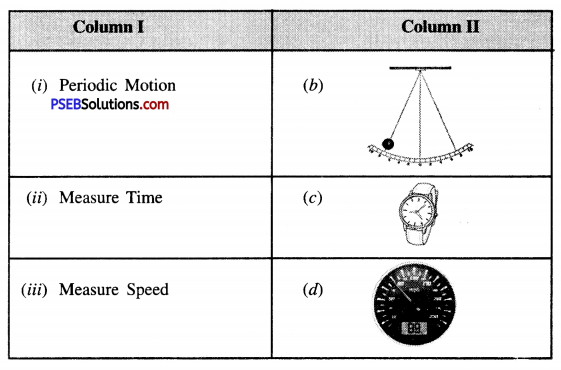
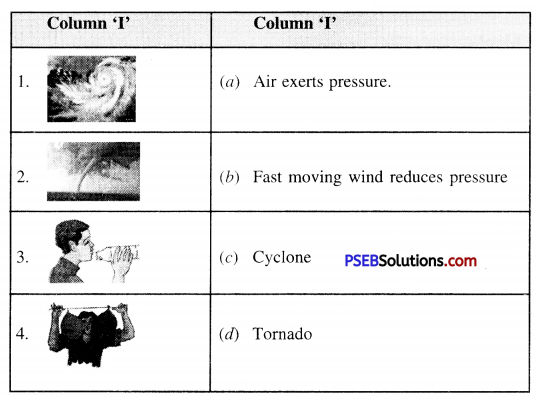
Match the Column I with Column II:
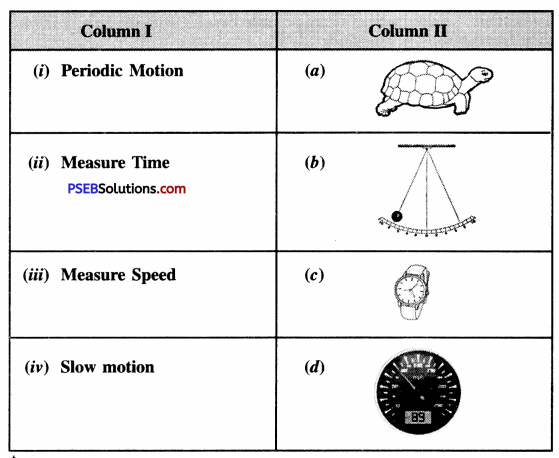
PSEB 7th Class Science Solutions Chapter 13 Motion and Time 1
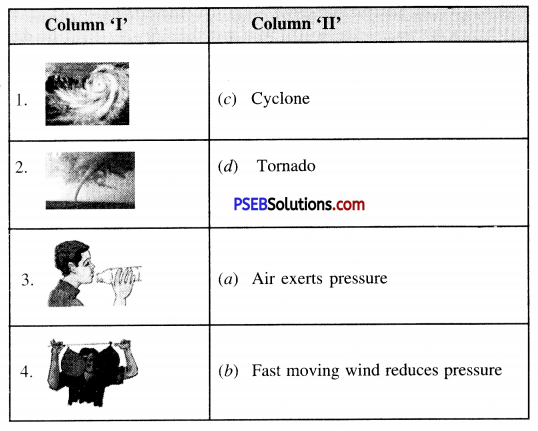
Answer:
PSEB 7th Class Science Solutions Chapter 13 Motion and Time 2
PSEB 7th Class Science Solutions Chapter 13 Motion and Time 3

4. Choose the Correct Answer:

Question (i)
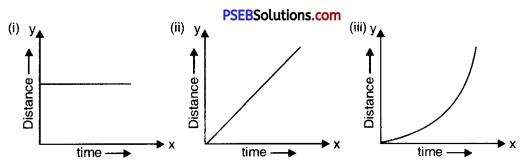
Which of the following is a Distance-Time Graph for an object at rest ?
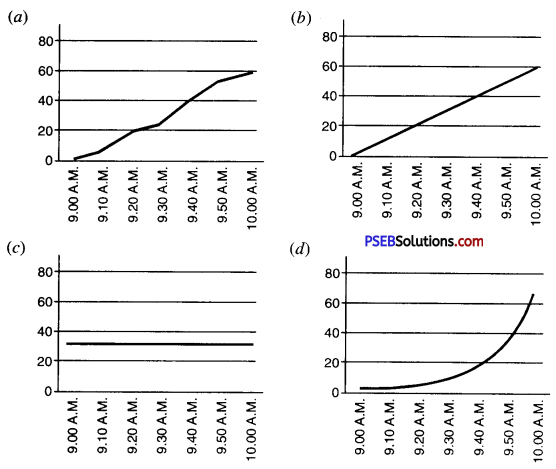
PSEB 7th Class Science Solutions Chapter 13 Motion and Time 4
Answer:
(c) A straight line graph parallel to horizontal (x-axis) axis

PSEB 7th Class Science Solutions Chapter 13 Motion and Time

Question (ii)
Which of the following relation is a correct for finding speed of an object ?
(a) Speed = Distance × Time
(b) Speed = Distance/Time
(c) Speed = Time/Distance
(d) Speed = 1 /Distance × Time.
Answer:
(b) Speed = Distance/Time

Question (iii)
Simple pendulum is an example of ……………….. motion.
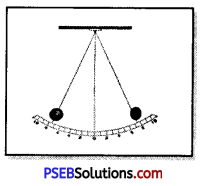
PSEB 7th Class Science Solutions Chapter 13 Motion and Time 5
(a) Rectilinear motion
(b) Oscillatory motion
(c) Periodic motion
(d) Rotational motion.
Answer:
(c) Periodic motion

Question (iv)
A car moves with a speed of 40 km/h for 15 minutes and then with speed of 60 km/h for the next 15 minutes. The total distance covered by the car is:
(a) 100 km
(b) 25 km
(c) 15 Km
(d) 10 Km
Answer:
(b) 25 km.

5. Very Short Answer Type Questions:

Question (i)
Define speed. Give its S.I. units ?
Answer:
Speed. The distance travelled per unit time is called speed of the object.
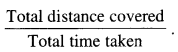
Speed (v) = Total distance covered (s)/ Total time spent (t)
S.I. unit of speed is m/s.

Question (ii)
Which instruments were used for measuring time by the ancient people ?
Answer:
In ancient times, people measured time by natural phenomena. Over time some devices were invented for measuring time. Some of them are given below:
(1) Solar Clock. A change in the position of the sun due to a change in the position of the shadow is used to measure time.
(2) Hour Glass. To measure the time it takes one hour for sand to flow from one bulb to another.
(3) Water Clock. Used to measure the flow of water from one vessel to another at a particular time.
(4) Pendulum. A simple pendulum takes equal time for each oscillation. So Pendulum was used to measure time.

Question (iii)
Name the instruments used for measuring : (a) the speed of a moving vehicle, (b) the distance moved by a vehicles.
Answer:
(a) Instrument for measuring speed of a moving vehicle is Speedometer.
(b) Instrument for measuring distance covered by a vehicle is Odometer.

Question (iv)
What is Graph ? Give its types.
Answer:
Graph. A graph is a pictorial representation of variation of one quantity with respect to the other quantity. When one quantity is changed, the value of the other quantity also changes by itself.

Types of Graph. There are several types of graphs, such as:

  1. Linear graph,
  2. Bar graph,
  3. Pie chart.

PSEB 7th Class Science Solutions Chapter 13 Motion and Time

6. Short Answer Type Questions:

Question (i)
Differentiate between slow and fast motion. Give examples.
Answer:
Slow motion. If an object takes too long to cover a short distance, its motion is called slow motion. Example : Motion of tortoise and snail.

Fast motion. If an object takes less time to cover the same distance, its motion is fast motion.
Example : Racing car and leopard is fast motion.

Question (ii)
Differentiate between uniform and non-uniform motion. Give examples.
Answer:
Uniform motion.
If an object travels equal distances in equal interval of time regardless of the however small the interval may be their its motion is called uniform motion.
For example : A bus covers a distance of 10 km in the first 15 minutes and a distance of 10 km in the next 15 minutes, then again in the next 15 minutes it covers the same distance of 10 km. The bus is said to have uniform motion.

Non-uniform motion.
If an object does not cover equal distances in equal interval of time however small the time interval may be, then the motion of that object is called non-uniform motion.
Example : Suppose a car covers a distance of 25 km in 10 minutes on a straight road and travels 30 km in the next 10 minutes and 20 km in the next 10 minutes, then the car is said to have is non-uniform motion.

Question (iii)
Ajay goes to his school 600 meters away from his house. Find the speed in ms-1, with which he must walk to reach his school in 5 minutes.
Solution:
Distance from Ajay’s school from his house = 600 meters
Time taken to cover the distance from school to house = 5 minutes
We know 1 minute = 60 sec.
So, Time taken = 5 × 60 seconds
= 300 seconds
Total distance covered = 600
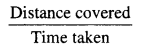
Now speed of Ajay = PSEB 7th Class Science Solutions Chapter 13 Motion and Time 6
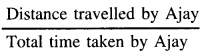
= \(\frac{600 \text { metres }}{300 \text { second }}\)
= 2 m/s

Question (iv)
The distance between two stations is 216 km. In how many hours will a train reach the destination which is moving at a speed of 20 m/s ?
Answer:
Distance between two stations = 216 km
Speed of train = 20 m/s. [∵ 1km/h = \(\frac {5}{18}\) m/s]
= 20 x \(\frac {18}{5}\) km/h
= 72 km/h
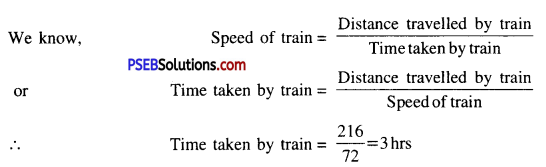
PSEB 7th Class Science Solutions Chapter 13 Motion and Time 7

Question (v)
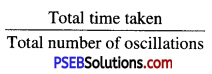
Find the time period of a simple pendulum, which takes 20 s to complete 50 oscillations ?
Solution:
Number of oscillations of a simple pendulum = 50
Time taken to complete 50 oscillations = 20 seconds
We know, Frequency = PSEB 7th Class Science Solutions Chapter 13 Motion and Time 8
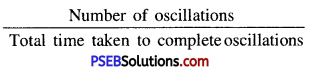
= \(\frac {20}{50}\)
= \(\frac {2}{5}\) = 0.4 sec-1

7. Long Answer Type Questions:

Question (i)
Describe the method to find the time period of a simple pendulum.
Answer:
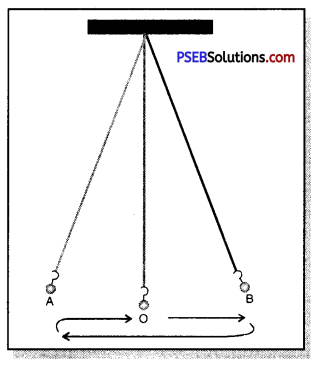
Make a simple pendulum by tying a metal sphere with one end of a thread about 1 meter long as shown in the diagram. If there is a fan running around, turn it off. Now let the bob of the pendulum come to rest in the middle position. Mark the middle position with chalk on the floor. Take a stop watch or mobile or wrist watch to measure the time period of the pendulum. Hold the bob and ensure that the thread is stretched and take it one extreme. Now release the sphere slowly. When the sphere is at its starting end, start the stop watch. Count the oscillations.
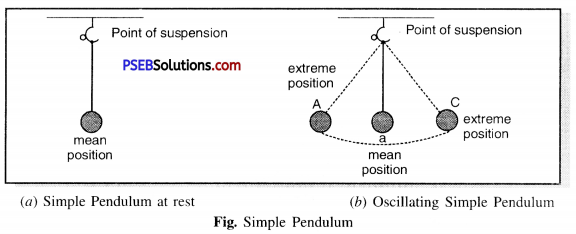
PSEB 7th Class Science Solutions Chapter 13 Motion and Time 9
Note the time taken by the pendulum to complete 20 oscillations. Record your observations in the table below. Time taken by the pendulum to complete one oscillation is called its time period. It is measured in second.

Sr. No. Time taken for 20 oscillations Time period
1.

2.

3.

Repeat this action 3-4 times and note observations in the table above.
You will notice that the time period of pendulum will be almost the same each time.

Question (ii)
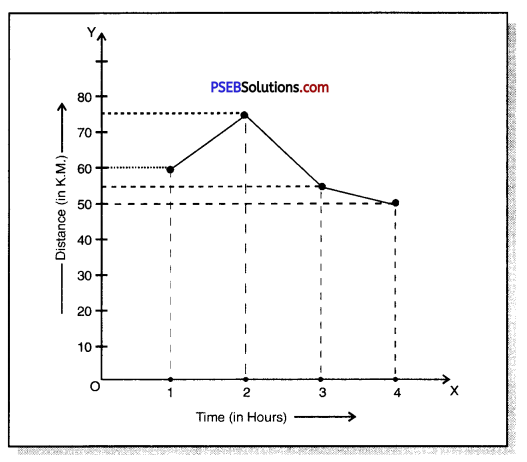
A car moves a distance of 60 km in 1st hour, 75 km in 2nd hour, 55 km in 3rd hour and 50 km in 4th hour. Plot a distance-time graph for the motion of the car.
(1) Find the speed of the car for the whole journey.
(2) Find the speed of the car between 1st and 3rd hour.
Answer:
(1) Distance covered in the entire journey = 60 km + 75km + 55 km +50 km
= 240 km
And, Total time spent = 4 hours
The average speed of the car = The total distance covered/Total time spent
= 240 km/4 hr
= 60 km/hr

(2) Speed from the first hour to the third hour
Distance covered = 75 km + 55km
= 130 km
= 2 hours
Car speed between the first hour and the third hour =130 km/2hr = 65 km/hr
PSEB 7th Class Science Solutions Chapter 13 Motion and Time 10

PSEB 7th Class Science Solutions Chapter 13 Motion and Time

Question (iii)
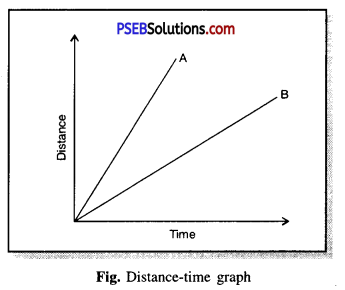
Figure shown below represents the distance-time graph for the motion of two vehicles A and B. Which one of them is moving faster ?
PSEB 7th Class Science Solutions Chapter 13 Motion and Time 11
Answer:
Study of the distance-time graph of both the vehicles shows that the ratio of distance and time for vehicle A is higher than that of vehicle B, hence the speed of vehicle A is higher than that of vehicle B.

PSEB Solutions for Class 7 Science Motion and Time Important Questions and Answers

1. Fill in the Blanks:

(i) The distance covered by an object in unit time is called …………………
Answer:
Speed

(ii) The time taken by a pendulum to make a swing is called ………………………..
Answer:
Time period

(iii) An instrument used to measure the distance covered by vehicles is called ……………….
Answer:
Odometer

(iv) …………………… is the instrument that measures the speed of moving vehicles.
Answer:
Speedometer

(v) A graph drawn for the distance and time taken for a uniform motion is ………………………
Answer:
Straight line parallel to time axis

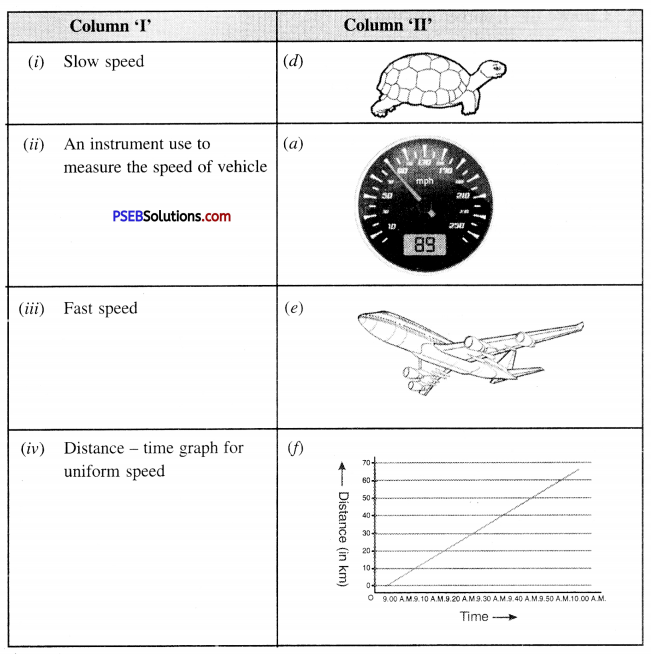
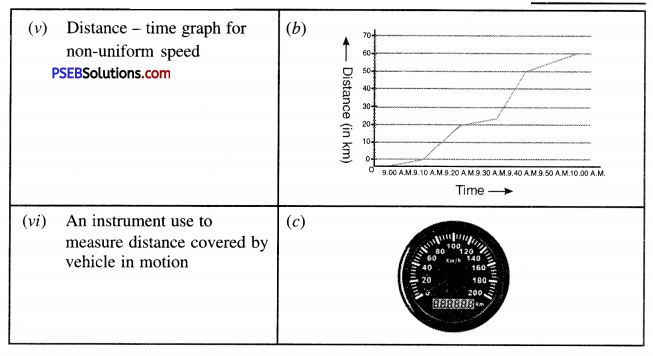
2. Match the Column ‘I’ with Column ‘II’:
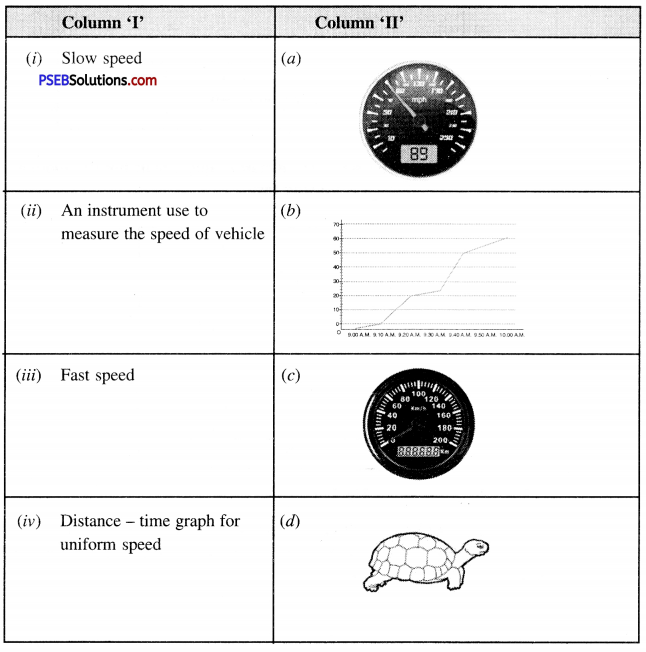
PSEB 7th Class Science Solutions Chapter 13 Motion and Time 12
PSEB 7th Class Science Solutions Chapter 13 Motion and Time 13
Answer:
PSEB 7th Class Science Solutions Chapter 13 Motion and Time 14
PSEB 7th Class Science Solutions Chapter 13 Motion and Time 15

PSEB 7th Class Science Solutions Chapter 13 Motion and Time

3. Choose the Correct Answer:

Question (i)
The basic unit of time is:
(a) Minute
(b) Hour
(c) Second
(d) None of these.
Answer:
(c) Second.

Question (ii)
The Speed of train is expressed in :
(a) m/h
(b) km/h
(c) cm/h
d) mm/h.
Answer:
(b) km/h.

Question (iii)
The S.I. unit of speed is:
(a) m/s
(b) km/s
(c) cm/s
(d) mm/s.
Answer:
(a) m/s.

Question (iv)
Which of the following relation is correct:
(a) Speed = Distance × Time
(b) Speed = \(\frac{\text { Distance }}{\text { Time }}\)
(c) Speed = \(\frac{\text { Time }}{\text { Distance }}\)
(d) None of these.
Answer:
(b) Speed = \(\frac{\text { Distance }}{\text { Time }}\)

Question (v)
A motion which repeats itself after fixed interval of time is:
(a) Oscillatory motion
(b) Periodic motion.
(c) Time period
(d) None of these.
Answer:
(b) Periodic motion.

Question (vi)
The device which measures the distance moved by the vehicle is called:
(a) Speedometer
(b) Odometer
(c) Pendulum
(d) None of these.
Answer:
(b) Odometer.

Question (vii)
The time taken by a vibrating body to complete one oscillation is called:
(a) Time period
(b) Oscillation
(c) Uniform motion
(d) None of these.
Answer:
(a) Time period.

Question (viii)
Which of the following Distance-Time Graph shows the object at rest position ?
PSEB 7th Class Science Solutions Chapter 13 Motion and Time 16
(a) (i)
(b) (ii)
(c) (iii)
(d) None of the above.
Answer:
(a) (i).

PSEB 7th Class Science Solutions Chapter 13 Motion and Time

Question (ix)
What is the basic unit of speed ?
(a) km/min.
(b) m/min.
(c) km/hr.
(d) m/s.
Answer:
(d) m/s.

State True or False:

(i) The basic unit of time is second.
Answer:
True

(ii) Every object moves with a constant speed.
Answer:
False

(iii) Distances between two cities is measured in kilometres.
Answer:
True

(iv) The time period of a given pendulum is not constant.
Answer:
False

(v) The speed of a train is expressed in m/h.
Answer:
False

Very Short Answer Type Questions

Question 1.
The rate at which distance is covered corresponds to which quantity-speed or velocity ?
Answer:
Speed.

Question 2.
The rate at which displacement is covered corresponds to which quantity, speed or velocity ?
Answer:
Velocity.

PSEB 7th Class Science Solutions Chapter 13 Motion and Time

Question 3.
What is formula of average speed ?
Total distance covered
Answer:
Average speed = PSEB 7th Class Science Solutions Chapter 13 Motion and Time 17

Question 4.
Name two types of motions.
Answer:
(i) Uniform motion
(ii) Non-uniform motion.

Question 5.
Working of clock depends on which type of motion ?
Answer:
Periodic motion.

Question 6.
Name any two time measuring devices.
Answer:
(1) Clock,
(2) watch.

Question 7.
What is metallic ball of a pendulum known as ?
Answer:
Bob of the Pendulum.

Question 8.
What type of motion is shown by simple pendulum ?
Answer:
Oscillatory motion / Periodic motion

Question 9.
What is basic unit of time ?
Answer:
Second.

Question 10.
What are larger units of time ?
Answer:
Minute, hour

PSEB 7th Class Science Solutions Chapter 13 Motion and Time

Question 11.
What is odometer ?
Answer:
Odometer. The device which measures the distance moved by the vehicle, is called odometer.

Question 12.
What is function of speedometer ?
Answer:
It records speed directly in km/h.

Short Answer Type Questions

Question 1.
Which devices were used for measuring time before pendulum clocks ?
Answer:
(i) Sundial.
(ii) Water clock,
(iii) Sand clock.

Question 2.
What important points are to be kept in mind while choosing the most suitable scale for drawing a graph ?
Answer:
Points to be considered while choosing the scale for drawing a graph :
(0 The difference between the highest and the lowest values of each quantity.
(ii) The intermediate values of each quantity.
(iii) To utilize the maximum part of the graph paper.

Question 3.
What is a simple pendulum ?
Answer:
Simple pendulum. It consists of a small metallic ball or a piece of stone suspended from a rigid support by a thread. The metallic ball is called the bob of the pendulum.

Question 4.
Classify the following as Linear, circular or Periodic motion :
(i) Motion of your hands while running.
(ii) Motion of a horse pulling a cart on a straight road.
(iii) Motion of a child in a merry go round.
(iv) Motion of a child over see-saw.
(v) Motion of the hammer of an electric bell.
(vi) Motion of a train on a straight bridge.
Answer:
(i) Periodic motion
(ii) Linear motion
(iii) circular motion
(iv) Periodic motion
(v) Periodic
(vi) Linear Motion.

Question 5.
A simple pendulum takes 32 s to complete 20 oscillations. What is the time period of the pendulum ?
Solution:
Number of oscillations = 20
Time taken to complete 20 oscillations = 32 s
∴ Time period of pendulum = PSEB 7th Class Science Solutions Chapter 13 Motion and Time 18
(i.e. time taken to complete 1 oscillation) = \(\frac {32}{20}\)
= \(\frac {8}{5}\)
= 1.6 s

Question 6.
The distance between two stations is 200 km. A train takes 4 hours to cover this distance. Calculate the speed of the train.
Solution:
Distance covered by train between two stations = 200 km
Time taken t = 4 hr
∴ Speed of the train =PSEB 7th Class Science Solutions Chapter 13 Motion and Time 19
= \(\frac{200 \mathrm{~km}}{4 \mathrm{hr}}\)
= 50 km/hr

Question 7.
Salma takes 15 minutes from her house to reach her school on a bicycle. If the bicycle has a speed of 2 m/s, calculate the distance between her house and her school.
Time taken = 15 min.
= 15 × 60
= 900 sec
Speed of bicycle = 2 m/s
Distance covered = Speed × Time
= 2 × 900 m
= 1800 m
= \(\frac{1800}{1000}\)
= 1.8 km.

Long Answer Type Question

Question 1.
Define
(i) Periodic motion
(ii) Oscillatory motion
(iii) Oscillation
(iv) Time period.
Answer:
PSEB 7th Class Science Solutions Chapter 13 Motion and Time 20
(i) Periodic motion. A motion that repeats itself after a fixed interval of time is periodic motion.
(ii) Oscillatory motion. To and fro motion of an object about a fixed mean position is oscillatory or vibratory motion.
(iii) Oscillation. The motion of the pendulum from one extreme position to another extreme position and back to the first extreme position is one complete oscillation.
(iv) Time period. The time taken by a vibrating particle to complete one oscillation is called the time period of the pendulum.

PSEB 6th Class Science Solutions Chapter 9 The Living Organisms and Their Surroundings

Punjab State Board PSEB 6th Class Science Book Solutions Chapter 9 The Living Organisms and Their Surroundings Textbook Exercise Questions and Answers.

PSEB Solutions for Class 6 Science Chapter 9 The Living Organisms and Their Surroundings

PSEB 6th Class Science Guide The Living Organisms and Their Surroundings Textbook Questions and Answers

1. Fill in the Blanks :

(a) The respiratory organs of fish are ………………
Answer:
Gills

(b) Environment consist of ……………. and ……………… component.
Answer:
Biotic and Abiotic

(c) Sunlight is ………………. component of a habitat.
Answer:
Abiotic

PSEB 6th Class Science Solutions Chapter 9 The Living Organisms and Their Surroundings

(d) Animals that live on land are called …………………
Answer:
Terrestrial animals

(e) All ……………….. beings show growth and reproduction.
Answer:
Living

2. Write True or False:

(a) Cactus carry out photosynthesis using their stems.
Answer:
True

(b) A camel’s hump stores food and water.
Answer:
False

(c) All green plants are consumers.
Answer:
False

(d) Biotic components consist of water, air and soil.
Answer:
False

3. Match the Column A with Column B:

Column A Column B
1. Main source of energy on earth (a) Plants or animals
2. Arboreal (b) Waxy coating on stem
3. Cactus (c) Monkey
4. Biotic components (d) The sun.

Answer:

Column A Column B
1. Main source of energy on earth (d) The sun
2. Arboreal (c) Monkey
3. Cactus (b) Waxy coating on stem
4. Biotic components (a) Plants or animals.

4. Choose the Correct Answer:

Question (i)
Abiotic components include:
(a) Air, water, plants
(b) Air, water, soil
(c) Plants and animals
(d) Soil, plants, water.
Answer:
(c) Plants and animals

Question (ii)
Cactus is a ……………..
(a) Xerophyte
(b) Decomposer
(c) Hydrophyte
(d) Herb.
Answer:
(a) Xerophyte

PSEB 6th Class Science Solutions Chapter 9 The Living Organisms and Their Surroundings

Question (iii)
…………….. have a streamlined body.
(a) Earthworms
(b) Tigers
(c) Fishes
(d) Polar bears.
Answer:
(b) Tigers

Question (iv)
Organisms living in water are called ……………….. animals.
(a) Aquatic
(b) Terrestrial
(c) Xerophytes
(d) Aerial.
Answer:
(a) Aquatic

5. Very Short Answer Type Questions:

Question (i)
Define habitat.
Answer:
The place where living beings live is called Habitat.

Question (ii)
Define adaptation.
Answer:
The ability of living things to adjust themselves to their surroundings is called adaptation.

Question (iii)
Give two examples -each of terrestrial and aquatic animals.
Answer:
Terrestrial animals : Monkey, Human beings

Question (iv)
What are the producers ?
Answer:
Organisms that can manufacture their own food are called producers.

Question (v)
What are biotic components ?
Answer:
Living things like plants, animals, human beings and micro-organisms in a habitat are biotic components.

PSEB 6th Class Science Solutions Chapter 9 The Living Organisms and Their Surroundings

6. Short Answer Type Questions:

Question (i)
Define scavengers and decomposers.
Answer:
Scavengers. The animals that feed on dead animals and help us in keeping our environment clean, e.g. vultures, dogs etc.

Decomposers. Micoorganisms which feed on dead bodies of plants and animals and break them into simple substances are called Decomposers.

Question (ii)
What are two adaptations of fish ?
Answer:
Two adaptations of fish are :

  1. They have streamlined body to reduce resistance due to water.
  2. Fins in fish and flippers in whales help them in swimming.

Question (iii)
Which animal is called ‘ship of desert’ ? Write its two features.
Answer:
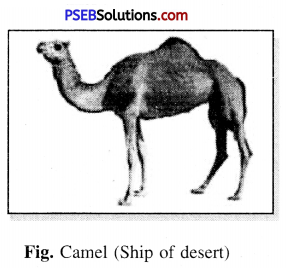
Camel is known as ‘ship of desert’.

Question (iv)
What is Hibernation ? Give one example.
Answer:
The long winter sleep of animals for survival is called Hibernation.
For example : Frogs, Lizards.

7. Long Answer Type Questions:

Question (i)
Write short notes on :
(1) Producers
(2) Consumers
(3) Decomposers.
Answer:
(1) Producers. Organisms that can manufacture their own food are called producers. For example, green plants make their own food by photosynthesis.

(2) Consumers. Organisms that cannot prepare their own food but consume food pepared by green plants are consumers. They also obtain their food by eating other living or dead animals.

Types of Consumers :
(a) Primary Consumers or Herbivores. Animals that get their food directly from plants are Herbivores, e.g. cow, dear, goat etc.
(b) Secondary Consumers or Carnivores. They eat primary consumers, e.g. snakes, frog, lizard.
(c) Tertiary Consumers. They eat secondary consumers, e.g. lion, tiger, leopards etc.

(3) Decomposers. The microorganisms which fed on the dead bodies of plants and animals and break them into simple substances are caled Decomposers, e.g. Bacteria and fungi.

Question (ii)
Briefly describe the various types of habitats.
Answer:
Types of Habitat. There are three main kinds of habitat :
(1) Terrestrial
(2) Aquatic and
(3) Aerial or Arboreal Habitat.

(1) Terrestrial habitat. The organisms that live on land are called Terrestrial organisms and their habitat is terrestrial habitat. Examples of terrestrial habitats are desert, grasslands, mountain.

(2) Aquatic (water) habitat. Organisms that live in lakes, ponds, rivers and oceans are aquatic organisms and their habitats are aquatic habitat. Examples of aquatic habitats are Oceans, seas, certain lakes etc.

(3) Aerial or Arboreal habitat. Organisms that live in air are called aerial or arboreal animals and their habitats are called aerial or arboreal habitats. Most birds and winged animals are arboreal in habit. Organisms are adapted for aerial existence as no organism is bom in air.

PSEB 6th Class Science Solutions Chapter 9 The Living Organisms and Their Surroundings

Question (iii)
Distinguish between living and non-living things.
Answer:

Living things Non-living things
(1) Living things grow. (1) They do not grow.
(2) They show movement. (2) They never move.
(3) They can reproduce. (3) They cannot reproduce.
(4) Living things can respire. (4) They do not respire.
(5) Living beings need food. (5) They don’t feed.

PSEB Solutions for Class 6 Science The Living Organisms and Their Surroundings Important Questions and Answers

Multiple Choice Questions:

Question 1.
Pick out living among following :
(a) Plough
(b) Mushroom
(c) Water
(d) Wool.
Answer:
(b) Mushroom

Question 2.
The process by which waste materials of a body are thrown out, is:
(a) Digestion
(b) Excretion
(c) Reproduction
(d) None.
Answer:
(b) Excretion

Question 3.
Gills are breathing organs of :
(a) Fishes
(b) Frog
(c) Flies
(d) None.
Answer:
(a) Fishes

Question 4.
Pups of a dog grows into adult. This characteristic of living organisms is
(a) Reproduction
(b) Growth
(c) Respiration
(d) None
Answer:
(b) Growth

Question 5.
Basic unit of life is:
(a) Tissue
(b) Organ
(c) Cell
(d) None
Answer:
(c) Cell

Question 6.
Average life span of Bacteria is :
(a) Two days
(b) 20 minutes
(c) 10 seconds
(d) 20 seconds
Answer:
(b) 20 minutes

Question 7.
Which of the following is a Decomposer ?
(a) Lion
(b) Deer
(c) Monkey
(d) Bacterium.
Answer:
(d) Bacterium.

PSEB 6th Class Science Solutions Chapter 9 The Living Organisms and Their Surroundings

Question 8.
Plants live on desert area are:
(a) Hydrophytes
(b) Xerophytes
(c) Aquatic
(d) None of the above
Answer:
(b) Xerophytes

Question 9.
Which of the following has webbed feet for swimming ?
(a) Fishes
(b) Whales
(c) Jelly fish
(d) Duck.
Answer:
(d) Duck.

Question 10.
Forelimbs are modified in :
(a) Animals
(b) Plants
(c) Birds
(d) None.
Answer:
(c) Birds

Fill in the Blanks :

(a) In every habitat, there are many ……………… of various kinds.
Answer:
organisms

(b) Bones are …………… in aerial organisms.
Answer:
hollow

(c) Winter sleep by animals are called ……………….
Answer:
Hibernation

(d) The plants live in water are ………………..
Answer:
Hydrophytes

(e) In cactus plants, leaves are reduced to ……………….
Answer:
spines

PSEB 6th Class Science Solutions Chapter 9 The Living Organisms and Their Surroundings

(f) Lion and …………… are animals of ………………..
Answer:
deer, grasslands

(g) Steamlined body is present in …………………
Answer:
fishes

(h) Frogs have ……………….. feet to swim in water.
Answer:
webbed

(i) The ability of animals to adapt themselves according to the environment is called ………………
Answer:
Adaptation

(j) …………….. feed on dead animals.
Answer:
Scavangers

True/False:

(a) There is lot of water available in deserts.
Answer:
False

(b) All animals cannot adapt themselves to their surroundings.
Answer:
False

PSEB 6th Class Science Solutions Chapter 9 The Living Organisms and Their Surroundings

(c) Sunlight and heat form biotic components of a habitat.
Answer:
False

(d) Desert plants have deep roots for absorbing water.
Answer:
True

(e) Snow leopard has no fur to cover its body.
Answer:
False

(f) All living organisms excrete.
Answer:
True

(g) Aquatic plants are found on the land.
Answer:
False

(h) Frogs have strong back legs for jumping.
Answer:
True

(i) Car, scooter, bus etc. are moving but are non-living.
Answer:
True

(j) All living things have same characteristics.
Answer:
True

PSEB 6th Class Science Solutions Chapter 9 The Living Organisms and Their Surroundings

Match the following:

Column A Column B
(1) Hydrilla Webbed feet
(2) Cactus Streamlined body
(3) Ducks Modified leaves into spines
(4) Whales Hydrophytic plant

Answer:
(1) Hydrilla – Hydrophytic plant
(2) Cactus – Modified leaves into spines
(3) Ducks – Webbed feet
(4) Whales – Streamlined body.

(b)

Column A Column B
(1) Camel Cold habitat
(2) Lion Aerial Habitat
(3) Bat Desert animal
(4) Penguine Aquatic animal
(5) Fish Terrestrial animal

Answer:
(1) Camel – Desert animal
(2) Lion – Terrestrial animal
(3) Bat – Aerial Habitat
(4) Penguine – Cold habitat
(5) Fish – Aquatic animal.

(c)

Column A Column B
(1) Vultures Consumers/carnivores
(2) Fungi Producers
(3) Green plants Decomposers
(4) Lion Scavengers

Answer:
(1) Vultures – Scavengers
(2) Fungi – Decomposers
(3) Green plants – Producers
(4) Lion – Consumers/camivores.

Very Short Answer Type Questions

Question 1.
Name the trees found on mountains.
Answer:
Oaks, pines, deodars.

Question 2.
Give example of unicellular organisms.
Answer:
Amoeba.

Question 3.
Why do living beings need food ?
Answer:
They need food to cany out their daily activities.

Question 4.
Define stimuls.
Answer:
Living things respond to immediate and long term changes in their environment called stimulus.

Question 5.
What do you mean by life span ?
Answer:
The duration if life for which living organisms live.

PSEB 6th Class Science Solutions Chapter 9 The Living Organisms and Their Surroundings

Question 6.
What is life span of a housefly ?
Answer:
1 – 4 years.

Question 7.
Can plants reproduce ?
Answer:
Yes, they reproduce with the help of seeds.

Question 8.
Define respiration.
Answer:
Process of taking oxygen in, combining with food and throwing out carbon dioxide and water vapour.

Question 9.
How do plants take carbon dioxide ?
Answer:
Through stomata.

Question 10.
In what forms our body excrete ?
Answer:
Our body exretes in the form of urine, faeces, sweat and exhaled air.

Question 11.
Why do organisms move ?
Answer:
They move to protect themselves from their enemies and natural calamities.

Question 12.
Where cactus plants grow ?
Answer:
Cactus grows in hot and dry areas of deserts.

Question 13.
Name some tertiary consumers.
Answer:
Lion, tiger, leopards.

PSEB 6th Class Science Solutions Chapter 9 The Living Organisms and Their Surroundings

Question 14.
How sunlight is helpful ?
Answer:
Plants make their food with the help of sunlight.

Question 15.
How water is essential ?
Answer:
Water is essential for life as the bodies of plants and animals contain large amounts of water.

Question 16.
How cactus is adapted in xerophytic conditions ?
Answer:
Cactus have very long roots, small leaves or spines and wax coated stem to conserve water.

Question 17.
Who is “ship of desert” ?
Answer:
Camel.

Question 18.
What is the function of Humb in camels ?
Answer:
It stores fat as reserve food.

Question 19.
What is the role of air bladder in Ducks ?
Answer:
They help ducks to float on water.

Question 20.
Name the animals who Hibernate.
Answer:
Frogs, Lizards, Bears.

PSEB 6th Class Science Solutions Chapter 9 The Living Organisms and Their Surroundings

Short Answer Type Questions

Question 1.
What is function of scales on the body of fish ?
Answer:
Functions of scales. The scales present on the body of fish are slippery in nature. They protect the fish and help for easy movement in water.

Question 2.
Why do camels have long legs ?
Answer:
Camels have long legs to keep its body away from the intense heat during hot days.

Question 3.
How are animals adapted to live in mountain regions ?
Answer:
Adaptations of animals for living in mountain regions.

  1. Thick skin or fur to protect from cold e.g. yak.
  2. Strong hooves (goat) for running up rocky slopes.

Question 4.
Name the sea animals which do not have gills. How do they respire ?
Answer:
Dolphins and Whales do not have gills. They respire through nostrils or blowholes, which are present on the upper parts of their heads. They swim near to the surface and breathe in fresh air. They can stay inside the water for a long time without breathing.

Question 5.
Define respiration, growth, and excretion.
Answer:
Respiration. The process of taking in oxygen and giving out carbondioxide is called respiration.
Growth. The process of changing from a child to a-grown up is called growth. A seed grows into a plant.

Excretion. The process of throwing out waste materials from the body is known as excretion.

Question 6.
Show with an example that living things respond to stimuli.
Answer:
Living things respond to stimuli. When we move from a dark room into bright sunlight, our eyes shut themselves automatically for a moment to adjust themselves to the changed conditions. Similarly, when light is switched on in a dark room, cockroaches run to move in dark comers. Some plants also respond to light and touch (e.g. Touch-me not).

Question 7.
What are adaptations of camel ?
Answer:

  1. Camel has no sweat glands in order to reduce water loss.
  2. Hump is present to reserve food in the form of fat.
  3. They have thick skin to bear heat of desert.
  4. Their toes are bread and pedded that are suitable for walking on hot and loose sand.

PSEB 6th Class Science Solutions Chapter 9 The Living Organisms and Their Surroundings

Question 8.
Write the adaptations of hydrophyts.
Answer:

  1. They have poorly developed roots.
  2. Their stems are flexible
  3. Leaves are wax coated.

Question 9.
What do you mean by terrestrial and aquatic habitat ?
Answer:
Terrestrial habitat. This includes habitat of all the organisms which live and propagate on land. Example; Cow, camel, horse, dog are terrestrial organisms and forest is their terrestrial habitat.

Aquatic habitat. The habitats of plants and animals that live in water are called aquatic habitat. Examples : fishes, crocodile, snake etc. are aquatic organisms and water is their aquatic habitat.

Question 10.
What are biotic and abiotic components ?
Answer:
All living organisms like plants, animals and human beings include biotic components. All non-living parts such as light, water, soil and air are abiotic components.

Question 11.
What are the characteristics of xerophytes ?
Answer:
Characteristics of Xerophytes.

  1. These plants have extensive long root system.
  2. The stem of plants become thick and store water. Example, Opuntia.
  3. Leaves are modified into spines as in cactus.
  4. Leaves are coated with cuticle to check the loss of water.

Question 12.
Write physical conditions of Terrestrial habitat.
Answer:
Physical conditions of terrestrial habitat,

  1. Oxygen supply is uniform, sufficient and easily available.
  2. Temperature varies from place to place and season to season.
  3. Light is available in sufficient quantity and for sufficient duration.
  4. In certain region organisms have to adapt to avoid dehydration.

Question 13.
Write physical conditions of aquatic habitat.
Answer:
Physical conditions of aquatic habitat,

  1. Except in deep ocean, uniform supply of light, temperature, oxygen is available.
  2. Light and temperature vary in deep oceans at different depths.
  3. Pressure also varies in deep oceans at different depths.

Question 14.
Write the main characteristics of living and nor living things.
Answer:
We have many things around us which are two types i.e. living and non-living.
Living things. In living things life processes take place, so they need food. They grow upto a certain age. They respire and respond to external stimuli. They have ability to produce their young ones. They die after a certain age.

Non-living things. In non-living things, no life processes take place, so they do not need food. They do not grow and do not respond to external stimuli. They do not excrete. There is no death in the case of non-living things.

PSEB 6th Class Science Solutions Chapter 9 The Living Organisms and Their Surroundings

Question 15.
What are hydrophytes ?
Answer:
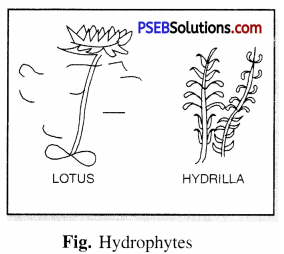
PSEB 6th Class Science Solutions Chapter 9 The Living Organisms and Their Surroundings 1
Hydrophytes. These are the plants which grow in watery places or the places which remain wet throughout the year. Examples : Hydrilla, Pista,
Lotus, Vallsneria.

Question 16.
What are the differences between Aquatic and Terrestrial habitat ?
Answer:
Difference between Aquatic and Terrestrial habitat:

Aquatic habitat Terrestrial habitat
(1) These include habitat of organisms that live and propagate in water. (1) These include habitat of organisms that live and propagate on land.
(2) Water absorbs and loses heat gradually therefore, sudden fluctuation in temperature is not found in aquatic habitat. (2) The terrestrial habitat have rapid fluctuation in the climate, temperature, moisture, i.e. it is not uniform everywhere.

Question 17.
What are unicellular of multicellular organisms ?
Answer:
Organisms made up of only one cell are Unicellular organisms, e.g. : Amoeba, Paramoecium. Organisms made up of large number of cells are called multicellular organisms, e.g. Humans, cat, dog etc.

Question 18.
What do you mean by excretion ? Write different modes of excretion in animals.
Answer:
Excretion.
The process of getting rid of waste or removal of waste materials from body is called excretion.

Mode of Excretion.
Larger animals even the human beings remove these wastes in the form of fluids like urine and faecal matter. The removal of waste is necessary since these may be poisonous and harmful to the organism.

Smaller organisms like bacteria, amoeba (one celled animals) remove their waste through body surfaces.

Question 19.
Differentiate living and non-livings on the basis of Growth and Respiration.
Answer:
Living organisms can grow as well as respire but non-living cannot.

Question 20.
What are the saline water habitats and fresh water habitats include ?
Answer:
Fresh water habitat. Rivers, ponds, lakes.
Saline water habitat. Oceans, seas, certain lakes.

Long Answer Type Questions

Question 1.
What do you mean by the term ‘Adaptation’ ?
Answer:
Adaptation.
The development of characteristics which help an organism to sun’ive in a particular environment is known as adaptation.
Adaptation commonly involves a combination of characteristics, shape, size, structure, colour and mode of life. For example, a fish shows many adaptations for aquatic life. It has a streamlined body provided with fins which enables it to swim in water, presence of gills for breathing.

PSEB 6th Class Science Solutions Chapter 9 The Living Organisms and Their Surroundings

Question 2.
How biotic and abiotic components of a habitat are interacted ? Draw its chart also.
Answer:
Interaction of biotic and abiotic environment.
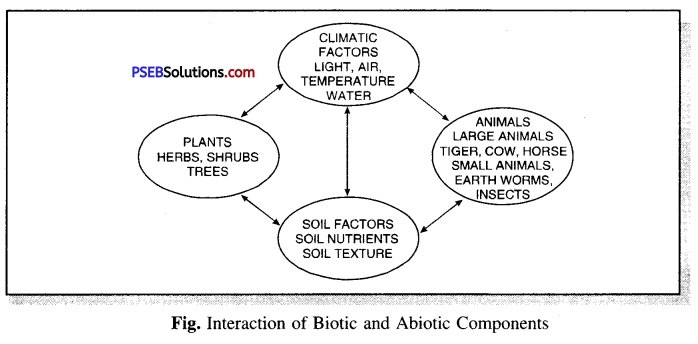
All biotic components such as plants, animals and micro-organisms are influenced by abiotic components such as water, light, air, oxygen and temperature in different ways. Green plants prepare their own food and all the animals depend upon plants for the food. Some animals feed on other animals. Plants also provide shelter to the animals thus all the organisms are related through food chain.
PSEB 6th Class Science Solutions Chapter 9 The Living Organisms and Their Surroundings 2
After death and decay of the plants and animals, they are decomposed into simple minerals into soil. These minerals are again used by plants through the roots. Thus they are interrelated and share common surroundings.

Thus we see that all the plants and animals and the abiotic components involving air. light, water are related and interdependent on each other in the habitat.

Question 3.
In what ways living things differ from non-living things ?
Answer:
Differences between living and non-living things :

Living things Non-living things
(1) Food is necessary for the life processes in living things. (1) In non-living things, no life processes take place, so they do not need food.
(2) Respiration is necessary for living things. (2) There is no respiration in non-living things.
(3) Living things grow upto a certain age. (3) These do not grow on their own.
(4) Living things respond to external stimuli. (4) Non-living things do not respond to external stimuli.
(5) Living things excrete waste product from their body. (5) Non-living things do not excrete.
(6) Living things produce their young ones. (6) There is no procreation in non-living things.
(7) The body structure of living things is cellular. (7) Non-living things do not have cellular body.

Question 4.
How is camel adapted for xeric adaptation / deserts ?
Answer:
PSEB 6th Class Science Solutions Chapter 9 The Living Organisms and Their Surroundings 2
The camel is superbly adapted for xeric conditions that is why it is rightly called the ‘ship of the desert’. The following adaptations are found in camel :

  • It uses its entire foot while walking and its hooves are covered by a large sole which helps it to move on hot, slippery sand.
  • It has a hump on the back which is filled with fat. This stores food that is utilized during the time when the camel does not get anything to eat.
  • It can drink as much as 50 litres of water in one gulp when water is available to it.
  • It excretes very little water from its body.
  • It passes nearly dry dung.
  • It does not perspire.

Question 5.
What are the abiotic components? Explain.
Answer:
The non-living components like rocks, roil, air, water, sunlight, temperature are abiotic components

  • Air. Both plants and animals require air to live. Animals take oxygen and give out carbon dioxide while plants give out oxygen and take carbon dioxide. Photosynthesis also takes place in the air.
  • Soil. It contains water, air, and living organisms. It provides nutrients to plants.
  • Sunlight. Plants perform photosynthesis in the presence of sunlight. Humans require sunlight for vitamin D. So, All organisms depend on sunlight directly and indirectly.
  • Water. Water is essential for life as it is present in large amounts in plants and animals.
  • Temperature. All living organisms can receive only within a specific range of temperature

PSEB 10th Class Physical Education Solutions Chapter 3 Yoga

Punjab State Board PSEB 10th Class Physical Education Book Solutions Chapter 3 Yoga Textbook Exercise Questions and Answers.

PSEB Solutions for Class 10 Physical Education Chapter 3 Yoga

Very Short Answer Type Questions

Question 1.
Which is the oldest method of Indian exercises?
Answer:
Yoga Asana.

PSEB 10th Class Physical Education Solutions Chapter 3 Yoga

Question 2.
How much time Search Asana may be performed daily?
Answer:
2 minutes only

Question 3.
Name the Asana which prevents Hernia and Urinary diseases.
Answer:
Chabar Asana.

Question 4.
Mention any two advantages of Searsh Asana.
Answer:

  • Increase the learning power.
  • Remove the fat of the body.

Question 5.
Mention any two advantages of Vazur Asana.
Answer:

  • It cures night fall.
  • It also cures diabetes.

Question 6.
Mention any two advantages of Padam Asana.
Answer:

  • Cure the pain of waist.
  • Passing of urine become normal.

Question 7.
Describe any two advantages of Bhujang Asana.
Answer:

  • Remove constipation.
  • Albumin disease is cured.

Question 8.
Mention any two advantages of Dhanur Asana.
Answer:

  • Arthritis is cured.
  • Menstruation and Venereal diseases of women are cured.

Question 9.
Which is the means of uniting soul with God?
Answer:
Yoga.

PSEB 10th Class Physical Education Book Chapter 3 Yoga

Question 10.
Which is the best Asana for mental concentration?
Answer:
Padam Asana.

PSEB 10th Class Physical Education Solutions Chapter 3 Yoga

Question 11.
How many types of Fatigue are there?
Answer:
Two types of fatigue:

  • Mental
  • Physical.

Short Answer Type Questions

Question 1.

“Yoga is the means of uniting soul with God.” How?
Answer:
Yoga can be defined as science of healthy and better living physically, mentally, intellectually and spiritually. Thus, Yoga is the union of soul with God. The medium of this sweet and happy union is body. The union of soul and God takes place by means of healthy and strong body, and we can have a vision of the Almighty God. Yoga makes body strong and healthy.
As such, it is the only means of the union of soul and God.

God is the embodiment of other-worldly qualities, actions and knowledge. He is all pervading like the sky. The mutual relation between the living being and God is a must. Yoga is helpful in strengthening’these bonds or connections.Man’s aim is to enjoy all the comforts of the world and to make the living soul one with God so that he may get rid of the cycles of births and rebirths and attain salvation.

Question 2.
Yoga is becoming very popular in foreign countries. Why?
Answer:
Yoga is an ancient knowledge of India. Yogic science is very important in human life. All over the world doctors and physical education teachers accept the importance of this ancient knowledge. Yoga Asana is a scientific knowledge and useful for persons of all ages. Yoga contributes in the complete development of man.

Question 3.
Write any five points which one should keep in mind while doing Asana.
Answer:
1. Yoga Asanas should be performed in the morning after the practitioner eases himself. It is better to perform Yoga Asanasafter having a bath. After taking bath body feels light and flexib and Asanas get performed very easily. Asanas can, of course, be don with empty stomach in the evening, too.

2. The place of Asanas should be clean and peaceful. It is desirable if Asanas are performed in a green park or garden.

3. The place where Asanas are to be performed should be even. Asanas should be performed on a mat so that one’s concentration is not disturbed by gravitational pull of the earth or by anything else.

4. One should not indulge in talks while performing Asanas. One should concentrate on one’s breathing and on the organ on which pressure is felt. The more one gets concentrated the more shall be the benefit of the Asanas performed. Perform Shavasana before doing other Asanas to make body, mind and breath calm and poised.

5. Yogic exercises are slow and non-aggressive. They should never be performed with jerks. Each Asana should be performed slowly by making the body alert and tense. Then the body should be kept in a relaxed state after some time. The second Asana should be performed when breathing becomes normal.

PSEB 10th Class Physical Education Solutions Chapter 3 Yoga

Question 4.
Describe tKe importance of Shav Asana.
Answer:
This asana should be performed for 3-5 minutes. It should be performed at the start and end of every asana.
Importance-

  • Shavasana helps in getting rid of high blood pressure and mental tension.
  • It keeps the heart and the brain fresh.
  • It removes the fatigue in the body.

Question 5.
Describe the Advantages of Yoga Asana.
Answer:

  • Man’s basic faculties of body and mind develop by means of Yoga. Lungs get enough air through the exercise of pranayama, as a result of which they get exercised and energised, and get rid of many ailments.
  • Man’s body remains completely healthy through Yoga.’ Dhoti and Basti help in cleaning liver and intestines respectively. Clean body, we know, always remains healthy.
  • Body gets strengthened with Yoga.
  • By doing Yogic Asanas the organs of body become flexible. For example Hal-Asana and Dhanur-Asana help in increasing the flexibility of the backbone.
  • All body systems begin to function properly with Yogic exercises.
  • Yogic exercises keep human body in good and correct posture, as a result of which man’s personality improves. For example, by doing Brikh-Asana, knees do not strike, and by doing Padam-Asana, one’s belly does not protrude and shoulders do not develop hump.
  • Mental discipline develops by doing Yoga. By doing Yama and
    Niyama, one is enabled to exercise control on one’s undesirable emotions and vices.
  • Many ailments get removed by performing Yoga Asanas correctly. Vajar-Asana and Mastainder-Asana help in the removal of diabetes. Similarly, Pranayama keeps the lungs free from ailments.
  • Yoga Asanas help in removing physical and mental fatigue. Shavasana helps in the removal of tiredness.
  • Man’s intelligence and memory increase as a result of performing Yoga Asanas. Shirsh-Asana proves to be very useful in this respect.
  • Yogic exercises develop a sort of rhythm in man’s body.
  • Yogic Asanas are the best means of attaining peace and balance of mind.

Question. 6.
Describe the Technique of Shav Asana.
Answer:
Shav Asana:
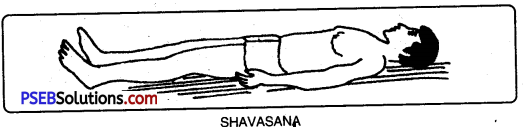
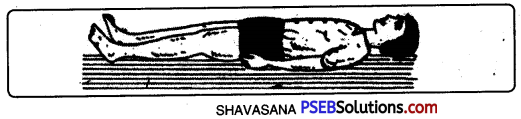
In this asana, one lies down prostrate and loosens the body. In order to perform this asana, lie down straight on the ground over the back and loosen all the parts of the body completely. Gradually, breathe in deeply. The distance between the feet should be 1.5 ft.Keep the wrists of the hands away from the body, facing the sky. Close your eyes, introspect and think as if the body were getting loose. Feel that the body is in a position of rest.
PSEB 10th Class Physical Education Solutions Chapter 3 Yoga 1

PSEB 10th Class Physical Education Solutions Chapter 3 Yoga

Long Answer Type Questions

Question 1.
What is Yoga? What are the advantages of Yoga?
Answer:
‘Yoga can be defined as science of healthy and better living physically, mentally, intellectually and spiritually.” Thus, Yoga is the union of soul with God. The medium of this sweet and happy union is body. The union of soul and God takes place by means of healthy and strong body, and we can have a vision of the Almighty God. Yoga makes body strong and healthy. As such, it is the only means of the union of soul and God. God is the embodiment of other-wordly qualities, actions and knowledge. He is all-prevading like the sky. The mutual relation between the living being and God is a must. Yoga is helpful in strengthening these bonds or connections.

Advantages of Yoga:

  • Prevention of Diseases.
  • Corrective Values and Relaxation.
  • Development of Strength.
  • Development of Physical, Mental and Latent power of man.
  • Emotional development.
  • Internal cleanliness of body.
  • Spirit of Sacrifice and Discipline.

Question 2.
“Yoga is the means of uniting soul with God.” How?
Answer:
Yogic science is very important in human life. Yoga is not only the ancient knowledge of India but of the whole world. All over the world doctors and Physical Education teachers accept the importance of this ancient knowledge. Through Yoga body and mind remain healthy and nerves also remain strong and flexible. Yoga keeps one away from all ailments, and in case one falls ill, Yoga helps him to cure through various exercises. Not only does it make one healthy, strong and energetic it also makes one’s personality attractive. In fact, it takes one to a world of supreme bliss, life, health, comfort and peace.

It is the river of that knowledge, the single drop of which is sufficient to cure an ailment. It is a great means of uniting one with God. Body is, thus, a medium of the meeting of soul and supreme soul (God). Through a healthy body one can visualize the Almighty God. Yoga makes one healthy and strong as also efficient and skilful. It infuses in us energy. It is useful not only for the patients but also for the healthy persons. Healthy persons can make best use of Yoga. Yoga is useful for persons of all ages.

Aim of Yoga:
The main aim of Yoga is to win over the mind by maintaining the body healthy, flexible, energetic and active and by developing Great Powers by which the soul may unite with the Supreme Soul (God). In fact, salvation (‘Mukti’) is getting rid of the cycles of births and deaths by uniting the soul with the Supreme Soul. Two forms of ’V Yoga Asanas and Pranayams are directly related to Physical Education. Through Yogic science, man merges into God by winning over the mind, keeping the body healthy, energetic and active, and disciplining conduct and behaviour.

PSEB 10th Class Physical Education Solutions Chapter 3 Yoga

Question. 3.
Describe the technique of any five Asana and explain their advantages.
Answer:
Shavasana:
Position: In Shavasana one lies down prostrate loosing the body-

  • Technique. In order to do this asana lie down straight on the ground ones the back and loosen all the parts of body completely.
  • Then breathe in deeply.
  • Relax the whole body.
  • Keep the distances of the feet of 1.5 ft.
  •  Keep the wrists away from the body facing the sky.
  •  Close your eyes, try to concentrate your mind.

Fact as of the whole body is getting loose and that the body is in the state of rest.
PSEB 10th Class Physical Education Solutions Chapter 3 Yoga 2

Advantages:

  •  Shavasana helps in geting rid of blood pressure and mental tension.
  •  It keeps the heart and the brain fresh.
  •  It removes physical fatigue.

Paschimottan Asana:
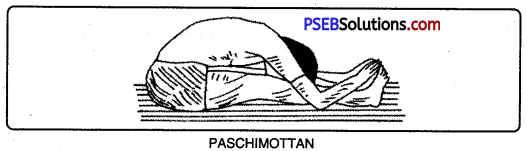
In it, one holds, the thumbs of the feet with fingers and sits in such a say that the trunk moves towards one side.
PSEB 10th Class Physical Education Solutions Chapter 3 Yoga 3
Position of Paschimottan Asana:
In doing this asana, the whole body is stretched and bent:
Technique of Paschimottan Asana-

  • Spread both the legs forward.
  • Sit on the ground. Hold the thumbs of the feet with both the hands.
  • Breathe out slowly and try to touch the knees.
  • Breathe in slowly. Raise the head upwards and return to the former position.
  • Repeat this asana 10-15 times.

Advantages:

  • It lends strength to the thighs.
  • It helps cleanse the blood vessels.
  • It helps in getting rid of the various diseases of the belly.
  • It reduces the excess fat of the body.
  • It helps in the removal of gas trouble.

Dhanur Asana:
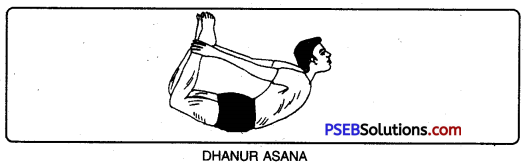
In performing this asana one lies prostrate, pulls up the legs and holds*the knees with the help of hands.
PSEB 10th Class Physical Education Solutions Chapter 3 Yoga 4
Technique of Dhanurasana:
In this asana, the shape of the body is like that of a bow. In order to perform this asana, lie over the belly on the ground. Bend the knees backward. Hold the feet near the ankles with hands. Breathe in deeply and raise the chest upwards as much as possible. Now make the feet tense so that the body acquires the shape of a bow. Remain in the position as long as possible. Breathe out. Keep the body loose and go back to the former position. Repeat this asana 3-4 times. Shalabhasana and Dhanurasana should be done turn by turn.

Advantages:

  • Dhanurasana reduces obesity.
  • It increases digestive power.
  • It helps in getting rid of rheumatism and urinary diseases.
  • It makes the stomach and intestines strong.
  • The vertebral column and muscles become strong and flexible with this asana.

Padam Asana:
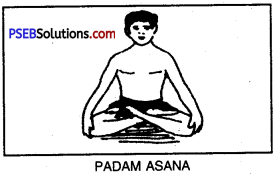
In performing this Asana, one sits squatting.
Position of Padam Asana:
In this asana the position of the body is like that of lotus.
PSEB 10th Class Physical Education Solutions Chapter 3 Yoga 5
Technique of Padamasana-
After sitting in the squatting position, place the right foot on the left thigh in such a way that the heel of the right foot touches the hip bone of the left thigh. Then lift the left foot up, and in the same way place it on the right thigh of the right foot. The vertebral column should be perfectly straight. Stretch the arms on the knees. It becomes very easy to perform this asana after a few days’ practice.

Advantages:

  • It increases the digestive power.
  • It is very good for the concentration of the mind.
  • It helps in getting rid of backache.
  • It enables a person to escape from the diseases of the heart and belly.
  • It helps in the removal of urinary troubles.

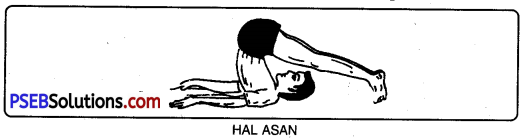
Halasan:
Position: In doing this asana one lies in the supine position.

  • Technique. Raise both legs and keep the head away and lift both feet and bring both legs behind the head.
  • Touch the thumb of your feet to the ground. .
  • Maintain the position as you can.
  • Bring your feet at the same place from where you have started to left.PSEB 10th Class Physical Education Solutions Chapter 3 Yoga 6

Advantages:

  • Hal Asana is very useful for every men and women of every age.
  • It is the best asana for the person of heart disease or a person who is suffering from high or low blood pressure.
  • It regulates the circulation of blood.
  • Removes fat of the body slim the waste and belly.
  • It provides flexibility to the backbone.

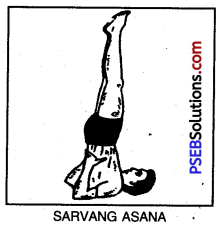
Sarvang Asana:
In this Asana, one stands on one’s shoulders.
Technique of Sarvang Asana: In this asana, the position of the body is like that of Ardh Hal Asana. For performing this asana, straighten the body and lie on the ground over the back. Place both the hands along the thighs. Lift both the feet once. Resting the back with the help of wrists, let the elbows rest on the ground. Keep the whole of your body straight. Let the weight of the body be on the shoulders and the neck. Let the chin touch the neck.
PSEB 10th Class Physical Education Solutions Chapter 3 Yoga 7
After remaining in this position for some time, return td the former position slowly. In the beginning, do this asana for a minute or two. Then increase the duration of this asana from 5 to 7 minutes.The persons who cannot perform Sheershasasna should do Sarvangasana

Advantages:

  •  This asana helps to remove constipation.
  •  It increases appetite.
  •  The bulging belly goes in.
  •  All the body organs become active.
  •  The gas trouble is removed.
  •  The blood circulation quickens and blood is purified.
  •  It helps in getting rid of piles.

PSEB 10th Class Physical Education Solutions Chapter 3 Yoga

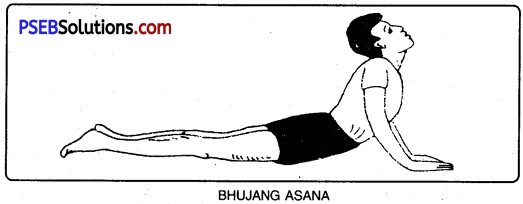
Bhujang Asana:
In this asana, one lies down straight and loosens the trunk.
Technique of Bhujang Asana .It is also called Sarpasana. In it, the position of the body is like that of a serpent.
In order to perform it, lie down on the belly on the ground. Place both hands near the shoulders. Make the legs tense slowly, and with the help of wrists raise the chest so much that the arms are completely straight. Pull in the toes and hang the head slowly backwards. Return gradually to the former position. Repeat this asana 3-5 times daily.

PSEB 10th Class Physical Education Solutions Chapter 3 Yoga 8
Advantages:

  • Bhujangasana increases the digestive power.
  • It helps get ride of the diseases of liver and spleen.
  • It strengthens vertebral column and muscles.
  • It helps in the removal of constipation.
  • It helps the bulge of the belly go in.
  • It makes the lungs strong.

PSEB 10th Class Physical Education Solutions Chapter 3 Yoga

Question 4.
Discuss the techniques of Garur Asana and Tar Asana. Describe their advantages.
Answer:
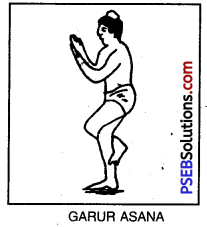
Position of Garur Asana:
The position of Garur Asana is standing on both feet-
Techniques:

  • While standing straight, lift the left leg and encircle the other leg.L
  • Left thigh will come over right thigh. The part of the lower leg will cover right side of the lower leg.
  • Put the body weight on one foot.
  • Encircle left arm to the right arm and left.
  • Both palm and come to the position of Namaskar.
  • Then bend the left leg and bring the body in sitting position. In this way all nerves of the body will get stretched. Again straighten up the body and come to the position of Attention.
  • Now change your legs and hands and repeat the same. Garur asana should be performed on each leg from one minutes to five minutes.
    PSEB 10th Class Physical Education Solutions Chapter 3 Yoga 9

Advantages of Garur Asana:

  • It strengthens all parts of the body.
  • Body becomes healthy.
  • It prevents the disease of Hernia.
  • Legs become strong.
  • One feels fresh and light.
  • Circulation of blood increases.
  • Man remains healthy and away from so many diseases.

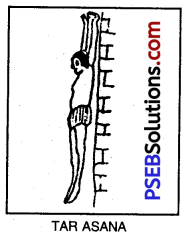
1. Tar Asana:
In this asana the trunk is pulled upwards while in the standing position. The position of tar asana is like the Tar tree.
Technique of Tar Asana. Stand up, join the heels and toes of both the feet and lift the arms straight upward. Let the fingers of one hand cross those of the other hand. The wrists should be upward and the sight in front. Breathe in fully. Raise the heels and put the whole body weight on toes. Pull the body upwards. After sometime, breathe out and lower the body. Repeat this action 10-15 times.
PSEB 10th Class Physical Education Solutions Chapter 3 Yoga 10
Advantages of Tar Asana:

  • It reduces obesity of the body.
  • It raises the stature
  • It removes constipation.
  • It prevents the diseases of the intestines.
  • It serves to cleanse the bowels if it is done after taking cold water everyday.

Question 5.
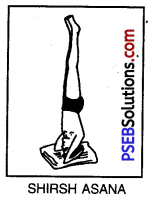
What is the technique of Shirsh Asana ? Discuss its advantages. What precaution would you take while performing Shirsh Asana?
Answer:

PSEB 10th Class Physical Education Solutions Chapter 3 Yoga
Shirsh Asana:
Position. Bring your head down and keep legs upward.
Technique-

  • Put blanket or towel on the floor and sit down on your knees.
  • The fingers of both hands should be tightly interlocked. Put both hands on blanket.
  • Put your head between both hand in such a way that thumb of the hand may press back part of your head.
  • Bring both legs inside and put your thumb and legs straight upward.
  • Lift the feet gradually. Firstly straight one leg and another.
  • Try to keep your body in a straight line.
  • Put your body weight on head and both arms equally.
  • You can take help of the wall or your team-mates.

PSEB 10th Class Physical Education Solutions Chapter 3 Yoga 11
Advantages:

  • Increases apettite.
  • Make a person slim.
  • Live and spleen become more active.
  • It removes all diseases concerning primary track.
  • Piles are cured.
  • By doing regular practice of Shirsh Asana, mental diseases are cured.

Precautions:

  • When eyes become red, Asana should be stopped.
  • On feeling giddiness don’t do Shirsh Asana.
  • Shirsh Asana should be stopped while feeling too much air in the ears.
  • This asana should not be performed when inhalation becomes difficult.
  • When body do not bear the weight.
  • On shivering arms and legs.
  • While feeling uneasiness. Shirsh Asana may not be performed.
  • Shirsh Asana should be performed all alone.
  • Take assistance when you feel necessity.
  • Shirsh Asana can be performed from one minute to five minutes. More time would be harmful.

PSEB 10th Class Physical Education Solutions Chapter 3 Yoga

Question 6.
Describe the technique and advantages of Vajur Asana.
Answer:
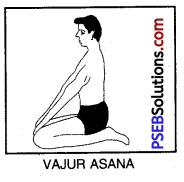
Vajur Asana:
Position. Sitting on legs while keeping his feet behind.
Technique-

  • Put on knees under your hip and sit down while facing the feet upper side.
  • The thumb of the feet should touch each other.
  • Both the knees may touch each other back and waist must be in a straight line.
  • Put both hands on the both thighs.
  • Breathing may be long.
  • Vajur Asana may be performed daily from three minutes to twenty minutes.

PSEB 10th Class Physical Education Solutions Chapter 3 Yoga 12
Advantages:

  • Body becomes more active.
  • Remove the fats of the body.
  • Body becomes healthy.
  • Muscles get strengthened.
  • It helps to get rid of Night fall.
  • It removes the pain of feet and legs.
  • Mind becomes cool.
  • Person becomes carefree.
  • It cures diabetes.
  • It improves digestion.

Question 7.
What are the eight components of Yoga according to Patanjali Rishi? Discuss in brief.
Answer:
According to Rishi Patanjali, there are eight stages or components of Yoga. They are follows:

  • Yama, Forbearance
  • Niyama, Observance
  • Asana, Posture
  • Pranayama, Regulation of Breathing
  • Pratyahara, Abstraction
  • Dharana, Concentration
  • Dhyana, Meditation
  • Samadhi, Trance

The first five components or stages out of the above-mentioned eight stages are connected with external Yogic exercises, and the remaining three are related to internal Yogic exercises. All these stages have been further divided as follows:

1. Yama:
Forbearance. It has the following five components:

  • Ahimsa (Non-violence)
  • Satya (Truth)
  • Astey (Conquest of the senses of mind)
  • Aprigraha (Non-receiving)
  • Brahamcharya (Celibacy)

2. Niyama:
Observance: These two have the following five stages of components :

  • Shauch (Obeying the call of nature)
  • Tapa (Penance)
  • Santosh (Contentment)
  • Savadhyaye (Self-study)
  • Ishwar Paridhan (God-consciousness).

3. Asana:
Posture The number of Asanas is as much as the number of birds. Asanas should be performed according to the capacity of the body. They should be done by exhaling air through breathing, stopping breath and re-Breathing everyday.

4. Pranayama:
Regulation of Breathing. Pranayama is a part of meditation. It has the following three parts:

  • Purak (Inhalation)
  • Rechak (Exhalation)
  • Kumbhak (Holding of Breath): Holding breath and exhalation are called Pranayama (Regulation of breathing).

5. Pratyahara: Abstraction. Pratyahara means detachment of mind from all the vgorldly pleasures and comforts.

6. Dharana: Concentration Dharanameans exercising control over our organs But it is very difficult to practise it.

7. Dhyana:
Meditation. When a person gains control over mind the state of Dhyana sets in. In this state, body and mind become like the flow of the river in which the currents of water have no effect at all.

8. Smadhi Trance:
It is the state of mind which starts with Dharana and ends with Samadhi. All these states have deep connection among them.The science of Yoga is a valuable contribution of India to the world. Yoga is gaining popularity at home and abroad. All the doctors and teachers of Physical Education acknowledge its utility. Yogic exercises are completely scientific in nature and in accordance with the structure of the body.

PSEB 10th Class Physical Education Solutions Chapter 3 Yoga

Question 8.
Discuss the main principles of Yoga
Answer:
Main Principles of Yoga:
There are some principles which one must observe while doing Yoga. An account of these principles is given below:
1. Yoga Asanas should be performed in the morning after the practitioner eases himself. It is better to perform Yoga Asanas after having a bath. After taking bath body feels light and flexible and Asanas get performed very easily. Asanas can, of course, be done on empty stomach in the evening, too.

2. The place of Asanas should be clean and peaceful. It is desirable if Asanas are performed in a green park or garden.

3. The place where Asanas are to be performed should be even. Asanas should be performed on a mat so that one’s concentration is not disturbed by gravitational pull of the earth or by anything else.

4. One should not indulge in talks while performing Asanas. One should concentrate on one’s breathing and on the organ on which pressure is felt. The more one gets concentrated, the more shall be the benefit of the Asanas performed. Perform Shavasana before doing other Asanas to make body, mind and breath calm and poised.

5. Yogic exercises are slow and non-aggressive. They should never be performed with jerks. Each Asana should be performed slowly by making the body alert and tense. Then the body should be kept in a relaxed state after some time. The second Asana should be performed when breathing becomes normal.

6. Increase the duration of the Yoga Asanas slowly. Practise daily to reach the optimum level of an Asana. The body will become flexible slowly.

7. One should put on minimum clothes while doing Asanas,
keeping in view the needs of the season, of course. .

8. The Yoga Asanas can be performed by persons of all ages, children, old men, men or women. Persons from 10 to 80 or 85 years of age can perform Yoga Asanas. But Asanas should be performed systematically.

9. The person who performs Asanas should take light food. Food should be easily digestible, fresh and ‘Satwik’. Lighter the food, the more will be the efficiency of the Yogic practitioner.

10. A person suffering from some acute disease should not perform Asanas or Pranayam.

11. Don’t perform many Asanas in the beginning. Every Asana should be done slowly by keeping the eyes closed. Sarvangasana and Shishasana can be slowly performed upto 10 minutes. Don’t come back too soon from the initial stage to the last.

12. The order of the Asanas should be so arranged that one should be able to perform the counter-pose of the Asana performed. For example, Paschimotanasana followed by Konasana, its counter-pose, and Sarvangasana followed by Matsyasana, its counter-pose.

13. Shavasana must be performed after the completion of Yoga Asanas. One can have the benefit of Asanas only if one allows the body rest and relaxation by doing shavasana. Shavasana is a complete Asana in itself. It generates great power in the body.

14. Don’t eat anything at least for half an hour after completing the programme of Asanas or Pranayam.

15. Practise stopping breathing after exhaling air.

16. Yoga Asanas should be performed daily.

PSEB 10th Class Physical Education Solutions Chapter 3 Yoga

Question. 9.
Yoga is the means of Health. Describe.“Yoga is the means of uniting soul with God.” How?
Answer:
“Yoga is the means of Health”
The prominent aim of Yoga is to keep man strong and energetic physically and mentally, and to increase his sensibility and con- sciouness. The chief qualities of Yoga are as follows :

  • Man’s basic faculties of body and mind develop by means of Yoga. Lungs get enough air through the exercise of pranayama, as a result of which they get exercised and energised, and get rid of many ailments.
  • Man’s body remains completely healthy through Yoga. Dhoti and Basti help in cleaning liver and intestines respectively. Clean body, we know, always remains healthy.
  • Body gets strengthened with Yoga.
  • By doing Yogic Asanas the organs of body become flexible. For example Hal-Asana and Dhanur-Asana help in increasing the flexibility of the backbone.
  • All body systems begin to function properly with Yogic exercises.
  • Yogic exercises keep human body in good and correct posture, as a result of which man’s personality improves. For example, by doing Brikh-Asana, knees do not strike, and by doing Padam-Asana, one’s belly does not protrude and shoulders do not develop hump.
  • Mental discipline develops by doing Yoga. By doing Yama and
    Niyama, one is enabled to exercise control on one’s undesirable emotions and vices.
  • Many ailments get removed by performing Yoga Asanas correctly. Vajar-Asana and Mastainder-Asana help in the removal of diabetes. Similarly, Pranayama keeps the lungs free from ailments.
  • Yoga Asanas help in removing physical and mental fatigue. Shavasana helps in the removal of tiredness.
  • Man’s intelligence and memory increase as a result of
    performing Yoga Asanas. Shirsh-Asana proves to be very useful in this respect.
  • Yogic exercises develop a sort of rhythm in man’s body.
  • Yogic Asanas are the best means of attaining peace and balance of mind.

PSEB 7th Class Computer Solutions Chapter 1 Typing Tutor

Punjab State Board PSEB 7th Class Computer Science Book Solutions Chapter 1 Typing Tutor Textbook Exercise Questions and Answers.

PSEB Solutions for Class 7 Computer Science Chapter 1 Typing Tutor

Computer Guide for Class 7 PSEB Typing Tutor Textbook Questions and Answers

Fill in the Blanks:

Question 1.
To use number pad, ……………. should be kept ON.
(a) Num lock
(b) Caps lock
(c) Scroll lock
(d) None of these.
Answer:
(a) Num lock

Question 2.
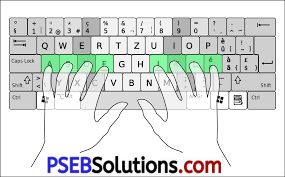
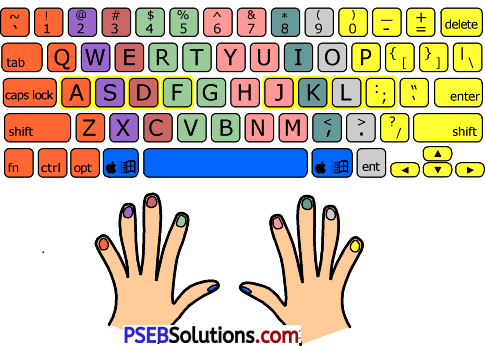
In home-row, …………… key is pressed with the little finger of left hand,
(a) A
(b) S
(c) D
(d) F.
Answer:
(a) A

PSEB 7th Class Computer Solutions Chapter 1 Typing Tutor

Question 3.
In home row, ……………. key is pressed with Middle finger of right hand.
(a) J
(b) K
(c) L
(d) ;
Answer:
(b) K

Question 4.
In second row, ………………. key is pressed with ring finger of left hand.
(a) Q
(b) W
(c) E
(d) R.
Answer:
(b) W

Question 5.
In third row, …………….. key is pressed with the index finger of right hand.
(a) B
(b) N
(c) M
(d) M, N.
Answer:
(d) M, N.

PSEB 7th Class Computer Solutions Chapter 1 Typing Tutor

2. Very Short Answer Type Questions

Question 1.
For typing purpose, a keyboard can be divided in how many parts?
Answer:
The keyboard for typing is divided into two parts. The first part is on the left side and the second part is on the right side.

Question 2.
Write the name of the technique for typing with all fingers without looking at the keyboard.
Answer:
Touch typing technology allows us to type without looking.

Question 3.
Write the name of any one font.
Answer:
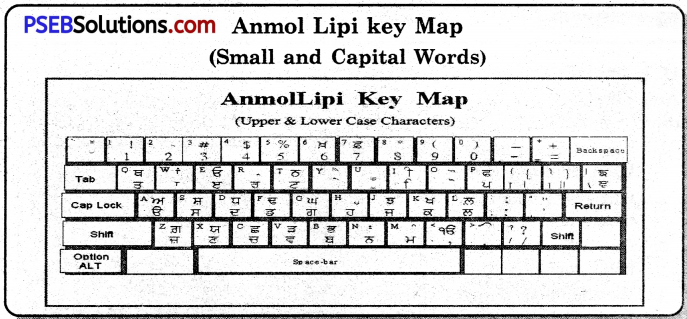
Anmol Lipi font.

Question 4.
Which finger is used to press spacebar during typing?
Answer:
The thumb of your right hand is used to press the space bar key.

Question 5.
Which key is used to go to new line during typing?
Answer:
Enter key is used to move to new line.

PSEB 7th Class Computer Solutions Chapter 1 Typing Tutor

3. Short Answer Type Questions

Question 1.
What is touch typing?
Answer:
This is a technique by which we learn how to type correctly without looking at the keyboard. The keyboard is divided into two parts, left side and right side. Typing is done by placing the fingers on right position accordingly.
PSEB 7th Class Computer Solutions Chapter 1 Typing Tutor 1

Question 2.
Describe the position of our fingers on Home Row Key.
Answer:
The “home row” is the center row of keys on a keyboard. It starts from the alphabet A. The fingers are always rest on this line. The position of the fingers on this row is as follows:
First of all, the fourth finger (little finger) of our left hand is on the ‘A’ key, then third finger on the ‘S’ key, then second finger on the ‘D’ key and then first finger on the ‘F’ key and alternately on the ‘7’ key. The fourth, third, second and first fingers of the right hand should be on ‘L’, ‘K’, ‘J’ and ‘H’ respectively. Thumbs of both hands should be on space bar.
PSEB 7th Class Computer Solutions Chapter 1 Typing Tutor 2

Left Hand
Little/ Pinky Finger A
Ring Finger S
Middle Finger D
Index Finger F & G
Right Hand
Little/ Pinky Finger ;
Ring Finger L
Middle Finger K
Index Finger J & H

PSEB 7th Class Computer Solutions Chapter 1 Typing Tutor

Question 3.
What are the tips to improve typing speed?
Answer:
Typing speed can be increased by keeping the following in mind:

PSEB 7th Class Computer Solutions Chapter 1 Typing Tutor 3

    • Concentrate in consistently, comfortably and correctly typing.
    • The position of our hands I fingers should always be on the home-row We should always start from this position and come back to the saine position. We should move from the home-row position to other keys.
    • As we press each key, we should repeat that letter in our mind.
    • We should focus on pressing the right key rather than speed. Speed will increase automatically with time and practice.
    • Do not look at the keyboard.

Question 4.
While typing numbers from numeric keypad, which hand we should use? Explain the position of your fingers on numeric keypad
Answer:
The numeric keypad is located on the right hand side of the keyboard and has a total of 17 keys. They act as a calculator. While using the numeric keypad Num lock key must be turned on. Use the right hand when typing numbcon the numeric keypad.
PSEB 7th Class Computer Solutions Chapter 1 Typing Tutor 4
The position of the fingers on the numeric keypad is as follows:

      • The thumb of the right hand is on the ‘0’
      • On the first finger of the right hand ‘4’
      • The second finger of the right hand on the ‘5’ The third finger of the right hand on the ‘6’

PSEB 7th Class Computer Solutions Chapter 1 Typing Tutor

4. Long Answer Type Questions

Question 1.
Explain the proper posture while typing.
Answer:

      • The computer monitor should be in front of our eyes.
      • Our focus should be on the monitor.
      • Our fingers should be on the home-row keys.
      • We should sit straight and in front of the keyboard.
      • We should quickly press each key and return to the home- row position.
      • Our feet should be straight on the ground.
        PSEB 7th Class Computer Solutions Chapter 1 Typing Tutor 5

Question 2.
Explain Following Keys
(a) Enter key
(b) Backspace key
(c) Shift key Answer:
Answer:
(a) Enter Key: This key is used to move to a new line. We use the smallest finger of our right hand to press the Enter
PSEB 7th Class Computer Solutions Chapter 1 Typing Tutor 6
(b) Backspace key:
This key is used to delete a character to the left of the cursor. We use the little finger of our right hand for this.

(c) Shift Key:
This key is located on both side of the keyboard. It is used to write capital letters. If you want to type a capital letter with your left hand, press the shift key with the fourth finger of your right hand similarly, to write a capital letter with the right hand, press the shift key with the fourth finger of the left hand.
PSEB 7th Class Computer Solutions Chapter 1 Typing Tutor 7

PSEB 7th Class Computer Guide Typing Tutor Important Questions and Answers

PSEB 7th Class Computer Solutions Chapter 1 Typing Tutor

Question 1.
Type master is used for learning,
(a) Programming
(b) Computer
(c) Printing
(d) Typing.
Answer:
(d) Typing.

Question 2.
Keyboard is divided into sections.
(a) Three
(b) Four
(c) Two
(d) Five.
Answer:
(b) Four

Question 3.
The numeric pad is on the side.
(a) Right
(b) Left
(c) Upper
(d) Lower.
Answer:
(a) Right

Question 4.
The key is on both sides of the keyboard.
(a) Function
(b) Special
(c) Arrow
(d) Shift.
Answer:
(d) Shift.

PSEB 7th Class Computer Solutions Chapter 1 Typing Tutor

2. True/False

Question 1.
The typemaster helps to improve the typing speed.
Answer:
True

Question 2.
In touch typing we can type without touching the keyboard.
Answer:
False.

Question 3.
The numeric pad is on the right side of the keyboard.
Answer:
True

Question 4.
Text is typed with a numeric pad.
Answer:
False.

Question 5.
Shift key is only one.
Answer:
False.

PSEB 7th Class Computer Solutions Chapter 1 Typing Tutor

3. Short Answer Type Questions

Question 1.
Write instructions for keyboard expertise.
Answer:

  • Do not press the keys too quickly.
  • Press the keys evenly and equally.
  • Make it a habit to press the keys lightly.
  • After typing each word, press the space bar with the thumb of your right hand.
  • Your eyes, hands and brain need to be in perfect balance as you type.

Question 2.
What is a type master?
Answer:
Type master is a program that helps you learn to type and improve your speed. It helps us to type without looking at the keyboard.

Question 3.
What is numeric keypad?
Answer:
The numeric keypad is located on the right hand side of the keyboard and has a total of 17 keys. They act as a calculator. While using the numeric keypad Num lock key must be turned on. Use the right hand when typing numbers on the numeric keypad.

PSEB 7th Class Computer Solutions Chapter 1 Typing Tutor

Question 4.
What is a shift key?
Answer:
This key is located on both side of the keyboard. It is used to write capital letters. If you want to type a capital letter with your left hand, press the shift key with the fourth finger of your right hand similarly, to write a capital letter with the right hand, press the shift key with the fourth finger of the left hand.

Question 5.
State the position of the fingers on the second row.
Answer:
The keys on the above line of the home row are called the keys on the second line. It starts with the letter Q’. Turn the fourth finger (little finger) of your left hand on the ‘Q’ key, the third finger on the ‘W’ key, the second finger on the ‘E’ key and the first finger on the ‘R’ key or the “T” key. Similarly, place the fourth finger of the right hand on the ‘P’ key, the third finger on the ‘O’ key, the second finger on the T key and the first finger on the ‘U ’or‘ Y ’key alternately.

PSEB 7th Class Computer Solutions Chapter 1 Typing Tutor 9

Left Hand
Little/ Pinky Finger Q
Ring Finger W
Middle Finger E
Index Finger R & T
Right Hand
Little/ Pinky Finger P
Ring Finger O
Middle Finger I
Index Finger U & Y

4. Long Answer Type Questions

Question 1.
Give some instructions for keyboard mastery.
Answer:
Typing speed can be increased by keeping the following in mind:
PSEB 7th Class Computer Solutions Chapter 1 Typing Tutor 10

      • Concentrate in consistently, comfortably and correctly typing.
      • The position of our hands I fingers should always be on the home-row We should always start from this position and come back to the saine position. We should move from the home-row position to other keys.
      • As we press each key, we should repeat that letter in our mind.
      • We should focus on pressing the right key rather than speed. Speed will increase automatically with time and practice.
      • Do not look at the keyboard.

PSEB 7th Class Computer Solutions Chapter 1 Typing Tutor

Question 2.
Write a note on shift key.
Answer:
Shift Key:
This key is located on both side of the keyboard. It is used to write capital letters, If you want to type a capital letter with your left
hand, press the shift key with the fourth finger of your right hand. Similarly, to write a capit.al letter with the right hand, press the shift key with the fourth finger of the left hand.

Question 3.
State the position of the fingers on the fourth row.
Answer:
Fourth Row:
The fourth row corresponds to the numeric keys. Be careful while typing the numbers. Our fingers should be on the home row. To type the numbers 100 correctly, it is recommended to press the numeric key with the corresponding finger and then bring it back to the home row, If all work is related to numbers, keep your fingers on the fourth line.
PSEB 7th Class Computer Solutions Chapter 1 Typing Tutor 11

Left Hand
Little/ Pinky Finger Z
Ring Finger X
Middle Finger C
Index Finger V & B
Right Hand
Little/ Pinky Finger /
Ring Finger .
Middle Finger ,
Index Finger M & N

PSEB 7th Class Computer Solutions Chapter 1 Typing Tutor

Question 4.
Write in detail about the special keys of the key board.
Answer:
Special Keys on Keyboard:
The special keys of the keyboard are as follows:
1. Enter Key:
This key is used to move to a new line, We use the smallest finger of our right hand to press the Enter key.

2. Space Bar: The space-bar key is used 1.0 leave a space in two words. We use our thumb to press the space key.

3. Shift Key:
This key is located on both side of the keyboard. It is used to write capital letters. If you want to type a capital letter with your left hand, press the shift key with the fourth finger of your right hand. Similarly, to write a capital letter with the right hand, press the shift key with the fourth finger of the left hand.

4. Backspace:
This key is used to delete a character to the left of the cursor. We use the little finger of our right hand for this.

5. Caps lock Key:
If the whole word, line or paragraph is to be written in capital letters, keep the Caps Lock Key in ON position. We use the little finger of our left hand for this.

PSEB 7th Class Computer Solutions Chapter 1 Typing Tutor

Question 5.
What are some ways to avoid stress and mistakes while typing on the computer?
Answer:
How to Avoid the Stress of Typing:
Stress and mistakes while typing on computer can be avoided as follows.

  • Set your keyboard so that it is straight and slightly raised at the back. Do not keep your keyboard tilted downwards.
  • Sit properly in front of your computer. Our screen should be two feet away from u and our copy should be in front of our eyes.
  • Stretch your arms before starting work and also during intervals and strengthen your arms with exercise.
  • We should re-st our wrists when we are not typing.
  • When typing, keep your wrists straight and bend your elbows at a 90 degree angle. Our wrists should not rest on the table while typing.
  • If sitting on a chair, our knees are bent 90 degrees and our feet are straight on the ground, then the height of our chair is perfect.
  • Exercise daily. This helps our body avoid stress after typing.
  • Rest for a short time instead of a large interval while typing.

PSEB 10th Class Physical Education Solutions Chapter 2 Balanced Diet

Punjab State Board PSEB 10th Class Physical Education Book Solutions Chapter 2 Balanced Diet Textbook Exercise Questions and Answers.

PSEB Solutions for Class 10 Physical Education Chapter 2 Balanced Diet

Very Short Answer Type Questions

Question 1.
What are the various functions of the Food?
Answer:
Whatever the food we take, it performs so many functions after digestion and absorption. The functions of foods are as under:
1. It helps for the growth and development of the body. Food helps us in the development of the various organs of our body.

2. Provide strength. It gives us the strength to do various activities. To perform these activities the power comes from the food.

3. Produce energy in our bodies. When the food after absorption mixes with the oxygen which we inhale, produces energy in our body. This energy is very necessary for us. We cannot live without energy.

4. Construct new cells and repair old ones. Food repairs the broken cells and also produces new cells due to the activities of our body. So many cells destroy and much of them are broken. It is the food which creates new cells.

5. Prevent diseases. Food is to human-machine what petrol is to an automobile. It creates strength in our body which enables us to fight against diseases

Question 2.
What is food? Why we take food?
Answer:
Food is such type of material which produces blood in our body.

  1. Formation of new cells.
  2. Food supplies energy to body.
  3. Food supplies heat to body.
  4. Food helps in growth and development of body.

PSEB 10th Class Physical Education Book Chapter 2 Balanced Diet

PSEB 10th Class Physical Education Solutions Chapter 2 Balanced Diet

Question 3.
What are vitamins? Why are vitamins needed for our body?
Answer:
Vitamins are such chemical materials which help our body for proper growth and development. By now many vitamins have been discovered but the most prominent of all these are vitamins A, B, C, D and K.

Need of Vitamins to Our Body:

  • Vitamins maintain our health.
  • Vitamins help in the growth and development of our body.
  • Vitamins increase appetite.
  • Vitamins purify our blood and increase blood in our body.
  • Vitamins strengthen the bones and teeth.
  • Vitamins help us to create immunity in our body.
  • Vitamins cure the skin diseases.
  • Vitamins provide energy to our body.

Question 4.
What is Calorie?
Answer:
Calorie. The smallest unit to measure food constituents is called a calorie.

Short Answer Type Questions

Question 1.
What are various types of vitamins? Describe their functions and their sources.Write down the sources and advantages of the following vitamins A, B, C, D and K.
Answer:
Vitamins. By now many vitamins have been discovered, but the most prominent of all these are vitamins A, B, C, D, E and K. The details about the sources and functions of various vitamins have been given below:

1. Vitamin A:
The following are the functions of vitamin A:

  • It improves eyesight.
  • It increases appetite.
  • It keeps digestive function normal.
  • It helps in the development and strengthening of body.
    PSEB 10th Class Physical Education Solutions Chapter 2 Balanced Diet 1

Harms due to Lack of Vitamin A:

  • The lack of vitamin A causes night blindness.
  • The skin becomes dry.
  • Nose, throat, eyes and skin become more prone to infectious diseases.
  • The body becomes weak and its development stops.
  • The lungs get weakened.

Sources:
It is available in plenty in milk, curd, butter, cheese, egg, fish, fresh vegetables such as spinach, carrot, cabbage and tomato, orange, mango, papaya, fig, etc.

2. Vitamin B:
The following are the functions of vitamin B:

  • It regulates Nervous System and keeps it normal.
  • It energizes nerves, muscles, heart and brain.
  • It stimulates appetite.
  • It gives protection against skin diseases.
    PSEB 10th Class Physical Education Solutions Chapter 2 Balanced Diet 2

Harms due to Lack of Vitamin B:

  • One feels less appetite.
  • The development of children stops.
  • One is afflicted with a disease called beri-beri and skin diseases.
  • One develops blisters on the tongue.
  • The hair begins to fall off.

Sources:
It is available in milk, curd, butter,cheese, whole pulses, cereals, soyabean, peas, eggs, leaves of green vegetables, cabbage, onion, spinach, tomato, salad, etc.

3. Vitamin C:
The functions of vitamin C are:

  • It purifies the blood.
  • It strengthens teeth.
  • It helps in the % rapid recovery of fractured bones.
  • It protects the body against diseases.
  • It saves throat from several diseases.
  • It protects one from bad cold, etc.
    PSEB 10th Class Physical Education Solutions Chapter 2 Balanced Diet 3

Harms due to Lack of Vitamin C:

  • One is afflicted with such teeth diseases as pyorrhoea.
  • The bones get weakened.
  • Wounds do not heal quickly.
  • One suffers from anaemia.
  • Bleeding does not stop quickly.

Sources:
It is found in orange, lemon, malta, pomegranate, guava, amla, etc. In addition to these, it is available in green vegetables, tomato, cabbage, carrot, spinach, etc. ,

4. Vitamin D:
The functions of vitamin D are :
1. It helps in the formation of bones and teeth.
2. It strengthens bones and teeth.
3. It is needed most for the growth of children. Vitamin D we get from sun.
Sources
It is found in milk, egg yolk, butter, ghee, cod liver oil, etc. It forms itself in the rays of the sun.
PSEB 10th Class Physical Education Solutions Chapter 2 Balanced Diet 4

Harms due to Lack of Vitamin D:

  • Bones become weak.
  • The teething of childern gets delayed.
  • One is afflicted with such diseases as epilepsy, hysteria and rickets.
  • Muscles become weak.

5. Vitamin E:
The functions of vitamin E are

  • It increases the reproduction power.
  • It prevents impotency in men and infertility in women.PSEB 10th Class Physical Education Solutions Chapter 2 Balanced Diet 5

Harms due to lack of Vitamin E:

  • Boils are formed on the skin.
  • One is afflicted with infertility

Sources:
It is available in cabbage, carrot, salad, peas, onion, tomato, cauliflower. In addition to these, it is found in honey, wheat, rice, egg yolk, almond, pistachis, gram pulse, etc.

6. Vitamin K:
The functions of Vitamin K are as follows:

  •  It stops blood flow from cuts.
  •  It helps in blood clotting.
  •  It saves one from skin diseases.
    PSEB 10th Class Physical Education Solutions Chapter 2 Balanced Diet 6

Harms due to lack of Vitamin K:

  • The process of blood clotting gets stopped.
  • One is afflicted with some skin diseases.

Sources: It is found in cabbage, spinach, fish, soyabean, tomato and egg yolk.

PSEB 10th Class Physical Education Solutions Chapter 2 Balanced Diet

Question 2.
Why carbohydrates and Fats are essential for us?
Answer:
Carbohydrates:
Carbohydrates provide heat and energy to the body. Indians, in general, compensate 70-80% of their food with this compound.

Sources:
Carbohydrates are available in wheat, rice, barley, maize, millet, jaggery, sugar, potatoes, etc.
Advantages of Carbohydrates.

  • Carbohydrates provide heat and energy to the body.
  • They help in digesting fat.
  • They cleanse intestines and liver.
    PSEB 10th Class Physical Education Solutions Chapter 2 Balanced Diet 7

Harms Due to Lack of Carbohydrates:

  • As a result of the lack of Carbohydrates, blood loses its alkaline nature, and becomes more acidic. In such a condition, a person may become unconscious. In such a condition due to hunger one may get diabetes.
  • Intestines are not cleaned properly.
  • As a result of lack of carbohydrates, fats remain undigested in the body.
  • As a result of lack of carbohydrates acidic elements in the liver get cleansed, and it is harmful to the body.
  • A person becomes very weak and may die in case there is excess or lack of carbohydrates in his food.

Harms due to Excess of Carbohydrates. The excess of carbohydrates causes:

  • fatness
  • high blood pressure
  • joint pains and
  • diabetes.

Proper Quantity. Our food has 50-80% of carbohydrates. 50-60% part of balanced diet consists of carbohydrates. A normal person should have 400 to 700 gms. of carbohydrates in his daily food.

Fats – Fats are of two types:
1. vegetable fats
2. animal fats
PSEB 10th Class Physical Education Solutions Chapter 2 Balanced Diet 8

Sources:

  • Vegetable Fats. These are available in almonds, walnuts, soyabeans, groundnuts, coconut oil, mustard, etc.
  • Animal Fats. These are available in ghee, butter, milk, meat, fish, egg, etc.

Advantages:

  • It provides energy to the body.
  • It keeps the body temperature stable.
  • It protects all parts of the body against external injuries.
  • It keeps in reserve vitamins A, D and K according to the needs of the body.

Harms due to the Lack of Fats:
The body suffers in the following ways in case there is lack of fats :

  • Skin becomes dry.
  • The deficiency of vitamins A, D and K follows.
  • The skin goes dry because of the lack of acids of fat.

Harms due to the Excess of Fats:
The excess of fats in one’s food also proves to be harmful in the following ways:

  • One suffers from obesity.
  • Heart diseases are caused.
  • Digestion weakens.
  • One suffers from diabetes.
  • Stones may form in the abdomen.

Proper Quantity:
A normal person should have 50 to 75 gms of fats in his daily food.

PSEB 10th Class Physical Education Solutions Chapter 2 Balanced Diet

Question 3.
Why different mineral salts are necessary for our body?
Answer:
Mineral Salts. Our body has 4% of minerals and salts. Phosphorus, calcium, sodium, chlorine, potassium, magnesium
PSEB 10th Class Physical Education Solutions Chapter 2 Balanced Diet 9
Sources:
Minerals and salts are available in green vegetables, green fruit, meat, milk. Milk has less amount of iron, but it has all other minerals.
Advantages

  • Minerals strengthen our teeth and bones.
  • They help in the development of muscular tissues.
  • They make the blood red.
  • Calcium helps in blood clotting,
  • Minerals help in the proper functioning of all parts of the body.

Harms due to Lack of Minerals:

  • The lack of calcium causesthe weakening of teeth and bones.
  • Body loses its power of resistance to diseases.
  • The lack of iodine is the cause of goitre in the body.

1. Calcium and Phosphorus:
These minerals are found in abundance in milk, curd, cheese, eggs, fish, meat, vegetables, fresh fruit, pulses, almonds, etc. They are helpful in the growth of body. They help in formation of teeth and bones. The are useful to heart and brain.

2. Iron:
Iron is available mostly in green vegetables, fruit, cereals, eggs and meat. It helps in producing new iron and stimulates hunger. It cleanses blood.

3. Sodium:
It is generally available in lady fingers, fig, coconut, salt, radish, carrot, turnip, etc. It removes many diseases of stomach and kidneys.

4. Potassium:
It is available in pear, coconut, lemon, fig, cabbage, radish, etc. It nourishes liver and heart, and removes constipation.

5. Iodine:
It is availablein sea fish, sea salt, onion, garlic, tomato, apple, spinach, carrot and milk, etc. It gives energy and increases body weight. Lack of Iodine cause Goitre disease.

6. Magnesium:
It is available mostly in orange, fig, tomato, wheat, spinach, malta, etc. It prevents skin diseases and strengthens muscle’s.

7. Sulphur:
It is available in plenty in onion, radish, cabbage, cauliflower. It helps in increase of nails and hair. It cleanses skin.

8. Chlorine:
It is available in plenty in onion, spinach, radish, carrot, cabbage and tomato. It excretes waste products from the body. It cleanses the body.

PSEB 10th Class Physical Education Solutions Chapter 2 Balanced Diet

Question 4.
Write a note on the following :
A. Balanced diet
B. Proteins
C. Water
Answer:
A. Balanced Diet:
Food, nutritious elements, the need of food, all relate to nutrition. The science deals with our food, its related customs, traditions and our mental attitude or feelings.Balanced Diet. Balanced diet is the diet which has all the nutrients in right proportion, and which is capable of fulfilling all the needs of the body.

It should have all nutrients like carbohydrates, proteins, fats, vitamins, minerals, salts and water in proper proportion. Such a diet needs to be taken for the proper development of body, protection from diseases and good health. No single item of food is balanced diet in itself. Only milk is an exception, as it has got almost all nutrients.
PSEB 10th Class Physical Education Solutions Chapter 2 Balanced Diet 10

B. Proteins:
Proteins. Protein is a complex compound consisting of carbon, hydrogen, oxygen, sulphur, phosphorus and nitrogen. It is of two kinds-vegetable protein and animal protein.
Sources

  • Vegetable Protein-It is availably in soyabeans, groundnuts, cashew-nuts, pistachio, walnuts, wheat, millet, maize, etc.
  • Animal Protein-It is available in meat, fish, egg, cheese, etc.
    PSEB 10th Class Physical Education Solutions Chapter 2 Balanced Diet 11

Advantages of Protein:

  1.  It ensures physical growth and development
  2.  It repairs broken tissues
  3.  It keeps the body temperature normal
  4.  It produces energy in case there is lack of the quantity of carbohydrates or fats in the body.

Harms due to lack of Proteins:
The body catches the following diseases due to lack of proteins:

1. Kwashiorkor:
This disease is common in children in the age group of 1-3 years in case there is lack of proteins. At first, the child’s legs are affected. Then this disease causes swelling on his face and then the whole body. The skin of the child becomes rough and red. The child becomes irritated.

2. Rickets or Rachitis:
As a result of the lack of proteins children suffer from rachitis. A child affected with this disease looks very thin and weak. Bones are visible through his flesh.

3. Hunger Oedema:
Because of prolonged hunger and lack of protein, the body does not get nourishment, and water gets accumulated in cells, and body appears to be swelled up.

4. Pellagra:
As a result of this disease, one’s skin appears to be rough and dry.

5. Defect of the Livbr:
Liver gets damaged due to the lack of protein in food.

Harms of the Excess of Proteins:
One may suffer from kidney ailments in case of excessive intake of proteins. Blood vessels too get affected, and one begins to have joint pains.

Proper Quantity:
Children in the age group of 1-6 years are in dire need of proteins in large amounts. A normal person should consume 70 to 100 gms. of proteins everyday.

C. Water:
Our body is composed of 2/3rd of water. It is formed of the combination of oxygen and hydrogen. It is as important as air for our body.

Sources:
It is available in pure form in many nutrients also such as milk, fruit and vegetables.
Advantages of Water

  • Water helps in the formation of cells.
  • It carries nourishment to cells. It helps in the excretion of waste products from the body.
  • It helps in digestion of food.
  • It regulates the heat in our body.
  • It helps in mixing nutrients with blood.
  • It keeps the parts and joints of body soft.
  • It ensures blood circulation in the body.

Harms due to Lack of Water in the Body:
There are many harms of drinking less water –

  • The food does not digest properly in case one drinks less water.
  • Liver remains heavy.
  • Constipation is caused.
  • One feels physical fatigue all the time.
  • The body gets weakened.
  • The face turns pale.
  • Waste products in the body do not get excreted properly.
  • One is afflicted with joint pains.
  • Stones are formed in kidneys.

Harms due to Excess of Water:
Water should always be taken in right proportion. Liver remains filled by taking water in excess and one does not feel appetite. If one continues taking water with food, food does not digest properly.
Proper Quantity:
The quantity of water intake varies with season, exercise and food. Normally, 5-6 glasses of water are enough for a normal person.

PSEB 10th Class Physical Education Solutions Chapter 2 Balanced Diet

Question 5.
What is importance of Roughage in food?
Answer:
For our growth and development we take balance diet which must consists all food constituents in proper ratio as carbohydrates, fat, protein, mineral salts, water and vitamins, all these elements are not useful. The waste material, which are to be thrown out, can not excrete and it gets stuck with intestine. Raw vegetables like radish, turnip, flour should not be suited which eating. The unseived flesh works as a cleaning, brush in stomach and intestine. Body remain vigorous. Therefore food should be fibrous.

PSEB 10th Class Physical Education Solutions Chapter 2 Balanced Diet

Long Answer Type Questions

Question 1.
Discuss the various constituents of Balanced diet. Discuss them briefly.
Answer:
Balanced Diet. Balanced diet is the diet which has all the nutrients in right proportion, and which is capable of fulfilling all the needs of the body. It should have all nutrients like carbohydrates, proteins, fats, vitamins, minerals, salts and water in proper proportion. Such a diet needs to be taken for the proper development of body, protection from diseases and good health. No single item of food is balanced diet in itself. Only milk is an exception, as it has got almost all nutrients.
1. Proteins:
Protein is a complex compound consisting of carbon, hydrogen, oxygen, sulphur, phosphorus and nitrogen. It is of two kinds vegetable protein and animal protein.

Sources:
Vegetable Protein. It is available in soyabeans, groundnuts, cashew-nuts, pistachio, walnuts, wheat, millet, maize, etc.Animal Protein. It is available in meat, fish, egg, cheese, etc.

Advantages of Protein:

  1. It ensures physical growth and development
  2. It repairs broken tissue
  3. It keeps the body temperature normal
  4. It produces energy in case there is lack of the quantity of carbohydrates or fats in the body.

Harms due to Lack of proteins:
The body catches the following diseases due to lack of proteins:
(i) Kwashiorkor:
This disease is common in children in the age group of 1-3 years in case there is lack of proteins. At first the child’s legs are affected. Then this disease causes swelling on his face.
PSEB 10th Class Physical Education Solutions Chapter 2 Balanced Diet 12
(ii) Rickets or Rachitis:
As a result of the lack of proteins children suffer from rachitis. A child affected with this disease looks very thin and weak. Bones are visible through his flesh.

(iii) Hunger Oedema:
Because of prolonged hunger and lack of protein, the body does not get nourishment, and water gets accumulated in cells, and body appears to be swelled up.

(iv) Pellagra:
As a result of this disease, one’s skin appears to be rough and dry.

(v) Defect in the Liver:
Liver gets damaged due to the lack of protein in food.

Harms of the Excess of Proteins:
One may suffer from kidney ailments in case of excessive intake of proteins. Blood vessels too get affected, and one begins to have joint pains.

Proper Quantity:
Children in the age group of 1-6 years are in dire need of proteins in large amounts. A normal person should consume 70 to 100 gms. of proteins everyday.

2. Carbohydrates:
Carbohydrates provide heat and energy to the body. Indians, in general, compensate 70-80% of their food with this compound.

Sources:
Carbohydrates are available in wheat, rice, barley, maize, millet, jaggery, sugar, potatoes, etc.
Advantages of Carbohydrates:

  • Carbohydrates provide heat and energy to the body.
  • They help in digesting fat.
  • They cleanse intestines and liver.
    PSEB 10th Class Physical Education Solutions Chapter 2 Balanced Diet 13

Harms Due to Lack of Carbohydrates:

  • As a result of the lack of carbohydrates, blood loses its alkaline nature, and becomes more acidic. In such a condition, a person may become unconscious. In such a condition due to hunger one may get diabetes.
  • Intestines are not cleansed properly.
  • As a result of lack of carbohydrates, fats remain undigested in the body.
  • As a result of lack of carbohydrates acidic elements in the liver get cleansed, and it is harmful to the body.
  • A person becomes very weak and may die in case there is excess of lack of carbohydrates in his food.PSEB 10th Class Physical Education Solutions Chapter 2 Balanced Diet 14

Harms due to Excess of Carbohydrates:
The excess of carbohydrates causes

  • fatness
  • high blood pressure
  • joint pains, and
  • diabetes.

Proper Quantity:
Our food has 50-80% of carbohydrates, 50-60% part of balanced diet consists of carbohydrates. A normal person should have 400 to 700 gms. of carbohydrates in his daily food.

3. Fats:
Fats are of two types:

  • vegetable fats
  • animal fats.

Sources:

  • Vegetable Fats:
    These are available in almonds, walnuts, soyabeans, groundnuts, coconut oil, mustard etc.
  • Animal Fats .
    These are available in ghee, butter, milk, meat, fish, egg, etc.,

Advantages:

  • It provides energy to the body.
  • It keeps the body temperature stable.
  • It protects all parts of the body against external injuries.
  • It keeps in reserve vitamins A, D and K according to the needs of the body.

Harms due to the Lack of Fats:
The bod suffers in the following ways in case there is lack of fats :

  • Skin becomes dry.
  • The deficiency of vitamins A, D and K follows.
  • The skin goes dry because of the lack of acids of fat.

Harms due to the Excess of Fats:
The excess of fats in one’s food also proves to be harmful in the following ways:

  • One suffers from obesity.
  • Heart diseases are caused.
  • Digestion weakens.
  • One suffers from diabetes.
  • Stones may form in the abdomen.

Proper Quantity:
A normal person should have 50 to 75 gms. of fats in his daily food.

4. Mineral Salts:
Our body has 4% of minerals and salts. Phosphorus, calcium, sodium, chlorine.
PSEB 10th Class Physical Education Solutions Chapter 2 Balanced Diet 15
Potassium, magnesium, manganese, iodine and zinc are some prominent minerals.
Sources:
Minerals and salts are available in green vegetables, green fruit, meat, milk. Milk has less amount of iron, but it has all other minerals.
Advantages:

  • Minerals strengthen our teeth and bones.
  • They help in the development of muscular tissues.
  • They make the blood red.
  • Calcium helps in blood clotting.
  • Minerals help in the proper functioning of all parts of the body.

1. Calcium and Phosphorus:
These minerals are found in abundance in milk, curd, cheese, eggs, fish, meat, vegetables, fresh fruit, pulses, almonds, etc. They are helpful in the growth of body. They help in formation of teeth and bones. They are useful to heart and brain.

2. Iron:
Iron is available mostly in green vegetables, fruit, cereals, eggs and meat. It helps in producing new iron and stimulates hunger. It cleanses blood.

3. Sodium:
It is generally available in lady fingers, fig, coconut, salt, radish, carrot, turnip, etc. It removes many diseases of stomach and kidneys.

4. Potassium:
It is available in pear, coconut, lemon, fig, cabbage, radish, etc. It nourishes liver and heart, and removes constipation.

5. Iodine:
It is available in sea fish, sea salt, onion, garlic, tomato, apple, spinach, carrot and milk, etc. It give energy and increases body weight.

6.  Mangesium:
It is available mostly in orange, fig, tomato, wheat, spinach, malta, etc. It prevents skin diseases and strengthens muscles.

7.  Sulphur:
It is available in plenty in onion, radish, cabbage, cauliflower. It helps increase nails and hair. It cleanses skin.

8. Chlorine:
It is available in plenty in onion, spinach, radish, carrot, cabbage and tomato. It excretes waste products from the body. It cleanses the body.

9.  Water:
Our body is composed of 2/3rd of water. It is formed of the combination of oxygen and hydrogen. It is as important as air for our body.

Sources:
It is available in pure form in many nutrients also such as milk, fruit and vegetables.
Advantages of Water

  • Water helps in the formation of cells.
  • It carries nourishment to cells. It helps in the excretion of waste products from the body.
  • It helps in digestion of food.
  • It regulates the heat in our body.
  • It helps in mixing nutrients with blood. .
  • It keeps the parts and joints of body soft.
  • It ensures blood circulation in the body.

Harms due to Lack of Water in the Body:
There are many harms of drinking less water:

  • The food does not digest properly in case one drinks less water.
  • Liver remains heavy.
  • Constipation is caused.
  • One feels physical fatigue all the time.
  • The body gets weakened.
  • The face turns pale.
  • Waste products in the body do not get excreted properly.
  • One is afflicted with joint pains.
  • Stones are formed in kidneys.

Harms due to Excess of Water:
Water should always be taken in right proportion. Liver remains filled by taking water in excess and one does not feel appetite. If one continues taking water with food, food does not digest properly.

Proper Quantity:
The quantity of water intake varies with season, exercise and food. Normally, 5-6 glasses of water are enough for a normal person.

6. Vitamins:
By now many vitamins have been discovered, but the most prominent of all these are vitamins, A, B, C, D, E and K. The details about the sources and functions of various vitamins have been given below :

(i) Vitamin A:
The following are the functions of vitamin A:

  • It improves eyesight.
  • It increases appetite.
  • It keeps digestive function normal.
  • It helps in the development and strengthening of body.PSEB 10th Class Physical Education Solutions Chapter 2 Balanced Diet 16

The lack of vitamin A causes night blindness.

  • The skin becomes dry.
  • Nose, thorat, eyes skin become more prone to infectious diseases.
  • The body becomes weak and its development stops.
  • The lungs get weakened.

Sources:
It is available in plenty in milk, curd, butter, cheese, egg, fish, fresh vegetables such as spinach, carrot, cabbage and ’ tomato, orange, mango, papaya fig, etc.

(ii) Vitamin B:
The following are the functions of Vitamin B –

  •  It regulates nervous system and keeps it normal.
  •  It energizes nerves, muscles, heart and brain.
  •  It stimulates appetite.
  • It gives protection against skin diseases.

Harms due to Lack of Vitamin B:

  • One feels less appetite.
  • The development of children stops.
  • One is afflicted with a disease called beri-beri and skin diseases.
  • One develops blisters on the tongue.
  • The hair begins to fall off.

Sources:
It is available in milk, curd, butter, cheeses, whole pulses, cereals, soyabean, peas, eggs, leaves of green vegetables, cabbage, onion, spinach, tomato, salad, etc.

(iii) Vitamin C:
The functions of vitamin C are :

  • It purifies the blood.
  • It strengthens teeth.
  • It helps in the rapid recovery of fractured bones
  • It protects the body againstdiseases
  • It saves throat from several diseases.
  • It protects one from bad cold Sources, etc.

Harms due to Lack of Vitamin C:

  • One is afflicted with such teeth diseases as pyorrhoea.
  • The bones get weakened.
  •  Wounds do not heal quickly.
  • One suffers from anaemia.
  • Bleeding does not stop quickly.

PSEB 10th Class Physical Education Solutions Chapter 2 Balanced Diet

Sources:
It is found in orange, lemon, malta, pomegranate, guava, amla, etc. In addition to these, it is available in green vegetables, tomato, cabbage, carrot, spinach, etc.

(iv) Vitamin D:
The functions of Vitamin D are :
1. It helps in the formation of bones and teeth.
2. It strengthens bones and teeth.
3. It is needed most for the growth of children.
Sources.
It is found in milk, egg yolk, butter, ghee, cod liver oil, etc. It forms itself in the rays of the sun.
Harms due to Lack of Vitamin D:

  • Bones become weak.
  • The teething of children gets delayed.
  • One is afflicted with such diseases as epilepsy, hysteria and rickets.
  •  Muscies become weak

(v) Vitamin E:
The functions of vitamin E are :

  • It increases the reproduction power.
  • It prevents impotency,in men and infertility in women.

Harms due to Lack of Vitamin E:

  • Boils are found on the skin.
  • One is afflicted with infertility.

Sources:
It is available in cabbage, carrot, salad, peas, onion, tomato, cauliflower. In addition to these, it is found in honey, wheat, rice, egg yolk, almond, pistachio, gram, pulse, etc.

(vi) Vitamin K:
The functions of Vitamin K are as follows :

  •  It helps in blood clotting.
  •  It saves one from skin diseases.

Harms due Lack of Vitamin K:

  •  The process of blood clotting gets stopped.
  • One is afflicted with some skin diseases.

Sources:
It is found in cabbage, spinach, fish, soyabean, tomato and egg yolk.

PSEB 10th Class Physical Education Solutions Chapter 2 Balanced Diet

Question 2.
How many calories should a normal player take?
Answer:
Porper Quantity of Diet for a player –
The following is the proper quantity of diet for a normal player Porper:
PSEB 10th Class Physical Education Solutions Chapter 2 Balanced Diet 17

Question 3.
Milk is a complete diet. Discuss.
Answer:
Milk:
Milk is an ideal and whole food. It has got all the essential nutrients. It has 3.6% fat, 3.4% protein, 4.8% carbohydrates,0. 7% salts and 7.5% water. Milk is given to growing children because it is a complete food. At home patient is also given milk which acts as complete food.For good health milk serves as balanced diet.

All the essential nutrients as portein, carbohydrates, fat, minerals, salts, water,vitamins are available in milk in right proportion. All these nutrients have different functions to perform in our body. Milk is considered to be an ideal food as it has all the essential nutrients including vitamins, though it does not have iron.

Question 4.
Write down important Rule for taking food.
Answer:
Important Rules for Taking Food
We must follow some essential rules if we want to make the best use of the food we eat. These rules are as follows :

  1. Food must be taken at fixed time.
  2. Hands should be properly washed before eating food.
  3. Food must be eaten slowly, and chewed properly.
  4. At the time of taking food one should refrain from reading anything or talking to somebody else.
  5. One should remain cheerful. One should stop worrying.
  6. Food should be taken when one is hungry.
  7. Food must be taken according to need. Neither should it betaken less nor in excess.
  8. Fried eatables are not easily digested. So fried things should be used sparingly.
  9. Stale or bad food is harmful to health.
  10. Rest for some time after taking noon-time food (lunch) is beneficial to health.
  11. Food should be taken 2 hours before one goes to bed. It is harmful to sleep immediately after taking dinner.
  12. Doing exercise immediately after taking food is harmful.
  13. One should avoid taking cold water immediately after taking food.
  14. Teeth should be properly rinsed and brushed after taking meal, otherwise small pieces of food remain stuck in bet ween teeth, and one suffers from many tooth diseases and bad odour.
  15. The place where one takes food should be clean.
  16. Extremely hot and spicy food is harmful to health.
  17. Food should be kept covered.
  18. There should be variety in food items.
  19. Excessively sweet or sour things should be avoided.
  20. Water should always be taken during the taking of one’s meal.
  21. Food should be properly cooked.

PSEB 10th Class Physical Education Solutions Chapter 2 Balanced Diet

Question 5.
Why do we cook food? What are the various methods of cooking food?’Discuss which is the best.
Answer:
Need for Cooking Food. Properly cooked food is useful for health, Food must be cooked properly. If food is over-cooked, it loses some essential nutrients like vitamins C and D. Food must be cooked for the following reasons:

  • Properly cooked food becomes easily digestible.
  • By cooking food disease germs get killed.
  • Cooked food is tasty. One feels like eating it.
  • We can preserve the cooked food for long.

Methods of Cooking Food:
The following methods for cooking are generally followed :

  • Boiling
  • Cooking with steam
  • Roasting
  • Frying.

These methods are explained in brief below :
1. Boiling:
In this method, food articles are cooked by boiling in water. But essential vitamins and mineral salts dissolve in water
and are lost in this method of cooking. A little quantity of water should be used in boiling eatables. If water used in boiling is excessive, it should not be thrown. Rice, pulses, meat and vegetables are cooked by boiling.

2. Cooking with Steam:
Food is also cooked with steam. Essential nutrients do not lost in cooking by this method. The food cooked in a steam cooker is nutritious and beneficial to health. So, this method is considered to be better than other methods.

3. Roasting:
In this method, food is directly roasted on the fire. Excessive roasting also destroys essential nutrients. The roasted meat is tasty and easily digestible.

4. Frying:
There are many food items such a ‘pakora’, ‘samosa’ and “puriran” which are fried. Food is cooked very soon by frying. But essential nutrients also lost in this method. Moreover, fried food is not easily digestible, and is often harmful to one’s health. Best Method. Of all the methods of cooking, cooking with steam is the best. The food cooked in this way does not lose essential nutrients, and it is very beneficial to one’s health.

PSEB 7th Class Science Solutions Chapter 1 Nutrition in Plants

Punjab State Board PSEB 7th Class Science Book Solutions Chapter 1 Nutrition in Plants Textbook Exercise Questions and Answers.

PSEB Solutions for Class 7 Science Chapter 1 Nutrition in Plants

PSEB 7th Class Science Guide Nutrition in Plants Textbook Questions and Answers

1. Fill in the Blanks:

(i) The process of obtaining and utilization of food by an organism is called ……………..
Answer:
nutrition

(ii) ………………. from the air is taken in through the tiny pores called stomata present on the surface of leaves.
Answer:
Carbon dioxide

(iii) ……………… is the initial product of photosynthesis.
Answer:
glucose (Carbohydrate)

PSEB 7th Class Science Solutions Chapter 1 Nutrition in Plants

(iv) The plants which depend on the food produced by other plants are called ………………..
Answer:
heterotrophs

2. State True or False:

(i) Carbohydrates is not an essential component of food.
Answer:
False

(ii) All green plants are autotrophs.
Answer:
True

(iii) Euglena is an organism that has both plant and animal like characters.
Answer:
True

(iv) Sunlight is not necessary for photosynthesis.
Answer:
False

3. Match the Column ‘A’ with Column ‘B’:

Column ‘A’ Column ‘B’
1. Agaricus (a) Parasite
2. Rhizobium (b) Feaves
3. Chlorophyll (c) Feguminous plants
4. Cuscuta (d) Saprophyte

Answer:

Column ‘A’ Column ‘B’
1. Agaricus (d) Saprophyte
2. Rhizobium (c) Leguminous plants
3. Chlorophyll (b) Leaves
4. Cuscuta (a) Parasite

4. Choose the Correct Answer:

Question (i)
An Organism that fixes atmospheric nitrogen in the soil is :
(a) Amarbel
(b) Mushroom
(c) Rhizobium
(d) Chlorophyll
Answer:
(c) Rhizobium.

PSEB 7th Class Science Solutions Chapter 1 Nutrition in Plants

Question (ii)
The Organisms that cannot prepare their own food and depends on others for food are known as :
(a) Autotrophs
(b) Fleterotrophs
(c) Nutrients
(d) Minerals
Answer:
(b) Heterotrophs.

Question (iii)
Food factory of the plants is :
(a) Leaf
(b) Stem
(c) Root
(d) Flower
Answer:
(a) Leaf.

Question (iv)
Which of the following is a saprophyte ?
(a) Rhizobium
(b) Agaricus
(c) Cuscuta
(d) Protein
Answer:
(c) Cuscuta.

5. Very Short Answer Type Questions:

Question (i)
Define Nutrition.
Answer:
Nutrition. The act of obtaining and using food by the organism is called nutrition. Not all living things have the same food.

Question (ii)
What is photosynthesis ?
Answer:
Photosynthesis. It is a process in which food (carbohydrates) is produced by the plants. During this process, carbon dioxide and water are synthesized into glucose (simple carbohydrates) in the presence of sunlight by plant’s green matter (chlorophyll pigment).
Through this action green plants convert light energy into chemical energy.
Chemical Equation :
PSEB 7th Class Science Solutions Chapter 1 Nutrition in Plants 1

Question (iii)
Name the raw materials required for photosynthesis.
Answer:
Ingredients for photosynthesis :

  1. Carbon dioxide
  2. Water
  3. Solar Energy

Question (iv)
What are insectivorous plants ?
Answer:
Insectivorous plants. Plants that have a system for catching and digesting organisms are called insectivorous plants, such as pitcher plant. The leaves of these plants are transformed into pot compositions to catch insects.

6. Short Answer Type Questions:

Question (i)
What do you mean by parasitic mode of nutrition ?
Answer:
Parasitic Nutrition. Nutrition in which the parasitic organism harms another organism and derives its food from it is called parasitic nutrition.

PSEB 7th Class Science Solutions Chapter 1 Nutrition in Plants

Question (ii)
Explain symbiotic relationship.
Answer:
Symbiotic relationship. Two different organisms co-exist with each other and depend on each other for their nourishment, then it is called symbiotic relationship. In this kind of relationship both the beings get benefit from each other. Like the fungus found on the roots of many plants. The fungus gets nourishment from the roots of the plant and in turn absorbs water and minerals from the soil. Fungus and moss are a good example of symbiotic relationship. Here the fungi absorb water from the earth and in turn the algae provide food through photosynthesis.

Question (iii)
How does the pitcher plant catch insects ?
Answer:
PSEB 7th Class Science Solutions Chapter 1 Nutrition in Plants 2
The pitcher plant transforms its leaves into pot-like structures to catch insects. This pot-like creation has curly hair on the face. When an insect sits on it, it slips down and cannpt climb up again and falls to the bottom of the pot. The enzymes present at the bottom digest the insect.

7. Long Answer Type Questions:

Question (i)
How are nutrients replenished in the soil ?
Answer:
Regain of nutrients by soil. Plants continue to absorb water, minerals and other nutrients from the soil which leads to lack of nutrients in the soil. Time to time nutrition should be provided to the soil so that the fertility of the soil is maintained. Farmers usually recreate these nutrient deficiencies by mixing manure in the soil and Fertilizers (which contain one or more preservatives) to fulfil nutrients.
In forest the forest waste, leaves and animal waste is decomposed by decomposers into nutrients to improve fertility of the soil.

Question (ii)
What do you mean by nutrients ? Explain various modes of nutrition in plants.
Answer:
Nutrients. Carbohydrates, fats, proteins, vitamins and minerals are the main components of food. They help in the formation and function of the body and are called nutrients.

The main methods of nutrition in plants are :
(a) Autotrophic Nutrition. Those who prepare their own food from simple foods are called Autotrophs. This process of preparing food by such plants is called Autotrophic nutrition. All green plants are Autotrophic. In this method, chlorophyll, a green pigment present in plants, takes carbon dioxide and water from the air and makes food in the form of carbohydrates in the presence of solar energy. This action is called photosynthesis. Example-all green plants.

(b) Heterotrophic Nutrition. Some plants do not have green pigment (chlorophyll) and cannot make their own food, so they rely on food prepared by other plants for food. Such plants are called Heterotrophic plants and this method of obtaining food is called Heterotrophic nutrition. Example. Amar Bel.

PSEB Solutions for Class 7 Science Nutrition in Plants Important Questions and Answers

1. Fill in the Blanks:

(i) Green plants are called …………….. since they synthesise their own food.
Answer:
Autotrophs

(ii) The food synthesised by the plants is stored as ………………..
Answer:
Starch

PSEB 7th Class Science Solutions Chapter 1 Nutrition in Plants

(iii) In photosynthesis solar energy is captured by the pigment called …………….. .
Answer:
Chlorophyll

(iv) During photosynthesis plants take ……………… and produce …………….. .
Answer:
Carbondioxide, Oxygen

2. State True or False:

(i) Carbondioxide is released during photosynthesis.
Answer:
False

(ii) Plants which synthesise their food themselves are called saprotrophs.
Answer:
False

(iii) The product of photosynthesis is not a protein.
Answer:
False

(iv) During photosynthesis solar energy is converted into chemical energy.
Answer:
True

3. Match the Column I with Column II :

Column I Column II
(i) Chlorophyll (a) Bacteria
(ii) Nitrogen (b) Pitcher plant
(iii) Amarbel (c) Leaf
(iv) Animals (d) Parasite
(v) Insects (e) Heterotrophs

Answer:

Column I Column II
(i) Chlorophyll (c) Leaf
(ii) Nitrogen (a) Bacteria
(iii) Amarbel (d) Parasite
(iv) Animals (e) Heterotrophs
(v) Insects (b) Pitcher plant

4. Choose the Correct Answer:

Question 1.
The organisms which depend upon other organisms for food are called ……………..
(a) Symbionts
(b) Parasites
(c) Autotrophs
(d) Saprophytes.
Answer:
(b) Parasites.

PSEB 7th Class Science Solutions Chapter 1 Nutrition in Plants

Question 2.
Which part of the plant usually contains stomata ?
(a) Roots
(b) Stem
(c) Leaves
(d) Flower.
Answer:
(c) Leaves.

Question 3.
Which gas is released during photosynthesis ?
(a) Oxygen
(b) Carbon dioxide
(c) Nitrogen
(d) Hydrogen.
Answer:
(a) Oxygen.

Question 4.
What is the unit of living beings
(a) Organ
(b) Organ system
(c) Cell
(d) Tissue.
Answer:
(c) Cell.

Question 5.
What is the ultimate source of energy in the living beings ?
(a) Moon
(b) Sun
(c) Stars
(d) Planet.
Answer:
(b) Sun.

Question 6.
Name one eatable fungus.
(a) Alga
(b) Bacteria
(c) Rhizopus
(d) Mushroom.
Answer:
(d) Mushroom.

Question 7.
Plants breathe through:
(a) Epidermis
(b) Buds
(c) Stomata
(d) Root hairs.
Answer:
(c) Stomata.

Question 8.
What are green coloured thread like structures over the pond water called ?
(a) Fungi
(b) Algae
(c) Amoeba
(d) Paramecium.
Answer:
(b) Algae.

PSEB 7th Class Science Solutions Chapter 1 Nutrition in Plants

Very Short Answer Type Questions

Question 1.
Name the nutrients.
Answer:
Nutrients. Carbohydrates, vitamins, fats, proteins, minerals, roughage.

Question 2.
How do plants synthesise food ?
Answer:
Green plants synthesise their food material using carbondioxide, water and solar energy.

Question 3.
Name the various type of nutrition.
Answer:
Types of Nutrients. Autotrophic, Heterotrophic, Saprotrophic and Parasitic.

Question 4.
What are openings / pores in a leaf known as ?
Answer:
Stomata.

Question 5.
What is function of chlorophyll in a leaf ?
Answer:
Chlorophyll capture the energy of sunlight.

Question 6.
Which is ultimate source of energy for all living organisms ?
Answer:
Sun.

Question 7.
What are products of photosynthesis ?
Answer:
Carbohydrates and oxygen.

Question 8.
Name the various parts of plants which take part in photosynthesis.
Answer:
Green stems and green leaves.

PSEB 7th Class Science Solutions Chapter 1 Nutrition in Plants

Question 9.
Besides green leaves, which other coloured leaves are found in plants ?
Answer:
Deep red, violet or brown.

Question 10.
What is algae ?
Answer:
Algae It is a slimy, green patch found in pond or in stagnant water.

Question 11.
Do algae photosynthesis ? Why ?
Answer:
Yes, algae do photosynthesis as they contain chlorophyll.

Question 12.
From which elements are carbohydrates made up of ?
Answer:
Carbon, hydrogen and oxygen.

Question 13.
Name some four human parasites.
Answer:

  1. Mosquitoes
  2. lice
  3. bed bug
  4. leech.

Question 14.
Write one eatable fungus.
Answer:
Mushrooms.

Question 15.
Where does mould grow ?
Answer:
Moist and rainy areas.

PSEB 7th Class Science Solutions Chapter 1 Nutrition in Plants

Short Answer Type Questions

Question 1.
Write the definite word for the following:
(i) Weak stem parasitic plant.
(ii) A plant in which both Autotrophic nutrition and heterotrophic nutrition are found,
(iii) The holes through which gases are exchanged in the leaves.
Answer:
(i) Amar bel (Cuscuta)
(ii) Pitcher plant
(iii) Stomata

Question 2.
Differentiate autotrophic and heterotrophic nutrition.
Answer:
Differences between autotrophic nutrition and heterotrophic nutrition.

Autotrophic nutrition Heterotrophic nutrition
(1) Organisms prepare their own food by obtaining energy from sun. (1) Organisms obtain ready-made food from other plants or animals.
(2) It occurs in green plants and blue green algae. (2) It occurs in parasitic plants, fungi, most of bacteria and animals.

Question 3.
Why do coloured leaves photosynthesise when they are not green in colour ?
Answer:
Coloured leaves (red, brown etc.) do contain chlorophyll but large amount of red, brown pigment mask the green colour. So, they can photosynthesise.

Question 4.
How do fungus grow on the things ?
Answer:
Spores of fungi are present in air. When they land on wet and warm things, they germinate.

Question 5.
How do lichens show symbiotic relationship ?
Answer:
Lichens, a chlorophyll partner algae and non-green fungus live together. The fungus provides shelter, water and minerals to algae while algae provides food which is synthesised by it. So they both show symbiotic relationship.

PSEB 7th Class Science Solutions Chapter 1 Nutrition in Plants

Question 6.
Explain the parasitic relationship between Rhizobium and plants.
Answer:
PSEB 7th Class Science Solutions Chapter 1 Nutrition in Plants 3
Rhizobium is a bacterium that lives in nodules on the roots of legumes. It converts the nitrogen in the air into a usable form which is used by the plant and in return provides shelter and food to bacteria.

Question 7.
What do you understand by a parasites, saprophytes and symbiosis ? Give one example for each.
Answer:

  • Parasites. Those plants or animals which obtain their food from a host and also get shelter from it, are known as parasites, e.g. Cuscuta and Viscum etc.
  • Symbiosis. It is a type of relationship which is mutually beneficial for both the parents (host and parasite), e.g. Lichens are combination of algae and fungi. The fungus holds the algal cells in its mat of web-like hyphae and in return supplies water and dissolved minerals.
  • Saprophytes. Those organisms which grow on dead and decaying organic matter and obtain their food from decomposed bodies are known as saprophytes, e.g. Bacteria, mushrooms etc.

Question 8.
Distinguish between a parasite and a saprotroph.
Answer:
Differences between a parasite and saprotroph.

Parasite Saprotroph
(1) These organisms depend upon other living organisms for its food.
Example : Cuscuta, tape- worms, roundworms.
(1) These organisms obtain their food from dead organic matter.
Example : Fungi, bacteria.
(2) They produce special type of organs like suckers, hooks to obtain their food. (2) They secrete some enzymes to decompose complex molecules into simple form.

Question 9.
What are the conditions required for Autotrophic nutrition and its basic and by-products ?
Answer:
Photosynthesis is essential for Autotrophic nutrition which requires the following conditions : (1) sunlight (2) chlorophyll (green pigment), (3) carbon dioxide and (4) water.

The by-products of this process are: The basic products of photosynthesis are oxygen gas and glucose. Afterwards glucose is stored in the form of starch.

Long Answer Type Questions

Question 1.
Symbiosis is beneficial for both the partners, justify.
Answer:
PSEB 7th Class Science Solutions Chapter 1 Nutrition in Plants 4
Symbiosis. The type of association in which both the partner’s benefit is called symbiosis.
In plants like lichens, there is an association between green algae and non-green fungus. The fungus forms a mat of web-like hyphae to hold the algal cells. The fungal hyphae supply water and minerals to the algae. The algae can synthesize food for themselves as well as for the fungus.

Football Game Rules – PSEB 10th Class Physical Education

Punjab State Board PSEB 10th Class Physical Education Book Solutions Football Game Rules.

Football Game Rules – PSEB 10th Class Physical Education

Question 1.
Write a note on the FootBall playground, Goal Area, Goal, Penalty Area, Corner Area, Lines, and Ball?
Answer:
Football playground:
The football ground will be rectangular. Its Length is a Minimum of 90 M (100 yards), Maximum of 120 M (130 yards). Width Minimum 45 M (50 yards), Maximum 90 M (100 yards).

International Match. Length: Minimum 100 M (110 yards), Maximum 110 M (120 yards) Width: Minimum 64 M (70 yards), Maximum 90 M (100 yards).

Football image 1

Marking:
The playfield should be marked with distinctive lines. These lines should not exceed five inches in width. Long lines are called touch lines and the short lines the goal lines. At each comer of the playfield a flag post is placed. Such a post should not be less than one yard outside the touch line. A circle shall be drawn in the centre of the field of play with a radius of ten yards.

Goal Area:
At each end of the playfield two lines shall be drawn which shall be at right angles to the goal lines. Each line shall extend upto 10 yards in the field, and shall be joined by a line drawn parallel to the goal line. The space encircled by these lines and the goal lines is called the goal area.

Penalty Area:
Two lines shall be drawn at each comer of the field at right angles to the goal lines. These lines shall be at a distance of 18 yards from each goal post, and shall be joined by a line drawn parallel to the goal line. The space enclosed by these lines and the goal lines is called a penalty area.

Goal Post:
Two posts shall be placed in the centre of goal lines at a distance of 8 yards or 24 feet. Their ends are joined by a crossbar. These are 8 high from the ground. The width and the thickness of goal posts and cross bars should not exceed 5″.

Football image 2

Corner Area:
From the post of each corner flag, a quarter circle, with a radius of one yard, will be drawn inside the playground. On all the four comers of the playfield 3 yard high flags are placed. Two flags are placed on either sides of the centre line outside the ground at a distance of 1 yard. The remaining flags are placed on the corner of the ground.

Ball:
The shape of football is spherical. Its upper part is made of leather or of some other approved material. Its circumference is not less than 68.5 cms and not more than 71 cms. Its weight shall be from 14 to 16 ounces. The ball cannot be changed during the play without the permission of the referee.

Football Game Rules - PSEB 10th Class Physical Education

Question 2.
How many players take part in the game of Foot Ball? Describe the duration of the game, dress, numbers of officials, and goal?
Answer:
Number of players:
A football match is played between two teams. Each team consists of 11 players and 5 extra players. In a match no team is allowed to substitute more than two players. The substituted player is not allowed to take part in the match again.

Dress:
The player can normally wear a shirt or jersey, underpants (knickers), socks and shoes. The colour of the goalkeeper’s shirt or jersey shall be different from that of other players. The shoes are to be worn compulsorily.

Officials:
Among the officials are a referee and two line men. The referee makes the players obey the rules of the game and decides any matter of big dispute. His decision, about what happened in the game and what was the result, is final.

Duration of the Game:
The game is played in two equal durations of 45 minutfes each. An interval of 5 minutes follows the first duration, and of 10 minutes with the consent of the two teams. The start of play. In the beginning of the play the choice of the first kick and the side is made by a toss. The toss winning team is free to choose either side and to kick first.

Score or Goal:
When a ball, according to rules, crosses completely the goal line under the cross bar between the goal posts, a goal is allowed. The team scoring more goals shall be declared the winner. In case, no goal is scored or an equal number of goals are scored, the game shall be termed a draw. But if the tournament is taking place as per league rules, then in case of a draw both the teams shall be awarded 1 point each.

Golden Goal

If the football match ends in draw, the extra time for play will be given of which duration of play will be 15-15 minute each whenever during the period of a goal is scored by a team the match ends there and then. In case there is no result during the play, then 5-5 penalty strokes are made by each team till the winner is decided.

The Ball In and Out of play

The ball is out of play as a result of the following reasons:

  1. If the ball crosses the goal line on the ground or in the air.
  2. When the referee has stopped the game.
  3. When the ball goes out after having touched the goal post, cross bar or comer flag post.
  4. When the ball goes out of the goal line, in the goal posts under the crossbar, provided the ball is not thrown with hand or arm.
  5. When a player played the ball when the ball was at a lesser distance than him from the goal line of his rival.

The ball in the play

The ball remains in the play from the beginning to the end, but when it was in these situations:

  1. If the ball bounces back after having struck the goal post, the crossbar comer and flag.
  2. From a wrong play to the whistling of the umpire.
  3. When the ball strikes the umpire or line man when he is in the playfield.
  4. Till the sound of the whistle from outside the playfield.
  5. The game continues despite any infringement of a rule until the umpire stops the game.

Formation of Players:
The formation of players in football matches varies. Normally, it is 1-2-3-5. But in the European countries it is as follows:

Football image 3

The players continue to change the formation during the play according to the need.

Football Game Rules - PSEB 10th Class Physical Education

Question 3.
What do you understand by off side, Free kick, Throw in, Penalty kick, Corner kick, Goal kick?
Answer:
(1) Off-side:
A player is off-side when he is in the half of his opponents or their goal line, and when there are no two opponents behind him. Even in such cases he is not off side if he is in the following situations:

  1. When he is in his own half of the field of play.
  2. When the ball last touches him or he plays with it.
  3. When he receives the ball from goal kick, throw-in or comer kick or he is thrown down by the referee.
  4. When the ball has been played by the opponent. For the violation of this rule, a free kick will be awarded to the players of the opposing team from the place of offence.

(2) Free Kick:
Free kick is of two types:
Direct kick and Indirect kick. When a player is taking a direct or indirect kick, opposing players should remain at a distance of 10 yards. The direct kick is that from which a goal can be scored direct. Indirect kick is that from which a goal cannot be scored unless the ball has been touched by any other player. In case of violation of this rule, the defensive team is awarded an indirect free kick from the spot of infringement.

(3) Throw-in:
When the ball passes over the touch line, either on the ground or in the air, it is thrown inside from the point where it has crossed the line. One player of the offending team throws the ball inside the playfield from the point where the ball has crossed the line.

The thrower at the time of delivering the ball must face the field. Either of his foot should be on or outside the touch line. The thrower will make use of both of his hands, and throw the ball from behind and over his head. He cannot play the ball until it has been touched or played by any other player.

If the throw-in is not proper, the opposing team takes the throw-in. If the thrower touches the ball before the ball has been touched or played by any other player, the opposing team is awarded a free indirect kick.

(4) Penalty Kick:
This kick is taken from the penalty mark. When it is being taken, only the player taking the kick and the opposing goalkeeper remain in the field of play. This mark will be at least 10 yards away. In order to complete the penalty kick the half time or the full time may be extended.

When a player is taking the penalty kick, the goalkeeper should remain standing at one place in the goal area. The goalkeeper can move after the kick has been taken. If such infringement takes place, the kick will be taken again. If, for some reason, the player taking the penalty kick misses it, then the defender is asked to take the kick from a distance of 16 yards.

If the defending team violates the rules and a goal has not been scored, the kick shall be taken again. In case of infringement of the rule by the opposing team, then the kick shall be taken again even though the goal has been Scored. If the infringement of the law is made by the player taking the kick, a player of the opposing team shall take a free hit on the place of infringement.

(5) Corner kick:
When the ball passes over the goal line and it has last been played by one of the players of the defending team, a member of the offending team is asked to take comer kick. The player of the opposing team takes the comer kick in a quarter area of the nearest flag post. Until the comer kick is taken, the players of the opposing team shall remain away at a distance of 10 yards. The kicker cannot touch the ball until it has been touched or played by another player.

Football image 4

(6) Goal Kick:
When the ball passes over the goal line (not over the goal posts), and it is being played by the opposing team, then the defending team takes the kick outward the penalty area. When the kick is being taken, the players of the opposing team shall remain outside the penalty area. If the ball does not go out of the penalty area and does not reach the playground direct, the kick shall be re-taken. The kicker cannot touch it until it has been touched or played by another player.

Football Game Rules - PSEB 10th Class Physical Education

Fouls and Offences in the Game of Football

(a) If a player intentionally commits the following offences or infringement of rules, the opposing team shall be awarded an indirect free kick from the place of infringement:

  1. Kicks or attempts to kick an opponent.
  2. Jumps, pushes or strikes a blow at an opponent.
  3. Charges an opponent in a violent or dangerous manner.
  4. Charges an opponent from behind.
  5. Holds an opponent or plays by holding on to his clothes.
  6. Hurts or attempts to hurt an opponent.
  7. Obstructs an opponent or throws him by the use of his legs or attempts to throw him.
  8. Pushes an opponent with his hand or any part of his arm.
  9. Holds the ball in his hand.

If a player of the defending team commits any of these offences in the penalty area, the attacking team is given penalty kick.

(b) If a player, commits the following offences, the opposing team shall be awarded an indirect free kick from the place of infringement:

  1. When he plays the ball in dangerous way.
  2. When the ball is away and he charges the other player with shoulder.
  3. While playing, he deliberately obstructs the player of the opposing team.
  4. To attack the goalkeeper, except:
    • When he is obstructing an opponent.
    • When he is holding the ball.
    • When the ball goes out of his goal area.

5. (a) When as a goalkeeper, he takes more than four steps without throwing the ball on the ground.

Football image 5

(b) When as a goalkeeper he indulges in such tactics as hold up a game and waste the time, and tries to give undue advantage to his team.

(c) A player shall be warned that the opposing team shall be awarded an indirect free kick if:

  • he indulges in abuses and plays foul.
  • he misbehaves even on being warned.
  • he plays foul or misbehaves. In that case, the referee can send him off the field for the whole duration of the game.

Football Game Rules - PSEB 10th Class Physical Education

Question 4.
Describe some important Technique of Football?
Answer:
The important Technique of Football

Kicking:
Kicking is a way of moving the ball towards the required direction with the help of feet, with the required speed keeping in view that the ball reaches its destination. In the art of kicking, accuracy, speed, direction and distance are maintained not by left or right foot but by both feet.

The most important point in the training of the players is about the need of playing the game with both feet. It is easy to teach the young new players how to play with both feet. Without it, it is difficult for a player to reach any level of success in the game.

  1. To kick with the inside of feet.
  2. To kick with the outside of feet.

When the ball is kicked within a short distance these two variations are put into use. The ball moves slowly but a great improvement is brought about, as result of which this method is often put into use at the time of aiming towards the goals.

Football image 6

Half Kick:
When the ball comes bouncing to the player or is in the air, there is then a sort of instability not only about its direction of bouncing because of the level of football ground but also about its height and speed. The most effective way of making it clear is the right time, co-ordination of the movements of kicking feet and the raising of the ball upto a proper height.

Football image 7

Over head kick:
This kick is taken with a three-fold purpose

(a) to deflect the ball from the opposing player
(b) to move the ball towards the direction of the kick, and
(c) to turn the ball back towards the direction from where it came. Over-head kick is an improved form of kick, and is generally taken in case the ball is bouncing.

To Make Pass:
The action of making ‘passes’ in football is the basis of team work. The pass increases the co-ordination among the team and adds to the growth of team work. Connected with the condition of the play a ‘pass’ is an evidence of the team play and hence is a basic element for which special time and attention should be given during the training and practice of the team. To achieve perfection at goals a team pass is a right type of kick by an individual player.

It is said that a successful pass is better than kicks. To give pass is an important part of inter-relatedness. It is to harmonize the complex structure of mutual movement between players with individual intelligence at the time of attack and defence during the play. In giving pass, one who makes ‘pass’ the ball and the one who receives the ‘pass’ are involved.

Making passes are normally categorised into long and short passes:

(a) Long passes:
These passes are made use of when there is rapid movement in the game. In such situations long passes prove to be very useful. In such passes, the ball can be moved both sideways and backward. In all long passes, the upper part of the foot or kick is used. The long passes strengthen the defence and facilitate short passes.

(b) Short passes:
Short passes are used for a distance of 15 yards or so, and they are more quick and accurate than long passes.

Push pass:
The use of push pass is made when the opponent is not very near. It is also made to throw the ball in the goal area at a close distance and to throw the ball towards the sides.

Low-pass:
It is shorter than push-pass. In it, the ball is raised high and bounced. It is used to cross the ball over the head of the opponent when he is quite near or is trying to take the throw-ball.

Football Game Rules - PSEB 10th Class Physical Education

The Outer-parts of Feet-Flick or Jab Pass

In contrast to the other two passes, the flick pass is used to flick or push the ball, having turned the feet inward. This type of pass is used to give pass towards the back while keeping the ball in possession and dribbling it.

Trapping:
Trapping is the basis of controlling the ball. The trapping of the ball means preventing the ball from going away from the player. It is not merely an activity of stopping the ball or making it stationary but also an essential technique used to take the ball in firm hold. Stopping the ball is first step of ball control, and the second part which the player brings into practice for his own benefit is also essential.

Note:
The training of traps should be given for
(a) dribbling ball and
(b) bouncing ball.

Football image 8

Trap with the Under-foot:
Such a type of trapping is good if you have no hurry and enough freedom, and nobody is beside you.

Football Game Rules - PSEB 10th Class Physical Education

Trap with Inner Parts of Feet

It is most effective and commonly used trap. Not only does this trap enable a player to trap the ball but also helps him in moving towards any direction. This trap is particularly good for the ball coming from a side or a comer. If the ball comes straight, the body is moved in the direction in which the ball is to go.

Football image 9

Trap with the Outer Part of Foot

It is like the earlier one but it is difficult for in it one has to keep the balance as the weight of the player’s body turns outside and off the centre.

Pet or Chest-trap

When the ball is above the waist and cannot be effectively trapped with feet, it is taken on the abdomen or chest or as it bounces from the ground.

Football image 10

Head-trap

It is meant for those experienced players who are well-versed in the foundation of ‘heading’.

Football image 11

Football Game Rules - PSEB 10th Class Physical Education

Important Information About the Football Game

  • The length of the ground = 100 yards to 130 yards 100 metre to 120 metre
  • The Breadth of the ground = 50 yards to 100 yards 45 meter to 90 metre
  • The shape of football ground = square
  • Number of players in one team = 11 and 5 substitutes
  • Circumference of the ball = 27° to 28°
  • Weight of the ball = 14 Aunce to 18 aunce
  • Duration of the match = 45-45 minutes of two half
  • Interval time = 15 minutes
  • Substitution of players in one match = 3 players
  • Official of the match = One table official, one referee, two line man,
  • Height of the goal post = 2.44 m
  • Height of the corner flag = 5
  • The match is played between two teams. Each team has eleven players. The total number of players in a team are 16, out of which only 11 play. Among these players there is a goalkeeper. 5 players are kept in reserve as substitutes.
  • During the play a team cannot substitute more than two players. A substituted player is not allowed to play again.
  • The duration of the game will be 45-5-45 minutes. The interval will be of 5 minutes.
  • After the interval the teams change their ends/sides.
  • By giving pass to each other on the fixed spot on the centre, line, that players start the game. Ends are decided by toss.
  • One table official, a referee and two line men are officials for the match.
  • The dress of the goalkeeper is different from that of his team.
  • The player should not wear anything which may prove to be dangerous to other players.
  • The game stops when the ball crosses the goal or side line.
  • The referee can ask for the stoppage of the game for some reason.

PSEB 7th Class Science Solutions Chapter 8 Winds, Storms and Cyclones

Punjab State Board PSEB 7th Class Science Book Solutions Chapter 8 Winds, Storms and Cyclones Textbook Exercise Questions and Answers.

PSEB Solutions for Class 7 Science Chapter 8 Winds, Storms and Cyclones

Science Guide for Class 7 PSEB Winds, Storms and Cyclones Intext Questions and Answers

Think and answer (Textbook Page No. 85)

Question 1.
The can gets crushed because of the atmospheric pressure. (True/False)
Answer:
True.

Question 2.
Air exerts pressure. (True/False)
Answer:
True.

PSEB 7th Class Science Solutions Chapter 8 Winds, Storms and Cyclones

Think and Answer (Textbook Page No. 86)

Question 1.
Both balloons should be of equal size. (True/False)
Answer:
True.

Question 2.
The fast moving wind creates …………………. pressure.
Answer:
More.

Think and Answer (Textbook Page No. 87)

Question 1.
The air ……………. on heating.
Answer:
expands.

Question 2.
On cooling the boiling tube, the balloon expands. (True/False)
Answer:
False.

Think and Answer (Textbook Page No. 88)

Question 1.
Hot air is ……………………… than cold air.
Answer:
lighter.

Question 2.
The paper cup over the burning candle comes down as it becomes heavier. (True / False)
Answer:
False.

PSEB 7th Class Science Guide Winds, Storms and Cyclones Textbook Questions and Answers

1. Fill in the blanks:

(i) Air exerts …………………..
Answer:
Pressure

(ii) Moving air is called …………………
Answer:
Wind

PSEB 7th Class Science Solutions Chapter 8 Winds, Storms and Cyclones

(iii) Near earth the …………………. air rises up and ………………………. air comes down.
Answer:
hot, cold

(iv) Winds are generated due to ………………………….. heating of earth.
Answer:
uneven

(v) The centre of a cyclone is called its ………………. .
Answer:
Eye

2. State True or False:

(i) A bicycle tube expands when we fill air in it.
Answer:
True

(ii) Air moves from a region of low pressure to high pressure.
Answer:
False

(iii) The speed of wind can be measured by an instrument called Anemometer.
Answer:
True

(iv) Thunder is a loud sound produced by lightning.
Answer:
True

(v) We should ignore the cyclone warnings.
False

PSEB 7th Class Science Solutions Chapter 8 Winds, Storms and Cyclones

3. Choose the Correct Answer:

Question (i)
Which of the following is not an example of air exerting pressure ?
(a) Flying a kite
(b) Filling air in bicycle tube
(c) Filling air in balloon
(d) Hot air balloon.
Answer:
(d) Hot air balloon.

Question (ii)
Moving air is called ………………… .
(a) Wind
(b) Cyclones
(c) Lightning
(d) Storm.
Answer:
(a) Wind.

Question (iii)
Which is the property of air ?
(a) Expands on cooling
(b) Contracts of heating
(c) Expands on heating
(d) None of the above.
Answer:
(c) Expands on heating

Question (iv)
Winds are produced due to ……………………. .
(a) Heating of air
(b) Cooling of land
(c) Heating of water
(d) Uneven heating of land and water.
Answer:
(d) Uneven heating of land and water.

Question (v)
High speed winds can cause …………………… .
(a) Thunderstorms
(b) Cyclones
(c) Tornado
(d) All of the above.
Answer:
(b) Cyclones

4. Match the Column ‘I’ with Column ‘II’:
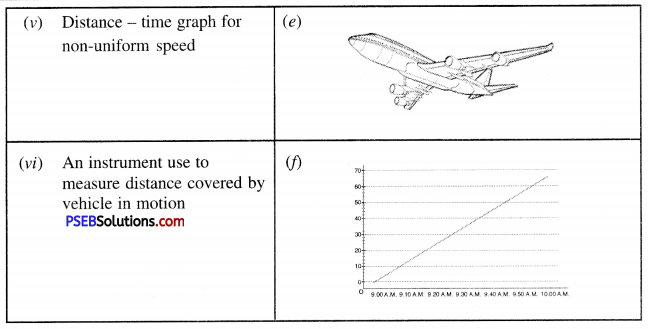
PSEB 7th Class Science Solutions Chapter 8 Winds, Storms and Cyclones 1
Answer:
PSEB 7th Class Science Solutions Chapter 8 Winds, Storms and Cyclones 2

5. Very Short Answer Type Questions:

Question (i)
Which property of air is described by the inflated balloon ?
Answer:
Moving air exerts pressure.

PSEB 7th Class Science Solutions Chapter 8 Winds, Storms and Cyclones

Question (ii)
Which is lighter, cold air or hot air ?
Answer:
Hot air is lighter than cold air.

Question (iii)
Which region of earth gets maximum heat from the sun ?
Answer:
Equator and its adjoining areas are exposed to direct sunlight for a long time, resulting in higher temperatures in the vicinity of the equator.

Question (iv)
Which winds bring rain in India ?
Answer:
Rainfall in India is caused by monsoon winds. These winds filled with water vapour come from the sea.

Question (v)
Name the instrument used for measuring the speed of wind.
Answer:
Wind / air speed can be measured with an Anemometer.

6. Short Answer Type Questions:

Question (i)
Why are the holes made in hanging banners and hoardings ?
Answer:
Holes are made on hanging banners and advertisements so that they cannot be blown away due to blowing winds or wind pressure. The air will pass through the holes and there will be no pressure on the banner.

Question (ii)
In which situation does the uneven heating of the earth produces winds ?
Answer:
The sun does not heat different parts of the earth uniformly. So there is a difference in temperature and pressure. The wind that moves from a high pressure area to a low pressure area is called a wind. The higher the pressure, the higher is the wind speed.

Question (iii)
Which winds blow from ocean to land in summer ? What is their significance ?
Answer:
In summer season, the air near the surface of the earth becomes warmer and lighter and rises upwards. The air above the sea is colder and heavier than the air on the earth. So the wind moves from the ocean to the land. This cool breeze from the ocean is called Sea breeze. Due to this breeze, the weather is very pleasant for the people living near the coastal areas.

PSEB 7th Class Science Solutions Chapter 8 Winds, Storms and Cyclones

Question (iv)
What is the difference between a thunderstorm and a cyclone ?
Answer:
Thunder Storm.
Lightning strikes thunderstorms and heat up the air to a higher temperature, causing the air to expand faster and produce a louder sound. This loud sound is called thunder. The wind that blows with rain is called a storm. Sometimes a storm is accompanied by a thunder, which is then called a thunderstorm.
Cyclone.
When water takes up heat from the atmosphere to change it into vapours for the formation of cloud. These water vapours cool and condense to form raindrops and release the absorbed heat. This heat causes the surrounding air to heat up and form a low pressure area. A strong wind blows towards this low pressure center. This action is repeated several times to form a low pressure area and dense clouds from the center of a strong wind.

Many layers of high winds begin to revolve around the low pressure center. This condition is called a cyclone. Center of the storm is a quiet area called the Eye of cyclone. The area of the eye is free from clouds. Outside the Eye is a circle of clouds and thunderstorms. The wind blows here at a speed of 150 to 250 kilometre per hour.

Question (v)
State effective measures to be taken in areas vulnerable to cyclones ?
Answer:
Effective safety measures to be adopted in areas prone to post-cyclone :
1. Measures to be taken by the government :

  • Tall and dense trees of native species should be planted on the coastal areas to reduce wind/wind speed.
  • Ponds should be constructed in coastal areas to absorb excess water.
  • Cyclone shelters should be constructed in cyclone sensitive areas.
  • To issue early warning to the people of the affected area by adopting advance information technology.

2. Measures that can be adopted by the people :

  • Do not ignore cyclone warnings.
  • Areas that have frequent cyclones should be evacuated.
  • Make appropriate arrangements to move their livestock, valuables and household members to safer places.

Question (vi)
What is a Tornado ? Give two safety measures.
Answer:
Tornado. It is strong rotating winds in Funnel shaped cloud. Its diameter varies from 1 m to 1 km. On account of very low pressure at the centre of the funnel it pulls the dust, debris and even people and vehicles towards the centre.
Safety measures from Tornado:

  • Take shelter inside a room, having no window. If a room without window is unavailable then closed all doors and windows.
  • If a person is in the vehicle or driving, he should get out of it and sit in low laying area.
  • Whenever you face tornado you can protect yourself by sitting on your knees and
    putting down your head by wrapping arms around your neck.

7. Long Answer Type Questions:

Question (i)
Explain why does a tin can get crushed when water is boiled in it and after closing it cold water is poured on it ?
Answer:
When water is boiled in an iron container, all the air in the container heats up and becomes lighter and rises upwards. In this way all the air in the box goes out. On further heating, the boiling water turns into steam and the can is filled with water. Covering the vessel with a lid ensures that the vapours are trapped inside the container. This reduces the air pressure inside the box compared to the outside air. In this way on pouring cold water the outside air pressure causes the box to shrink inwards.

Question (ii)
Explain with an activity that air expands on heating.
Answer:
Air expands by heating. This fact can be proved by the following activity:
Activity.
Take a thick glass test tube. Tightly tie a balloon over its mouth with tape. Take hot water in a beaker. Place the test tube in the water such that balloon stays out of the water. Watch the balloon for 3-4 minutes to look for any change in the size of balloon. Now take out the test tube from water and let it cool down to normal temperature. In another beaker take a small amount of ice cold water and place the test tube carrying balloon in the beaker. Wait for 3-4 minutes. Observe the change in size.

You will notice that the balloon placed in hot water swells (increases in size) after some time and the balloon when on the other placed in cold water shrinks (decreases in size).

Conclusion.
When the test tube is placed in hot water, the air in the balloon heats up and expands causing the balloon to inflate. This indicates that the air expands on healing. When the test tube is placed in ice, the air present in balloon contracts. It shows cooling causes air to contraction.

Question (iii)
How is a cyclone formed ? Describe how a cyclone caused widespread destruction in Odisha in 1999.
Answer:
Formation of Cyclone.
When water takes up heat from the atmosphere to change it into vapours for the formation of cloud. These water vapours cool and condense to form raindrops and release the absorbed heat. This heat causes the surrounding air to heat up and form a low pressure area. A strong wind blows towards this low pressure center. This action is repeated several times to form a low pressure area and dense clouds from the center of a strong wind.

Many layers of high winds begin to revolve around the low pressure center. This condition is called a cyclone. Center of the storm is a quiet area called the Eye of cyclone. The area of the eye is free from clouds. Outside the Eye is a circle of clouds and thunderstorms. The wind blows here at a speed of 150 to 250 kilometre per hour.

Destruction caused by cyclone in Odisha. A very strong cyclone strike to Indian state Odisha on 18 October, 1999. The speed of this cyclone was 200 km/h and it destroyed 45000 houses leaving 70,000 people homeless. Again on 29th October 1999 a cyclone hits Odhisa with a speed of 260 km/h accompanied by 9 meter high wave. Many people lost their lives and property worth of crores was destroyed.

PSEB 7th Class Science Solutions Chapter 8 Winds, Storms and Cyclones

PSEB Solutions for Class 7 Science Winds, Storms and Cyclones Important Questions and Answers

1. Fill in the blanks:

(i) Wind is air.
Answer:
moving

(ii) Winds are generated due to heating on the earth.
Answer:
uneven

(iii) Near the earth’s surface air rises up whereas air comes down.
Answer:
warm, cooler

(iv) Air moves from a region of pressure to a region of pressure.
Answer:
high, low

2. Match the Column ‘I’ with Column ‘II’:

Column ‘I’ Column ‘II’
(i) Hot air (a) Low pressure area of the cyclone
(ii) Changes in atmospheric pressure cause (b) Sunlight
(iii) The eye of the cyclone (c) Blows away the roof
(iv) High speed air over the roof (d) Winds, storms and cyclones.

Answer:

Column ‘I’ Column ‘II’
(i) Hot air (b) Sunlight
(ii) Changes in atmospheric pressure cause (d) Winds, storms and cyclones
(iii) The eye of the cyclone (a) Low pressure area of the cyclone
(iv) High speed air over the roof (c) Blows away the roof

3. Choose the Correct Answer:

Question (i)
Which of the following place is likely to be affected by a cyclone?
(a) Amritsar
(b) Chennai
(c) Delhi
(d) Jaipur
Answer:
(b) Chennai

Question (ii)
An instrument used to measure wind speed is called ………………. .
(a) Anemometer
(b) Barometer
(c) Thermometer
(d) Lactometer.
Answer:
(a) Anemometer.

PSEB 7th Class Science Solutions Chapter 8 Winds, Storms and Cyclones

Question (iii)
How many hours in advance cyclone chart is issued of expected storm by satellites and radars ?
(a) 72
(b) 48
(c) 96
(d) 12
Answer:
(b) 48

Question (iv)
Which winds carry water and bring rain ?
(a) Unequal
(b) Equal
(c) Monsoon
(d) None of the above.
Answer:
(c) Monsoon.

Question (v)
A dark funnel shaped cloud that reaches from sky to the ground is called ……………….
(a) Wind
(b) Tornado
(c) Cyclone
(d Monsoon.
Answer:
(b) Tornado.

Question (vi)
Hurricane in America, Typhoon in Japan are nothing but ………………. only.
(a) Cyclones
(b) Tornado
(c) Monsoon wind
(d) Thunder storms.
Answer:
(a) Cyclones.

Question (vii)
In which year did Orissa was hit by a cyclone ?
(a) 1999
(b) 2000
(c) 2001
(d) 2004.
Answer:
(a) 1999.

State True or False:

(i) Wind always blows from low pressure area to high pressure area.
Answer:
False

(ii) Wind speed is measured with an anemometer.
Answer:
True

PSEB 7th Class Science Solutions Chapter 8 Winds, Storms and Cyclones

(iii) Heavy rains accompanied by strong winds are called cyclones.
Answer:
False

(iv) A hurricane is a storm with strong winds blowing through a funnel-shaped cloud.
Answer:
True

Very Short Answer Type Questions

Question 1.
What disaster fell on 18 October, 1999 in India ?
Answer:
A cyclone hits Orissa.

Question 2.
When did second cyclone hit Orissa ?
Answer:
29 October, 1999.

Question 3.
What was the number of homeless people hit by cyclone ?
Answer:
About 700000 people.

Question 4.
What is wind ?
Answer:
Air in motion.

Question 5.
Give the characteristic of air.
Answer:
Air exerts pressure.

PSEB 7th Class Science Solutions Chapter 8 Winds, Storms and Cyclones

Question 6.
Why do we fill air into bicycle tubes ?
Answer:
To keep the tube tight so that it can run smoothly on a surface.

Question 7.
What happens to air pressure when speed of wind is increased ?
Answer:
Air pressure reduces.

Question 8.
Why does hot air move upwards ?
Answer:
Because it is lighter than cold air.

Question 9.
What are monsoon winds ?
Answer:
Monsoon winds are those winds which come from the oceans and seas and carry water with them and bring rain.

Question 10.
Name few natural disasters caused by wind.
Answer:
Cyclones, thunder storms, tornadoes etc.

Question 11.
In winter what is direction of winds ?
Answer:
From land to oceans.

Short Answer Type Questions

Question 1.
What is a cyclone ? On which factors it depends ?
Answer:
Cyclone. A low pressure system with very- high speed winds revolving around it is called cyclone.
Wind speed, wind direction, humidity and temperature are some factors which contribute to the development of a cyclone.

PSEB 7th Class Science Solutions Chapter 8 Winds, Storms and Cyclones

Question 2.
Give a brief account of formation of thunderstorms.
Answer:
In hot, humid climate, the rising temperature produces strong winds. These rise upwards and carry lot of water droplets. These water droplets freeze at height and fall downwards. The swift falling water droplets along with rising air produce lightning and sound. This phenomenon is called thunderstorm.

Question 3.
How are clouds important to farmers ?
Answer:
Importance of clouds to farmers.

  1. Clouds are important for harvest. If harvest is good, farmers are happy.
  2. Clouds bring rains.
  3. They make the weather pleasant.

Question 4.
How will you help your neighbours in case cyclone approaches your village/town ?
Answer:
Helping neighbours during cyclones:

  1. Moving them to cyclone shelters.
  2. Shifting their household property to safer places.
  3. Providing them medical aid.

Question 5.
What planning is required to deal with situation created by a cyclone ?
Answer:
Plans to deal with situation created by cyclone.

  • Shift essential household good, domestic animals to safer places.
  • Keep handy phone numbers of all emergency services like Police, fire brigade and medicle centres.
  • Avoid driving on roads with standing water.

Long Answer Type Questions

Question 1.
How will you show air expands on heating ?
Answer:
Experiment to show air expands on heating. Take a boiling tube and fix a balloon tightly over the neck of the tube. Insert the boiling tube carrying balloon into a beaker containing hot water.
Watch the balloon for 2-3 minutes you will notice that the balloon has start inflating. This experiment shows that air expands on heating.
PSEB 7th Class Science Solutions Chapter 8 Winds, Storms and Cyclones 3

Question 2.
What precautions should be taken when a thunderstorm is accompanied by lightning?
Answer:
Precautions to be taken during lightning in thunderstorms accompanied by lightning:

  1. Never take shelter under an isolated tree.
  2. Do not lie on the ground.
  3. Do not use an umbrella having a metallic rod.
  4. Window, open garages, storage sheds, metal sheds are not safe places.
  5. Never stay in the water.
  6. Inside a car or bus is a safe place to take shelter.

Gymnastics Game Rules – PSEB 10th Class Physical Education

Punjab State Board PSEB 10th Class Physical Education Book Solutions Gymnastics Game Rules.

Gymnastics Game Rules – PSEB 10th Class Physical Education

Gymnastics is an ancient sports in 2600 BC. Gymnastics exercises used to be performed in China but the actual development started in Greece and Rome. The word ‘Gymnastics’ is derived from the Greek word ‘Gymnos’ which means “Naked body”, actually exercises done by naked body is called Gymnastics. These exercises used to be performed to keep the body healthy.

The Greek laid down the great emphasis on Gymnastics. The spartans were very popular in providing Gymnastics training for their youth. Boys and girls were expected to be good Gymnastics in those days. With the fall of both civilizations i.e. Greek and Roman, Gymnastics disappeared from these civilizations.

The Great Grandfather of Gymnastics John Guts Muths introduced Gymnastics in the Persian schools. In this way Germany rediscovered Gymnastics and owing to that the International Gymnastics Federation was constituted in 1881. In 1884 the first Gymnastics competition was conducted in Modem Olympics which were held in Athens in 1896.

Gymnastics for men was included but later on Gymnastics for women was included in 1928 Olympic games in 1974. In Asian games which were held in Tehran, Gymnastics was made one of the sports. The first world cup of Gymnastics was held in 1975. In these days Gymnastics is an attractive, fascinating and very popular sport.

Gymnastics Game Rules - PSEB 10th Class Physical Education

Latest General Rules of Gymnastics

1. Men compete in six events

  • floor exercises
  • vaulting horse.
  • Pommelled horse
  • Roman Rings
  • Horizontal bars and parallel bars. Women compete in four events i.e. vaulting horse, uneven bars, balancing beam and floor exercises.

2. Gymnasts present themselves to a Judge before and after their event. They start their exercise when the signal is given to them. If during the exercise they fall, they have 30 seconds to remount and continue.

3. Regarding team competition, size Gymnastics of each perform is compulsory and an optional exercise on each apparatus. The five highest scores are added to give the team total.

4. A gymnast must wear proper kit. He may wear bandages or socks. He/She must starts the exercise within 30 seconds. When the signal is given by a coach another gymnast may assist a gymnast into hanging position on horizontal bar and Roman Rings.

Question 1.
Write about the Sports Equipment of Gymnastics.
Answer:
Specification of Playfield and related Sports Equipment

(A) Equipment for men
1. Floor = 12 M × 12 M
2. Parallel Bars

Length of bars = 3500 m.m.
Width of bars = 420-520 m.m.
Height of bars = 1750 m.m.

Gymnastics image 1

3. Horizontal Bar

Diameter of Bar = 28 m.m.
Length of Bar = 2400 m.m.
Height of Bar = 2550 to 2700 m.m.
Diameter of uprights = 50-60 m.m.
Diameter of Tension work = 5.6 m.m.

Gymnastics image 2

4. Pommel Horse

Length of Pommel Horse = 1600 m.m.
Width of Pommel Horse = 350 m.m.
Height from the floor = 1100 m
Height of Pommel = 120 m.m.
Distance between Pommel = 400-450 m.m.

Gymnastics image 3

5. Roman Rings

Diameter (Grip) = 28 m.m.
Height of stand from floor = 5500 m.m.
Length of leather straps = 700 m.m.
Thickness = 4 m.m.
Inside diameter of Ring = 180 m.m.
Height of the rings from floor = 2500 m.m.
Width = 35 m.m.

Gymnastics image 4

6. Vaulting Horse

Height of vaulting horse = 1350 m.m.
Adjustable steps in the intervals = 50 m.m.
Length = 1600 m.m.

Gymnastics image 5

(B) Equipment of Women

1. Floor = 12 m × 12 m
2. Vaulting Horse
Height of Vaulting Horse = 1250 m.m.
Adjustable steps in the Intervals = 100-150 m.m.
Length = 1600 m.m.

3. Balancing Beam

Length of Beam = 5000 m.m.
Width of Beam = 100 m.m.
Height of Beam = 1200 m.m.
Adjustable = 700 – 1200 m.m.

Gymnastics image 6

4. Uneven bars

Length of uneven bars = 2400 m.m.
Height of the bars from floor = 2300 m.m. and 1500 m.m.
Distance between bars = 580-900 m.m.
Diameter of uprights = 50-60 m.m.
Thickness of uprights = 30 m.m.

Gymnastics image 7
Gymnastics image 8

Gymnastics Game Rules - PSEB 10th Class Physical Education

Important Tournaments

  1. Olympic Games
  2. Asian Games
  3. World Cup
  4. All India Inter-University Gymnastics Championship
  5. National Championship
  6. Federation Cup
  7. School National
  8. China Cup

Sports Personalities

Indian Sports Personalities

  1. Sham Lai
  2. Km Kripali Patel
  3. Dr. Kalpana Debnalt
  4. Montar Debnalt
  5. Anju Dua
  6. Sunita Sharma

International Sports Personalities

  1. Olga Korbut
  2. Nadia Comaneci
  3. Nelli Kim
  4. Ludmilla Tourscheva
  5. Dov. Lupi
  6. Karin Janz
  7. Elvra Saadi

Gymnastics Game Rules - PSEB 10th Class Physical Education

Question 2.
Describe the fundamental skills of Gymnastics?
Answer:
Fundamental Skills of Gymnastics For Men

(A) Parallel Bars

  1. Up start
  2. Front start
  3. Shoulder stand
  4. Hand stand
  5. Hand stand with 180° Turn
  6. Hand stand to Front turn on the shoulder
  7. Backward Roll 8. Hand stand to cast wheel

(B) Horizontal Bar

  1. Up start with over grip
  2. Up start with under grip
  3. Short circle
  4. One leg circle with heel foot
  5. Heel foot
  6. Swing through vault

(C) Pommelled Horse

  1. Front Support Position
  2. Single Leg Half Circle
  3. Double Leg Half Circle
  4. Front Scissors

(D) Roman Rings

  1. Up start
  2. Back circle to back hang
  3. Muscle up
  4. Back level
  5. Back uprise
  6. Dislocation
  7. Back uprise with L-position.

(E) Vaulting Horse

  1. Straddle vault
  2. Squat vault
  3. Cast wheel
  4. Hand stand with cast wheel
  5. Hand spring.

(F) Floor Exercises

  1. Forward Roll to Hand stand
  2. Backward Roll to Hand stand
  3. Forward Roll to Head spring
  4. Hand spring to Dive Roll
  5. Round off to Flick Flak
  6. One Leg Hand Spring
  7. Hand stand to Forward Roll with straight legs

Gymnastics Game Rules - PSEB 10th Class Physical Education

Fundamental Skills of Gymnastics For Women

(A) Balancing Beam

  1. Gallop step with Balance
  2. Scissors Jump
  3. Forward Roll
  4. Backward Roll
  5. Cast wheel
  6. Bridge
  7. Balance
  8. Dismount

(B) Vaulting Horse

  1. Spit vault
  2. Hand spring
  3. Squat vault

(C) Uneven Bars

  1. Swing on Upper Bar
  2. Back uprise
  3. One Leg Forward Circle
  4. One Leg Backward Circle
  5. Cross Balancing
  6. Hand Spring.

(D) Floor Exercises

  1. Forward Roll to Hand stand
  2. Backward Roll to Hand stand
  3. Round off
  4. Slow back Hand spring
  5. Split Sitting
  6. Slow Hand spring
  7. Hand spring
  8. Head spring

Gymnastics Game Rules - PSEB 10th Class Physical Education

Points In Gymnastics

For each gymnastic exercise, there are points from 0 to 10, and each point is sub-divided into 10 parts. If the panel of the judges is of five members, the minimum and maximum points are not considered, and an average of mid three points is taken. If the panel is composed of three judges, the marks of three are taken for average.

Decisions:
The following points are important so far as decisions are concerned:

  1. Five or at least three judges are kept till the end of each event of the competition. One of these judges is considered to be Chief Judge.
  2. The judges make an assessment of the feats of other players on the basis of the feats of the first players on eveiy apparatus. They also consult one another for exercises so that there may be a common base of assessment.
  3. Thereafter, they decide independently and do not consult one another except in very special circumstances.
  4. The result shall be decided from the average of points awarded by three judges.
  5. If there is difference in the points awarded by two judges, the points of Chief Judge are also considered.
  6. It is the duty of the Chief Judge to make a compromise between the other two judges in case of dispute. If the other Judges do not reach a compromise, the Chief Judge shall declare his verdict.

Gymnastics Game Rules - PSEB 10th Class Physical Education

Question 3.
Write brief Rules of Gymnastics?
Answer:
General Rules of Gymnastics

  1. Each team consists of 6 players. Each player participates in all events. For team championship, the performance of the best five players is taken into account.
  2. The substitution of players during the competition is not allowed.
  3. The judges of events and teams should reach the ground in time.
  4. If a player meets with an accident or falls ill, the captain should immediately call the doctor and get his advice.
  5. The game may be stopped for half an hour so that the same player recovers and joins the team. If his condition does not improve, he is removed from the game and the game restarts.
  6. Team competitions shall be held in two parts-first for compulsory exercises and second for optional exercises.
  7. The duration of these competitions shall be determined beforehand, and the competitions shall be held according to the fixed schedule.
  8. Only those players, who have taken part in all events of the team competition, are allowed to participate in the final.
  9. Only members of the jury, contestants and their technical managers, secretaries, members of the watch and ward staff looking after the equipment and playground are allowed to be present at the place of competitions.
  10. Each player is entitled for two attempts on Long-Horse vault. The best performance shall be credited.
  11. Optional or voluntary exercises cannot be repeated on any apparatus.
  12. No team can use its own apparatus. It is the duty of the organisers to arrange for the apparatus.
  13. The organisers are to arrange for the apparatus,
  14. If there is difference in the points awarded by judges, the verdict of the Chief Judge shall be considered.
  15. Each player is given two tries (chances) during the competition. If he does not touch vaulting horse or Beam Balance, he is given another chance. But if he touches any of these, a foul is awarded.
  16. There can be no substitution of players during the play.

Points to Remember

  1. For each gymnastic exercise, there are points for 0 to 10, and each point is further divided into ten parts.
  2. The decision of the jury is final. No appeal can be made against it.
  3. A team participating in a gymnastic contest is composed of 6 players. The team participating in School Mini National Games is, however, composed of 6 players.
  4. Players cannot be substituted after the competition has started.
  5. Only those players, who have taken part in all events of team competition, can participate in the final.
  6. If a player gets hurt or feels sick during competition, his team can wait for thirty minutes for his condition to improve.
  7. If a player leaves the team without the permission of the jury, he will not be allowed to rejoin it.
  8. For team championship, the performance of the best five players is considered.

Gymnastics Game Rules - PSEB 10th Class Physical Education

Important Information About the Gymnastics Game

  1. Number of players in Gymnastics = 8
  2. Substitution is allowed or not = no substitution
  3. Decision of the jury = Final
  4. Time for waiting of player = 30 minutes
  5. A player can whether = no leave the court or not
  6. To decide the woman the number of players are wanted = 6 players
  7. Points are given = 0 to ten
  8. Officials for competition = Three to five
  9. Competition for boys =
    • Parallel bar
    • Vaulting horse
    • Ground Gymnastic
    • Horizontal Bar
    • Roman Ring
    • Pommel horse
  10. Competition for girls =
    • Beam Balance
    • Ground Gym
    • Uneven Bar
    • Vaulting horse

PSEB 12th Class Sociology Important Questions Chapter 9 Social Movements

Punjab State Board PSEB 12th Class Sociology Important Questions Chapter 9 Social Movements Important Questions and Answers.

PSEB 12th Class Sociology Important Questions Chapter 9 Social Movements

Multiple Choice Questions:

1. The movement which aims to remove social evils is known as
(a) Reform movement
(b) Revivalist movement
(c) Revolutionary movement
(d) None of these
Answer:
(a) Reform movement

2. Who played an important role in the Chipko movement?
(a) Chandi Prasad Bhatt
(b) Lai Bahadur Shastri
(c) Medha Patkar
(d) Arundhati Roy
Answer:
(a) Chandi Prasad Bhatt

PSEB 12th Class Sociology Important Questions Chapter 9 Social Movements

3. Who was awarded ‘Padma Vibhushan’ for his contribution to the Chipko movement?
(a) Medha Patkar
(b) Sunder Lai Bahuguna
(c) Chandi Prasad Bhatt
(d) Raja Ram Mohan Roy
Answer:
(b) Sunder Lai Bahuguna

4. Who started Satya Shodhak Movement?
(a) Joti Rao Phule
(b) Ishwar Chandra Vidyasagar
(c) Raja Ram Mohan Roy
(d) Dr.B.R. Ambedkar
Answer:
(a) Joti Rao Phule

5. Who started Mahar Movement?
(a) Joti Rao Phule
(b) Dr. B.R. *Ambedkar
(c) Raja Ram Mohan Roy
(d) Sunder Lai Bahuguna.
Answer:
(b)Dr. B.R. Ambedkar

6. With whose efforts, Sati Pratha was declared illegal?
(a) Raja Ram Mohan Roy
(b) Dr. Ambedkar
(c) Joti Rao Phule
(d) Ishwar Chandra Vidyasagar
Answer:
(a) Raja Ram Mohan Roy

Fill in the Blanks:

1. Dr, Ambedkar belonged to …………… caste.
Answer:
Mahar

2. Satya Shodhak Samaj was established in …………………. A.D.
Answer:
1873

3. ………………….. started Self Respect Movement.
Answer:
Periyar Ramaswami

4. Sree Narayan Guru belonged to ………………. caste.
Answer:
Izava

5. Majdoor Mahajan Sabha was started by ………………..
Answer:
Mahatma Gandhi

PSEB 12th Class Sociology Important Questions Chapter 9 Social Movements

True/False:

1. Dr. Ambedkar adopted Jainism.
Answer:
False

2. Periyar Ramaswami started Self Respect Movement in Kerala.
Answer:
False

3. Satya Shodhak Samaj was started in Maharashtra.
Answer:
True

4. All India trade Union congress was started in 1920 A.D.
Answer:
True

5. Kisan Sahha was started in 1930 A.D.
Answer:
True

6. Brahmo Samaj was started by Raja Ram Mohan Roy.
Answer:
True

One Word/One Line Questions Answers:

Question 1.
Who is known as the father of modern India?
Answer:
Raja Ram Mohan Roy is known as the father of modern India.

Question 2.
When and who used the word social movement the first time?
Answer:
German Scholar Lorenz Van Stein was the one who used this term in 1850 A.D. in his book ‘History of the French Social Movement from 1789 to the Present’. Question 3. When did the French and Russian revolutions take place?
Answer:
The French revolution took place in 1789 A.D. and the Russian revolution took place in 1917 A.D.

Question 4.
Give one necessary element of social movement.
Answer:
Collective consciousness is one of the necessary element of social movement.

Question 5.
What is the main objective of social movement?
Answer:
Main objective of social movement is to replace the old system by establishing new system.

Question 6.
Which movement brings sudden change in society?
Answer:
Revolutionary movement brings sudden change in society.

Question 7.
When and who started Satya Shodhak Samaj?
Answer:
Jyoti Rao Phule started Satya Shodhak in 1873 A.D.

PSEB 12th Class Sociology Important Questions Chapter 9 Social Movements

Question 8.
What was the major issue of Satya Shodhak Samaj?
Answer:
Major issue of Satya Shddhak Samaj was to end every type of authority of Brahmins.

Question 9.
When, where and who started Sree Narayan Dharam Paripalan movement?
Answer:
This movement was started by Sree Narayan Guru in 1895 A.D. in Kerala.

Question 10.
Why was Sree Narayan Dharam Paripalan Movement started?
Answer:
To uplift the social status of Izava caste and to remove the evil like untouchability.

Question 11.
When, where and who started Self Respect Movement?
Answer:
Self Respect Movement was started by Periyar E.V. Ramaswami in 1925 A.D. in Tamil Nadu.

Question 12.
What was the major objective of Self Respect Movement?
Answer:
To arose the sense of self respect among backward castes in caste based society.

Question 13.
When and which religion was adopted by Dr. Ambedkar?
Answer:
Dr. Ambedkar adopted Buddhism in 1956 A.D.

Question 14.
What is included in class based movements?
Answer:
Worker’s movement and Peasant’s movement are included in class based movements.

Question 15. Who established Mazdoor Mahajan Sangh?
Answer:
Mazdoor Mahajan Singh was established by Mahatma Gandhi.

Question 16.
When and where was All India Trade Union Congress established?
Answer:
It was established at Bombay in 1920 and Lala Lajpat Rai was its first President.

Question 17.
Where did Indigo rebellion take place in 1866-68?
Answer:
In 1866-68, Indigo rebellion take place in Darbhanga and Champaran.

Question 18.
Where were Peasant movements started?
Answer:
Peasant movements were mainly started in Punjab.

Question 19.
Who helped in removing Sati Pratha from society?
Answer:
Raja Ram Mohan Roy with the help of Lord William Bentick helped in removing Sati Pratha from society.

Question 20.
When was SEWA Bank started?
Answer:
SEWA Bank was started in 1974 A.D.

Question 21.
When and where was Chipko Movement started?
Answer:
Chipko movement was started in 1973 A.D. in the Garhwal region of Uttrakhand.

Question 22.
Who were the major leaders of Chipko movement?
Answer:
Major leaders of Chipko movement were Cha’ndi Prasad Bhatt, Gaura Devi and Sunder Lai Bahuguna.

Question 23.
When and where was Appiko movement started?
Answer:
Appiko movement was started in 1973 in Karnataka.

Question 24.
Why was Narmada Bachao movement started?
Answer:
It was started in Gujarat to save environment and to place the displaced persons.

PSEB 12th Class Sociology Important Questions Chapter 9 Social Movements

Very Short Answer Type Questions:

Question 1.
What are social movements?
Or
Social Movement.
Answer:
There are certain unnecessary conditions in society which are going on from the ages. Under these circumstances, few people collectively try to change the social system. Such collective efforts are known as social movements.

Question 2.
Give two features of social movements.
Answer:

  • Collective consciousness is the major feature of social movements. The sense of unity motivates the people to take part in it.
  • Social movement runs with an ideology. Without definite ideology, movement cannot start.

Question 3.
Satya Shodhak Movement.
Answer:
This was a non-Brahmin movement started by Jyotiba Phule through Satya Shodhak Samaj. He was of the view that according to traditions, Brahmins have established authority. Such authority should be removed and lower castes should be uplifted.

Question 4.
Sree Narayan Dharam Paripalan movement.
Answer:
This movement was started by Sree Narayan Guru in Kerala. He himself belonged to Izava community which was considered a lower caste. He wanted to eliminate untouchability and to establish such temples which are open for all.

Question 5.
Self-Respect Movement.
Answer:
This movement was started in 1925 by Periyar Ramaswamy in Tamilnadu-. Major objective of this movement was to uplift lower castes and to arose self respect for them. He started this movement against the social theory of Dharma and Karma.

Question 6.
Mahar Caste.
Answer:
Mahar Caste was a lower caste of Maharashtra. Before adopting Buddhism, it was one of the major part of Maharashtra’s population. Their socio-economic status was quite low. They lived separately in Maharashtra and it was considered that their touch will impure others. They did menial jobs.

Question 7.
Indigo movement.
Answer:
Indigo movement was mainly started in Darbha’nga and Champaran districts of Bihar because the British greatly exploited the Indigo planters. They were forced to grow indigo and sell it at cheap rates. Planters were fed up with this exploitation and they started these movements.

Question 8.
Brahmo Samaj.
Answer:
Brahmo Samaj was started in 1828 by Raja Ram Mohan Roy at Calcutta. It was greatly influenced by the western ideas. It did a lot against Sati system and that’s why the British government declared it illegal. It also gave stress on women education and right of property for women.

Question 9.
Environment movement.
Answer:
To save our environment from getting polluted, many reform movements were initiated in our country. Many people participated in these and saved the environment. Chipko movement, Appiko movement, Narmada Bachao Andolan are few of its examples.

PSEB 12th Class Sociology Important Questions Chapter 9 Social Movements

Short Answer Type Questions:

Question 1.
Which changes could be brought with the help of socio-reform movements?
Answer:
India is a welfare state in which every one gets equal opportunity. The main objective of welfare state is to make life of the people happy. But this could be possible if all the existing beliefs and evils of society could be removed. Only socio¬reform movements can remove them. But nothing can be obtained only by making law. For this reforms are necessary in society. For example, laws are there for child marriage, dowry system, child labour etc., but these things are common in our country. All these things are obstacles in our country. If we want to develop our society then socio-reform movements are very much necessary. That’s why socio-reform movements are necessary to bring changes in society.

Question 2.
Give four features of social movements.
Answer:

  • Social movements are always anti-social.
  • Social movements are always planned and deliberate efforts.
  • Their main objective is to bring reforms in society.
  • Collective efforts are required in it because one person cannot bring changes in society.

Question 3.
What is the nature of social movements?
Answer:

  • Social movements are not institutions because institutions are permanent and traditional and are considered a necessary aspect of the culture. These movements come to an end themselves after the achievement of their objective.
  • Social movements are not associations as well because associations have their own constitutions. This movement is generally informal, unorganised and is against traditions.
  • Social movements are neither pressure or sectional groups because these movements demand the changes in social norms.

Question 4.
Explain the stages of social movement.
Answer:

  • At the first stage, there is discontentment, among the people. Without discontentment, movement cannot start. Dissatisfaction is the major cause of concern at first stage.
  • The second stage is also known as the popular stage and people’s dissatisfaction leads to collective mobilisation. The leader promises with them to remove their problems.
  • Third stage is known as formalisation stage. The organisation of movement clarifies its ideology and if it is accepted, the collective action takes place. It leads to the beginning of movement.
  • The fourth stage is of institutionalisation when the movement becomes crystallised. The goal of the movement is accepted in that society.
  • Fifth stage is the dissolution of the movement. Sometimes, after the attainment of objectives, movement itself comes to an end or sometimes the movement itself fades away.

Question 5.
Satya Shodhak Movement.
Answer:
Satya Shodhak movement was a non—Brahmin movement. It was represented by Satya Shodhak Samaj which was started by Jyoti Rao Phule in 1873 A.D. Jyoti Rao phule belonged to Phul Mali caste. Most of the members of this caste were gardners who cultivated flowers, fruits and vegetables. Phule and his associates were of the view that the people of Maharashtra are divided in two ways. On one side there are Brahmins and people of lower castes are on the other side. Brahmins ieployed their traditional religions authority and newly acquired powers as officials marriage, dowry system, child labour etc., but these things are common in our country. All these things are obstacles in our country. If we want to develop our society then socio-reform movements are very much necessary. That’s why socio-reform movements are necessary to bring changes in society.

Question 2.
Give four features of social movements.
Answer:

  • Social movements are always anti social.
  • Social movements are always planned and deliberate efforts.
  • Their main objective is to bring reforms in society.
  • Collective efforts are required in it because one person cannot bring changes in society.

Question 3.
What is the nature of social movements?
Answer:

  • Social movements are not institutions because institutions are permanent and traditional and are considered a necessary aspect of the culture. These movements come to an end themselves after the. achievement of their objective.
  • Social movements pre not associations as well because associations have their own constitutions. This movement is generally informal, unorganised and is against traditions.
  • Social movements are neither pressure or sectional groups because these movements demand the changes in social norms.

Question 4.
Explain the stages of social movement.
Answer:

  • At the first stage, there is discontentment among the people. Without discontentment, movement cannot start. Dissatisfaction is the major cause of concern at first stage.
  • The second stage is also known as the popular stage and people’s dissatisfaction leads to collective mobilisation. The leader promises with them to remove’their problems.
  • Third stage is known as formalisation stage. The organisation of movement clarifies its ideology and if it is accepted, the collective action takes place. It leads to the beginning of movement.
  • The fourth stage is of institutionalisation when the movement becomes crystallised. The goal of the movement is accepted in that society.
  • Fifth stage is the dissolution of the movement. Sometimes, after the attainment of objectives, movement itself comes to an end or sometimes the movement itself fades away.

Question 5.
Satya Shodhak Movement.
Answer:
Satya Shodhak movement was a non-Brahmin movement. It was represented by Satya Shodhak Samaj which was started by Jyoti Rao Phule in 1873 A.D. Jyoti Rao phule belonged to Phul Mali caste. Most of the members of this caste were gardners who cultivated flowers, fruits and vegetables. Phule and his associates were of the view that the people of Maharashtra are divided in two ways. On one side there are Brahmins and people of lower castes are on the other side. Brahmins deployed their traditional religions authority and newly acquired powers as officials under the British rule enforce this divide. The ideology of this movement was based on the idea that every type of Brahmin’s authority should be removed. This is the most important condition for the upliftment of lower castes.

Question 6.
Sree Narayan Dharam Paripalan Movement.
Answer:
Sree Narayan Dharam Paripalan movement was started in 1895. by Sree Narayan Guru in Kerala. He himself belonged to Izava community which was considered impure caste. Izava people were not allowed to do idol worship and animal sacrifice. Two main points were centered in this movement. First one was the end of untouchability and the second was the establishment of such temples which could be open for all. He also tried to change and simplify the rules related to marriage, religious customs and last rites. He even gave a new slogan, “One God and one religion for all mankind.”

PSEB 12th Class Sociology Important Questions Chapter 9 Social Movements

Question 7.
Self Respect Movement.
Answer:
In 1925, Periyar E.V. Ramaswami started Self Respect Movement in Tamil Nadu. The objective of this movement was to establish such society in which lower castes should have equal rights. Another objective of this movement was to establish self respect for lower castes in caste based society. This movement proved quite effective in Tamilnadu. Major issue of this movement was to establish socio-economic equality. This movement concentrated on removing social evils on the name of dharam—karam. Periyar also said that this movement must be institutionalised to achieve its objective.

Question 8.
Appiko movement.
Answer:
Chipko movement was started in Garhwal region of Uttrakhand. After getting impressed from this, farmers of a district in Karnataka started the same type of movement. In south India, it was known as Appiko movement. In the local language of Karnataka, hugging is known as Appiko. In September 1983, people of Salkani region under the leadership of Pandurang Hegde hugged the. trees of Kalsa forest. It spread everywhere in south India. To make aware to the people, many methods were adopted such as folk dances, street plays etc. This movement got success when state government restricted cutting green trees. Only dry trees were allowed to cut to fulfil local needs.

Long Answer Type Questions:

Question 1. Explain the women’s movements in India.
Or
What do you understand by Women’s movement? Discuss any two movements.
Answer:
Women’s Movement. There exist many women oriented social evils in Indian society right from the ages. That’s why many women’s organisation came into being at national and local level in early 20th century. The Women’s India Association (WIA) (1917), All India Women’s Conference (AIWC) (1926), National Council for Women in India (NCWI) (1925) are worth mentioning. Some of them started with a limited scope but their scope widened over the time. For example, the AIWC started with an idea of ‘Women Welfare’ and ‘Politics’ but few years later its President stated that,“Can the Indian man or woman be free if India be a slave? How can we remain dumb about national freedom, the very basis of all great reforms?” It can be argued that this period of activity did not constitute a social movement. It can be argued otherwise too.

It is generally throught that only middle class educated woman are involved in social movements. But we should keep in mind the women’s participation in freedom struggle. They participated along with men in tribal revolts and struggles in rural areas during colonial times. We can take examples of the Tebhaga movement in Bengal, the Teleangana arms struggle from the erstwhile Nizam’s rule and the Warli tribals revolt against bondage in Maharashtra.

One issue which is generally raised is that if there was an active women’s movement before 1947, what happened after 1947. One explanation can be given that many women who were involved in national movement got involved in the national building task. Some give the reason that trauma of Partition is responsible for it. In the mid 1970’s women’s movement again started in India. Some call it the second phase of women’s movement in India. But some are of the view that nature of both the movements is different. After independence there was a growth of autonomous women’s movements. It means they were independent from political parties. It was felt that political parties always try to marginalise issues of women.

Except the organisational changes and change in nature, new issues were focussed in new movement like violence against women. Many campaigns were initiated, over the years, against this evil. That’s why these days forms of children – having columns of both names of father and mother. Other important legal changes have also taken place because of campaign by women’s movement. Issues of employment, land rights have been fought alongside rights against dowry and sexual harassment.

Question 2.
Environmental movements often also contain economic and identity issues. Discuss.
Answer:
The Modern period has greatly emphasised the issue of development. From many decades people are concerned about uncontrolled use of natural resources and a model of development which creates new needs. It further demands more exploitations of already depleted natural resources. This model of development has also been criticised because it has been assumed that all the sections of society are benefited from this development. So big dams displaced the people from their livelihood and homes. The impact of industrial pollution is another story. Here we can take example of an ecological movement in which many issues are interlinked.

The Chipko movement, in the foothills of Himalayas, is an example of interlinked issues. Ramachandra Guha wrote in his book, ‘Unquiet Woods’, that villagers rallied together to save the Rhododendron and Oak forests near their villages. When government contractors came to cut down the trees, all the villagers stepped forward and hugged the trees to prevent them for being axed. Villagers’ subsistence was also at stake. All of them were dependent on forests to get firewood, fodder and things of daily needs. That’s why villagers stood against government’s desire to generate revenues by selling timber.

The economy of subsistence stood against the economy of profit. Along side the issue of social inequality, the Chipko movement also raised the issue of ecological problem. Cutting down of forests could have led to ecological destruction which could have resulted in devastating floods and landslides in the region. These red and green issues were interlinked for the villagers. As their survival was dependent upon forests, they also valued the forests for their own sake because ecological wealth benefits everyone. Moreover this movement also showed people’s anger, living in hill villages, against a distant government, in plains, which seemed indifferent and hostile to their concerns. So concerns of economy, ecology and political representation were important in Chipko movement.