PSEB 9th Class Physical Education Solutions Chapter 1 Physical Education-Its Aim and Objectives

Punjab State Board PSEB 9th Class Physical Education Book Solutions Chapter 1 Physical Education-Its Aim and Objectives Textbook Exercise Questions and Answers.

PSEB Solutions for Class 9 Physical Education Chapter 1 Physical Education-Its Aim and Objectives

Very Short Answer Type Questions

Question 1.
What is aim of Physical Education?
Answer:
Aim of Physical Education is to a such atmosphere which is suitable to a person for harmonioes development.

PSEB 9th Class Physical Education Solutions Chapter 1 Physical Education-Its Aim and Objectives

Question 2.
What is Physical Education?
Answer:
Physical Education is that Education which make a person physically fit. Mently sound through exercise.

Question 3.
Name any two objectives of Physical Education.
Answer:

  • Physical development
  • Mentle development.

Question 4.
Give any two contribution of Physical Education for the development of a person and society.
Answer:

  • Proper use of leisure time
  • Realisation of aim of life
  • Social feeling.

Question 5.
Which are the objectives which are attain in the field of sports. Name any two.
Answer:

  • Tolerance
  • Discipline
  • Character development.

Question 6.
Mention the quality which are introduced in sports and game.
Answer:
Quality of Leadership.

PSEB 9th Class Physical Education Book Chapter 1 Physical Education-Its Aim and Objectives

PSEB 9th Class Physical Education Solutions Chapter 1 Physical Education-Its Aim and Objectives

Short Answer Type Questions

Question 1.
What is Physical Education?
Answer:
Physical Education deals with the knowledge pertaining to human body. It gives direction in the development and growth of the body and its means Physical Exercises.

Question 2.
Define Physical Education according to D. Oberteuffer.
Answer:
D. Oberteuffer says: “Physical education is the sum of those experiences which come to the individual through movement.”

Question 3.
Define Physical Education according to J.F. Williams and R. Cassidy & J.B. Nash.
Answer:
According to J.F. Williams:
“Physical education is the sum of men’s physical activities selected as to kind and conducted as to outcomes.” According to R. Cassidy, “Physical education is the sum of change in the individual caused by experiences which bring in motor activity.” J.B. Nash thinks, “Physical education is that phase of the whole field of education that deals with big muscle activities and their related responses.”

PSEB 9th Class Physical Education Solutions Chapter 1 Physical Education-Its Aim and Objectives

Question 4.
What is the aim of Physical Education?
Answer:
“The aim of Physical Education’ is to influence the experiences of persons to the extent that each individual within the limits of the capacity may be helped to adjust sucessfully in society, to increase and improve his wants and to develop the ability to satisfy his wants.”

Question 5.
Write the objectives of Physical Education according to J.B. Nash.
Answer:
J.B. Nash has given the following four objectives of Physical Education:

  • Neuro-muscular Development
  • Emotional Development
  • Interpretative Development
  • Organic Development.

Question 6.
Write the objectives of Physical Education according to Laski.
Answer:
According to Laski:
Physical Education has the following five objectives:

  • Physical Aspect of Development.
  • Emotional Aspect of Development.
  • Social Aspect of Development.
  • Intellectual Aspect of Development.
  • Neuro-muscular Aspect of Development.

PSEB 9th Class Physical Education Solutions Chapter 1 Physical Education-Its Aim and Objectives

Question 7.
“Games make good leaders.” How?
Answer:
Games develop good leadership qualities in man. The field of Physical Education is quite vast. In games the students get opportunities to work as captain, secretary, referee or umpire. He behaves according to his aptitude in these situations. As a captain he directs his team mates and as an umpire and referee he gives in partial judgements. He organises his team very well as a secretary. All these things develop in him the qualities of a good leader.

Qualities of good character are a must for a leader:
He should have the qualities of discipline, punctuality, sympathy, love, equality in attitude towards others. One learns all these qualities by taking part in games.Games also make a person active and smart also.All these things indicate how games develop leadership qualities.

Question 8.
How can Leisure Time be usefully spent? Describe in brief.
Answer:
It has been rightly said, “An idle brain is devil’s workshop.” It is often observed that an idle man indulges in mischiefs. Sometimes an idle man starts indulging in such activities that cannot be accepted socially or ethically. It is due to the fact that the man has idle time but he does not know how to make use of it.

The misuse of free time leads him astray and he is struck in different problems. If a man Knows the proper use of time he can achieve heights of glory. Many inventions have been made by the people who knew the art of making proper use of time. In this way many inventions are the contribution of free time.

PSEB 9th Class Physical Education Solutions Chapter 1 Physical Education-Its Aim and Objectives

Long Answer Type Questions

Question 1.
What is Physical Education? Mention its Aim.
Answer:
Physical Education:
Physical Education deals with the knowledge-pertaining to human body. It gives direction in the development and growth of the body, and its means are physical exercises. Many scholars have given definitions about this subject, some of which are given below:

1. D. Oberteuffer says:
“Physical education is the sum of those experiences which come to the individual through movement.”

2. According to R. Cassidy:
“Physical education is the sum of change in the individual caused by experiences which bring in motor activity.”

3. J.B. Nash thinks:
“Physical education is that phase of the whole field of education that deals with big muscle activities and their related responses.”

4. According to J.F. Williams:
“Physical education is the sum of men’s physical activities selected as to kind and conducted as to outcomes.”

5. In the words of Charles A. Bucher:
“Physical education is an integral part of total education process in a field of endeavour which has as its aim the development of physically, mentally, emotionally and socially fit citizens through the medium of physical activities, which have been selected with a view to realizing these outcomes.”

6. J.R. Sharman thinks:
“Physical education is that part of education which takes place through activities which involve that motor mechanism of the human body and which results in the individual’s formulating behaviour patterns.” According to the definition provided by Central Advisory Board of Physical Education and Recreation, “Physical Eudcation is education. It is education through physical activities for the development of the total personality of the child to its perfection in body, mind and spirit.”

7. In the words of A.R. Wayman:
“Physical Education is that part of Education which has to do with the development and training of the whole individual through physical activities.”
The following points emerge from the study of above-mentioned definitions:

  • Physical education is an integral part of education.
  • Physical activities are the medium of Physical Education.
  • The aim of Physical Education is not merely to make human body healthy and beautiful but also to ensure all-round development of human personality.
  • Today’s physical education is planned and organised on scientific lines.

PSEB 9th Class Physical Education Solutions Chapter 1 Physical Education-Its Aim and Objectives

Question 2.
Describe the main objectives of Physical Education.
Answer:
Difference in the terms ‘Aim’ and ‘Objectives’:
It is essential to differentiate ‘aim’ from ‘objectives’ before we understand them individually. Generally, aim and objective are treated as synonyms,, but in fact these two terms are not synonyms. There is a distinct line that divides the two, and brings out the difference in their meanings. “Aim” is the final goal whereas ‘objective’ is a definite and distinct stage. If our aim is the top-most floor, then the objective constitutes small stages in the way to this floor, and by crossing these stages we reach the destination.

So we can say that in climbing the staircase to our destination objective serves as stairs. When the aim of Physical Education is to produce superior citizens, its objective is to keep them physically healthy. Among its others objectives are to inculcate good habits in man and to endow him with traits of good character. In order to realize the aim of total development of a man’s personality, his physical, mental and moral development are the essential objectives.

Aim of Physical Education:
Different scholars have expressed their opinions in their own way about the aim of Physical Education. The opinion of some of these scholars are as follows :

1. Views of J.F. Williams:
“Physical Education should aim to provide the skilled leadership, adequate facilities and ample time. For affording full opportunity for individuals and groups to participate in situation that are physically wholesome, mentally stimulating and satisfying and socially sound.”

2. Views of J.R. Sharman:
“The aim of Physical Education is to influence the experiences of persons to the extent that each individual within the limits of his capacity may be helped to adjust successfully in society, to increase and improve his wants and to develop the ability to satisfy his wants.” Views of Central Advisory Board of Physical Education. “The aim of Physical Education is to make every child physically, mentally and constitutionally fit and also to develop in him such personal and social qualities as will help him live happily with others and build him up as a good citizen.”

3. Views expressed in Conference of Principals of Physical Training Colleges. “Physical Education should aim to provide opportunities that will make the children and youth of India physically, mentally and constitutionally fit and develop in them the skills and attitudes conducive to long, happy and creative living in a changing society.”

Conclusion:
From the above-mentioned definitions we arrival the conclusion that the aim of Physical Education is the total development of man. Almost all scholars agree that through the medium of Physical Education such qualities should be inculcated in man that may ensure his physical, mental and emotional development.

Objectives of Physical Education:
As has already been mentioned, aim is the final goal for the realization of which there are some objectives. Generally, the aim is one whereas to realize that aim there may be more than one objectives. So Physical Education has only one aim man’s total all-round development, but there are many objectives to realize this aim.

Different scholars have expressed different views about the objectives of Physical Education. The views of some prominent scholars are given ahead:
1. According to Laski.
Physical Education has the following five objectives:

  • Physical Aspect of Development.
  • Emotional Aspect of Development.
  • Social Aspect of Development.
  • Intellectual Aspect of Development.
  • Neuro-muscular Aspect of Development.

2. J.B. Nash has given the following four objectives of Physics Education:

  • Neuro-muscular Development
  • Emotional Development
  • Interpretative Development
  • Organic Development.

3. Another scholar named Buck Walter has divided the objectives. Physical Education into three main categories.
They are as follows:

  • Health
  • Ethical Character
  • Worthy Use of Leisure.

4. Renowned scholar H.C. Buck has categorized the objectives Physical Education as follows:

  • Organic Development
  • Development of Neuro-muscular Co-ordination
  • Development of Right Attitude towards Play and Physical Activities
  • Development of Right Social Attitude and Conduct
  • Development of Correct Health Habits.

In similar says, many other scholars have expressed their opinion about the objectives of Physical Education. Among these scholar the prominent are H. Clark, Hetherington, Wood, Cassidy etc.

Conclusion:
A study of all the above-mentioned views given by differer scholars about the objectives of Physical Education make if clea that Physical Education has the following four main objectives:

  • Physical Development Objectives
  • Mental Development Objectives
  • Motor Development Objectives
  • Social Development Objectives.

PSEB 9th Class Physical Education Solutions Chapter 1 Physical Education-Its Aim and Objectives

Question 3.
What are the objectives of Physical Education the we acquire in game and sports.
Answer:
1. Physical Development Objectives:
Those objectives included in this category by which man develops physically b making his body strong, healthy and attractive. He does physical activities and takes active part in games in order to achieve these objectives.

2. Mental Development Objectives:
Those objectives fall under this category by which mental tension and stress are removed from the child’s mind. Children are trained to think properly. Moreover, they are given training in overcoming and solving various problems and obstacles that come in their way of achieving some aim.

3. Motor Development Objectives:
Those objectives are included in this category by which man becomes capable of doing physical activities easily and without exerting too much.

4. Social Development Objectives:
Those objectives are included in this category by which qualities like leadership, tolerance, co-operation, boldness, self-discipline and self-expression are developed in a person. Such qualities enable one to become an ideal citizen and useful member of society.
PSEB 9th Class Physical Education Solutions Chapter 1 Physical Education-Its Aim and Objectives 1

Character Formation or Moral Development:
Playground is a school for character formation-
In the playground the players abide by the rules of the game. They learn to lead a good life and become refined personalities. If the umpire gives a decision that is not liked by them even then they continue with the game and never indulge in bad behaviour. The qualities like discipline, abiding by the rules, love and co-operation are learnt in the playground. It results in character formation and moral development.

5. Neuro-muscular Co-ordination:
It is essential to conduct our daily activities in an organised manner so that neuro-muscular co-ordination develops. Physical education helps in it.

6. Prevention from Diseases:
An important aim of physical education is to protect students from diseases. Many of the diseases result from ignorance. The students are educated about the causes of many diseases. This can protect them from many diseases. To conclude we can say that Physical Education is very useful for the all round development, citizenship, human values and national integration.

Question 3.
What are the objectives of Physical Education that one acquires in the game of hockey?
Answer:
There are many aims of physical education that the students learn from hockey ground. This helps him to achieve great success and lead an enjoyable life. Following objectives of Physical Education are achieved in a hockey ground:

1. Tolerance:
We learn the lesson of tolerance in the hockey playground. All the players want their team to win. But sometimes, in spite of their best efforts, the opposite team wins the match. In such kind of a situation, the members of the defeated team do not lose heart. They remain in high spirits. They treat victory and defeat in the same way. They gain practical training of tolerance.

2. Discipline:
Students learn to live in discipline. They come to know that discipline is the key to success. They remain in discipline. They abide by the commands of the captain and happy accept the decisions of the referee. Even at the face of imminent depat. They do not indulge in indiscipline.

3. Character Development:
Participation in the game of hockey inculcates a sense of discipline, co-operation and tolerance in the students. It helps in the development of their character. They sacrifice their personal interests for the common cause.

4. Development of Personality:
Taking part in the game of hockey develops certain qualities in the students that help in the development of their personality. The qualities of co-operation and tolerance develop in them and their body also becomes attractive and healthy. All these are the qualities of a good personality.

5. Creation of Good Citizens:
The qualities of discipline, duty, tolerance etc. develop in the students in the hockey playground. These qualities help them in becoming good citizens.

6. Co-operation:
The player in the game of hockey co-operates with his fellow players. He does not force his own views on others-rather politely puts his Views to develop consensus. It develops a sense of co-operation.

7. National Spirit:
Hockey playground is the place where the players take part in the game irrespective of his caste, religion or creed. No player is turned out of the playground on the basis of his religion. It helps develop national spirit.

8. Self-Confidence:
A feeling of self-confidence develops in the students by taking part in the game of hockey. Only a confident player having a lot of patience can win this game. It proves the development of these qualities in the students by taking part in the game of hockey.

9. Spirit of giving equal importance of victory or defeat:
The game of hockey develops the spirit of giving equal importance to victory or defeat. We should not make fun of the opposite team. And we should not be carried away by our success. The defeated team should be encouraged.

10. Spirit of Sacrifice:
The spirit of sacrifice is very essential in the game of hockey. When we play for our school, college, state or country we give the credit of victory to these institutions. Games always demand sacrifice. Duke of Wellington- after defeating Napolean in the battle of Waterloo, said, “The Battle of Waterloo was won at the playing-fields of Eton and Harrow.” It proves that games help in producing good leaders.
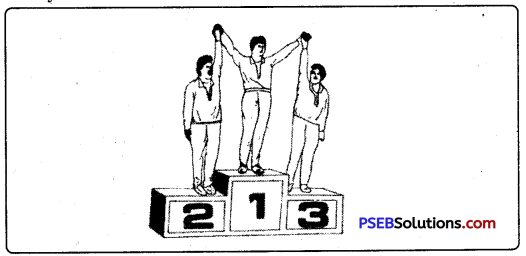

PSEB 9th Class Physical Education Solutions Chapter 2 Qualities of Sports and Sportsmanship

Punjab State Board PSEB 9th Class Physical Education Book Solutions Chapter 2 Qualities of Sports and Sportsmanship Textbook Exercise Questions and Answers.

PSEB Solutions for Class 9 Physical Education Chapter 2 Qualities of Sports and Sportsmanship

Very Short Answer Type Question

Question 1.
Write any two advantages of Sports.
Answer:
Make a person physically fit and mantly sound.

Question 2.
Write about the behaviour of sportsman. Write two lines.
Answer:
Accept defeat with honour and dignity everybody considers equals.

Question 3.
Mention any two qualities of a sportsperson.
Answer:

  • Co-operation
  • Tolerance.

Question 4.
Defeat and victory are equal. What it is called?
Answer:
Qualities of players.

PSEB 9th Class Physical Education Book Chapter 2 Qualities of Sports and Sportsmanship

PSEB 9th Class Physical Education Solutions Chapter 2 Qualities of Sports and Sportsmanship

Question 5.
How the quality of order and abide by comet.
Answer:
To participate in game.

Question 6.
The quality of self confidence and responsibility. What an able a person.
Answer:
Good citizenship.

Short Answer Type Questions

Question 1.
Write two qualities of sportsman.
Answer:

  • Spirit of Discipline
  • Tolerance
  • Spirit of sacrifice.

Question 2.
Describe two values of sports.
Answer:

  • Sound health
  • Good citizenship
  • Full control over emotions.

PSEB 9th Class Physical Education Solutions Chapter 2 Qualities of Sports and Sportsmanship

Question 3.
What do you understand by “sportsmanship”?
Answer:
‘Sportsmanship’ and ‘sportsman’ are important words related to games. Sportsmanship is the spirit with which a sportsman takes part in a game from beginning to the end. Sportsmanship is the collection of those qualities that are essential for a sportsman. For example it is essential for a player to be healthy, lively, disciplined, co-operative, active and obedient to the captain of his team.

Question 4.
What system of behaviour is accepted by a sportsman?
Answer:
System of behaviour for a sportsman accepted internationally by sportsmen has following features:

  • The decisions of the authorities are accepted to be correct and final.
  • The rules of the games are in fact the consensus of good people.
  • The greatest assurance is the best and clean performance of the teams.
  • Accept defeat with grace.
  • Treat victory in a natural way.
  • Acknowledging others virtues gives you respect.
  • Finding excuses for defeat or bad performance is not good.
  • A nation or team is respected according to behaviour.
  • Teams coming from outside should be respected.
  • Treat all teams equal.

Question 5.
How can the audience become good sportsmen?
Answer:
Following qualities are essential for the audience to become good sportsmen:

  • They should not obstruct the appreciation of good performance of the players.
  • If the decision goes against their wishes, they should not say anything against the Judge.
  • If the team supported by them is weak, they should not expect to win because only that team can win which has the qualities of good sportsmanship and strength.
  • They should not quarrel with other spectators simply for supporting the other team.
  • If the team they are supporting faces defeat they should not indulge in bad behaviour such as throwing filth in the ground or trying to stop the game so that it may end without any decision.

PSEB 9th Class Physical Education Solutions Chapter 2 Qualities of Sports and Sportsmanship

Long Answer Type Questions

Question 1.
Describe the Values of Sports.
Answer:
Values of Sports:
Sports have attraction for man due to their values.Following are the reasons for the emphasis being given on sports:

1. Sound Health:
Health is invaluable. A sound mind lives in a sound body. Tiredness, idleness remain away from a healthy man.
All the parts of one’s body are activated by jumping, running and other activities related to sports. All the vital parts of body like heart, lungs etc. start functioning well. Thus sports make one active and smart.

2. Sound Body:
Games and Sports develop sound body. Different sports provide strength to different parts of the body. Sports help in increasing height. The co-ordination of muscles and nerves makes a man look attractive.

3. Full Control over Emotions:
For a balanced and successful life full control over emotions is necessary. If the emotions are not controlled the emotions like anger, sadness and pride may destroy man’s personality. Sports keep human mind free from everyday worries, keep him happy and provide control over emotions.

4. Development of Sound Reason:
Man has to face many problems in life. Sound reasoning is needed to face these problems. Sports help in the development of sound reason. During the game a sportsman has to face different problems and situations. He has to take quick decisions and find quick solutions. Delay in such cases may turn the whole situation upside down. One learns to solve one’s problems. This develops sound reason.

5. Development of Character:
A man of character is respected every where. He does not come under the influence of temptations. Sometimes players are offered pecuniary rewards for victory or defeat. But a good player avoids this. If a sportsman indulges in such activities that prove disloyal to his team he is disliked and becomes hatable in the eyes of his fellow sportmen and the audience. No player tries to play foul in front of the public and in the presence of referees. All these things develop qualities of good character.

6. Development of strong Will-Power:
Sports strengthen will power. It enables the sportsman to work with concentration and acheive new heights of glory. Sportsman tries to achieve success and he tries hard for it. This becomes his habit to work with single minded devotion for success in life also. In this way sports develop strong will-power.

PSEB 9th Class Physical Education Solutions Chapter 2 Qualities of Sports and Sportsmanship

7. Development of the feeling of Brotherhood:
Sports help in the development of brotherhood. Sportsmen play in groups and it makes him behave properly according to the expectations of the group. He has to give up those habits that do not correspond with the expectations of the group. Apart from this playing in a group
has an impact on each other. This develops a feeling of love and brotherhood among the members of the group. This moulds their nature according to the group and they command respect in life.

8. Self-expression:
Sports provide an opportunity to the player to express their views without inhibitions. In the playground the players demonstrate their feats and personal qualities in front of the spectators. The expression of these qualities is possible in the playground only.

9. Leadership:
A good leader in sports develops into a good leader in life also. A good leader brings good name to his nation. On the other hand a bad leader endangers the interests of his country. We get disciplined, controlled, self-sacrificing, co-operative soldiers and good officers who sacrifice everything for the country. Therefore the Duke of Wellington, after Napolean’s defeat in the battle of Waterloo, said, “The battle of Waterloo was won at the playing-fields of Eton and Harrow.”

10. Proper Use of Leisure Time:
After day’s work one has ample free time. It becomes a problem to make the proper use of this spare time. If we do not make proper use of this time naturally we indulge in mischief. An idle mind is devil’s workshop. Sports and games help us in making the proper use of this free time. Sports not only help in spending free time usefully but also develop good health.

11. Spirit of Competition and Co-operation:
Competition is the basis of progress and co-operation is the means to great achievements. Every man has the feelings of competition and co-operation. The development of these feelings bring progress in society and take a country to the road to progress. Sports develop these feelings. A great competition takes place in the games of hockey, cricket, football etc. The teams try hard to win the match. The co¬operation of all the players is required to win the match. The efforts of only a single player cannot win the game. In order to develop the feeling of competition and co-operation, games have an important role to play.

12. Free from Casteism and Development of International Understanding:
Games and sports free us from the differences of casteism that cause a great hurdle in the progress of a country. The players belonging to different castes are there in every team. Their living together and making joint efforts to win the game abolish the differences based on casteism. In international competitions the players of different countries participate and have an active interaction with one another. A feeling of friendship develops and it paves way for international co-operation.

13. Spirit of Discipline:
The players remain in discipline and do there duty in the playground. We can say that a man or a player remaining in discipline in the playground develops a habit of discipline in life also.

14. Tolerance:
Games and sports develop a feeling of tolerance in players. We exchange our views with others. A feeling of co-operation and tolerance develops in us.

15. Good Citizenship:
Sports develop the qualities of a good citizen in the players. The players live in discipline, abide by the rules of the games and co-operate with other players. This makes them develop into good citizens.
In short we can say that sports develop the feelings of co-operation brotherhood, good leadership, equality etc. They help us in becoming good citizens.

PSEB 9th Class Physical Education Solutions Chapter 2 Qualities of Sports and Sportsmanship

Question 2.
What do you understand by ‘Sportsmanship’? What should be the qualities of a good sportsman?
Answer:
Meaning of Sportsmanship:
Many of the words from English language have been adopted by Indian languages. ‘Sportsmanship and ‘sportsman’ are important words related to games. Sportsmanship is the spirit with which a sportsman takes part in a game from beginning to the end. Sportsmanship is the collection of those qualities that are essential for a sportsman. For example it is essential for a player to be healthy, lively, disciplined, co-operative, active and obedient to the captain of his team. The collection of these qualities is known as sportsmanship.

Qualities of a Sportsman:

1. Spirit of Discipline:
The greatest quality of a sportsman is to remain in discipline and abide by the rules of the game. A person having this quality can be called a good sportsman.

2. Tolerance:
One of the important qualities of sportsmanship is tolerance. One faces different situations in games. Victory enthralls and defeat disappoints. But a good sportsman is that who encourages the defeated team and accepts his own defeat with a smiling face and congratulates the victorious team.

3.Spirit of Co-operation:
The spirit of co-operation is the third major quality of sportsman. This feeling keeps the players together and makes them work hard to win the game. A good sportsman co-operates with players, captain, coach, the referee and even the players of the opposite team.

4. No Difference between Victory and Defeat:
Every sportsman tries to win the game and makes every possible effet to achieve success. He can be called a good sportsman if he plays not only to win the game but only to demonstrate a good game. If he wins he should not make fun of the defeated team. In case of defeat he should not be disappointed. A good sportsman treats the defeated players not as inferiors rather he considers them his equals.

5.Ability of Obedience and Order:
A good sportsman should have the ability to obey the commands and in certain cases issue commands. In some cases players lose self-control and disobey their captain. They are not true sportsmen.

6.Spirit of Sacrifice:
The aim of a sportsman is to achieve success for his team. He does not play for his self-interest. It is another quality of a sportsman. A player gives the credit of success to his school, college, state and country.

7. Spirit of Brotherhood:
A good sportsman does not give importance to the differences on the basis of caste, creed, religion, language, region etc. He treats all the players in the same way.

8. Spirit of Competition:
Spirit of competition is essential in a good sportsman. This spirit makes him work hard. In fact the key to progress is the spirit of competition. But this spirit of competition should be free from prejudice and maliee.

9. Spirit of Punctuality:
Sportsman respect the sense of punctuality and make maximum use of each and every opportunity. Every record in a game is valuable. A minor negligence may turn victory into defeat.
PSEB 9th Class Physical Education Solutions Chapter 2 Qualities of Sports and Sportsmanship 1

10. Spirit of being Active and Alert: A sportsman always remains active and smart. He does not lose any opportunity.

11. Spirit of Self-Confidence:
Without self-confidence nobody can play a game well. Every player has self-confidence and faith in his ability. The self- confidence of the Japanese won them maximum medals in 1974 Asian Games. In 1978 they again got the first position. In the same way they won in 1982 Asian Games held in Delhi.

12. Spirit of Responsibility: The sense of responsibility is a must for a sportsman. He should not behave in an irresponsible way. A minor irresponsible act on his part may bring defeat.

13. Knowledge of New Rules:
A sportsman should be aware of the latest rules of games and sports. Every year new rules and regulations are framed. A sportsman should be aware of them.In short, we can say that sportsmanship is not a single unit rather a collection of good elements and a sportsman should have the qualities of discipline, tolerance, self confidence, self-sacrifice and co-operation.

PSEB 9th Class Physical Education Solutions Chapter 3 Effects of Intoxicants on Sports Performance

Punjab State Board PSEB 9th Class Physical Education Book Solutions Chapter 3 Effects of Intoxicants on Sports Performance Textbook Exercise Questions and Answers.

PSEB Solutions for Class 9 Physical Education Chapter 3 Effects of Intoxicants on Sports Performance

Very Short Answer Type Questions

Question 1.
Write the name of two intoxicants.
Answer:

  • Wine
  • Hashish.

PSEB 9th Class Physical Education Solutions Chapter 3 Effects of Intoxicants on Sports Performance

Question 2.
Name any two systems which are being effected by intoxicants.
Answer:
On Digestive system and circulatory system.

Question 3.
Write any two harms of intoxicants.
Answer:

  • Face becomes pale.
  • Disturbance of Mantle concentration.

Question 4.
Write any two harm of sports person of intoxicants.
Answer:

  • Carelessness and irresponsibility.
  • End of Sportsmanship

Question 5.
Intoxicants causes depart in sport. (Right or wrong)
Answer:
Right.

Question 6.
Alcohol effects on brain. (Right or wrong)
Answer:
Right.

PSEB 9th Class Physical Education Book Chapter 3 Effects of Intoxicants on Sports Performance

PSEB 9th Class Physical Education Solutions Chapter 3 Effects of Intoxicants on Sports Performance

Question 7.
Chewing Tobacco causes weak eyesight. (Right or wrong)
Answer:
Right.

Question 8.
Smoking causes cancer or not.
Answer:
Causes cancer.

Question 9.
Use of Tobacco does not causes cough and the consumption of tobacco is not prone to T.B. (Right or wrong)
Answer:
Wrong.

Question 10.
Under the influence of intoxicants player become careless. (Right or wrong)
Answer:
Right.

PSEB 9th Class Physical Education Solutions Chapter 3 Effects of Intoxicants on Sports Performance

Short Answer Type Questions

Question 1.
Prepare a list of intoxicants.
Answer:
List of Intoxicants:

  • Alcohol
  • Opiumh
  • Tobacco
  • Bhang
  • Hashis
  • Snuff
  • Caffeine
  • Adernwin.

Question 2.
Describe how intoxicants effect on digestion and memory or thinking of a person.
Answer:
Effect on Digestion:
Intoxicants have highly adverse effect on digestive system. They are highly acidic in nature. As a result of acidic characteristic, the working capacity of liver decreases, and our suffers from many stomach ailments.

Effect on Memory:
Under the influence of intoxicants person cannot speak properly. He only stammers. He loses self-control. He cannot properly judge the changed conditions during the play, and fails to exploit such situations.

Question 3.
Intoxicants cause defeat in sports. How?
Answer:

  • Intoxicated players fail to assess the ever changing condition during the play, and become the cause of their team’s defeat in the end. .
  • An intoxicated player becomes careless and irresponsible.
  • If anybody is found having played under the influence of some intoxicants, he may be debarred from play, his reward is cancelled. In this way victory turns into defeat.

PSEB 9th Class Physical Education Solutions Chapter 3 Effects of Intoxicants on Sports Performance

Question 4.
What are the effects of Alcohol on our body? Discuss harm of alcohol.
Answer:
Effects of Alcohol on Health:
Alcohol is a liquid intoxicant. It is legally binding to write on each bottle of alcohol-“Drinking is injurious to health.” Even then more and more people are becoming addict to alcohol, and seem to ignore the statutory warning totally. Thus, more and more such people are becoming prey to many diseases. Their lungs get defected. The liver is damaged. Age declines. Alcohol, in fact, adversely affects all parts of the body. At first man takes alcohol, then alcohol begins to take (consume) him.

Alcohol has several bad effects, some of which are listed below:

  • Alcohol affects the brain first of all. Nervous system gets affected and the brain weakens. The thinking power or faculty declines.
  • The kidneys in the body weaken.
  • Alcohol becomes a hindrance in the production of digestive juices, as a result of which digestion worsens.
  • Respiration increases, and one catches diseases pertaining to respiratory system.
  • Blood vessels expand under the influence of regular drinking. Brain has to exert more, and one may suffer a heart attack any moment.
  • Regular drinking decreases the work-capacity of muscles. The body gets weakened to face the attack of disease germs.
  • The studies have revealed that a drunkard works less than a normal person. A drunkard also catches various diseases sooner than a normal individual.
  • Drinking is a social evil as it ruins home, health and wealth.

Question 5.
What is the effects of cigarettes and tobacco on our body? What are the harms of smoking?
Answer:
Effect of Smoking on Health:
In our country smoking and taking tobacco has become a habit and a fashion. There are several ways to consume tobacco such as smoking cigarettes, bidis, cigars, hubble-bubble, etc. Tobacco is also eaten in many forms such as eating “paan”, tobacco mixed with lime, “jarda”, etc. There is a dangerous toxic substance called Nicotine in tobacco. There are other toxins like ammonia, carbon dioxide, etc. Nicotine has its adverse effect on the head which begins to feel giddy, and then the heart is badly affected.

The harms of tobacco on health are as under:

  • Eating or taking tobacco weakens eyesight.
  • It increases heart beat. One catches heart diseases which often prove fatal.
  • Studies have revealed that tobacco consuming contracts blood vessels.
  • Tobacco benumbs the body tissues. One does not have good sleep and ultimately suffers from sleeplessness.
  • Stomach begins to remain upset with tobacco consumption.
  • Tobacco also causes cough, and the consumer of tobacco is prone to lung diseases like T.B.
  • The possibility of catching cancer increases with the excessive use of tobacco, particularly the cancer of lungs and throat.

PSEB 9th Class Physical Education Solutions Chapter 3 Effects of Intoxicants on Sports Performance

Long Answer Type Questions

Question 1.
What are intoxicants? Discuss their harms.
Answer:
Intoxicants and their Abuses:
Ever since time immemorial man has been using intoxicants. He was of the opinion that their use was helpful in removing some diseases and in making one feel fresh. But later on the harmful effects of intoxicants came to light. In today’s world, many types of intoxicants have come into use and are easily available. The sports world, in particular, feels concerned and worried. There is no doubt that man can work overtime by consuming some intoxicants, but in the long run overwork results in his fast decay and death.

Among these intoxicants some are worse than leprosy. Such intoxicants as alcohol, tobacco, opium, hashish, bhang, etc. are very harmful to ones’ health. Everybody takes part in some sports for his recreation. He has goodwill and sense of co-operation, and thinks of the well-being of all on the other hand, an intoxicant cannot think of anybody and anything else except his own self, and sometimes not even about his own well-being.

Such a person is a burden on society. He becomes a thorn in the flesh of others. Not only does he make his own life sorrowful but also makes others sorrowful, and turns the life of his family and relatives into a virtual hell. The fact is that intoxicants had highly injurious .effect on one’s health. The use of intoxicants makes one catch diseases of liver, lungs, heart, blood, digestive system, etc. It is not good for players in particular.

Harms of Intoxicants:
Those players who use intoxicants develop the following defects-

  • The face turns pale.
  • One’s steps stagger.
  • The mental balance is lost.
  • The playfield turns into a battlefield.
  • Digestion gets defective.
  • Acidic elements decrease the efficiency of liver.
  • Many stomach ailments are caught.
  • The working capacity of muscles decreases.
  • The player fails to show good performance on the playfield.
  • One catches such dreadful diseases as cancer, asthma etc.
  • The memory of the player suffers.
  • Intoxicated players fail to assess the ever-changing conditions during the play, and become the cause of their team’s defeat in the end.
  • An intoxicated player becomes careless and irresponsible.
  • Body loses the needed co-ordination.

PSEB 9th Class Physical Education Solutions Chapter 3 Effects of Intoxicants on Sports Performance

Question 2.
Mention the adverse effects of intoxicants on the players and their games.
Answer:
The adverse effects of intoxicants on the players and their game are as under:
1. The Lack of Bodily co-ordination and Agility:
The player under the effect of an intoxicant loses his usual agility and physical co-ordination. These are essential qualities for a good game of hockey, football, etc.

2. The Lack of Mental balance and Concentration:
A slight mistake of a player may prove to be very harmful to the team. An intoxicated player cannot play with concentration. Therefore, he commits such mistakes as result in the team’s defeat.

3. Carelessness and Irresponsibility:
An intoxicated player is extremely careless and carefree. He fails to judge his own strength and efficiency. Sometimes such a player receives such an injury that he has to repent later throughout his life.

4. The Loss of the Spirit of Sportsmanship:
The intoxicated player loses his sense of sportsmanship. As he is in semi-conscious state, he has no self-control. He loses his balance of mind, becomes self-willed and plays as he wishes without paying any heed to what his team-mates say or desire.

5. The Lack of Tolerance:
An intoxicated player often expresses his unhappiness over the decisions of the umpire or referee. He has no control on his reasoning, so he behaves indecently.

6. Disobedience of Rules: Such a player often disobeys rules of the game.

7. Turning of Playground into a Battlefield:
A player under the influence of intoxicant turns the playground into a battlefield.
International Olympic Committee has banned the use of intoxicants during games. If anybody is found having played under the influence of some intoxicant, his medal or reward is cancelled. Therefore, players should try to avoid all kinds of intoxicants, show their best performance and brings laurels to their country.

PSEB 6th Class Physical Education Solutions Chapter 3 Major Dhyan Chand-The Magician of Hockey

Punjab State Board PSEB 6th Class Physical Education Book Solutions Chapter 3 Major Dhyan Chand-The Magician of Hockey Textbook Exercise Questions and Answers.

PSEB Solutions for Class 6 Physical Education Chapter 3 Major Dhyan Chand-The Magician of Hockey

Physical Education Guide for Class 6 PSEB Major Dhyan Chand-The Magician of Hockey Textbook Questions and Answers

Question 1.
When was Major Dhyan Chand Born?
Answer:
Major Dhyan Chand was born on 29 August 1905 at Allahabad in the house of father Sameshwar Dutt.

Question 2.
When did Indian hockey team participate for the first time in the Olympic games? Which medal was won by Indian team in these games?
Answer:
In 1928, the Indian team participated in Amesterdom Olympic Games for the first time and also won the gold medal in it.

PSEB 6th Class Physical Education Solutions Chapter 3 Major Dhyan Chand-The Magician of Hockey

Question 3.
Describe any one episode related to Major Dhyan Chand’s life.
Answer:
There are many legends about this great player. Once in Holland, the authorities broke Dhyan Chand’s hockey stick to check if there was any magnet like element inside it. Actually Dhyan Chand had a great control on ball. His ball did not separate from his stick. Many people believed that his hockey stick was a magical stick. Dhyan Chand won the heart of German Dictator Hitler. Hitler even had offered a high post in German army, but Dhyan Chand declined the offer and felt proud to play only for India.

Question 4.
hen and where did Major Dhyan Chand play his first International match?
Answer:
He played his first International match in New Zealand on 13th May, 1926. In New Zealand 21 matches were played. India won 18 matches, out of these.

Question 5.
In which country Major Dhyan Chand’s statue is installed?
Answer:
Statue of Dhyan Chand was placed in Biana at Australia. This statue was made with four hands and one hockey stick is put in each hand.

PSEB 6th Class Physical Education Solutions Chapter 3 Major Dhyan Chand-The Magician of Hockey

Question 6.
Write a brief note about Major Dhyan Chand’s life.
Answer:
Major Dhyan Chand was bom on 29th August, 1905 at Allahabad in the house of father Sameshwar Dutt. Dhyan Chand’s father & elder brother were also prominent players of hockey. Thus Dhyan Chand received his game in heritage. He was a famous player of hockey in India. He brought laurels for India at World level. He won gold and silver medals on International level in the field of sports. His father worked in British Indian Army.

Major Dhyan Chand joined army as the soldier at a age of t sixteen. There a Subedar Major Tiwari motivated him to play hockey. Major Dhyan Chand used to practise hockey with great dedication after his duty hours in the evening till late night in the moonlight. He participated in sports competitions of army from 1922 to 1926. Dhyan Chand’s game was highly appreciated during the annual sports competition in Delhi. The appreciation boosted Dhyan Chand’s spirit high. He played his first International match in Newzealand on 13th May, 1926. In New Zealand 21 matches were played, India won 18 matches out of these.

Question 7.
What efforts have been done by the Indian government dedicated to the memory of Major Dhyan Chand?
Answer:

  • Indian government recognized Dhyan Chand’s wonderful game skill & honoured him with “Padam Bhushan” in 1956.
  • Dhyan’s birthday is celebrated as National Sports Day in India with great pomp & show.
  • The Indian postal service had even issued a postage stamp in his memory.
  • International Stadium at New Delhi has been named after him in his memory.

PSEB 6th Class Physical Education Solutions Chapter 3 Major Dhyan Chand-The Magician of Hockey

PSEB 6th Class Physical Education Guide Major Dhyan Chand-The Magician of Hockey Important Questions and Answers

Multiple Choice Questions

Question 1.
When Major Dhyan Chand was born?
(A) 1905
(B) 1910
(C) 1912
(D) 1916.
Answer:
(A) 1905

Question 2.
When did Indian hockey team participate for the first time in the Olympic games?
(A) 1928
(B) 1932
(C) 1936
(D) Never.
Answer:
(A) 1928

Question 3.
When and where did Major Dhyan Chand play his first International Match?
(A) 1926 Newzealand
(B) 1928 Koser
(C) 1932 England
(D) All above.
Answer:
(A) 1926 Newzealand

PSEB 6th Class Physical Education Solutions Chapter 3 Major Dhyan Chand-The Magician of Hockey

Question 4.
In which country Major Dhyan Chand’s statue is installed?
(A) In Biana at Australia
(B) America
(C) Newzealand
(D) All above.
Answer:
(A) In Biana at Australia

Question 5.
Which awards were given to Major Dhyan Chand by the Govt, of India?
(A) Padam Bhushan in 1956.
(B) Dock ticket was released on his name.
(C) International Stadium at his name in New Delhi.
(D) All above.
Answer:
(D) All above.

Question 6.
Major Dhyan Chand was attached with which game?
(A) Football
(B) Hockey
(C) Cricket
(D) Badminton.
Answer:
(B) Hockey

Question 7.
Dhyan Chand started playing hockey in which place?
(A) At home
(B) In Military
(C) School
(D) College.
Answer:
(B) In Military

PSEB 6th Class Physical Education Solutions Chapter 3 Major Dhyan Chand-The Magician of Hockey

Very Short Answer Type Questions

Question 1.
Major Dhyan Chand was attached with which game?
Answer:
Major Dhyan Chand was attached with Hockey.

Question 2.
Dhyan Chand started playing Hockey in which place?
Answer:
Dhyan Chand started playing Hockey in Army.

Question 3.
Who is called the magician of Hockey?
Answer:
Major Dhyan Chand.

Question 4.
When was Dhyan Chand Born?
Answer:
Dhyan Chand was bom on 29 August, 1905 at Allahabad.

Question 5.
What was his father’s name?
Answer:
His father’s name was Sameshwar Dutt.

PSEB 6th Class Physical Education Solutions Chapter 3 Major Dhyan Chand-The Magician of Hockey

Question 6.
His elder brother was also hockey player or not?
Answer:
Yes, his elder brother ‘Roop Singh’ was also a good player of hockey.

Question 7.
In which place Major’s father did his job?
Answer:
He did job in British India Army.

Question 8.
Major started job of army in which age?
Answer:
At the age of 16 years.

Question 9.
Dhyan Chand first participated in which International match?
Answer:
13 May, 1926 at New Zealand.

Question 10.
In which Olympics he participated first?
Answer:
In 1928, at Amesterdom.

Short Answer Type Questions

Question 1.
When did Major Dhyan Chand born and died?
Answer:
Major Dhyan Chand was bom on 29 August, 1905 in Allahabad and he died on 3 December, 1979.

PSEB 6th Class Physical Education Solutions Chapter 3 Major Dhyan Chand-The Magician of Hockey

Question 2.
Major Dhyan’Chand did how many goals against another teams?
Answer:
He did 1000 goals.

Question 3.
How many goals Major Dhyan Chand did in International matches?
Answer:
He did 400 goals in International matches.

Question 4.
What did Hitler offer to Dhyan Chand?
Answer:
Hittler offered him to play as a team member of Germany.

Question 5.
What question was asked by Bradman to Dhyan Chand?
Answer:
He said that how you could do so many goals by hockey.

Question 6.
After awarded Padam Bhushan award Indian Olympic Association gave which award to Dhyan Chand?
Answer:
Shtabdi of Sarvotam player.

Question 7.
Statue of Dhyan Chand is installed in which country?
Answer:
In Australia.

PSEB 6th Class Physical Education Solutions Chapter 3 Major Dhyan Chand-The Magician of Hockey

Question 8.
Why Dhyan Chand’s hockey was broken?
Answer:
Te see if it was magical stick or not.

Long Answer Type Questions

Question 1.
Explain the story attached to the life of Dhyan Chand.
Answer:
Even great cricketer Don Bradman became Dhyan Chand’s fan. He asked Dhyan Chand how he scored so many goals? Dhyan Chand
answered him that as he made runs by cricket bat, similarly goals are scored by a hockey stick.

Question 2.
What things got Dhyan Chand in his life?
Answer:
Indian Government recognized Dhyan Chand’s wonderful game skill & honoured him with “Padam Bhushan” in 1956. He was declared the best player of the century by the Indian Olympic Association. 29 August, Chand’s birthday is celebrated as National Sports Day in India with great pomp & show. A statue of Dhyan Chand has been set up in Vienna, Australia to honour him. This statue has four hands holding four sticks. This statue is a symbol of his marvellous skills of his game. He also won a lot of gold & silver medals.

Question 3.
Dhyan Chand play first international match in which state? In 1928 he participated in which Olympic game?
Answer:
He played his first international match in New Zealand on 13th May, 1926. In 1928, the Indian team participated in Amesterdom Olympic Games for the first time. Indian team after winning initial matches defeated Australia by 6-0, Beligum 9-0, Denmark 5-0, Switzerland 6-0 & Holland 3-0 in final match & India emerged as a hockey champion of Olympic games. In this final match two goals out of three were exclusively scored by Dhyan Chand.

PSEB 6th Class Physical Education Solutions Chapter 3 Major Dhyan Chand-The Magician of Hockey

Question 4.
Write the achievements of Dhyan Chand in 1932 Olympics.
Answer:
Dhyan Chand played’a crucial role as a centre forward player. In these Olympic games the final match was played between India and America. In which India defeated America team by 24-1. Among these 24 goals, Dhyan Chand alone scored 8. An American newspaper after the shameful defeat of America wrote that Indian team was a typhoon that came from East. Indian team scored 262 goals during these Olympic games. Dhyan Chand scored 101 goals alone. Major Dhyan Chand’s name was included among the top most players of the world.

Question 5.
Write two lines about the family of Dhyan Chand?
Answer:
Dhyan Chand was bom in 29 August, 1905 at Allahabad. His father’s name was Sameshwar Dutt and his elder brother was Roop Singh. His brother was also a famous player of hockey. Dhyan Chand received his game as a heritage. His father worked in Indian Army. He participated in Olympic & Asian games and won so many awards. In this way the whole family was related with Hockey.

PSEB 6th Class Physical Education Solutions Chapter 2 Hygiene And Maintenance

Punjab State Board PSEB 6th Class Physical Education Book Solutions Chapter 2 Hygiene And Maintenance Textbook Exercise Questions and Answers.

PSEB Solutions for Class 6 Physical Education Chapter 2 Hygiene And Maintenance

Physical Education Guide for Class 6 PSEB Hygiene And Maintenance Textbook Questions and Answers

Question 1.
Why cleanliness is important for our house?
Answer:
Our human body is just like a machine. If we do not maintain our machines then they get damaged as well as if we can’t clean our body well then it can covered with diseases. We need petrol and diesel to move vehicles as same as a human body needs balanced diet, clean water and air to work. If we do not give proper attention to our body then physically, mentally & socially our structure also gets effected.

It is too important to clean our body parts. It is also important to clean our home and our surroundings. Cleanliness is the sign of health. It is not even imagined that a life without cleanliness. If we do not take care of our home then it also causes a lot of problems. By this our surroundings also become dirty and our nation as well as we all are harmed.

PSEB 6th Class Physical Education Solutions Chapter 2 Hygiene And Maintenance

Question 2.
How can the cleanliness of the house be maintained?
Answer:
(a) There should be proper arrangement for the outflow of the dirty water to keep the house safe from moisture & fungus etc. Sunlight & air should be sufficiently available in all parts of the house. There should be lattictel windows & doors. They should always be kept closed.

(b) Kitchen is a vital part of house. Kitchen & the utensils, hearth/gas stove used in the kitchen should be cleaned daily. The eatable food should always be kept covered because flies, worms & cockroaches poison the uncovered food. Stale vegetables, stale food, rotten fruits spread diseases if kept in the kitchen. They should be dropped in the garbage tin with a lid, outside the house. The garbage should not be kept for a long time even outside the house.
PSEB 6th Class Physical Education Solutions Chapter 2 Hygiene And Maintenance 1
(c) Children should not scatter the peels here & there while eating vegetables & fruits etc. They should be put into some utensil & then thrown into the bin.

(d) Proper care should be taken of the cleanliness of the bathrooms. The floor of the bathroom should not remain wet.

Question 3.
Which things should be borne in mind for the cleanliness of the surroundings of the house?
Answer:
Cleanliness of surroundings is also important as such as cleanliness of home. If our home is clean but our surroundings are dirty then we also cause by different diseases. Some steps should be taken to maintain cleanliness of surroundings of the home are as follow-

  • Streets and roads should be cleaned.
  • Water flowing pipes or areas should also be cleaned time-to-time.
  • Do not tie your pets outside the house.
  • Do not throw garbage on the road or in the streets. Put it in the ground to decompose itself.
  • Do not spit on road while walking.
  • Always use washrooms to expell out your waste.

PSEB 6th Class Physical Education Solutions Chapter 2 Hygiene And Maintenance

Question 4.
What role can be played by the students in maintaining the .cleanliness of the school?
Answer:
School is a temple. Cleanliness of school is also very important. School is a place in which children spend their lot of time. If we do not maintain our school then children have to fight with so many diseases. So hat’s why it is very important to maintain our schools well. There are some steps to maintain it:

  • Do not throw pieces of papers here & there.
  • Always throw it in the dustbin.
  • Benches, classrooms & doors should be cleaned daily.
  • Always clean washrooms daily.
  • Maintain your water-tank properly.
  • Always clean your playgrounds.

Question 5.
How can the objects of the house be maintained?
Answer:
We also have to take care of things of the house. All the objects of the house should be at proper places, so that there is no difficulty in finding them. Things placed at proper places also look good. They add to the beauty on one hand, save us from many accidents on the other hand.
In winter, we should manage the summer clothes and in summer the winter clothes at home according to the season.

We should sprinkle insecticide on wooden fruniture, windows & doors etc. to make them safe from woodworms. The iron articles which get rusted should be painted from time to time. The glass-made things used in the houses knife, scissors, screw driver, needle, nail cutter, blade, insecticide made to protect wheat, medicines for the sick at home, phenyl, Bottle of acid etc should be placed separately and at safe places so that they may remain out of reach of small children.

Question 6.
Which things should the children keep in their mind to maintain the objects of the school?
Answer:
Every child should take care of the school & its objects. Children should not be damaged’the walls by drawing lines on them. Furniture of the schools should not be damaged. They should not damage the fans, tubelights, the taps of drinking water. They should switch off the electric buttons when not needed. They should not pluck flowers of their garden of school.

They should protect these flowers & beautify the school. Boxes in the library should be placed properly in separate boxes according to the subjects. Students should not tear the pages from the books, newspapers & magazines. They should observe silence while sitting in library.

PSEB 6th Class Physical Education Solutions Chapter 2 Hygiene And Maintenance

PSEB 6th Class Physical Education Guide Hygiene And Maintenance Important Questions and Answers

Multiple Choice Questions

Question 1.
How can the cleanliness of the house be maintained?
(A) There should be proper care for the outflow of waste and dirty water.
(B) Everyday clean all rooms of the house.
(C) Keep the water of the house in pot which must have cover
(D) All above.
Answer:
(D) All above.

Question 2.
Rules for the student in maintaining the cleanliness of school.
(A) Clean the bench and desk everyday.
(B) Don’t throw waste in rooms.
(C) Never prick ink while writing.
(D) All above.
Answer:
(D) All above.

Question 3.
Write the causes of dirty house.
(A) Keep the waste garbage of house at proper place.
(B) Proper arrangement of dirty water of kitchen and bathroom.
(C) Garbage are not properly outlet.
(D) All above.
Answer:
(D) All above.

Question 4.
Where we should construct our house?
(A) Hard and high place.
(B) Have must be away from Railway station, Mandir.
(C) Proper arrangement of air and light.
(D) All. above.
Answer:
(D) All above.

PSEB 6th Class Physical Education Solutions Chapter 2 Hygiene And Maintenance

Question 5.
Rules of the body cleanliness.
(A) We should take bath everyday with fresh water.
(B) Rub your body after bath with clean towel.
(C) Comb your hair after bath.
(D) All above.
Answer:
(D) All above.

Very Short Answer Type Questions

Question 1.
What is necessary to be cleaned while cleaning your own body?
Answer:
Our house & our surroundings.

Question 2.
Where our house should be placed?
Answer:
At hard and high place.

Question 3.
What will happen if we live in dirty house?
Answer:
Lot of diseases are caused.

PSEB 6th Class Physical Education Solutions Chapter 2 Hygiene And Maintenance

Question 4.
Which type of place is required while making house?
Answer:
Deep, Broad and Strong.

Question 5.
What is important in the rooms?
Answer:
Light, air and water.

Question 6.
If we live in dirty, less light and tight houses then what will happen?
Answer:
Then we don’t become fit.

Question 7.
Which things should be away from the house?
Answer:
Railway station and Mandi.

Question 8.
Where we have to place our garbage in house?
Answer:
In a covered dustbins.

Question 9.
Where animals should not be tied?
Answer:
In streets.

Question 10.
What is to be put in water to pure it?
Answer:
Pottasium Permagnet.

Question 11.
By which thing be used to clean the toilets?
Answer:
With Phenyl.

PSEB 6th Class Physical Education Solutions Chapter 2 Hygiene And Maintenance

Short Answer Type Questions

Question 1.
Write five steps to maintain the cleanliness of our home.
Answer:

  • We should sprinkle insecticide on wooden furniture, windows & doors to make them safe from woodworms.
  • The iron articles which get rusted should be painted time to time.
  • Always put garbage in the closed dustbins.
  • Clean your washrooms with Phenyl.
  • Clean your rooms daily with Brooms.

Question 2.
Write five steps to clean your schools?
Answer:

  • Classrooms, should be large & airy. There should be proper arrangements of light in classrooms.
  • There should be no dust or dirt in the classroom of the children. The study tables and chairs should be cleaned. Tables and chairs should be cleaned properly before sitting.
  • Pure drinking water should be provided.
  • The meals provided by the school should be pure & balanced.
  • Children should come to school in neat & clean uniform. Teachers should also check the children clothes & cleanliness.

Question 3.
What are the causes of dirt in the house?
Answer:

  • Fruits, vegetables, leaves & other waste materials etc. are not put in a particular place.
  • Washrooms and flushes are not properly built.
  • Family members are not awared about cleanliness.
  • Many members live in small house.
  • Due to large family & many members, proper cleanliness can’t be maintained.

PSEB 6th Class Physical Education Solutions Chapter 2 Hygiene And Maintenance

Long Answer Type Questions

Question 1.
What should be kept in mind while building your home?
Answer:
(A) Situation of a house:

  • House should be built on height & strong floor.
  • House should be built away from factories, railway stations etc.
  • Ways of House is straight & vast.
  • House should be very airy.
  • Neighbours should be friendly.

(B) Construction of house:

  • House should be placed at deep, broad & strong foundation.
  • Floor should be very strong and plain.
  • Net should be placed on window to prevent house flies and mosquitoes from house.
  • Also clean your house daily.
  • Rooms & kitchen should be away from washrooms.
  • There is also a proper arrangement of light.

PSEB 6th Class Physical Education Solutions Chapter 2 Hygiene And Maintenance

Question 2.
Write the steps of cleanliness of body.
Answer:

  • Take bath daily with fresh water.
  • Rub your body after bath with clean towel.
  • Take proper head/hair wash.
  • Wear clothes according’ to the climatic conditions.
  • Wash your eyes with cold water.
  • Always brush your teeth twice in a day.
  • Wash your hands before and after meal.
  • Wash your hair with lemon, amla, with best shampoos.

PSEB 8th Class Science Solutions Chapter 3 Synthetic Fibres and Plastics

Punjab State Board PSEB 8th Class Science Book Solutions Chapter 3 Synthetic Fibres and Plastics Textbook Exercise Questions and Answers.

PSEB Solutions for Class 8 Science Chapter 3 Synthetic Fibres and Plastics

PSEB 8th Class Science Guide Synthetic Fibres and Plastics Textbook Questions and Answers

Exercises

Question 1.
Explain why some fibres are called synthetic.
Answer:
Some fibres are called synthetic fibres because they are not obtained from natural sources. They are made by human beings. The raw materials used for preparing synthetic fibres are petrochemicals, which in turn are produced from fossil fuel, petroleum.

Question 2.
Mark (✓) the correct answer.
Rayon is different from synthetic fibres because
(a) it has a silk-like appearance
(b) it is obtained from wood pulp
(c) its fibres can also be woven like those of natural fibres.
Answer:
(b) It is obtained from wood pulp.

PSEB 8th Class Science Solutions Chapter 3 Synthetic Fibres and Plastics

Question 3.
Fill in the blanks with appropriate words.
(а) Synthetic fibres are also called …………… or ……………….. fibres.
(b) Synthetic fibres are synthesised from raw material called ………………. .
(c) Like synthetic fibres, plastic is also a ………………… .
Answer:
(a) Man made, artificial
(b) Petrochemicals
(c) Synthetic.

Question 4.
Give examples which indicate that nylon fibres are very strong.
Answer:
Parachutes, ropes for climbing, tents made of nylon.

Question 5.
Explain why plastic containers are favoured for storing food.
Answer:
Advantages of using plastic containers for storing food:

  1. They do not react with food, air and water.
  2. They are strong and light in weight.
  3. They can have different sizes, shapes and colours.

Question 6.
Explain the difference between thermoplastic and thermosetting plastics.
Answer:
Differences between the Thermoplastics and Thermosetting Plastics

Thermoplastics Thermosetting plastics
1. It can bend easily. 1. It cannot bend but breaks.
2. On heating, it gets deformed. 2. Heating has no affect on it.
3. It can be used again and again. 3. It cannot be reused.
4. It can be moulded into various shapes on heating. Examples : Polythene, PVC. 4. It can be moulded only once, on heating.

Examples : Bakelite, Melamine.

Question 7.
Explain why the following are made of thermosetting plastics.
(а) Saucepan handles
(b) Electric plugs/switches/plug boards
Answer:
(a) Saucepan handles are made of thermosetting plastics because plastic is bad conductor of electricity, fire resistant and heat tolerant.

(b) Electric plugs/switches/plugboards are made of thermosetting plastics because this plastic is bad conductor of electricity and durable.

Question 8.
Categorise the materials of the following products into ‘can be recycled’ and ‘cannot be recycled’.
Telephone instruments, plastic toys, cooker handles, carry bags, ball point pens, plastic, bowls, plastic covering on electric wires, plastic chairs, electrical switches.
Answer:
Can be recycled. Plastic toys, carrybags, ball point pens, plastic bowls, plastic chairs, plastic covering on electric wires.
Cannot be recycled. Telephone instruments, cooker handles, electrical switches.

Question 9.
Rana wants to buy shirts for summer. Should he buy cotton shirts or shirts made from synthetic material ? Advise Rana, giving your reason.
Answer:
Rana should buy cotton shirts.
Preference of cotton clothes to synthetic materials in summers.

  1. Cotton clothes are porous while synthetic materials are non-porous or air resistant.
  2. Cotton clothes soak sweat and give a dry feeling while synthetic clothes have little water absorbing property.

PSEB 8th Class Science Solutions Chapter 3 Synthetic Fibres and Plastics

Question 10.
Give examples to show that plastics are non-corrosive in nature.
Answer:
Plastics are non-corrosive in nature. Plastics do not react with air, water etc. so, they do not get corroded.
For example –

  1. Different chemicals are stored in plastic bottles.
  2. Water is kept into plastic bottles.
  3. Pickles and food items are stored in plastic containers.

Question 11.
Should the handles and bristles of a toothbrush be made of the same material ? Explain your answer.
Answer:
No, different materials should be used for making handles and bristles of toothbrush because bristles help in cleaning teeth and handle is just for support. Bristles must be soft and delicate and powerful while handle should be hard and rigid.

Question 12.
‘Avoid plastics as far as possible’. Comment on this advice.
Answer:
Plastics are not environment friendly. They release poisonous gases on burning. They are non-biodegradable, so pollute soil or water in which they are dumped. Therefore, use of plastic should be avoided as far as possible.

Question 13.
Match the terms of Column A correctly with the phrases given in Column B.

Column A Column B
(i) Polyester (a) Prepared by using wood pulp
(ii) Teflon (b) Used for making parachutes and stockings
(iii) Rayon (c) Used to make non-stick cookwares
(iv) Nylon (d) Fabrics do not wrinkle easily

Answer:

Column A Column B
(i) Polyester (d) Fabrics do not wrinkle easily
(ii) Teflon (c) Used to make non-stick cookwares
(iii) Rayon (a) Prepared by using wood pulp
(iv) Nylon (b) Used for making parachutes and stockings

Question 14.
‘Manufacturing synthetic fibres is actually helping conservation of forests’. Comment.
Answer:
Natural fibres are obtained from natural resources i.e. natural plants. But synthetic fibres are obtained from other materials. So, synthetic fibres are not dependent on natural vegetation or crops grown in the field. Thus manufacturing synthetic fibres actually helps conservation of forests.

Question 15.
Describe an activity to show that thermoplastic is poor conductor of electricity.
Answer:
PSEB 8th Class Science Solutions Chapter 3 Synthetic Fibres and Plastics 1
Activity.
Take a few samples of thermoplastic such like polythene, PVC, Nylon, Polystyrene etc.
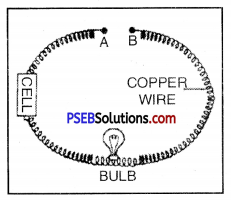
Now set up the circuit as shown in fig. and insert a piece of Nylon between the two terminals A and B of copper wire. If bulb starts glowing then it is good conductor otherwise it is a bad conductor. Repeat the experiment using different samples of thermoplastics.
In each case, bulb would not glow indicating that thermoplastics are bad conductor of electricity.

PSEB 8th Class Science Solutions Chapter 3 Synthetic Fibres and Plastics

PSEB Solutions for Class 8 Science Synthetic Fibres and Plastics Important Questions and Answers

Multiple Choice Questions

Question 1.
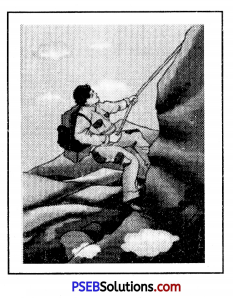
In the following diagram, a boy is seen using rope for going up a rock. Tell rope made of which material is most suitable for this purpose ?
PSEB 8th Class Science Solutions Chapter 3 Synthetic Fibres and Plastics 2
(a) Cotton
(b) Wood
(c) Nylon
(d) None of these.
Answer:
(c) Nylon.

Question 2.
Which of the following is called artificial silk ?
(a) Rubber
(b) Teflon
(c) Rayon
(d) Polythene.
Answer:
(c) Rayon.

Question 3.
…………… is used for making polyester clothes.
(a) P.E.T.
(b) Acrvline
(c) Terrylene
(d) None of these.
Answer:
(c) Terrylene.

Question 4.
Today while studying in the class Nisha came to know that there is such a type of plastic which melts when heated. Name this plastic. (From Board M.Q.P.)
(a) Plastic
(b) Thermoplastic
(c) Acrylic
(d) All of the above.
Answer:
(b) Thermoplastic.

Question 5.
Which out of the following is natural fibre ?
(a) Rayon
(b) Terylene
(c) Wool
(cl) Nylon.
Answer:
(c) Wool.

Question 6.
Which out of the following fibres is made by man ?
(a) Cotton
(b) Wool
(c) Rayon
(d) Silk.
Answer:
(c) Rayon.

Question 7.
Which out of the following is biodegradable ?
(a) Metal
(b) Plastic
(c) Paper
(d) All of these.
Answer:
(c) Paper.

PSEB 8th Class Science Solutions Chapter 3 Synthetic Fibres and Plastics

Question 8.
Which of the following material is used to make ropes ?
(a) Cotton
(b) Wool
(c) Nylon
(d) None of the above.
Answer:
(c) Nylon.

Question 9.
Which type of thermoplastic is used to make switches, which is poor conductor of heat and electricity ?
(a) Nylon
(b) Backelite
(c) Melamine
(d) Polythene
Answer:
(b) Backelite.

Question 10.
Which out of the following is thermoplastic ?
(a) Nylon
(b) Polythene
(c) Acrylic
(d) Backelite
Answer:
(d) Backelite.

Question 11.
Synthetic fibres are made from small units called:
(a) Cell
(b) Molecules
(c) Polymer
(d) None of the above.
Answer:
(c) Polymer.

Question 12.
Sericulture is the bringing up of which creature ?
(a) Sheep
(b) Goat
(c) Hare
(d) Silk worm
Answer:
(d) Silk worm

Question 13.
Natural Polymer is:
(a) Rayon
(b) Cotton
(c) Nylon
(d) Polyster
Answer:
(b) Cotton.

Very Short Answer Type Questions

Question 1.
Name few natural fibres.
Answer:
Cotton, wool, silk.

PSEB 8th Class Science Solutions Chapter 3 Synthetic Fibres and Plastics

Question 2.
Name a natural polymer.
Answer:
Cellulose.

Question 3.
Name a fibre which is silk like but man made.
Answer:
Rayon.

Question 4.
Which fibre is obtained from woodpulp ?
Answer:
Rayon.

Question 5.
In which year, Nylon was made ?
Answer:
In 1931.

Question 6.
Which fibre was made from coal, air and water ?
Answer:
Nylon

Question 7.
Of which fibre, parachutes and tents are made of ?
Answer:
Nylon

Question 8.
What is PET ?
Answer:
PET. It is a form of Polyester.

PSEB 8th Class Science Solutions Chapter 3 Synthetic Fibres and Plastics

Question 9.
Why do parachutes and ropes for climbing rocks are made of Nylon ?
Answer:
Due to its strength.

Question 10.
Give few characteristics of plastics.
Answer:
Plastics can be recycled, reused, coloured, melted, rolled into sheets or made into wires.

Question 11.
What are Polythene and PVC ?
Answer:
Thermoplastics.

Question 12.
Bakelite is an example of which type of plastic ?
Answer:
Thermosetting plastic.

Question 13.
Where is Teflon used ?
Answer:
For making kitchen cookware and tape sealing.

Question 14.
Which of these fibres is costly-wool, rayon ?
Answer:
Wool.

Question 15.
Why does hot water deform plastic bottles ?
Answer:
Because they are made of thermoplastic, which melts on heating.

PSEB 8th Class Science Solutions Chapter 3 Synthetic Fibres and Plastics

Question 16.
Which thermosetting material is versatile, heat resistant and fireproof ?
Answer:
Melamine.

Question 17.
Why is plastic used in cars, aircrafts etc. instead of metals ?
Answer:
Because it is lighter than metals.

Question 18.
Why are plastic containers convenient to use ?
Answer:
Plastic containers are light, cheap, strong and can be handled easily.

Question 19.
Which synthetic fibre resembles wool ?
Answer:
Acrylic.

Question 20.
Give two reasons for prefering synthetic fibres over natural fibres.
Answer:

  1. Durability and
  2. affordability.

Question 21.
Give one disadvantage of synthetic fibres.
Answer:
They melt on heating.

Question 22.
Which substances are non-biodegradable ?
Answer:
Non-biodegradable substances: Those substances which cannot be decomposed by bacteria are called non-biodegradable substances.

PSEB 8th Class Science Solutions Chapter 3 Synthetic Fibres and Plastics

Question 23.
Which material or thing is responsible for choking drains and death of herbivores ?
Answer:
Polythene bags.

Question 24.
What is 4R principle ?
Answer:

  1. Reduce,
  2. Reuse,
  3. Recycle and
  4. Recover.

Question 25.
Plastics are non-biodegradable. Are they environment friendly or environment non-friendly ?
Answer:
Environment non-friendly.

Short Answer Type Questions

Question 1.
What are polymers ? Give an example of natural polymer. Are polymers found in nature ?
Answer:
Polymer.
A Polymer is a long chain consisting of lakhs of small units (molecules). It is made by combining together small molecules of chemical substances. Cellulose is natural polymer.

Polymers are found in nature. As for example, cotton is a natural fibre which in fact is cellulose. Cellulose is made up of large units of glucose. Similarly, wood pulp is cellulose from which rayon is manufactured. Therefore, rayon also a polymer.

Question 2.
What are synthetic fibres ?
Answer:
Synthetic Fibres.
The fibres other than natural fibres which are made by human beings are called synthetic fibres.
These are made of very large units which in turn are made up of similar small units.

Question 3.
Give few examples of synthetic fibres.
Answer:
Rayon, Nylon, Polyester, Plastic, Acrylic, Terylene etc. are synthetic fibres.

Question 4.
Give uses of Rayon and Nylon.
Answer:
Rayon is used to make clothes, bedsheets and carpets.
Nylon is used to make clothes, socks, ropes, tents, tooth brushes, belts, sleeping bags, curtains, parachutes etc.

PSEB 8th Class Science Solutions Chapter 3 Synthetic Fibres and Plastics

Question 5.
List the characteristics of synthetic fibres which make them popular dress material.
Answer:
Characteristics of Synthetic Fibres:
Synthetic fibres possess the following unique characteristics:

  1. They are durable.
  2. They are less expensive.
  3. They dry up quickly.
  4. They are readily available.
  5. They are easy to maintain.
  6. It is easy to wash and does not wrinkle.
    These characteristics make them popular dress material.

Question 6.
What happens when different synthetic fibres like Nylon, Polyester and Acrylic burn in air ?
Answer:
On burning the different fabrics, the following results are obtained :

1. Nylon Burns with difficulty, fabric shrinks from flame, forming hard beads, smells of burning hair.
2. Polyester Same as nylon, produces a black smoke on burning.
3. Acrylic Shrinks from flame forming a black bead and a sooty flame.

Question 7.
Why plastic material like polythene is preferred over natural materials ?
Answer:
Advantages of Plastic material over Natural Material. Following are some advantages of plastic material (polythene etc.) over natural materials:

  1. It is cheaper and can be made on a large scale.
  2. It is light weight and can be easily transported.
  3. It is unbreakable, corrosion free, tough and flexible.
  4. It can be easily moulded.

Question 8.
Give uses of polythene.
Answer:
Uses of Polythene.
Polythene sheets are used for packing, satchels are used for packaging milk, polythene containers and pipes are used for storing and transporting water, oil and other materials. Polythene is also used as a water-proofing material.

Question 9.
Give some uses of PVC.
Answer:
Uses of PVC. PVC is used to make bottles, floor coverings, rain coats, soles of shoes, sandals and leather like materials.

Question 10.
What is blended fabric ? Why is it more comfortable to wear them than fabrics from pure synthetic fibres ?
Answer:
Blended Fabric (Polycot and Polywool).
It is a mixture of synthetic (man-made) and natural fibres such as terrycot (polyester and cotton fibres), terrywool etc. Pure synthetic fibres do not absorb sweat so well, so they stick to the body in hot weather. Some synthetic fibres catch fire very easily. To overcome this defect, synthetic fibres are mixed with natural fibres to make blended fabrics.

PSEB 8th Class Science Solutions Chapter 3 Synthetic Fibres and Plastics

Question 11.
What are biodegradable and non-biodegradable substances ?
Answer:
Biodegradable Substances.
Substances which are decomposed by microbes (bacteria) are known as biodegradable substances. Bodies of dead animals, human excreta and many other substances are decomposed into simpler compounds or elements by bacteria. Such substances are biodegradable substances.

Non-biodegradable substancs.
Those substances which are not decomposed into simpler compounds by naturalprocessesor or bacteria are known as non-biodegradable substances.

Question 12.
What are natural and synthetic polymers ?
Answer:
1. Natural Polymers. The polymers which occur in nature and are obtained from plants and animals e.g. rubber, starch, cellulose, proteins etc. are called natural polymers.

2. Synthetic Polymers. The polymers which do not occur in nature and have been synthesised in laboratory are called synthetic polymers. These are also called manmade polymers e.g. polythene, poly-vinyl chloride, teflon, bakelite etc.

Question 13.
Suggest some ways to reduce the use of plastic materials.
Answer:
Plastic is non-biodegradable and is therefore, not environment friendly. The best way to reduce its use is to follow the 4R principle, which is as follows:

  1. Reduce – use less
  2. Reuse – use again
  3. Recycle – cycle again
  4. Recover – get again

Question 14.
Which way the plastic/polythene bags and wrappers thrown carelessly be harmful to animals ?
Answer:
The plastic/polythene bags and wrappers thrown carelessly after use are swallowed by stray animals. These plastic made materials are non-biodegradable either choke the respiratory canal of the animals or forms a lining in their stomach resulting in the cause of their death.

Question 15.
In which ways excessive use of plastic materials is harmful for environment and society ?
Answer:
Plastic is harmful for environment and the man in the following ways:

  1. Since Plastic is synthesised from petrochemicals so its excessive use would lead to exhaustion of non-renewable petrochemical the reserve of which is limited.
  2. Plastic is non-biodegradable and clogs the drains and sewage system if thrown carelessly after use which usually happens.
  3. Plastic does not burn completely and releases lots of poisonous fumes in the atmosphere causing air pollution.
  4. Sometimes carelessly thrown plastic/polybag are swallowed by animals resulting in their death.

Question 16.
Why it is not advised to wear polyester clothes while working in a kitchen ?
Answer:
Polyester is a synthetic fibre. It easily catches fire and melts so that it sticks to the body causing harmful and painful burns. That is why women are advised not to wear polyester clothes while working in kitchen.

Question 17.
As a sensible and responsible citizen what measures would you adopt in your individual capacity to keep public places free from plastic ?
Answer:

  1. I would not throw plastic carry bags in water bodies and on the road after use.
  2. While going to market for shopping I would take cotton or jute bag with me or I would insist on the shopkeeper to give me paper bag.
  3. I would use steel lunch box instead of one made from plastic.

PSEB 8th Class Science Solutions Chapter 3 Synthetic Fibres and Plastics

Question 18.
Four students planned to climb the top of mountain. They have selected the rope according to the table shown below. Which student has selected the correct rope and why ?

Name of the Students Rope
Inderjeet Cotton
Gopal Silk
Saloni Nylon
Karamjit Wool

Answer:
Saloni has choosen the correct rope because the rope of nylon is stronger than silk and wool.

Long Answer Type Questions

Question 1.
Give uses of the following:
(a) Polyester fibres
(b) Teflon
(c) Polythene
(d) Polypropylene
Answer:
(a) Uses of Polyester Fibres:

  1. Polyester fibres are used in textile industry for making a variety of clothes, such as sarees, dress materials, curtain clothes, etc.
  2. Polyester fibres mixed with natural fibres are used for making blended textiles such as terrycot (mixed with cotton), terry wool (mixed with wool).
  3. It is used for making sails of sail boats.
  4. It is used for making water hoses for fire fighting operations.

(b) Uses of Teflon:

  1. It is used for coating inside of non-stick cooking utensils.
  2. It is used in the manufacture of seals and gaskets.

(c) Uses of Polythene:

  1. It is used in the manufacture of bags, toys and pipes.
  2. It is used for covering electric cables because it is a good electrical insulator.

(d) Uses of Polypropylene:

  1. It is used to prepare seat covers.
  2. It is used for making ropes, fishing nets etc.

Question 2.
State four important properties and uses of nylon fibres.
Answer:
Properties of Nylon Fibres:

  1. Nylon fibres are very strong.
  2. Nylon fibres absorb very less water. Therefore, these can be dried rapidly.
  3. Nylon is wrinkle resistant and keep permanent creases.
  4. Nylon fibres have high wear and tear resistance and therefore, have longer life.

Use of Nylon:

  1. Nylon is used for a large number of purposes where high strength fibres are required.
  2. Nylon is used for making parachute fabrics, fishing nets, tyrecord, ropes, stockings (socks) and other textiles.
  3. Nylon is mixed with wool to make long-lasting fabrics.

Question 3.
Give the properties common to Nylon and Polyester fibres.
Answer:
Properties of Nylon and Polyester Fibres:

  1. Nylon and polyester fibres are very strong threads in comparison to silk, cotton, and wool.
  2. Both the threads have excellent resistance to wrinkles.
  3. Both the threads absorb very little water, so they dry out quickly.
  4. They have the high abrasion resistance and are not attacked by moths.
  5. Ordinary chemicals have no effect on them.
  6. They are lightweight and fine in texture.
  7. They are insoluble in common solvents.

Question 4.
What is plastic? What are its different types? Give properties of plastics which render them as a material of choice. Also, give its uses.
Answer:
Plastic. It is a polymer like synthetic fibre.
Example. Polythene

Types of Plastic. All plastics do not have the same arrangement of units. There are two types of plastics: One has a linear arrangement of units and the other has a cross-linked arrangement of units.

Properties of Plastics:

  1. Plastic is not attacked by air and water. That is they are non-reactive and non¬corrosive.
  2. Plastic is light, strong, and durable.
  3. Some plastics can be easily deformed on heating and some others do not soften on heating.
  4. Plastics are poor conductors of heat and electricity.

Uses of Plastics:

  1. In Health Care Industry. Plastics find extensive use in the Health care industry for packaging tablets, threads used for stitching wounds syringes, doctor’s gloves, and many other instruments.
  2. In Kitchen Cookwares. Plastic is used for making special cookwares to be used in micro-ovens which can withstand high temperatures.
  3. In making non-stick cookwares on which Teflon, a kind of plastic is used, oil and water do not stick.
  4. Fire Proof Plastics. Melamine plastic is used for coating the uniforms of firemen. This makes the uniform flame resistant.

PSEB 6th Class Physical Education Solutions Chapter 1 Health

Punjab State Board PSEB 6th Class Physical Education Book Solutions Chapter 1 Health Textbook Exercise Questions and Answers.

PSEB Solutions for Class 6 Physical Education Chapter 1 Health

Physical Education Guide for Class 6 PSEB Health Textbook Questions and Answers

Question 1.
How many kinds are there of health?
Answer:
According to World Health Organisation “Health is a state to complete physical, mental & social well being and not merely the absence of disease or infirmity.
Kinds of Health:
1. Physical Health
2. Mental Health
3. Social Health
4. Emotional Health

1. Physical Health:
A physical health is that all organs of the healthy person work properly. His body become active, healthy and ready to do the physical work. His body structure remains beautiful. He looks scout & beautiful. His all systems, circulatory, respiratory, excretory, digestive system work properly.

2. Mental Health:
Mental Health means a person should take right, decision with his mind. His confidence must be remained up. He adjusts himself according to the circumstances.

3. Social Health:
In social health, the relationship of a person describes with his family & society as we know man is a social animal who has to go in hand with his family & society to fulfil his daily needs. He gets respect from his family or society. A person is incomplete without society.

4. Emotional Health:
In a different situation, different type of emotions arise in our mind Fear, Happiness, Anger etc. These emotions require a great balance in our life. So, we can perform our work very well.

PSEB 6th Class Physical Education Solutions Chapter 1 Health

Question 2.
What kind of food should children eat?
Answer:

  • Children should eat balance diet, it must consist of necessary elements, like children should eat pure
  • Balanced diet. It should contain all the necessary elements, like proteins, carbohydrates, oily substance, minerals & water.
  • Wash your hands properly before your meals.
  • They should not take hot & cold water.
  • Children should not take food while watching T.V. or working on computers.
  • They should take food while sitting straight, do not eat it while lying down.
  • Fast food like-Pizza & burger is harmful to health, children should prefer homemade food.
  • The food should be clean from dust & flies.
  • The fruits should be clean & wash properly before eating.

Question 3.
Which things should we take care of to remain healthy?
Answer:
(a) Medical check up:
Children should take medical check up time-to-time. Vaccination is also important. If there is any injury treatment is necessary.

(b) Nature:
Children should lead happy life. Good nature also requires for health. Irritating nature has bad effect on our health.

(c) Habits:
Children should follow the good habits to maintain the health. To wake up, eat, read, play or rest in time. Somebody has rightly said in Punjabi “vele da kam, kuvele diyan takkran.”

(d) Exercise, Games & Yoga:
Children should do exercise and yoga daily to keep themselves fit. Yoga & exercise should be performed empty stomach. Airy & open environment should require. Before participating in any game children should warm up properly.

PSEB 6th Class Physical Education Solutions Chapter 1 Health

Question 4.
Which things should we take care of while eating?
Answer:

  • We should wash hands properly before & after taking meal.
  • We should take balanced diet.
  • Always refrain from fast food and take homemade food.
  • They should not take hot & cold food.
  • Food should be taken according to need & chew it properly.
  • Don’t take food while watching T.V. & working on computer.
  • Don’t eat food while lying down.
  • We should take meal while sitting straight.
  • Fruits should be washed properly before eating.

Question 5.
Write a short note on the following:
1. Cleanliness of the skin
2. Cleanliness of the hair
3. Cleanliness of the eyes
4. Cleanliness of the ears
5. Cleanliness of the nose
6. Cleanliness of the teeth
7. Cleanliness of the nails
Answer:
1. Cleanliness of the skin:
The skin covers all of our body parts and protects them. It is helpful in maintaining our body temperature. It beautifies our body. If we neglect the cleanliness of our skin, then skin pores will be blocked with dust particles, due to which unwanted & harmful elements do not exit our body & many kinds of skin diseases develop.

2. Cleanliness of the hair:
Long hair add charm to one’s beauty. Balanced diet contributes a lot to make the hairs beautiful & strong. Hair should be combed daily with a clean comb. The hairs should be dried properly after washing. Let lice not be developed. Lice do not develop if you want your hair keep clean and healthy.

3. Cleanliness of the Eyes:
Eyes are more sensitive part of the body. We cannot enjoy scenic beauty of nature without eyes. Therefore, care of eyes is very necessary, wash your eyes 2-3 times daily with cold water. Protect your eyes from dizzling light. Sunglasses should be used while going out in the sun.
PSEB 6th Class Physical Education Solutions Chapter 1 Health 1
4. Cleanliness of the Ears:
Cleanliness of ears is equally impotant as of the other orgAnswer: The ear drums of our ears are very delicate. We should not insert any sharp thing inside the ear, as it can tear the ear drum. Do not listen music on mobile while putting head phone.

5. Cleanliness of the Nose:
We breathe through nostrils & mouth, but breathing through nostrils is useful. Breathing through nostrils makes the inhaled air pure & in accordance with the body temperature when it enters the body. Nose works as a filter. The tiny hair in the opening of the nose like filter hold the dust particles & germs in them. If any tiny particle does not get stuck in these tiny hair of the nose, it sticks to the inner side of the nose. In this way the nose purifies the air that goes to our lungs. We should clean our nose also while breathing.

6. Cleanliness of the teeth:
Teeth help us in chewing the food. Chewed food is good for digestion. We should daily brush our teeth in morning. Always gargle properly after eating anything, so that no food particle should be left stuck in teeth. Teeth start becoming hollow inside which results in the weakning of teeth.
PSEB 6th Class Physical Education Solutions Chapter 1 Health 2
7. Cleanliness of the Nails:
Cleanliness of nails of hands & feet is also very important like other parts of body. Dirt gets stuck in long grown nails. As a result of it enters our body while eating. That is why we should wash our hands & feet properly. Nails should be pared once or twice in a week.

PSEB 6th Class Physical Education Solutions Chapter 1 Health

Question 6.
Write about five healthy habits to maintain good health.
Answer:

  • Always take balanced diet and fresh food.
  • Internal organs of our body like lungs. We should know the complete knowledge of all organs.
  • Take proper sleep according to your age.
  • Always take medical check up time-to-time.
  • We should exercise & stall according to the age.
  • Always inhale from nose.
  • Always live in fresh air.
  • We should wear the clothes according to the seasons.
  • Always remain happy.
  • Always keep standing posture, sitting & walking posture.
  • Always wear neat & clean clothes.

PSEB 6th Class Physical Education Guide Health Important Questions and Answers

Multiple Choice Questions

Question 1.
Write the types of health.
(A) Physical health
(B) Mentle health
(C) Emotional health
(D) All mentioned above.
Answer:
(D) All mentioned above.

Question 2.
Which type of foods you will provide to the children?
(A) Balanced diet
(B) Clean the hands before taking meals.
(C) Don’t take food very hot.
(D) All mentioned above.
Answer:
(D) All mentioned above.

PSEB 6th Class Physical Education Solutions Chapter 1 Health

Question 3.
Which things be born in mind to lead healthy life?
(A) Medical check-up
(B) Good habits
(C) Exercise, games & yoga
(D) All above.
Answer:
(D) All above.

Question 4.
How you will keep your skin clean?
(A) Taking bath with fresh water everyday.
(B) You must go toilet before bath.
(C) Don’t take bath after taking meal.
(D) All above.
Answer:
(D) All above.

Question 5.
How you will clean your teeth?
(A) Keep your teeth clean early morning and sleeping at night with brush.
(B) Don’t take very hot milk or tea.
(C) Never prick the teeth with iron stick.
(D) All above.
Answer:
(D) All above.

Question 6.
Write the rules of personal hygiene.
(A) Clean and Balanced diet
(B) Inhale with nose
(C) Always be happy
(D) All above.
Answer:
(D) All above.

PSEB 6th Class Physical Education Solutions Chapter 1 Health

Question 7.
How you will clean your hair when hair fell the clutch of dandruff?
(A) Take 250 gram fresh water and pour borik of one spoon and wash your hair.
(B) Use coconut oil in hair.
(C) Use glycerine with lemon in hair.
(D) All above.
Answer:
(D) All above.

Very Short Answer Type Questions

Question 1.
What we should call the Science which give us knowledge of health?
Answer:
Personal Health Hygiene.

Question 2.
Where the healthy mind lives?
Answer:
In Healthy Body.

Question 3.
If we do not clean the skin properly which diseases are caused?
Answer:
Internal & External diseases.

PSEB 6th Class Physical Education Solutions Chapter 1 Health

Question 4.
What parts of eyes are called in our body?
Answer:
Soft and costless.

Question 5.
What we should do in a day to clean the eyes?
Answer:
Wash it with cold water.

Question 6.
What we should do daily to clean our teeth?
Answer:
Brush or Datun.

Question 7.
How for we should keep the eyes from books?
Answer:
30 cm or 1 feet.

Question 8.
If we do not clean the teeth then what will happen?
Answer:
Pyorrhoea.

Question 9.
What should we do to clean the skin daily?
Answer:
Taking bath.

PSEB 6th Class Physical Education Solutions Chapter 1 Health

Question 10.
What type of clothes we should wear after bath?
Answer:
Neat & Clean.

Question 11.
Do, we read books while sitting on train or bus?
Answer:
No.

Question 12.
What thing is not used to clean our ears?
Answer:
Pen or sharp objects.

Question 13.
If anything enters in our eye then what we should do?
Answer:
Do not rub your eyes.

Question 14.
Which posture is harmful for us to study?
Answer:
Lying down or bending while sitting.

Question 15.
In which disease we should have to give more attention to the child?
Answer:
Chicken pox.

PSEB 6th Class Physical Education Solutions Chapter 1 Health

Question 16.
Which part of our mouth is safe to respirate?
Answer:
Nose.

Question 17.
If teeth are not present in our mouth then what would happened?
Answer:
Our Taste will end.

Question 18.
In which stage permanent teeth will grow in a child’s mouth?
Answer:
6 to 12 years.

Question 19.
If dust is collected in our ears then which thing is used to clean it?
Answer:
Hydrogen Peroxide.

PSEB 6th Class Physical Education Solutions Chapter 1 Health

Question 20.
By which things nails should not be cut?
Answer:
With mouth.

Question 21.
If peek is collected in our ears then how should we clean it?
Answer:
By using Boric Acid Or Glycerine.

Question 22.
How we can cut our growing nails?
Answer:
By using nail cutter.

Question 23.
The hair present in our nose work as a?
Answer:
Net.

Question 24.
Beautiful hair make a lady?
Answer:
Attractive.

Short Answer Type Questions

Question 1.
Give five steps to live healthy?
Answer:

  • Eat neat & clean food.
  • Always respiratef through nose.
  • Take proper sleep.
  • Always be happy.
  • Take regular medical check-up.

PSEB 6th Class Physical Education Solutions Chapter 1 Health

Question 2.
Why should we always respirate through nose?
Answer:
We always respirate through nose because small hairs-are present in our nose. When we respire with oxygen we also inhale a lot of impurities. These hair catch that impurities in it & fresh air passes to wind pipe. If we take breath through mouth then the impurities also enter in our lungs through wind pipe, it causes many diseases in our body.

Question 3.
If we do not clean our skin then what will happen?
Answer:
Skin makes safe our internal body organs. If we do not clean skin then skin pores will be blocked with dust particles, due to which unwanted and harmful elements do not exit our body and many diseases develop.

Question 4.
How we prevent dandruff present in our hair?
Answer:
If dandruff is present in our hair then take 250 gms water put one spoon of Boric Powder, mix it well and wash your hair with it. After washing your hairs put coconut oil in it. It is always prevented by Glyerine or lemon.

Question 5.
Why it is important to clean our teeths?
Answer:
Teeths are the important part of our body. If our teeths damages then heart also. Our mouth also releases bad smell. A person can also make irritate others. It also causes a disease named Pyorrhoea. That’s why it is important to clean our teeth well.

Long Answer Type Questions

Question 1.
Why it is important to clean our hair? How we can clean them?
Answer:
Long hair add charm to one’s beauty. Long and beautiful hair make our body beautiful and attractive. If we don’t give proper care to hair then they become weaker and falling down. They causes with dandruff and some more diseases can also cause. So, that’s why it is important to clean our hair. We should clean our hairs by following these steps-

  • Comb your hair before sleeping at night.
  • Properly comb your hair with clean comb.
  • Comb them daily at morning also.
  • Do not use sharp pins in your hair.
  • Do not leave your hair more oily and more rough.
    PSEB 6th Class Physical Education Solutions Chapter 1 Health 3
  • Always take proper hair wash & after washing it rub it with clean towel.
  • Wash your hair with Egg, Amla, Curd, Soap or Shampoo of better . company. In summer in one week wash your hair atleast for 2 times and in winter atleast one time.
  • Sometimes also put some coconut oil in your hair.
  • In your daily food eat, butter, cheese, salad, green vegetables & fruits.

PSEB 6th Class Physical Education Solutions Chapter 1 Health

Question 2.
What is called Personal Hygiene?
Answer:
To take care of your body is called personal hygiene. It is made of two words-Personal and Hygiene. Personal is a English word which means Self and Hygiene is a European word Hygienous which means without diseases. Now-a-day it means life test. To prevent from diseases there is compulsory to have a knowledge about personal health.

Personal hygiene is that part which gives the knowledge to maintain ourself. By this education we know about environment, its causes & prevention also. By this knowledge we also physically & mentally developed. The importance of health of a person is like a fragrance of flowers. To live healthy personal hygiene helps us a lot. It is that branch by which we get the knowledge about the rules of disease free life.

Question 3.
What rules are followed to science of personal hygiene?
Answer:

  • Always take fresh food.
  • Take proper knowledge about internal and external parts of our body.
  • Take proper sleep according to your age.
  • Take proper medical check up time-to-time.
  • Do exercise daily.
  • Always respirate through nose.
  • Take breath in open air.
  • Wear clothes according to climatic conditions.
  • Always be happy.
  • Always stand, sit & walk in a good posture.

Question 4.
Write the harmful effects of dirty hair.
Answer:
If we do not take proper care of our hair then it causes a lot of problems which are as follows-
1. Dandruff: Dandruff takes place at rough hair. They cause due to dust particles and soap.

2. Treatment:
If there a lot of dandruff is present in your hair then take 250 gms water and one spoon of Boric powder mix it well and wash your head with this mixture. Before washing your hair massage your hair with coconut oil. It is also prevented by glycerine as well as lemon. It is also prevented with the usage of amla.

3. Lice:
If we do not give proper attention to hair then lice grow in our hair. One louse gives 300 eggs at one time. After two weeks these eggs break and they start growing. Except daily cleanliness some suggestions are also there to prevent from lice; these are-

  • Do not use others comb, handkerchief, cap, turban etc.
  • Do not lie down your head on seat of bus, cinema hall on chair.
  • Use clean comb. Try to place the comb at dust free area in clean box.

4. Falling of hair:
If we don’t take proper care of hairs then they start falling down. To prevent from these give proper attention to your hair. Always take proper balance diet and use shampoo of good company.

5. Change in Colour:
If we do not take proper balanced diet then our hair become white before old age. If we want to prevent it then eat well balanced diet, and clean your body daily.

PSEB 6th Class Physical Education Solutions Chapter 1 Health

Question 5.
Why hair of our nose are advantageous for us?
Answer:
We breathe through nose and mouth, but breathing through nose is useful. Breathing through nose makes the inhaled air pure and in accordance with the body temperature when it enters the body. Nose works as a filter. The short hair in the opening of the nose like a filter held the dust particles and germ in them. If any tiny particle does not get stuck in these tiny hair of the nose, it sticks to the inner side of the nose. In this way the nose hair purifies the air that goes to our lungs. We should clean our nose also while bathing. This results in protecting our body from many diseases. So, that’s why hair of nostrils are more advantageous.

Question 6.
How we clean our feet?
Answer:

  • It is also important to clean our feet as same as our body. During bath we also have to wash & clean our feet and spaces between our fingers of foots.
  • Always wear neat and clean socks.
  • Before sleep at night we should also have to wash our feet and properly rubbed with towel.
  • Always wear slippers & shoes of your own size.
  • Do not move without slippers.
  • Cut your nails of feet at proper time.
  • Sometimes massage your feet with oil or glycerine.

PSEB 6th Class Physical Education Solutions Chapter 1 Health

Question 7.
How should we dean our hands?
Answer:

  • Always wash your hands with soap after and before taking meal.
  • Always keep your hands soft and clean.
  • Massage your hands with cream or glycerine.
  • Wash your hands with clean water. By which we can prevent it from a lot of diseases.

PSEB 8th Class Science Solutions Chapter 6 Combustion and Flame

Punjab State Board PSEB 8th Class Science Book Solutions Chapter 6 Combustion and Flame Textbook Exercise Questions and Answers.

PSEB Solutions for Class 8 Science Chapter 6 Combustion and Flame

PSEB 8th Class Science Guide Combustion and Flame Textbook Questions and Answers

Exercises

Question 1.
List conditions under which combustion can take place.
Answer:
Conditions necessary for combustion:

  1. Presence of a combustible substance.
  2. Presence of a supporter of combustion.
  3. Attainment of ignition temperature.

Question 2.
Fill in the blanks.
(a) Burning of wood and coal causes ……………… of air.
(b) A liquid fuel, used in homes is ………………
(c) Fuel must be heated to its …………………………………… before it starts burning.
(d) Fire produced by oil cannot be controlled by …………………..
Answer:
(a) Pollution.
(b) Kerosene.
(c) Ignition temperature.
(d) Water.

PSEB 8th Class Science Solutions Chapter 6 Combustion and Flame

Question 3.
Explain how the use of CNG in automobiles has reduced pollution in our cities.
Answer:
CNG is a clean gaseous fuel. It burns completely in air and does not produce any harmful gases. So, the use of CNG in automobiles has reduced pollution in our cities.

Question 4.
Compare LPG and wood as fuels.
Answer:
LPG is a clean fuel. It is liquefied petroleum gas and is filled in cylinders. It burns with a blue flame and leaves no residue. Its calorific value is high. Wood is not a clean fuel. It burns and release lots of smoke and ashes are left behind. It give very low amount of heat.

Question 5.
Give reasons:
(a) Water is not used to control fires involving electrical equipment.
(b) LPG is a better domestic fuel than wood.
(c) Paper by itself catches fire easily whereas a piece of paper wrapped around an aluminium pipe does not.
Answer:
(a) The substance used for extinguishing fires on electrical appliances or circuit should not be good conductor of electricity as there are chances of electrocution. So, water being a good conductor of electricity, is not used for extinguishing fires on electrical appliances or circuit. Carbon-tetrachloride (non-electrolyte) is used for this purpose.

(b) LPG is liquefied petroleum gas. It has high calorific value of 50 kJ/g. It is neat and clean fuel. It burns with a smokeless flame and does not produce poisonous gases. While wood has less calorific value of 17 kJ/g. It gives out smoke and poisonous gases on burning. So, LPG is better fuel than wood.

(c) When paper wrapped around an aluminium pipe is brought near a flame, it does not burn because the heat gets transferred to aluminium pipe and the ignition temperature of paper is not achieved.

Question 6.
Make a labelled diagram of a candle flame.
Answer:
PSEB 8th Class Science Solutions Chapter 6 Combustion and Flame 1

Question 7.
Name the unit in which the calorific value of a fuel is expressed.
Answer:
Kilojoules per kilogram (kJ/kg).

Question 8.
Explain how CO2 is able to control fires.
Answer:
CO2 gas is heavier than air. So, it forms an envelope around the burning fire. This, cuts off the supply of oxygen gas and fire stops burning and gets under control.

Question 9.
It is difficult to burn a heap of green leaves but dry leaves catch fire easily. Explain.
Answer:
Green leaves have a high moisture content in them and in the heap of green leaves, oxygen present is very less. Whereas dry leaves have no moisture content and there is lot of oxygen available in this heap. So, it is difficult to burn a heap of green leaves than a heap of dry leaves.

PSEB 8th Class Science Solutions Chapter 6 Combustion and Flame

Question 10.
Which zone of flame does a goldsmith use for melting gold and silver and why ?
Answer:
Goldsmith usually uses the upper most, non-luminous, blue flame for melting gold and silver because it is the hottest part of the flame.

Question 11.
In an experiment 4.5 kg of a fuel was completely burnt. The heat produced was measured to be 180,000 kJ. Calculate the calorific value of the fuel.
Solution:
Mass of fuel = 4.5 kg
Heat produced = 180,000 kg
Now, Calorific value of a substance = \(=\frac{\text { Heat produced }}{\text { Mass }}\)
= \(\frac{180,000}{4 \cdot 5}\) kj/kg
= \(\frac{40,000}{1}\)
= 4 × 10⁴ kj/kg

Question 12.
Can the process of rusting be called combustion ? Discuss.
Answer:
Rusting.
When iron is exposed to moist air, it gets coated with hydrated iron oxide. This process is called rusting and the coating formed is called rust. Chemically rust is hydrated form of ferric oxide, Fe2O3. xH2O. It is reddish brown in colour.
The overall reaction for rusting is:
PSEB 8th Class Science Solutions Chapter 6 Combustion and Flame 2
Combustion is an oxidation reaction and rusting is also an oxidation reaction but very slow. So, rusting can be termed as slow combustion reaction.

Question 13.
Abida and Ramesh were doing an experiment in which water was to be heated in a beaker. Abida kept the beaker near the wick in the yellow part of the candle flame. Ramesh kept the beaker in the outermost part of the flame. Whose water will get heated in a shorter time.
Answer:
Ramesh’s beaker will get heated in a shorter time because the outermost part of flame is the hottest part.

PSEB Solutions for Class 8 Science Combustion and Flame Important Questions and Answers

Multiple Choice Questions

Question 1.
With the help of the following diagram tell the colour of its flame?
PSEB 8th Class Science Solutions Chapter 6 Combustion and Flame 3
Answer:
The colour of the flame of lamp: yellow
The colour of the flame of candle : yellow
The colour of the flame of bunsen burner : blue.

Question 2.
In the figure below various parts of candle flame are given. Tell which one of them is less hot ?
PSEB 8th Class Science Solutions Chapter 6 Combustion and Flame 4
(а) Outer Zone
(б) Inner Zone
(c) Middle Zone
(d) None of these.
Answer:
(c) Middle Zone.

Question 3.
Fuel is:
(a) Solid
(b) Liquid
(e) Gas
(d) Solid, liquid and gas
Answer:
(d) Solid, liquid and gas

Question 4.
Which of the following gas is supporter in combustion?
(a) Oxygen gas
(b) L.P.G.
(e) Nitrogen gas
(d) Carbondioxide gas
Answer:
(a) Oxygen gas.

PSEB 8th Class Science Solutions Chapter 6 Combustion and Flame

Question 5.
Which of the following is combustible substance ?
(a) Iron nail
(b) Glass
(c) Paper
(d) A piece of stone
Answer:
(c) Paper

Question 6.
The conditions for combustion are:
(a) Fuel and air
(b) Fuel, air and ignition temperature
(c) Fuel and ignition temperature
(d) Air and ignition temperature.
Answer:
(b) Fuel, air and ignition temperature.

Question 7.
Which out of the following has minimum ignition temperature ?
(a) Petrol
(b) Kerosene
(c) Coal
(d) L.P.G.
Answer:
(d) L.P.G.

Question 8.
Which of the following gas causes acid rain ?
(a) H2
(b) N2
(c) Carbon-monoxide
(d) Oxides of sulphur and nitrogen
Answer:
(d) Oxides of sulphur and nitrogen.

Question 9.
While extinguishing fire of electric wires and electric instruments, which of the following item is not used ?
(a) Sand
(b) Water
(c) Foam
(d) Carbondioxide
Answer:
(b) Water.

Question 10.
The unit of Calorific value of a fuel is:
(a) Joule
(b) Kilo joule/kg
(c) Kilo joule
(d) None of the above.
Answer:
(b) Kilo joule/kg.

Very Short Answer Type Questions

Question 1.
List the fuels used in rural areas in our country.
Answer:
Wood, agricultural wastes and cow-dung cakes.

PSEB 8th Class Science Solutions Chapter 6 Combustion and Flame

Question 2.
Which of the following solid fuels has the highest heat value: Cow-dung cakes, coal, wood?
Answer:
Coal.

Question 3.
Name the most commonly used liquid fuel in Indian homes.
Answer:
Kerosene.

Question 4.
Name three liquid fuels.
Answer:
Kerosene oil, Petrol, Diesel.

Question 5.
When fuels burn, what do they produce?
Answer:
Heat and light.

Question 6.
What is ignition temperature?
Answer:
Ignition temperature. The lowest temperature at which a substance catches fire in the presence of oxygen, is called its ignition temperature.

Question 7.
Name two liquids which have low ignition temperatures.
Answer:

  1. Alcohol and
  2. ether.

Question 8.
What type of fire èxtinguisher is used to extinguish fire caused by
electricity?
Answer:
Carbon tetrachioride (CCl4) fire extinguisher.

PSEB 8th Class Science Solutions Chapter 6 Combustion and Flame

Question 9.
What is combustion ?
Answer:
Combustion.
It is the process of heating of a substance in the presence of oxygen with the evolution of heat and light.
It is an oxidation reaction in which substance (fuel) burns in the presence of oxygen so as to liberate heat and light.

Question 10.
Define heat value of a fuel.
Answer:
Heat value of fuel. The amount of heat liberated when 1 kg of substance is burned, is called heat value of that fuel.

Question 11.
Name the type of fire extinguisher used for extinguishing oil fires.
Answer:
Foam type fire extinguisher.

Question 12.
Why charcoal is considered better fuel than wood ?
Answer:
It is because calorific value of charcoal is higher than that of wood.

Question 13.
Name the zones of a candle flame.
Answer:

  1. Cold innermost zone,
  2. middle zone,
  3. outermost non-luminous zone.

Question 14.
Name two substances which may be effective in fire fighting.
Answer:
Water and Foam.

Question 15.
Name three combustible substances.
Answer:
Paper, wood and cooking gas are three combustible substances.

PSEB 8th Class Science Solutions Chapter 6 Combustion and Flame

Short Answer Type Questions

Question 1.
What are fuels ? In which different states fuels are found?
Answer:
Fuels. The materials which are burnt to produce heat and light, are called
fuels.
Fuels are found in three states:

  1. Solid (wood, coal, charcoal etc.)
  2. Liquid (petrol, kerosene, diesel)
  3. Gases (natural gas, coal gas, bio-gas etc).
    Fuels are found in Maharashtra and Gujarat states.

Question 2.
How will you prove that air is required for combustion?
Answer:
A burning coal or wood piece stops burning after some time, if it is covered with a glass vessel. This is because the supply of air is cut off, which stops combustion. If air is blown on this burning piece, it again starts burning with a blaze. It is therefore, concluded that air (supporter of combustion) is required for burning of a substance.

Question 3.
How can accidental fires be extinguished?
Answer:
Accidental fires can be extinguished by controlling any one of the three conditions responsible for producing fire:

  1. by cutting supply of air (oxygen) so that the combustible substance does not come in contact with the supporter of combustion.
  2. by cooling the burning substance or by lowering its ignition temperature.
  3. by removing nearby combustible substances so that fire does not spread.

Question 4.
Why do Goldsmiths use a blow-pipe?
Answer:
Goldsmiths use a blow-pipe to intensify a kerosene lamp flame for moulding pieces of gold or silver into desired shapes. The air blown through the pipe aids combustion of unburnt particles of fuel, thereby making the flame hotter.

Question 5.
Why do combustible substances not catch fire on their own ?
Answer:
Combustible substances cannot catch fire on their own as their ignition temperature is higher than normal temperature. When the temperature is lowered than ignition temperature, they catch fire.

Question 6.
Explain Ignition temperature, combustible substance, supporter of combustion in reference to conditions of combustion.
Answer:
Ignition temperature is the minimum temperature at which fuel catches fire. Each substance has definite ignition temperature below which it will not catch fire.

Combustible substance is that which readily catches fire. Paper, LPG, cloth etc. are combustible substances.

Supporter of combustion is that substance which helps in burning the combustible substance. Combustible substances like petrol, LPG will not burn till supporter of combustion like oxygen is supplied in ample amount.

Question 7.
Given the reaction:
C + O2 → CO2 + 385 kJ
Calculate the calorific value of carbon (atomic weight of C = 12, O = 16).
Solution:
According to equation, 1 mole of carbon or 12 g of carbon on burning produce 385 kJ of heat.
Thus
12 g of carbon produce heat = 385 kJ
1 g of carbon produces heat = \(\frac{385}{12}\)
∴ Calorific value of carbon = 32.1 kJ/g

PSEB 8th Class Science Solutions Chapter 6 Combustion and Flame

Question 8.
Why is a match stick lighted on rubbing it on the rough surface provided on the side of the match box ?
Answer:
This is due to the fact that when we rub the match stick on the rough surface of the match box, the work done during rubbing produces heat due to friction. This heat raises the temperature of the chemical present on the match stick head to its ignition temperature. Therefore, the chemical substance catches fire and the match stick starts burning.

Question 9.
Why is coke considered a better fuel than coal ? Give four reasons.
Answer:
Coke is considered a better fuel than coal because of the following reasons:

  1. Coke has higher calorific value than coal.
  2. Ignition temperature of coke is less than that of coal.
  3. Coke produces less smoke than coal.
  4. Coal on burning produces some pollutants like CO2, CO and small quantities of SO2 whereas coke does not
    produce these pollutants.

Question 10.
What do you mean by fire fighting ?
Answer:
Fire Fighting.
By fire fighting we mean to put out the fire. A fire may be due to an accident, short circuiting or human negligence. The combustion of a substance requires combustible substances, oxygen (or air) and heat. Therefore, to put out fire the air or oxygen supply should be cut off.

Question 11.
What should you do to put out the fire ?
Answer:
A fire may be due to an accident, short circuiting or human negligence. The combustion of a substance requires combustible substance, oxygen and heat. Therefore, to put out fire the air supply should be cut off. The fire can be put out by using carbon dioxide, water, sand etc.

Question 12.
Why should water not be used to extinguish fire due to :
(i) Kerosene or Petrol
(ii) Short circuiting ?
Answer:
(i) This is because kerosene and petrol being lighter than water, float on it and may further spread fire.

(ii) This is because water conducts electricity and it can cause a fatal shock to the person who is putting out the fire.

Question 13.
Why do we wrap a blanket around a person who has caught in lire ?
Answer:
When a person is caught in fire is wrapped with blanket does not get proper supply of oxygen which is necessary for combustion to take place.

Question 14.
Why are we advised not to sleep in a room with a burning coal ingithi in it ?
Answer:
In a closed room there is limited supply of oxygen and due to incomplete combustion of coal, carbon monooxide gas is produced. This gas is poisonous and may prove fatal. So we are advised not to sleep in a closed room with burning coal ingithi in it.

PSEB 8th Class Science Solutions Chapter 6 Combustion and Flame

Question 15.
Explain Global warming.
Answer:
Global Warming. Combustion of most fuels releases carbondioxide in the air resulting in the increase of temperature of the atmosphere which is believed to be the cause of Global warming. Global warming results in melting of polar glaciers causing floods in the low lying coastal areas.

Question 16.
What is acid rain ?
Answer:
Acid Rain.
Burning of coal and diesel releases sulphur dioxide gas which is very pungent and suffocating. Moreover, petrol engines give off oxides of nitrogen. These oxides of sulphur and nitrogen dissolve in water of rain to form acids. Such rain is called Acid rain.

Question 17.
Why does the flame shown in the picture extinguishes when a glass jar is put on the burning candle ?
PSEB 8th Class Science Solutions Chapter 6 Combustion and Flame 5
Answer:
We know that oxygen is necessary for burning but when we put a glass jar on the burning candle, the amount of oxygen becomes less. The flame of candle extinguishes because of shortage of oxygen.

Long Answer Type Questions

Question 1.
Discuss the various combustion zones of a candle flame with the help of a diagram.
or
Explain the zones of candle with the help of a diagram.
Answer:
PSEB 8th Class Science Solutions Chapter 6 Combustion and Flame 6
A candle flame has three distinct zones.
1. Dark inner Zone
2. Luminous Zone
3. Non-luminous Zone.

1. Dark inner zone.
The innermost zone is dafk and is the coldest part of the flame. It consists largely of the hot vapours of wax (the combustible material). Introduce one end of a glass tube in the zone, you will see white vapours coming out from the other end of the tube. On being lighted with a matchstick, these emerging vapours burn with a flame.

2. Luminous Zone.
The middle zone is a bright luminous zone. In this zone the fuel partially burns forming carbon particles. It is the glow of these particles that makes this zone luminous. The carbon particles leave the flame as smoke and soot.

3. Non-luminous Zone.
It is the outer zone which is faintly bluish in colour. In this zone oxygen from the air mixes with the fuel bringing about complete combustion. This zone is the outermost non-luminous zone. It has the highest temperature of around 1800°C.

Question 2.
Describe
(i) Rapid combustion
(ii) Spontaneous combustion
(iii) Slow combustion
(iv) Explosion.
Answer:
(i) Rapid Combustion.
The oxidation reaction in which heat and light is produced in a short time is called rapid combustion. For example, when a burning splinter is brought near the gas burner, the gas tap of which is opened, the gas immediately starts burning with the production of heat and light. Similarly, a candle starts burning when a burning splinter is brought close to its wick.

(ii) Spontaneous Combustion.
Combustion which takes place without the application of any external heat is known as spontaneous combustion.
White phosphorus is the best example of a substance burning with spontaneous combustion.

(iii) Slow Combustion.
It is a slow oxidation process in which no light is produced. In such a reaction the heat liberated is at such a low rate that we cannot feel it.
Rusting of iron and the process of respiration are examples of slow combustion.

(iv) Explosion.
Such a process of combustion, where a large number of gases with the evolution of the tremendous amount of heat and light are evolved is called an explosion. During the Diwali festival, we observe that certain crackers explode only when pressure is applied. In this process, the oxidation of the chemicals in the cracker takes place at a very high speed. Large amounts of gases are liberated with the evolution of a tremendous amount of heat and light.
Gunshot, when fired, is called an explosion.

PSEB 8th Class Science Solutions Chapter 2 Microorganisms: Friend and Foe

Punjab State Board PSEB 8th Class Science Book Solutions Chapter 2 Microorganisms: Friend and Foe Textbook Exercise Questions and Answers.

PSEB Solutions for Class 8 Science Chapter 2 Microorganisms: Friend and Foe

PSEB 8th Class Science Guide Microorganisms: Friend and Foe Textbook Questions and Answers

Exercises

Question 1.
Fill in the blanks:
(а) Micro-organisms can be seen with the help of a ……………. .
Answer:
microscope

(b) Blue green algae fix ……………….. directly from air to enhance fertility of soil.
Answer:
nitrogen

(c) Alcohol is produced with the help of …………………
Answer:
yeast

(d) Cholera is caused by ……………. .
Answer:
bacteria

PSEB 8th Class Science Solutions Chapter 2 Microorganisms: Friend and Foe

Question 2.
Tick the correct answer:
(a) Yeast is used in the production of:
(i) sugar
(ii) alcohol
(iii) hydrochloric acid
(iv) oxygen.
Answer:
(ii) alcohol

(b) The following is an antibiotic :
(i) Sodium bicarbonate
(ii) Streptomycin
(iii) Alcohol
(iv) Yeast.
Answer:
(ii) streptomycin.

(c) Carrier of malaria-causing protozoan is:
(i) female anopheles mosquito
(ii) cockroach
(iii) housefly
(iv) butterfly.
Answer:
(i) female anopheles mosquito.

(d) The most common carrier of communicable diseases is :
(i) ant
(ii) housefly
(iii) dragonfly
(iv) spider.
Answer:
(ii) housefly.

(e) The bread of idli dough rises because of:
(i) heat
(ii) grinding
(iii) growth of yeast cells
(iv) kneading.
Answer:
(iii) growth of yeast cell.

(f) The process of conversion of sugar into alcohol is called:
(i) nitrogen fixation
(ii) moulding
(iii) fermentation
(iv) infection.
Answer:
(iii) fermentation.

Question 3.
Match the organisms in Column ‘A’ with their action in Column ‘B’

Column A Column B
(i) Bacteria (a) Fixing nitrogen
(ii) Rhizobium (b) Setting of curd
(iii) Lactobacillus (c) Baking of bread
(iv) Yeast (d) Causing malaria
(v) A protozoan (e) Causing cholera
(vi) A virus (f) Causing AIDS
(g) Producing antibodies

Answer:

Column A Column B
(i) Bacteria (а) Causing cholera
(ii) Rhizobium (b) Fixing nitrogen
(iii) Lactobacillus (c) Setting of curd
(iv) Yeast (d) Baking of bread
(v) A protozoan (e) Causing malaria
(vi) A virus (f) Causing AIDS

PSEB 8th Class Science Solutions Chapter 2 Microorganisms: Friend and Foe

Question 4.
Can micro-organisms be seen with the naked eye ? If not, how can they be seen ?
Answer:
No, micro-organisms cannot be seen with naked eye because they are too small. So, we can only see them under microscope.

Question 5.
What are the major groups of micro-organisms ?
Answer:
The various groups of micro-organisms are:

  1. Bacteria
  2. fungi
  3. protozoa
  4. algae
  5. virus.

Question 6.
Name the micro-organisms which can fix atmospheric nitrogen in the soil.
Answer:

  1. Rhizobium bacteria
  2. Blue green algae.

Question 7.
Write 10 lines on the usefulness of microorganisms in our lives.
Answer:
Micro-organisms are bacteria, fungi, algae and protozoans. The beneficial aspects of Micro-organisms are as given ahead:
Beneficial aspects of Bacteria:

  1. Formation of milk products like curd and cheese.
  2. Tenderization of meat by breaking down tough muscle fibre.
  3. Formation of vinegar and wines.
  4. Decomposition of organic matter.
  5. Tanning of leather.
  6. Conversion of atmospheric nitrogen to usable nitrogenous compounds.

Beneficial aspects of Fungi:

  1. Production of bakery products like bread and cakes.
  2. Other products like idli, dosa, processed cheese, etc.
  3. Beverages like wines, beers, etc.
  4. Mushrooms are edible fungi.
  5. Medicines such as penicillin are made from fungi.

Beneficial aspects of Algae:
They help in the production of organic matter through photosynthesis which provides food to aquatic animals.

  1. Algae cell extracts like agar and alginic acid are used for preparing medicines, food and cosmetics, etc. Kelp that is a brown algae is a rich source of iodine and potassium.
  2. The cell walls of diatom (an alga) are a natural source of fine silica.
  3. Many sea weeds are used as food in China and Japan.

Beneficial aspects of Protozoans:

  1. They form an important link in the food chain.
  2. They feed on fungi and bacteria. Mix it with potato glucose solution prepared earlier. Store the mixture so obtained in the suitable container. The PDA medium is ready and can now be used to culture microorganisms in petri dishes or test tubes.

Question 8.
Write a short paragraph on the harms caused by microorganisms.
Answer:
Harmful effects of Microorganisms:
1. These microorganisms cause a large variety of diseases in plants, animals and human beings.
2. They spoil food items as well as other articles like clothes, leather etc.
3. Micro-organisms spoil food by:

  • breaking down its molecules and make new products called (amines) which are generally smelly. This changes its chemical composition as well as its texture and physical appearance.
  • some microbes secrete poisonous substances called toxins which if consumed lead to food poisoning.
  • micro-organisms grow in the food and sometimes form a whole colony consisting of such large numbers that this food, if consumed can cause illness. It is called food poisoning.

Question 9.
What are antibiotics ? What precautions must be taken while taking antibiotics ?
Answer:
Antibiotics. These are those chemical secretions which are secreted by certain microorganisms and inhibits the growth of other microorganisms without harming the host.
Alexander Fleming, an English scientist in 1929, discovered Penicillin.
Precautions to be taken while taking antibiotics
Given ahead precautions should be taken while taking antibiotics:

  1. Antibiotics should be taken only on the advice of a qualified doctor,
  2. You must finish the course prescribed by the doctor,
  3. Antibiotics, however, are not effective against cold and flu as they are caused by viruses.

PSEB Solutions for Class 8 Science Microorganisms: Friend and Foe Important Questions and Answers

Multiple Choice Questions

Question 1.
The following slide shows which micro-organism ?
PSEB 8th Class Science Solutions Chapter 2 Microorganisms Friend and Foe 1
(a) Spirogyra
(b) Amoeba
(c) Bacteria
(d) Fungi on bread.
Answer:
(c) Bacteria.

PSEB 8th Class Science Solutions Chapter 2 Microorganisms: Friend and Foe

Question 2.
Is of which micro-organism is shown in the diagram ?
PSEB 8th Class Science Solutions Chapter 2 Microorganisms Friend and Foe 2
(a) Spirogyra
(b) Amoeba
(c) Bacteria
(d) Fungi on bread
Answer:
(c) Bacteria

Question 3.
The slide which is being shown below with the help of microscope is of which micro-organism ?
PSEB 8th Class Science Solutions Chapter 2 Microorganisms Friend and Foe 3
(a) Amoeba
(b) Bacteria
(e) Paramecium
(d) Virus
Answer:
(d) Virus.

Question 4.
Which of the following micro-organisms can be seen only with the help of microscope ?
(a) Virus
(b) Bacteria
(c) Yeast
(d) All of the above.
Answer:
(d) All of the above.

Question 5.
Today the teacher in the class showed a slide to his students with the help of microscope. To which micro-organism does this slide belong ?
PSEB 8th Class Science Solutions Chapter 2 Microorganisms Friend and Foe 4
(a) Amoeba
(b) Bacteria
(e) Paramecium
(d) Penciliam
Answer:
(c) Paramecium.

Question 6.
For what purpose yeast is used ?
(a) Sugar
(b) Wine
(c) Hydrocloride Acid
(d) Oxygen
Answer:
(b) Wine

Question 7.
Which of the following is antibiotics ?
(a) Sodium Bicarbonate
(b) Streptomycin
(c) Alcohol
(d) Yeast
Answer:
(b) Streptomycin.

Question 8.
The carrier of malaria-causing protozoan is:
(a) Female anopheles mosquito
(b) Cockroach
(c) Housefly
(d) Butterfly
Answer:
(a) Female anopheles mosquito.

PSEB 8th Class Science Solutions Chapter 2 Microorganisms: Friend and Foe

Question 9.
The most common carrier of communicable diseases is:
(a) Ant
(6) Housefly
(c) Dragonfly
(d) Spider.
Answer:
(b) Housefly

Question 10.
The bread or idli dough rises because of:
(a) Heat
(b) Grinding
(c) The growth of yeast cells
(d) Kneeding
Answer:
(c) The growth of yeast cells.

Question 11.
The process of conversion of sugar into alcohol is called:
(a) Nitrogen fixation
(b) Moulding
(c) Fermentation
(d) Infection.
Answer:
(c) Fermentation.

Question 12.
Which instrument is used to see micro-organisms ?
(a) Magnifying glass
(b) Microscope
(c) Telescope
(d) All the above.
Answer:
(b) Microscope.

Question 13.
Which of the following micro-organisms is responsible for causing cholera ?.
(a) Virus
(b) Protozoa
(c) Bacteria
(d) None of these.
Answer:
(c) Bacteria.

Very Short Answer Type Questions

Question 1.
Fill in the blanks:

1. Microorganisms can be seen with the aid of ……………….. .
Answer:
microscope

2. Bacteria normally multiply by ……………….. .
Answer:
binary fission

PSEB 8th Class Science Solutions Chapter 2 Microorganisms: Friend and Foe

3. Disease producing microbes are called ……………….. .
Answer:
pathogens

4. The poisonous substances produced by some pathogenic bacteria are known as ……………… .
Answer:
toxins

5. Algae can make their own food because they can ………………… .
Answer:
photo- synthesise

6. The chief source of food for fishes is ……………….. .
Answer:
algae

7. The product of algae used for raising bacterial culture is called ……………….. .
Answer:
agar

8. Algae are plant-like but ……………….. are animal-like.
Answer:
protozoans

9. Mushroom is a type of ………………. .
Answer:
fungus

10. Microorganisms which form the borderline between the living and nonliving world are called …………..
Answer:
viruses

PSEB 8th Class Science Solutions Chapter 2 Microorganisms: Friend and Foe

Question 2.
Define microscope.
Answer:
Microscope. It is an optical instrument which enables us to see the very tiny organisms called microorganisms.

Question 3.
Which micro-organism lies on the borderline dividing the living world from the non-living ?
Answer:
Virus lies on the borderline dividing the living and non-living.

Question 4.
Name four antibiotics.
Answer:
Penicillin, Streptomycin, Tetracycline and Gramicidin.

Question 5.
What are micro-organisms ?
Answer:
Micro-organisms. These are small organisms which are too small to be seen with naked eyes.

Question 6.
Name the major groups of micro organisms.
Answer:
The major groups of microorganisms are:
Bacteria, Fungi, Protozoa, Algae and Viruses.

Question 7.
Write the average size of bacterium.
Answer:
1.25 mm (1μm = \(\frac{1}{1000}\) mm) in diameter.

Question 8.
Which is the smallest bacteria ?
Answer:
The smallest is rod-shaped bacteria measuring 0.15 mm.

Question 9.
Name the largest bacteria.
Answer:
Spiral shaped bacteria measuring upto 15 mm in length and 1.5 μm in diameter.

PSEB 8th Class Science Solutions Chapter 2 Microorganisms: Friend and Foe

Question 10.
Name two examples of Bacillus.
Answer:
Lactobacillus, Pseudomonas.

Question 11.
Write examples of blue-green algae.
Answer:
Nostoc, Anabaena, Oscillatoria.

Question 12.
How much nitrogen is fixed by blue-green algae in a paddy field in a year ?
Answer:
About 625 kg of nitrogen in one square km area.

Question 13.
Which micro-organism is used in the preparation of bread and alcohol ?
Answer:
Yeast.

Question 14.
Name two nitrogen fixing algae.
Answer:
Nostoc and Anabaena.

Question 15.
What are the two major groups of fungi ?
Answer:
Yeast and moulds.

Question 16.
Under which group of micro-organisms Amoeba fall ?
Answer:
Protozoa.

Question 17.
Name two antibiotics.
Answer:

  1. Streptomycin
  2. Erythromycin.

PSEB 8th Class Science Solutions Chapter 2 Microorganisms: Friend and Foe

Question 18.
Who discovered vaccination ?
Answer:
Louis Pasteur.

Question 19.
Name unicellular micro-organism.
Answer:
Bacteria, Protozoa.

Question 20.
Name multicellular micro-organisms.
Answer:
Algae, Fungi.

Question 21.
Name a micro-organism which can live independently.
Answer:
Amoeba.

Question 22.
Name micro-organisms which live in groups.
Answer:
Fungi and Bacteria.

Question 23.
For which purpose antibiotics are used ?
Answer:
Antibiotics are used for curing diseases.

Question 24.
Which micro-organisms are used to prepare antiboitics ?
Answer:
Bacteria and Fungi.

Question 25.
When and who first invented first antiboitic ?
Answer:
Alexander Fleming in 1929, invented first antibiotic.

PSEB 8th Class Science Solutions Chapter 2 Microorganisms: Friend and Foe

Short Answer Type Questions

Question 1.
Are all micro-organisms of similar sizes ?
Answer:
No, all micro-organisms are not of similar size. The size of bacteria ranges from 0.2 to 100 microns. The size of yeast ranges from 5 to 10 micron and that of moulds from 2 to 10 micron. The size of algae ranges from 1 micron to several metres in length. The size of protozoa ranges from 2 to 200 microns. The size of viruses ranges from 0.015 to 0.2 micron.

Question 2.
Give examples of a slow and fast growing bacteria.
Answer:
Examples of slow growing bacteria:

  1. Mycobacterium tuberculi
  2. Mycobacterium leprae

Examples of fast growing bacteria:

  1. Pseudomonas
  2. E. coli.

Question 3.
What are the two groups of organisms of fungi ?
Answer:
Fungi consists of two main groups:
Yeasts and Moulds.

  1. Yeasts. They are usually unicellular.
  2. Moulds. They are usually multicellular and have a filament-like appearance.

Question 4.
How do microbes survive adverse conditions ?
Answer:
Micro-organisms are very hardy. They can survive under extreme conditions of temperature and dryness by forming a hard outer coating called a cyst. Within this protective shell, they remain inactive as such, until more favourable conditions return. They, then emerge from their shell, multiply and go through their life cycles.

Question 5.
In what ways, are viruses different from other microbes ? Name two plant viruses and two animal viruses.
Answer:
Viruses are different from other microbes due to the following facts:
1. They are the smallest microbes.
2. They cannot be totally called living beings because they do not grow on their own.
3. They are mostly harmful and cause a number of diseases.

Plant viruses.

  1. Tobacco mosaic virus (TMV)
  2. Bacteriophage.

Animal viruses.

  1. Foot and mouth disease virus (FMDV)
  2. Measle virus.

Question 6.
Why are viruses placed on the border line between living and nonliving things ?
Answer:
Viruses resemble living objects due to following reasons:

  1. They contain nucleic acids.
  2. They grow and multiply like living beings.

Viruses resemble non-living things due to the following reasons:

  1. They do not contain cytoplasm and definite nucleus.
  2. They can be crystallized like salts or sugar.

Question 7.
Differentiate between yeasts and moulds.
Answer:
Differences between Yeasts and Moulds

Yeasts Moulds
1. They are unicellular. 1. They are multi-cellular.
2. They range in size from 5-10 microns. 2. They range in size from 2-10 microns.
3. Yeasts are both aerobic as well as anaerobic. 3. Moulds are aerobic.

PSEB 8th Class Science Solutions Chapter 2 Microorganisms: Friend and Foe

Question 8.
Write some examples of commercial products obtained from fungi.
Answer:

  1. Some fungi are directly used in the preparation of dishes.
  2. Some antibiotics are obtained from fungus.
  3. Some fungi are used in the preparation of bread and alcohol.
  4. Wines, beers are prepared with the help of certain fungi.

Question 9.
What are Bacteriophages ?
Answer:
Bacteriophage. Viruses are heterotrophic. Virus which depend on bacteria are called bacterial viruses or bacteriophages.
It is shaped like a rod. They destroy bacteria which are responsible for spoilage of organic matter.
PSEB 8th Class Science Solutions Chapter 2 Microorganisms Friend and Foe 5

Question 10.
Describe the various products involving action of fungi.
Answer:
The various products involved are as follows:

  1. Bakery products. Bread and cakes from wheat flour.
  2. Food products. Wines, beers from fruit juices or barley ; idli and dosa from a mixture of powdered rice and dal.
  3. Processed cheese.
  4. Some fungi such as mushrooms are directly used as food products.
  5. Some very important medicines, such as penicillin are made from fungi.
  6. Moulds spoil food, damage potato and crop plants, corn and wheat. They also cause rotting of clothes, shoes and wooden materials.
  7. Some fungi cause diseases like athlete’s foot and ringworm.

Question 11.
How is bread formed ?
Answer:
When yeast together with some sugar and warm water is mixed with flour (atta or maida), the dough begins to rise. The presence of sugar and the warmth stimulates rapid growth of the yeast cells. During their reproduction, yeast cells produce carbon dioxide. Bubbles of CO2 fill the dough and make it rise. When baked into a loaf, the bread becomes light and spongy.

Question 12.
How is the mixture of ground rice and dal made sour ?
Answer:
The mixture of ground rice and dal is allowed to stand for a few hours. It becomes sour. It is the growth of yeast cells that causes the mixture to rise and become sour.

Question 13.
Suggest some methods to prevent the growth of moulds.
Answer:

  1. Keep the things at low temperatures.
  2. Keep the things in clean closed containers.
  3. Keep the things in dry condition in dry storage.
  4. Keep the food in the form of syrups, pickles, in the form of preserved food.
  5. Keep the articles away from the reach of microorganisms present in the air.

Question 14.
Write the importance of fungi in medicines.
Answer:
Antibiotics are obtained from fungi, and Penicillin is obtained from the fungus, Griscofulvin is extracted from the fungus Griscofulvum.

PSEB 8th Class Science Solutions Chapter 2 Microorganisms: Friend and Foe

Question 15.
What are the major differences between algae and fungi ?
Answer:

Algae Fungi
1. Green in colour. 1. Colourless or non-green.
2. Outer cell wall is formed by cellulose. 2. Outer cell is formed of fungus cellulose.
3. Autotrophic. 4. Saprophytic or Parasitic.
4. Aquatic in habitat. 3. Heterotrophic.
5. Grow on wet surfaces. 5. Grow on moist organic surface.

Question 16.
What are vaccines ?
Answer:
Vaccines.
A vaccine consists of antigens of mild strains of pathogens of a specific disease. When injected into the blood stream, it stimulates while blood cells to produce antibodies.

Question 17.
Describe the role of blue green algae in the fertility of soil.
Answer:
Blue green algae play an important role in the fertility of soil due to the following reasons:

  1. They make the nitrogen available to the soil.
  2. They increase the humus content of the soil.
  3. They support the crop growth.
  4. They improve the water holding capacity of the soil.

Question 18.
Describe some of the important landmarks in the study of microorganisms.
Answer:
Important landmarks in the study of microorganisms are as follows:

Name of the scientist Year Contribution
Robert Hooke 1665 Observed cork cells, spermatozoa and bacteria using a simple microscope and named them as tiny animalcules.
Louis Pasteur 1857

1859

Fermentation is a biochemical process.

Microbes produce only from pre-existing microbes of same species.

Robert Koch 1872 Tubercle bacillus is the main cause of tuberculosis germ theory of disease.
Shikabasaburo

Alexander Fleming

1889

1929

Tetanus disease is due to Tetanus bacillus.

Antibiotic penicillin from Penicillium notatum (a fungus).

Question 19.
What is food poisoning ?
Answer:
Food Poisoning. Sometimes the microorganisms grow on our food items and spoil it. When we eat this food, it causes food poisoning. It causes serious illness and even death.

Question 20.
Explain the following terms in brief:
(a) Immunity
(b) Antibodies
(c) Vaccination.
Answer:
(a) Immunity.
Immunity is the ability of a person (or organism) to resist the development of a disease even when infective dose of the pathogen has been introduced. The science of development of resistance or defence to the causative agents of the diseases is termed as immunology. Foundations of immunology were laid by Edward Jenner (1796) who successfully developed first vaccine against small pox.

(b) Antibodies.
It is a substance occurring naturally in the blood or produced in response to the presence of antigen which is able to overcome the toxic effect of an antigen.

(c) Vaccination.
It is a process of injecting a substance (Vaccine) into a healthy person in order to develop immunity against a specific disease.

PSEB 8th Class Science Solutions Chapter 2 Microorganisms: Friend and Foe

Question 21.
Write three ways of entering microorgnisms into the body.
Answer:
Entry of microorganisms into the body

  1. Through the air we inhale.
  2. Through the water we drink, and the food we eat.
  3. Through skin.

Question 22.
What is vaccine ? Describe the importance of vaccination.
Answer:
Vaccine. A vaccine consists of a small amount of dead or weakened germs of a particular disease that are injected into the body. Injecting or swallowing a vaccine is called the vaccination when the vaccine is injected into our body. Our body produces antibodies that fight with those dead or weakened germs. These antibodies stay in our body to prevent the future attack of such kind of microbes. Thus, our body develops immunity against the particular disease for which vaccination is provided.

Question 23.
Write a note on cyanobacterial cell.
Answer:
PSEB 8th Class Science Solutions Chapter 2 Microorganisms Friend and Foe 6
Cyanobacteria.
These are chlorophyll containing autotrophic microscopic bacteria, also called blue green algae. They may be filamentous or colonial in form. Main examples are Oscillatoria, Spirulina, Nostoc, Stigonema.

A typical cyanobacterial cell consists of a four layered cell-wall followed by plasma membrane. The cytoplasm contains gas vacuoles, ribosomes photosynthetic pigments such as chlorophyll a, carotenoids and circular double stranded naked DNA. The reserve food is in the form of cyanophycean starch, liquid globules and cyanophycean protein granules.

Question 24.
What are diatoms ? Sketch a few examples of diatoms.
Answer:
Diatoms.
They are microscopic unicellular algae found in fresh water springs, estuaries and marine water of ocean. They occur mostly as individual cells and some form colonies. Diatoms deposit silicon dioxide in their cell wall. They reproduce asexually as well sexually.
Examples of Diatoms
PSEB 8th Class Science Solutions Chapter 2 Microorganisms Friend and Foe 7

Question 25.
Ajit kneaded 1/2 kg maida along with lukewarm water. He also added some sugar and yeast in it. What will be the effect on kneaded flour after 2 hours ? Give reason for your answer.
PSEB 8th Class Science Solutions Chapter 2 Microorganisms Friend and Foe 8
Answer:
The dough begins to rise. The presence of sugar and yeast stimulates rapid growh of the yeast cells. During their reproduction, yeast cells produce carbon dioxide. Bubbles of CO2 fill the dough and make it rise.

PSEB 8th Class Science Solutions Chapter 2 Microorganisms: Friend and Foe

Long Answer Type Questions

Question 1.
Sketch few of the micro-organisms.
Answer:
PSEB 8th Class Science Solutions Chapter 2 Microorganisms Friend and Foe 9

PSEB 8th Class Science Solutions Chapter 2 Microorganisms Friend and Foe 11

Question 2.
Give in a tabulated form some of the common diseases affecting man and their mode of transmission and methods of prevention.
Answer:
Some Common Human Diseases Caused by Micro-organisms:
PSEB 8th Class Science Solutions Chapter 2 Microorganisms Friend and Foe 12
PSEB 8th Class Science Solutions Chapter 2 Microorganisms Friend and Foe 13

Question 3.
Give some of the common plant diseases caused by micro-organisms.
Answer:
Common Plant Diseases Caused by Micro-organisms

Plant Diseases Micro-organism Mode of Transmission
Citrus canker Bacteria Air
Rust of wheat Fungi Insects and seeds
Yellow vein mosaic of Ladyfinger Virus Insect

Question 4.
What is meant by food preservation? Explain the different methods of food preservation used for foods.
Answer:
Food Preservation. The processes by which the perishable food materials are treated to prevent their spoilage and retain their nutritive value for long periods
is called food preservation.
The substances used for food preservation are called food preservatives.
Different Methods of Food Preservation:

1. Dehydration and Sun Drying.
The process of removal of water from fruits, vegetables is called dehydration. It reduces the moisture content of food materials and, therefore, prevents the food from spoilage. Drying in the sun is one of the oldest methods of food preservation.

2. Preservation by Salt and Sugar.
Common salt and sugar are good preservatives. These stop the bacterial growth in the food material. Pickles, jam, jelly, ketchup, squash, etc. are preserved by adding salt and sugar.

3. Deep Freezing. It is a direct method for the prevention of bacterial growth. In this method, the food materials are cooled below 0 C. Fruits vegetables, meat, fish, etc. can be easily preserved by this method.

4. Chemical Preservation. Certain chemicals can be used to preserve food. The substances which are added to the food materials to prevent their spoilage are called food preservatives. Benzoic acid, Potassium metabisulphite, etc. can be used. Irradiation, canning, and bottling are also used for the preservation of food.

Diving Game Rules – PSEB 10th Class Physical Education

Punjab State Board PSEB 10th Class Physical Education Book Solutions Diving Game Rules.

Diving Game Rules – PSEB 10th Class Physical Education

Question 1.
Describe the rules of Diving?
Answer:
Special Rules for Diving
1. All diving competitions at the international level shall be subject to the regulations of the FINA.

2. The spring board, the fixed boards and all diving installations shall be in accordance with the present regulations, and shall be tested and approved by the delegates of the FINA prior to the start of the competition.

3. All diving centres shall be available to the listed competitors for use at least eight days before the competition. On the day of the competition, the diving centres shall remain open for training when no contest is in progress.

4. The order of starting shall be decided by lot.

5. The drawing by lot shall be public and the place and time of such drawing shall be announced along with that of the contest.

6. If the number of dives in one diving competition is excessive, the competition shall be divided into several groups of dives in order to ensure that the number of dives in any one group does not exceed 210.

7. Before the start of each dive, the referee or the official announcer shall announce in the language of the country the name of the competitor, and the type of dive he is going to execute.

8. The number of the dives to be performed and the manner of execution shall be displayed on an indicator board, visible’to both divers and judges. The dive to be executed shall not be announced until the diver has taken his position on the board or platform.

9. The dive shall be executed after the referee has given signal. If a competitor dives before the signal he shall repeat the dive.

10. Only listed dives shall be executed.

11. Each competitor shall deliver to the diving secretary four copies of a complete statement of the dives selected on an official form written in ink, or typewritten, not less than 24 hours before the date of each competition. This list should be in English or French language. If any other language is used, the competitor shall have to attach along with a translated version in English or French, for the accuracy of which he is entirely responsible in accordance with Rule 13.

The following details shall be given on this form:

  • The group, the number and the denomination of each dive according to the FINA diving list.
  • The manner of take-off (running or standing), only for highboard contests.
  • The execution of dive-(a) straight, (b) with pike, (c) with tuck.
  • The height of the board or platform.
  • The degree of difficulty.

12. Like voluntary dives, the required dives shall not be repeated, and all dives of the same number shall be deemed as the same dive.

13. The competitors shall follow the list of dives, and the dives shall be executed in the order listed on the diving forms by the competitors. Once the closing date has passed, as provided in Rule No. 11, no change shall be permitted in the dives to be performed. Each competitor is entirely responsible for the accuracy of the statements in the list.

14. A competitor is not admitted to the competition unless the list is submitted in time.

15. The referee shall examine the list. In case the statement is not in accordance with the rules, he shall decide before the start of the competition as to whether or how the statement can be corrected. The competitor must be informed of the referee’s decision immediately or at least one hour before the competition.

16. All dives shall be executed by the divers themselves with no assistance from any other person. Any assistance in dives is not allowed.

Diving Game Rules - PSEB 10th Class Physical Education

Question 2.
What are the rules for the execution of the Dive?
Answer:
Rules for the Execution of the dive
Dives shall be executed on the following principles:

1. The starting position shall be free and unaffected. The approach to the starting position shall not be taken into consideration.

2. In the starting position, the competitor stands on the front end of the board or platform, with his body straight, head erect, arms straight and to the sides or above the head. The arm swing commences when the arms leave the starting position. If a competitor fails to assume the correct standing position, each judge shall deduct 1 to 3 points from his award.

The starting position of a running dive shall be assumed when the diver is ready to take the first step of the run. Forward take-off dives from the spring board may be performed either standing or running on the opinion of the diver. A prior declaration of the manner of take-off is not essential. The judge shall award points for a standing dive keeping in view the height and standard of execution.

3. The run should be smooth, straight and unhesitant. In a running dive from the spring board or platform the diver shall take at least four steps, including the take-off from one or both feet. If the diver takes less than four steps, one referee shall deduct two points from the award of each judge.

4. The take-off shall be bold, quite high and confident. In running dive, the take-off from the spring board shall be from both feet simultaneously, but from fixed boards the take-off may be from one foot only. While executing a standing dive, the diver shall not bounce on the board before the take-off.

While executing a running dive, the diver shall not be permitted to stop his run before the end of the board and to make more than one jump on the same spot before the final take-off. If a competitor, preparing for the take-off in backward dives, lifts his feet slightly off the board, it shall not be taken as a bounce but as an involuntary movement, but the judges may make a deduction from their awards according to individual opinion.

If in a dive, the diver touches the end of the board, or dives to the side of the direct line of flight, it indicates, no matter how well the dive may have been executed, that he was quite close to the heal’d for proper execution. Each judge shall decide about the deduction of awards according to his individual opinion.

If, in an Arm Stands Dive, a steady balance in the straight position is not shown, the judges shall deduct 1 to 3 points from the award. If the diver loses his balance of mind and reattempts the dive, he shall receive 2 points less. In case of a strong wind, the referee may give all divers the right to make a second attempt without deduction of points.

5. In all flying somersault dives, a straight position should be clearly shown for nearly half a somersault.

6. In straight dives with one half or full twist, the twisting should not manifestly be done from the board. In pike dives with twist, the twist must not be started until there has been a marked pike position. In somersault dives with twist, the twist may be performed at any time during the dive at the opinion of the diver.

Diving image 1

Protest

  1. In case of any dispute, the protest, in writing, shall be given to the referee.
  2. Protest, the reason of which is already known, shall be lodged before the test of the contest.
  3. No protest can be lodged in respect of marking by the judges.
  4. Decisions regarding protests shall be given by the Jury.
  5. Protest against incidents not covered by these regulations shall be referred to the International Diving Committee of FINA which shall consider them at the earliest.

Diving Game Rules - PSEB 10th Class Physical Education

Important Information About the Diving Game

  1. The arrangement for diving in the deep side of the swimming pool by erecting a board is made.
  2. The order of starting is decided by lot.
  3. All dives are made without a person’s help.
  4. It is essential to get one’s name notified for diving well in time.
  5. The participation only in listed dives is permitted.

Diving image 2